2 April 2026: Download JEE Main 2026 Session 2 Question papers

JEE Main Chapter Wise Weightage 2026: Subject-wise Weightage, Important Chapters, Previous Year Analysis


Content Curator | Updated On - Apr 4, 2026
What's New?
The National Testing Agency (NTA) does not officially publish any fixed chapter-wise or topic-wise weightage for JEE Main 2026 exam, but an approximate idea can be drawn from the past year’s question paper analysis. 1 to 5 questions are asked from each chapter and each Chapter of the JEE Main syllabus contributes around 3-10%. Chapters with high weightage carry 3-5 questions.
Understanding the Chapter-wise or Subject-wise weightage can help candidates to effectively manage their time and effort for this preparation. As per previous years’ trend, some of the Important high-weightage chapter for JEE Main 2026 are:
- Physics: Modern Physics has the highest weightage of approx 15.9%, followed by Optics, Heat and Thermodynamics, and Current Electricity, with a weightage of 9.9% .
- Chemistry: Highest weightage chapters of chemistry include Transition Elements and Coordination Compounds, Periodic Table and p-Block Elements at 9.9% weightage each chapter.
- Mathematics: The highest weightage of 16.6% goes to Coordinate Geometry, followed by Continuity and Differentiation and Integral Calculus (10% each).
Also Read:
Key Summary
|
Table of Contents
- JEE Main 2026 Syllabus
- JEE Main 2026 Chapter-wise Weightage
2.1 JEE Main Physics Chapter-wise weightage
2.2 JEE Main Chemistry Chapter-wise weightage
2.3 JEE Main Mathematics Chapter-wise weightage
- Change in Subject-wise weightage for JEE Main 2026
- JEE Main Chapter-Wise Weightage for Last 5 Years
- JEE Main Previous Year Question Papers with Solutions (Free PDFs)
- Important Books for JEE Main 2026
- JEE Main 2026 Preparation Strategy
- Frequently Asked Questions (FAQs)
JEE Main 2026 Syllabus
JEE Main 2026 Syllabus typically covers Physics, Chemistry and Mathematics as per Class 11 and 12 NCERT syllabus for Paper 1(B.E/B.Tech). For Paper 2A(B.Arch), the syllabus includes Mathematics, General Aptitude, and Drawing and for Paper 2B(B.Plan) syllabus consists of Mathematics, General Aptitude and Planning.
- JEE Main 2026 Physics Syllabus includes Mechanics, Heat and Thermodynamics, Laws of motion, Work , Energy, Power, Optics, Modern Physics , Magnetism and more.
- JEE Main 2026 Chemistry Syllabus consists of Physical Chemistry (States of matter, Atomic structure, chemical bonding, etc.), Inorganic Chemistry (Periodic Properties, Chemical Bonding, p-Block elements, etc.), Organic Chemistry (Basic Concepts, Nomenclature, Hydrocarbons, etc.)
- JEE Main 2026 Mathematics Syllabus includes Algebra (Sets, Relations, Functions, Complex Numbers, Matrices, Permutations and Combinations, etc.), Calculus (Differentiation, Limits and Continuity, Integration, etc.), Coordinate Geometry, Vectors, Statistics and Probability and more.
There are not many changes in the JEE Main syllabus every year and only minor adjustments are made as per NCERT curriculum change. Therefore, candidates are advised to check and go through the previous year’s (2025) syllabus PDF for both Paper 1 and Paper 2. It is expected to remain the same this year too.
JEE Main 2026 Chapter-wise Weightage
The JEE Main Examination is divided into three subjects - Physics, Chemistry and Mathematics. The approximate weightage for Mathematics is around 35% while the other two with 22.5% of the total weightage.
- Analyzing the chapter-wise and topic-wise trend helps candidates prepare more strategically and focus on areas that matter the most.The JEE Main syllabus assigns varying levels of importance to different chapters, with typically contributing 1-5 questions.
- For JEE Main 2026, the chapters likely to hold the highest weightage include Transition Elements, Heat and Thermodynamics, Current Electricity and Optics, Coordinate Geometry, Modern Physics,Integral Calculus and Continuity and Differentiability. Generally, the high-weightage chapters can be expected to contribute around 3-5 questions each.
Also Read:
Here is the detailed chapter-wise weightage for JEE Main 2026
JEE Main Physics Chapter-wise weightage
The table below summarizes the topics of Physics with the number of questions asked and their approximate percentage weightage:
| Chapter/Topic | Expected No. of Questions | Weightage (%) |
|---|---|---|
| Modern Physics | 5 | 15.9% |
| Heat and Thermodynamics | 3 | 9.9% |
| Optics | 3 | 9.9% |
| Current Electricity | 3 | 9.9% |
| Electrostatics | 2 | 6.6% |
| Magnetics | 2 | 6.6% |
| Semiconductors | 1 | 3.3% |
| Unit, Dimension, and Vector | 1 | 3.3% |
| Kinematics | 1 | 3.3% |
| Laws of Motion | 1 | 3.3% |
| Work, Energy and Power | 1 | 3.3% |
| Centre of Mass, Impulse, Momentum | 1 | 3.3% |
| Rotation | 1 | 3.3% |
| Gravitation | 1 | 3.3% |
| Simple Harmonic Motion | 1 | 3.3% |
| Solids and Fluids | 1 | 3.3% |
High Weightage chapters of Physics for JEE Main 2026
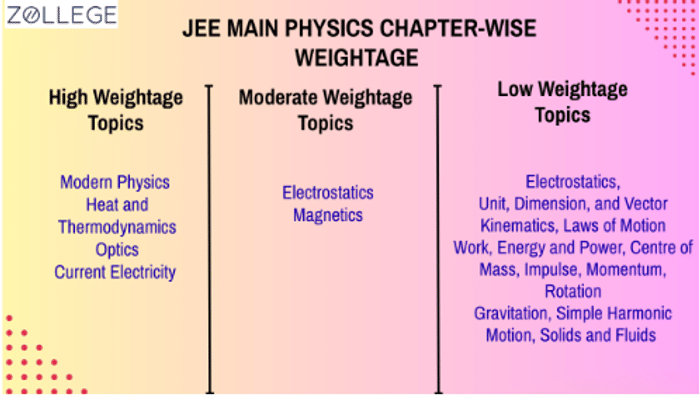
The table below summarizes the topics of JEE Main Physics under high, moderate and low weightage sections:
| High Weightage Topics | Moderate Weightage Topics | Low Weightage Topics |
|---|---|---|
| Modern Physics Heat and Thermodynamics Optics Current Electricity | Electrostatics Magnetics | Unit, Dimension, and Vector Kinematics Laws of Motion Work, Energy, and Power Centre of Mass, Impulse, Momentum Rotation Gravitation Simple Harmonic Motion Solids and Fluids |
JEE Main Chemistry Chapter-wise weightage
Chemistry is divided into three sections: Physical, Organic and Inorganic Chemistry. The following table outlines the approximate weightage:
| Chapter/Topic | Expected No. of Questions | Weightage (%) |
|---|---|---|
| Transition Elements and Coordination Compounds | 3 | 9.9% |
| Periodic Table | 3 | 9.9% |
| Atomic Structure | 2 | 6.6% |
| Chemical Bonding and Molecular Structure | 2 | 6.6% |
| Thermodynamics and Gaseous State | 2 | 6.6% |
| Mole Concept | 1 | 3.3% |
| Redox Reactions | 1 | 3.3% |
| Electrochemistry | 1 | 3.3% |
| Chemical Kinetics | 1 | 3.3% |
| Solution and Colligative Properties | 1 | 3.3% |
| General Organic Chemistry | 1 | 3.3% |
| Stereochemistry | 1 | 3.3% |
| Hydrocarbon | 1 | 3.3% |
| Alkyl Halides | 1 | 3.3% |
| Carboxylic Acids and Derivatives | 1 | 3.3% |
| Carbohydrates, Amino Acids, Polymers | 1 | 3.3% |
| Aromatic Compounds | 1 | 3.3% |
High Weightage chapters of Chemistry for JEE Main 2026
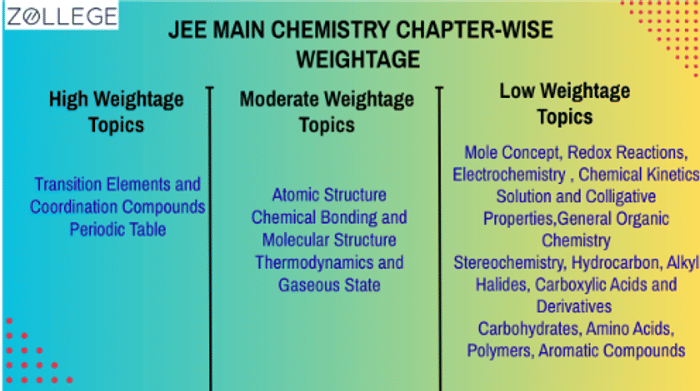
The table below summarizes the topics of JEE Main Chemistry under high, moderate and low weightage sections:
| High Weightage Topics | Moderate Weightage Topics | Low Weightage Topics |
|---|---|---|
| Transition Elements and Coordination Compounds Periodic Table | Atomic Structure Chemical Bonding and Molecular Structure Thermodynamics and Gaseous State | Mole Concept Redox Reactions Electrochemistry Chemical Kinetics Solution and Colligative Properties General Organic Chemistry Stereochemistry Hydrocarbon Alkyl Halides Carboxylic Acids Carbohydrates Amino Acids Polymers Aromatic Compounds |
Also Read:
- JEE Main 2026 Exam Pattern for BE/B.Tech
- JEE Main 2026 Exam Pattern for B.Arch
- JEE Main 2025 Exam Pattern for B.Plan
JEE Main Mathematics Chapter-wise weightage
The table below summarizes the topics of Mathematics with the approximate number of questions asked and their percentage weightage:
| Chapter/Topic | Expected No. of Questions | Weightage (%) |
|---|---|---|
| Coordinate Geometry | 4-5 | 9.9% |
| Limits, Continuity and Differentiability | 3 | 9.9% |
| Integral Calculus | 3 | 9.9% |
| Complex Numbers and Quadratic Equations | 2 | 6.6% |
| Matrices and Determinants | 2 | 6.6% |
| 3-D Geometry | 2 | 6.6% |
| Vector Algebra | 2 | 6.6% |
| Statistics and Probability | 2 | 6.6% |
| Sequences and series | 1 | 3.3% |
| Sets, and Functions | 1 | 3.3% |
| Permutation and Combination | 1 | 3.3% |
| Binomial Theorem and its Applications | 1 | 3.3% |
| Trigonometry | 1 | 3.3% |
| Differential Equation | 1 | 3.3% |
| Differential Calculus | 1 | 3.3% |
Mathematics High Weightage chapters for JEE Main 2026
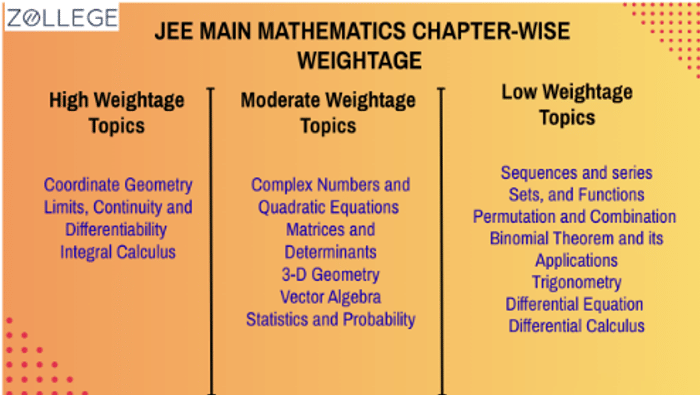
The table below summarizes the topics of JEE Main Mathematics under high, moderate and low weightage sections:
| High Weightage Topics | Moderate Weightage Topics | Low Weightage Topics |
|---|---|---|
| Coordinate Geometry Limits Continuity and Differentiability Integral Calculus | Complex Numbers Quadratic Equations Matrices Determinants 3-D Geometry Vector Algebra Statistics Probability | Sequences and Series Sets Functions Permutation and Combination Binomial Theorem and Its Applications Trigonometry Differential Equation Differential Calculus |
Also Read:
Change in Subject-wise weightage for JEE Main 2026
According to last years’ update in the JEE Main Exam, the subject-wise weightage for Physics, Chemistry and Mathematics has been changed. The weightage of Physics and Chemistry has been reduced from 25% to 22.5% while the weightage of Mathematics has been increased to 35%.
| Subject | Weightage in 2025 | Weightage in 2026 |
|---|---|---|
| Physics | 22.5% | Expected to be the same |
| Chemistry | 22.5% | |
| Mathematics | 35% |
This change reflects a shift in emphasis, with Mathematics now carrying the most significant weight in the exam. Therefore, Mathematics may continue to be a game-changer in JEE Main 2026.
JEE Main Chapter-Wise Weightage for the Last 5 Years
The table below shows chapter-wise weightage according to the last 5 years’ JEE Main exam analysis.
JEE Main Physics Chapter-wise Weightage
| Chapter | 2025 | 2024 | 2023 | 2022 | 2021 |
|---|---|---|---|---|---|
| Modern Physics | 20 | 16 | 20 | 16 | 16 |
| Optics | 10 | 9.9 | 9.9 | 10 | 10 |
| Current Electricity | 10 | 9.9 | 9.9 | 10 | 10 |
| Electrostatics | 10 | 9.9 | 9.9 | 9.9 | 9.9 |
| Magnetics | 7 | 7 | 7 | 6.6 | 6.6 |
| Heat & Thermodynamics | 10 | 10 | 10 | 9.9 | 9.9 |
| Miscellaneous other Topics | 3–4 | 3–4 | 3–4 | 3.3 | 3.3 |
JEE Main Chemistry Chapter-wise Weightage
| Chapter | 2025 | 2024 | 2023 | 2022 | 2021 |
|---|---|---|---|---|---|
| Co-ordination Compounds | 10 | 9.9 | 9.9 | 10 | 10 |
| Periodic Table & d/f-block | 10 | 9.9 | 9.9 | 10 | 10 |
| Solid State/Surface Chemistry | 7 | 6.6 | 6.6 | 6.6 | 6.6 |
| Thermodynamics/Gaseous State | 7 | 6.6 | 6.6 | 7 | 7 |
| Chemical Bonding | 7 | 6.6 | 6.6 | 7 | 7 |
| Chemical Kinetics, Redox, etc. | 3–4 | 3–4 | 3–4 | 3.3 | 3.3 |
| Atomic Structure | 7 | 6.6 | 6.6 | 7 | 7 |
| Organic (each topics, average) | 3–4 | 3–4 | 3–4 | 3.3 | 3.3 |
JEE Main Mathematics Chapter-wise Weightage
| Chapter | 2025 | 2024 | 2023 | 2022 | 2021 |
|---|---|---|---|---|---|
| Calculus (total) | 30.7 | 37.3 | 25 | 24 | 24 |
| Algebra (total) | 39.4 | 33.5 | 21 | 20 | 20 |
| 3D Geometry & Vector Algebra | 12.0 | 13.3 | 10 | 10 | 10 |
| 2D Geometry | 15.4 | 12.3 | 10 | 10 | 10 |
| Trigonometry | 2.5 | 3.5 | 3 | 4 | 4 |
| Probability & Statistics | 6.0 | 6.6 | 6 | 6 | 6 |
| Complex Numbers & Quadratic Eq. | 6.6 | 6.6 | 6 | 6 | 6 |
| Sequences & Series | 6.6 | 6.6 | 6 | 6 | 6 |
| Matrices & Determinants | 6.6 | 6.6 | 6 | 6 | 6 |
| Binomial Theorem | 3.3 | 3.3 | 3 | 3 | 3 |
| Permutations & Combinations | 3.3 | 3.3 | 3 | 3 | 3 |
| Differential Equations | 3.3 | 3.3 | 3 | 3 | 3 |
| Sets, Relations, & Functions | 3.3 | 3.3 | 3 | 3 | 3 |
| Straight Lines | 6.6 | 6.6 | 6 | 6 | 6 |
| Quadratic Equations | 3.3 | 3.3 | 3 | 3 | 3 |
JEE Main Previous Year Question Papers with Solutions (Free PDFs)
You can access and download JEE Main PYQs along with their answer keys in free PDF format here. Practicing past exam papers is one of the best ways to strengthen your preparation in the JEE Main 2026 exam. Refine and boost your performance and download shift-wise PYQs.
Important Books for JEE Main 2026
JEE Main exam syllabus is 80% based on Class 11 and 12 NCERT curriculum. However, candidates can refer to additional textbooks for each subject to add an extra edge in their JEE Main 2026 preparation. Below is the list of Important additional reference books for each subject of the JEE Main exam.
| Subject | Book Name | Author / Publication |
|---|---|---|
| Physics | Concepts of Physics (Vol. 1 & 2) | H.C. Verma |
| Understanding Physics | Freedman and Young | |
| Problems in General Physics | I.E. Irodov | |
| Fundamentals of Physics | Halliday, Resnick & Walker | |
| Problems in Physics | S.S. Krotov | |
| Problems and Solutions in Physics | Shashi Bhushan Tiwari | |
| Chemistry | Modern Approach to Chemical Calculations | R.C. Mukherjee |
| Physical Chemistry | P.W. Atkins | |
| Concept of Physical Chemistry | P. Bahadur | |
| Concise Inorganic Chemistry | J.D. Lee | |
| Organic Chemistry | O.P. Tandon | |
| Organic Chemistry | Morrison & Boyd | |
| Mathematics | Objective Mathematics | R.D. Sharma |
| Plane Trigonometry | S.L. Loney | |
| The Elements of Coordinate Geometry | S.L. Loney | |
| Algebra | Dr. S.K. Goyal (Arihant Publications) | |
| Play with Graphs | Amit M. Agarwal (Arihant Publications) | |
| Differential Calculus | Amit M. Agarwal (Arihant Publications) | |
| Integral Calculus | Amit M. Agarwal (Arihant Publications) |
Also Read:
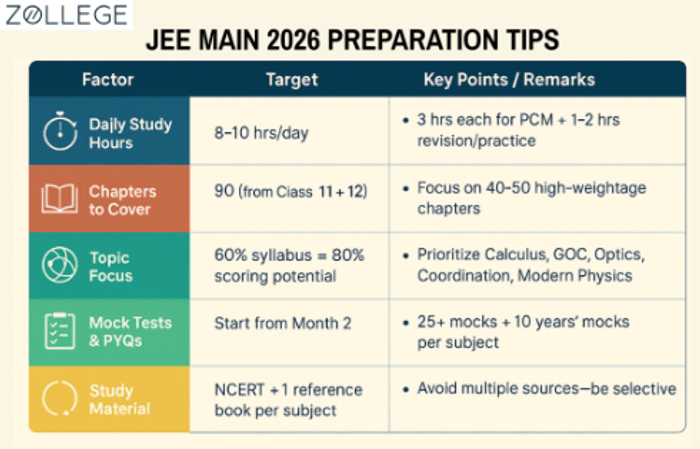
JEE Main 2026 Preparation Strategy
With smart tips and the right strategy, you can make your JEE Main preparation journey smoother and far more effective. Here are some tips that can help you maximize your JEE Main score 2026 and approach the exam with confidence.
1. Focus on High-scoring Topics
Every mark counts in the JEE Main exam, so it is crucial to understand the chapter-wise weightage for each subject. Start with the high-weightage chapters and master them well. Allocate more time to chapters with higher weightage, but ensure balanced preparation:
- Physics: Focus on conceptual clarity for Modern Physics and Thermodynamics. Practice numerical problems regularly.
- Chemistry: Prioritize Organic Chemistry for its scoring potential, and understand periodic trends for Inorganic Chemistry.
- Mathematics: Strengthen core topics like Calculus and Coordinate Geometry through consistent problem-solving.
But, do not forget that low-weightage topics can fetch you extra marks, boosting your overall score. Therefore, a balanced preparation is the key for success.
2. Practice Previous Year Papers
Past Papers are an essential part of JEE Main preparation. By solving them, you will get a clear idea of JEE Main exam pattern, type of questions asked, difficulty level, and the chapter-wise weightage. It will also help to improve accuracy and speed, which is crucial for time-bound exams like JEE Main.
3. Use Study Material Wisely
Make the best use of available study material and resources. Candidates must use the most important and limited resources for their JEE Main preparation. Typically, the JEE Main exam is 80% based on the Class 11 and 12 curriculum. Candidates can refer to additional textbooks for robust preparation.
4. Follow a Schedule
Candidates must prepare a routine and follow the same routine to strengthen their preparation. Devote the last hours of your day to the revision session for each subject. Generally, a 90-minute study block along with a 15 to 20-minute break ensures maximum productivity and concentration.
Frequently Asked Questions (FAQs)
Ques. Where can I download the JEE Main Syllabus 2026 PDF?
Ans. Candidates can view the revised JEE Main syllabus 2026 in November 2025 on NTA official website- jeemain.nta.nic.in. Meanwhile, Candidates are advised to check previous years’ JEE Main syllabus (JEE Main Syllabus 2025) as it is most likely to be the same.
Ques. Which chapters have the most weightage in JEE Mains?
Ans.The chapters with the most weightage for JEE Mains are mentioned below.
- Physics: Mechanics - Laws of Motion, Work, Energy, and Power, Electricity and Magnetism, and Modern Physics.
- Chemistry: Mole Concept, Thermodynamics, Hydrocarbons, Biomolecules, and p-Block Elements.
- Mathematics: Algebra, Calculus, and Coordinate Geometry
Ques. Is a score of 87 in JEE Main 2026 considered good?
Ans. A score of 87 is average. But it may not be sufficient for admission to IITs or NITs. Candidates with an 87 score can still qualify for some state level colleges or low-ranked institutes.
Ques What is the 80/20 rule for JEE Mains?
Ans. The 80./20 rule of JEE Main means that if candidates focus on the most important 20% of the syllabus i.e. high weightage topics, candidates can achieve nearly 80% of the results. This is a smart way to boost your score and improve your rank.
Ques. Is 98.2 percentile considered top score in JEE Main?
Ans. Yes, 98.2 percentile is quite good. The approximate rank for this percentile is 18k- 21k and a candidate with this score can get good NITs or IITs for Computer Science or ECE stream.
Ques. What is the hardest topic in JEE Main?
Ans. As per past analysis, some of the hard or difficult topics in JEE main exam include:
- Mathematics: Calculus, Permutation and Combination, 3D Geometry
- Physics: Mechanics, Modern Physics, SHM and Waves
- Chemistry: Thermodynamics, Organic Reaction Mechanisms, Electrochemistry
Question 1. Is 87.5 a good score in JEE Mains?
Answer- A score of 87.5 in JEE Mains is decent, but it may not guarantee admission to a top NIT or IIT. However, it can be a competitive score for low-ranked universities.
Question 2. Is 150 a bad score in JEE Mains?
Answer- A score of 150 is considered a good score in JEE Mains. This score can secure a good rank and provide admissions to top NITs or IITs, depending on your category.
Question 3. What is the 80/20 rule for JEE Mains?
Answer- The 80/20 rule for JEE Mains means focusing on the 20% of the syllabus that will give you 80% of the results. By mastering high-weightage topics frequently asked in the examination, you can maximize your score and secure a rank in an IIT or NIT.
Question 4. Which chapters have the most weightage in JEE Mains?
Answer- In JEE Mains, the chapters with the most weightage are:
-
Physics: Mechanics (Laws of Motion, Work, Energy, and Power), Electricity and Magnetism, and Modern Physics.
-
Chemistry: Physical Chemistry (Mole Concept, Thermodynamics), Organic Chemistry (Hydrocarbons, Biomolecules), and Inorganic Chemistry (p-Block Elements).
-
Mathematics: Algebra (Quadratic Equations, Progressions), Calculus (Differentiation, Integration), and Coordinate Geometry (Straight Lines, Circles).
Focusing on these topics can significantly boost your score.
*The article might have information for the previous academic years, please refer the official website of the exam.
Ask your question
Answered Questions
a
SG
Without a doubt the best college in India for engineering are the top 3 IITs, IIT Delhi, IIT Bombay and IIT Madras. Then these are followed by BITs Pilania and so on.
...Show More
a
ZT
It is a subjective question. However, ideally once in the beginning to see where you stand and then after you are done with a major portion of the syllabus. Going through JEE Main previous year paper will prepare you mentally to appear for the exam.
...Show More
a
ZT
Yes, the JEE Main question paper for all shifts is different in order to prevent the leaking of questions. However, the authorities try to maintain the difficulty level across the slots.
...Show More
a
ZT
If the question paper of one slot comes difficult than the other, NTA will follow the process of normalisation of scores. This will ensure a fair marking approach across all shifts.
...Show More
a
ZT
The competition level of JEE Main is very high. Moreover, the difficulty level of question paper ranges from moderate to tough. So, only with a good preparation will you be able to clear the exam.
...Show More


