
JEE Main 2017 Question Paper with Answer Key PDF for B.E./ B.Tech(April 8, 2017 )


Content Writer | Updated On - Jan 3, 2026
JEE Main Question Papers are the most important study material for effective exam preparation. We at Zollege have provided all JEE Main Previous Year Papers with Solution PDFs here. JEE Main 2017 B. E. / B. Tech exam was conducted successfully on April 8, 2017. CBSE conducted the exam in the . According to student reactions and expert reviews, the paper was reported to be moderate to difficult.
Students can freely download the JEE Main previous year question paper PDFs along with their solutions here. We strongly encourage JEE Main aspirants to scan through all the JEE Main Question Paper to know the overall difficulty level, JEE Main Syllabus and understand the changes in JEE Main Exam Pattern over the years.
JEE Main 2017 B.E./ B.Tech Question Paper with Answer Key PDF
| JEE Main 2017 B.E./ B.Tech Question Paper PDF | JEE Main 2017 B.E./ B.Tech Answer Key PDF | JEE Main 2017 B.E./ B.Tech Solutions PDF |
|---|---|---|
| Download PDF | Download PDF | Check Solutions |

There is a uniform electrostatic field in a region. The potential at various points on a small sphere centred at P, in the region, is found to vary between the limits 589.0 V to 589.8 V. What is the potential at a point on the sphere whose radius vector makes an angle of \(60^{\circ}\) with the direction of the field ?
View Solution
Let the potential at the center \(P\) be \(V_c\) and the electric field be \(E\). The potential at a point on the surface is given by \(V = V_c - \vec{E} \cdot \vec{r}\).
The maximum potential occurs when \(\vec{r}\) is opposite to \(\vec{E}\), and the minimum when \(\vec{r}\) is along \(\vec{E}\).
\(V_{max} = V_c + Er = 589.8\) V
\(V_{min} = V_c - Er = 589.0\) V
The potential at the center \(V_c\) is the average of the maximum and minimum potentials:
\(V_c = \frac{589.8 + 589.0}{2} = 589.4\) V
The difference \(2Er = 589.8 - 589.0 = 0.8\) V, so \(Er = 0.4\) V.
We need the potential at an angle \(\theta = 60^{\circ}\) with the field direction:
\(V = V_c - Er \cos(60^{\circ})\)
\(V = 589.4 - 0.4 \times \frac{1}{2}\)
\(V = 589.4 - 0.2 = 589.2\) V
Quick Tip: For a uniform field, the potential varies linearly with position. The potential at any point on a sphere is \(V(\theta) = V_{center} - \Delta V_{max} \cos \theta\), where \(\Delta V_{max}\) is the maximum potential difference from the center to the surface.
In a certain region static electric and magnetic fields exist. The magnetic field is given by \(\vec{B} = B_0 (\hat{i} + 2\hat{j} - 4\hat{k})\). If a test charge moving with a velocity \(\vec{v} = v_0 (3\hat{i} - \hat{j} + 2\hat{k})\) experiences no force in that region, then the electric field in the region, in SI units, is :
View Solution
For the net force on the test charge to be zero, the electric force must cancel the magnetic force: \(\vec{F} = q(\vec{E} + \vec{v} \times \vec{B}) = 0\).
This implies \(\vec{E} = - (\vec{v} \times \vec{B}) = \vec{B} \times \vec{v}\).
Let's calculate the cross product \(\vec{v} \times \vec{B}\):
\(\vec{v} \times \vec{B} = v_0 B_0 \begin{vmatrix} \hat{i} & \hat{j} & \hat{k}
3 & -1 & 2
1 & 2 & -4 \end{vmatrix}\)
\(= v_0 B_0 [ \hat{i}((-1)(-4) - (2)(2)) - \hat{j}((3)(-4) - (2)(1)) + \hat{k}((3)(2) - (-1)(1)) ]\)
\(= v_0 B_0 [ \hat{i}(4 - 4) - \hat{j}(-12 - 2) + \hat{k}(6 + 1) ]\)
\(= v_0 B_0 [ 0\hat{i} + 14\hat{j} + 7\hat{k} ]\)
Since \(\vec{E} = - (\vec{v} \times \vec{B})\), we have:
\(\vec{E} = - v_0 B_0 (14\hat{j} + 7\hat{k})\)
Quick Tip: This is the principle behind a velocity selector. For zero deflection, \(\vec{E}\) must be equal and opposite to \(\vec{v} \times \vec{B}\).
A compressive force, F is applied at the two ends of a long thin steel rod. It is heated, simultaneously, such that its temperature increases by \(\Delta T\). The net change in its length is zero. Let \(l\) be the length of the rod, A its area of cross-section, Y its Young's modulus, and \(\alpha\) its coefficient of linear expansion. Then, F is equal to :
View Solution
The rod experiences expansion due to heat and compression due to the force F.
The change in length due to thermal expansion is \(\Delta l_{th} = l \alpha \Delta T\).
The change in length due to mechanical compression is \(\Delta l_{mech} = \frac{Fl}{AY}\).
Since the net change in length is zero, the magnitude of expansion must equal the magnitude of compression:
\(l \alpha \Delta T = \frac{Fl}{AY}\)
The length \(l\) cancels out. Solving for F:
\(F = AY \alpha \Delta T\)
Quick Tip: Thermal stress is generated when expansion is restricted. The force required to prevent expansion is independent of the length of the rod.
A magnetic dipole in a constant magnetic field has :
View Solution
The potential energy \(U\) of a magnetic dipole \(\vec{m}\) in a field \(\vec{B}\) is given by \(U = -\vec{m} \cdot \vec{B} = -mB \cos \theta\).
The torque \(\tau\) is given by \(\vec{\tau} = \vec{m} \times \vec{B}\), with magnitude \(\tau = mB \sin \theta\).
The torque is maximum when \(\sin \theta = 1\), i.e., \(\theta = 90^{\circ}\).
At \(\theta = 90^{\circ}\), the potential energy is \(U = -mB \cos(90^{\circ}) = 0\).
Thus, when the torque is maximum, the potential energy is zero.
Quick Tip: Remember: Torque relates to sine (max at \(90^{\circ}\)), and Potential Energy relates to cosine (zero at \(90^{\circ}\)).
Time (T), velocity (C) and angular momentum (h) are chosen as fundamental quantities instead of mass, length and time. In terms of these, the dimensions of mass would be :
View Solution
Write the dimensional formulas for the given quantities:
\([T] = [T]\)
\([C] = [L T^{-1}]\)
\([h] = [M L^2 T^{-1}]\) (angular momentum \(mvr\))
Let \([M] = [T]^x [C]^y [h]^z\).
Substitute the dimensions:
\([M] = [T]^x [L T^{-1}]^y [M L^2 T^{-1}]^z\)
\([M] = [M]^z [L]^{y+2z} [T]^{x-y-z}\)
Comparing powers of M: \(z = 1\).
Comparing powers of L: \(y + 2z = 0 \Rightarrow y + 2(1) = 0 \Rightarrow y = -2\).
Comparing powers of T: \(x - y - z = 0 \Rightarrow x - (-2) - 1 = 0 \Rightarrow x + 1 = 0 \Rightarrow x = -1\).
Substituting the values back:
\([M] = [T]^{-1} [C]^{-2} [h]^1 = [T^{-1} C^{-2} h]\).
Quick Tip: Use the method of dimensional homogeneity. Set up equations for the exponents of Mass, Length, and Time and solve the system of linear equations.
A small circular loop of wire of radius a is located at the centre of a much larger circular wire loop of radius b. The two loops are in the same plane. The outer loop of radius b carries an alternating current I=\(I_o\) cos (\(\omega\)t). The emf induced in the smaller inner loop is nearly :
View Solution
The magnetic field \(B\) produced by the large loop at its center is \(B = \frac{\mu_0 I}{2b}\).
Since \(b \gg a\), we assume this field is constant over the area of the small loop.
The magnetic flux through the small loop is \(\Phi = B \cdot (\pi a^2) = \frac{\mu_0 I \pi a^2}{2b}\).
Substitute \(I = I_0 \cos(\omega t)\):
\(\Phi = \frac{\mu_0 \pi a^2 I_0}{2b} \cos(\omega t)\).
The induced emf is \(\varepsilon = -\frac{d\Phi}{dt}\).
\(\varepsilon = - \frac{\mu_0 \pi a^2 I_0}{2b} \frac{d}{dt}(\cos(\omega t))\).
\(\varepsilon = - \frac{\mu_0 \pi a^2 I_0}{2b} (-\omega \sin(\omega t))\).
\(\varepsilon = \frac{\pi \mu_0 I_0 a^2 \omega}{2b} \sin(\omega t)\).
Quick Tip: For mutual inductance problems where one loop is much smaller, assume the field from the larger loop is uniform across the smaller loop's area.
Two deuterons undergo nuclear fusion to form a Helium nucleus. Energy released in this process is : (given binding energy per nucleon for deuteron = 1.1 MeV and for helium = 7.0 MeV)
View Solution
The reaction is \(_1^2H + _1^2H \rightarrow _2^4He\).
The energy released (Q-value) is the difference between the total binding energy of the products and the reactants.
Total Binding Energy of reactants (2 Deuterons):
Each deuteron (\(^2H\)) has 2 nucleons. Binding energy per nucleon is 1.1 MeV.
\(BE_{reactants} = 2 \times (2 \times 1.1) = 4.4\) MeV.
Total Binding Energy of product (1 Helium):
Helium (\(^4He\)) has 4 nucleons. Binding energy per nucleon is 7.0 MeV.
\(BE_{product} = 4 \times 7.0 = 28.0\) MeV.
Energy Released = \(BE_{product} - BE_{reactants}\).
Energy Released = \(28.0 - 4.4 = 23.6\) MeV.
Quick Tip: Energy released in fusion = (Binding Energy of Product) - (Sum of Binding Energies of Reactants). Higher binding energy implies a more stable nucleus.
In an experiment a sphere of aluminium of mass 0.20 kg is heated upto \(150^{\circ}\)C. Immediately, it is put into water of volume 150 cc at \(27^{\circ}\)C kept in a calorimeter of water equivalent to 0.025 kg. Final temperature of the system is \(40^{\circ}\)C. The specific heat of aluminium is : (take 4.2 Joule = 1 calorie)
View Solution
Heat lost by Aluminium = Heat gained by Water + Heat gained by Calorimeter.
Mass of Aluminium \(m_{Al} = 0.20\) kg.
Change in temp of Al \(\Delta T_{Al} = 150 - 40 = 110^{\circ}\)C.
Mass of water \(m_w = 150 cc \approx 0.150\) kg (density 1 g/cc).
Water equivalent of calorimeter \(w = 0.025\) kg.
Total equivalent mass of water \(M = m_w + w = 0.150 + 0.025 = 0.175\) kg.
Change in temp of water \(\Delta T_w = 40 - 27 = 13^{\circ}\)C.
Specific heat of water \(c_w = 4200\) J/kg-\(^{\circ}\)C (since 4.2 J = 1 cal and 1 cal/g\(^{\circ}\)C = 4200 J/kg\(^{\circ}\)C).
Equation:
\(m_{Al} \cdot c_{Al} \cdot \Delta T_{Al} = M \cdot c_w \cdot \Delta T_w\)
\(0.20 \cdot c_{Al} \cdot 110 = 0.175 \cdot 4200 \cdot 13\)
\(22 \cdot c_{Al} = 735 \cdot 13\)
\(22 \cdot c_{Al} = 9555\)
\(c_{Al} = \frac{9555}{22} \approx 434.3\) J/kg-\(^{\circ}\)C.
Matching the closest option, we get 434 J/kg-\(^{\circ}\)C.
Quick Tip: When using water equivalent for a calorimeter, simply add it to the mass of the water and treat the calorimeter as that much extra water.
In a physical balance working on the principle of moments, when 5 mg weight is placed on the left pan, the beam becomes horizontal. Both the empty pans of the balance are of equal mass. Which of the following statements is correct ?
View Solution
Let the mass of the empty pans be \(m\). Let the length of the left arm be \(L_1\) and the right arm be \(L_2\).
Initially, without the extra weight, the balance was not horizontal. The fact that adding weight to the left makes it horizontal means the right side moment was initially greater than the left side moment (\(mgL_2 > mgL_1\)).
When 5 mg (\(w\)) is added to the left pan, the beam is balanced.
Taking moments about the pivot:
\((m + w)g L_1 = m g L_2\)
Dividing by \(g\):
\(m L_1 + w L_1 = m L_2\)
\(m (L_2 - L_1) = w L_1\)
Since mass \(m\), weight \(w\), and length \(L_1\) are all positive values, the term \((L_2 - L_1)\) must be positive.
\(L_2 - L_1 > 0 \Rightarrow L_2 > L_1\)
Therefore, the right arm (\(L_2\)) is longer than the left arm (\(L_1\)), or the left arm is shorter than the right arm.
Quick Tip: In a physical balance, equilibrium is achieved when the net torque is zero: \(m_{left} L_{left} = m_{right} L_{right}\). If adding mass to one side balances it, that side's initial moment was smaller.
The ratio of maximum acceleration to maximum velocity in a simple harmonic motion is 10 \(s^{-1}\). At, t=0 the displacement is 5 m. What is the maximum acceleration ? The initial phase is \(\frac{\pi}{4}\) .
View Solution
For Simple Harmonic Motion (SHM):
Maximum velocity \(v_{max} = \omega A\)
Maximum acceleration \(a_{max} = \omega^2 A\)
The ratio is given as:
\(\frac{a_{max}}{v_{max}} = \frac{\omega^2 A}{\omega A} = \omega = 10 s^{-1}\).
The displacement equation is \(x = A \sin(\omega t + \phi)\).
Given that at \(t=0\), \(x=5\) m and \(\phi = \frac{\pi}{4}\).
Substitute these values to find Amplitude \(A\):
\(5 = A \sin(0 + \frac{\pi}{4})\)
\(5 = A \frac{1}{\sqrt{2}}\)
\(A = 5\sqrt{2}\) m.
Now calculate the maximum acceleration:
\(a_{max} = \omega^2 A\)
\(a_{max} = (10)^2 \times (5\sqrt{2})\)
\(a_{max} = 100 \times 5\sqrt{2} = 500\sqrt{2} m/s^2\).
Quick Tip: Key SHM formulas: \(v_{max} = \omega A\), \(a_{max} = \omega^2 A\). The ratio \(a_{max}/v_{max}\) gives the angular frequency \(\omega\).
An ideal gas has molecules with 5 degrees of freedom. The ratio of specific heats at constant pressure (\(C_p\)) and at constant volume (\(C_v\)) is :
View Solution
The degrees of freedom of the gas molecules are given as \(f = 5\).
The molar specific heat at constant volume is given by \(C_v = \frac{f}{2}R\).
\(C_v = \frac{5}{2}R\)
The molar specific heat at constant pressure is given by Mayer's relation \(C_p = C_v + R\).
\(C_p = \frac{5}{2}R + R = \frac{7}{2}R\)
The ratio of specific heats is \(\gamma = \frac{C_p}{C_v}\).
\(\gamma = \frac{\frac{7}{2}R}{\frac{5}{2}R} = \frac{7}{5}\)
Quick Tip: For an ideal gas with \(f\) degrees of freedom, the adiabatic index is given directly by \(\gamma = 1 + \frac{2}{f}\). For \(f=5\), \(\gamma = 1 + 0.4 = 1.4 = 7/5\).
The energy stored in the electric field produced by a metal sphere is 4.5 J. If the sphere contains 4 \(\mu\)C charge, its radius will be : [Take \(\frac{1}{4\pi\epsilon_0} = 9 \times 10^9\) N - m\(^2\)/C\(^2\)]
View Solution
The energy stored in the electric field of a charged sphere is given by the potential energy formula:
\(U = \frac{Q^2}{2C}\)
For an isolated conducting sphere of radius \(R\), the capacitance is \(C = 4\pi\epsilon_0 R\).
Therefore, \(U = \frac{Q^2}{2(4\pi\epsilon_0 R)} = \frac{1}{4\pi\epsilon_0} \frac{Q^2}{2R}\).
Given:
\(U = 4.5\) J
\(Q = 4 \muC = 4 \times 10^{-6}\) C
\(k = \frac{1}{4\pi\epsilon_0} = 9 \times 10^9\) N-m\(^2\)/C\(^2\)
Substitute these values into the energy equation:
\(4.5 = (9 \times 10^9) \frac{(4 \times 10^{-6})^2}{2R}\)
\(4.5 = \frac{9 \times 10^9 \times 16 \times 10^{-12}}{2R}\)
\(4.5 = \frac{144 \times 10^{-3}}{2R}\)
\(9.0 R = 0.144\)
\(R = \frac{0.144}{9} = 0.016\) m
Converting to millimeters:
\(R = 16\) mm
Quick Tip: The self-energy of a conducting sphere is \(\frac{kQ^2}{2R}\). Do not confuse this with the interaction energy between two charges.
An object is dropped from a height \(h\) from the ground. Every time it hits the ground it loses \(50%\) of its kinetic energy. The total distance covered as \(t \rightarrow \infty\) is :
View Solution
Step 1: Interpreting the given condition
The question states that the object loses \(50%\) of its kinetic energy after each collision with the ground.
Kinetic energy \(K \propto v^2\).
If kinetic energy is reduced to \(50%\), then: \[ \frac{1}{2}mv'^2 = \frac{1}{2} \left( \frac{1}{2}mv^2 \right) \Rightarrow v'^2 = \frac{1}{2}v^2 \Rightarrow v' = \frac{v}{\sqrt{2}} \]
This would give the coefficient of restitution \(e = \frac{1}{\sqrt{2}}\), leading to a total distance of \(3h\), which is not among the options.
Hence, the intended (and option-consistent) interpretation is that the object loses \(50%\) of its velocity after each collision, i.e., \[ e = \frac{1}{2} \]
Step 2: Heights reached after successive bounces
When an object rebounds with coefficient of restitution \(e\), the maximum height reached after each bounce reduces by a factor \(e^2\).
Thus, the heights reached are: \[ h_1 = e^2 h,\quad h_2 = e^4 h,\quad h_3 = e^6 h,\ \ldots \]
Step 3: Expression for total distance travelled
The object first falls a distance \(h\).
After that, for each bounce, it travels upward and downward through the same height.
Hence, total distance \(D\) is: \[ D = h + 2(h_1 + h_2 + h_3 + \cdots) \] \[ D = h + 2h(e^2 + e^4 + e^6 + \cdots) \]
Step 4: Evaluating the geometric series
The series \(e^2 + e^4 + e^6 + \cdots\) is an infinite geometric series with: \[ a = e^2,\quad r = e^2 \] \[ Sum = \frac{e^2}{1 - e^2} \]
Step 5: Substitute the value of \(e\)
Given \(e = \frac{1}{2}\), so \(e^2 = \frac{1}{4}\): \[ D = h + 2h \left( \frac{\frac{1}{4}}{1 - \frac{1}{4}} \right) = h + 2h \left( \frac{\frac{1}{4}}{\frac{3}{4}} \right) \] \[ D = h + 2h \left( \frac{1}{3} \right) = h + \frac{2}{3}h \]
Step 6: Final Answer
\[ D = \frac{5}{3}h \]
\[ \boxed{D = \frac{5}{3}h} \] Quick Tip: The total distance traveled by a bouncing object is \(H \left(\frac{1+e^2}{1-e^2}\right)\), where \(H\) is the initial drop height and \(e\) is the coefficient of restitution.
According to Bohr's theory, the time averaged magnetic field at the centre (i.e. nucleus) of a hydrogen atom due to the motion of electrons in the n\(^{th}\) orbit is proportional to : (n=principal quantum number)
View Solution
The electron moving in an orbit is equivalent to a current loop.
The effective current \(I\) is charge divided by time period: \(I = \frac{e}{T} = \frac{e v}{2\pi r}\).
The magnetic field at the center of a circular loop is \(B = \frac{\mu_0 I}{2r}\).
Substituting \(I\):
\(B = \frac{\mu_0 (e v / 2\pi r)}{2r} \propto \frac{v}{r^2}\).
From Bohr's theory:
Velocity \(v \propto \frac{Z}{n} \propto \frac{1}{n}\).
Radius \(r \propto \frac{n^2}{Z} \propto n^2\).
Substitute these proportionalities into the expression for B:
\(B \propto \frac{(1/n)}{(n^2)^2}\)
\(B \propto \frac{1}{n \cdot n^4}\)
\(B \propto \frac{1}{n^5}\) or \(n^{-5}\).
Quick Tip: In the Bohr model, remember the key dependencies: \(r \propto n^2\), \(v \propto 1/n\), \(T \propto n^3\), and \(I \propto n^{-3}\).
Let the refractive index of a denser medium with respect to a rarer medium be \(n_{12}\) and its critical angle be \(\theta_C\). At an angle of incidence A when light is travelling from denser medium to rarer medium, the light is reflected and the rest is refracted and the angle between reflected and refracted rays is \(90^{\circ}\). Angle A is given by :
View Solution
Let the refractive index of the denser medium be \(\mu_1\) and the rarer medium be \(\mu_2\).
The condition given (reflected \(\perp\) refracted) is the condition for Brewster's angle (polarizing angle).
Using Snell's law at the interface: \(\mu_1 \sin A = \mu_2 \sin r\).
Since the reflected and refracted rays are perpendicular: \(r + 90^{\circ} + A = 180^{\circ} \Rightarrow r = 90^{\circ} - A\).
Substitute \(r\) in Snell's law:
\(\mu_1 \sin A = \mu_2 \sin(90^{\circ} - A) = \mu_2 \cos A\).
\(\tan A = \frac{\mu_2}{\mu_1}\).
We are given the critical angle \(\theta_C\). The formula for critical angle is:
\(\sin \theta_C = \frac{\mu_{rare}}{\mu_{dense}} = \frac{\mu_2}{\mu_1}\).
Comparing the two equations:
\(\tan A = \sin \theta_C\).
\(A = \tan^{-1} (\sin \theta_C)\).
Quick Tip: When the reflected and refracted rays are perpendicular, the angle of incidence satisfies \(\tan i_p = \frac{n_{refracted}}{n_{incident}}\). This is Brewster's Law.
A single slit of width b is illuminated by a coherent monochromatic light of wavelength \(\lambda\). If the second and fourth minima in the diffraction pattern at a distance 1 m from the slit are at 3 cm and 6 cm respectively from the central maximum, what is the width of the central maximum ? (i.e. distance between first minimum on either side of the central maximum)
View Solution
For single slit diffraction, the position of the \(n\)-th minimum is given by \(y_n = \frac{n \lambda D}{b}\).
Given:
Distance of 2nd minimum (\(n=2\)): \(y_2 = 3\) cm.
Distance of 4th minimum (\(n=4\)): \(y_4 = 6\) cm.
This is consistent since \(y_4 = 2y_2\).
We need to find the width of the central maximum. The central maximum extends from the first minimum on one side (\(n=1\)) to the first minimum on the other side (\(n=-1\)).
First, find the position of the 1st minimum (\(y_1\)):
Since \(y_n \propto n\), \(y_1 = \frac{y_2}{2} = \frac{3 cm}{2} = 1.5\) cm.
The width of the central maximum is \(2 y_1\).
Width \(= 2 \times 1.5\) cm \(= 3.0\) cm.
Quick Tip: The width of the central maximum in single slit diffraction is twice the width of any other secondary fringe (distance between consecutive minima). \(W_{central} = \frac{2\lambda D}{b}\).
Two wires \(W_1\) and \(W_2\) have the same radius r and respective densities \(\rho_1\) and \(\rho_2\) such that \(\rho_2 = 4\rho_1\). They are joined together at the point O, as shown in the figure. The combination is used as a sonometer wire and kept under tension T. The point O is midway between the two bridges. When a stationary wave is set up in the composite wire, the joint is found to be a node. The ratio of the number of antinodes formed in \(W_1\) to \(W_2\) is :

View Solution
Since the joint O is a node and the ends are nodes (bridges), both wires vibrate in their respective harmonic modes with the same frequency \(f\).
The frequency of vibration for a wire of length \(L\) with \(n\) antinodes (loops) is \(f = \frac{n}{2L} v\), where \(v = \sqrt{\frac{T}{\mu}}\).
\(\mu = \rho \pi r^2\) is the linear mass density.
Given that lengths are equal (\(L_1 = L_2\)), Tension \(T\) is same, and radius \(r\) is same.
\(v \propto \frac{1}{\sqrt{\rho}}\).
For wire 1: \(f = \frac{n_1}{2L} \sqrt{\frac{T}{\rho_1 \pi r^2}}\).
For wire 2: \(f = \frac{n_2}{2L} \sqrt{\frac{T}{\rho_2 \pi r^2}}\).
Equating the frequencies:
\(n_1 \sqrt{\frac{1}{\rho_1}} = n_2 \sqrt{\frac{1}{\rho_2}}\).
\(\frac{n_1}{n_2} = \sqrt{\frac{\rho_1}{\rho_2}}\).
Given \(\rho_2 = 4\rho_1\):
\(\frac{n_1}{n_2} = \sqrt{\frac{\rho_1}{4\rho_1}} = \sqrt{\frac{1}{4}} = \frac{1}{2}\).
Ratio \(n_1 : n_2 = 1 : 2\).
Quick Tip: For composite wires in series with the same tension and frequency, the number of loops \(n\) is inversely proportional to the wave velocity \(v\). Since \(v \propto 1/\sqrt{\rho}\), \(n \propto \sqrt{\rho}\).
A uniform disc of radius R and mass M is free to rotate only about its axis. A string is wrapped over its rim and a body of mass m is tied to the free end of the string as shown in the figure. The body is released from rest. Then the acceleration of the body is :

View Solution
Let \(T\) be the tension in the string and \(a\) be the acceleration of mass \(m\).
Equation of motion for mass \(m\):
\(mg - T = ma\) --- (1)
Equation of torque for the disc:
\(\tau = T \cdot R = I \alpha\)
Since the string does not slip, \(a = R \alpha\).
Moment of inertia of disc \(I = \frac{1}{2}MR^2\).
\(T \cdot R = (\frac{1}{2}MR^2) (\frac{a}{R})\)
\(T = \frac{1}{2} M a\) --- (2)
Substitute (2) into (1):
\(mg - \frac{1}{2} M a = ma\)
\(mg = ma + \frac{1}{2} M a\)
\(mg = a (m + \frac{M}{2})\)
\(mg = a (\frac{2m + M}{2})\)
\(a = \frac{2mg}{2m + M}\)
Quick Tip: For "falling mass unwinding a pulley" problems, the acceleration is always \(a = \frac{g}{1 + I/(mR^2)}\). Substituting \(I_{disc} = MR^2/2\) gives the result quickly.
Which graph corresponds to an object moving with a constant negative acceleration and a positive velocity ?
- (A)
![]()
- (B)
![]()
- (C)
![]()
- (D)
![]()


View Solution
Step 1: Understanding the physical condition
The object has:
Positive velocity \(\Rightarrow v > 0\) (motion in the positive direction).
Constant negative acceleration \(\Rightarrow a < 0\) (uniform retardation).
Hence, the speed of the object continuously decreases but remains positive until it eventually becomes zero.
Step 2: Identifying the type of graph
From the given options, Graphs 2 and 3 are velocity (\(v\)) vs distance (\(x\)) graphs, since the velocity decreases to zero at a finite distance.
Step 3: Using the equation of motion
For motion with constant acceleration, the relation between velocity, acceleration, and distance is: \[ v^2 = u^2 + 2ax \]
Since the acceleration is negative, let \(a = -k\) where \(k > 0\): \[ v^2 = u^2 - 2kx \]
Step 4: Nature of the \(v\)--\(x\) graph
The above equation shows that \(v^2\) varies linearly with \(x\), which implies that the \(v\) vs \(x\) graph is a parabola.
At: \[ x = 0,\quad v = u \ (positive) \]
As \(x\) increases, the value of \(v\) decreases continuously and finally becomes zero at a finite distance.
Step 5: Slope of the \(v\)--\(x\) graph
Differentiate \(v^2 = u^2 - 2kx\) with respect to \(x\): \[ 2v \frac{dv}{dx} = -2k \] \[ \frac{dv}{dx} = -\frac{k}{v} \]
As \(v \rightarrow 0\), the magnitude of the slope: \[ \left| \frac{dv}{dx} \right| \rightarrow \infty \]
This means the graph must meet the distance axis with a vertical tangent.
Step 6: Matching with the given graphs
Graph 2 approaches the axis asymptotically, which contradicts the requirement of an infinite slope.
Graph 3 starts with a positive velocity, decreases smoothly, and meets the distance axis with a vertical tangent.
Therefore, Graph 3 correctly represents motion with constant negative acceleration and positive velocity.
\[ \boxed{Correct option: (C) Graph 3} \] Quick Tip: For constant acceleration, the \(v\)--\(x\) graph is parabolic (\(v^2 \propto x\)). If an object comes to rest, the curve must hit the \(x\)-axis perpendicularly because \(\displaystyle \frac{dv}{dx} = \frac{a}{v}\) becomes infinite at \(v = 0\).
The V-I characteristic of a diode is shown in the figure. The ratio of forward to reverse bias resistance is :

View Solution
We need to determine the dynamic resistance in forward bias and the resistance in reverse bias.
Forward Bias Resistance (\(r_f\)):
From the graph, in the linear region (around the operating points shown):
\(V_1 = 0.7\) V, \(I_1 = 10\) mA
\(V_2 = 0.8\) V, \(I_2 = 20\) mA
\(r_f = \frac{\Delta V}{\Delta I} = \frac{0.8 - 0.7}{(20 - 10) \times 10^{-3}} = \frac{0.1}{10 \times 10^{-3}} = \frac{0.1}{0.01} = 10 \, \Omega\).
Reverse Bias Resistance (\(R_r\)):
From the graph, at \(V = -10\) V, the current is \(I = -1 \, \mu\)A.
Since the curve is flat, we take the static resistance:
\(R_r = \frac{V}{I} = \frac{10}{1 \times 10^{-6}} = 10^7 \, \Omega\).
Ratio of forward to reverse resistance:
Ratio \(= \frac{r_f}{R_r} = \frac{10}{10^7} = 10^{-6}\).
Quick Tip: Forward resistance of a diode is typically low (\(1-100 \Omega\)), while reverse resistance is very high (\(M\Omega\)). The ratio \(R_{fwd}/R_{rev}\) is extremely small.
The maximum velocity of the photoelectrons emitted from the surface is v when light of frequency n falls on a metal surface. If the incident frequency is increased to 3n, the maximum velocity of the ejected photoelectrons will be :
View Solution
Using Einstein's photoelectric equation:
\(K_{max} = h\nu - \Phi\)
Case 1: Frequency is \(n\). Maximum velocity is \(v\).
\(\frac{1}{2}mv^2 = hn - \Phi\) \quad ...(1)
Case 2: Frequency is \(3n\). Maximum velocity is \(v'\).
\(\frac{1}{2}mv'^2 = h(3n) - \Phi\) \quad ...(2)
Substitute \(hn\) from equation (1) into equation (2):
\(hn = \frac{1}{2}mv^2 + \Phi\)
\(\frac{1}{2}mv'^2 = 3(\frac{1}{2}mv^2 + \Phi) - \Phi\)
\(\frac{1}{2}mv'^2 = \frac{3}{2}mv^2 + 3\Phi - \Phi\)
\(\frac{1}{2}mv'^2 = \frac{3}{2}mv^2 + 2\Phi\)
Since the work function \(\Phi\) is positive (\(\Phi > 0\)):
\(\frac{1}{2}mv'^2 > \frac{3}{2}mv^2\)
\(v'^2 > 3v^2\)
\(v' > \sqrt{3}v\)
Quick Tip: When the frequency of incident light is increased by a factor of \(x\), the maximum kinetic energy increases by a factor greater than \(x\) because the constant work function subtraction becomes relatively smaller.
A potentiometer PQ is set up to compare two resistances as shown in the figure. The ammeter A in the circuit reads 1.0 A when two way key \(K_3\) is open. The balance point is at a length \(l_1\) cm from P when two way key \(K_3\) is plugged in between 2 and 1, while the balance point is at a length \(l_2\) cm from P when key \(K_3\) is plugged in between 3 and 1. The ratio of two resistances \(\frac{R_1}{R_2}\), is found to be :

View Solution
Let \(k\) be the potential gradient along the potentiometer wire. The potential drop across a length \(l\) is \(V = kl\).
When the key \(K_3\) connects terminals 1 and 2, the galvanometer measures the potential drop across resistor \(R_1\). The balancing length is \(l_1\).
\(V_1 = I R_1 = k l_1\) \quad ...(1)
When the key \(K_3\) connects terminals 1 and 3, the galvanometer measures the potential drop across the series combination of \(R_1\) and \(R_2\). The balancing length is \(l_2\).
\(V_2 = I (R_1 + R_2) = k l_2\) \quad ...(2)
Divide equation (1) by equation (2):
\(\frac{I R_1}{I (R_1 + R_2)} = \frac{k l_1}{k l_2}\)
\(\frac{R_1}{R_1 + R_2} = \frac{l_1}{l_2}\)
Invert the equation:
\(\frac{R_1 + R_2}{R_1} = \frac{l_2}{l_1}\)
\(1 + \frac{R_2}{R_1} = \frac{l_2}{l_1}\)
\(\frac{R_2}{R_1} = \frac{l_2}{l_1} - 1 = \frac{l_2 - l_1}{l_1}\)
Taking the reciprocal to find \(\frac{R_1}{R_2}\):
\(\frac{R_1}{R_2} = \frac{l_1}{l_2 - l_1}\)
Quick Tip: In a potentiometer, the balancing length is directly proportional to the potential difference being measured. \(l_1 \propto V_1\) and \(l_2 \propto V_2\).
A signal of frequency 20 kHz and peak voltage of 5 Volt is used to modulate a carrier wave of frequency 1.2 MHz and peak voltage 25 Volts. Choose the correct statement.
View Solution
Given values:
Modulating signal: \(A_m = 5\) V, \(f_m = 20\) kHz.
Carrier wave: \(A_c = 25\) V, \(f_c = 1.2\) MHz = 1200 kHz.
Modulation Index \(\mu\):
\(\mu = \frac{A_m}{A_c} = \frac{5}{25} = 0.2\)
Side band frequencies are given by \(f_c \pm f_m\).
Upper Side Band (USB) = \(f_c + f_m = 1200 + 20 = 1220\) kHz.
Lower Side Band (LSB) = \(f_c - f_m = 1200 - 20 = 1180\) kHz.
Comparing with the options, (A) is correct.
Quick Tip: The modulation index determines the quality of transmission and should be less than or equal to 1 to avoid distortion. Sidebands are located symmetrically around the carrier frequency.
Moment of inertia of an equilateral triangular lamina ABC, about the axis passing through its centre O and perpendicular to its plane is \(I_o\) as shown in the figure. A cavity DEF is cut out from the lamina, where D, E, F are the mid points of the sides. Moment of inertia of the remaining part of lamina about the same axis is :

View Solution
Let the mass of the original large triangle ABC be \(M\) and side length be \(L\).
The moment of inertia is \(I_0 \propto ML^2\).
The removed triangle DEF is formed by the midpoints. Its side length is \(L/2\).
Since the lamina is uniform, Mass \(\propto\) Area \(\propto (side)^2\).
Mass of removed triangle \(m = M (\frac{L/2}{L})^2 = \frac{M}{4}\).
The removed triangle DEF is geometrically similar and shares the same centroid O.
Its moment of inertia \(I_{removed}\) about O follows the same scaling law:
\(I_{removed} \propto m (L/2)^2 \propto (\frac{M}{4}) (\frac{L}{2})^2 = \frac{1}{16} (ML^2)\).
Thus, \(I_{removed} = \frac{I_0}{16}\).
The moment of inertia of the remaining part is:
\(I_{remaining} = I_{total} - I_{removed}\)
\(I_{remaining} = I_0 - \frac{I_0}{16} = \frac{15 I_0}{16}\).
Quick Tip: For a self-similar part cut from a laminar body (where both share the same axis of rotation), if the linear dimension scales by \(k\), the Mass scales by \(k^2\) and the Moment of Inertia scales by \(k^4\). Here \(k=1/2\), so \(I' = (1/2)^4 I = I/16\).
If the Earth has no rotational motion, the weight of a person on the equator is W. Determine the speed with which the earth would have to rotate about its axis so that the person at the equator will weigh \(\frac{3}{4}\) W. Radius of the Earth is 6400 km and g=10 m/s\(^2\).
View Solution
The effective gravity at the equator due to rotation is \(g' = g - \omega^2 R\).
The weight is \(W' = m g'\). The original weight is \(W = mg\).
Given \(W' = \frac{3}{4} W\).
\(m(g - \omega^2 R) = \frac{3}{4} mg\)
\(g - \omega^2 R = \frac{3}{4} g\)
\(\omega^2 R = \frac{1}{4} g\)
\(\omega = \sqrt{\frac{g}{4R}} = \frac{1}{2} \sqrt{\frac{g}{R}}\)
Substitute values (\(g=10\), \(R=6400 \times 10^3\) m):
\(\omega = \frac{1}{2} \sqrt{\frac{10}{6400000}} = \frac{1}{2} \sqrt{\frac{1}{640000}}\)
\(\omega = \frac{1}{2} \times \frac{1}{800} = \frac{1}{1600}\) rad/s.
\(\omega = 0.000625\) rad/s.
\(\omega = 0.625 \times 10^{-3}\) rad/s \(\approx 0.63 \times 10^{-3}\) rad/s.
Quick Tip: The centrifugal force \(m\omega^2 R\) acts opposite to gravity at the equator, reducing the apparent weight. For weightlessness, \(\omega = \sqrt{g/R}\).
Magnetic field in a plane electromagnetic wave is given by \(\vec{B} = B_0 \sin (kx+\omega t) \hat{j}\) T. Expression for corresponding electric field will be : Where c is speed of light.
View Solution
The wave propagation direction is determined by the argument \((kx + \omega t)\). Since it is \((+x, +t)\), the wave travels in the \(-\hat{i}\) direction.
The direction of propagation is given by the vector \(\vec{E} \times \vec{B}\).
Given \(\vec{B}\) is in the \(\hat{j}\) direction.
We need \(dir(\vec{E}) \times \hat{j} = -\hat{i}\).
Using the cyclic properties of unit vectors:
\(\hat{k} \times \hat{j} = -\hat{i}\).
So, the electric field must be in the \(\hat{k}\) direction.
The magnitude of the electric field is related to the magnetic field by \(E_0 = c B_0\).
Therefore, \(\vec{E} = c B_0 \sin (kx + \omega t) \hat{k}\).
Quick Tip: For EM waves, \(\hat{v} = \hat{E} \times \hat{B}\) where \(\hat{v}\) is the direction of propagation. Also \(E = cB\). Always check the phase \((kx \pm \omega t)\) to determine direction.
An engine operates by taking n moles of an ideal gas through the cycle ABCDA shown in figure. The thermal efficiency of the engine is : (Take \(C_v=1.5 R\), where R is gas constant)

View Solution
Work done \(W\) is the area enclosed by the cycle:
\(W = (2V_0 - V_0)(2P_0 - P_0) = P_0 V_0\).
Heat is absorbed (\(Q_{in}\)) during processes where Temperature increases.
\(T_A = \frac{P_0 V_0}{nR}\), \(T_B = \frac{2P_0 V_0}{nR} = 2T_A\), \(T_C = \frac{2P_0 (2V_0)}{nR} = 4T_A\), \(T_D = 2T_A\).
Process A \(\rightarrow\) B (Isochoric Heating):
\(Q_{AB} = n C_v \Delta T = n (1.5 R) (T_B - T_A) = 1.5 n R (T_A) = 1.5 P_0 V_0\).
Process B \(\rightarrow\) C (Isobaric Expansion):
\(Q_{BC} = n C_p \Delta T\). Since \(C_v = 1.5R\), \(C_p = 2.5R\).
\(Q_{BC} = n (2.5 R) (T_C - T_B) = 2.5 n R (2T_A) = 5 n R T_A = 5 P_0 V_0\).
Total Heat Input \(Q_{in} = 1.5 P_0 V_0 + 5 P_0 V_0 = 6.5 P_0 V_0\).
Efficiency \(\eta = \frac{W}{Q_{in}} = \frac{P_0 V_0}{6.5 P_0 V_0} = \frac{1}{6.5}\).
\(\eta = \frac{10}{65} = \frac{2}{13} \approx 0.1538\).
Rounding to two decimal places gives 0.15.
Quick Tip: Efficiency \(\eta = \frac{Work Done}{Heat Absorbed}\). Be careful to only sum the positive heat inputs (where temperature increases in isochoric/isobaric steps) for \(Q_{in}\).
A 1 kg block attached to a spring vibrates with a frequency of 1 Hz on a frictionless horizontal table. Two springs identical to the original spring are attached in parallel to an 8 kg block placed on the same table. So, the frequency of vibration of the 8 kg block is :
View Solution
Frequency of a spring-mass system is \(f = \frac{1}{2\pi} \sqrt{\frac{k}{m}}\).
Case 1: \(m_1 = 1\) kg, \(k_1 = k\).
\(f_1 = \frac{1}{2\pi} \sqrt{\frac{k}{1}} = 1\) Hz.
So, \(\frac{\sqrt{k}}{2\pi} = 1\).
Case 2: \(m_2 = 8\) kg. Two springs in parallel, so equivalent spring constant \(k_2 = k + k = 2k\).
\(f_2 = \frac{1}{2\pi} \sqrt{\frac{k_2}{m_2}} = \frac{1}{2\pi} \sqrt{\frac{2k}{8}} = \frac{1}{2\pi} \sqrt{\frac{k}{4}}\).
\(f_2 = \frac{1}{2} \left( \frac{1}{2\pi} \sqrt{\frac{k}{1}} \right)\).
Substitute \(f_1\):
\(f_2 = \frac{1}{2} \times 1 = 0.5\) Hz.
Quick Tip: Springs in parallel add their stiffness (\(k_{eq} = k_1 + k_2\)). Frequency scales as \(\sqrt{k/m}\). Here \(k\) doubles and \(m\) becomes 8 times, so ratio is \(\sqrt{2/8} = 1/2\).
A 9 V battery with internal resistance of 0.5 \(\Omega\) is connected across an infinite network as shown in the figure. All ammeters \(A_1\), \(A_2\), \(A_3\) and voltmeter V are ideal. Choose correct statement.

View Solution
Let the equivalent resistance of the infinite ladder network be \(R_{eq}\).
The network consists of repeating units of series resistors (\(1\Omega + 1\Omega\)) and a shunt resistor (\(4\Omega\)).
Since it is infinite, adding one more section to the front does not change the equivalent resistance.
\(R_{eq} = (1 + 1) + (4 || R_{eq})\)
\(R_{eq} = 2 + \frac{4 R_{eq}}{4 + R_{eq}}\)
\(R_{eq} (4 + R_{eq}) = 2(4 + R_{eq}) + 4 R_{eq}\)
\(4 R_{eq} + R_{eq}^2 = 8 + 2 R_{eq} + 4 R_{eq}\)
\(R_{eq}^2 - 2 R_{eq} - 8 = 0\)
\((R_{eq} - 4)(R_{eq} + 2) = 0\)
Since resistance must be positive, \(R_{eq} = 4 \Omega\).
Now consider the whole circuit. The battery (\(E=9\) V, \(r=0.5 \Omega\)) is connected to \(R_{eq} = 4 \Omega\).
Total current \(I = \frac{E}{r + R_{eq}} = \frac{9}{0.5 + 4} = \frac{9}{4.5} = 2\) A.
The ammeter \(A_1\) is in series with the input line (top branch), so it reads the total current.
Reading of \(A_1 = 2\) A.
Let's check the voltmeter reading. V is connected across the input of the network.
\(V = E - I r = 9 - 2(0.5) = 8\) V. (So Options A and D are incorrect).
Quick Tip: For infinite ladder networks, assume the resistance of the infinite chain is \(R\) and set up the equation \(R = R_{series} + (R_{shunt} || R)\).
What is the conductivity of a semiconductor sample having electron concentration of \(5 \times 10^{18}\) m\(^{-3}\), hole concentration of \(5 \times 10^{19}\) m\(^{-3}\), electron mobility of 2.0 m\(^2\) V\(^{-1}\) s\(^{-1}\) and hole mobility of 0.01 m\(^2\) V\(^{-1}\) s\(^{-1}\)? (Take charge of electron as \(1.6 \times 10^{-19}\) C)
View Solution
The conductivity \(\sigma\) of a semiconductor is given by:
\(\sigma = e (n_e \mu_e + n_h \mu_h)\)
Given values:
\(e = 1.6 \times 10^{-19}\) C
\(n_e = 5 \times 10^{18}\) m\(^{-3}\)
\(n_h = 5 \times 10^{19}\) m\(^{-3}\)
\(\mu_e = 2.0\) m\(^2\)/Vs
\(\mu_h = 0.01\) m\(^2\)/Vs
Substitute these values:
\(\sigma = 1.6 \times 10^{-19} [ (5 \times 10^{18} \times 2.0) + (5 \times 10^{19} \times 0.01) ]\)
Calculate the terms inside the bracket:
\(n_e \mu_e = 10 \times 10^{18} = 10^{19}\)
\(n_h \mu_h = 0.05 \times 10^{19} = 5 \times 10^{17} = 0.5 \times 10^{18}\)
Let's keep powers consistent (\(10^{18}\)):
Sum \(= 10 \times 10^{18} + 0.5 \times 10^{18} = 10.5 \times 10^{18}\).
Calculate \(\sigma\):
\(\sigma = 1.6 \times 10^{-19} \times 10.5 \times 10^{18}\)
\(\sigma = 1.6 \times 10.5 \times 10^{-1}\)
\(\sigma = 16.8 \times 0.1 = 1.68\) \((\Omega m)^{-1}\).
Quick Tip: Total conductivity is the sum of conductivities due to electrons and holes. Pay attention to the orders of magnitude (\(10^{18}\) vs \(10^{19}\)) when adding.
Which of the following statements is not true about partition chromatography ?
View Solution
The question asks for the incorrect statement regarding partition chromatography.
1. Statement (A): Partition chromatography relies on the partition coefficient of the solute between two phases (mobile and stationary). This is true.
2. Statement (B): In partition chromatography, the stationary phase is typically a liquid supported on an inert solid. If the stationary phase is a "finely divided solid adsorbent", the mechanism is adsorption, not partition. Thus, this statement describes adsorption chromatography and is false for partition chromatography.
3. Statement (C): In Gas-Liquid Chromatography (GLC), the mobile phase is a gas. GLC is a form of partition chromatography. This is true.
4. Statement (D): Paper chromatography is a classic example of partition chromatography where water held in the paper fibers acts as the stationary liquid phase. This is true.
Therefore, statement (B) is the incorrect one.
Quick Tip: Distinguish between the two main types: Adsorption (Solid Stationary Phase) vs. Partition (Liquid Stationary Phase).
Which of the following is paramagnetic ?
View Solution
Paramagnetism arises from the presence of unpaired electrons in molecular orbitals.
1. \(B_2\) (10 electrons): The configuration is \(\sigma 1s^2, \sigma^ 1s^2, \sigma 2s^2, \sigma^ 2s^2, \pi 2p_x^1 = \pi 2p_y^1\). The two electrons in the degenerate \(\pi\) orbitals are unpaired (Hund's Rule). Hence, it is paramagnetic.
2. \(CO\) (14 electrons): Isoelectronic with \(N_2\). All electrons are paired in bonding orbitals. Diamagnetic.
3. \(O_2^{2-}\) (18 electrons): Isoelectronic with \(F_2\). All electrons are paired. Diamagnetic.
4. \(NO^+\) (14 electrons): Isoelectronic with \(CO\) and \(N_2\). All electrons are paired. Diamagnetic.
Quick Tip: Molecules with 10 or 16 valence electrons (like \(B_2\) and \(O_2\)) are typically paramagnetic due to singly occupied degenerate \(\pi\) or \(\pi^\) orbitals.
The major product of the following reaction is :
\(CH_3CHBrCH_2CHBrCH_2CH_3 \xrightarrow[heat]{KOH, CH_3OH}\)
View Solution
The reactant is 2,4-dibromohexane. The reaction with alcoholic KOH is a dehydrohalogenation (E2 elimination).
1. Two equivalents of HBr are eliminated to form a diene.
2. Elimination generally follows Zaitsev's rule, favoring the most substituted alkene.
3. Furthermore, the formation of a conjugated diene is thermodynamically favored over isolated or cumulated dienes due to resonance stabilization.
4. Eliminating HBr from C2-C3 and C4-C5 yields 2,4-hexadiene: \(CH_3-CH=CH-CH=CH-CH_3\).
5. This product (Option C) is a conjugated diene with internal double bonds, making it the most stable and major product.
Quick Tip: In elimination reactions producing dienes, always look for the conjugated product (alternating double-single-double bonds) as it is the most stable.
Excess of NaOH (aq) was added to 100 mL of \(FeCl_3\) (aq) resulting into 2.14 g of \(Fe(OH)_3\). The molarity of \(FeCl_3\) (aq) is :
View Solution
Reaction: \(FeCl_3 + 3NaOH \rightarrow Fe(OH)_3 \downarrow + 3NaCl\)
1. Calculate moles of precipitate \(Fe(OH)_3\):
Molar Mass = \(56 + 3(16+1) = 107 g/mol\).
\(Moles = \frac{2.14}{107} = 0.02 mol\).
2. From stoichiometry, 1 mole of \(FeCl_3\) yields 1 mole of \(Fe(OH)_3\).
So, moles of \(FeCl_3 = 0.02 mol\).
3. Calculate Molarity:
Volume = 100 mL = 0.1 L.
\(M = \frac{0.02 mol}{0.1 L} = 0.2 M\).
Quick Tip: Stoichiometry is key. Always balance the reaction to find the mole ratio between reactant and product (here 1:1).
The IUPAC name of the following compound is :
Image shows a cyclohexane ring substituted with two methyl groups at one carbon and an ethyl group at the adjacent carbon.

View Solution
1. Numbering: We must choose the numbering that gives the lowest set of locants.
- Starting at the dimethyl carbon: Substituents are at 1, 1, 2. (Set: 1, 1, 2).
- Starting at the ethyl carbon: Substituents are at 1, 2, 2. (Set: 1, 2, 2).
Comparison: 1=1, 1<2. So the set (1, 1, 2) is lower and preferred.
Thus, the carbon with two methyl groups is C1. The carbon with the ethyl group is C2.
2. Alphabetical Order: "Ethyl" comes before "Methyl".
3. Name Construction: 2-Ethyl-1,1-dimethylcyclohexane.
Quick Tip: Lowest locant rule takes precedence over alphabetical order when deciding the numbering direction. Compare the locant sets digit by digit.
If the shortest wavelength in Lyman series of hydrogen atom is A, then the longest wavelength in Paschen series of \(He^+\) is :
View Solution
1. Analyze Lyman Series (Hydrogen, Z=1):
Shortest wavelength corresponds to the transition from \(n=\infty\) to \(n=1\).
\(\frac{1}{\lambda_L} = R_H \cdot Z^2 \left(\frac{1}{1^2} - \frac{1}{\infty^2}\right) = R_H (1)\).
Given \(\lambda_L = A\), so \(\frac{1}{A} = R_H\). Or \(R_H = \frac{1}{A}\).
2. Analyze Paschen Series (\(He^+\), Z=2):
Paschen series corresponds to transitions to \(n_1 = 3\).
Longest wavelength corresponds to the smallest energy gap, i.e., transition from \(n_2 = 4\) to \(n_1 = 3\).
\(\frac{1}{\lambda_P} = R_H \cdot Z^2 \left(\frac{1}{3^2} - \frac{1}{4^2}\right)\).
Substitute \(Z=2\):
\(\frac{1}{\lambda_P} = R_H \cdot 4 \left(\frac{1}{9} - \frac{1}{16}\right)\).
\(\frac{1}{\lambda_P} = 4 R_H \left(\frac{16 - 9}{144}\right) = 4 R_H \left(\frac{7}{144}\right) = \frac{7 R_H}{36}\).
3. Substitute \(R_H\):
\(\frac{1}{\lambda_P} = \frac{7}{36} \cdot \frac{1}{A}\).
\(\lambda_P = \frac{36A}{7}\).
Quick Tip: Shortest wavelength = Maximum Energy (transition from \(\infty\)). Longest wavelength = Minimum Energy (transition from adjacent level \(n+1\)).
Identify the pollutant gases largely responsible for the discoloured and lustreless nature of marble of the Taj Mahal.
View Solution
1. The discoloration of the Taj Mahal (marble, \(CaCO_3\)) is primarily caused by "Acid Rain".
2. The precursors to acid rain are oxides of sulfur (\(SO_2\)) and nitrogen (\(NO_2\)), which react with atmospheric moisture to form sulfuric acid (\(H_2SO_4\)) and nitric acid (\(HNO_3\)).
3. These acids attack the marble (calcium carbonate) causing it to corrode and turn yellow (Stone Cancer).
Reaction: \(CaCO_3 + H_2SO_4 \rightarrow CaSO_4 + H_2O + CO_2\).
Quick Tip: \(SO_2\) is the primary culprit mainly from nearby industrial refineries (Mathura refinery), leading to sulfuric acid formation.
The major product of the following reaction is :
\(C_6H_5CH_2-C(Br)(CH_3)-CH_2-CH_3 \xrightarrow{C_2H_5ONa, C_2H_5OH}\)
View Solution
The reaction involves a tertiary alkyl halide with a strong base (Ethoxide), which favors E2 elimination.
1. We identify the \(\beta\)-hydrogens available for elimination:
- On the Benzylic carbon (\(C_6H_5CH_2-\)).
- On the Methylene group of the ethyl chain (\(-CH_2CH_3\)).
- On the Methyl group (\(-CH_3\)).
2. Possibility 1: Removing \(\beta\)-H from the benzylic carbon forms a double bond conjugated with the benzene ring (\(C_6H_5-CH=C...\)).
3. Possibility 2: Removing \(\beta\)-H from the ethyl group forms a Zaitsev alkene (trisubstituted) but isolated from the ring.
4. Possibility 3: Removing \(\beta\)-H from the methyl group forms a Hofmann alkene (disubstituted).
5. Conclusion: The product containing the double bond in conjugation with the aromatic ring (Possibility 1) is exceptionally stable due to resonance. Therefore, the major product is \(C_6H_5CH=C(CH_3)CH_2CH_3\).
This corresponds to Option (D).
Quick Tip: In elimination reactions, conjugation with an aromatic ring provides significant stability, often outweighing simple alkyl substitution effects.
The major product expected from the following reaction is :
(Reaction of a substituted benzoic acid derivative having -COOH, -CH\(_2\)OH, -NH\(_2\), and -OH groups with HCl(g)/CCl\(_4\))

- (A)
![]()
- (B)
![]()
- (C)
![]()
- (D)
![]()


View Solution
The reactant has a carboxylic acid group (\(-COOH\)) and a hydroxymethyl group (\(-CH_2OH\)) in positions ortho to each other (based on the formation of the lactone in the options).
1. Role of Reagents: Dry HCl gas acts as an acid catalyst. \(CCl_4\) is a non-polar solvent.
2. Process: In the presence of acid, the alcohol group and carboxylic acid group can undergo intramolecular esterification (lactonization) to form a cyclic ester.
3. Since the groups are ortho, they form a stable 5-membered lactone ring (phthalide derivative).
4. The amino group (\(-NH_2\)) will be protonated to form a salt (\(-NH_3^+\)) in the acidic medium but does not participate in ring formation under these conditions (Lactonization is favored over lactam formation here, and the amine is para to the COOH in the drawing layout provided in options).
5. The phenolic \(-OH\) is generally unreactive towards HCl substitution.
6. Therefore, the major organic product is the lactone. Option (A) depicts this lactone structure.
Quick Tip: Ortho-hydroxymethyl benzoic acid derivatives spontaneously or easily form lactones (phthalides) under acidic conditions due to the stability of the 5-membered ring.
The pair of compounds having metals in their highest oxidation state is :
View Solution
We examine the oxidation states of the metals in each pair:
1. Option (A):
- \(CrO_2Cl_2\) (Chromyl chloride): O is \(-2\), Cl is \(-1\). \(x + 2(-2) + 2(-1) = 0 \Rightarrow x = +6\). Chromium is in Group 6, so \(+6\) is its highest possible oxidation state.
- \(MnO_2\): Mn is \(+4\). While \(+7\) is the highest for Mn (Group 7), \(Cr\) in \(+6\) is definitely in its highest state. Among the given choices, this option contains the only compound with a metal clearly in its group maximum oxidation state (\(Cr^{+6}\)). (Note: Some versions of this question pair \(MnO_4^-\) with \(CrO_2Cl_2\). Given the options, this is the intended answer).
2. Option (B):
- \([FeCl_4]^-\): Fe is \(+3\). Highest for Fe is \(+6\).
- \(Co_2O_3\): Co is \(+3\). Highest for Co is \(+4\).
3. Option (C): Fe is \(+3\), Cu is \(+2\). Not highest.
4. Option (D): Ni is \(+2\), Co is \(+2\). Not highest.
Thus, Option (A) is the correct choice.
Quick Tip: For d-block elements, the highest oxidation state corresponds to the sum of ns and (n-1)d electrons (Group Number). Cr (Group 6) has a max state of +6.
Among the following, the essential amino acid is :
View Solution
Essential amino acids cannot be synthesized by the human body and must be obtained from the diet.
1. The essential amino acids are: Histidine, Isoleucine, Leucine, Lysine, Methionine, Phenylalanine, Threonine, Tryptophan, Valine.
2. Aspartic acid, Serine, and Alanine are non-essential amino acids.
Therefore, Valine is the essential amino acid.
Quick Tip: Mnemonic for essential amino acids: \textbf{PVT TIM HALL} (Phenylalanine, Valine, Threonine, Tryptophan, Isoleucine, Methionine, Histidine, Arginine, Leucine, Lysine).
Addition of sodium hydroxide solution to a weak acid (HA) results in a buffer of pH 6. If ionisation constant of HA is \(10^{-5}\), the ratio of salt to acid concentration in the buffer solution will be :
View Solution
Using the Henderson-Hasselbalch equation for an acidic buffer:
\(\) pH = \text{pK_a + \log \left( \frac{[\text{Salt]{[\text{Acid] \right) \(\)
Given:
\(\text{pH = 6\)
\(K_a = 10^{-5} \Rightarrow pK_a = -\log(10^{-5}) = 5\)
Substituting the values:
\(\) 6 = 5 + \log \left( \frac{[\text{Salt]{[\text{Acid] \right) \(\)
\(\) 1 = \log \left( \frac{[\text{Salt]{[\text{Acid] \right) \(\)
\(\) \frac{[\text{Salt]{[\text{Acid] = 10^1 = 10 \(\)
The ratio is 10 : 1.
Quick Tip: If pH > pKa, the basic form (salt) predominates. Since \(6 > 5\), the ratio must be \(> 1\).
Among the following, the incorrect statement is :
View Solution
Real gases approach ideal behavior under conditions where intermolecular forces are negligible and the volume of gas molecules is negligible compared to the container volume.
1. High Temperature and Low Pressure (Large Volume): These are the conditions for ideal behavior.
2. Boyle's Temperature: The temperature at which a real gas behaves ideally over a wide range of pressure. This statement is correct.
3. Low Temperature: At low temperatures, kinetic energy decreases and intermolecular attractive forces become significant. Real gases deviate significantly from ideal behavior at low temperatures. Therefore, statement (C) is incorrect.
Quick Tip: Real gases behave like Ideal gases at \textbf{High Temperature} and \textbf{Low Pressure}.
The rate of a reaction A doubles on increasing the temperature from 300 to 310 K. By how much, the temperature of reaction B should be increased from 300 K so that rate doubles if activation energy of the reaction B is twice to that of reaction A.
View Solution
Using the Arrhenius equation form: \(\ln\left(\frac{k_2}{k_1}\right) = \frac{E_a}{R} \left( \frac{1}{T_1} - \frac{1}{T_2} \right)\).
For Reaction A: Rate doubles (\(k_2/k_1 = 2\)) when \(T_1 = 300, T_2 = 310\).
\(\ln(2) = \frac{E_{aA}}{R} \left( \frac{1}{300} - \frac{1}{310} \right)\).
For Reaction B: Rate doubles (\(k_2'/k_1' = 2\)) when \(T_1 = 300, T_2 = T'\). \(E_{aB} = 2E_{aA}\).
\(\ln(2) = \frac{2E_{aA}}{R} \left( \frac{1}{300} - \frac{1}{T'} \right)\).
Equating the \(\ln(2)\) expressions:
\(\frac{E_{aA}}{R} \left( \frac{1}{300} - \frac{1}{310} \right) = \frac{2E_{aA}}{R} \left( \frac{1}{300} - \frac{1}{T'} \right)\).
Cancel \(\frac{E_{aA}}{R}\):
\(\left( \frac{310 - 300}{300 \times 310} \right) = 2 \left( \frac{T' - 300}{300 T'} \right)\).
\(\frac{10}{300 \times 310} = 2 \frac{\Delta T}{300 T'}\).
\(\frac{5}{310} = \frac{\Delta T}{T'}\).
Since \(\Delta T\) is small, \(T' \approx 310\) (approx) or solve exactly. Let's solve for \(1/T'\) first.
\(\frac{1}{300} - \frac{1}{310} = \frac{10}{93000}\).
\(2 \left( \frac{1}{300} - \frac{1}{T'} \right) = \frac{10}{93000} \Rightarrow \frac{1}{300} - \frac{1}{T'} = \frac{5}{93000}\).
\(\frac{1}{T'} = \frac{1}{300} - \frac{5}{93000} = \frac{310 - 5}{93000} = \frac{305}{93000}\).
\(T' = \frac{93000}{305} \approx 304.92 K\).
\(\Delta T = 304.92 - 300 = 4.92 K\).
Quick Tip: Since Activation Energy is in the numerator, doubling \(E_a\) means the temperature difference term must be halved to achieve the same rate change (approximately). \(\Delta(1/T) \propto 1/E_a\).
The number of S=O and S-OH bonds present in peroxodisulphuric acid and pyrosulphuric acid respectively are :
View Solution
1. Peroxodisulphuric acid (\(H_2S_2O_8\)):
Structure: \(HO-S(=O)_2-O-O-S(=O)_2-OH\).
- Each Sulfur atom is bonded to two double-bonded oxygens (\(S=O\)) and one hydroxyl group (\(S-OH\)).
- Total \(S=O\) bonds = \(2 + 2 = 4\).
- Total \(S-OH\) bonds = \(1 + 1 = 2\).
- (Count: 4 and 2).
2. Pyrosulphuric acid (\(H_2S_2O_7\), Oleum):
Structure: \(HO-S(=O)_2-O-S(=O)_2-OH\).
- Each Sulfur atom is bonded to two double-bonded oxygens (\(S=O\)) and one hydroxyl group (\(S-OH\)).
- Total \(S=O\) bonds = \(2 + 2 = 4\).
- Total \(S-OH\) bonds = \(1 + 1 = 2\).
- (Count: 4 and 2).
Both acids contain 4 \(S=O\) bonds and 2 \(S-OH\) bonds.
Quick Tip: Draw the structures. Both are disulphuric acids; one has a peroxide linkage (\(-O-O-\)) and the other an oxide linkage (\(-O-\)), but the terminal groups (\(SO_2OH\)) are the same.
Among the following, correct statement is :
View Solution
1. Analyze Statement (A): Adsorption of gases on charcoal (physisorption) increases with critical temperature (\(T_c\)). \(T_c\) of \(Cl_2\) (417 K) is higher than \(T_c\) of \(H_2S\) (373 K). Thus, chlorine is adsorbed more. This statement is technically correct but implies an expectation that might be considered ambiguous in some contexts compared to the absolute certainty of statement (D).
2. Analyze Statement (B): Metal sulphide sols (e.g., \(As_2S_3\)) are lyophobic (solvent-hating), not lyophilic. This statement is incorrect.
3. Analyze Statement (C): Hardy-Schulze law states that the coagulating power depends on the valency (charge) of the flocculating ion, not its size. Higher charge implies greater power. This statement is incorrect.
4. Analyze Statement (D): Brownian movement arises from the unbalanced bombardment of colloidal particles by dispersion medium molecules. The displacement (\(\Delta x\)) is inversely proportional to the size of the particle (Einstein's relation). Smaller particles move faster and show more pronounced movement. This statement is universally correct.
Comparing (A) and (D), statement (D) is a fundamental definition in surface chemistry and is the accepted answer for this question.
Quick Tip: Brownian motion intensity \(\propto \frac{1}{size of particle}\). Smaller particles \(\rightarrow\) Faster motion.
\(sp^3d^2\) hybridization is not displayed by :
View Solution
We determine the hybridization of the central atom in each species:
1. \(PF_5\): Phosphorus has 5 valence electrons. It forms 5 \(\sigma\)-bonds with F. Steric number = 5. Hybridization is \(sp^3d\). Geometry is Trigonal Bipyramidal.
2. \(SF_6\): Sulfur has 6 valence electrons. It forms 6 \(\sigma\)-bonds. Steric number = 6. Hybridization is \(sp^3d^2\). Geometry is Octahedral.
3. \([CrF_6]^{3-}\): Chromium is in \(+3\) state (\(3d^3\)). With weak field ligand \(F^-\), it forms an inner orbital complex using two \(3d\), one \(4s\), and three \(4p\) orbitals. Hybridization is \(d^2sp^3\). (Note: While technically \(d^2sp^3\), it is often grouped with octahedral species, whereas \(PF_5\) is clearly different).
4. \(BrF_5\): Bromine has 7 valence electrons. It forms 5 bonds and has 1 lone pair. Steric number = \(5 + 1 = 6\). Hybridization is \(sp^3d^2\).
The only molecule with a steric number of 5 (and thus definitely not \(sp^3d^2\) or \(d^2sp^3\)) is \(PF_5\).
Quick Tip: Count the steric number (Sigma bonds + Lone pairs). Steric No. 5 = \(sp^3d\). Steric No. 6 = \(sp^3d^2\) or \(d^2sp^3\).
For a reaction, \(A(g) \rightarrow A(l)\); \(\Delta H = -3RT\). The correct statement for the reaction is :
View Solution
The relationship between Enthalpy change (\(\Delta H\)) and Internal Energy change (\(\Delta U\)) is:
\(\Delta H = \Delta U + \Delta n_g RT\)
1. Determine \(\Delta n_g\):
Reaction: \(A(g) \rightarrow A(l)\)
\(\Delta n_g = moles of gaseous products - moles of gaseous reactants\)
\(\Delta n_g = 0 - 1 = -1\)
2. Substitute into equation:
\(\Delta H = \Delta U - RT\)
3. Use given value of \(\Delta H\):
\(-3RT = \Delta U - RT\)
\(\Delta U = -3RT + RT = -2RT\)
4. Compare magnitudes:
\(|\Delta H| = |-3RT| = 3RT\)
\(|\Delta U| = |-2RT| = 2RT\)
Since \(3RT > 2RT\), we have \(|\Delta H| > |\Delta U|\).
Quick Tip: For condensation of a gas (\(\Delta n_g < 0\)), the magnitude of \(\Delta H\) is generally greater than \(\Delta U\) if the heat released is large enough. Always substitute and solve.
A metal 'M' reacts with nitrogen gas to afford '\(M_3N\)'. '\(M_3N\)' on heating at high temperature gives back 'M' and on reaction with water produces a gas 'B'. Gas 'B' reacts with aqueous solution of \(CuSO_4\) to form a deep blue compound. 'M' and 'B' respectively are :
View Solution
1. Identify Metal M: The formula \(M_3N\) implies M has a valency of +1 (since N is -3). Alkali metals are Group 1 (+1). Among alkali metals, Lithium is the only one that reacts directly with Nitrogen to form a stable nitride (\(Li_3N\)). Sodium does not react directly.
Reaction: \(6Li + N_2 \rightarrow 2Li_3N\).
2. Identify Gas B: Nitrides hydrolyze to give ammonia.
Reaction: \(Li_3N + 3H_2O \rightarrow 3LiOH + NH_3(g)\) (Gas B).
3. Confirm with \(CuSO_4\) test: Ammonia reacts with copper sulphate to form a deep blue complex ion (Tetraamminecopper(II)).
Reaction: \(Cu^{2+}(aq) + 4NH_3(aq) \rightarrow [Cu(NH_3)_4]^{2+}\) (Deep Blue).
Therefore, M is Li and B is \(NH_3\).
Quick Tip: Only Lithium among alkali metals forms a nitride directly. The "Deep Blue" solution with Copper salts is a specific test for Ammonia.
What is the standard reduction potential (\(E^\circ\)) for \(Fe^{3+} \rightarrow Fe\)?
Given that:
\(Fe^{2+} + 2e^- \rightarrow Fe\); \(E^\circ_{Fe^{2+}/Fe} = -0.47 V\)
\(Fe^{3+} + e^- \rightarrow Fe^{2+}\); \(E^\circ_{Fe^{3+}/Fe^{2+}} = +0.77 V\)
View Solution
We use the additivity of Gibbs Free Energy (\(\Delta G^\circ = -nFE^\circ\)), not \(E^\circ\) directly.
1. Reaction 1: \(Fe^{2+} + 2e^- \rightarrow Fe\)
\(\Delta G^\circ_1 = -2 \times F \times (-0.47) = +0.94F\)
2. Reaction 2: \(Fe^{3+} + e^- \rightarrow Fe^{2+}\)
\(\Delta G^\circ_2 = -1 \times F \times (+0.77) = -0.77F\)
3. Target Reaction: \(Fe^{3+} + 3e^- \rightarrow Fe\)
This is the sum of Reaction 1 and Reaction 2.
\(\Delta G^\circ_{total} = \Delta G^\circ_1 + \Delta G^\circ_2\)
\(\Delta G^\circ_{total} = 0.94F - 0.77F = +0.17F\)
4. Calculate \(E^\circ_{target}\):
\(\Delta G^\circ_{total} = -nFE^\circ_{target}\) where \(n=3\).
\(+0.17F = -3 F E^\circ_{target}\)
\(E^\circ_{target} = \frac{0.17}{-3} = -0.0566 V \approx -0.057 V\).
Quick Tip: Potentials are intensive properties and do not add. Convert to \(\Delta G^\circ\) (extensive), add, and convert back to \(E^\circ\). Formula: \(E^\circ_3 = \frac{n_1 E^\circ_1 + n_2 E^\circ_2}{n_1 + n_2}\).
The major product of the following reaction is :
(Reactant: 2-(2-hydroxyethyl)phenol. Reagents: 1. \(K_2CO_3\), 2. \(CH_3I\) (1 eq.))

- (A)
![]()
- (B)
![]()
- (C)
![]()
- (D)
![]()


View Solution
1. Identify Acidic Protons: The reactant contains a phenolic hydroxyl group (\(-OH_{phenol}\)) and a primary aliphatic hydroxyl group (\(-OH_{alkyl}\)).
2. Compare Acidity: Phenols (\(pK_a \approx 10\)) are much more acidic than alcohols (\(pK_a \approx 16\)).
3. Action of Base: The mild base \(K_2CO_3\) selectively deprotonates the more acidic phenolic \(-OH\) to form the phenoxide ion (\(Ar-O^-\)). The aliphatic alcohol remains protonated.
4. Nucleophilic Substitution: The phenoxide ion acts as a nucleophile and attacks methyl iodide (\(CH_3I\)) in an \(S_N2\) reaction.
5. Product: The product is the methyl ether of the phenol, while the alkyl alcohol group remains intact.
Structure: \(HO-CH_2CH_2 - C_6H_4 - OCH_3\).
This matches Option (D) (Option 4 in the provided PDF).
Quick Tip: When a molecule has two nucleophilic sites with different acidities, a base will deprotonate the more acidic site first, making it the active nucleophile.
A solution containing a group-IV cation gives a precipitate on passing \(H_2S\). A solution of this precipitate in dil.HCl produces a white precipitate with NaOH solution and bluish-white precipitate with basic potassium ferrocyanide. The cation is :
View Solution
1. Group IV Analysis: Group IV cations (\(Zn^{2+}, Mn^{2+}, Ni^{2+}, Co^{2+}\)) precipitate as sulphides with \(H_2S\) in ammoniacal medium.
2. Solubility in HCl: \(ZnS\) (White) and \(MnS\) (Buff/Pink) dissolve in dilute HCl. \(NiS\) and \(CoS\) (Black) are insoluble. Since the precipitate dissolves, it is \(Zn^{2+}\) or \(Mn^{2+}\).
3. Reaction with NaOH:
\(Zn^{2+} + NaOH \rightarrow Zn(OH)_2\) (White ppt, soluble in excess).
\(Mn^{2+} + NaOH \rightarrow Mn(OH)_2\) (White ppt, turns brown).
Both give white precipitates initially.
4. Confirmatory Test with Potassium Ferrocyanide:
\(Zn^{2+} + K_4[Fe(CN)_6] \rightarrow Zn_2[Fe(CN)_6]\) (White or Bluish-white precipitate).
\(Mn^{2+}\) gives a white precipitate.
The description "bluish-white" is a characteristic often attributed to Zinc ferrocyanide in qualitative analysis texts (or specifically distinguished from the pure white of others). More importantly, \(ZnS\) is the characteristic white sulphide of Group IV.
Thus, the cation is \(Zn^{2+}\).
Quick Tip: Zinc is the only Group IV cation that forms a white sulphide (\(ZnS\)). Its ferrocyanide ppt is also white/bluish-white.
5 g of \(Na_2SO_4\) was dissolved in x g of \(H_2O\). The change in freezing point was found to be \(3.82^\circ C\). If \(Na_2SO_4\) is 81.5% ionised, the value of x is :
(\(K_f\) for water = \(1.86^\circ C kg mol^{-1}\))
View Solution
Formula: \(\Delta T_f = i \cdot K_f \cdot m\)
1. Calculate van't Hoff factor (i):
\(Na_2SO_4 \rightleftharpoons 2Na^+ + SO_4^{2-}\) (n = 3 ions).
\(i = 1 + (n-1)\alpha = 1 + (3-1)(0.815) = 1 + 2(0.815) = 1 + 1.63 = 2.63\).
2. Calculate Moles of Solute:
Molar Mass of \(Na_2SO_4 = 2(23) + 32 + 4(16) = 46 + 32 + 64 = 142 g/mol\).
Moles \(= \frac{5}{142} mol\).
3. Set up Molality equation:
\(m = \frac{Moles}{Mass of solvent in kg} = \frac{5/142}{x/1000} = \frac{5000}{142x}\).
4. Substitute into Freezing Point equation:
\(3.82 = 2.63 \times 1.86 \times \frac{5000}{142x}\)
\(x = \frac{2.63 \times 1.86 \times 5000}{3.82 \times 142}\)
5. Solve:
\(2.63 \times 1.86 \approx 4.8918\)
Numerator \(\approx 4.8918 \times 5000 = 24459\)
Denominator \(= 3.82 \times 142 = 542.44\)
\(x = \frac{24459}{542.44} \approx 45.09 g\).
Rounding to nearest integer gives 45 g.
Quick Tip: Don't forget to convert solvent mass to kg when calculating molality. \(m = \frac{w_{solute} \times 1000}{M_{solute} \times w_{solvent}(g)}\).
Consider the following standard electrode potentials (E\(^\circ\) in volts) in aqueous solution :
Element \(M^{3+}/M\) \(M^{+}/M\)
Al \(-1.66\) \(+ 0.55\)
Tl \(+1.26\) \(- 0.34\)
Based on these data, which of the following statements is correct ?
View Solution
1. Stability of Al species:
For Aluminum, the \(+3\) state is the most stable. The \(+1\) state is unstable and tends to disproportionate.
Calculating \(E^\circ\) for \(3Al^+ \rightarrow 2Al + Al^{3+}\) yields a positive potential, indicating spontaneous disproportionation. Thus, \(Al^{3+}\) is much more stable than \(Al^+\).
2. Stability of Tl species:
For Thallium (Group 13, Period 6), the inert pair effect makes the \(+1\) oxidation state more stable than the \(+3\) state.
The reduction potential for \(Tl^{3+} \rightarrow Tl^+\) is highly positive (\(+1.26 V\) roughly indicates high oxidizing power of \(Tl^{3+}\)), meaning \(Tl^{3+}\) easily reduces to \(Tl^+\).
3. Comparing Options:
(A) False. \(Al^{3+}\) is more stable.
(B) False. \(Al^{3+}\) is stable, \(Tl^{3+}\) is a strong oxidizing agent (unstable).
(C) Ambiguous comparison across elements.
(D) True. \(Tl^+\) is the stable state of Thallium, while \(Al^+\) is the unstable state of Aluminum. Due to the inert pair effect, stability of \(+1\) state increases down the group (\(Al^+ < Ga^+ < In^+ < Tl^+\)).
Quick Tip: In Group 13, the stability of the \(+1\) oxidation state increases down the group due to the Inert Pair Effect. Tl(+1) is stable; Al(+3) is stable.
The reason for "drug induced poisoning" is :
View Solution
1. Drugs interact with enzymes to inhibit their activity.
2. Reversible inhibition (competitive or non-competitive) is the mechanism for many therapeutic drugs. The drug binds and unbinds, allowing the enzyme to eventually recover function.
3. Irreversible inhibition involves the formation of a strong covalent bond between the drug and the enzyme's active site. This permanently destroys the catalytic activity of the enzyme.
4. Since the body cannot regenerate the enzyme function quickly, this permanent blockage leads to toxicity or "poisoning".
Therefore, irreversible binding is the cause of drug-induced poisoning.
Quick Tip: Reversible = Therapeutic; Irreversible = Poisonous/Toxic.
A mixture containing the following four compounds is extracted with 1M HCl. The compound that goes to aqueous layer is :

View Solution
Extraction with 1M HCl (an acid) separates basic compounds from neutral or acidic ones.
1. Compound (I): A diaryl sulfide or similar. Sulfur is a very weak base. It remains neutral and stays in the organic layer.
2. Compound (II): Contains a secondary amine group (\(-NH-\)) attached to an alkyl chain. Amines are organic bases. They react with HCl to form water-soluble ammonium salts (\(R_2NH_2^+ Cl^-\)). Thus, this compound moves to the aqueous layer.
3. Compound (III): An ether (\(Ph-O-CH_3\)). Ethers are neutral/weakly basic but do not form stable salts with dilute HCl to become water soluble. Stays in organic layer.
4. Compound (IV): A ketone (\(Ph-CO-CH_3\)). Ketones are neutral. Stays in organic layer.
Only the amine (II) is extracted into the acidic aqueous layer.
Quick Tip: Acid-Base Extraction: Acids extract Bases (Amines). Bases extract Acids (Carboxylic acids, Phenols).
In which of the following reactions, hydrogen peroxide acts as an oxidizing agent ?
View Solution
An oxidizing agent accepts electrons and is itself reduced.
In \(H_2O_2\), Oxygen is in the \(-1\) oxidation state.
- If it acts as an oxidizing agent, it becomes reduced to \(H_2O\) or \(OH^-\) (Oxygen state \(-2\)).
- If it acts as a reducing agent, it becomes oxidized to \(O_2\) (Oxygen state \(0\)).
1. Reaction (A): \(H_2O_2 \rightarrow H_2O\). Oxygen changes from \(-1\) to \(-2\) (Reduction). \(H_2O_2\) acts as an Oxidizing Agent. (Also, S in PbS goes from \(-2\) to \(+6\) in sulphate).
2. Reaction (B): \(H_2O_2 \rightarrow O_2\). Oxygen changes from \(-1\) to \(0\) (Oxidation). \(H_2O_2\) acts as a Reducing Agent.
3. Reaction (C): \(H_2O_2 \rightarrow O_2\). Acts as Reducing Agent.
4. Reaction (D): \(H_2O_2 \rightarrow O_2\). Acts as Reducing Agent.
Thus, (A) is the correct reaction.
Quick Tip: Check the product of \(H_2O_2\). If it forms \(O_2\), it's a Reducing Agent. If it forms \(H_2O\), it's an Oxidizing Agent.
Consider the following ionization enthalpies of two elements 'A' and 'B'.
(Table given: A (899, 1757, 14847), B (737, 1450, 7731) kJ/mol for 1st, 2nd, 3rd IE).
Which of the following statements is correct ?

View Solution
1. Determine Group: Look for the "jump" in Ionization Energy.
- Element A: \(IE_1 = 899, IE_2 = 1757, IE_3 = 14847\). The jump from \(IE_2\) to \(IE_3\) is massive (\(\sim 8\times\)). This indicates that the removal of the 3rd electron disrupts a stable noble gas core. Therefore, A has 2 valence electrons. It belongs to Group 2.
- Element B: \(IE_1 = 737, IE_2 = 1450, IE_3 = 7731\). The jump from \(IE_2\) to \(IE_3\) is large (\(\sim 5\times\)). This also indicates 2 valence electrons. It belongs to Group 2.
2. Determine Relative Position:
- Within a group, Ionization Energy decreases as we move down (due to increasing size).
- \(IE_1(A) = 899\).
- \(IE_1(B) = 737\).
- Since \(IE_1(A) > IE_1(B)\), element A is smaller and placed higher in the group than element B.
- Therefore, B comes below A.
Conclusion: Both are Group 2, B is below A. Matches Option (C).
Quick Tip: Large jump between \(IE_n\) and \(IE_{n+1}\) indicates \(n\) valence electrons. \(IE\) decreases down the group.
The enthalpy change on freezing of 1 mol of water at \(5^\circ C\) to ice at \(-5^\circ C\) is :
(Given \(\Delta_{fus}H = 6 kJ mol^{-1}\) at \(0^\circ C\), \(C_p(H_2O, l) = 75.3 J mol^{-1} K^{-1}\), \(C_p(H_2O, s) = 36.8 J mol^{-1} K^{-1}\))
View Solution
The process involves three steps. We calculate the heat released (\(\Delta H\) is negative, question implies magnitude):
1. Step 1: Cooling water from \(5^\circ C\) to \(0^\circ C\).
\(\Delta H_1 = C_p(l) \Delta T = 75.3 J/mol K \times (0 - 5) K = -376.5 J/mol\).
2. Step 2: Freezing water at \(0^\circ C\).
\(\Delta H_2 = -\Delta_{fus}H = -6 kJ/mol = -6000 J/mol\).
3. Step 3: Cooling ice from \(0^\circ C\) to \(-5^\circ C\).
\(\Delta H_3 = C_p(s) \Delta T = 36.8 J/mol K \times (-5 - 0) K = -184 J/mol\).
4. Total Enthalpy Change:
\(\Delta H_{total} = -376.5 - 6000 - 184 = -6560.5 J/mol\).
\(\Delta H_{total} \approx -6.56 kJ/mol\).
The magnitude is \(6.56 kJ mol^{-1}\).
Quick Tip: Calculate \(\Delta H\) for each step: Cooling liquid \(\rightarrow\) Phase change \(\rightarrow\) Cooling solid. Sum them up.
Which of the following compounds will not undergo Friedel Craft's reaction with benzene ?
- (A)
![]()
- (B)
![]()
- (C)
![]()
- (D)
![]()


View Solution
Friedel-Crafts alkylation requires the formation of a carbocation or a positive complex to attack the benzene ring.
1. Vinyl Chloride (\(CH_2=CH-Cl\)): The C-Cl bond acquires partial double bond character due to resonance with the adjacent double bond. This makes the bond stronger and difficult to break. Furthermore, the resulting vinyl cation (\(CH_2=CH^+\)) is extremely unstable. Therefore, vinyl chloride does not undergo Friedel-Crafts reaction.
2. Other Options:
- Acryloyl chloride (\(CH_2=CH-COCl\)) and other acid chlorides undergo FC Acylation via the acylium ion.
- Allyl chloride (\(CH_2=CH-CH_2Cl\)) undergoes FC Alkylation because the allyl cation is resonance stabilized.
Thus, Vinyl chloride is the unreactive compound in this context.
Quick Tip: Aryl halides and Vinyl halides do not undergo Friedel-Crafts reaction due to strong C-X bond (resonance) and instability of the corresponding cations.
Let \(f(x)=2^{10}\cdot x+1\) and \(g(x)=3^{10}\cdot x-1\). If \((f\circ g)(x)=x\), then \(x\) is equal to :
View Solution
Given \(f(x) = 2^{10}x + 1\) and \(g(x) = 3^{10}x - 1\).
We are given \((f \circ g)(x) = x\), which means \(f(g(x)) = x\).
Substitute \(g(x)\) into \(f(x)\):
\(2^{10}(3^{10}x - 1) + 1 = x\).
Expand the expression: \(2^{10} \cdot 3^{10}x - 2^{10} + 1 = x\).
Rearrange terms to group \(x\) on one side:
\(x(2^{10} \cdot 3^{10}) - x = 2^{10} - 1\).
\(x(2^{10} \cdot 3^{10} - 1) = 2^{10} - 1\).
\(x = \frac{2^{10} - 1}{2^{10} \cdot 3^{10} - 1}\).
To match the form of Option (A), divide both the numerator and denominator by \(2^{10}\):
Numerator: \(\frac{2^{10} - 1}{2^{10}} = 1 - 2^{-10}\).
Denominator: \(\frac{2^{10} \cdot 3^{10} - 1}{2^{10}} = 3^{10} - 2^{-10}\).
Thus, \(x = \frac{1 - 2^{-10}}{3^{10} - 2^{-10}}\).
Quick Tip: When options contain negative exponents, try dividing the numerator and denominator of your derived expression by the highest power term to simplify.
If the sum of the first n terms of the series \(\sqrt{3} + \sqrt{75} + \sqrt{243} + \sqrt{507} + \dots\) is \(435\sqrt{3}\), then n equals :
View Solution
First, simplify the terms of the series to identify the pattern:
\(T_1 = \sqrt{3} = 1\sqrt{3}\).
\(T_2 = \sqrt{75} = \sqrt{25 \times 3} = 5\sqrt{3}\).
\(T_3 = \sqrt{243} = \sqrt{81 \times 3} = 9\sqrt{3}\).
\(T_4 = \sqrt{507} = \sqrt{169 \times 3} = 13\sqrt{3}\).
The coefficients \(1, 5, 9, 13, \dots\) form an Arithmetic Progression (AP) with first term \(a=1\) and common difference \(d=4\).
The sum of the first \(n\) terms is \(S_n = \sqrt{3} \times (sum of the AP coefficients)\).
Sum of AP coefficients \(= \frac{n}{2}[2(1) + (n-1)4] = \frac{n}{2}[2 + 4n - 4] = \frac{n}{2}[4n - 2] = n(2n - 1)\).
Therefore, \(S_n = \sqrt{3} \cdot n(2n - 1)\).
Given \(S_n = 435\sqrt{3}\), we equate:
\(\sqrt{3} \cdot n(2n - 1) = 435\sqrt{3}\).
\(2n^2 - n = 435 \implies 2n^2 - n - 435 = 0\).
Solving the quadratic equation for \(n\):
\(n = \frac{-(-1) \pm \sqrt{(-1)^2 - 4(2)(-435)}}{2(2)} = \frac{1 \pm \sqrt{1 + 3480}}{4} = \frac{1 \pm \sqrt{3481}}{4}\).
\(n = \frac{1 \pm 59}{4}\). Since \(n\) must be positive, \(n = \frac{60}{4} = 15\).
Quick Tip: Always simplify radicals (surds) to their simplest form to reveal hidden Arithmetic or Geometric Progressions.
If two parallel chords of a circle, having diameter 4 units, lie on the opposite sides of the centre and subtend angles \(\cos^{-1}\left(\frac{1}{7}\right)\) and \(\sec^{-1}(7)\) at the centre respectively, then the distance between these chords, is :
View Solution
The diameter is 4, so the radius \(R = 2\).
Let the angles subtended by the chords at the center be \(\theta_1\) and \(\theta_2\).
\(\theta_1 = \cos^{-1}\left(\frac{1}{7}\right)\).
\(\theta_2 = \sec^{-1}(7) = \cos^{-1}\left(\frac{1}{7}\right)\).
Since \(\theta_1 = \theta_2\), the chords are equal in length and equidistant from the center.
The perpendicular distance \(d\) from the center to a chord subtending angle \(\theta\) is \(d = R \cos\left(\frac{\theta}{2}\right)\).
We know \(\cos \theta = \frac{1}{7}\). Using the half-angle formula \(\cos \theta = 2\cos^2\left(\frac{\theta}{2}\right) - 1\):
\(\frac{1}{7} = 2\cos^2\left(\frac{\theta}{2}\right) - 1 \implies 2\cos^2\left(\frac{\theta}{2}\right) = 1 + \frac{1}{7} = \frac{8}{7}\).
\(\cos^2\left(\frac{\theta}{2}\right) = \frac{4}{7} \implies \cos\left(\frac{\theta}{2}\right) = \frac{2}{\sqrt{7}}\).
The distance of one chord from the center is \(d = 2 \cdot \frac{2}{\sqrt{7}} = \frac{4}{\sqrt{7}}\).
Since the chords are on opposite sides, the total distance between them is \(2d\).
Distance \(= 2 \times \frac{4}{\sqrt{7}} = \frac{8}{\sqrt{7}}\).
Quick Tip: Remember the identity \(\sec^{-1}(x) = \cos^{-1}(1/x)\). Equal chords subtend equal angles at the center and are equidistant from it.
If \(y = \left[x+\sqrt{x^2-1}\right]^{15} + \left[x-\sqrt{x^2-1}\right]^{15}\), then \((x^2-1)\frac{d^2y}{dx^2} + x\frac{dy}{dx}\) is equal to :
View Solution
Let \(u = x + \sqrt{x^2-1}\). Note that \(x - \sqrt{x^2-1} = \frac{1}{u}\).
So, \(y = u^{15} + u^{-15}\).
Differentiating \(u\) w.r.t \(x\): \(\frac{du}{dx} = 1 + \frac{x}{\sqrt{x^2-1}} = \frac{\sqrt{x^2-1}+x}{\sqrt{x^2-1}} = \frac{u}{\sqrt{x^2-1}}\).
Differentiating \(y\) w.r.t \(x\): \(\frac{dy}{dx} = 15u^{14}\frac{du}{dx} - 15u^{-16}\frac{du}{dx} = 15(u^{14}-u^{-16})\frac{u}{\sqrt{x^2-1}}\).
\(\frac{dy}{dx} = \frac{15(u^{15}-u^{-15})}{\sqrt{x^2-1}}\).
Cross-multiplying: \(\sqrt{x^2-1} \cdot y_1 = 15(u^{15}-u^{-15})\).
Differentiating again w.r.t \(x\):
\(\sqrt{x^2-1} \cdot y_2 + y_1 \cdot \frac{x}{\sqrt{x^2-1}} = 15(15u^{14}\frac{du}{dx} + 15u^{-16}\frac{du}{dx})\).
Substitute \(\frac{du}{dx} = \frac{u}{\sqrt{x^2-1}}\) into the RHS:
\(\sqrt{x^2-1} \cdot y_2 + \frac{x y_1}{\sqrt{x^2-1}} = 15 \cdot 15 (u^{14} + u^{-16}) \frac{u}{\sqrt{x^2-1}}\).
Multiply the entire equation by \(\sqrt{x^2-1}\):
\((x^2-1)y_2 + x y_1 = 225(u^{15} + u^{-15})\).
Since \(y = u^{15} + u^{-15}\), we get \((x^2-1)y_2 + x y_1 = 225y\).
Quick Tip: Standard Result: If \(y = (x+\sqrt{x^2-1})^n + (x-\sqrt{x^2-1})^n\), then \((x^2-1)y'' + xy' = n^2 y\).
The locus of the point of intersection of the straight lines, \(tx - 2y - 3t = 0\), \(x - 2ty + 3 = 0\) \((t \in \mathbf{R})\), is :
View Solution
Rearrange the first equation: \(t(x-3) = 2y \implies t = \frac{2y}{x-3}\).
Rearrange the second equation: \(x+3 = 2ty\).
Substitute the value of \(t\) into the second equation:
\(x+3 = 2y \left( \frac{2y}{x-3} \right)\).
\((x+3)(x-3) = 4y^2\).
\(x^2 - 9 = 4y^2 \implies x^2 - 4y^2 = 9\).
Divide by 9 to put it in standard form: \(\frac{x^2}{9} - \frac{y^2}{9/4} = 1\).
This is a hyperbola with \(a^2 = 9\) and \(b^2 = \frac{9}{4}\).
The length of the conjugate axis is \(2b = 2 \cdot \sqrt{\frac{9}{4}} = 2 \cdot \frac{3}{2} = 3\).
Eccentricity \(e = \sqrt{1 + \frac{b^2}{a^2}} = \sqrt{1 + \frac{9/4}{9}} = \sqrt{1 + \frac{1}{4}} = \frac{\sqrt{5}}{2}\).
Comparing with options, only (C) is correct.
Quick Tip: To eliminate a parameter \(t\) from two linear equations, solve for \(t\) in one equation and substitute it into the other.
If the arithmetic mean of two numbers a and b, \(a>b>0\), is five times their geometric mean, then \(\frac{a+b}{a-b}\) is equal to :
View Solution
Given \(AM = 5 \cdot GM\), so \(\frac{a+b}{2} = 5\sqrt{ab}\).
This implies \(a+b = 10\sqrt{ab}\).
We need to find \(\frac{a+b}{a-b}\).
We can relate \(a-b\) to \(a+b\) using \((a-b)^2 = (a+b)^2 - 4ab\).
Substitute \(a+b = 10\sqrt{ab}\):
\((a-b)^2 = (10\sqrt{ab})^2 - 4ab = 100ab - 4ab = 96ab\).
Taking the square root (since \(a>b\), \(a-b>0\)):
\(a-b = \sqrt{96ab} = \sqrt{16 \cdot 6} \sqrt{ab} = 4\sqrt{6}\sqrt{ab}\).
Now, calculate the ratio:
\(\frac{a+b}{a-b} = \frac{10\sqrt{ab}}{4\sqrt{6}\sqrt{ab}} = \frac{10}{4\sqrt{6}} = \frac{5}{2\sqrt{6}}\).
Rationalize the denominator:
\(\frac{5}{2\sqrt{6}} \cdot \frac{\sqrt{6}}{\sqrt{6}} = \frac{5\sqrt{6}}{2 \cdot 6} = \frac{5\sqrt{6}}{12}\).
Quick Tip: Use the identity \((a-b)^2 = (a+b)^2 - 4ab\) to switch between sum and difference of two numbers.
The mean age of 25 teachers in a school is 40 years. A teacher retires at the age of 60 years and a new teacher is appointed in his place. If now the mean age of the teachers in this school is 39 years, then the age (in years) of the newly appointed teacher is :
View Solution
Let the sum of ages of the 25 teachers initially be \(S\).
Mean = \(S/25 = 40 \implies S = 25 \times 40 = 1000\) years.
A teacher of age 60 retires, and a new teacher of age \(x\) joins.
New sum of ages \(S' = S - 60 + x = 1000 - 60 + x = 940 + x\).
The new mean is given as 39. Number of teachers remains 25.
\(\frac{940 + x}{25} = 39\).
\(940 + x = 25 \times 39 = 975\).
\(x = 975 - 940 = 35\).
The age of the newly appointed teacher is 35 years.
Quick Tip: Mean = Sum of observations / Number of observations. Changes in the sum are directly related to changes in the mean.
Let A be any \(3 \times 3\) invertible matrix. Then which one of the following is not always true ?
View Solution
For a \(3 \times 3\) matrix \(A\):
The standard property is \(adj(adj(A)) = |A|^{n-2} A\). Since \(n=3\), \(adj(adj(A)) = |A| A\). This makes (B) always true.
Also, we know \(A \cdot adj(A) = |A| I \implies adj(A) = |A| A^{-1}\). This makes (D) always true.
For option (A): RHS \(= |A|^2 (adj(A))^{-1} = |A|^2 (|A| A^{-1})^{-1} = |A|^2 \frac{1}{|A|} (A^{-1})^{-1} = |A| A\).
Since LHS for (A) is also \(|A|A\) (from B), Option (A) is always true.
For option (C): RHS \(= |A| (adj(A))^{-1} = |A| \frac{1}{|A|} A = A\).
LHS is \(|A| A\). So (C) implies \(|A| A = A\), which means \(|A| = 1\). This is not always true for any invertible matrix.
Thus, (C) is the incorrect statement.
Quick Tip: Key Matrix Properties: \(adj(A) = |A|A^{-1}\) and \(adj(adj(A)) = |A|^{n-2}A\).
If the common tangents to the parabola, \(x^2=4y\) and the circle, \(x^2+y^2=4\) intersect at the point P, then the distance of P from the origin, is :
View Solution
Equation of parabola: \(x^2 = 4y\). This is of the form \(x^2 = 4ay\) with \(a=1\).
Equation of tangent to \(x^2 = 4y\) with slope \(m\) is \(y = mx - am^2 \implies y = mx - m^2\).
Rewrite as \(mx - y - m^2 = 0\).
This line is also tangent to the circle \(x^2 + y^2 = 4\) (Radius \(r=2\)).
The perpendicular distance from the center \((0,0)\) to the line must equal the radius \(r=2\).
\(\left| \frac{m(0) - 0 - m^2}{\sqrt{m^2 + (-1)^2}} \right| = 2\).
\(\frac{m^2}{\sqrt{m^2+1}} = 2 \implies m^4 = 4(m^2+1)\).
\(m^4 - 4m^2 - 4 = 0\). Solving for \(m^2\):
\(m^2 = \frac{4 \pm \sqrt{16 + 16}}{2} = \frac{4 \pm 4\sqrt{2}}{2} = 2 \pm 2\sqrt{2}\).
Since \(m^2 > 0\), we have \(m^2 = 2 + 2\sqrt{2}\).
The tangents are \(y = mx - m^2\) and \(y = -mx - m^2\) (by symmetry).
They intersect at point P on the y-axis (where \(x=0\)).
Substitute \(x=0\) into the tangent equation: \(y = -m^2\).
Coordinate of P is \((0, -m^2) = (0, -(2+2\sqrt{2}))\).
Distance from origin is \(|y| = 2 + 2\sqrt{2} = 2(1+\sqrt{2})\).
Quick Tip: Use the condition that the distance from the center of a circle to a tangent line equals the radius.
The proposition \((\sim p) \lor (p \land \sim q)\) is equivalent to :
View Solution
Using the Distributive Law: \((A \lor (B \land C)) \equiv (A \lor B) \land (A \lor C)\).
\((\sim p) \lor (p \land \sim q) \equiv (\sim p \lor p) \land (\sim p \lor \sim q)\).
Since \((\sim p \lor p)\) is a tautology (True), the expression simplifies to:
\(T \land (\sim p \lor \sim q) \equiv \sim p \lor \sim q\).
By De Morgan's Law, this is equivalent to \(\sim (p \land q)\).
Also, using the implication identity \(A \to B \equiv \sim A \lor B\), we have:
\(\sim p \lor \sim q \equiv p \to \sim q\).
This matches Option (B).
Quick Tip: Remember the distributive laws of logic and the implication equivalence: \(p \to q \equiv \sim p \lor q\).
The area (in sq. units) of the parallelogram whose diagonals are along the vectors \(8\hat{i} - 6\hat{j}\) and \(3\hat{i} + 4\hat{j} - 12\hat{k}\), is :
View Solution
Let \(\vec{d_1} = 8\hat{i} - 6\hat{j}\) and \(\vec{d_2} = 3\hat{i} + 4\hat{j} - 12\hat{k}\).
The area of a parallelogram with diagonals \(\vec{d_1}\) and \(\vec{d_2}\) is given by \(\frac{1}{2} |\vec{d_1} \times \vec{d_2}|\).
Calculate the cross product \(\vec{d_1} \times \vec{d_2}\):
\(\begin{vmatrix} \hat{i} & \hat{j} & \hat{k}
8 & -6 & 0
3 & 4 & -12 \end{vmatrix}\)
\(= \hat{i}((-6)(-12) - 0) - \hat{j}((8)(-12) - 0) + \hat{k}((8)(4) - (-6)(3))\)
\(= \hat{i}(72) - \hat{j}(-96) + \hat{k}(32 + 18)\)
\(= 72\hat{i} + 96\hat{j} + 50\hat{k}\).
Magnitude \(|\vec{d_1} \times \vec{d_2}| = \sqrt{72^2 + 96^2 + 50^2}\).
\(= \sqrt{5184 + 9216 + 2500} = \sqrt{16900} = 130\).
Area \(= \frac{1}{2} \times 130 = 65\).
Quick Tip: Formula for Area of Parallelogram: If adjacent sides are \(\vec{a}, \vec{b}\), Area \(= |\vec{a} \times \vec{b}|\). If diagonals are \(\vec{d_1}, \vec{d_2}\), Area \(= \frac{1}{2}|\vec{d_1} \times \vec{d_2}|\).
The curve satisfying the differential equation, \(ydx - (x + 3y^2)dy = 0\) and passing through the point \((1, 1)\), also passes through the point :
View Solution
Rearrange the equation: \(y dx - x dy - 3y^2 dy = 0\).
Divide by \(y^2\): \(\frac{y dx - x dy}{y^2} - 3 dy = 0\).
Recognize that \(\frac{y dx - x dy}{y^2} = d\left(\frac{x}{y}\right)\).
So, \(d\left(\frac{x}{y}\right) - 3 dy = 0\).
Integrating both sides: \(\frac{x}{y} - 3y = C\).
The curve passes through \((1, 1)\), so substitute \(x=1, y=1\):
\(1/1 - 3(1) = C \implies 1 - 3 = C \implies C = -2\).
The equation of the curve is \(\frac{x}{y} - 3y = -2 \implies x = 3y^2 - 2y\).
Now check the options to see which point satisfies this equation.
(A) \(y = 1/3\). LHS \(x = 3(1/9) - 2(1/3) = 1/3 - 2/3 = -1/3\). Matches x-coordinate.
(B) \(y = -1/2\). LHS \(x = 3(1/4) - 2(-1/2) = 3/4 + 1 = 7/4 \neq 1/4\).
(C) \(y = -1/3\). LHS \(x = 3(1/9) - 2(-1/3) = 1/3 + 2/3 = 1 \neq 1/3\).
(D) \(y = 1/2\). LHS \(x = 3(1/4) - 2(1/2) = 3/4 - 1 = -1/4 \neq 1/4\).
Quick Tip: Look for exact differentials like \(d(x/y) = \frac{y dx - x dy}{y^2}\) to simplify differential equations.
The integral \(\int_{\frac{\pi}{12}}^{\frac{\pi}{4}} \frac{8 \cos 2x}{(\tan x + \cot x)^3} dx\) equals :
View Solution
Simplify the denominator: \(\tan x + \cot x = \frac{\sin x}{\cos x} + \frac{\cos x}{\sin x} = \frac{\sin^2 x + \cos^2 x}{\sin x \cos x} = \frac{1}{\sin x \cos x} = \frac{2}{\sin 2x}\).
So, \((\tan x + \cot x)^3 = \left(\frac{2}{\sin 2x}\right)^3 = \frac{8}{\sin^3 2x}\).
The integrand becomes: \(\frac{8 \cos 2x}{8 / \sin^3 2x} = \cos 2x \sin^3 2x\).
Let \(I = \int_{\pi/12}^{\pi/4} \cos 2x \sin^3 2x \, dx\).
Substitute \(u = \sin 2x\), then \(du = 2 \cos 2x \, dx \implies \cos 2x \, dx = \frac{du}{2}\).
Change limits:
When \(x = \pi/12\), \(u = \sin(\pi/6) = 1/2\).
When \(x = \pi/4\), \(u = \sin(\pi/2) = 1\).
\(I = \int_{1/2}^{1} u^3 \frac{du}{2} = \frac{1}{2} \left[ \frac{u^4}{4} \right]_{1/2}^{1} = \frac{1}{8} \left[ 1^4 - \left(\frac{1}{2}\right)^4 \right]\).
\(I = \frac{1}{8} \left[ 1 - \frac{1}{16} \right] = \frac{1}{8} \cdot \frac{15}{16} = \frac{15}{128}\).
Quick Tip: Simplify trigonometric expressions before integrating. \(\tan x + \cot x = 2 \csc 2x\) is a useful identity.
The tangent at the point \((2, -2)\) to the curve, \(x^2y^2 - 2x = 4(1-y)\) does not pass through the point :
View Solution
Differentiate the curve equation implicitly w.r.t \(x\):
\(x^2(2y y') + y^2(2x) - 2 = -4y'\).
Substitute the point \((2, -2)\) into the derivative equation:
\(2^2(2(-2)y') + (-2)^2(2(2)) - 2 = -4y'\).
\(4(-4y') + 4(4) - 2 = -4y'\).
\(-16y' + 16 - 2 = -4y'\).
\(14 = 12y' \implies y' = \frac{14}{12} = \frac{7}{6}\).
Equation of tangent at \((2, -2)\): \(y - (-2) = \frac{7}{6}(x - 2)\).
\(6(y+2) = 7(x-2) \implies 6y + 12 = 7x - 14\).
\(7x - 6y - 26 = 0\).
Now check which point does NOT satisfy this equation.
(A) \((-2, -7)\): \(7(-2) - 6(-7) - 26 = -14 + 42 - 26 = 2 \neq 0\). This point is not on the line.
(B) \((8, 5)\): \(7(8) - 6(5) - 26 = 56 - 30 - 26 = 0\). On the line.
(C) \((4, 1/3)\): \(7(4) - 6(1/3) - 26 = 28 - 2 - 26 = 0\). On the line.
(D) \((-4, -9)\): \(7(-4) - 6(-9) - 26 = -28 + 54 - 26 = 0\). On the line.
Quick Tip: To check if a point lies on a line, substitute the coordinates into the line equation. If LHS \(\neq\) RHS, it does not pass through.
The integral \(\int \sqrt{1 + 2\cot x(\csc x + \cot x)} dx\) \(\left(0 < x < \frac{\pi}{2}\right)\) is equal to :
View Solution
Simplify the term inside the square root:
\(1 + 2\cot x \csc x + 2\cot^2 x\).
Use identity \(\csc^2 x = 1 + \cot^2 x\). Substitute \(1 = \csc^2 x - \cot^2 x\):
\((\csc^2 x - \cot^2 x) + 2\cot x \csc x + 2\cot^2 x = \csc^2 x + \cot^2 x + 2\cot x \csc x\).
This is a perfect square: \((\csc x + \cot x)^2\).
So, \(\int \sqrt{(\csc x + \cot x)^2} dx = \int (\csc x + \cot x) dx\) (since \(x \in (0, \pi/2)\), terms are positive).
Simplify \(\csc x + \cot x = \frac{1}{\sin x} + \frac{\cos x}{\sin x} = \frac{1+\cos x}{\sin x}\).
Using half-angle formulas: \(\frac{2\cos^2(x/2)}{2\sin(x/2)\cos(x/2)} = \cot\left(\frac{x}{2}\right)\).
Integral becomes \(I = \int \cot\left(\frac{x}{2}\right) dx\).
Let \(u = x/2 \implies dx = 2du\).
\(I = \int \cot u \cdot 2du = 2 \ln|\sin u| + C\).
Substitute back \(u = x/2\): \(I = 2 \ln\left(\sin \frac{x}{2}\right) + C\).
Quick Tip: Simplify the integrand using trigonometric identities like \(\csc x + \cot x = \cot(x/2)\) before integrating.
An unbiased coin is tossed eight times. The probability of obtaining at least one head and at least one tail is :
View Solution
Total number of outcomes when tossing a coin 8 times is \(2^8 = 256\).
The event "at least one head and at least one tail" is the complement of the event "all heads or all tails".
The number of outcomes with "all heads" (HHHHHHHH) is 1.
The number of outcomes with "all tails" (TTTTTTTT) is 1.
So, the number of unfavorable outcomes is \(1 + 1 = 2\).
The number of favorable outcomes is Total - Unfavorable \(= 256 - 2 = 254\).
Probability = \(\frac{254}{256} = \frac{127}{128}\).
Quick Tip: Use the complement rule: \(P(At least one) = 1 - P(None)\). For "At least one H and one T", exclude the two extreme cases (All H, All T).
The number of real values of \(\lambda\) for which the system of linear equations
\(2x + 4y - \lambda z = 0\)
\(4x + \lambda y + 2z = 0\)
\(\lambda x + 2y + 2z = 0\)
has infinitely many solutions, is :
View Solution
For a homogeneous system to have infinitely many (non-trivial) solutions, the determinant of the coefficient matrix must be zero.
\(D = \begin{vmatrix} 2 & 4 & -\lambda
4 & \lambda & 2
\lambda & 2 & 2 \end{vmatrix} = 0\).
Expand along the first row:
\(2(2\lambda - 4) - 4(8 - 2\lambda) - \lambda(8 - \lambda^2) = 0\).
\(4\lambda - 8 - 32 + 8\lambda - 8\lambda + \lambda^3 = 0\).
\(\lambda^3 + 4\lambda - 40 = 0\).
Let \(f(\lambda) = \lambda^3 + 4\lambda - 40\).
Since \(f'(\lambda) = 3\lambda^2 + 4 > 0\) for all real \(\lambda\), the function is strictly increasing.
Thus, \(f(\lambda) = 0\) has exactly one real root. (Note: \(f(3) = -1\) and \(f(4) = 40\), so the root lies between 3 and 4).
Therefore, there is only 1 real value of \(\lambda\).
Quick Tip: If a cubic equation \(f(x) = 0\) has a strictly positive derivative \(f'(x) > 0\), it is monotonic and intersects the x-axis exactly once.
The coordinates of the foot of the perpendicular from the point \((1, -2, 1)\) on the plane containing the lines,
\(\frac{x+1}{6} = \frac{y-1}{7} = \frac{z-3}{8}\) and \(\frac{x-1}{3} = \frac{y-2}{5} = \frac{z-3}{7}\), is :
View Solution
The plane containing the two lines has a normal vector \(\vec{n} = \vec{d_1} \times \vec{d_2}\).
\(\vec{d_1} = <6, 7, 8>\) and \(\vec{d_2} = <3, 5, 7>\).
\(\vec{n} = \begin{vmatrix} \hat{i} & \hat{j} & \hat{k}
6 & 7 & 8
3 & 5 & 7 \end{vmatrix} = \hat{i}(49-40) - \hat{j}(42-24) + \hat{k}(30-21) = 9\hat{i} - 18\hat{j} + 9\hat{k}\).
Direction ratios of normal are proportional to \(<1, -2, 1>\).
The plane passes through point \((1, 2, 3)\) (from the second line).
Equation of plane: \(1(x-1) - 2(y-2) + 1(z-3) = 0 \implies x - 2y + z = 0\).
Line of perpendicular from \(P(1, -2, 1)\) has direction \(<1, -2, 1>\).
Equation of perpendicular line: \(\frac{x-1}{1} = \frac{y+2}{-2} = \frac{z-1}{1} = k\).
General point \(Q(k+1, -2k-2, k+1)\).
Substitute \(Q\) into the plane equation:
\((k+1) - 2(-2k-2) + (k+1) = 0\).
\(k + 1 + 4k + 4 + k + 1 = 0 \implies 6k + 6 = 0 \implies k = -1\).
Coordinates of foot \(Q\): \(( -1+1, -2(-1)-2, -1+1 ) = (0, 0, 0)\).
Quick Tip: To find the foot of the perpendicular, find the intersection of the plane and the line passing through the point parallel to the plane's normal.
The line of intersection of the planes \(\vec{r} \cdot (3\hat{i} - \hat{j} + \hat{k}) = 1\) and \(\vec{r} \cdot (\hat{i} + 4\hat{j} - 2\hat{k}) = 2\), is :
View Solution
The direction vector \(\vec{d}\) of the line of intersection is the cross product of normals \(\vec{n_1} = <3, -1, 1>\) and \(\vec{n_2} = <1, 4, -2>\).
\(\vec{d} = \begin{vmatrix} \hat{i} & \hat{j} & \hat{k}
3 & -1 & 1
1 & 4 & -2 \end{vmatrix} = \hat{i}(2-4) - \hat{j}(-6-1) + \hat{k}(12+1) = -2\hat{i} + 7\hat{j} + 13\hat{k}\).
Direction ratios are \(<-2, 7, 13>\) or equivalently \(<2, -7, -13>\). This matches Option (A).
To find a point on the line, let \(z = 0\).
\(3x - y = 1\) and \(x + 4y = 2\).
Multiply first eq by 4: \(12x - 4y = 4\). Add to second eq: \(13x = 6 \implies x = 6/13\).
\(3(6/13) - y = 1 \implies y = 18/13 - 1 = 5/13\).
Point is \((6/13, 5/13, 0)\).
Equation of line: \(\frac{x - 6/13}{2} = \frac{y - 5/13}{-7} = \frac{z - 0}{-13}\).
Quick Tip: The direction of the line of intersection of two planes is the cross product of their normal vectors.
If \((27)^{999}\) is divided by 7, then the remainder is :
View Solution
\(27 \equiv -1 \pmod{7}\) because \(27 = 4 \times 7 - 1\).
\((27)^{999} \equiv (-1)^{999} \pmod{7}\).
Since 999 is odd, \((-1)^{999} = -1\).
\(-1 \equiv 6 \pmod{7}\).
The remainder is 6.
Quick Tip: Using modular arithmetic with negative remainders (e.g., \(27 \equiv -1\)) simplifies high power calculations significantly.
If all the words, with or without meaning, are written using the letters of the word QUEEN and are arranged as in English dictionary, then the position of the word QUEEN is :
View Solution
Letters in alphabetical order: E, E, N, Q, U.
Total permutations starting with E: \(\frac{4!}{1!} = 24\).
Total permutations starting with N: \(\frac{4!}{2!} = 12\).
Total so far: \(24 + 12 = 36\).
Now we start with Q. The remaining letters are E, E, N, U.
Words starting with QE: Remaining are E, N, U. \(3! = 6\) words.
Total so far: \(36 + 6 = 42\).
Words starting with QN: Remaining are E, E, U. \(\frac{3!}{2!} = 3\) words.
Total so far: \(42 + 3 = 45\).
Next comes QU. Remaining letters E, E, N.
The first word in this block is formed by arranging E, E, N alphabetically: EEN.
So, the 46th word is QUEEN.
Quick Tip: Calculate the number of words starting with each preceding letter alphabetically, summing them up to reach the target word's position.
Let \(z \in C\), the set of complex numbers. Then the equation, \(2|z + 3i| - |z - i| = 0\) represents :
View Solution
Given \(2|z + 3i| = |z - i|\). Square both sides: \(4|z+3i|^2 = |z-i|^2\).
Let \(z = x + iy\).
\(4[x^2 + (y+3)^2] = x^2 + (y-1)^2\).
\(4[x^2 + y^2 + 6y + 9] = x^2 + y^2 - 2y + 1\).
\(4x^2 + 4y^2 + 24y + 36 = x^2 + y^2 - 2y + 1\).
\(3x^2 + 3y^2 + 26y + 35 = 0\).
Divide by 3: \(x^2 + y^2 + \frac{26}{3}y + \frac{35}{3} = 0\).
This represents a circle with center \((0, -13/3)\).
Radius \(r = \sqrt{g^2 + f^2 - c} = \sqrt{0 + \left(\frac{13}{3}\right)^2 - \frac{35}{3}} = \sqrt{\frac{169}{9} - \frac{105}{9}} = \sqrt{\frac{64}{9}} = \frac{8}{3}\).
Quick Tip: The equation \(|z - z_1| = k|z - z_2|\) represents a circle if \(k \neq 1\), and a perpendicular bisector if \(k = 1\). This is the Circle of Apollonius.
If \(S = \left\{ x \in [0, 2\pi] : \begin{vmatrix} 0 & \cos x & -\sin x
\sin x & 0 & \cos x
\cos x & \sin x & 0 \end{vmatrix} = 0 \right\}\), then \(\sum_{x \in S} \tan\left(\frac{\pi}{3} + x\right)\) is equal to :
View Solution
Expand the determinant:
\(0 - \cos x (0 - \cos^2 x) - \sin x (\sin^2 x - 0) = 0\).
\(\cos^3 x - \sin^3 x = 0 \implies \tan^3 x = 1 \implies \tan x = 1\).
For \(x \in [0, 2\pi]\), the solutions are \(x = \frac{\pi}{4}\) and \(x = \frac{5\pi}{4}\).
We need to calculate \(Sum = \tan(\frac{\pi}{3} + \frac{\pi}{4}) + \tan(\frac{\pi}{3} + \frac{5\pi}{4})\).
Note that \(\tan(\frac{\pi}{3} + \frac{5\pi}{4}) = \tan(\frac{\pi}{3} + \pi + \frac{\pi}{4}) = \tan(\frac{\pi}{3} + \frac{\pi}{4})\).
So, \(Sum = 2 \tan(\frac{7\pi}{12}) = 2 \tan(105^\circ)\).
\(\tan 105^\circ = \tan(60^\circ + 45^\circ) = \frac{\sqrt{3}+1}{1-\sqrt{3}} = -(2+\sqrt{3})\).
\(Sum = 2 [-(2+\sqrt{3})] = -4 - 2\sqrt{3}\).
Quick Tip: Remember \(\tan(A+B) = \frac{\tan A + \tan B}{1 - \tan A \tan B}\) and the periodicity \(\tan(\pi + \theta) = \tan \theta\).
If a point P has co-ordinates \((0, -2)\) and Q is any point on the circle, \(x^2 + y^2 - 5x - y + 5 = 0\), then the maximum value of \((PQ)^2\) is :
View Solution
The circle has center \(C(5/2, 1/2)\) and radius \(r = \sqrt{(5/2)^2 + (1/2)^2 - 5} = \sqrt{\frac{25}{4} + \frac{1}{4} - \frac{20}{4}} = \sqrt{\frac{6}{4}} = \frac{\sqrt{6}}{2}\).
The maximum distance from an external point P to a circle is \(d_{max} = PC + r\).
\(PC^2 = (5/2 - 0)^2 + (1/2 - (-2))^2 = (5/2)^2 + (5/2)^2 = \frac{25}{4} + \frac{25}{4} = \frac{50}{4} = \frac{25}{2}\).
\(PC = \frac{5}{\sqrt{2}}\).
\(PQ_{max} = \frac{5}{\sqrt{2}} + \frac{\sqrt{6}}{2} = \frac{5}{\sqrt{2}} + \frac{\sqrt{3}}{\sqrt{2}} = \frac{5+\sqrt{3}}{\sqrt{2}}\).
\((PQ_{max})^2 = \frac{(5+\sqrt{3})^2}{2} = \frac{25 + 3 + 10\sqrt{3}}{2} = \frac{28 + 10\sqrt{3}}{2} = 14 + 5\sqrt{3}\).
Quick Tip: For a point P and a circle with center C and radius r, maximum distance is \(PC + r\) and minimum distance is \(|PC - r|\).
The area (in sq. units) of the smaller portion enclosed between the curves, \(x^2 + y^2 = 4\) and \(y^2 = 3x\), is :
View Solution
Intersection of \(x^2 + y^2 = 4\) and \(y^2 = 3x\):
\(x^2 + 3x - 4 = 0 \implies (x+4)(x-1) = 0\). Since \(x \ge 0\), \(x=1\). Points are \((1, \pm\sqrt{3})\).
The area of the smaller portion (bounded by parabola and circle on the right) is best calculated by integrating with respect to \(y\).
\(A = \int_{-\sqrt{3}}^{\sqrt{3}} (x_{circle} - x_{parabola}) dy\). No, check position: for \(y=0\), \(x_c=2, x_p=0\). Circle is right, parabola is left.
\(A = \int_{-\sqrt{3}}^{\sqrt{3}} (\sqrt{4-y^2} - \frac{y^2}{3}) dy = 2 \int_{0}^{\sqrt{3}} (\sqrt{4-y^2} - \frac{y^2}{3}) dy\).
\(\int_{0}^{\sqrt{3}} \sqrt{4-y^2} dy = \left[ \frac{y}{2}\sqrt{4-y^2} + 2\sin^{-1}\frac{y}{2} \right]_0^{\sqrt{3}} = \frac{\sqrt{3}}{2}(1) + 2(\frac{\pi}{3}) = \frac{\sqrt{3}}{2} + \frac{2\pi}{3}\).
\(\int_{0}^{\sqrt{3}} \frac{y^2}{3} dy = \left[ \frac{y^3}{9} \right]_0^{\sqrt{3}} = \frac{3\sqrt{3}}{9} = \frac{\sqrt{3}}{3}\).
\(A = 2 [ (\frac{\sqrt{3}}{2} + \frac{2\pi}{3}) - \frac{\sqrt{3}}{3} ] = 2 [ \frac{\sqrt{3}}{6} + \frac{2\pi}{3} ] = \frac{\sqrt{3}}{3} + \frac{4\pi}{3} = \frac{1}{\sqrt{3}} + \frac{4\pi}{3}\).
Quick Tip: When area is symmetric about x-axis, integrate w.r.t y from 0 to intersection and multiply by 2. It avoids splitting the integral at x=1.
\(\lim_{x \to 3} \frac{\sqrt{3x} - 3}{\sqrt{2x - 4} - \sqrt{2}}\) is equal to :
View Solution
This is a \(0/0\) form limit. Apply L'Hopital's Rule.
Differentiate numerator: \(\frac{d}{dx}(\sqrt{3x} - 3) = \frac{1}{2\sqrt{3x}} \cdot 3\).
Differentiate denominator: \(\frac{d}{dx}(\sqrt{2x-4} - \sqrt{2}) = \frac{1}{2\sqrt{2x-4}} \cdot 2\).
Limit becomes \(\lim_{x \to 3} \frac{3 / (2\sqrt{3x})}{1 / \sqrt{2x-4}}\).
Substitute \(x=3\):
Numerator \(= \frac{3}{2\sqrt{9}} = \frac{3}{6} = \frac{1}{2}\).
Denominator \(= \frac{1}{\sqrt{2}}\).
Result \(= \frac{1/2}{1/\sqrt{2}} = \frac{\sqrt{2}}{2} = \frac{1}{\sqrt{2}}\).
Quick Tip: For limits involving square roots giving \(0/0\), L'Hopital's rule or rationalization (multiplying by conjugate) are effective methods.
The value of \(\tan^{-1}\left[\frac{\sqrt{1+x^2} + \sqrt{1-x^2}}{\sqrt{1+x^2} - \sqrt{1-x^2}}\right]\), \(|x| < \frac{1}{2}, x \neq 0\), is equal to :
View Solution
Let \(x^2 = \cos 2\theta\). Then \(\theta = \frac{1}{2} \cos^{-1} x^2\).
\(\sqrt{1+x^2} = \sqrt{1+\cos 2\theta} = \sqrt{2\cos^2 \theta} = \sqrt{2}\cos \theta\).
\(\sqrt{1-x^2} = \sqrt{1-\cos 2\theta} = \sqrt{2\sin^2 \theta} = \sqrt{2}\sin \theta\).
Expression becomes \(\tan^{-1}\left[ \frac{\sqrt{2}\cos \theta + \sqrt{2}\sin \theta}{\sqrt{2}\cos \theta - \sqrt{2}\sin \theta} \right] = \tan^{-1}\left[ \frac{1 + \tan \theta}{1 - \tan \theta} \right]\).
\(= \tan^{-1}(\tan(\frac{\pi}{4} + \theta)) = \frac{\pi}{4} + \theta\).
Substitute back \(\theta\): \(\frac{\pi}{4} + \frac{1}{2} \cos^{-1} x^2\).
Quick Tip: Substitution \(x^2 = \cos 2\theta\) is standard for simplifying expressions involving \(\sqrt{1+x^2}\) and \(\sqrt{1-x^2}\).
Consider an ellipse, whose centre is at the origin and its major axis is along the x-axis. If its eccentricity is \(\frac{3}{5}\) and the distance between its foci is 6, then the area (in sq. units) of the quadrilateral inscribed in the ellipse, with the vertices as the vertices of the ellipse, is :
View Solution
Distance between foci is \(2ae = 6 \implies ae = 3\).
Given \(e = \frac{3}{5}\), we have \(a \cdot \frac{3}{5} = 3 \implies a = 5\).
Use \(b^2 = a^2(1 - e^2) = 25(1 - \frac{9}{25}) = 25(\frac{16}{25}) = 16\). So \(b = 4\).
The vertices of the ellipse are \((\pm a, 0)\) and \((0, \pm b)\).
The inscribed quadrilateral with these vertices is a rhombus with diagonals \(d_1 = 2a = 10\) and \(d_2 = 2b = 8\).
Area \(= \frac{1}{2} \times d_1 \times d_2 = \frac{1}{2} \times 10 \times 8 = 40\).
Quick Tip: The area of a rhombus is half the product of its diagonals. For an ellipse, the vertices form a rhombus with diagonals \(2a\) and \(2b\).
Let p(x) be a quadratic polynomial such that \(p(0)=1\). If p(x) leaves remainder 4 when divided by \(x-1\) and it leaves remainder 6 when divided by \(x+1\); then :
View Solution
Let \(p(x) = ax^2 + bx + c\).
\(p(0) = 1 \implies c = 1\).
By Remainder Theorem, \(p(1) = 4\) and \(p(-1) = 6\).
\(p(1) = a + b + 1 = 4 \implies a + b = 3\).
\(p(-1) = a - b + 1 = 6 \implies a - b = 5\).
Adding the equations: \(2a = 8 \implies a = 4\).
Subtracting: \(2b = -2 \implies b = -1\).
So, \(p(x) = 4x^2 - x + 1\).
Calculate \(p(-2) = 4(-2)^2 - (-2) + 1 = 4(4) + 2 + 1 = 16 + 3 = 19\).
Calculate \(p(2) = 4(2)^2 - 2 + 1 = 16 - 1 = 15\).
Thus, \(p(-2) = 19\).
Quick Tip: The Remainder Theorem states that \(p(a)\) is the remainder when polynomial \(p(x)\) is divided by \((x-a)\).
Three persons P, Q and R independently try to hit a target. If the probabilities of their hitting the target are \(\frac{3}{4}, \frac{1}{2}\) and \(\frac{5}{8}\) respectively, then the probability that the target is hit by P or Q but not by R is :
View Solution
We need the probability of the event \((P \cup Q) \cap R'\).
Since events are independent, \(P((P \cup Q) \cap R') = P(P \cup Q) \times P(R')\).
\(P(R') = 1 - P(R) = 1 - \frac{5}{8} = \frac{3}{8}\).
\(P(P \cup Q) = P(P) + P(Q) - P(P \cap Q)\).
\(P(P \cup Q) = \frac{3}{4} + \frac{1}{2} - (\frac{3}{4} \times \frac{1}{2}) = \frac{3}{4} + \frac{2}{4} - \frac{3}{8} = \frac{5}{4} - \frac{3}{8} = \frac{10 - 3}{8} = \frac{7}{8}\).
Required Probability \(= \frac{7}{8} \times \frac{3}{8} = \frac{21}{64}\).
Quick Tip: For independent events A and B, \(P(A \cup B) = P(A) + P(B) - P(A)P(B)\). "Not R" means multiplying by \(1 - P(R)\).
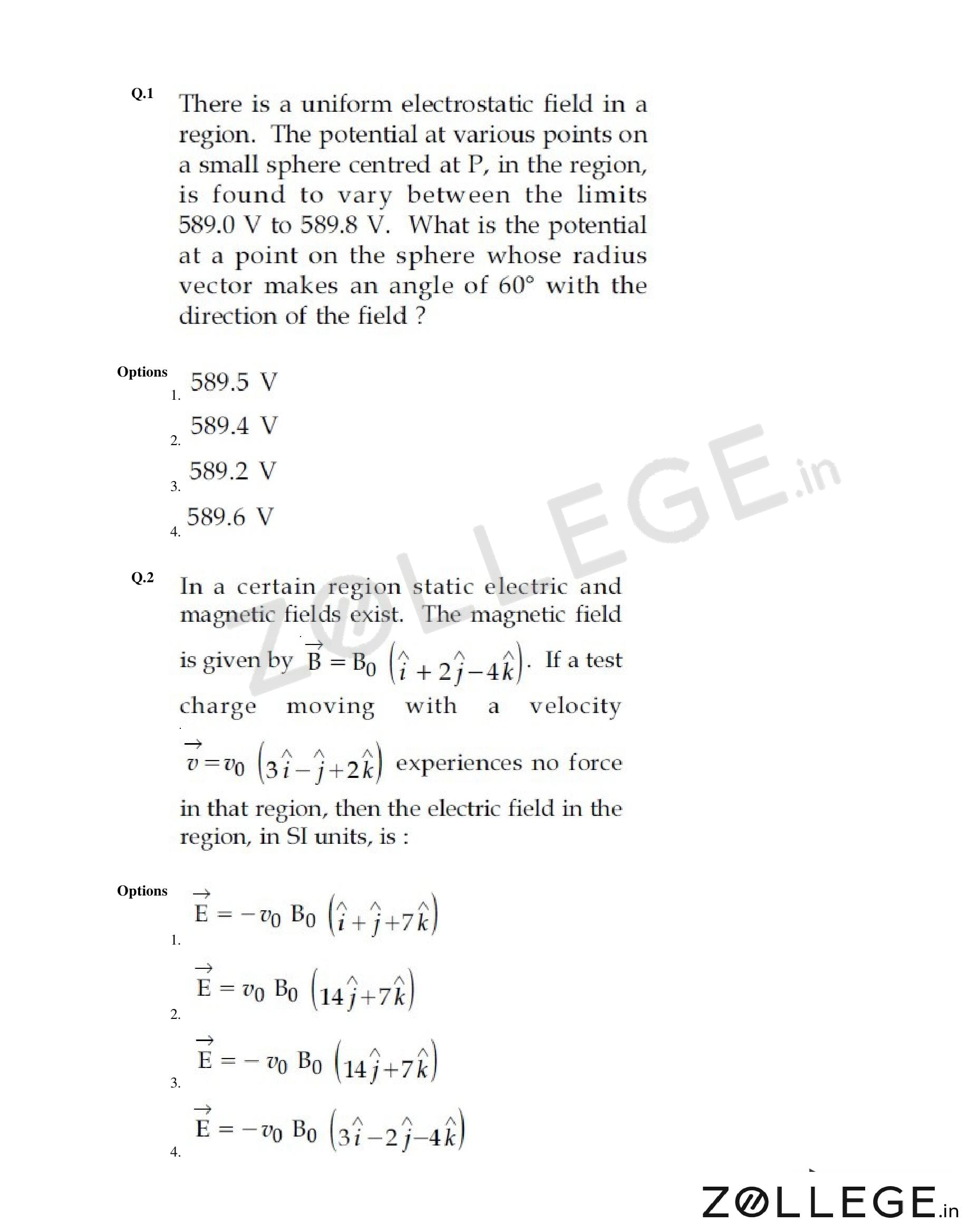
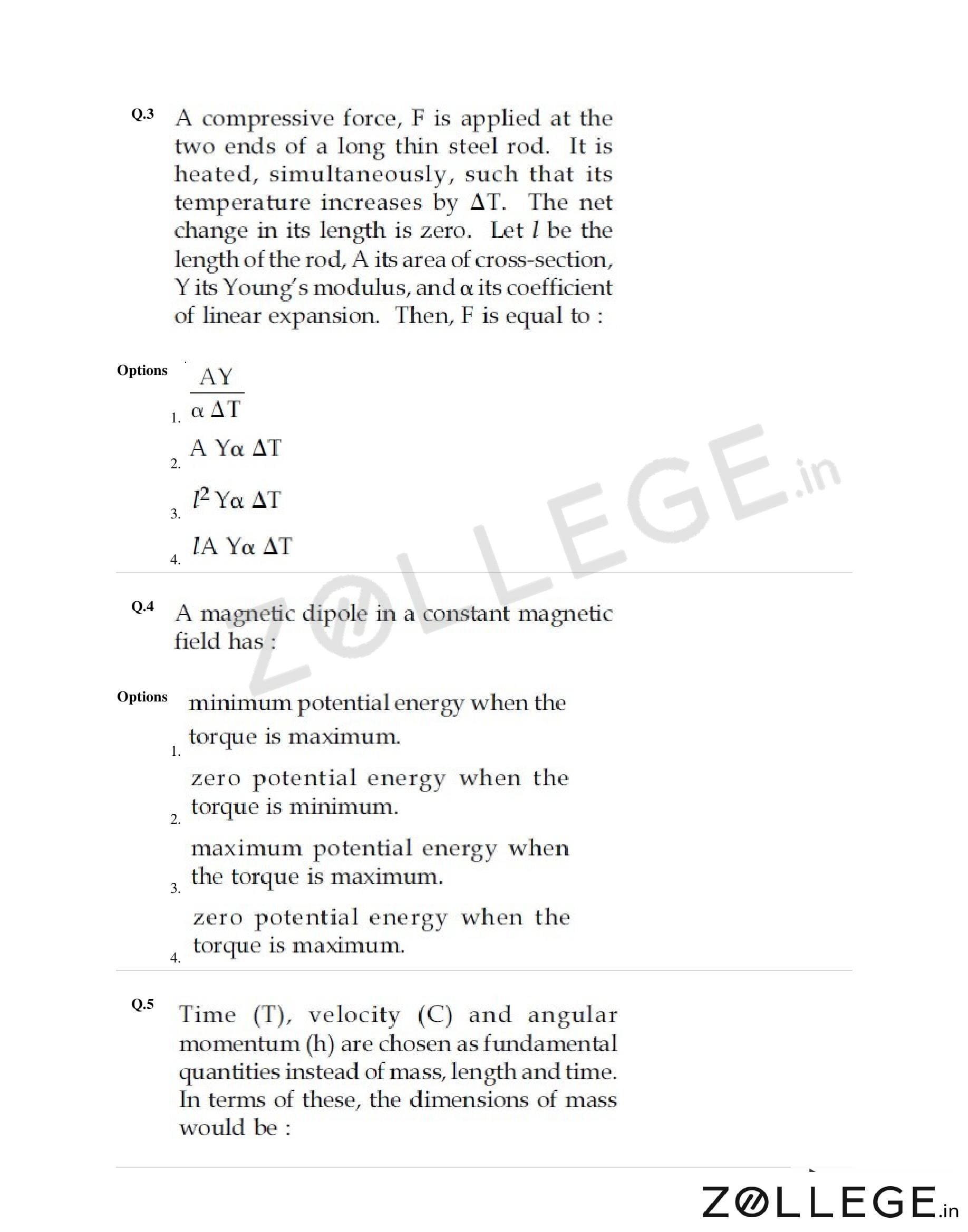
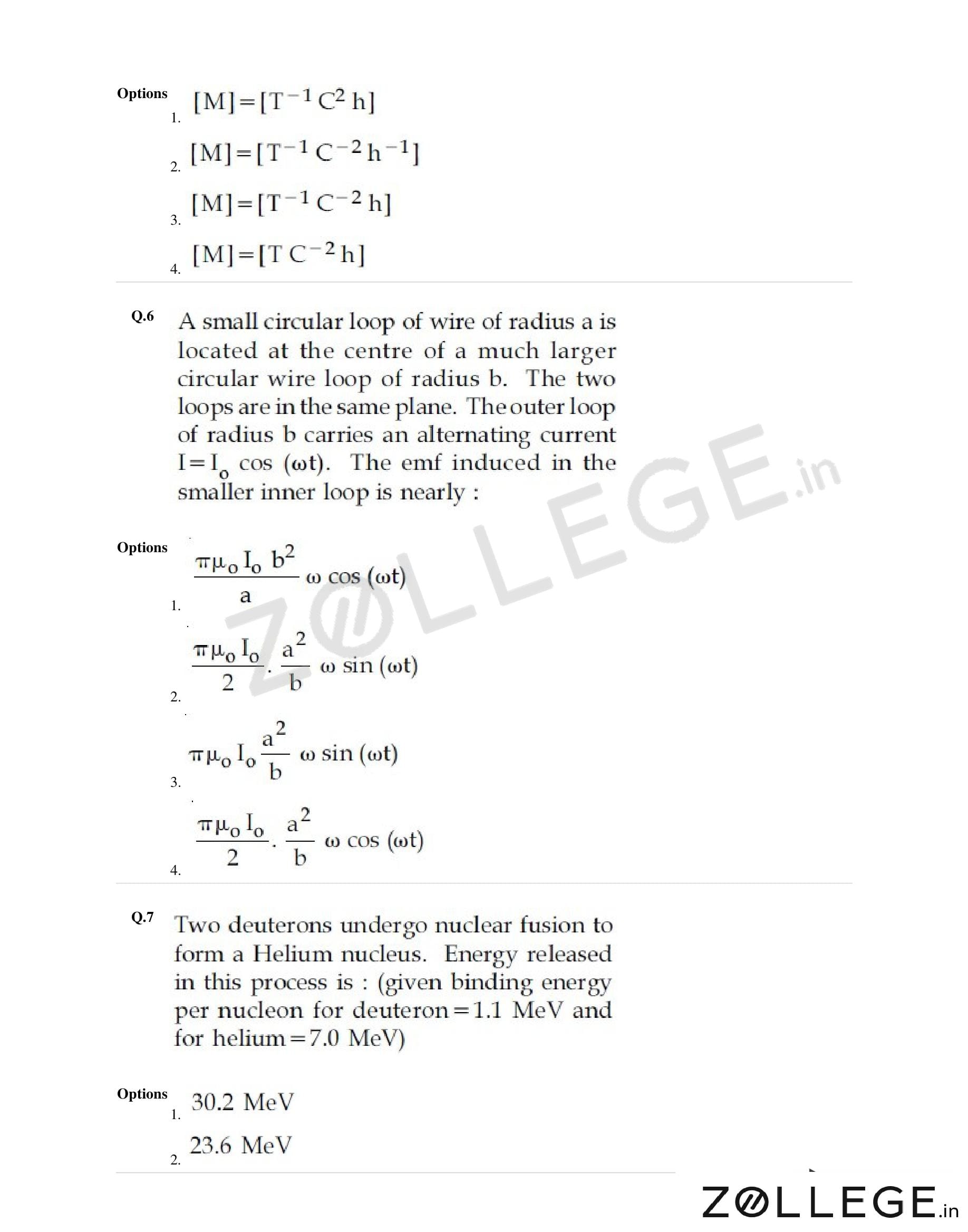
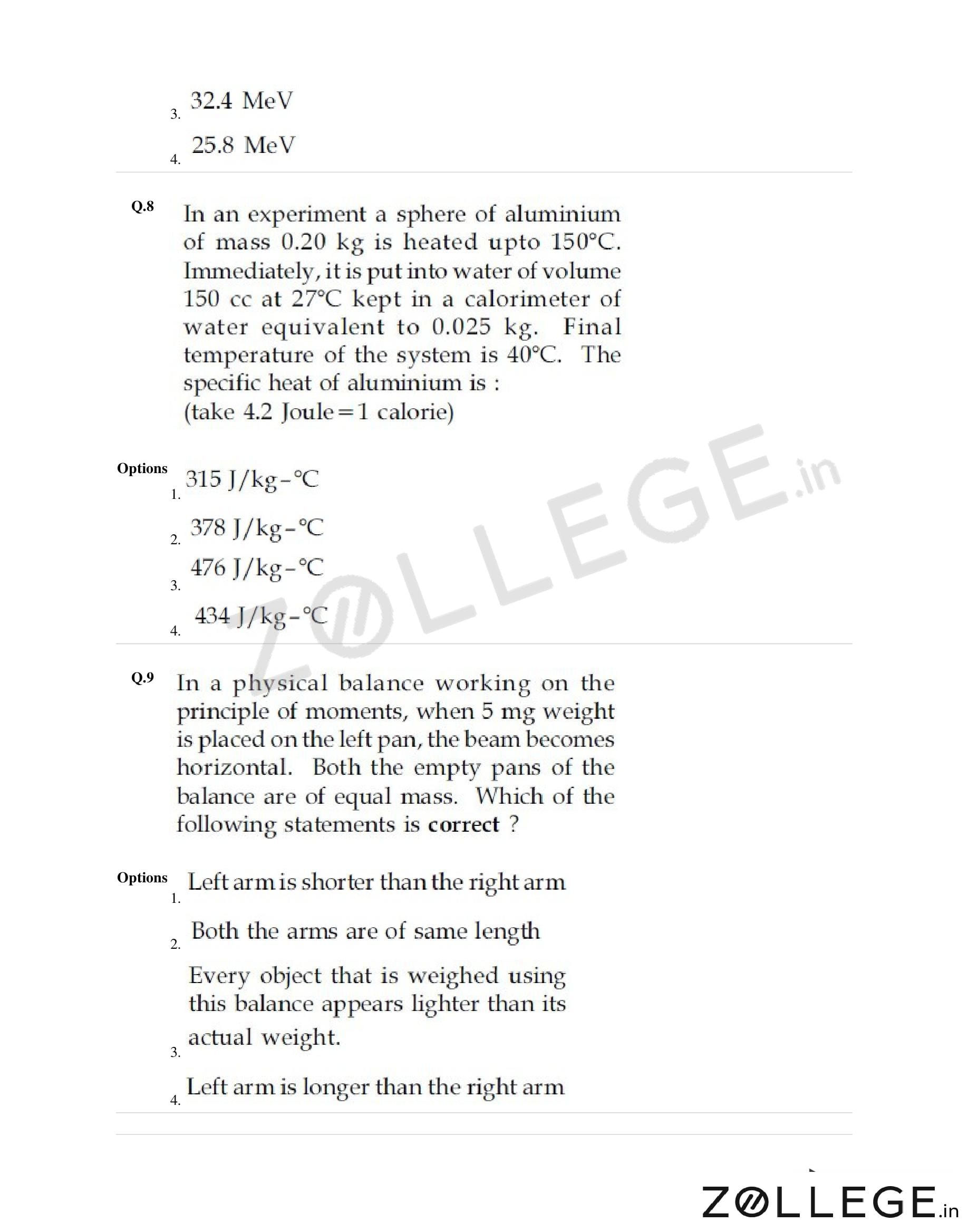
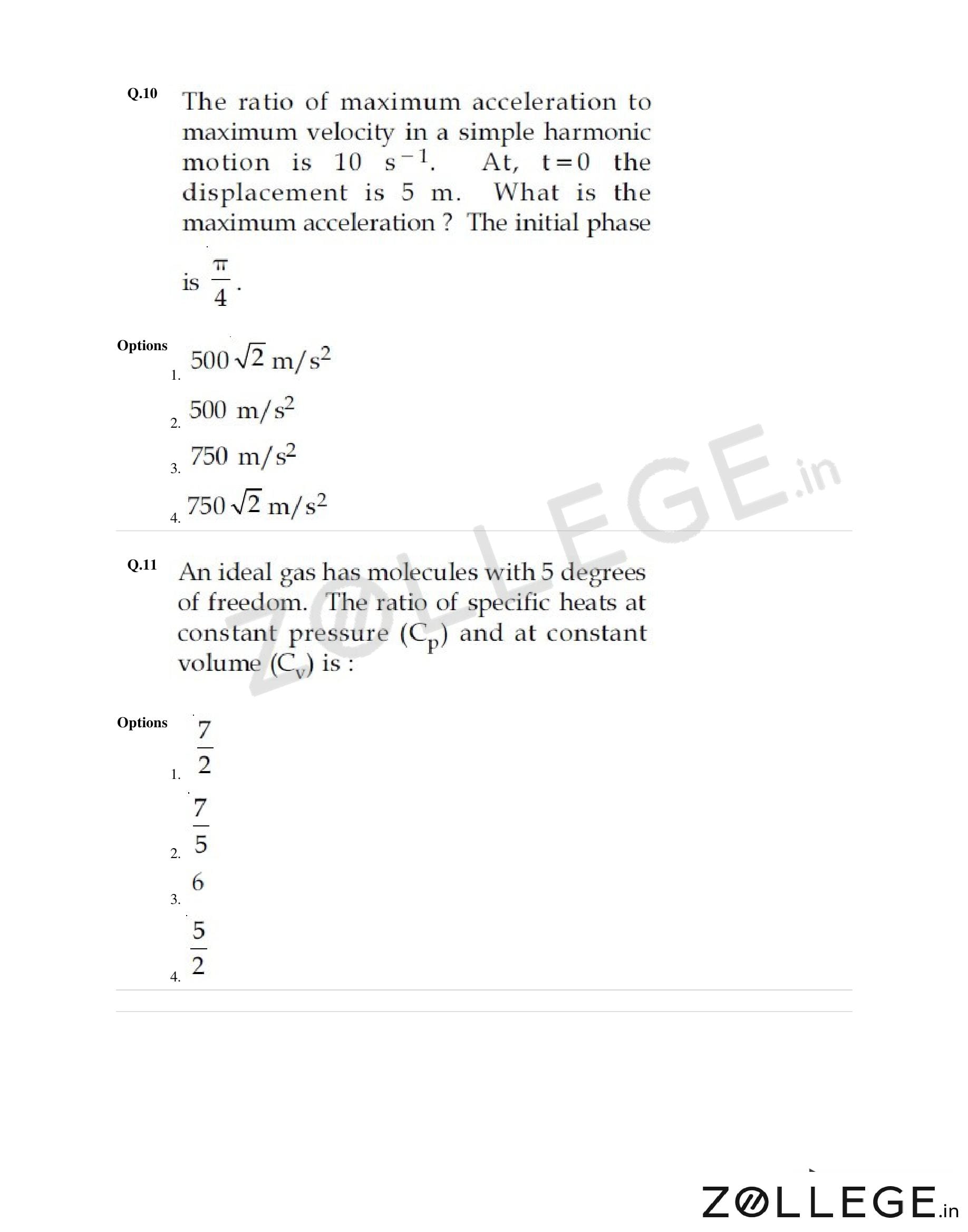
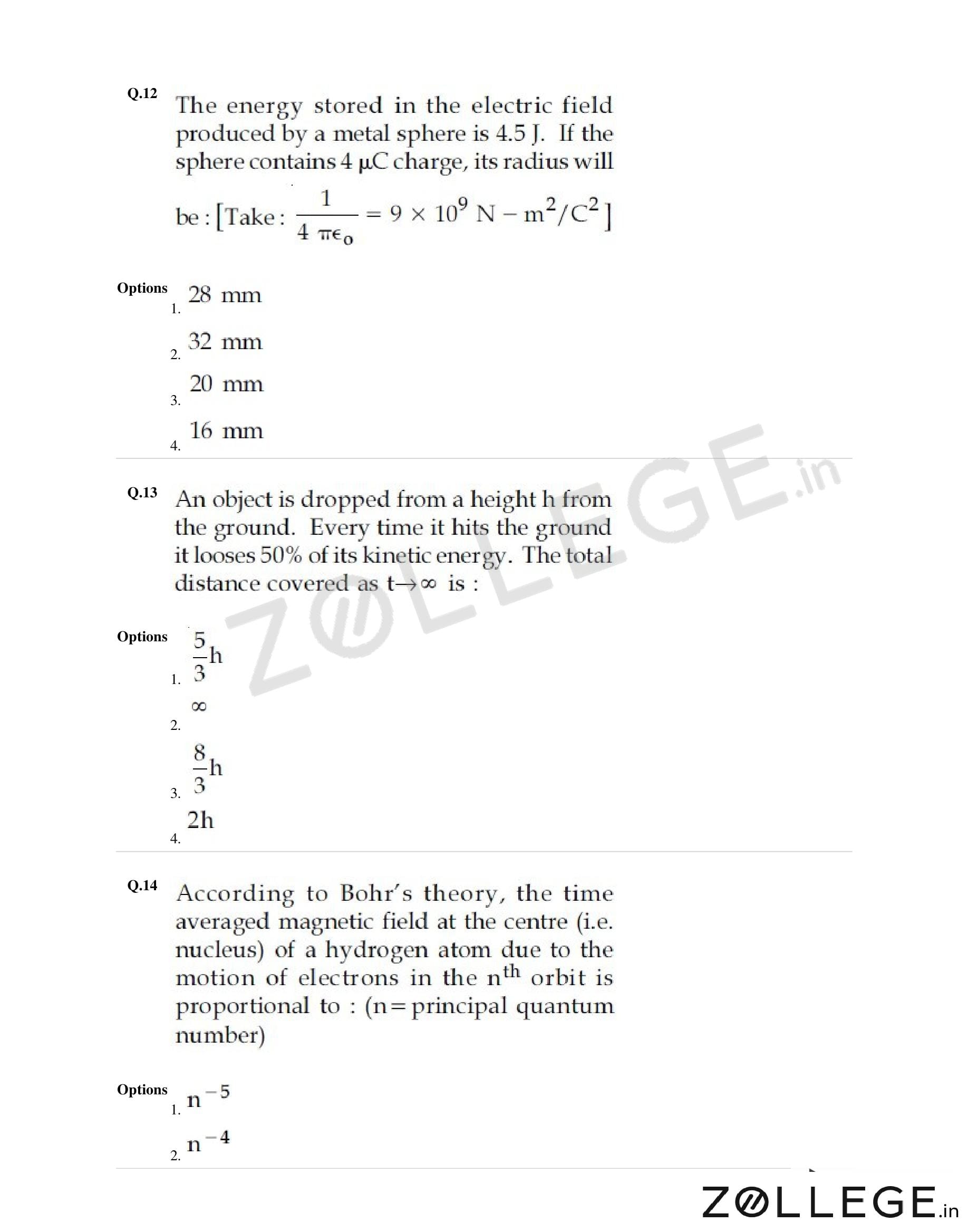
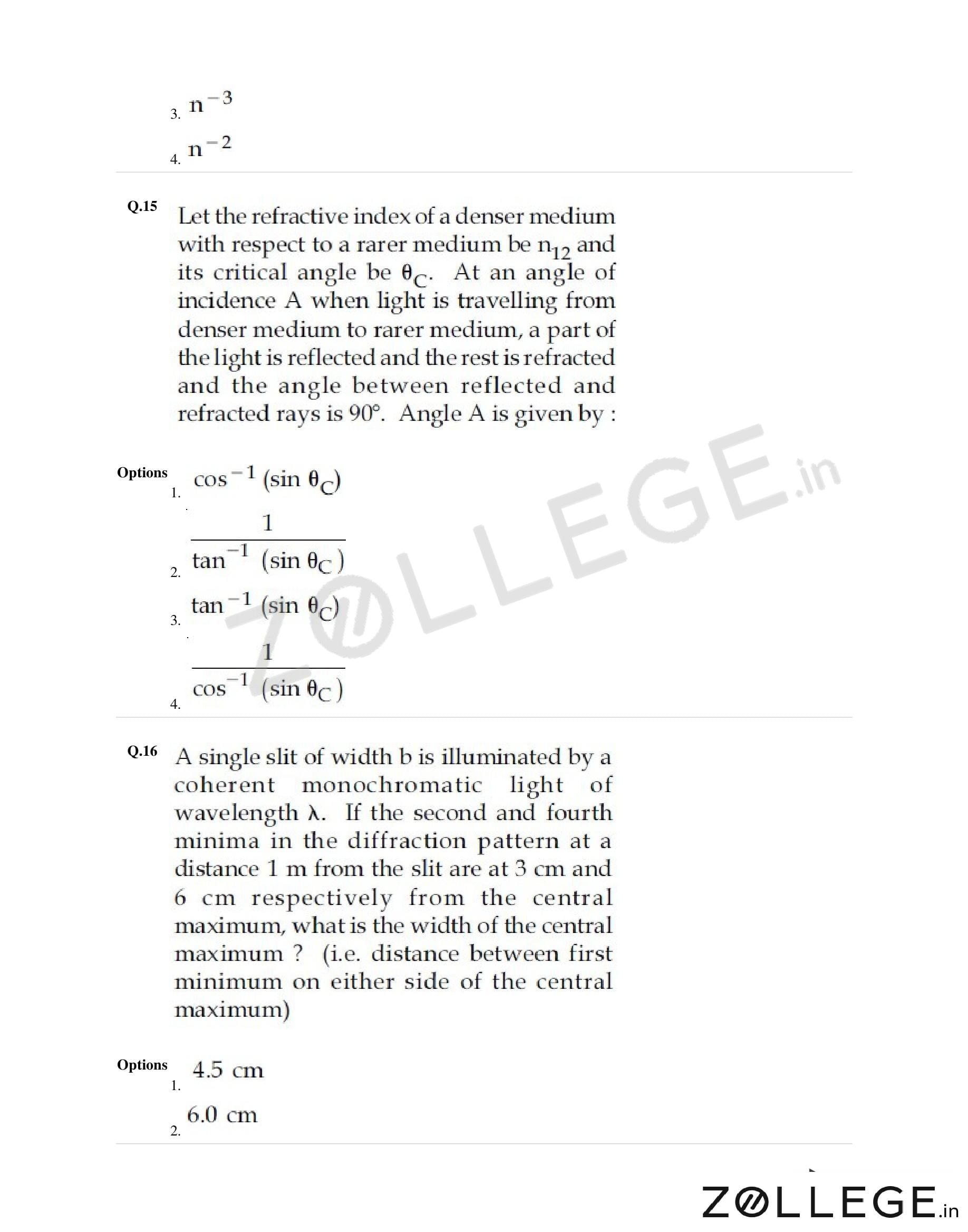
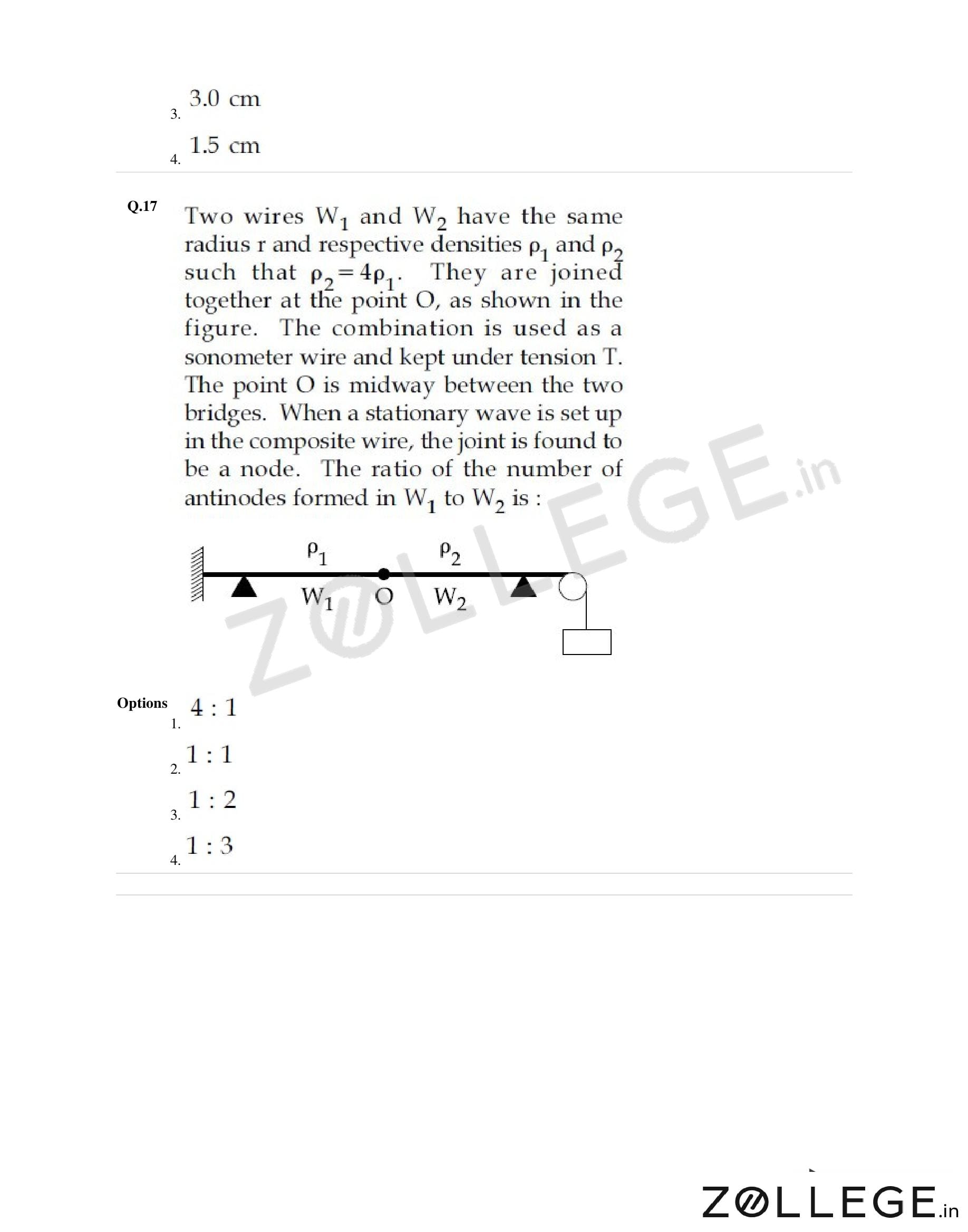
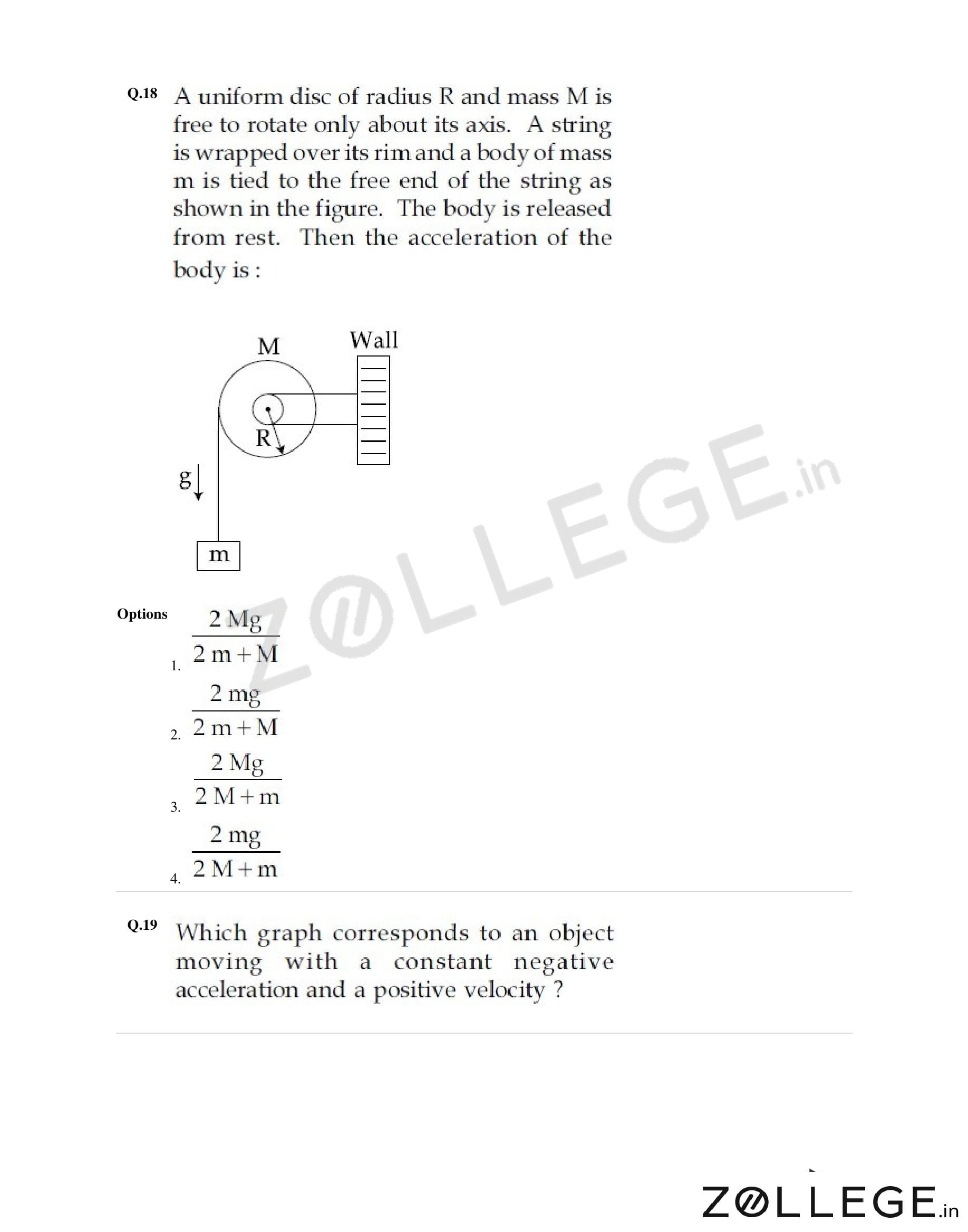
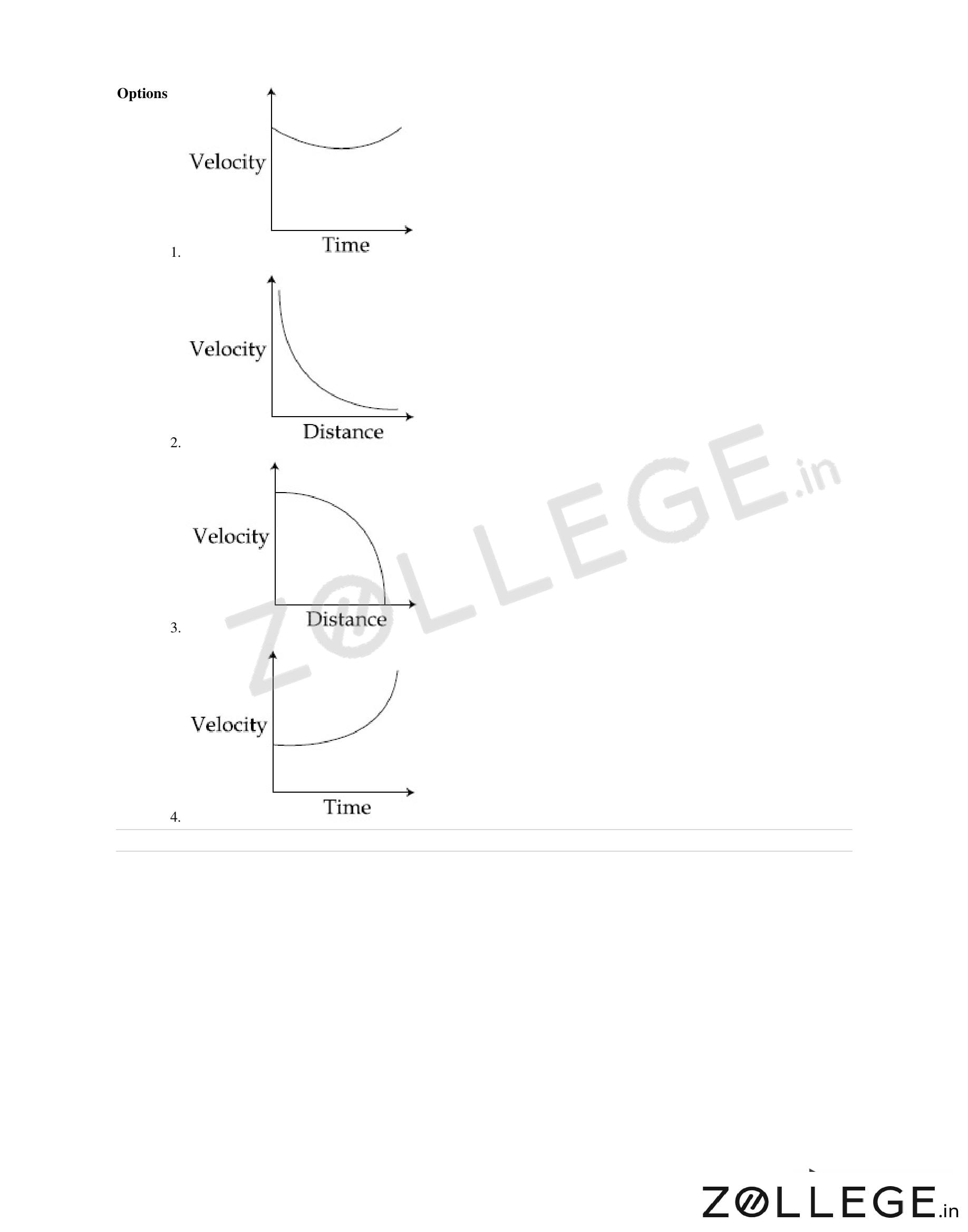
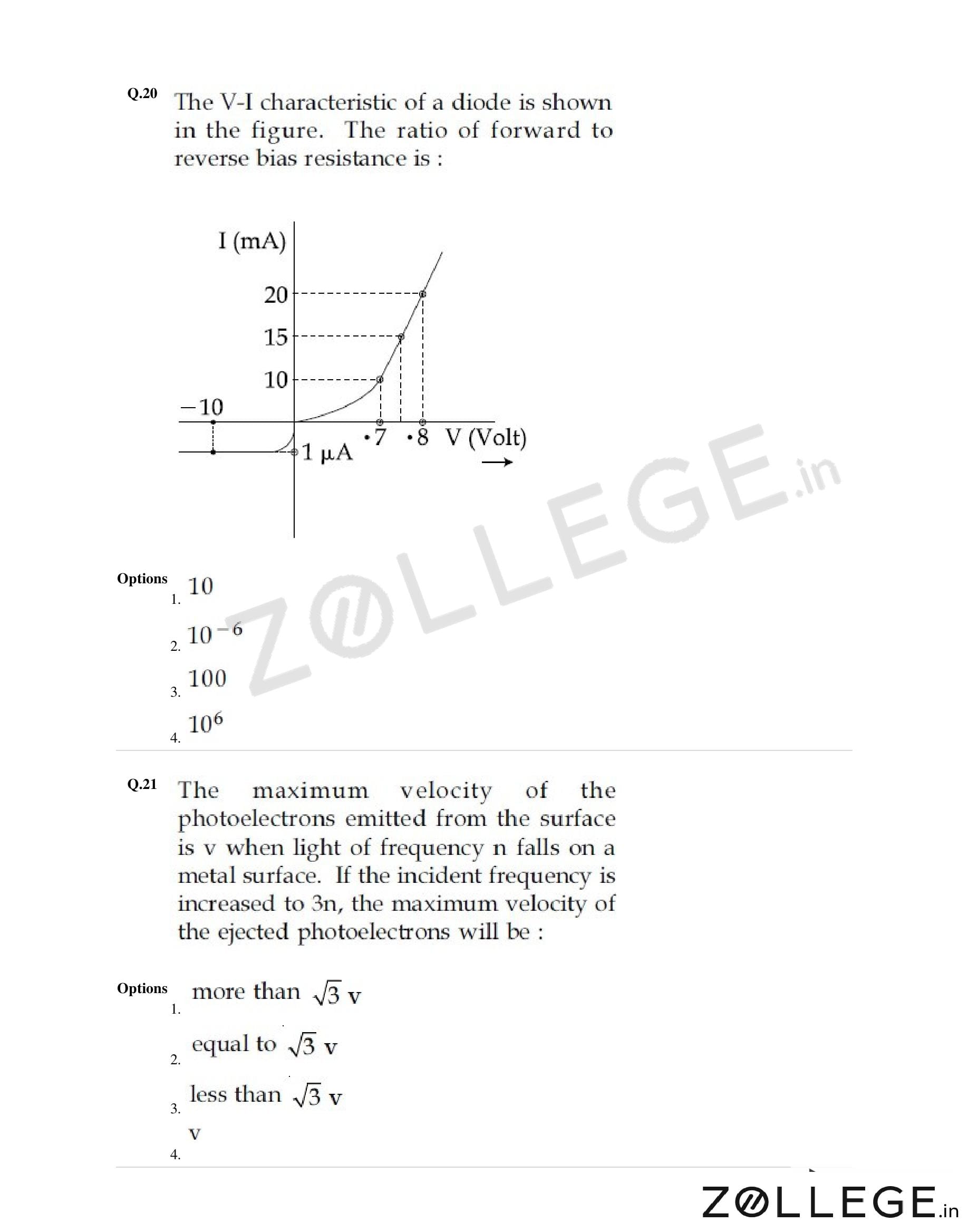
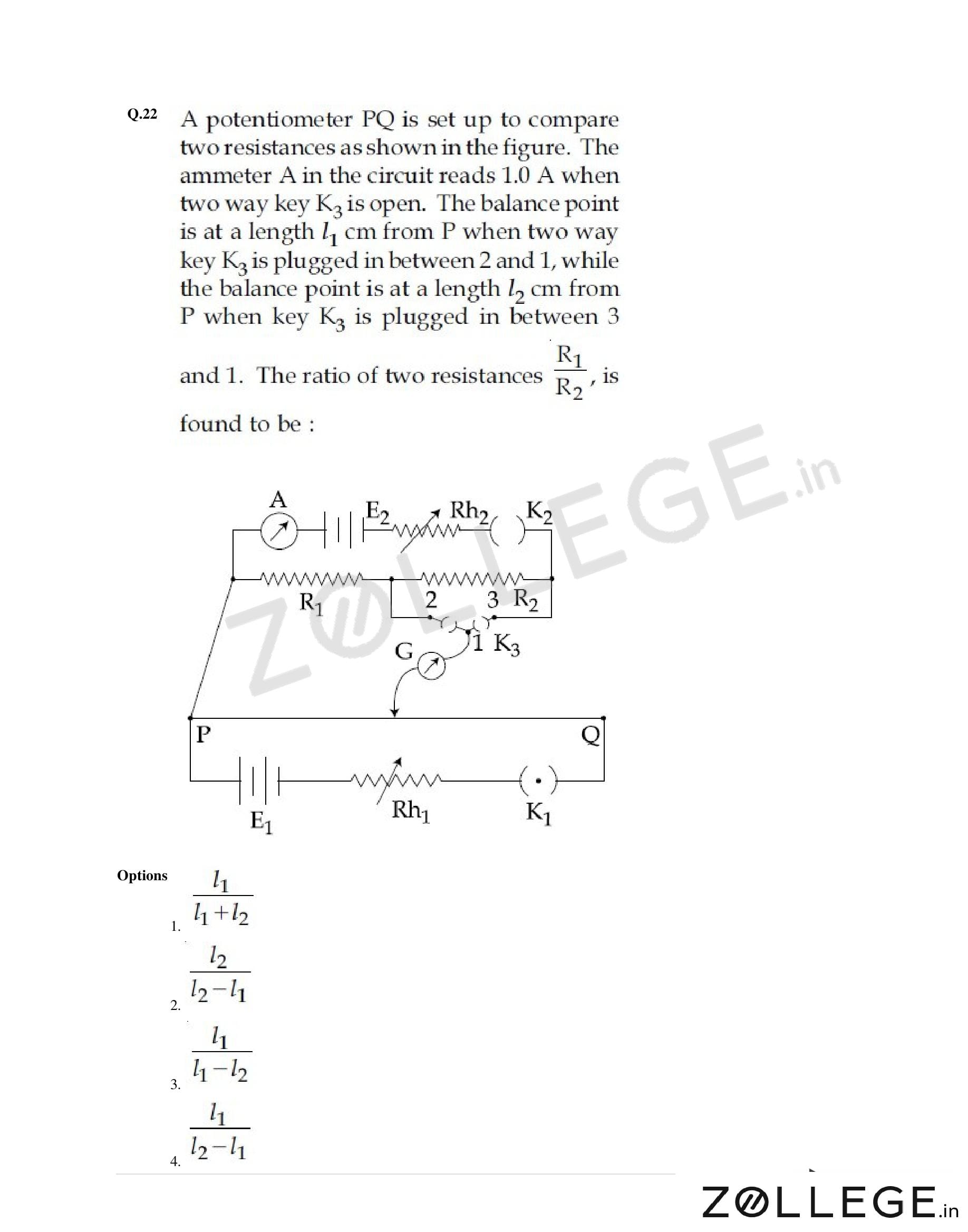
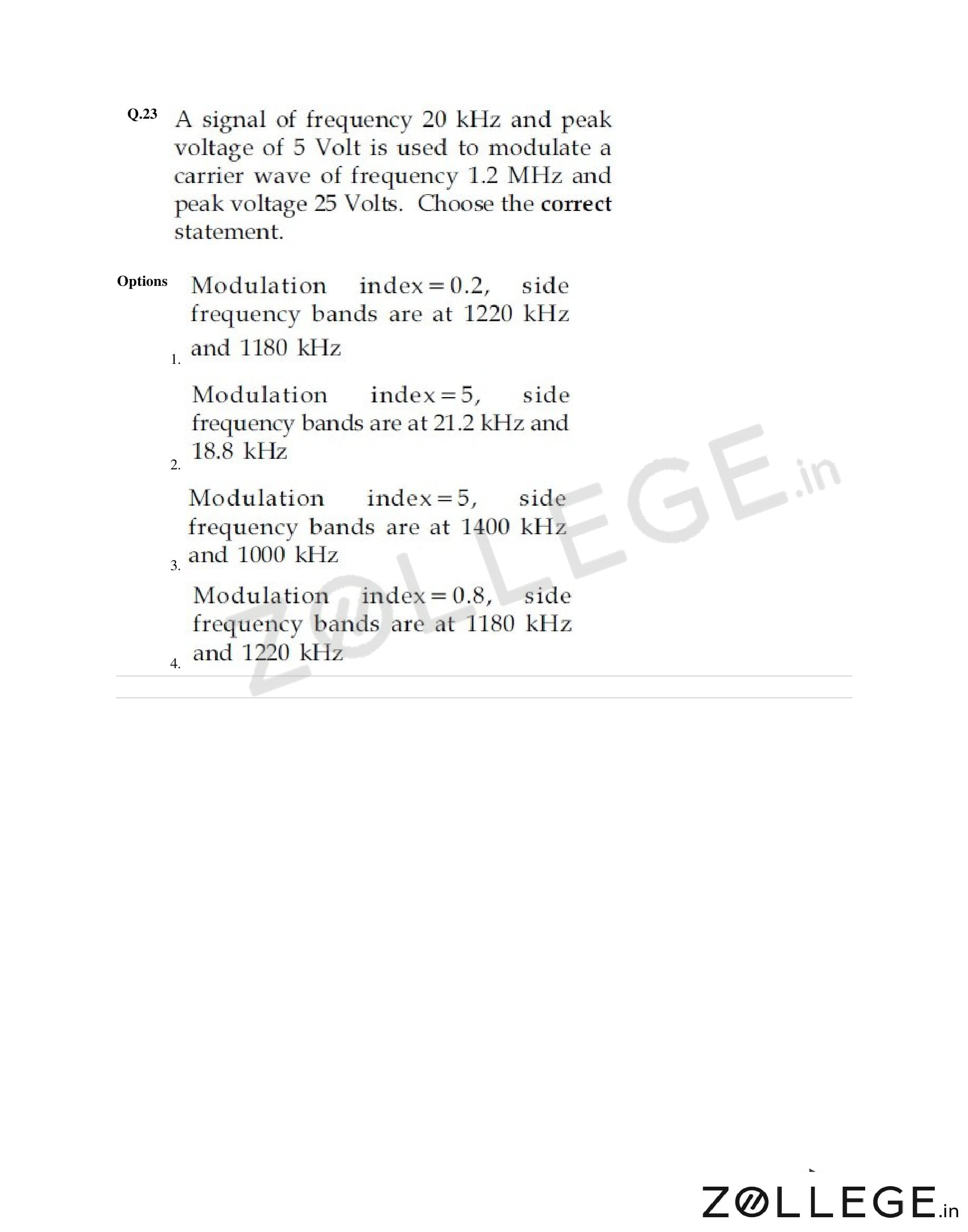
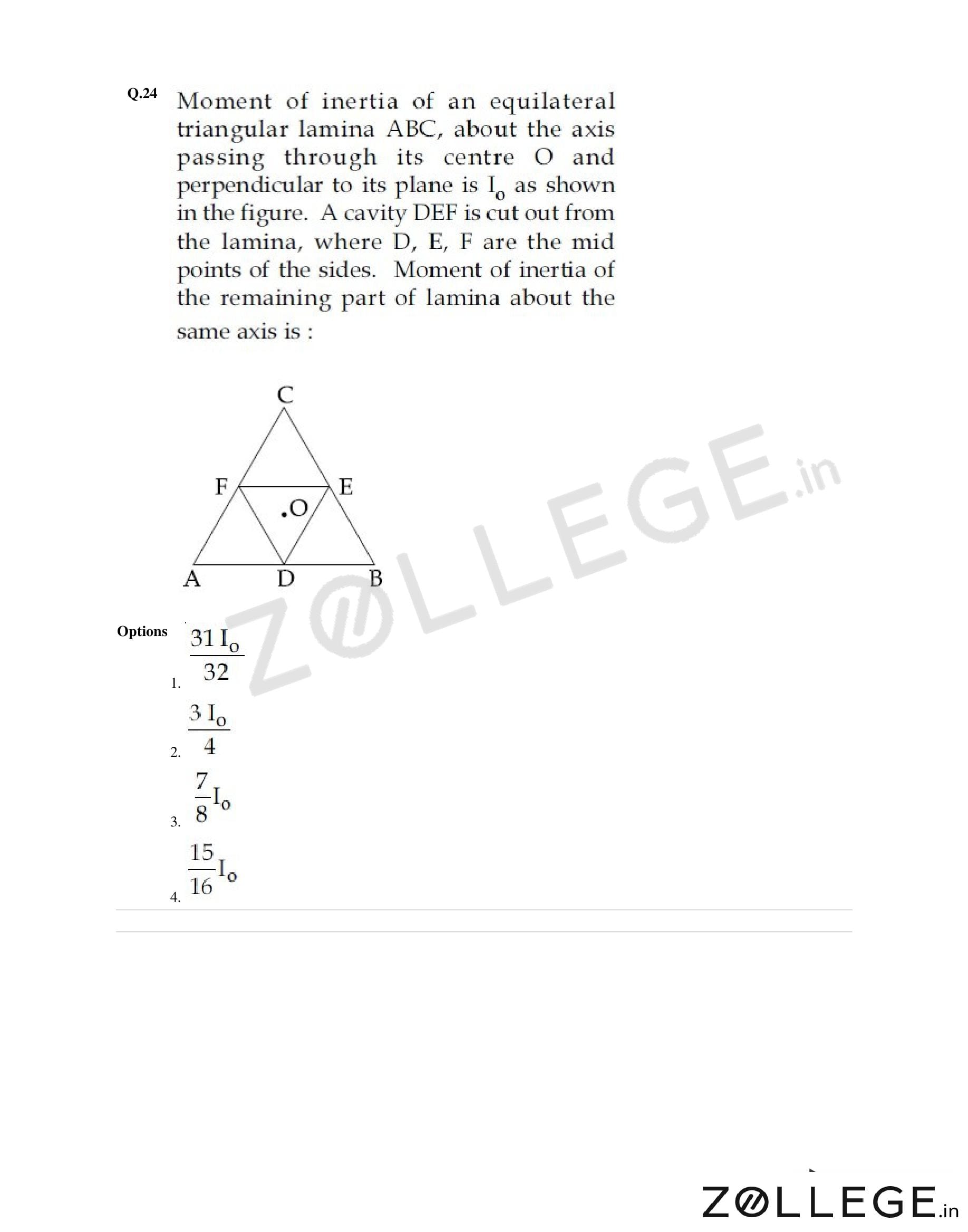
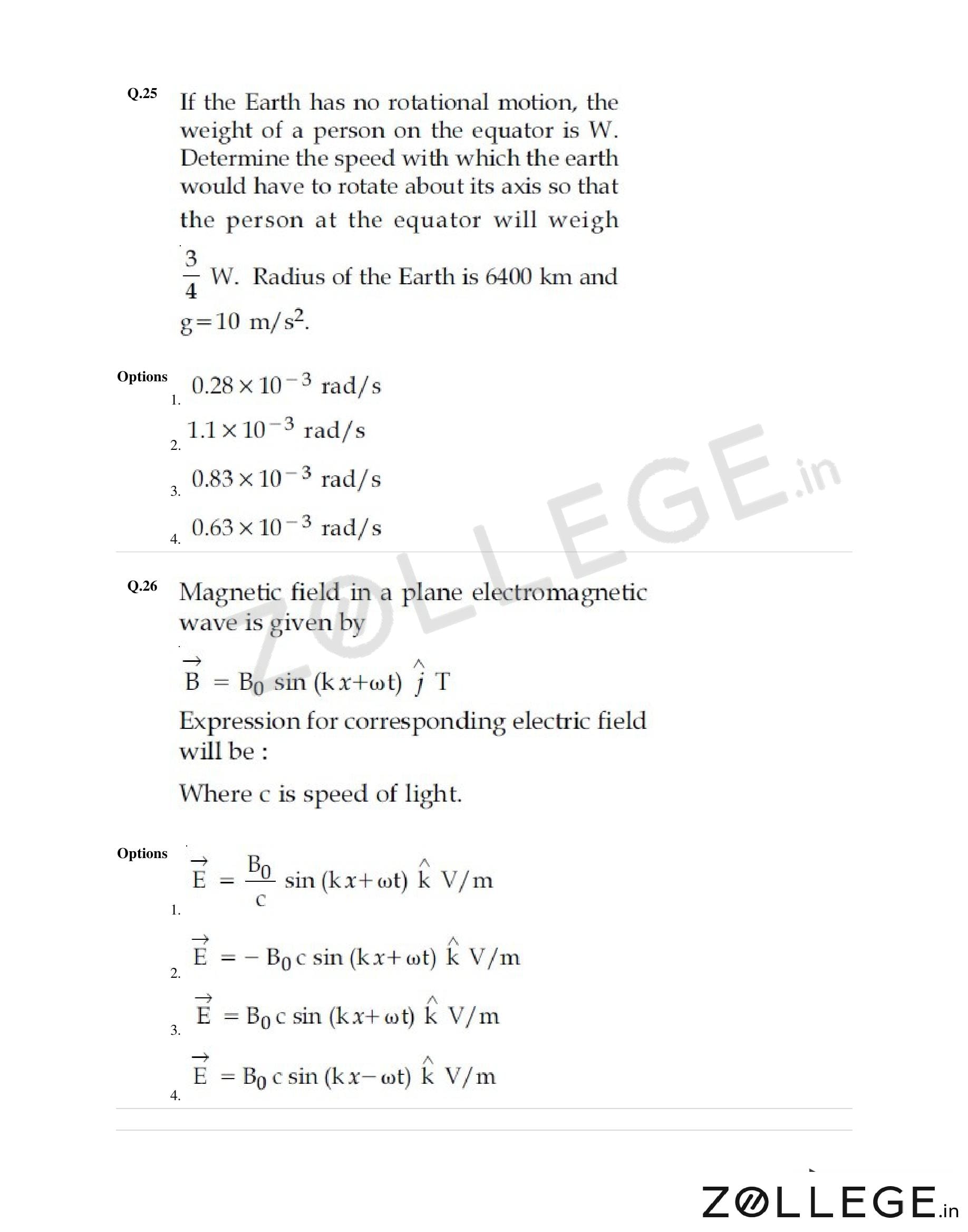
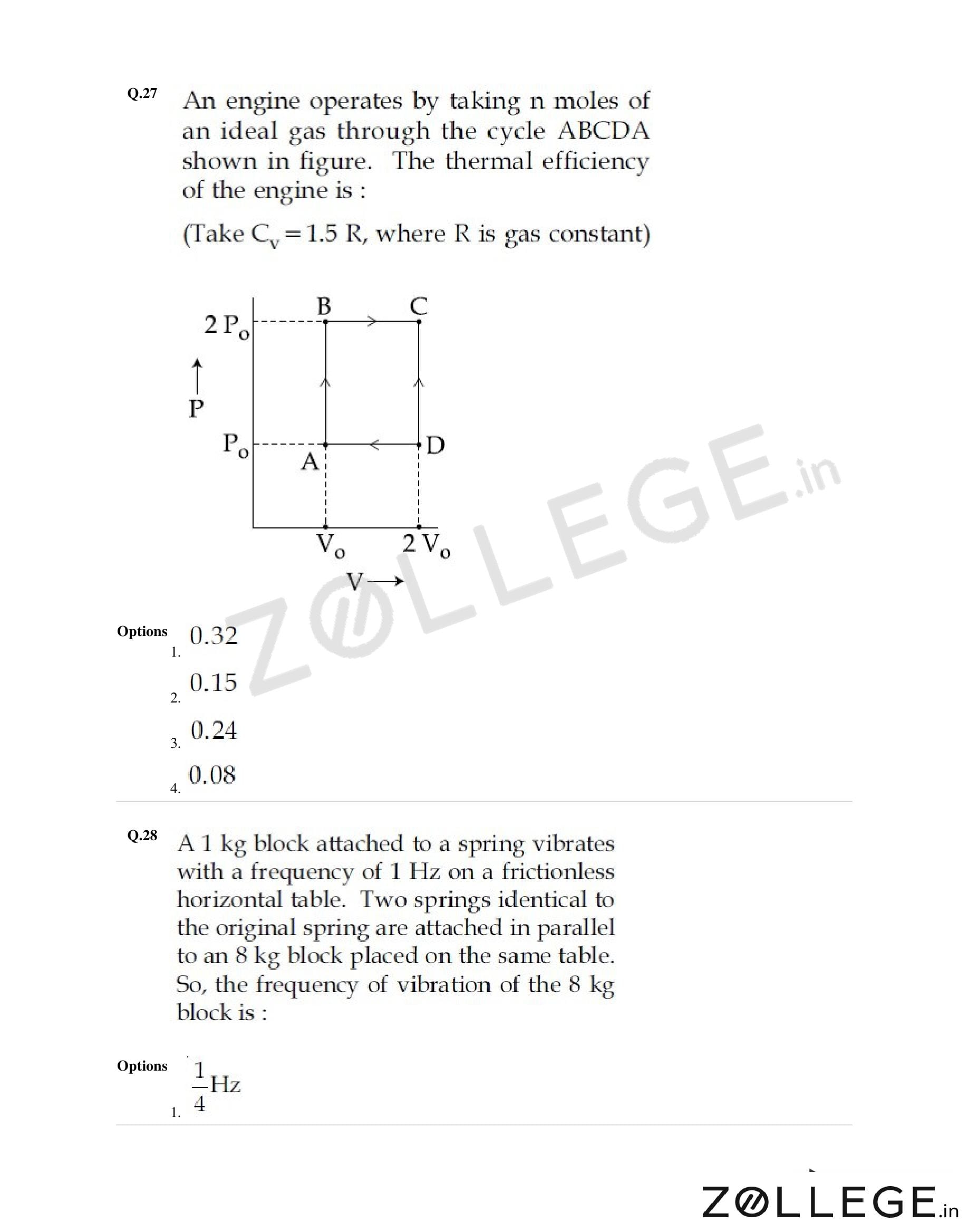
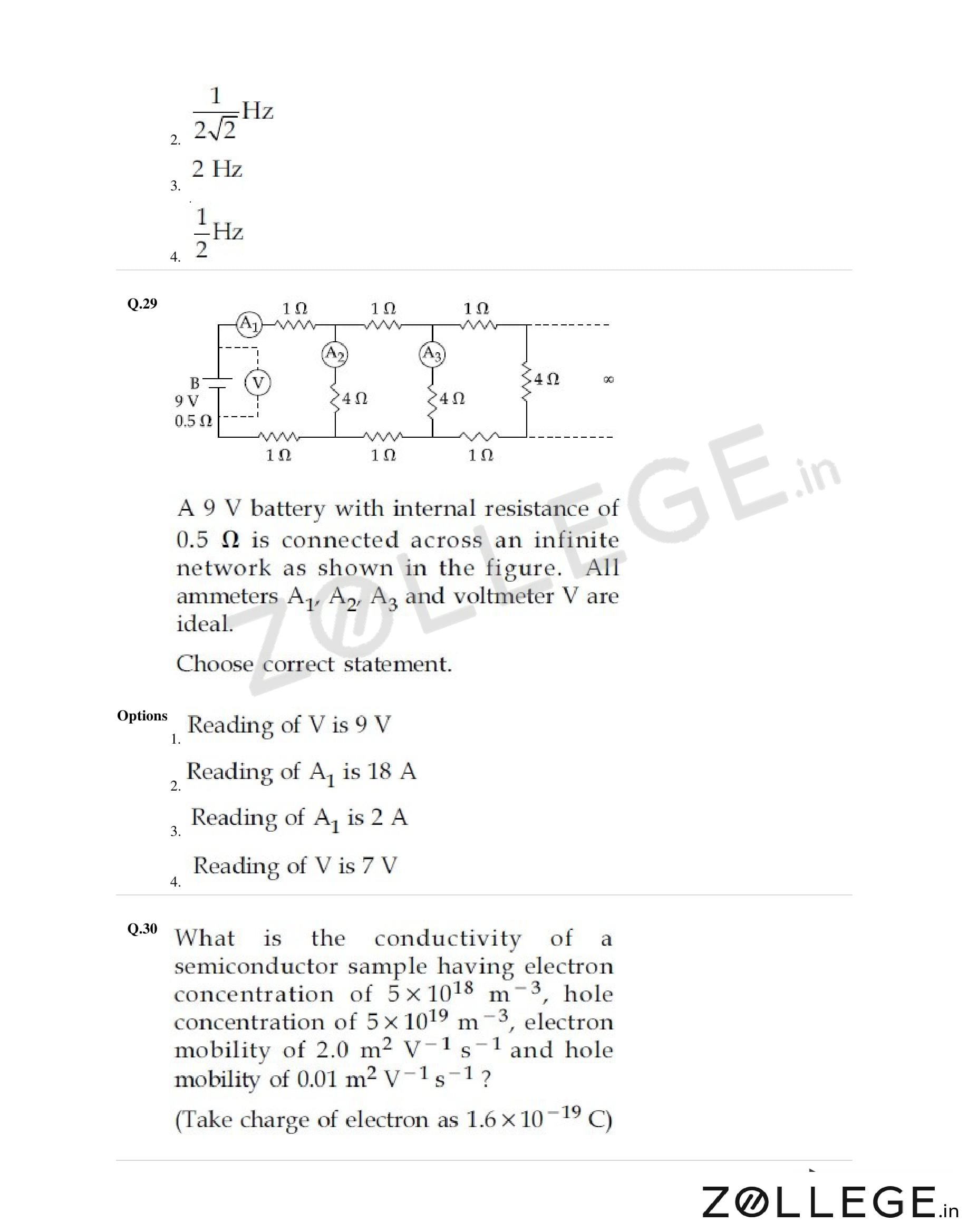
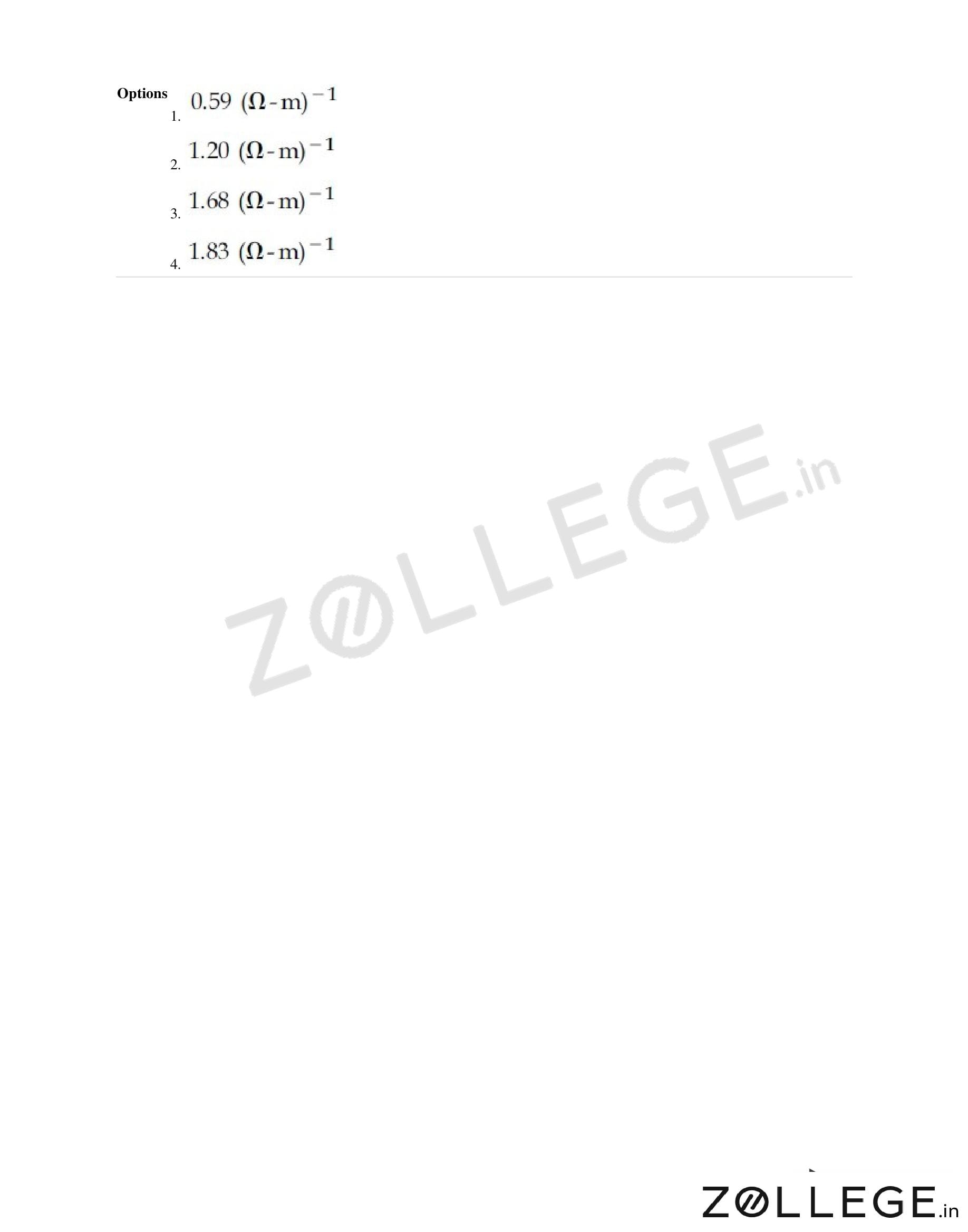
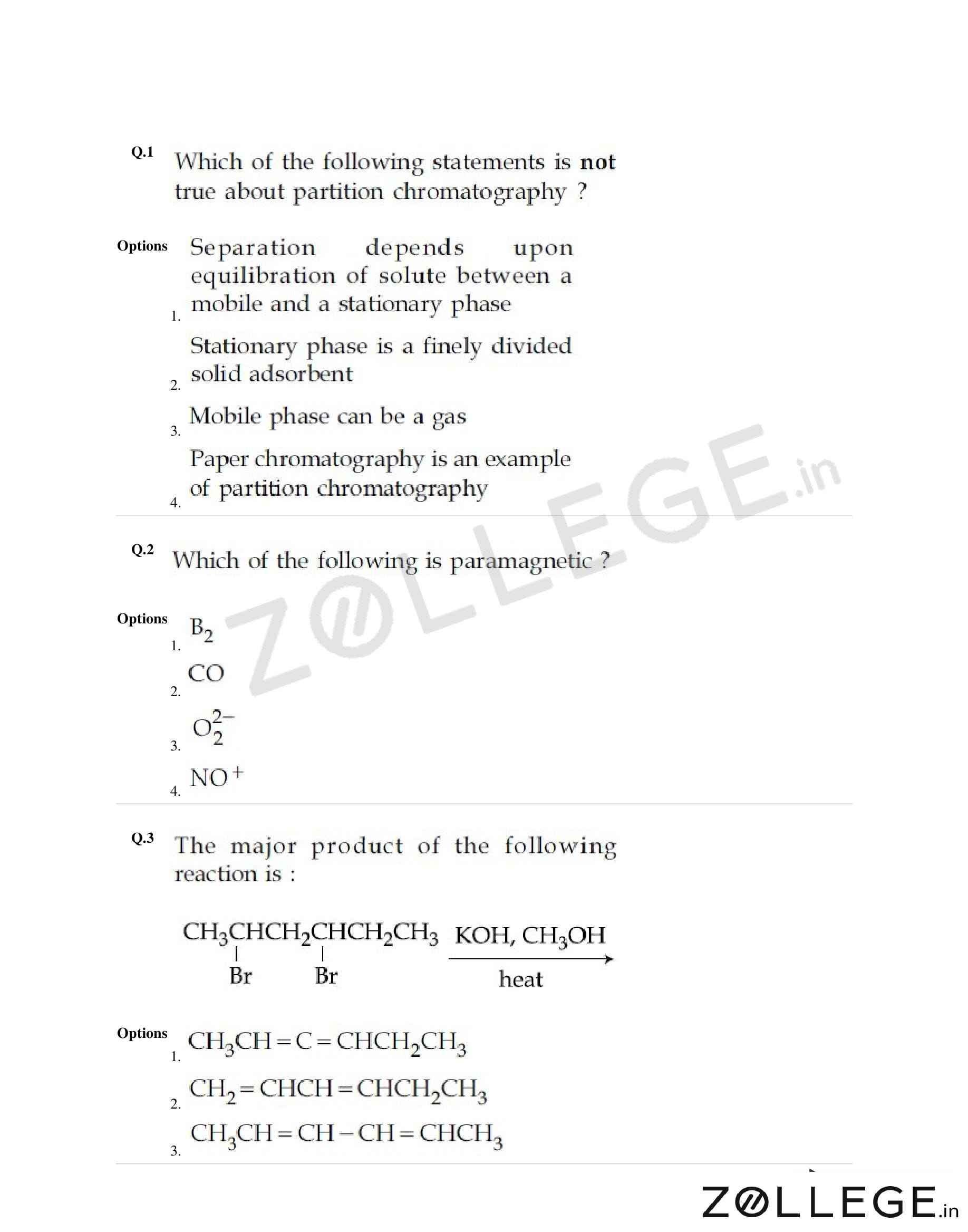
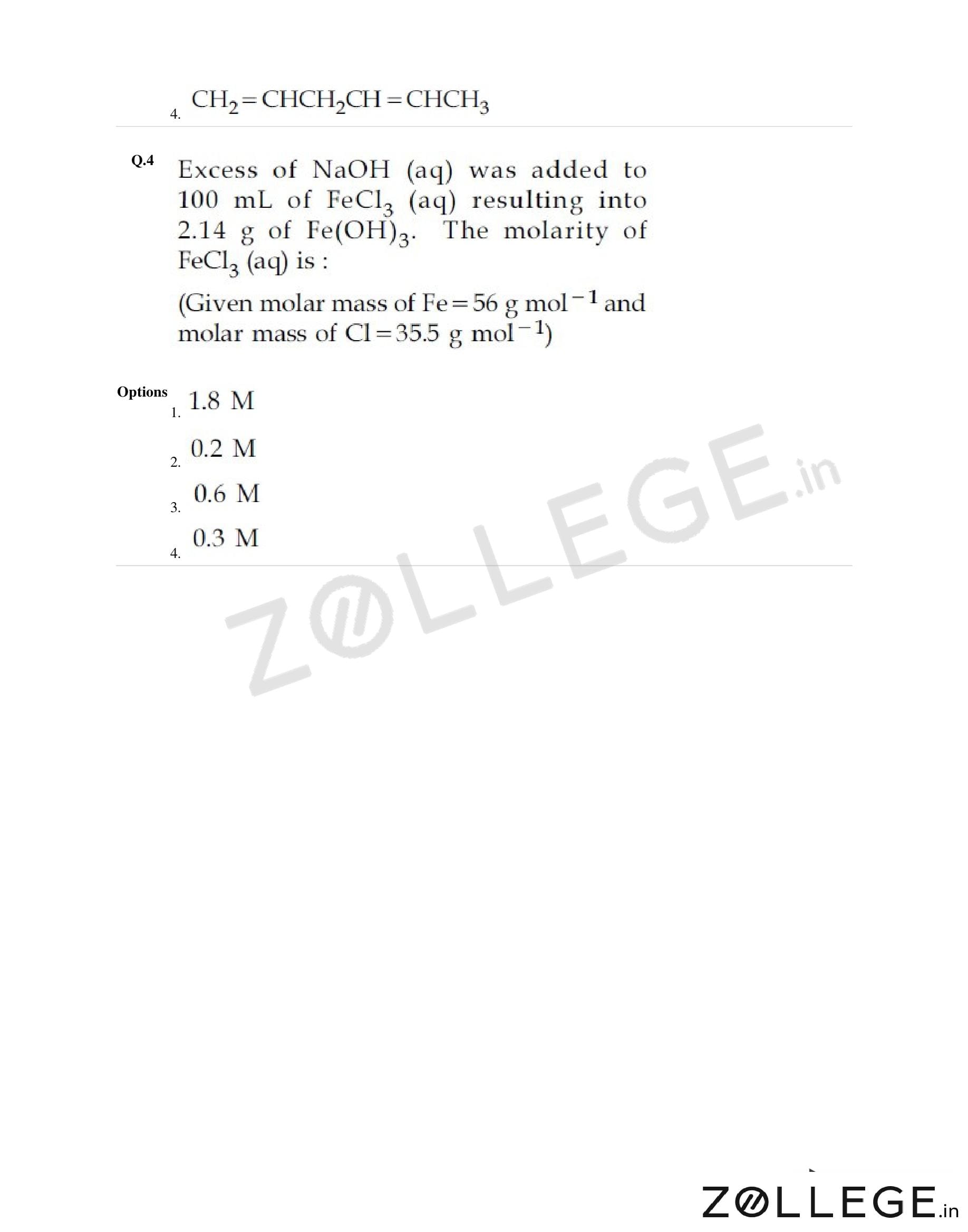
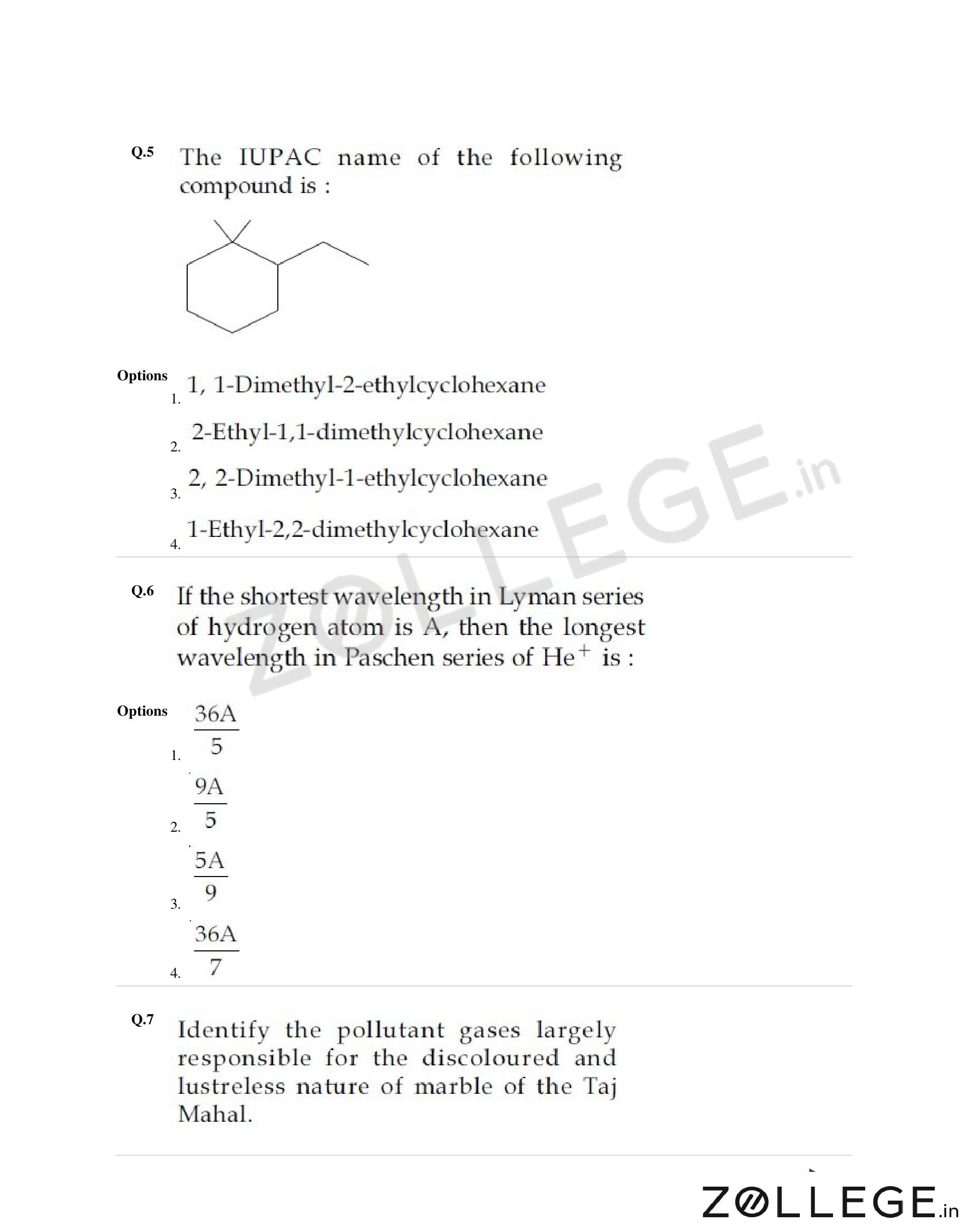
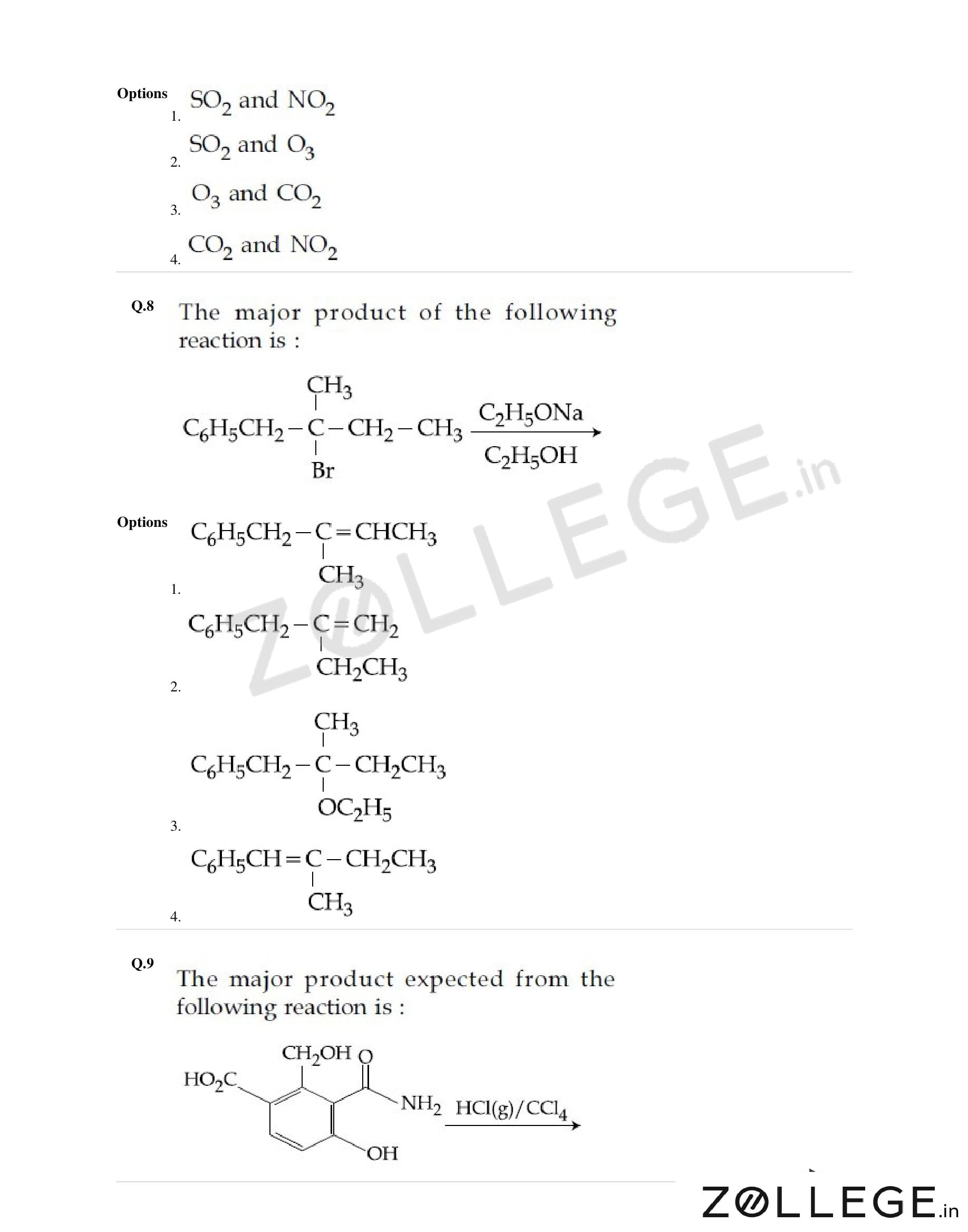
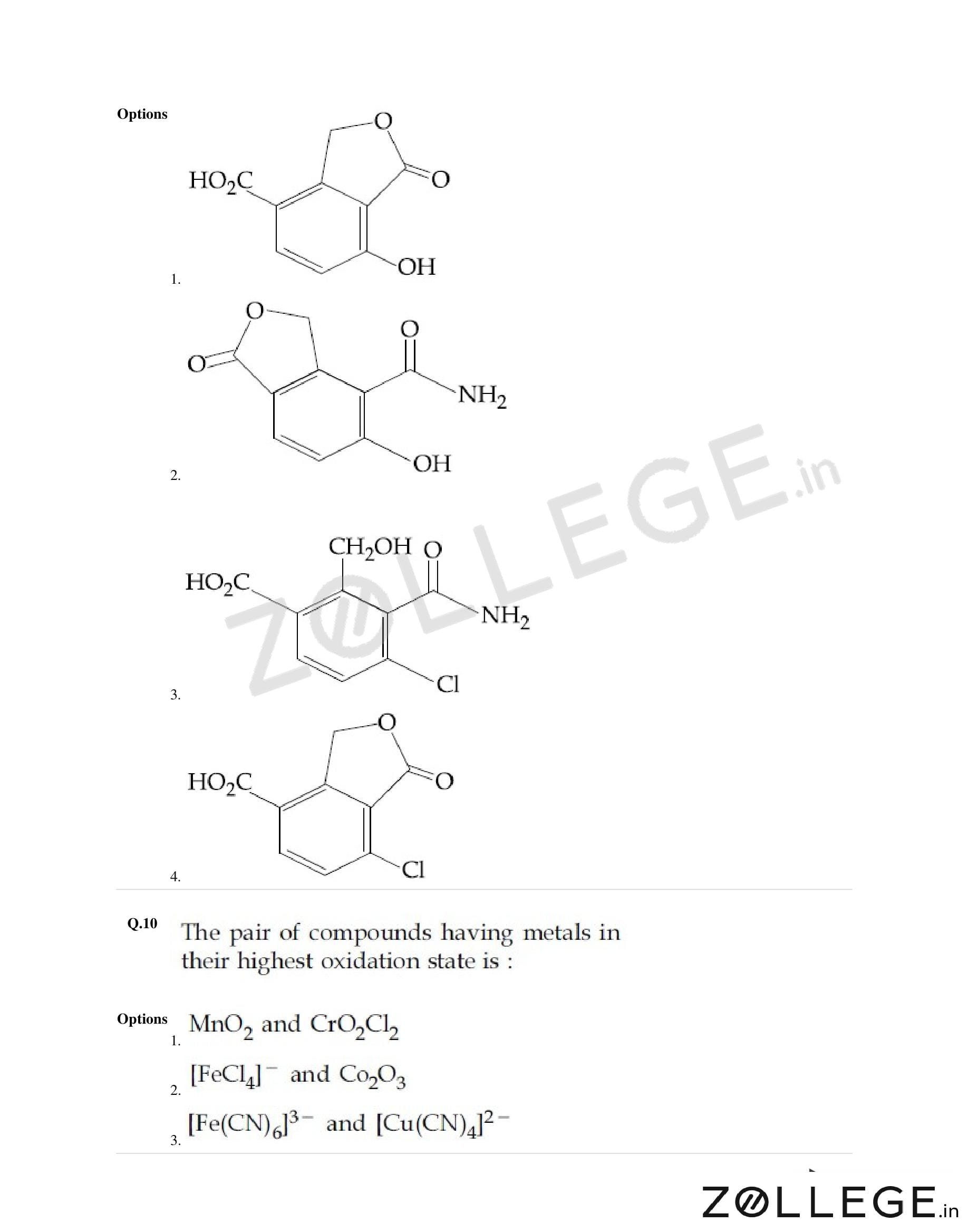
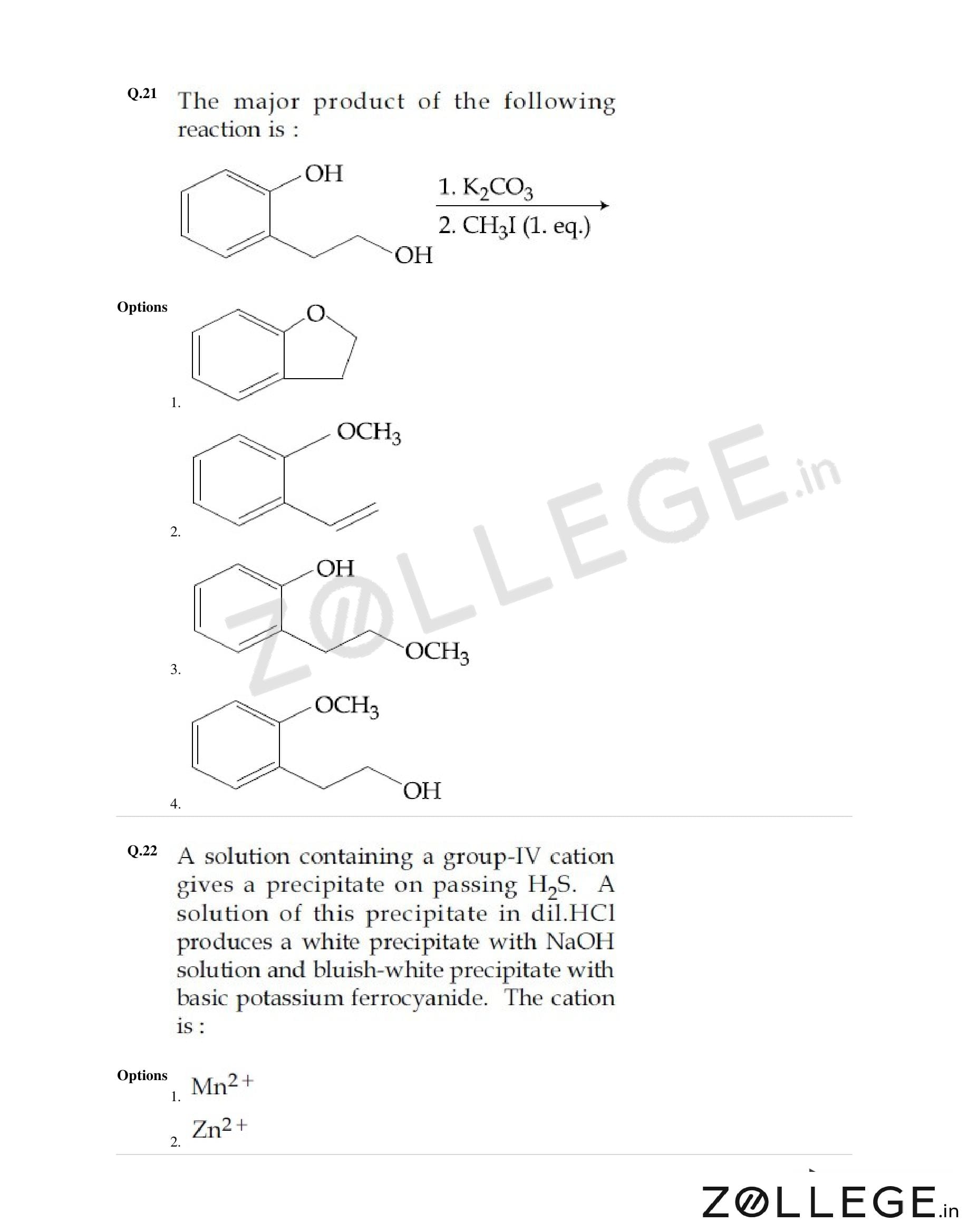
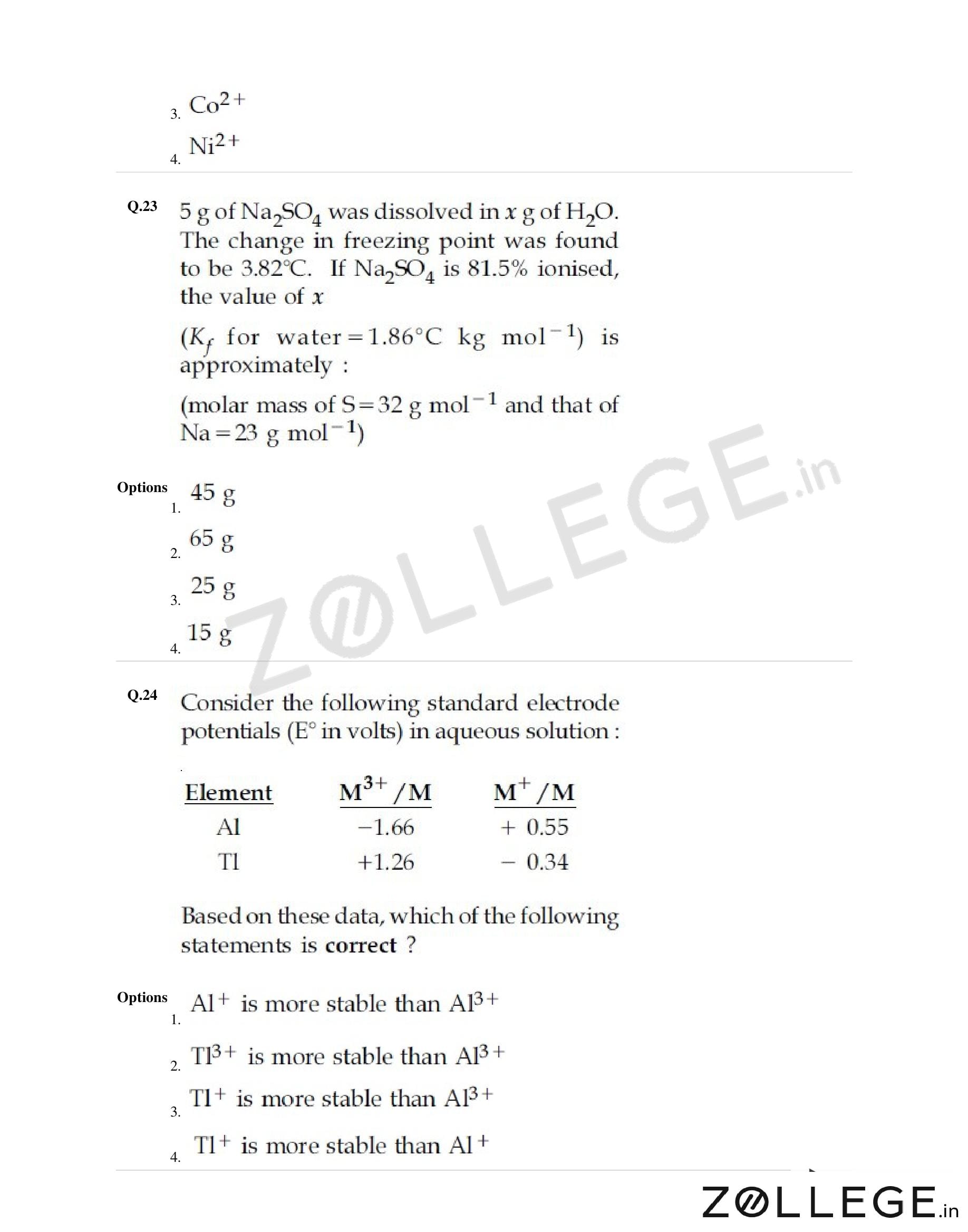
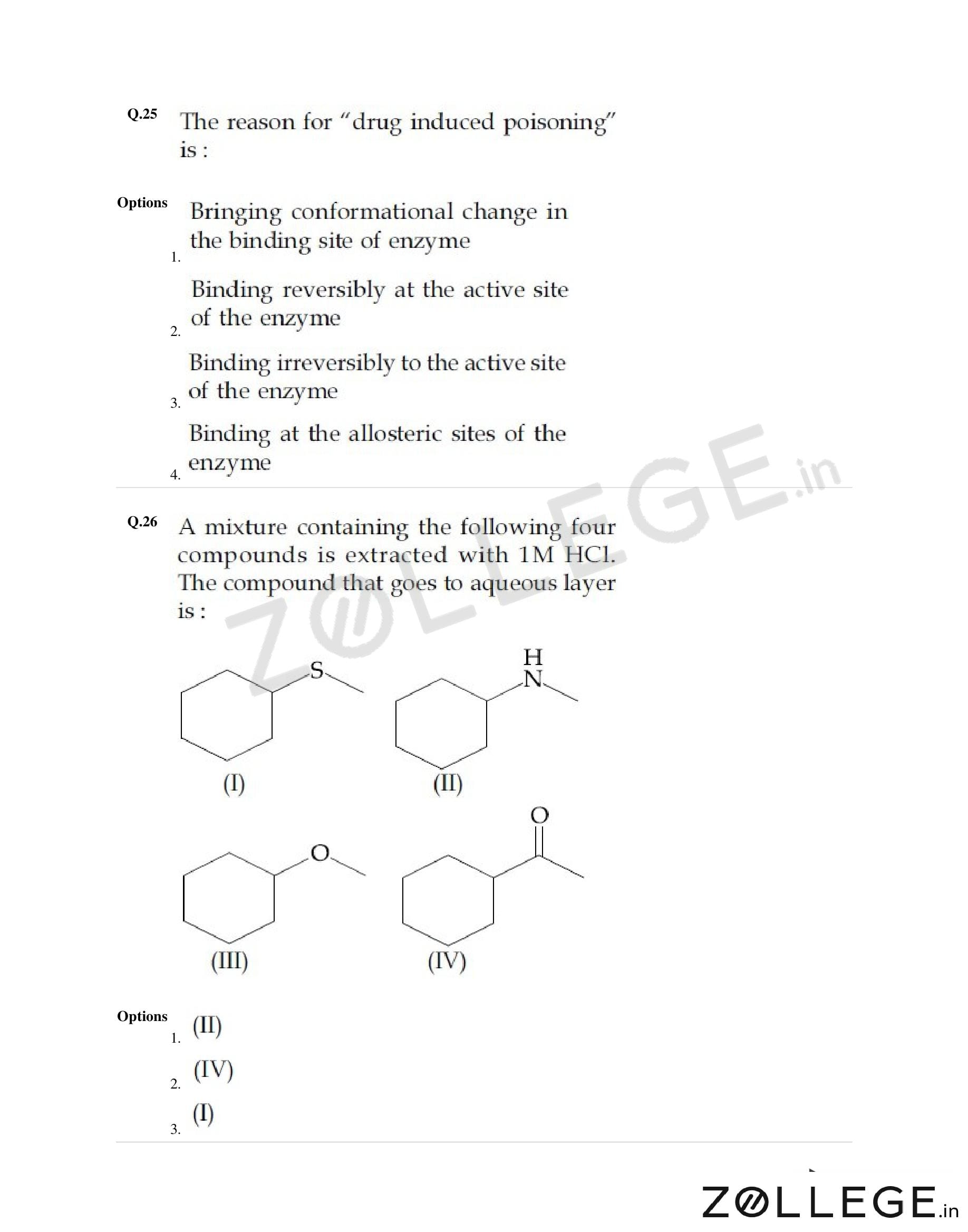
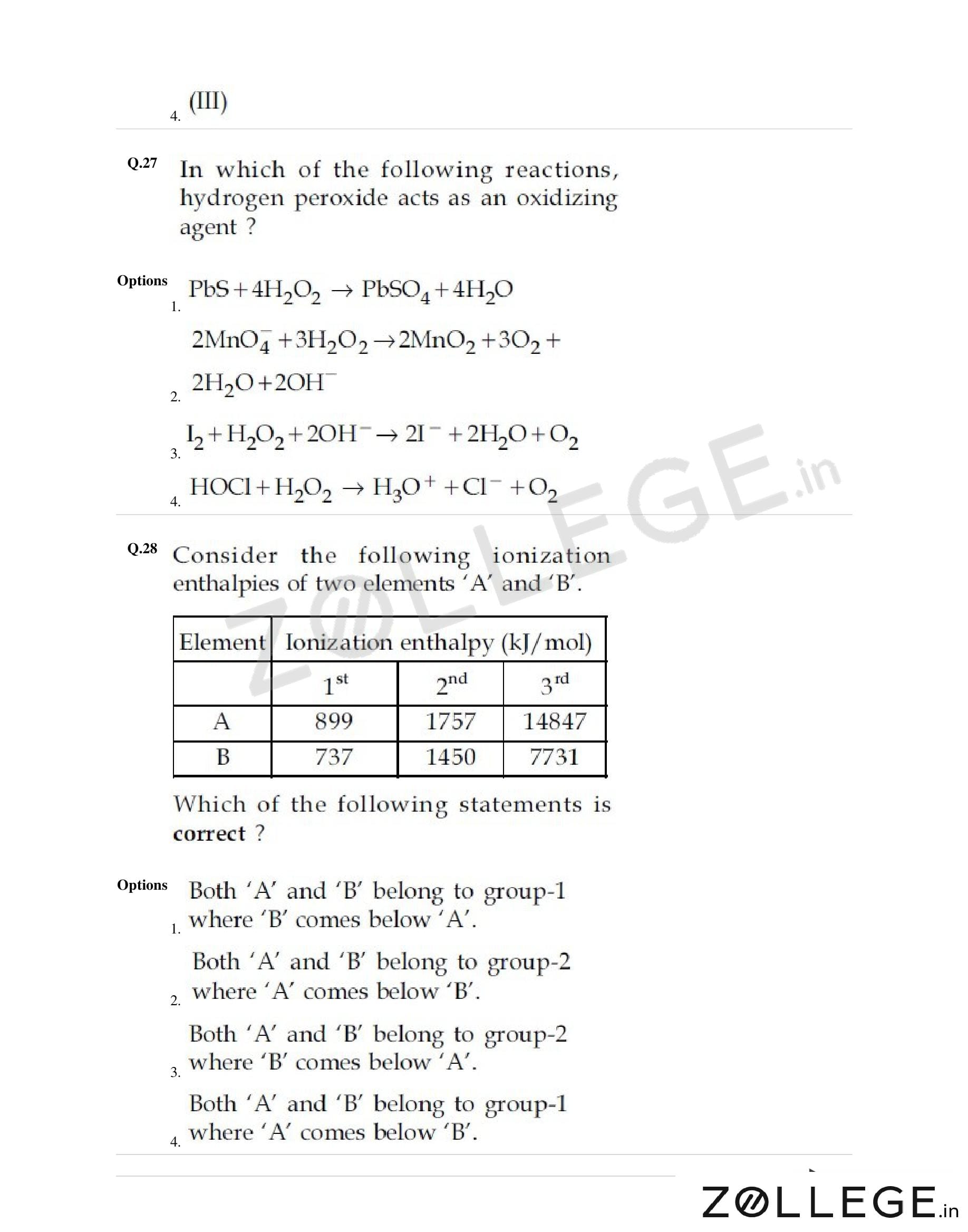
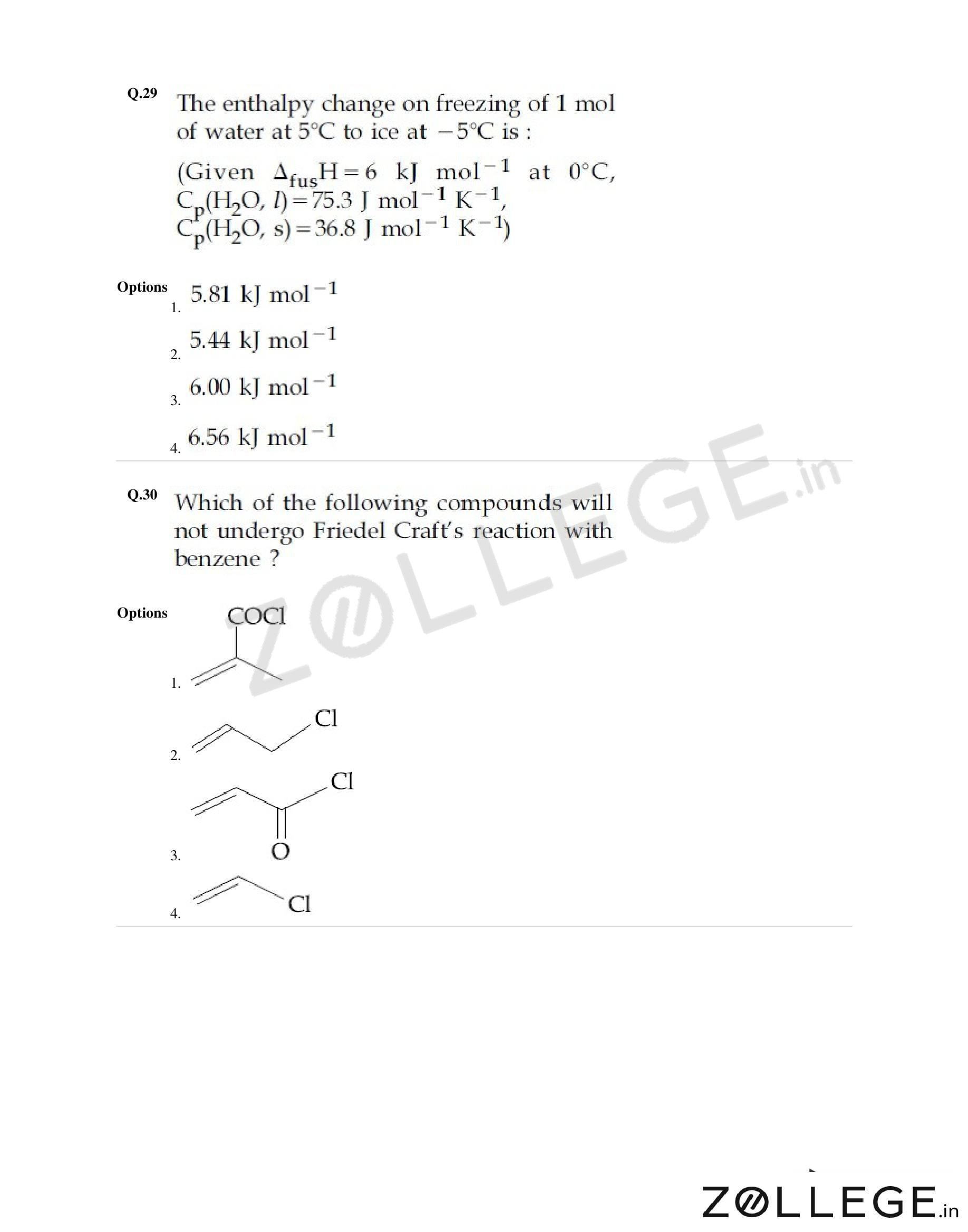
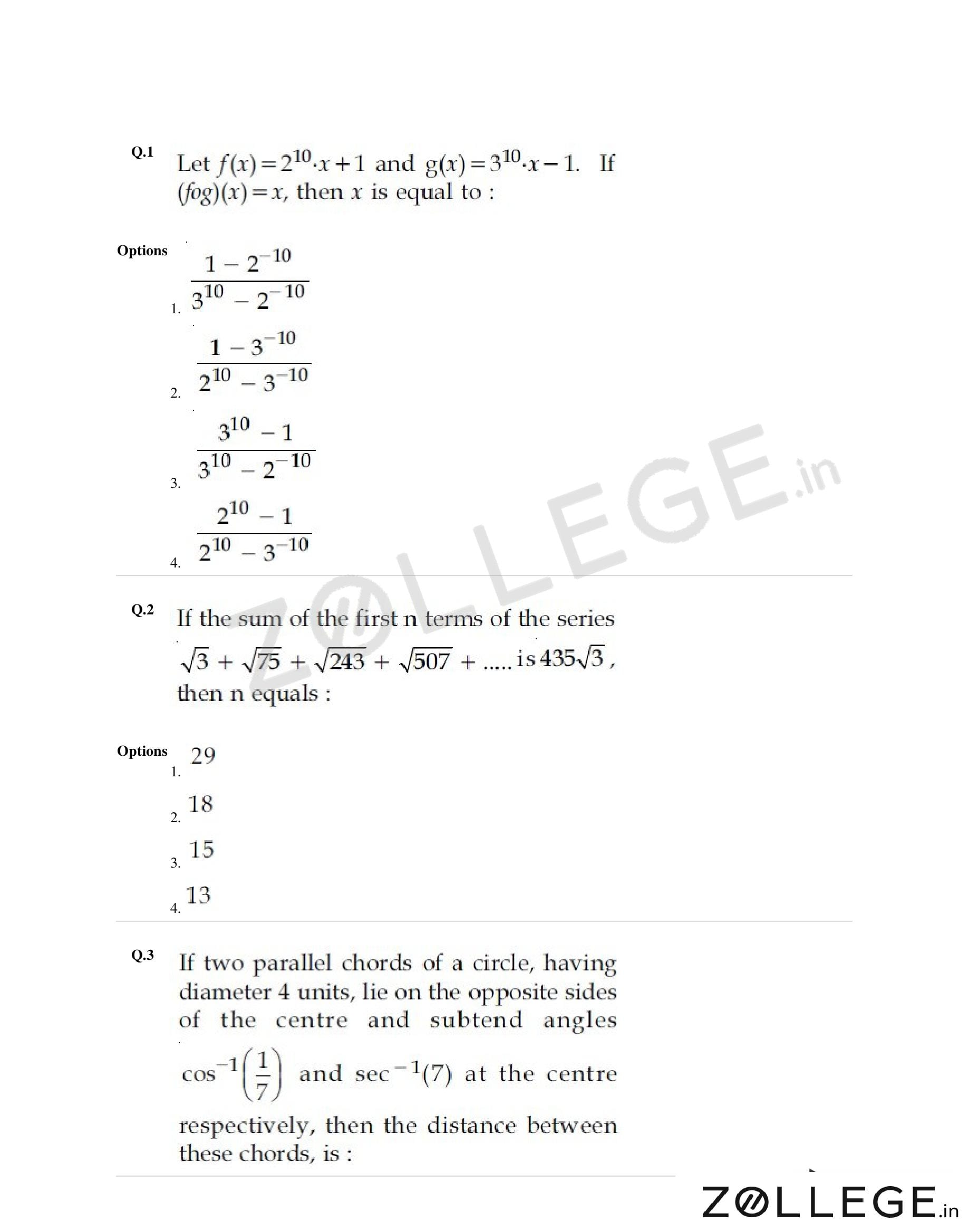
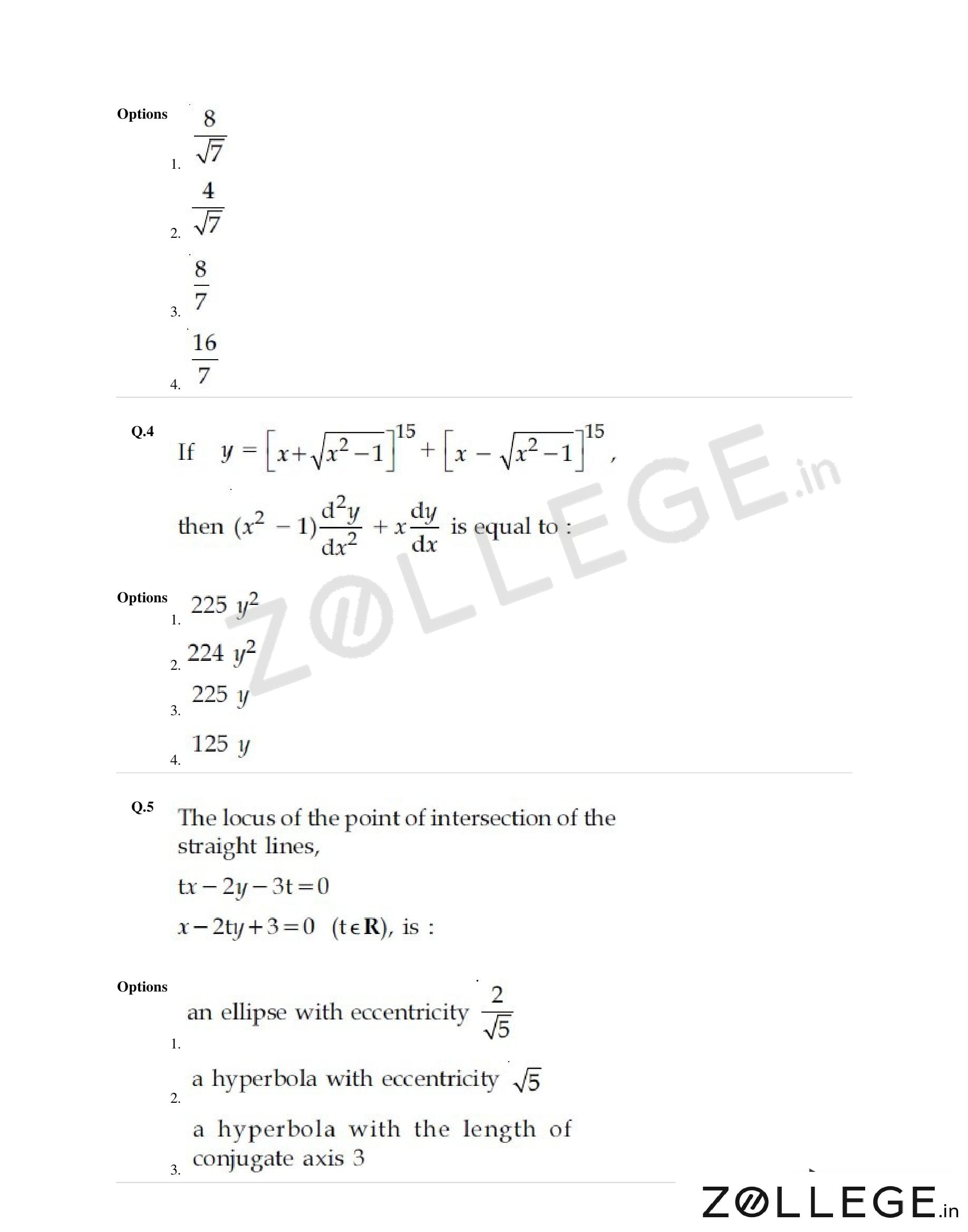
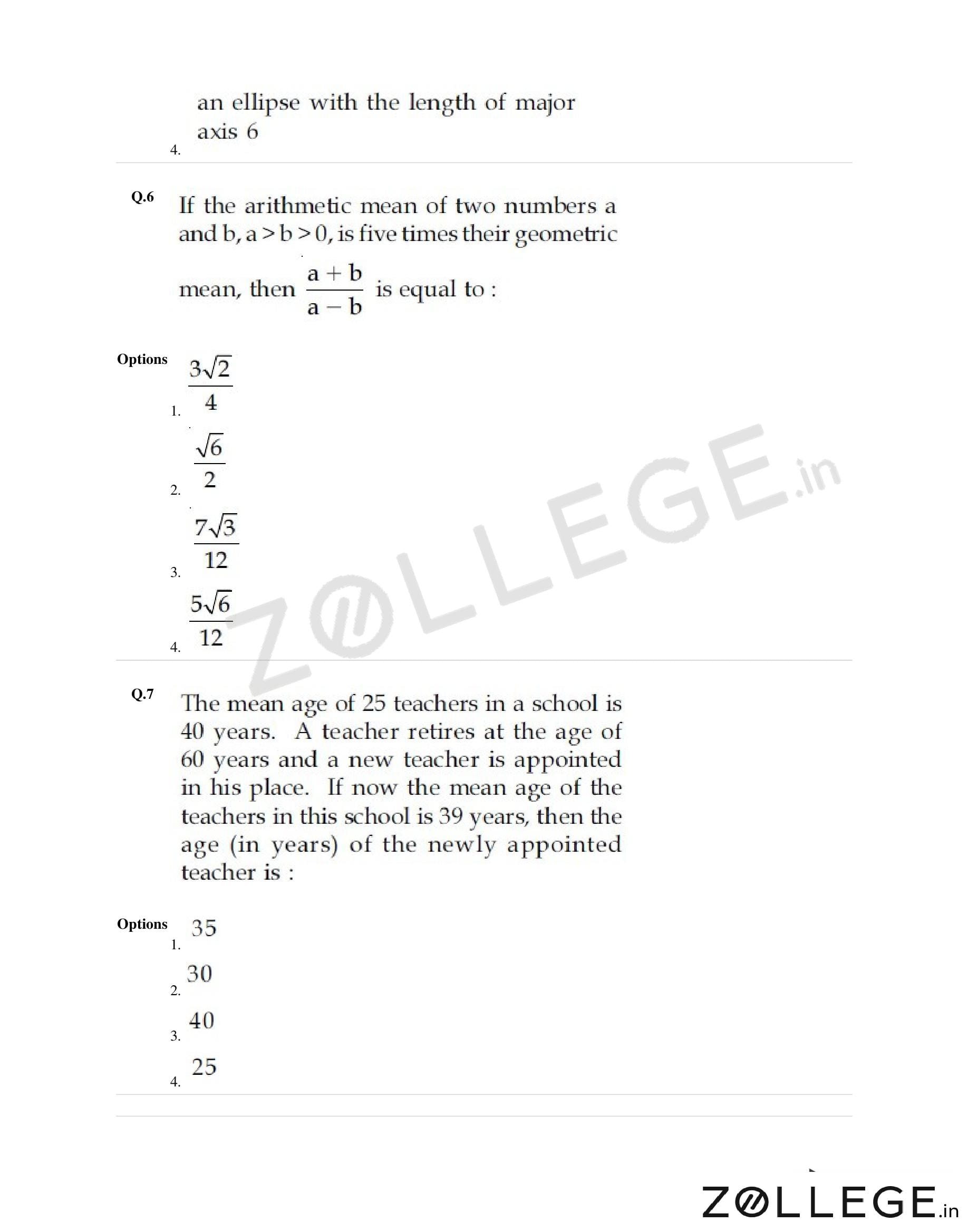
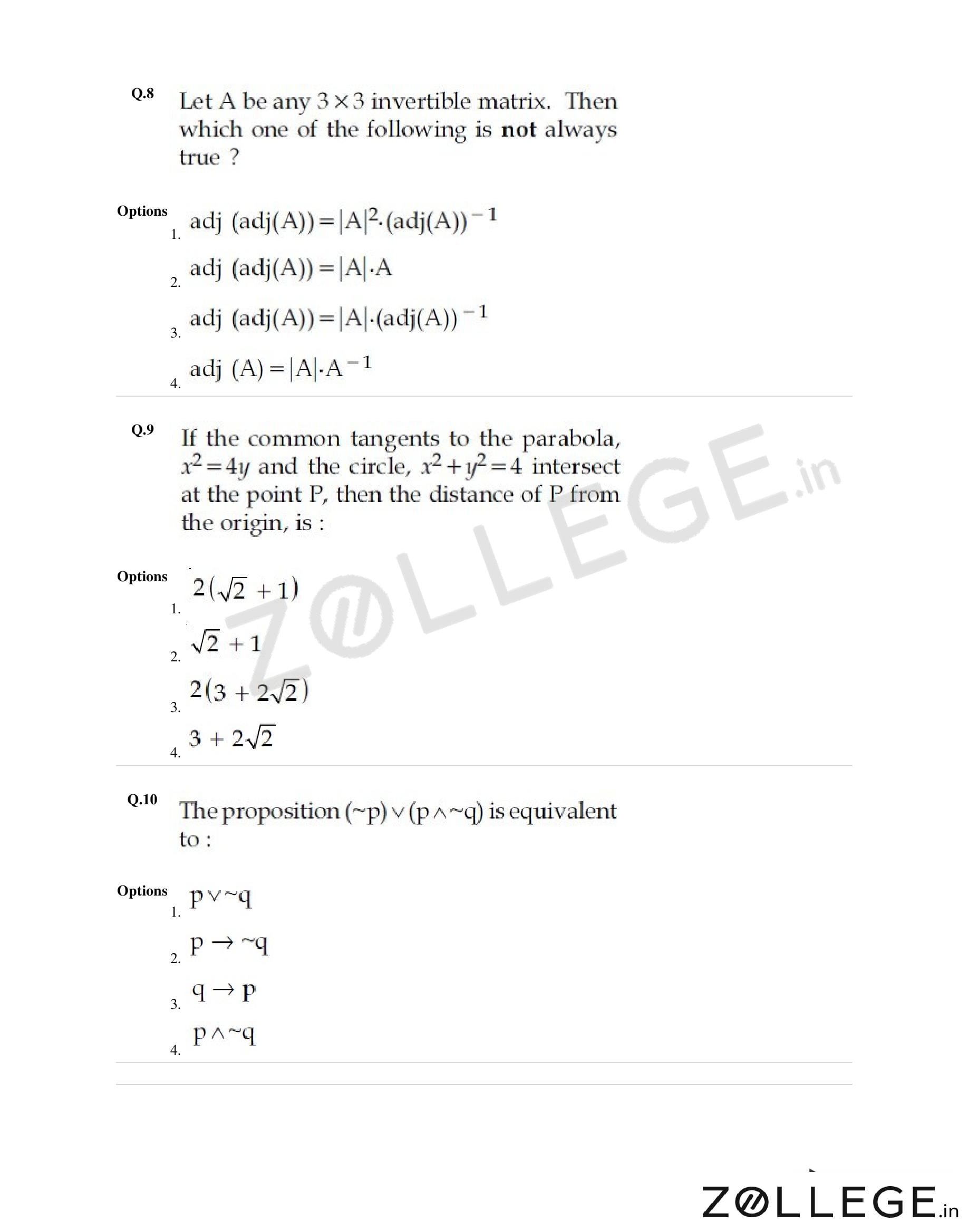
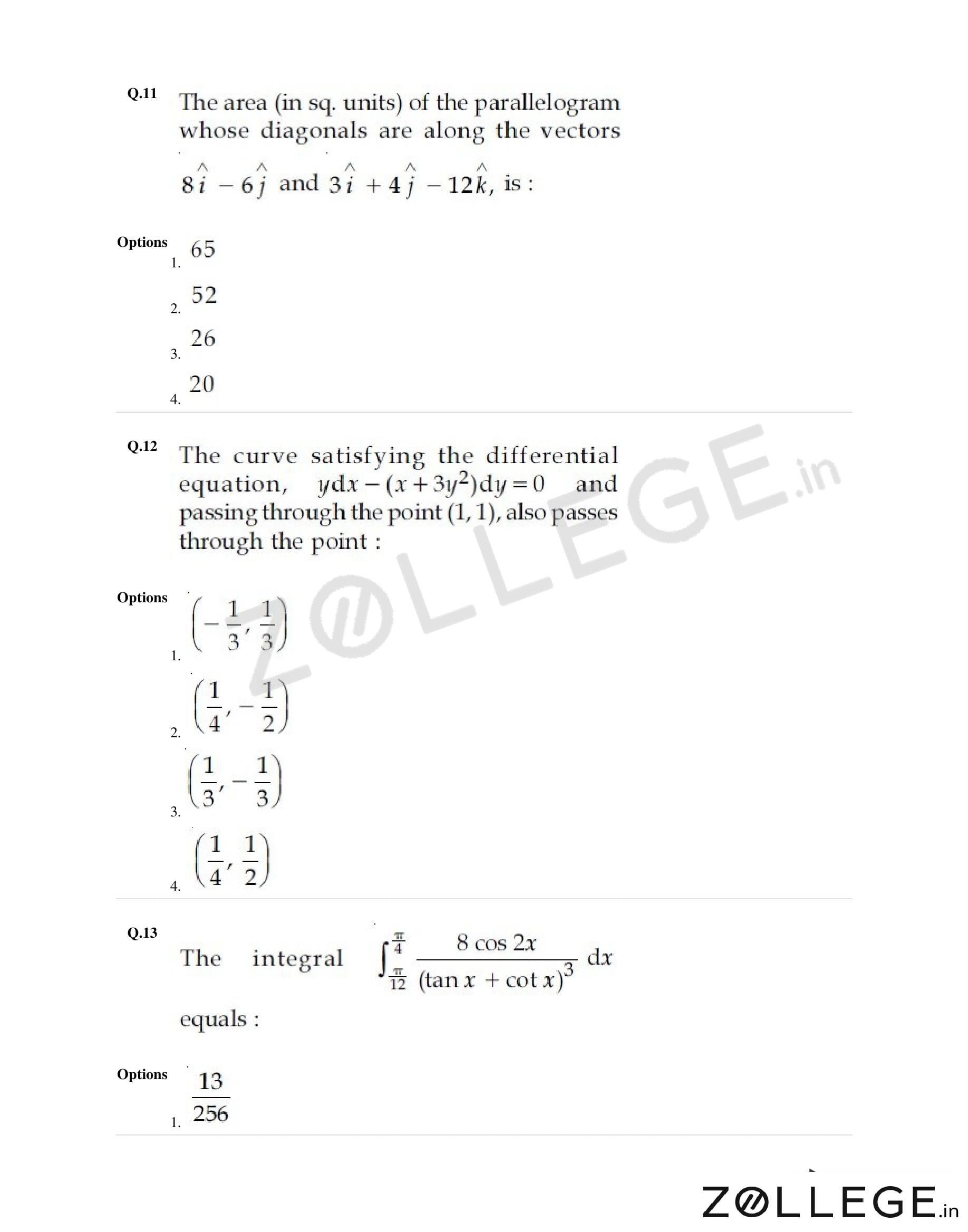
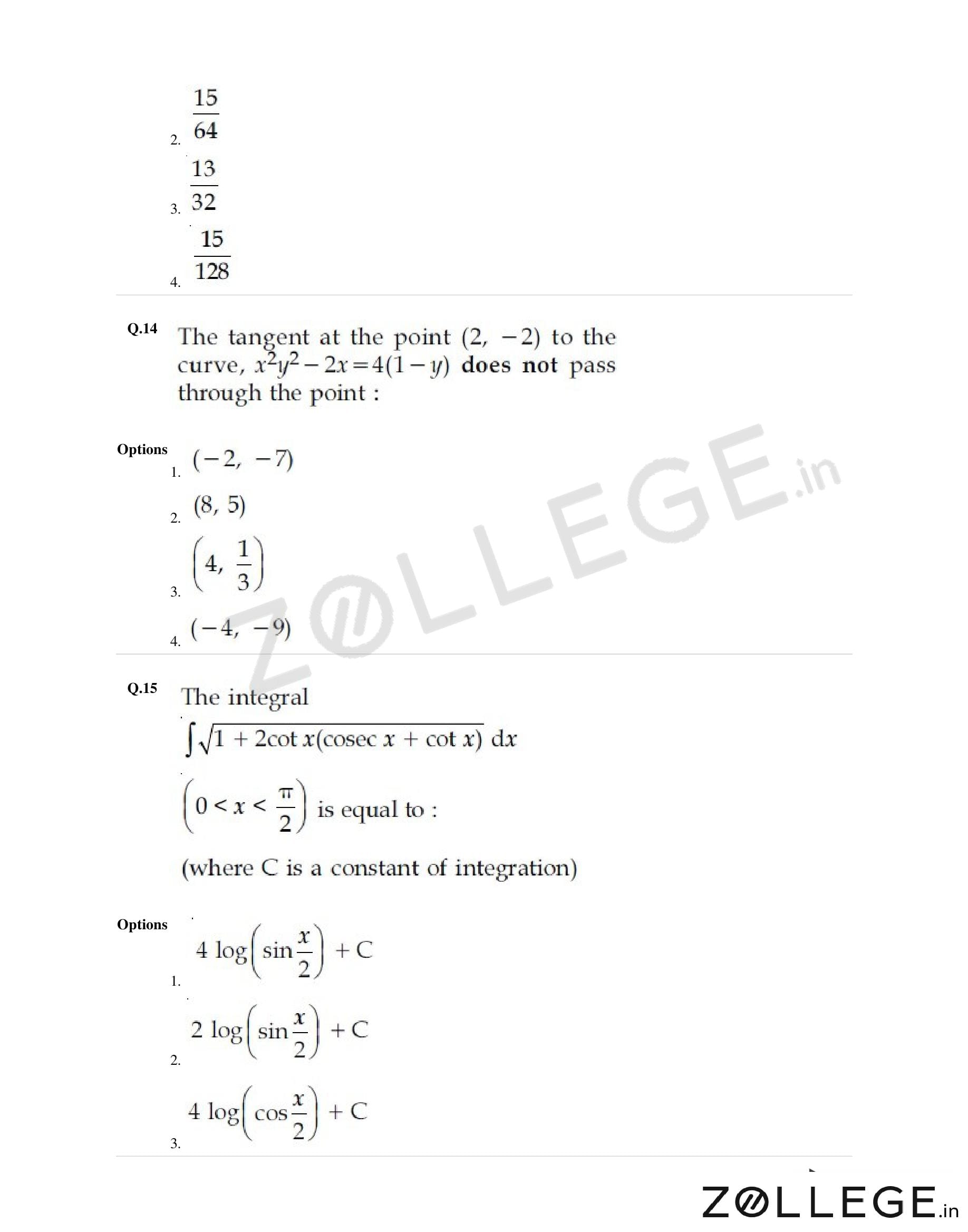
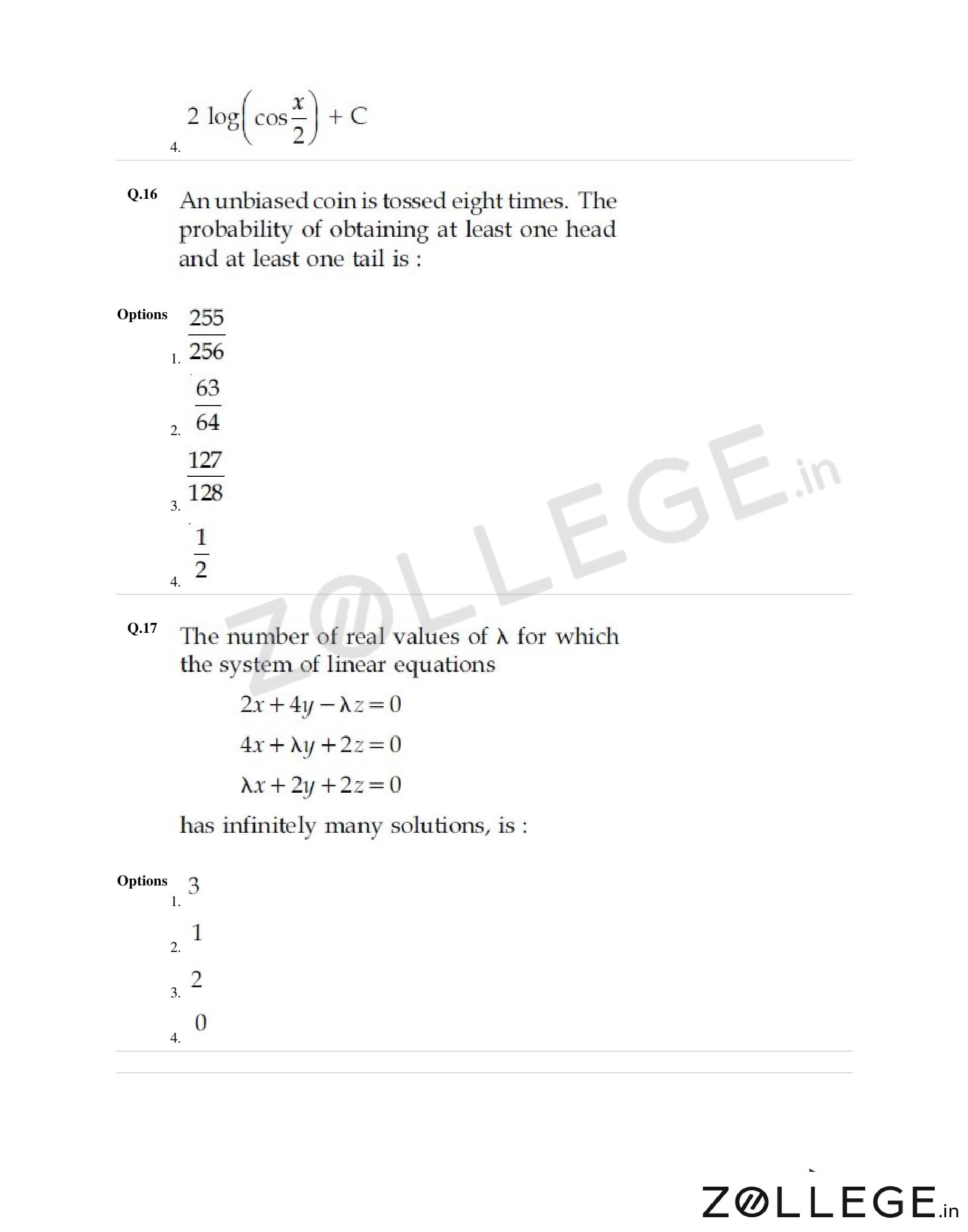
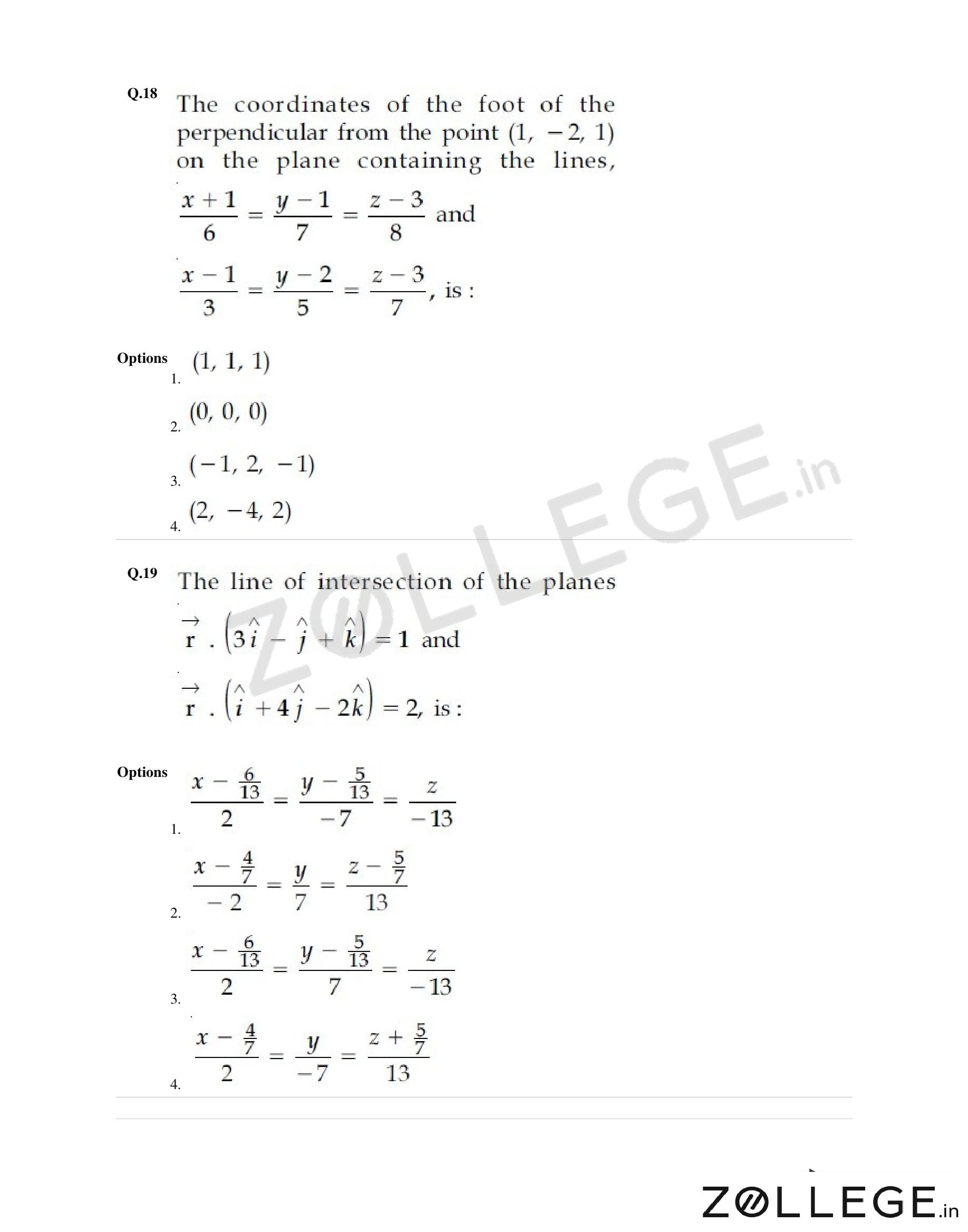
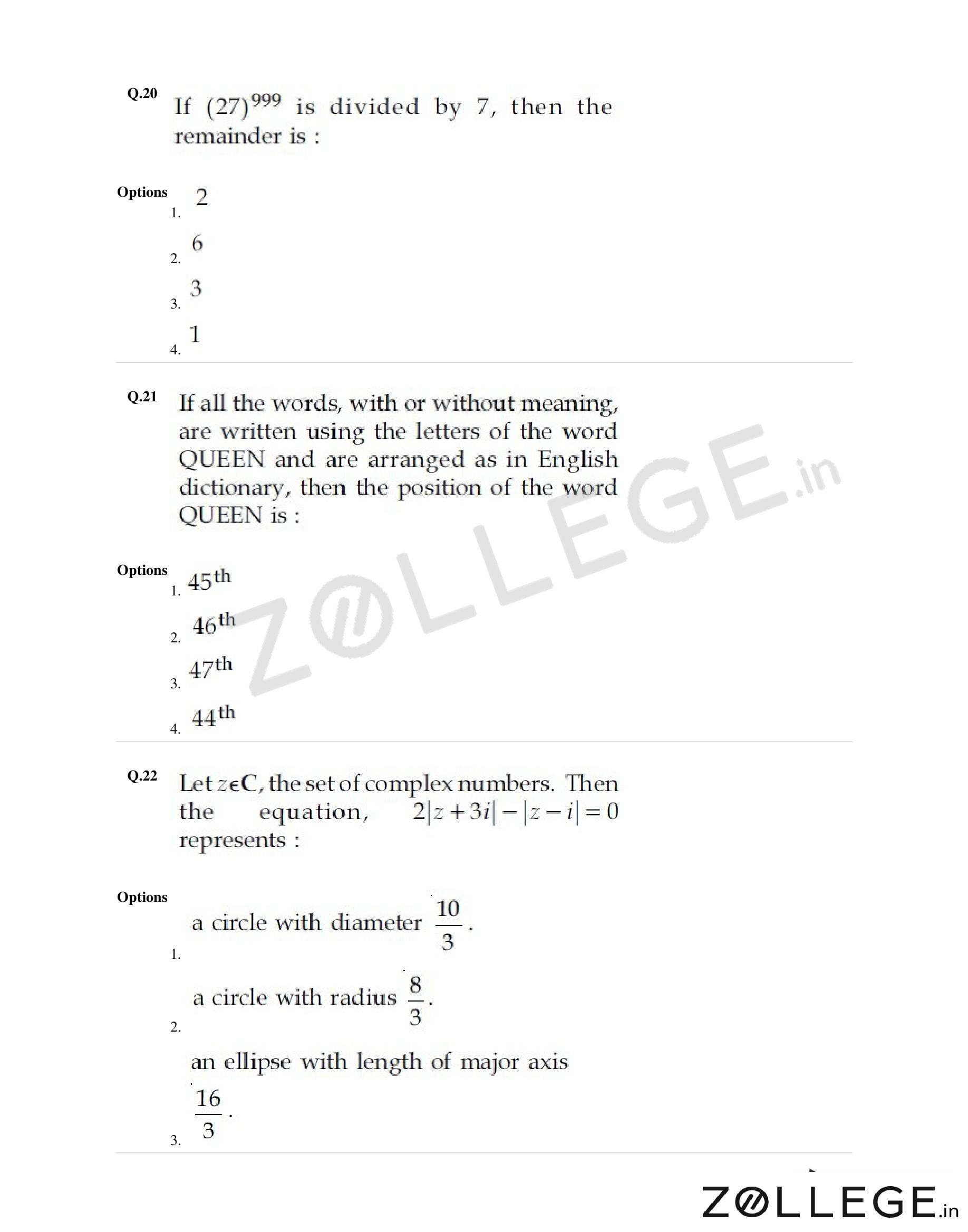
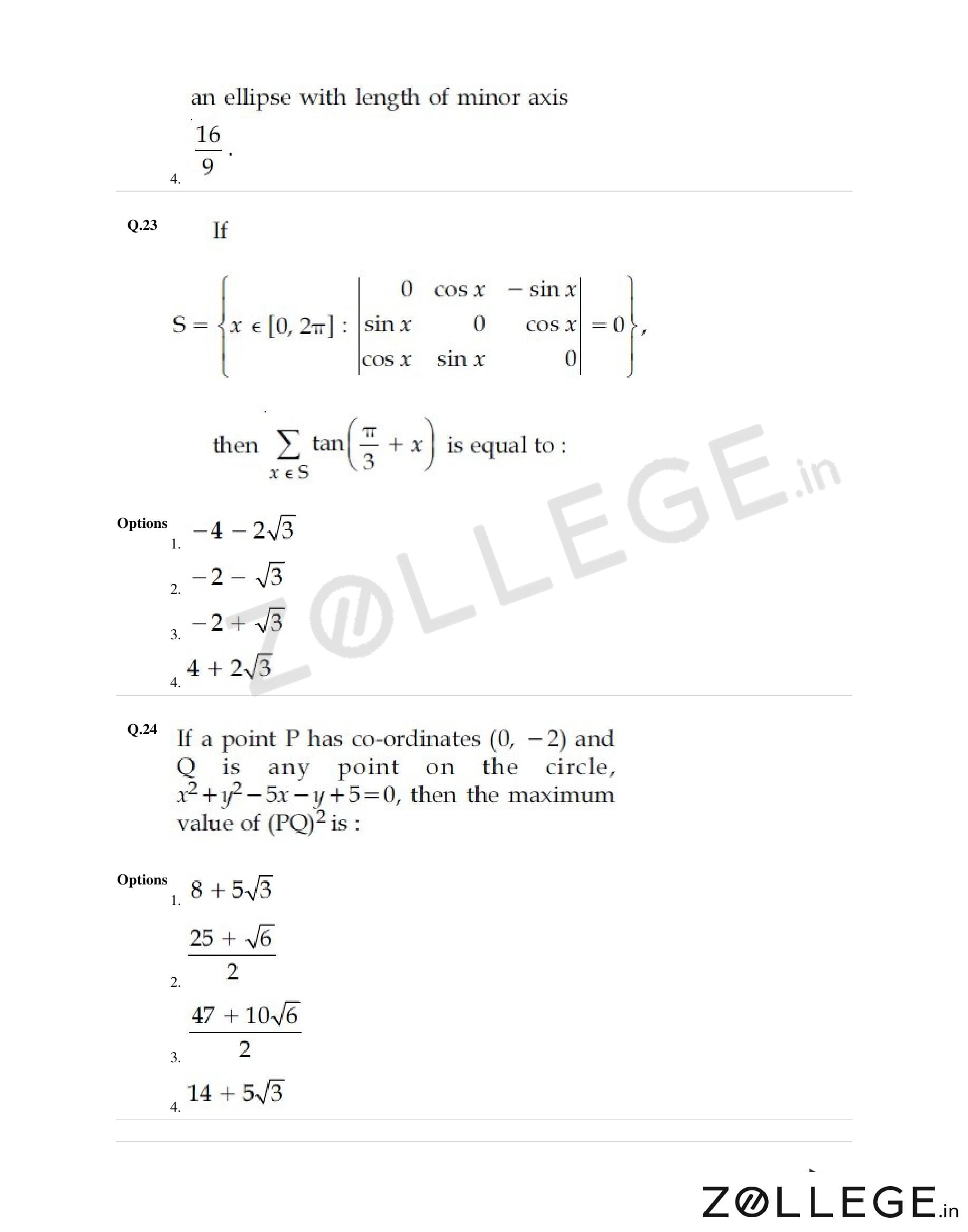
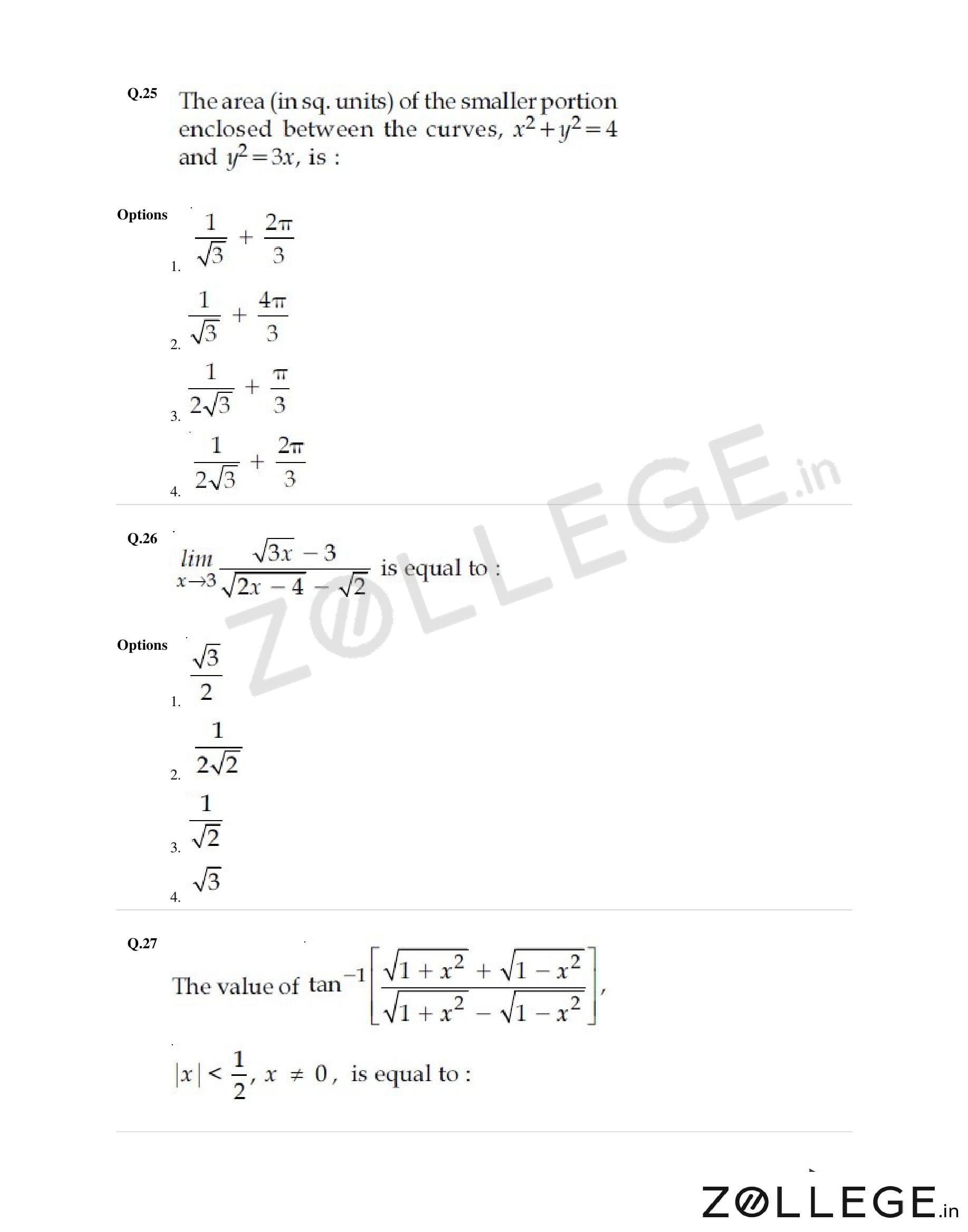
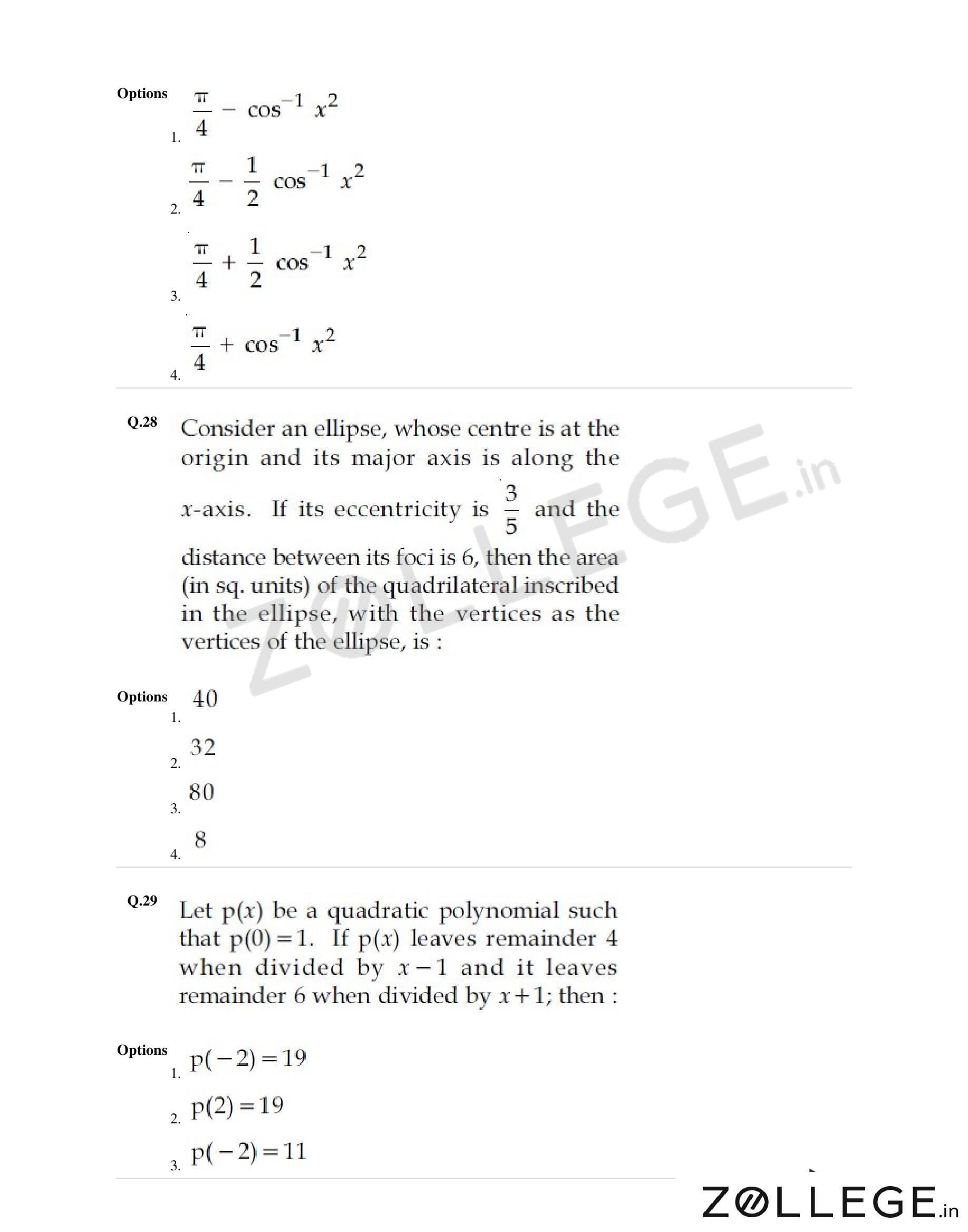
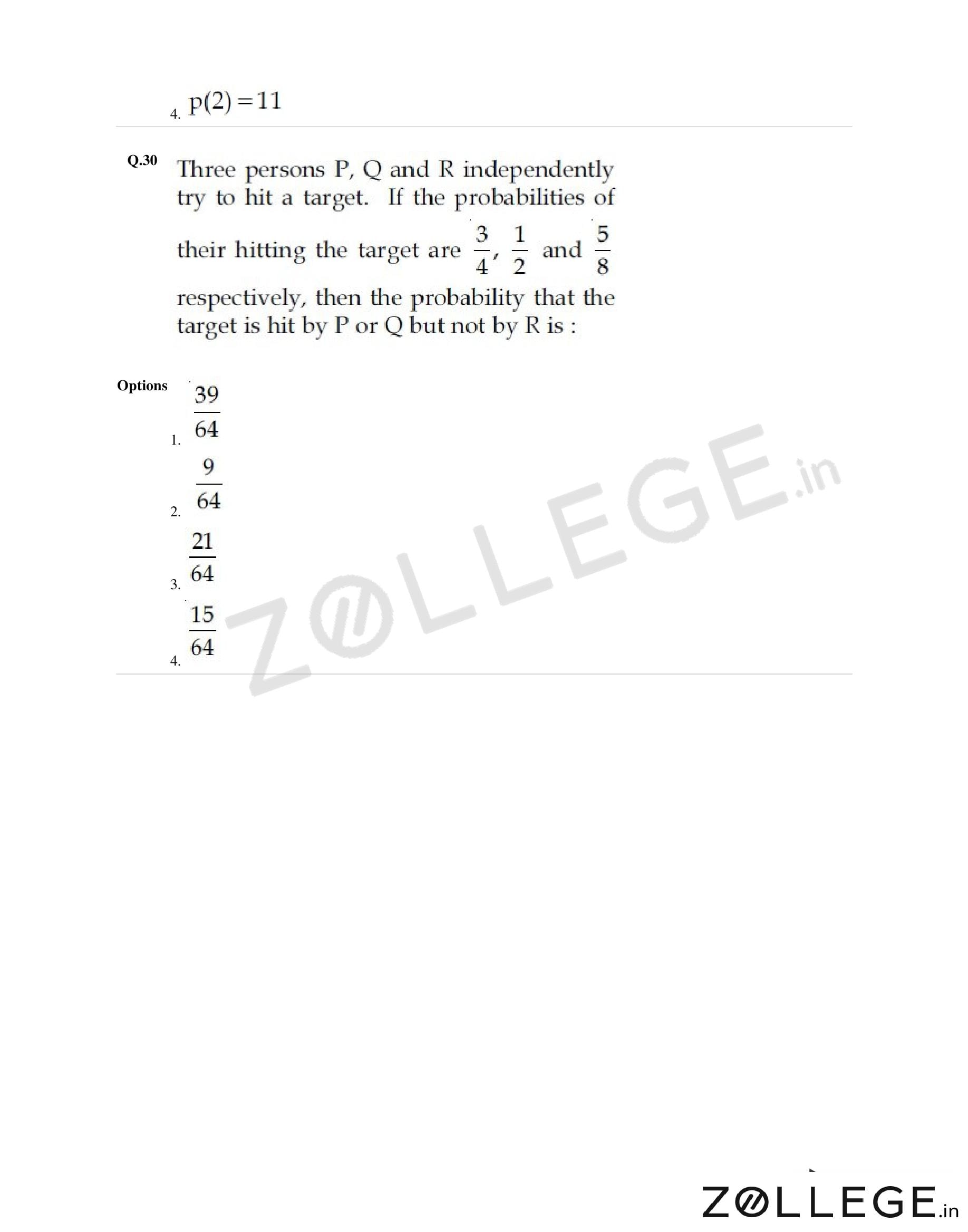 https://static.zollege.in/public/image/2f28007acb5777ddfe072b9ac45279c6.pdf
Previous Year JEE Main Question Papers
*The article might have information for the previous academic years, please refer the official website of the exam.