
JEE Main 2019 Question Paper with Answer Key PDF for B.E./ B.Tech(April 12, 2019 - Shift 2)


Content Writer | Updated On - Dec 26, 2025
JEE Main Question Papers are the most important study material for effective exam preparation. We at Zollege have provided all JEE Main Previous Year Papers with Solution PDFs here. JEE Main 2019 B. E. / B. Tech exam was conducted successfully on April 12, 2019. NTA conducted the exam in the Shift 2. According to student reactions and expert reviews, the paper was reported to be easy to moderate.
Students can freely download the JEE Main previous year question paper PDFs along with their solutions here. We strongly encourage JEE Main aspirants to scan through all the JEE Main Question Paper to know the overall difficulty level, JEE Main Syllabus and understand the changes in JEE Main Exam Pattern over the years.
JEE Main 2019 B.E./ B.Tech Question Paper with Answer Key PDF (Shift 2)
| JEE Main 2019 B.E./ B.Tech Question Paper PDF | JEE Main 2019 B.E./ B.Tech Answer Key PDF | JEE Main 2019 B.E./ B.Tech Solution PDF |
|---|---|---|
| Download PDF | Download PDF | Check Solutions |

The number density of molecules of a gas depends on their distance r from the origin as, n(r) = \(n_0e^{-\alpha r^4}\). Then the total number of molecules is proportional to :
View Solution
The total number of molecules \(N\) is found by integrating the number density over the entire volume.
Since the density depends only on the distance \(r\), we use spherical coordinates with volume element \(dV = 4\pi r^2 dr\).
\(N = \int_{0}^{\infty} n(r) 4\pi r^2 dr = 4\pi n_0 \int_{0}^{\infty} r^2 e^{-\alpha r^4} dr\).
Let us use the substitution \(t = \alpha r^4\).
This implies \(r = (\frac{t}{\alpha})^{1/4} = \alpha^{-1/4} t^{1/4}\).
Differentiating gives \(dt = 4\alpha r^3 dr \implies dr = \frac{dt}{4\alpha r^3}\).
Substituting \(r\) in terms of \(t\): \(dr = \frac{dt}{4\alpha (\alpha^{-1/4} t^{1/4})^3} = \frac{dt}{4\alpha^{1/4} t^{3/4}}\).
Now substitute \(r^2 = \alpha^{-1/2} t^{1/2}\) and \(dr\) into the integral:
\(N \propto \int_{0}^{\infty} (\alpha^{-1/2} t^{1/2}) e^{-t} (\alpha^{-1/4} t^{-3/4}) dt\).
Combine the powers of \(\alpha\): \(\alpha^{-1/2} \cdot \alpha^{-1/4} = \alpha^{-3/4}\).
The integral part \(\int t^{-1/4} e^{-t} dt\) is a constant (Gamma function).
Therefore, \(N \propto n_0 \alpha^{-3/4}\).
Quick Tip: For integrals of the type \(\int_0^\infty x^m e^{-ax^n} dx\), the result is always proportional to \(a^{-(m+1)/n}\). Here \(m=2\) and \(n=4\), so dependence is \(\alpha^{-(2+1)/4} = \alpha^{-3/4}\).
A particle is moving with speed \(v=b\sqrt{x}\) along positive x-axis. Calculate the speed of the particle at time \(t=\tau\) (assume that the particle is at origin at \(t=0\)).
View Solution
Given velocity \(v = \frac{dx}{dt} = b\sqrt{x}\).
Separate the variables to find position as a function of time: \(\frac{dx}{\sqrt{x}} = b dt\).
Integrate both sides with limits (0 to \(x\) and 0 to \(t\)):
\(\int_{0}^{x} x^{-1/2} dx = \int_{0}^{t} b dt\).
\([2\sqrt{x}]_0^x = [bt]_0^t \implies 2\sqrt{x} = bt\).
From this, \(\sqrt{x} = \frac{bt}{2}\).
The speed is given by \(v = b\sqrt{x}\).
Substitute \(\sqrt{x}\) back into the speed equation: \(v = b(\frac{bt}{2})\).
\(v = \frac{b^2 t}{2}\).
At \(t = \tau\), \(v = \frac{b^2 \tau}{2}\).
Quick Tip: If given \(v(x)\), first find \(x(t)\) by integration, then substitute back to find \(v(t)\). Alternatively, use \(a = v \frac{dv}{dx}\) to find constant acceleration, then \(v=at\).
Two particles are projected from the same point with the same speed u such that they have the same range R, but different maximum heights, \(h_1\) and \(h_2\). Which of the following is correct?
View Solution
For the same range with the same speed, the angles of projection are complementary: \(\theta\) and \(90^\circ - \theta\).
The range is \(R = \frac{u^2 \sin 2\theta}{g} = \frac{2u^2 \sin\theta \cos\theta}{g}\).
The maximum heights are \(h_1 = \frac{u^2 \sin^2\theta}{2g}\) and \(h_2 = \frac{u^2 \cos^2\theta}{2g}\).
Multiply the heights: \(h_1 h_2 = \frac{u^2 \sin^2\theta}{2g} \cdot \frac{u^2 \cos^2\theta}{2g} = \frac{u^4 \sin^2\theta \cos^2\theta}{4g^2}\).
Compare this with \(R^2\): \(R^2 = \left( \frac{2u^2 \sin\theta \cos\theta}{g} \right)^2 = \frac{4u^4 \sin^2\theta \cos^2\theta}{g^2}\).
From the product of heights, we have \(\frac{u^4 \sin^2\theta \cos^2\theta}{g^2} = 4 h_1 h_2\).
Substitute this into the expression for \(R^2\): \(R^2 = 4 (4 h_1 h_2)\).
\(R^2 = 16 h_1 h_2\).
Quick Tip: For complementary projection angles, the relation \(R = 4\sqrt{h_1 h_2}\) is a standard result worth memorizing.
A block of mass 5 kg is (i) pushed in case (A) and (ii) pulled in case (B), by a force F = 20 N, making an angle of \(30^\circ\) with the horizontal, as shown in the figures. The coefficient of friction between the block and floor is \(\mu = 0.2\). The difference between the accelerations of the block, in case (B) and case (A) will be : (g = 10 ms\(^{-2}\))

View Solution
Case (A) Pushing: The vertical component of force adds to weight.
Normal force \(N_A = mg + F\sin 30^\circ = 50 + 20(0.5) = 60\) N.
Friction \(f_A = \mu N_A = 0.2 \times 60 = 12\) N.
Net force \(F_{net, A} = F\cos 30^\circ - f_A = 10\sqrt{3} - 12\).
Case (B) Pulling: The vertical component of force subtracts from weight.
Normal force \(N_B = mg - F\sin 30^\circ = 50 - 20(0.5) = 40\) N.
Friction \(f_B = \mu N_B = 0.2 \times 40 = 8\) N.
Net force \(F_{net, B} = F\cos 30^\circ - f_B = 10\sqrt{3} - 8\).
Difference in acceleration \(a_B - a_A = \frac{F_{net, B} - F_{net, A}}{m}\).
\(a_B - a_A = \frac{(10\sqrt{3} - 8) - (10\sqrt{3} - 12)}{5}\).
\(a_B - a_A = \frac{4}{5} = 0.8\) ms\(^{-2}\).
Quick Tip: The driving horizontal force is the same in both cases. The difference in acceleration arises solely from the difference in friction: \(\Delta a = \frac{\Delta f}{m} = \frac{\mu (2F\sin\theta)}{m}\).
A spring whose unstretched length is \(l\) has a force constant k. The spring is cut into two pieces of unstretched lengths \(l_1\) and \(l_2\) where, \(l_1 = nl_2\) and n is an integer. The ratio \(k_1/k_2\) of the corresponding force constants, \(k_1\) and \(k_2\) will be :
View Solution
The spring constant \(k\) is inversely proportional to the length \(L\).
Therefore, \(k \cdot L = constant\).
This implies \(k_1 l_1 = k_2 l_2\).
We assume the lengths are \(l_1\) and \(l_2\).
We are given \(l_1 = n l_2\).
Substitute this into the proportionality equation: \(k_1 (n l_2) = k_2 l_2\).
\(\frac{k_1}{k_2} = \frac{l_2}{n l_2}\).
\(\frac{k_1}{k_2} = \frac{1}{n}\).
Quick Tip: Spring constant \(k \propto 1/L\). The ratio of spring constants is the inverse ratio of their lengths.
A smooth wire of length \(2\pi r\) is bent into a circle and kept in a vertical plane. A bead can slide smoothly on the wire. When the circle is rotating with angular speed \(\omega\) about the vertical diameter AB, as shown in figure, the bead is at rest with respect to the circular ring at position P as shown. Then the value of \(\omega^2\) is equal to :

View Solution
Let \(\theta\) be the angle the radius vector to the bead makes with the vertical downward axis.
From the diagram, the vertical distance from the center O to the level of P is \(r/2\). P is in the lower half.
Thus, \(\cos\theta = \frac{r/2}{r} = \frac{1}{2}\), so \(\theta = 60^\circ\).
The forces acting on the bead are gravity (\(mg\)), normal force (\(N\)), and the centrifugal force (\(m\omega^2 R_{circle}\)) in the rotating frame.
The radius of the horizontal circular path of the bead is \(R_{circle} = r \sin\theta\).
Resolving forces along the tangent to the wire:
\(mg \sin\theta\) acts downwards along the tangent.
The component of centrifugal force \(m\omega^2 (r \sin\theta)\) along the tangent acts upwards: \((m\omega^2 r \sin\theta) \cos\theta\).
For equilibrium: \(mg \sin\theta = m\omega^2 r \sin\theta \cos\theta\).
Since \(\theta \neq 0\), we divide by \(\sin\theta\): \(g = \omega^2 r \cos\theta\).
\(\omega^2 = \frac{g}{r \cos\theta}\).
Substitute \(\cos\theta = 1/2\): \(\omega^2 = \frac{g}{r (1/2)} = \frac{2g}{r}\).
Quick Tip: For a bead on a rotating vertical hoop, the equilibrium angle \(\theta\) with the vertical is given by \(\cos\theta = g / (\omega^2 r)\).
Three particles of masses 50 g, 100 g and 150 g are placed at the vertices of an equilateral triangle of side 1 m (as shown in the figure). The (x, y) coordinates of the centre of mass will be :

View Solution
Masses: \(m_1 = 50\) g, \(m_2 = 100\) g, \(m_3 = 150\) g.
Coordinates:
\(m_1\) at \((0, 0)\).
\(m_2\) at \((1, 0)\).
\(m_3\) at \((0.5, \frac{\sqrt{3}}{2})\) (Vertex of equilateral triangle of side 1).
X-coordinate of CM:
\(X_{CM} = \frac{m_1 x_1 + m_2 x_2 + m_3 x_3}{m_1 + m_2 + m_3}\).
\(X_{CM} = \frac{50(0) + 100(1) + 150(0.5)}{50 + 100 + 150} = \frac{100 + 75}{300} = \frac{175}{300} = \frac{7}{12}\) m.
Y-coordinate of CM:
\(Y_{CM} = \frac{m_1 y_1 + m_2 y_2 + m_3 y_3}{m_1 + m_2 + m_3}\).
\(Y_{CM} = \frac{50(0) + 100(0) + 150(\frac{\sqrt{3}}{2})}{300} = \frac{75\sqrt{3}}{300} = \frac{\sqrt{3}}{4}\) m.
Coordinates are \((\frac{7}{12}, \frac{\sqrt{3}}{4})\).
Quick Tip: Always set the origin at one of the particles to simplify calculations.
The ratio of the weights of a body on the Earth's surface to that on the surface of a planet is 9 : 4. The mass of the planet is \(\frac{1}{9}\)th of that of the Earth. If 'R' is the radius of the Earth, what is the radius of the planet ? (Take the planets to have the same mass density)
View Solution
Let \(W_e\) and \(W_p\) be weights on Earth and Planet.
Given ratio \(W_e : W_p = 9 : 4 \implies \frac{g_e}{g_p} = \frac{9}{4}\).
Given mass of planet \(M_p = \frac{1}{9} M_e\).
Gravitational acceleration \(g = \frac{GM}{R^2}\).
\(\frac{g_e}{g_p} = \frac{M_e}{M_p} \left( \frac{R_p}{R_e} \right)^2\).
Substitute the known values:
\(\frac{9}{4} = \left( \frac{M_e}{M_e/9} \right) \left( \frac{R_p}{R_e} \right)^2\).
\(\frac{9}{4} = 9 \left( \frac{R_p}{R_e} \right)^2\).
Divide by 9: \(\frac{1}{4} = \left( \frac{R_p}{R_e} \right)^2\).
Taking the square root: \(\frac{R_p}{R_e} = \frac{1}{2}\).
\(R_p = \frac{R_e}{2} = \frac{R}{2}\).
Quick Tip: Be careful with ratios. \(g \propto M/R^2\). If density is constant, \(g \propto R\). The question mentions "Take the planets to have the same mass density" which is actually redundant or a separate check, but here mass ratio was explicitly given.
A uniform cylindrical rod of length L and radius r, is made from a material whose Young's modulus of Elasticity equals Y. When this rod is heated by temperature T and simultaneously subjected to a net longitudinal compressional force F, its length remains unchanged. The coefficient of volume expansion, of the material of the rod, is (nearly) equal to :
View Solution
The change in length due to thermal expansion is \(\Delta L_{thermal} = L \alpha T\).
The change in length due to compression force F is \(\Delta L_{mech} = \frac{F L}{A Y} = \frac{F L}{\pi r^2 Y}\).
Since the net length remains unchanged, the magnitudes must be equal:
\(L \alpha T = \frac{F L}{\pi r^2 Y}\).
Solving for the coefficient of linear expansion \(\alpha\):
\(\alpha = \frac{F}{\pi r^2 Y T}\).
The coefficient of volume expansion \(\gamma\) is approximately \(3\alpha\).
\(\gamma = 3 \left( \frac{F}{\pi r^2 Y T} \right) = \frac{3F}{\pi r^2 YT}\).
Quick Tip: Thermal stress equation: Stress = \(Y \alpha \Delta T\). Force \(F = A Y \alpha \Delta T\). Always remember \(\gamma = 3\alpha\).
A solid sphere, of radius R acquires a terminal velocity \(v_1\) when falling (due to gravity) through a viscous fluid having a coefficient of viscosity \(\eta\). The sphere is broken into 27 identical solid spheres. If each of these spheres acquires a terminal velocity, \(v_2\), when falling through the same fluid, the ratio \((v_1/v_2)\) equals :
View Solution
Let the large sphere have radius \(R\) and the 27 small spheres have radius \(r\).
From volume conservation: \(\frac{4}{3}\pi R^3 = 27 \times \frac{4}{3}\pi r^3\).
\(R^3 = 27 r^3 \implies R = 3r\).
Terminal velocity \(v_T\) is proportional to the square of the radius (\(v_T \propto r^2\)).
\(v_1 \propto R^2\) and \(v_2 \propto r^2\).
\(\frac{v_1}{v_2} = \frac{R^2}{r^2} = \left( \frac{3r}{r} \right)^2 = 3^2 = 9\).
Quick Tip: If a drop breaks into \(n\) droplets, the radius scales as \(R = n^{1/3}r\). Terminal velocity scales as \(R^2\). Thus \(v_{large}/v_{small} = n^{2/3}\). Here \(27^{2/3} = 9\).
A Carnot engine has an efficiency of 1/6. When the temperature of the sink is reduced by \(62^\circ\)C, its efficiency is doubled. The temperatures of the source and the sink are, respectively,
View Solution
Let source temperature be \(T_1\) and sink temperature be \(T_2\).
Efficiency \(\eta = 1 - \frac{T_2}{T_1} = \frac{1}{6}\).
\(\frac{T_2}{T_1} = 1 - \frac{1}{6} = \frac{5}{6} \implies T_2 = \frac{5}{6}T_1\).
When sink temperature is \(T_2 - 62\), efficiency becomes \(2 \times \frac{1}{6} = \frac{1}{3}\).
\(1 - \frac{T_2 - 62}{T_1} = \frac{1}{3}\).
\(\frac{T_2 - 62}{T_1} = \frac{2}{3}\).
Substitute \(T_2 = \frac{5}{6}T_1\):
\(\frac{\frac{5}{6}T_1 - 62}{T_1} = \frac{2}{3}\).
\(\frac{5}{6} - \frac{62}{T_1} = \frac{2}{3}\).
\(\frac{62}{T_1} = \frac{5}{6} - \frac{4}{6} = \frac{1}{6}\).
\(T_1 = 62 \times 6 = 372\) K.
\(T_2 = \frac{5}{6} \times 372 = 310\) K.
Convert to Celsius:
\(T_1 = 372 - 273 = 99^\circ\)C.
\(T_2 = 310 - 273 = 37^\circ\)C.
Quick Tip: Always work with Kelvin in thermodynamic efficiency problems.
A diatomic gas with rigid molecules does 10 J of work when expanded at constant pressure. What would be the heat energy absorbed by the gas, in this process ?
View Solution
Work done at constant pressure is \(W = P\Delta V = nR\Delta T = 10\) J.
For a diatomic gas (rigid), degrees of freedom \(f = 5\).
Molar heat capacity at constant pressure is \(C_p = (\frac{f}{2} + 1)R = \frac{7}{2}R\).
Heat absorbed \(Q = n C_p \Delta T = n (\frac{7}{2}R) \Delta T\).
\(Q = \frac{7}{2} (nR\Delta T)\).
Substitute \(nR\Delta T = 10\) J:
\(Q = \frac{7}{2} \times 10 = 35\) J.
Quick Tip: For isobaric process: \(Q = \frac{C_p}{R} W\). For diatomic gas, \(C_p/R = 3.5\).
A small speaker delivers 2 W of audio output. At what distance from the speaker will one detect 120 dB intensity sound ? [Given reference intensity of sound as \(10^{-12} W/m^2\)]
View Solution
Sound level \(\beta = 10 \log_{10}\left(\frac{I}{I_0}\right)\).
\(120 = 10 \log_{10}\left(\frac{I}{10^{-12}}\right) \implies 12 = \log_{10}(10^{12} I)\).
\(10^{12} = 10^{12} I \implies I = 1 W/m^2\).
Intensity of a point source is \(I = \frac{P}{4\pi r^2}\).
\(1 = \frac{2}{4\pi r^2}\).
\(r^2 = \frac{2}{4\pi} = \frac{1}{2\pi} \approx \frac{1}{6.28} \approx 0.16\).
\(r = \sqrt{0.16} = 0.4\) m = 40 cm.
Quick Tip: 120 dB corresponds to an intensity of 1 W/m\(^2\) (Threshold of Pain). This is a useful benchmark to remember.
Two sources of sound \(S_1\) and \(S_2\) produce sound waves of same frequency 660 Hz. A listener is moving from source \(S_1\) towards \(S_2\) with a constant speed u m/s and he hears 10 beats/s. The velocity of sound is 330 m/s. Then, u equals :
View Solution
Listener moves away from \(S_1\) and towards \(S_2\).
Apparent frequency from \(S_1\): \(f_1 = f \left(\frac{v - u}{v}\right)\).
Apparent frequency from \(S_2\): \(f_2 = f \left(\frac{v + u}{v}\right)\).
Beat frequency \(\Delta f = f_2 - f_1 = 10\).
\(f \left(\frac{v + u}{v}\right) - f \left(\frac{v - u}{v}\right) = 10\).
\(f \frac{2u}{v} = 10\).
Substitute values (\(f = 660, v = 330\)):
\(660 \times \frac{2u}{330} = 10\).
\(2 \times 2u = 10 \implies 4u = 10\).
\(u = 2.5\) m/s.
Quick Tip: Beat frequency for a moving observer between two stationary identical sources is \(f_{beat} = \frac{2uf}{v}\).
Let a total charge 2 Q be distributed in a sphere of radius R, with the charge density given by \(\rho(r) = kr\), where r is the distance from the centre. Two charges A and B, -Q each, are placed on diametrically opposite points, at equal distance, a, from the centre. If A and B do not experience any force, then :
View Solution
First, find the constant \(k\) in terms of \(Q\). Total charge is \(2Q\).
\(2Q = \int_0^R (kr) 4\pi r^2 dr = 4\pi k [\frac{r^4}{4}]_0^R = \pi k R^4\).
So, \(k = \frac{2Q}{\pi R^4}\).
Force on charge A (at distance \(a\)) is zero. The forces are:
1. Attractive force from the charged sphere (Charge enclosed within radius \(a\)).
2. Repulsive force from charge B (at distance \(2a\)).
Charge enclosed within radius \(a\): \(Q_{encl} = \int_0^a (kr) 4\pi r^2 dr = \pi k a^4\).
Substitute \(k\): \(Q_{encl} = \pi (\frac{2Q}{\pi R^4}) a^4 = 2Q \frac{a^4}{R^4}\).
Electric field at \(a\): \(E = \frac{1}{4\pi\epsilon_0} \frac{Q_{encl}}{a^2} = \frac{1}{4\pi\epsilon_0} \frac{2Q a^2}{R^4}\).
Force exerted by sphere on A (-Q): \(F_{sphere} = Q E = \frac{1}{4\pi\epsilon_0} \frac{2Q^2 a^2}{R^4}\) (towards center).
Force exerted by B (-Q) on A (-Q): \(F_{BA} = \frac{1}{4\pi\epsilon_0} \frac{Q^2}{(2a)^2}\) (away from center).
Equating magnitudes: \(\frac{2Q^2 a^2}{R^4} = \frac{Q^2}{4a^2}\).
\(8 a^4 = R^4 \implies a^4 = \frac{R^4}{8}\).
\(a = R (8)^{-1/4}\).
Quick Tip: Use Gauss's Law to find the field inside a non-uniform charge distribution. \(E \cdot 4\pi r^2 = Q_{encl}/\epsilon_0\).
In the given circuit, the charge on 4 \(\mu\)F capacitor will be :

View Solution
The circuit consists of a 10V source connected to two parallel branches.
Top Branch: The 4 \(\mu\)F capacitor is in series with a parallel combination of 1 \(\mu\)F and 5 \(\mu\)F.
Equivalent of parallel part: \(C_p = 1 + 5 = 6 \mu\)F.
Now, the branch has 4 \(\mu\)F in series with 6 \(\mu\)F.
Equivalent capacitance of top branch: \(C_{top} = \frac{4 \times 6}{4 + 6} = 2.4 \mu\)F.
Bottom Branch: Just the 3 \(\mu\)F capacitor.
Since the branches are in parallel with the 10V battery, the voltage across the entire top branch is 10V.
Charge on the top branch \(Q_{top} = C_{top} \times V = 2.4 \mu F \times 10 V = 24 \mu C\).
In a series combination (4 \(\mu\)F and 6 \(\mu\)F), the charge is the same on all components.
Therefore, charge on the 4 \(\mu\)F capacitor is \(24 \mu C\).
Quick Tip: Identify series and parallel blocks clearly. Charge is constant in series; Voltage is constant in parallel.
One kg of water, at \(20^\circ\)C, is heated in an electric kettle whose heating element has a mean (temperature averaged) resistance of 20 \(\Omega\). The rms voltage in the mains is 200 V. Ignoring heat loss from the kettle, time taken for water to evaporate fully, is close to : [Specific heat of water = 4200 J/(kg \(^\circ\)C), Latent heat of water = 2260 kJ/kg]
View Solution
Total heat required \(Q = Q_{heating} + Q_{evaporation}\).
\(Q = mc\Delta T + mL\).
\(m = 1\) kg, \(\Delta T = 100 - 20 = 80^\circ\)C.
\(Q = 1(4200)(80) + 1(2260 \times 10^3)\).
\(Q = 336,000 + 2,260,000 = 2,596,000\) J.
Power supplied \(P = \frac{V^2}{R} = \frac{200^2}{20} = \frac{40000}{20} = 2000\) W.
Time \(t = \frac{Q}{P} = \frac{2,596,000}{2000} = 1298\) seconds.
Convert to minutes: \(t \approx \frac{1298}{60} \approx 21.6\) minutes.
Closest option is 22 minutes.
Quick Tip: Don't forget to convert kJ to J. Power \(P = V^2/R\).
An electron, moving along the x-axis with an initial energy of 100 eV, enters a region of magnetic field \(\vec{B} = (1.5 \times 10^{-3} T) \hat{k}\) at S (See figure). The field extends between x=0 and x=2 cm. The electron is detected at the point Q on a screen placed 8 cm away from the point S. The distance d between P and Q (on the screen) is : (electron's charge = \(1.6 \times 10^{-19}\)C, mass of electron = \(9.1 \times 10^{-31}\) kg)

View Solution
Radius of path \(R = \frac{\sqrt{2mK}}{qB}\).
\(K = 100 eV = 1.6 \times 10^{-17}\) J.
\(R = \frac{\sqrt{2(9.1 \times 10^{-31})(1.6 \times 10^{-17})}}{1.6 \times 10^{-19} \times 1.5 \times 10^{-3}} = \frac{5.39 \times 10^{-24}}{2.4 \times 10^{-22}} \approx 0.0225 m = 2.25 cm\).
Region width \(x = 2\) cm. Since \(x < R\), electron exits the field.
Exit angle \(\sin\theta = \frac{x}{R} = \frac{2}{2.25} = \frac{8}{9}\).
Vertical displacement in field \(y_1 = R(1 - \cos\theta)\).
\(\cos\theta = \sqrt{1 - (8/9)^2} = \frac{\sqrt{17}}{9}\).
\(y_1 = 2.25 (1 - \frac{4.12}{9}) = 2.25(0.54) = 1.22\) cm.
After exiting, it travels a horizontal distance \(8 - 2 = 6\) cm.
Vertical displacement outside \(y_2 = 6 \tan\theta\).
\(\tan\theta = \frac{8}{\sqrt{17}} \approx 1.94\).
\(y_2 = 6(1.94) = 11.64\) cm.
Total distance \(d = y_1 + y_2 = 1.22 + 11.64 = 12.86\) cm.
Quick Tip: When a particle exits a magnetic field region, the path becomes a straight line tangent to the circle at the exit point.
Find the magnetic field at point P due to a straight line segment AB of length 6 cm carrying a current of 5 A. (See figure) (\(\mu_0 = 4\pi \times 10^{-7} N-A^{-2}\))

View Solution
Point P forms an isosceles triangle with AB (Length 6 cm). Sides PA = PB = 5 cm.
Distance \(r\) from wire to P is the altitude.
\(r = \sqrt{5^2 - 3^2} = \sqrt{16} = 4\) cm \(= 0.04\) m.
Formula for finite wire: \(B = \frac{\mu_0 I}{4\pi r} (\sin\theta_1 + \sin\theta_2)\).
Here \(\sin\theta_1 = \sin\theta_2 = \frac{3}{5} = 0.6\).
\(B = \frac{4\pi \times 10^{-7} \times 5}{4\pi \times 0.04} (0.6 + 0.6)\).
\(B = \frac{5}{0.04} \times 10^{-7} \times 1.2\).
\(B = 125 \times 1.2 \times 10^{-7} = 150 \times 10^{-7} = 1.5 \times 10^{-5}\) T.
Quick Tip: Geometry is key. Identify the perpendicular distance and the sines of the angles subtended by the ends.
Consider the LR circuit shown in the figure. If the switch S is closed at t=0 then the amount of charge that passes through the battery between t=0 and t=L/R is :

View Solution
The current in an LR circuit charging is \(i(t) = \frac{E}{R}(1 - e^{-Rt/L})\).
Charge \(q = \int_{0}^{t_0} i(t) dt\) where \(t_0 = L/R\).
\(q = \frac{E}{R} \int_{0}^{L/R} (1 - e^{-Rt/L}) dt\).
\(q = \frac{E}{R} \left[ t + \frac{L}{R}e^{-Rt/L} \right]_{0}^{L/R}\).
\(q = \frac{E}{R} \left[ (\frac{L}{R} + \frac{L}{R}e^{-1}) - (0 + \frac{L}{R}) \right]\).
\(q = \frac{E}{R} \cdot \frac{L}{R} e^{-1} = \frac{EL}{R^2 e}\).
Using \(e \approx 2.7\), \(q = \frac{EL}{2.7 R^2}\).
Quick Tip: \(\int e^{-kx} dx = -\frac{1}{k}e^{-kx}\). Also, \(e^{-1} \approx 1/2.7\).
A plane electromagnetic wave having a frequency \(\nu=23.9\) GHz propagates along the positive z-direction in free space. The peak value of the Electric Field is 60 V/m. Which among the following is the acceptable magnetic field component in the electromagnetic wave ?
View Solution
Given data: \[ \nu = 23.9~GHz = 23.9 \times 10^{9}\ Hz, \qquad E_0 = 60\ V/m \]
The electromagnetic wave propagates along the positive z-direction in free space.
General form of a plane electromagnetic wave:
For a wave propagating along the \(+z\)-direction, the space–time dependence must be: \[ \sin(kz - \omega t) \]
where \(k\) is the wave number and \(\omega\) is the angular frequency.
Angular frequency: \[ \omega = 2\pi \nu = 2\pi \times 23.9 \times 10^{9} \approx 1.5 \times 10^{11}\ rad s^{-1} \]
Wave number: \[ k = \frac{\omega}{c} = \frac{1.5 \times 10^{11}}{3 \times 10^{8}} = 0.5 \times 10^{3}\ m^{-1} \]
Hence, the correct phase of the wave must be: \[ (0.5 \times 10^{3} z - 1.5 \times 10^{11} t) \]
Magnitude of magnetic field:
In free space, the magnitudes of electric and magnetic fields are related by: \[ B_0 = \frac{E_0}{c} \]
\[ B_0 = \frac{60}{3 \times 10^{8}} = 2 \times 10^{-7}\ T \]
Direction of fields:
For an electromagnetic wave:
\(\vec{E} \perp \vec{B}\)
\(\vec{E} \times \vec{B}\) gives the direction of propagation
Since the wave propagates along \(+\hat{k}\) (z-direction), \[ \vec{E} \times \vec{B} = \hat{k} \]
Checking the options:
Option (A): Depends on \(x\) and \(\vec{B}\) is along \(\hat{k}\) \(\Rightarrow\) Magnetic field cannot be parallel to the direction of propagation. Invalid.
Option (C): Phase is \((kz + \omega t)\) \(\Rightarrow\) Wave propagates in the negative z-direction. Invalid.
Option (D): Incorrect spatial and temporal dependence. Invalid.
Option (B): \[ \vec{B} = 2 \times 10^{-7} \sin(0.5 \times 10^{3} z - 1.5 \times 10^{11} t)\,\hat{i} \]
Correct magnitude of \(B_0\)
Correct phase \((kz - \omega t)\)
Direction perpendicular to propagation
Allows \(\vec{E}\) to lie along \(-\hat{j}\) so that: \[ (-\hat{j}) \times \hat{i} = \hat{k} \]
Valid.
Therefore, the correct magnetic field component is: \[ \boxed{\vec{B} = 2\times 10^{-7} \sin(0.5 \times 10^{3} z - 1.5 \times 10^{11} t)\,\hat{i}} \] Quick Tip: For a wave traveling in \(+\hat{z}\), the phase part is \((kz - \omega t)\). The magnitude \(B_0 = E_0/c\).
A transparent cube of side d, made of a material of refractive index \(\mu_2\) is immersed in a liquid of refractive index \(\mu_1 (\mu_1 < \mu_2)\). A ray is incident on the face AB at an angle \(\theta\) (shown in the figure). Total internal reflection takes place at point E on the face BC. Then \(\theta\) must satisfy :

View Solution
Let the angle of refraction at face AB be \(r\). By Snell's law: \(\mu_1 \sin \theta = \mu_2 \sin r \implies \sin r = \frac{\mu_1}{\mu_2} \sin \theta\).
At point E on face BC, the angle of incidence is \(i' = 90^\circ - r\).
For Total Internal Reflection (TIR) at E, \(i'\) must be greater than the critical angle \(C\), where \(\sin C = \frac{\mu_1}{\mu_2}\).
\(90^\circ - r > C \implies \cos r > \sin C = \frac{\mu_1}{\mu_2}\).
Squaring both sides (since all angles are acute): \(\cos^2 r > \frac{\mu_1^2}{\mu_2^2}\).
\(1 - \sin^2 r > \frac{\mu_1^2}{\mu_2^2}\).
Substitute \(\sin r\): \(1 - \left( \frac{\mu_1}{\mu_2} \sin \theta \right)^2 > \frac{\mu_1^2}{\mu_2^2}\).
\(1 - \frac{\mu_1^2}{\mu_2^2} \sin^2 \theta > \frac{\mu_1^2}{\mu_2^2}\).
\(1 - \frac{\mu_1^2}{\mu_2^2} > \frac{\mu_1^2}{\mu_2^2} \sin^2 \theta\).
Multiply by \(\frac{\mu_2^2}{\mu_1^2}\): \(\frac{\mu_2^2}{\mu_1^2} - 1 > \sin^2 \theta\).
\(\sin \theta < \sqrt{\frac{\mu_2^2}{\mu_1^2} - 1}\).
\(\theta < \sin^{-1} \sqrt{\frac{\mu_2^2}{\mu_1^2} - 1}\).
Quick Tip: For TIR to occur on the side face, the ray must enter the first face at a steep enough angle (small \(\theta\)) so that it hits the side face at a shallow angle (large \(i'\)).
A system of three polarizers \(P_1, P_2, P_3\) is set up such that the pass axis of \(P_3\) is crossed with respect to that of \(P_1\). The pass axis of \(P_2\) is inclined at \(60^\circ\) to the pass axis of \(P_3\). When a beam of unpolarized light of intensity \(I_0\) is incident on \(P_1\), the intensity of light transmitted by the three polarizers is I. The ratio \((I_0/I)\) equals (nearly) :
View Solution
Let the intensity of unpolarized incident light be \(I_0\).
After passing \(P_1\), the intensity is \(I_1 = \frac{I_0}{2}\).
\(P_3\) is crossed with \(P_1\), meaning the angle between their axes is \(90^\circ\).
\(P_2\) is placed between \(P_1\) and \(P_3\) (implied, as light passes through the "system"). The axis of \(P_2\) is at \(60^\circ\) to \(P_3\).
Since \(P_1 \perp P_3\), the angle between \(P_1\) and \(P_2\) is \(90^\circ - 60^\circ = 30^\circ\).
After passing \(P_2\), intensity \(I_2 = I_1 \cos^2(30^\circ) = \frac{I_0}{2} \left(\frac{\sqrt{3}}{2}\right)^2 = \frac{I_0}{2} \cdot \frac{3}{4} = \frac{3I_0}{8}\).
After passing \(P_3\), intensity \(I = I_2 \cos^2(60^\circ) = \frac{3I_0}{8} \left(\frac{1}{2}\right)^2 = \frac{3I_0}{8} \cdot \frac{1}{4} = \frac{3I_0}{32}\).
The ratio \(\frac{I_0}{I} = \frac{32}{3} \approx 10.67\).
Quick Tip: Malus's Law: \(I = I_0 \cos^2 \theta\). For unpolarized light passing the first polarizer, \(I = I_0/2\).
Consider an electron in a hydrogen atom, revolving in its second excited state (having radius 4.65 \AA). The de-Broglie wavelength of this electron is :
View Solution
The second excited state corresponds to the principal quantum number \(n = 3\) (Ground state is \(n=1\)).
According to Bohr's quantization condition, the circumference of the orbit is an integral multiple of the de-Broglie wavelength \(\lambda\).
\(2\pi r_n = n \lambda\).
Given \(r_3 = 4.65 \AA\) and \(n = 3\).
\(2\pi (4.65) = 3 \lambda\).
\(\lambda = \frac{2\pi \times 4.65}{3} = 2 \times 3.14 \times 1.55\).
\(\lambda = 6.28 \times 1.55 \approx 9.73 \AA\).
Quick Tip: Remember the Bohr condition: Circumference = \(n \times wavelength\).
The electron in a hydrogen atom first jumps from the third excited state to the second excited state and subsequently to the first excited state. The ratio of the respective wavelengths, \(\lambda_1/\lambda_2\), of the photons emitted in this process is :
View Solution
States:
Ground state (\(n=1\))
1st Excited (\(n=2\))
2nd Excited (\(n=3\))
3rd Excited (\(n=4\))
Transition 1: 3rd excited to 2nd excited (\(n=4 \to n=3\)).
\(\frac{1}{\lambda_1} = R \left( \frac{1}{3^2} - \frac{1}{4^2} \right) = R \left( \frac{1}{9} - \frac{1}{16} \right) = R \frac{7}{144}\).
\(\lambda_1 = \frac{144}{7R}\).
Transition 2: 2nd excited to 1st excited (\(n=3 \to n=2\)).
\(\frac{1}{\lambda_2} = R \left( \frac{1}{2^2} - \frac{1}{3^2} \right) = R \left( \frac{1}{4} - \frac{1}{9} \right) = R \frac{5}{36}\).
\(\lambda_2 = \frac{36}{5R}\).
Ratio:
\(\frac{\lambda_1}{\lambda_2} = \frac{144/7R}{36/5R} = \frac{144}{7} \times \frac{5}{36}\).
\(\frac{144}{36} = 4\).
\(\frac{\lambda_1}{\lambda_2} = 4 \times \frac{5}{7} = \frac{20}{7}\).
Quick Tip: Rydberg formula: \(\frac{1}{\lambda} = R Z^2 (\frac{1}{n_f^2} - \frac{1}{n_i^2})\). Be careful with "excited state" numbering (\(n_{excited} = n_{principal} - 1\)).
Half lives of two radioactive nuclei A and B are 10 minutes and 20 minutes, respectively. If, initially a sample has equal number of nuclei, then after 60 minutes, the ratio of decayed numbers of nuclei A and B will be :
View Solution
Let initial number of nuclei be \(N_0\) for both.
Time \(t = 60\) minutes.
For A (\(T_{1/2} = 10\) min):
Number of half-lives \(n_A = 60/10 = 6\).
Remaining nuclei \(N_A = N_0 \left(\frac{1}{2}\right)^6 = \frac{N_0}{64}\).
Decayed nuclei \(\Delta N_A = N_0 - \frac{N_0}{64} = \frac{63 N_0}{64}\).
For B (\(T_{1/2} = 20\) min):
Number of half-lives \(n_B = 60/20 = 3\).
Remaining nuclei \(N_B = N_0 \left(\frac{1}{2}\right)^3 = \frac{N_0}{8}\).
Decayed nuclei \(\Delta N_B = N_0 - \frac{N_0}{8} = \frac{7 N_0}{8}\).
Ratio of decayed numbers:
\(\frac{\Delta N_A}{\Delta N_B} = \frac{63/64}{7/8} = \frac{63}{64} \times \frac{8}{7} = \frac{9}{8}\).
Quick Tip: Question asks for ratio of decayed numbers, not remaining numbers. Decayed = Initial - Remaining.
Figure shows a DC voltage regulator circuit, with a Zener diode of breakdown voltage= 6V. If the unregulated input voltage varies between 10 V to 16 V, then what is the maximum Zener current ?

View Solution
The Zener diode maintains a constant voltage \(V_Z = 6\) V across the load resistor \(R_L = 4 k\Omega\).
Load current \(I_L = \frac{V_Z}{R_L} = \frac{6}{4000} = 1.5 mA\).
The current through the series resistor \(R_S = 2 k\Omega\) is \(I_S = \frac{V_{in} - V_Z}{R_S}\).
The Zener current is \(I_Z = I_S - I_L\).
To find the maximum Zener current, we need the maximum source current \(I_S\), which occurs at the maximum input voltage \(V_{in} = 16\) V.
\(I_{S,max} = \frac{16 - 6}{2000} = \frac{10}{2000} = 5 mA\).
\(I_{Z,max} = I_{S,max} - I_L = 5 mA - 1.5 mA = 3.5 mA\).
Quick Tip: \(I_Z\) is maximum when \(V_{in}\) is maximum. \(I_Z = I_{source} - I_{load}\).
In an amplitude modulator circuit, the carrier wave is given by, C(t) = 4 sin(20000 \(\pi\)t) while modulating signal is given by, m(t) = 2 sin (2000 \(\pi\)t). The values of modulation index and lower side band frequency are :
View Solution
Carrier Amplitude \(A_c = 4\). Carrier angular frequency \(\omega_c = 20000\pi\).
Modulating Amplitude \(A_m = 2\). Modulating angular frequency \(\omega_m = 2000\pi\).
Modulation Index \(\mu = \frac{A_m}{A_c} = \frac{2}{4} = 0.5\).
Frequencies:
\(f_c = \frac{\omega_c}{2\pi} = \frac{20000\pi}{2\pi} = 10000\) Hz \(= 10\) kHz.
\(f_m = \frac{\omega_m}{2\pi} = \frac{2000\pi}{2\pi} = 1000\) Hz \(= 1\) kHz.
Lower Side Band Frequency \(f_{LSB} = f_c - f_m = 10 - 1 = 9\) kHz.
Quick Tip: Side bands are at \(f_c \pm f_m\). Modulation index is Amplitude(Signal) / Amplitude(Carrier).
A tuning fork of frequency 480 Hz is used in an experiment for measuring speed of sound (\(v\)) in air by resonance tube method. Resonance is observed to occur at two successive lengths of the air column, \(l_1 = 30\) cm and \(l_2 = 70\) cm. Then, \(v\) is equal to :
View Solution
For a resonance tube closed at one end, the difference between successive resonance lengths corresponds to half a wavelength.
\(l_2 - l_1 = \frac{\lambda}{2}\).
Given \(l_1 = 30\) cm, \(l_2 = 70\) cm.
\(70 - 30 = 40\) cm = 0.4 m.
\(\frac{\lambda}{2} = 0.4 \implies \lambda = 0.8\) m.
Speed of sound \(v = f \lambda\).
Given \(f = 480\) Hz.
\(v = 480 \times 0.8 = 384\) m/s.
Quick Tip: Using \((l_2 - l_1)\) eliminates the end correction error. \(v = 2f(l_2 - l_1)\).
A moving coil galvanometer, having a resistance G, produces full scale deflection when a current \(I_g\) flows through it. This galvanometer can be converted into (i) an ammeter of range 0 to \(I_0\) (\(I_0 > I_g\)) by connecting a shunt resistance \(R_A\) to it and (ii) into a voltmeter of range 0 to V (\(V=GI_0\)) by connecting a series resistance \(R_V\) to it. Then,
View Solution
(i) For Ammeter: Shunt \(R_A\) is in parallel with G.
\((I_0 - I_g) R_A = I_g G \implies R_A = \frac{I_g G}{I_0 - I_g}\).
(ii) For Voltmeter: Series \(R_V\) with G. Range \(V = G I_0\).
\(V = I_g (G + R_V)\).
\(G I_0 = I_g G + I_g R_V\).
\(I_g R_V = G(I_0 - I_g) \implies R_V = \frac{G(I_0 - I_g)}{I_g}\).
Product:
\(R_A R_V = \left( \frac{I_g G}{I_0 - I_g} \right) \left( \frac{G(I_0 - I_g)}{I_g} \right) = G^2\).
Ratio:
\(\frac{R_A}{R_V} = \frac{\frac{I_g G}{I_0 - I_g}}{\frac{G(I_0 - I_g)}{I_g}} = \frac{I_g}{I_0 - I_g} \times \frac{I_g}{I_0 - I_g} = \left( \frac{I_g}{I_0 - I_g} \right)^2\).
Quick Tip: Basic galvanometer conversion formulas: Shunt \(S = \frac{I_g G}{I - I_g}\), Series \(R = \frac{V}{I_g} - G\).
In the following skew conformation of ethane, H' - C - C - H" dihedral angle is :

View Solution
Understanding the diagram:
The given figure represents a Newman projection of ethane viewed along the C–C bond axis.
The front carbon is shown by the central point.
The back carbon is shown by the surrounding circle.
The dihedral angle \(H' - C - C - H''\) is defined as the angle between the bond \(C\!-\!H''\) on the front carbon and the bond \(C\!-\!H'\) on the back carbon, measured about the C–C axis.
Angular positions of substituents on the front carbon:
In a standard Newman projection:
Top position \(\rightarrow 0^\circ\)
Bottom right position \(\rightarrow 120^\circ\)
Bottom left position \(\rightarrow 240^\circ\)
From the diagram, hydrogen \(H''\) on the front carbon is located at the bottom left position.
\[ \therefore \ Angular position of H'' = 240^\circ \]
Angular position of substituents on the back carbon:
From the diagram, hydrogen \(H'\) on the back carbon is located slightly to the right of the vertical upward direction.
The angle between \(H'\) and the vertical reference is clearly marked as: \[ 29^\circ \]
\[ \therefore \ Angular position of H' = 29^\circ \]
Calculation of dihedral angle:
The dihedral angle is the absolute angular difference between the two substituents: \[ \theta = |240^\circ - 29^\circ| = 211^\circ \]
However, by convention, the dihedral angle is always taken as the smaller angle between the two bonds.
\[ \theta_{dihedral} = 360^\circ - 211^\circ = 149^\circ \]
Conclusion:
\[ \boxed{Dihedral angle (H' - C - C - H'') = 149^\circ} \] Quick Tip: Dihedral angle is the angle between two planes defined by X-C-C and C-C-Y. In Newman projection, it's simply the angle between the two bonds on the circle.
The IUPAC name for the following compound is :

View Solution
Identification of the parent chain:
According to IUPAC rules, the parent chain must be the longest continuous carbon chain that contains the maximum number of multiple bonds.
From the given structure:
The longest chain contains 7 carbon atoms.
This chain includes one C=C double bond and one C\(\equiv\)C triple bond.
\[ \therefore \ Parent hydrocarbon = hept- \]
Identification of multiple bonds:
From the skeletal structure:
One end of the chain contains a terminal alkene group \((=CH_2)\).
The opposite end contains a terminal alkyne group \((\equiv CH)\).
Thus, the parent chain is an en–yne system.
Numbering of the parent chain:
Numbering is done to give the lowest possible set of locants to multiple bonds.
Two possible numberings are examined:
\begin{tabular{c|c|c
Numbering direction & Double bond & Triple bond
\hline
From alkene end & 1 & 6
From alkyne end & 6 & 1
\end{tabular
Both give the same set of locants \((1,6)\).
In case of a tie, IUPAC priority rules state that: \[ Double bond (ene) gets priority over triple bond (yne). \]
\[ \therefore \ Numbering starts from the alkene end. \]
Hence, the parent chain is: \[ hept-1-en-6-yne \]
Identification and position of substituents:
From the numbered structure:
A methyl group at carbon \(3\).
A propyl group at carbon \(4\).
A methyl group at carbon \(5\).
Thus, substituents are: \[ 3,5-dimethyl \quad and \quad 4-propyl \]
Arrangement of substituents:
Substituent names are written in alphabetical order, ignoring multiplicative prefixes: \[ dimethyl (d) \; before \; propyl (p) \]
Final IUPAC name:
Combining the parent chain, multiple bonds, and substituents:
\[ \boxed{3,5-dimethyl-4-propylhept-1-en-6-yne} \] Quick Tip: When locants for double and triple bonds are identical from either end, the double bond gets the lower number (alphabetical order: ene vs yne).
Consider the following reactions :
A \(\xrightarrow[\Delta]{Ag_2O}\) ppt
A \(\xrightarrow{Hg^{2+}/H^+}\) B \(\xrightarrow{NaBH_4}\) C \(\xrightarrow{ZnCl_2/conc. HCl}\) Turbidity within 5 minutes
'A' is :

View Solution
Reaction of A with \(Ag_2O\) on heating:
Formation of a precipitate with \(Ag_2O\) indicates the presence of an acidic hydrogen.
Only terminal alkynes (\(\ce{-C\equiv C-H}\)) form silver acetylides with silver oxide.
\[ \ce{RC\equiv CH + Ag2O -> AgC\equiv CR (ppt) + H2O} \]
Option (C) \(\ce{CH3-C\equiv C-CH3}\) is an internal alkyne \(\Rightarrow\) no precipitate.
Option (D) \(\ce{CH2=CH2}\) is an alkene \(\Rightarrow\) no reaction.
Thus, possible candidates are: \[ (A) \ce{CH\equiv CH} \quad and \quad (B) \ce{CH3-C\equiv CH} \]
Hydration of A using \(Hg^{2+}/H^+\):
Mercuric ion catalyzed hydration of terminal alkynes gives a Markovnikov addition product,
initially forming an enol which tautomerizes to a carbonyl compound.
If \(\ce{A = CH\equiv CH}\): \[ \ce{CH\equiv CH ->[Hg^{2+}/H^+] CH3CHO} \]
Product \(B\) = Acetaldehyde
If \(\ce{A = CH3-C\equiv CH}\): \[ \ce{CH3-C\equiv CH ->[Hg^{2+}/H^+] CH3COCH3} \]
Product \(B\) = Acetone
Reduction of B with \(NaBH_4\):
Sodium borohydride reduces carbonyl compounds to the corresponding alcohols.
Acetaldehyde \(\rightarrow\) Ethanol (primary alcohol) \[ \ce{CH3CHO ->[NaBH4] CH3CH2OH} \]
Acetone \(\rightarrow\) Isopropyl alcohol (secondary alcohol) \[ \ce{CH3COCH3 ->[NaBH4] CH3CHOHCH3} \]
Reaction of C with Lucas reagent (\(ZnCl_2\)/conc. HCl):
Lucas test distinguishes alcohols based on the time taken for turbidity to appear:
Primary alcohols: No turbidity at room temperature (very slow reaction)
Secondary alcohols: Turbidity within \(5\) minutes
Tertiary alcohols: Immediate turbidity
Given that turbidity appears within 5 minutes, compound \(C\) must be a
secondary alcohol.
Final inference:
\(C\) is a secondary alcohol \(\Rightarrow\) \(B\) is a ketone
\(B\) is acetone \(\Rightarrow\) \(A\) must be propyne
\[ \boxed{A = \ce{CH3-C\equiv CH}} \] Quick Tip: Lucas Test: \(3^\circ\) alcohols (immediate), \(2^\circ\) alcohols (5-10 min), \(1^\circ\) alcohols (no reaction/slow). Terminal alkynes give red/white ppt with ammoniacal CuCl/AgNO3.
Which one of the following statements is not correct ?
View Solution
Identification of the biomolecule:
The statements describe glycogen, commonly known as animal starch.
It is a polysaccharide composed of glucose units and serves as an energy storage molecule.
Evaluation of each statement:
Option (A): \emph{``It is present in animal cells.''
This statement is correct.
Glycogen is stored mainly in:
Liver cells (for regulation of blood glucose)
Muscle cells (for energy during contraction)
Option (B): \emph{``It is a straight chain polymer similar to amylose.''
This statement is incorrect.
Amylose is a \emph{linear polymer of glucose with only \(\alpha\)-(1\(\rightarrow\)4) linkages.
Glycogen is a \emph{highly branched polymer of glucose.
Thus, glycogen resembles amylopectin, not amylose.
Option (C): \emph{``It is present in some yeast and fungi.''
This statement is correct.
In addition to animals, glycogen occurs as a reserve polysaccharide in: \[ yeast and fungi \]
Option (D): \emph{``Only \(\alpha\)-linkages are present in the molecule.''
This statement is correct.
Glycogen contains:
\(\alpha\)-(1\(\rightarrow\)4) glycosidic bonds in the linear chains
\(\alpha\)-(1\(\rightarrow\)6) glycosidic bonds at branching points
Both types are \(\alpha\)-linkages.
Conclusion:
The only statement that is not correct is: \[ \boxed{(B) It is a straight chain polymer similar to amylose} \] Quick Tip: Amylose = Unbranched \(\alpha\)-1,4. Amylopectin = Branched \(\alpha\)-1,4 & \(\alpha\)-1,6. Glycogen = Highly branched \(\alpha\)-1,4 & \(\alpha\)-1,6.
The correct name of the following polymer is :

View Solution
Identification of the repeating unit:
From the given polymer structure, the repeating unit is: \[ -\big[\ce{CH2 - C(CH3)2}\big]_n- \]
This unit clearly shows:
A backbone consisting of two carbon atoms
One of the backbone carbons bearing two methyl (\(\ce{CH3}\)) substituents
Determination of the monomer:
To identify the correct polymer name, we determine the corresponding monomer by introducing a double bond between the two backbone carbons of the repeating unit:
\[ \ce{CH2=C(CH3)2} \]
This compound is known as: \[ isobutylene (IUPAC name: 2-methylpropene) \]
Type of polymerization:
Isobutylene undergoes addition polymerization to form a saturated polymer chain with the repeating unit shown.
Correct nomenclature of the polymer:
According to polymer nomenclature: \[ Polymer name = ``poly'' + monomer name \]
Since the monomer is isobutylene, the polymer is named: \[ \boxed{Polyisobutylene} \]
Elimination of incorrect options:
Polyisobutane: incorrect, as isobutane (\(\ce{C4H10}\)) is saturated and does not polymerize.
Polytert-butylene: incorrect terminology; tert-butyl is a substituent, not a polymerizable monomer.
Polyisoprene: polymer of isoprene, unrelated to the given structure. Quick Tip: Identify the monomer by visualizing the formation of the double bond between the carbons in the repeating backbone unit.
Benzene diazonium chloride on reaction with aniline in the presence of dilute hydrochloric acid gives :
- (A)
![]()
- (B)
![]()
- (C)
![]()
- (D)
![]()


View Solution
Nature of the reaction:
Benzene diazonium chloride reacts with aniline through an azo coupling reaction,
which is a special case of electrophilic aromatic substitution.
\[ \ce{Ph-N2^+Cl^-} \]
acts as an electrophile, while aniline is an activated aromatic compound due to the
strong \(+M\) (electron-donating) effect of the \(\ce{-NH2}\) group.
Effect of reaction medium:
The reaction is carried out in the presence of dilute hydrochloric acid,
which creates a weakly acidic medium.
In strongly acidic medium, aniline gets protonated to \(\ce{-NH3^+}\) and loses its activating effect.
In weakly acidic or mildly basic medium, aniline remains sufficiently activated
and undergoes coupling on the aromatic ring.
Orientation of electrophilic attack:
The \(\ce{-NH2}\) group is a strong ortho/para directing group.
Hence, azo coupling can occur at:
ortho-position
para-position
However:
The para-position is less sterically hindered.
The para-product is more stable and formed in higher yield.
Major product formation:
The electrophilic diazonium ion couples at the para-position of aniline,
leading to formation of p-aminoazobenzene:
\[ \ce{Ph-N=N-C6H4-NH2 \ (para)} \]
This compound is an azo dye and is the major product under the given conditions.
Exclusion of other possibilities:
Although N-coupling (formation of diazoaminobenzene) may occur under certain conditions,
the standard reaction of benzene diazonium chloride with aniline in dilute acid
preferentially gives C-coupling at the para-position as the major product.
Conclusion:
\[ \boxed{Benzene diazonium chloride + aniline \xrightarrow{dil. HCl} p-aminoazobenzene} \]
Hence, the correct answer is: \[ \boxed{Option (A)} \] Quick Tip: Coupling with amines (\(\sim\)pH 4-5) gives p-aminoazobenzene (yellow). Coupling with phenols (\(\sim\)pH 9-10) gives p-hydroxyazobenzene (orange).
Heating of 2-chloro-1-phenylbutane with EtOK/EtOH gives X as the major product. Reaction of X with \(Hg(OAc)_2/H_2O\) followed by \(NaBH_4\) gives Y as the major product. Y is :
- (A)
![]()
- (B)
![]()
- (C)
![]()
- (D)
![]()


View Solution
Structure of the given reactant:
The compound is 2-chloro-1-phenylbutane: \[ \ce{Ph-CH2-CH(Cl)-CH2-CH3} \]
Step 1: Reaction with EtOK/EtOH (Elimination):
Potassium ethoxide in ethanol is a strong base, hence the reaction proceeds via
E2 elimination.
Hydrogen can be abstracted from either:
the carbon adjacent to the phenyl group (C1), or
the carbon on the other side (C3).
Possible alkenes:
Elimination towards C1: \[ \ce{Ph-CH=CH-CH2-CH3} \]
This alkene is conjugated with the benzene ring, making it highly stable.
Elimination towards C3: \[ \ce{Ph-CH2-CH=CH-CH3} \]
This alkene is not conjugated and is less stable.
Therefore, the major product X is: \[ \boxed{\ce{Ph-CH=CH-CH2-CH3}} \]
Step 2: Reaction of X with \(\ce{Hg(OAc)2/H2O}\) followed by \(\ce{NaBH4}\):
This is an oxymercuration–demercuration reaction.
Key features:
Markovnikov addition of water
No carbocation rearrangement
Regioselectivity of OH addition:
In alkene X: \[ \ce{Ph-CH=CH-CH2-CH3} \]
The carbon directly attached to the phenyl ring is a benzylic carbon.
Benzylic carbocations are highly stabilized due to resonance with the aromatic ring.
Hence:
OH group attaches to the benzylic carbon
H attaches to the adjacent carbon
Final product Y:
\[ \boxed{\ce{Ph-CH(OH)-CH2-CH2-CH3}} \]
This compound is 1-phenylbutan-1-ol.
Conclusion:
The major product Y formed after the two-step reaction sequence corresponds to: \[ \boxed{Option (A)} \] Quick Tip: Conjugated alkenes are more stable (Zaitsev-like preference due to resonance). Oxymercuration is Markovnikov addition.
What will be the major product when m-cresol is reacted with propargyl bromide (\(HC \equiv C - CH_2 Br\)) in presence of \(K_2CO_3\) in acetone ?
- (A)
![]()
- (B)
![]()
- (C)
![]()
- (D)
![]()


View Solution
Identification of the reaction type:
The given reaction involves:
m-cresol (a phenolic compound),
propargyl bromide (\(\ce{HC\equiv C-CH2Br}\)), and
potassium carbonate (\(\ce{K2CO3}\)) in acetone.
These conditions are characteristic of the Williamson ether synthesis.
Role of base (\(\ce{K2CO3}\)):
Potassium carbonate is a mild base.
It selectively deprotonates the phenolic \ce{-OH group without affecting other sites.
\[ \ce{m-Cresol + K2CO3 -> m-cresoxide\ (ArO^- K^+) + KHCO3} \]
Formation of the nucleophile:
The phenoxide ion formed is a strong oxygen nucleophile.
Under these conditions, O-alkylation is favored over C-alkylation.
Nature of the alkyl halide:
Propargyl bromide: \[ \ce{HC\equiv C-CH2Br} \]
It is a primary alkyl halide.
Primary halides undergo \(S_N2\) reactions efficiently.
Mechanism of bond formation:
The phenoxide ion attacks the primary carbon bearing bromine
in a backside attack via the \(S_N2\) mechanism:
\[ \ce{ArO^- + HC\equiv C-CH2Br -> ArO-CH2-C\equiv CH + Br^-} \]
Structure of the major product:
The product is an aryl propargyl ether:
The benzene ring contains:
an \ce{-OCH2-C\equiv CH group,
a \ce{-CH3 group at the meta position.
Conclusion:
The major product formed is the O-propargyl ether of m-cresol,
which corresponds to: \[ \boxed{Option (A)} \] Quick Tip: Phenol + Alkyl Halide + Base \(\rightarrow\) Aryl Alkyl Ether (O-alkylation).
An 'Assertion' and a 'Reason' are given below. Choose the correct answer from the following options :
Assertion (A): Vinyl halides do not undergo nucleophilic substitution easily.
Reason (R): Even though the intermediate carbocation is stabilized by loosely held \(\pi\)-electrons, the cleavage is difficult because of strong bonding.
View Solution
Evaluation of the Assertion (A):
\emph{Assertion (A): Vinyl halides do not undergo nucleophilic substitution easily.
This statement is correct.
Vinyl halides are compounds in which the halogen atom is directly attached to an \(sp^2\)-hybridized carbon of a carbon–carbon double bond.
They show very low reactivity towards both \(S_N1\) and \(S_N2\) reactions due to the following reasons:
The C–X bond in vinyl halides has partial double bond character
because of resonance overlap between the halogen lone pair and the \(\pi\)-bond.
This makes the C–X bond shorter and stronger, hence difficult to break.
Formation of a vinyl carbocation (required for \(S_N1\)) is highly unfavorable.
Backside attack required for \(S_N2\) is not possible on an \(sp^2\)-hybridized carbon.
Evaluation of the Reason (R):
\emph{Reason (R): Even though the intermediate carbocation is stabilized by loosely held \(\pi\)-electrons, the cleavage is difficult because of strong bonding.
This statement is incorrect.
A vinyl carbocation is not stabilized.
The positive charge is on an \(sp\) or \(sp^2\) hybridized carbon, which is
more electronegative and holds electrons tightly.
The \(\pi\)-electrons of the double bond are oriented perpendicular to the empty \(p\)-orbital of the carbocation and therefore cannot provide resonance stabilization.
Thus, the claim that the intermediate carbocation is stabilized by \(\pi\)-electrons is false.
Final conclusion:
Assertion (A) is true.
Reason (R) is false.
\[ \boxed{Correct answer: (C) — Assertion is correct, Reason is wrong} \] Quick Tip: Vinyl cation is unstable. Aryl/Vinyl halides resist Nucleophilic Substitution.
Which one of the following is likely to give a precipitate with \(AgNO_3\) solution ?
View Solution
Principle of the test with \(\ce{AgNO3}\):
Aqueous silver nitrate is used to test alkyl halides for their ability to undergo
ionization and release halide ions.
If the C–Cl bond ionizes easily, \(\ce{Cl^-}\) is released.
The released chloride ion reacts with \(\ce{Ag^+}\) to form a white precipitate of \(\ce{AgCl}\).
\[ \ce{Ag^+ + Cl^- -> AgCl(s)} \]
Such reactions generally proceed via the \(S_N1\) mechanism, which requires
formation of a stable carbocation.
Evaluation of each option:
Option (A): \(\ce{CCl4}\)
This is not an alkyl halide but a covalent molecule.
The C–Cl bonds are very strong and do not ionize. \[ \Rightarrow No precipitate \]
Option (B): \(\ce{CHCl3}\)
Chloroform does not form a carbocation under these conditions.
The C–Cl bond does not ionize in aqueous \(\ce{AgNO3}\). \[ \Rightarrow No precipitate \]
Option (D): \(\ce{CH2=CH-Cl}\) (vinyl chloride)
The C–Cl bond has partial double bond character due to resonance.
Vinyl carbocations are highly unstable, so neither \(S_N1\) nor \(S_N2\) occurs. \[ \Rightarrow No precipitate \]
Option (C): \(\ce{(CH3)3CCl}\) (tert-butyl chloride)
This is a tertiary alkyl halide.
The C–Cl bond ionizes easily.
A highly stable tertiary carbocation is formed.
\[ \ce{(CH3)3CCl -> (CH3)3C^+ + Cl^-} \]
The released \(\ce{Cl^-}\) immediately reacts with \(\ce{Ag^+}\): \[ \ce{Ag^+ + Cl^- -> AgCl(s)} \]
\[ \Rightarrow White precipitate forms \]
Conclusion:
The compound most likely to give a precipitate with \(\ce{AgNO3}\) solution is: \[ \boxed{\ce{(CH3)3CCl}} \]
Hence, the correct answer is: \[ \boxed{Option (C)} \] Quick Tip: Reactivity towards \(AgNO_3\) follows carbocation stability (\(3^\circ > 2^\circ > 1^\circ\)).
In comparison to boron, beryllium has :
View Solution
Nuclear Charge (\(Z\)): Beryllium (Be) has \(Z=4\), while Boron (B) has \(Z=5\). Thus, Be has a lesser nuclear charge than B.
First Ionization Enthalpy (\(IE_1\)):
Electronic configuration of Be: \(1s^2 2s^2\). (Stable fully filled s-subshell).
Electronic configuration of B: \(1s^2 2s^2 2p^1\).
Removing an electron from B involves removing a 2p electron, which is further from the nucleus and shielded by the 2s electrons.
Removing an electron from Be involves breaking a stable, filled 2s subshell, which requires more energy due to greater penetration of s-electrons towards the nucleus.
Therefore, \(IE_1(Be) > IE_1(B)\).
Conclusion: Beryllium has lesser nuclear charge and greater first ionization enthalpy compared to Boron.
Quick Tip: Ionization energy generally increases across a period, but exceptions occur at filled (group 2) and half-filled (group 15) subshells. Be > B and N > O.
The correct statement is :
View Solution
Let's analyze each statement:
(A) The blistered appearance of copper is due to the evolution of \(SO_2\) gas (not \(CO_2\)) formed during the self-reduction of copper matte (\(2Cu_2O + Cu_2S \rightarrow 6Cu + SO_2\)). This statement is incorrect.
(B) Pig iron is the impure iron obtained directly from the blast furnace. Cast iron is obtained by melting pig iron with scrap iron and coke. Thus, cast iron is obtained from pig iron, not vice versa. This statement is incorrect.
(C) Bauxite ore usually contains \(SiO_2\) as an impurity. When leached with concentrated NaOH (Bayer's process), \(Al_2O_3\) dissolves to form sodium aluminate (\(Na[Al(OH)_4]\)) and \(SiO_2\) dissolves to form sodium silicate (\(Na_2SiO_3\)). Both pass into the solution. This statement is correct.
(D) The Hall-Heroult process is an electrolytic reduction process used specifically for the production of Aluminum, not Iron. This statement is incorrect.
Quick Tip: In the metallurgy of Aluminum, leaching with NaOH is a concentration step (Bayer's process) where the amphoteric nature of Al oxide is exploited to separate it from Fe oxide impurities (red mud).
The temporary hardness of a water sample is due to compound X. Boiling this sample converts X to compound Y. X and Y, respectively, are :
View Solution
Cause of temporary hardness:
Temporary hardness of water is caused by the presence of
bicarbonates of calcium and magnesium, namely: \[ \ce{Ca(HCO3)2} \quad and \quad \ce{Mg(HCO3)2} \]
These bicarbonates are soluble in water and hence cause hardness.
Effect of boiling on calcium bicarbonate:
On boiling, calcium bicarbonate decomposes as: \[ \ce{Ca(HCO3)2 ->[\Delta] CaCO3 \downarrow + H2O + CO2} \]
Calcium carbonate precipitates out, thereby removing calcium hardness.
Effect of boiling on magnesium bicarbonate:
On boiling, magnesium bicarbonate first decomposes to magnesium carbonate: \[ \ce{Mg(HCO3)2 ->[\Delta] MgCO3 + H2O + CO2} \]
However, magnesium carbonate is unstable in hot water and further reacts to form
magnesium hydroxide: \[ \ce{MgCO3 + H2O -> Mg(OH)2 \downarrow + CO2} \]
Thus, the final precipitate obtained is magnesium hydroxide.
Important observation:
Magnesium hardness is removed as Mg(OH)\(_2\) (not MgCO\(_3\)),
because Mg(OH)\(_2\) has a much lower solubility.
Conclusion:
If temporary hardness is due to: \[ X = \ce{Mg(HCO3)2} \]
then on boiling, it is converted into: \[ Y = \ce{Mg(OH)2} \]
\[ \boxed{X = \ce{Mg(HCO3)2}, \quad Y = \ce{Mg(OH)2}} \]
Hence, the correct option is: \[ \boxed{Option (A)} \] Quick Tip: Remember this specific exception: Hardness due to Mg is removed as Mg(OH)\(_2\) upon boiling/lime treatment, whereas Ca is removed as CaCO\(_3\).
The INCORRECT statement is :
View Solution
Statement (A):
\emph{\(\ce{LiNO3}\) decomposes on heating to give \(\ce{LiNO2}\) and \(\ce{O2}\).
This statement is incorrect.
Lithium nitrate behaves differently from other alkali metal nitrates due to the
diagonal relationship of lithium with magnesium.
On heating, lithium nitrate decomposes to give lithium oxide, nitrogen dioxide,
and oxygen: \[ \ce{4LiNO3 ->[\Delta] 2Li2O + 4NO2 + O2} \]
In contrast, other alkali metal nitrates (e.g., \(\ce{NaNO3}\), \(\ce{KNO3}\)) decompose to
form nitrites and oxygen: \[ \ce{2NaNO3 ->[\Delta] 2NaNO2 + O2} \]
Hence, the given statement in option (A) is false.
Statement (B):
\emph{Lithium is the strongest reducing agent among the alkali metals.
This statement is correct.
Although lithium has a high ionization enthalpy, it has the most negative standard
reduction potential (\(E^\circ \approx -3.04\ V\)) due to its very high hydration
enthalpy. Therefore, in aqueous solution, lithium is the strongest reducing agent among
alkali metals.
Statement (C):
\emph{Lithium is least reactive with water among the alkali metals.
This statement is correct.
Lithium reacts more slowly with water compared to sodium and potassium because of:
its small atomic size,
strong metallic bonding,
high melting point.
Statement (D):
\emph{\(\ce{LiCl}\) crystallises from aqueous solution as \(\ce{LiCl \cdot 2H2O}\).
This statement is correct.
Due to the small size and high hydration energy of the \(\ce{Li^+}\) ion,
lithium chloride readily forms hydrated crystals. Most other alkali metal chlorides
crystallise in an anhydrous form.
Final conclusion:
Only statement (A) is incorrect.
\[ \boxed{Correct answer: (A)} \] Quick Tip: Lithium shows anomalous behavior and resembles Magnesium (Diagonal Relationship). Nitrates of both Li and Mg decompose to form Oxides, Nitrogen Dioxide, and Oxygen.
The C - C bond length is maximum in :
View Solution
We compare the bond lengths based on hybridization:
(A) \(C_{60}\) (Fullerene): Contains both single bonds (1.45 \AA) and double bonds (1.38 \AA). The carbons are \(sp^2\) hybridized.
(B) Graphite: Layered structure with \(sp^2\) hybridized carbons. The C-C bond length is partial double bond character, approximately 1.415 \AA.
(C) Diamond: Three-dimensional network of \(sp^3\) hybridized carbons. All bonds are pure single bonds. The C-C bond length is 1.54 \AA.
(D) \(C_{70}\): Similar to \(C_{60}\), predominantly \(sp^2\) character with bond lengths in the range of 1.37 - 1.46 \AA.
Since \(sp^3\) C-C single bonds are longer than \(sp^2\) C-C partial double bonds, Diamond has the maximum bond length.
Quick Tip: Bond length order: \(sp^3 - sp^3\) (Diamond, 1.54 \AA) > \(sp^2 - sp^2\) (Graphite/Fullerene, ~1.42 \AA). Single bonds are longer than double/partial double bonds.
Thermal decomposition of a Mn compound (X) at 513 K results in compound Y, \(MnO_2\) and a gaseous product. \(MnO_2\) reacts with NaCl and concentrated \(H_2SO_4\) to give a pungent gas Z. X, Y, and Z, respectively, are :
View Solution
Identification of compound X:
The manganese compound decomposes at \(513\ K\) to give:
another manganese compound (Y),
\(\ce{MnO2}\),
and a gaseous product.
Potassium permanganate is known to undergo thermal decomposition at \(513\ K\): \[ \ce{2KMnO4 ->[513\,K] K2MnO4 + MnO2 + O2} \]
Thus, \[ X = \ce{KMnO4}, \quad Y = \ce{K2MnO4} \]
Identification of gaseous product Z:
\(\ce{MnO2}\) reacts with sodium chloride and concentrated sulphuric acid to liberate chlorine gas: \[ \ce{MnO2 + 4NaCl + 4H2SO4 -> MnCl2 + 4NaHSO4 + 2H2O + Cl2} \]
Chlorine has a pungent, suffocating odour.
Conclusion: \[ \boxed{X = \ce{KMnO4}, \; Y = \ce{K2MnO4}, \; Z = \ce{Cl2}} \]
\[ \boxed{Correct option: (B)} \] Quick Tip: The preparation of \(Cl_2\) in the laboratory often uses \(MnO_2\) as an oxidizing agent with HCl (or NaCl + H\(_2\)SO\(_4\)). The heating of permanganate is a standard method to prepare potassium manganate (\(K_2MnO_4\)).
The pair that has similar atomic radii is :
View Solution
Key concept: Lanthanoid contraction
Due to poor shielding of nuclear charge by \(4f\) electrons, elements of the \(5d\) series
have atomic radii nearly equal to their corresponding \(4d\) elements.
Checking each pair:
Ti (3d) and Hf (5d): not similar (Zr and Hf are similar, not Ti).
Mn (3d) and Re (5d): radii differ significantly.
Sc and Ni: same period, different groups.
Mo (4d) and W (5d): affected by lanthanoid contraction \(\Rightarrow\) similar radii.
Conclusion: \[ \boxed{Mo and W have similar atomic radii} \] \[ \boxed{Correct option: (D)} \] Quick Tip: Pairs with virtually identical radii due to Lanthanoid Contraction: Zr/Hf, Nb/Ta, Mo/W. This occurs between 4d and 5d elements of the same group (Group 4 onwards).
The compound used in the treatment of lead poisoning is :
View Solution
Concept: Chelation therapy
Heavy metal poisoning is treated using chelating agents which form stable, soluble
complexes with metal ions.
Role of EDTA:
EDTA is a hexadentate ligand.
Its calcium salt, \(\ce{CaNa2EDTA}\), is used in lead poisoning.
\[ \ce{Pb^{2+} + EDTA^{4-} -> [Pb(EDTA)]^{2-}} \]
The complex is water-soluble and excreted via urine.
Other options:
D-penicillamine: mainly for copper (Wilson’s disease).
Cis-platin: anticancer drug.
Desferrioxamine B: iron poisoning.
Conclusion: \[ \boxed{EDTA is used in lead poisoning} \] \[ \boxed{Correct option: (B)} \] Quick Tip: Chelation therapy uses ligands to sequester toxic metal ions. EDTA is the classic chelating agent for Lead (\(Pb^{2+}\)).
The coordination numbers of Co and Al in [Co(Cl)(en)\(_2\)]Cl and K\(_3\)[Al(C\(_2\)O\(_4\))\(_3\)], respectively, are :
(en = ethane-1, 2-diamine)
View Solution
Complex 1: \([\ce{Co(Cl)(en)2}]Cl\)
Ligands inside coordination sphere:
\(\ce{Cl^-}\) : monodentate \(\Rightarrow 1\)
\(\ce{en}\) (ethane-1,2-diamine): bidentate \(\Rightarrow 2 \times 2 = 4\)
\[ Coordination number of Co = 1 + 4 = 5 \]
Complex 2: \(\ce{K3[Al(C2O4)3]}\)
Ligand \(\ce{C2O4^{2-}}\) (oxalate) is bidentate.
\[ Coordination number of Al = 3 \times 2 = 6 \]
Conclusion: \[ \boxed{Coordination numbers = 5 and 6} \] \[ \boxed{Correct option: (C)} \] Quick Tip: Coordination number is the total number of coordinate bonds formed with the central metal. Always count bidentate ligands as 2 bonds. Note: 5-coordinate Co(II) or Co(III) is less common than 6, but based on the formula provided in the question, the calculation yields 5.
The primary pollutant that leads to photochemical smog is :
View Solution
Nature of photochemical smog:
Photochemical smog is an oxidising smog formed when sunlight acts on
primary pollutants.
Primary pollutants involved:
Nitrogen oxides (\(\ce{NO_x}\))
Hydrocarbons (VOCs)
Secondary pollutants formed:
Ozone (\(\ce{O3}\))
Acrolein
PAN (Peroxyacetyl nitrate)
Exclusion of other options:
\(\ce{SO2}\) causes classical (London) smog.
Ozone and acrolein are secondary pollutants.
Conclusion: \[ \boxed{Primary pollutant = Nitrogen oxides} \] \[ \boxed{Correct option: (D)} \] Quick Tip: Classical Smog = \(SO_2\) + Particulates (Reducing). Photochemical Smog = \(NO_x\) + Hydrocarbons + Sunlight \(\rightarrow\) Ozone/Oxidants.
25 g of an unknown hydrocarbon upon burning produces 88 g of \(CO_2\) and 9 g of \(H_2O\). This unknown hydrocarbon contains :
View Solution
The hydrocarbon undergoes complete combustion producing \(\ce{CO2}\) and \(\ce{H2O}\).
Carbon from \(\ce{CO2}\): \[ Molar mass of \ce{CO2} = 44\ g mol^{-1} \] \[ Mass of C = \frac{12}{44} \times 88 = 24\ g \]
Hydrogen from \(\ce{H2O}\): \[ Molar mass of \ce{H2O} = 18\ g mol^{-1} \] \[ Mass of H = \frac{2}{18} \times 9 = 1\ g \]
Total mass \(= 24 + 1 = 25\) g, which matches the given sample mass.
\[ \boxed{Hydrocarbon contains 24 g C and 1 g H (Option B)} \] Quick Tip: This is a basic quantitative analysis problem (Liebig's combustion method). Mass of element = \(\frac{Atomic Mass}{Molar Mass of Compound} \times Given Mass\).
The ratio of number of atoms present in a simple cubic, body centered cubic and face centered cubic structure are, respectively :
View Solution
We calculate the effective number of atoms (Z) per unit cell for each cubic system:
1. Simple Cubic (SC): Atoms are only at the 8 corners.
\(Z_{SC} = 8 \times \frac{1}{8} = 1\) atom.
2. Body Centered Cubic (BCC): Atoms at 8 corners and 1 at the body center.
\(Z_{BCC} = (8 \times \frac{1}{8}) + (1 \times 1) = 1 + 1 = 2\) atoms.
3. Face Centered Cubic (FCC): Atoms at 8 corners and 6 face centers.
\(Z_{FCC} = (8 \times \frac{1}{8}) + (6 \times \frac{1}{2}) = 1 + 3 = 4\) atoms.
The ratio is \(1 : 2 : 4\).
Quick Tip: Corner contribution = 1/8. Body center contribution = 1. Face center contribution = 1/2.
Among the following, the energy of 2s orbital is lowest in :
View Solution
Energy of an orbital depends on effective nuclear charge \(Z_{eff}\).
For the same orbital (2s), higher atomic number \(\Rightarrow\) lower energy.
Atomic numbers: H(1) \(<\) Li(3) \(<\) Na(11) \(<\) K(19).
\[ \boxed{Lowest 2s orbital energy in K (Option B)} \] Quick Tip: Energy \(E \propto -\frac{Z^2_{eff}}{n^2}\). Higher Z means lower (more negative) energy for the same orbital.
The INCORRECT match in the following is :
View Solution
\[ \Delta G^\circ = -RT \ln K \]
\(K>1 \Rightarrow \Delta G^\circ<0\) (Correct)
\(K<1 \Rightarrow \Delta G^\circ>0\) (Correct)
\(K=1 \Rightarrow \Delta G^\circ=0\) (Correct)
Option (B) contradicts the equation.
\[ \boxed{Incorrect match: Option B} \] Quick Tip: Spontaneous process (\(\Delta G^\circ < 0\)) favors products (\(K > 1\)). Non-spontaneous process (\(\Delta G^\circ > 0\)) favors reactants (\(K < 1\)).
A solution is prepared by dissolving 0.6 g of urea (molar mass = 60 g mol\(^{-1}\)) and 1.8 g of glucose (molar mass = 180 g mol\(^{-1}\)) in 100 mL of water at \(27^\circ\)C. The osmotic pressure of the solution is : (R=0.08206 L atm K\(^{-1}\) mol\(^{-1}\))
View Solution
Formula for Osmotic Pressure: \(\Pi = CRT = \frac{n}{V}RT\).
The total number of moles of solute \(n = n_{urea} + n_{glucose}\).
Moles of Urea = \(\frac{Mass}{Molar Mass} = \frac{0.6}{60} = 0.01\) mol.
Moles of Glucose = \(\frac{1.8}{180} = 0.01\) mol.
Total moles \(n = 0.01 + 0.01 = 0.02\) mol.
Volume \(V = 100 mL = 0.1 L\).
Temperature \(T = 27^\circC = 27 + 273 = 300 K\).
R = 0.08206 L atm K\(^{-1}\) mol\(^{-1}\).
\(\Pi = \frac{0.02}{0.1} \times 0.08206 \times 300\).
\(\Pi = 0.2 \times 24.618\).
\(\Pi = 4.9236\) atm.
Rounding to two decimal places gives 4.92 atm.
Quick Tip: For non-electrolytes, simply add the moles to find total concentration. Colligative properties depend on the total number of particles.
In which one of the following equilibria, \(K_p \neq K_c\) ?
View Solution
Relation between \(K_p\) and \(K_c\):
For a gaseous equilibrium, the equilibrium constants are related by: \[ K_p = K_c (RT)^{\Delta n_g} \]
where \[ \Delta n_g = (total moles of gaseous products) - (total moles of gaseous reactants) \]
Key criterion:
If \(\Delta n_g = 0\), then \(K_p = K_c\).
If \(\Delta n_g \neq 0\), then \(K_p \neq K_c\).
Evaluation of each option:
Option (A): \[ \ce{NO2(g) + SO2(g) <=> NO(g) + SO3(g)} \]
Gaseous reactants \(= 1 + 1 = 2\)
Gaseous products \(= 1 + 1 = 2\)
\[ \Delta n_g = 2 - 2 = 0 \;\Rightarrow\; K_p = K_c \]
Option (B): \[ \ce{2HI(g) <=> H2(g) + I2(g)} \]
Gaseous reactants \(= 2\)
Gaseous products \(= 1 + 1 = 2\)
\[ \Delta n_g = 2 - 2 = 0 \;\Rightarrow\; K_p = K_c \]
Option (C): \[ \ce{2C(s) + O2(g) <=> 2CO(g)} \]
Note: Solids are not counted in \(\Delta n_g\).
Gaseous reactants \(= 1\) (\(\ce{O2}\))
Gaseous products \(= 2\) (\(\ce{CO}\))
\[ \Delta n_g = 2 - 1 = 1 \;\Rightarrow\; K_p \neq K_c \]
Option (D): \[ \ce{2NO(g) <=> N2(g) + O2(g)} \]
Gaseous reactants \(= 2\)
Gaseous products \(= 1 + 1 = 2\)
\[ \Delta n_g = 2 - 2 = 0 \;\Rightarrow\; K_p = K_c \]
Conclusion:
The equilibrium for which \(\Delta n_g \neq 0\) (and hence \(K_p \neq K_c\)) is: \[ \boxed{\ce{2C(s) + O2(g) <=> 2CO(g)}} \]
\[ \boxed{Correct Answer: Option (C)} \] Quick Tip: Always ignore solids and liquids when calculating \(\Delta n_g\). Only gaseous species count.
The molar solubility of \(Cd(OH)_2\) is \(1.84 \times 10^{-5}\) M in water. The expected solubility of \(Cd(OH)_2\) in a buffer solution of pH = 12 is :
View Solution
Dissolution equilibrium of cadmium hydroxide:
\[ \ce{Cd(OH)2(s) <=> Cd^{2+}(aq) + 2OH^-(aq)} \]
Let the molar solubility of \(\ce{Cd(OH)2}\) in pure water be \(S_0\).
\[ S_0 = 1.84 \times 10^{-5}\ M \]
Hence, at equilibrium in pure water: \[ [\ce{Cd^{2+}}] = S_0 \] \[ [\ce{OH^-}] = 2S_0 \]
Calculation of solubility product \(K_{sp}\):
\[ K_{sp} = [\ce{Cd^{2+}}][\ce{OH^-}]^2 \]
\[ K_{sp} = S_0 (2S_0)^2 = 4S_0^3 \]
\[ K_{sp} = 4(1.84 \times 10^{-5})^3 \]
\[ (1.84)^3 \approx 6.23 \]
\[ K_{sp} \approx 4 \times 6.23 \times 10^{-15} = 2.49 \times 10^{-14} \]
Effect of buffer solution (pH = 12):
\[ pH = 12 \;\Rightarrow\; pOH = 14 - 12 = 2 \]
\[ [\ce{OH^-}] = 10^{-2}\ M \]
In the buffer solution, the hydroxide ion concentration is fixed
due to the common ion effect.
Calculation of solubility in buffer (\(S'\)):
Let the solubility of \(\ce{Cd(OH)2}\) in the buffer be \(S'\).
\[ [\ce{Cd^{2+}}] = S' \]
\[ K_{sp} = [\ce{Cd^{2+}}][\ce{OH^-}]^2 \]
\[ 2.49 \times 10^{-14} = S' (10^{-2})^2 \]
\[ 2.49 \times 10^{-14} = S' \times 10^{-4} \]
\[ S' = 2.49 \times 10^{-10}\ M \]
Conclusion:
The solubility of \(\ce{Cd(OH)2}\) in a buffer solution of pH 12 is: \[ \boxed{2.49 \times 10^{-10}\ M} \]
\[ \boxed{Correct Answer: Option (B)} \] Quick Tip: Common ion effect drastically reduces solubility. In a buffer, use the fixed concentration of the common ion (\(OH^-\) here) directly in the \(K_{sp}\) expression.
The decreasing order of electrical conductivity of the following aqueous solutions is :
0.1 M Formic acid (A),
0.1 M Acetic acid (B),
0.1 M Benzoic acid (C).
View Solution
Basic principle:
Electrical conductivity of an aqueous solution depends on the number of ions present.
For weak electrolytes (such as weak acids), conductivity is proportional to
their degree of dissociation (\(\alpha\)).
At the same molar concentration, the degree of dissociation is governed by the
acid dissociation constant (\(K_a\)).
\[ Higher K_a \;\Rightarrow\; greater ionization \;\Rightarrow\; higher conductivity \]
Given acids (all at 0.1 M):
Formic acid: \(\ce{HCOOH}\) (A)
Acetic acid: \(\ce{CH3COOH}\) (B)
Benzoic acid: \(\ce{C6H5COOH}\) (C)
Comparison of acid strengths:
Formic acid (A): \[ K_a \approx 1.8 \times 10^{-4} \]
It has no alkyl group. The conjugate base (\(\ce{HCOO^-}\)) is relatively stable.
Benzoic acid (C): \[ K_a \approx 6.3 \times 10^{-5} \]
The phenyl group is attached to an \(sp^2\) carbon, which has a weak electron-withdrawing
effect. Hence, benzoic acid is weaker than formic acid but stronger than acetic acid.
Acetic acid (B): \[ K_a \approx 1.8 \times 10^{-5} \]
The methyl group shows a \(+I\) (electron-donating) effect, which destabilizes the
carboxylate ion, making acetic acid the weakest of the three.
Order of acid strength: \[ Formic acid (A) > Benzoic acid (C) > Acetic acid (B) \]
Relation to conductivity:
Since conductivity \(\propto K_a\) for weak acids at the same concentration: \[ Conductivity order = A > C > B \]
Conclusion: \[ \boxed{A > C > B} \] \[ \boxed{Correct Answer: Option (D)} \] Quick Tip: Conductivity \(\propto\) Ion concentration \(\propto K_a\) (for weak acids at same conc). Acidity order: HCOOH > PhCOOH > CH\(_3\)COOH.
\(NO_2\) required for a reaction is produced by the decomposition of \(N_2O_5\) in \(CCl_4\) as per the equation,
\(2 N_2O_5(g) \rightarrow 4 NO_2(g) + O_2(g)\).
The initial concentration of \(N_2O_5\) is 3.00 mol L\(^{-1}\) and it is 2.75 mol L\(^{-1}\) after 30 minutes. The rate of formation of \(NO_2\) is :
View Solution
Given reaction: \[ \ce{2N2O5(g) -> 4NO2(g) + O2(g)} \]
Stoichiometric rate relationships:
For a reaction \[ aA \rightarrow bB \]
the rate is defined as: \[ Rate = -\frac{1}{a}\frac{\Delta[A]}{\Delta t} = \frac{1}{b}\frac{\Delta[B]}{\Delta t} \]
Applying this to the given reaction: \[ Rate = -\frac{1}{2}\frac{\Delta[\ce{N2O5}]}{\Delta t} = \frac{1}{4}\frac{\Delta[\ce{NO2}]}{\Delta t} \]
Change in concentration of \(\ce{N2O5}\):
Initial concentration: \[ [\ce{N2O5}]_0 = 3.00\ mol L^{-1} \]
Final concentration after 30 min: \[ [\ce{N2O5}]_{30} = 2.75\ mol L^{-1} \]
\[ \Delta[\ce{N2O5}] = 2.75 - 3.00 = -0.25\ mol L^{-1} \]
Rate of disappearance of \(\ce{N2O5}\):
\[ -\frac{\Delta[\ce{N2O5}]}{\Delta t} = \frac{0.25}{30} = 8.33 \times 10^{-3}\ mol L^{-1} min^{-1} \]
Rate of formation of \(\ce{NO2}\):
From stoichiometry, 2 moles of \(\ce{N2O5}\) produce 4 moles of \(\ce{NO2}\).
Hence: \[ \frac{\Delta[\ce{NO2}]}{\Delta t} = 2 \times \left(-\frac{\Delta[\ce{N2O5}]}{\Delta t}\right) \]
\[ \frac{\Delta[\ce{NO2}]}{\Delta t} = 2 \times 8.33 \times 10^{-3} = 1.667 \times 10^{-2}\ mol L^{-1} min^{-1} \]
Conclusion:
The rate of formation of \(\ce{NO2}\) is: \[ \boxed{1.667 \times 10^{-2}\ mol L^{-1} min^{-1}} \]
\[ \boxed{Correct Answer: Option (D)} \] Quick Tip: Pay attention to stoichiometric coefficients. Rate of formation of product B in \(aA \to bB\) is \(b/a\) times the rate of consumption of A.
Among the following, the INCORRECT statement for colloids is ?
View Solution
Understanding colloids:
Colloids are heterogeneous systems in which the dispersed particles are
larger than molecules but smaller than particles in suspensions.
Their characteristic properties depend mainly on particle size and number.
Analysis of each statement:
Option (A):
\emph{The range of diameters of colloidal particles is between 1 and 1000 nm.
This statement is correct.
By definition, colloidal particles lie in the size range: \[ 1\ nm \le particle size \le 1000\ nm \]
Option (B):
\emph{They can scatter light.
This statement is correct.
Colloidal particles scatter light due to the Tyndall effect, which
distinguishes colloids from true solutions.
Option (D):
\emph{They are larger than small molecules and have high molar mass.
This statement is correct.
Colloidal particles are aggregates of many molecules or macromolecules and
therefore possess large molar masses.
Option (C):
\emph{The osmotic pressure of a colloidal solution is of higher order than the
true solution at the same concentration.
This statement is incorrect.
Osmotic pressure is a colligative property and depends only on the
number of solute particles, not their size.
For the same mass concentration:
A true solution contains a very large number of small particles.
A colloidal solution contains far fewer particles because each particle
is a large aggregate.
Hence, the osmotic pressure of a colloidal solution is of a much lower
order than that of a true solution.
Conclusion:
The incorrect statement for colloids is: \[ \boxed{Option (C)} \] Quick Tip: Colligative properties \(\propto\) Number of particles. Colloids (aggregates) have fewer particles than true solutions for the same mass, leading to lower osmotic pressure, depression in freezing point, etc.
Let A, B and C be sets such that \(\phi \neq A \cap B \subseteq C\). Then which of the following statements is not true ?
View Solution
Given condition:
We are given that \[ \varnothing \neq A \cap B \subseteq C \]
That is,
\(A \cap B\) is non-empty, and
every element common to \(A\) and \(B\) lies in \(C\).
We examine each option to determine which statement is not true.
Option (A): \(\; B \cap C \neq \varnothing\)
Since \(A \cap B \neq \varnothing\), there exists an element \(x\) such that: \[ x \in A \cap B \]
Given \(A \cap B \subseteq C\), we also have: \[ x \in C \]
Hence, \[ x \in B \cap C \]
which implies: \[ B \cap C \neq \varnothing \] \[ \Rightarrow Option (A) is true. \]
Option (B): \(\; (C \cup A) \cap (C \cup B) = C\)
Using the distributive law of sets: \[ (C \cup A) \cap (C \cup B) = C \cup (A \cap B) \]
Since \(A \cap B \subseteq C\), we get: \[ C \cup (A \cap B) = C \] \[ \Rightarrow Option (B) is true. \]
Option (C): If \((A - B) \subseteq C\), then \(A \subseteq C\)
Recall the identity: \[ A = (A - B) \cup (A \cap B) \]
Given: \[ (A - B) \subseteq C \quad and \quad A \cap B \subseteq C \]
Therefore, both parts of \(A\) are subsets of \(C\), hence: \[ A \subseteq C \] \[ \Rightarrow Option (C) is true. \]
Option (D): If \((A - C) \subseteq B\), then \(A \subseteq B\)
We disprove this by a counterexample.
Let: \[ A = \{1,2\}, \quad B = \{2,3\}, \quad C = \{1,2\} \]
Check the given condition: \[ A \cap B = \{2\} \subseteq C \quad (satisfies the given condition) \]
Now, \[ A - C = \{1,2\} - \{1,2\} = \varnothing \]
Since \(\varnothing \subseteq B\), the condition \((A - C) \subseteq B\) holds.
But, \[ A = \{1,2\} \nsubseteq \{2,3\} = B \]
Thus, the conclusion \(A \subseteq B\) does not follow.
\[ \Rightarrow Option (D) is false. \]
Conclusion:
The statement that is not true is: \[ \boxed{Option (D)} \] Quick Tip: To disprove a set theory statement, constructing a simple counterexample with small finite sets is often the fastest method.
Let \(z \in C\) with \(Im(z) = 10\) and it satisfies \(\frac{2z - n}{2z + n} = 2i - 1\) for some natural number n. Then :
View Solution
Given: \[ \operatorname{Im}(z)=10 \quad \Rightarrow \quad z=x+10i \]
and \[ \frac{2z-n}{2z+n}=2i-1 \]
Substitute z=x+10i: \[ \frac{(2x-n)+20i}{(2x+n)+20i}=-1+2i \]
Cross-multiplication: \[ (2x-n)+20i = (-1+2i)\big[(2x+n)+20i\big] \]
Expand RHS: \[ (-1+2i)(2x+n) + (-1+2i)20i \] \[ =-(2x+n)+2i(2x+n)-20i+40i^2 \] \[ =-(2x+n)-40 + i\big[2(2x+n)-20\big] \]
Equate real and imaginary parts:
Real part: \[ 2x-n = -(2x+n)-40 \Rightarrow 4x=-40 \Rightarrow x=-10 \]
Imaginary part: \[ 20 = 2(2x+n)-20 \Rightarrow 40=2(2x+n) \] \[ 20=2x+n \]
Substitute x=-10: \[ 20=-20+n \Rightarrow n=40 \]
Conclusion: \[ \boxed{n=40,\quad \operatorname{Re}(z)=-10} \] \[ \boxed{Correct option: (D)} \] Quick Tip: When equating complex numbers, simply separate the real and imaginary parts to form a system of linear equations.
If \(\alpha, \beta\) and \(\gamma\) are three consecutive terms of a non-constant G.P. such that the equations \(\alpha x^2 + 2\beta x + \gamma = 0\) and \(x^2 + x - 1 = 0\) have a common root, then \(\alpha(\beta + \gamma)\) is equal to :
View Solution
Let \(\alpha,\beta,\gamma\) be consecutive terms of a non-constant G.P.: \[ \beta=\alpha r,\quad \gamma=\alpha r^2 \]
Given quadratic: \[ \alpha x^2+2\beta x+\gamma=0 \]
Substitute: \[ \alpha x^2+2\alpha r x+\alpha r^2=0 \]
Divide by \(\alpha\): \[ x^2+2rx+r^2=0 \Rightarrow (x+r)^2=0 \]
Common root: \[ x=-r \]
Since this is also a root of: \[ x^2+x-1=0 \]
Substitute \(x=-r\): \[ r^2-r-1=0 \Rightarrow r^2=r+1 \]
Compute: \[ \alpha(\beta+\gamma)=\alpha(\alpha r+\alpha r^2) =\alpha^2(r+r^2) \]
From \(r^2=r+1\): \[ r^3=r(r+1)=r^2+r \]
Now: \[ \beta\gamma=(\alpha r)(\alpha r^2)=\alpha^2 r^3 =\alpha^2(r+r^2) \]
Conclusion: \[ \boxed{\alpha(\beta+\gamma)=\beta\gamma} \] \[ \boxed{Correct option: (A)} \] Quick Tip: If a quadratic equation is a perfect square \((x+k)^2=0\), its only root is \(-k\). This simplifies common root problems significantly.
A value of \(\theta \in (0, \pi/3)\), for which \(\left| \begin{matrix} 1+\cos^2\theta & \sin^2\theta & 4\cos 6\theta
\cos^2\theta & 1+\sin^2\theta & 4\cos 6\theta
\cos^2\theta & \sin^2\theta & 1+4\cos 6\theta \end{matrix} \right| = 0\), is :
View Solution
Consider the determinant: \[ \Delta= \begin{vmatrix} 1+\cos^2\theta & \sin^2\theta & 4\cos6\theta
\cos^2\theta & 1+\sin^2\theta & 4\cos6\theta
\cos^2\theta & \sin^2\theta & 1+4\cos6\theta \end{vmatrix} \]
Apply \(R_1\to R_1-R_2\): \[ \begin{vmatrix} 1 & -1 & 0
\cos^2\theta & 1+\sin^2\theta & 4\cos6\theta
\cos^2\theta & \sin^2\theta & 1+4\cos6\theta \end{vmatrix} \]
Apply \(R_2\to R_2-R_3\): \[ \begin{vmatrix} 1 & -1 & 0
0 & 1 & -1
\cos^2\theta & \sin^2\theta & 1+4\cos6\theta \end{vmatrix} \]
Expand along first row: \[ \Delta = 1\big[1(1+4\cos6\theta)+\sin^2\theta\big] +1(\cos^2\theta) \]
\[ \Delta=2+4\cos6\theta \]
Set \(\Delta=0\): \[ 2+4\cos6\theta=0 \Rightarrow \cos6\theta=-\frac12 \]
For \(\theta\in(0,\pi/3)\): \[ 6\theta=\frac{2\pi}{3}\Rightarrow \theta=\frac{\pi}{9} \]
Conclusion: \[ \boxed{\theta=\frac{\pi}{9}} \] \[ \boxed{Correct option: (B)} \] Quick Tip: Use row/column operations to generate zeros in the determinant before expanding. \(R_i - R_j\) is usually helpful when elements are similar.
If [x] denotes the greatest integer \(\le\) x, then the system of linear equations \([\sin\theta]x + [-\cos\theta]y = 0\), \([\cot\theta]x + y = 0\)
View Solution
Given system: \[ [\sin\theta]x+[-\cos\theta]y=0,\qquad [\cot\theta]x+y=0 \]
Case 1: \(\theta\in\left(\frac{\pi}{2},\frac{2\pi}{3}\right)\)
\[ \sin\theta\in(0.866,1)\Rightarrow[\sin\theta]=0 \] \[ -\cos\theta\in(0,0.5)\Rightarrow[-\cos\theta]=0 \] \[ \cot\theta\in(-0.577,0)\Rightarrow[\cot\theta]=-1 \]
Equations: \[ 0x+0y=0,\quad -x+y=0 \]
Infinitely many solutions.
Case 2: \(\theta\in\left(\pi,\frac{7\pi}{6}\right)\)
\[ \sin\theta\in(-0.5,0)\Rightarrow[\sin\theta]=-1 \] \[ -\cos\theta\in(0.866,1)\Rightarrow[-\cos\theta]=0 \] \[ \cot\theta>1\Rightarrow[\cot\theta]\ge1 \]
Equations: \[ -x=0,\quad y=0 \]
Unique solution.
Conclusion: \[ \boxed{Infinitely many solutions in \left(\frac{\pi}{2},\frac{2\pi}{3}\right)} \] \[ \boxed{Unique solution in \left(\pi,\frac{7\pi}{6}\right)} \] \[ \boxed{Correct option: (C)} \] Quick Tip: Evaluate the Greatest Integer Function by determining the precise range of the trigonometric values in the given intervals.
A group of students comprises of 5 boys and n girls. If the number of ways, in which a team of 3 students can randomly be selected from this group such that there is at least one boy and at least one girl in each team, is 1750, then n is equal to :
View Solution
Given:
There are 5 boys and \(n\) girls.
A team of 3 students is to be selected such that there is \emph{at least one boy and at least one girl.
Possible valid cases:
Case I: 1 boy and 2 girls
Case II: 2 boys and 1 girl
Number of ways: \[ \binom{5}{1}\binom{n}{2} + \binom{5}{2}\binom{n}{1} = 1750 \]
Simplify: \[ 5\cdot \frac{n(n-1)}{2} + 10n = 1750 \]
Divide both sides by 5: \[ \frac{n(n-1)}{2} + 2n = 350 \]
Multiply by 2: \[ n^2 - n + 4n = 700 \] \[ n^2 + 3n - 700 = 0 \]
Solve the quadratic: \[ n = \frac{-3 \pm \sqrt{9 + 2800}}{2} = \frac{-3 \pm 53}{2} \]
Only positive solution is: \[ n = 25 \]
Conclusion: \[ \boxed{n = 25} \] \[ \boxed{Correct option: (B)} \] Quick Tip: "At least one of each" problems can often be solved by cases or by Total - Unwanted. Here, cases (2B 1G + 1B 2G) is straightforward.
The term independent of x in the expansion of \(\left(\frac{1}{60} - \frac{x^8}{81}\right) \cdot \left(2x^2 - \frac{3}{x^2}\right)^6\) is equal to :
View Solution
Expand: \[ \left(2x^2 - \frac{3}{x^2}\right)^6 \]
General term: \[ T_{r+1}=\binom{6}{r}(2x^2)^{6-r}\left(-\frac{3}{x^2}\right)^r =\binom{6}{r}2^{6-r}(-3)^r x^{12-4r} \]
Multiply by: \[ \left(\frac{1}{60}-\frac{x^8}{81}\right) \]
Term independent of \(x\):
From \(\frac{1}{60}\): \[ 12-4r=0 \Rightarrow r=3 \] \[ \frac{1}{60}\binom{6}{3}2^3(-3)^3 =\frac{1}{60}(20)(8)(-27)=-72 \]
From \(-\frac{x^8}{81}\): \[ 8+12-4r=0 \Rightarrow r=5 \] \[ -\frac{1}{81}\binom{6}{5}2(-3)^5 =-\frac{1}{81}(6)(2)(-243)=36 \]
Sum of constant terms: \[ -72+36=-36 \]
Conclusion: \[ \boxed{-36} \] \[ \boxed{Correct option: (C)} \] Quick Tip: Identify the required power of x for each term in the product. \(x^0\) comes from Constant \(\times x^0\) and \(x^8 \times x^{-8}\).
If \(a_1, a_2, a_3, \dots\) are in A.P. such that \(a_1 + a_7 + a_{16} = 40\), then the sum of the first 15 terms of this A.P. is :
View Solution
Let first term be \(a\) and common difference \(d\).
Given: \[ a_1+a_7+a_{16}=a+(a+6d)+(a+15d)=40 \] \[ 3a+21d=40 \Rightarrow a+7d=\frac{40}{3} \]
Sum of first 15 terms: \[ S_{15}=\frac{15}{2}[2a+14d]=15(a+7d) \]
Substitute: \[ S_{15}=15\cdot \frac{40}{3}=200 \]
Conclusion: \[ \boxed{200} \] \[ \boxed{Correct option: (D)} \] Quick Tip: Recognize patterns in A.P. sums. The middle term of 15 terms is \(a_8 = a+7d\). \(S_{15} = 15 \times a_8\).
If \(^{20}C_1 + (2^2) ^{20}C_2 + (3^2) ^{20}C_3 + \dots + (20^2) ^{20}C_{20} = A(2^\beta)\), then the ordered pair \((A, \beta)\) is equal to :
View Solution
Given: \[ S=\sum_{r=1}^{20} r^2\binom{20}{r} \]
Use identity: \[ \sum_{r=1}^n r^2\binom{n}{r}=n(n+1)2^{n-2} \]
For \(n=20\): \[ S=20\cdot 21\cdot 2^{18} =420\cdot 2^{18} \]
Compare with \(A(2^\beta)\): \[ A=420,\quad \beta=18 \]
Conclusion: \[ \boxed{(A,\beta)=(420,18)} \] \[ \boxed{Correct option: (C)} \] Quick Tip: Standard result: \(\sum_{r=1}^n r^2 \binom{n}{r} = n(n+1)2^{n-2}\).
\(\lim_{x \to 0} \frac{x + 2\sin x}{\sqrt{x^2 + 2\sin x + 1} - \sqrt{\sin^2 x - x + 1}}\) is :
View Solution
Consider the limit: \[ L=\lim_{x\to0}\frac{x+2\sin x} {\sqrt{x^2+2\sin x+1}-\sqrt{\sin^2x-x+1}} \]
Multiply numerator and denominator by the conjugate: \[ \frac{(x+2\sin x)(\sqrt{\cdots}+\sqrt{\cdots})} {(x^2+2\sin x+1)-(\sin^2x-x+1)} \]
Denominator simplifies: \[ x^2-\sin^2x+2\sin x+x \]
As \(x\to0\): \[ \sqrt{\cdots}+\sqrt{\cdots}\to 1+1=2 \]
Hence: \[ L=2\lim_{x\to0}\frac{x+2\sin x}{x^2-\sin^2x+2\sin x+x} \]
Divide numerator and denominator by \(x\): \[ L=2\lim_{x\to0}\frac{1+2\frac{\sin x}{x}} {x-\frac{\sin^2x}{x}+2\frac{\sin x}{x}+1} \]
Using \(\displaystyle \lim_{x\to0}\frac{\sin x}{x}=1\): \[ L=2\cdot\frac{1+2}{3}=2 \]
Conclusion: \[ \boxed{2} \] \[ \boxed{Correct option: (B)} \] Quick Tip: When roots are involved in limits, rationalization is the first step.
The derivative of \(\tan^{-1}\left(\frac{\sin x - \cos x}{\sin x + \cos x}\right)\), with respect to \(\frac{x}{2}\), where \(\left(x \in \left(0, \frac{\pi}{2}\right)\right)\) is :
View Solution
Let \[ y=\tan^{-1}\!\left(\frac{\sin x-\cos x}{\sin x+\cos x}\right), \qquad x\in\left(0,\frac{\pi}{2}\right) \]
Divide numerator and denominator by \(\cos x\): \[ y=\tan^{-1}\!\left(\frac{\tan x-1}{1+\tan x}\right) \]
Using the identity \[ \tan(A-B)=\frac{\tan A-\tan B}{1+\tan A\tan B}, \]
with \(B=\frac{\pi}{4}\), we get: \[ y=\tan^{-1}(\tan(x-\tfrac{\pi}{4})) \]
Since \(x\in(0,\tfrac{\pi}{2})\), we have \[ x-\tfrac{\pi}{4}\in\left(-\tfrac{\pi}{4},\tfrac{\pi}{4}\right), \]
which lies in the principal branch of \(\tan^{-1}\).
Hence, \[ y=x-\frac{\pi}{4} \]
Let \(t=\frac{x}{2}\Rightarrow x=2t\).
\[ y=2t-\frac{\pi}{4} \]
Differentiate with respect to \(t\): \[ \frac{dy}{dt}=2 \]
Conclusion: \[ \boxed{2} \] \[ \boxed{Correct option: (C)} \] Quick Tip: Simplify inverse trigonometric functions using trigonometric identities before differentiating. \(\frac{\tan A - \tan B}{1 + \tan A \tan B} = \tan(A-B)\).
The tangents to the curve \(y = (x-2)^2 - 1\) at its points of intersection with the line \(x - y = 3\), intersect at the point :
View Solution
Curve: \[ y=(x-2)^2-1 \]
Line: \[ x-y=3 \Rightarrow y=x-3 \]
Points of intersection: \[ x-3=(x-2)^2-1 \] \[ x^2-5x+6=0 \Rightarrow (x-2)(x-3)=0 \]
\[ Points: (2,-1),\ (3,0) \]
Slope of tangent: \[ \frac{dy}{dx}=2(x-2) \]
At \((2,-1)\): \[ m_1=0 \Rightarrow y=-1 \]
At \((3,0)\): \[ m_2=2 \Rightarrow y=2x-6 \]
Intersection of tangents: \[ -1=2x-6 \Rightarrow x=\frac{5}{2} \]
Corresponding \(y=-1\).
Conclusion: \[ \boxed{\left(\frac{5}{2},-1\right)} \] \[ \boxed{Correct option: (A)} \] Quick Tip: The intersection of tangents at roots of a chord is a standard property, but direct calculation is fast.
Let \(f(x) = 5 - |x - 2|\) and \(g(x) = |x + 1|\), \(x \in R\). If \(f(x)\) attains maximum value at \(\alpha\) and \(g(x)\) attains minimum value at \(\beta\), then \(\lim_{x \to -\alpha\beta} \frac{(x-1)(x^2 - 5x + 6)}{x^2 - 6x + 8}\) is equal to :
View Solution
Given: \[ f(x)=5-|x-2|,\qquad g(x)=|x+1| \]
Maximum of \(f(x)\) occurs when \(|x-2|=0\): \[ \alpha=2 \]
Minimum of \(g(x)\) occurs when \(|x+1|=0\): \[ \beta=-1 \]
Limit point: \[ -\alpha\beta=-(2)(-1)=2 \]
Evaluate: \[ L=\lim_{x\to2}\frac{(x-1)(x^2-5x+6)}{x^2-6x+8} \]
Factorize: \[ x^2-5x+6=(x-2)(x-3),\quad x^2-6x+8=(x-2)(x-4) \]
Cancel \((x-2)\): \[ L=\lim_{x\to2}\frac{(x-1)(x-3)}{x-4} \]
Substitute \(x=2\): \[ L=\frac{(1)(-1)}{-2}=\frac12 \]
Conclusion: \[ \boxed{\frac12} \] \[ \boxed{Correct option: (A)} \] Quick Tip: Modulus functions \(|x-a|\) have minima at \(x=a\). \(A - |x-a|\) has maxima at \(x=a\).
Let \(\alpha \in (0, \pi/2)\) be fixed. If the integral \(\int \frac{\tan x + \tan \alpha}{\tan x - \tan \alpha} dx = A(x) \cos 2\alpha + B(x) \sin 2\alpha + C\), where C is a constant of integration, then the functions A(x) and B(x) are respectively :
View Solution
Integral: \[ I=\int\frac{\tan x+\tan\alpha}{\tan x-\tan\alpha}\,dx \]
Convert to sine–cosine: \[ \frac{\tan x+\tan\alpha}{\tan x-\tan\alpha} =\frac{\sin(x+\alpha)}{\sin(x-\alpha)} \]
Substitute: \[ t=x-\alpha \Rightarrow dx=dt \]
Then: \[ I=\int\frac{\sin(t+2\alpha)}{\sin t}\,dt \]
Expand numerator: \[ \sin(t+2\alpha)=\sin t\cos2\alpha+\cos t\sin2\alpha \]
Hence: \[ I=\int(\cos2\alpha+\cot t\sin2\alpha)\,dt \]
Integrate: \[ I=t\cos2\alpha+\ln|\sin t|\sin2\alpha+C \]
Substitute back \(t=x-\alpha\): \[ I=(x-\alpha)\cos2\alpha+\ln|\sin(x-\alpha)|\sin2\alpha+C \]
Conclusion: \[ A(x)=x-\alpha,\quad B(x)=\ln|\sin(x-\alpha)| \] \[ \boxed{Correct option: (A)} \] Quick Tip: Simplifying trigonometric expressions to sine and cosine often reveals a substitution or standard form.
A value of \(\alpha\) such that \(\int_{\alpha}^{\alpha+1} \frac{dx}{(x+\alpha)(x+\alpha+1)} = \log_e \left(\frac{9}{8}\right)\) is :
View Solution
Integral: \[ \int_\alpha^{\alpha+1}\frac{dx}{(x+\alpha)(x+\alpha+1)} \]
Partial fractions: \[ \frac{1}{(x+\alpha)(x+\alpha+1)} =\frac{1}{x+\alpha}-\frac{1}{x+\alpha+1} \]
Integrate: \[ I=\left[\ln\frac{x+\alpha}{x+\alpha+1}\right]_\alpha^{\alpha+1} \]
Evaluate: \[ I=\ln\frac{(2\alpha+1)^2}{4\alpha(\alpha+1)} \]
Given: \[ \ln\frac{(2\alpha+1)^2}{4\alpha(\alpha+1)}=\ln\frac98 \]
Hence: \[ \frac{(2\alpha+1)^2}{4\alpha(\alpha+1)}=\frac98 \]
Simplify: \[ 8(4\alpha^2+4\alpha+1)=36(\alpha^2+\alpha) \] \[ 4\alpha^2+4\alpha-8=0 \]
Solve: \[ \alpha^2+\alpha-2=0 \Rightarrow \alpha=-2,\,1 \]
From options: \[ \boxed{\alpha=-2} \] \[ \boxed{Correct option: (C)} \] Quick Tip: \(\int \frac{1}{(x+a)(x+b)} dx = \frac{1}{b-a} \ln|\frac{x+a}{x+b}|\).
If the area (in sq. units) bounded by the parabola \(y^2 = 4\lambda x\) and the line \(y = \lambda x\), \(\lambda > 0\), is \(1/9\), then \(\lambda\) is equal to :
View Solution
Given curves: \[ Parabola: y^2 = 4\lambda x, \qquad Line: y = \lambda x,\quad \lambda>0 \]
Points of intersection:
Substitute \(y=\lambda x\) into \(y^2=4\lambda x\): \[ (\lambda x)^2 = 4\lambda x \Rightarrow \lambda^2 x^2 = 4\lambda x \Rightarrow x=\frac{4}{\lambda} \]
Corresponding \(y = \lambda x = 4\).
Area between the curves:
For \(x\ge0\), upper curve is \(y=\sqrt{4\lambda x}\) and lower curve is \(y=\lambda x\).
\[ A=\int_{0}^{4/\lambda}\left(\sqrt{4\lambda x}-\lambda x\right)\,dx \]
Evaluate the integral: \[ \int \sqrt{4\lambda x}\,dx =2\sqrt{\lambda}\int x^{1/2}dx =\frac{4\sqrt{\lambda}}{3}x^{3/2} \]
\[ \int \lambda x\,dx=\frac{\lambda x^2}{2} \]
Apply limits: \[ A=\left[\frac{4\sqrt{\lambda}}{3}x^{3/2} -\frac{\lambda x^2}{2}\right]_{0}^{4/\lambda} \]
\[ A=\frac{32}{3\lambda}-\frac{8}{\lambda} =\frac{8}{3\lambda} \]
Given area: \[ \frac{8}{3\lambda}=\frac{1}{9} \Rightarrow \lambda=24 \]
Conclusion: \[ \boxed{\lambda=24} \quad (Option C) \] Quick Tip: Area between \(y^2 = 4ax\) and \(y = mx\) is \(\frac{8a^2}{3m^3}\). Here \(a=\lambda, m=\lambda\). Area = \(\frac{8\lambda^2}{3\lambda^3} = \frac{8}{3\lambda}\).
The general solution of the differential equation \((y^2 - x^3)dx - xy dy = 0\) \((x \neq 0)\) is : (where c is a constant of integration)
View Solution
Given differential equation: \[ (y^2-x^3)\,dx-xy\,dy=0 \]
Rewrite: \[ \frac{dy}{dx}=\frac{y^2-x^3}{xy} =\frac{y}{x}-\frac{x^2}{y} \]
Multiply by \(y\): \[ y\frac{dy}{dx}-\frac{y^2}{x}=-x^2 \]
Let \(v=y^2\) \(\Rightarrow \frac{dv}{dx}=2y\frac{dy}{dx}\): \[ \frac{1}{2}\frac{dv}{dx}-\frac{v}{x}=-x^2 \]
Linear form: \[ \frac{dv}{dx}-\frac{2}{x}v=-2x^2 \]
Integrating factor: \[ IF=e^{\int -2/x\,dx}=x^{-2} \]
Solution: \[ \frac{v}{x^2}=\int -2\,dx = -2x + C \]
Substitute \(v=y^2\): \[ y^2=-2x^3+Cx^2 \Rightarrow y^2+2x^3+Cx^2=0 \]
Conclusion: \[ \boxed{y^2+2x^3+Cx^2=0} \quad (Option C) \] Quick Tip: Identify equations reducible to linear form (Bernoulli's equation) by substitution.
A straight line L at a distance of 4 units from the origin makes positive intercepts on the coordinate axes and the perpendicular from the origin to this line makes an angle of \(60^\circ\) with the line \(x+y=0\). Then an equation of the line L is :
View Solution
Line \(L\) is at distance \(4\) from origin: \[ x\cos\alpha+y\sin\alpha=4 \]
Line \(x+y=0\) has normal making angle \(135^\circ\) with \(x\)-axis.
Given: angle between normals is \(60^\circ\).
Thus, \[ \alpha=135^\circ-60^\circ=75^\circ \]
Compute: \[ \cos75^\circ=\frac{\sqrt3-1}{2\sqrt2},\quad \sin75^\circ=\frac{\sqrt3+1}{2\sqrt2} \]
Substitute: \[ x\frac{\sqrt3-1}{2\sqrt2} +y\frac{\sqrt3+1}{2\sqrt2}=4 \]
Multiply by \(2\sqrt2\): \[ (\sqrt3-1)x+(\sqrt3+1)y=8\sqrt2 \]
Conclusion: \[ \boxed{(\sqrt3-1)x+(\sqrt3+1)y=8\sqrt2} \quad (Option B) \] Quick Tip: Normal form \(x \cos \alpha + y \sin \alpha = p\) is best for distance/angle from origin problems.
A triangle has a vertex at (1, 2) and the mid points of the two sides through it are (-1, 1) and (2, 3). Then the centroid of this triangle is :
View Solution
Given vertex: \[ A=(1,2) \]
Midpoint of \(AB\) is \((-1,1)\): \[ B=(-3,0) \]
Midpoint of \(AC\) is \((2,3)\): \[ C=(3,4) \]
Centroid: \[ G=\left(\frac{1-3+3}{3},\frac{2+0+4}{3}\right) =\left(\frac13,2\right) \]
Conclusion: \[ \boxed{\left(\frac13,2\right)} \quad (Option B) \] Quick Tip: Centroid coordinate is the average of vertex coordinates: \(\frac{x_1+x_2+x_3}{3}\). Use midpoint formula to find vertices.
A circle touching the x-axis at (3, 0) and making an intercept of length 8 on the y-axis passes through the point :
View Solution
Circle touches x-axis at \((3,0)\).
Center \(=(3,k)\), radius \(r=|k|\).
Equation: \[ (x-3)^2+(y-k)^2=k^2 \]
Intercepts on y-axis: put \(x=0\): \[ 9+y^2-2ky+k^2=k^2 \Rightarrow y^2-2ky+9=0 \]
Length of intercept: \[ \sqrt{D}=\sqrt{4k^2-36}=8 \]
\[ 4k^2-36=64 \Rightarrow k^2=25 \Rightarrow k=\pm5 \]
Take \(k=5\): \[ (x-3)^2+(y-5)^2=25 \]
Check option \((3,10)\): \[ (0)^2+(5)^2=25 \]
Conclusion: \[ \boxed{(3,10)} \quad (Option A) \] Quick Tip: For a circle touching x-axis at \((h,0)\), center is \((h,r)\) or \((h,-r)\) and radius is \(r\).
The equation of a common tangent to the curves, \(y^2 = 16x\) and \(xy = -4\), is :
View Solution
Given curves: \[ Parabola: y^2=16x \quad (4a=16 \Rightarrow a=4), \qquad Hyperbola: xy=-4 \]
General tangent to the parabola \(y^2=4ax\): \[ y=mx+\frac{a}{m} \]
Here \(a=4\), hence \[ y=mx+\frac{4}{m} \]
Condition for common tangent:
This line must also be tangent to the hyperbola \(xy=-4\).
Substitute \(y\) in \(xy=-4\): \[ x\left(mx+\frac{4}{m}\right)=-4 \Rightarrow mx^2+\frac{4}{m}x+4=0 \]
Tangency condition:
Discriminant \(D=0\). \[ \left(\frac{4}{m}\right)^2-4(m)(4)=0 \Rightarrow \frac{16}{m^2}-16m=0 \]
Solve for \(m\): \[ 16(1-m^3)=0 \Rightarrow m^3=1 \Rightarrow m=1 \]
Equation of common tangent: \[ y=x+4 \Rightarrow x-y+4=0 \]
Answer: \[ \boxed{x-y+4=0} \quad (Option D) \] Quick Tip: For common tangent problems involving a parabola and another conic, assume the standard parametric tangent form (\(y=mx+a/m\)) and enforce the condition of tangency (\(D=0\)) on the second curve.
An ellipse, with foci at (0, 2) and (0, -2) and minor axis of length 4, passes through which of the following points ?
View Solution
Given:
Foci at \((0,\pm2)\) \(\Rightarrow\) center \((0,0)\), major axis along \(y\)-axis.
Minor axis length: \[ 2a=4 \Rightarrow a=2 \]
Distance of focus from center: \[ c=2 \]
Relation in ellipse: \[ b^2=a^2+c^2=4+4=8 \]
Equation of ellipse: \[ \frac{x^2}{4}+\frac{y^2}{8}=1 \]
Check options:
For \((\sqrt{2},2)\): \[ \frac{2}{4}+\frac{4}{8}=\frac12+\frac12=1 \]
Answer: \[ \boxed{(\sqrt{2},2)} \quad (Option C) \] Quick Tip: Identify the orientation of the ellipse from the coordinates of the foci. Use the fundamental relation \(c^2 = a_{major}^2 - a_{minor}^2\).
A plane which bisects the angle between the two given planes \(2x - y + 2z - 4 = 0\) and \(x + 2y + 2z - 2 = 0\), passes through the point :
View Solution
Given planes: \[ P_1: 2x-y+2z-4=0,\quad P_2: x+2y+2z-2=0 \]
Angle bisector planes: \[ \frac{2x-y+2z-4}{\sqrt{2^2+(-1)^2+2^2}} =\pm \frac{x+2y+2z-2}{\sqrt{1^2+2^2+2^2}} \]
\[ \Rightarrow \frac{2x-y+2z-4}{3} =\pm \frac{x+2y+2z-2}{3} \]
Case 1 (+): \[ 2x-y+2z-4=x+2y+2z-2 \Rightarrow x-3y-2=0 \]
Case 2 (–): \[ 2x-y+2z-4=-(x+2y+2z-2) \Rightarrow 3x+y+4z-6=0 \]
Check point \((2,-4,1)\): \[ 3(2)+(-4)+4(1)-6=0 \]
Answer: \[ \boxed{(2,-4,1)} \quad (Option C) \] Quick Tip: The equation of angle bisectors is \(\frac{P_1}{|n_1|} = \pm \frac{P_2}{|n_2|}\). Remember to check both the acute and obtuse angle bisectors if the question specifies one, or check both against options if it doesn't.
The length of the perpendicular drawn from the point \((2, 1, 4)\) to the plane containing the lines \(\vec{r} = (\hat{i} + \hat{j}) + \lambda(\hat{i} + 2\hat{j} - \hat{k})\) and \(\vec{r} = (\hat{i} + \hat{j}) + \mu(-\hat{i} + \hat{j} - 2\hat{k})\) is :
View Solution
Common point of lines: \[ (1,1,0) \]
Direction vectors: \[ \vec{b}_1=(1,2,-1),\quad \vec{b}_2=(-1,1,-2) \]
Normal to plane: \[ \vec{n}=\vec{b}_1\times\vec{b}_2 =\begin{vmatrix} \hat{i}&\hat{j}&\hat{k}
1&2&-1
-1&1&-2 \end{vmatrix} =(-3,3,3) \]
Equation of plane: \[ -3(x-1)+3(y-1)+3z=0 \Rightarrow x-y-z=0 \]
Distance from \((2,1,4)\): \[ d=\frac{|2-1-4|}{\sqrt{1^2+(-1)^2+(-1)^2}} =\frac{3}{\sqrt3}=\sqrt3 \]
Answer: \[ \boxed{\sqrt3} \quad (Option B) \] Quick Tip: To find the plane containing two intersecting lines, take the cross product of their direction vectors to find the normal, and use the intersection point (or any common point) for the position.
Let \(\alpha \in R\) and the three vectors \(\vec{a} = \alpha\hat{i} + \hat{j} + 3\hat{k}\), \(\vec{b} = 2\hat{i} + \hat{j} - \alpha\hat{k}\) and \(\vec{c} = \alpha\hat{i} - 2\hat{j} + 3\hat{k}\). Then the set \(S = \{\alpha : \vec{a}, \vec{b} and \vec{c} are coplanar\}\)
View Solution
Given vectors: \[ \vec{a}=(\alpha,1,3),\; \vec{b}=(2,1,-\alpha),\; \vec{c}=(\alpha,-2,3) \]
Coplanarity condition: \[ \left|\begin{matrix} \alpha & 1 & 3
2 & 1 & -\alpha
\alpha & -2 & 3 \end{matrix}\right|=0 \]
Evaluate determinant: \[ \alpha(3-2\alpha)-1(6+\alpha^2)+3(-4-\alpha)=0 \]
\[ -3\alpha^2-18=0 \Rightarrow \alpha^2=-6 \]
No real solution exists.
Answer: \[ \boxed{S=\varnothing} \quad (Option A) \] Quick Tip: Coplanarity condition: Determinant of coefficients = 0. Always check the domain of the variable (Real vs Complex).
A person throws two fair dice. He wins Rs. 15 for throwing a doublet (same numbers on the two dice), wins Rs. 12 when the throw results in the sum of 9, and loses Rs. 6 for any other outcome on the throw. Then the expected gain/loss (in Rs.) of the person is :
View Solution
Sample space:
Throwing two fair dice gives \[ n(S)=6\times 6=36 equally likely outcomes. \]
Event A: Doublet \[ (1,1),(2,2),(3,3),(4,4),(5,5),(6,6) \] \[ n(A)=6,\quad P(A)=\frac{6}{36},\quad Gain=+15 \]
Event B: Sum equals 9 \[ (3,6),(4,5),(5,4),(6,3) \] \[ n(B)=4,\quad P(B)=\frac{4}{36},\quad Gain=+12 \]
Event C: Any other outcome (Loss) \[ n(C)=36-(6+4)=26,\quad P(C)=\frac{26}{36},\quad Loss=-6 \]
Expected value: \[ E=15\cdot\frac{6}{36}+12\cdot\frac{4}{36}-6\cdot\frac{26}{36} \] \[ E=\frac{90+48-156}{36}=\frac{-18}{36}=-\frac12 \]
Conclusion: \[ \boxed{Expected loss=\frac{1}{2} Rs.} \] Quick Tip: Expected Value \(E(X) = \sum x_i p_i\). Ensure all mutually exclusive cases sum to probability 1.
For an initial screening of an admission test, a candidate is given fifty problems to solve. If the probability that the candidate can solve any problem is \(\frac{4}{5}\), then the probability that he is unable to solve less than two problems is :
View Solution
Probability of solving a problem: \[ p=\frac45,\qquad q=\frac15 \]
Number of problems: \(n=50\).
Let \(X\) be the number of problems not solved.
We need: \[ P(X<2)=P(X=0)+P(X=1) \]
Using binomial distribution: \[ P(X=0)=\binom{50}{0}\left(\frac15\right)^0\left(\frac45\right)^{50} =\left(\frac45\right)^{50} \]
\[ P(X=1)=\binom{50}{1}\left(\frac15\right)\left(\frac45\right)^{49} =50\cdot\frac15\left(\frac45\right)^{49} =10\left(\frac45\right)^{49} \]
Total probability: \[ P(X<2)=\left(\frac45\right)^{49}\left(\frac45+10\right) =\frac{54}{5}\left(\frac45\right)^{49} \]
Answer: \[ \boxed{\frac{54}{5}\left(\frac45\right)^{49}} \] Quick Tip: Define the random variable carefully based on what is being counted (here, "unable to solve"). \(P(X
Let S be the set of all \(\alpha \in R\) such that the equation, \(\cos 2x + \alpha \sin x = 2\alpha - 7\) has a solution. Then S is equal to :
View Solution
Given equation: \[ \cos 2x+\alpha\sin x=2\alpha-7 \]
Use identity \(\cos 2x=1-2\sin^2x\): \[ 1-2\sin^2x+\alpha\sin x=2\alpha-7 \]
Rearranging: \[ 2\sin^2x-\alpha\sin x+2\alpha-8=0 \]
Let \(t=\sin x\), where \(t\in[-1,1]\): \[ 2t^2-\alpha t+2\alpha-8=0 \]
Factorization: \[ 2(t-2)(t+2)-\alpha(t-2)=0 \] \[ (t-2)\,[2(t+2)-\alpha]=0 \]
Since \(t\in[-1,1]\), \(t=2\) is invalid.
Thus: \[ 2t+4=\alpha \]
Range of \(\alpha\): \[ t=-1 \Rightarrow \alpha=2,\qquad t=1 \Rightarrow \alpha=6 \]
Conclusion: \[ \boxed{\alpha\in[2,6]} \] Quick Tip: Convert the trigonometric equation into a quadratic. Check for factors. Ensure the solution lies within the range of the trigonometric function ([-1, 1] for sine).
The angle of elevation of the top of a vertical tower standing on a horizontal plane is observed to be \(45^\circ\) from a point A on the plane. Let B be the point 30 m vertically above the point A. If the angle of elevation of the top of the tower from B be \(30^\circ\), then the distance (in m) of the foot of the tower from the point A is :
View Solution
Let the height of the tower be \(h\) and horizontal distance from A be \(x\).
From point A: \[ \tan45^\circ=\frac{h}{x}\Rightarrow h=x \]
From point B (30 m above A): \[ \tan30^\circ=\frac{h-30}{x} \Rightarrow \frac{1}{\sqrt3}=\frac{x-30}{x} \]
Solving: \[ x=\sqrt3(x-30) \Rightarrow x(\sqrt3-1)=30\sqrt3 \]
Rationalizing: \[ x=\frac{30\sqrt3(\sqrt3+1)}{2} =15(3+\sqrt3) \]
Answer: \[ \boxed{15(3+\sqrt3) m} \] Quick Tip: Draw a clear diagram. Use \(\tan \theta = Opposite/Adjacent\). Equate horizontal distances or heights to solve for the unknown.
The Boolean expression \(\sim(p \Rightarrow (\sim q))\) is equivalent to :
View Solution
Given expression: \[ \sim\big(p\Rightarrow(\sim q)\big) \]
Use implication rule: \[ p\Rightarrow(\sim q)\equiv\sim p\vee\sim q \]
Apply negation: \[ \sim(\sim p\vee\sim q) \]
By De Morgan's law: \[ \sim(\sim p\vee\sim q)\equiv p\wedge q \]
Answer: \[ \boxed{p\wedge q} \] Quick Tip: Standard equivalences: \(\sim(p \Rightarrow q) \equiv p \wedge \sim q\). Here, replace \(q\) with \(\sim q\), so \(\sim(p \Rightarrow \sim q) \equiv p \wedge \sim(\sim q) \equiv p \wedge q\).
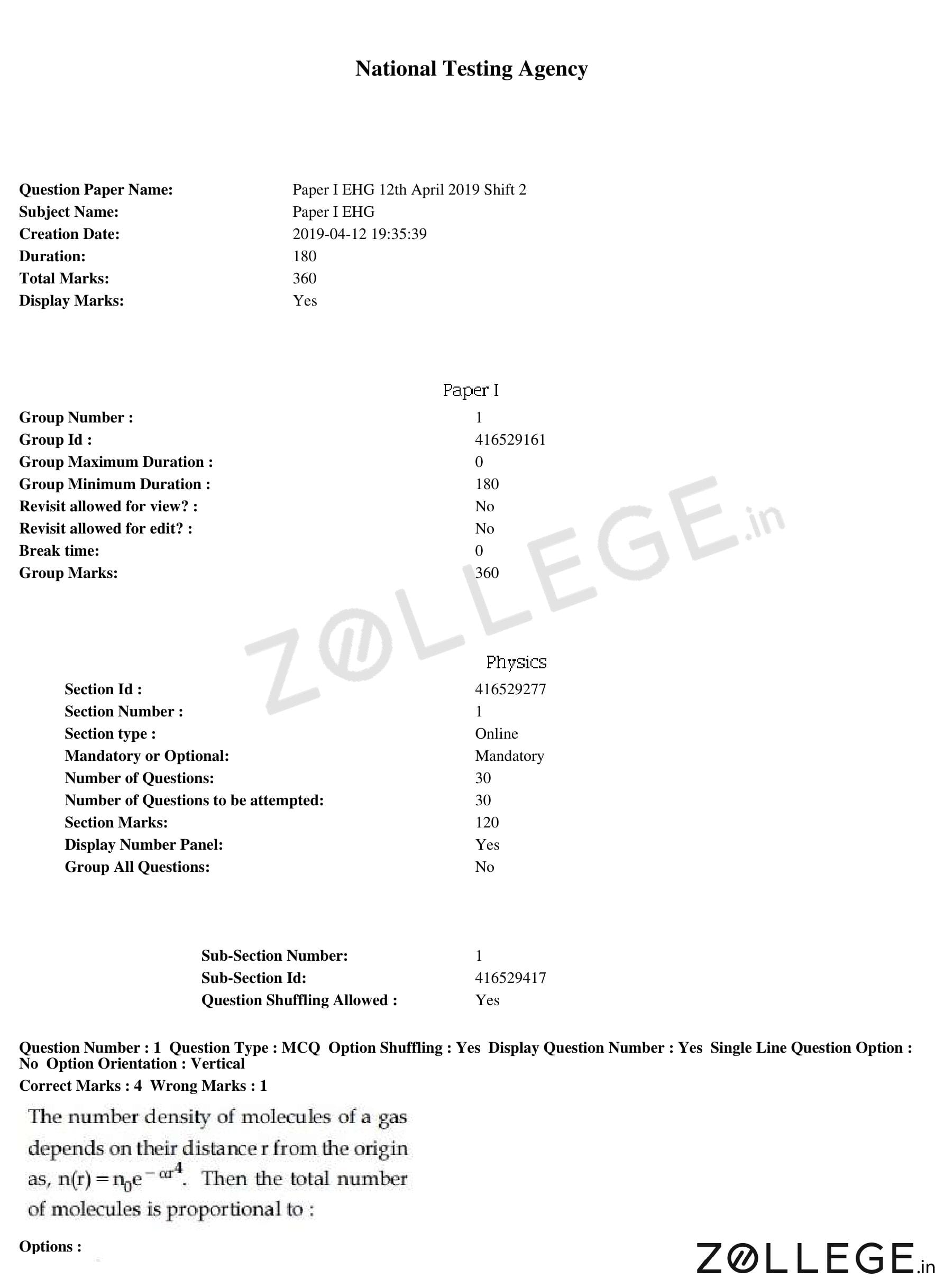
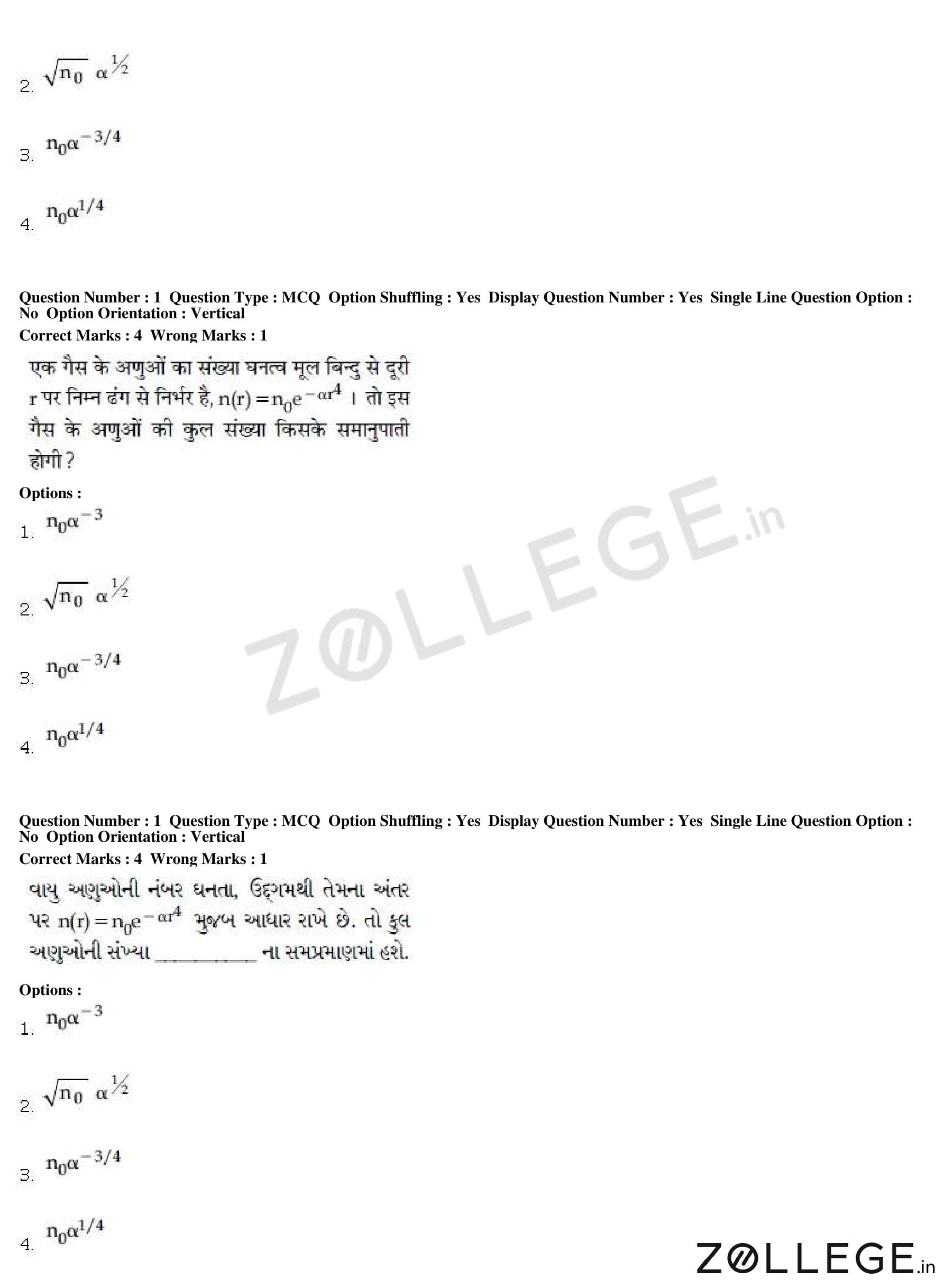
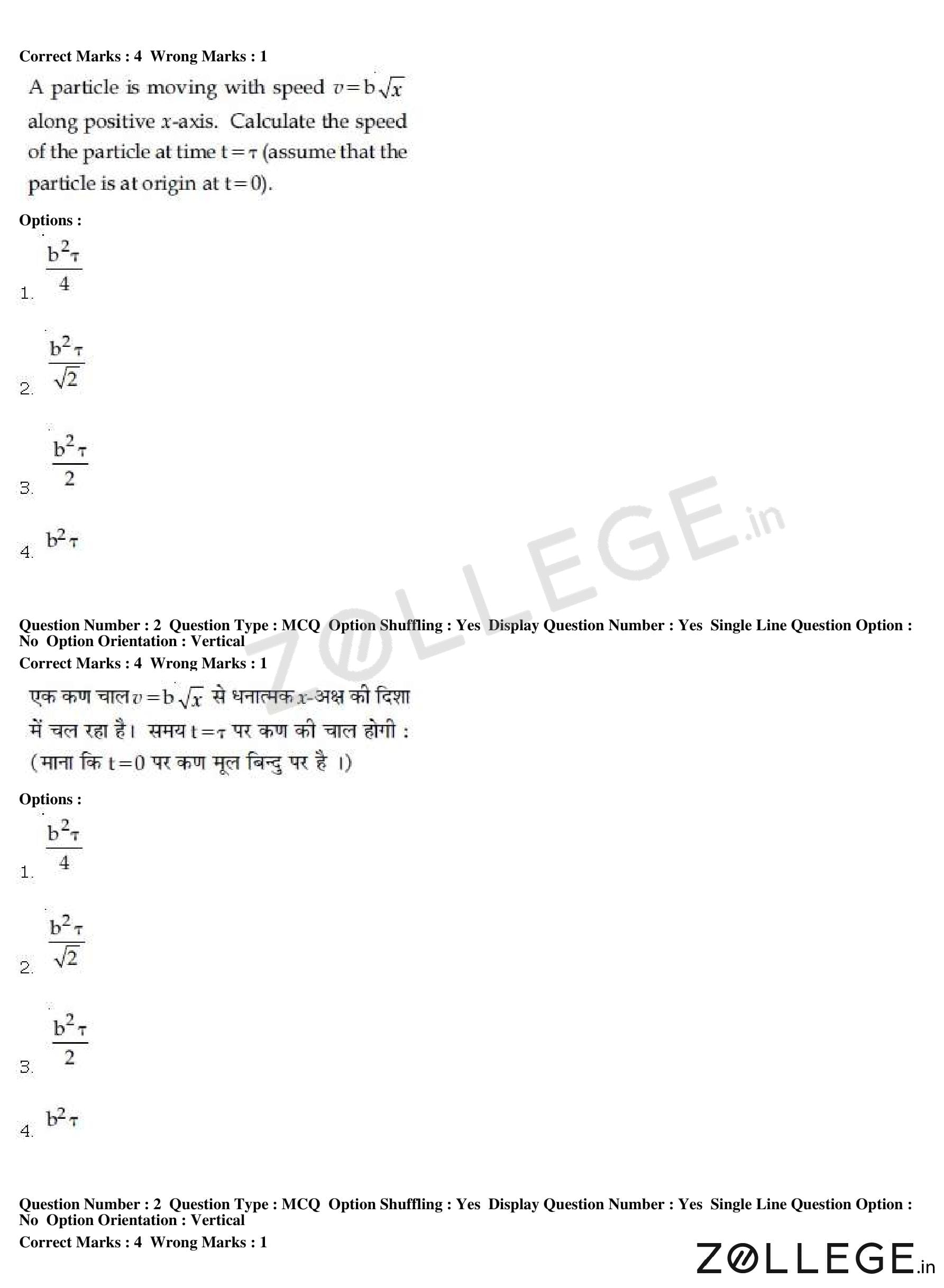
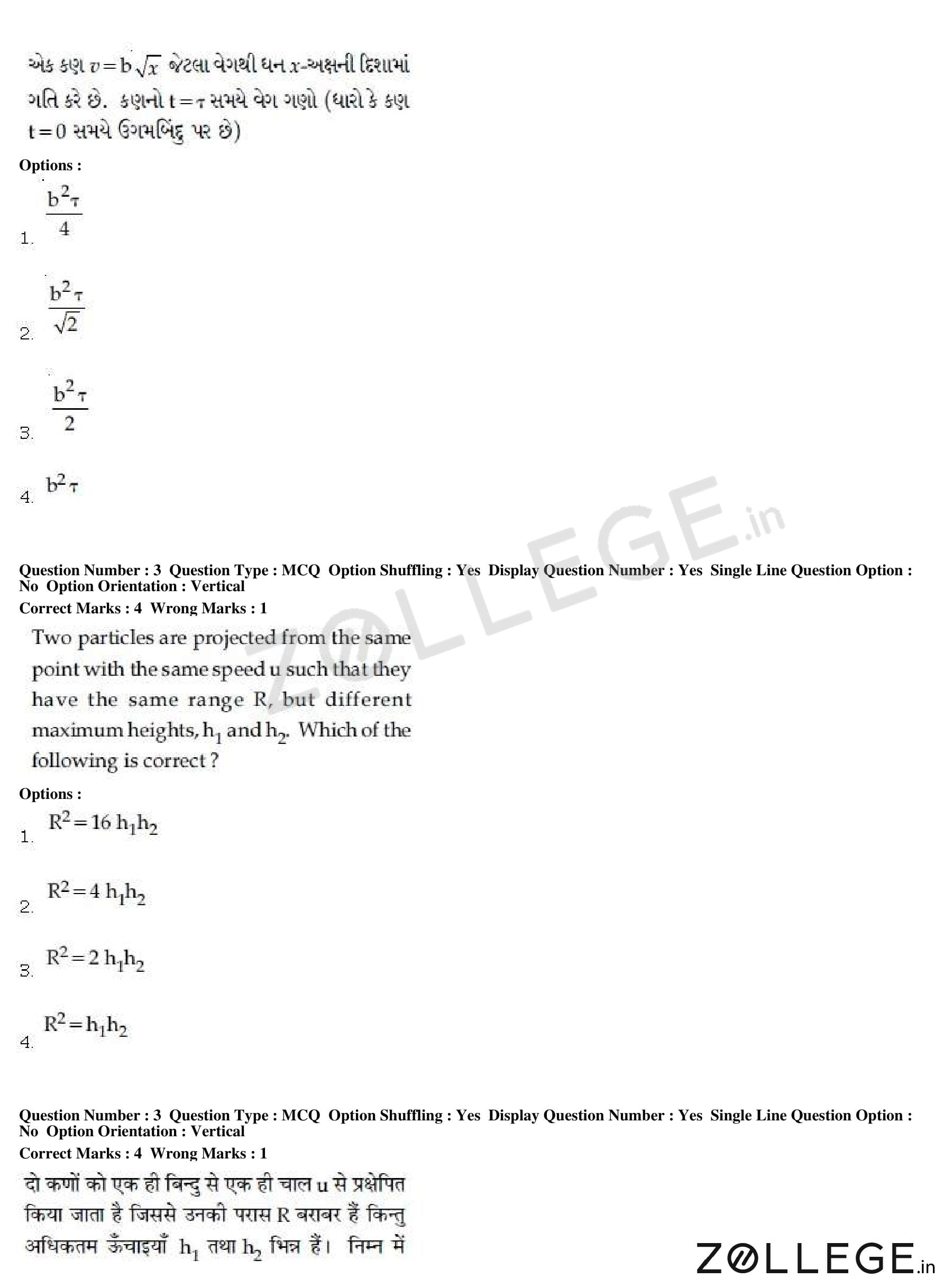
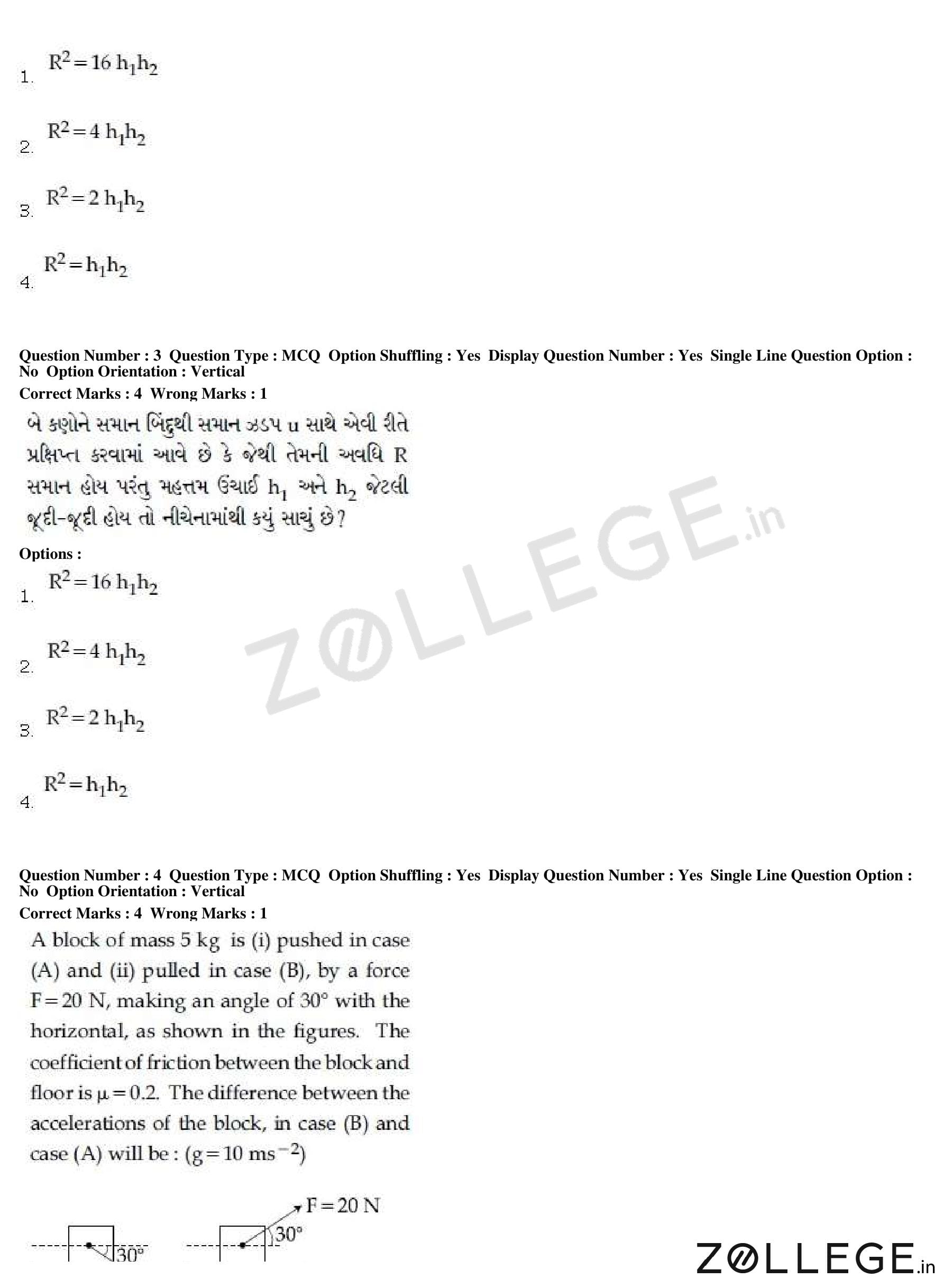
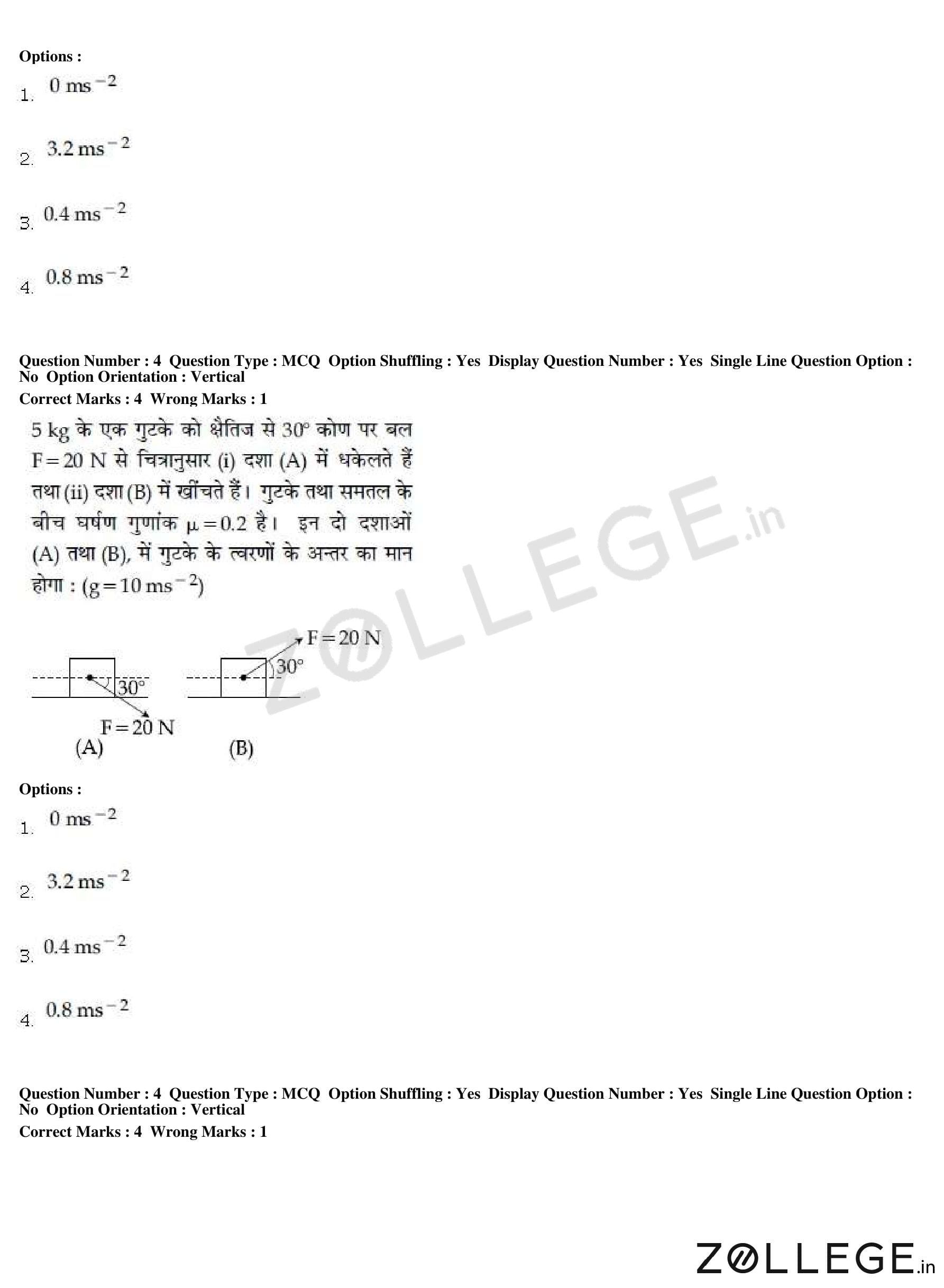
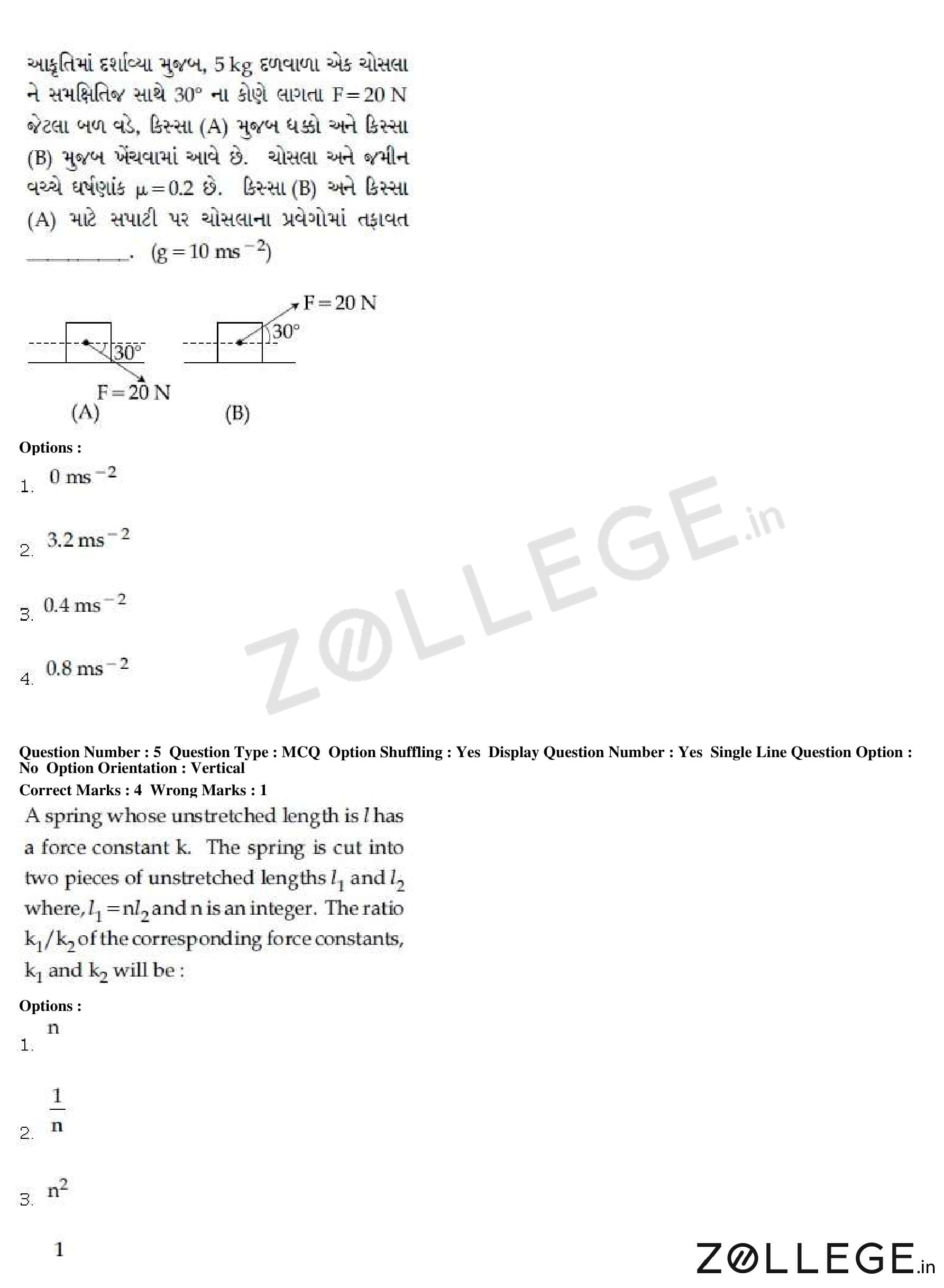
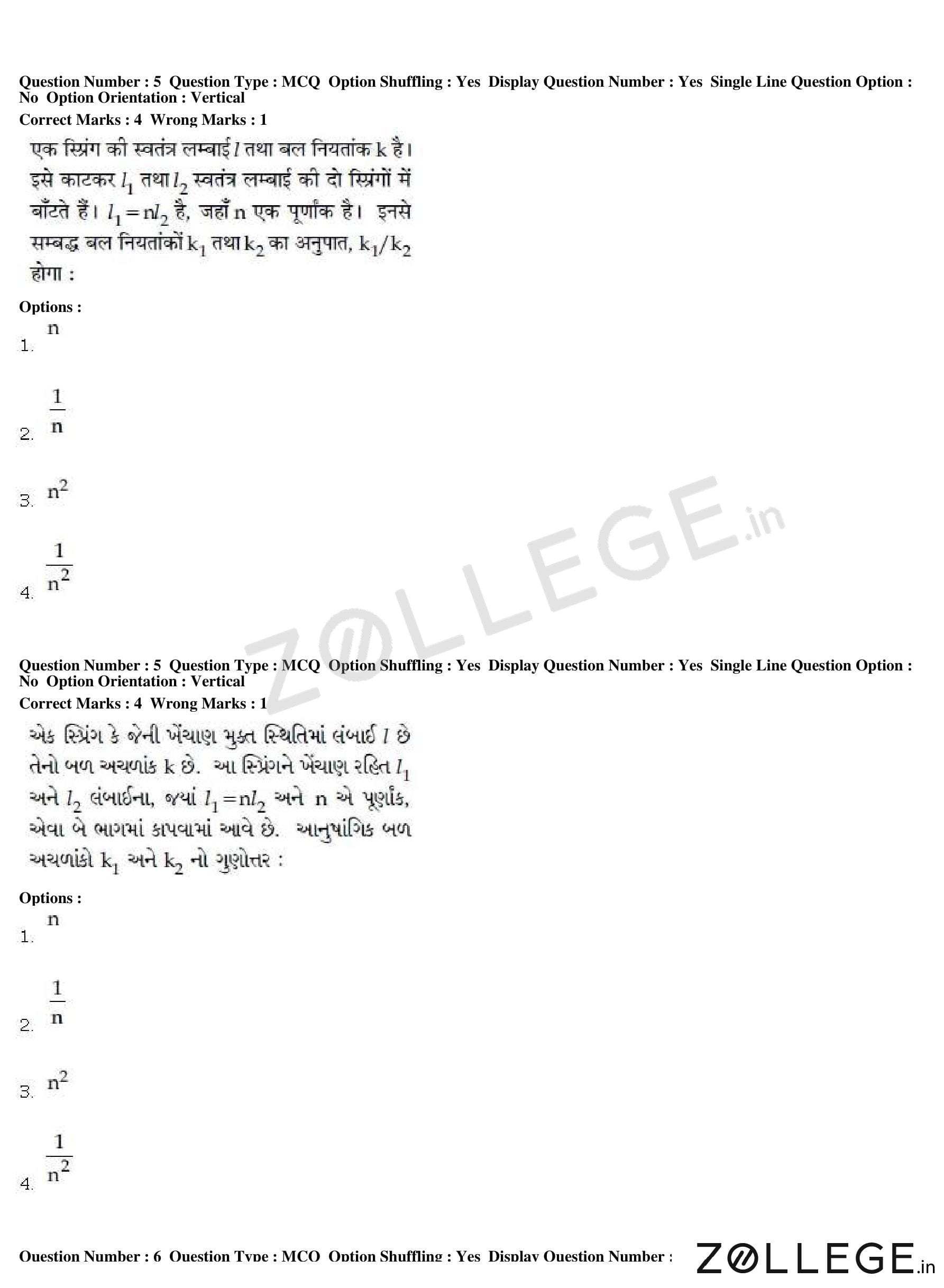
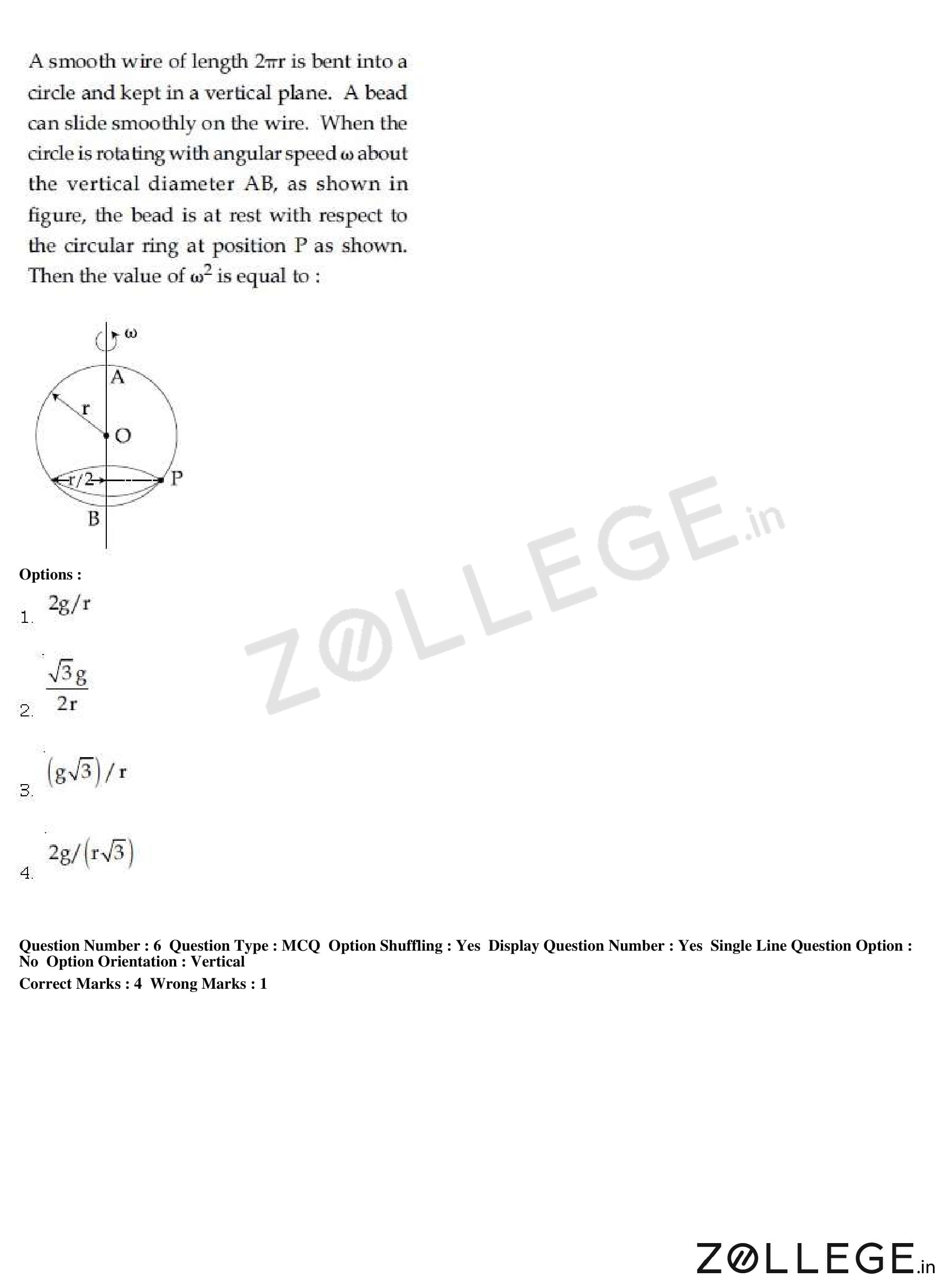
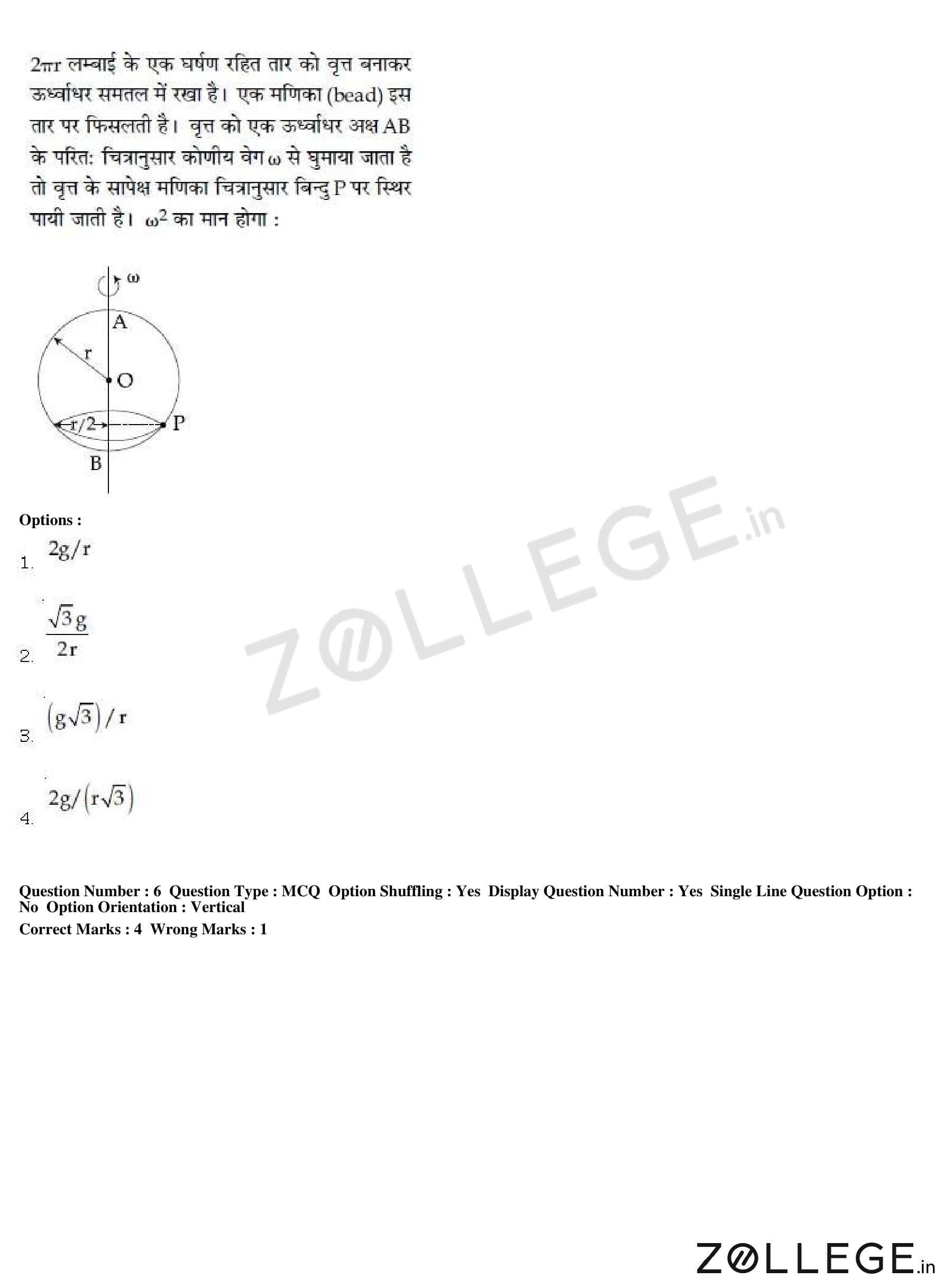
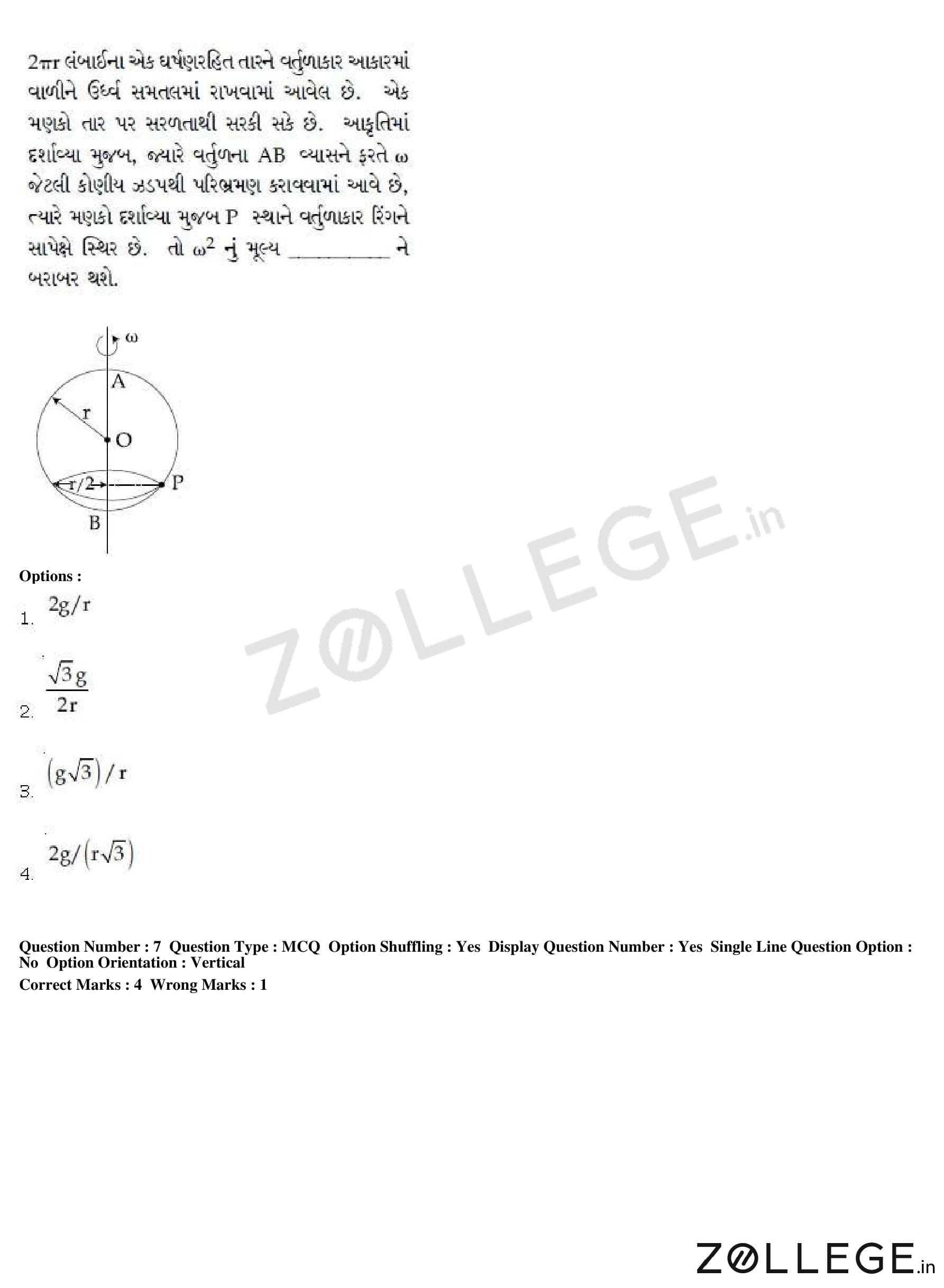
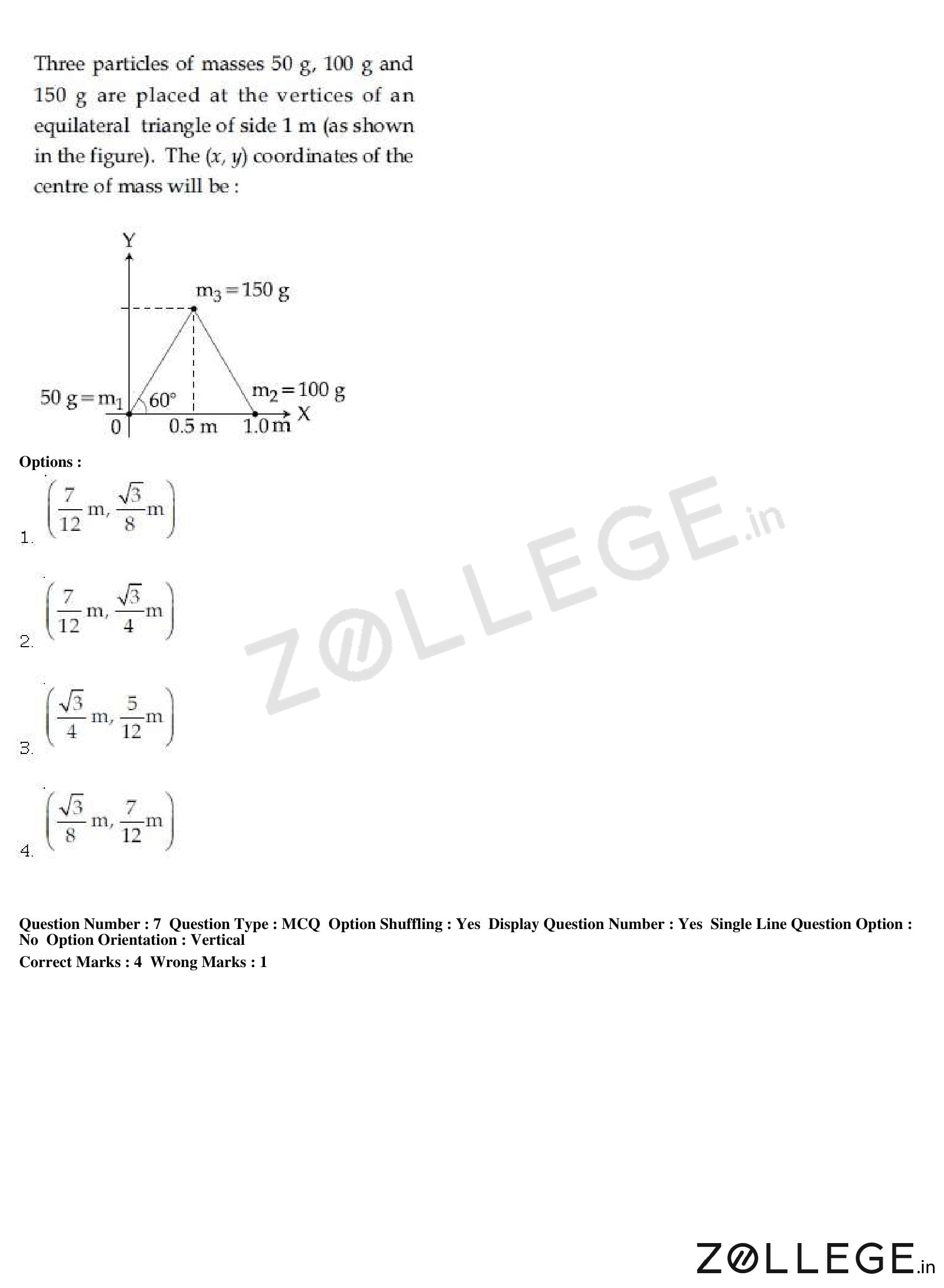
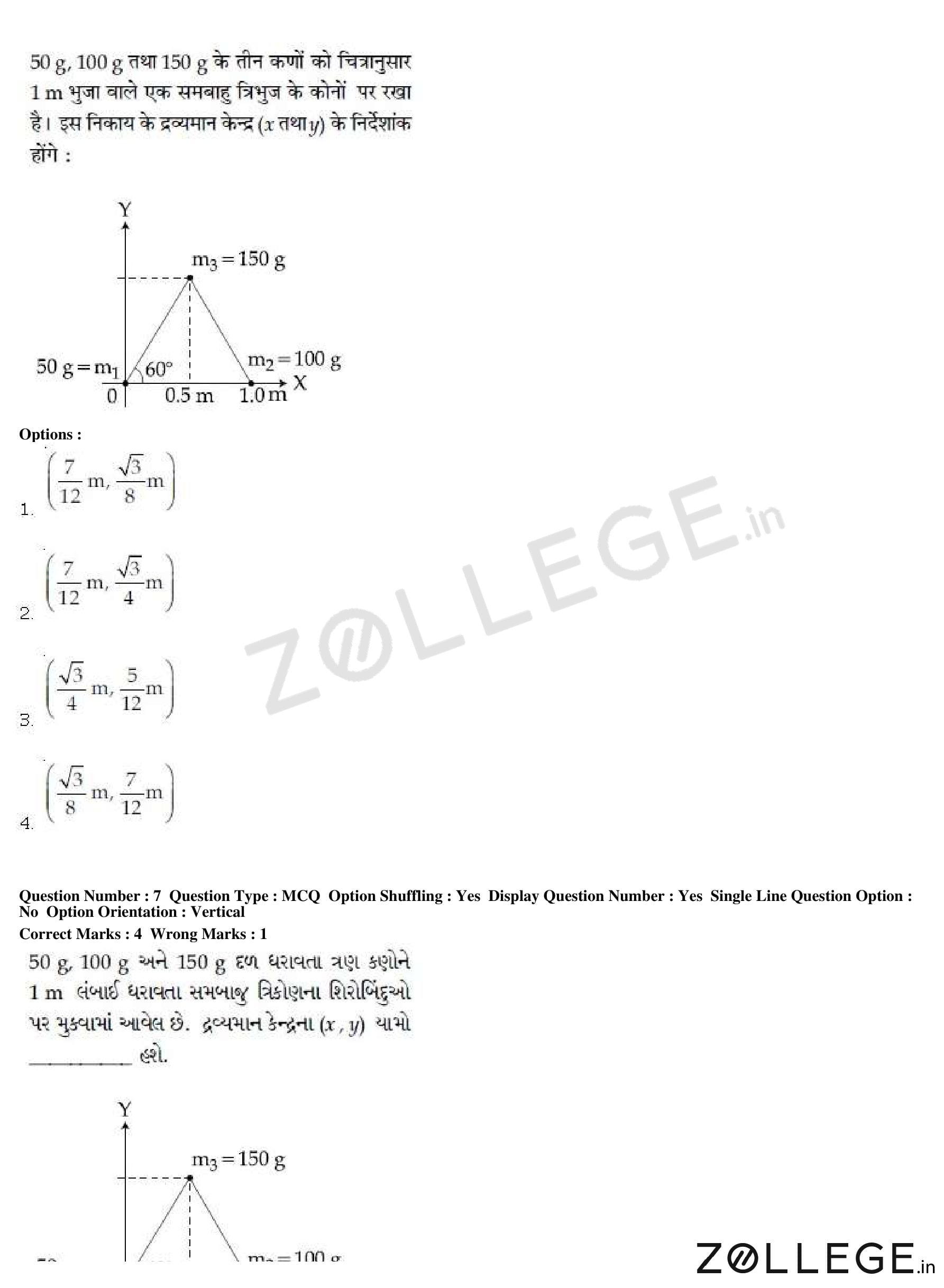
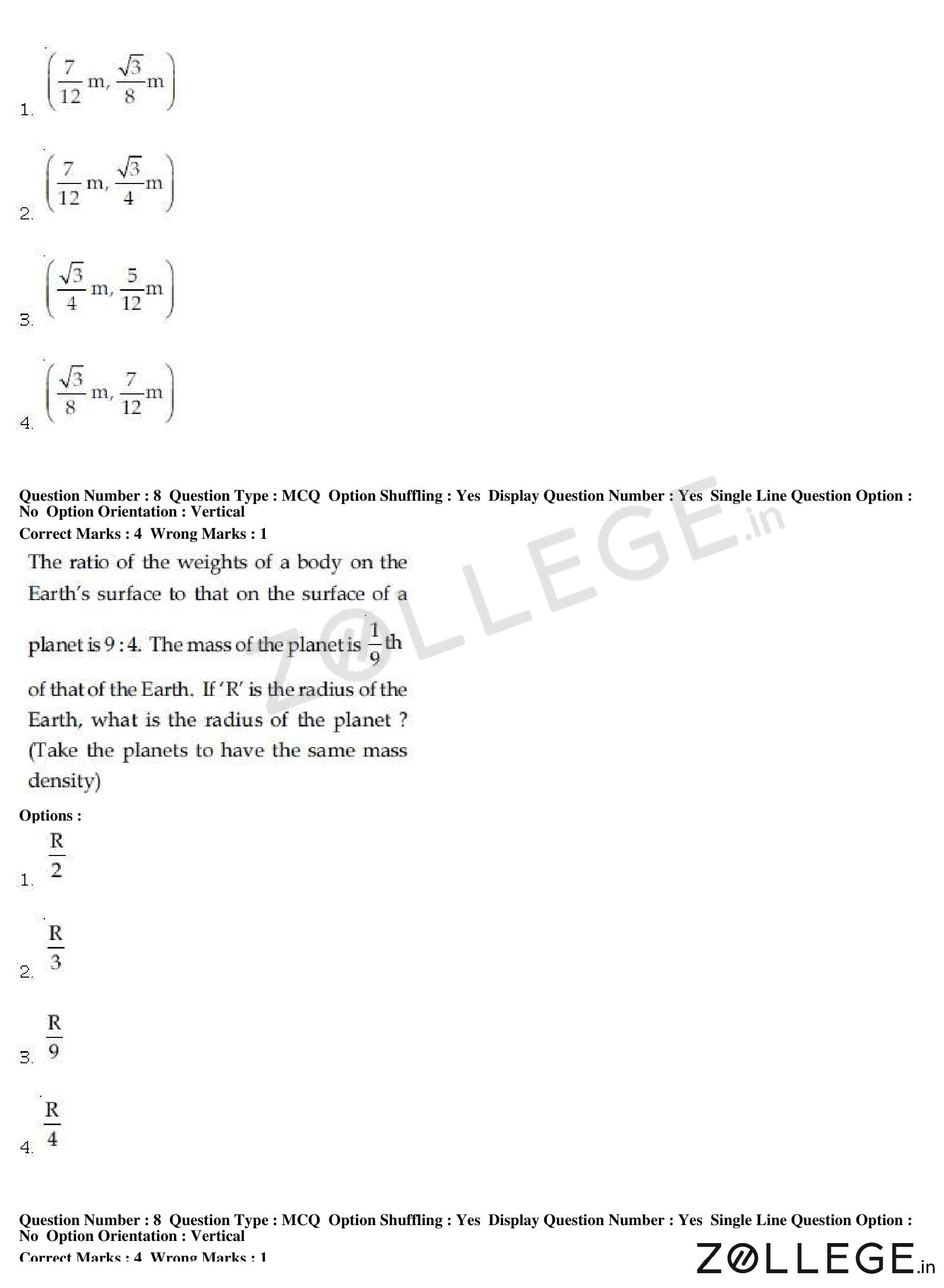
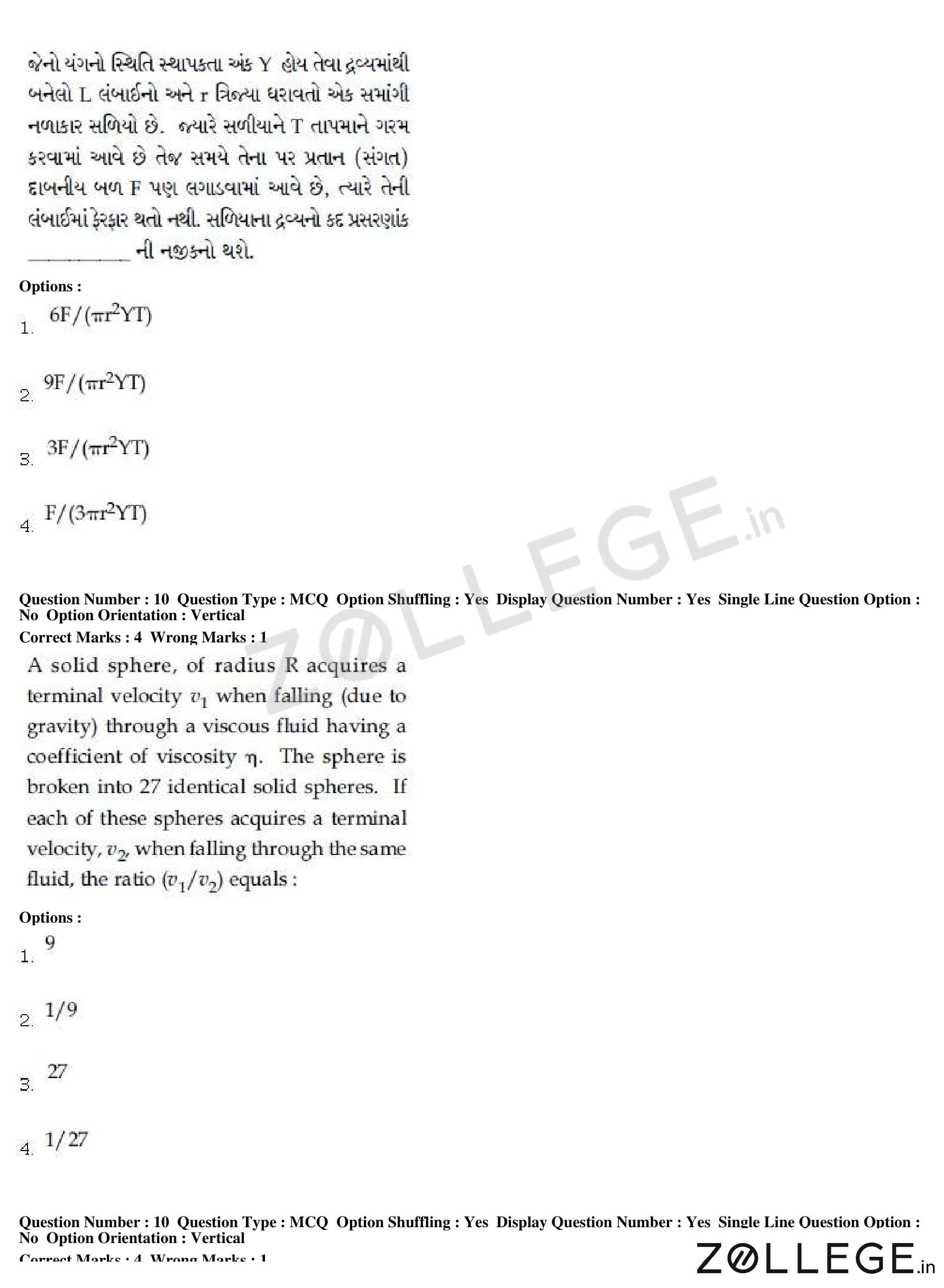
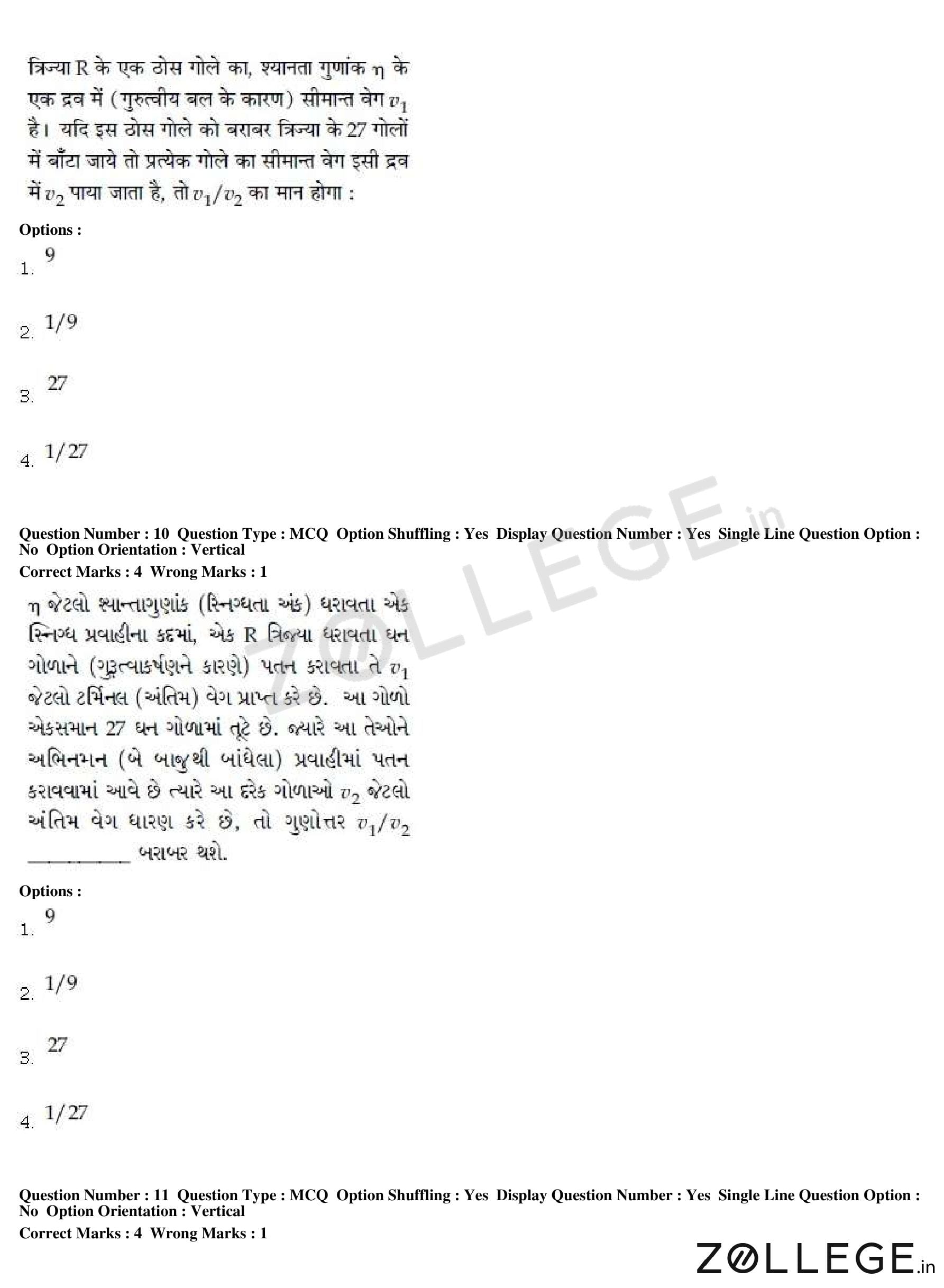
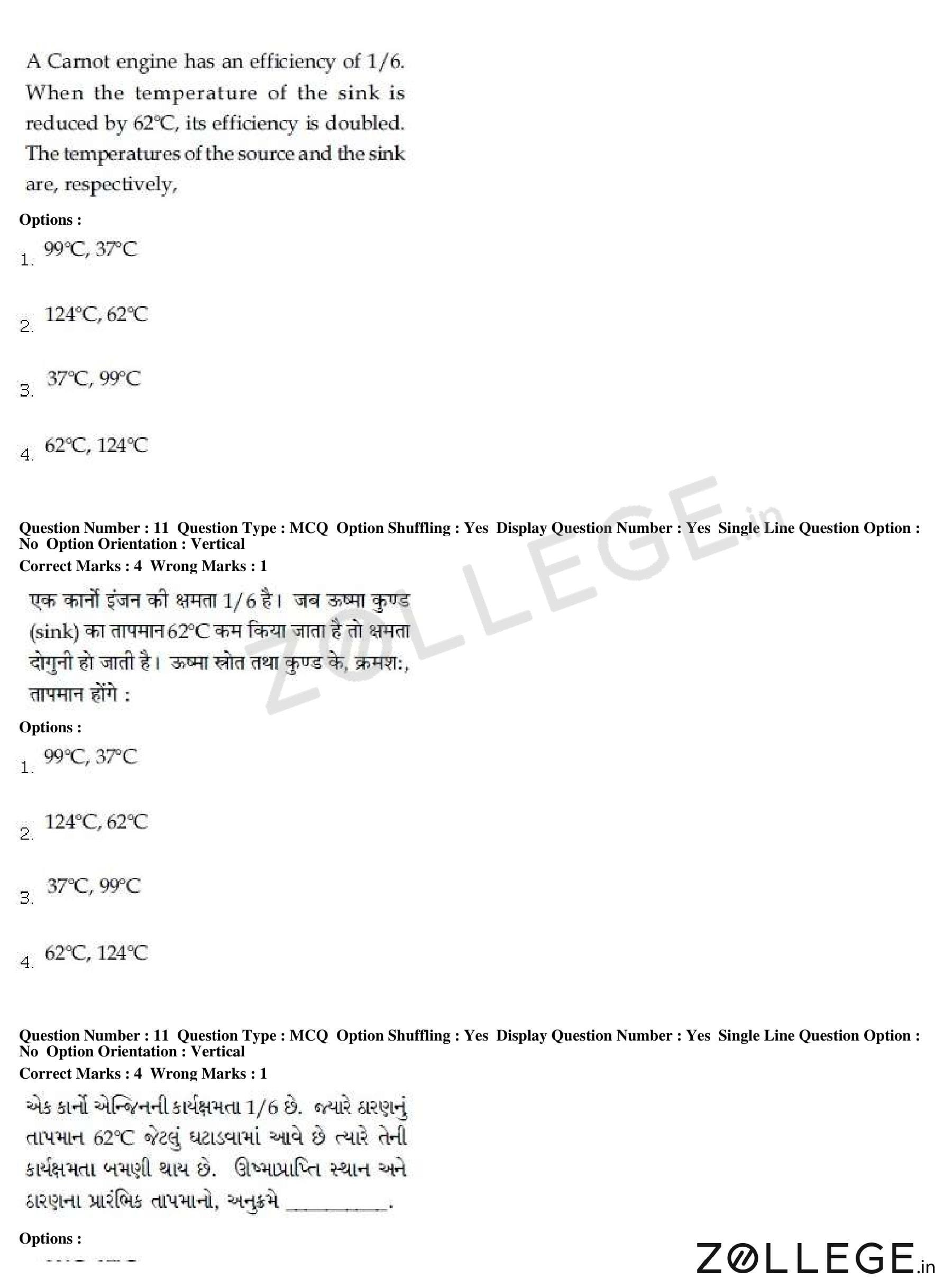
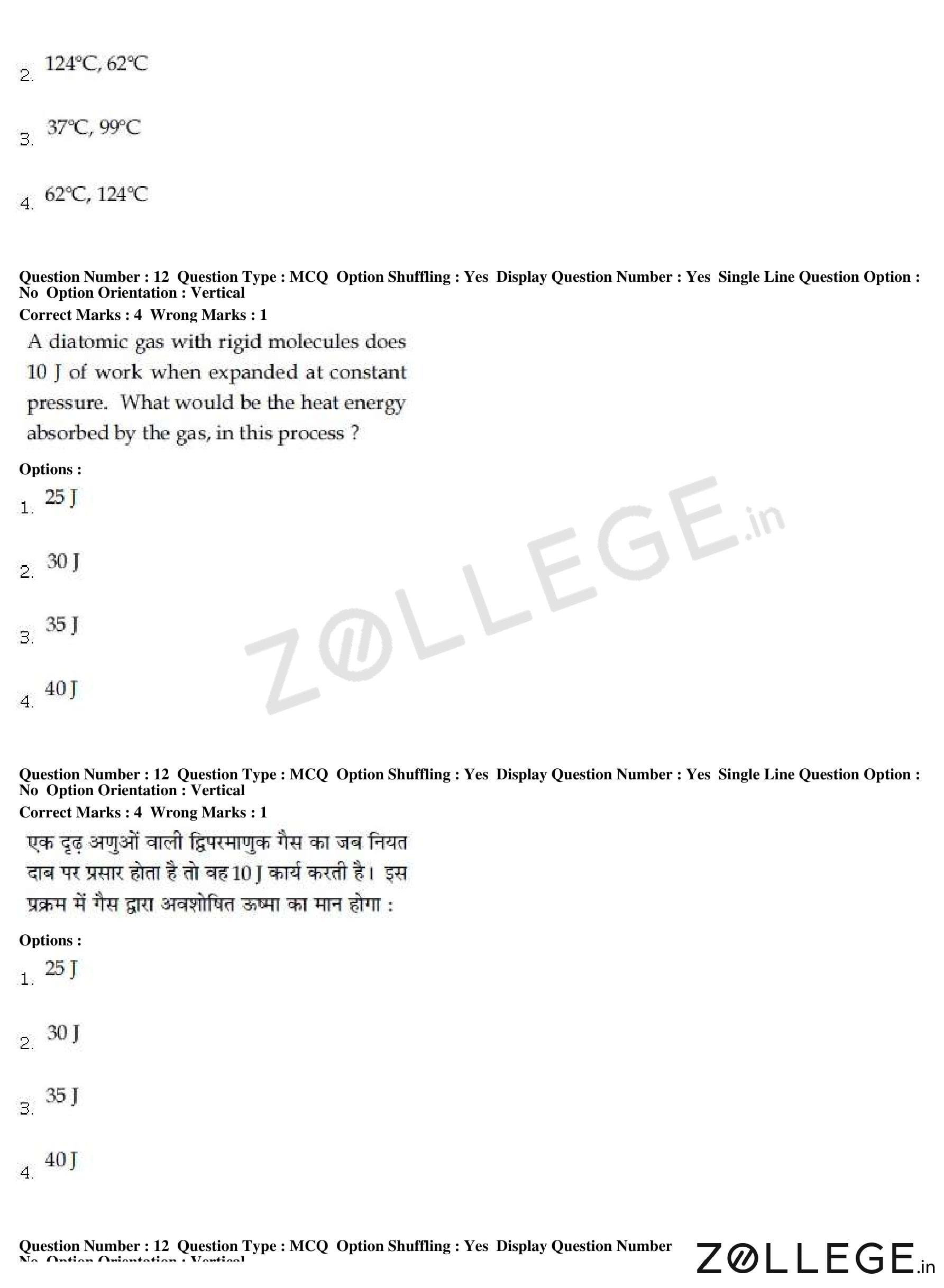
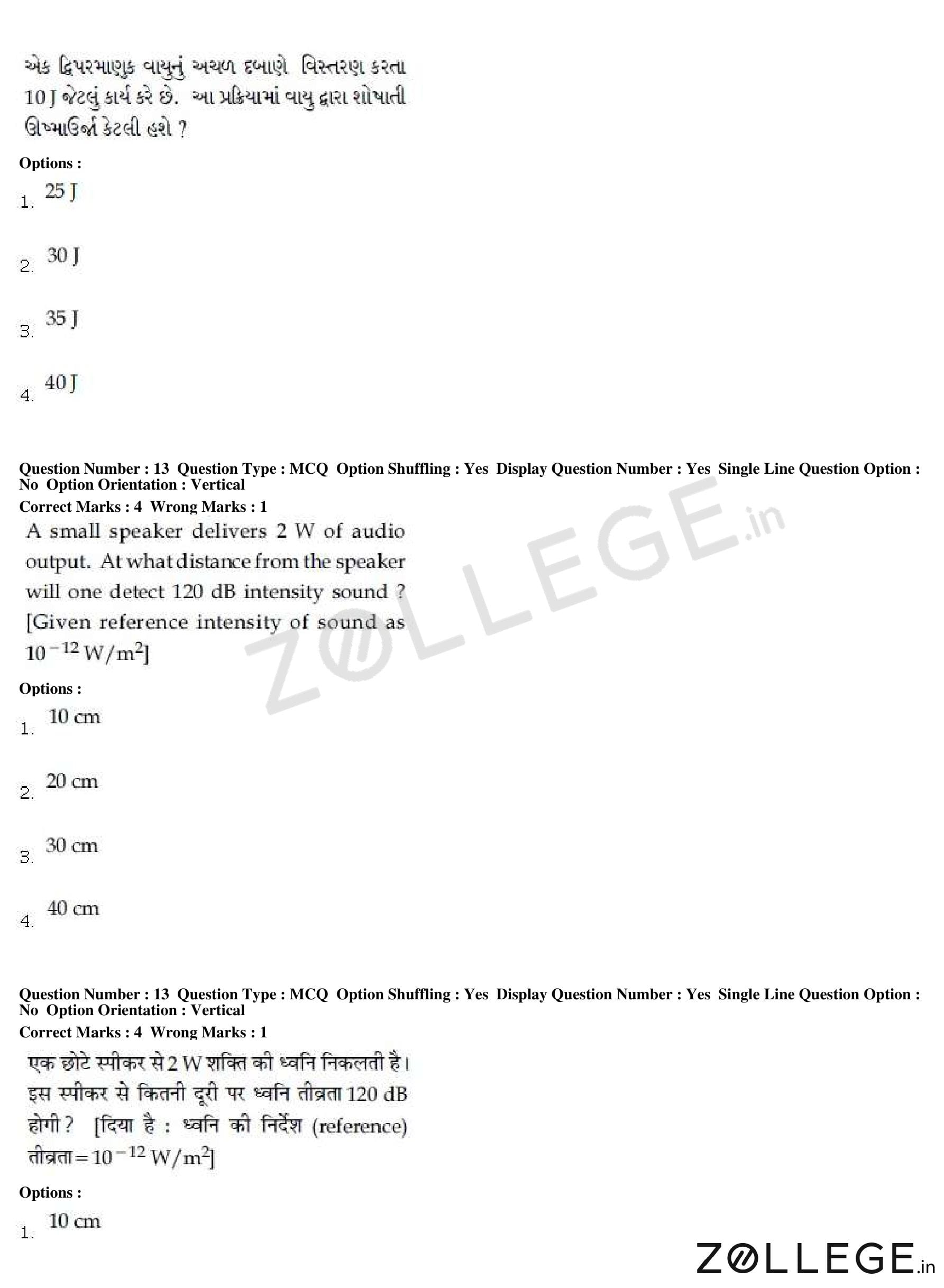
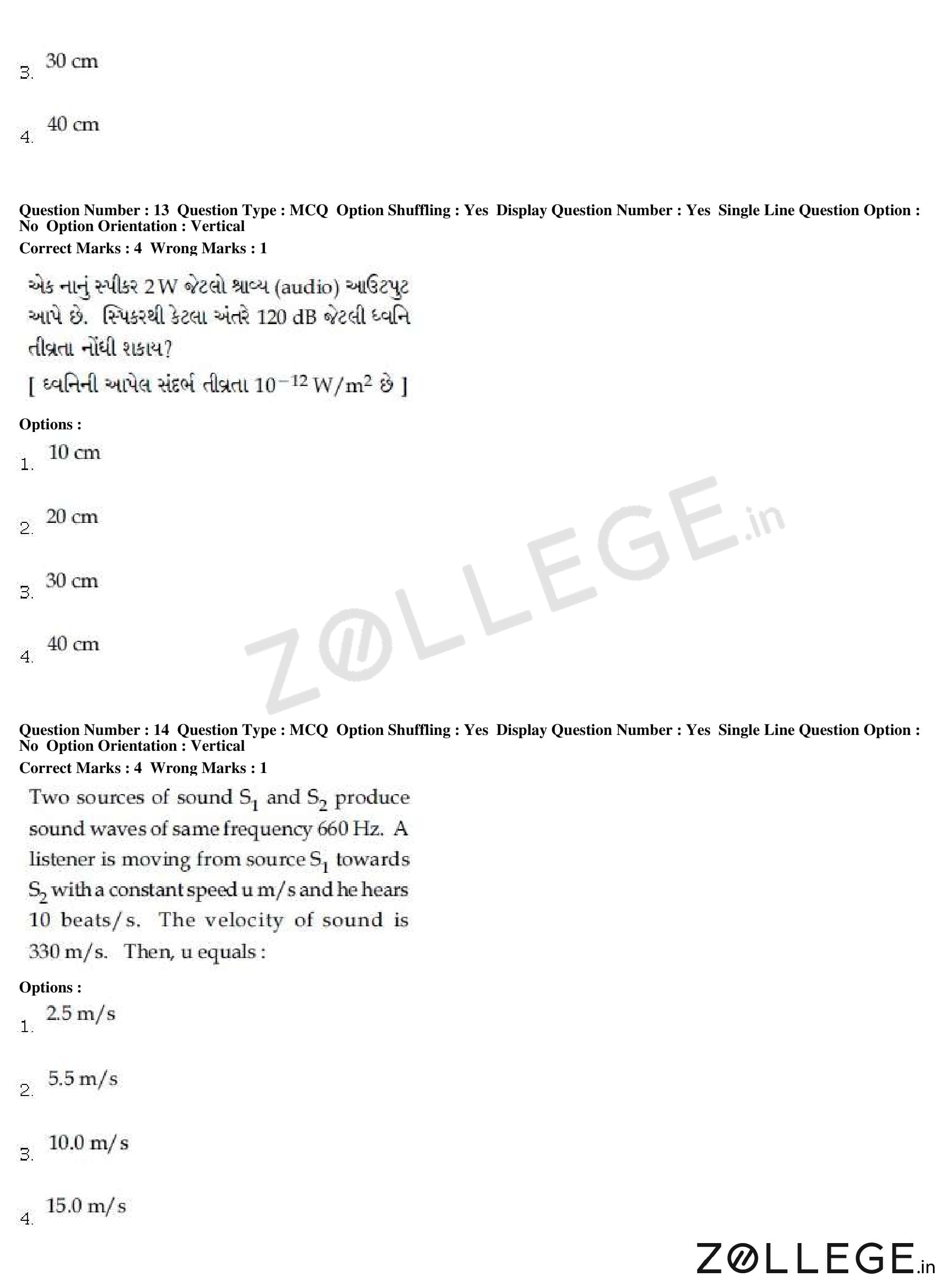
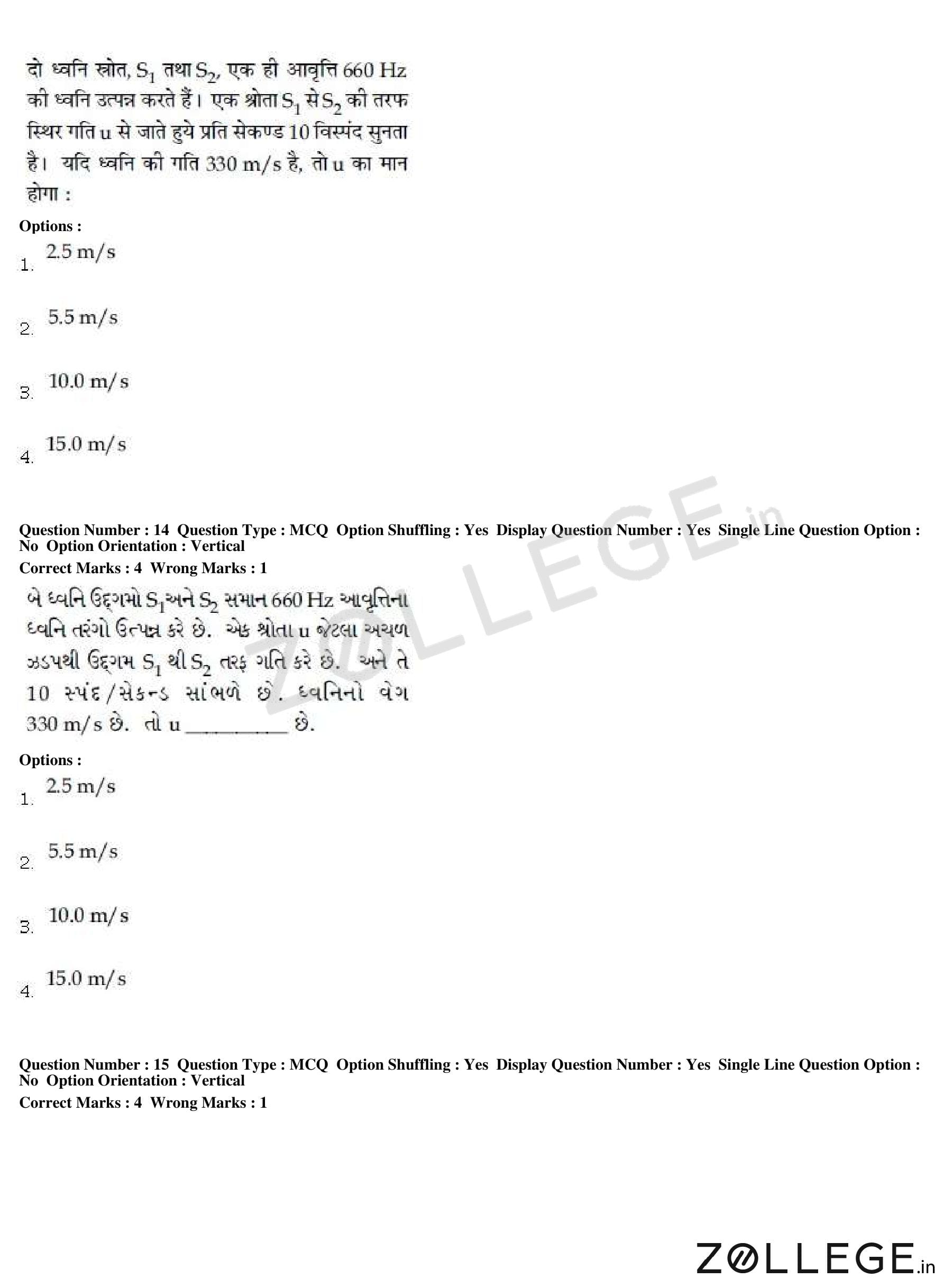
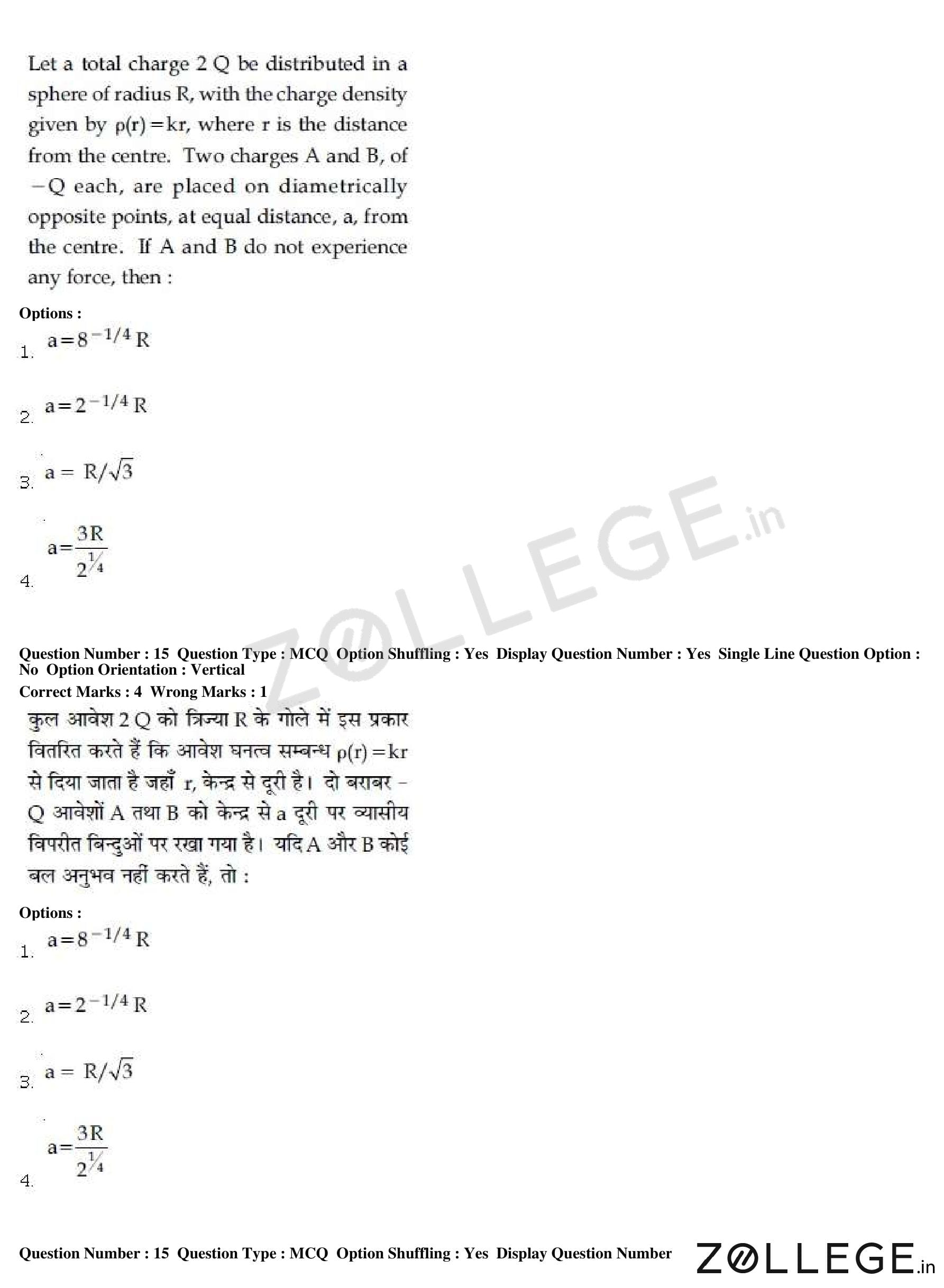
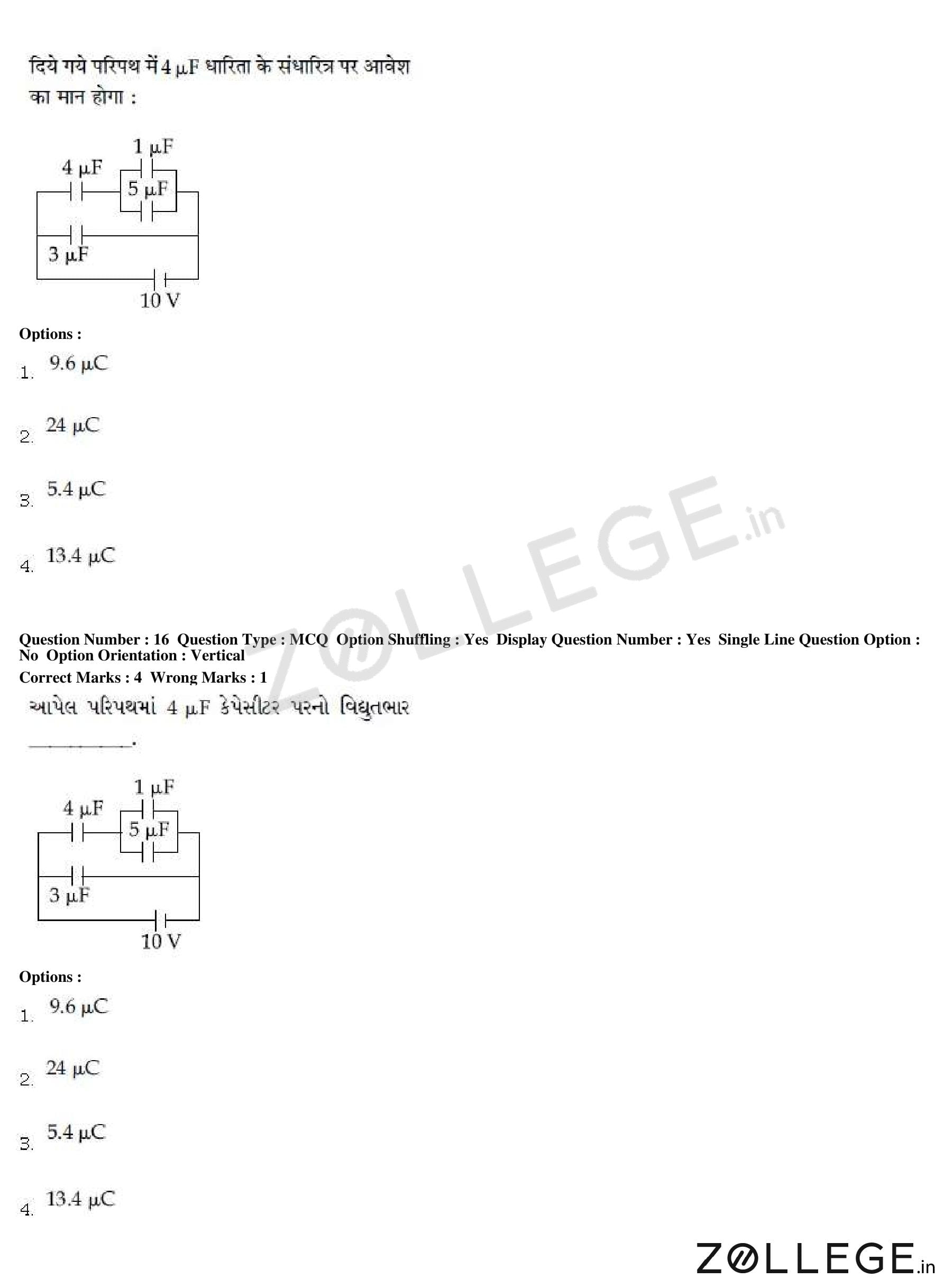
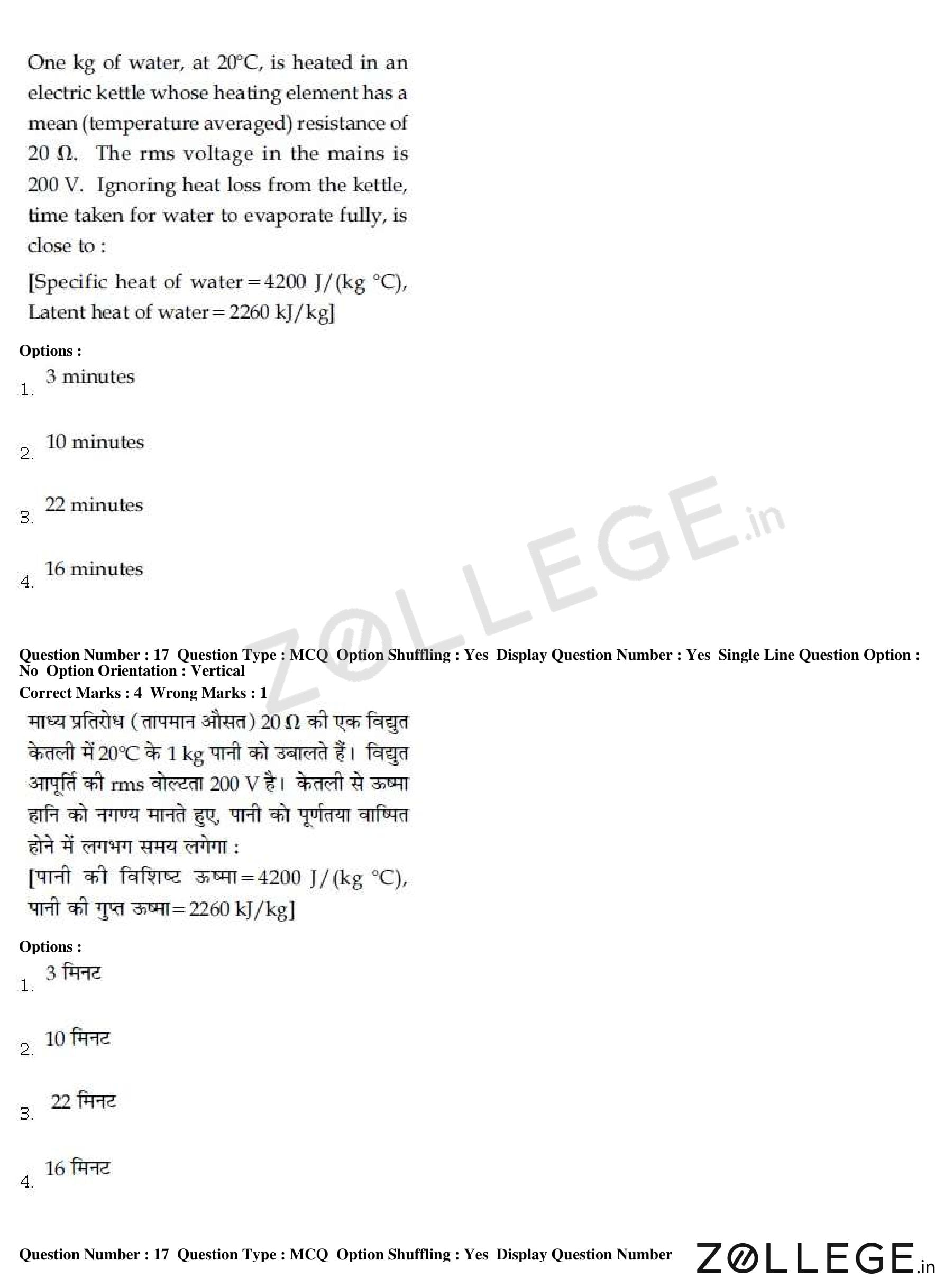
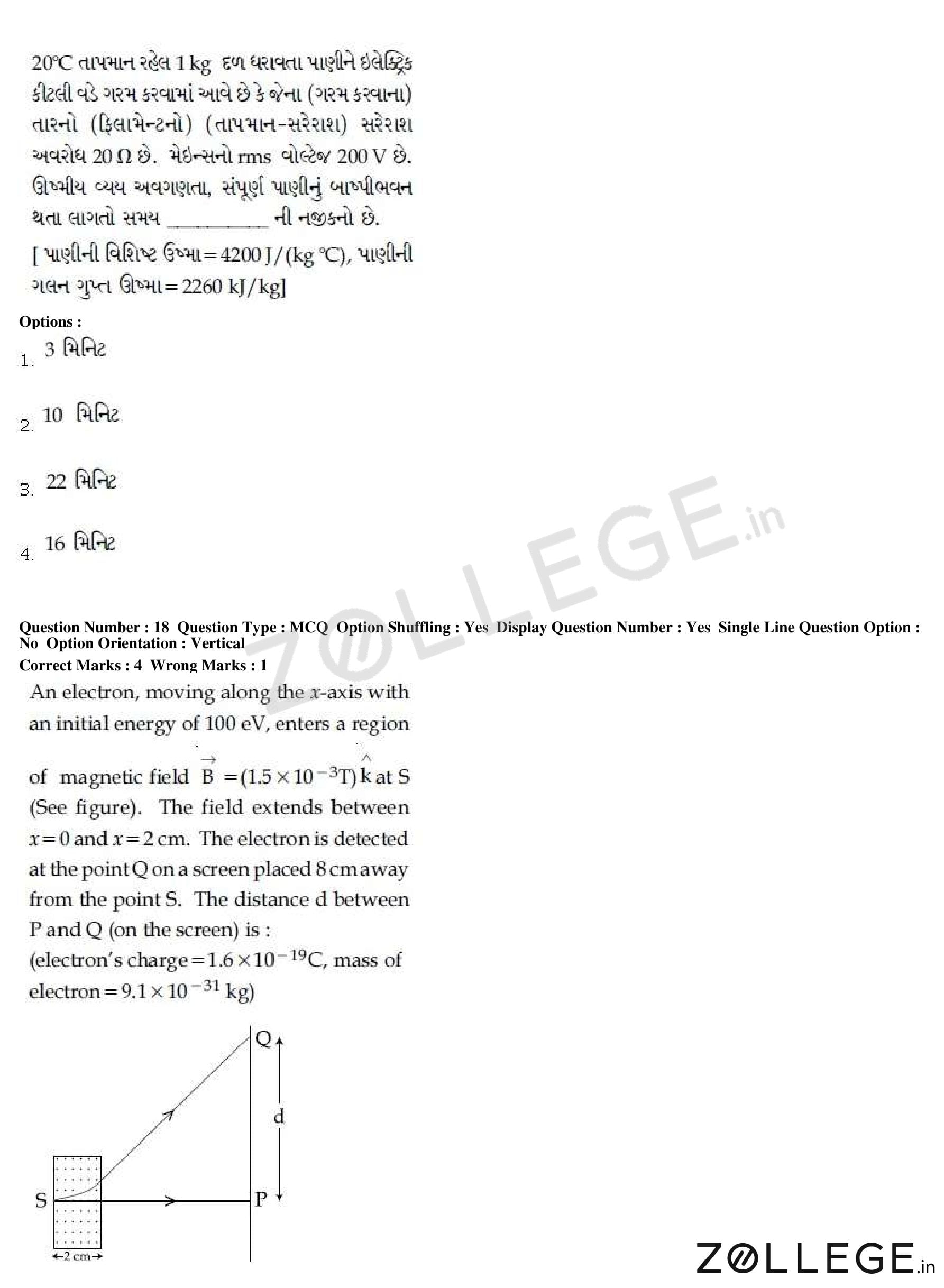
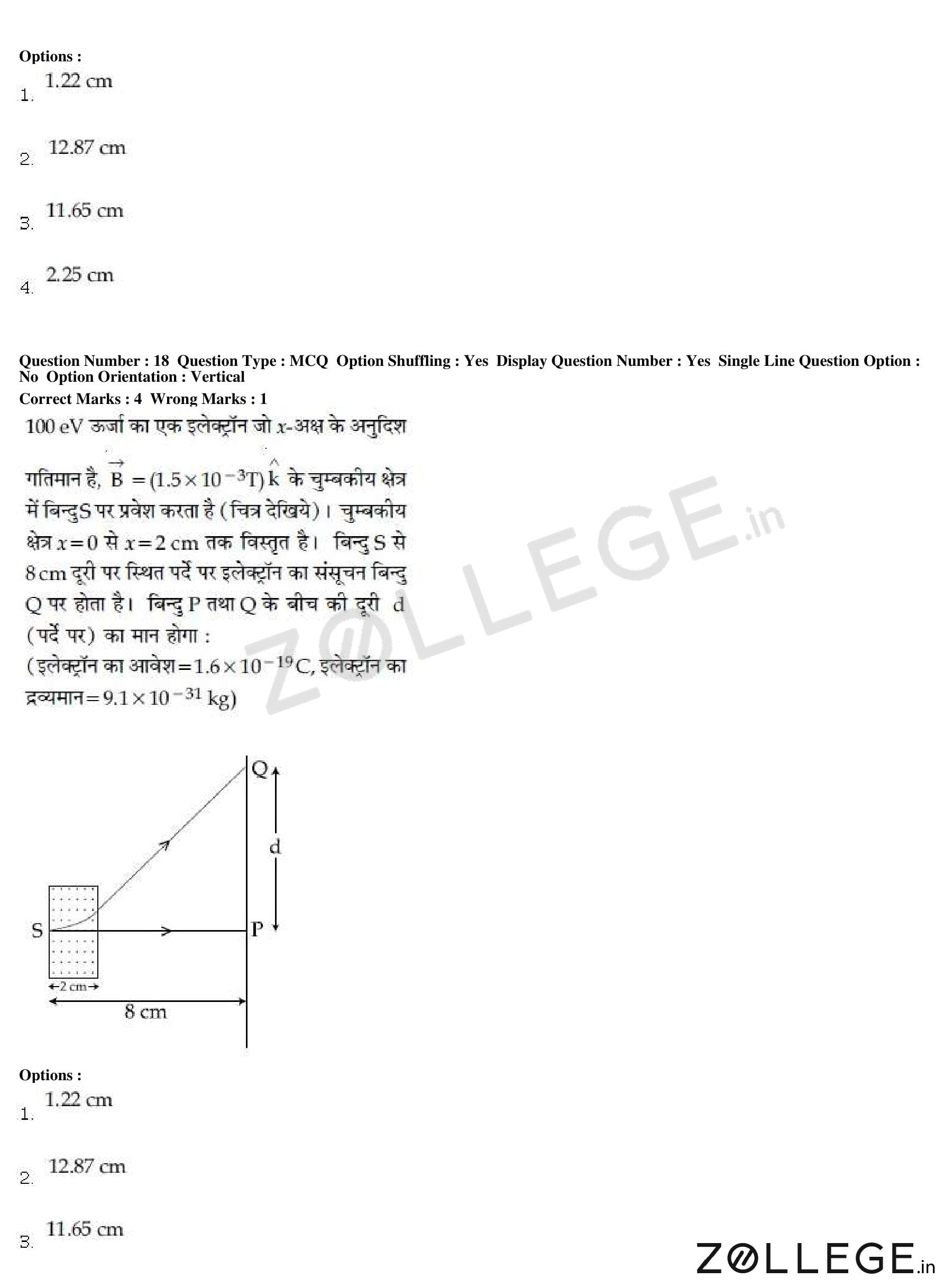
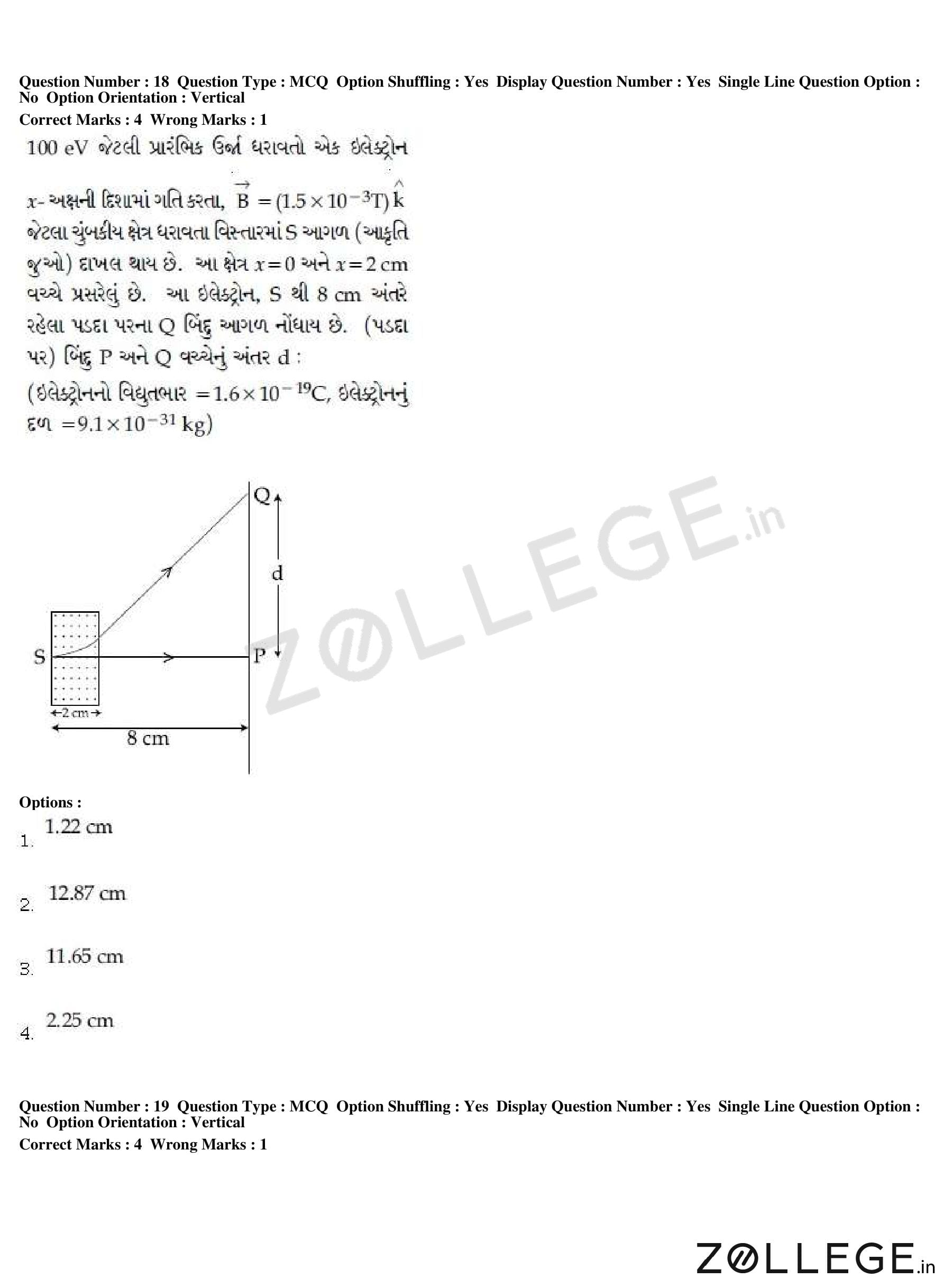
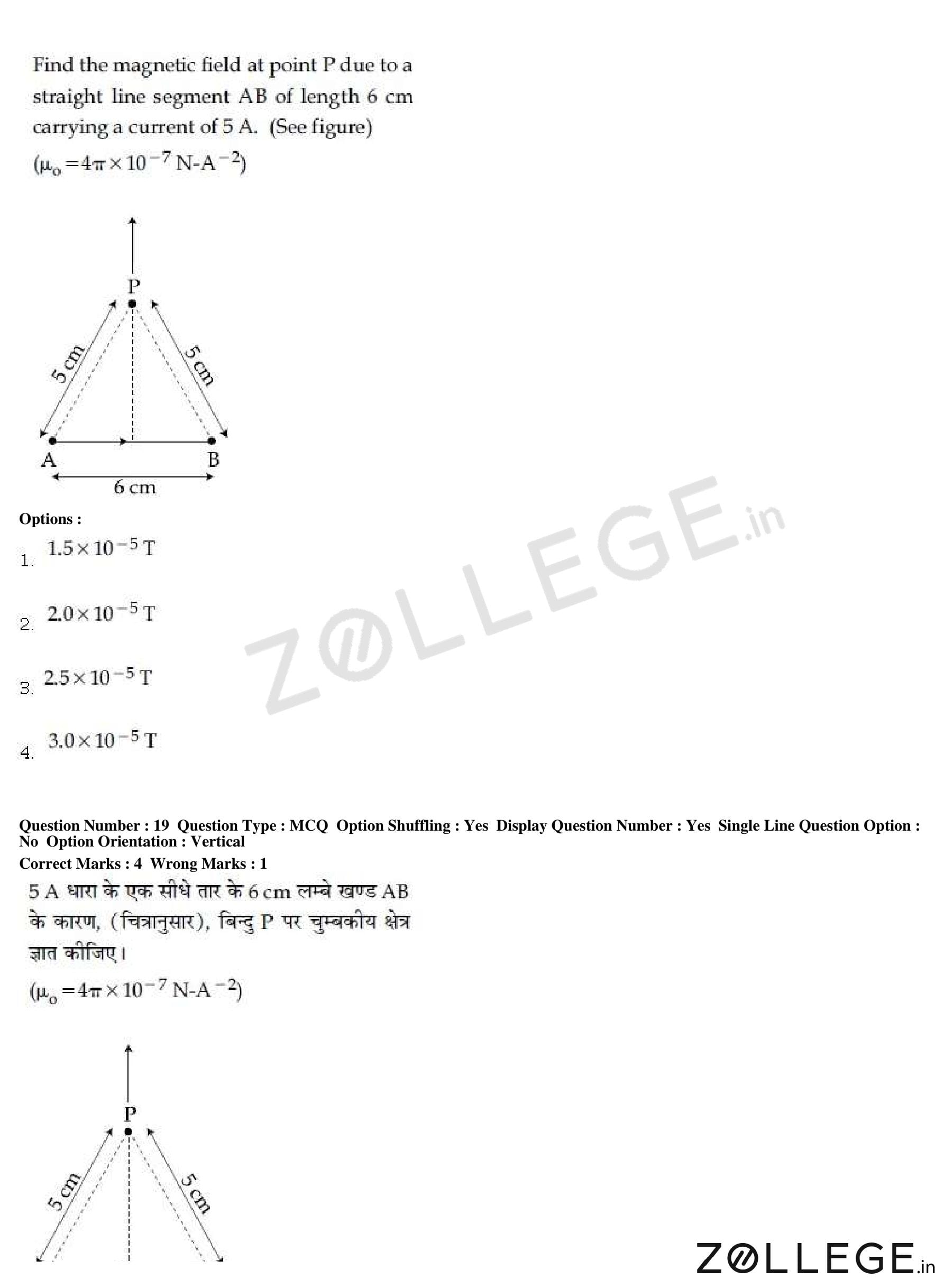
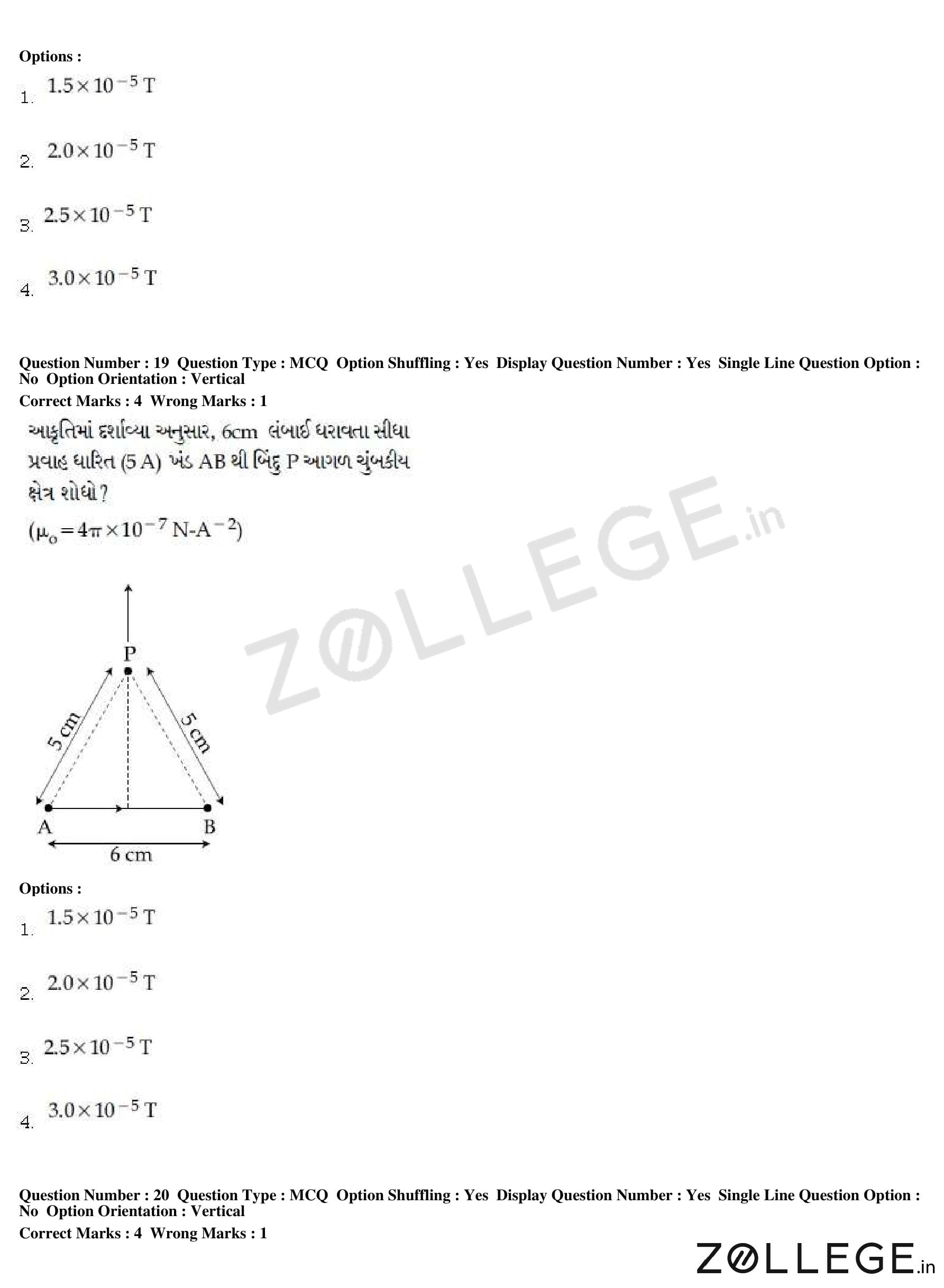
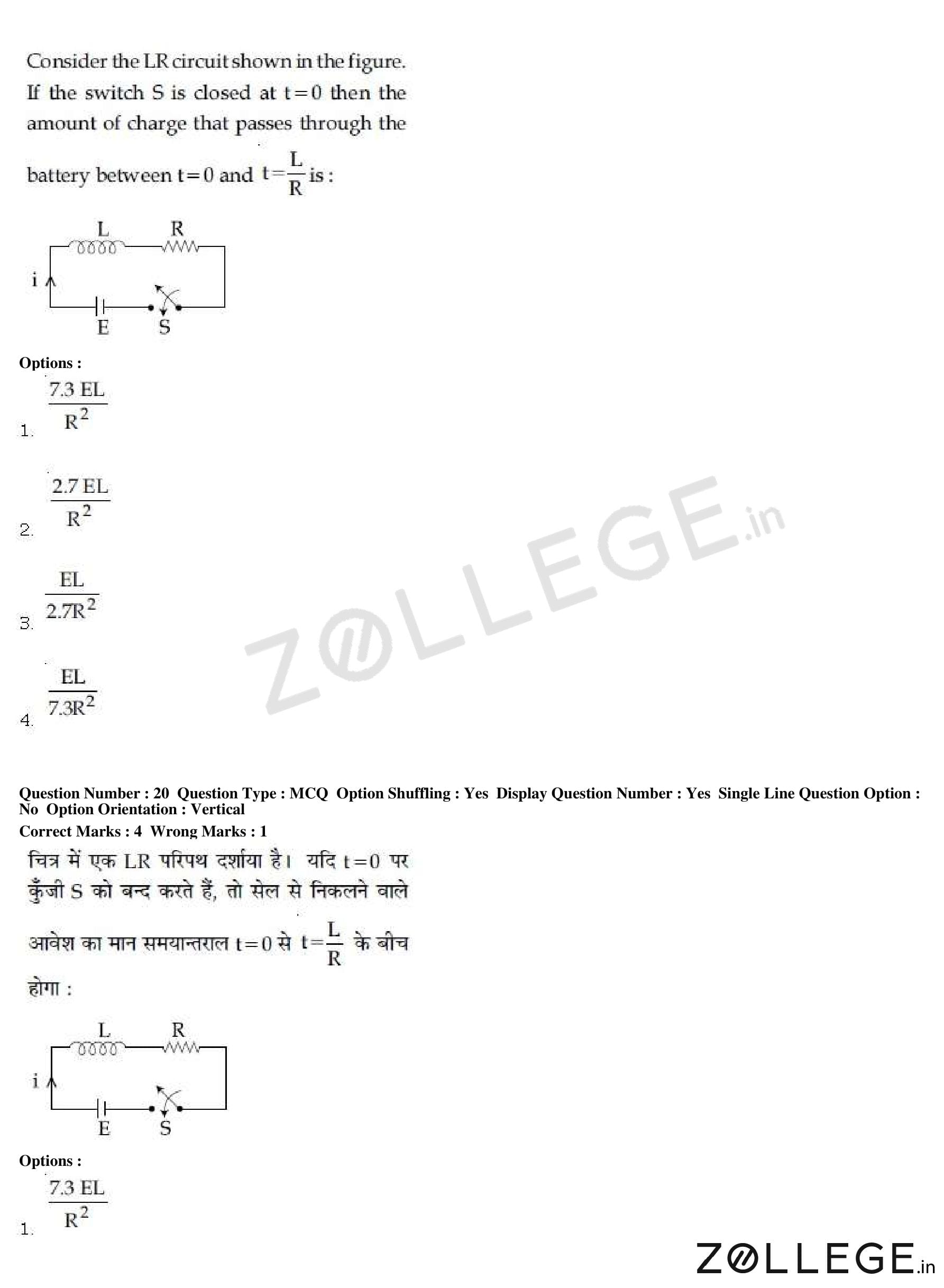
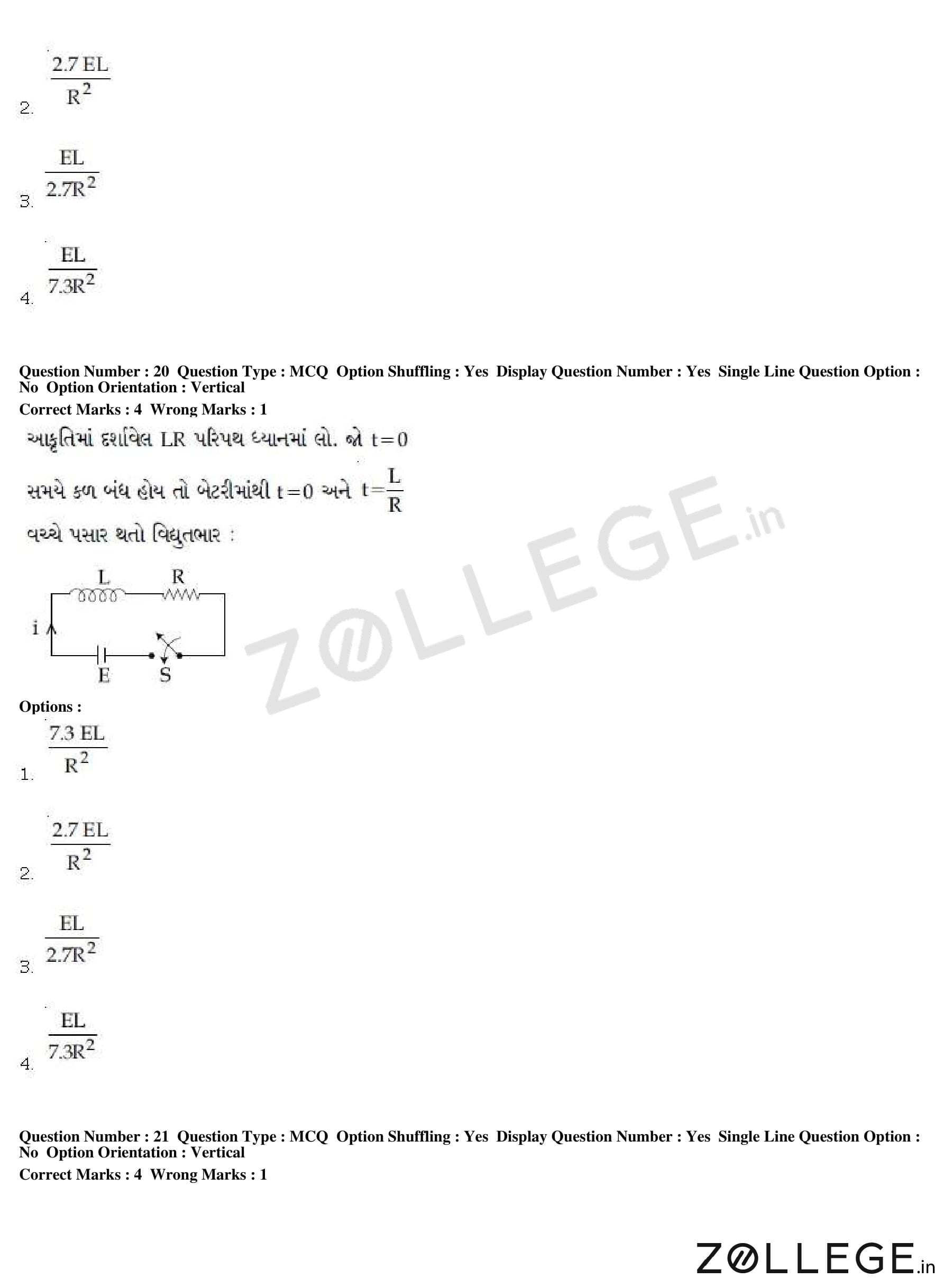
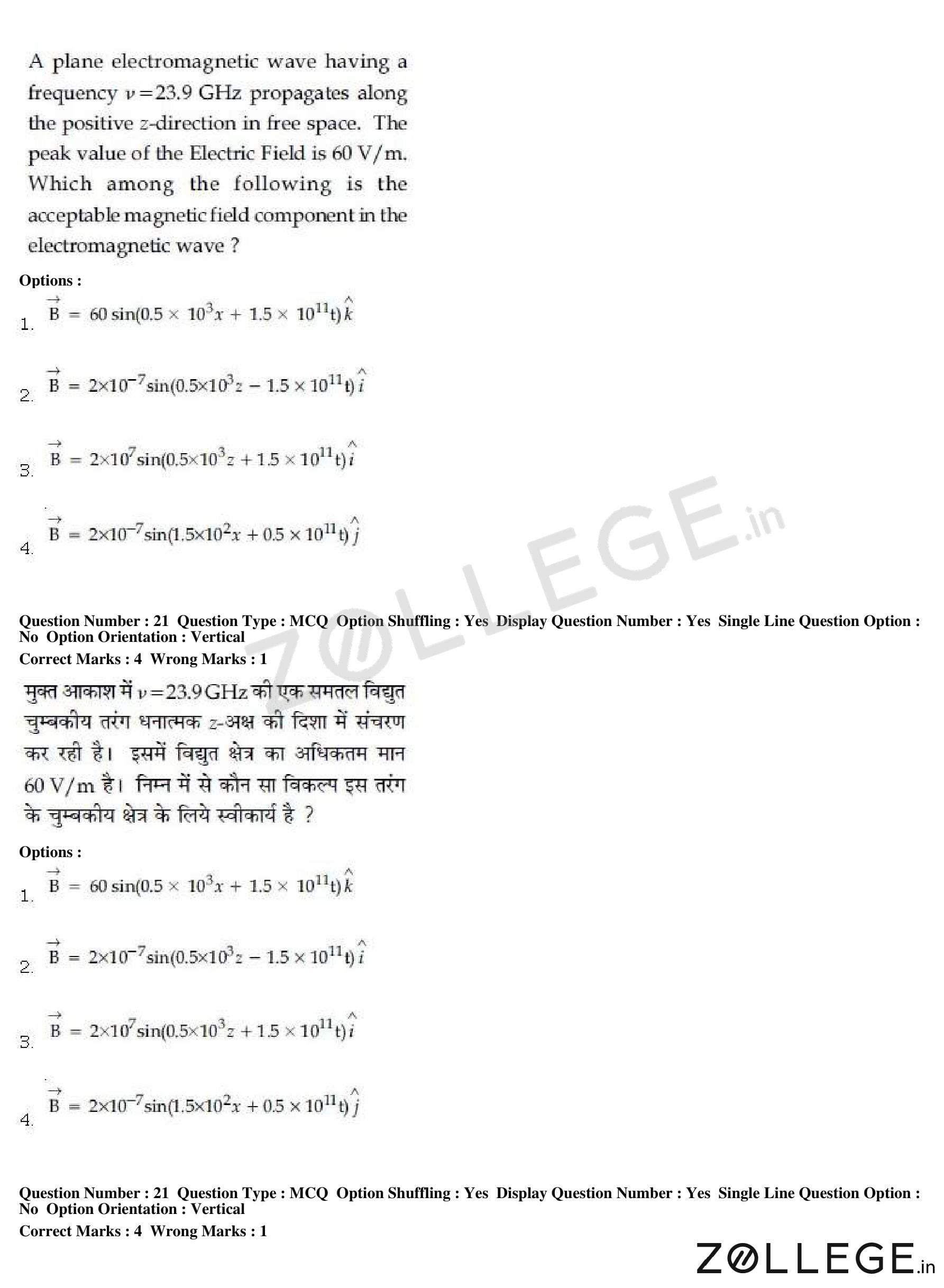
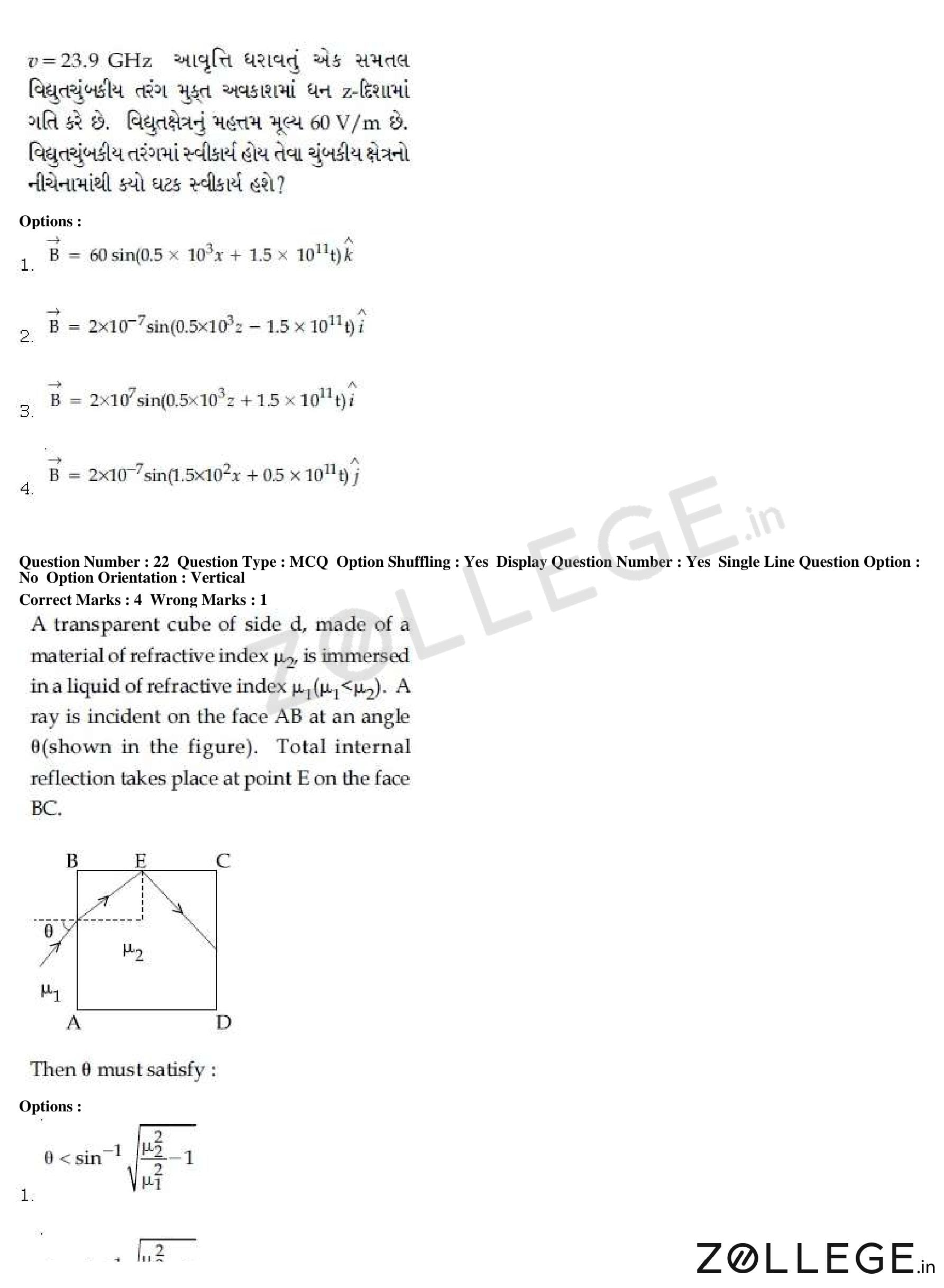
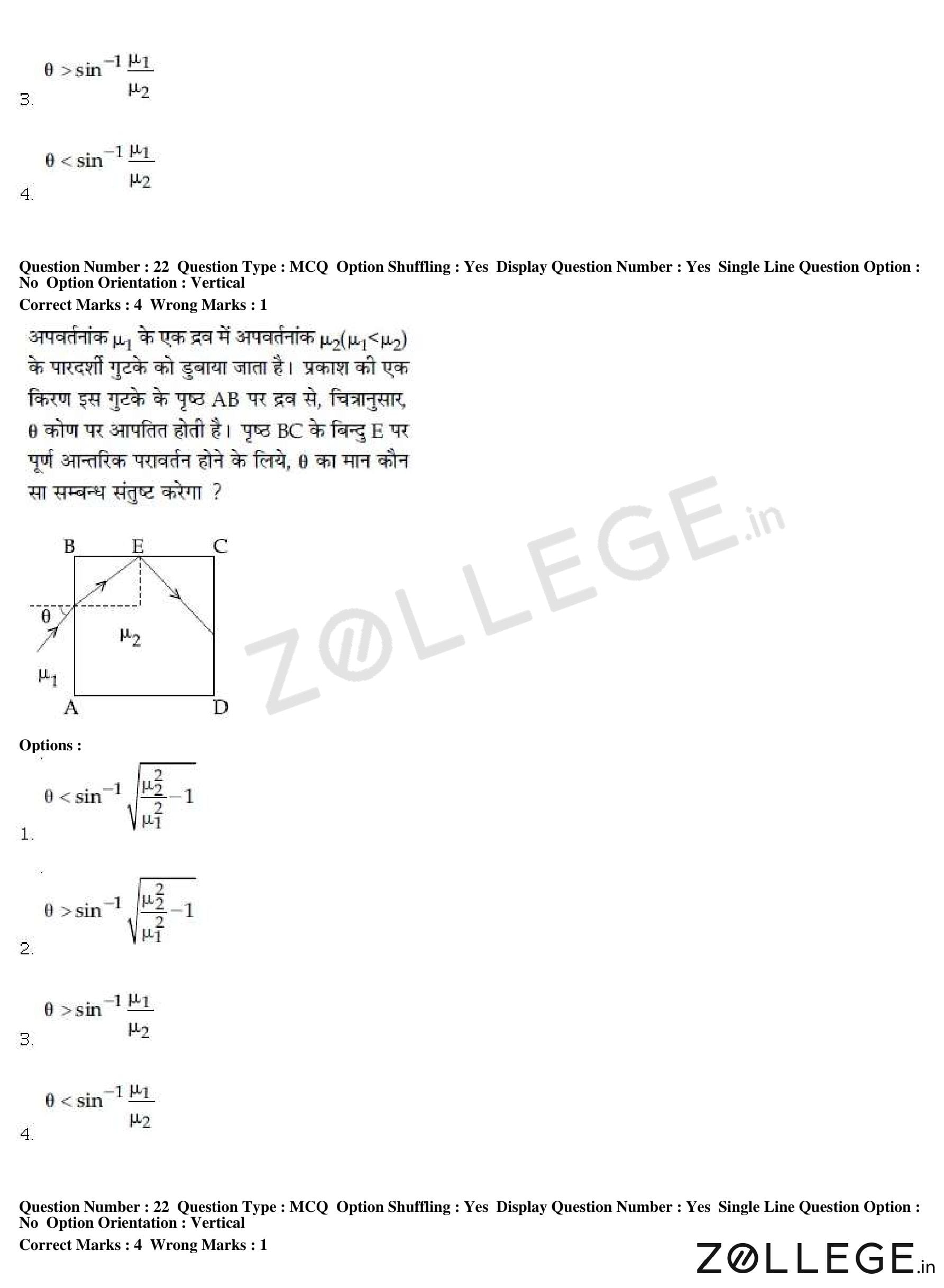
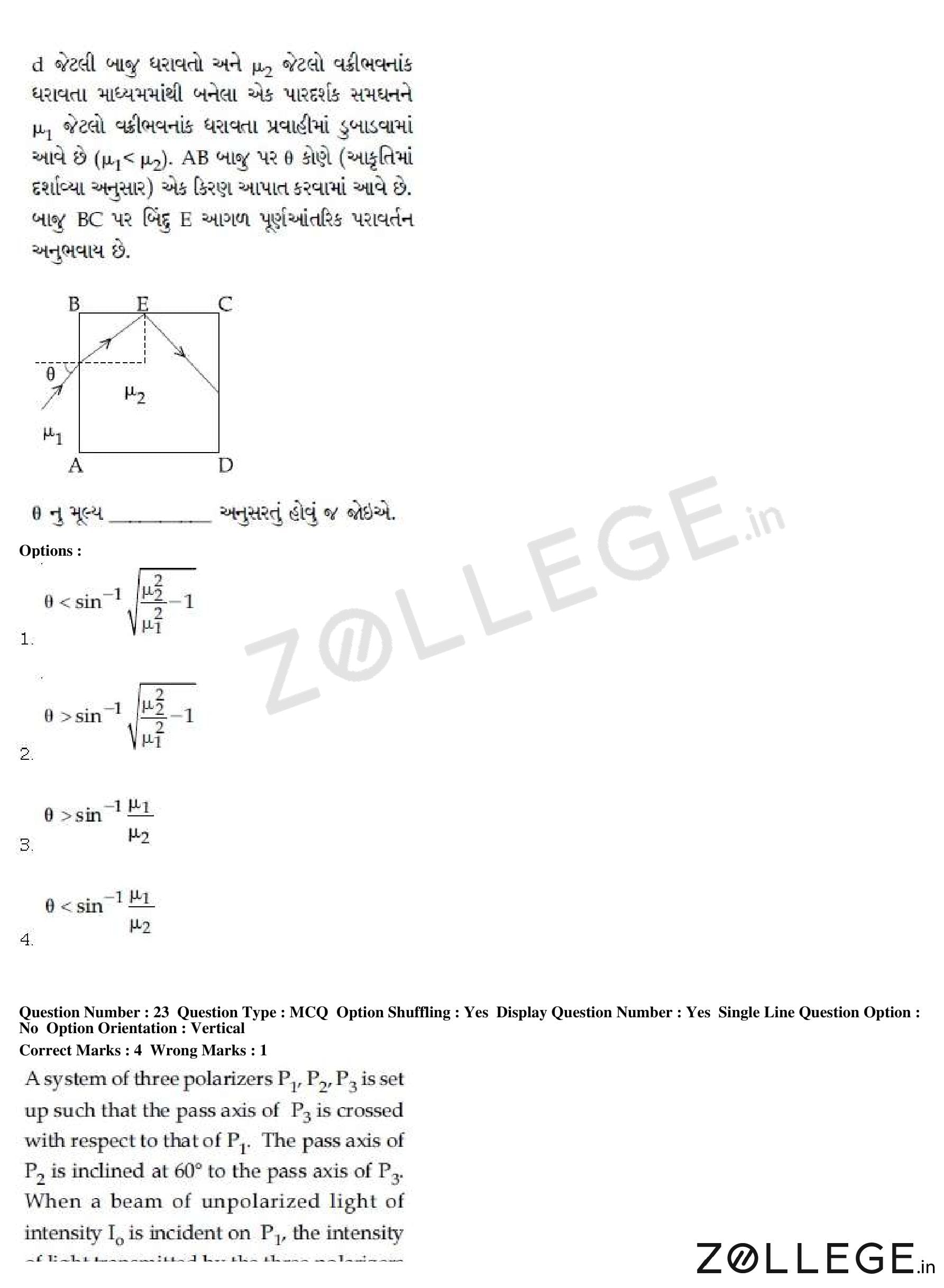
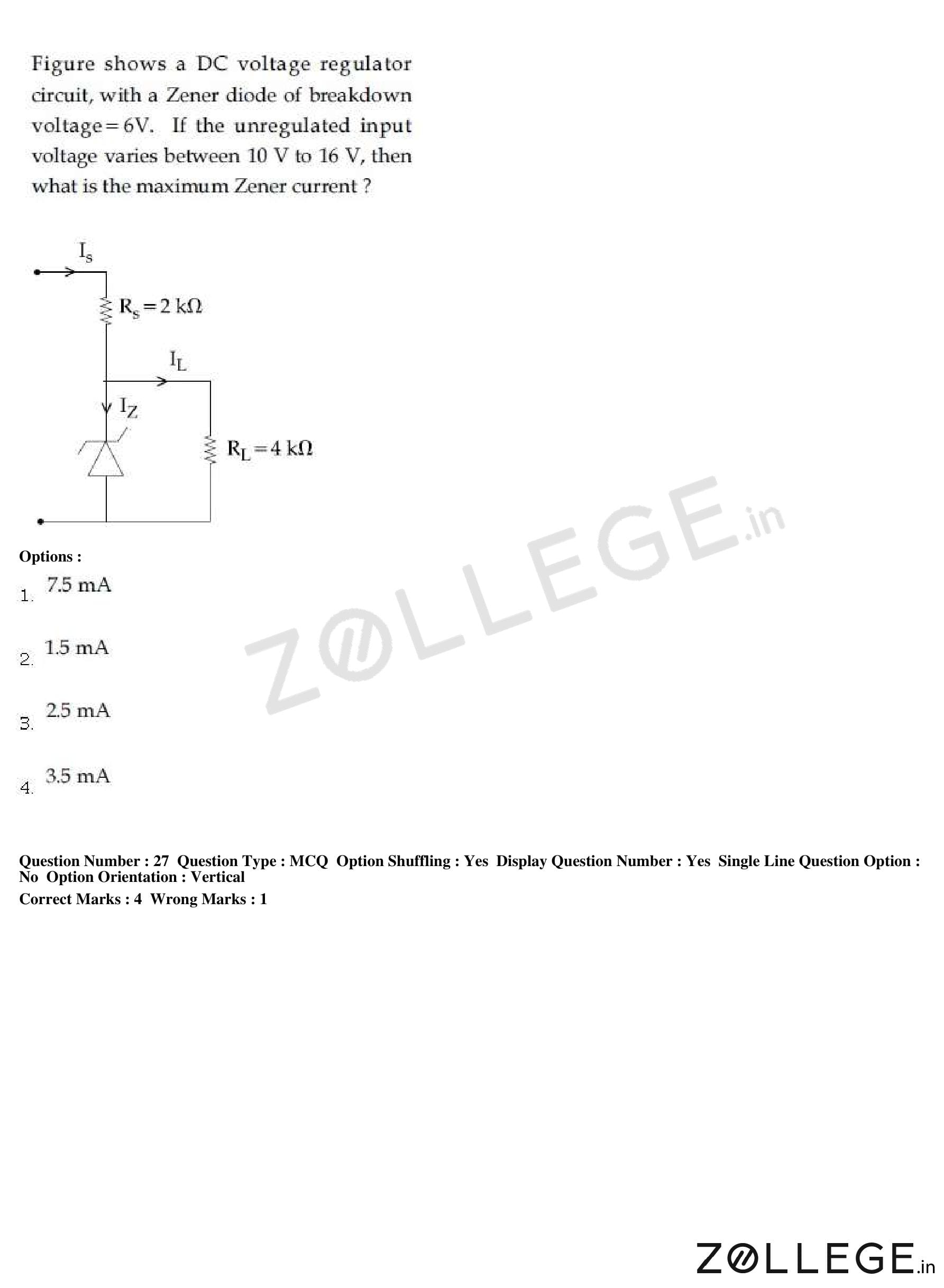
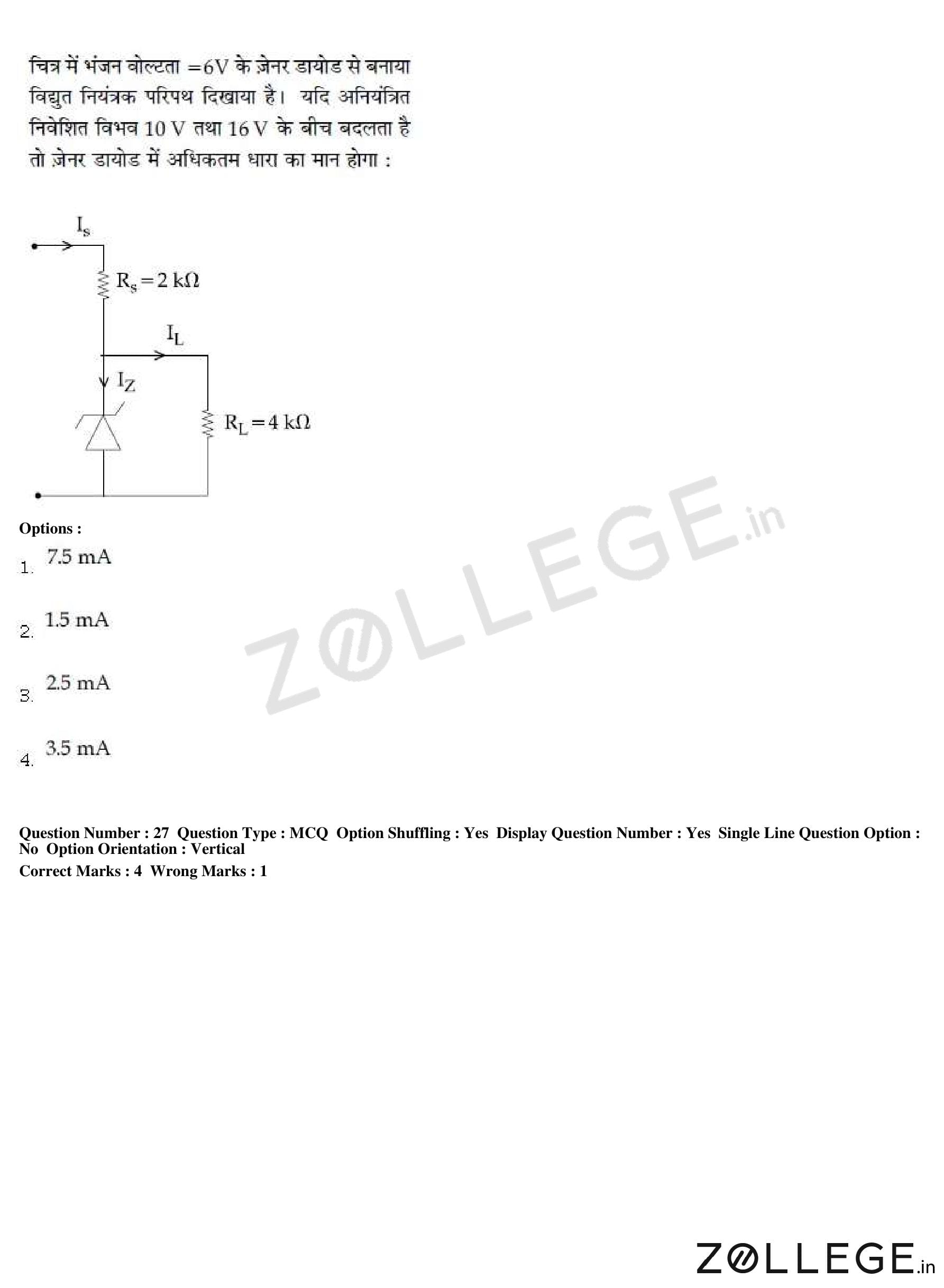
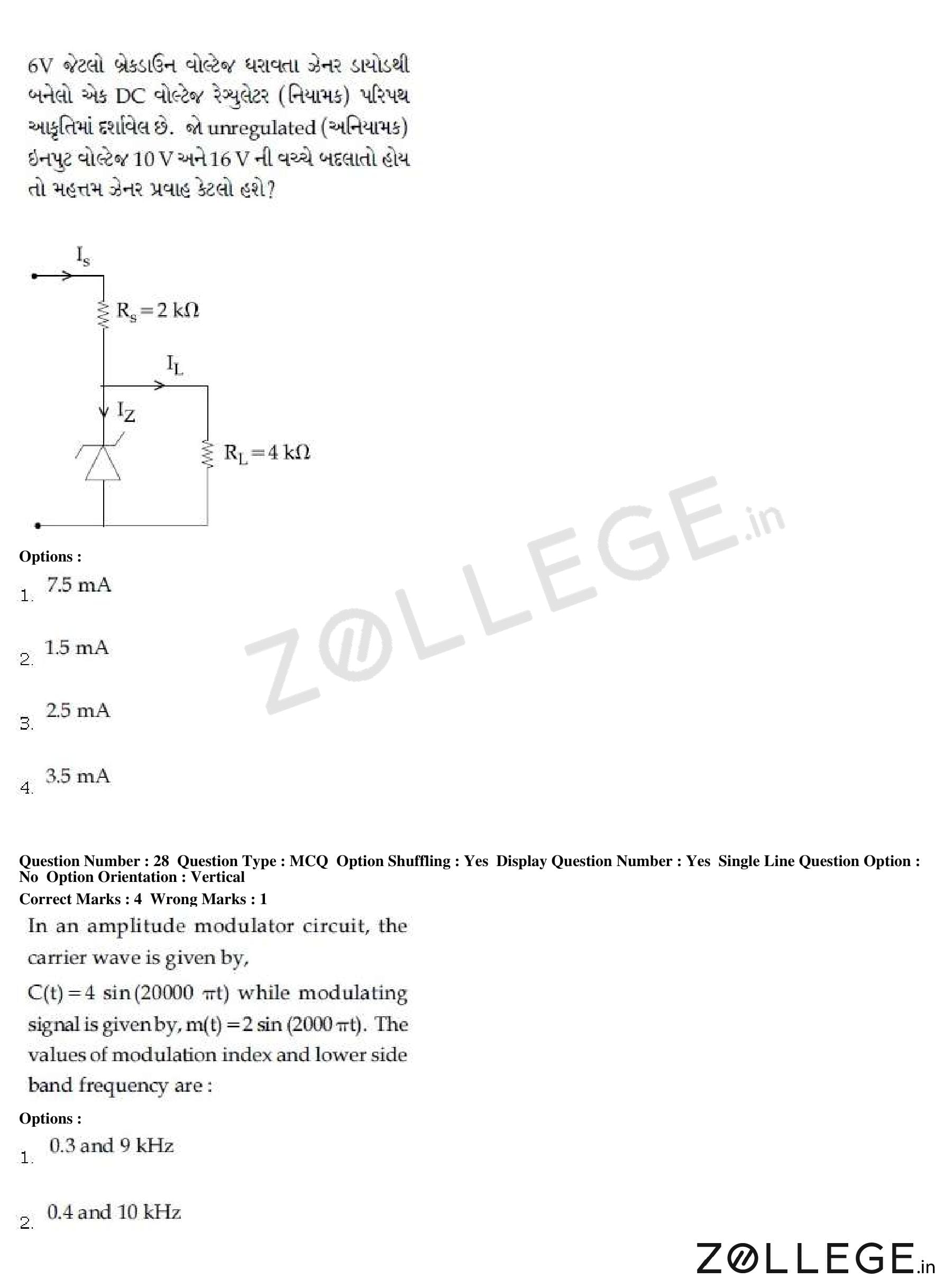
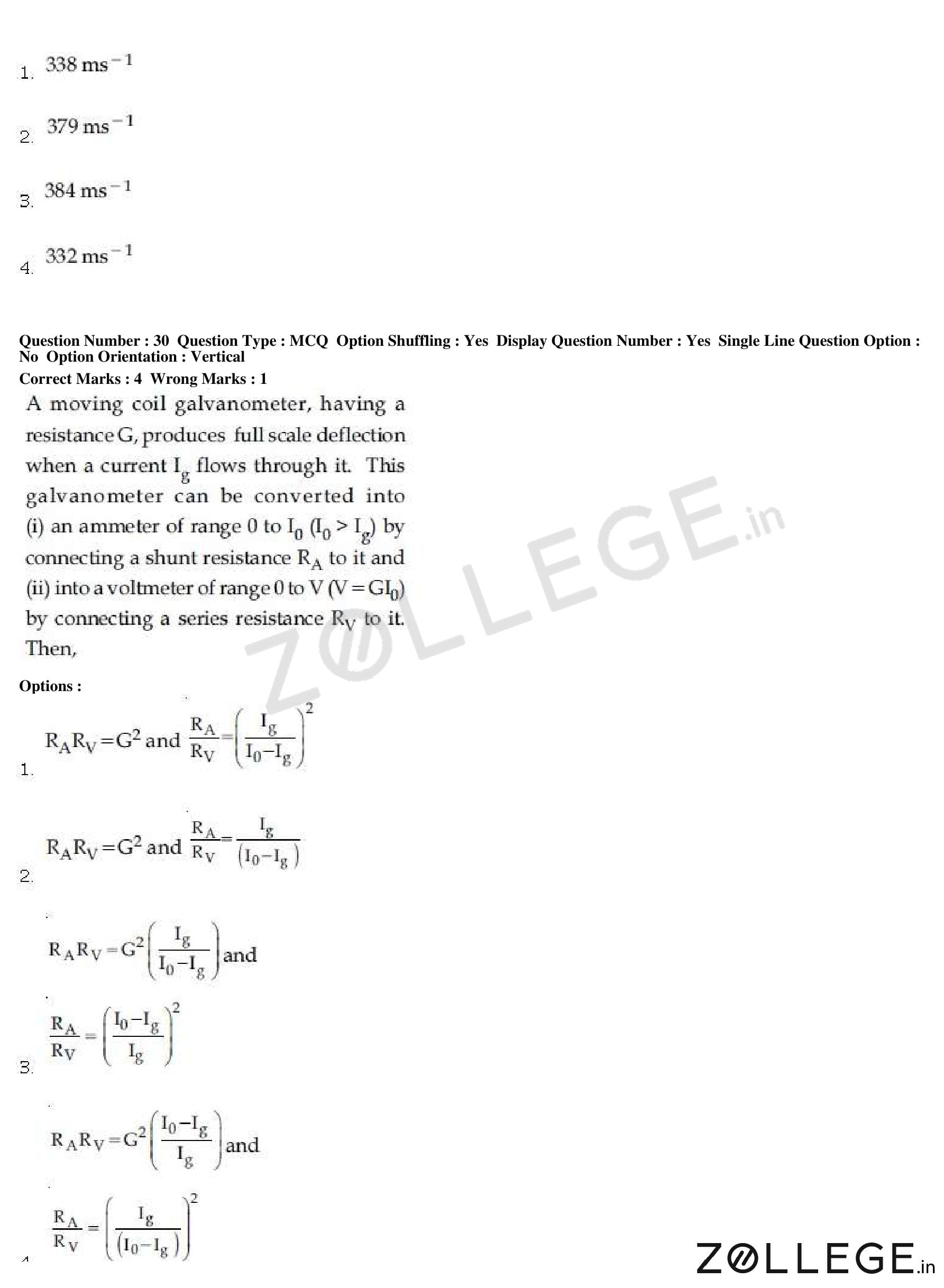
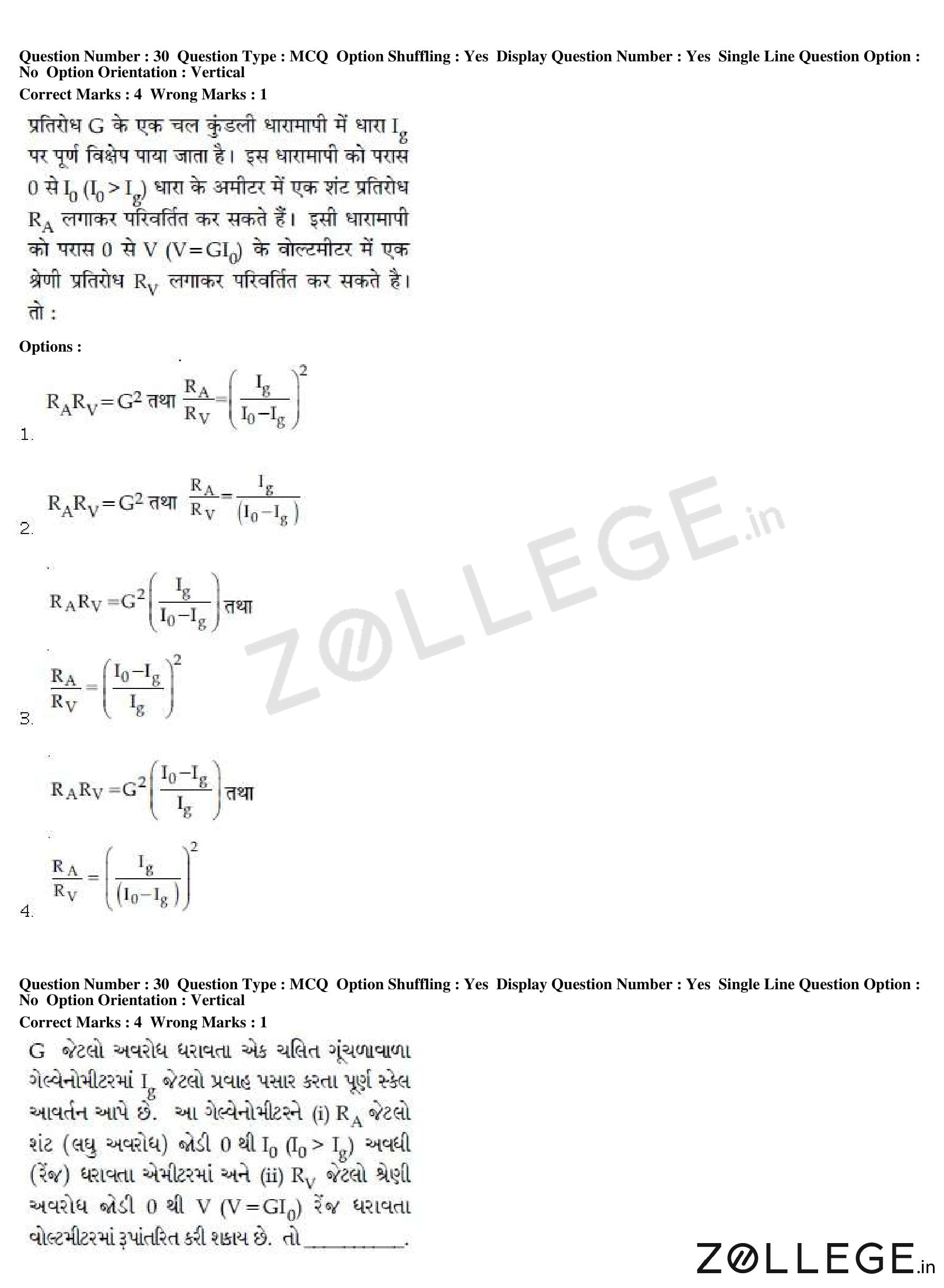
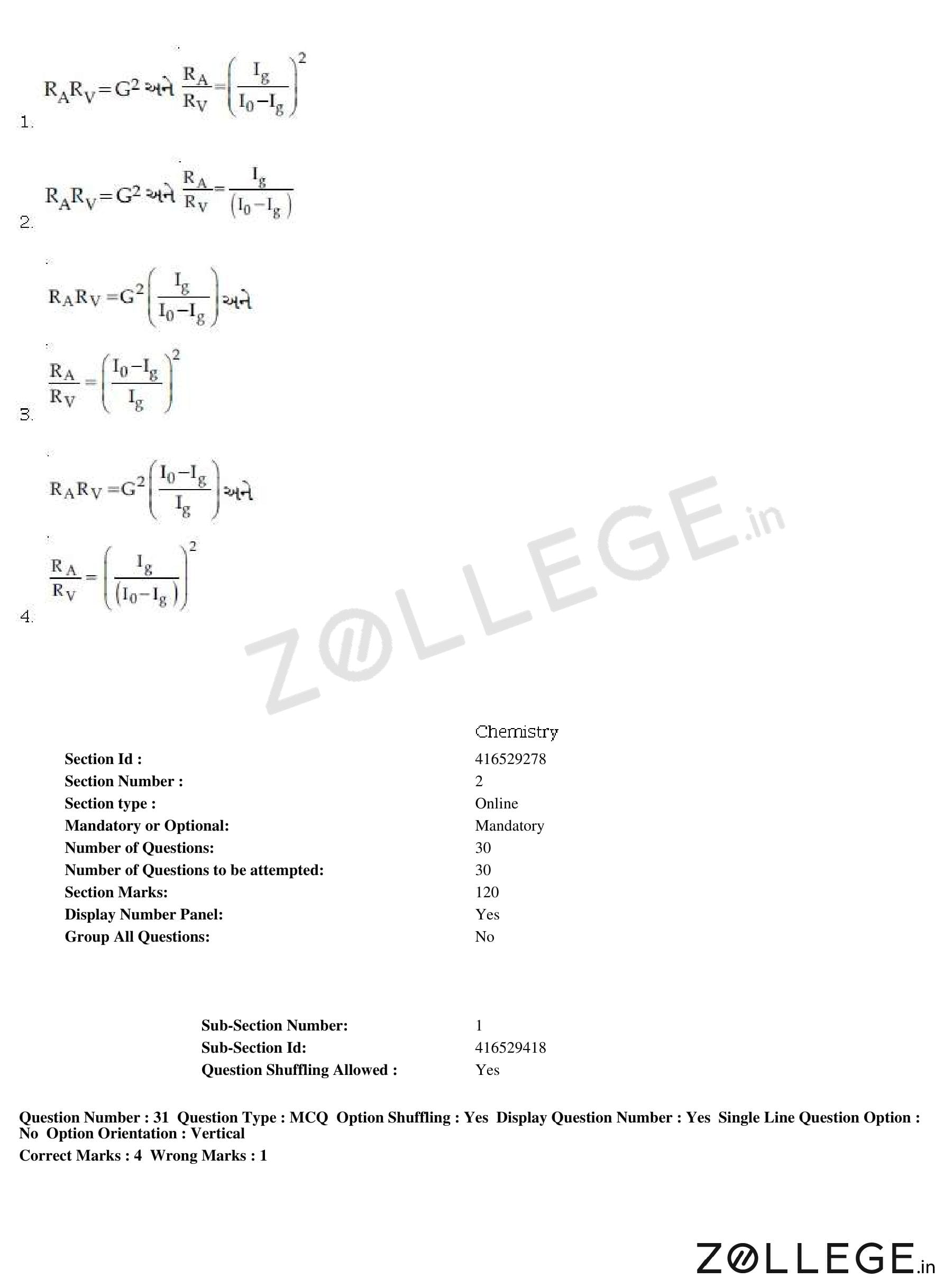
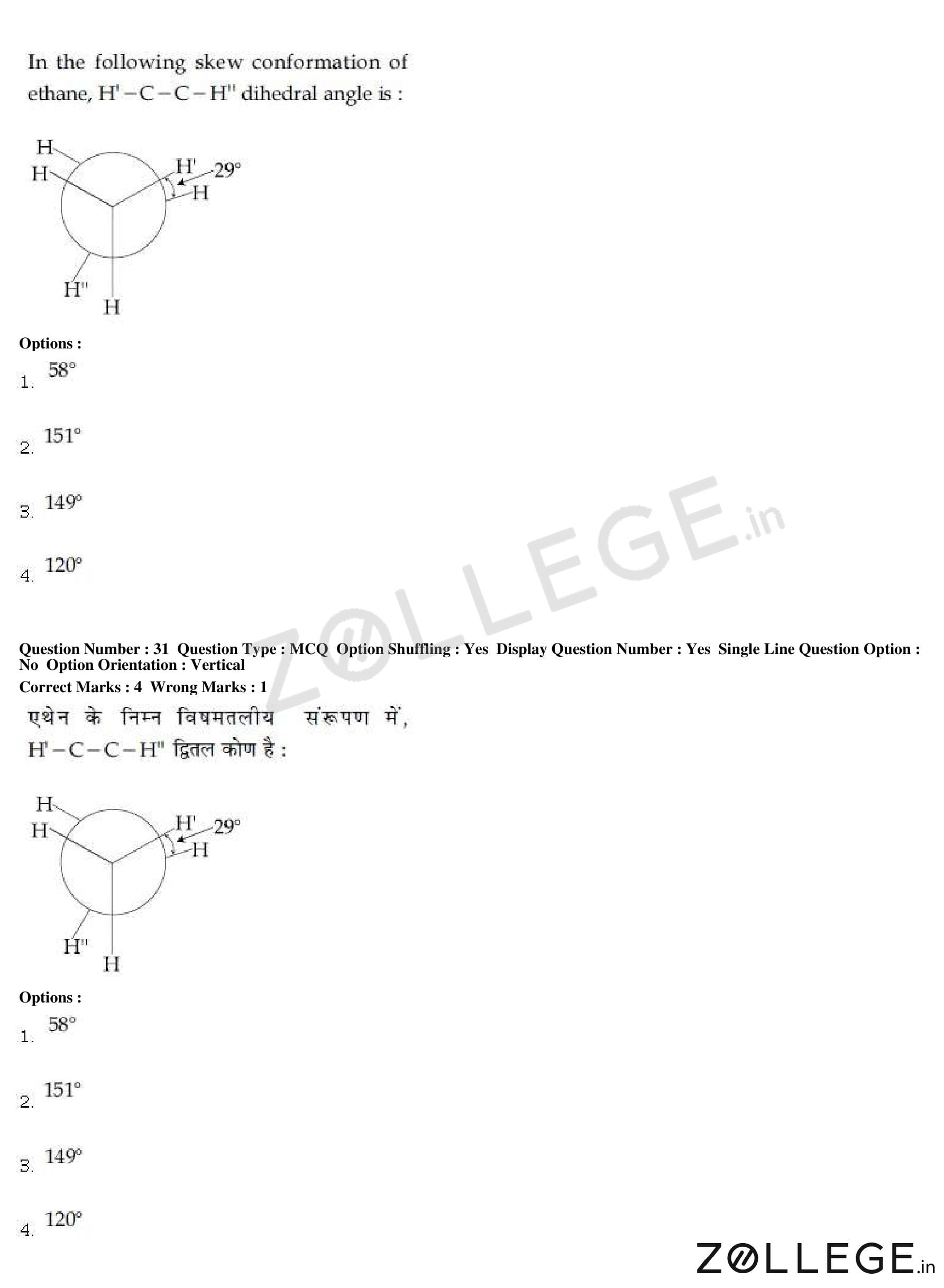
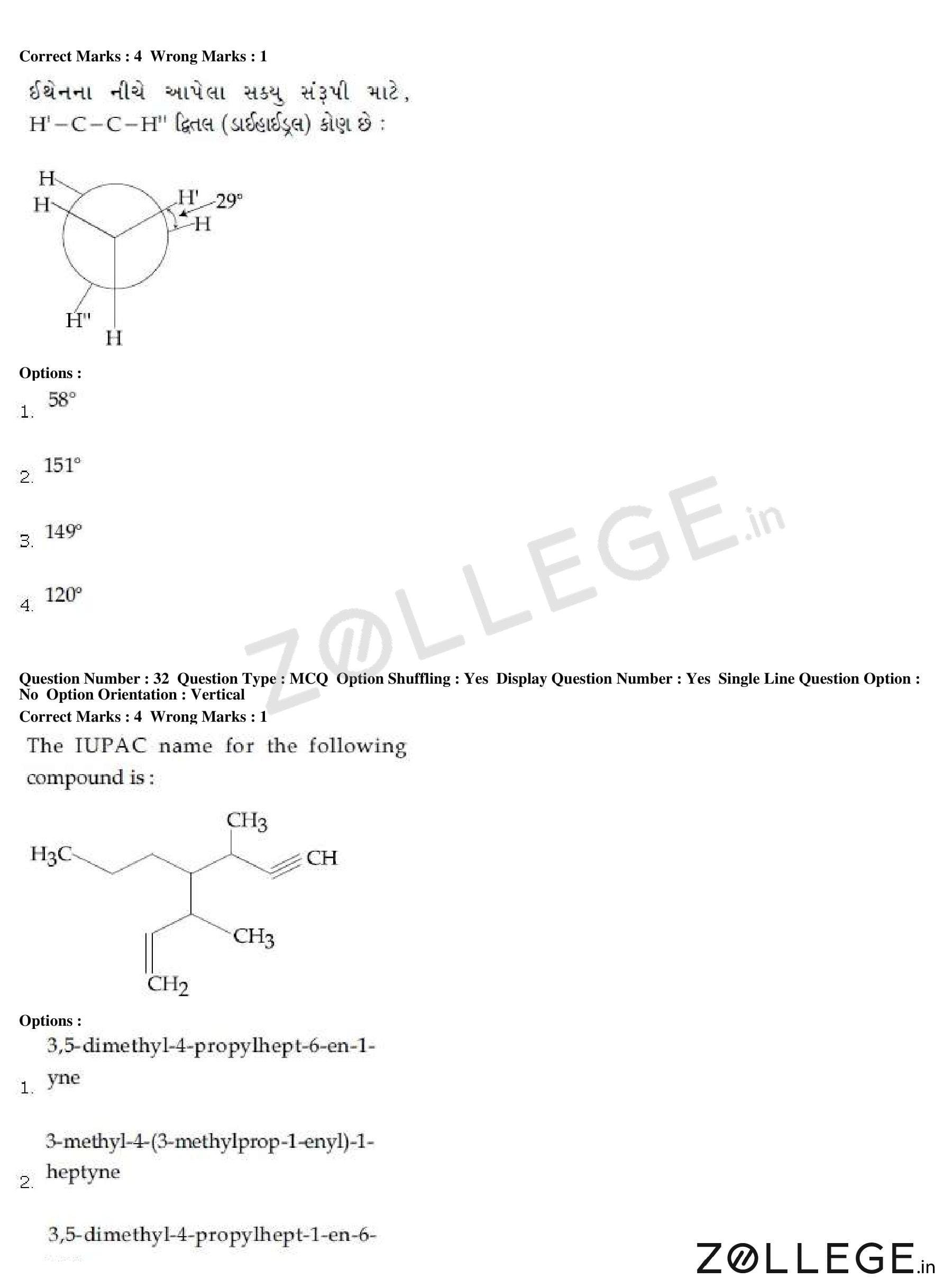
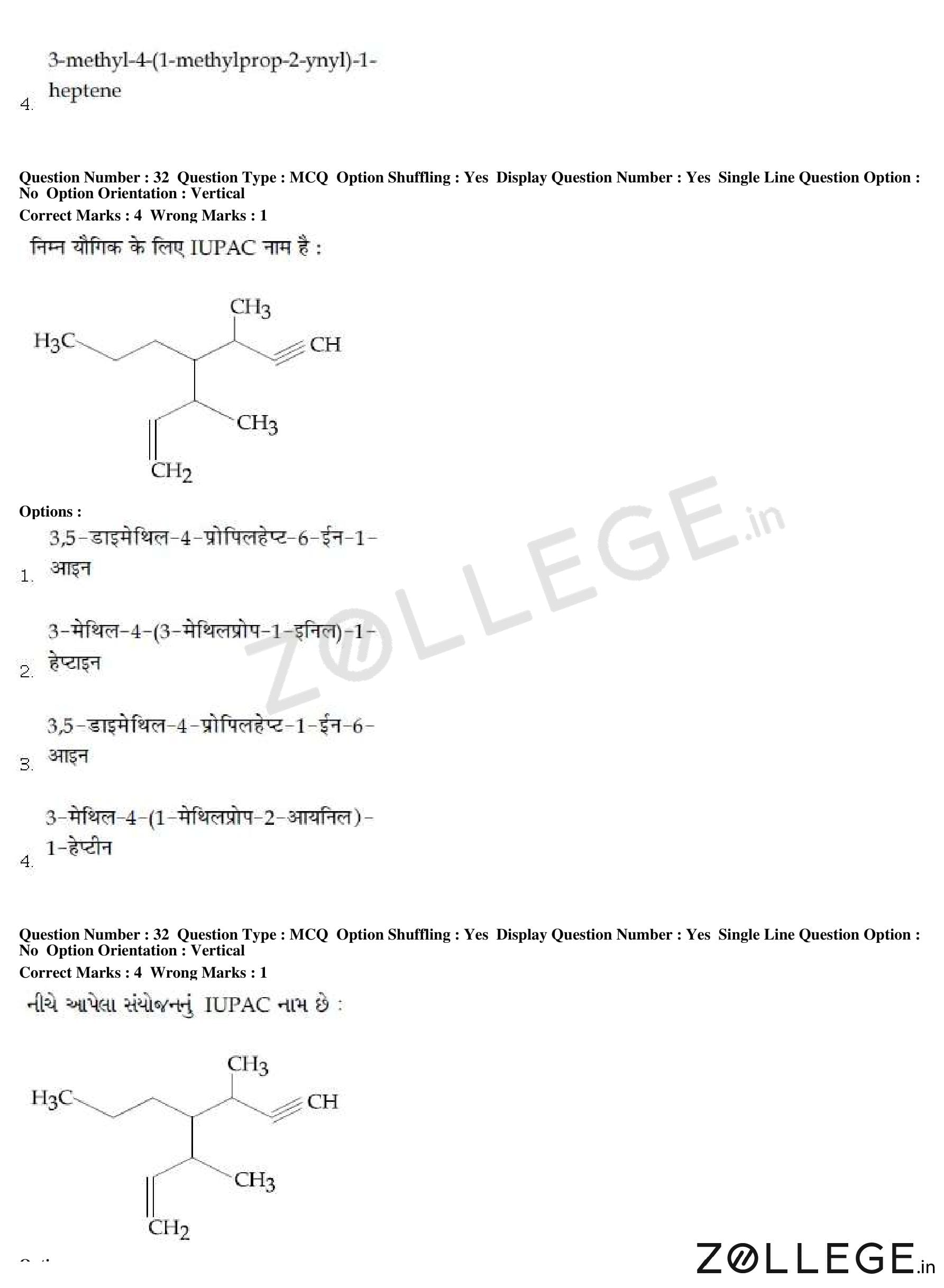
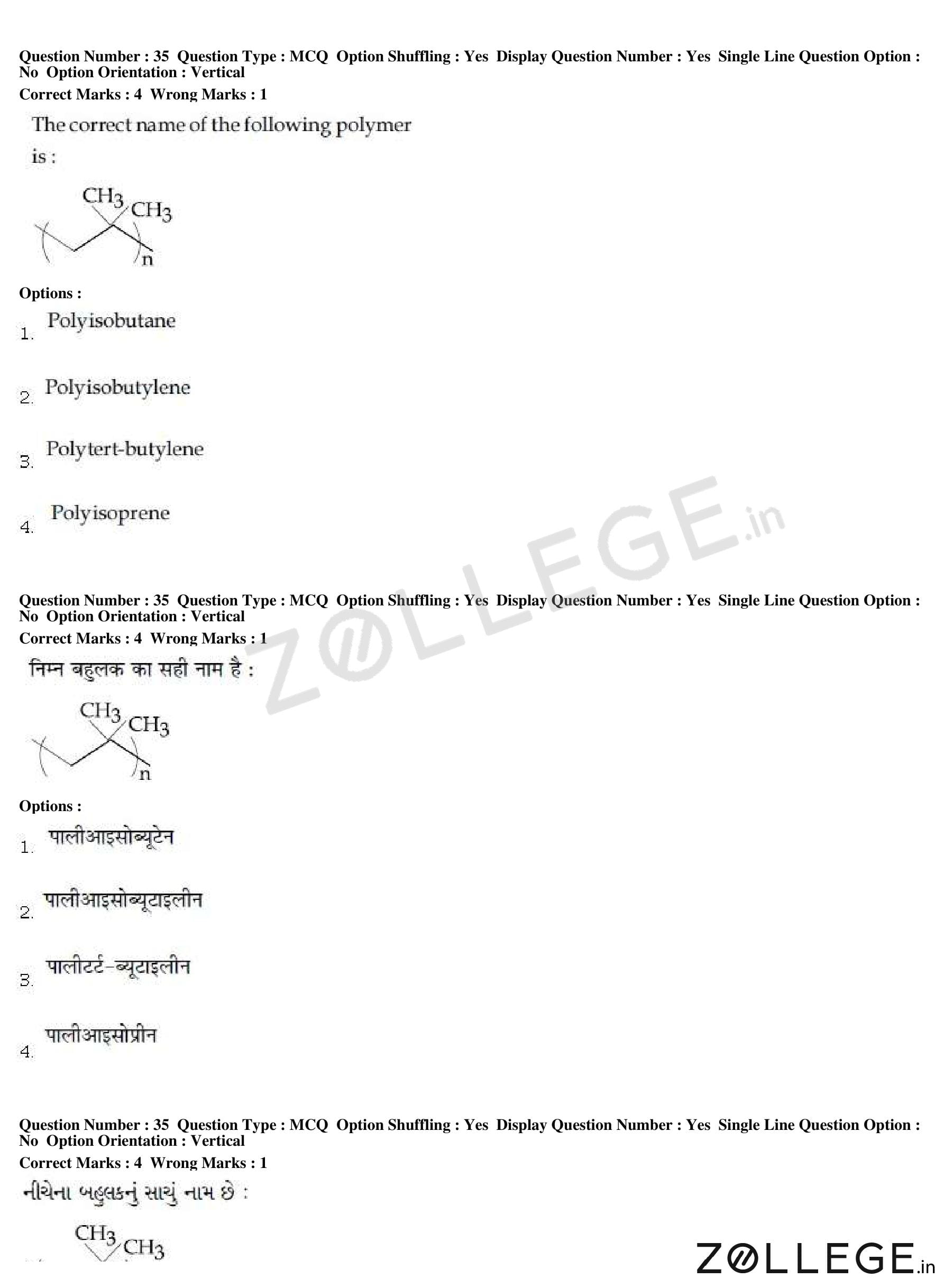
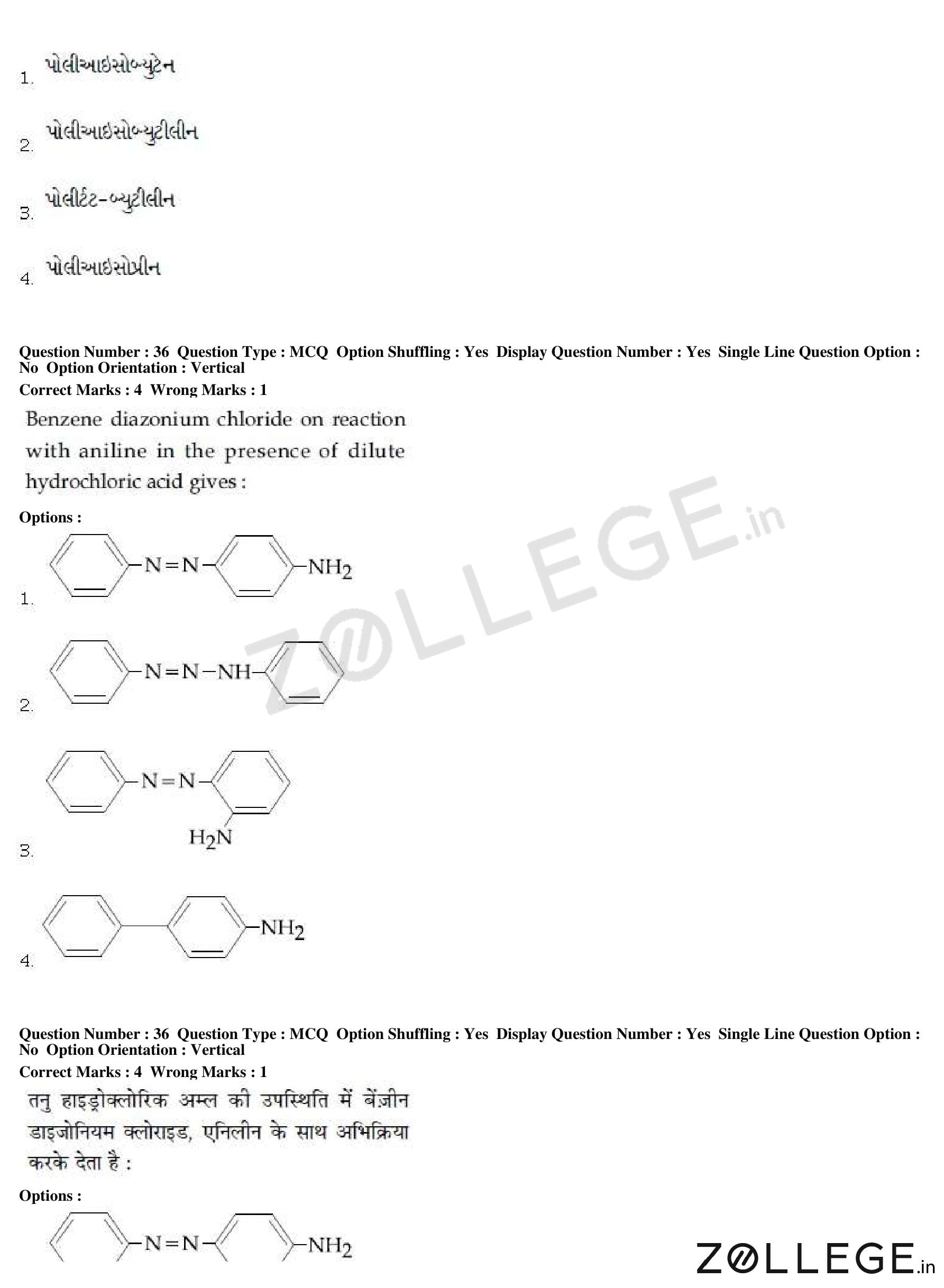
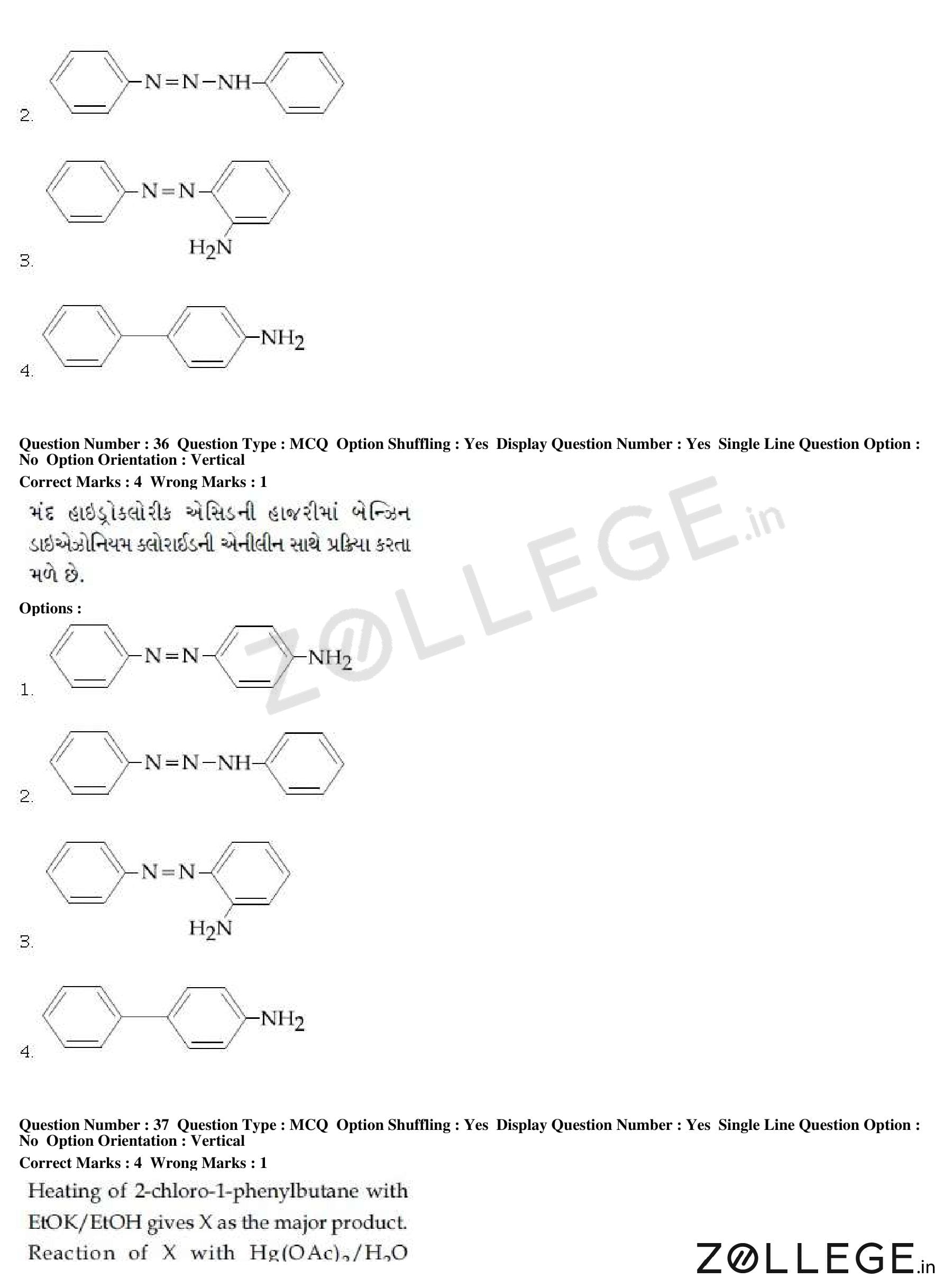
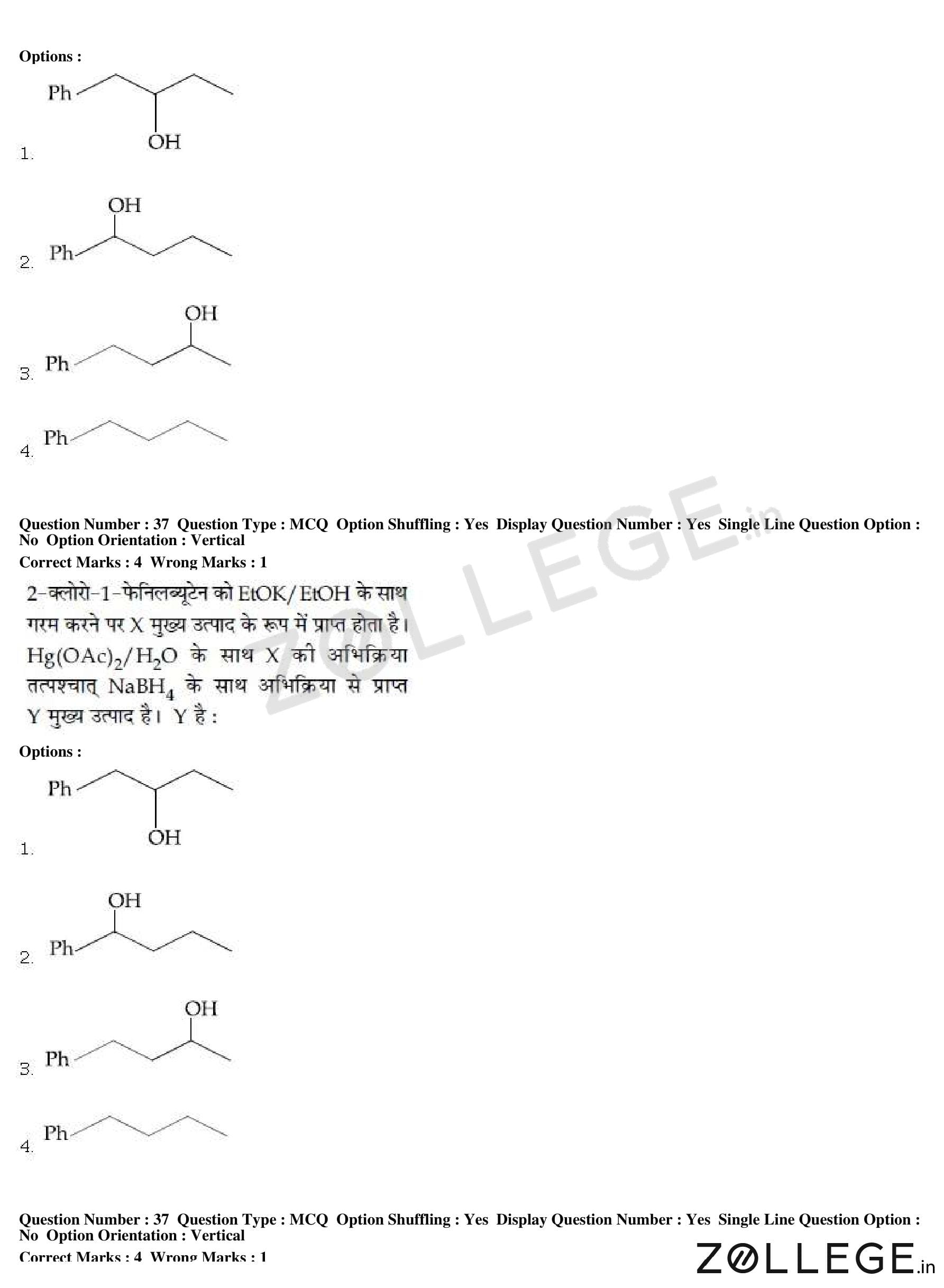
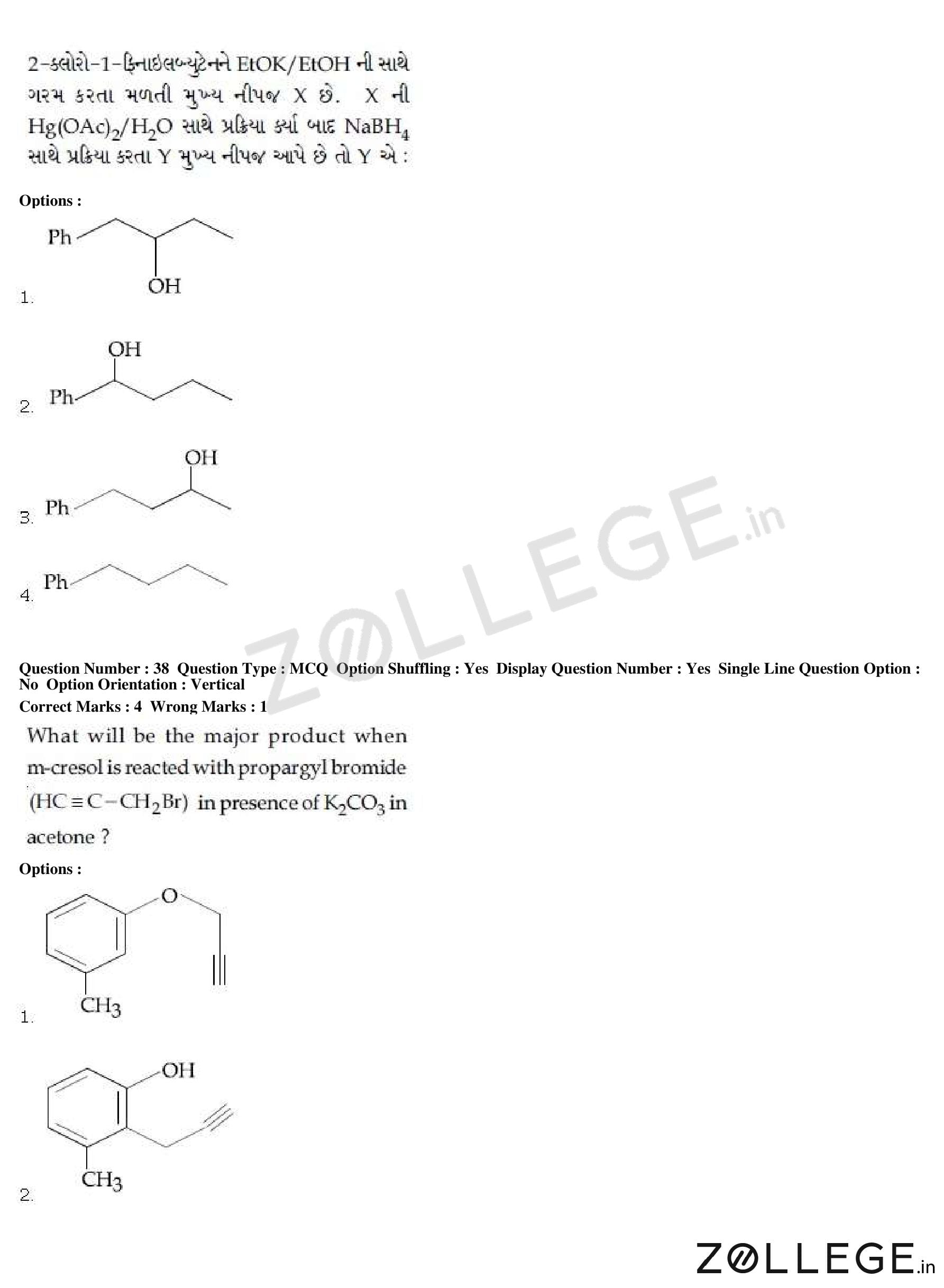
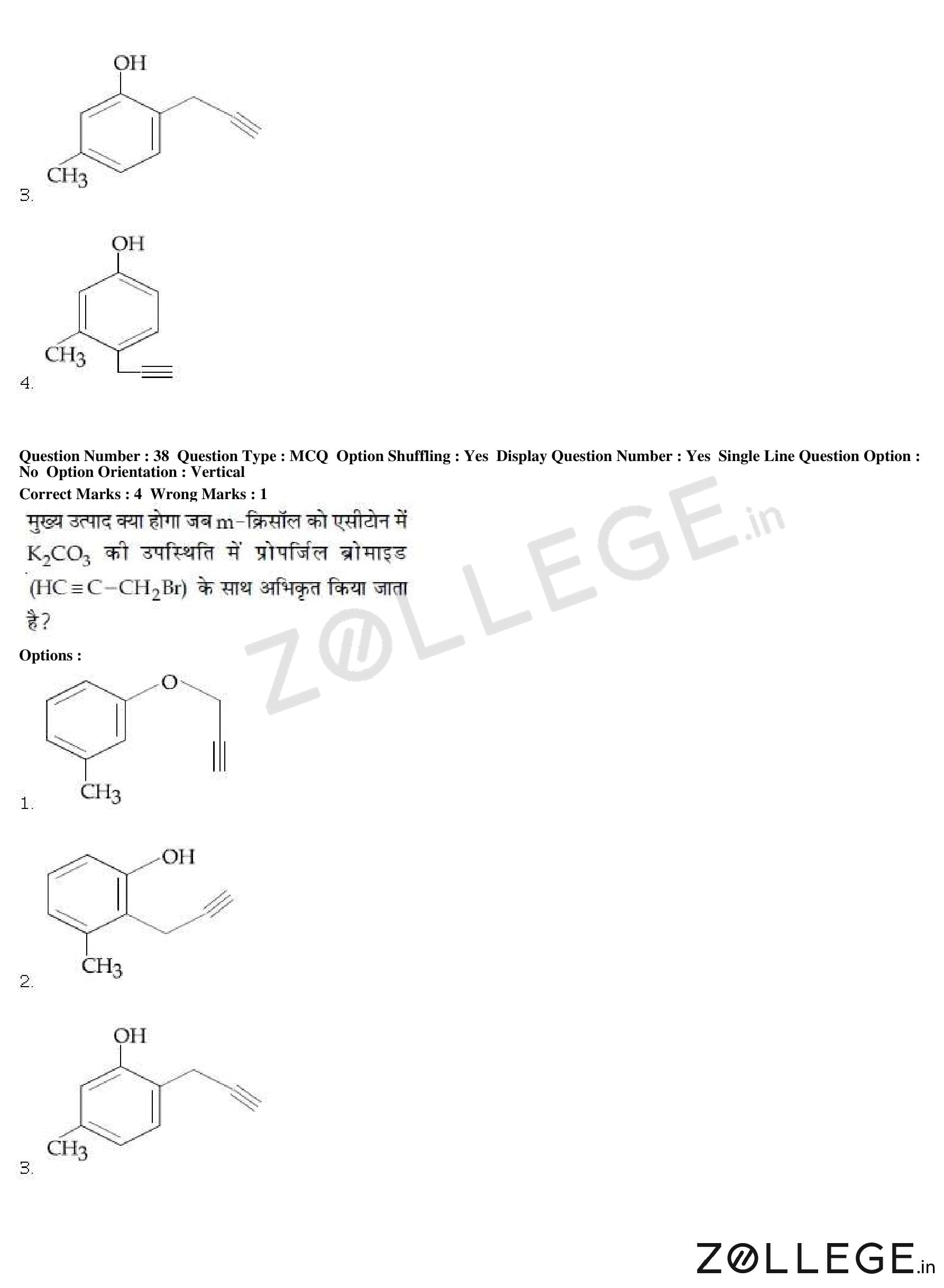
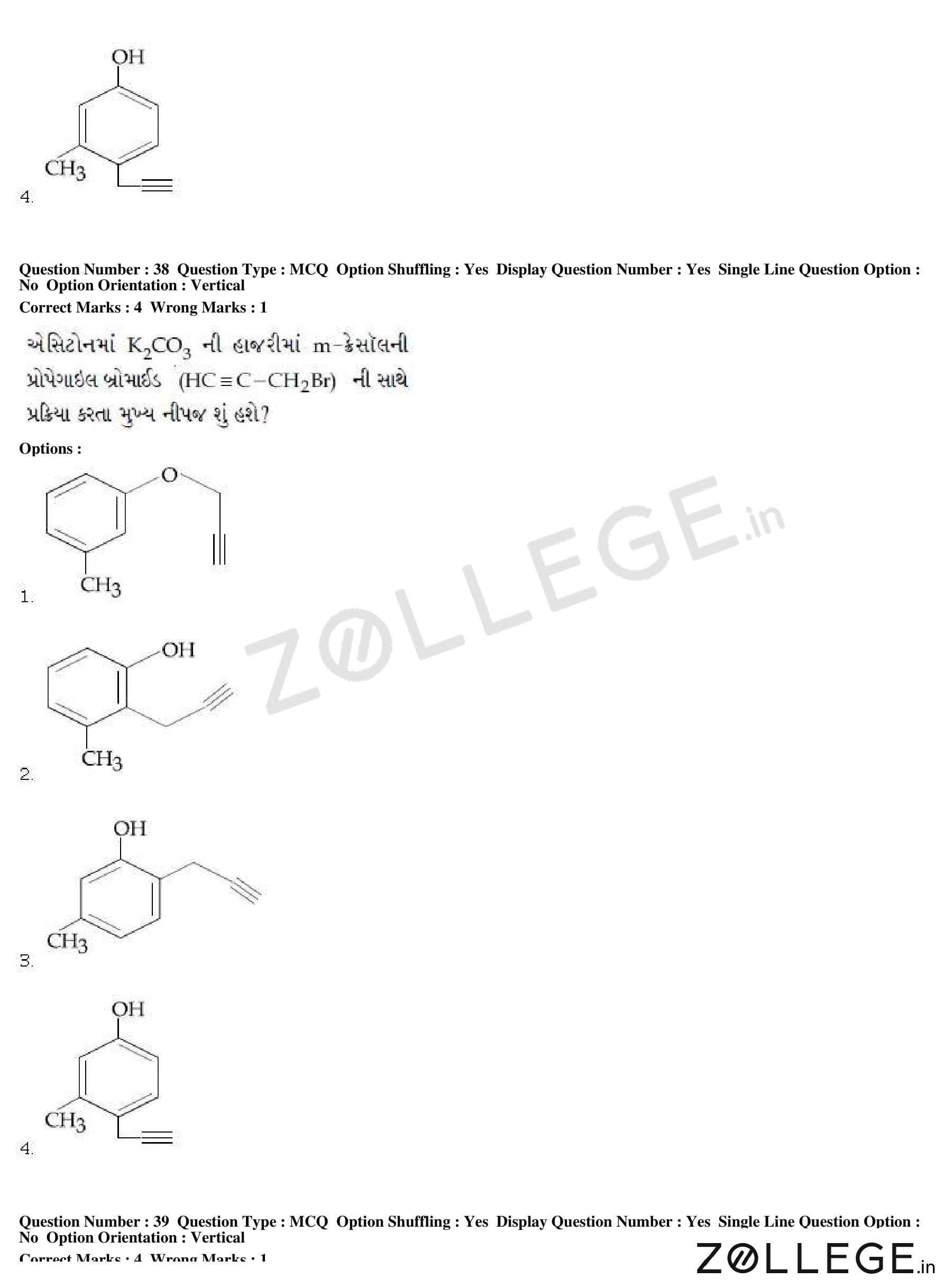
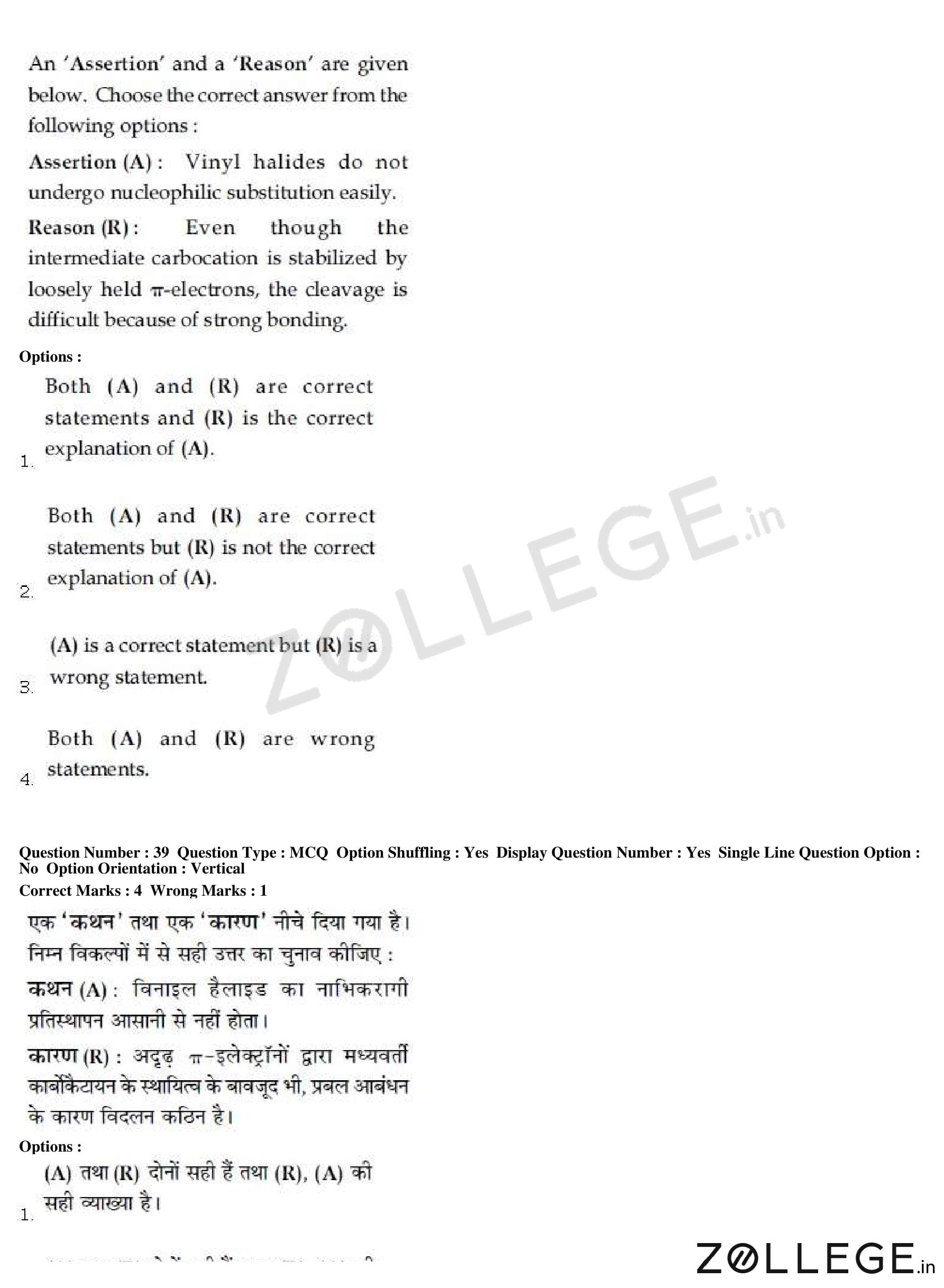
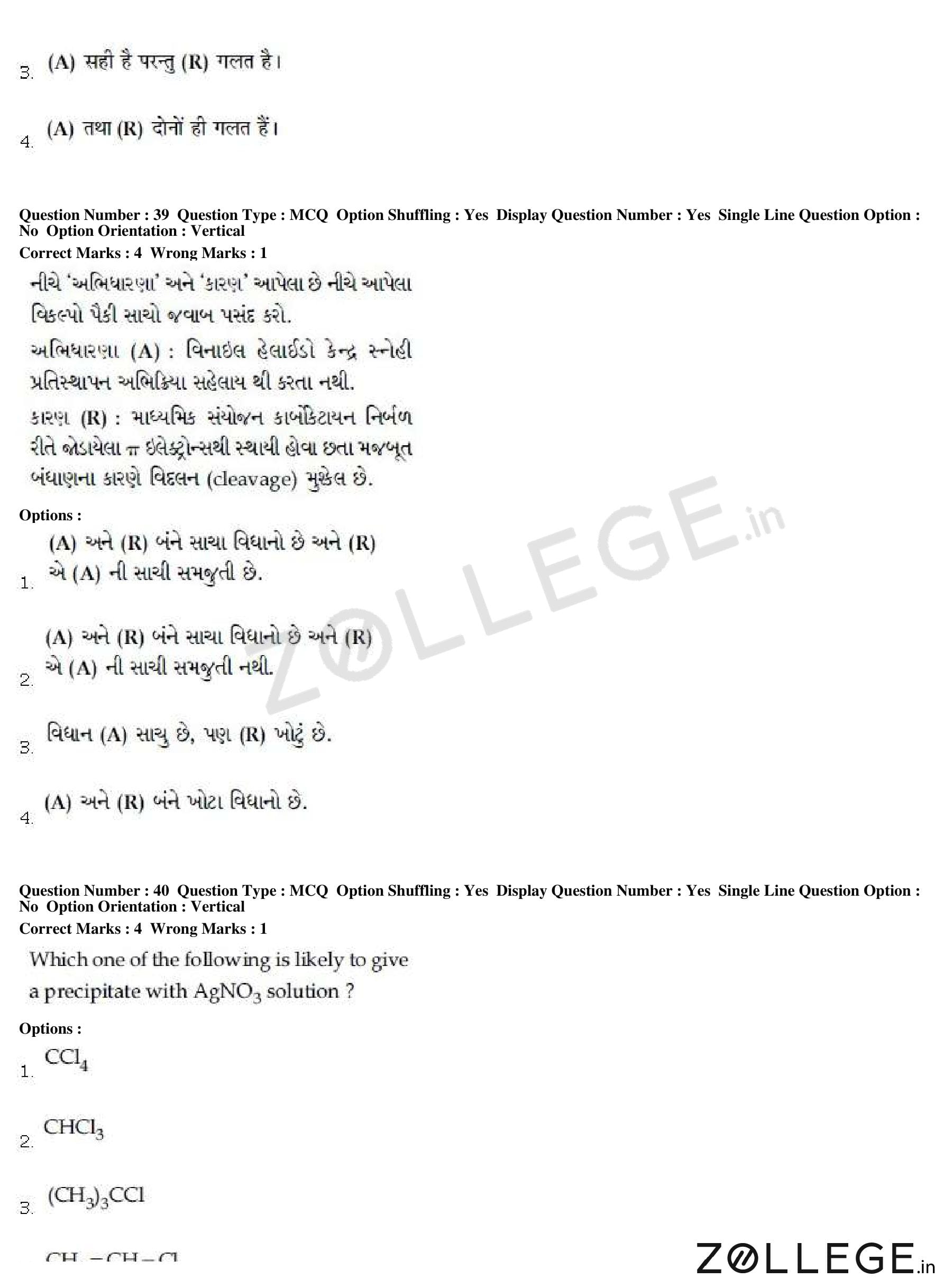
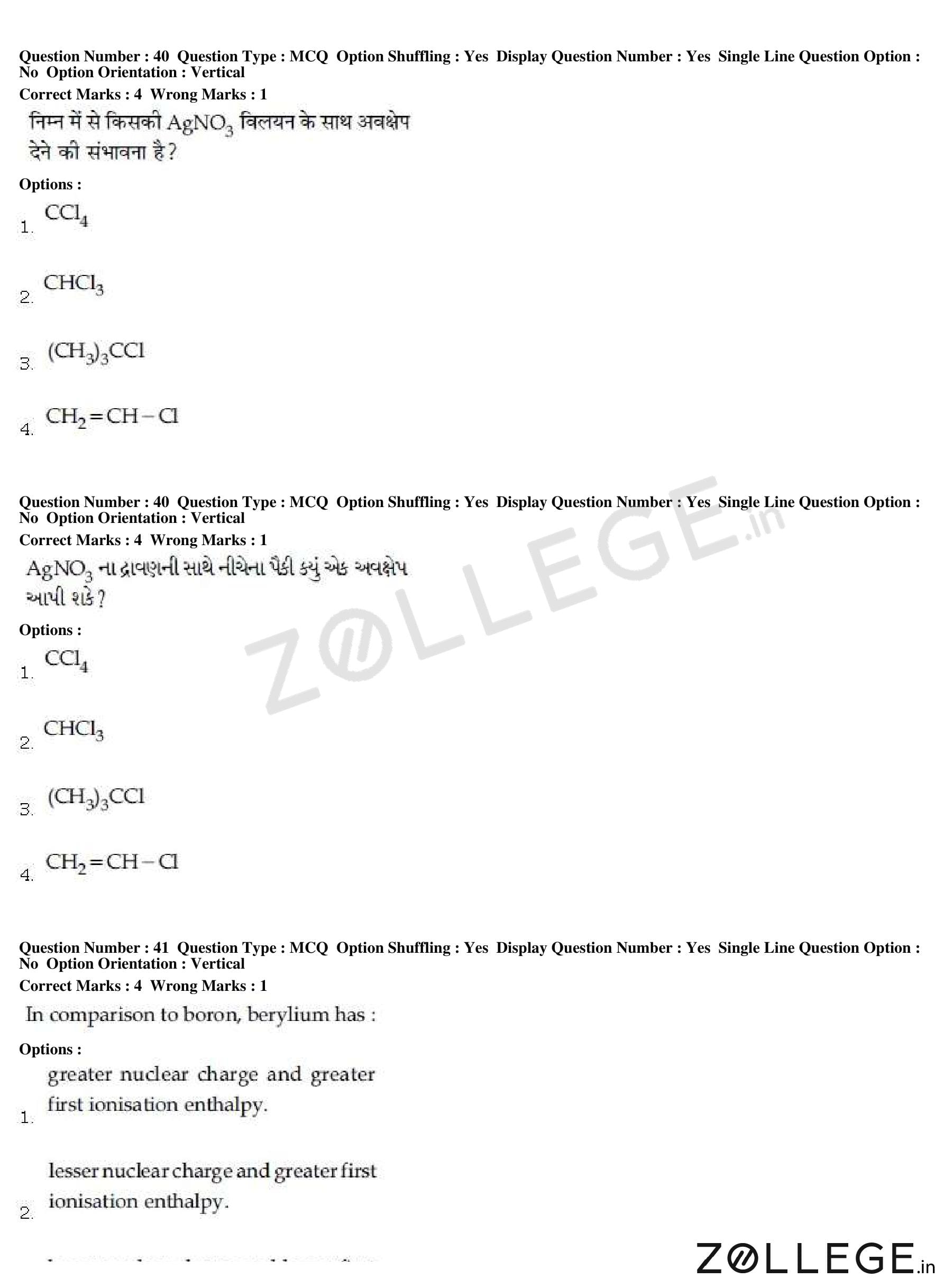
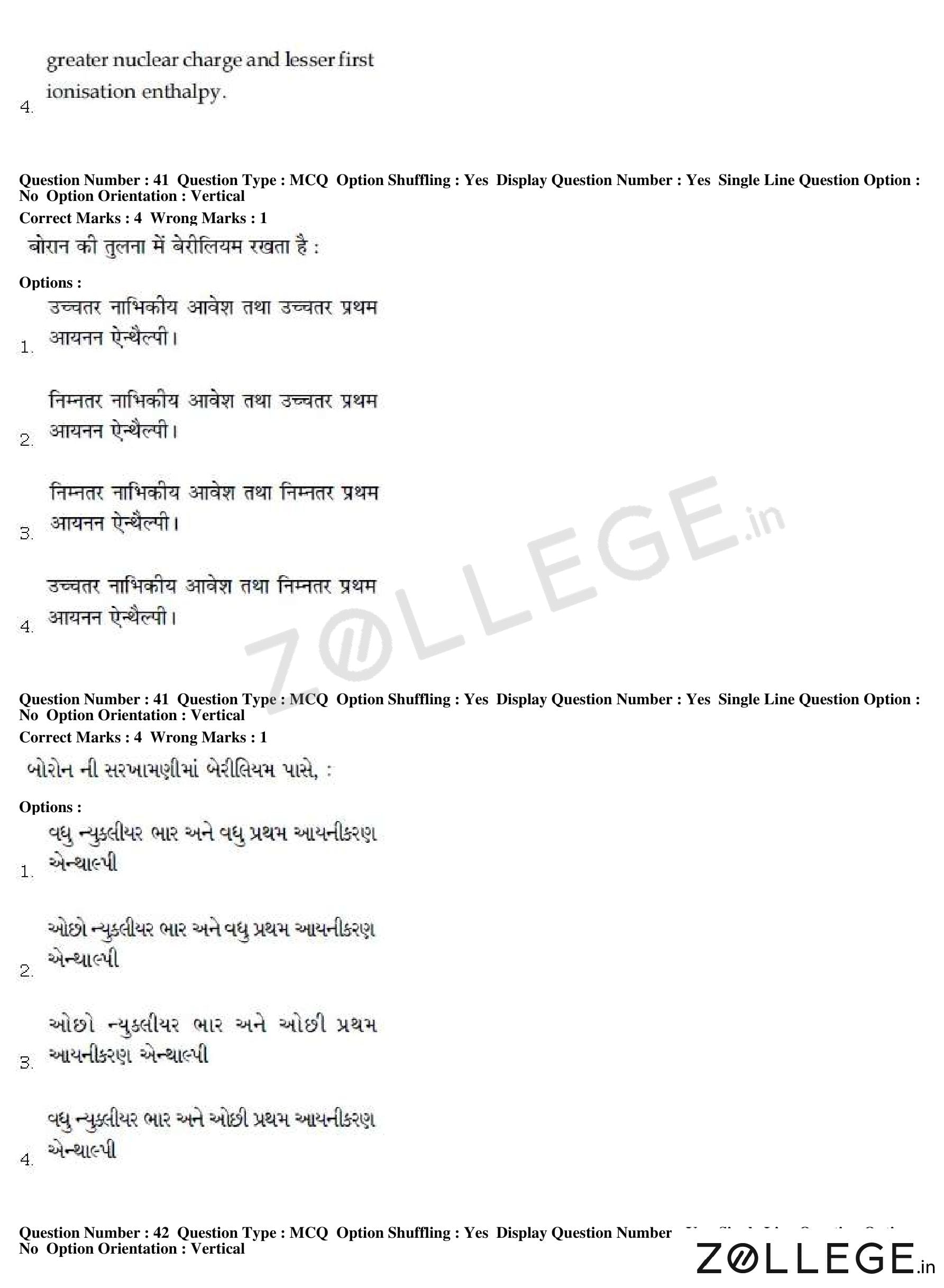
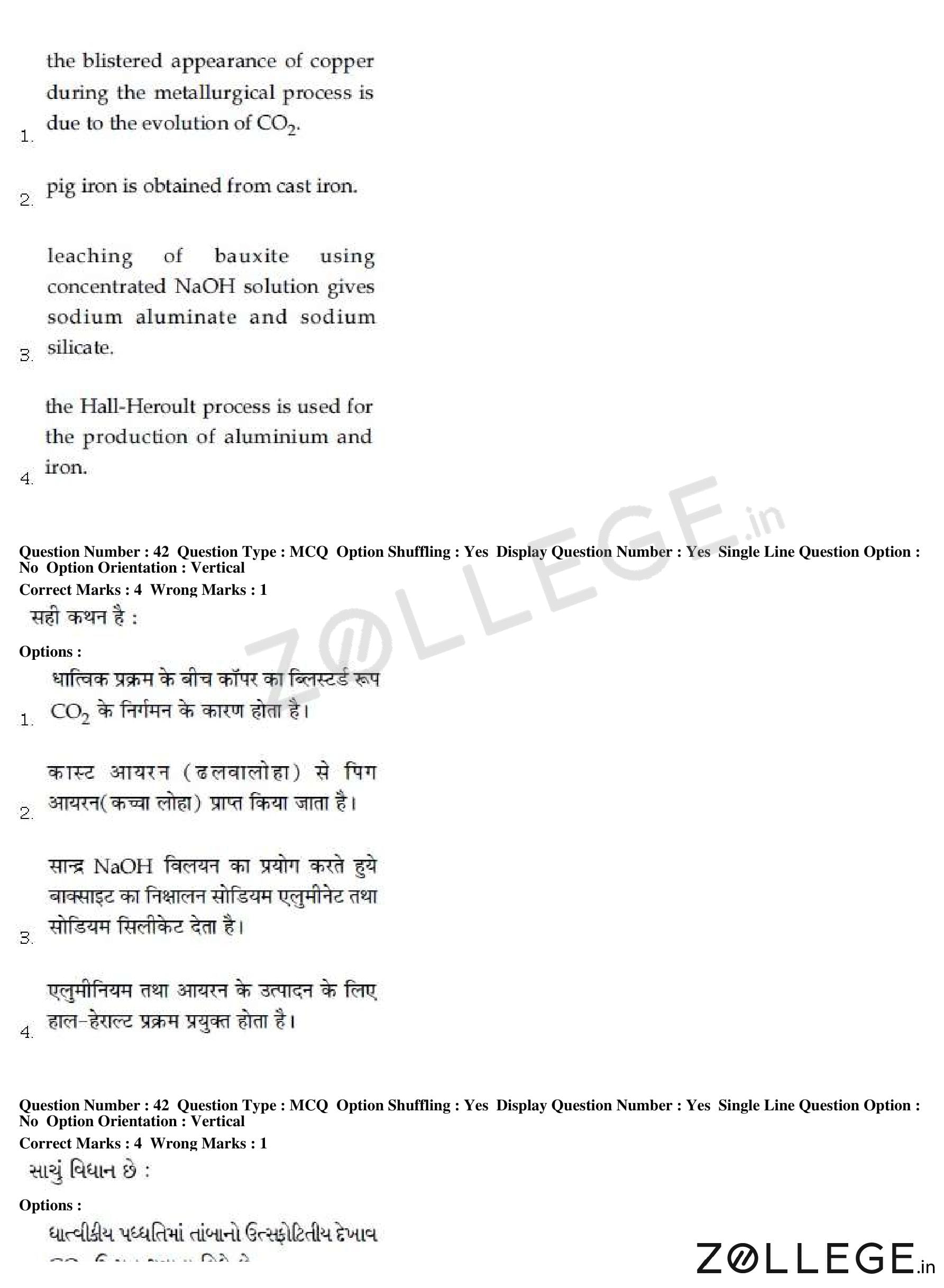
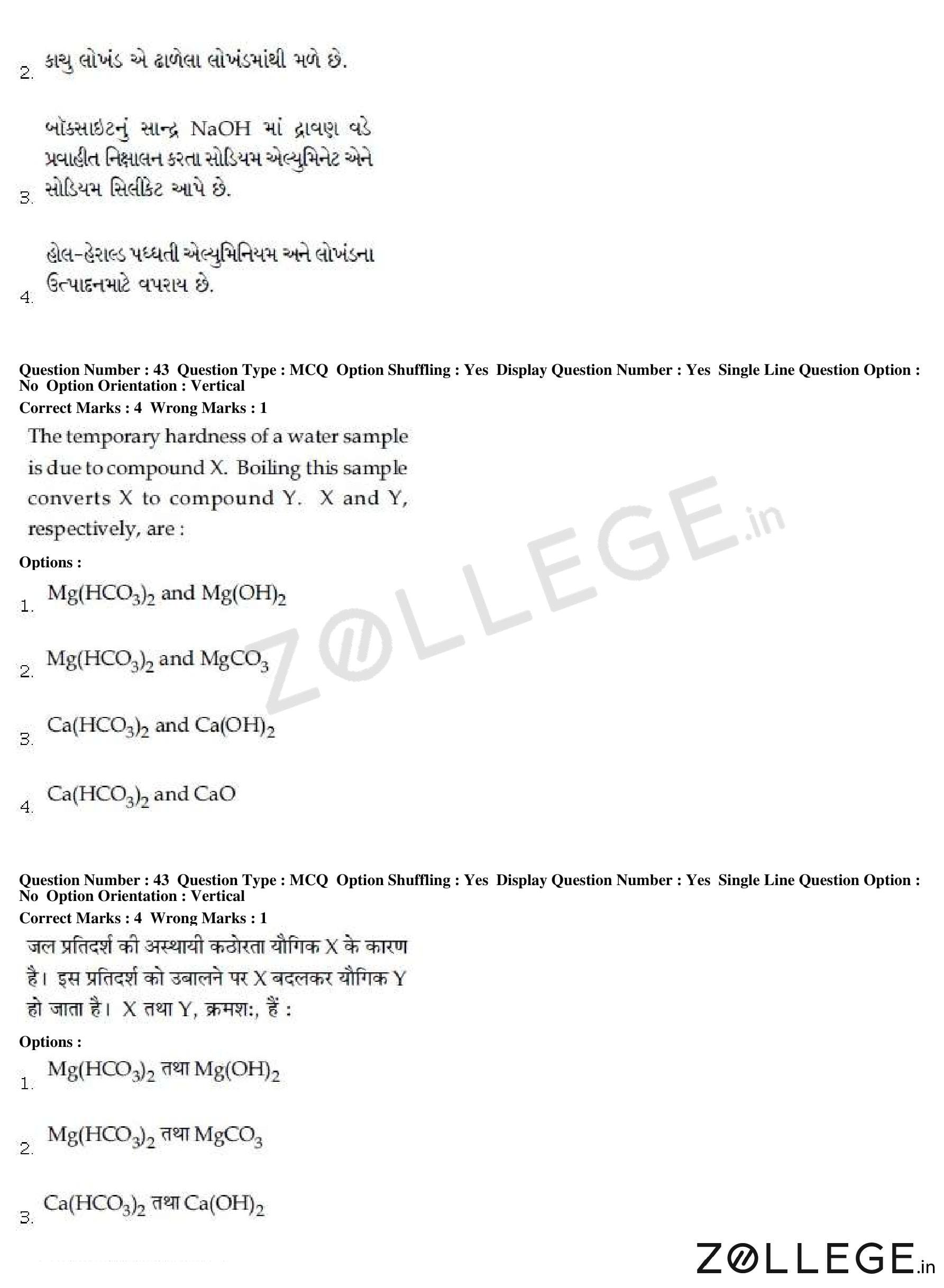
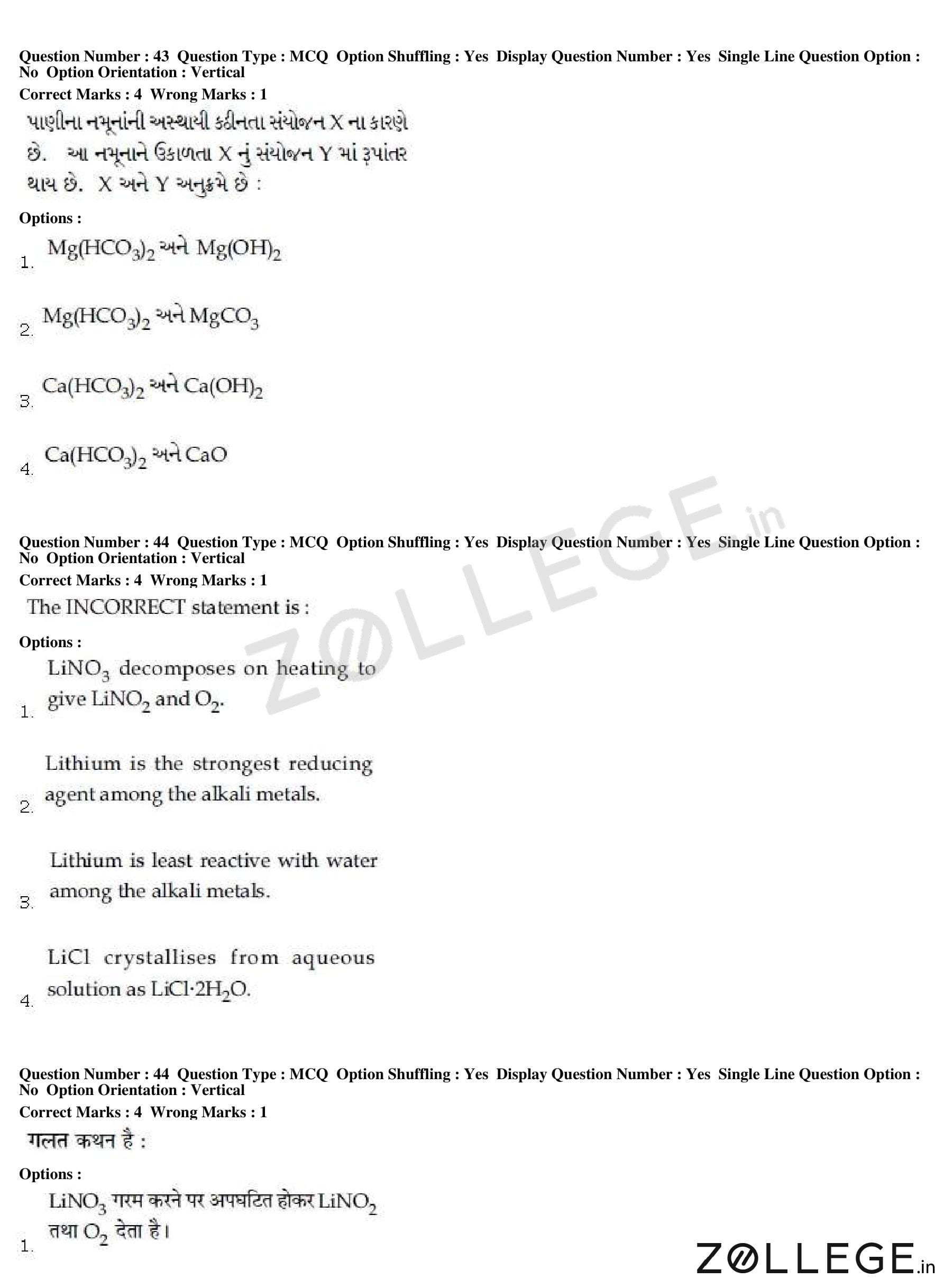
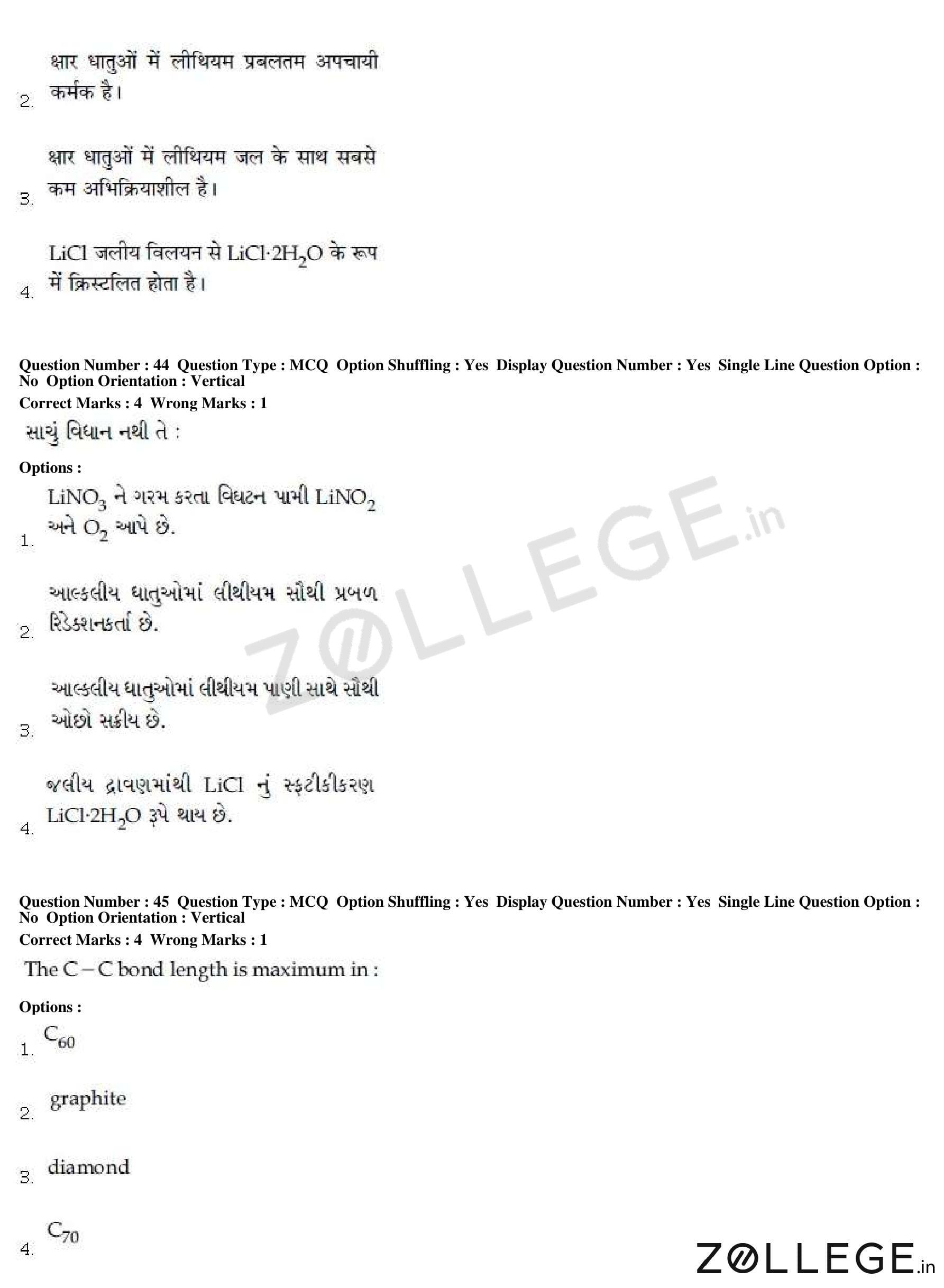
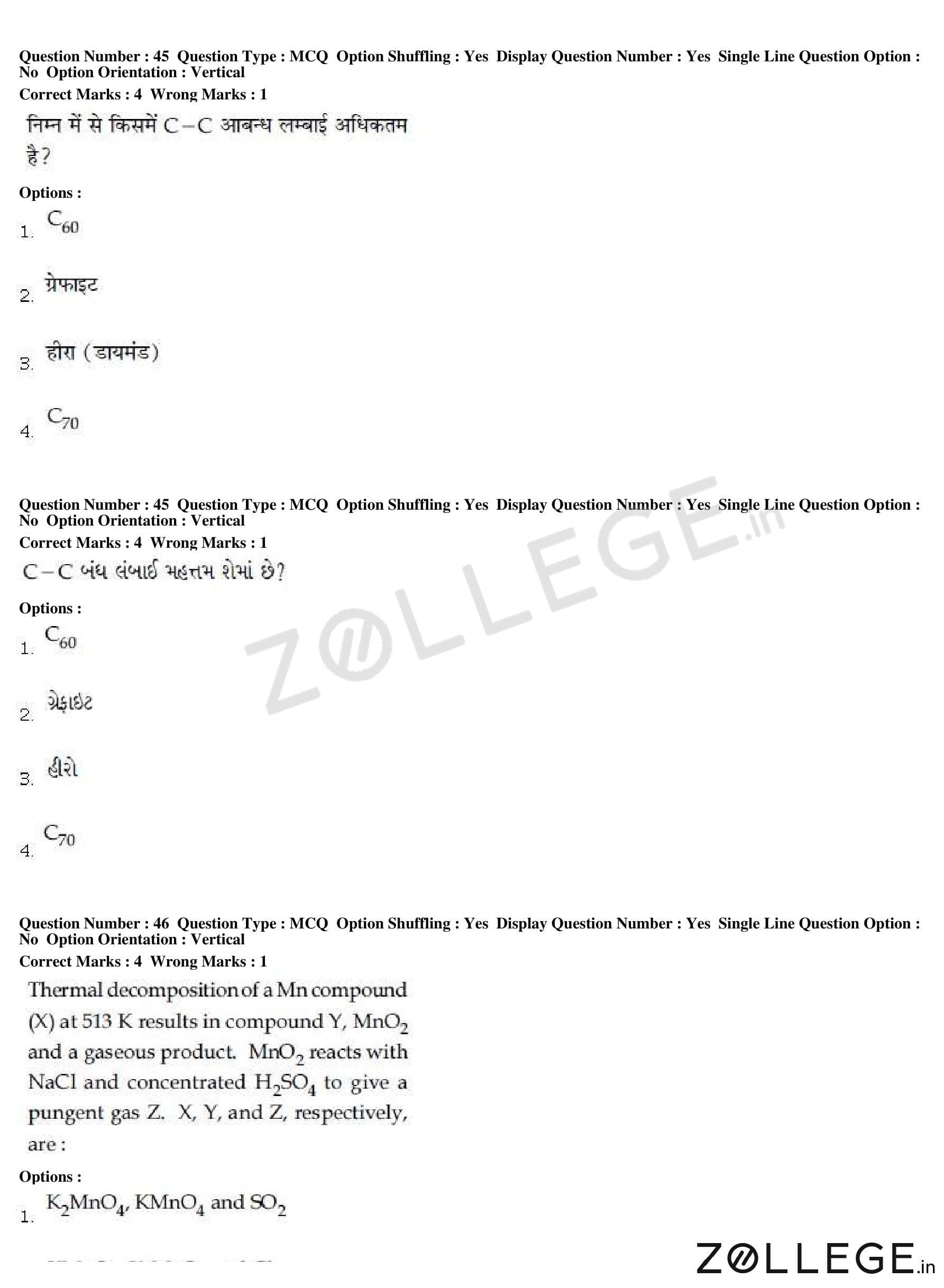
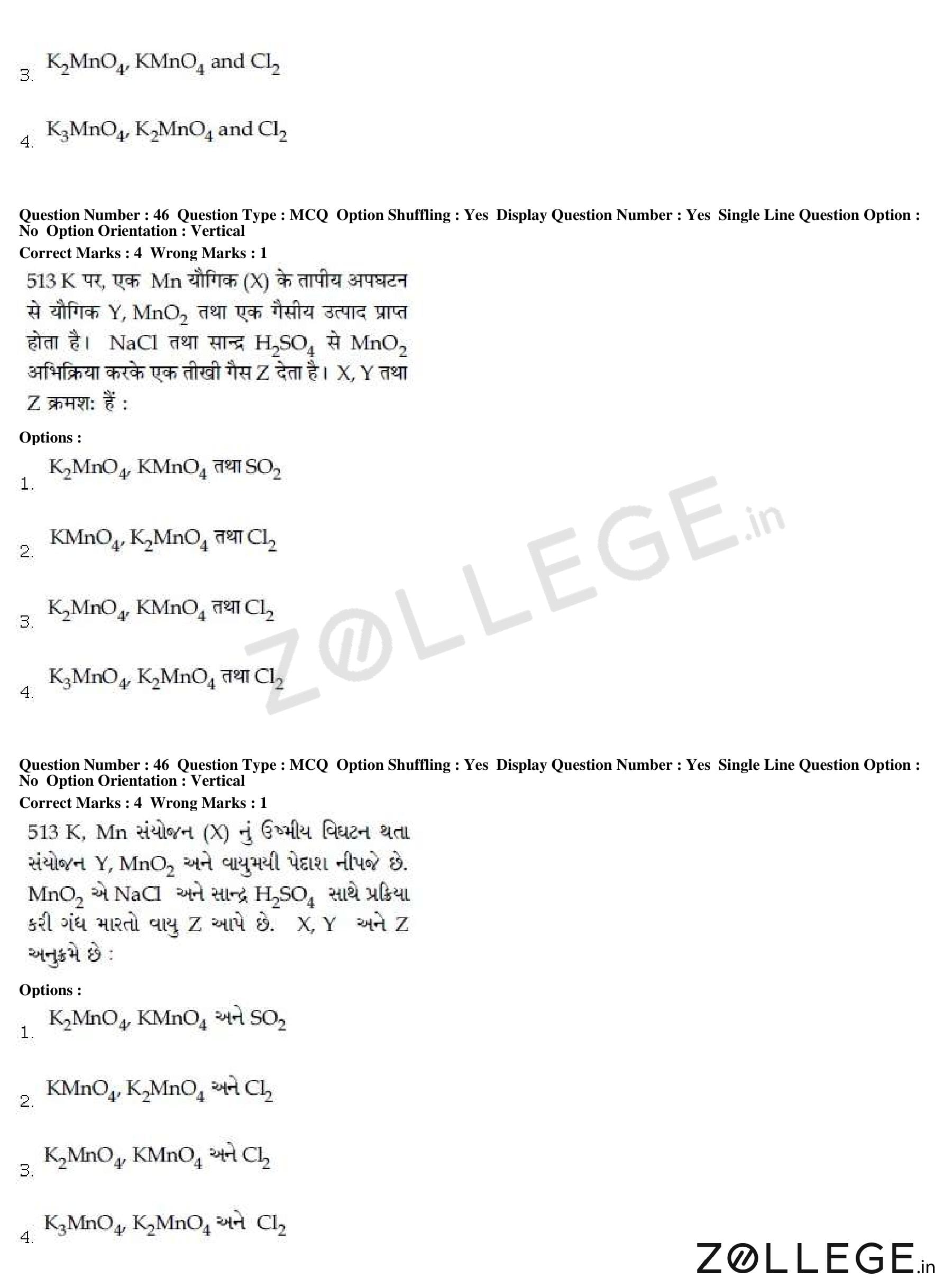
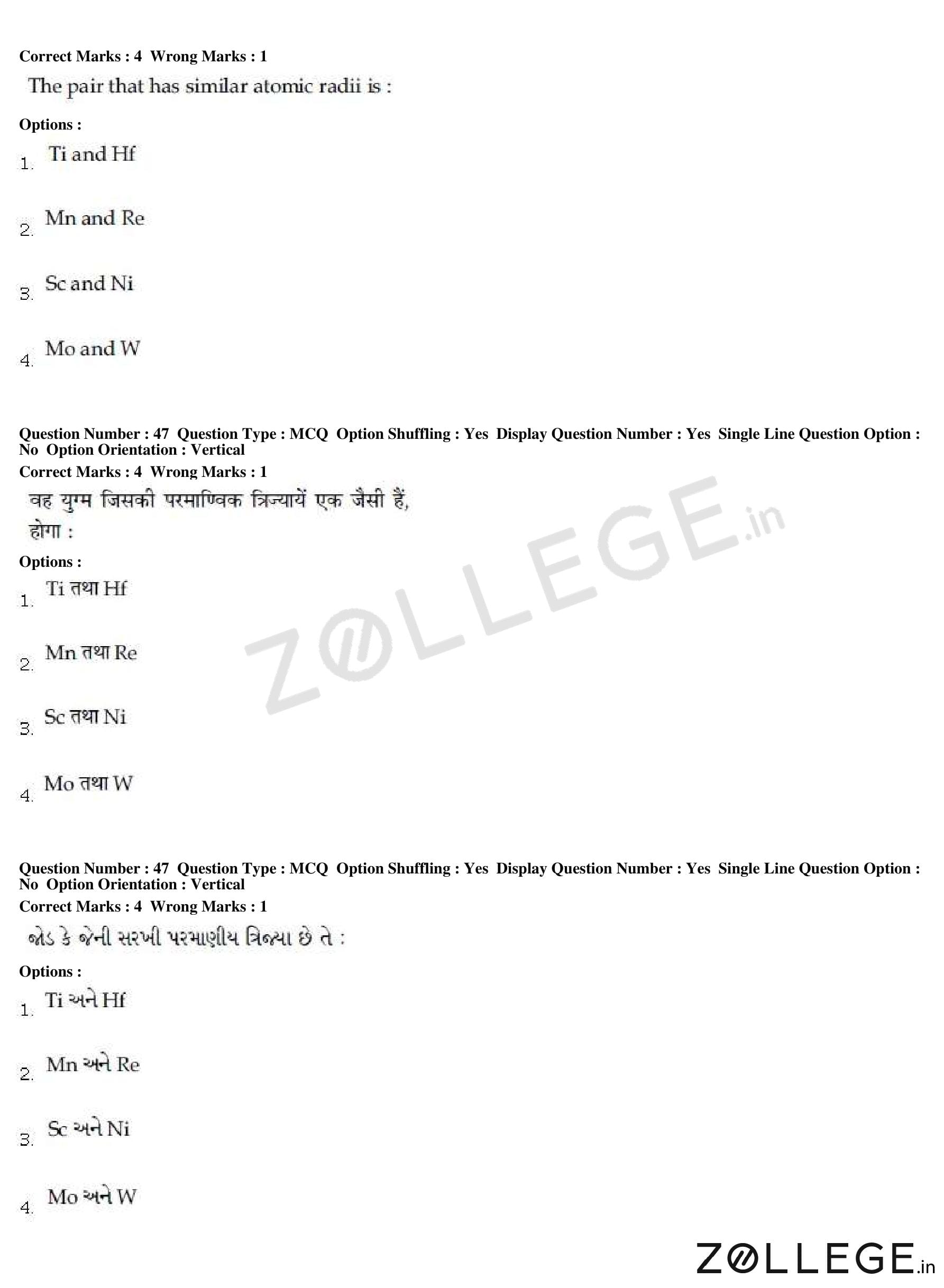
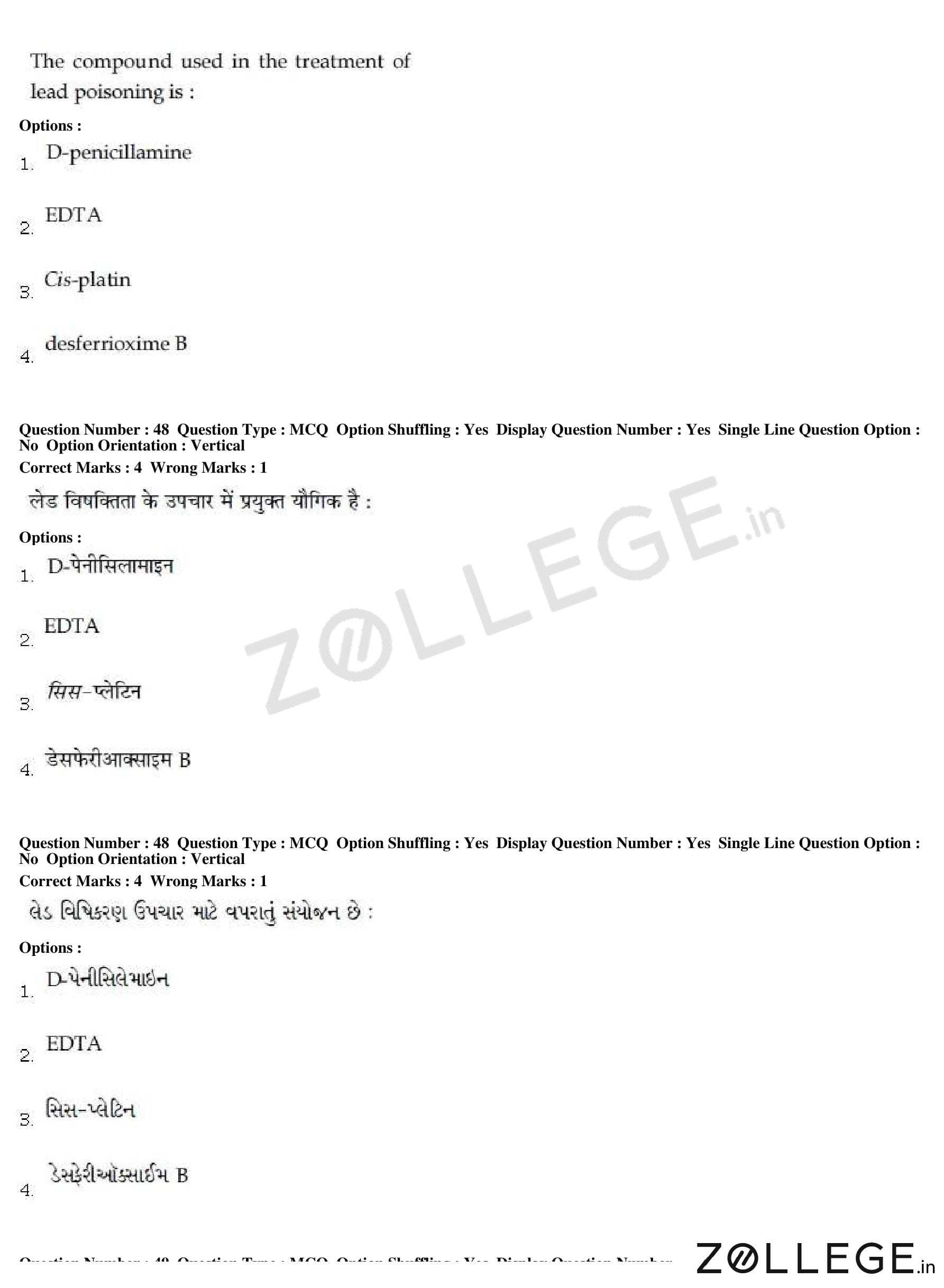
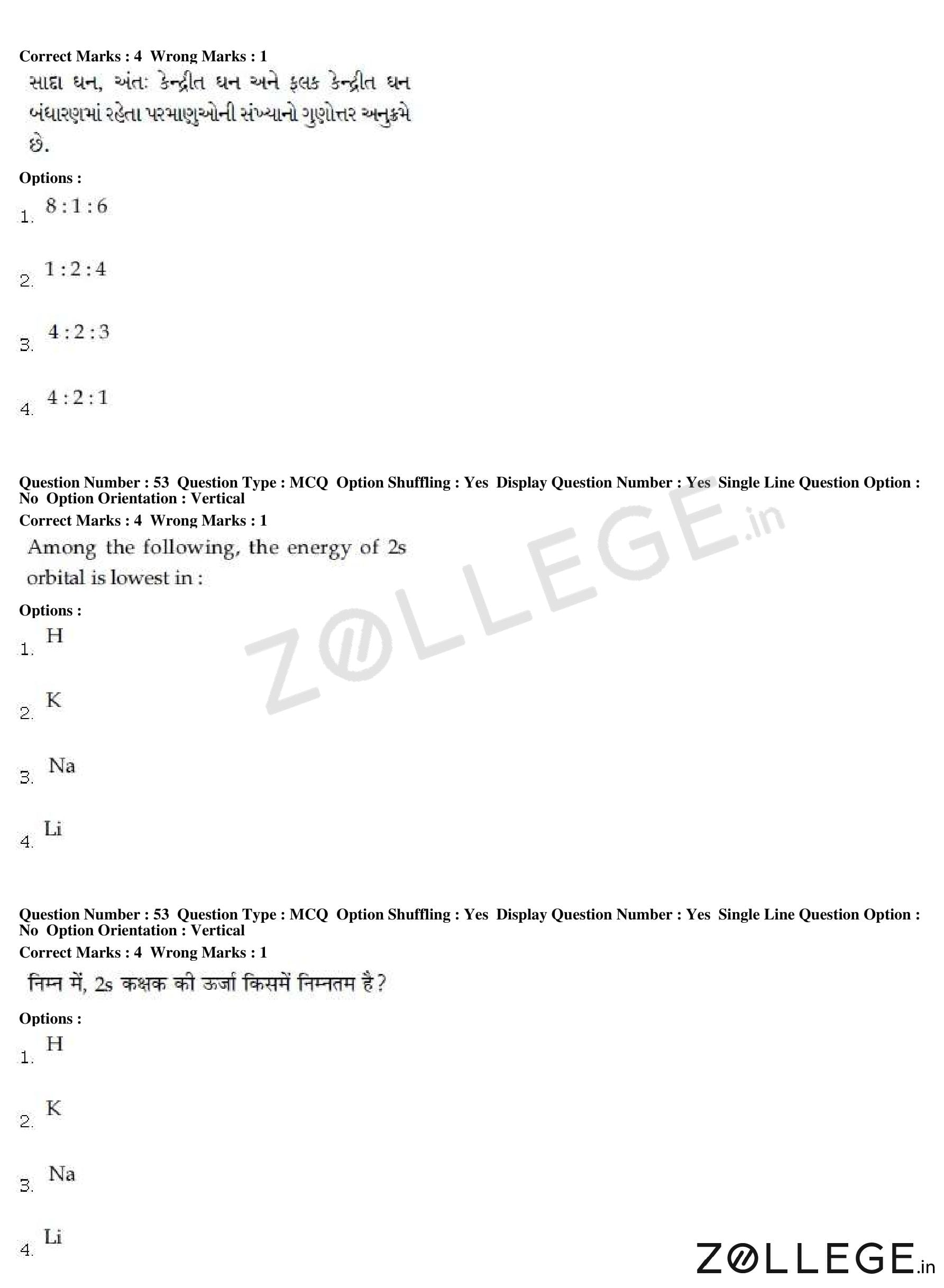
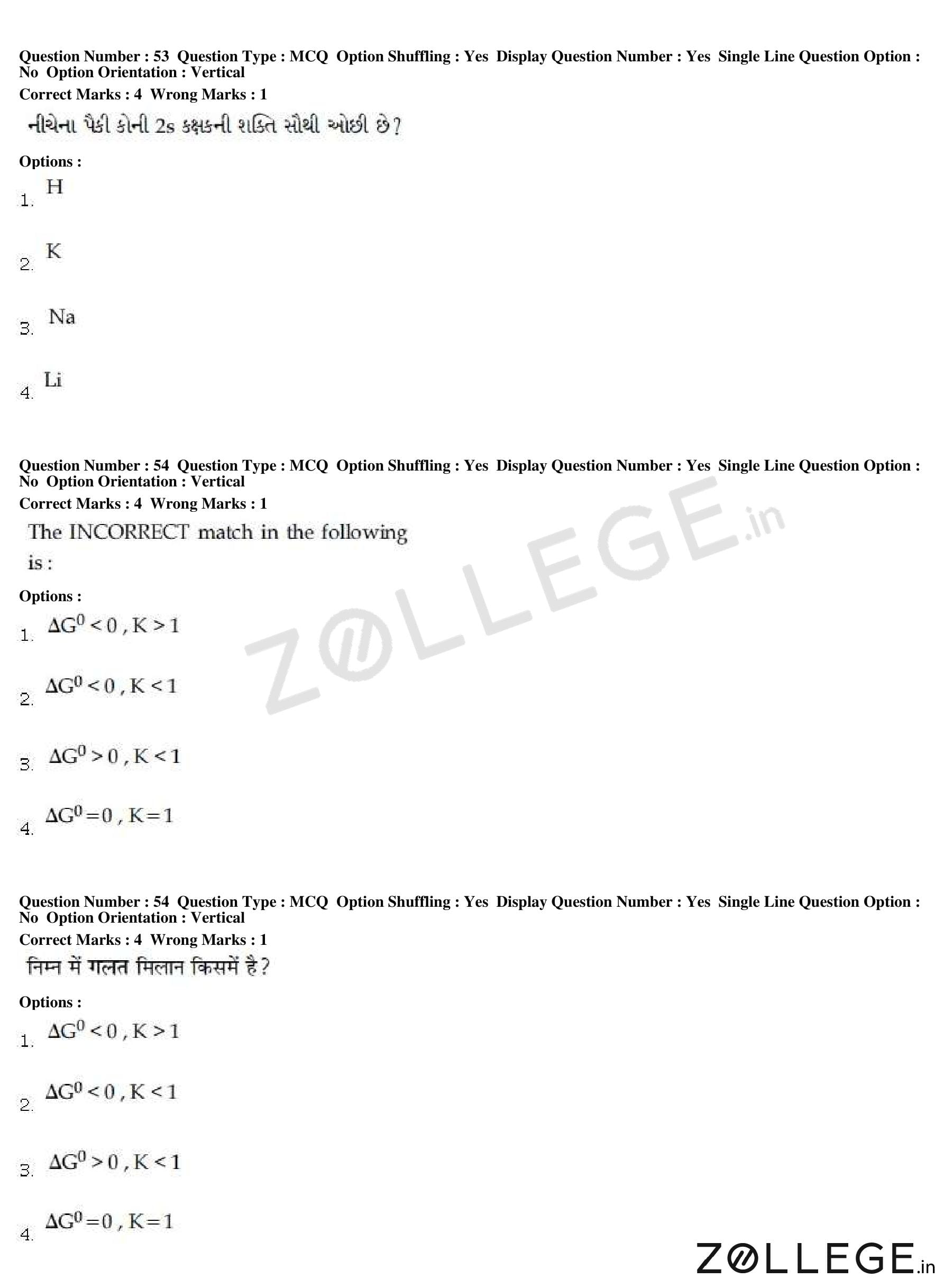
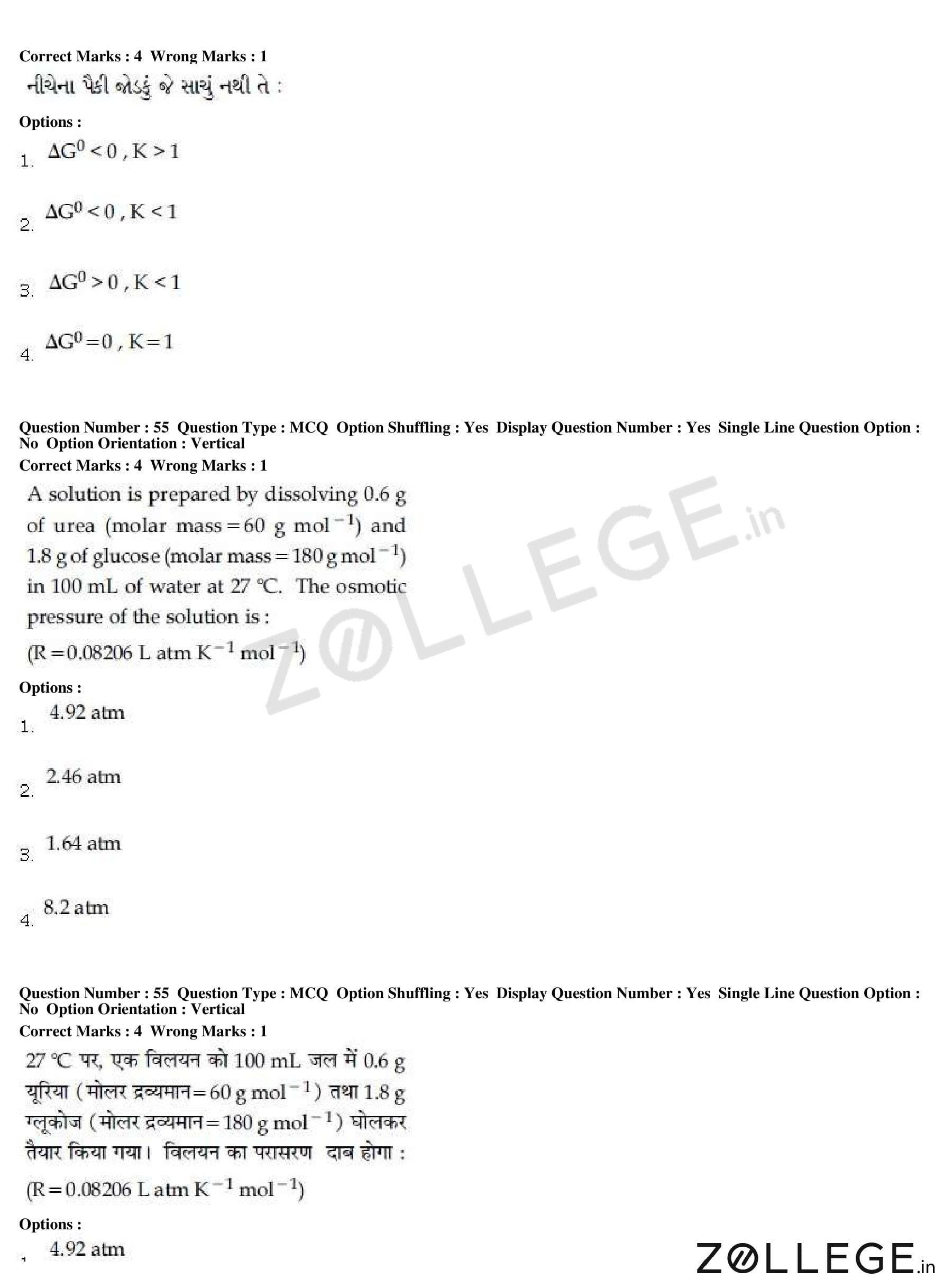
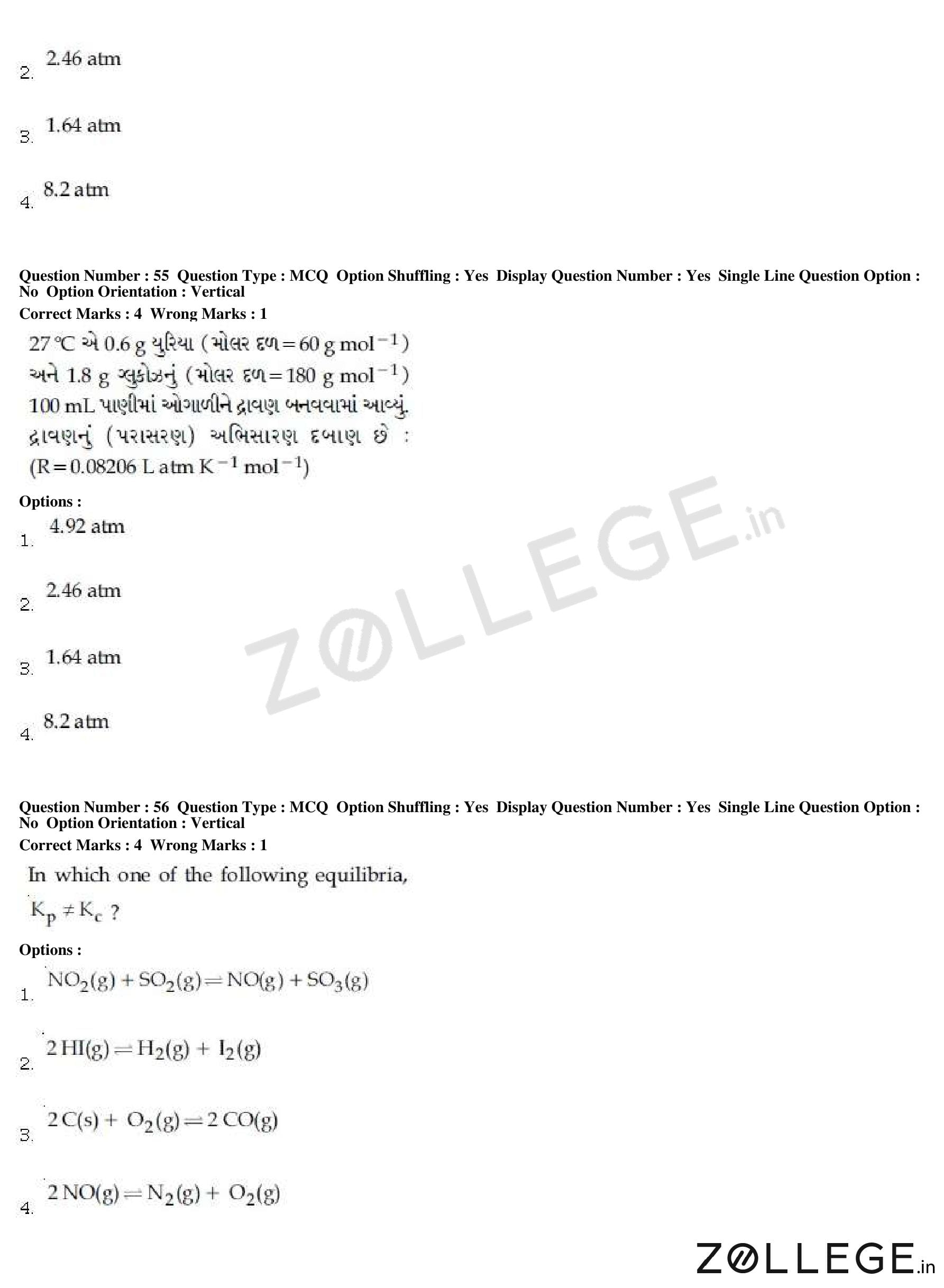
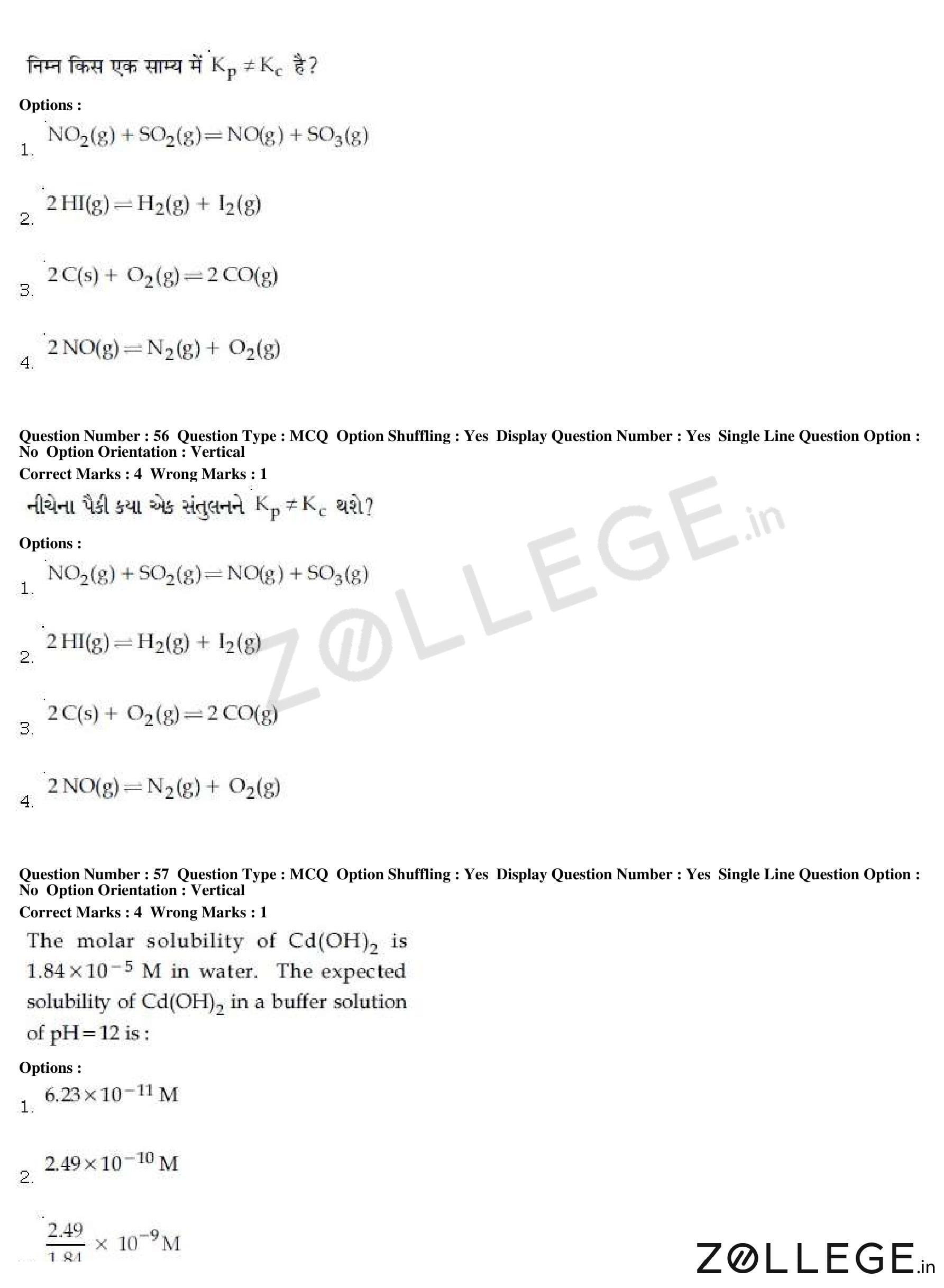
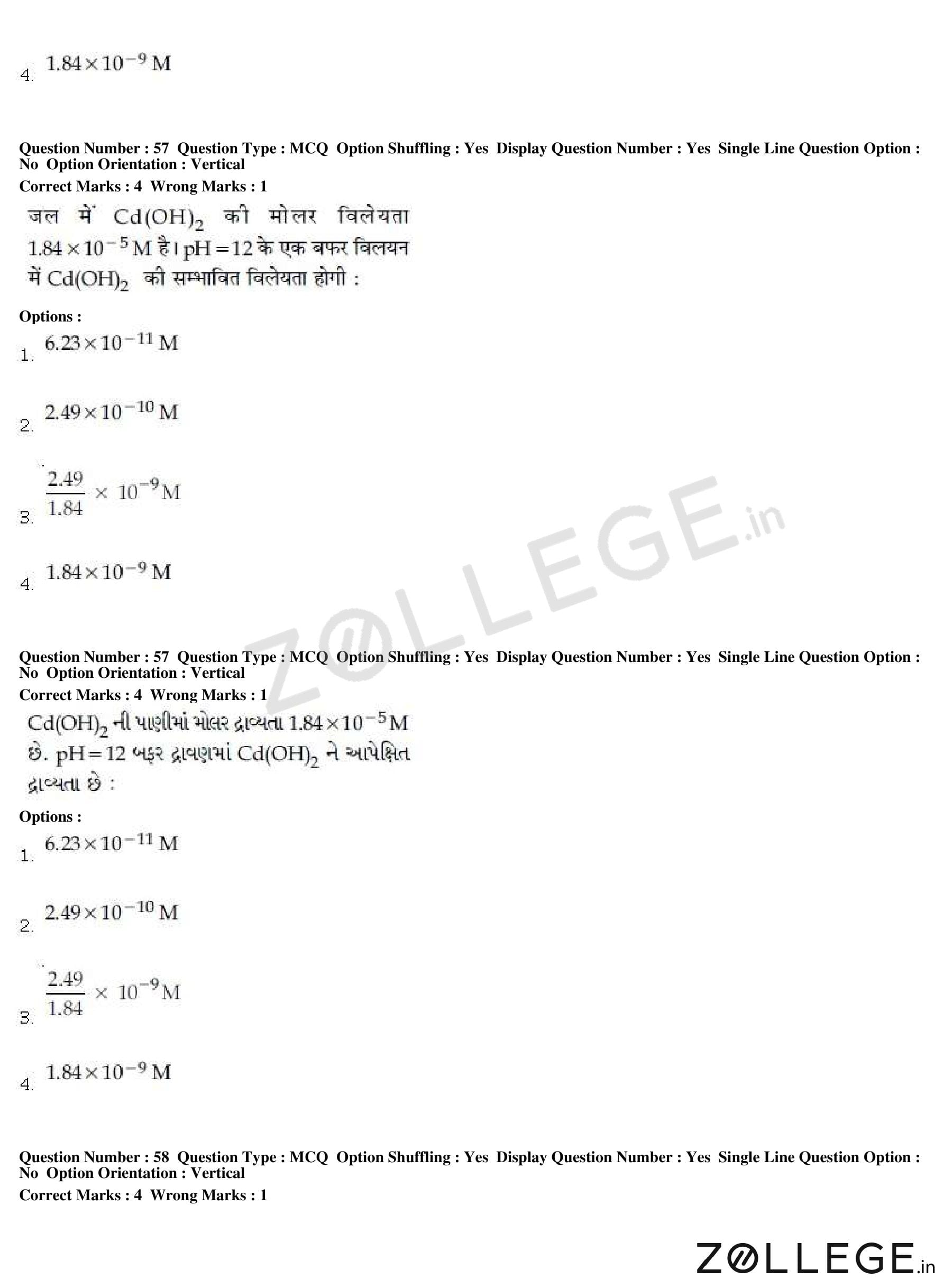
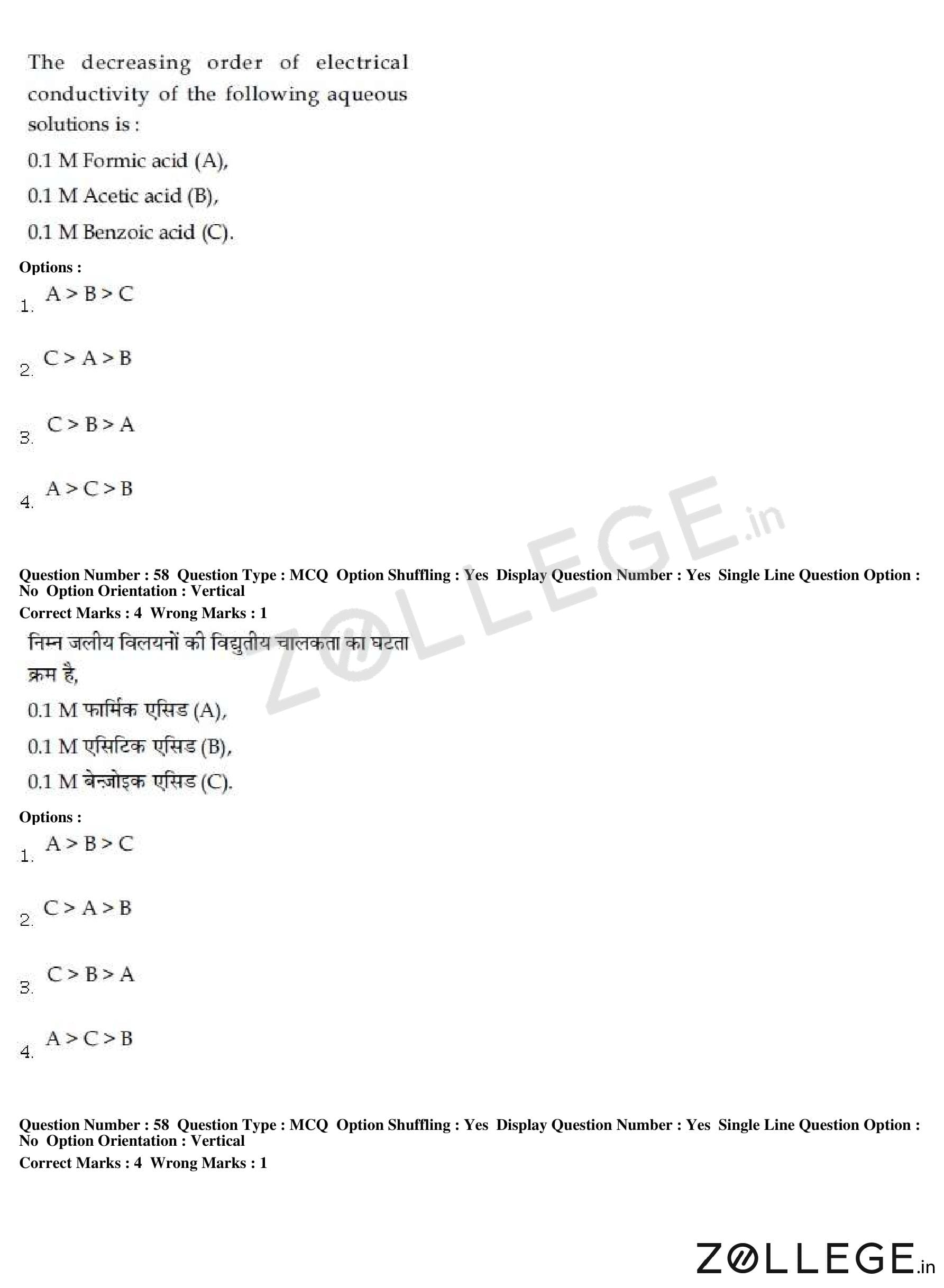
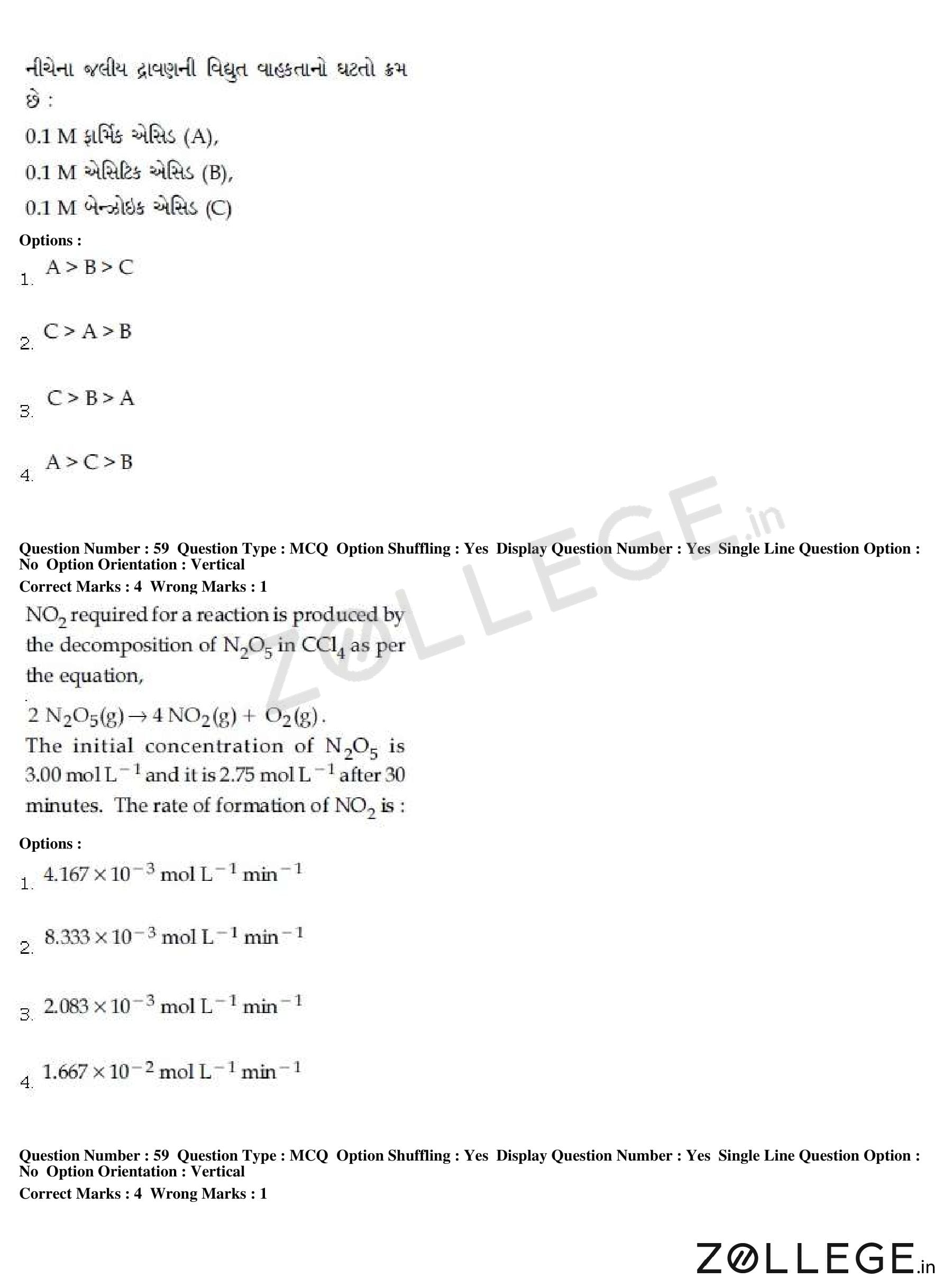
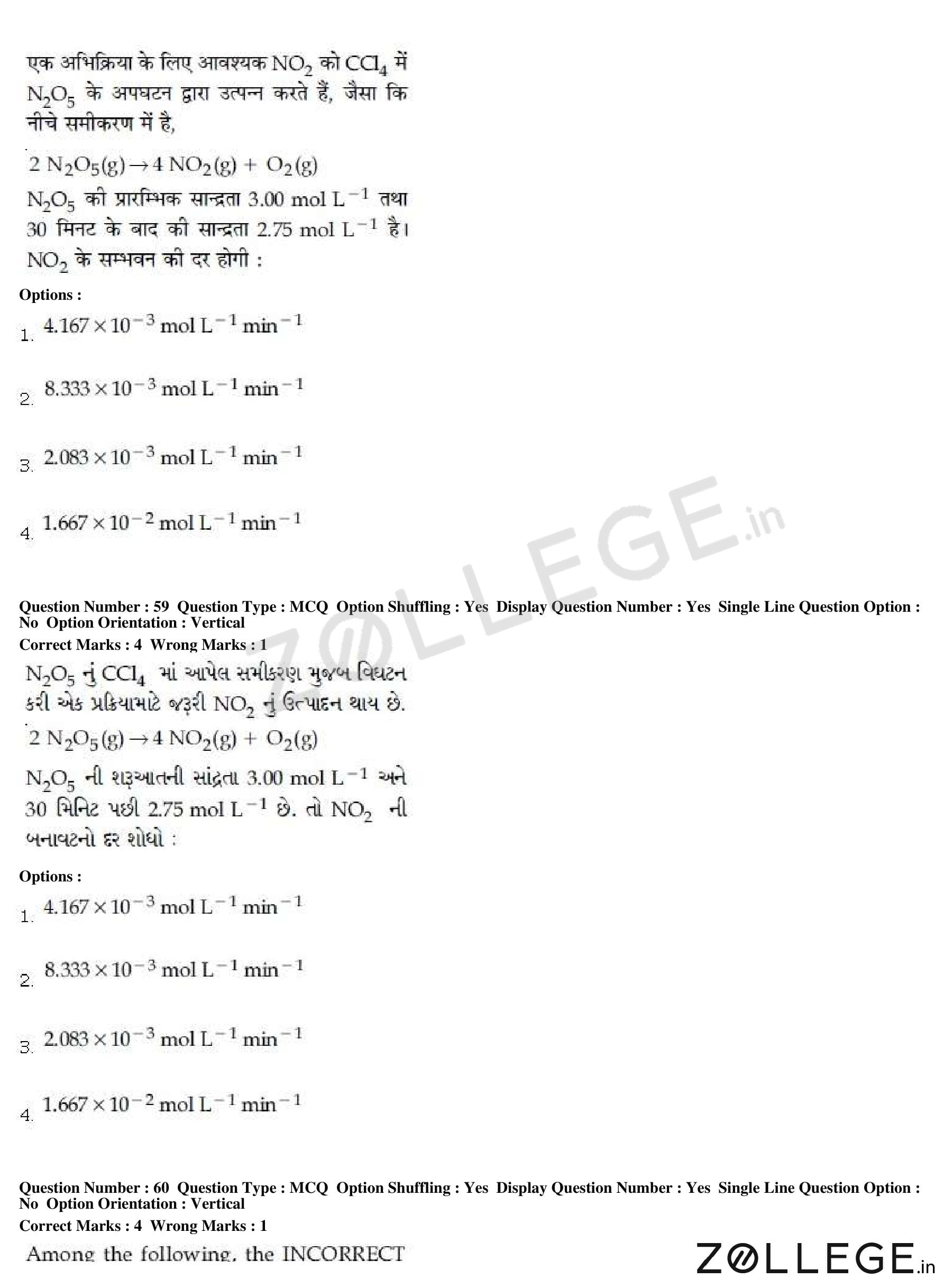
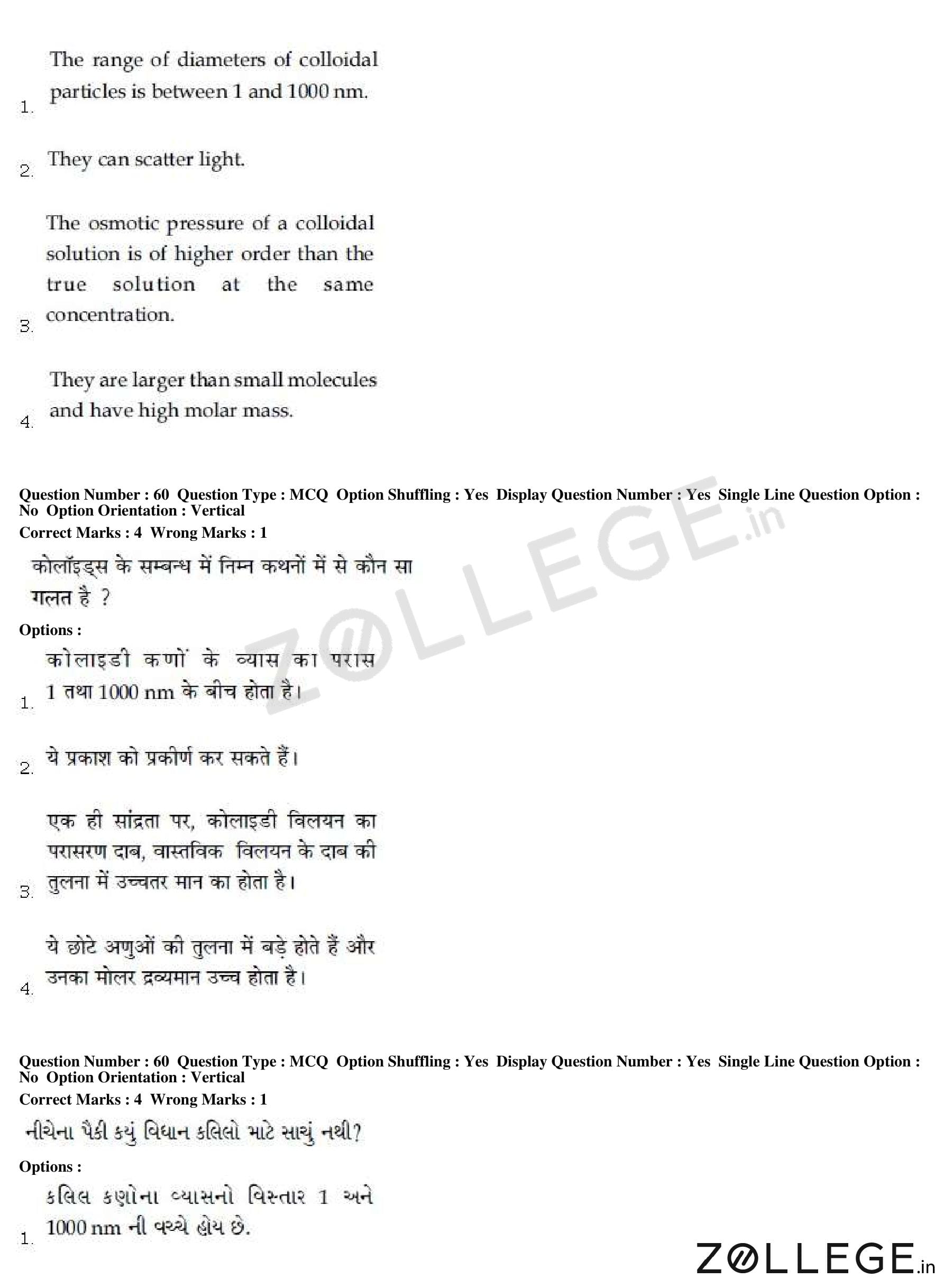
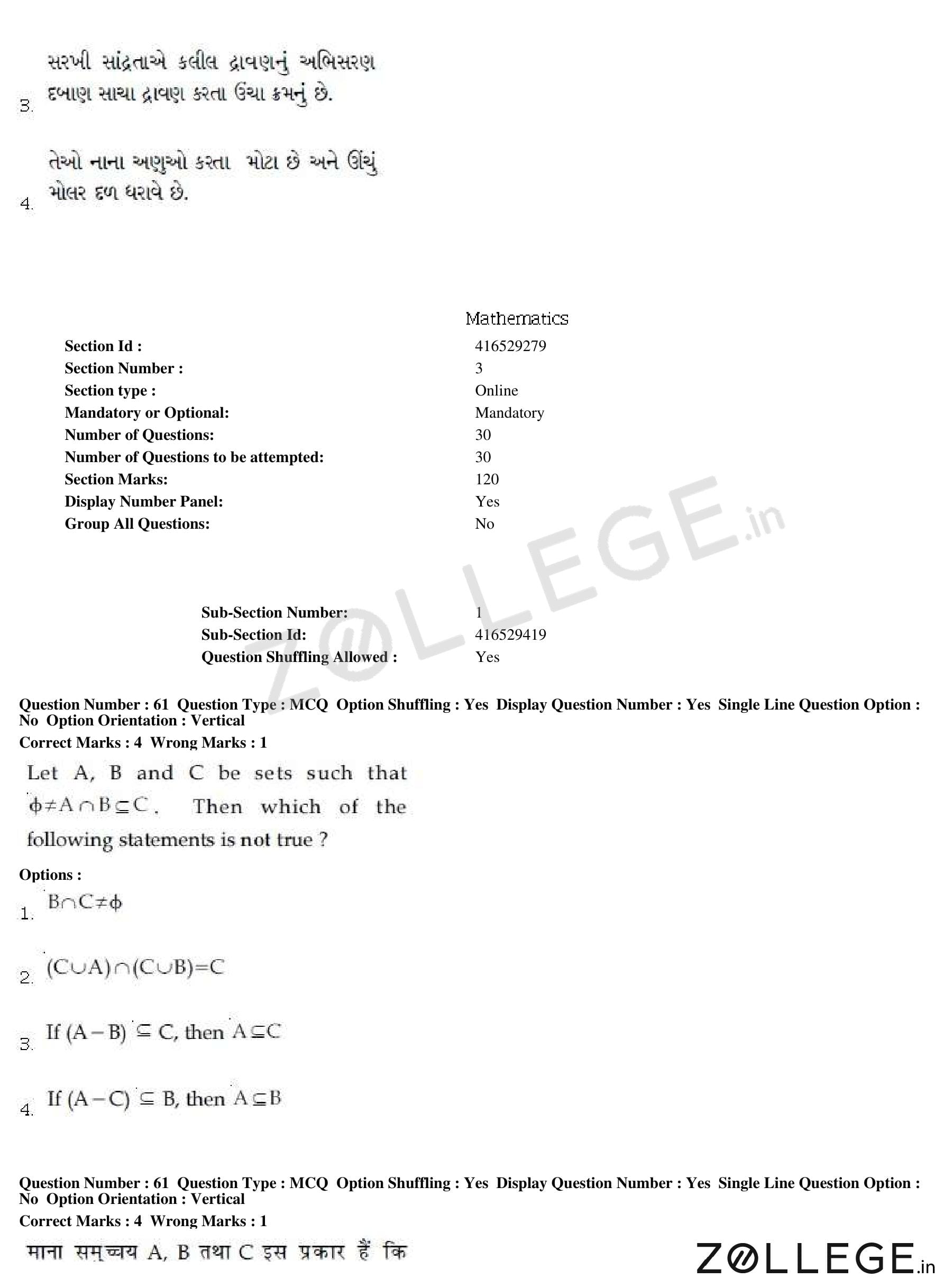
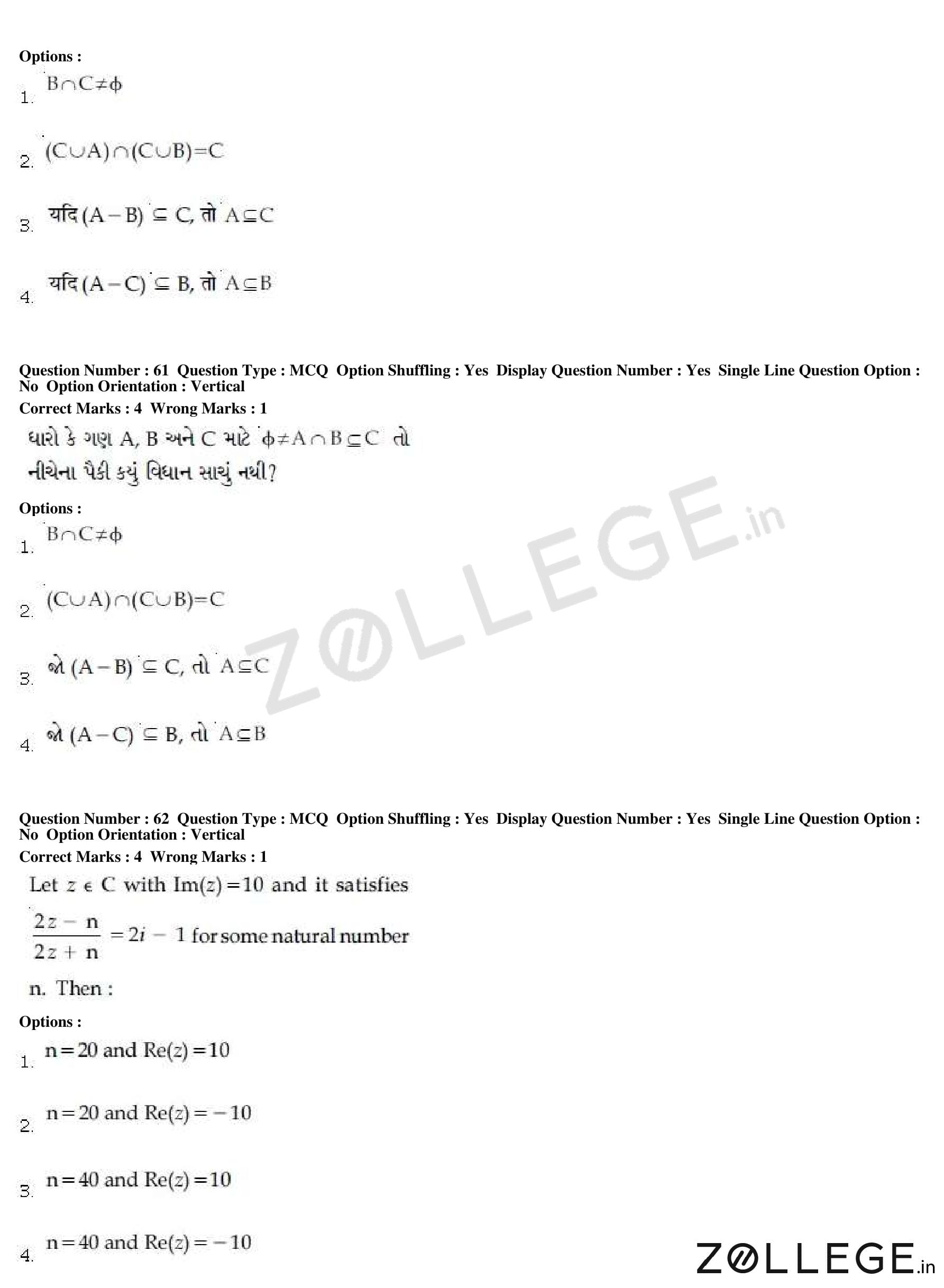
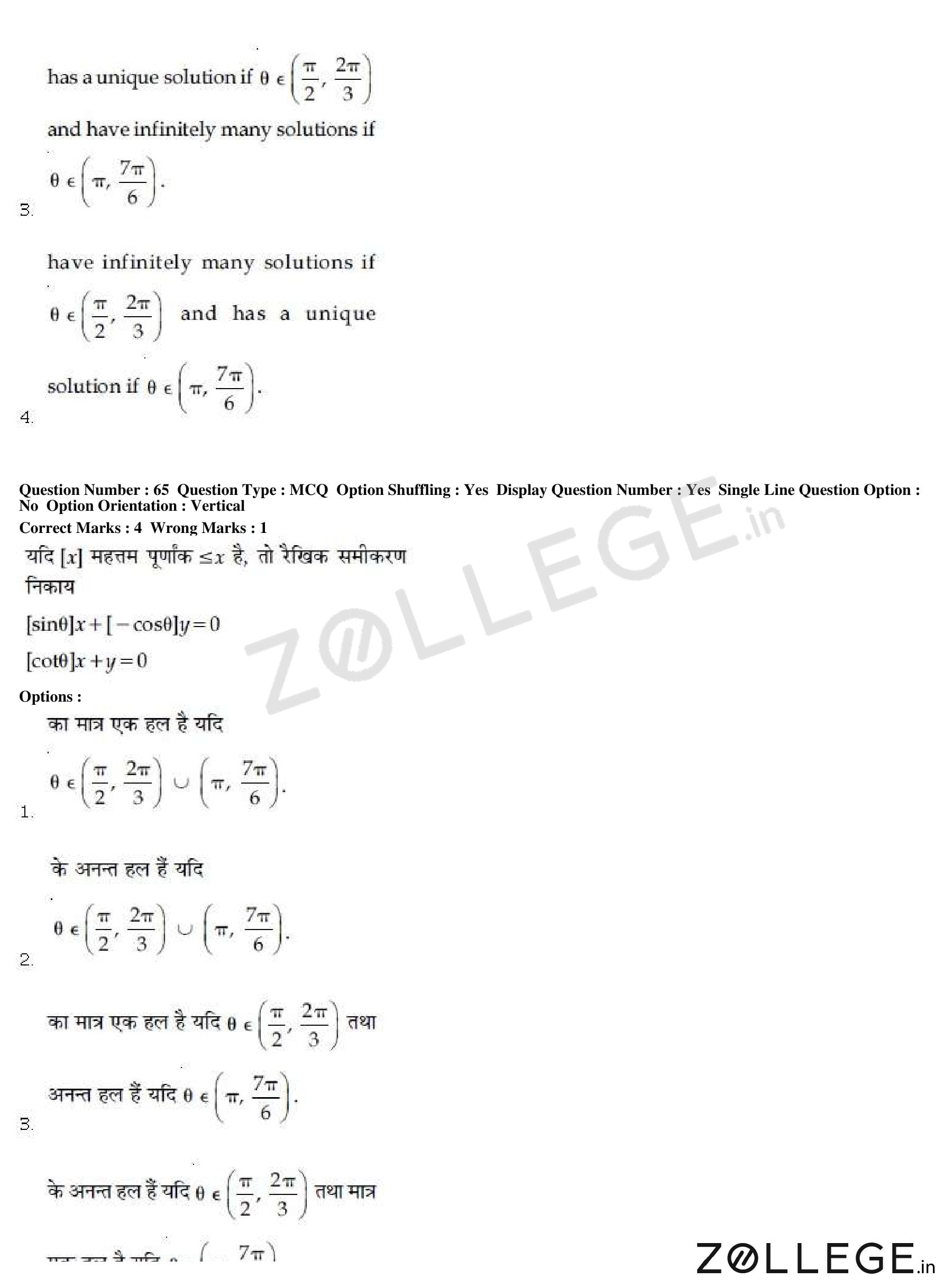
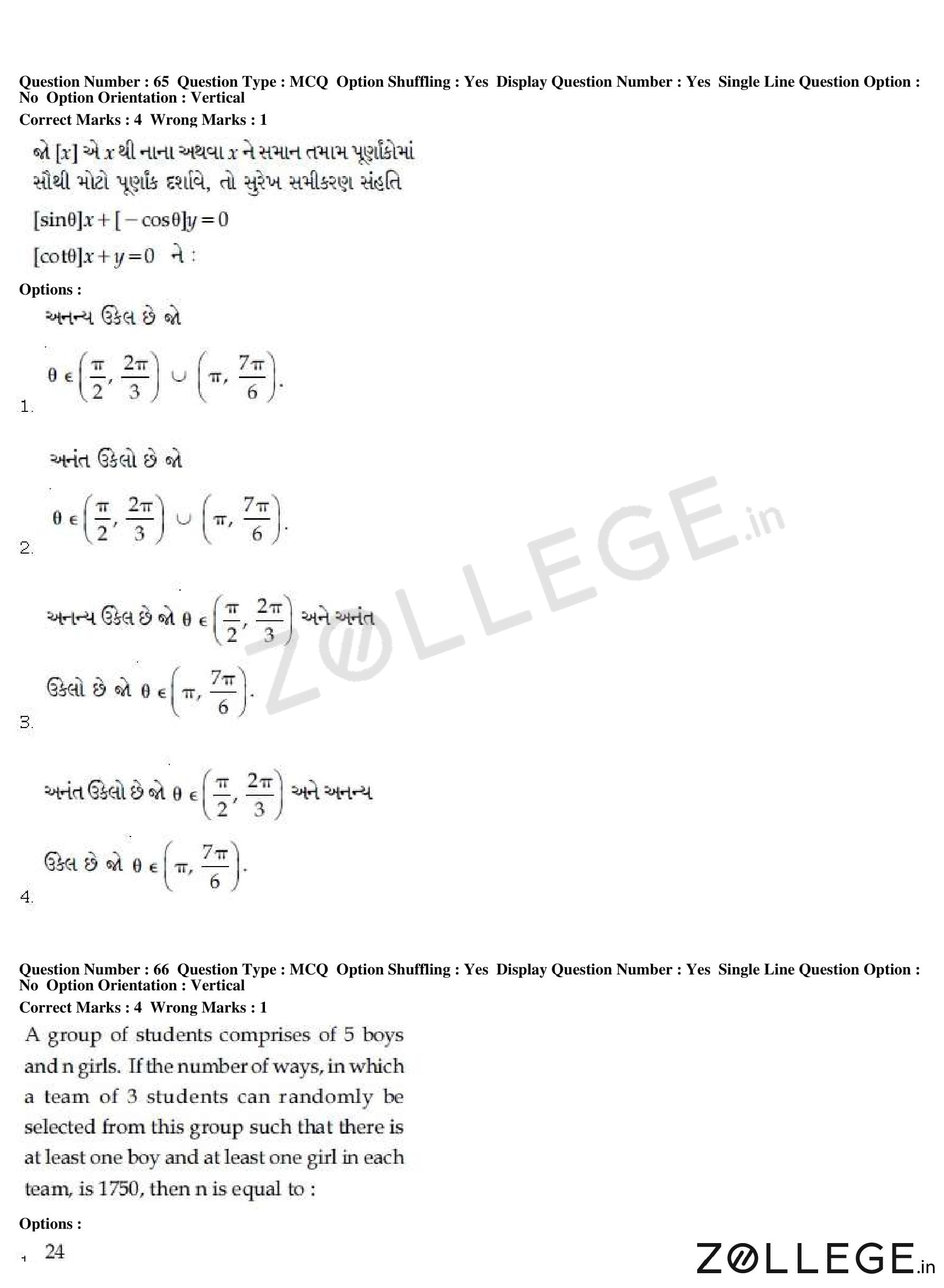
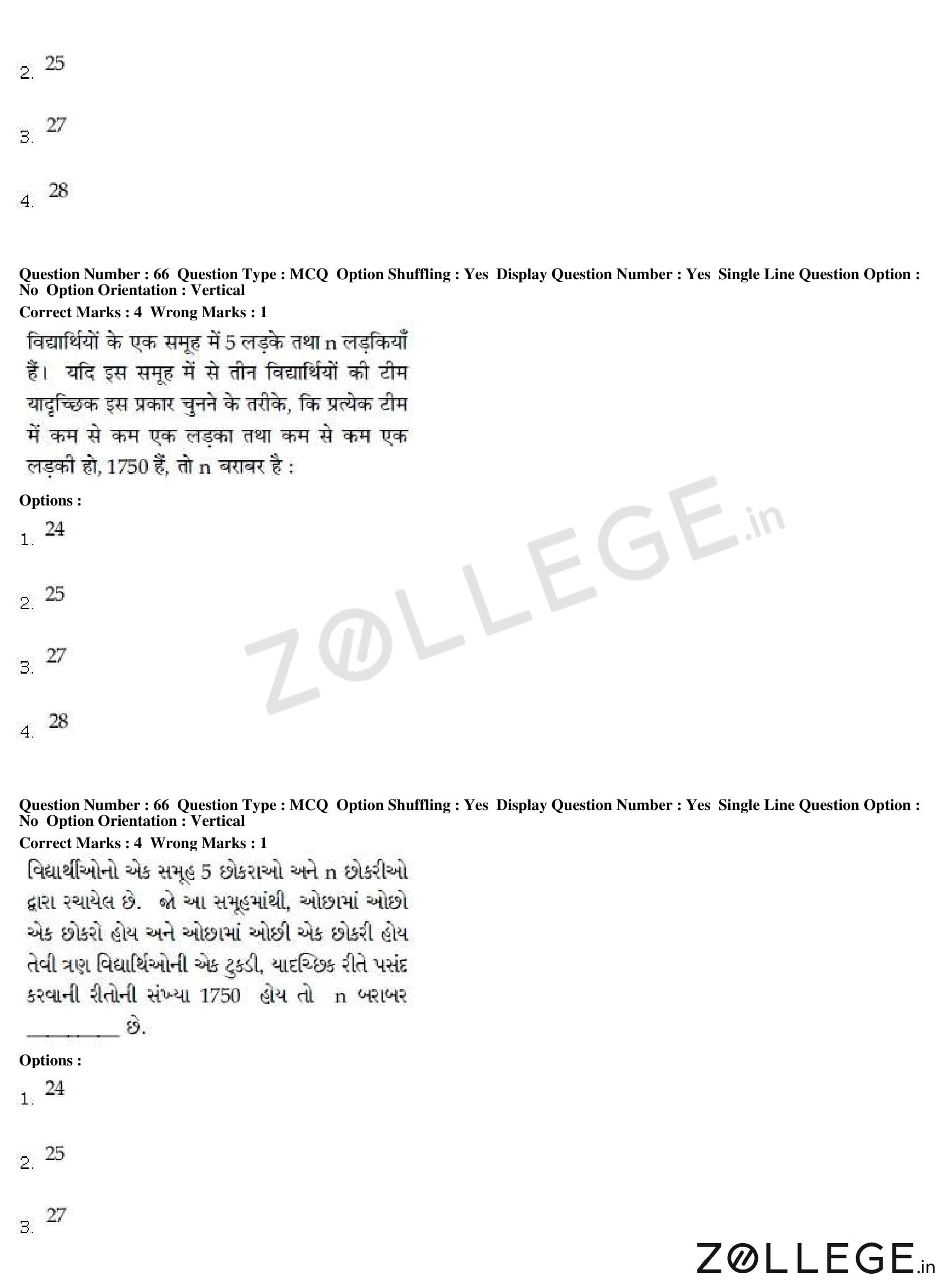
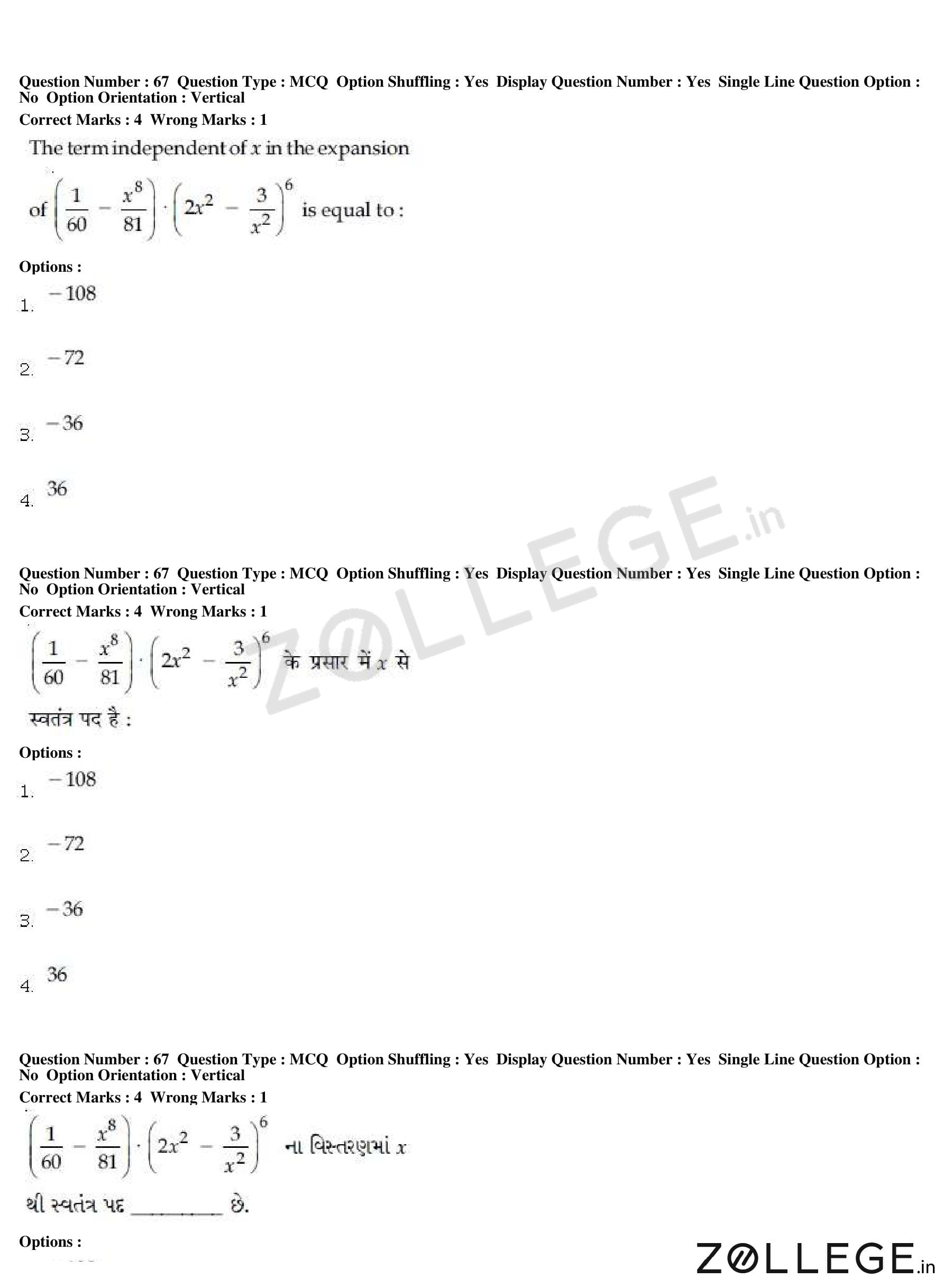
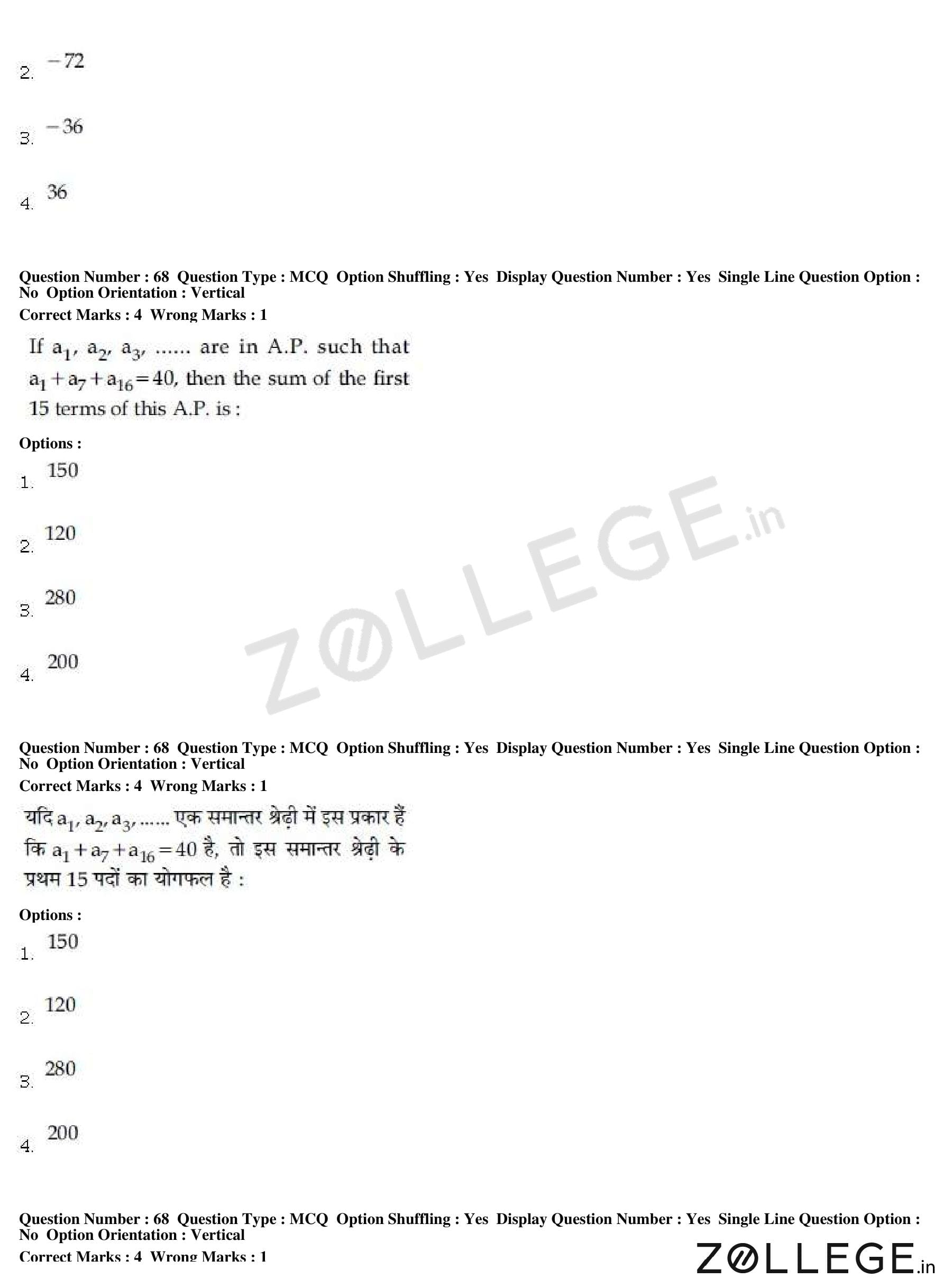
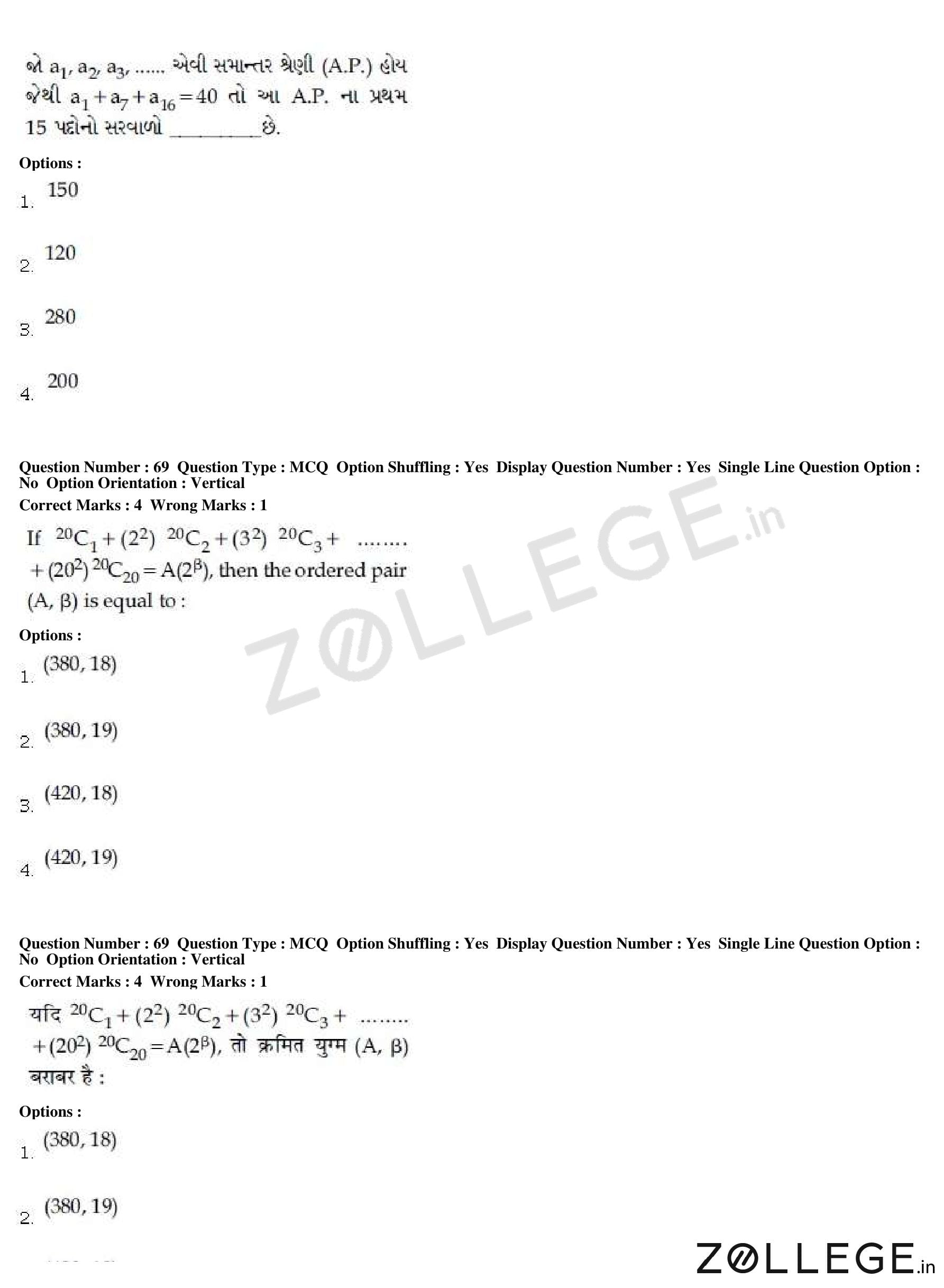
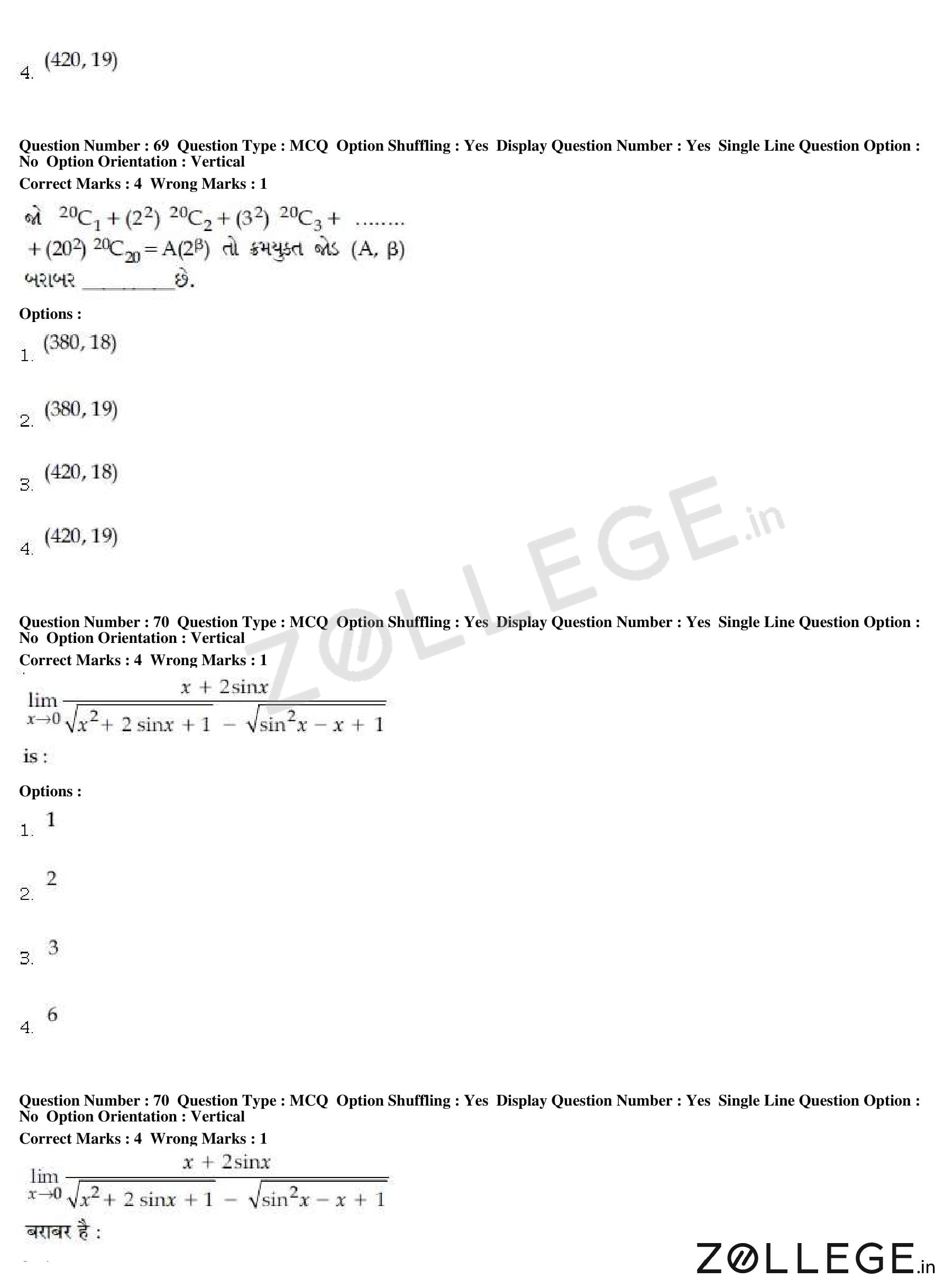
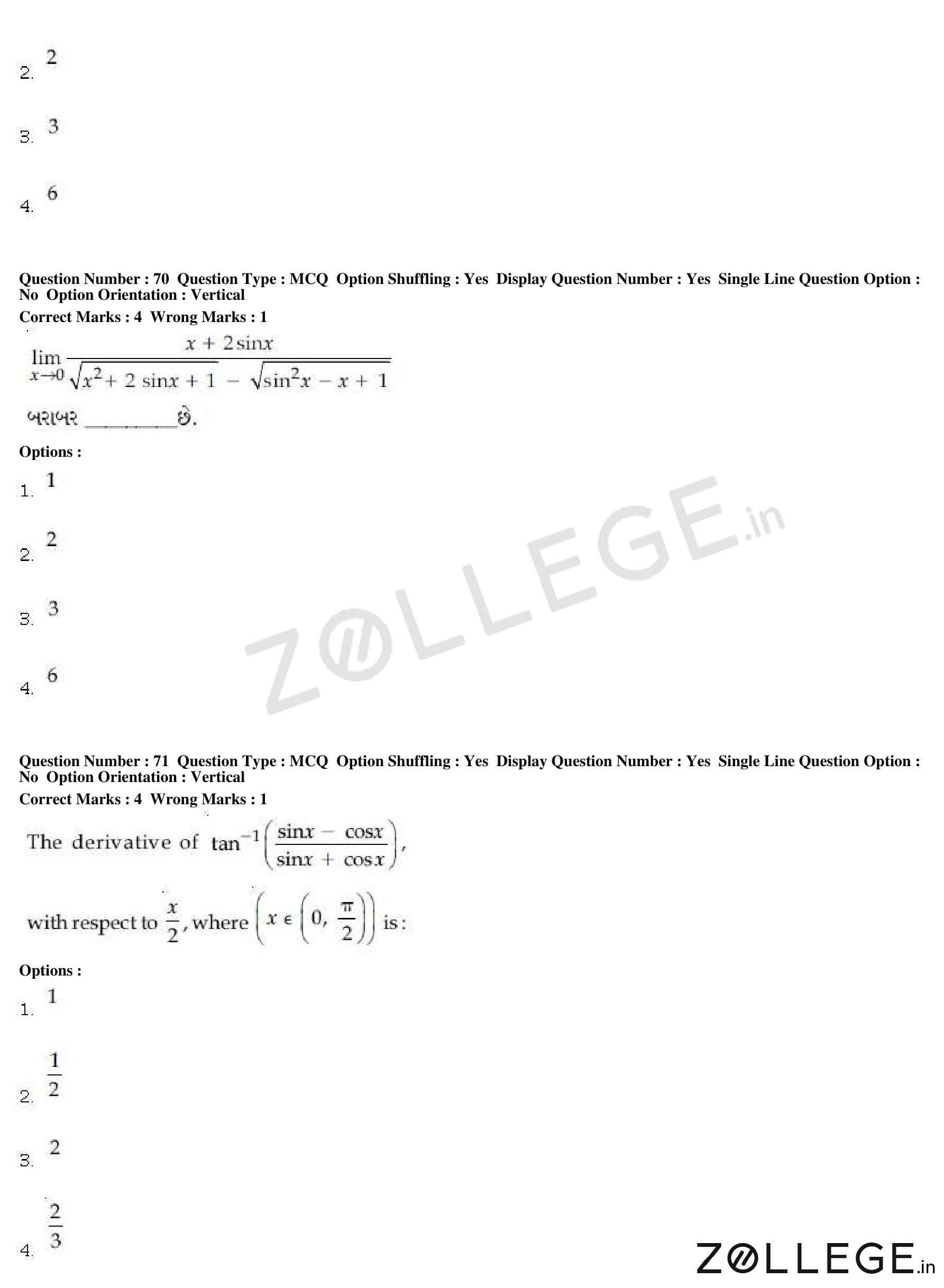
Previous Year JEE Main Question Papers
*The article might have information for the previous academic years, please refer the official website of the exam.