
JEE Main 2019 Question Paper with Answer Key PDF for B.E./ B.Tech(April 8, 2019 - Shift 1)


Content Writer | Updated On - Dec 26, 2025
JEE Main Question Papers are the most important study material for effective exam preparation. We at Zollege have provided all JEE Main Previous Year Papers with Solution PDFs here. JEE Main 2019 B. E. / B. Tech exam was conducted successfully on April 8, 2019. NTA conducted the exam in the Shift 1. According to student reactions and expert reviews, the paper was reported to be moderate.
Students can freely download the JEE Main previous year question paper PDFs along with their solutions here. We strongly encourage JEE Main aspirants to scan through all the JEE Main Question Paper to know the overall difficulty level, JEE Main Syllabus and understand the changes in JEE Main Exam Pattern over the years.
JEE Main 2019 B.E./ B.Tech Question Paper with Answer Key PDF (Shift 1)
| JEE Main 2019 B.E./ B.Tech Question Paper PDF | JEE Main 2019 B.E./ B.Tech Answer Key PDF | JEE Main 2019 B.E./ B.Tech Solution PDF |
|---|---|---|
| Download PDF | Download PDF | Check Solutions |

In SI units, the dimensions of \(\sqrt{\frac{\epsilon_0}{\mu_0}}\) is:
View Solution
The quantity \(\sqrt{\frac{\mu_0}{\epsilon_0}}\) represents the impedance of free space, which has dimensions of Resistance (\(R\)).
Therefore, the given quantity \(\sqrt{\frac{\epsilon_0}{\mu_0}}\) represents the reciprocal of impedance, which is Conductance (\(G = \frac{1}{R}\)).
Let's find the dimensions of Resistance (\(R\)). From Ohm's law, \(R = \frac{V}{I}\).
The dimension of Potential \(V = \frac{Work}{Charge} = \frac{ML^2T^{-2}}{AT} = ML^2T^{-3}A^{-1}\).
The dimension of Current \(I = A\).
So, \([R] = \frac{ML^2T^{-3}A^{-1}}{A} = ML^2T^{-3}A^{-2}\).
The dimension of \(\sqrt{\frac{\epsilon_0}{\mu_0}}\) is \([R]^{-1} = M^{-1}L^{-2}T^3A^2\).
Rearranging this matches Option (2): \(A^2T^3M^{-1}L^{-2}\).
Quick Tip: Remember that \(\sqrt{\frac{\mu_0}{\epsilon_0}} \approx 377 \Omega\). Knowing this constant (Impedance of free space) allows you to quickly associate the dimensions with Resistance (\(R\)) or Conductance (\(G\)).
Ship A is sailing towards north-east with velocity \(\vec{v} = 30\hat{i} + 50\hat{j}\) km/hr where \(\hat{i}\) points east and \(\hat{j}\), north. Ship B is at a distance of 80 km east and 150 km north of Ship A and is sailing towards west at 10 km/hr. A will be at minimum distance from B in:
View Solution
Let the position of Ship A be at the origin \((0,0)\). Its velocity is \(\vec{v}_A = 30\hat{i} + 50\hat{j}\).
The initial position of Ship B is \(\vec{r}_{B0} = 80\hat{i} + 150\hat{j}\). Its velocity is \(\vec{v}_B = -10\hat{i}\) (West).
We consider the relative motion of B with respect to A.
Relative velocity \(\vec{v}_{rel} = \vec{v}_B - \vec{v}_A = (-10\hat{i}) - (30\hat{i} + 50\hat{j}) = -40\hat{i} - 50\hat{j}\).
Relative initial position \(\vec{r}_{rel_0} = \vec{r}_{B0} - \vec{r}_{A0} = 80\hat{i} + 150\hat{j}\).
The relative position at time \(t\) is \(\vec{r}(t) = \vec{r}_{rel_0} + \vec{v}_{rel}t = (80 - 40t)\hat{i} + (150 - 50t)\hat{j}\).
The squared distance is \(D^2 = |\vec{r}(t)|^2 = (80 - 40t)^2 + (150 - 50t)^2\).
For minimum distance, \(\frac{d(D^2)}{dt} = 0\).
\(2(80 - 40t)(-40) + 2(150 - 50t)(-50) = 0\).
Dividing by -200: \(4(8 - 4t) + 5(15 - 5t) = 0\) (after simplifying factors).
\(32 - 16t + 75 - 25t = 0 \Rightarrow 41t = 107\).
\(t = \frac{107}{41} \approx 2.6\) hrs.
Quick Tip: The time for minimum distance occurs when the relative position vector \(\vec{r}_{rel}\) is perpendicular to the relative velocity vector \(\vec{v}_{rel}\), i.e., their dot product is zero.
Four particles A, B, C and D with masses \(m_A=m, m_B=2m, m_C=3m\) and \(m_D=4m\) are at the corners of a square. They have accelerations of equal magnitude with directions as shown. The acceleration of the centre of mass of the particles is:

View Solution
From the figure provided in the question, we assign directions to the accelerations:
\(\vec{a}_A = -a\hat{i}\) (Mass \(m\))
\(\vec{a}_B = a\hat{j}\) (Mass \(2m\))
\(\vec{a}_C = a\hat{i}\) (Mass \(3m\))
\(\vec{a}_D = -a\hat{j}\) (Mass \(4m\))
The acceleration of the Centre of Mass is \(\vec{a}_{CM} = \frac{\sum m_i \vec{a}_i}{\sum m_i}\).
\(\vec{a}_{CM} = \frac{m(-a\hat{i}) + 2m(a\hat{j}) + 3m(a\hat{i}) + 4m(-a\hat{j})}{m + 2m + 3m + 4m}\).
\(\vec{a}_{CM} = \frac{(-m a + 3m a)\hat{i} + (2m a - 4m a)\hat{j}}{10m}\).
\(\vec{a}_{CM} = \frac{2m a \hat{i} - 2m a \hat{j}}{10m}\).
\(\vec{a}_{CM} = \frac{2m a (\hat{i} - \hat{j})}{10m} = \frac{a}{5}(\hat{i} - \hat{j})\).
Quick Tip: Be careful with the coordinate system. Usually, right is \(+\hat{i}\) and up is \(+\hat{j}\). Simply summing the weighted vectors leads to the answer.
A particle moves in one dimension from rest under the influence of a force that varies with the distance travelled by the particle as shown in the figure. The kinetic energy of the particle after it has travelled 3 m is:

View Solution
According to the Work-Energy Theorem, \(W = \Delta K\).
Since the particle starts from rest, \(K_i = 0\), so \(W = K_f\).
Work done is the area under the Force vs Distance graph.
The area consists of a rectangle from \(x=0\) to \(x=2\) and a trapezium from \(x=2\) to \(x=3\).
Area 1 (Rectangle) \(= base \times height = 2 \, m \times 2 \, N = 4 \, J\).
Area 2 (Trapezium) \(= \frac{1}{2}(sum of parallel sides) \times height = \frac{1}{2}(2 + 3) \times (3 - 2) = 2.5 \, J\).
Total Work \(= 4 + 2.5 = 6.5 \, J\).
Therefore, Kinetic Energy \(= 6.5 \, J\).
Quick Tip: For any Force-Displacement graph, the area under the curve represents the Work Done.
A thin circular plate of mass M and radius R has its density varying as \(\rho(r) = \rho_0 r\) with \(\rho_0\) as constant and r is the distance from its center. The moment of Inertia of the circular plate about an axis perpendicular to the plate and passing through its edge is \(I = a MR^2\). The value of the coefficient a is:
View Solution
First, calculate total mass \(M\) by integrating elemental rings. Element mass \(dm = \rho(r) dA = (\rho_0 r)(2\pi r dr)\).
\(M = \int_0^R 2\pi \rho_0 r^2 dr = 2\pi \rho_0 [\frac{r^3}{3}]_0^R = \frac{2\pi \rho_0 R^3}{3}\).
This implies \(\rho_0 = \frac{3M}{2\pi R^3}\).
Now, calculate Moment of Inertia about the central axis (\(I_{CM}\)). \(dI = dm \cdot r^2 = (2\pi \rho_0 r^2 dr) r^2 = 2\pi \rho_0 r^4 dr\).
\(I_{CM} = \int_0^R 2\pi \rho_0 r^4 dr = 2\pi \rho_0 [\frac{r^5}{5}]_0^R = \frac{2\pi \rho_0 R^5}{5}\).
Substitute \(\rho_0\): \(I_{CM} = \frac{2\pi R^5}{5} (\frac{3M}{2\pi R^3}) = \frac{3}{5} MR^2\).
We need the Moment of Inertia about an axis at the edge (parallel to CM axis). Use Parallel Axis Theorem: \(I_{edge} = I_{CM} + Md^2\), where \(d=R\).
\(I_{edge} = \frac{3}{5} MR^2 + MR^2 = \frac{8}{5} MR^2\).
Thus, \(a = 8/5\).
Quick Tip: For variable density problems, always find the relationship between the mass constants (like \(\rho_0\)) and the total mass \(M\) first.
Four identical particles of mass M are located at the corners of a square of side 'a'. What should be their speed if each of them revolves under the influence of others' gravitational field in a circular orbit circumscribing the square ?

View Solution
Consider one particle. It experiences three forces: two from adjacent neighbors (distance \(a\)) and one from the opposite neighbor (distance \(a\sqrt{2}\)).
Force from adjacent: \(F_1 = \frac{GM^2}{a^2}\). The resultant of two such forces at \(90^\circ\) is \(\sqrt{2} F_1\) towards the center.
Force from opposite: \(F_2 = \frac{GM^2}{(a\sqrt{2})^2} = \frac{GM^2}{2a^2}\) towards the center.
Total Centripetal Force \(F_c = \sqrt{2}\frac{GM^2}{a^2} + \frac{GM^2}{2a^2} = \frac{GM^2}{a^2}(\sqrt{2} + 0.5)\).
Radius of the circle \(r = \frac{a}{\sqrt{2}}\). The required centripetal force is \(\frac{Mv^2}{r}\).
\(\frac{Mv^2}{a/\sqrt{2}} = \frac{GM^2}{a^2}(\sqrt{2} + 0.5)\).
\(v^2 = \frac{GM}{a\sqrt{2}}(\sqrt{2} + 0.5) = \frac{GM}{a}(1 + \frac{1}{2\sqrt{2}})\).
\(v = \sqrt{\frac{GM}{a}(1 + \frac{1}{2.828})} = \sqrt{1.35 \frac{GM}{a}} \approx 1.16 \sqrt{\frac{GM}{a}}\).
Quick Tip: The net force for particles in regular polygons is directed towards the center. Sum the components of forces along the radial direction.
A boy's catapult is made of rubber cord which is 42 cm long, with 6 mm diameter of cross-section and of negligible mass. The boy keeps a stone weighing 0.02 kg on it and stretches the cord by 20 cm by applying a constant force. When released, the stone flies off with a velocity of \(20 ms^{-1}\). Neglect the change in the area of cross-section of the cord while stretched. The Young's modulus of rubber is closest to :
View Solution
The elastic potential energy stored in the rubber cord is converted into the kinetic energy of the stone.
Energy stored \(U = \frac{1}{2} \times stress \times strain \times volume = \frac{1}{2} \frac{YA (\Delta l)^2}{L}\).
Kinetic Energy \(K = \frac{1}{2} mv^2\).
Equating \(U = K\): \(\frac{1}{2} \frac{YA (\Delta l)^2}{L} = \frac{1}{2} mv^2\).
\(Y = \frac{mv^2 L}{A (\Delta l)^2}\).
Given: \(m = 0.02\) kg, \(v = 20\) m/s, \(L = 0.42\) m, \(\Delta l = 0.20\) m.
Area \(A = \pi r^2 = \pi (3 \times 10^{-3})^2 \approx 28 \times 10^{-6}\) m\(^2\).
\(Y = \frac{0.02 \times 400 \times 0.42}{28 \times 10^{-6} \times (0.2)^2} = \frac{3.36}{28 \times 10^{-6} \times 0.04}\).
\(Y = \frac{3.36}{1.12 \times 10^{-6}} \approx 3 \times 10^6\) Pa.
The order of magnitude is \(10^6\).
Quick Tip: For catapult problems involving Young's modulus, equate the elastic strain energy integral (\(\int F dx\) or formula \(\frac{1}{2}kx^2\)) to the final kinetic energy.
Water from a pipe is coming at a rate of 100 liters per minute. If the radius of the pipe is 5 cm, the Reynolds number for the flow is of the order of : (density of water = 1000 kg/\(m^3\), coefficient of viscosity of water = 1 mPa s)
View Solution
Reynolds number \(Re = \frac{\rho v D}{\eta}\).
Flow rate \(Q = 100\) L/min \(= \frac{100}{60} kg/s \approx 1.67 \times 10^{-3} m^3/s\) (using density).
Or simply, mass flow rate \(\frac{dm}{dt} = \frac{100}{60} \approx 1.67\) kg/s.
Velocity \(v = \frac{Q}{A} = \frac{Q}{\pi r^2}\).
Substitute \(v\) in Re: \(Re = \frac{\rho (Q/\pi r^2) (2r)}{\eta} = \frac{2 \rho Q}{\pi r \eta}\).
Here \(Q\) is volume flow rate \(= \frac{100 \times 10^{-3}}{60} m^3/s\).
\(Re = \frac{2 (1000) (100 \times 10^{-3} / 60)}{\pi (0.05) (10^{-3})}\).
\(Re = \frac{2000 \times 1.67 \times 10^{-3}}{1.57 \times 10^{-4}} = \frac{3.33}{1.57 \times 10^{-4}} \approx 2.12 \times 10^4\).
The order of magnitude is \(10^4\).
Quick Tip: Use the formula \(Re = \frac{4 \rho Q_{vol}}{\pi D \eta}\) or \(Re = \frac{2 \rho Q_{vol}}{\pi r \eta}\) to skip calculating velocity explicitly.
Two identical beakers A and B contain equal volumes of two different liquids at \(60^\circ\)C each... Which of the following best describes their temperature versus time graph schematically ?
- (1)
![]()
- (2)
![]()
- (3)
![]()
- (4)
![]()


View Solution
According to Newton's Law of Cooling, the rate of cooling \(-\frac{dT}{dt} = \frac{4\sigma A T_0^3}{ms} (T - T_0)\).
The rate is inversely proportional to the heat capacity \(ms\). Since volumes are equal, \(m = \rho V\). So, Rate \(\propto \frac{1}{\rho s}\).
Calculate \(\rho s\) for both liquids:
For A: \((\rho s)_A = (8 \times 10^2)(2000) = 16 \times 10^5\).
For B: \((\rho s)_B = (10^3)(4000) = 40 \times 10^5\).
Since \((\rho s)_A < (\rho s)_B\), liquid A has a smaller heat capacity and will cool faster (steeper slope).
Therefore, the curve for A will lie below the curve for B.
Quick Tip: Liquids with lower thermal capacity (\(\rho s\) product for same volume) cool down faster.
A thermally insulated vessel contains 150 g of water at \(0^\circ\)C. Then the air from the vessel is pumped out adiabatically. A fraction of water turns into ice and the rest evaporates at \(0^\circ\)C itself. The mass of evaporated water will be closest to :
View Solution
In an adiabatic process involving phase changes in a closed system, the heat released by the portion of water freezing must equal the heat absorbed by the portion of water evaporating.
Let \(M = 150\) g be the total mass. Let \(m\) be the mass evaporated.
Then mass frozen = \(M - m\).
Latent heat of fusion \(L_f = 3.36 \times 10^5\) J/kg.
Latent heat of vaporization \(L_v = 2.10 \times 10^6\) J/kg.
Heat balance equation: \((M - m) L_f = m L_v\).
\(M L_f = m(L_v + L_f)\).
\(m = M \frac{L_f}{L_v + L_f} = 150 \frac{3.36 \times 10^5}{2.10 \times 10^6 + 3.36 \times 10^5}\).
\(m = 150 \frac{3.36}{24.36} \approx 150 \times 0.138 \approx 20.7\) g.
Closest option is 20 g.
Quick Tip: When pumping causes evaporation and freezing simultaneously without external heat, equate \(Q_{freeze} = Q_{vap}\).
If \(10^{22}\) gas molecules each of mass \(10^{-26}\) kg collide with a surface (perpendicular to it) elastically per second over an area 1 \(m^2\) with a speed \(10^4\) m/s, the pressure exerted by the gas molecules will be of the order of :
View Solution
Given: \[ \begin{aligned} Number of molecules &= 10^{22}
Mass of each molecule &= 10^{-26}\,kg
Speed of molecules &= 10^4\,m s^{-1}
Area &= 1\,m^2 \end{aligned} \]
Important Clarification:
Although the question mentions "\(10^{22}\) molecules colliding per second", the answer options clearly indicate that the value \(10^{22}\) should be interpreted as the number density of gas molecules (number of molecules per unit volume).
This interpretation is standard in kinetic theory problems and leads to a result matching the given options.
Theory Used:
From kinetic theory of gases, the pressure exerted by gas molecules is given (in order of magnitude) by: \[ P \approx \rho v^2 \]
where \(\rho\) = mass density of the gas \(v\) = rms speed of the molecules
Step 1: Calculate mass density of the gas
\[ \rho = n \times m \]
\[ \rho = 10^{22} \times 10^{-26} = 10^{-4}\,kg m^{-3} \]
Step 2: Calculate pressure
\[ P = \rho v^2 \]
\[ P = (10^{-4}) \times (10^4)^2 \]
\[ P = 10^{-4} \times 10^8 = 10^4\,N m^{-2} \]
Alternative Interpretation (Strictly Using Collisions per Second):
If the problem is interpreted literally as \(10^{22}\) molecules striking the surface per second:
\[ Change in momentum per molecule = 2mv \]
\[ F = N \times 2mv \]
\[ F = 10^{22} \times 2 \times 10^{-26} \times 10^4 = 2\,N \]
\[ P = \frac{F}{A} = \frac{2}{1} = 2\,N m^{-2} \]
This value is not present in the options, confirming that the density-based interpretation is intended.
Final Answer: \[ \boxed{P \approx 10^4\,N m^{-2}} \]
Correct Option: (2) \(10^4\,N m^{-2}\) Quick Tip: In physics problems where the literal calculation yields a result far from options, check if the input values represent density rather than flux, especially with gas kinetic theory.
A steel wire having a radius of 2.0 mm, carrying a load of 4 kg, is hanging from a ceiling. Given that g = 3.1 \(\pi\) \(ms^{-2}\), what will be the tensile stress that would be developed in the wire ?
View Solution
Tensile Stress \(\sigma = \frac{Force}{Area}\).
Force \(F = mg = 4 \times 3.1\pi\).
Area \(A = \pi r^2 = \pi (2 \times 10^{-3})^2 = 4\pi \times 10^{-6}\) m\(^2\).
\(\sigma = \frac{4 \times 3.1\pi}{4\pi \times 10^{-6}}\).
\(\sigma = \frac{12.4\pi}{4\pi} \times 10^6 = 3.1 \times 10^6\) N/m\(^2\).
Quick Tip: Always look for factors (like \(\pi\)) that can cancel out between the numerator and denominator to simplify calculations.
A wire of length 2L, is made by joining two wires A and B of same length but different radii r and 2r and made of the same material. It is vibrating at a frequency such that the joint of the two wires forms a node. If the number of antinodes in wire A is p and that in B is q then the ratio p : q is :

View Solution
The frequency of vibration is the same for both wires.
The wave speed in a wire is \(v = \sqrt{\frac{T}{\mu}} = \sqrt{\frac{T}{\rho \pi r^2}} \propto \frac{1}{r}\).
Since \(r_A = r\) and \(r_B = 2r\), we have \(v_A = 2v_B\).
Wavelength \(\lambda = \frac{v}{f}\), so \(\lambda_A = 2\lambda_B\).
For standing waves with a node at the joint, the length of the wire segment must be an integer multiple of half-wavelengths (loops/antinodes).
Length \(L = p \frac{\lambda_A}{2}\) and \(L = q \frac{\lambda_B}{2}\).
Therefore, \(p \lambda_A = q \lambda_B\).
Substitute \(\lambda_A = 2\lambda_B\): \(p (2\lambda_B) = q \lambda_B\).
\(2p = q \Rightarrow \frac{p}{q} = \frac{1}{2}\).
Quick Tip: In composite strings, continuity of frequency is key. The number of loops is inversely proportional to the wave speed (\(p \propto 1/v \propto r\)).
The bob of a simple pendulum has mass 2 g and a charge of 5.0 \(\mu\)C. It is at rest in a uniform horizontal electric field of intensity 2000 V/m. At equilibrium, the angle that the pendulum makes with the vertical is :
View Solution
The pendulum is subject to two forces: weight \(mg\) downwards and electric force \(qE\) horizontally.
Electric force \(F_e = qE = (5.0 \times 10^{-6}) \times 2000 = 10 \times 10^{-3} = 0.01\) N.
Weight \(F_g = mg = (2 \times 10^{-3}) \times 10 = 0.02\) N.
In equilibrium, the string aligns with the resultant force vector. The angle with the vertical \(\theta\) is given by \(\tan \theta = \frac{F_e}{F_g}\).
\(\tan \theta = \frac{0.01}{0.02} = 0.5\).
\(\theta = \tan^{-1}(0.5)\).
Quick Tip: For a charge in horizontal E-field and gravity, the equilibrium angle is \(\tan^{-1}(qE/mg)\).
A solid conducting sphere, having a charge Q, is surrounded by an uncharged conducting hollow spherical shell. Let the potential difference between the surface of the solid sphere and that of the outer surface of the hollow shell be V. If the shell is now given a charge of -4Q, the new potential difference between the same two surfaces is :
View Solution
The potential difference between two concentric conducting shells depends ONLY on the charge present on the inner shell.
Let radius of inner sphere be \(a\) and outer shell be \(b\).
\(V_{inner} - V_{outer} = \frac{Q}{4\pi\epsilon_0} \left(\frac{1}{a} - \frac{1}{b}\right)\).
Any charge given to the outer shell produces a potential \(V_{shell} = \frac{Q_{shell}}{4\pi\epsilon_0 b}\) everywhere inside the shell (including on the inner sphere).
Therefore, adding charge to the outer shell changes the potential of both spheres by the exact same amount, leaving the difference unchanged.
The new potential difference remains \(V\).
Quick Tip: Potential difference in a concentric capacitor setup is determined solely by the inner charge and geometry: \(\Delta V \propto Q_{in}\).
Voltage rating of a parallel plate capacitor is 500 V. Its dielectric can withstand a maximum electric field of \(10^6\) V/m. The plate area is \(10^{-4} m^2\). What is the dielectric constant if the capacitance is 15 pF ?
View Solution
The minimum plate separation \(d\) is determined by the breakdown voltage and max field.
\(d = \frac{V}{E_{max}} = \frac{500}{10^6} = 5 \times 10^{-4}\) m.
Capacitance \(C = \frac{K \epsilon_0 A}{d}\).
We need to find \(K\): \(K = \frac{Cd}{\epsilon_0 A}\).
\(K = \frac{(15 \times 10^{-12}) \times (5 \times 10^{-4})}{(8.86 \times 10^{-12}) \times (10^{-4})}\).
\(K = \frac{75 \times 10^{-16}}{8.86 \times 10^{-16}} = \frac{75}{8.86} \approx 8.465\).
Rounding to one decimal place, \(K = 8.5\).
Quick Tip: Dielectric constant \(K = C/C_0\). Ensure consistent units when substituting values.
For the circuit shown, with \(R_1=1.0 \Omega, R_2=2.0 \Omega, E_1=2 V\) and \(E_2=E_3=4 V\), the potential difference between the points 'a' and 'b' is approximately (in V):

View Solution
Let the potential at \(b\) be 0 V. Let potential at \(a\) be \(V_a\).
Apply KCL (Nodal Analysis) at point \(a\). The sum of currents leaving node \(a\) is zero.
The three branches are connected to \(a\). The sources are \(E_1\) (on left), \(E_2\) (middle), \(E_3\) (right).
Assuming the positive terminals are up (based on standard symbol interpretation in diagram):
\(\frac{V_a - E_1}{R_1} + \frac{V_a - E_2}{R_2} + \frac{V_a - E_3}{R_1} = 0\).
\(\frac{V_a - 2}{1} + \frac{V_a - 4}{2} + \frac{V_a - 4}{1} = 0\).
\(V_a - 2 + 0.5V_a - 2 + V_a - 4 = 0\).
\(2.5 V_a - 8 = 0\).
\(V_a = \frac{8}{2.5} = 3.2\) V.
The closest option is 3.3 V.
Quick Tip: For parallel batteries with internal resistances, the common terminal voltage is \(V = \frac{\sum (E_i/r_i)}{\sum (1/r_i)}\).
A circular coil having N turns and radius r carries a current I. It is held in the XZ plane in a magnetic field \(B\hat{i}\). The torque on the coil due to the magnetic field is :
View Solution
The magnetic moment of the coil is \(\vec{M} = NIA \hat{n}\).
Since the coil lies in the XZ plane, its area vector \(\hat{n}\) is along the Y-axis (\(\hat{j}\) or \(-\hat{j}\)).
Magnitude of Magnetic Moment \(M = NI (\pi r^2)\).
Magnetic field \(\vec{B} = B \hat{i}\).
Torque \(\vec{\tau} = \vec{M} \times \vec{B}\).
Since \(\vec{M}\) is along Y and \(\vec{B}\) is along X, the angle between them is \(90^\circ\).
Magnitude \(\tau = MB \sin(90^\circ) = (NI\pi r^2)(B)(1)\).
\(\tau = B \pi r^2 I N\).
Quick Tip: Torque on a current loop is maximal when the plane of the loop contains the magnetic field lines (Area vector is perpendicular to B).
An alternating voltage \(v(t) = 220 \sin 100\pi t\) volt is applied to a purely resistive load of 50 \(\Omega\). The time taken for the current to rise from half of the peak value to the peak value is :
View Solution
Current \(i(t)\) follows the same phase as voltage in a resistive circuit: \(i(t) = I_0 \sin(100\pi t)\).
We need the time interval from \(i = I_0/2\) to \(i = I_0\).
Phase at \(I_0/2\): \(\sin(\phi_1) = 0.5 \Rightarrow \phi_1 = 30^\circ = \frac{\pi}{6}\).
Phase at \(I_0\): \(\sin(\phi_2) = 1 \Rightarrow \phi_2 = 90^\circ = \frac{\pi}{2}\).
Phase difference \(\Delta \phi = \frac{\pi}{2} - \frac{\pi}{6} = \frac{\pi}{3}\).
Angular frequency \(\omega = 100\pi\).
Time interval \(\Delta t = \frac{\Delta \phi}{\omega} = \frac{\pi/3}{100\pi} = \frac{1}{300}\) s.
\(\Delta t \approx 0.00333\) s \(= 3.3\) ms.
Quick Tip: To go from 0 to peak takes \(T/4\). To go from 0 to half-peak takes \(T/12\). Therefore, half-peak to peak takes \(T/4 - T/12 = T/6\).
A thin strip 10 cm long is on a U shaped wire of negligible resistance and it is connected to a spring of spring constant 0.5 Nm\(^{-1}\). The assembly is kept in a uniform magnetic field of 0.1 T. If the strip is pulled from its equilibrium position and released, the number of oscillations it performs before its amplitude decreases by a factor of e is N. If the mass of the strip is 50 grams, its resistance 10 \(\Omega\) and air drag negligible, N will be close to :

View Solution
Given: \[ \begin{aligned} L &= 10\,cm = 0.1\,m
B &= 0.1\,T
R &= 10\,\Omega
m &= 50\,g = 0.05\,kg
k &= 0.5\,N m^{-1} \end{aligned} \]
Step 1: Expression for electromagnetic damping force
Induced emf: \[ \varepsilon = B L v \]
Induced current: \[ I = \frac{\varepsilon}{R} = \frac{B L v}{R} \]
Magnetic force on the strip: \[ F = B L I = \frac{B^2 L^2}{R} v \]
This force opposes motion, hence damping force: \[ F_d = - b v \]
where \[ b = \frac{B^2 L^2}{R} \]
Step 2: Calculate damping constant
\[ b = \frac{(0.1)^2 (0.1)^2}{10} \]
\[ b = \frac{10^{-4}}{10} = 10^{-5}\,kg s^{-1} \]
Step 3: Time for amplitude to decrease by a factor of \(e\)
For damped harmonic motion, amplitude varies as: \[ A(t) = A_0 e^{-\frac{b}{2m} t} \]
For amplitude to reduce by factor \(e\): \[ \frac{b}{2m} t = 1 \]
\[ t = \frac{2m}{b} \]
\[ t = \frac{2 \times 0.05}{10^{-5}} = \frac{0.1}{10^{-5}} = 10^4\,s \]
Step 4: Time period of oscillation
The time period of a spring-mass system is: \[ T = 2\pi \sqrt{\frac{m}{k}} \]
\[ T = 2\pi \sqrt{\frac{0.05}{0.5}} = 2\pi \sqrt{0.1} \]
\[ T \approx 2\pi (0.316) \approx 1.99\,s \]
Step 5: Number of oscillations
\[ N = \frac{t}{T} \]
\[ N = \frac{10^4}{1.99} \approx 5025 \]
Final Answer: \[ \boxed{N \approx 5000} \]
Correct Option: (2) 5000 Quick Tip: The relaxation time (time constant) for amplitude in damped SHM is \(\tau = 2m/b\).
A 20 Henry inductor coil is connected to a 10 ohm resistance in series as shown in figure. The time at which rate of dissipation of energy (Joule's heat) across resistance is equal to the rate at which magnetic energy is stored in the inductor, is:

View Solution
The current growth in an RL series circuit is given by \(I = I_0 (1 - e^{-t/\tau})\), where \(\tau = L/R\).
Rate of energy dissipation across resistance \(P_R = I^2 R\).
Rate of energy storage in inductor \(P_L = \frac{d}{dt}\left(\frac{1}{2}LI^2\right) = LI \frac{dI}{dt}\).
Given condition: \(P_R = P_L \implies I^2 R = LI \frac{dI}{dt} \implies IR = L \frac{dI}{dt}\).
This implies that the voltage drop across the resistor equals the voltage drop across the inductor (\(V_R = V_L\)).
Substitute \(V_R = V(1 - e^{-t/\tau})\) and \(V_L = V e^{-t/\tau}\).
\(V(1 - e^{-t/\tau}) = V e^{-t/\tau}\).
\(1 - e^{-t/\tau} = e^{-t/\tau} \implies 2e^{-t/\tau} = 1 \implies e^{t/\tau} = 2\).
Taking natural log: \(t/\tau = \ln 2 \implies t = \tau \ln 2\).
Given \(L = 20\) H and \(R = 10 \, \Omega\), so \(\tau = 20/10 = 2\) s.
Therefore, \(t = 2 \ln 2\).
Quick Tip: The condition \(P_R = P_L\) in an RL charging circuit always occurs when the current reaches half its maximum value, or simply when \(V_R = V_L\).
A plane electromagnetic wave travels in free space along the x-direction. The electric field component of the wave at a particular point of space and time is E=6 Vm\(^{-1}\) along y-direction. Its corresponding magnetic field component B would be :
View Solution
The magnitude of the magnetic field is \(B = E/c\).
\(B = \frac{6}{3 \times 10^8} = 2 \times 10^{-8}\) T.
The direction of wave propagation is given by the vector \(\vec{E} \times \vec{B}\).
Here, wave propagates along \(+x\) (\(\hat{i}\)) and \(\vec{E}\) is along \(+y\) (\(\hat{j}\)).
So, \(\hat{j} \times Direction(\vec{B}) = \hat{i}\).
We know that \(\hat{j} \times \hat{k} = \hat{i}\). Therefore, the magnetic field \(\vec{B}\) must be along the \(+z\) direction (\(\hat{k}\)).
Quick Tip: Remember the cyclic order of unit vectors for EM waves: \(\hat{E} \times \hat{B} = \hat{c}\).
An upright object is placed at a distance of 40 cm in front of a convergent lens of focal length 20 cm. A convergent mirror of focal length 10 cm is placed at a distance of 60 cm on the other side of the lens. The position and size of the final image will be:
View Solution
For the lens: \(u_1 = -40\) cm, \(f_1 = +20\) cm.
\(\frac{1}{v_1} - \frac{1}{u_1} = \frac{1}{f_1} \implies \frac{1}{v_1} + \frac{1}{40} = \frac{1}{20}\).
\(\frac{1}{v_1} = \frac{1}{20} - \frac{1}{40} = \frac{1}{40} \implies v_1 = 40\) cm.
Magnification \(m_1 = \frac{v_1}{u_1} = \frac{40}{-40} = -1\). (Inverted, same size).
This image \(I_1\) acts as the object for the mirror. Distance between lens and mirror is 60 cm.
Object distance for mirror \(u_2 = -(60 - 40) = -20\) cm.
For the mirror (convergent = concave): \(f_2 = -10\) cm.
Since the object is at \(20\) cm, which is \(2|f_2|\) (Center of Curvature), the image forms at the Center of Curvature.
So, \(v_2 = -20\) cm. The image forms 20 cm in front of the mirror.
Magnification \(m_2 = -\frac{v_2}{u_2} = -\frac{-20}{-20} = -1\).
Total magnification \(M = m_1 \times m_2 = (-1) \times (-1) = +1\).
The final image is upright, same size, and located 20 cm from the mirror.
Quick Tip: If an object is placed at the center of curvature (\(2f\)) of a spherical mirror, the image is formed at the same position with the same size but inverted relative to the object.
In an interference experiment the ratio of amplitudes of coherent waves is \(\frac{a_1}{a_2} = \frac{1}{3}\). The ratio of maximum and minimum intensities of fringes will be :
View Solution
Let the amplitudes be \(a\) and \(3a\).
Maximum amplitude \(A_{max} = a_1 + a_2 = a + 3a = 4a\).
Minimum amplitude \(A_{min} = |a_1 - a_2| = |a - 3a| = 2a\).
Intensity is proportional to the square of amplitude (\(I \propto A^2\)).
Ratio \(\frac{I_{max}}{I_{min}} = \left(\frac{A_{max}}{A_{min}}\right)^2 = \left(\frac{4a}{2a}\right)^2 = (2)^2 = 4\).
Quick Tip: \(\frac{I_{max}}{I_{min}} = \left(\frac{r+1}{r-1}\right)^2\) where \(r\) is the amplitude ratio (\(r>1\)).
In figure, the optical fiber is \(l=2\) m long and has a diameter of d = 20 \(\mu\)m. If a ray of light is incident on one end of the fiber at angle \(\theta_1 = 40^\circ\), the number of reflections it makes before emerging from the other end is close to : (refractive index of fiber is 1.31 and sin \(40^\circ=0.64\))

View Solution
Given: \[ \begin{aligned} l &= 2\,m
d &= 20\,\mum = 20 \times 10^{-6}\,m
\theta_1 &= 40^\circ
\mu &= 1.31
\sin 40^\circ &= 0.64 \end{aligned} \]
Step 1: Apply Snell’s law at the entrance of the fiber
At the air–fiber interface: \[ n_{air} \sin \theta_1 = n_{fiber} \sin r \]
\[ 1 \times \sin 40^\circ = 1.31 \sin r \]
\[ \sin r = \frac{0.64}{1.31} \approx 0.4885 \]
Step 2: Find the angle \(r\) inside the fiber
Using trigonometric identity: \[ \cos r = \sqrt{1 - \sin^2 r} \]
\[ \cos r = \sqrt{1 - (0.4885)^2} = \sqrt{1 - 0.2386} \]
\[ \cos r \approx 0.8726 \]
\[ \tan r = \frac{\sin r}{\cos r} = \frac{0.4885}{0.8726} \approx 0.56 \]
Step 3: Distance between successive reflections
Inside the fiber, the ray travels in a zig-zag path.
The axial (horizontal) distance between two successive reflections is: \[ x = \frac{d}{\tan r} \]
Step 4: Number of reflections
The total number of reflections is: \[ N = \frac{Total length of fiber}{Distance between reflections} \]
\[ N = \frac{l}{x} = \frac{l \tan r}{d} \]
Substitute values: \[ N = \frac{2 \times 0.56}{20 \times 10^{-6}} \]
\[ N = \frac{1.12}{20 \times 10^{-6}} = 5.6 \times 10^4 \]
\[ N = 56000 \]
Step 5: Choose the closest option
\[ 56000 \approx 57000 \]
Final Answer: \[ \boxed{N \approx 57000} \]
Correct Option: (1) 57000 Quick Tip: For total internal reflection problems in fibers, calculating the axial length per bounce using geometry is key. \(N = \frac{L}{d \cot r}\).
Two particles move at right angle to each other. Their de Broglie wavelengths are \(\lambda_1\) and \(\lambda_2\) respectively. The particles suffer perfectly inelastic collision. The de Broglie wavelength \(\lambda\), of the final particle, is given by :
View Solution
Momentum is conserved in the collision.
Initial momenta: \(\vec{p}_1\) and \(\vec{p}_2\). Since they move at right angles, \(|\vec{p}_1| = p_1\) and \(|\vec{p}_2| = p_2\), and \(\vec{p}_1 \perp \vec{p}_2\).
Final momentum \(\vec{P} = \vec{p}_1 + \vec{p}_2\).
Magnitude \(P = \sqrt{p_1^2 + p_2^2}\).
Using de Broglie relation \(p = \frac{h}{\lambda}\):
\(\frac{h}{\lambda} = \sqrt{\left(\frac{h}{\lambda_1}\right)^2 + \left(\frac{h}{\lambda_2}\right)^2}\).
Squaring both sides: \(\frac{h^2}{\lambda^2} = \frac{h^2}{\lambda_1^2} + \frac{h^2}{\lambda_2^2}\).
\(\frac{1}{\lambda^2} = \frac{1}{\lambda_1^2} + \frac{1}{\lambda_2^2}\).
Quick Tip: In perfectly inelastic collisions, kinetic energy is lost, but momentum is always conserved. Relate \(\lambda\) directly to momentum.
Radiation coming from transitions n=2 to n=1 of hydrogen atoms fall on He\(^+\) ions in n=1 and n=2 states. The possible transition of helium ions as they absorb energy from the radiation is :
View Solution
Energy of photon emitted by Hydrogen (\(n=2 \to n=1\)):
\(\Delta E_H = 13.6 \times (1)^2 \times \left( \frac{1}{1^2} - \frac{1}{2^2} \right) = 13.6 \times \frac{3}{4} = 10.2\) eV.
This photon is absorbed by He\(^+\). We check if this energy matches a transition gap in He\(^+\).
Energy levels of He\(^+\) (\(Z=2\)): \(E_n = -13.6 \frac{Z^2}{n^2} = -\frac{54.4}{n^2}\) eV.
\(E_1 = -54.4\) eV.
\(E_2 = -13.6\) eV.
\(E_3 = -6.04\) eV.
\(E_4 = -3.4\) eV.
Let's check transitions from \(n=2\):
\(\Delta E (2 \to 3) = E_3 - E_2 = -6.04 - (-13.6) = 7.56\) eV. (Mismatch).
\(\Delta E (2 \to 4) = E_4 - E_2 = -3.4 - (-13.6) = 10.2\) eV. (Match).
Therefore, the photon can cause the transition \(n=2 \to n=4\) in He\(^+\).
Quick Tip: For hydrogen-like ions, \(\Delta E = 13.6 Z^2 (\frac{1}{n_1^2} - \frac{1}{n_2^2})\). Always scale by \(Z^2\).
The reverse breakdown voltage of a Zener diode is 5.6 V in the given circuit. The current \(I_Z\) through the Zener is :

View Solution
The voltage across the load resistor (800 \(\Omega\)) without the Zener would be \(V_{load} = \frac{800}{200+800} \times 9 = 7.2\) V.
Since \(7.2\) V \(> 5.6\) V (breakdown voltage), the Zener diode operates in breakdown region and maintains 5.6 V across the parallel branch.
Current through the load resistor \(I_L = \frac{5.6 V}{800 \, \Omega} = 7\) mA.
Voltage drop across the series resistor (200 \(\Omega\)) is \(V_s = 9 - 5.6 = 3.4\) V.
Total source current \(I_s = \frac{3.4 V}{200 \, \Omega} = 17\) mA.
According to Kirchhoff's Current Law, \(I_s = I_Z + I_L\).
\(17 mA = I_Z + 7 mA\).
\(I_Z = 10\) mA.
Quick Tip: First check if the open-circuit voltage across the Zener exceeds \(V_Z\). If yes, replace Zener with a constant voltage source \(V_Z\).
The wavelength of the carrier waves in a modern optical fiber communication network is close to :
View Solution
Optical fiber communication typically uses wavelengths in the near-infrared region where attenuation in silica fibers is minimal.
The most common windows are 1310 nm and 1550 nm (C-band).
Among the given options, 1500 nm is the closest to the standard 1550 nm window.
Quick Tip: The 1550 nm window is used for long-distance communication because it corresponds to the minimum attenuation of silica glass fibers.
A 200 \(\Omega\) resistor has a certain color code. If one replaces the red color with green in the code, the new resistance will be :
View Solution
Standard 4-band color code for 200 \(\Omega\) is:
Digit 1: 2 (Red)
Digit 2: 0 (Black)
Multiplier: \(10^1\) (Brown)
So, Red - Black - Brown.
The question states "replace the red color with green".
The red color corresponds to the first digit. Replacing Red (2) with Green (5):
New code: Green - Black - Brown.
New value: \(5 \, 0 \times 10^1 = 500 \, \Omega\).
Quick Tip: BBROYGBVGW (Black 0, Brown 1, Red 2, Orange 3, Yellow 4, Green 5, Blue 6, Violet 7, Grey 8, White 9).
An organic compound neither reacts with neutral ferric chloride solution nor with Fehling solution. It however, reacts with Grignard reagent and gives positive iodoform test. The compound is :
- (1)
![]()
- (2)
![]()
- (3)
![]()
- (4)
![]()


View Solution
The compound shows the following properties:
No reaction with neutral \(FeCl_3\) \(\Rightarrow\) absence of phenolic \(-OH\) group.
No reaction with Fehling solution \(\Rightarrow\) absence of aldehyde group.
Reacts with Grignard reagent \(\Rightarrow\) presence of a carbonyl group (ester/ketone).
Positive iodoform test \(\Rightarrow\) presence of either \(CH_3CO-\) or \(CH_3CH(OH)-\) group.
Option (4) contains:
an ester group (\(-COOC_2H_5\)), which reacts with Grignard reagent,
a secondary alcohol of type \(Ar-CH(OH)-CH_3\), which gives a positive iodoform test,
no phenolic \(OH\) and no aldehyde group.
\[ \boxed{Correct answer: Option (4)} \] Quick Tip: The Iodoform test is positive for methyl ketones (\(CH_3-CO-\)) and secondary methyl alcohols (\(CH_3-CH(OH)-\)).
Maltose on treatment with dilute HCl gives :
View Solution
Maltose is a disaccharide composed of two \(\alpha\)-D-glucose units linked by an \(\alpha\)-1,4-glycosidic bond.
On hydrolysis with dilute HCl: \[ Maltose + H_2O \xrightarrow{H^+} 2\,D-Glucose \]
\[ \boxed{Correct answer: D-Glucose (Option 4)} \] Quick Tip: Sucrose \(\to\) Glucose + Fructose. Maltose \(\to\) Glucose + Glucose. Lactose \(\to\) Glucose + Galactose.
Coupling of benzene diazonium chloride with 1-naphthol in alkaline medium will give :
- (1)
![]()
- (2)
![]()
- (3)
![]()
- (4)
![]()


View Solution
The coupling reaction of diazonium salts with phenols occurs in a slightly alkaline medium (\(pH 9-10\)).
The electrophile (\(Ph-N_2^+\)) attacks the electron-rich naphthol ring.
For 1-naphthol, the position 4 (para to OH) is sterically less hindered and electronically active, making it the major site for electrophilic aromatic substitution.
Thus, the azo group attaches at the 4-position.
This matches the structure in Option (1).
Quick Tip: In coupling reactions: Phenols couple in basic medium (attack by phenoxide), Amines in acidic medium. Attack is usually at para position; if blocked, then ortho.
The major product of the following reaction is : (Phthalic anhydride + Chlorobenzene \(\xrightarrow{AlCl_3, Heat} \xrightarrow{H_2O}\))

- (1)
![]()
- (2)
![]()
- (3)
![]()
- (4)
![]()


View Solution
This reaction is a Friedel–Crafts acylation.
Chlorobenzene undergoes acylation with phthalic anhydride in presence of \(AlCl_3\).
\(-Cl\) is ortho/para directing but para position is favored due to steric hindrance at ortho position.
Hydrolysis gives a keto-acid, not anthraquinone (cyclization requires stronger conditions).
Product formed: \[ o-(4-chlorobenzoyl) benzoic acid \]
\[ \boxed{Correct answer: Option (2)} \] Quick Tip: Friedel-Crafts acylation with anhydrides produces keto-acids. Further cyclization requires Scholl reaction conditions (strong acid + heat).
The major product of the following reaction is : (3-methoxystyrene + Conc HBr (excess) \(\xrightarrow{heat}\))

- (1)
![]()
- (2)
![]()
- (3)
![]()
- (4)
![]()


View Solution
The reactant has two functional groups sensitive to HBr: an ether (methoxy group) and an alkene (vinyl group).
1. Ether Cleavage: Ar-O-Me reacts with excess HBr/heat to cleave the ether bond. Since the \(Ar-O\) bond has partial double bond character, the bond breaks at \(O-CH_3\), yielding Phenol (\(Ar-OH\)) and Methyl bromide (\(CH_3Br\)).
2. Alkene Addition: The vinyl group (\(-CH=CH_2\)) undergoes electrophilic addition with HBr. Following Markovnikov's rule, the proton adds to the terminal carbon, and Br adds to the benzylic carbon (forming a stable secondary carbocation). This yields \(-CH(Br)-CH_3\).
Combining both changes, the product is 3-(1-bromoethyl)phenol.
Quick Tip: Aryl ethers are cleaved by HI or HBr to give phenols. Alkenes add HX via Markovnikov addition.
The major product of the following reaction is : (\(Ph-CO-CH(Br)-Ph \xrightarrow{NaBH_4, MeOH, 25^\circ C}\))

- (1)
![]()
- (2)
![]()
- (3)
![]()
- (4)
![]()


View Solution
The compound is an \(\alpha\)-bromo ketone.
\(NaBH_4\) selectively reduces carbonyl (\(C=O\)) to alcohol.
C–Br bond remains unaffected under these mild conditions.
Thus: \[ Ph-CO-CH(Br)-Ph \xrightarrow{NaBH_4} Ph-CH(OH)-CH(Br)-Ph \]
\[ \boxed{Correct answer: Option (2)} \] Quick Tip: \(NaBH_4\) reduces Aldehydes/Ketones to Alcohols. It generally leaves halides, esters, and double bonds untouched.
Which of the following amines can be prepared by Gabriel phthalimide reaction ?
View Solution
Gabriel Phthalimide synthesis is used for the preparation of primary aliphatic amines.
The mechanism involves an \(S_N2\) attack by the phthalimide anion on an alkyl halide.
1. n-butylamine: Derived from n-butyl bromide (primary halide). \(S_N2\) reaction is favorable. Prepared easily.
2. neo-pentylamine: Derived from neo-pentyl bromide. Although primary, the beta-branching causes massive steric hindrance, making \(S_N2\) extremely difficult.
3. t-butylamine: Derived from t-butyl bromide (tertiary). Tertiary halides undergo Elimination (E2) rather than Substitution with the bulky phthalimide base. Cannot be prepared.
4. triethylamine: Tertiary amine. Gabriel synthesis only yields primary amines.
Therefore, only n-butylamine is suitably prepared.
Quick Tip: Gabriel synthesis fails for aromatic amines (aryl halides don't do \(S_N2\)) and sterically hindered alkyl halides (\(S_N2\) blocked).
The IUPAC name of the following compound is :
View Solution
Parent chain containing \(-COOH\) has 5 carbons \(\Rightarrow\) pentanoic acid.
Numbering from carboxyl carbon:
\(-OH\) at carbon 3
\(-CH_3\) at carbon 4
Substituents written alphabetically: \[ 3-Hydroxy-4-methylpentanoic acid \]
\[ \boxed{Correct answer: Option (1)} \] Quick Tip: Carboxylic acid gets priority 1. Number substituents. List them alphabetically.
An organic compound 'X' showing the following solubility profile is : (Water: Insoluble, 5% HCl: Insoluble, 10% NaOH: Soluble, 10% NaHCO\(_3\): Insoluble)

View Solution
Solubility analysis:
1. Insoluble in HCl: Not an amine (Basic). Eliminates o-Toluidine.
2. Soluble in NaOH: Acidic nature. Reacts with strong base. Could be Carboxylic acid or Phenol.
3. Insoluble in NaHCO\(_3\): Does not react with weak base. This indicates it is a weaker acid than Carbonic acid (\(H_2CO_3\)).
Carboxylic acids (like Oleic acid) dissolve in NaHCO\(_3\) releasing \(CO_2\).
Phenols (like m-Cresol) are acidic enough to dissolve in NaOH but too weak to dissolve in NaHCO\(_3\) (except nitrophenols).
Benzamide is neutral/very weakly acidic, generally insoluble in dilute NaOH at room temperature.
Therefore, 'X' is a phenol. m-Cresol fits.
Quick Tip: Solubility test distinguishes acids: Carboxylic acids dissolve in bicarbonate, Phenols do not (usually).
In the following compounds, the decreasing order of basic strength will be :
View Solution
In aqueous solution, the basicity of ethyl amines follows the order:
Secondary (\(2^\circ\)) \(>\) Tertiary (\(3^\circ\)) \(>\) Primary (\(1^\circ\)) \(>\) Ammonia.
This order arises from the combined effects of inductive effect (+I), solvation effect (H-bonding), and steric hindrance.
Given compounds:
- \((C_2H_5)_2NH\) (Secondary)
- \(C_2H_5NH_2\) (Primary)
- \(NH_3\) (Ammonia)
According to the trend \(2^\circ > 1^\circ > NH_3\), the correct order is:
\((C_2H_5)_2NH > C_2H_5NH_2 > NH_3\).
Quick Tip: For Ethyl group: \(2^\circ > 3^\circ > 1^\circ > NH_3\). For Methyl group: \(2^\circ > 1^\circ > 3^\circ > NH_3\).
The size of the iso-electronic species \(Cl^-\), \(Ar\) and \(Ca^{2+}\) is affected by :
View Solution
Iso-electronic species have the same number of electrons.
For \(Cl^-\) (18 electrons, Z=17), \(Ar\) (18 electrons, Z=18), and \(Ca^{2+}\) (18 electrons, Z=20).
Since the number of electrons is constant, the shielding effect is approximately similar for all.
However, the nuclear charge (\(Z\)) increases from \(Cl^-\) to \(Ca^{2+}\).
As the nuclear charge increases, the electrostatic attraction on the valence electrons increases, pulling them closer to the nucleus.
Therefore, the size decreases as the nuclear charge increases (\(Ca^{2+} < Ar < Cl^-\)).
The primary factor affecting the size difference is the nuclear charge.
Quick Tip: For isoelectronic species, radius \(\propto \frac{1}{Z_{eff}} \propto \frac{1}{Z}\). Higher atomic number means smaller size.
With respect to an ore, Ellingham diagram helps to predict the feasibility of its
View Solution
The Ellingham diagram plots the standard Gibbs free energy of formation (\(\Delta G^\circ\)) of oxides against temperature (\(T\)).
It is primarily used to identify which reducing agent (like Carbon, CO, or another metal) can reduce a metal oxide to the metal at a given temperature.
If the curve for the oxidation of the reducing agent lies below the curve of the metal oxide, the reduction is thermodynamically feasible (\(\Delta G < 0\)).
This process corresponds to the thermal reduction of the ore (pyrometallurgy).
Quick Tip: In Ellingham diagrams, a metal can reduce the oxide of any other metal whose line lies above its own line at that temperature.
100 mL of a water sample contains 0.81 g of calcium bicarbonate and 0.73 g of magnesium bicarbonate. The hardness of this water sample expressed in terms of equivalents of \(CaCO_3\) is : (molar mass of calcium bicarbonate is 162 g mol\(^{-1}\) and magnesium bicarbonate is 146 g mol\(^{-1}\))
View Solution
First, calculate the number of moles of each salt in the 100 mL sample.
Moles of \(Ca(HCO_3)_2 = \frac{0.81}{162} = 0.005\) mol.
Moles of \(Mg(HCO_3)_2 = \frac{0.73}{146} = 0.005\) mol.
Total hardness is equivalent to the sum of moles of calcium and magnesium ions.
Total moles = \(0.005 + 0.005 = 0.01\) mol.
The hardness is expressed as mass of \(CaCO_3\) (Molar Mass = 100 g/mol).
Equivalent mass of \(CaCO_3 = Total Moles \times Molar Mass of CaCO_3\).
Mass of \(CaCO_3 = 0.01 mol \times 100 g/mol = 1\) g.
This 1 g of equivalent hardness is present in 100 mL of water (approx 100 g).
Hardness in ppm = \(\frac{Mass of CaCO_3}{Mass of water} \times 10^6\).
ppm = \(\frac{1}{100} \times 10^6 = 10,000\) ppm.
Quick Tip: Hardness in ppm = \(\frac{g of CaCO_3 eq}{mL of water} \times 10^6\). Remember 1 mol hardness causes 1 mol \(CaCO_3\) equivalent.
The correct order of hydration enthalpies of alkali metal ions is :
View Solution
Hydration enthalpy depends on the charge density of the ion (Charge / Size).
For alkali metals, the charge is +1 for all.
The ionic size increases down the group: \(Li^+ < Na^+ < K^+ < Rb^+ < Cs^+\).
Therefore, the charge density decreases down the group.
Higher charge density attracts more water molecules, releasing more energy.
Thus, hydration enthalpy follows the order: \(Li^+ > Na^+ > K^+ > Rb^+ > Cs^+\).
Quick Tip: Smaller ions have higher charge density and thus higher magnitude of hydration enthalpy (\(\Delta H_{hyd} \propto \frac{1}{r}\)).
Diborane (\(B_2H_6\)) reacts independently with \(O_2\) and \(H_2O\) to produce, respectively :
View Solution
Reaction with Oxygen (Combustion):
\(B_2H_6 + 3O_2 \rightarrow B_2O_3 + 3H_2O\). (Produces Boric Oxide, highly exothermic).
Reaction with Water (Hydrolysis):
\(B_2H_6 + 6H_2O \rightarrow 2H_3BO_3 + 6H_2\). (Produces Orthoboric Acid).
Therefore, the products are \(B_2O_3\) and \(H_3BO_3\) respectively.
Quick Tip: Boranes are electron-deficient and hydrolyze rapidly to give boric acid. Combustion yields the thermodynamic stable oxide \(B_2O_3\).
The lanthanide ion that would show colour is :
View Solution
Colour in lanthanide ions arises due to f-f transitions, which require partially filled f-orbitals.
Electronic configurations of the ions:
(1) \(Gd^{3+}\) (\(Z=64\)): \([Xe] 4f^7\). Half-filled stable configuration. f-f transitions are spin-forbidden and weak. Often colourless (or very faint UV absorptions).
(2) \(Sm^{3+}\) (\(Z=62\)): \([Xe] 4f^5\). Partially filled. Shows colour (typically yellow).
(3) \(La^{3+}\) (\(Z=57\)): \([Xe] 4f^0\). Empty f-shell. Colourless.
(4) \(Lu^{3+}\) (\(Z=71\)): \([Xe] 4f^{14}\). Fully filled f-shell. Colourless.
Therefore, \(Sm^{3+}\) is the one that shows colour.
Quick Tip: Lanthanide ions with \(f^0, f^7, f^{14}\) configurations are generally colourless. Others are coloured.
The following ligand is :

View Solution
Identify the donor atoms in the structure provided in the image.
The structure consists of a central Nitrogen atom bonded to three groups:
1. A chain ending in a diethyl amine group (\(-CH_2-CH_2-NEt_2\)). The Nitrogen in the amine is a donor.
2. A methyl-phenol group. The phenolate Oxygen (\(O^-\)) is a donor.
3. Another methyl-phenol group. The phenolate Oxygen (\(O^-\)) is a donor.
The central tertiary Nitrogen atom is also a donor.
Total number of donor atoms = 1 (Central N) + 1 (Amine N) + 2 (Phenolate O) = 4.
Since it can coordinate through 4 donor atoms, it is a tetradentate ligand.
Quick Tip: Count the atoms with lone pairs capable of binding to the metal center simultaneously (Nitrogen amines, Oxygen anions).
The correct order of the spin-only magnetic moment of metal ions in the following low-spin complexes, \([V(CN)_6]^{4-}, [Fe(CN)_6]^{4-}, [Ru(NH_3)_6]^{3+}\), and \([Cr(NH_3)_6]^{2+}\), is :
View Solution
48. Solution:
The complexes are stated to be low-spin.
For low-spin octahedral complexes, electrons preferentially pair in the \(t_{2g}\) orbitals due to large crystal field splitting (\(\Delta_o\)).
The spin-only magnetic moment is given by: \[ \mu = \sqrt{n(n+2)} \ BM \]
where \(n\) = number of unpaired electrons.
Step 1: Determine oxidation state and electronic configuration
\([V(CN)_6]^{4-}\)
Oxidation state of V: \[ x + 6(-1) = -4 \Rightarrow x = +2 \]
\(V^{2+}\) configuration: \(3d^3\)
Low-spin octahedral: \[ t_{2g}^3 e_g^0 \]
Number of unpaired electrons: \[ n = 3 \]
Magnetic moment: \[ \mu = \sqrt{3(3+2)} = \sqrt{15} \approx 3.87\ BM \]
\([Cr(NH_3)_6]^{2+}\)
Oxidation state of Cr: \[ x = +2 \]
\(Cr^{2+}\) configuration: \(3d^4\)
Low-spin octahedral: \[ t_{2g}^4 e_g^0 \]
Number of unpaired electrons: \[ n = 2 \]
Magnetic moment: \[ \mu = \sqrt{2(2+2)} = \sqrt{8} \approx 2.83\ BM \]
\([Ru(NH_3)_6]^{3+}\)
Oxidation state of Ru: \[ x = +3 \]
\(Ru^{3+}\) configuration: \(4d^5\)
For 4d metals, \(\Delta_o\) is large, hence low-spin: \[ t_{2g}^5 e_g^0 \]
Number of unpaired electrons: \[ n = 1 \]
Magnetic moment: \[ \mu = \sqrt{1(1+2)} = \sqrt{3} \approx 1.73\ BM \]
\([Fe(CN)_6]^{4-}\)
Oxidation state of Fe: \[ x + 6(-1) = -4 \Rightarrow x = +2 \]
\(Fe^{2+}\) configuration: \(3d^6\)
\(CN^-\) is a strong field ligand \(\Rightarrow\) low-spin: \[ t_{2g}^6 e_g^0 \]
Number of unpaired electrons: \[ n = 0 \]
Magnetic moment: \[ \mu = 0\ BM \]
Step 2: Arrange in decreasing order of magnetic moment
\[ V^{2+} (n=3) > Cr^{2+} (n=2) > Ru^{3+} (n=1) > Fe^{2+} (n=0) \]
Final Answer: \[ \boxed{V^{2+} > Cr^{2+} > Ru^{3+} > Fe^{2+}} \]
Correct Option: (1) Quick Tip: Spin-only magnetic moment \(\mu = \sqrt{n(n+2)}\). Higher number of unpaired electrons (\(n\)) implies higher magnetic moment.
Which is wrong with respect to our responsibility as a human being to protect our environment ?
View Solution
We need to identify the action that is detrimental (wrong) for environmental protection.
1. Setting up compost tin: Good. Reduces waste, creates manure.
2. Using plastic bags: Bad. Plastic is non-biodegradable and causes pollution. This is "wrong" behaviour for protection.
3. Restricting use of vehicles: Good. Reduces air pollution.
4. Avoiding floodlighted facilities: Good. Reduces light pollution and energy consumption.
Therefore, "Using plastic bags" is the incorrect practice.
Quick Tip: The 3 Rs: Reduce, Reuse, Recycle. Avoiding single-use plastics is a primary environmental responsibility.
Assertion : Ozone is destroyed by CFCs in the upper stratosphere. Reason : Ozone holes increase the amount of UV radiation reaching the earth.
View Solution
Assertion: CFCs release chlorine radicals in the upper stratosphere which catalyze the breakdown of ozone (\(O_3\)) into oxygen (\(O_2\)). This statement is Correct.
Reason: The depletion of the ozone layer (ozone holes) allows more harmful UV-B radiation to penetrate the atmosphere and reach the Earth's surface. This statement is Correct.
Connection: The Reason describes the consequence of the Assertion. It does not explain why or how ozone is destroyed by CFCs.
Therefore, both are true, but the reason is not the correct explanation for the assertion.
Quick Tip: Check if the Reason answers "Why?" for the Assertion. Here, "Why is ozone destroyed?" is not answered by "Because UV increases".
In order to oxidise a mixture of one mole of each of \(FeC_2O_4, Fe_2(C_2O_4)_3, FeSO_4\) and \(Fe_2(SO_4)_3\) in acidic medium, the number of moles of \(KMnO_4\) required is :
View Solution
In acidic medium, potassium permanganate acts as a strong oxidizing agent and is reduced as: \[ \mathrm{MnO_4^- + 8H^+ + 5e^- \rightarrow Mn^{2+} + 4H_2O} \]
Thus, 1 mole of \(KMnO_4\) accepts 5 moles of electrons.
We calculate the total number of electrons released by oxidation of each compound (1 mole each).
(i) \(FeC_2O_4\)
\(Fe^{2+} \rightarrow Fe^{3+} + e^-\) \quad (1 electron)
\(C_2O_4^{2-} \rightarrow 2CO_2 + 2e^-\)
Total electrons released: \[ 1 + 2 = 3 \]
(ii) \(Fe_2(C_2O_4)_3\)
Iron is already in \(+3\) oxidation state \(\Rightarrow\) no oxidation.
Each oxalate ion releases 2 electrons.
Number of oxalate ions = 3
Total electrons released: \[ 3 \times 2 = 6 \]
(iii) \(FeSO_4\)
\(Fe^{2+} \rightarrow Fe^{3+} + e^-\) \quad (1 electron)
Sulphate ion does not undergo oxidation.
Total electrons released: \[ 1 \]
(iv) \(Fe_2(SO_4)_3\)
Both iron and sulphate ions are already in their highest oxidation states. \[ Electrons released = 0 \]
Step 2: Total electrons released
\[ 3 + 6 + 1 + 0 = 10\ electrons \]
Step 3: Calculate moles of \(KMnO_4\) required
\[ Moles of KMnO_4 = \frac{Total electrons released}{5} = \frac{10}{5} = 2 \]
Final Answer: \[ \boxed{2} \]
Correct Option: (3) Quick Tip: Always sum the n-factors for all oxidizable parts of a molecule (e.g., both Cation and Anion in Ferrous Oxalate).
Element 'B' forms ccp structure and 'A' occupies half of the octahedral voids, while oxygen atoms occupy all the tetrahedral voids. The structure of bimetallic oxide is :
View Solution
Let the number of atoms of element B in the ccp (face-centered cubic) packing be \(N\).
So, Number of B = \(N\).
In ccp packing:
Number of Octahedral Voids (OV) = \(N\).
Number of Tetrahedral Voids (TV) = \(2N\).
Element A occupies half of the octahedral voids:
Number of A = \(\frac{1}{2} \times N = \frac{N}{2}\).
Oxygen atoms occupy all the tetrahedral voids:
Number of O = \(2N\).
Ratio of atoms A : B : O = \(\frac{N}{2} : N : 2N\).
Multiply by 2 to get whole numbers: \(1 : 2 : 4\).
Empirical Formula: \(AB_2O_4\).
Quick Tip: In a close-packed lattice of \(N\) atoms, there are \(N\) Octahedral voids and \(2N\) Tetrahedral voids.
The quantum number of four electrons are given below :
I. n=4, l=2, m\(_l\)=-2, m\(_s\)=-1/2
II. n=3, l=2, m\(_l\)=1, m\(_s\)=+1/2
III. n=4, l=1, m\(_l\)=0, m\(_s\)=+1/2
IV. n=3, l=1, m\(_l\)=1, m\(_s\)=-1/2
The correct order of their increasing energies will be :
View Solution
The energy of an electron in a multi-electron atom depends on the \((n+l)\) value.
Higher \((n+l)\) means higher energy. If \((n+l)\) is the same, higher \(n\) means higher energy.
Calculate \((n+l)\) for each:
I. \(n=4, l=2 \implies n+l = 6\). (4d orbital)
II. \(n=3, l=2 \implies n+l = 5\). (3d orbital)
III. \(n=4, l=1 \implies n+l = 5\). (4p orbital)
IV. \(n=3, l=1 \implies n+l = 4\). (3p orbital)
Arranging by value:
Lowest: IV (4).
Next: Both II and III have 5. Comparing \(n\): II (\(n=3\)) < III (\(n=4\)).
Highest: I (6).
Correct Order: \(IV < II < III < I\).
Quick Tip: Aufbau Principle rule: Energy order is based on increasing \((n+l)\). For tie-breaking, use \(n\).
For silver, \(C_p(J K^{-1} mol^{-1}) = 23 + 0.01T\). If the temperature (T) of 3 moles of silver is raised from 300 K to 1000 K at 1 atm pressure, the value of \(\Delta H\) will be close to :
View Solution
For a process at constant pressure, \(\Delta H = n \int_{T_1}^{T_2} C_p dT\).
Given: \(n = 3\) moles, \(T_1 = 300\) K, \(T_2 = 1000\) K.
\(C_p = 23 + 0.01T\).
\(\Delta H = 3 \int_{300}^{1000} (23 + 0.01T) dT\).
\(\Delta H = 3 \left[ 23T + \frac{0.01 T^2}{2} \right]_{300}^{1000}\).
\(\Delta H = 3 \left[ 23(1000 - 300) + 0.005(1000^2 - 300^2) \right]\).
\(\Delta H = 3 \left[ 23(700) + 0.005(1000000 - 90000) \right]\).
\(\Delta H = 3 \left[ 16100 + 0.005(910000) \right]\).
\(\Delta H = 3 \left[ 16100 + 4550 \right] = 3 [ 20650 ] = 61950\) J.
Converting to kJ: \(\Delta H \approx 62\) kJ.
Quick Tip: When \(C_p\) is temperature dependent, you must integrate. Don't just use average temperature.
Which one of the following equations does not correctly represent the first law of thermodynamics for the given processes involving an ideal gas ? (Assume non-expansion work is zero)
View Solution
According to the IUPAC (chemistry) sign convention, the First Law of Thermodynamics is: \[ \Delta U = q + w \]
where \(q\) = heat absorbed by the system, \(w\) = work done on the system.
(Non-expansion work is zero as stated.)
Check each process:
Isothermal process (\(T = constant\))
For an ideal gas, internal energy depends only on temperature. \[ \Delta U = 0 \]
From the first law: \[ 0 = q + w \Rightarrow q = -w \]
Hence, option (1) is correct.
Cyclic process
In a cyclic process, the system returns to its initial state. \[ \Delta U = 0 \]
Thus: \[ 0 = q + w \Rightarrow q = -w \]
Hence, option (2) is correct.
Isochoric process (\(V = constant\))
Work done: \[ w = -P\Delta V = 0 \]
Therefore: \[ \Delta U = q + 0 = q \]
Hence, option (3) is correct.
Adiabatic process
By definition: \[ q = 0 \]
From the first law: \[ \Delta U = 0 + w = w \]
However, option (4) states: \[ \Delta U = -w \]
This is incorrect under the IUPAC convention used in chemistry.
Final Answer: \[ \boxed{Option (4) does not correctly represent the first law of thermodynamics} \] Quick Tip: Pay attention to sign conventions. Chemistry usually uses \(\Delta U = q + w\) (w = work on system). Physics uses \(\Delta Q = \Delta U + \Delta W\) (W = work by system).
The vapour pressures of pure liquids A and B are 400 and 600 mmHg, respectively at 298 K. On mixing the two liquids, the sum of their initial volumes is equal to the volume of the final mixture. The mole fraction of liquid B is 0.5 in the mixture. The vapour pressure of the final solution, the mole fractions of components A and B in vapour phase, respectively are :
View Solution
56. Solution:
The statement \emph{“sum of initial volumes equals the final volume of the mixture” implies: \[ \Delta V_{mix} = 0 \]
Hence, the solution behaves as an ideal solution and obeys Raoult’s law.
Given: \[ P_A^\circ = 400\ mmHg, \qquad P_B^\circ = 600\ mmHg \]
Mole fractions in liquid phase: \[ x_B = 0.5, \qquad x_A = 1 - x_B = 0.5 \]
Step 1: Calculate partial vapour pressures
According to Raoult’s law: \[ P_A = x_A P_A^\circ = 0.5 \times 400 = 200\ mmHg \] \[ P_B = x_B P_B^\circ = 0.5 \times 600 = 300\ mmHg \]
Step 2: Calculate total vapour pressure
\[ P_{total} = P_A + P_B \] \[ P_{total} = 200 + 300 = 500\ mmHg \]
Step 3: Calculate vapour phase mole fractions
Using Dalton’s law: \[ y_A = \frac{P_A}{P_{total}} = \frac{200}{500} = 0.4 \] \[ y_B = \frac{P_B}{P_{total}} = \frac{300}{500} = 0.6 \]
Final Answer: \[ \boxed{P_{total} = 500\ mmHg, \quad y_A = 0.4, \quad y_B = 0.6} \]
Correct Option: (1) Quick Tip: Raoult's Law for ideal solutions: \(P_{total} = \sum P_i^\circ x_i\). Composition in vapour phase is richer in the more volatile component (\(y_B > x_B\) since \(P_B^\circ > P_A^\circ\)).
If solubility product of \(Zr_3(PO_4)_4\) is denoted by \(K_{sp}\) and its molar solubility is denoted by S, then which of the following relation between S and \(K_{sp}\) is correct ?
View Solution
Dissociation equilibrium: \(Zr_3(PO_4)_4 (s) \rightleftharpoons 3Zr^{4+} (aq) + 4PO_4^{3-} (aq)\).
If solubility is \(S\), then:
\([Zr^{4+}] = 3S\)
\([PO_4^{3-}] = 4S\)
Solubility Product \(K_{sp} = [Zr^{4+}]^3 [PO_4^{3-}]^4\).
\(K_{sp} = (3S)^3 (4S)^4\).
\(K_{sp} = (27 S^3) (256 S^4)\).
\(K_{sp} = (27 \times 256) S^{3+4}\).
\(K_{sp} = 6912 S^7\).
Therefore, \(S = \left( \frac{K_{sp}}{6912} \right)^{1/7}\).
Quick Tip: For salt \(A_x B_y\), \(K_{sp} = x^x y^y S^{x+y}\). Here \(x=3, y=4\), so factor is \(3^3 4^4 = 27 \times 256 = 6912\).
Given that \(E^\ominus_{O_2/H_2O} = +1.23\) V; \(E^\ominus_{S_2O_8^{2-}/SO_4^{2-}} = 2.05\) V; \(E^\ominus_{Br_2/Br^-} = +1.09\) V; \(E^\ominus_{Au^{3+}/Au} = +1.4\) V. The strongest oxidizing agent is :
View Solution
Standard Reduction Potential (\(E^\ominus\)) measures the tendency of a species to get reduced.
A higher positive value of \(E^\ominus\) indicates a stronger tendency to gain electrons and undergo reduction.
The species that gets reduced acts as an Oxidizing Agent.
Values given:
1. \(S_2O_8^{2-}\): +2.05 V (Highest)
2. \(Au^{3+}\): +1.4 V
3. \(O_2\): +1.23 V
4. \(Br_2\): +1.09 V
Since \(S_2O_8^{2-}\) has the highest reduction potential, it is the strongest oxidizing agent.
Quick Tip: Highest \(E^\ominus_{red}\) \(\implies\) Strongest Oxidizing Agent. Lowest \(E^\ominus_{red}\) \(\implies\) Strongest Reducing Agent.
For the reaction 2A + B \(\to\) C, the values of initial rate at different reactant concentrations are given in the table below. The rate law for the reaction is :

View Solution
Let the rate law for the reaction be: \[ Rate = k[A]^x[B]^y \]
where \(x\) and \(y\) are the orders with respect to reactants \(A\) and \(B\), respectively.
Experimental Data (from the table):
\[ \begin{array}{c|c|c|c} Experiment & [A] & [B] & Rate
\hline 1 & 0.05 & 0.05 & 0.045
2 & 0.10 & 0.05 & 0.090
3 & 0.20 & 0.10 & 0.72 \end{array} \]
Step 1: Determine the order with respect to \(A\)
Compare Experiment 1 and Experiment 2, where concentration of \(B\) is constant.
\[ \frac{Rate_2}{Rate_1} = \left(\frac{[A]_2}{[A]_1}\right)^x \]
\[ \frac{0.090}{0.045} = \left(\frac{0.10}{0.05}\right)^x \]
\[ 2 = 2^x \Rightarrow x = 1 \]
Thus, the reaction is first order in \(A\).
Step 2: Determine the order with respect to \(B\)
Compare Experiment 2 and Experiment 3.
\[ \frac{Rate_3}{Rate_2} = \left(\frac{[A]_3}{[A]_2}\right)^x \left(\frac{[B]_3}{[B]_2}\right)^y \]
Substitute known values and \(x = 1\):
\[ \frac{0.72}{0.090} = \left(\frac{0.20}{0.10}\right)^1 \left(\frac{0.10}{0.05}\right)^y \]
\[ 8 = 2 \times 2^y \]
\[ 4 = 2^y \Rightarrow y = 2 \]
Thus, the reaction is second order in \(B\).
Step 3: Write the rate law
\[ \boxed{Rate = k[A][B]^2} \]
Final Answer:
\[ \boxed{Rate = k[A][B]^2} \]
Correct Option: (3) Quick Tip: Use the ratio method. Hold one concentration constant to find the order of the other. If no pair is constant, divide the rate equations of any two runs.
Adsorption of a gas follows Freundlich adsorption isotherm. x is the mass of the gas adsorbed on mass m of the adsorbent. The plot of log \(\frac{x}{m}\) versus log p is shown in the given graph. \(\frac{x}{m}\) is proportional to :

View Solution
The Freundlich adsorption isotherm is given by \(\frac{x}{m} = k p^{1/n}\).
Taking logarithm on both sides:
\(\log\left(\frac{x}{m}\right) = \log k + \frac{1}{n} \log p\).
This equation represents a straight line (\(y = c + mx\)) when plotting \(\log(x/m)\) vs \(\log p\).
Slope of the line = \(1/n\).
From the provided graph geometry (Triangle indicated with vertical side 2 and horizontal side 3):
Slope = \(\frac{\Delta y}{\Delta x} = \frac{2}{3}\).
Therefore, \(\frac{1}{n} = \frac{2}{3}\).
Substituting back into the isotherm equation:
\(\frac{x}{m} \propto p^{2/3}\).
Quick Tip: In log-log plots for power laws (\(y=ax^b\)), the slope of the line equals the exponent \(b\).
If \(f(x) = \log_e \left(\frac{1-x}{1+x}\right)\), \(|x|<1\), then \(f\left(\frac{2x}{1+x^2}\right)\) is equal to :
View Solution
Given \(f(x) = \ln\left(\frac{1-x}{1+x}\right)\).
Let's evaluate \(f\left(\frac{2x}{1+x^2}\right)\):
\(f\left(\frac{2x}{1+x^2}\right) = \ln\left(\frac{1 - \frac{2x}{1+x^2}}{1 + \frac{2x}{1+x^2}}\right)\).
Simplify the argument of the log:
\(\frac{\frac{1+x^2-2x}{1+x^2}}{\frac{1+x^2+2x}{1+x^2}} = \frac{1+x^2-2x}{1+x^2+2x} = \frac{(1-x)^2}{(1+x)^2} = \left(\frac{1-x}{1+x}\right)^2\).
So, \(f\left(\frac{2x}{1+x^2}\right) = \ln\left(\left(\frac{1-x}{1+x}\right)^2\right)\).
Using the property \(\ln(a^b) = b \ln a\), we get:
\(2 \ln\left(\frac{1-x}{1+x}\right) = 2f(x)\).
Quick Tip: Recognize the standard substitution form: if \(x = \tan \theta\), then \(\frac{2x}{1+x^2} = \sin 2\theta\)? No, simpler algebra works here. Note logarithmic identity \(\ln(A^k) = k \ln A\).
If \(\alpha\) and \(\beta\) be the roots of the equation \(x^2 - 2x + 2 = 0\), then the least value of n for which \(\left(\frac{\alpha}{\beta}\right)^n = 1\) is :
View Solution
Solve \(x^2 - 2x + 2 = 0\) using the quadratic formula:
\(x = \frac{2 \pm \sqrt{4 - 8}}{2} = \frac{2 \pm 2i}{2} = 1 \pm i\).
Let \(\alpha = 1+i\) and \(\beta = 1-i\).
Calculate the ratio \(\frac{\alpha}{\beta}\):
\(\frac{\alpha}{\beta} = \frac{1+i}{1-i} = \frac{(1+i)(1+i)}{(1-i)(1+i)} = \frac{1 + 2i + i^2}{1 - i^2} = \frac{2i}{2} = i\).
We need to find the least \(n\) such that \((i)^n = 1\).
We know that \(i^1 = i\), \(i^2 = -1\), \(i^3 = -i\), \(i^4 = 1\).
The least positive integer \(n\) is 4.
Quick Tip: Remember that \(\frac{1+i}{1-i} = i\) and \(\frac{1-i}{1+i} = -i\).
The sum of the solutions of the equation \(|\sqrt{x} - 2| + \sqrt{x}(\sqrt{x} - 4) + 2 = 0\), (\(x > 0\)) is equal to :
View Solution
Let \(t = \sqrt{x}\). The equation becomes \(|t-2| + t(t-4) + 2 = 0\).
\(|t-2| + t^2 - 4t + 2 = 0\).
Case 1: \(t \ge 2\).
\((t-2) + t^2 - 4t + 2 = 0 \implies t^2 - 3t = 0 \implies t(t-3) = 0\).
Possible values \(t=0, 3\). Since \(t \ge 2\), we accept \(t=3\).
\(t=3 \implies \sqrt{x}=3 \implies x=9\).
Case 2: \(t < 2\).
\(-(t-2) + t^2 - 4t + 2 = 0 \implies -t + 2 + t^2 - 4t + 2 = 0 \implies t^2 - 5t + 4 = 0\).
\((t-4)(t-1) = 0\). Possible values \(t=1, 4\). Since \(t < 2\), we accept \(t=1\).
\(t=1 \implies \sqrt{x}=1 \implies x=1\).
The solutions are \(x=9\) and \(x=1\).
Sum of solutions = \(9 + 1 = 10\).
Quick Tip: When dealing with modulus equations involving a variable, always split the problem into cases based on the sign of the expression inside the modulus.
Let \(A = \begin{pmatrix} \cos \alpha & -\sin \alpha
\sin \alpha & \cos \alpha \end{pmatrix}\), (\(\alpha \in R\)) such that \(A^{32} = \begin{pmatrix} 0 & -1
1 & 0 \end{pmatrix}\). Then a value of \(\alpha\) is :
View Solution
The given matrix \[ A=\begin{pmatrix} \cos\alpha & -\sin\alpha
\sin\alpha & \cos\alpha \end{pmatrix} \]
is a rotation matrix representing rotation through an angle \(\alpha\) in the plane.
Step 1: Use the property of rotation matrices
For a rotation matrix, \[ A^n= \begin{pmatrix} \cos(n\alpha) & -\sin(n\alpha)
\sin(n\alpha) & \cos(n\alpha) \end{pmatrix} \]
Step 2: Apply the given condition
Given: \[ A^{32}= \begin{pmatrix} 0 & -1
1 & 0 \end{pmatrix} \]
Comparing with the standard form: \[ \begin{pmatrix} \cos(32\alpha) & -\sin(32\alpha)
\sin(32\alpha) & \cos(32\alpha) \end{pmatrix} = \begin{pmatrix} 0 & -1
1 & 0 \end{pmatrix} \]
Thus, \[ \cos(32\alpha)=0 \quad and \quad \sin(32\alpha)=1 \]
Step 3: Solve for \(\alpha\)
The angle for which \(\sin\theta=1\) and \(\cos\theta=0\) is: \[ \theta=\frac{\pi}{2}+2k\pi,\quad k\in\mathbb{Z} \]
Hence, \[ 32\alpha=\frac{\pi}{2}+2k\pi \]
Taking the principal value (\(k=0\)): \[ 32\alpha=\frac{\pi}{2} \]
\[ \alpha=\frac{\pi}{64} \]
Final Answer: \[ \boxed{\alpha=\frac{\pi}{64}} \]
Correct Option: (2) Quick Tip: Rotation matrices sum angles when multiplied: \(R(\alpha) \cdot R(\beta) = R(\alpha+\beta)\). Thus \(R(\alpha)^n = R(n\alpha)\).
The greatest value of \(c \in R\) for which the system of linear equations \(x - cy - cz = 0\), \(cx - y + cz = 0\), \(cx + cy - z = 0\) has a non-trivial solution, is :
View Solution
For a homogeneous system to have a non-trivial solution, the determinant of the coefficient matrix must be zero.
\(\Delta = \begin{vmatrix} 1 & -c & -c
c & -1 & c
c & c & -1 \end{vmatrix} = 0\).
Expanding along row 1:
\(1((-1)(-1) - c(c)) - (-c)(c(-1) - c(c)) + (-c)(c(c) - c(-1)) = 0\).
\(1(1 - c^2) + c(-c - c^2) - c(c^2 + c) = 0\).
\(1 - c^2 - c^2 - c^3 - c^3 - c^2 = 0\).
\(-2c^3 - 3c^2 + 1 = 0 \implies 2c^3 + 3c^2 - 1 = 0\).
Check roots: If \(c = -1\), \(2(-1) + 3(1) - 1 = 0\). So \((c+1)\) is a factor.
Divide by \((c+1)\): \((c+1)(2c^2 + c - 1) = 0\).
\((c+1)(2c-1)(c+1) = 0\).
Roots are \(c = -1\) and \(c = \frac{1}{2}\).
The greatest value is \(\frac{1}{2}\).
Quick Tip: For homogeneous systems \(AX=0\), non-trivial solutions exist if and only if \(\det(A) = 0\).
All possible numbers are formed using the digits 1, 1, 2, 2, 2, 2, 3, 4, 4 taken all at a time. The number of such numbers in which the odd digits occupy even places is :
View Solution
Total digits = 9.
Digits: 1, 1 (Two 1s), 2, 2, 2, 2 (Four 2s), 3 (One 3), 4, 4 (Two 4s).
Odd digits: 1, 1, 3 (Total 3 digits).
Even digits: 2, 2, 2, 2, 4, 4 (Total 6 digits).
Positions in a 9-digit number: 1, 2, 3, 4, 5, 6, 7, 8, 9.
Even places are: 2, 4, 6, 8 (Total 4 places).
Condition: Odd digits must occupy even places.
Step 1: Select 3 positions for the 3 odd digits from the 4 available even places.
Number of ways = \(\binom{4}{3} = 4\).
Step 2: Arrange the 3 odd digits (1, 1, 3) in these selected places.
Number of ways = \(\frac{3!}{2!1!} = 3\).
Step 3: Arrange the remaining 6 even digits (2, 2, 2, 2, 4, 4) in the remaining 6 places (1 even + 5 odd places).
Number of ways = \(\frac{6!}{4!2!} = \frac{720}{24 \times 2} = 15\).
Total ways = \(4 \times 3 \times 15 = 180\).
Quick Tip: Break the problem into selection of places \(\times\) arrangement of specific items in those places \(\times\) arrangement of remaining items. Handle identical items using division by factorials.
The sum of the co-efficients of all even degree terms in x in the expansion of \((x + \sqrt{x^3-1})^6 + (x - \sqrt{x^3-1})^6\), (\(x>1\)) is equal to :
View Solution
Let \(a = x\) and \(b = \sqrt{x^3-1}\).
The expression is \((a+b)^6 + (a-b)^6 = 2( \binom{6}{0} a^6 + \binom{6}{2} a^4 b^2 + \binom{6}{4} a^2 b^4 + \binom{6}{6} b^6 )\).
Substitute back:
\(2 [ 1 \cdot x^6 + 15 x^4 (x^3-1) + 15 x^2 (x^3-1)^2 + 1 (x^3-1)^3 ]\).
\(2 [ x^6 + 15x^7 - 15x^4 + 15x^2(x^6 - 2x^3 + 1) + (x^9 - 3x^6 + 3x^3 - 1) ]\).
\(2 [ x^6 + 15x^7 - 15x^4 + 15x^8 - 30x^5 + 15x^2 + x^9 - 3x^6 + 3x^3 - 1 ]\).
Group terms by degree. We need the sum of coefficients of even degree terms (\(x^8, x^6, x^4, x^2, x^0\)).
Coefficients from inside the bracket:
\(x^8 \to 15\)
\(x^6 \to 1 - 3 = -2\)
\(x^4 \to -15\)
\(x^2 \to 15\)
\(x^0 \to -1\)
Sum = \(15 - 2 - 15 + 15 - 1 = 12\).
Multiply by the outer factor of 2: Total Sum = \(2 \times 12 = 24\).
Quick Tip: To find sum of coefficients, usually set \(x=1\). Here, the term involves \(\sqrt{x^3-1}\), so setting \(x=1\) makes it 0. Alternatively, identify the powers directly.
The sum of all natural numbers 'n' such that \(100 < n < 200\) and H.C.F. (91, n) > 1 is :
View Solution
\(91 = 7 \times 13\).
\(HCF(91, n) > 1\) means \(n\) shares a factor with 91. Thus, \(n\) must be divisible by 7 OR 13.
We need sum of numbers in range \((100, 200)\) divisible by 7 or 13.
Sum = Sum(div by 7) + Sum(div by 13) - Sum(div by 91).
Multiples of 7: \(105, 112, \dots, 196\).
\(a=105, l=196\). \(196 = 105 + (N-1)7 \implies 91 = (N-1)7 \implies N=14\).
Sum\(_7 = \frac{14}{2}(105+196) = 7(301) = 2107\).
Multiples of 13: \(104, 117, \dots, 195\).
\(a=104, l=195\). \(195 = 104 + (N-1)13 \implies 91 = (N-1)13 \implies N=8\).
Sum\(_{13} = \frac{8}{2}(104+195) = 4(299) = 1196\).
Multiples of 91: \(182\) is the only one in range.
Sum\(_{91} = 182\).
Total Sum = \(2107 + 1196 - 182 = 3303 - 182 = 3121\).
Quick Tip: Use the Principle of Inclusion-Exclusion for sums: \(S(A \cup B) = S(A) + S(B) - S(A \cap B)\).
The sum of the series \(2 \cdot ^{20}C_0 + 5 \cdot ^{20}C_1 + 8 \cdot ^{20}C_2 + \dots + 62 \cdot ^{20}C_{20}\) is equal to :
View Solution
The general term is \(T_r = (3r + 2) \cdot ^{20}C_r\) for \(r = 0\) to 20.
Sum \(S = \sum_{r=0}^{20} (3r + 2) \binom{20}{r}\).
\(S = 3 \sum_{r=0}^{20} r \binom{20}{r} + 2 \sum_{r=0}^{20} \binom{20}{r}\).
Using identities: \(\sum r \binom{n}{r} = n 2^{n-1}\) and \(\sum \binom{n}{r} = 2^n\).
Here \(n=20\).
\(S = 3 (20 \cdot 2^{19}) + 2 (2^{20})\).
\(S = 60 \cdot 2^{19} + 2 \cdot 2 \cdot 2^{19} = 60 \cdot 2^{19} + 4 \cdot 2^{19}\).
\(S = (60 + 4) 2^{19} = 64 \cdot 2^{19}\).
\(S = 2^6 \cdot 2^{19} = 2^{25}\).
Quick Tip: Separate the arithmetic part \((Ar+B)\) from the binomial coefficient. Use \(\sum r C_r = n 2^{n-1}\).
\(\lim_{x \to 0} \frac{\sin^2 x}{\sqrt{2} - \sqrt{1 + \cos x}}\) equals :
View Solution
Multiply numerator and denominator by the conjugate \(\sqrt{2} + \sqrt{1+\cos x}\).
\(L = \lim_{x \to 0} \frac{\sin^2 x (\sqrt{2} + \sqrt{1+\cos x})}{(\sqrt{2})^2 - (1+\cos x)}\).
\(L = \lim_{x \to 0} \frac{\sin^2 x (\sqrt{2} + \sqrt{1+\cos x})}{2 - 1 - \cos x} = \lim_{x \to 0} \frac{\sin^2 x (\sqrt{2} + \sqrt{1+\cos x})}{1 - \cos x}\).
Use \(\sin^2 x = 1 - \cos^2 x = (1-\cos x)(1+\cos x)\).
\(L = \lim_{x \to 0} \frac{(1-\cos x)(1+\cos x)(\sqrt{2} + \sqrt{1+\cos x})}{1 - \cos x}\).
\(L = \lim_{x \to 0} (1+\cos x)(\sqrt{2} + \sqrt{1+\cos x})\).
Substitute \(x=0\):
\(L = (1+1)(\sqrt{2} + \sqrt{1+1}) = 2(\sqrt{2} + \sqrt{2}) = 2(2\sqrt{2}) = 4\sqrt{2}\).
Quick Tip: Rationalization is the standard technique for limits involving roots. Also \(1-\cos x = 2\sin^2(x/2)\) is useful.
If \(2y = \left(\cot^{-1}\left(\frac{\sqrt{3}\cos x + \sin x}{\cos x - \sqrt{3}\sin x}\right)\right)^2\), \(x \in (0, \frac{\pi}{2})\), then \(\frac{dy}{dx}\) is equal to :
View Solution
Divide numerator and denominator inside \(\cot^{-1}\) by 2 (or \(\cos x\) then adjust, but dividing by 2 reveals angle formula).
\(\frac{\frac{\sqrt{3}}{2}\cos x + \frac{1}{2}\sin x}{\frac{1}{2}\cos x - \frac{\sqrt{3}}{2}\sin x} = \frac{\sin(\frac{\pi}{3})\cos x + \cos(\frac{\pi}{3})\sin x}{\cos(\frac{\pi}{3})\cos x - \sin(\frac{\pi}{3})\sin x}\).
This is \(\frac{\sin(\frac{\pi}{3} + x)}{\cos(\frac{\pi}{3} + x)} = \tan\left(\frac{\pi}{3} + x\right)\).
So, term is \(\cot^{-1}(\tan(\frac{\pi}{3} + x))\).
Using \(\cot^{-1}(y) = \frac{\pi}{2} - \tan^{-1}(y)\).
\(= \frac{\pi}{2} - \tan^{-1}(\tan(\frac{\pi}{3} + x))\).
Since \(x \in (0, \pi/2)\), angle is in range.
\(= \frac{\pi}{2} - (\frac{\pi}{3} + x) = \frac{\pi}{6} - x\).
Given \(2y = (\frac{\pi}{6} - x)^2\).
Differentiate wrt \(x\):
\(2 \frac{dy}{dx} = 2 (\frac{\pi}{6} - x) \cdot (-1)\).
\(\frac{dy}{dx} = -(\frac{\pi}{6} - x) = x - \frac{\pi}{6}\).
Quick Tip: Convert inverse trigonometric arguments into the form \(\cot(\theta)\) or \(\tan(\theta)\) using compound angle formulas.
Let \(f : [0, 2] \to R\) be a twice differentiable function such that \(f''(x) > 0\), for all \(x \in (0, 2)\). If \(\phi(x) = f(x) + f(2-x)\), then \(\phi\) is :
View Solution
Given \(\phi(x) = f(x) + f(2-x)\).
Differentiate: \(\phi'(x) = f'(x) + f'(2-x) \cdot (-1) = f'(x) - f'(2-x)\).
Given \(f''(x) > 0\). This implies \(f'(x)\) is a strictly increasing function.
Case 1: \(x > 2-x \implies 2x > 2 \implies x > 1\).
Since \(f'\) is increasing, \(f'(x) > f'(2-x)\).
Therefore, \(\phi'(x) > 0\) for \(x \in (1, 2)\). (\(\phi\) is increasing).
Case 2: \(x < 2-x \implies x < 1\).
Since \(f'\) is increasing, \(f'(x) < f'(2-x)\).
Therefore, \(\phi'(x) < 0\) for \(x \in (0, 1)\). (\(\phi\) is decreasing).
Conclusion: Decreasing on (0, 1) and Increasing on (1, 2).
Quick Tip: If \(g(x)\) is increasing, then \(a > b \implies g(a) > g(b)\). Use this to determine the sign of the derivative derivative difference.
If \(S_1\) and \(S_2\) are respectively the sets of local minimum and local maximum points of the function, \(f(x) = 9x^4 + 12x^3 - 36x^2 + 25, x \in R\), then :
View Solution
Find \(f'(x)\):
\(f'(x) = 36x^3 + 36x^2 - 72x\).
Set \(f'(x) = 0\):
\(36x(x^2 + x - 2) = 0\).
\(36x(x+2)(x-1) = 0\).
Critical points are \(x = 0, -2, 1\).
Use Second Derivative Test:
\(f''(x) = 108x^2 + 72x - 72\).
At \(x = 0\): \(f''(0) = -72 < 0\). Maxima. So \(0 \in S_2\).
At \(x = 1\): \(f''(1) = 108 + 72 - 72 = 108 > 0\). Minima. So \(1 \in S_1\).
At \(x = -2\): \(f''(-2) = 108(4) - 144 - 72 = 432 - 216 = 216 > 0\). Minima. So \(-2 \in S_1\).
Thus, \(S_1 = \{-2, 1\}\) and \(S_2 = \{0\}\).
Quick Tip: First derivative finds critical points. Second derivative sign confirms Min (\(+\)) or Max (\(-\)).
\(\int \frac{\sin \frac{5x}{2}}{\sin \frac{x}{2}} dx\) is equal to : (where c is a constant of integration.)
View Solution
Let \(I = \int \frac{\sin \frac{5x}{2}}{\sin \frac{x}{2}} dx\).
Use the identity \(\frac{\sin(2n+1)\theta}{\sin \theta} = 1 + 2\cos 2\theta + 2\cos 4\theta + \dots + 2\cos 2n\theta\).
Here \(\frac{5x}{2} = (2(2)+1) \frac{x}{2}\). So \(n=2\) and \(\theta = x/2\).
Integrand \(= 1 + 2\cos(2 \cdot \frac{x}{2}) + 2\cos(4 \cdot \frac{x}{2}) = 1 + 2\cos x + 2\cos 2x\).
Integrate term by term:
\(I = \int (1 + 2\cos x + 2\cos 2x) dx\).
\(I = x + 2\sin x + 2 \frac{\sin 2x}{2} + c\).
\(I = x + 2\sin x + \sin 2x + c\).
Quick Tip: Using geometric progression of complex exponentials or standard trig series identities simplifies such ratios.
If \(f(x) = \frac{2 - x \cos x}{2 + x \cos x}\) and \(g(x) = \log_e x, (x > 0)\) then the value of the integral \(\int_{-\pi/4}^{\pi/4} g(f(x)) dx\) is :
View Solution
We need to evaluate \(I = \int_{-\pi/4}^{\pi/4} \ln\left(\frac{2 - x \cos x}{2 + x \cos x}\right) dx\).
Let \(h(x) = \ln\left(\frac{2 - x \cos x}{2 + x \cos x}\right)\).
Check if \(h(x)\) is odd or even.
\(h(-x) = \ln\left(\frac{2 - (-x) \cos(-x)}{2 + (-x) \cos(-x)}\right) = \ln\left(\frac{2 + x \cos x}{2 - x \cos x}\right)\).
\(h(-x) = \ln\left(\left(\frac{2 - x \cos x}{2 + x \cos x}\right)^{-1}\right) = -\ln\left(\frac{2 - x \cos x}{2 + x \cos x}\right) = -h(x)\).
Since \(h(x)\) is an odd function, the integral over the symmetric interval \([-\pi/4, \pi/4]\) is zero.
\(0 = \log_e 1\).
Quick Tip: Integral of an odd function from \(-a\) to \(a\) is always zero. \(\log(1/A) = -\log A\).
The area (in sq.units) of the region \(A = \{(x, y) \in R \times R | 0 \le x \le 3, 0 \le y \le 4, y \le x^2 + 3x\}\) is :
View Solution
The region is bounded by \(x=0, x=3, y=0, y=4\) and \(y \le x^2+3x\).
Intersection of curve \(y = x^2+3x\) and line \(y=4\):
\(x^2+3x = 4 \implies x^2+3x-4=0 \implies (x+4)(x-1)=0\).
For \(x \ge 0\), intersection is at \(x=1\).
For \(0 \le x \le 1\), the curve \(x^2+3x \le 1+3=4\). So area is under the curve.
For \(1 \le x \le 3\), the curve \(x^2+3x \ge 4\). Since the region is limited by \(y \le 4\), the area is bounded by \(y=4\) (flat top).
Total Area = \(\int_0^1 (x^2+3x) dx + \int_1^3 4 dx\).
Area 1 = \([\frac{x^3}{3} + \frac{3x^2}{2}]_0^1 = \frac{1}{3} + \frac{3}{2} = \frac{2+9}{6} = \frac{11}{6}\).
Area 2 = \([4x]_1^3 = 4(3-1) = 8\).
Total Area = \(\frac{11}{6} + 8 = \frac{11 + 48}{6} = \frac{59}{6}\).
Quick Tip: Sketch the region to identify which constraint is active (\(y_{curve}\) vs \(y_{line}\)). Split the integral at the intersection point.
Let \(y=y(x)\) be the solution of the differential equation, \((x^2+1)^2 \frac{dy}{dx} + 2x(x^2+1)y = 1\) such that \(y(0)=0\). If \(\sqrt{a} y(1) = \frac{\pi}{32}\), then the value of 'a' is :
View Solution
Divide equation by \((x^2+1)^2\):
\(\frac{dy}{dx} + \frac{2x}{x^2+1}y = \frac{1}{(x^2+1)^2}\).
Integrating Factor (IF) \(= e^{\int \frac{2x}{x^2+1} dx} = e^{\ln(x^2+1)} = x^2+1\).
Solution: \(y \cdot (IF) = \int Q \cdot (IF) dx\).
\(y(x^2+1) = \int \frac{1}{(x^2+1)^2} (x^2+1) dx = \int \frac{1}{x^2+1} dx\).
\(y(x^2+1) = \tan^{-1} x + C\).
Given \(y(0)=0 \implies 0 = 0 + C \implies C=0\).
\(y(x) = \frac{\tan^{-1} x}{x^2+1}\).
Evaluate at \(x=1\):
\(y(1) = \frac{\tan^{-1}(1)}{1+1} = \frac{\pi/4}{2} = \frac{\pi}{8}\).
Given \(\sqrt{a} y(1) = \frac{\pi}{32}\).
\(\sqrt{a} (\frac{\pi}{8}) = \frac{\pi}{32} \implies \sqrt{a} = \frac{1}{4}\).
\(a = \frac{1}{16}\).
Quick Tip: This is a Linear Differential Equation \(\frac{dy}{dx} + Py = Q\). IF is \(e^{\int P dx}\).
Let O(0, 0) and A(0, 1) be two fixed points. Then the locus of a point P such that the perimeter of \(\Delta AOP\) is 4, is :
View Solution
Perimeter \(P = OP + AP + OA = 4\).
\(OA = \sqrt{0^2 + 1^2} = 1\).
So \(OP + AP = 4 - 1 = 3\).
The sum of distances of P from two fixed points (0,0) and (0,1) is constant (3). This is an ellipse with foci at \(O(0,0)\) and \(A(0,1)\).
\(2a = 3 \implies a = 3/2\).
Distance between foci \(2ae = 1 \implies e = \frac{1}{2a} = \frac{1}{3}\).
Semi-minor axis \(b^2 = a^2(1-e^2) = \frac{9}{4}(1 - \frac{1}{9}) = \frac{9}{4} \cdot \frac{8}{9} = 2\).
Center is midpoint of foci: \((0, 1/2)\). Major axis is along y-axis.
Equation: \(\frac{(x-0)^2}{b^2} + \frac{(y-1/2)^2}{a^2} = 1\).
\(\frac{x^2}{2} + \frac{(y-0.5)^2}{2.25} = 1 \implies \frac{x^2}{2} + \frac{(2y-1)^2/4}{9/4} = 1 \implies \frac{x^2}{2} + \frac{(2y-1)^2}{9} = 1\).
Multiply by 18: \(9x^2 + 2(4y^2 - 4y + 1) = 18\).
\(9x^2 + 8y^2 - 8y + 2 = 18\).
\(9x^2 + 8y^2 - 8y = 16\).
Quick Tip: Definition of Ellipse: \(PS + PS' = 2a\). Here foci are on the y-axis, so the \(a^2\) term goes with the \(y\) term.
A point on the straight line, \(3x + 5y = 15\) which is equidistant from the coordinate axes will lie only in :
View Solution
A point equidistant from coordinate axes satisfies \(|x| = |y|\), i.e., \(y = x\) or \(y = -x\).
Case 1: \(y = x\).
Substitute into line equation: \(3x + 5x = 15 \implies 8x = 15 \implies x = \frac{15}{8}\).
Point \((\frac{15}{8}, \frac{15}{8})\). Since \(x>0, y>0\), this is in the 1st quadrant.
Case 2: \(y = -x\).
Substitute into line equation: \(3x + 5(-x) = 15 \implies -2x = 15 \implies x = -\frac{15}{2}\).
\(y = -(-\frac{15}{2}) = \frac{15}{2}\).
Point \((-\frac{15}{2}, \frac{15}{2})\). Since \(x<0, y>0\), this is in the 2nd quadrant.
The points lie in 1st and 2nd quadrants only.
Quick Tip: Points equidistant from axes lie on the angle bisectors \(y=x\) and \(y=-x\). Find intersection of the given line with these bisectors.
The sum of the squares of the lengths of the chords intercepted on the circle, \(x^2 + y^2 = 16\), by the lines, \(x + y = n\), \(n \in N\), where N is the set of all natural numbers, is :
View Solution
Circle center \(O(0,0)\), Radius \(R=4\).
Line \(x+y-n=0\).
Distance from center \(d = \frac{|0+0-n|}{\sqrt{1^2+1^2}} = \frac{n}{\sqrt{2}}\).
For intersection, \(d < R \implies \frac{n}{\sqrt{2}} < 4 \implies n < 4\sqrt{2} \approx 5.65\).
Since \(n \in N\), possible values are \(n = 1, 2, 3, 4, 5\).
Length of chord \(L_n = 2 \sqrt{R^2 - d^2} = 2 \sqrt{16 - \frac{n^2}{2}}\).
Square of length \(L_n^2 = 4 (16 - \frac{n^2}{2}) = 64 - 2n^2\).
We need the sum \(S = \sum_{n=1}^5 (64 - 2n^2)\).
\(S = \sum_{n=1}^5 64 - 2 \sum_{n=1}^5 n^2\).
\(S = 5 \times 64 - 2 \times \frac{5(6)(11)}{6}\).
\(S = 320 - 2 \times 55 = 320 - 110 = 210\).
Quick Tip: Length of chord \(= 2\sqrt{R^2 - d^2}\) where \(d\) is perpendicular distance from center to chord.
The shortest distance between the line \(y=x\) and the curve \(y^2 = x-2\) is :
View Solution
The shortest distance between a line and a curve occurs along the common normal. This means the tangent to the curve at the point of shortest distance is parallel to the given line.
Given Line: \(y = x\) or \(x - y = 0\). Slope \(m = 1\).
Given Curve: \(y^2 = x - 2\).
Differentiating the curve equation with respect to \(x\):
\(2y \frac{dy}{dx} = 1 \implies \frac{dy}{dx} = \frac{1}{2y}\).
Set the slope of the tangent equal to the slope of the line:
\(\frac{1}{2y} = 1 \implies y = \frac{1}{2}\).
Find the corresponding \(x\)-coordinate on the curve:
\((\frac{1}{2})^2 = x - 2 \implies \frac{1}{4} = x - 2 \implies x = 2 + \frac{1}{4} = \frac{9}{4}\).
So the point on the curve is \(P(\frac{9}{4}, \frac{1}{2})\).
The perpendicular distance from point \(P(x_1, y_1)\) to the line \(Ax + By + C = 0\) is \(d = \frac{|Ax_1 + By_1 + C|}{\sqrt{A^2 + B^2}}\).
Here, line is \(x - y = 0\).
\(d = \frac{|\frac{9}{4} - \frac{1}{2}|}{\sqrt{1^2 + (-1)^2}} = \frac{|\frac{9}{4} - \frac{2}{4}|}{\sqrt{2}} = \frac{\frac{7}{4}}{\sqrt{2}} = \frac{7}{4\sqrt{2}}\).
Quick Tip: To find the shortest distance between a curve and a line, find a point on the curve where the tangent is parallel to the line, then calculate the perpendicular distance.
If the tangents on the ellipse \(4x^2 + y^2 = 8\) at the points (1, 2) and (a, b) are perpendicular to each other, then \(a^2\) is equal to :
View Solution
Equation of ellipse: \(4x^2 + y^2 = 8\).
Equation of tangent at point \((1, 2)\): \(4x(1) + y(2) = 8 \implies 4x + 2y = 8 \implies y = -2x + 4\).
Slope of this tangent \(m_1 = -2\).
Since the tangent at \((a, b)\) is perpendicular to the first tangent, its slope \(m_2\) satisfies \(m_1 m_2 = -1\).
\((-2) m_2 = -1 \implies m_2 = \frac{1}{2}\).
Equation of tangent at \((a, b)\) is \(4ax + by = 8 \implies y = -\frac{4a}{b}x + \frac{8}{b}\).
Slope \(m_2 = -\frac{4a}{b} = \frac{1}{2} \implies b = -8a\).
Since \((a, b)\) lies on the ellipse, it satisfies the equation:
\(4a^2 + b^2 = 8\).
Substitute \(b = -8a\):
\(4a^2 + (-8a)^2 = 8 \implies 4a^2 + 64a^2 = 8 \implies 68a^2 = 8\).
\(a^2 = \frac{8}{68} = \frac{2}{17}\).
Quick Tip: Condition for perpendicular tangents: product of slopes is -1. Also, the locus of the intersection of perpendicular tangents is the director circle (\(x^2+y^2=a^2+b^2\)).
The length of the perpendicular from the point \((2, -1, 4)\) on the straight line, \(\frac{x+3}{10} = \frac{y-2}{-7} = \frac{z}{1}\) is :
View Solution
Let point \(P = (2, -1, 4)\).
The line passes through point \(A(-3, 2, 0)\) and has direction vector \(\vec{d} = 10\hat{i} - 7\hat{j} + \hat{k}\).
Vector \(\vec{AP} = (2 - (-3))\hat{i} + (-1 - 2)\hat{j} + (4 - 0)\hat{k} = 5\hat{i} - 3\hat{j} + 4\hat{k}\).
The square of the distance is given by \(D^2 = |\vec{AP}|^2 - (Projection of AP on d)^2\).
\(|\vec{AP}|^2 = 5^2 + (-3)^2 + 4^2 = 25 + 9 + 16 = 50\).
Projection = \(\frac{\vec{AP} \cdot \vec{d}}{|\vec{d}|}\).
\(\vec{AP} \cdot \vec{d} = 5(10) + (-3)(-7) + 4(1) = 50 + 21 + 4 = 75\).
\(|\vec{d}| = \sqrt{10^2 + (-7)^2 + 1^2} = \sqrt{100 + 49 + 1} = \sqrt{150} = 5\sqrt{6}\).
Projection = \(\frac{75}{5\sqrt{6}} = \frac{15}{\sqrt{6}}\).
Square of Projection = \(\frac{225}{6} = \frac{75}{2} = 37.5\).
\(D^2 = 50 - 37.5 = 12.5\).
\(D = \sqrt{12.5}\).
Since \(\sqrt{9} = 3\) and \(\sqrt{16} = 4\), \(\sqrt{12.5}\) lies between 3 and 4 (specifically \(\approx 3.53\)).
Quick Tip: Use the vector formula for perpendicular distance \(d = \frac{|\vec{AP} \times \vec{d}|}{|\vec{d}|}\) or Pythagoras theorem with projection.
The equation of a plane containing the line of intersection of the planes \(2x-y-4=0\) and \(y+2z-4=0\) and passing through the point \((1, 1, 0)\) is :
View Solution
The equation of any plane passing through the intersection of two planes \(P_1\) and \(P_2\) is \(P_1 + \lambda P_2 = 0\).
\((2x - y - 4) + \lambda (y + 2z - 4) = 0\).
This plane passes through the point \((1, 1, 0)\). Substitute these coordinates:
\((2(1) - 1 - 4) + \lambda (1 + 2(0) - 4) = 0\).
\((2 - 5) + \lambda (1 - 4) = 0\).
\(-3 - 3\lambda = 0 \implies \lambda = -1\).
Substitute \(\lambda = -1\) back into the equation:
\((2x - y - 4) - 1(y + 2z - 4) = 0\).
\(2x - y - 4 - y - 2z + 4 = 0\).
\(2x - 2y - 2z = 0\).
Dividing by 2: \(x - y - z = 0\).
Quick Tip: Family of planes concept (\(P_1 + \lambda P_2 = 0\)) is the most efficient way to solve problems involving the line of intersection of two planes.
The magnitude of the projection of the vector \(2\hat{i} + 3\hat{j} + \hat{k}\) on the vector perpendicular to the plane containing the vectors \(\hat{i} + \hat{j} + \hat{k}\) and \(\hat{i} + 2\hat{j} + 3\hat{k}\), is :
View Solution
Let \(\vec{a} = 2\hat{i} + 3\hat{j} + \hat{k}\).
Let the vectors in the plane be \(\vec{b} = \hat{i} + \hat{j} + \hat{k}\) and \(\vec{c} = \hat{i} + 2\hat{j} + 3\hat{k}\).
The vector perpendicular to the plane is the cross product \(\vec{n} = \vec{b} \times \vec{c}\).
\(\vec{n} = \begin{vmatrix} \hat{i} & \hat{j} & \hat{k}
1 & 1 & 1
1 & 2 & 3 \end{vmatrix} = \hat{i}(3-2) - \hat{j}(3-1) + \hat{k}(2-1) = \hat{i} - 2\hat{j} + \hat{k}\).
The projection of \(\vec{a}\) on \(\vec{n}\) is \(\frac{|\vec{a} \cdot \vec{n}|}{|\vec{n}|}\).
\(\vec{a} \cdot \vec{n} = (2)(1) + (3)(-2) + (1)(1) = 2 - 6 + 1 = -3\).
\(|\vec{n}| = \sqrt{1^2 + (-2)^2 + 1^2} = \sqrt{6}\).
Magnitude of Projection = \(\frac{|-3|}{\sqrt{6}} = \frac{3}{\sqrt{6}} = \frac{\sqrt{3} \cdot \sqrt{3}}{\sqrt{2} \cdot \sqrt{3}} = \sqrt{\frac{3}{2}}\).
Quick Tip: The vector perpendicular to a plane containing \(\vec{b}\) and \(\vec{c}\) is \(\vec{b} \times \vec{c}\). Projection of \(\vec{a}\) on \(\vec{n}\) is \(\frac{\vec{a} \cdot \vec{n}}{|\vec{n}|}\).
The mean and variance of seven observations are 8 and 16, respectively. If 5 of the observations are 2, 4, 10, 12, 14, then the product of the remaining two observations is :
View Solution
Let the two unknown observations be \(x\) and \(y\).
Total number of observations \(n = 7\).
Mean \(\bar{x} = 8 \implies \sum x_i = 7 \times 8 = 56\).
Given sum = \(2 + 4 + 10 + 12 + 14 = 42\).
\(x + y = 56 - 42 = 14\).
Variance \(\sigma^2 = \frac{\sum x_i^2}{n} - (\bar{x})^2 = 16\).
\(\frac{\sum x_i^2}{7} - 64 = 16 \implies \sum x_i^2 = 7(80) = 560\).
Sum of squares of given observations = \(2^2 + 4^2 + 10^2 + 12^2 + 14^2 = 4 + 16 + 100 + 144 + 196 = 460\).
\(x^2 + y^2 = 560 - 460 = 100\).
We have system: \(x+y=14\) and \(x^2+y^2=100\).
Use identity \((x+y)^2 = x^2 + y^2 + 2xy\).
\(14^2 = 100 + 2xy \implies 196 = 100 + 2xy\).
\(2xy = 96 \implies xy = 48\).
Quick Tip: Variance formula: \(\sigma^2 = \frac{\sum x^2}{N} - (\bar{x})^2\). Always useful to solve for \(\sum x^2\).
Let A and B be two non-null events such that \(A \subset B\). Then, which of the following statements is always correct ?
View Solution
Conditional Probability \(P(A|B) = \frac{P(A \cap B)}{P(B)}\).
Since \(A \subset B\), we have \(A \cap B = A\).
Therefore, \(P(A|B) = \frac{P(A)}{P(B)}\).
Since \(B\) is an event in the sample space, \(P(B) \le 1\).
Dividing \(P(A)\) by a number less than or equal to 1 increases (or keeps constant) the value.
\(\frac{P(A)}{P(B)} \ge P(A)\) (assuming \(P(A) > 0\)).
Thus, \(P(A|B) \ge P(A)\).
Quick Tip: If \(A \subset B\), then \(A\) occurring implies \(B\) occurring, but given \(B\) has occurred, the probability of \(A\) (which is a subset) becomes relative to the size of \(B\), which is \(\le 1\).
If \(\cos(\alpha+\beta) = \frac{3}{5}, \sin(\alpha-\beta) = \frac{5}{13}\) and \(0 < \alpha, \beta < \frac{\pi}{4}\), then \(\tan(2\alpha)\) is equal to :
View Solution
Let \(A = \alpha + \beta\) and \(B = \alpha - \beta\).
Then \(A + B = (\alpha + \beta) + (\alpha - \beta) = 2\alpha\).
Given \(\cos A = \frac{3}{5}\) and \(A\) is acute (since sum of acute angles). \(\tan A = \frac{4}{3}\).
Given \(\sin B = \frac{5}{13}\) and \(B\) is acute. \(\tan B = \frac{5}{12}\).
\(\tan(2\alpha) = \tan(A + B) = \frac{\tan A + \tan B}{1 - \tan A \tan B}\).
\(\tan(2\alpha) = \frac{\frac{4}{3} + \frac{5}{12}}{1 - \frac{4}{3} \cdot \frac{5}{12}}\).
Numerator \(= \frac{16 + 5}{12} = \frac{21}{12}\).
Denominator \(= 1 - \frac{20}{36} = \frac{36 - 20}{36} = \frac{16}{36} = \frac{4}{9}\).
\(\tan(2\alpha) = \frac{21}{12} \times \frac{9}{4} = \frac{7}{4} \times \frac{9}{4} = \frac{63}{16}\).
Quick Tip: Express the required angle (\(2\alpha\)) as the sum or difference of the given compound angles (\(\alpha+\beta\) and \(\alpha-\beta\)).
If \(\alpha = \cos^{-1}(\frac{3}{5}), \beta = \tan^{-1}(\frac{1}{3})\), where \(0 < \alpha, \beta < \frac{\pi}{2}\), then \(\alpha - \beta\) is equal to :
View Solution
From \(\alpha = \cos^{-1}\frac{3}{5}\), we get \(\tan \alpha = \frac{4}{3}\).
From \(\beta = \tan^{-1}\frac{1}{3}\), we get \(\tan \beta = \frac{1}{3}\).
\(\tan(\alpha - \beta) = \frac{\tan \alpha - \tan \beta}{1 + \tan \alpha \tan \beta} = \frac{\frac{4}{3} - \frac{1}{3}}{1 + \frac{4}{3} \cdot \frac{1}{3}} = \frac{1}{1 + \frac{4}{9}} = \frac{1}{\frac{13}{9}} = \frac{9}{13}\).
This gives \(\alpha - \beta = \tan^{-1}\frac{9}{13}\). This does not match Option 1.
Let's convert to sine. Construct a triangle with opposite = 9, adjacent = 13.
Hypotenuse \(h = \sqrt{9^2 + 13^2} = \sqrt{81 + 169} = \sqrt{250} = 5\sqrt{10}\).
\(\sin(\alpha - \beta) = \frac{Opposite}{Hypotenuse} = \frac{9}{5\sqrt{10}}\).
This matches Option (2).
Quick Tip: Calculate \(\tan(\alpha-\beta)\) first, then assume a triangle to convert the result into \(\sin^{-1}\) or \(\cos^{-1}\) to match the options.
The contrapositive of the statement "If you are born in India, then you are a citizen of India", is :
View Solution
Let \(p\) be the statement "You are born in India".
Let \(q\) be the statement "You are a citizen of India".
The given statement is an implication: \(p \to q\).
The contrapositive of an implication \(p \to q\) is \(\sim q \to \sim p\).
\(\sim q\): "You are not a citizen of India".
\(\sim p\): "You are not born in India".
Therefore, the contrapositive is: "If you are not a citizen of India, then you are not born in India."
Quick Tip: The contrapositive of "If P then Q" is always "If not Q then not P". Both statements are logically equivalent.
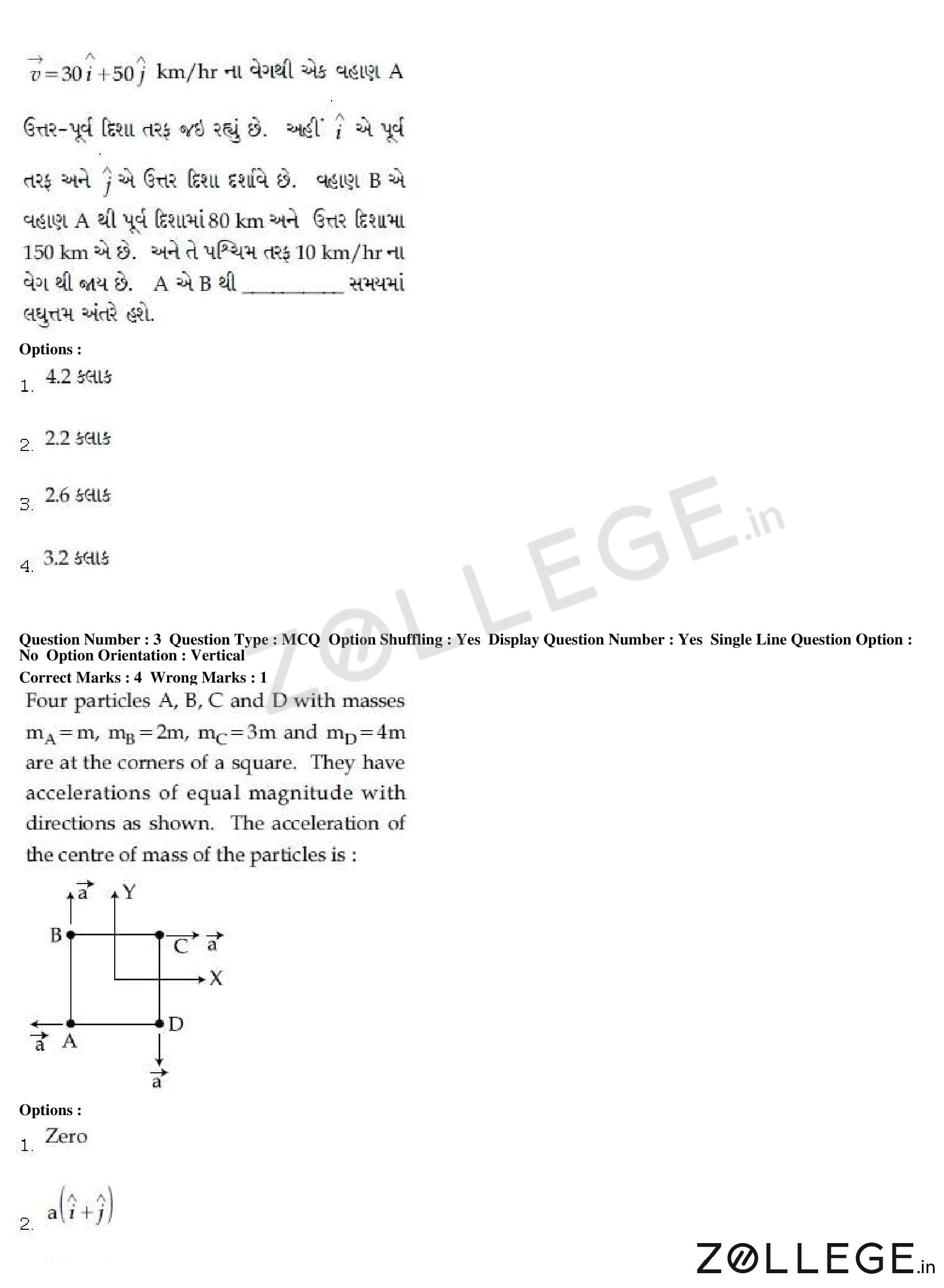
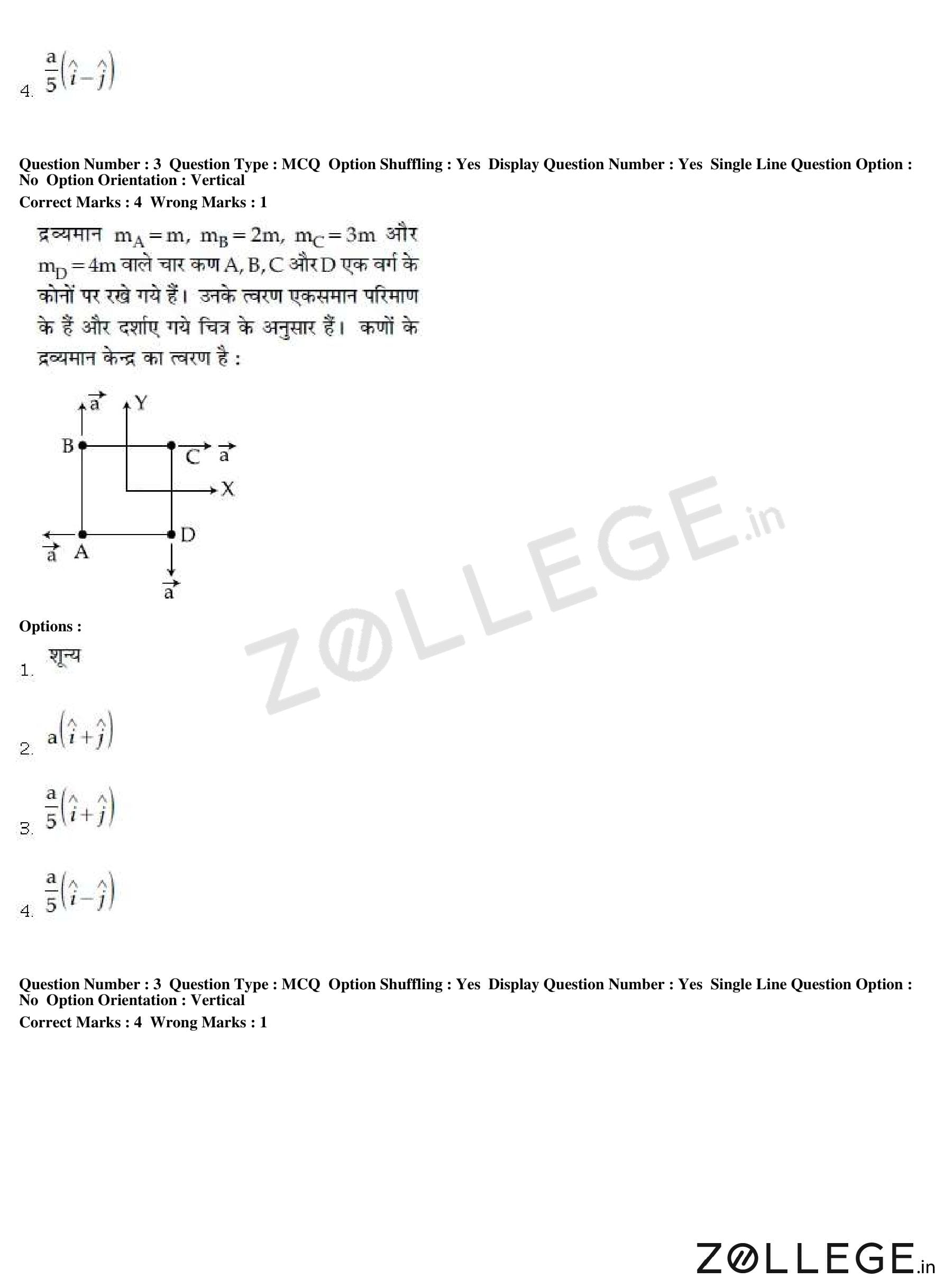
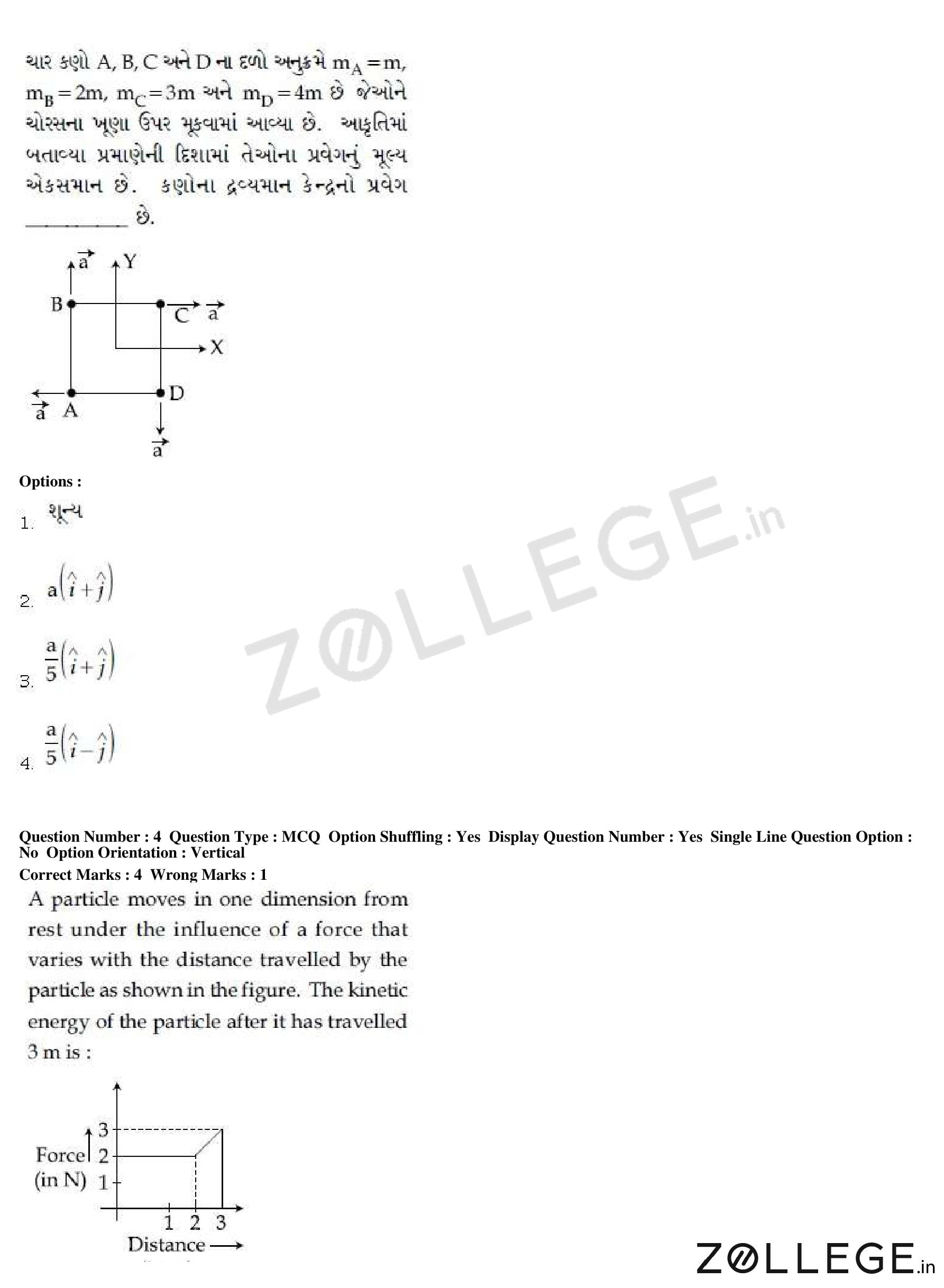
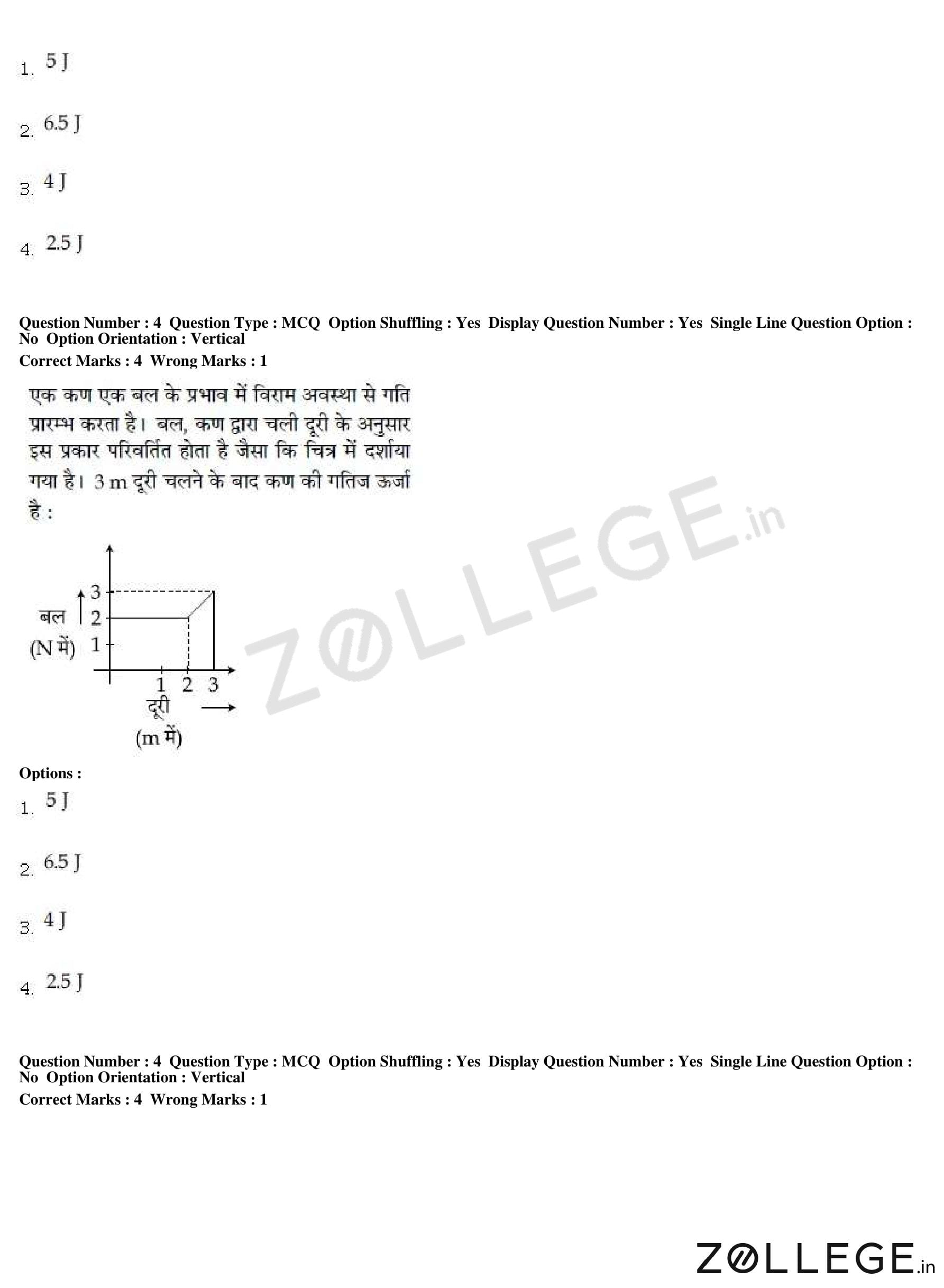
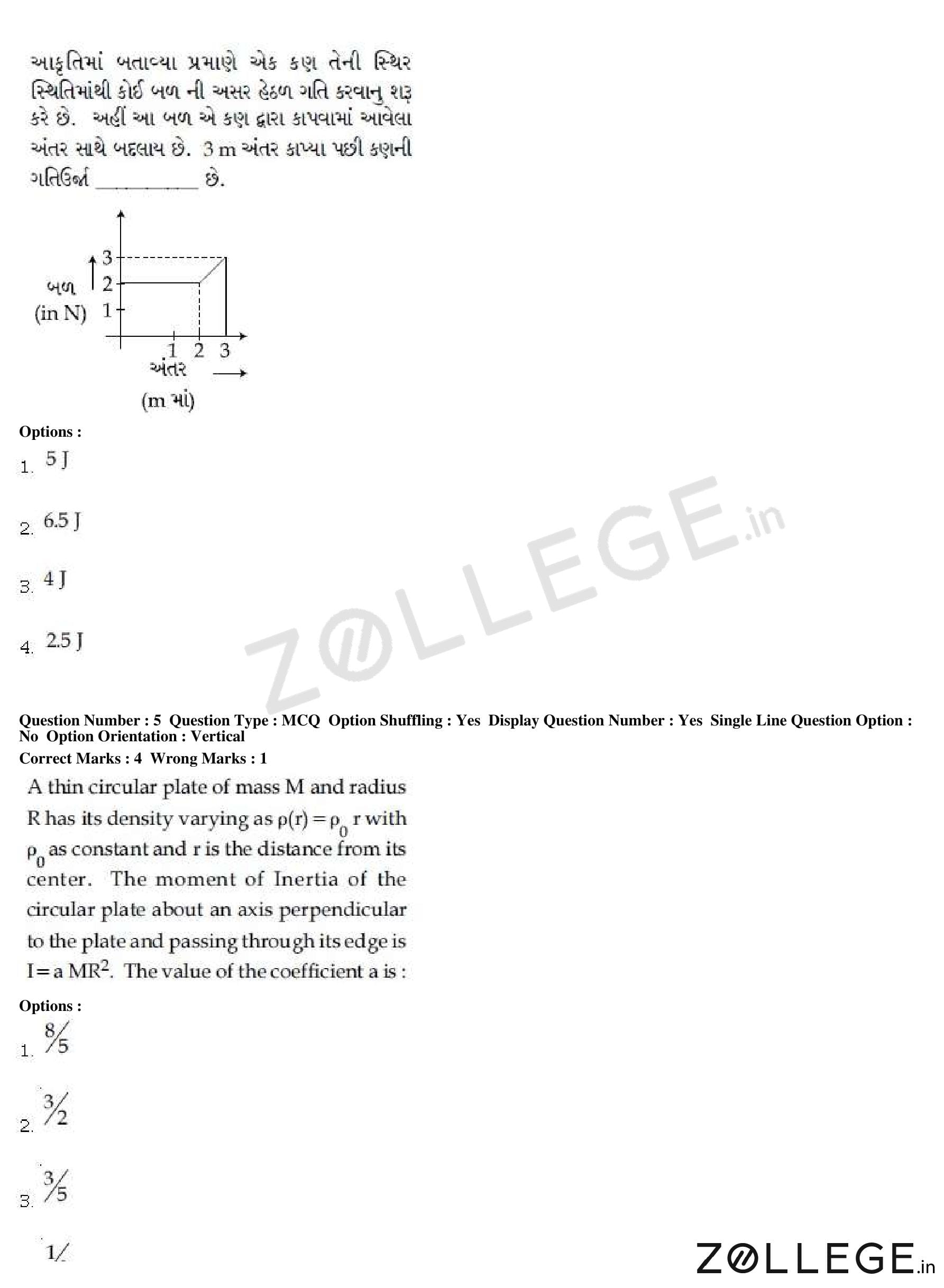
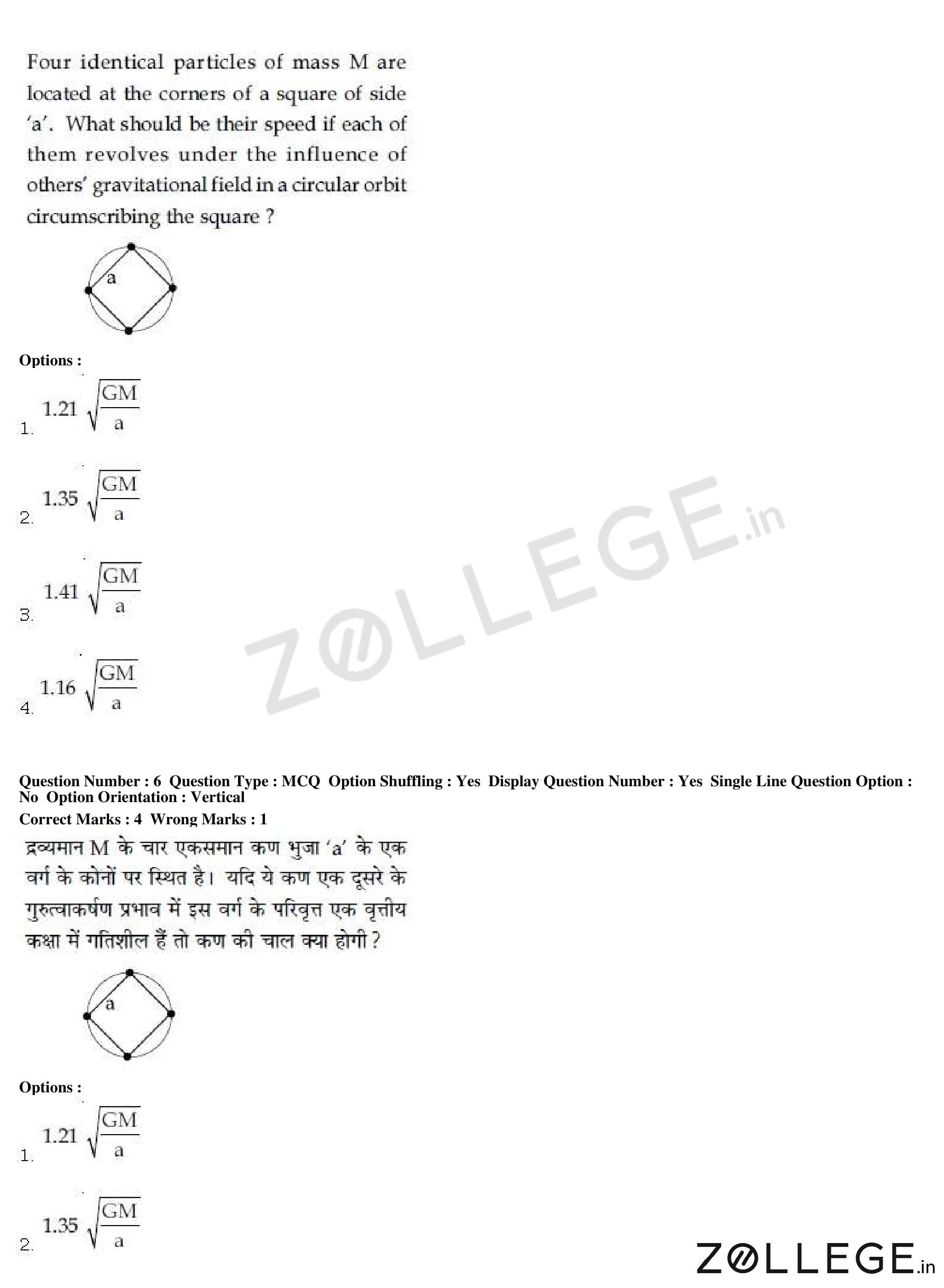
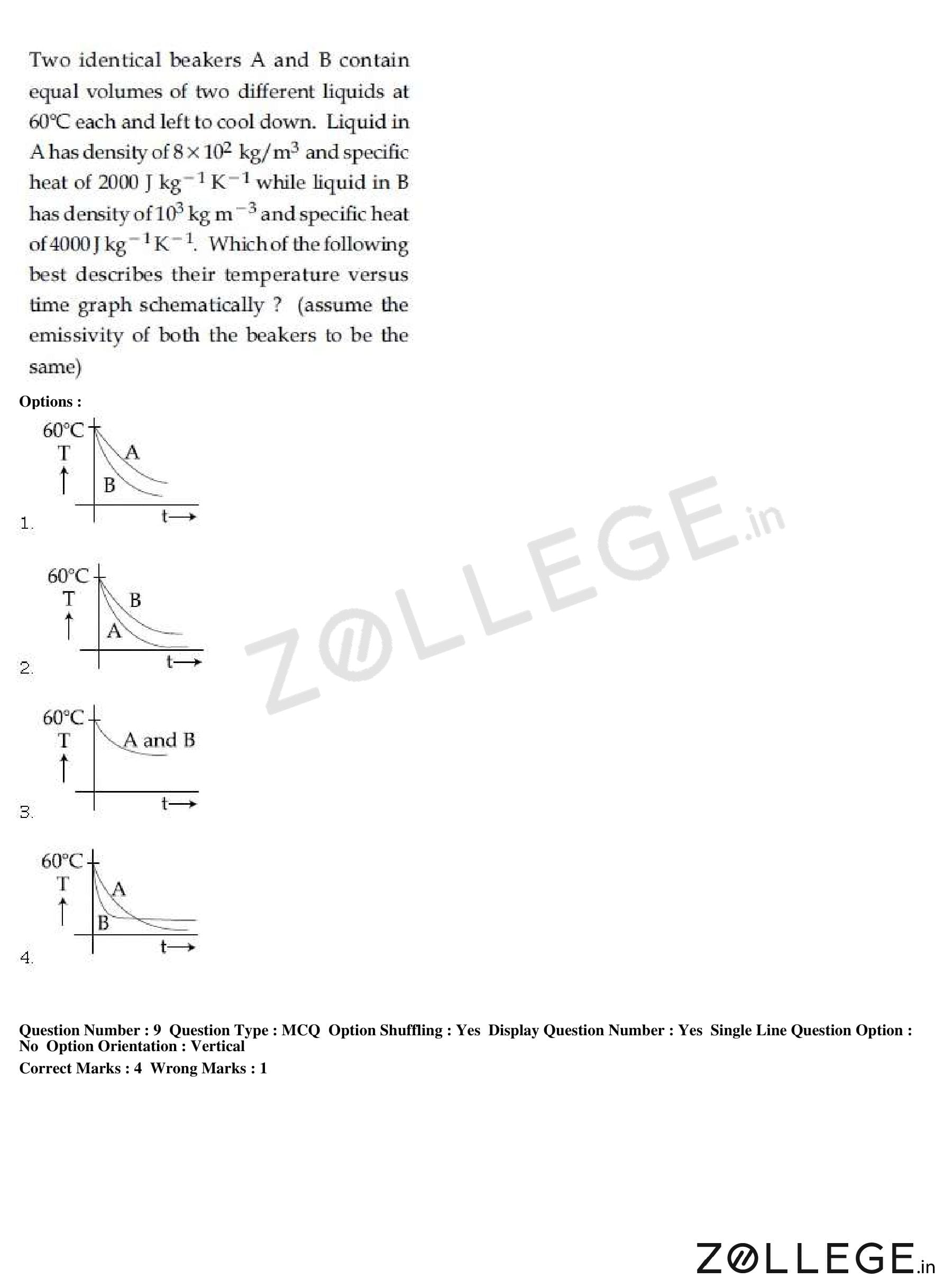
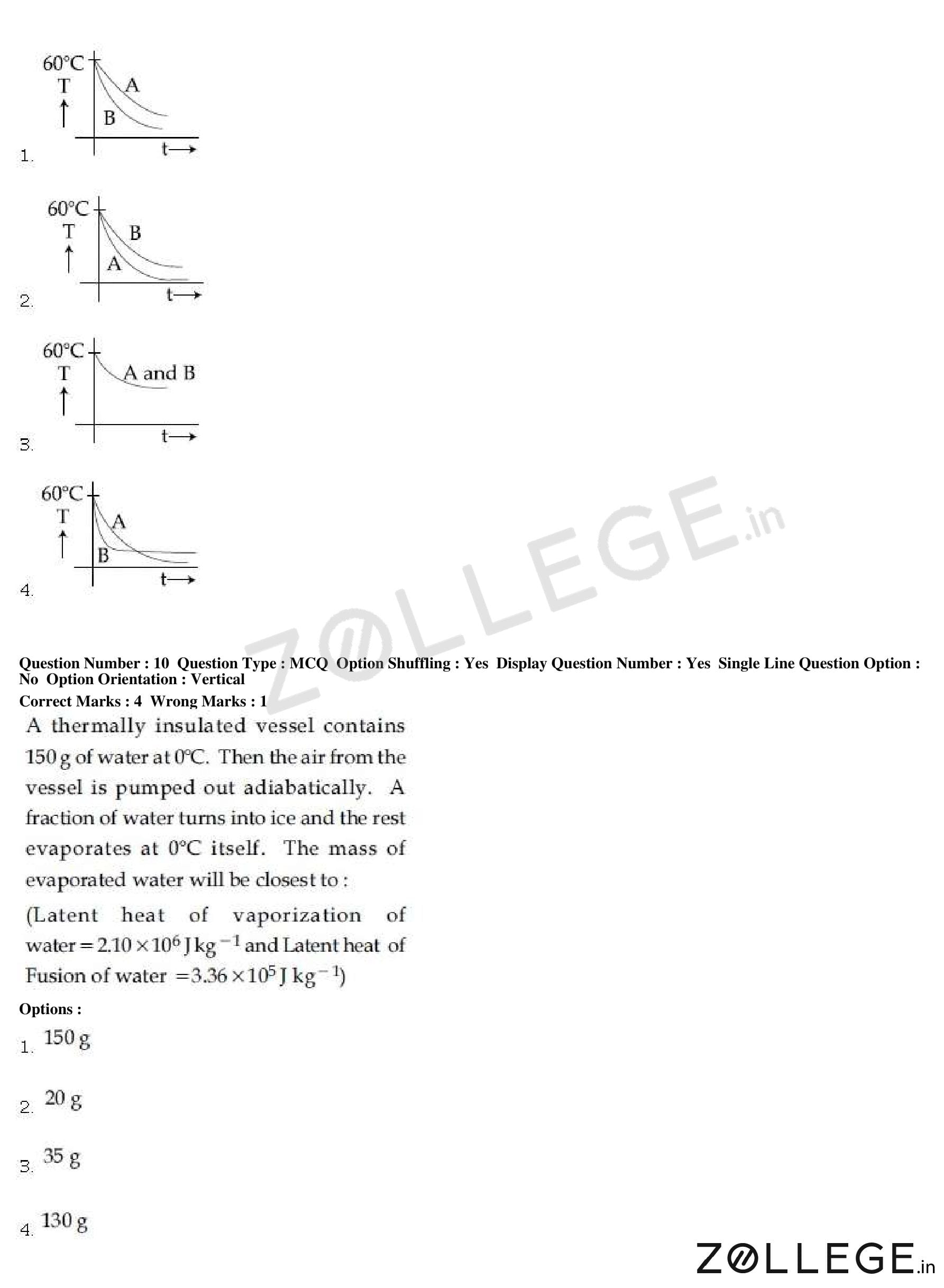
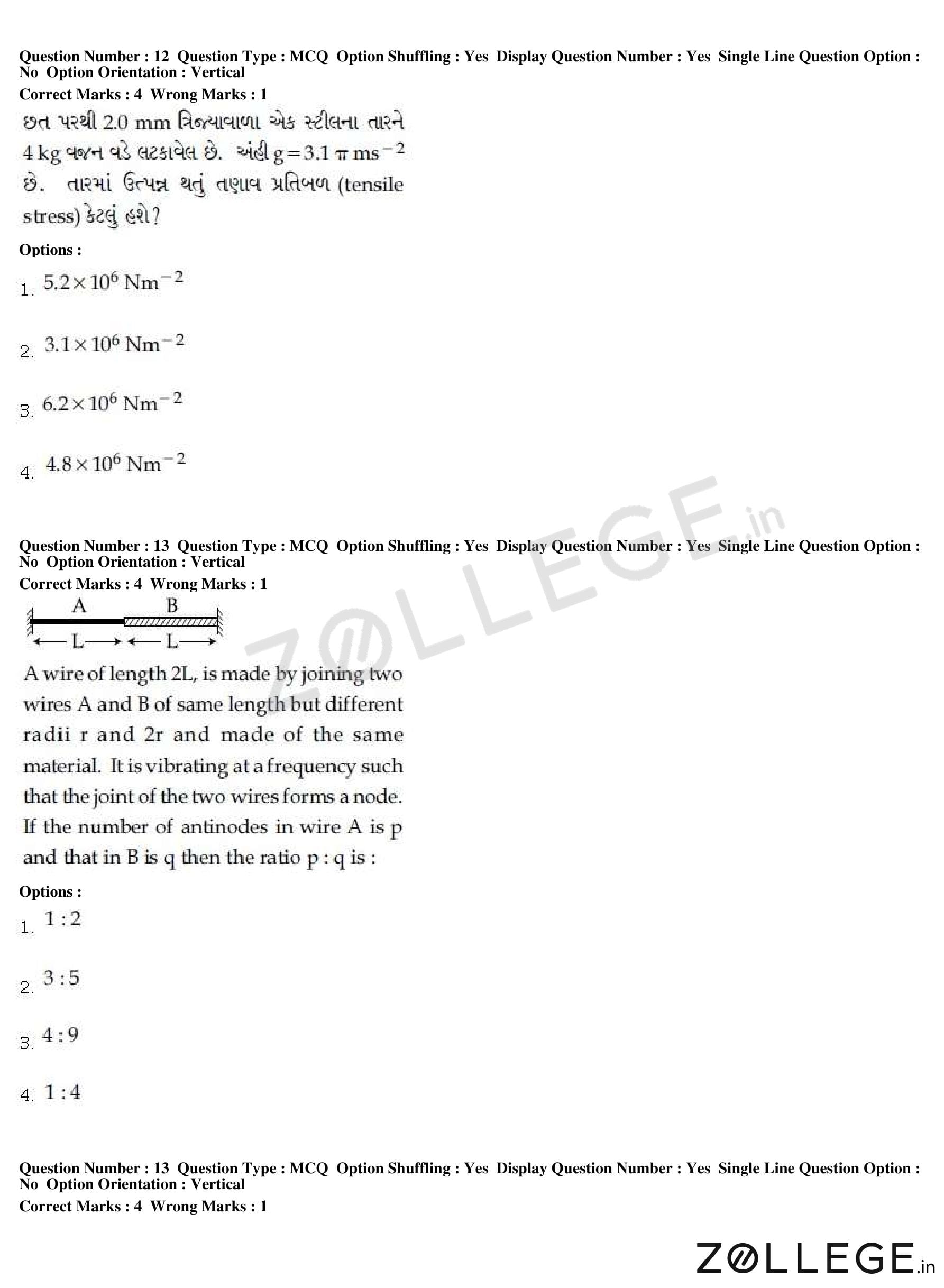
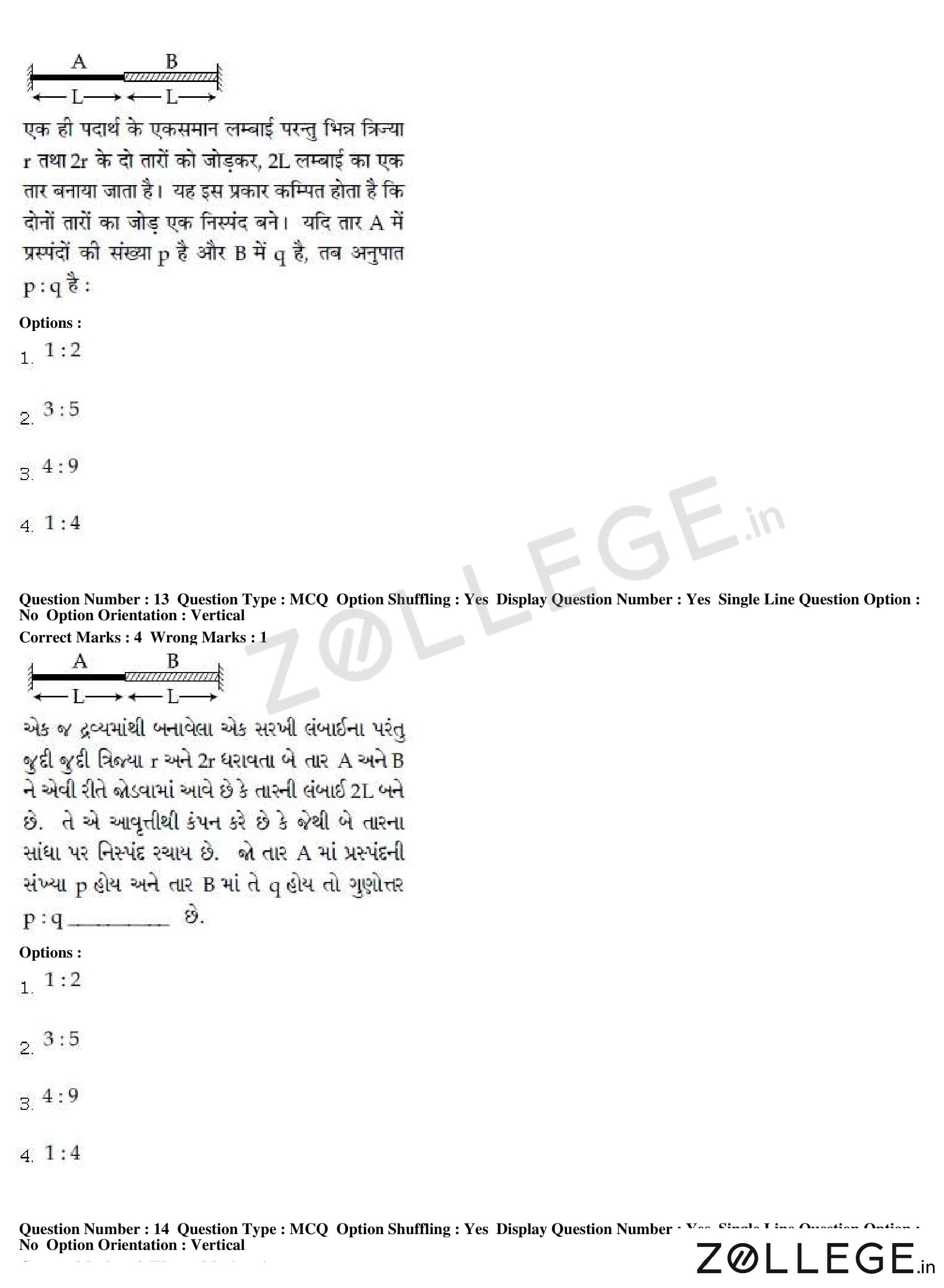
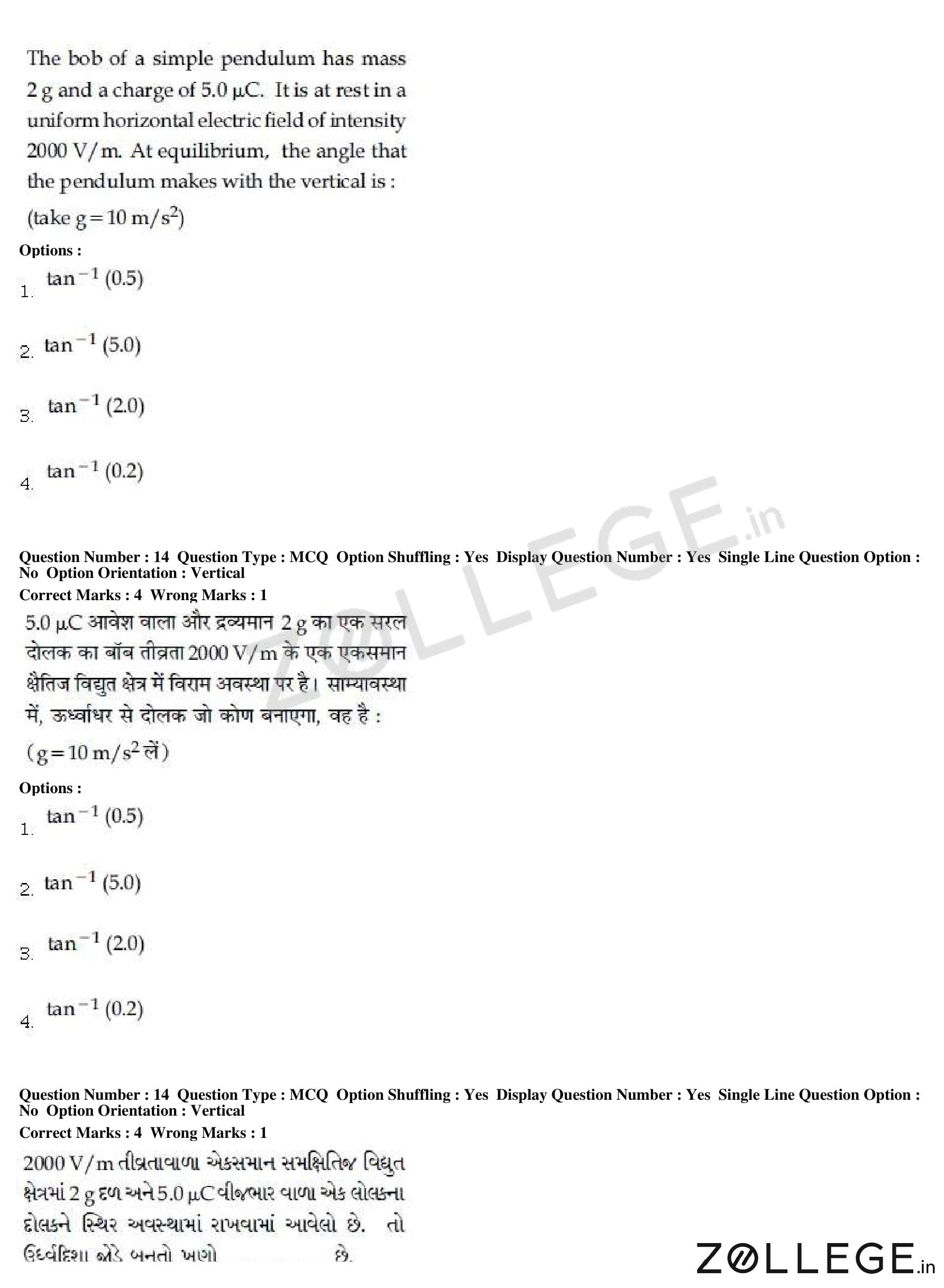
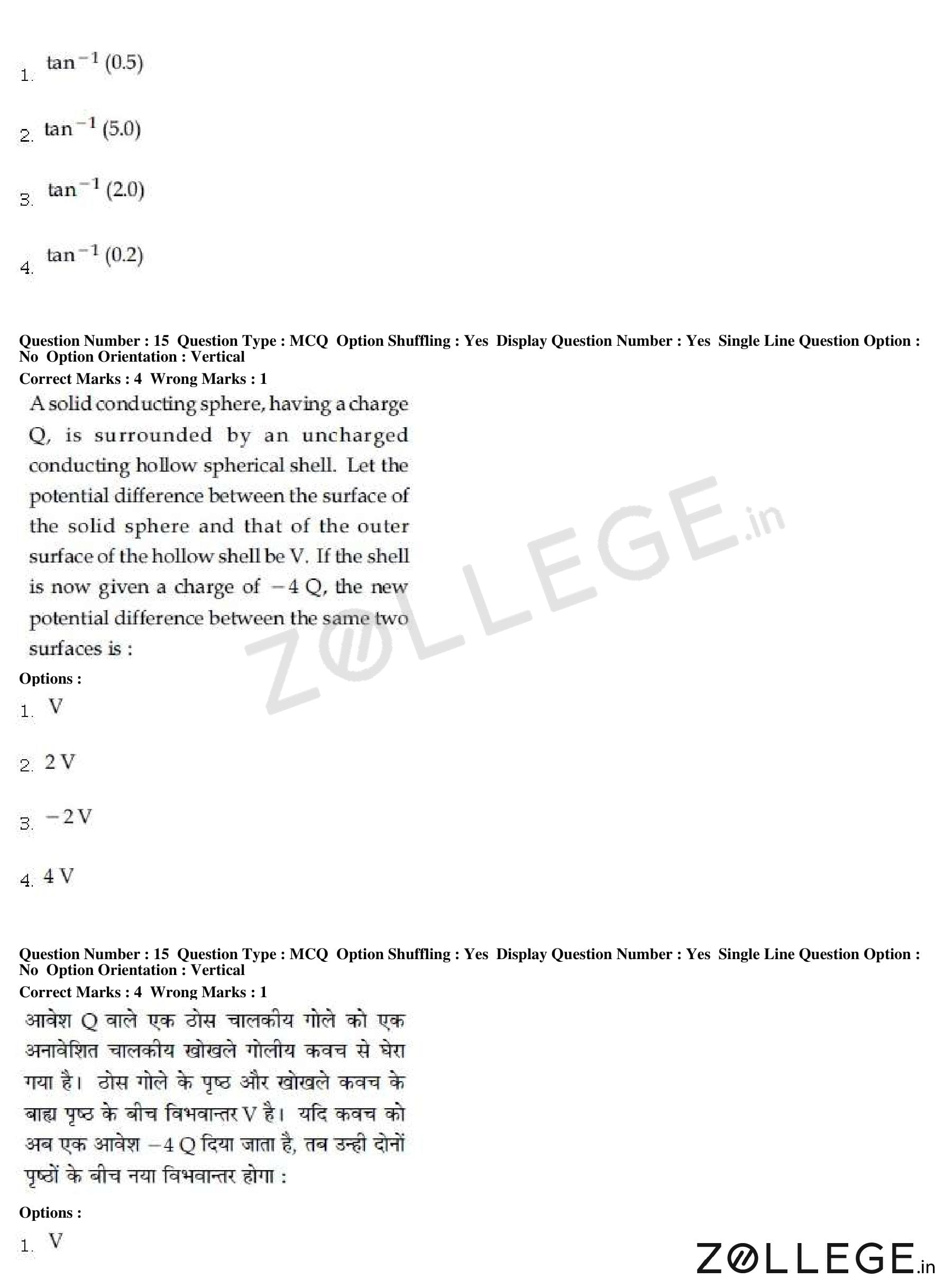
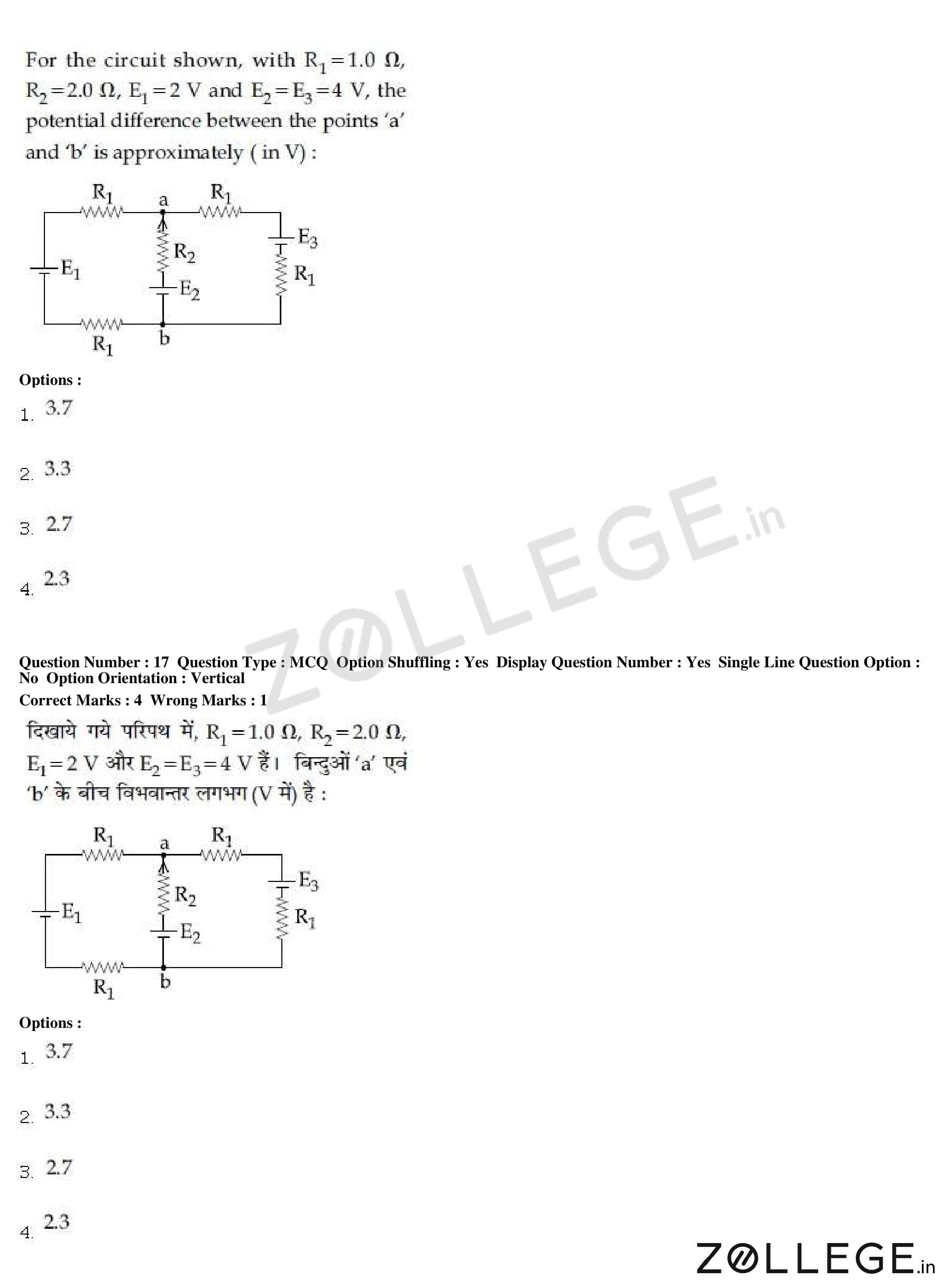
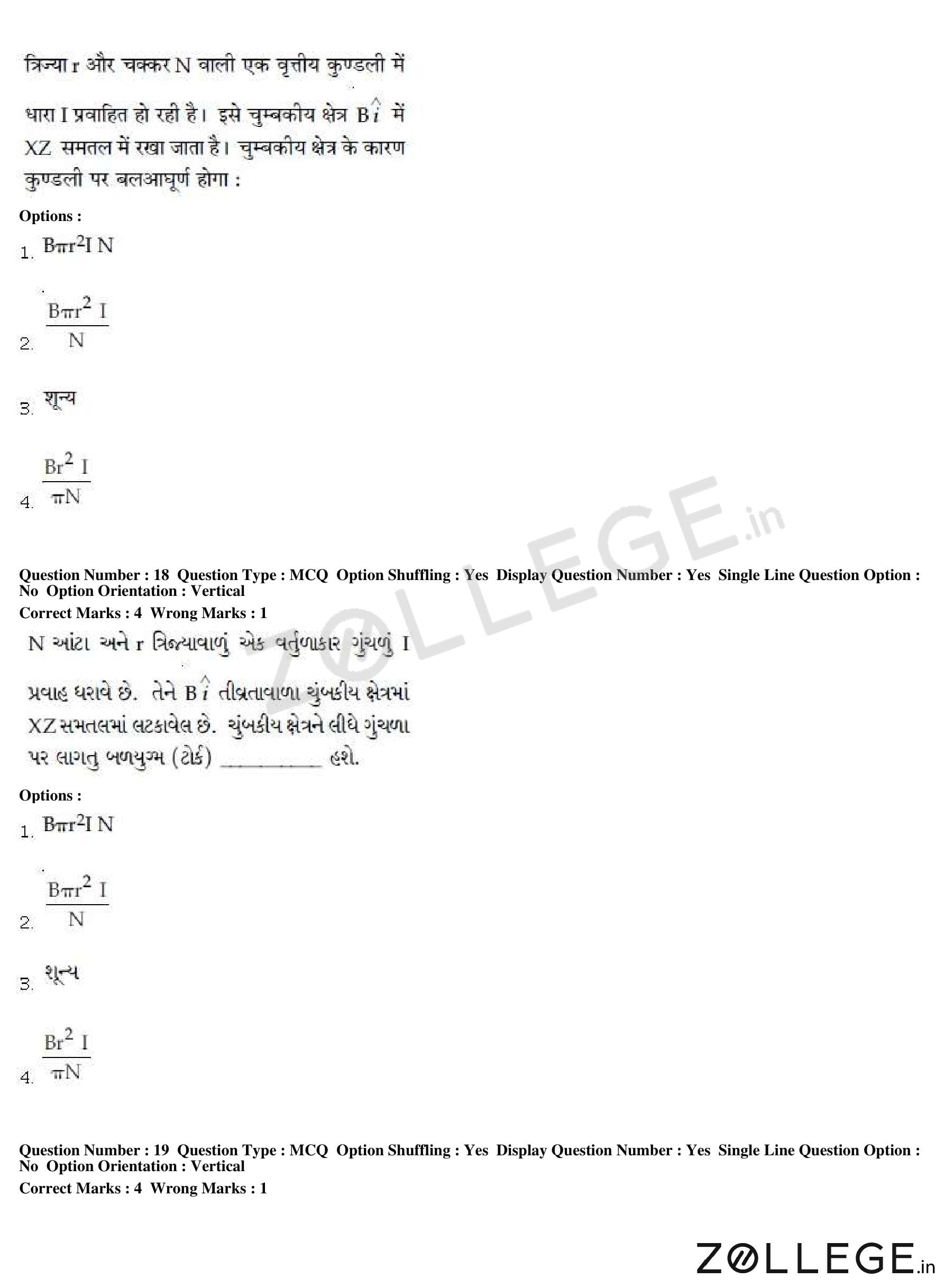
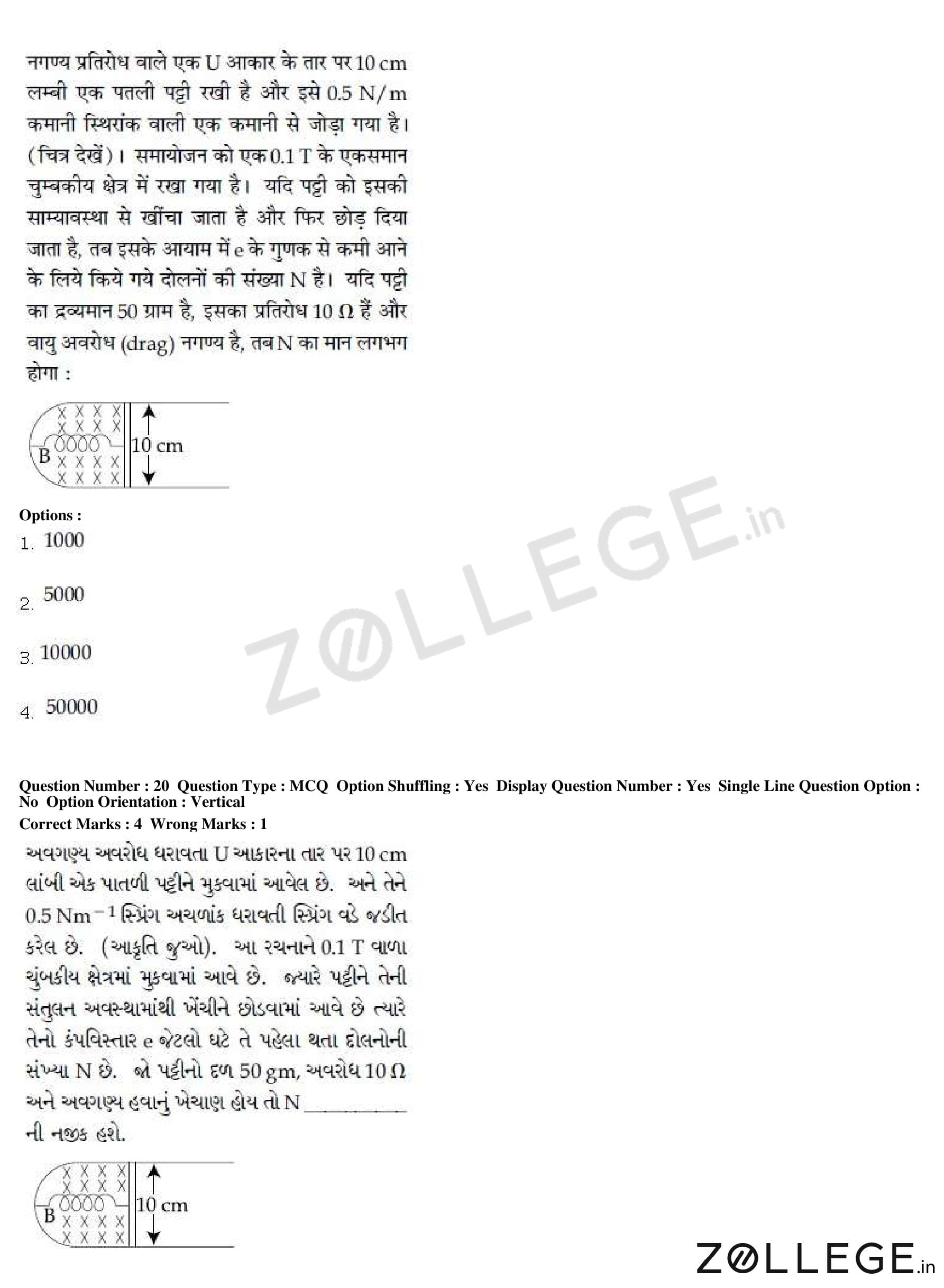
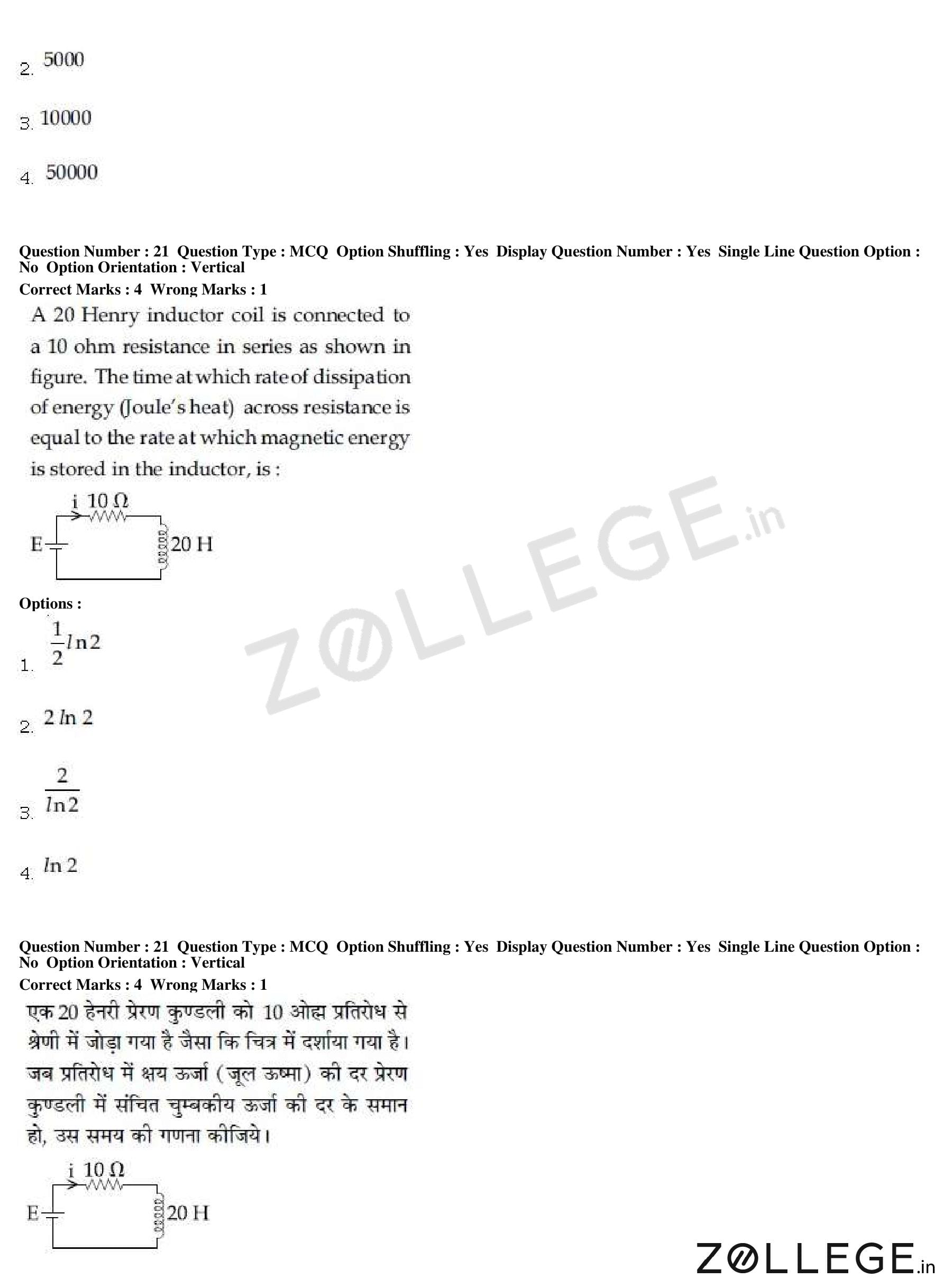
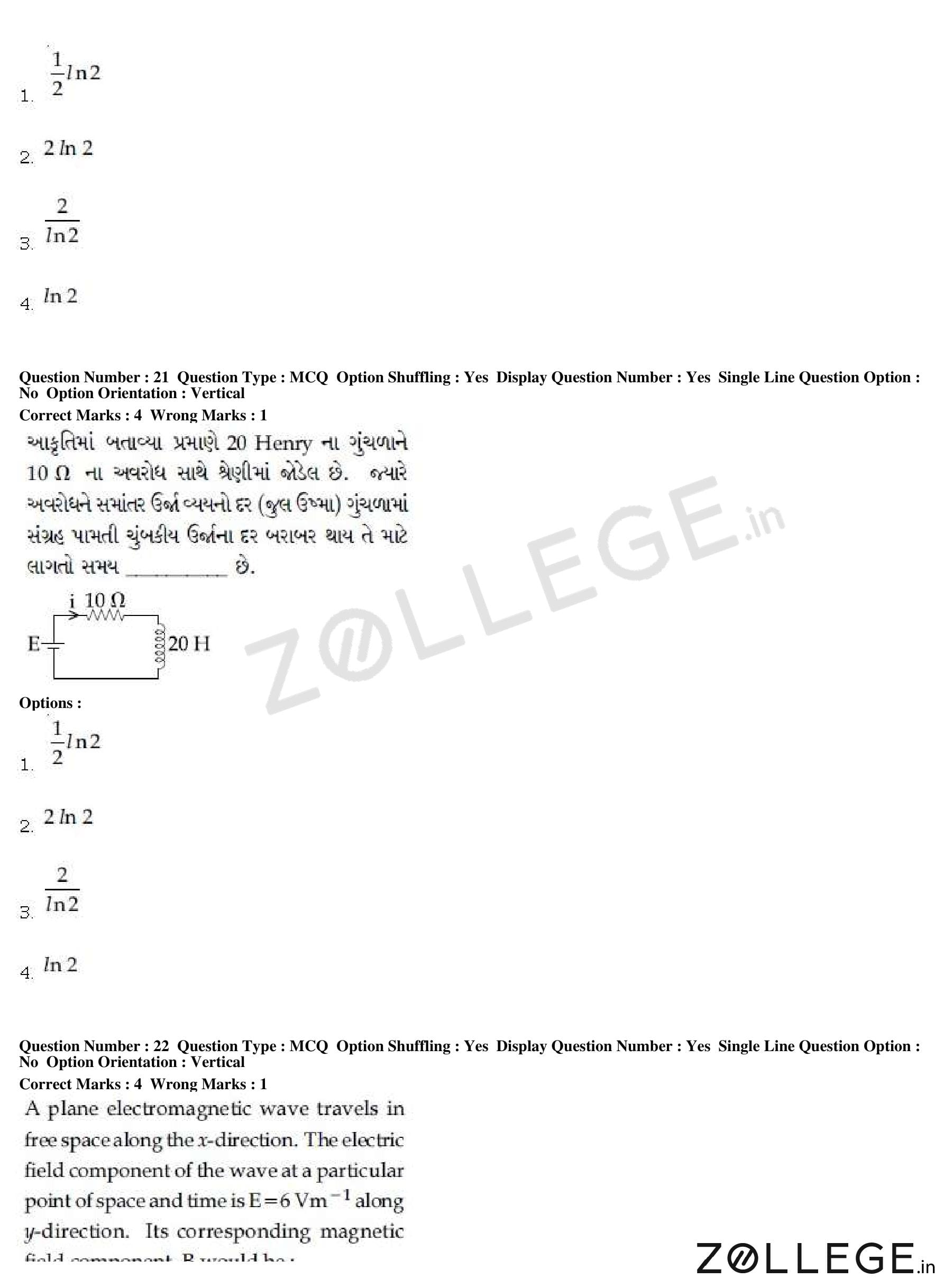
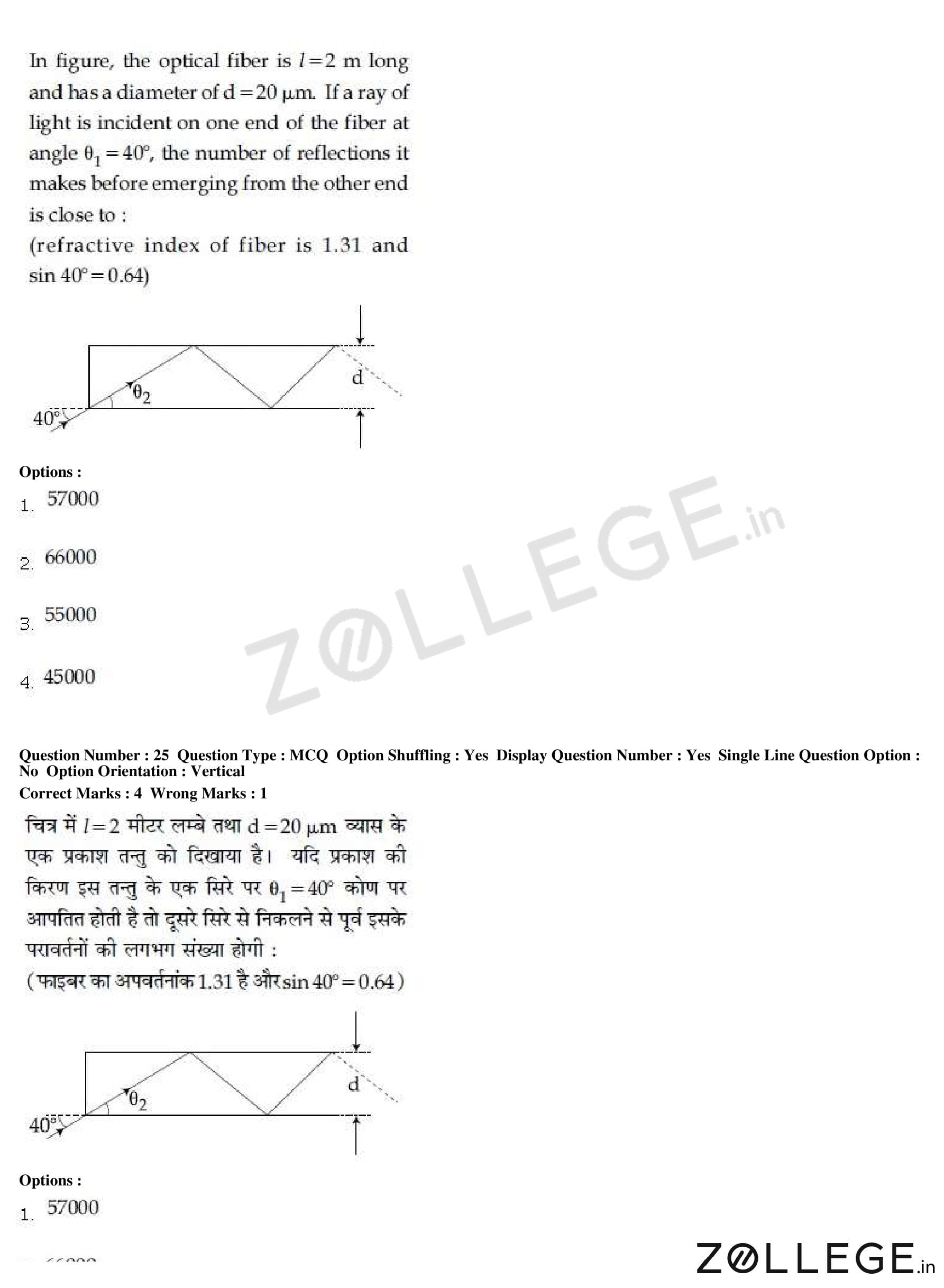
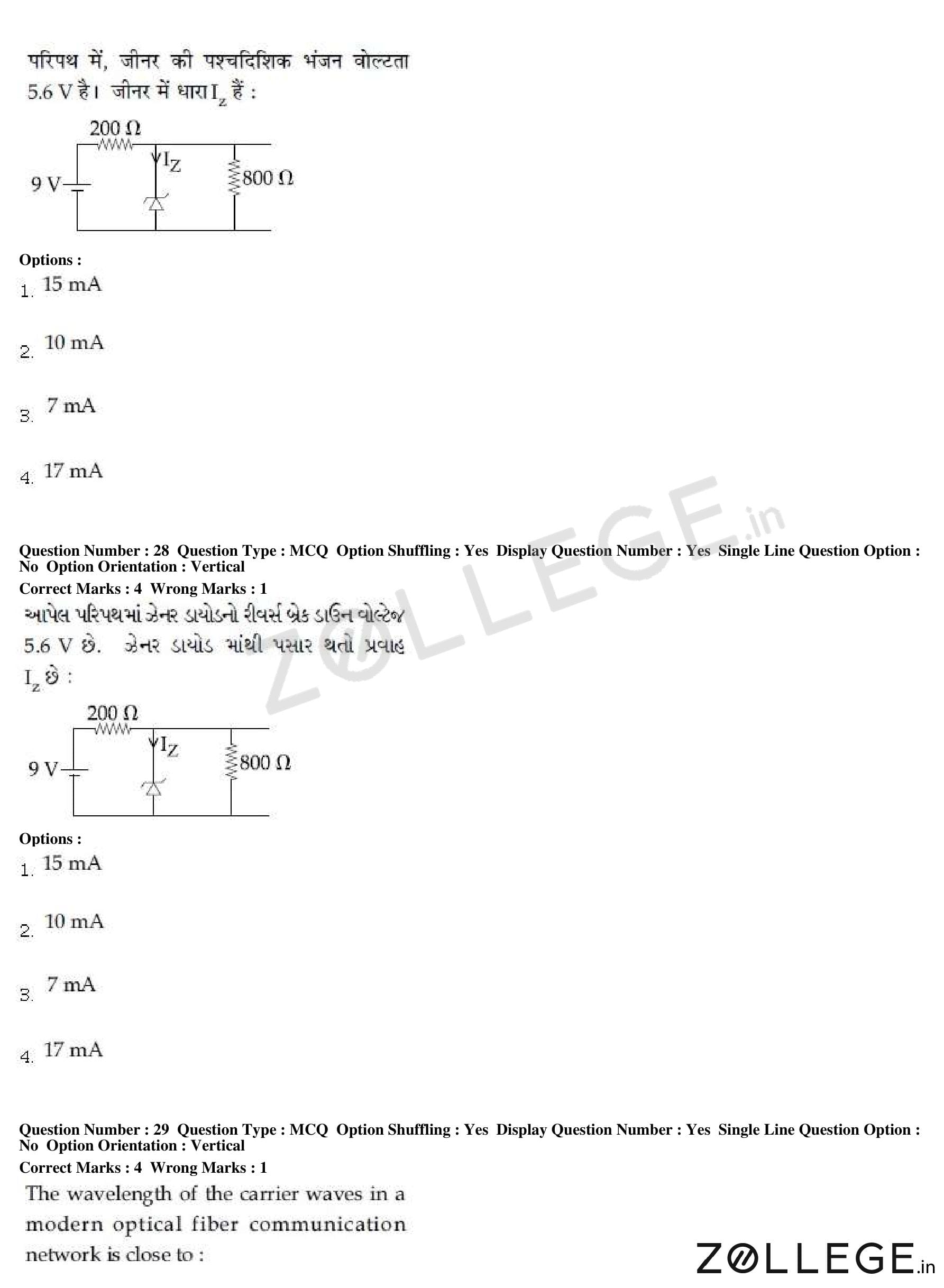
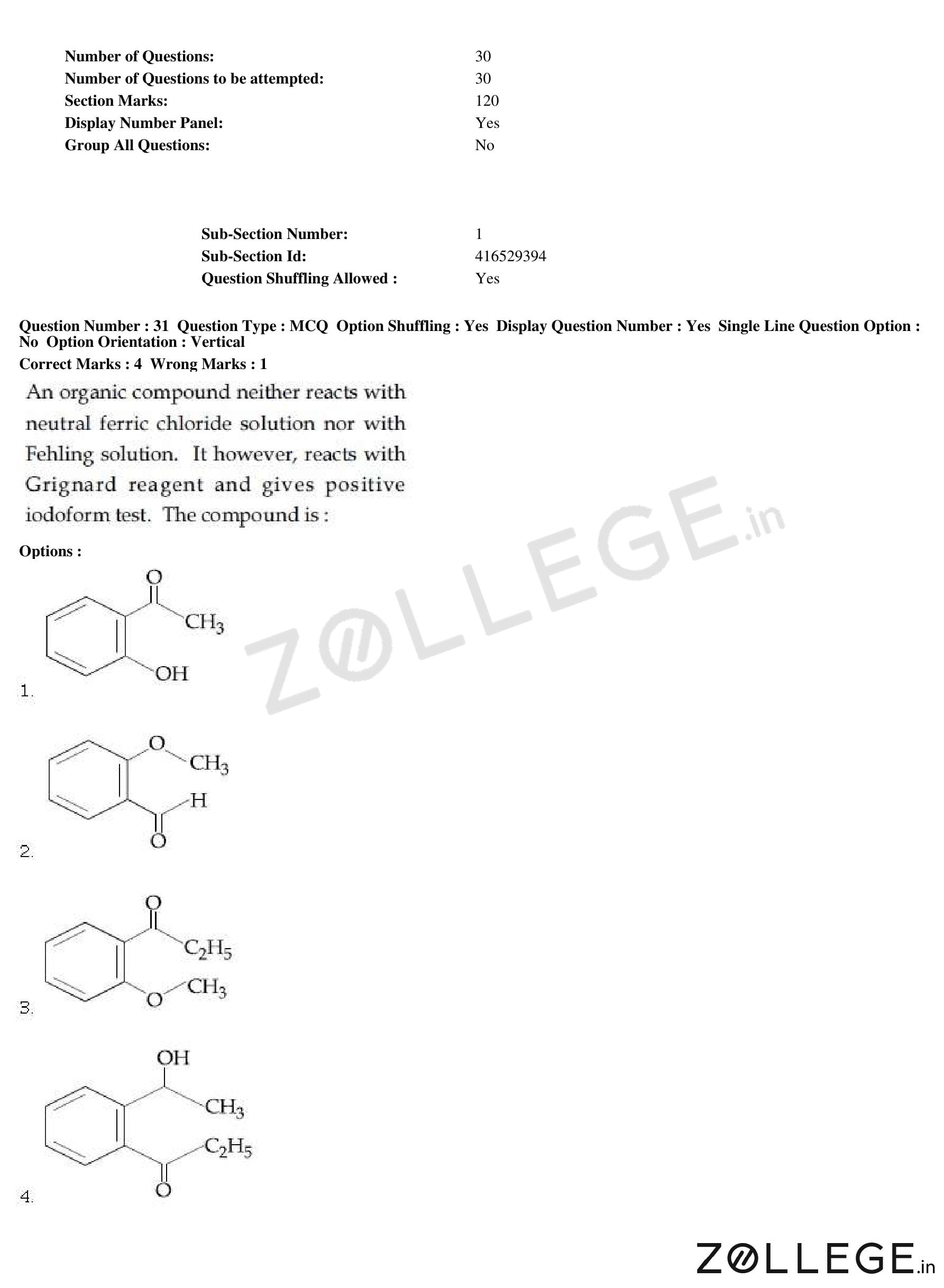
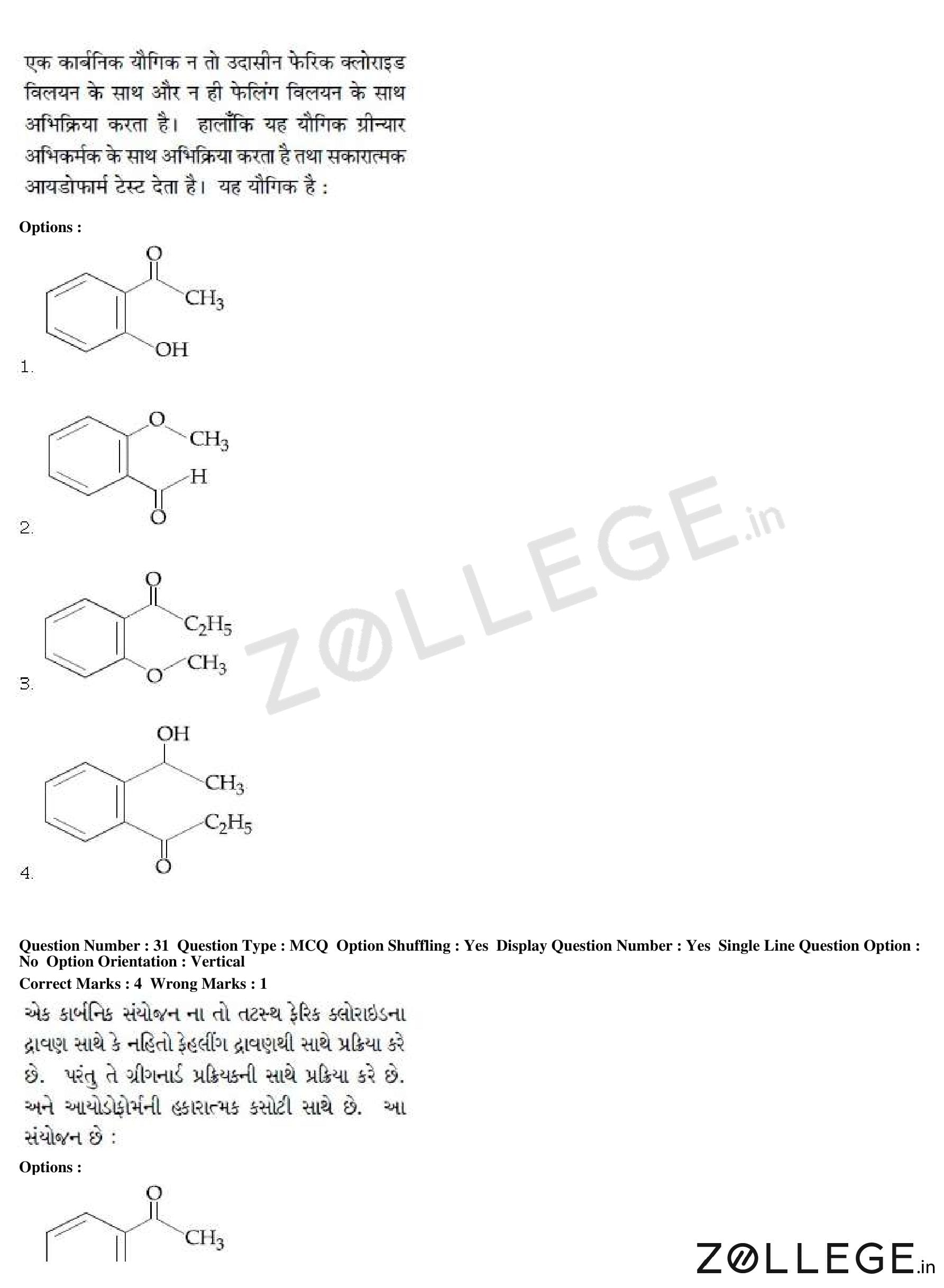
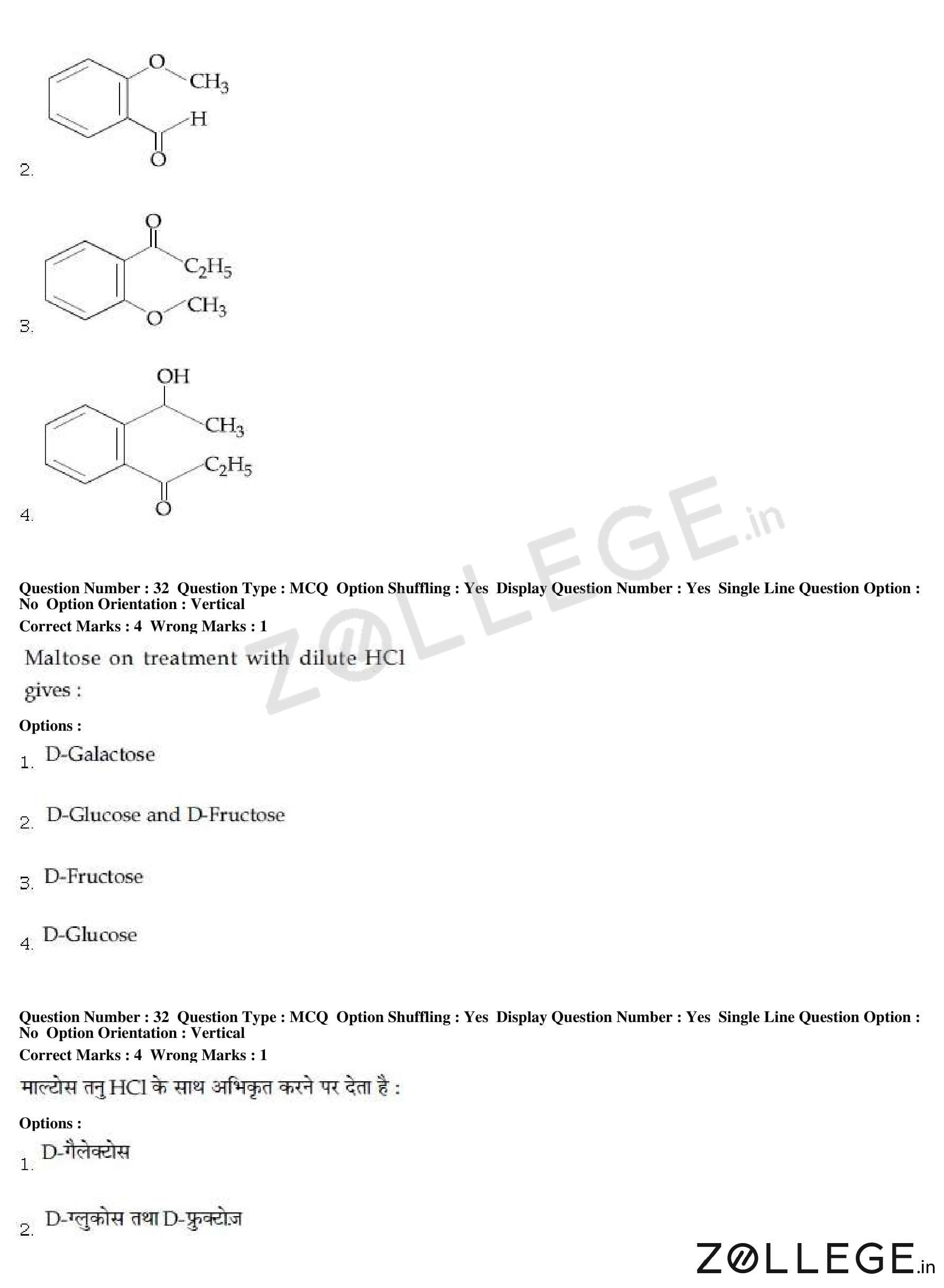
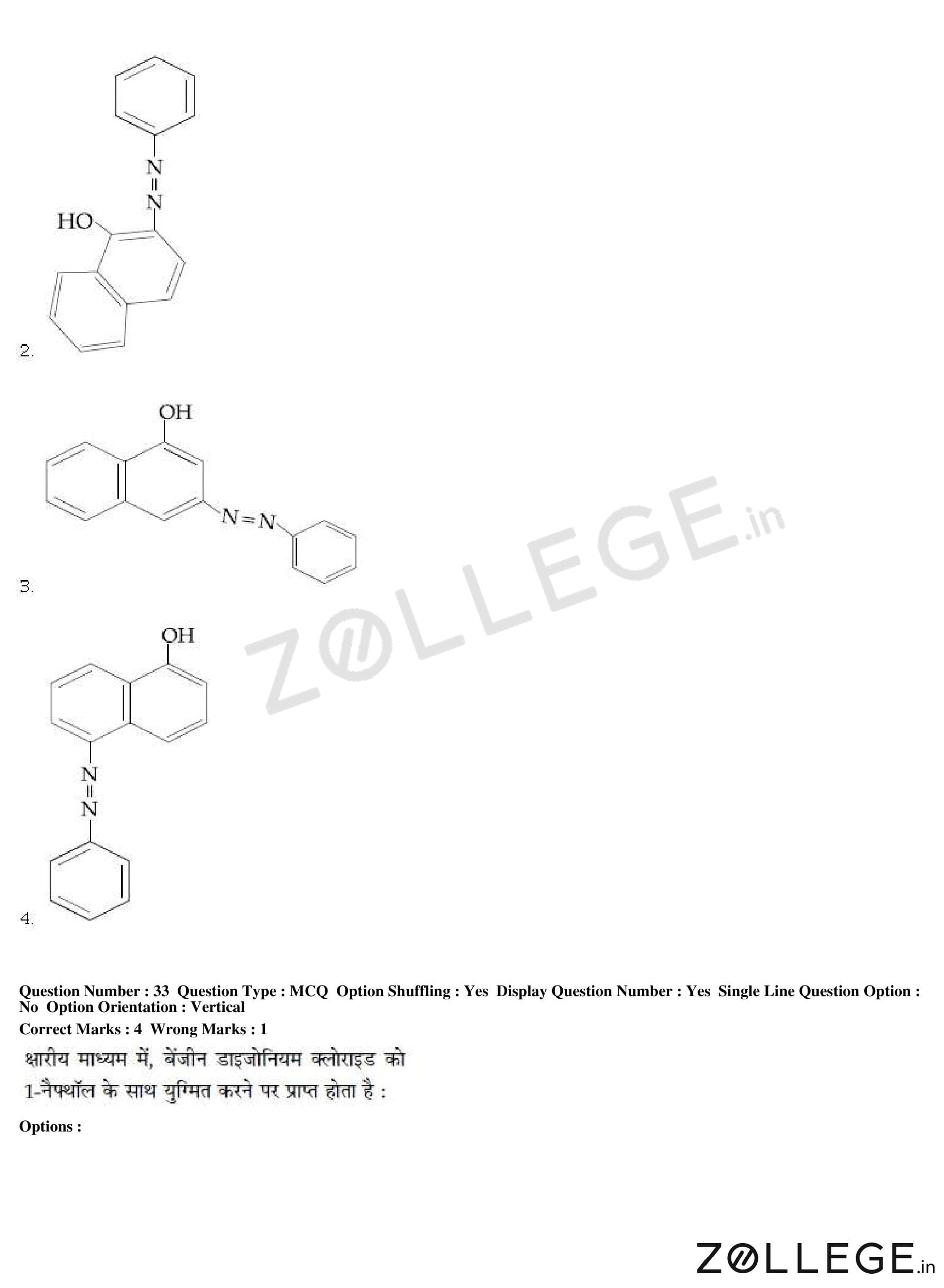
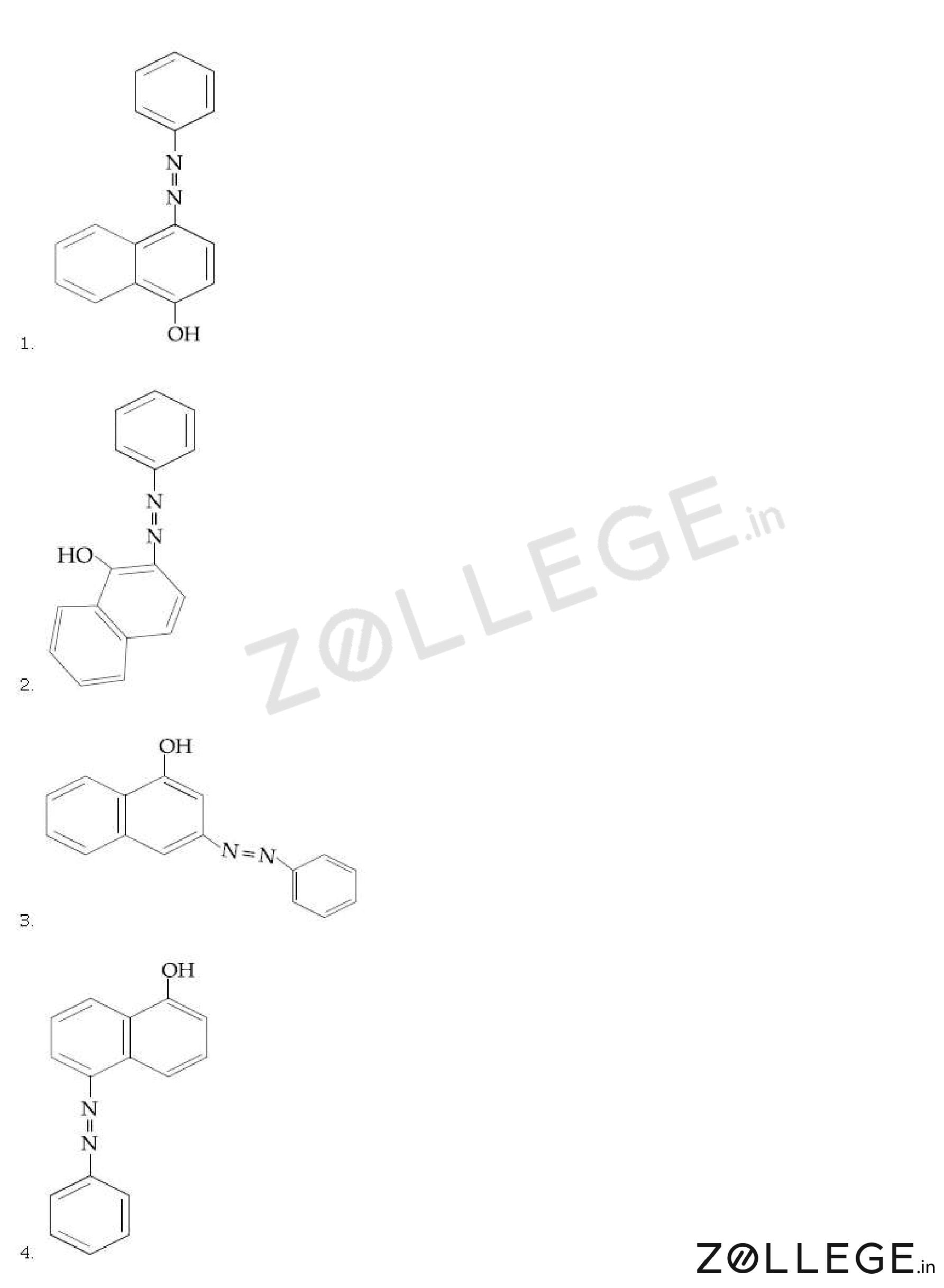
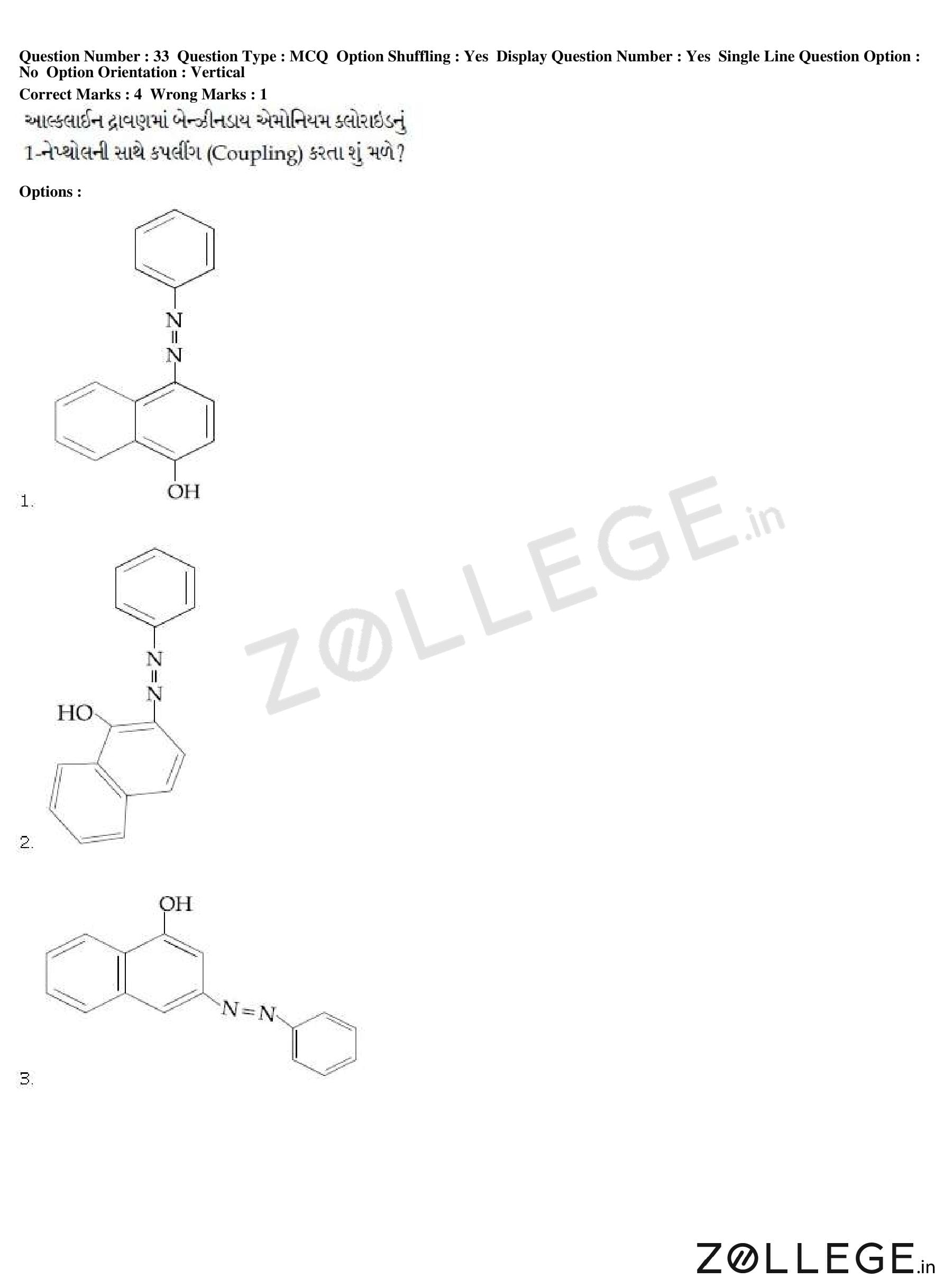
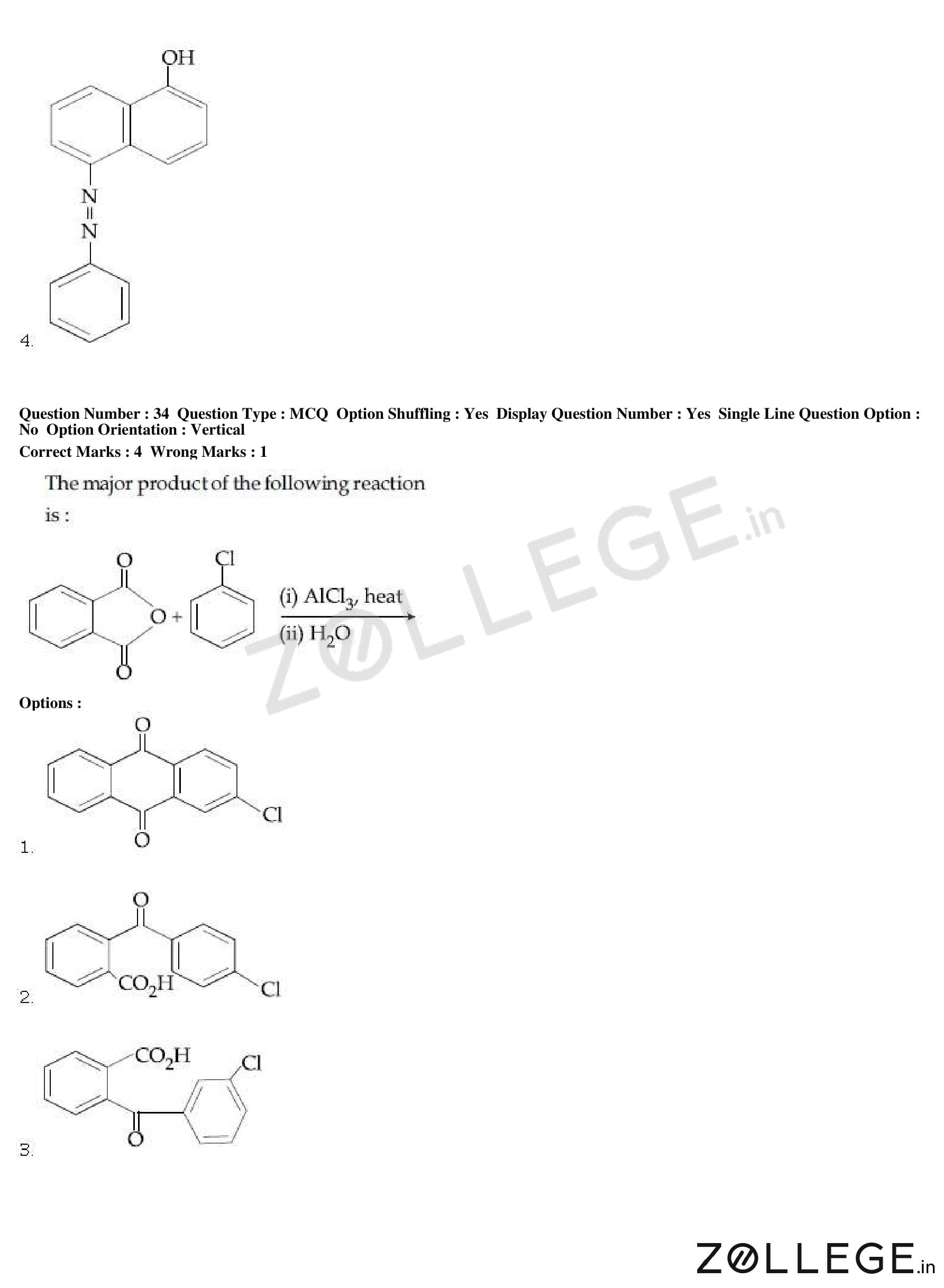
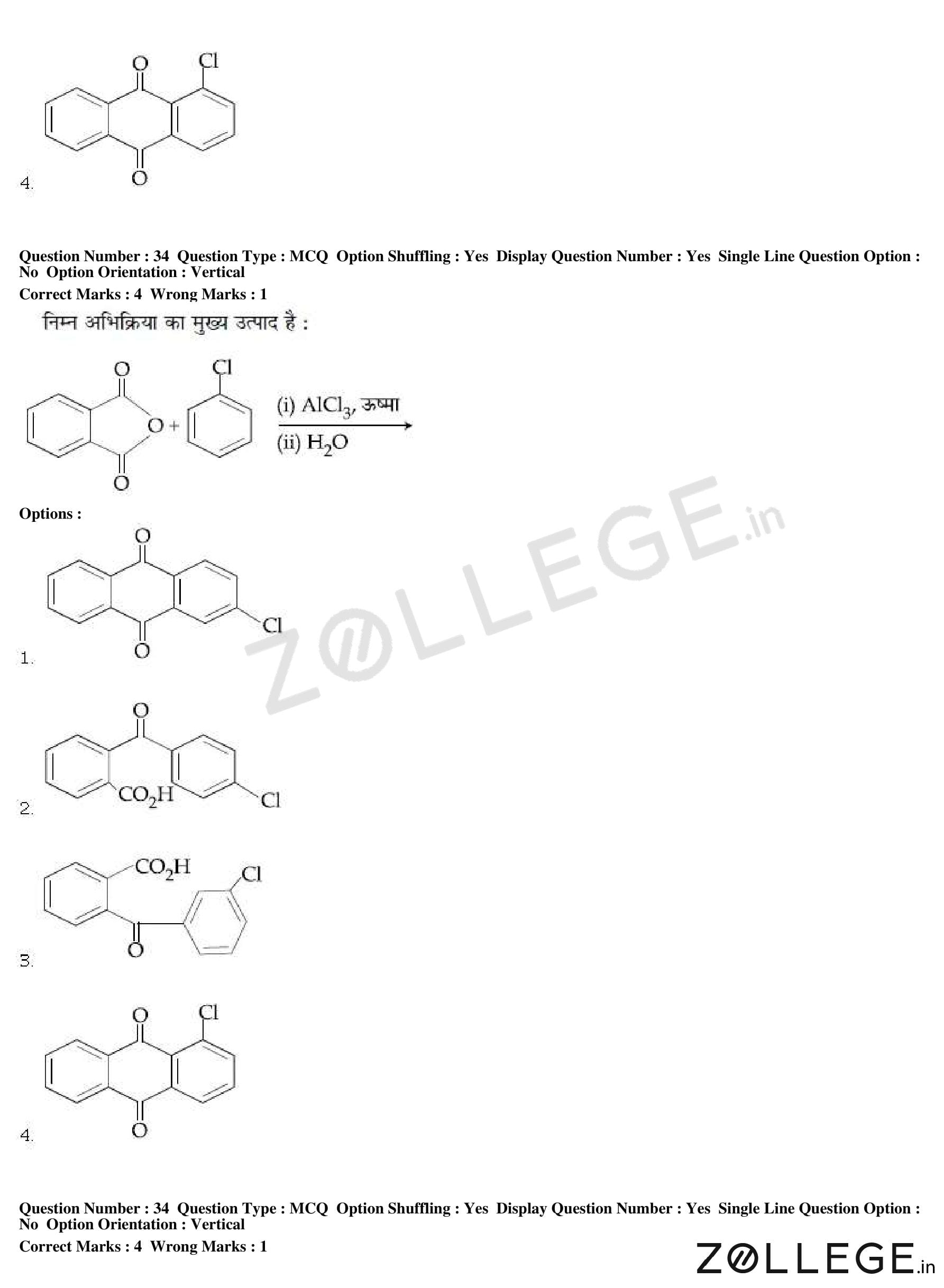
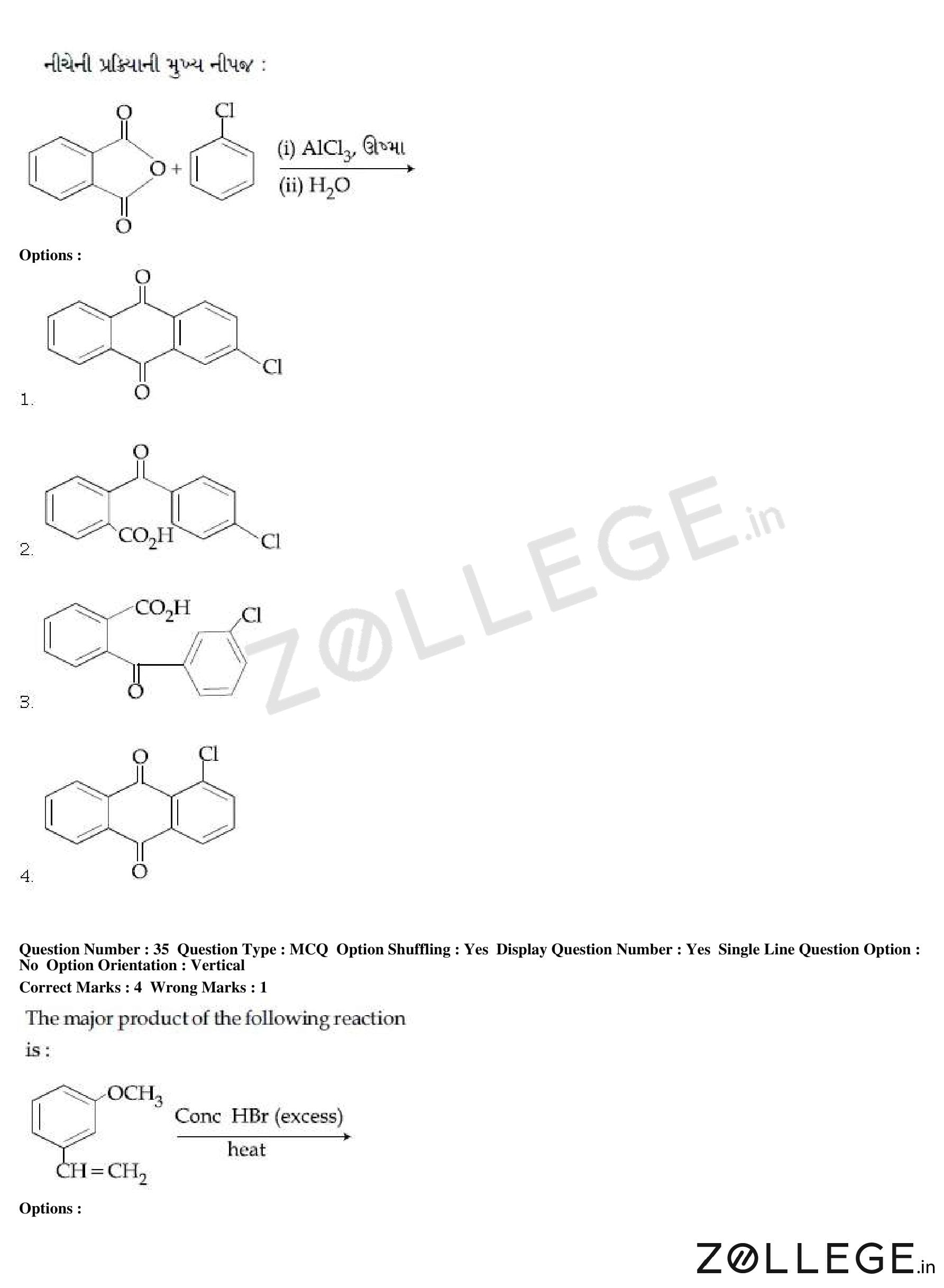
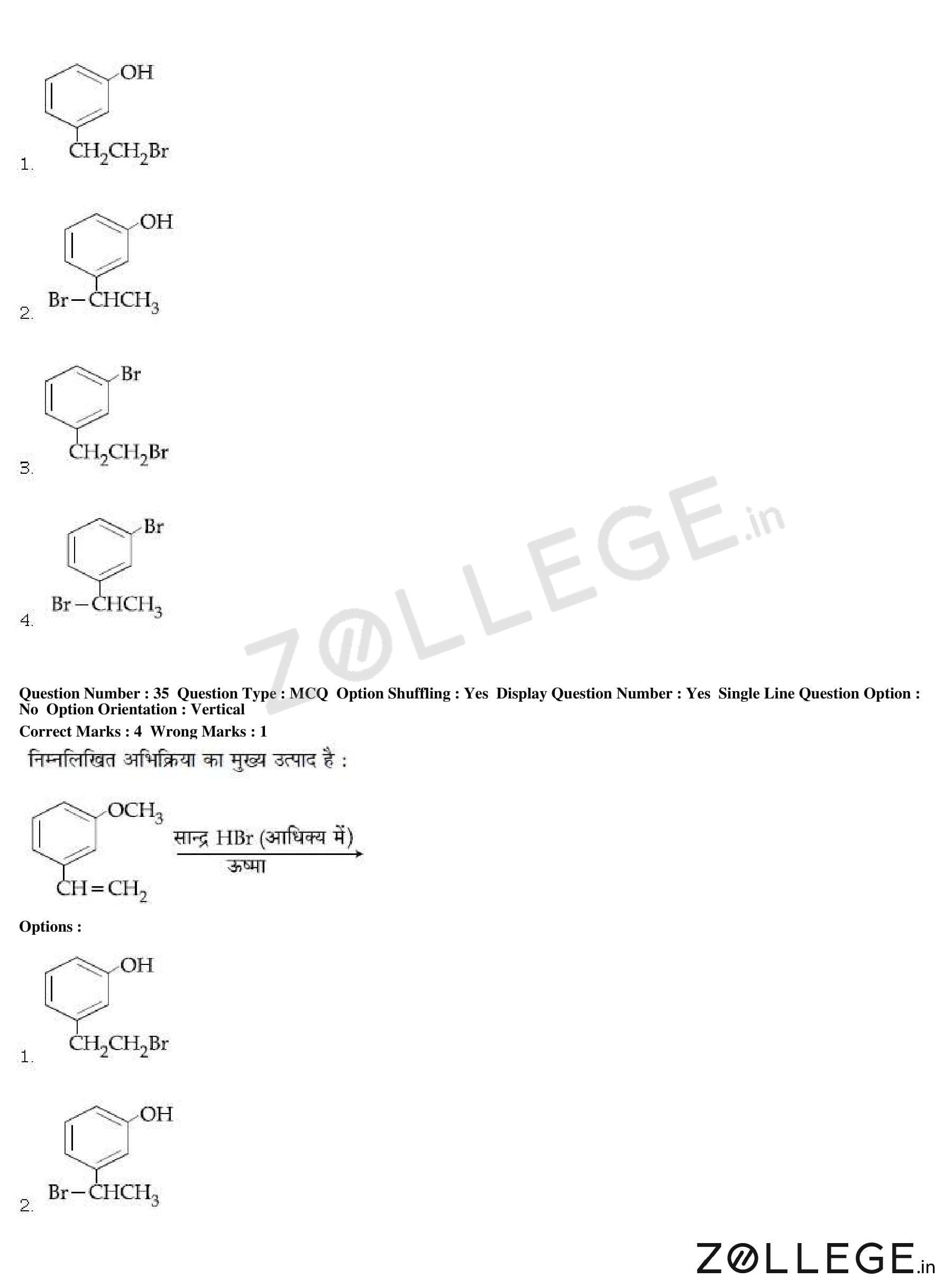
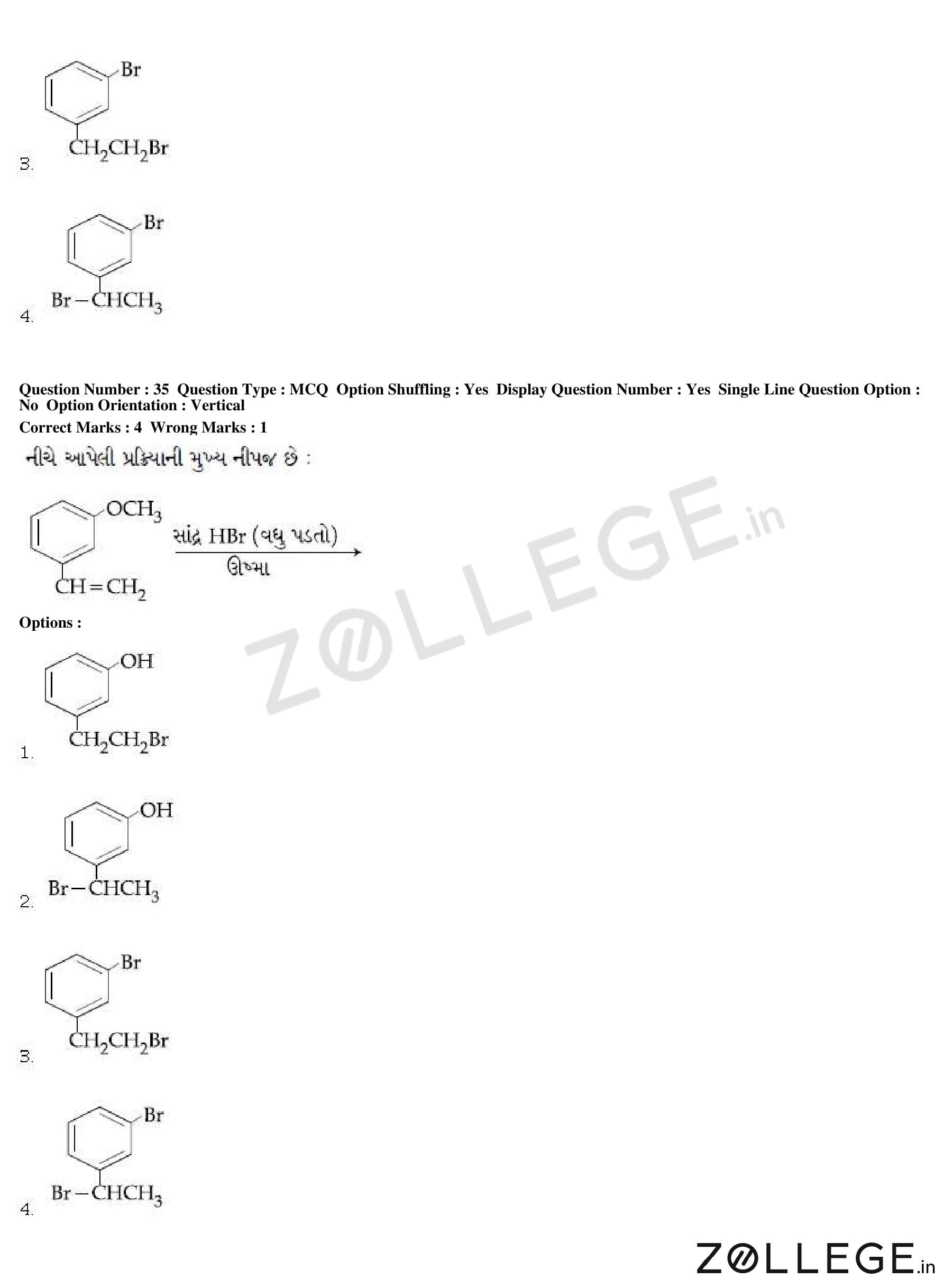
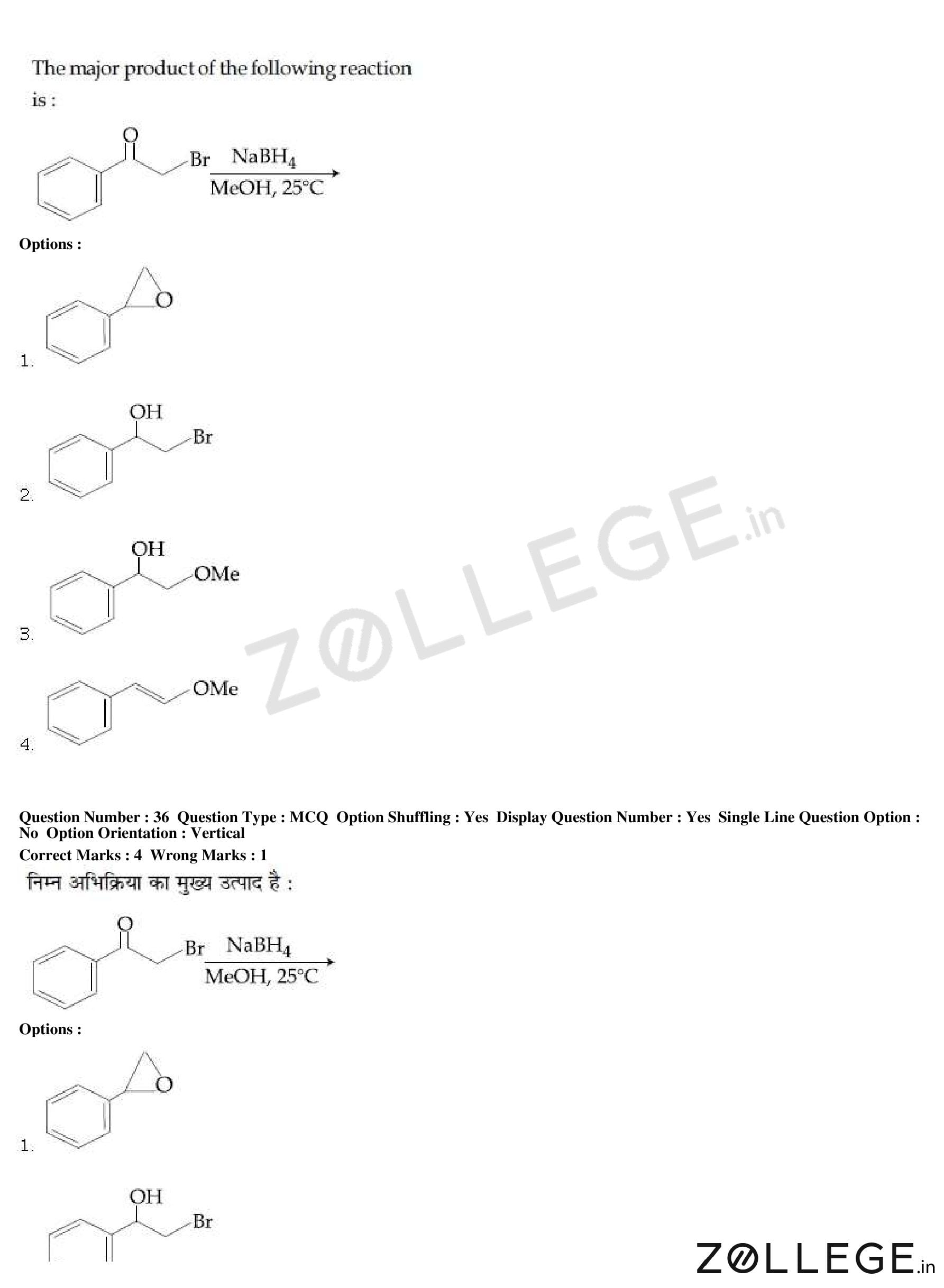
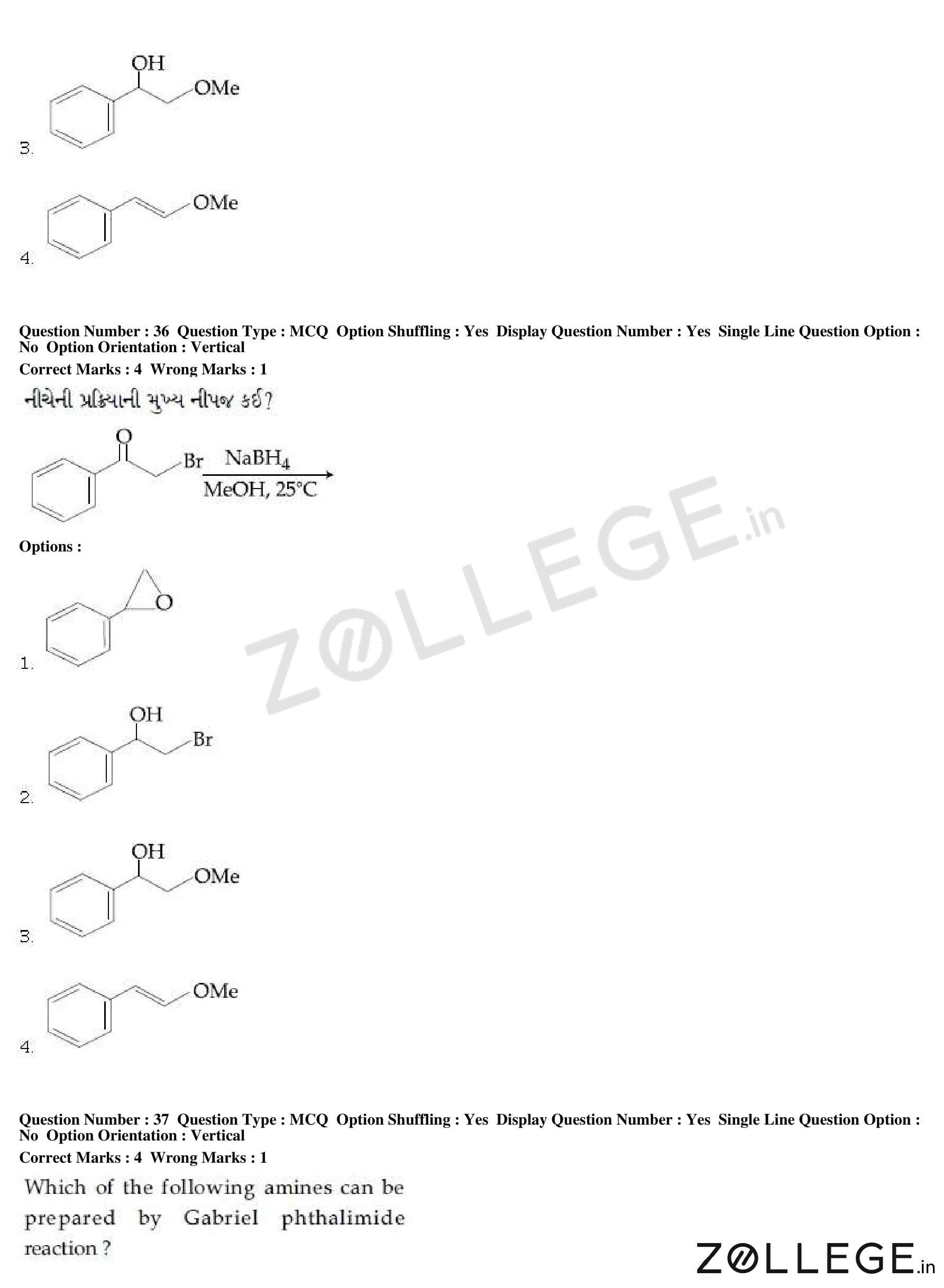
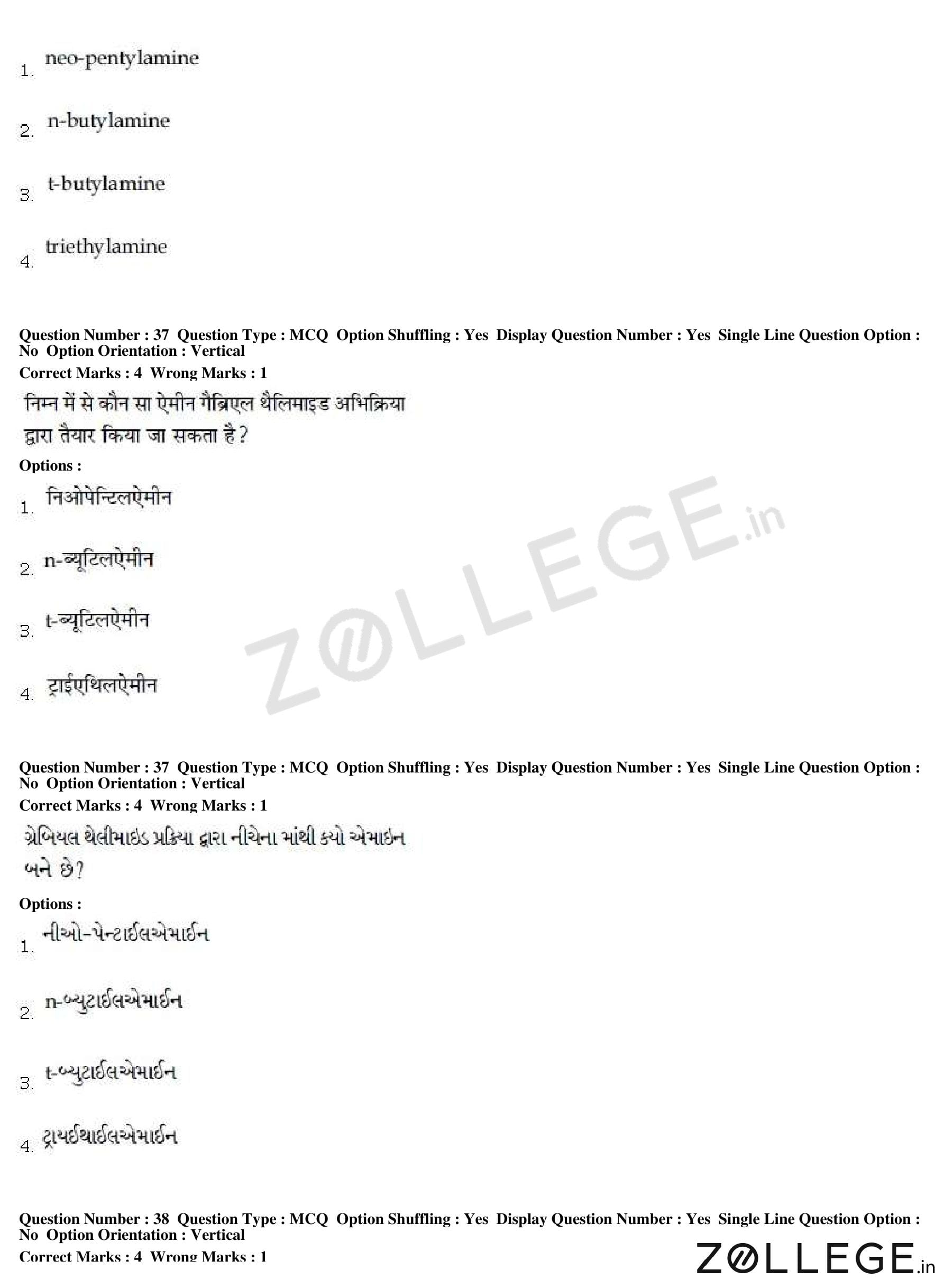
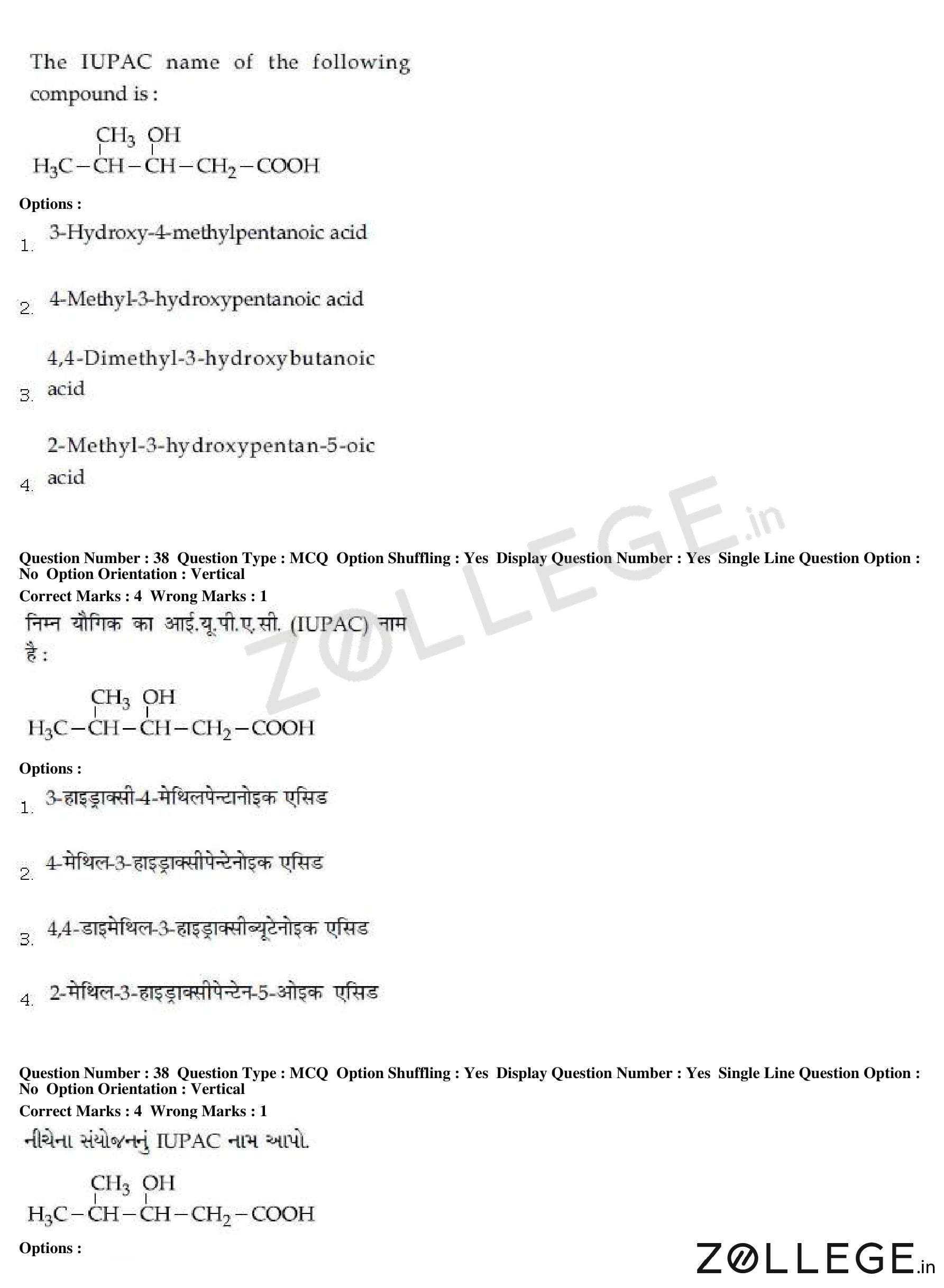
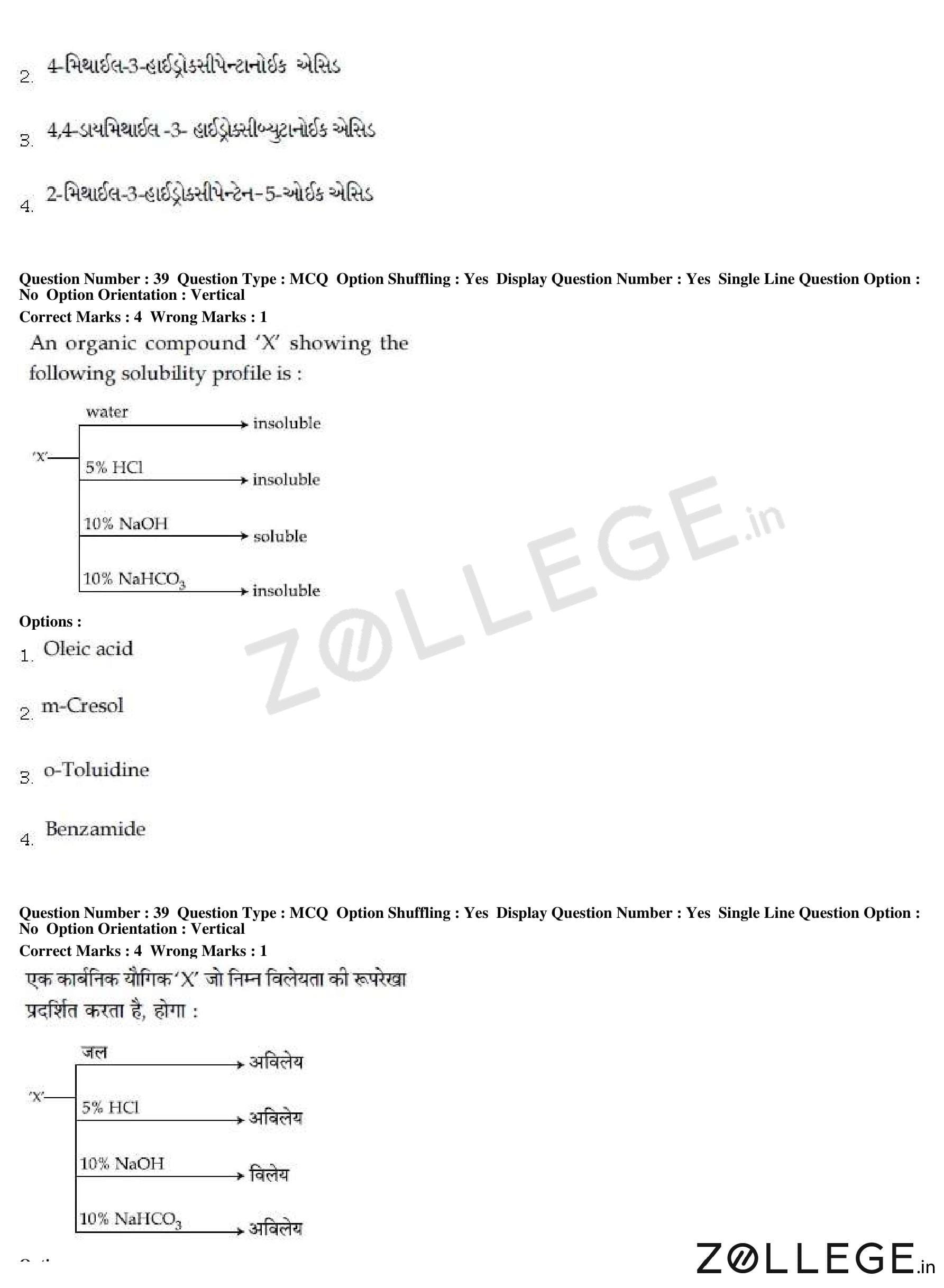
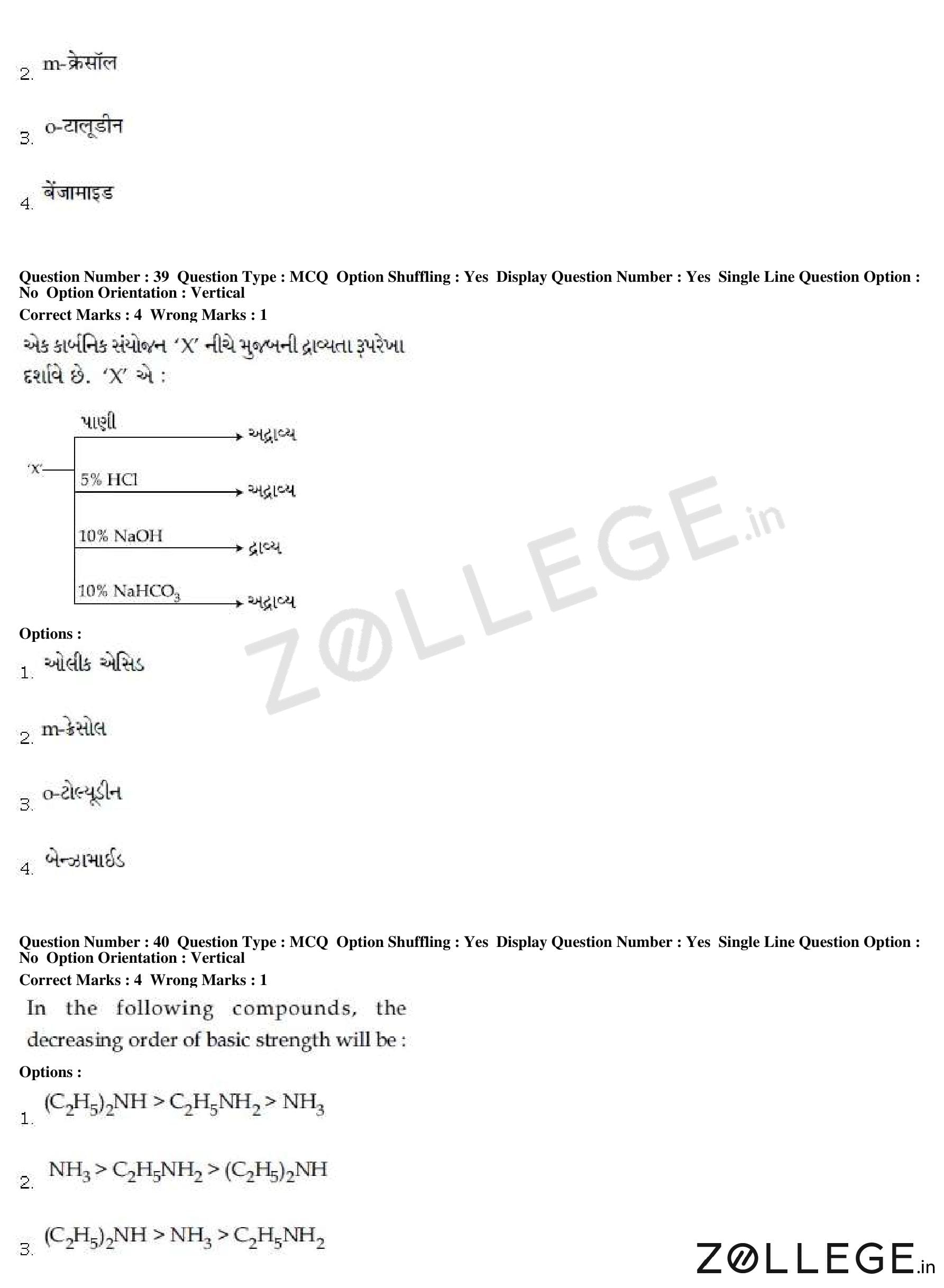
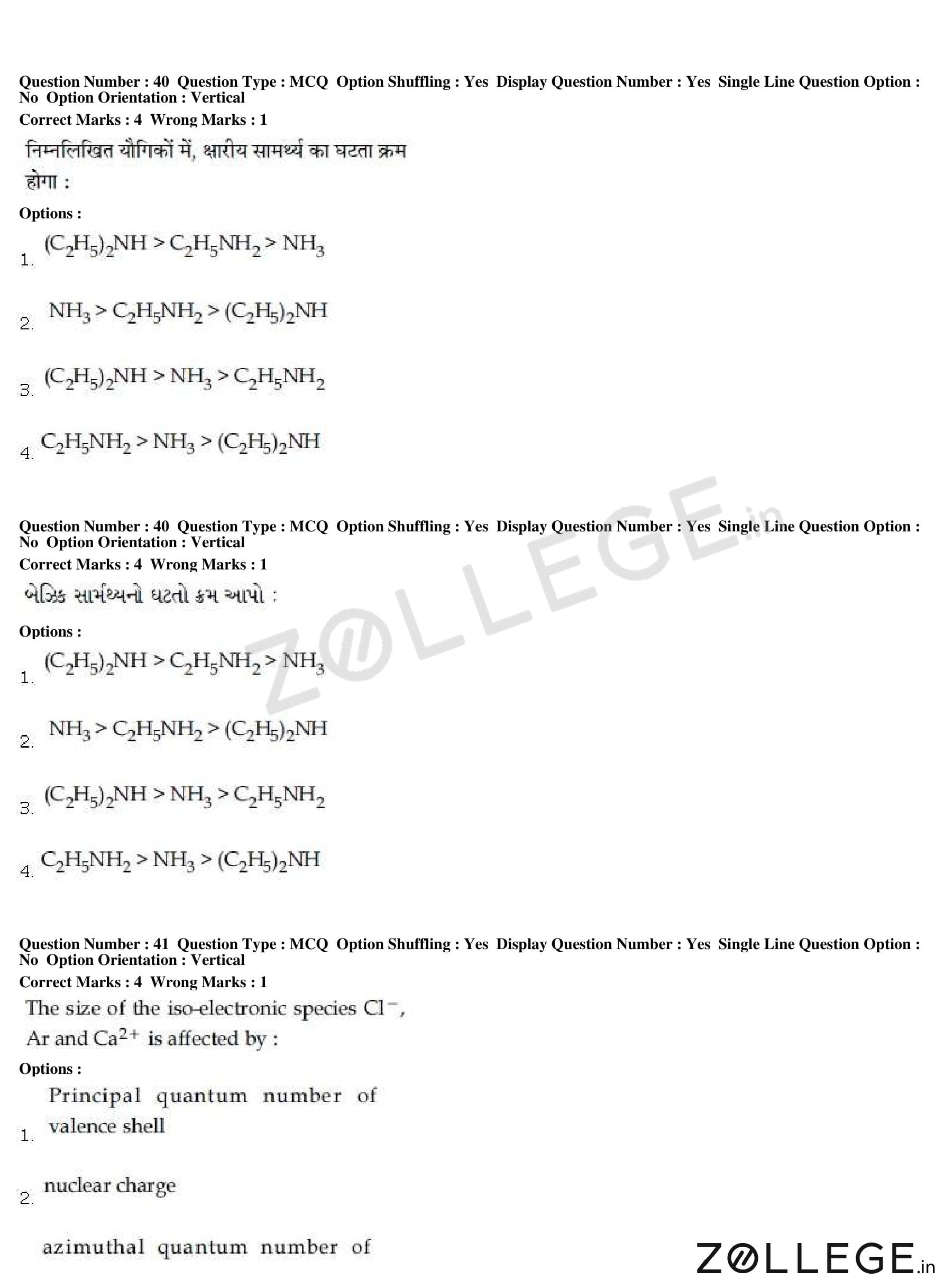
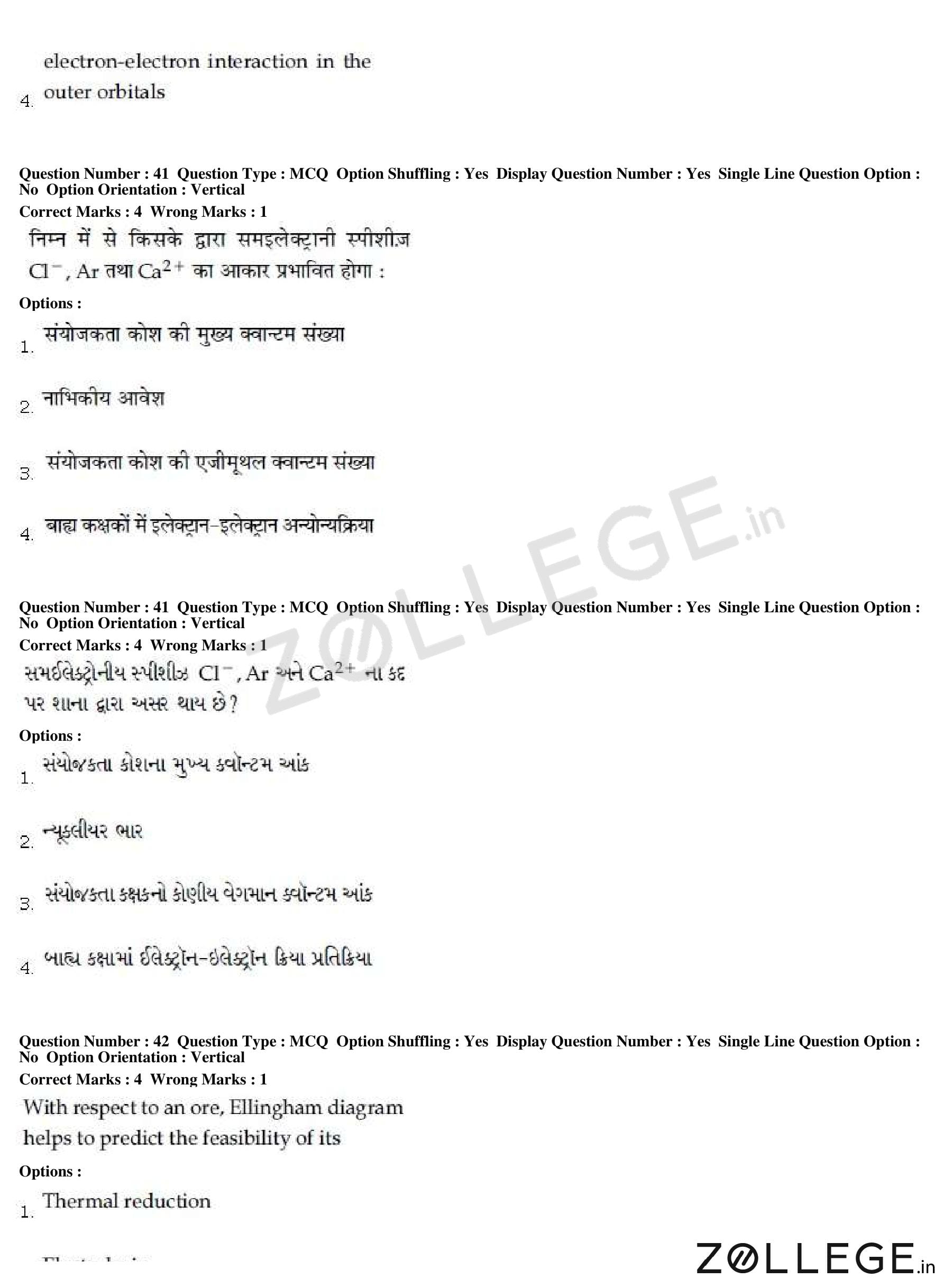
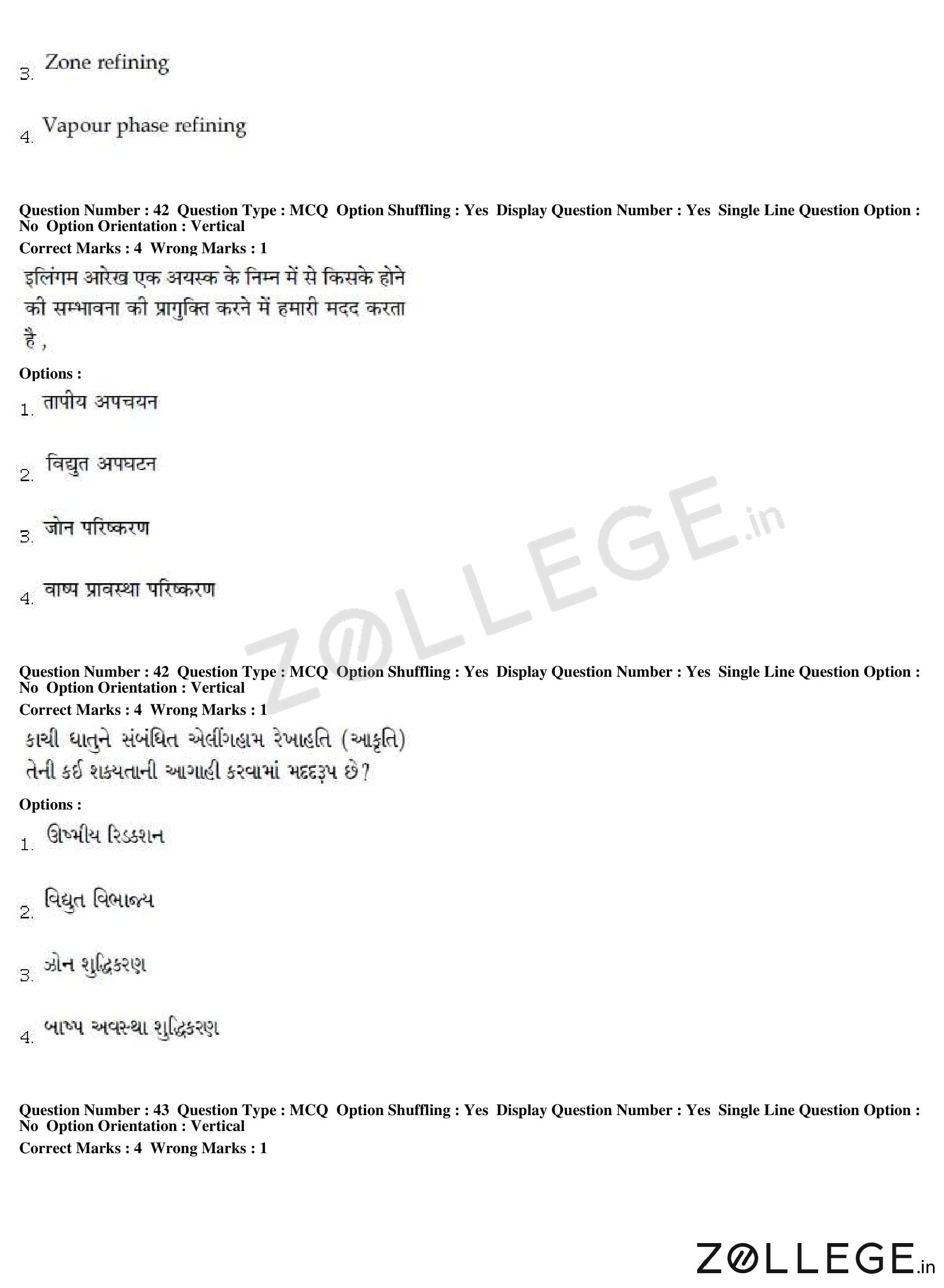
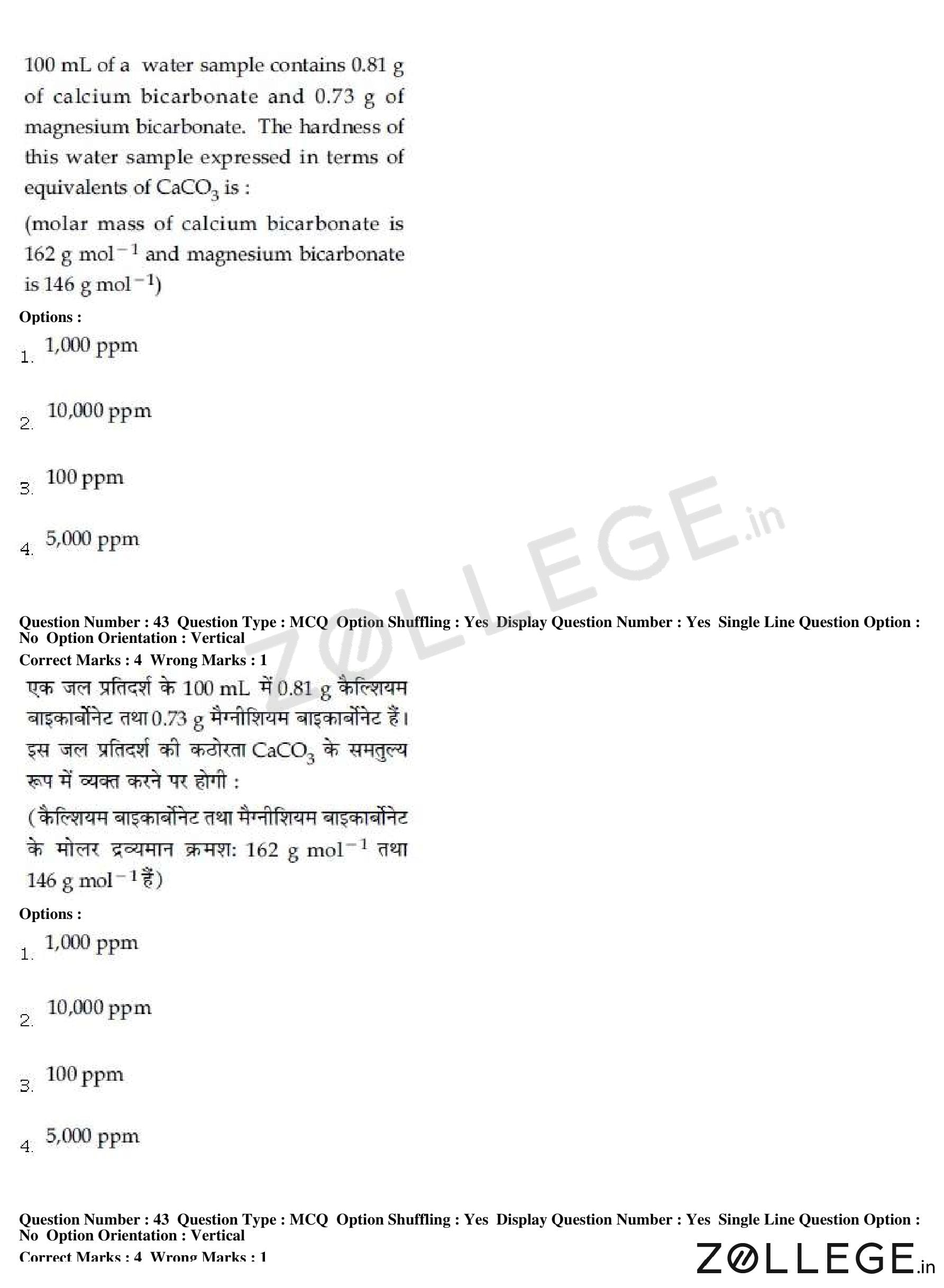
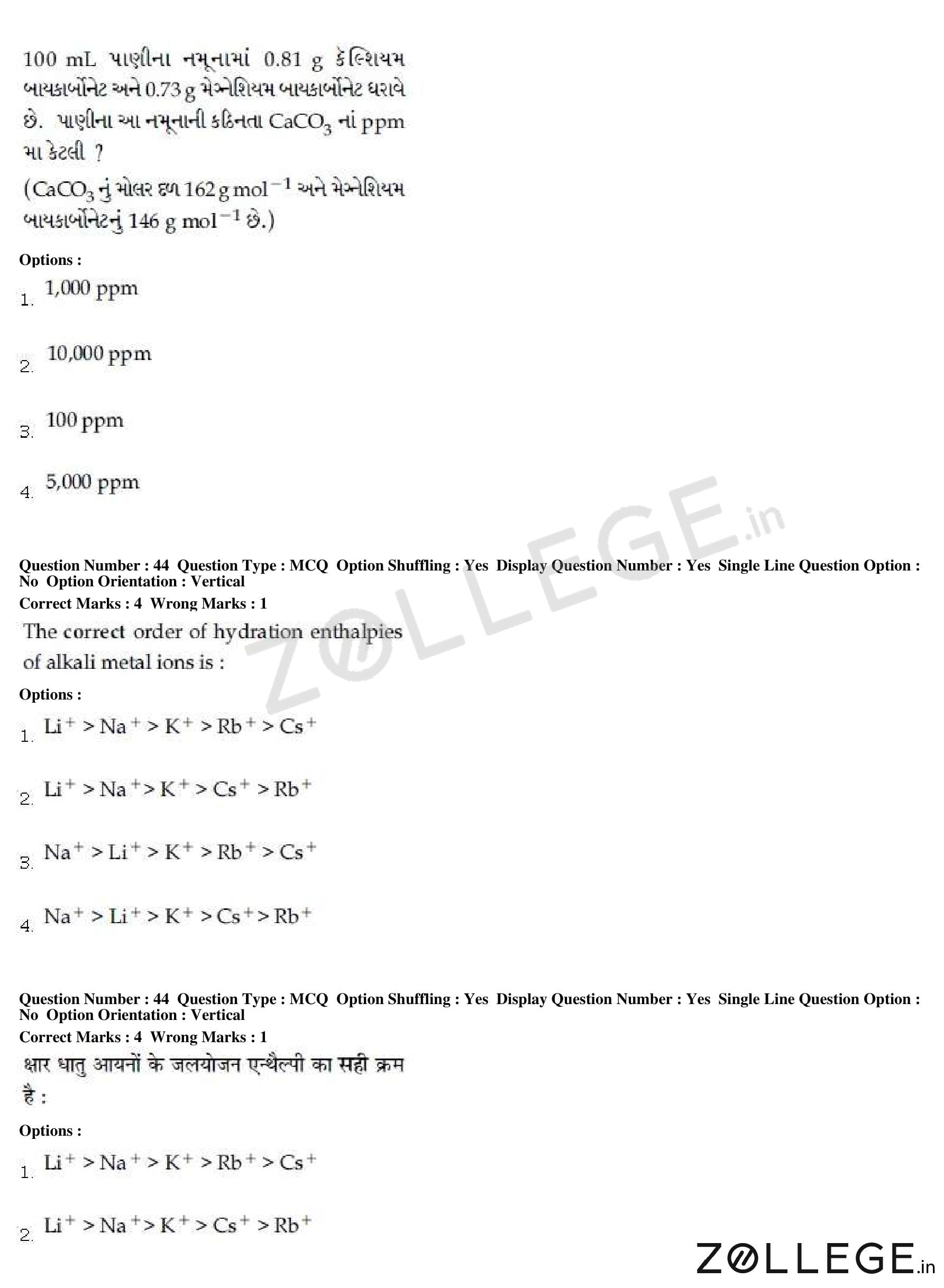
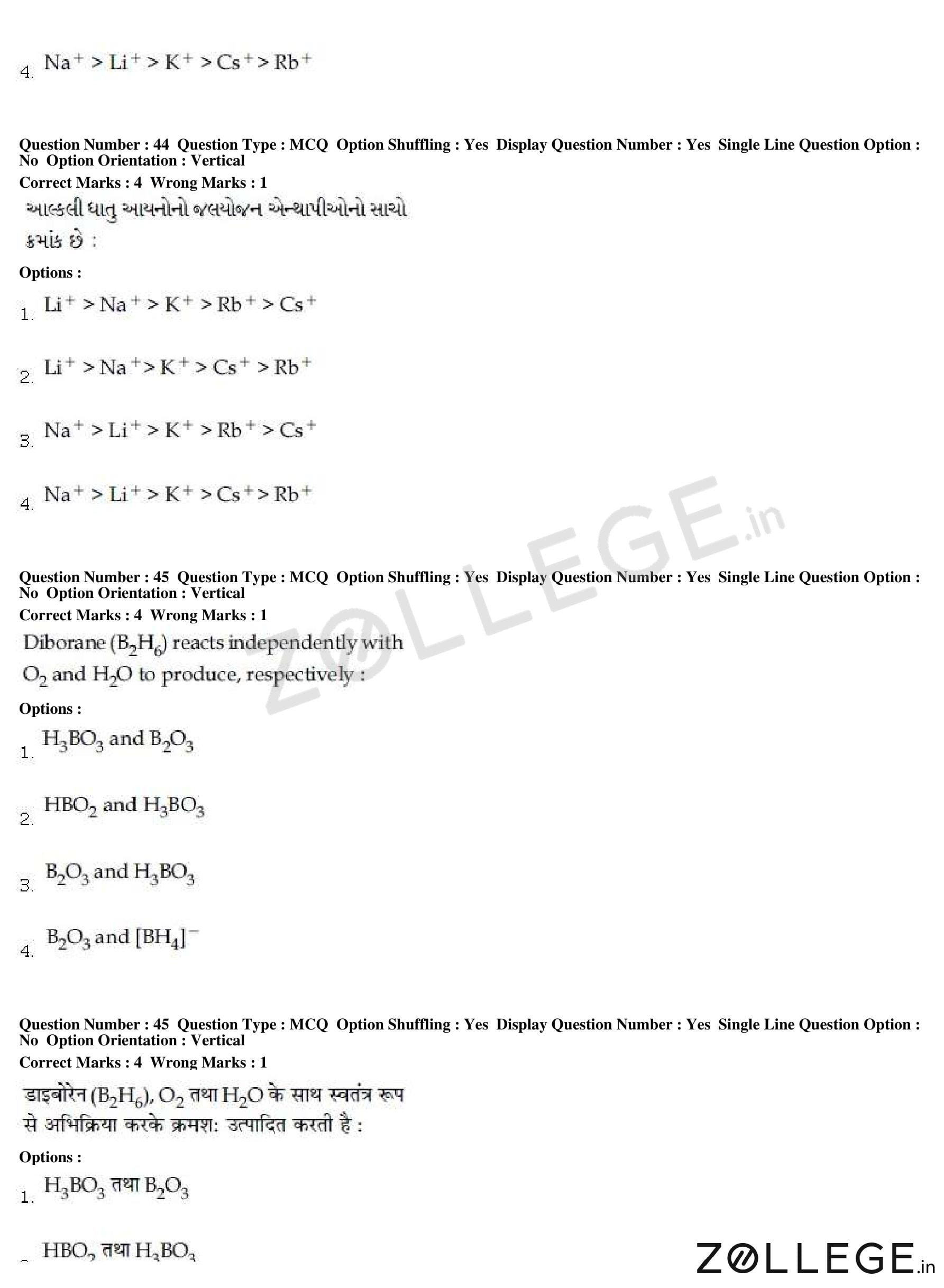
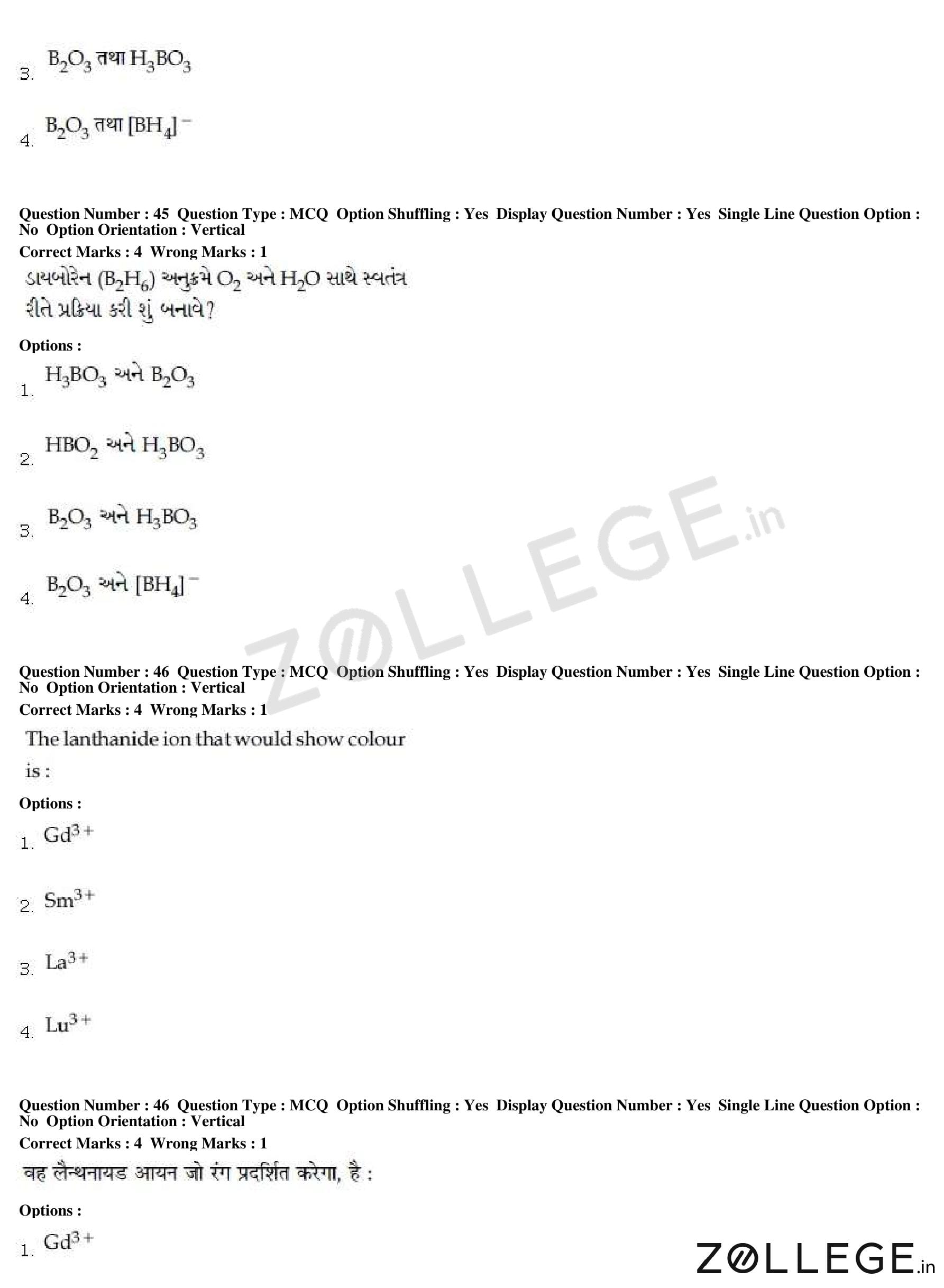
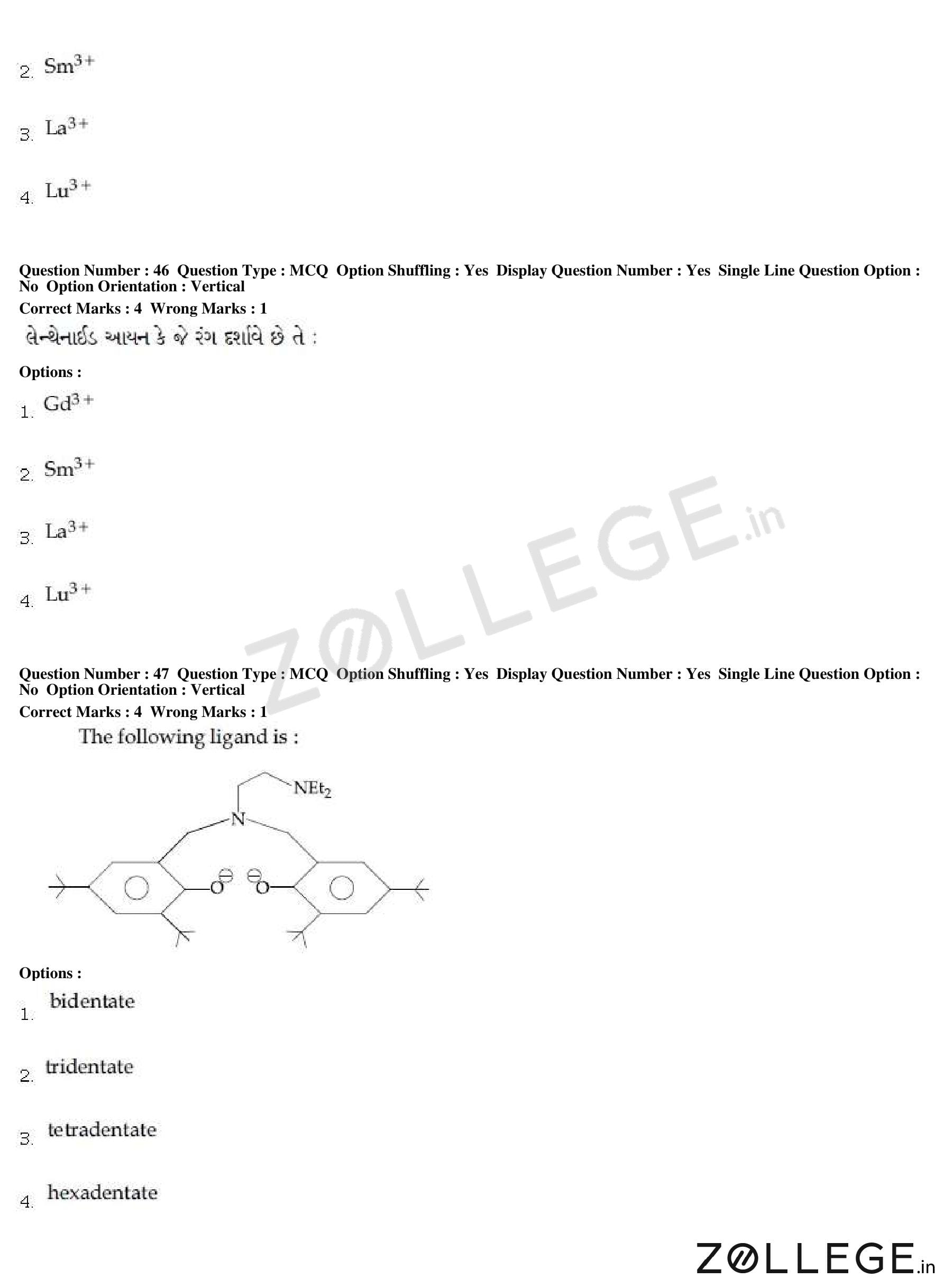
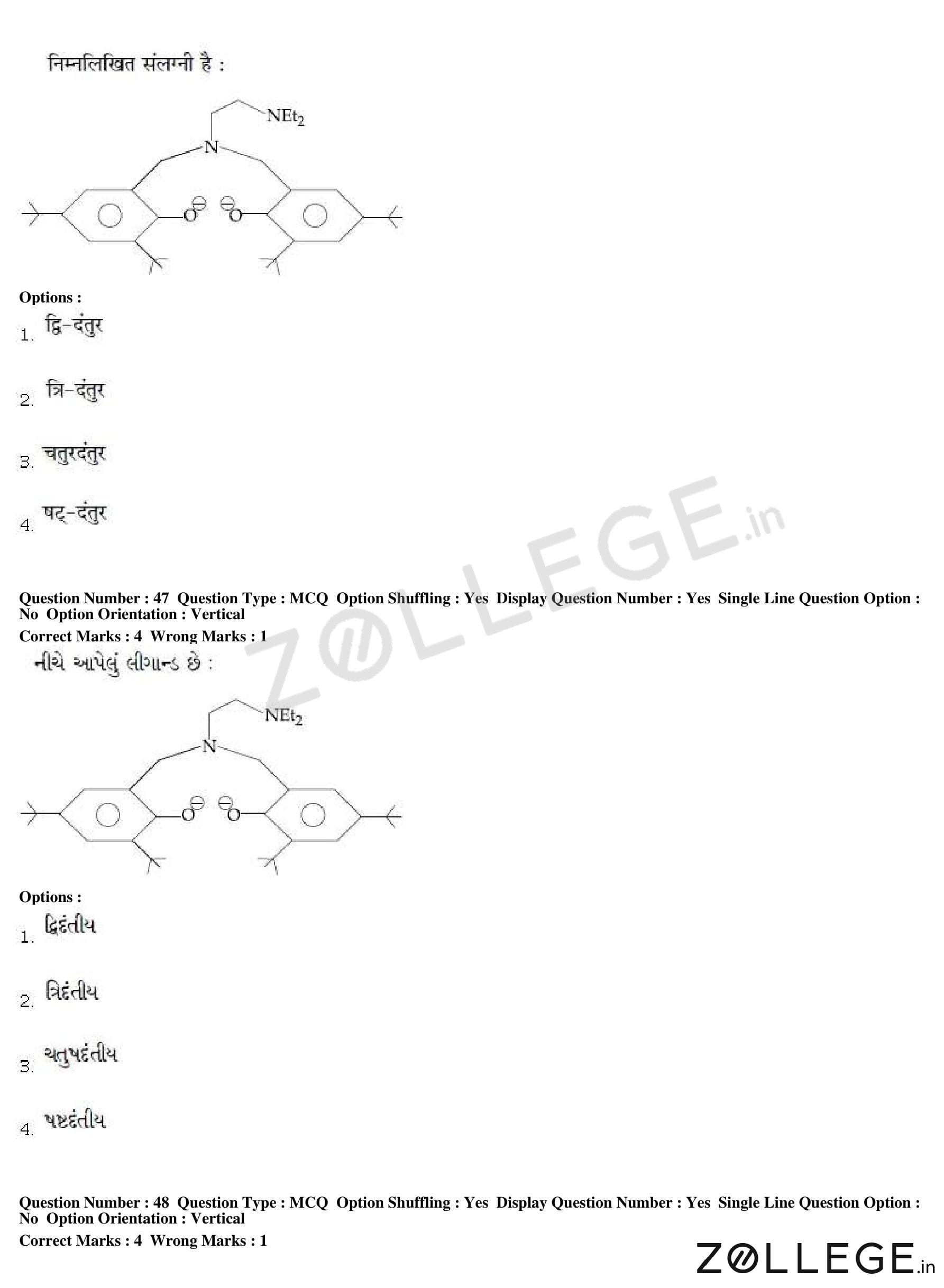
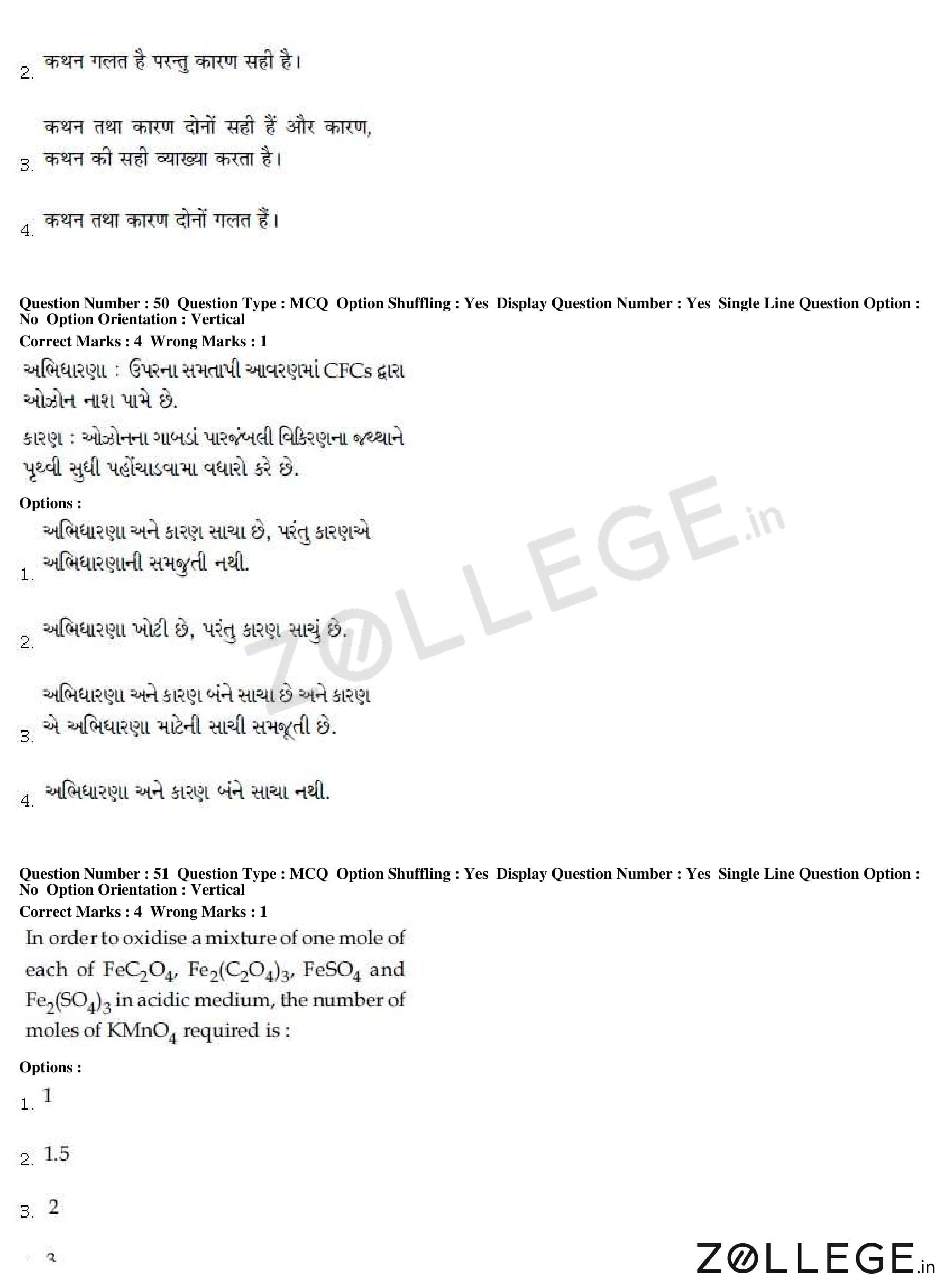
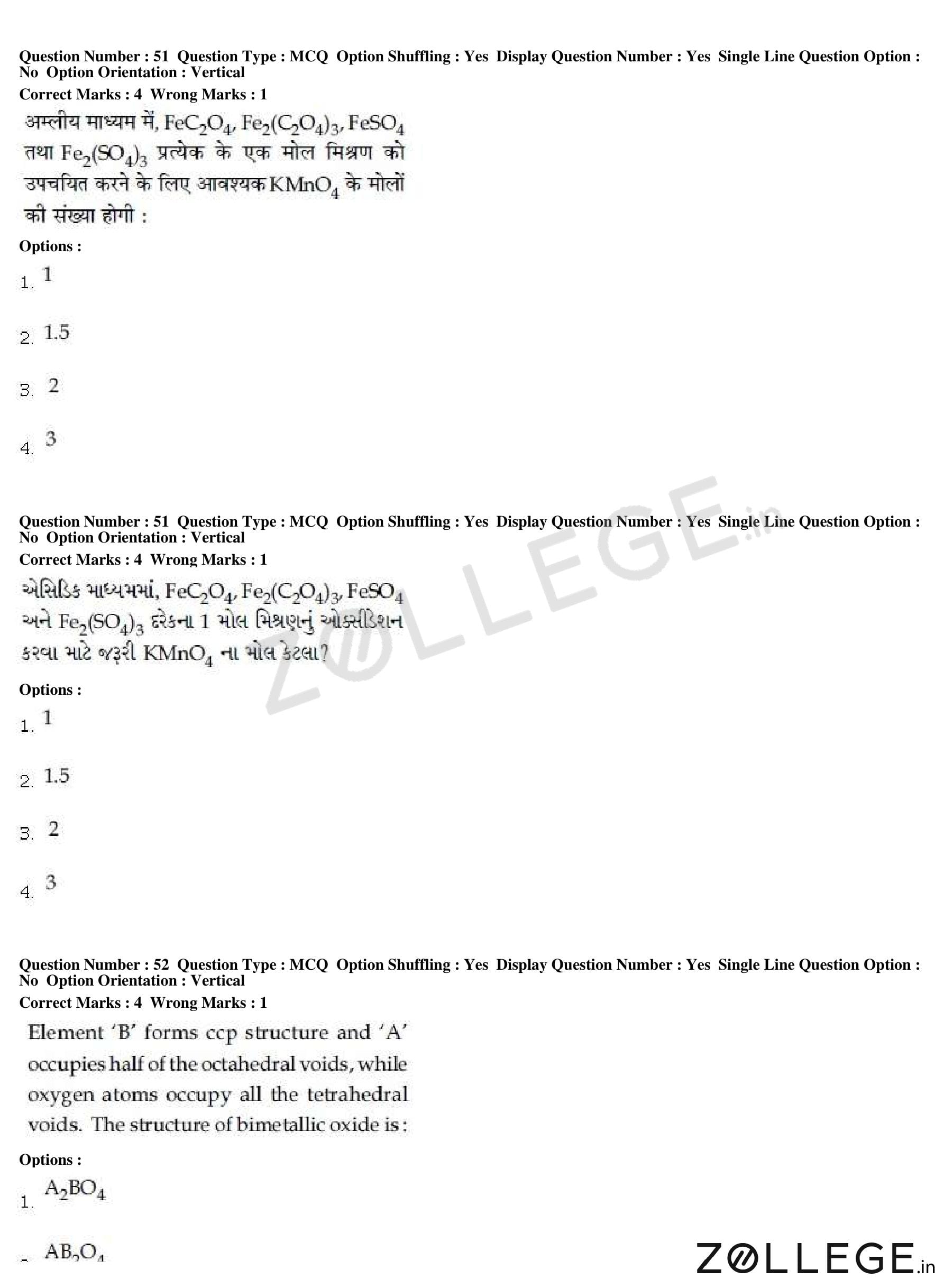
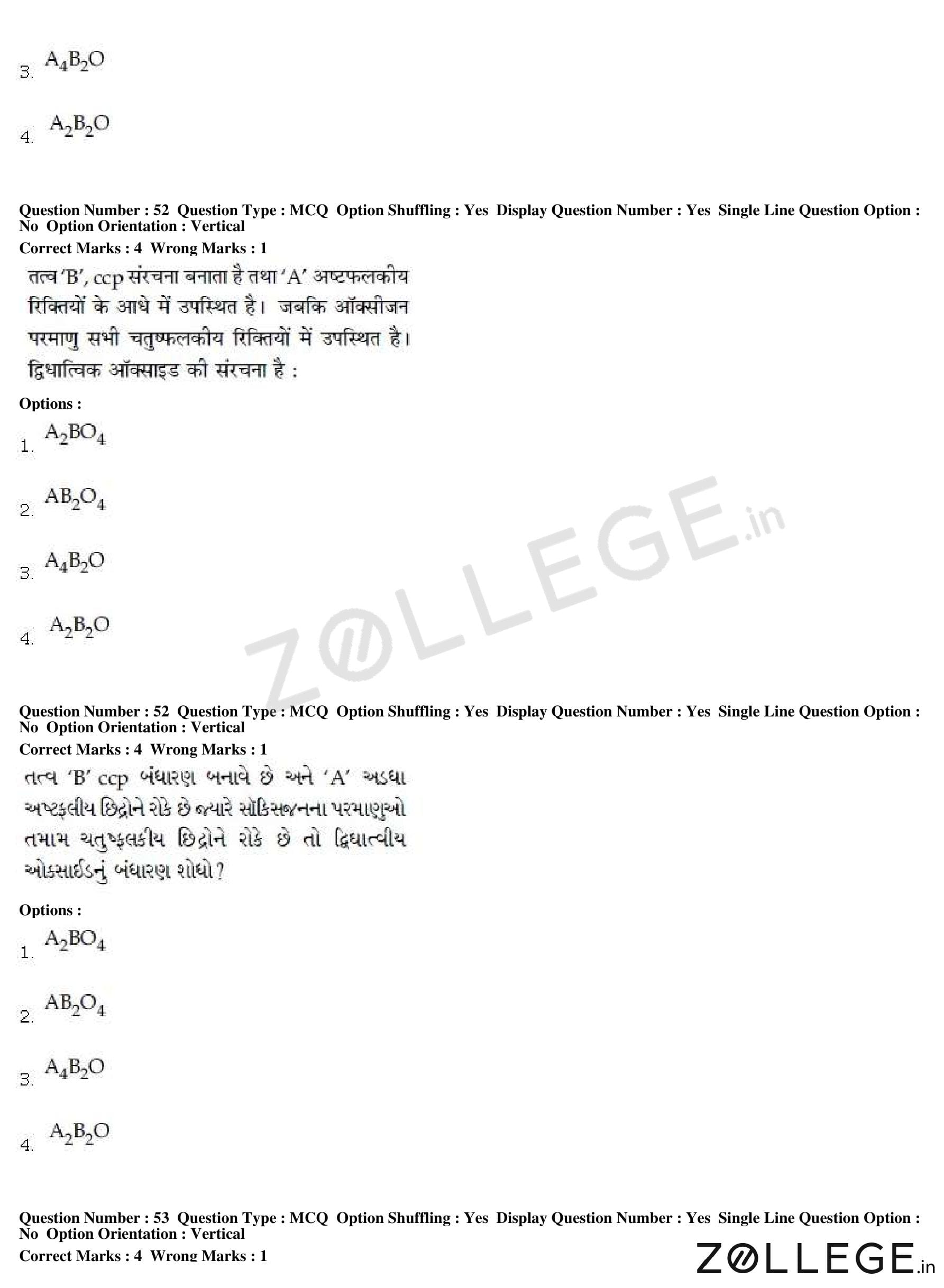
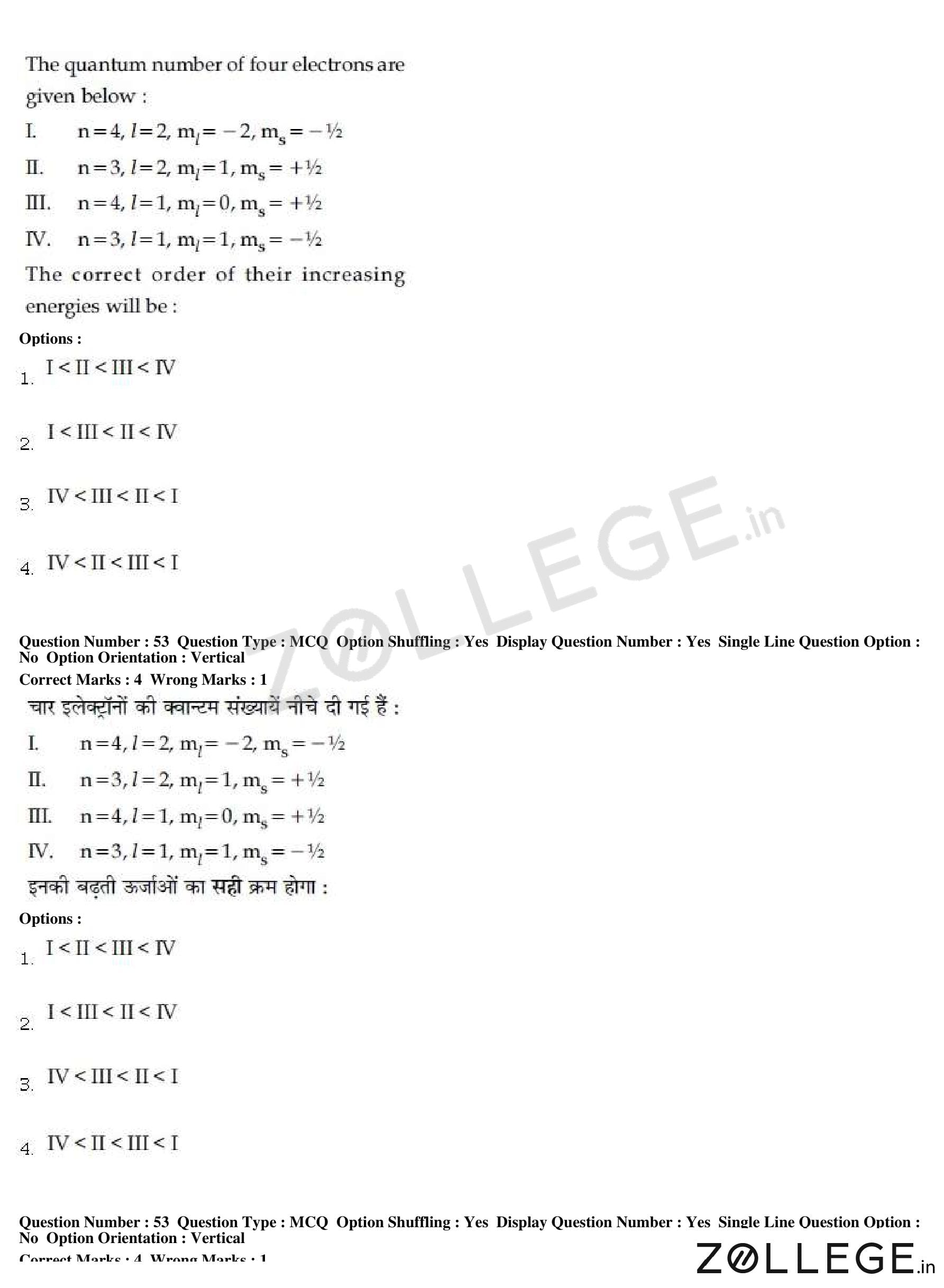
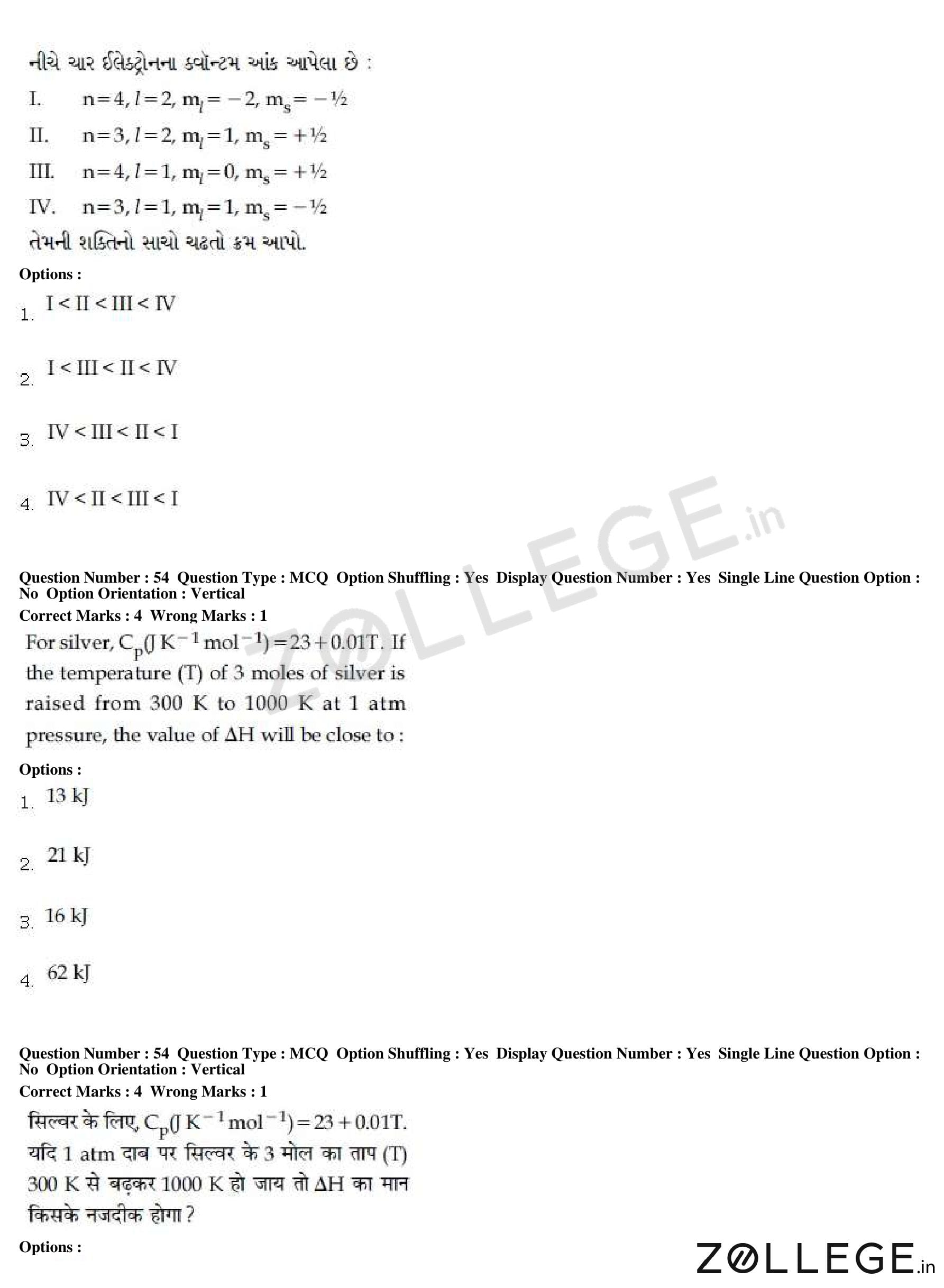
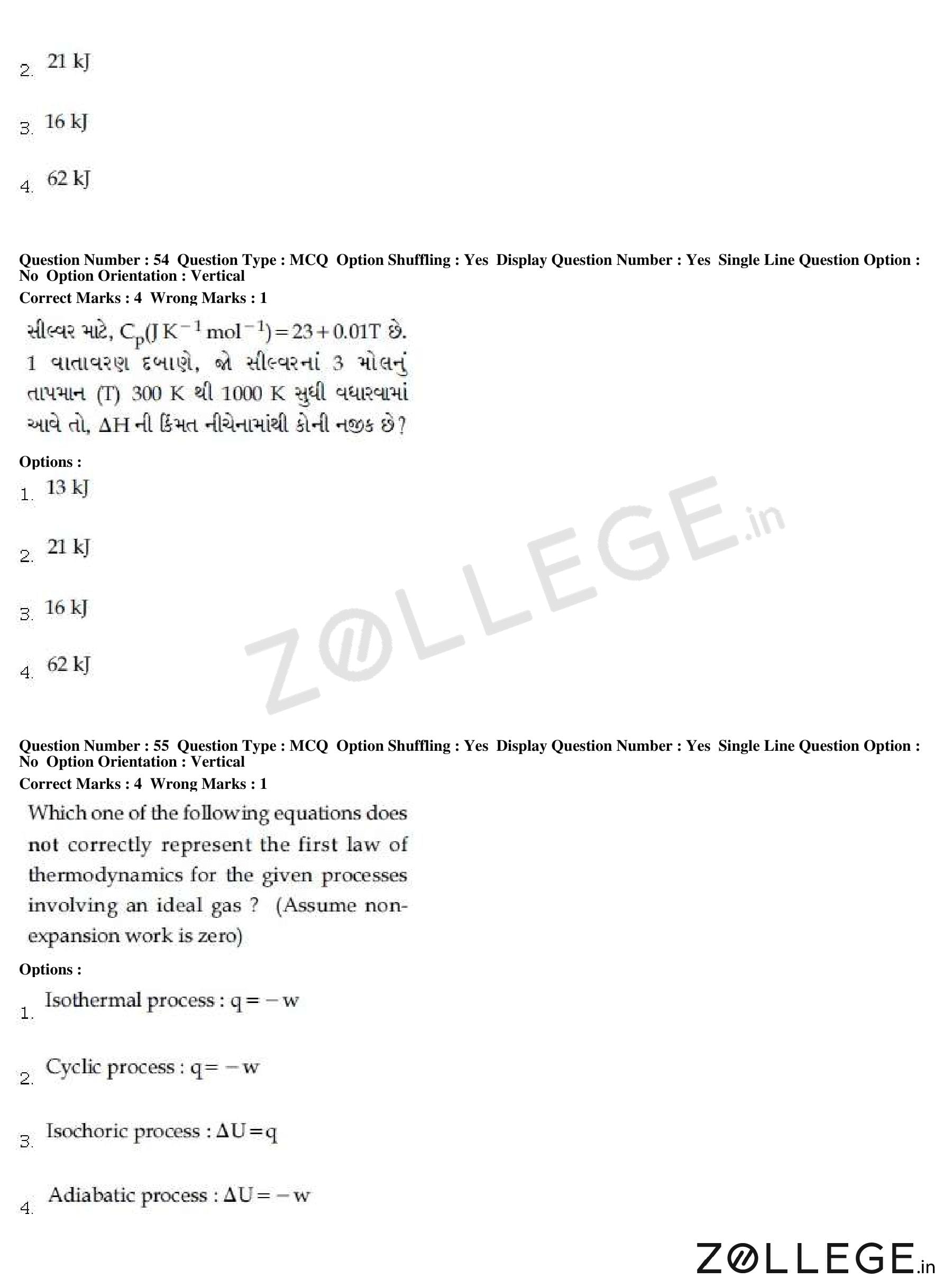
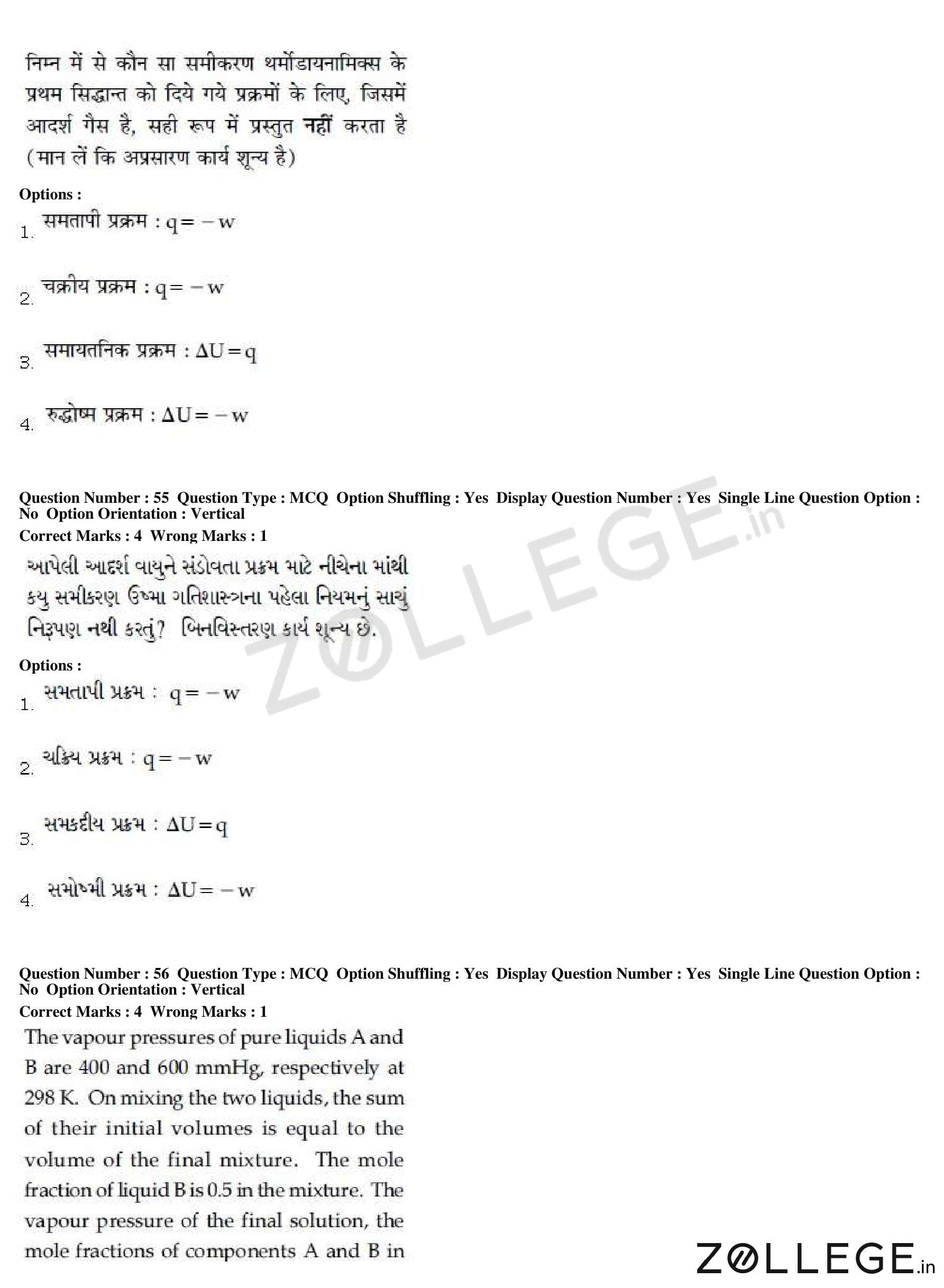
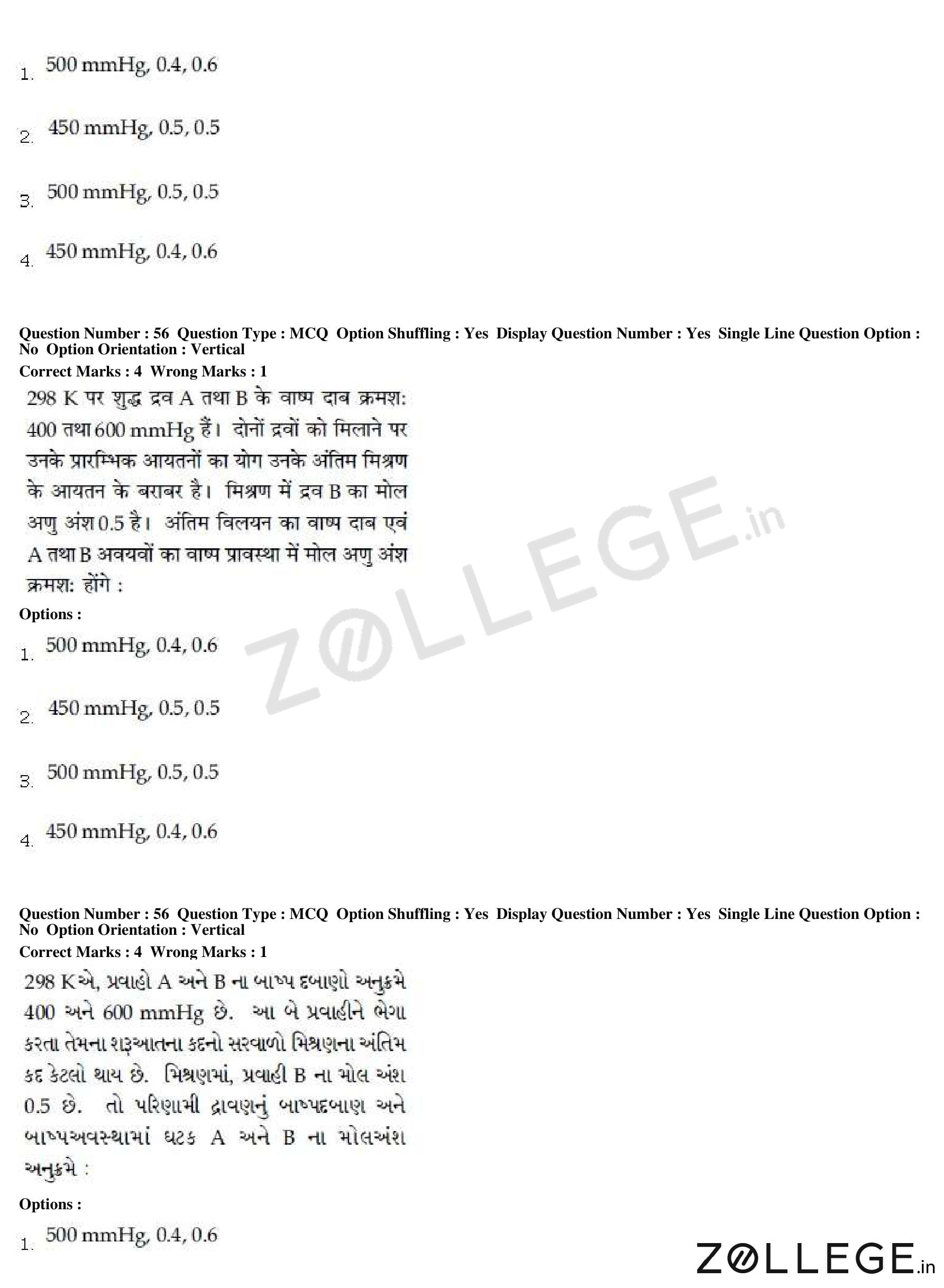
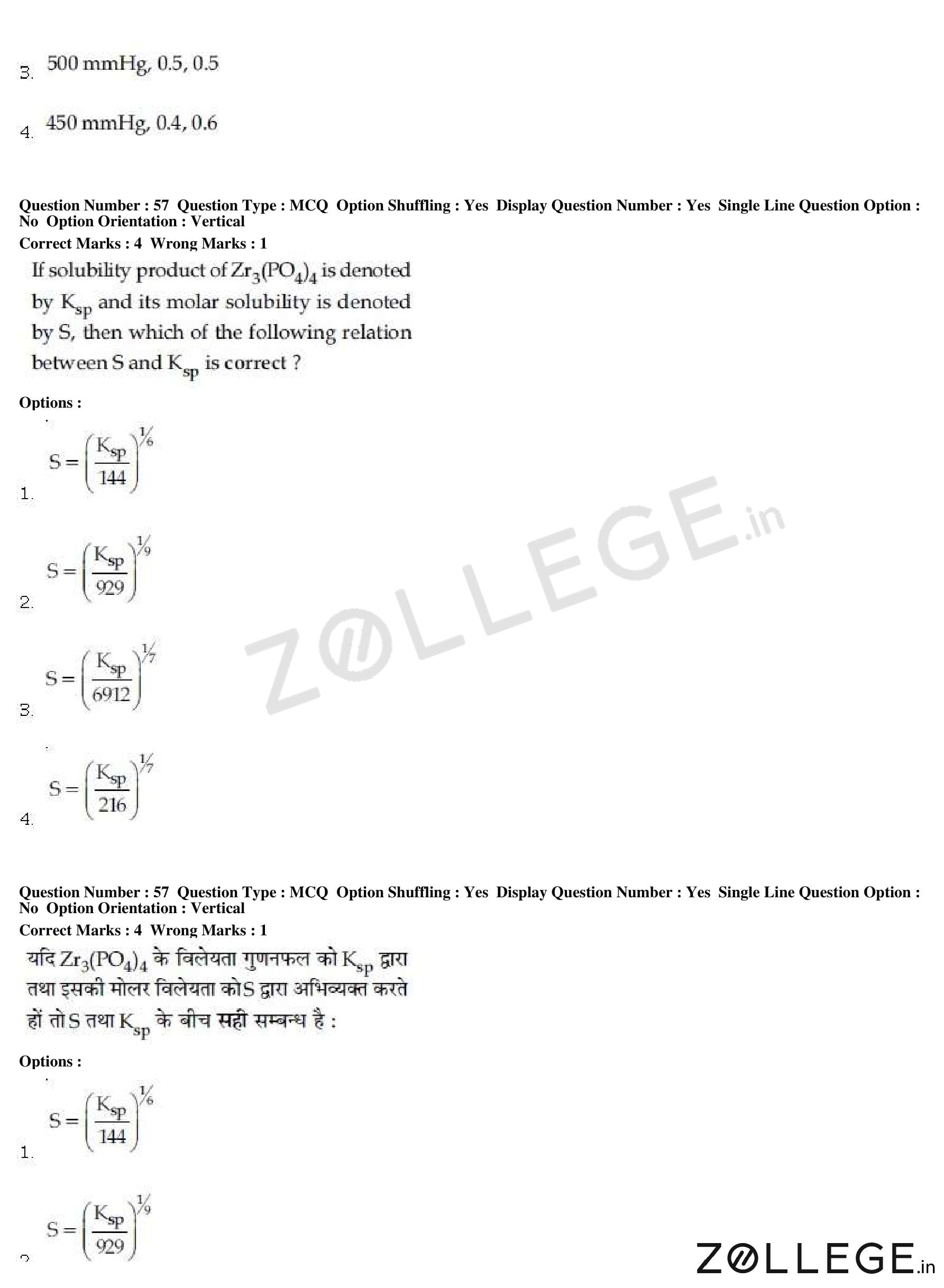
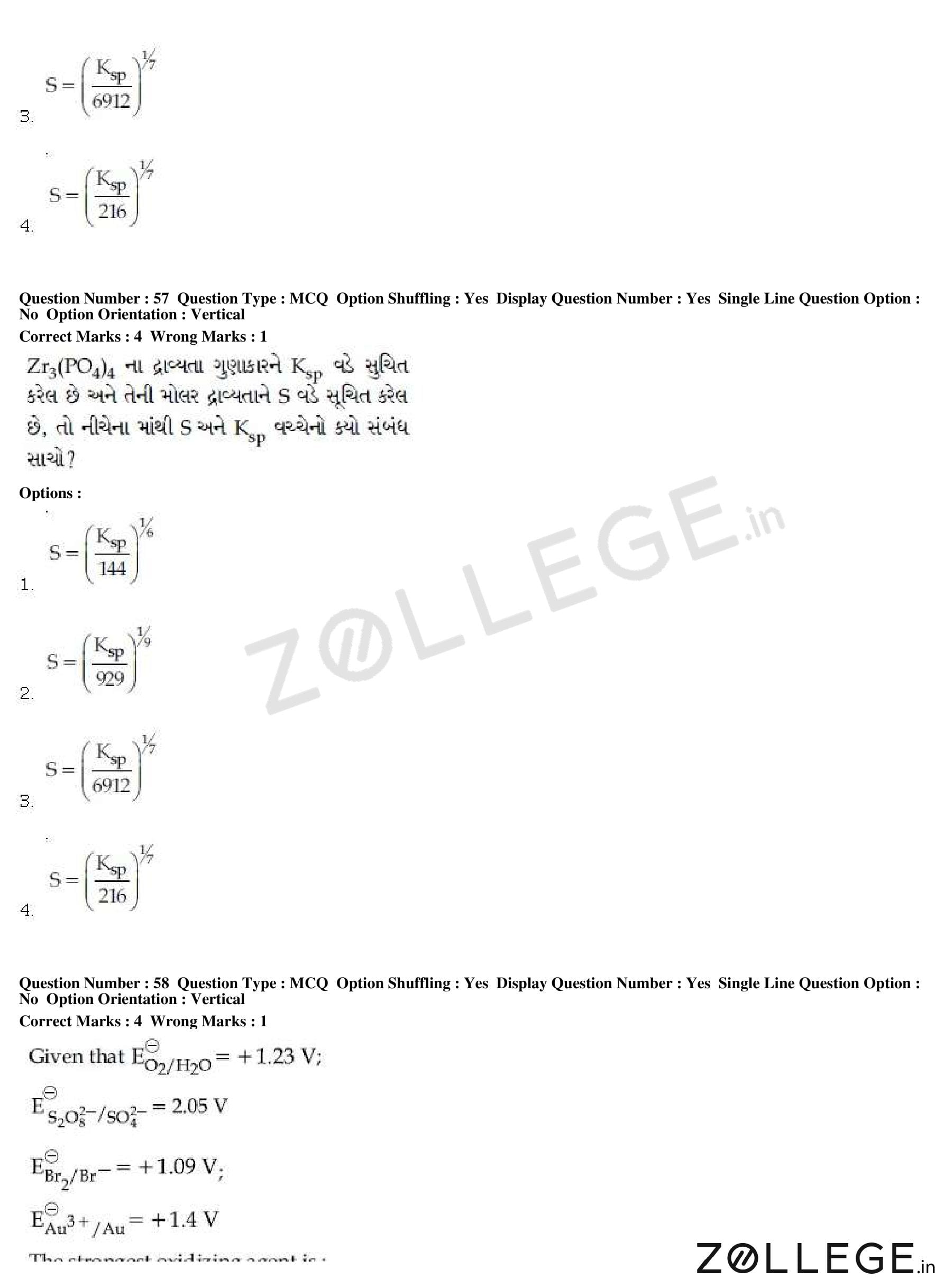
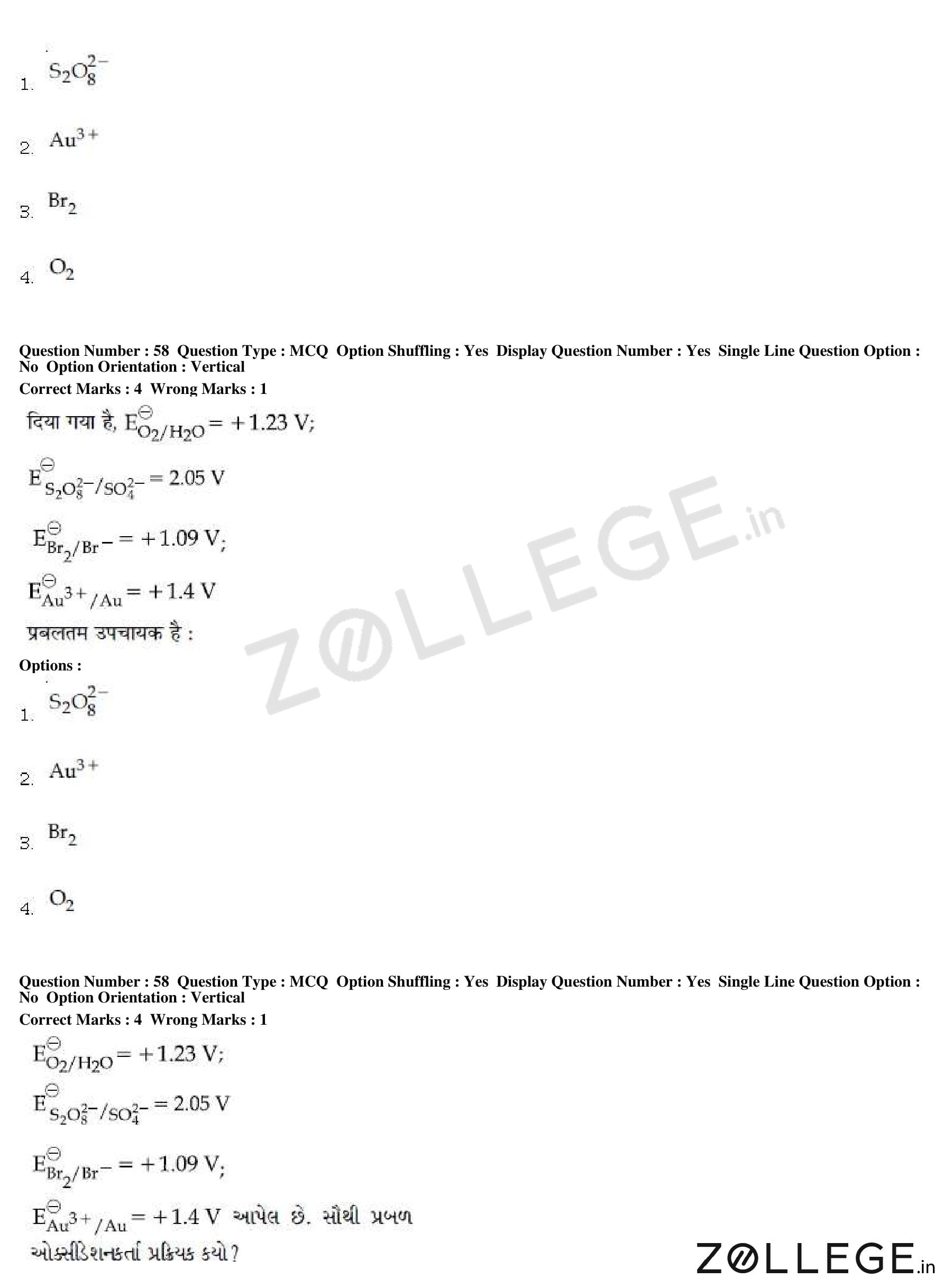
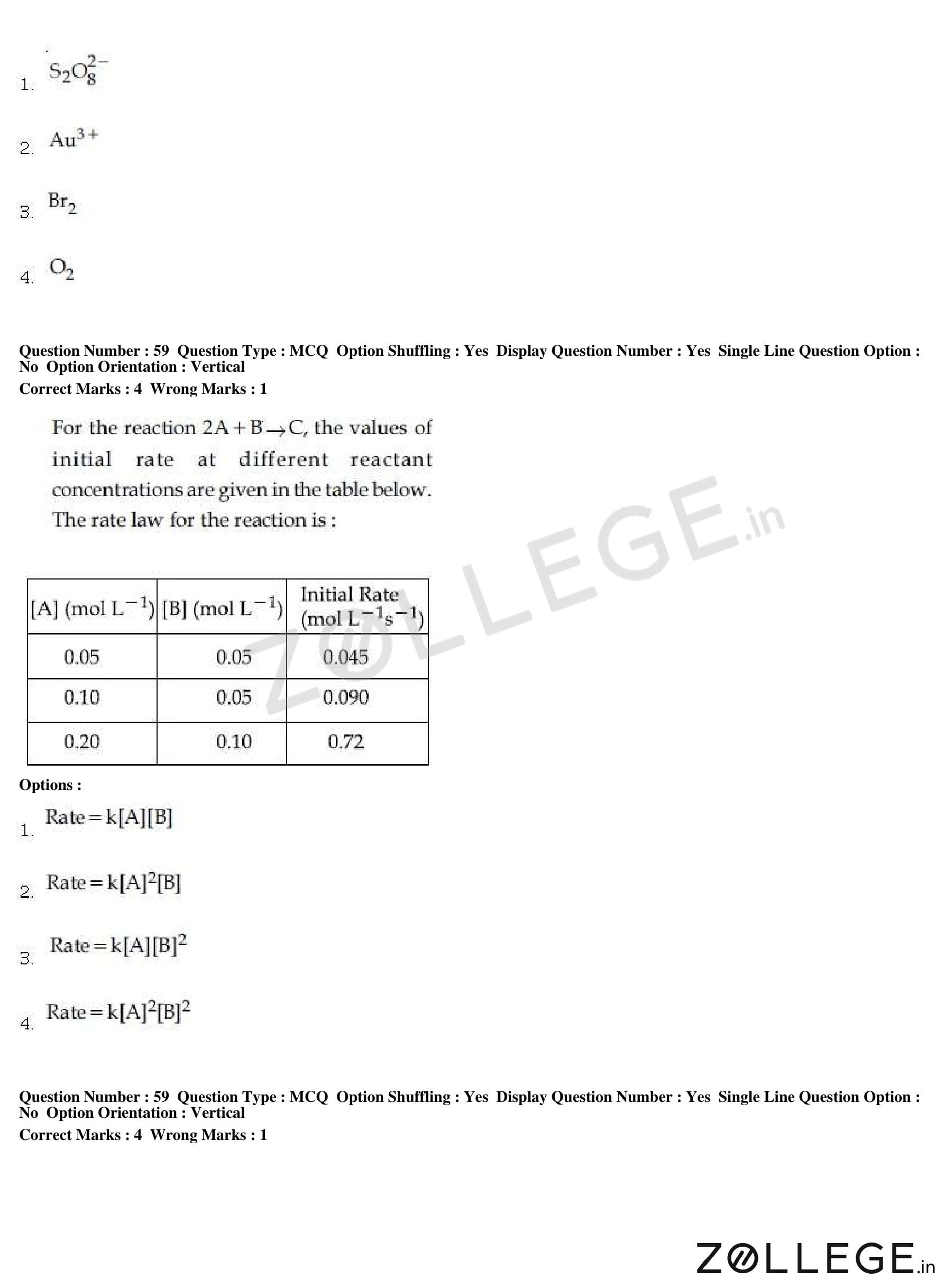
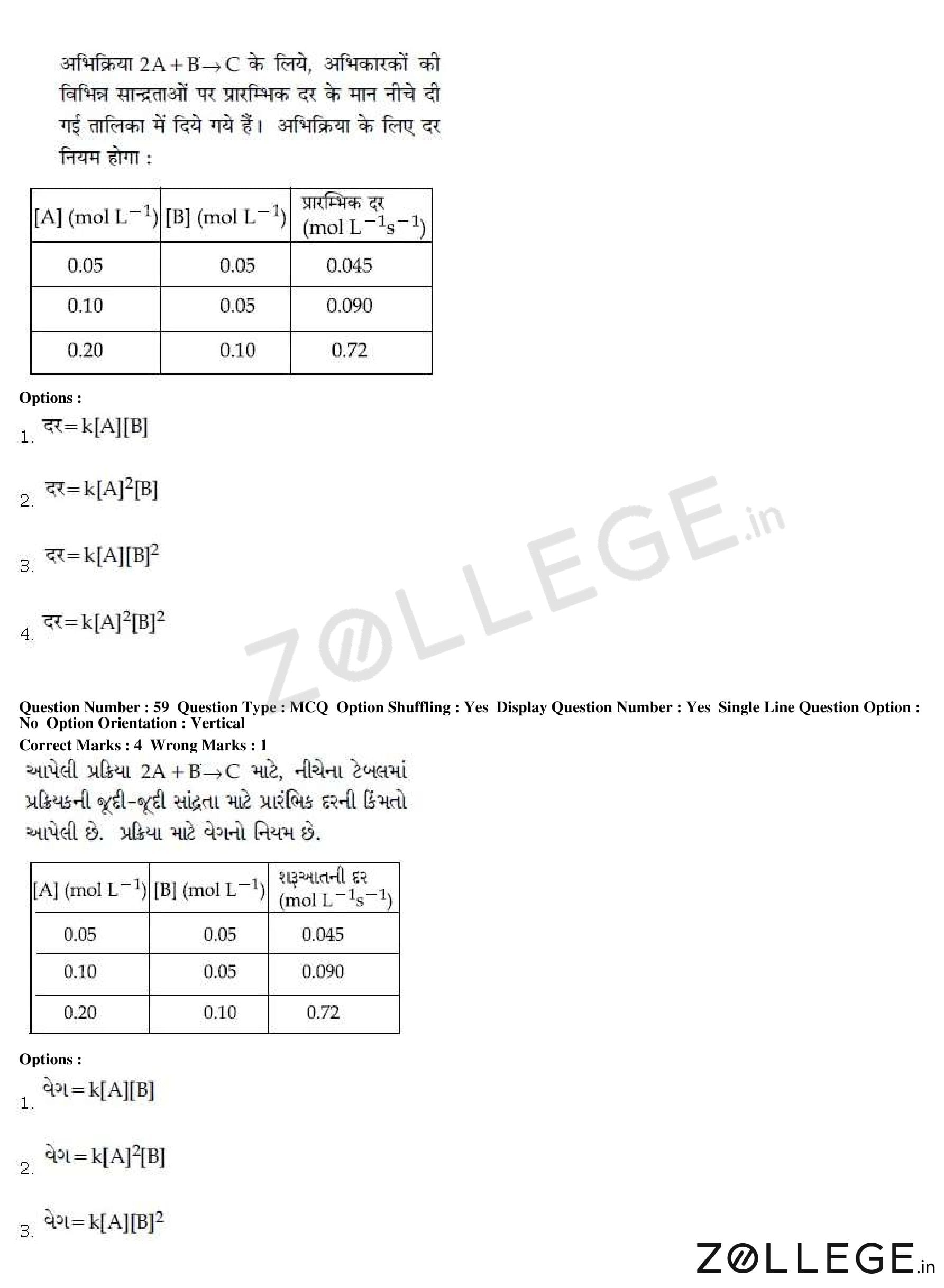
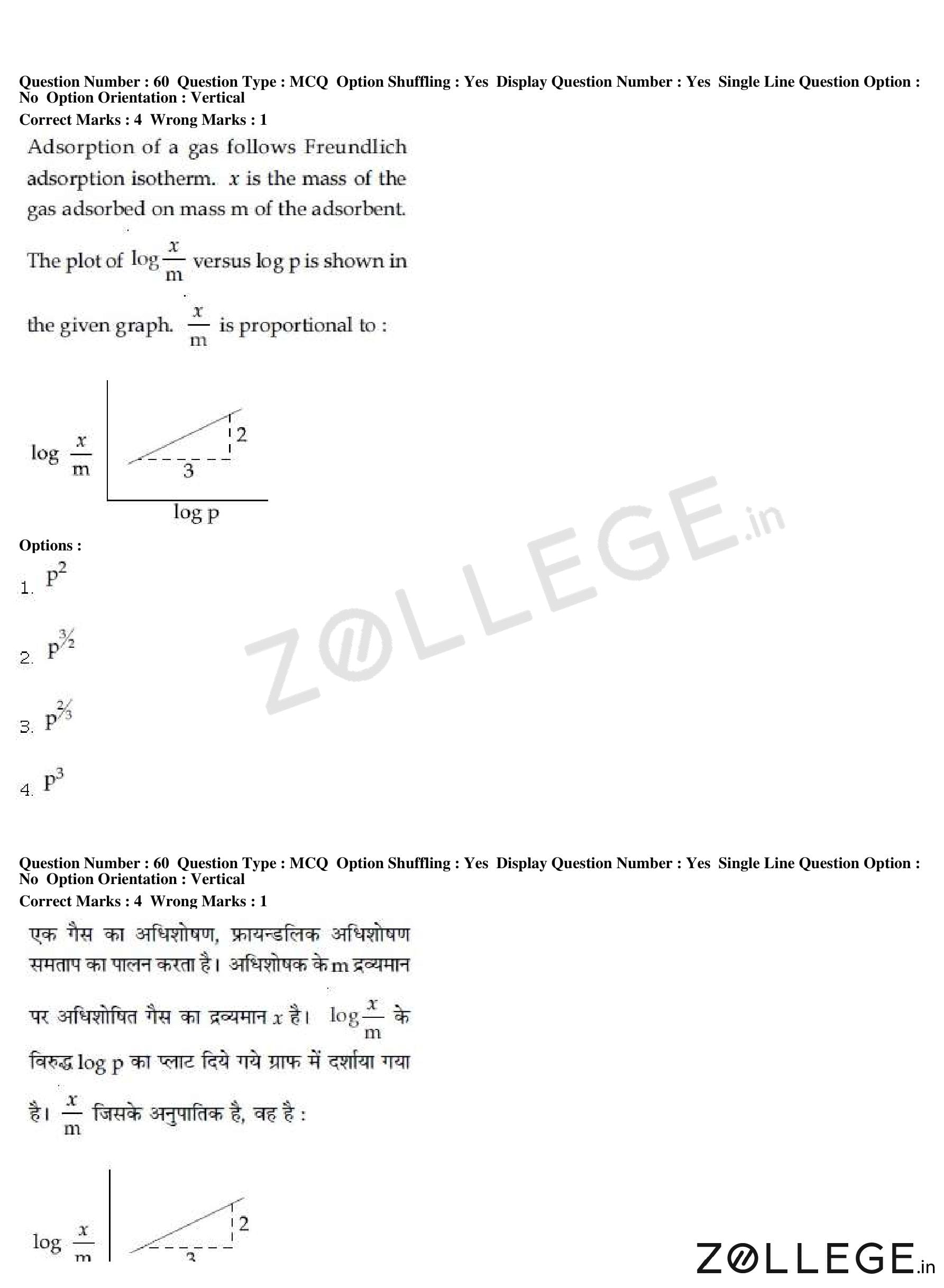
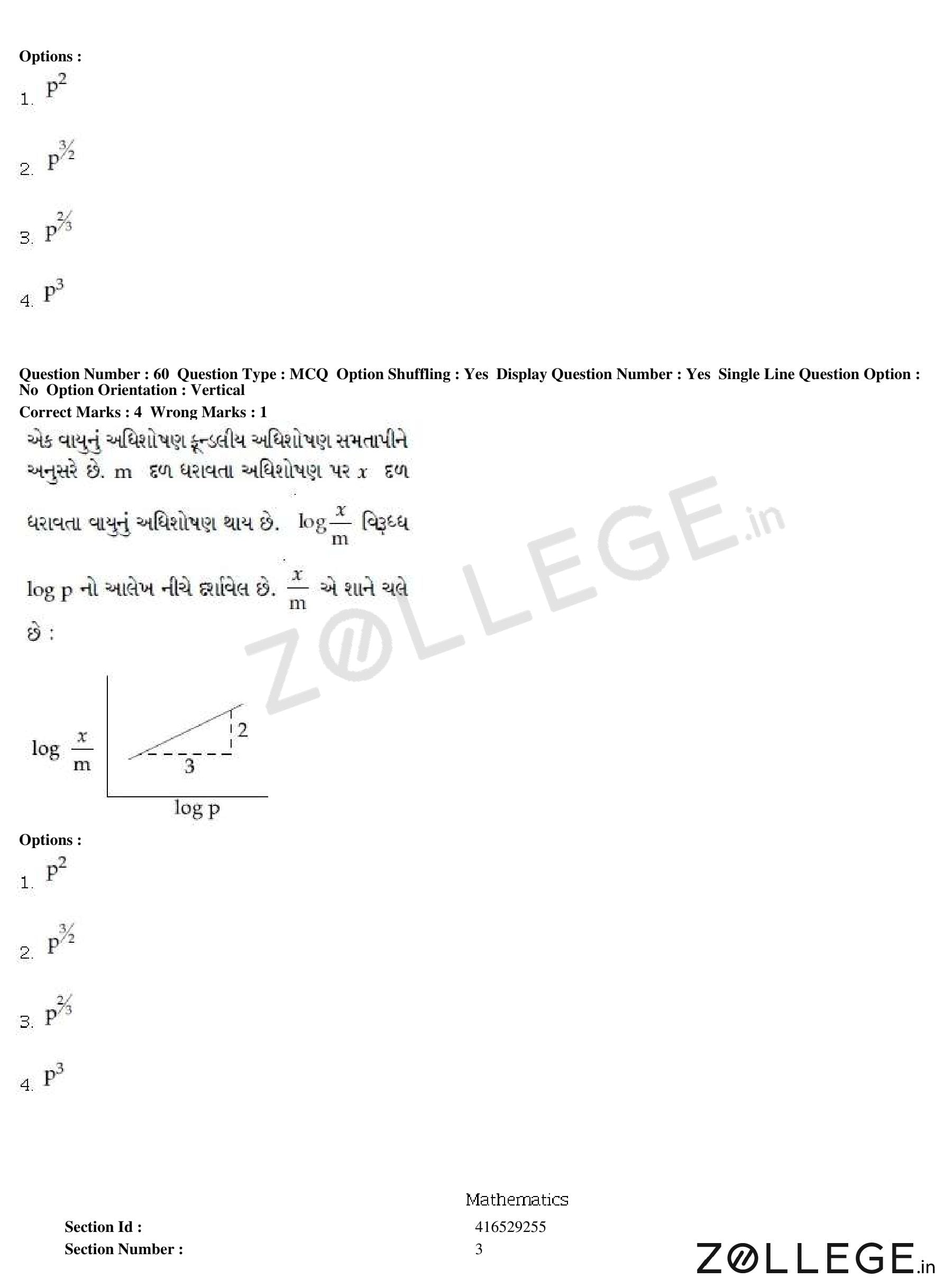
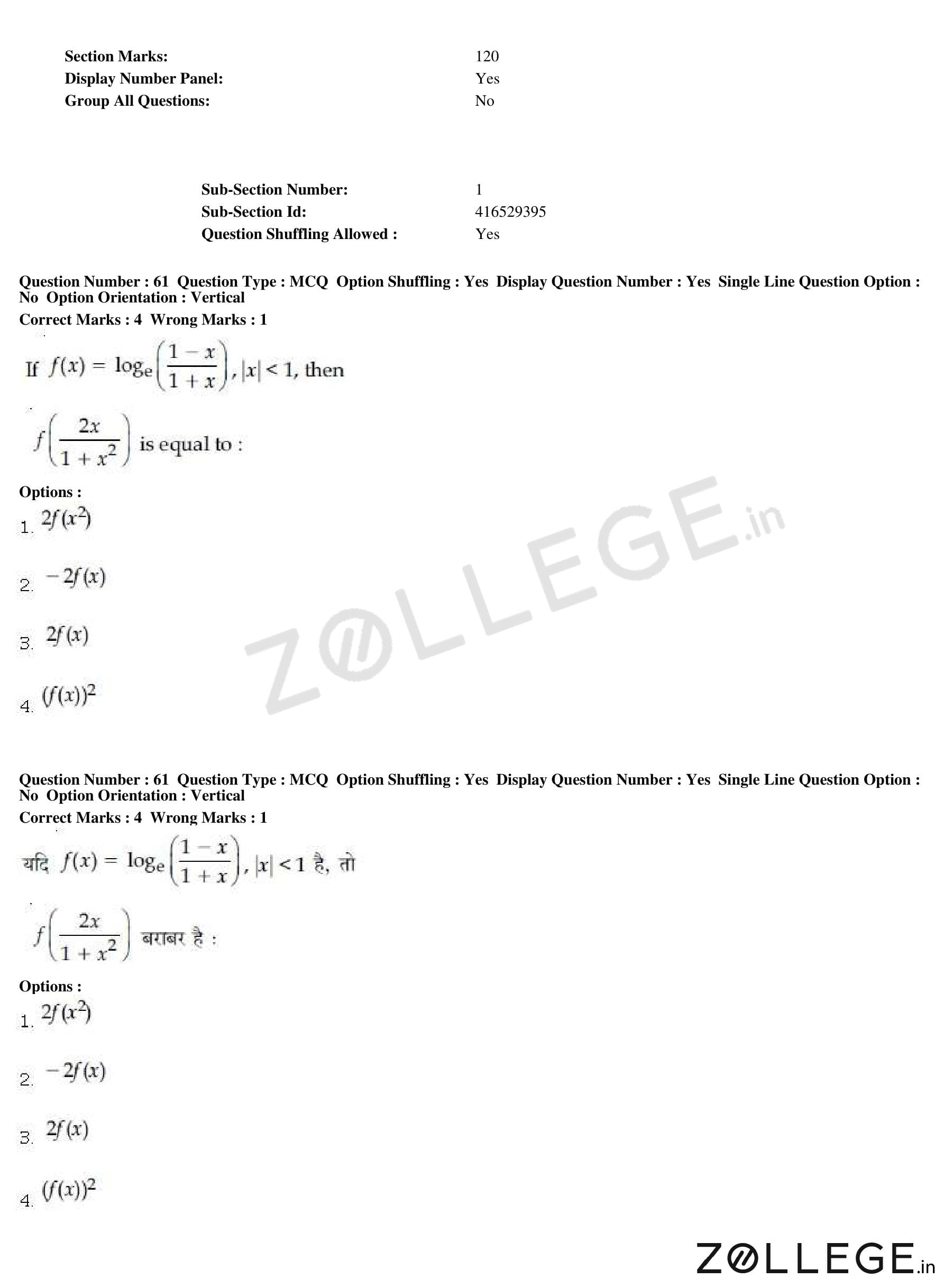
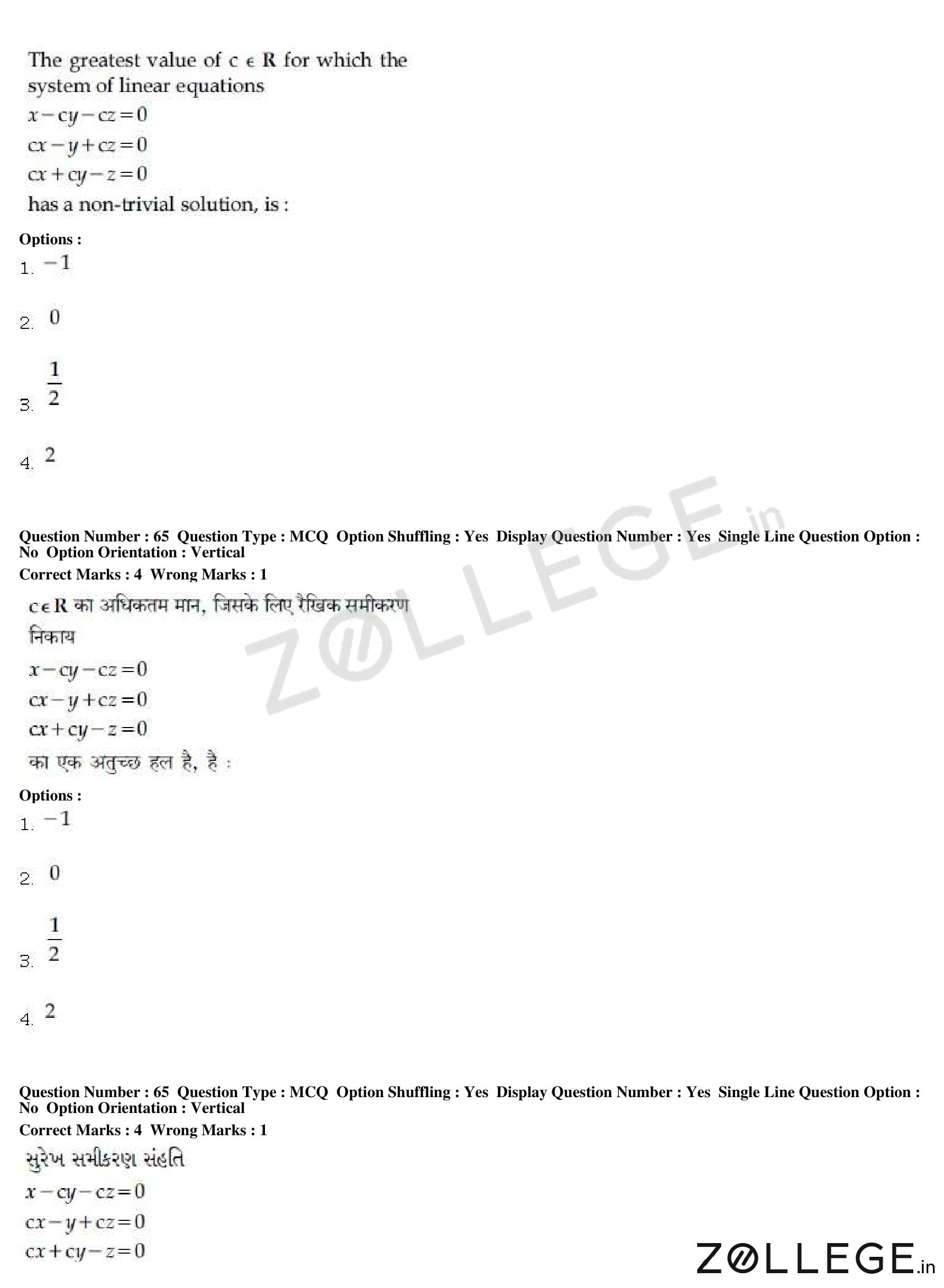
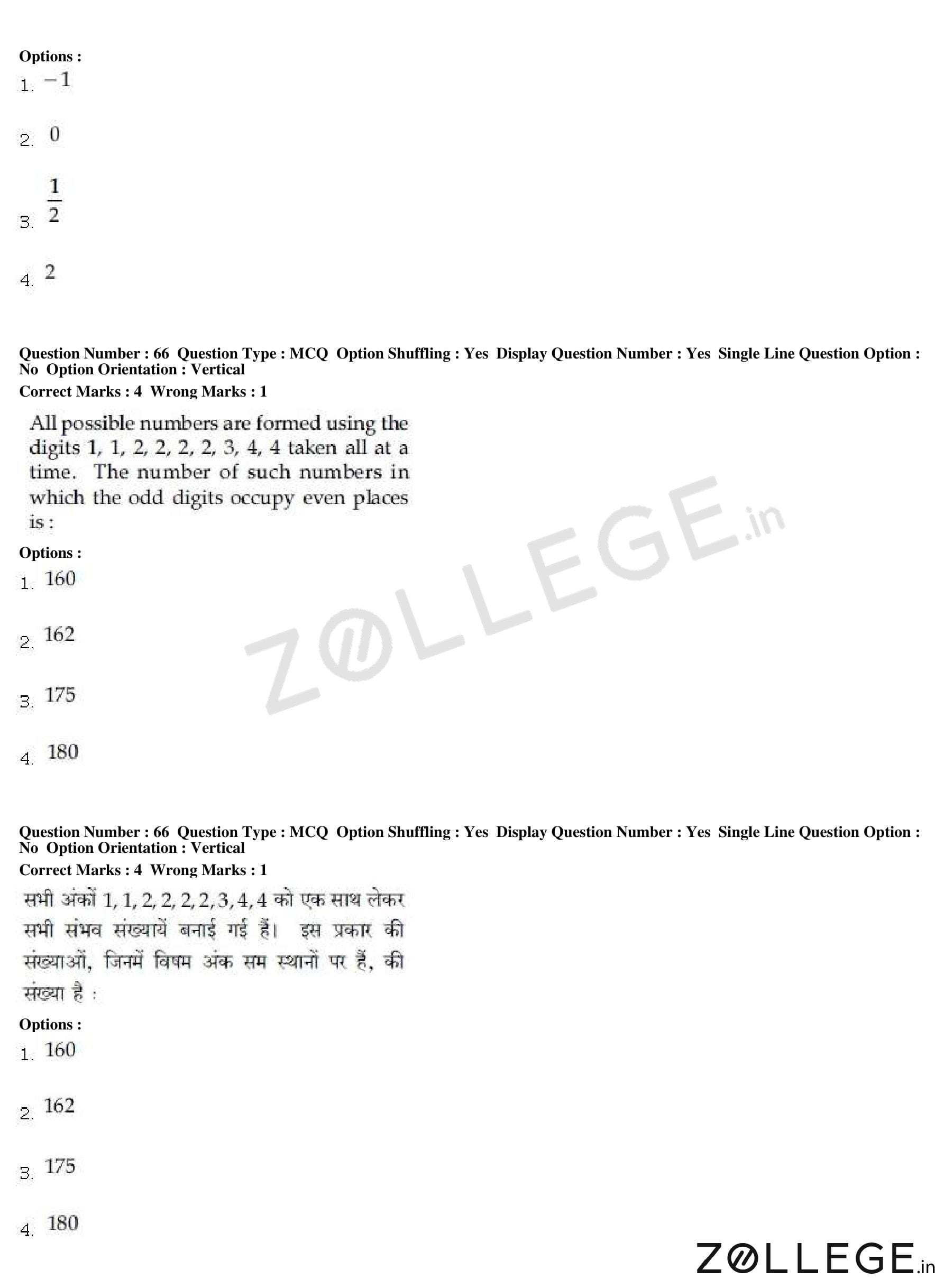
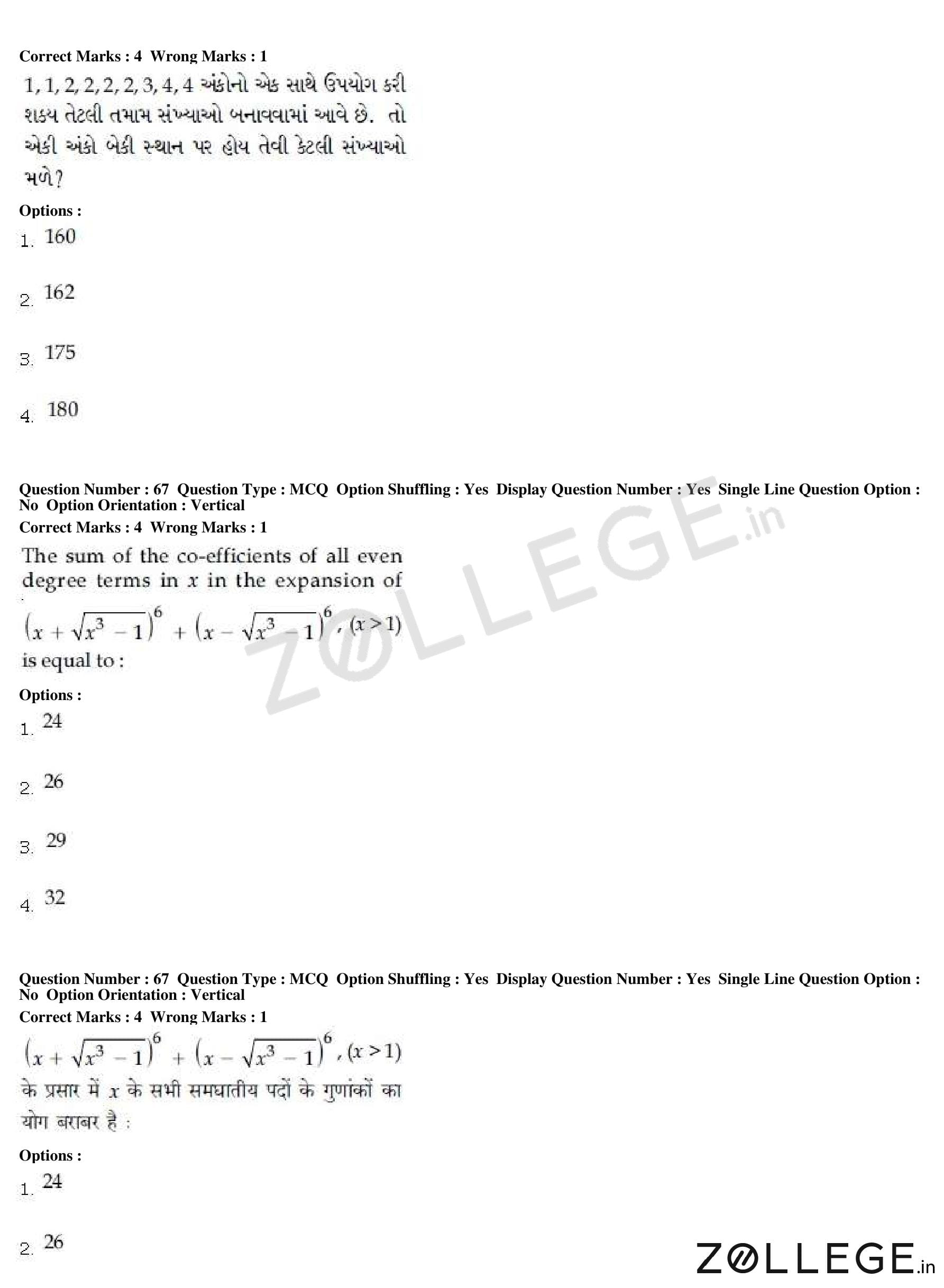
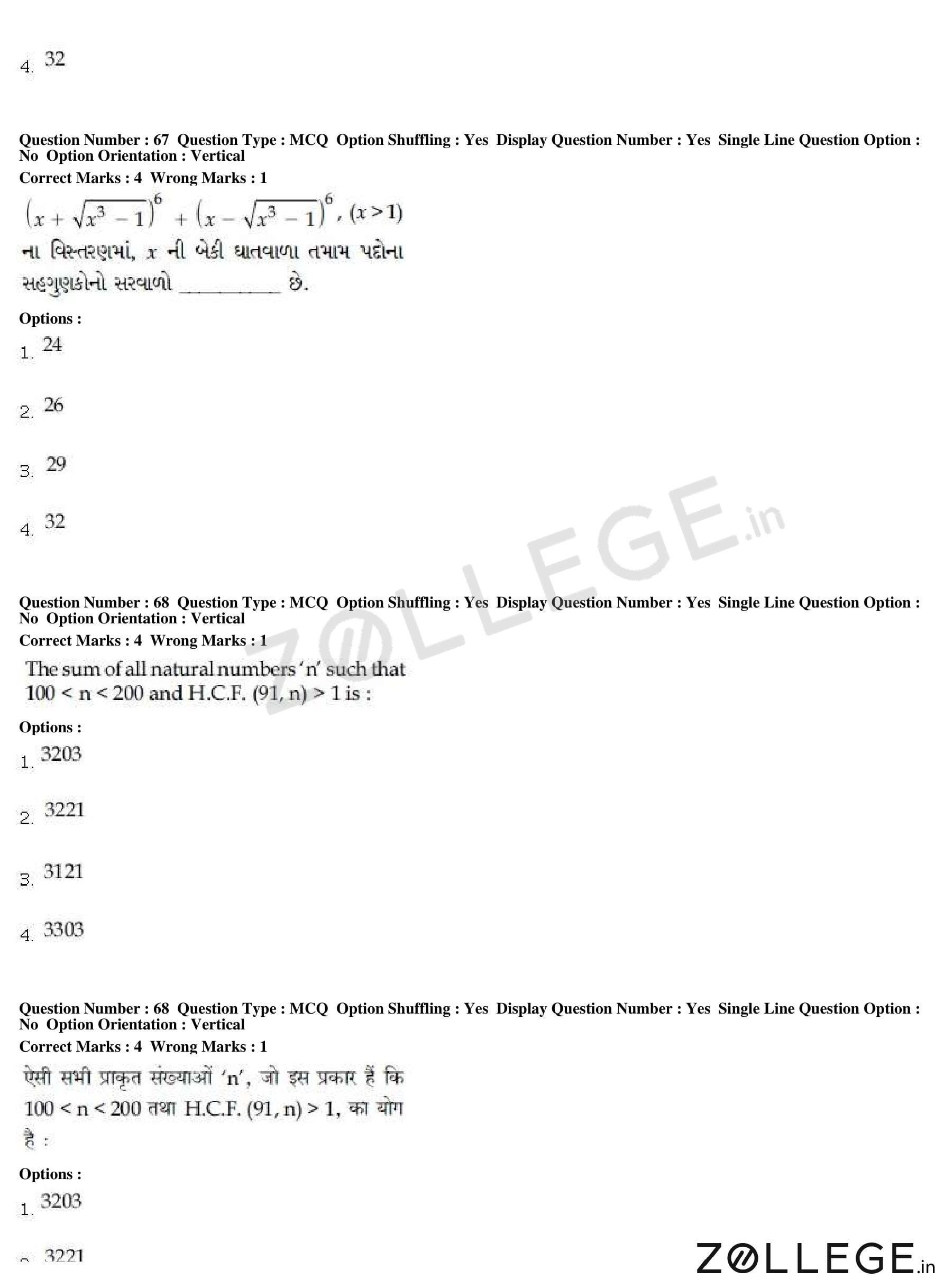
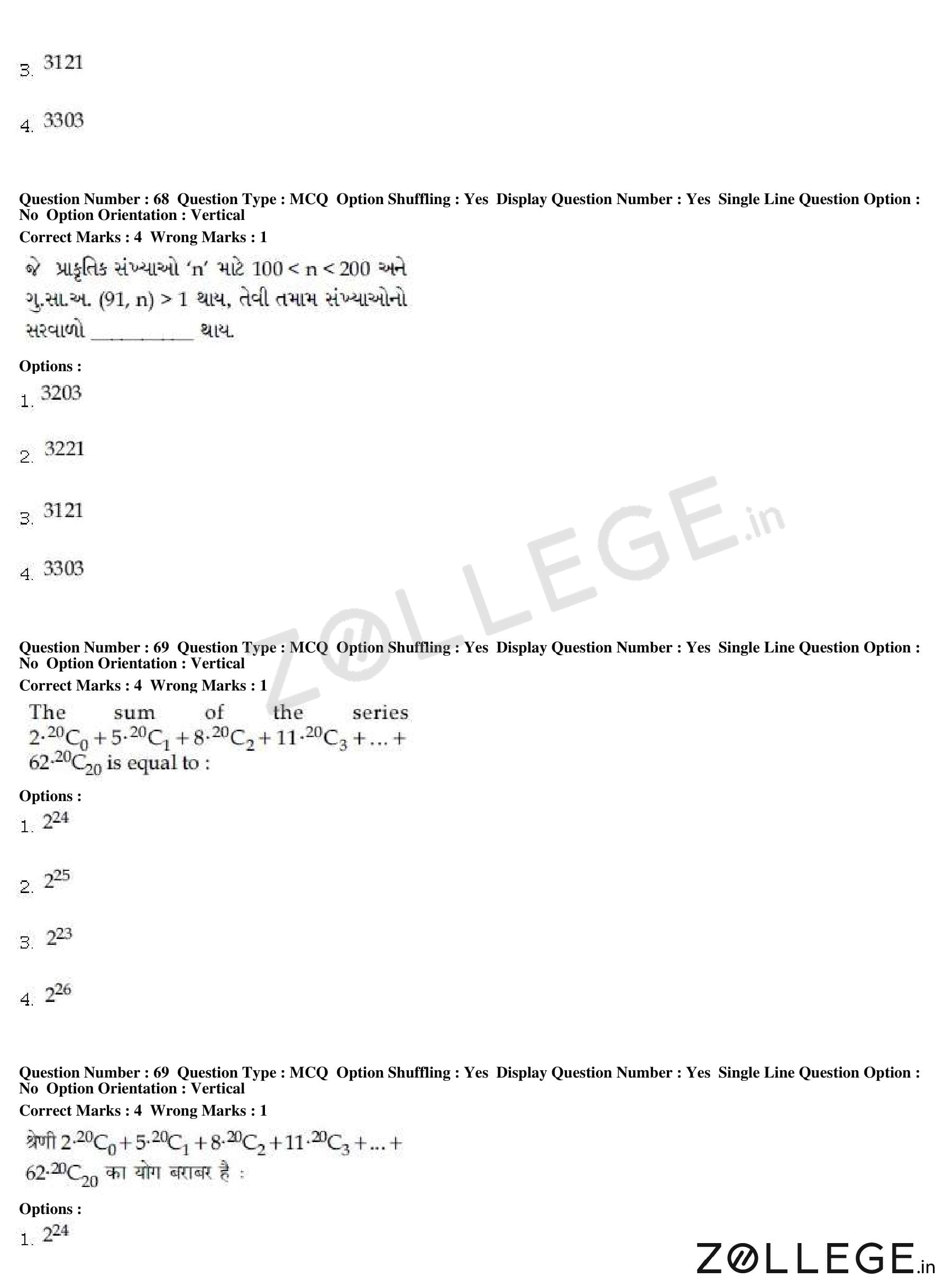
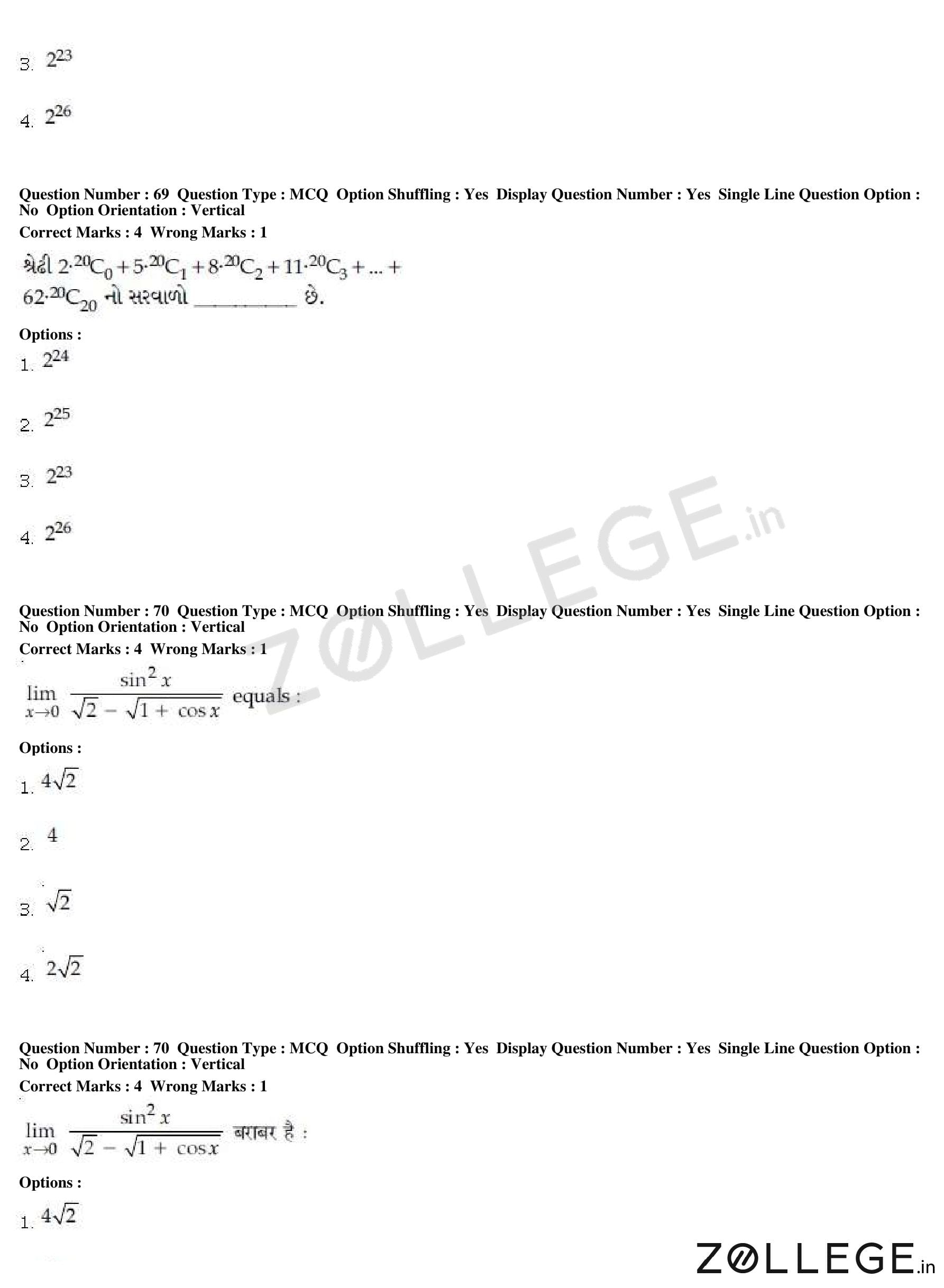
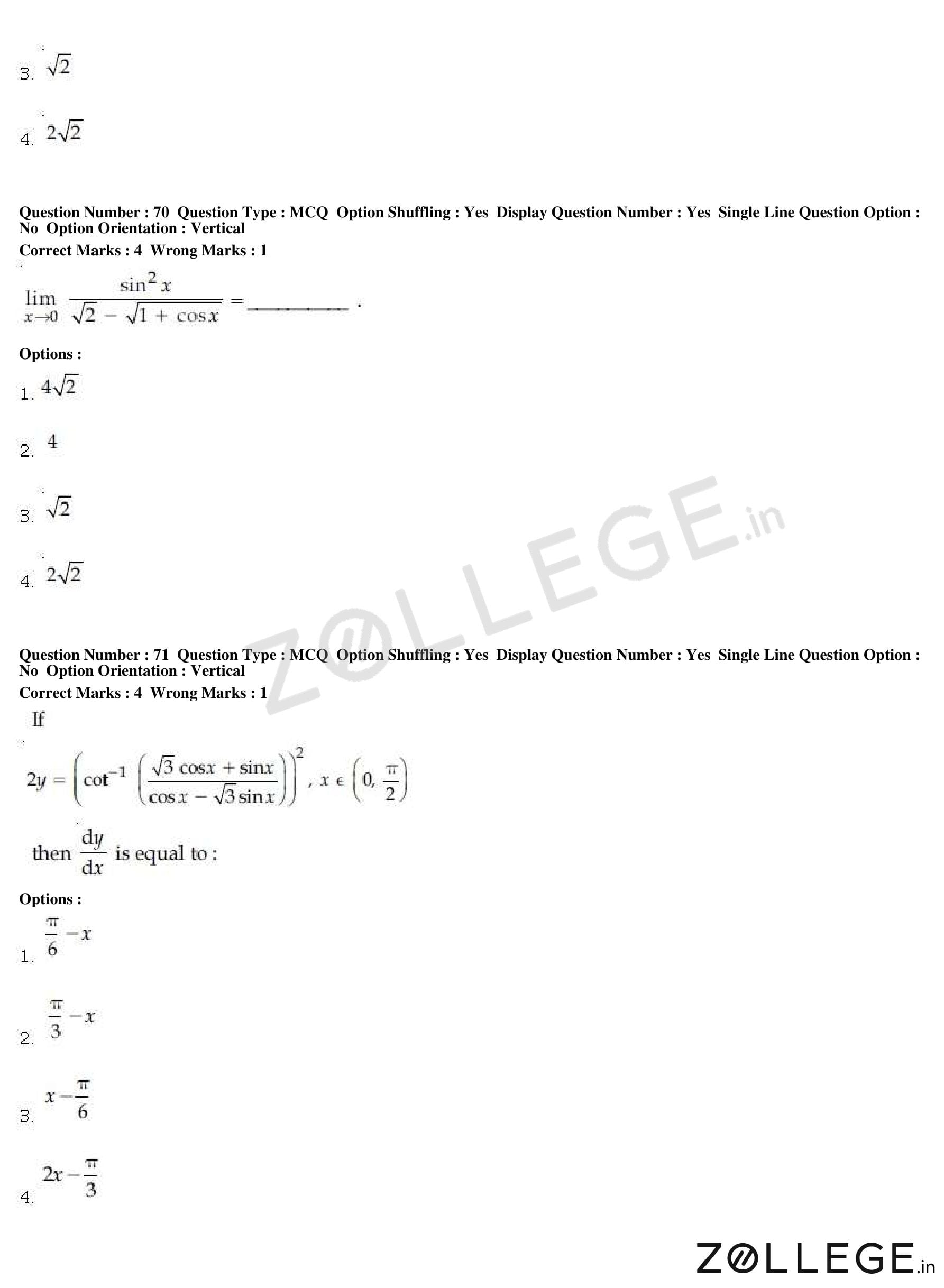
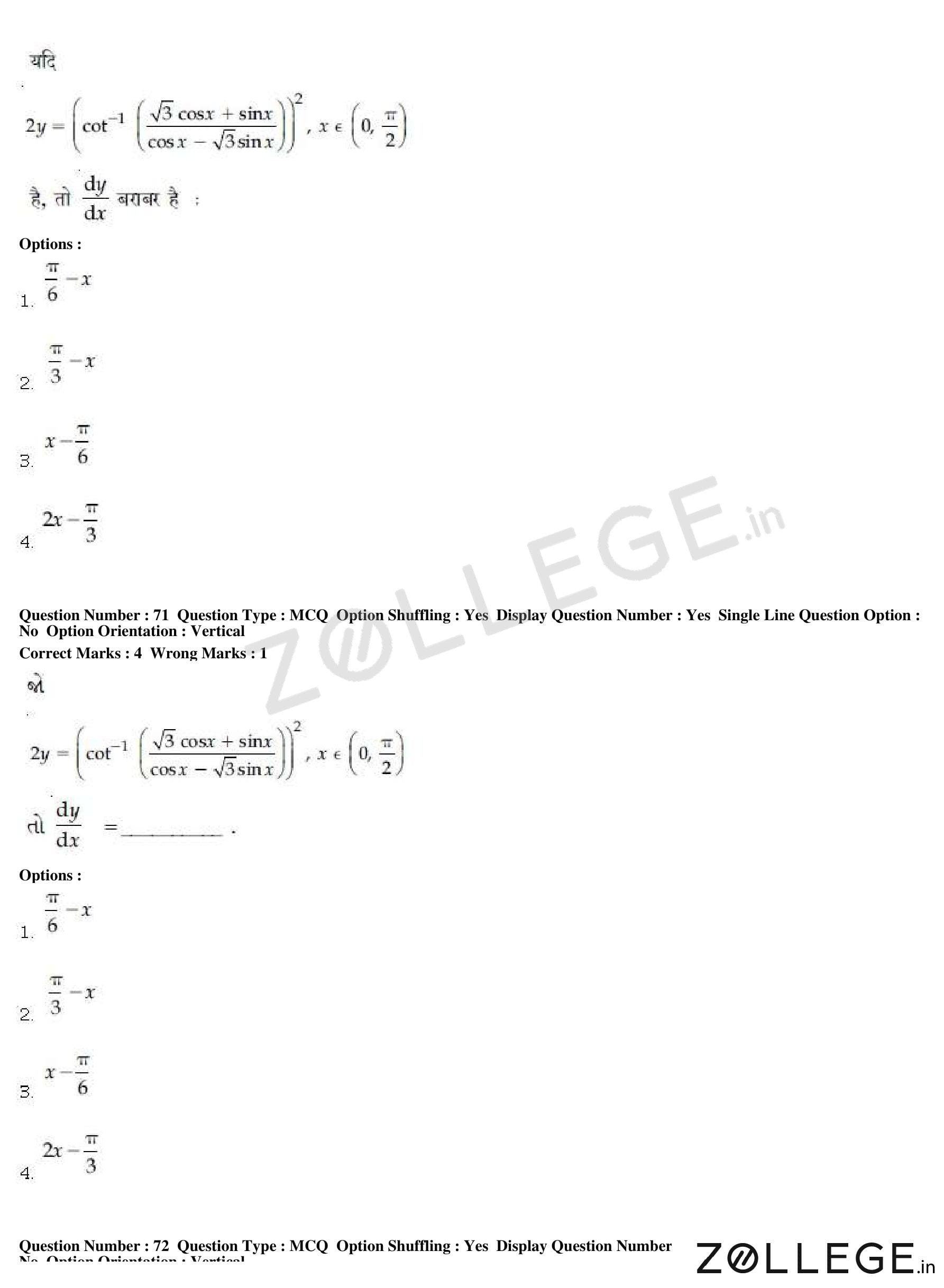
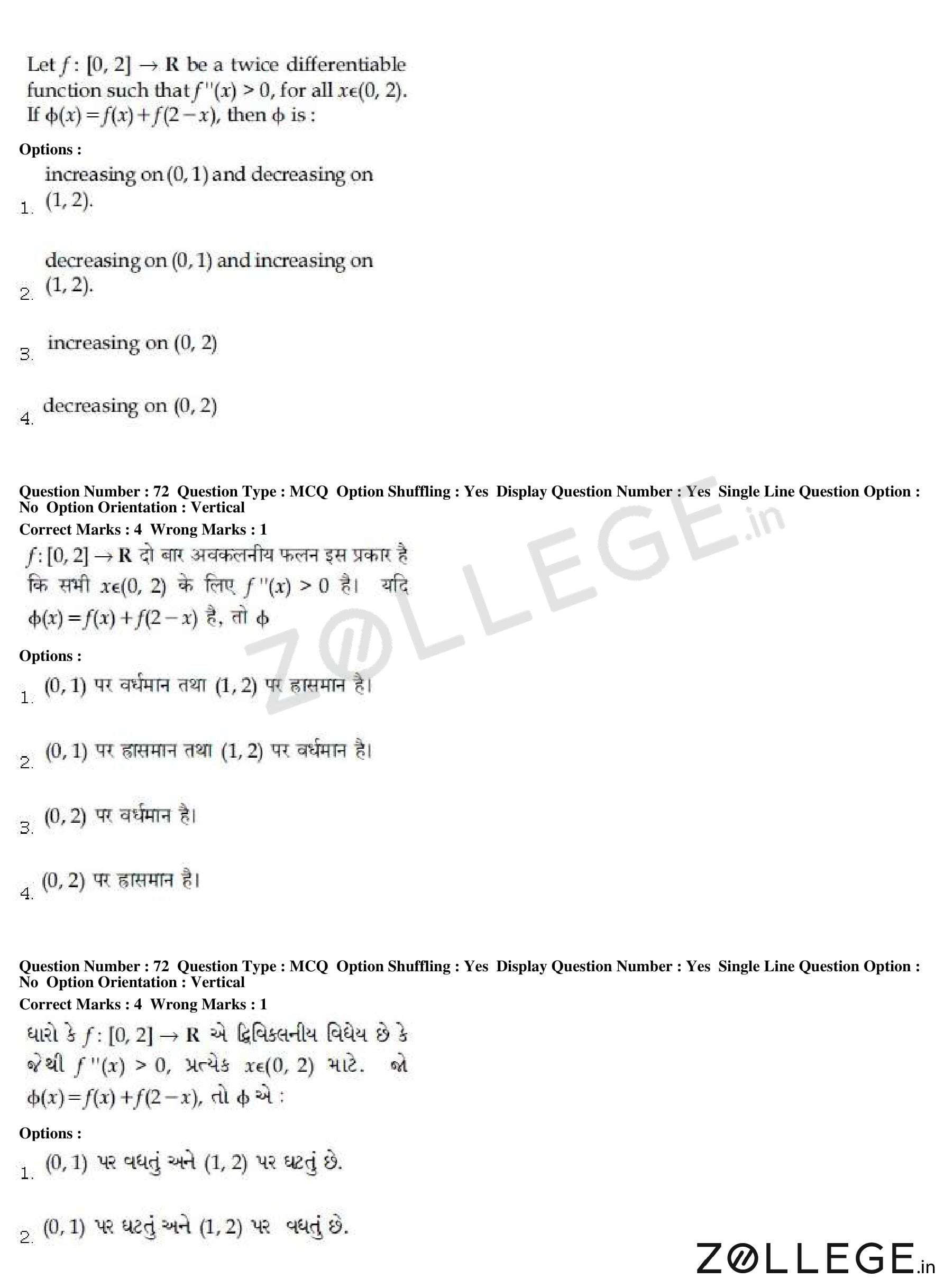
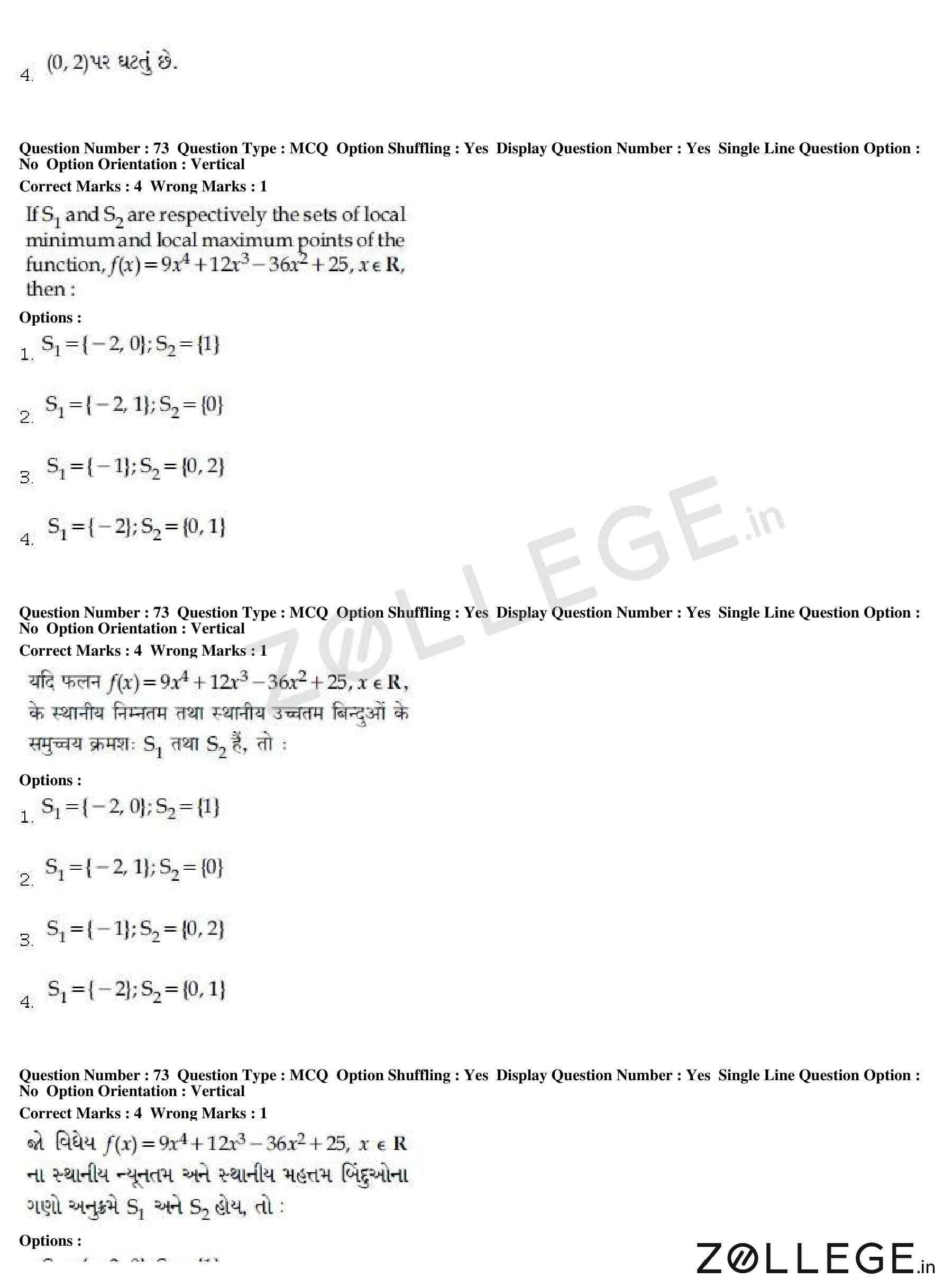
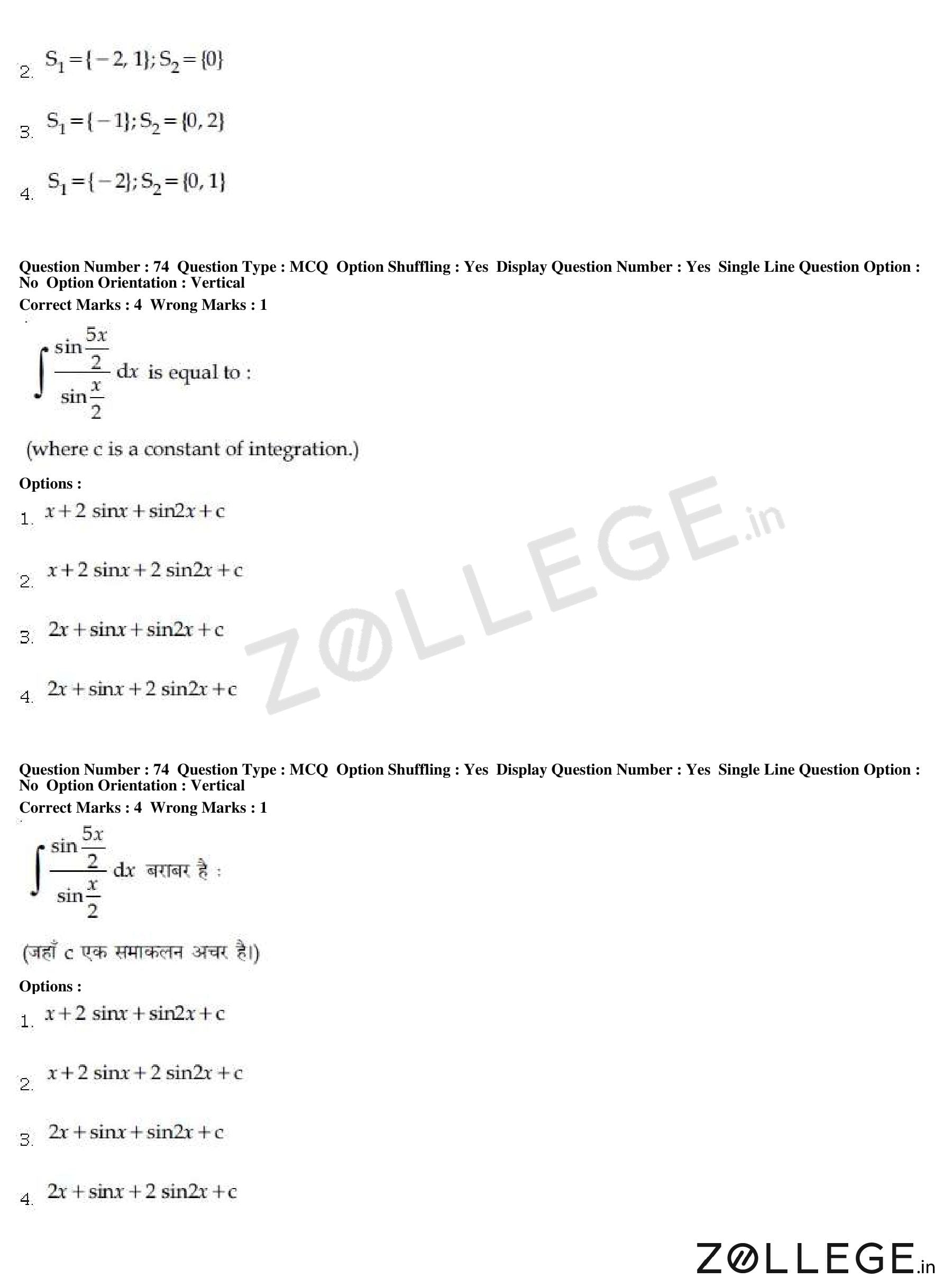
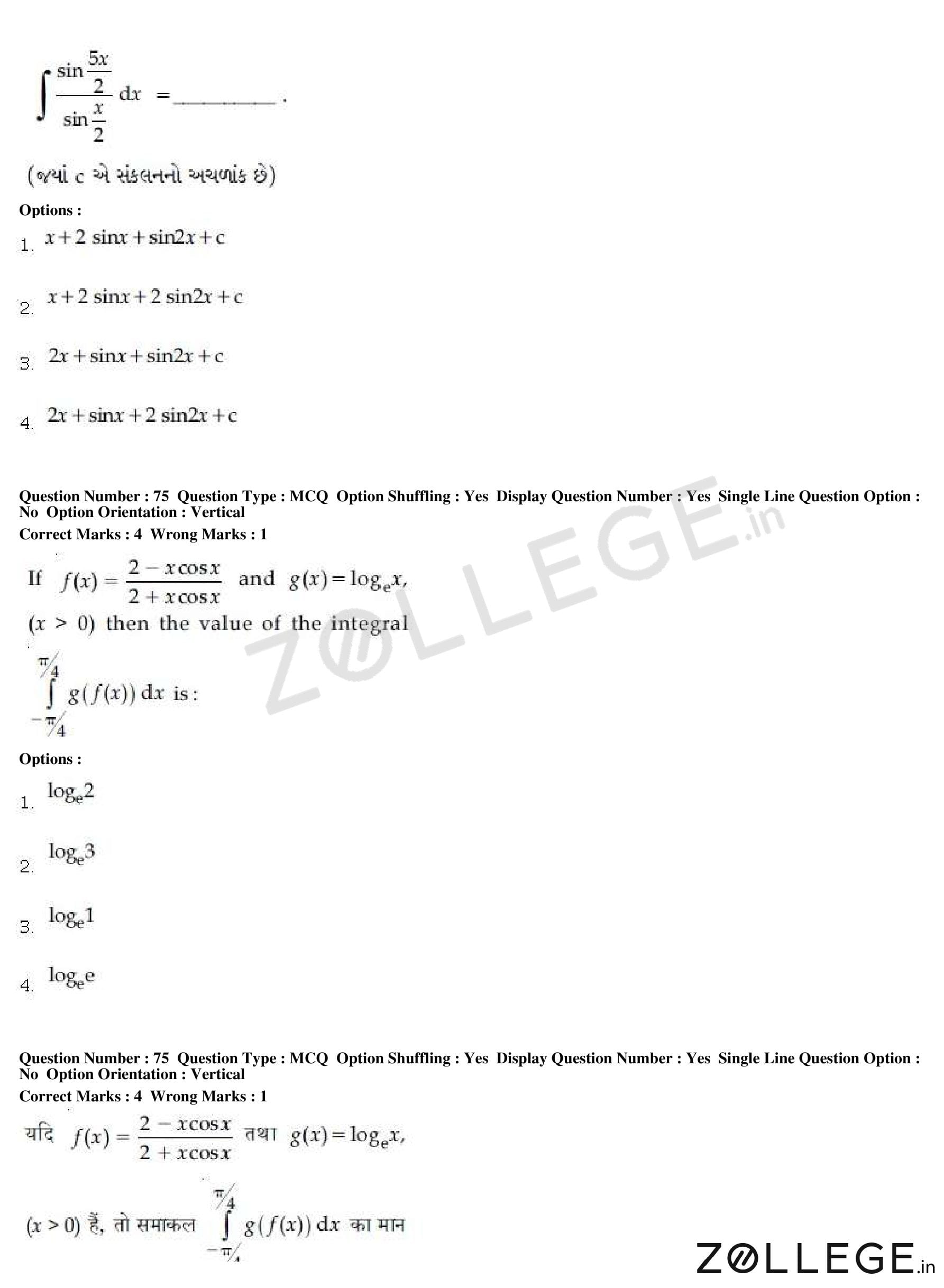
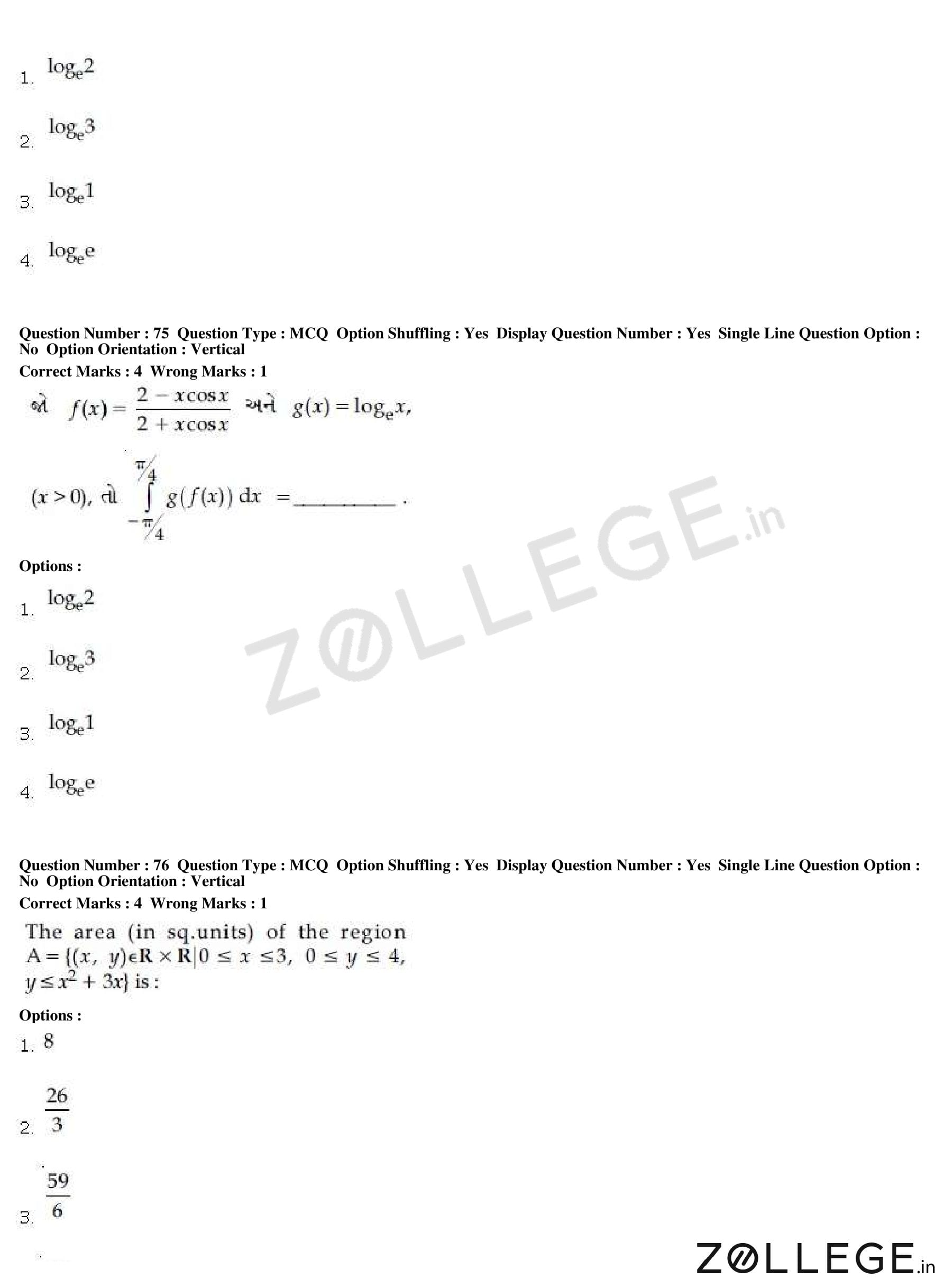
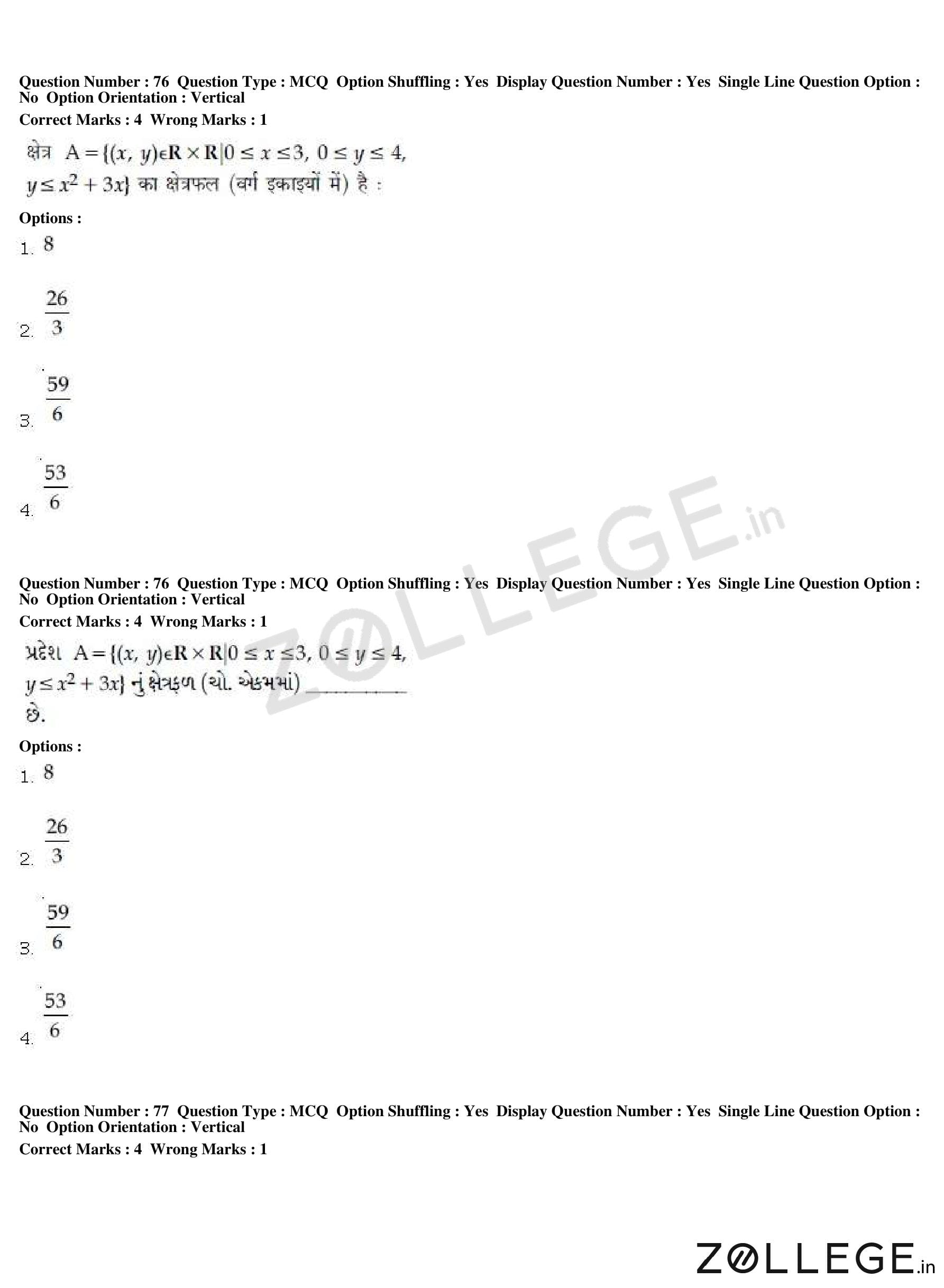
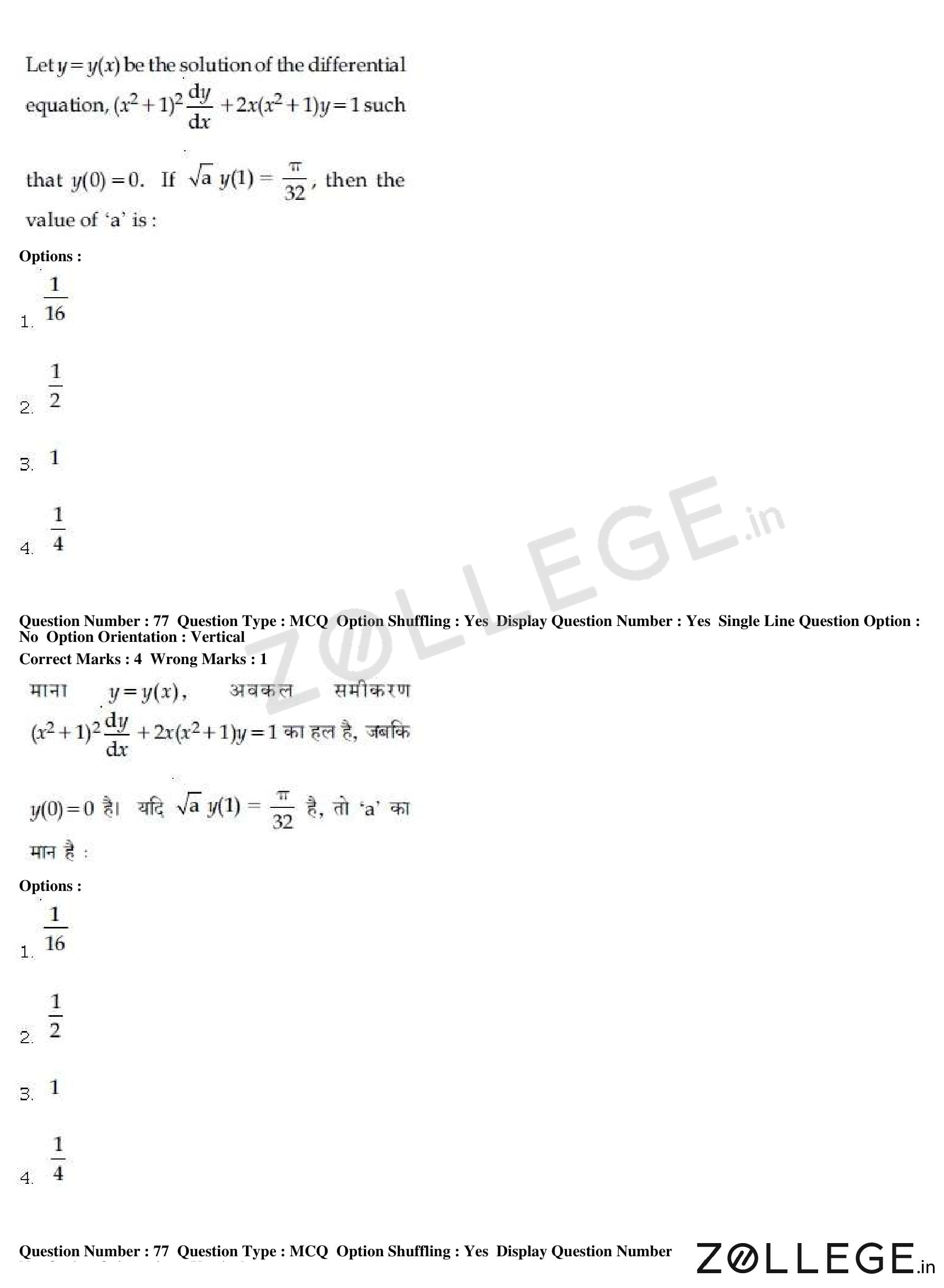
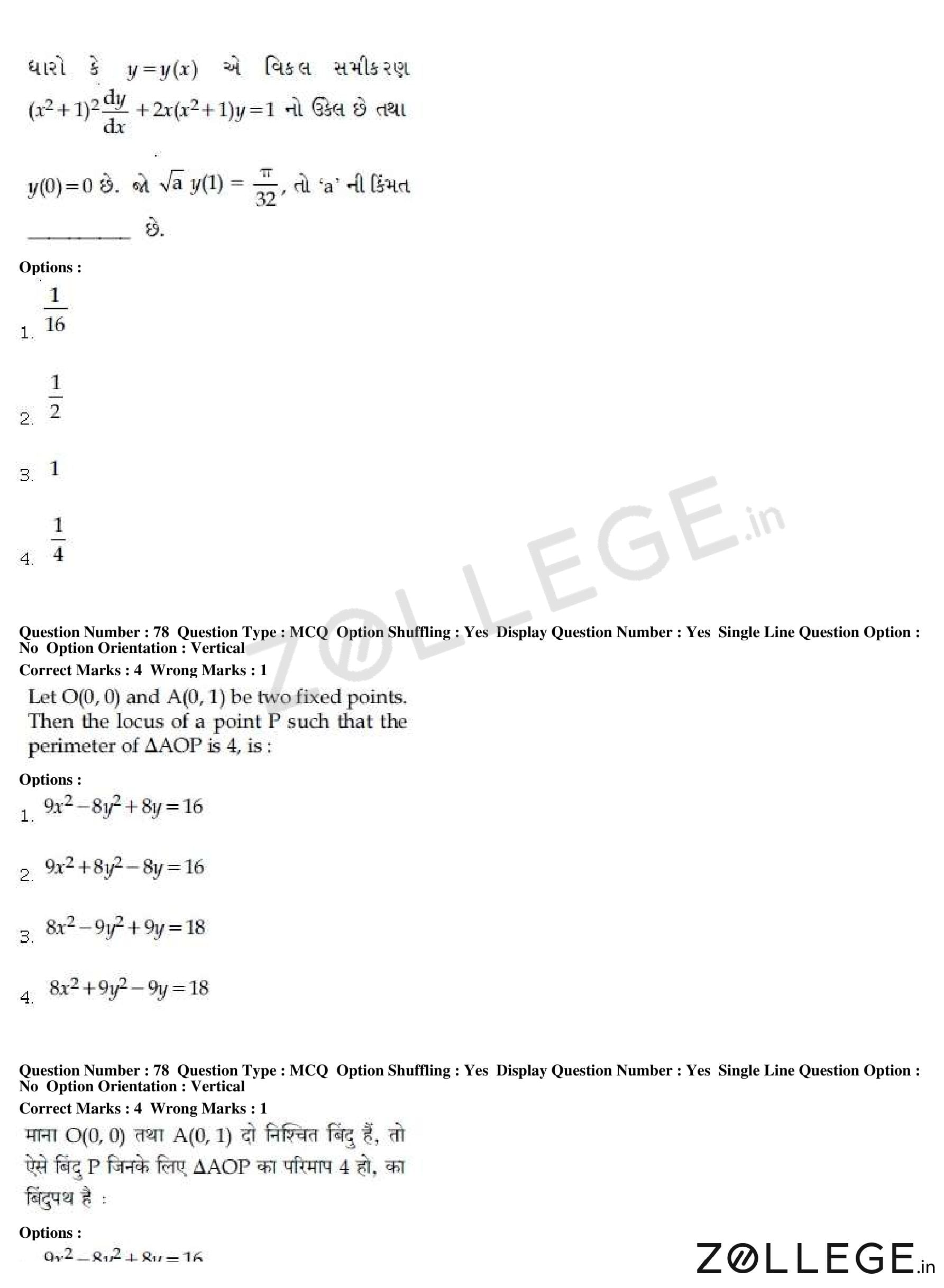
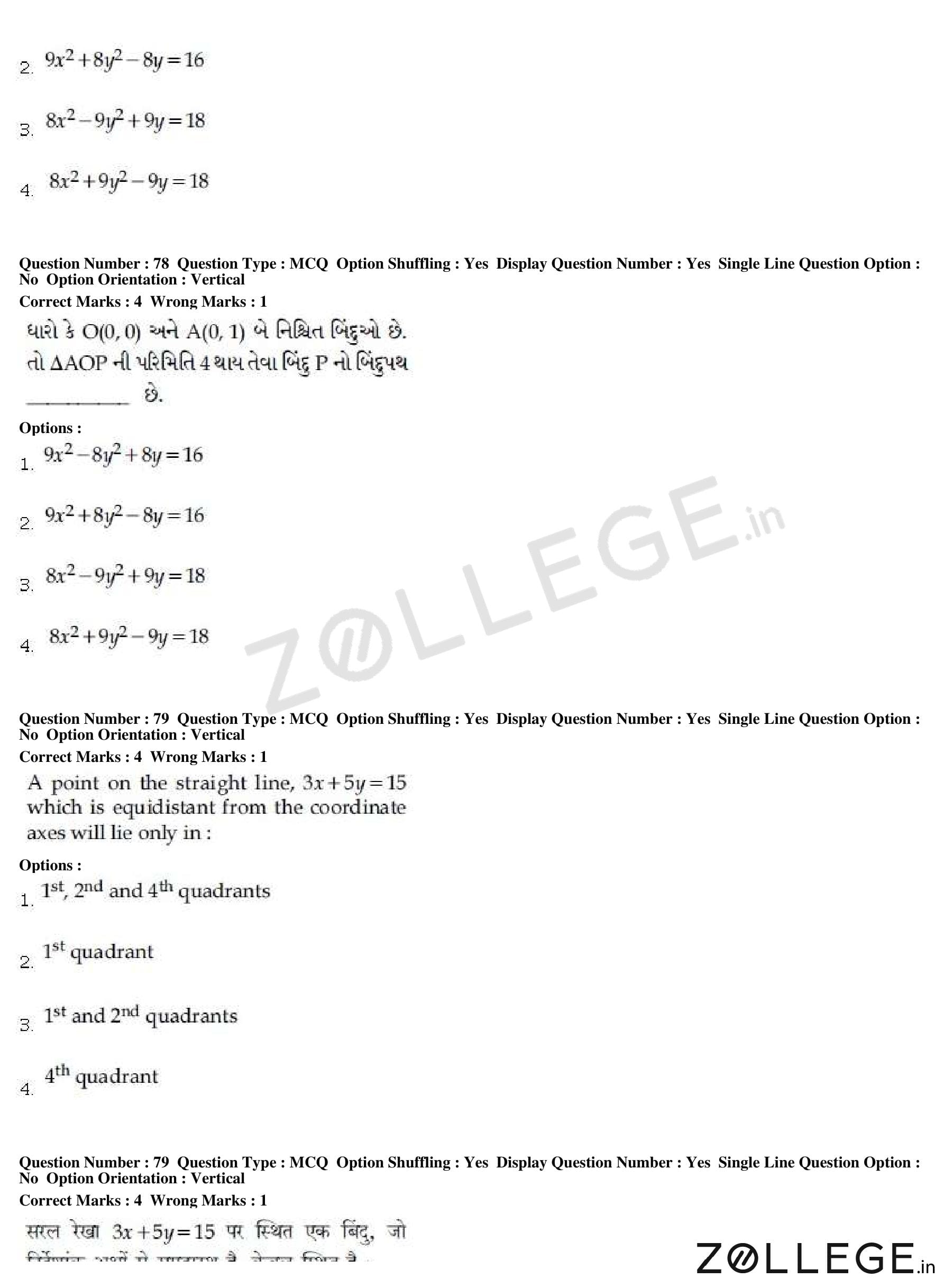
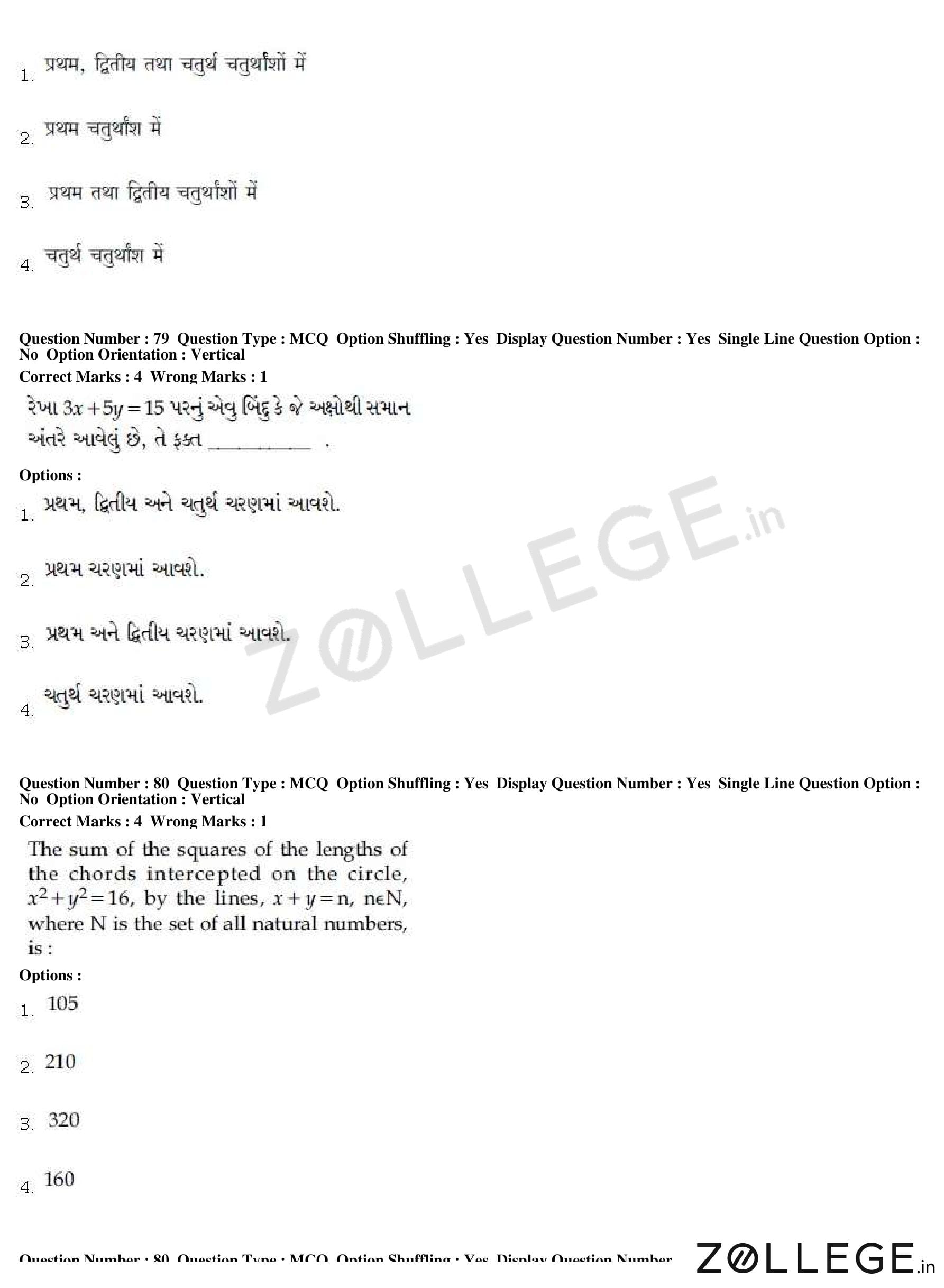
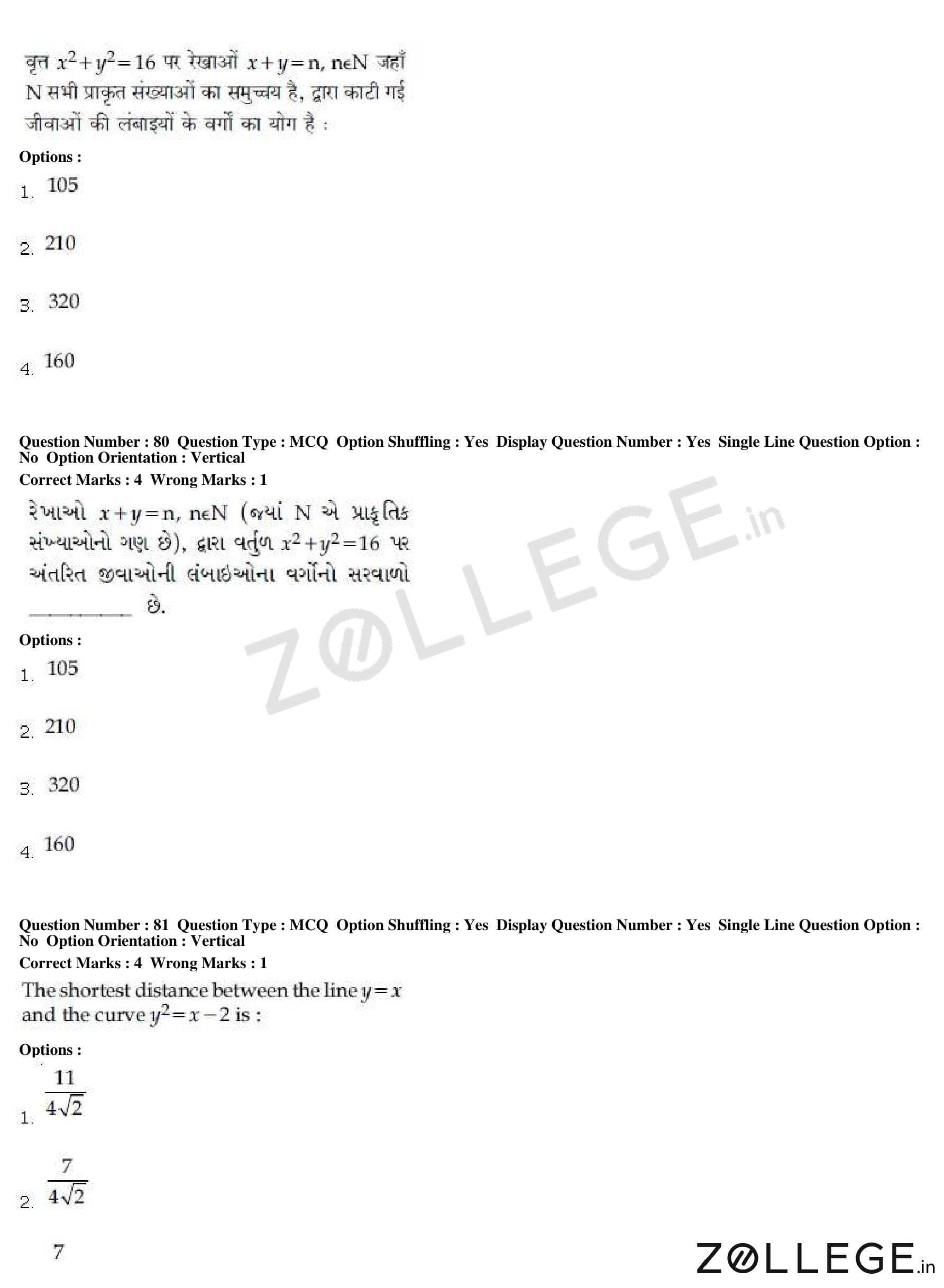
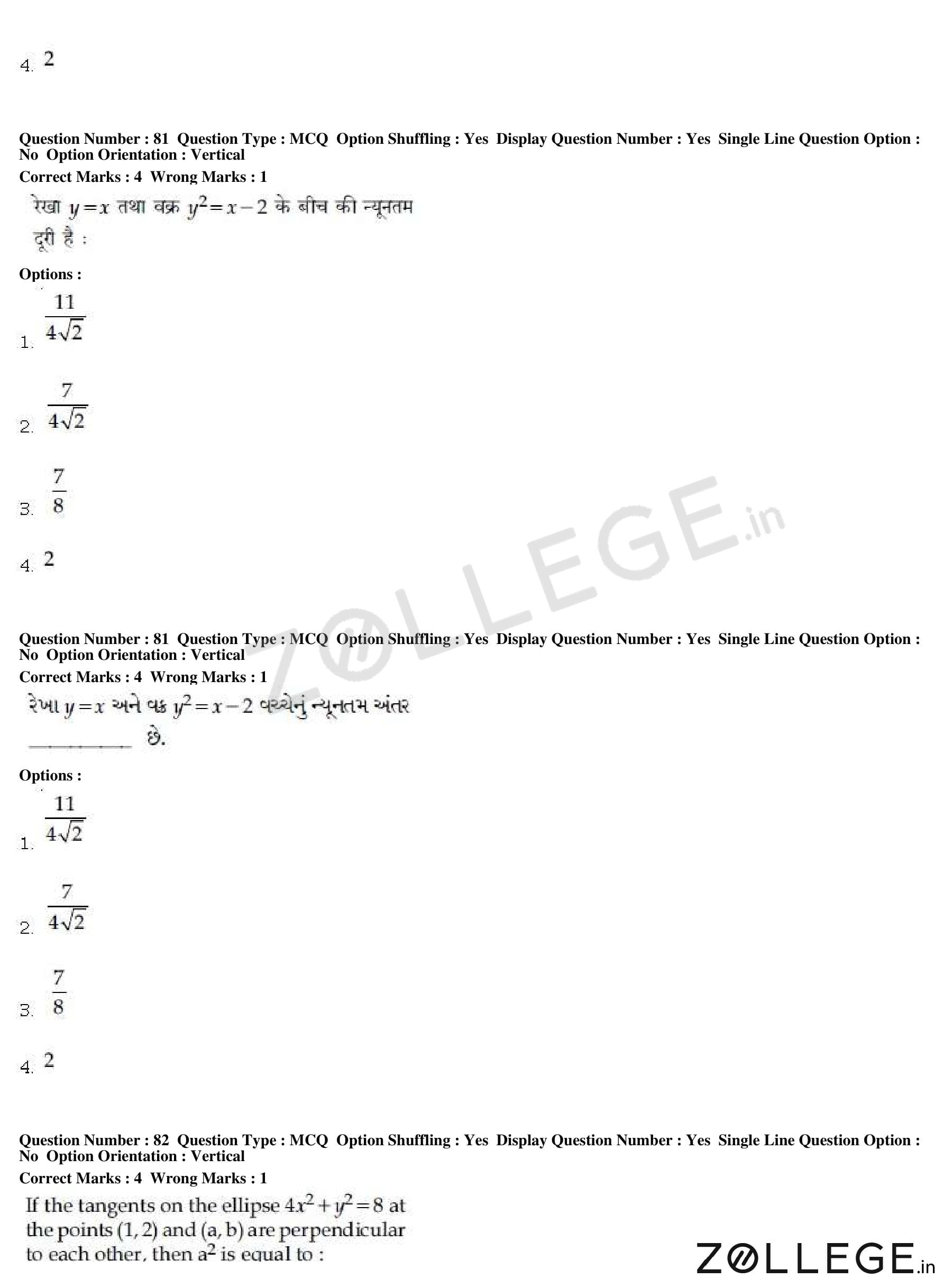
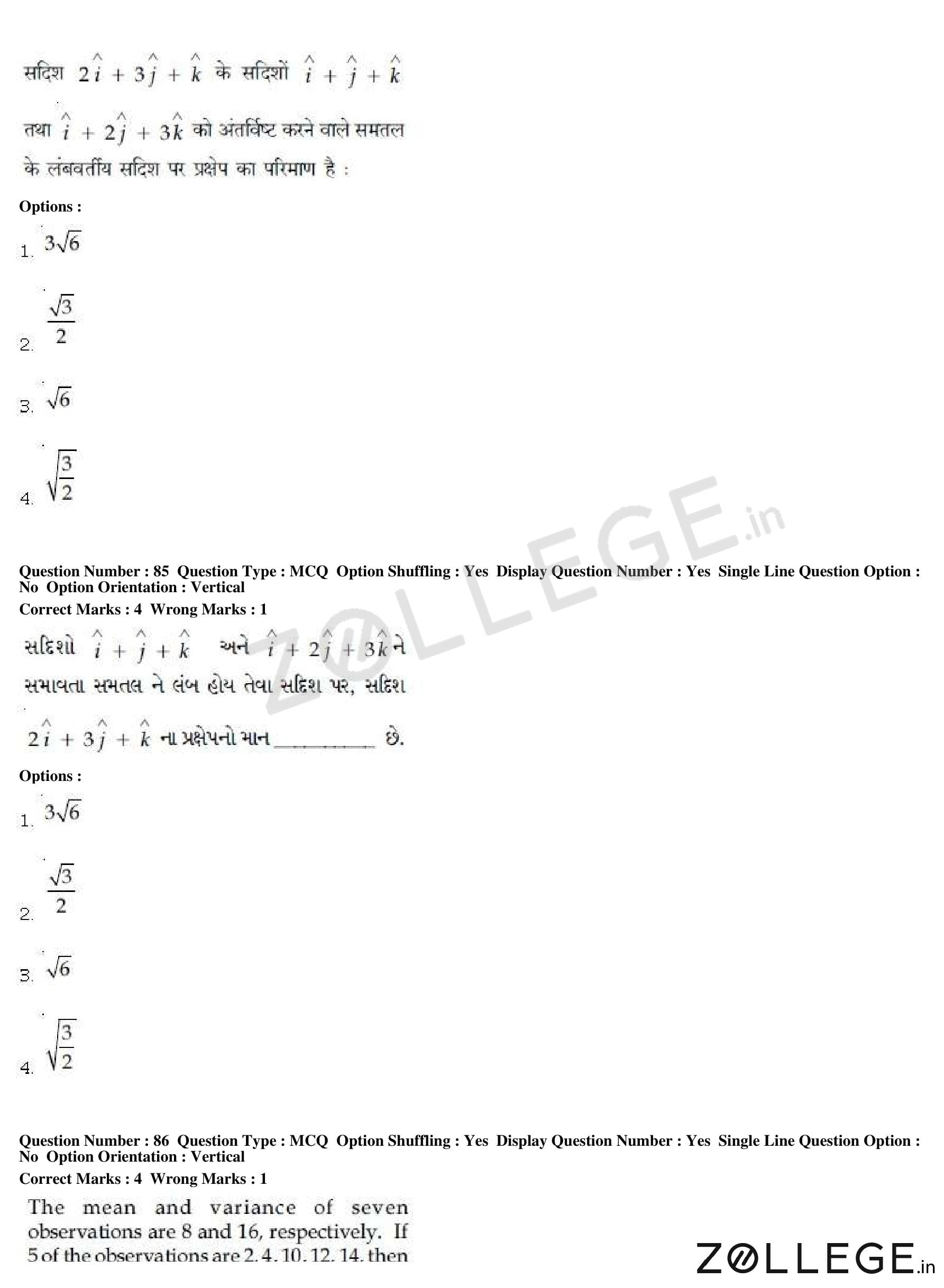
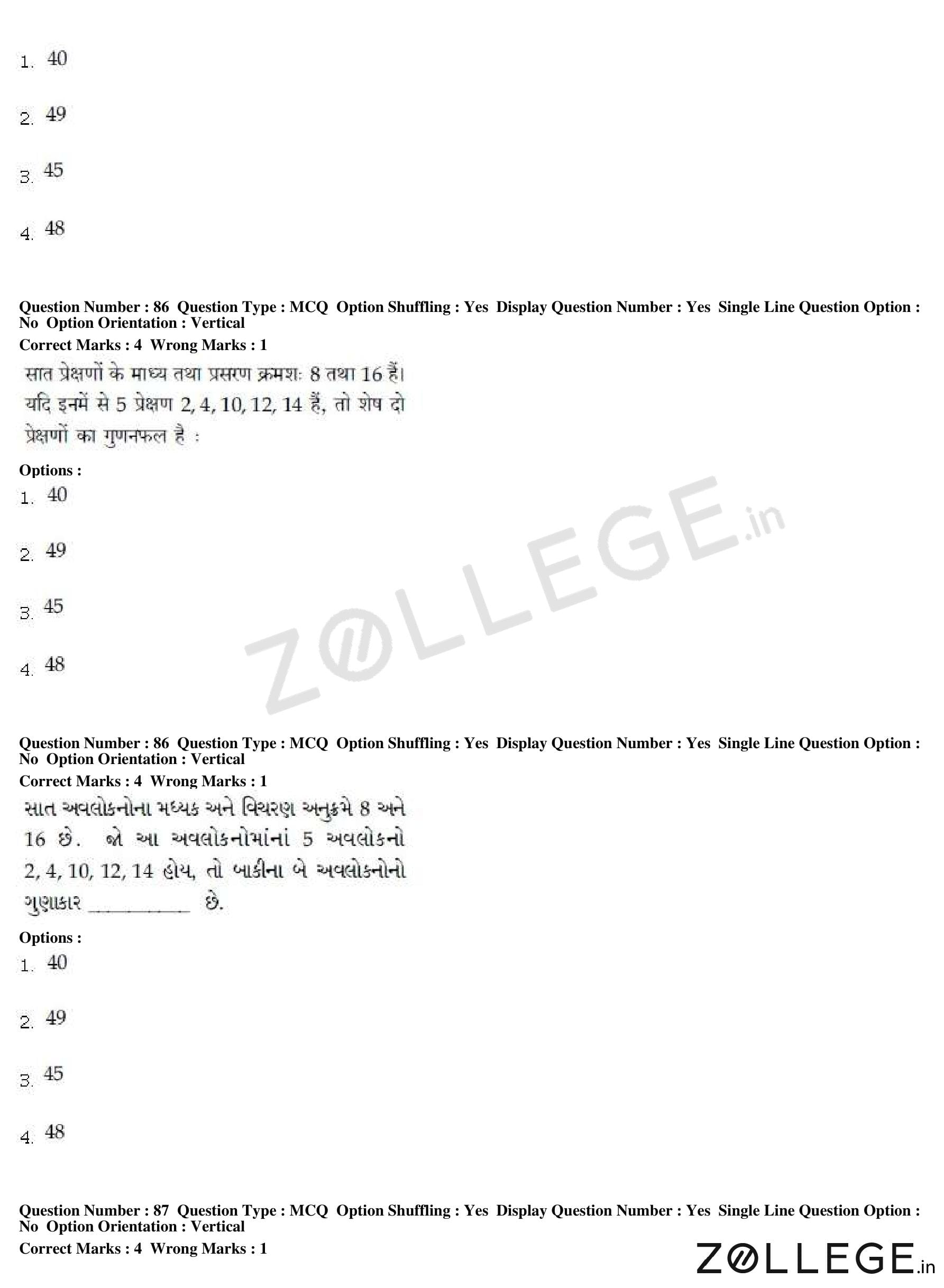
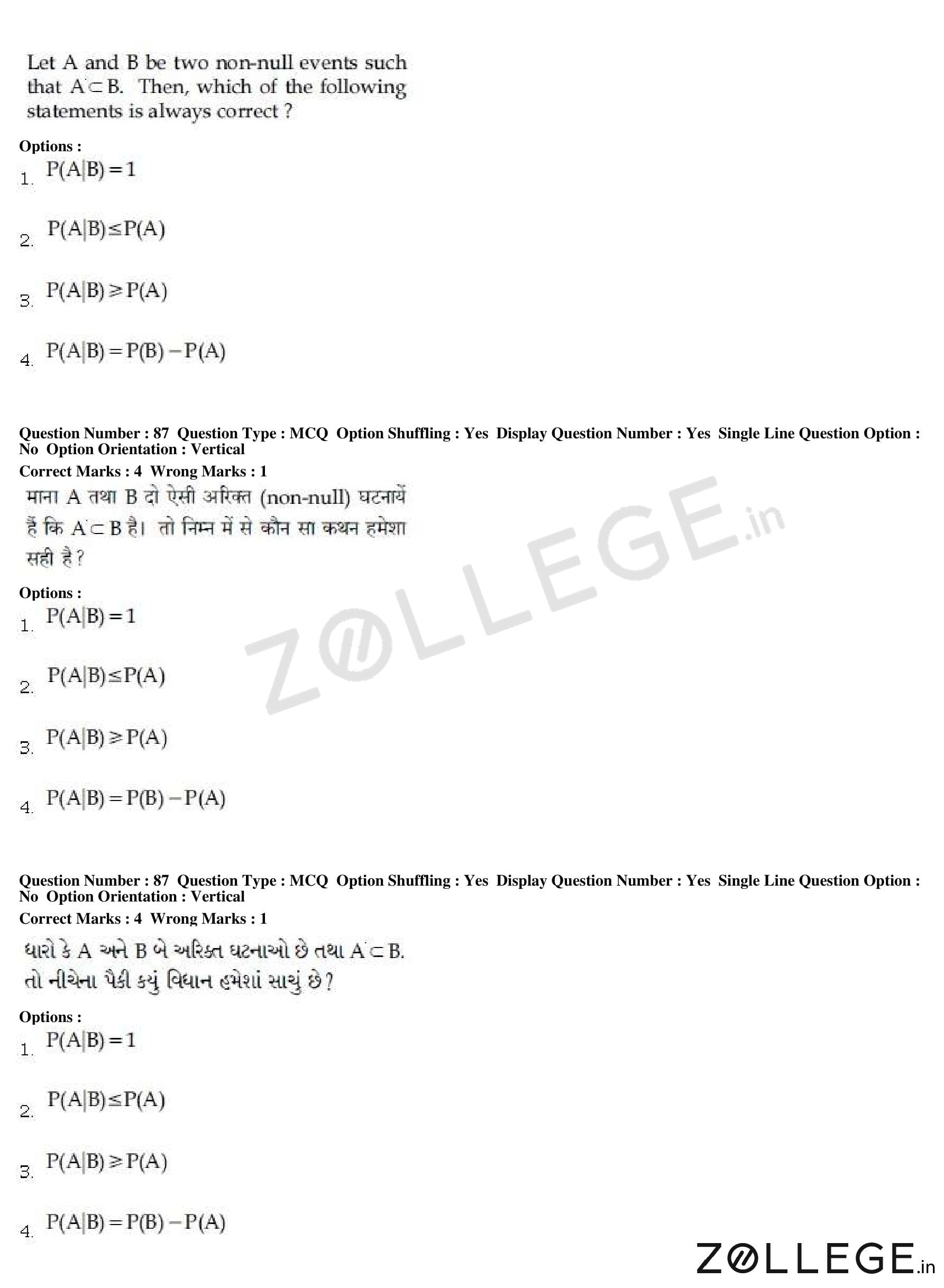
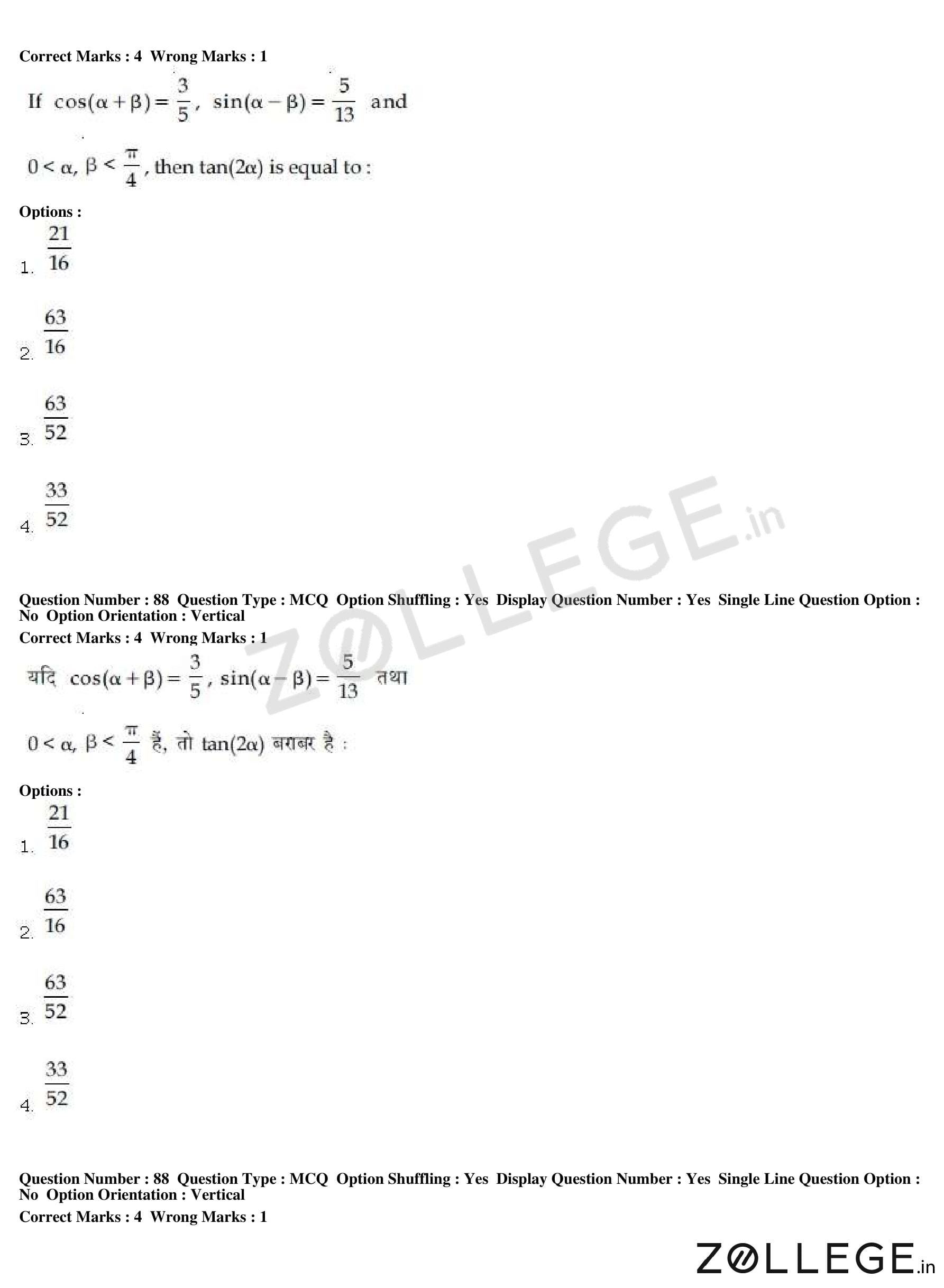
Previous Year JEE Main Question Papers
*The article might have information for the previous academic years, please refer the official website of the exam.