
JEE Main 2019 Question Paper with Answer Key PDF for B.E./ B.Tech(January 10, 2019 - Shift 2)


Content Writer | Updated On - Dec 24, 2025
JEE Main Question Papers are the most important study material for effective exam preparation. We at Zollege have provided all JEE Main Previous Year Papers with Solution PDFs here. JEE Main 2019 B. E. / B. Tech exam was conducted successfully on January 10, 2019. NTA conducted the exam in the Shift 2. According to student reactions and expert reviews, the paper was reported to be moderate.
Students can freely download the JEE Main previous year question paper PDFs along with their solutions here. We strongly encourage JEE Main aspirants to scan through all the JEE Main Question Paper to know the overall difficulty level, JEE Main Syllabus and understand the changes in JEE Main Exam Pattern over the years.
JEE Main 2019 B.E./ B.Tech Question Paper with Answer Key PDF (Shift 2)
| JEE Main 2019 B.E./ B.Tech Question Paper PDF | JEE Main 2019 B.E./ B.Tech Answer Key PDF | JEE Main 2019 B.E./ B.Tech Solutions PDF |
|---|---|---|
| Download PDF | Download PDF | Check Solutions |

The diameter and height of a cylinder are measured by a meter scale to be \(12.6 \pm 0.1\) cm and \(34.2 \pm 0.1\) cm, respectively. What will be the value of its volume in appropriate significant figures ?
View Solution
The volume \(V\) of a cylinder is given by \(V = \frac{\pi d^2 h}{4}\).
First, calculate the mean volume: \(V = \frac{\pi (12.6)^2 (34.2)}{4} \approx 4264.4 cm^3\).
The relative error in volume is \(\frac{\Delta V}{V} = 2 \frac{\Delta d}{d} + \frac{\Delta h}{h}\).
Substituting the values: \(\frac{\Delta V}{V} = 2 \left( \frac{0.1}{12.6} \right) + \frac{0.1}{34.2} \approx 0.01587 + 0.00292 \approx 0.0188\).
The absolute error is \(\Delta V = V \times 0.0188 \approx 4264.4 \times 0.0188 \approx 80.17 cm^3\).
Rounding the error to one significant figure gives \(\Delta V \approx 80 cm^3\).
Since the error is in the tens place (80), the mean volume must be rounded to the same place: \(4260\).
Thus, the volume is \(4260 \pm 80 cm^3\).
Quick Tip: When multiplying or dividing quantities, the relative errors add up. The final result should be rounded to align with the significant figure of the uncertainty.
Two vectors \(\vec{A}\) and \(\vec{B}\) have equal magnitudes. The magnitude of \((\vec{A} + \vec{B})\) is 'n' times the magnitude of \((\vec{A} - \vec{B})\). The angle between \(\vec{A}\) and \(\vec{B}\) is :
View Solution
Let \(|\vec{A}| = |\vec{B}| = x\) and the angle between them be \(\theta\).
The magnitude of the sum is \(|\vec{A} + \vec{B}| = 2x \cos(\theta/2)\).
The magnitude of the difference is \(|\vec{A} - \vec{B}| = 2x \sin(\theta/2)\).
Given that \(|\vec{A} + \vec{B}| = n |\vec{A} - \vec{B}|\), we have \(2x \cos(\theta/2) = n [2x \sin(\theta/2)]\).
Simplifying gives \(\cot(\theta/2) = n\), or \(\tan(\theta/2) = 1/n\).
Using the identity \(\cos \theta = \frac{1 - \tan^2(\theta/2)}{1 + \tan^2(\theta/2)}\), we substitute \(\tan(\theta/2) = 1/n\).
\(\cos \theta = \frac{1 - (1/n)^2}{1 + (1/n)^2} = \frac{n^2 - 1}{n^2 + 1}\).
Therefore, \(\theta = \cos^{-1} \left[ \frac{n^2 - 1}{n^2 + 1} \right]\).
Quick Tip: For two vectors of equal magnitude \(A\), the resultant sum has magnitude \(2A \cos(\theta/2)\) and the difference has magnitude \(2A \sin(\theta/2)\).
A particle starts from the origin at time t=0 and moves along the positive x-axis. The graph of velocity with respect to time is shown in figure. What is the position of the particle at time t=5s ?

View Solution
The position at \(t=5\)s is the initial position plus the displacement. Initial position is 0.
Displacement is the area under the velocity-time graph from \(t=0\) to \(t=5\).
Area 1 (Triangle \(t=0\) to \(2\)): \(\frac{1}{2} \times 2 \times 2 = 2\) m.
Area 2 (Rectangle \(t=2\) to \(4\)): \(2 \times 2 = 4\) m.
Area 3 (Rectangle \(t=4\) to \(5\)): \(1 \times 3 = 3\) m.
Total Displacement = \(2 + 4 + 3 = 9\) m.
Quick Tip: The area under a v-t graph represents change in position (displacement). Be careful to split the area into simple geometric shapes.
Two forces P and Q, of magnitude 2F and 3F, respectively, are at an angle \(\theta\) with each other. If the force Q is doubled, then their resultant also gets doubled. Then, the angle \(\theta\) is :
View Solution
Let \(P=2F\), \(Q=3F\). Initial resultant squared: \(R^2 = (2F)^2 + (3F)^2 + 2(2F)(3F)\cos\theta = 13F^2 + 12F^2\cos\theta\).
When \(Q\) is doubled to \(6F\), resultant is \(2R\). New resultant squared: \((2R)^2 = (2F)^2 + (6F)^2 + 2(2F)(6F)\cos\theta\).
\(4R^2 = 4F^2 + 36F^2 + 24F^2\cos\theta = 40F^2 + 24F^2\cos\theta\).
Substitute \(R^2\) from the first equation: \(4(13F^2 + 12F^2\cos\theta) = 40F^2 + 24F^2\cos\theta\).
\(52F^2 + 48F^2\cos\theta = 40F^2 + 24F^2\cos\theta\).
\(24F^2\cos\theta = -12F^2\).
\(\cos\theta = -1/2\), which implies \(\theta = 120^\circ\).
Quick Tip: Set up the vector addition equation \(R^2 = A^2 + B^2 + 2AB\cos\theta\) for both conditions and solve the simultaneous equations.
A particle which is experiencing a force, given by \(\vec{F} = 3\hat{i} - 12\hat{j}\), undergoes a displacement of \(\vec{d} = 4\hat{i}\). If the particle had a kinetic energy of 3 J at the beginning of the displacement, what is its kinetic energy at the end of the displacement ?

View Solution
Work done \(W = \vec{F} \cdot \vec{d} = (3\hat{i} - 12\hat{j}) \cdot (4\hat{i})\).
\(W = 3(4) + (-12)(0) = 12\) J.
According to the Work-Energy Theorem: \(W = \Delta K = K_f - K_i\).
\(12 = K_f - 3\).
\(K_f = 12 + 3 = 15\) J.
Quick Tip: Work-Energy Theorem (\(W_{net} = \Delta K\)) is often faster than kinematic equations when forces and displacements are known.
A rigid massless rod of length 3\(l\) has two masses attached at each end as shown in the figure. The rod is pivoted at point P on the horizontal axis (see figure). When released from initial horizontal position, its instantaneous angular acceleration will be :
View Solution
The pivot P is located at distance \(l\) from the left mass \(5M_0\) and distance \(2l\) from the right mass \(2M_0\) (since total length is \(3l\)).
Calculate the net torque about P: \(\tau = (5M_0 g)(l) - (2M_0 g)(2l)\). The left side creates CCW torque, right side CW.
\(\tau_{net} = 5M_0gl - 4M_0gl = M_0gl\) (Counter-clockwise).
Calculate the moment of inertia about P: \(I = (5M_0)(l)^2 + (2M_0)(2l)^2\).
\(I = 5M_0l^2 + 8M_0l^2 = 13M_0l^2\).
Angular acceleration \(\alpha = \frac{\tau_{net}}{I} = \frac{M_0gl}{13M_0l^2}\).
\(\alpha = \frac{g}{13l}\).
Quick Tip: Angular acceleration is net torque divided by total moment of inertia (\(\alpha = \tau_{net}/I\)). Ensure signs of torques are consistent with rotation direction.
Two identical spherical balls of mass M and radius R each are stuck on two ends of a rod of length 2R and mass M (see figure). The moment of inertia of the system about the axis passing perpendicularly through the centre of the rod is :

View Solution
The system consists of a rod and two spheres. The axis passes through the center of the rod.
Moment of inertia of the rod (mass M, length 2R) about its center: \(I_{rod} = \frac{M(2R)^2}{12} = \frac{4MR^2}{12} = \frac{1}{3}MR^2\).
The distance from the center of the rod to the center of each sphere is \(d = (half length of rod) + (radius of sphere) = R + R = 2R\).
Moment of inertia of one sphere about the system axis (Parallel Axis Theorem): \(I_{sphere} = I_{CM} + Md^2 = \frac{2}{5}MR^2 + M(2R)^2\).
\(I_{sphere} = \frac{2}{5}MR^2 + 4MR^2 = \frac{22}{5}MR^2\).
Total Moment of Inertia \(I_{total} = I_{rod} + 2 \times I_{sphere}\).
\(I_{total} = \frac{1}{3}MR^2 + 2\left(\frac{22}{5}MR^2\right) = \frac{1}{3}MR^2 + \frac{44}{5}MR^2\).
\(I_{total} = \left(\frac{5}{15} + \frac{132}{15}\right)MR^2 = \frac{137}{15}MR^2\).
Quick Tip: Always identify the distance between the center of mass of the object and the axis of rotation when applying the Parallel Axis Theorem (\(I = I_{cm} + Md^2\)).
Two stars of masses \(3 \times 10^{31}\) kg each, and at distance \(2 \times 10^{11}\) m rotate in a plane about their common centre of mass O. A meteorite passes through O moving perpendicular to the star's rotation plane. In order to escape from the gravitational field of this double star, the minimum speed that meteorite should have at O is : (Take Gravitational constant \(G=6.67 \times 10^{-11} Nm^2 kg^{-2}\))
View Solution
Let M be the mass of each star and d be the distance between them. The center of mass O is at distance \(r = d/2\) from each star.
\(M = 3 \times 10^{31}\) kg, \(d = 2 \times 10^{11}\) m \(\implies r = 10^{11}\) m.
The gravitational potential at O due to both stars is \(V = -\frac{GM}{r} - \frac{GM}{r} = -\frac{2GM}{r}\).
For the meteorite to escape, its total energy must be zero. Let \(v\) be the escape velocity.
\(\frac{1}{2}mv^2 + m V = 0 \implies v^2 = -2V = \frac{4GM}{r}\).
\(v = \sqrt{\frac{4 \times 6.67 \times 10^{-11} \times 3 \times 10^{31}}{10^{11}}}\).
\(v = \sqrt{\frac{80.04 \times 10^{20}}{10^{11}}} = \sqrt{80.04 \times 10^9} = \sqrt{800.4 \times 10^8}\).
\(v \approx \sqrt{800} \times 10^4 \approx 28.3 \times 10^4 = 2.83 \times 10^5\) m/s.
Quick Tip: Escape velocity at a point is found by conserving energy: \(K + U = 0\) (at infinity). Thus \(v_{escape} = \sqrt{-2 \times Potential}\).
A cylindrical plastic bottle of negligible mass is filled with 310 ml of water and left floating in a pond with still water. If pressed downward slightly and released, it starts performing simple harmonic motion at angular frequency \(\omega\). If the radius of the bottle is 2.5 cm then \(\omega\) is close to : (density of water = \(10^3 kg/m^3\))
View Solution
A cylindrical plastic bottle of negligible mass is filled with water and floats vertically in a pond.
When the bottle is pushed slightly downward and released, it performs small vertical oscillations about its equilibrium position.
Step 1: Identify the restoring force
When the bottle is pushed downward by a small distance \(x\), an additional volume of water
equal to \(A x\) is submerged, where \(A\) is the cross-sectional area of the bottle.
\[ Extra buoyant force = \rho g (A x) \]
This force acts upward and hence provides a restoring force:
\[ F = - \rho g A x \]
Comparing with Hooke’s law \(F = -kx\), the effective spring constant is
\[ k = \rho g A \]
\medskip
Step 2: Determine the mass of the oscillating system
The bottle has negligible mass, so only the water inside oscillates.
\[ V = 310~ml = 310 \times 10^{-6}~m^3 \]
\[ m = \rho V = 10^3 \times 310 \times 10^{-6} = 0.31~kg \]
\medskip
Step 3: Calculate the cross-sectional area
\[ r = 2.5~cm = 0.025~m \]
\[ A = \pi r^2 = \pi (0.025)^2 \approx 1.963 \times 10^{-3}~m^2 \]
\medskip
Step 4: Calculate the spring constant
\[ k = \rho g A \]
\[ k = 10^3 \times 9.8 \times 1.963 \times 10^{-3} \]
\[ k \approx 19.24~N m^{-1} \]
\medskip
Step 5: Calculate angular frequency
For simple harmonic motion,
\[ \omega = \sqrt{\frac{k}{m}} \]
\[ \omega = \sqrt{\frac{19.24}{0.31}} \approx \sqrt{62} \approx 7.9~rad s^{-1} \]
\medskip
Step 6: Identify the discrepancy in options
The calculated angular frequency is
\[ \omega \approx 7.9~rad s^{-1} \]
Corresponding frequency is
\[ f = \frac{\omega}{2\pi} = \frac{7.9}{6.28} \approx 1.26~Hz \]
The numerical value \(1.25\) matches Option (A), but the unit in the options is incorrectly
given as \(rad s^{-1}\) instead of \(Hz\).
\medskip
Final Answer:
\[ \boxed{\omega \approx 1.25} \]
Hence, Option (A) is the intended correct answer due to a unit error in the question paper. Quick Tip: For vertical oscillations of a floating cylinder, \(\omega = \sqrt{\frac{\rho A g}{m}}\). Check units carefully; sometimes questions confuse \(\omega\) and \(f\).
Half mole of an ideal monoatomic gas is heated at constant pressure of 1 atm from \(20^{\circ}\)C to \(90^{\circ}\)C. Work done by gas is close to : (Gas constant R=8.31 J/mol\(\cdot\)K)
View Solution
For an ideal gas at constant pressure, work done is given by \(W = P \Delta V = n R \Delta T\).
Given: \(n = 0.5\) mol, \(R = 8.31\) J/mol\(\cdot\)K.
Change in temperature \(\Delta T = 90^{\circ}C - 20^{\circ}C = 70 K\).
\(W = 0.5 \times 8.31 \times 70\).
\(W = 35 \times 8.31\).
\(W \approx 290.85\) J.
Rounding to the nearest integer, we get 291 J.
Quick Tip: For isobaric (constant pressure) processes, \(W = nR\Delta T\) is the most direct formula. Remember \(\Delta T\) is the same in Celsius and Kelvin.
Two kg of a monoatomic gas is at a pressure of \(4 \times 10^4 N/m^2\). The density of the gas is 8 kg/m\(^3\). What is the order of energy of the gas due to its thermal motion ?
View Solution
The internal energy of a monoatomic gas is given by \(U = \frac{3}{2} PV\).
We are given Mass \(M = 2\) kg and Density \(\rho = 8 kg/m^3\).
Volume \(V = \frac{M}{\rho} = \frac{2}{8} = 0.25 m^3\).
Pressure \(P = 4 \times 10^4 N/m^2\).
\(U = \frac{3}{2} (4 \times 10^4)(0.25)\).
\(U = \frac{3}{2} (10^4) = 1.5 \times 10^4\) J.
The order of magnitude is \(10^4\) J.
Quick Tip: Internal energy of an ideal gas depends on PV. Use \(V = M/\rho\) to find volume from mass and density.
A particle executes simple harmonic motion with an amplitude of 5 cm. When the particle is at 4 cm from the mean position, the magnitude of its velocity in SI units is equal to that of its acceleration. Then, its periodic time in seconds is :
View Solution
Amplitude \(A = 5\) cm. Position \(x = 4\) cm.
Velocity magnitude \(|v| = \omega \sqrt{A^2 - x^2}\).
Acceleration magnitude \(|a| = \omega^2 x\).
Given \(|v| = |a|\), so \(\omega \sqrt{A^2 - x^2} = \omega^2 x\).
\(\sqrt{5^2 - 4^2} = \omega (4)\).
\(\sqrt{25 - 16} = 4\omega \implies \sqrt{9} = 4\omega \implies 3 = 4\omega\).
\(\omega = \frac{3}{4}\) rad/s.
Time period \(T = \frac{2\pi}{\omega} = \frac{2\pi}{3/4} = \frac{8\pi}{3}\) s.
Quick Tip: Memorize the SHM formulas: \(v = \omega\sqrt{A^2-x^2}\) and \(a = -\omega^2 x\). Equate their magnitudes to find \(\omega\).
A closed organ pipe has a fundamental frequency of 1.5 kHz. The number of overtones that can be distinctly heard by a person with this organ pipe will be : (Assume that the highest frequency a person can hear is 20,000 Hz)
View Solution
For a closed organ pipe, only odd harmonics are present. Frequencies are \((2n-1)f_1\).
Fundamental frequency \(f_1 = 1.5\) kHz = 1500 Hz.
Possible frequencies:
\(n=1\): 1500 Hz (Fundamental)
\(n=2\): \(3 \times 1500 = 4500\) Hz (1st Overtone)
\(n=3\): \(5 \times 1500 = 7500\) Hz (2nd Overtone)
\(n=4\): \(7 \times 1500 = 10500\) Hz (3rd Overtone)
\(n=5\): \(9 \times 1500 = 13500\) Hz (4th Overtone)
\(n=6\): \(11 \times 1500 = 16500\) Hz (5th Overtone)
\(n=7\): \(13 \times 1500 = 19500\) Hz (6th Overtone)
\(n=8\): \(15 \times 1500 = 22500\) Hz (Above 20,000 Hz limit)
The audible overtones are the 1st, 2nd, 3rd, 4th, 5th, and 6th.
Total number of audible overtones is 6.
Quick Tip: In a closed pipe, overtones are \(3f_1, 5f_1, 7f_1 \dots\). Simply list them out until you exceed the hearing range.
A parallel plate capacitor having capacitance 12 pF is charged by a battery to a potential difference of 10 V between its plates. The charging battery is now disconnected and a porcelain slab of dielectric constant 6.5 is slipped between the plates. The work done by the capacitor on the slab is :
View Solution
Initial capacitance \(C_0 = 12\) pF. Voltage \(V = 10\) V.
Initial energy stored \(U_i = \frac{1}{2} C_0 V^2 = \frac{1}{2} (12)(10^2) = 600\) pJ.
Charge \(Q = C_0 V = 120\) pC. (Charge remains constant as battery is disconnected).
Dielectric inserted \(K = 6.5\). New capacitance \(C' = K C_0 = 6.5 \times 12 = 78\) pF.
Final energy \(U_f = \frac{Q^2}{2C'} = \frac{(120)^2}{2(78)} = \frac{14400}{156} \approx 92.3\) pJ.
Work done by the capacitor on the slab is equal to the decrease in stored potential energy: \(W = U_i - U_f\).
\(W = 600 - 92.3 = 507.7\) pJ.
Rounding to the nearest integer, \(W \approx 508\) pJ.
Quick Tip: When battery is disconnected, Charge \(Q\) is constant. Energy changes from \(\frac{Q^2}{2C}\) to \(\frac{Q^2}{2KC}\). Work done is the difference.
Charges \(-q\) and \(+q\) located at A and B, respectively, constitute an electric dipole. Distance AB \(= 2a\), O is the mid point of the dipole and OP is perpendicular to AB. A charge Q is placed at P where OP \(= y\) and \(y >> 2a\). The charge Q experiences an electrostatic force F. If Q is now moved along the equatorial line to P' such that OP' \(= \left(\frac{y}{3}\right)\), the force on Q will be close to : (\(\frac{y}{3} >> 2a\))

View Solution
The electric field \(E\) at a point on the equatorial line of a short dipole (\(y >> a\)) is given by \(E = \frac{kp}{y^3}\).
The force on charge Q is \(F = QE = \frac{kQp}{y^3}\).
When the distance is changed to \(y' = y/3\), the new force \(F'\) is:
\(F' = \frac{kQp}{(y/3)^3} = \frac{kQp}{y^3/27} = 27 \frac{kQp}{y^3}\).
\(F' = 27 F\).
Quick Tip: For a short dipole, Electric field \(E \propto \frac{1}{r^3}\). If distance becomes \(1/3\), field (and force) becomes \(3^3 = 27\) times.
Four equal point charges Q each are placed in the xy plane at (0, 2), (4, 2), (4, -2) and (0, -2). The work required to put a fifth charge Q at the origin of the coordinate system will be :
View Solution
Work done \(W = Q \times V_{total}\), where \(V_{total}\) is the potential at the origin due to the four charges.
Positions of charges: \(A(0,2), B(4,2), C(4,-2), D(0,-2)\).
Distances from origin \(O(0,0)\):
\(r_A = 2\).
\(r_B = \sqrt{4^2 + 2^2} = \sqrt{20} = 2\sqrt{5}\).
\(r_C = \sqrt{4^2 + (-2)^2} = \sqrt{20} = 2\sqrt{5}\).
\(r_D = 2\).
Potential \(V = kQ \left(\frac{1}{2} + \frac{1}{2\sqrt{5}} + \frac{1}{2\sqrt{5}} + \frac{1}{2}\right) = kQ \left(1 + \frac{1}{\sqrt{5}}\right)\).
Work \(W = Q \cdot V = \frac{Q^2}{4\pi\epsilon_0} \left(1 + \frac{1}{\sqrt{5}}\right)\).
Quick Tip: Work done to bring a charge from infinity to a point is \(W = qV\). Calculate potential \(V\) by summing \(kq/r\) scalars for all existing charges.
A current of 2 mA was passed through an unknown resistor which dissipated a power of 4.4 W. Dissipated power when an ideal power supply of 11 V is connected across it is :
View Solution
First, find resistance R using \(P = I^2 R\).
\(4.4 = (2 \times 10^{-3})^2 R = 4 \times 10^{-6} R\).
\(R = \frac{4.4}{4 \times 10^{-6}} = 1.1 \times 10^6 \Omega\).
Now, connect 11 V supply. Power \(P' = \frac{V^2}{R}\).
\(P' = \frac{(11)^2}{1.1 \times 10^6} = \frac{121}{1.1} \times 10^{-6} = 110 \times 10^{-6}\) W.
\(P' = 1.1 \times 10^{-4} W = 11 \times 10^{-5} W\).
Quick Tip: Use \(P = I^2R\) to find resistance, then \(P = V^2/R\) for the second case. Pay attention to powers of 10.
The actual value of resistance R, shown in the figure is 30 \(\Omega\). This is measured in an experiment as shown using the standard formula R = \(\frac{V}{I}\), where V and I are the readings of the voltmeter and ammeter, respectively. If the measured value of R is 5% less, then the internal resistance of the voltmeter is :

View Solution
The measured resistance is \(R_{meas} = 0.95 R = 0.95 \times 30 = 28.5 \Omega\).
In the circuit shown (Voltmeter in parallel with R, Ammeter in series with the combination), the measured resistance corresponds to the equivalent resistance of R and voltmeter resistance \(R_V\) in parallel.
\(\frac{1}{R_{meas}} = \frac{1}{R} + \frac{1}{R_V}\).
\(\frac{1}{28.5} = \frac{1}{30} + \frac{1}{R_V}\).
\(\frac{1}{R_V} = \frac{1}{28.5} - \frac{1}{30} = \frac{30 - 28.5}{30 \times 28.5} = \frac{1.5}{855}\).
\(R_V = \frac{855}{1.5} = 570 \Omega\).
Quick Tip: When a voltmeter is connected across a resistor, it draws some current, making the equivalent resistance \(R_{eq} = R || R_V\), which is always less than R.
A hoop and a solid cylinder of same mass and radius are made of a permanent magnetic material with their magnetic moment parallel to their respective axes. But the magnetic moment of hoop is twice of solid cylinder. They are placed in a uniform magnetic field in such a manner that their magnetic moments make a small angle with the field. If the oscillation periods of hoop and cylinder are \(T_h\) and \(T_c\) respectively, then :
View Solution
Time period of magnetic oscillation is \(T = 2\pi \sqrt{\frac{I}{\mu B}}\).
For Hoop: \(I_h = MR^2\) and \(\mu_h = 2\mu\).
\(T_h = 2\pi \sqrt{\frac{MR^2}{2\mu B}}\).
For Cylinder: \(I_c = \frac{1}{2} MR^2\) and \(\mu_c = \mu\).
\(T_c = 2\pi \sqrt{\frac{MR^2/2}{\mu B}} = 2\pi \sqrt{\frac{MR^2}{2\mu B}}\).
Comparing the two expressions, we see \(T_h = T_c\).
Quick Tip: Write the formula for time period \(T \propto \sqrt{I/\mu}\) and substitute the specific Moment of Inertia and Magnetic Moment for each body to compare.
At some location on earth the horizontal component of earth's magnetic field is \(18 \times 10^{-6}\) T. At this location, magnetic needle of length 0.12 m and pole strength 1.8 Am is suspended from its mid-point using a thread, it makes \(45^\circ\) angle with horizontal in equilibrium. To keep this needle horizontal, the vertical force that should be applied at one of its ends is :
View Solution
Dip angle \(\delta = 45^\circ\). Horizontal field \(B_H = 18 \times 10^{-6}\) T.
Vertical field \(B_V = B_H \tan \delta = 18 \times 10^{-6} \times 1 = 18 \times 10^{-6}\) T.
Magnetic moment \(M = m \times L = 1.8 \times 0.12 = 0.216 Am^2\).
When held horizontal, the needle is perpendicular to \(B_V\). The restoring torque due to \(B_V\) is \(\tau_B = M B_V\).
\(\tau_B = 0.216 \times 18 \times 10^{-6} = 3.888 \times 10^{-6}\) Nm.
A vertical force F applied at one end (distance \(L/2 = 0.06\) m) must balance this torque.
\(\tau_F = F \times \frac{L}{2} = F \times 0.06\).
\(F \times 0.06 = 3.888 \times 10^{-6}\).
\(F = \frac{3.888 \times 10^{-6}}{0.06} = 64.8 \times 10^{-6} N \approx 6.5 \times 10^{-5}\) N.
Quick Tip: The torque on a magnetic needle is \(\tau = \vec{M} \times \vec{B}\). When horizontal, torque is due to vertical component \(B_V\). \(B_V = B_H \tan(dip)\).
The self induced emf of a coil is 25 volts. When the current in it is changed at uniform rate from 10 A to 25 A in 1 s, the change in the energy of the inductance is :
View Solution
The magnitude of induced emf is given by \(|e| = L \frac{di}{dt}\).
Given \(|e| = 25\) V, and rate of change of current \(\frac{di}{dt} = \frac{25 - 10}{1} = 15\) A/s.
Substituting the values: \(25 = L(15) \implies L = \frac{25}{15} = \frac{5}{3}\) H.
The energy stored in an inductor is \(U = \frac{1}{2} L I^2\).
The change in energy is \(\Delta U = \frac{1}{2} L (I_f^2 - I_i^2)\).
\(\Delta U = \frac{1}{2} \left( \frac{5}{3} \right) (25^2 - 10^2) = \frac{5}{6} (625 - 100)\).
\(\Delta U = \frac{5}{6} (525) = 5 \times 87.5 = 437.5\) J.
Quick Tip: First find the inductance \(L\) using Faraday's law, then calculate the change in magnetic potential energy \(\Delta U = \frac{1}{2}L(I_f^2 - I_i^2)\).
The electric field of a plane polarized electromagnetic wave in free space at time t=0 is given by an expression \(\vec{E} (x, y) = 10 \hat{j} \cos [(6x + 8z)]\). The magnetic field \(\vec{B} (x, z, t)\) is given by : (c is the velocity of light)
View Solution
From the phase \((6x + 8z)\), the wave vector is \(\vec{k} = 6\hat{i} + 8\hat{k}\). The direction of propagation is \(\hat{n} = \frac{\vec{k}}{|\vec{k}|}\).
\(|\vec{k}| = \sqrt{6^2 + 8^2} = 10\). The wave travels in the direction of \(6\hat{i} + 8\hat{k}\).
The direction of the magnetic field \(\vec{B}\) is along \(\hat{n} \times \hat{E}\). Given \(\vec{E}\) is along \(\hat{j}\).
Direction of \(\vec{B} \propto (6\hat{i} + 8\hat{k}) \times \hat{j} = 6(\hat{k}) + 8(-\hat{i}) = 6\hat{k} - 8\hat{i}\).
The amplitude of the magnetic field is \(B_0 = E_0 / c\).
The time dependence for a wave traveling in the \(+\vec{k}\) direction is \(-\omega t = -c|\vec{k}|t = -10ct\).
Thus, \(\vec{B} = \frac{1}{c} (6\hat{k} - 8\hat{i}) \cos[(6x + 8z - 10ct)]\).
Quick Tip: The direction of EM wave propagation is \(\vec{E} \times \vec{B}\). Conversely, \(\hat{B} = \hat{k} \times \hat{E}\). Always check the cross product for direction.
The eye can be regarded as a single refracting surface. The radius of curvature of this surface is equal to that of cornea (7.8 mm). This surface separates two media of refractive indices 1 and 1.34. Calculate the distance from the refracting surface at which a parallel beam of light will come to focus.
View Solution
\medskip
The human eye can be approximated as a single refracting spherical surface,
namely the cornea, separating air from the aqueous humor inside the eye.
\medskip
Step 1: Write the formula for refraction at a spherical surface
For refraction at a single spherical surface, the relation between object distance,
image distance, and radius of curvature is
\[ \frac{n_2}{v} - \frac{n_1}{u} = \frac{n_2 - n_1}{R} \]
where \(n_1\) = refractive index of the first medium, \(n_2\) = refractive index of the second medium, \(u\) = object distance, \(v\) = image distance, \(R\) = radius of curvature of the refracting surface.
\medskip
Step 2: Identify the given quantities
The light enters the eye from air into the eye medium:
\[ n_1 = 1 \quad (air), \qquad n_2 = 1.34 \quad (eye) \]
The radius of curvature of the cornea is
\[ R = +7.8~mm \]
\medskip
Step 3: Apply the condition for parallel rays
A parallel beam of light corresponds to an object at infinity:
\[ u = \infty \quad \Rightarrow \quad \frac{1}{u} = 0 \]
Substituting in the refraction formula:
\[ \frac{1.34}{v} = \frac{1.34 - 1}{7.8} \]
\medskip
Step 4: Solve for image distance
\[ \frac{1.34}{v} = \frac{0.34}{7.8} \]
\[ v = \frac{1.34 \times 7.8}{0.34} \]
\[ v \approx 30.7~mm \]
\medskip
Step 5: Convert to centimeters
\[ v = 30.7~mm = 3.07~cm \]
\medskip
Final Answer:
\[ \boxed{v \approx 3.1~cm} \]
Hence, the correct option is (C) 3.1 cm. Quick Tip: For parallel rays incident on a curved surface, the image is formed at the second focal length \(f_2 = \frac{n_2 R}{n_2 - n_1}\).
Consider a Young's double slit experiment as shown in figure. What should be the slit separation d in terms of wavelength \(\lambda\) such that the first minima occurs directly in front of the slit (\(S_1\)) ?

View Solution
Let the position of the first minima be P, which is directly in front of slit \(S_1\).
The distance from the central axis to P is \(y = d/2\). The screen distance \(D = 2d\).
Path difference \(\Delta x = S_2P - S_1P\).
\(S_1P = D = 2d\).
\(S_2P = \sqrt{D^2 + d^2} = \sqrt{(2d)^2 + d^2} = \sqrt{5d^2} = d\sqrt{5}\).
\(\Delta x = d\sqrt{5} - 2d = d(\sqrt{5} - 2)\).
For the first minima, the path difference must be \(\lambda/2\).
\(d(\sqrt{5} - 2) = \frac{\lambda}{2}\).
\(d = \frac{\lambda}{2(\sqrt{5} - 2)}\).
Quick Tip: Calculate the exact path difference \(\sqrt{D^2 + y^2} - D\) when the point is close to the slits, rather than using the approximation \(d \sin \theta\).
A metal plate of area \(1 \times 10^{-4} m^2\) is illuminated by a radiation of intensity \(16 mW/m^2\). The work function of the metal is 5 eV. The energy of the incident photons is 10 eV and only 10% of it produces photo electrons. The number of emitted photo electrons per second and their maximum energy, respectively, will be : \([1 eV = 1.6 \times 10^{-19} J]\)
View Solution
Maximum kinetic energy \(K_{max} = E_{photon} - \phi = 10 eV - 5 eV = 5 eV\).
Incident power \(P = I \times A = 16 \times 10^{-3} \times 10^{-4} = 16 \times 10^{-7}\) W.
Energy of one photon \(E = 10 eV = 10 \times 1.6 \times 10^{-19} = 1.6 \times 10^{-18}\) J.
Number of photons incident per second \(n_p = \frac{P}{E} = \frac{16 \times 10^{-7}}{1.6 \times 10^{-18}} = 10^{12}\).
Number of photoelectrons emitted per second \(n_e = 10% of n_p = 0.1 \times 10^{12} = 10^{11}\).
Quick Tip: Use Einstein's Photoelectric equation \(K_{max} = h\nu - \phi\). Efficiency applies to the number of photons, not their energy.
Consider the nuclear fission \(Ne^{20} \to 2 He^4 + C^{12}\). Given that the binding energy/nucleon of \(Ne^{20}, He^4\) and \(C^{12}\) are, respectively, 8.03 MeV, 7.07 MeV and 7.86 MeV, identify the correct statement :
View Solution
\medskip
In a nuclear reaction, the energy released or absorbed is determined by the
Q-value, which is defined as the difference between the total binding
energy of products and that of reactants:
\[ Q = (Total Binding Energy of Products) - (Total Binding Energy of Reactants) \]
\medskip
Step 1: Calculate the binding energy of the reactant
The given binding energy per nucleon of \(Ne^{20}\) is:
\[ BE/nucleon = 8.03~MeV \]
Since \(Ne^{20}\) has 20 nucleons:
\[ BE_{reactant} = 20 \times 8.03 = 160.6~MeV \]
\medskip
Step 2: Calculate the binding energy of the products
The reaction products are \(2\,He^4\) and \(C^{12}\).
\medskip
(a) Binding energy of \(2\,He^4\):
\[ BE/nucleon~of He^4 = 7.07~MeV \]
\[ BE(He^4) = 4 \times 7.07 = 28.28~MeV \]
\[ BE(2\,He^4) = 2 \times 28.28 = 56.56~MeV \]
\medskip
(b) Binding energy of \(C^{12}\) (using standard value):
Although the question states \(BE/nucleon = 7.86\) MeV for \(C^{12}\),
the well-established experimental value is approximately:
\[ BE/nucleon~of C^{12} = 7.68~MeV \]
\[ BE(C^{12}) = 12 \times 7.68 = 92.16~MeV \]
\medskip
Step 3: Total binding energy of products
\[ BE_{products} = 56.56 + 92.16 = 148.72~MeV \]
\medskip
Step 4: Calculate the Q-value
\[ Q = BE_{products} - BE_{reactant} \]
\[ Q = 148.72 - 160.6 = -11.88~MeV \]
\medskip
Step 5: Interpret the result
The Q-value is negative, which means energy is absorbed
during the reaction. Therefore, external energy must be supplied for the
reaction to occur.
\[ |Q| \approx 11.9~MeV \]
\medskip
Final Answer:
\[ \boxed{Energy of 11.9~MeV must be supplied} \]
Hence, the correct option is (A). Quick Tip: Reaction Energy \(Q = (BE)_{products} - (BE)_{reactants}\). If products have lower total binding energy, the reaction is endothermic (energy supplied).
For the circuit shown below, the current through the Zener diode is :

View Solution
First, check if the Zener diode is in breakdown region. The voltage across the parallel combination without the Zener would be:
\(V = 120 \times \frac{10 k\Omega}{5 k\Omega + 10 k\Omega} = 120 \times \frac{10}{15} = 80\) V.
Since 80 V > 50 V (Zener voltage), the diode conducts and fixes the voltage across the 10 k\(\Omega\) resistor at 50 V.
Current through the 5 k\(\Omega\) resistor \(I_{total} = \frac{120 - 50}{5 k\Omega} = \frac{70}{5000} = 14\) mA.
Current through the 10 k\(\Omega\) resistor \(I_L = \frac{50}{10 k\Omega} = 5\) mA.
Current through Zener \(I_Z = I_{total} - I_L = 14 - 5 = 9\) mA.
Quick Tip: Always verify the Zener state by calculating the open-circuit voltage across it. If \(V_{oc} > V_Z\), the Zener is ON and \(V = V_Z\).
The modulation frequency of an AM radio station is 250 kHz, which is 10% of the carrier wave. If another AM station approaches you for license what broadcast frequency will you allot ?
View Solution
Given modulation frequency \(f_m = 250\) kHz.
\(f_m = 0.1 f_c \implies f_c = 2500\) kHz.
The bandwidth of the existing station is \(2f_m = 500\) kHz.
The frequency range occupied is \(f_c \pm f_m = 2500 \pm 250\), i.e., 2250 kHz to 2750 kHz.
We must allot a frequency that does not overlap with this range.
(A) 2000 kHz: If \(f_m\) is similar (\(\sim 200\) kHz), range is 1800-2200 kHz. No overlap.
(B) 2250 kHz: Overlaps with the lower edge.
(C) 2750 kHz: Overlaps with the upper edge.
(D) 2900 kHz: If \(f_m \approx 290\), range is 2610-3190. Overlaps with 2750.
Thus, 2000 kHz is the best choice.
Quick Tip: Bandwidth of AM transmission is \(2f_m\). Ensure the frequency bands \((f_c - f_m, f_c + f_m)\) of different stations do not overlap.
The Wheatstone bridge shown in Fig. here, gets balanced when the carbon resistor used as \(R_1\) has the colour code (Orange, Red, Brown). The resistors \(R_2\) and \(R_4\) are 80 \(\Omega\) and 40 \(\Omega\), respectively. Assuming that the colour code for the carbon resistors gives their accurate values, the colour code for the carbon resistor, used as \(R_3\), would be :

View Solution
The resistance \(R_1\) is determined by color code Orange (3), Red (2), Brown (\(10^1\)).
\(R_1 = 32 \times 10 = 320 \Omega\).
For a balanced Wheatstone bridge: \(R_1 R_4 = R_2 R_3\).
\(320 \times 40 = 80 \times R_3\).
\(R_3 = \frac{320 \times 40}{80} = 160 \Omega\).
The color code for \(160 \Omega\) is:
1st digit: 1 \(\to\) Brown.
2nd digit: 6 \(\to\) Blue.
Multiplier: \(10^1 \to 0\) \(\to\) Brown.
Code: Brown, Blue, Brown.
Quick Tip: BBROYGBVGW (Black 0, Brown 1, Red 2, Orange 3, Yellow 4, Green 5, Blue 6, Violet 7, Grey 8, White 9). Multiplier is \(10^n\).
An unknown metal of mass 192 g heated to a temperature of \(100^{\circ}\)C was immersed into a brass calorimeter of mass 128 g containing 240 g of water at a temperature of \(8.4^{\circ}\)C. Calculate the specific heat of the unknown metal if water temperature stabilizes at \(21.5^{\circ}\)C. (Specific heat of brass is \(394 J kg^{-1} K^{-1}\))
View Solution
\medskip
When a hot metal is placed into colder water contained in a calorimeter, heat flows from the metal to the water and the calorimeter until thermal equilibrium is reached.
According to the principle of calorimetry
\[ Heat lost by metal = Heat gained by water + Heat gained by calorimeter \]
\medskip
Step 1: Convert all masses into kilograms
\[ m_m = 192~g = 0.192~kg \]
\[ m_w = 240~g = 0.240~kg \]
\[ m_c = 128~g = 0.128~kg \]
\medskip
Step 2: Identify given specific heats
\[ c_w = 4184~J kg^{-1}K^{-1} \]
\[ c_c = 394~J kg^{-1}K^{-1} \]
\[ c_m = specific heat of unknown metal \]
\medskip
Step 3: Calculate temperature changes
Initial temperature of metal: \[ T_{m,i} = 100^\circC \]
Final temperature: \[ T_f = 21.5^\circC \]
\[ \Delta T_m = T_{m,i} - T_f = 100 - 21.5 = 78.5^\circC \]
Initial temperature of water and calorimeter: \[ T_{w,i} = 8.4^\circC \]
\[ \Delta T_w = \Delta T_c = 21.5 - 8.4 = 13.1^\circC \]
\medskip
Step 4: Apply calorimetry equation
\[ m_m c_m \Delta T_m = m_w c_w \Delta T_w + m_c c_c \Delta T_c \]
Substituting numerical values:
\[ 0.192 \times c_m \times 78.5 = (0.240 \times 4184 \times 13.1) + (0.128 \times 394 \times 13.1) \]
\medskip
Step 5: Evaluate the right-hand side
\[ 0.240 \times 4184 = 1004.16 \]
\[ 0.128 \times 394 = 50.43 \]
\[ Total heat capacity = 1004.16 + 50.43 = 1054.59 \]
\[ Heat gained = 1054.59 \times 13.1 = 13815~J \]
\medskip
Step 6: Solve for the specific heat of metal
\[ 0.192 \times 78.5 = 15.072 \]
\[ 15.072\, c_m = 13815 \]
\[ c_m = \frac{13815}{15.072} \approx 916.6~J kg^{-1}K^{-1} \]
\medskip
Final Answer:
\[ \boxed{c_m \approx 916~J kg^{-1}K^{-1}} \]
Hence, the correct option is (A). Quick Tip: Principle of Calorimetry: Heat Lost = Heat Gained. Ensure all masses are in kg and Specific Heat of water is \(4184\) or \(4200\) J/kgK.
What is the IUPAC name of the following compound?

View Solution
The structure is \(CH_3-CH=C(CH_3)-CH(Br)-CH_3\).
The longest carbon chain containing the double bond has 5 carbons (Pentene).
Numbering starts from the left to give the double bond the lowest number (C2).
Position 2: Double bond (Pent-2-ene).
Position 3: Methyl group.
Position 4: Bromo group.
Alphabetical order: Bromo comes before Methyl.
Name: 4-Bromo-3-methylpent-2-ene.
Quick Tip: Select the longest chain containing the double bond. Number from the end that gives the double bond the lower locant.
What will be the major product in the following mononitration reaction?

- (A)
![]()
- (B)
![]()
- (C)
![]()
- (D)
![]()


View Solution
\medskip
The given compound is N-phenylbenzamide, represented as:
\[ Ph--NH--CO--Ph \]
This molecule contains two benzene rings, each influenced differently by the attached functional group.
\medskip
Step 1: Identify the two aromatic rings
Ring I: Benzene ring attached to nitrogen
(aniline-type ring: Ph--NH--)
Ring II: Benzene ring attached to carbonyl carbon
(benzoyl-type ring: \text{--CO--Ph)
\medskip
Step 2: Analyze directing effects of substituents
(a) Ring attached to nitrogen (Ring I):
The substituent on this ring is the amide group \((-NHCOPh)\).
Nitrogen has a lone pair that can donate electron density into the ring by resonance.
This makes the ring electron-rich and activated.
Hence, this ring is ortho/para directing.
\medskip
(b) Ring attached to carbonyl carbon (Ring II):
The substituent on this ring is \((-CONHPh)\).
The carbonyl group withdraws electron density via \(-I\) and \(-M\) effects.
This makes the ring electron-poor and deactivated.
Hence, this ring is meta directing.
\medskip
Step 3: Determine the site of nitration
Nitration is an electrophilic aromatic substitution reaction and occurs preferentially on:
the more activated ring
with greater electron density
Therefore, nitration will occur on Ring I (N-phenyl ring) rather than on Ring II.
\medskip
Step 4: Ortho vs Para substitution
Although the \(-NHCO-\) group is ortho/para directing:
Ortho positions are sterically hindered due to the bulky amide group.
Para position is sterically less hindered and more stable.
Hence, the para-nitrated product is formed predominantly.
\medskip
Step 5: Identify the major product
The major product is:
\[ \textbf{p-nitro-N-phenylbenzamide \]
which corresponds to nitration at the para position of the N-phenyl ring.
\medskip
Final Answer:
\[ \boxed{Option (D)} \] Quick Tip: Identify activating/deactivating nature of groups. Substituted Amides (\(R-NH-CO-R'\)) direct electrophiles to the ring attached to Nitrogen (activated) at the para position.
The major product of the following reaction is :

- (A)
![]()
- (B)
![]()
- (C)
![]()
- (D)
![]()


View Solution
\medskip
The given reactant is a conjugated imine–enone system:
\[ CH_3--N=CH--CH=CH--C(=O)--CH_3 \]
The reagent used is sodium borohydride (\(NaBH_4\)).
\medskip
Step 1: Nature of the reducing agent
\(NaBH_4\) is a mild and selective reducing agent. It shows the following reactivity:
Rapidly reduces aldehydes and ketones (\(C=O\)) to alcohols.
Does not normally reduce carbon--carbon double bonds (\(C=C\)).
Does not reduce imine (\(C=N\)) bonds under mild conditions.
\medskip
Step 2: Identify reducible functional groups
The molecule contains three functional groups:
\(C=O\) (ketone)
\(C=N\) (imine)
\(C=C\) (alkene)
Among these, the ketone carbonyl (\(C=O\)) is the most electrophilic and is therefore
preferentially reduced by \(NaBH_4\) via 1,2-reduction.
\medskip
Step 3: Selectivity in conjugated systems
Although the carbonyl group is conjugated with a \(C=C\) bond, \(NaBH_4\) favors
direct hydride attack on the carbonyl carbon rather than conjugate (1,4) addition.
Thus:
The \(C=O\) group is reduced to a secondary alcohol (\(CH--OH\)).
The \(C=N\) imine bond remains unchanged.
The \(C=C\) double bond remains unchanged.
\medskip
Step 4: Identify the major product
The major product therefore contains:
\(C=O \rightarrow CH--OH\)
Unaltered imine (\(C=N\))
Unaltered alkene (\(C=C\))
This structure corresponds to Option (B).
\medskip
Final Answer:
\[ \boxed{Option (B)} \] Quick Tip: \(NaBH_4\) is chemoselective for C=O groups (aldehydes/ketones). It usually leaves esters, amides, and C=C bonds untouched.
The major product obtained in the following reaction is :

- (A)
![]()
- (B)
![]()
- (C)
![]()
- (D)
![]()


View Solution
\medskip
The given substrate is a cyclopentanone derivative containing a side chain with a carbonyl group and an ester group. Such a molecule possesses both enolizable \(\alpha\)-hydrogens and an internal electrophilic carbonyl, making it suitable for an intramolecular aldol condensation.
The reaction conditions are: \[ NaOEt / \Delta \]
\medskip
Step 1: Role of the base
Sodium ethoxide (\(NaOEt\)) is a strong base that:
abstracts an \(\alpha\)-hydrogen adjacent to the ketone,
generates a stabilized enolate ion.
Intramolecular reactions are favored over intermolecular ones due to
entropic advantage.
\medskip
Step 2: Intramolecular aldol addition
The enolate formed from the cyclopentanone attacks the carbonyl carbon
present in the side chain, leading to:
formation of a new C--C bond,
generation of a \(\beta\)-hydroxy ketone intermediate.
\medskip
Step 3: Ring-size preference
Intramolecular aldol reactions preferentially form:
five- or six-membered rings due to minimal ring strain.
In this case, cyclization produces a six-membered ring fused to the
existing five-membered ring, which is energetically favorable.
\medskip
Step 4: Dehydration (condensation)
Under heating (\(\Delta\)), the initially formed \(\beta\)-hydroxy ketone
undergoes elimination of water to form an \(\alpha,\beta\)-unsaturated
ketone (enone).
\medskip
Step 5: Fate of the ester group
The ester group:
does not participate directly in the aldol reaction,
remains intact in the final product.
\medskip
Step 6: Identify the major product
The final product is a bicyclic enone system with:
a fused 5--6 ring system,
an \(\alpha,\beta\)-unsaturated ketone,
an intact ester substituent.
This structure corresponds to Option (A).
\medskip
Final Answer:
\[ \boxed{Option (A)} \] Quick Tip: Intramolecular Aldol condensation forms stable 5 or 6-membered rings. Look for the formation of an \(\alpha,\beta\)-unsaturated ketone (enone) in a new ring.
The major product of the following reaction is :

- (A)
![]()
- (B)
![]()
- (C)
![]()
- (D)
![]()


View Solution
\medskip
The given reactant is o-cresol (2-methylphenol):
\[ o-cresol = 2-methylphenol \]
The reagents used are: \[ (i) aqueous NaOH, \quad (ii) CH_3I \]
\medskip
Step 1: Formation of phenoxide ion
Phenols are weakly acidic and readily react with strong bases such as NaOH.
The hydroxyl proton is removed, forming a phenoxide ion:
\[ Ar--OH + NaOH \rightarrow Ar--O^- Na^+ + H_2O \]
The phenoxide ion is a strong nucleophile.
\medskip
Step 2: Reaction with methyl iodide
Methyl iodide (\(CH_3I\)) is a primary alkyl halide and undergoes nucleophilic
substitution via the \(S_N2\) mechanism.
The phenoxide ion attacks the methyl carbon, displacing iodide ion:
\[ Ar--O^- + CH_3I \rightarrow Ar--O--CH_3 + I^- \]
This reaction is known as the Williamson ether synthesis.
\medskip
Step 3: Preference for O-alkylation
Under these reaction conditions:
The oxygen atom is more nucleophilic than the aromatic carbon.
\(S_N2\) substitution at carbon is not feasible on an aromatic ring.
C-alkylation requires much stronger conditions.
Therefore, O-alkylation is strongly favored over C-alkylation.
\medskip
Step 4: Identify the major product
The product formed is an ether where:
the phenolic oxygen is methylated,
the methyl substituent on the ring remains unchanged.
The final product is:
\[ \textbf{2-methylanisole (o-methylanisole)} \]
\medskip
Final Answer:
\[ \boxed{Option (D)} \] Quick Tip: Phenols react with NaOH and Alkyl Halides to form Ethers (O-alkylation).
An aromatic compound 'A' having molecular formula \(C_7H_6O_2\) on treating with aqueous ammonia and heating forms compound 'B'. The compound 'B' on reaction with molecular bromine and potassium hydroxide provides compound 'C' having molecular formula \(C_6H_7N\). The structure of 'A' is :
- (A)
![]()
- (B)
![]()
- (C)
![]()
- (D)
![]()


View Solution
\medskip
An aromatic compound A with molecular formula \(C_7H_6O_2\) is treated with
aqueous ammonia followed by heating to give compound B.
Compound B then reacts with \(Br_2/KOH\) to form compound C
with molecular formula \(C_6H_7N\).
\medskip
Step 1: Analyze the reaction \(B \rightarrow C\)
The reagents \(Br_2/KOH\) indicate the Hofmann bromamide degradation reaction,
which has the following characteristics:
It converts an amide into a primary amine.
The product amine has one carbon atom less than the parent amide.
Therefore, compound B must be an amide, and compound C
must be a primary amine.
\medskip
Step 2: Identify compound C
The molecular formula of C is: \[ C_6H_7N \]
This corresponds to aniline: \[ Aniline = C_6H_5NH_2 \]
\medskip
Step 3: Identify compound B
Since Hofmann degradation removes one carbon atom,
compound B must be the amide corresponding to aniline, i.e.,
\[ \textbf{B = Benzamide } (C_6H_5CONH_2) \]
\medskip
Step 4: Analyze the reaction \(A \rightarrow B\)
Compound A reacts with aqueous ammonia on heating to form benzamide.
This is a characteristic reaction of carboxylic acids:
\[ C_6H_5COOH + NH_3 \rightarrow C_6H_5COONH_4 \]
\[ C_6H_5COONH_4 \xrightarrow{\Delta} C_6H_5CONH_2 + H_2O \]
\medskip
Step 5: Identify compound A
The molecular formula of A is: \[ C_7H_6O_2 \]
The aromatic carboxylic acid with this formula is benzoic acid:
\[ Benzoic acid = C_6H_5COOH \]
\medskip
Final Answer:
\[ \boxed{Benzoic acid} \]
Hence, the correct option is (A). Quick Tip: Hofmann Bromamide reaction converts Amide (\(RCONH_2\)) to Amine (\(RNH_2\)). \(C_7H_6O_2\) is a classic formula for Benzoic Acid.
Which is the most suitable reagent for the following transformation ?
\(CH_3-CH=CH-CH_2-CH(OH)-CH_3 \longrightarrow CH_3-CH=CH-CH_2-CO_2H\)
View Solution
\medskip
The given transformation is:
\[ CH_3--CH=CH--CH_2--CH(OH)--CH_3 \;\longrightarrow\; CH_3--CH=CH--CH_2--CO_2H \]
\medskip
Step 1: Identify the functional group change
The starting compound contains:
a secondary alcohol of the type \(-CH(OH)CH_3\),
an alkene (\(C=C\)) which remains unchanged in the product.
The product contains:
a carboxylic acid group (\(-CO_2H\)),
one carbon atom less than the original alcohol side chain.
\medskip
This indicates a reaction involving:
oxidation of a secondary alcohol to a methyl ketone,
followed by cleavage of the \(-COCH_3\) group with loss of the methyl carbon.
\medskip
Step 2: Identify the suitable reaction
This transformation is characteristic of the haloform reaction,
which occurs with compounds containing the \(-COCH_3\) or \(-CH(OH)CH_3\) group.
\medskip
Step 3: Role of \(I_2/NaOH\)
The reagent \(I_2/NaOH\) performs the following functions:
It oxidizes the secondary alcohol \(-CH(OH)CH_3\) to a methyl ketone (\(-COCH_3\)).
The methyl ketone undergoes the haloform reaction to give:
\[ RCOO^- + CHI_3 \]
Acidification of the carboxylate ion yields the carboxylic acid (\(RCOOH\)).
Thus, the overall reaction converts \(-CH(OH)CH_3\) into \(-CO_2H\) with loss of one carbon atom.
\medskip
Step 4: Why other options are incorrect
Tollen's reagent: Oxidizes aldehydes, not secondary alcohols.
Alkaline \(KMnO_4\): Would oxidatively cleave the \(C=C\) double bond.
\(CrO_2Cl_2/CS_2\): Oxidizes methyl groups on aromatic rings (Etard reaction).
\medskip
Final Answer:
\[ \boxed{I_2/NaOH} \]
Hence, the correct option is (B). Quick Tip: Haloform reaction (\(X_2/NaOH\)) degrades methyl ketones (or methyl carbinols) to carboxylic acids with one less carbon. It usually preserves isolated double bonds.
The major product of the following reaction is :

- (A)
![]()
- (B)
![]()
- (C)
![]()
- (D)
![]()


View Solution
\medskip
The given reaction occurs in two stages and finally leads to the formation of a
polyester. Let us analyze each step carefully.
\medskip
Step 1: Identification of the functional groups
The starting compound shown in the reaction is an aryl di-ester / protected diol
derivative. Under acidic hydrolysis conditions, such compounds behave as
masked dihydric phenols.
The reagents used are: \[ dil. HCl / \Delta \]
These conditions cause hydrolysis of ester groups, regenerating phenolic \(-OH\) groups.
\medskip
Step 2: Formation of dihydric phenol
On hydrolysis, the compound is converted into hydroquinone
(\(p\)-dihydroxybenzene):
\[ HO--C_6H_4--OH \]
Thus, the intermediate formed is a diol.
\medskip
Step 3: Reaction with oxalic acid
The next reagent is oxalic acid:
\[ HOOC--COOH \]
Oxalic acid is a dicarboxylic acid. When a diol reacts with a diacid,
condensation polymerisation occurs, resulting in the formation of a
polyester.
\medskip
Step 4: Polymerisation mechanism
Each hydroxyl group of hydroquinone reacts with a carboxyl group of oxalic acid,
with elimination of water:
\[ --OH + --COOH \rightarrow --O--CO-- + H_2O \]
Since both monomers are bifunctional, the reaction continues repeatedly,
forming a long-chain polymer.
\medskip
Step 5: Structure of the repeating unit
The repeating unit of the polymer formed is:
\[ \left[ -O - C_6H_4 - O - C(=O) - C(=O) - \right]_n \]
This polymer can be described as poly(hydroquinone oxalate).
\medskip
Step 6: Identification of the correct option
Among the given options, Option (A) correctly represents:
a polyester structure,
alternating aromatic diol and oxalate units,
correct connectivity and repeating pattern.
\medskip
Final Answer:
\[ \boxed{Option (A)} \] Quick Tip: Polyesters are formed by the condensation of Diols and Dicarboxylic acids. Look for the ester linkage \(-O-CO-\) in the polymer backbone.
Which of the following tests cannot be used for identifying amino acids ?
View Solution
\medskip
Amino acids can be identified using specific qualitative chemical tests
based on the presence of functional groups such as \(-NH_2\), \(-COOH\),
or aromatic rings.
Let us examine each given test:
\medskip
(A) Xanthoproteic test
This test detects the presence of aromatic amino acids
such as tyrosine, tryptophan, and phenylalanine.
It involves nitration of the aromatic ring by concentrated nitric acid,
producing a yellow-colored nitro compound.
Hence, this test can be used to identify aromatic amino acids.
\medskip
(B) Barfoed test
The Barfoed test is a qualitative test used to distinguish:
monosaccharides from disaccharides.
It is based on the reduction of copper(II) acetate in acidic medium.
This test is specific for carbohydrates and
has no relevance to amino acids.
\medskip
(C) Biuret test
The Biuret test detects the presence of peptide bonds (\(-CO-NH-\)).
While free amino acids generally give a negative result,
amino acids like histidine and compounds containing multiple peptide bonds
can show a positive response.
Thus, the Biuret test is used in protein and amino acid analysis.
\medskip
(D) Ninhydrin test
The Ninhydrin test is a general test for amino acids.
It reacts with the \(\alpha\)-amino group to produce a characteristic
purple (Ruhemann’s purple) color.
Therefore, it is widely used for identifying amino acids.
\medskip
Final Answer:
\[ \boxed{Barfoed test} \]
Hence, the correct option is (B). Quick Tip: Memorize the specific tests: Molisch/Barfoed/Benedict for Carbs; Biuret/Ninhydrin/Xanthoproteic for Proteins; Lucas/Victor Meyer for Alcohols.
The correct match between item 'I' and item 'II' is :

View Solution
(A) Lysine is an Amino Acid \(\rightarrow\) Reacts with (Q) Ninhydrin.
(B) Furfural is a carbohydrate derivative (aldehyde) \(\rightarrow\) Reacts with (P) 1-naphthol (Molisch test basis).
(C) Benzyl alcohol is an Alcohol \(\rightarrow\) Reacts with (S) Ceric Ammonium Nitrate (Red color).
(D) Styrene is an Alkene \(\rightarrow\) Reacts with (R) KMnO\(_4\) (Baeyer's test for unsaturation).
Match: A-Q, B-P, C-S, D-R.
Quick Tip: Match the functional group to the characteristic test. Alcohols \(\to\) CAN. Amino acids \(\to\) Ninhydrin. Unsaturation \(\to\) KMnO4.
The 71st electron of an element X with an atomic number of 71 enters into the orbital :
View Solution
The element with atomic number \(Z=71\) is Lutetium (Lu).
The electronic configuration of Xenon (\(Z=54\)) is [Kr] \(4d^{10} 5s^2 5p^6\).
After Xenon, the filling order follows the Aufbau principle but with specific observed configurations for Lanthanides.
The filling sequence is \(6s \to 4f \to 5d\).
Electrons 55 and 56 fill the \(6s\) orbital: \([Xe] 6s^2\).
The next 14 electrons (57 to 70) typically fill the \(4f\) orbitals (Note: Lanthanum \(Z=57\) is \([Xe] 5d^1 6s^2\), but usually \(4f\) fills from Ce to Yb).
Ytterbium (\(Z=70\)) has the configuration \([Xe] 4f^{14} 6s^2\).
The 71st electron must enter the next available low-energy orbital, which is the \(5d\) orbital.
Thus, the configuration of Lutetium (\(Z=71\)) is \([Xe] 4f^{14} 5d^1 6s^2\).
The last electron (71st) enters the \(5d\) orbital.
Quick Tip: Lutetium (\(Z=71\)) is the last element of the Lanthanide series. Since the \(4f\) subshell is full (\(f^{14}\)), the next electron goes into the \(5d\) subshell.
The electrolytes usually used in the electroplating of gold and silver, respectively, are :
View Solution
In electroplating, it is essential to have a smooth and uniform deposition of the metal.
This is achieved by maintaining a low concentration of free metal ions in the solution, which promotes even crystal growth.
Complex ions are used to keep the free ion concentration low through equilibrium dissociation.
For silver plating, sodium or potassium argentocyanide \(K[Ag(CN)_2]\) is used. The complex ion is \([Ag(CN)_2]^-\).
For gold plating, potassium aurocyanide \(K[Au(CN)_2]\) is used. The complex ion is \([Au(CN)_2]^-\).
Therefore, the electrolytes contain \([Au(CN)_2]^-\) and \([Ag(CN)_2]^-\) respectively.
Quick Tip: Cyanide complexes (\([M(CN)_2]^-\)) are the standard electrolytes for noble metal plating because their high stability constants ensure a controlled supply of metal ions.
Among the following reactions of hydrogen with halogens, the one that requires a catalyst is :
View Solution
The reactivity of halogens with hydrogen decreases down the group: \(F_2 > Cl_2 > Br_2 > I_2\).
(A) Fluorine reacts violently with hydrogen even in the dark.
(B) Chlorine reacts with hydrogen in the presence of sunlight (UV light).
(C) Bromine reacts with hydrogen upon heating.
(D) Iodine reacts with hydrogen very slowly, and the reaction is reversible. To proceed at a reasonable rate and yield, a catalyst (like Platinum) and heating are required.
Quick Tip: Reactivity of halogens decreases as bond dissociation enthalpy decreases (except \(F_2\)) and atomic size increases. \(I_2\) is the least reactive with \(H_2\).
Sodium metal on dissolution in liquid ammonia gives a deep blue solution due to the formation of :
View Solution
Alkali metals dissolve in liquid ammonia to give deep blue solutions.
The dissolution process involves the ionization of the metal atom: \(Na \to Na^+ + e^-\).
Both the cation and the electron become solvated by ammonia molecules.
\(Na + (x+y)NH_3 \to [Na(NH_3)_x]^+ + [e(NH_3)_y]^-\).
The deep blue color is attributed to the ammoniated electrons (\([e(NH_3)_y]^-\)), which absorb energy in the visible region of the spectrum for electronic excitation.
Quick Tip: The blue color of alkali metals in liquid ammonia is paramagnetic and conducting. At higher concentrations, it turns bronze and diamagnetic.
The pair that contains two P-H bonds in each of the oxoacids is :
View Solution
We analyze the structures of the phosphorus oxoacids:
1. \(H_3PO_2\) (Hypophosphorous acid): The phosphorus is bonded to one Oxygen (double bond), two Hydrogens (single bonds), and one OH group. Thus, it contains **2 P-H bonds**.
2. \(H_3PO_3\) (Orthophosphorous acid): The phosphorus is bonded to one Oxygen (double bond), one Hydrogen (single bond), and two OH groups. Thus, it contains **1 P-H bond**.
3. \(H_4P_2O_5\) (Pyrophosphorous acid): Its structure is \((HO)(H)P(O)-O-P(O)(H)(OH)\). Each phosphorus atom is bonded to one H atom. Since there are two P atoms, the molecule contains a total of **2 P-H bonds**.
4. \(H_4P_2O_6\) (Hypophosphoric acid): Structure contains a P-P bond and no P-H bonds.
The question asks for the pair where *each* acid has two P-H bonds.
\(H_3PO_2\) has 2 P-H bonds. \(H_4P_2O_5\) has 2 P-H bonds.
Quick Tip: The basicity of phosphorus oxoacids corresponds to the number of P-OH bonds. The H atoms attached directly to P (P-H bonds) are reducing in nature and not acidic.
The number of 2-centre-2-electron bonds and 3-centre-2-electron bonds in \(B_2H_6\), respectively, are :
View Solution
The structure of Diborane (\(B_2H_6\)) consists of two Boron atoms and six Hydrogen atoms.
There are four terminal hydrogen atoms. Each forms a normal covalent bond with a Boron atom. These are 2-centre-2-electron (2c-2e) bonds. So, there are **4** such bonds.
There are two bridging hydrogen atoms. Each bridging hydrogen is bonded to both Boron atoms simultaneously, forming a \(B-H-B\) bridge. These are 3-centre-2-electron (3c-2e) bonds (also known as banana bonds). So, there are **2** such bonds.
Thus, the number of 2c-2e bonds is 4, and 3c-2e bonds is 2.
Quick Tip: In \(B_2H_6\), terminal B-H bonds are normal covalent bonds. The bridge bonds involve 3 atoms (B-H-B) sharing 2 electrons to overcome boron's electron deficiency.
In the reaction of oxalate with permanganate in acidic medium, the number of electrons involved in producing one molecule of \(CO_2\) is :
View Solution
The reaction involves the oxidation of oxalate ion (\(C_2O_4^{2-}\)) by permanganate (\(MnO_4^-\)).
The oxidation half-reaction is:
\(C_2O_4^{2-} \to 2 CO_2 + 2e^-\)
From the stoichiometry of this half-reaction:
2 molecules of \(CO_2\) are produced by the loss of 2 electrons.
Therefore, for the production of **one** molecule of \(CO_2\), the number of electrons involved is:
\(\frac{2 electrons}{2 molecules} = 1\) electron.
Quick Tip: Always write the balanced half-reaction to determine electron transfer. The question asks per molecule of product, not per mole of reactant.
The difference in the number of unpaired electrons of a metal ion in its high-spin and low-spin octahedral complexes is 2. The metal ion is :
View Solution
Let's analyze the electronic configuration and unpaired electrons (\(n\)) for each ion in octahedral fields.
1. \(Ni^{2+} (d^8)\):
High Spin: \(t_{2g}^6 e_g^2 \implies n = 2\).
Low Spin: \(t_{2g}^6 e_g^2 \implies n = 2\).
Difference = 0.
2. \(Mn^{2+} (d^5)\):
High Spin: \(t_{2g}^3 e_g^2 \implies n = 5\).
Low Spin: \(t_{2g}^5 e_g^0 \implies n = 1\).
Difference = 4.
3. \(Co^{2+} (d^7)\):
High Spin: \(t_{2g}^5 e_g^2 \implies n = 3\).
Low Spin: \(t_{2g}^6 e_g^1 \implies n = 1\).
Difference = \(3 - 1 = 2\).
4. \(Fe^{2+} (d^6)\):
High Spin: \(t_{2g}^4 e_g^2 \implies n = 4\).
Low Spin: \(t_{2g}^6 e_g^0 \implies n = 0\).
Difference = 4.
The difference is 2 for \(Co^{2+}\).
Quick Tip: High spin complexes follow Hund's rule (maximum unpaired e-). Low spin complexes pair up electrons in \(t_{2g}\) before filling \(e_g\).
A reaction of cobalt(III) chloride and ethylenediamine in a 1 : 2 mole ratio generates two isomeric products A (violet coloured) and B (green coloured). A can show optical activity, but B is optically inactive. What type of isomers does A and B represent ?
View Solution
The reactants are Cobalt(III) chloride and ethylenediamine (en) in 1:2 ratio. The formula of the complex is \([Co(en)_2Cl_2]Cl\).
This complex exhibits geometrical isomerism: cis and trans forms.
Isomer A (Violet): Optically active. The cis-isomer of \([M(AA)_2X_2]\) type lacks a plane of symmetry and is optically active (exists as enantiomers).
Isomer B (Green): Optically inactive. The trans-isomer of \([M(AA)_2X_2]\) type has a plane of symmetry passing through the metal and the two monodentate ligands (or perpendicular to the principal axis), making it optically inactive (meso).
Since A and B are cis and trans forms of the same complex, they are **Geometrical isomers**.
Quick Tip: For octahedral complexes \([M(AA)_2X_2]\): Cis is optically active. Trans is optically inactive due to symmetry.
The reaction that is NOT involved in the ozone layer depletion mechanism in the stratosphere is :
View Solution
Ozone depletion is primarily driven by radical chain reactions involving Chlorine and Bromine.
(D) Photolysis of CFCs releases Cl radicals: \(CF_2Cl_2 \xrightarrow{UV} \dot{Cl} + \dot{C}F_2Cl\). (Initiation)
(B) Cl radical destroys Ozone: \(\dot{Cl} + O_3 \to Cl\dot{O} + O_2\). Then \(Cl\dot{O} + O \to \dot{Cl} + O_2\). This cycles Cl radicals.
(A) Hydrolysis of chlorine nitrate or photolysis of HOCl releases radicals: \(HOCl \xrightarrow{h\nu} \dot{OH} + \dot{Cl}\). This contributes to the active radical pool.
(C) The reaction \(CH_4 + 2O_3 \to 3CH_2O + 3H_2O\) is not a standard atmospheric reaction in the context of ozone depletion. While methane interacts with Cl radicals (\(\dot{Cl} + CH_4 \to \dot{C}H_3 + HCl\)) acting as a sink, the direct stoichiometric reaction with ozone to form formaldehyde as written in option C is not part of the depletion mechanism.
Quick Tip: Ozone depletion involves free radical mechanisms. Look for reactions generating or propagating \(\dot{Cl}\) or \(\dot{Br}\) radicals. Stable molecule reactions are usually sinks or irrelevant.
The amount of sugar (\(C_{12}H_{22}O_{11}\)) required to prepare 2 L of its 0.1 M aqueous solution is :
View Solution
Molarity (\(M\)) is defined as moles of solute per liter of solution.
\(M = \frac{n}{V(L)} \implies n = M \times V\).
Given \(M = 0.1\) mol/L and \(V = 2\) L.
Moles of sugar \(n = 0.1 \times 2 = 0.2\) mol.
The molar mass of sugar (\(C_{12}H_{22}O_{11}\)) is:
\(12(12) + 22(1) + 11(16) = 144 + 22 + 176 = 342\) g/mol.
Mass required = Moles \(\times\) Molar Mass.
Mass = \(0.2 \times 342 = 68.4\) g.
Quick Tip: \(Mass = Molarity \times Volume(L) \times Molar Mass\). Remember the molar mass of Sucrose is 342 g/mol.
A compound of formula \(A_2B_3\) has the hcp lattice. Which atom forms the hcp lattice and what fraction of tetrahedral voids is occupied by the other atoms :
View Solution
\medskip
The compound has the formula \(\mathrm{A_2B_3}\) and crystallizes in a
hexagonal close-packed (hcp) lattice.
\medskip
Step 1: Void statistics in hcp lattice
If the number of atoms forming the hcp lattice is \(N\), then:
Number of octahedral voids \(= N\)
Number of tetrahedral voids \(= 2N\)
\medskip
Step 2: Test the given correct option
According to Option (D):
Atom \(\mathbf{B}\) forms the hcp lattice
Atom \(\mathbf{A}\) occupies \(\frac{1}{3}\) of the tetrahedral voids
\medskip
Step 3: Count number of atoms
Let the number of \(B\) atoms forming the hcp lattice be: \[ Number of B atoms = N \]
Total number of tetrahedral voids: \[ = 2N \]
Number of \(A\) atoms occupying tetrahedral voids: \[ = \frac{1}{3} \times 2N = \frac{2}{3}N \]
\medskip
Step 4: Determine the ratio of atoms
\[ A : B = \frac{2}{3}N : N \]
Dividing both terms by \(\frac{1}{3}N\):
\[ A : B = 2 : 3 \]
\medskip
Step 5: Match with given formula
The calculated ratio \(A : B = 2 : 3\) matches the given chemical formula: \[ \mathrm{A_2B_3} \]
\medskip
Final Answer:
\[ \boxed{hcp lattice – B, \; \frac{1}{3} tetrahedral voids occupied by A} \]
Hence, the correct option is (D). Quick Tip: If lattice has \(N\) atoms, there are \(N\) Octahedral voids and \(2N\) Tetrahedral voids. Use the stoichiometry of the formula to find the occupied fraction.
The ground state energy of hydrogen atom is \(-13.6\) eV. The energy of second excited state of \(He^+\) ion in eV is :
View Solution
The energy of an electron in a hydrogen-like species is given by \(E_n = -13.6 \frac{Z^2}{n^2}\) eV.
For Helium ion (\(He^+\)), atomic number \(Z = 2\).
The question asks for the "second excited state".
Ground state: \(n = 1\).
First excited state: \(n = 2\).
Second excited state: \(n = 3\).
Substitute \(Z=2\) and \(n=3\):
\(E_3 = -13.6 \times \frac{2^2}{3^2} = -13.6 \times \frac{4}{9}\).
\(E_3 = -13.6 \times 0.444... \approx -6.04\) eV.
Quick Tip: "Second excited state" means \(n=3\), not \(n=2\). Always count up from ground state \(n=1\).
An ideal gas undergoes isothermal compression from \(5 m^3\) to \(1 m^3\) against a constant external pressure of \(4 Nm^{-2}\). Heat released in this process is used to increase the temperature of 1 mole of Al. If molar heat capacity of Al is \(24 J mol^{-1} K^{-1}\), the temperature of Al increases by :
View Solution
For an isothermal process of an ideal gas, \(\Delta U = 0\).
According to the First Law of Thermodynamics: \(\Delta U = q + w \implies q = -w\).
Work done in irreversible compression against constant pressure:
\(w = -P_{ext} (V_f - V_i) = -4 (1 - 5) = -4(-4) = +16\) J.
Heat \(q = -16\) J. The negative sign indicates heat is released by the gas.
Heat absorbed by Aluminum \(Q_{absorbed} = 16\) J.
Using the heat capacity equation for Al: \(Q = n C_m \Delta T\).
\(16 = 1 \times 24 \times \Delta T\).
\(\Delta T = \frac{16}{24} = \frac{2}{3}\) K.
Quick Tip: For constant external pressure, Work \(W = -P_{ext}\Delta V\). Isothermal ideal gas means internal energy is constant, so Heat = -Work.
The process with negative entropy change is :
View Solution
Entropy (\(\Delta S\)) decreases when the system becomes more ordered (fewer moles of gas).
(A) \(CO_2(s) \to CO_2(g)\): Solid to gas. \(\Delta S > 0\).
(B) \(I_2(s) \to I_2(aq)\): Solid to solution. Disorder increases. \(\Delta S > 0\).
(C) \(CaSO_4(s) \to CaO(s) + SO_3(g)\): Solid produces gas. \(\Delta S > 0\).
(D) \(N_2(g) + 3H_2(g) \to 2NH_3(g)\).
Moles of gaseous reactants = \(1 + 3 = 4\).
Moles of gaseous products = 2.
\(\Delta n_g = 2 - 4 = -2\). The number of gas molecules decreases, so disorder decreases. \(\Delta S < 0\).
Quick Tip: Look at the change in the number of gaseous moles (\(\Delta n_g\)). If \(\Delta n_g\) is negative, entropy change is generally negative.
Elevation in the boiling point for 1 molal solution of glucose is 2 K. The depression in the freezing point for 2 molal solution of glucose in the same solvent is 2 K. The relation between \(K_b\) and \(K_f\) is :
View Solution
For boiling point elevation: \(\Delta T_b = K_b \cdot m_1\).
Given \(\Delta T_b = 2\) K and \(m_1 = 1\) molal.
\(2 = K_b \times 1 \implies K_b = 2\) K kg/mol.
For freezing point depression: \(\Delta T_f = K_f \cdot m_2\).
Given \(\Delta T_f = 2\) K and \(m_2 = 2\) molal.
\(2 = K_f \times 2 \implies K_f = 1\) K kg/mol.
Comparing \(K_b\) and \(K_f\):
\(K_b = 2\) and \(K_f = 1\).
Therefore, \(K_b = 2 K_f\).
Quick Tip: Use the colligative property formulas \(\Delta T = K \cdot m \cdot i\). Since solute is glucose, Van't Hoff factor \(i=1\).
5.1 g \(NH_4SH\) is introduced in 3.0 L evacuated flask at \(327^{\circ}\)C. 30% of the solid \(NH_4SH\) decomposed to \(NH_3\) and \(H_2S\) as gases. The \(K_p\) of the reaction at \(327^{\circ}\)C is (\(R=0.082 L atm mol^{-1} K^{-1}\), Molar mass of S=32 g mol\(^{-1}\), molar mass of N=14 g mol\(^{-1}\))
View Solution
Molar mass of \(NH_4SH = 14 + 4 + 32 + 1 = 51\) g/mol.
Initial moles of \(NH_4SH = \frac{5.1}{51} = 0.1\) mol.
Reaction: \(NH_4SH(s) \rightleftharpoons NH_3(g) + H_2S(g)\).
Degree of dissociation is 30% (\(\alpha = 0.3\)).
Moles decomposed = \(0.1 \times 0.3 = 0.03\) mol.
Moles of \(NH_3\) formed = 0.03 mol.
Moles of \(H_2S\) formed = 0.03 mol.
Temperature \(T = 327 + 273 = 600\) K. Volume \(V = 3\) L.
Partial Pressure \(P = \frac{nRT}{V}\).
\(P_{NH_3} = \frac{0.03 \times 0.082 \times 600}{3} = 0.01 \times 49.2 = 0.492\) atm.
\(P_{H_2S} = P_{NH_3} = 0.492\) atm.
\(K_p = P_{NH_3} \times P_{H_2S} = (0.492) \times (0.492) \approx 0.242 atm^2\).
Quick Tip: Solid reactants do not appear in the \(K_p\) expression, but their decomposition determines the moles of gaseous products.
In the cell \(Pt(s)|H_2(g, 1bar)|HCl(aq)|AgCl(s)|Ag(s)|Pt(s)\) the cell potential is 0.92 V when a \(10^{-6}\) molal HCl solution is used. The standard electrode potential of \((AgCl/Ag,Cl^-)\) electrode is : \(\left\{ Given \frac{2.303RT}{F} = 0.06 V at 298 K \right\}\)
View Solution
The cell reaction is \(H_2(g) + 2AgCl(s) \to 2H^+(aq) + 2Ag(s) + 2Cl^-(aq)\).
Here, \(n=2\) electrons.
Nernst Equation: \(E_{cell} = E^0_{cell} - \frac{0.06}{n} \log Q\).
\(Q = [H^+]^2 [Cl^-]^2 / P_{H_2}\).
Given concentration \(10^{-6}\) m. Assuming complete dissociation, \([H^+] = 10^{-6}\) and \([Cl^-] = 10^{-6}\).
\(Q = (10^{-6})^2 (10^{-6})^2 = 10^{-24}\).
\(E_{cell} = E^0_{cell} - \frac{0.06}{2} \log(10^{-24})\).
\(0.92 = E^0_{cell} - 0.03 (-24)\).
\(0.92 = E^0_{cell} + 0.72\).
\(E^0_{cell} = 0.92 - 0.72 = 0.20\) V.
Since anode is Standard Hydrogen Electrode (\(E^0 = 0\)), \(E^0_{cell} = E^0_{cathode} - 0\).
Thus, \(E^0_{(AgCl/Ag,Cl^-)} = 0.20\) V.
Quick Tip: Pay attention to the stoichiometry in the Nernst equation quotient Q. For HCl, both \(H^+\) and \(Cl^-\) concentrations affect Q.
For an elementary chemical reaction, \(A_2 \xrightarrow[k_{-1}]{k_1} 2A\), the expression for \(\frac{d[A]}{dt}\) is :
View Solution
The reaction is \(A_2 \rightleftharpoons 2A\).
Forward rate \(r_f = k_1 [A_2]\). Backward rate \(r_b = k_{-1} [A]^2\).
The rate of the reaction is \(Rate = \frac{1}{2} \frac{d[A]}{dt} = - \frac{d[A_2]}{dt}\).
Net Rate \(= r_f - r_b = k_1 [A_2] - k_{-1} [A]^2\).
Therefore, \(\frac{1}{2} \frac{d[A]}{dt} = k_1 [A_2] - k_{-1} [A]^2\).
Multiplying by 2:
\(\frac{d[A]}{dt} = 2k_1 [A_2] - 2k_{-1} [A]^2\).
Quick Tip: The rate of formation of a species is its stoichiometric coefficient multiplied by the rate of the reaction step.
Haemoglobin and gold sol are examples of :
View Solution
Haemoglobin is a globular protein. In colloidal solutions, proteins like haemoglobin in acidic medium (or at physiological pH generally considered in this context) act as positively charged sols due to the protonation of amino groups on the surface. (Standard classification in chemistry curriculum: Haemoglobin \(\to\) Positive sol).
Gold sol is a typical metal sol prepared by reduction. The colloidal gold particles adsorb anions (like \(OH^-\) or reduction by-products) preferentially, making them negatively charged. (Standard classification: Metal sols \(\to\) Negative sol).
Thus, Haemoglobin is positive and Gold sol is negative.
Quick Tip: Standard Examples: Positive sols - Hydrated oxides (\(Al_2O_3 \cdot xH_2O\)), Haemoglobin, Basic dyes. Negative sols - Metals (Au, Ag), Sulphides (\(As_2S_3\)), Acid dyes.
Let N be the set of natural numbers and two functions f and g be defined as \(f, g : N \to N\) such that \(f(n) = \begin{cases} \frac{n+1}{2} & if n is odd
\frac{n}{2} & if n is even \end{cases}\) and \(g(n) = n - (-1)^n\). Then \(f \circ g\) is :
View Solution
\medskip
Let \(N\) denote the set of natural numbers.
Two functions \(f, g : N \to N\) are defined as follows:
\[ f(n) = \begin{cases} \dfrac{n+1}{2}, & if n is odd
[6pt] \dfrac{n}{2}, & if n is even \end{cases} \qquad g(n) = n - (-1)^n \]
We analyze the nature of the composite function \(f \circ g\).
\medskip
Step 1: Study the function \(g\)
If \(n\) is even, let \(n = 2k\):
\[ g(2k) = 2k - (-1)^{2k} = 2k - 1 \quad (odd) \]
If \(n\) is odd, let \(n = 2k - 1\):
\[ g(2k - 1) = (2k - 1) - (-1) = 2k \quad (even) \]
Thus, \(g\) maps even numbers to odd numbers and odd numbers to even numbers.
Every natural number is obtained exactly once, so:
\[ \textbf{\(g\) is one-one and onto (bijective).} \]
\medskip
Step 2: Study the function \(f\)
Evaluate \(f\) for some values:
\[ f(1) = \frac{1+1}{2} = 1, \qquad f(2) = \frac{2}{2} = 1 \]
Since: \[ f(1) = f(2) \]
the function \(f\) is not one-one.
\medskip
To check surjectivity, let \(k \in N\).
Choose \(n = 2k\). Then:
\[ f(2k) = \frac{2k}{2} = k \]
Hence, every natural number has a preimage, so:
\[ \textbf{\(f\) is onto.} \]
\medskip
Step 3: Analyze the composite function \(f \circ g\)
Compute values for two distinct inputs:
\[ g(1) = 1 - (-1) = 2 \quad \Rightarrow \quad f(g(1)) = f(2) = 1 \]
\[ g(2) = 2 - 1 = 1 \quad \Rightarrow \quad f(g(2)) = f(1) = 1 \]
Thus: \[ f(g(1)) = f(g(2)) \]
with \(1 \neq 2\), so:
\[ \textbf{\(f \circ g\) is not one-one.} \]
\medskip
Step 4: Check surjectivity of \(f \circ g\)
Since \(g\) is bijective, it maps \(N\) onto \(N\).
Therefore, the range of \(f \circ g\) is the same as the range of \(f\).
As \(f\) is onto, it follows that:
\[ \textbf{\(f \circ g\) is onto.} \]
\medskip
Final Conclusion:
\[ \boxed{\(f \circ g\) is onto but not one-one} \]
Hence, the correct option is (C). Quick Tip: To check if a composite function \(h(x) = f(g(x))\) is one-one, calculate \(h(x)\) for small values like \(x=1, 2, 3\). If \(h(a) = h(b)\) for \(a \neq b\), it's not one-one.
The value of \(\lambda\) such that sum of the squares of the roots of the quadratic equation, \(x^2 + (3-\lambda)x + 2 = \lambda\) has the least value is :
View Solution
\medskip
The given quadratic equation is: \[ x^2 + (3-\lambda)x + 2 = \lambda \]
Rewriting it in standard quadratic form: \[ x^2 + (3-\lambda)x + (2-\lambda) = 0 \]
\medskip
Step 1: Let the roots be
Let the roots of the quadratic equation be \(\alpha\) and \(\beta\).
From the theory of equations:
\[ \alpha + \beta = -(3-\lambda) = \lambda - 3 \]
\[ \alpha \beta = 2 - \lambda \]
\medskip
Step 2: Expression for sum of squares of the roots
We are required to find the value of \(\lambda\) for which the sum of the squares of the roots, \[ S = \alpha^2 + \beta^2 \]
is minimum.
Using the identity: \[ \alpha^2 + \beta^2 = (\alpha + \beta)^2 - 2\alpha\beta \]
Substituting the values obtained above:
\[ S = (\lambda - 3)^2 - 2(2 - \lambda) \]
\medskip
Step 3: Simplify the expression
\[ S = (\lambda^2 - 6\lambda + 9) - 4 + 2\lambda \]
\[ S = \lambda^2 - 4\lambda + 5 \]
\medskip
Step 4: Minimize the expression
Method 1: Differentiation
Differentiate \(S\) with respect to \(\lambda\):
\[ \frac{dS}{d\lambda} = 2\lambda - 4 \]
For minimum value: \[ 2\lambda - 4 = 0 \quad \Rightarrow \quad \lambda = 2 \]
\medskip
Method 2: Completing the square
\[ S = \lambda^2 - 4\lambda + 5 \]
\[ S = (\lambda - 2)^2 + 1 \]
The minimum value of \(S\) occurs when: \[ \lambda - 2 = 0 \quad \Rightarrow \quad \lambda = 2 \]
\medskip
Final Answer:
\[ \boxed{\lambda = 2} \]
Hence, the correct option is (B). Quick Tip: For a quadratic expression \(ax^2 + bx + c\) with \(a>0\), the minimum value always occurs at \(x = -b/2a\).
Let \(z = \left(\frac{\sqrt{3}}{2} + \frac{i}{2}\right)^5 + \left(\frac{\sqrt{3}}{2} - \frac{i}{2}\right)^5\). If R(z) and I(z) respectively denote the real and imaginary parts of z, then :
View Solution
\medskip
The given complex number is: \[ z = \left(\frac{\sqrt{3}}{2} + \frac{i}{2}\right)^5 + \left(\frac{\sqrt{3}}{2} - \frac{i}{2}\right)^5 \]
\medskip
Step 1: Convert each term into polar (exponential) form
Let: \[ \alpha = \frac{\sqrt{3}}{2} + \frac{i}{2} \]
We observe that: \[ |\alpha| = \sqrt{\left(\frac{\sqrt{3}}{2}\right)^2 + \left(\frac{1}{2}\right)^2} = \sqrt{\frac{3}{4} + \frac{1}{4}} = 1 \]
The argument of \(\alpha\) is: \[ \theta = \tan^{-1}\left(\frac{1/2}{\sqrt{3}/2}\right) = \tan^{-1}\left(\frac{1}{\sqrt{3}}\right) = \frac{\pi}{6} \]
Hence, \[ \alpha = \cos\frac{\pi}{6} + i\sin\frac{\pi}{6} = e^{i\pi/6} \]
Similarly, let: \[ \beta = \frac{\sqrt{3}}{2} - \frac{i}{2} \]
Then: \[ \beta = \cos\frac{\pi}{6} - i\sin\frac{\pi}{6} = e^{-i\pi/6} \]
\medskip
Step 2: Compute powers using De Moivre's theorem
\[ \alpha^5 = (e^{i\pi/6})^5 = e^{i5\pi/6} \]
\[ \beta^5 = (e^{-i\pi/6})^5 = e^{-i5\pi/6} \]
\medskip
Step 3: Add the two terms
\[ z = e^{i5\pi/6} + e^{-i5\pi/6} \]
Using Euler’s identity: \[ e^{i\theta} + e^{-i\theta} = 2\cos\theta \]
\[ z = 2\cos\left(\frac{5\pi}{6}\right) \]
\medskip
Step 4: Evaluate the cosine
\[ \cos\left(\frac{5\pi}{6}\right) = -\frac{\sqrt{3}}{2} \]
\[ z = 2 \times \left(-\frac{\sqrt{3}}{2}\right) = -\sqrt{3} \]
\medskip
Step 5: Identify real and imaginary parts
\[ z = -\sqrt{3} + 0i \]
\[ R(z) = -\sqrt{3}, \qquad I(z) = 0 \]
\medskip
Final Answer:
\[ \boxed{I(z) = 0} \]
Hence, the correct option is (D). Quick Tip: Converting complex numbers to polar form \(e^{i\theta}\) makes computing powers much easier using De Moivre's Theorem.
Let \(A = \begin{bmatrix} 2 & b & 1
b & b^2+1 & b
1 & b & 2 \end{bmatrix}\) where \(b > 0\). Then the minimum value of \(\frac{\det(A)}{b}\) is :
View Solution
\medskip
The given matrix is \[ A = \begin{bmatrix} 2 & b & 1
b & b^2+1 & b
1 & b & 2 \end{bmatrix}, \quad b>0 \]
\medskip
Step 1: Evaluate the determinant
Expanding along the first row: \[ \det(A) = 2\begin{vmatrix} b^2+1 & b
b & 2 \end{vmatrix} - b\begin{vmatrix} b & b
1 & 2 \end{vmatrix} + 1\begin{vmatrix} b & b^2+1
1 & b \end{vmatrix} \]
\[ = 2[(b^2+1)2 - b^2] - b(2b-b) + (b^2 - b^2 -1) \]
\[ = 2(b^2+2) - b^2 - 1 = b^2 + 3 \]
\medskip
Step 2: Minimize the given expression
\[ \frac{\det(A)}{b} = \frac{b^2+3}{b} = b + \frac{3}{b} \]
Since \(b>0\), apply AM–GM inequality: \[ b + \frac{3}{b} \ge 2\sqrt{3} \]
\medskip
Final Answer: \[ \boxed{2\sqrt{3}} \] Quick Tip: For \(x > 0\), the function \(x + \frac{a}{x}\) has a minimum value of \(2\sqrt{a}\) at \(x = \sqrt{a}\).
The number of values of \(\theta \in (0, \pi)\) for which the system of linear equations \(x + 3y + 7z = 0\) \(-x + 4y + 7z = 0\) \((\sin 3\theta)x + (\cos 2\theta)y + 2z = 0\)
has a non-trivial solution, is :
View Solution
\medskip
For a homogeneous system to have a non-trivial solution, the determinant
of the coefficient matrix must be zero.
\[ D = \begin{vmatrix} 1 & 3 & 7
-1 & 4 & 7
\sin3\theta & \cos2\theta & 2 \end{vmatrix} \]
Apply \(R_2 \to R_2 + R_1\):
\[ D = \begin{vmatrix} 1 & 3 & 7
0 & 7 & 14
\sin3\theta & \cos2\theta & 2 \end{vmatrix} \]
Factor out 7 from \(R_2\):
\[ D = 7\begin{vmatrix} 1 & 3 & 7
0 & 1 & 2
\sin3\theta & \cos2\theta & 2 \end{vmatrix} \]
Expanding along \(R_2\): \[ 2 - 7\sin3\theta - 2\cos2\theta + 6\sin3\theta = 0 \]
\[ 2 - \sin3\theta - 2\cos2\theta = 0 \]
\medskip
Use identities: \[ \sin3\theta = 3\sin\theta - 4\sin^3\theta,\quad \cos2\theta = 1 - 2\sin^2\theta \]
\[ 4\sin^3\theta + 4\sin^2\theta - 3\sin\theta = 0 \]
\[ \sin\theta(4\sin^2\theta + 4\sin\theta - 3)=0 \]
\[ \sin\theta=\frac12 \Rightarrow \theta=\frac{\pi}{6},\frac{5\pi}{6} \]
\medskip
Final Answer: \[ \boxed{2} \] Quick Tip: For non-trivial solutions of \(AX=0\), set \(|A|=0\). Always factorize trigonometric polynomials carefully to find roots in the given domain.
If \(\sum_{r=0}^{25} \{ ^{50}C_r \cdot ^{50}C_{25-r} \} = K (^{50}C_{25})\), then K is equal to :
View Solution
\medskip
The given sum is \[ \sum_{r=0}^{25} \binom{50}{r}\binom{50}{25-r} \]
By Vandermonde’s identity: \[ \sum_{r=0}^{k} \binom{n}{r}\binom{m}{k-r} = \binom{n+m}{k} \]
\[ \Rightarrow \sum_{r=0}^{25} \binom{50}{r}\binom{50}{25-r} = \binom{100}{25} \]
Given: \[ \binom{100}{25} = K\binom{50}{25} \]
\[ K = \frac{\binom{100}{25}}{\binom{50}{25}} = 2^{25} \]
\medskip
Final Answer: \[ \boxed{2^{25}} \] Quick Tip: The coefficient of \(x^k\) in \((1+x)^n (1+x)^m\) is \(\binom{n+m}{k}\). This is the Vandermonde's Identity.
The positive value of \(\lambda\) for which the co-efficient of \(x^2\) in the expression \(x^2 \left( \sqrt{x} + \frac{\lambda}{x^2} \right)^{10}\) is 720, is :
View Solution
\medskip
The expression is: \[ x^2\left(x^{1/2}+\lambda x^{-2}\right)^{10} \]
General term: \[ T_{r+1} = \binom{10}{r}\lambda^r x^{\frac{10-r}{2}-2r} \]
Including outer \(x^2\): \[ Power of x = 2+\frac{10-r}{2}-2r \]
For coefficient of \(x^2\): \[ \frac{10-r}{2}-2r=0 \Rightarrow r=2 \]
Coefficient: \[ \binom{10}{2}\lambda^2 = 720 \Rightarrow 45\lambda^2=720 \]
\[ \lambda^2=16 \Rightarrow \lambda=4 \]
\medskip
Final Answer: \[ \boxed{4} \] Quick Tip: Write the general term \(T_{r+1}\) completely, combine all powers of \(x\), and set the exponent equal to the required power to find \(r\).
Let \(a_1, a_2, \dots, a_{10}\) be in G.P. with \(a_i > 0\) for \(i=1, 2, \dots, 10\) and S be the set of pairs \((r, k), r, k \in N\) (the set of natural numbers) for which \(\begin{vmatrix} \log_e a_1^r a_2^k & \log_e a_2^r a_3^k & \log_e a_3^r a_4^k
\log_e a_4^r a_5^k & \log_e a_5^r a_6^k & \log_e a_6^r a_7^k
\log_e a_7^r a_8^k & \log_e a_8^r a_9^k & \log_e a_9^r a_{10}^k \end{vmatrix} = 0\).
Then the number of elements in S is :
View Solution
\medskip
Let the G.P. be \(a, aR, aR^2,\dots\)
\[ \log a_n = \log a + (n-1)\log R \]
which forms an A.P.
Each determinant entry: \[ \log(a_n^r a_{n+1}^k)= r\log a_n + k\log a_{n+1} \]
\[ = (r+k)\log a_n + k d \]
Thus, columns differ by constant values.
After column operations, two columns become identical.
\medskip
Hence determinant is zero for all (r,k)\in\mathbb\({N}^2\).
\medskip
Final Answer: \[ \boxed{Infinitely many} \] Quick Tip: If terms of a matrix are in AP (or linear combinations of AP), the determinant is often zero. Use row/column subtraction to reveal linear dependence.
The value of \(\cot \left( \sum_{n=1}^{19} \cot^{-1} \left( 1 + \sum_{p=1}^n 2p \right) \right)\) is :
View Solution
\medskip \[ \sum_{p=1}^n 2p = n(n+1) \Rightarrow \cot^{-1}(1+n(n+1)) \]
\[ = \tan^{-1}\!\left(\frac{1}{n(n+1)+1}\right) = \tan^{-1}(n+1)-\tan^{-1}(n) \]
Thus the series telescopes: \[ S=\tan^{-1}(20)-\tan^{-1}(1) \]
\[ \tan S = \frac{20-1}{1+20}=\frac{19}{21} \Rightarrow \cot S=\frac{21}{19} \]
\medskip
Final Answer: \[ \boxed{\frac{21}{19}} \] Quick Tip: For series involving inverse trigonometric functions, try to express the general term as \(\tan^{-1} x - \tan^{-1} y\) to form a telescoping sum.
Let \(f\) be a differentiable function such that \(f'(x) = 7 - \frac{3}{4} \frac{f(x)}{x}, (x>0)\) and \(f(1) \neq 4\). Then \(\lim_{x \to 0^+} x f(1/x)\) :
View Solution
\medskip
Given: \[ f'(x)+\frac{3}{4x}f(x)=7 \]
Integrating factor: \[ I.F.=x^{3/4} \]
\[ \Rightarrow f(x)x^{3/4}=4x^{7/4}+C \]
\[ f(x)=4x+Cx^{-3/4} \]
Now evaluate: \[ \lim_{x\to0^+}x f(1/x) \]
\[ = \lim_{t\to\infty}\frac{1}{t}(4t+Ct^{-3/4}) =4 \]
\medskip
Final Answer: \[ \boxed{4} \] Quick Tip: Solve the linear ODE \(y' + Py = Q\) using \(IF = e^{\int P dx}\). When finding limits at infinity, dominant terms (highest powers) dictate the behavior.
Let \(f : (-1, 1) \to R\) be a function defined by \(f(x) = \max \{ -|x|, -\sqrt{1-x^2} \}\). If K be the set of all points at which f is not differentiable, then K has exactly :
View Solution
\medskip
The function is defined as \[ f(x) = \max\{-|x|,\,-\sqrt{1-x^2}\}, \qquad x \in (-1,1) \]
Let \[ y_1 = -|x|, \qquad y_2 = -\sqrt{1-x^2} \]
\medskip
Step 1: Find intersection points
\[ -|x| = -\sqrt{1-x^2} \Rightarrow |x| = \sqrt{1-x^2} \]
\[ x^2 = 1 - x^2 \Rightarrow 2x^2 = 1 \Rightarrow x = \pm \frac{1}{\sqrt{2}} \]
\medskip
Step 2: Determine which function dominates
At \(x=0\): \[ -|0| = 0,\quad -\sqrt{1}=-1 \Rightarrow f(x) = -|x| \]
Thus, \[ f(x)= \begin{cases} -|x|, & |x| \le \frac{1}{\sqrt{2}}
-\sqrt{1-x^2}, & |x| > \frac{1}{\sqrt{2}} \end{cases} \]
\medskip
Step 3: Points of non-differentiability
At \(x=0\), \( -|x| \) has a sharp corner
At \(x=\pm \frac{1}{\sqrt{2}}\), the definition of \(f\) changes
\medskip
Final Answer: \[ \boxed{3} \] Quick Tip: Functions defined by \(\max\{f, g\}\) are non-differentiable at points where the curves intersect (if slopes differ) and where the constituent functions themselves are non-differentiable.
The tangent to the curve, \(y = x e^{x^2}\) passing through the point \((1, e)\) also passes through the point :
View Solution
\medskip
Given curve: \[ y = x e^{x^2} \]
At \(x=1\): \[ y = 1\cdot e = e \]
So the point lies on the curve.
\medskip
Step 1: Find the derivative
\[ \frac{dy}{dx} = e^{x^2} + x e^{x^2}(2x) = e^{x^2}(1+2x^2) \]
At \(x=1\): \[ m = e(1+2) = 3e \]
\medskip
Step 2: Equation of tangent
\[ y - e = 3e(x-1) \Rightarrow y = 3ex - 2e \]
\medskip
Step 3: Verify options
For \(x=\frac{4}{3}\): \[ y = 3e\left(\frac{4}{3}\right) - 2e = 2e \]
\medskip
Final Answer: \[ \boxed{\left(\frac{4}{3},\,2e\right)} \] Quick Tip: Find the equation of the line using point-slope form and substitute the coordinates of the options to check for validity.
A helicopter is flying along the curve given by \(y - x^{3/2} = 7, (x \ge 0)\). A soldier positioned at the point \((\frac{1}{2}, 7)\) wants to shoot down the helicopter when it is nearest to him. Then this nearest distance is :
View Solution
\medskip
Curve: \[ y = x^{3/2} + 7 \]
Soldier at: \[ S\left(\frac12,7\right) \]
Let a point on the curve be \[ P(x, x^{3/2}+7) \]
\medskip
Step 1: Distance squared
\[ D^2 = \left(x-\frac12\right)^2 + x^3 \]
\medskip
Step 2: Minimize
\[ \frac{d}{dx}D^2 = 2\left(x-\frac12\right)+3x^2 \]
\[ 3x^2+2x-1=0 \Rightarrow x=\frac13 \]
\medskip
Step 3: Minimum distance
\[ D^2=\left(\frac13-\frac12\right)^2+\left(\frac13\right)^3 =\frac{7}{108} \]
\[ D=\frac{1}{6}\sqrt{\frac{7}{3}} \]
\medskip
Final Answer: \[ \boxed{\frac{1}{6}\sqrt{\frac{7}{3}}} \] Quick Tip: To minimize distance between a point and a curve, minimize the square of the distance function using derivatives.
If \(\int x^5 e^{-4x^3} dx = \frac{1}{48} e^{-4x^3} f(x) + C\), where C is a constant of integration, then \(f(x)\) is equal to :
View Solution
\medskip
Given: \[ \int x^5 e^{-4x^3} dx \]
Let \(t=x^3\), then \(dt=3x^2dx\).
\[ \int x^5 e^{-4x^3} dx = \frac13\int t e^{-4t} dt \]
\medskip
Integration by parts
\[ u=t,\quad dv=e^{-4t}dt \]
\[ \int t e^{-4t}dt = -\frac{t}{4}e^{-4t}-\frac{1}{16}e^{-4t} \]
\medskip
Substitute back
\[ = -\frac{1}{48}e^{-4x^3}(4x^3+1) \]
\medskip
Final Answer: \[ \boxed{-4x^3-1} \] Quick Tip: Integration by parts \(\int P(x) e^{ax} dx\) where P is polynomial will result in a polynomial times exponential.
The value of \(\int_{-\pi/2}^{\pi/2} \frac{dx}{[x] + [\sin x] + 4}\) where [t] denotes the greatest integer less than or equal to t, is :
View Solution
\medskip
Split interval \((-\pi/2,\pi/2)\) at integers \(-1,0,1\).
\medskip
Compute piecewise
\[ \int_{-\pi/2}^{-1}\frac{dx}{1} = \frac{\pi}{2}-1 \]
\[ \int_{-1}^{0}\frac{dx}{2} = \frac12 \]
\[ \int_{0}^{1}\frac{dx}{4} = \frac14 \]
\[ \int_{1}^{\pi/2}\frac{dx}{5} = \frac{\pi}{10}-\frac15 \]
\medskip
Sum
\[ \frac{3}{20}(4\pi-3) \]
\medskip
Final Answer: \[ \boxed{\frac{3}{20}(4\pi-3)} \] Quick Tip: For integrals involving Greatest Integer Function \([x]\), always split the limits at integers and where \([f(x)]\) changes integer values.
If \(\int_0^x f(t) dt = x^2 + \int_x^1 t^2 f(t) dt\), then \(f'(1/2)\) is :
View Solution
\medskip
Given: \[ \int_0^x f(t)dt = x^2 + \int_x^1 t^2f(t)dt \]
Differentiate w.r.t. \(x\):
\[ f(x)=2x-x^2f(x) \]
\[ f(x)(1+x^2)=2x \Rightarrow f(x)=\frac{2x}{1+x^2} \]
\medskip
Differentiate
\[ f'(x)=\frac{2(1-x^2)}{(1+x^2)^2} \]
\[ f'\left(\frac12\right)=\frac{24}{25} \]
\medskip
Final Answer: \[ \boxed{\frac{24}{25}} \] Quick Tip: Leibniz Rule: \(\frac{d}{dx} \int_{a(x)}^{b(x)} f(t) dt = f(b(x))b'(x) - f(a(x))a'(x)\).
The curve amongst the family of curves represented by the differential equation, \((x^2 - y^2)dx + 2xy dy = 0\) which passes through \((1, 1)\), is :
View Solution
\medskip
Given: \[ (x^2-y^2)dx+2xy\,dy=0 \]
\[ \frac{dy}{dx}=\frac{y^2-x^2}{2xy} \]
Homogeneous ⇒ put \(y=vx\).
\[ \ln(x^2+y^2)=\ln(Cx) \Rightarrow x^2+y^2-Cx=0 \]
Passing through \((1,1)\): \[ C=2 \]
\[ (x-1)^2+y^2=1 \]
\medskip
Final Answer: \[ \boxed{Circle with centre on x-axis} \] Quick Tip: Identify homogeneous differential equations \(dy/dx = f(y/x)\) and use substitution \(y=vx\).
Two vertices of a triangle are \((0, 2)\) and \((4, 3)\). If its orthocentre is at the origin, then its third vertex lies in which quadrant ?
View Solution
\medskip
Let third vertex be \(C(h,k)\).
Altitude from \(A(0,2)\) passes through origin ⇒ BC horizontal ⇒ \(k=3\).
Altitude from \(B(4,3)\) passes through origin ⇒ slope \(=3/4\).
Slope of AC \(=-4/3\):
\[ \frac{3-2}{h}=-\frac43 \Rightarrow h=-\frac34 \]
\medskip
Final Answer: \[ \boxed{Second quadrant} \] Quick Tip: Orthocentre is the intersection of altitudes. The slope of altitude \(\times\) slope of opposite side = -1.
Two sides of a parallelogram are along the lines, \(x + y = 3\) and \(x - y + 3 = 0\). If its diagonals intersect at \((2, 4)\), then one of its vertex is :
View Solution
\medskip
Intersection of given lines gives vertex \(A(0,3)\).
Midpoint of diagonals is \((2,4)\).
Opposite vertex: \[ C(4,5) \]
Other vertex obtained by parallelism: \[ (3,6) \]
\medskip
Final Answer: \[ \boxed{(3,6)} \] Quick Tip: Diagonals of a parallelogram intersect at the midpoint. Finding the intersection of side lines gives vertices.
If the area of an equilateral triangle inscribed in the circle, \(x^2 + y^2 + 10x + 12y + c = 0\) is \(27\sqrt{3}\) sq. units then c is equal to :
View Solution
\medskip
Area of equilateral triangle inscribed in circle: \[ \frac{3\sqrt3}{4}R^2=27\sqrt3 \Rightarrow R=6 \]
Given circle: \[ x^2+y^2+10x+12y+c=0 \]
\[ R^2=25+36-c \Rightarrow 36=61-c \Rightarrow c=25 \]
\medskip
Final Answer: \[ \boxed{25} \] Quick Tip: Standard relation: Side of inscribed equilateral triangle \(a = \sqrt{3}r\).
Let S = \(\left\{ (x, y) \in R^2 : \frac{y^2}{1+r} - \frac{x^2}{1-r} = 1 \right\}\), where \(r \neq \pm 1\). Then S represents :
View Solution
\medskip
The given set is \[ S=\left\{(x,y)\in\mathbb{R}^2:\frac{y^2}{1+r}-\frac{x^2}{1-r}=1\right\}, \quad r\neq \pm 1 \]
\medskip
Case 1: \(r>1\)
Then, \[ 1+r>0 \quad and \quad 1-r<0 \]
Hence, \[ \frac{y^2}{1+r}+\frac{x^2}{r-1}=1 \]
This is the standard equation of an ellipse: \[ \frac{x^2}{b^2}+\frac{y^2}{a^2}=1 \]
where \[ a^2=1+r,\qquad b^2=r-1 \]
Since \(a^2>b^2\), the eccentricity is \[ e=\sqrt{1-\frac{b^2}{a^2}} =\sqrt{1-\frac{r-1}{r+1}} =\sqrt{\frac{2}{r+1}} \]
\medskip
Case 2: \(0
Then both denominators are positive and the equation represents a hyperbola.
The eccentricity does not match any given option.
\medskip
Final Answer: \[ \boxed{Option (A)} \] Quick Tip: Check the sign of the denominators. If both are positive, it's an ellipse (\(e = \sqrt{1 - smaller/larger}\)). If opposite signs, it's a hyperbola (\(e = \sqrt{1 + b^2/a^2}\)).
The length of the chord of the parabola \(x^2=4y\) having equation \(x - \sqrt{2}y + 4\sqrt{2} = 0\) is :
View Solution
\medskip
The parabola is: \[ x^2=4y \]
The given line is: \[ x-\sqrt{2}y+4\sqrt{2}=0 \quad\Rightarrow\quad y=\frac{x+4\sqrt{2}}{\sqrt{2}} \]
\medskip
Step 1: Find points of intersection
Substitute in the parabola: \[ x^2=4\left(\frac{x+4\sqrt{2}}{\sqrt{2}}\right) =2\sqrt{2}x+16 \]
\[ x^2-2\sqrt{2}x-16=0 \]
Let the roots be \(x_1,x_2\).
\[ x_1+x_2=2\sqrt{2},\qquad x_1x_2=-16 \]
\medskip
Step 2: Distance between roots
\[ |x_1-x_2| =\sqrt{(x_1+x_2)^2-4x_1x_2} =\sqrt{8+64} =6\sqrt{2} \]
\medskip
Step 3: Length of chord
Slope of line: \[ m=\frac{1}{\sqrt{2}} \]
\[ L=|x_1-x_2|\sqrt{1+m^2} =6\sqrt{2}\sqrt{1+\frac12} =6\sqrt{3} \]
\medskip
Final Answer: \[ \boxed{6\sqrt{3}} \] Quick Tip: Length of chord intercepted by a line \(y=mx+c\) on a curve is \(|x_1 - x_2|\sqrt{1+m^2}\), where \(x_1, x_2\) are roots of the intersection quadratic.
The plane which bisects the line segment joining the points \((-3, -3, 4)\) and \((3, 7, 6)\) at right angles, passes through which one of the following points ?
View Solution
\medskip
Given points: \[ A(-3,-3,4),\quad B(3,7,6) \]
\medskip
Step 1: Midpoint
\[ M=\left(\frac{-3+3}{2},\frac{-3+7}{2},\frac{4+6}{2}\right)=(0,2,5) \]
\medskip
Step 2: Normal vector
\[ \vec{AB}=(6,10,2) \]
\medskip
Step 3: Equation of plane
\[ 6(x-0)+10(y-2)+2(z-5)=0 \]
\[ 6x+10y+2z-30=0 \quad\Rightarrow\quad 3x+5y+z=15 \]
\medskip
Step 4: Verify options
For \((4,1,-2)\): \[ 3(4)+5(1)-2=15 \]
Hence the point lies on the plane.
\medskip
Final Answer: \[ \boxed{(4,1,-2)} \] Quick Tip: The perpendicular bisector plane of segment AB passes through the midpoint and has normal vector \(\vec{AB}\).
On which of the following lines lies the point of intersection of the line, \(\frac{x-4}{2} = \frac{y-5}{2} = \frac{z-3}{1}\) and the plane, \(x+y+z=2\) ?
View Solution
\medskip
Given line: \[ \frac{x-4}{2}=\frac{y-5}{2}=\frac{z-3}{1}=\lambda \]
\[ x=2\lambda+4,\quad y=2\lambda+5,\quad z=\lambda+3 \]
\medskip
Step 1: Substitute in plane
\[ x+y+z=2 \]
\[ (2\lambda+4)+(2\lambda+5)+(\lambda+3)=2 \]
\[ 5\lambda+12=2 \Rightarrow \lambda=-2 \]
\medskip
Step 2: Intersection point
\[ P=(0,1,1) \]
\medskip
Step 3: Check options
Option (A): \[ \frac{0-1}{1}=\frac{1-3}{2}=\frac{1+4}{-5}=-1 \]
Hence the point lies on option (A).
\medskip
Final Answer: \[ \boxed{Option (A)} \] Quick Tip: Find the intersection point first by parametrising the line. Then substitute this point into the options to verify.
Let \(\vec{\alpha} = (\lambda - 2) \vec{a} + \vec{b}\) and \(\vec{\beta} = (4\lambda - 2) \vec{a} + 3\vec{b}\) be two given vectors where vectors \(\vec{a}\) and \(\vec{b}\) are non-collinear. The value of \(\lambda\) for which vectors \(\vec{\alpha}\) and \(\vec{\beta}\) are collinear, is :
View Solution
\medskip
Given: \[ \vec{\alpha}=(\lambda-2)\vec{a}+\vec{b},\quad \vec{\beta}=(4\lambda-2)\vec{a}+3\vec{b} \]
Since \(\vec{a},\vec{b}\) are non-collinear, \[ \vec{\alpha}=k\vec{\beta} \]
\medskip
Comparing coefficients: \[ 1=3k \Rightarrow k=\frac13 \]
\[ \lambda-2=\frac13(4\lambda-2) \]
\[ 3\lambda-6=4\lambda-2 \Rightarrow \lambda=-4 \]
\medskip
Final Answer: \[ \boxed{-4} \] Quick Tip: Two vectors \(x\vec{a} + y\vec{b}\) and \(p\vec{a} + q\vec{b}\) are collinear if the coefficients are proportional: \(\frac{x}{p} = \frac{y}{q}\).
If mean and standard deviation of 5 observations \(x_1, x_2, x_3, x_4, x_5\) are 10 and 3, respectively, then the variance of 6 observations \(x_1, x_2, ..., x_5\) and \(-50\) is equal to :
View Solution
\medskip
For 5 observations: \[ \bar{x}=10,\quad \sigma=3 \]
\[ \sum x_i=50 \]
\[ \frac{\sum x_i^2}{5}-100=9 \Rightarrow \sum x_i^2=545 \]
\medskip
Include new observation \(-50\)
\[ \sum x=0,\quad \sum x^2=545+2500=3045 \]
\[ New variance=\frac{3045}{6}-0=507.5 \]
\medskip
Final Answer: \[ \boxed{507.5} \] Quick Tip: Variance formula: \(\sigma^2 = \frac{\sum x^2}{N} - (\frac{\sum x}{N})^2\). Calculate sum of squares from old data and update it.
If the probability of hitting a target by a shooter, in any shot, is \(\frac{1}{3}\), then the minimum number of independent shots at the target required by him so that the probability of hitting the target at least once is greater than \(\frac{5}{6}\), is :
View Solution
\medskip
Probability of hit: \[ p=\frac13,\quad q=\frac23 \]
Probability of at least one hit: \[ 1-\left(\frac23\right)^n>\frac56 \]
\[ \left(\frac23\right)^n<\frac16 \]
Checking values: \[ n=5 \Rightarrow \left(\frac23\right)^5\approx0.131<0.166 \]
\medskip
Final Answer: \[ \boxed{5} \] Quick Tip: \(P(at least one success) = 1 - P(no success)\). Set up inequality \(1 - q^n > P_{req}\) and solve for \(n\).
The value of \(\cos \frac{\pi}{2^2} \cdot \cos \frac{\pi}{2^3} \cdot \dots \cdot \cos \frac{\pi}{2^{10}} \cdot \sin \frac{\pi}{2^{10}}\) is :
View Solution
\medskip
Let: \[ \theta=\frac{\pi}{2^{10}} \]
Using: \[ \sin\theta\prod_{k=0}^{8}\cos(2^k\theta) =\frac{\sin(2^9\theta)}{2^9} \]
\[ =\frac{\sin(\pi/2)}{512}=\frac{1}{512} \]
\medskip
Final Answer: \[ \boxed{\frac{1}{512}} \] Quick Tip: Use repeated application of \(\sin 2A = 2 \sin A \cos A\) to collapse the product of cosines into a single sine term.
With the usual notation, in \(\Delta ABC\), if \(\angle A + \angle B = 120^\circ\), \(a = \sqrt{3} + 1\) and \(b = \sqrt{3} - 1\), then the ratio \(\angle A : \angle B\), is :
View Solution
\medskip
Given: \[ A+B=120^\circ \Rightarrow C=60^\circ \]
Using tangent rule: \[ \tan\frac{A-B}{2} =\frac{a-b}{a+b}\cot\frac{C}{2} \]
\[ =\frac{2}{2\sqrt{3}}\cdot\sqrt{3}=1 \Rightarrow A-B=90^\circ \]
Solving: \[ A=105^\circ,\quad B=15^\circ \]
\medskip
Final Answer: \[ \boxed{7:1} \] Quick Tip: In solution of triangles, when two sides and the included angle (or sum of other angles) are involved, Napier's Analogy is very efficient.
Consider the following three statements : P : 5 is a prime number. Q : 7 is a factor of 192. R : L.C.M. of 5 and 7 is 35. Then the truth value of which one of the following statements is true ?
View Solution
\medskip
Truth values: \[ P=T,\quad Q=F,\quad R=T \]
Check option (C): \[ P\lor(\sim Q\land R)=T\lor(T\land T)=T \]
All other options evaluate to false.
\medskip
Final Answer: \[ \boxed{P\lor(\sim Q\land R)} \] Quick Tip: In logic, if the first operand of an OR (\(\lor\)) operator is True, the entire statement is True regardless of the second operand.
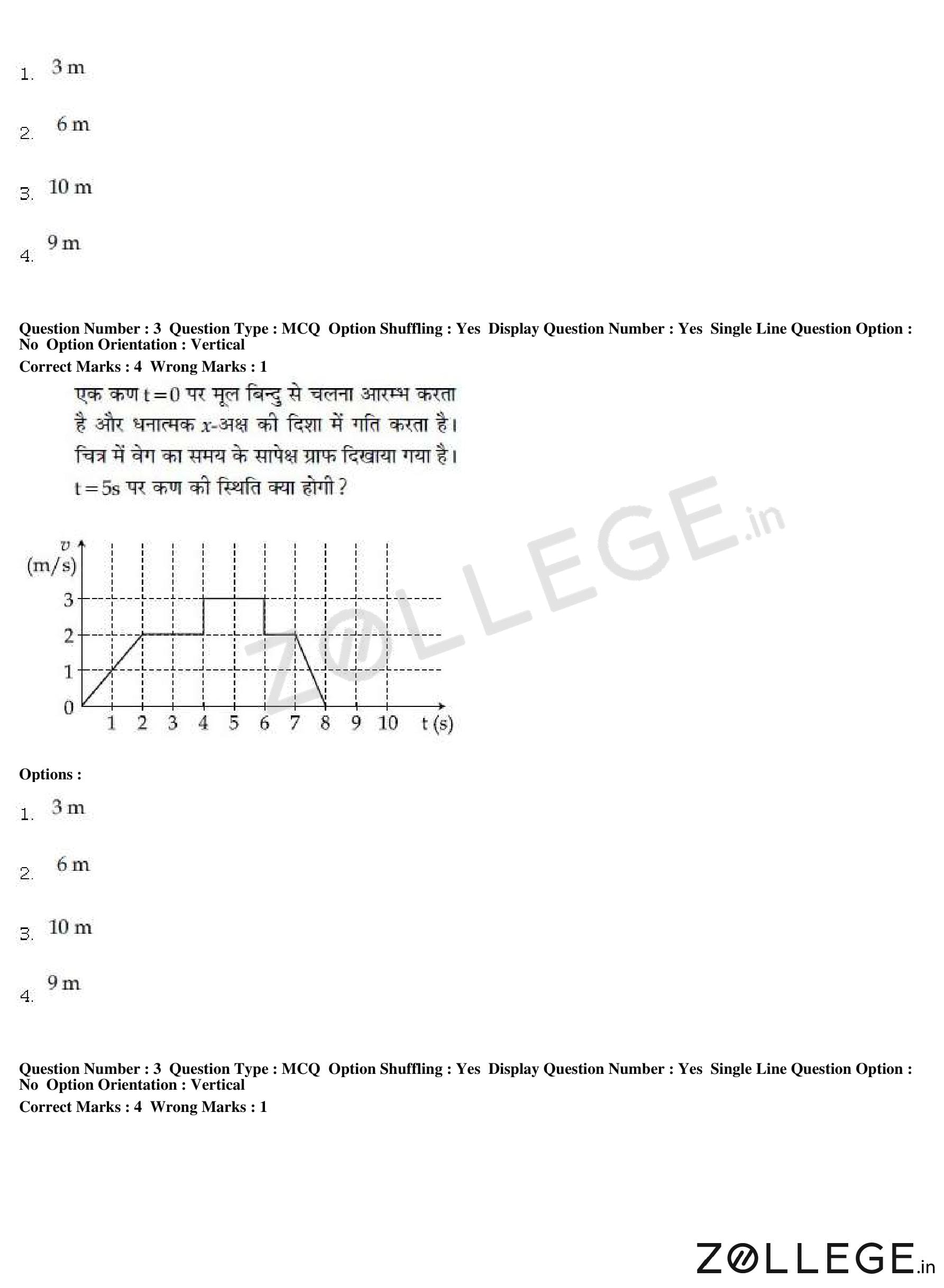
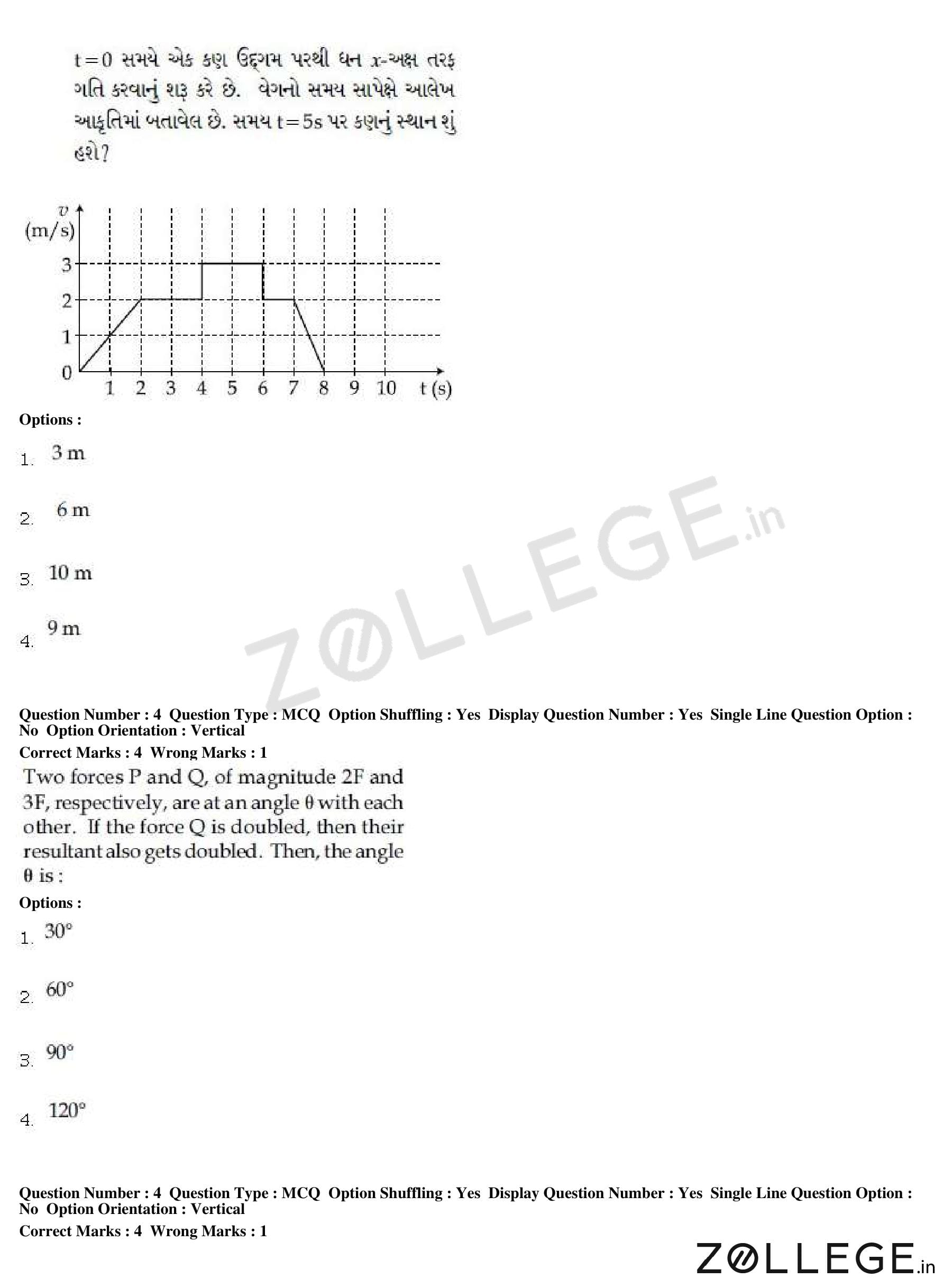
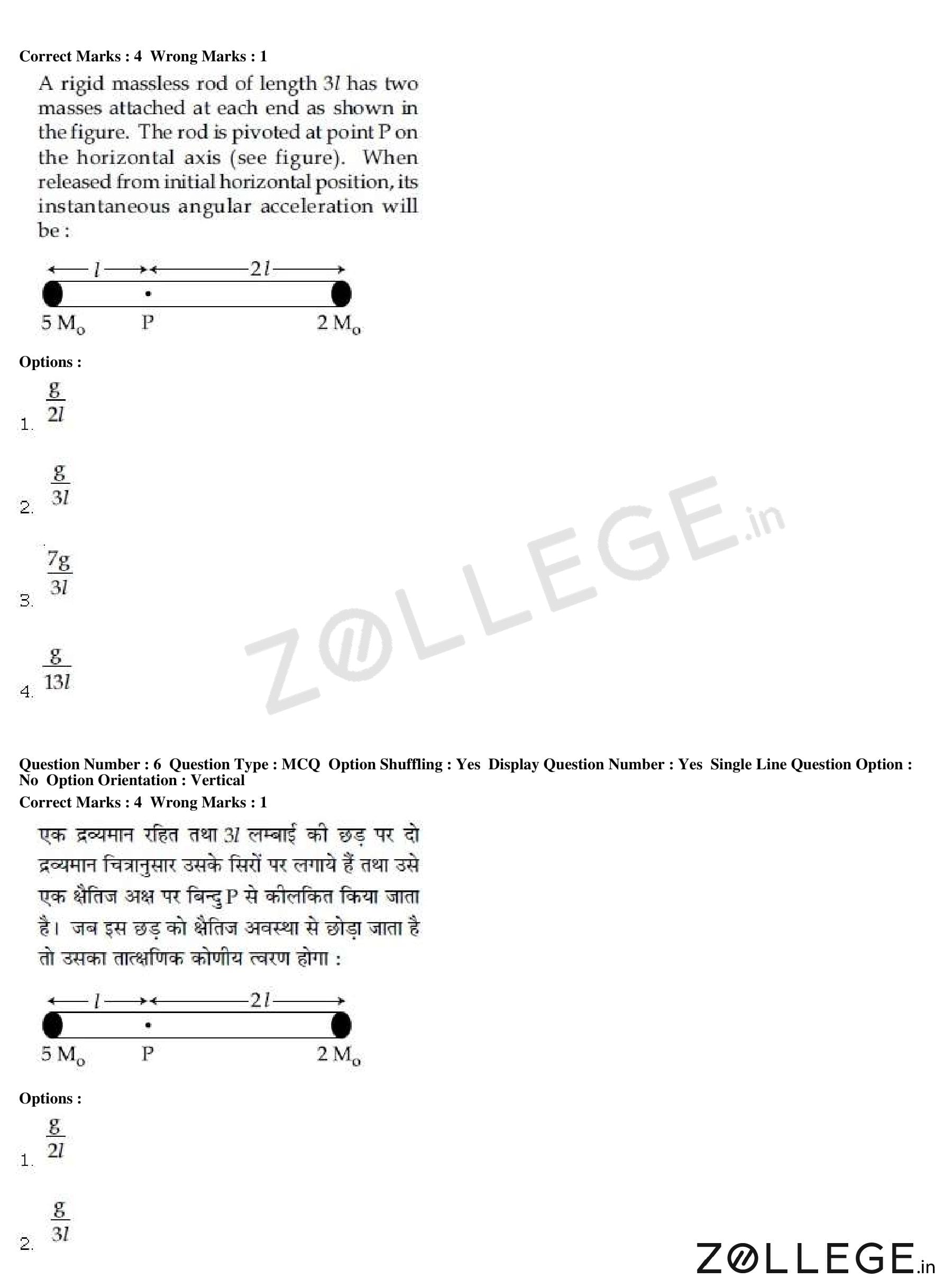
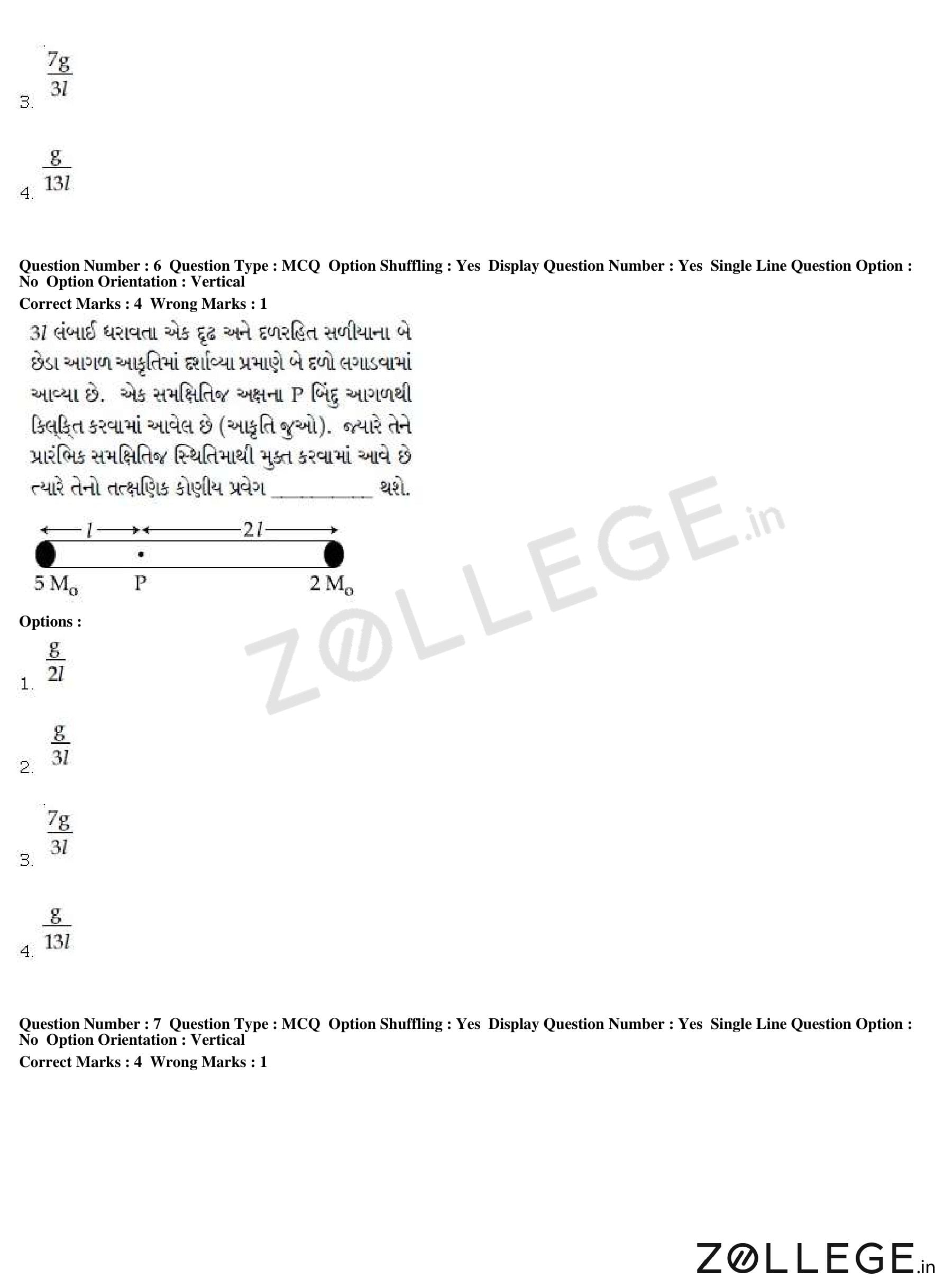
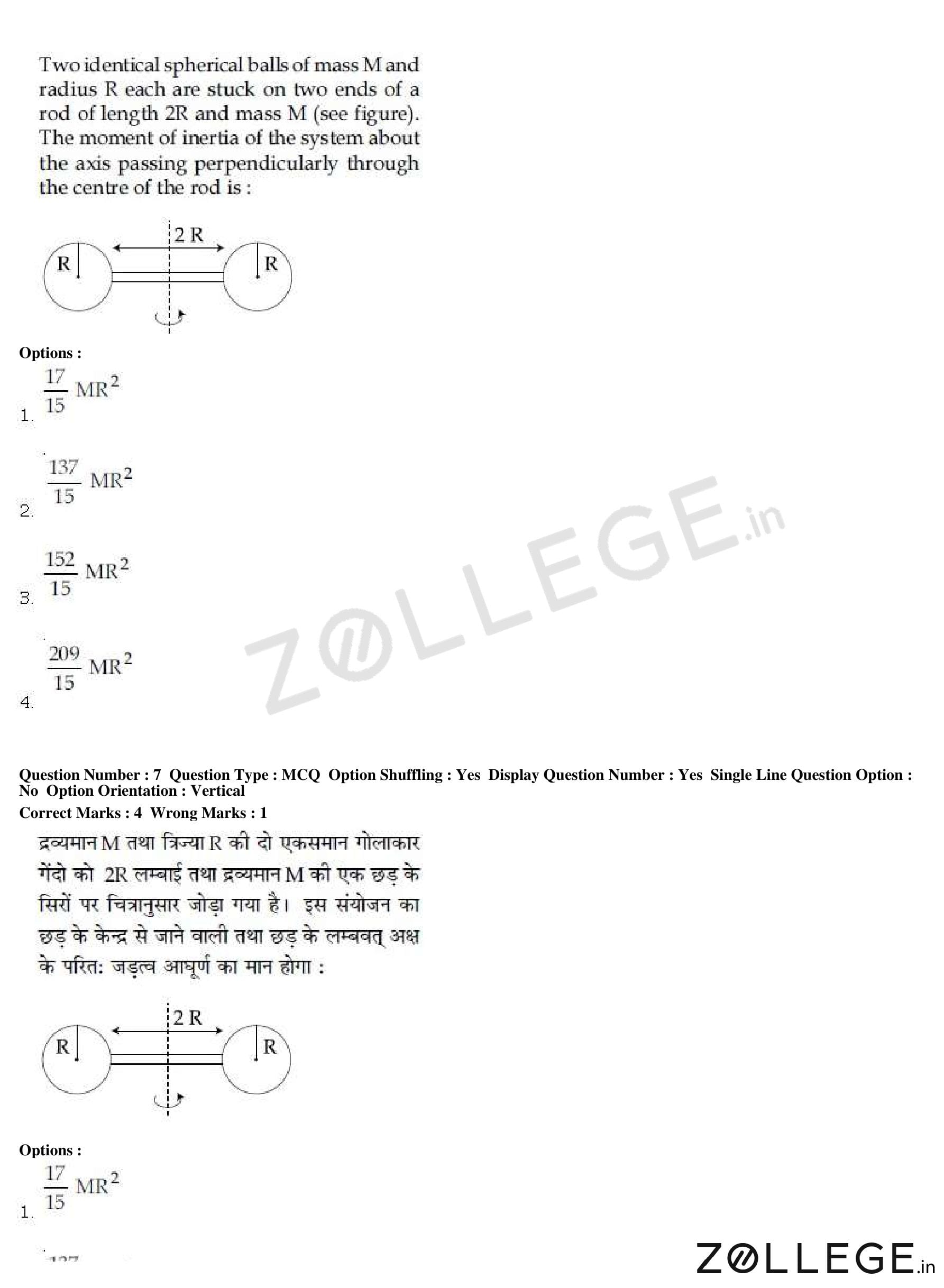
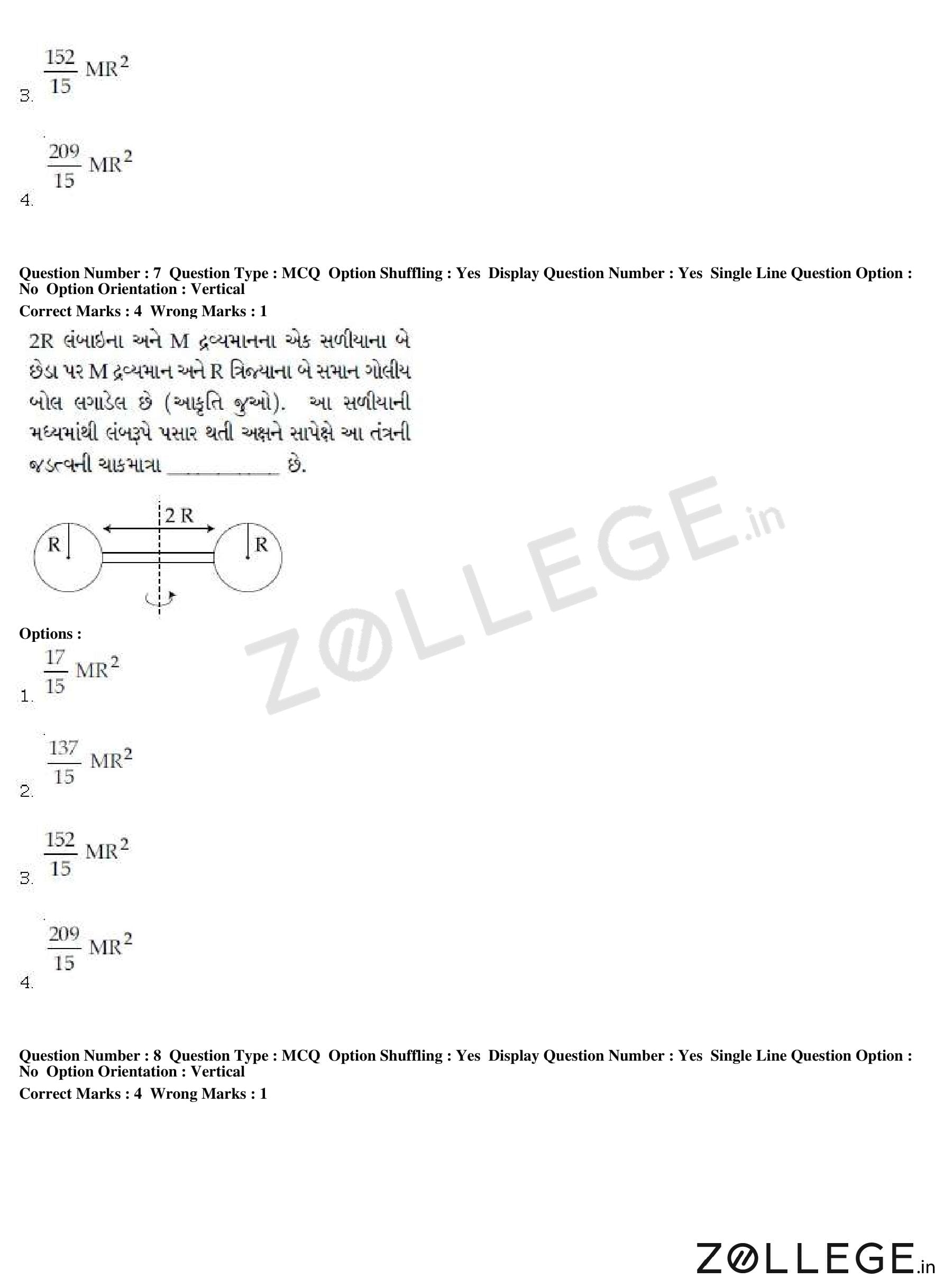
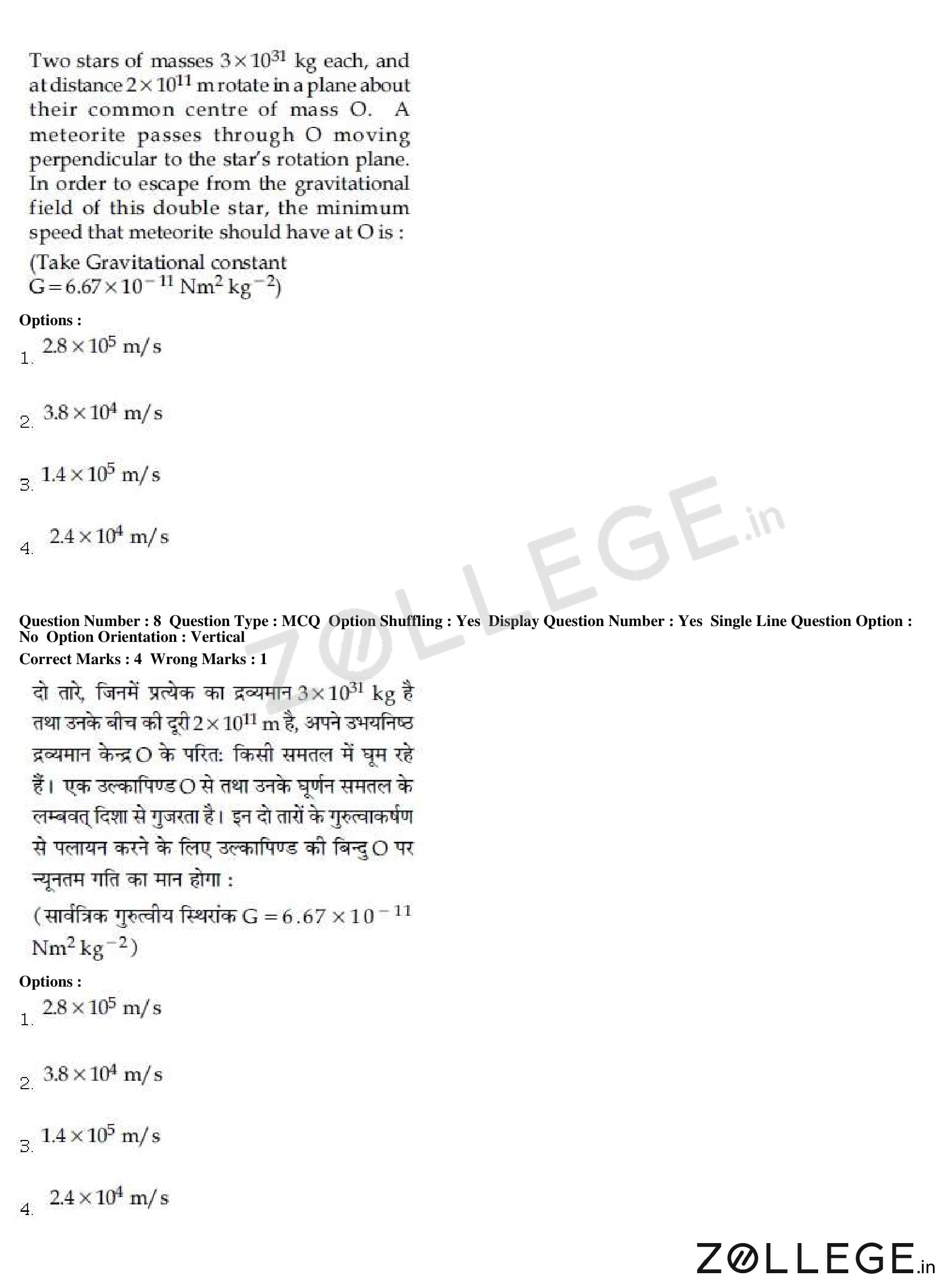
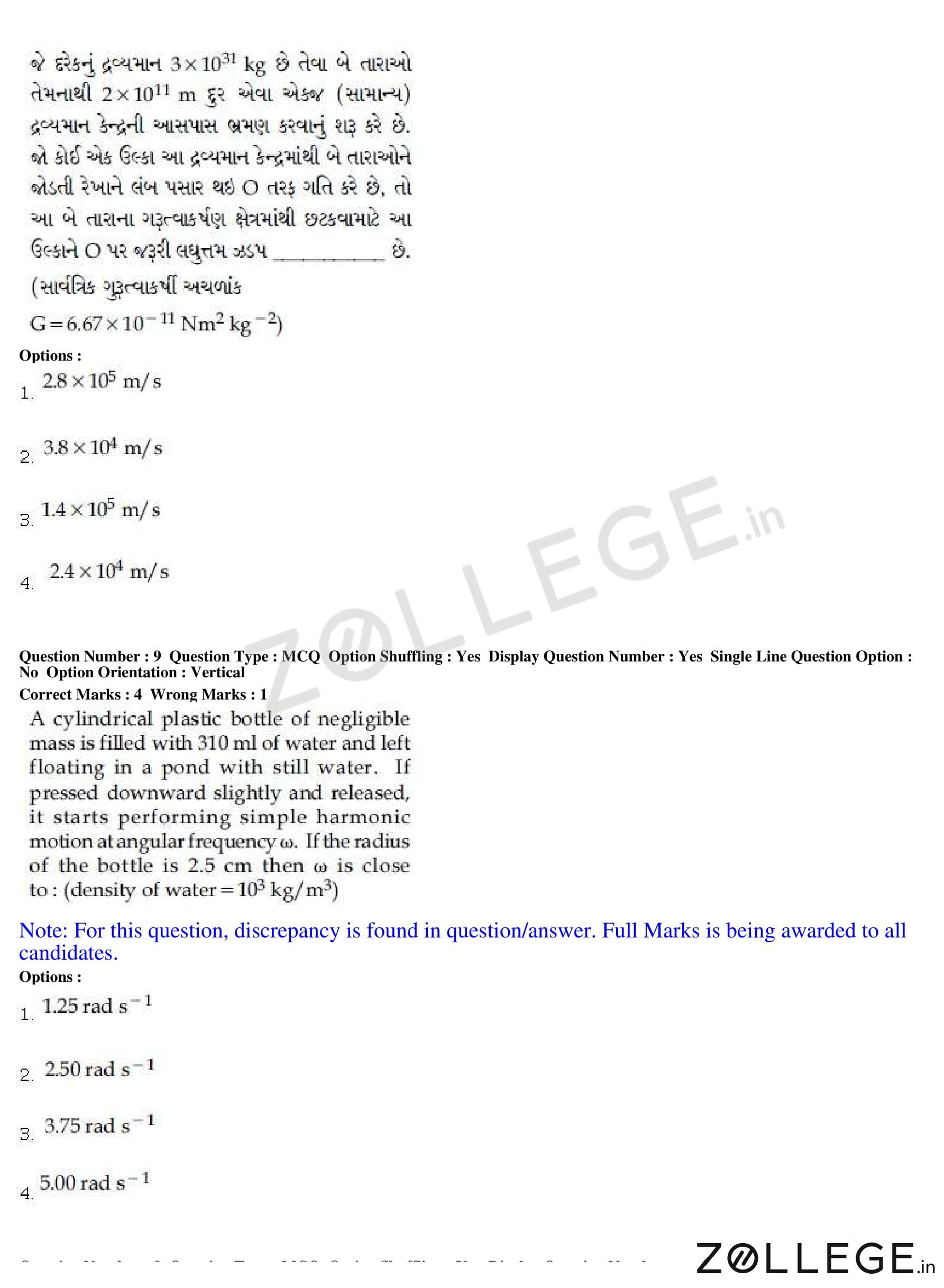
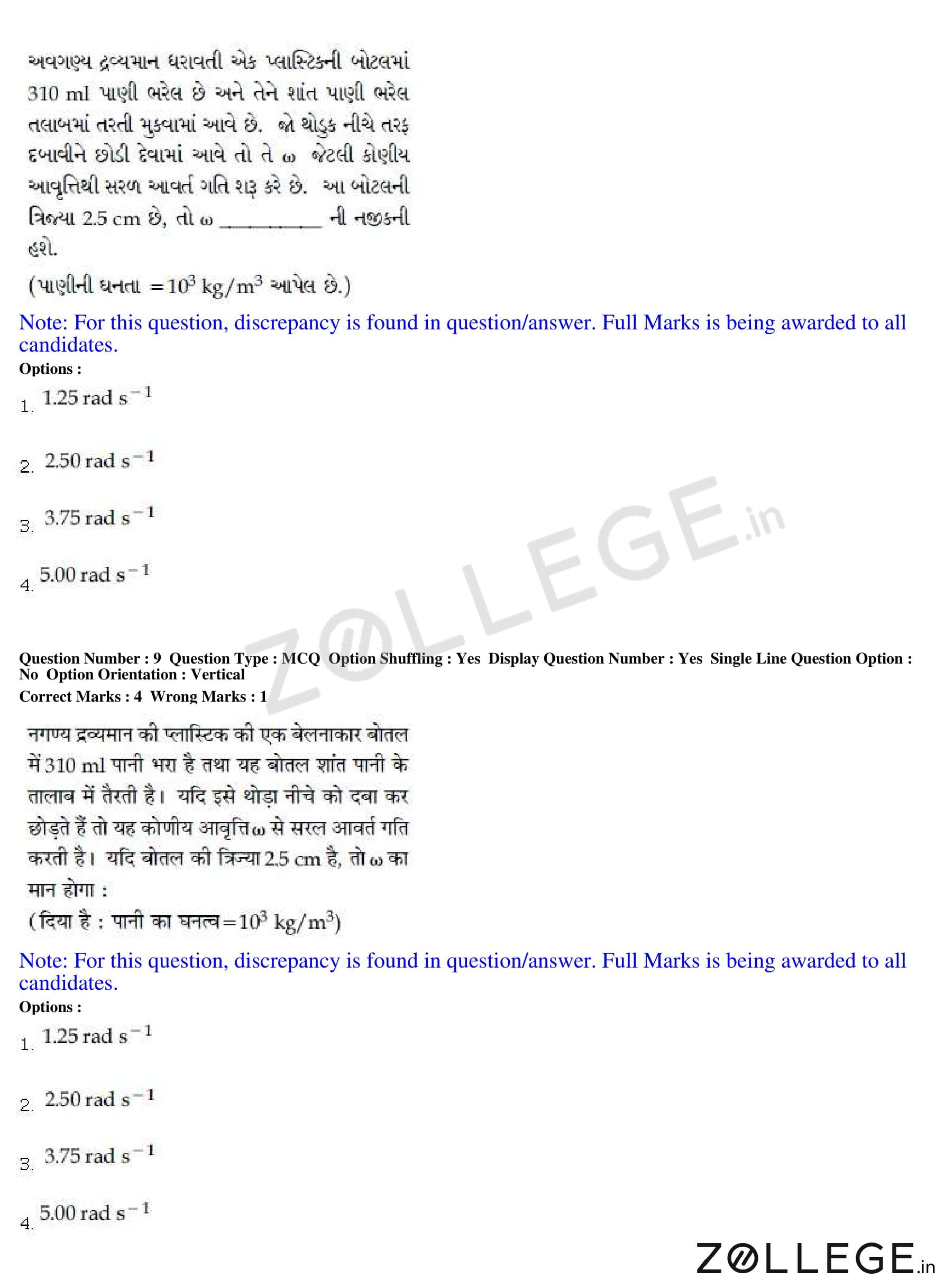
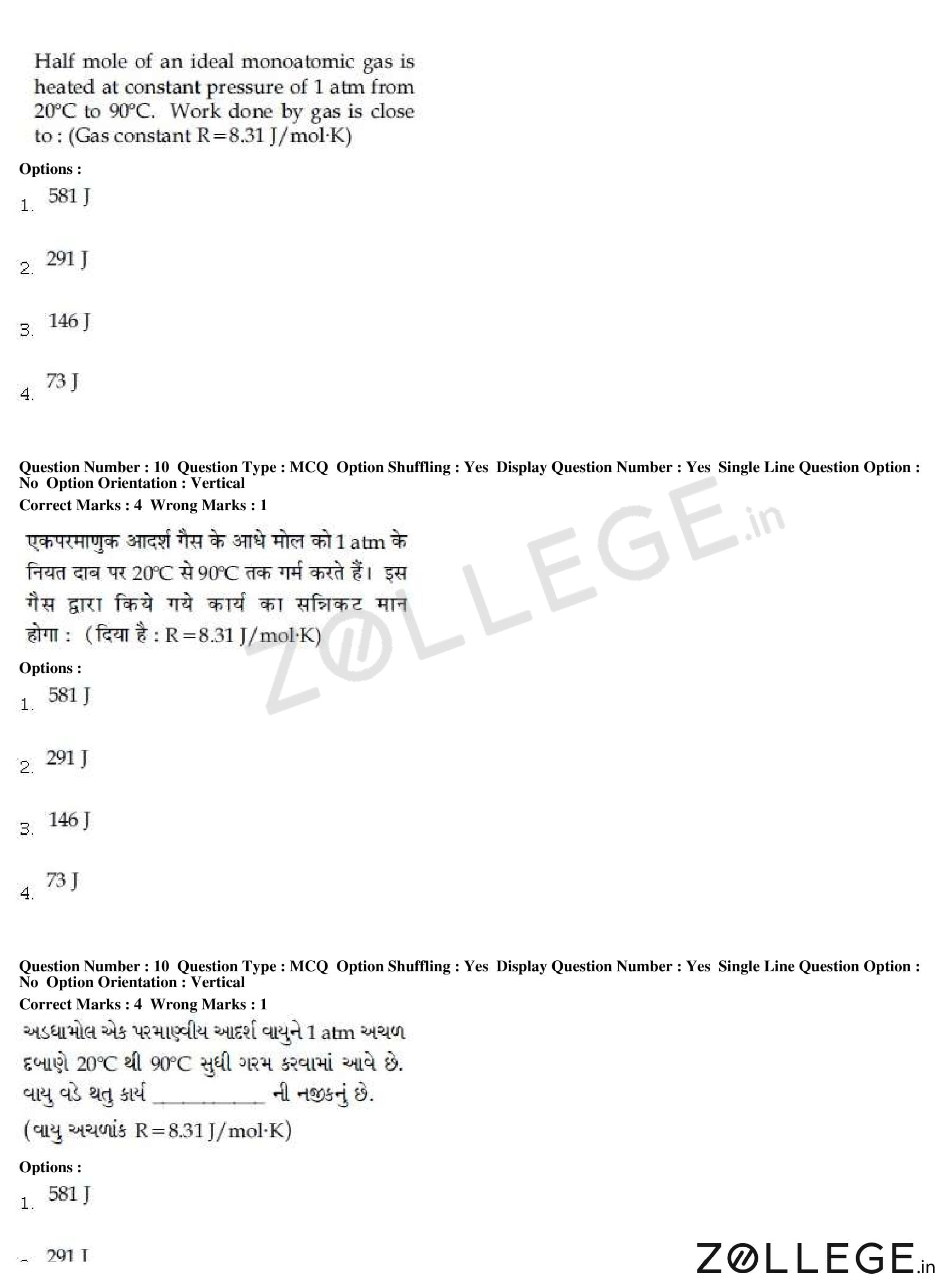
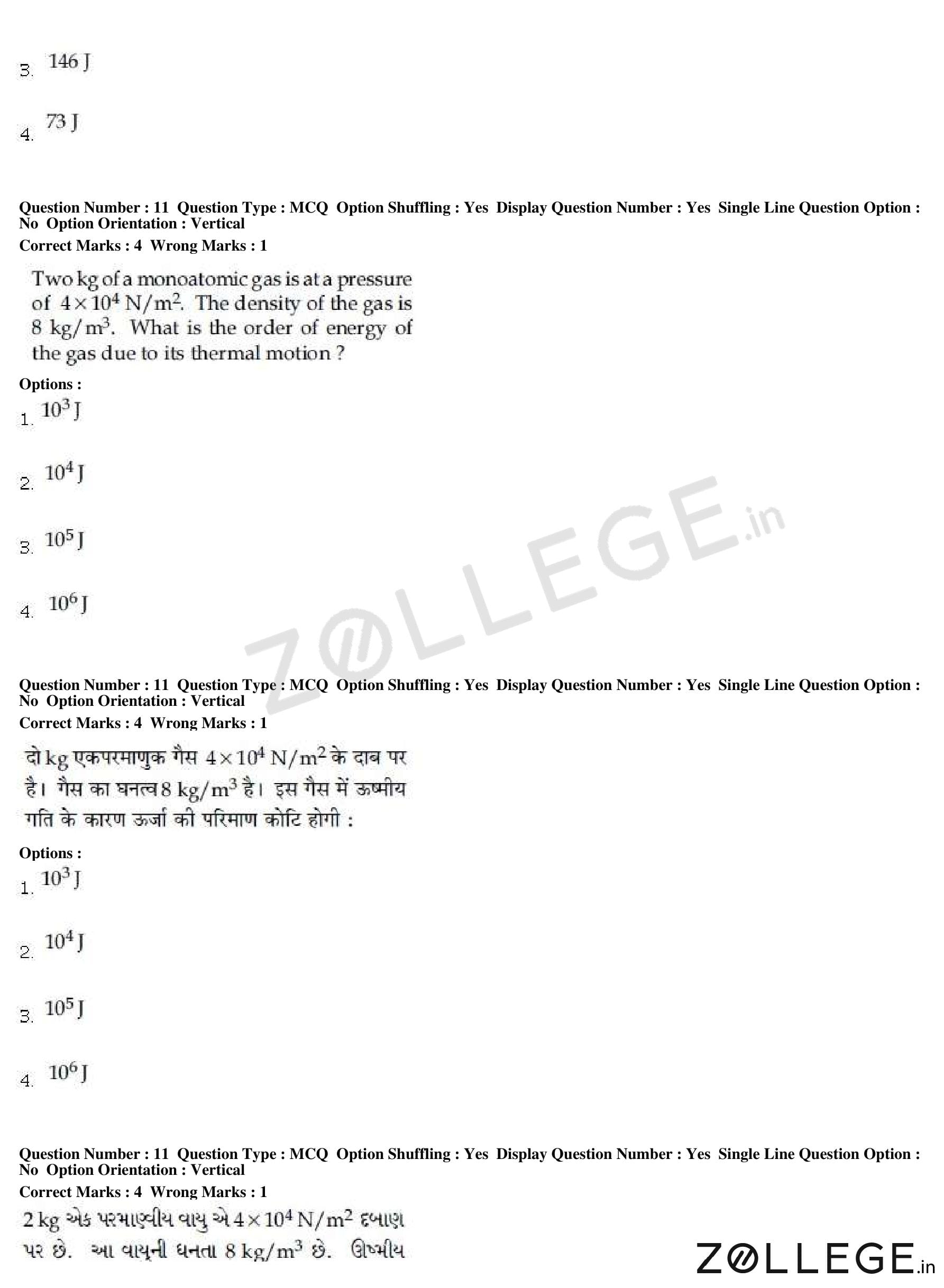
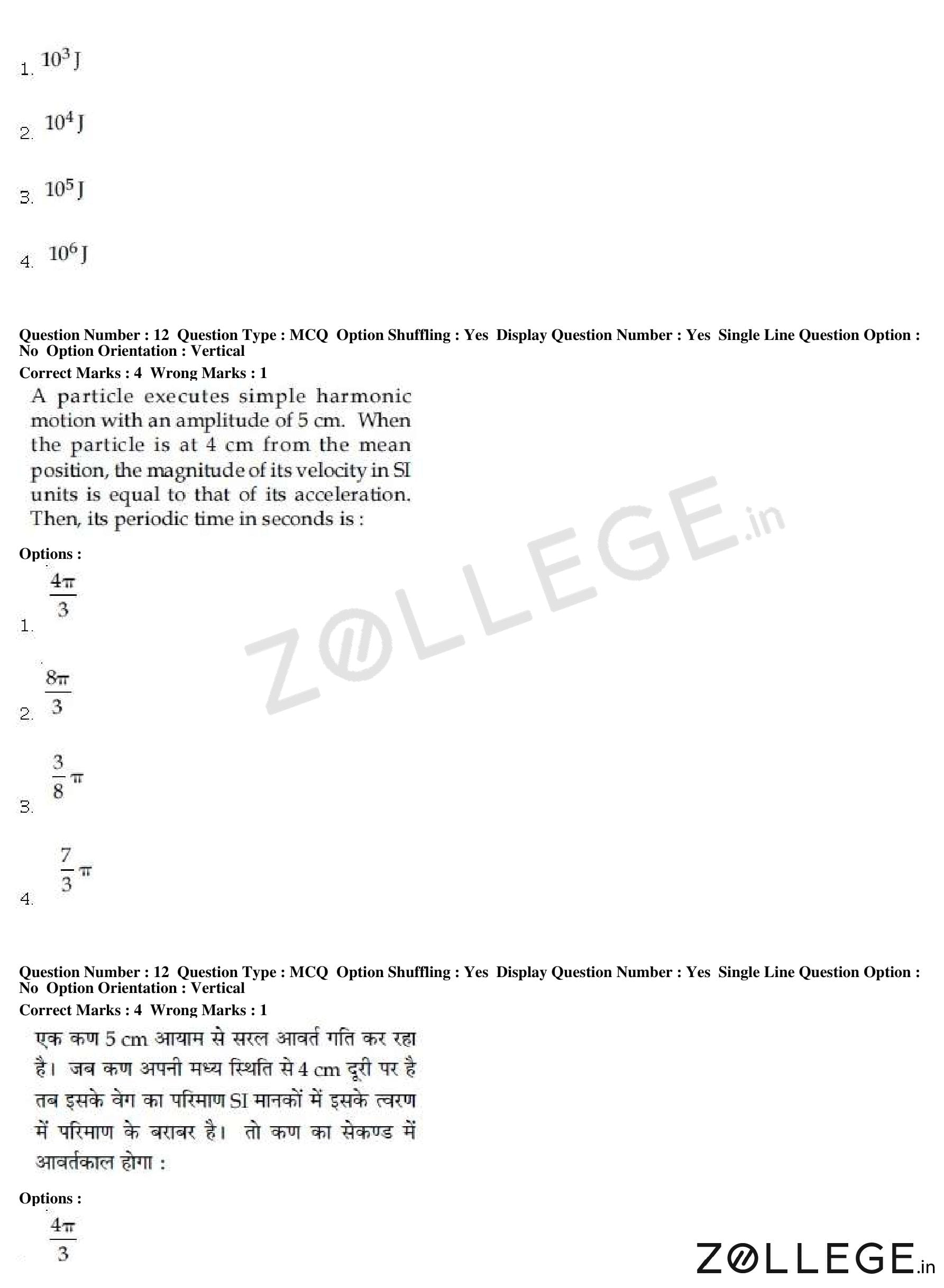
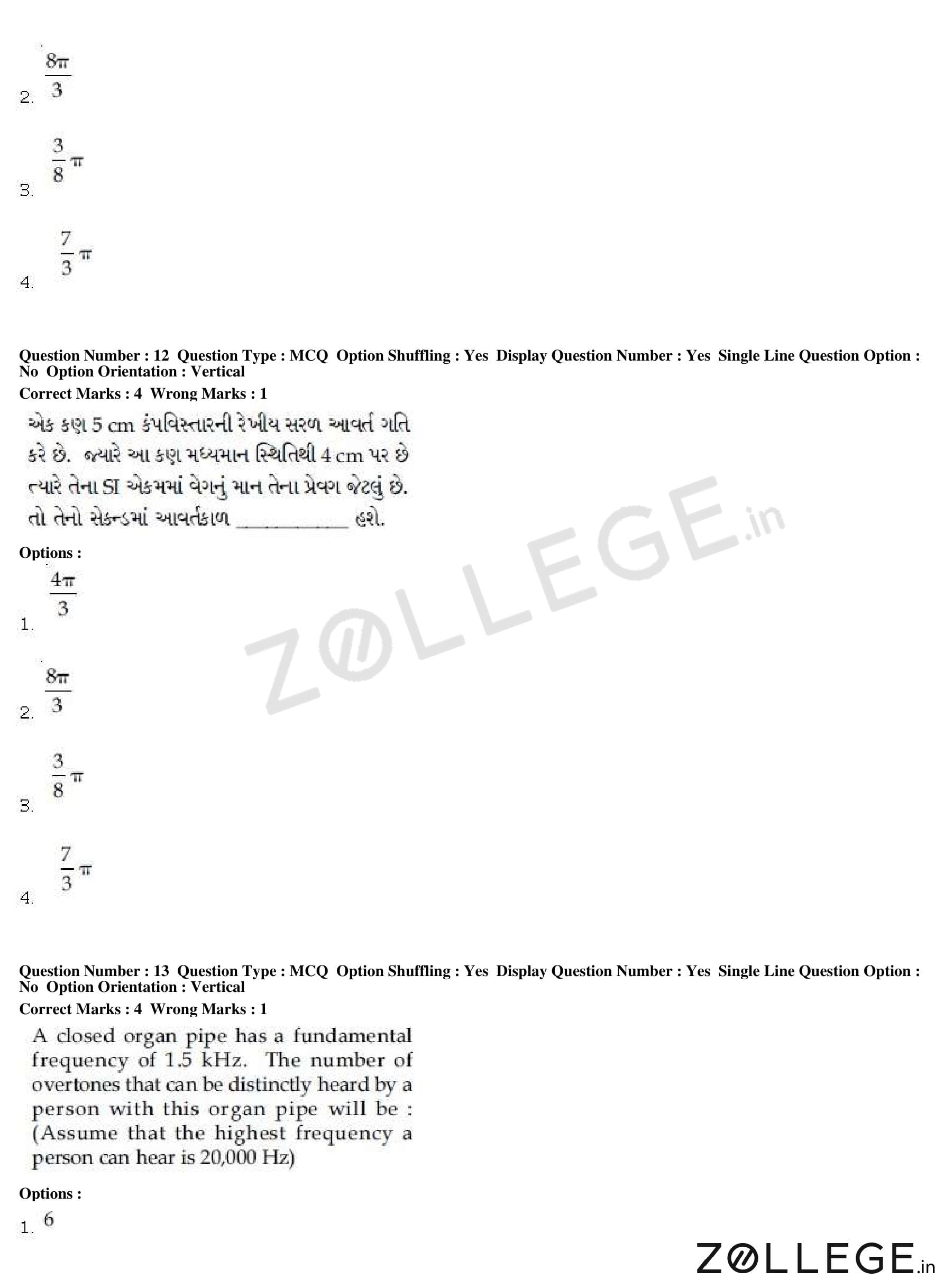
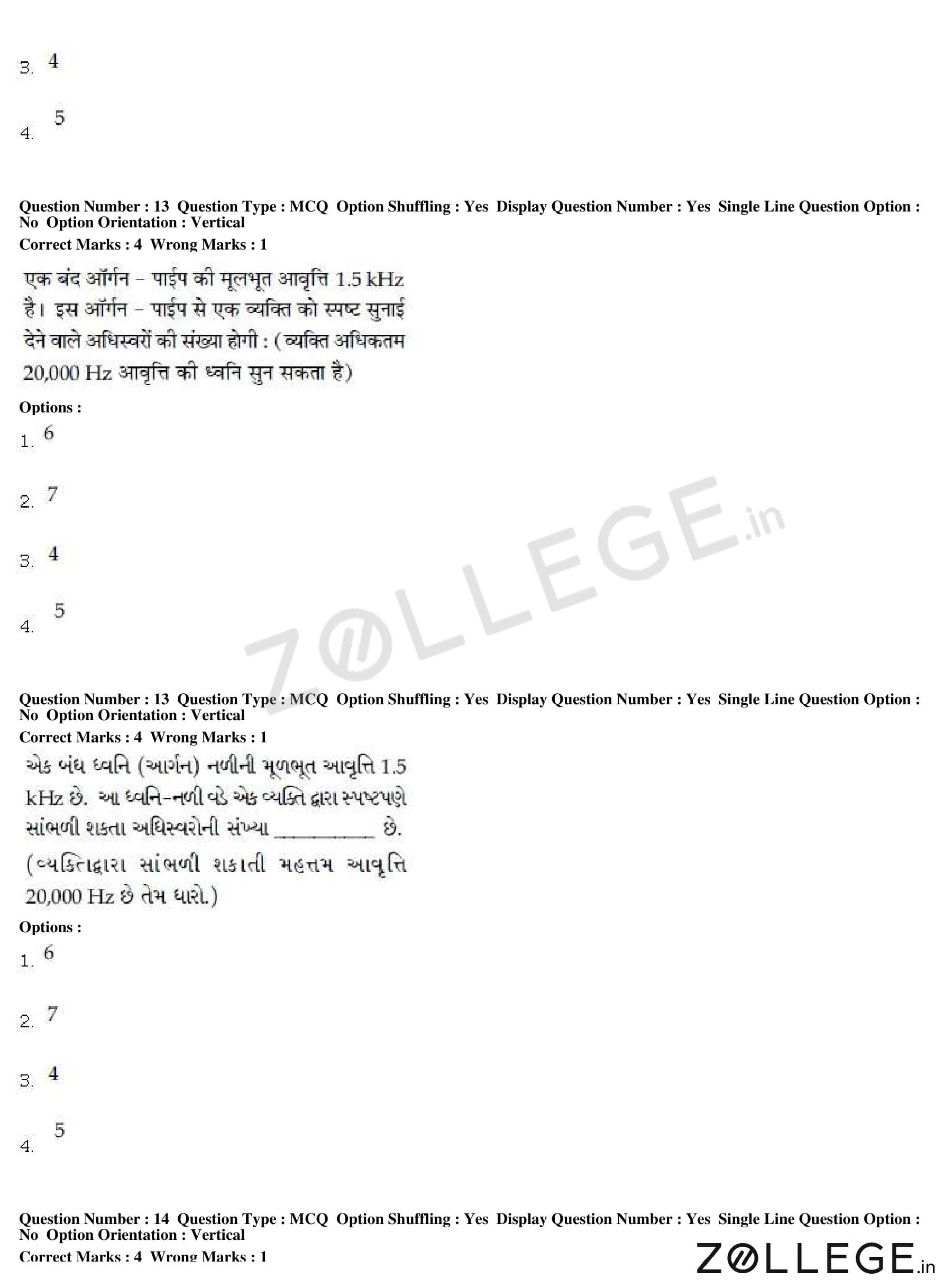
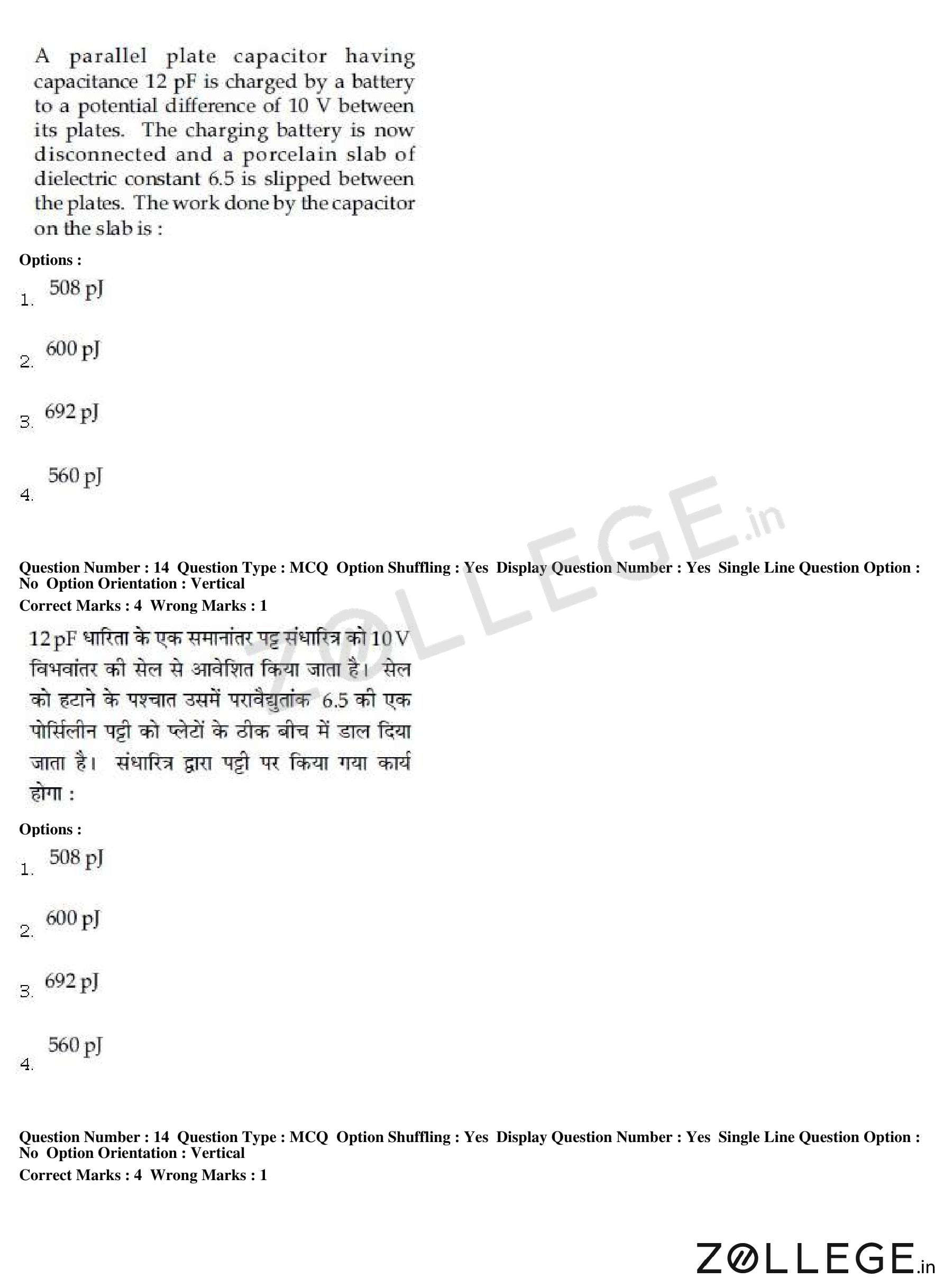
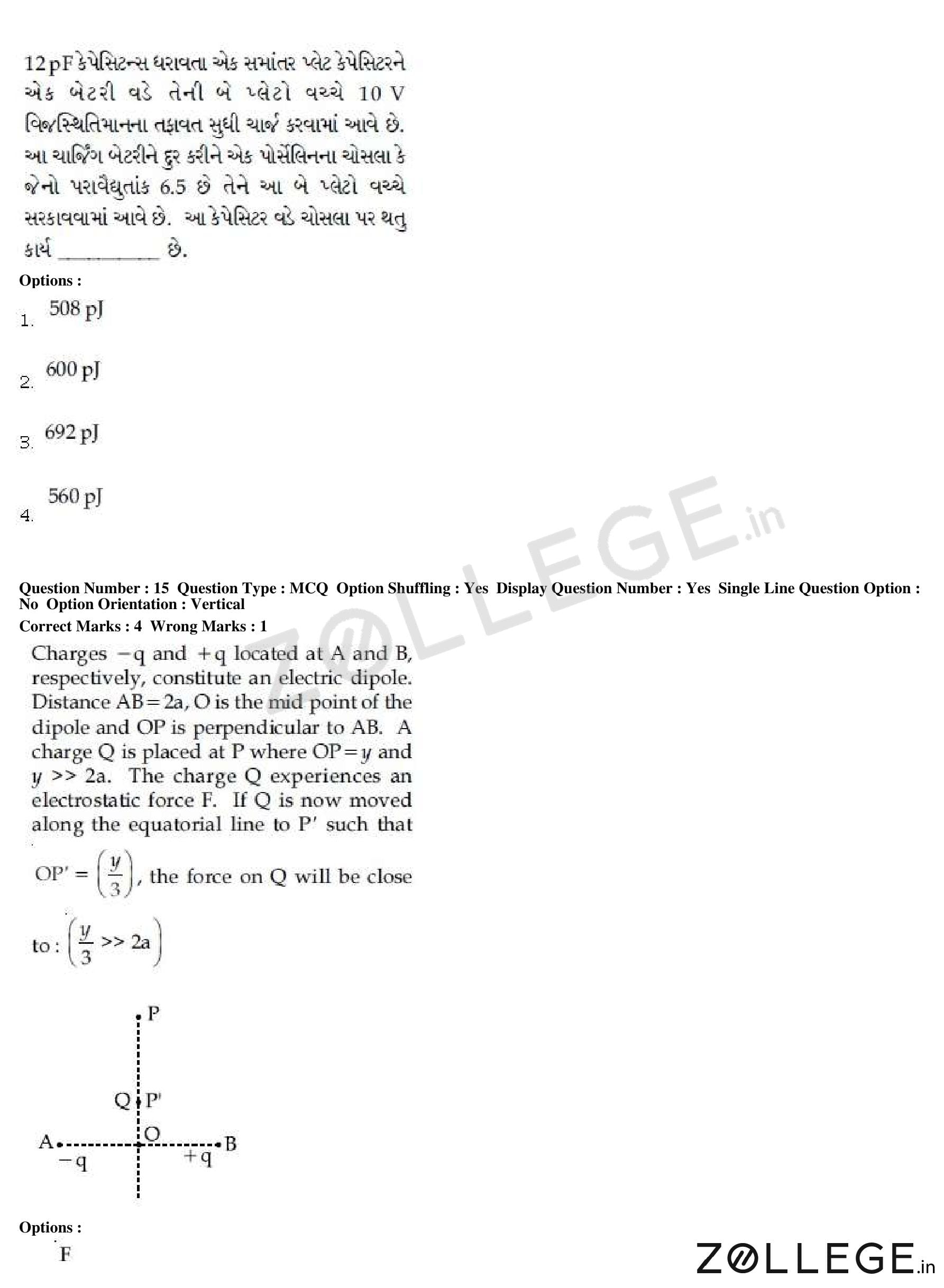
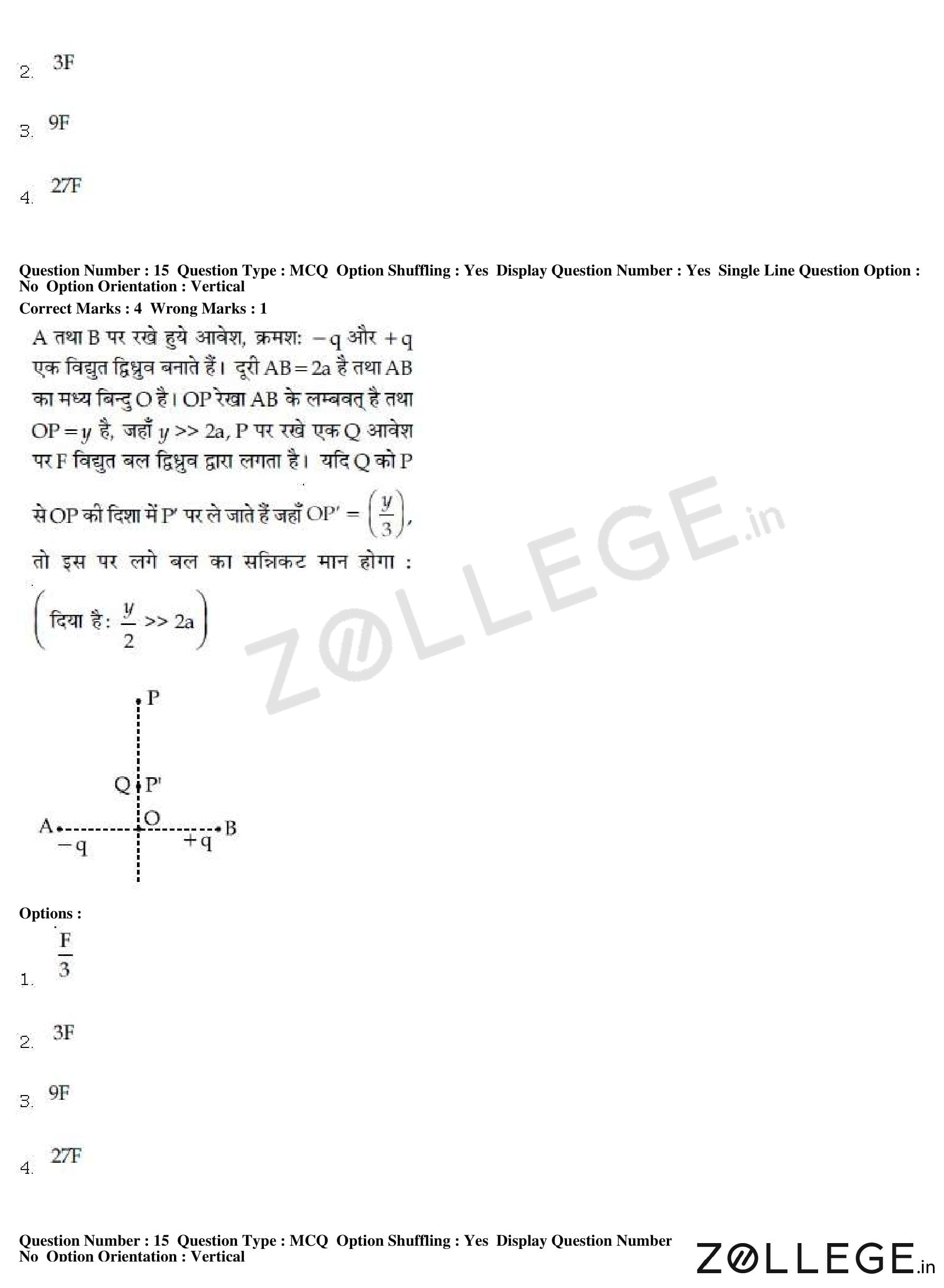
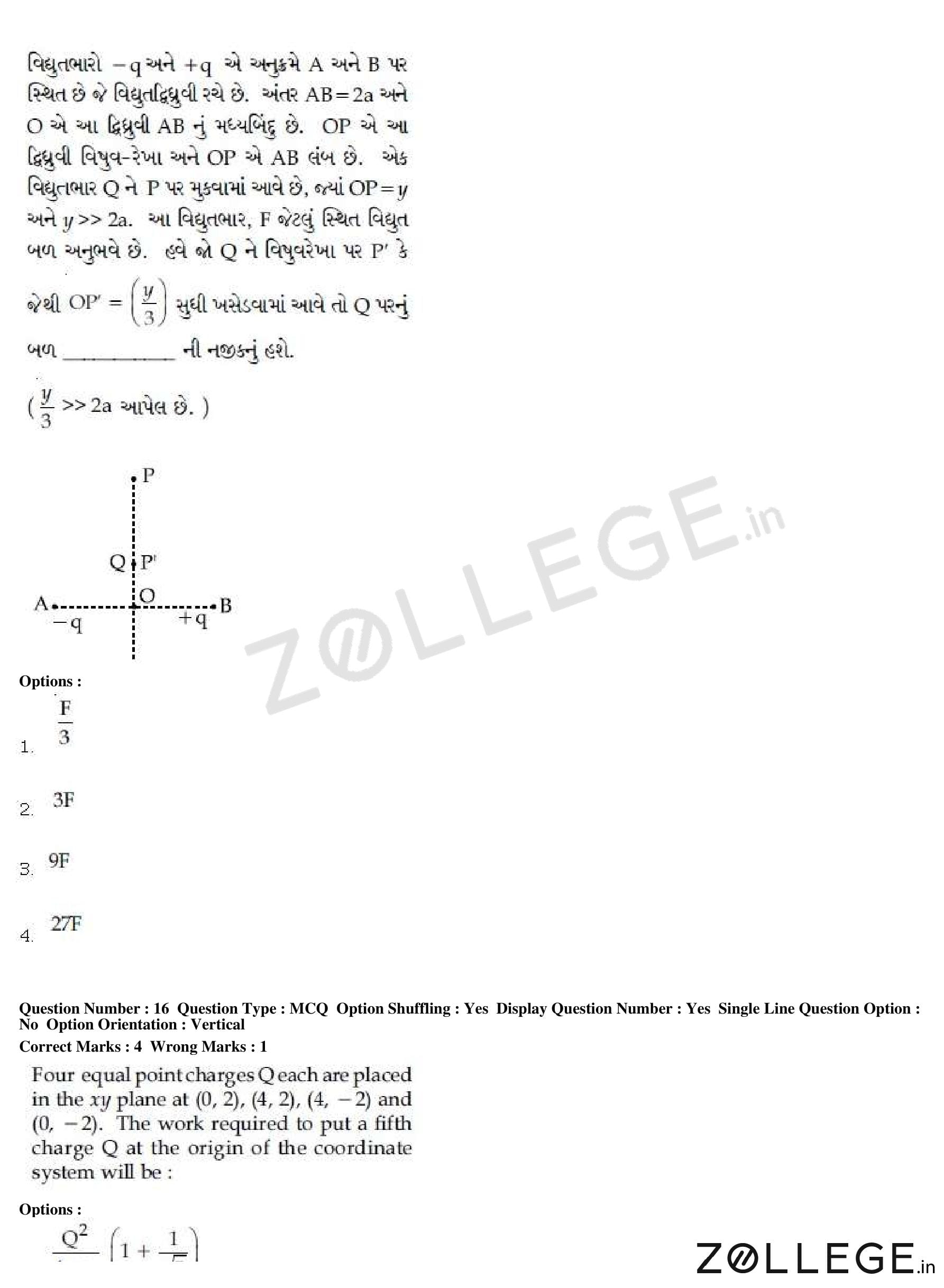
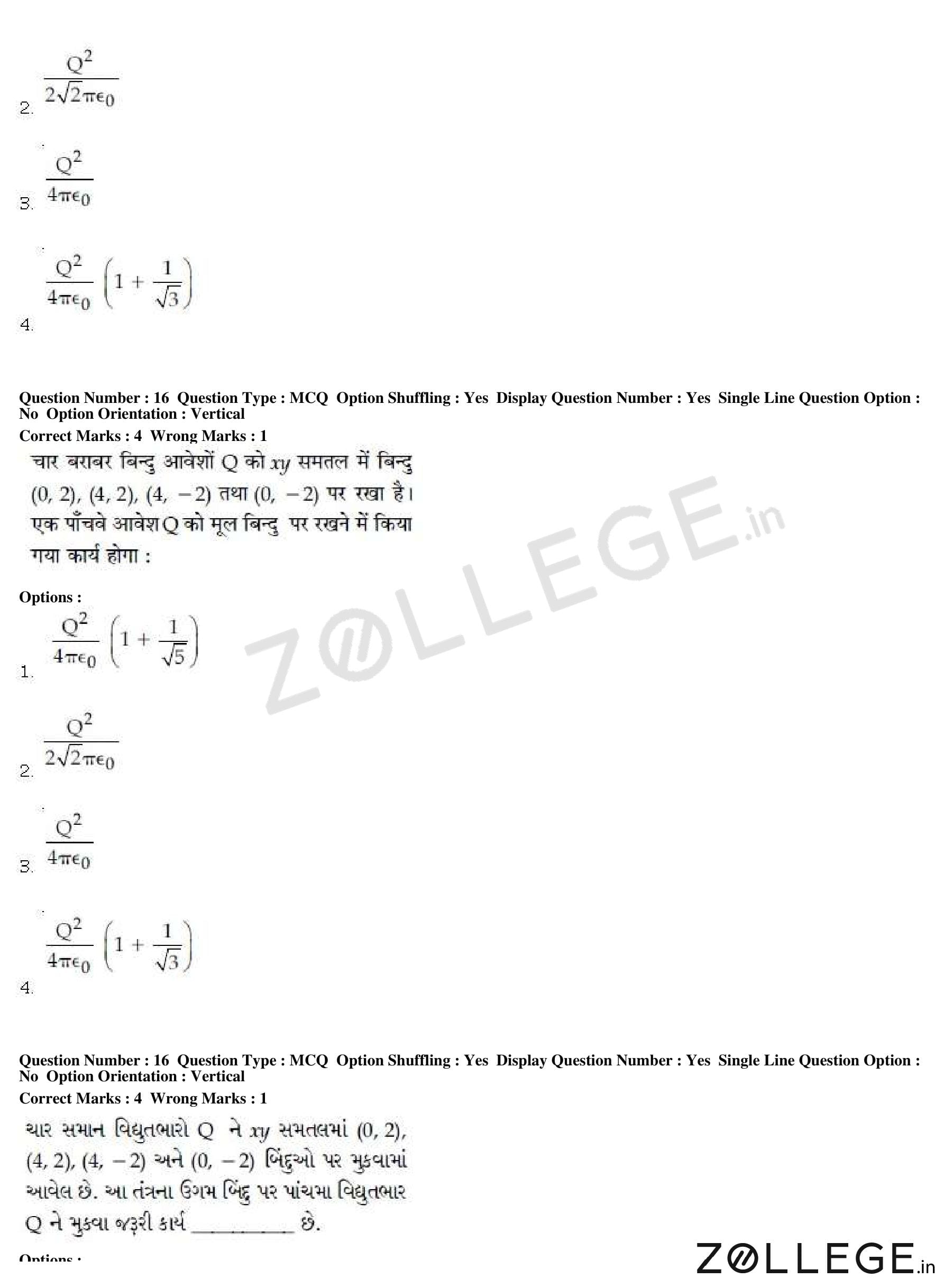
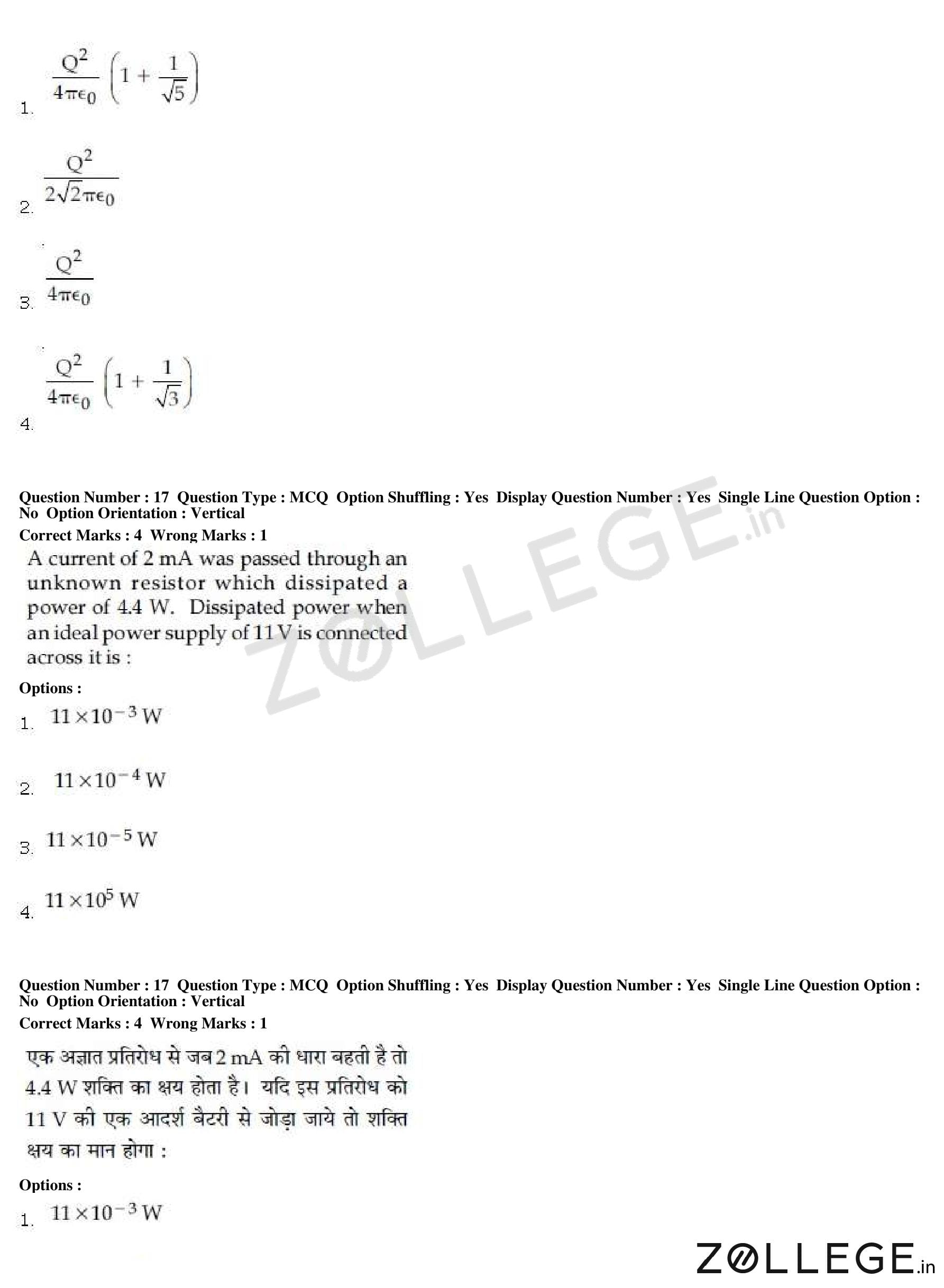
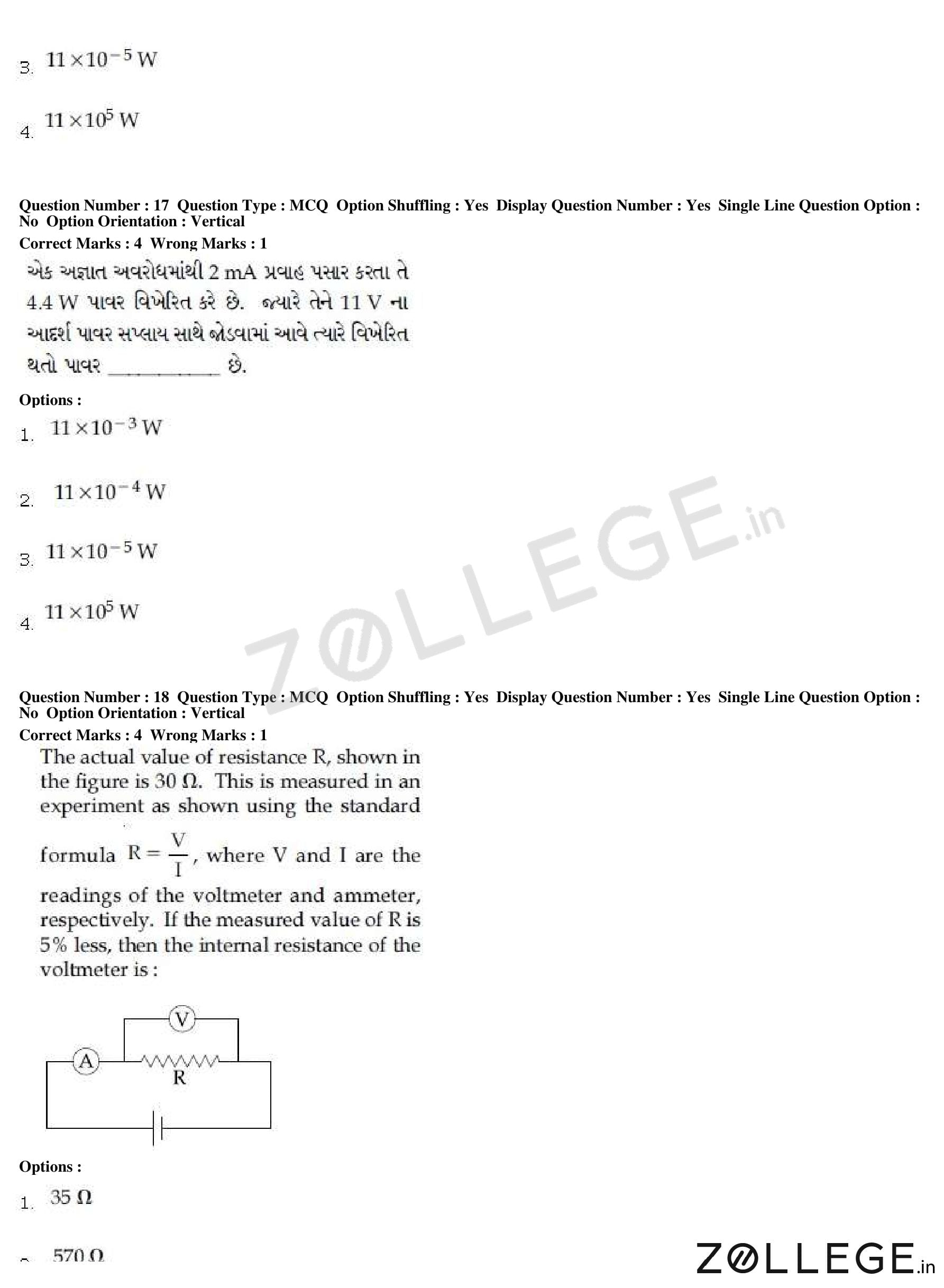
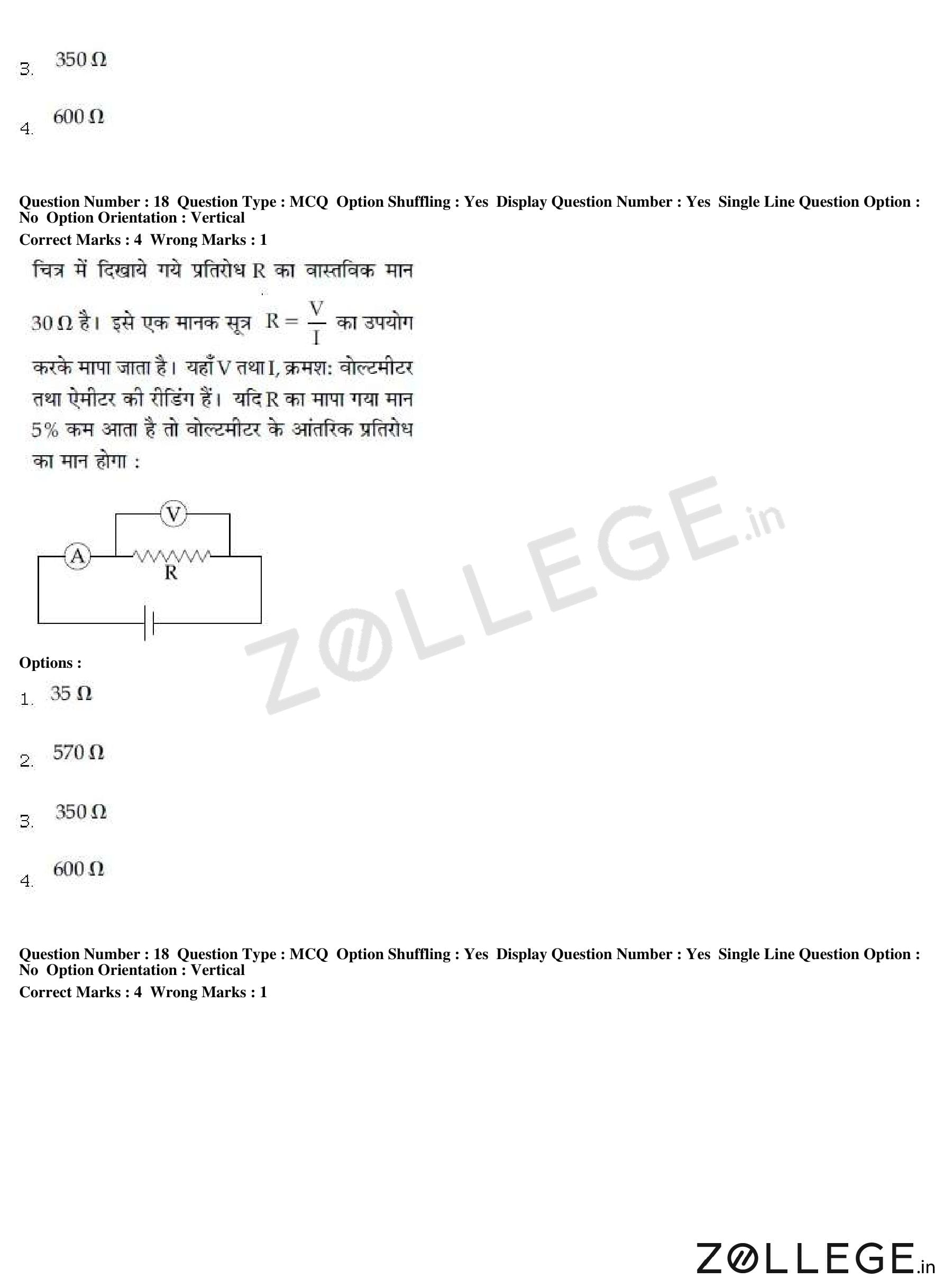
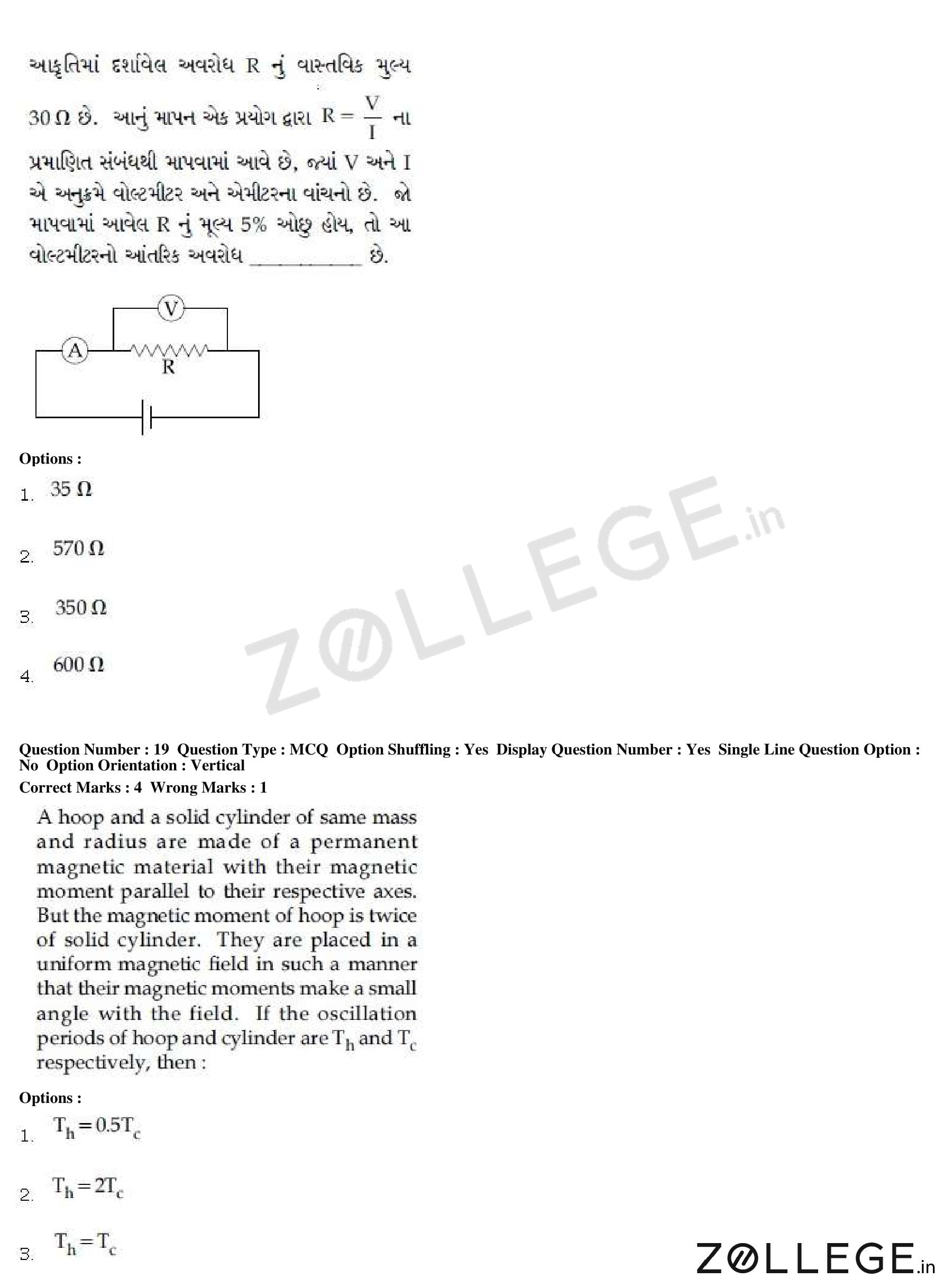
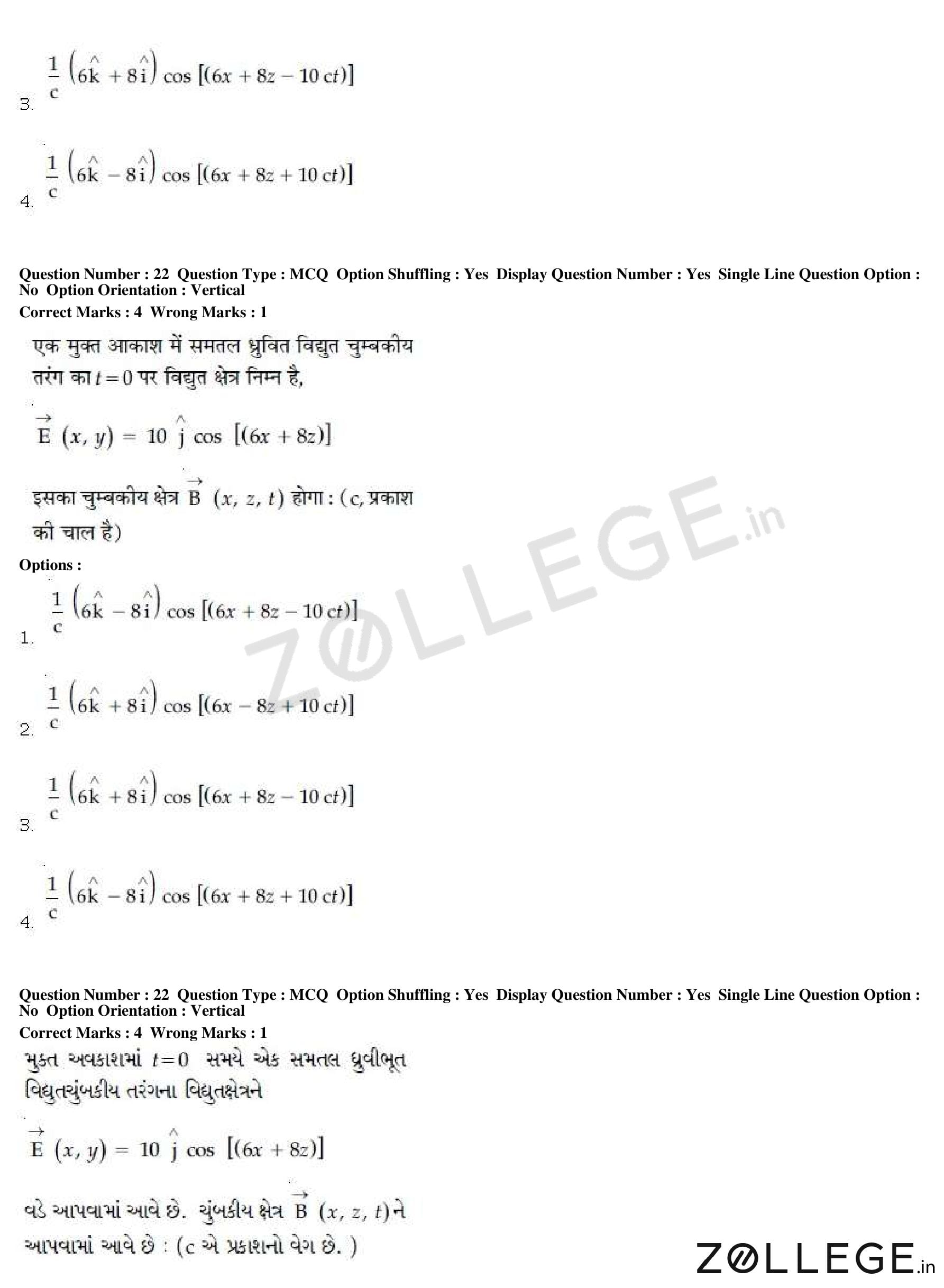
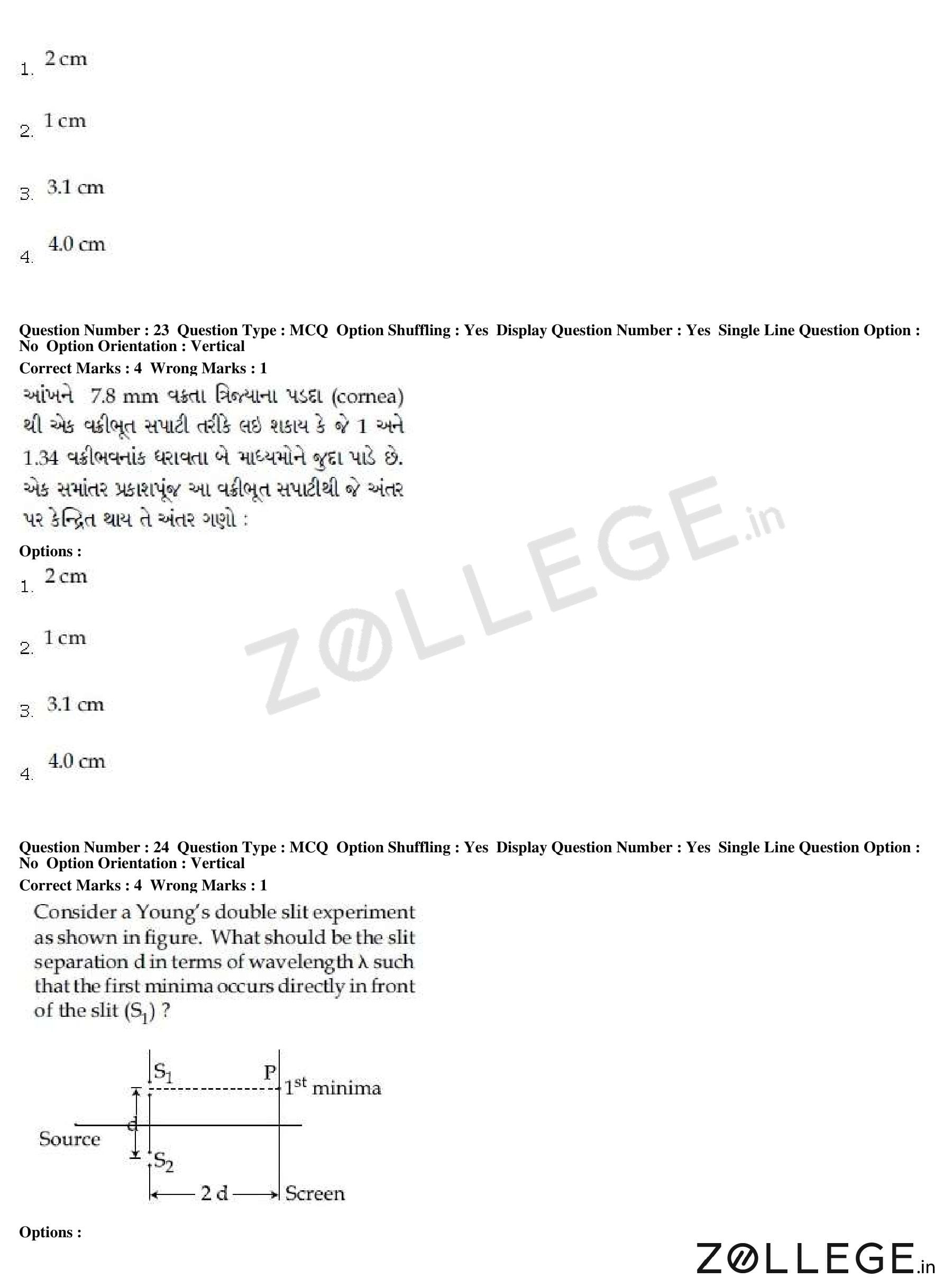
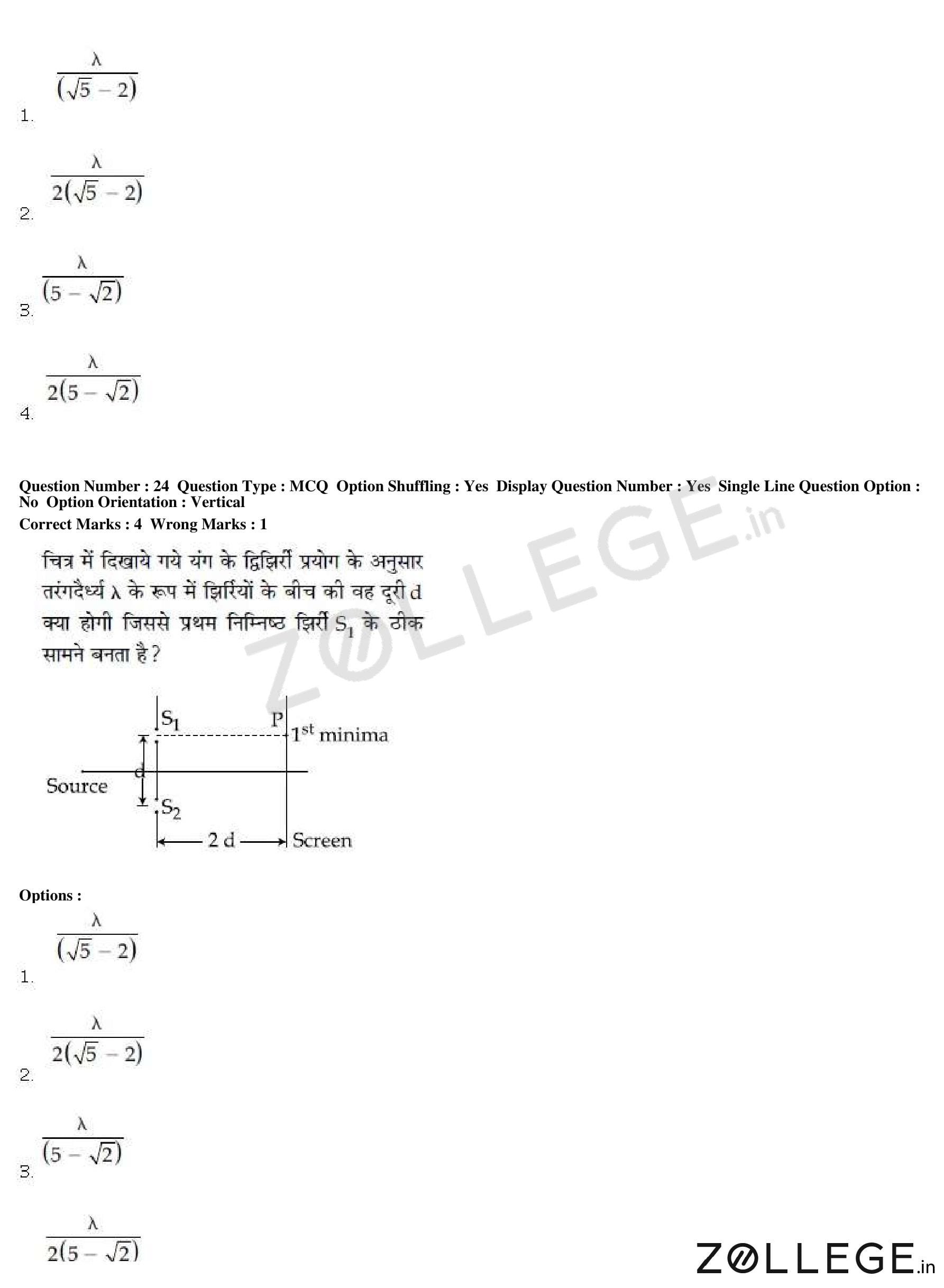
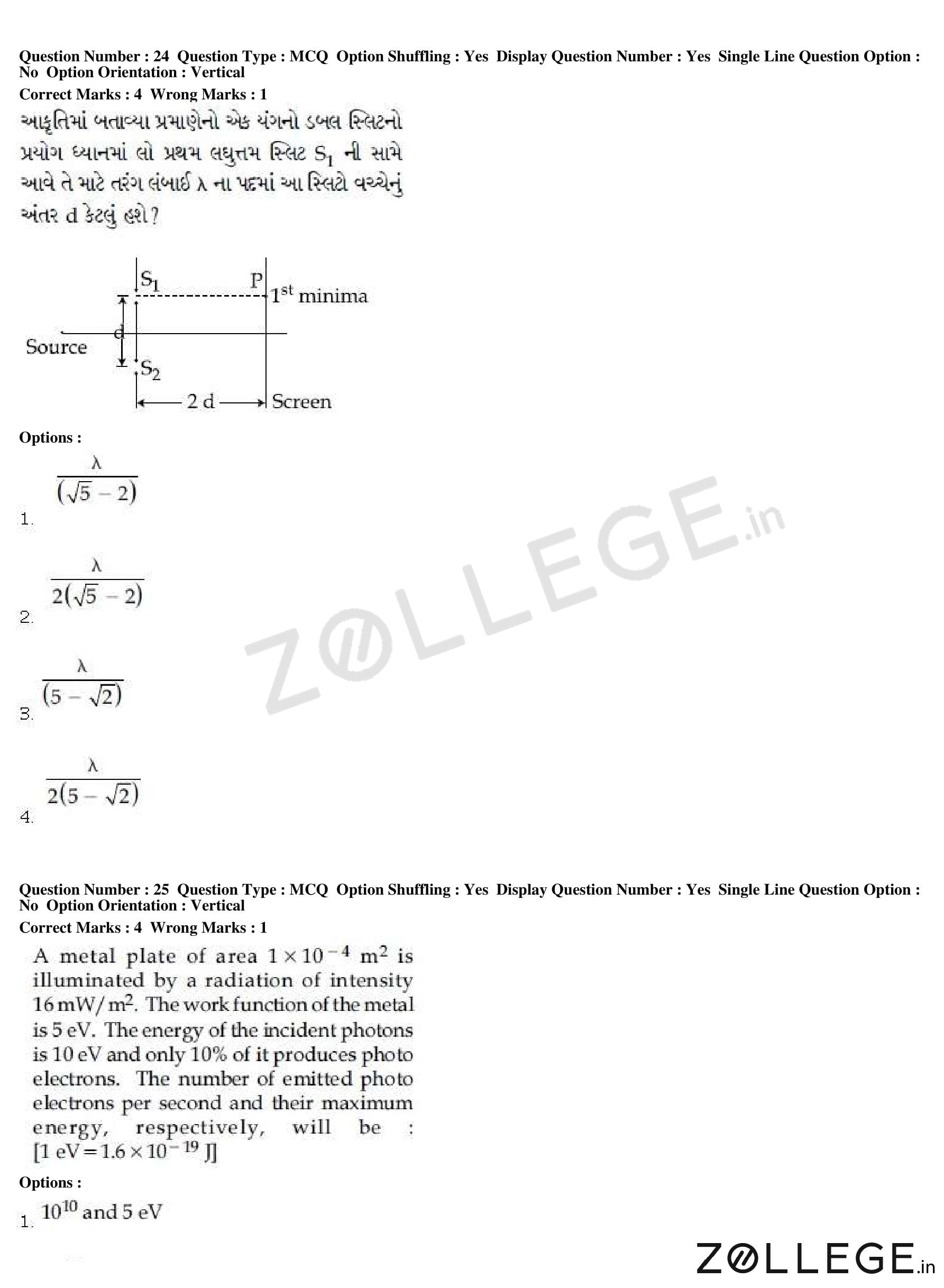
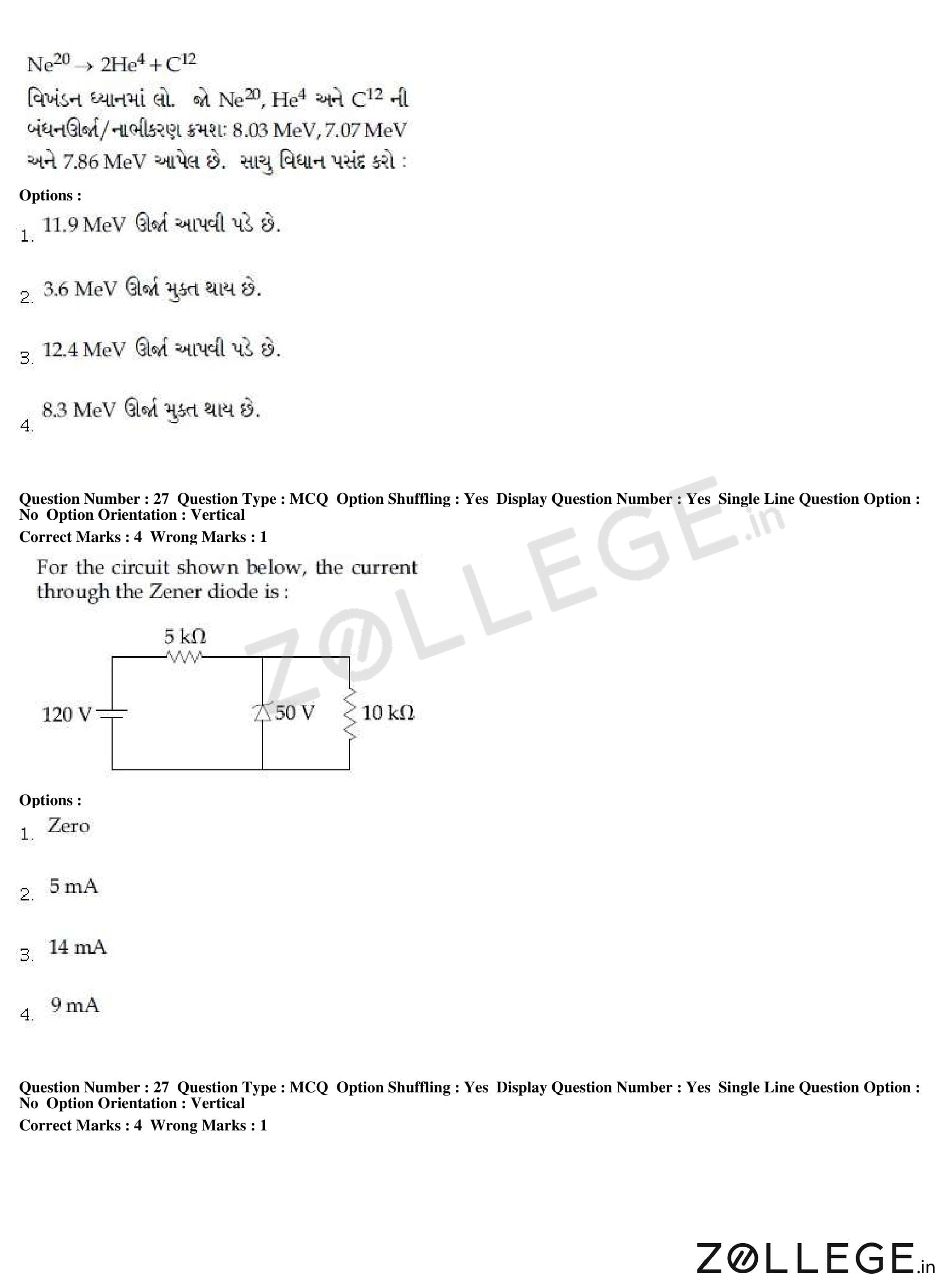
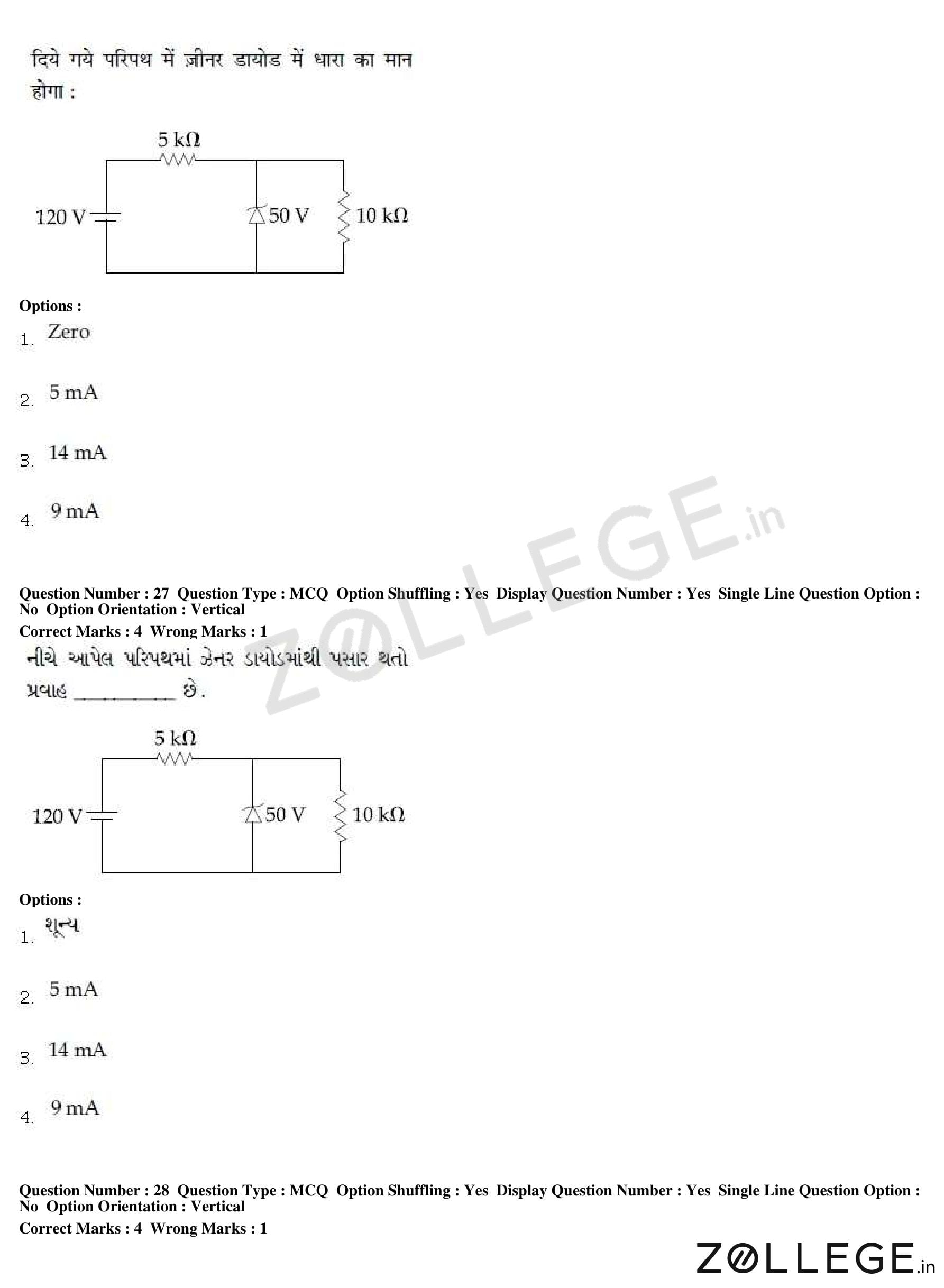
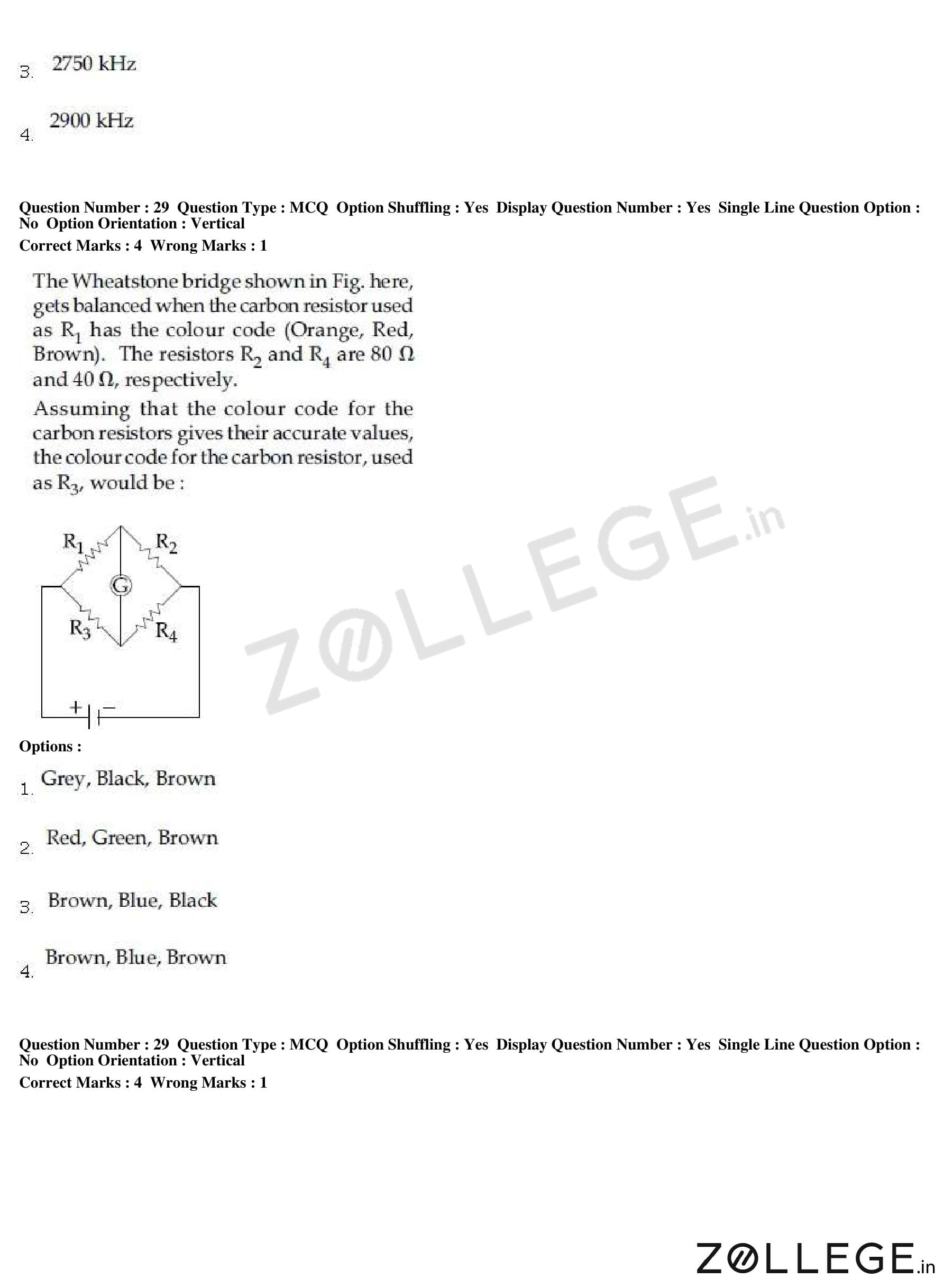
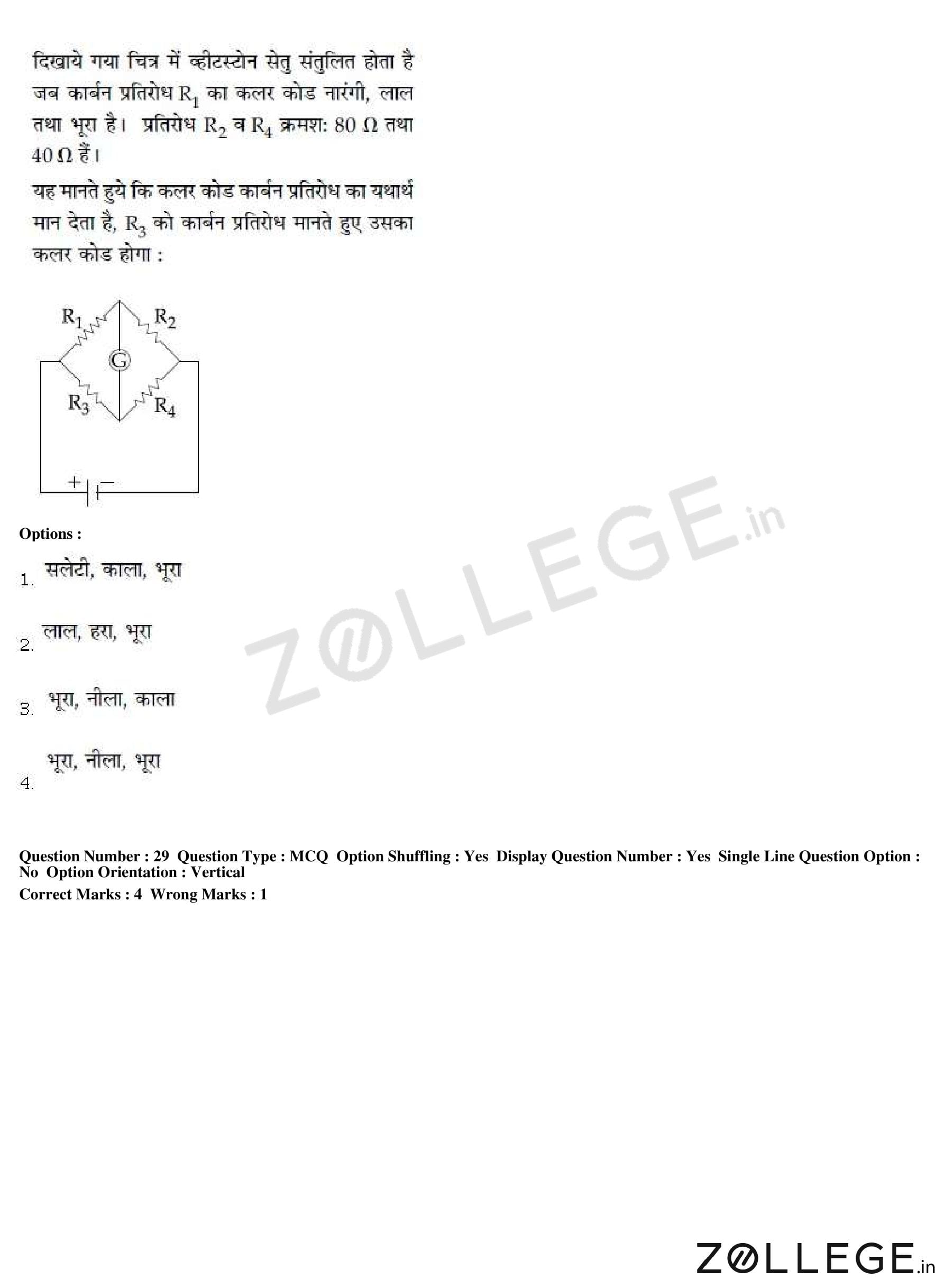
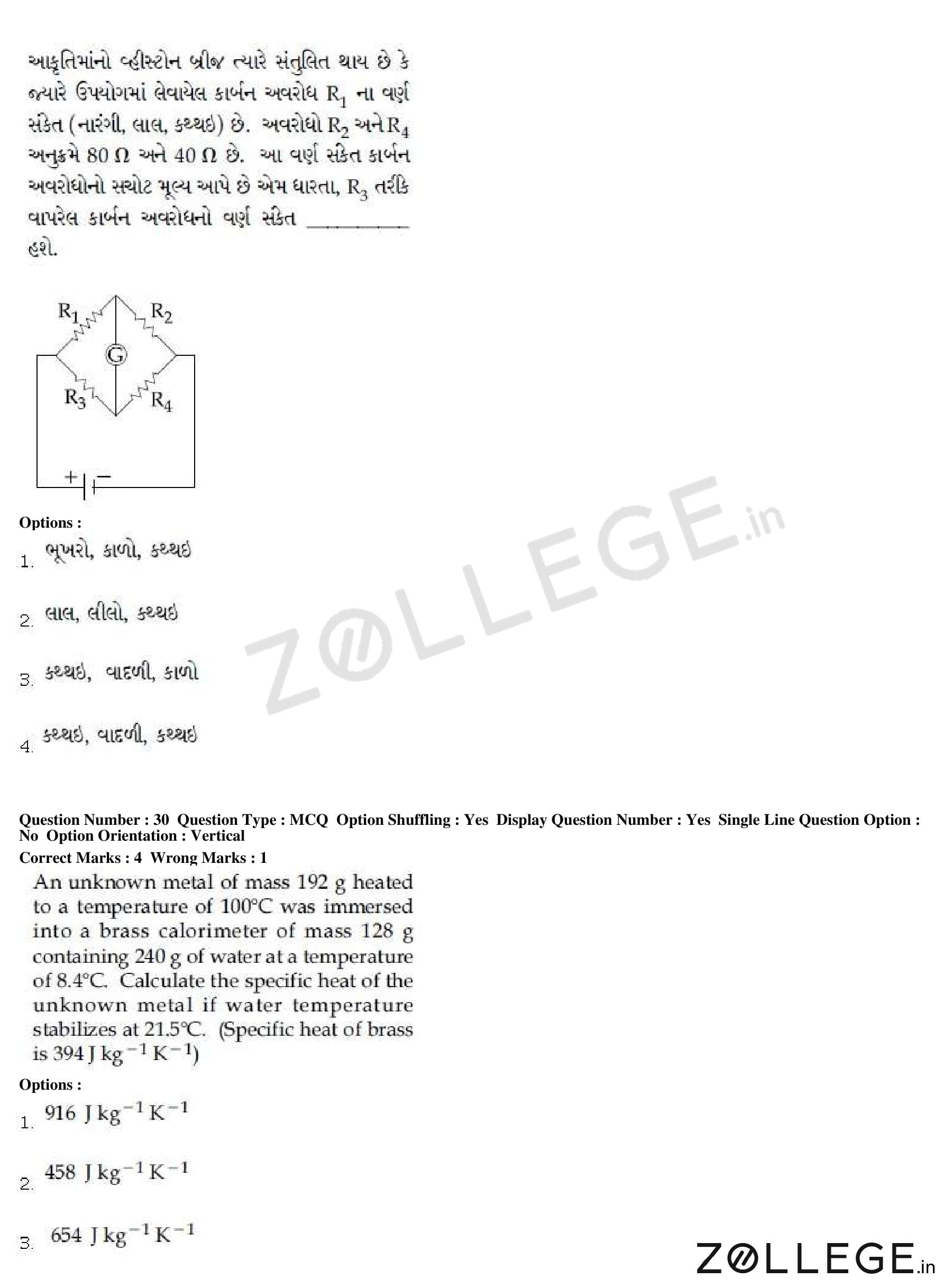
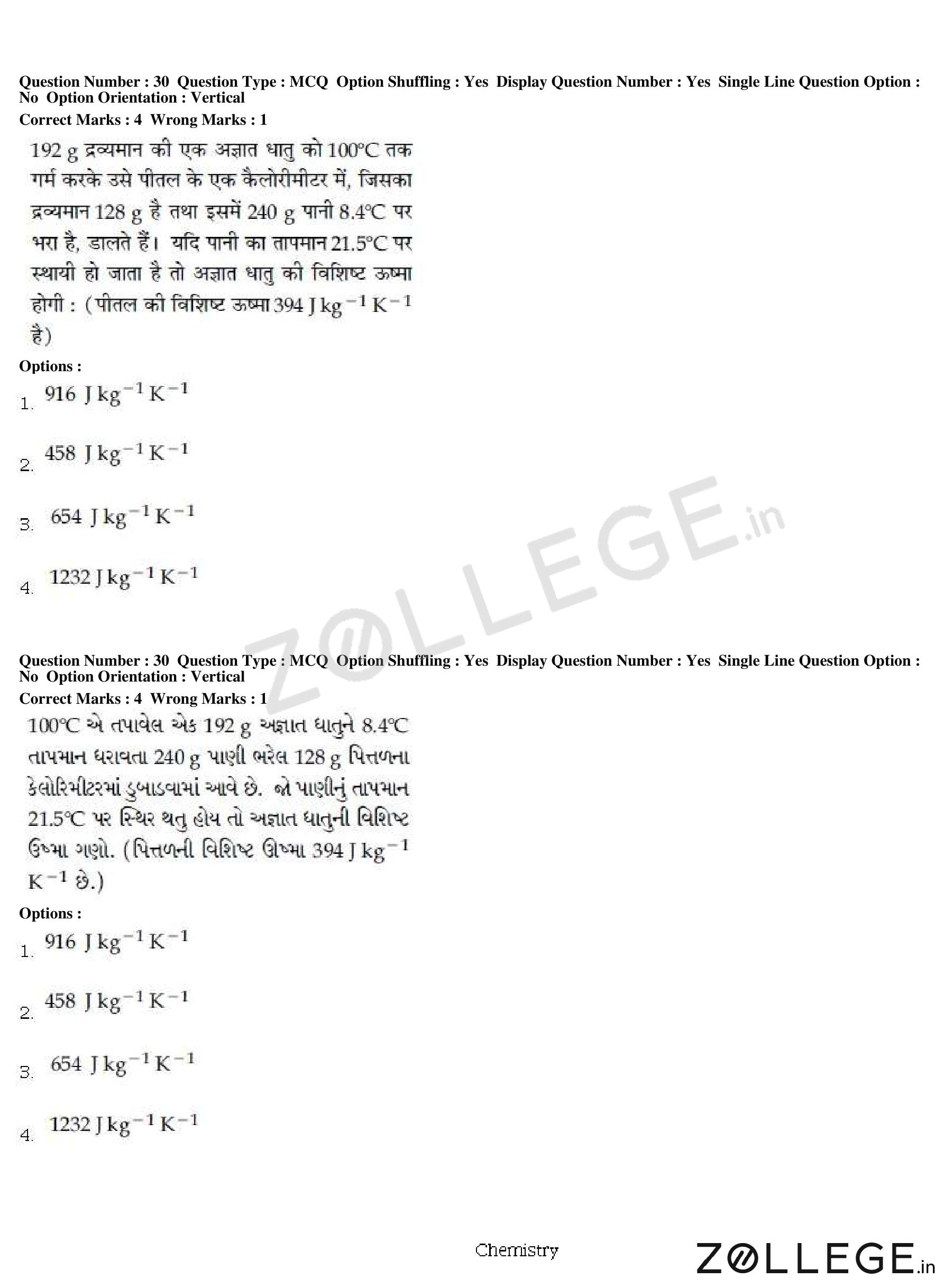
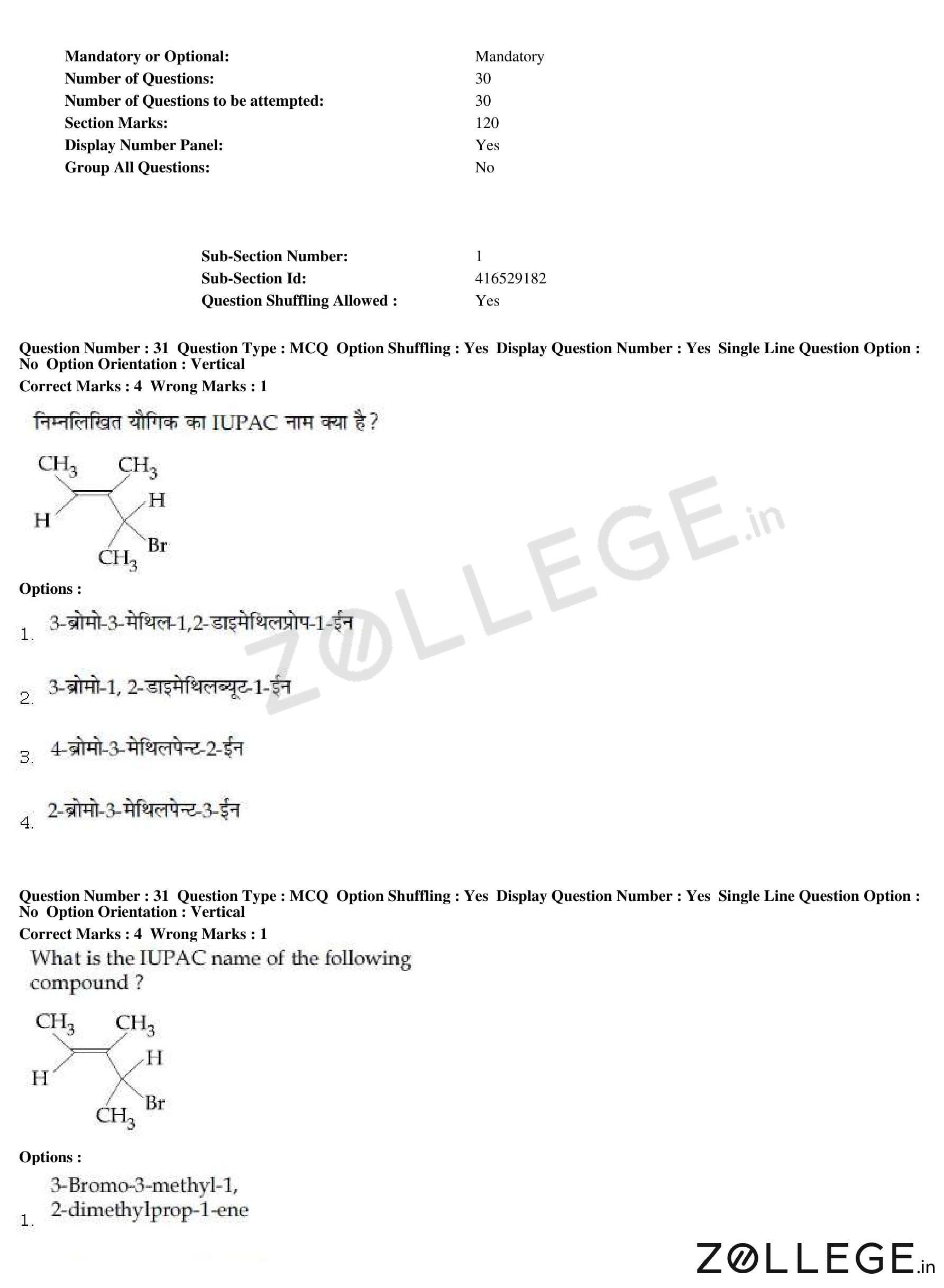
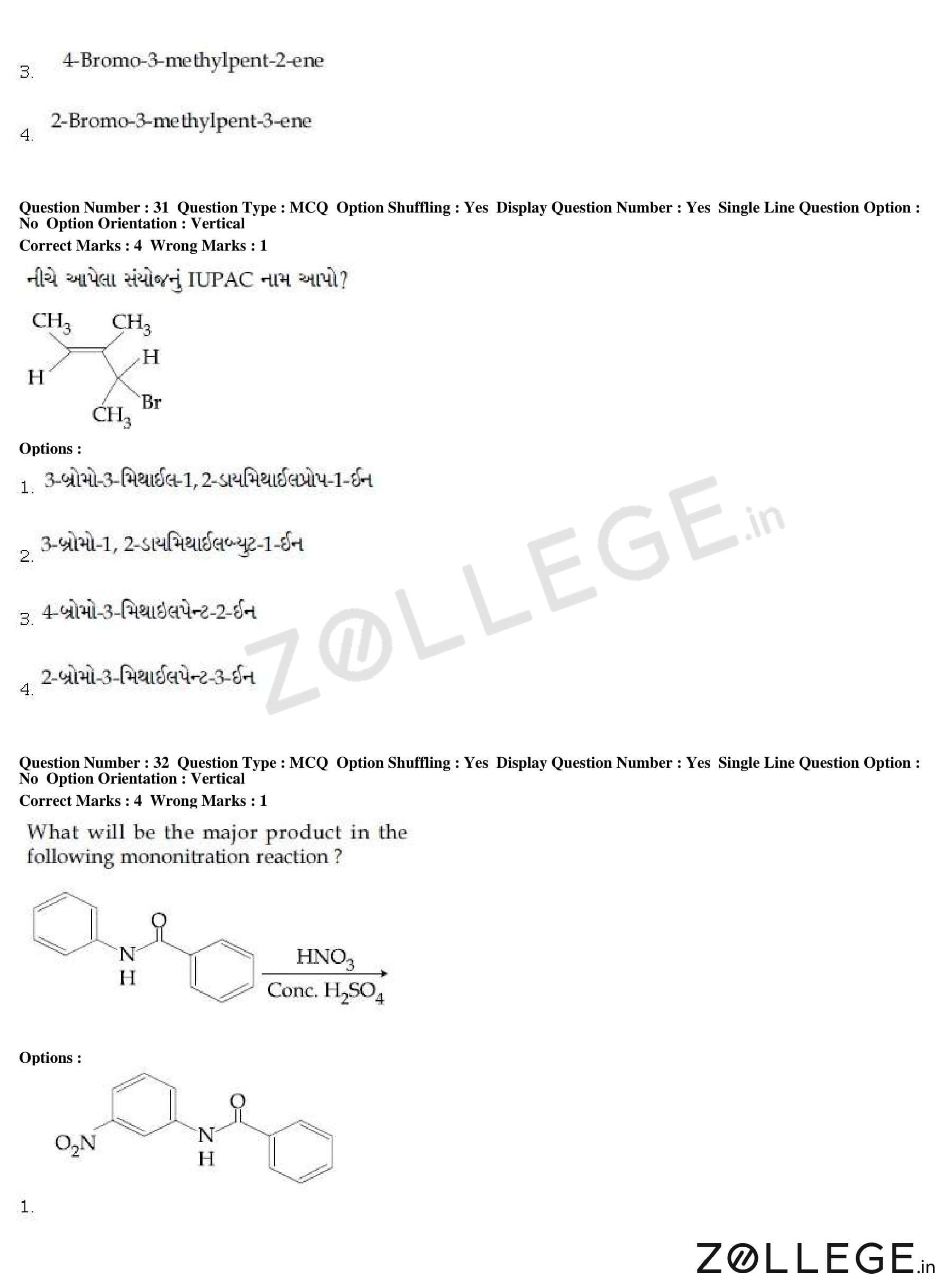
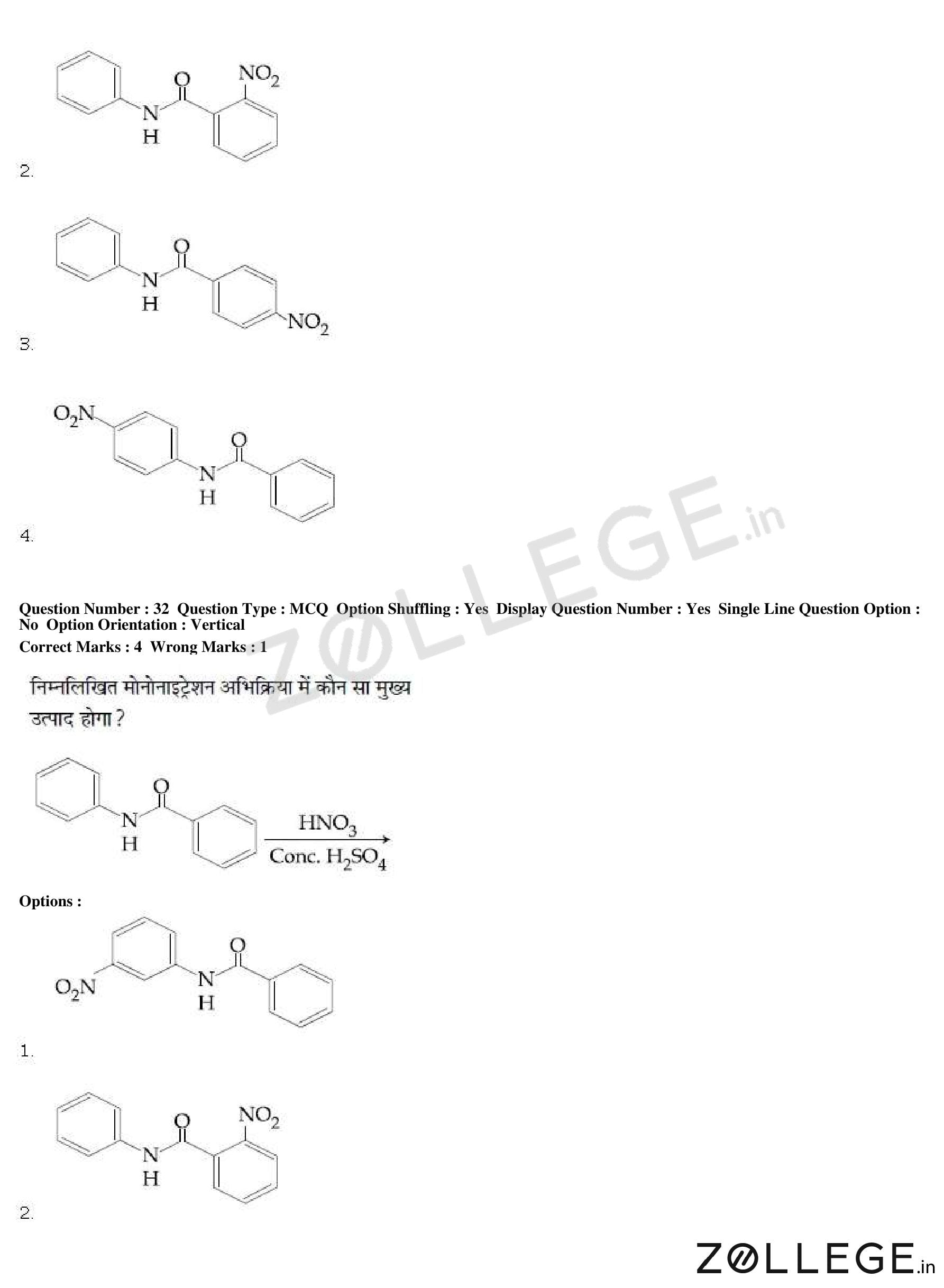
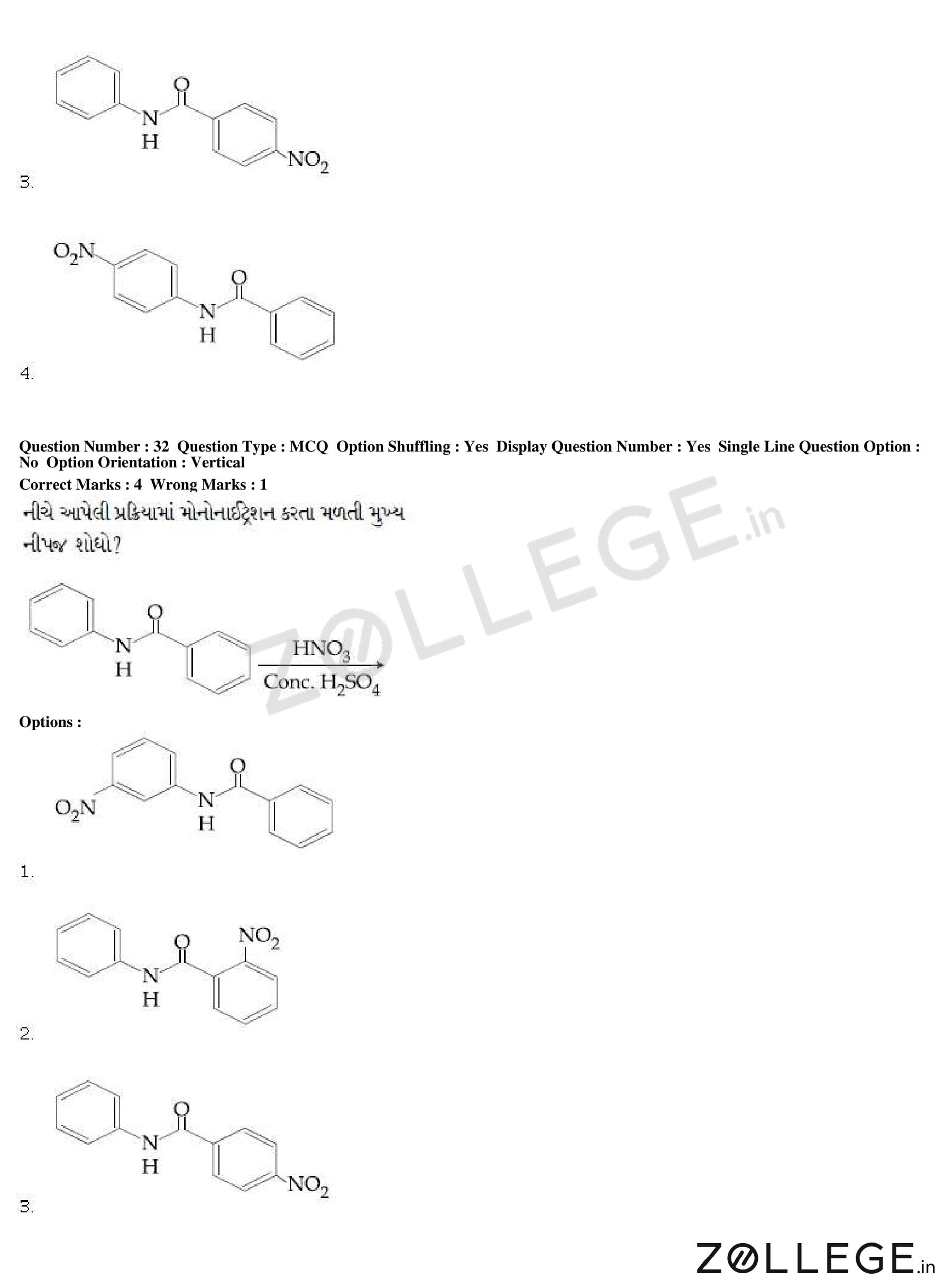
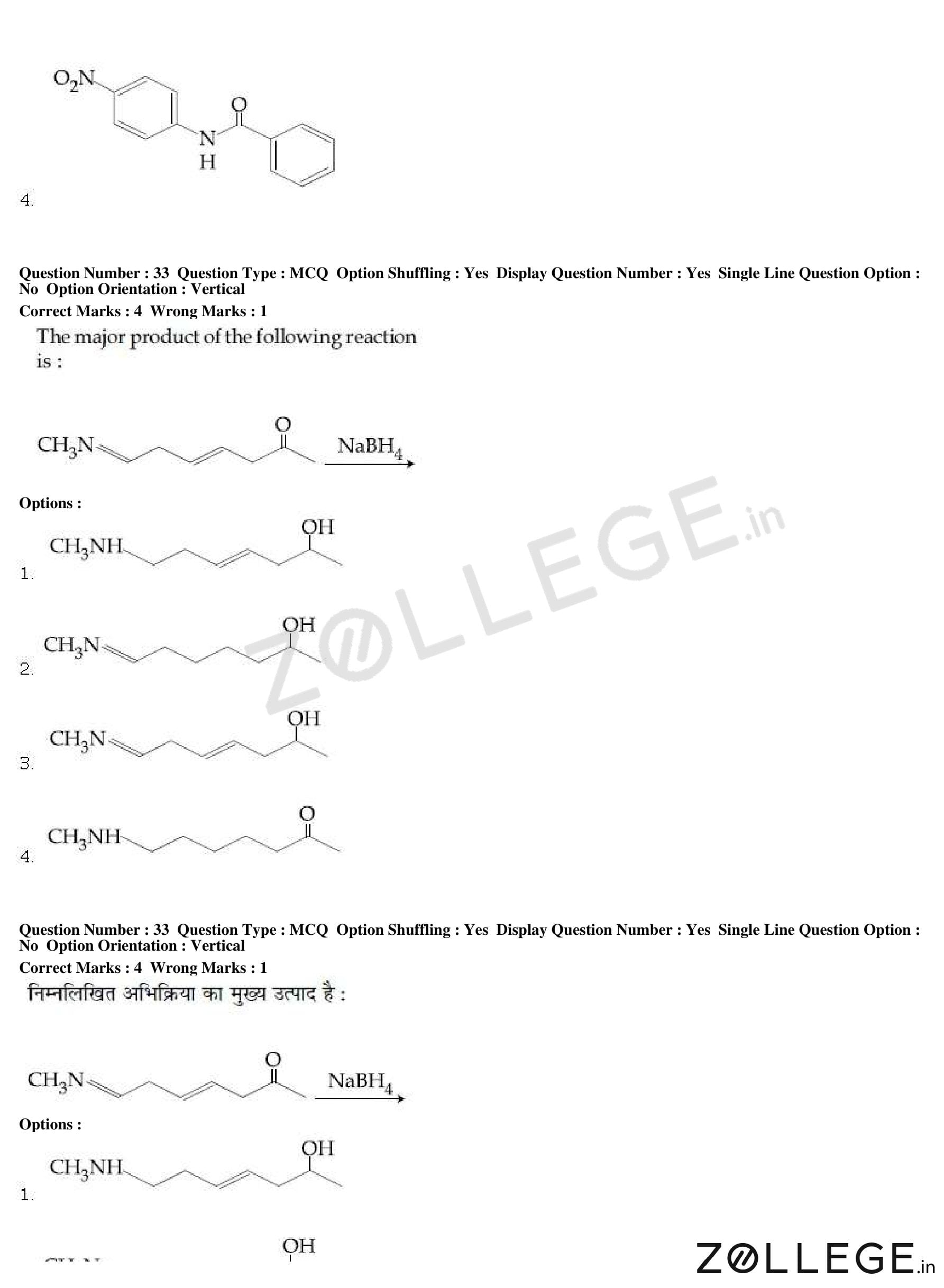
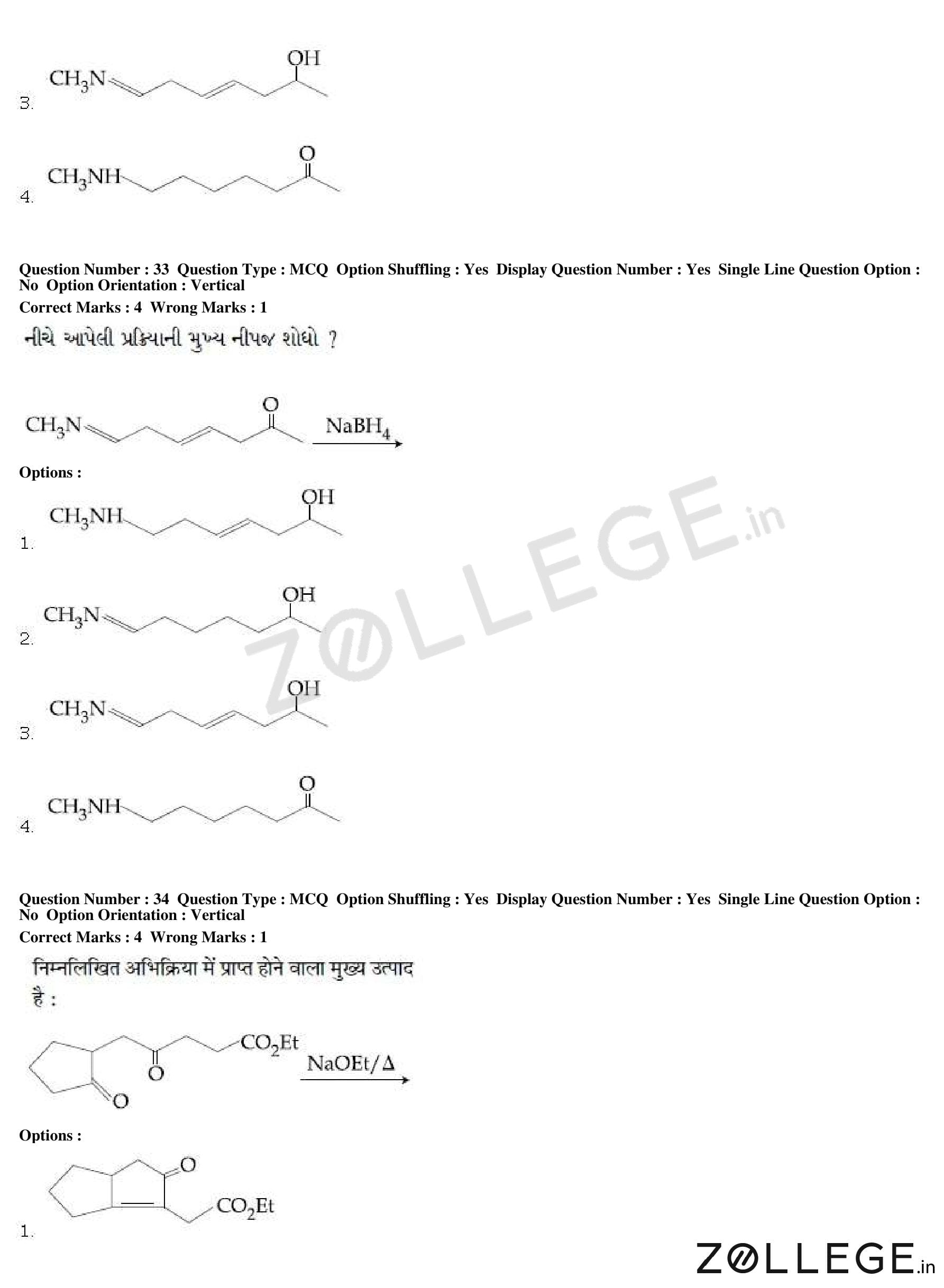
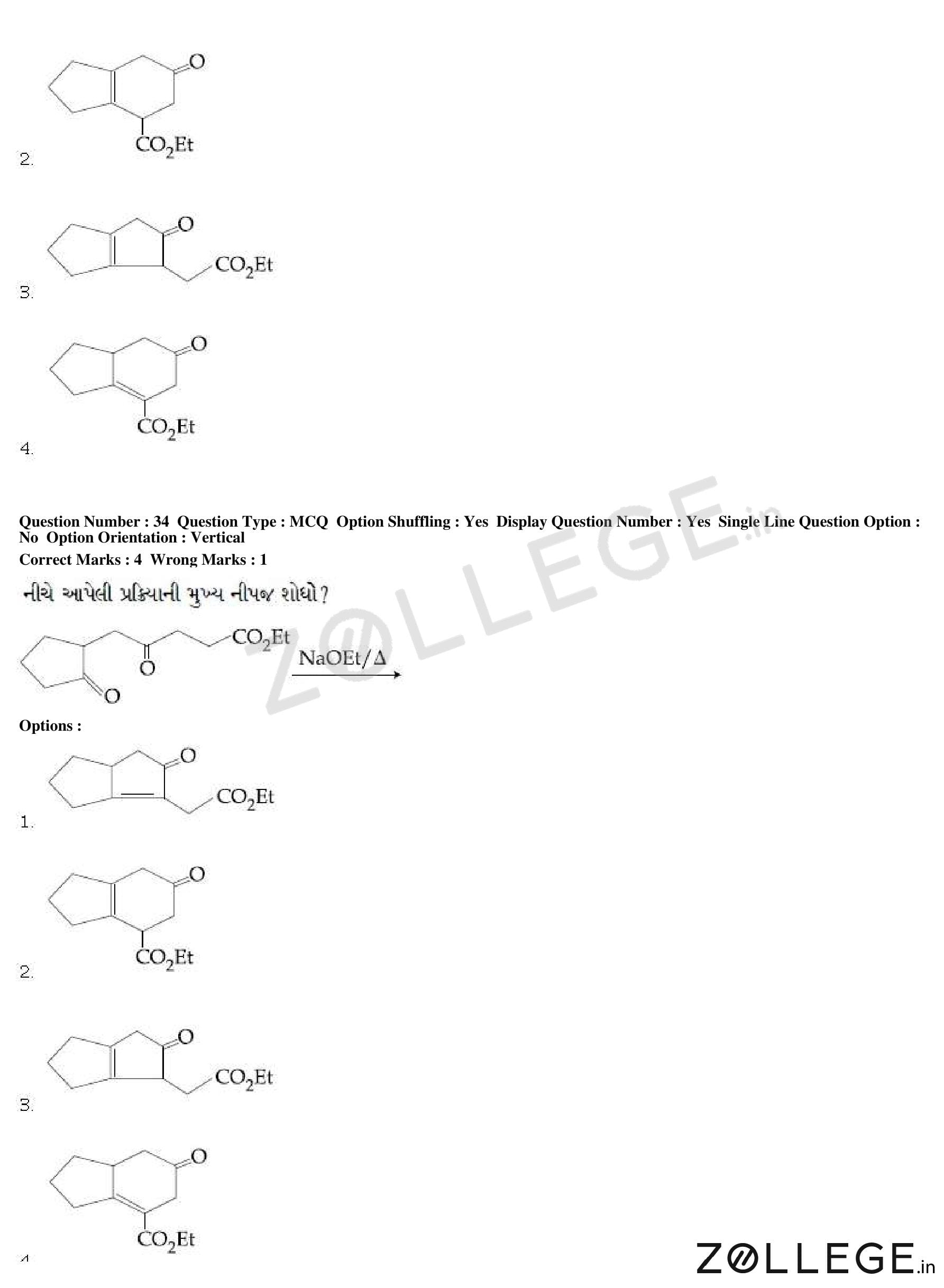
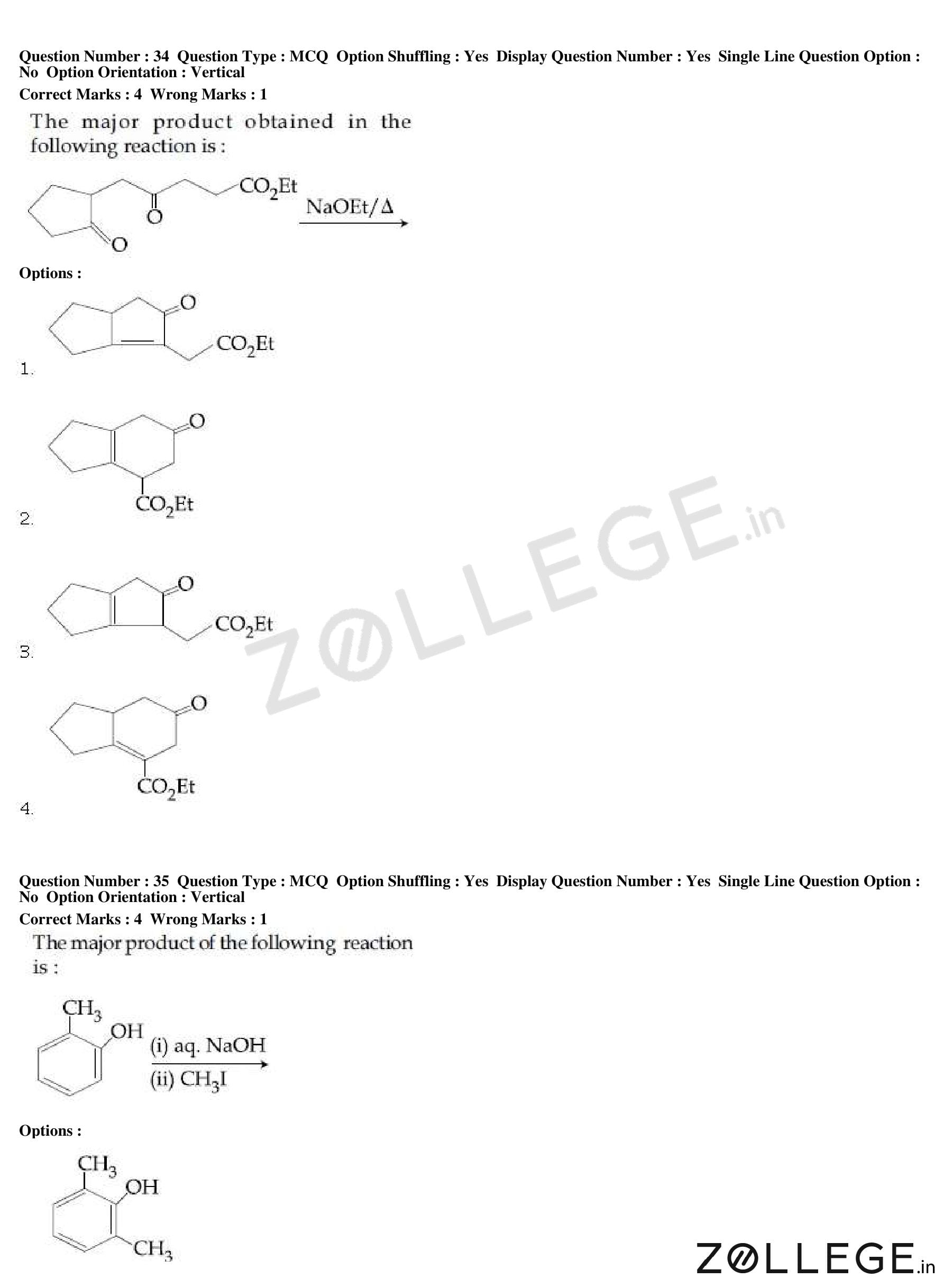
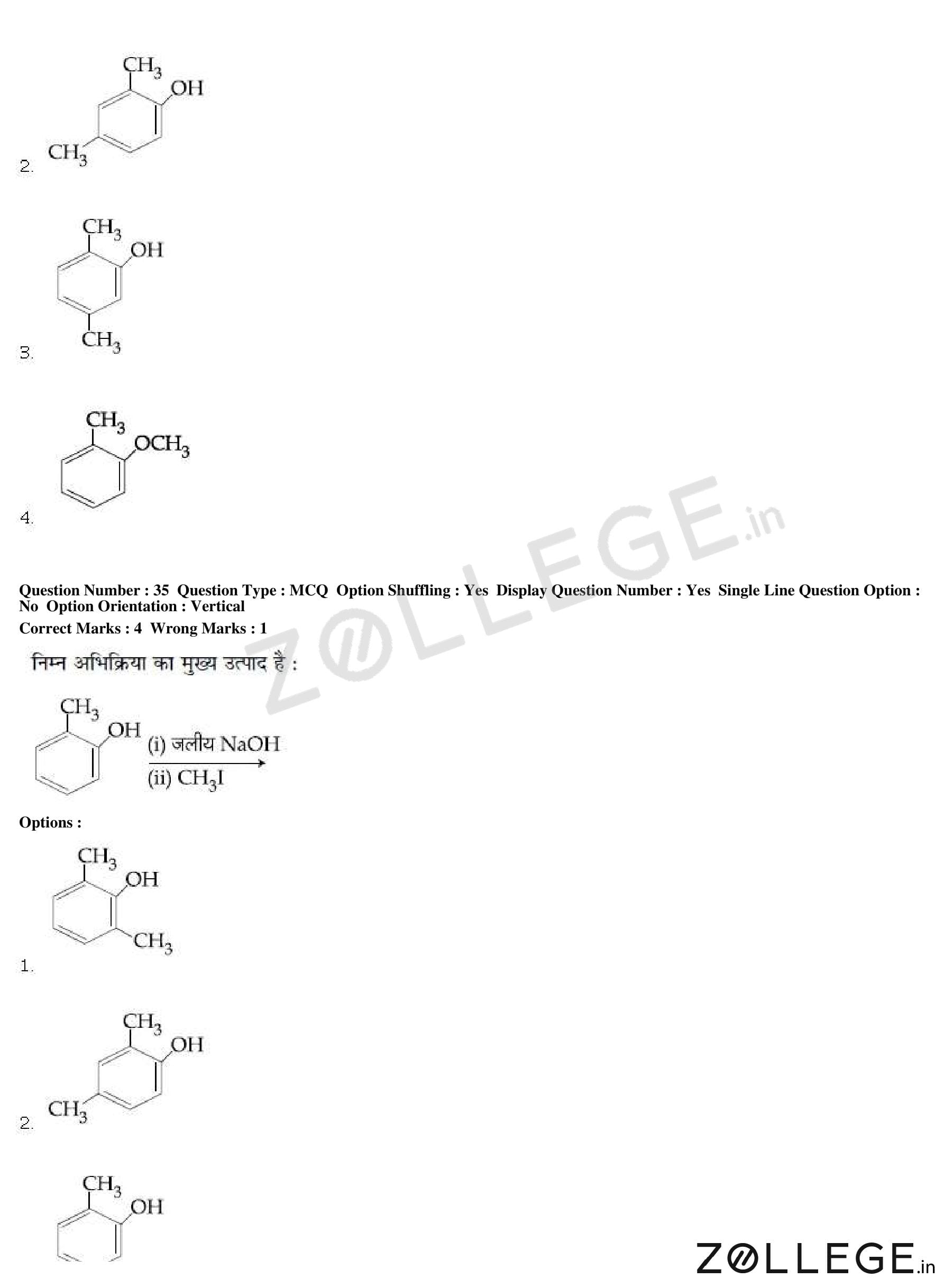
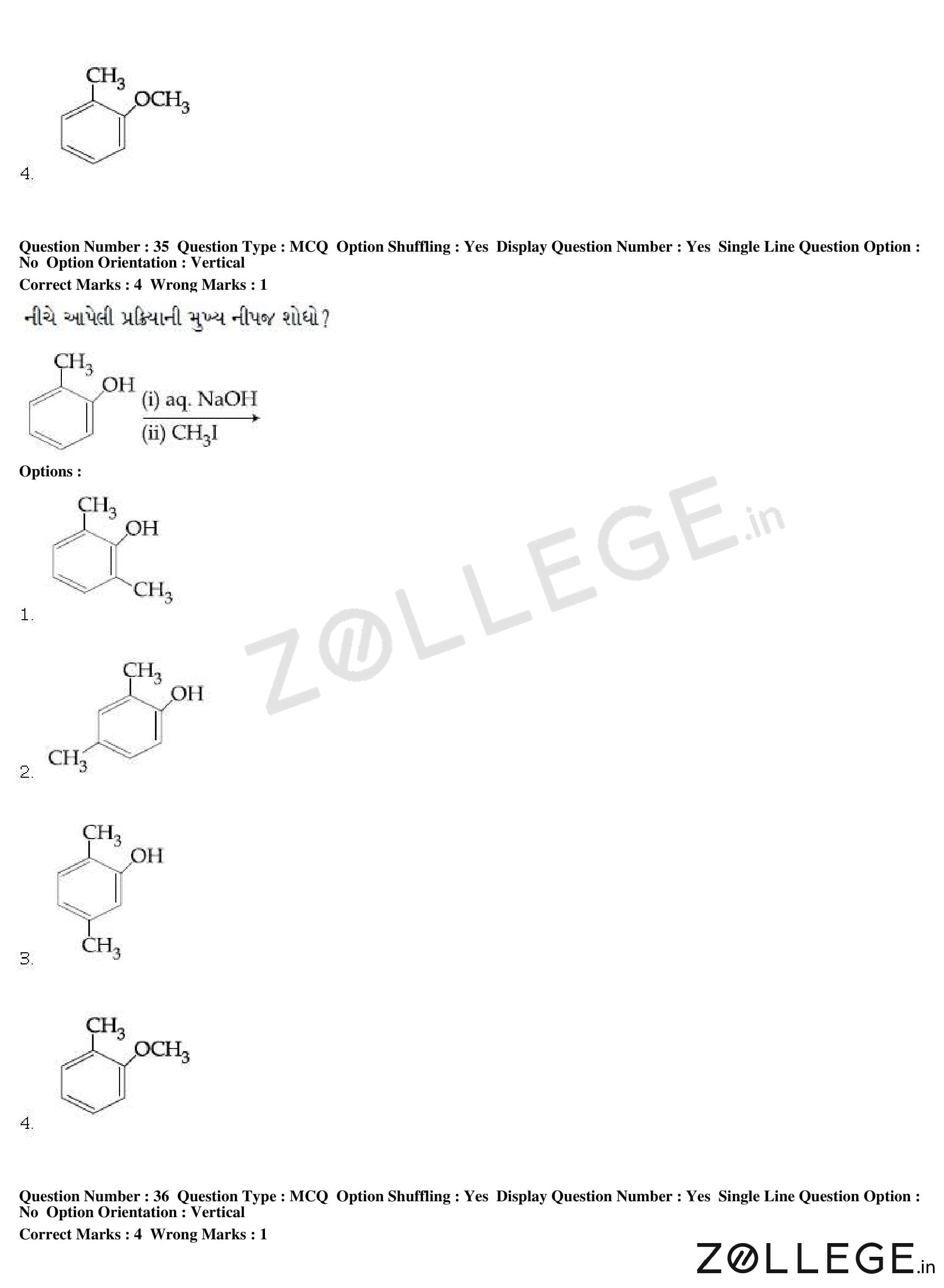
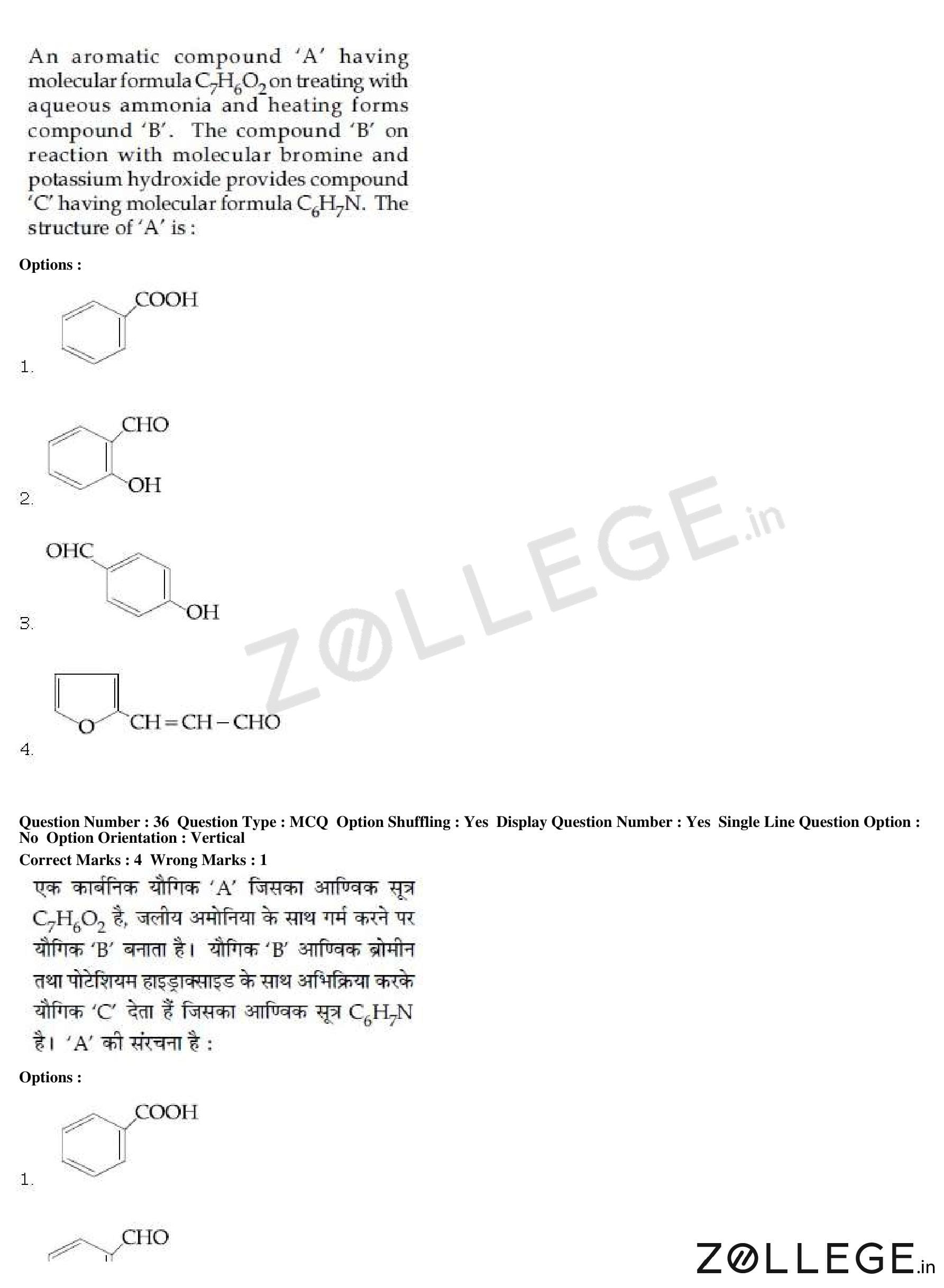
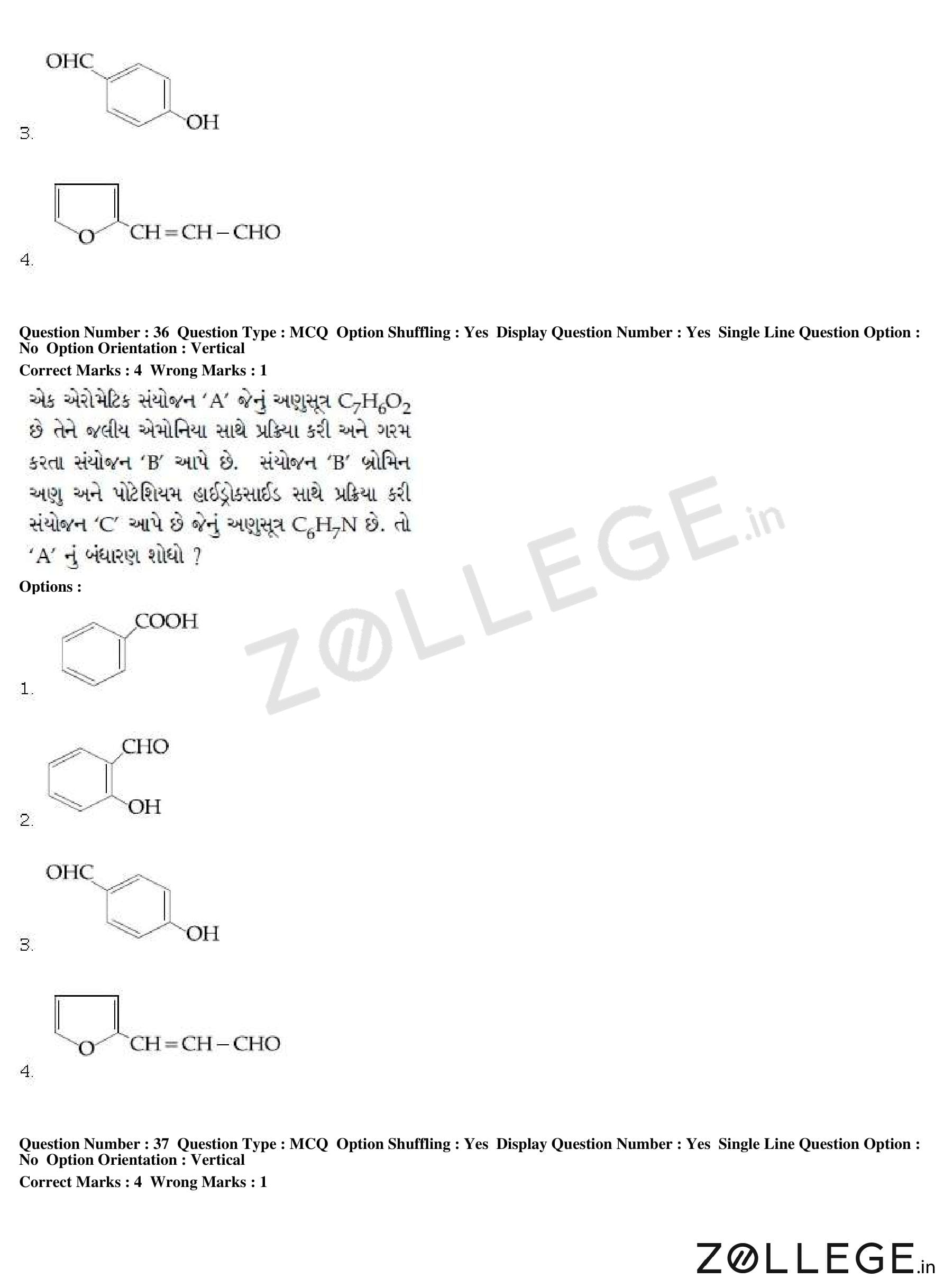
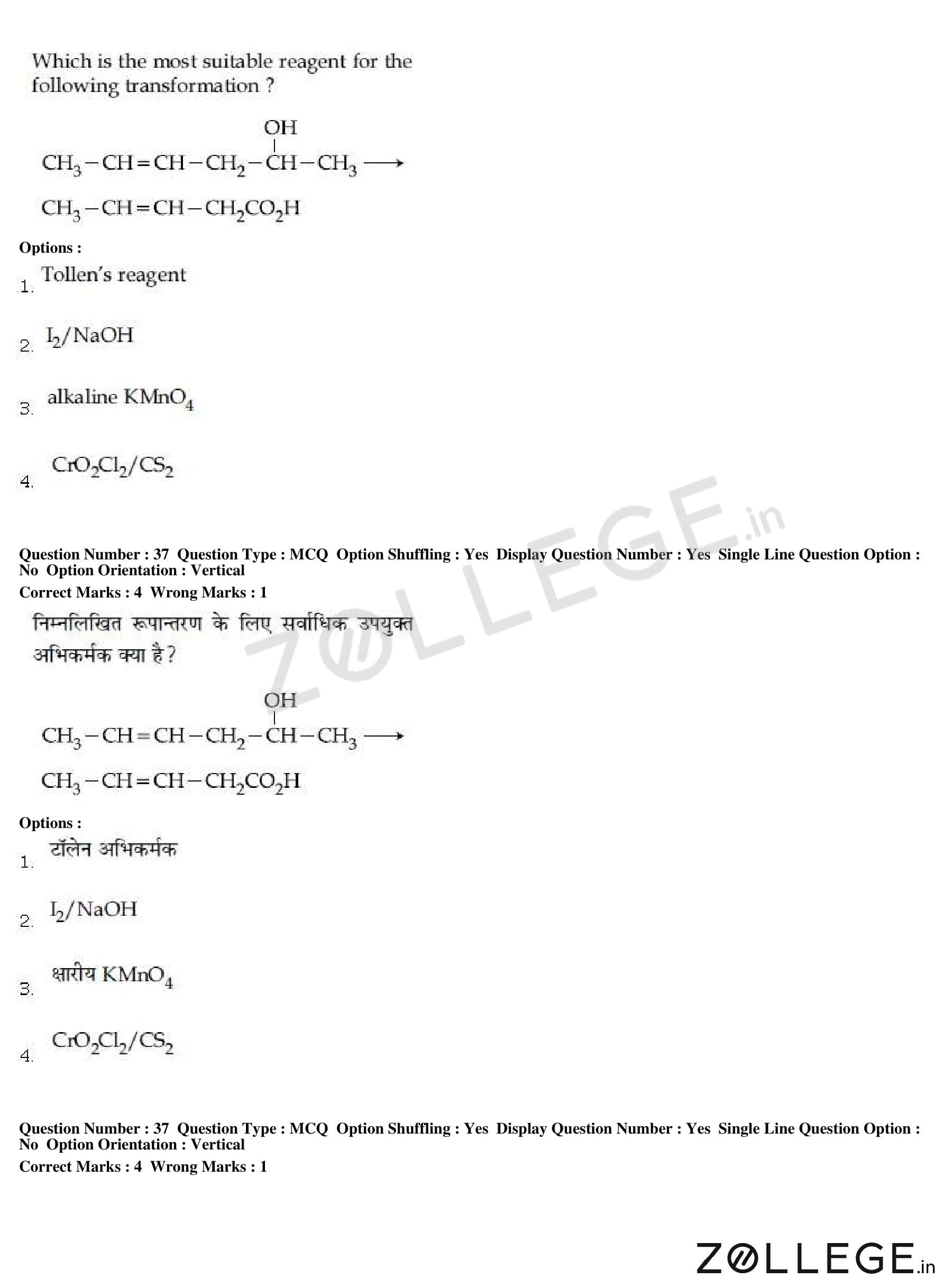
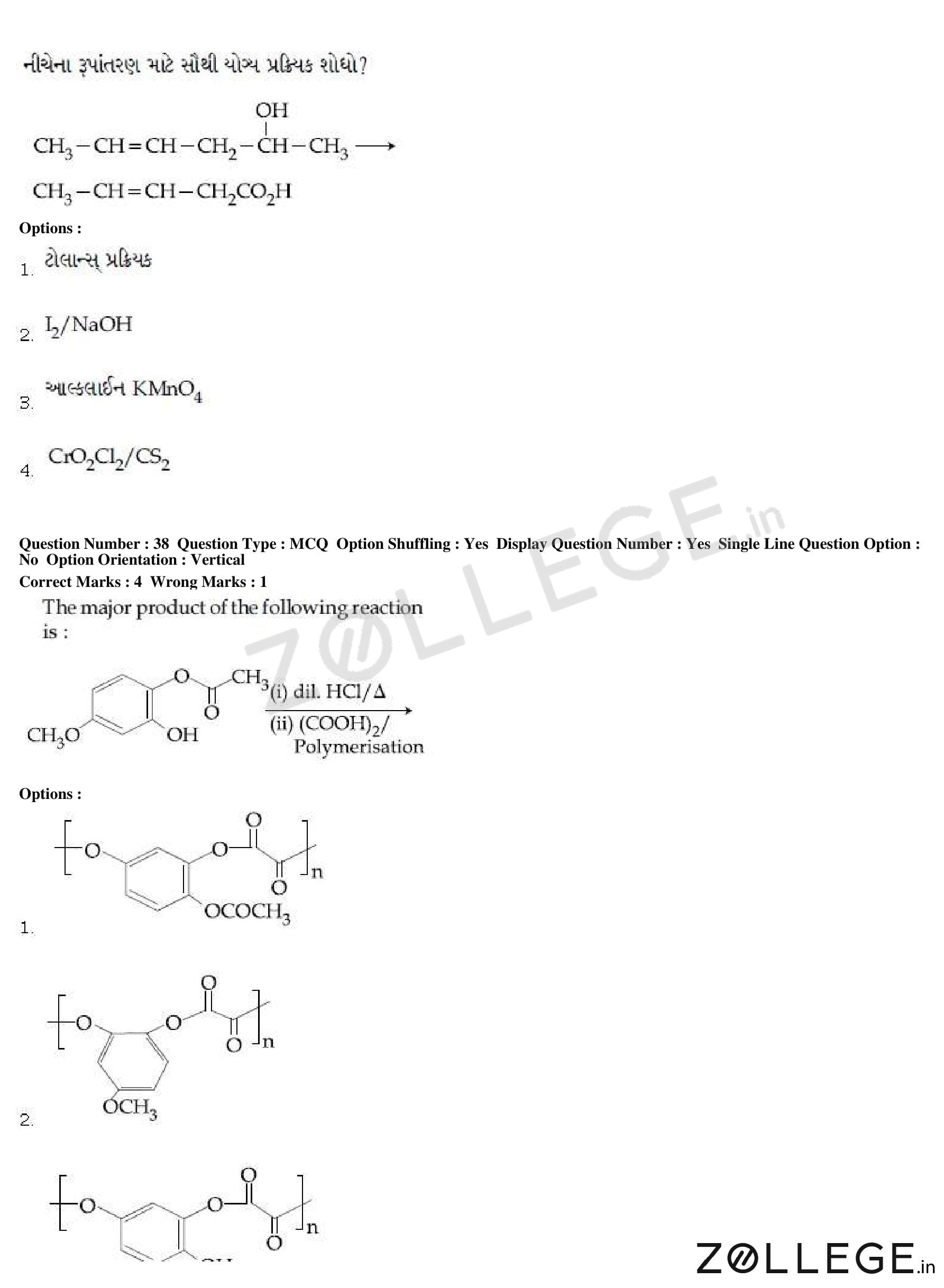
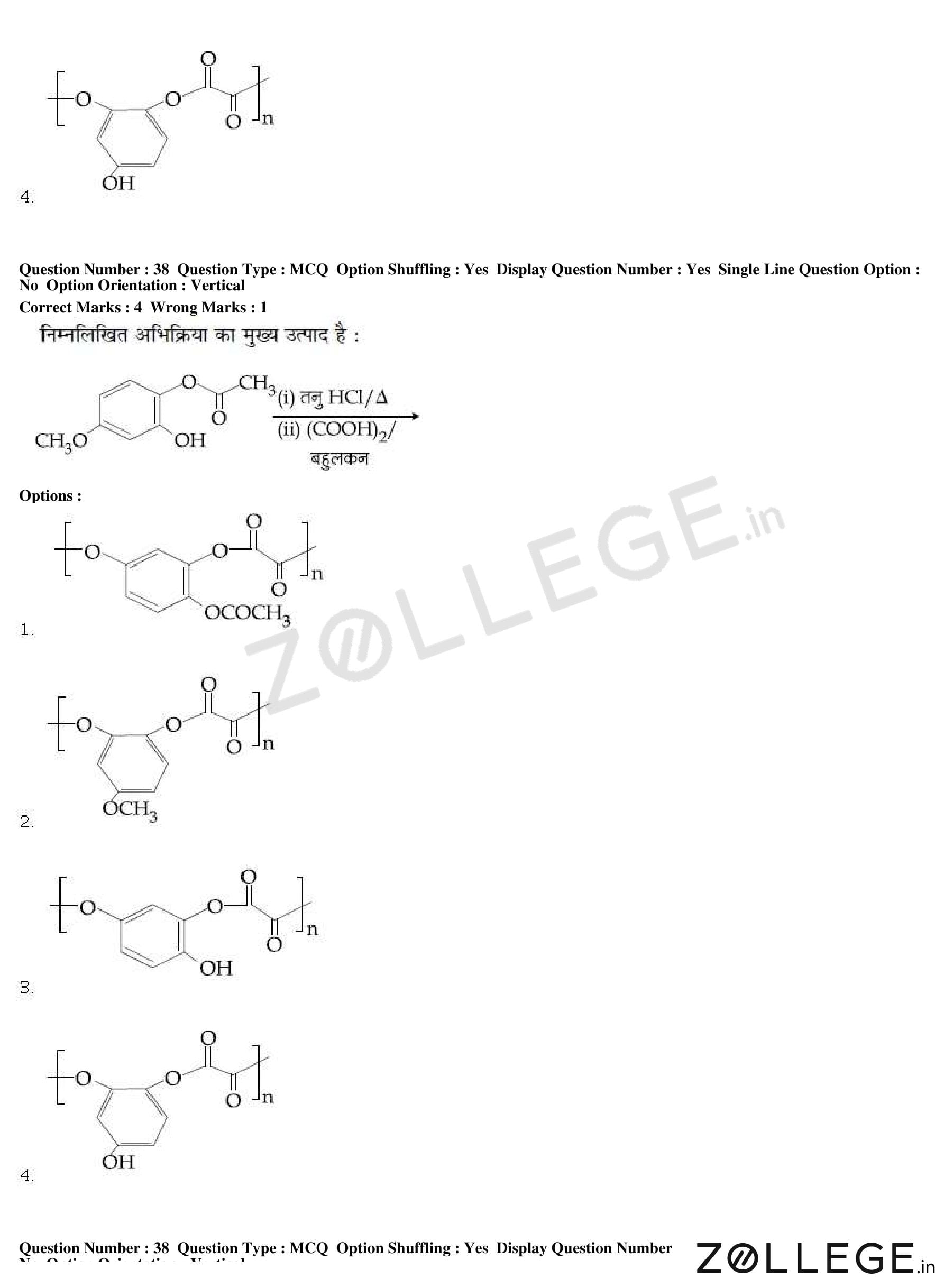
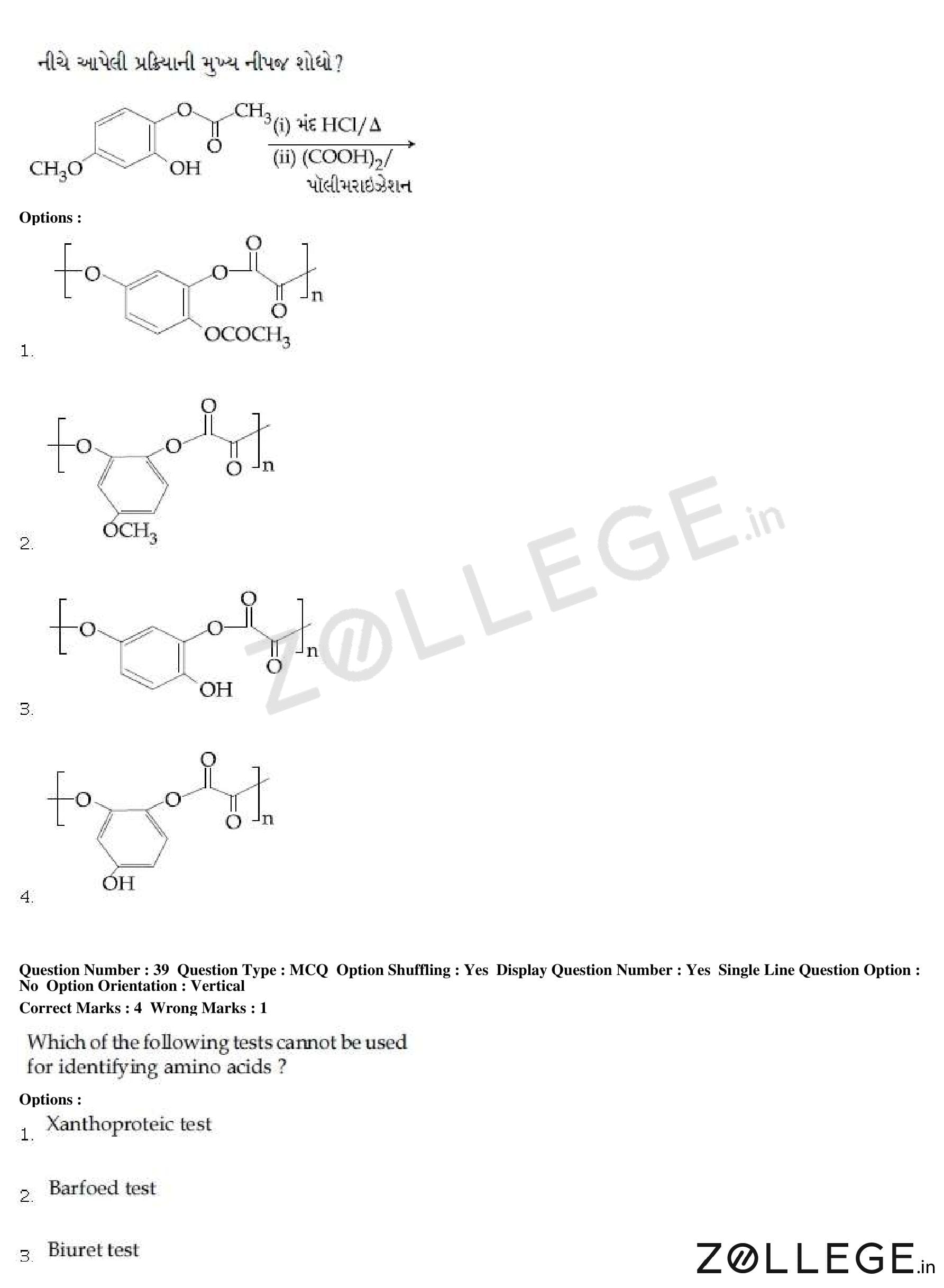
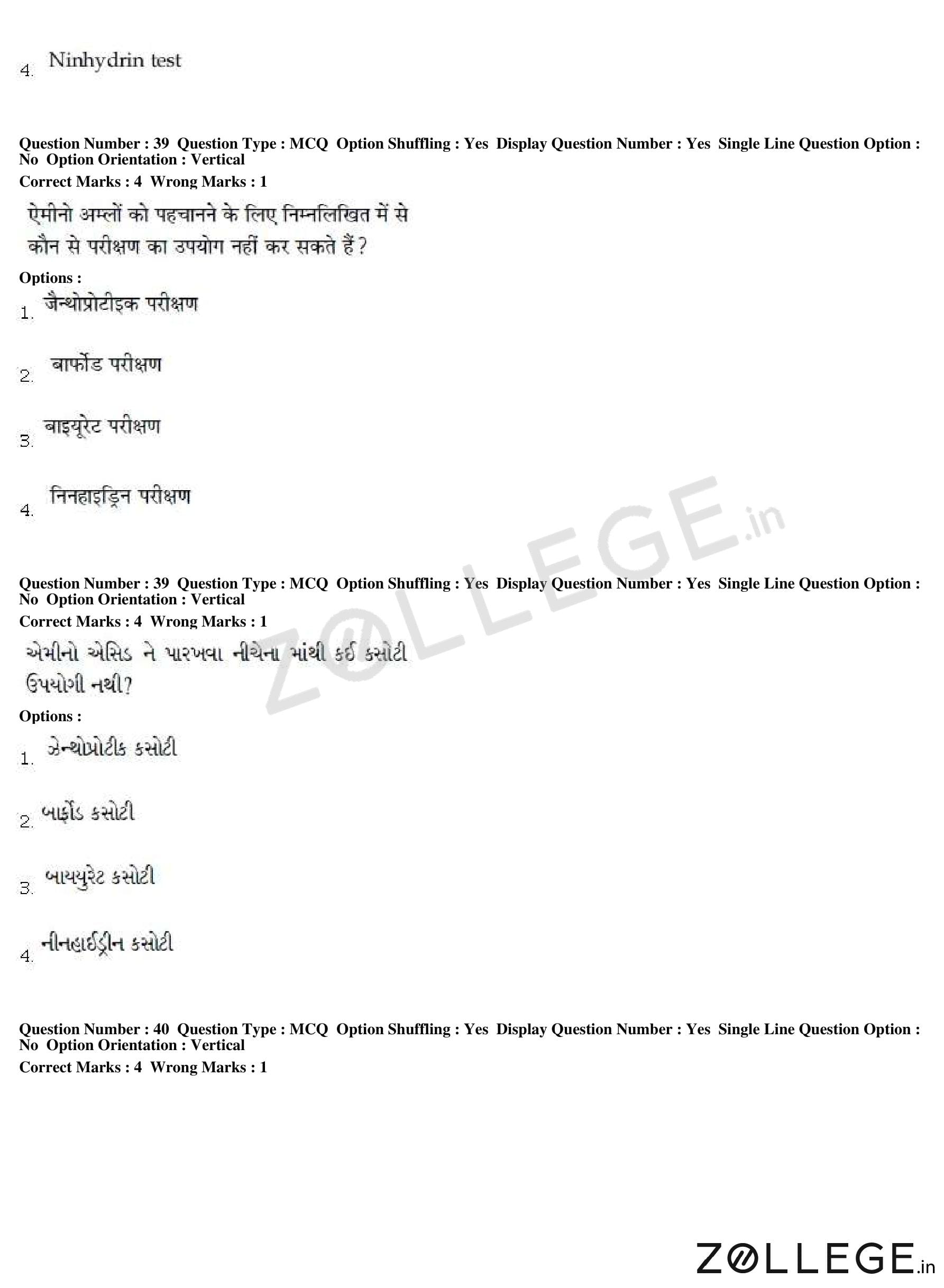
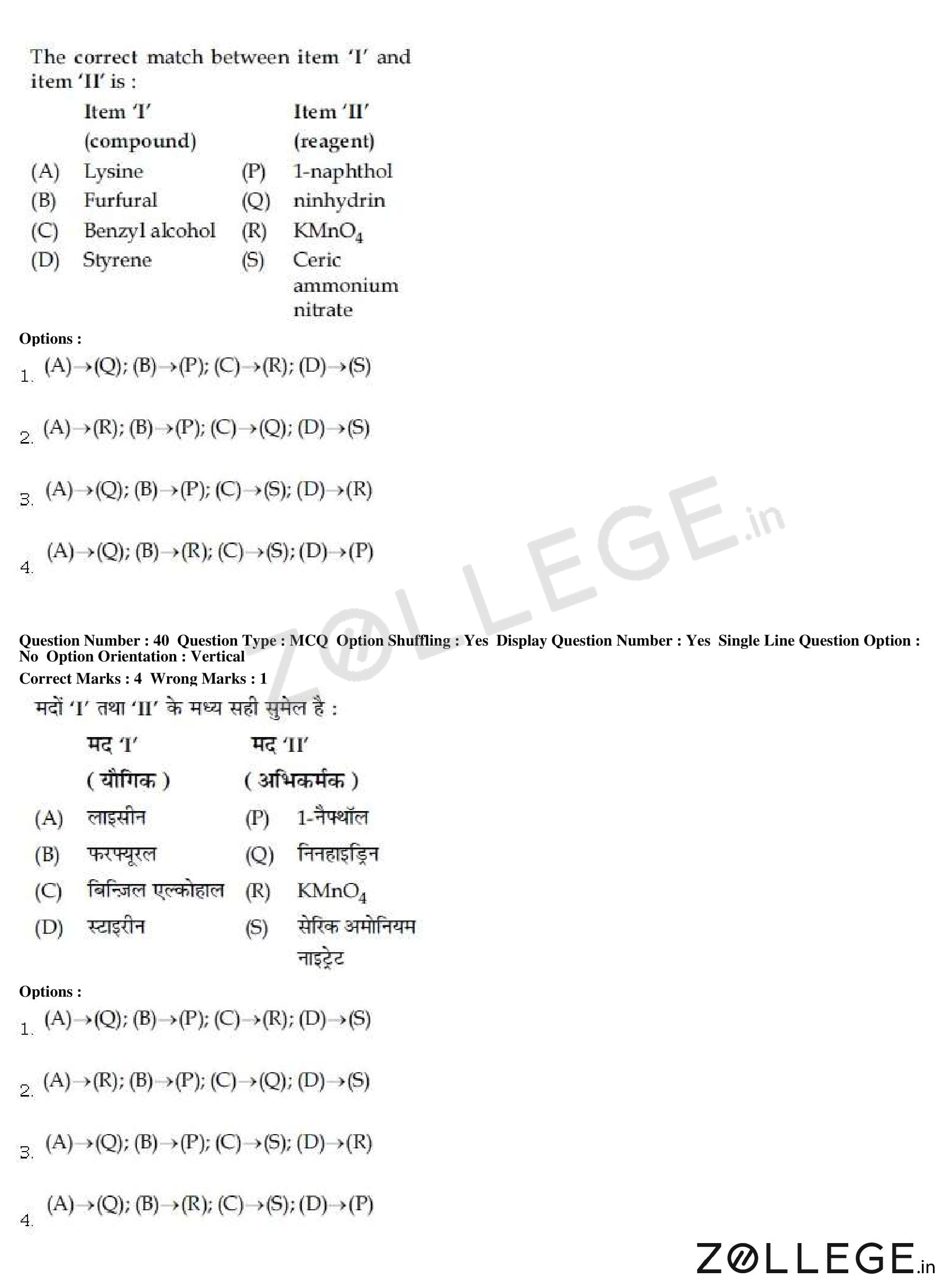
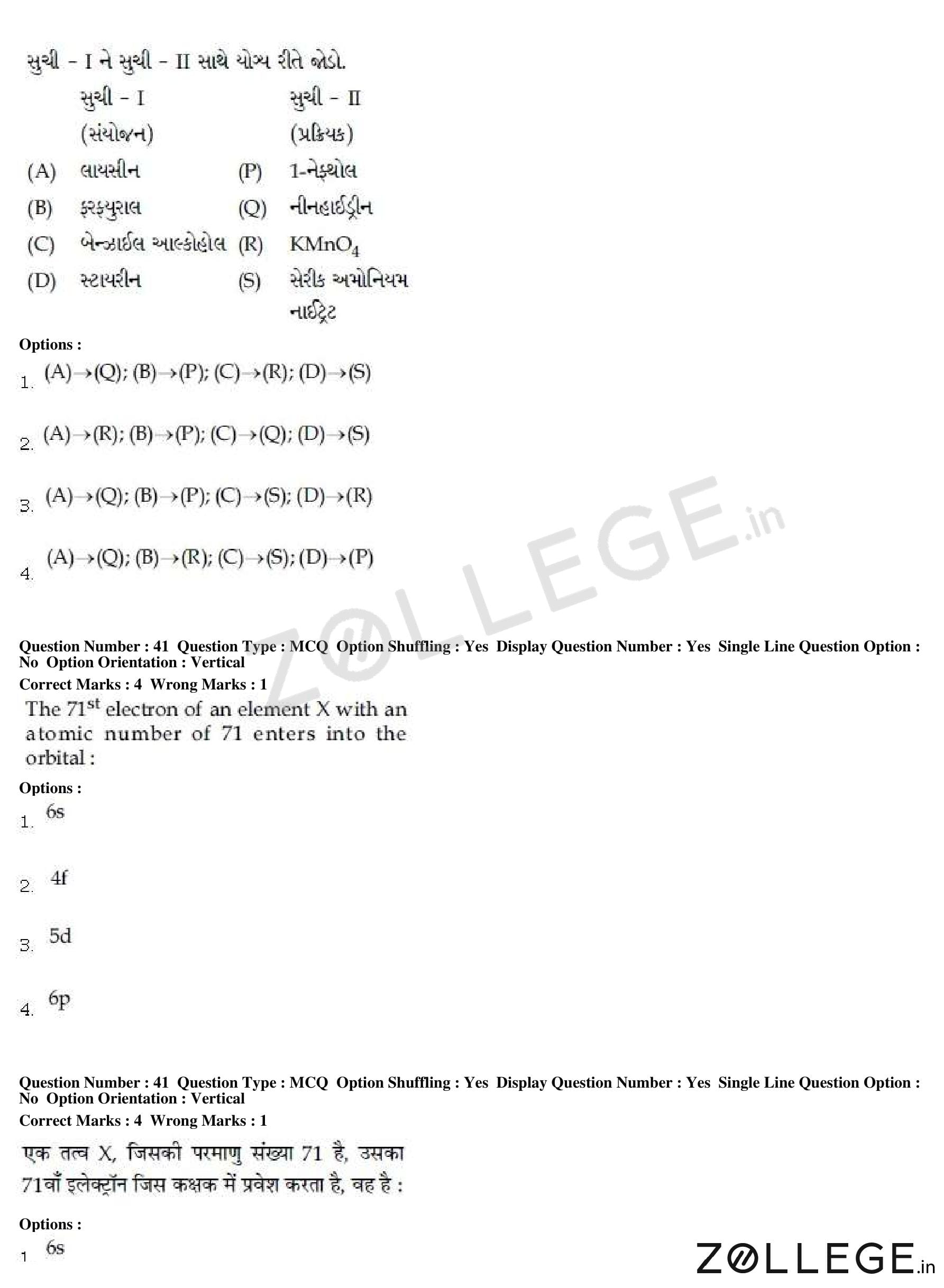
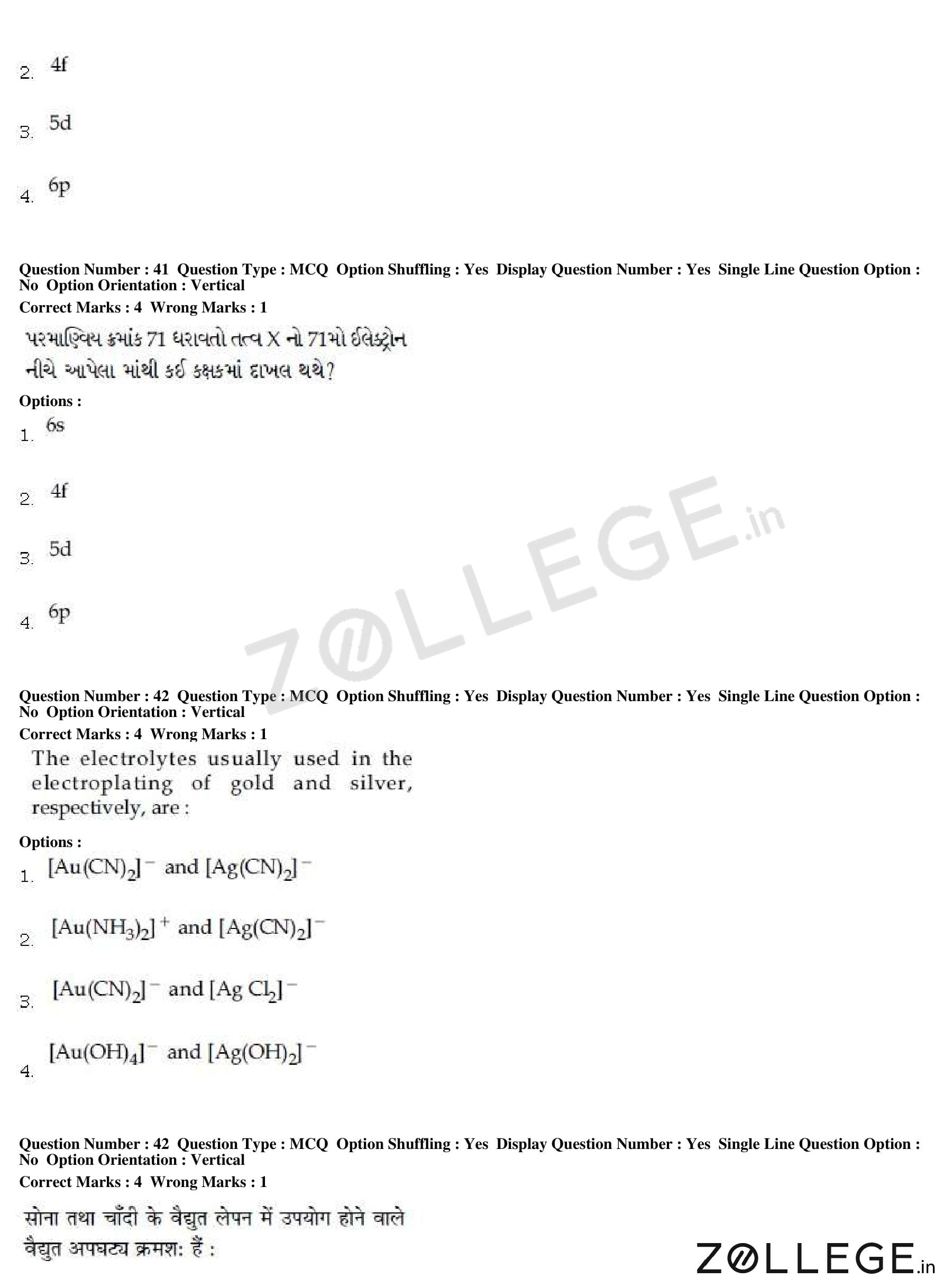
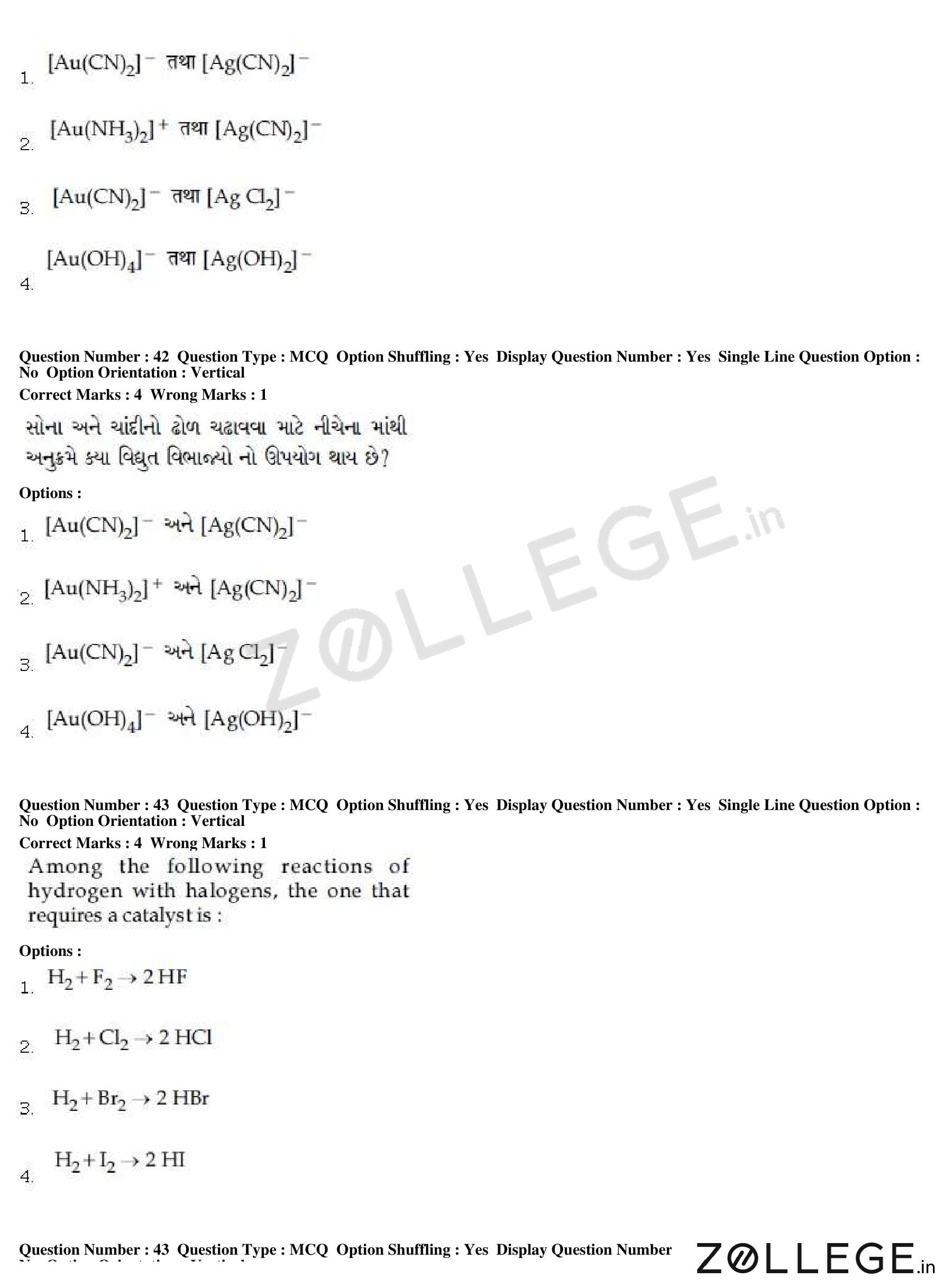
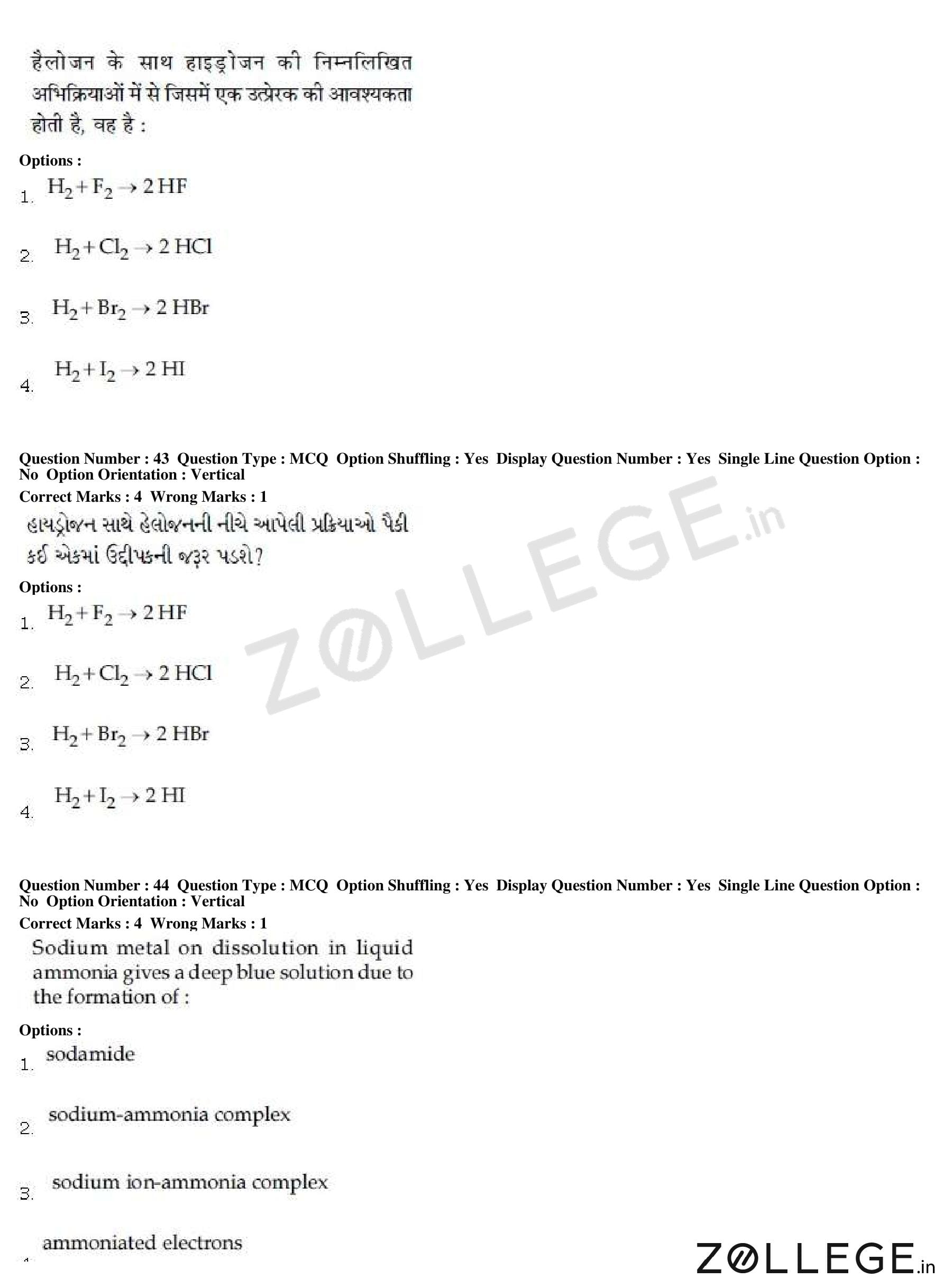
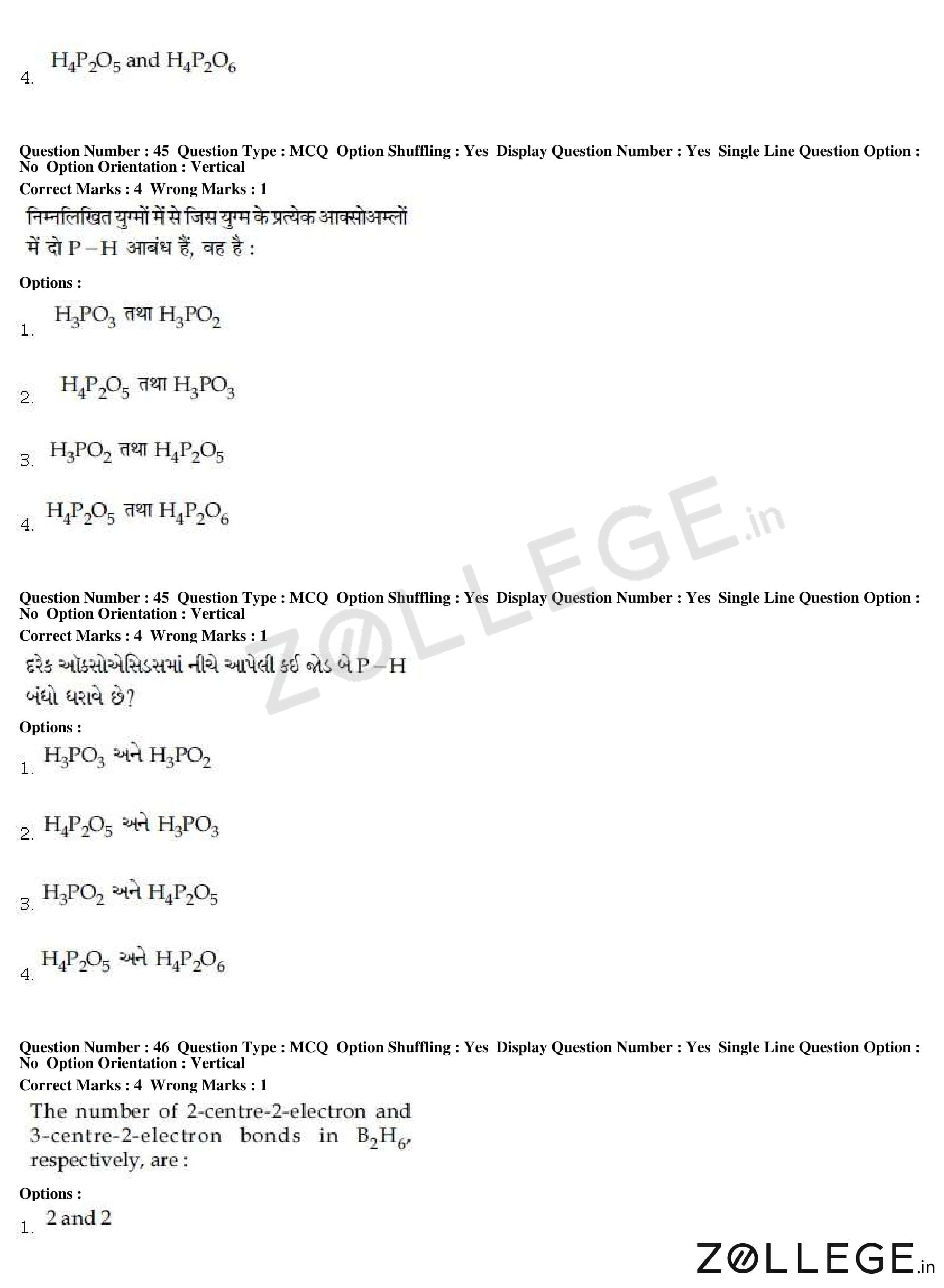
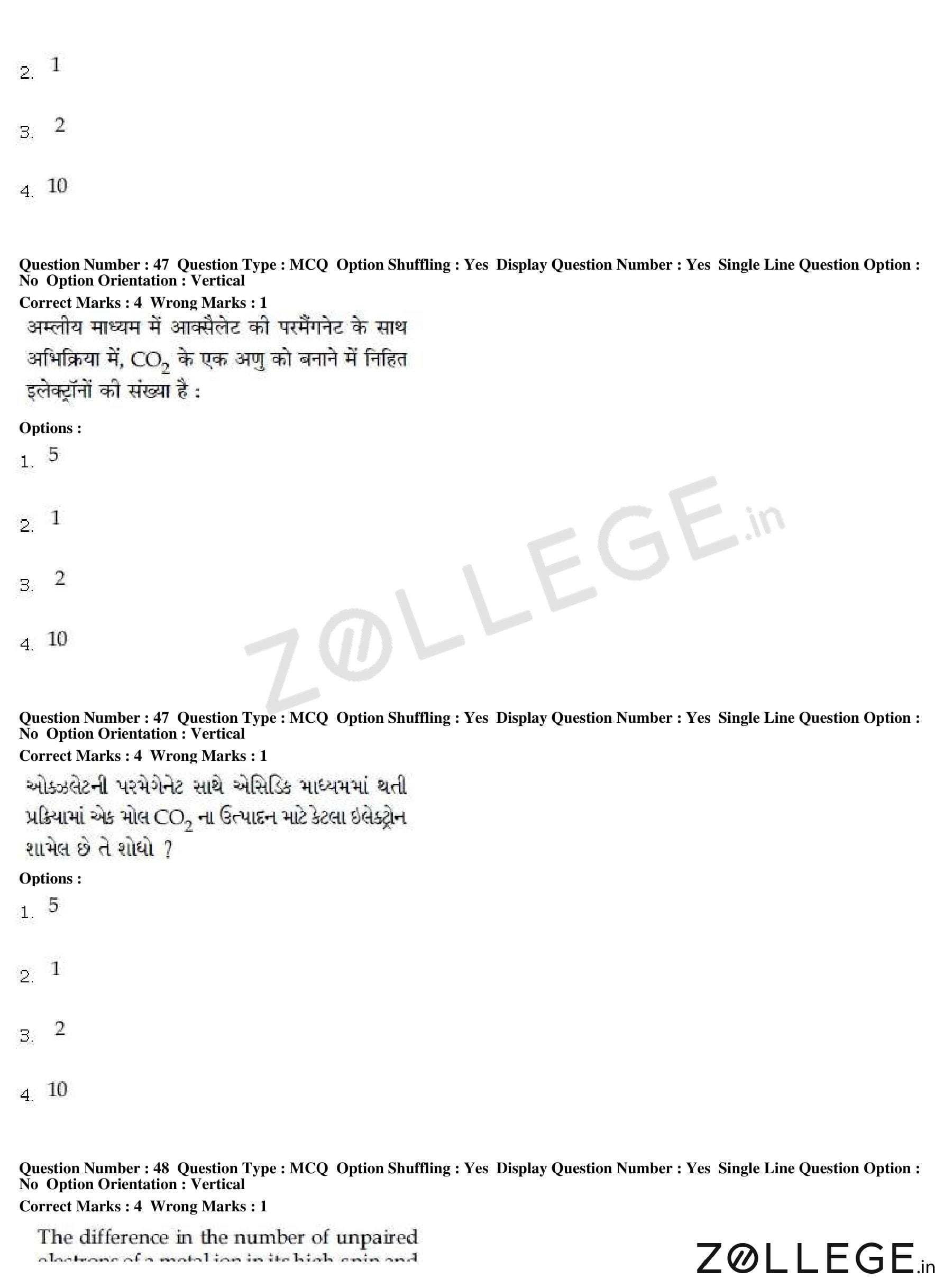
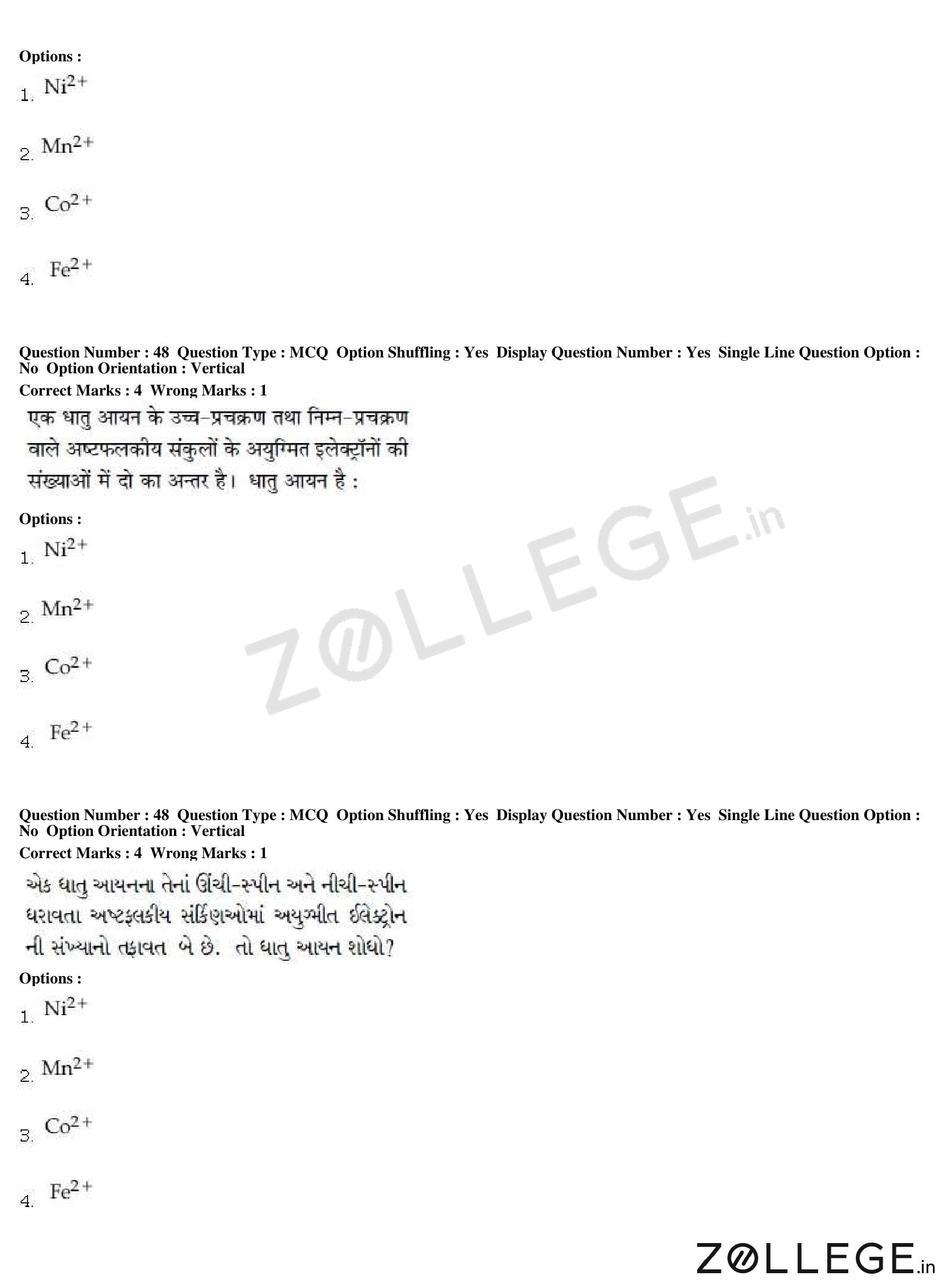
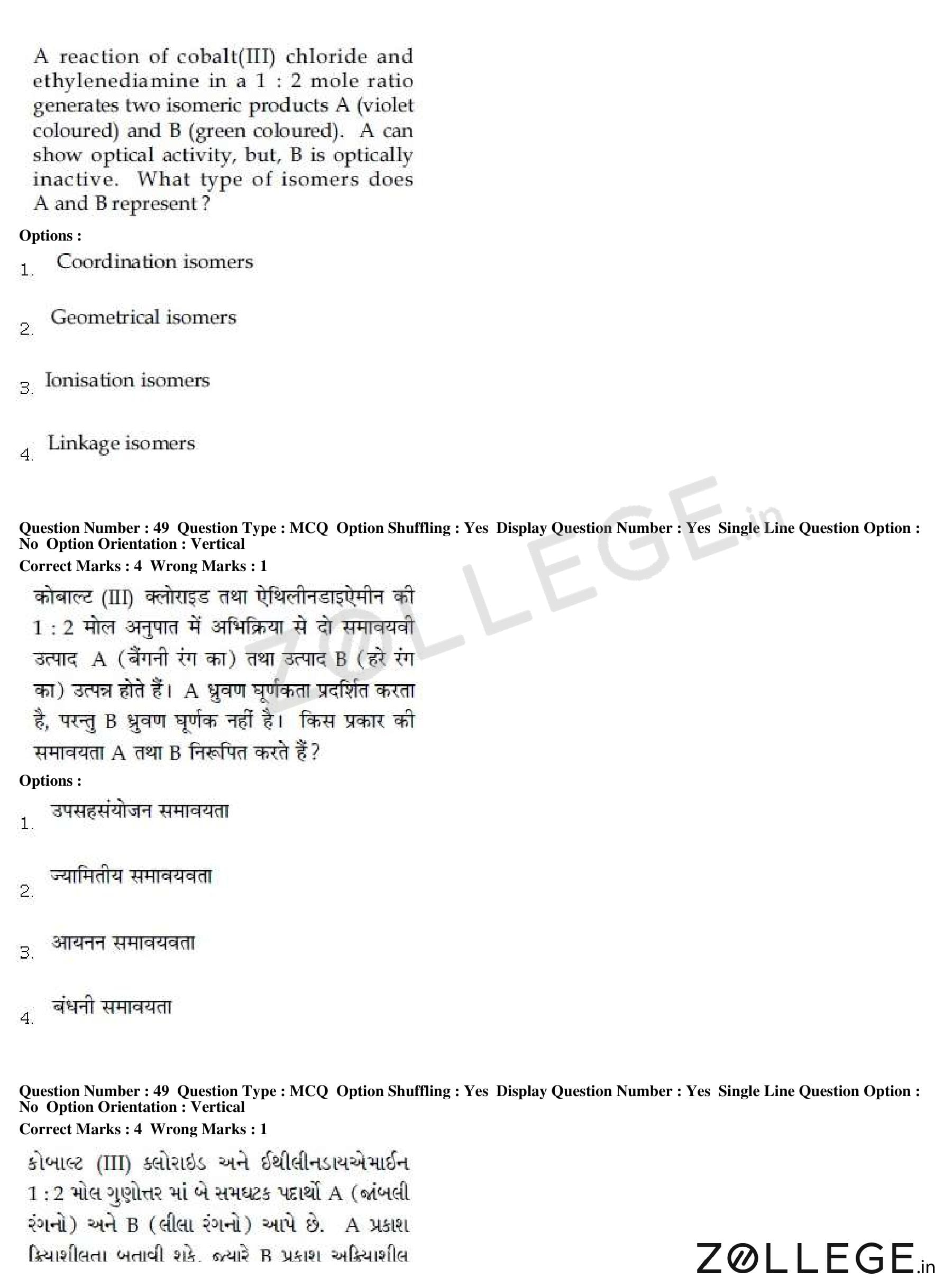
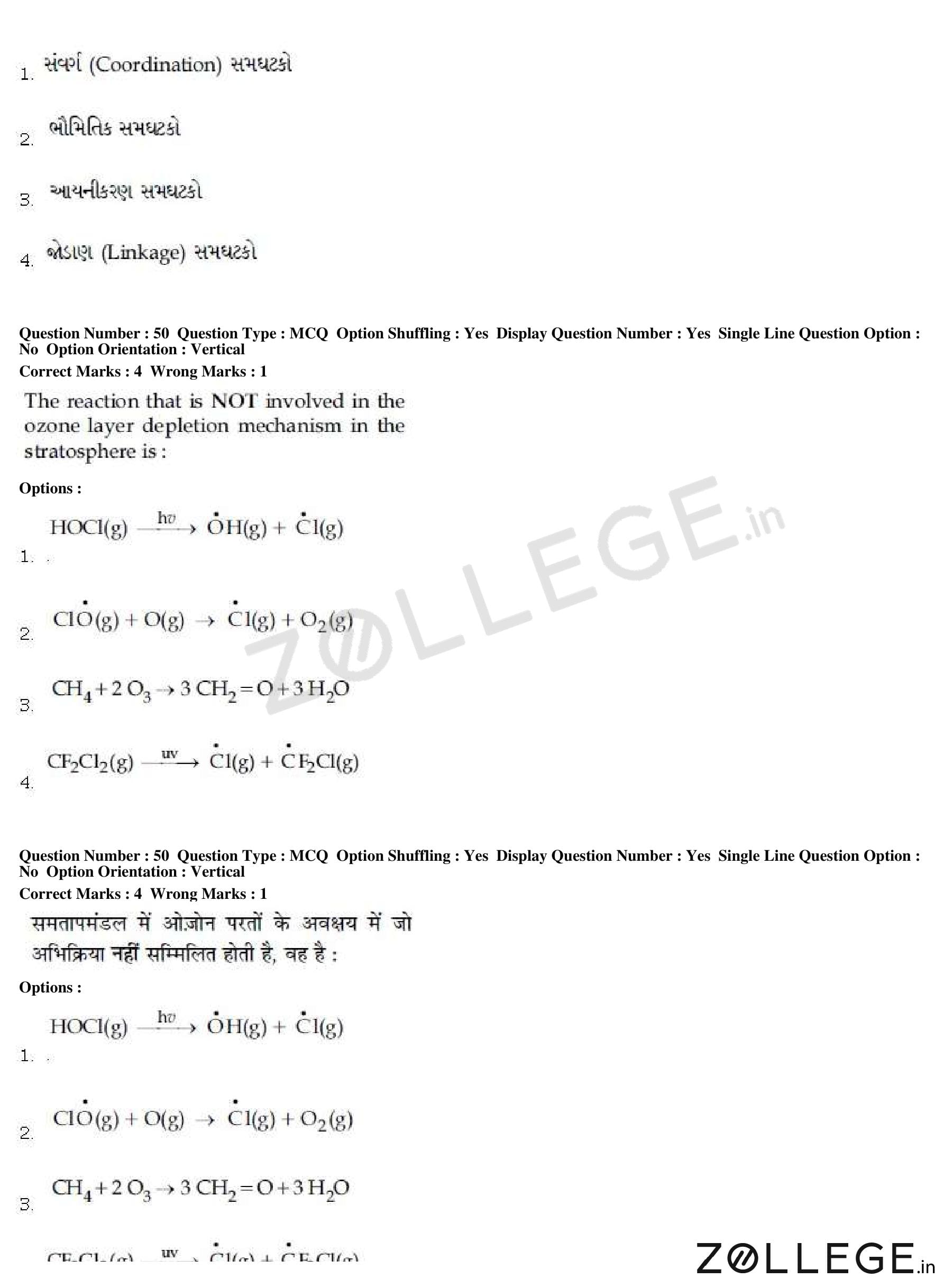
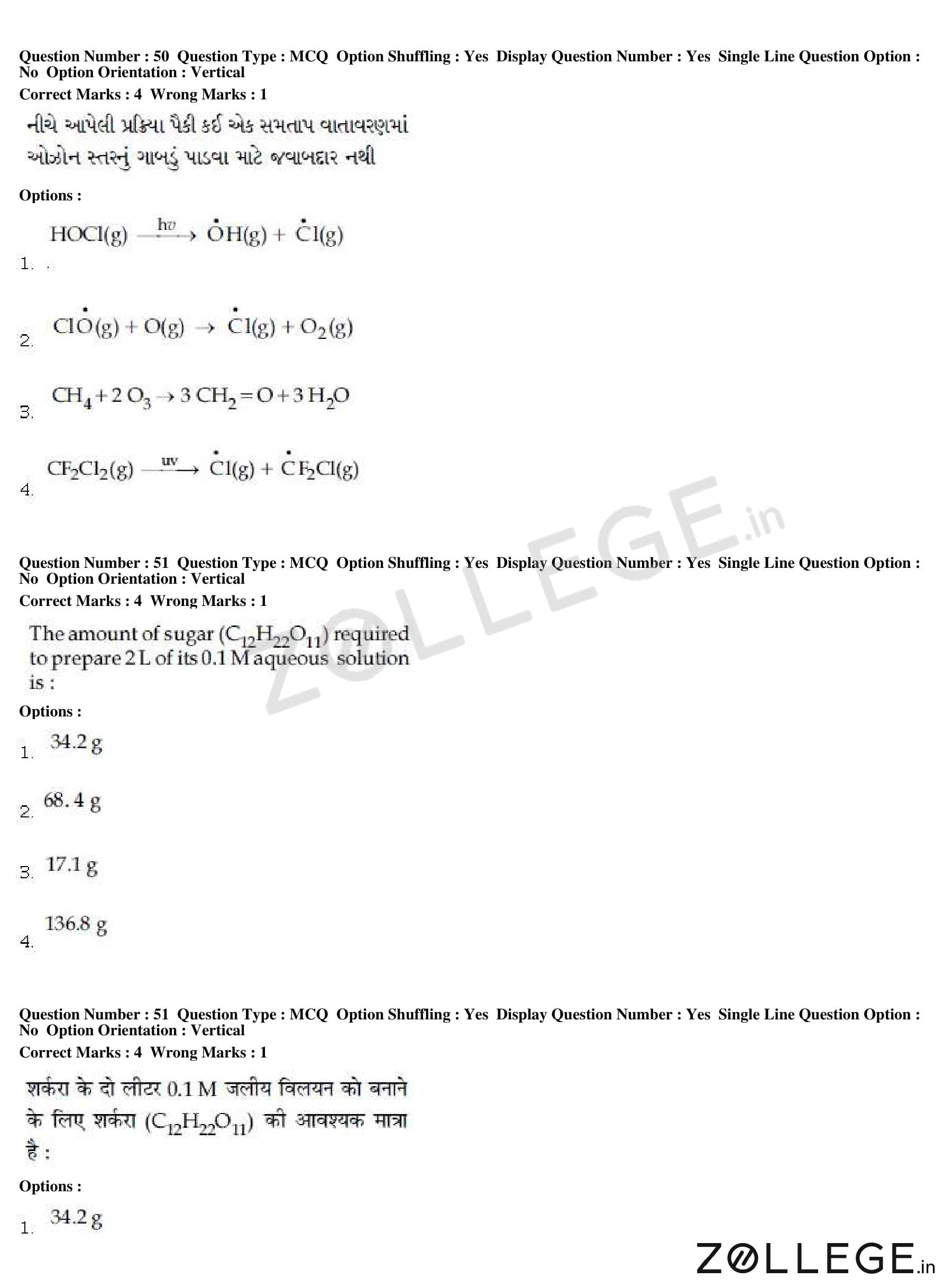
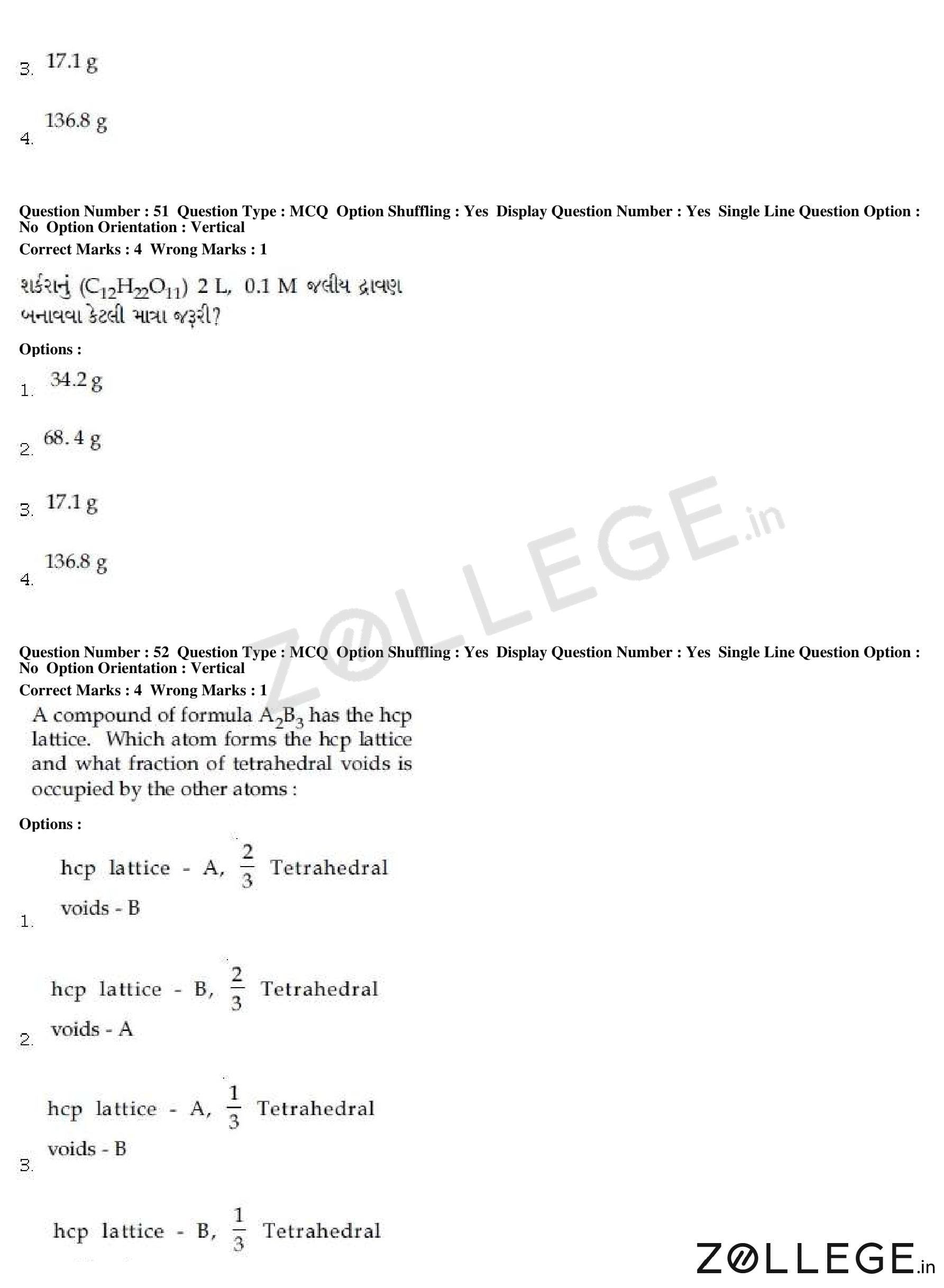
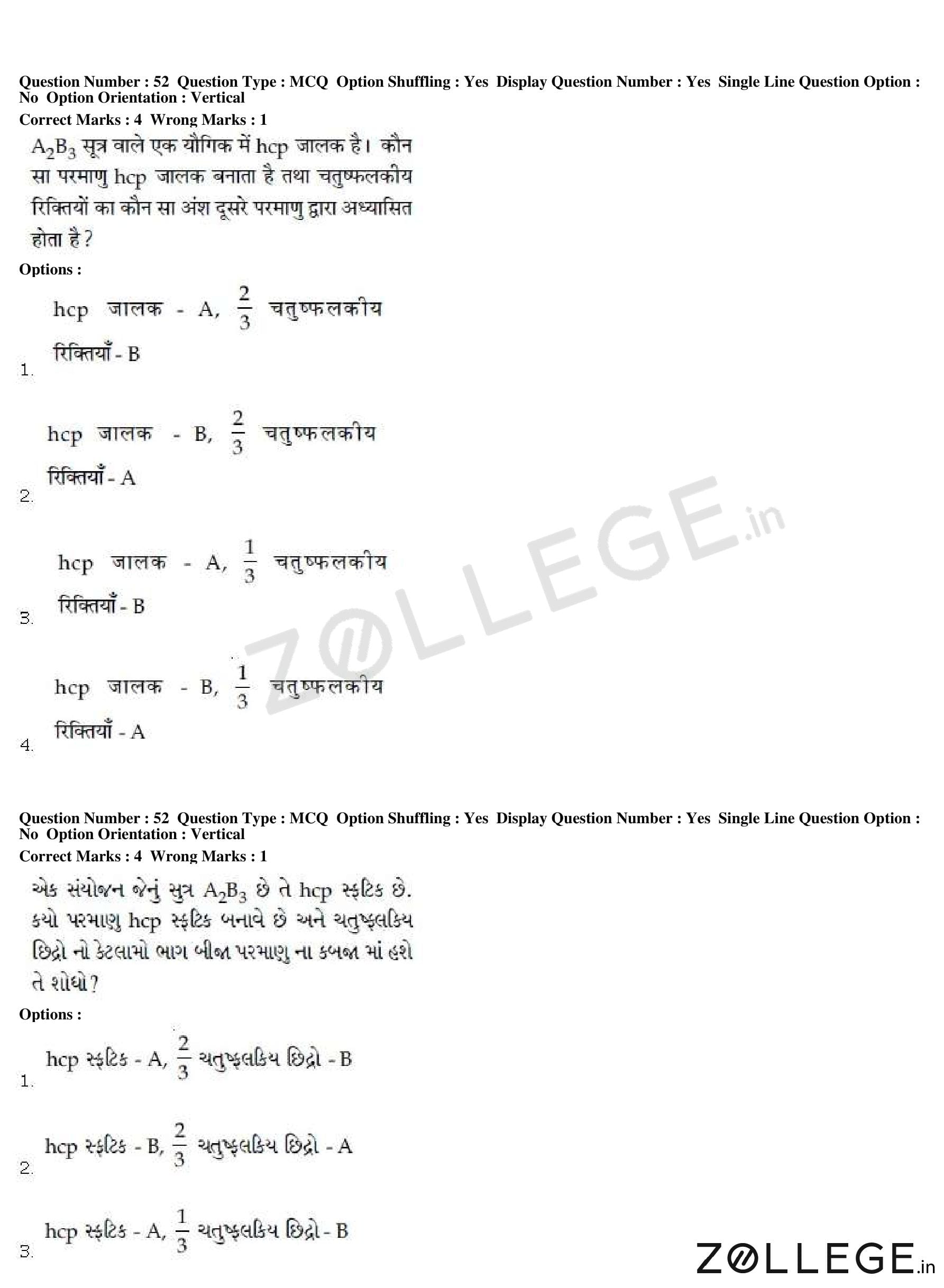
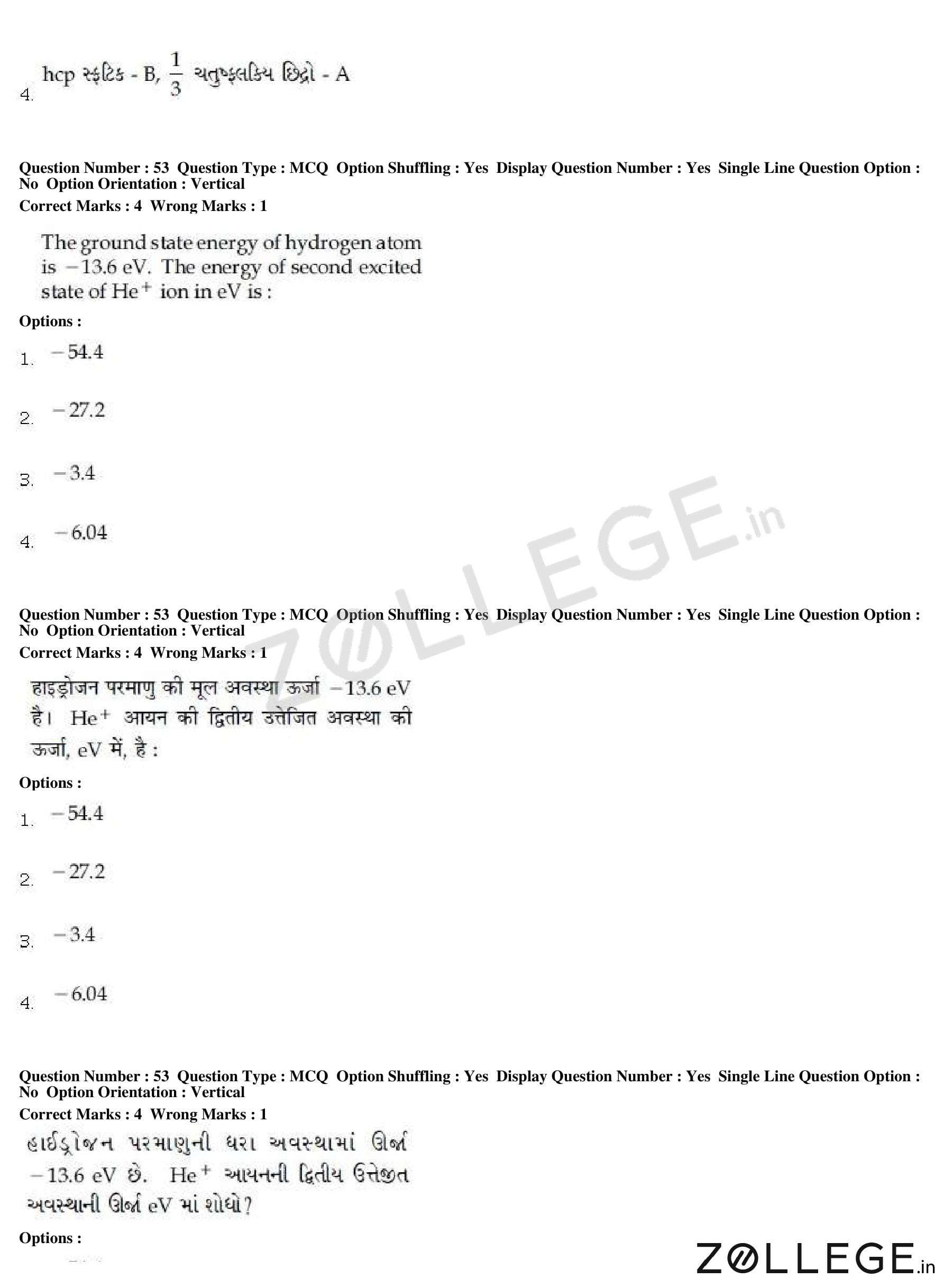
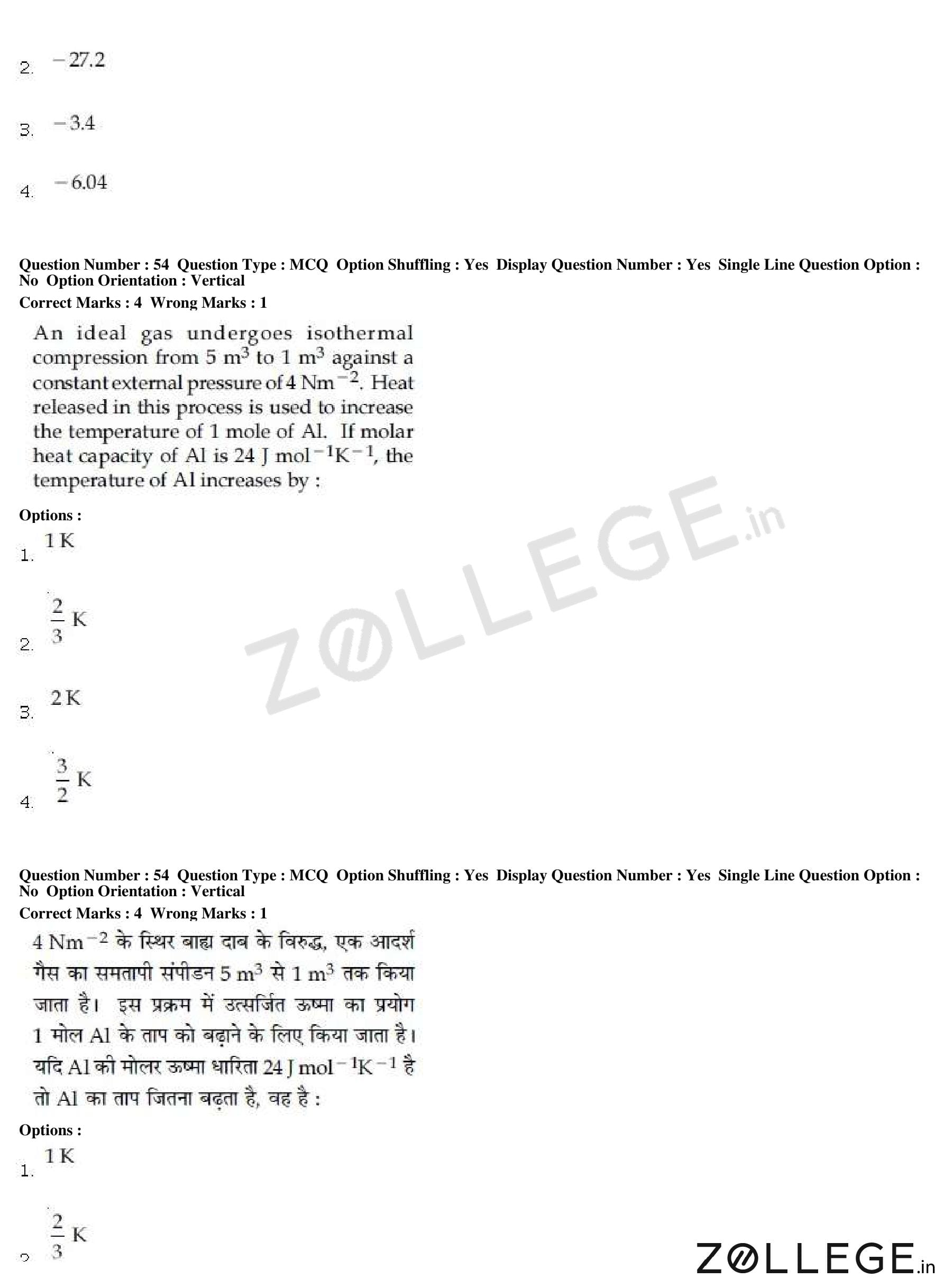
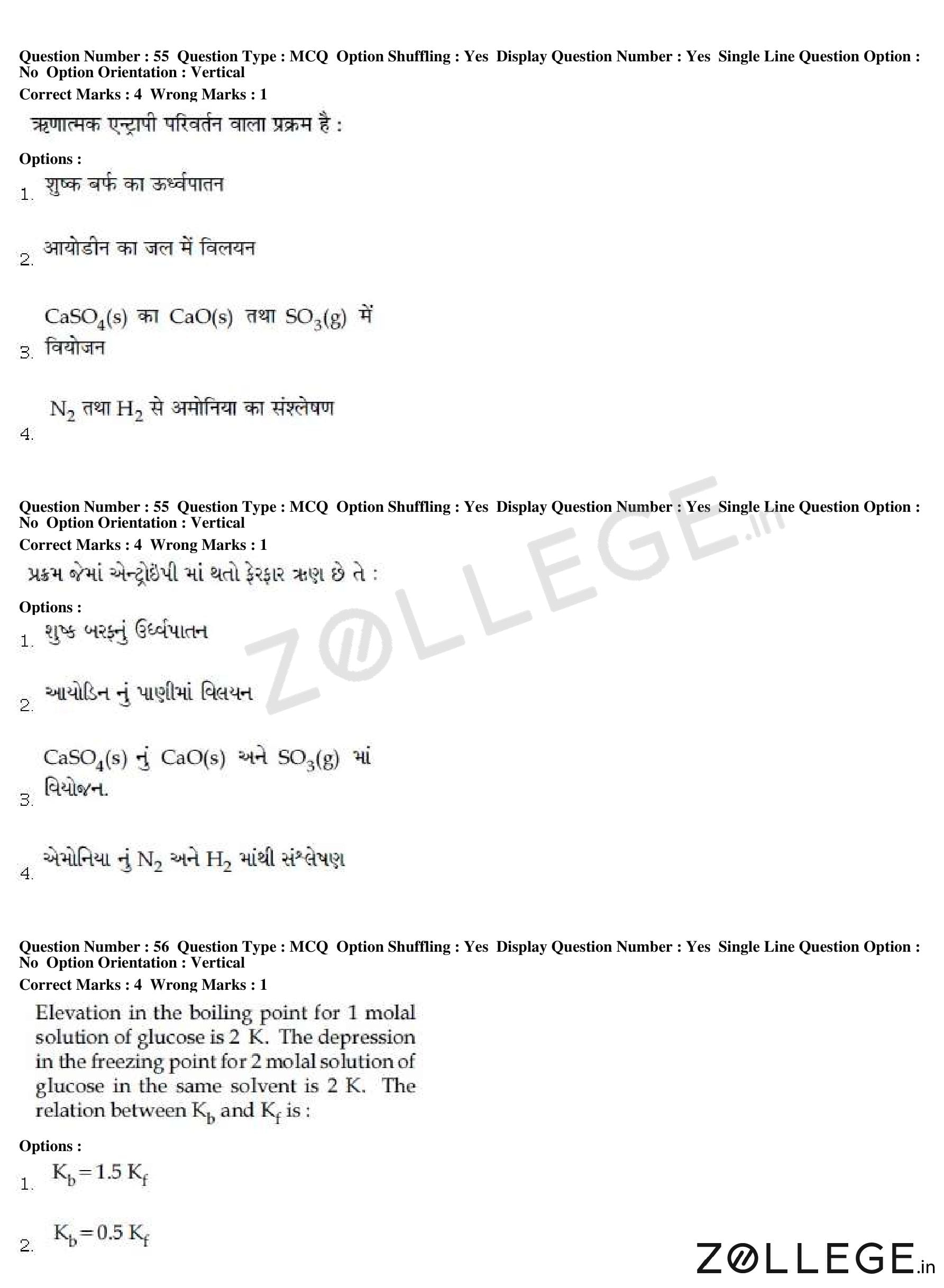
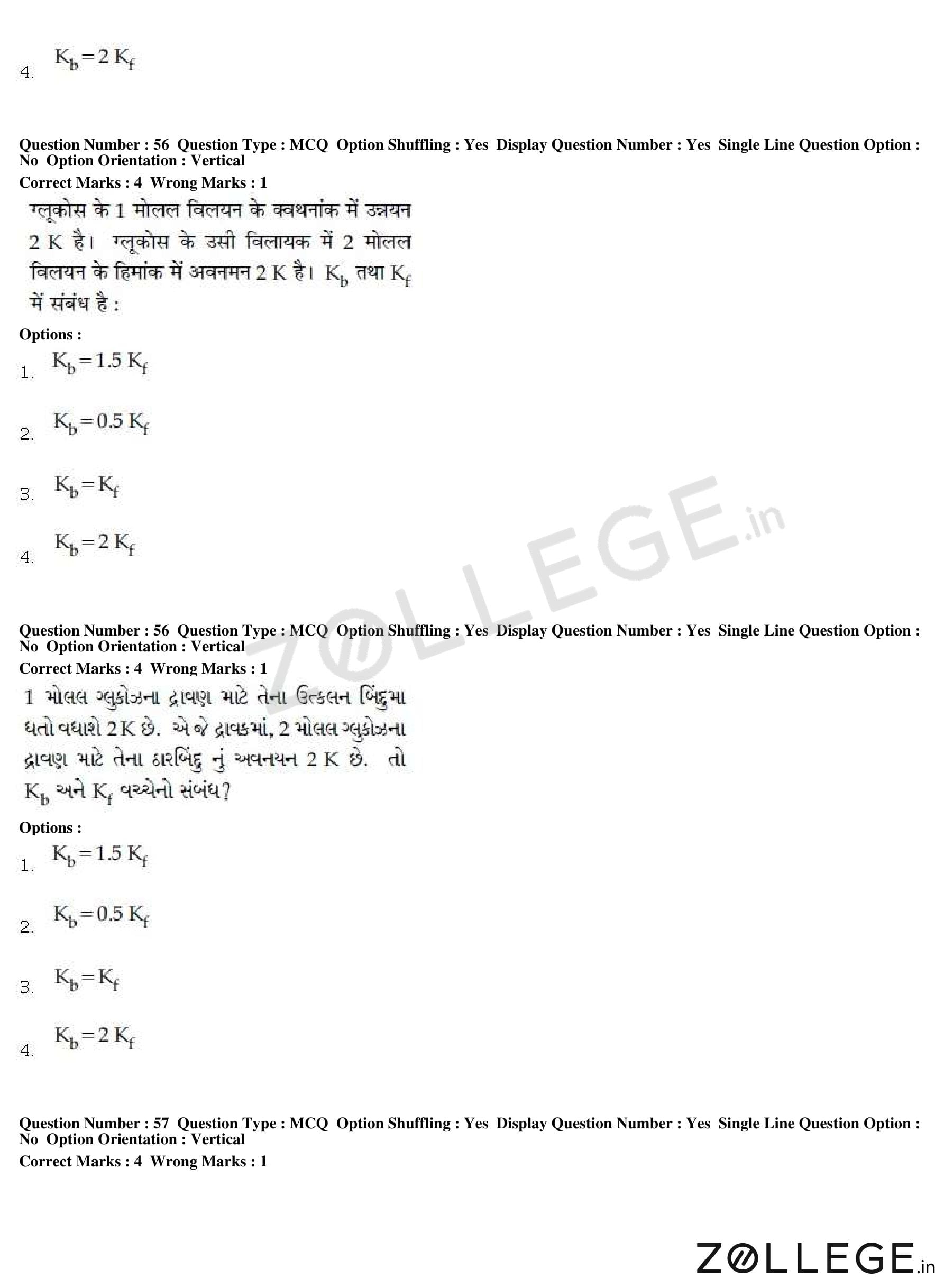
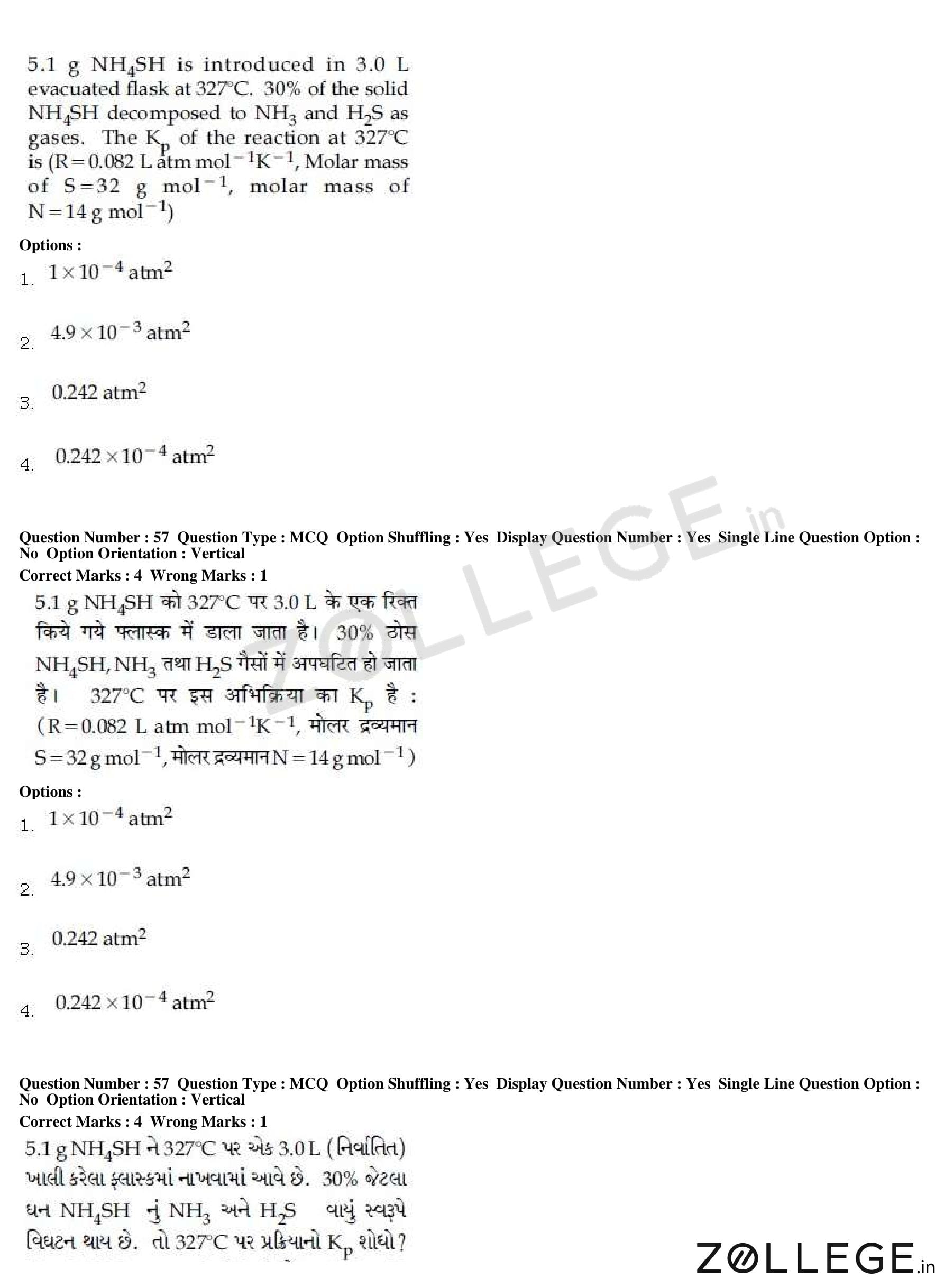
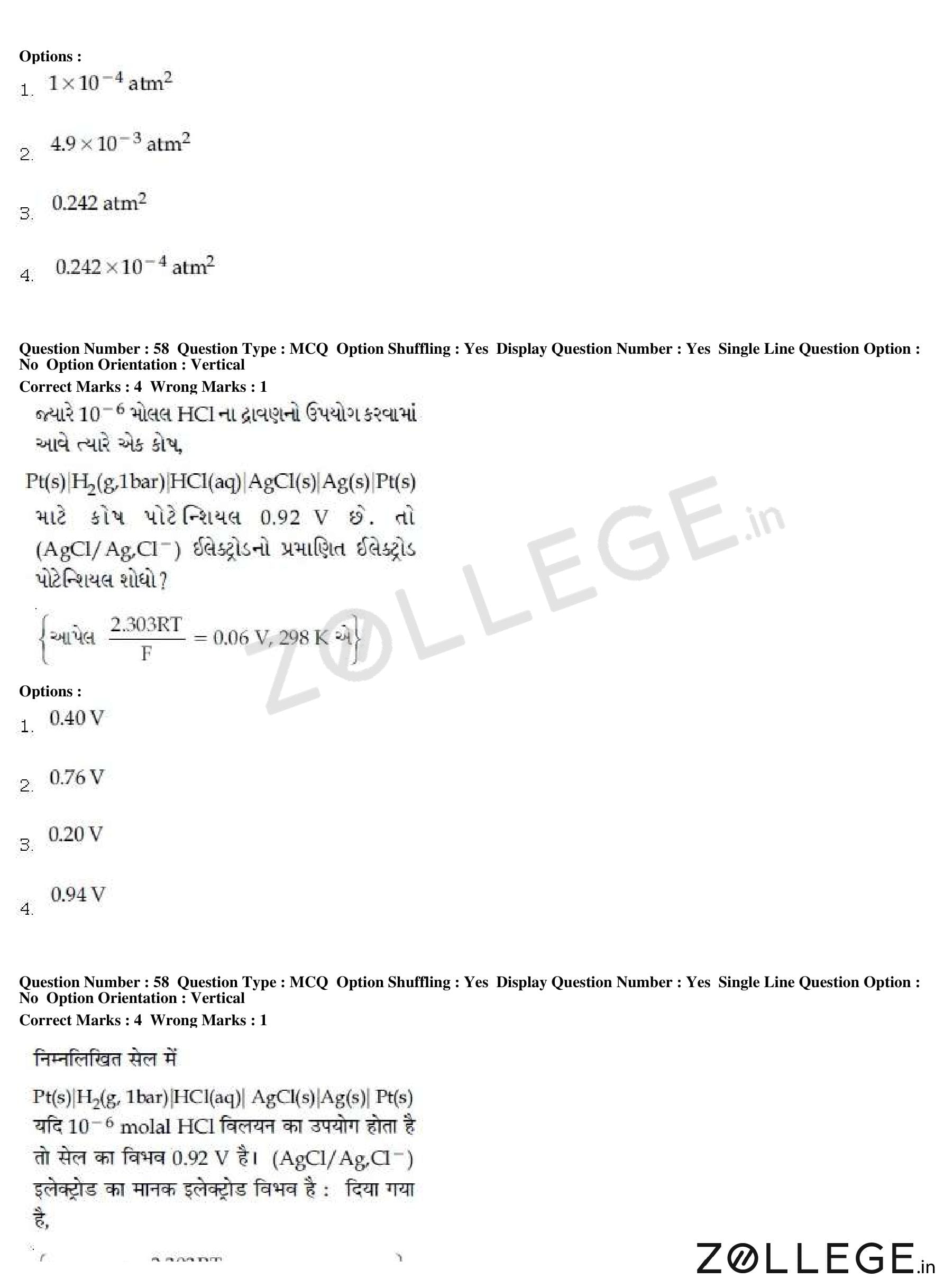
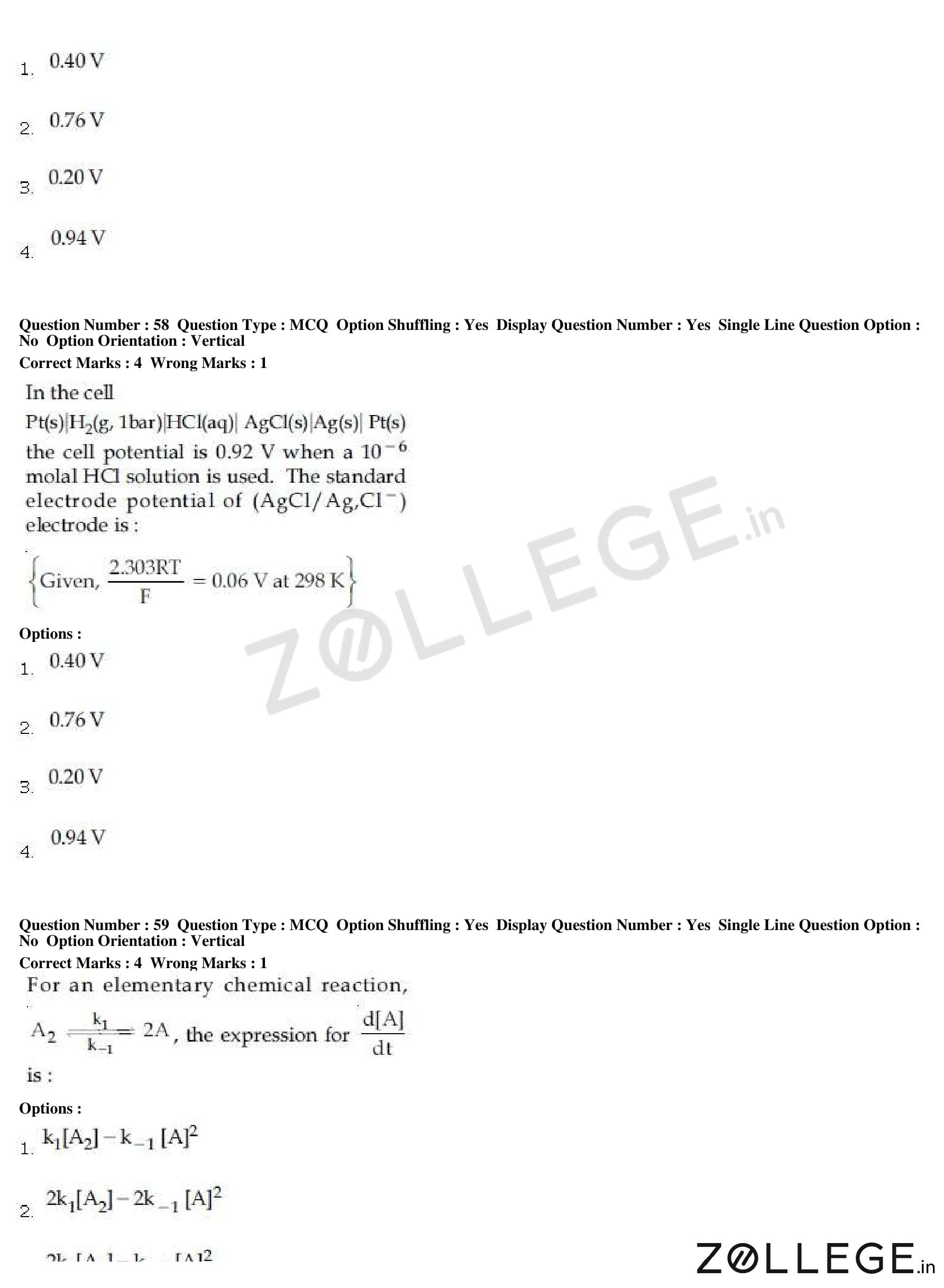
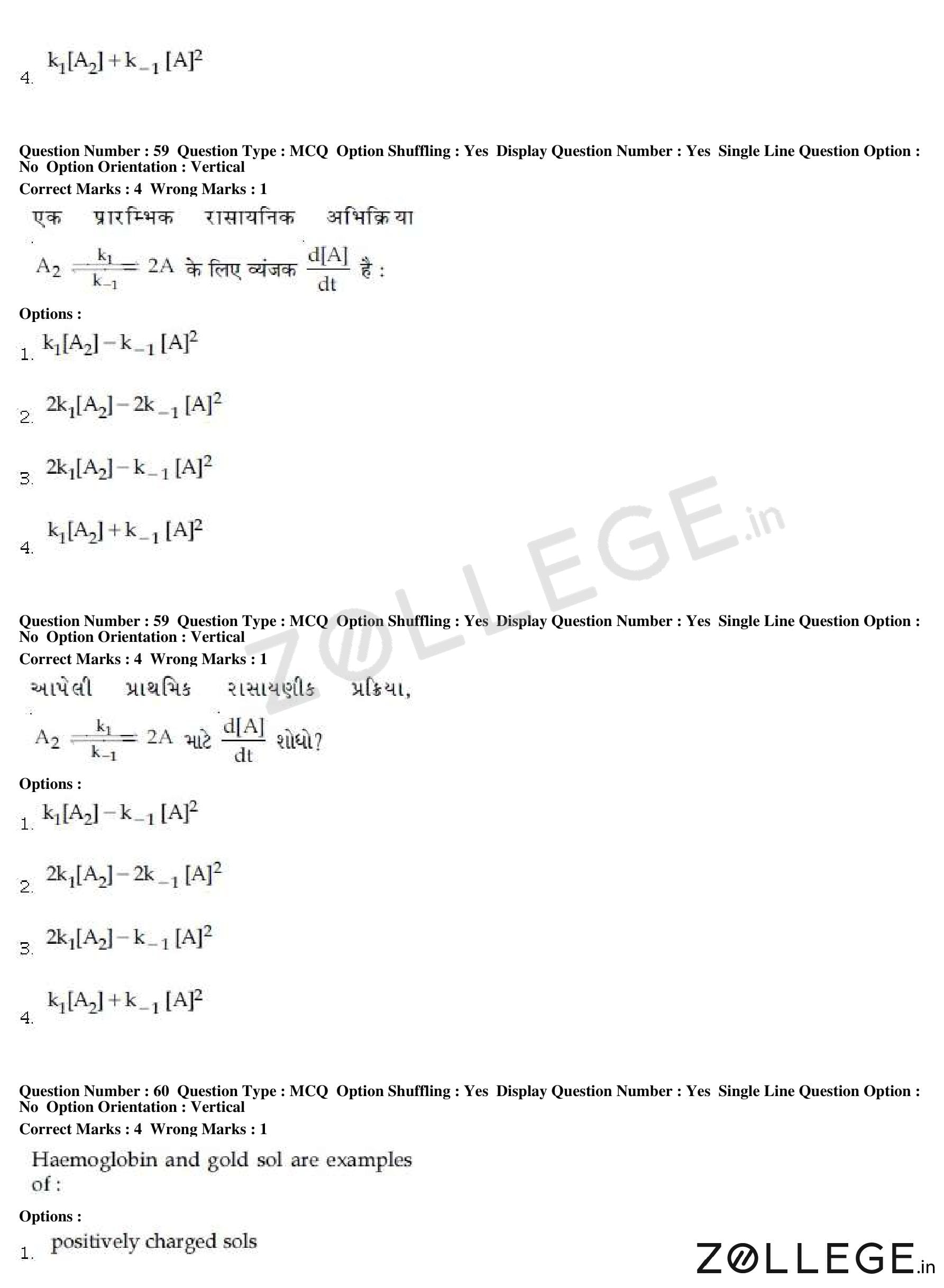
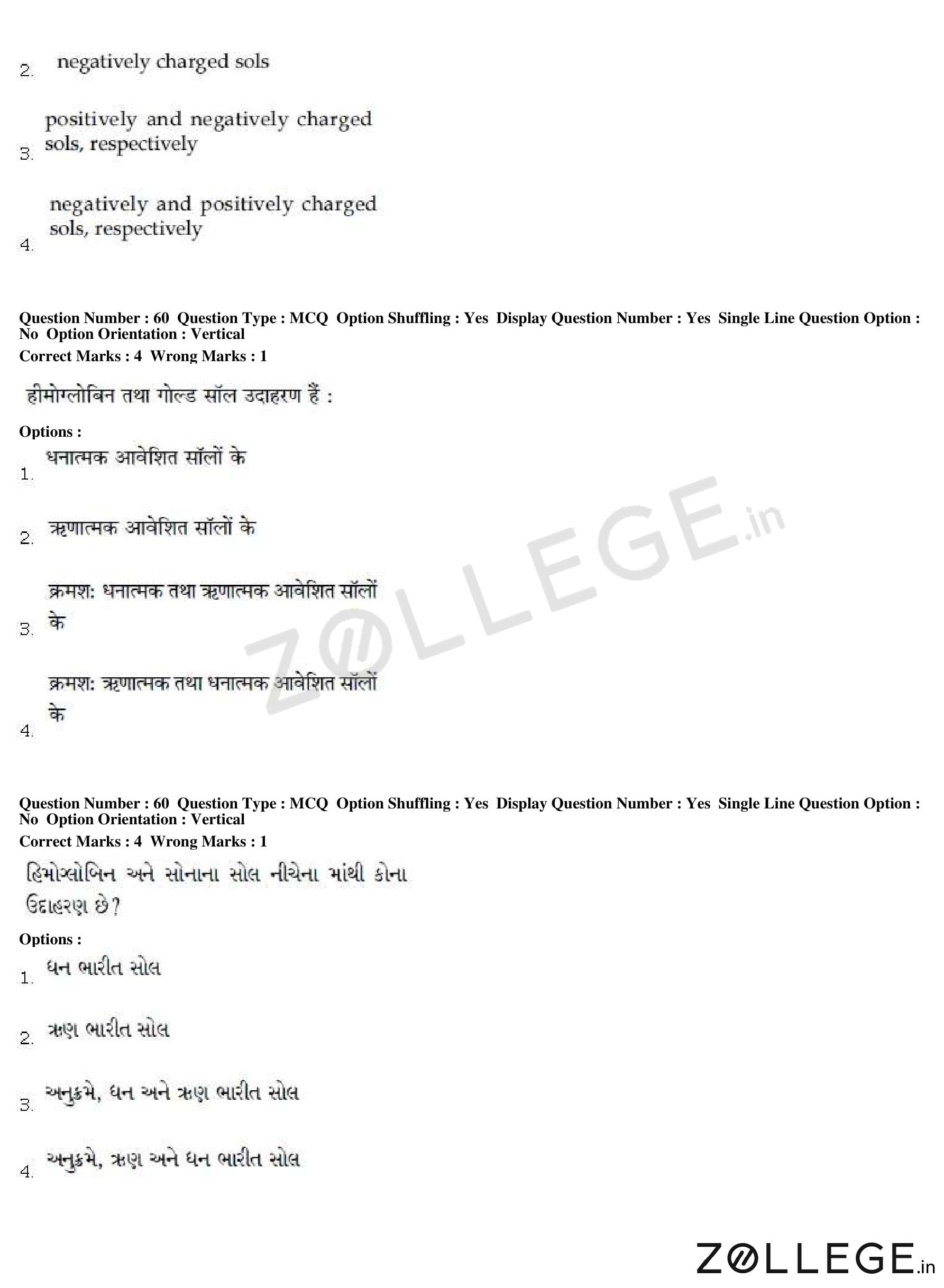
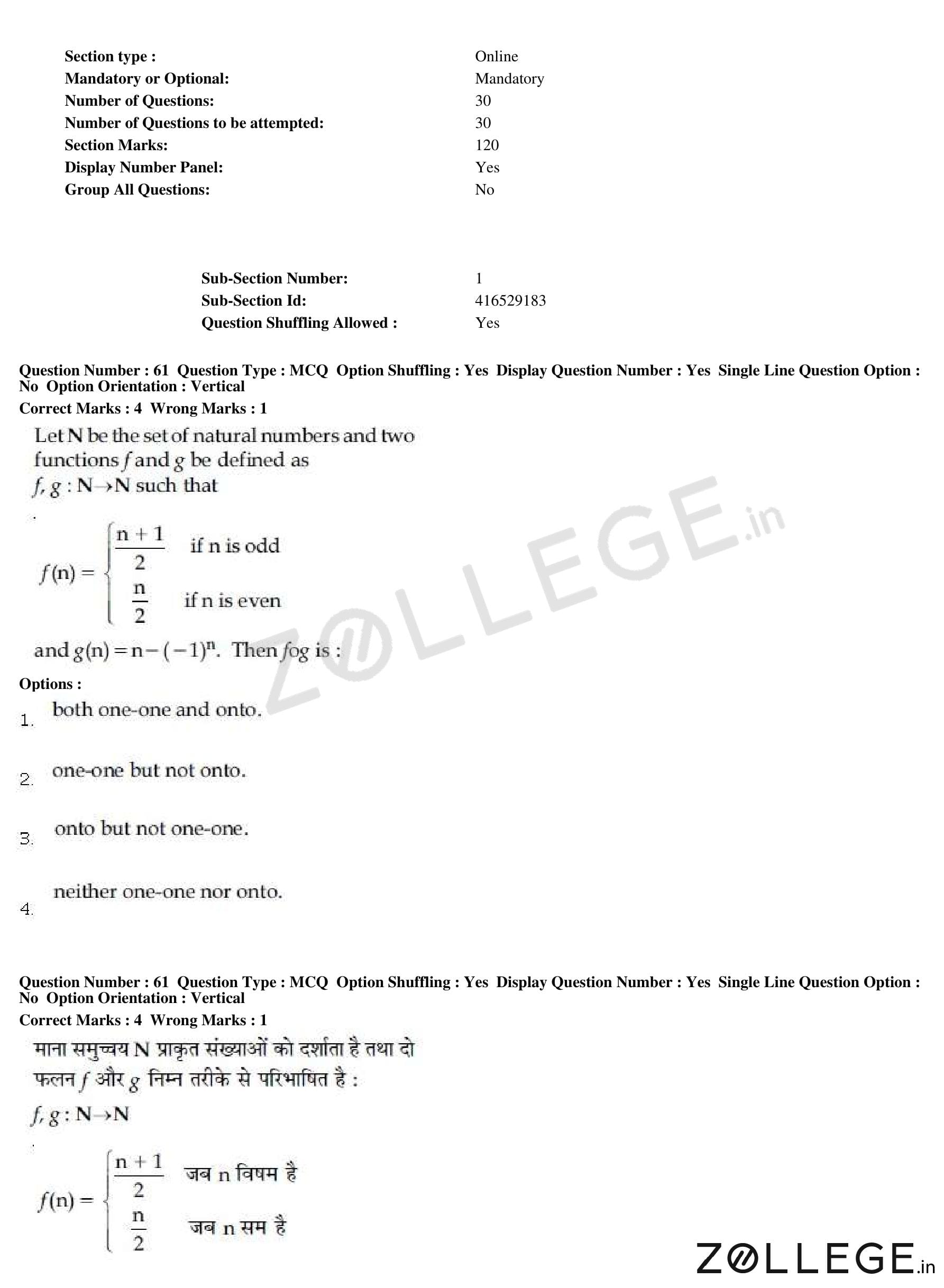
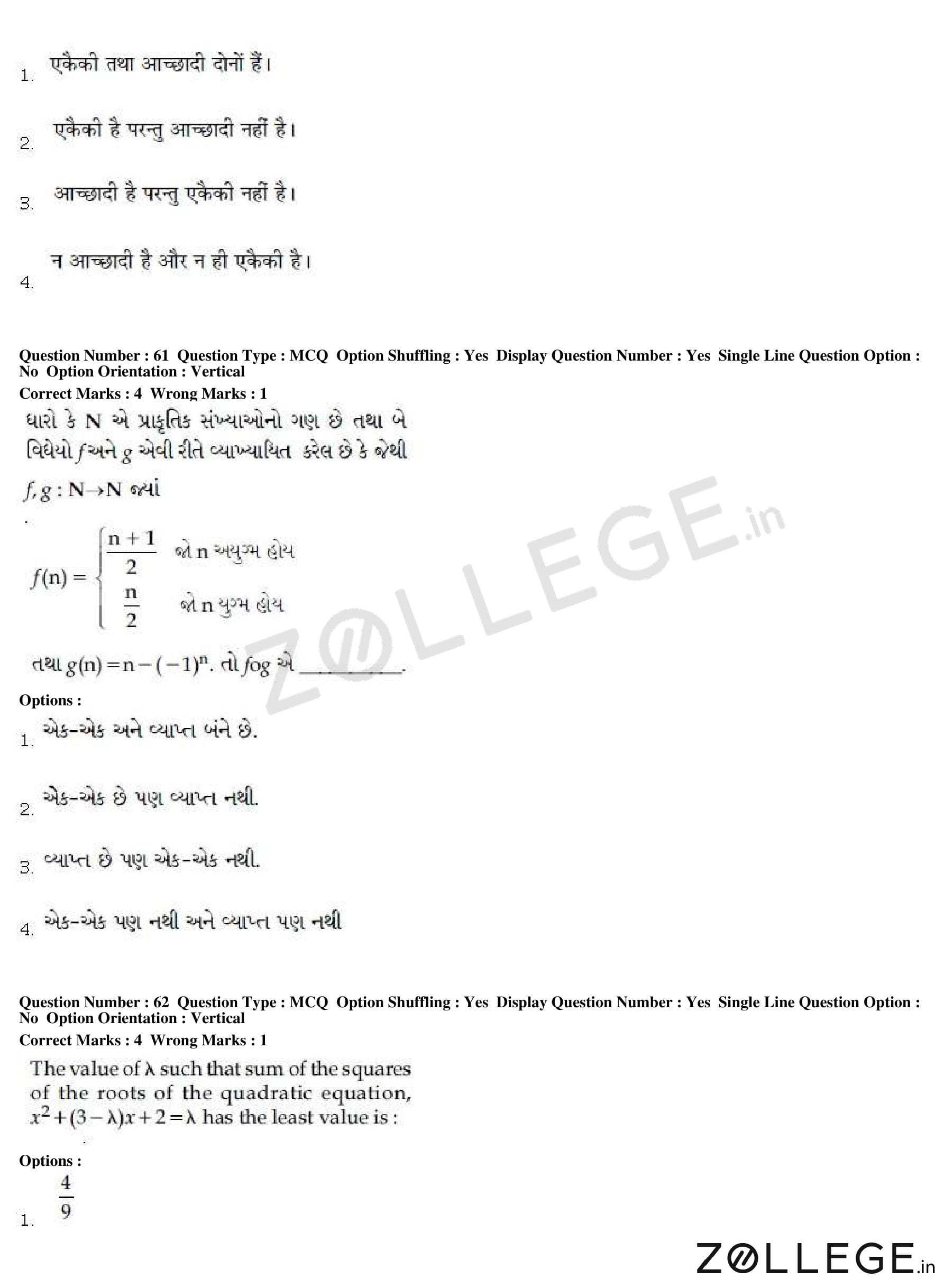
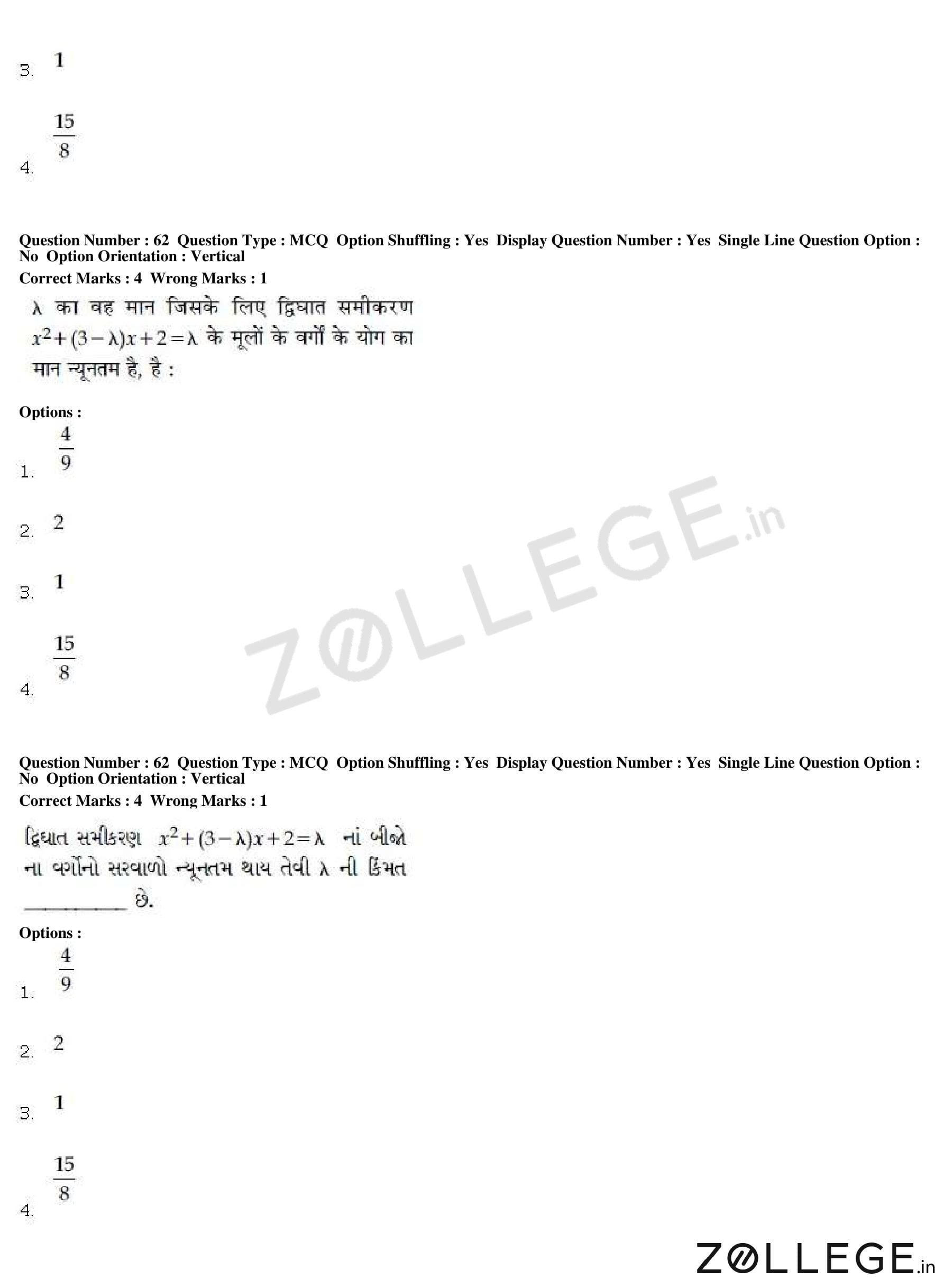
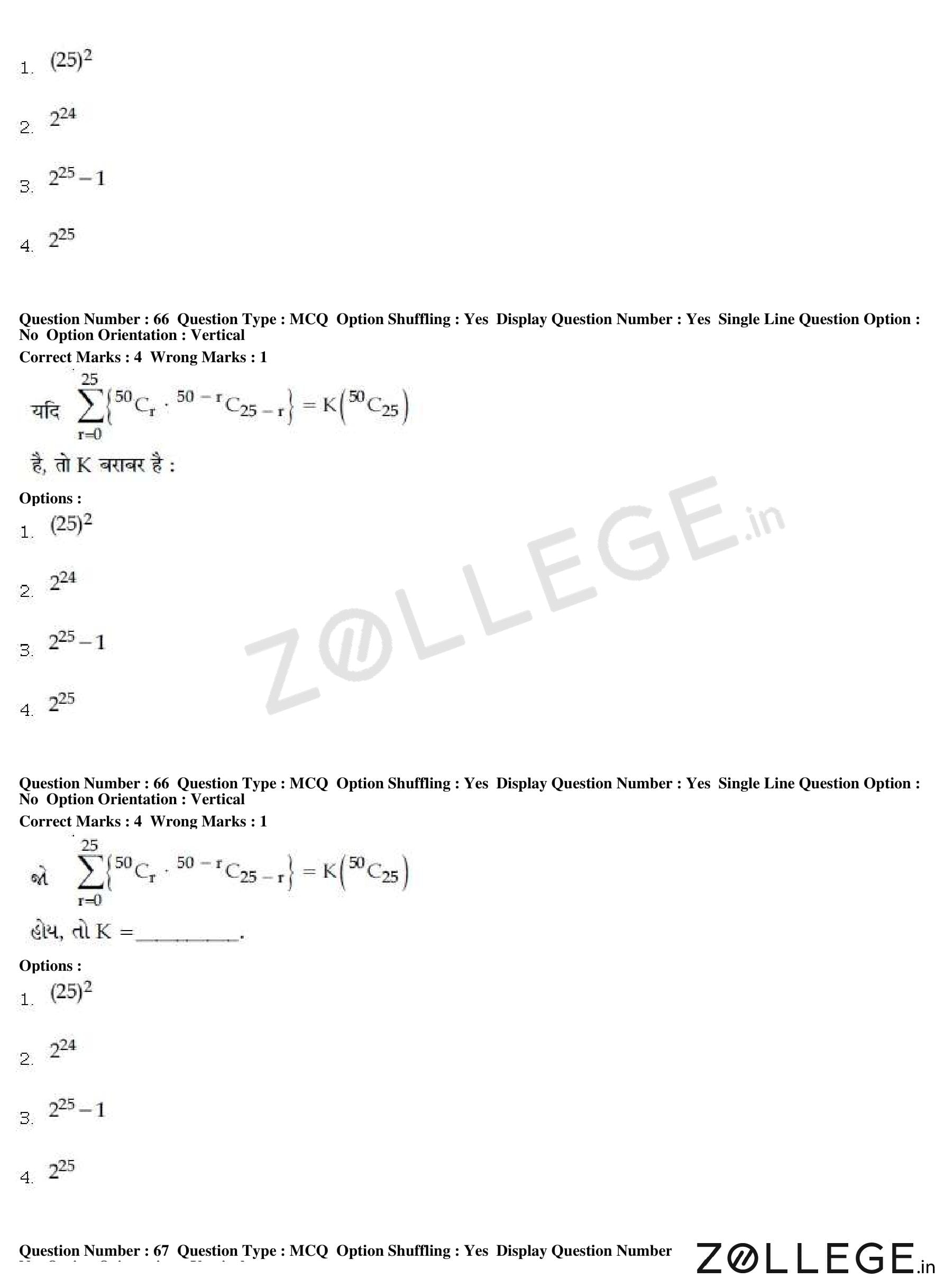
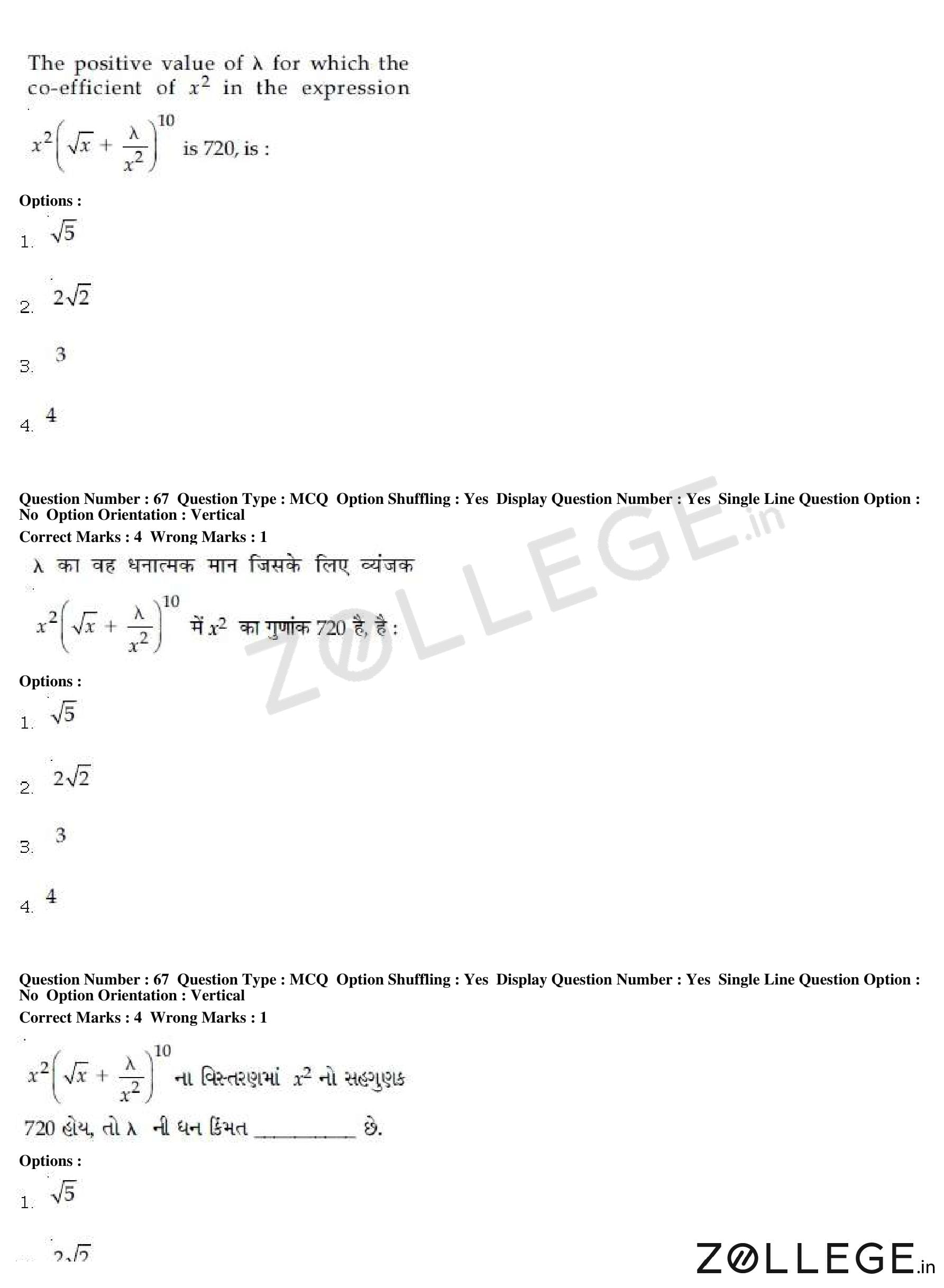
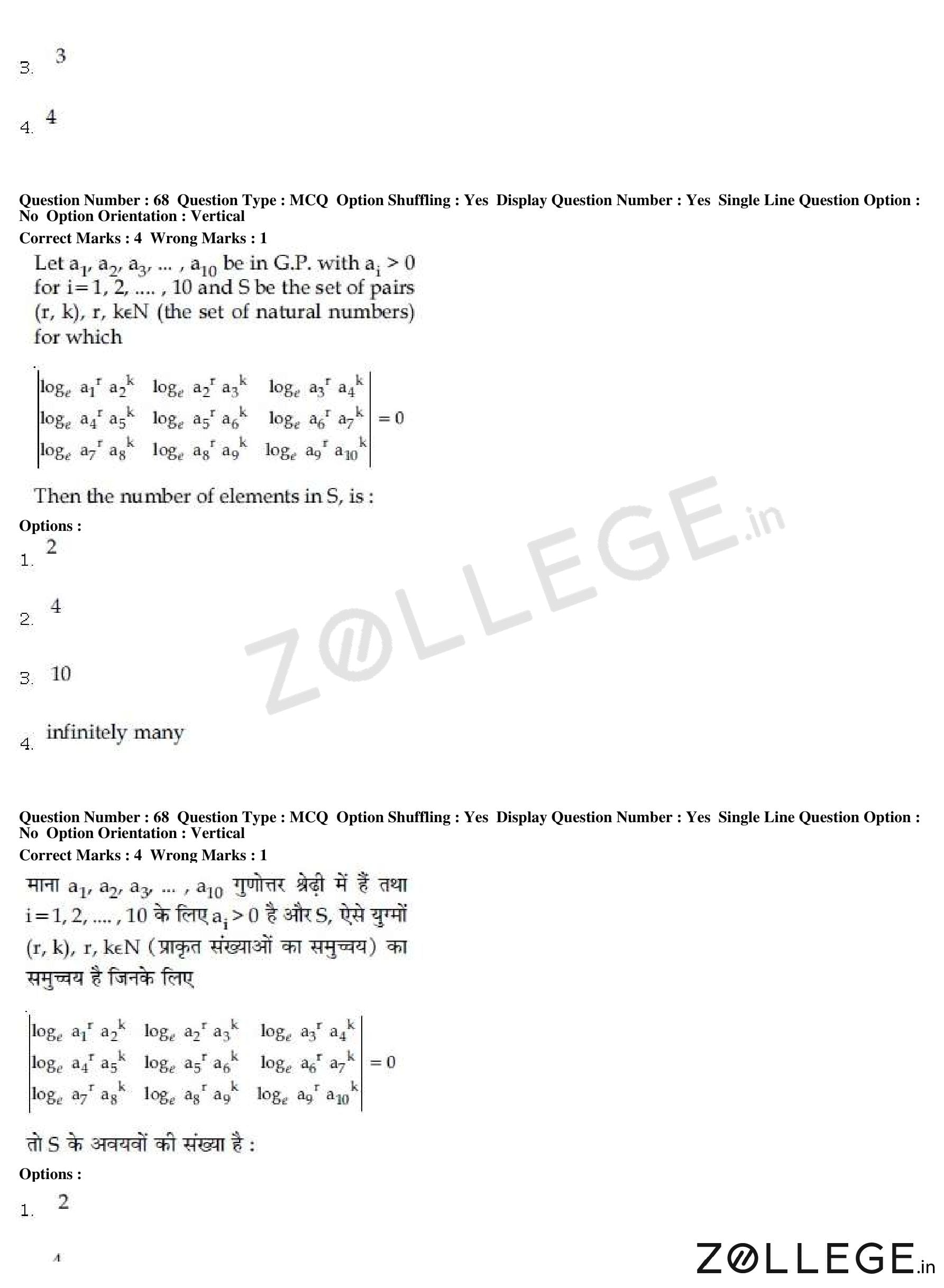
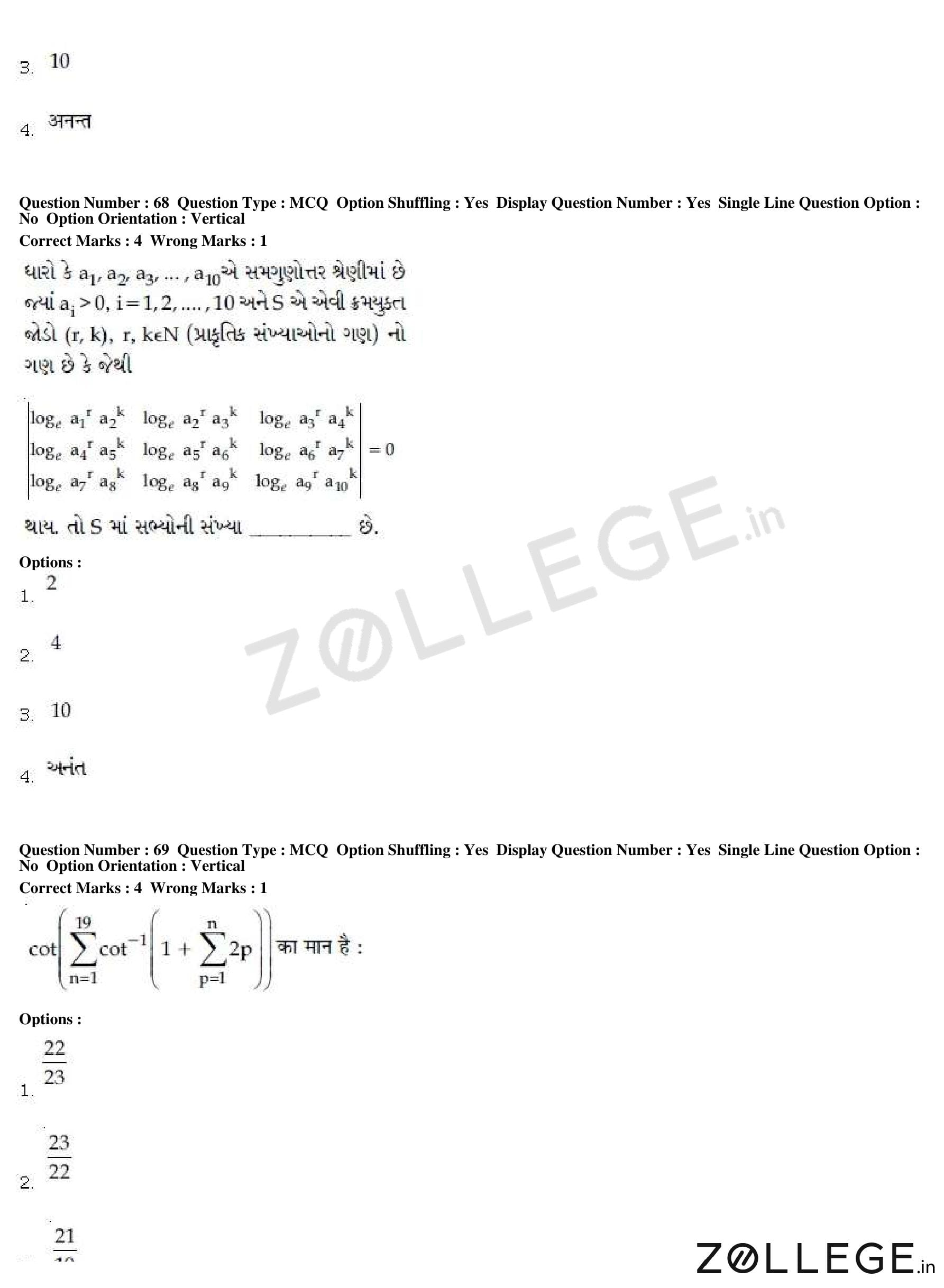
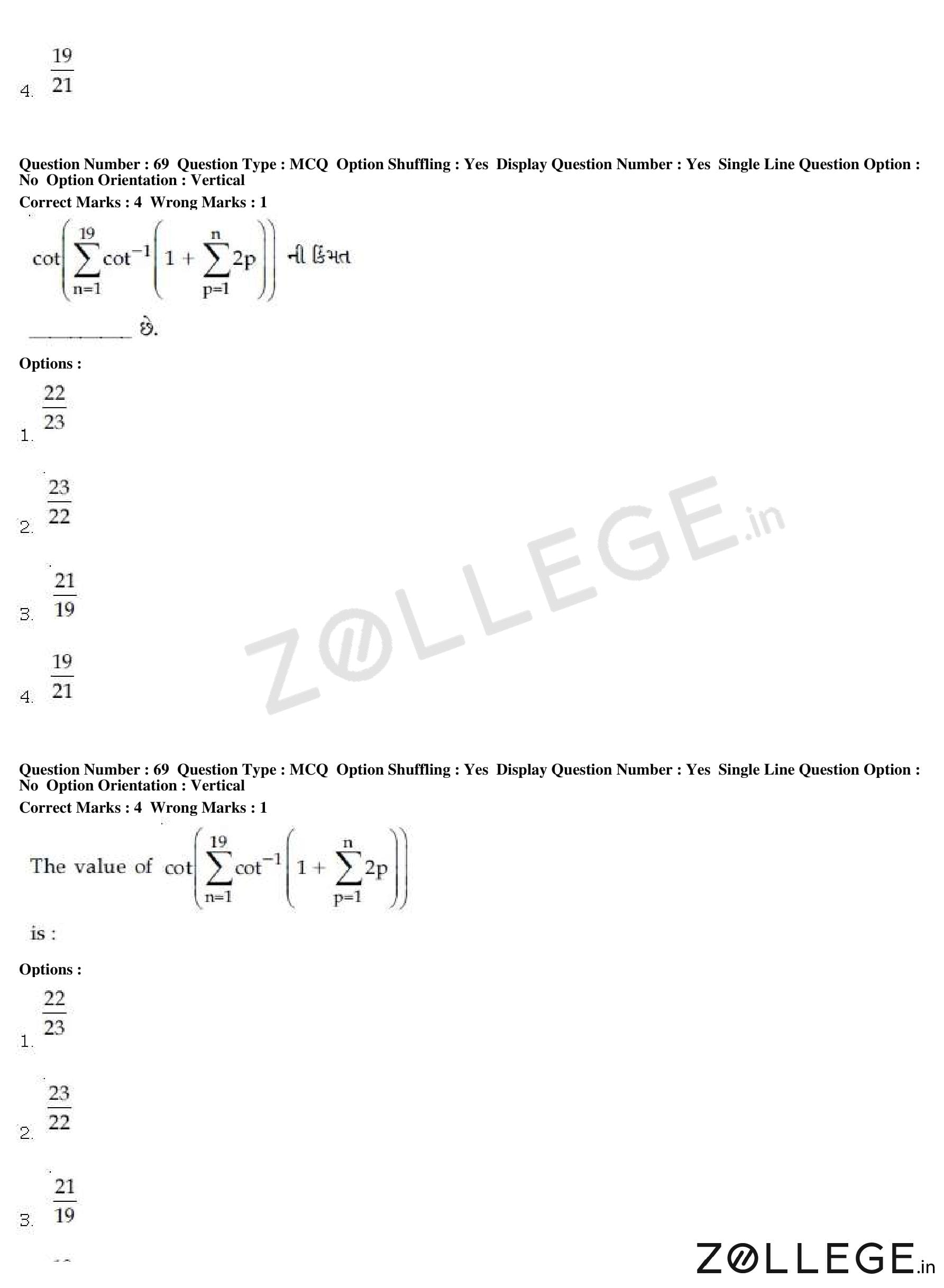
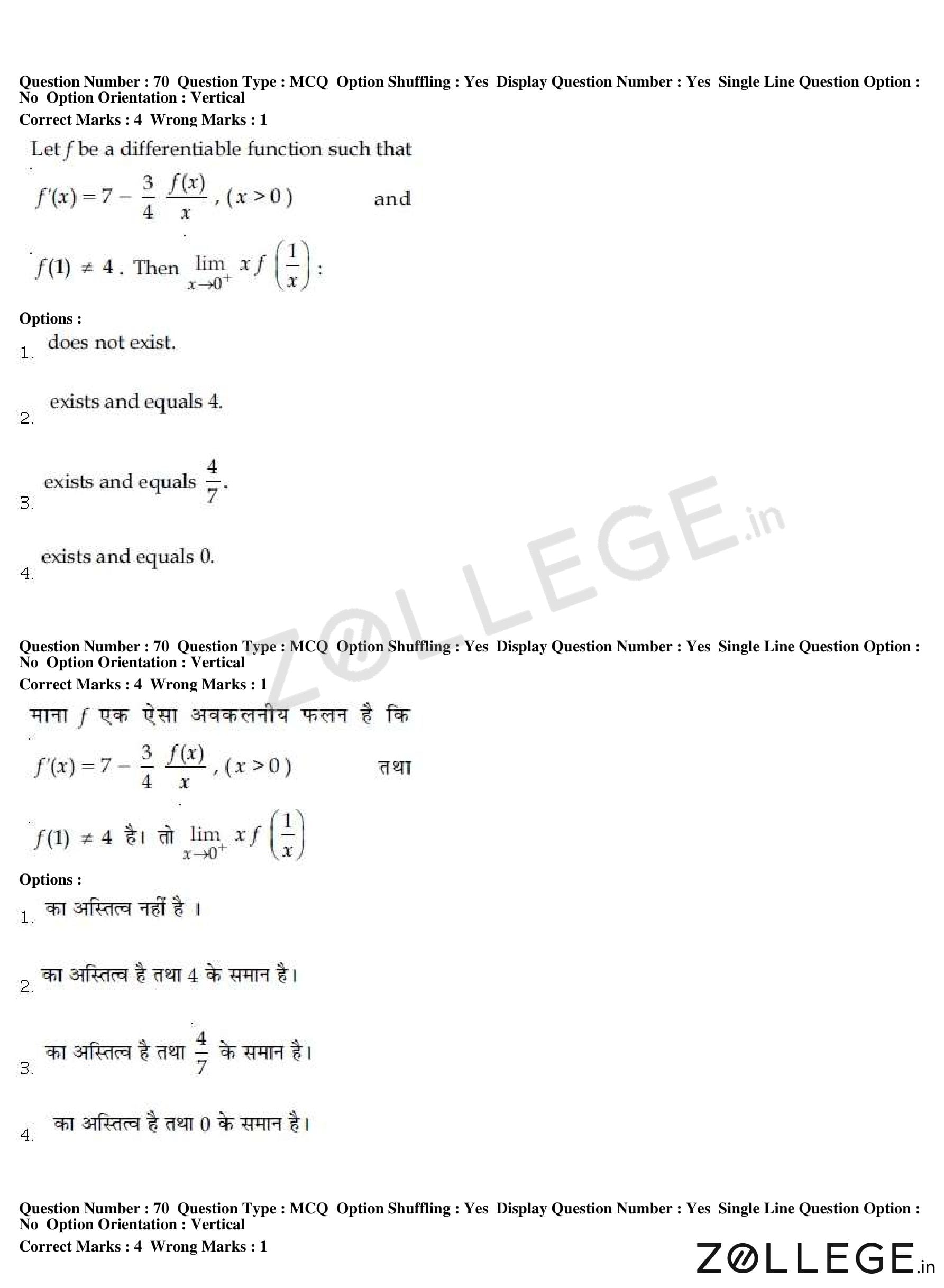
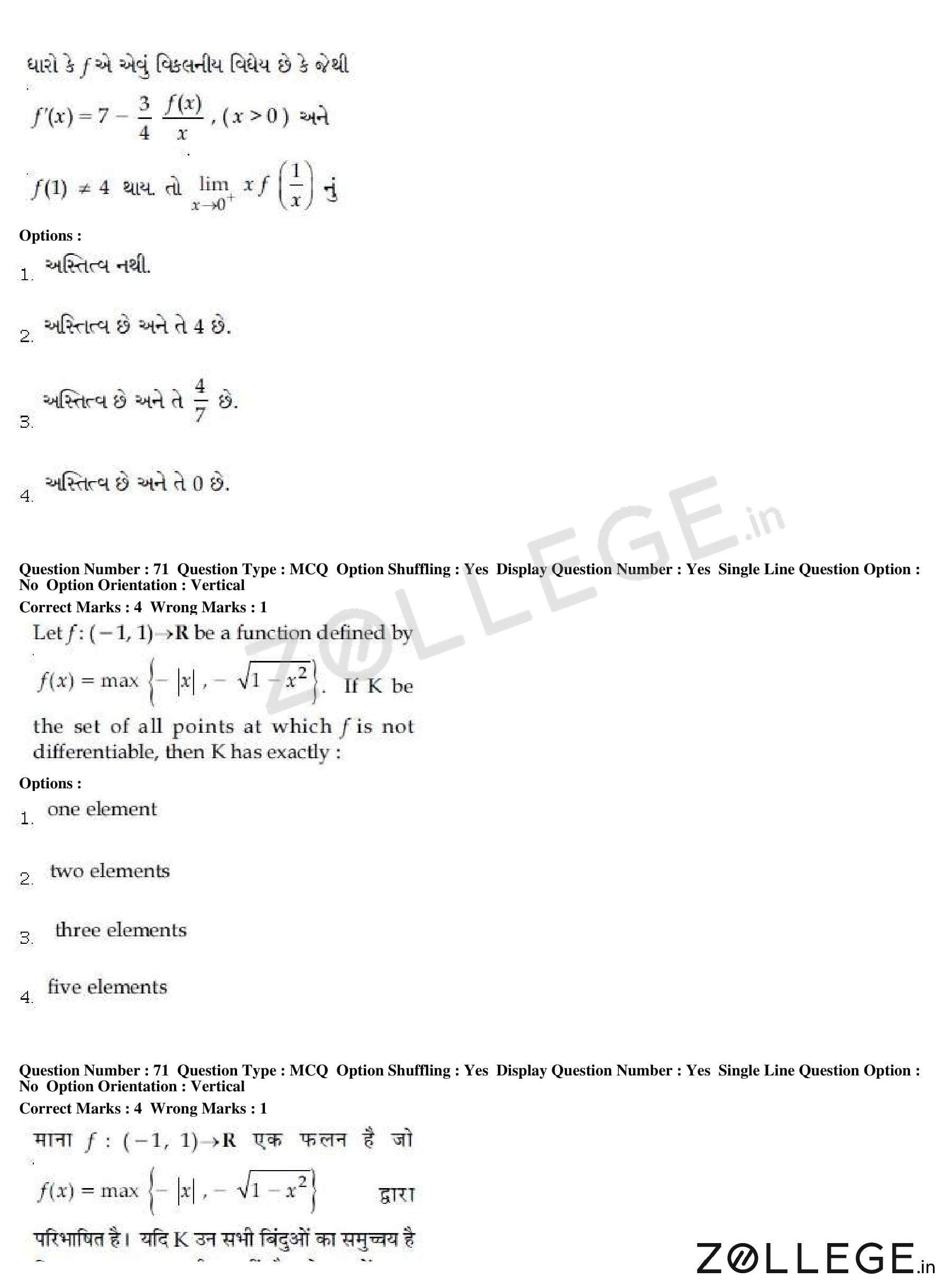
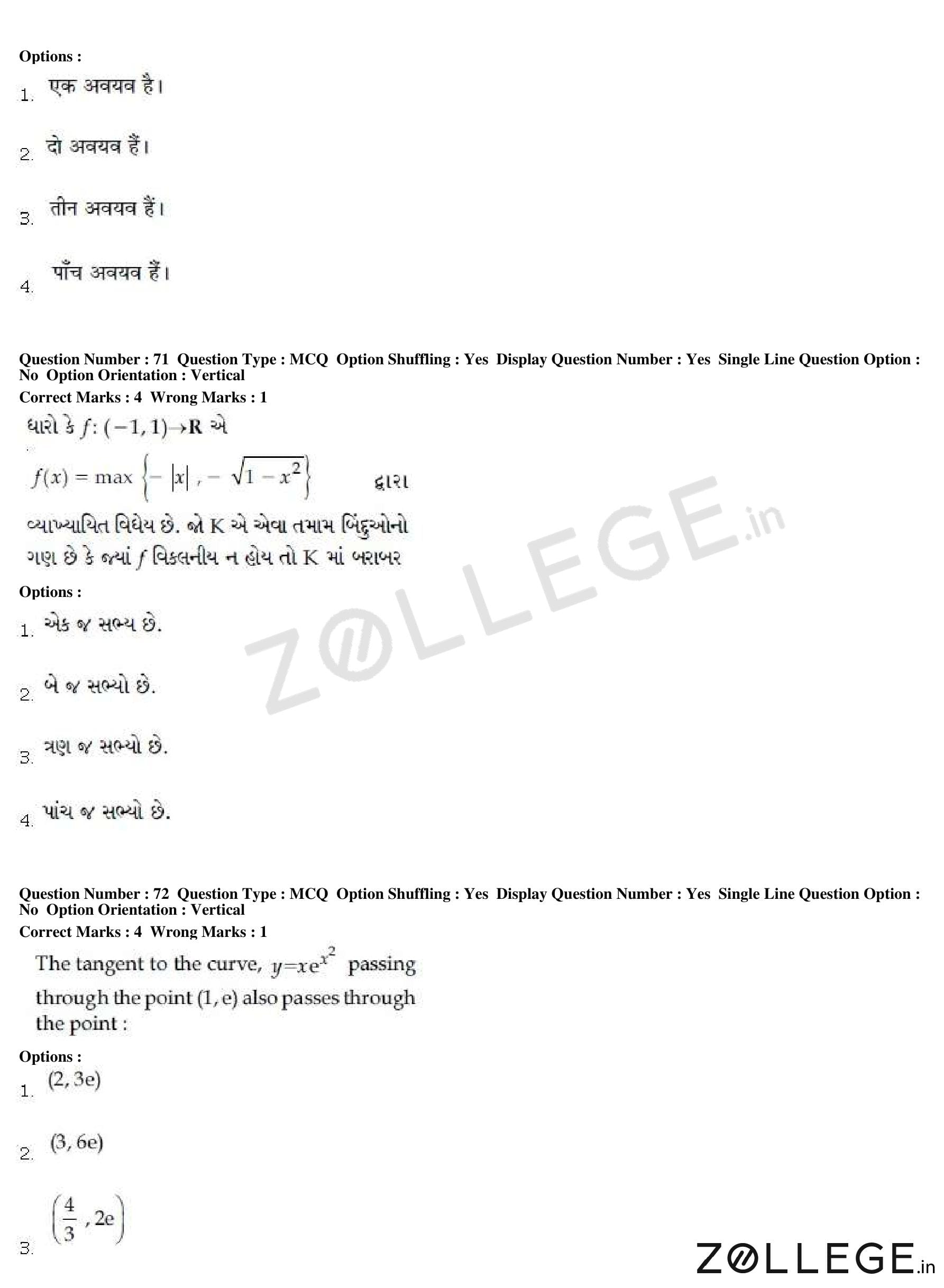
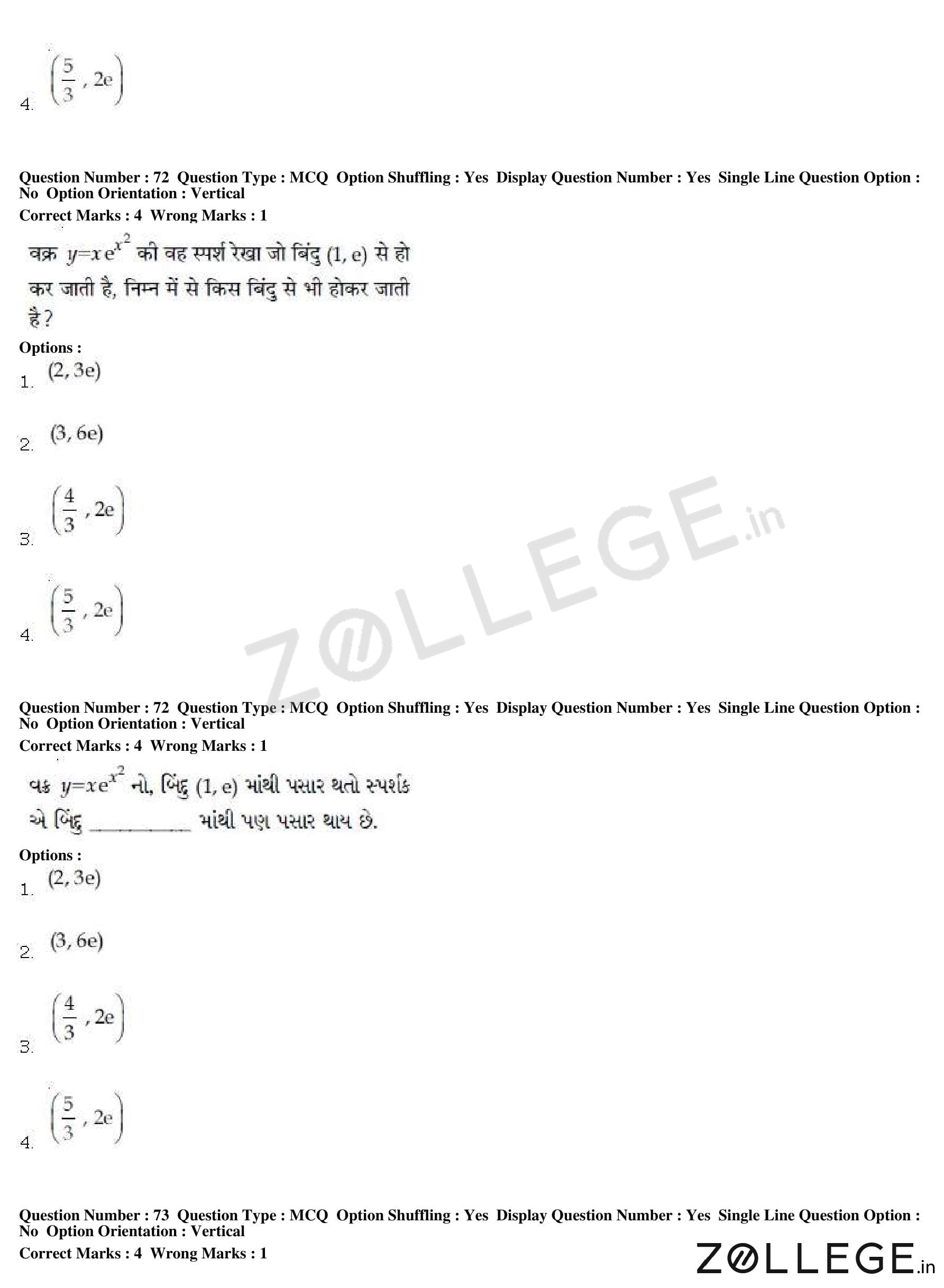
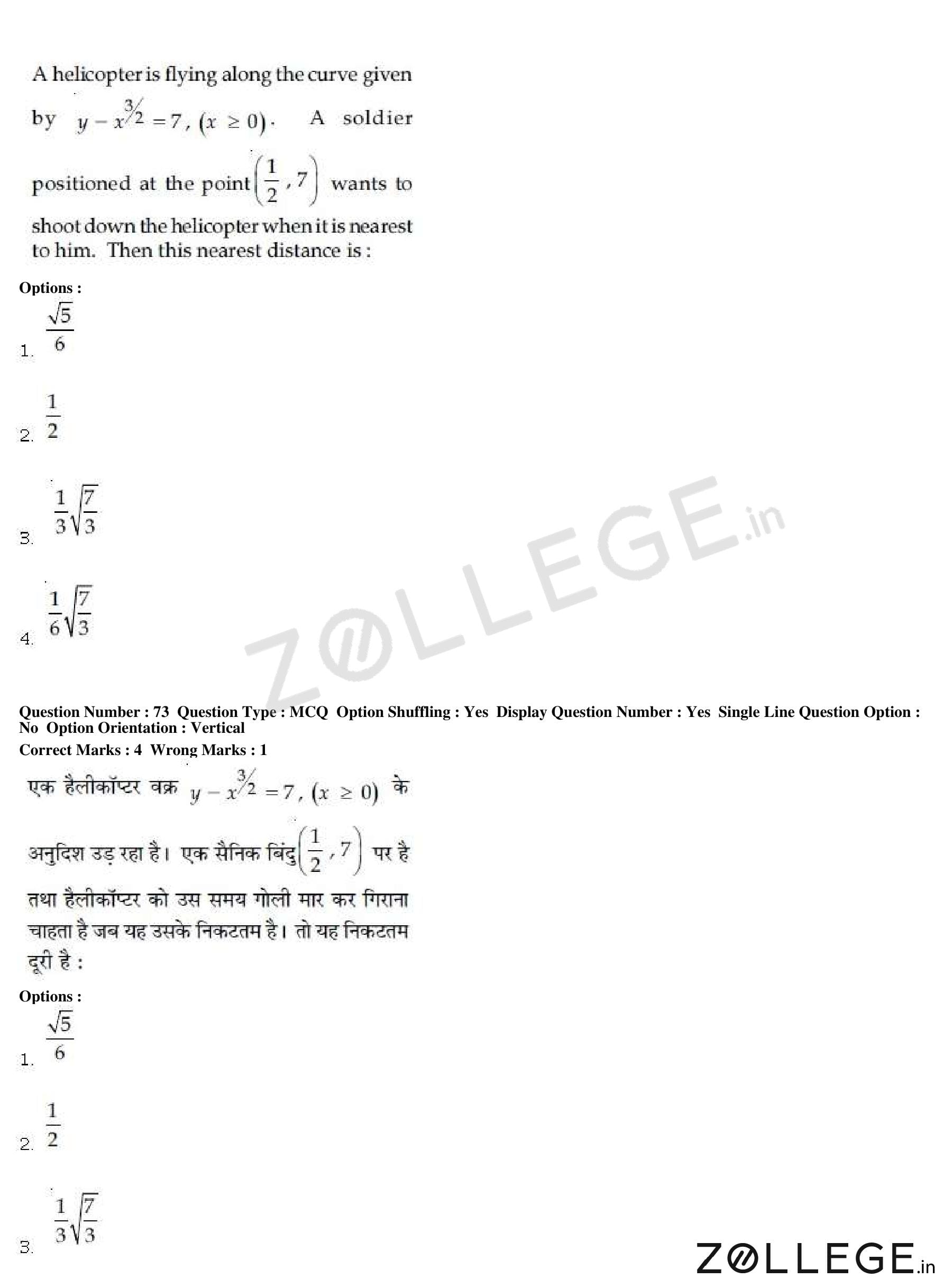
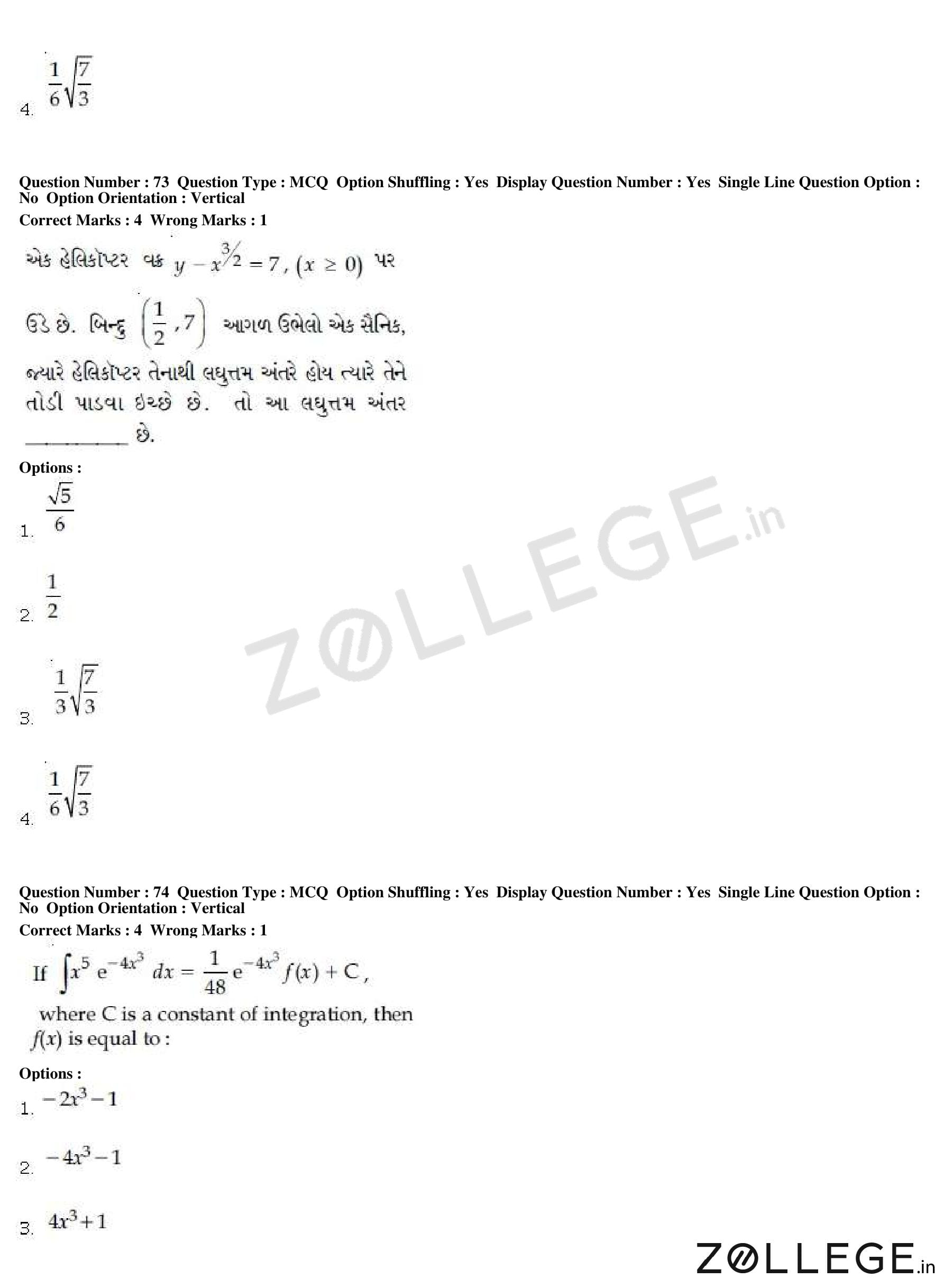
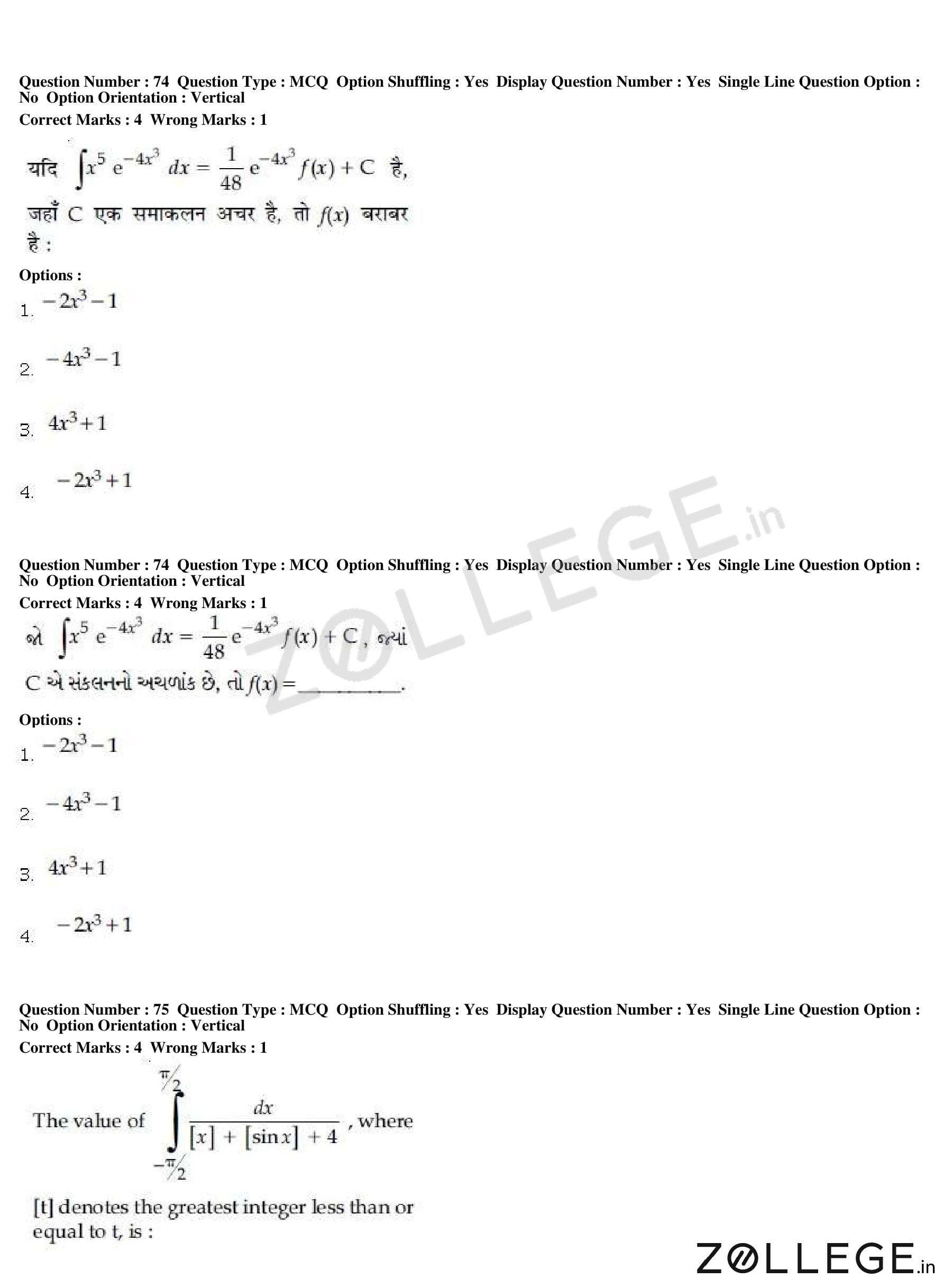
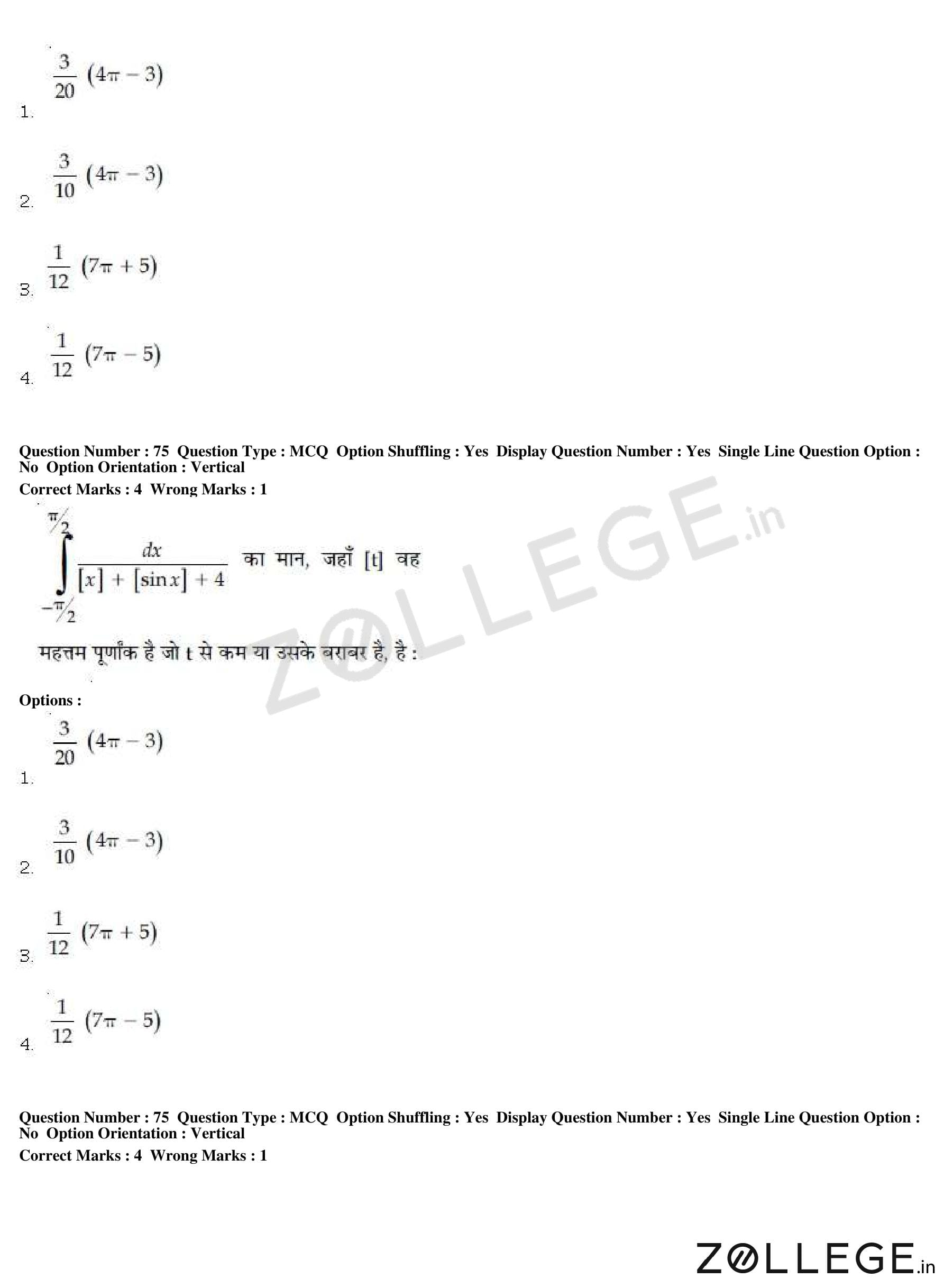
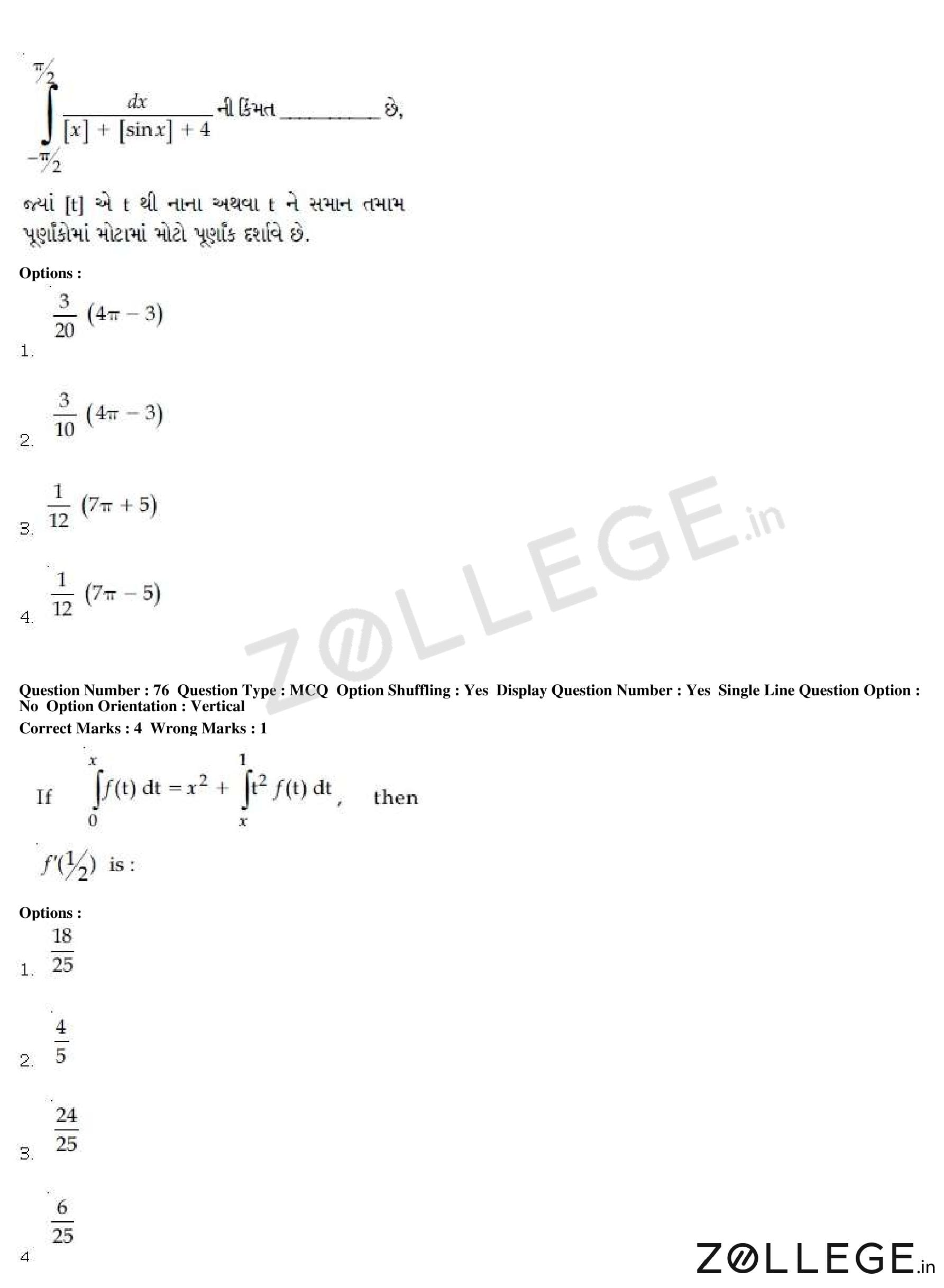
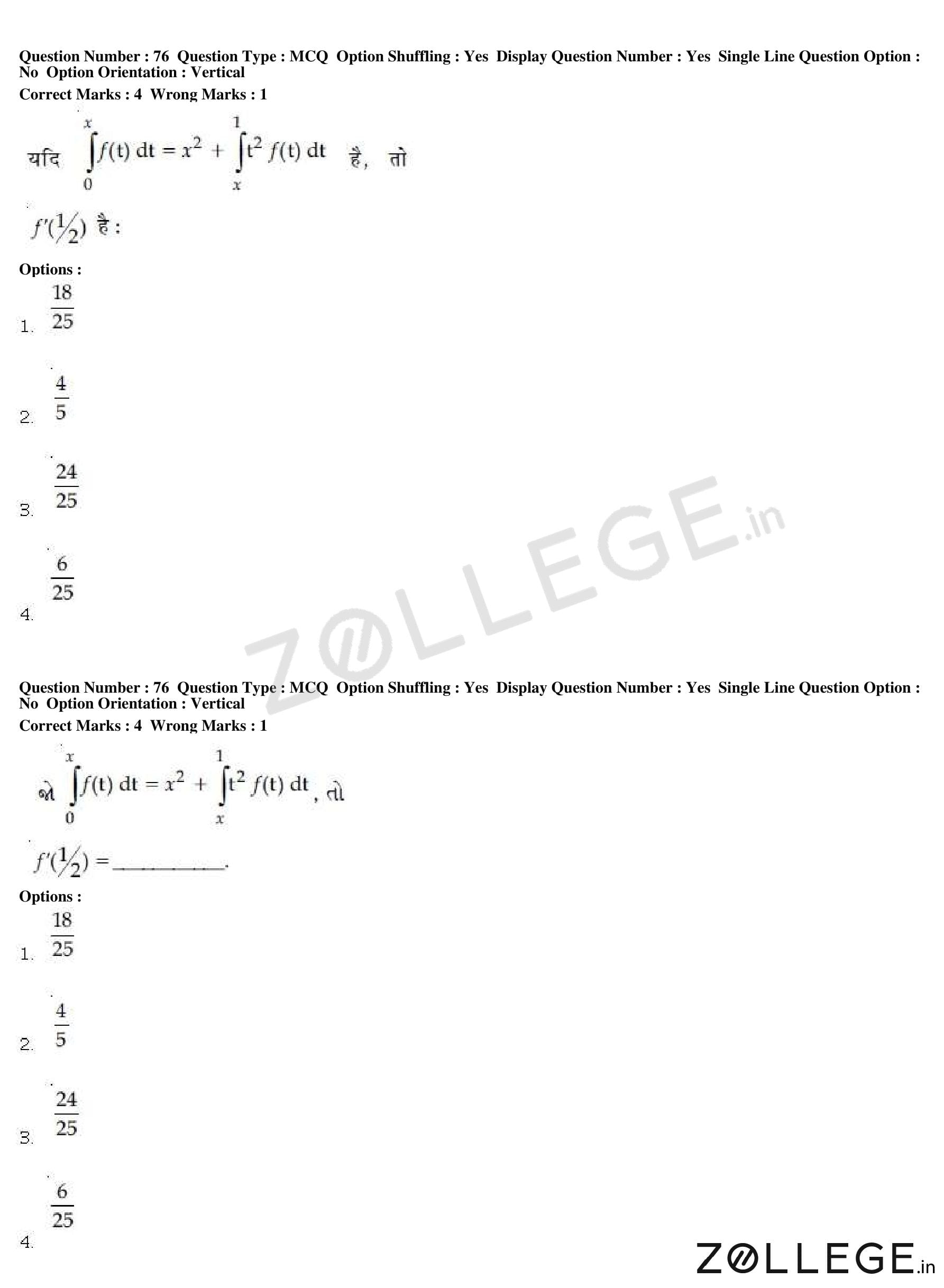
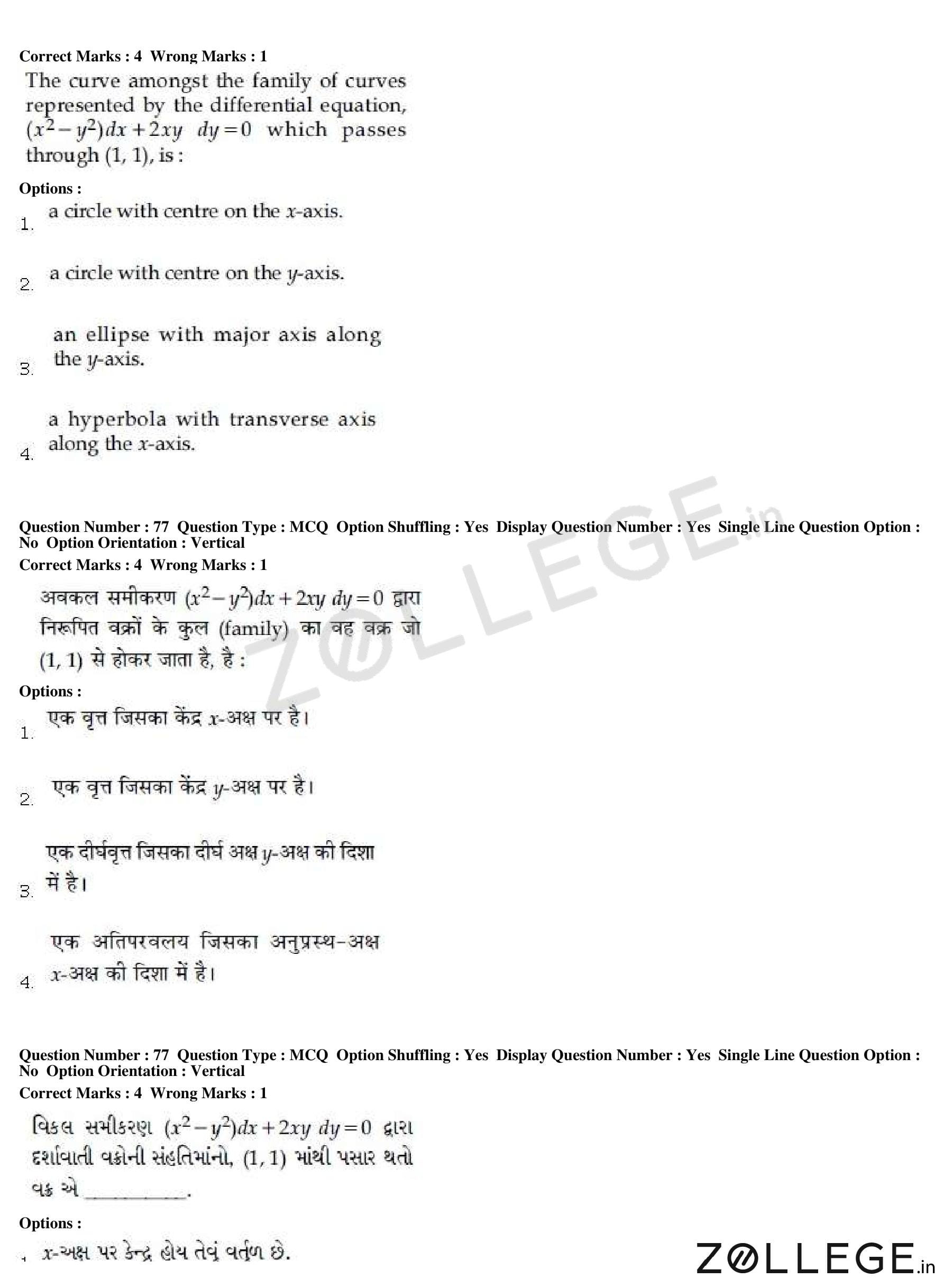
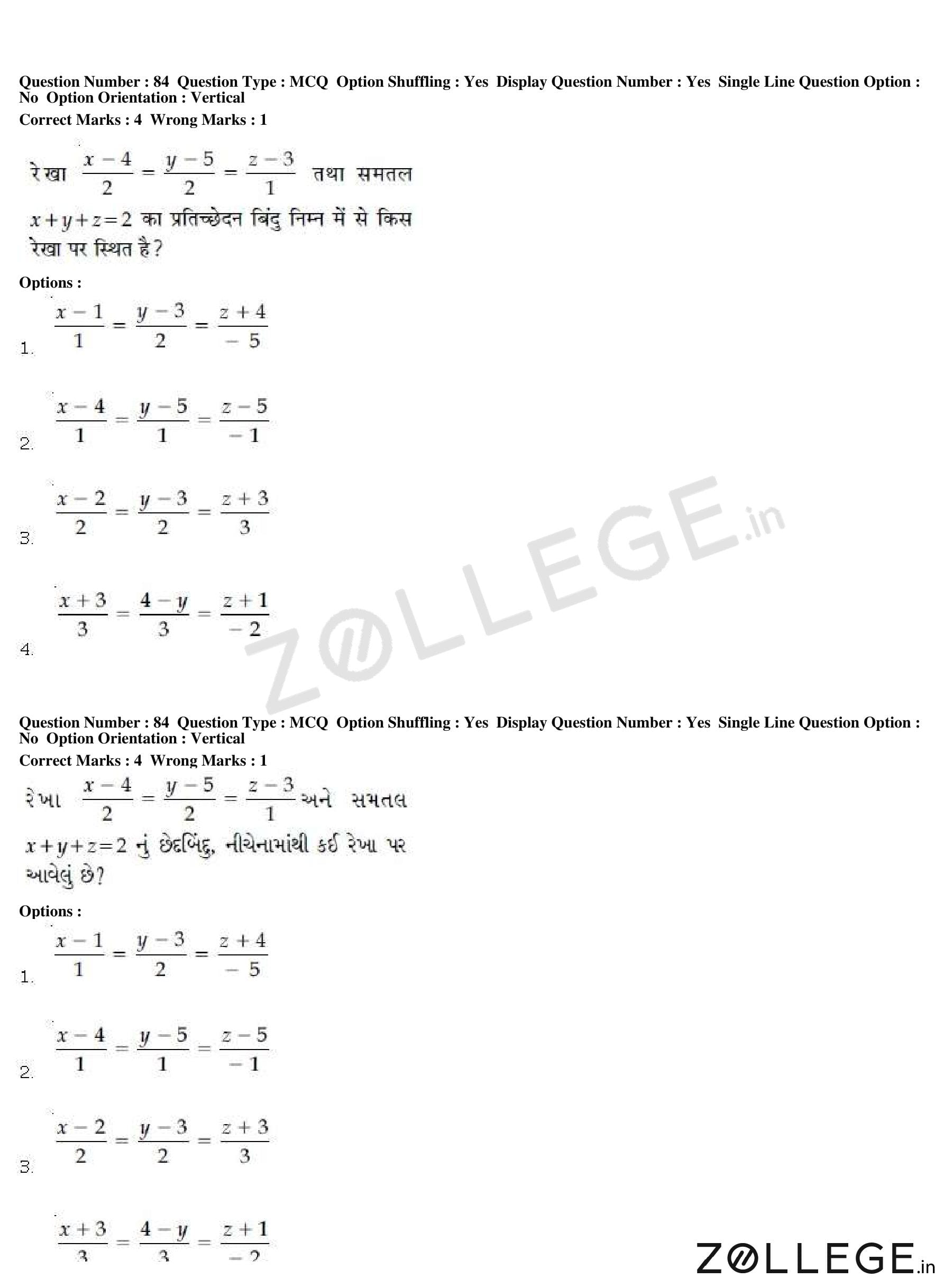
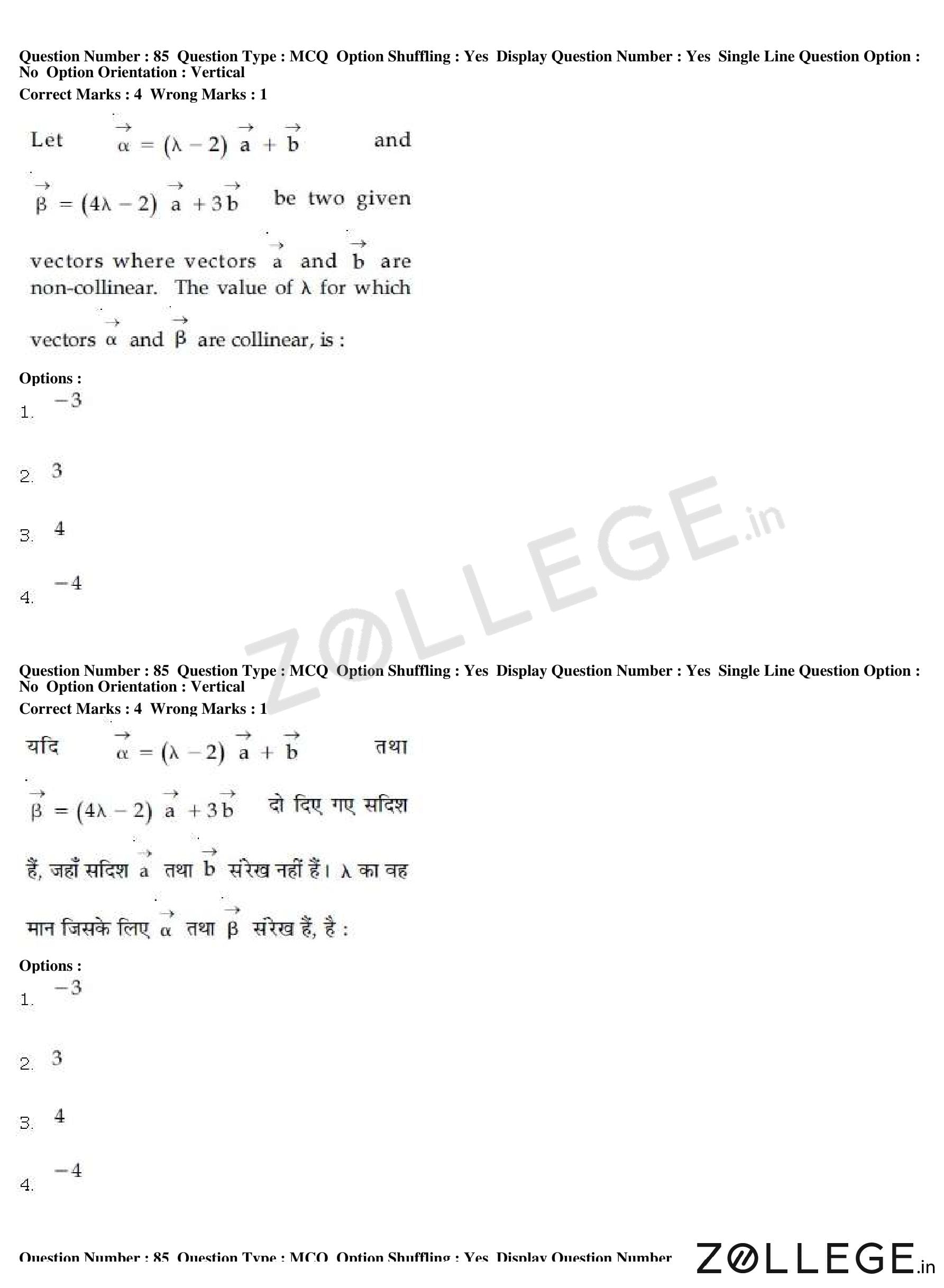
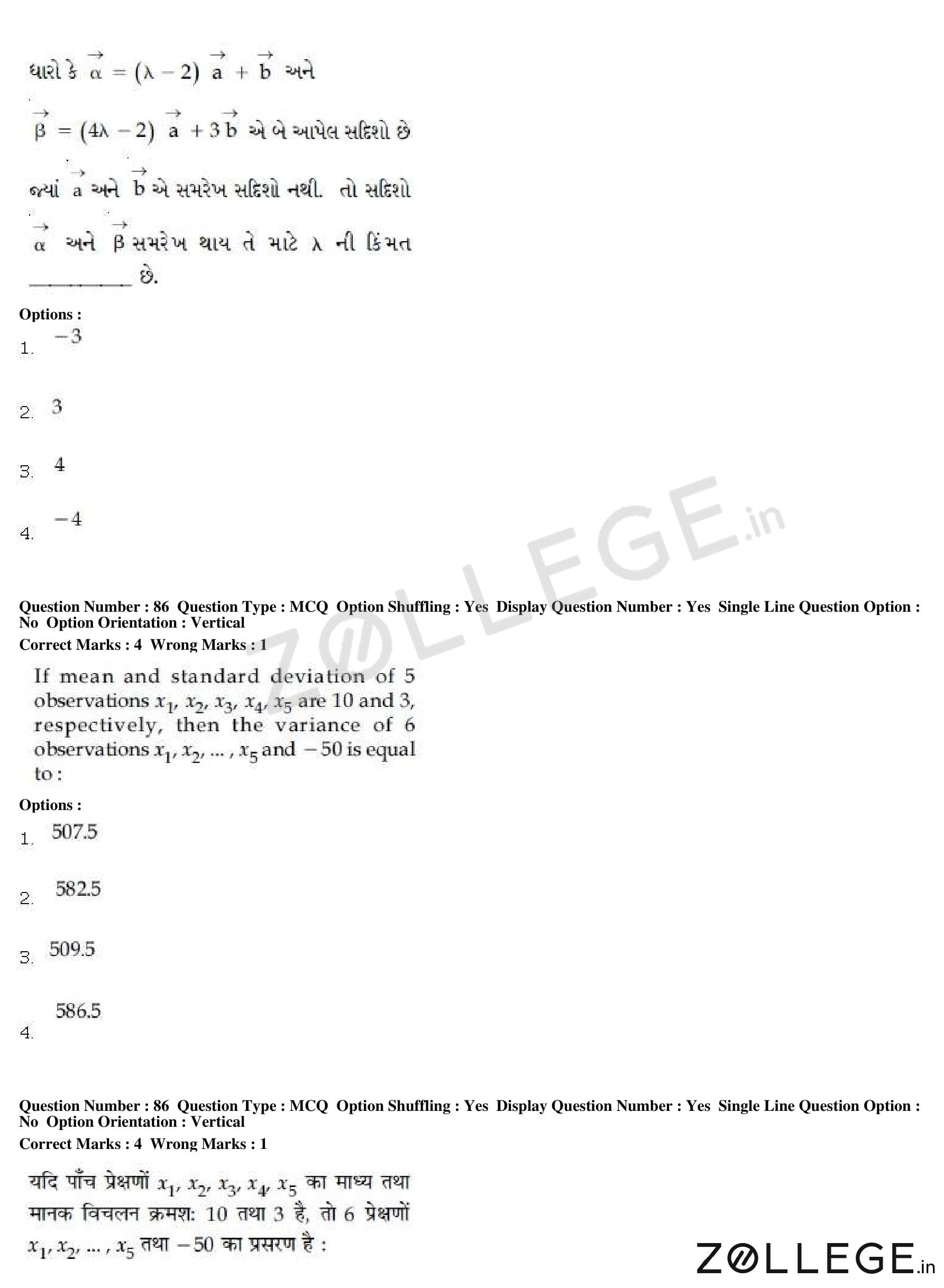
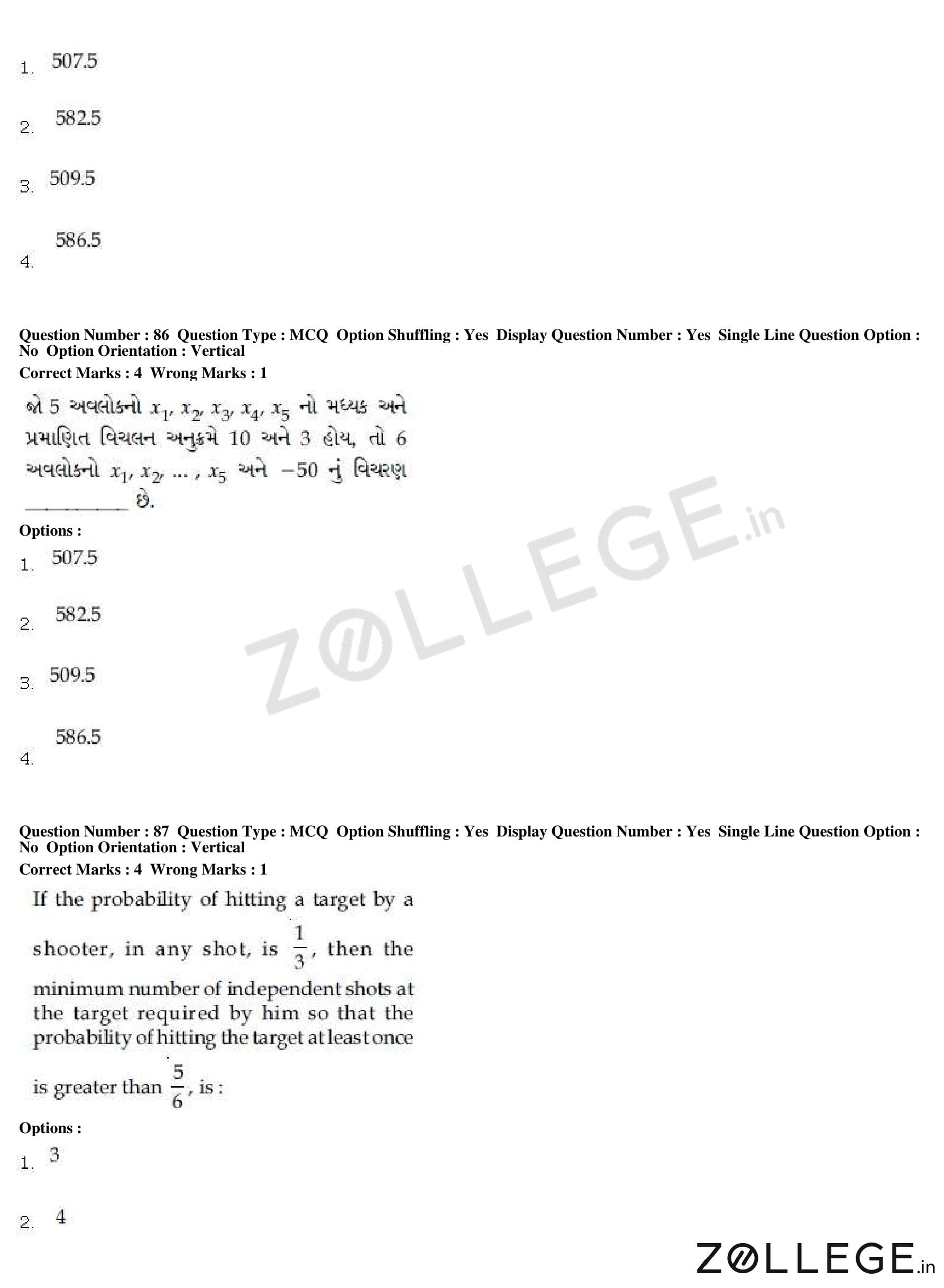
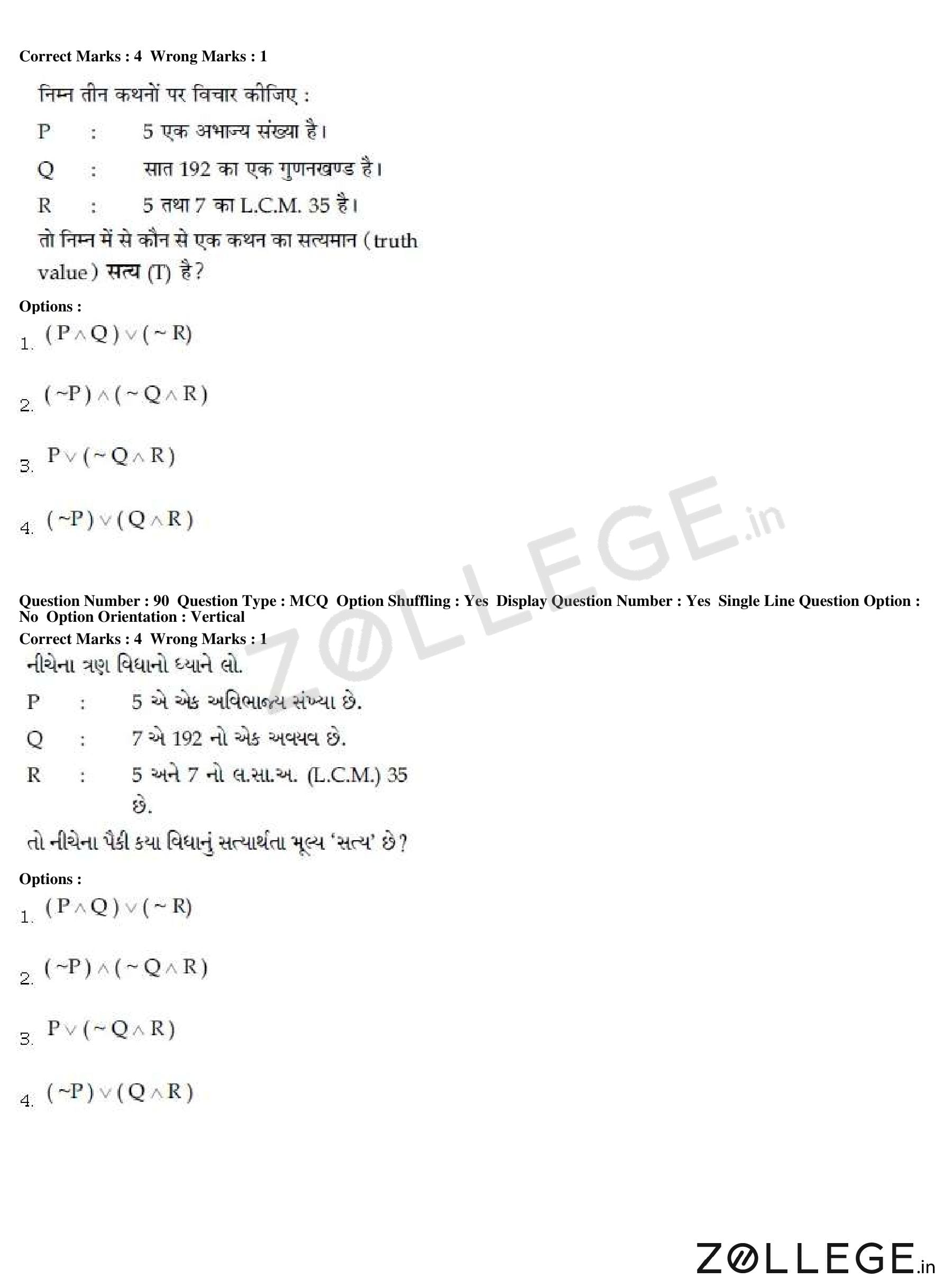
Previous Year JEE Main Question Papers
*The article might have information for the previous academic years, please refer the official website of the exam.