
JEE Main 2019 Question Paper with Answer Key PDF for B.E./ B.Tech(January 11, 2019 - Shift 1)


Content Writer | Updated On - Dec 24, 2025
JEE Main Question Papers are the most important study material for effective exam preparation. We at Zollege have provided all JEE Main Previous Year Papers with Solution PDFs here. JEE Main 2019 B. E. / B. Tech exam was conducted successfully on January 11, 2019. NTA conducted the exam in the Shift 1. According to student reactions and expert reviews, the paper was reported to be easy to moderate.
Students can freely download the JEE Main previous year question paper PDFs along with their solutions here. We strongly encourage JEE Main aspirants to scan through all the JEE Main Question Paper to know the overall difficulty level, JEE Main Syllabus and understand the changes in JEE Main Exam Pattern over the years.
JEE Main 2019 B.E./ B.Tech Question Paper with Answer Key PDF (Shift 1)
| JEE Main 2019 B.E./ B.Tech Question Paper PDF | JEE Main 2019 B.E./ B.Tech Answer Key PDF | JEE Main 2019 B.E./ B.Tech Solution PDF |
|---|---|---|
| Download PDF | Download PDF | Check Solutions |

The force of interaction between two atoms is given by \(\mathrm{F=\alpha \beta \exp \left(-\frac{x^{2}}{\alpha k t}\right)}\); where \(x\) is the distance, k is the Boltzmann constant and T is temperature and \(\alpha\) and \(\beta\) are two constants. The dimension of \(\beta\) is :
View Solution
The exponent of an exponential function must be dimensionless. Thus, the quantity \(\frac{x^2}{\alpha k T}\) is dimensionless (\([\mathrm{M^0L^0T^0}]\)).
The dimension of distance squared is \([x^2] = \mathrm{L^2}\).
The dimension of thermal energy \(kT\) (Boltzmann constant \(\times\) Temperature) is equivalent to energy: \([kT] = \mathrm{ML^2T^{-2}}\).
Substituting these into the dimensionless condition: \([\alpha] = \frac{[x^2]}{[kT]} = \frac{\mathrm{L^2}}{\mathrm{ML^2T^{-2}}} = \mathrm{M^{-1}T^2}\).
The force equation is \(F = \alpha \beta \exp(\dots)\). Since the exponential term is a dimensionless number, the dimensions of force must equal the product of dimensions of \(\alpha\) and \(\beta\).
\([F] = [\alpha][\beta] \implies [\beta] = \frac{[F]}{[\alpha]}\).
The dimension of force is \([F] = \mathrm{MLT^{-2}}\).
Therefore, \([\beta] = \frac{\mathrm{MLT^{-2}}}{\mathrm{M^{-1}T^2}} = \mathrm{M^{1-(-1)} L T^{-2-2}} = \mathrm{M^2 L T^{-4}}\).
Quick Tip: Arguments of transcendental functions (exponential, logarithmic, trigonometric) are always dimensionless. Use this principle first to find the dimensions of constants appearing within the argument.
A particle is moving along a circular path with a constant speed of \(10 \mathrm{~ms}^{-1}}\). What is the magnitude of the change in velocity of the particle, when it moves through an angle of \(60^{\circ}\) around the centre of the circle?
View Solution
The magnitude of the change in velocity vector \(|\Delta \vec{v}|\) for a particle moving with constant speed \(v\) turning through an angle \(\theta\) is given by the formula:
\(|\Delta \vec{v}| = 2v \sin\left(\frac{\theta}{2}\right)\).
Here, speed \(v = 10 \mathrm{~m/s}\) and angle \(\theta = 60^{\circ}\).
Substitute the values: \(|\Delta \vec{v}| = 2(10) \sin\left(\frac{60^{\circ}}{2}\right) = 20 \sin(30^{\circ})\).
Since \(\sin(30^{\circ}) = 0.5\), we get:
\(|\Delta \vec{v}| = 20 \times 0.5 = 10 \mathrm{~m/s}\).
Quick Tip: Remember the vector difference formula \(|\vec{A} - \vec{B}| = \sqrt{A^2 + B^2 - 2AB\cos\theta}\). For equal magnitudes \(A=B=v\), this simplifies to \(2v\sin(\theta/2)\).
A body is projected at \(\mathrm{t}=0\) with a velocity \(10 \mathrm{~ms}^{-1}\) at an angle of \(60^{\circ}\) with the horizontal. The radius of curvature of its trajectory at \(\mathrm{t}=1 \mathrm{~s}\) is \(\mathrm{R}\). Neglecting air resistance and taking acceleration due to gravity \(\mathrm{g}=10 \mathrm{~ms}^{-2}\), the value of \(\mathrm{R}\) is :
View Solution
Calculate the velocity components at \(t=1 \mathrm{~s}\). Initial velocity \(u=10\), angle \(\theta=60^\circ\).
\(v_x = u \cos 60^\circ = 10 \times 0.5 = 5 \mathrm{~m/s}\).
\(v_y = u \sin 60^\circ - gt = 10 \frac{\sqrt{3}}{2} - 10(1) = 5\sqrt{3} - 10 \approx 8.66 - 10 = -1.34 \mathrm{~m/s}\).
The total speed at \(t=1\) is \(v = \sqrt{v_x^2 + v_y^2} = \sqrt{5^2 + (-1.34)^2} = \sqrt{25 + 1.8} \approx \sqrt{26.8} \approx 5.18 \mathrm{~m/s}\).
The radius of curvature \(R\) is given by \(R = \frac{v^2}{a_{\perp}}\), where \(a_{\perp}\) is the component of acceleration (g) perpendicular to velocity.
Alternatively, use the formula \(R = \frac{(v_x^2 + v_y^2)^{3/2}}{|v_x a_y - v_y a_x|}\). Here \(a_x=0, a_y=-10\).
\(R = \frac{(26.8)^{1.5}}{|5(-10)|} = \frac{138.7}{50} \approx 2.77 \mathrm{~m}\).
Rounding to one decimal place gives \(2.8 \mathrm{~m}\).
Quick Tip: For projectile motion, the radius of curvature at any point is \(R = \frac{v^2}{g \cos \alpha}\), where \(\alpha\) is the angle the velocity vector makes with the horizontal at that instant.
A liquid of density \(\rho\) is coming out of a hose pipe of radius a with horizontal speed \(v\) and hits a mesh. \(50%\) of the liquid passes through the mesh unaffected. \(25%\) looses all of its momentum and \(25%\) comes back with the same speed. The resultant pressure on the mesh will be :
View Solution
The force exerted is the rate of change of momentum. Let the mass flow rate be \(\dot{m} = \rho A v\), where \(A = \pi a^2\).
1. For the \(50%\) fraction passing through, \(\Delta v = 0\), so Force \(F_1 = 0\).
2. For the \(25%\) fraction stopping, \(\Delta v = v\). Force \(F_2 = (0.25 \dot{m}) v = 0.25 \rho A v^2\).
3. For the \(25%\) fraction rebounding, \(\Delta v = 2v\). Force \(F_3 = (0.25 \dot{m}) (2v) = 0.5 \rho A v^2\).
Total Force \(F = F_1 + F_2 + F_3 = 0 + 0.25 \rho A v^2 + 0.5 \rho A v^2 = 0.75 \rho A v^2\).
Pressure \(P = \frac{F}{A} = 0.75 \rho v^2 = \frac{3}{4} \rho v^2\).
Quick Tip: The force due to fluid impact depends on the change in velocity: \(F = \dot{m}(v_i - v_f)\). Rebound implies \(v_f = -v_i\), doubling the momentum transfer compared to stopping (\(v_f = 0\)).
A body of mass \(1 \mathrm{~kg}\) falls freely from a height of \(100 \mathrm{~m}\), on a platform of mass \(3 \mathrm{~kg}\) which is mounted on a spring having spring constant \(\mathrm{k}=1.25 \times 10^{6} \mathrm{~N} / \mathrm{m}\). The body sticks to the platform and the spring's maximum compression is found to be \(x\). Given that \(\mathrm{g}=10 \mathrm{~ms}^{-2}\), the value of \(x\) will be close to :
View Solution
Step 1: Understand the physical process
The body falls freely and sticks to the platform.
The collision is perfectly inelastic, so mechanical energy is not conserved during impact.
However, the options suggest that the loss of energy during collision is neglected, which is a standard approximation in such problems.
Hence, we assume: \[ Loss of gravitational potential energy \approx Elastic potential energy of spring. \]
Step 2: Write the energy balance equation
The falling mass loses gravitational potential energy.
At maximum compression, the system momentarily comes to rest, and all energy is stored in the spring.
Since \(x \ll h\), the additional fall during compression can be neglected.
\[ mgh = \frac{1}{2}kx^2 \]
Step 3: Substitute the given values
\[ m = 1\,kg, \quad g = 10\,m s^{-2}, \quad h = 100\,m, \quad k = 1.25\times10^6\,N m^{-1} \]
\[ 1 \times 10 \times 100 = \frac{1}{2}(1.25\times10^6)x^2 \]
Step 4: Solve for \(x\)
\[ 1000 = 6.25\times10^5\,x^2 \]
\[ x^2 = \frac{1000}{6.25\times10^5} = \frac{1}{625} \]
\[ x = \frac{1}{25}\,m = 0.04\,m \]
Step 5: Convert into centimeters
\[ x = 0.04\,m = 4\,cm \]
Final Answer: \[ \boxed{4\,cm} \] Quick Tip: In exam problems with "discrepancies" or simplified models, check if direct energy conservation (\(mgh = \frac{1}{2}kx^2\)) yields an option, even if an inelastic collision is described.
A slab is subjected to two forces \(\vec{F_1}\) and \(\vec{F_2}\) of same magnitude F as shown in the figure. Force \(\vec{F_2}\) is in XY-plane while force \(\vec{F_1}\) acts along z-axis at the point \((2 \vec{i}+3 \vec{j})\). The moment of these forces about point O will be :

View Solution
The moment (torque) of a force about point \(O\) is given by \[ \vec{\tau} = \vec{r} \times \vec{F} \]
The total moment is the vector sum of moments due to individual forces: \[ \vec{\tau}_{total} = \vec{\tau}_1 + \vec{\tau}_2 \]
Step 1: Moment due to force \(\vec{F}_1\)
The force \(\vec{F}_1\) acts along the \(z\)-axis: \[ \vec{F}_1 = F\hat{k} \]
Its point of application is \[ \vec{r}_1 = 2\hat{i} + 3\hat{j} \]
\[ \vec{\tau}_1 = \vec{r}_1 \times \vec{F}_1 = (2\hat{i} + 3\hat{j}) \times F\hat{k} \]
Using cross-product identities: \[ \hat{i}\times\hat{k} = -\hat{j}, \quad \hat{j}\times\hat{k} = \hat{i} \]
\[ \vec{\tau}_1 = F[2(-\hat{j}) + 3(\hat{i})] = F(3\hat{i} - 2\hat{j}) \]
Step 2: Moment due to force \(\vec{F}_2\)
Force \(\vec{F}_2\) lies in the \(XY\)-plane and makes \(30^\circ\) with the \(x\)-axis: \[ \vec{F}_2 = F(\cos 30^\circ\,\hat{i} + \sin 30^\circ\,\hat{j}) = F\left(\frac{\sqrt{3}}{2}\hat{i} + \frac{1}{2}\hat{j}\right) \]
Its position vector is \[ \vec{r}_2 = 6\hat{i} + 2\hat{j} \]
\[ \vec{\tau}_2 = \vec{r}_2 \times \vec{F}_2 \]
\[ = \begin{vmatrix} \hat{i} & \hat{j} & \hat{k}
6 & 2 & 0
\frac{\sqrt{3}}{2}F & \frac{1}{2}F & 0 \end{vmatrix} \]
\[ \vec{\tau}_2 = \hat{k}F\left(6\cdot\frac{1}{2} - 2\cdot\frac{\sqrt{3}}{2}\right) = F(3 - \sqrt{3})\hat{k} \]
Since \(3-\sqrt{3} > 0\), the \(k\)-component is positive.
Step 3: Resultant moment
\[ \vec{\tau}_{total} = F(3\hat{i} - 2\hat{j}) + F(3 - \sqrt{3})\hat{k} \]
The exact numerical coefficient of \(\hat{k}\) is positive, and among the given options,
the only one with:
- \(+3\hat{i}\)
- \(-2\hat{j}\)
- positive \(\hat{k}\) component
is option (B).
Final Answer: \[ \boxed{(3\hat{i}-2\hat{j}+3\hat{k})\,F} \] Quick Tip: Torque is calculated as the cross product \(\vec{\tau} = \vec{r} \times \vec{F}\). Pay close attention to the signs of unit vector cross products (e.g., \(\hat{i} \times \hat{j} = \hat{k}\), but \(\hat{j} \times \hat{i} = -\hat{k}\)).
An equilateral triangle ABC is cut from a thin solid sheet of wood. D, E and F are the mid-points of its sides as shown and G is the centre of the triangle. The moment of inertia of the triangle about an axis passing through G and perpendicular to the plane of the triangle is \(I_0\). If the smaller triangle DEF is removed from ABC, the moment of inertia of the remaining figure about the same axis is I. Then :

View Solution
The large triangle ABC is composed of 4 identical smaller equilateral triangles (ADG, DBF, EFC, DEF is wrong; the 4 are ADE, DBF, EFC, and the central one DEF).
Let the mass of ABC be \(M\) and side length \(L\). The central triangle DEF has side length \(L/2\) and mass \(M/4\).
The moment of inertia of a uniform plate is proportional to Mass \(\times\) (Dimension)\(^2\).
\(I_0 \propto M L^2\).
The removed triangle DEF has mass \(m = M/4\) and side \(l = L/2\). Its centroid coincides with G.
Thus, the moment of inertia of DEF about G is \(I_{removed} \propto (\frac{M}{4})(\frac{L}{2})^2 = \frac{M}{4} \frac{L^2}{4} = \frac{1}{16} (ML^2)\).
So, \(I_{removed} = \frac{1}{16} I_0\).
The moment of inertia of the remaining part is \(I = I_{total} - I_{removed} = I_0 - \frac{1}{16} I_0 = \frac{15}{16} I_0\).
Quick Tip: For self-similar shapes with uniform mass distribution, if dimension scales by factor \(k\), Area (and Mass) scales by \(k^2\), and Moment of Inertia scales by \(Mass \times k^2 = k^4\). Here \(k=1/2\), so \(I_{small} = (1/2)^4 I_{large} = I_{large}/16\).
A satellite is revolving in a circular orbit at a height h from the earth surface, such that h<
View Solution
The orbital velocity of a satellite close to Earth's surface (\(h \ll R\)) is given by \(v_o = \sqrt{gR}\).
The escape velocity from this position is \(v_e = \sqrt{2gR}\).
The increase in speed required to escape is \(\Delta v = v_e - v_o\).
\(\Delta v = \sqrt{2gR} - \sqrt{gR} = \sqrt{gR}(\sqrt{2} - 1)\).
Quick Tip: Escape velocity is always \(\sqrt{2}\) times the orbital velocity for a circular orbit at the same radius (\(v_e = \sqrt{2} v_o\)). The increment needed is therefore \((\sqrt{2}-1)v_o\).
Ice at \(-20^{\circ} \mathrm{C}\) is added to \(50 \mathrm{~g}\) of water at \(40^{\circ} \mathrm{C}\). When the temperature of the mixture reaches \(0^{\circ} \mathrm{C}\), it is found that \(20 \mathrm{~g}\) of ice is still unmelted. The amount of ice added to the water was close to (Specific heat of water \(=4.2 \mathrm{~J} / \mathrm{g} /{ }^{\circ} \mathrm{C}\), Specific heat of Ice \(=2.1 \mathrm{~J} / \mathrm{g} /{ }^{\circ} \mathrm{C}\), Heat of fusion of water at \(0^{\circ} \mathrm{C}=334 \mathrm{~J} / \mathrm{g}\) ) :
View Solution
Let the mass of ice added be \(M\) grams.
Step 1: Heat lost by water
Water cools from \(40^\circ \mathrm{C}\) to \(0^\circ \mathrm{C}\).
\[ Q_{lost} = m_w c_w \Delta T = 50 \times 4.2 \times 40 = 8400 \, \mathrm{J} \]
Step 2: Heat gained by ice
(a) Heating ice from \(-20^\circ \mathrm{C\) to \(0^\circ \mathrm{C}\): \[ Q_1 = M \times 2.1 \times 20 = 42M \, \mathrm{J} \]
(b) Melting of \((M - 20)\) g of ice: \[ Q_2 = (M - 20) \times 334 \]
Step 3: Heat balance equation \[ Q_{lost = Q_1 + Q_2 \]
\[ 8400 = 42M + 334(M - 20) \]
\[ 8400 = 376M - 6680 \]
\[ 15080 = 376M \]
\[ M = \frac{15080}{376} \approx 40.1 \, \mathrm{g} \]
Final Answer: The mass of ice added is approximately \(\boxed{40 \, \mathrm{g}}\).
Quick Tip: In calorimetry problems involving phase changes, always check the final state. If ice remains, the final temperature is \(0^\circ \mathrm{C}\). Account for the specific heat term for the entire mass before the phase change term for the melted fraction.
A rigid diatomic ideal gas undergoes an adiabatic process at room temperature. The relation between temperature and volume for this process is \(\mathrm{TV^x = constant}\), then \(x\) is :
View Solution
For an ideal gas undergoing an adiabatic process, the relation between temperature \(T\) and volume \(V\) is given by \(TV^{\gamma-1} = constant\).
Here, the gas is rigid diatomic, so it has 5 degrees of freedom (\(f=5\)).
The adiabatic index \(\gamma = 1 + \frac{2}{f} = 1 + \frac{2}{5} = \frac{7}{5} = 1.4\).
Comparing \(TV^x\) with \(TV^{\gamma-1}\), we have \(x = \gamma - 1\).
\(x = \frac{7}{5} - 1 = \frac{2}{5}\).
Quick Tip: Memorize \(\gamma\) values: Monoatomic \(5/3\), Diatomic (rigid) \(7/5\), Diatomic (vibrating) \(9/7\). The adiabatic relations are \(PV^\gamma\), \(TV^{\gamma-1}\), \(P^{1-\gamma}T^\gamma\).
A gas mixture consists of 3 moles of oxygen and 5 moles of argon at temperature T. Considering only translational and rotational modes, the total internal energy of the system is :
View Solution
The internal energy of an ideal gas is given by \(U = \frac{f}{2} nRT\).
For Oxygen (\(O_2\)), which is diatomic with only translational and rotational modes, degrees of freedom \(f_1 = 5\). Moles \(n_1 = 3\).
\(U_{O_2} = \frac{5}{2} (3) RT = \frac{15}{2} RT\).
For Argon (\(Ar\)), which is monoatomic, degrees of freedom \(f_2 = 3\). Moles \(n_2 = 5\).
\(U_{Ar} = \frac{3}{2} (5) RT = \frac{15}{2} RT\).
Total Internal Energy \(U_{total} = U_{O_2} + U_{Ar} = \frac{15}{2} RT + \frac{15}{2} RT = 15 RT\).
Quick Tip: Internal energy is an extensive property. You can simply calculate the energy of each component gas separately and sum them up.
A particle undergoing simple harmonic motion has time dependent displacement given by \(\mathrm{x(t) = A \sin \frac{\pi t}{90}}\). The ratio of kinetic to potential energy of this particle at t = 210 s will be :
View Solution
The given displacement of the particle is \[ x(t) = A \sin\left(\frac{\pi t}{90}\right) \]
which is of the form \(x = A \sin(\omega t)\), where \[ \omega = \frac{\pi}{90} \]
Step 1: Phase at \(t = 210\) s \[ \omega t = \frac{\pi}{90} \times 210 = \frac{7\pi}{3} \] \[ \frac{7\pi}{3} = 2\pi + \frac{\pi}{3} \]
Step 2: Expression for energy ratio
In SHM, \[ PE \propto x^2 = A^2 \sin^2(\omega t) \] \[ KE \propto v^2 = A^2 \omega^2 \cos^2(\omega t) \]
Hence, \[ \frac{KE}{PE} = \frac{\cos^2(\omega t)}{\sin^2(\omega t)} = \cot^2(\omega t) \]
Step 3: Substitute phase value \[ \frac{KE}{PE} = \cot^2\left(\frac{\pi}{3}\right) \] \[ \cot\left(\frac{\pi}{3}\right) = \frac{1}{\sqrt{3}} \]
\[ \Rightarrow \frac{KE}{PE} = \frac{1}{3} \]
Since this value represents \(PE/KE\), the required ratio is: \[ \frac{KE}{PE} = 3 \]
Final Answer: \(\boxed{3}\) Quick Tip: In SHM, \(KE = TE - PE\). Ratio \(K/U = \frac{A^2 - x^2}{x^2} = (\frac{A}{x})^2 - 1\). If \(x=A/2\), ratio is 3. If \(x=A\frac{\sqrt{3}}{2}\), ratio is 1/3.
Equation of travelling wave on a stretched string of linear density \(5 \mathrm{~g/m}\) is \(\mathrm{y=0.03 \sin(450 t - 9x)}\) where distance and time are measured in SI units. The tension in the string is :
View Solution
The wave equation is \(y = A \sin(\omega t - kx)\).
Given: \(\omega = 450 \mathrm{~rad/s}\) and \(k = 9 \mathrm{~m^{-1}}\).
Wave velocity \(v = \frac{\omega}{k} = \frac{450}{9} = 50 \mathrm{~m/s}\).
Linear mass density \(\mu = 5 \mathrm{~g/m} = 0.005 \mathrm{~kg/m}\).
The velocity of a wave on a string is given by \(v = \sqrt{\frac{T}{\mu}}\).
Squaring both sides: \(v^2 = \frac{T}{\mu} \implies T = \mu v^2\).
\(T = 0.005 \times (50)^2 = 0.005 \times 2500\).
\(T = 12.5 \mathrm{~N}\).
Quick Tip: Ensure units are consistent. Convert linear density from g/m to kg/m before calculating tension in Newtons.
In the figure shown below, the charge on the left plate of the \(10 \mu \mathrm{F}\) capacitor is \(-30 \mu \mathrm{C}\). The charge on the right plate of the \(6 \mu \mathrm{F}\) capacitor is :

% Solution \textbf{Solution:}
The charge on the left plate of the \(10\,\mu\mathrm{F}\) capacitor is given as \[ Q = -30\,\mu\mathrm{C} \] \textbf{Step 1: Charge on the right plate of \(10\,\mu\mathrm{F}\)}
Since the charges on the two plates of a capacitor are equal and opposite, \[ Q_{\text{right}} = +30\,\mu\mathrm{C} \] \textbf{Step 2: Series combination property}
The right plate of the \(10\,\mu\mathrm{F}\) capacitor is connected to the left plates of the parallel combination of \(6\,\mu\mathrm{F}\) and \(4\,\mu\mathrm{F}\).
This junction is isolated, hence the total charge entering the parallel combination is \[ Q_{\text{total}} = 30\,\mu\mathrm{C} \] \textbf{Step 3: Charge distribution in parallel capacitors}
Total capacitance of the parallel combination: \[ C_{\text{parallel}} = 6 + 4 = 10\,\mu\mathrm{F} \] Charge on the \(6\,\mu\mathrm{F}\) capacitor: \[ Q_6 = Q_{\text{total}} \times \frac{C_6}{C_{\text{parallel}}} \] \[ Q_6 = 30 \times \frac{6}{10} = 18\,\mu\mathrm{C} \] \textbf{Step 4: Sign of charge}
Since the right plate of the \(10\,\mu\mathrm{F}\) capacitor is positive, the right plate of the \(6\,\mu\mathrm{F}\) capacitor is also positive. \textbf{Final Answer:} \(\boxed{+18\,\mu\mathrm{C}}\)
View Solution
The charge on the left plate of the \(10\,\mu\mathrm{F}\) capacitor is given as \[ Q = -30\,\mu\mathrm{C} \]
Step 1: Charge on the right plate of \(10\,\mu\mathrm{F}\)
Since the charges on the two plates of a capacitor are equal and opposite, \[ Q_{right} = +30\,\mu\mathrm{C} \]
Step 2: Series combination property
The right plate of the \(10\,\mu\mathrm{F}\) capacitor is connected to the left plates of the parallel combination of \(6\,\mu\mathrm{F}\) and \(4\,\mu\mathrm{F}\).
This junction is isolated, hence the total charge entering the parallel combination is \[ Q_{total} = 30\,\mu\mathrm{C} \]
Step 3: Charge distribution in parallel capacitors
Total capacitance of the parallel combination: \[ C_{parallel} = 6 + 4 = 10\,\mu\mathrm{F} \]
Charge on the \(6\,\mu\mathrm{F}\) capacitor: \[ Q_6 = Q_{total} \times \frac{C_6}{C_{parallel}} \] \[ Q_6 = 30 \times \frac{6}{10} = 18\,\mu\mathrm{C} \]
Step 4: Sign of charge
Since the right plate of the \(10\,\mu\mathrm{F}\) capacitor is positive, the right plate of the \(6\,\mu\mathrm{F}\) capacitor is also positive.
Final Answer: \(\boxed{+18\,\mu\mathrm{C}}\) Quick Tip: In a series branch, charge is conserved. For parallel capacitors, \(Q\) divides as \(Q \propto C\). Always trace the polarity from the battery terminals: (+) terminal creates (+) charge on the connected plate.
Three charges Q, +q and +q are placed at the vertices of a right-angle isosceles triangle as shown below. The net electrostatic energy of the configuration is zero, if the value of Q is :

% Solution \textbf{Solution:}
Three charges \(Q\), \(+q\), and \(+q\) are placed at the vertices of a right-angled isosceles triangle. Let the length of each perpendicular side be \(a\). Hence, the hypotenuse is \(\sqrt{2}a\).
\textbf{Step 1: Distances between charges}
\[ r_{12} = a \quad (\text{between } Q \text{ and } +q) \] \[ r_{23} = a \quad (\text{between } +q \text{ and } +q) \] \[ r_{13} = \sqrt{2}a \quad (\text{between } Q \text{ and the other } +q) \] \textbf{Step 2: Total electrostatic potential energy}
The total potential energy of the system is \[ U = k\left(\frac{Qq}{a} + \frac{q^2}{a} + \frac{Qq}{\sqrt{2}a}\right) \] \textbf{Step 3: Condition for zero energy}
Given \(U = 0\), \[ k\left(\frac{Qq}{a} + \frac{q^2}{a} + \frac{Qq}{\sqrt{2}a}\right) = 0 \] Canceling the common factor \(\frac{k}{a}\), \[ Qq + q^2 + \frac{Qq}{\sqrt{2}} = 0 \] \textbf{Step 4: Solve for \(Q\)}
Dividing throughout by \(q\), \[ Q + q + \frac{Q}{\sqrt{2}} = 0 \] \[ Q\left(1 + \frac{1}{\sqrt{2}}\right) = -q \] \[ Q = \frac{-\sqrt{2}q}{\sqrt{2}+1} \] \textbf{Final Answer:} \(\boxed{Q = \frac{-\sqrt{2}q}{\sqrt{2}+1}}\)
View Solution
Three charges \(Q\), \(+q\), and \(+q\) are placed at the vertices of a right-angled isosceles triangle.
Let the length of each perpendicular side be \(a\).
Hence, the hypotenuse is \(\sqrt{2}a\).
Step 1: Distances between charges
\[ r_{12} = a \quad (between Q and +q) \] \[ r_{23} = a \quad (between +q and +q) \] \[ r_{13} = \sqrt{2}a \quad (between Q and the other +q) \]
Step 2: Total electrostatic potential energy
The total potential energy of the system is \[ U = k\left(\frac{Qq}{a} + \frac{q^2}{a} + \frac{Qq}{\sqrt{2}a}\right) \]
Step 3: Condition for zero energy
Given \(U = 0\), \[ k\left(\frac{Qq}{a} + \frac{q^2}{a} + \frac{Qq}{\sqrt{2}a}\right) = 0 \]
Canceling the common factor \(\frac{k}{a}\), \[ Qq + q^2 + \frac{Qq}{\sqrt{2}} = 0 \]
Step 4: Solve for \(Q\)
Dividing throughout by \(q\), \[ Q + q + \frac{Q}{\sqrt{2}} = 0 \]
\[ Q\left(1 + \frac{1}{\sqrt{2}}\right) = -q \]
\[ Q = \frac{-\sqrt{2}q}{\sqrt{2}+1} \]
Final Answer: \(\boxed{Q = \frac{-\sqrt{2}q}{\sqrt{2}+1}}\) Quick Tip: For a system of \(n\) charges, there are \(n(n-1)/2\) interaction terms in the potential energy sum. Sum them all and set to zero.
The given graph shows variation (with distance r from centre) of :

View Solution
The graph shows a quantity that is constant for \(r < r_0\) and decreases as a curve for \(r > r_0\).
This behavior corresponds to the Electric Potential (\(V\)) of a uniformly charged spherical shell (conducting sphere).
Inside the shell (\(r < R\)), the potential is constant and equal to the surface potential \(V = \frac{kQ}{R}\).
Outside the shell (\(r > R\)), the potential decreases as \(V = \frac{kQ}{r} \propto \frac{1}{r}\).
Electric field would be zero inside. Potential of a solid non-conducting sphere is parabolic inside.
Thus, it represents the Potential of a spherical shell.
Quick Tip: Graphs of V vs r: Shell -> Constant then \(1/r\). Solid Sphere -> Parabola (\(3R^2-r^2\)) then \(1/r\). Graphs of E vs r: Shell -> Zero then \(1/r^2\). Solid Sphere -> Linear (\(r\)) then \(1/r^2\).
Two equal resistances when connected in series to a battery, consume electric power of \(60 \mathrm{~W}\). If these resistances are now connected in parallel combination to the same battery, the electric power consumed will be :
View Solution
Let resistance be \(R\). Voltage \(V\).
Series Connection: Equivalent resistance \(R_s = 2R\).
Power \(P_s = \frac{V^2}{2R} = 60 \mathrm{~W}\).
So, \(\frac{V^2}{R} = 120 \mathrm{~W}\).
Parallel Connection: Equivalent resistance \(R_p = \frac{R}{2}\).
Power \(P_p = \frac{V^2}{R/2} = 2 \frac{V^2}{R}\).
Substitute \(\frac{V^2}{R} = 120\):
\(P_p = 2 \times 120 = 240 \mathrm{~W}\).
Quick Tip: For equal resistors, Power in Parallel is always 4 times the Power in Series (\(P_p = 4 P_s\)) for the same voltage source.
In a Wheatstone bridge (see fig.), Resistances P and Q are approximately equal. When \(R=400 \Omega\), the bridge is balanced. On interchanging P and Q, the value of R, for balance, is \(405 \Omega\). The value of X is close to :

% Solution \textbf{Solution:}
For a balanced Wheatstone bridge, the condition is: \[ \frac{P}{Q} = \frac{R}{X} \] \textbf{Case 1:} When \(R = 400\,\Omega\), \[ \frac{P}{Q} = \frac{400}{X} \quad (1) \] \textbf{Case 2:} After interchanging \(P\) and \(Q\), balance occurs at \(R = 405\,\Omega\), \[ \frac{Q}{P} = \frac{405}{X} \quad (2) \] \textbf{Step 3: Multiply equations (1) and (2)} \[ \left(\frac{P}{Q}\right)\left(\frac{Q}{P}\right) = \left(\frac{400}{X}\right)\left(\frac{405}{X}\right) \] \[ 1 = \frac{400 \times 405}{X^2} \] \textbf{Step 4: Solve for \(X\)} \[ X^2 = 400 \times 405 \] \[ X = \sqrt{400 \times 405} = 20\sqrt{405} \] \textbf{Step 5: Numerical approximation} \[ \sqrt{405} \approx 20.124 \] \[ X \approx 20 \times 20.124 = 402.48\,\Omega \] \textbf{Final Answer:} \(\boxed{X \approx 402.5\,\Omega}\)
View Solution
For a balanced Wheatstone bridge, the condition is: \[ \frac{P}{Q} = \frac{R}{X} \]
Case 1: When \(R = 400\,\Omega\), \[ \frac{P}{Q} = \frac{400}{X} \quad (1) \]
Case 2: After interchanging \(P\) and \(Q\), balance occurs at \(R = 405\,\Omega\), \[ \frac{Q}{P} = \frac{405}{X} \quad (2) \]
Step 3: Multiply equations (1) and (2) \[ \left(\frac{P}{Q}\right)\left(\frac{Q}{P}\right) = \left(\frac{400}{X}\right)\left(\frac{405}{X}\right) \]
\[ 1 = \frac{400 \times 405}{X^2} \]
Step 4: Solve for \(X\) \[ X^2 = 400 \times 405 \]
\[ X = \sqrt{400 \times 405} = 20\sqrt{405} \]
Step 5: Numerical approximation \[ \sqrt{405} \approx 20.124 \]
\[ X \approx 20 \times 20.124 = 402.48\,\Omega \]
Final Answer: \(\boxed{X \approx 402.5\,\Omega}\) Quick Tip: The true value of resistance \(X\) is the geometric mean of the two resistance values obtained by interchanging the ratio arms: \(X = \sqrt{R_1 R_2}\).
In an experiment, electrons are accelerated, from rest, by applying a voltage of \(500 \mathrm{~V}\). Calculate the radius of the path if a magnetic field \(100 \mathrm{~mT}\) is then applied. [Charge of the electron \(=1.6 \times 10^{-19} \mathrm{C}\), Mass of the electron \(=9.1 \times 10^{-31} \mathrm{kg}\)]
View Solution
Step 1: Speed of electron after acceleration
When an electron is accelerated through a potential difference \(V\), \[ eV = \frac{1}{2}mv^2 \] \[ v = \sqrt{\frac{2eV}{m}} \]
Step 2: Radius of circular path in magnetic field
In a magnetic field \(B\), the magnetic force provides the centripetal force: \[ evB = \frac{mv^2}{r} \] \[ r = \frac{mv}{eB} \]
Substituting for \(v\), \[ r = \frac{m}{eB}\sqrt{\frac{2eV}{m}} \] \[ r = \frac{1}{B}\sqrt{\frac{2mV}{e}} \]
Step 3: Substituting values \[ m = 9.1 \times 10^{-31}\,\mathrm{kg}, \quad e = 1.6 \times 10^{-19}\,\mathrm{C} \] \[ V = 500\,\mathrm{V}, \quad B = 100\,\mathrm{mT} = 0.1\,\mathrm{T} \]
\[ r = \frac{1}{0.1} \sqrt{\frac{2 \times 9.1 \times 10^{-31} \times 500}{1.6 \times 10^{-19}}} \]
Step 4: Simplification \[ = \frac{1}{0.1}\sqrt{5.68 \times 10^{-9}} \]
\[ \sqrt{5.68 \times 10^{-9}} \approx 7.54 \times 10^{-5} \]
Step 5: Final result \[ r = 10 \times 7.54 \times 10^{-5} \]
\[ \boxed{r \approx 7.5 \times 10^{-4}\,\mathrm{m}} \] Quick Tip: Formula for radius of charged particle in B field after acceleration V: \(r = \frac{\sqrt{2mK}}{qB} = \frac{\sqrt{2mV}}{B\sqrt{q}}\).
There are two long co-axial solenoids of same length l. The inner and outer coils have radii \(r_1\) and \(r_2\) and number of turns per unit length \(n_1\) and \(n_2\), respectively. The ratio of mutual inductance to the self-inductance of the inner-coil is :
% Solution \textbf{Solution:}
Two long coaxial solenoids of equal length \(l\) are given. The inner solenoid has radius \(r_1\) and turns per unit length \(n_1\), while the outer solenoid has turns per unit length \(n_2\).
\textbf{Step 1: Self-inductance of inner solenoid}
For a long solenoid, \[ L = \mu_0 n^2 A l \] Area of inner solenoid: \[ A_1 = \pi r_1^2 \] \[ L_1 = \mu_0 n_1^2 \pi r_1^2 l \] \textbf{Step 2: Mutual inductance}
The flux linked with the inner solenoid due to the outer solenoid depends only on the common area, which is the area of the inner solenoid. \[ M = \mu_0 n_1 n_2 (\pi r_1^2) l \] \textbf{Step 3: Ratio of mutual to self inductance} \[ \frac{M}{L_1} = \frac{\mu_0 n_1 n_2 \pi r_1^2 l} {\mu_0 n_1^2 \pi r_1^2 l} \] \[ \frac{M}{L_1} = \frac{n_2}{n_1} \] \textbf{Final Answer:} \(\boxed{\dfrac{n_2}{n_1}}\)
View Solution
Two long coaxial solenoids of equal length \(l\) are given.
The inner solenoid has radius \(r_1\) and turns per unit length \(n_1\),
while the outer solenoid has turns per unit length \(n_2\).
Step 1: Self-inductance of inner solenoid
For a long solenoid, \[ L = \mu_0 n^2 A l \]
Area of inner solenoid: \[ A_1 = \pi r_1^2 \]
\[ L_1 = \mu_0 n_1^2 \pi r_1^2 l \]
Step 2: Mutual inductance
The flux linked with the inner solenoid due to the outer solenoid depends
only on the common area, which is the area of the inner solenoid.
\[ M = \mu_0 n_1 n_2 (\pi r_1^2) l \]
Step 3: Ratio of mutual to self inductance \[ \frac{M}{L_1} = \frac{\mu_0 n_1 n_2 \pi r_1^2 l} {\mu_0 n_1^2 \pi r_1^2 l} \]
\[ \frac{M}{L_1} = \frac{n_2}{n_1} \]
Final Answer: \(\boxed{\dfrac{n_2}{n_1}}\) Quick Tip: Mutual inductance for coaxial solenoids is always determined by the cross-sectional area of the inner coil, as the field outside the inner coil (but inside the outer) does not link with the inner coil's turns in the standard derivation approximation.
In the circuit shown, the switch \(\mathrm{S}_1\) is closed at time \(\mathrm{t}=0\) and the switch \(\mathrm{S}_2\) is kept open. At some later time(\(\mathrm{t}_0\)), the switch \(\mathrm{S}_1\) is opened and \(\mathrm{S}_2\) is closed. The behaviour of the current I as a function of time 't' is given by :

- (A)
![]()
- (B)
![]()
- (C)
![]()
- (D)
![]()


View Solution
The circuit contains a battery, resistor \(R\), and inductor \(L\) with two switches \(S_1\) and \(S_2\).
The behaviour of current depends on the switching sequence.
Phase 1: \(0 < t < t_0\)
Switch \(S_1\) is closed and \(S_2\) is open.
The circuit forms a series \(RL\) circuit connected to a battery.
Due to the self-inductance of the inductor, current increases gradually and is given by: \[ I(t) = \frac{\varepsilon}{R}\left(1 - e^{-Rt/L}\right) \]
Hence, the current rises exponentially with time.
Phase 2: \(t > t_0\)
Switch \(S_1\) is opened and \(S_2\) is closed.
The battery is disconnected and the inductor discharges through the resistor.
The current decreases exponentially: \[ I(t) = I(t_0)\, e^{-R(t-t_0)/L} \]
Conclusion:
The current shows an exponential rise followed by an exponential decay.
Final Answer: Option (B) — Exponential rise and exponential fall. Quick Tip: Current in an inductor cannot change instantaneously. In charging (RL series with battery), it rises exponentially. In discharging (RL shorted), it falls exponentially.
An electromagnetic wave of intensity \(50 \mathrm{~Wm}^{-2}\) enters in a medium of refractive index 'n' without any loss. The ratio of the magnitudes of electric fields, and the ratio of the magnitudes of magnetic fields of the wave before and after entering into the medium are respectively, given by :
View Solution
Intensity of an EM wave is given by \(I = \frac{1}{2} v \epsilon E^2\). In vacuum (medium 1), \(v=c, \epsilon=\epsilon_0\). In medium (medium 2), \(v=c/n, \epsilon=n^2\epsilon_0\) (assuming non-magnetic, \(\mu=\mu_0\)).
Given \(I_1 = I_2\) (no loss).
\(\frac{1}{2} c \epsilon_0 E_1^2 = \frac{1}{2} (c/n) (n^2 \epsilon_0) E_2^2\).
\(E_1^2 = n E_2^2 \implies \frac{E_1}{E_2} = \sqrt{n}\).
For magnetic field, \(B = E/v\).
\(B_1 = E_1/c\).
\(B_2 = E_2/v = E_2 / (c/n) = n E_2 / c\).
Ratio \(\frac{B_1}{B_2} = \frac{E_1/c}{n E_2/c} = \frac{1}{n} \left(\frac{E_1}{E_2}\right) = \frac{1}{n} (\sqrt{n}) = \frac{1}{\sqrt{n}}\).
The ratios are \(\sqrt{n}\) and \(\frac{1}{\sqrt{n}}\).
Quick Tip: Intensity \(I \propto n E^2\) in a medium (since \(v \propto 1/n\) and \(\epsilon \propto n^2\)). For constant intensity, \(E \propto 1/\sqrt{n}\).
An object is at a distance of \(0.3 \mathrm{~m}\) from a convex lens of focal length \(0.3 \mathrm{~m}\). The lens forms an image of the object. If the object moves away from the lens at a speed of \(5 \mathrm{~m/s}\), the speed and direction of the image will be :
View Solution
Wait, the question text in the screenshot says "object is at a distance of \(20 \mathrm{~m}\) from a convex lens of focal length \(0.3 \mathrm{~m}\)". The text transcribed above says "0.3 m from 0.3 m" which would be at focus. Let's follow the screenshot which says "20 m".
Given: \(u = -20 \mathrm{~m}\), \(f = +0.3 \mathrm{~m}\), \(v_{object} = 5 \mathrm{~m/s}\) (away).
Lens formula: \(\frac{1}{v} - \frac{1}{u} = \frac{1}{f}\).
Since \(|u| \gg f\), the image is very close to the focus. \(v \approx f = 0.3 \mathrm{~m}\).
Velocity of image \(v_I = m^2 v_O\), where magnification \(m = \frac{f}{u+f}\).
\(m = \frac{0.3}{-20 + 0.3} = \frac{0.3}{-19.7} \approx -0.0152\).
\(v_I = \left(\frac{0.3}{19.7}\right)^2 \times 5\).
\(v_I = (0.015228)^2 \times 5 \approx 0.0002319 \times 5 \approx 0.001159 \mathrm{~m/s}\).
\(v_I \approx 1.16 \times 10^{-3} \mathrm{~m/s}\).
Direction: As object moves away (\(u \to -\infty\)), the image moves from \(v > f\) towards \(f\). Thus, the image moves towards the lens.
Quick Tip: For longitudinal velocity, \(v_{image} = m^2 v_{object}\). If object moves away from lens (from \(f\) to \(\infty\)), real image moves towards lens (from \(\infty\) to \(f\)).
In a Young's double slit experiment, the path difference, at a certain point on the screen, between two interfering waves is \(\frac{1}{8}\)th of wavelength. The ratio of the intensity at this point to that at the centre of a bright fringe is close to :
View Solution
In Young's double slit experiment, the given path difference is \[ \Delta x = \frac{\lambda}{8} \]
Step 1: Phase difference
The phase difference corresponding to the path difference is: \[ \phi = \frac{2\pi}{\lambda}\Delta x \] \[ \phi = \frac{2\pi}{\lambda} \times \frac{\lambda}{8} = \frac{\pi}{4} \]
Step 2: Intensity relation
The intensity at a point on the screen is given by: \[ I = I_{\max} \cos^2\left(\frac{\phi}{2}\right) \]
Hence, \[ \frac{I}{I_{\max}} = \cos^2\left(\frac{\phi}{2}\right) \]
Step 3: Substitute the phase difference \[ \frac{I}{I_{\max}} = \cos^2\left(\frac{\pi}{8}\right) \]
Using the identity \(\cos^2\theta = \frac{1+\cos2\theta}{2}\): \[ \frac{I}{I_{\max}} = \frac{1 + \cos(\pi/4)}{2} \]
\[ = \frac{1 + \frac{1}{\sqrt{2}}}{2} \approx 0.8535 \]
Final Answer: \(\boxed{0.85}\) Quick Tip: Intensity formula \(I = I_{max} \cos^2(\phi/2)\) is crucial. Remember \(\phi = k \Delta x\).
If the deBroglie wavelength of an electron is equal to \(10^{-3}\) times the wavelength of a photon of frequency \(6 \times 10^{14} \mathrm{~Hz}\), then the speed of electron is equal to : (Speed of light \(=3 \times 10^{8} \mathrm{~m/s}\), Planck's constant \(=6.63 \times 10^{-34} \mathrm{~J.s}\), Mass of electron \(=9.1 \times 10^{-31} \mathrm{~kg}\))
View Solution
Wavelength of photon \(\lambda_p = \frac{c}{\nu} = \frac{3 \times 10^8}{6 \times 10^{14}} = 0.5 \times 10^{-6} \mathrm{~m}\).
Wavelength of electron \(\lambda_e = 10^{-3} \lambda_p = 10^{-3} (0.5 \times 10^{-6}) = 0.5 \times 10^{-9} \mathrm{~m}\).
De Broglie relation: \(\lambda_e = \frac{h}{mv}\).
\(v = \frac{h}{m \lambda_e} = \frac{6.63 \times 10^{-34}}{(9.1 \times 10^{-31}) (0.5 \times 10^{-9})}\).
\(v = \frac{6.63}{9.1 \times 0.5} \times 10^{-34 + 31 + 9} = \frac{6.63}{4.55} \times 10^6\).
\(v \approx 1.457 \times 10^6 \mathrm{~m/s}\).
Quick Tip: Use powers of 10 carefully. \(10^{-34} / (10^{-31} \cdot 10^{-9}) = 10^6\).
A hydrogen atom, initially in the ground state is excited by absorbing a photon of wavelength \(980\mathring{A}\). The radius of the atom in the excited state, in terms of Bohr radius \(a_0\), will be : (hc \(=12500 \mathrm{~eV}-\mathring{A}\))
View Solution
Energy of absorbed photon \(\Delta E = \frac{hc}{\lambda} = \frac{12500}{980} \approx 12.75 \mathrm{~eV}\).
Initial energy (Ground state) \(E_1 = -13.6 \mathrm{~eV}\).
Final energy \(E_n = E_1 + \Delta E = -13.6 + 12.75 = -0.85 \mathrm{~eV}\).
Energy of \(n\)th state is \(E_n = \frac{-13.6}{n^2}\).
\(n^2 = \frac{-13.6}{-0.85} = 16 \implies n = 4\).
Radius of orbit \(r_n = n^2 a_0\).
\(r_4 = 4^2 a_0 = 16 a_0\).
Quick Tip: Energy levels of Hydrogen: -13.6, -3.4, -1.51, -0.85 eV. Recognizing 0.85 as \(n=4\) saves calculation time.
In the given circuit the current through Zener Diode is close to :

% Solution \textbf{Solution:}
To find the current through the Zener diode, we first check whether it is operating in the breakdown region.
\textbf{Step 1: Assume Zener diode is OFF}
Assume the Zener diode is not conducting. The circuit then reduces to a simple voltage divider consisting of \(R_1 = 500\,\Omega\) and \(R_2 = 1500\,\Omega\).
\textbf{Step 2: Voltage across the Zener diode}
\[ V = 12 \times \frac{R_2}{R_1 + R_2} \] \[ V = 12 \times \frac{1500}{500 + 1500} = 12 \times \frac{3}{4} = 9\,\mathrm{V} \] \textbf{Step 3: Compare with breakdown voltage}
The Zener breakdown voltage is \(V_Z = 10\,\mathrm{V}\).
Since \(9\,\mathrm{V} < 10\,\mathrm{V}\), the Zener diode does not conduct.
\textbf{Step 4: Zener current}
\[ I_Z = 0 \] \textbf{Final Answer:} \(\boxed{0.0\,\mathrm{mA}}\)
View Solution
To find the current through the Zener diode, we first check whether it is operating in the breakdown region.
Step 1: Assume Zener diode is OFF
Assume the Zener diode is not conducting.
The circuit then reduces to a simple voltage divider consisting of \(R_1 = 500\,\Omega\) and \(R_2 = 1500\,\Omega\).
Step 2: Voltage across the Zener diode
\[ V = 12 \times \frac{R_2}{R_1 + R_2} \] \[ V = 12 \times \frac{1500}{500 + 1500} = 12 \times \frac{3}{4} = 9\,\mathrm{V} \]
Step 3: Compare with breakdown voltage
The Zener breakdown voltage is \(V_Z = 10\,\mathrm{V}\).
Since \(9\,\mathrm{V} < 10\,\mathrm{V}\), the Zener diode does not conduct.
Step 4: Zener current
\[ I_Z = 0 \]
Final Answer: \(\boxed{0.0\,\mathrm{mA}}\) Quick Tip: Always verify the Zener breakdown condition (\(V_{open} > V_Z\)) before applying the \(V_Z\) voltage drop. If \(V_{open} < V_Z\), the diode acts as an open circuit.
An amplitude modulated signal is given by \(\mathrm{V(t) = 10[1 + 0.3 \cos(2.2 \times 10^4 t)] \sin(5.5 \times 10^5 t)}\). Here t is in seconds. The side band frequencies (in kHz) will be : [Given \(\pi=22/7\)]
View Solution
The given AM signal is \[ V(t)=10[1+0.3\cos(2.2\times10^{4}t)]\sin(5.5\times10^{5}t) \]
This is of the standard form: \[ V(t)=A_c[1+m\cos(\omega_m t)]\sin(\omega_c t) \]
Step 1: Angular frequencies \[ \omega_c = 5.5\times10^{5}\ rad s^{-1}, \quad \omega_m = 2.2\times10^{4}\ rad s^{-1} \]
Step 2: Convert to ordinary frequencies
Using \(f=\frac{\omega}{2\pi}\) and \(\pi=\frac{22}{7}\):
\[ f_c=\frac{5.5\times10^{5}}{2\pi} =\frac{5.5\times10^{5}}{44/7} =0.875\times10^{5}\ Hz =87.5\ kHz \]
\[ f_m=\frac{2.2\times10^{4}}{2\pi} =\frac{2.2\times10^{4}\times7}{44} =3.5\ kHz \]
Step 3: Sideband frequencies
Sidebands are located at \(f_c \pm \frac{f_m}{2}\):
\[ f_{USB}=87.5+1.75=89.25\ kHz \] \[ f_{LSB}=87.5-1.75=85.75\ kHz \]
Final Answer: \(\boxed{89.25\ kHz and 85.75\ kHz}\) Quick Tip: Sidebands are located at \(f_c \pm f_m\). Be careful with \(\omega\) vs \(f\). \(\omega = 2\pi f\).
The variation of refractive index of a crown glass thin prism with wavelength of the incident light is shown. Which of the following graphs is the correct one, if \(D_m\) is the angle of minimum deviation ?

- (A)
![]()
- (B)
![]()
- (C)
![]()
- (D)
![]()


View Solution
For a thin prism, the angle of minimum deviation is given by \(D_m = (n-1)A\).
The refractive index \(n\) decreases as wavelength \(\lambda\) increases (Cauchy's relation: \(n = A + B/\lambda^2\)).
Since \(D_m\) is linearly dependent on \(n\) (with positive slope A), the graph of \(D_m\) versus \(\lambda\) will follow the same trend as the graph of \(n\) versus \(\lambda\).
Since \(n\) decreases with \(\lambda\), \(D_m\) must also decrease with \(\lambda\). Graph (A) is the only decreasing curve.
Quick Tip: Deviation \(\delta\) and refractive index \(n\) always have the same trend with respect to wavelength. As \(\lambda \uparrow \implies n \downarrow \implies \delta \downarrow\).
The resistance of the meter bridge AB in given figure is \(4 \Omega\). With a cell of emf \(\varepsilon=0.5 \mathrm{~V}\) and rheostat resistance \(R_h=2 \Omega\) the null point is obtained at some point J. When the cell is replaced by another one of emf \(\varepsilon=\varepsilon_2\) the same null point J is found for \(R_h=6 \Omega\). The emf \(\varepsilon_2\) is, :

View Solution
This setup is a potentiometer used to measure emf. The balance condition is \(V_{AJ} = \varepsilon\).
Let the length of AJ be \(l\). Resistance of wire AB is \(R_{AB} = 4 \Omega\). Resistance of length \(l\) is \(R_{AJ} \propto l\).
Current in the main potentiometer wire \(I = \frac{V_{driver}}{R_{total}}\). The driver is \(6 \mathrm{~V}\).
Case 1: \(R_h = 2 \Omega\).
\(I_1 = \frac{6}{4 + 2} = 1 \mathrm{~A}\).
\(V_{AJ,1} = I_1 \cdot R_{AJ} = 1 \cdot R_{AJ}\).
Given \(\varepsilon_1 = 0.5 \mathrm{~V}\). So \(R_{AJ} = 0.5 \Omega\).
Case 2: \(R_h = 6 \Omega\).
\(I_2 = \frac{6}{4 + 6} = 0.6 \mathrm{~A}\).
\(V_{AJ,2} = I_2 \cdot R_{AJ} = 0.6 \times 0.5 = 0.3 \mathrm{~V}\).
For the same null point, \(\varepsilon_2 = V_{AJ,2}\).
So \(\varepsilon_2 = 0.3 \mathrm{~V}\).
Quick Tip: For a potentiometer, the balancing emf \(\varepsilon \propto\) Potential Gradient (\(k\)) \(\times\) Length (\(l\)). \(k = I \rho\). If external resistance changes, \(I\) changes, so \(\varepsilon\) must change to balance at the same length.
Which of the following compounds is found in RNA ?
- (A)
![]()
- (B)
![]()
- (C)
![]()
- (D)
![]()


View Solution
RNA contains four nitrogenous bases:
Adenine, Guanine, Cytosine, and Uracil.
Step 1: Difference between RNA and DNA
RNA contains Uracil in place of Thymine, which is present only in DNA.
Step 2: Identification of given structures
Structure (A): Uracil (Pyrimidine-2,4-dione)
Structure (B): Cytosine
Structure (C): Thymine (5-methyl uracil), found in DNA
Structure (D): N-methyl derivative (not a natural RNA base)
Step 3: Conclusion
Since Uracil is present in RNA and not in DNA, the correct answer is Uracil.
Final Answer: Option (A) — Uracil Quick Tip: Identify Pyrimidine bases: Uracil has two C=O groups. Thymine has two C=O groups and a Methyl group. Cytosine has one C=O and one NH2.
The polymer obtained from the following reactions is : \(\mathrm{HOOC}\sim\sim\mathrm{NH_2} \xrightarrow{(i) \mathrm{NaNO_2/H_3O^+}} \xrightarrow{(ii) Polymerisation}\)
View Solution
The given compound is \(\mathrm{HOOC-(CH_2)_4-NH_2}\).
Step 1: Reaction with \(\mathrm{NaNO_2/H_3O^+}\)
Primary aliphatic amines react with nitrous acid to form alcohols. \[ \mathrm{HOOC-(CH_2)_4-NH_2 \rightarrow HOOC-(CH_2)_4-OH} \]
Step 2: Polymerisation
Hydroxy acids undergo condensation polymerisation forming polyesters. \[ n[\mathrm{HO-(CH_2)_4-COOH}] \rightarrow -[\mathrm{O-(CH_2)_4-CO}]_n- + n\mathrm{H_2O} \]
Final Answer: Option (C) Quick Tip: Primary aliphatic amines react with nitrous acid (\(\mathrm{HNO_2}\)) to form alcohols. Hydroxy acids polymerize to form polyesters.
The major product of the following reaction is : (Reactant: 4-methylacetophenone)
Reagents: (i) \(\mathrm{KMnO_4/KOH, \Delta}\) (ii) \(\mathrm{H_2SO_4}\) (dil)
- (A)
![]()
- (B)
![]()
- (C)
![]()
- (D)
![]()


View Solution
Hot alkaline \(\mathrm{KMnO_4}\) is a strong oxidising agent.
Step 1: Oxidation of methyl group
The benzylic methyl group is oxidised to \(-\mathrm{COOH}\).
Step 2: Oxidation of acetyl group
The acyl side chain is also oxidised to a carboxylic acid.
Thus, both substituents become \(-\mathrm{COOH}\) groups, forming
benzene-1,4-dicarboxylic acid (terephthalic acid).
Final Answer: Option (B) Quick Tip: Strong oxidation (\(\mathrm{KMnO_4}/\mathrm{H^+}\) or \(\mathrm{OH^-}\)) converts all carbon side chains attached to a benzene ring (provided they have a benzylic H) into -COOH groups.
The major product of the following reaction is : (Reactant: 4-hydroxybenzenesulfonic acid + \(\mathrm{Br_2}\) (excess))

- (A)
![]()
- (B)
![]()
- (C)
![]()
- (D)
![]()


View Solution
Phenol is a strongly activating group.
In the presence of excess bromine, electrophilic substitution occurs at
all ortho and para positions.
The \(-\mathrm{SO_3H}\) group at the para position is displaced
(ipso substitution).
The final product is 2,4,6-tribromophenol.
Final Answer: Option (C) Quick Tip: In the reaction of highly activated aromatic rings (like phenols) with excess aqueous bromine, groups like \(-\mathrm{SO_3H}\) or \(-\mathrm{COOH}\) at ortho/para positions can be displaced by Bromine.
The major product of the following reaction is : (Reactant: 3-chlorocyclohex-2-enone) \(\xrightarrow{(i) HBr (ii) alc. KOH}\)

- (A)
![]()
- (B)
![]()
- (C)
![]()
- (D)
![]()


View Solution
Step 1: Addition of HBr
HBr adds to the \(\alpha,\beta\)-unsaturated ketone.
Step 2: Alcoholic KOH
Double dehydrohalogenation forms cyclohexadienone.
Step 3: Aromatization
Cyclohexadienone tautomerises to phenol.
Final Answer: Option (C) Quick Tip: Formation of a six-membered ring with alternating double bonds (like cyclohexadienone) often leads to tautomerization to become aromatic (Phenol).
Which compound (s) out of the following is/are not aromatic ? (A) Cyclopropenyl cation (B) Cyclopentadienyl cation (C) Cycloheptatrienyl anion (D) Cyclooctatetraene

View Solution
Hückel’s rule: Aromatic systems must be planar and have \((4n+2)\pi\) electrons.
(A) Cyclopropenyl cation: \(2\pi\) electrons → Aromatic.
(B) Cyclopentadienyl cation: \(4\pi\) electrons → Anti-aromatic.
(C) Cycloheptatrienyl anion: \(8\pi\) electrons → Anti-aromatic.
(D) Cyclooctatetraene: Non-planar → Non-aromatic.
Final Answer: Option (C) Quick Tip: Count \(\pi\) electrons. \(2, 6, 10, 14 \dots \to\) Aromatic. \(4, 8, 12 \dots \to\) Anti-aromatic (if planar) or Non-aromatic.
The major product of the following reaction is : (Reactant: Ethyl 2-cyanobenzoate) \(\xrightarrow{(i) \mathrm{Ni/H_2}} \xrightarrow{(ii) DIBAL-H}\)

- (A)
![]()
- (B)
![]()
- (C)
![]()
- (D)
![]()


View Solution
Step 1: \(\mathrm{Ni/H_2}\) reduces the cyano group (\(-\mathrm{CN}\)) to a primary amine (\(-\mathrm{CH_2NH_2}\)).
The resulting intermediate is ethyl 2-(aminomethyl)benzoate.
The amino group nucleophilically attacks the ester carbonyl carbon, causing intramolecular cyclization to form a lactam (Isoindolin-1-one) and releasing ethanol.
Step 2: DIBAL-H (Diisobutylaluminum hydride) is a reducing agent. It reduces the lactam (secondary amide) to a cyclic amine. The carbonyl group (\(C=O\)) is reduced to a methylene group (\(CH_2\)).
The final product is Isoindoline.
Quick Tip: Intramolecular reaction between an amine and an ester forms a lactam. DIBAL-H or \(\mathrm{LiAlH_4}\) can reduce lactams to cyclic amines.
The correct match between items I and II is :

View Solution
(A) Water and Sugar: Sugar is a non-volatile solid soluble in water. It can be separated/purified by Recrystallization (Q).
(B) Water and Aniline: Aniline is immiscible with water but steam volatile. It is purified by Steam distillation (R).
(C) Water and Toluene: Toluene is immiscible with water and not steam distilled in standard context compared to Aniline, or simply separated by Differential Extraction (S) using a solvent or separatory funnel.
Matching: A \(\to\) Q, B \(\to\) R, C \(\to\) S.
Quick Tip: Steam distillation is the specific method for steam-volatile, water-immiscible liquids like Aniline and Nitrobenzene.
The correct match between item (I) and item (II) is

View Solution
(A) Norethindrone is a synthetic progesterone used in birth control pills. Match: Anti-fertility (Q).
(B) Ofloxacin is a quinolone antibiotic. Match: Anti-biotic (P).
(C) Equanil (Meprobamate) is a tranquilizer used for controlling anxiety and tension, often prescribed for mild hypertension. Match: Hypertension (R).
Match: A \(\to\) Q, B \(\to\) P, C \(\to\) R.
Quick Tip: Chemistry in Everyday Life requires memorizing drug classes. Norethindrone = Antifertility. Ofloxacin = Antibiotic. Equanil = Tranquilizer.
An organic compound is estimated through Dumus method and was found to evolve 6 moles of \(\mathrm{CO_2}\), 4 moles of \(\mathrm{H_2O}\) and 1 mole of \(\mathrm{N_2}\). The formula of the compound is :
View Solution
Combustion analysis principles:
Moles of Carbon = Moles of \(\mathrm{CO_2}\) = 6.
Moles of Hydrogen = 2 \(\times\) Moles of \(\mathrm{H_2O}\) = 2 \(\times\) 4 = 8.
Moles of Nitrogen (from Dumas method \(\mathrm{N_2}\)) = 2 \(\times\) Moles of \(\mathrm{N_2}\) = 2 \(\times\) 1 = 2.
The empirical formula is \(\mathrm{C_6 H_8 N_2}\).
Quick Tip: Conservation of atoms: 1 \(\mathrm{CO_2}\) contains 1 C. 1 \(\mathrm{H_2O}\) contains 2 H. 1 \(\mathrm{N_2}\) contains 2 N.
The correct order of the atomic radii of C, Cs, Al, and S is :
View Solution
Atomic radius trends in the periodic table:
1. Radius decreases across a period (left to right).
2. Radius increases down a group (top to bottom).
Positions of the elements:
- Carbon (C): Group 14, Period 2.
- Sulfur (S): Group 16, Period 3.
- Aluminum (Al): Group 13, Period 3.
- Cesium (Cs): Group 1, Period 6.
Comparison:
- C is in Period 2, so it has the smallest radius.
- S and Al are in Period 3. Al (Group 13) is to the left of S (Group 16), so Al > S. Both are larger than C.
- Cs is in Period 6 and Group 1 (Alkali metal), so it has the largest radius.
Order: \(\mathrm{C} < \mathrm{S} < \mathrm{Al} < \mathrm{Cs}\).
Quick Tip: Alkali metals in lower periods (like Cs) have exceptionally large atomic radii compared to p-block elements.
Match the ores (column A) with the metals (column B) :
View Solution
(I) Siderite is Iron Carbonate (\(\mathrm{FeCO_3}\)). Matches with Iron (c).
(II) Kaolinite is a clay mineral, a form of Aluminium Silicate (\(\mathrm{Al_2Si_2O_5(OH)_4}\)). Matches with Aluminium (d).
(III) Malachite is basic Copper Carbonate (\(\mathrm{CuCO_3 \cdot Cu(OH)_2}\)). Matches with Copper (b).
(IV) Calamine is Zinc Carbonate (\(\mathrm{ZnCO_3}\)). Matches with Zinc (a).
Correct match: (I)-(c); (II)-(d); (III)-(b); (IV)-(a).
Quick Tip: Memorize common ore formulas: Carbonates (Siderite, Calamine, Malachite) are frequent exam topics.
NaH is an example of :
View Solution
Binary hydrides of s-block elements (Group 1 and Group 2, except Be/Mg in some contexts) are ionic in nature.
These are also known as Saline (salt-like) hydrides because they are solid, non-volatile, and conduct electricity in the molten state, similar to salts.
NaH (Sodium Hydride) is formed by an alkali metal and hydrogen, making it a saline hydride.
Quick Tip: Hydrides Classification: Ionic/Saline (s-block), Covalent/Molecular (p-block), Metallic/Interstitial (d and f-block).
The correct statements among (a) to (d) regarding \(\mathrm{H_2}\) as a fuel are :
(a) It produces less pollutants than petrol.
(b) A cylinder of compressed dihydrogen weighs \(\sim 30\) times more than a petrol tank producing the same amount of energy.
(c) Dihydrogen is stored in tanks of metal alloys like \(\mathrm{NaNi_5}\).
(d) On combustion, values of energy released per gram of liquid dihydrogen and LPG are 50 and \(142 \mathrm{~kJ}\), respectively.
View Solution
(a) True: Hydrogen combustion produces mainly water and nitrogen oxides (if air is used), but no carbon oxides or hydrocarbons, so it is cleaner than petrol.
(b) True: Hydrogen has very low density. Storing it as a gas requires heavy high-pressure cylinders. The weight of the cylinder is roughly 30 times that of a petrol tank for equivalent energy storage.
(c) True: Hydrogen can be stored in the form of metal hydrides (like \(\mathrm{NaNi_5}\), \(\mathrm{Ti-TiH_2}\), etc.).
(d) False: The calorific value of Hydrogen is \(\sim 142 \mathrm{~kJ/g}\), while LPG is \(\sim 50 \mathrm{~kJ/g}\). The statement swaps these values.
Therefore, statements (a), (b), and (c) are correct.
Quick Tip: Remember calorific values: Hydrogen (\(\sim 142 \mathrm{~kJ/g}\)) > LPG (\(\sim 50 \mathrm{~kJ/g}\)) > Petrol (\(\sim 47 \mathrm{~kJ/g}\)).
The amphoteric hydroxide is :
View Solution
In Group 2, the basic character of hydroxides increases down the group.
\(\mathrm{Be(OH)_2}\) is amphoteric (reacts with both acids and bases).
\(\mathrm{Mg(OH)_2}\) is weakly basic.
\(\mathrm{Ca(OH)_2}\), \(\mathrm{Sr(OH)_2}\), and \(\mathrm{Ba(OH)_2}\) are strong bases.
Reaction with acid: \(\mathrm{Be(OH)_2 + 2HCl \to BeCl_2 + 2H_2O}\)
Reaction with base: \(\mathrm{Be(OH)_2 + 2NaOH \to Na_2[Be(OH)_4]}\) (Beryllate).
Quick Tip: Diagonal relationship: Beryllium shows properties similar to Aluminum. Both \(\mathrm{Be(OH)_2}\) and \(\mathrm{Al(OH)_3}\) are amphoteric.
The chloride that CANNOT get hydrolysed is :
View Solution
Hydrolysis of halides occurs via the attack of water molecules (nucleophiles) on the central atom. This requires the central atom to have vacant orbitals (typically d-orbitals) to accept the lone pair from oxygen in water.
- Carbon (\(\mathrm{C}\)) in \(\mathrm{CCl_4}\) belongs to the 2nd period and has no d-orbitals. It cannot expand its coordination number beyond 4 to form the transition state needed for hydrolysis.
- Silicon (\(\mathrm{Si}\)), Tin (\(\mathrm{Sn}\)), and Lead (\(\mathrm{Pb}\)) are in lower periods (3, 5, 6) and possess vacant d-orbitals, allowing them to undergo hydrolysis.
Quick Tip: Absence of vacant d-orbitals in valence shell prevents hydrolysis of \(\mathrm{CCl_4}\) and \(\mathrm{NF_3}\).
The element that usually does NOT show variable oxidation states is :
View Solution
Scandium (\(\mathrm{Sc}\)) has the electronic configuration \([\mathrm{Ar}] 3d^1 4s^2\).
By losing all 3 valence electrons, it achieves the stable noble gas configuration of Argon.
Thus, \(\mathrm{Sc}\) primarily exhibits only the \(+3\) oxidation state.
Other transition metals listed exhibit variable oxidation states due to the participation of \((n-1)d\) and \(ns\) electrons:
- \(\mathrm{Cu}\): \(+1, +2\)
- \(\mathrm{Ti}\): \(+2, +3, +4\)
- \(\mathrm{V}\): \(+2, +3, +4, +5\)
Quick Tip: Scandium (+3) and Zinc (+2) are the transition elements (by broad definition for Zn) in the 3d series that generally exhibit only one stable oxidation state.
Match the metals (column I) with the coordination compound(s)/enzyme(s) (column II) :

View Solution
(A) Cobalt (\(\mathrm{Co}\)) is the central metal ion in Vitamin \(\mathrm{B_{12}}\) (Cyanocobalamin). Match: (iii).
(B) Zinc (\(\mathrm{Zn}\)) is present in the enzyme Carbonic anhydrase. Match: (iv).
(C) Rhodium (\(\mathrm{Rh}\)) is used in Wilkinson's catalyst (\(\mathrm{[RhCl(PPh_3)_3]}\)) for hydrogenation of alkenes. Match: (i).
(D) Magnesium (\(\mathrm{Mg}\)) is the central metal in Chlorophyll, the green pigment in plants. Match: (ii).
Correct match: (A)-(iii), (B)-(iv), (C)-(i), (D)-(ii).
Quick Tip: Biological importance of metals: Fe (Hemoglobin), Mg (Chlorophyll), Co (Vitamin B12), Zn (Enzymes like Carbonic Anhydrase/Insulin).
The concentration of dissolved oxygen (DO) in cold water can go upto :
View Solution
The solubility of gases in water decreases with an increase in temperature. In cold water, the solubility of oxygen is relatively high.
Standard environmental chemistry texts (like NCERT) state that the concentration of dissolved oxygen in cold water can reach up to \(10 \mathrm{~ppm}\) (parts per million). If DO falls below \(6 \mathrm{~ppm}\), it inhibits fish growth.
Quick Tip: Dissolved Oxygen (DO) vital range: \(\sim 10 \mathrm{~ppm}\) in cold water, \(< 6 \mathrm{~ppm}\) is polluted/harmful to aquatic life.
Peroxyacetyl nitrate (PAN), an eye irritant is produced by :
View Solution
Photochemical smog is formed in warm, sunny climates by the action of sunlight on primary pollutants like nitrogen oxides and unsaturated hydrocarbons.
This process produces secondary pollutants such as Ozone (\(\mathrm{O_3}\)), Formaldehyde (\(\mathrm{HCHO}\)), Acrolein, and Peroxyacetyl nitrate (PAN).
PAN is a powerful lachrymator (eye irritant) and toxic to plants.
Quick Tip: Photochemical smog (Los Angeles smog) = Oxidizing (\(O_3\), PAN, \(NO_x\)). Classical smog (London smog) = Reducing (\(SO_2\), smoke, fog).
A \(10 \mathrm{~mg}\) effervescent tablet containing sodium bicarbonate and oxalic acid releases \(0.25 \mathrm{~ml}\) of \(\mathrm{CO_2}\) at \(\mathrm{T}=298.15 \mathrm{~K}\) and \(\mathrm{p}=1 \mathrm{~bar}\). If molar volume of \(\mathrm{CO_2}\) is \(25.0 \mathrm{~L}\) under such condition, what is the percentage of sodium bicarbonate in each tablet ? [ Molar mass of \(\mathrm{NaHCO_3}=84 \mathrm{~g \cdot mol^{-1}}\) ]
View Solution
Reaction: \(\mathrm{2NaHCO_3 + H_2C_2O_4 \to Na_2C_2O_4 + 2H_2O + 2CO_2}\)
From stoichiometry, \(2\) moles of \(\mathrm{NaHCO_3}\) produce \(2\) moles of \(\mathrm{CO_2}\).
Thus, moles of \(\mathrm{NaHCO_3}\) reacted = moles of \(\mathrm{CO_2}\) produced.
Volume of \(\mathrm{CO_2}\) = \(0.25 \mathrm{~ml} = 0.25 \times 10^{-3} \mathrm{~L}\).
Molar Volume \(V_m = 25.0 \mathrm{~L/mol}\).
Moles of \(\mathrm{CO_2}\), \(n = \frac{0.25 \times 10^{-3}}{25.0} = 10^{-5} \mathrm{~mol}\).
Moles of \(\mathrm{NaHCO_3} = 10^{-5} \mathrm{~mol}\).
Mass of \(\mathrm{NaHCO_3} = n \times M = 10^{-5} \mathrm{~mol} \times 84 \mathrm{~g/mol} = 84 \times 10^{-5} \mathrm{~g}\).
Mass in mg = \(84 \times 10^{-5} \times 1000 \mathrm{~mg} = 0.84 \mathrm{~mg}\).
Mass of tablet = \(10 \mathrm{~mg}\).
Percentage of \(\mathrm{NaHCO_3} = \frac{0.84}{10} \times 100 = 8.4 %\).
Quick Tip: Always establish the stoichiometric relationship first. For Bicarbonate with acid, moles of Bicarbonate \(\approx\) moles of \(CO_2\).
A solid having density of \(9 \times 10^3 \mathrm{~kg \cdot m^{-3}}\) forms face centred cubic crystals of edge length \(200\sqrt{2} \mathrm{~pm}\). What is the molar mass of the solid ? [Avogadro constant \(\cong 6 \times 10^{23} \mathrm{~mol^{-1}}, \pi \cong 3\)]
% Solution \textbf{Solution:}
The density of a crystalline solid is given by: \[ \rho = \frac{Z M}{N_A a^3} \] where \(\rho\) is density, \(Z\) is number of atoms per unit cell, \(M\) is molar mass, \(N_A\) is Avogadro constant, and \(a\) is edge length.
\textbf{Step 1: Given values} \[ \rho = 9 \times 10^3\ \mathrm{kg\,m^{-3}}, \quad Z = 4 \ (\text{FCC}), \quad N_A = 6 \times 10^{23}\ \mathrm{mol^{-1}} \] \[ a = 200\sqrt{2}\ \mathrm{pm} = 200\sqrt{2} \times 10^{-12}\ \mathrm{m} = 2\sqrt{2} \times 10^{-10}\ \mathrm{m} \] \textbf{Step 2: Volume of unit cell} \[ a^3 = (2\sqrt{2} \times 10^{-10})^3 = 16\sqrt{2} \times 10^{-30}\ \mathrm{m^3} \] \textbf{Step 3: Calculate molar mass} \[ M = \frac{\rho N_A a^3}{Z} \] \[ M = \frac{(9 \times 10^3)(6 \times 10^{23})(16\sqrt{2} \times 10^{-30})}{4} \] \[ M = 216\sqrt{2} \times 10^{-4} \] Using \(\sqrt{2} \approx 1.414\): \[ M = 216 \times 1.414 \times 10^{-4} \approx 0.0305\ \mathrm{kg\,mol^{-1}} \] \textbf{Final Answer:} \(\boxed{0.0305\ \mathrm{kg\,mol^{-1}}}\)
View Solution
The density of a crystalline solid is given by: \[ \rho = \frac{Z M}{N_A a^3} \]
where \(\rho\) is density, \(Z\) is number of atoms per unit cell, \(M\) is molar mass, \(N_A\) is Avogadro constant, and \(a\) is edge length.
Step 1: Given values \[ \rho = 9 \times 10^3\ \mathrm{kg\,m^{-3}}, \quad Z = 4 \ (FCC), \quad N_A = 6 \times 10^{23}\ \mathrm{mol^{-1}} \]
\[ a = 200\sqrt{2}\ \mathrm{pm} = 200\sqrt{2} \times 10^{-12}\ \mathrm{m} = 2\sqrt{2} \times 10^{-10}\ \mathrm{m} \]
Step 2: Volume of unit cell \[ a^3 = (2\sqrt{2} \times 10^{-10})^3 = 16\sqrt{2} \times 10^{-30}\ \mathrm{m^3} \]
Step 3: Calculate molar mass \[ M = \frac{\rho N_A a^3}{Z} \]
\[ M = \frac{(9 \times 10^3)(6 \times 10^{23})(16\sqrt{2} \times 10^{-30})}{4} \]
\[ M = 216\sqrt{2} \times 10^{-4} \]
Using \(\sqrt{2} \approx 1.414\): \[ M = 216 \times 1.414 \times 10^{-4} \approx 0.0305\ \mathrm{kg\,mol^{-1}} \]
Final Answer: \(\boxed{0.0305\ \mathrm{kg\,mol^{-1}}}\) Quick Tip: Be careful with unit conversions for edge length (pm to m) and density (\(kg/m^3\) vs \(g/cm^3\)). Consistent SI units yield M in kg/mol.
Heat treatment of muscular pain involves radiation of wavelength of about \(900 \mathrm{~nm}\). Which spectral line of H-atom is suitable for this purpose ? [\(\mathrm{R_H = 1 \times 10^5 \mathrm{~cm^{-1}}}, \mathrm{h=6.6 \times 10^{-34} \mathrm{~Js}}, \mathrm{c=3 \times 10^8 \mathrm{~ms^{-1}}}\)]
View Solution
Heat therapy uses infrared radiation.
Given wavelength: \[ \lambda = 900\,nm = 900 \times 10^{-9}\,m = 9 \times 10^{-5}\,cm \]
Step 1: Rydberg formula \[ \frac{1}{\lambda} = R_H\left(\frac{1}{n_1^2}-\frac{1}{n_2^2}\right) \]
Given \(R_H = 1 \times 10^5\,\mathrm{cm^{-1}}\):
\[ \frac{1}{9 \times 10^{-5}} = 10^5\left(\frac{1}{n_1^2}-\frac{1}{n_2^2}\right) \]
\[ \frac{1}{9} = \frac{1}{n_1^2}-\frac{1}{n_2^2} \]
Step 2: Identify the series
Infrared lines correspond to the Paschen series, for which \(n_1 = 3\).
\[ \frac{1}{3^2}-\frac{1}{n_2^2}=\frac{1}{9} \]
This is satisfied when \(n_2=\infty\):
\[ \frac{1}{9}-0=\frac{1}{9} \]
Conclusion:
The required spectral line is Paschen series with transition \(\infty \to 3\).
Final Answer: Option (D) Quick Tip: Series limits (\(n_2 = \infty\)) represent the shortest wavelength/highest energy for that series. Lyman series limit: \(1/R \approx 91 nm\). Balmer limit: \(4/R \approx 365 nm\). Paschen limit: \(9/R \approx 820 nm\). 900nm is close to Paschen limit.
For the chemical reaction \(\mathrm{X \rightleftharpoons Y}\), the standard reaction Gibbs energy depends on temperature T (in K) as \(\mathrm{\Delta_r G^{\circ} (in ~ kJ ~ mol^{-1}) = 120 - \frac{3}{8} T}\). The major component of the reaction mixture at T is :
View Solution
For the reaction \(\mathrm{X \rightleftharpoons Y}\), the temperature dependence of
standard Gibbs energy is: \[ \Delta_r G^\circ = 120 - \frac{3}{8}T \]
Step 1: Relation between \(\Delta_r G^\circ\) and equilibrium constant
\[ \Delta_r G^\circ = -RT \ln K \]
If \(\Delta_r G^\circ < 0\), then \(K > 1\) and products are favoured.
If \(\Delta_r G^\circ > 0\), then \(K < 1\) and reactants are favoured.
Step 2: Find temperature at which \(\Delta_r G^\circ = 0\) \[ 120 - \frac{3}{8}T = 0 \] \[ \frac{3}{8}T = 120 \] \[ T = \frac{120 \times 8}{3} = 320\,K \]
Step 3: Interpretation
For \(T < 320\,K\), \(\Delta_r G^\circ > 0\), so reactant X is favoured.
For \(T > 320\,K\), \(\Delta_r G^\circ < 0\), so product Y is favoured.
Step 4: Checking options
At \(T = 315\,K (<320\,K)\), reactant X is the major component.
Final Answer: Option (C) Quick Tip: Positive \(\Delta G^\circ\) implies non-spontaneous forward reaction at standard states, hence equilibrium lies to the left (Reactants dominate).
Two blocks of the same metal having same mass and at temperature \(T_1\) and \(T_2\), respectively, are brought in contact with each other and allowed to attain thermal equilibrium at constant pressure. The change in entropy, \(\Delta S\), for this process is :
View Solution
Two identical blocks of the same metal (same mass and same \(C_p\)) at temperatures \(T_1\) and \(T_2\) are brought into contact at constant pressure.
Step 1: Final equilibrium temperature
Since the blocks are identical and isolated, \[ T_f = \frac{T_1 + T_2}{2} \]
Step 2: Entropy change formula
For a process at constant pressure, \[ \Delta S = C_p \ln\left(\frac{T_f}{T_i}\right) \]
Step 3: Entropy change of each block
\[ \Delta S_1 = C_p \ln\left(\frac{T_f}{T_1}\right), \quad \Delta S_2 = C_p \ln\left(\frac{T_f}{T_2}\right) \]
Step 4: Total entropy change
\[ \Delta S_{total} = \Delta S_1 + \Delta S_2 \] \[ \Delta S_{total} = C_p \ln\left(\frac{T_f^2}{T_1 T_2}\right) \]
Step 5: Substitute \(T_f\)
\[ \Delta S_{total} = C_p \ln\left( \frac{\left(\frac{T_1 + T_2}{2}\right)^2}{T_1 T_2} \right) \]
\[ \Delta S_{total} = C_p \ln\left( \frac{(T_1 + T_2)^2}{4 T_1 T_2} \right) \]
Final Answer: Option (B) Quick Tip: Entropy of mixing bodies at different temperatures is always positive (irreversible process). The term inside the logarithm is \((Arithmetic Mean)^2 / (Geometric Mean)^2\), which is \(\ge 1\).
The freezing point of a diluted milk sample is found to be \(-0.2^{\circ} \mathrm{C}\), while it should have been \(-0.5^{\circ} \mathrm{C}\) for pure milk. How much water has been added to pure milk to make the diluted sample ?
View Solution
Freezing point depression \(\Delta T_f\) is proportional to molality \(m = \frac{moles of solute}{mass of solvent}\).
Since the solute (milk solids) amount is constant, \(\Delta T_f \propto \frac{1}{mass of water}\).
Let \(W_1\) be the initial mass of water in pure milk.
Let \(W_2\) be the final mass of water in diluted milk.
\(\frac{\Delta T_{f(pure)}}{\Delta T_{f(diluted)}} = \frac{W_2}{W_1}\).
\(\frac{0.5}{0.2} = \frac{W_2}{W_1} \implies \frac{5}{2} = \frac{W_2}{W_1}\).
\(W_2 = 2.5 W_1\).
The water added is \(W_{added} = W_2 - W_1 = 2.5 W_1 - W_1 = 1.5 W_1 = \frac{3}{2} W_1\).
This means 3 units of water were added for every 2 units of original water (or milk volume roughly).
Ratio: 3 cups of water to 2 cups of pure milk.
Quick Tip: \(\Delta T_f \times Mass of Solvent = Constant\) for a fixed amount of solute.
Consider the reaction \(\mathrm{N_2(g) + 3H_2(g) \rightleftharpoons 2NH_3(g)}\). The equilibrium constant of the above reaction is \(\mathrm{K_p}\). If pure ammonia is left to dissociate, the partial pressure of ammonia at equilibrium is given by (Assume that \(\mathrm{P_{NH_3} << P_{total}}\)) :
View Solution
Given equilibrium: \[ \mathrm{N_2(g) + 3H_2(g) \rightleftharpoons 2NH_3(g)} \]
with equilibrium constant \(K_p\).
For dissociation of ammonia: \[ \mathrm{2NH_3(g) \rightleftharpoons N_2(g) + 3H_2(g)} \] \[ K_p'=\frac{1}{K_p} \]
Step 1: Assume equilibrium partial pressures
Let \(P_{\mathrm{N_2}}=x\). Then: \[ P_{\mathrm{H_2}}=3x \] \[ P_{products}=x+3x=4x \]
Given \(P_{\mathrm{NH_3}} \ll P_{total}\), \[ P_{total} \approx 4x = P \quad \Rightarrow \quad x=\frac{P}{4} \]
Step 2: Equilibrium constant expression \[ K_p'=\frac{P_{\mathrm{N_2}}(P_{\mathrm{H_2}})^3}{(P_{\mathrm{NH_3}})^2} =\frac{x(3x)^3}{(P_{\mathrm{NH_3}})^2} =\frac{27x^4}{(P_{\mathrm{NH_3}})^2} \]
Since \(K_p'=\frac{1}{K_p}\), \[ \frac{1}{K_p}=\frac{27x^4}{(P_{\mathrm{NH_3}})^2} \]
Step 3: Substitute \(x=\frac{P}{4}\) \[ \frac{1}{K_p} =\frac{27\left(\frac{P}{4}\right)^4}{(P_{\mathrm{NH_3}})^2} =\frac{27P^4}{256(P_{\mathrm{NH_3}})^2} \]
\[ (P_{\mathrm{NH_3}})^2 =K_p\frac{27P^4}{256} \]
Step 4: Take square root \[ P_{\mathrm{NH_3}} =\sqrt{K_p}\frac{\sqrt{27}P^2}{16} =\frac{3^{3/2}K_p^{1/2}P^2}{16} \]
Final Answer: Option (D) Quick Tip: For dissociation \(2A \to B + 3C\), mole fraction ratios are fixed. If \(P_{reactant}\) is small, total pressure is dominated by products, simplifying calculations.
For the cell \(\mathrm{Zn(s)|Zn^{2+}(aq)||M^{x+}(aq)|M(s)}\), different half cells and their standard electrode potentials are given below :
If \(\mathrm{E^{\circ}_{Zn^{2+}/Zn} = -0.76~V}\), which cathode will give a maximum value of \(\mathrm{E^{\circ}_{cell}}\) per electron transferred ?
(Data: \(\mathrm{Au^{3+}/Au}=1.40~V\); \(\mathrm{Ag^+/Ag}=0.80~V\); \(\mathrm{Fe^{3+}/Fe^{2+}}=0.77~V\); \(\mathrm{Fe^{2+}/Fe}=-0.44~V\))

View Solution
The electrochemical cell is: \[ \mathrm{Zn(s)\,|\,Zn^{2+}(aq)\,||\,M^{x+}(aq)\,|\,M(s)} \]
Zinc acts as the anode with: \[ E^\circ_{\mathrm{Zn^{2+}/Zn}} = -0.76\,V \]
Step 1: Standard cell potential
\[ E^\circ_{cell} = E^\circ_{cathode} - E^\circ_{anode} \]
\[ E^\circ_{cell} = E^\circ_{cathode} - (-0.76) = E^\circ_{cathode} + 0.76 \]
Step 2: Important note
Electrode potential is an intensive property (energy per unit charge), hence
it is not divided by the number of electrons transferred.
Step 3: Calculate \(E^\circ_{cell}\) for each cathode
(A) \(\mathrm{Au^{3+}/Au}\): \[ E^\circ_{cell} = 1.40 + 0.76 = 2.16\,V \]
(B) \(\mathrm{Ag^+/Ag}\): \[ E^\circ_{cell} = 0.80 + 0.76 = 1.56\,V \]
(C) \(\mathrm{Fe^{3+}/Fe^{2+}}\): \[ E^\circ_{cell} = 0.77 + 0.76 = 1.53\,V \]
(D) \(\mathrm{Fe^{2+}/Fe}\): \[ E^\circ_{cell} = -0.44 + 0.76 = 0.32\,V \]
Step 4: Conclusion
The maximum \(E^\circ_{cell}\) is obtained with \(\mathrm{Au^{3+}/Au}\).
Final Answer: Option (A) Quick Tip: Standard Electrode Potential is an intensive property (Volt = Joule/Coulomb). It does not depend on the stoichiometric coefficients or number of electrons in the balanced equation.
If a reaction follows the Arrhenius equation, the plot \(\ln \mathrm{k}\) vs \(1/(\mathrm{RT})\) gives straight line with a gradient \((-y)\) unit. The energy required to activate the reactant is :
View Solution
Arrhenius equation: \(k = A e^{-E_a/RT}\).
Taking natural logarithm: \(\ln k = \ln A - \frac{E_a}{RT}\).
This can be written as: \(\ln k = \ln A - E_a \left( \frac{1}{RT} \right)\).
Comparing with linear equation \(Y = C + mX\):
Y-axis: \(\ln k\)
X-axis: \(\frac{1}{RT}\)
Slope (\(m\)) = \(-E_a\).
Given that the gradient (slope) is \((-y)\).
So, \(-E_a = -y \implies E_a = y\).
The energy required to activate the reactant is the Activation Energy \(E_a\), which is equal to \(y\).
Quick Tip: Pay attention to the X-axis variable. Usually, plot is vs \(1/T\) (slope \(-E_a/R\)). Here, plot is vs \(1/(RT)\) (slope \(-E_a\)).
An example of solid sol is :
View Solution
Colloids are classified based on the physical state of the dispersed phase and dispersion medium.
- Solid Sol: Solid dispersed in Solid (e.g., Gem stones, coloured glass).
- Sol: Solid dispersed in Liquid (e.g., Paints).
- Gel: Liquid dispersed in Solid (e.g., Butter, Cheese).
- Emulsion: Liquid dispersed in Liquid (e.g., Hair cream, Milk).
Therefore, Gem stones are an example of solid sol.
Quick Tip: Memorize the colloid table. Solid in Solid = Solid Sol. Liquid in Solid = Gel. Liquid in Liquid = Emulsion.
Let \(f: \mathrm{R} \to \mathrm{R}\) be defined by \(f(x) = \frac{x}{1+x^2}\), \(x \in \mathrm{R}\). Then the range of \(f\) is :
View Solution
Let \(y = \frac{x}{1+x^2}\).
Rearranging the terms, we get a quadratic in \(x\):
\(y(1+x^2) = x \implies y x^2 - x + y = 0\).
For \(x\) to be real, the discriminant \(D\) must be non-negative (\(D \ge 0\)).
\((-1)^2 - 4(y)(y) \ge 0\).
\(1 - 4y^2 \ge 0 \implies 4y^2 \le 1 \implies y^2 \le \frac{1}{4}\).
This implies \(-\frac{1}{2} \le y \le \frac{1}{2}\).
Since \(f(x)\) is continuous and defined for all real \(x\), the range is the interval \(\left[-\frac{1}{2}, \frac{1}{2}\right]\).
Quick Tip: For rational functions of the form \(\frac{L(x)}{Q(x)}\) or \(\frac{Q(x)}{Q(x)}\), equating to \(y\) and using the discriminant condition (\(D \ge 0\)) is a standard method to find the range.
If one real root of the quadratic equation \(81x^2 + kx + 256 = 0\) is cube of the other root, then a value of k is :
View Solution
Let the roots be \(\alpha\) and \(\alpha^3\).
From the product of roots:
\(\alpha \cdot \alpha^3 = \frac{256}{81} \implies \alpha^4 = \left(\frac{4}{3}\right)^4\).
This gives the real roots \(\alpha = \frac{4}{3}\) or \(\alpha = -\frac{4}{3}\).
From the sum of roots:
\(\alpha + \alpha^3 = -\frac{k}{81}\).
Case 1: If \(\alpha = \frac{4}{3}\), then \(\alpha + \alpha^3 = \frac{4}{3} + \frac{64}{27} = \frac{36+64}{27} = \frac{100}{27}\).
\(-\frac{k}{81} = \frac{100}{27} \implies -k = 300 \implies k = -300\).
Case 2: If \(\alpha = -\frac{4}{3}\), then \(\alpha + \alpha^3 = -\frac{100}{27}\).
\(-\frac{k}{81} = -\frac{100}{27} \implies k = 300\).
Since \(-300\) is in the options, the value is \(-300\).
Quick Tip: When roots are related (e.g., one is \(n\) times or power of other), assume roots as \(\alpha\) and \(f(\alpha)\), then use product and sum relations to solve for \(\alpha\).
Let \(\left(-2 - \frac{1}{3}i\right)^3 = \frac{x+iy}{27} (i=\sqrt{-1})\), where x and y are real numbers, then \(y-x\) equals :
View Solution
\(\left(-2 - \frac{i}{3}\right)^3 = -\left(2 + \frac{i}{3}\right)^3\).
Using \((a+b)^3 = a^3 + b^3 + 3a^2b + 3ab^2\):
\(\left(2 + \frac{i}{3}\right)^3 = 8 + \left(\frac{i}{3}\right)^3 + 3(4)\left(\frac{i}{3}\right) + 3(2)\left(\frac{i}{3}\right)^2\).
\(= 8 - \frac{i}{27} + 4i - \frac{2}{3}\).
\(= \left(8 - \frac{2}{3}\right) + i\left(4 - \frac{1}{27}\right) = \frac{22}{3} + i\frac{107}{27} = \frac{198 + 107i}{27}\).
So, \(\left(-2 - \frac{i}{3}\right)^3 = -\frac{198 + 107i}{27} = \frac{-198 - 107i}{27}\).
Comparing with \(\frac{x+iy}{27}\), we get \(x = -198\) and \(y = -107\).
\(y - x = -107 - (-198) = 198 - 107 = 91\).
Quick Tip: Handle the negative sign carefully by factoring it out: \((-a-b)^3 = -(a+b)^3\). Simplify the complex arithmetic step-by-step.
Let \(A = \begin{pmatrix} 0 & 2q & r
p & q & -r
p & -q & r \end{pmatrix}\). If \(AA^T = I_3\), then \(|p|\) is :
View Solution
Given \(A A^T = I\). This means \(A\) is an orthogonal matrix. The rows are orthonormal vectors.
Row 1 \(\cdot\) Row 1: \((0)^2 + (2q)^2 + r^2 = 1 \implies 4q^2 + r^2 = 1\). (i)
Row 2 \(\cdot\) Row 2: \(p^2 + q^2 + (-r)^2 = 1 \implies p^2 + q^2 + r^2 = 1\). (ii)
Row 1 \(\cdot\) Row 2: \(0(p) + 2q(q) + r(-r) = 0 \implies 2q^2 - r^2 = 0 \implies r^2 = 2q^2\).
Substitute \(r^2 = 2q^2\) into (i):
\(4q^2 + 2q^2 = 1 \implies 6q^2 = 1 \implies q^2 = \frac{1}{6}\).
Then \(r^2 = \frac{2}{6} = \frac{1}{3}\).
Substitute \(q^2\) and \(r^2\) into (ii):
\(p^2 + \frac{1}{6} + \frac{1}{3} = 1 \implies p^2 + \frac{1}{2} = 1 \implies p^2 = \frac{1}{2}\).
Therefore, \(|p| = \frac{1}{\sqrt{2}}\).
Quick Tip: For orthogonal matrices (\(AA^T = I\)), the sum of squares of elements in any row/column is 1, and the dot product of any two distinct rows/columns is 0.
If the system of linear equations
\(2x+2y+3z=a\)
\(3x-y+5z=b\)
\(x-3y+2z=c\)
where a, b, c are non-zero real numbers, has more than one solution, then :
View Solution
The given system of equations is: \[ \begin{aligned} (1)\;& 2x + 2y + 3z = a
(2)\;& 3x - y + 5z = b
(3)\;& x - 3y + 2z = c \end{aligned} \]
Step 1: Determinant of coefficient matrix \[ \Delta = \begin{vmatrix} 2 & 2 & 3
3 & -1 & 5
1 & -3 & 2 \end{vmatrix} \]
\[ = 2(-2+15) - 2(6-5) + 3(-9+1) \]
\[ = 26 - 2 - 24 = 0 \]
Since \(\Delta = 0\), the system may have infinitely many solutions
provided it is consistent.
Step 2: Check linear dependence
Assume: \[ (1) + k(3) = (2) \]
Comparing coefficients of \(x\): \[ 2 + k = 3 \Rightarrow k = 1 \]
Checking \(y\) and \(z\) coefficients confirms the relation.
Hence, \[ LHS of (1) + LHS of (3) = LHS of (2) \]
Step 3: Condition on constants
For consistency: \[ a + c = b \]
\[ \boxed{b - c - a = 0} \]
Final Answer: Option (C) Quick Tip: If \(\Delta = 0\), finding the linear dependence between the rows of the coefficient matrix allows you to directly relate \(a, b, c\) without calculating \(\Delta_x, \Delta_y, \Delta_z\).
The sum of the real values of x for which the middle term in the binomial expansion of \(\left(\frac{x^3}{3} + \frac{3}{x}\right)^8\) equals 5670 is :
View Solution
In the expansion of \((A+B)^n\) with \(n=8\) (even), the middle term is the \((\frac{n}{2} + 1)\)-th term, i.e., \(T_5\).
\(T_5 = {}^{8}C_4 \left(\frac{x^3}{3}\right)^4 \left(\frac{3}{x}\right)^4\).
\({}^{8}C_4 = \frac{8 \cdot 7 \cdot 6 \cdot 5}{4 \cdot 3 \cdot 2 \cdot 1} = 70\).
\(T_5 = 70 \cdot \frac{x^{12}}{3^4} \cdot \frac{3^4}{x^4} = 70 x^8\).
Given \(T_5 = 5670\):
\(70 x^8 = 5670 \implies x^8 = \frac{5670}{70} = 81\).
\(x^8 - 81 = 0 \implies (x^4 - 9)(x^4 + 9) = 0\).
For real \(x\), \(x^4 = 9 \implies x^2 = 3 \implies x = \pm \sqrt{3}\).
(\(x^4 + 9 = 0\) yields complex roots).
The real values are \(\sqrt{3}\) and \(-\sqrt{3}\).
Sum of real values \(= \sqrt{3} + (-\sqrt{3}) = 0\).
Quick Tip: Middle term index for \((a+b)^n\) is \(n/2 + 1\) if \(n\) is even. Always check for "real values" constraint when solving polynomial equations.
Let \(a_1, a_2, \dots, a_{10}\) be a G.P. If \(\frac{a_3}{a_1} = 25\), then \(\frac{a_9}{a_5}\) equals :
View Solution
Let the common ratio be \(r\).
\(\frac{a_3}{a_1} = \frac{a_1 r^2}{a_1} = r^2 = 25\).
We need to find \(\frac{a_9}{a_5}\).
\(\frac{a_9}{a_5} = \frac{a_1 r^8}{a_1 r^4} = r^4\).
Since \(r^2 = 25\), \(r^4 = (r^2)^2 = (25)^2 = 625 = 5^4\).
Quick Tip: In a G.P., ratio of terms depends only on the difference in their indices: \(\frac{a_m}{a_n} = r^{m-n}\).
The sum of an infinite geometric series with positive terms is 3 and the sum of the cubes of its terms is \(\frac{27}{19}\). Then the common ratio of this series is :
View Solution
Let the infinite geometric series be: \[ a,\; ar,\; ar^2,\; \dots \]
where \(a>0\) and \(0
Step 1: Sum of the infinite GP \[ \frac{a}{1-r} = 3 \Rightarrow a = 3(1-r) \]
Step 2: Series of cubes
The cubes form another GP: \[ a^3,\; a^3r^3,\; a^3r^6,\; \dots \]
with sum: \[ \frac{a^3}{1-r^3} = \frac{27}{19} \]
Step 3: Substitute \(a\) \[ a^3 = 27(1-r)^3 \]
\[ \frac{27(1-r)^3}{1-r^3} = \frac{27}{19} \]
Cancel 27: \[ \frac{(1-r)^3}{1-r^3} = \frac{1}{19} \]
Step 4: Factorisation \[ 1-r^3 = (1-r)(1+r+r^2) \]
\[ \frac{(1-r)^2}{1+r+r^2} = \frac{1}{19} \]
Step 5: Solve \[ 19(1-2r+r^2) = 1+r+r^2 \]
\[ 18r^2 - 39r + 18 = 0 \]
\[ 6r^2 - 13r + 6 = 0 \]
\[ (3r-2)(2r-3)=0 \]
Step 6: Valid solution \[ r=\frac{2}{3} \quad (since |r|<1) \]
Final Answer: Option (D) Quick Tip: For infinite geometric series, always apply the condition \(|r|<1\).
The value of r for which \({}^{20}C_r {}^{20}C_0 + {}^{20}C_{r-1} {}^{20}C_1 + {}^{20}C_{r-2} {}^{20}C_2 + \dots + {}^{20}C_0 {}^{20}C_r\) is maximum, is :
View Solution
The given expression is the sum \(\sum_{k=0}^{r} {}^{20}C_{r-k} {}^{20}C_k\).
This represents the coefficient of \(x^r\) in the expansion of \((1+x)^{20} (1+x)^{20} = (1+x)^{40}\).
The coefficient is \({}^{40}C_r\).
The value of \({}^{n}C_r\) is maximum when \(r = n/2\) (if n is even).
Here \(n=40\), so maximum is at \(r = 40/2 = 20\).
Quick Tip: Sum of products of binomial coefficients often relates to Vandermonde's Identity: \(\sum \binom{n}{k} \binom{m}{r-k} = \binom{n+m}{r}\).
Let \([x]\) denote the greatest integer less than or equal to x. Then : \(\lim_{x \to 0} \frac{\tan(\pi \sin^2 x) + (|x| - \sin(x[x]))^2}{x^2}\) :
View Solution
Consider the limit: \[ \lim_{x \to 0} \frac{\tan(\pi \sin^2 x) + (|x| - \sin(x[x]))^2}{x^2} \]
Since the expression contains \([x]\) and \(|x|\), we evaluate RHL and LHL separately.
Right-Hand Limit (\(x \to 0^+\)):
For \(0 < x < 1\), \([x]=0\).
\[ |x| - \sin(x[x]) = x - \sin(0) = x \]
\[ \frac{\tan(\pi \sin^2 x) + x^2}{x^2} = \frac{\tan(\pi \sin^2 x)}{x^2} + 1 \]
Using \(\sin x \sim x\) and \(\tan y \sim y\) as \(x \to 0\): \[ \tan(\pi \sin^2 x) \sim \pi x^2 \]
\[ RHL = \pi + 1 \]
Left-Hand Limit (\(x \to 0^-\)):
Let \(x=-h\), where \(h>0\). Then \([x]=-1\).
\[ |x| - \sin(x[x]) = h - \sin h \]
\[ \frac{\tan(\pi \sin^2 h) + (h - \sin h)^2}{h^2} \]
As \(h \to 0\): \[ \tan(\pi \sin^2 h) \sim \pi h^2 \] \[ (h - \sin h)^2 \sim \frac{h^6}{36} \Rightarrow \frac{(h - \sin h)^2}{h^2} \to 0 \]
\[ LHL = \pi \]
Conclusion:
Since \(RHL \neq LHL\), the limit does not exist.
Final Answer: Option (D) Quick Tip: When \([x]\) or \(|x|\) is involved, always evaluate Left Hand Limit and Right Hand Limit separately.
If \(x \log_e (\log_e x) - x^2 + y^2 = 4 (y > 0)\), then \(\frac{dy}{dx}\) at \(x=e\) is equal to :
View Solution
Given: \[ x\ln(\ln x) - x^2 + y^2 = 4, \quad (y>0) \]
Step 1: Find \(y\) at \(x=e\)
Substitute \(x=e\): \[ e\ln(\ln e) - e^2 + y^2 = 4 \]
Since \(\ln e = 1\) and \(\ln 1 = 0\), \[ -e^2 + y^2 = 4 \] \[ y^2 = 4 + e^2 \] \[ y = \sqrt{4+e^2} \quad (y>0) \]
Step 2: Differentiate implicitly w.r.t. \(x\)
\[ \frac{d}{dx}[x\ln(\ln x)] - \frac{d}{dx}(x^2) + \frac{d}{dx}(y^2) = 0 \]
\[ \ln(\ln x) + \frac{1}{\ln x} - 2x + 2y\frac{dy}{dx} = 0 \]
Step 3: Substitute \(x=e\) and \(y=\sqrt{4+e^2}\)
\[ 0 + 1 - 2e + 2\sqrt{4+e^2}\frac{dy}{dx} = 0 \]
Step 4: Solve for \(\dfrac{dy}{dx}\) \[ 2\sqrt{4+e^2}\frac{dy}{dx} = 2e - 1 \]
\[ \boxed{ \frac{dy}{dx} = \frac{2e-1}{2\sqrt{4+e^2}} } \]
Final Answer: Option (A) Quick Tip: Use Implicit Differentiation for equations mixing \(x\) and \(y\). Don't forget to find the specific \(y\) value for the given \(x\).
Let \(f(x) = \begin{cases} -1, & -2 \le x < 0
x^2 - 1, & 0 \le x \le 2 \end{cases}\) and \(g(x) = |f(x)| + f(|x|)\). Then, in the interval \((-2, 2)\), g is :
View Solution
Given: \[ f(x)= \begin{cases} -1, & -2\le x<0
x^2-1, & 0\le x\le 2 \end{cases}, \quad g(x)=|f(x)|+f(|x|) \]
Case 1: \(x\in(-2,0)\)
\(|x|\in(0,2)\Rightarrow f(|x|)=x^2-1\), and \(|f(x)|=1\).
\[ g(x)=1+x^2-1=x^2 \]
Case 2: \(x\in[0,2)\)
\(f(|x|)=x^2-1\), \(|f(x)|=|x^2-1|\).
Subcase 2a: \(0\le x<1\)
\(|x^2-1|=1-x^2 \Rightarrow g(x)=0\)
Subcase 2b: \(1\le x<2\)
\(|x^2-1|=x^2-1 \Rightarrow g(x)=2x^2-2\)
Summary: \[ g(x)= \begin{cases} x^2, & -2
2x^2-2, & 1\le x<2 \end{cases} \]
Check at \(x=0\): continuous and differentiable.
Check at \(x=1\): continuous but \[ LHD=0,\quad RHD=4\neq 0 \]
Hence, \(g\) is not differentiable at exactly one point (\(x=1\)). Quick Tip: Construct the piecewise function explicitly. Points where definition changes or modulus is zero are candidates for non-differentiability.
The maximum value of the function \(f(x) = 3x^3 - 18x^2 + 27x - 40\) on the set \(S = \{x \in R : x^2 + 30 \le 11x\}\) is :
View Solution
Given \(f(x)=3x^3-18x^2+27x-40\) and \[ x^2+30\le 11x \Rightarrow (x-5)(x-6)\le 0 \]
So \(S=[5,6]\).
\[ f'(x)=9(x-1)(x-3) \]
Critical points \(x=1,3\) lie outside \([5,6]\).
Since \(f'(x)>0\) on \([5,6]\), \(f\) is increasing.
Maximum at \(x=6\): \[ f(6)=648-648+162-40=122 \]
Maximum value =122. Quick Tip: If critical points lie outside the domain interval, the extrema occur at the endpoints. Check the sign of derivative to determine which endpoint is max/min.
If \(\int \frac{\sqrt{1-x^2}}{x^4} dx = A(x) \left(\sqrt{1-x^2}\right)^m + C\), for a suitable chosen integer m and a function A(x), where C is a constant of integration, then \((A(x))^m\) equals :
View Solution
Let \[ I=\int \frac{\sqrt{1-x^2}}{x^4}\,dx \]
Put \(x=\sin\theta\), \(dx=\cos\theta\,d\theta\).
\[ I=\int \frac{\cos^2\theta}{\sin^4\theta}\,d\theta =\int \cot^2\theta\,\csc^2\theta\,d\theta \]
Let \(u=\cot\theta\), \(du=-\csc^2\theta\,d\theta\): \[ I=-\int u^2\,du=-\frac{u^3}{3}+C \]
Back-substitute: \[ I=-\frac{1}{3}\left(\frac{\sqrt{1-x^2}}{x}\right)^3 \]
Thus \(m=3\), \(A(x)=-\frac{1}{3x^3}\), and \[ (A(x))^m=-\frac{1}{27x^9} \] Quick Tip: Trigonometric substitution (\(x=\sin\theta\)) is standard for \(\sqrt{a^2-x^2}\). Alternatively, factor out highest power of x from square root for algebraic integration.
The value of the integral \(\int_{-2}^2 \frac{\sin^2 x}{\left[\frac{x}{\pi}\right] + \frac{1}{2}} dx\) (where [x] denotes the greatest integer less than or equal to x) is :
View Solution
For \(x\in[-2,0)\), \(\left[\frac{x}{\pi}\right]=-1\); for \(x\in[0,2]\), it is \(0\).
\[ I=\int_{-2}^0 \frac{\sin^2x}{-1/2}\,dx+\int_0^2 \frac{\sin^2x}{1/2}\,dx \] \[ =-2\int_{-2}^0\sin^2x\,dx+2\int_0^2\sin^2x\,dx \]
Using symmetry \(\int_{-2}^0\sin^2x\,dx=\int_0^2\sin^2x\,dx\), \[ I=0 \] Quick Tip: Split the integral at points where the greatest integer function changes value. Check for symmetry (odd/even functions) to simplify calculation.
The area (in sq. units) of the region bounded by the curve \(x^2 = 4y\) and the straight line \(x = 4y - 2\) is :
View Solution
Parabola: \(y=\frac{x^2}{4}\),\quad Line: \(y=\frac{x+2}{4}\).
Intersections: \[ x^2=x+2 \Rightarrow (x-2)(x+1)=0 \]
So \(x=-1,2\).
\[ A=\int_{-1}^2\left(\frac{x+2}{4}-\frac{x^2}{4}\right)dx =\frac14\int_{-1}^2(x+2-x^2)dx \]
\[ A=\frac14\left[\frac{x^2}{2}+2x-\frac{x^3}{3}\right]_{-1}^2 =\frac{9}{8} \] Quick Tip: Area between parabola \(x^2=4ay\) and line \(y=mx+c\) with roots \(\alpha, \beta\) is \(\frac{|a|}{6} |\alpha - \beta|^3\) is a specific formula, or simply \(\frac{1}{6}|a|(\beta-\alpha)^3\) for standard forms. Standard integration is safer.
If y(x) is the solution of the differential equation \(\frac{dy}{dx} + \left(\frac{2x+1}{x}\right) y = e^{-2x}, x > 0\), where \(y(1) = \frac{1}{2} e^{-2}\), then :
View Solution
Given: \[ \frac{dy}{dx}+\left(2+\frac1x\right)y=e^{-2x} \]
IF \(=xe^{2x}\).
\[ y(xe^{2x})=\int x\,dx=\frac{x^2}{2}+C \]
Using \(y(1)=\frac12e^{-2}\Rightarrow C=0\), \[ y=\frac{x}{2}e^{-2x} \]
\[ y'=\frac{e^{-2x}}{2}(1-2x) \]
\(y'<0\) for \(x>\frac12\). Hence decreasing on \((\frac12,1)\). Quick Tip: For monotonicity, check the sign of \(dy/dx\). \(dy/dx < 0\) implies decreasing.
Two circles with equal radii are intersecting at the points \((0, 1)\) and \((0, -1)\). The tangent at the point \((0, 1)\) to one of the circles passes through the centre of the other circle. Then the distance between the centres of these circles is :
View Solution
Centers lie on x-axis: \((h,0)\) and \((-h,0)\).
Radius: \[ R=\sqrt{h^2+1} \]
Slope of tangent at \((0,1)\) for first circle: \[ m=h \]
Slope of line joining \((0,1)\) to \((-h,0)\): \[ m=\frac{1}{h} \]
Equating: \[ h=\frac1h\Rightarrow h=1 \]
Distance between centers \(=2h=2\). Quick Tip: Use symmetry of the configuration to simplify coordinates of centers. Tangent property: Tangent is perpendicular to radius at point of contact.
The straight line \(x + 2y = 1\) meets the coordinate axes at A and B. A circle is drawn through A, B and the origin. Then the sum of perpendicular distances from A and B on the tangent to the circle at the origin is :
View Solution
Intercepts: \(A(1,0)\), \(B(0,\tfrac12)\).
Circle: \(x^2+y^2-x-\frac y2=0\).
Tangent at origin: \[ 2x+y=0 \]
Distances: \[ p_A=\frac{2}{\sqrt5},\quad p_B=\frac{1}{2\sqrt5} \]
Sum: \[ \frac{2}{\sqrt5}+\frac{1}{2\sqrt5} =\frac{\sqrt5}{2} \] Quick Tip: Equation of tangent at origin for curve passing through origin is found by equating the lowest degree terms to zero.
A square is inscribed in the circle \(x^2 + y^2 - 6x + 8y - 103 = 0\) with its sides parallel to the coordinate axes. Then the distance of the vertex of this square which is nearest to the origin is :
View Solution
Circle: \[ x^2+y^2-6x+8y-103=0 \]
Center \((3,-4)\), radius \(8\sqrt2\).
Vertices: \[ (3\pm8,\,-4\pm8) \Rightarrow (-5,4),(11,4),(-5,-12),(11,-12) \]
Distances from origin: \[ \sqrt{41},\sqrt{137},13,\sqrt{265} \]
Nearest distance \(=\sqrt{41}\). Quick Tip: For a square inscribed in a circle with sides parallel to axes, vertices are displaced from center by \((\pm r/\sqrt{2}, \pm r/\sqrt{2})\).
Equation of a common tangent to the parabola \(y^2=4x\) and the hyperbola \(xy=2\) is :
View Solution
The equation of a tangent to the parabola \(y^2 = 4ax\) with slope \(m\) is \(y = mx + \frac{a}{m}\).
Here, \(4a = 4 \implies a = 1\). So, the tangent is \(y = mx + \frac{1}{m}\).
This line is also a tangent to the hyperbola \(xy = 2\).
Substitute \(y\) in the hyperbola equation:
\(x\left(mx + \frac{1}{m}\right) = 2\).
\(mx^2 + \frac{x}{m} - 2 = 0\).
\(m^2x^2 + x - 2m = 0\).
For tangency, the quadratic equation must have equal roots, so the discriminant \(D = 0\).
\(D = (1)^2 - 4(m^2)(-2m) = 0\).
\(1 + 8m^3 = 0\).
\(m^3 = -\frac{1}{8} \implies m = -\frac{1}{2}\).
Substitute \(m = -1/2\) into the tangent equation:
\(y = -\frac{1}{2}x + \frac{1}{-1/2}\).
\(y = -\frac{x}{2} - 2\).
\(2y = -x - 4 \implies x + 2y + 4 = 0\).
Quick Tip: For common tangent problems, assume the tangent equation of one curve (usually in slope form) and apply the condition of tangency (Determinant = 0 or distance = radius) to the second curve.
If tangents are drawn to the ellipse \(x^2 + 2y^2 = 2\) at all points on the ellipse other than its four vertices then the mid points of the tangents intercepted between the coordinate axes lie on the curve :
View Solution
The equation of the ellipse is \(\frac{x^2}{2} + \frac{y^2}{1} = 1\).
A general point on the ellipse is \(P(\sqrt{2}\cos\theta, \sin\theta)\).
The equation of the tangent at \(P\) is \(\frac{x(\sqrt{2}\cos\theta)}{2} + \frac{y(\sin\theta)}{1} = 1\), which simplifies to \(\frac{x}{\sqrt{2}\sec\theta} + \frac{y}{\csc\theta} = 1\).
The intercepts on the axes are \(A(\sqrt{2}\sec\theta, 0)\) and \(B(0, \csc\theta)\).
Let \(M(h, k)\) be the midpoint of the segment AB.
\(h = \frac{\sqrt{2}\sec\theta + 0}{2} = \frac{\sec\theta}{\sqrt{2}} \implies \cos\theta = \frac{1}{\sqrt{2}h}\).
\(k = \frac{0 + \csc\theta}{2} = \frac{\csc\theta}{2} \implies \sin\theta = \frac{1}{2k}\).
Eliminating \(\theta\) using \(\cos^2\theta + \sin^2\theta = 1\):
\(\left(\frac{1}{\sqrt{2}h}\right)^2 + \left(\frac{1}{2k}\right)^2 = 1\).
\(\frac{1}{2h^2} + \frac{1}{4k^2} = 1\).
Replacing \((h, k)\) with \((x, y)\), the locus is \(\frac{1}{2x^2} + \frac{1}{4y^2} = 1\).
Quick Tip: When finding a locus involving a parameter (like \(\theta\)), express the trigonometric functions in terms of the coordinates (\(h, k\)) and use the Pythagorean identity (\(\sin^2\theta + \cos^2\theta = 1\)) to eliminate the parameter.
The direction ratios of normal to the plane through the points \((0, -1, 0)\) and \((0, 0, 1)\) and making an angle \(\frac{\pi}{4}\) with the plane \(y - z + 5 = 0\) are :
View Solution
Let the required plane be: \[ \frac{x}{a} + \frac{y}{b} + \frac{z}{c} = 1 \]
Step 1: Use given points
Through \((0,-1,0)\): \[ -\frac{1}{b} = 1 \Rightarrow b=-1 \]
Through \((0,0,1)\): \[ \frac{1}{c} = 1 \Rightarrow c=1 \]
Thus the plane becomes: \[ \frac{x}{a} - y + z = 1 \]
Let \(A=\frac{1}{a}\), then: \[ Ax - y + z - 1 = 0 \]
Step 2: Normal vectors
Normal to required plane: \[ \vec{n}_1 = (A,-1,1) \]
Given plane: \[ y - z + 5 = 0 \Rightarrow \vec{n}_2 = (0,1,-1) \]
Step 3: Angle condition
\[ \cos\frac{\pi}{4} = \frac{|\vec{n}_1 \cdot \vec{n}_2|}{|\vec{n}_1||\vec{n}_2|} \]
\[ \frac{1}{\sqrt{2}} = \frac{|A(0)+(-1)(1)+(1)(-1)|}{\sqrt{A^2+2}\sqrt{2}} = \frac{2}{\sqrt{A^2+2}\sqrt{2}} \]
\[ 1=\frac{2}{\sqrt{A^2+2}} \Rightarrow A^2+2=4 \Rightarrow A^2=2 \Rightarrow A=\pm\sqrt{2} \]
Step 4: Direction ratios
\[ (\pm\sqrt{2},-1,1)\sim(\sqrt{2},1,-1) \]
Final Answer: Option (A) Quick Tip: Use the intercept form of the plane equation when intercepts or axial points are given. Remember angle between planes is the angle between their normals.
The plane containing the line \(\frac{x-3}{2} = \frac{y+2}{-1} = \frac{z-1}{3}\) and also containing its projection on the plane \(2x+3y-z=5\), contains which one of the following points ?
View Solution
Given line: \[ \frac{x-3}{2}=\frac{y+2}{-1}=\frac{z-1}{3} \]
Direction vector: \[ \vec{b}=(2,-1,3) \]
Given plane: \[ 2x+3y-z=5 \]
Normal vector: \[ \vec{n}_p=(2,3,-1) \]
Step 1: Normal to required plane
The plane containing the line and its projection on the given plane
must be perpendicular to the given plane.
Hence its normal is perpendicular to both \(\vec{b}\) and \(\vec{n}_p\).
\[ \vec{n}=\vec{b}\times\vec{n}_p =\begin{vmatrix} \hat i & \hat j & \hat k
2 & -1 & 3
2 & 3 & -1 \end{vmatrix} =(-8,8,8) \]
Direction ratios \(\sim(-1,1,1)\).
Step 2: Equation of the plane
A point on the given line is \((3,-2,1)\).
Using point–normal form: \[ -1(x-3)+1(y+2)+1(z-1)=0 \]
\[ -x+y+z+4=0 \quad\Rightarrow\quad x-y-z=4 \]
Step 3: Check options
For \((2,0,-2)\): \[ 2-0-(-2)=4 \]
Hence the point lies on the plane.
Final Answer: Option (B) Quick Tip: The "plane of projection" of a line onto a plane is always perpendicular to the given plane and contains the line itself. Normal vector is \(\vec{d_{line}} \times \vec{n_{plane}}\).
Let \(\vec{a} = \hat{i} + 2\hat{j} + 4\hat{k}\), \(\vec{b} = \hat{i} + \lambda\hat{j} + 4\hat{k}\) and \(\vec{c} = 2\hat{i} + 4\hat{j} + (\lambda^2-1)\hat{k}\) be coplanar vectors. Then the non-zero vector \(\vec{a} \times \vec{c}\) is :
View Solution
Given: \[ \vec a=\hat i+2\hat j+4\hat k,\quad \vec b=\hat i+\lambda\hat j+4\hat k,\quad \vec c=2\hat i+4\hat j+(\lambda^2-1)\hat k. \]
Step 1: Coplanarity condition
For coplanar vectors, the scalar triple product is zero: \[ [\vec a\,\vec b\,\vec c]= \begin{vmatrix} 1 & 2 & 4
1 & \lambda & 4
2 & 4 & \lambda^2-1 \end{vmatrix}=0. \]
Apply \(R_2\to R_2-R_1\): \[ \begin{vmatrix} 1 & 2 & 4
0 & \lambda-2 & 0
2 & 4 & \lambda^2-1 \end{vmatrix}=0. \]
Expanding along the second row: \[ (\lambda-2)\big[(\lambda^2-1)-8\big]=0 \Rightarrow (\lambda-2)(\lambda^2-9)=0. \]
Thus, \[ \lambda=2,\,3,\,-3. \]
Step 2: Exclude zero cross product
For \(\lambda=3\) or \(-3\), \(\vec c=2\vec a\), hence \(\vec a\times\vec c=\vec 0\) (not allowed).
Therefore, \(\lambda=2\).
Step 3: Compute \(\vec a\times\vec c\)
With \(\lambda=2\), \[ \vec c=2\hat i+4\hat j+3\hat k. \]
\[ \vec a\times\vec c= \begin{vmatrix} \hat i & \hat j & \hat k
1 & 2 & 4
2 & 4 & 3 \end{vmatrix} = -10\hat i+5\hat j. \]
Final Answer: Option (C) Quick Tip: Use row operations in determinants to simplify the calculation of coplanarity conditions. Check for trivial solutions (parallel vectors) when the cross product is required to be non-zero.
The outcome of each of 30 items was observed; 10 items gave an outcome \(\frac{1}{2}-d\) each, 10 items gave outcome \(\frac{1}{2}\) each and the remaining 10 items gave outcome \(\frac{1}{2}+d\) each. If the variance of this outcome data is \(\frac{4}{3}\) then \(|d|\) equals :
View Solution
Total number of observations \(N=30\).
Step 1: Mean
\[ \bar{x} =\frac{10\left(\frac12-d\right)+10\left(\frac12\right)+10\left(\frac12+d\right)}{30} =\frac{15}{30} =\frac12 \]
Step 2: Deviations from mean
\begin{tabular{c c c c
Outcome & Deviation & Square & Frequency
\hline \(\frac12-d\) & \(-d\) & \(d^2\) & 10
\(\frac12\) & \(0\) & \(0\) & 10
\(\frac12+d\) & \(d\) & \(d^2\) & 10
\end{tabular
Step 3: Variance
\[ \sigma^2=\frac{1}{N}\sum (x_i-\bar{x})^2 =\frac{10d^2+0+10d^2}{30} =\frac{20d^2}{30} =\frac{2}{3}d^2 \]
Step 4: Use given variance
\[ \frac{2}{3}d^2=\frac{4}{3} \Rightarrow 2d^2=4 \Rightarrow d^2=2 \]
\[ |d|=\sqrt{2} \]
Final Answer: Option (A) Quick Tip: Standard deviation/Variance is independent of change of origin. Shift the data by subtracting the mean (1/2) to simplify the calculation to just data points \(-d, 0, d\).
Two integers are selected at random from the set \(\{1, 2, \dots, 11\}\). Given that the sum of selected numbers is even, the conditional probability that both the numbers are even is :
View Solution
Set \(S = \{1, 2, \dots, 11\}\).
Number of Even integers (\(E\)) = \(\{2, 4, 6, 8, 10\}\) (5 numbers).
Number of Odd integers (\(O\)) = \(\{1, 3, 5, 7, 9, 11\}\) (6 numbers).
Event A: Sum is even.
Sum is even if both are even OR both are odd.
Number of ways \(n(A) = \binom{5}{2} + \binom{6}{2} = 10 + 15 = 25\).
Event B: Both numbers are even.
Number of ways \(n(B) = \binom{5}{2} = 10\).
Note that \(B \subset A\). We require \(P(B|A)\).
\(P(B|A) = \frac{n(B \cap A)}{n(A)} = \frac{n(B)}{n(A)} = \frac{10}{25} = \frac{2}{5}\).
Quick Tip: Parity of Sum: Even + Even = Even, Odd + Odd = Even, Even + Odd = Odd.
Let \(f_k(x) = \frac{1}{k}(\sin^k x + \cos^k x)\) for \(k=1, 2, 3, \dots\). Then for all \(x \in R\), the value of \(f_4(x) - f_6(x)\) is equal to :
View Solution
Given: \[ f_k(x)=\frac{1}{k}(\sin^k x+\cos^k x). \]
Step 1: Evaluate \(f_4(x)\) \[ f_4(x)=\frac{1}{4}(\sin^4 x+\cos^4 x). \]
Using \(\sin^2 x+\cos^2 x=1\), \[ \sin^4 x+\cos^4 x =(\sin^2 x+\cos^2 x)^2-2\sin^2 x\cos^2 x =1-2\sin^2 x\cos^2 x. \]
\[ f_4(x)=\frac{1}{4}-\frac{1}{2}\sin^2 x\cos^2 x. \]
Step 2: Evaluate \(f_6(x)\) \[ f_6(x)=\frac{1}{6}(\sin^6 x+\cos^6 x). \]
Using \((a^3+b^3)=(a+b)^3-3ab(a+b)\) with \(a=\sin^2 x\), \(b=\cos^2 x\), \[ \sin^6 x+\cos^6 x =1-3\sin^2 x\cos^2 x. \]
\[ f_6(x)=\frac{1}{6}-\frac{1}{2}\sin^2 x\cos^2 x. \]
Step 3: Compute the difference \[ \begin{aligned} f_4(x)-f_6(x) &=\left(\frac{1}{4}-\frac{1}{2}\sin^2 x\cos^2 x\right) -\left(\frac{1}{6}-\frac{1}{2}\sin^2 x\cos^2 x\right)
&=\frac{1}{4}-\frac{1}{6} =\frac{1}{12}. \end{aligned} \]
Final Answer: Option (A) Quick Tip: The expression \(f_4(x) - f_6(x)\) is a constant independent of \(x\). You can put \(x=0\) to find the value quickly. \(f_4(0) - f_6(0) = \frac{1}{4}(0+1) - \frac{1}{6}(0+1) = \frac{1}{12}\).
In a triangle, the sum of lengths of two sides is x and the product of the lengths of the same two sides is y. If \(x^2 - c^2 = y\), where c is the length of the third side of the triangle, then the circumradius of the triangle is :
View Solution
Let the sides of the triangle be \(a\), \(b\), and \(c\), where \[ a+b=x,\qquad ab=y. \]
Given: \[ x^2-c^2=y \]
Substitute \(x=a+b\) and \(y=ab\): \[ (a+b)^2-c^2=ab \]
\[ a^2+b^2+2ab-c^2=ab \]
\[ c^2=a^2+b^2+ab \]
Step 1: Use cosine rule
From cosine rule: \[ c^2=a^2+b^2-2ab\cos C \]
Comparing: \[ a^2+b^2+ab=a^2+b^2-2ab\cos C \]
\[ ab=-2ab\cos C \Rightarrow \cos C=-\frac12 \]
\[ C=120^\circ \]
Step 2: Circumradius formula
\[ R=\frac{c}{2\sin C} \]
\[ R=\frac{c}{2\sin120^\circ} =\frac{c}{2\cdot\frac{\sqrt3}{2}} =\frac{c}{\sqrt3} \]
Final Answer: Option (B) Quick Tip: Recognize algebraic structures similar to the Cosine Rule (\(c^2 = a^2 + b^2 \pm k ab\)) to determine the angle of the triangle.
If q is false and \(p \wedge q \leftrightarrow r\) is true, then which one of the following statements is a tautology ?
View Solution
Given: \[ q = F \quad and \quad (p \wedge q)\leftrightarrow r = T \]
Step 1: Determine \(r\)
Since \(q=F\), we have: \[ p \wedge q = F \]
Given: \[ F \leftrightarrow r = T \Rightarrow r = F \]
Thus: \[ q = F,\quad r = F,\quad p is arbitrary \]
Step 2: Check options
(A) \(p \wedge r = p \wedge F = F\) (Not tautology)
(B) \(p \vee r = p \vee F = p\) (Depends on \(p\))
(C) \((p \wedge r)\to(p \vee r)\)
\[ (p \wedge F)\to(p \vee F)=F\to p=T \]
(Always true)
(D) \((p \vee r)\to(p \wedge r)=p\to F=\neg p\) (Depends on \(p\))
Conclusion:
Only option (C) is always true.
Final Answer: Option (C) Quick Tip: Implication \(X \to Y\) is only false when X is True and Y is False. Since Intersection (\(X \cap Y\)) is a subset of Union (\(X \cup Y\)), the implication \((X \wedge Y) \to (X \vee Y)\) is always valid.
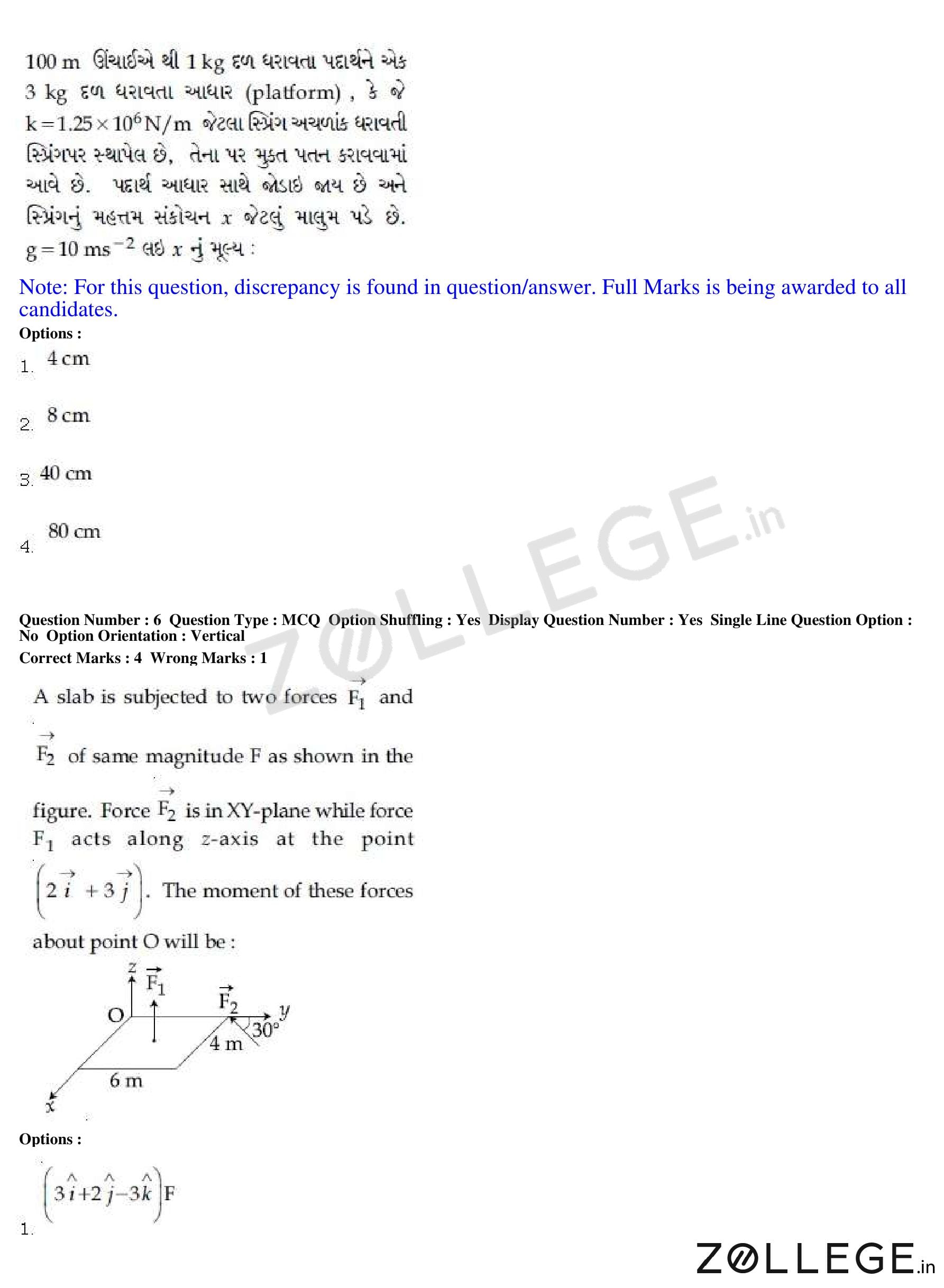
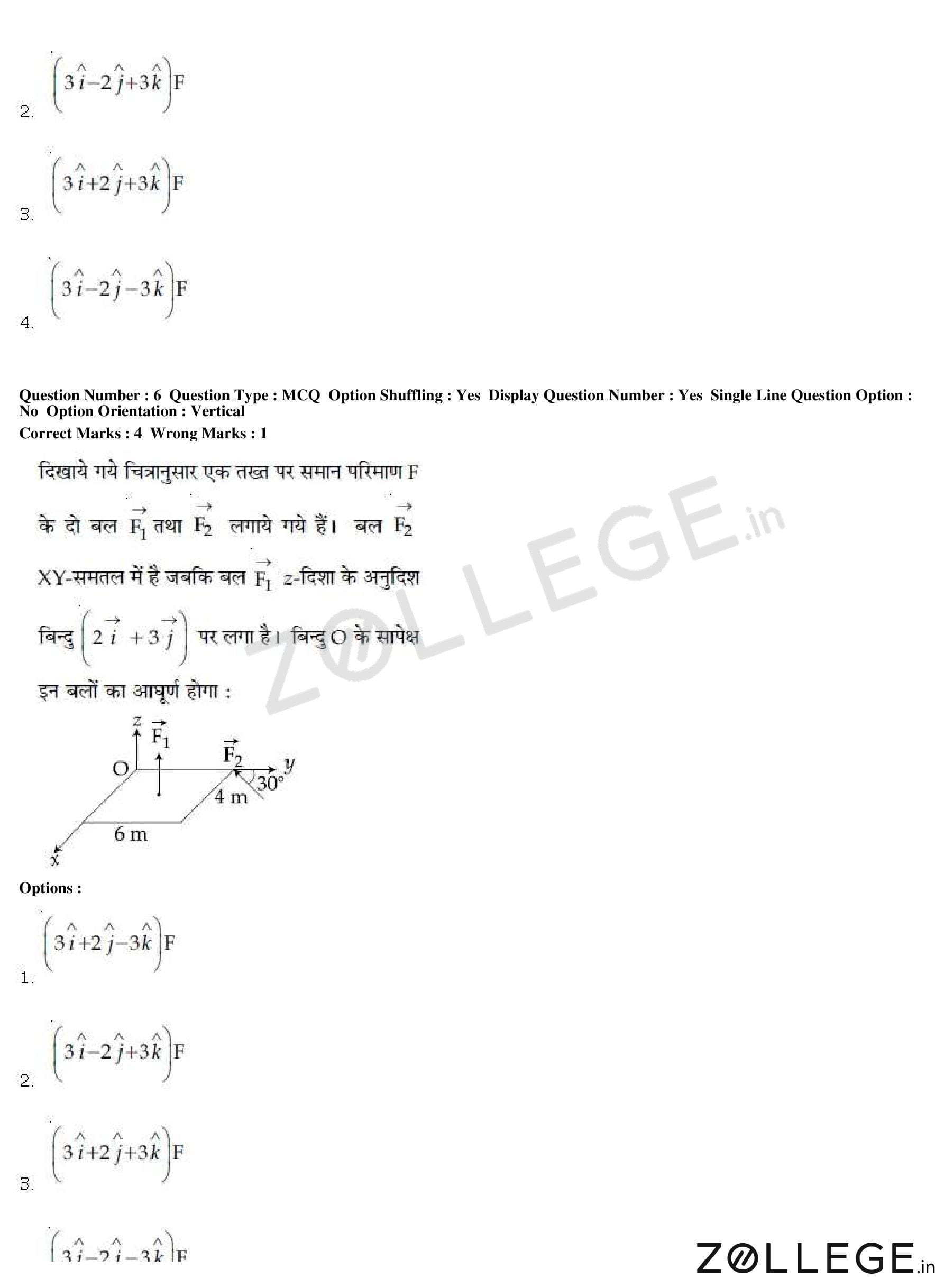
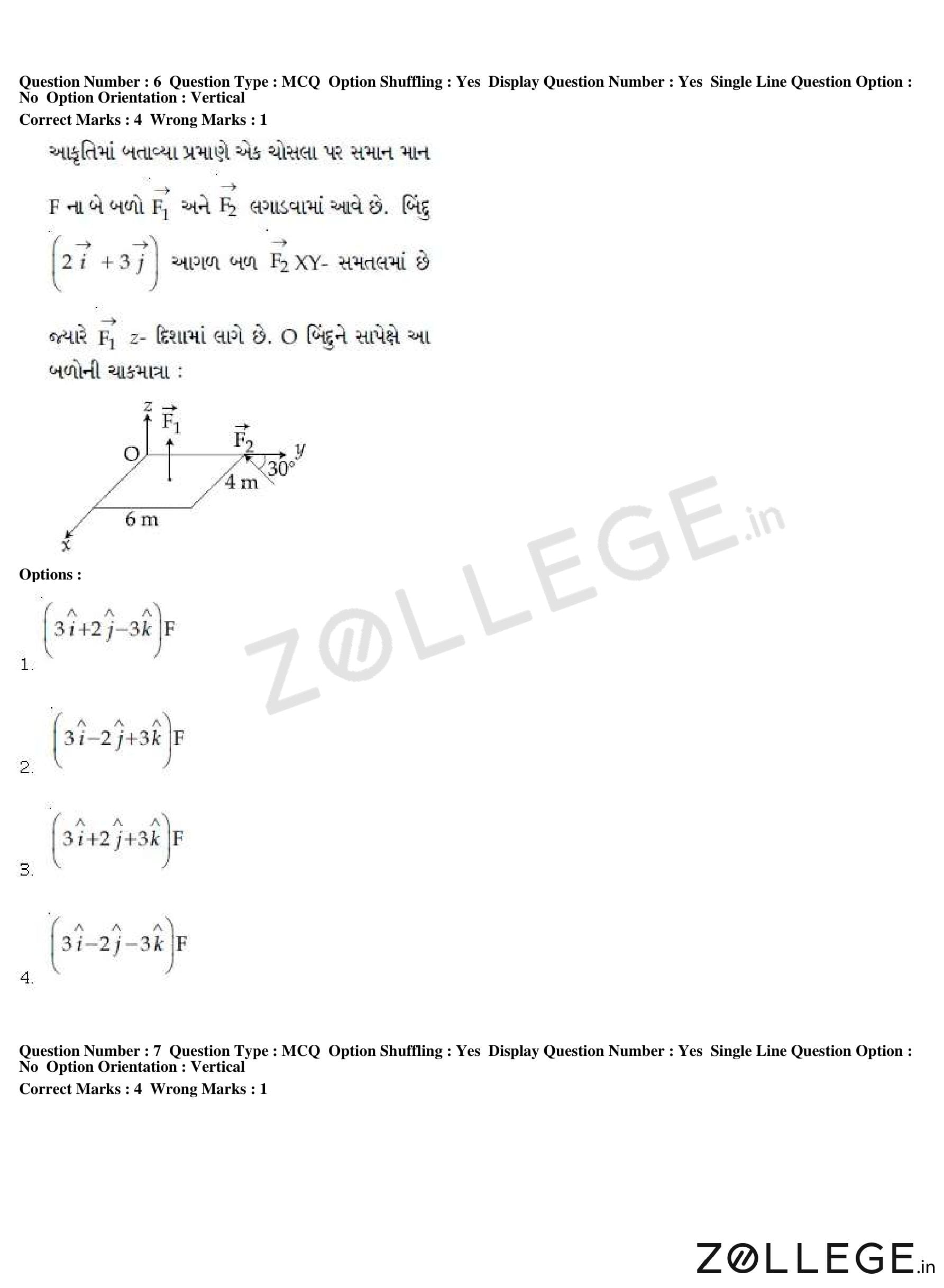
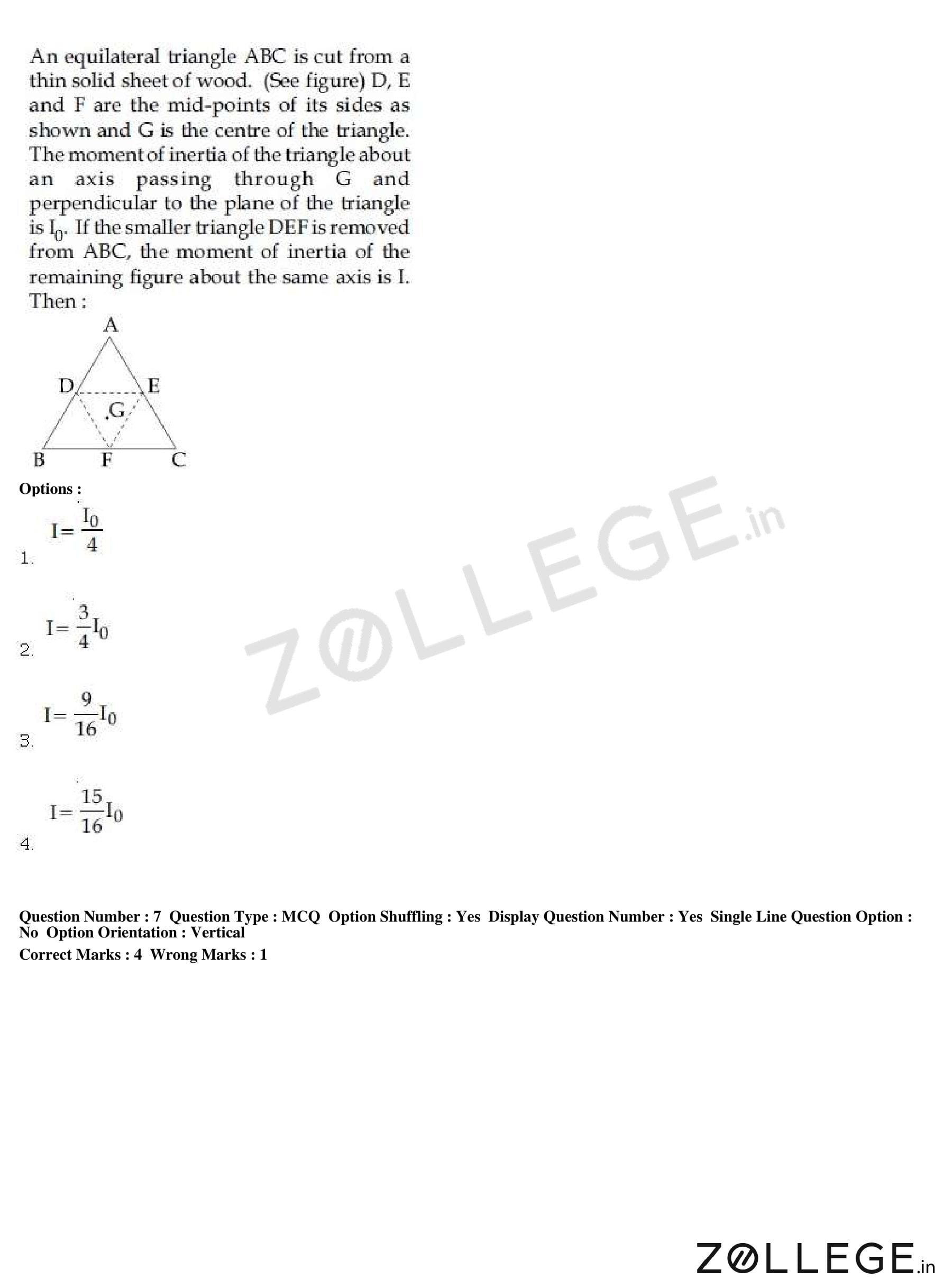
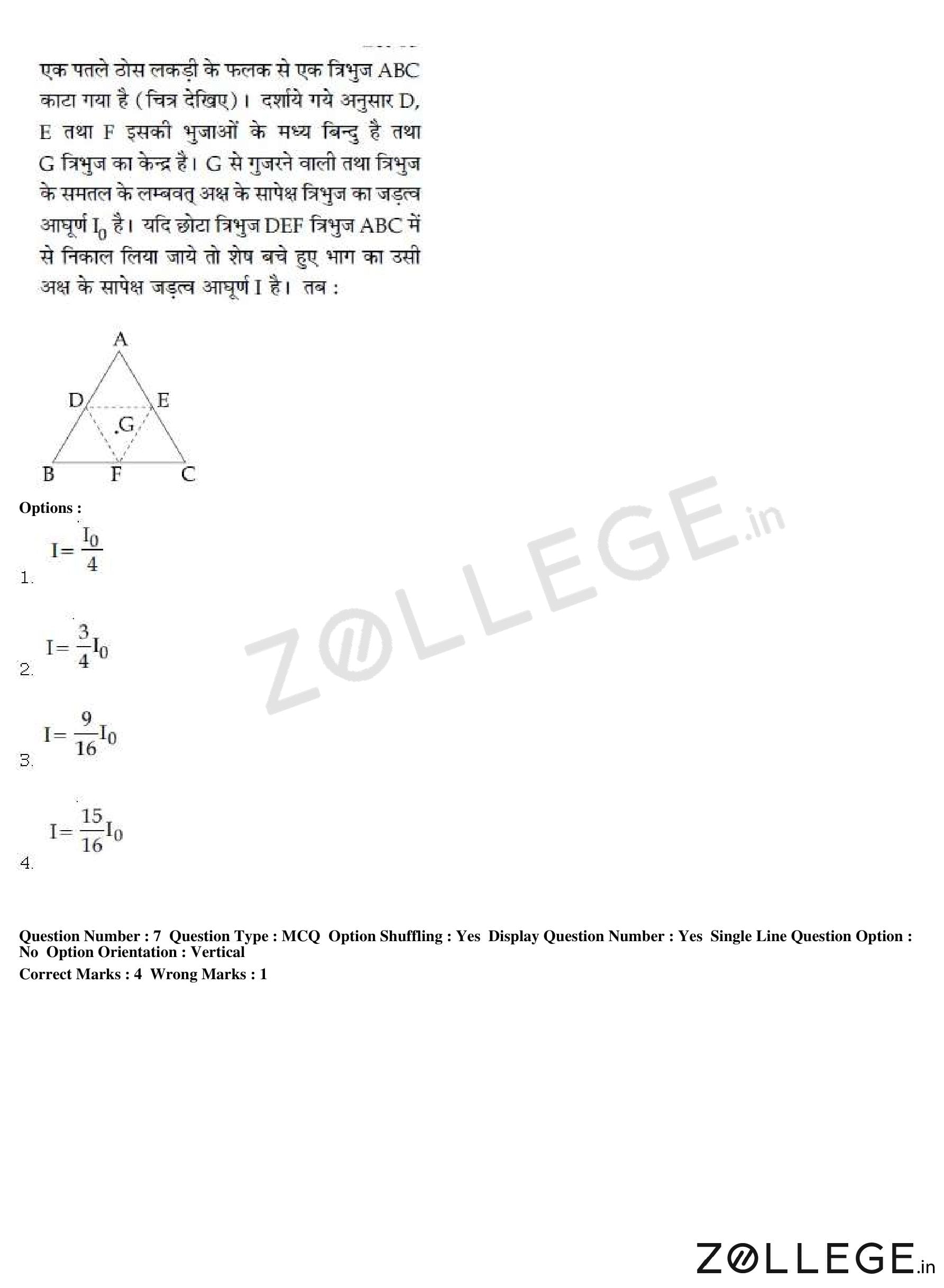
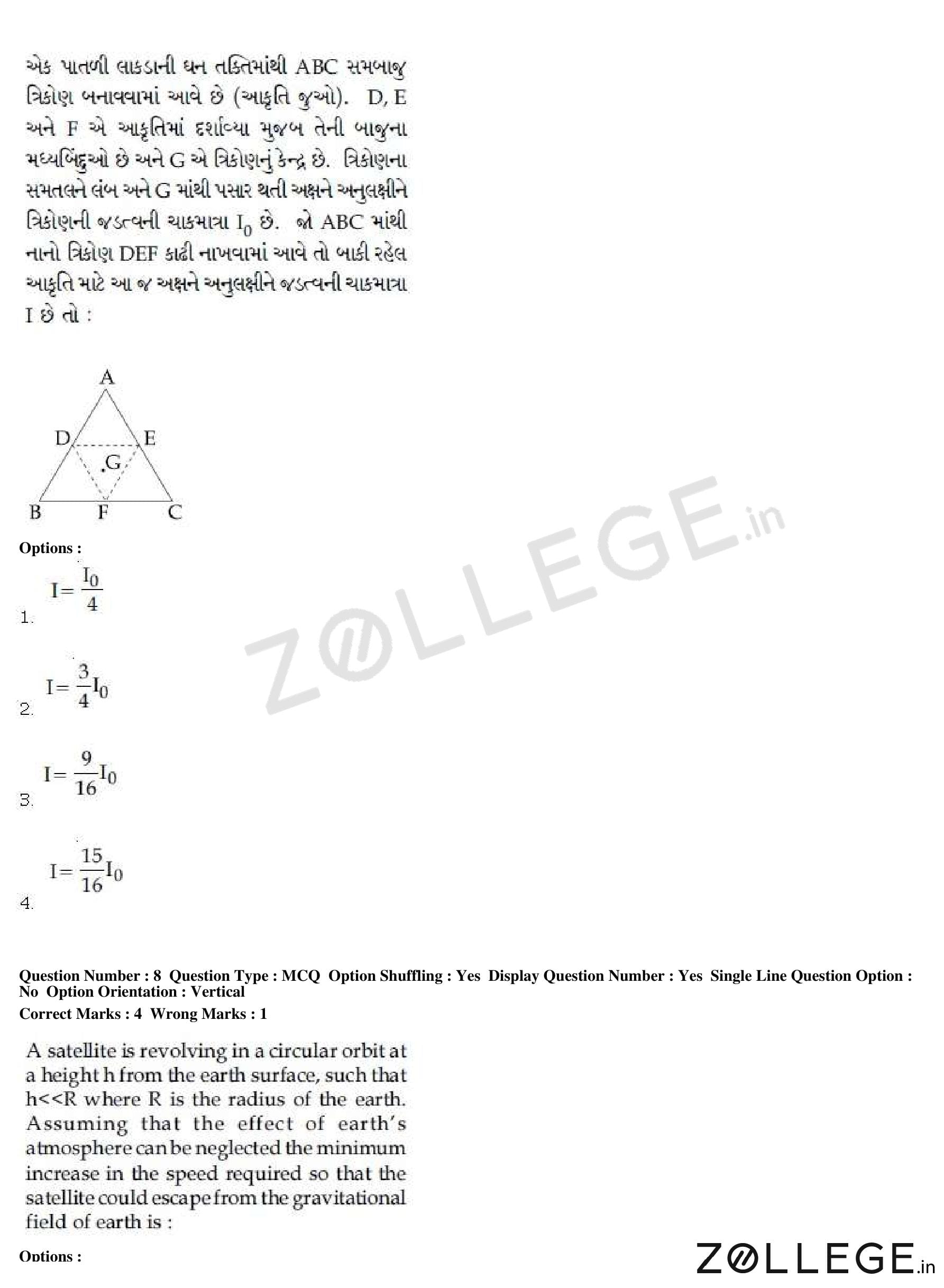
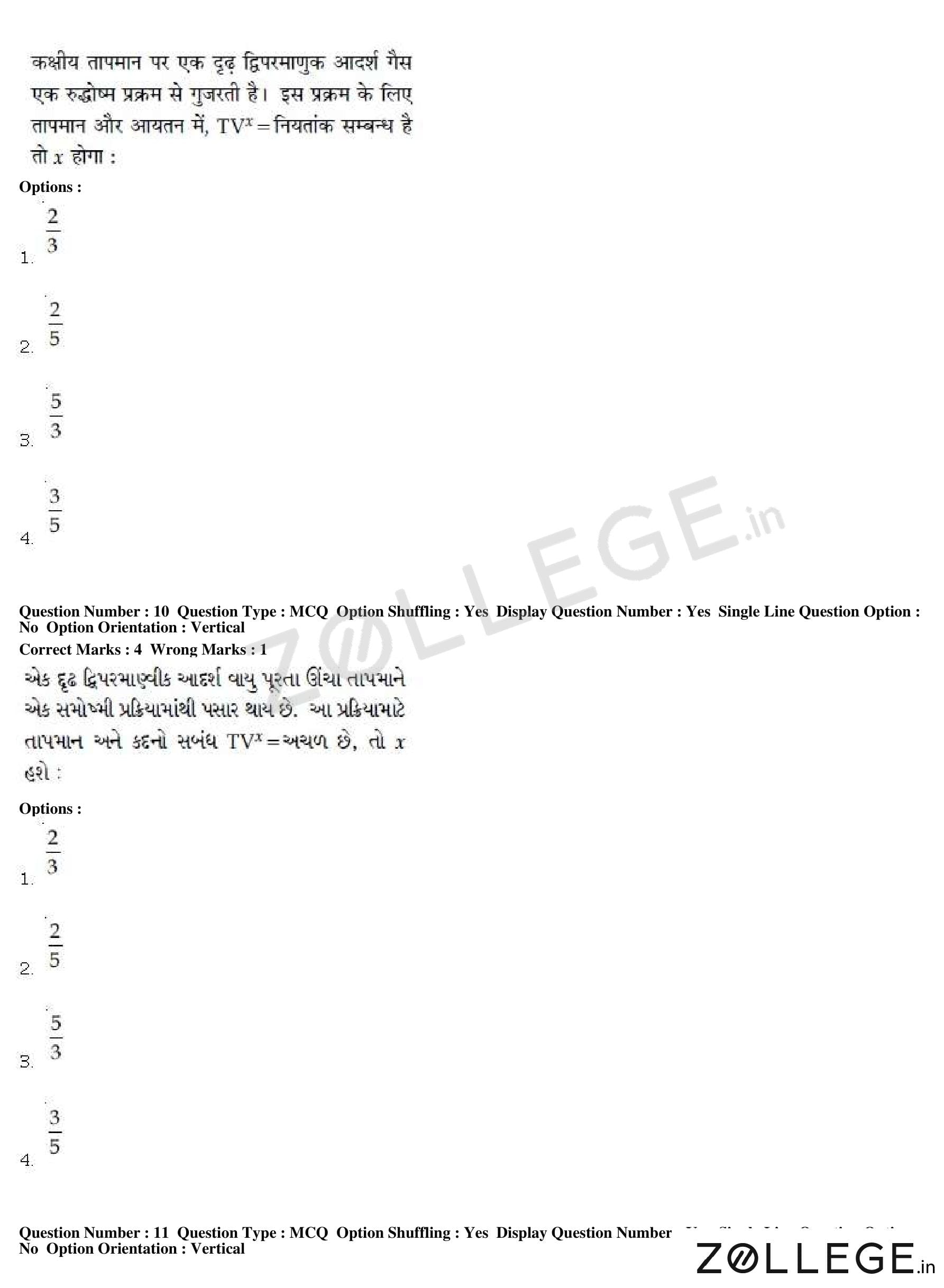
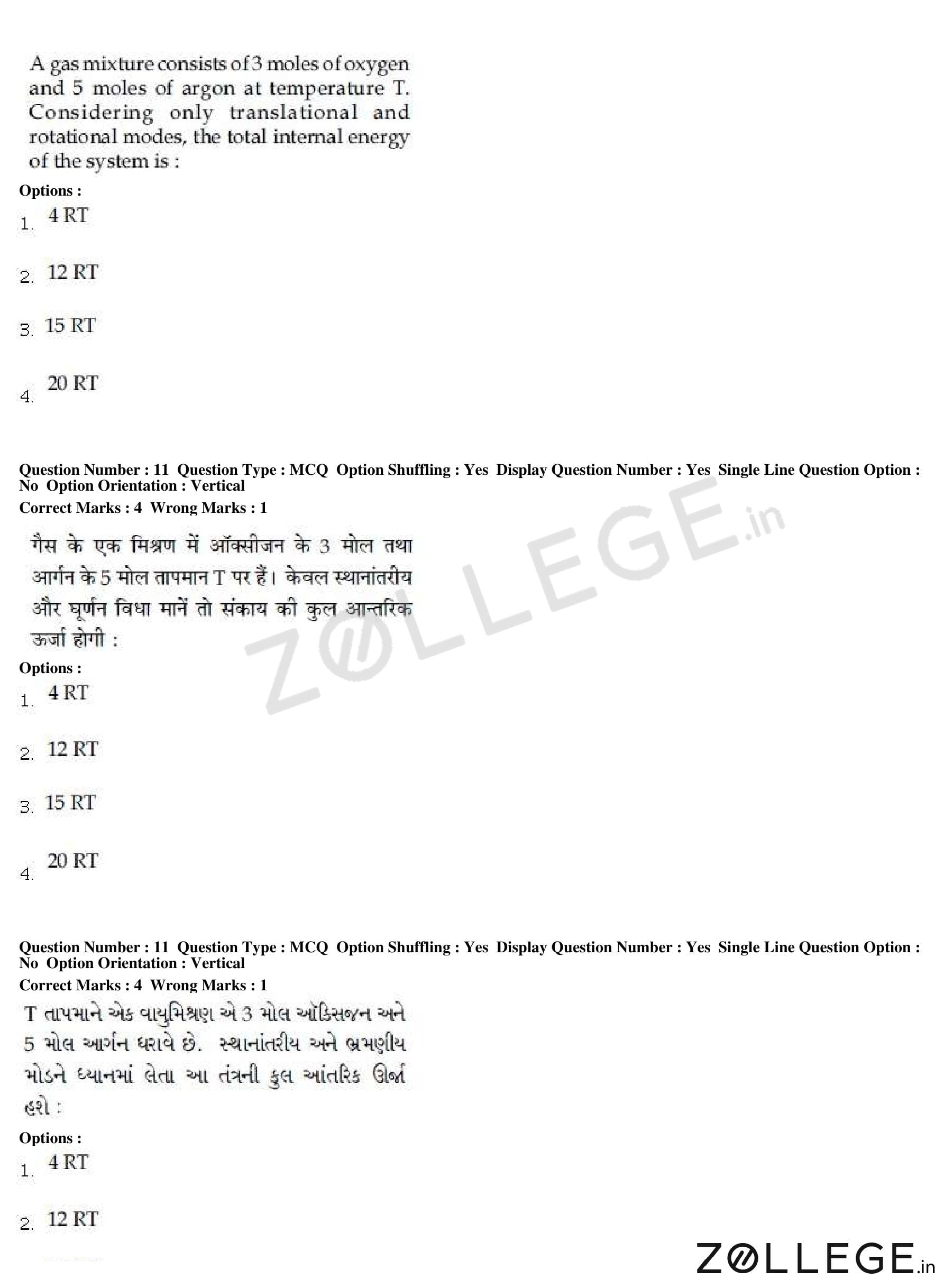
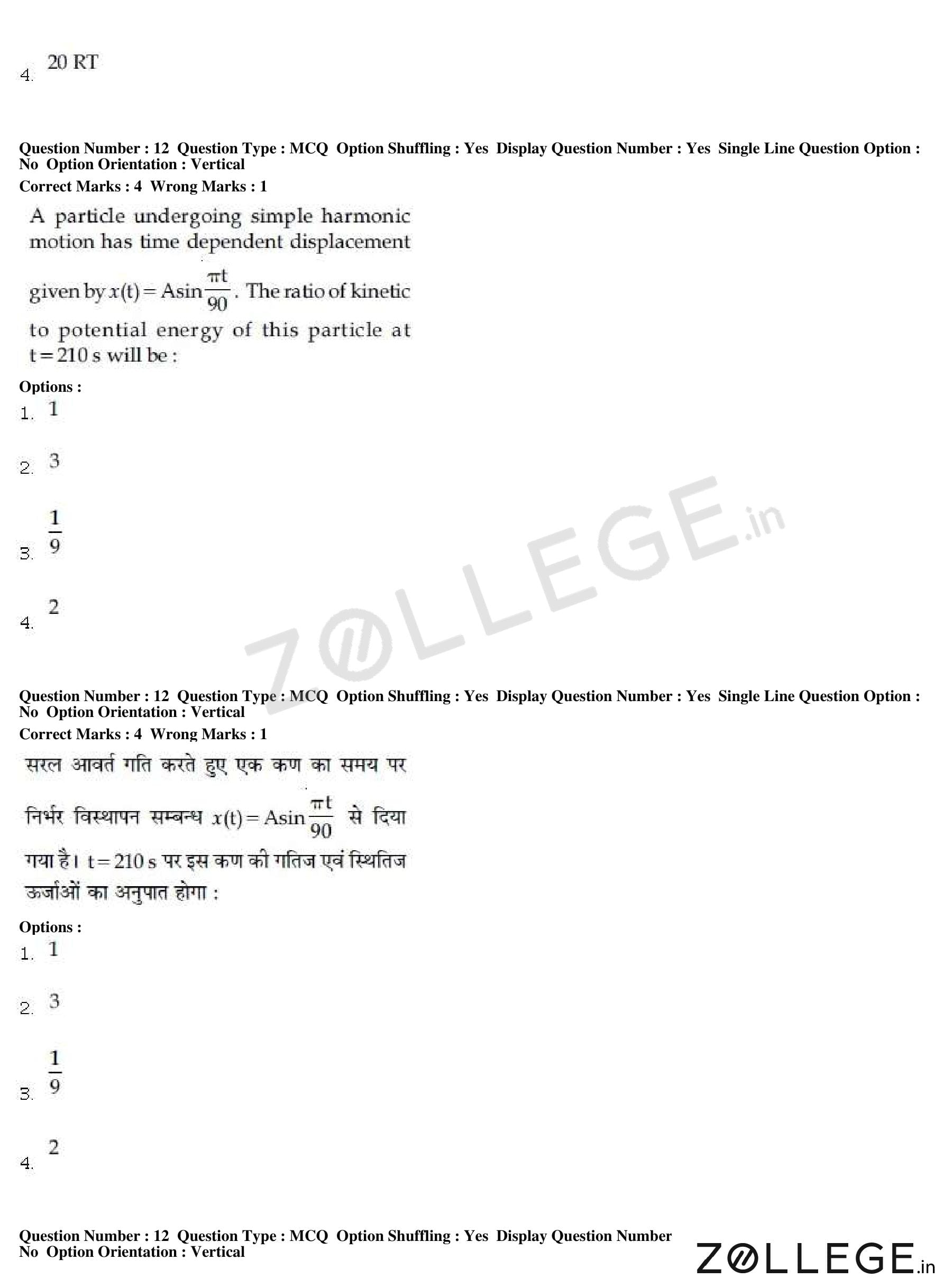
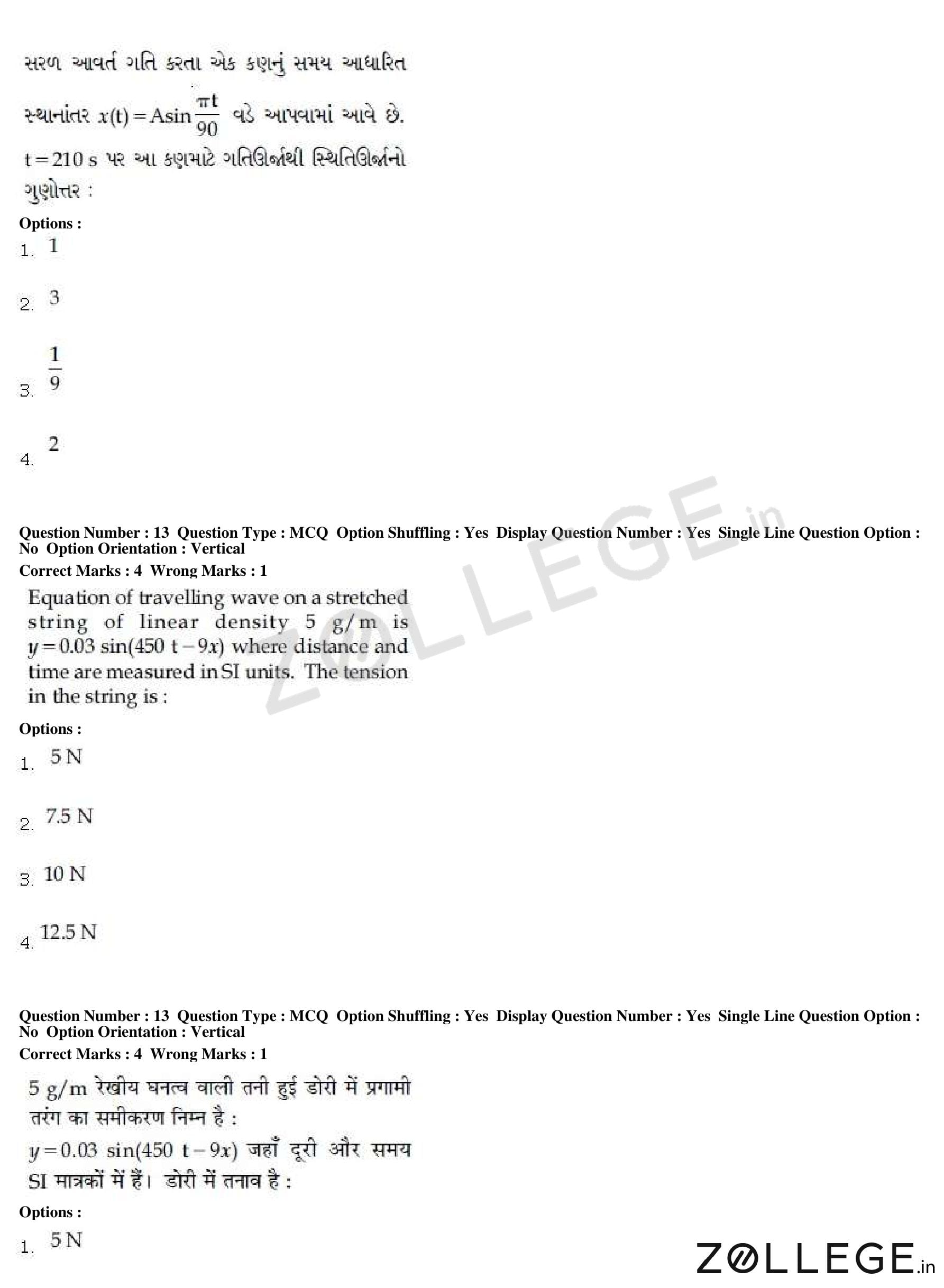
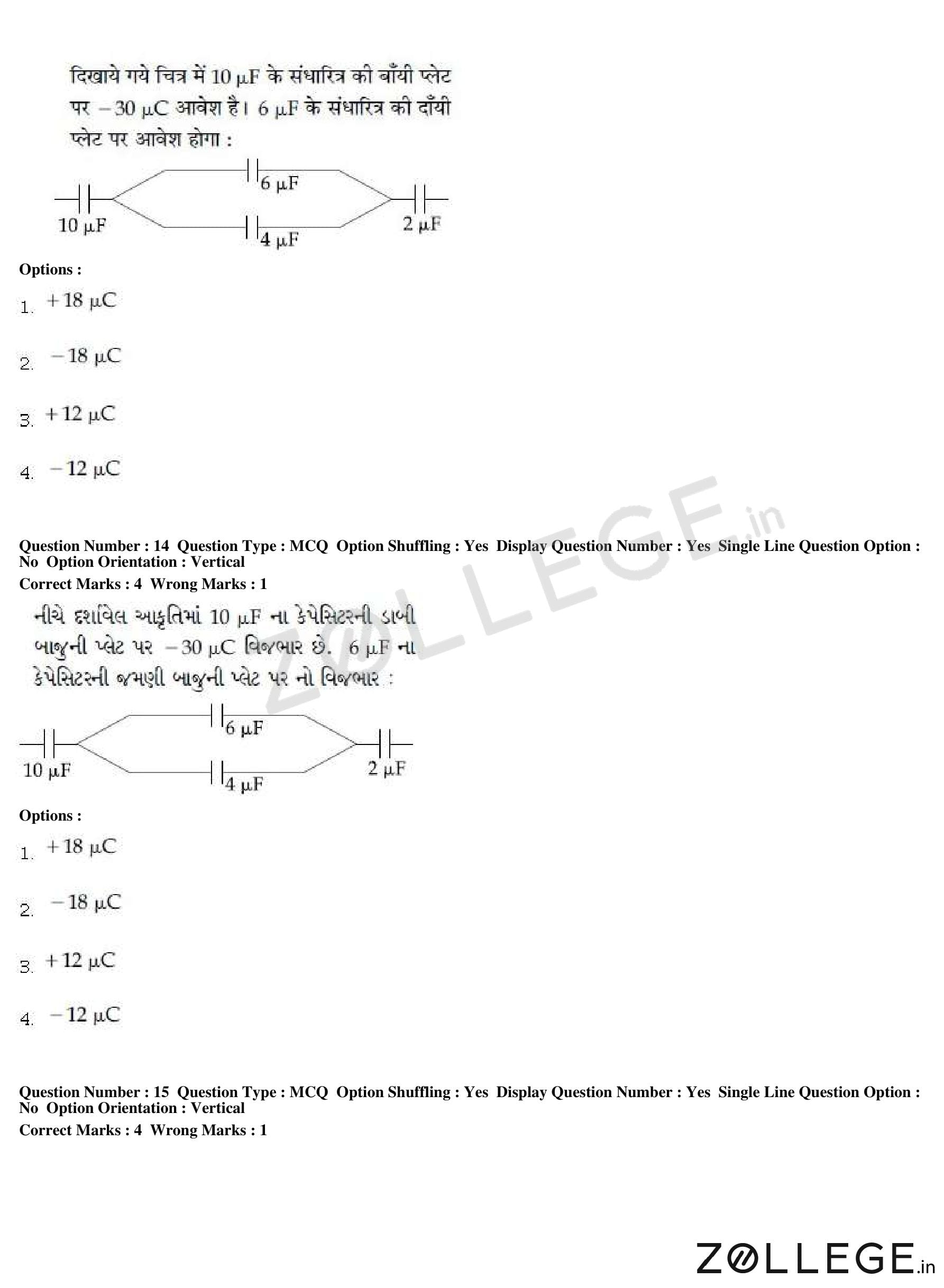
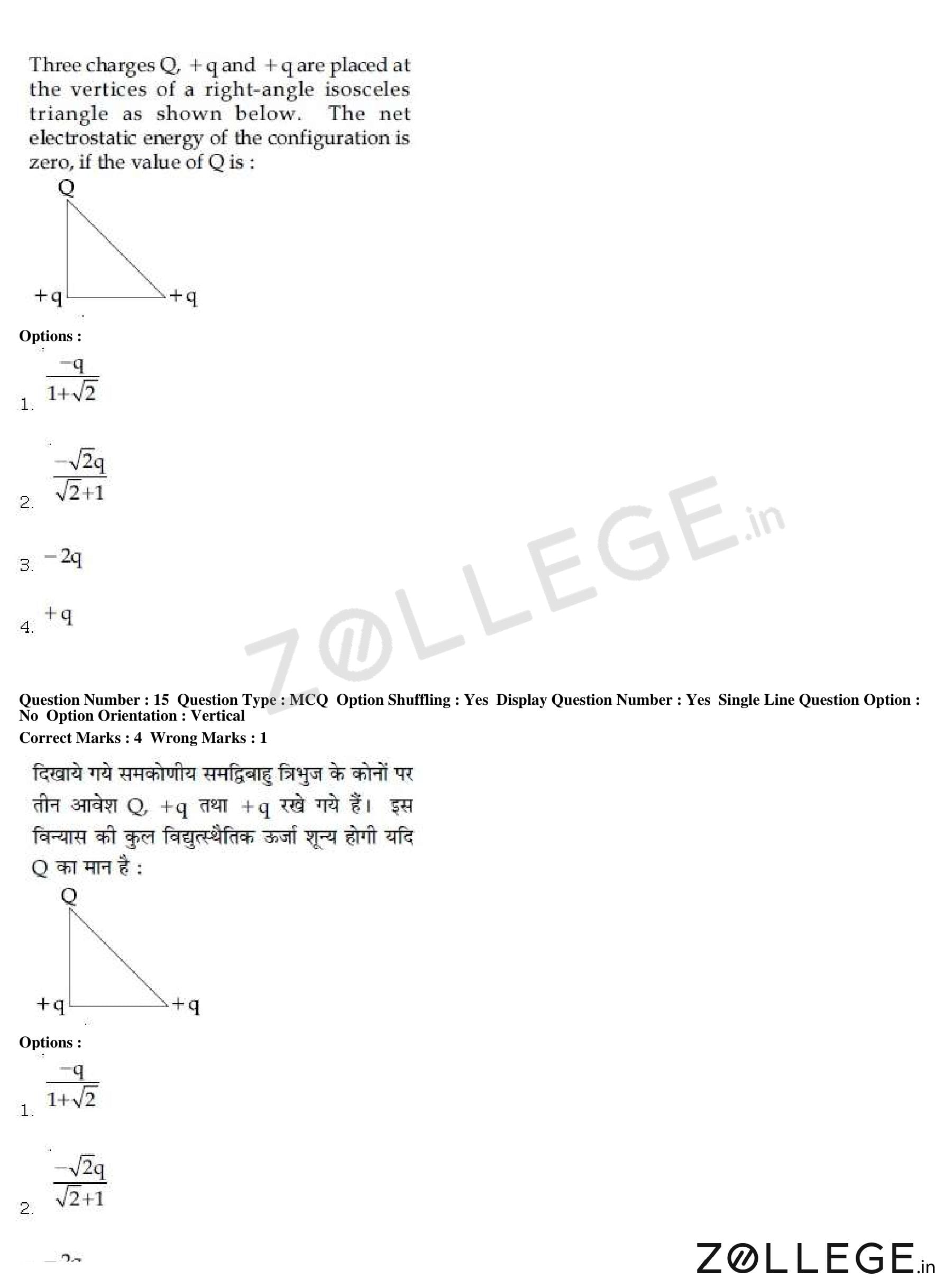
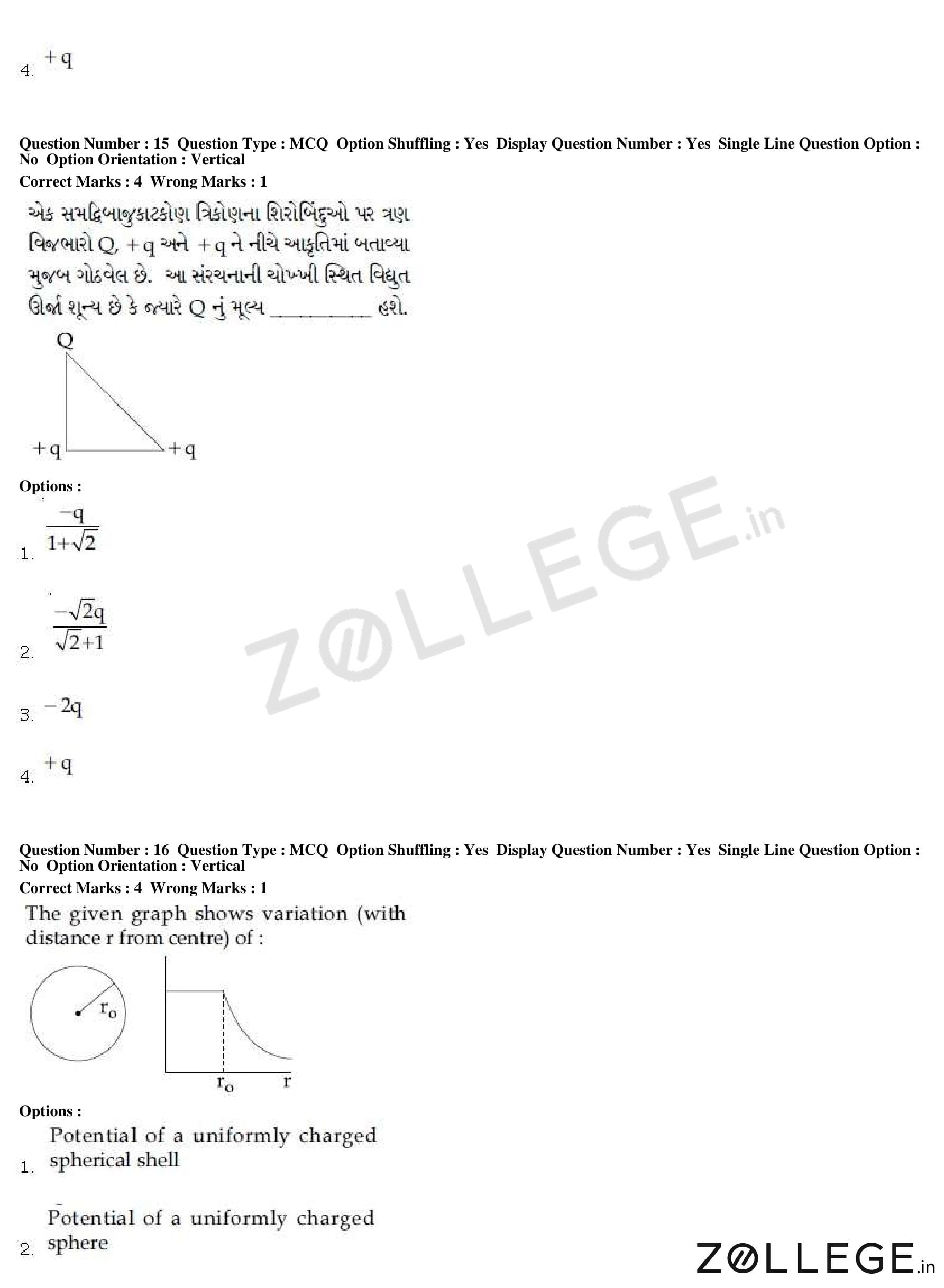
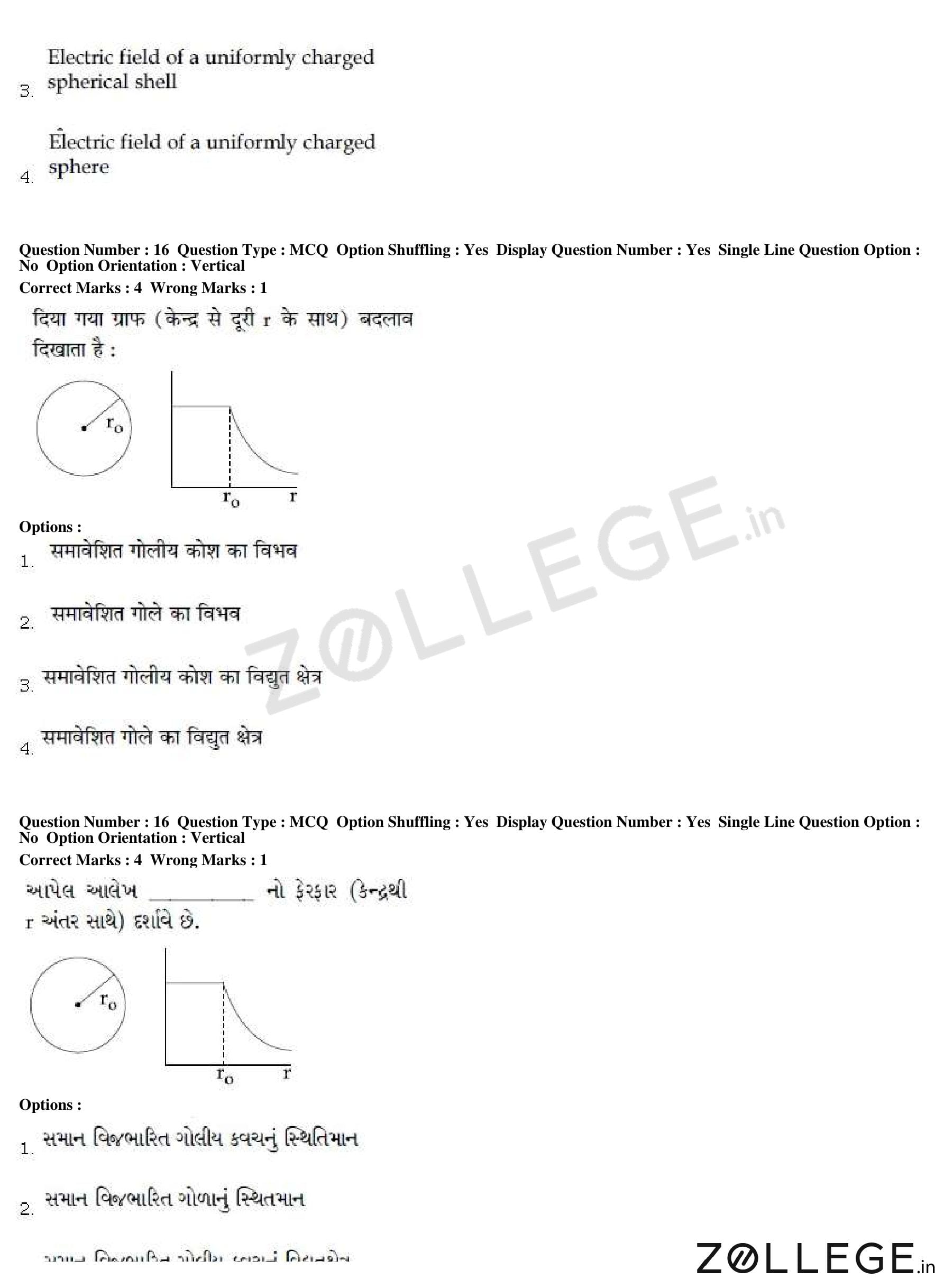
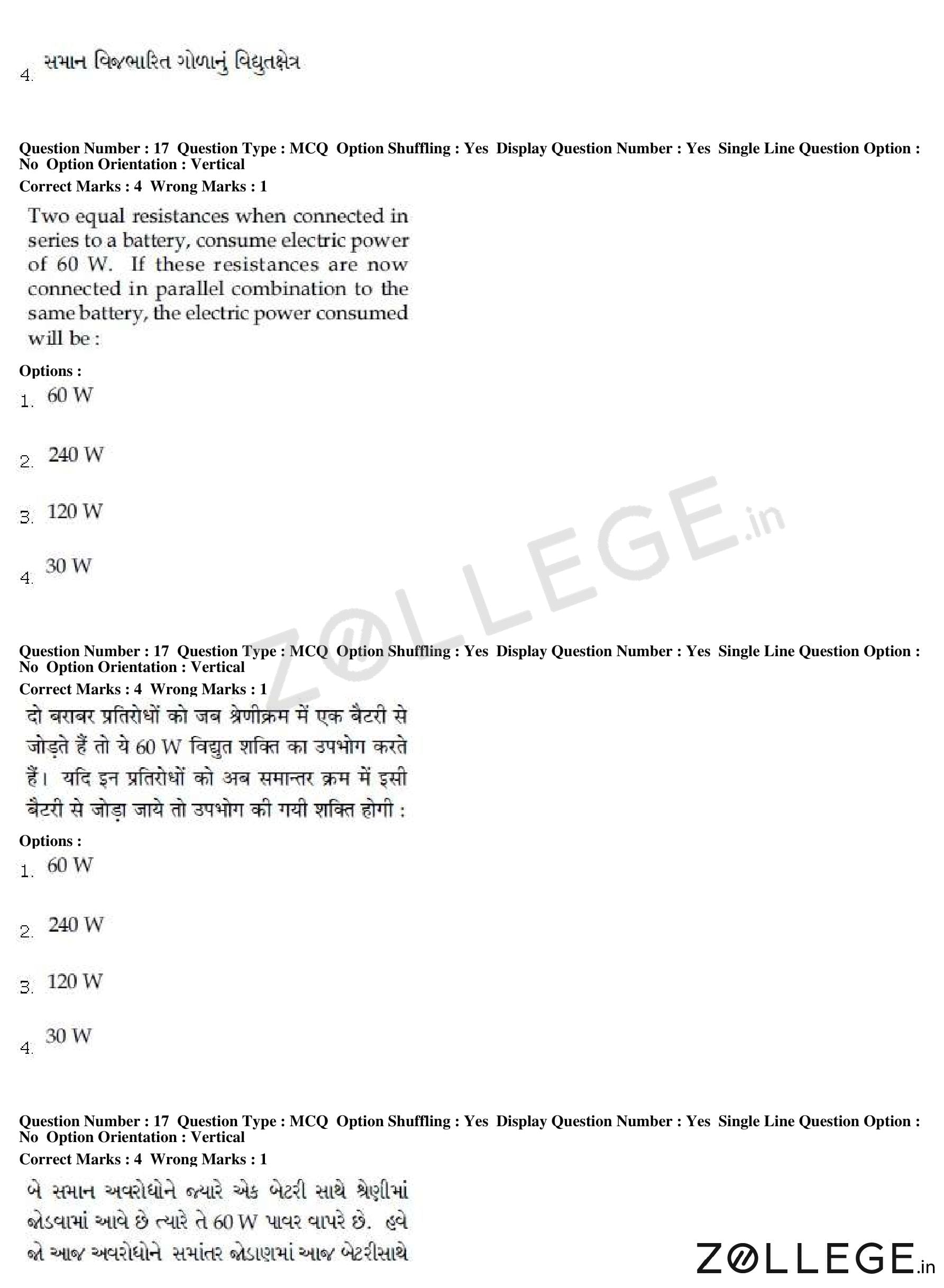
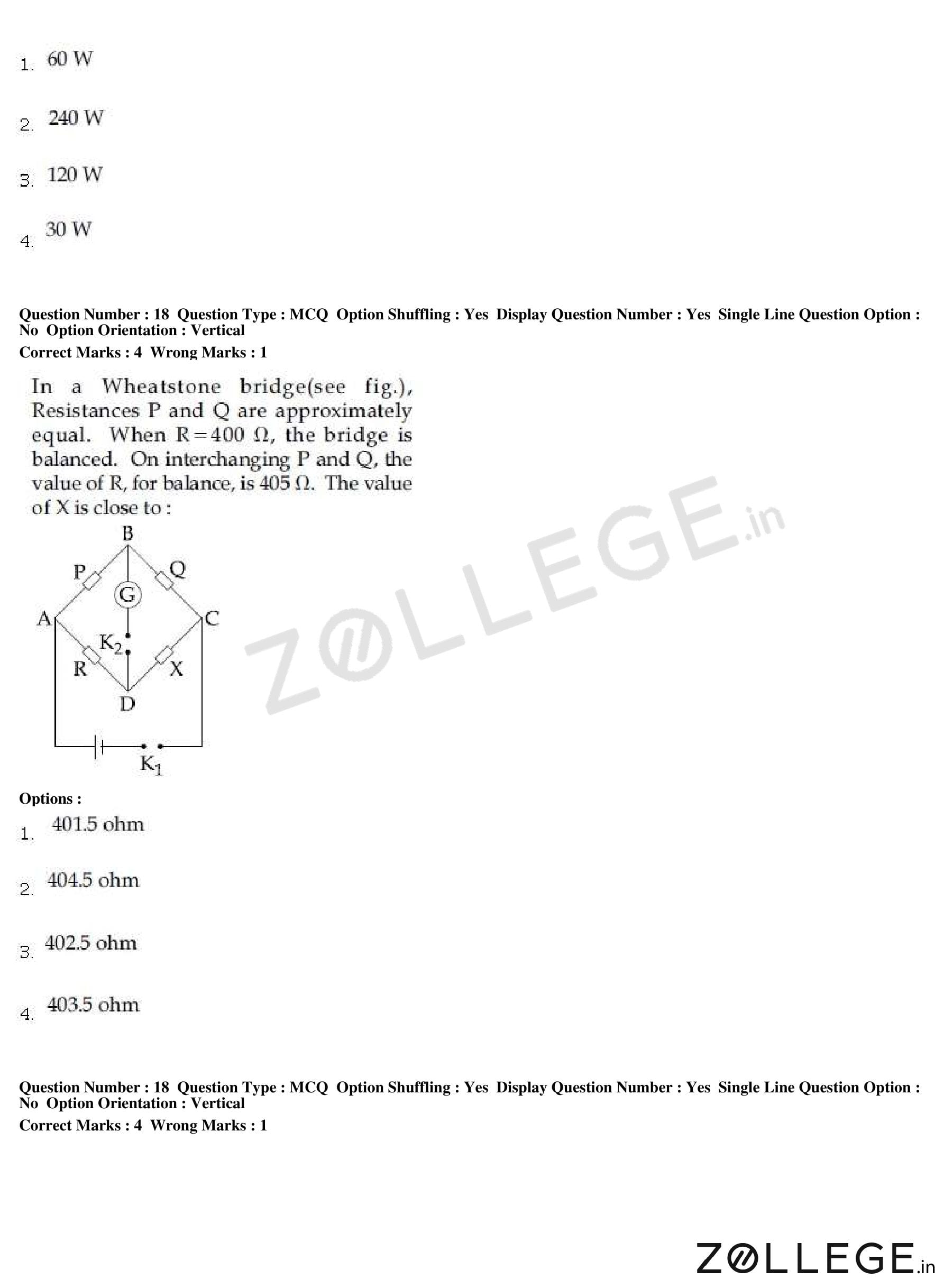
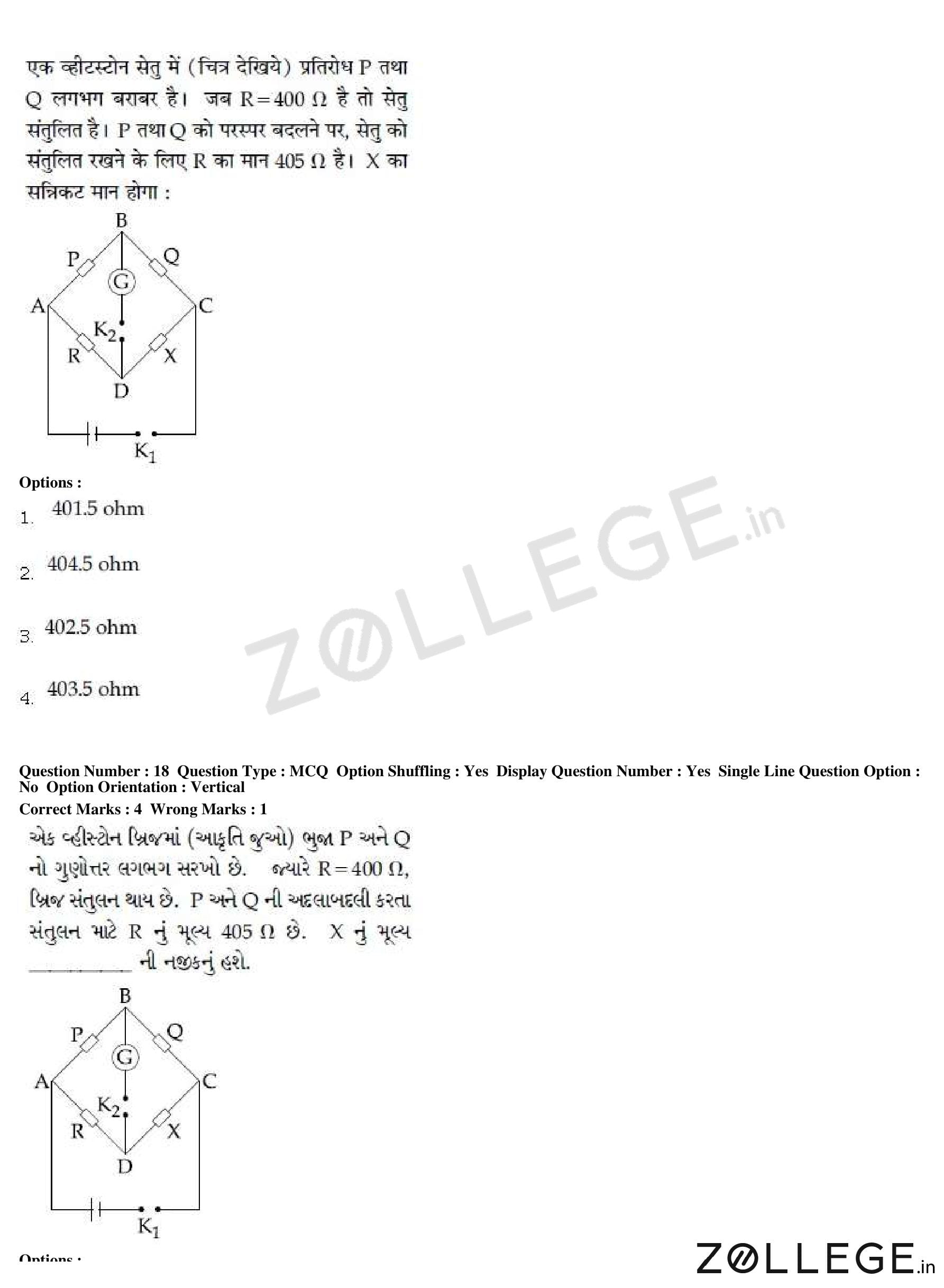
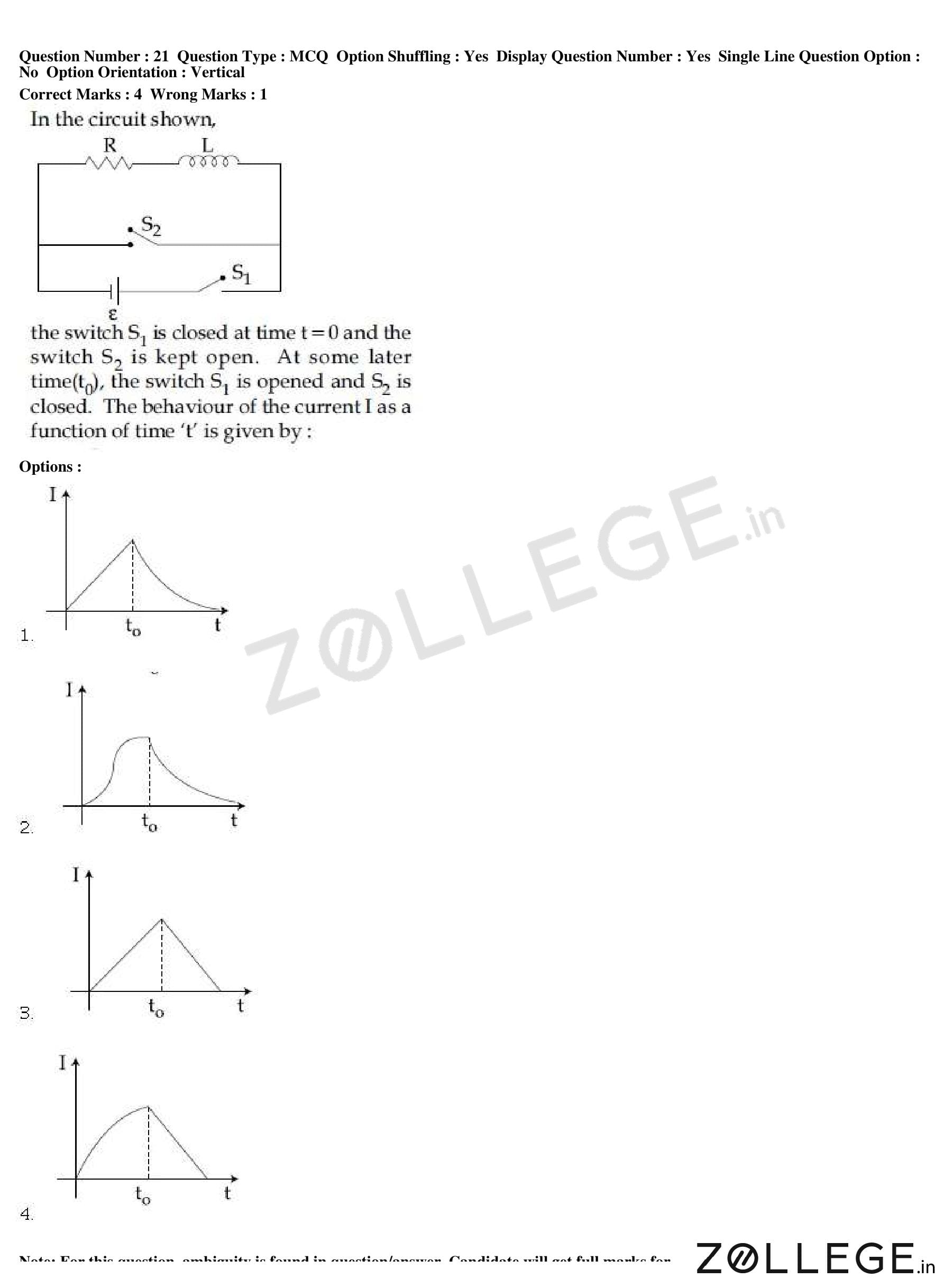
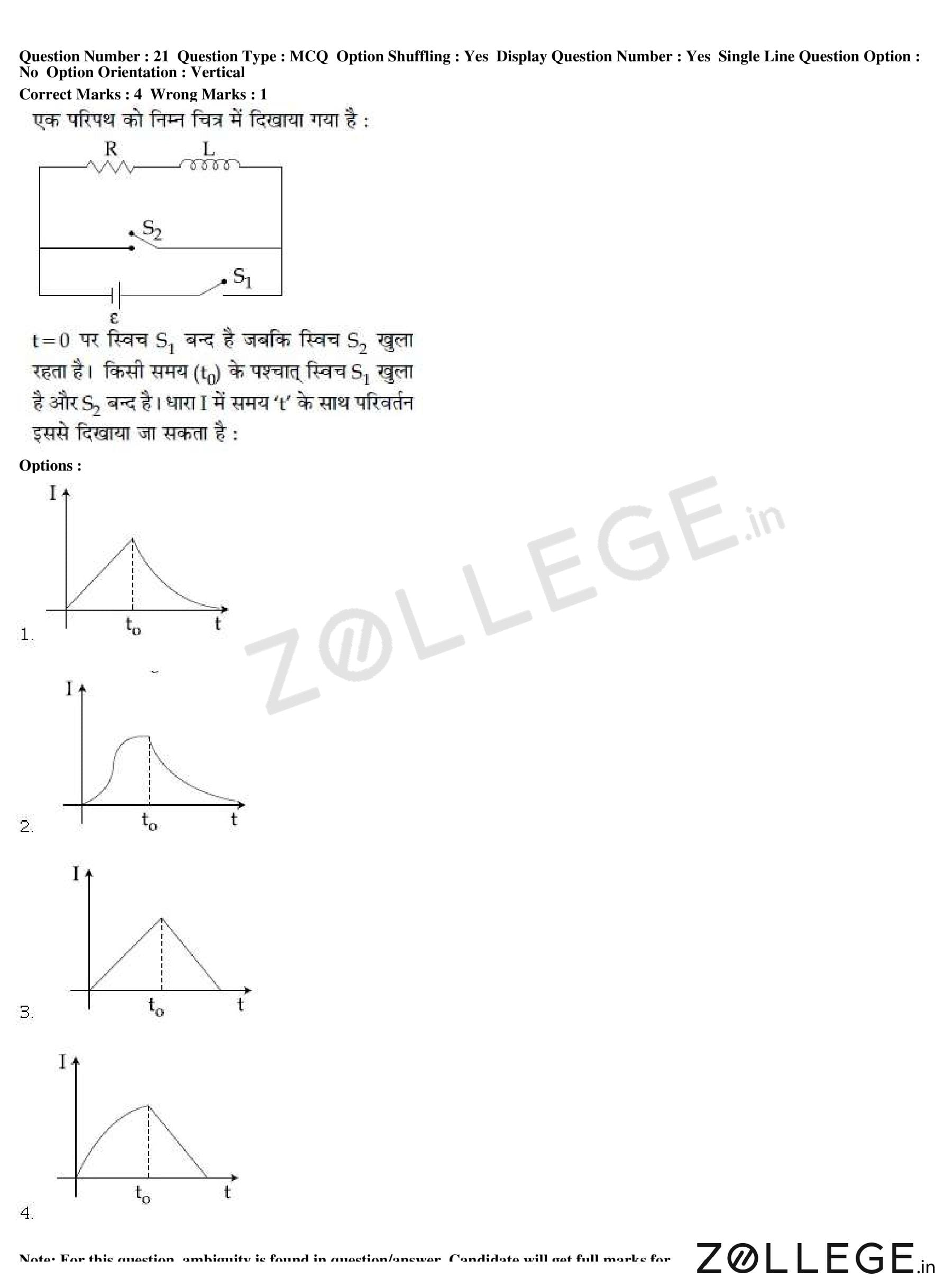
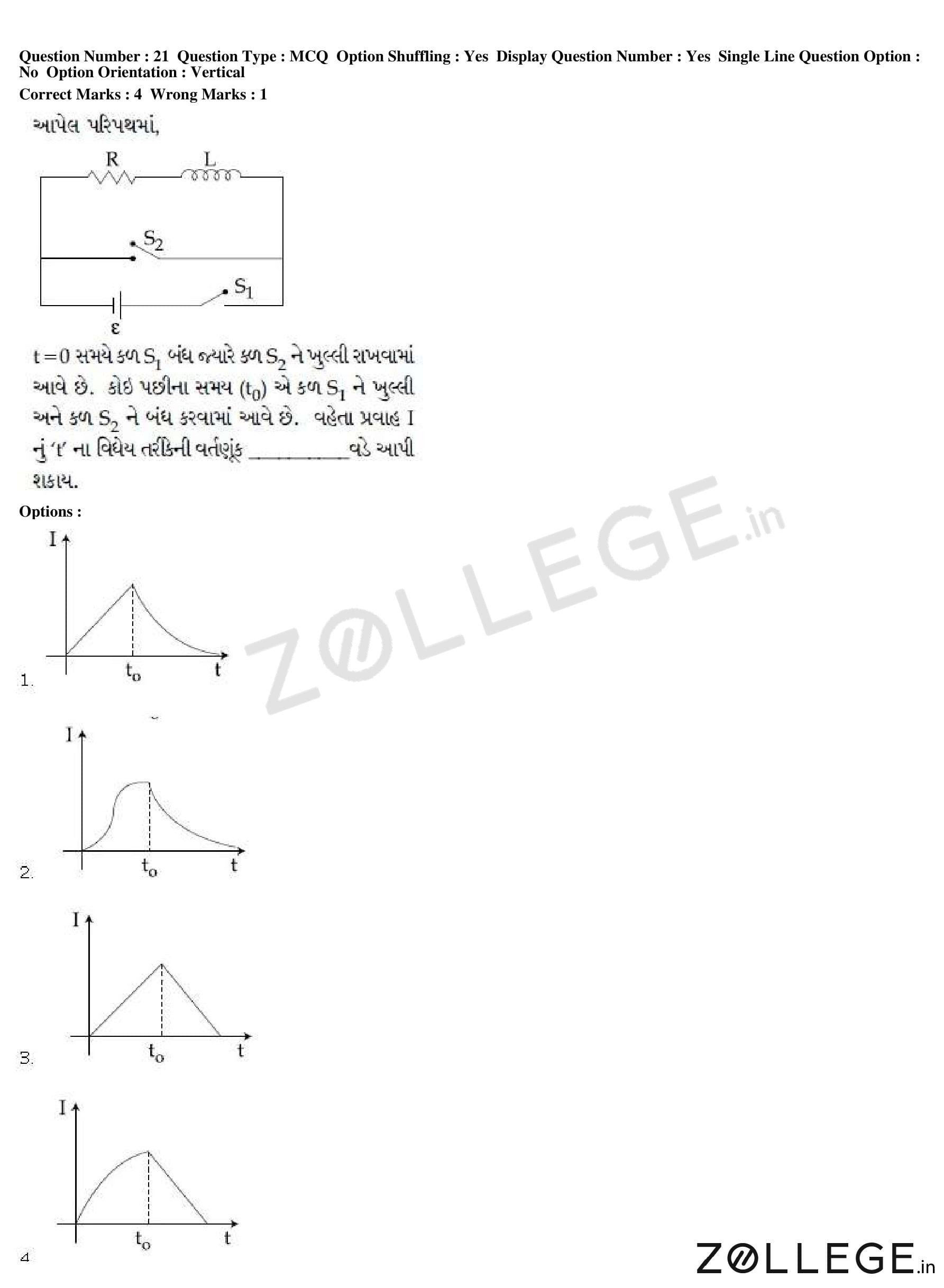
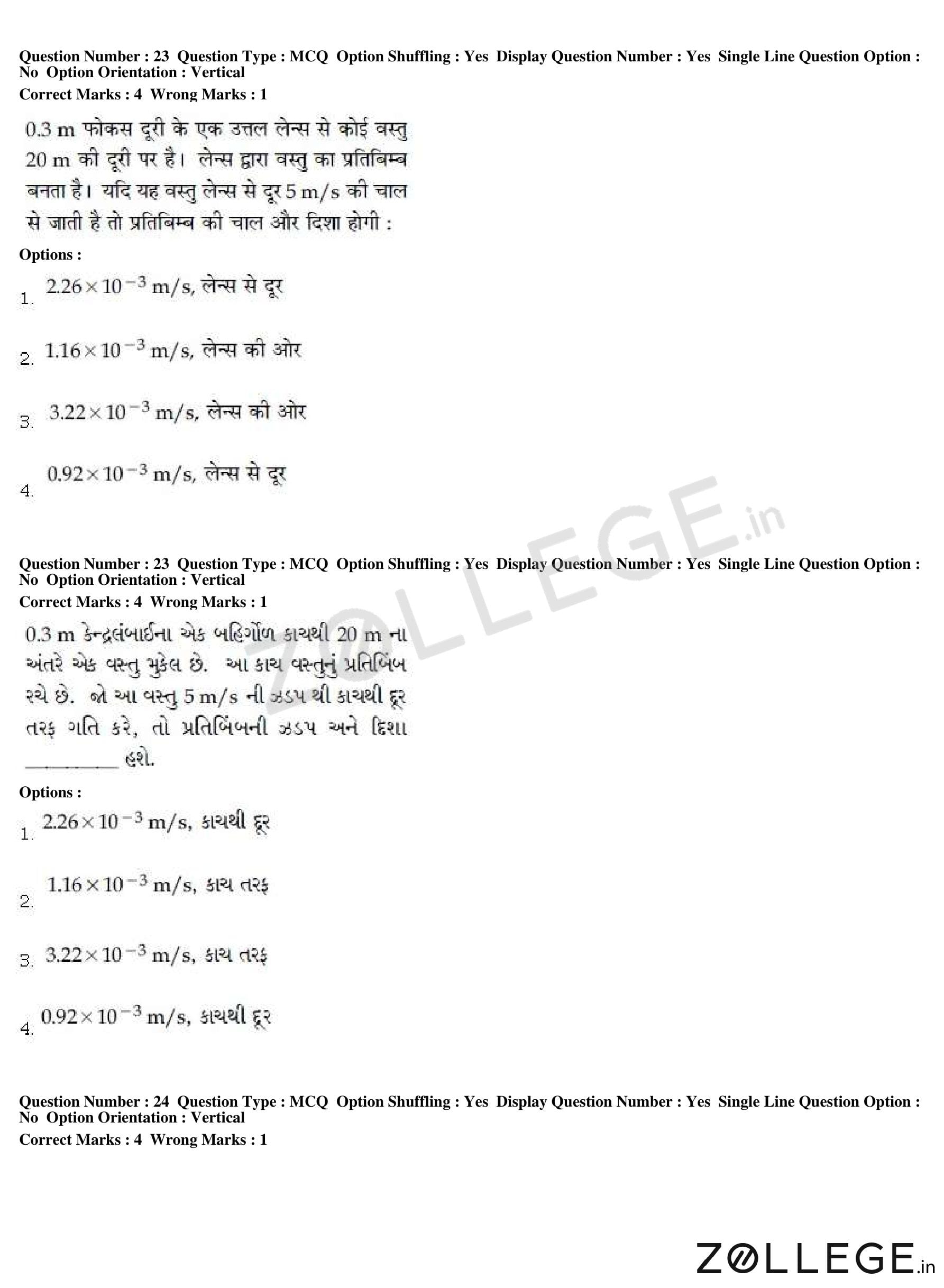
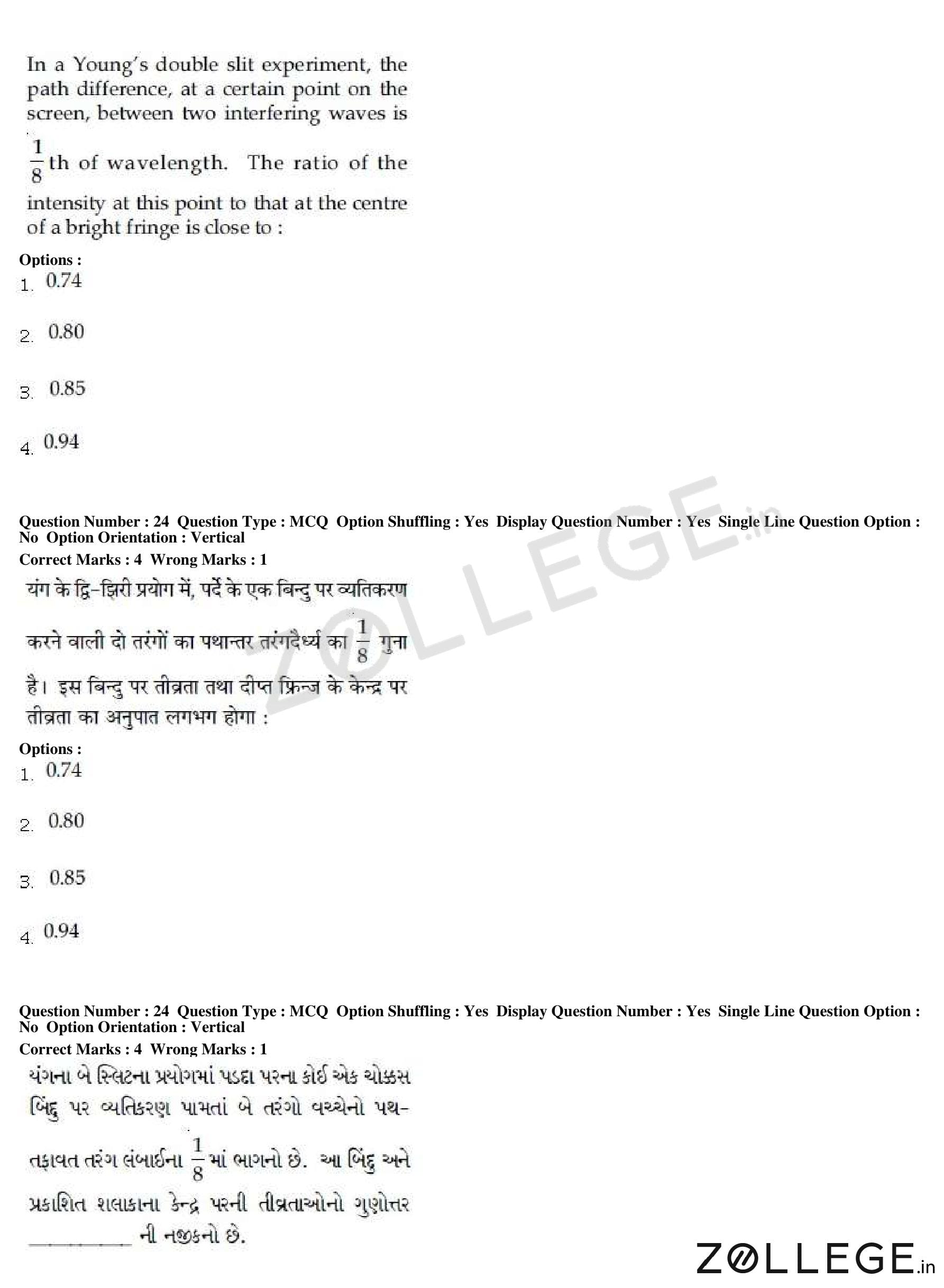
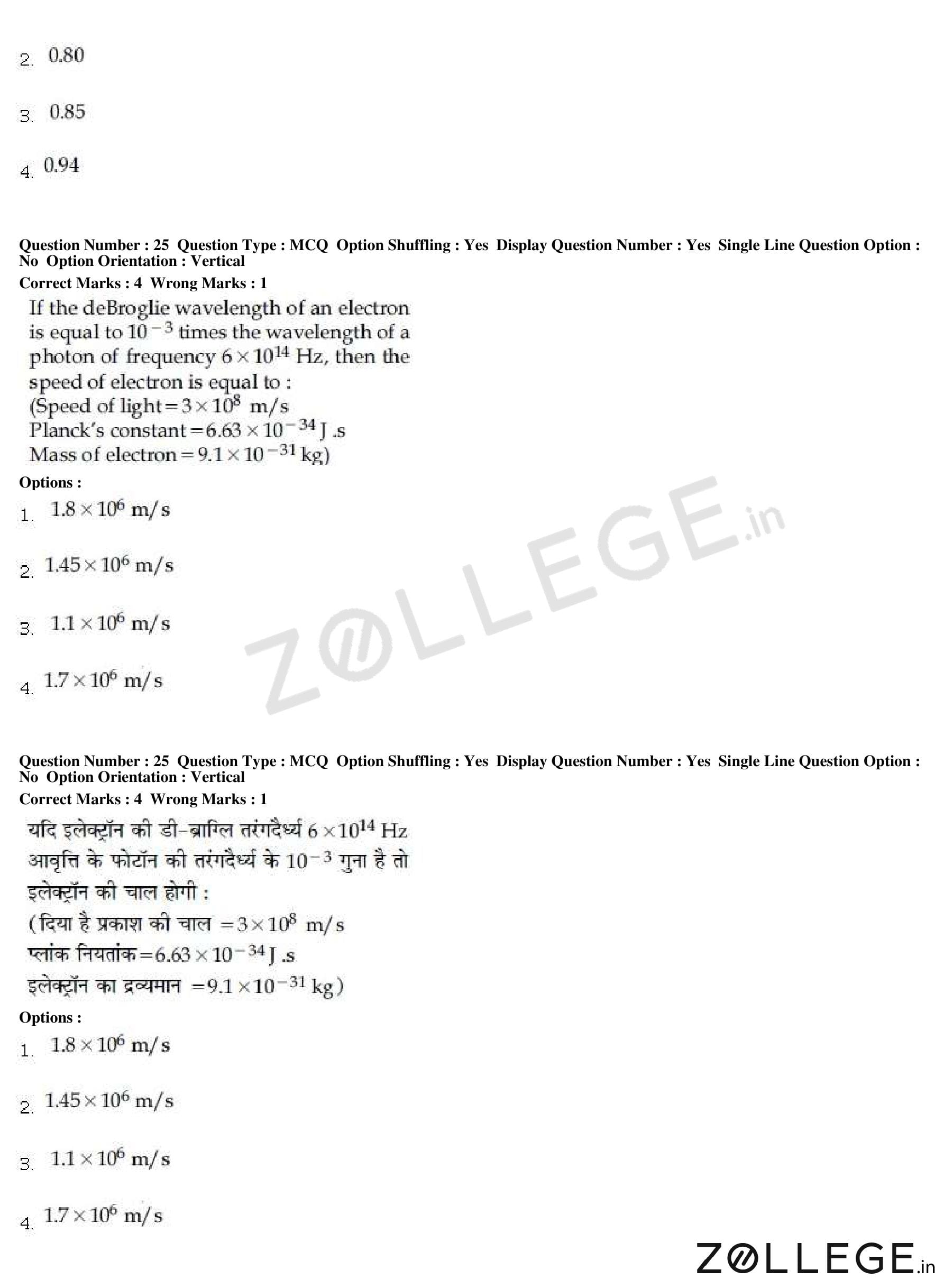
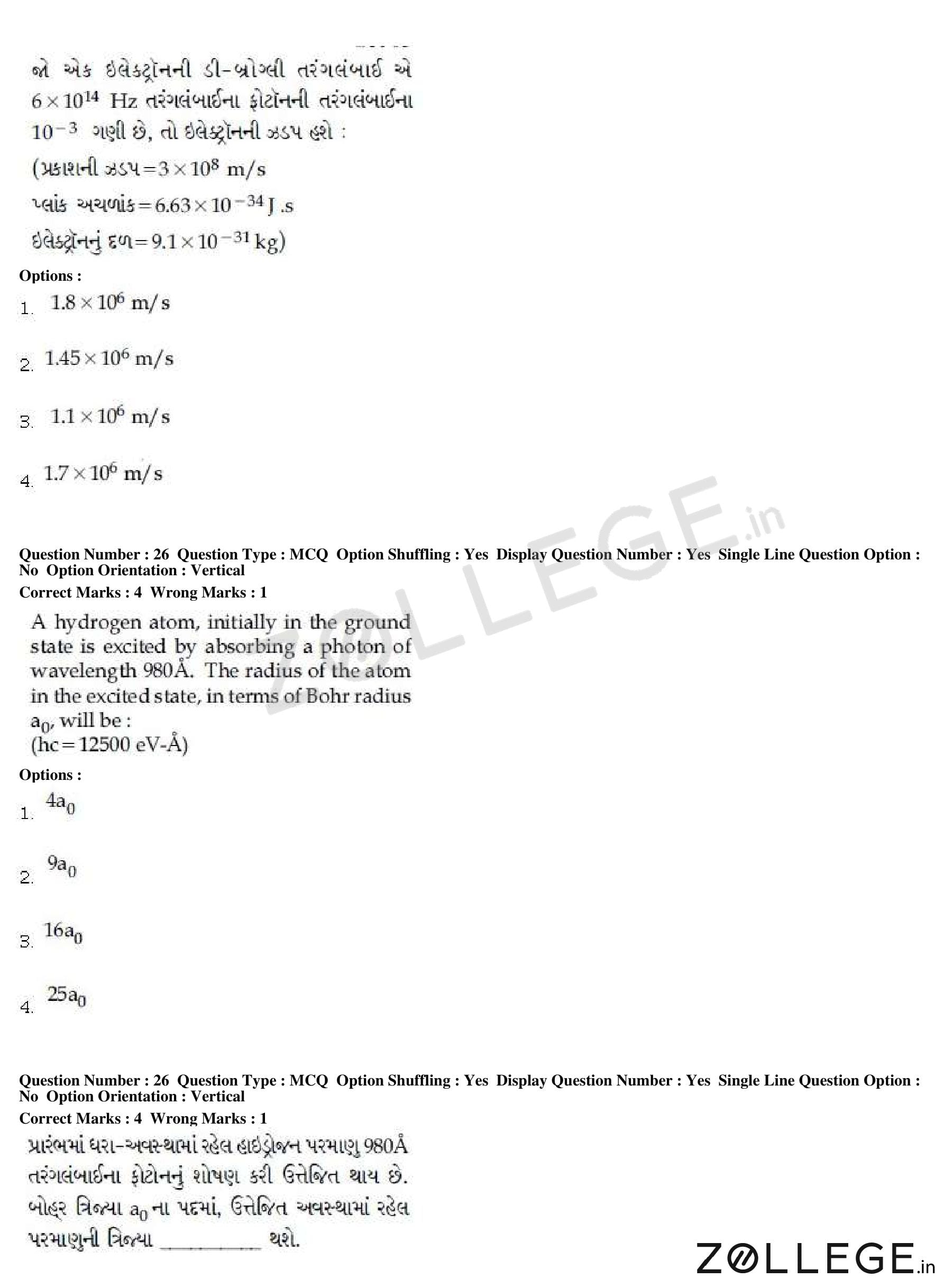
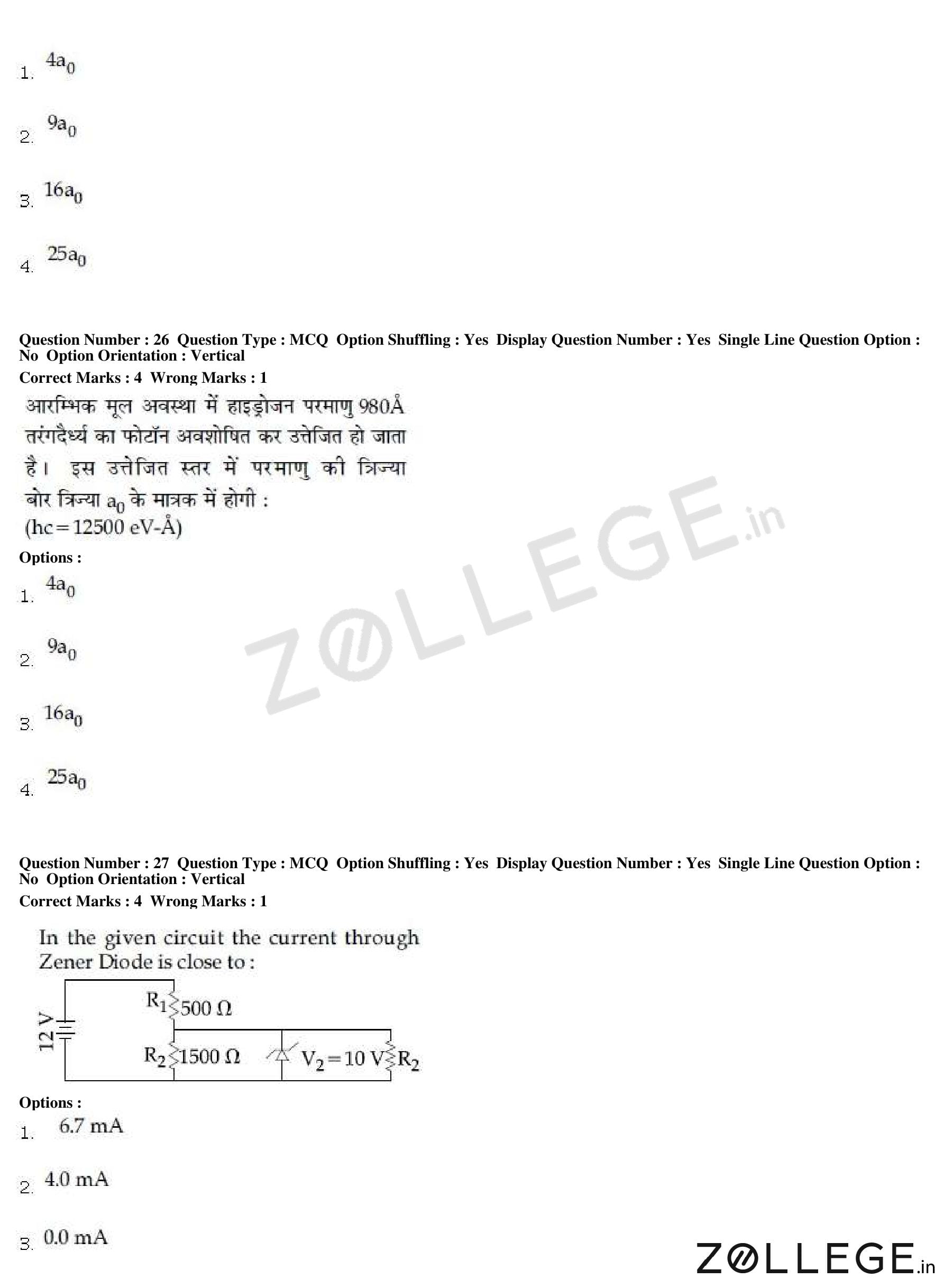
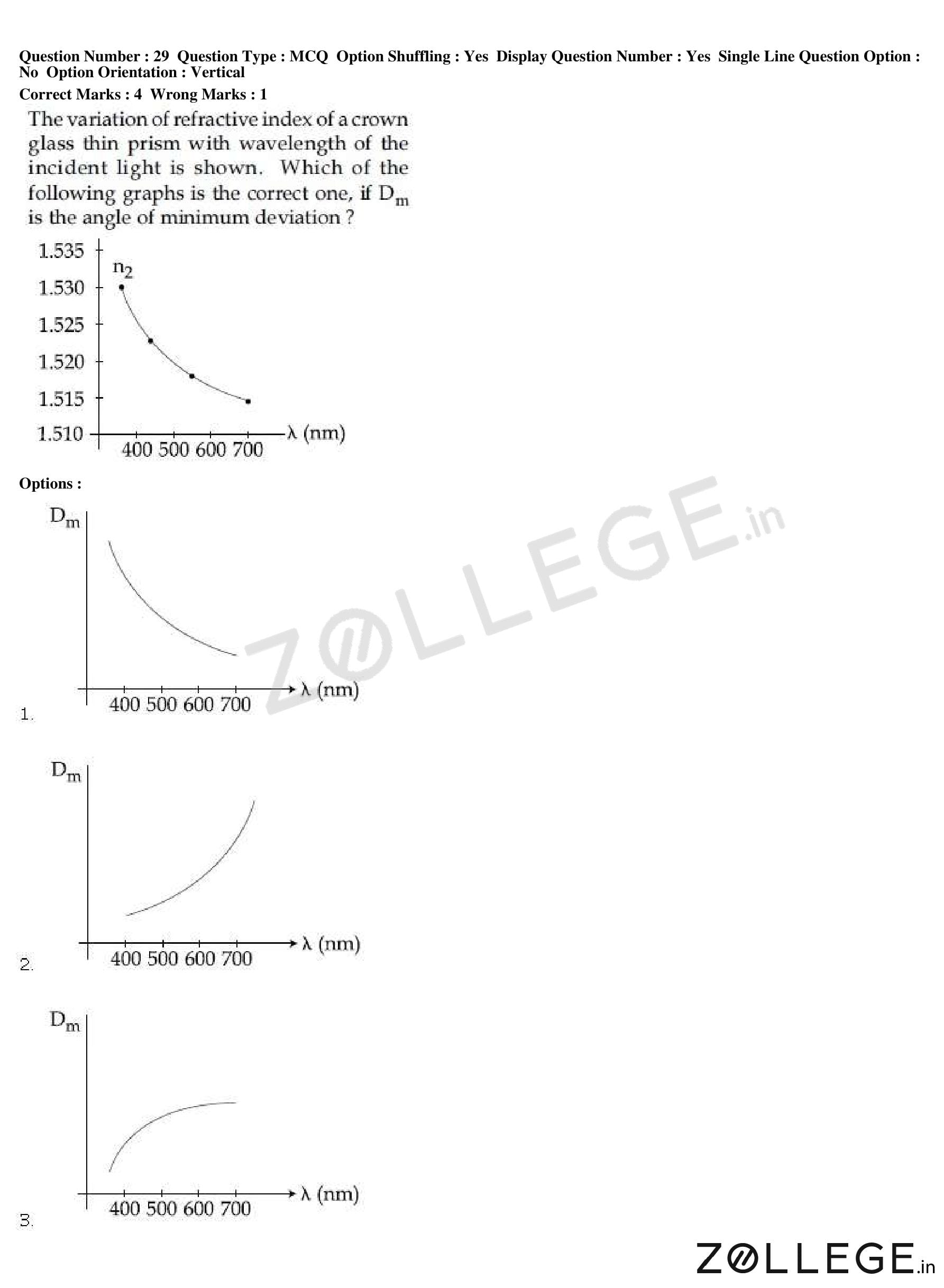
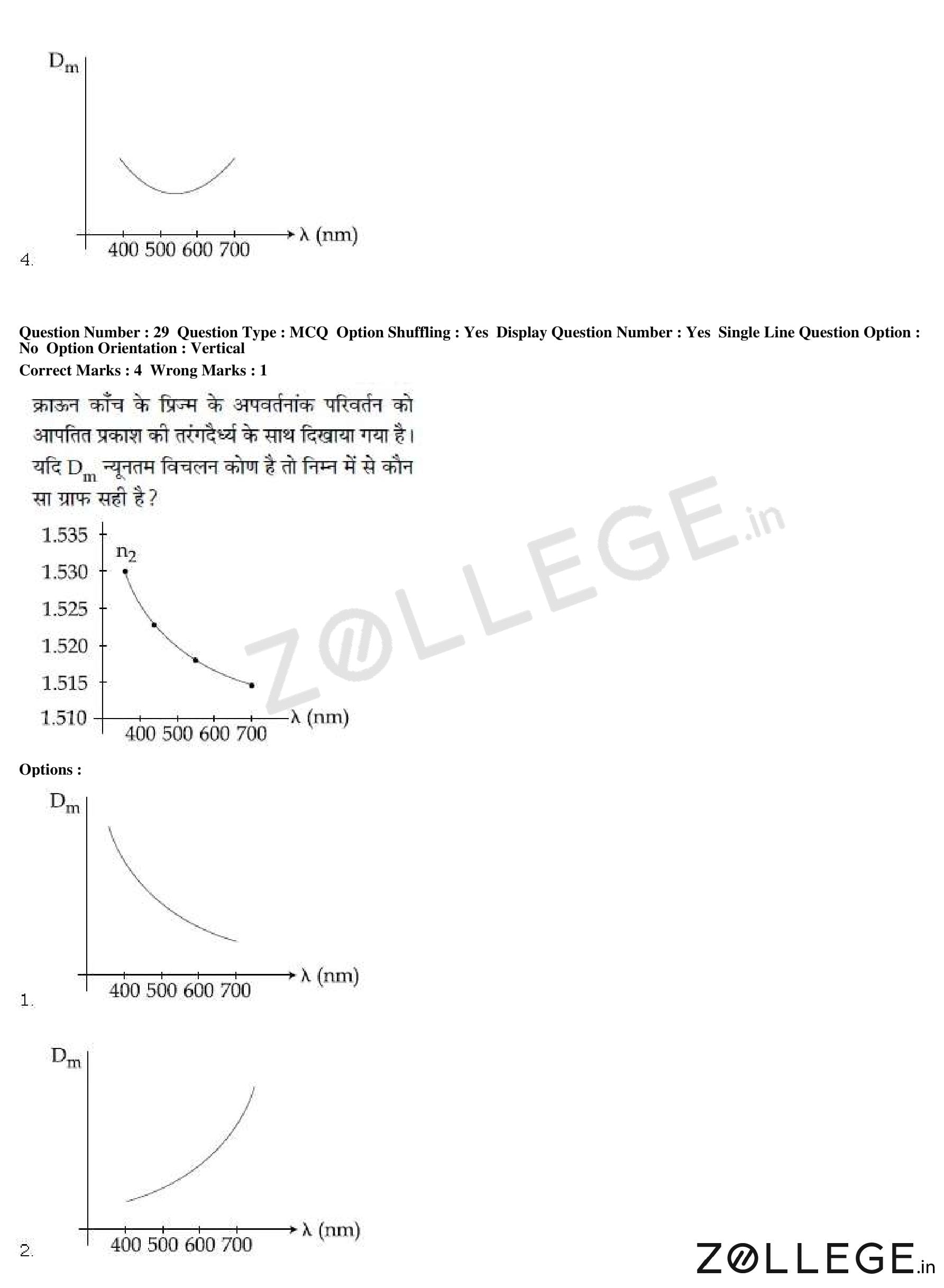
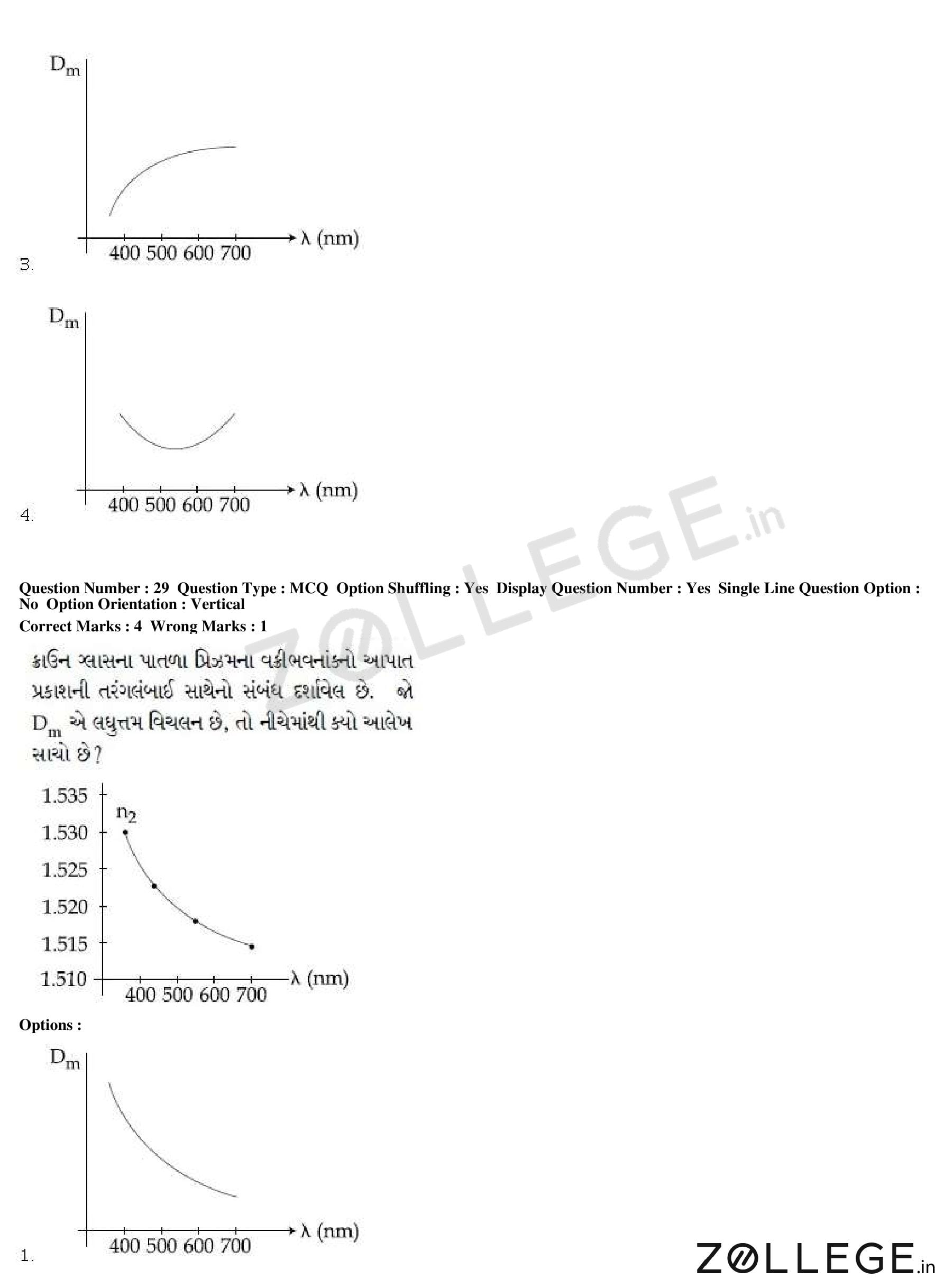
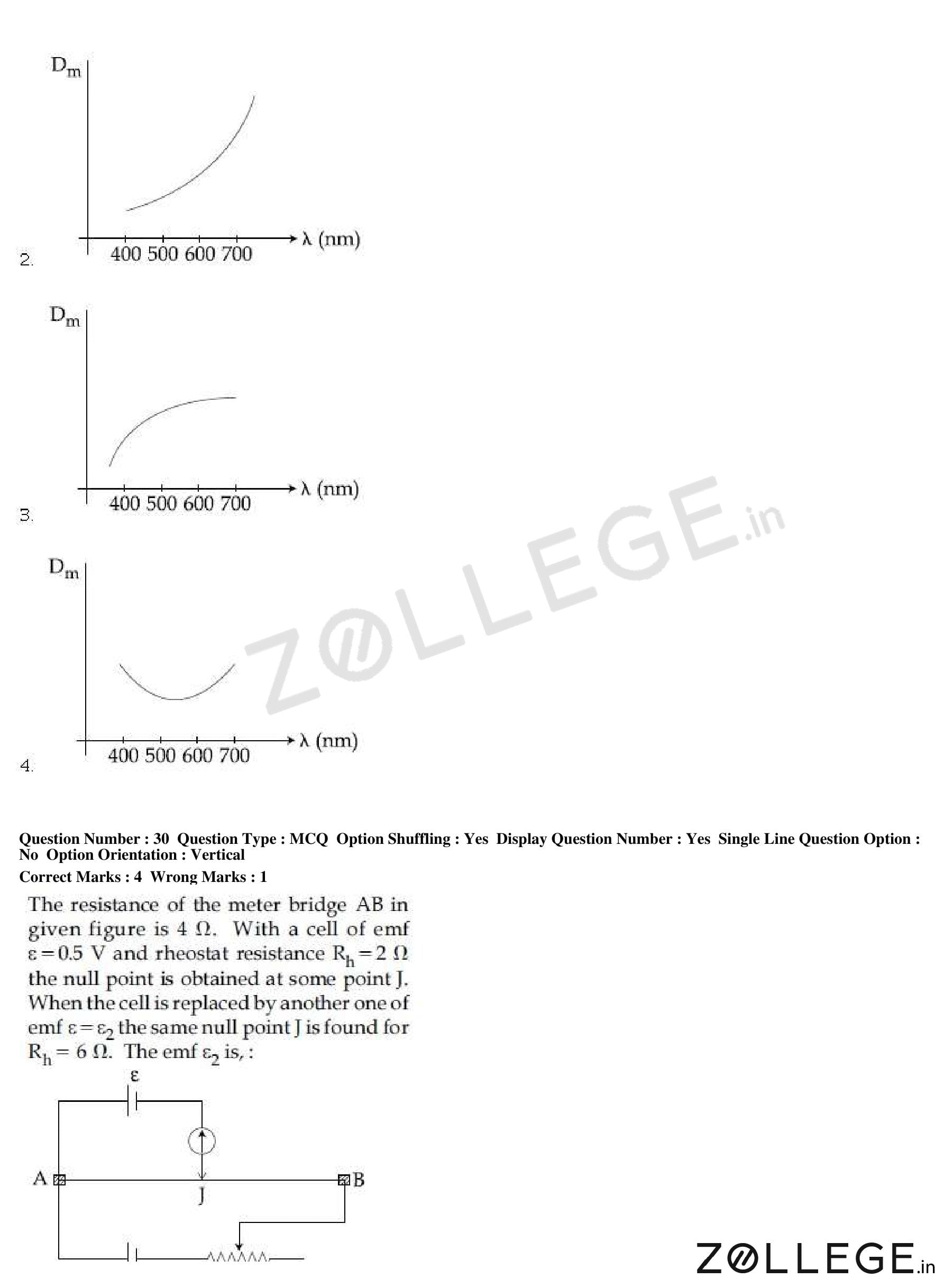
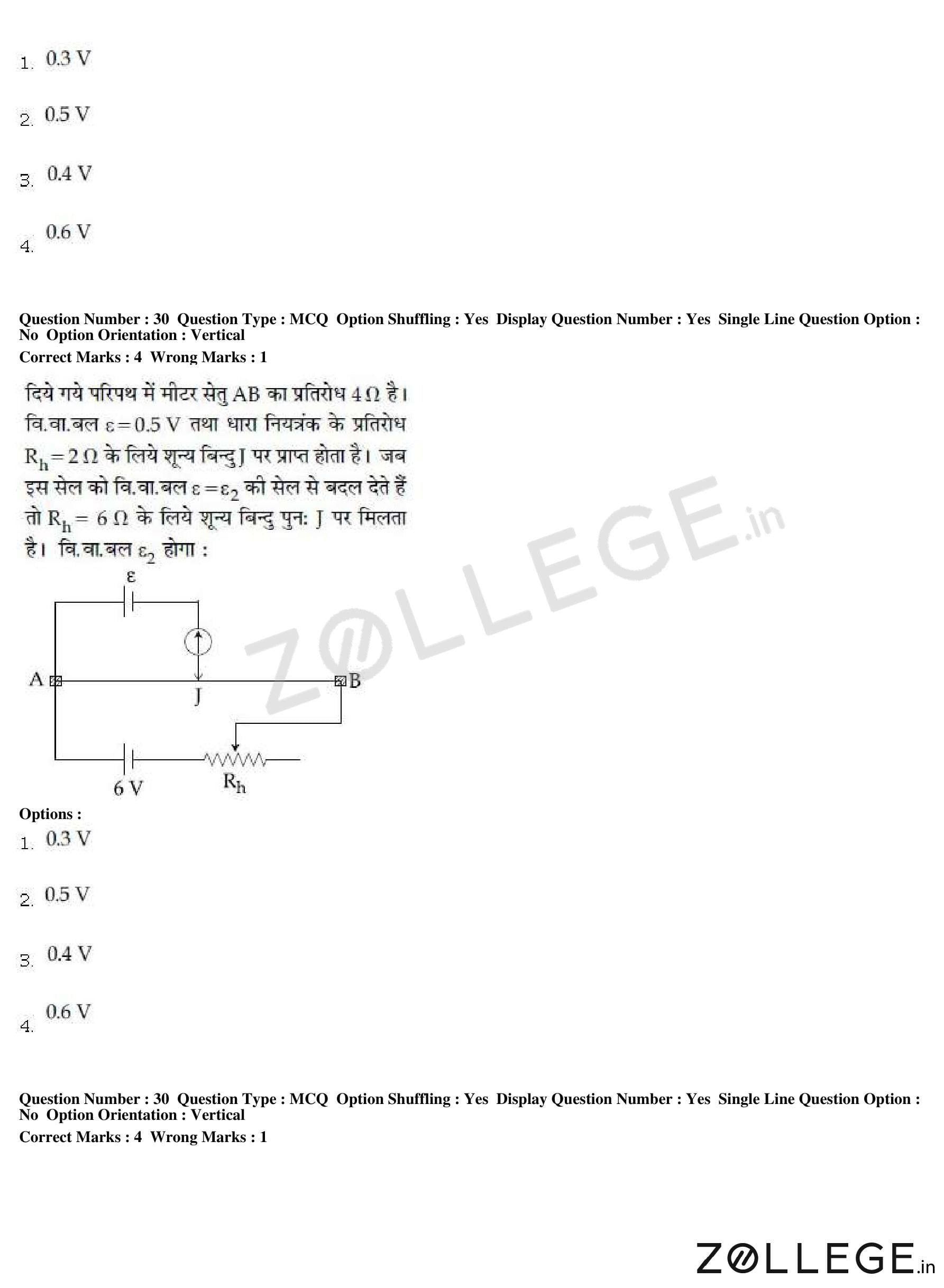
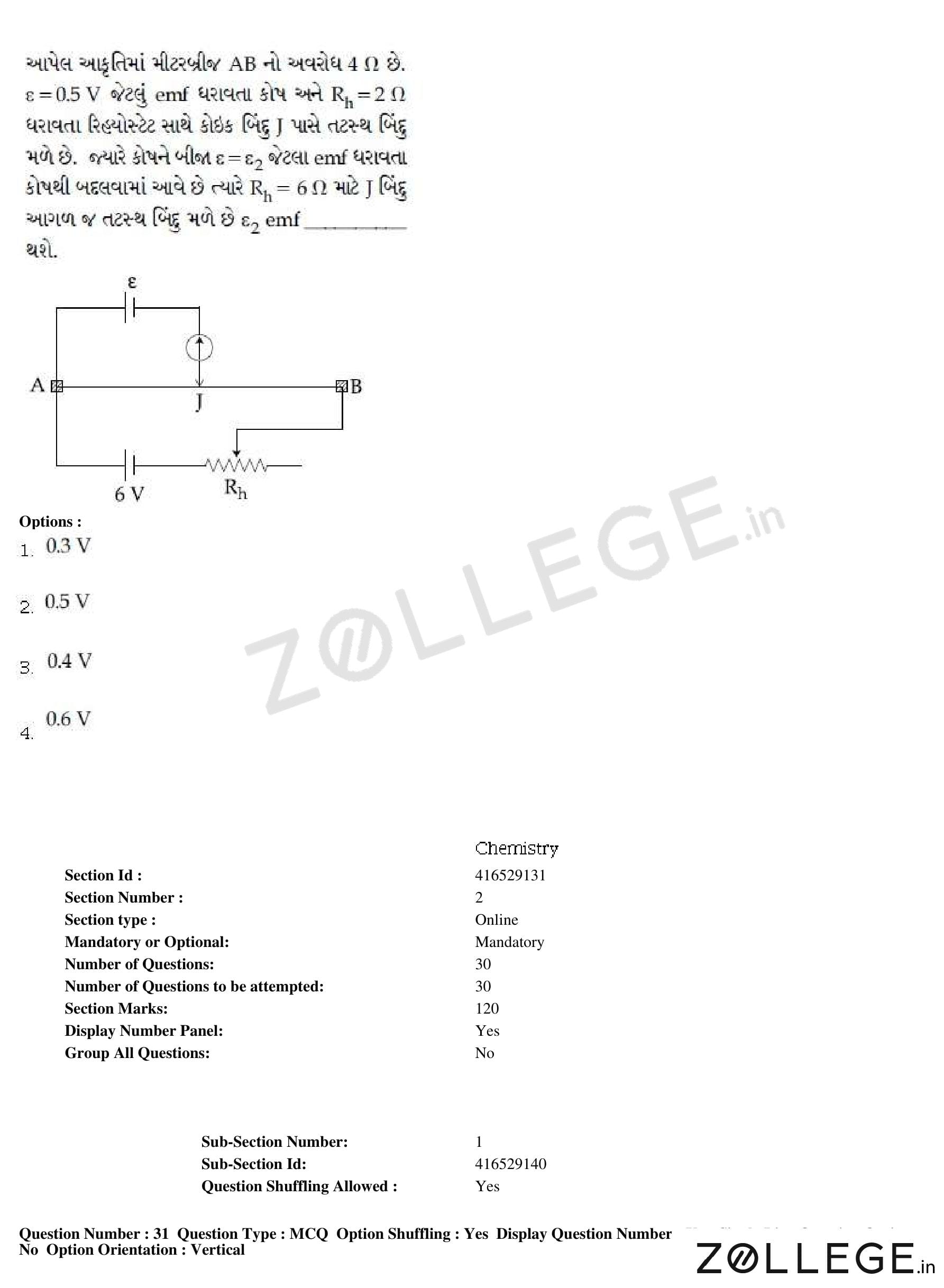
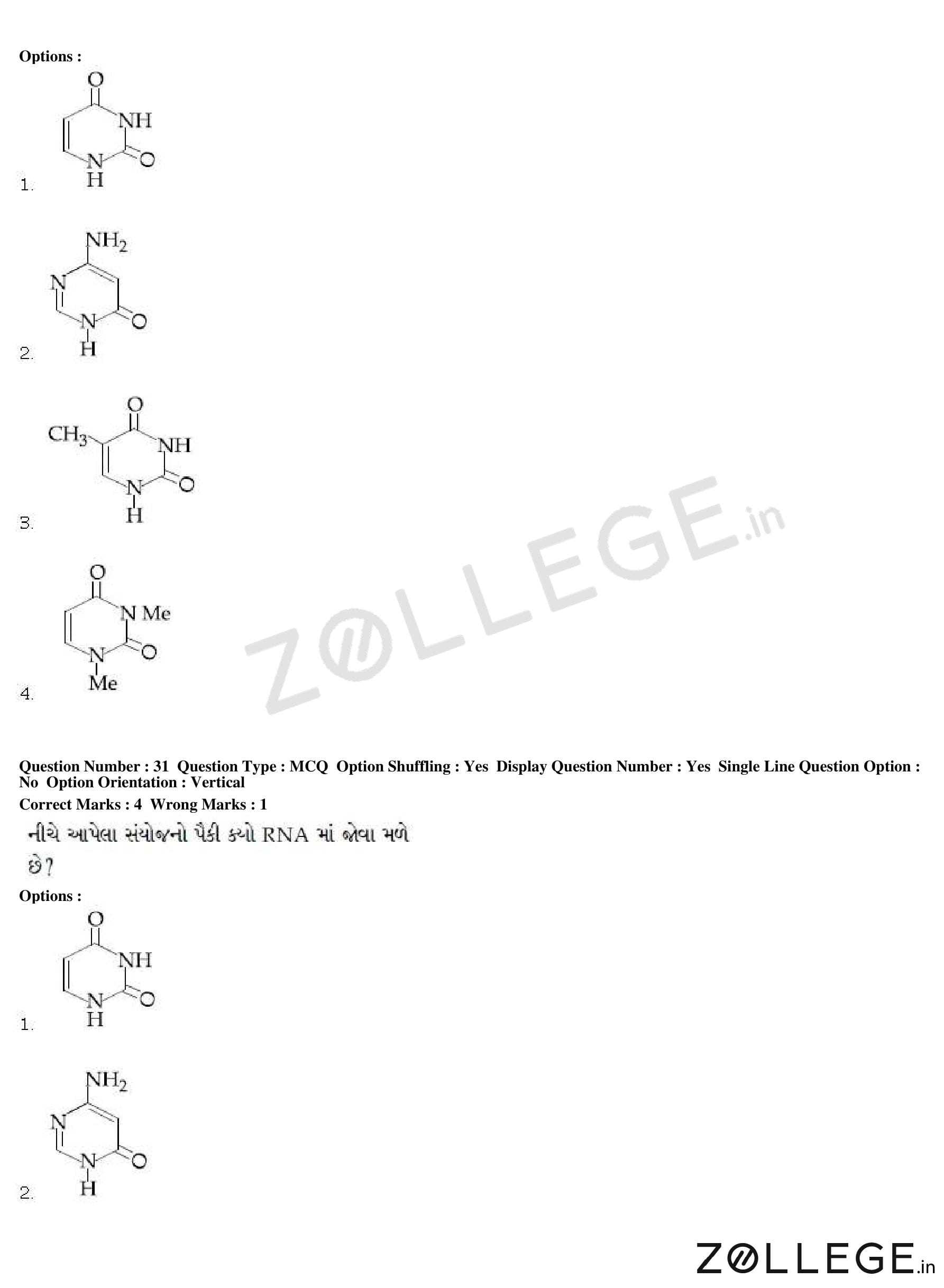
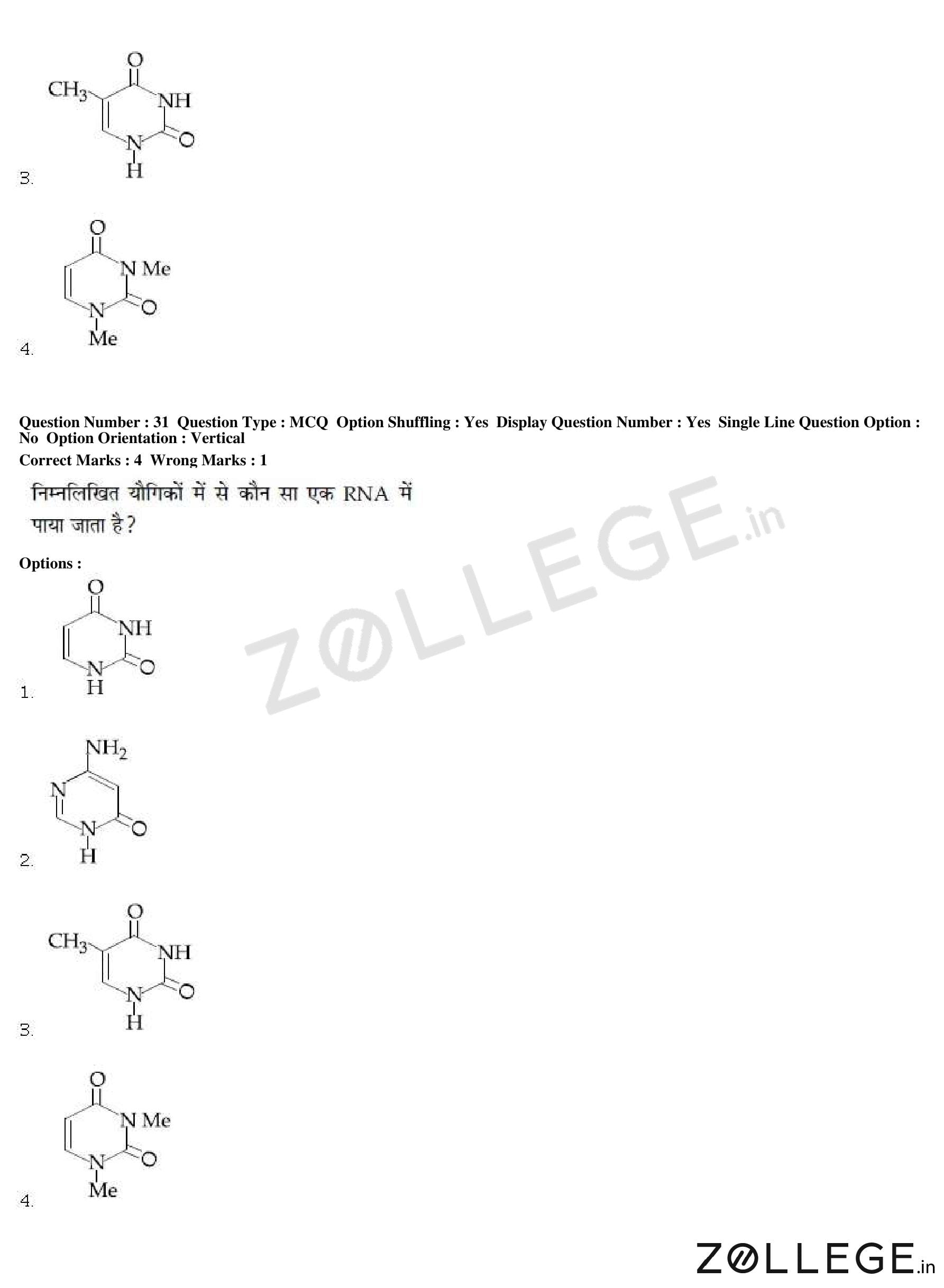
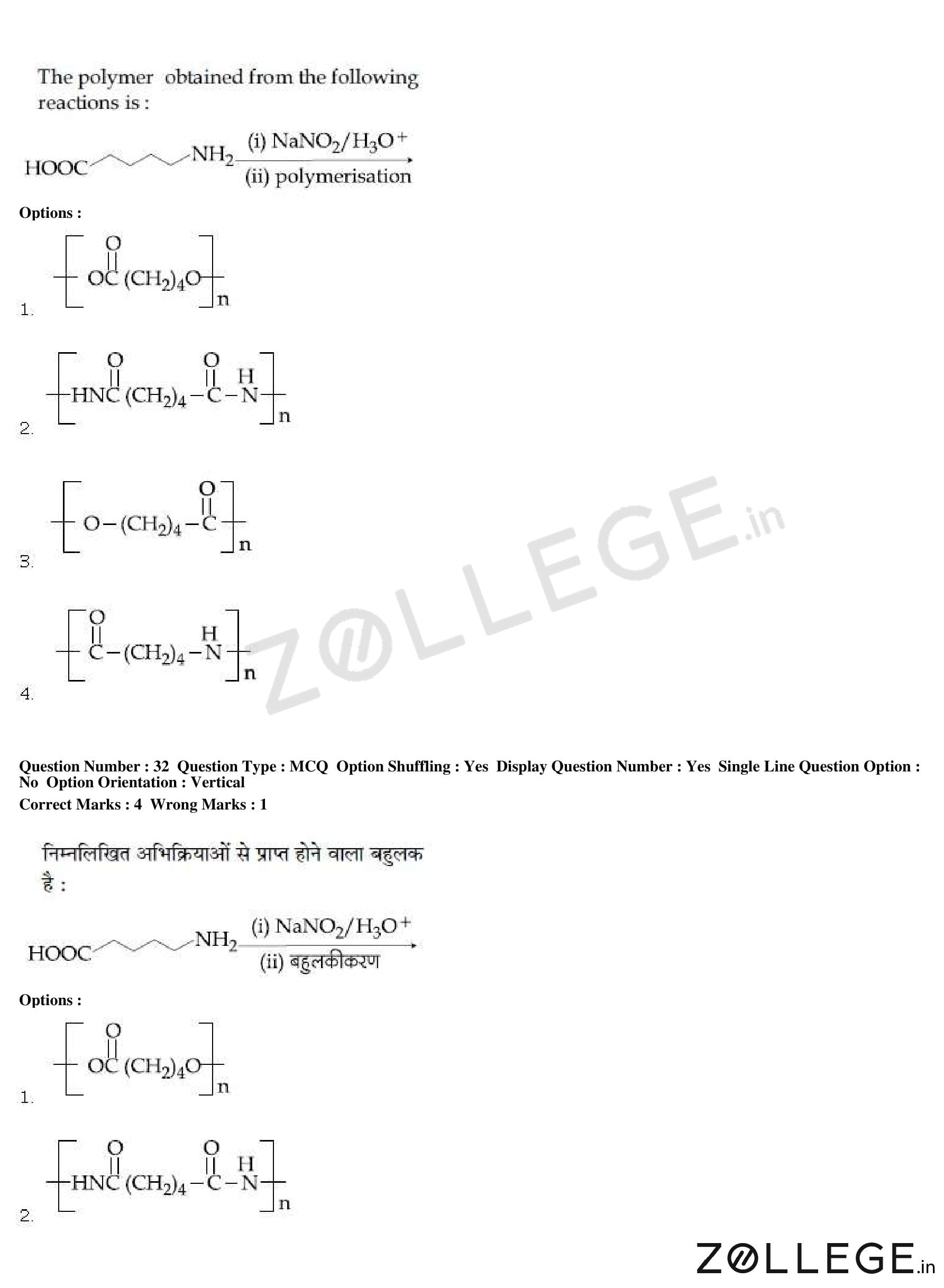
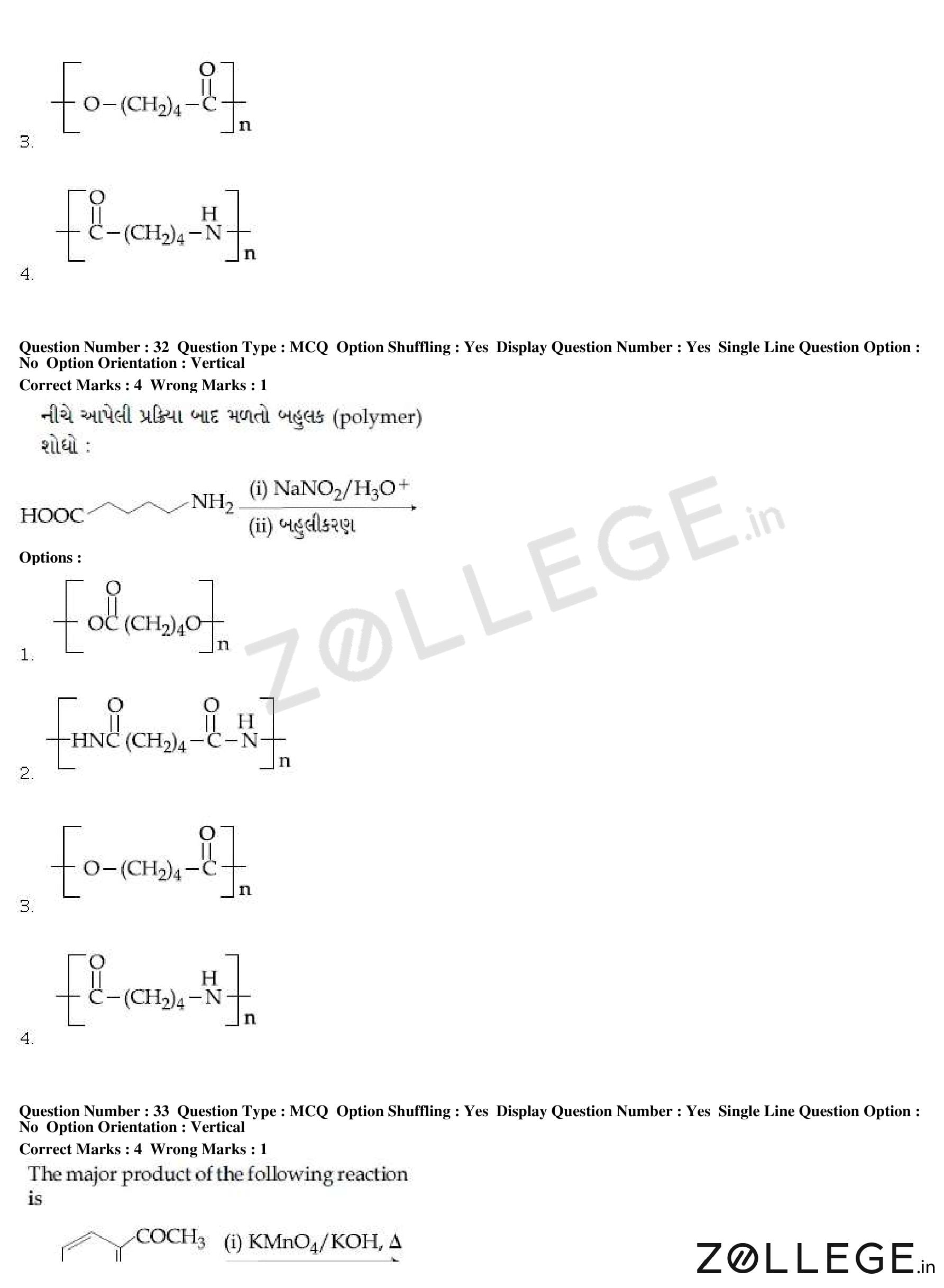
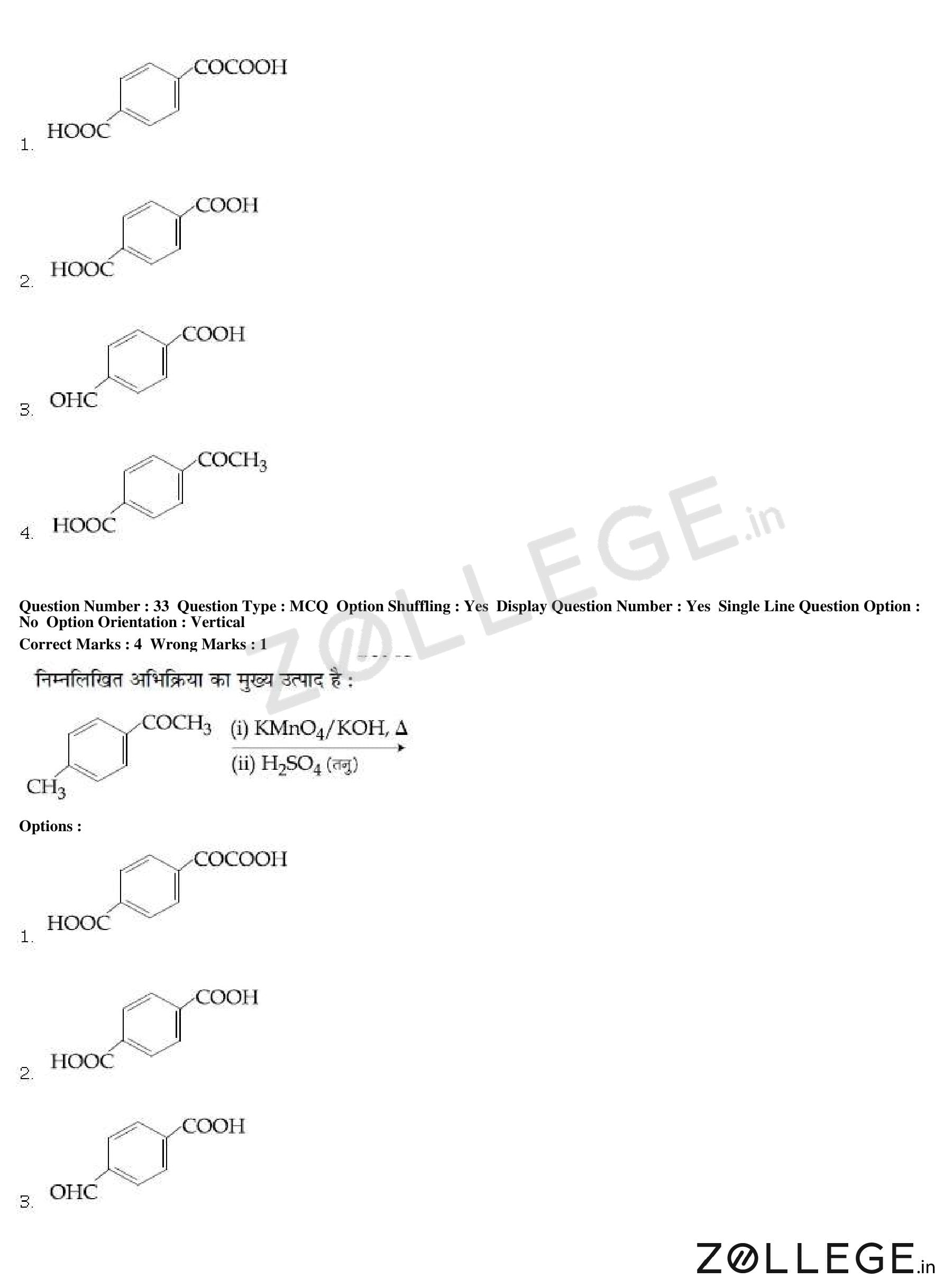
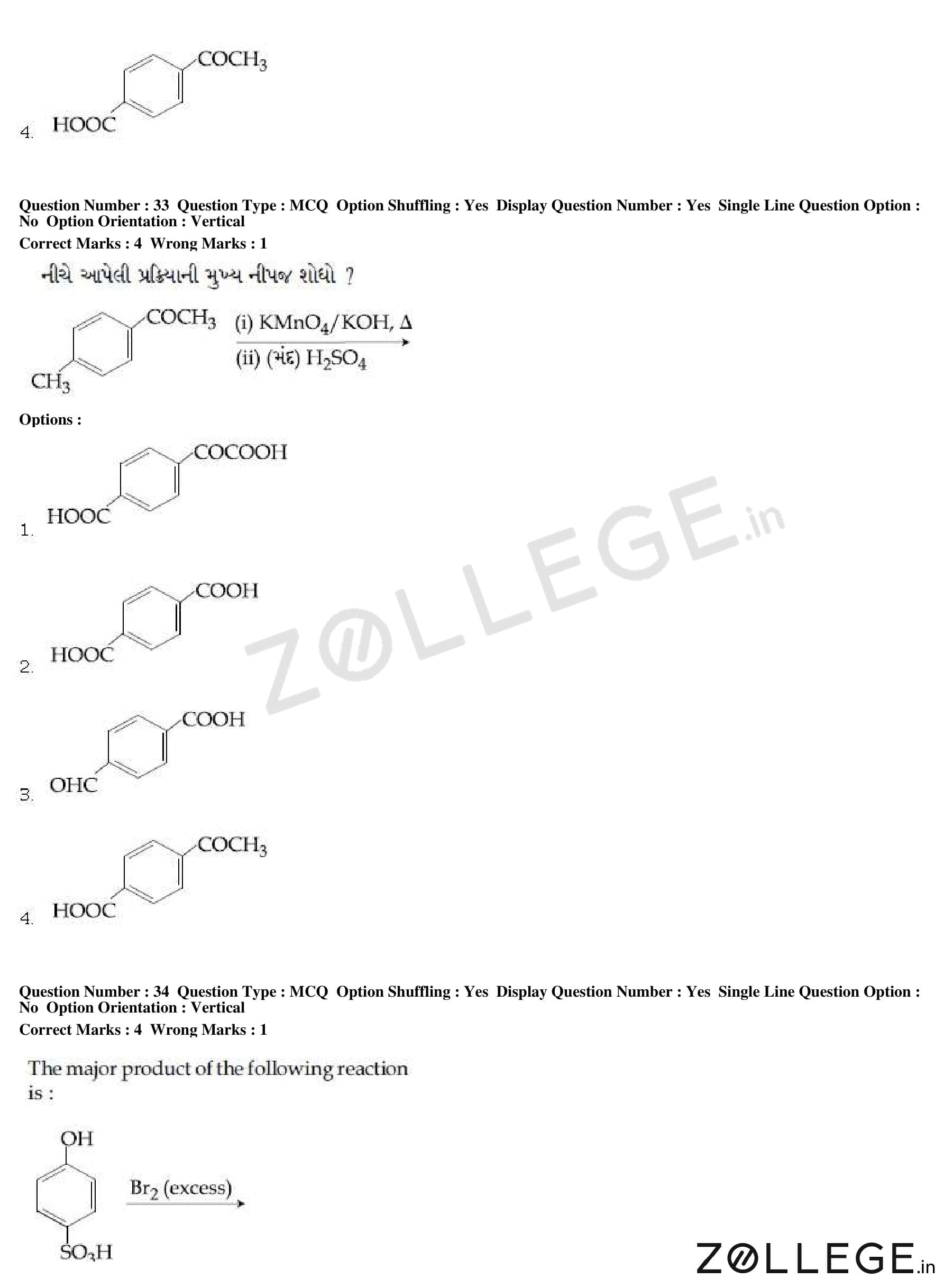
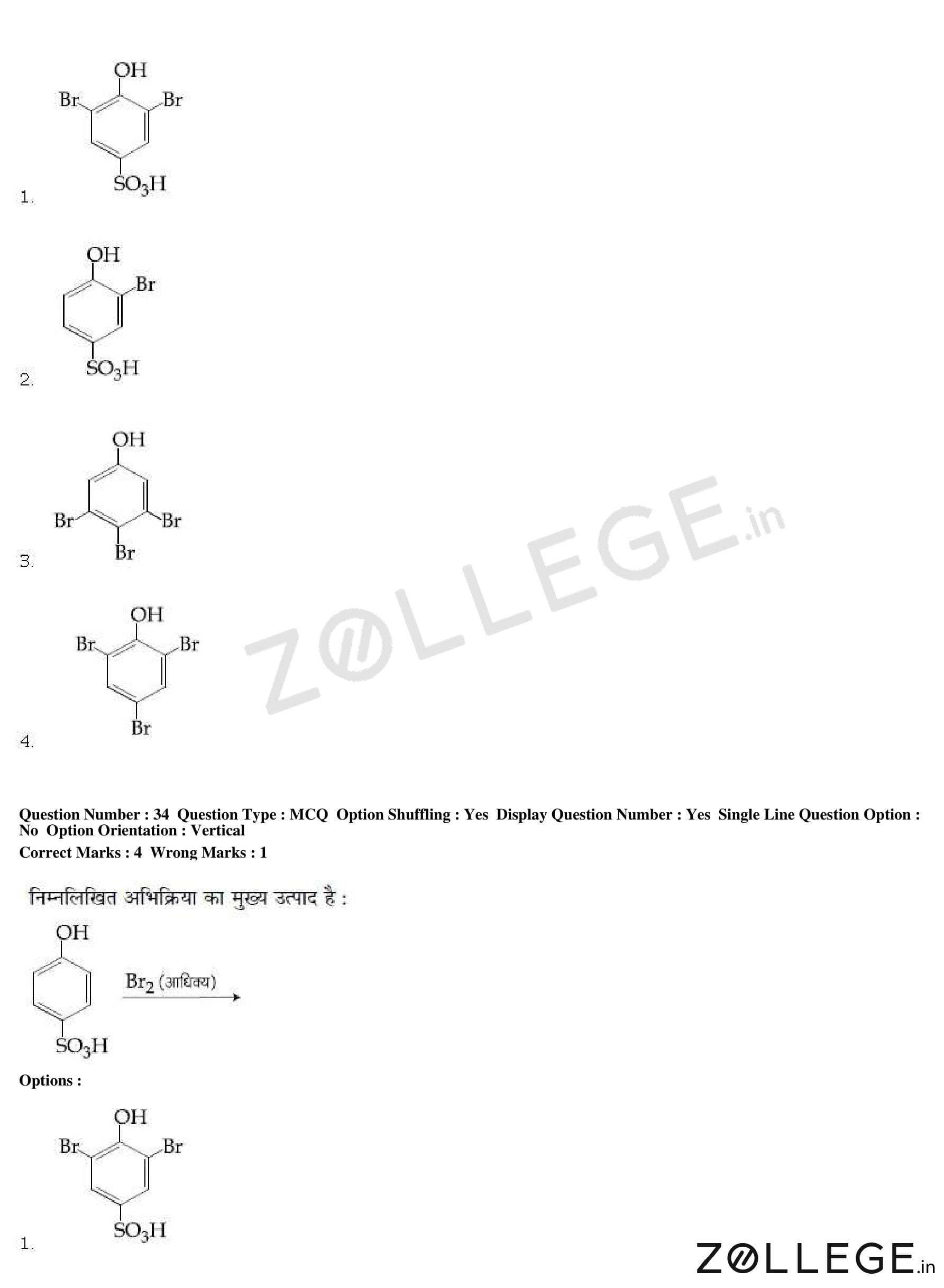
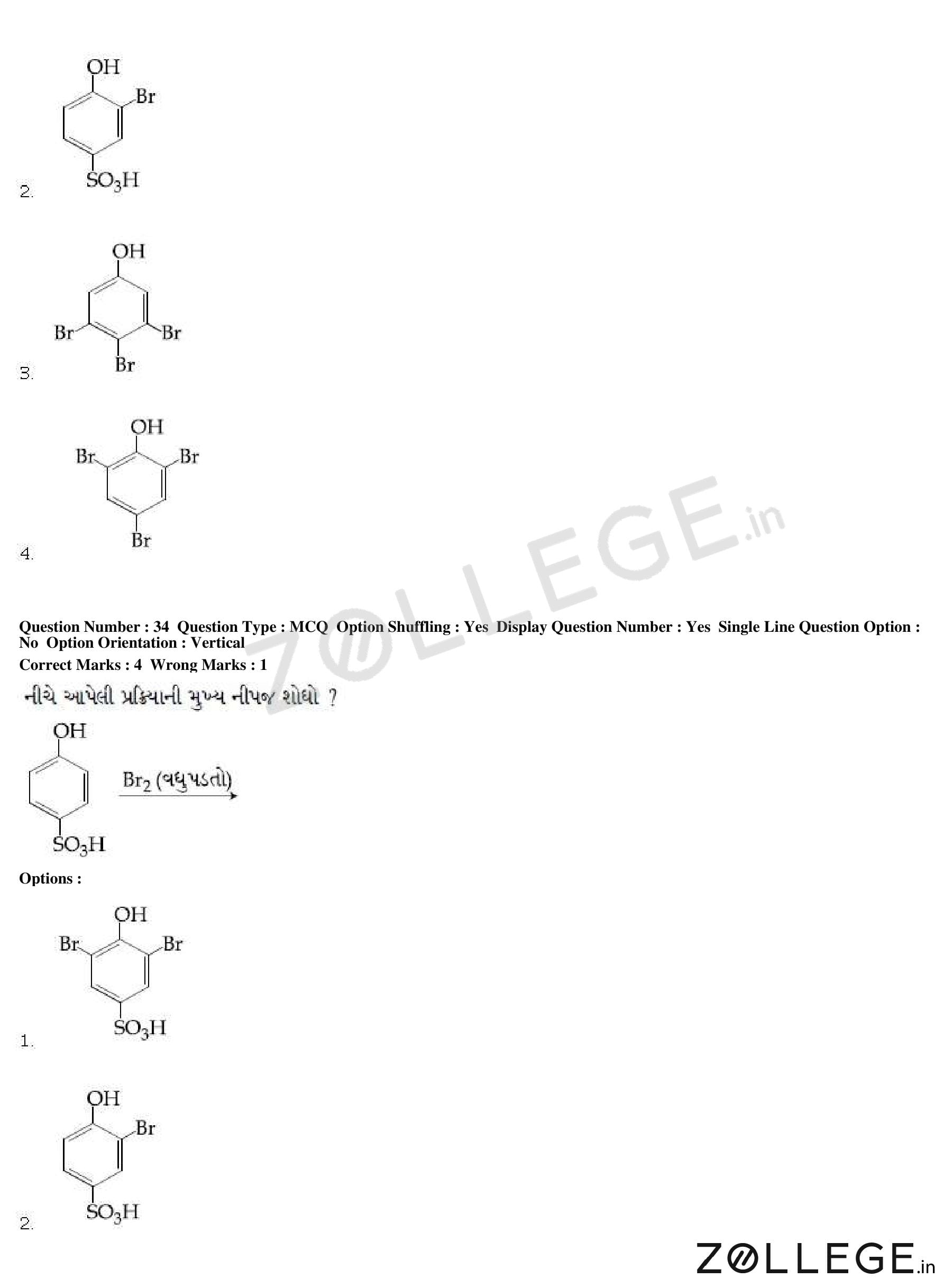
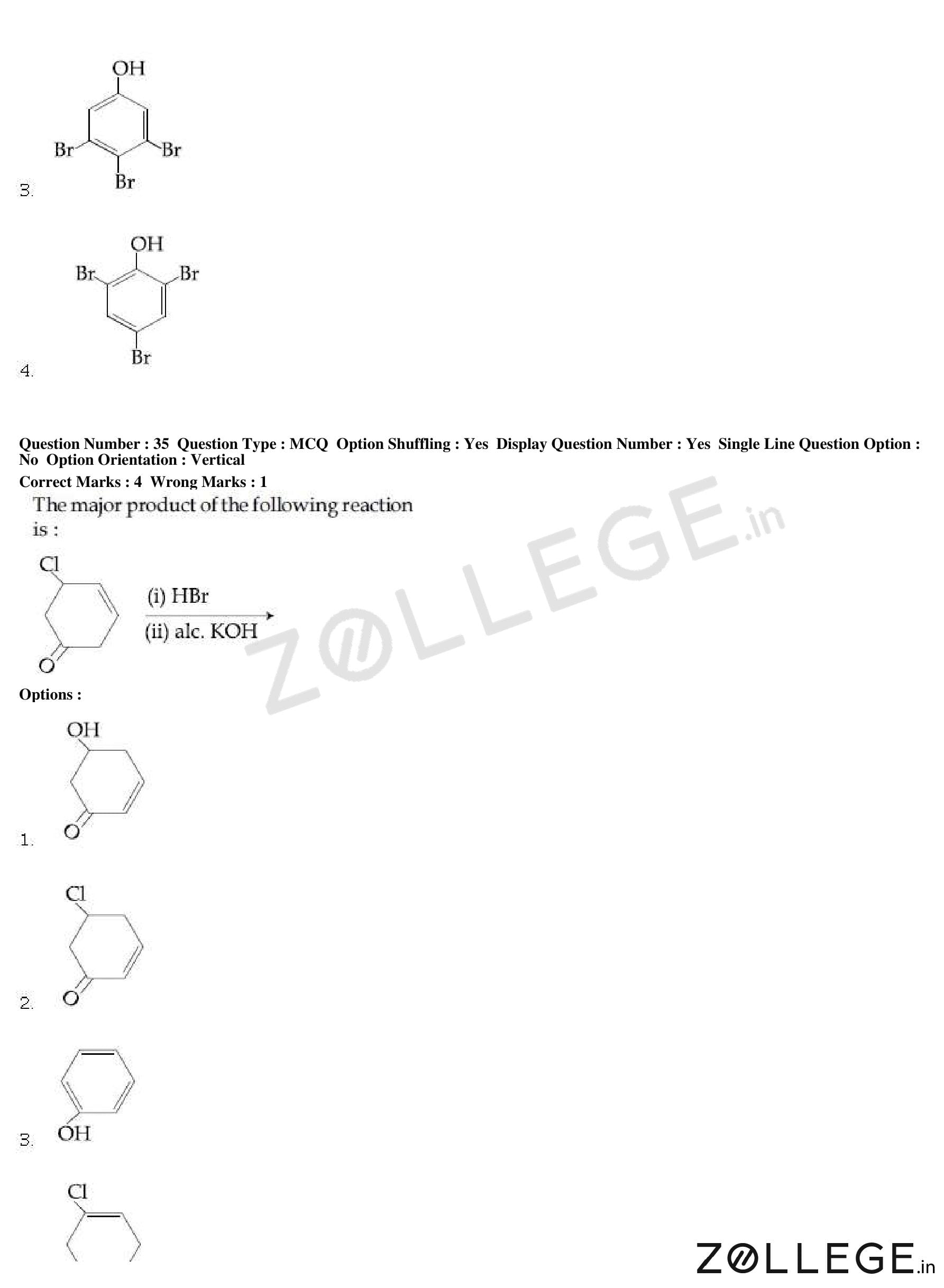
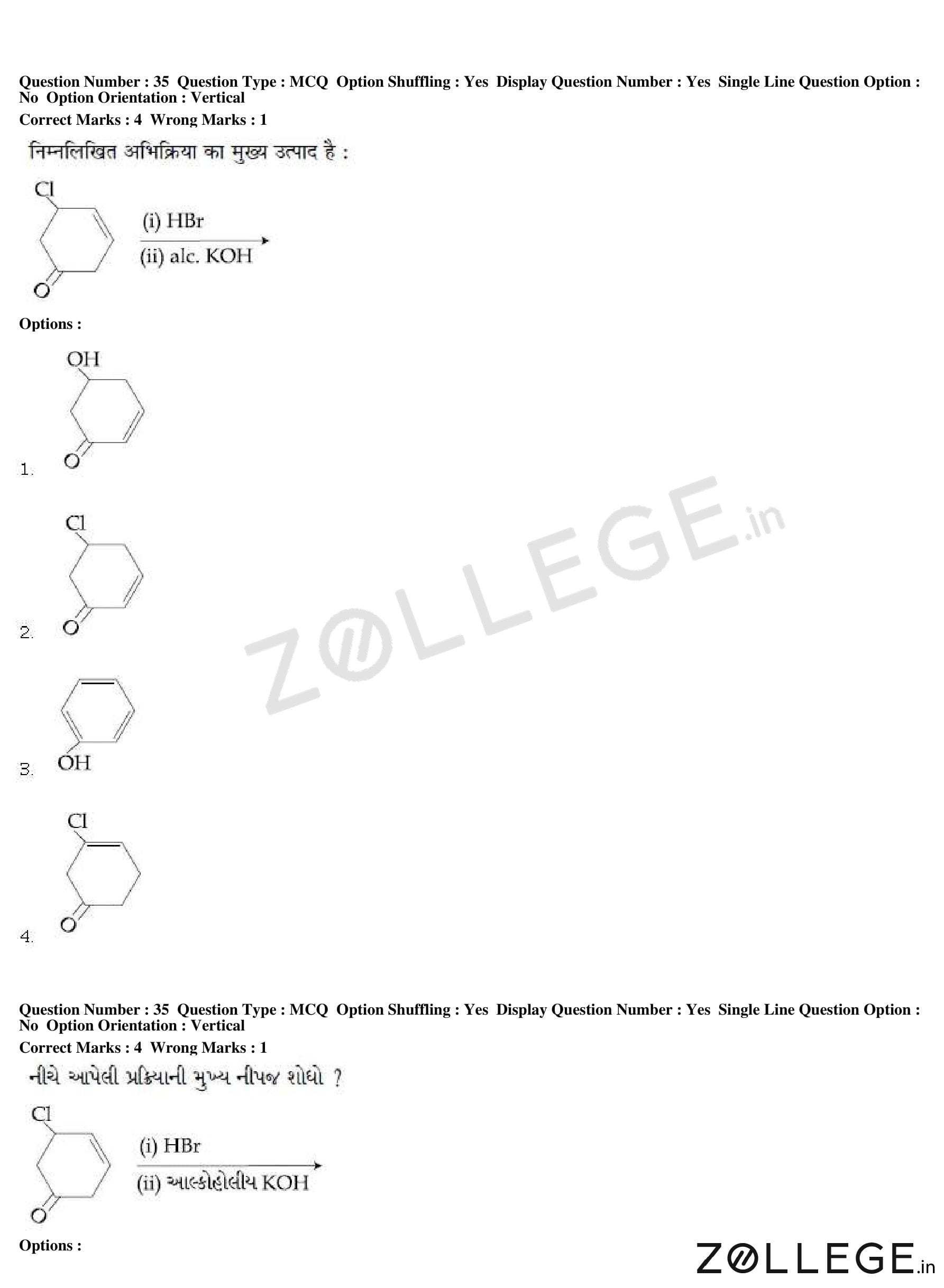
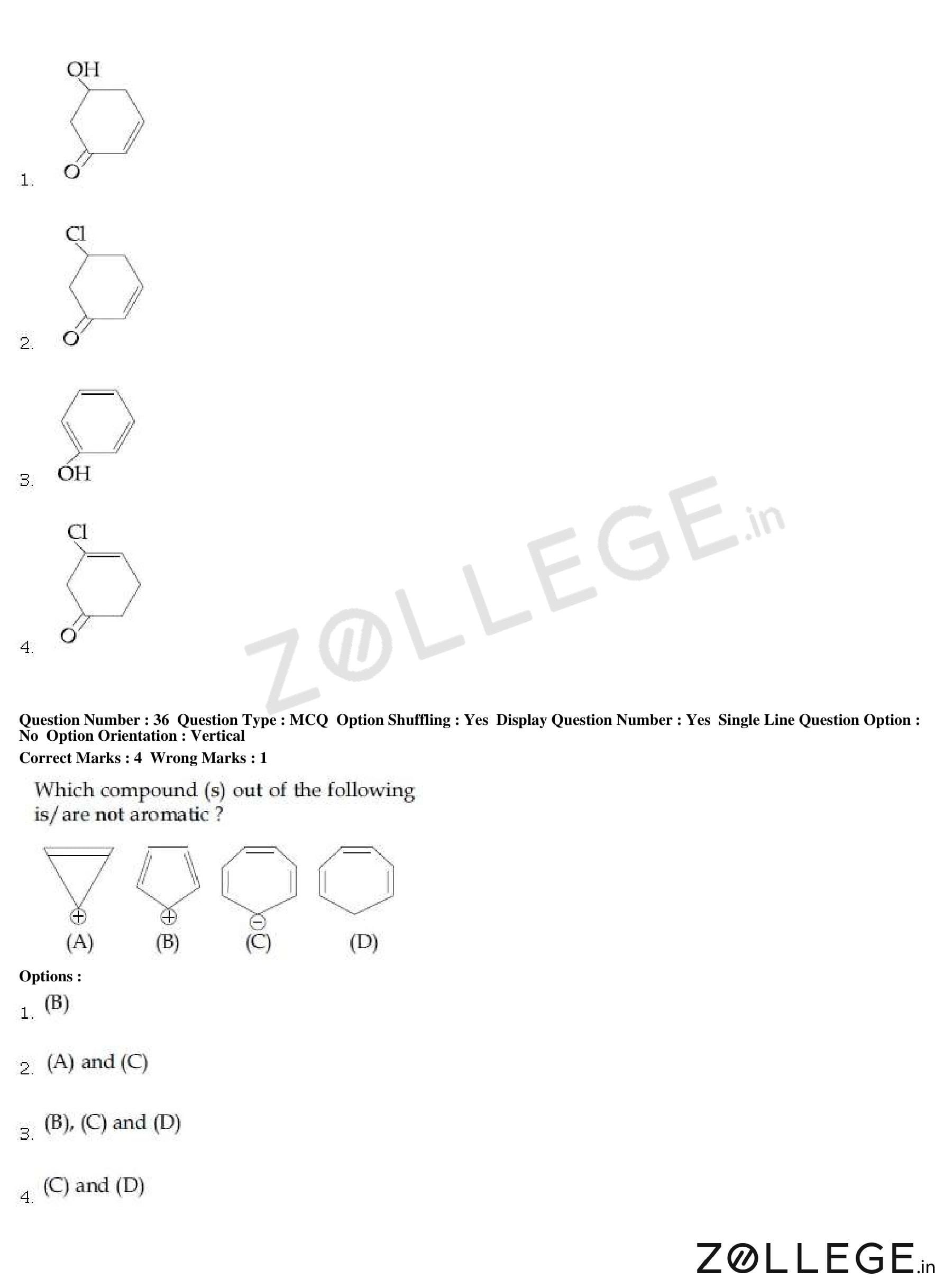
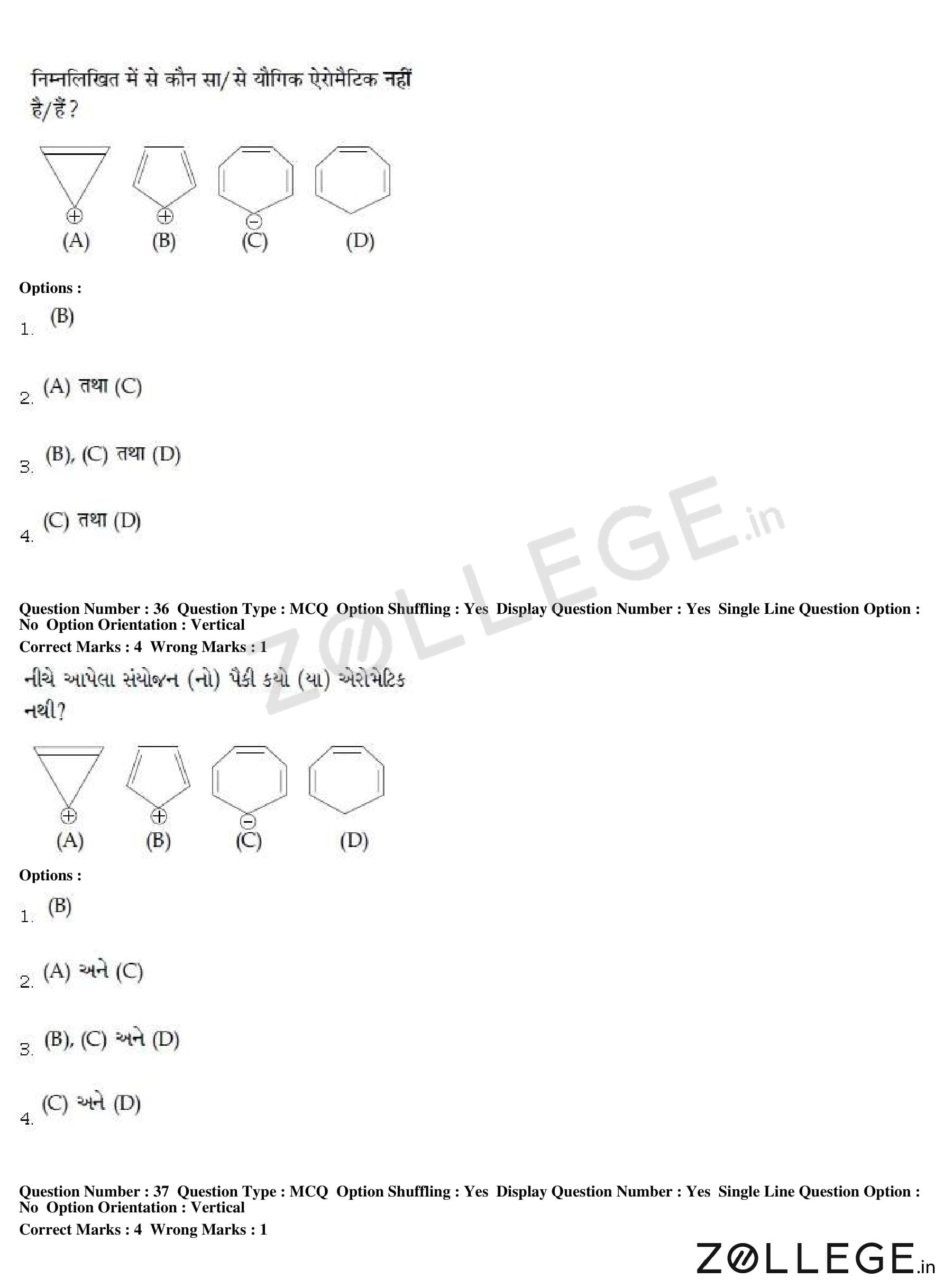
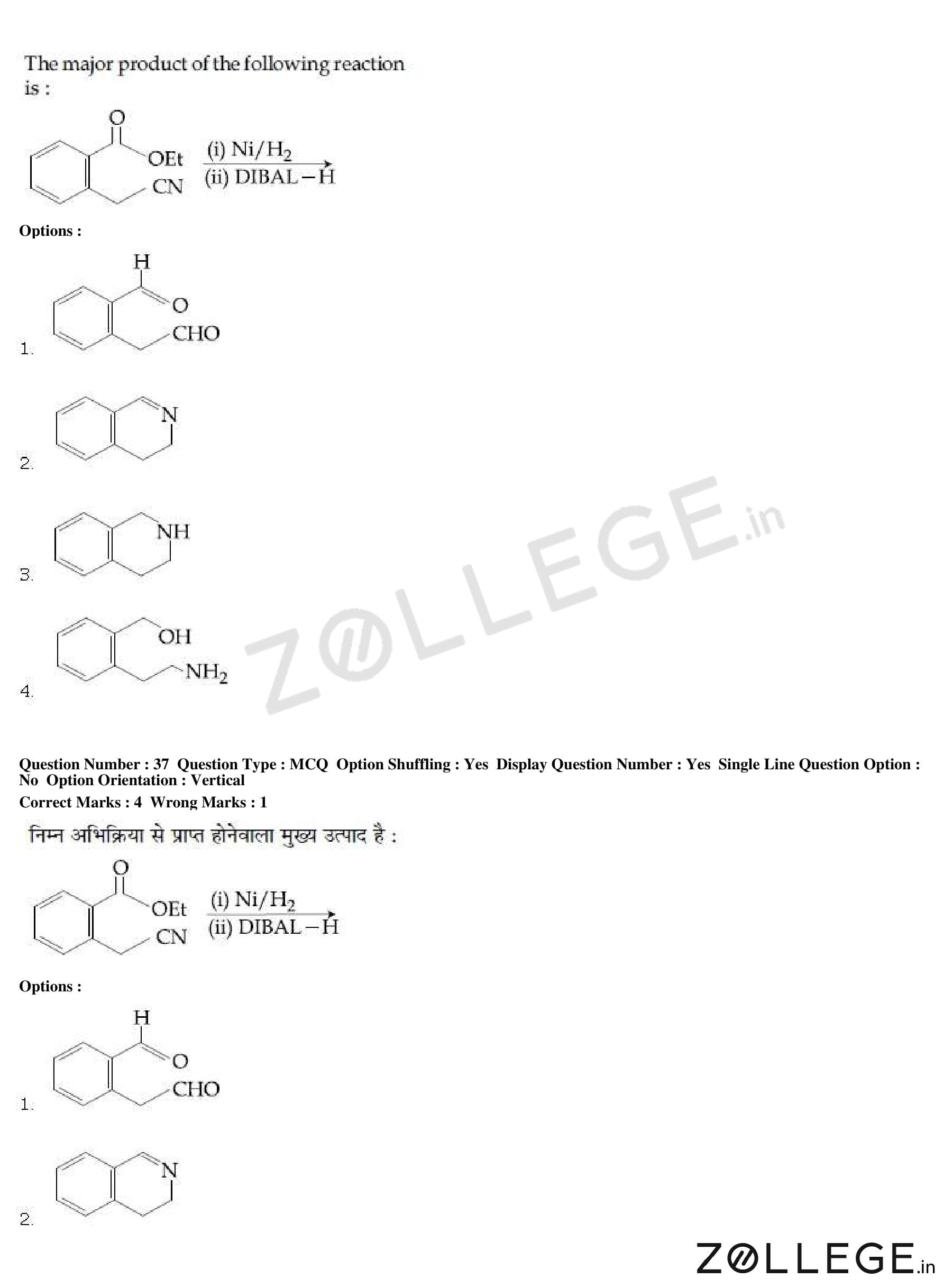
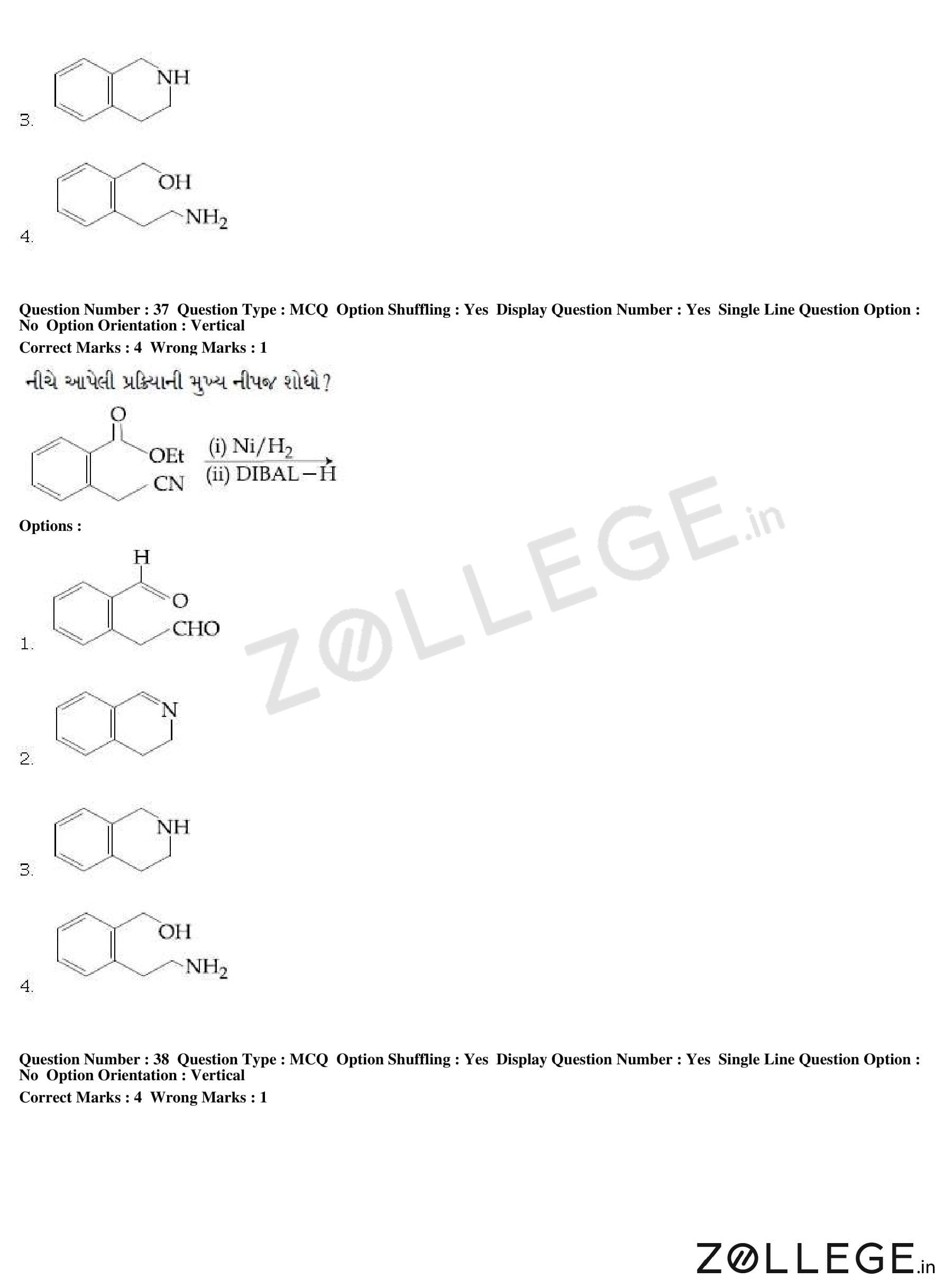
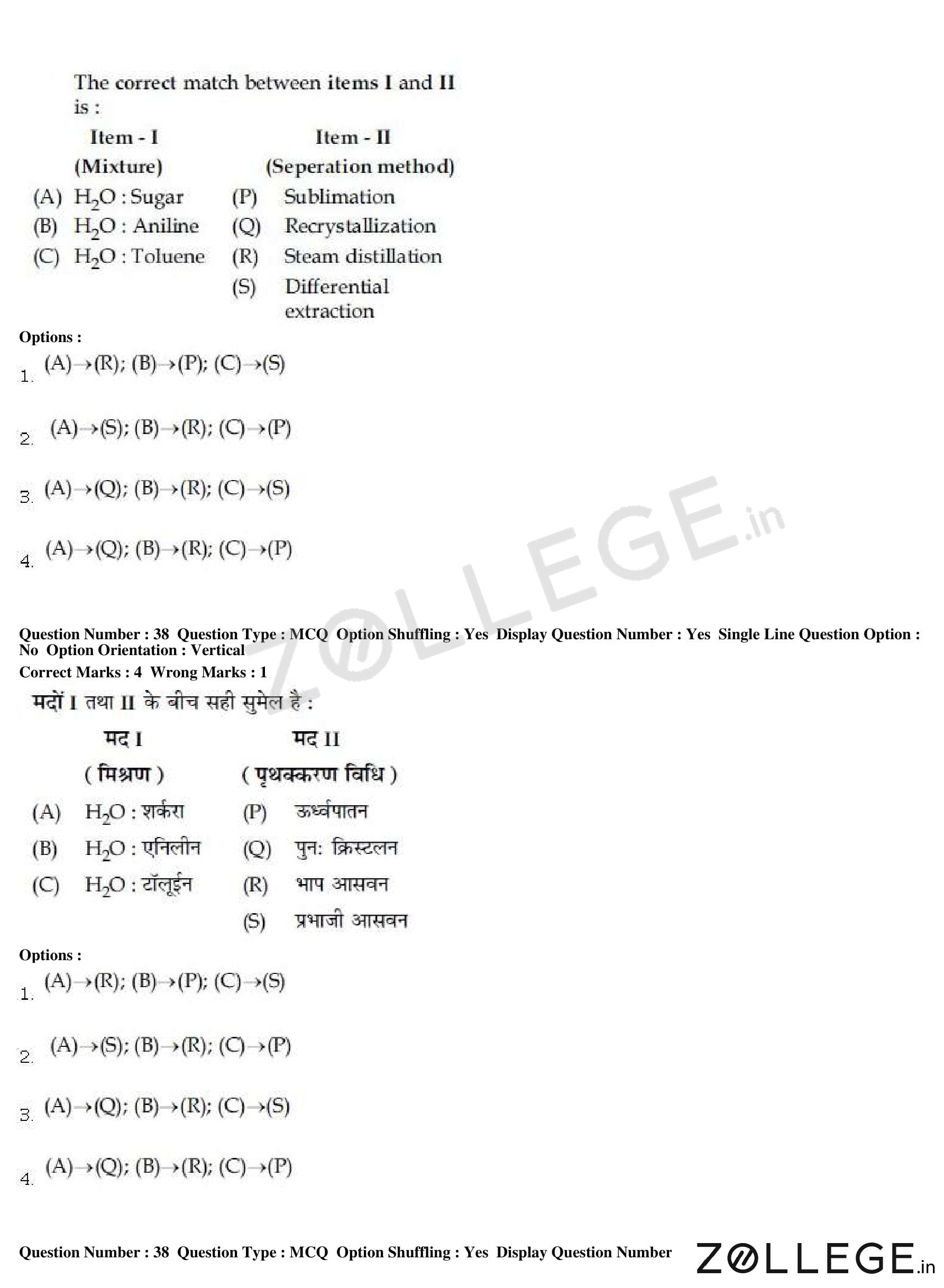
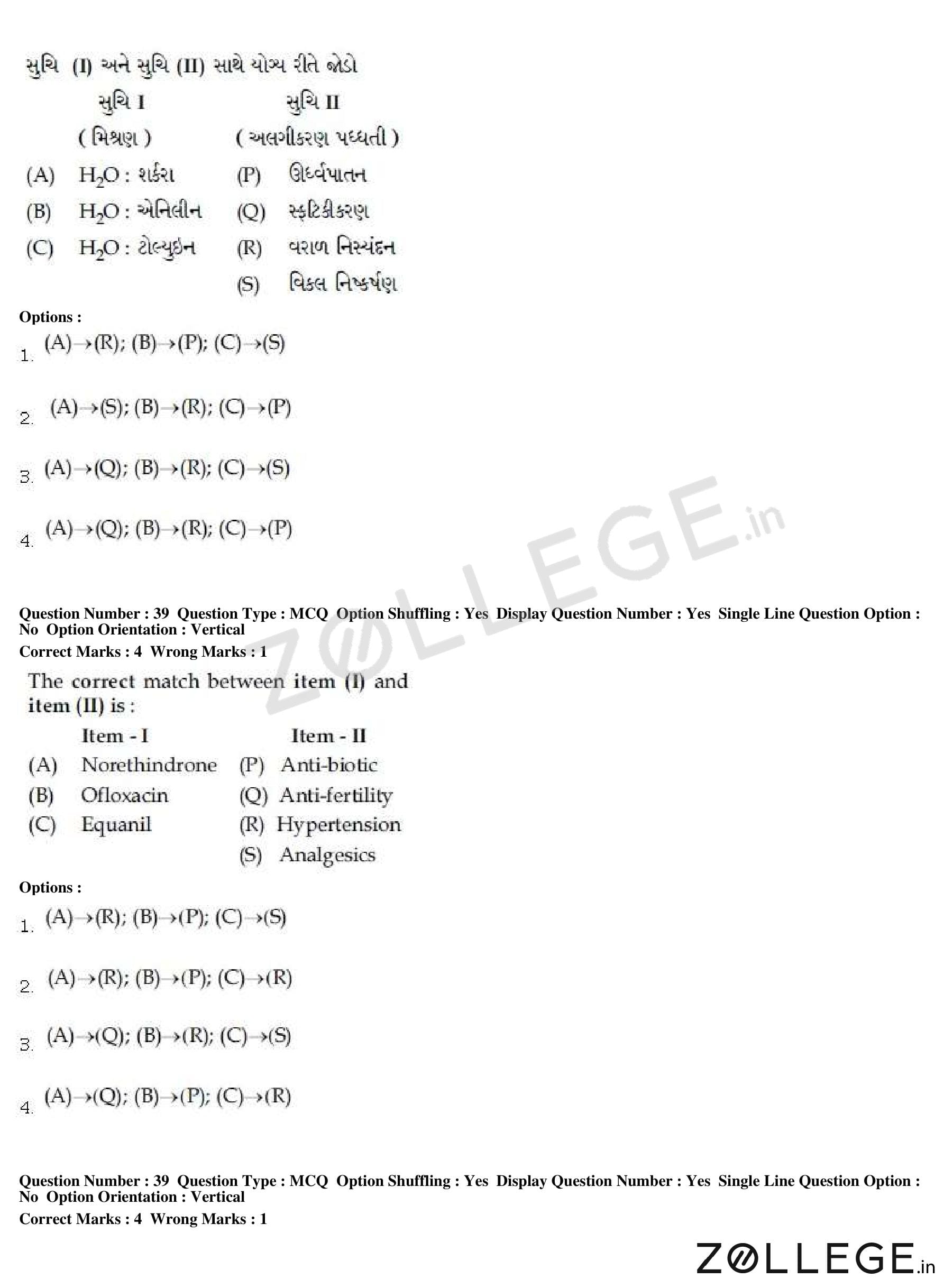
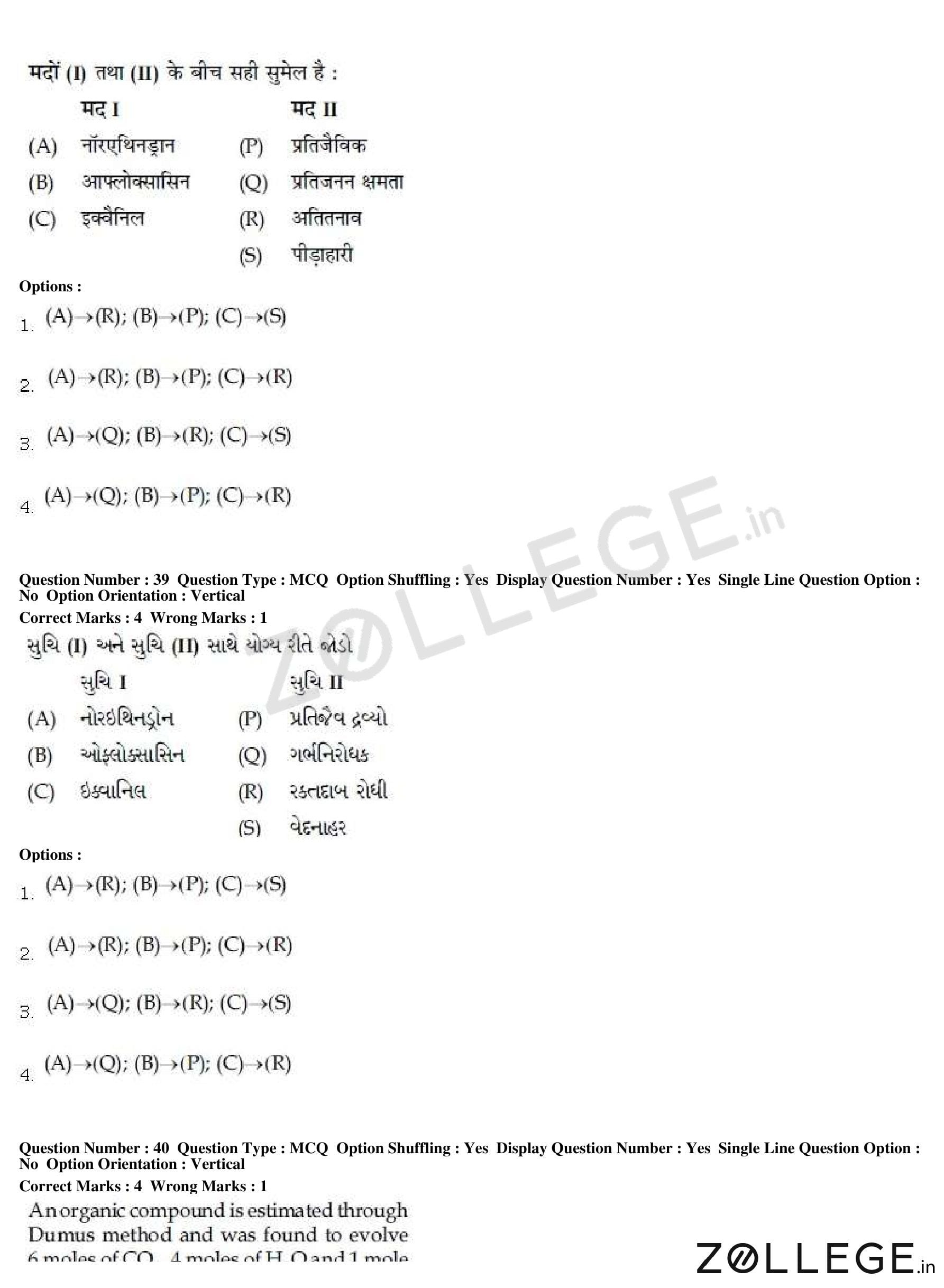
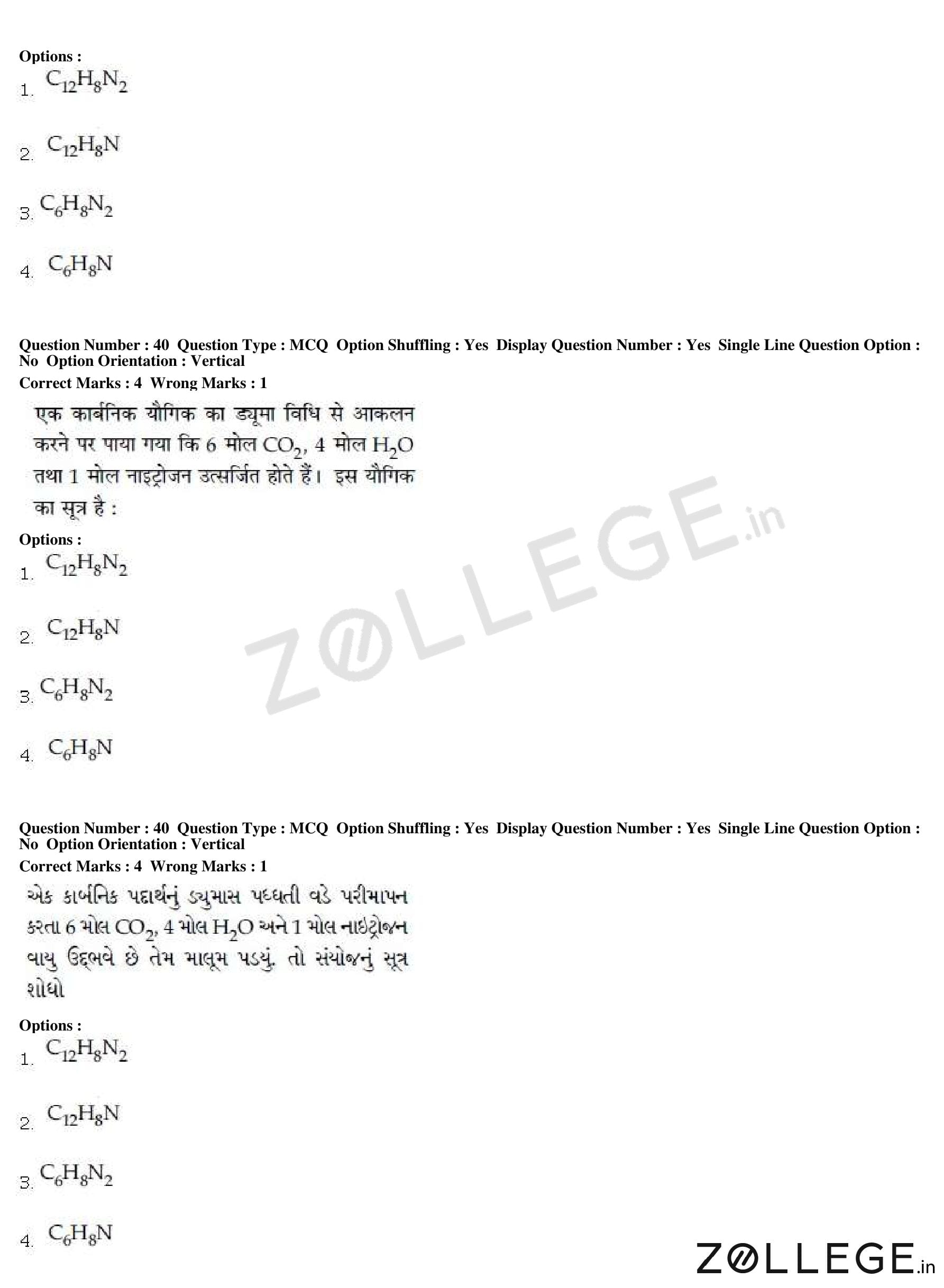
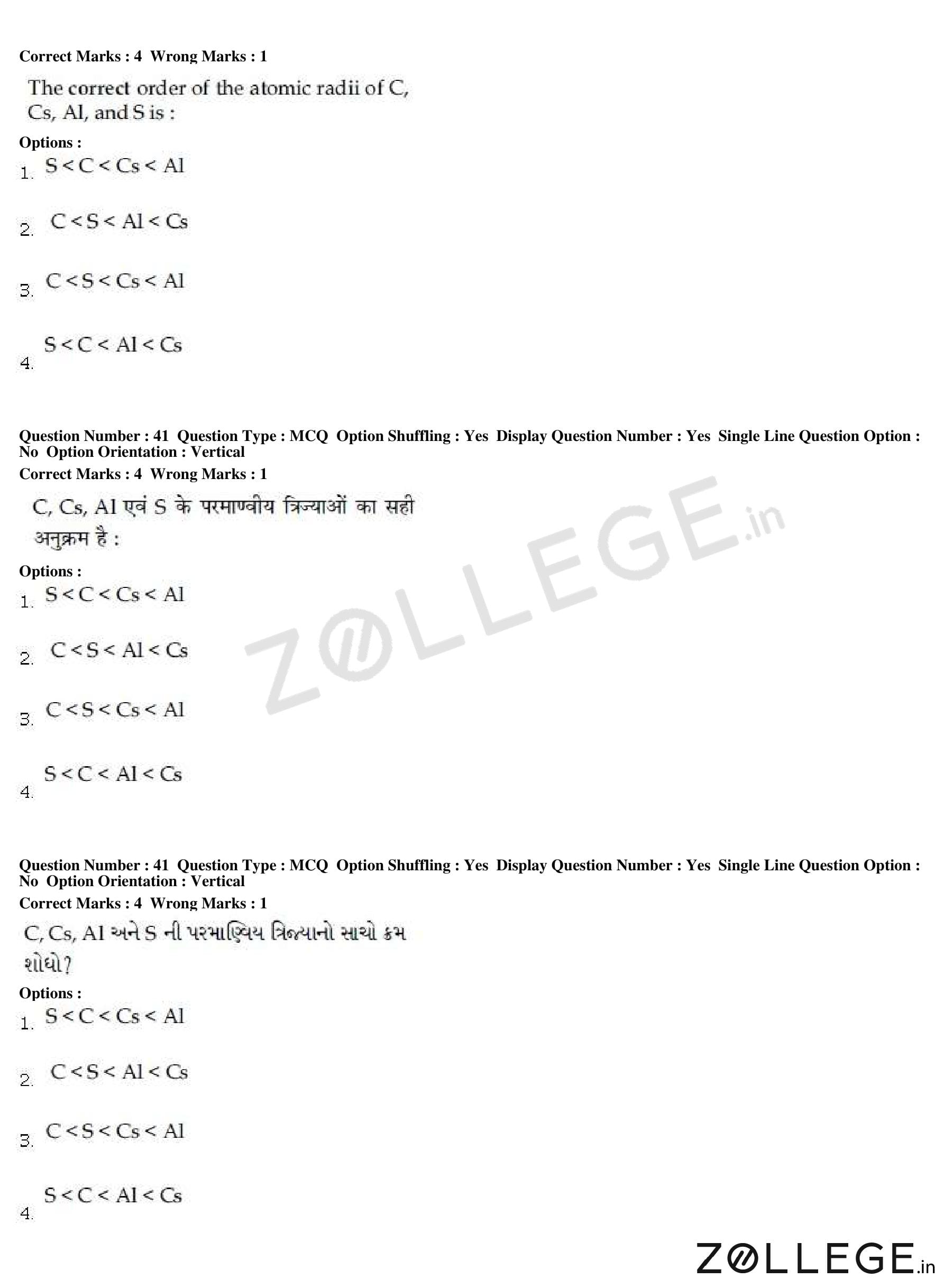
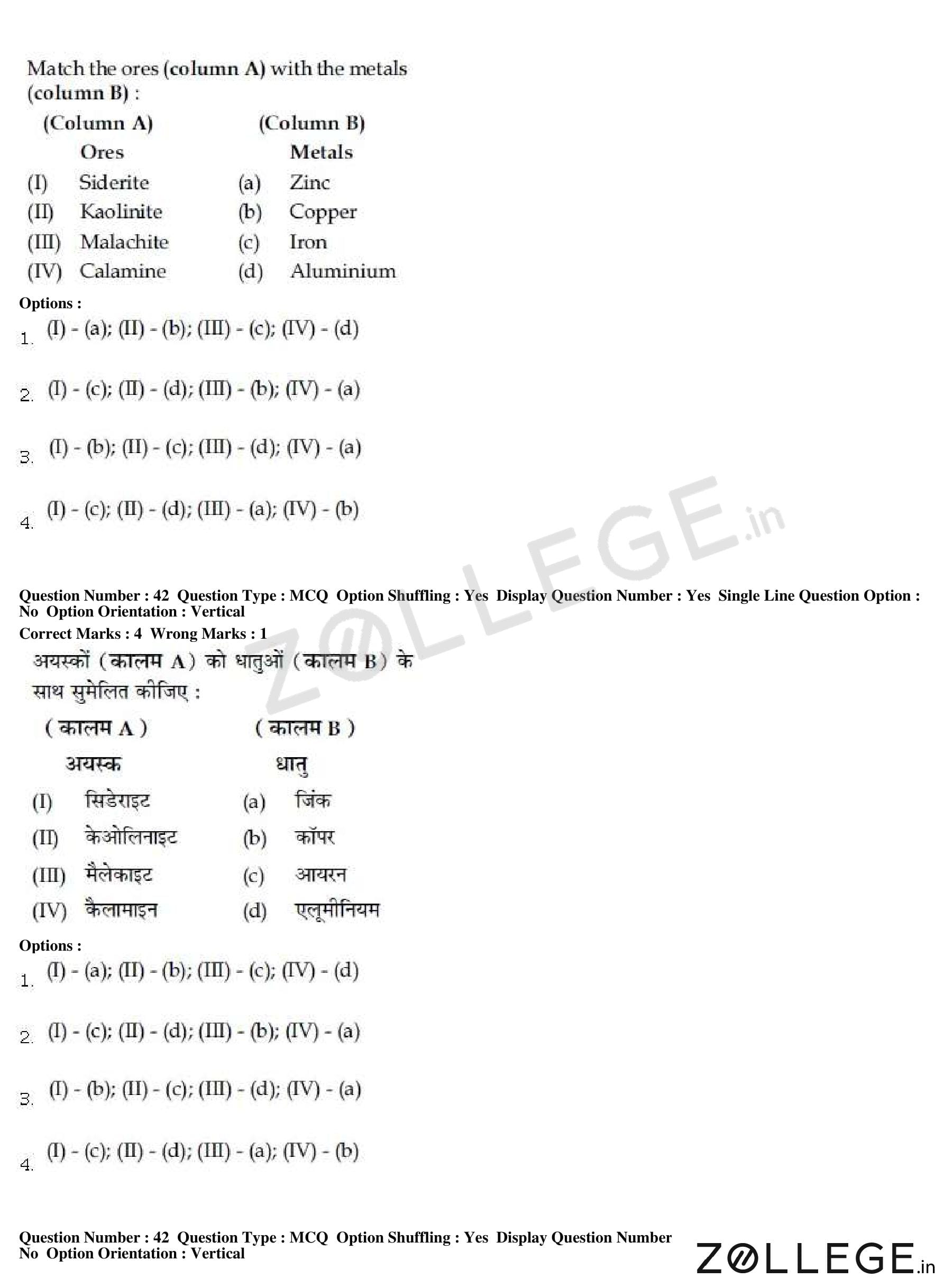
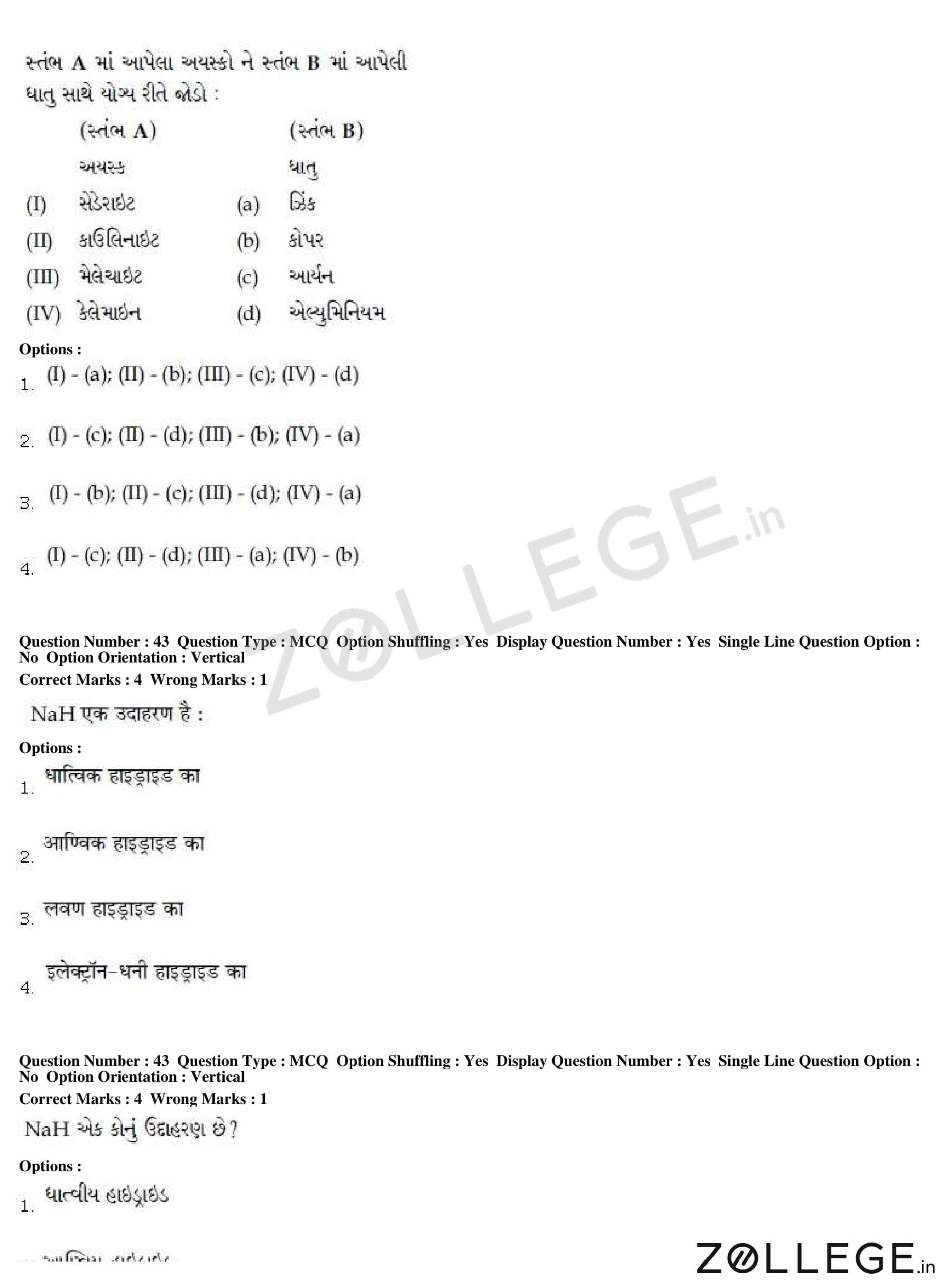
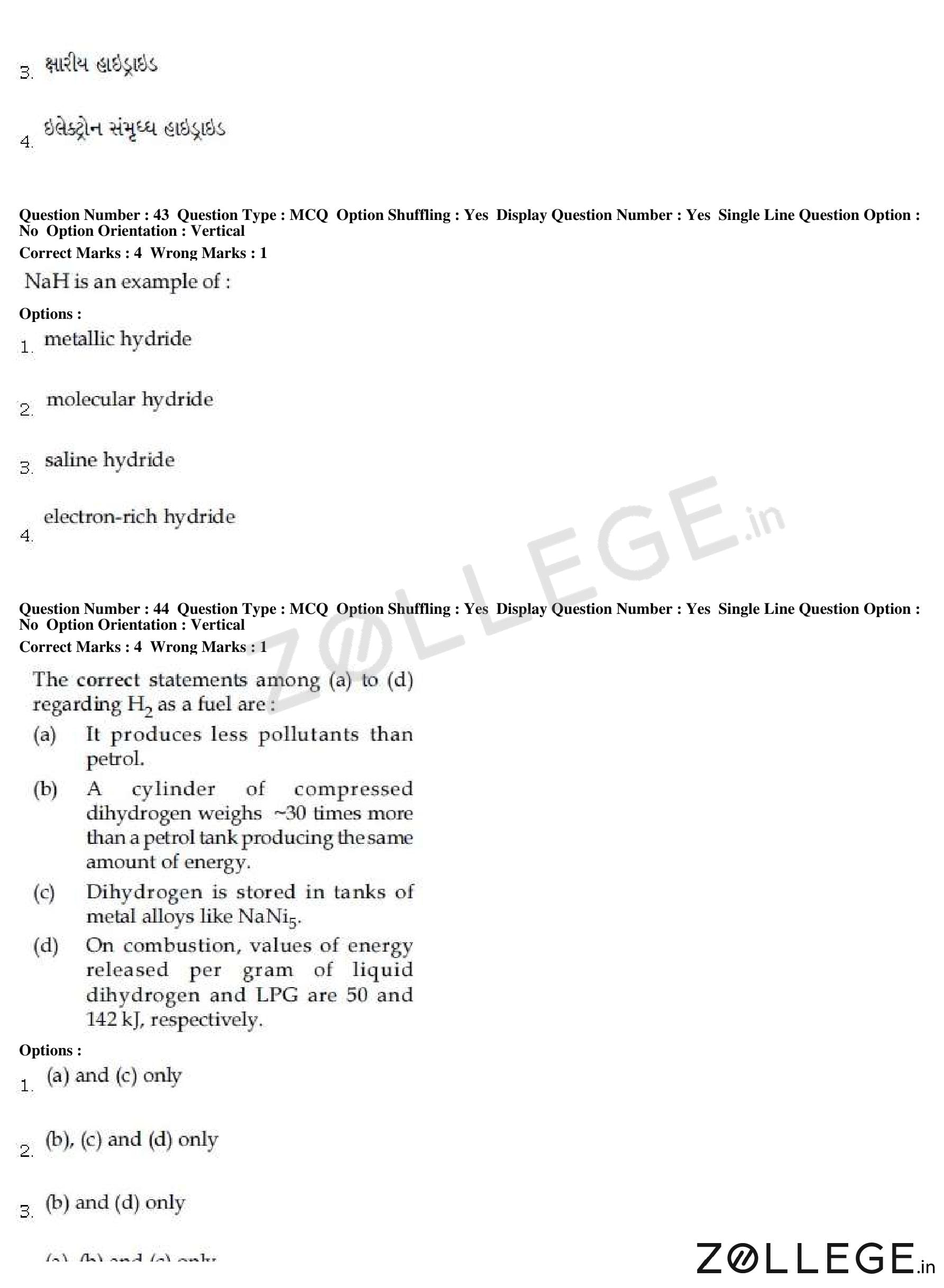
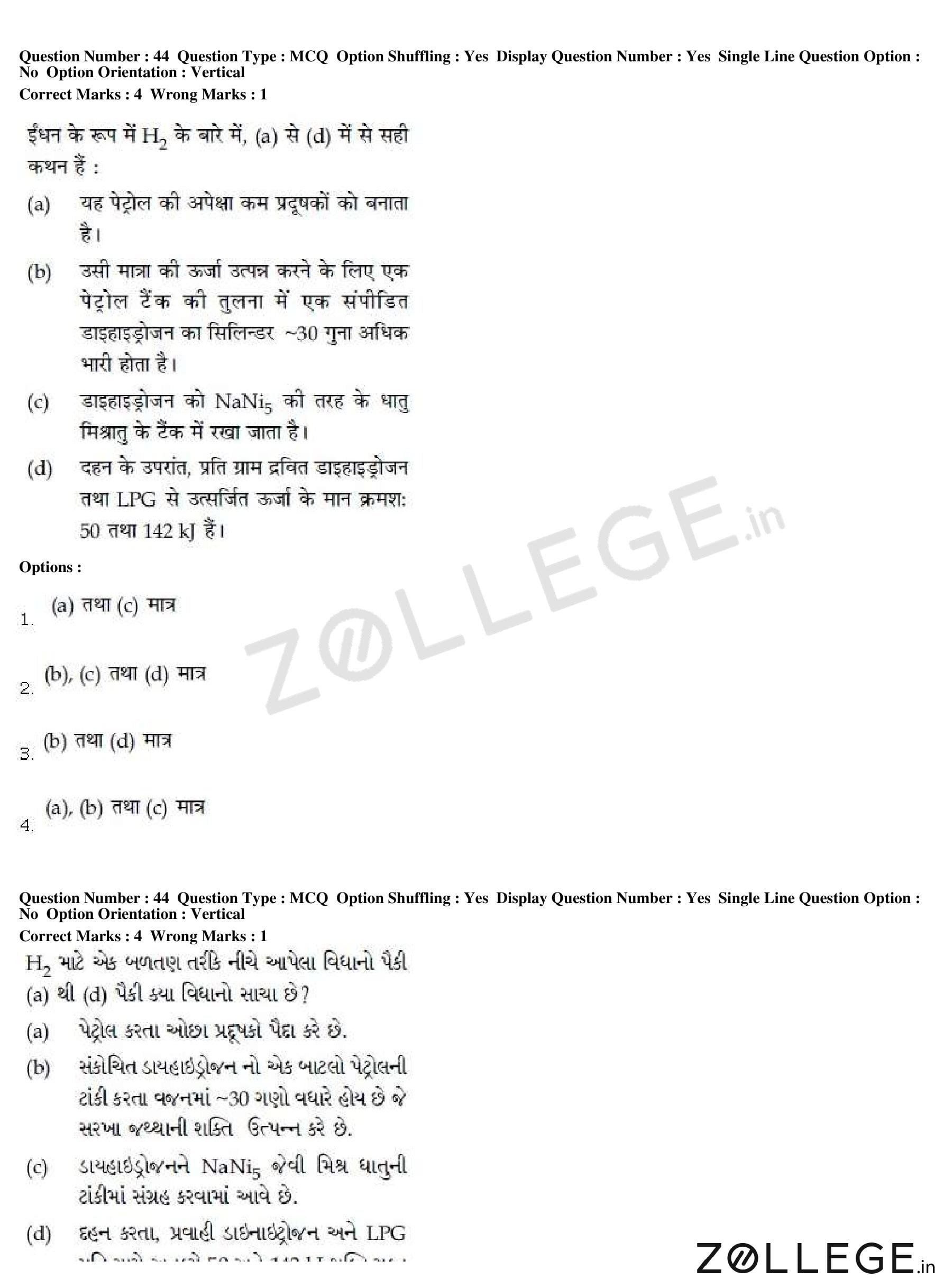
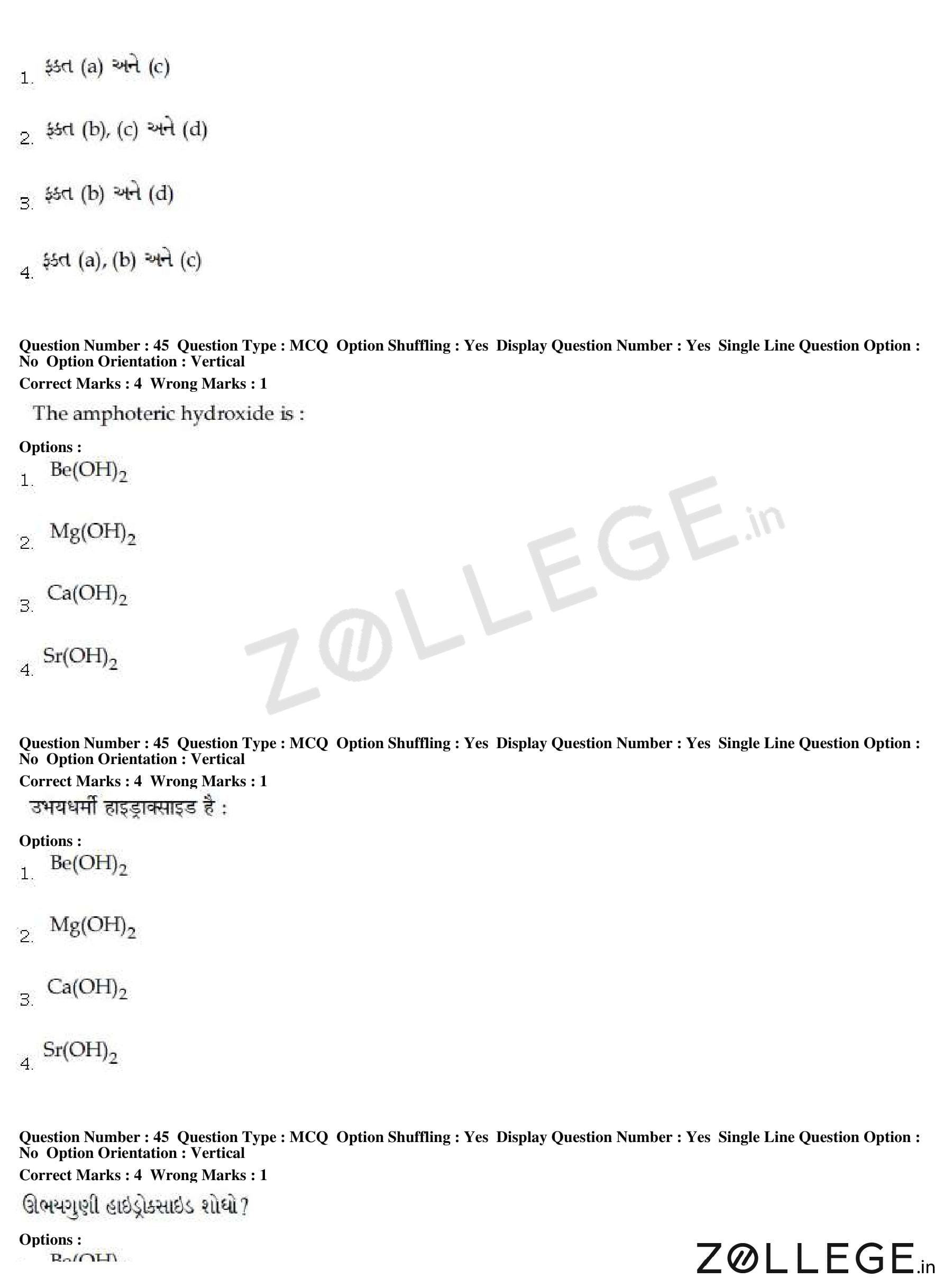
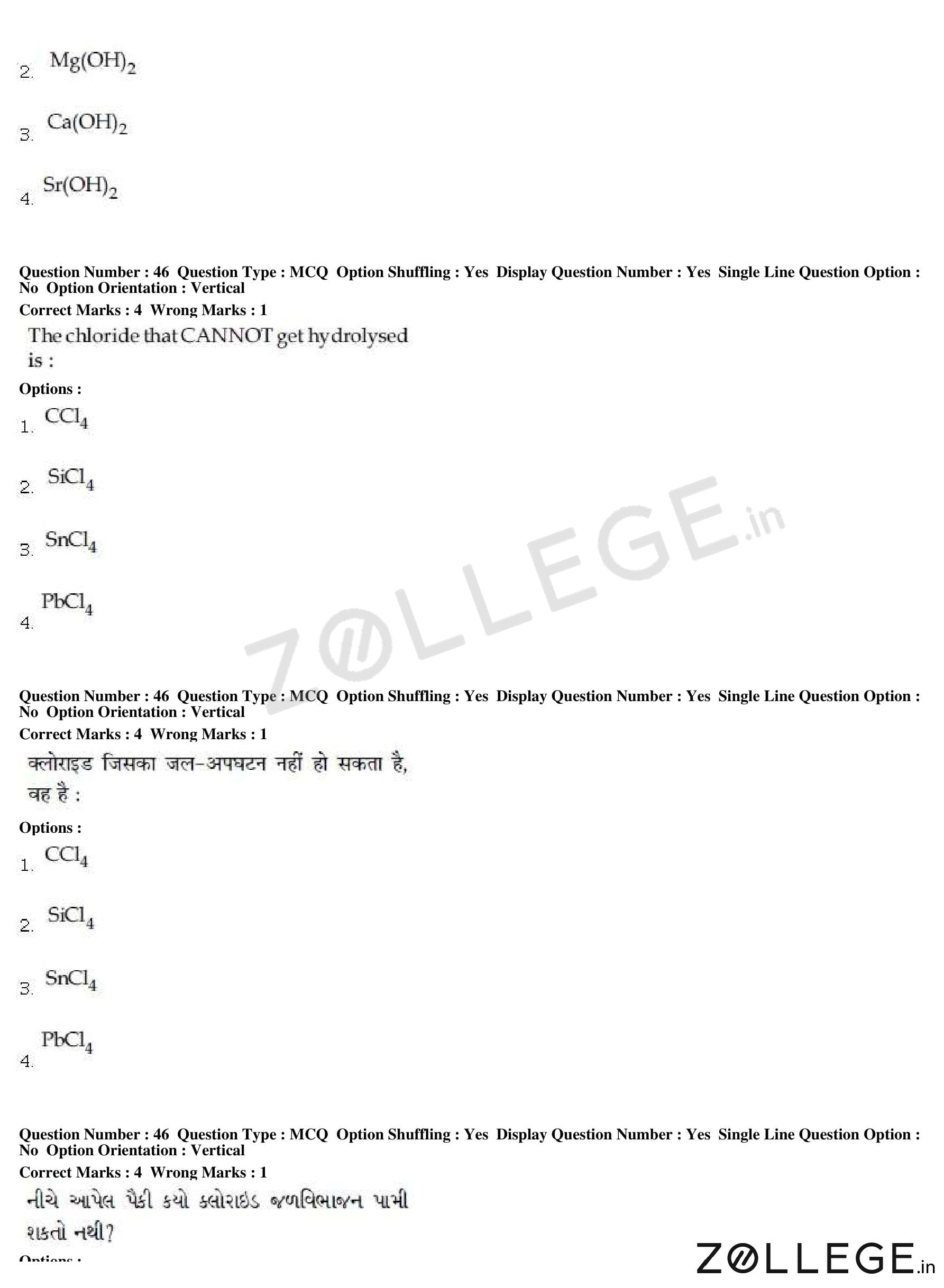
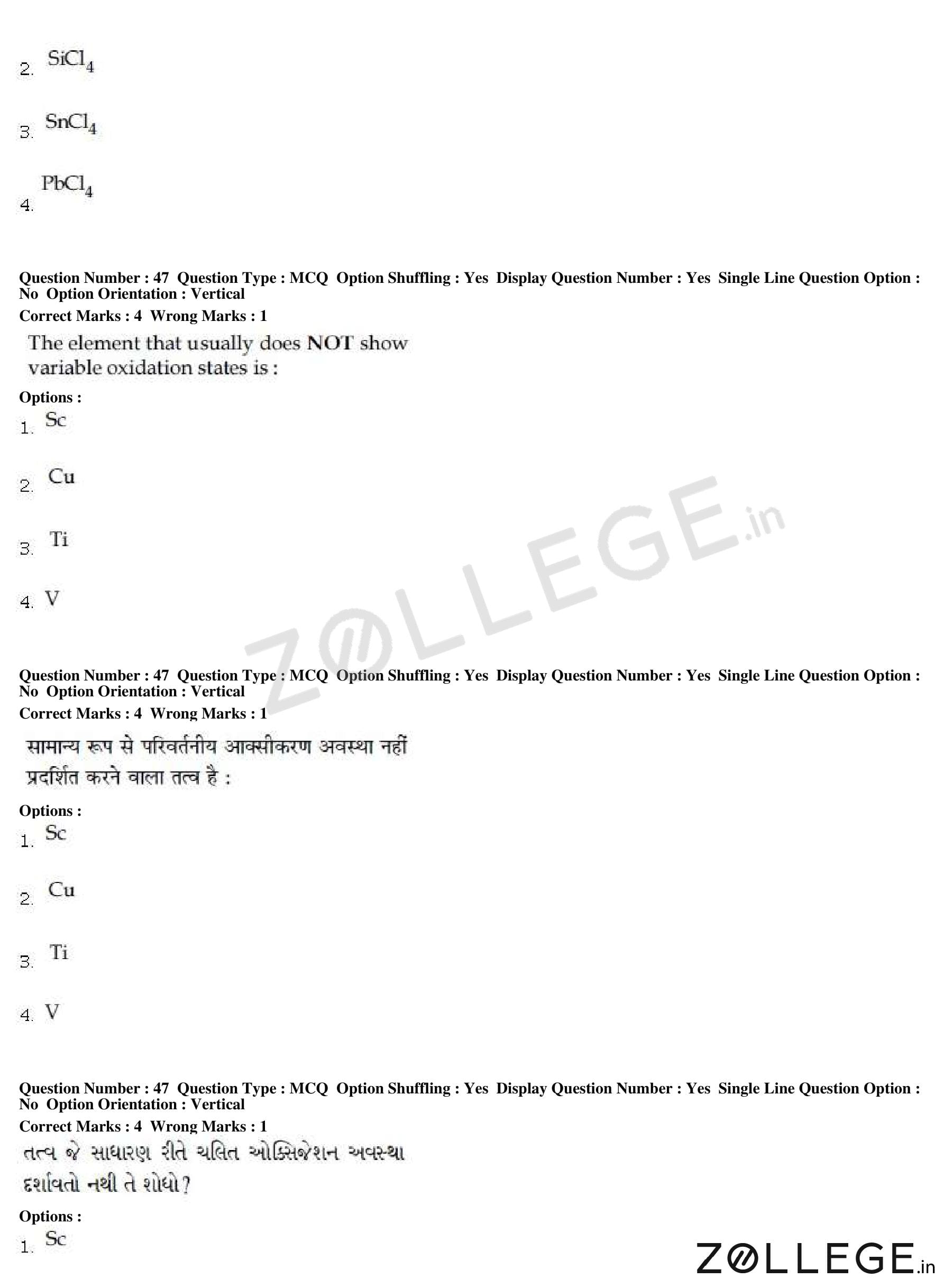
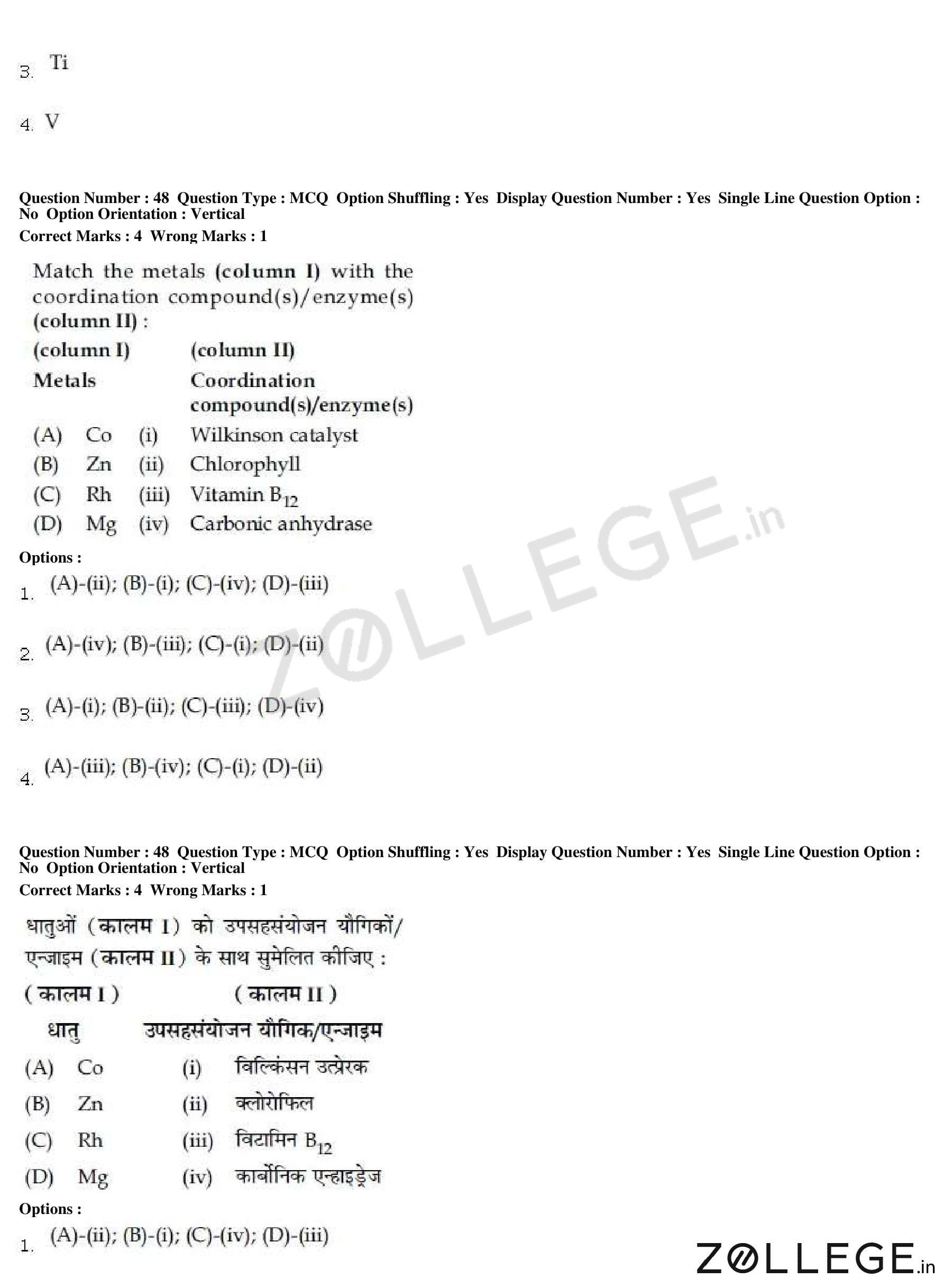
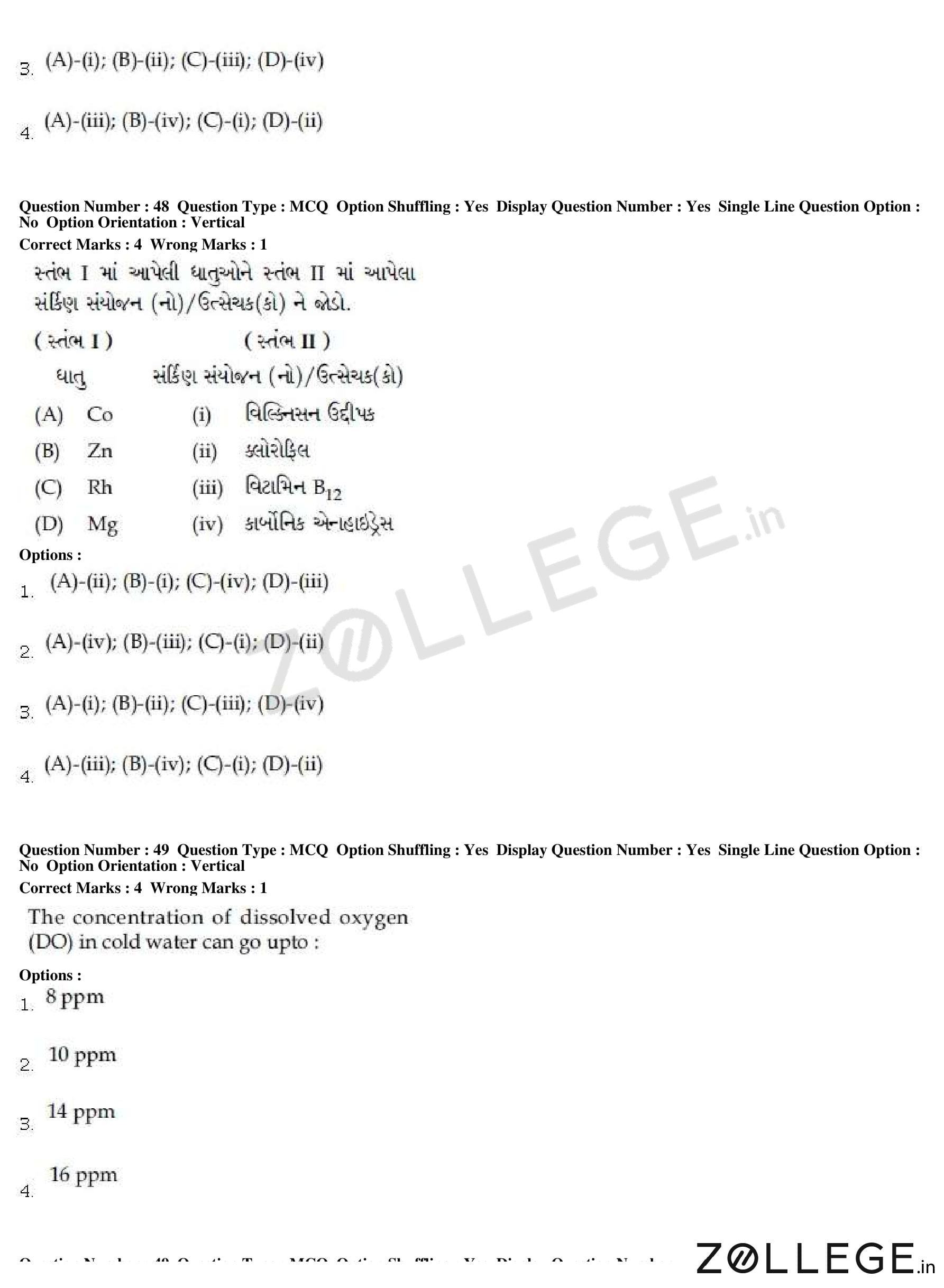
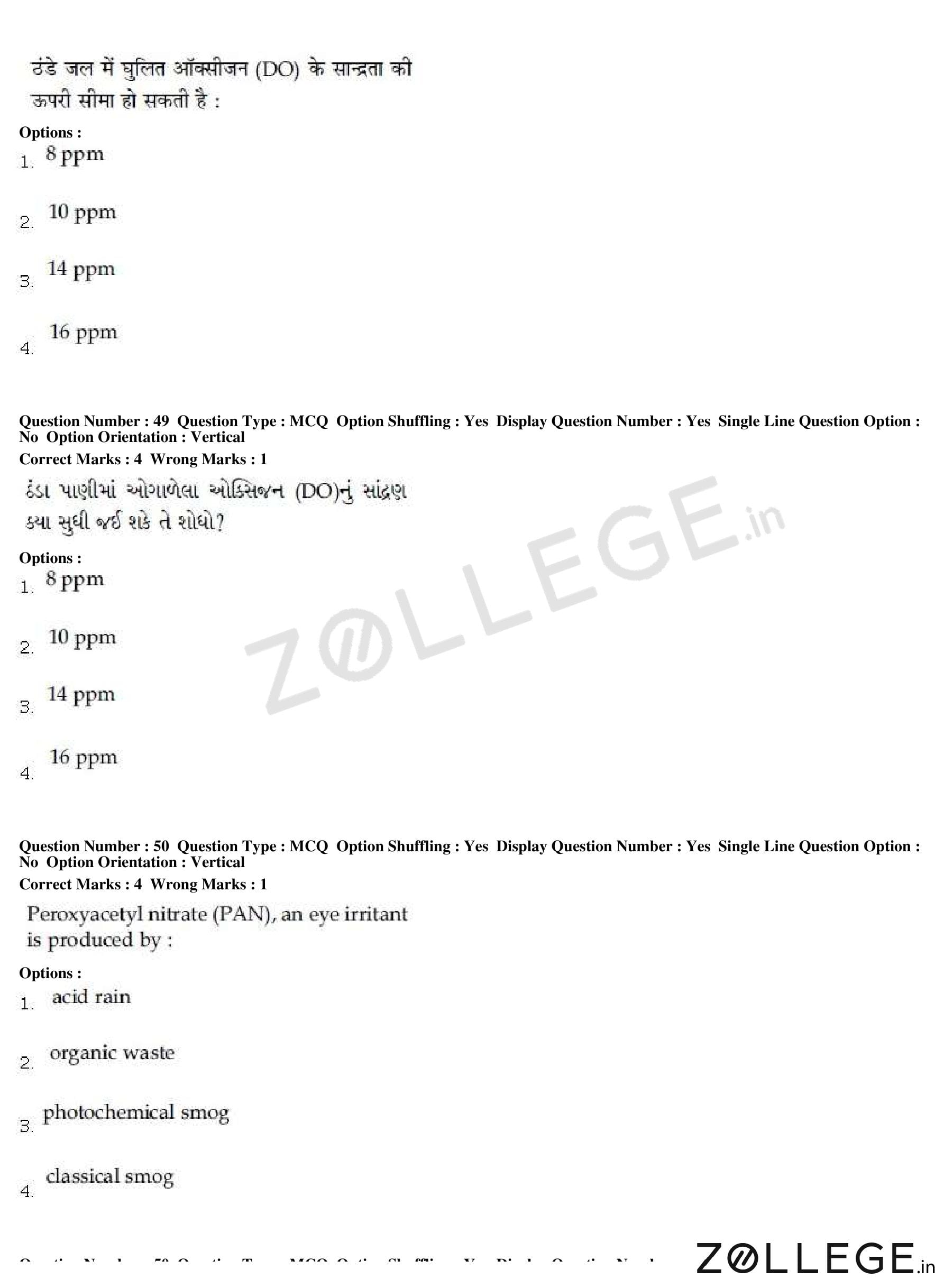
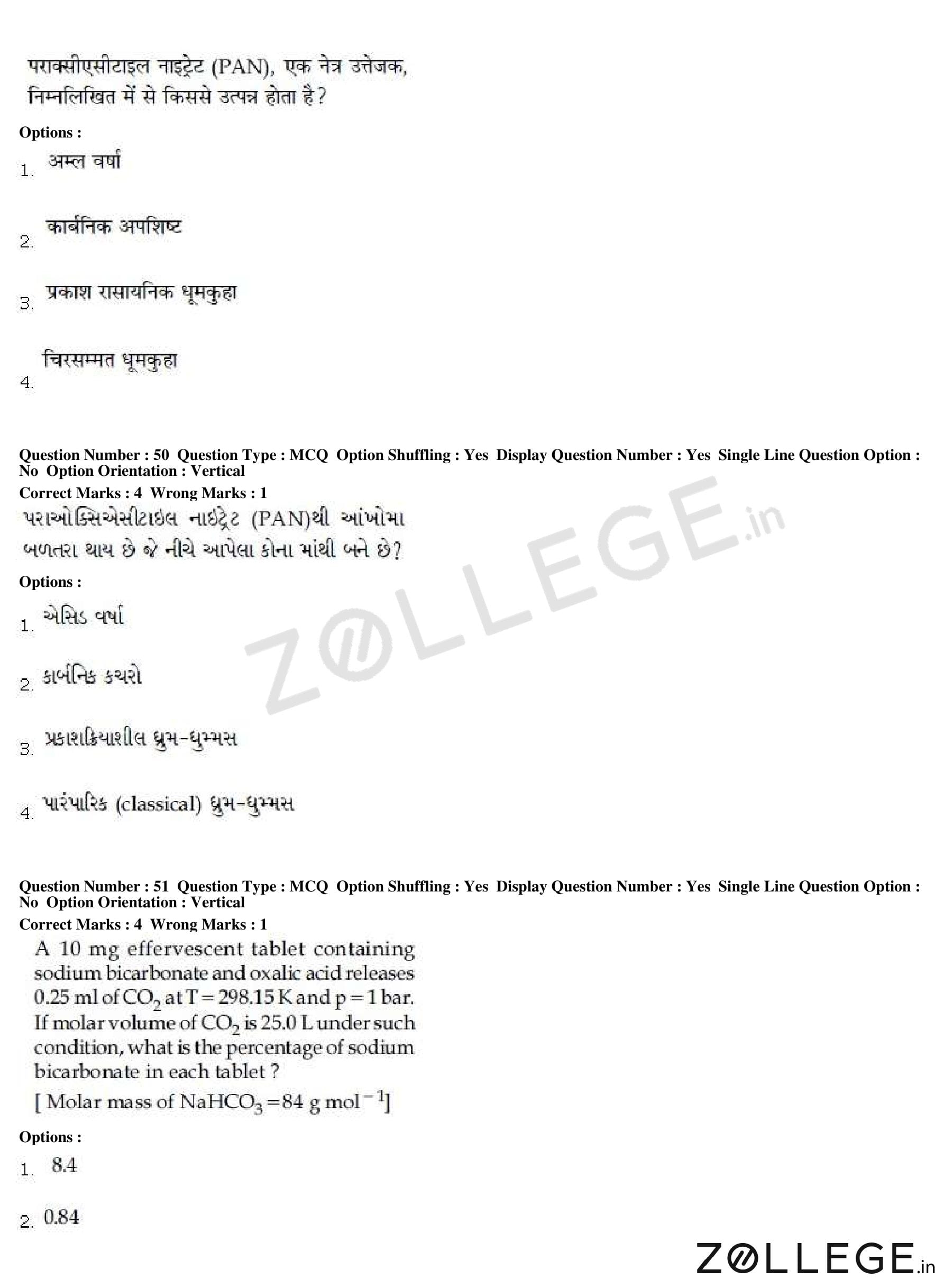
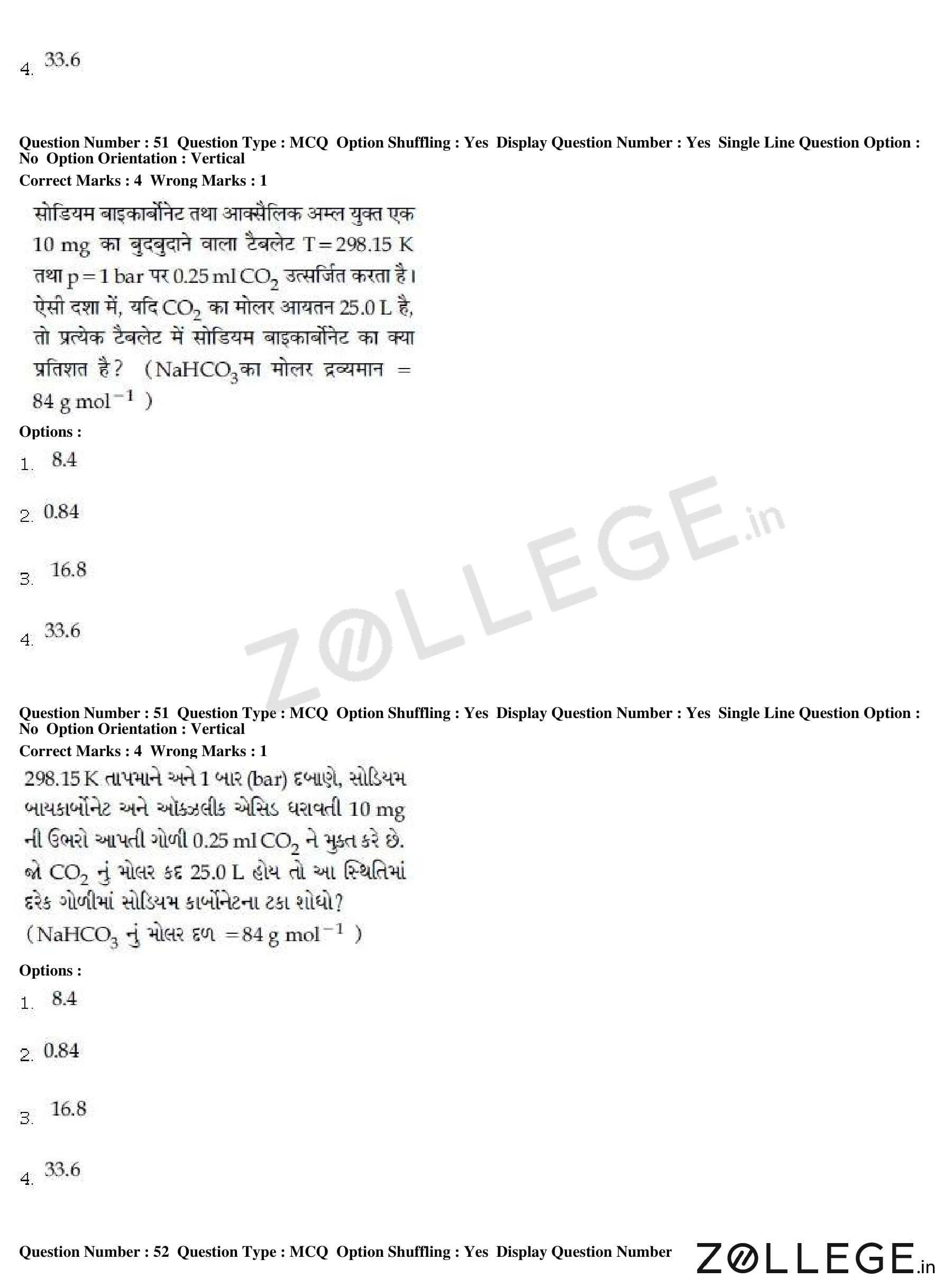
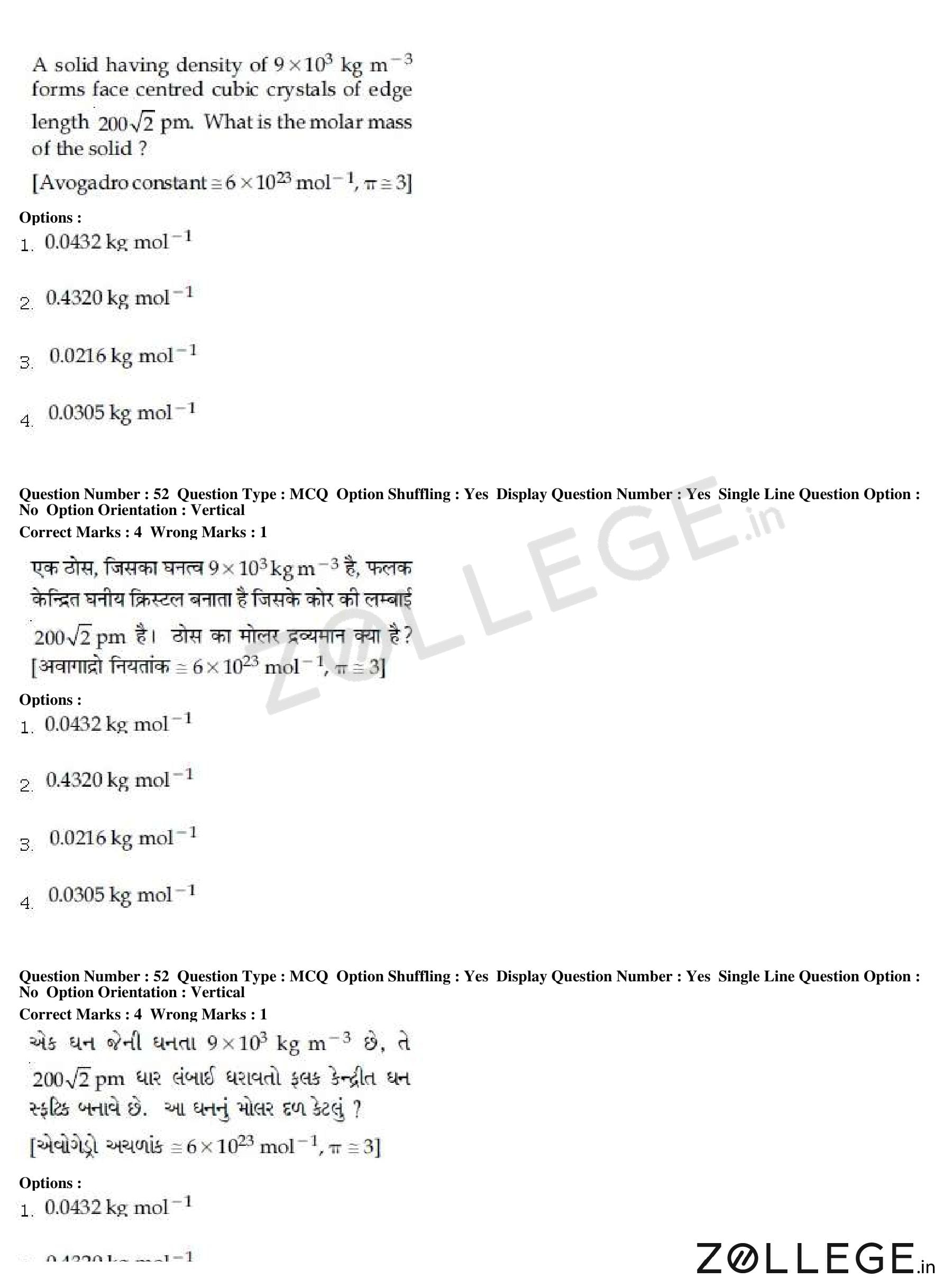
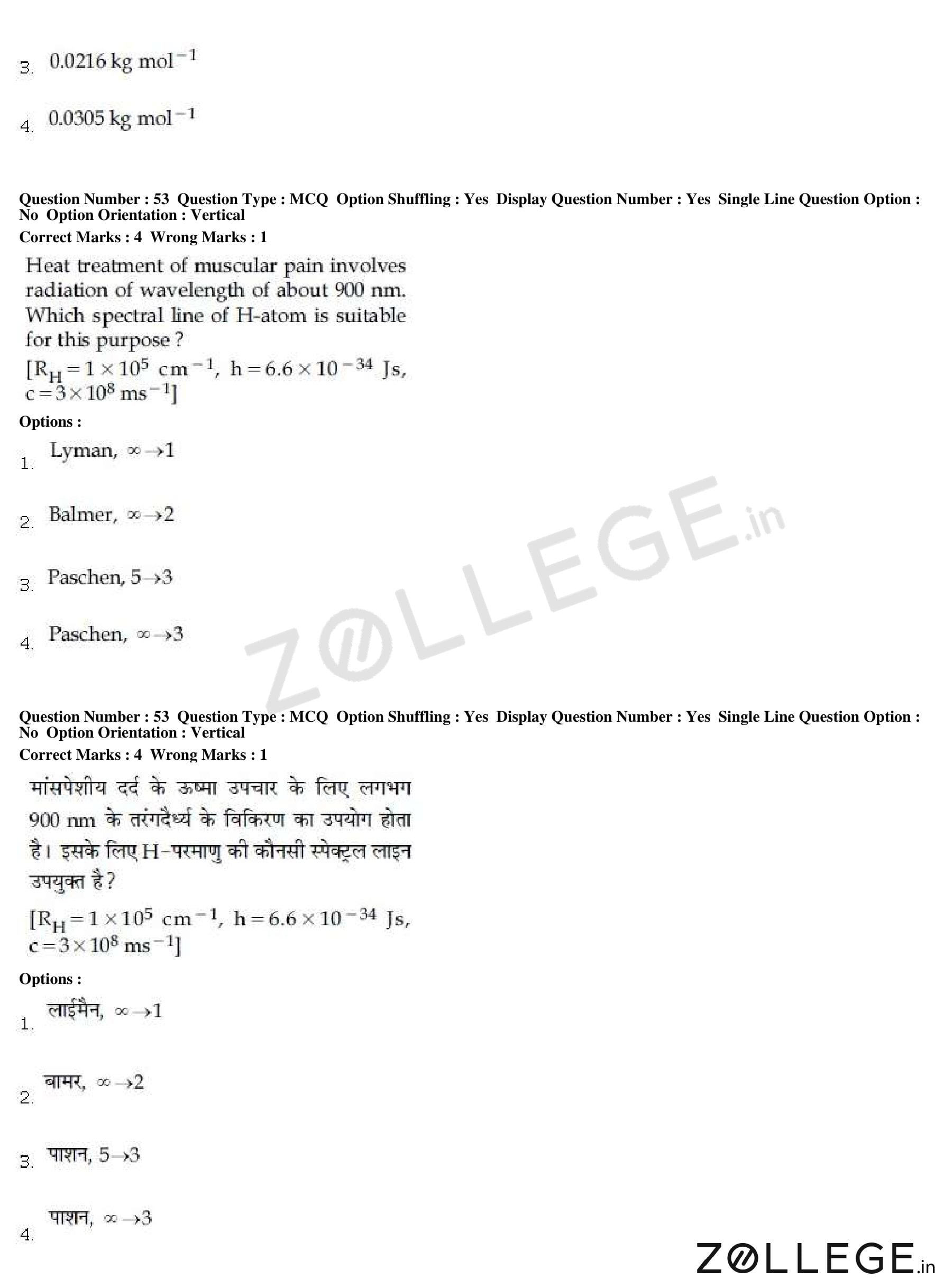
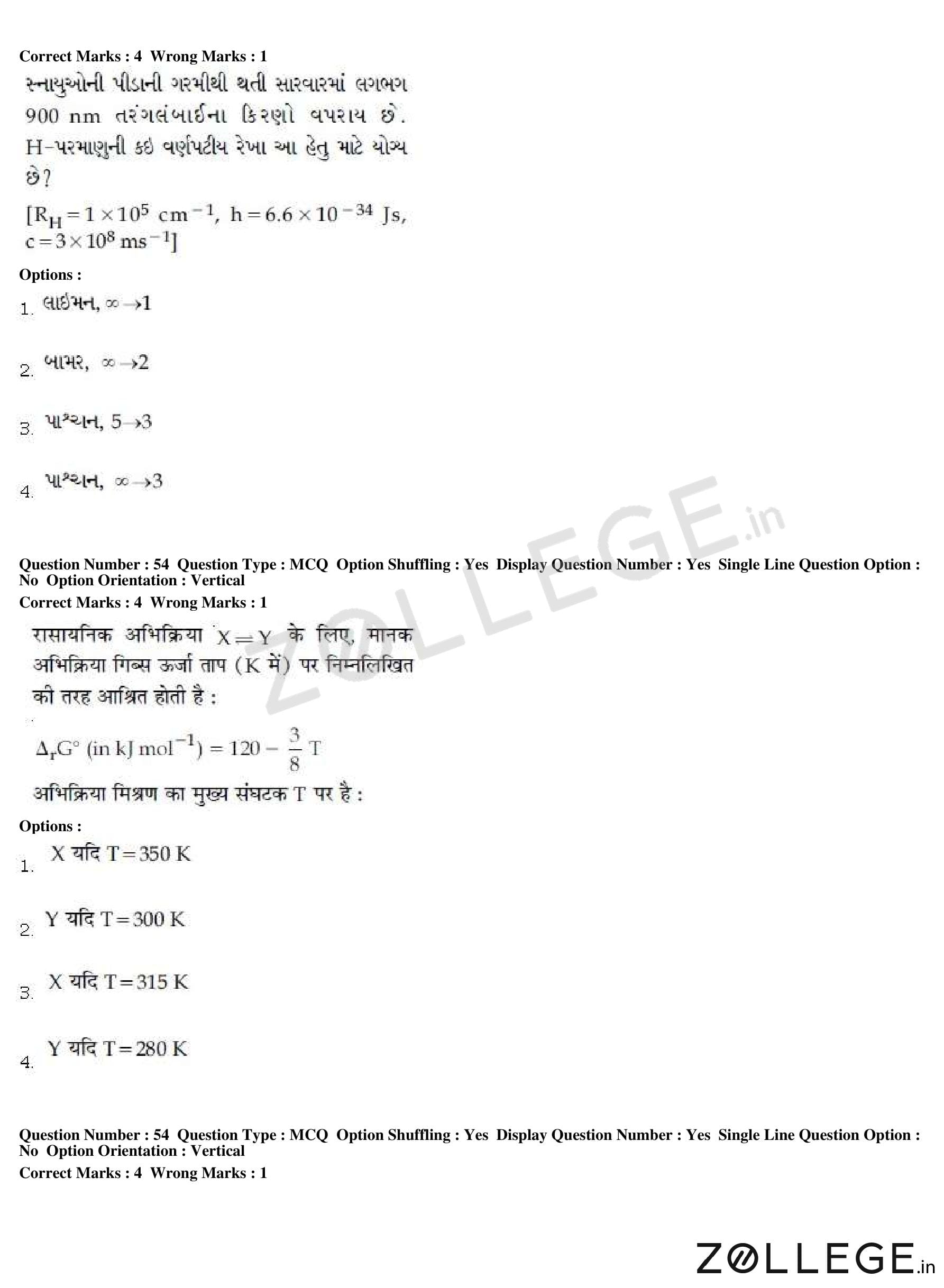
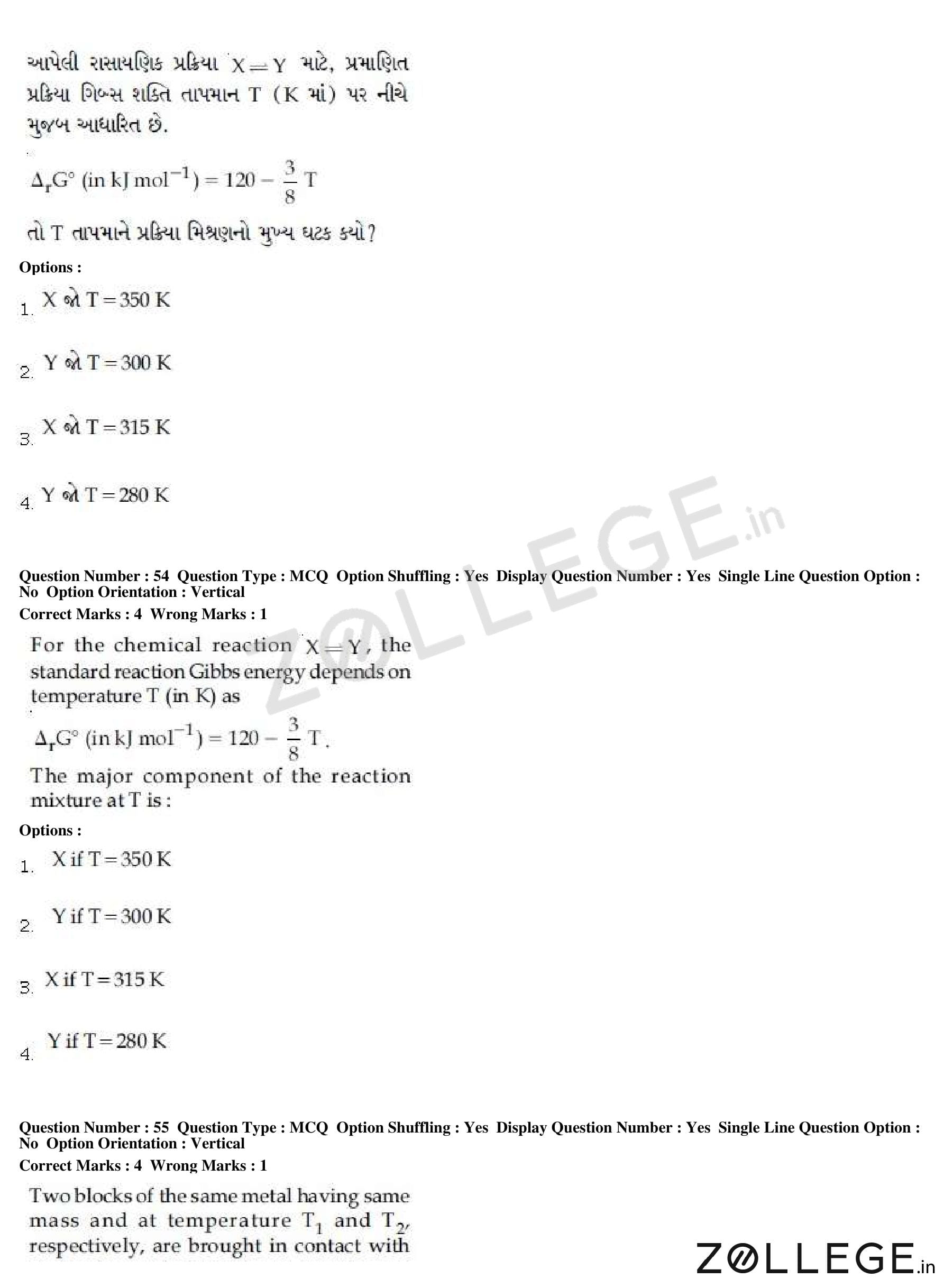
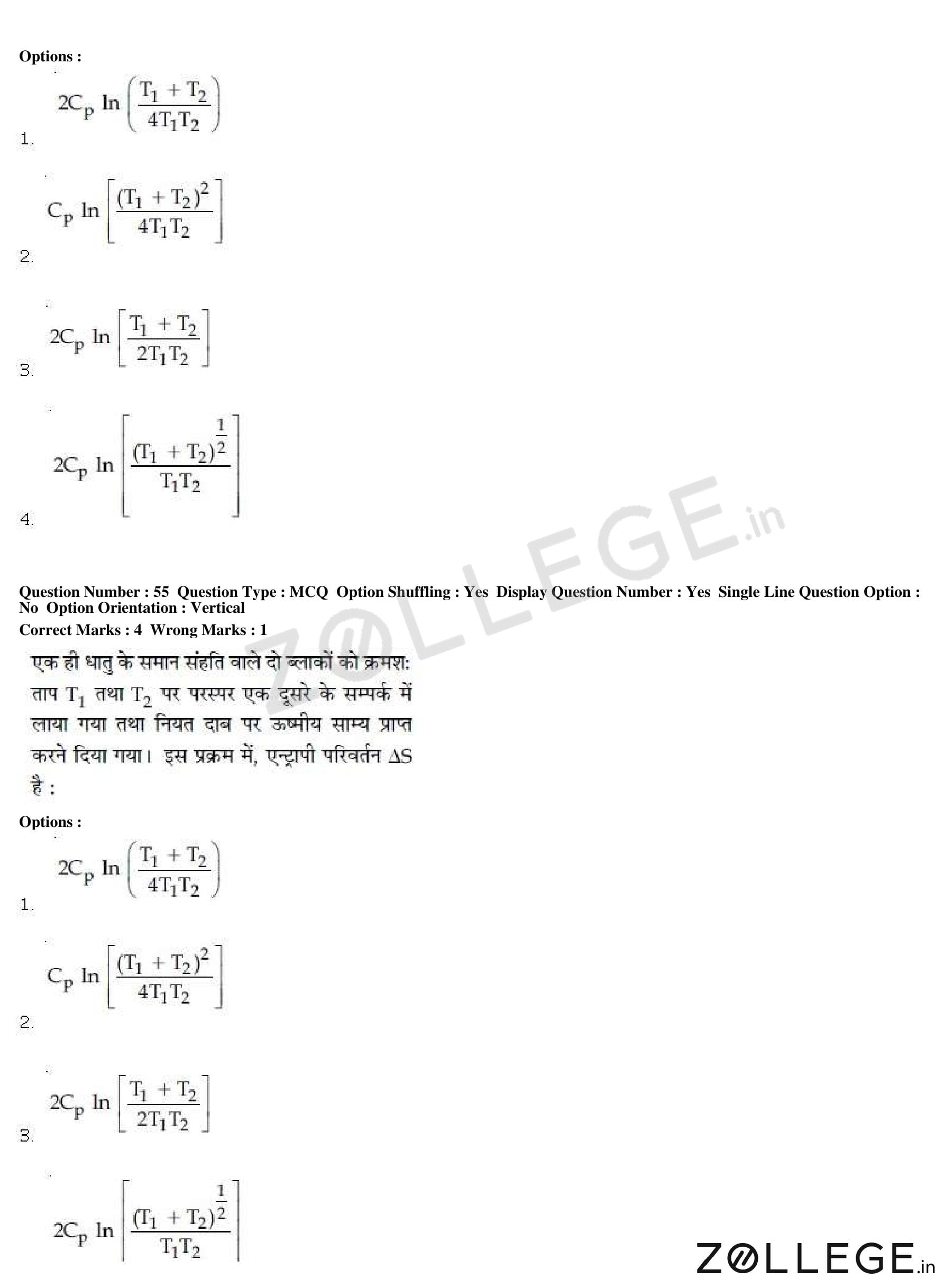
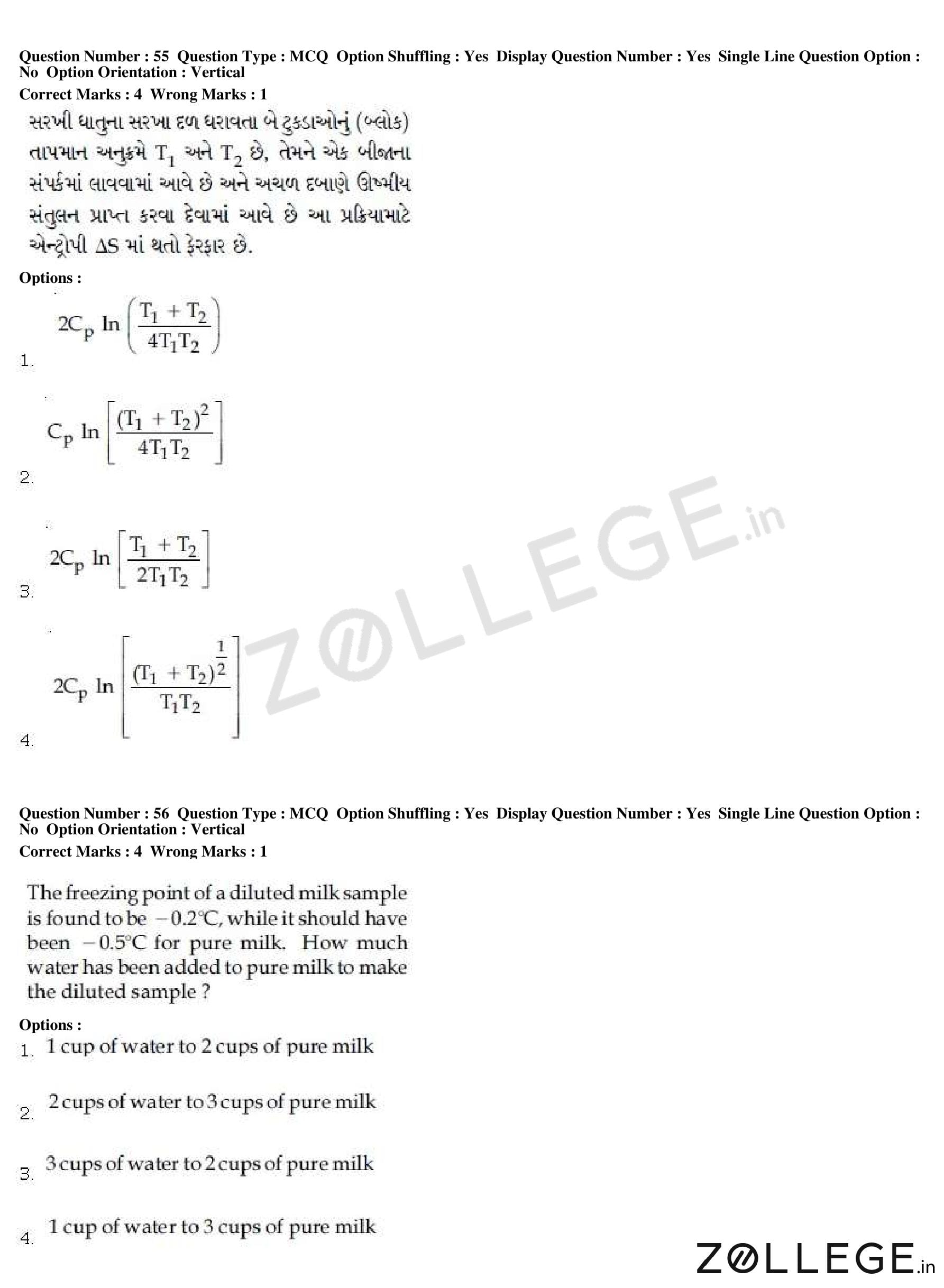
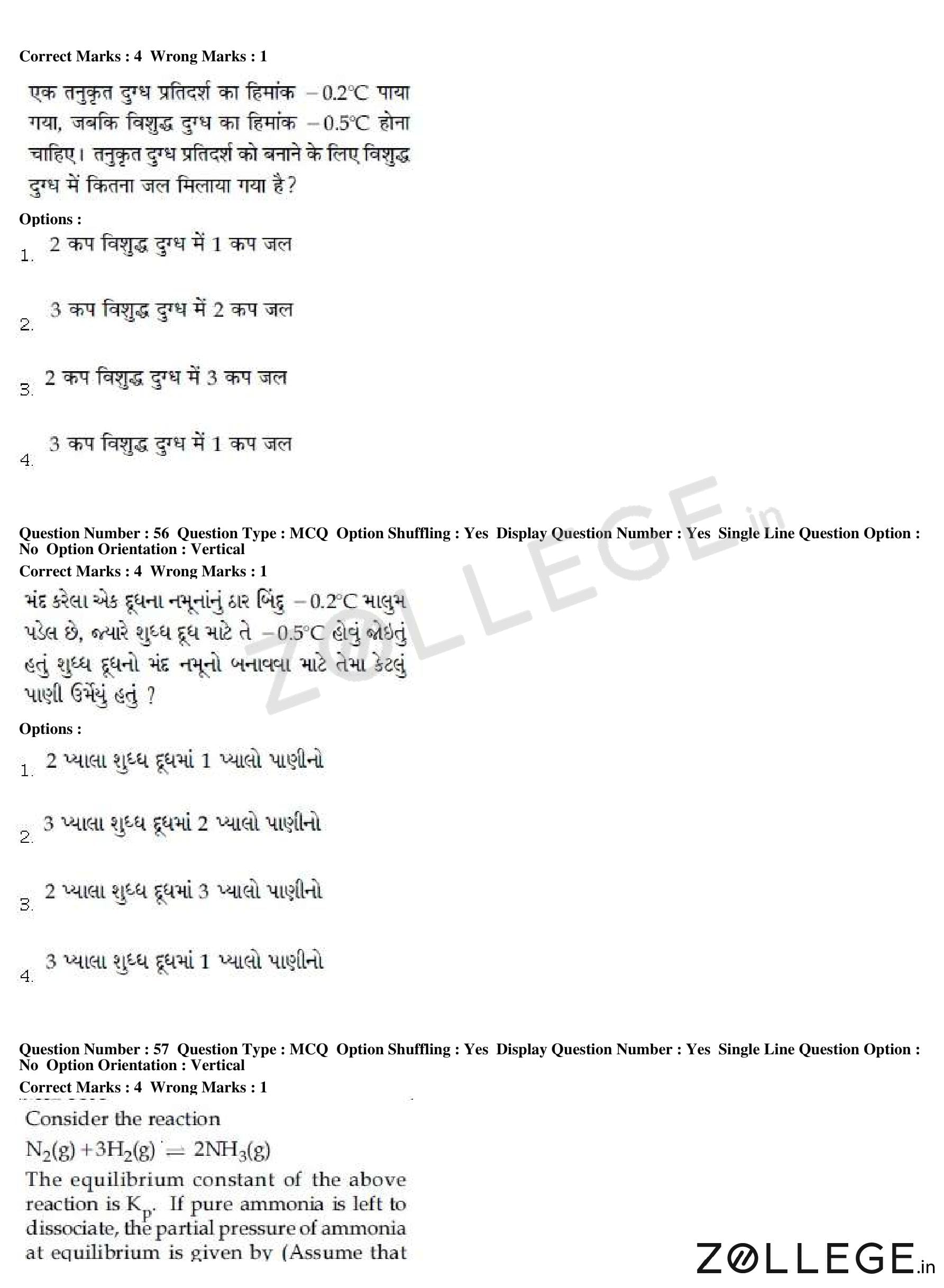
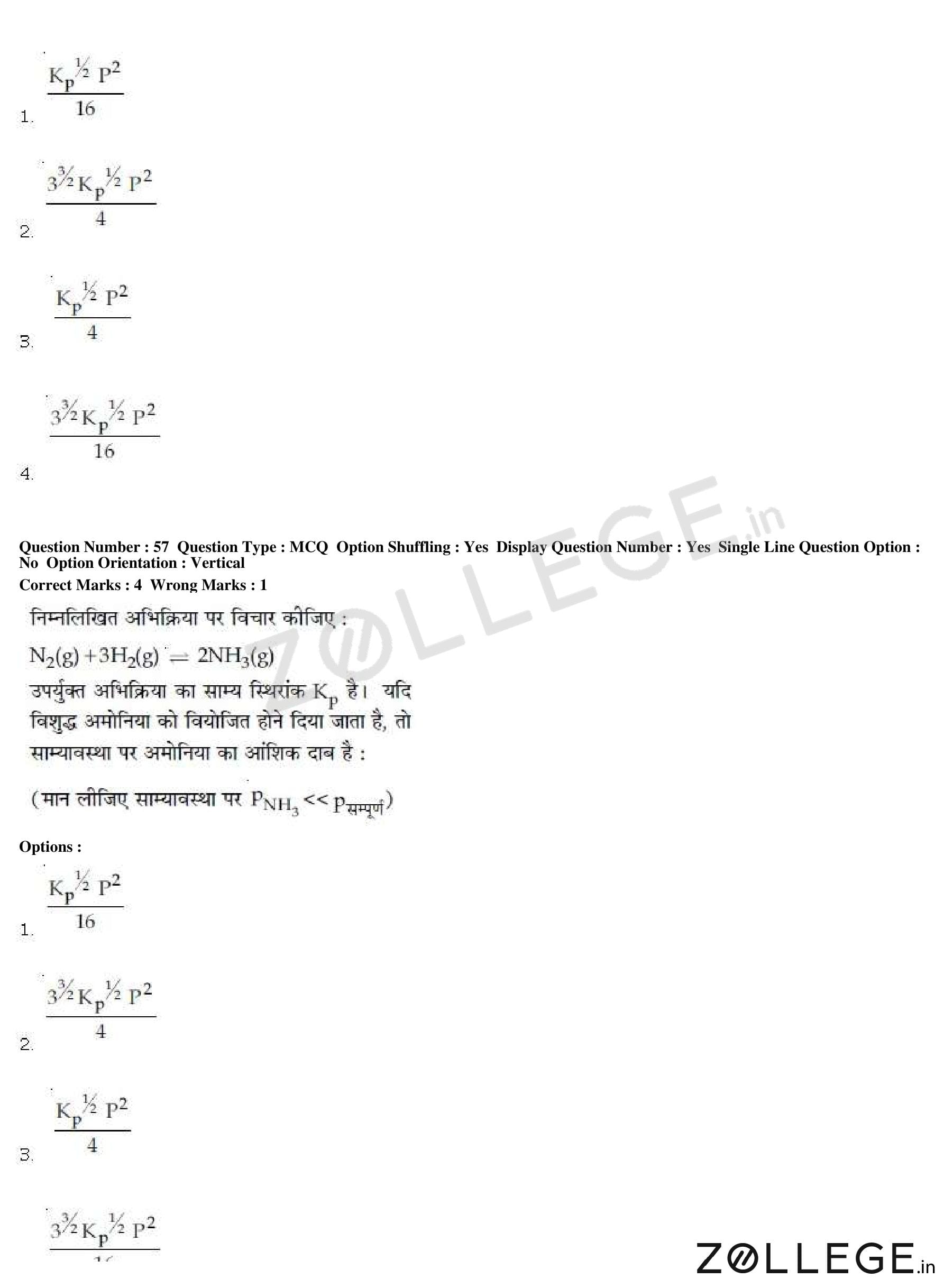
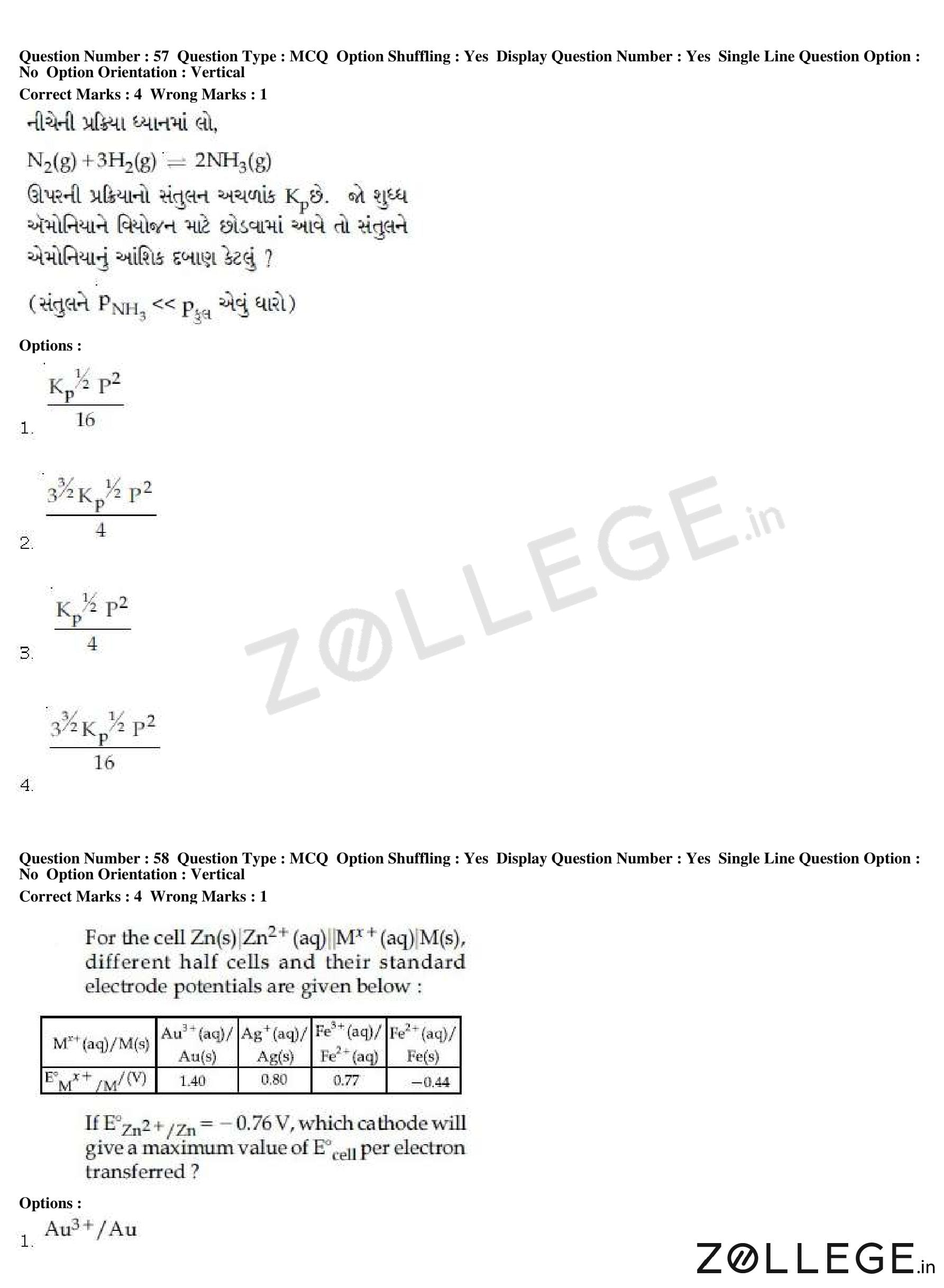
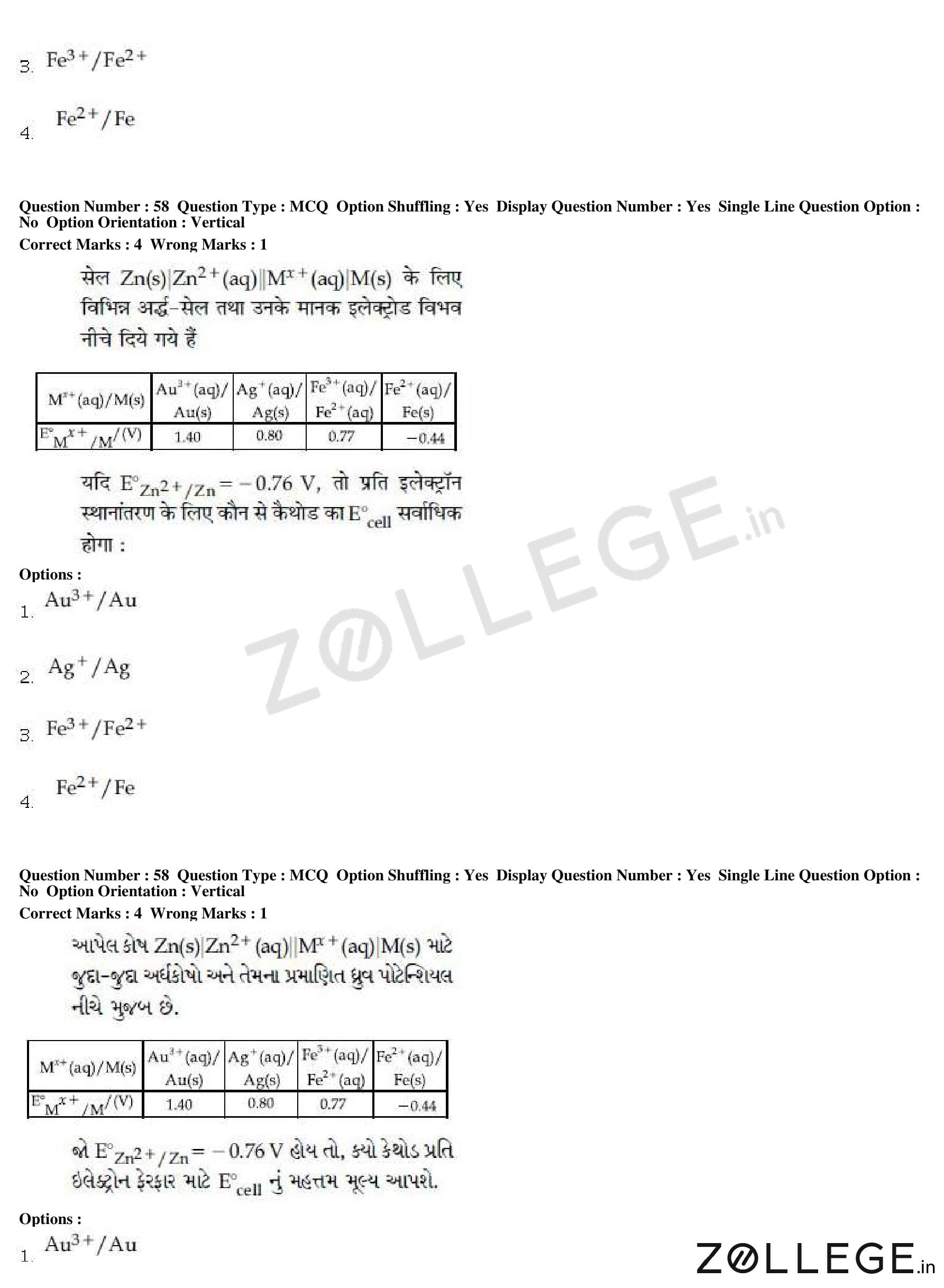
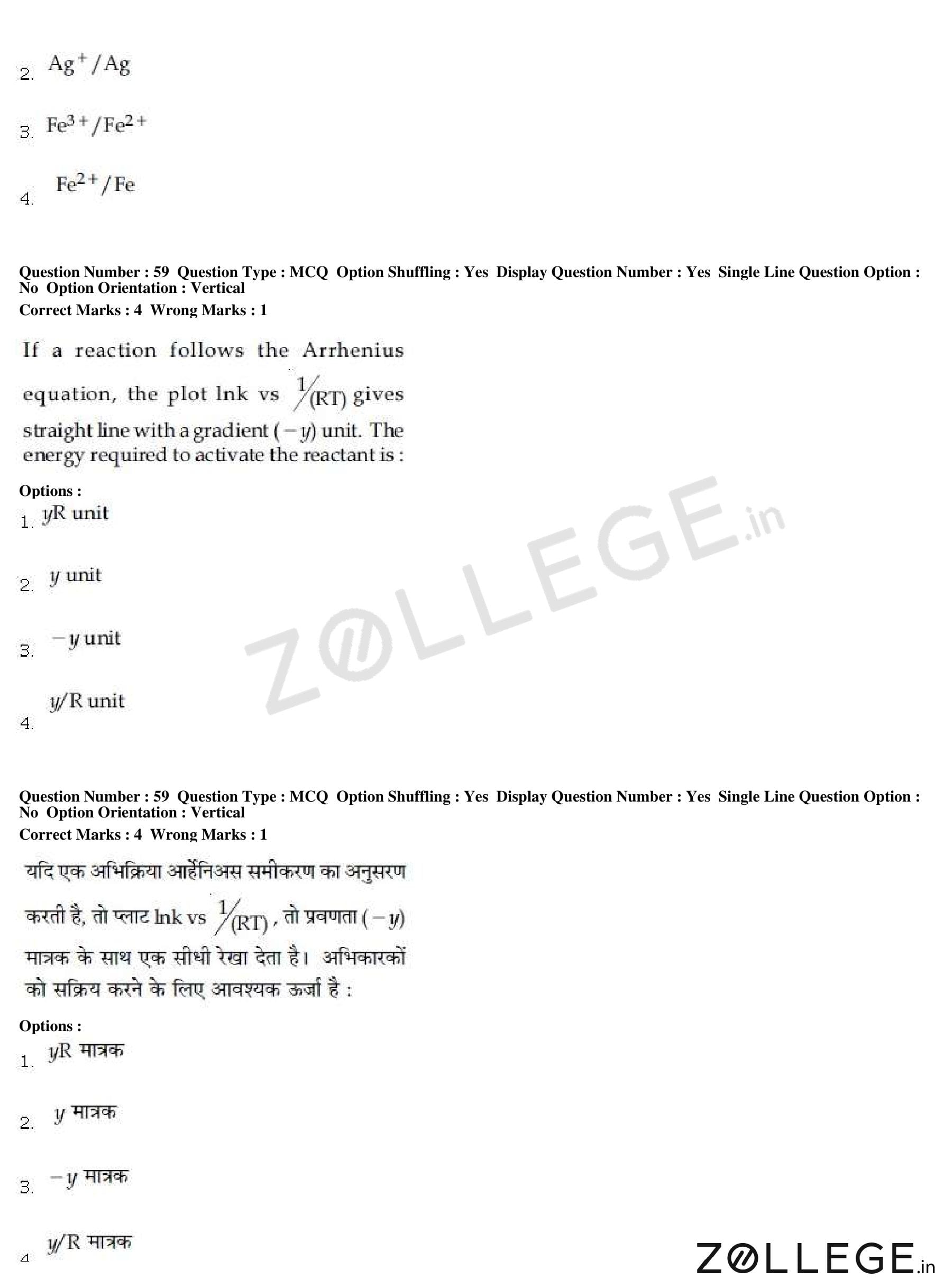
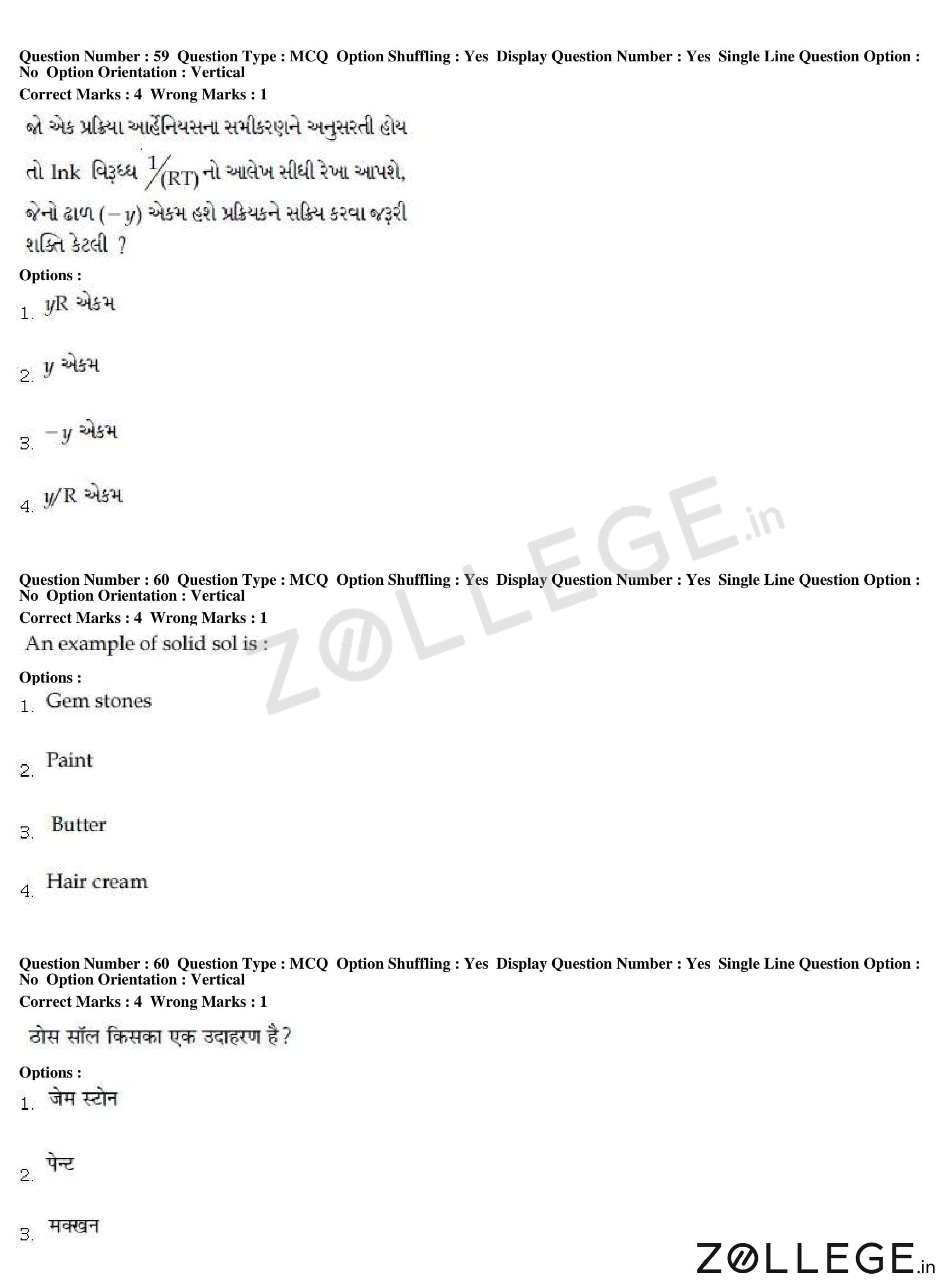
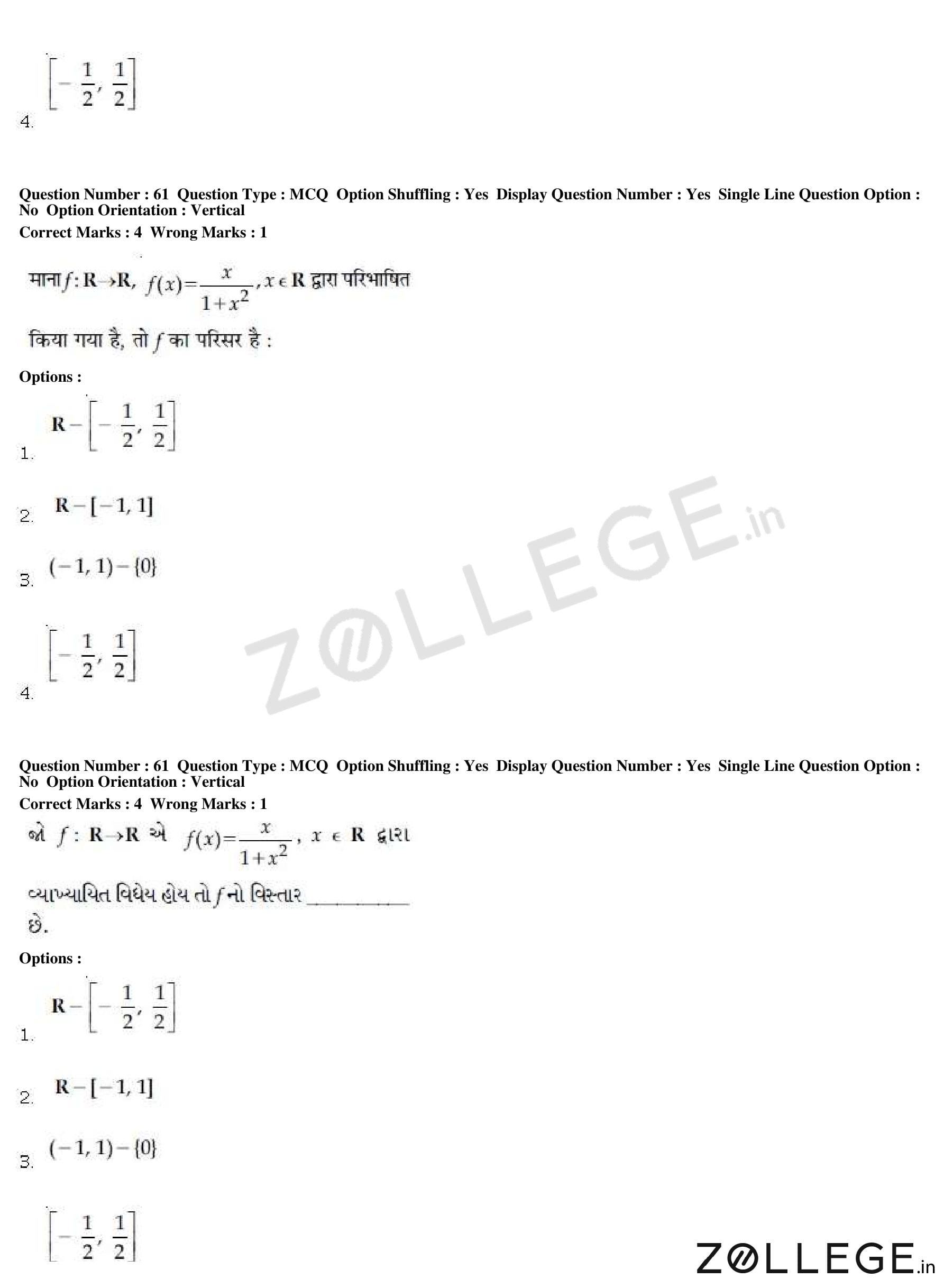
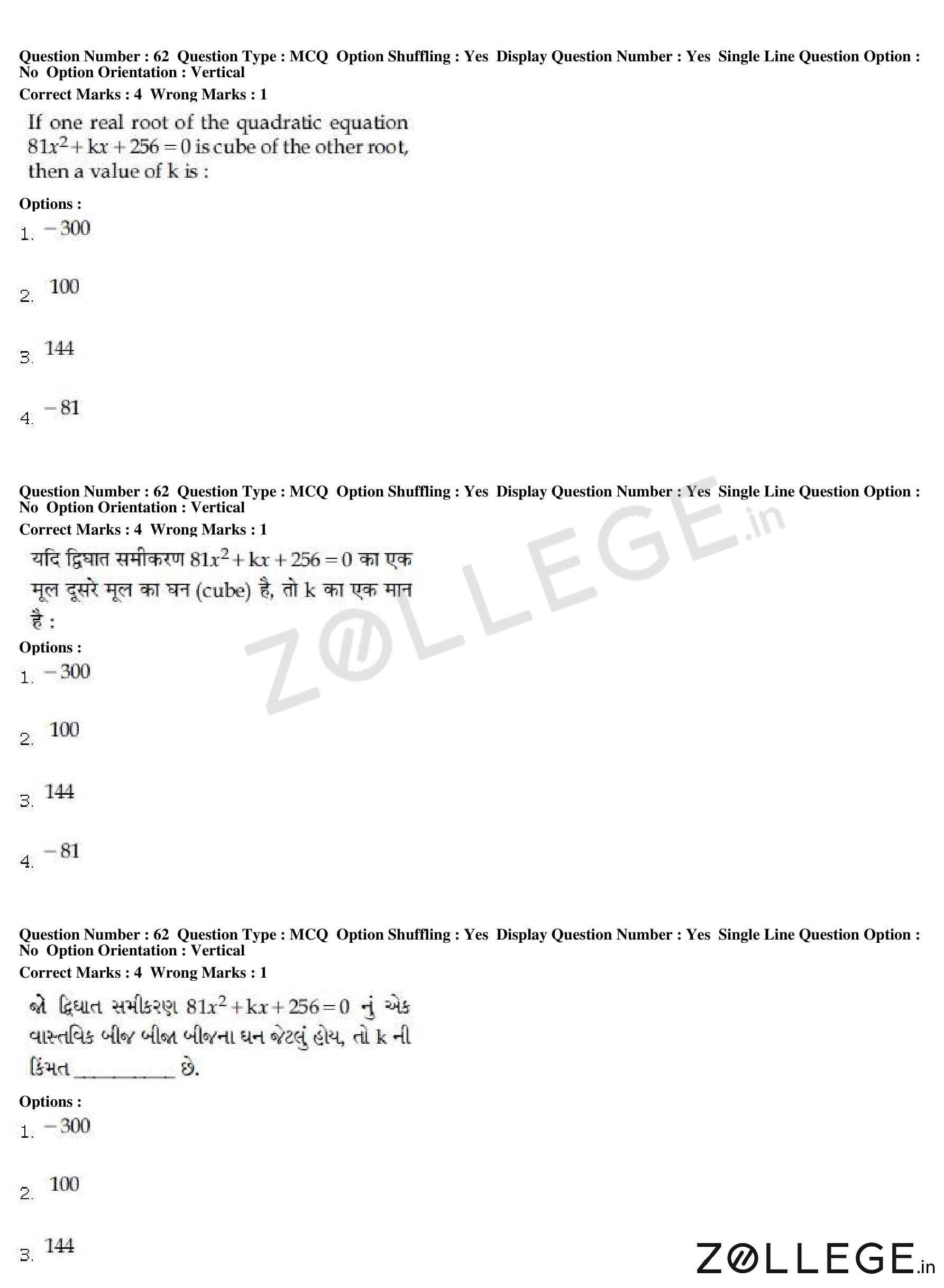
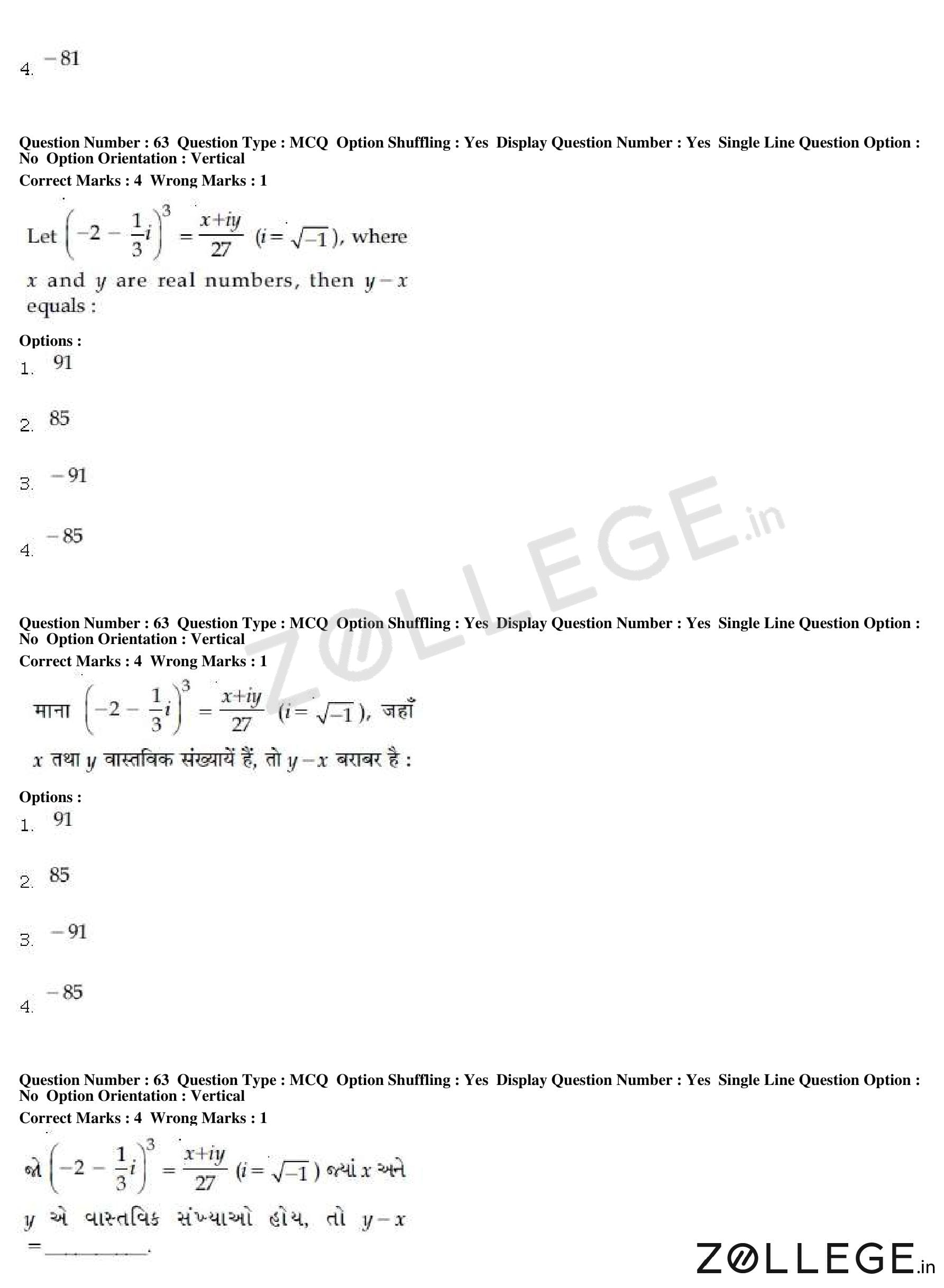
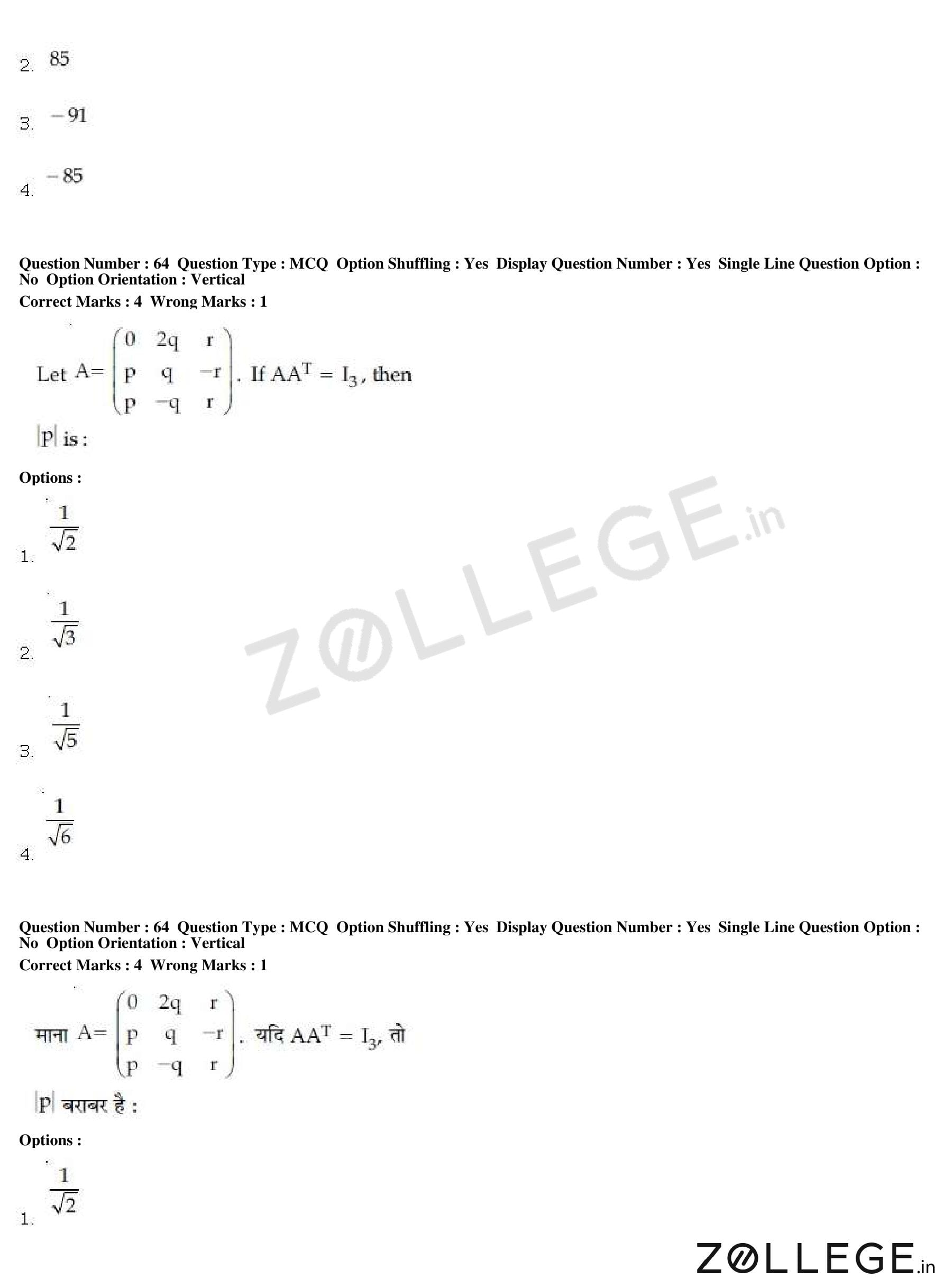
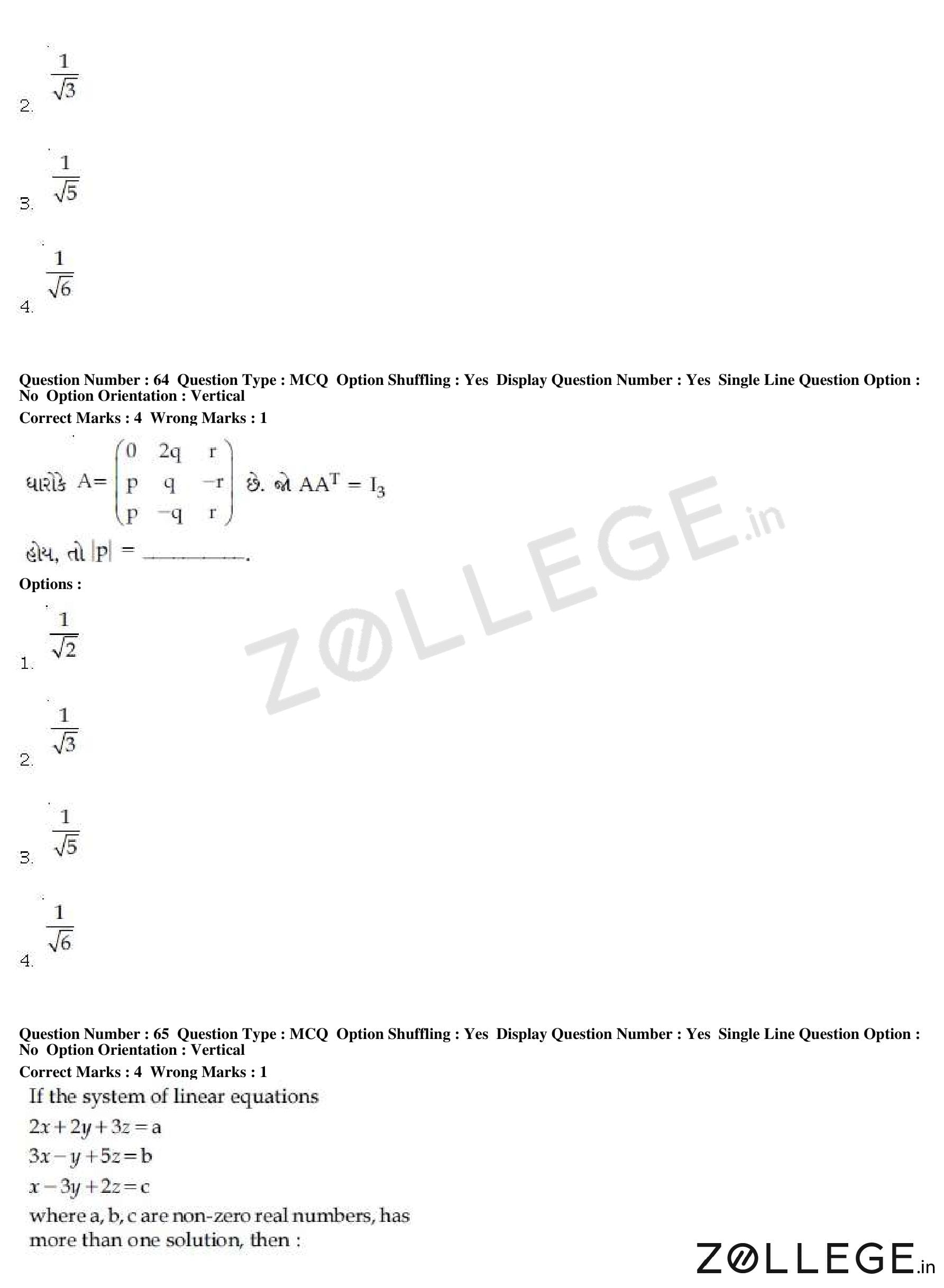
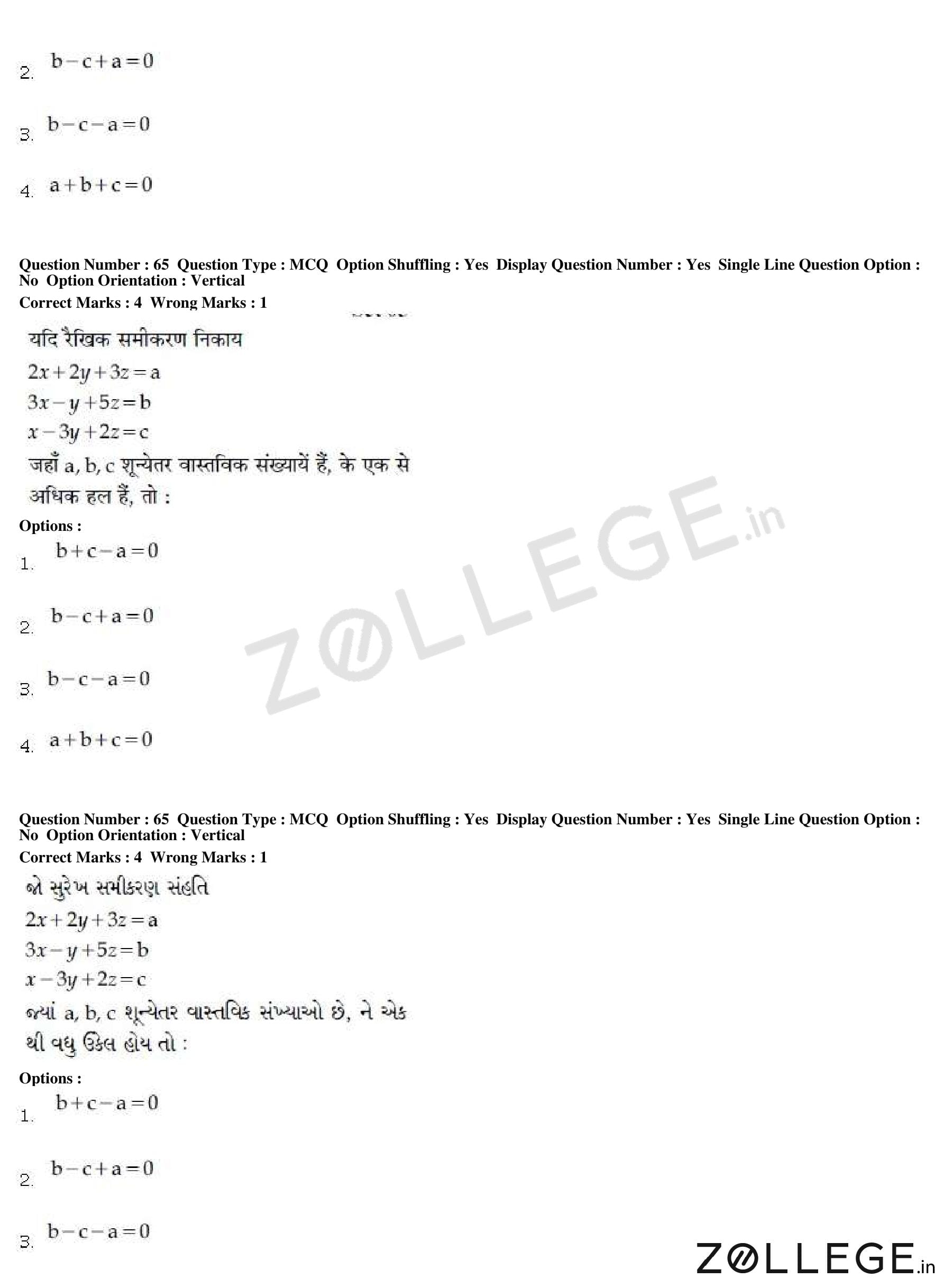
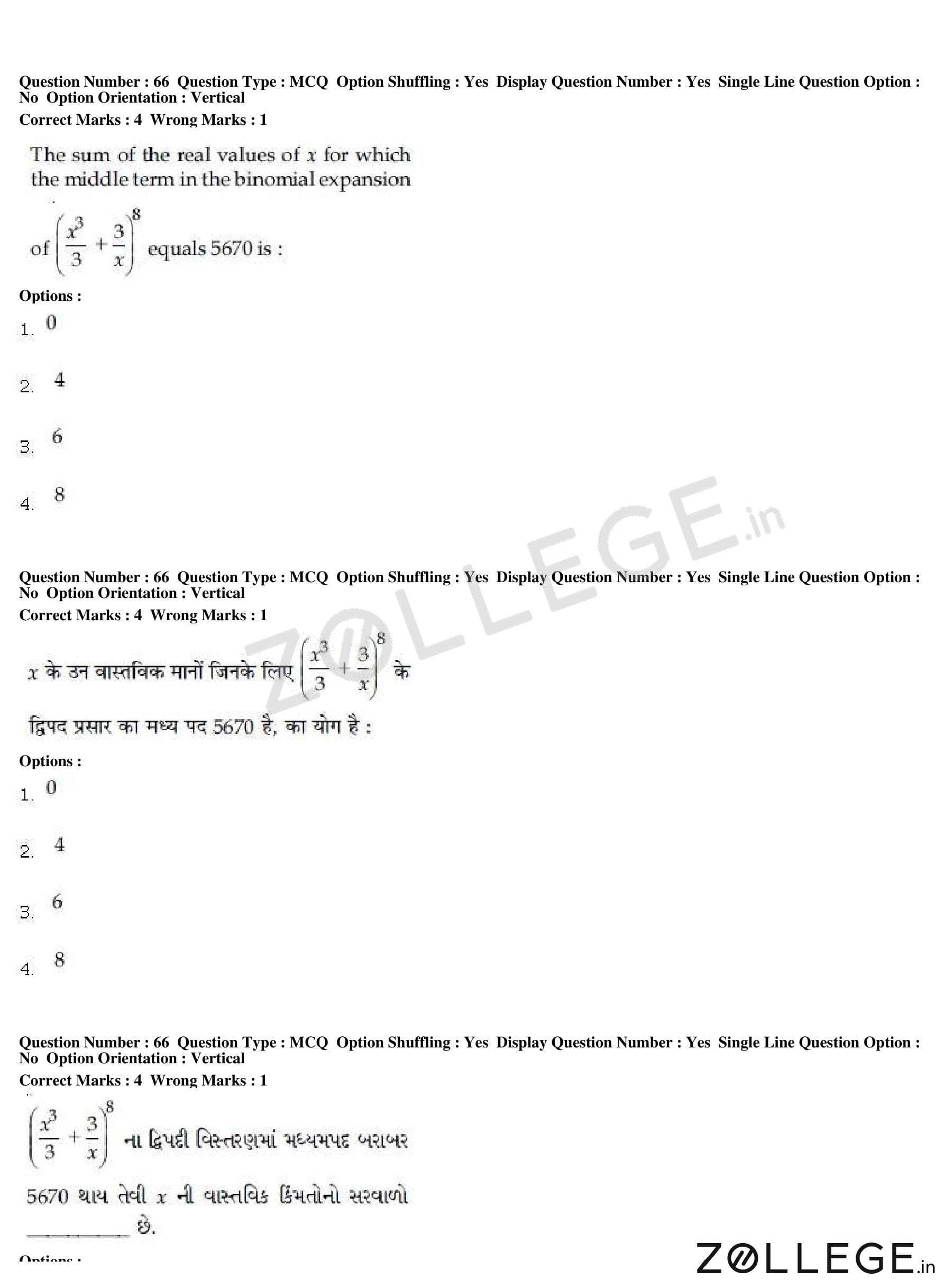
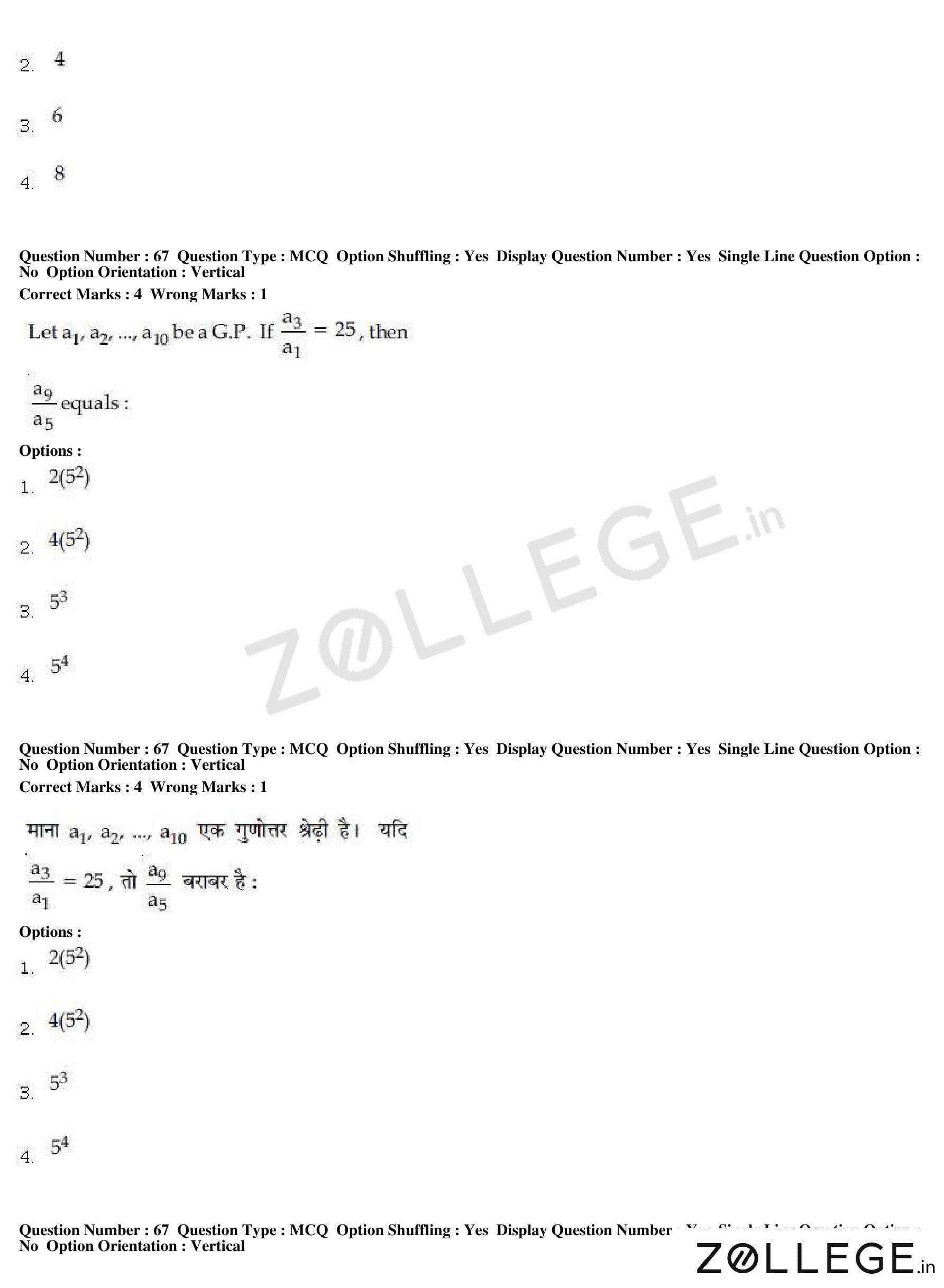
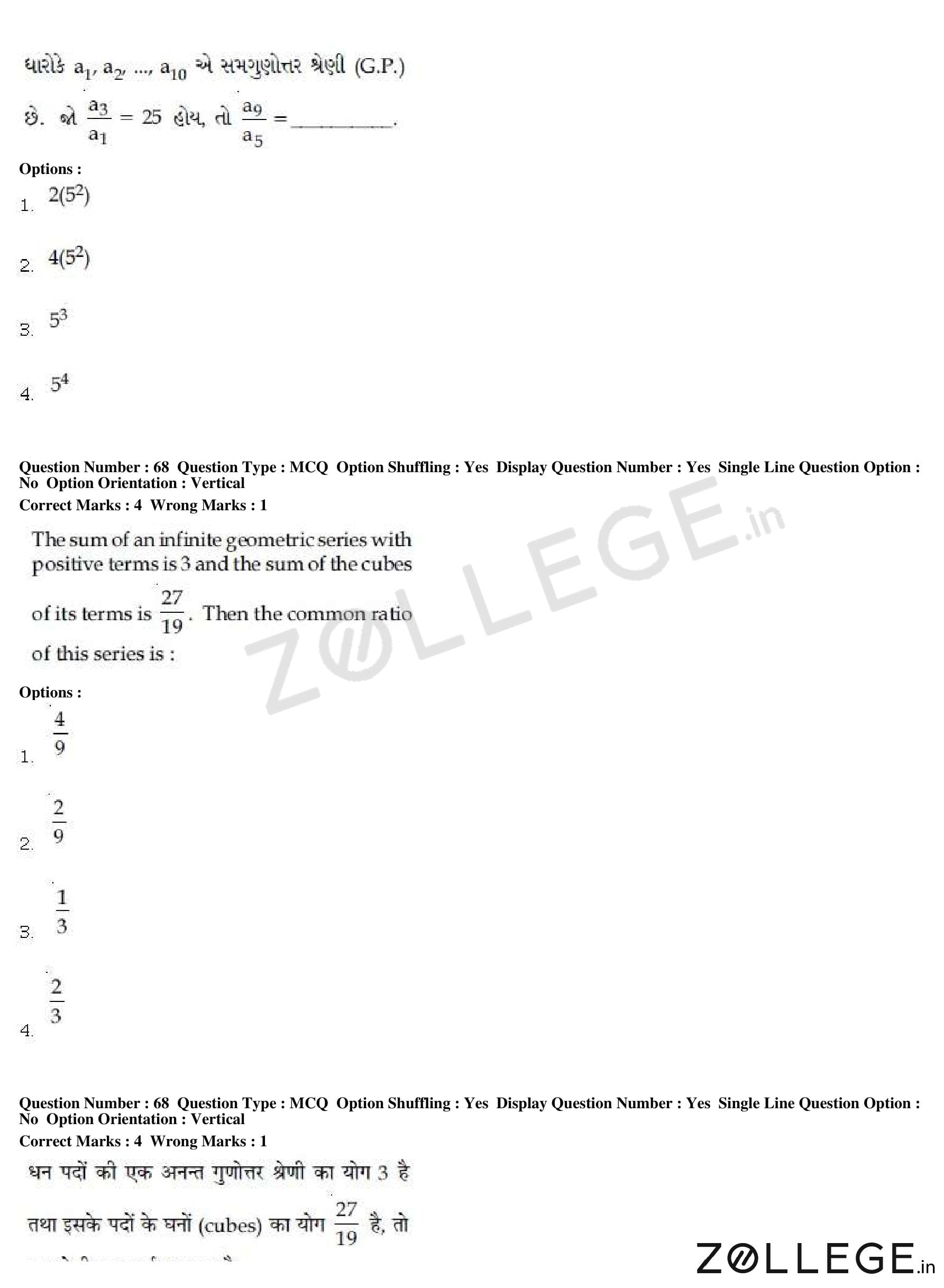
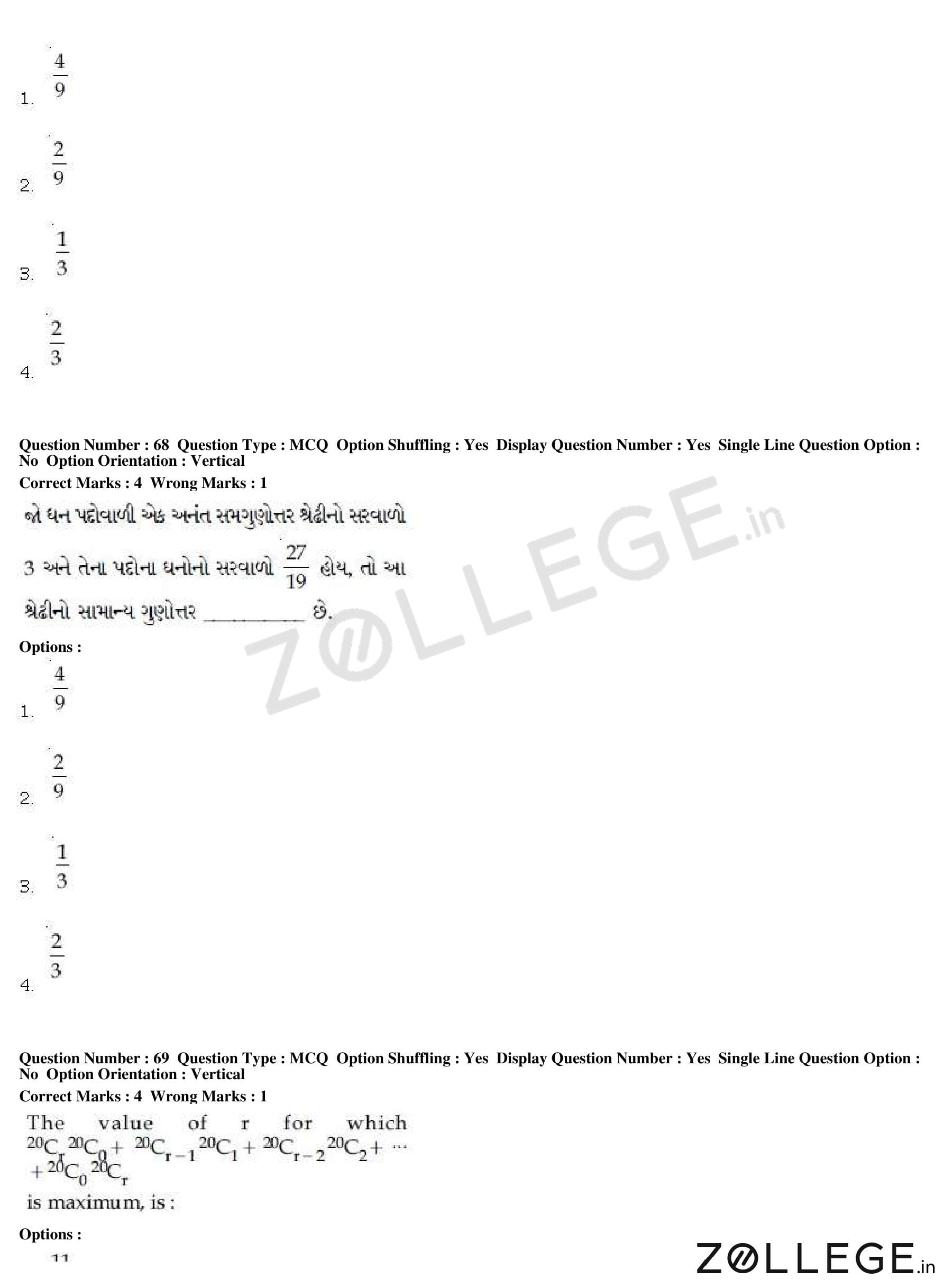
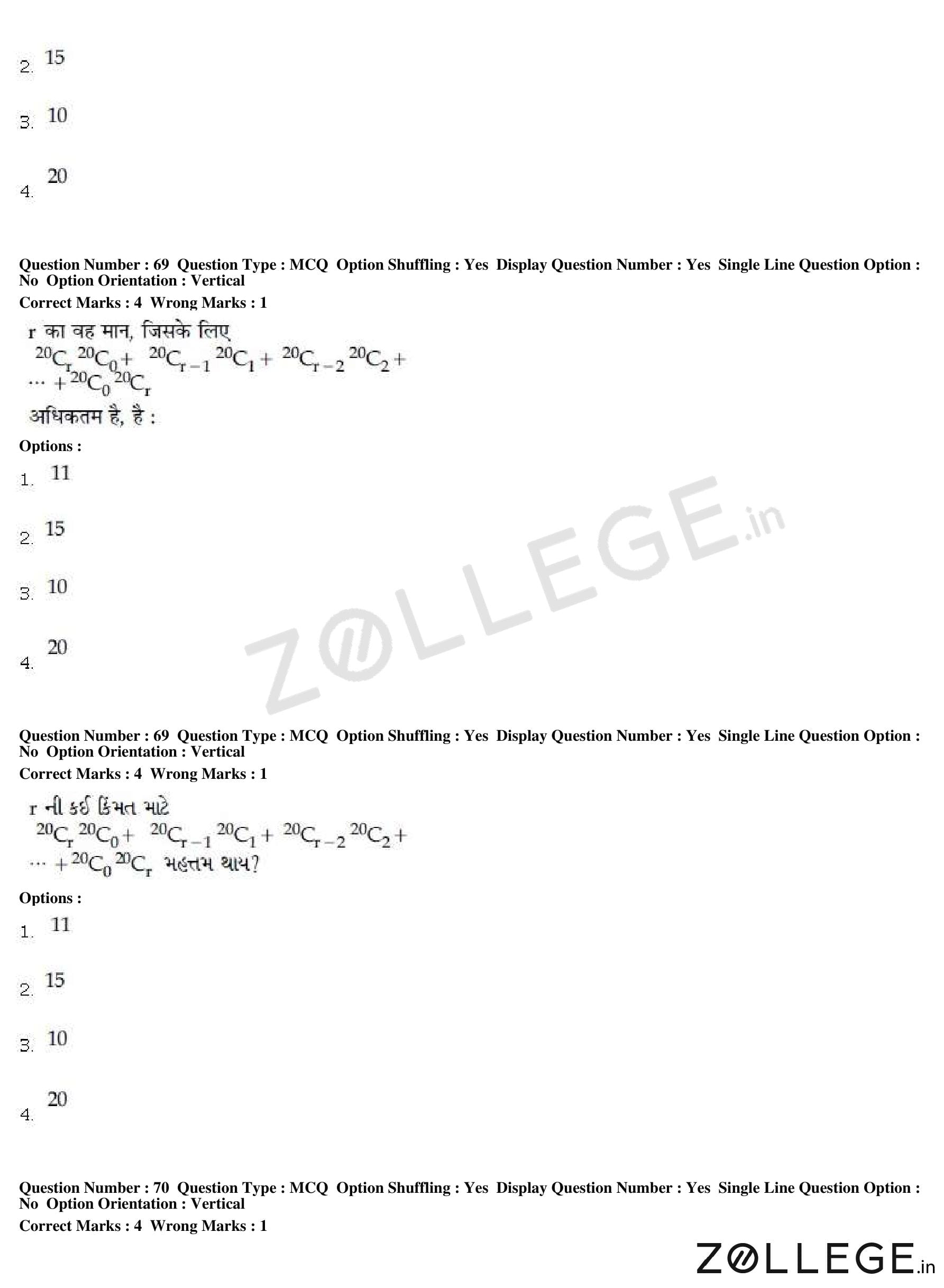
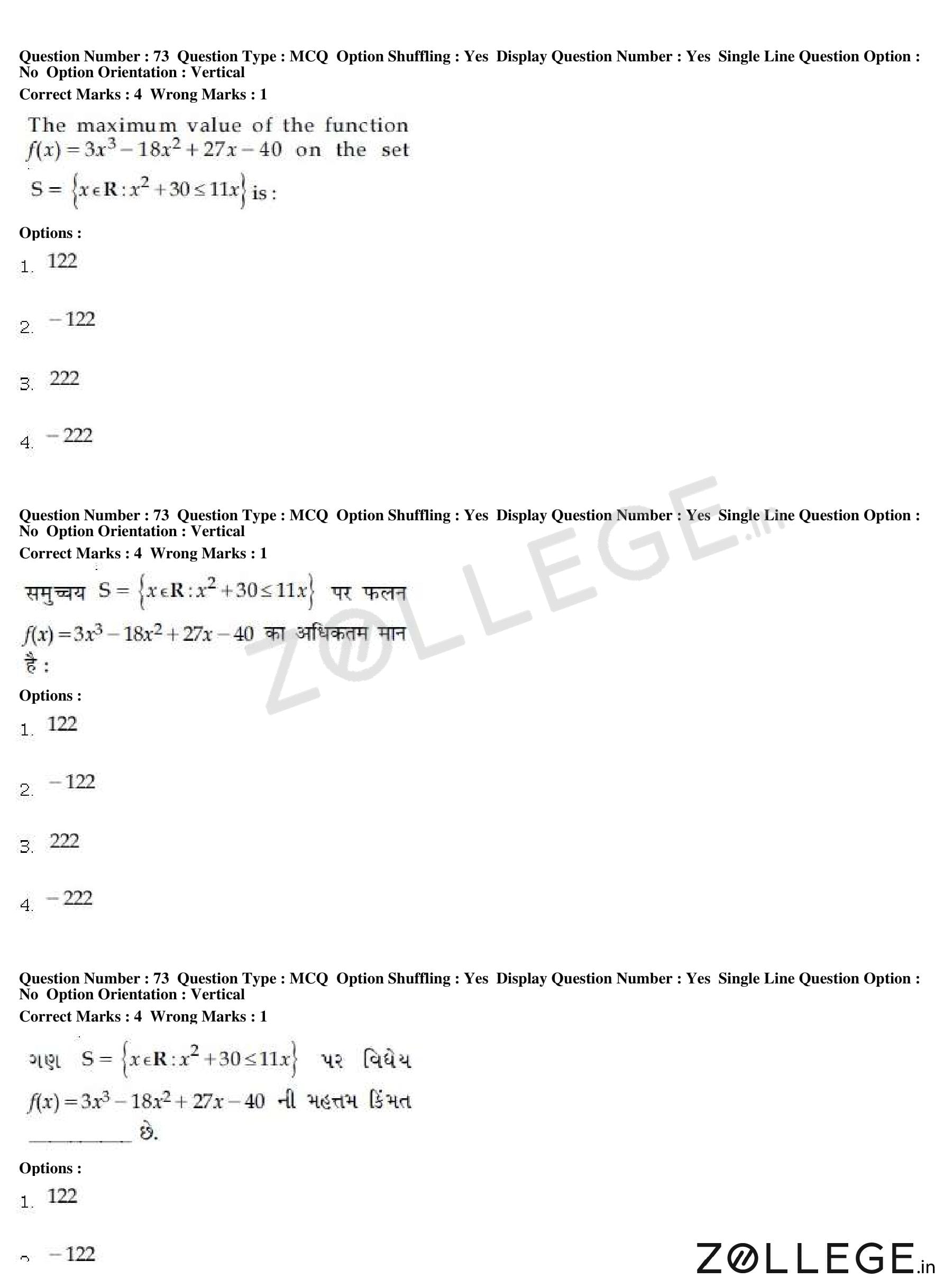
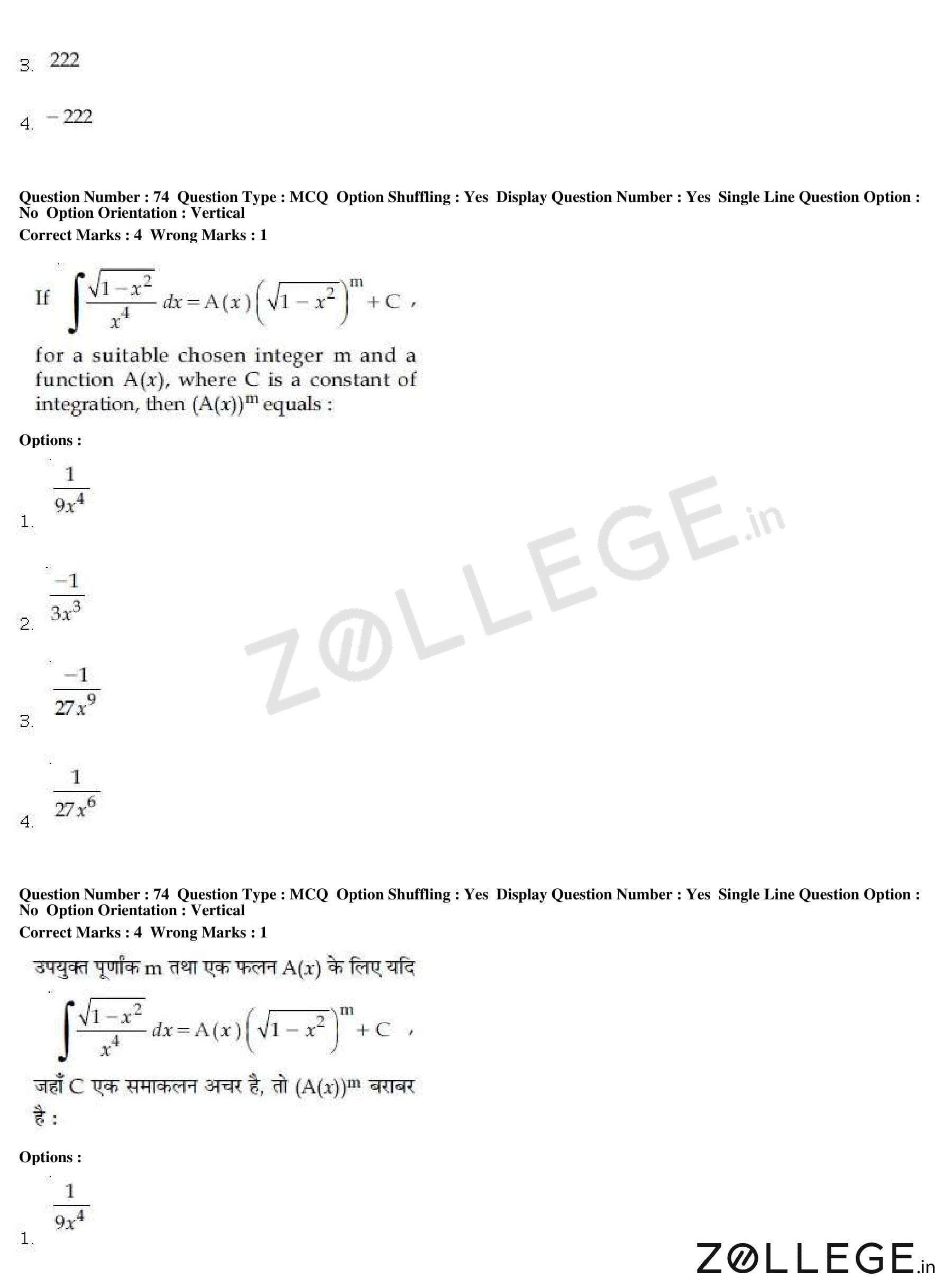
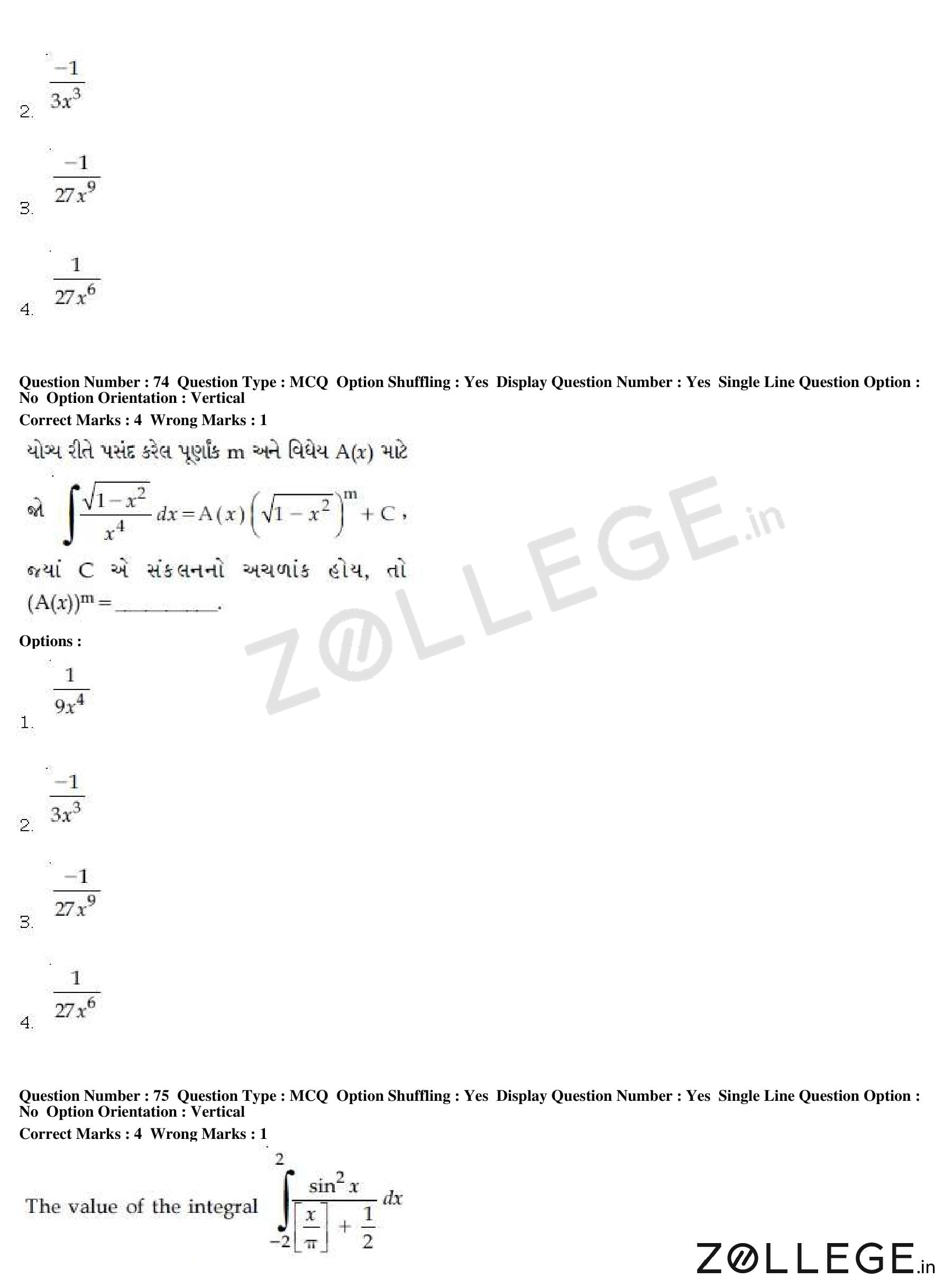
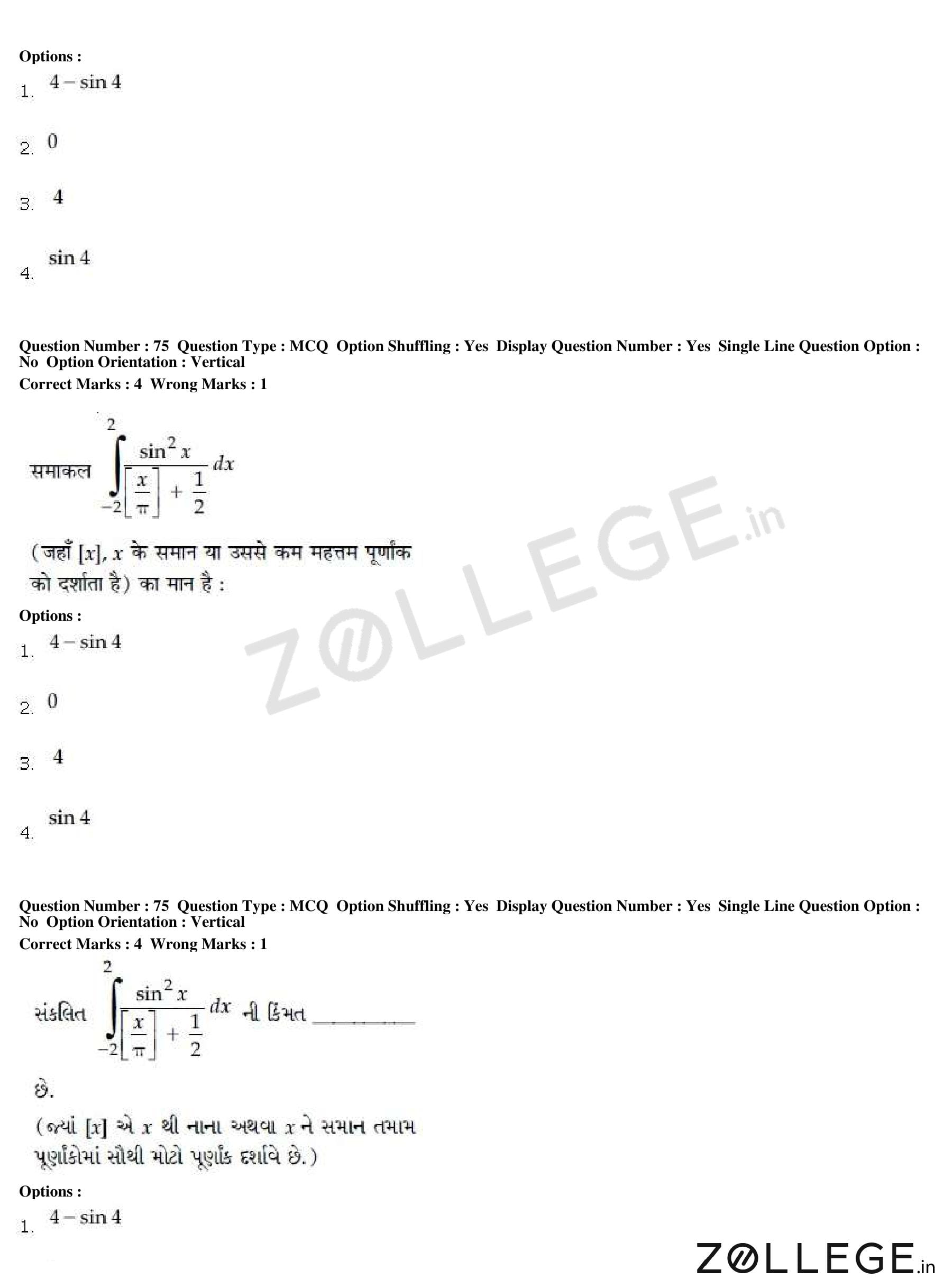
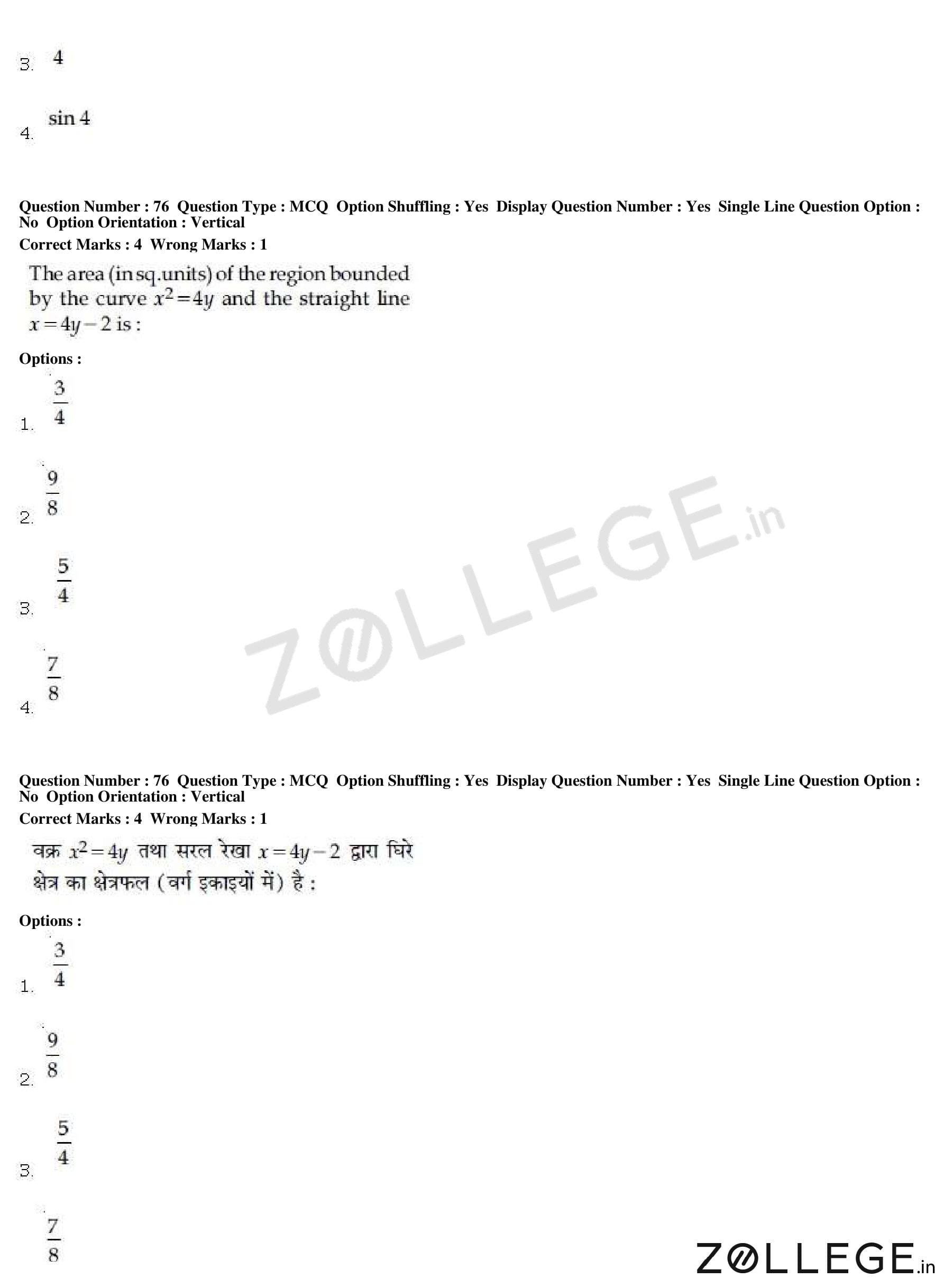
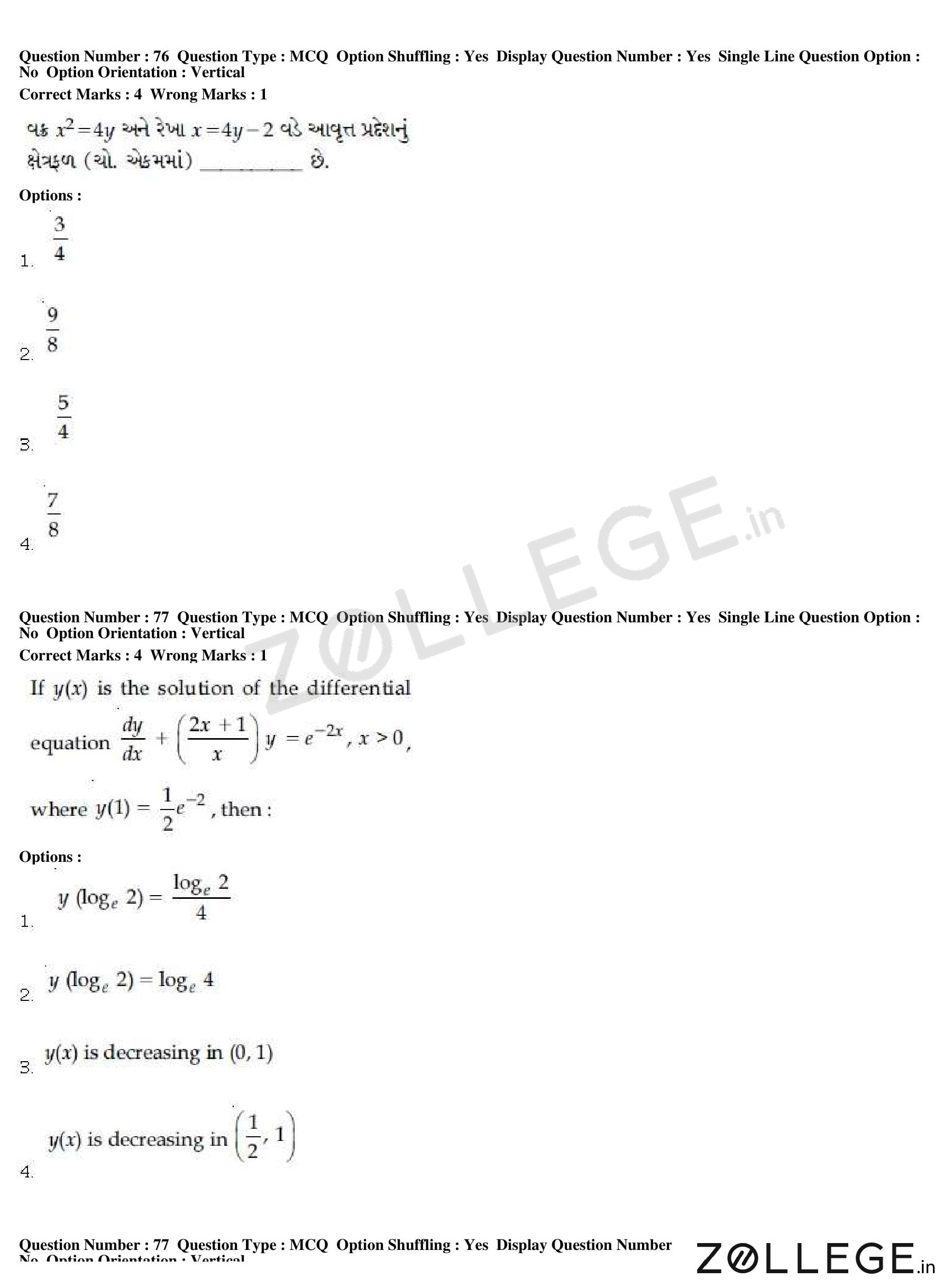
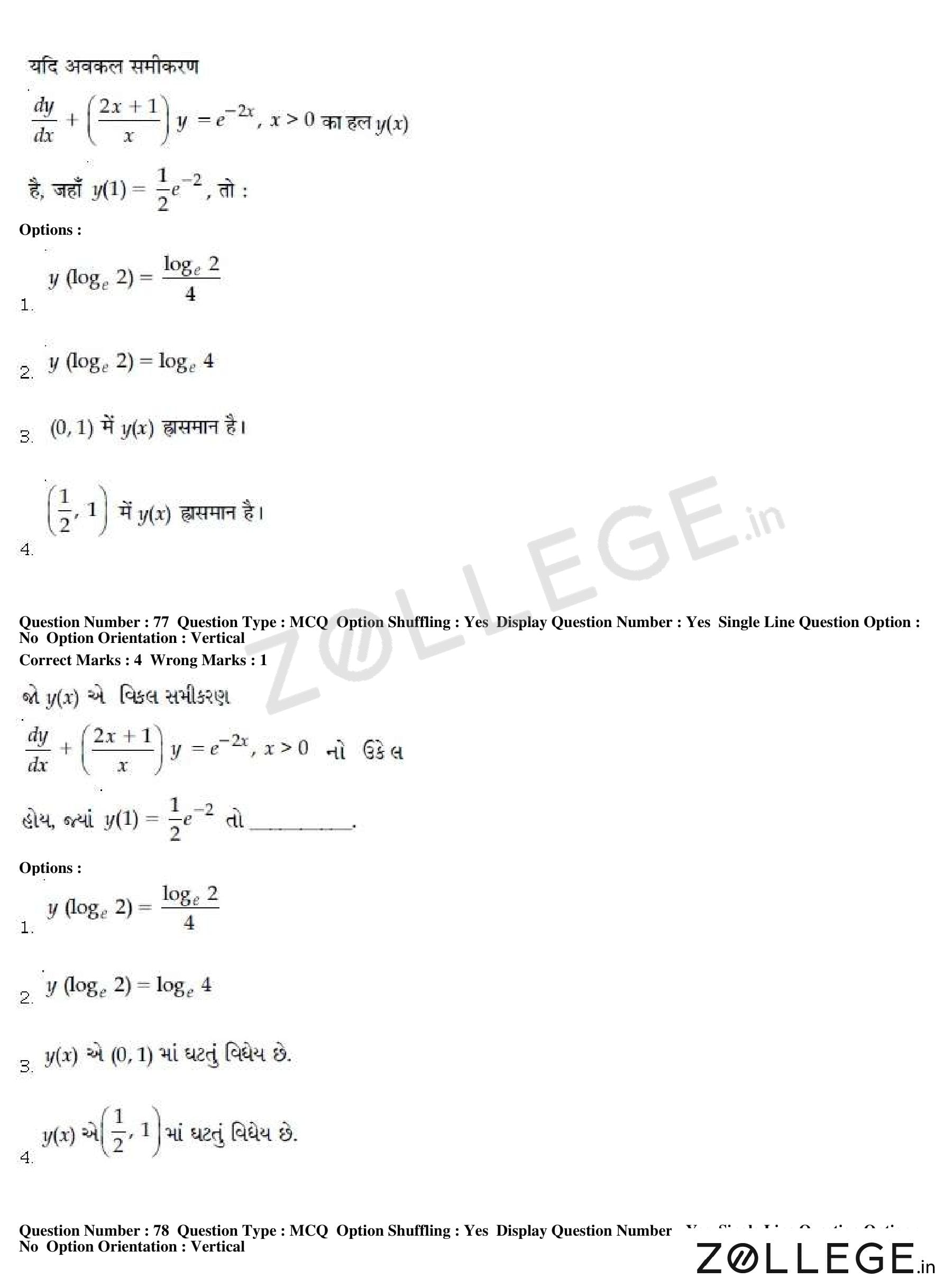
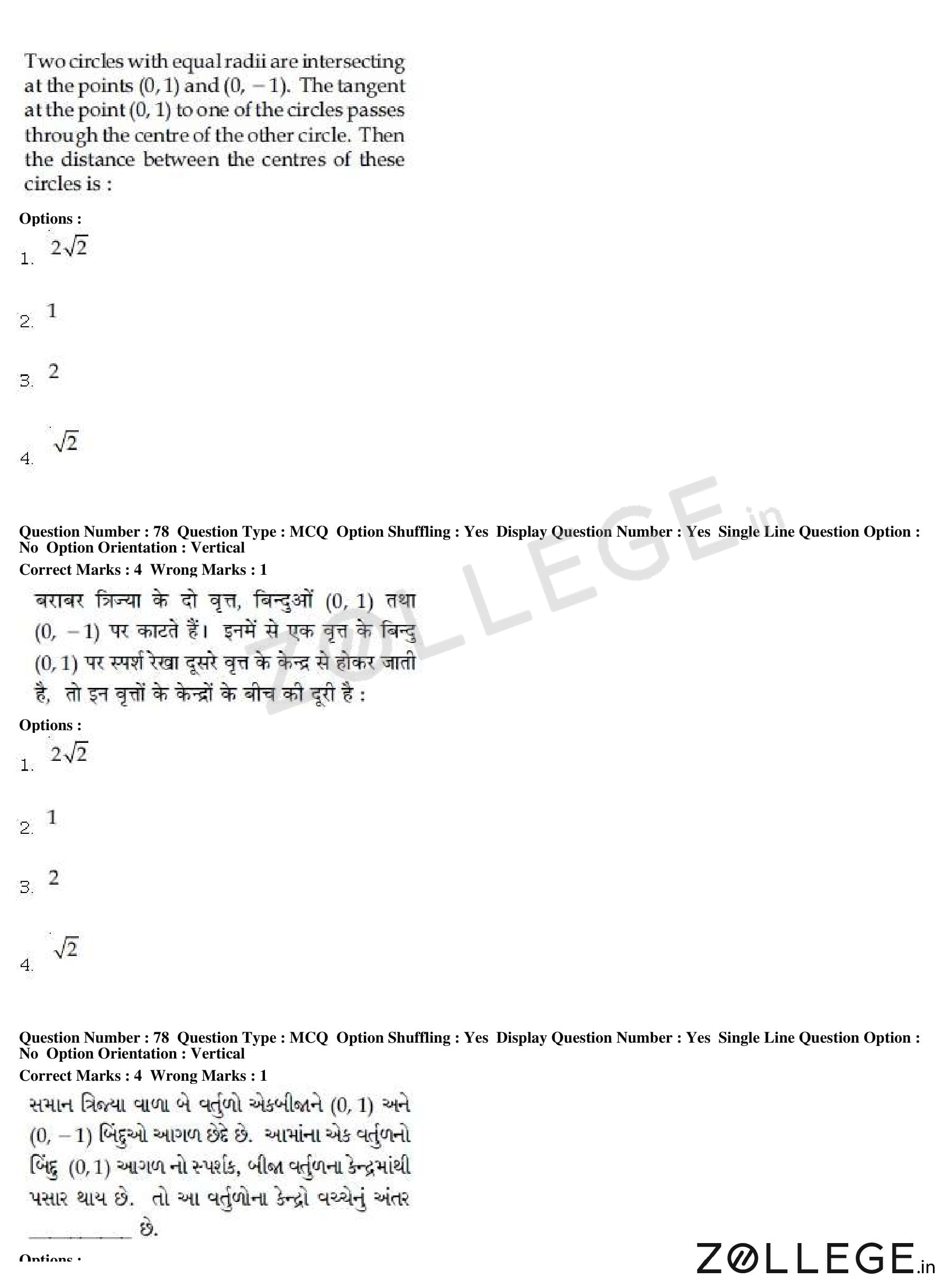
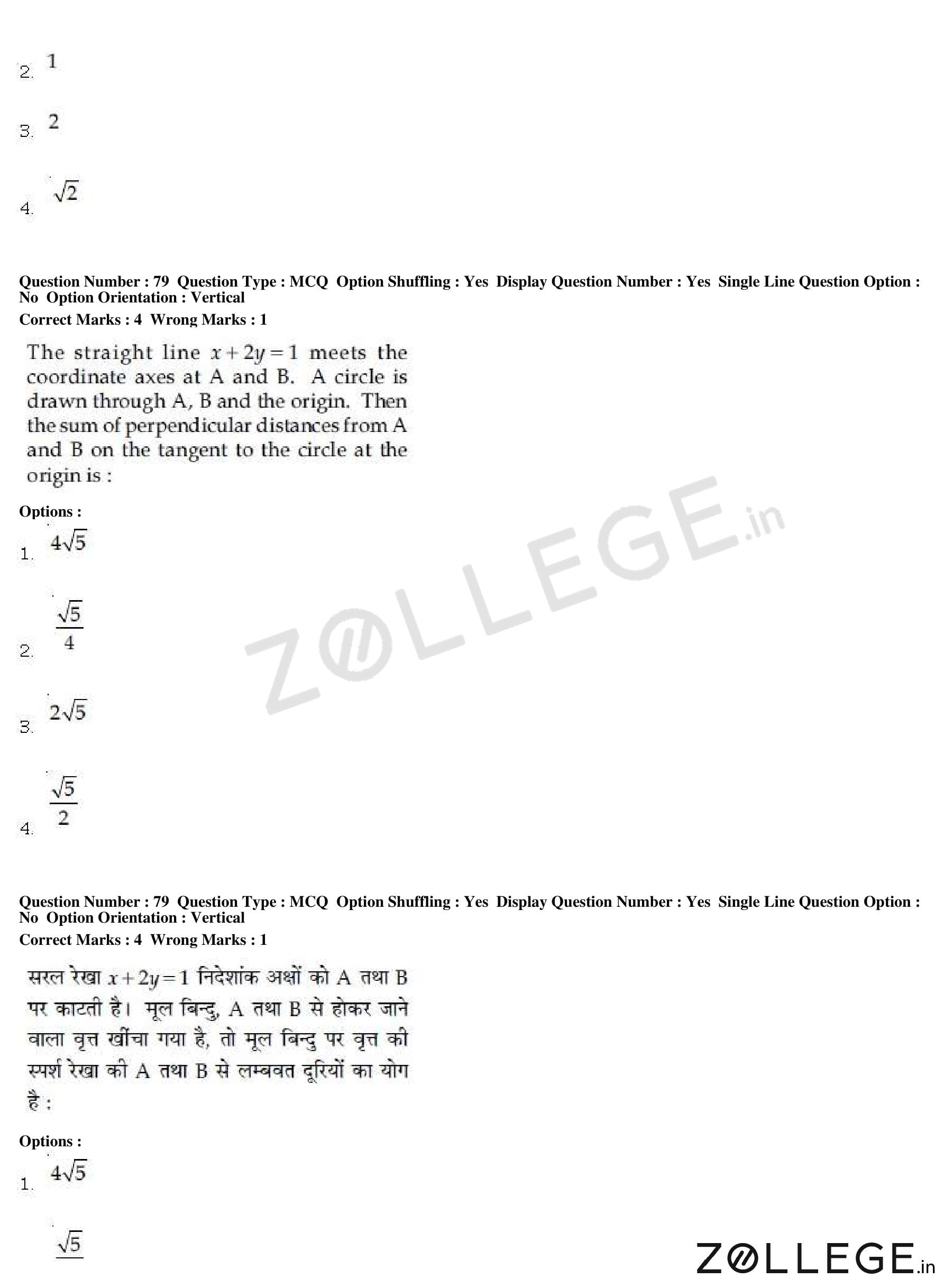
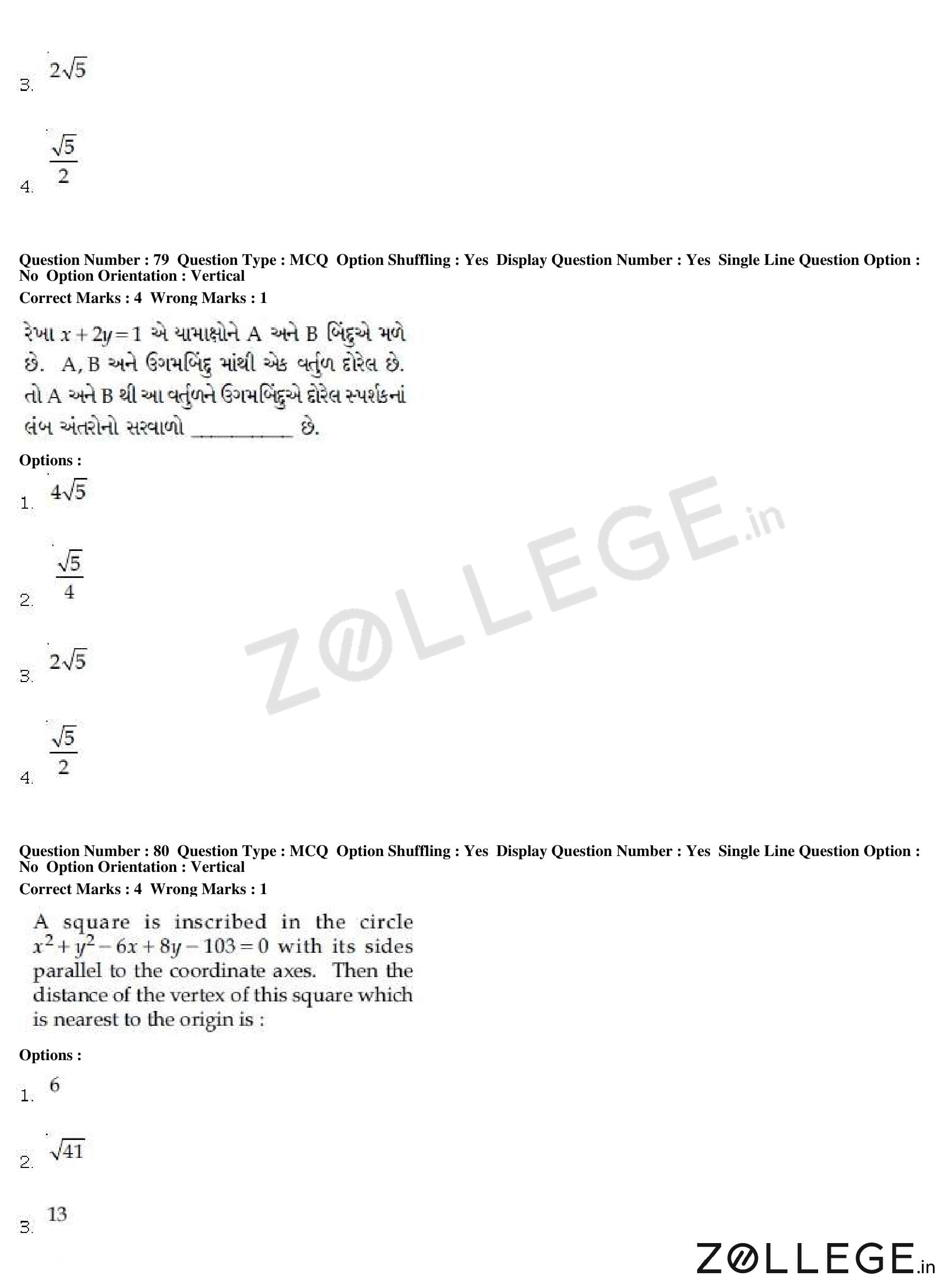
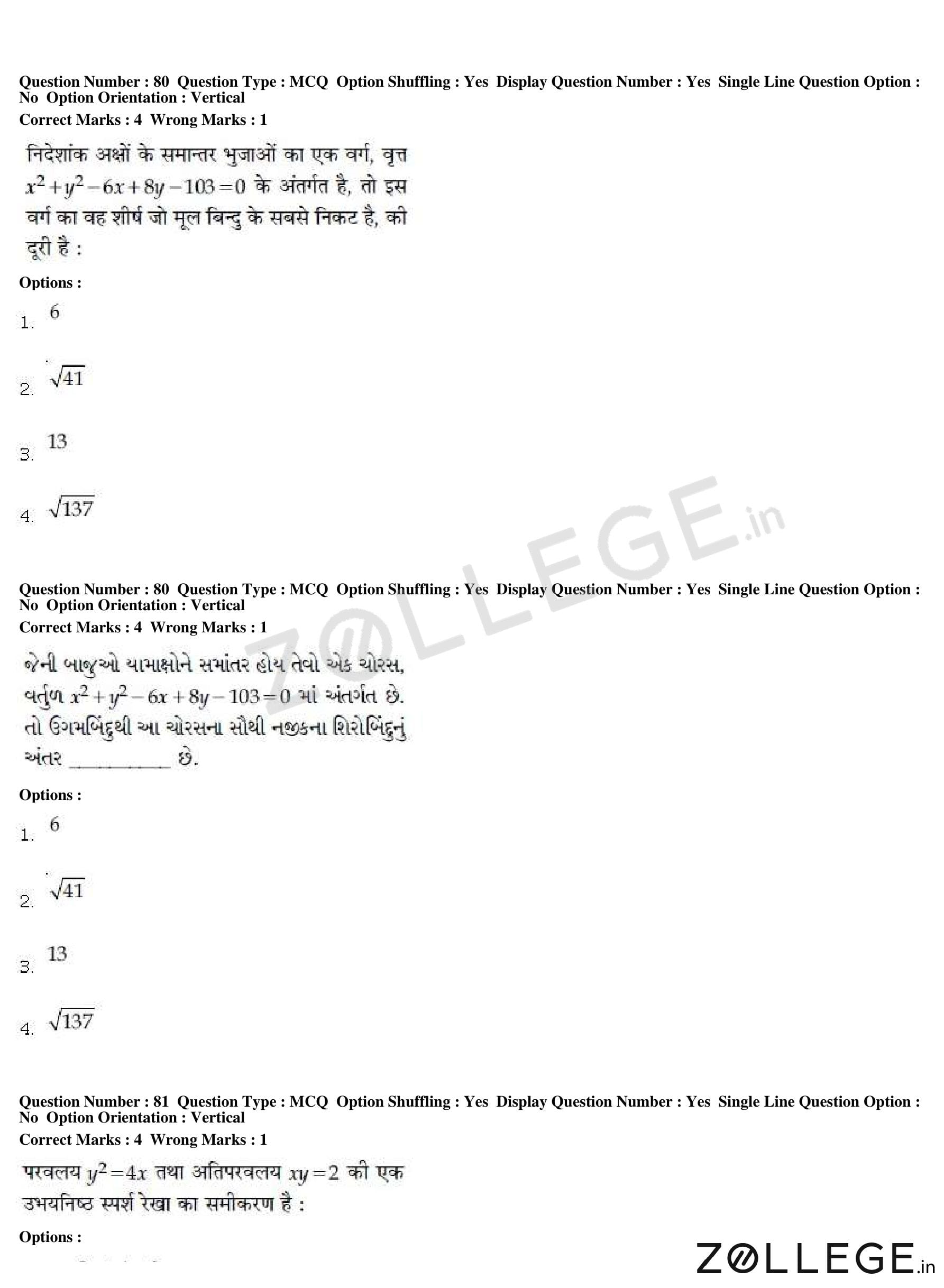
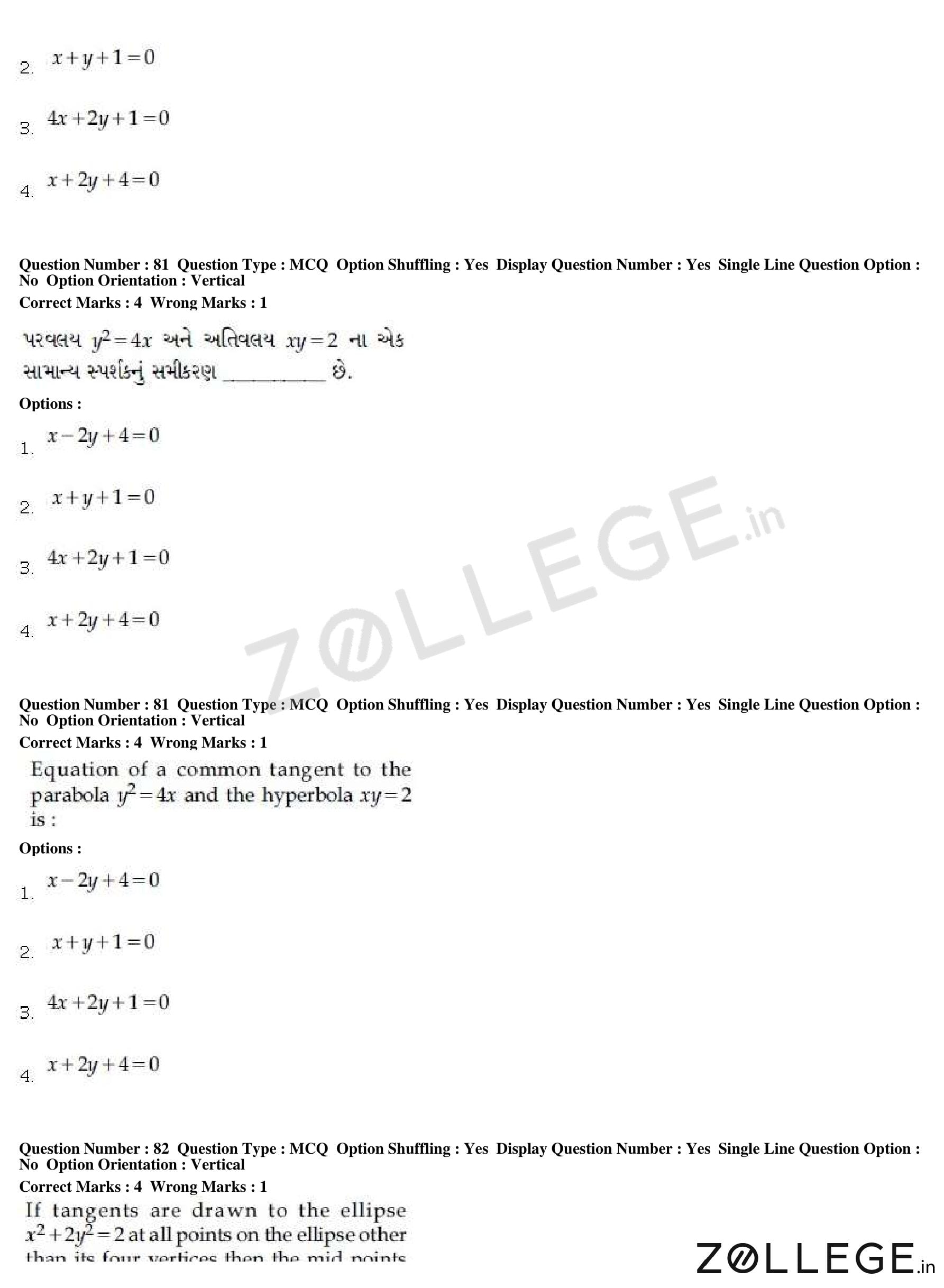
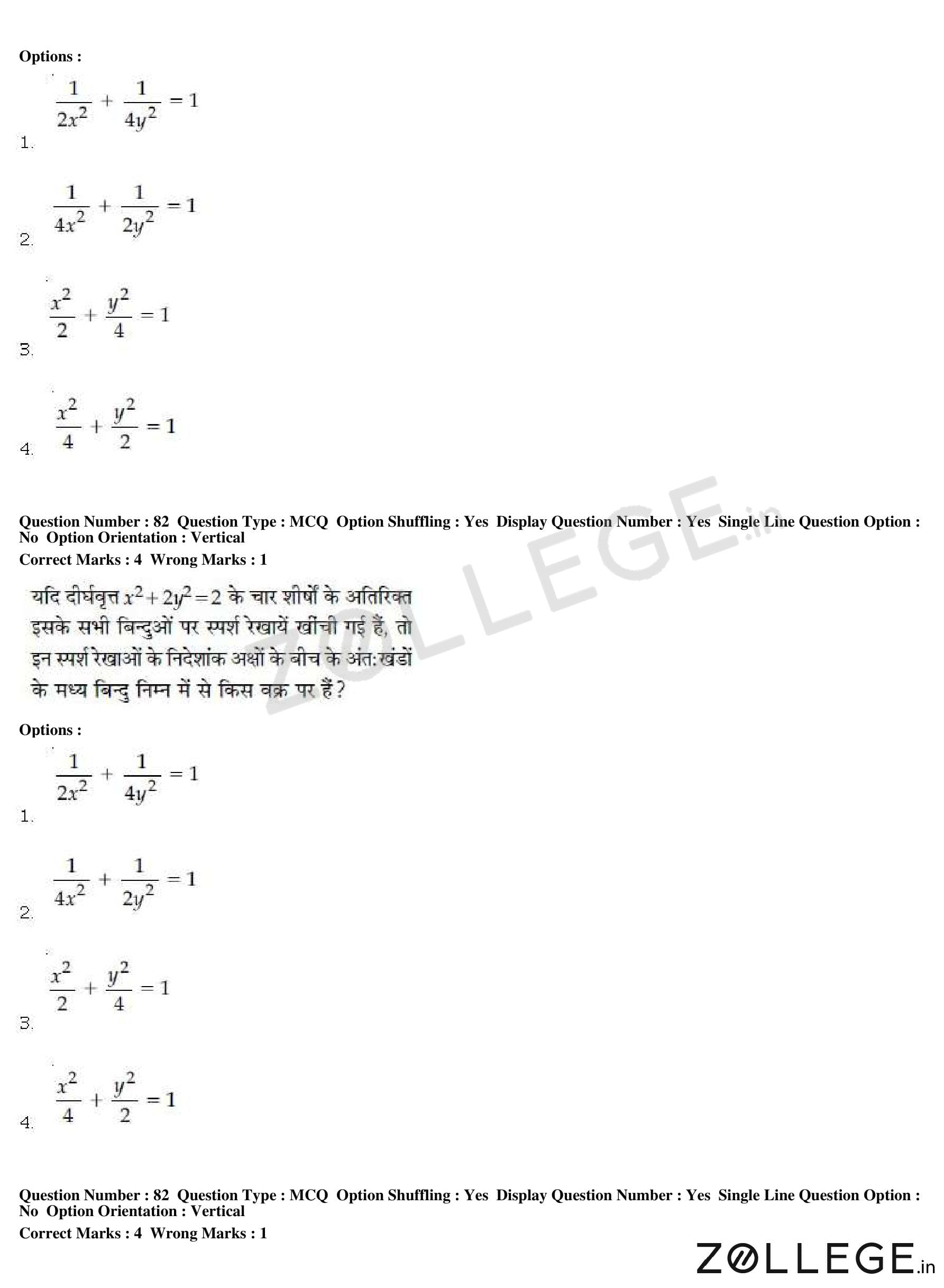
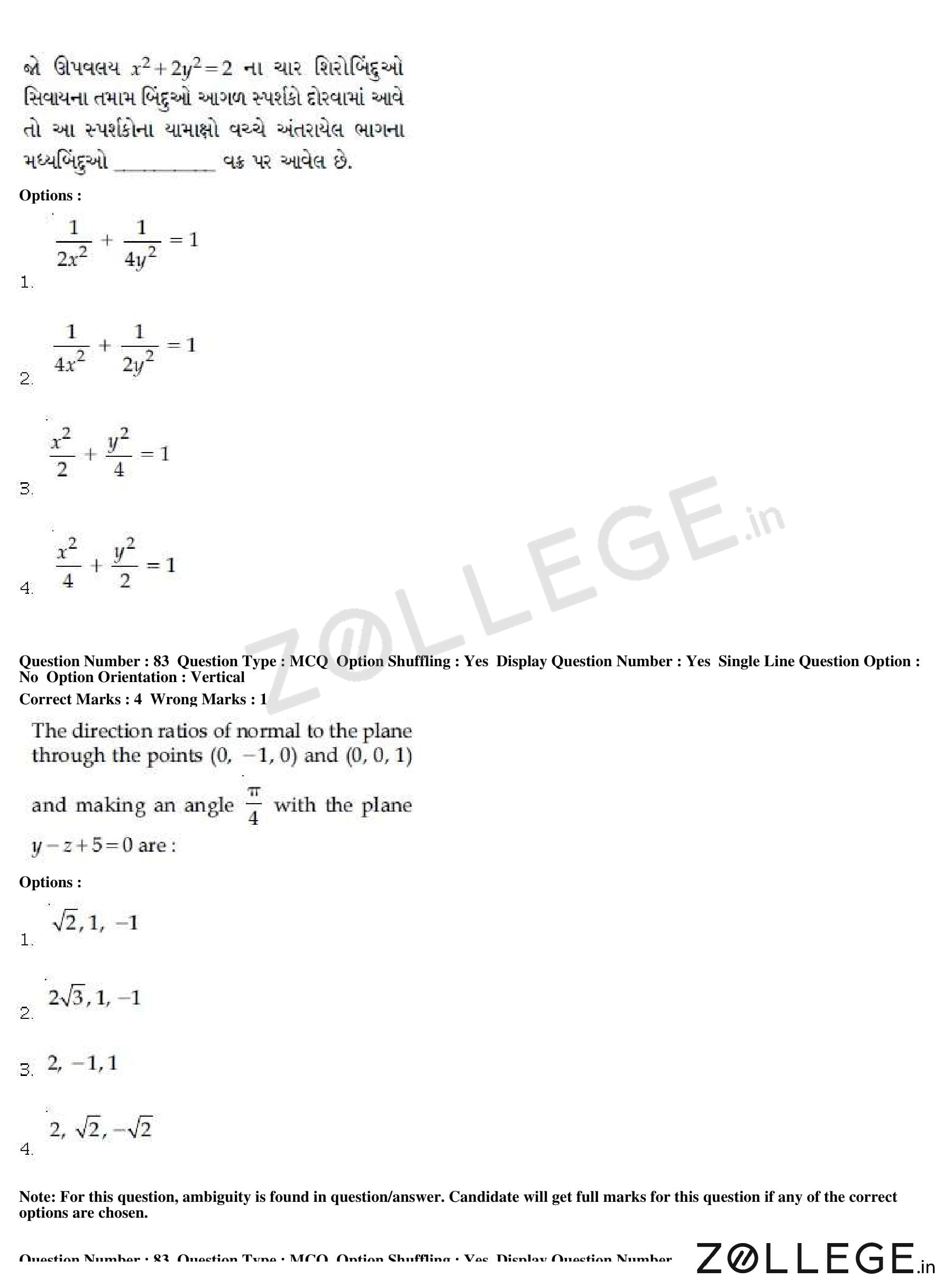
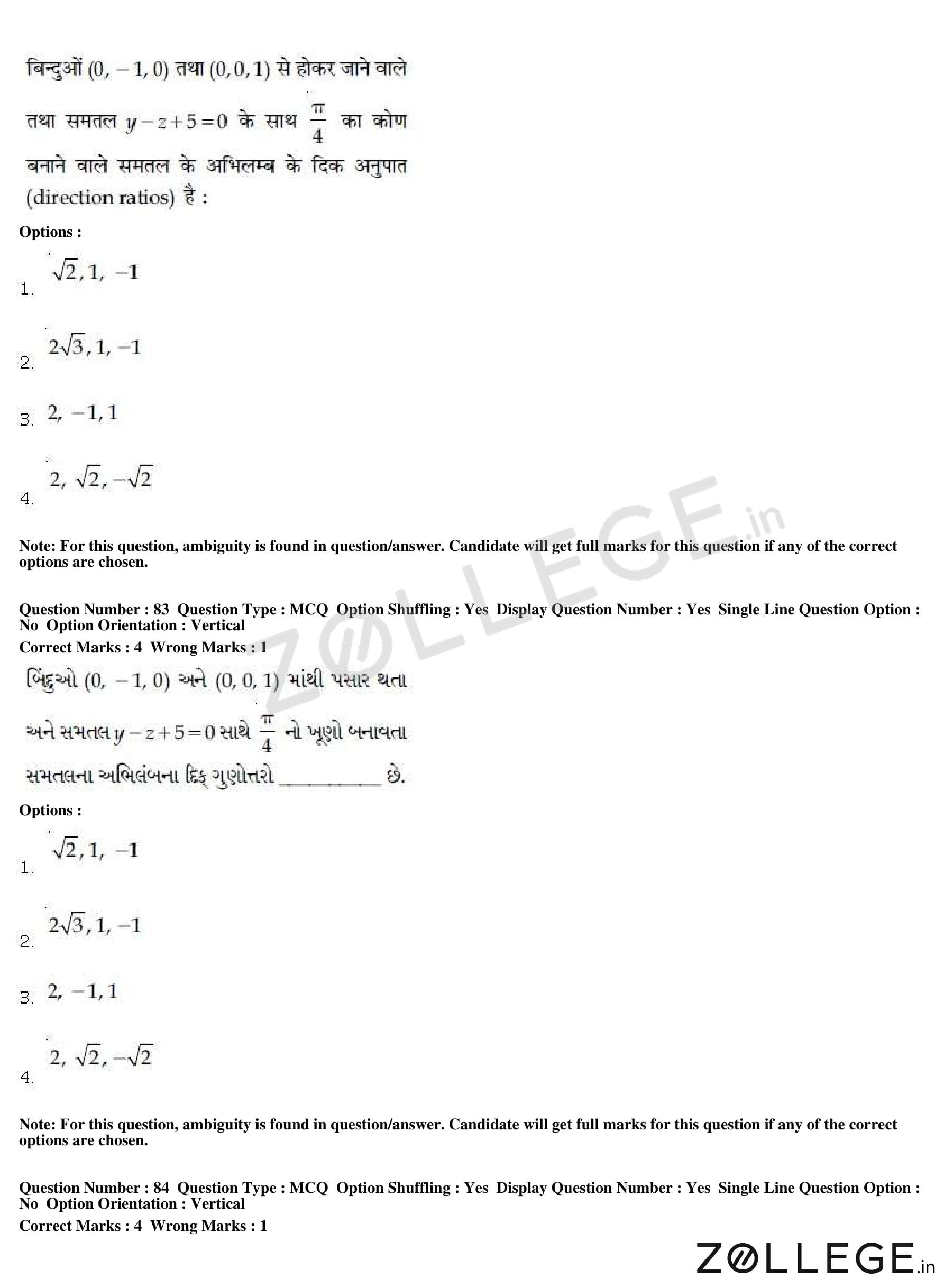
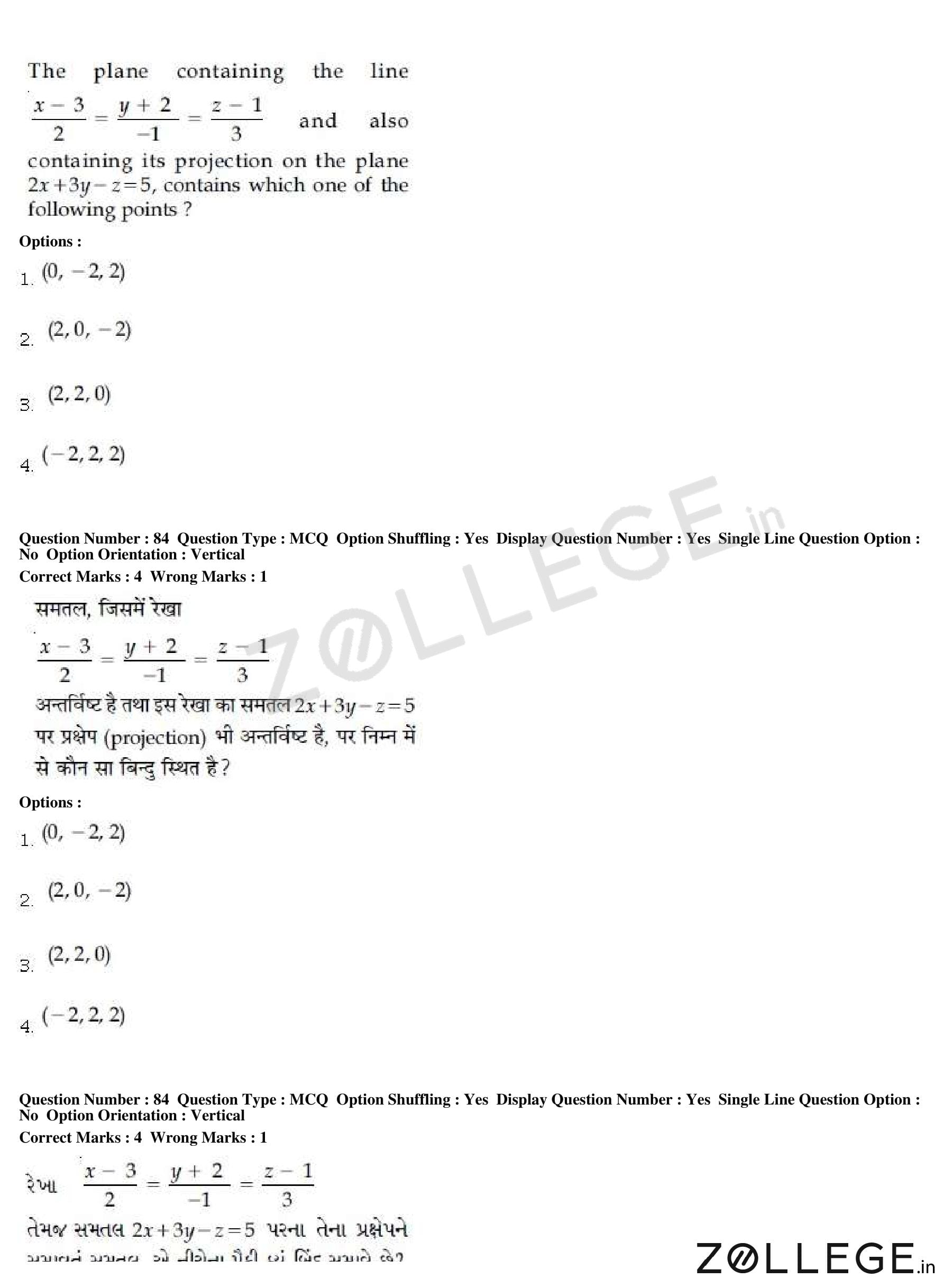
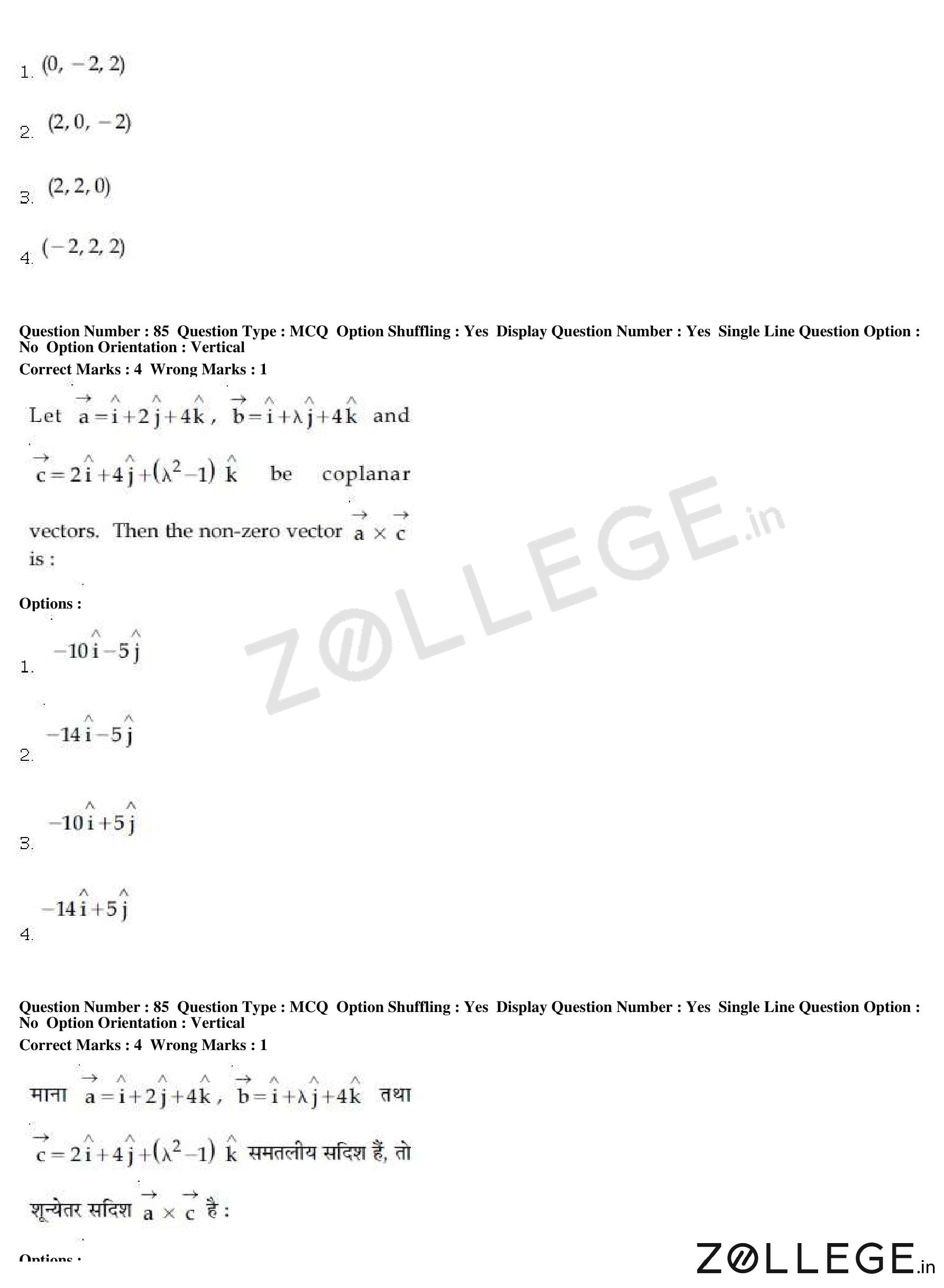
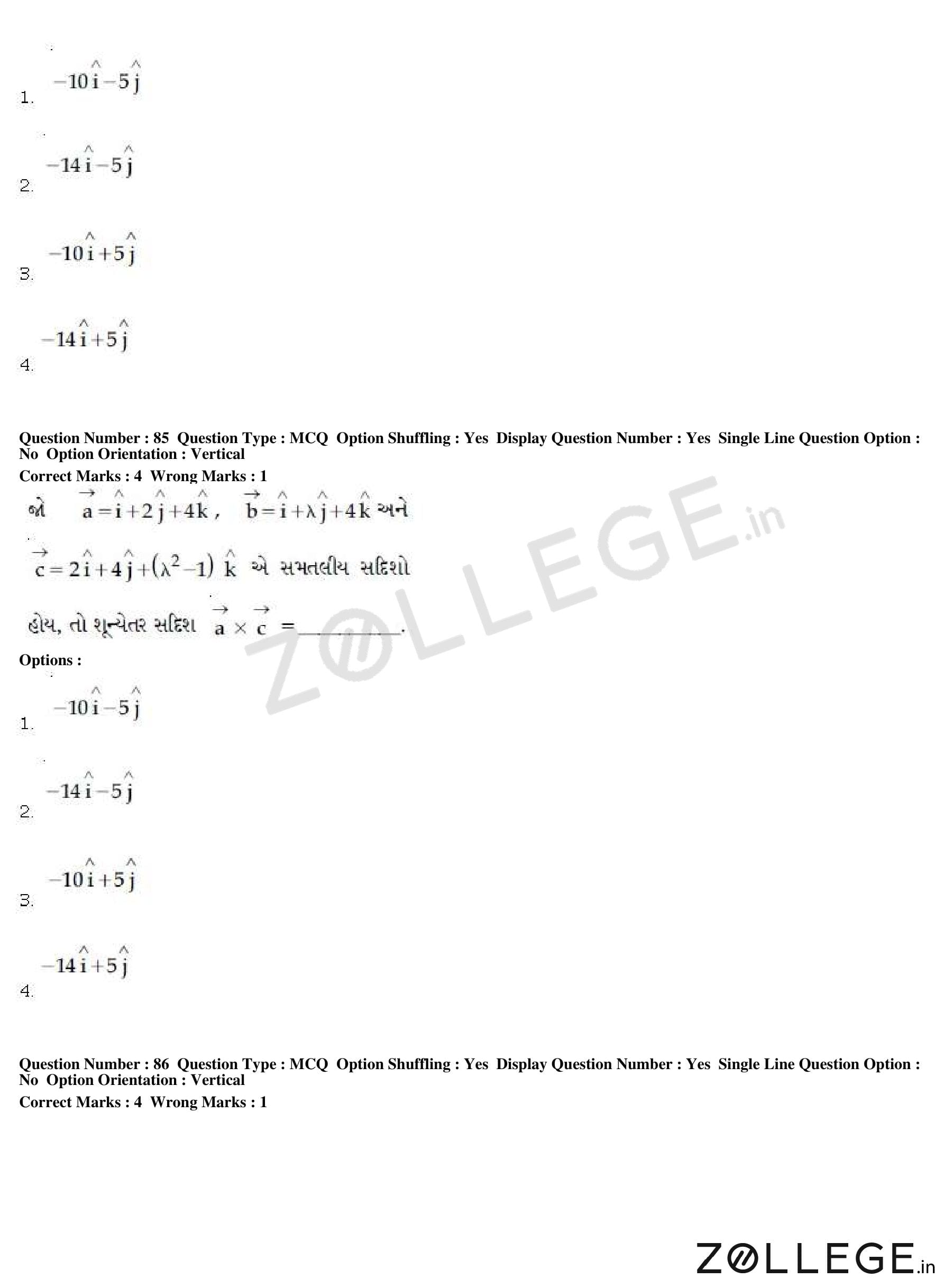
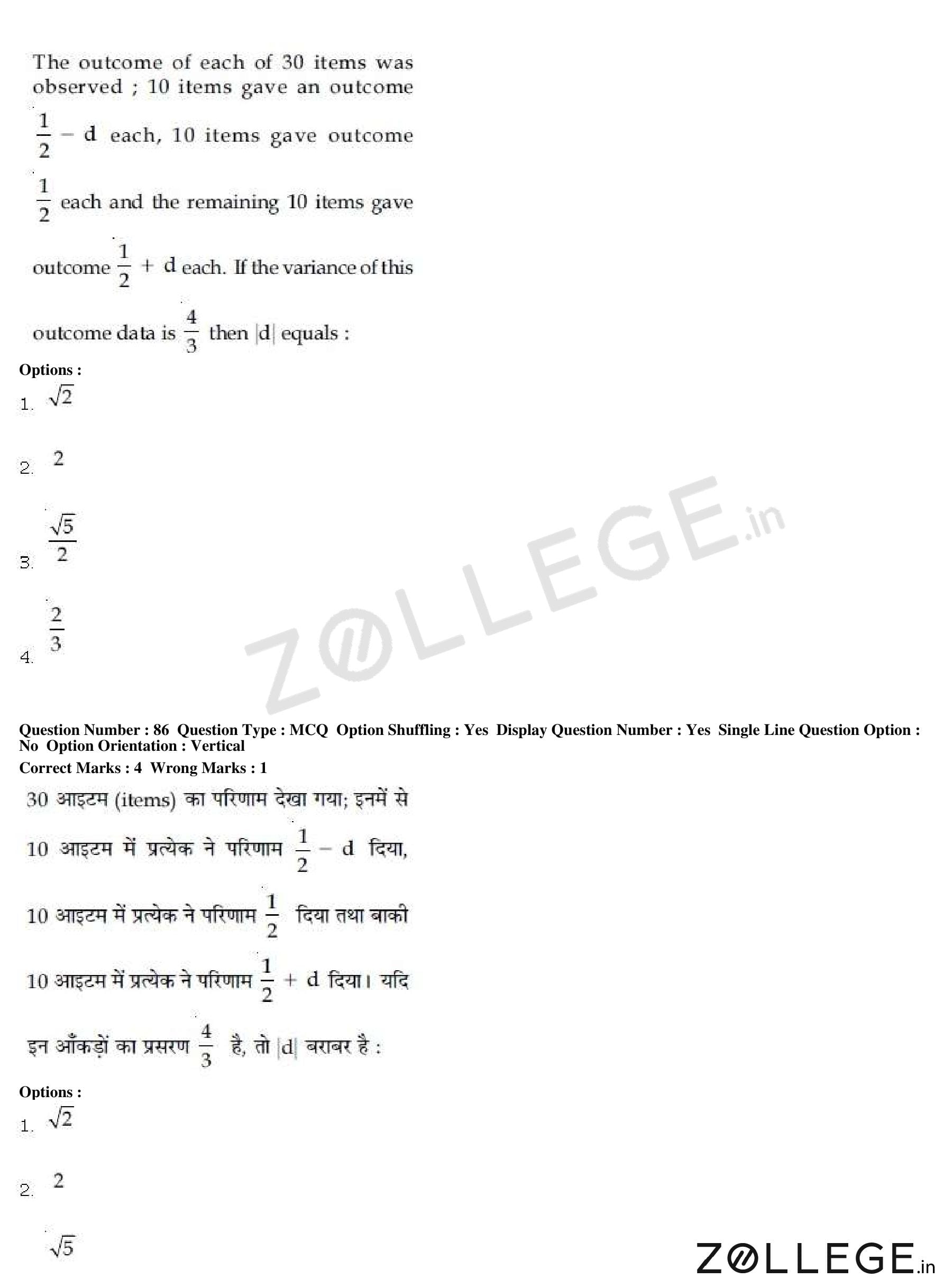
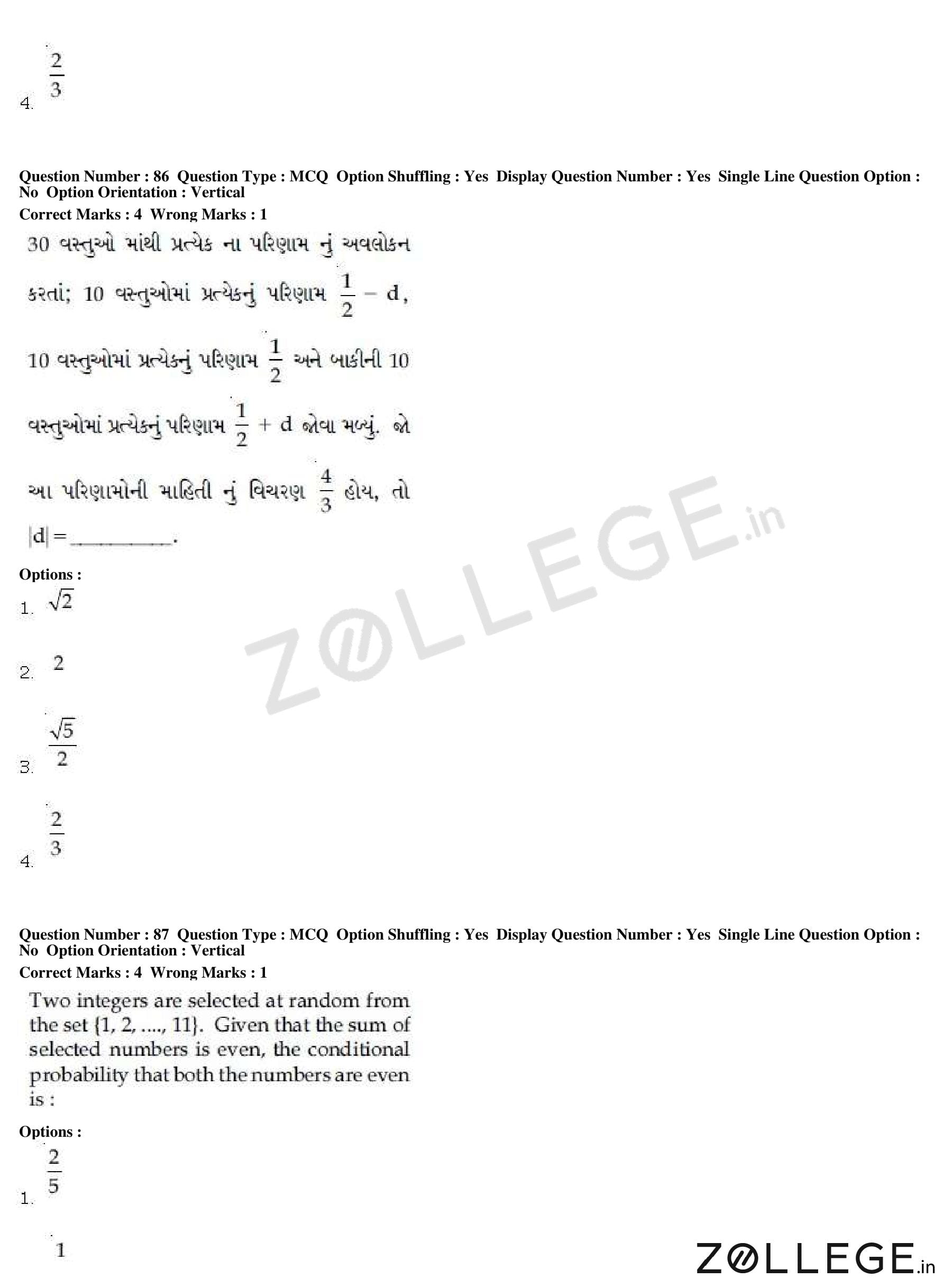
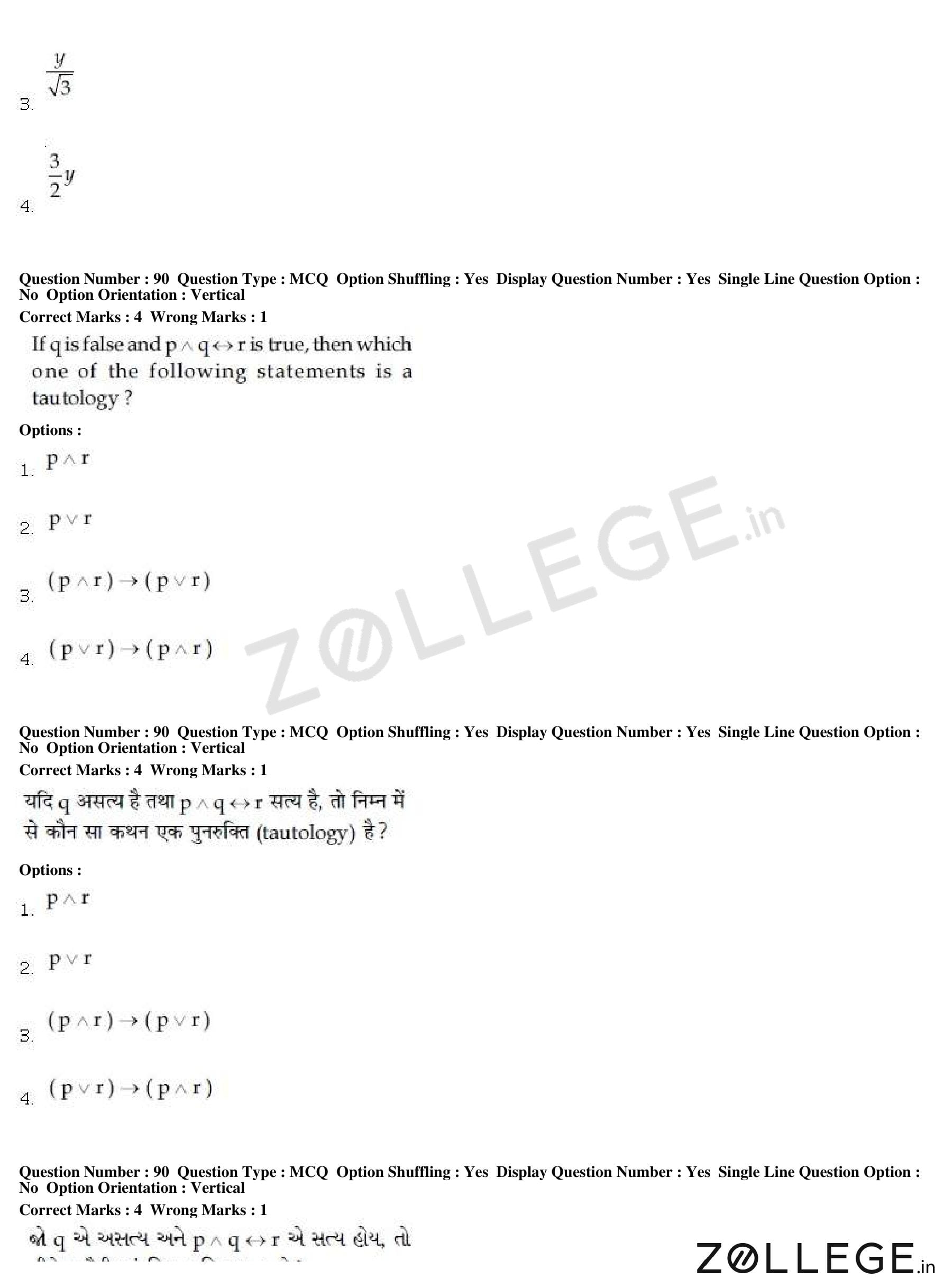
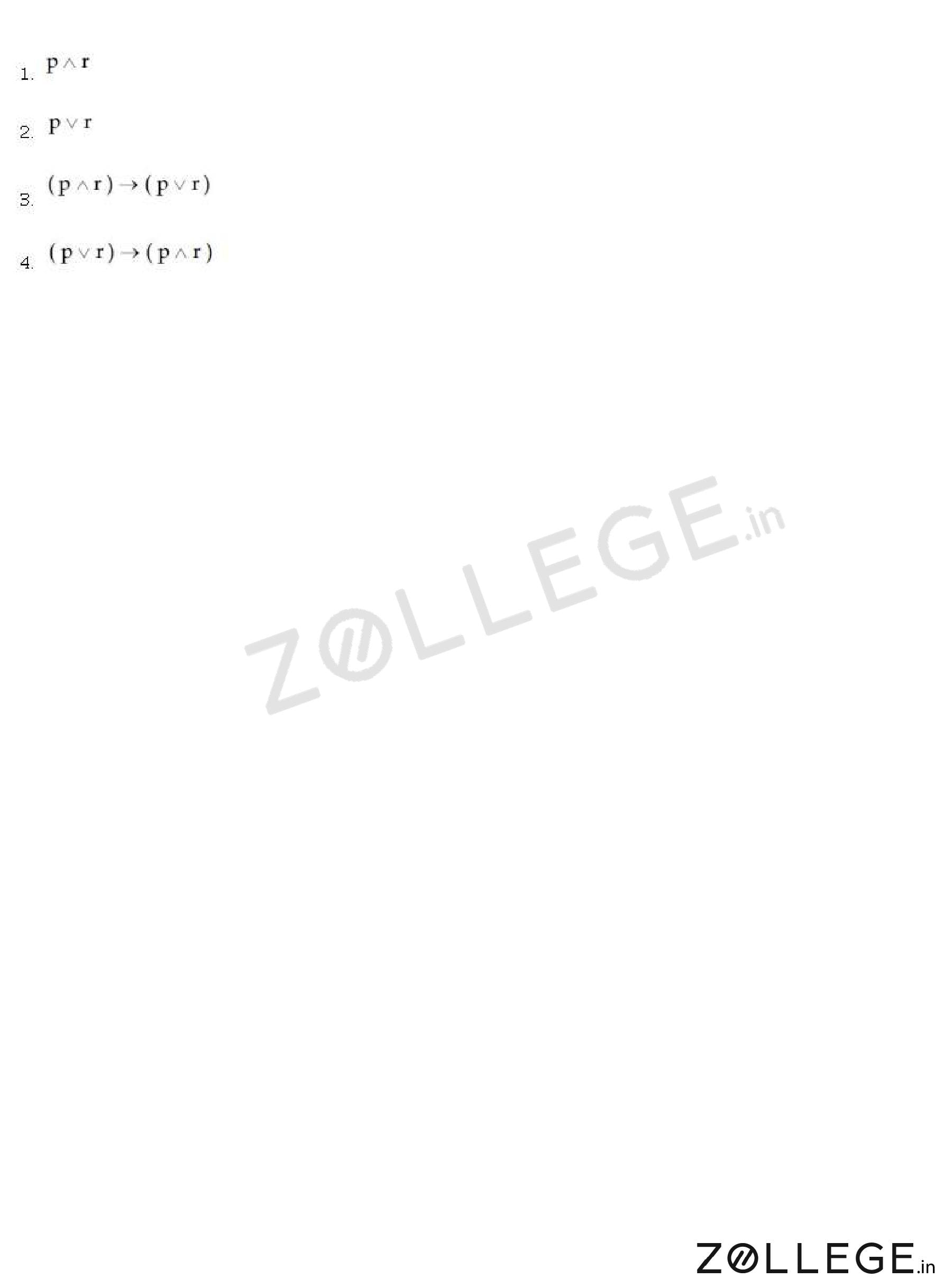
Previous Year JEE Main Question Papers
*The article might have information for the previous academic years, please refer the official website of the exam.