
JEE Main 2020 Question Paper with Answer Key PDF for B.E./ B.Tech(September 2, 2020 - Shift 2)


Content Writer | Updated On - Dec 23, 2025
JEE Main Question Papers are the most important study material for effective exam preparation. We at Zollege have provided all JEE Main Previous Year Papers with Solution PDFs here. JEE Main 2020 B. E. / B. Tech exam was conducted successfully on September 2, 2020. NTA conducted the exam in the Shift 2. According to student reactions and expert reviews, the paper was reported to be high.
Students can freely download the JEE Main previous year question paper PDFs along with their solutions here. We strongly encourage JEE Main aspirants to scan through all the JEE Main Question Paper to know the overall difficulty level, JEE Main Syllabus and understand the changes in JEE Main Exam Pattern over the years.
JEE Main 2020 B.E./ B.Tech Question Paper with Answer Key PDF (Shift 2)
| JEE Main 2020 B.E./ B.Tech Question Paper PDF | JEE Main 2020 B.E./ B.Tech Answer Key PDF | JEE Main 2020 B.E./ B.Tech Solution PDF |
|---|---|---|
| Download PDF | Download PDF | Check Solutions |

If momentum (P), area (A) and time (T) are taken to be the fundamental quantities then the dimensional formula for energy is:
View Solution
Let the dimensional formula for energy (E) in terms of momentum (P), area (A), and time (T) be expressed as:
E = k P\(^a\)A\(^b\)T\(^c\), where k is a dimensionless constant.
First, let's write the fundamental dimensions in terms of Mass (M), Length (L), and Time (T) for each quantity.
Dimension of Energy [E] = [ML\(^2\)T\(^{-2}\)]
Dimension of Momentum [P] = [MLT\(^{-1}\)]
Dimension of Area [A] = [L\(^2\)]
Dimension of Time [T] = [T]
Now, substitute these dimensions into our equation:
[ML\(^2\)T\(^{-2}\)] = [MLT\(^{-1}\)]\(^a\) [L\(^2\)]\(^b\) [T]\(^c\)
[ML\(^2\)T\(^{-2}\)] = M\(^a\) L\(^{a+2b}\) T\(^{-a+c}\)
To find the values of a, b, and c, we equate the powers of M, L, and T on both sides of the equation.
Equating powers of M: a = 1
Equating powers of L: a + 2b = 2
Equating powers of T: -a + c = -2
Solving this system of equations:
From the M equation, we have a = 1.
Substitute a = 1 into the L equation: 1 + 2b = 2 \(\Rightarrow\) 2b = 1 \(\Rightarrow\) b = 1/2.
Substitute a = 1 into the T equation: -1 + c = -2 \(\Rightarrow\) c = -1.
Thus, the dimensional formula for energy is E = P\(^1\)A\(^{1/2}\)T\(^{-1}\).
Therefore, the dimensional formula for energy is [PA\(^{1/2}\)T\(^{-1}\)].
Quick Tip: When solving dimensional analysis problems, always start by expressing the given physical quantities in their fundamental dimensions (M, L, T, etc.). Then, set up an equation with unknown powers and solve for the exponents by comparing the dimensions on both sides.
The displacement time graph of a particle executing S.H.M. is given in figure: (sketch is schematic and not to scale) Which of the following statements is/are true for this motion?

(A) The force is zero at t = \(\frac{3T}{4}\)
(B) The acceleration is maximum at t = T
(C) The speed is maximum at t = \(\frac{T}{4}\)
(D) The P.E. is equal to K.E. of the oscillation at t = \(\frac{T}{2}\)
View Solution
For SHM, let \[ v(t)=v_{\max}\sin(\omega t), \quad \omega=\frac{2\pi}{T} \]
Displacement: \[ x(t)=-\frac{v_{\max}}{\omega}\cos(\omega t) \]
Acceleration: \[ a(t)=\frac{dv}{dt}=v_{\max}\omega\cos(\omega t) \]
(A) At \(t=\frac{3T}{4}\), \(\omega t=\frac{3\pi}{2}\), so \(x=0 \Rightarrow F=0\) \checkmark
(B) At \(t=T\), \(\omega t=2\pi\), \(|a|\) is maximum \checkmark
(C) At \(t=\frac{T}{4}\), velocity is maximum \checkmark
(D) At \(t=\frac{T}{2}\), displacement is maximum, so KE \(=0\) and PE is maximum \(\Rightarrow\) not equal \(\times\)
Hence, correct option is (C). Quick Tip: In competitive exams, if a question seems paradoxical or all options appear incorrect, consider a possible typo in the question's text or diagram. Re-evaluating the problem with a plausible correction (like mislabeled axes) can often lead to the intended answer.
A small point mass carrying some positive charge on it, is released from the edge of a table. There is a uniform electric field in this region in the horizontal direction. Which of the following options then correctly describe the trajectory of the mass? (Curves are drawn schematically and are not to scale).

- (A)
![]()
- (B)
![]()
- (C)
![]()
- (D)
![]()


View Solution
Let the mass be 'm' and the positive charge be 'q'. The particle is released from rest, so its initial velocity is \(\vec{u} = 0\).
Two constant forces act on the particle:
1. Gravitational force: \(\vec{F}_g = mg \hat{j}\) (acting vertically downwards, let's define this as the y-direction).
2. Electric force: \(\vec{F}_e = qE \hat{i}\) (acting horizontally, let's define this as the x-direction).
The net force on the particle is \(\vec{F}_{net} = \vec{F}_e + \vec{F}_g = qE \hat{i} + mg \hat{j}\).
Since m, q, E, and g are all constants, the net force \(\vec{F}_{net}\) is a constant vector (both in magnitude and direction).
The acceleration of the particle is given by \(\vec{a} = \frac{\vec{F}_{net}}{m} = \frac{qE}{m} \hat{i} + g \hat{j}\). This acceleration is also constant.
For a particle starting from rest and moving under a constant acceleration, the trajectory is always a straight line along the direction of the acceleration.
To confirm this with equations of motion:
Horizontal motion: \(x = u_x t + \frac{1}{2} a_x t^2 = 0 + \frac{1}{2}(\frac{qE}{m})t^2\).
Vertical motion: \(y = u_y t + \frac{1}{2} a_y t^2 = 0 + \frac{1}{2}(g)t^2\).
To find the trajectory equation, we eliminate 't'. From the equations, we get \(\frac{y}{x} = \frac{\frac{1}{2}gt^2}{\frac{1}{2}(\frac{qE}{m})t^2} = \frac{g}{qE/m} = \frac{mg}{qE}\).
So, \(y = (\frac{mg}{qE})x\).
Since \((\frac{mg}{qE})\) is a positive constant, this is the equation of a straight line (\(y=kx\)) passing through the origin with a positive slope. This matches the graph in option (C).
Quick Tip: The trajectory of a particle is parabolic only if it has an initial velocity component perpendicular to a constant force (e.g., projectile motion under gravity). If it starts from rest under a constant net force, the motion is always a straight line.
Two uniform circular discs are rotating independently in the same direction around their common axis passing through their centres. The moment of inertia and angular velocity of the first disc are 0.1 kg-m\(^2\) and 10 rad s\(^{-1}\) respectively while those for the second one are 0.2 kg-m\(^2\) and 5 rad s\(^{-1}\) respectively. At some instant they get stuck together and start rotating as a single system about their common axis with some angular speed. The Kinetic energy of the combined system is:
View Solution
Let the properties of the two discs be denoted by subscripts 1 and 2.
Given data for disc 1: \(I_1 = 0.1\) kg-m\(^2\), \(\omega_1 = 10\) rad s\(^{-1}\).
Given data for disc 2: \(I_2 = 0.2\) kg-m\(^2\), \(\omega_2 = 5\) rad s\(^{-1}\).
When the two discs get stuck together, no external torque acts on the system. Therefore, the total angular momentum of the system is conserved.
Initial total angular momentum, \(L_i = L_1 + L_2 = I_1\omega_1 + I_2\omega_2\).
\(L_i = (0.1)(10) + (0.2)(5) = 1 + 1 = 2\) kg-m\(^2\)/s.
After they combine, they form a single system. The moment of inertia of the combined system is the sum of the individual moments of inertia:
\(I_f = I_1 + I_2 = 0.1 + 0.2 = 0.3\) kg-m\(^2\).
Let the final common angular velocity be \(\omega_f\). The final angular momentum is \(L_f = I_f \omega_f\).
By conservation of angular momentum, \(L_i = L_f\).
\(2 = 0.3 \times \omega_f\).
\(\omega_f = \frac{2}{0.3} = \frac{20}{3}\) rad s\(^{-1}\).
The kinetic energy of the combined system is given by K.E.\(_f = \frac{1}{2}I_f(\omega_f)^2\).
K.E.\(_f = \frac{1}{2}(0.3)\left(\frac{20}{3}\right)^2\).
K.E.\(_f = \frac{1}{2}\left(\frac{3}{10}\right)\left(\frac{400}{9}\right)\).
K.E.\(_f = \frac{3 \times 400}{2 \times 10 \times 9} = \frac{1200}{180} = \frac{120}{18} = \frac{20}{3}\) J.
Quick Tip: In inelastic collisions of rotating bodies (where they stick together), angular momentum is conserved if there's no external torque, but rotational kinetic energy is not conserved. A portion of the initial kinetic energy is lost, usually as heat or sound.
The height 'h' at which the weight of a body will be the same as that at the same depth 'h' from the surface of the earth is (Radius of the earth is R and effect of the rotation of the earth is neglected):
View Solution
Let g be the acceleration due to gravity on the Earth's surface.
The acceleration due to gravity at a height 'h' above the surface is given by the exact formula:
\(g_h = g\left(\frac{R}{R+h}\right)^2\).
The acceleration due to gravity at a depth 'h' below the surface is given by:
\(g_d = g\left(1 - \frac{h}{R}\right)\).
The problem states that the weight is the same at height 'h' and depth 'h', which implies \(g_h = g_d\).
\(g\left(\frac{R}{R+h}\right)^2 = g\left(1 - \frac{h}{R}\right)\).
\(\frac{R^2}{(R+h)^2} = \frac{R-h}{R}\).
Cross-multiplying the terms gives:
\(R^3 = (R-h)(R+h)^2\).
\(R^3 = (R-h)(R^2 + 2Rh + h^2)\).
\(R^3 = R^3 + 2R^2h + Rh^2 - R^2h - 2Rh^2 - h^3\).
\(0 = R^2h - Rh^2 - h^3\).
Since we are looking for a non-zero height h, we can divide the equation by h:
\(0 = R^2 - Rh - h^2\).
This can be written as a quadratic equation in h: \(h^2 + Rh - R^2 = 0\).
Using the quadratic formula, \(h = \frac{-b \pm \sqrt{b^2-4ac}}{2a}\), with a=1, b=R, c=-R\(^2\):
\(h = \frac{-R \pm \sqrt{R^2 - 4(1)(-R^2)}}{2}\).
\(h = \frac{-R \pm \sqrt{R^2 + 4R^2}}{2} = \frac{-R \pm \sqrt{5R^2}}{2} = \frac{-R \pm R\sqrt{5}}{2}\).
Since height 'h' must be a positive quantity, we take the positive root:
\(h = \frac{-R + R\sqrt{5}}{2} = \frac{R(\sqrt{5}-1)}{2} = \frac{\sqrt{5}R - R}{2}\).
Quick Tip: Remember the conditions for using approximate vs. exact formulas for gravity. The approximation \(g_h \approx g(1 - 2h/R)\) is only valid for \(h \ll R\). When h is comparable to R, you must use the inverse square law formula \(g_h = g(R/(R+h))^2\).
When the temperature of a metal wire is increased from 0\(^\circ\)C to 10\(^\circ\)C, its length increases by 0.02%. The percentage change in its mass density will be closest to :
View Solution
Let the initial length, volume, and density of the wire be \(L_0, V_0, \rho_0\) respectively.
The mass of the wire, \(m = \rho_0 V_0\), remains constant upon heating.
Density is given by \(\rho = \frac{m}{V}\). The fractional change in density is \(\frac{\Delta \rho}{\rho} = -\frac{\Delta V}{V}\).
For an isotropic solid, the coefficient of volume expansion (\(\gamma\)) is related to the coefficient of linear expansion (\(\alpha\)) by \(\gamma \approx 3\alpha\).
The fractional change in volume is \(\frac{\Delta V}{V_0} = \gamma \Delta T = 3\alpha \Delta T\).
The fractional change in length is given as \(\frac{\Delta L}{L_0} = 0.02% = 0.0002\).
We also know that \(\frac{\Delta L}{L_0} = \alpha \Delta T\).
So, we can write the fractional change in volume in terms of the fractional change in length:
\(\frac{\Delta V}{V_0} = 3 \times (\alpha \Delta T) = 3 \times \left(\frac{\Delta L}{L_0}\right)\).
\(\frac{\Delta V}{V_0} = 3 \times 0.02% = 0.06%\).
The percentage change in density is given by:
\(\frac{\Delta \rho}{\rho_0} \times 100% = -\frac{\Delta V}{V_0} \times 100% = -0.06%\).
The magnitude of the percentage change in mass density is 0.06.
Quick Tip: For small temperature changes, the relationships between the coefficients of linear (\(\alpha\)), area (\(\beta\)), and volume (\(\gamma\)) expansion are \(\beta = 2\alpha\) and \(\gamma = 3\alpha\). This allows you to find the change in volume from a given change in length. Remember that density decreases as volume increases for a constant mass.
A capillary tube made of glass of radius 0.15 mm is dipped vertically in a beaker filled with methylene iodide (surface tension=0.05 Nm\(^{-1}\), density = 667 kg m\(^{-3}\)) which rises to height h in the tube. It is observed that the two tangents drawn from liquid-glass interfaces (from opp. sides of the capillary) make an angle of 60\(^\circ\) with one another. Then h is close to (g = 10 ms\(^{-2}\)).
View Solution
The formula for capillary rise is given by \(h = \frac{2T \cos\theta}{r\rho g}\).
Here, T = Surface tension = 0.05 Nm\(^{-1}\).
\(\rho\) = Density = 667 kg m\(^{-3}\).
g = Acceleration due to gravity = 10 ms\(^{-2}\).
r = Radius of the capillary tube = 0.15 mm = \(0.15 \times 10^{-3}\) m.
The angle of contact, \(\theta\), needs to be determined. The problem states that the tangents drawn from opposite sides of the capillary make an angle of 60\(^\circ\) with each other.
This means that the tangent to the liquid surface at the point of contact makes an angle of \(60^\circ / 2 = 30^\circ\) with the vertical wall of the capillary tube.
Therefore, the angle of contact \(\theta = 30^\circ\).
Now, we can substitute the values into the formula for h:
\(h = \frac{2 \times 0.05 \times \cos(30^\circ)}{0.15 \times 10^{-3} \times 667 \times 10}\).
We know that \(\cos(30^\circ) = \frac{\sqrt{3}}{2} \approx 0.866\).
\(h = \frac{0.1 \times 0.866}{(0.15 \times 10^{-3}) \times 6670}\).
\(h = \frac{0.0866}{1000.5 \times 10^{-3}} = \frac{0.0866}{1.0005}\).
\(h \approx 0.08655\) m.
This value is closest to 0.087 m.
Quick Tip: Pay close attention to the definition of angles in capillary problems. The angle of contact \(\theta\) is the angle between the tangent to the liquid surface and the solid surface, measured inside the liquid. Visualizing the meniscus and the tangents is key to determining \(\theta\) correctly from the given information.
A heat engine is involved with exchange of heat of 1915 J, -40 J, +125 J and - QJ, during one cycle achieving an efficiency of 50.0%. The value of Q is :
View Solution
The efficiency of a heat engine is defined as the ratio of the net work done (W) per cycle to the total heat absorbed (Q\(_{in}\)) from the high-temperature reservoir.
\(\eta = \frac{W}{Q_{in}}\).
Heat absorbed (Q\(_{in}\)) is the sum of all positive heat exchange values.
Q\(_{in}\) = 1915 J + 125 J = 2040 J.
Heat rejected (Q\(_{out}\)) is the sum of the magnitudes of all negative heat exchange values.
Q\(_{out}\) = 40 J + Q J.
The net work done (W) in a cycle is the difference between the heat absorbed and the heat rejected.
W = Q\(_{in}\) - Q\(_{out}\) = 2040 - (40 + Q) = 2000 - Q.
The efficiency is given as 50.0%, which is \(\eta = 0.5\).
Substituting the expressions for W and Q\(_{in}\) into the efficiency formula:
\(0.5 = \frac{2000 - Q}{2040}\).
Multiply both sides by 2040:
\(0.5 \times 2040 = 2000 - Q\).
\(1020 = 2000 - Q\).
Solving for Q:
Q = 2000 - 1020 = 980 J.
Quick Tip: In thermodynamics, remember the sign convention for heat and work. Heat absorbed by the system is positive, and heat rejected by the system is negative. Work done by the system is positive. The net work done in a cycle is always \(W = Q_{in} - Q_{out}\).
An ideal gas in a closed container is slowly heated. As its temperature increases, which of the following statements are true ?
(A) the mean free path of the molecules decreases.
(B) the mean collision time between the molecules decreases.
(C) the mean free path remains unchanged.
(D) the mean collision time remains unchanged.
View Solution
Let's analyze the effect of heating an ideal gas in a closed container.
"Closed container" implies that the volume (V) and the number of gas molecules (N) are constant.
"Slowly heated" implies that the temperature (T) of the gas increases.
Analysis of Mean Free Path (\(\lambda\)):
The formula for the mean free path is \(\lambda = \frac{1}{\sqrt{2}\pi d^2 n_v}\), where \(d\) is the molecular diameter and \(n_v = N/V\) is the number density.
Since N and V are constant, the number density \(n_v\) remains constant. The molecular diameter \(d\) is also a constant property of the gas.
Therefore, the mean free path \(\lambda\) remains unchanged. This makes statement (A) false and statement (C) true.
Analysis of Mean Collision Time (\(\tau\)):
The mean collision time is the average time between successive collisions. It can be expressed as the ratio of the mean free path to the average speed of the molecules.
\(\tau = \frac{\lambda}{v_{avg}}\). The root-mean-square speed, \(v_{rms} = \sqrt{\frac{3RT}{M}}\), is proportional to the average speed.
As the temperature (T) increases, the average speed (\(v_{avg}\)) and rms speed (\(v_{rms}\)) of the gas molecules increase.
Since \(\lambda\) is constant and \(v_{avg}\) increases, the mean collision time \(\tau\) must decrease.
This makes statement (B) true and statement (D) false.
The true statements are (B) and (C).
Quick Tip: For an ideal gas, the mean free path depends only on the number density of molecules, not on temperature. The mean collision time, however, depends on both mean free path and the average molecular speed, thus it is temperature-dependent.
A charge Q is distributed over two concentric conducting thin spherical shells of radii r and R (R> r). If the surface charge densities on the two shells are equal, the electric potential at the common centre is:

View Solution
Let the charges on the inner and outer shells be \(q_1\) and \(q_2\) respectively.
The surface areas are \(A_1 = 4\pi r^2\) and \(A_2 = 4\pi R^2\).
The surface charge density is \(\sigma = \frac{charge}{area}\). Given that the densities are equal, \(\sigma_1 = \sigma_2 = \sigma\).
\(q_1 = \sigma A_1 = \sigma (4\pi r^2)\).
\(q_2 = \sigma A_2 = \sigma (4\pi R^2)\).
The total charge is \(Q = q_1 + q_2 = 4\pi\sigma(r^2 + R^2)\).
From this, we can express \(\sigma\) in terms of Q: \(\sigma = \frac{Q}{4\pi(r^2 + R^2)}\).
The electric potential at the center of concentric shells is the sum of the potentials due to each shell. The potential inside a conducting shell is constant and equal to the potential on its surface.
Potential at the center due to the inner shell: \(V_1 = \frac{1}{4\pi\epsilon_0} \frac{q_1}{r}\).
Potential at the center due to the outer shell: \(V_2 = \frac{1}{4\pi\epsilon_0} \frac{q_2}{R}\).
The total potential at the center is \(V = V_1 + V_2\).
\(V = \frac{1}{4\pi\epsilon_0} \left( \frac{q_1}{r} + \frac{q_2}{R} \right)\).
Substitute the expressions for \(q_1\) and \(q_2\) in terms of \(\sigma\):
\(V = \frac{1}{4\pi\epsilon_0} \left( \frac{\sigma (4\pi r^2)}{r} + \frac{\sigma (4\pi R^2)}{R} \right) = \frac{4\pi\sigma}{4\pi\epsilon_0} (r + R) = \frac{\sigma}{\epsilon_0} (r+R)\).
Now substitute the expression for \(\sigma\) in terms of Q:
\(V = \frac{1}{\epsilon_0} \left( \frac{Q}{4\pi(r^2 + R^2)} \right) (r+R)\).
\(V = \frac{1}{4\pi\epsilon_0} \frac{Q(R+r)}{(R^2+r^2)}\).
Quick Tip: Remember that for a conducting spherical shell of radius 'S' and charge 'q', the electric potential at any point inside or on the surface of the shell is constant and given by \(V = \frac{1}{4\pi\epsilon_0} \frac{q}{S}\).
A 10 \(\mu\)F capacitor is fully charged to a potential difference of 50 V. After removing the source voltage it is connected to an uncharged capacitor in parallel. Now the potential difference across them becomes 20 V. The capacitance of the second capacitor is:
View Solution
Let the first capacitor be \(C_1 = 10 \mu\)F and the second capacitor be \(C_2\).
Initially, \(C_1\) is charged to a potential difference \(V_1 = 50\) V.
The initial charge on \(C_1\) is \(Q_1 = C_1 V_1 = (10 \times 10^{-6} F) \times (50 V) = 500 \times 10^{-6}\) C = 500 \(\mu\)C.
The second capacitor \(C_2\) is initially uncharged, so its initial charge \(Q_2 = 0\).
The total initial charge of the system is \(Q_{total} = Q_1 + Q_2 = 500 \mu\)C.
When the capacitors are connected in parallel, the total charge is conserved and redistributes between them until they reach a common final potential difference, \(V_f\).
Given, \(V_f = 20\) V.
In a parallel combination, the equivalent capacitance is \(C_{eq} = C_1 + C_2\).
The total charge on the parallel combination is \(Q_{total} = C_{eq} V_f\).
Substituting the known values:
\(500 \muC = (C_1 + C_2) \times 20 V\).
\(500 \times 10^{-6} = (10 \times 10^{-6} + C_2) \times 20\).
Divide both sides by 20:
\(\frac{500 \times 10^{-6}}{20} = 10 \times 10^{-6} + C_2\).
\(25 \times 10^{-6} = 10 \times 10^{-6} + C_2\).
\(C_2 = (25 - 10) \times 10^{-6}\) F = \(15 \times 10^{-6}\) F.
So, the capacitance of the second capacitor is 15 \(\mu\)F.
Quick Tip: When charged capacitors are reconnected, the key principle is the conservation of charge. The total charge before and after the connection remains the same. For parallel connections, the final voltage is common across all capacitors.
The figure shows a region of length 'l' with a uniform magnetic field of 0.3 T in it and a proton entering the region with velocity 4 \(\times\) 10\(^5\) ms\(^{-1}\) making an angle 60\(^\circ\) with the field. If the proton completes 10 revolution by the time it cross the region shown, 'l' is close to (mass of proton=1.67\(\times\)10\(^{-27}\) kg, charge of the proton=1.6\(\times\)10\(^{-19}\) C)

View Solution
When a charged particle enters a magnetic field at an angle, its motion is helical. The velocity can be resolved into two components.
Component parallel to the magnetic field: \(v_{||} = v \cos\theta\). This component is unaffected by the field and causes linear motion.
Component perpendicular to the magnetic field: \(v_{\perp} = v \sin\theta\). This component causes circular motion.
Given: B = 0.3 T, v = 4 \(\times\) 10\(^5\) m/s, \(\theta = 60^\circ\), m = 1.67 \(\times\) 10\(^{-27}\) kg, q = 1.6 \(\times\) 10\(^{-19}\) C.
The time period for one revolution is determined by the perpendicular component of velocity and is given by:
\(T = \frac{2\pi m}{qB}\).
The proton completes 10 revolutions, so the total time spent in the field is \(t = 10 \times T\).
\(t = 10 \times \frac{2\pi m}{qB} = \frac{20\pi m}{qB}\).
The length of the region 'l' is the distance traveled by the proton parallel to the magnetic field in time t.
\(l = v_{||} \times t = (v \cos\theta) \times t\).
\(l = (v \cos60^\circ) \times \left(\frac{20\pi m}{qB}\right)\).
Substitute the given values:
\(l = (4 \times 10^5 \times \frac{1}{2}) \times \left(\frac{20 \times 3.14 \times 1.67 \times 10^{-27}}{1.6 \times 10^{-19} \times 0.3}\right)\).
\(l = (2 \times 10^5) \times \left(\frac{104.884 \times 10^{-27}}{0.48 \times 10^{-19}}\right)\).
\(l = (2 \times 10^5) \times (218.5 \times 10^{-8})\).
\(l = 437 \times 10^{-3}\) m = 0.437 m.
This value is closest to 0.44 m.
Quick Tip: For helical motion in a magnetic field, remember that the time period of revolution and the radius of the circular path depend only on the perpendicular component of velocity, while the pitch (linear distance per revolution) depends on the parallel component. The time period is independent of velocity.
A wire carrying current I is bent in the shape ABCDEFA as shown, where rectangle ABCDA and ADEFA are perpendicular to each other. If the sides of the rectangles are of lengths a and b, then the magnitude and direction of magnetic moment of the loop ABCDEFA is:

View Solution
The given loop ABCDEFA can be considered as the vector sum of two separate planar loops: loop ADEFA and loop ABCDA.
The magnetic dipole moment of a current loop is a vector quantity given by \(\vec{\mu} = I\vec{A}\), where \(\vec{A}\) is the area vector. The direction of \(\vec{A}\) is perpendicular to the plane of the loop, given by the right-hand thumb rule.
Consider loop 1: Rectangle ADEFA. It lies in the x-z plane. The current flows A \(\rightarrow\) D \(\rightarrow\) E \(\rightarrow\) F \(\rightarrow\) A. Sides are AD (length b) and DE (length a).
Area of loop 1, \(A_1 = ab\). Using the right-hand rule (curling fingers in the direction D-E-F-A), the thumb points in the positive y-direction.
So, the magnetic moment of loop 1 is \(\vec{\mu}_1 = I(ab)\hat{j}\).
Consider loop 2: Rectangle ABCDA. It lies in the x-y plane. The current flows A \(\rightarrow\) B \(\rightarrow\) C \(\rightarrow\) D \(\rightarrow\) A. Sides are AB (length a) and BC (length b).
Area of loop 2, \(A_2 = ab\). Using the right-hand rule (curling fingers in the direction A-B-C-D), the thumb points in the positive z-direction.
So, the magnetic moment of loop 2 is \(\vec{\mu}_2 = I(ab)\hat{k}\).
The total magnetic moment of the loop ABCDEFA is the vector sum of the individual moments:
\(\vec{\mu}_{total} = \vec{\mu}_1 + \vec{\mu}_2 = Iab\hat{j} + Iab\hat{k} = Iab(\hat{j} + \hat{k})\).
The magnitude of the total magnetic moment is:
\(|\vec{\mu}_{total}| = \sqrt{(Iab)^2 + (Iab)^2} = \sqrt{2(Iab)^2} = \sqrt{2}Iab\).
The direction of the total magnetic moment is along the vector \((\hat{j} + \hat{k})\).
The unit vector in this direction is \(\frac{\hat{j} + \hat{k}}{|\hat{j} + \hat{k}|} = \frac{\hat{j} + \hat{k}}{\sqrt{1^2 + 1^2}} = \frac{1}{\sqrt{2}}(\hat{j} + \hat{k})\).
So, the magnetic moment is \(\sqrt{2}\)abI, along \((\frac{1}{\sqrt{2}}\hat{j} + \frac{1}{\sqrt{2}}\hat{k})\).
Quick Tip: For non-planar current loops, you can often simplify the problem by breaking the loop into a set of connected planar loops. The total magnetic moment is the vector sum of the magnetic moments of these individual planar loops.
An inductance coil has a reactance of 100 \(\Omega\). When an AC signal of frequency 1000 Hz is applied to the coil, the applied voltage leads the current by 45\(^\circ\). The self-inductance of the coil is:
View Solution
An inductance coil in practice has both an inductance (L) and a resistance (R). This forms an L-R circuit.
The term "reactance" in the problem is ambiguous. It could mean the inductive reactance (\(X_L\)) or the magnitude of the impedance (\(Z\)). Given the options, interpreting it as impedance leads to the correct answer.
Let's assume the impedance of the coil is \(Z = 100 \Omega\).
The phase angle \(\phi\) between voltage and current is given as \(45^\circ\).
For an L-R series circuit, the impedance is \(Z = \sqrt{R^2 + X_L^2}\), and the phase angle is given by \(\tan\phi = \frac{X_L}{R}\).
Given \(\phi = 45^\circ\), we have \(\tan(45^\circ) = 1\).
Therefore, \(\frac{X_L}{R} = 1\), which implies \(R = X_L\).
Now substitute this into the impedance equation:
\(Z = \sqrt{X_L^2 + X_L^2} = \sqrt{2X_L^2} = X_L\sqrt{2}\).
We are given \(Z=100 \Omega\).
\(100 = X_L\sqrt{2} \implies X_L = \frac{100}{\sqrt{2}} \Omega\).
The inductive reactance is also given by \(X_L = \omega L = 2\pi f L\).
The frequency is \(f=1000\) Hz.
\(\frac{100}{\sqrt{2}} = 2\pi (1000) L\).
Solving for the self-inductance L:
\(L = \frac{100}{\sqrt{2} \times 2000\pi} = \frac{1}{20\sqrt{2}\pi}\) H.
Using \(\sqrt{2} \approx 1.414\) and \(\pi \approx 3.14\):
\(L \approx \frac{1}{20 \times 1.414 \times 3.14} \approx \frac{1}{88.8} \approx 0.01126\) H.
\(L \approx 1.126 \times 10^{-2}\) H, which is closest to \(1.1 \times 10^{-2}\) H.
Quick Tip: In AC circuit problems, be wary of ambiguous terms like "reactance" when applied to a real component like a coil. A real coil has both resistance and inductance. The phase angle is a crucial piece of information that relates the resistive and reactive components of the impedance.
In a plane electromagnetic wave, the directions of electric field and magnetic field are represented by \(\hat{k}\) and \(2\hat{i} - 2\hat{j}\), respectively. What is the unit vector along direction of propagation of the wave.
View Solution
The direction of propagation of an electromagnetic wave is given by the direction of the Poynting vector, \(\vec{S}\), which is defined as \(\vec{S} \propto \vec{E} \times \vec{B}\).
The direction of the wave is therefore perpendicular to both the electric field vector (\(\vec{E}\)) and the magnetic field vector (\(\vec{B}\)).
Given the direction of the electric field is \(\vec{E} \propto \hat{k}\).
Given the direction of the magnetic field is \(\vec{B} \propto 2\hat{i} - 2\hat{j}\).
The direction of propagation is along the vector cross product \(\vec{E} \times \vec{B}\).
\(\vec{E} \times \vec{B} \propto \hat{k} \times (2\hat{i} - 2\hat{j})\).
Using the distributive property of the cross product:
\(\hat{k} \times (2\hat{i} - 2\hat{j}) = (\hat{k} \times 2\hat{i}) - (\hat{k} \times 2\hat{j}) = 2(\hat{k} \times \hat{i}) - 2(\hat{k} \times \hat{j})\).
Using the cyclic properties of unit vectors (\(\hat{k} \times \hat{i} = \hat{j}\) and \(\hat{k} \times \hat{j} = -\hat{i}\)):
\(2(\hat{j}) - 2(-\hat{i}) = 2\hat{i} + 2\hat{j}\).
The direction of propagation is along the vector \(2\hat{i} + 2\hat{j}\), which is the same as the direction of \(\hat{i} + \hat{j}\).
To find the unit vector, we divide the vector by its magnitude:
Unit vector = \(\frac{\hat{i} + \hat{j}}{|\hat{i} + \hat{j}|} = \frac{\hat{i} + \hat{j}}{\sqrt{1^2 + 1^2}} = \frac{1}{\sqrt{2}}(\hat{i} + \hat{j})\).
Quick Tip: A useful mnemonic for the direction of EM wave propagation is the right-hand rule: Point your fingers in the direction of the electric field (\(\vec{E}\)), curl them towards the direction of the magnetic field (\(\vec{B}\)), and your thumb will point in the direction of wave propagation (\(\vec{k}\) or \(\vec{S}\)).
In a Young's double slit experiment, 16 fringes are observed in a certain segment of the screen when light of wavelength 700 nm is used. If the wavelength of light is changed to 400 nm, the number of fringes observed in the same segment of the screen would be :
View Solution
Let the width of the segment on the screen be \(W\).
The fringe width (\(\beta\)) in a Young's double slit experiment is given by the formula:
\(\beta = \frac{\lambda D}{d}\), where \(\lambda\) is the wavelength, D is the distance to the screen, and d is the slit separation.
The number of fringes (\(n\)) in a segment of width \(W\) is given by \(n = \frac{W}{\beta}\).
This can be rewritten as \(W = n \beta = n \frac{\lambda D}{d}\).
Since the segment of the screen (\(W\)) and the experimental setup (D and d) are unchanged, the product \(n\lambda\) must be constant.
\(n_1 \lambda_1 = n_2 \lambda_2\).
Given the initial conditions: \(n_1 = 16\) and \(\lambda_1 = 700\) nm.
Given the final conditions: \(\lambda_2 = 400\) nm. We need to find \(n_2\).
\(16 \times 700 nm = n_2 \times 400 nm\).
Solving for \(n_2\):
\(n_2 = \frac{16 \times 700}{400} = \frac{16 \times 7}{4}\).
\(n_2 = 4 \times 7 = 28\).
Therefore, 28 fringes would be observed in the same segment.
Quick Tip: In YDSE problems involving a change in wavelength, remember the inverse relationship between the number of fringes in a fixed length and the wavelength: \(n \propto 1/\lambda\). Shorter wavelengths produce more, narrower fringes in the same space.
A particle is moving 5 times as fast as an electron. The ratio of the de-Broglie wavelength of the particle to that of the electron is 1.878\(\times\)10\(^{-4}\). The mass of the particle is close to :
View Solution
The de-Broglie wavelength (\(\lambda\)) of a particle is given by \(\lambda = \frac{h}{p} = \frac{h}{mv}\), where h is Planck's constant, m is the mass, and v is the velocity.
Let the particle be denoted by subscript 'p' and the electron by 'e'.
We are given:
Velocity of the particle, \(v_p = 5 v_e\).
Ratio of wavelengths, \(\frac{\lambda_p}{\lambda_e} = 1.878 \times 10^{-4}\).
We know the mass of an electron, \(m_e = 9.1 \times 10^{-31}\) kg.
Let's write the expressions for the wavelengths:
\(\lambda_p = \frac{h}{m_p v_p}\) and \(\lambda_e = \frac{h}{m_e v_e}\).
Now, let's take the ratio of the two wavelengths:
\(\frac{\lambda_p}{\lambda_e} = \frac{h/(m_p v_p)}{h/(m_e v_e)} = \frac{m_e v_e}{m_p v_p}\).
Substitute the given relation \(v_p = 5v_e\):
\(\frac{\lambda_p}{\lambda_e} = \frac{m_e v_e}{m_p (5v_e)} = \frac{m_e}{5m_p}\).
Now, we can solve for the mass of the particle, \(m_p\):
\(m_p = \frac{m_e}{5 \left(\frac{\lambda_p}{\lambda_e}\right)}\).
Substitute the known values:
\(m_p = \frac{9.1 \times 10^{-31} kg}{5 \times (1.878 \times 10^{-4})}\).
\(m_p = \frac{9.1 \times 10^{-31}}{9.39 \times 10^{-4}}\) kg.
\(m_p \approx 0.969 \times 10^{-27}\) kg.
\(m_p \approx 9.69 \times 10^{-28}\) kg.
This value is closest to \(9.7 \times 10^{-28}\) kg.
Quick Tip: The de-Broglie wavelength is inversely proportional to both mass and velocity (\(\lambda \propto 1/mv\)). When comparing two particles, setting up a ratio of their wavelengths is often the quickest way to solve for an unknown quantity.
In a hydrogen atom the electron makes a transition from (n+1)\(^{th}\) level to the n\(^{th}\) level. If n\(>>\)1, the frequency of radiation emitted is proportional to:
View Solution
The energy of an electron in the k\(^{th}\) level of a hydrogen atom is given by \(E_k = -\frac{R_E}{k^2}\), where \(R_E\) is the Rydberg energy constant.
The energy of the photon emitted during a transition from level \(n_i = n+1\) to \(n_f = n\) is the difference in energy between these levels:
\(\Delta E = E_{n+1} - E_n = \left(-\frac{R_E}{(n+1)^2}\right) - \left(-\frac{R_E}{n^2}\right) = R_E \left(\frac{1}{n^2} - \frac{1}{(n+1)^2}\right)\).
\(\Delta E = R_E \left(\frac{(n+1)^2 - n^2}{n^2(n+1)^2}\right) = R_E \left(\frac{n^2 + 2n + 1 - n^2}{n^2(n+1)^2}\right) = R_E \left(\frac{2n+1}{n^2(n+1)^2}\right)\).
The frequency of the emitted radiation is \(f = \frac{\Delta E}{h}\), where h is Planck's constant.
\(f = \frac{R_E}{h} \left(\frac{2n+1}{n^2(n+1)^2}\right)\).
We are given the condition that \(n \gg 1\). For large n, we can use approximations:
\(2n+1 \approx 2n\).
\(n+1 \approx n\).
Substituting these approximations into the expression for frequency:
\(f \approx \frac{R_E}{h} \left(\frac{2n}{n^2(n)^2}\right) = \frac{R_E}{h} \left(\frac{2n}{n^4}\right) = \frac{2R_E}{h} \left(\frac{1}{n^3}\right)\).
Since \(\frac{2R_E}{h}\) is a constant, the frequency \(f\) is proportional to \(\frac{1}{n^3}\).
Quick Tip: For transitions between adjacent high energy levels (n and n+1 where n is large) in a hydrogen-like atom, the frequency of emitted radiation is proportional to \(1/n^3\). This result is consistent with the correspondence principle, where for large n, quantum mechanics should agree with classical physics.
In the following digital circuit, what will be the output at 'Z', when the input (A, B) are (1, 0), (0, 0), (1, 1), (0, 1) :

View Solution
Let's analyze the logic circuit step-by-step.
The top gate is a NAND gate with inputs A and B. Let its output be \(Y_1\).
\(Y_1 = \overline{A \cdot B}\).
The bottom gate is a NOR gate with inputs A and B. Let its output be \(Y_2\).
\(Y_2 = \overline{A + B}\).
The final gate is another NAND gate with inputs \(Y_1\) and \(Y_2\). The output is Z.
\(Z = \overline{Y_1 \cdot Y_2} = \overline{(\overline{A \cdot B}) \cdot (\overline{A + B})}\).
Using De Morgan's theorem (\(\overline{X \cdot Y} = \bar{X} + \bar{Y}\)):
\(Z = \overline{(\overline{A \cdot B})} + \overline{(\overline{A + B})}\).
Applying the double negation law (\(\bar{\bar{X}} = X\)):
\(Z = (A \cdot B) + (A + B)\).
The logical expression \((A \cdot B) + (A + B)\) simplifies to \(A+B\), which is the function of an OR gate.
We can verify this: if A or B (or both) is 1, then A+B is 1, and the whole expression is 1. If both are 0, the expression is 0. This is the behavior of an OR gate.
Now we can find the output Z for the given sequence of inputs (A, B):
1. Input (A, B) = (1, 0): \(Z = 1 + 0 = 1\).
2. Input (A, B) = (0, 0): \(Z = 0 + 0 = 0\).
3. Input (A, B) = (1, 1): \(Z = 1 + 1 = 1\).
4. Input (A, B) = (0, 1): \(Z = 0 + 1 = 1\).
The output sequence for Z is 1, 0, 1, 1.
Quick Tip: Simplifying the Boolean expression for a complex logic circuit before calculating the output for specific inputs can save a lot of time. De Morgan's theorems are essential tools for this simplification.
A potentiometer wire PQ of 1 m length is connected to a standard cell E\(_1\). Another cell E\(_2\) of emf 1.02 V is connected with a resistance 'r' and switch S (as shown in figure). With switch S open, the null position is obtained at a distance of 49 cm from Q. The potential gradient in the potentiometer wire is :

View Solution
The total length of the potentiometer wire PQ is L = 1 m = 100 cm.
The potentiometer works on the principle that the potential drop across any length of the wire is directly proportional to that length, provided the wire is of uniform cross-section and a constant current flows through it.
The potential gradient, k, is defined as the potential drop per unit length of the wire.
When the switch S is open, no current flows from the cell E\(_2\). The potentiometer is used to measure the EMF of E\(_2\).
At the null position, the potential drop across the length of the wire from P to the null point balances the EMF of the cell E\(_2\).
The null position is given at a distance of 49 cm from point Q.
The balancing length (l) is always measured from the end connected to the positive terminal of the primary cell E\(_1\), which is point P.
Balancing length, \(l\) = Total length - Distance from Q = 100 cm - 49 cm = 51 cm.
At the null point, the EMF of the secondary cell is equal to the potential drop across the balancing length.
\(E_2 = k \times l\).
We are given \(E_2 = 1.02\) V and we found \(l = 51\) cm.
We can now calculate the potential gradient, k:
\(k = \frac{E_2}{l} = \frac{1.02 V}{51 cm}\).
\(k = 0.02\) V/cm.
Quick Tip: In a potentiometer setup, always be careful to identify the balancing length. It is measured from the 'high potential' end of the wire (the end connected to the positive terminal of the driver cell) to the null point.
A particle of mass m is moving along the x-axis with initial velocity u\(\hat{i}\). It collides elastically with a particle of mass 10 m at rest and then moves with half its initial kinetic energy (see figure). If sin\(\theta_1\) = \(\sqrt{n}\) sin\(\theta_2\) then value of n is

View Solution
Initial kinetic energy of particle 1: \[ K_i = \frac{1}{2}mu^2 \]
After collision, its kinetic energy becomes half: \[ \frac{1}{2}mv_1^2 = \frac{1}{4}mu^2 \Rightarrow v_1 = \frac{u}{\sqrt{2}} \]
Since collision is elastic: \[ \frac{1}{2}(5m)v_2^2 = \frac{1}{4}mu^2 \Rightarrow v_2 = \frac{u}{\sqrt{10}} \]
Conservation of momentum in y-direction: \[ mv_1\sin\theta_1 = 5mv_2\sin\theta_2 \]
Substituting values: \[ \frac{u}{\sqrt{2}}\sin\theta_1 = 5\frac{u}{\sqrt{10}}\sin\theta_2 \]
\[ \sin\theta_1 = \sqrt{5}\sin\theta_2 \]
\[ \boxed{n = 5} \] Quick Tip: In 2D elastic collision problems, the conservation laws (momentum in x, momentum in y, and kinetic energy) provide three independent equations. Use these systematically to solve for the unknowns. Identifying typos in question data is a critical skill for competitive exams.
A square shaped hole of side \(l = \frac{a}{2}\) is carved out at a distance \(d = \frac{a}{2}\) from the centre 'O' of a uniform circular disk of radius a. If the distance of the centre of mass of the remaining portion from O is \(\frac{a}{X}\), value of X (to the nearest integer) is

View Solution
Let surface density be \(\sigma\).
Mass of disc: \[ M_1 = \sigma\pi a^2 \]
Mass of removed square: \[ M_2 = \sigma\left(\frac{a}{2}\right)^2 = \frac{\sigma a^2}{4} \]
Using negative mass method: \[ x_{cm} = \frac{M_1(0) - M_2(a/2)}{M_1 - M_2} \]
\[ x_{cm} = \frac{-\frac{\sigma a^3}{8}}{\sigma a^2(\pi - \frac14)} = \frac{-a}{2(4\pi - 1)} \]
\[ \Rightarrow \frac{a}{X} = \frac{a}{2(4\pi - 1)} \Rightarrow X = 2(4\pi - 1) \]
\[ X \approx 23 \]
\[ \boxed{X = 23} \] Quick Tip: The "negative mass" method is a powerful tool for finding the center of mass of objects with holes or cutouts. Treat the whole object as having positive mass and the removed part as having negative mass, then apply the standard center of mass formula.
A wire of density \(9 \times 10^{-3}\) kg cm\(^{-3}\) is stretched between two clamps 1 m apart. The resulting strain in the wire is \(4.9 \times 10^{-4}\). The lowest frequency of the transverse vibrations in the wire is (Young's modulus of wire Y = \(9 \times 10^{10}\) Nm\(^{-2}\)), (to the nearest integer),
View Solution
First, we convert the density to SI units.
Density \(\rho = 9 \times 10^{-3} \frac{kg}{cm^3} = 9 \times 10^{-3} \frac{kg}{(10^{-2} m)^3} = 9 \times 10^{-3} \frac{kg}{10^{-6} m^3} = 9000\) kg/m\(^3\).
The lowest frequency of vibration (the fundamental frequency) of a stretched string is given by:
\(f = \frac{1}{2L} v = \frac{1}{2L} \sqrt{\frac{T}{\mu}}\), where \(v\) is the wave speed, L is the length, T is the tension, and \(\mu\) is the linear mass density.
The tension (T) can be related to Young's modulus (Y), strain, and cross-sectional area (A).
Young's modulus \(Y = \frac{Stress}{Strain} = \frac{T/A}{\Delta L/L}\).
Stress = \(\frac{T}{A} = Y \times Strain\).
\(T = A \times Y \times Strain\).
The linear mass density is \(\mu = \rho \times A\).
Now substitute T and \(\mu\) into the frequency formula:
\(f = \frac{1}{2L} \sqrt{\frac{A \times Y \times Strain}{\rho \times A}} = \frac{1}{2L} \sqrt{\frac{Y \times Strain}{\rho}}\).
Now, plug in the given values:
L = 1 m, Y = \(9 \times 10^{10}\) Nm\(^{-2}\), Strain = \(4.9 \times 10^{-4}\), \(\rho = 9000\) kg/m\(^3\).
\(f = \frac{1}{2 \times 1} \sqrt{\frac{(9 \times 10^{10}) \times (4.9 \times 10^{-4})}{9000}}\).
\(f = \frac{1}{2} \sqrt{\frac{9 \times 4.9 \times 10^6}{9 \times 10^3}} = \frac{1}{2} \sqrt{4.9 \times 10^3} = \frac{1}{2} \sqrt{4900}\).
\(f = \frac{1}{2} \times 70 = 35\) Hz.
The lowest frequency is 35 Hz.
Quick Tip: For problems involving wave speed on a wire, the term \(T/\mu\) is key. It can often be simplified by expressing tension and linear density in terms of more fundamental properties like Young's modulus, strain, and volume density. Notice that the cross-sectional area A cancels out.
An ideal cell of emf 10 V is connected in circuit shown in figure. Each resistance is 2\(\Omega\). The potential difference (in V) across the capacitor when it is fully charged is

View Solution
At steady state, the capacitor behaves as an open circuit.
Equivalent resistance of resistor block: \[ R_{eq} = 8\Omega \]
Total resistance: \[ R_{total} = 10\Omega \Rightarrow I = \frac{10}{10} = 1 A \]
Voltage across capacitor: \[ V = IR_{eq} = 1 \times 8 = 8 V \]
\[ \boxed{V = 8 V} \] Quick Tip: When a capacitor is in a DC circuit and has been charging for a long time ("fully charged" or "steady state"), no more current flows through the capacitor's branch. You can analyze the rest of the circuit by treating that branch as an open circuit (a break in the wire).
A light ray enters a solid glass sphere of refractive index \(\mu = \sqrt{3}\) at an angle of incidence 60\(^\circ\). The ray is both reflected and refracted at the farther surface of the sphere. The angle (in degrees) between the reflected and refracted rays at this surface is
View Solution
Step 1: Refraction at the first surface.
A light ray enters the sphere from air (\(n_1=1\)) into glass (\(n_2=\sqrt{3}\)) at an angle of incidence \(i=60^\circ\).
Using Snell's Law: \(n_1 \sin i = n_2 \sin r\).
\(1 \times \sin(60^\circ) = \sqrt{3} \times \sin r\).
\(\frac{\sqrt{3}}{2} = \sqrt{3} \sin r \implies \sin r = \frac{1}{2}\).
So, the angle of refraction at the first surface is \(r = 30^\circ\).
Step 2: Incidence at the farther surface.
The refracted ray travels inside the sphere and strikes the second surface. From the geometry of the sphere, the radius at the first point of entry and the radius at the second point of incidence form an isosceles triangle with the light ray path inside. The angle of incidence at the second surface, \(i'\), is equal to the angle of refraction at the first surface.
So, \(i' = r = 30^\circ\).
Step 3: Reflection and Refraction at the second surface.
At this surface, the ray undergoes both reflection back into the sphere and refraction out into the air.
For reflection: The angle of reflection \(r_{refl}\) is equal to the angle of incidence \(i'\). So, \(r_{refl} = 30^\circ\).
For refraction: The ray goes from glass (\(n_2=\sqrt{3}\)) to air (\(n_1=1\)). Let the angle of refraction be \(r_{refr}\).
Using Snell's Law: \(n_2 \sin i' = n_1 \sin r_{refr}\).
\(\sqrt{3} \sin(30^\circ) = 1 \times \sin r_{refr}\).
\(\sqrt{3} \times \frac{1}{2} = \sin r_{refr} \implies \sin r_{refr} = \frac{\sqrt{3}}{2}\).
So, the angle of refraction into the air is \(r_{refr} = 60^\circ\).
Step 4: Angle between reflected and refracted rays.
The angle of reflection (\(r_{refl}=30^\circ\)) and the angle of refraction (\(r_{refr}=60^\circ\)) are measured with respect to the normal at the point of incidence on the second surface. The reflected ray is inside the sphere and the refracted ray is outside. They are on opposite sides of the normal.
The total angle between the reflected ray and the refracted ray is the sum of these two angles.
Angle = \(r_{refl} + r_{refr} = 30^\circ + 60^\circ = 90^\circ\).
Quick Tip: When a light ray passes through a sphere, remember the geometry. The angle of refraction at the entry point becomes the angle of incidence at the exit point. Drawing a clear diagram with normals at both surfaces is extremely helpful.
The results given in the below table were obtained during kinetic studies of the following reaction: 2A + B \(\rightarrow\) C + D. X and Y in the given table are respectively:

View Solution
Let the rate law for the reaction be: Rate = \(k[A]^x[B]^y\).
Step 1: Determine the order with respect to A (x).
Compare Experiments I and III, where [B] is constant at 0.1 M.
\(\frac{Rate_3}{Rate_1} = \frac{k[0.2]^x[0.1]^y}{k[0.1]^x[0.1]^y} = \left(\frac{0.2}{0.1}\right)^x = 2^x\).
\(\frac{1.20 \times 10^{-2}}{6.00 \times 10^{-3}} = 2\).
So, \(2^x = 2 \implies x=1\). The reaction is first order in A.
Step 2: Determine the order with respect to B (y).
Compare Experiments I and II, where [A] is constant at 0.1 M.
\(\frac{Rate_2}{Rate_1} = \frac{k[0.1]^x[0.2]^y}{k[0.1]^x[0.1]^y} = \left(\frac{0.2}{0.1}\right)^y = 2^y\).
\(\frac{2.40 \times 10^{-2}}{6.00 \times 10^{-3}} = 4\).
So, \(2^y = 4 \implies y=2\). The reaction is second order in B.
The rate law is: Rate = \(k[A]^1[B]^2\).
Step 3: Calculate the rate constant k.
Using data from Experiment I: \(6.00 \times 10^{-3} = k(0.1)(0.1)^2 = k(0.001)\).
\(k = \frac{6.00 \times 10^{-3}}{1 \times 10^{-3}} = 6\) L\(^2\) mol\(^{-2}\) min\(^{-1}\).
Step 4: Calculate X.
Using data from Experiment IV: Rate = \(7.20 \times 10^{-2}\), [A]=X, [B]=0.2.
\(7.20 \times 10^{-2} = k[X][0.2]^2 = 6 \times X \times 0.04 = 0.24X\).
\(X = \frac{7.20 \times 10^{-2}}{0.24} = \frac{0.072}{0.24} = \frac{72}{240} = \frac{3}{10} = 0.3\).
Step 5: Calculate Y.
Using data from Experiment V: Rate = \(2.88 \times 10^{-1}\), [A]=0.3, [B]=Y.
\(2.88 \times 10^{-1} = k[0.3][Y]^2 = 6 \times 0.3 \times Y^2 = 1.8Y^2\).
\(Y^2 = \frac{0.288}{1.8} = \frac{2.88}{18} = 0.16\).
\(Y = \sqrt{0.16} = 0.4\).
Therefore, X = 0.3 and Y = 0.4.
Quick Tip: The method of initial rates involves finding pairs of experiments where the concentration of only one reactant changes. This allows for the isolation and determination of the order of reaction with respect to that reactant.
The size of a raw mango shrinks to a much smaller size when kept in a concentrated salt solution. Which one of the following processes can explain this?
View Solution
The skin of a raw mango acts as a semipermeable membrane.
Inside the mango, there is water with dissolved sugars and other substances, making it a solution of a certain concentration.
A concentrated salt solution is a hypertonic solution, meaning it has a higher solute concentration (and therefore a lower water concentration or water potential) compared to the fluid inside the mango cells.
Osmosis is the net movement of solvent molecules (in this case, water) through a selectively permeable membrane from a region of higher solvent concentration to a region of lower solvent concentration.
Due to the concentration gradient, water molecules move out from the mango into the concentrated salt solution.
This loss of water from the mango's cells causes them to lose turgor and shrink, resulting in the overall shrinkage of the mango.
Therefore, the process responsible is osmosis.
Quick Tip: Remember the terms related to osmosis: hypotonic (lower solute concentration), hypertonic (higher solute concentration), and isotonic (equal solute concentration). Water always moves from a hypotonic to a hypertonic solution across a semipermeable membrane.
Amongst the following statements regarding adsorption, those that are valid are:
(a) \(\Delta\)H becomes less negative as adsorption proceeds.
(b) On a given adsorbent, ammonia is adsorbed more than nitrogen gas.
(c) On adsorption, the residual force acting along the surface of the adsorbent increases.
(d) With increase in temperature, the equilibrium concentration of adsorbate increases.
View Solution
Let's analyze each statement:
(a) \(\Delta\)H becomes less negative as adsorption proceeds. Adsorption is an exothermic process, so its enthalpy change (\(\Delta\)H) is negative. Initially, adsorption occurs on the most active sites, releasing more energy. As these sites get occupied, adsorption proceeds on less active sites, releasing less energy. Thus, the magnitude of the negative enthalpy change decreases, meaning \(\Delta\)H becomes less negative. This statement is valid.
(b) On a given adsorbent, ammonia is adsorbed more than nitrogen gas. The extent of adsorption of a gas depends on its ease of liquefaction. Gases with higher critical temperatures are more easily liquefiable and are adsorbed more readily. Ammonia (NH\(_3\)) has a much higher critical temperature (405 K) than nitrogen (N\(_2\)) (126 K). Therefore, ammonia is adsorbed to a much greater extent than nitrogen. This statement is valid.
(c) On adsorption, the residual force acting along the surface of the adsorbent increases. Adsorption occurs precisely because of the existence of unbalanced or residual attractive forces on the surface of the adsorbent. The process of adsorption satisfies these forces. Hence, the residual forces on the surface decrease, not increase. This statement is invalid.
(d) With increase in temperature, the equilibrium concentration of adsorbate increases. Adsorption is an exothermic process (gas + solid \(\rightleftharpoons\) gas-solid + heat). According to Le Chatelier's principle, if we increase the temperature, the equilibrium will shift in the endothermic direction, which is the reverse direction (desorption). Thus, an increase in temperature decreases the extent of adsorption. This statement is invalid.
The valid statements are (a) and (b).
Quick Tip: Key factors affecting gas adsorption: (1) Nature of the gas: easily liquefiable gases (high critical temp) are adsorbed more. (2) Temperature: adsorption is exothermic, so it decreases with increasing temperature. (3) Pressure: adsorption increases with increasing pressure.
The molecular geometry of SF\(_6\) is octahedral. What is the geometry of SF\(_4\) (including lone pair(s) of electrons, if any)?
View Solution
To determine the geometry of SF\(_4\), we use the VSEPR (Valence Shell Electron Pair Repulsion) theory.
Step 1: Find the number of valence electrons of the central atom.
The central atom is Sulfur (S), which is in Group 16. It has 6 valence electrons.
Step 2: Find the number of bonding electron pairs and lone pairs.
Sulfur forms single bonds with four Fluorine (F) atoms. So, there are 4 bonding pairs.
Number of electrons used in bonding = 4.
Number of non-bonding electrons = Total valence electrons - electrons used in bonding = 6 - 4 = 2.
Number of lone pairs = Number of non-bonding electrons / 2 = 2 / 2 = 1.
Step 3: Determine the total number of electron pairs (steric number).
Steric Number = (Number of bonding pairs) + (Number of lone pairs) = 4 + 1 = 5.
Step 4: Determine the electron geometry.
A steric number of 5 corresponds to a trigonal bipyramidal arrangement of electron pairs around the central atom. This arrangement minimizes repulsion.
The question asks for the "geometry... (including lone pair(s) of electrons)", which refers to the electron-pair geometry.
Therefore, the geometry of SF\(_4\) is trigonal bipyramidal. (The molecular shape, which describes the arrangement of atoms only, is a see-saw).
Quick Tip: Distinguish between "electron geometry" and "molecular geometry (shape)". Electron geometry describes the arrangement of all electron pairs (bonding and lone pairs), while molecular geometry describes the arrangement of only the atoms. The electron geometry determines the molecular shape.
The number of subshells associated with n=4 and m = -2 quantum numbers is:
View Solution
We are given the principal quantum number, n = 4, and the magnetic quantum number, m = -2.
A subshell is defined by a unique combination of the principal quantum number (n) and the azimuthal quantum number (l).
The possible values for the azimuthal quantum number (l) for a given n are \(l = 0, 1, 2, ..., (n-1)\).
For n = 4, the possible values of l are 0, 1, 2, and 3. These correspond to the 4s, 4p, 4d, and 4f subshells, respectively.
The possible values for the magnetic quantum number (m) for a given l are \(m = -l, -l+1, ..., 0, ..., +l-1, +l\).
We need to find for which of the possible subshells (l=0, 1, 2, 3) the value m = -2 is allowed.
Case 1: For l = 0 (4s subshell), the only possible value for m is 0. So, m = -2 is not possible.
Case 2: For l = 1 (4p subshell), the possible values for m are -1, 0, +1. So, m = -2 is not possible.
Case 3: For l = 2 (4d subshell), the possible values for m are -2, -1, 0, +1, +2. So, m = -2 is possible. This means the 4d subshell contains an orbital with m = -2.
Case 4: For l = 3 (4f subshell), the possible values for m are -3, -2, -1, 0, +1, +2, +3. So, m = -2 is possible. This means the 4f subshell contains an orbital with m = -2.
Therefore, there are two subshells (4d and 4f) associated with n=4 that have an orbital with m = -2.
The number of such subshells is 2.
Quick Tip: The rules for quantum numbers are hierarchical: n determines the possible values of l, and l determines the possible values of m. To have a specific m value, the subshell's l value must be at least as large as the absolute value of m (i.e., \(l \ge |m|\)).
Match the type of interaction in column A with the distance dependence of their interaction energy in column B:

View Solution
Let's analyze the distance dependence for each type of interaction energy.
(I) Ion-ion interaction: The potential energy between two ions is described by Coulomb's law, \(U = \frac{k q_1 q_2}{r}\). The interaction energy is proportional to \(\frac{1}{r}\). So, (I) matches with (a).
(II) Dipole-dipole interaction: The interaction energy between two stationary polar molecules (dipoles) depends on their relative orientation. The potential energy is proportional to \(\frac{1}{r^3}\). So, (II) matches with (c). (Note: for rotating dipoles, the average interaction energy is proportional to \(\frac{1}{r^6}\)).
(III) London dispersion forces: These forces arise from temporary, induced dipoles in nonpolar molecules. The interaction energy for these forces is proportional to \(\frac{1}{r^6}\). So, (III) matches with (d).
The correct matching is (I)-(a), (II)-(c), (III)-(d).
Quick Tip: Remember the hierarchy of intermolecular force strengths and their distance dependencies. Ion-ion (1/r) is the longest-range force, followed by dipole-dipole (1/r\(^3\)), and finally London dispersion forces (1/r\(^6\)), which are very short-range.
Three elements X, Y and Z are in the 3\(^{rd}\) period of the periodic table. The oxides of X, Y and Z, respectively, are basic, amphoteric and acidic. The correct order of the atomic numbers of X, Y and Z is:
View Solution
The nature of oxides of elements changes across a period in the periodic table.
As we move from left to right across a period, the metallic character of the elements decreases, and the non-metallic character increases.
Correspondingly, the nature of their oxides changes from basic to amphoteric to acidic.
Basic oxides are typically formed by metals on the left side of the periodic table (e.g., Na\(_2\)O, MgO in the 3rd period).
Amphoteric oxides are formed by elements in the middle (e.g., Al\(_2\)O\(_3\) in the 3rd period).
Acidic oxides are formed by non-metals on the right side of the periodic table (e.g., SiO\(_2\), P\(_4\)O\(_{10}\), SO\(_3\) in the 3rd period).
Given that the oxide of X is basic, Y is amphoteric, and Z is acidic, the elements must be located in the 3rd period in the order X, then Y, then Z from left to right.
Atomic number increases as we move from left to right across a period.
Therefore, the correct order of atomic numbers is Z(X) \(<\) Z(Y) \(<\) Z(Z), or simply X \(<\) Y \(<\) Z.
Quick Tip: A useful trend to remember: Across a period (left to right), metallic character decreases, atomic size decreases, ionization energy increases, and the nature of oxides goes from basic \(\rightarrow\) amphoteric \(\rightarrow\) acidic.
Cast iron is used for the manufacture of :
View Solution
Cast iron is a form of iron that is produced by re-melting pig iron, often along with scrap iron and steel. It has a high carbon content (typically 2.1% to 4%) which makes it relatively brittle.
Pig iron is the crude iron obtained directly from a blast furnace, and it is the raw material for making cast iron, wrought iron, and steel. So, cast iron is not used to make pig iron.
Wrought iron is the purest form of commercial iron, with very low carbon content. It is manufactured by refining pig iron or cast iron in a reverberatory furnace, where impurities are oxidized and removed. Thus, cast iron is used to make wrought iron.
Steel is an alloy of iron and carbon, with carbon content typically between that of cast iron and wrought iron. One of the main industrial processes for steelmaking involves refining the carbon content of pig iron or cast iron. Thus, cast iron is used to make steel.
Therefore, cast iron is used for the manufacture of both wrought iron and steel.
Quick Tip: Remember the carbon content hierarchy for different forms of iron: Wrought Iron (< 0.1%) \(<\) Steel (0.1% - 2.1%) \(<\) Cast Iron (2.1% - 4%). The manufacturing process generally involves reducing the carbon content from the impure forms.
If you spill a chemical toilet cleaning liquid on your hand, your first aid would be :
View Solution
Chemical toilet cleaning liquids are typically strongly acidic, often containing hydrochloric acid (HCl) or sulfuric acid (H\(_2\)SO\(_4\)).
If a strong acid is spilled on the skin, the immediate first aid is to wash the area with copious amounts of water.
After initial washing, a weak base can be used to neutralize any remaining acid.
Let's evaluate the options:
(A) aqueous NaOH (Sodium hydroxide) is a strong base. It should never be used to neutralize an acid burn on the skin as the neutralization reaction itself is highly exothermic and would cause a severe thermal burn in addition to the chemical burn.
(B) aqueous NH\(_3\) (Ammonia) is a weak base, but it can still be corrosive and irritating to the skin.
(C) aqueous NaHCO\(_3\) (Sodium bicarbonate or baking soda solution) is a very mild, weak base. It neutralizes acids without producing a significant amount of heat and is non-toxic and non-irritating to the skin. It is the ideal and safest chemical choice for neutralizing acid spills on the body.
(D) vinegar is a weak acid (acetic acid). Applying an acid to an acid burn would worsen the injury.
Therefore, an aqueous solution of NaHCO\(_3\) is the appropriate first aid measure after washing with water.
Quick Tip: Never use a strong base to neutralize a strong acid burn (or vice versa) on skin. The heat generated from the reaction can cause more damage. Always use a very mild neutralizing agent like a sodium bicarbonate solution for acids.
Two elements A and B have similar chemical properties. They don't form solid hydrogencarbonates, but react with nitrogen to form nitrides. A and B, respectively, are:
View Solution
Let's analyze the given chemical properties.
1. **"Two elements A and B have similar chemical properties."**: This suggests that the elements might be in the same group or have a diagonal relationship in the periodic table.
2. **"They don't form solid hydrogencarbonates."**: Most alkali metals (Na, K, Rb, Cs) form solid hydrogencarbonates (e.g., NaHCO\(_3\)). Lithium, however, forms a hydrogencarbonate that is not stable in the solid state (only in solution) due to its small size and high polarizing power. Alkaline earth metals also form hydrogencarbonates, but Be and Mg hydrogencarbonates are also unstable as solids.
3. **"They react with nitrogen to form nitrides."**: Alkali metals, when heated with nitrogen, generally do not form nitrides easily, with Lithium being a notable exception. Lithium reacts directly with nitrogen gas at room temperature to form lithium nitride (Li\(_3\)N). Alkaline earth metals (like Mg, Ca, Ba) readily react with nitrogen upon heating to form nitrides (e.g., Mg\(_3\)N\(_2\)).
Let's evaluate the options based on these points:
(A) Na and Rb: Both are alkali metals. They form solid hydrogencarbonates and do not easily react with nitrogen. Incorrect.
(B) Na and Ca: Na forms a solid hydrogencarbonate. Their properties are not particularly similar. Incorrect.
(C) Li and Mg: This pair is famous for its diagonal relationship, which means they have similar chemical properties. Lithium does not form a solid hydrogencarbonate. Magnesium hydrogencarbonate is also unstable in solid form. Both Lithium and Magnesium react directly with nitrogen to form nitrides (Li\(_3\)N and Mg\(_3\)N\(_2\)). This option fits all the conditions.
(D) Cs and Ba: Cs is an alkali metal and Ba is an alkaline earth metal. Cs forms a stable solid hydrogencarbonate. Incorrect.
Therefore, A and B are Li and Mg.
Quick Tip: The diagonal relationship is a key concept for elements of the second and third periods. Remember the three main pairs: Li-Mg, Be-Al, and B-Si. These pairs exhibit surprisingly similar chemical properties due to their similar ionic radii and charge/radius ratios.
The shape/structure of [XeF\(_5\)]\(^-\) and XeO\(_3\)F\(_2\), respectively, are:
View Solution
We determine the molecular shapes using VSEPR theory, which depends on the
steric number (total number of electron domains around the central atom).
(I) Shape of [XeF\(_5\)]\(^-\)
Central atom: Xe
Valence electrons of Xe = 8
Negative charge adds 1 electron
Total valence electrons = \(8 + 1 = 9\)
Number of Xe--F bonds = 5
Electrons used in bonding = 5
\[ Non-bonding electrons = 9 - 5 = 4 \] \[ Number of lone pairs = \frac{4}{2} = 2 \]
\[ \textbf{Steric number} = 5 (bond pairs) + 2 (lone pairs) = 7 \]
Steric number 7 \(\Rightarrow\) electron geometry = pentagonal bipyramidal
Lone pairs occupy axial positions to minimize repulsion
Five Xe--F bonds lie in one plane
\[ \boxed{Molecular shape of [XeF\(_5\)]\(^- = Pentagonal planar} \]
(II) Shape of XeO\)_3\(F\)_2\(} Central atom: Xe Valence electrons of Xe = 8 Xe forms: 3 Xe=O double bonds 2 Xe--F single bonds In VSEPR theory: Each single bond = 1 electron domain Each double bond = 1 electron domain \[ Steric number = 3 (Xe=O) + 2 (Xe--F) = 5 \] Steric number 5 \)\Rightarrow\( electron geometry = \textbf{trigonal bipyramidal} No lone pairs on Xe According to Bent’s rule: More electronegative F atoms prefer axial positions Multiple bonds (Xe=O) prefer equatorial positions \[ \boxed{Molecular shape of XeO\)_3\(F\)_2\( = Trigonal bipyramidal} \] \textbf{Final Answer:} \[ \boxed{\text{[XeF\)_5\(]\)^-\( : Pentagonal planar \quad and \quad XeO\)_3\(F\)_2\( : Trigonal bipyramidal
\] Quick Tip: In VSEPR theory for trigonal bipyramidal geometry, remember that lone pairs and multiple bonds prefer the equatorial positions to minimize repulsion, while more electronegative single-bonded atoms prefer the axial positions.
Simplified absorption spectra of three complexes ((i), (ii) and (iii)) of M\(^{n+}\) ion are provided below; their \(\lambda_{max}\) values are marked as A, B and C respectively. The correct match between the complexes and their \(\lambda_{max}\) values is:
(i) [M(NCS)\(_6\)]\(^{(-6+n)}\)
(ii) [MF\(_6\)]\(^{(-6+n)}\)
(iii) [M(NH\(_3\))\(_6\)]\(^{n+}\)

View Solution
The absorption maximum (\(\lambda_{\max}\)) in an electronic absorption spectrum of a coordination compound corresponds to the crystal field splitting energy \(\Delta_o\).
\[ \Delta_o = \frac{hc}{\lambda_{\max}} \]
Thus,
Larger \(\Delta_o\) \(\Rightarrow\) smaller \(\lambda_{\max}\)
Smaller \(\Delta_o\) \(\Rightarrow\) larger \(\lambda_{\max}\)
Step 1: Arrange ligands according to ligand field strength
From the spectrochemical series:
\[ F^- \;<\; NCS^- \;<\; NH_3 \]
Step 2: Arrange complexes in increasing order of \(\Delta_o\)
\[ \Delta_o\big([MF_6]^{(-6+n)}\big) < \Delta_o\big([M(NCS)_6]^{(-6+n)}\big) < \Delta_o\big([M(NH_3)_6]^{n+}\big) \]
Step 3: Arrange complexes in decreasing order of \(\lambda_{\max}\)
Since \(\lambda_{\max} \propto \frac{1}{\Delta_o}\):
\[ \lambda_{\max}\big([MF_6]\big) > \lambda_{\max}\big([M(NH_3)_6]\big) > \lambda_{\max}\big([M(NCS)_6]\big) \]
Step 4: Match with spectral labels
From the given spectra: \[ A > B > C \quad (in terms of wavelength) \]
Hence: \[ A \rightarrow [MF_6]^{(-6+n)} \quad (ii) \] \[ B \rightarrow [M(NH_3)_6]^{n+} \quad (iii) \] \[ C \rightarrow [M(NCS)_6]^{(-6+n)} \quad (i) \]
Final Matching: \[ \boxed{A-(ii), \; B-(iii), \; C-(i)} \] Quick Tip: Remember the relationship: Stronger ligand field \(\rightarrow\) Larger crystal field splitting energy (\(\Delta_o\)) \(\rightarrow\) Higher energy light absorbed \(\rightarrow\) Shorter wavelength of absorption (\(\lambda_{max}\)). It's essential to know the spectrochemical series to solve such problems.
The one that is not expected to show isomerism is:
View Solution
Isomerism in coordination compounds depends mainly on:
the coordination number,
the geometry (tetrahedral, square planar, octahedral),
the nature of ligands (monodentate or polydentate).
We examine each complex carefully.
(A) [Ni(NH\(_3\))\(_2\)Cl\(_2\)]
Nickel is in the +2 oxidation state.
Ni(II) with four ligands and weak-field ligands such as NH\(_3\) and Cl\(^-\) generally forms a tetrahedral complex.
Geometry: tetrahedral
Type: MA\(_2\)B\(_2\) (A = NH\(_3\), B = Cl\(^-\))
In a tetrahedral geometry, all positions are equivalent and:
geometrical isomerism is not possible
optical isomerism is also not possible
Hence, this complex does not show isomerism.
(B) [Ni(NH\(_3\))\(_4\)(H\(_2\)O)\(_2\)]\(^{2+}\)
This is a six-coordinate Ni(II) complex.
Geometry: octahedral
Type: MA\(_4\)B\(_2\)
Such complexes do show geometrical (cis–trans) isomerism.
(C) [Ni(en)\(_3\)]\(^{2+}\)
Here, en (ethylenediamine) is a bidentate ligand.
Geometry: octahedral
Type: M(AA)\(_3\)
Complexes of this type are chiral and exist as a pair of non-superimposable mirror images.
Hence, this complex shows optical isomerism.
(D) [Pt(NH\(_3\))\(_2\)Cl\(_2\)]
Platinum(II) strongly prefers square planar geometry.
Type: MA\(_2\)B\(_2\)
Geometry: square planar
Square planar MA\(_2\)B\(_2\) complexes show geometrical (cis–trans) isomerism, e.g., cisplatin and transplatin.
Final Conclusion:
Only [Ni(NH\(_3\))\(_2\)Cl\(_2\)] is not expected to show any form of isomerism.
\[ \boxed{Correct option: (A)} \] Quick Tip: For coordination complexes, systematically check for isomerism. Geometric (cis-trans, fac-mer) isomerism depends on the arrangement of ligands. Optical isomerism occurs when a complex is chiral (lacks a plane of symmetry), which is common for octahedral complexes with bidentate ligands like [M(AA)\(_3\)]\(^{n+}\).
Arrange the following labelled hydrogens in decreasing order of acidity:

View Solution
Acidity of a hydrogen atom depends on the stability of the conjugate base formed after removal of H\(^+\).
Greater resonance stabilization and higher electronegativity of the atom bearing negative charge increase acidity.
Analysis of each labelled hydrogen:
Hydrogen b (–COOH)
This is a carboxylic acid hydrogen.
On deprotonation, a carboxylate ion is formed, in which the negative charge is equally delocalized over two oxygen atoms via resonance. \[ \ce{R-COO^-} \]
This provides maximum stabilization.
Hence, this hydrogen is the most acidic.
Hydrogen c (phenolic –OH)
Removal of this hydrogen forms a phenoxide ion, where the negative charge is delocalized over the aromatic ring.
Resonance stabilization is present, but it is less effective than in carboxylate ions.
Thus, phenols are less acidic than carboxylic acids.
Hydrogen a (vinylic C–H)
This hydrogen is attached to an sp\(^2\)-hybridized carbon.
The resulting carbanion has slightly higher s-character than sp\(^3\) carbon, giving very weak acidity.
Hydrogen d (alkyl sp\(^3\) C–H)
This hydrogen is bonded to an sp\(^3\) carbon.
The conjugate base has no resonance stabilization and is highly unstable.
Hence, it is the least acidic.
Final Acidity Order (Decreasing): \[ \boxed{b > c > a > d} \]
Conclusion:
The official key (D) contradicts fundamental acidity rules.
The chemically correct answer is:
\[ \boxed{b > c > a > d} \] Quick Tip: To compare acidities, always analyze the stability of the conjugate base. Factors that stabilize a negative charge include: Resonance, Inductive effect (electron-withdrawing groups), and Hybridization (more s-character = more stable). Remember the general acidity order: Carboxylic acids > Phenols > Water > Alcohols > Alkynes > Alkenes > Alkanes.
The major product of the following reaction is:
(A chemical structure showing 4-methyl-2-nitrophenol reacting with conc. HNO\(_3\) + conc. H\(_2\)SO\(_4\))

- (A)
![]()
- (B)
![]()
- (C)
![]()
- (D)
![]()


View Solution
The reaction is the nitration of 4-methyl-2-nitrophenol. The nitrating mixture (conc. HNO\(_3\) + conc. H\(_2\)SO\(_4\)) generates the electrophile, the nitronium ion (NO\(_2^+\)).
We need to determine the position where the electrophilic substitution will occur on the benzene ring. This is governed by the directing effects of the substituents already present: -OH, -CH\(_3\), and -NO\(_2\).
1. **-OH group (hydroxyl)**: It is a very strong activating group and is ortho-, para-directing.
2. **-CH\(_3\) group (methyl)**: It is an activating group (due to hyperconjugation and weak +I effect) and is ortho-, para-directing.
3. **-NO\(_2\) group (nitro)**: It is a strong deactivating group and is meta-directing.
The overall directing effect is dominated by the most powerful activating group, which is the -OH group.
The positions available for substitution are C-3, C-5, and C-6.
Let's analyze these positions relative to the directing groups:
- **Position C-3**: This is ortho to the -NO\(_2\) group (unfavorable) and meta to both -OH and -CH\(_3\) (unfavorable).
- **Position C-5**: This is meta to the -OH group (unfavorable) and ortho to the -CH\(_3\) group (favorable) and meta to the -NO\(_2\) group (favorable for a deactivator).
- **Position C-6**: This is ortho to the -OH group (highly favorable) and meta to the -CH\(_3\) group (unfavorable).
The directing effect of the -OH group is dominant. It strongly directs the incoming electrophile to its ortho and para positions. The para position (C-4) is already occupied by the -CH\(_3\) group. The ortho positions are C-2 and C-6. Position C-2 is already occupied by a -NO\(_2\) group.
Therefore, the incoming NO\(_2^+\) group will be directed to the vacant ortho position, which is C-6.
Substitution at C-6 is strongly favored by the -OH group. While it is meta to the -CH\(_3\) group, the directing power of -OH far outweighs that of -CH\(_3\).
The major product will be 4-methyl-2,6-dinitrophenol. This corresponds to the structure in option (B).
Quick Tip: In electrophilic aromatic substitution on polysubstituted benzenes, the position of the incoming group is determined by the strongest activating group present on the ring. The order of activation is generally -OH, -NH\(_2\) > -OR > -Alkyls > Halogens > Deactivating groups.
The correct observation in the following reactions is: Sucrose \(\xrightarrow{Hydrolysis}\) A + B \(\xrightarrow{Seliwanoff's reagent}\) ?
View Solution
Step 1: Hydrolysis of Sucrose.
Sucrose is a disaccharide. Upon hydrolysis (cleavage of the glycosidic bond), it breaks down into its constituent monosaccharides.
Sucrose \(\xrightarrow{H_2O/H^+}\) Glucose (A) + Fructose (B).
Glucose is an aldose (an aldohexose), and Fructose is a ketose (a ketohexose).
Step 2: Reaction with Seliwanoff's reagent.
Seliwanoff's test is a chemical test used to distinguish between aldose and ketose sugars.
The reagent consists of resorcinol and concentrated hydrochloric acid.
The acid hydrolyzes any disaccharides or polysaccharides and then dehydrates the monosaccharides.
Ketoses (like fructose) are dehydrated more rapidly than aldoses (like glucose) to form furfural derivatives.
This furfural derivative then condenses with resorcinol (present in the reagent) to form a complex with a deep cherry red or wine red colour.
Since the hydrolysis product of sucrose contains fructose (a ketose), the mixture will give a positive Seliwanoff's test.
The observation will be the formation of a red colour.
Quick Tip: Remember the key carbohydrate tests: Benedict's/Fehling's test for reducing sugars, Seliwanoff's test to distinguish ketoses from aldoses (ketoses give a faster, positive red result), and the Iodine test for starch.
Consider the reaction sequence given below: Which of the following statements is true :

View Solution
Let's analyze the given reactions and their rate laws.
**Reaction (1):** This is a reaction of a tertiary alkyl halide (t-BuBr) with a weak nucleophile (H\(_2\)O) in the presence of a base (OH\(^-\)). The given rate law is `rate = k[t-BuBr]`. This rate law is first order with respect to the substrate and zero order with respect to the nucleophile/base. This is characteristic of an S\(_N\)1 (unimolecular nucleophilic substitution) or E1 (unimolecular elimination) mechanism. The rate-determining step is the formation of the carbocation, which only depends on the concentration of the alkyl halide.
**Reaction (2):** This is a reaction of a tertiary alkyl halide with a strong base (OH\(^-\)) in a less polar solvent, leading to elimination. The given rate law is `rate = k[t-BuBr][OH\(^-\)]`. This rate law is first order with respect to the substrate and first order with respect to the base. This is characteristic of an E2 (bimolecular elimination) mechanism. The rate depends on the concentration of both reactants.
Now let's evaluate the statements:
(A) Doubling the concentration of base will double the rate of both the reactions. False. It will double the rate of reaction (2) but will have no effect on the rate of reaction (1).
(B) Changing the concentration of base will have no effect on reaction (2). False. The rate law for reaction (2) shows that the rate is directly proportional to the concentration of the base [OH\(^-\)].
(C) Changing the concentration of base will have no effect on reaction (1). True. The rate law for reaction (1) is `rate = k[t-BuBr]`, which is independent of the concentration of the base [OH\(^-\)].
(D) Changing the base from OH\(^-\) to OR\(^-\) will have no effect on reaction (2). False. OR\(^-\) (alkoxide) is generally a stronger base than OH\(^-\). Changing the base will change its concentration and potentially the rate constant k, thus affecting the rate of the E2 reaction.
Therefore, the only true statement is (C).
% Quick tip
\begin{quicktipbox
The rate law of a reaction is the key to identifying its mechanism. Rate independent of nucleophile/base concentration suggests a unimolecular mechanism (S\(_N\)1/E1). Rate dependent on both substrate and nucleophile/base concentration suggests a bimolecular mechanism (S\(_N\)2/E2).
\end{quicktipbox Quick Tip: The rate law of a reaction is the key to identifying its mechanism. Rate independent of nucleophile/base concentration suggests a unimolecular mechanism (S\(_N\)1/E1). Rate dependent on both substrate and nucleophile/base concentration suggests a bimolecular mechanism (S\(_N\)2/E2).
An organic compound 'A' (C\(_9\)H\(_{10}\)O) when treated with conc. HI undergoes cleavage to yield compounds 'B' and 'C'. 'B' gives yellow precipitate with AgNO\(_3\) where as 'C' tautomerizes to 'D'. 'D' gives positive iodoform test. 'A' could be:
- (A)
![]()
- (B)
![]()
- (C)
![]()
- (D)
![]()


View Solution
Step 1: Nature of compound `A`
The molecular formula C\(_9\)H\(_{10}\)O suggests an aromatic ether.
Cleavage by concentrated HI strongly indicates that `A` is an ether, since ethers readily undergo cleavage with HX.
Step 2: Reaction with conc.\ HI
Ethers cleave according to: \[ \ce{R-O-R' + HI -> R-OH + R'I} \]
The bond breaks such that the more stable carbocation (allylic / benzylic) forms the iodide.
Step 3: Analysis of product `B`
`B` gives a yellow precipitate with AgNO\(_3\), indicating formation of AgI.
Hence, `B` must be an alkyl iodide, preferably an allylic or benzylic iodide.
Step 4: Testing Allyl Phenyl Ether (Option B)
Structure: \[ \ce{Ph-O-CH2-CH=CH2} \]
Cleavage with HI: \[ \ce{Ph-O-CH2-CH=CH2 + HI -> Ph-OH + CH2=CH-CH2I} \]
Product B: Allyl iodide (CH\(_2\)=CH–CH\(_2\)I)
Reacts with AgNO\(_3\) to give yellow AgI \checkmark
Product C: Phenol
Thus, the major and unambiguous condition (AgI formation) is satisfied.
Step 5: About compounds `C` and `D`
The statement:
\begin{quote
``C tautomerizes to D, and D gives iodoform test''
\end{quote
is chemically inconsistent, because:
Phenol does not undergo keto–enol tautomerism.
Phenol does not give the iodoform test.
Hence, this part of the question is erroneous.
Step 6: Elimination of other options
Methoxyallylbenzene / anisole derivatives do not give suitable alkyl iodides.
p-Methylanisole gives methyl iodide, which does not fit the reaction pattern.
Only allyl phenyl ether gives a resonance-stabilized allyl iodide.
Conclusion:
Despite an error in the description of `C` and `D`,
Allyl phenyl ether (Option B) is the only structure consistent with ether cleavage and AgI formation.
\[ \boxed{Correct answer: (B) Allyl phenyl ether} \]
% Quick tip
\begin{quicktipbox
Cleavage of ethers with HI (Zeisel method) follows S\(_N\)1 or S\(_N\)2 mechanism. If one group is tertiary, benzylic or allylic, it forms the iodide via S\(_N\)1. If both are primary/secondary, the iodide is formed from the smaller alkyl group via S\(_N\)2. If one group is phenyl, the O-Ph bond does not break, forming phenol.
\end{quicktipbox Quick Tip: Cleavage of ethers with HI (Zeisel method) follows S\(_N\)1 or S\(_N\)2 mechanism. If one group is tertiary, benzylic or allylic, it forms the iodide via S\(_N\)1. If both are primary/secondary, the iodide is formed from the smaller alkyl group via S\(_N\)2. If one group is phenyl, the O-Ph bond does not break, forming phenol.
The major product obtained from E2-elimination of 3-bromo-2-fluoropentane is:
View Solution
Step 1: Write the structure correctly
3-bromo-2-fluoropentane has the structure: \[ \ce{CH3(1)-CHF(2)-CHBr(3)-CH2(4)-CH3(5)} \]
Step 2: Identify the leaving group
Between F and Br, bromine is the better leaving group: \[ \ce{Br^- > F^-} \]
Hence, elimination occurs by loss of HBr (dehydrobromination).
Step 3: Identify \(\beta\)-hydrogens
The carbon bearing Br is C3. \(\beta\)-hydrogens are present on:
C2 (adjacent to fluorine)
C4 (normal alkyl carbon)
Step 4: Decide the preferred elimination
The hydrogen on C2 is more acidic due to the strong \(-I\) effect of fluorine.
Removal of H from C2 and Br from C3 forms a more substituted (Zaitsev) alkene.
Step 5: Formation of the major product
Elimination between C2 and C3 gives: \[ \ce{CH3-CH2-CH=CF-CH3} \]
This alkene is more substituted and formed faster, hence it is the major product.
Therefore, the correct answer is option (B). Quick Tip: In E2 reactions with multiple possible products, the major product is usually the most stable (most substituted) alkene, as per Zaitsev's rule. However, factors like steric hindrance (bulky base) or increased acidity of a specific proton (due to nearby electron-withdrawing groups) can alter the regioselectivity.
Two compounds A and B with same molecular formula (C\(_3\)H\(_6\)O) undergo Grignard's reaction with methylmagnesium bromide to give products C and D. Products C and D show following chemical tests: (Table showing Ceric ammonium nitrate, Lucas Test, Iodoform Test results). C and D respectively are:

View Solution
Step 1: Identification of A and B
The molecular formula C\(_3\)H\(_6\)O corresponds to the carbonyl isomers: \[ Propanal (CH\(_3\)CH\(_2\)CHO) and Acetone (CH\(_3\)COCH\(_3\)) \]
Step 2: Grignard reactions
(i) Propanal + CH\(_3\)MgBr \[ \ce{CH3CH2CHO + CH3MgBr -> CH3CH2CH(OMgBr)CH3 ->[H2O] CH3CH2CH(OH)CH3} \]
Product: Butan-2-ol (secondary alcohol)
(ii) Acetone + CH\(_3\)MgBr \[ \ce{(CH3)2CO + CH3MgBr -> (CH3)3COMgBr ->[H2O] (CH3)3COH} \]
Product: 2-methylpropan-2-ol (tertiary alcohol)
Step 3: Interpretation of chemical tests
Ceric ammonium nitrate test: Positive for both alcohols
Lucas test:
Secondary alcohol → turbidity after 5 minutes
Tertiary alcohol → immediate turbidity
Iodoform test:
Positive for CH\(_3\)CH(OH)– group
Negative for tertiary alcohol
Thus, \[ C = Butan-2-ol, \quad D = 2-methylpropan-2-ol \]
Hence, the correct option is (C). Quick Tip: Memorize the outcomes of common qualitative tests for alcohols. Lucas test (immediate turbidity = 3\(^\circ\), 5-min turbidity = 2\(^\circ\), no turbidity = 1\(^\circ\)) and Iodoform test (positive for methyl ketones and alcohols that can oxidize to methyl ketones) are crucial for distinguishing alcohol isomers.
The work function of sodium metal is \(4.41 \times 10^{-19}\) J. If photons of wavelength 300 nm are incident on the metal, the kinetic energy of the ejected electrons will be (h = \(6.63 \times 10^{-34}\) J s; c=\(3 \times 10^8\) m/s) _____ \(\times 10^{-21}\) J.
View Solution
According to Einstein’s photoelectric equation, \[ K_{\max} = E_{photon} - \phi \]
Step 1: Energy of the incident photon \[ E_{photon} = \frac{hc}{\lambda} \]
\[ = \frac{(6.63 \times 10^{-34})(3 \times 10^{8})}{300 \times 10^{-9}} \]
\[ = 6.63 \times 10^{-19} \,J \]
Step 2: Maximum kinetic energy \[ K_{\max} = (6.63 - 4.41)\times 10^{-19} = 2.22 \times 10^{-19} \,J \]
Step 3: Express in required form \[ 2.22 \times 10^{-19} = 222 \times 10^{-21} \,J \]
Hence, the required value is: \boxed{222 Quick Tip: The photoelectric effect equation connects the energy of light to the kinetic energy of electrons. Always ensure all units are consistent (e.g., Joules for energy, meters for wavelength) before performing calculations. Remember that \(1 eV = 1.602 \times 10^{-19} J\).
The heat of combustion of ethanol into carbon dioxids and water is -327 kcal at constant pressure. The heat evolved (in cal) at constant volume and 27\(^\circ\)C (if all gases behave ideally) is (R=2 cal mol\(^{-1}\) K\(^{-1}\)) _____.
View Solution
At constant pressure, the heat change is enthalpy change (\(\Delta H\)),
and at constant volume, it is internal energy change (\(\Delta U\)).
\[ \Delta H = \Delta U + \Delta n_g RT \]
Step 1: Balanced chemical equation \[ \mathrm{C_2H_5OH(l) + 3O_2(g) \rightarrow 2CO_2(g) + 3H_2O(l)} \]
Step 2: Calculate \(\Delta n_g\) \[ \Delta n_g = (gaseous products) - (gaseous reactants) = 2 - 3 = -1 \]
Step 3: Substitute values
\[ \Delta H = -327\ kcal = -327000\ cal \] \[ T = 27 + 273 = 300\ K \]
Step 4: Calculate \(\Delta U\)
\[ \Delta U = -327000 - (-1)(2)(300) \]
\[ \Delta U = -326400\ cal \]
Step 5: Heat evolved
\[ \boxed{326400\ cal} \] Quick Tip: The key to relating \(\Delta H\) and \(\Delta U\) is the term \(\Delta n_g R T\). Be very careful to calculate \(\Delta n_g\) correctly by considering only the species in the gaseous state and paying attention to their stoichiometric coefficients.
For the disproportionation reaction 2 Cu\(^+\)(aq) \(\rightleftharpoons\) Cu(s) + Cu\(^{2+}\)(aq) at 298 K, ln K (where K is the equilibrium constant) is _____ \(\times 10^{-1}\).
Given: (E\(^\circ\)\(_{Cu^{2+}/Cu^+}\) = 0.16 V, E\(^\circ\)\(_{Cu^+/Cu}\) = 0.52 V, \(\frac{RT}{F} = 0.025\))
View Solution
The given disproportionation reaction is: 2 Cu\(^+\) \(\rightarrow\) Cu + Cu\(^{2+}\).
We can break this down into two half-reactions:
Oxidation: Cu\(^+\) \(\rightarrow\) Cu\(^{2+}\) + e\(^-\) \hspace{1cm \(E^\circ_{ox} = -E^\circ_{Cu^{2+}/Cu^+} = -0.16\) V.
Reduction: Cu\(^+\) + e\(^-\) \(\rightarrow\) Cu \hspace{1cm \(E^\circ_{red} = E^\circ_{Cu^+/Cu} = +0.52\) V.
The standard cell potential (\(E^\circ_{cell}\)) for the overall reaction is the sum of the standard potentials for the half-reactions.
\(E^\circ_{cell} = E^\circ_{ox} + E^\circ_{red} = -0.16 V + 0.52 V = 0.36\) V.
The relationship between the standard cell potential and the equilibrium constant K is given by:
\(E^\circ_{cell} = \frac{RT}{nF} \ln K\).
Here, n is the number of electrons transferred in the balanced reaction, which is n=1.
We are given \(\frac{RT}{F} = 0.025\).
So, the equation becomes: \(E^\circ_{cell} = \frac{0.025}{n} \ln K\).
Substitute the values:
\(0.36 = \frac{0.025}{1} \ln K\).
\(\ln K = \frac{0.36}{0.025} = \frac{360}{25} = 14.4\).
The question asks for the answer in the format _____ \(\times 10^{-1}\).
We need to express 14.4 in this format.
\(14.4 = 144 \times 10^{-1}\).
The value to be filled in the blank is 144.
Quick Tip: For disproportionation reactions, you can find the \(E^\circ_{cell}\) by splitting the reaction into its oxidation and reduction half-reactions, both involving the species that disproportionates. Remember that \(E^\circ\) is an intensive property and is not multiplied by stoichiometric coefficients.
The oxidation states of transition metal atoms in K\(_2\)Cr\(_2\)O\(_7\), KMnO\(_4\) and K\(_2\)FeO\(_4\) respectively, are x, y and z. The sum of x, y and z is _____.
View Solution
We need to find the oxidation state of the transition metal in each compound. Let the oxidation state of the metal be denoted by the variable. The oxidation state of K is +1 and O is -2. The overall charge of each compound is 0.
1. **For K\(_2\)Cr\(_2\)O\(_7\) (Potassium dichromate):**
Let the oxidation state of Cr be x.
\(2 \times (ox. state of K) + 2 \times (ox. state of Cr) + 7 \times (ox. state of O) = 0\).
\(2(+1) + 2(x) + 7(-2) = 0\).
\(2 + 2x - 14 = 0\).
\(2x = 12 \implies x = +6\).
2. **For KMnO\(_4\) (Potassium permanganate):**
Let the oxidation state of Mn be y.
\(1 \times (ox. state of K) + 1 \times (ox. state of Mn) + 4 \times (ox. state of O) = 0\).
\(1(+1) + 1(y) + 4(-2) = 0\).
\(1 + y - 8 = 0\).
\(y = +7\).
3. **For K\(_2\)FeO\(_4\) (Potassium ferrate):**
Let the oxidation state of Fe be z.
\(2 \times (ox. state of K) + 1 \times (ox. state of Fe) + 4 \times (ox. state of O) = 0\).
\(2(+1) + 1(z) + 4(-2) = 0\).
\(2 + z - 8 = 0\).
\(z = +6\).
The values are x = 6, y = 7, and z = 6.
The sum of x, y, and z is:
Sum = \(6 + 7 + 6 = 19\).
Quick Tip: When calculating oxidation states in a neutral compound, remember that the sum of the oxidation states of all atoms must equal zero. Standard rules are: alkali metals are +1, alkaline earth metals are +2, and oxygen is usually -2 (except in peroxides, superoxides, etc.).
The ratio of the mass percentages of 'C \& H' and 'C \& O' of a saturated acyclic organic compound 'X' are 4:1 and 3:4 respectively. Then, the moles of oxygen gas required for complete combustion of two moles of organic compound 'X' is _____.
View Solution
Let the mass percentages of carbon, hydrogen, and oxygen be: \[ %C = 3k,\quad %O = 4k \]
(from C:O = 3:4)
From C:H = 4:1, \[ %H = \frac{3k}{4} \]
Step 1: Total mass percentage \[ 3k + 4k + \frac{3k}{4} = 100 \Rightarrow \frac{31k}{4} = 100 \Rightarrow k = \frac{400}{31} \]
Step 2: Convert mass percentages to mole ratio \[ C:H:O = \frac{1200/31}{12} : \frac{300/31}{1} : \frac{1600/31}{16} \]
\[ = \frac{100}{31} : \frac{300}{31} : \frac{100}{31} = 1 : 3 : 1 \]
Empirical formula = CH\(_3\)O
Step 3: Molecular formula
For a saturated acyclic compound: \[ 3n \le 2n + 2 \Rightarrow n \le 2 \]
\[ Molecular formula = \mathrm{C_2H_6O_2} \]
Step 4: Combustion reaction \[ \mathrm{C_2H_6O_2 + xO_2 \rightarrow 2CO_2 + 3H_2O} \]
Oxygen balance: \[ 2 + 2x = 7 \Rightarrow x = \frac{5}{2} \]
Step 5: Oxygen required for 2 moles \[ 2 \times \frac{5}{2} = \boxed{5} \] Quick Tip: To find the empirical formula from mass percentages or mass ratios, convert the masses to moles by dividing by the atomic mass, and then find the simplest whole-number ratio of the moles. Use chemical context (like "saturated acyclic") to determine the molecular formula from the empirical formula.
Let f: R\(\rightarrow\)R be a function which satisfies f(x+y)=f(x)+f(y) \(\forall\) x, y \(\in\) R. If f(1) = 2 and g(n) = \(\sum_{k=1}^{n-1} f(k)\), n \(\in\) N then the value of n, for which g(n) = 20, is:
View Solution
The given functional equation is f(x+y) = f(x) + f(y), which is the Cauchy functional equation.
For any integer k, f(k) = f(1+1+...+1) = f(1) + f(1) + ... + f(1) = k \(\times\) f(1).
Given f(1) = 2, so f(k) = 2k.
Now consider the function g(n):
g(n) = \(\sum_{k=1}^{n-1} f(k) = \sum_{k=1}^{n-1} (2k)\).
g(n) = 2 \(\sum_{k=1}^{n-1} k\).
The sum of the first m integers is given by the formula \(\frac{m(m+1)}{2}\). Here, m = n-1.
g(n) = 2 \(\left[ \frac{(n-1)((n-1)+1)}{2} \right] = 2 \left[ \frac{(n-1)n}{2} \right] = n(n-1)\).
We are given that g(n) = 20.
So, \(n(n-1) = 20\).
\(n^2 - n - 20 = 0\).
This is a quadratic equation. We can solve it by factoring:
\((n-5)(n+4) = 0\).
The possible values for n are n=5 or n=-4.
Since the problem states that n \(\in\) N (n is a natural number), we must have n > 0.
Therefore, the only valid solution is n = 5.
Quick Tip: A function satisfying f(x+y)=f(x)+f(y) for all real numbers is additive. If continuity or monotonicity is assumed, or if the domain is restricted to rational numbers, then the function must be of the form f(x) = cx. For integers, f(k) = k * f(1) always holds.
Let f(x) be a quadratic polynomial such that f(-1)+f(2)=0. If one of the roots of f(x) = 0 is 3, then its other root lies in:
View Solution
Let the quadratic polynomial be \(f(x) = ax^2 + bx + c\), where \(a \neq 0\).
The roots of \(f(x)=0\) are the values of x for which \(f(x)=0\).
Let the roots of the polynomial be \(\alpha\) and \(\beta\).
We are given that one root is 3, so let \(\alpha = 3\). We need to find the other root, \(\beta\).
We can write the polynomial in terms of its roots:
\(f(x) = a(x-\alpha)(x-\beta) = a(x-3)(x-\beta)\).
We are given the condition \(f(-1) + f(2) = 0\).
Let's calculate \(f(-1)\) and \(f(2)\):
\(f(-1) = a(-1-3)(-1-\beta) = a(-4)(-1-\beta) = 4a(1+\beta)\).
\(f(2) = a(2-3)(2-\beta) = a(-1)(2-\beta) = -a(2-\beta)\).
Now, substitute these into the given condition:
\(4a(1+\beta) + (-a(2-\beta)) = 0\).
\(4a(1+\beta) - a(2-\beta) = 0\).
Since \(a \neq 0\), we can divide the entire equation by a:
\(4(1+\beta) - (2-\beta) = 0\).
\(4 + 4\beta - 2 + \beta = 0\).
\(2 + 5\beta = 0\).
\(5\beta = -2\).
\(\beta = -\frac{2}{5} = -0.4\).
The other root is -0.4. We need to find which of the given intervals contains this value.
The interval (-1, 0) contains -0.4.
Therefore, the other root lies in (-1, 0).
Quick Tip: When a problem involves the roots of a polynomial, it is often easier to work with the factored form of the polynomial, \(f(x) = a(x-\alpha)(x-\beta)...\), rather than the expanded form \(ax^n + bx^{n-1} + ...\).
The imaginary part of \((3+2\sqrt{-54})^{1/2} - (3-2\sqrt{-54})^{1/2}\) can be:
View Solution
Step 1: Simplify the complex terms
\[ \sqrt{-54}=3i\sqrt{6} \Rightarrow 2\sqrt{-54}=6i\sqrt{6} \]
\[ Z=(3+6i\sqrt{6})^{1/2}-(3-6i\sqrt{6})^{1/2} \]
Step 2: Find square roots
Let \[ (3+6i\sqrt{6})^{1/2}=x+iy \]
Then, \[ (x+iy)^2=3+6i\sqrt{6} \]
Equating real and imaginary parts: \[ x^2-y^2=3,\quad 2xy=6\sqrt{6} \]
Also, \[ (x^2+y^2)^2=3^2+(6\sqrt{6})^2=225 \Rightarrow x^2+y^2=15 \]
Solving: \[ x=\pm3,\quad y=\pm\sqrt{6} \]
Hence, \[ (3+6i\sqrt{6})^{1/2}=3+i\sqrt{6}\ or\ -3-i\sqrt{6} \] \[ (3-6i\sqrt{6})^{1/2}=3-i\sqrt{6}\ or\ -3+i\sqrt{6} \]
Step 3: Choose valid combination
\[ Z=(-3-i\sqrt{6})-(-3+i\sqrt{6})=-2i\sqrt{6} \]
Imaginary part: \[ \boxed{-2\sqrt{6}} \] Quick Tip: The expression \(z^{1/2}\) has two possible values. When evaluating an expression involving multiple square roots like this, you must consider all four possible combinations of signs to find all possible outcomes.
Let a, b, c \(\in\) R be all non-zero and satisfy a\(^3\)+b\(^3\)+c\(^3\)=2. If the matrix A = \(\begin{pmatrix} a & b & c
b & c & a
c & a & b \end{pmatrix}\) satisfies A\(^T\)A=I, then a value of abc can be:
View Solution
The condition A\(^T\)A = I means that A is an orthogonal matrix.
For an orthogonal matrix, the sum of the squares of the elements in any row or column is 1.
Let's compute A\(^T\)A:
\(A^T A = \begin{pmatrix} a & b & c
b & c & a
c & a & b \end{pmatrix} \begin{pmatrix} a & b & c
b & c & a
c & a & b \end{pmatrix} = \begin{pmatrix} 1 & 0 & 0
0 & 1 & 0
0 & 0 & 1 \end{pmatrix}\).
Let's look at the element in the first row, first column of the product:
\((A^T A)_{11} = a^2 + b^2 + c^2 = 1\).
Now let's look at the element in the first row, second column:
\((A^T A)_{12} = ab + bc + ca = 0\).
We have two key equations derived from the orthogonality of A:
1) \(a^2 + b^2 + c^2 = 1\)
2) \(ab + bc + ca = 0\)
We are also given the condition \(a^3 + b^3 + c^3 = 2\).
We use the algebraic identity:
\(a^3 + b^3 + c^3 - 3abc = (a+b+c)(a^2+b^2+c^2 - ab - bc - ca)\).
We need to find \((a+b+c)\). We can use the identity:
\((a+b+c)^2 = a^2+b^2+c^2 + 2(ab+bc+ca)\).
\((a+b+c)^2 = 1 + 2(0) = 1\).
So, \(a+b+c = \pm 1\).
Now substitute the known values into the cubic identity:
\(a^3 + b^3 + c^3 - 3abc = (a+b+c)((a^2+b^2+c^2) - (ab+bc+ca))\).
\(2 - 3abc = (a+b+c)(1 - 0)\).
\(2 - 3abc = a+b+c\).
Case 1: \(a+b+c = 1\).
\(2 - 3abc = 1 \implies 1 = 3abc \implies abc = 1/3\).
Case 2: \(a+b+c = -1\).
\(2 - 3abc = -1 \implies 3 = 3abc \implies abc = 1\).
The possible values for abc are 1/3 and 1.
From the given options, a possible value is 1/3.
Quick Tip: The condition \(A^TA = I\) for a square matrix A means A is orthogonal. This implies that its rows (and columns) form an orthonormal set. Specifically, the dot product of any row with itself is 1, and the dot product of any two different rows is 0. This gives very useful algebraic equations.
Let A = {X = (x, y, z)\(^T\): PX=0 and x\(^2\)+y\(^2\)+z\(^2\)=1\, where P = \(\begin{pmatrix} 1 & 2 & 1
-2 & 3 & -4
1 & 9 & -1 \end{pmatrix}\), then the set A:
View Solution
The set \(A\) is the intersection of the solution space of \(PX=0\)
and the unit sphere \(x^2+y^2+z^2=1\).
Step 1: Row reduce \(P\)
\[ \begin{pmatrix} 1&2&1
-2&3&-4
1&9&-1 \end{pmatrix} \sim \begin{pmatrix} 1&2&1
0&7&-2
0&7&-2 \end{pmatrix} \sim \begin{pmatrix} 1&2&1
0&7&-2
0&0&0 \end{pmatrix} \]
Thus, \(rank(P)=2\).
Step 2: Dimension of solution space
\[ \dim(Null space)=3-2=1 \]
So, \(PX=0\) represents a line through the origin.
Step 3: Parametric solution
From the equations: \[ x+2y+z=0,\quad 7y-2z=0 \]
we get \[ z=\frac{7}{2}y,\quad x=-\frac{11}{2}y \]
Let \(y=t\). Then \[ X=t\left(-\frac{11}{2},\,1,\,\frac{7}{2}\right) \]
Step 4: Apply unit sphere condition
\[ \left(-\frac{11}{2}t\right)^2+t^2+\left(\frac{7}{2}t\right)^2=1 \]
\[ \frac{174}{4}t^2=1 \Rightarrow t^2=\frac{2}{87} \Rightarrow t=\pm\sqrt{\frac{2}{87}} \]
Step 5: Conclusion
There are exactly two distinct vectors satisfying both conditions.
\[ \boxed{Option (C)} \] Quick Tip: The number of solutions to a system of equations AX=b is related to the rank of the matrix A. For a homogeneous system AX=0, a non-trivial solution exists if and only if det(A)=0 (or rank(A) < n). The set of solutions forms a subspace whose dimension is n - rank(A).
Let n \(>\) 2 be an integer. Suppose that there are n Metro stations in a city located along a circular path. Each pair of stations is connected by a straight track only. Further, each pair of nearest stations is connected by blue line, whereas all remaining pairs of stations are connected by red line. If the number of red lines is 99 times the number of blue lines, then the value of n is:
View Solution
There are n stations arranged in a circle.
Let's find the number of blue lines.
Blue lines connect pairs of nearest stations. In a circular arrangement of n stations, each station is connected to its two neighbors. Since each line connects two stations, the number of blue lines is equal to the number of stations, n.
Number of blue lines = n.
Let's find the total number of tracks (lines).
Each pair of stations is connected by a track. The total number of ways to choose 2 stations from n is given by the combination formula \(^nC_2\).
Total number of lines = \(^nC_2 = \frac{n(n-1)}{2}\).
Let's find the number of red lines.
The red lines are all the tracks that are not blue lines.
Number of red lines = (Total number of lines) - (Number of blue lines).
Number of red lines = \(\frac{n(n-1)}{2} - n\).
\(= \frac{n(n-1) - 2n}{2} = \frac{n^2 - n - 2n}{2} = \frac{n^2 - 3n}{2} = \frac{n(n-3)}{2}\).
We are given that the number of red lines is 99 times the number of blue lines.
Number of red lines = 99 \(\times\) (Number of blue lines).
\(\frac{n(n-3)}{2} = 99 \times n\).
Since n > 2, n is not zero, so we can divide both sides by n.
\(\frac{n-3}{2} = 99\).
\(n-3 = 198\).
\(n = 198 + 3 = 201\).
The value of n is 201.
Quick Tip: In combinatorial geometry problems, first calculate the total number of possible connections, lines, or shapes. Then, subtract the specific cases or exceptions to find the number of remaining items. Using combinations (\(^nC_r\)) is often key.
If the sum of first 11 terms of an A.P., a\(_1\), a\(_2\), a\(_3\), ... is 0 (a\(_1 \neq\) 0), then the sum of the A.P., a\(_1\), a\(_3\), a\(_5\), ..., a\(_{23}\) is ka\(_1\), where k is equal to :
View Solution
Let the first term of the A.P. be \(a_1\) and the common difference be \(d\).
The sum of the first \(n\) terms of an A.P. is \[ S_n = \frac{n}{2}\left[2a_1 + (n-1)d\right] \]
Given that the sum of the first 11 terms is zero: \[ S_{11} = \frac{11}{2}\left[2a_1 + 10d\right] = 0 \]
Since \(\frac{11}{2} \neq 0\), we must have \[ 2a_1 + 10d = 0 \]
\[ \Rightarrow a_1 = -5d \]
Now consider the series: \[ a_1, a_3, a_5, \ldots, a_{23} \]
This is an A.P. with: \[ First term A_1 = a_1 \] \[ Common difference D = 2d \]
The general term is \(a_{2n-1}\).
For the last term \(a_{23}\): \[ 2n - 1 = 23 \Rightarrow n = 12 \]
So, the number of terms is \(12\).
The sum of this A.P. is \[ S' = \frac{12}{2}\left[2a_1 + (12-1)(2d)\right] \]
\[ S' = 6\left[2a_1 + 22d\right] \]
Substitute \(d = -\frac{a_1}{5}\): \[ S' = 6\left[2a_1 - \frac{22a_1}{5}\right] \]
\[ S' = 6\left[\frac{10a_1 - 22a_1}{5}\right] \]
\[ S' = 6\left(-\frac{12a_1}{5}\right) \]
\[ S' = -\frac{72}{5}a_1 \]
Comparing with \(k a_1\), we get \[ k = -\frac{72}{5} \]
Answer: \(\boxed{-\dfrac{72}{5}}\) \hfill (Option B) Quick Tip: When the sum of the first 'n' terms of an A.P. is given as zero, it provides a direct relationship between the first term (\(a_1\)) and the common difference (d). Use this relationship to simplify expressions for other sums or terms in the sequence.
Let S be the sum of the first 9 terms of the series: {x + ka} + {x\(^2\) + (k+2)a\ + \{x\(^3\)+ (k+4)a\ + \{x\(^4\)+ (k+6)a\ +... where a \(\neq\) 0 and x \(\neq\) 1. If S = \(\frac{x^{10} - x + 45a(x-1)}{x-1}\), then k is equal to:
View Solution
The sum S can be split into two separate series.
\(S = (x + x^2 + x^3 + ... + x^9) + (ka + (k+2)a + (k+4)a + ...)\).
The first part is a geometric progression (G.P.) with first term \(x\), common ratio \(x\), and 9 terms.
Sum of G.P. = \(x \frac{x^9-1}{x-1} = \frac{x^{10}-x}{x-1}\).
The second part is an arithmetic progression (A.P.) of terms involving 'a'.
The terms are \(ka, (k+2)a, (k+4)a, ...\).
The first term is \(A_1 = ka\).
The common difference is \(D = (k+2)a - ka = 2a\).
There are 9 terms in this series.
Sum of A.P. = \(\frac{9}{2}[2A_1 + (9-1)D] = \frac{9}{2}[2(ka) + 8(2a)]\).
\(= \frac{9}{2}[2ka + 16a] = 9(ka + 8a) = 9a(k+8)\).
Now, let's combine the sums:
\(S = \frac{x^{10}-x}{x-1} + 9a(k+8)\).
We are given an expression for S:
\(S = \frac{x^{10} - x + 45a(x-1)}{x-1}\).
We can rewrite this as:
\(S = \frac{x^{10}-x}{x-1} + \frac{45a(x-1)}{x-1} = \frac{x^{10}-x}{x-1} + 45a\).
Now, we equate the two expressions for S that we have found:
\(\frac{x^{10}-x}{x-1} + 9a(k+8) = \frac{x^{10}-x}{x-1} + 45a\).
The G.P. sum term cancels out.
\(9a(k+8) = 45a\).
Since \(a \neq 0\), we can divide both sides by 9a.
\(k+8 = \frac{45}{9} = 5\).
\(k = 5 - 8 = -3\).
The value of k is -3.
Quick Tip: When dealing with a series where each term is a sum of two components, it's often easiest to split the series into two separate sums. Identify the type of each new series (e.g., arithmetic, geometric) and sum them individually before combining the results.
lim\(_{x\to 0} (\tan(\frac{\pi}{4}+x))^{1/x}\) is equal to:
View Solution
Step 1: Identify the indeterminate form
As \(x \to 0\), \[ \tan\left(\frac{\pi}{4}+x\right) \to \tan\left(\frac{\pi}{4}\right)=1, \qquad \frac{1}{x}\to \infty \]
Hence, the limit is of the indeterminate form \(1^{\infty}\).
Step 2: Take logarithm
Let \[ L=\lim_{x\to 0}\left(\tan\left(\frac{\pi}{4}+x\right)\right)^{1/x} \]
Taking natural logarithm, \[ \ln L=\lim_{x\to 0}\frac{1}{x}\ln\!\left(\tan\left(\frac{\pi}{4}+x\right)\right) \]
Step 3: Use tangent addition formula
\[ \tan\left(\frac{\pi}{4}+x\right)=\frac{1+\tan x}{1-\tan x} \]
So, \[ \ln\!\left(\tan\left(\frac{\pi}{4}+x\right)\right) = \ln(1+\tan x)-\ln(1-\tan x) \]
Step 4: Use standard logarithmic limits
For small \(x\), \(\tan x \to 0\), and \[ \ln(1+u)\sim u \quad as u\to 0 \]
Hence, \[ \ln(1+\tan x)-\ln(1-\tan x) \sim \tan x + \tan x = 2\tan x \]
Step 5: Evaluate the limit
\[ \ln L=\lim_{x\to 0}\frac{1}{x}(2\tan x) =2\lim_{x\to 0}\frac{\tan x}{x} \]
Using the standard limit \(\displaystyle \lim_{x\to 0}\frac{\tan x}{x}=1\), \[ \ln L=2 \]
Step 6: Find \(L\)
\[ L=e^{\ln L}=e^{2} \]
Answer: \[ \boxed{e^{2}} \]
\hfill (Option D) Quick Tip: Recognizing the indeterminate form \(1^\infty\) is the first step. The formula \(e^{\lim g(x)[f(x)-1]}\) is a powerful shortcut for evaluating such limits. It often simplifies the problem to finding a more standard limit involving ratios like \(\sin(x)/x\) or \(\tan(x)/x\).
The equation of the normal to the curve y=(1+x)\(^y\)+cos\(^2\)(sin\(^{-1}\)x) at x=0 is:
View Solution
Step 1: Simplify the given function
We simplify the trigonometric term: \[ \cos^2(\sin^{-1}x) = 1 - \sin^2(\sin^{-1}x) = 1 - x^2 \]
Hence, the equation of the curve becomes \[ y = (1+x)^{2y} + 1 - x^2 \]
Step 2: Find the point on the curve at \(x=0\)
Substitute \(x=0\): \[ y = (1+0)^{2y} + 1 - 0 = 1 + 1 = 2 \]
So, the point is \((0,\,2)\).
Step 3: Differentiate implicitly
Let \[ u = (1+x)^{2y} \]
Taking logarithm: \[ \ln u = 2y \ln(1+x) \]
Differentiate both sides: \[ \frac{1}{u}\frac{du}{dx} = 2\frac{dy}{dx}\ln(1+x) + \frac{2y}{1+x} \]
Thus, \[ \frac{du}{dx} = (1+x)^{2y}\left[2\frac{dy}{dx}\ln(1+x) + \frac{2y}{1+x}\right] \]
Now differentiate the full equation: \[ \frac{dy}{dx} = \frac{du}{dx} - 2x \]
\[ \frac{dy}{dx} = (1+x)^{2y}\left[2\frac{dy}{dx}\ln(1+x) + \frac{2y}{1+x}\right] - 2x \]
Step 4: Evaluate the derivative at \((0,2)\)
Substitute \(x=0\) and \(y=2\): \[ \frac{dy}{dx} = (1)^{4}\left[2\frac{dy}{dx}\ln(1) + \frac{4}{1}\right] - 0 \]
Since \(\ln(1)=0\): \[ \frac{dy}{dx} = 4 \]
So, slope of the tangent: \[ m_t = 4 \]
Step 5: Find the slope of the normal
\[ m_n = -\frac{1}{m_t} = -\frac{1}{4} \]
Step 6: Equation of the normal
Using point-slope form at \((0,2)\): \[ y - 2 = -\frac{1}{4}(x - 0) \]
\[ 4(y - 2) = -x \]
\[ x + 4y = 8 \]
Answer: \[ \boxed{x + 4y = 8} \]
\hfill (Option A)
`` Quick Tip: For functions of the form \(y = [f(x)]^{g(x)}\), use logarithmic differentiation. Take the natural log of both sides, differentiate implicitly, and then solve for dy/dx. Also, simplify trigonometric/inverse trigonometric parts of the function before differentiating if possible.
Let f: (-1,\(\infty\)) \(\rightarrow\) R be defined by f(0) = 1 and f(x) = \(\frac{1}{x}\log_e (1+x)\), x \(\neq\) 0. Then the function f:
View Solution
To determine whether \(f\) is increasing or decreasing, we study the sign of its derivative.
Step 1: Differentiate the function
For \(x\neq 0\), \[ f(x)=\frac{\ln(1+x)}{x} \]
Using the quotient rule, \[ f'(x)=\frac{x\cdot \frac{1}{1+x}-\ln(1+x)\cdot 1}{x^2} = \frac{\frac{x}{1+x}-\ln(1+x)}{x^2} \]
Since \(x^2>0\) for all \(x\neq 0\), the sign of \(f'(x)\) depends only on the numerator.
Step 2: Analyze the numerator
Define \[ g(x)=\frac{x}{1+x}-\ln(1+x), \qquad x>-1 \]
Then, \[ f'(x)=\frac{g(x)}{x^2} \]
Step 3: Study the sign of \(g(x)\)
Differentiate \(g(x)\): \[ g'(x)=\frac{(1+x)-x}{(1+x)^2}-\frac{1}{1+x} =\frac{1}{(1+x)^2}-\frac{1+x}{(1+x)^2} =-\frac{x}{(1+x)^2} \]
For \(x>0\): \(g'(x)<0\) \(\Rightarrow\) \(g(x)\) is decreasing.
For \(-1
Now, \[ g(0)=\frac{0}{1}-\ln(1)=0 \]
Thus, \[ g(x)<0 \quad for all x\neq 0 in (-1,\infty) \]
Step 4: Sign of \(f'(x)\)
Since \(x^2>0\) and \(g(x)<0\), \[ f'(x)<0 \quad for all x\neq 0 in (-1,\infty) \]
Step 5: Behaviour at \(x=0\)
\[ \lim_{x\to 0}\frac{\ln(1+x)}{x}=1=f(0) \]
Hence, \(f\) is continuous at \(x=0\) and does not change monotonicity there.
Conclusion:
The function \(f(x)\) is decreasing on \((-1,0)\) and \((0,\infty)\), and continuous at \(x=0\).
Therefore, \(f\) is decreasing on the entire interval \((-1,\infty)\).
Answer: \[ \boxed{(D) decreases in (-1,\infty)} \] Quick Tip: To determine if a function is increasing or decreasing on an interval, analyze the sign of its first derivative. A common technique is to analyze a helper function (like the numerator of the derivative) to determine its sign.
Consider a region R = {(x, y) \(\in\) R\(^2\): x\(^2\) \(\le\) y \(\le\) 2x\. If a line y = \(\alpha\) divides the area of region R into two equal parts, then which of the following is true?
View Solution
Step 1: Find the region of integration
The bounding curves are \[ y=x^2 \quad and \quad y=2x. \]
Find their points of intersection: \[ x^2=2x \implies x(x-2)=0 \implies x=0,\,2. \]
Corresponding \(y\)-values: \[ y=0 at x=0, \qquad y=4 at x=2. \]
Hence, the region extends from \(y=0\) to \(y=4\).
For a fixed \(y\), \[ x=\sqrt{y} \quad (right boundary), \qquad x=\frac{y}{2} \quad (left boundary). \]
Step 2: Find the total area of region \(R\)
\[ Area(R)=\int_{0}^{4}\left(\sqrt{y}-\frac{y}{2}\right)\,dy \]
\[ =\left[\frac{2}{3}y^{3/2}-\frac{y^2}{4}\right]_0^4 \]
\[ =\left(\frac{2}{3}\cdot 4^{3/2}-\frac{16}{4}\right) =\left(\frac{2}{3}\cdot 8-4\right) =\frac{16}{3}-4 =\frac{4}{3}. \]
Step 3: Area of each half
Since the line \(y=\alpha\) divides the region into two equal parts, \[ Area of each part=\frac{1}{2}\times \frac{4}{3}=\frac{2}{3}. \]
Step 4: Area below the line \(y=\alpha\)
\[ Area_{lower}=\int_{0}^{\alpha}\left(\sqrt{y}-\frac{y}{2}\right)\,dy \]
\[ =\left[\frac{2}{3}y^{3/2}-\frac{y^2}{4}\right]_0^{\alpha} =\frac{2}{3}\alpha^{3/2}-\frac{\alpha^2}{4}. \]
Step 5: Equate the areas
\[ \frac{2}{3}\alpha^{3/2}-\frac{\alpha^2}{4}=\frac{2}{3}. \]
Multiply both sides by 12 to eliminate denominators: \[ 8\alpha^{3/2}-3\alpha^2=8. \]
Rearranging, \[ 3\alpha^2-8\alpha^{3/2}+8=0. \]
Conclusion:
The correct condition satisfied by \(\alpha\) is \[ \boxed{3\alpha^2-8\alpha^{3/2}+8=0} \]
Hence, the correct option is \(\boxed{(C)}\). Quick Tip: When finding the area between two curves, consider which variable to integrate with respect to. If the curves are given as \(x=f(y)\) and \(x=g(y)\), integrating with respect to y (i.e., \(\int (x_{right} - x_{left}) dy\)) can be much simpler.
If a curve y=f(x), passing through the point (1, 2), is the solution of the differential equation, 2x\(^2\)dy = (2xy+y\(^2\))dx, then f(\(\frac{1}{2}\)) is equal to:
View Solution
Step 1: Rewrite the differential equation
\[ 2x^2\frac{dy}{dx}=2xy+y^2 \]
\[ \Rightarrow \frac{dy}{dx}=\frac{2xy+y^2}{2x^2} =\frac{y}{x}+\frac12\left(\frac{y}{x}\right)^2. \]
This is a homogeneous differential equation.
Step 2: Use the substitution \(y=vx\)
Let \(y=vx\). Then \[ \frac{dy}{dx}=v+x\frac{dv}{dx}. \]
Substitute into the equation: \[ v+x\frac{dv}{dx}=v+\frac12 v^2. \]
Cancel \(v\) from both sides: \[ x\frac{dv}{dx}=\frac12 v^2. \]
Step 3: Separate variables
\[ \frac{dv}{v^2}=\frac12\frac{dx}{x}. \]
Step 4: Integrate
\[ \int v^{-2}\,dv=\frac12\int \frac{1}{x}\,dx \]
\[ -\frac{1}{v}=\frac12\ln|x|+C. \]
Substitute \(v=\frac{y}{x}\):
\[ -\frac{x}{y}=\frac12\ln|x|+C. \]
Step 5: Find the constant using the point \((1,2)\)
At \(x=1,\ y=2\): \[ -\frac{1}{2}=\frac12\ln(1)+C \Rightarrow C=-\frac12. \]
Hence the particular solution is \[ -\frac{x}{y}=\frac12\ln|x|-\frac12. \]
Step 6: Express \(y\) explicitly
\[ \frac{x}{y}=\frac{1-\ln|x|}{2} \]
\[ \Rightarrow y=\frac{2x}{1-\ln|x|}. \]
Step 7: Evaluate \(f\!\left(\tfrac12\right)\)
\[ f\!\left(\tfrac12\right)=\frac{2(\tfrac12)}{1-\ln(\tfrac12)} =\frac{1}{1-(-\ln 2)} =\frac{1}{1+\ln 2}. \]
Final Answer: \[ \boxed{f\!\left(\tfrac12\right)=\frac{1}{1+\ln 2}} \]
This corresponds to \(\boxed{Option (A)}\). Quick Tip: To solve a homogeneous differential equation of the form \(\frac{dy}{dx} = F(\frac{y}{x})\), always use the substitution \(y=vx\). This will transform the equation into a separable one, which can be solved by direct integration.
The set of all possible values of \(\theta\) in the interval (0, \(\pi\)) for which the points (1, 2) and (sin\(\theta\), cos\(\theta\)) lie on the same side of the line x + y = 1 is:
View Solution
Step 1: Use the condition for points lying on the same side of a line
For a line \[ ax+by+c=0, \]
two points \((x_1,y_1)\) and \((x_2,y_2)\) lie on the same side of the line if \[ (ax_1+by_1+c)(ax_2+by_2+c) > 0. \]
The given line is \[ x+y-1=0. \]
Step 2: Check the sign of the line expression at point \((1,2)\)
\[ L(1,2)=1+2-1=2>0. \]
So, for the points to lie on the same side, the second point must also give a positive value.
Step 3: Apply the condition to \((\sin\theta,\cos\theta)\)
\[ L(\sin\theta,\cos\theta)=\sin\theta+\cos\theta-1. \]
For the same side: \[ \sin\theta+\cos\theta-1>0 \] \[ \Rightarrow \sin\theta+\cos\theta>1. \]
Step 4: Simplify the trigonometric inequality
Write \(\sin\theta+\cos\theta\) using the standard identity: \[ \sin\theta+\cos\theta =\sqrt{2}\sin\!\left(\theta+\frac{\pi}{4}\right). \]
Thus, \[ \sqrt{2}\sin\!\left(\theta+\frac{\pi}{4}\right)>1 \] \[ \Rightarrow \sin\!\left(\theta+\frac{\pi}{4}\right)>\frac{1}{\sqrt{2}}. \]
Step 5: Solve the inequality
We know that \[ \sin u>\frac{1}{\sqrt{2}} \quad for \quad \frac{\pi}{4}
Let \[ u=\theta+\frac{\pi}{4}. \]
Then, \[ \frac{\pi}{4}<\theta+\frac{\pi}{4}<\frac{3\pi}{4}. \]
Subtract \(\frac{\pi}{4}\) throughout: \[ 0<\theta<\frac{\pi}{2}. \]
Step 6: Verify with the given domain
Since \(\theta\in(0,\pi)\) is already given, the final interval remains unchanged.
Final Answer: \[ \boxed{(0,\tfrac{\pi}{2})} \]
This corresponds to Option (D). Quick Tip: To solve inequalities of the form \(a\sin\theta + b\cos\theta > c\), convert the expression \(a\sin\theta + b\cos\theta\) into the form \(R\sin(\theta+\alpha)\) or \(R\cos(\theta-\alpha)\), where \(R=\sqrt{a^2+b^2}\). This simplifies the problem to solving a basic trigonometric inequality.
The area (in sq. units) of an equilateral triangle inscribed in the parabola y\(^2\) = 8x, with one of its vertices on the vertex of this parabola, is:
View Solution
Step 1: Understand the parabola and symmetry
The given parabola is \[ y^2 = 8x = 4(2)x, \]
which is of the standard form \(y^2 = 4ax\) with \[ a = 2. \]
The vertex of the parabola is at the origin \(O(0,0)\) and the axis of symmetry is the \(x\)-axis.
Since one vertex of the equilateral triangle is at \(O\) and the parabola is symmetric about the \(x\)-axis, the other two vertices must be symmetric with respect to the \(x\)-axis.
Step 2: Coordinates of points on the parabola
A general point on the parabola \(y^2 = 4ax\) can be written parametrically as: \[ (at^2,\, 2at). \]
Here \(a=2\), so the two symmetric points are: \[ P(2t^2,\, 4t), \quad Q(2t^2,\,-4t). \]
Thus, the vertices of the triangle are: \[ O(0,0), \quad P(2t^2,4t), \quad Q(2t^2,-4t). \]
Step 3: Use the condition of an equilateral triangle
In an equilateral triangle, all sides are equal.
Length \(OP\): \[ OP^2 = (2t^2)^2 + (4t)^2 = 4t^4 + 16t^2. \]
Length \(PQ\): \[ PQ = |4t - (-4t)| = 8t, \] \[ PQ^2 = 64t^2. \]
Since \(OP = PQ\), \[ 4t^4 + 16t^2 = 64t^2. \]
Step 4: Solve for \(t\)
\[ 4t^4 + 16t^2 - 64t^2 = 0 \] \[ 4t^4 - 48t^2 = 0 \] \[ 4t^2(t^2 - 12) = 0. \]
Since \(t \neq 0\), \[ t^2 = 12 \quad \Rightarrow \quad t = 2\sqrt{3}. \]
Step 5: Find the side length of the triangle
\[ PQ^2 = 64t^2 = 64 \times 12 = 768. \]
Step 6: Calculate the area
The area of an equilateral triangle with side \(L\) is: \[ Area = \frac{\sqrt{3}}{4}L^2. \]
\[ Area = \frac{\sqrt{3}}{4} \times 768 = 192\sqrt{3}. \]
Final Answer: \[ \boxed{192\sqrt{3}} \]
This corresponds to Option (C). Quick Tip: Using parametric coordinates (at\(^2\), 2at) for a parabola \(y^2=4ax\) can greatly simplify geometric problems. Remember to use the properties of the specified geometric shape (e.g., equal sides for an equilateral triangle) to set up equations involving the parameter 't'.
For some \(\theta \in (0, \frac{\pi}{2})\), if the eccentricity of the hyperbola, x\(^2\)-y\(^2\)sec\(^2\theta\)=10 is \(\sqrt{5}\) times the eccentricity of the ellipse, x\(^2\)sec\(^2\theta\)+y\(^2\)=5, then the length of the latus rectum of the ellipse, is:
View Solution
Step 1: Write the hyperbola in standard form
Given: \[ x^2 - y^2\sec^2\theta = 10 \]
Dividing throughout by \(10\): \[ \frac{x^2}{10} - \frac{y^2}{10\cos^2\theta} = 1 \]
Comparing with the standard form \[ \frac{x^2}{a^2} - \frac{y^2}{b^2} = 1, \]
we identify: \[ a^2 = 10, \qquad b^2 = 10\cos^2\theta \]
The eccentricity of a hyperbola is: \[ e_H = \sqrt{1+\frac{b^2}{a^2}} \]
Hence, \[ e_H^2 = 1 + \frac{10\cos^2\theta}{10} = 1 + \cos^2\theta \]
Step 2: Write the ellipse in standard form
Given: \[ x^2\sec^2\theta + y^2 = 5 \]
Dividing throughout by \(5\): \[ \frac{x^2}{5\cos^2\theta} + \frac{y^2}{5} = 1 \]
Since \(\theta \in \left(0,\frac{\pi}{2}\right)\), we have \(\cos^2\theta < 1\), hence: \[ a^2 = 5, \qquad b^2 = 5\cos^2\theta \]
The eccentricity of an ellipse is: \[ e_E = \sqrt{1-\frac{b^2}{a^2}} \]
Thus, \[ e_E^2 = 1 - \frac{5\cos^2\theta}{5} = 1 - \cos^2\theta = \sin^2\theta \] \[ \Rightarrow \quad e_E = \sin\theta \]
Step 3: Use the given condition
Given: \[ e_H = \sqrt{5}\,e_E \]
Squaring both sides: \[ e_H^2 = 5e_E^2 \]
Substituting the expressions obtained: \[ 1 + \cos^2\theta = 5\sin^2\theta \]
Using \(\cos^2\theta = 1 - \sin^2\theta\): \[ 1 + (1 - \sin^2\theta) = 5\sin^2\theta \] \[ 2 - \sin^2\theta = 5\sin^2\theta \] \[ 2 = 6\sin^2\theta \] \[ \sin^2\theta = \frac{1}{3} \]
Hence, \[ \cos^2\theta = 1 - \frac{1}{3} = \frac{2}{3} \]
Step 4: Find the length of the latus rectum of the ellipse
The length of the latus rectum of an ellipse is: \[ Latus rectum = \frac{2b^2}{a} \]
Here, \[ b^2 = 5\cos^2\theta, \qquad a = \sqrt{5} \]
So, \[ Latus rectum = \frac{2(5\cos^2\theta)}{\sqrt{5}} = 2\sqrt{5}\cos^2\theta \]
Substituting \(\cos^2\theta = \frac{2}{3}\): \[ Latus rectum = 2\sqrt{5}\left(\frac{2}{3}\right) = \frac{4\sqrt{5}}{3} \]
Final Answer: \[ \boxed{\frac{4\sqrt{5}}{3}} \]
Hence, the correct option is (C). Quick Tip: When dealing with ellipse and hyperbola problems, first write their equations in the standard form (\(\frac{x^2}{a^2} \pm \frac{y^2}{b^2} = 1\)) to correctly identify \(a^2\) and \(b^2\). Remember the eccentricity formulas: \(e^2 = 1 - \frac{minor^2}{major^2}\) for ellipse and \(e^2 = 1 + \frac{b^2}{a^2}\) for hyperbola.
A plane passing through the point (3, 1, 1) contains two lines whose direction ratios are 1, -2, 2 and 2, 3, -1 respectively. If this plane also passes through the point (\(\alpha\), -3, 5), then \(\alpha\) is equal to:
View Solution
A plane contains two lines. The direction vector of the normal to the plane, \(\vec{n}\), must be perpendicular to the direction vectors of both lines.
Let the direction vectors of the two lines be \(\vec{d_1} = \hat{i} - 2\hat{j} + 2\hat{k}\) and \(\vec{d_2} = 2\hat{i} + 3\hat{j} - \hat{k}\).
We can find the normal vector \(\vec{n}\) by taking the cross product of \(\vec{d_1}\) and \(\vec{d_2}\).
\(\vec{n} = \vec{d_1} \times \vec{d_2} = \begin{vmatrix} \hat{i} & \hat{j} & \hat{k}
1 & -2 & 2
2 & 3 & -1 \end{vmatrix}\).
\(\vec{n} = \hat{i}((-2)(-1) - (2)(3)) - \hat{j}((1)(-1) - (2)(2)) + \hat{k}((1)(3) - (-2)(2))\).
\(\vec{n} = \hat{i}(2 - 6) - \hat{j}(-1 - 4) + \hat{k}(3 + 4)\).
\(\vec{n} = -4\hat{i} + 5\hat{j} + 7\hat{k}\).
The direction ratios of the normal are (-4, 5, 7).
The equation of a plane passing through a point \((x_0, y_0, z_0)\) with normal direction ratios \((A, B, C)\) is \(A(x-x_0) + B(y-y_0) + C(z-z_0) = 0\).
The plane passes through the point (3, 1, 1).
So, the equation of the plane is:
\(-4(x-3) + 5(y-1) + 7(z-1) = 0\).
\(-4x + 12 + 5y - 5 + 7z - 7 = 0\).
\(-4x + 5y + 7z = 0\).
The plane also passes through the point (\(\alpha\), -3, 5). Substitute these coordinates into the plane equation to find \(\alpha\).
\(-4(\alpha) + 5(-3) + 7(5) = 0\).
\(-4\alpha - 15 + 35 = 0\).
\(-4\alpha + 20 = 0\).
\(4\alpha = 20\).
\(\alpha = 5\).
Quick Tip: If a plane contains two non-parallel lines with direction vectors \(\vec{d_1}\) and \(\vec{d_2}\), the normal vector to the plane is given by their cross product, \(\vec{n} = \vec{d_1} \times \vec{d_2}\).
Let E\(^c\) denote the complement of an event E. Let E\(_1\), E\(_2\) and E\(_3\) be any pairwise independent events with P(E\(_1\)) \(>\) 0 and P(E\(_1 \cap\) E\(_2 \cap\) E\(_3\))=0. Then P(E\(_2^c \cap\) E\(_3^c\) / E\(_1\)) is equal to :
View Solution
Step 1: Use the definition of conditional probability
\[ P(E_2^c \cap E_3^c \mid E_1) = \frac{P(E_1 \cap E_2^c \cap E_3^c)}{P(E_1)} \]
Step 2: Simplify the numerator
\[ E_2^c \cap E_3^c = (E_2 \cup E_3)^c \]
Hence, \[ P(E_1 \cap E_2^c \cap E_3^c) = P\big(E_1 \cap (E_2 \cup E_3)^c\big) \] \[ = P(E_1) - P\big(E_1 \cap (E_2 \cup E_3)\big) \]
Step 3: Expand using inclusion–exclusion
\[ P(E_1 \cap (E_2 \cup E_3)) = P(E_1 \cap E_2) + P(E_1 \cap E_3) - P(E_1 \cap E_2 \cap E_3) \]
Step 4: Use given conditions
Since the events are pairwise independent, \[ P(E_1 \cap E_2) = P(E_1)P(E_2), \qquad P(E_1 \cap E_3) = P(E_1)P(E_3) \]
Also given: \[ P(E_1 \cap E_2 \cap E_3) = 0 \]
So, \[ P(E_1 \cap (E_2 \cup E_3)) = P(E_1)\big[P(E_2) + P(E_3)\big] \]
Step 5: Substitute back
\[ P(E_1 \cap E_2^c \cap E_3^c) = P(E_1) - P(E_1)\big[P(E_2) + P(E_3)\big] \] \[ = P(E_1)\big[1 - P(E_2) - P(E_3)\big] \]
Step 6: Divide by \(P(E_1)\)
\[ P(E_2^c \cap E_3^c \mid E_1) = \frac{P(E_1)\big[1 - P(E_2) - P(E_3)\big]}{P(E_1)} \] \[ = 1 - P(E_2) - P(E_3) \]
Step 7: Match with options
\[ P(E_3^c) - P(E_2) = (1 - P(E_3)) - P(E_2) = 1 - P(E_2) - P(E_3) \]
Final Answer: \[ \boxed{P(E_3^c) - P(E_2)} \]
Hence, the correct option is (C). Quick Tip: Conditional probability problems can often be simplified using the definition \(P(A|B) = P(A \cap B)/P(B)\) and then applying set theory rules like De Morgan's laws (\(A^c \cap B^c = (A \cup B)^c\)) and the inclusion-exclusion principle to the numerator.
If the equation cos\(^4\theta\)+ sin\(^4\theta\)+ \(\lambda\) = 0 has real solutions for \(\theta\), then \(\lambda\) lies in the interval:
View Solution
Step 1: Rearrange the given equation
\[ \cos^4\theta + \sin^4\theta = -\lambda \]
For real solutions of \(\theta\), the value of \(-\lambda\) must lie in the range of the function \[ f(\theta) = \cos^4\theta + \sin^4\theta. \]
Step 2: Simplify the trigonometric expression
\[ \cos^4\theta + \sin^4\theta = (\cos^2\theta + \sin^2\theta)^2 - 2\sin^2\theta\cos^2\theta \]
Using \(\cos^2\theta + \sin^2\theta = 1\),
\[ f(\theta) = 1 - 2\sin^2\theta\cos^2\theta \]
Step 3: Use double-angle identity
\[ \sin\theta\cos\theta = \frac{1}{2}\sin 2\theta \]
\[ \sin^2\theta\cos^2\theta = \frac{1}{4}\sin^2 2\theta \]
Substitute into \(f(\theta)\):
\[ f(\theta) = 1 - 2\left(\frac{1}{4}\sin^2 2\theta\right) = 1 - \frac{1}{2}\sin^2 2\theta \]
Step 4: Find the range of \(f(\theta)\)
Since \[ 0 \le \sin^2 2\theta \le 1, \]
\[ \frac{1}{2} \le 1 - \frac{1}{2}\sin^2 2\theta \le 1 \]
Hence, \[ \frac{1}{2} \le \cos^4\theta + \sin^4\theta \le 1 \]
Step 5: Determine the range of \(\lambda\)
\[ \cos^4\theta + \sin^4\theta = -\lambda \]
For real solutions, \[ \frac{1}{2} \le -\lambda \le 1 \]
Multiplying throughout by \(-1\) (and reversing inequalities),
\[ -1 \le \lambda \le -\frac{1}{2} \]
Final Answer:
\[ \boxed{\lambda \in \left[-1,\,-\frac{1}{2}\right]} \]
Hence, the correct option is (B). Quick Tip: To find the range of trigonometric expressions like \(\sin^n\theta + \cos^n\theta\), try to express them in terms of a single trigonometric function, usually of a multiple angle (like \(\sin(2\theta)\) or \(\cos(2\theta)\)). This makes finding the minimum and maximum values straightforward.
Which of the following is a tautology?
View Solution
A tautology is a compound logical statement that is \emph{true for all possible truth values of its propositional variables.
We examine each option using standard logical equivalences.
Option (A): \((p \rightarrow q) \land (q \rightarrow p)\)
\[ (p \rightarrow q) \land (q \rightarrow p) \equiv p \leftrightarrow q \]
The biconditional \(p \leftrightarrow q\) is true only when \(p\) and \(q\) have the same truth value.
Hence, it is not always true.
\[ \Rightarrow Not a tautology. \]
Option (B): \((\sim p) \land (p \lor q) \rightarrow q\)
Step 1: Convert implication into disjunction \[ A \rightarrow B \equiv \sim A \lor B \]
\[ (\sim p \land (p \lor q)) \rightarrow q \equiv \sim[(\sim p) \land (p \lor q)] \lor q \]
Step 2: Apply De Morgan’s laws \[ \sim(\sim p) \lor \sim(p \lor q) \lor q \]
\[ = p \lor (\sim p \land \sim q) \lor q \]
Step 3: Rearrange terms \[ (p \lor q) \lor (\sim p \land \sim q) \]
Step 4: Use the identity \[ A \lor \sim A \equiv True \]
\[ (p \lor q) \lor \sim(p \lor q) \equiv True \]
\[ \Rightarrow Always true \]
\[ \boxed{Option (B) is a tautology} \]
Option (C): \((\sim q) \lor (p \land q) \rightarrow q\)
Test a counterexample:
Let \(p = T\), \(q = F\)
\[ (\sim q) \lor (p \land q) = T \lor F = T \]
Conclusion \(q = F\)
\[ T \rightarrow F = F \]
\[ \Rightarrow Not a tautology. \]
Option (D): \((q \rightarrow p) \lor \sim(p \rightarrow q)\)
Step 1: Rewrite implications \[ (q \rightarrow p) \equiv (\sim q \lor p), \quad (p \rightarrow q) \equiv (\sim p \lor q) \]
\[ \Rightarrow (\sim q \lor p) \lor \sim(\sim p \lor q) \]
Step 2: Apply De Morgan’s law \[ (\sim q \lor p) \lor (p \land \sim q) \]
This expression can be false for some truth values (e.g., \(p=F, q=T\)).
\[ \Rightarrow Not a tautology. \]
Final Answer:
\[ \boxed{Option (B)} \]
\((\sim p) \land (p \lor q) \rightarrow q\) is a tautology. Quick Tip: To check for a tautology of the form \(P \rightarrow Q\), a quick method is to try to make it false. This only happens if P is true and Q is false. If you can find truth values for the variables that make P true and Q false, it's not a tautology. If you can't, it is.
For a positive integer n, \((1 + \frac{1}{x})^n\) is expanded in increasing powers of x. If three consecutive coefficients in this expansion are in the ratio, 2:5:12, then n is equal to _____.
View Solution
71.
Step 1: Interpretation of the expansion
The expansion of \[ \left(1+\frac{1}{x}\right)^n \]
is given by \[ \sum_{r=0}^{n} {^nC_r}\, x^{-r} \]
The coefficients of the terms are the binomial coefficients \({^nC_r}\), independent of the powers of \(x\).
Thus, three consecutive coefficients are: \[ {^nC_{r-1}},\quad {^nC_r},\quad {^nC_{r+1}} \]
Step 2: Use the given ratio
Given: \[ {^nC_{r-1}} : {^nC_r} : {^nC_{r+1}} = 2 : 5 : 12 \]
This gives the two equations: \[ \frac{{^nC_{r-1}}}{{^nC_r}} = \frac{2}{5}, \quad \frac{{^nC_r}}{{^nC_{r+1}}} = \frac{5}{12} \]
Step 3: Use properties of binomial coefficients
\[ \frac{{^nC_{r-1}}}{{^nC_r}} = \frac{r}{n-r+1} \]
\[ \frac{{^nC_r}}{{^nC_{r+1}}} = \frac{r+1}{n-r} \]
Substitute ratios:
\[ \frac{r}{n-r+1} = \frac{2}{5} \Rightarrow 5r = 2(n-r+1) \Rightarrow 7r - 2n = 2 \quad (1) \]
\[ \frac{r+1}{n-r} = \frac{5}{12} \Rightarrow 12(r+1) = 5(n-r) \Rightarrow 17r - 5n = -12 \quad (2) \]
Step 4: Solve the system of equations
From (1): \[ 2n = 7r - 2 \Rightarrow n = \frac{7r-2}{2} \]
Substitute into (2): \[ 17r - 5\left(\frac{7r-2}{2}\right) = -12 \]
Multiply throughout by 2: \[ 34r - 35r + 10 = -24 \Rightarrow -r = -34 \Rightarrow r = 34 \]
Step 5: Find \(n\)
\[ n = \frac{7(34)-2}{2} = \frac{238-2}{2} = \frac{236}{2} = 118 \]
Final Answer:
\[ \boxed{118} \] Quick Tip: A very useful formula for solving problems with ratios of consecutive binomial coefficients is \(\frac{^nC_r}{^nC_{r-1}} = \frac{n-r+1}{r}\). Memorizing this can save significant time compared to expanding the factorials.
If y = \(\sum_{k=1}^{6} k \cos^{-1} \{\frac{3}{5}\cos kx - \frac{4}{5}\sin kx\}\), then \(\frac{dy}{dx}\) at x=0 is _____.
View Solution
Step 1: Simplify the expression inside \(\cos^{-1}\)
Let an angle \(\alpha\) be defined by \[ \cos\alpha = \frac{3}{5}, \qquad \sin\alpha = \frac{4}{5}, \]
so that \(\alpha \in (0,\tfrac{\pi}{2})\).
Using the identity \[ \cos A \cos B - \sin A \sin B = \cos(A+B), \]
we get \[ \frac{3}{5}\cos kx - \frac{4}{5}\sin kx = \cos\alpha \cos kx - \sin\alpha \sin kx = \cos(kx+\alpha). \]
Hence, \[ y = \sum_{k=1}^{6} k \cos^{-1}(\cos(kx+\alpha)). \]
Step 2: Use the principal value of \(\cos^{-1}\)
The principal value of \(\cos^{-1}(\cos\theta)\) equals \(\theta\) when \[ \theta \in [0,\pi]. \]
Since:
- \(\alpha \in (0,\tfrac{\pi}{2})\),
- \(k=1,2,\dots,6\),
- and \(x\) is near \(0\),
the quantity \(kx+\alpha\) lies in \((0,\pi)\) for \(x\) sufficiently close to \(0\).
Therefore, \[ \cos^{-1}(\cos(kx+\alpha)) = kx+\alpha. \]
Step 3: Rewrite the function
\[ y = \sum_{k=1}^{6} k(kx+\alpha) = \sum_{k=1}^{6} (k^2x + k\alpha). \]
Split the sum: \[ y = x\sum_{k=1}^{6} k^2 + \alpha \sum_{k=1}^{6} k. \]
Step 4: Differentiate with respect to \(x\)
\[ \frac{dy}{dx} = \sum_{k=1}^{6} k^2, \]
since the second term is constant.
Step 5: Evaluate the sum
Using the formula \[ \sum_{k=1}^{n} k^2 = \frac{n(n+1)(2n+1)}{6}, \]
we get \[ \sum_{k=1}^{6} k^2 = \frac{6(7)(13)}{6} = 91. \]
Final Answer: \[ \boxed{91} \] Quick Tip: Look for expressions of the form \(a\cos x + b\sin x\) inside inverse trigonometric functions. These can almost always be simplified to \(R\cos(x \mp \alpha)\) or \(R\sin(x \pm \alpha)\), which allows for simplification using identities like \(\cos^{-1}(\cos \theta) = \theta\).
Let the position vectors of points 'A' and 'B' be \(\hat{i}+\hat{j}+\hat{k}\) and \(2\hat{i}+\hat{j}+3\hat{k}\), respectively. A point 'P' divides the line segment AB internally in the ratio \(\lambda\):1 (\(\lambda > 0\)). If O is the origin and \(\vec{OB} \cdot \vec{OP} - 3|\vec{OA} \times \vec{OP}|^2 = 6\), then \(\lambda\) is equal to _____.
View Solution
Step 1: Position vector of point \(P\)
Using the internal section formula, \[ \vec{OP} = \frac{\lambda\,\vec{OB} + \vec{OA}}{\lambda+1}. \]
Substitute \(\vec{OA}\) and \(\vec{OB}\): \[ \vec{OP} = \frac{\lambda(2\hat{i}+\hat{j}+3\hat{k}) + (\hat{i}+\hat{j}+\hat{k})}{\lambda+1}. \]
\[ \vec{OP} = \frac{(2\lambda+1)\hat{i} + (\lambda+1)\hat{j} + (3\lambda+1)\hat{k}}{\lambda+1}. \]
Step 2: Compute \(\vec{OB}\cdot\vec{OP}\)
\[ \vec{OB}\cdot\vec{OP} = \frac{1}{\lambda+1} \Big[2(2\lambda+1) + 1(\lambda+1) + 3(3\lambda+1)\Big]. \]
\[ = \frac{4\lambda+2 + \lambda+1 + 9\lambda+3}{\lambda+1} = \frac{14\lambda+6}{\lambda+1}. \]
Step 3: Compute \(\vec{OA}\times\vec{OP}\)
\[ \vec{OA}\times\vec{OP} = \frac{1}{\lambda+1} \begin{vmatrix} \hat{i} & \hat{j} & \hat{k}
1 & 1 & 1
2\lambda+1 & \lambda+1 & 3\lambda+1 \end{vmatrix}. \]
\[ = \frac{1}{\lambda+1} \Big[ \hat{i}(2\lambda) - \hat{j}(\lambda) - \hat{k}(\lambda) \Big]. \]
\[ \vec{OA}\times\vec{OP} = \frac{\lambda}{\lambda+1}(2\hat{i}-\hat{j}-\hat{k}). \]
Step 4: Compute \(\lvert \vec{OA}\times\vec{OP}\rvert^2\)
\[ \lvert 2\hat{i}-\hat{j}-\hat{k}\rvert^2 = 4+1+1=6. \]
\[ \Rightarrow \lvert \vec{OA}\times\vec{OP}\rvert^2 = \frac{6\lambda^2}{(\lambda+1)^2}. \]
Step 5: Substitute into the given condition
\[ \frac{14\lambda+6}{\lambda+1} - 3\left(\frac{6\lambda^2}{(\lambda+1)^2}\right) = 6. \]
Multiply throughout by \((\lambda+1)^2\):
\[ (14\lambda+6)(\lambda+1) - 18\lambda^2 = 6(\lambda+1)^2. \]
\[ 14\lambda^2 + 20\lambda + 6 - 18\lambda^2 = 6\lambda^2 + 12\lambda + 6. \]
\[ -4\lambda^2 + 20\lambda + 6 = 6\lambda^2 + 12\lambda + 6. \]
\[ 10\lambda^2 - 8\lambda = 0. \]
Step 6: Solve for \(\lambda\)
\[ 2\lambda(5\lambda - 4)=0. \]
Since \(\lambda>0\), \[ \lambda = \frac{4}{5} = 0.8. \]
Final Answer: \[ \boxed{0.8} \] Quick Tip: Vector problems involving geometric conditions can be solved systematically by first expressing all points as position vectors and then translating the geometric conditions (section formula, dot products for angles, cross products for area/perpendicularity) into algebraic equations.
Let [t] denote the greatest integer less than or equal to t. Then the value of \(\int_{1}^{2} |2x - [3x]| dx\) is _____.
View Solution
Step 1: Identify points where \([3x]\) changes
The greatest integer function \([3x]\) changes value whenever \(3x\) is an integer.
For \(x \in [1,2]\), \[ 3x \in [3,6]. \]
Thus, discontinuity points occur at: \[ 3x = 4 \Rightarrow x=\frac{4}{3}, \qquad 3x = 5 \Rightarrow x=\frac{5}{3}. \]
So we split the integral into three parts: \[ \int_{1}^{2} = \int_{1}^{4/3} + \int_{4/3}^{5/3} + \int_{5/3}^{2}. \]
Step 2: Evaluate each part
(i) Interval \([1,\frac{4{3})\)
Here \(3 \le 3x < 4 \Rightarrow [3x]=3\).
\[ |2x-3| = 3-2x \quad (since 2x<3). \]
\[ I_1 = \int_{1}^{4/3} (3-2x)\,dx = \left[3x - x^2\right]_{1}^{4/3} = \frac{2}{9}. \]
(ii) Interval \([\frac{4{3},\frac{5}{3})\)
Here \(4 \le 3x < 5 \Rightarrow [3x]=4\).
\[ |2x-4| = 4-2x. \]
\[ I_2 = \int_{4/3}^{5/3} (4-2x)\,dx = \left[4x - x^2\right]_{4/3}^{5/3} = \frac{1}{3}. \]
(iii) Interval \([\frac{5{3},2]\)
Here \(5 \le 3x < 6 \Rightarrow [3x]=5\).
\[ |2x-5| = 5-2x. \]
\[ I_3 = \int_{5/3}^{2} (5-2x)\,dx = \left[5x - x^2\right]_{5/3}^{2} = \frac{4}{9}. \]
Step 3: Add all parts
\[ \int_{1}^{2} |2x-[3x]|\,dx = I_1 + I_2 + I_3 = \frac{2}{9} + \frac{1}{3} + \frac{4}{9} = \frac{9}{9} = 1. \]
Final Answer: \[ \boxed{1} \] Quick Tip: When integrating functions involving the greatest integer function \([f(x)]\), the key is to break the interval of integration at points where the argument \(f(x)\) becomes an integer. This makes the value of \([f(x)]\) a constant within each sub-interval.
If the variance of the terms in an increasing A.P., b\(_1\), b\(_2\), b\(_3\), ..., b\(_{11}\) is 90, then the common difference of this A.P. is _____.
View Solution
Step 1: Write the general form of the A.P.
Let the increasing arithmetic progression be: \[ a,\; a+d,\; a+2d,\; \dots,\; a+10d \]
where \(d>0\) and the total number of terms is \(n=11\).
Step 2: Find the mean of the A.P.
For an arithmetic progression, the mean is equal to the middle term.
Since there are 11 terms, the middle term is the 6th term: \[ \bar{x} = b_6 = a+5d. \]
Step 3: Find deviations from the mean
The \(i\)-th term is: \[ x_i = a+(i-1)d. \]
Hence, the deviation of \(x_i\) from the mean is: \[ x_i - \bar{x} = (a+(i-1)d) - (a+5d) = (i-6)d. \]
Step 4: Compute the sum of squared deviations
\[ \sum_{i=1}^{11} (x_i - \bar{x})^2 = \sum_{i=1}^{11} (i-6)^2 d^2 = d^2 \sum_{i=1}^{11} (i-6)^2. \]
Now, \[ \sum_{i=1}^{11} (i-6)^2 = (-5)^2 + (-4)^2 + \cdots + 0^2 + \cdots + 5^2. \]
By symmetry, \[ = 2(1^2 + 2^2 + 3^2 + 4^2 + 5^2) = 2(1+4+9+16+25) = 2(55) = 110. \]
Thus, \[ \sum_{i=1}^{11} (x_i - \bar{x})^2 = 110d^2. \]
Step 5: Use the formula for variance
Variance is given by: \[ \sigma^2 = \frac{1}{n} \sum (x_i - \bar{x})^2. \]
Here, \[ \sigma^2 = \frac{1}{11}(110d^2) = 10d^2. \]
Step 6: Substitute the given variance
Given variance \(=90\), \[ 10d^2 = 90 \] \[ d^2 = 9. \]
Since the A.P. is increasing, \(d>0\), hence \[ d = 3. \]
Final Answer: \[ \boxed{3} \] Quick Tip: For an A.P., the sum of deviations from the mean is always zero. The variance calculation simplifies greatly because the mean is the middle term. The variance of the first n natural numbers is \(\frac{n^2-1}{12}\). The variance of an A.P. is related to this by a factor of \(d^2\).
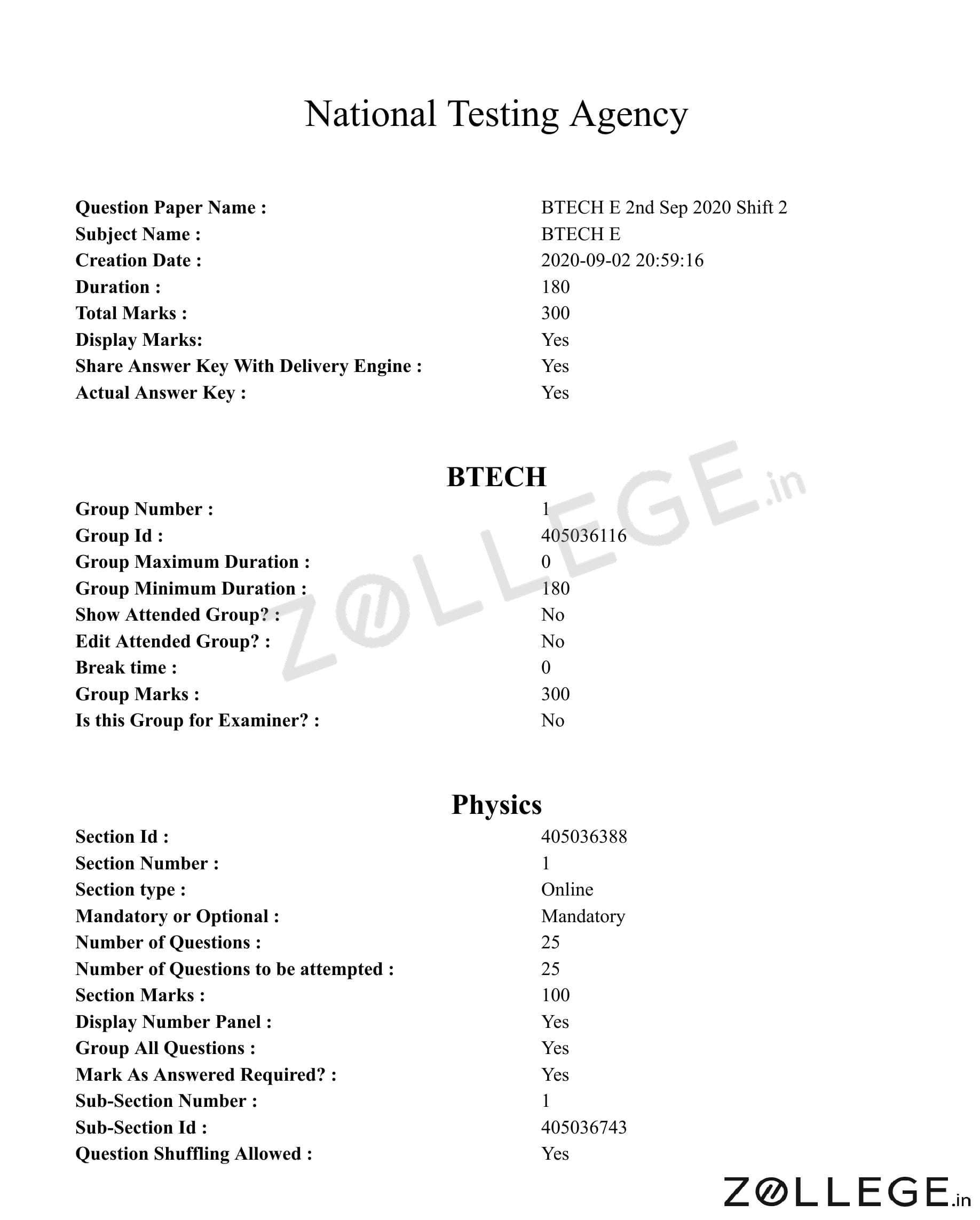
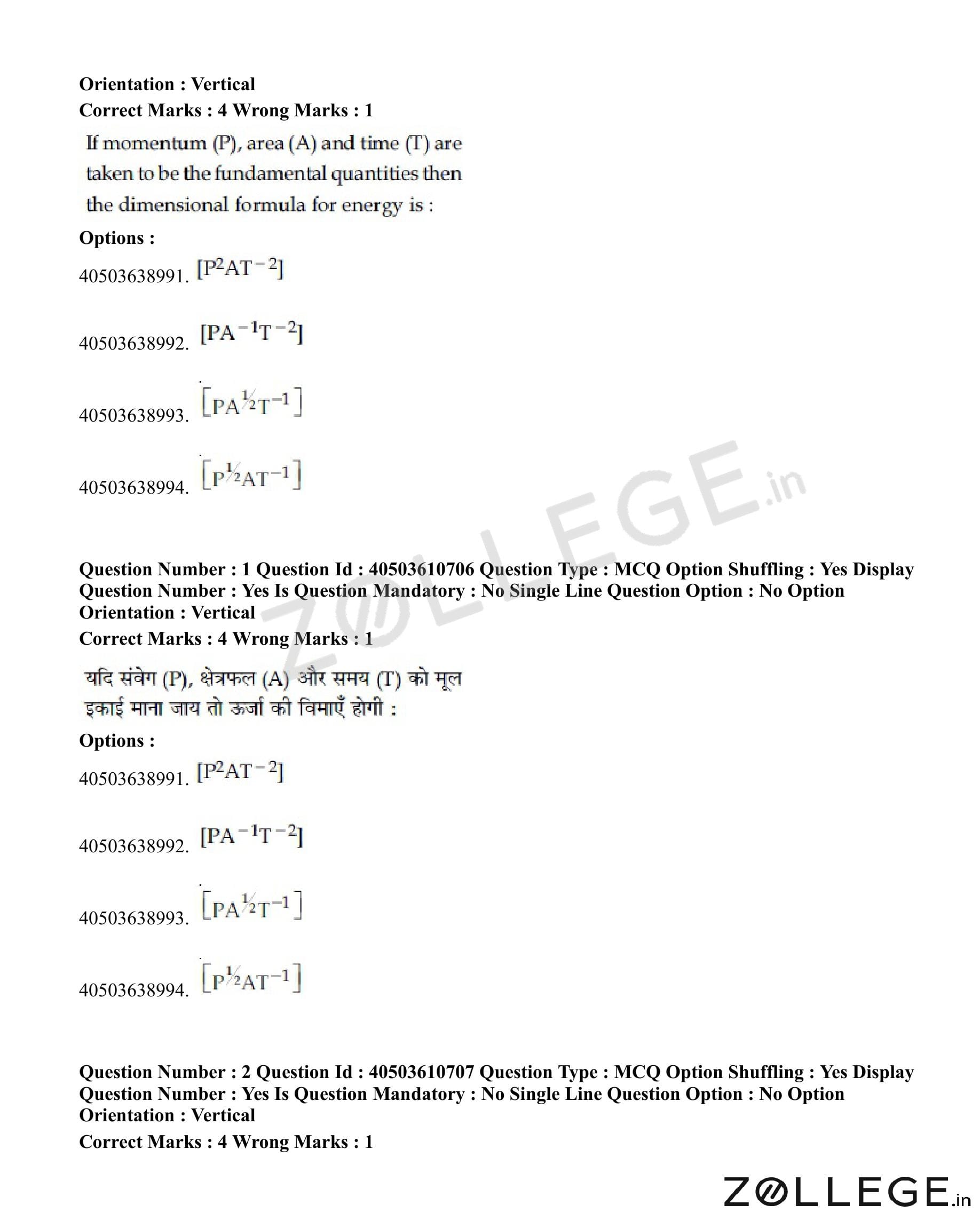
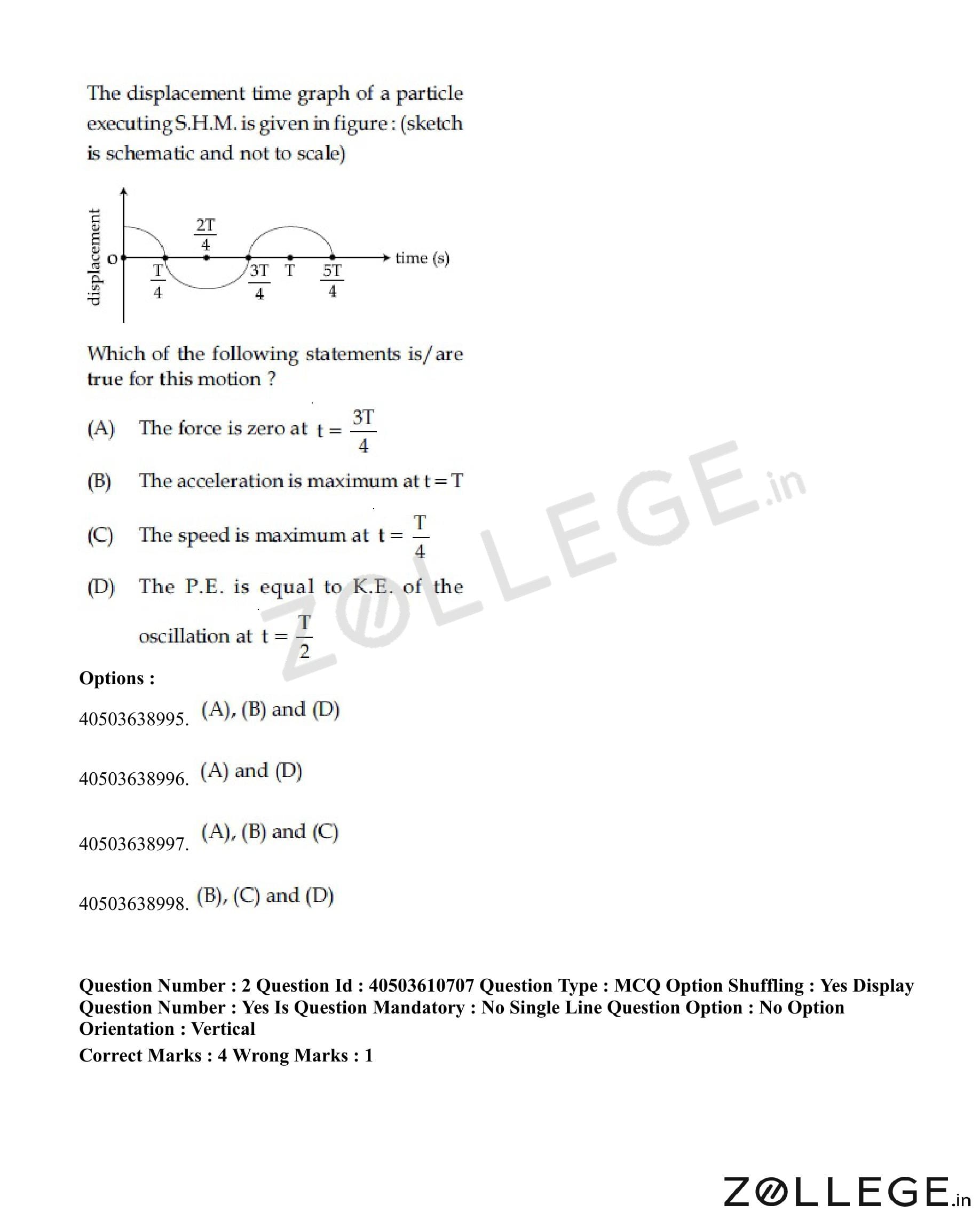
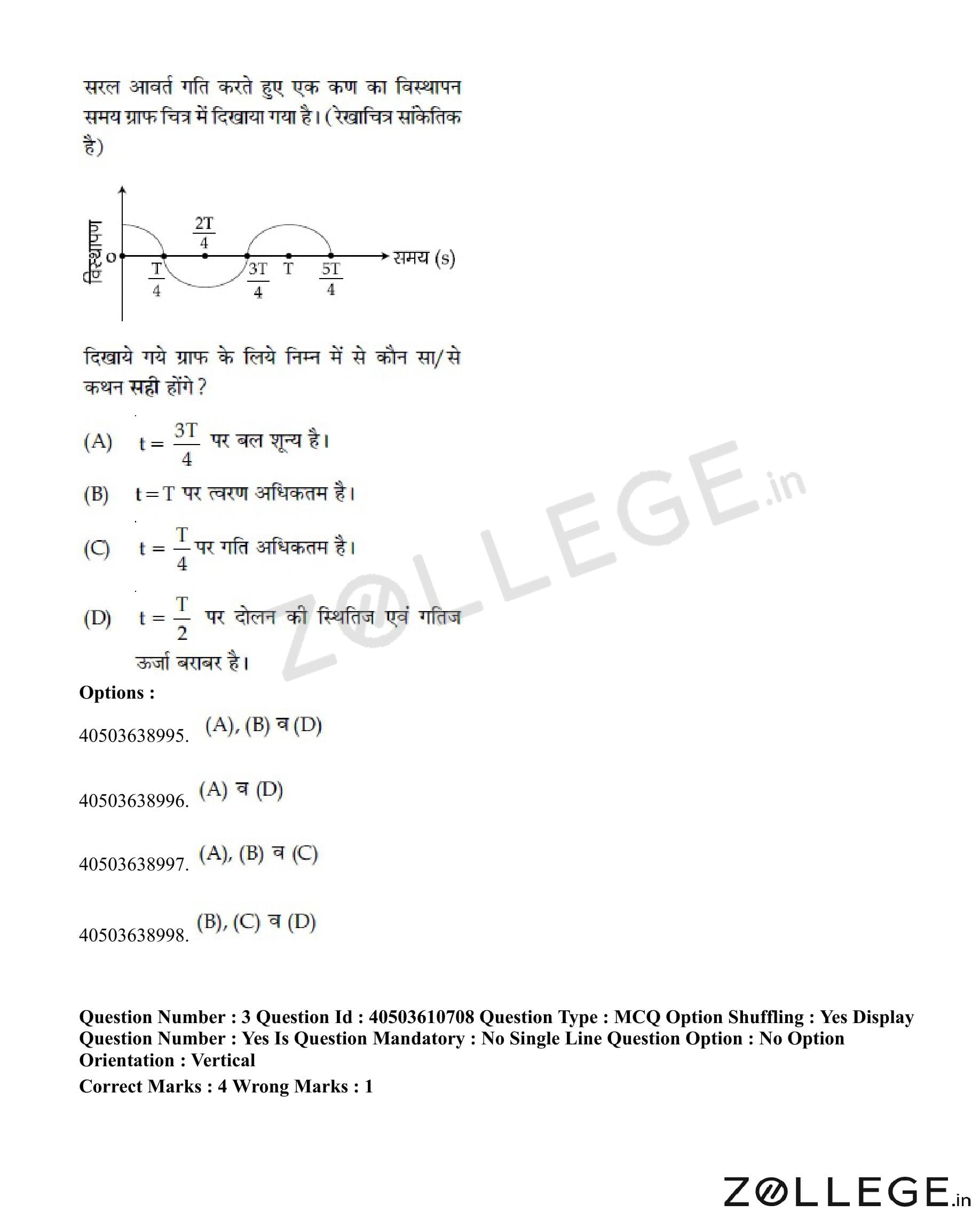
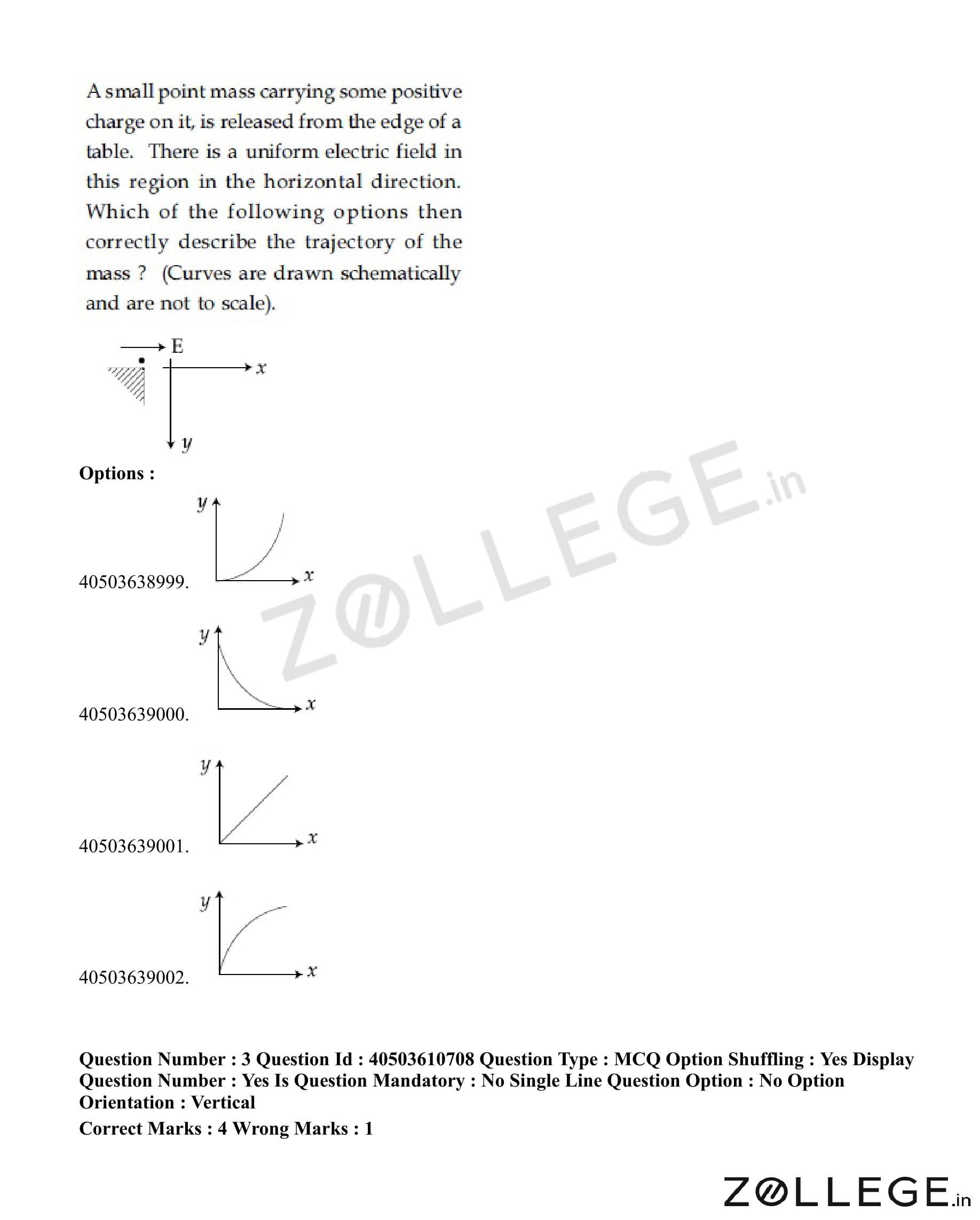
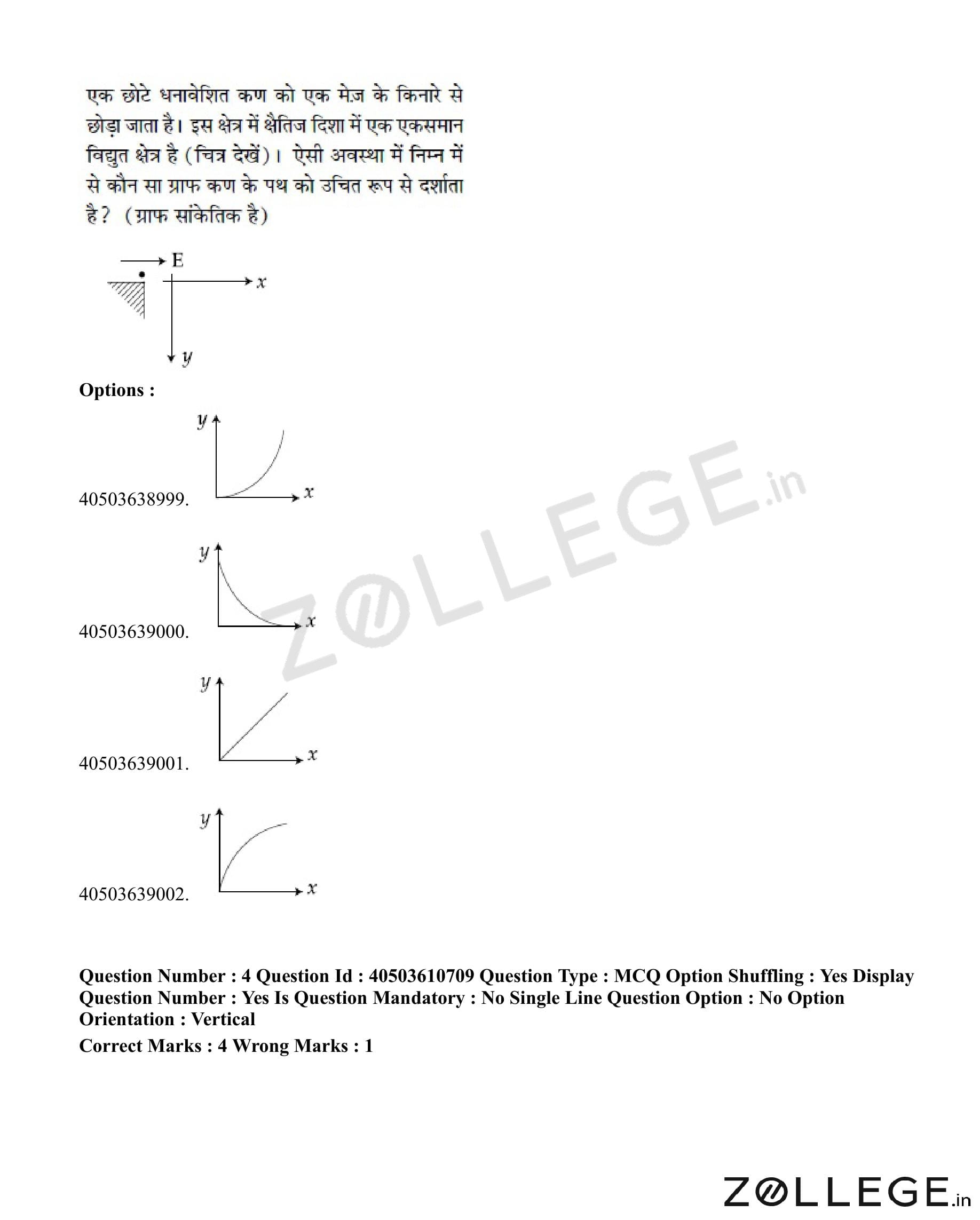
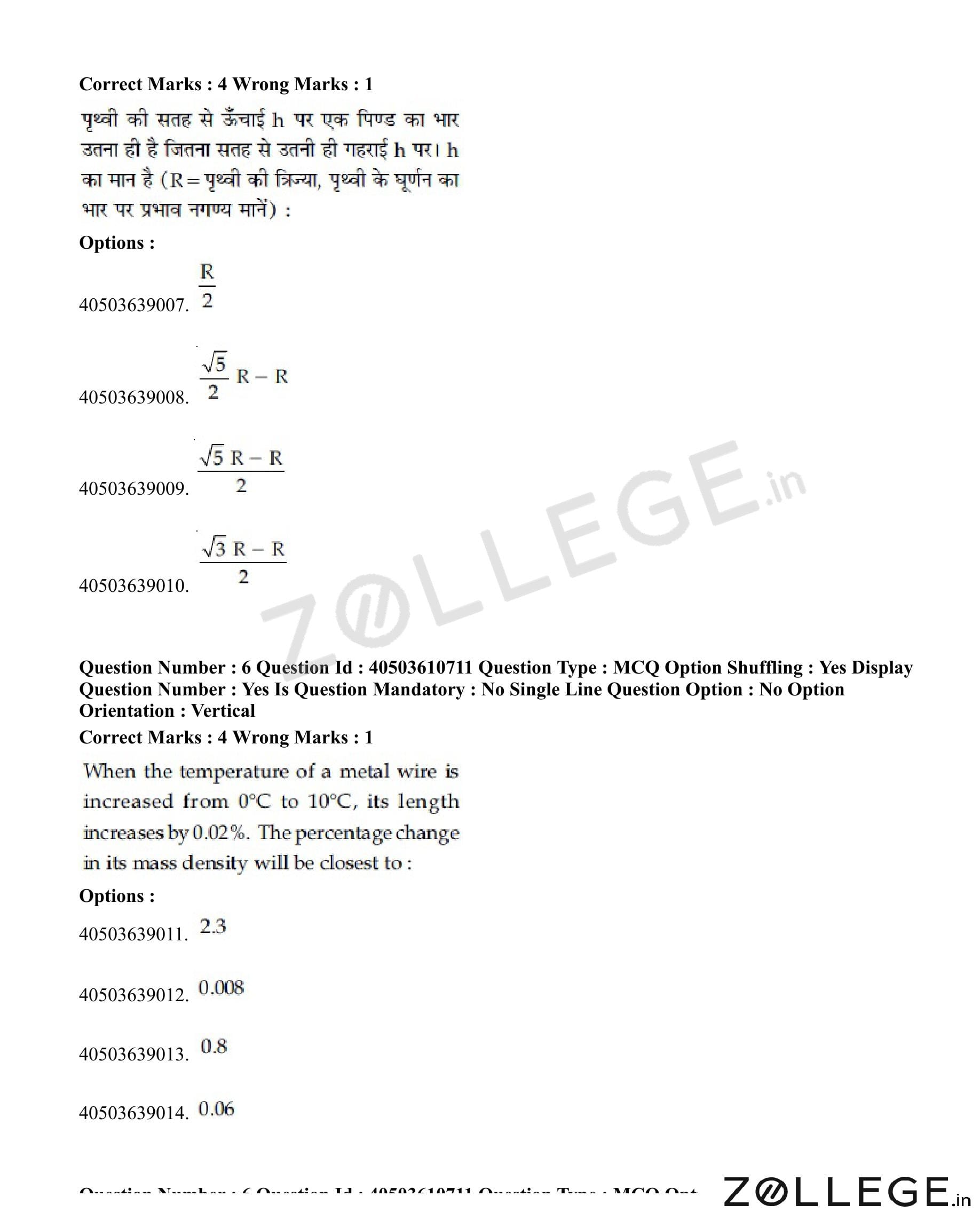
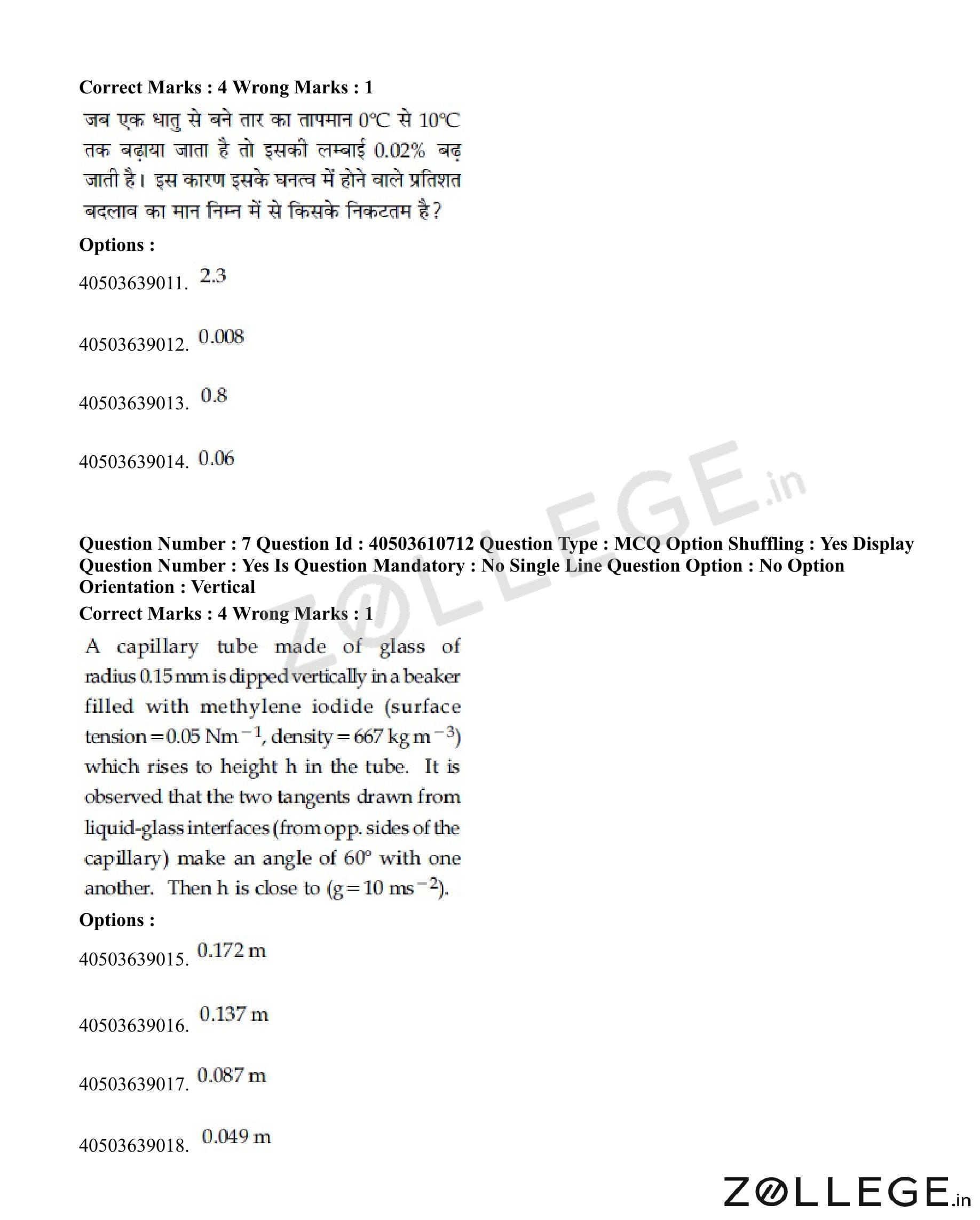
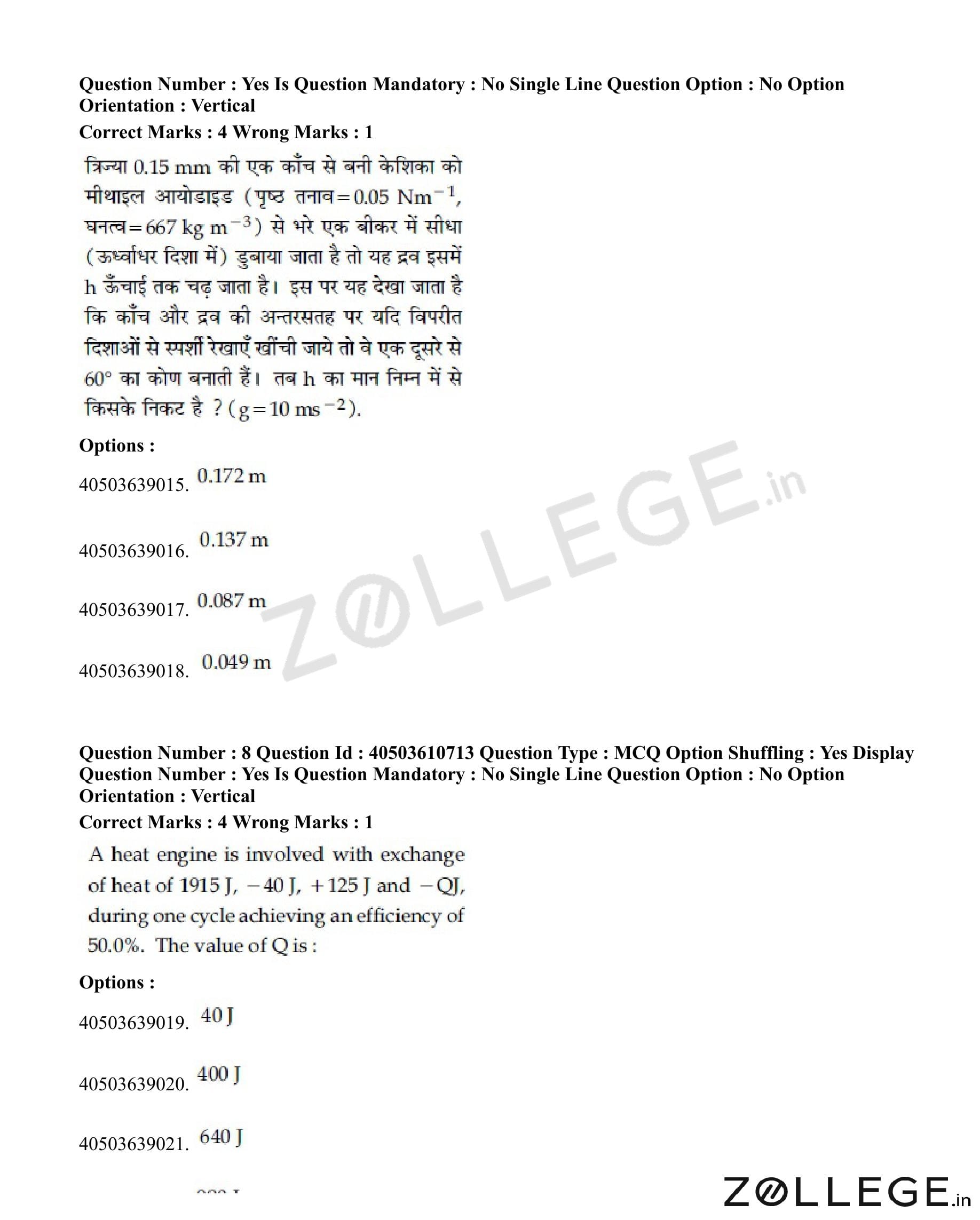
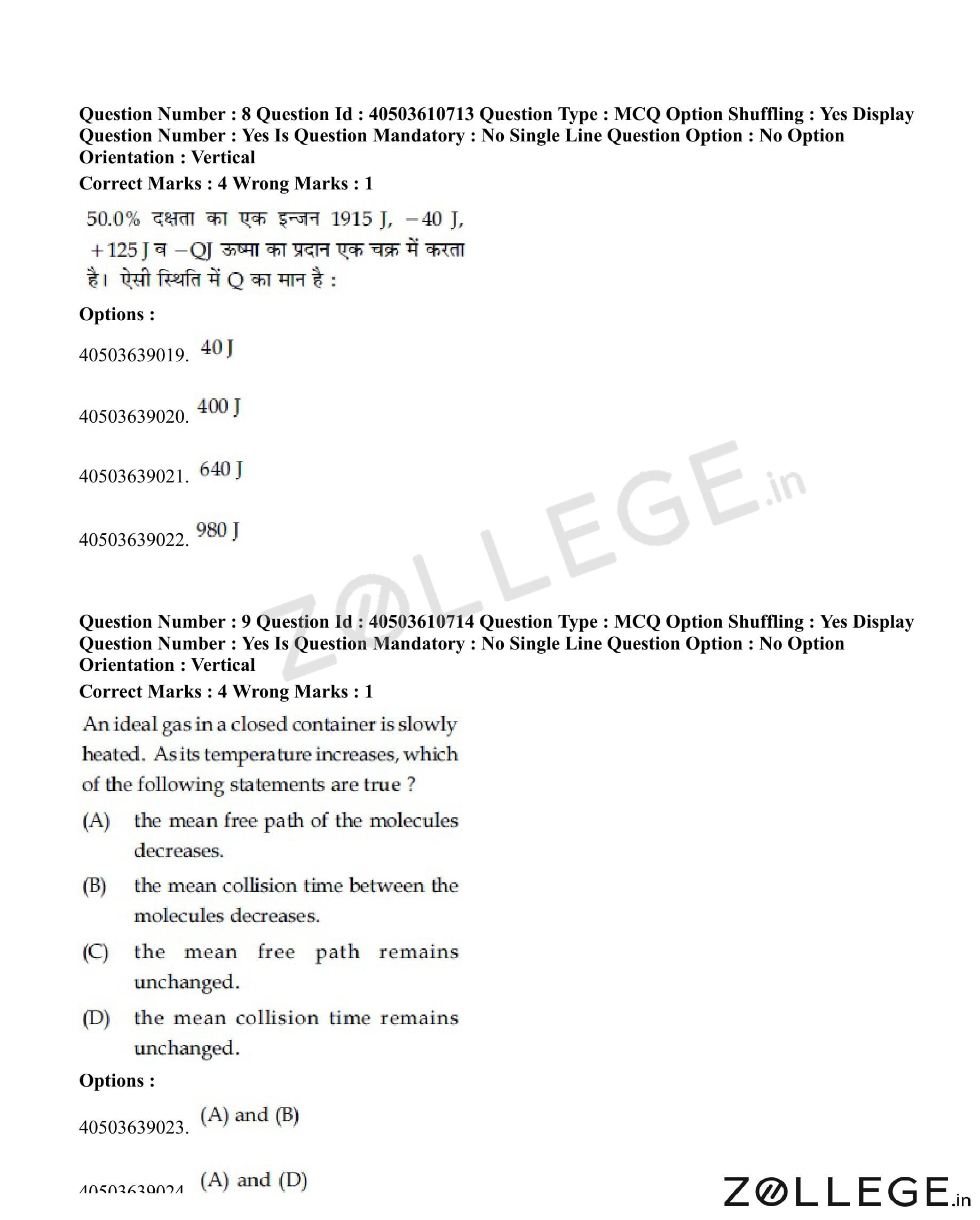
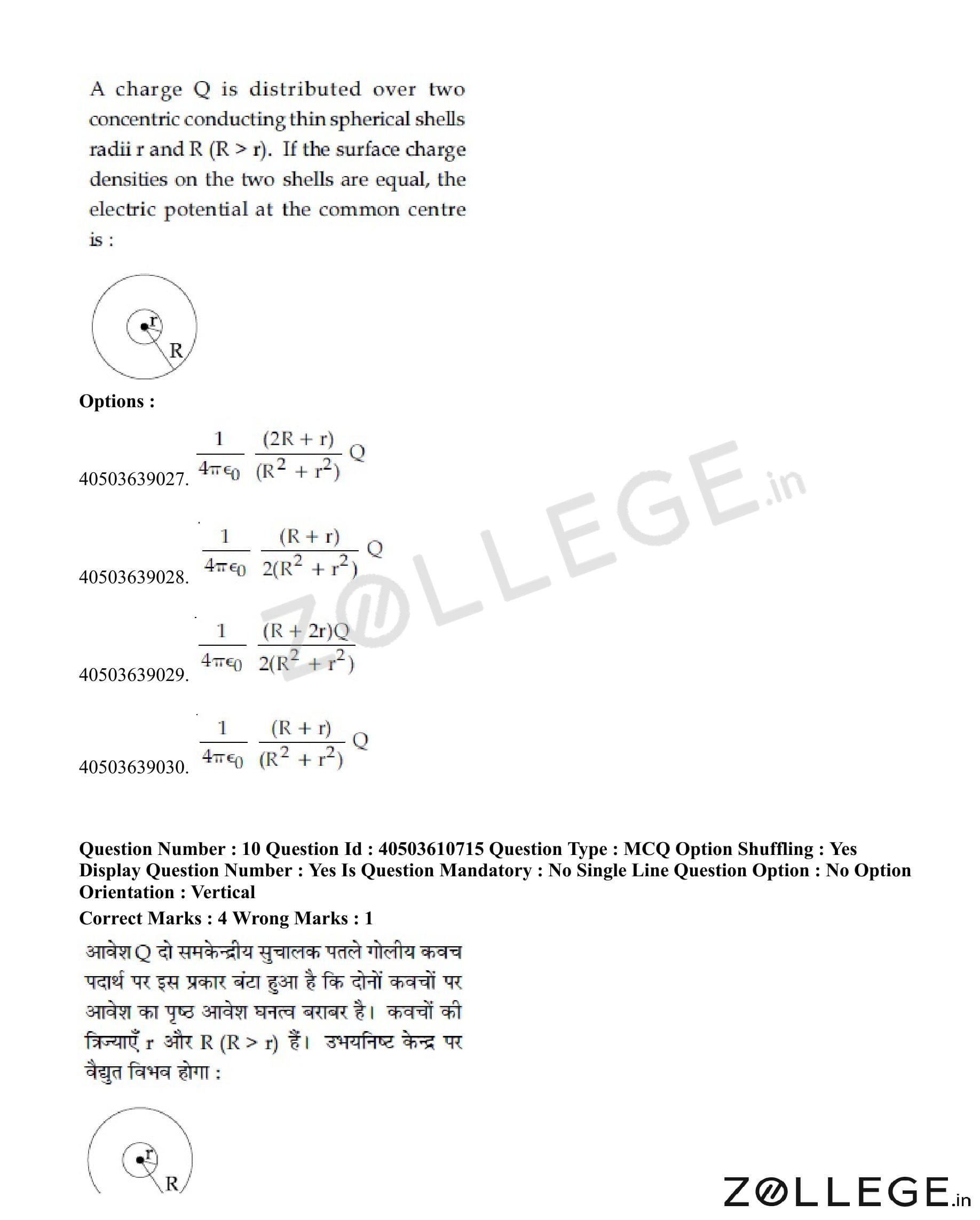
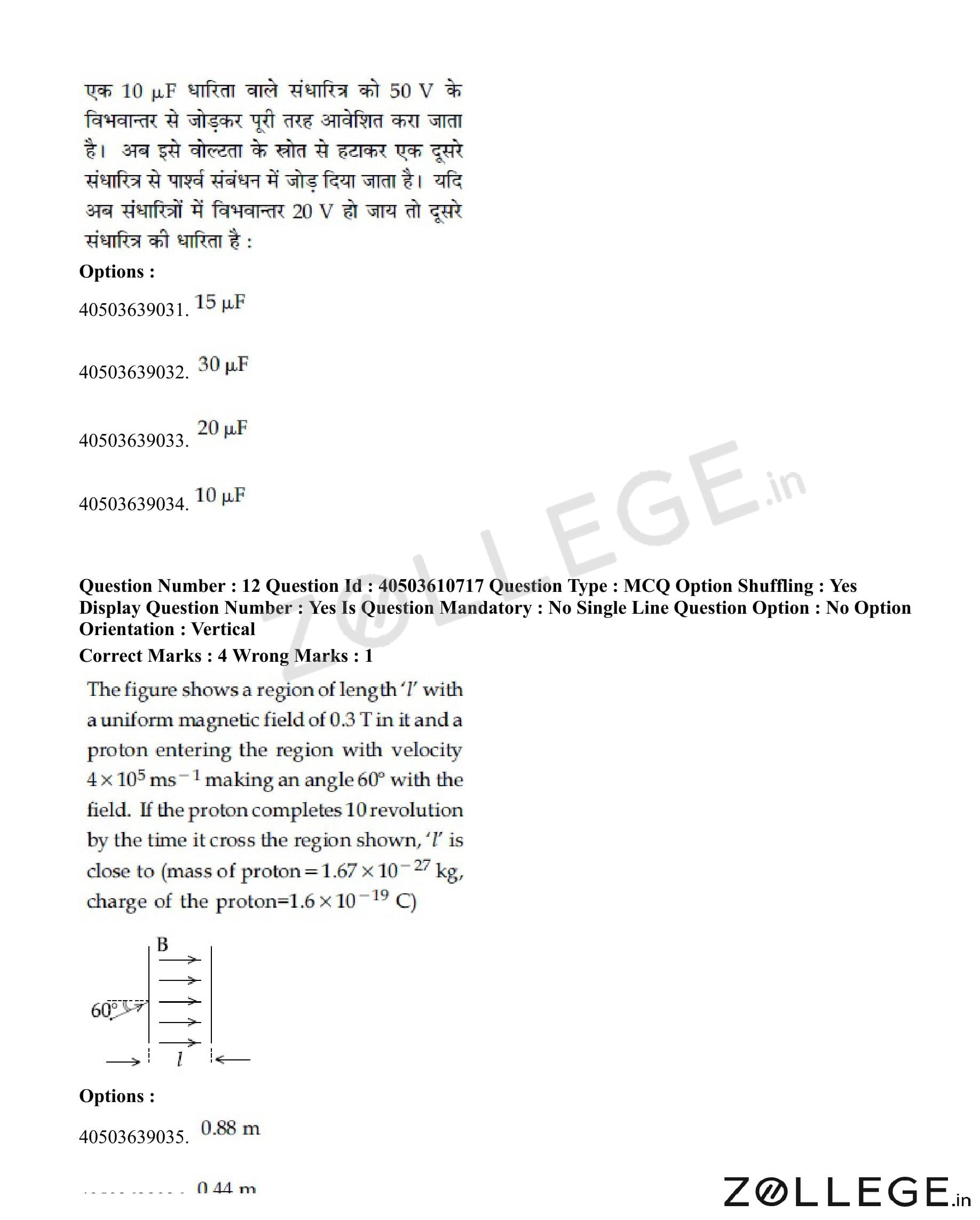
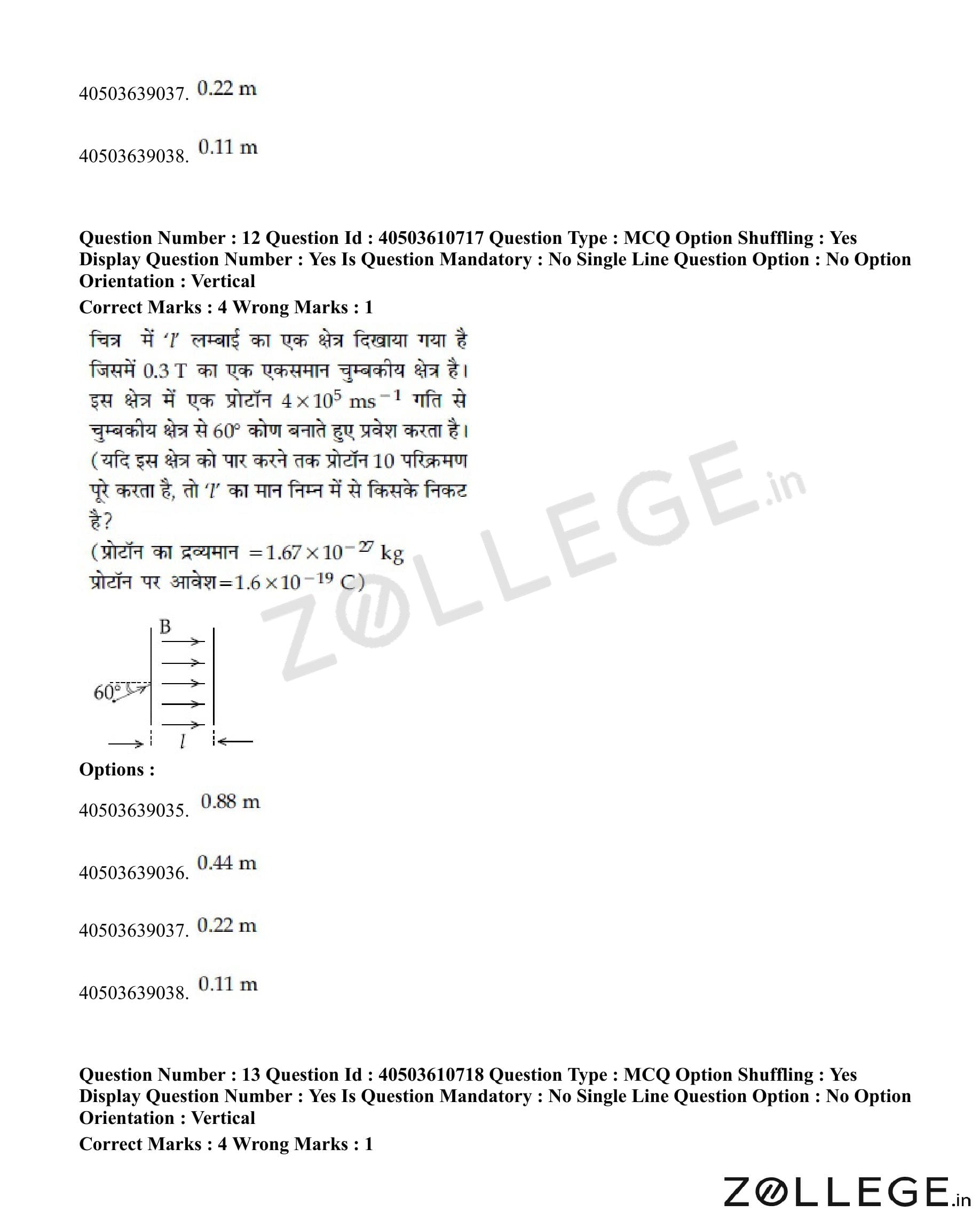
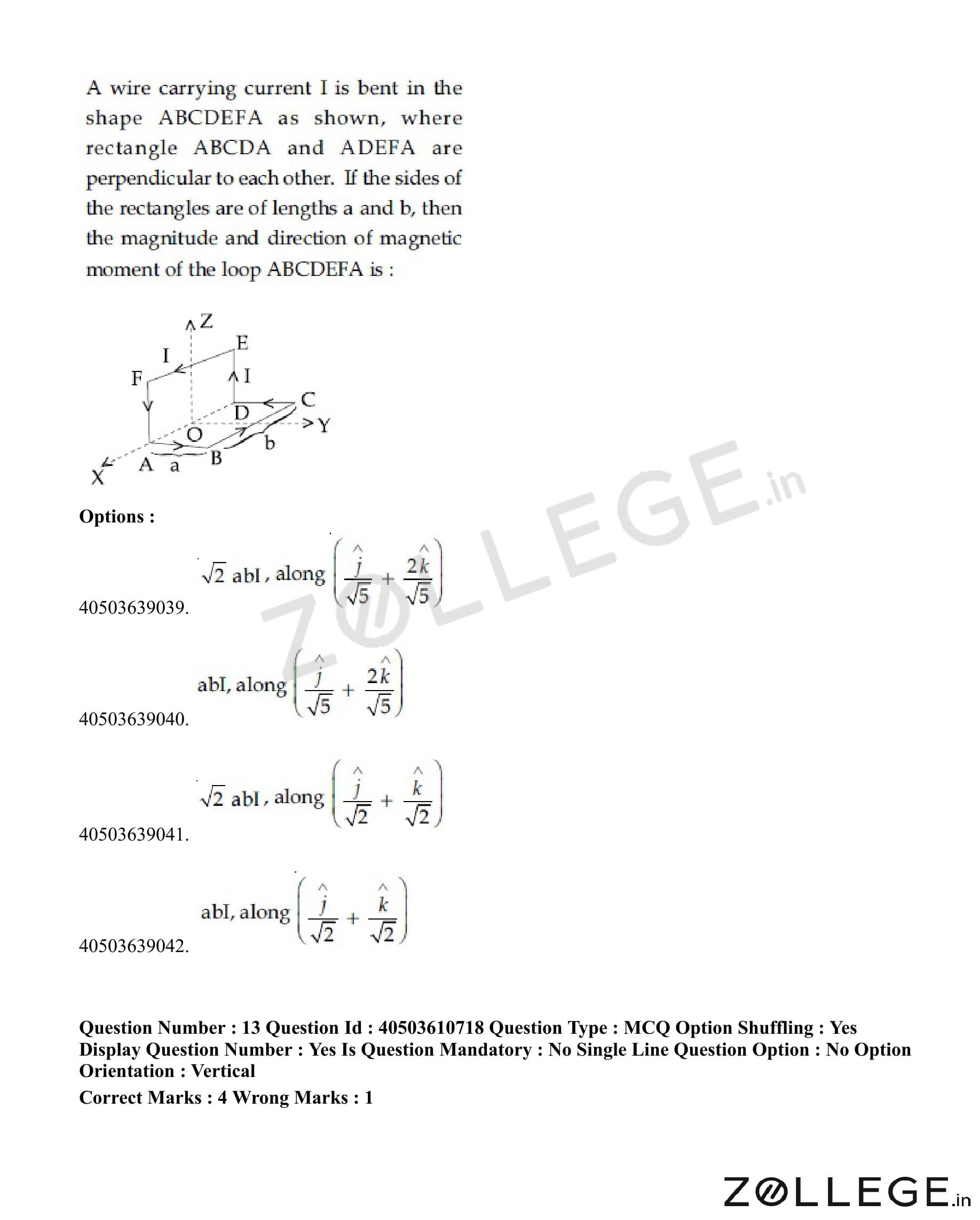
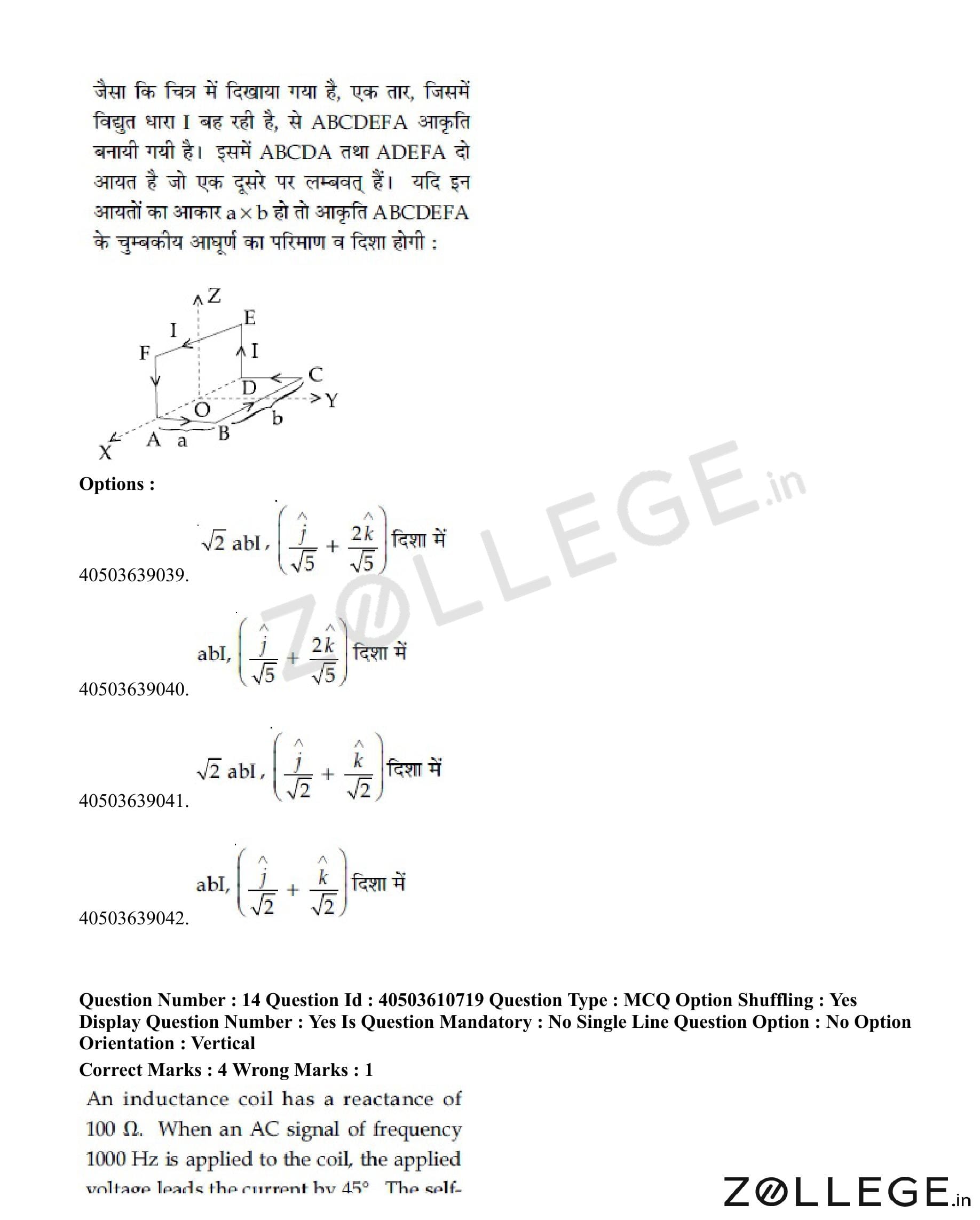
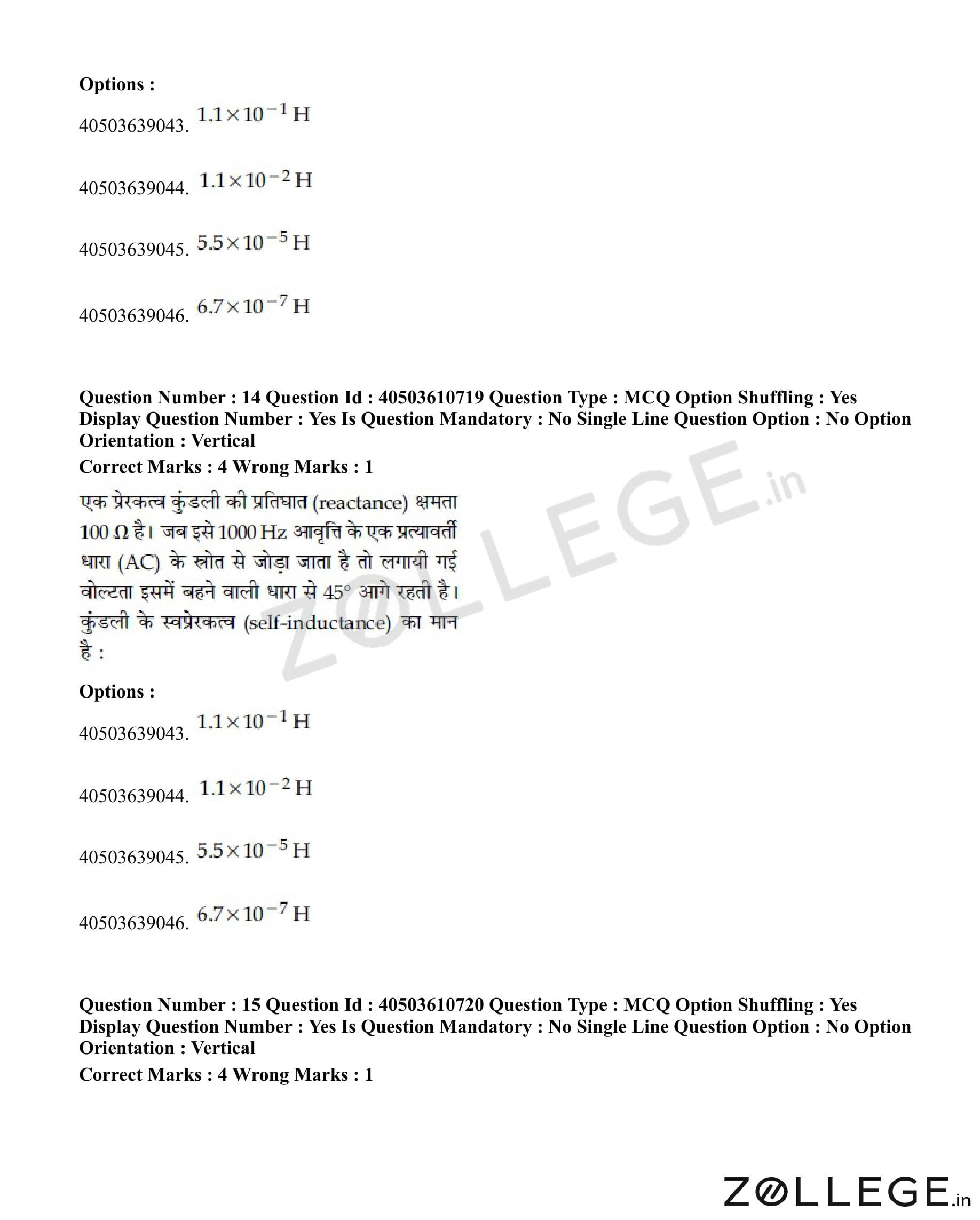
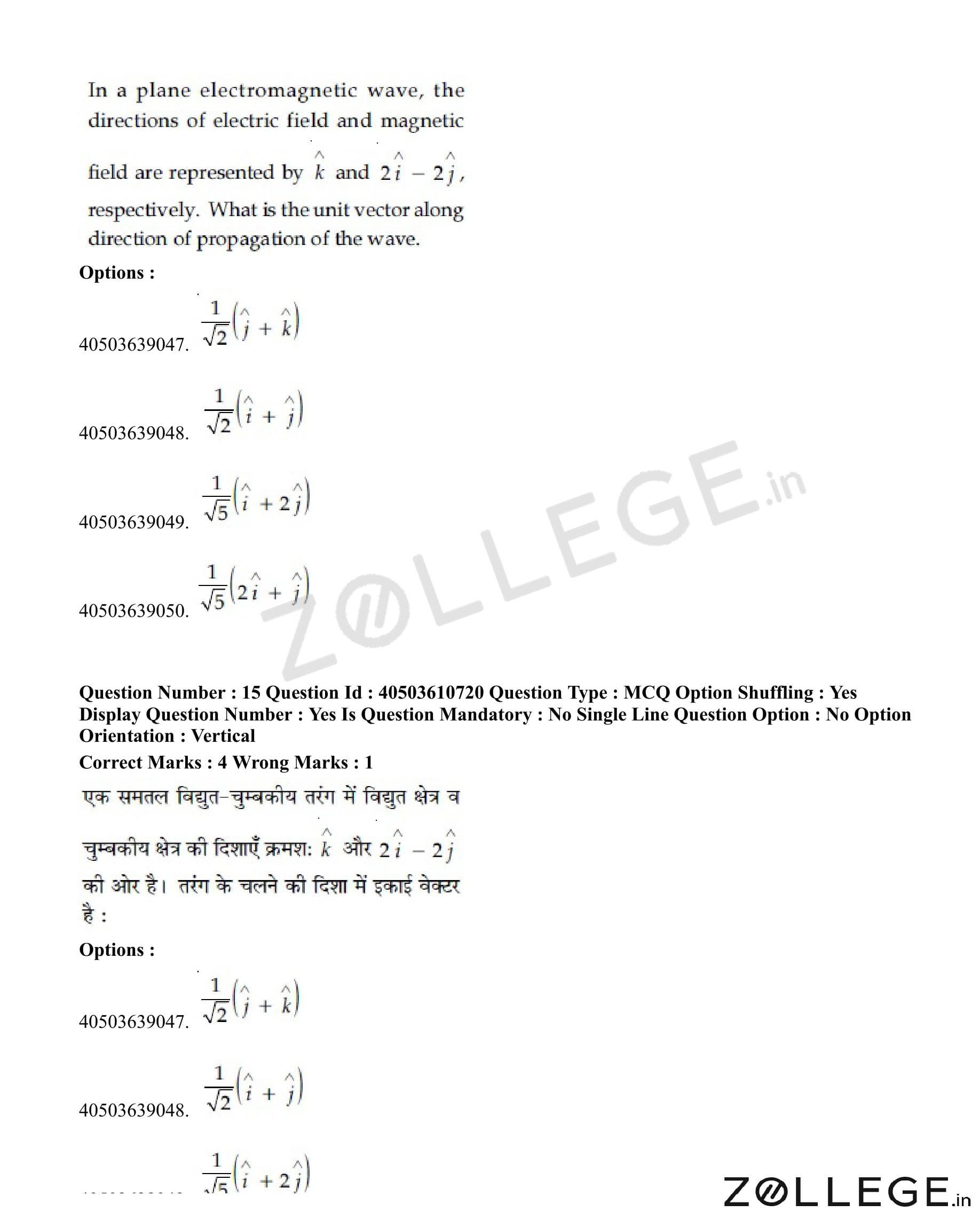
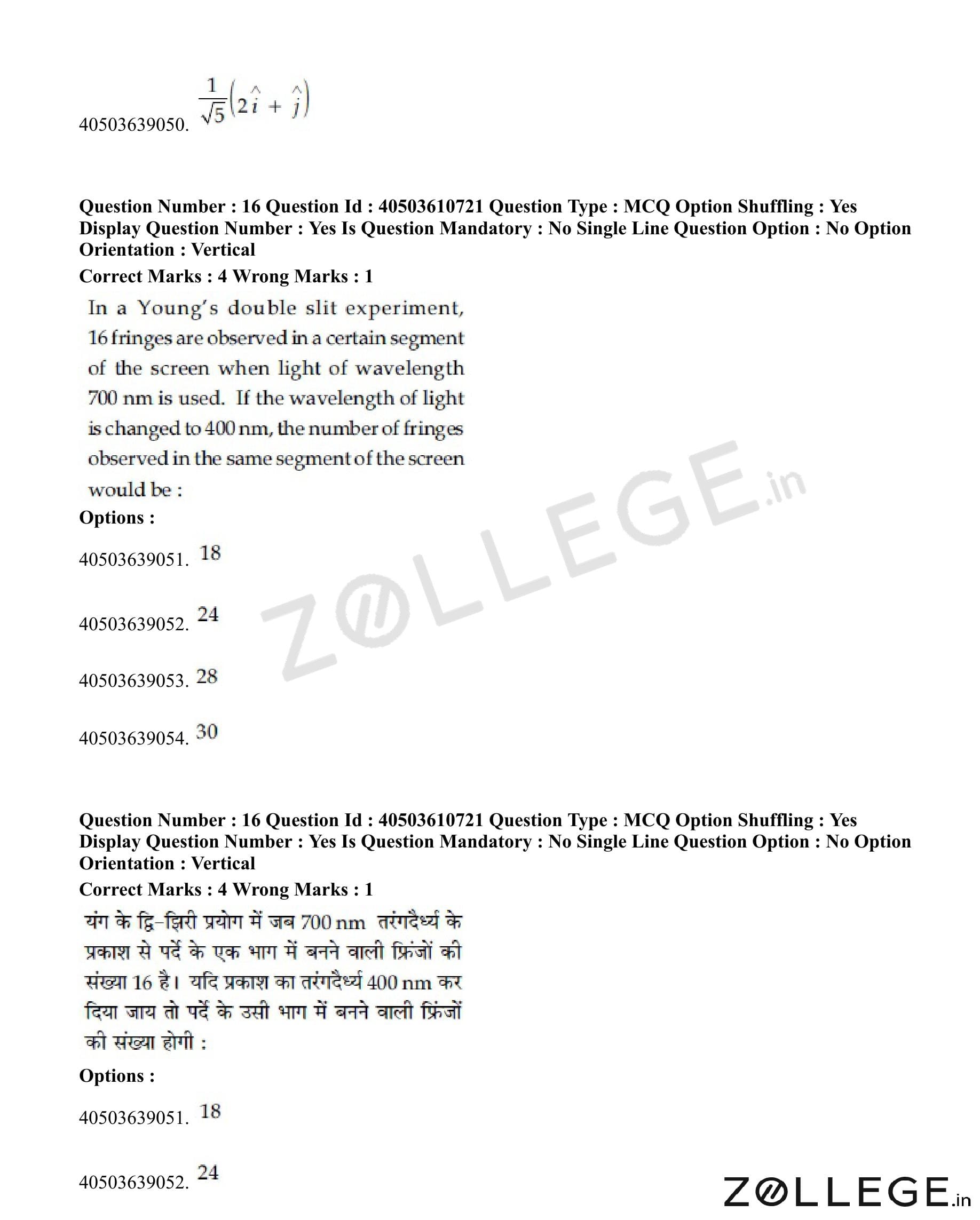
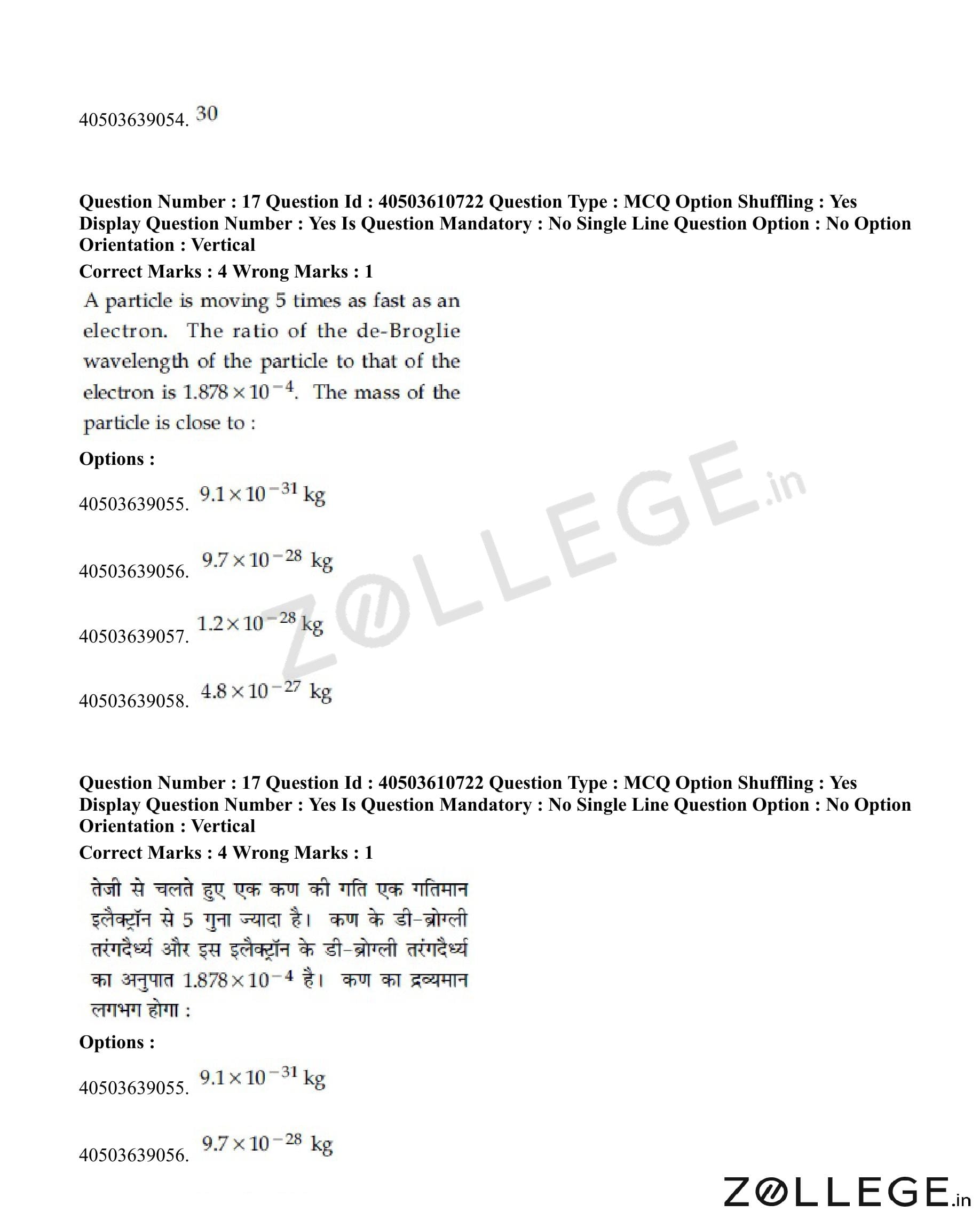
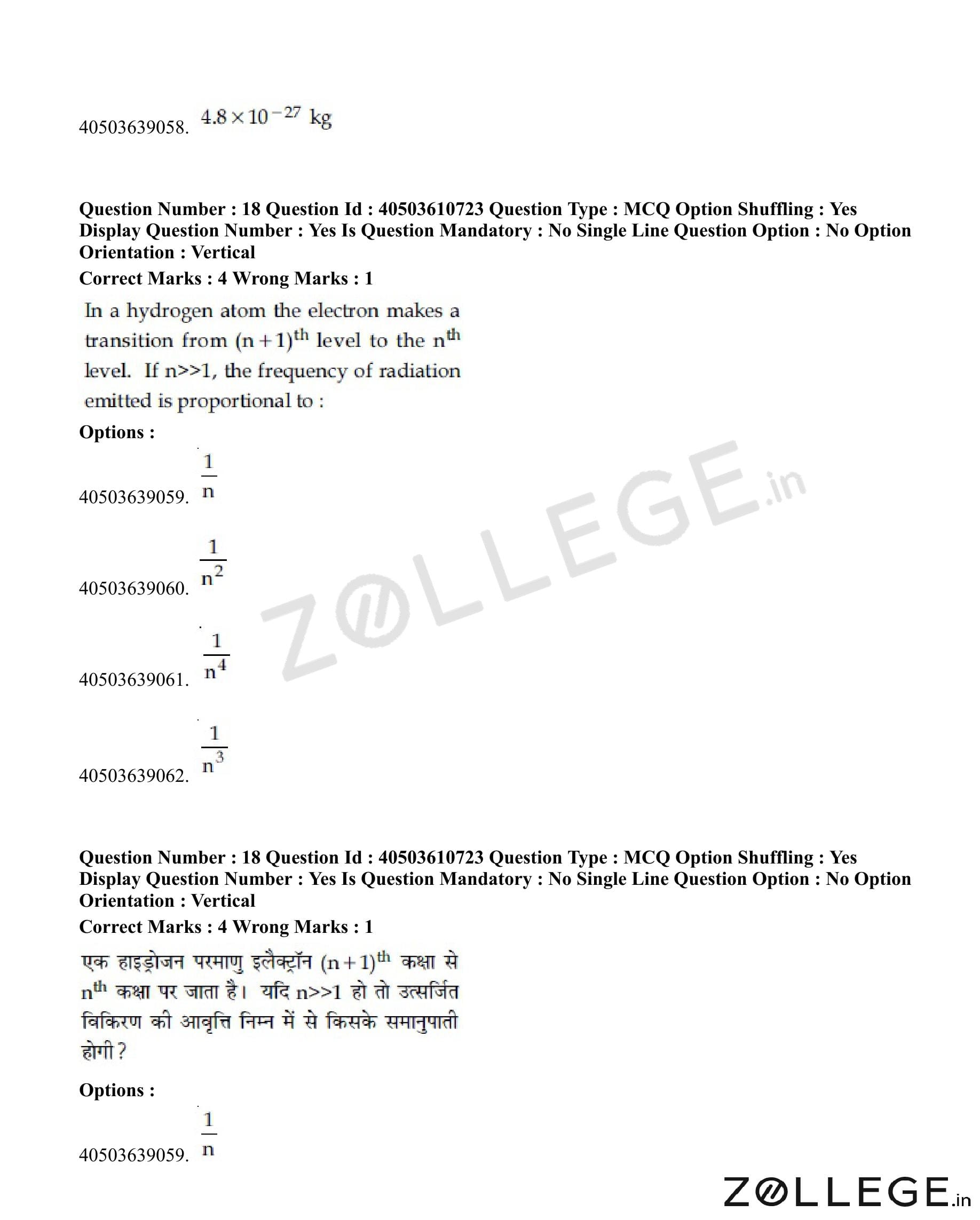
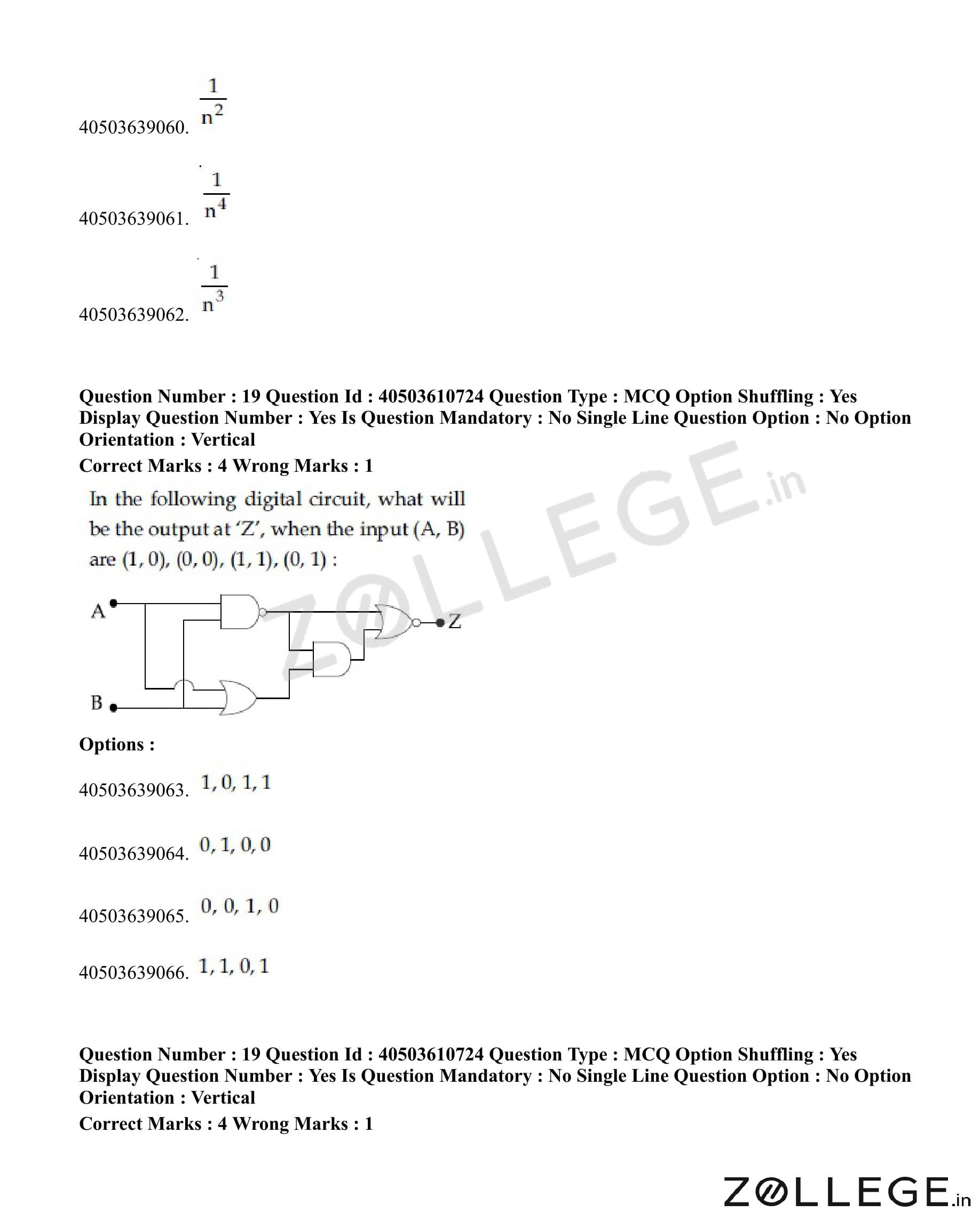
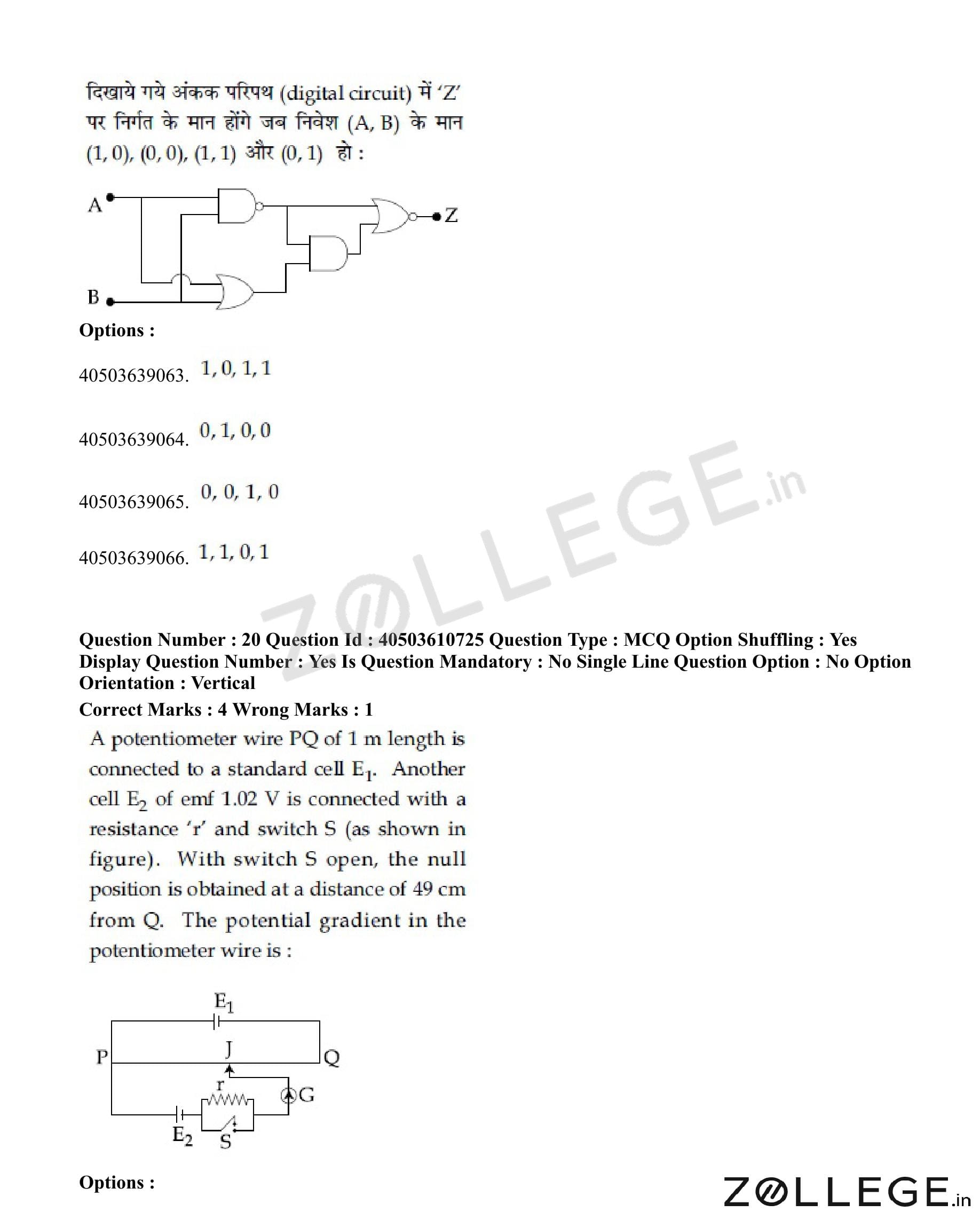
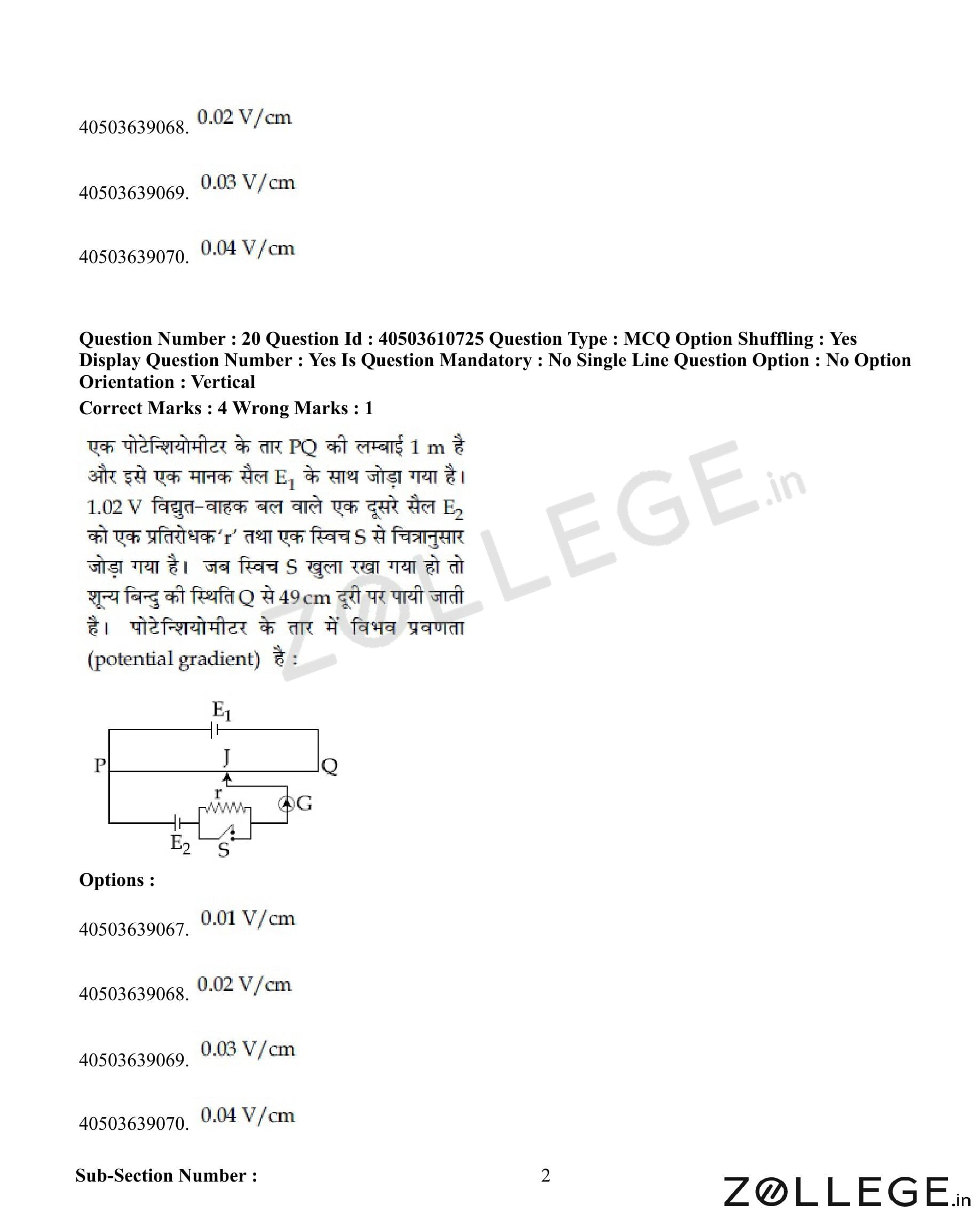
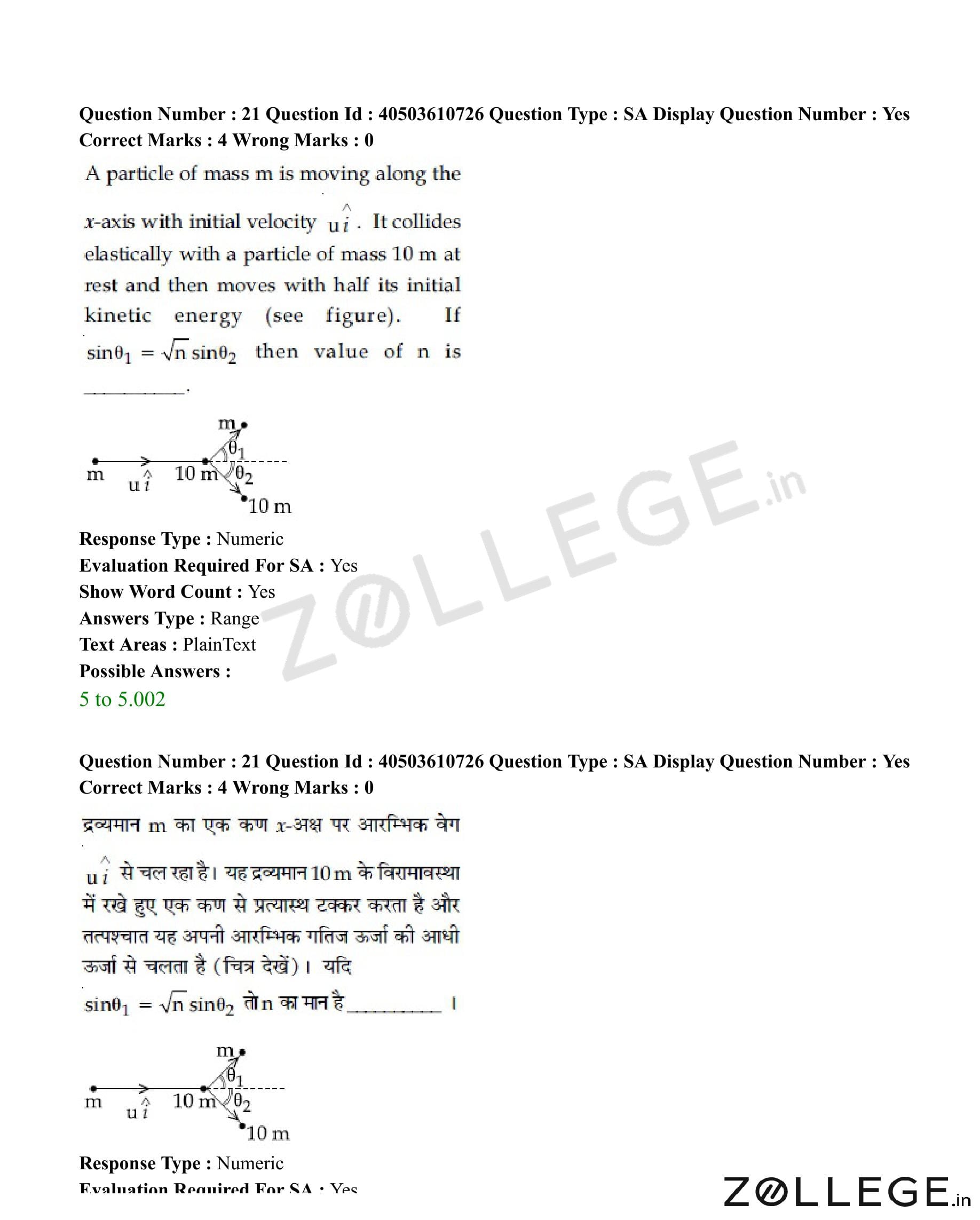
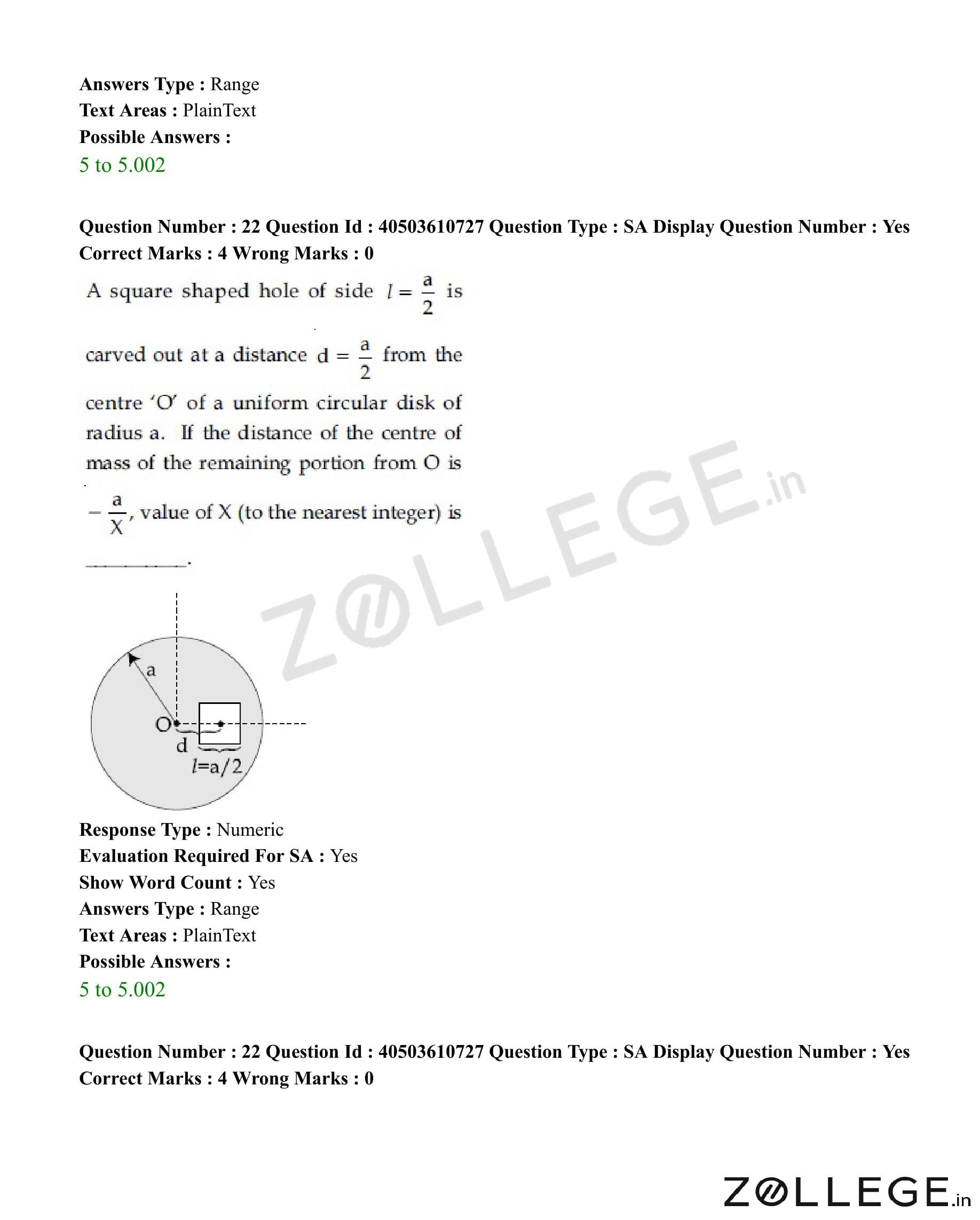
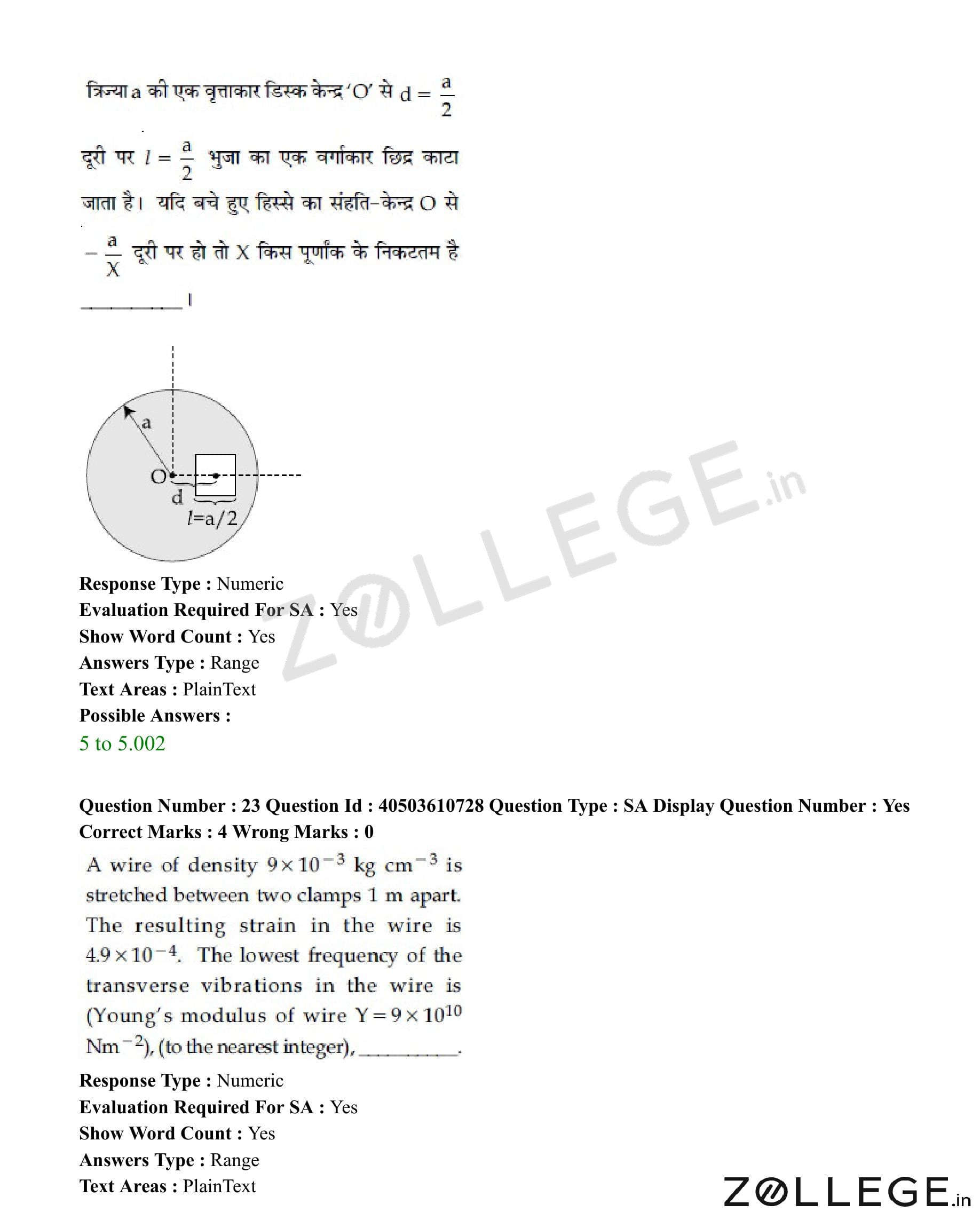
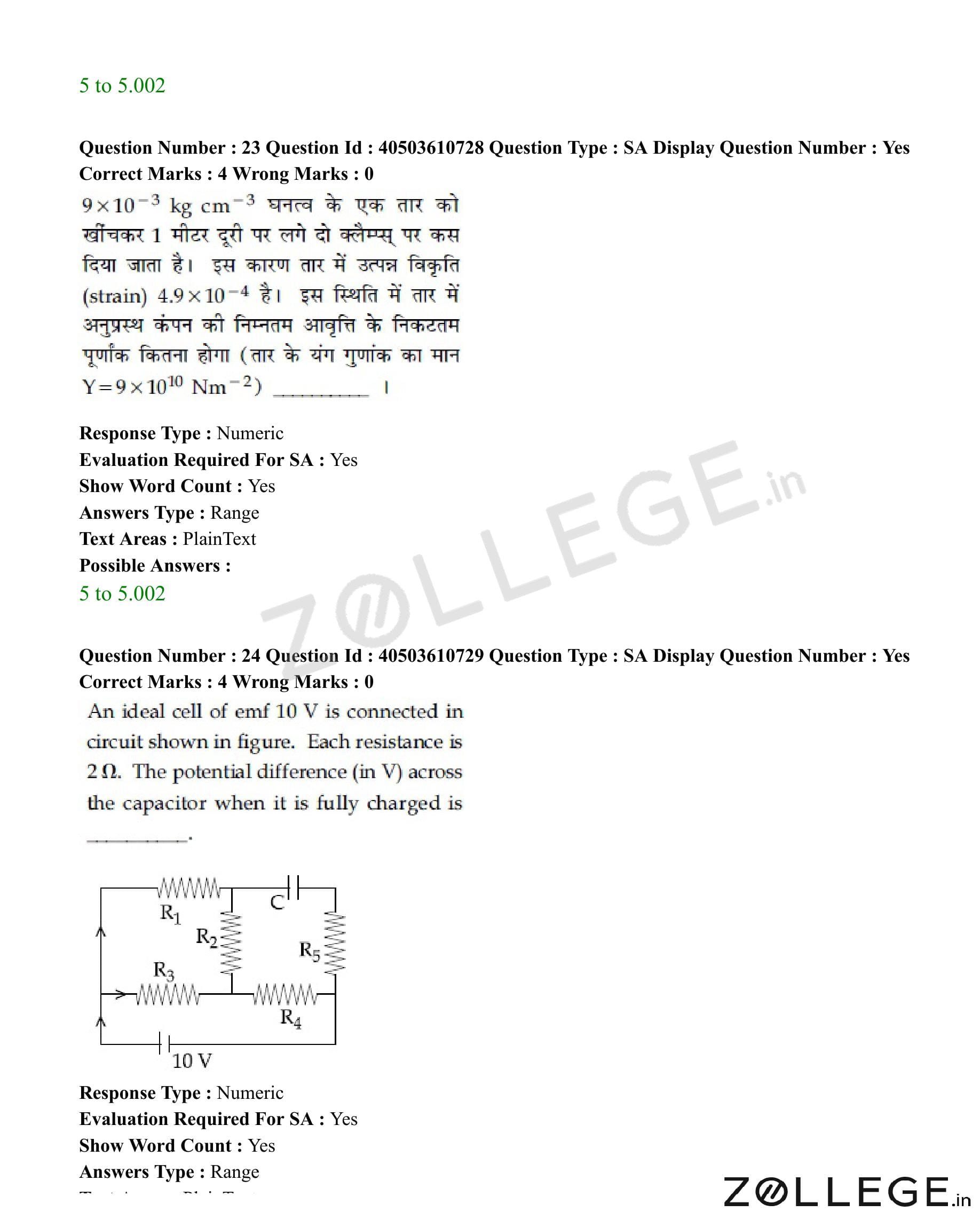
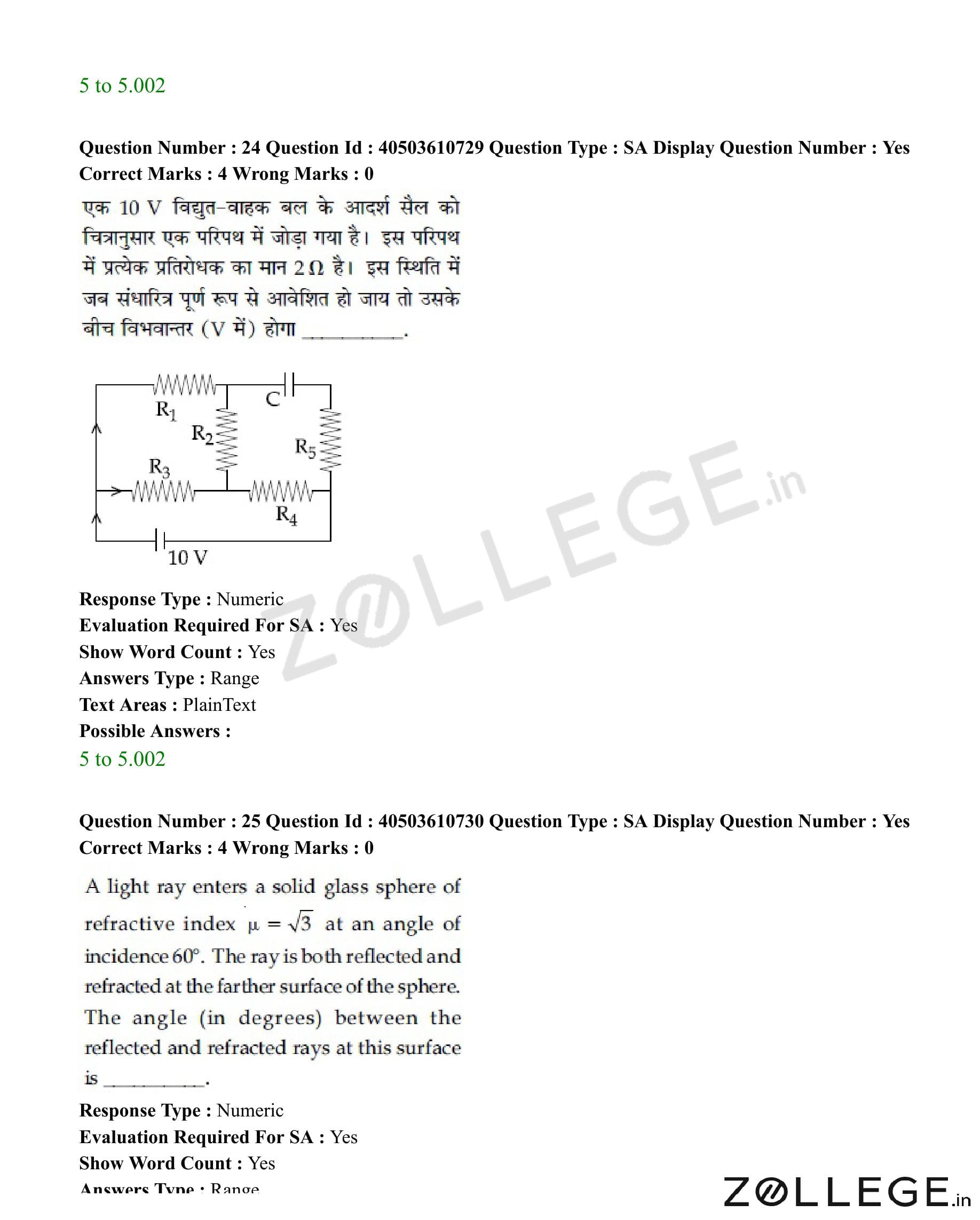
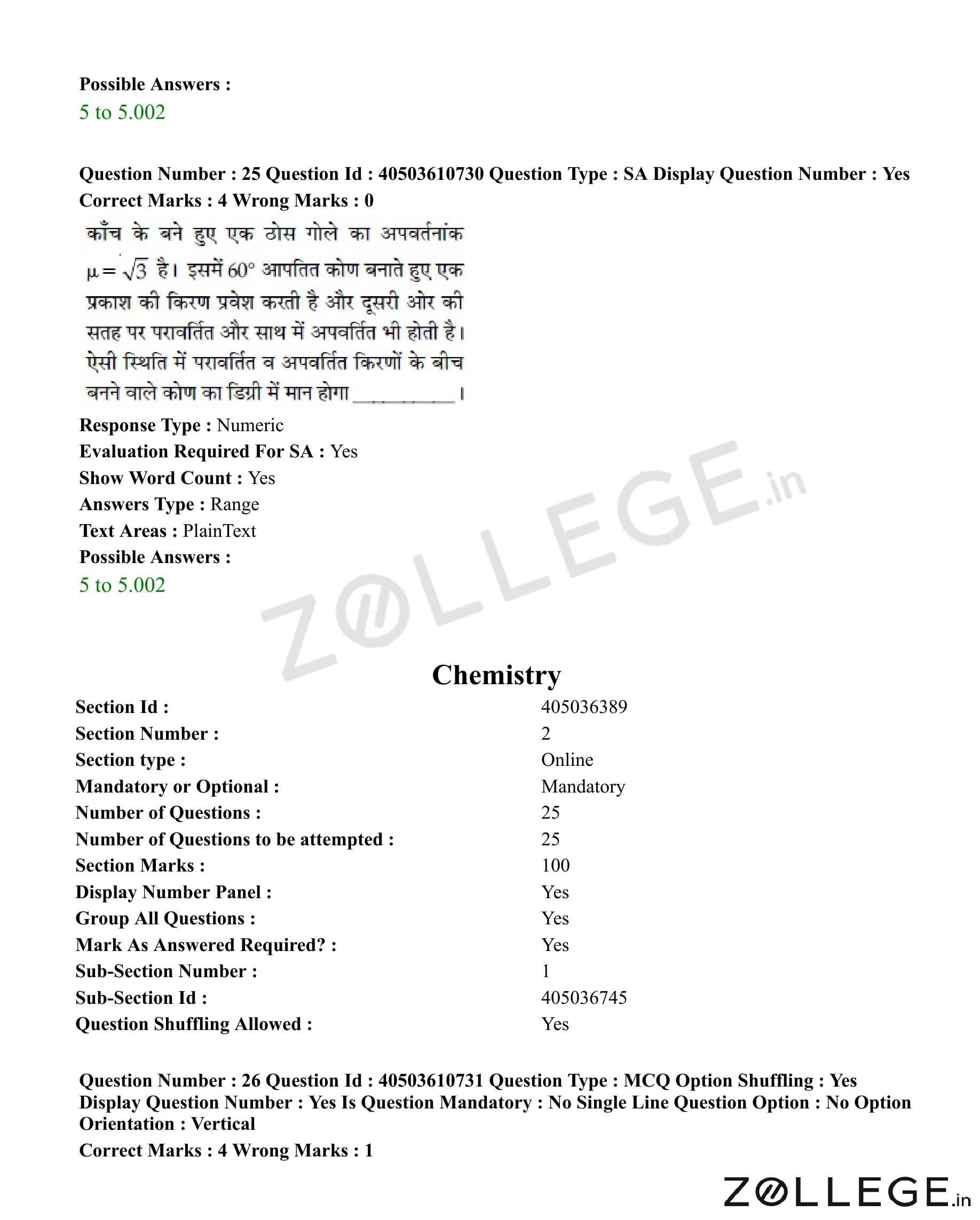
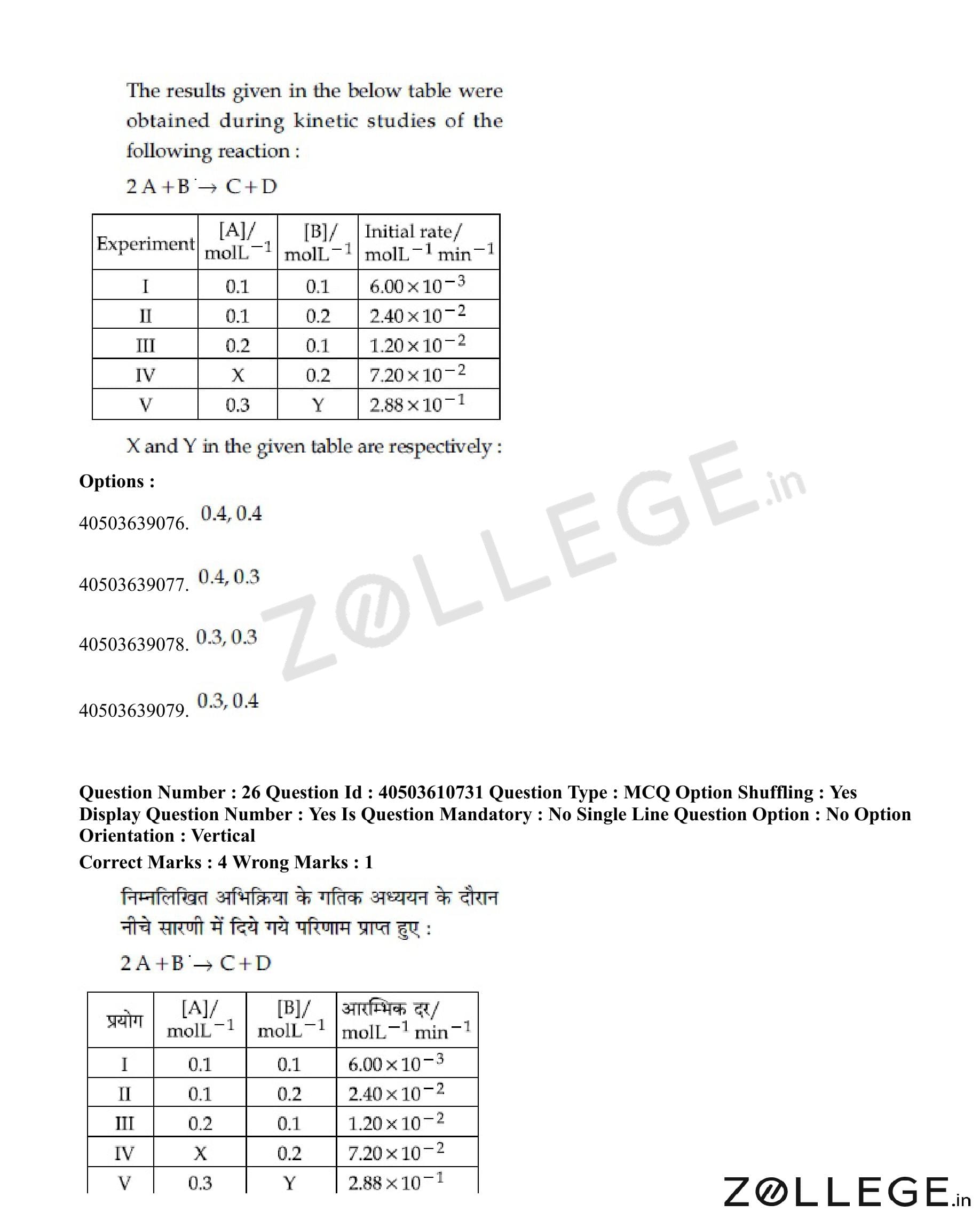
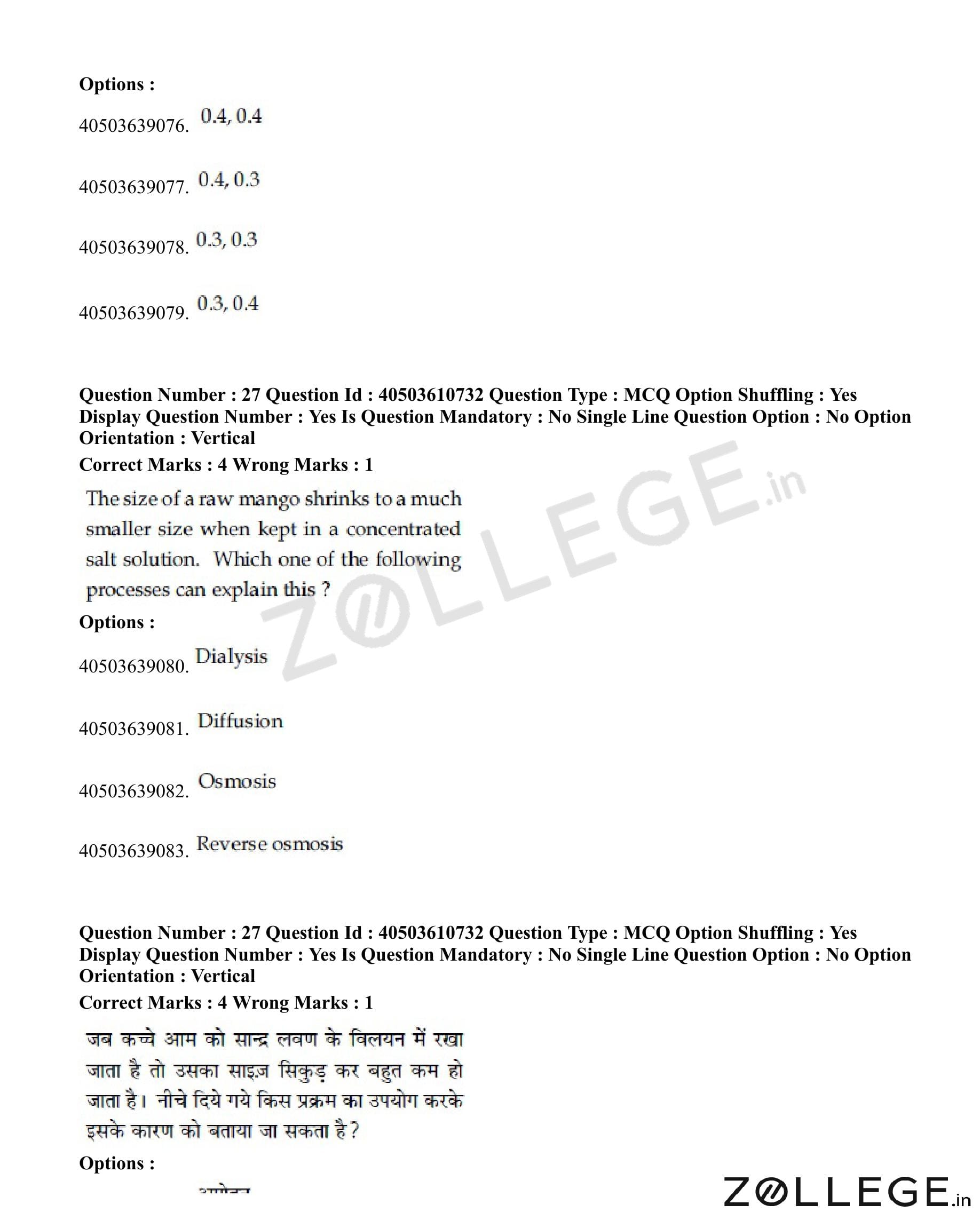
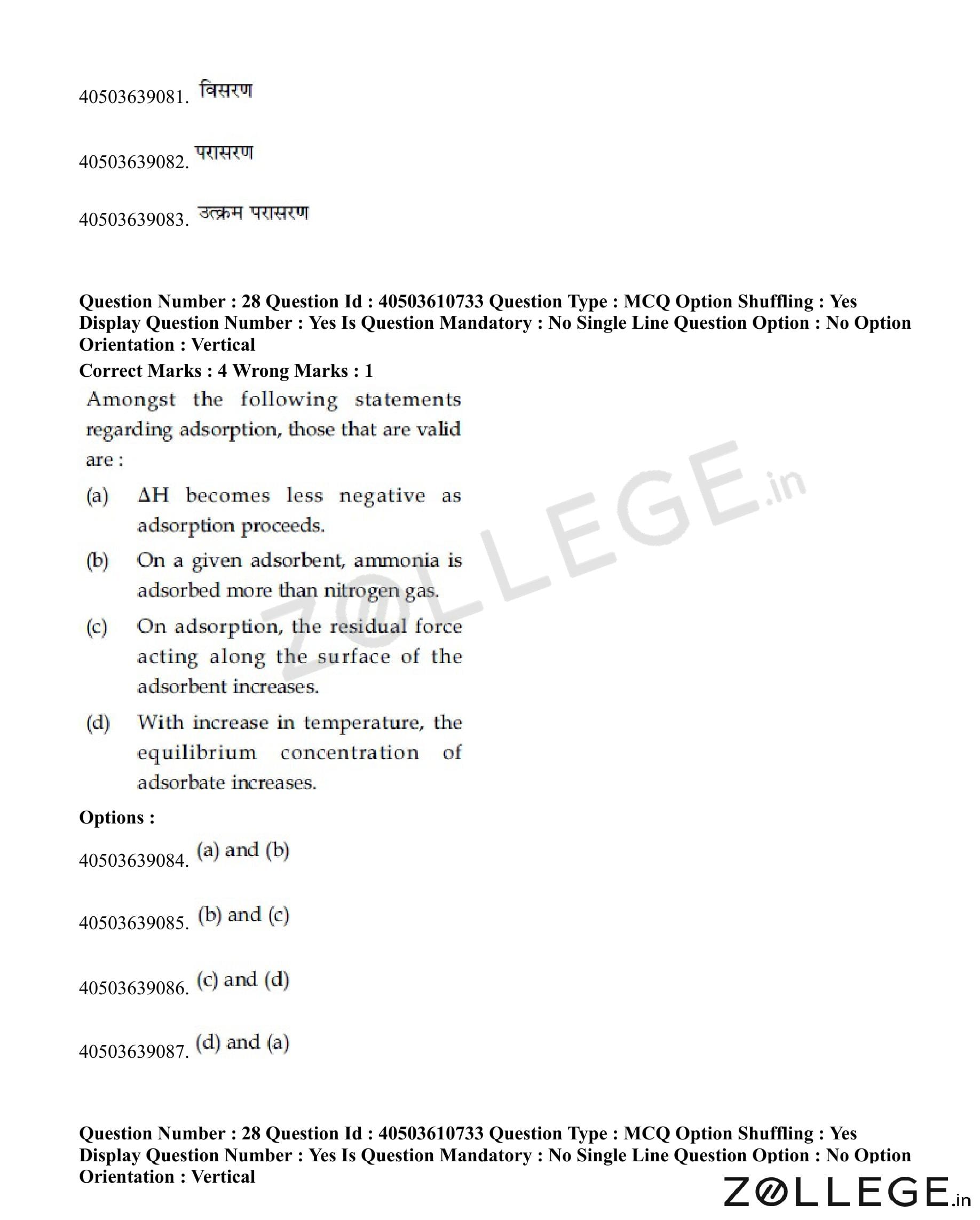
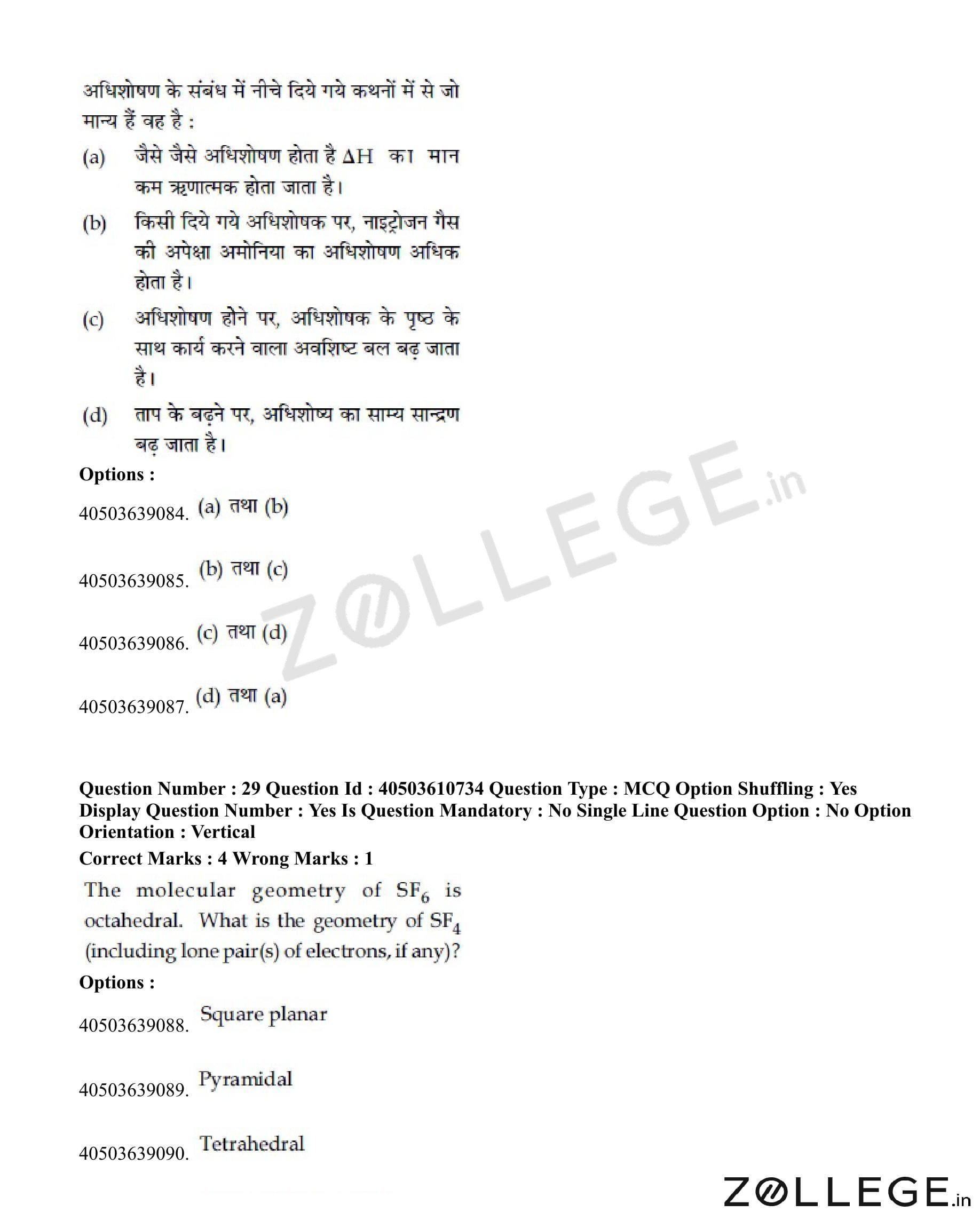
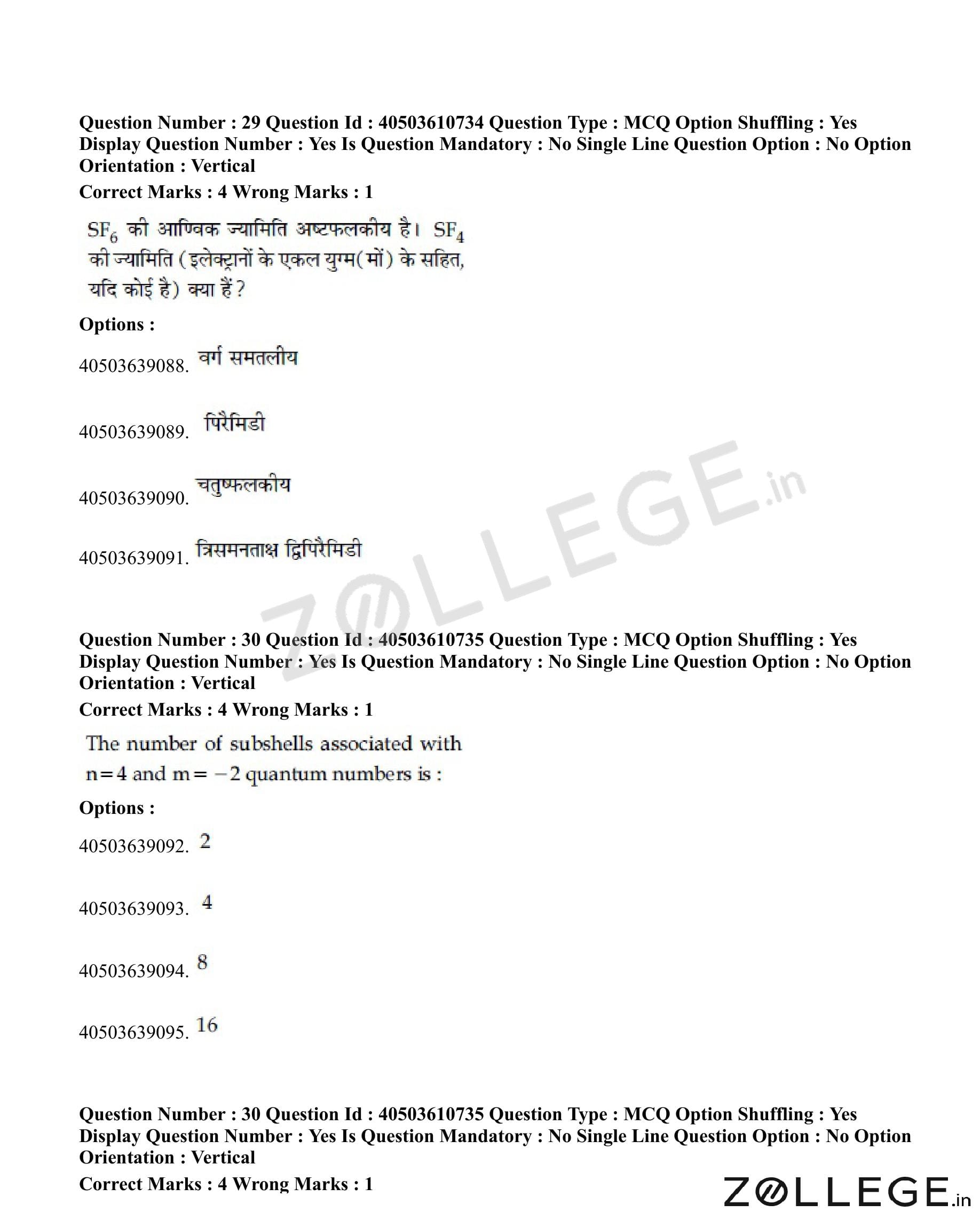
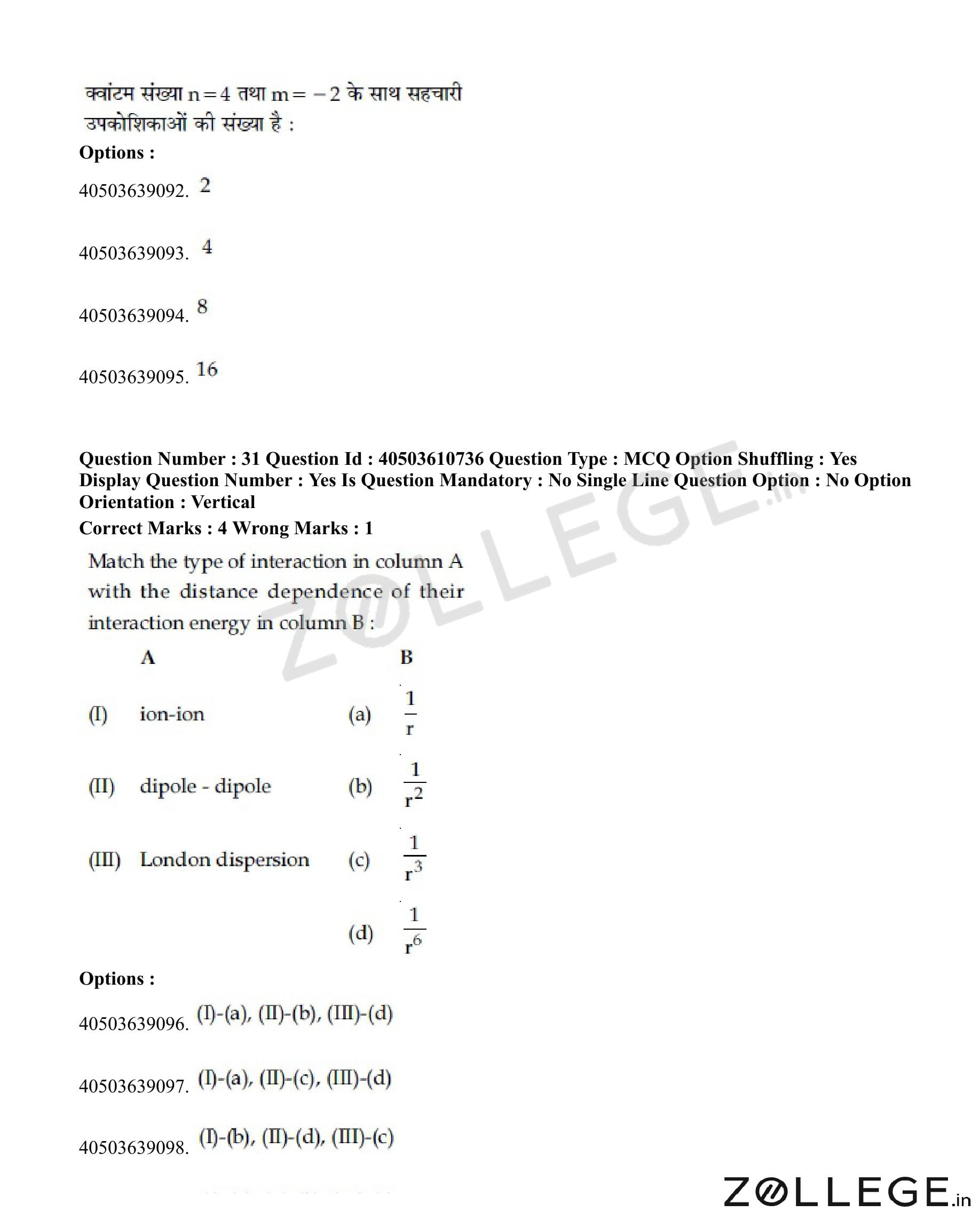
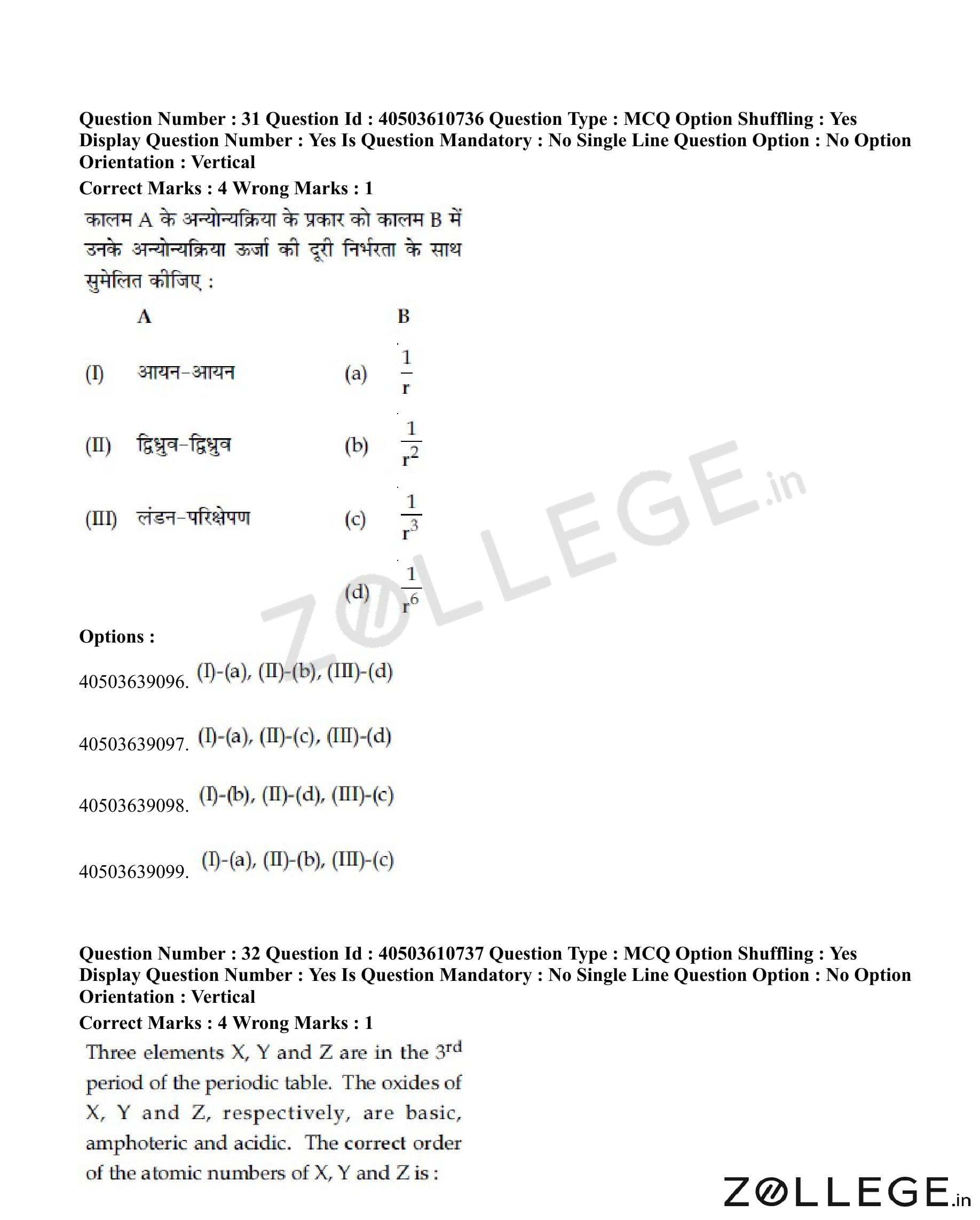
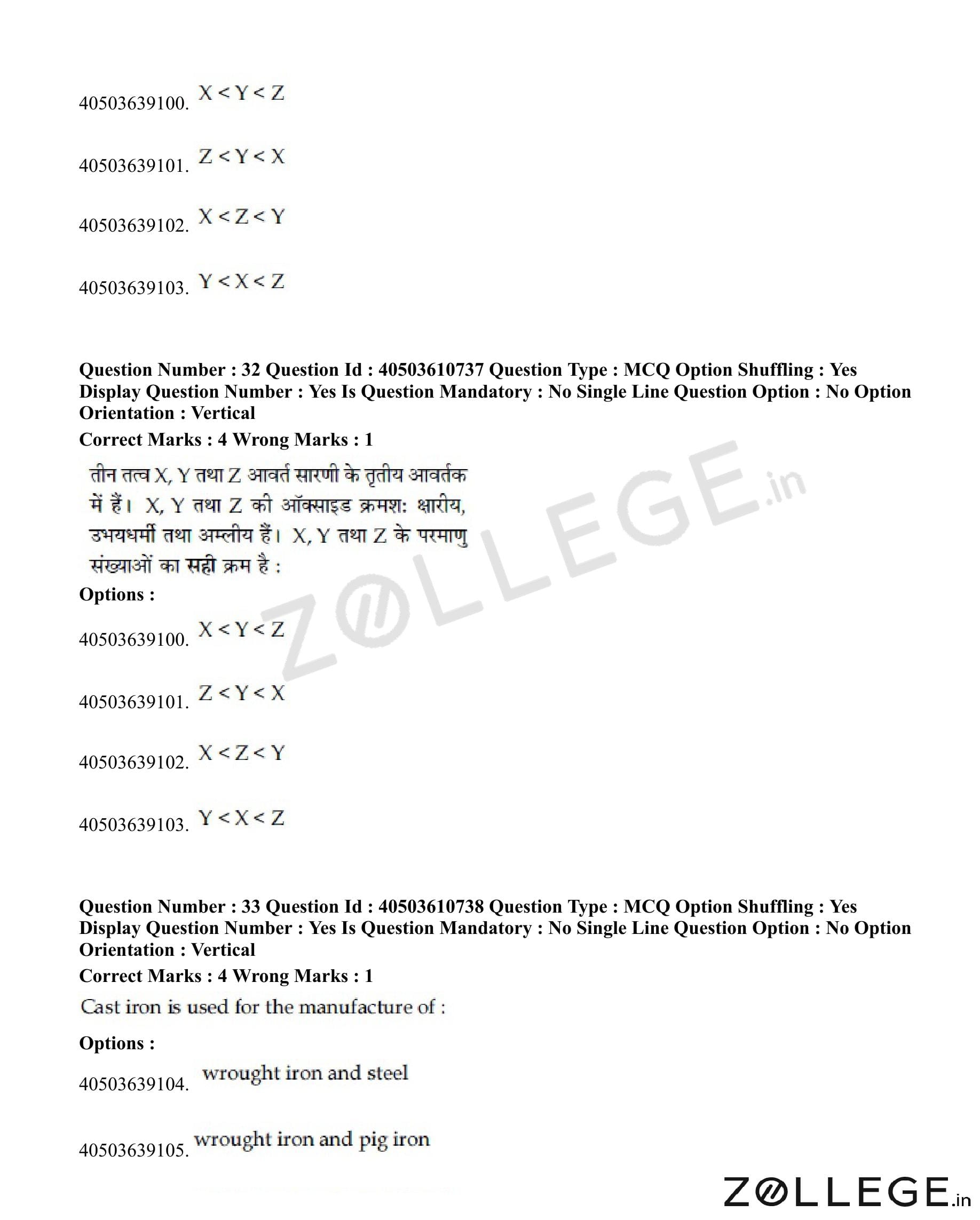
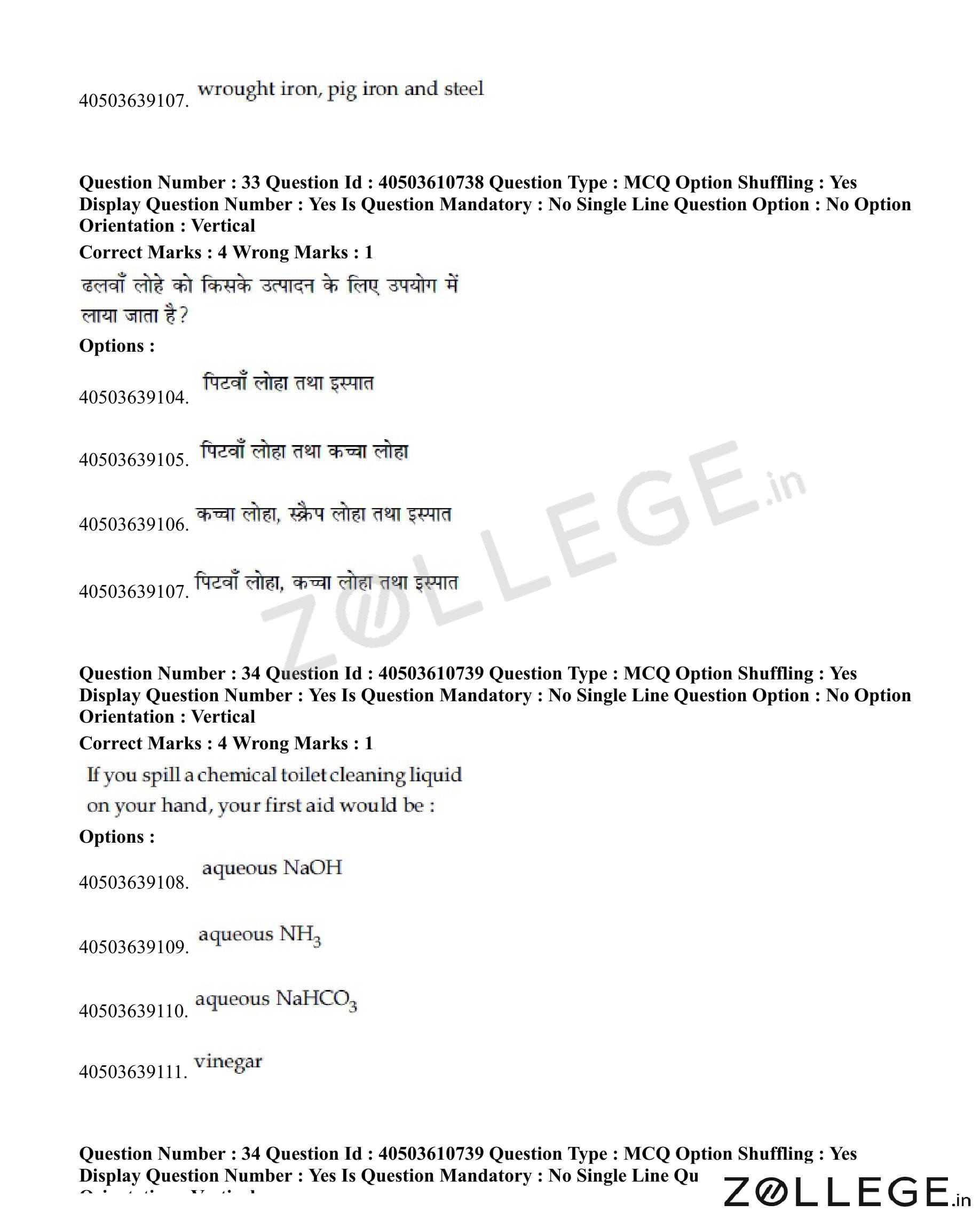
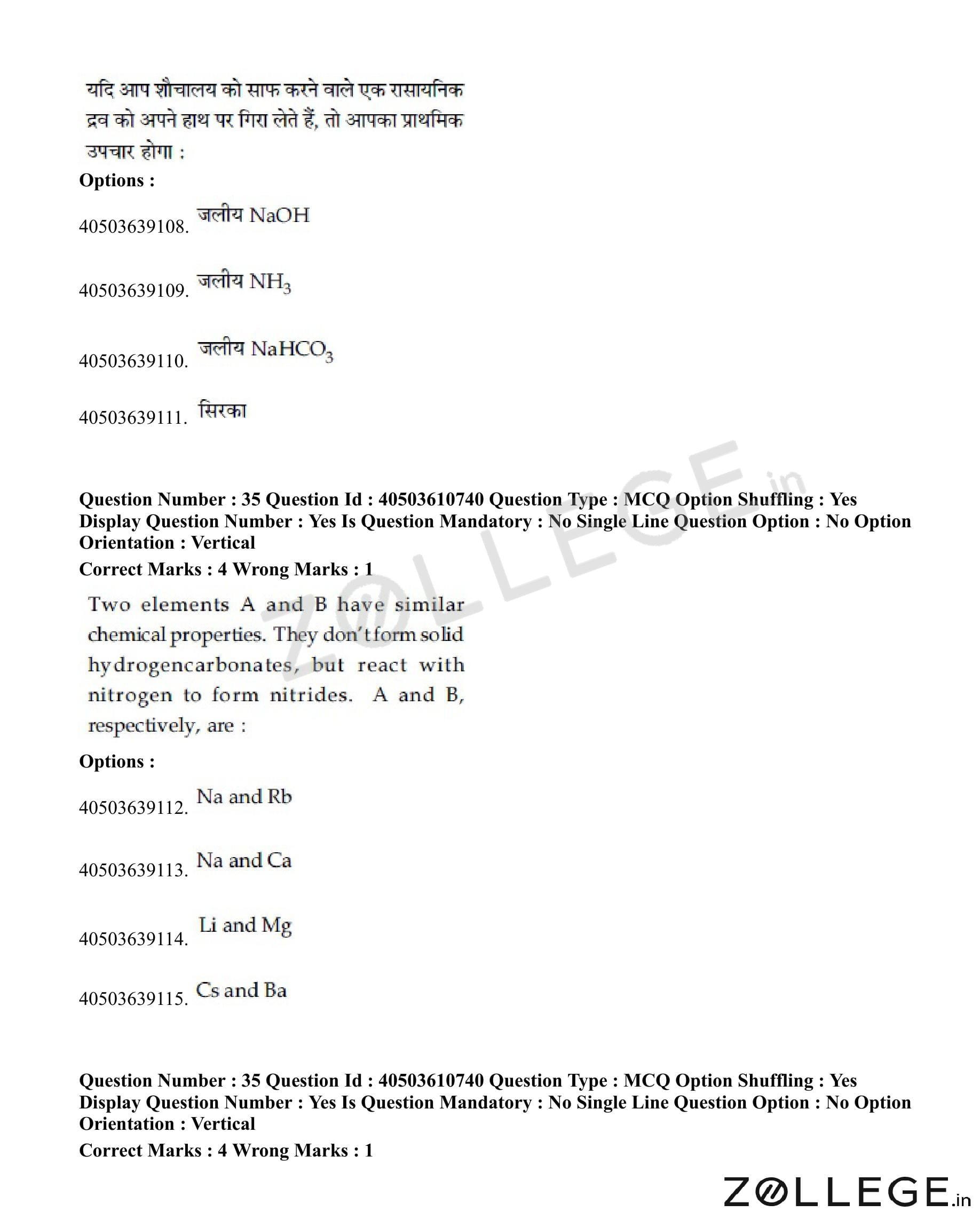
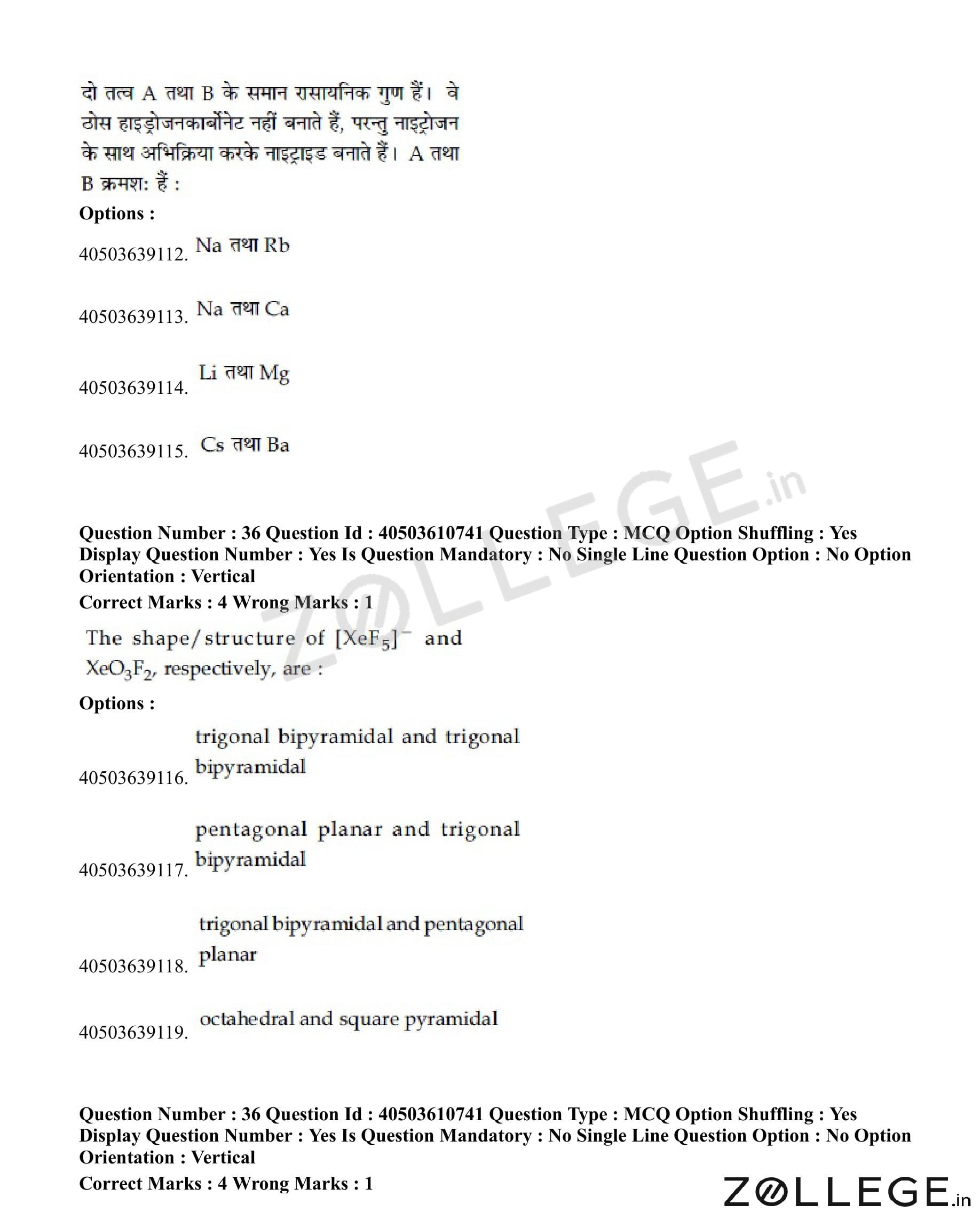
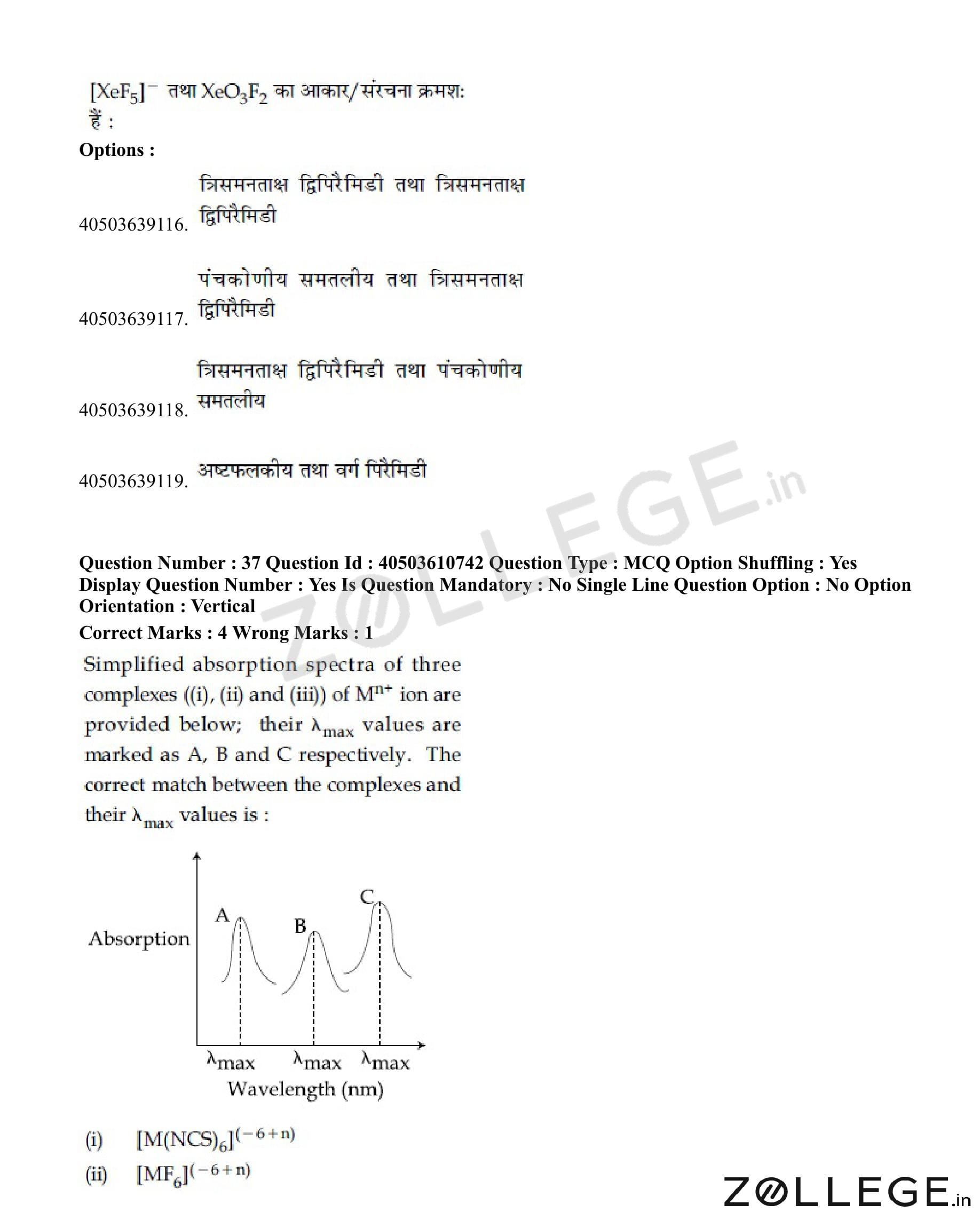
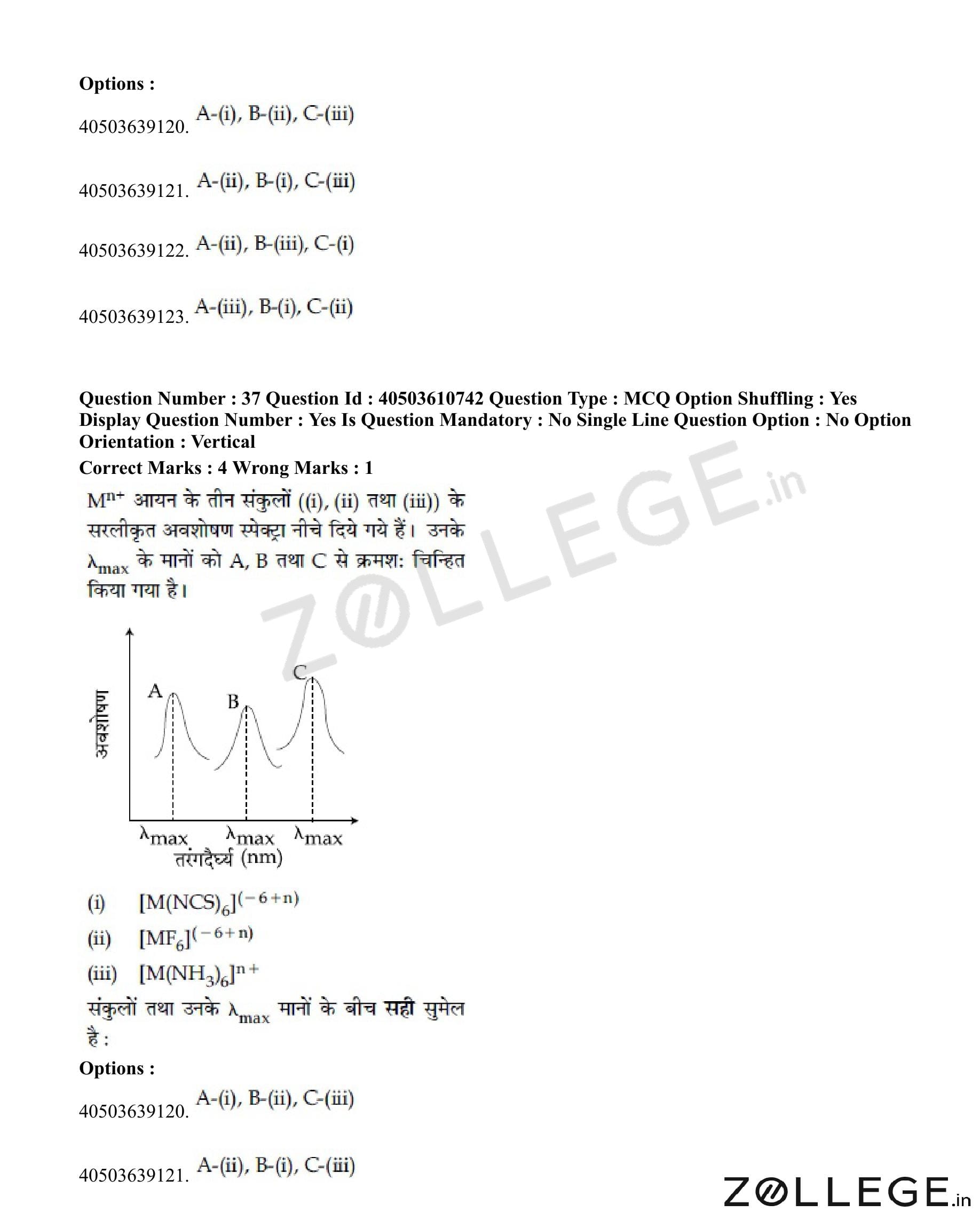
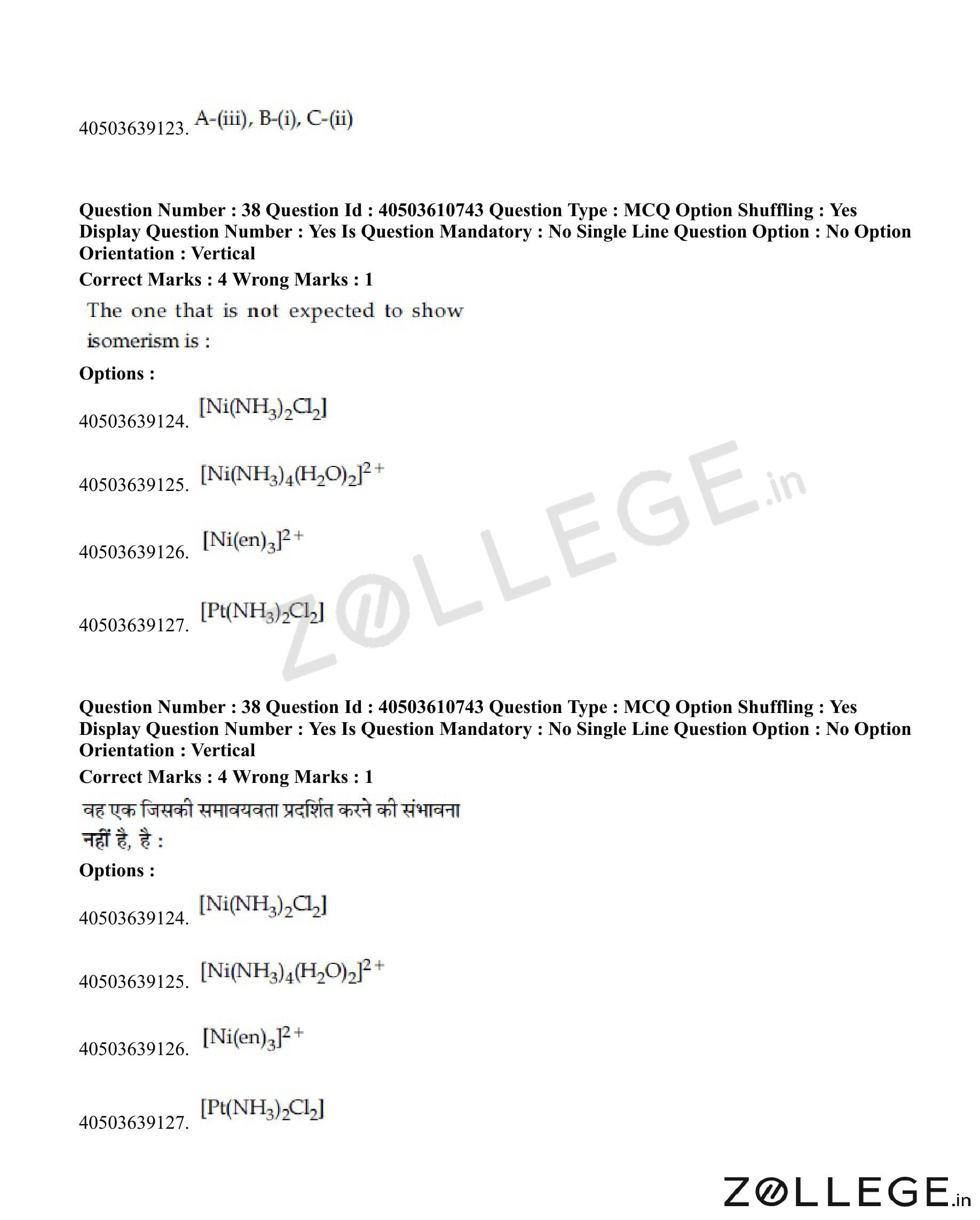
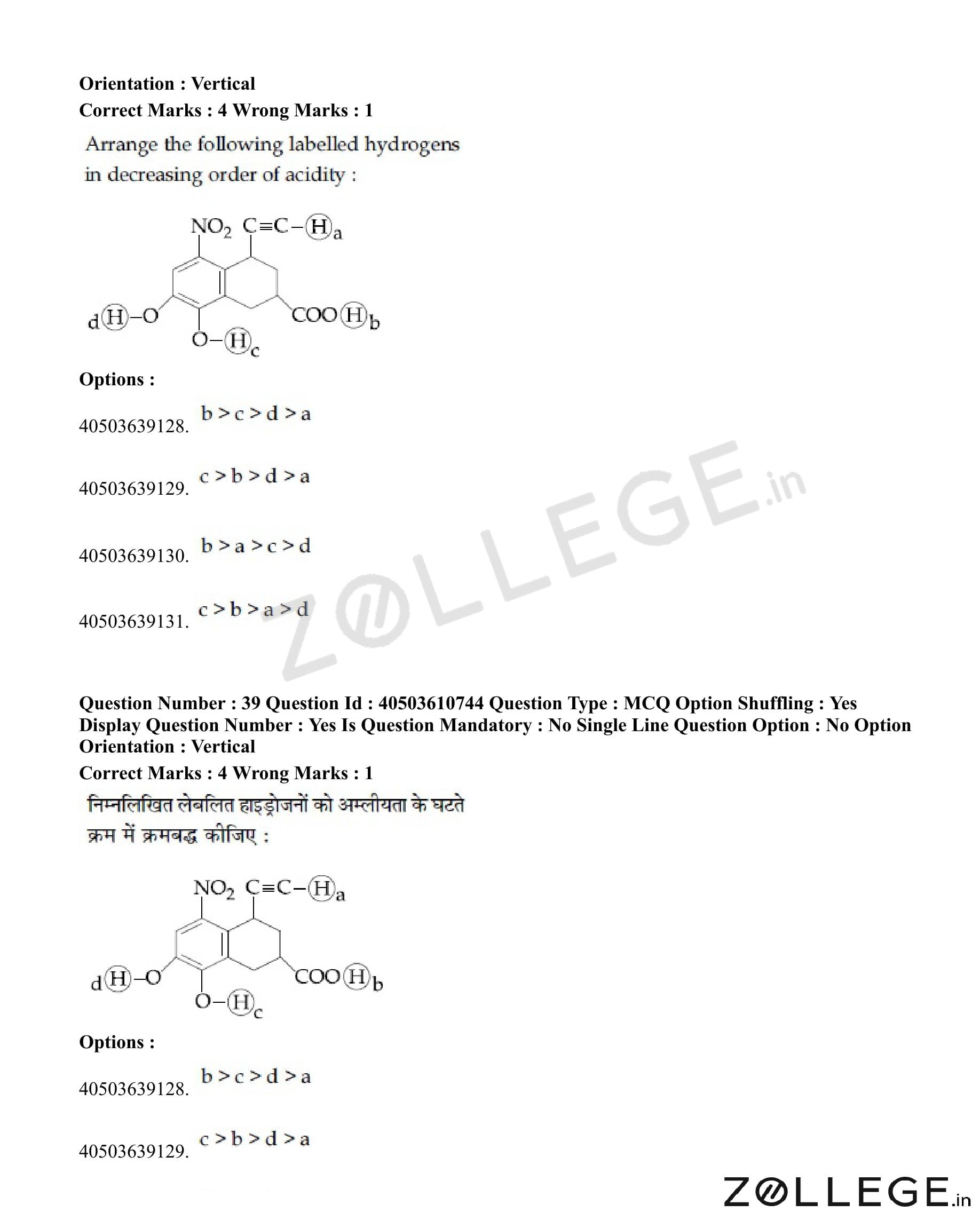
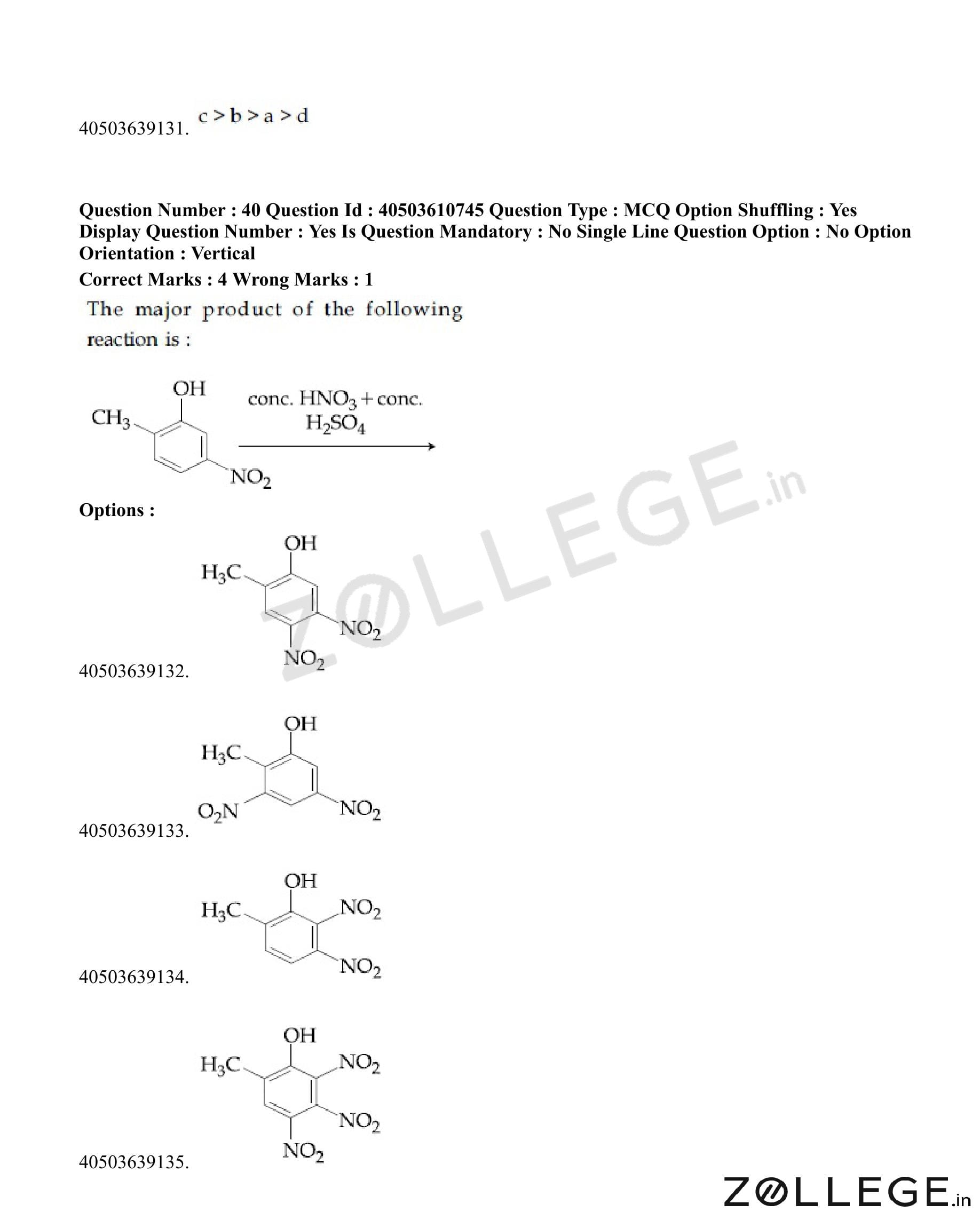
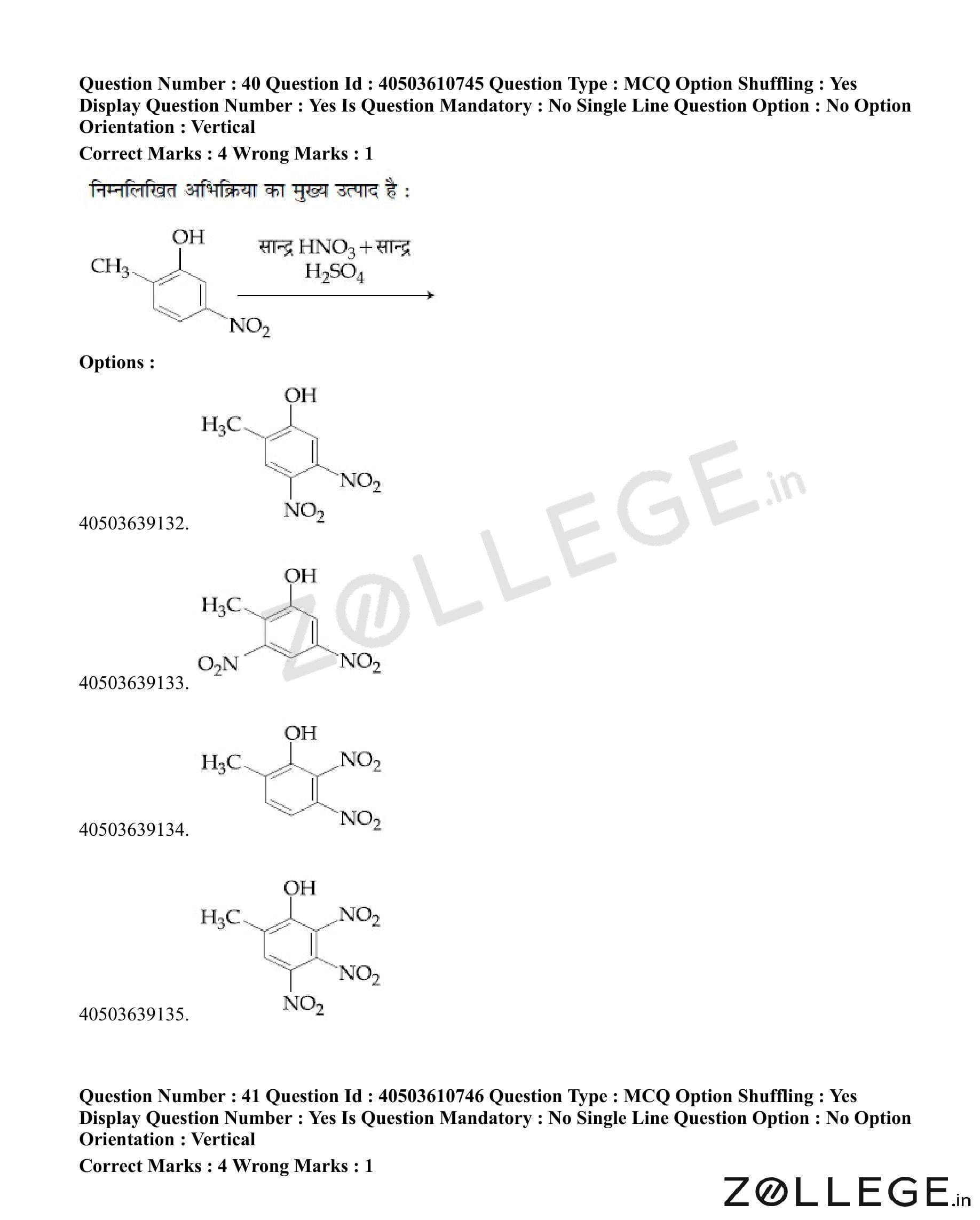
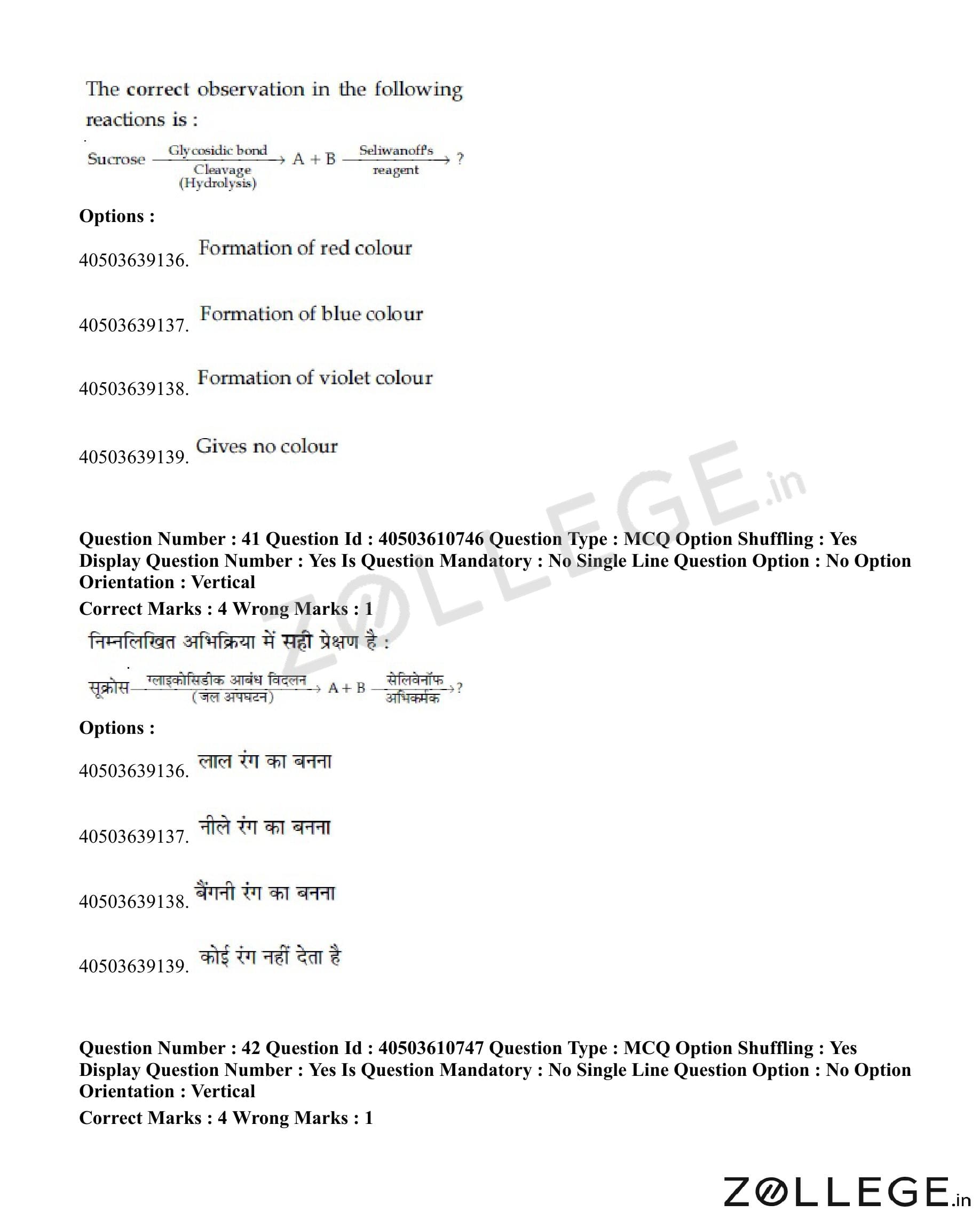
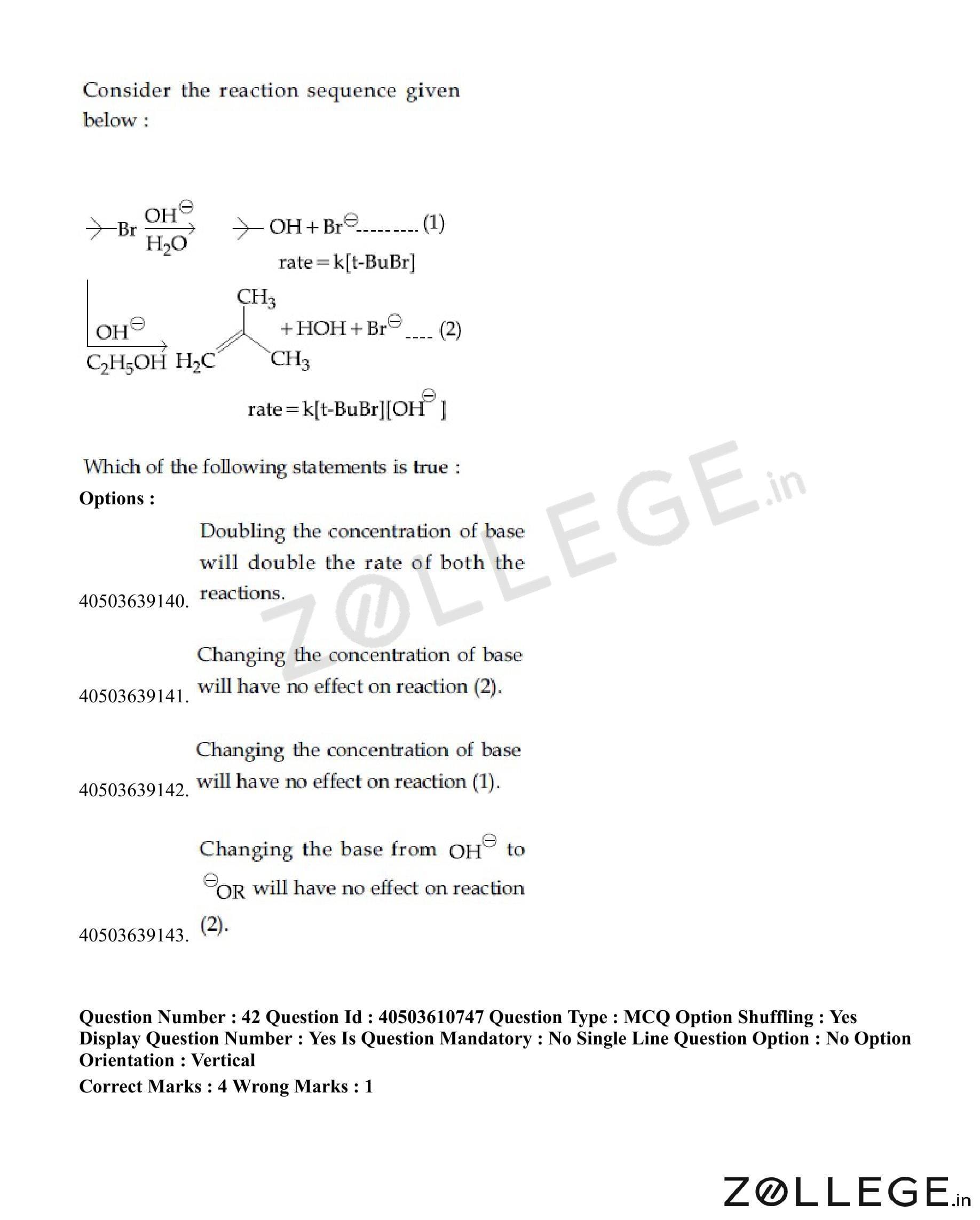
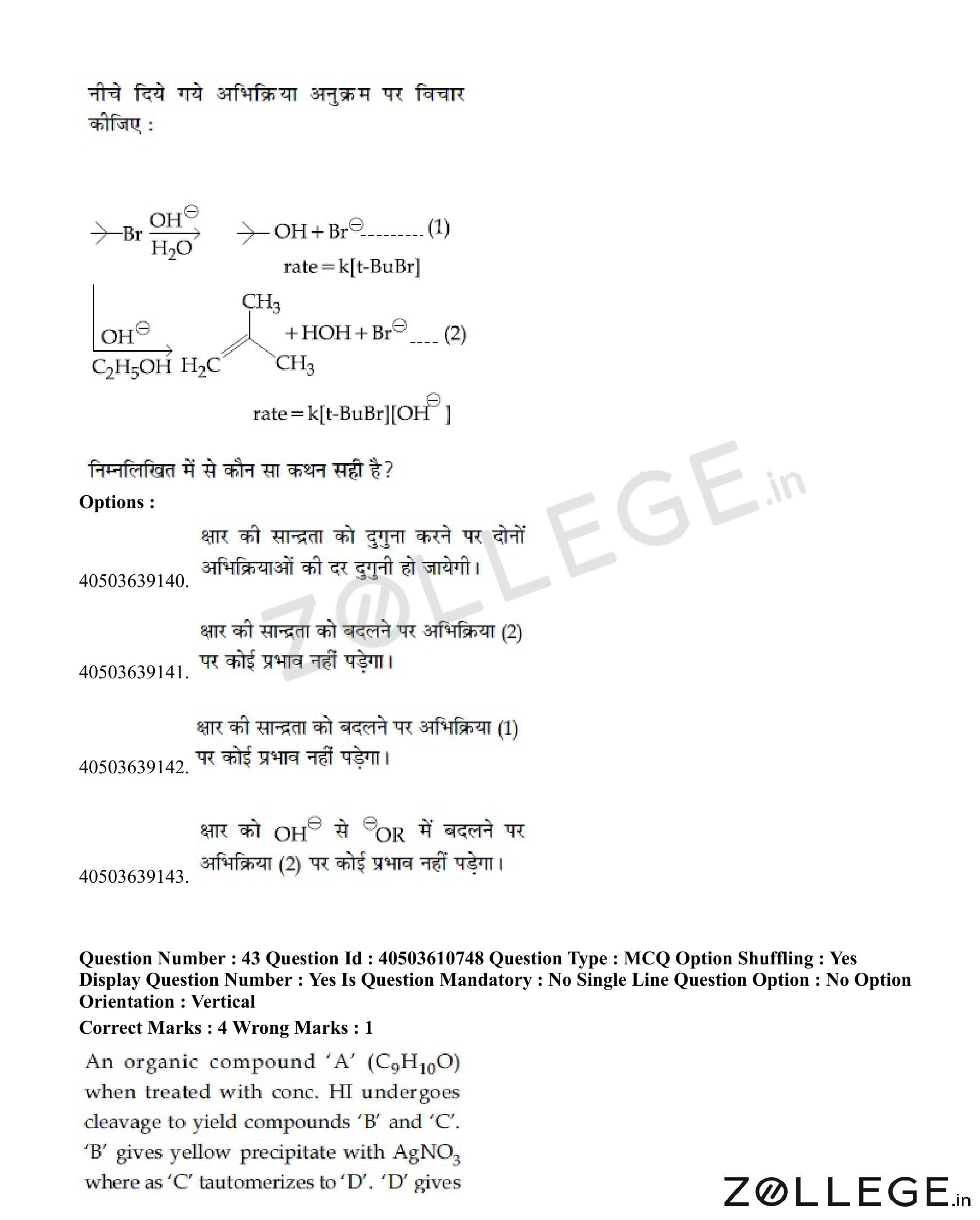
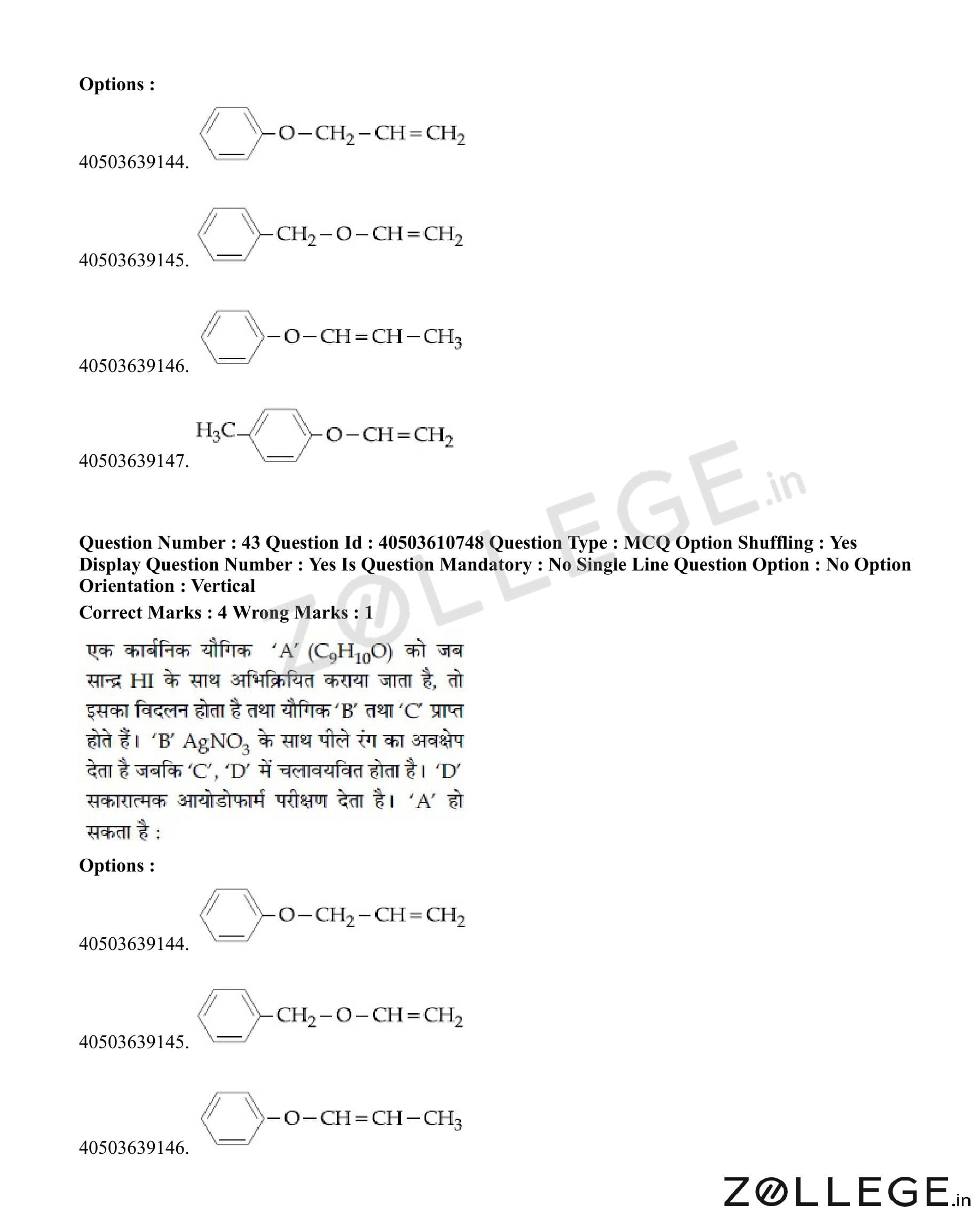
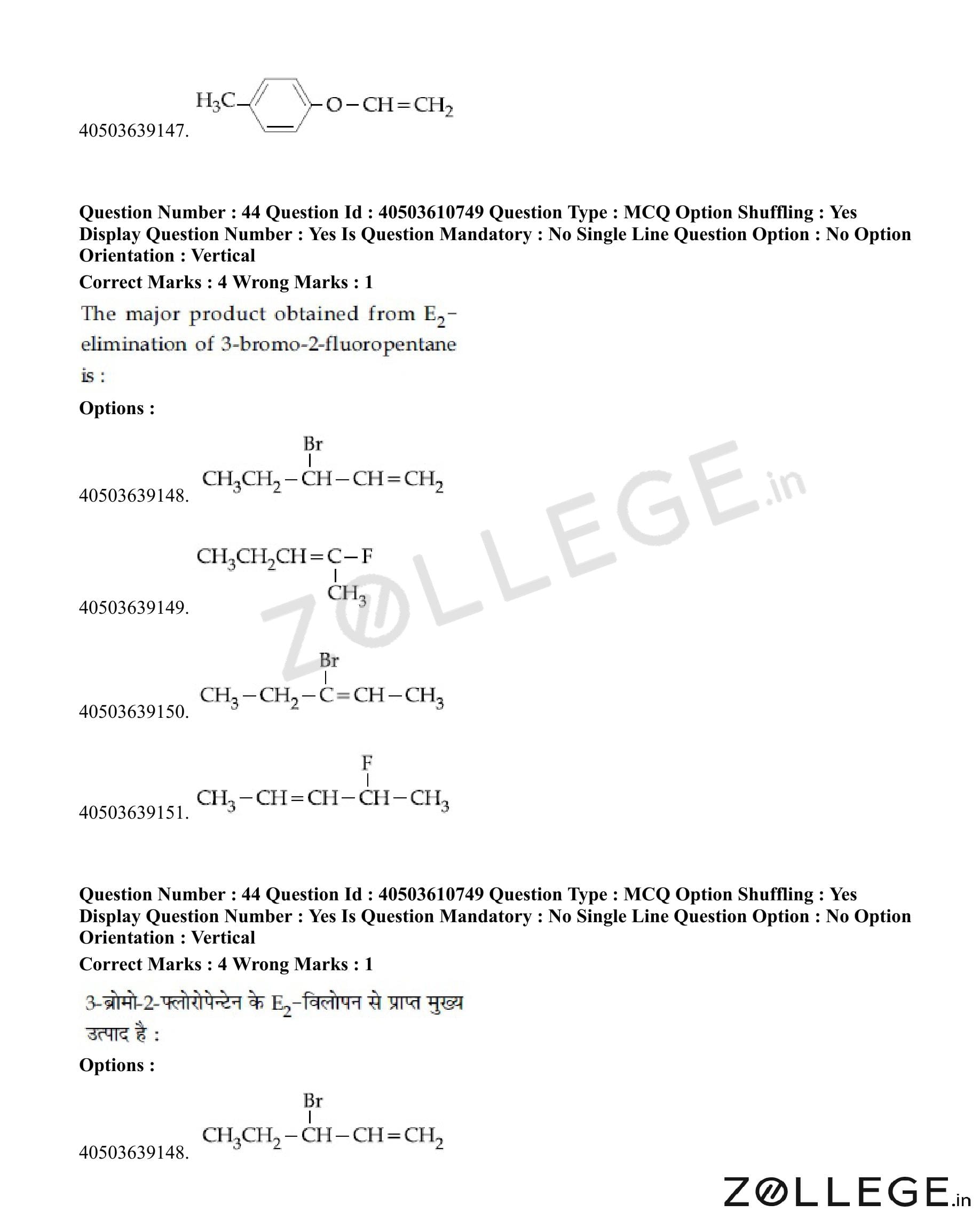
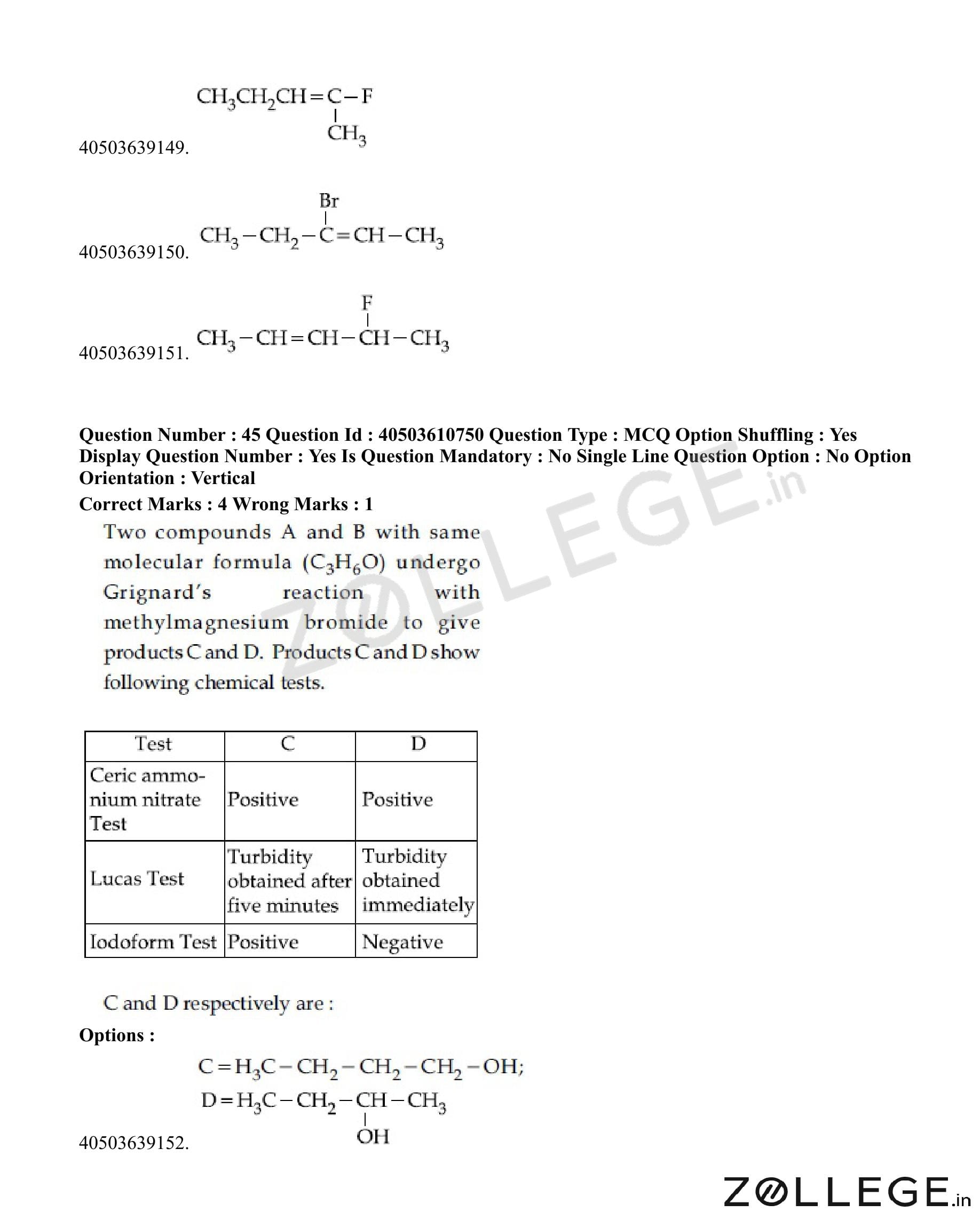
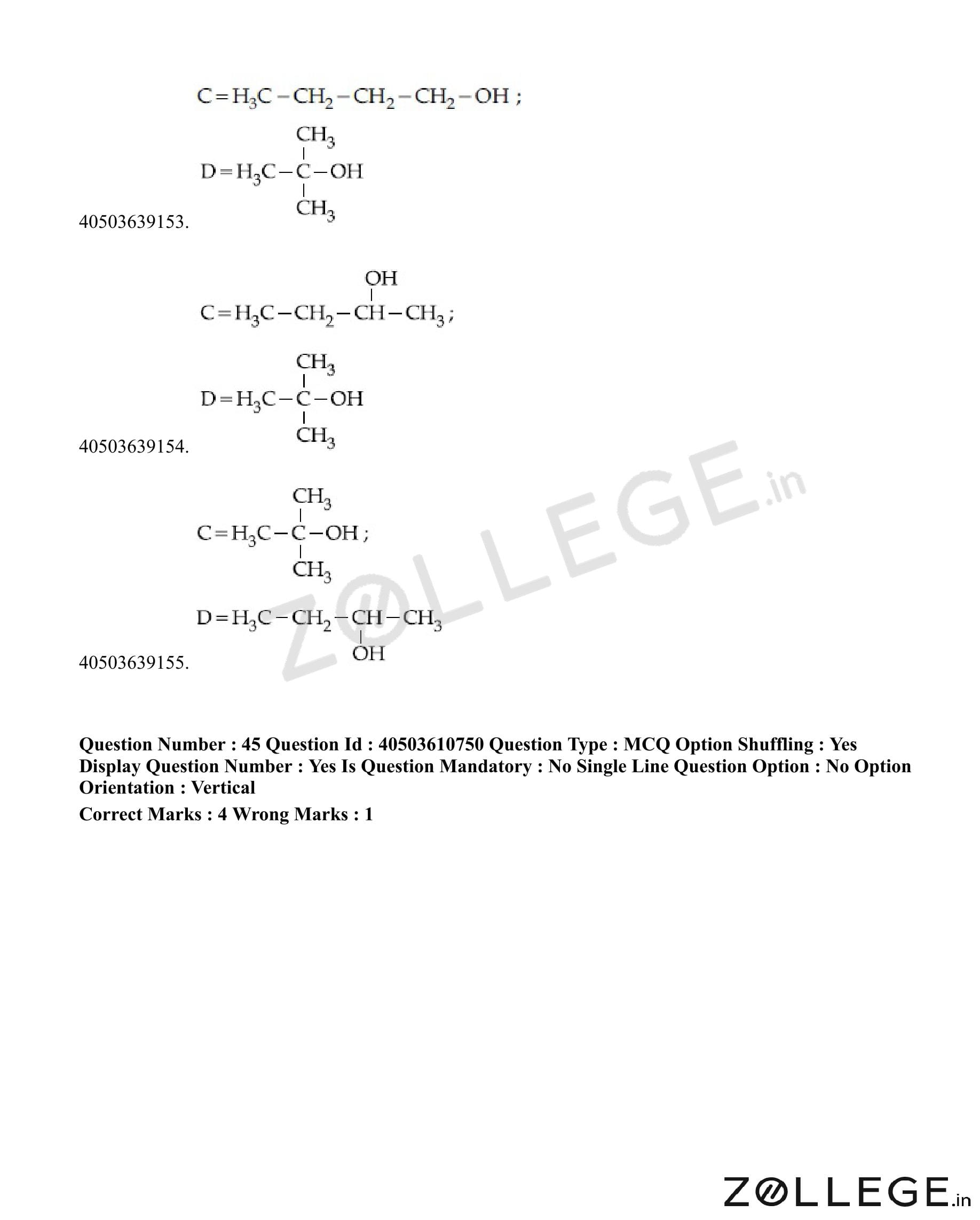
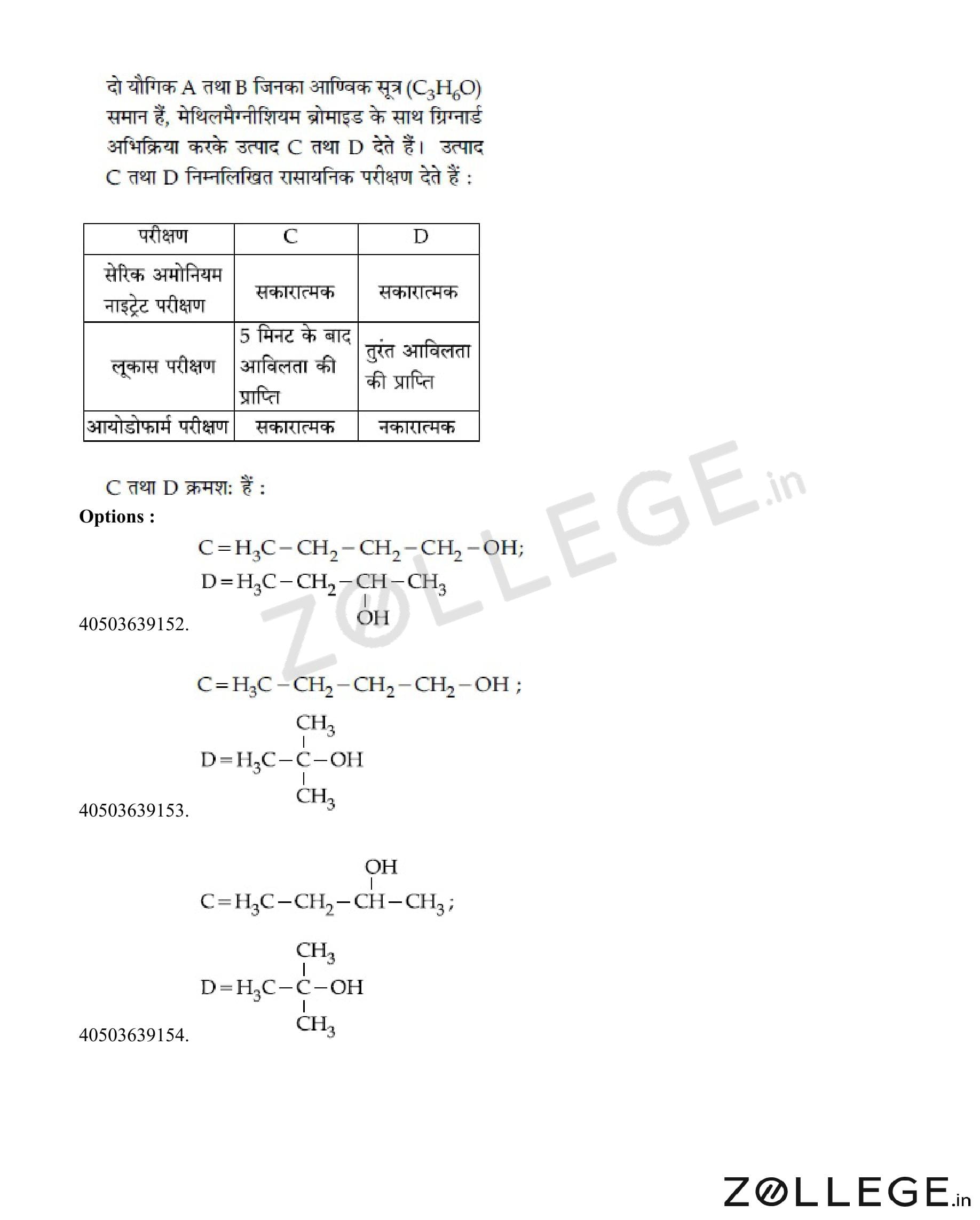
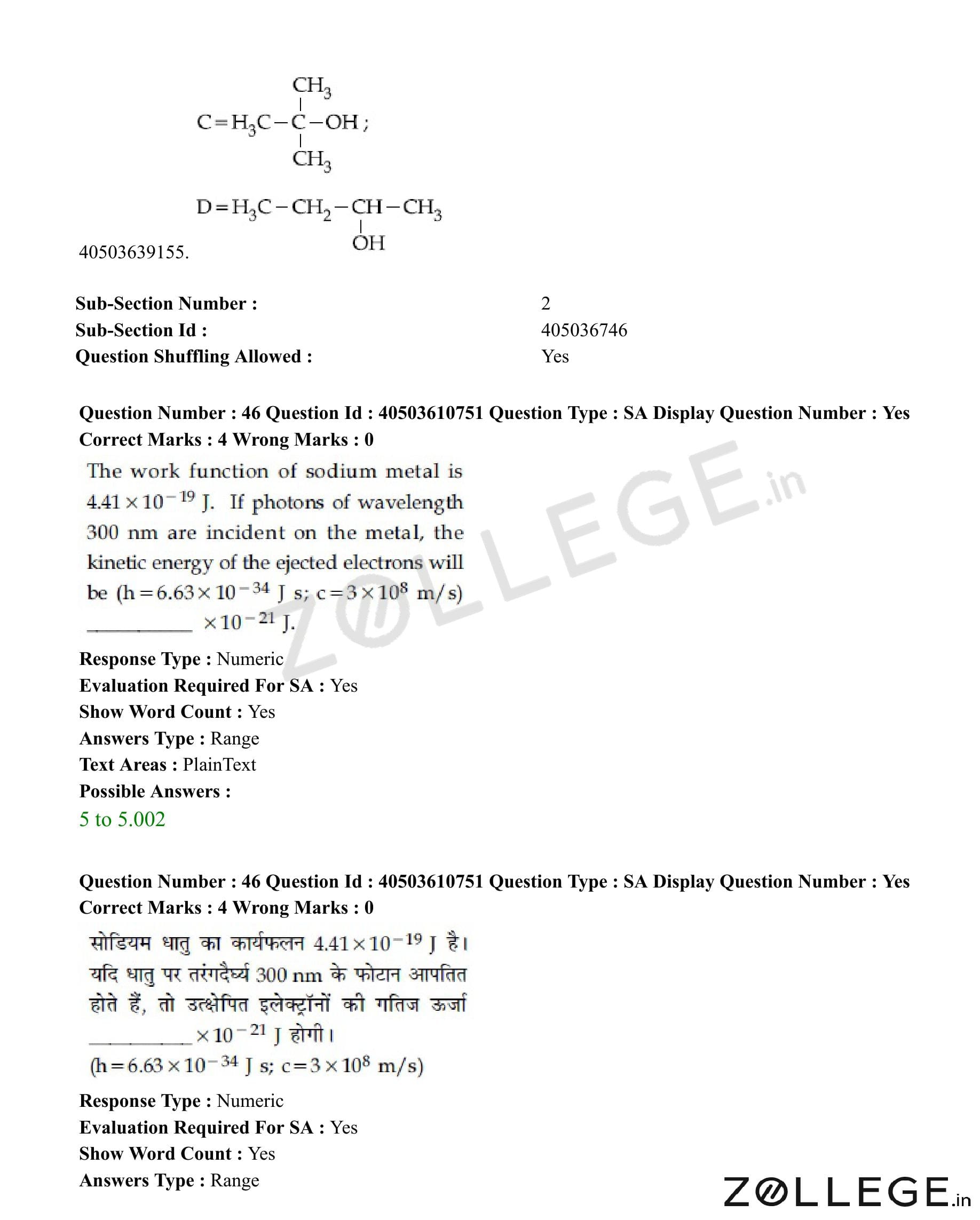
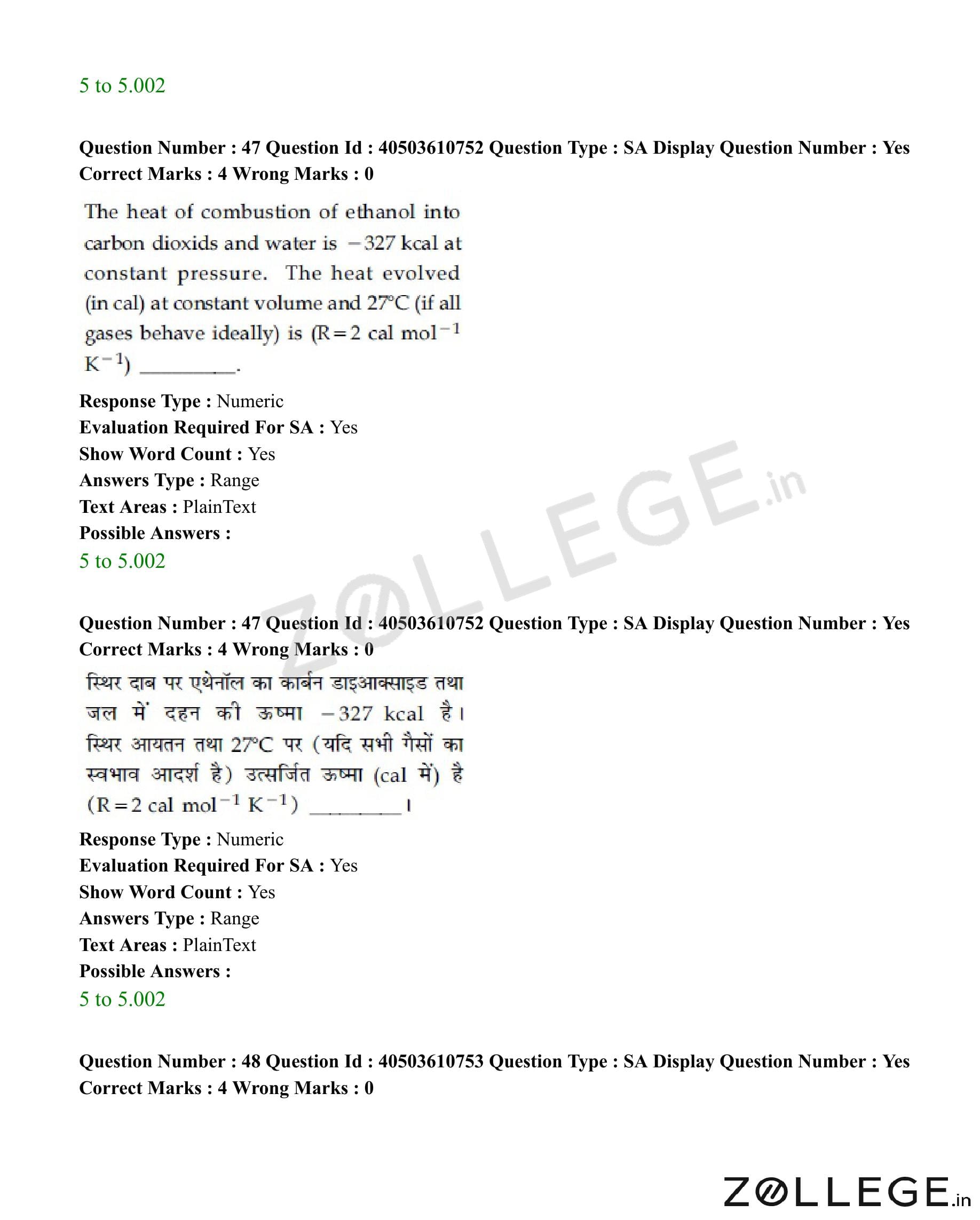
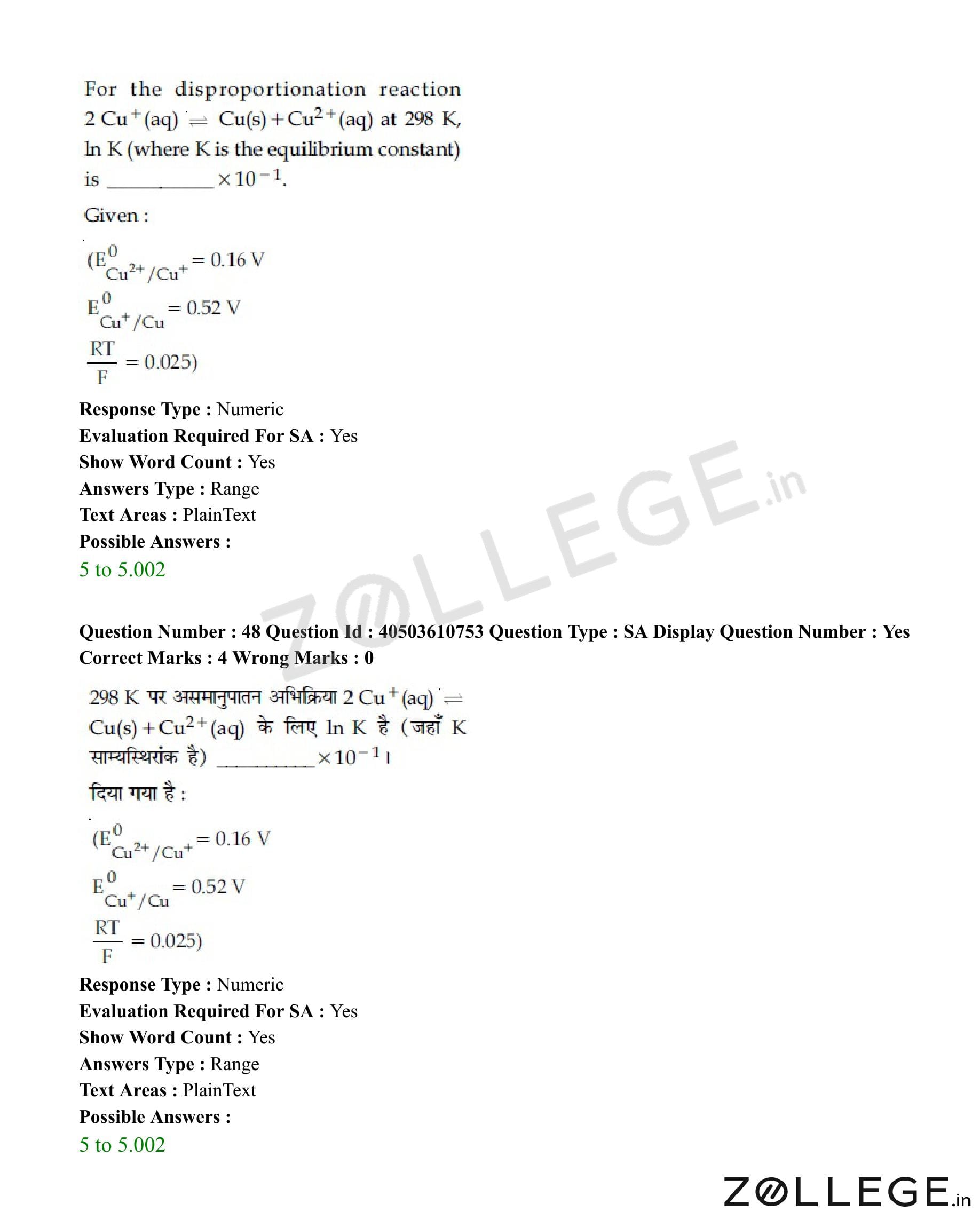
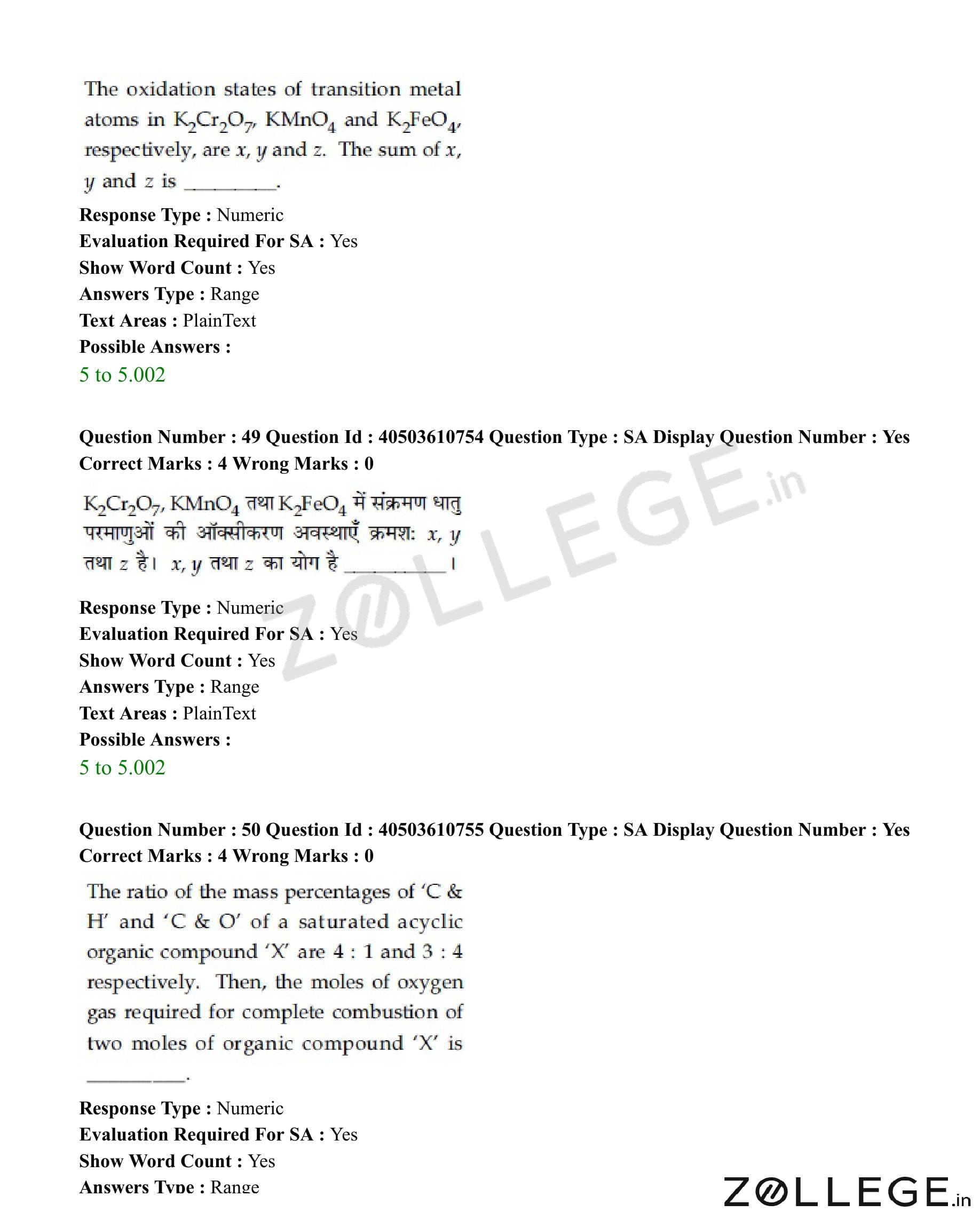
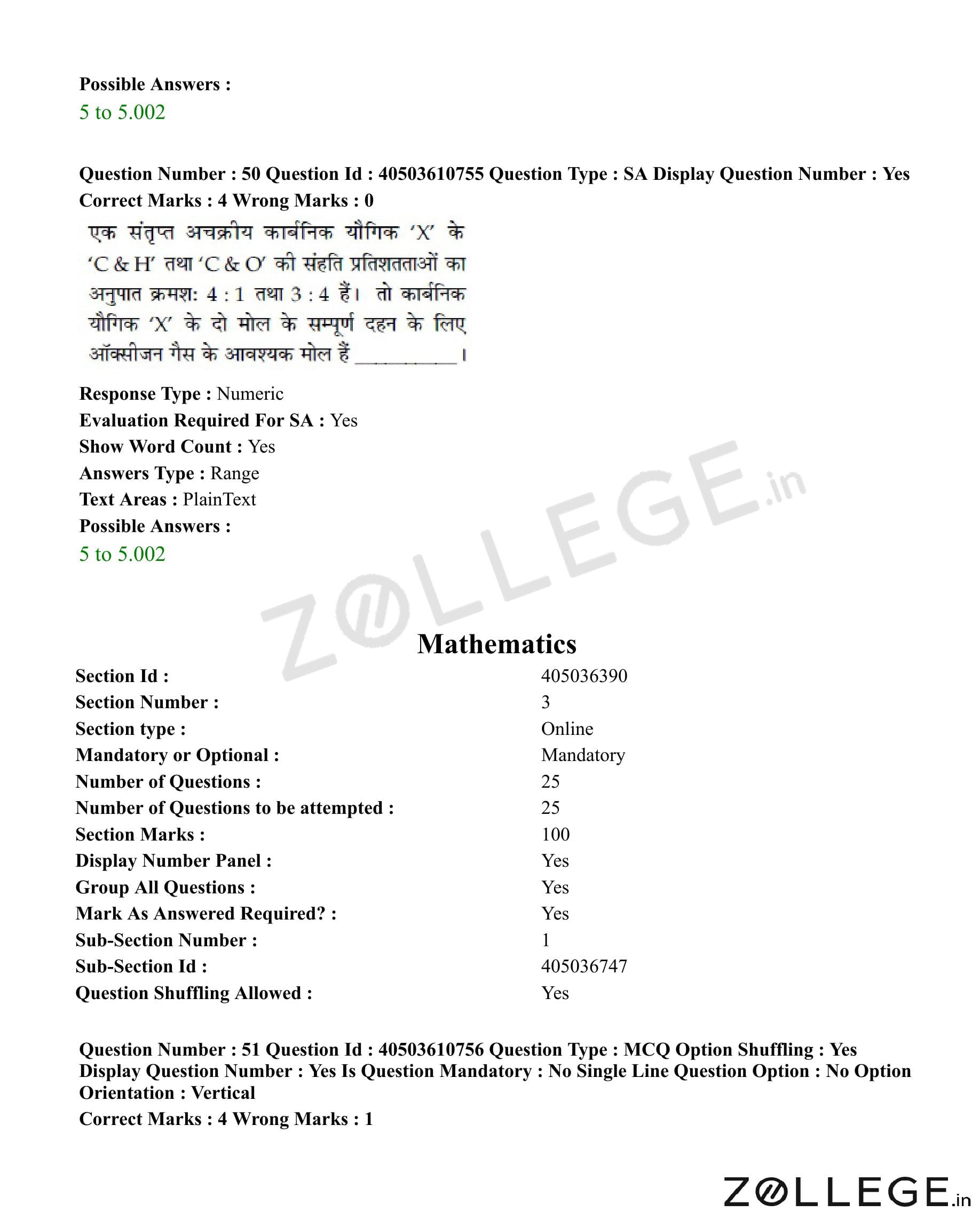
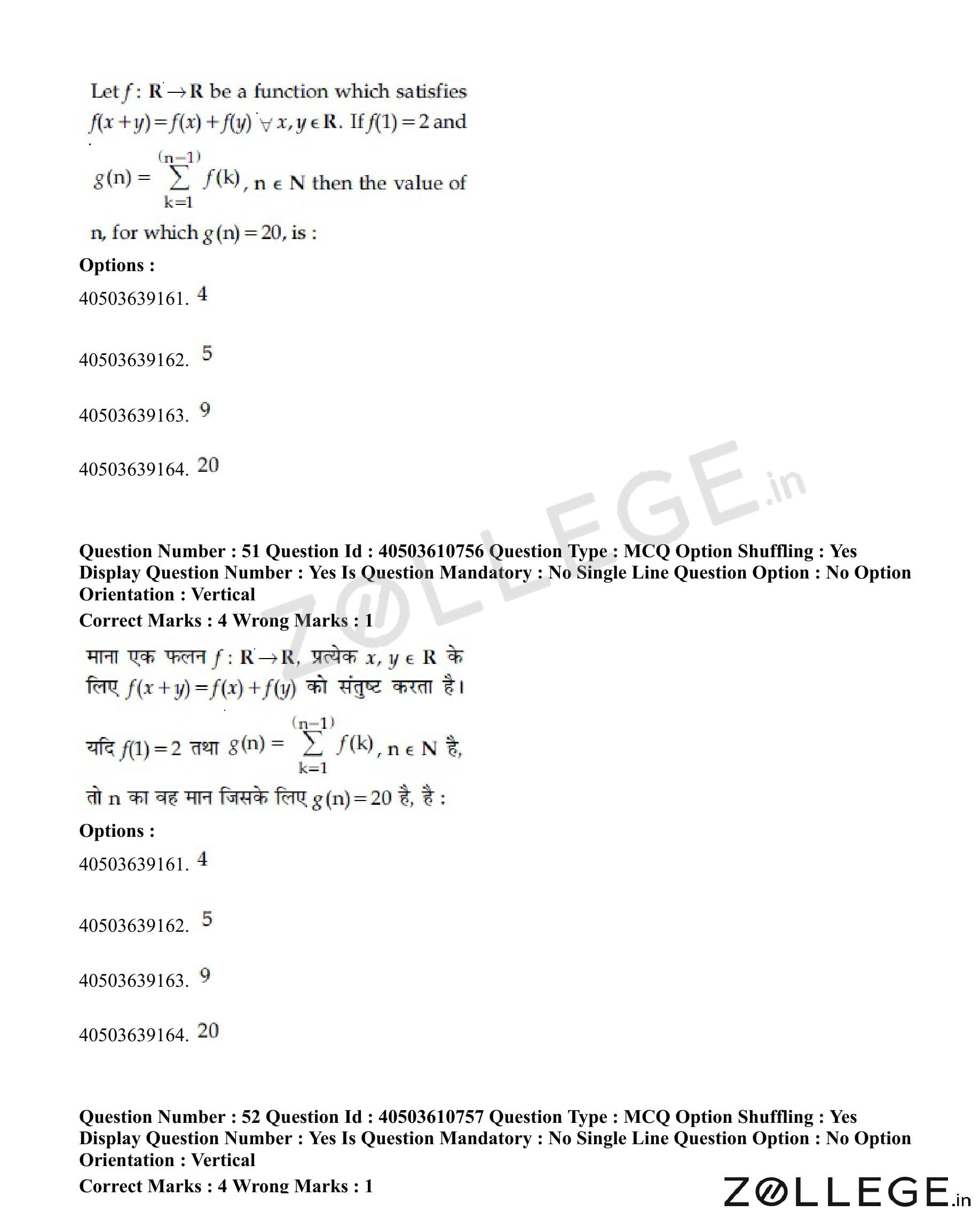
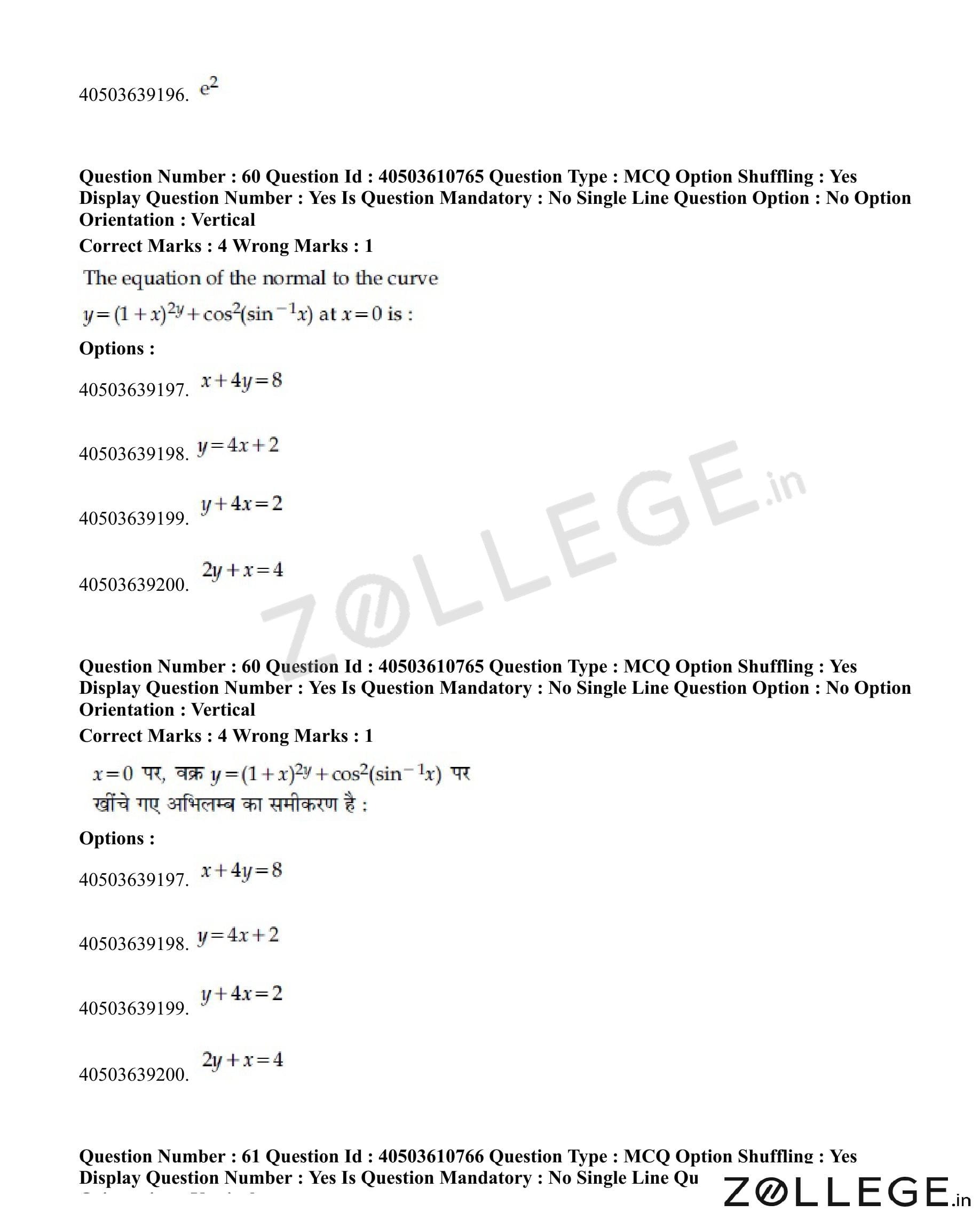
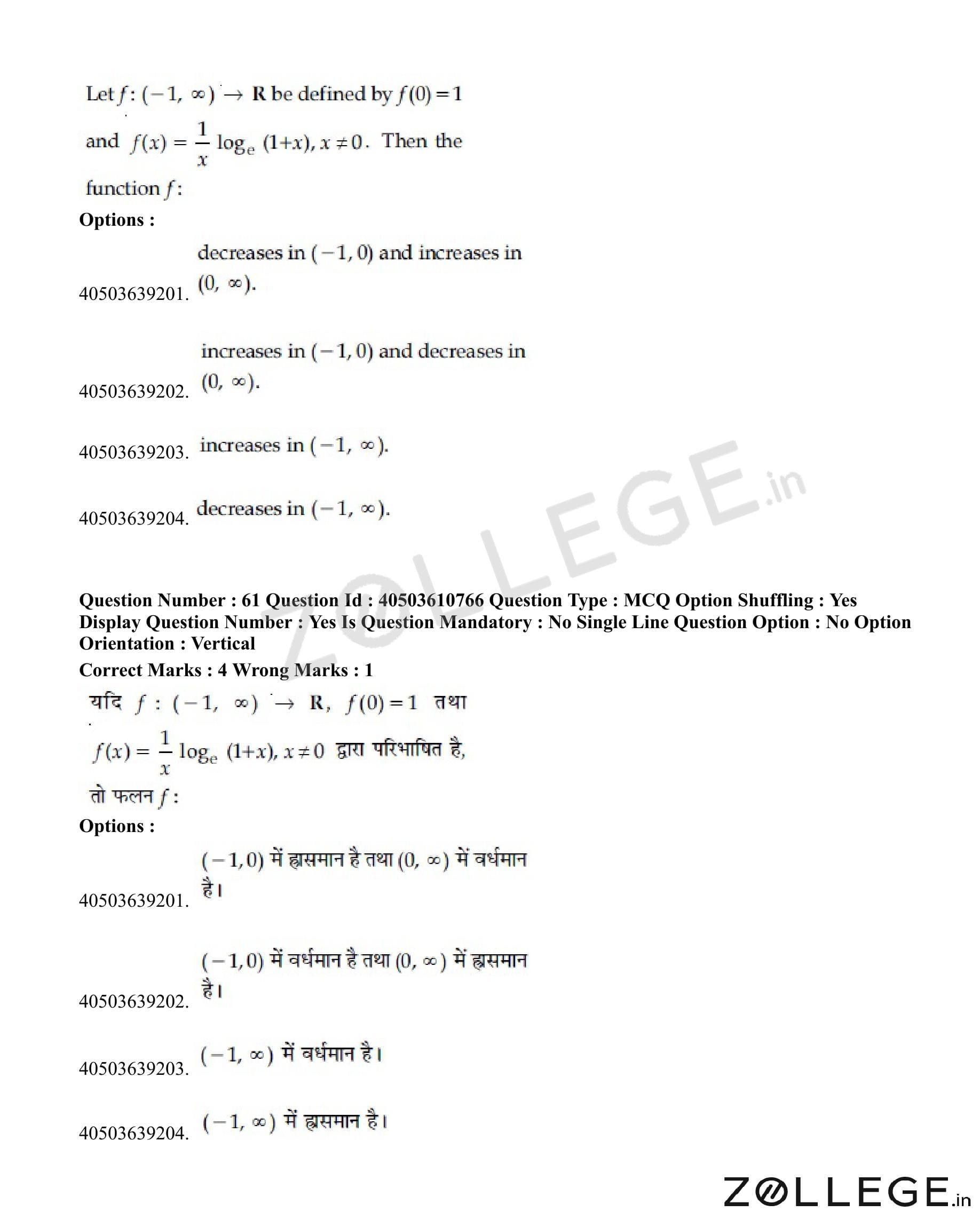
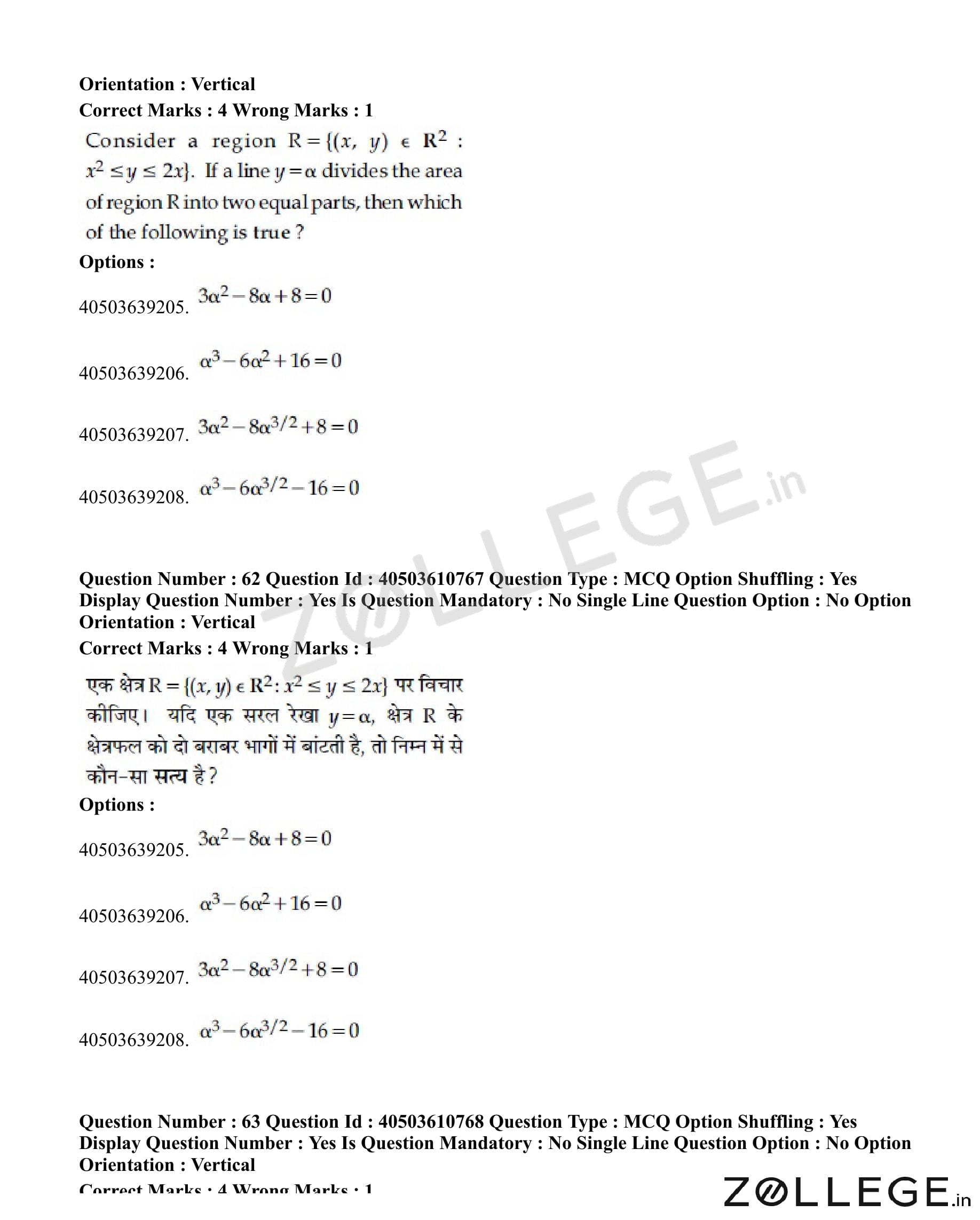
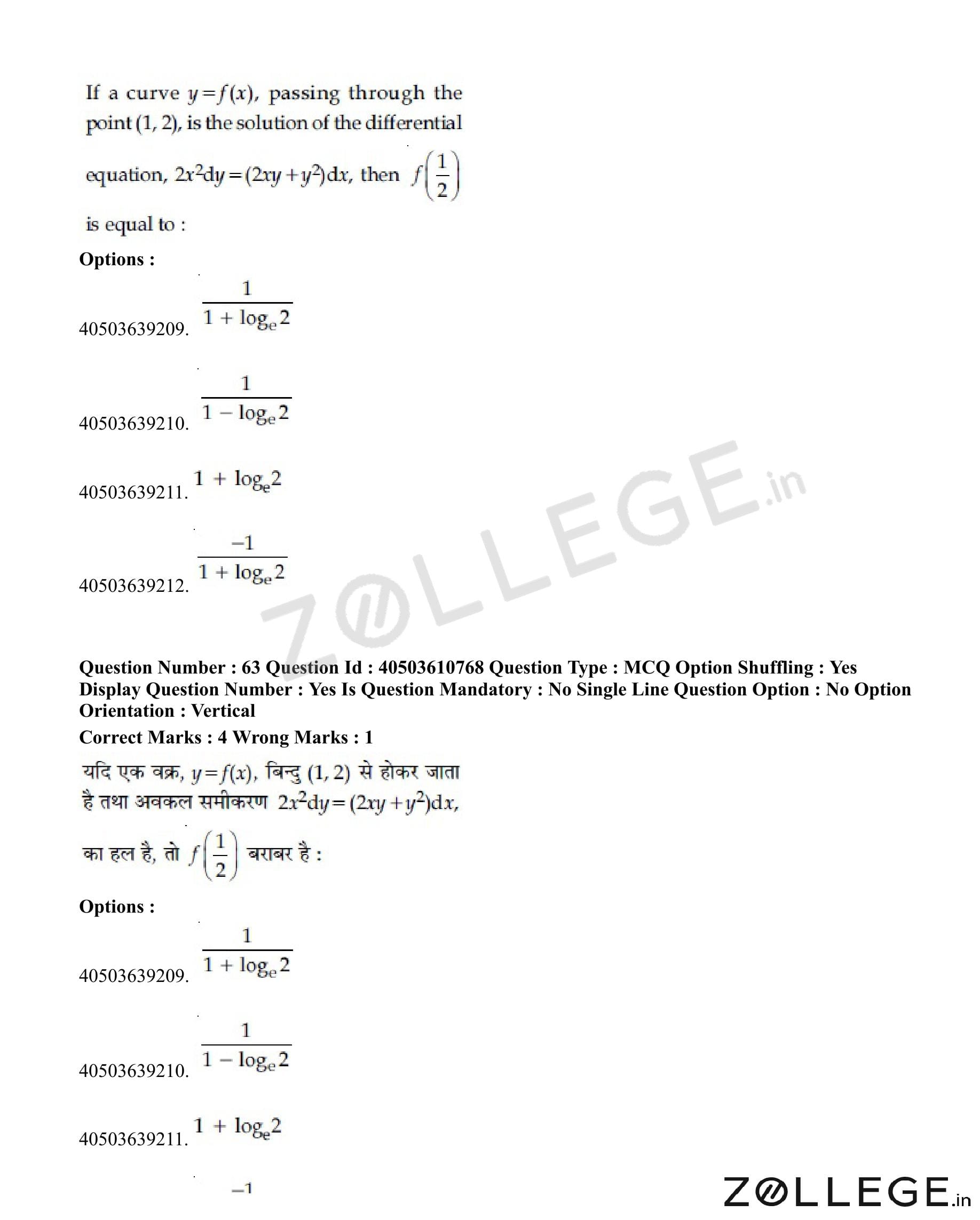
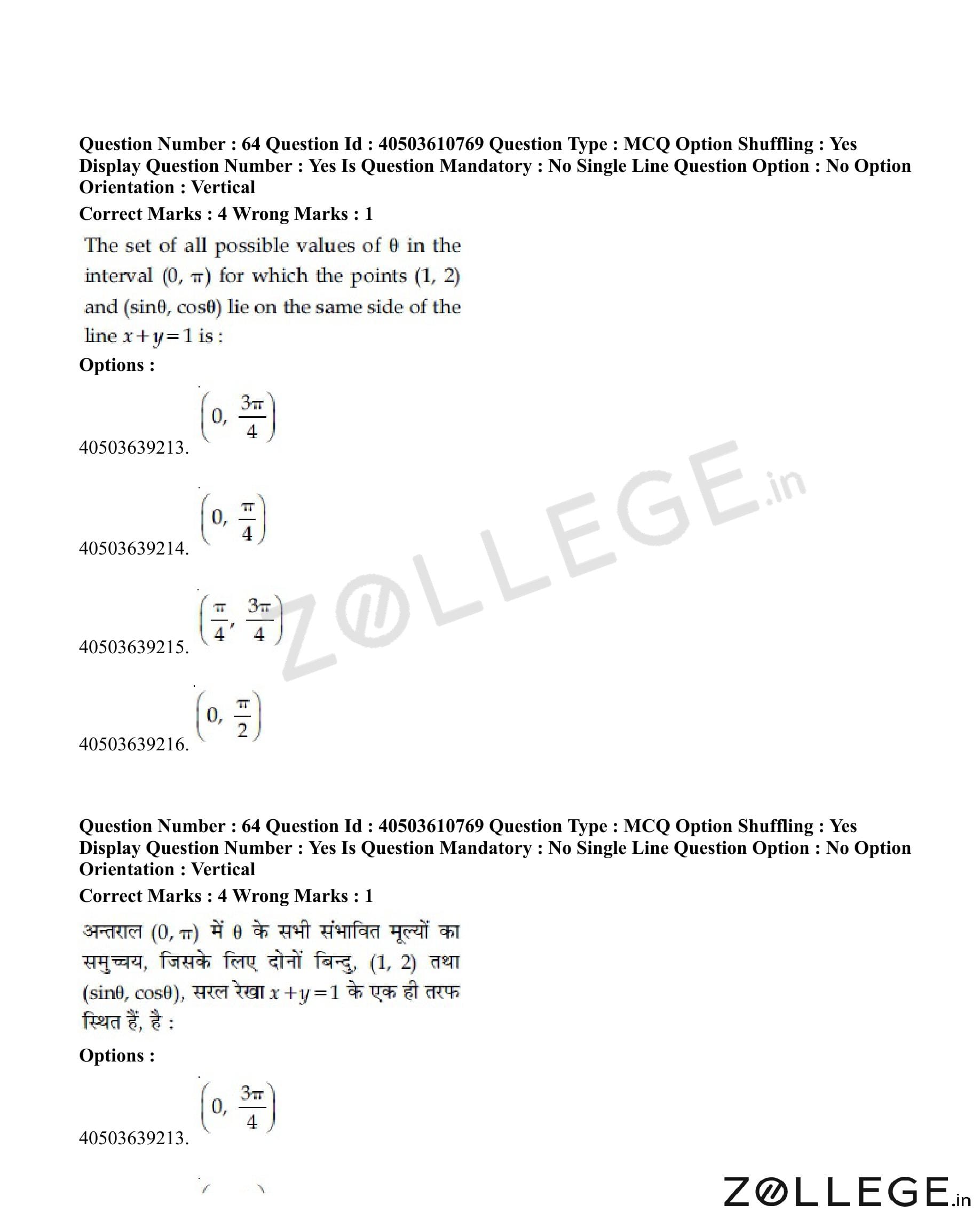
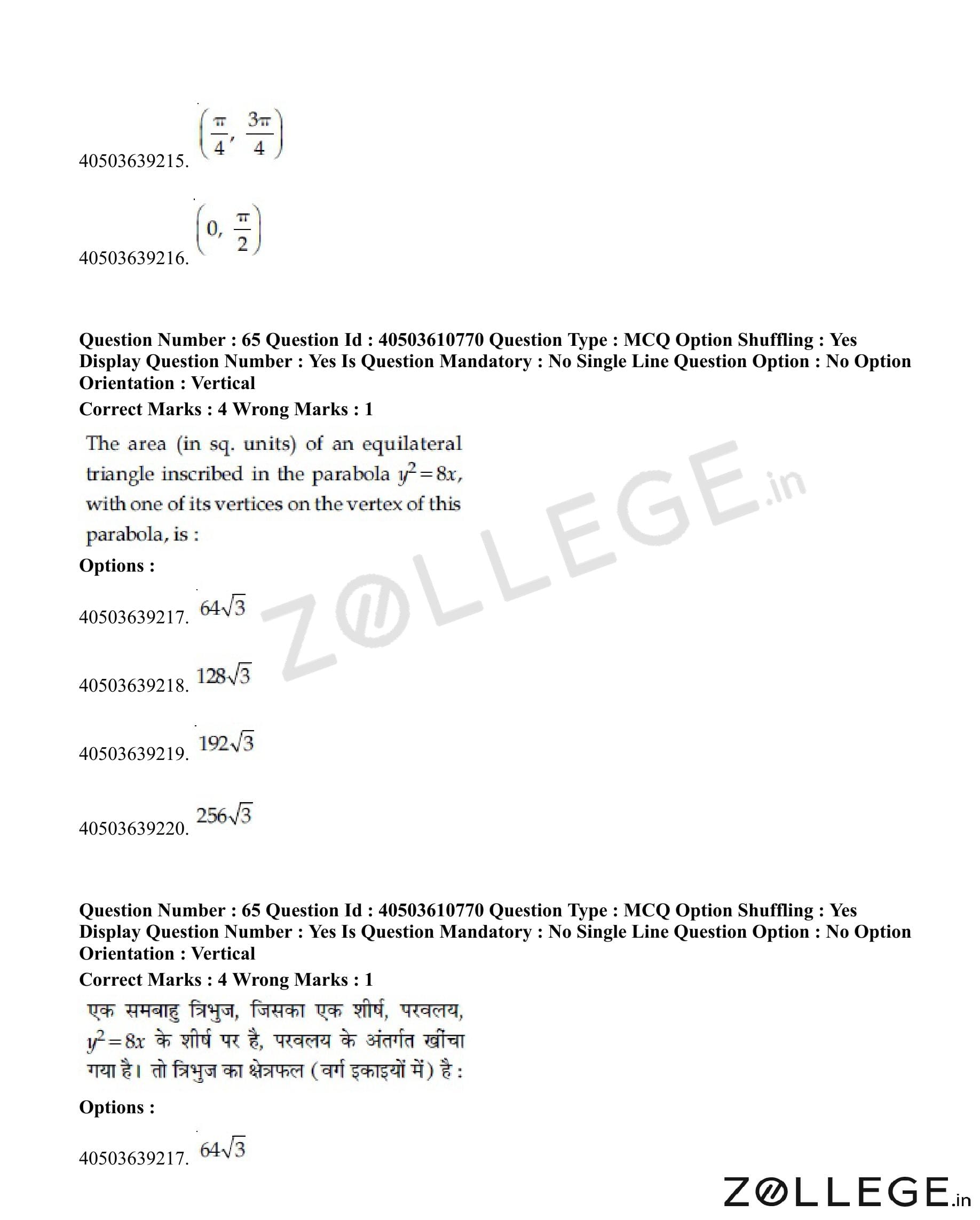
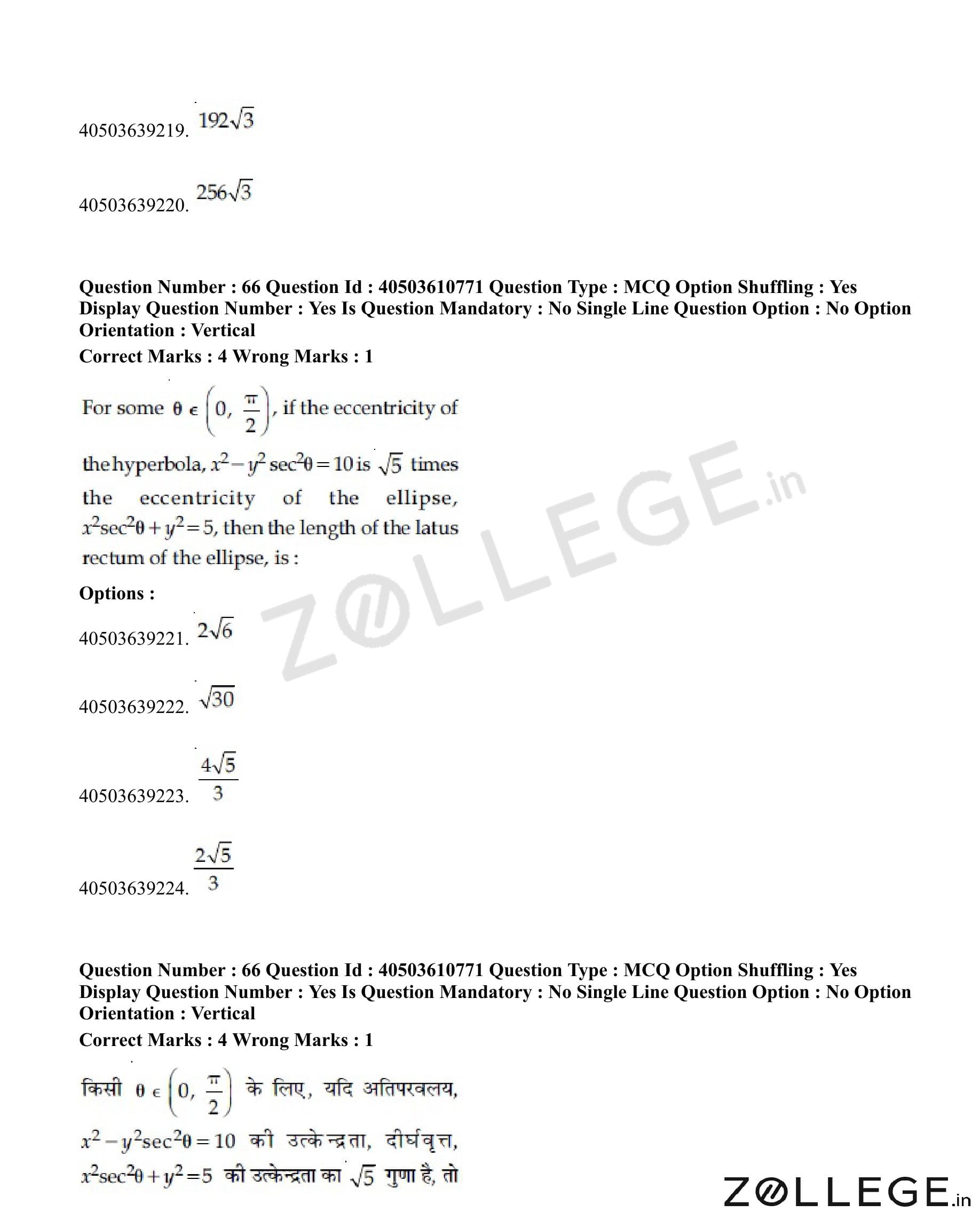
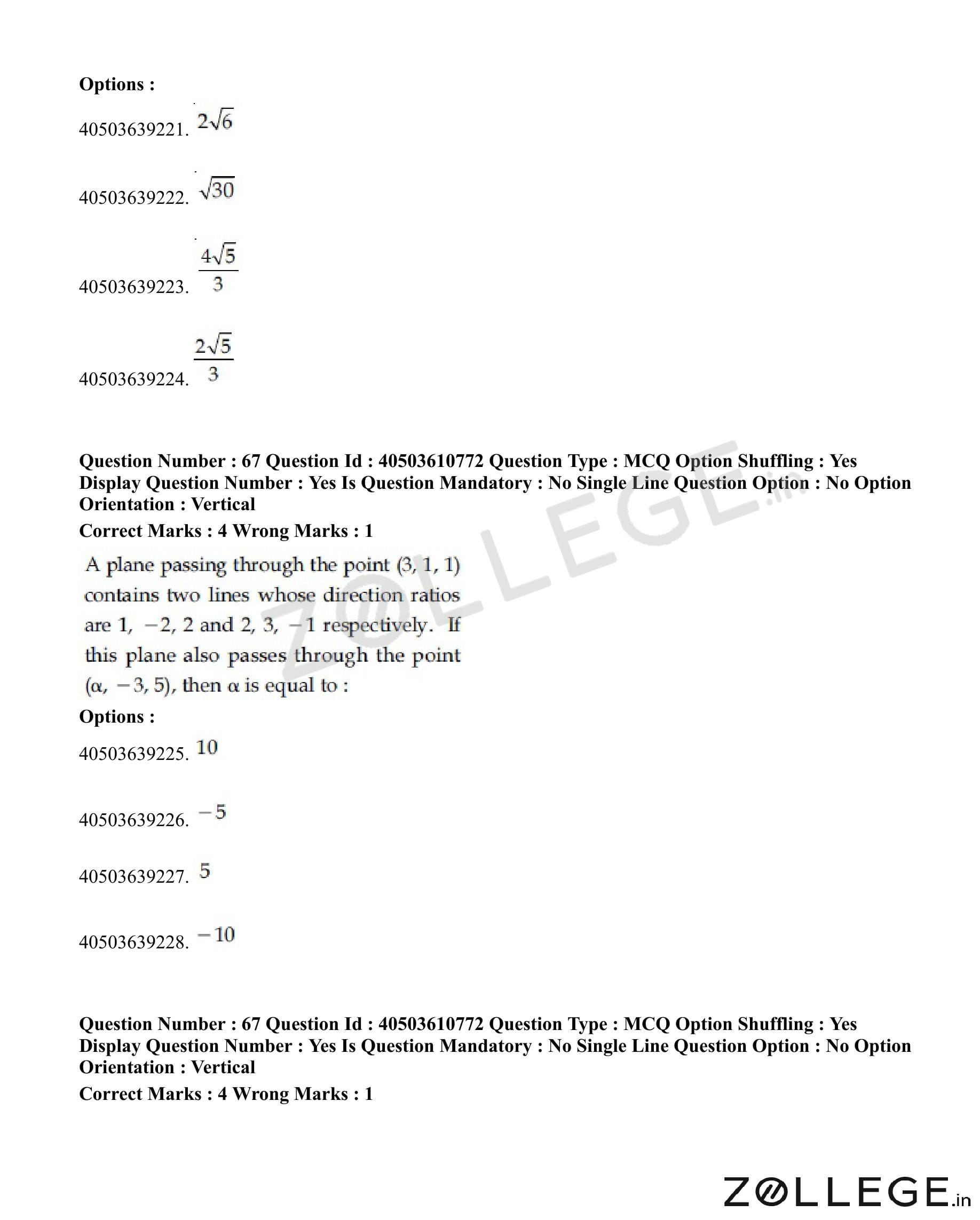
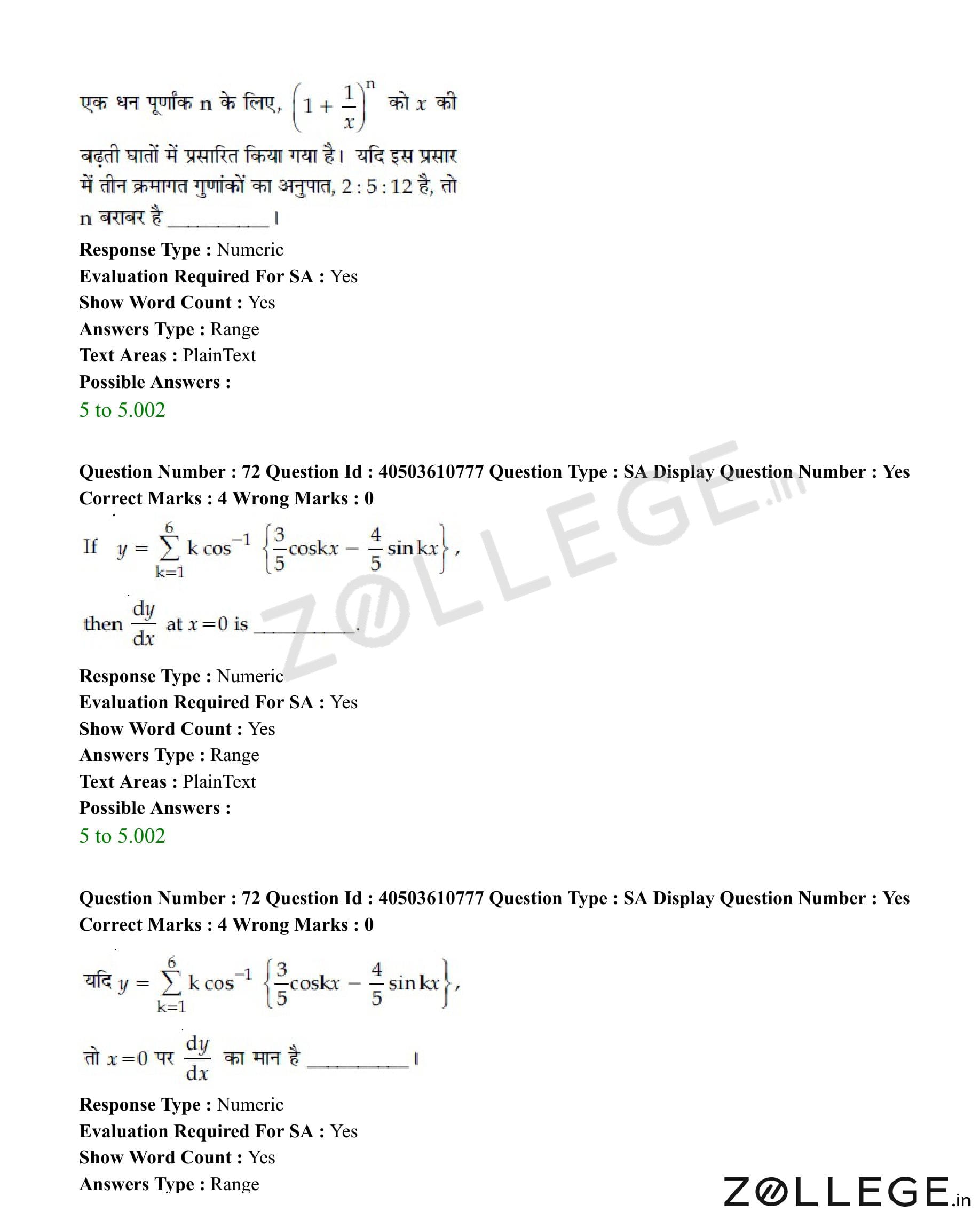
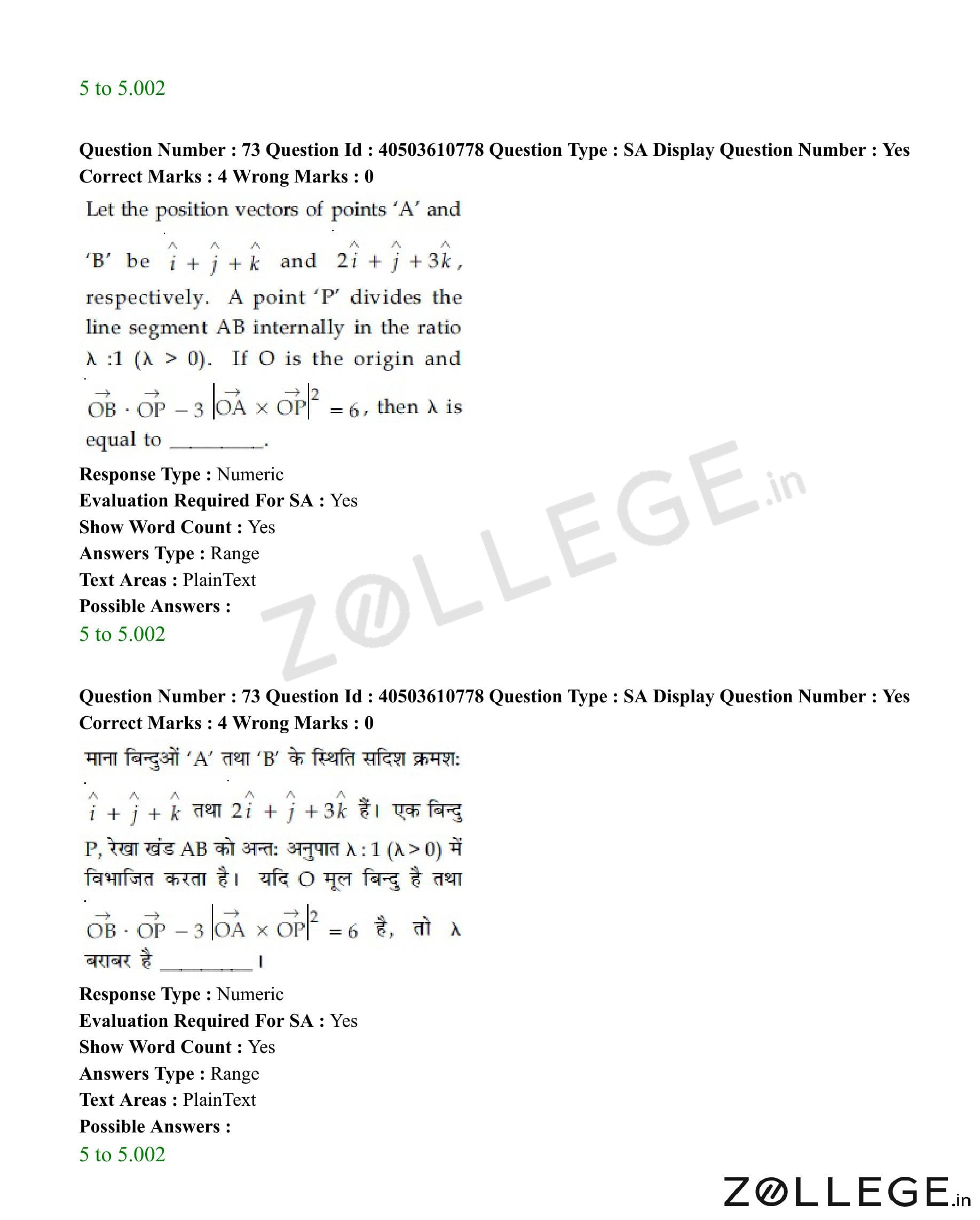
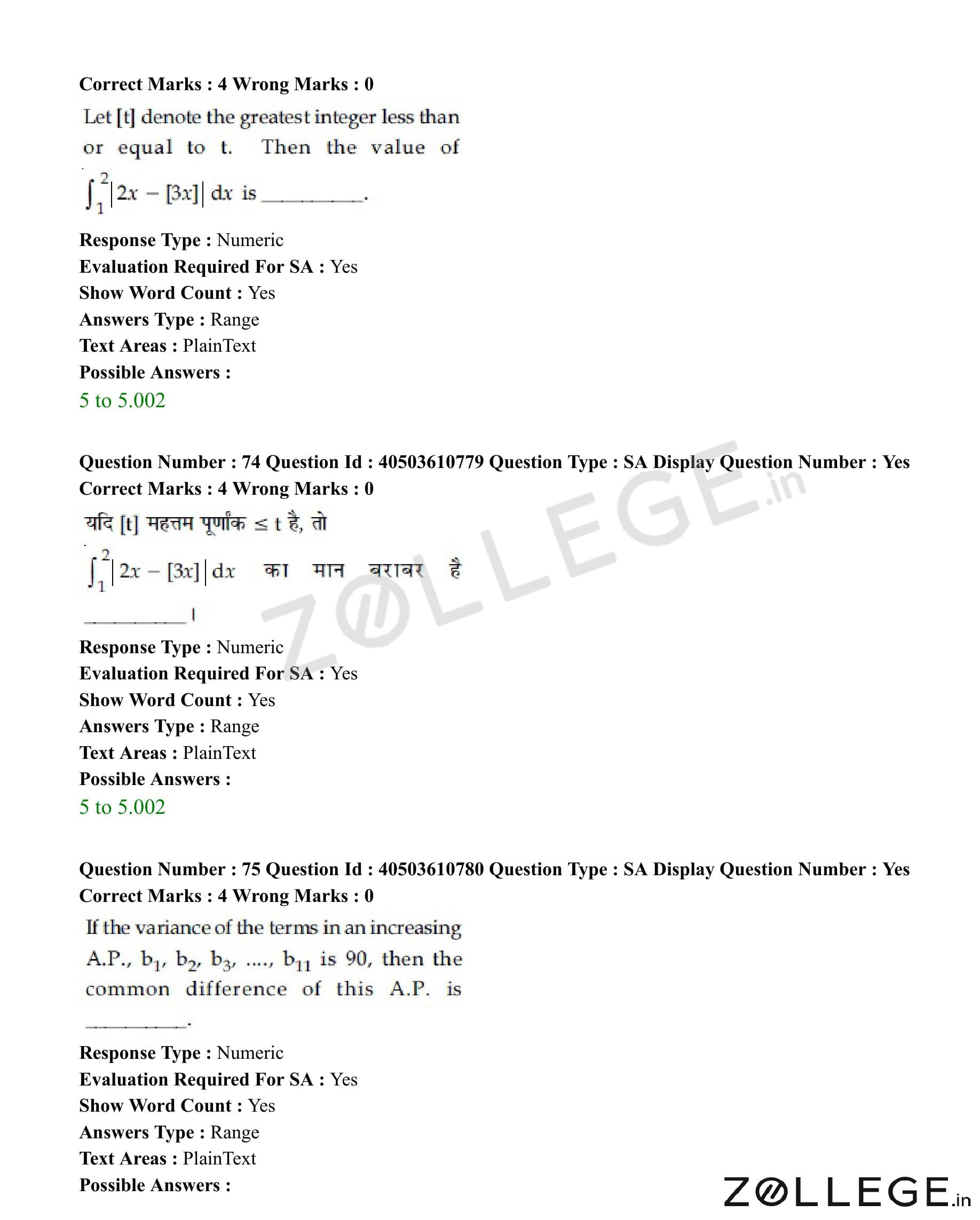
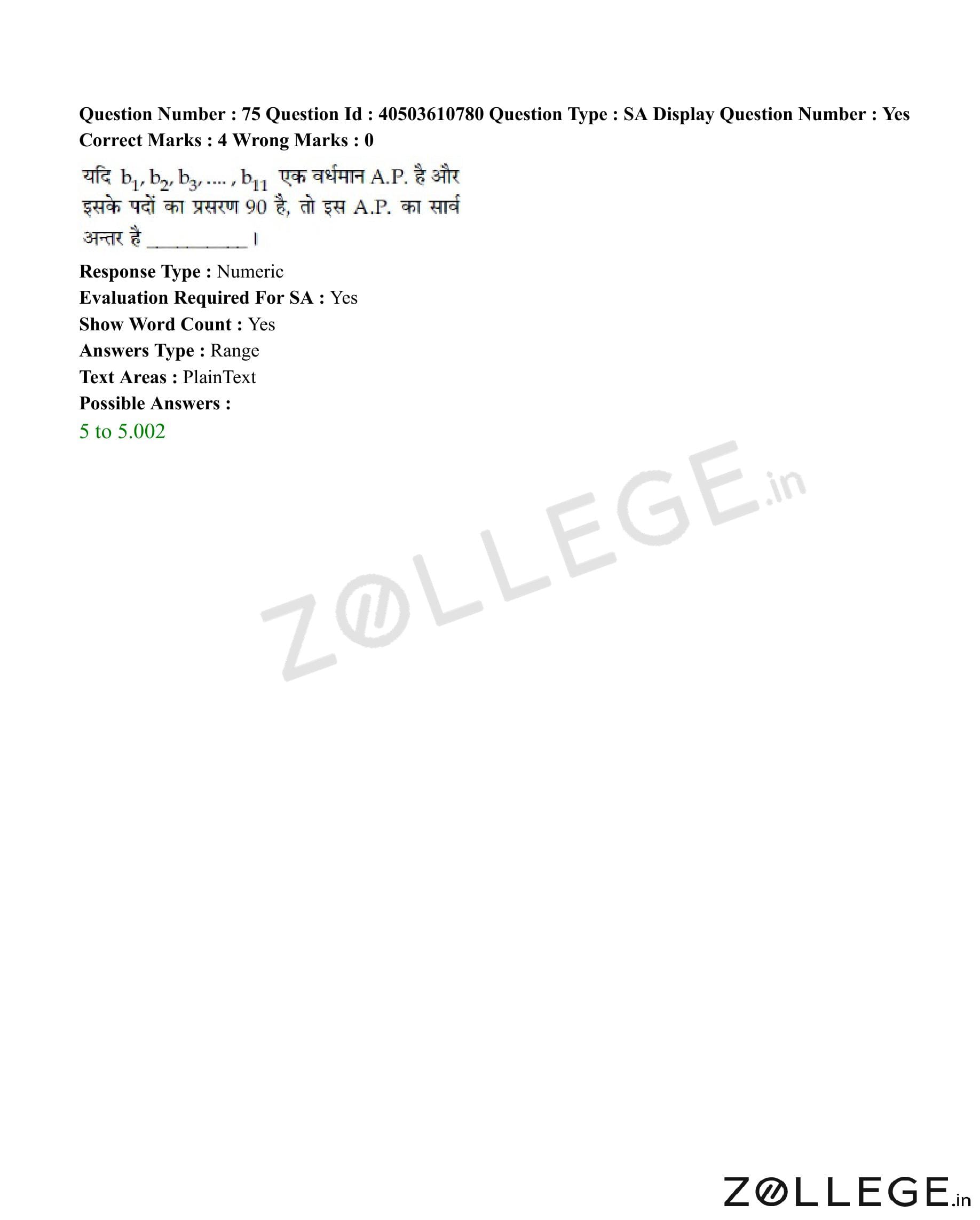
Previous Year JEE Main Question Papers
*The article might have information for the previous academic years, please refer the official website of the exam.