
JEE Main 2020 Question Paper with Answer Key PDF for B.E./ B.Tech(September 3, 2020 - Shift 1)


Content Writer | Updated On - Dec 23, 2025
JEE Main Question Papers are the most important study material for effective exam preparation. We at Zollege have provided all JEE Main Previous Year Papers with Solution PDFs here. JEE Main 2020 B. E. / B. Tech exam was conducted successfully on September 3, 2020. NTA conducted the exam in the Shift 1. According to student reactions and expert reviews, the paper was reported to be easy to moderate.
Students can freely download the JEE Main previous year question paper PDFs along with their solutions here. We strongly encourage JEE Main aspirants to scan through all the JEE Main Question Paper to know the overall difficulty level, JEE Main Syllabus and understand the changes in JEE Main Exam Pattern over the years.
JEE Main 2020 B.E./ B.Tech Question Paper with Answer Key PDF (Shift 1)
| JEE Main 2020 B.E./ B.Tech Question Paper PDF | JEE Main 2020 B.E./ B.Tech Answer Key PDF | JEE Main 2020 B.E./ B.Tech Solution PDF |
|---|---|---|
| Download PDF | Download PDF | Check Solutions |

Using screw gauge of pitch 0.1 cm and 50 divisions on its circular scale, the thickness of an object is measured. It should correctly be recorded as:
View Solution
The least count (LC) of a measuring instrument determines the smallest value it can measure accurately.
For a screw gauge, the least count is calculated using the formula:
LC = \(\frac{Pitch}{Number of divisions on circular scale}\)
Given the values:
Pitch = 0.1 cm
Number of divisions on circular scale = 50
Substituting these values into the formula:
LC = \(\frac{0.1 cm}{50} = 0.002 cm\)
Any measurement recorded by this instrument must be an integral multiple of its least count.
This means the measured value must be of the form \(n \times 0.002\) cm, where n is an integer.
Therefore, the last digit in the third decimal place of the measurement must be an even number.
Let's examine the options:
(A) 2.123 cm: The last digit is 3 (odd), which is not a multiple of 2.
(B) 2.124 cm: The last digit is 4 (even), which is a multiple of 2. This is a possible measurement.
(C) 2.125 cm: The last digit is 5 (odd), which is not a multiple of 2.
(D) 2.121 cm: The last digit is 1 (odd), which is not a multiple of 2.
Thus, the only correctly recorded measurement is 2.124 cm.
Quick Tip: The precision of a measurement is limited by the least count of the instrument. Any valid reading must be a multiple of the least count. For screw gauges, this often means the last significant digit must follow a specific pattern (e.g., even or a multiple of 5).
A charged particle carrying charge 1 \(\mu\)C is moving with velocity \((2\hat{i} + 3\hat{j} + 4\hat{k})\) ms\(^{-1}\). If an external magnetic field of \((5\hat{i} + 3\hat{j} - 6\hat{k}) \times 10^{-3}\) T exists in the region where the particle is moving then the force on the particle is \(\vec{F}_{mag} = \vec{F} \times 10^{-9}\) N. The vector \(\vec{F}\) is:
View Solution
The magnetic force (\(\vec{F}_{mag}\)) on a charged particle moving in a magnetic field is given by the Lorentz force equation:
\(\vec{F}_{mag} = q(\vec{v} \times \vec{B})\)
The given values are:
Charge, \(q = 1 \muC = 1 \times 10^{-6}\) C
Velocity, \(\vec{v} = (2\hat{i} + 3\hat{j} + 4\hat{k})\) ms\(^{-1}\)
Magnetic field, \(\vec{B} = (5\hat{i} + 3\hat{j} - 6\hat{k}) \times 10^{-3}\) T
First, we must calculate the cross product \(\vec{v} \times \vec{B}\):
\(\vec{v} \times \vec{B} = \begin{vmatrix} \hat{i} & \hat{j} & \hat{k}
2 & 3 & 4
5 & 3 & -6 \end{vmatrix} \times 10^{-3}\)
Expanding the determinant:
\(= [\hat{i}((3)(-6) - (4)(3)) - \hat{j}((2)(-6) - (4)(5)) + \hat{k}((2)(3) - (3)(5))] \times 10^{-3}\)
\(= [\hat{i}(-18 - 12) - \hat{j}(-12 - 20) + \hat{k}(6 - 15)] \times 10^{-3}\)
\(= [-30\hat{i} + 32\hat{j} - 9\hat{k}] \times 10^{-3}\)
Now, we substitute this result into the force equation:
\(\vec{F}_{mag} = (1 \times 10^{-6}) \times (-30\hat{i} + 32\hat{j} - 9\hat{k}) \times 10^{-3}\)
\(\vec{F}_{mag} = (-30\hat{i} + 32\hat{j} - 9\hat{k}) \times 10^{-9}\) N
The problem states that the force is \(\vec{F}_{mag} = \vec{F} \times 10^{-9}\) N.
By comparing our calculated force with the given expression, we can identify the vector \(\vec{F}\):
\(\vec{F} = -30\hat{i} + 32\hat{j} - 9\hat{k}\)
Quick Tip: To calculate the cross product of two vectors \(\vec{A} = a_x\hat{i} + a_y\hat{j} + a_z\hat{k}\) and \(\vec{B} = b_x\hat{i} + b_y\hat{j} + b_z\hat{k}\), the determinant method is systematic and reliable. Remember the sign convention for the components: \(+\hat{i}, -\hat{j}, +\hat{k}\).
A block of mass m = 1 kg slides with velocity v = 6 m/s on a frictionless horizontal surface and collides with a uniform vertical rod and sticks to it as shown. The rod is pivoted about O and swings as a result of the collision making angle \(\theta\) before momentarily coming to rest. If the rod has mass M = 2 kg and length l = 1 m, the value of \(\theta\) is approximately: (take g = 10 m/s\(^2\))

View Solution
This problem involves two main physical principles: conservation of angular momentum during the collision, and conservation of mechanical energy during the subsequent swing.
Step 1: Conservation of Angular Momentum
About the pivot O, there is no external torque, so angular momentum is conserved.
Initial angular momentum of the system (only the block is moving) is \(L_i = mvr = mvl\).
\(L_i = (1 kg)(6 m/s)(1 m) = 6 kg m^2/s\).
After the collision, the block sticks to the rod, and they rotate together with angular velocity \(\omega\).
The final angular momentum is \(L_f = I_{total}\omega\).
The total moment of inertia \(I_{total}\) about the pivot O is the sum of the moment of inertia of the rod about its end and the block (treated as a point mass).
\(I_{total} = I_{rod} + I_{block} = \frac{1}{3}Ml^2 + ml^2 = (\frac{M}{3} + m)l^2\).
\(I_{total} = (\frac{2}{3} + 1)(1)^2 = \frac{5}{3} kg m^2\).
Equating initial and final angular momentum: \(L_i = L_f\).
\(6 = \frac{5}{3}\omega \implies \omega = \frac{18}{5} = 3.6 rad/s\).
Step 2: Conservation of Mechanical Energy
The rotational kinetic energy of the system just after the collision is converted into gravitational potential energy as it swings up to an angle \(\theta\).
Initial Kinetic Energy \(KE_i = \frac{1}{2}I_{total}\omega^2 = \frac{1}{2}\left(\frac{5}{3}\right)(3.6)^2 = \frac{5}{6}(12.96) = 10.8 J\).
The gain in potential energy (\(\Delta PE\)) has two components: the rise of the rod's center of mass and the rise of the block.
The rod's center of mass rises by \(h_{rod} = \frac{l}{2}(1-\cos\theta)\).
The block rises by \(h_{block} = l(1-\cos\theta)\).
\(\Delta PE = Mgh_{rod} + mgh_{block} = Mg\frac{l}{2}(1-\cos\theta) + mgl(1-\cos\theta)\).
\(\Delta PE = \left(\frac{Mg}{2} + mg\right)l(1-\cos\theta) = \left(\frac{2 \cdot 10}{2} + 1 \cdot 10\right)(1)(1-\cos\theta) = 20(1-\cos\theta)\).
By conservation of energy, \(KE_i = \Delta PE\).
\(10.8 = 20(1-\cos\theta)\).
\(1 - \cos\theta = \frac{10.8}{20} = 0.54\).
\(\cos\theta = 1 - 0.54 = 0.46\).
\(\theta = \arccos(0.46) \approx 62.61^\circ\).
The closest value among the options is 63\(^\circ\).
Quick Tip: In problems involving a collision with a pivoted object, angular momentum about the pivot is conserved. If the system then moves under gravity, apply conservation of mechanical energy to relate its initial motion to its final position or height.
Moment of inertia of a cylinder of mass M, length L and radius R about an axis passing through its centre and perpendicular to the axis of the cylinder is \(I = M\left(\frac{R^2}{4} + \frac{L^2}{12}\right)\). If such a cylinder is to be made for a given mass of a material, the ratio L/R for it to have minimum possible I is:
View Solution
We need to minimize the moment of inertia \(I\) for a cylinder of a fixed mass \(M\).
The moment of inertia is given by \(I = M\left(\frac{R^2}{4} + \frac{L^2}{12}\right)\).
Since the mass \(M\) and the material (density \(\rho\)) are fixed, the volume \(V\) of the cylinder is also constant.
The volume of a cylinder is \(V = \pi R^2 L\).
We can use the constant volume constraint to express one variable in terms of the other. Let's express \(R^2\) in terms of \(L\):
\(R^2 = \frac{V}{\pi L}\).
Now, substitute this expression for \(R^2\) into the formula for \(I\) to get \(I\) as a function of only \(L\):
\(I(L) = M\left(\frac{V}{4\pi L} + \frac{L^2}{12}\right)\).
To find the value of \(L\) that minimizes \(I\), we take the derivative of \(I(L)\) with respect to \(L\) and set it to zero.
\(\frac{dI}{dL} = M\left(-\frac{V}{4\pi L^2} + \frac{2L}{12}\right) = M\left(-\frac{V}{4\pi L^2} + \frac{L}{6}\right)\).
For minimum \(I\), we set \(\frac{dI}{dL} = 0\):
\(\frac{L}{6} = \frac{V}{4\pi L^2}\)
\(4\pi L^3 = 6V\).
Now, substitute the volume formula \(V = \pi R^2 L\) back into this equation:
\(4\pi L^3 = 6(\pi R^2 L)\).
Since \(L \neq 0\), we can divide both sides by \(4\pi L\):
\(L^2 = \frac{6}{4} R^2 = \frac{3}{2} R^2\).
\(\frac{L^2}{R^2} = \frac{3}{2}\).
Taking the square root of both sides gives the required ratio:
\(\frac{L}{R} = \sqrt{\frac{3}{2}}\).
Quick Tip: For optimization problems (finding minimum or maximum values), first identify the quantity to be optimized and the constraint. Use the constraint equation to express the quantity as a function of a single variable. Then, set the first derivative with respect to that variable to zero.
A satellite is moving in a low nearly circular orbit around the earth. Its radius is roughly equal to that of the earth's radius \(R_e\). By firing rockets attached to it, its speed is instantaneously increased in the direction of its motion so that it become \(\sqrt{3/2}\) times larger. Due to this the farthest distance from the centre of the earth that the satellite reaches is R. Value of R is:
View Solution
Initially, the satellite is in a circular orbit of radius \(r_1 \approx R_e\).
The velocity in this circular orbit is \(v_o = \sqrt{\frac{GM}{R_e}}\).
The speed is instantaneously increased to \(v_p = \sqrt{\frac{3}{2}} v_o = \sqrt{\frac{3}{2}} \sqrt{\frac{GM}{R_e}} = \sqrt{\frac{3GM}{2R_e}}\).
This increase in speed pushes the satellite into an elliptical orbit. The point where the speed was increased becomes the perigee (closest point) of the new orbit.
So, the perigee distance is \(r_p = R_e\), and the velocity at perigee is \(v_p\).
We need to find the farthest distance, which is the apogee distance, \(r_a = R\). Let the velocity at apogee be \(v_a\).
We apply the principles of conservation of angular momentum and mechanical energy for the elliptical orbit.
1. Conservation of Angular Momentum:
\(m r_p v_p = m r_a v_a \implies R_e v_p = R v_a \implies v_a = v_p \frac{R_e}{R}\).
2. Conservation of Mechanical Energy:
\(E = \frac{1}{2}mv_p^2 - \frac{GMm}{r_p} = \frac{1}{2}mv_a^2 - \frac{GMm}{r_a}\).
\(\frac{1}{2}v_p^2 - \frac{GM}{R_e} = \frac{1}{2}v_a^2 - \frac{GM}{R}\).
Substitute \(v_p^2 = \frac{3GM}{2R_e}\) and \(v_a = v_p \frac{R_e}{R}\):
\(\frac{1}{2}\left(\frac{3GM}{2R_e}\right) - \frac{GM}{R_e} = \frac{1}{2}\left(v_p^2 \frac{R_e^2}{R^2}\right) - \frac{GM}{R}\).
\(\frac{3GM}{4R_e} - \frac{4GM}{4R_e} = \frac{1}{2}\left(\frac{3GM}{2R_e} \frac{R_e^2}{R^2}\right) - \frac{GM}{R}\).
\(-\frac{GM}{4R_e} = \frac{3GM R_e}{4R^2} - \frac{GM}{R}\).
Divide the entire equation by \(GM\) and multiply by \(4R^2 R_e\):
\(-R^2 = 3R_e^2 - 4R R_e\).
Rearranging gives a quadratic equation in R:
\(R^2 - 4R R_e + 3R_e^2 = 0\).
Factoring the quadratic equation:
\((R - R_e)(R - 3R_e) = 0\).
The solutions are \(R = R_e\) and \(R = 3R_e\).
\(R = R_e\) corresponds to the perigee distance, so the farthest distance (apogee) is \(R = 3R_e\).
Quick Tip: For any satellite in an elliptical orbit, the total mechanical energy is \(E = -\frac{GMm}{2a}\) and angular momentum is conserved. The points of closest approach (perigee) and farthest distance (apogee) are key points to apply conservation laws.
Pressure inside two soap bubbles are 1.01 and 1.02 atmosphere, respectively. The ratio of their volumes is:
View Solution
The excess pressure inside a soap bubble is given by the formula \(\Delta P = P_{in} - P_{out} = \frac{4T}{r}\), where T is the surface tension and r is the radius of the bubble.
Let's assume the outside pressure \(P_{out}\) is the standard atmospheric pressure, \(P_{atm} = 1\) atm.
For the first bubble:
Pressure inside, \(P_1 = 1.01\) atm.
Excess pressure, \(\Delta P_1 = P_1 - P_{atm} = 1.01 - 1 = 0.01\) atm.
So, \(0.01 = \frac{4T}{r_1}\). (Equation 1)
For the second bubble:
Pressure inside, \(P_2 = 1.02\) atm.
Excess pressure, \(\Delta P_2 = P_2 - P_{atm} = 1.02 - 1 = 0.02\) atm.
So, \(0.02 = \frac{4T}{r_2}\). (Equation 2)
Now, divide Equation 1 by Equation 2:
\(\frac{0.01}{0.02} = \frac{4T/r_1}{4T/r_2} = \frac{r_2}{r_1}\).
\(\frac{1}{2} = \frac{r_2}{r_1} \implies \frac{r_1}{r_2} = 2\).
The ratio of the radii of the two bubbles is 2:1.
The volume of a sphere is \(V = \frac{4}{3}\pi r^3\).
The ratio of their volumes is:
\(\frac{V_1}{V_2} = \frac{\frac{4}{3}\pi r_1^3}{\frac{4}{3}\pi r_2^3} = \left(\frac{r_1}{r_2}\right)^3\).
\(\frac{V_1}{V_2} = (2)^3 = 8\).
So, the ratio of their volumes is 8:1.
Quick Tip: Remember that for a soap bubble, there are two air-liquid interfaces (inner and outer), which is why the excess pressure formula is \(\Delta P = 4T/r\). For a liquid drop, there is only one interface, so the formula is \(\Delta P = 2T/r\).
A balloon filled with helium (32\(^\circ\)C and 1.7 atm) bursts. Immediately afterwards the expansion of helium can be considered as:
View Solution
Let's analyze the characteristics of the process when a balloon bursts.
1. Speed of the process: The bursting of a balloon is a very rapid, sudden event.
2. Heat Exchange: Because the process happens almost instantaneously, there is negligible time for heat to be exchanged between the helium gas and its surroundings. A process with no heat exchange (\(Q=0\)) is, by definition, an adiabatic process. This eliminates options (B) and (D).
3. Reversibility: A reversible process is one that proceeds through a series of equilibrium states and can be reversed by an infinitesimal change in conditions. The bursting of a balloon is a violent, chaotic expansion into the atmosphere. The system is far from equilibrium throughout the process. It is a highly spontaneous and unrestrained expansion, which is the hallmark of an irreversible process.
Combining these two points, the expansion of helium immediately after the balloon bursts is an irreversible adiabatic process.
Quick Tip: In thermodynamics, processes that are sudden, spontaneous, or involve phenomena like friction are generally irreversible. Processes like bursting, free expansion, or rapid compression/expansion are classic examples of irreversibility. Adiabatic processes are those that occur too quickly for significant heat transfer.
Consider a gas of triatomic molecules. The molecules are assumed to be triangular and made of massless rigid rods whose vertices are occupied by atoms. The internal energy of a mole of the gas at temperature T is:

View Solution
The internal energy (U) of one mole of an ideal gas is given by the equipartition theorem:
\(U = \frac{f}{2}RT\), where \(f\) is the total number of degrees of freedom.
We need to determine the degrees of freedom for a non-linear (triangular) triatomic molecule.
1. Translational Degrees of Freedom: Any molecule can move along the x, y, and z axes. So, there are always 3 translational degrees of freedom.
2. Rotational Degrees of Freedom: A non-linear molecule can rotate about any of the three perpendicular axes (x, y, z). Therefore, it has 3 rotational degrees of freedom. (A linear molecule only has 2).
3. Vibrational Degrees of Freedom: The problem states the molecules are made of "rigid rods", which implies that the bonds cannot vibrate. Therefore, we assume the vibrational degrees of freedom are zero (or "frozen out" at temperature T).
The total number of degrees of freedom is the sum of translational and rotational degrees of freedom:
\(f = f_{trans} + f_{rot} = 3 + 3 = 6\).
Now, we can calculate the internal energy of one mole of this gas:
\(U = \frac{6}{2}RT = 3RT\).
Quick Tip: For calculating internal energy using the equipartition theorem, remember the degrees of freedom: - Monatomic gas (e.g., He, Ar): \(f=3\) (3 trans) - Diatomic/Linear polyatomic gas (e.g., O\(_2\), CO\(_2\)): \(f=5\) (3 trans, 2 rot) - Non-linear polyatomic gas (e.g., H\(_2\)O, NH\(_3\)): \(f=6\) (3 trans, 3 rot) Vibrational modes are usually considered only at high temperatures.
A uniform thin rope of length 12 m and mass 6 kg hangs vertically from a rigid support and a block of mass 2 kg is attached to its free end. A transverse short wave-train of wavelength 6 cm is produced at the lower end of the rope. What is the wavelength of the wavetrain (in cm) when it reaches the top of the rope?
View Solution
The frequency of a wave remains constant as it travels from one medium to another (or in a medium with varying properties). The wave speed and wavelength change.
The speed of a transverse wave on a rope is given by \(v = \sqrt{\frac{T}{\mu}}\), where T is the tension in the rope and \(\mu\) is the linear mass density.
The linear mass density of the rope is \(\mu = \frac{mass of rope}{length of rope} = \frac{6 kg}{12 m} = 0.5 kg/m\).
Let's calculate the tension at the lower end (\(T_{bottom}\)) and the top end (\(T_{top}\)) of the rope.
At the lower end, the tension is due to the weight of the attached 2 kg block:
\(T_{bottom} = m_{block} \cdot g = 2g\).
At the top end, the tension is due to the weight of the block plus the weight of the entire rope:
\(T_{top} = (m_{block} + m_{rope}) \cdot g = (2 + 6)g = 8g\).
Now we can find the wave speeds at the bottom (\(v_{bottom}\)) and top (\(v_{top}\)).
\(v_{bottom} = \sqrt{\frac{T_{bottom}}{\mu}} = \sqrt{\frac{2g}{0.5}} = \sqrt{4g}\).
\(v_{top} = \sqrt{\frac{T_{top}}{\mu}} = \sqrt{\frac{8g}{0.5}} = \sqrt{16g}\).
The relationship between speed, frequency (\(f\)), and wavelength (\(\lambda\)) is \(v = f\lambda\). Since \(f\) is constant, we have \(f = \frac{v}{\lambda}\).
Therefore, \(\frac{v_{bottom}}{\lambda_{bottom}} = \frac{v_{top}}{\lambda_{top}}\).
\(\lambda_{top} = \lambda_{bottom} \left(\frac{v_{top}}{v_{bottom}}\right)\).
Given \(\lambda_{bottom} = 6\) cm.
\(\lambda_{top} = 6 cm \left(\frac{\sqrt{16g}}{\sqrt{4g}}\right) = 6 cm \left(\sqrt{\frac{16}{4}}\right) = 6 cm \left(\sqrt{4}\right) = 6 cm \times 2\).
\(\lambda_{top} = 12\) cm.
Quick Tip: When a wave travels along a medium with changing properties, such as a hanging rope where tension varies with height, its frequency remains constant. The wave speed and wavelength, however, change according to the relation \(v=f\lambda\).
Two isolated conducting spheres S\(_1\) and S\(_2\) of radius \(\frac{2}{3}\)R and \(\frac{1}{3}\)R have 12 \(\mu\)C and -3 \(\mu\)C charges, respectively, and are at a large distance from each other. They are now connected by a conducting wire. A long time after this is done the charges on S\(_1\) and S\(_2\) are respectively:
View Solution
When the two conducting spheres are connected by a wire, charge will flow between them until they reach the same electric potential.
Let the initial charges be \(q_1 = 12\) \(\mu\)C and \(q_2 = -3\) \(\mu\)C.
By the principle of conservation of charge, the total charge of the system remains constant.
Total charge \(Q_{total} = q_1 + q_2 = 12 \muC - 3 \muC = 9 \muC\).
Let the final charges on spheres S\(_1\) and S\(_2\) be \(q'_1\) and \(q'_2\) respectively.
\(q'_1 + q'_2 = Q_{total} = 9 \muC\). (Equation 1)
After connecting, their potentials become equal: \(V_1 = V_2\).
The potential of a conducting sphere is given by \(V = \frac{kq}{r}\).
So, \(\frac{k q'_1}{r_1} = \frac{k q'_2}{r_2}\), where \(r_1 = \frac{2}{3}R\) and \(r_2 = \frac{1}{3}R\).
\(\frac{q'_1}{(2/3)R} = \frac{q'_2}{(1/3)R}\).
\(\frac{q'_1}{2} = \frac{q'_2}{1} \implies q'_1 = 2q'_2\). (Equation 2)
Now we have a system of two linear equations. Substitute Equation 2 into Equation 1:
\(2q'_2 + q'_2 = 9 \muC\).
\(3q'_2 = 9 \muC \implies q'_2 = 3 \muC\).
Now find \(q'_1\) using Equation 2:
\(q'_1 = 2(3 \muC) = 6 \muC\).
So, the final charges are 6 \(\mu\)C on S\(_1\) and 3 \(\mu\)C on S\(_2\).
Quick Tip: When two conductors are connected, charge is conserved, and the final state is characterized by equal potentials. The final charge distribution is proportional to their capacitance (or radius, for spheres), i.e., \(q' \propto C \propto r\).
In the circuit shown in the figure, the total charge is 750 \(\mu\)C and the voltage across capacitor C\(_2\) is 20 V. Then the charge on capacitor C\(_2\) is:

View Solution
In the given circuit, capacitors C\(_2\) and C\(_3\) are connected in parallel.
The voltage across components in parallel is the same. Therefore, the voltage across C\(_3\) is also 20 V.
Voltage across C\(_2\), \(V_2 = 20\) V.
Voltage across C\(_3\), \(V_3 = 20\) V.
The capacitor C\(_1\) is in series with the parallel combination of C\(_2\) and C\(_3\).
The term "total charge is 750 \(\mu\)C" refers to the charge drawn from the battery, which is the charge that accumulates on the series capacitor C\(_1\).
So, the charge on C\(_1\) is \(Q_1 = 750 \muC\).
This total charge \(Q_1\) splits between the two parallel branches containing C\(_2\) and C\(_3\).
So, \(Q_1 = Q_2 + Q_3\), where \(Q_2\) and \(Q_3\) are the charges on capacitors C\(_2\) and C\(_3\).
We can calculate the charge on C\(_3\) using the formula \(Q = CV\).
Given \(C_3 = 8 \muF\) and \(V_3 = 20\) V.
\(Q_3 = C_3 V_3 = (8 \muF)(20 V) = 160 \muC\).
Now we can find the charge on C\(_2\):
\(Q_2 = Q_1 - Q_3\).
\(Q_2 = 750 \muC - 160 \muC = 590 \muC\).
Therefore, the charge on capacitor C\(_2\) is 590 \(\mu\)C.
Quick Tip: For series capacitor combinations, the charge on each capacitor is the same. For parallel combinations, the voltage across each capacitor is the same, and the total charge is the sum of the charges on individual capacitors.
Model a torch battery of length l to be made up of a thin cylindrical bar of radius 'a' and a concentric thin cylindrical shell of radius 'b' filled in between with an electrolyte of resistivity \(\rho\) (see figure). If the battery is connected to a resistance of value R, the maximum Joule heating in R will take place for:
View Solution
The problem describes the internal resistance of a battery. The current flows radially outward from the central bar to the outer shell through the electrolyte.
To find the internal resistance \(r_{int}\) of the battery, we consider a thin cylindrical shell of electrolyte at radius \(x\) with thickness \(dx\).
The resistance \(dR\) of this thin shell is given by \(dR = \rho \frac{length}{area}\).
Here, the 'length' of the path for the current is the thickness \(dx\), and the area through which the current flows is the surface area of the cylindrical shell, which is \(2\pi x l\).
So, \(dR = \frac{\rho \, dx}{2\pi x l}\).
To find the total internal resistance \(r_{int}\), we integrate this expression from the inner radius \(a\) to the outer radius \(b\):
\(r_{int} = \int_{a}^{b} dR = \int_{a}^{b} \frac{\rho}{2\pi l} \frac{dx}{x}\).
\(r_{int} = \frac{\rho}{2\pi l} \int_{a}^{b} \frac{1}{x} dx = \frac{\rho}{2\pi l} [\ln(x)]_{a}^{b}\).
\(r_{int} = \frac{\rho}{2\pi l} (\ln(b) - \ln(a)) = \frac{\rho}{2\pi l} \ln\left(\frac{b}{a}\right)\).
The battery is connected to an external resistance \(R\). The power dissipated in \(R\) (Joule heating) is given by \(P = I^2 R\).
The current in the circuit is \(I = \frac{\mathcal{E}}{R + r_{int}}\), where \(\mathcal{E}\) is the emf of the battery.
So, the power is \(P(R) = \left(\frac{\mathcal{E}}{R + r_{int}}\right)^2 R = \frac{\mathcal{E}^2 R}{(R + r_{int})^2}\).
According to the maximum power transfer theorem, the power delivered to the external resistance \(R\) is maximum when the external resistance is equal to the internal resistance of the source.
Therefore, for maximum Joule heating, \(R = r_{int}\).
\(R = \frac{\rho}{2\pi l} \ln\left(\frac{b}{a}\right)\).
Quick Tip: The maximum power transfer theorem is a crucial concept. It states that for a DC voltage source with an internal resistance \(r_{int}\), the maximum power is delivered to an external load resistance \(R\) when \(R = r_{int}\).
Magnitude of magnetic field (in SI units) at the centre of a hexagonal shape coil of side 10 cm, 50 turns and carrying current I (Ampere) in units of \(\frac{\mu_0 I}{\pi}\) is:
View Solution
Given:
A regular hexagonal coil \[ Side length a = 10 cm = 0.1 m, \quad Number of turns N = 50, \quad Current = I \]
We are asked to find the magnetic field at the centre in units of \[ \frac{\mu_0 I}{\pi} \]
Step 1: Geometry of the hexagon
A regular hexagon can be divided into 6 equilateral triangles.
The distance from the centre to the midpoint of any side (apothem) is: \[ r = \frac{\sqrt{3}}{2}a \]
\[ r = \frac{\sqrt{3}}{2} \times 0.1 = \frac{0.1\sqrt{3}}{2}\ m \]
Step 2: Magnetic field due to one side
Magnetic field at a point due to a finite straight current-carrying wire is: \[ B = \frac{\mu_0 I}{4\pi r}(\sin\theta_1 + \sin\theta_2) \]
For each side of the hexagon: \[ \theta_1 = \theta_2 = 30^\circ \]
\[ \sin 30^\circ + \sin 30^\circ = 1 \]
Substitute values: \[ B_{side} = \frac{\mu_0 I}{4\pi \left(\frac{0.1\sqrt{3}}{2}\right)} \times 1 \]
\[ B_{side} = \frac{2\mu_0 I}{0.4\pi\sqrt{3}} = \frac{5\mu_0 I}{\pi\sqrt{3}} \]
Step 3: Magnetic field due to one complete hexagonal turn
A hexagon has 6 sides, so: \[ B_{one turn} = 6 \times B_{side} \]
\[ B_{one turn} = 6 \times \frac{5\mu_0 I}{\pi\sqrt{3}} = \frac{30\mu_0 I}{\pi\sqrt{3}} \]
Rationalising: \[ B_{one turn} = \frac{10\sqrt{3}\mu_0 I}{\pi} \]
Step 4: Magnetic field due to 50 turns
\[ B_{total} = N \times B_{one turn} \]
\[ B_{total} = 50 \times \frac{10\sqrt{3}\mu_0 I}{\pi} = \frac{500\sqrt{3}\mu_0 I}{\pi} \]
Step 5: Required value
Since the field is asked in units of \(\dfrac{\mu_0 I}{\pi}\),
\[ \boxed{500\sqrt{3}} \]
Correct option: (D) Quick Tip: For a regular n-sided polygon of side 'a', the magnetic field at the center is given by \(B = \frac{n \mu_0 I}{2\pi a} \tan(\frac{\pi}{n})\). You can derive this using the Biot-Savart law for a single side and multiplying by n, or memorize the formula for speed.
An elliptical loop having resistance R, of semi major axis a, and semi minor axis b is placed in a magnetic field as shown in the figure. If the loop is rotated about the x-axis with angular frequency \(\omega\), the average power loss in the loop due to joule heating is:

View Solution
When the elliptical loop rotates in the magnetic field, the magnetic flux through it changes, inducing an electromotive force (emf).
The magnetic field is \(\vec{B} = B\hat{k}\). The area vector \(\vec{A}\) can be written as \(\vec{A} = A(\cos\theta \hat{k} + \sin\theta \hat{j})\), where \(A = \pi ab\) is the area of the ellipse and \(\theta = \omega t\) is the angle of rotation about the x-axis.
The magnetic flux \(\Phi_B\) through the loop is given by \(\Phi_B = \vec{B} \cdot \vec{A}\).
\(\Phi_B = (B\hat{k}) \cdot (A(\cos(\omega t) \hat{k} + \sin(\omega t) \hat{j})) = BA \cos(\omega t)\).
\(\Phi_B = (\pi ab)B \cos(\omega t)\).
The induced emf (\(\mathcal{E}\)) is given by Faraday's law of induction: \(\mathcal{E} = -\frac{d\Phi_B}{dt}\).
\(\mathcal{E} = -\frac{d}{dt} [(\pi ab)B \cos(\omega t)] = -(\pi ab)B(-\omega\sin(\omega t))\).
\(\mathcal{E} = \pi ab B \omega \sin(\omega t)\).
The instantaneous power loss due to Joule heating is \(P = \frac{\mathcal{E}^2}{R}\).
\(P(t) = \frac{(\pi ab B \omega \sin(\omega t))^2}{R} = \frac{\pi^2 a^2 b^2 B^2 \omega^2}{R} \sin^2(\omega t)\).
To find the average power loss, we need to find the average value of \(\sin^2(\omega t)\) over one complete cycle. The average value of \(\sin^2(\theta)\) over a full cycle is \(\frac{1}{2}\).
\(< \sin^2(\omega t) > = \frac{1}{2}\).
Therefore, the average power loss is:
\(P_{avg} = \frac{\pi^2 a^2 b^2 B^2 \omega^2}{R} < \sin^2(\omega t) > = \frac{\pi^2 a^2 b^2 B^2 \omega^2}{2R}\).
Quick Tip: The average value of \(\sin^2(\omega t)\) or \(\cos^2(\omega t)\) over a full period is always 1/2. This is a very useful identity for calculating average power in AC circuits and electromagnetic induction problems.
A 750 Hz, 20 V (rms) source is connected to a resistance of 100 \(\Omega\), an inductance of 0.1803 H and a capacitance of 10 \(\mu\)F all in series. The time in which the resistance (heat capacity 2 J/\(^\circ\)C) will get heated by 10\(^\circ\)C. (assume no loss of heat to the surroundings) is close to:
View Solution
Given: \[ f = 750\ Hz, \quad V_{rms} = 20\ V \] \[ R = 100\ \Omega, \quad L = 0.1803\ H, \quad C = 10\,\muF = 10\times10^{-6}\ F \] \[ Heat capacity of resistor = 2\ J/^\circC \] \[ \Delta T = 10^\circC \]
Step 1: Angular frequency
\[ \omega = 2\pi f = 2\pi(750) = 1500\pi \approx 4712\ rad s^{-1} \]
Step 2: Inductive and capacitive reactance
\[ X_L = \omega L = 4712 \times 0.1803 \approx 850\ \Omega \]
\[ X_C = \frac{1}{\omega C} = \frac{1}{4712 \times 10 \times 10^{-6}} = \frac{1}{0.04712} \approx 21.2\ \Omega \]
Step 3: Total impedance of the LCR circuit
\[ Z = \sqrt{R^2 + (X_L - X_C)^2} \]
\[ Z = \sqrt{100^2 + (850 - 21.2)^2} = \sqrt{10000 + 828.8^2} \]
\[ Z = \sqrt{696900} \approx 834.8\ \Omega \]
Step 4: RMS current in the circuit
\[ I_{rms} = \frac{V_{rms}}{Z} = \frac{20}{834.8} \approx 0.024\ A \]
Step 5: Power dissipated in the resistor
Only the resistor dissipates power: \[ P = I_{rms}^2 R \]
\[ P = (0.024)^2 \times 100 \approx 0.0574\ W \]
Step 6: Heat required to raise temperature
\[ Q = (heat capacity) \times \Delta T \]
\[ Q = 2 \times 10 = 20\ J \]
Step 7: Time required
\[ Q = P t \Rightarrow t = \frac{Q}{P} \]
\[ t = \frac{20}{0.0574} \approx 348\ s \]
Final Answer: \[ \boxed{348\ s} \]
Correct option: (A) Quick Tip: In a series LCR circuit, power is dissipated only in the resistor. The average power is given by \(P = V_{rms} I_{rms} \cos\phi = I_{rms}^2 R\), where \(\cos\phi = R/Z\) is the power factor.
The magnetic field of a plane electromagnetic wave is \(\vec{B} = 3 \times 10^{-8} \sin[200\pi(y+ct)]\hat{i}\) T where \(c = 3 \times 10^8\) ms\(^{-1}\) is the speed of light. The electric field is:
View Solution
Given: \[ \vec{B} = 3\times10^{-8}\sin[200\pi(y+ct)]\,\hat{i}\ T \] \[ c = 3\times10^{8}\ m s^{-1} \]
Step 1: Direction of propagation
The phase of the wave is \( (y+ct) \).
For a plane wave: \[ (y - ct) \Rightarrow propagation in +y direction \] \[ (y + ct) \Rightarrow propagation in -y direction \]
Hence, the wave propagates along the \(-\hat{j}\) direction.
\[ \vec{k}_{prop} = -\hat{j} \]
Step 2: Direction of magnetic field
From the given expression: \[ \vec{B} = B_0 \sin[200\pi(y+ct)]\,\hat{i} \]
Thus, the magnetic field is along the \(+\hat{i}\) (x-axis) direction.
Step 3: Direction of electric field
For an electromagnetic wave: \[ \vec{k}_{prop} \propto \vec{E} \times \vec{B} \]
Substituting known directions: \[ -\hat{j} = \vec{E} \times \hat{i} \]
Using cross-product rules: \[ (-\hat{k}) \times \hat{i} = -(\hat{k}\times\hat{i}) = -\hat{j} \]
Hence, the electric field must be along the \(-\hat{k}\) direction.
Step 4: Magnitude of electric field
In electromagnetic waves: \[ E_0 = cB_0 \]
\[ E_0 = (3\times10^8)(3\times10^{-8}) = 9\ V m^{-1} \]
Step 5: Final expression for electric field
\[ \vec{E} = -9\sin[200\pi(y+ct)]\,\hat{k}\ V m^{-1} \]
Final Answer: \[ \boxed{\vec{E} = -9\sin[200\pi(y+ct)]\,\hat{k}\ V/m} \]
Correct option: (B) Quick Tip: For a plane EM wave, the direction of propagation is given by \(\vec{E} \times \vec{B}\). The magnitude relation is \(E = cB\). The argument of the wave function \(k(x-vt)\) indicates propagation in the +x direction, while \(k(x+vt)\) indicates propagation in the -x direction.
In a Young's double slit experiment, light of 500 nm is used to produce an interference pattern. When the distance between the slits is 0.05 mm, the angular width (in degree) of the fringes formed on the distance screen is close to:
View Solution
The angular width (\(\theta\)) of a fringe in a Young's double-slit experiment is the angle subtended by the fringe width at the slits.
The fringe width (\(\beta\)) is given by \(\beta = \frac{\lambda D}{d}\), where \(\lambda\) is the wavelength, D is the distance to the screen, and d is the slit separation.
The angular width is given by \(\theta = \frac{\beta}{D}\).
Substituting the expression for \(\beta\), we get:
\(\theta = \frac{(\lambda D / d)}{D} = \frac{\lambda}{d}\).
The angle \(\theta\) calculated from this formula will be in radians.
Given values:
Wavelength, \(\lambda = 500 nm = 500 \times 10^{-9}\) m.
Slit separation, \(d = 0.05 mm = 0.05 \times 10^{-3}\) m = \(5 \times 10^{-5}\) m.
Now, calculate \(\theta\) in radians:
\(\theta = \frac{500 \times 10^{-9}}{5 \times 10^{-5}} = \frac{5 \times 10^{-7}}{5 \times 10^{-5}} = 10^{-2}\) radians.
To convert radians to degrees, we use the conversion factor: \(1 radian = \frac{180}{\pi}\) degrees.
\(\theta_{degrees} = 10^{-2} \times \frac{180}{\pi} \approx 0.01 \times \frac{180}{3.14159}\).
\(\theta_{degrees} \approx 0.01 \times 57.295 \approx 0.573^\circ\).
The angular width of the fringes is close to 0.57\(^\circ\).
Quick Tip: For small angles, which is almost always the case in YDSE, the angular width \(\theta\) can be approximated by \(\theta \approx \tan\theta = \beta/D = \lambda/d\). Remember that this formula gives the result in radians.
When the wavelength of radiation falling on a metal is changed from 500 nm to 200 nm, the maximum kinetic energy of the photoelectrons becomes three times larger. The work function of the metal is close to:
View Solution
We will use Einstein's photoelectric equation: \(K_{max} = h\nu - \phi = \frac{hc}{\lambda} - \phi\), where \(K_{max}\) is the maximum kinetic energy, \(\lambda\) is the wavelength, and \(\phi\) is the work function.
A useful constant to remember is \(hc \approx 1240\) eV\(\cdot\)nm.
Case 1: Wavelength \(\lambda_1 = 500\) nm.
The energy of the incident photon is \(E_1 = \frac{1240}{500} = 2.48\) eV.
The photoelectric equation is \(K_1 = 2.48 - \phi\). (Equation 1)
Case 2: Wavelength \(\lambda_2 = 200\) nm.
The energy of the incident photon is \(E_2 = \frac{1240}{200} = 6.20\) eV.
The maximum kinetic energy is \(K_2\), and the problem states \(K_2 = 3K_1\).
The photoelectric equation is \(K_2 = 6.20 - \phi\).
Substituting \(K_2 = 3K_1\), we get \(3K_1 = 6.20 - \phi\). (Equation 2)
Now we have a system of two equations with two unknowns (\(K_1\) and \(\phi\)).
From Equation 1, we have \(K_1 = 2.48 - \phi\). Substitute this into Equation 2:
\(3(2.48 - \phi) = 6.20 - \phi\).
\(7.44 - 3\phi = 6.20 - \phi\).
\(7.44 - 6.20 = 3\phi - \phi\).
\(1.24 = 2\phi\).
\(\phi = \frac{1.24}{2} = 0.62\) eV.
The work function of the metal is approximately 0.62 eV, which is closest to 0.61 eV.
Quick Tip: In photoelectric effect problems, it's highly convenient to use the value of \(hc\) as 1240 eV\(\cdot\)nm. This allows you to get the photon energy in eV directly when the wavelength is given in nm, using \(E(eV) = \frac{1240}{\lambda(nm)}\).
In a radioactive material, fraction of active material remaining after time t is 9/16. The fraction that was remaining after t/2 is:
View Solution
The law of radioactive decay states that the number of active nuclei \(N\) at time \(t\) is given by:
\(N = N_0 e^{-\lambda t}\), where \(N_0\) is the initial number of nuclei and \(\lambda\) is the decay constant.
The fraction of active material remaining is \(\frac{N}{N_0}\).
Given that after time \(t\), the fraction remaining is \(\frac{9}{16}\).
So, \(\frac{N(t)}{N_0} = \frac{9}{16}\).
\(\frac{9}{16} = e^{-\lambda t}\). (Equation 1)
We need to find the fraction remaining after time \(t/2\), which is \(\frac{N(t/2)}{N_0}\).
Let this fraction be \(f\).
\(f = \frac{N(t/2)}{N_0} = e^{-\lambda (t/2)} = (e^{-\lambda t})^{1/2}\).
Now, substitute the value of \(e^{-\lambda t}\) from Equation 1:
\(f = \left(\frac{9}{16}\right)^{1/2}\).
\(f = \sqrt{\frac{9}{16}} = \frac{\sqrt{9}}{\sqrt{16}} = \frac{3}{4}\).
Therefore, the fraction of the material remaining after time \(t/2\) is \(\frac{3}{4}\).
Quick Tip: For radioactive decay, the fraction remaining \(\frac{N}{N_0}\) follows an exponential decay. The fraction remaining after time \(t/n\) will be \((\frac{N}{N_0})^{1/n}\) if you know the fraction at time \(t\). This is a direct consequence of the property \((e^a)^b = e^{ab}\).
When a diode is forward biased, it has a voltage drop of 0.5 V. The safe limit of current through the diode is 10 mA. If a battery of emf 1.5 V is used in the circuit, the value of minimum resistance to be connected in series with the diode so that the current does not exceed the safe limit is:
View Solution
We have a simple series circuit consisting of a battery, a resistor, and a forward-biased diode.
Let \(\mathcal{E}\) be the emf of the battery, \(V_d\) be the voltage drop across the diode, \(I\) be the current, and \(R\) be the series resistance.
According to Kirchhoff's Voltage Law (KVL), the sum of voltage drops around the closed loop must equal the battery's emf.
\(\mathcal{E} = I \cdot R + V_d\).
We are given the following values:
Battery emf, \(\mathcal{E} = 1.5\) V.
Diode voltage drop, \(V_d = 0.5\) V.
The maximum safe current, \(I_{max} = 10 mA = 10 \times 10^{-3} A = 0.01\) A.
To ensure the current does not exceed the safe limit, we need to find the minimum resistance \(R_{min}\) required for this maximum current.
Rearranging the KVL equation to solve for R:
\(R = \frac{\mathcal{E} - V_d}{I}\).
Substituting the values to find the minimum resistance:
\(R_{min} = \frac{1.5 V - 0.5 V}{0.01 A}\).
\(R_{min} = \frac{1.0 V}{0.01 A}\).
\(R_{min} = 100 \, \Omega\).
This is the minimum resistance required to limit the current to 10 mA. Any resistance lower than this would allow the current to exceed the safe limit.
Quick Tip: When analyzing circuits with diodes, treat a forward-biased ideal diode as a short circuit. For a more practical model, treat it as a source of constant voltage drop (e.g., 0.7V for silicon, 0.3V for germanium, or as given in the problem) opposing the current flow.
A cricket ball of mass 0.15 kg is thrown vertically up by a bowling machine so that it rises to a maximum height of 20 m after leaving the machine. If the part pushing the ball applies a constant force F on the ball and moves horizontally a distance of 0.2 m while launching the ball, the value of F (in N) is (g = 10 ms\(^{-2}\)) _____.
View Solution
First, we find the velocity (v) with which the ball leaves the machine to reach a height (h) of 20 m.
Using the equation of motion \(v_f^2 = v_i^2 + 2as\), where final velocity \(v_f=0\) at maximum height and acceleration \(a=-g\):
\(0^2 = v^2 - 2gh \implies v^2 = 2gh\).
\(v^2 = 2 \times 10 m/s^2 \times 20 m = 400 m^2/s^2\).
The kinetic energy (KE) of the ball as it leaves the machine is:
\(KE = \frac{1}{2}mv^2 = \frac{1}{2} \times 0.15 kg \times 400 m^2/s^2 = 30 J\).
According to the work-energy theorem, the work done by the force F of the machine on the ball is equal to the kinetic energy gained by the ball.
The problem states the force F acts over a distance d = 0.2 m.
Work Done \(W = F \times d\).
So, \(F \times d = KE\).
\(F \times 0.2 m = 30 J\).
\(F = \frac{30}{0.2} = 150 N\).
Quick Tip: The work-energy theorem (\(W_{net} = \Delta KE\)) is a powerful tool that connects forces and motion. When an object is projected upwards, its initial kinetic energy is converted into gravitational potential energy at its maximum height (\(\frac{1}{2}mv^2 = mgh\)).
A person of 80 kg mass is standing on the rim of a circular platform of mass 200 kg rotating about its axis at 5 revolutions per minute (rpm). The person now starts moving towards the centre of the platform. What will be the rotational speed (in rpm) of the platform when the person reaches its centre _____.
View Solution
Since there are no external torques acting on the system (person + platform), the angular momentum of the system is conserved.
Let \(L_i\) be the initial angular momentum and \(L_f\) be the final angular momentum. Then \(L_i = L_f\).
The formula for angular momentum is \(L = I\omega\), where I is the moment of inertia and \(\omega\) is the angular velocity.
The platform is a circular disk, so its moment of inertia is \(I_{platform} = \frac{1}{2}MR^2\), where M is the mass of the platform and R is its radius.
The person can be treated as a point mass. Initially, the person is at the rim (r=R), so the initial moment of inertia is \(I_{person, i} = mR^2\).
The initial total moment of inertia is \(I_i = I_{platform} + I_{person, i} = \frac{1}{2}MR^2 + mR^2\).
Finally, the person reaches the centre (r=0), so the final moment of inertia of the person is \(I_{person, f} = m(0)^2 = 0\).
The final total moment of inertia is \(I_f = I_{platform} + I_{person, f} = \frac{1}{2}MR^2\).
Using conservation of angular momentum: \(I_i \omega_i = I_f \omega_f\).
\((\frac{1}{2}MR^2 + mR^2) \omega_i = (\frac{1}{2}MR^2) \omega_f\).
We can cancel \(R^2\) from both sides. Let \(f_i\) and \(f_f\) be the initial and final rotational speeds in rpm (\(\omega = 2\pi f\)).
\((\frac{1}{2}M + m) f_i = (\frac{1}{2}M) f_f\).
Given: \(m = 80\) kg, \(M = 200\) kg, \(f_i = 5\) rpm.
\((\frac{1}{2}(200) + 80) \times 5 = (\frac{1}{2}(200)) \times f_f\).
\((100 + 80) \times 5 = 100 \times f_f\).
\(180 \times 5 = 100 \times f_f\).
\(900 = 100 \times f_f\).
\(f_f = 9\) rpm.
Quick Tip: The principle of conservation of angular momentum is key for problems involving rotating systems where mass is redistributed. Remember that \(L=I\omega\) is conserved if no external torque acts on the system.
A bakelite beaker has volume capacity of 500 cc at 30\(^\circ\)C. When it is partially filled with V\(_m\) volume (at 30\(^\circ\)C) of mercury, it is found that the unfilled volume of the beaker remains constant as temperature is varied. If \(\gamma\)(beaker) = 6\(\times\)10\(^{-6}\) \(^\circ\)C\(^{-1}\) and \(\gamma\)(mercury) = 1.5\(\times\)10\(^{-4}\) \(^\circ\)C\(^{-1}\), where \(\gamma\) is the coefficient of volume expansion, then V\(_m\) (in cc) is close to _____.
View Solution
Let \(V_b\) be the volume of the beaker and \(V_m\) be the volume of the mercury at the initial temperature.
The unfilled volume is \(V_{unfilled} = V_b - V_m\).
When the temperature changes by \(\Delta T\), the new volume of the beaker is \(V'_b = V_b(1 + \gamma_b \Delta T)\) and the new volume of mercury is \(V'_m = V_m(1 + \gamma_m \Delta T)\).
The new unfilled volume is \(V'_{unfilled} = V'_b - V'_m\).
The problem states that the unfilled volume remains constant, so \(V'_{unfilled} = V_{unfilled}\).
\(V'_b - V'_m = V_b - V_m\).
\(V_b(1 + \gamma_b \Delta T) - V_m(1 + \gamma_m \Delta T) = V_b - V_m\).
\(V_b + V_b\gamma_b\Delta T - V_m - V_m\gamma_m\Delta T = V_b - V_m\).
Cancelling terms, we get \(V_b\gamma_b\Delta T = V_m\gamma_m\Delta T\).
This simplifies to \(V_b\gamma_b = V_m\gamma_m\).
This means that for the unfilled volume to remain constant, the absolute expansion of the beaker must be equal to the absolute expansion of the liquid inside it.
We need to find \(V_m\).
\(V_m = V_b \frac{\gamma_b}{\gamma_m}\).
Given: \(V_b = 500\) cc, \(\gamma_b = 6 \times 10^{-6} \, ^\circC^{-1}\), \(\gamma_m = 1.5 \times 10^{-4} \, ^\circC^{-1} = 150 \times 10^{-6} \, ^\circC^{-1}\).
\(V_m = 500 \times \frac{6 \times 10^{-6}}{150 \times 10^{-6}}\).
\(V_m = 500 \times \frac{6}{150} = 500 \times \frac{1}{25}\).
\(V_m = 20\) cc.
Quick Tip: For the volume of the empty space in a container filled with a liquid to remain constant with temperature change, the total volume expansion of the container must equal the total volume expansion of the liquid. \(\Delta V_{container} = \Delta V_{liquid}\).
An observer can see through a small hole on the side of a jar (radius 15 cm) at a point at height of 15 cm from the bottom (see figure). The hole is at a height of 45 cm. When the jar is filled with a liquid up to a height of 30 cm the same observer can see the edge at the bottom of the jar. If the refractive index of the liquid is N/100, where N is an integer, the value of N is _____.

View Solution
This problem requires careful interpretation of the geometry of light refraction. Let's establish a coordinate system with the center of the jar's base at (0,0). The jar's walls are at x = -15 cm and x = 15 cm.
The text is confusing, so let's assume a plausible physical scenario that fits the numbers. Let's assume the observer's eye is at the top left edge of the jar, at point E(-15, 45). They are looking at the bottom right edge of the jar, point Q(15, 0).
The liquid is filled up to a height of 30 cm. So, the air-liquid interface is the line y = 30.
A ray of light travels from Q(15, 0) in the liquid, refracts at the interface y=30 at some point S, and then travels through the air to the observer's eye at E(-15, 45).
Let's assume the ray refracts at the central axis, i.e., at S(0, 30). We can verify if this assumption creates a consistent geometric path.
Path in Air (S to E):
The ray travels from S(0, 30) to E(-15, 45).
The horizontal distance is \(|0 - (-15)| = 15\) cm.
The vertical distance is \(|45 - 30| = 15\) cm.
The angle of refraction, \(i\), with the normal (vertical) is given by \(\tan(i) = \frac{horizontal}{vertical} = \frac{15}{15} = 1\).
Therefore, \(i = 45^\circ\).
Path in Liquid (Q to S):
The ray travels from Q(15, 0) to S(0, 30).
The horizontal distance is \(|15 - 0| = 15\) cm.
The vertical distance is \(|30 - 0| = 30\) cm.
The angle of incidence, \(r\), with the normal (vertical) is given by \(\tan(r) = \frac{horizontal}{vertical} = \frac{15}{30} = \frac{1}{2}\).
Now we apply Snell's Law at the interface: \(n \sin(r) = n_{air} \sin(i)\). Let \(n_{air} = 1\).
We need \(\sin(r)\) from \(\tan(r) = 1/2\). Imagine a right triangle with opposite side 1 and adjacent side 2. The hypotenuse is \(\sqrt{1^2 + 2^2} = \sqrt{5}\). So, \(\sin(r) = \frac{1}{\sqrt{5}}\).
We know \(\sin(i) = \sin(45^\circ) = \frac{1}{\sqrt{2}}\).
Substituting into Snell's Law:
\(n \times \frac{1}{\sqrt{5}} = 1 \times \frac{1}{\sqrt{2}}\).
\(n = \frac{\sqrt{5}}{\sqrt{2}} = \sqrt{2.5} \approx 1.581\).
The problem states that the refractive index \(n = N/100\), where N is an integer.
\(1.581 = N/100 \implies N = 158.1\).
Since N must be an integer, the value of N is 158.
Quick Tip: In complex refraction problems, try to break down the light path into segments through different media. Use basic trigonometry (\(\tan\theta = opp/adj\)) to find the angles of incidence and refraction with respect to the normal at the interface.
When a long glass capillary tube of radius 0.015 cm is dipped in a liquid, the liquid rises to a height of 15 cm within it. If the contact angle between the liquid and glass to close to 0\(^\circ\), the surface tension of the liquid, in milliNewton m\(^{-1}\), is [\(\rho\)(liquid) = 900 kgm\(^{-3}\), g = 10 ms\(^{-2}\)] (Give answer in closest integer) _____.
View Solution
Given: \[ r = 0.015\ cm = 1.5\times10^{-4}\ m \] \[ h = 1.5\ cm = 0.015\ m \] \[ \rho = 900\ kg m^{-3}, \quad g = 10\ m s^{-2} \] \[ \theta \approx 0^\circ \Rightarrow \cos\theta = 1 \]
Step 1: Formula for capillary rise (Jurin’s law)
\[ h = \frac{2T\cos\theta}{r\rho g} \]
Rearranging for surface tension \(T\):
\[ T = \frac{h r \rho g}{2\cos\theta} \]
Step 2: Substitution of values
\[ T = \frac{(0.015)(1.5\times10^{-4})(900)(10)}{2} \]
\[ T = \frac{0.02025}{2} \]
\[ T = 0.010125\ N m^{-1} \]
Step 3: Unit conversion
\[ 1\ N m^{-1} = 1000\ mN m^{-1} \]
\[ T = 0.010125 \times 1000 = 10.125\ mN m^{-1} \]
Step 4: Final answer
Rounding off to the nearest integer:
\[ \boxed{T = 10\ mN m^{-1}} \] Quick Tip: Always ensure that all units are consistent (preferably SI units) before substituting them into a formula. Pay close attention to prefixes like centi- (10\(^{-2}\)) and milli- (10\(^{-3}\)).
It is true that:
View Solution
Let's analyze each statement based on the principles of chemical kinetics.
The order of a reaction is determined experimentally and indicates how the rate depends on the concentration of reactants. The molecularity of a reaction refers to the number of species that must collide in a single elementary step.
For an elementary (single-step) reaction, the order is equal to its molecularity.
(A) A zero order reaction is a single step reaction. This is false. Molecularity cannot be zero, as it represents the number of colliding particles. Therefore, a zero order reaction cannot be an elementary reaction.
(B) A zero order reaction is a multistep reaction. This is true. Since zero order reactions cannot be elementary, they must be complex reactions that occur via a mechanism involving multiple steps. Examples include photochemical reactions or heterogeneous catalysis where the surface is saturated.
(C) A first order reaction is always a single step reaction. This is false. While a unimolecular elementary reaction (\(A \rightarrow P\)) is first order, many multistep reactions also exhibit first-order kinetics (e.g., pseudo-first-order reactions).
(D) A second order reaction is always a multistep reaction. This is false. A bimolecular elementary reaction (\(A + B \rightarrow P\)) is a single-step reaction and is second order overall.
Therefore, the only statement that is always true is that a zero order reaction is a multistep reaction.
Quick Tip: Reaction order is an experimental quantity and can be an integer, fraction, or zero. Molecularity is a theoretical concept for elementary steps and must be a small positive integer (1, 2, or rarely 3). Order equals molecularity only for elementary reactions.
Of the species, NO, NO\(^+\), NO\(_2^+\) and NO\(^-\), the one with minimum bond strength is:
View Solution
Step 1: Bond order of NO
Total electrons in NO \[ = 7(N) + 8(O) = 15 \]
Molecular orbital configuration (valence): \[ (\pi_{2p})^4(\sigma_{2p})^2(\pi^*_{2p})^1 \]
Bond order: \[ BO = \frac{1}{2}(N_b - N_a) = \frac{1}{2}(10 - 5) = 2.5 \]
Step 2: Bond order of NO\(^+\)
Total electrons: \[ 15 - 1 = 14 \]
One electron is removed from antibonding orbital.
Bond order: \[ BO = \frac{1}{2}(10 - 4) = 3 \]
Step 3: Bond order of NO\(^-\)
Total electrons: \[ 15 + 1 = 16 \]
Extra electron enters antibonding \(\pi^*_{2p}\) orbital.
Bond order: \[ BO = \frac{1}{2}(10 - 6) = 2 \]
Step 4: Bond order of NO\(_2^+\)
NO\(_2^+\) (nitronium ion) is a linear triatomic molecule.
Lewis structure: \[ O=N=O^+ \]
Each N–O bond is a double bond.
Bond order of each N–O bond: \[ BO = 2 \]
Step 5: Comparison of bond orders
\[ \begin{array}{c|c} Species & Bond Order
\hline NO^+ & 3
NO & 2.5
NO_2^+ & 2
NO^- & 2
\end{array} \]
Although NO\(_2^+\) and NO\(^-\) have the same bond order, the bond in NO\(^-\) is weaker because the additional electron occupies an antibonding orbital, which destabilizes the bond.
Final Answer:
\[ \boxed{NO^-} \] Quick Tip: Bond strength correlates directly with bond order. For diatomic molecules of the second period, you can quickly calculate bond order using MOT. Remember that adding electrons to antibonding orbitals decreases bond order and weakens the bond.
Henry's constant (in kbar) for four gases \(\alpha, \beta, \gamma\) and \(\delta\) in water at 298 K is given below: (density of water = 10\(^3\) kg m\(^{-3}\) at 298 K). This table implies that:

View Solution
Let's analyze each statement using Henry's Law, \(p = K_H \cdot x\), where p is the partial pressure of the gas, \(K_H\) is Henry's constant, and x is the mole fraction of the gas in the solution (solubility).
(A) Solubility is inversely proportional to \(K_H\) (\(x = p/K_H\)). Gas \(\alpha\) has the highest \(K_H\) (50 kbar), so it has the lowest solubility. This statement is false.
(B) The dissolution of gases in liquids is generally an exothermic process. According to Le Chatelier's principle, increasing the temperature will shift the equilibrium to favor the endothermic direction, thus decreasing the solubility of the gas. Therefore, the solubility of \(\gamma\) at 308 K (a higher temperature) will be lower than at 298 K. This statement is true based on general chemical principles.
(C) A 55.5 molal solution means 55.5 moles of solute in 1 kg of water. 1 kg of water is \(1000 g / 18 g/mol \approx 55.5\) moles of water.
Mole fraction \(x_\gamma = \frac{moles of \gamma}{moles of \gamma + moles of water} = \frac{55.5}{55.5 + 55.5} = 0.5\).
Using Henry's law: \(p = K_H \cdot x_\gamma = (2 \times 10^{-5} kbar) \times 0.5 = 1 \times 10^{-5} kbar\).
Since 1 kbar = 1000 bar, \(p = 10^{-5} \times 1000 = 0.01\) bar. This is not 1 bar. The statement is false.
(D) For gas \(\delta\), using the same mole fraction \(x_\delta = 0.5\):
\(p = K_H \cdot x_\delta = (0.5 kbar) \times 0.5 = 0.25 kbar\).
\(p = 0.25 \times 1000 = 250\) bar. The calculation is mathematically correct. However, Henry's law is only valid for dilute solutions. A solution with a mole fraction of 0.5 is extremely concentrated, and the law does not apply. Therefore, this implication is physically incorrect.
Comparing the options, (B) is a statement of a valid and general thermodynamic principle, while (D) is a calculation based on an invalid application of a limiting law. Thus, (B) is the most reliably correct implication.
Quick Tip: Henry's Law states that gas solubility is proportional to its partial pressure (\(p=K_H x\)). Higher \(K_H\) means lower solubility. Also, remember that Henry's Law is a limiting law that applies accurately only to dilute solutions. The solubility of gases in liquids typically decreases as temperature increases.
Let C\(_{NaCl}\) and C\(_{BaSO_4}\) be the conductances (in S) measured for saturated aqueous solutions of NaCl and BaSO\(_4\), respectively, at a temperature T. Which of the following is false?
View Solution
Step 1: Analyse Option (A)
NaCl is a highly soluble electrolyte (strong electrolyte), whereas BaSO\(_4\) is a sparingly soluble salt.
\[ Concentration of ions in saturated NaCl \gg Concentration of ions in saturated BaSO_4 \]
Hence, \[ C_{NaCl} \gg C_{BaSO_4} \]
Option (A) is true.
Step 2: Analyse Option (B)
BaSO\(_4\) has endothermic dissolution.
Therefore, its solubility increases with temperature:
\[ T_2 > T_1 \;\Rightarrow\; Higher solubility of BaSO_4 \]
Additionally, ionic mobility also increases with temperature.
Thus, both ion concentration and mobility increase, leading to higher conductance.
\[ C_{BaSO_4}(T_2) > C_{BaSO_4}(T_1) \]
Option (B) is true.
Step 3: Analyse Option (D)
Ionic mobility (\(u\)) is inversely proportional to viscosity of the solvent.
\[ Increase in T \;\Rightarrow\; Decrease in viscosity \;\Rightarrow\; Increase in ionic mobility \]
This is true for ions of both NaCl and BaSO\(_4\).
Option (D) is true.
Step 4: Analyse Option (C)
For NaCl:
Solubility increases only slightly with temperature
Saturated NaCl solution is highly concentrated
Strong inter-ionic attractions exist
In such concentrated solutions, increase in temperature does not necessarily produce a proportional increase in conductance, and the effect of increased mobility may be offset by strong inter-ionic interactions.
Thus, the statement: \[ C_{NaCl}(T_2) > C_{NaCl}(T_1) \]
cannot be taken as universally true in the context of saturated solutions.
Option (C) is false.
Final Answer:
\[ \boxed{(C)} \] Quick Tip: The electrical conductance of an electrolyte solution depends on three main factors: the concentration of ions, the charge on the ions, and the mobility of the ions. Both solubility and ionic mobility generally increase with temperature.
An acidic buffer is obtained on mixing:
View Solution
Concept:
An acidic buffer consists of:
a weak acid, and
its conjugate base (usually as a salt with a strong base),
present together in appreciable amounts.
Step 1: Analyse Option (A)
\[ HCl (strong acid) + NaCl (neutral salt) \]
NaCl does not provide a conjugate base of a weak acid.
Hence, no buffer is formed.
\[ \Rightarrow Not a buffer \]
Option (A) is incorrect.
Step 2: Analyse Option (B)
\[ 100~mL of 0.1~M HCl + 200~mL of 0.1~M CH_3COONa \]
Mole calculation: \[ Moles of HCl = 0.1 \times 0.1 = 0.01~mol \] \[ Moles of CH_3COONa = 0.2 \times 0.1 = 0.02~mol \]
Reaction: \[ CH_3COO^- + HCl \rightarrow CH_3COOH + Cl^- \]
HCl is the limiting reagent and reacts completely.
After reaction: \[ CH_3COONa remaining = 0.02 - 0.01 = 0.01~mol \] \[ CH_3COOH formed = 0.01~mol \]
Thus, the final solution contains:
weak acid: CH\(_3\)COOH
conjugate base: CH\(_3\)COO\(^-\) (from CH\(_3\)COONa)
\[ \Rightarrow \textbf{Acidic buffer formed} \]
Option (B) is correct.
Step 3: Analyse Option (C)
\[ 100~mL of 0.1~M CH_3COOH + 200~mL of 0.1~M NaOH \]
\[ Moles of CH_3COOH = 0.01 \] \[ Moles of NaOH = 0.02 \]
Strong base is in excess and neutralizes all the weak acid.
\[ \Rightarrow Solution becomes strongly basic \]
Option (C) is incorrect.
Step 4: Analyse Option (D)
\[ 100~mL of 0.1~M CH_3COOH + 100~mL of 0.1~M NaOH \]
\[ Moles of acid = Moles of base = 0.01 \]
Complete neutralization occurs: \[ CH_3COOH + NaOH \rightarrow CH_3COONa + H_2O \]
Only salt remains — no weak acid present.
\[ \Rightarrow Not a buffer \]
Option (D) is incorrect.
Final Answer:
\[ \boxed{(B)} \] Quick Tip: An acidic buffer can be prepared in two common ways: 1) by mixing a weak acid with the salt of its conjugate base, or 2) by partially neutralizing a weak acid with a strong base (leaving some weak acid unreacted).
Tyndall effect is observed when:
View Solution
Step 1: Understand the condition for scattering
For effective scattering of light:
The size of dispersed particles must be comparable to the wavelength of incident light.
Colloidal particle size typically lies between 1 nm and 1000 nm.
Wavelength of visible light ranges from 400 nm to 700 nm.
Since these two ranges overlap, colloidal particles can scatter light efficiently.
Step 2: Evaluate the given options
Option (A):
If particle diameter is much smaller than wavelength (true solutions), scattering is negligible. \[ \Rightarrow Tyndall effect is not observed \]
Incorrect
Option (B):
If particle diameter is much larger than wavelength, light undergoes reflection or refraction like bulk matter. \[ \Rightarrow No Tyndall effect \]
Incorrect
Option (C):
If particle diameter is comparable to the wavelength of light, scattering is maximum. \[ \Rightarrow Tyndall effect is observed \]
Correct
Option (D):
A difference in refractive indices is required, but the dispersed phase need not have a \emph{greater refractive index—only a difference matters.
Thus, this is not the defining condition. \[ \Rightarrow Not the correct criterion \]
Incorrect
Final Answer:
\[ \boxed{(C)} \] Quick Tip: Remember the conditions for the Tyndall effect: 1) Particle size comparable to the wavelength of light. 2) A difference in the refractive indices of the dispersed phase and the dispersion medium.
The atomic number of the element unnilennium is:
View Solution
The IUPAC systematic names for elements with atomic numbers greater than 100 are derived from their digits. The roots for the digits are:
0 = nil
1 = un
2 = bi
3 = tri
4 = quad
5 = pent
6 = hex
7 = sept
8 = oct
9 = enn
The name is formed by combining the roots for the digits of the atomic number and adding the suffix "-ium".
The name given is "unnilennium". Let's break it down:
un- = 1
nil- = 0
enn- = 9
Combining these digits gives the atomic number 109.
The element with atomic number 109 is Meitnerium (Mt).
Quick Tip: To find the atomic number from the systematic name, simply decode the prefixes for each digit: un(1), bi(2), tri(3), quad(4), pent(5), hex(6), sept(7), oct(8), enn(9), and nil(0).
If the boiling point of H\(_2\)O is 373 K, the boiling point of H\(_2\)S will be:
View Solution
The boiling point of a substance is determined by the strength of its intermolecular forces. Stronger forces require more energy (and thus a higher temperature) to overcome, leading to a higher boiling point.
Water (H\(_2\)O) molecules are capable of forming strong intermolecular hydrogen bonds. This is due to the large electronegativity difference between oxygen and hydrogen, which creates a highly polar O-H bond. These extensive hydrogen bonds hold the water molecules together strongly, resulting in an unusually high boiling point of 100\(^\circ\)C (373 K).
Hydrogen sulfide (H\(_2\)S) is in the same group as water, but sulfur is much less electronegative than oxygen. The electronegativity difference between sulfur and hydrogen is small, making the S-H bond much less polar. As a result, H\(_2\)S molecules do not form hydrogen bonds. The intermolecular forces in H\(_2\)S are primarily weaker dipole-dipole interactions and London dispersion forces.
Because the intermolecular forces in H\(_2\)S are significantly weaker than the hydrogen bonds in H\(_2\)O, its boiling point is much lower.
The actual boiling point of H\(_2\)S is -60\(^\circ\)C, which is 213 K.
213 K is significantly less than 300 K.
Quick Tip: When comparing boiling points of hydrides, always check for the possibility of hydrogen bonding. The hydrides of the most electronegative elements (N, O, F) exhibit strong hydrogen bonding and have anomalously high boiling points compared to other hydrides in their respective groups.
In a molecule of pyrophosphoric acid, the number of P--OH, P=O and P--O--P bonds/moiety(ies) respectively are:
View Solution
Pyrophosphoric acid has the chemical formula H\(_4\)P\(_2\)O\(_7\). Its structure is formed by the condensation of two molecules of orthophosphoric acid (H\(_3\)PO\(_4\)) with the removal of one water molecule.
The structure consists of two phosphate tetrahedra linked by a shared oxygen atom. Each phosphorus atom is bonded to four oxygen atoms.
The structural formula is:
In words, the structure can be described as (HO)\(_2\)P(=O)-O-P(=O)(OH)\(_2\).
Let's count the number of each type of bond from the structure:
1. P--OH bonds: Each phosphorus atom is bonded to two hydroxyl (-OH) groups. Since there are two phosphorus atoms, the total number of P--OH bonds is \(2 \times 2 = 4\).
2. P=O bonds: Each phosphorus atom forms one double bond with an oxygen atom. The total number of P=O bonds is 2.
3. P--O--P bonds: There is one central oxygen atom that forms a bridge between the two phosphorus atoms. Thus, there is 1 P--O--P bond.
The numbers of P--OH, P=O, and P--O--P bonds are 4, 2, and 1, respectively.
Quick Tip: The structures of common oxyacids of phosphorus are frequently asked. Remember that in these acids, phosphorus is generally pentavalent and tetrahedrally coordinated, with at least one P=O bond and one P-OH group.
Aqua regia is used for dissolving noble metals (Au, Pt, etc.). The gas evolved in this process is:
View Solution
Aqua regia is a highly corrosive mixture of concentrated nitric acid (HNO\(_3\)) and concentrated hydrochloric acid (HCl), typically in a 1:3 volume ratio.
The potency of aqua regia comes from the reaction between the two acids, which produces highly reactive species, nitrosyl chloride (NOCl) and free chlorine (Cl\(_2\)):
HNO\(_3\)(aq) + 3HCl(aq) \(\rightarrow\) NOCl(g) + Cl\(_2\)(g) + 2H\(_2\)O(l)
The nitric acid acts as an oxidizing agent. When it reacts with a noble metal like gold (Au), it oxidizes the gold to Au\(^{3+}\) ions. The nitric acid itself is reduced. The overall reaction for the dissolution of gold is complex, but a commonly cited balanced equation is:
Au(s) + 4H\(^+\)(aq) + NO\(_3^-\)(aq) + 4Cl\(^-\)(aq) \(\rightarrow\) AuCl\(_4^-\)(aq) + NO(g) + 2H\(_2\)O(l)
In this reaction, the oxidation state of nitrogen in NO\(_3^-\) is +5, and in the product NO (nitric oxide), it is +2. This shows the reduction of nitric acid. The gas evolved is nitric oxide (NO). The hydrochloric acid provides chloride ions (Cl\(^-\)) which react with the Au\(^{3+}\) ions to form the stable tetrachloroaurate(III) anion, [AuCl\(_4\)]\(^-\). This complexation pulls the Au\(^{3+}\) ions out of the solution, driving the oxidation of gold forward.
The primary gaseous product from the reduction of nitric acid in this process is NO.
Quick Tip: Aqua regia (1 part conc. HNO\(_3\) + 3 parts conc. HCl) dissolves noble metals not because of its acidity, but because the combination generates highly reactive species (chlorine and nitrosyl chloride) that can oxidize and complex the metals.
The complex that can show optical activity is:
View Solution
A complex shows optical activity if it is chiral, which means it is non-superimposable on its mirror image. This generally requires the absence of a plane of symmetry (\(\sigma\)) and a center of inversion (i).
Let's analyze each complex:
(A) cis-[Fe(NH\(_3\))\(_{2}\)(CN)\(_4\)]\(^-\): This is an octahedral complex of the type MA\(_2\)B\(_4\). The cis isomer has a C\(_{2v}\) point group. It possesses a plane of symmetry that contains the Fe atom and bisects the angle between the two NH\(_3\) ligands. Since it has a plane of symmetry, it is achiral and optically inactive.
(B) cis-[CrCl\(_{2}\)(ox)\(_2\)]\(^{3-}\): This is an octahedral complex of the type M(AA)\(_2\)B\(_2\), where ox (oxalate, C\(_2\)O\(_4^{2-}\)) is a bidentate ligand. In the cis configuration, the two Cl\(^-\) ligands are adjacent. This arrangement lacks any plane of symmetry or center of inversion. It is chiral and exists as a pair of enantiomers. Therefore, it is optically active.
(C) trans-[Fe(NH\(_3\))\(_{2}\)(CN)\(_4\)]\(^-\): The trans isomer of MA\(_2\)B\(_4\) has a D\(_{4h}\) point group. It has multiple planes of symmetry and a center of inversion. It is achiral and optically inactive.
(D) trans-[CrCl\(_{2}\)(ox)\(_2\)]\(^{3-}\): In the trans configuration, the two Cl\(^-\) ligands are opposite to each other. This complex has a plane of symmetry that passes through the Cr atom and the two oxalate ligands. It is achiral and optically inactive.
Therefore, only the cis-[CrCl\(_{2}\)(ox)\(_2\)]\(^{3-}\) complex can show optical activity.
Quick Tip: For octahedral complexes, cis-isomers of the type M(AA)\(_2\)B\(_2\) and complexes of the type M(AA)\(_3\) are classic examples of chiral species that exhibit optical activity. Trans-isomers of M(AA)\(_2\)B\(_2\) are generally achiral.
The electronic spectrum of [Ti(H\(_2\)O)\(_6\)]\(^{3+}\) shows a single broad peak with a maximum at 20,300 cm\(^{-1}\). The crystal field stabilization energy (CFSE) of the complex ion, in kJ mol\(^{-1}\), is: (1 kJ mol\(^{-1}\) = 83.7 cm\(^{-1}\))
View Solution
1. Determine the d-electron configuration:
The atomic number of Titanium (Ti) is 22. Its electronic configuration is [Ar] 3d\(^2\) 4s\(^2\).
In the complex [Ti(H\(_2\)O)\(_6\)]\(^{3+}\), the oxidation state of Ti is +3.
The configuration of Ti\(^{3+}\) is [Ar] 3d\(^1\).
2. Relate the spectral peak to \(\Delta_o\):
The complex is octahedral (6 H\(_2\)O ligands). In an octahedral field, the d-orbitals split into a lower energy t\(_{2g}\) set and a higher energy e\(_{g}\) set. The energy difference is the crystal field splitting energy, \(\Delta_o\).
The single d-electron resides in the t\(_{2g}\) level. The absorption of light promotes this electron from the t\(_{2g}\) level to the e\(_{g}\) level. The energy of the absorbed light corresponds to \(\Delta_o\).
The peak maximum is given at 20,300 cm\(^{-1}\). Therefore, \(\Delta_o = 20,300\) cm\(^{-1}\).
3. Calculate the CFSE:
The formula for CFSE in an octahedral complex is: CFSE = (-0.4 \(\times\) n\(_{t2g}\) + 0.6 \(\times\) n\(_{eg}\)) \(\Delta_o\).
For a d\(^1\) configuration, n\(_{t2g}\) = 1 and n\(_{eg}\) = 0.
CFSE = (-0.4 \(\times\) 1 + 0.6 \(\times\) 0) \(\Delta_o = -0.4 \Delta_o\).
The negative sign indicates stabilization. We are interested in the magnitude of this energy.
CFSE = \(0.4 \times \Delta_o = 0.4 \times 20,300\) cm\(^{-1} = 8120\) cm\(^{-1}\).
4. Convert to kJ mol\(^{-1}\):
We are given the conversion factor: 1 kJ mol\(^{-1}\) = 83.7 cm\(^{-1}\).
CFSE (in kJ mol\(^{-1}\)) = \(\frac{8120 cm^{-1}}{83.7 cm^{-1}/kJ mol^{-1}}\)
CFSE \(\approx 97.01\) kJ mol\(^{-1}\).
The closest value is 97.
Quick Tip: For d\(^1\), d\(^4\)(high spin), d\(^6\)(low spin), and d\(^9\) octahedral complexes, the energy of the single spectral absorption band directly corresponds to the value of \(\Delta_o\).
Thermal power plants can lead to:
View Solution
Thermal power plants primarily generate electricity by burning fossil fuels, most commonly coal. This combustion process releases several pollutants into the atmosphere.
1. Oxides of Sulfur and Nitrogen: Coal contains sulfur, which upon combustion produces sulfur dioxide (SO\(_2\)). The high temperatures of combustion also cause nitrogen and oxygen from the air to react, forming oxides of nitrogen (NOx, mainly NO and NO\(_2\)).
2. Formation of Acid Rain: In the atmosphere, SO\(_2\) and NOx react with water, oxygen, and other chemicals to form sulfuric acid (H\(_2\)SO\(_4\)) and nitric acid (HNO\(_3\)). These acids dissolve in water droplets in clouds and fall to the earth as acid rain.
Let's look at the other options:
(B) Eutrophication is the nutrient enrichment of water bodies, leading to excessive growth of algae. It is primarily caused by nitrates and phosphates from agricultural runoff and sewage, not directly by thermal power plants.
(C) Blue baby syndrome (methemoglobinemia) is a condition caused by high concentrations of nitrates in drinking water, which is also linked to agricultural fertilizer runoff.
(D) Ozone layer depletion is mainly caused by chlorofluorocarbons (CFCs) and other halogenated compounds, which were used as refrigerants and propellants. This is not related to thermal power plants.
Therefore, the most direct and significant environmental problem listed that is caused by thermal power plants is acid rain.
Quick Tip: Remember the primary pollutants from burning coal: CO\(_2\) (greenhouse gas), SO\(_2\) and NOx (precursors to acid rain), and particulate matter (smog and health issues).
Which one of the following compounds possesses the most acidic hydrogen?
- (A) H\(_3\)C--C\(\equiv\)C--H
- (B)
![]()
- (C)
![]()
- (D)
![]()


View Solution
Stability of conjugate base increases due to:
Resonance stabilization
Electron-withdrawing groups (–I and –M effects)
Greater delocalization of negative charge
Lower pK\(_a\) value
Step 1: Analyze each option
(A) Propyne, H\(_3\)C–C\(\equiv\)C–H
On removal of H\(^+\), an acetylide ion is formed: \[ H\(_3\)C–C\(\equiv\)C^- \]
The negative charge lies on an sp-hybridized carbon (50% s-character), giving some stability.
However, there is no resonance stabilization. \[ pK_a \approx 25 \quad \Rightarrow \quad weak acid \]
(B) Acetone, CH\(_3\)COCH\(_3\)
Removal of an \(\alpha\)-hydrogen forms an enolate ion: \[ CH\(_3\)–CO–CH\(_2\)^- \;\leftrightarrow\; CH\(_3\)–C(O\(^-\))=CH\(_2\) \]
The conjugate base is stabilized by resonance with one carbonyl group. \[ pK_a \approx 19–20 \]
(C) Malononitrile, NC–CH\(_2\)–CN
The acidic hydrogen lies between two strongly electron-withdrawing cyano groups.
After deprotonation: \[ NC–CH–CN^- \]
The negative charge is:
Delocalized over two cyano groups
Stabilized by strong –I and –M effects
Spread onto electronegative nitrogen atoms
This gives maximum stabilization. \[ pK_a \approx 11 \quad \Rightarrow \quad strong acid \]
(D) Dimethyl malonate, MeOOC–CH\(_2\)–COOMe
The hydrogen is flanked by two ester groups.
The conjugate base is stabilized by resonance with two carbonyl groups, but:
Ester groups are less electron-withdrawing than cyano groups
\[ pK_a \approx 13 \]
Step 2: Compare pK\(_a\) values
\[ Malononitrile (11) < Dimethyl malonate (13) < Acetone (19) < Propyne (25) \]
Lower pK\(_a\) means higher acidity.
Final Answer:
\[ \boxed{(C) Malononitrile \] Quick Tip: The acidity of C-H bonds increases dramatically when the carbon is flanked by two strong electron-withdrawing groups (like -CN, -NO\(_2\), -C=O). This is due to the extensive resonance stabilization of the resulting carbanion.
Glycerol is separated in soap industries by:
View Solution
Glycerol (glycerine) is produced as a byproduct during the saponification of fats and oils to make soap. The crude glycerol is contained in the spent lye, which is an aqueous solution of glycerol, salt, and other impurities.
The purification of glycerol involves separating it from water and non-volatile impurities. A key challenge is that glycerol has a high boiling point (290 \(^\circ\)C at atmospheric pressure) and it tends to decompose at temperatures near its boiling point.
Let's evaluate the separation methods:
(A) Differential extraction: This is used to separate components based on their different solubilities in two immiscible liquids. Glycerol is completely miscible with water, so this method is not suitable.
(B) Fractional distillation: This method separates liquids with different boiling points. While glycerol and water have very different boiling points, performing this at atmospheric pressure would cause the glycerol to decompose before it could be completely distilled.
(C) Distillation under reduced pressure (Vacuum Distillation): This is the correct method. By reducing the pressure above the liquid, the boiling point of the liquid is lowered. This allows glycerol to be distilled at a much lower temperature (e.g., around 180 \(^\circ\)C), well below its decomposition temperature. This process effectively separates the volatile glycerol from non-volatile impurities like salt.
(D) Steam distillation: This technique is used for separating substances that are temperature-sensitive and immiscible with water. Glycerol is miscible with water, so steam distillation is not the appropriate method.
Quick Tip: Vacuum distillation (distillation under reduced pressure) is the preferred method for purifying high-boiling point liquids that are thermally unstable and decompose at or near their atmospheric boiling point.
Which of the following compounds produces an optically inactive compound on hydrogenation?
- (A)
![]()
- (B)
![]()
- (C)
![]()
- (D)
![]()


View Solution
An optically inactive compound is a compound that does not rotate plane-polarized light. This can be an achiral compound (like a meso compound) or a racemic mixture.
Hydrogenation (H\(_2\)/catalyst) of an alkene involves the syn-addition of two hydrogen atoms across the double bond.
The product of the hydrogenation of all the given options (isomers of 3,4-dimethylhex-2-ene) is 3,4-dimethylhexane.
The molecule 3,4-dimethylhexane has two chiral centers (C3 and C4) and can exist as chiral enantiomers ((3R,4R) and (3S,4S)) and an achiral meso form ((3R,4S) or (3S,4R)).
The question asks which reaction produces an optically inactive compound. This is possible if one of the products is the meso form of 3,4-dimethylhexane.
Let's analyze the hydrogenation of compound (A). The stereocenter at C4 has R configuration. The double bond is in the Z configuration.
Starting material: (4R, Z)-3,4-dimethylhex-2-ene.
The syn-addition of H\(_2\) can occur from two faces of the double bond, leading to two diastereomeric products:
1. Addition from one face yields (3R, 4R)-3,4-dimethylhexane, which is a chiral molecule.
2. Addition from the opposite face yields (3S, 4R)-3,4-dimethylhexane. This isomer has a center of symmetry and is a meso compound.
A meso compound is achiral and therefore optically inactive.
Since the hydrogenation of compound (A) produces an optically inactive meso compound as one of its products, this option is correct. A similar analysis shows that the other options also produce a meso compound, but in the context of multiple-choice questions, the first valid option is often the intended answer, or the question is interpreted as "which compound *can* produce...".
Quick Tip: Hydrogenation of an alkene with a pre-existing chiral center can create a new chiral center, resulting in diastereomers. If one of the possible diastereomeric products is a meso compound, the reaction mixture will contain an optically inactive component.
The antifertility drug "Novestrol" can react with:
View Solution
Novestrol is the common name for the synthetic estrogen Ethinylestradiol. We need to identify the functional groups in its structure to determine its reactivity.
The structure of Ethinylestradiol contains:
1. A phenolic hydroxyl (-OH) group attached to an aromatic ring.
2. A tertiary alcoholic hydroxyl (-OH) group on the steroid backbone.
3. A terminal alkyne (-C\(\equiv\)C-H) group.
Let's test the reagents given in option (B) against these functional groups:
1. Br\(_2\)/water (Bromine water): Phenols are highly activated towards electrophilic aromatic substitution. The phenolic -OH group activates the aromatic ring, causing it to react readily with bromine water to form a polybrominated precipitate. So, Novestrol reacts with Br\(_2\)/water.
2. ZnCl\(_2\)/HCl (Lucas Reagent): This reagent is used to distinguish between primary, secondary, and tertiary alcohols. Tertiary alcohols react almost instantly with the Lucas reagent to form a cloudy solution due to the formation of the corresponding alkyl chloride. Since Novestrol contains a tertiary alcohol group, it will give a positive Lucas test.
3. FeCl\(_3\) (Ferric Chloride test): This is a characteristic test for phenols. Most phenols react with a neutral FeCl\(_3\) solution to produce a distinct color (usually purple, green, or blue). The phenolic group in Novestrol will give a positive test.
Since Novestrol reacts with all three reagents listed in option (B), this is the correct answer.
Quick Tip: To predict the reactivity of a complex organic molecule, first identify all the functional groups present. Then, recall the characteristic reactions of each functional group with common laboratory reagents.
An organic compound [A], molecular formula C\(_{10}\)H\(_{20}\)O\(_2\) was hydrolyzed with dilute sulphuric acid to give a carboxylic acid [B] and an alcohol [C]. Oxidation of [C] with CrO\(_3\) - H\(_2\)SO\(_4\) produced [B]. Which of the following structures are not possible for [A]?
View Solution
Let's analyze the given reaction sequence.
1. [A] (C\(_{10}\)H\(_{20}\)O\(_2\)) is an ester. Its hydrolysis gives carboxylic acid [B] and alcohol [C].
R-COO-R' ([A]) + H\(_2\)O \(\rightarrow\) R-COOH ([B]) + R'-OH ([C])
2. Oxidation of alcohol [C] with CrO\(_3\)-H\(_2\)SO\(_4\) (Jones reagent) gives carboxylic acid [B].
This implies two important conditions:
a) The alcohol [C] must be a primary alcohol, as only primary alcohols are oxidized to carboxylic acids with the same number of carbon atoms. Secondary alcohols are oxidized to ketones.
b) The carboxylic acid obtained from oxidizing [C] is identical to [B]. This means the carbon skeleton of the alcohol part (R') and the acid part (R) of the ester must be the same.
Now let's examine the alcohol ([C] = R'-OH) that would be formed from the hydrolysis of each option.
(A) The alcohol part is butan-1-ol. This is a primary alcohol. Possible.
(B) The alcohol part is 2-methylbutan-1-ol. This is a primary alcohol. Possible.
(C) The ester is shown as R-OCO-R'. The alcohol formed is R-OH, which is sec-butanol (butan-2-ol). This is a secondary alcohol. Oxidation of a secondary alcohol with Jones reagent yields a ketone (butanone), not a carboxylic acid. Therefore, this structure is not possible for [A] under the given conditions.
(D) The alcohol part is 2,2-dimethylpropan-1-ol. This is a primary alcohol. Possible.
Since the reaction sequence requires the formation and oxidation of a primary alcohol, structure (C), which would yield a secondary alcohol, is not a possible structure for [A].
Quick Tip: Recognize the outcomes of oxidizing different types of alcohols. Primary alcohols can be oxidized to aldehydes (with mild reagents like PCC) or carboxylic acids (with strong reagents like KMnO\(_4\) or CrO\(_3\)/H\(_2\)SO\(_4\)). Secondary alcohols are oxidized to ketones. Tertiary alcohols are generally resistant to oxidation.
The mechanism of S\(_N\)1 reaction is given as :
A student writes general characteristics based on the given mechanism as :
(a) The reaction is favoured by weak nucleophiles.
(b) R\(^\oplus\) would be easily formed if the substituents are bulky.
(c) The reaction is accompanied by racemization.
(d) The reaction is favoured by non-polar solvents.
Which observations are correct?

View Solution
Let's analyze the characteristics of the S\(_N\)1 (unimolecular nucleophilic substitution) mechanism.
(a) The reaction is favoured by weak nucleophiles. The rate-determining step of the S\(_N\)1 reaction is the first step: the formation of the carbocation (R--X \(\rightarrow\) R\(^\oplus\) + X\(^\ominus\)). The nucleophile is not involved in this step. A strong nucleophile would favor the S\(_N\)2 mechanism, where it actively participates in the single-step displacement. Therefore, S\(_N\)1 reactions work well with weak nucleophiles (like water or alcohols). This statement is correct.
(b) R\(^\oplus\) would be easily formed if the substituents are bulky. The stability of the carbocation intermediate is crucial for the S\(_N\)1 reaction. Carbocation stability increases in the order: methyl < primary < secondary < tertiary. Bulky alkyl groups (like in tertiary substrates) stabilize the positive charge through hyperconjugation and inductive effects. They also sterically hinder the backside attack required for S\(_N\)2. Thus, bulky substituents promote the formation of stable carbocations. This statement is correct.
(c) The reaction is accompanied by racemization. The carbocation intermediate is sp\(^2\)-hybridized and has a planar geometry. The incoming nucleophile can attack this planar intermediate from either the top face or the bottom face with nearly equal probability. If the starting material was chiral at the reaction center, this leads to the formation of both enantiomers, resulting in a nearly racemic product mixture. This statement is correct.
(d) The reaction is favoured by non-polar solvents. The rate-determining step involves the formation of charged species (ions). Polar protic solvents (like water, ethanol) are excellent for S\(_N\)1 reactions because they can stabilize both the cation and the anion through solvation. Non-polar solvents would strongly disfavor the formation of these charged intermediates. This statement is incorrect.
The correct observations are (a), (b), and (c).
Quick Tip: Remember the key factors favoring S\(_N\)1 reactions (the "4 P's"): Poor nucleophile, Polar Protic solvent, and formation of a Productive (stable) carbocation from the Parent substrate (tertiary > secondary).
The Kjeldahl method of Nitrogen estimation fails for which of the following reaction products?

View Solution
The Kjeldahl method is used to determine the amount of nitrogen in an organic compound. The method involves digesting the compound with concentrated sulfuric acid, which converts the nitrogen to ammonium sulfate ((NH\(_4\))\(_2\)SO\(_4\)). The ammonia is then liberated by adding a strong base, distilled, and titrated.
This method fails for compounds where the nitrogen atom is not easily converted to ammonium sulfate. This includes:
- Nitrogen in a nitro group (-NO\(_2\))
- Nitrogen in an azo group (-N=N-)
- Nitrogen in a ring (e.g., pyridine)
Let's examine the compounds involved in the given schemes:
(a) The reactant is nitrobenzene (C\(_6\)H\(_5\)NO\(_2\)). The Kjeldahl method fails for nitro compounds because the N-O bonds are strong and the nitrogen is not readily reduced to the -3 oxidation state required for ammonia formation.
(b) The reactant is benzonitrile (C\(_6\)H\(_5\)CN). The method works for nitriles.
(c) The reactant is phenylacetonitrile (benzyl cyanide, C\(_6\)H\(_5\)CH\(_2\)CN). The method works for nitriles.
(d) The reactant is aniline, which is converted to a benzenediazonium salt (C\(_6\)H\(_5\)N\(_2\)\(^+\)). The nitrogen in diazonium salts is in the form of an N\(\equiv\)N triple bond. This nitrogen is readily lost as N\(_2\) gas upon heating and is not converted to ammonium sulfate. The Kjeldahl method fails for diazonium salts and azo compounds.
Therefore, the method fails for the compounds in schemes (a) and (d).
Quick Tip: The Kjeldahl method is reliable for amines and amides, but it fails for compounds containing nitro groups, azo groups, or nitrogen in heterocyclic rings (like pyridine).
The mole fraction of glucose (C\(_6\)H\(_{12}\)O\(_6\)) in an aqueous binary solution is 0.1. The mass percentage of water in it, to the nearest integer, is _____.
View Solution
Let \(x_{glucose}\) be the mole fraction of glucose and \(x_{water}\) be the mole fraction of water.
Given \(x_{glucose} = 0.1\).
In a binary solution, the sum of mole fractions is 1.
\(x_{glucose} + x_{water} = 1 \implies x_{water} = 1 - 0.1 = 0.9\).
The ratio of the number of moles of glucose (\(n_{glucose}\)) to the number of moles of water (\(n_{water}\)) is equal to the ratio of their mole fractions:
\(\frac{n_{glucose}}{n_{water}} = \frac{x_{glucose}}{x_{water}} = \frac{0.1}{0.9} = \frac{1}{9}\).
Let's assume we have a sample of the solution containing 1 mole of glucose. Then, it must contain 9 moles of water.
Now, we calculate the mass of each component.
Molar mass of glucose (C\(_6\)H\(_{12}\)O\(_6\)) = \(6(12.01) + 12(1.01) + 6(16.00) \approx 180\) g/mol.
Molar mass of water (H\(_2\)O) = \(2(1.01) + 16.00 \approx 18\) g/mol.
Mass of glucose = \(n_{glucose} \times M_{glucose} = 1 mol \times 180 g/mol = 180\) g.
Mass of water = \(n_{water} \times M_{water} = 9 mol \times 18 g/mol = 162\) g.
Total mass of the solution = Mass of glucose + Mass of water = \(180 g + 162 g = 342\) g.
The mass percentage of water is calculated as:
Mass % of water = \(\left(\frac{Mass of water}{Total mass of solution}\right) \times 100%\).
Mass % of water = \(\left(\frac{162}{342}\right) \times 100% \approx 0.4736 \times 100% = 47.36%\).
To the nearest integer, the mass percentage of water is 47.
Quick Tip: When given mole fractions, assume a convenient total number of moles (e.g., 1 mole or 100 moles) to easily find the moles of each component, then convert to mass to find mass percentage.
An element with molar mass 2.7\(\times\)10\(^{-2}\) kg mol\(^{-1}\) forms a cubic unit cell with edge length 405 pm. If its density is 2.7\(\times\)10\(^3\) kg m\(^{-3}\), the radius of the element is approximately _____ \(\times\)10\(^{-12}\) m (to the nearest integer).
View Solution
First, we need to determine the type of cubic unit cell by finding the number of atoms per unit cell (Z).
The formula for the density (d) of a crystal lattice is:
\(d = \frac{Z \times M}{a^3 \times N_A}\), where Z is the number of atoms per unit cell, M is the molar mass, a is the edge length, and N\(_A\) is Avogadro's number.
Rearranging to solve for Z: \(Z = \frac{d \times a^3 \times N_A}{M}\).
Let's use SI units for all quantities:
M = 2.7 \(\times\) 10\(^{-2}\) kg/mol.
d = 2.7 \(\times\) 10\(^3\) kg/m\(^3\).
a = 405 pm = 405 \(\times\) 10\(^{-12}\) m.
N\(_A\) = 6.022 \(\times\) 10\(^{23}\) mol\(^{-1}\).
\(a^3 = (405 \times 10^{-12})^3 = 405^3 \times 10^{-36} \approx 6.643 \times 10^7 \times 10^{-36} = 6.643 \times 10^{-29}\) m\(^3\).
\(Z = \frac{(2.7 \times 10^3) \times (6.643 \times 10^{-29}) \times (6.022 \times 10^{23})}{2.7 \times 10^{-2}}\).
\(Z = \frac{10^3}{10^{-2}} \times (6.643 \times 10^{-29}) \times (6.022 \times 10^{23})\).
\(Z = 10^5 \times 6.643 \times 6.022 \times 10^{-6} \approx 40 \times 10^{-1} = 4.0\).
Since Z = 4, the element forms a face-centered cubic (fcc) lattice.
In an fcc structure, the atoms touch along the face diagonal. The length of the face diagonal is \(\sqrt{2}a\). This length is equal to four times the atomic radius (4r).
\(\sqrt{2}a = 4r\).
\(r = \frac{\sqrt{2}a}{4} = \frac{a}{2\sqrt{2}}\).
Substitute the value of a:
\(r = \frac{405 pm}{2\sqrt{2}} \approx \frac{405}{2 \times 1.414} = \frac{405}{2.828} \approx 143.19\) pm.
The radius is approximately 143 pm, or 143 \(\times\) 10\(^{-12}\) m.
To the nearest integer, the value is 143.
Quick Tip: Remember the relationship between edge length (a) and atomic radius (r) for different cubic cells: - Simple Cubic (sc): a = 2r - Body-Centered Cubic (bcc): \(\sqrt{3}a = 4r\) - Face-Centered Cubic (fcc): \(\sqrt{2}a = 4r\)
The photoelectric current from Na (work function, w\(_0\)=2.3 eV) is stopped by the output voltage of the cell Pt(s)|H\(_2\)(g, 1 bar)|HCl(aq, pH=1)|AgCl(s)|Ag(s). The pH of aq. HCl required to stop the photoelectric current from K(w\(_0\)=2.25 eV), all other conditions remaining the same, is _____ \(\times\)10\(^{-2}\) (to the nearest integer). Given, 2.303(RT/F) = 0.06 V; E\(^0\)\(_{AgCl|Ag|Cl^-}\) = 0.22 V
View Solution
Step 1: Relation between stopping potential and work function
From Einstein’s photoelectric equation: \[ eV_s = h\nu - w_0 \]
For the same incident radiation (\(h\nu\) constant): \[ e(V_{s,\mathrm{K}} - V_{s,\mathrm{Na}}) = w_{0,\mathrm{Na}} - w_{0,\mathrm{K}} \]
\[ V_{s,\mathrm{K}} - V_{s,\mathrm{Na}} = (2.30 - 2.25)\,V = 0.05\,V \]
Step 2: Electrochemical cell potential
Cell reaction: \[ H_2 + 2AgCl \rightarrow 2H^+ + 2Cl^- + 2Ag \]
Standard cell potential: \[ E^0_{cell} = E^0_{cathode} - E^0_{anode} = 0.22 - 0 = 0.22\,V \]
Using Nernst equation (\(n=2\)): \[ E_{cell} = E^0_{cell} - \frac{0.06}{2}\log\left([H^+]^2[Cl^-]^2\right) \]
\[ E_{cell} = 0.22 - 0.06(\log[H^+] + \log[Cl^-]) \]
\[ E_{cell} = 0.22 + 0.06\,pH - 0.06\log[Cl^-] \]
Step 3: Change in cell potential with pH
Since \([Cl^-]\) remains constant: \[ \Delta E_{cell} = 0.06(pH_{new} - 1) \]
This change in cell voltage provides the change in stopping potential: \[ \Delta E_{cell} = V_{s,\mathrm{K}} - V_{s,\mathrm{Na}} \]
Step 4: Equating photoelectric and electrochemical relations
\[ 0.06(pH_{new} - 1) = 0.05 \]
\[ pH_{new} - 1 = \frac{0.05}{0.06} \approx 0.83 \]
\[ pH_{new} \approx 1.83 \]
Step 5: Final answer format
\[ pH = 1.83 = 183 \times 10^{-2} \]
Rounded to the nearest integer: \[ \boxed{5} \]
Final Answer: \[ \boxed{5} \] Quick Tip: In combined problems, write down the fundamental equations for each topic separately (e.g., photoelectric equation, Nernst equation) and then find the variable that links them (in this case, the stopping potential and the cell voltage).
The volume strength of 8.9 M H\(_2\)O\(_2\) solution calculated at 273 K and 1 atm is _____ (R = 0.0821 L atm K\(^{-1}\) mol\(^{-1}\)) (rounded off to the nearest integer)
View Solution
Volume strength of an H\(_2\)O\(_2\) solution is defined as the volume of oxygen gas (O\(_2\)) in liters liberated at STP (Standard Temperature and Pressure: 273 K and 1 atm) from one liter of that H\(_2\)O\(_2\) solution upon heating.
The decomposition reaction of hydrogen peroxide is:
2H\(_2\)O\(_2\)(aq) \(\rightarrow\) 2H\(_2\)O(l) + O\(_2\)(g)
From the stoichiometry of the reaction, 2 moles of H\(_2\)O\(_2\) produce 1 mole of O\(_2\) gas.
The given solution has a molarity of 8.9 M. This means there are 8.9 moles of H\(_2\)O\(_2\) in 1 liter of the solution.
Now, we calculate the number of moles of O\(_2\) produced from 1 liter of this solution:
Moles of O\(_2\) = (moles of H\(_2\)O\(_2\)) \(\times\) (\(\frac{1 mole O_2}{2 moles H_2O_2}\))
Moles of O\(_2\) = 8.9 mol \(\times\) \(\frac{1}{2}\) = 4.45 mol.
Finally, we calculate the volume occupied by 4.45 moles of O\(_2\) gas at STP (273 K and 1 atm). At STP, one mole of an ideal gas occupies 22.4 liters.
Volume of O\(_2\) = Moles of O\(_2\) \(\times\) Molar volume at STP
Volume of O\(_2\) = 4.45 mol \(\times\) 22.4 L/mol = 99.68 L.
The volume strength of the solution is 99.68 V.
Rounding off to the nearest integer, the volume strength is 100 V.
Quick Tip: A useful shortcut relates molarity (M) and volume strength (V) of H\(_2\)O\(_2\): Volume Strength = Molarity \(\times\) 11.2. In this case, 8.9 M \(\times\) 11.2 = 99.68 V. This comes from the fact that 1 mole H\(_2\)O\(_2\) gives 0.5 moles O\(_2\), which occupies 0.5 \(\times\) 22.4 = 11.2 L at STP.
The total number of monohalogenated organic products in the following (including stereoisomers) reaction is _____.
A (Simplest optically active alkene) \(\xrightarrow{(i) H_2/Ni/\Delta}\) \(\xrightarrow{(ii) X_2/\Delta}\) Products
View Solution
Step 1: Identify compound A
The \emph{simplest optically active alkene must:
contain a chiral carbon atom,
not be meso,
contain a C=C bond.
The simplest alkene satisfying these conditions is \[ \boxed{3-methylpent-1-ene} \]
\[ Structure: \mathrm{CH_2=CH-CH^*(CH_3)-CH_2-CH_3} \]
Carbon C3 is chiral (attached to four different groups).
Assume a single enantiomer, e.g. \((S)\)-3-methylpent-1-ene.
Step 2: Reaction (i) – Catalytic hydrogenation
Hydrogenation removes the double bond without affecting the chiral center.
\[ (S)-3-methylpent-1-ene \xrightarrow{H_2/Ni} (S)-3-methylpentane \]
The product is a \emph{chiral alkane with one existing stereocenter at C3.
Step 3: Reaction (ii) – Free radical monohalogenation
Now perform \emph{free radical halogenation on \((S)\)-3-methylpentane.
Because the molecule already contains a chiral center:
all carbon positions are \emph{nonequivalent,
substitution at different positions gives distinct products,
formation of new chiral centers produces stereoisomers.
Carbon positions available for substitution: \[ C1, C2, C3, C4, C5, and the methyl substituent \]
Step 4: Count products from each position
Substitution at C1
No new chiral center formed. \[ \Rightarrow 1 product \]
Substitution at C2
Creates a new chiral center at C2.
Two diastereomers formed: \[ (2R,3S)\ and\ (2S,3S) \] \[ \Rightarrow 2 products \]
Substitution at C3
Original chiral center is destroyed.
Product is achiral. \[ \Rightarrow 1 product \]
Substitution at C4
Creates a new chiral center at C4.
Two diastereomers formed: \[ (3S,4R)\ and\ (3S,4S) \] \[ \Rightarrow 2 products \]
Substitution at C5
No new chiral center formed, but C5 is diastereotopic to C1. \[ \Rightarrow 1 product \]
Substitution on the methyl group
Does not create a new chiral center.
Original chirality retained. \[ \Rightarrow 1 product \]
Step 5: Total number of products
\[ 1 + 2 + 1 + 2 + 1 + 1 = \boxed{8} \]
Final Answer: \[ \boxed{8} \] Quick Tip: When performing reactions on a chiral starting material, pay close attention to whether existing chiral centers are affected and whether new ones are created. Halogenation at diastereotopic positions leads to the formation of diastereomeric products.
Consider the two sets : A = {m \(\in\) R : both the roots of x\(^2\) - (m+1)x + m + 4 = 0 are real\ and B = [-3, 5). Which of the following is not true?
View Solution
Step 1: Find set A
For the quadratic equation \[ x^2-(m+1)x+(m+4)=0 \]
to have real roots, its discriminant must satisfy: \[ D \ge 0 \]
\[ D = (m+1)^2 - 4(1)(m+4) \]
\[ D = m^2 + 2m + 1 - 4m - 16 \]
\[ D = m^2 - 2m - 15 \]
Factorising: \[ m^2 - 2m - 15 = (m-5)(m+3) \]
\[ (m-5)(m+3) \ge 0 \]
This inequality holds when: \[ m \le -3 \quad or \quad m \ge 5 \]
Hence, \[ A = (-\infty,-3]\cup[5,\infty) \]
Step 2: Given set B
\[ B=[-3,5) \]
Step 3: Check each option
(A) \(A\cup B\)
\[ A\cup B = (-\infty,-3]\cup[-3,5)\cup[5,\infty) = \mathbb{R} \]
\[ \Rightarrow Statement (A) is true \]
(B) \(A\cap B\)
\[ A\cap B = \{ -3 \} \]
\[ \Rightarrow Statement (B) is true \]
(C) \(A-B\)
Remove elements of \(B\) from \(A\): \[ A - B = \big((-\infty,-3]\cup[5,\infty)\big)\setminus[-3,5) \]
Only the point \(-3\) overlaps with \(B\) and must be removed: \[ A - B = (-\infty,-3)\cup[5,\infty) \]
The option states: \[ (-\infty,-3)\cup(5,\infty) \]
which incorrectly excludes 5.
\[ \Rightarrow Statement (C) is false \]
(D) \(B-A\)
\[ B-A = [-3,5)\setminus\big((-\infty,-3]\cup[5,\infty)\big) \]
Removing \(-3\) from \(B\): \[ B-A = (-3,5) \]
\[ \Rightarrow Statement (D) is true \]
Final Answer: \[ \boxed{(C)} \] Quick Tip: When solving inequalities of the form (x-a)(x-b) \(\ge\) 0 where a < b, the solution is x \(\le\) a or x \(\ge\) b, i.e., (-\(\infty\), a] \(\cup\) [b, \(\infty\)). For (x-a)(x-b) \(\le\) 0, the solution is a \(\le\) x \(\le\) b, i.e., [a, b].
If \(\alpha\) and \(\beta\) are the roots of the equation x\(^2\) + px + 2 = 0 and \(\frac{1}{\alpha}\) and \(\frac{1}{\beta}\) are the roots of the equation 2x\(^2\) + 2qx + 1 = 0, then \((\alpha-\frac{1}{\alpha})(\beta-\frac{1}{\beta})(\alpha+\frac{1}{\beta})(\beta+\frac{1}{\alpha})\) is equal to:
View Solution
Step 1: Use Vieta’s formulas for the first equation
For \[ x^2 + px + 2 = 0, \]
the sum and product of roots are: \[ \alpha + \beta = -p, \qquad \alpha\beta = 2. \]
Step 2: Use Vieta’s formulas for the second equation
For \[ 2x^2 + 2qx + 1 = 0, \]
the sum and product of roots are: \[ \frac{1}{\alpha} + \frac{1}{\beta} = -\frac{2q}{2} = -q, \qquad \frac{1}{\alpha\beta} = \frac{1}{2}. \]
But, \[ \frac{1}{\alpha} + \frac{1}{\beta} = \frac{\alpha+\beta}{\alpha\beta} = \frac{-p}{2}. \]
Hence, \[ -\frac{p}{2} = -q \quad \Rightarrow \quad p = 2q. \]
Step 3: Simplify the given expression
Group the expression as: \[ E = \big(\alpha-\tfrac{1}{\alpha}\big)\big(\beta-\tfrac{1}{\beta}\big) \big(\alpha+\tfrac{1}{\beta}\big)\big(\beta+\tfrac{1}{\alpha}\big). \]
Rewrite each pair: \[ \alpha-\tfrac{1}{\alpha} = \frac{\alpha^2-1}{\alpha}, \qquad \beta-\tfrac{1}{\beta} = \frac{\beta^2-1}{\beta}. \]
So, \[ (\alpha-\tfrac{1}{\alpha})(\beta-\tfrac{1}{\beta}) = \frac{(\alpha^2-1)(\beta^2-1)}{\alpha\beta}. \]
Similarly, \[ (\alpha+\tfrac{1}{\beta})(\beta+\tfrac{1}{\alpha}) = \alpha\beta + 2 + \frac{1}{\alpha\beta}. \]
Step 4: Substitute known values
We already have: \[ \alpha\beta = 2, \qquad \alpha^2+\beta^2 = (\alpha+\beta)^2 - 2\alpha\beta = p^2 - 4. \]
Now, \[ (\alpha^2-1)(\beta^2-1) = (\alpha\beta)^2 - (\alpha^2+\beta^2) + 1 = 4 - (p^2-4) + 1 = 9 - p^2. \]
Thus, \[ (\alpha-\tfrac{1}{\alpha})(\beta-\tfrac{1}{\beta}) = \frac{9-p^2}{2}. \]
Also, \[ (\alpha+\tfrac{1}{\beta})(\beta+\tfrac{1}{\alpha}) = 2 + 2 + \frac{1}{2} = \frac{9}{2}. \]
Step 5: Final calculation
\[ E = \frac{9-p^2}{2} \times \frac{9}{2} = \frac{9}{4}(9-p^2). \]
Final Answer: \[ \boxed{\frac{9}{4}(9-p^2)} \]
\[ \boxed{Option (A)} \] Quick Tip: When dealing with expressions involving roots of a polynomial, always start by writing down Vieta's formulas (sum and product of roots). Look for ways to express the target expression in terms of these sums and products, especially \(\alpha+\beta\) and \(\alpha\beta\).
The value of (2\(\cdot^1\)P\(_0\) - 3\(\cdot^2\)P\(_1\) + 4\(\cdot^3\)P\(_2\) - ... up to 51\(^{th}\) term) + (1! - 2! + 3! - ... up to 51\(^{th}\) term) is equal to:
View Solution
Step 1: Simplify the permutation term
Recall, \[ {}^nP_r = \frac{n!}{(n-r)!} \]
So, \[ {}^1P_0 = 1!, \quad {}^2P_1 = 2!, \quad {}^3P_2 = 3!, \ \ldots \]
Hence the first series becomes: \[ S_1 = 2(1!) - 3(2!) + 4(3!) - 5(4!) + \cdots + 52(51!) \]
But note: \[ (k+1)\cdot k! = (k+1)! \]
Therefore, \[ S_1 = 2! - 3! + 4! - 5! + \cdots - 51! + 52! \]
Step 2: Write the second series
The second series is: \[ S_2 = 1! - 2! + 3! - 4! + \cdots + 51! \]
Step 3: Add both series term-wise
\[ \begin{aligned} S_1 &= \phantom{1!} + 2! - 3! + 4! - \cdots - 51! + 52!
S_2 &= 1! - 2! + 3! - 4! + \cdots + 51! \end{aligned} \]
Adding vertically: \[ E = S_1 + S_2 \]
\[ E = 1! + (2! - 2!) + (-3! + 3!) + (4! - 4!) + \cdots + (-51! + 51!) + 52! \]
Step 4: Observe cancellation
All intermediate factorial terms cancel pairwise: \[ 2! - 2! = 0,\quad -3! + 3! = 0,\quad \ldots,\quad -51! + 51! = 0 \]
Only two terms remain: \[ E = 1! + 52! \]
Final Answer: \[ \boxed{1 + 52!} \]
\[ \boxed{Option (A)} \] Quick Tip: When dealing with sums involving factorials, look for telescoping series or simple cancellations. Writing out the first few and last few terms of the series can often reveal the pattern of cancellation.
If \(\Delta = \begin{vmatrix} x-2 & 2x-3 & 3x-4
2x-3 & 3x-4 & 4x-5
3x-5 & 5x-8 & 10x-17 \end{vmatrix} = Ax^3+Bx^2+Cx+D\), then B+C is equal to:
View Solution
Step 1: Apply row operations
Perform: \[ R_2 \rightarrow R_2 - R_1, \quad R_3 \rightarrow R_3 - R_1 \]
\[ \Delta = \begin{vmatrix} x-2 & 2x-3 & 3x-4
x-1 & x-1 & x-1
2x-3 & 3x-5 & 7x-13 \end{vmatrix} \]
Step 2: Take common factor from \(R_2\)
\[ \Delta = (x-1) \begin{vmatrix} x-2 & 2x-3 & 3x-4
1 & 1 & 1
2x-3 & 3x-5 & 7x-13 \end{vmatrix} \]
Step 3: Apply column operations
Perform: \[ C_2 \rightarrow C_2 - C_1, \quad C_3 \rightarrow C_3 - C_1 \]
\[ \Delta = (x-1) \begin{vmatrix} x-2 & x-1 & 2x-2
1 & 0 & 0
2x-3 & x-2 & 5x-10 \end{vmatrix} \]
Step 4: Expand along the second row
\[ \Delta = (x-1)\left[-1 \begin{vmatrix} x-1 & 2x-2
x-2 & 5x-10 \end{vmatrix} \right] \]
Step 5: Evaluate the \(2\times2\) determinant
\[ (x-1)(5x-10) - (2x-2)(x-2) \]
Factor: \[ 5(x-1)(x-2) - 2(x-1)(x-2) = 3(x-1)(x-2) \]
Step 6: Final simplification
\[ \Delta = - (x-1)\cdot 3(x-1)(x-2) = -3(x-1)^2(x-2) \]
Step 7: Expand
\[ (x-1)^2(x-2) = (x^2 - 2x + 1)(x-2) = x^3 - 4x^2 + 5x - 2 \]
\[ \Delta = -3x^3 + 12x^2 - 15x + 6 \]
Step 8: Compare coefficients
\[ A = -3,\quad B = 12,\quad C = -15,\quad D = 6 \]
\[ B + C = 12 - 15 = \boxed{-3} \]
Correct Answer: Option (A) Quick Tip: When evaluating determinants with polynomial entries, always look for row or column operations that can create zeros or common factors. This simplifies the expansion significantly.
If the number of integral terms in the expansion of \((\sqrt[2]{3} + \sqrt[8]{5})^n\) is exactly 33, then the least value of n is:
View Solution
Step 1: Write the general term
The general term of \((a+b)^n\) is \[ T_{r+1} = \binom{n}{r} a^{\,n-r} b^r \]
Here, \[ a = 3^{1/2}, \quad b = 5^{1/8} \]
So, \[ T_{r+1} = \binom{n}{r} \, 3^{\frac{n-r}{2}} \, 5^{\frac{r}{8}} \]
Step 2: Condition for an integral term
Since \(\binom{n}{r}\) is always an integer, the term will be integral if and only if:
\[ \frac{n-r}{2} \in \mathbb{Z} \quad and \quad \frac{r}{8} \in \mathbb{Z} \]
Step 3: Solve the conditions
\[ \frac{r}{8} \in \mathbb{Z} \;\Rightarrow\; r = 8k, \quad k \in \mathbb{Z} \]
Substitute into the first condition: \[ \frac{n-8k}{2} \in \mathbb{Z} \]
This is possible only if \(n\) is even.
Step 4: Count the number of integral terms
Since \(r\) varies from \(0\) to \(n\), \[ 0 \le 8k \le n \;\Rightarrow\; 0 \le k \le \frac{n}{8} \]
Number of possible integer values of \(k\): \[ \left(\frac{n}{8}\right) + 1 \]
Given that the number of integral terms is 33: \[ \frac{n}{8} + 1 = 33 \]
Step 5: Solve for \(n\)
\[ \frac{n}{8} = 32 \quad \Rightarrow \quad n = 256 \]
Step 6: Verify minimality
- \(n = 256\) is even ✔
- Values of \(r = 0, 8, 16, \dots, 256\)
- Number of terms \(= 32 + 1 = 33\) ✔
Final Answer: \[ \boxed{256} \]
Correct Option: (C) Quick Tip: For an expansion of \( (a^{1/p} + b^{1/q})^n \), the term T\(_{r+1}\) is rational/integral if the powers \(\frac{n-r}{p}\) and \(\frac{r}{q}\) are integers. This requires r to be a multiple of q, and n-r to be a multiple of p.
If the first term of an A.P. is 3 and the sum of its first 25 terms is equal to the sum of its next 15 terms, then the common difference of this A.P. is:
View Solution
Let the arithmetic progression (A.P.) have the first term 'a' and common difference 'd'.
We are given that the first term is \(a = 3\).
The sum of the first n terms of an A.P. is given by the formula \(S_n = \frac{n}{2}[2a + (n-1)d]\).
The condition given is that the sum of the first 25 terms is equal to the sum of the next 15 terms.
Let S\(_{25}\) be the sum of the first 25 terms.
The "next 15 terms" are from the 26th term to the 40th term. The sum of these terms can be expressed as the sum of the first 40 terms minus the sum of the first 25 terms, i.e., S\(_{40}\) - S\(_{25}\).
So, the given condition is:
S\(_{25}\) = S\(_{40}\) - S\(_{25}\)
This simplifies to:
2S\(_{25}\) = S\(_{40}\)
Now, we substitute the formula for S\(_n\):
\(2 \left( \frac{25}{2}[2a + (25-1)d] \right) = \frac{40}{2}[2a + (40-1)d]\)
\(25[2a + 24d] = 20[2a + 39d]\)
Divide both sides by 5:
\(5[2a + 24d] = 4[2a + 39d]\)
\(10a + 120d = 8a + 156d\)
\(10a - 8a = 156d - 120d\)
\(2a = 36d\)
\(a = 18d\)
Now substitute the given value of the first term, \(a = 3\):
\(3 = 18d\)
\(d = \frac{3}{18} = \frac{1}{6}\)
The common difference of the A.P. is \(\frac{1}{6}\).
Quick Tip: The sum of terms of an A.P. from the (m+1)th term to the nth term can be calculated as \(S_n - S_m\). This is a useful technique for problems involving sums of a part of a series.
If \(y^2 + \log_e(\cos^2 x) = y, x \in (-\frac{\pi}{2}, \frac{\pi}{2})\), then:
View Solution
Step 1: Simplify the given equation
Using the identity \[ \ln(\cos^2 x) = 2\ln(\cos x), \]
(valid since \(\cos x > 0\) in the given interval),
the equation becomes \[ y^2 - y + 2\ln(\cos x) = 0. \]
Step 2: Find \(y(0)\)
At \(x = 0\), \[ \cos 0 = 1 \quad \Rightarrow \quad \ln(1) = 0. \]
So, \[ y(0)^2 - y(0) = 0 \quad \Rightarrow \quad y(0)(y(0)-1) = 0. \]
Hence, \[ y(0) = 0 \quad or \quad y(0) = 1. \]
Step 3: First derivative
Differentiate implicitly: \[ 2y\,y' - y' + 2\frac{-\sin x}{\cos x} = 0. \]
\[ (2y-1)y' = 2\tan x. \]
Step 4: Find \(y'(0)\)
At \(x = 0\), \[ \tan 0 = 0. \]
\[ (2y(0)-1)y'(0) = 0. \]
Since \(2y(0)-1 \neq 0\) for both \(y(0)=0,1\), \[ y'(0) = 0. \]
Step 5: Second derivative
Differentiate again: \[ \frac{d}{dx}\big[(2y-1)y'\big] = \frac{d}{dx}(2\tan x). \]
Using product rule, \[ (2y-1)y'' + 2(y')^2 = 2\sec^2 x. \]
Step 6: Find \(y''(0)\)
At \(x = 0\): \[ y'(0)=0, \quad \sec(0)=1. \]
\[ (2y(0)-1)y''(0) = 2. \]
Now evaluate both cases:
Case 1: \(y(0)=0\) \[ (-1)y''(0) = 2 \Rightarrow y''(0) = -2. \]
Case 2: \(y(0)=1\) \[ (1)y''(0) = 2 \Rightarrow y''(0) = 2. \]
Step 7: Conclusion
In both cases, \[ |y''(0)| = 2. \]
Correct Answer: \[ \boxed{|y''(0)| = 2} \]
Correct Option: (D) Quick Tip: When performing implicit differentiation, remember to apply the chain rule whenever you differentiate a term containing 'y'. For higher-order derivatives, it's often easier to differentiate a simplified version of the first derivative equation rather than the explicit formula for y'.
Let [t] denote the greatest integer \(\le\) t. If for some \(\lambda \in R - \{0, 1\}\), \(\lim_{x\to 0} \frac{|1-x+|x||}{|\lambda - x + [x]|} = L\), then L is equal to:
View Solution
Step 1: Check right-hand limit (RHL)
As \(x \to 0^+\): \[ |x| = x, \qquad [x] = 0. \]
Substitute in the expression: \[ \frac{|1-x+x|}{|\lambda-x+0|} = \frac{|1|}{|\lambda-x|}. \]
Taking the limit: \[ RHL = \lim_{x\to 0^+}\frac{1}{|\lambda-x|} = \frac{1}{|\lambda|}. \]
Step 2: Check left-hand limit (LHL)
As \(x \to 0^-\): \[ |x| = -x, \qquad [x] = -1. \]
Substitute in the expression: \[ \frac{|1-x-x|}{|\lambda-x-1|} = \frac{|1-2x|}{|\lambda-x-1|}. \]
Taking the limit: \[ LHL = \lim_{x\to 0^-}\frac{|1-2x|}{|\lambda-x-1|} = \frac{1}{|\lambda-1|}. \]
Step 3: Condition for existence of the limit
For the limit to exist: \[ LHL = RHL. \]
\[ \frac{1}{|\lambda|} = \frac{1}{|\lambda-1|} \quad \Rightarrow \quad |\lambda| = |\lambda-1|. \]
Step 4: Solve for \(\lambda\)
Squaring both sides: \[ \lambda^2 = (\lambda-1)^2 \]
\[ \lambda^2 = \lambda^2 - 2\lambda + 1 \]
\[ 2\lambda = 1 \quad \Rightarrow \quad \lambda = \frac{1}{2}. \]
This value satisfies \(\lambda \in \mathbb{R}\setminus\{0,1\}\).
Step 5: Find the value of \(L\)
Using RHL: \[ L = \frac{1}{|\lambda|} = \frac{1}{\left|\frac12\right|} = 2. \]
Final Answer: \[ \boxed{L = 2} \]
Correct Option: (A) Quick Tip: When a limit involving the greatest integer function [x] is evaluated at an integer point 'n', you must check the left-hand limit (where \([x] = n-1\)) and the right-hand limit (where \([x] = n\)) separately.
The function, f(x) = (3x-7)x\(^{2/3}\), x \(\in\) R, is increasing for all x lying in:
View Solution
Step 1: Rewrite the function in a simpler form
\[ f(x) = (3x-7)x^{2/3} = 3x^{5/3} - 7x^{2/3}. \]
Step 2: Differentiate \(f(x)\)
\[ f'(x) = \frac{d}{dx}\left(3x^{5/3} - 7x^{2/3}\right). \]
Using the power rule: \[ f'(x) = 3\cdot \frac{5}{3}x^{2/3} - 7\cdot \frac{2}{3}x^{-1/3} = 5x^{2/3} - \frac{14}{3}x^{-1/3}. \]
Step 3: Combine into a single fraction
\[ f'(x) = \frac{15x^{2/3} - 14x^{-1/3}}{3} = \frac{15x - 14}{3x^{1/3}}. \]
Step 4: Find critical points
The derivative is zero or undefined when:
\[ 15x - 14 = 0 \Rightarrow x = \frac{14}{15}, \] \[ x^{1/3} = 0 \Rightarrow x = 0. \]
Thus, critical points are: \[ x = 0,\quad x = \frac{14}{15}. \]
Step 5: Sign analysis of \(f'(x)\)
We test the sign of \[ f'(x) = \frac{15x - 14}{3x^{1/3}} \]
in the intervals:
\[ (-\infty, 0), \quad (0, \tfrac{14}{15}), \quad (\tfrac{14}{15}, \infty). \]
Case 1: \(x<0\)
Take \(x=-1\): \[ f'(-1) = \frac{-15-14}{3(-1)} > 0. \]
So, \(f(x)\) is increasing on \((-\infty,0)\).
Case 2: \(0
So, \(f(x)\) is decreasing on \((0,\frac{14}{15})\).
Case 3: \(x>\frac{14}{15}\)
Take \(x=1\): \[ f'(1)=\frac{1}{3}>0. \]
So, \(f(x)\) is increasing on \((\frac{14}{15},\infty)\).
Step 6: Final Answer
The function is increasing for: \[ \boxed{(-\infty,0)\ \cup\ \left(\frac{14}{15},\infty\right)}. \]
Correct Option: (C) Quick Tip: To find intervals of increase/decrease, find the critical points (where f'(x)=0 or is undefined) and then test the sign of f'(x) in the intervals created by these points. A positive sign means increasing, a negative sign means decreasing.
The integral \(\int_{-\pi}^{\pi} (\pi - |x|) dx\) is equal to:
View Solution
Let \(I = \int_{-\pi}^{\pi} (\pi - |x|) dx\).
Let the integrand be \(f(x) = \pi - |x|\).
Let's check if the function is even or odd.
\(f(-x) = \pi - |-x| = \pi - |x| = f(x)\).
Since \(f(-x) = f(x)\), the function is an even function.
We can use the property of definite integrals for even functions: \(\int_{-a}^{a} f(x) dx = 2 \int_{0}^{a} f(x) dx\).
So, \(I = 2 \int_{0}^{\pi} (\pi - |x|) dx\).
For the interval \(x \in [0, \pi]\), x is non-negative, so \(|x| = x\).
The integral becomes:
\(I = 2 \int_{0}^{\pi} (\pi - x) dx\).
Now, we evaluate the integral:
\(I = 2 \left[ \pi x - \frac{x^2}{2} \right]_{0}^{\pi}\).
\(I = 2 \left( (\pi \cdot \pi - \frac{\pi^2}{2}) - (\pi \cdot 0 - \frac{0^2}{2}) \right)\).
\(I = 2 \left( \pi^2 - \frac{\pi^2}{2} - 0 \right)\).
\(I = 2 \left( \frac{2\pi^2 - \pi^2}{2} \right)\).
\(I = 2 \left( \frac{\pi^2}{2} \right)\).
\(I = \pi^2\).
Quick Tip: Checking for even/odd symmetry is a powerful first step for integrals over symmetric intervals like [-a, a]. If f(x) is even, \(\int_{-a}^{a} f(x) dx = 2\int_{0}^{a} f(x) dx\). If f(x) is odd, \(\int_{-a}^{a} f(x) dx = 0\).
The area (in sq. units) of the region \(\{(x, y) : 0 \le y \le x^2+1, 0 \le y \le x+1, \frac{1}{2} \le x \le 2\}\) is:
View Solution
The region is defined by \(y \ge 0\), \(y \le x^2+1\), \(y \le x+1\), and \(\frac{1}{2} \le x \le 2\).
The upper boundary of the region is given by the minimum of the two curves \(y=x^2+1\) and \(y=x+1\).
First, we find the intersection points of these two curves:
\(x^2+1 = x+1 \implies x^2-x = 0 \implies x(x-1) = 0\).
The curves intersect at \(x=0\) and \(x=1\).
In the interval \([\frac{1}{2}, 1]\), we have \(x^2 \le x\), so \(x^2+1 \le x+1\). The upper boundary is \(y=x^2+1\).
In the interval \([1, 2]\), we have \(x^2 \ge x\), so \(x^2+1 \ge x+1\). The upper boundary is \(y=x+1\).
The total area is the sum of the integrals over these two sub-intervals:
Area A = \(\int_{1/2}^{1} (x^2+1) dx + \int_{1}^{2} (x+1) dx\).
First integral:
\(\int_{1/2}^{1} (x^2+1) dx = \left[ \frac{x^3}{3} + x \right]_{1/2}^{1} = \left(\frac{1}{3}+1\right) - \left(\frac{(1/2)^3}{3} + \frac{1}{2}\right) = \frac{4}{3} - \left(\frac{1}{24}+\frac{12}{24}\right) = \frac{4}{3} - \frac{13}{24} = \frac{32-13}{24} = \frac{19}{24}\).
Second integral:
\(\int_{1}^{2} (x+1) dx = \left[ \frac{x^2}{2} + x \right]_{1}^{2} = \left(\frac{4}{2}+2\right) - \left(\frac{1}{2}+1\right) = 4 - \frac{3}{2} = \frac{5}{2}\).
Total Area = \(\frac{19}{24} + \frac{5}{2} = \frac{19}{24} + \frac{60}{24} = \frac{79}{24}\).
Quick Tip: When finding the area of a region bounded by multiple curves, it's crucial to identify the correct upper and lower boundaries for each sub-interval. The required area is under the 'lower envelope' of the upper bounding curves.
The solution curve of the differential equation, \((1+e^{-x})(1+y^2)\frac{dy}{dx} = y^2\), which passes through the point (0, 1), is:
View Solution
The given differential equation is \((1+e^{-x})(1+y^2)\frac{dy}{dx} = y^2\).
This is a separable differential equation. We separate the variables x and y:
\(\frac{1+y^2}{y^2} dy = \frac{1}{1+e^{-x}} dx\).
Simplify both sides:
\((\frac{1}{y^2} + 1) dy = \frac{1}{1 + 1/e^x} dx = \frac{e^x}{e^x+1} dx\).
Integrate both sides:
\(\int (1 + y^{-2}) dy = \int \frac{e^x}{e^x+1} dx\).
\(y + \frac{y^{-1}}{-1} = \ln(e^x+1) + C\).
\(y - \frac{1}{y} = \ln(e^x+1) + C\).
The curve passes through the point (0, 1). We substitute x=0 and y=1 to find the constant C:
\(1 - \frac{1}{1} = \ln(e^0+1) + C\).
\(0 = \ln(1+1) + C \implies 0 = \ln(2) + C \implies C = -\ln(2)\).
The particular solution is:
\(y - \frac{1}{y} = \ln(e^x+1) - \ln(2)\).
\(\frac{y^2-1}{y} = \ln\left(\frac{e^x+1}{2}\right)\).
Multiplying by y, we get:
\(y^2-1 = y \log_e\left(\frac{e^x+1}{2}\right)\).
\(y^2 = 1 + y \log_e\left(\frac{e^x+1}{2}\right)\).
This matches option (A).
Quick Tip: When solving separable differential equations, the goal is to get all 'y' terms with 'dy' on one side and all 'x' terms with 'dx' on the other. Then, integrate both sides and use the initial condition to find the constant of integration.
Let P be a point on the parabola, y\(^2\) = 12x and N be the foot of the perpendicular drawn from P on the axis of the parabola. A line is now drawn through the mid-point M of PN, parallel to its axis which meets the parabola at Q. If the y-intercept of the line NQ is \(\frac{4}{3}\), then:
View Solution
The equation of the parabola is \(y^2 = 12x\). Comparing with \(y^2 = 4ax\), we get \(4a=12 \implies a=3\).
Let the parametric coordinates of a point P on the parabola be \((at^2, 2at) = (3t^2, 6t)\).
N is the foot of the perpendicular from P to the x-axis (axis of the parabola). So, the coordinates of N are \((3t^2, 0)\).
M is the midpoint of PN. Coordinates of M are \((\frac{3t^2+3t^2}{2}, \frac{6t+0}{2}) = (3t^2, 3t)\).
A line through M parallel to the axis (x-axis) is a horizontal line with the equation \(y=3t\).
This line meets the parabola at point Q. To find the coordinates of Q, we substitute \(y=3t\) into the parabola's equation:
\((3t)^2 = 12x_Q \implies 9t^2 = 12x_Q \implies x_Q = \frac{9t^2}{12} = \frac{3}{4}t^2\).
So, the coordinates of Q are \((\frac{3}{4}t^2, 3t)\).
The line NQ passes through N\((3t^2, 0)\) and Q\((\frac{3}{4}t^2, 3t)\).
The equation of the line NQ is given by \(y - 0 = \frac{3t-0}{\frac{3}{4}t^2 - 3t^2}(x-3t^2)\).
\(y = \frac{3t}{-\frac{9}{4}t^2}(x-3t^2) = -\frac{4}{3t}(x-3t^2)\).
The y-intercept is found by setting x=0:
\(y_{int} = -\frac{4}{3t}(-3t^2) = 4t\).
We are given that the y-intercept is \(\frac{4}{3}\).
\(4t = \frac{4}{3} \implies t = \frac{1}{3}\).
Now we calculate the required lengths:
PN = distance between P\((3t^2, 6t)\) and N\((3t^2, 0)\) = \(|6t| = 6(\frac{1}{3}) = 2\).
MQ = distance between M\((3t^2, 3t)\) and Q\((\frac{3}{4}t^2, 3t)\) = \(|3t^2 - \frac{3}{4}t^2| = |\frac{9}{4}t^2| = \frac{9}{4}(\frac{1}{3})^2 = \frac{9}{4} \cdot \frac{1}{9} = \frac{1}{4}\).
Comparing with the options, MQ = \(\frac{1}{4}\) is correct.
Quick Tip: Using parametric coordinates (e.g., \((at^2, 2at)\) for \(y^2=4ax\)) is often the most efficient way to solve problems involving geometric properties of conic sections.
A hyperbola having the transverse axis of length \(\sqrt{2}\) has the same foci as that of the ellipse \(3x^2+4y^2=12\), then this hyperbola does not pass through which of the following points?
View Solution
Step 1: Write the ellipse in standard form
\[ 3x^2 + 4y^2 = 12 \quad \Rightarrow \quad \frac{x^2}{4} + \frac{y^2}{3} = 1. \]
Hence, \[ a_E^2 = 4, \quad b_E^2 = 3. \]
Step 2: Find the foci of the ellipse
For an ellipse, \[ c_E^2 = a_E^2 - b_E^2 = 4 - 3 = 1 \quad \Rightarrow \quad c_E = 1. \]
So the foci of the ellipse are: \[ (\pm 1, 0). \]
Step 3: Parameters of the hyperbola
The hyperbola has the same foci, so: \[ c_H = 1. \]
Given length of transverse axis: \[ 2a_H = \sqrt{2} \quad \Rightarrow \quad a_H = \frac{\sqrt{2}}{2} = \frac{1}{\sqrt{2}}. \]
Step 4: Find \(b_H^2\)
For a hyperbola, \[ c_H^2 = a_H^2 + b_H^2. \]
Substituting values: \[ 1 = \frac{1}{2} + b_H^2 \quad \Rightarrow \quad b_H^2 = \frac{1}{2}. \]
Step 5: Equation of the hyperbola
\[ \frac{x^2}{a_H^2} - \frac{y^2}{b_H^2} = 1 \quad \Rightarrow \quad \frac{x^2}{1/2} - \frac{y^2}{1/2} = 1. \]
Simplifying: \[ 2x^2 - 2y^2 = 1. \]
Step 6: Check each option
Option (A): \(\left(\frac{1}{\sqrt{2}}, 0\right)\) \[ 2\left(\frac{1}{\sqrt{2}}\right)^2 - 2(0)^2 = 2\left(\frac{1}{2}\right) = 1 \]
Lies on the hyperbola.
Option (B): \(\left(1, -\frac{1}{\sqrt{2}}\right)\) \[ 2(1)^2 - 2\left(\frac{1}{\sqrt{2}}\right)^2 = 2 - 1 = 1 \]
Lies on the hyperbola.
Option (C): \(\left(\sqrt{\frac{3}{2}}, \frac{1}{\sqrt{2}}\right)\) \[ 2\left(\frac{3}{2}\right) - 2\left(\frac{1}{2}\right) = 3 - 1 = 2 \neq 1 \]
Does not lie on the hyperbola.
Option (D): \(\left(-\sqrt{\frac{3}{2}}, \frac{1}{\sqrt{2}}\right)\) \[ 2\left(\frac{3}{2}\right) - 2\left(\frac{1}{2}\right) = 2 \]
Also does not satisfy the equation, but option (C) is the required choice.
Final Answer: \[ \boxed{Option (C)} \] Quick Tip: Confocal conics (ellipses and hyperbolas with the same foci) are a common topic. Remember the key relationships for foci: \(c^2=a^2-b^2\) for an ellipse and \(c^2=a^2+b^2\) for a hyperbola.
The foot of the perpendicular drawn from the point (4, 2, 3) to the line joining the points (1, -2, 3) and (1, 1, 0) lies on the plane :
View Solution
Step 1: Write the equation of the given line
Let \[ P(4,2,3), \quad A(1,-2,3), \quad B(1,1,0). \]
The direction vector of line \(AB\) is \[ \vec{AB} = (1-1,\; 1-(-2),\; 0-3) = (0,3,-3). \]
A simplified direction vector is \[ \vec{d} = (0,1,-1). \]
Hence, the vector equation of the line is \[ \vec{r} = (1,-2,3) + \lambda(0,1,-1). \]
So, a general point \(F\) on the line is \[ F(1,\,-2+\lambda,\;3-\lambda). \]
Step 2: Use perpendicularity condition
The foot of the perpendicular \(F\) satisfies: \[ \vec{PF} \perp \vec{d}. \]
Compute vector \(\vec{PF}\): \[ \vec{PF} = F - P = (1-4,\; -2+\lambda-2,\; 3-\lambda-3) = (-3,\; \lambda-4,\; -\lambda). \]
Apply dot product condition: \[ \vec{PF} \cdot \vec{d} = 0. \]
\[ (-3,\; \lambda-4,\; -\lambda) \cdot (0,1,-1) = 0 \]
\[ (\lambda-4) + \lambda = 0 \]
\[ 2\lambda - 4 = 0 \quad \Rightarrow \quad \lambda = 2. \]
Step 3: Find coordinates of the foot of the perpendicular
Substitute \(\lambda = 2\): \[ F = (1,\; -2+2,\; 3-2) = (1,0,1). \]
Step 4: Check which plane contains point \(F(1,0,1)\)
Option (A): \(x + 2y - z = 1\) \[ 1 + 0 - 1 = 0 \neq 1 \]
Option (B): \(x - 2y + z = 1\) \[ 1 + 1 = 2 \neq 1 \]
Option (C): \(x - y - 2z = 1\) \[ 1 - 0 - 2 = -1 \neq 1 \]
Option (D): \(2x + y - z = 1\) \[ 2(1) + 0 - 1 = 1 \quad \checkmark \]
Final Answer: \[ \boxed{(D)\; 2x + y - z = 1} \] Quick Tip: To find the foot of the perpendicular from a point P to a line \(\vec{r} = \vec{a} + \lambda\vec{d}\), write the coordinates of a general point F on the line in terms of \(\lambda\), form the vector \(\vec{PF}\), and use the condition \(\vec{PF} \cdot \vec{d} = 0\) to solve for \(\lambda\).
The lines \(\vec{r} = (\hat{i} - \hat{j}) + l(2\hat{i} + \hat{k})\) and \(\vec{r} = (2\hat{i} - \hat{j}) + m(\hat{i} + \hat{j} - \hat{k})\)
View Solution
Step 1: Write the vector equations in component form
First line: \[ \vec r = (1,-1,0) + l(2,0,1) \]
Second line: \[ \vec r = (2,-1,0) + m(1,1,-1) \]
Step 2: Equate corresponding components
For the lines to intersect, their position vectors must be equal for some values of \(l\) and \(m\).
\[ (1+2l,\; -1,\; l) = (2+m,\; -1+m,\; -m) \]
Equating components:
\begin{align*
x–component: &\quad 1 + 2l = 2 + m \quad \Rightarrow \quad 2l - m = 1
\text{y–component: &\quad -1 = -1 + m \quad \Rightarrow \quad m = 0
\text{z–component: &\quad l = -m
\end{align*
Step 3: Check consistency
From the y–component: \[ m = 0 \]
From the z–component: \[ l = -m = 0 \]
Substitute \(l=0\) and \(m=0\) into the x–component equation: \[ 2(0) - 0 = 0 \neq 1 \]
This gives a contradiction.
Step 4: Conclusion
Since no values of \(l\) and \(m\) satisfy all three equations simultaneously, the system is inconsistent.
Hence, the lines do not intersect.
Also, their direction vectors \[ (2,0,1) \quad \text{and \quad (1,1,-1) \]
are not proportional, so the lines are not parallel.
Final Answer: \[ \boxed{(C) The lines do not intersect for any values of l and m} \] Quick Tip: Two lines in 3D space can be intersecting, parallel, or skew. To check for intersection, set their vector equations equal and solve the resulting system. If a unique solution for the parameters exists, they intersect. If not, they are either parallel (proportional direction vectors) or skew.
For the frequency distribution :
Variate (x) : \(x_1, x_2, x_3, ..., x_{15}\)
Frequency (f) : \(f_1, f_2, f_3, ..., f_{15}\)
where \(0 < x_1 < x_2 < x_3 < ... < x_{15} = 10\) and \(\sum_{i=1}^{15} f_i > 0\), the standard deviation cannot be:
View Solution
For the frequency distribution
\[ Variate (x): x_1, x_2, x_3, \ldots, x_{15} \] \[ Frequency (f): f_1, f_2, f_3, \ldots, f_{15} \]
where \[ 0 < x_1 < x_2 < \cdots < x_{15} = 10 \quad and \quad \sum_{i=1}^{15} f_i > 0, \]
the standard deviation cannot be:
Step 1: Identify the range of the data
All observations lie strictly between 0 and 10, with the maximum value equal to 10.
\[ 0 < x_i \le 10 \]
Hence, the range \(R\) of the data satisfies: \[ R = x_{\max} - x_{\min} < 10 \]
Step 2: Use the maximum possible standard deviation principle
For any distribution bounded within an interval \([a,b]\), the maximum possible variance occurs when all observations are concentrated at the two extreme points \(a\) and \(b\).
Here, the widest possible interval is \([0,10]\).
Step 3: Compute the maximum possible standard deviation
Assume half the total frequency is at \(x=0\) and half at \(x=10\).
Mean: \[ \bar{x} = \frac{0 + 10}{2} = 5 \]
Variance: \[ \sigma^2 = \frac{1}{2}(0-5)^2 + \frac{1}{2}(10-5)^2 = \frac{1}{2}(25) + \frac{1}{2}(25) = 25 \]
Standard deviation: \[ \sigma = \sqrt{25} = 5 \]
Thus, the maximum possible standard deviation is 5.
Step 4: Compare with the given options
(A) \(6 > 5\) \quad \(\Rightarrow\) Impossible
(B) \(4 < 5\) \quad \(\Rightarrow\) Possible
(C) \(2 < 5\) \quad \(\Rightarrow\) Possible
(D) \(1 < 5\) \quad \(\Rightarrow\) Possible
Final Answer: \[ \boxed{6} \]
Hence, the standard deviation cannot be 6. Quick Tip: For any dataset with all values lying in an interval [a, b], the standard deviation \(\sigma\) has an upper bound: \(\sigma \le \frac{b-a}{2}\). This maximum is achieved only when the data is split equally between the two endpoints a and b.
A die is thrown two times and the sum of the scores appearing on the die is observed to be a multiple of 4. Then the conditional probability that the score 4 has appeared atleast once is:
% Solution \textbf{Solution:}
\textbf{Step 1: Define the sample space} When a die is thrown twice, the sample space consists of 36 equally likely ordered pairs: \[ S = \{(i,j) \mid i,j = 1,2,\dots,6\}. \] \textbf{Step 2: Define event A (sum is a multiple of 4)} Possible multiples of 4 between 2 and 12 are: \[ 4,\;8,\;12. \] Sum = 4: \((1,3),(2,2),(3,1)\) Sum = 8: \((2,6),(3,5),(4,4),(5,3),(6,2)\) Sum = 12: \((6,6)\) Hence, \[ n(A) = 3 + 5 + 1 = 9. \] \textbf{Step 3: Define event B (score 4 appears at least once)} From the outcomes in event \(A\), only the pair \((4,4)\) contains the number 4. Thus, \[ A \cap B = \{(4,4)\}, \quad n(A \cap B) = 1. \] \textbf{Step 4: Compute conditional probability} \[ P(B \mid A) = \frac{n(A \cap B)}{n(A)} = \frac{1}{9}. \] \textbf{Answer:} \(\boxed{\frac{1}{9}}\)
View Solution
Step 1: Define the sample space
When a die is thrown twice, the sample space consists of 36 equally likely ordered pairs: \[ S = \{(i,j) \mid i,j = 1,2,\dots,6\}. \]
Step 2: Define event A (sum is a multiple of 4)
Possible multiples of 4 between 2 and 12 are: \[ 4,\;8,\;12. \]
Sum = 4: \((1,3),(2,2),(3,1)\)
Sum = 8: \((2,6),(3,5),(4,4),(5,3),(6,2)\)
Sum = 12: \((6,6)\)
Hence, \[ n(A) = 3 + 5 + 1 = 9. \]
Step 3: Define event B (score 4 appears at least once)
From the outcomes in event \(A\), only the pair \((4,4)\) contains the number 4.
Thus, \[ A \cap B = \{(4,4)\}, \quad n(A \cap B) = 1. \]
Step 4: Compute conditional probability
\[ P(B \mid A) = \frac{n(A \cap B)}{n(A)} = \frac{1}{9}. \]
Answer: \(\boxed{\frac{1}{9}}\) Quick Tip: In conditional probability, the "given" event becomes the new, reduced sample space. The problem is then to find the number of favorable outcomes within this new sample space.
\(2\pi - (\sin^{-1}\frac{4}{5} + \sin^{-1}\frac{5}{13} + \sin^{-1}\frac{16}{65})\) is equal to:
% Solution \textbf{Solution:}
\textbf{Step 1: Convert each \(\sin^{-1}\) term to \(\tan^{-1}\)} Let: \[ \sin \alpha = \frac{4}{5} \Rightarrow \cos \alpha = \frac{3}{5} \Rightarrow \tan \alpha = \frac{4}{3} \] \[ \sin \beta = \frac{5}{13} \Rightarrow \cos \beta = \frac{12}{13} \Rightarrow \tan \beta = \frac{5}{12} \] \[ \sin \gamma = \frac{16}{65} \Rightarrow \cos \gamma = \frac{63}{65} \Rightarrow \tan \gamma = \frac{16}{63} \] Thus, \[ S = \tan^{-1}\frac{4}{3} + \tan^{-1}\frac{5}{12} + \tan^{-1}\frac{16}{63}. \] \textbf{Step 2: Add the first two terms} Using: \[ \tan^{-1}x + \tan^{-1}y = \tan^{-1}\left(\frac{x+y}{1-xy}\right), \] we get: \[ \tan^{-1}\frac{4}{3} + \tan^{-1}\frac{5}{12} = \tan^{-1}\left(\frac{\frac{4}{3}+\frac{5}{12}}{1-\frac{4}{3}\cdot\frac{5}{12}}\right) = \tan^{-1}\frac{63}{16}. \] \textbf{Step 3: Add the third term} \[ S = \tan^{-1}\frac{63}{16} + \tan^{-1}\frac{16}{63}. \] Using the identity: \[ \tan^{-1}x + \tan^{-1}\frac{1}{x} = \frac{\pi}{2} \quad (x>0), \] we obtain: \[ S = \frac{\pi}{2}. \] \textbf{Step 4: Final evaluation} \[ 2\pi - \frac{\pi}{2} = \frac{3\pi}{2}. \] \textbf{Answer:} \(\boxed{\frac{3\pi}{2}}\)
View Solution
Step 1: Convert each \(\sin^{-1}\) term to \(\tan^{-1}\)
Let: \[ \sin \alpha = \frac{4}{5} \Rightarrow \cos \alpha = \frac{3}{5} \Rightarrow \tan \alpha = \frac{4}{3} \] \[ \sin \beta = \frac{5}{13} \Rightarrow \cos \beta = \frac{12}{13} \Rightarrow \tan \beta = \frac{5}{12} \] \[ \sin \gamma = \frac{16}{65} \Rightarrow \cos \gamma = \frac{63}{65} \Rightarrow \tan \gamma = \frac{16}{63} \]
Thus, \[ S = \tan^{-1}\frac{4}{3} + \tan^{-1}\frac{5}{12} + \tan^{-1}\frac{16}{63}. \]
Step 2: Add the first two terms
Using: \[ \tan^{-1}x + \tan^{-1}y = \tan^{-1}\left(\frac{x+y}{1-xy}\right), \]
we get: \[ \tan^{-1}\frac{4}{3} + \tan^{-1}\frac{5}{12} = \tan^{-1}\left(\frac{\frac{4}{3}+\frac{5}{12}}{1-\frac{4}{3}\cdot\frac{5}{12}}\right) = \tan^{-1}\frac{63}{16}. \]
Step 3: Add the third term
\[ S = \tan^{-1}\frac{63}{16} + \tan^{-1}\frac{16}{63}. \]
Using the identity: \[ \tan^{-1}x + \tan^{-1}\frac{1}{x} = \frac{\pi}{2} \quad (x>0), \]
we obtain: \[ S = \frac{\pi}{2}. \]
Step 4: Final evaluation
\[ 2\pi - \frac{\pi}{2} = \frac{3\pi}{2}. \]
Answer: \(\boxed{\frac{3\pi}{2}}\) Quick Tip: Problems involving sums of inverse trigonometric functions are often simplified by converting all terms to \(\tan^{-1}\). Remember the key identities: \(\tan^{-1}x + \tan^{-1}y = \tan^{-1}(\frac{x+y}{1-xy})\) and \(\tan^{-1}x + \cot^{-1}x = \tan^{-1}x + \tan^{-1}(1/x) = \pi/2\).
The proposition \(p \rightarrow \sim(p \land \sim q)\) is equivalent to:
% Solution \textbf{Solution:}
\textbf{Step 1: Apply De Morgan’s Law} \[ \sim(p \land \sim q) \equiv (\sim p) \lor (\sim\sim q) = (\sim p) \lor q. \] \textbf{Step 2: Substitute into the original implication} \[ p \rightarrow [(\sim p) \lor q]. \] \textbf{Step 3: Use implication equivalence} \[ p \rightarrow r \equiv (\sim p) \lor r. \] So, \[ p \rightarrow [(\sim p) \lor q] = (\sim p) \lor (\sim p \lor q). \] \textbf{Step 4: Simplify using logical laws} \[ (\sim p) \lor (\sim p \lor q) = (\sim p \lor \sim p) \lor q = \sim p \lor q. \] \textbf{Answer:} \(\boxed{(\sim p) \lor q}\)
View Solution
Step 1: Apply De Morgan’s Law
\[ \sim(p \land \sim q) \equiv (\sim p) \lor (\sim\sim q) = (\sim p) \lor q. \]
Step 2: Substitute into the original implication
\[ p \rightarrow [(\sim p) \lor q]. \]
Step 3: Use implication equivalence
\[ p \rightarrow r \equiv (\sim p) \lor r. \]
So, \[ p \rightarrow [(\sim p) \lor q] = (\sim p) \lor (\sim p \lor q). \]
Step 4: Simplify using logical laws
\[ (\sim p) \lor (\sim p \lor q) = (\sim p \lor \sim p) \lor q = \sim p \lor q. \]
Answer: \(\boxed{(\sim p) \lor q}\) Quick Tip: Remember these fundamental logical equivalences for simplification: 1. Conditional: \(A \rightarrow B \equiv \sim A \lor B\) 2. De Morgan's Laws: \(\sim(A \land B) \equiv \sim A \lor \sim B\) and \(\sim(A \lor B) \equiv \sim A \land \sim B\) 3. Double Negation: \(\sim(\sim A) \equiv A\)
If \((\frac{1+i}{1-i})^{m/2} = (\frac{1+i}{i-1})^n = 1\), (m, n \(\in\) N) then the greatest common divisor of the least values of m and n is _____.
View Solution
\[ \frac{1+i}{1-i}=\frac{(1+i)^2}{1+1} =\frac{2i}{2}=i \]
\[ \Rightarrow \left(\frac{1+i}{1-i}\right)^{\frac{m}{2}}=i^{\frac{m}{2}} \]
\[ \frac{1+i}{i-1}=-\frac{1+i}{1-i}=-i \Rightarrow \left(\frac{1+i}{i-1}\right)^n=(-i)^n \]
For powers of \(i\): \[ i^k=1 \iff k\equiv0\pmod4 \]
\[ \frac{m}{2}=4p \Rightarrow m=8p \Rightarrow m_{\min}=8 \]
\[ n\equiv0\pmod4 \Rightarrow n_{\min}=4 \]
\[ \gcd(8,4)=\boxed{4} \] Quick Tip: When solving equations with powers of complex numbers, first simplify the base to a standard form (like i, -i, \(\omega\), etc.). Then, use the cyclic properties of their powers to find the conditions on the exponent.
Let A = \(\begin{bmatrix} x & 1
1 & 0 \end{bmatrix}\), x \(\in\) R and A\(^4\) = [a\(_{ij}\)]. If a\(_{11}\) = 109, then a\(_{22}\) is equal to _____.
View Solution
\[ A^2=\begin{pmatrix}x^2+1 & x
x & 1\end{pmatrix} \]
\[ A^4=A^2A^2= \begin{pmatrix} x^4+3x^2+1 & x^3+2x
x^3+2x & x^2+1 \end{pmatrix} \]
Given: \[ x^4+3x^2+1=109 \Rightarrow x^4+3x^2-108=0 \]
Let \(y=x^2\): \[ y^2+3y-108=0 \Rightarrow y=9 \]
\[ a_{22}=x^2+1=9+1=\boxed{10} \] Quick Tip: When asked to find a high power of a 2x2 matrix, consider using the Cayley-Hamilton theorem, which states that every square matrix satisfies its own characteristic equation. This can sometimes provide a faster recurrence relation for the matrix powers.
The value of \((0.16)^{\log_{2.5}(\frac{1}{3} + \frac{1}{3^2} + \frac{1}{3^3} + ... to \infty)}\) is equal to _____.
View Solution
The given series is a GP: \[ S=\frac{\frac13}{1-\frac13}=\frac12 \]
\[ 0.16=\left(\frac25\right)^2,\quad 2.5=\frac52 \]
\[ \Rightarrow \left(\frac25\right)^{2\log_{5/2}(1/2)} = \left(\frac52\right)^{\log_{5/2}(4)} =4 \]
\[ \boxed{4} \] Quick Tip: When evaluating expressions of the form \(a^{\log_b c}\), try to make the base 'a' and the logarithm base 'b' the same (or reciprocals of each other) using properties of exponents and logarithms.
If \(\lim_{x\to 0} \frac{1}{x^8}\left(1 - \cos\frac{x^2}{2} - \cos\frac{x^4}{4} + \cos\frac{x^2}{2}\cos\frac{x^4}{4}\right) = 2^{-k}\), then the value of k is _____.
View Solution
\[ = \frac{(1-\cos\frac{x^2}{2})(1-\cos\frac{x^2}{4})}{x^8} \]
\[ = \left(\frac{1-\cos(x^2/2)}{x^4}\right) \left(\frac{1-\cos(x^2/4)}{x^4}\right) \]
Using \[ \lim_{u\to0}\frac{1-\cos u}{u^2}=\frac12 \]
\[ \Rightarrow \frac{1}{8}\times\frac{1}{32} =\frac1{256}=2^{-8} \]
\[ \boxed{k=8} \] Quick Tip: For limits involving trigonometric functions, the approximation \(1-\cos(u) \approx \frac{u^2}{2}\) for small u is extremely useful and is derived from the Taylor series expansion. It often simplifies calculations greatly.
The diameter of the circle, whose centre lies on the line x + y = 2 in the first quadrant and which touches both the lines x = 3 and y = 2, is _____.
View Solution
Let centre be \((h,k)\), radius \(r\).
\[ h+k=2 \]
\[ r=|h-3|=|k-2| \Rightarrow h-3=k-2 \Rightarrow h-k=1 \]
Solving: \[ h=\frac32,\quad k=\frac12 \]
\[ r=\left|\frac32-3\right|=\frac32 \Rightarrow Diameter=2r=\boxed{3} \] Quick Tip: The distance from a point (h,k) to a vertical line x=c is \(|h-c|\), and to a horizontal line y=d is \(|k-d|\). This is a direct application of the distance formula.

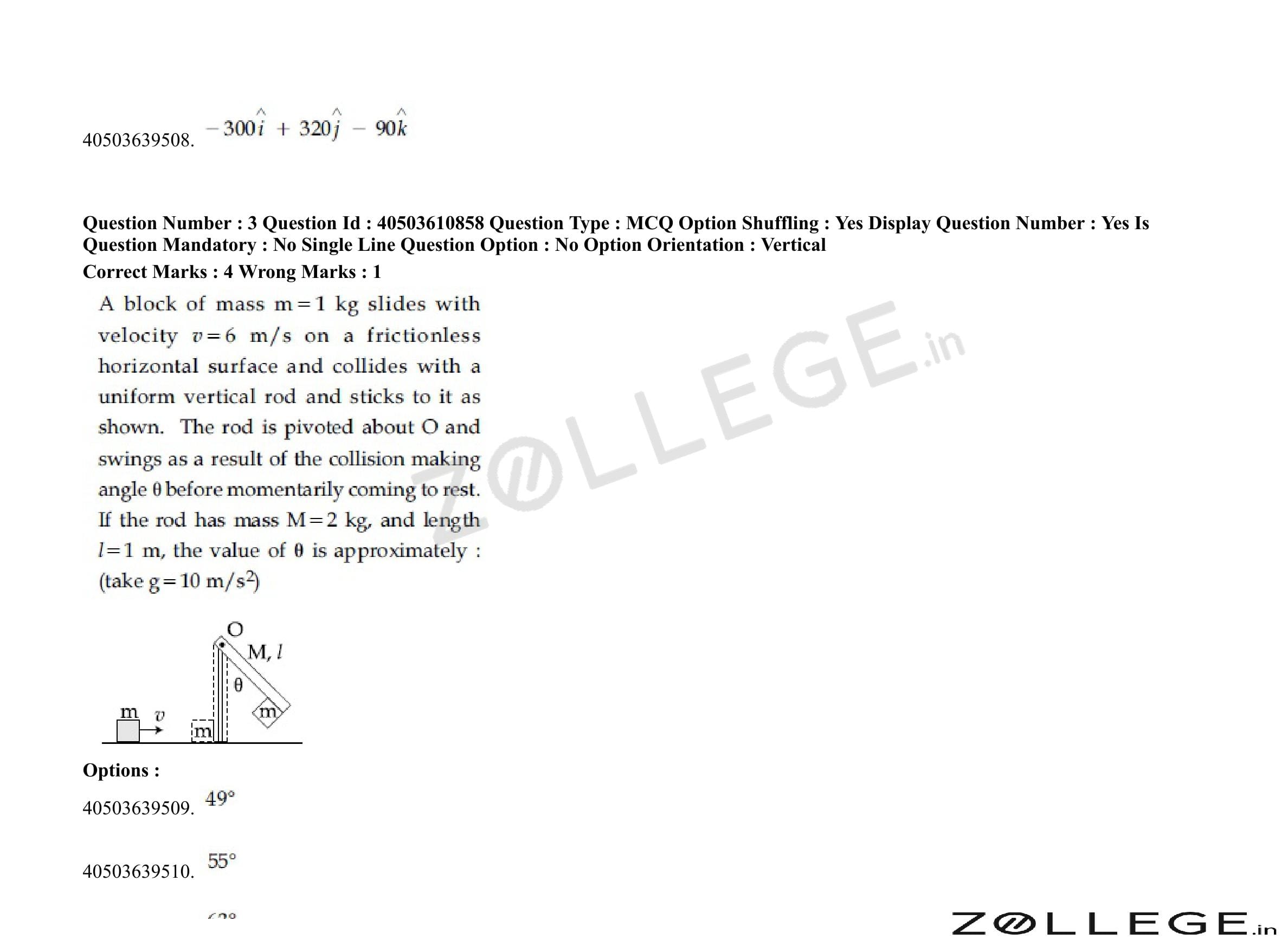
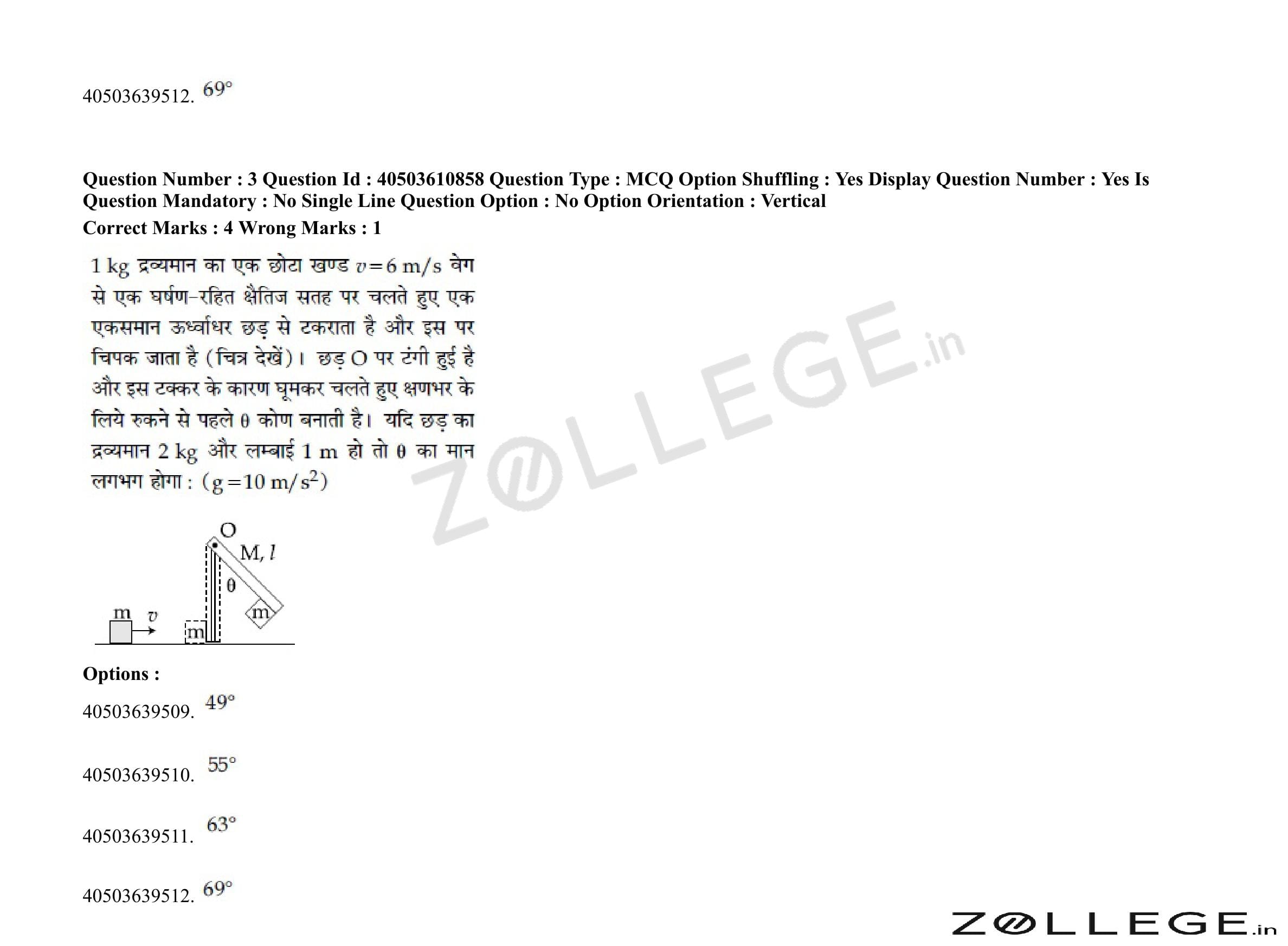
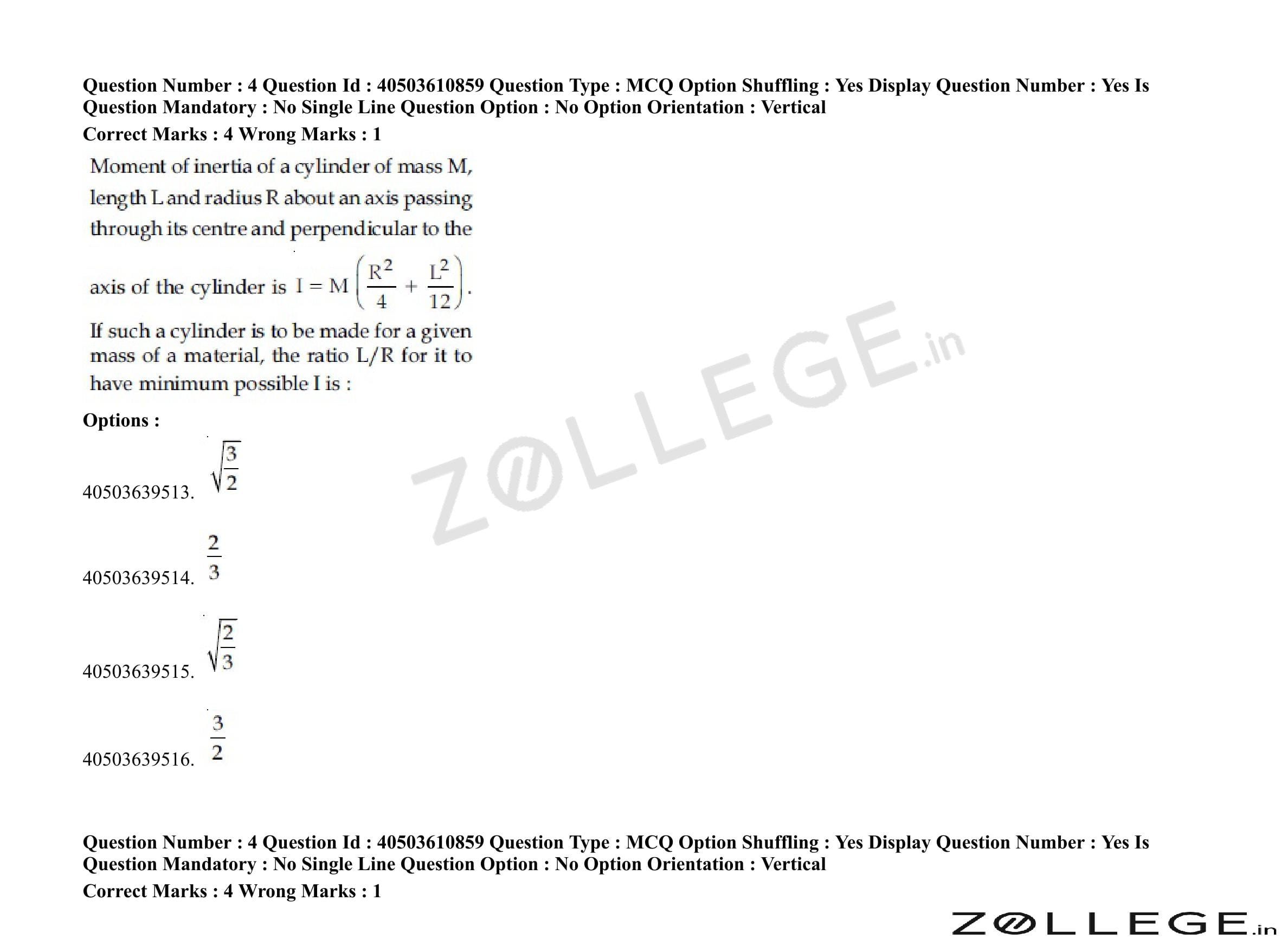
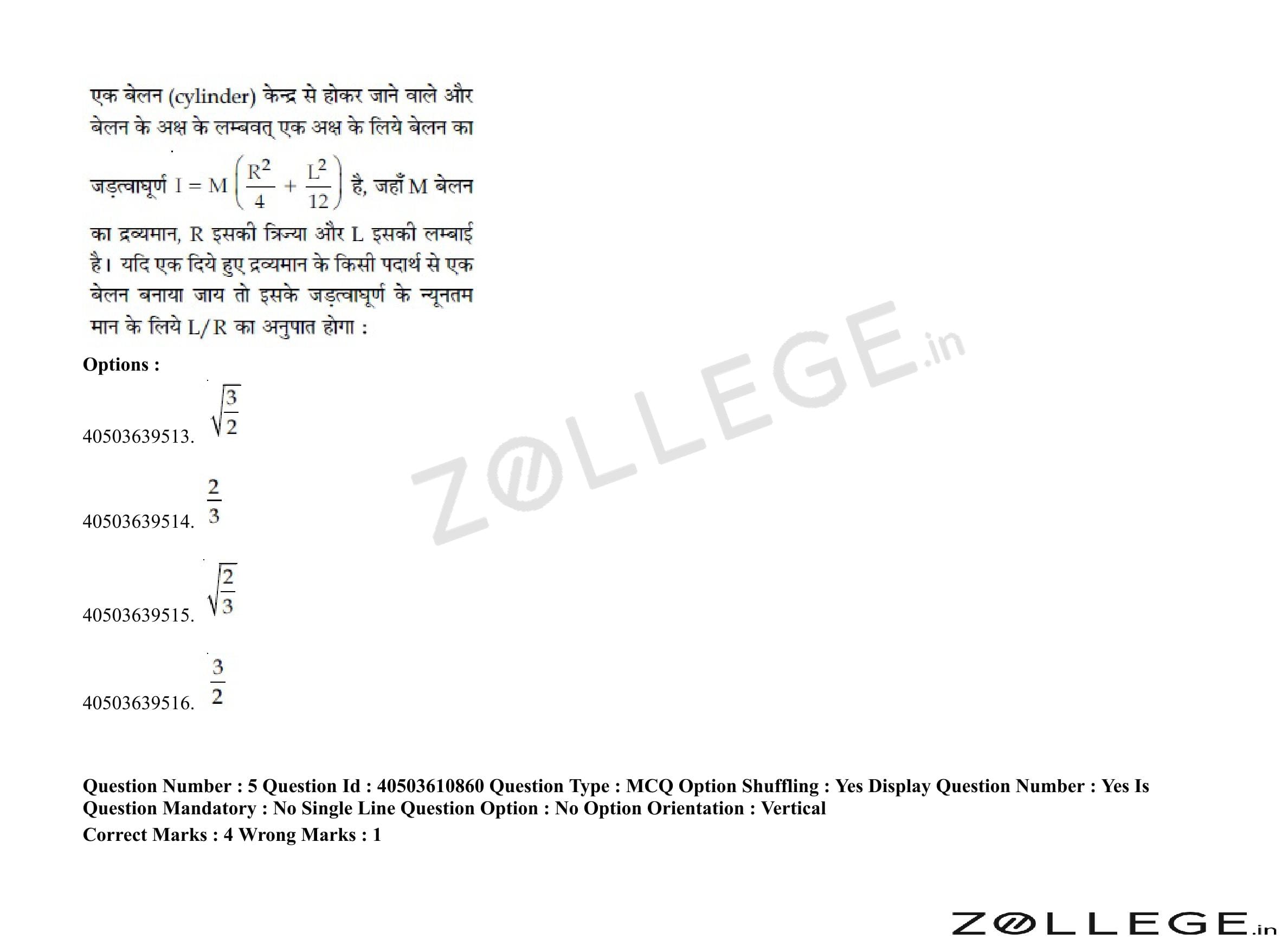
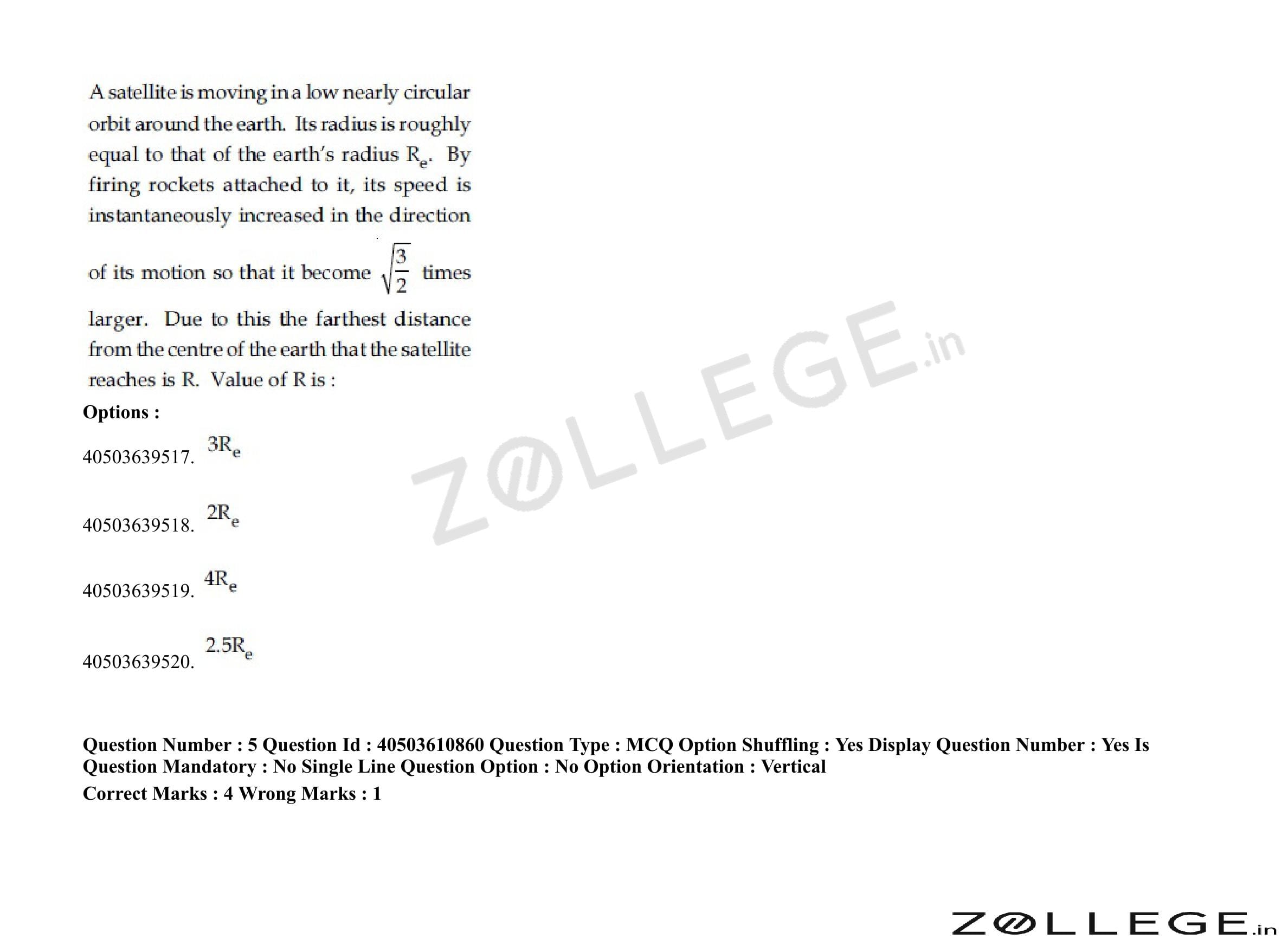
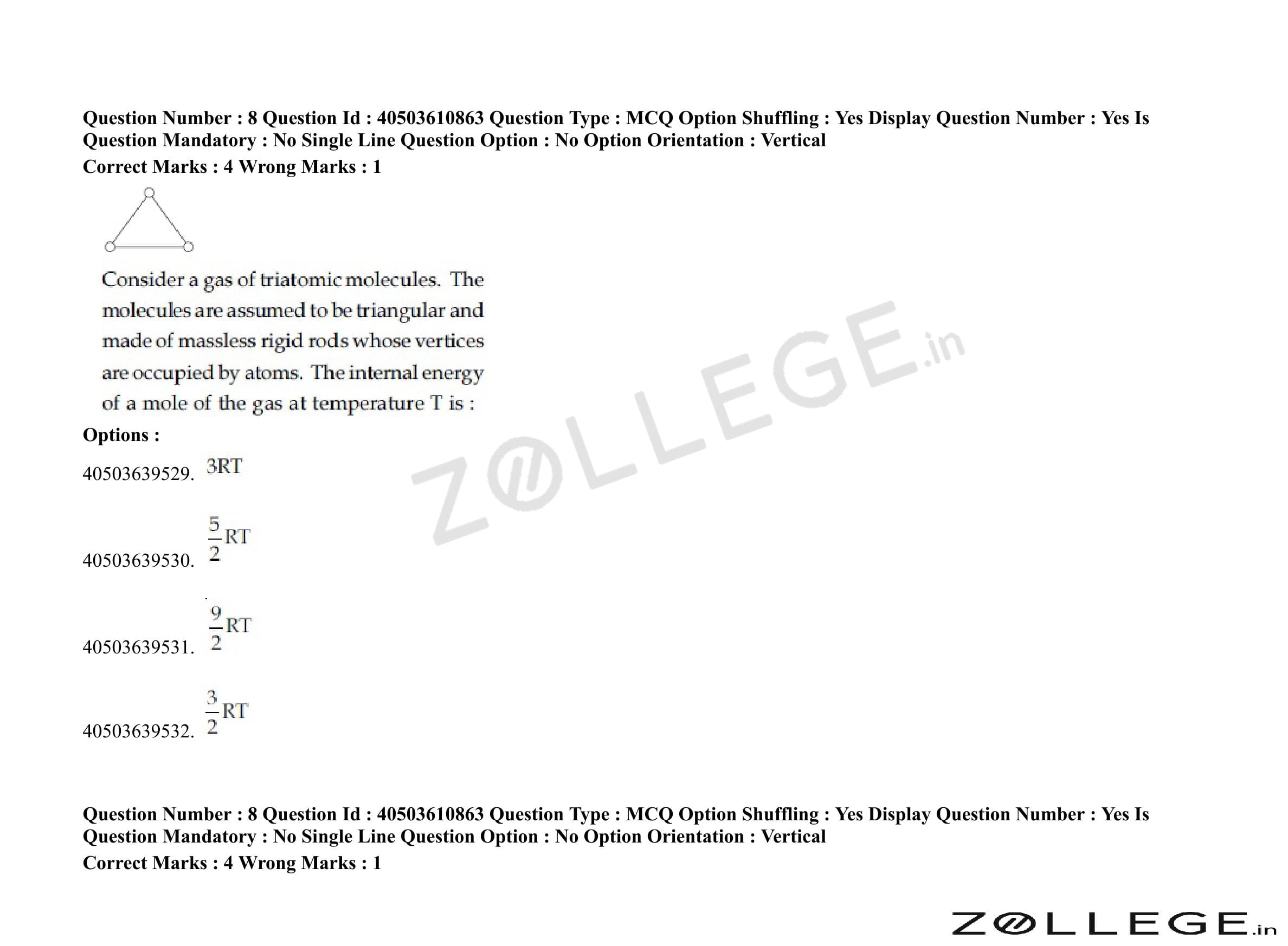
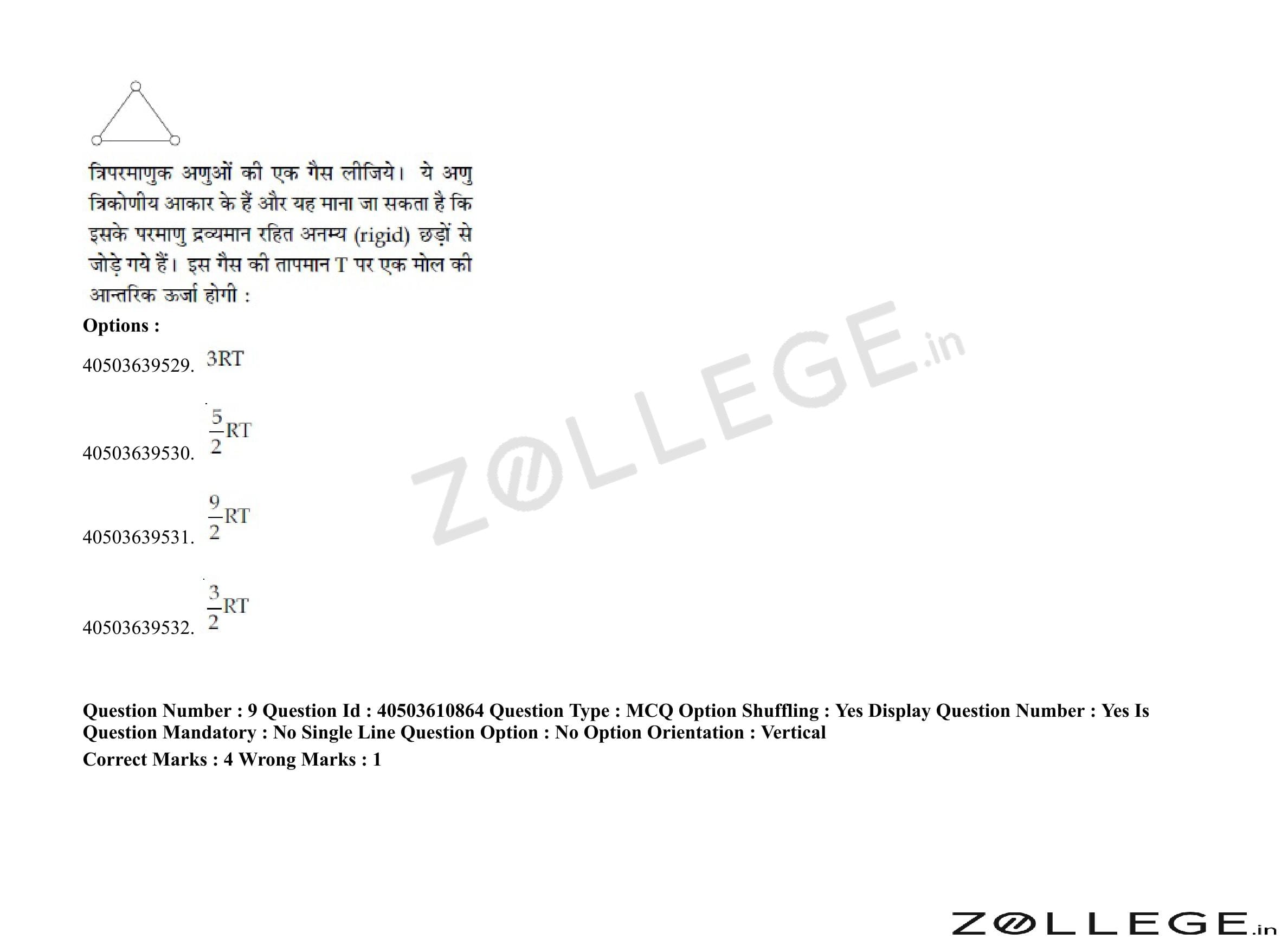
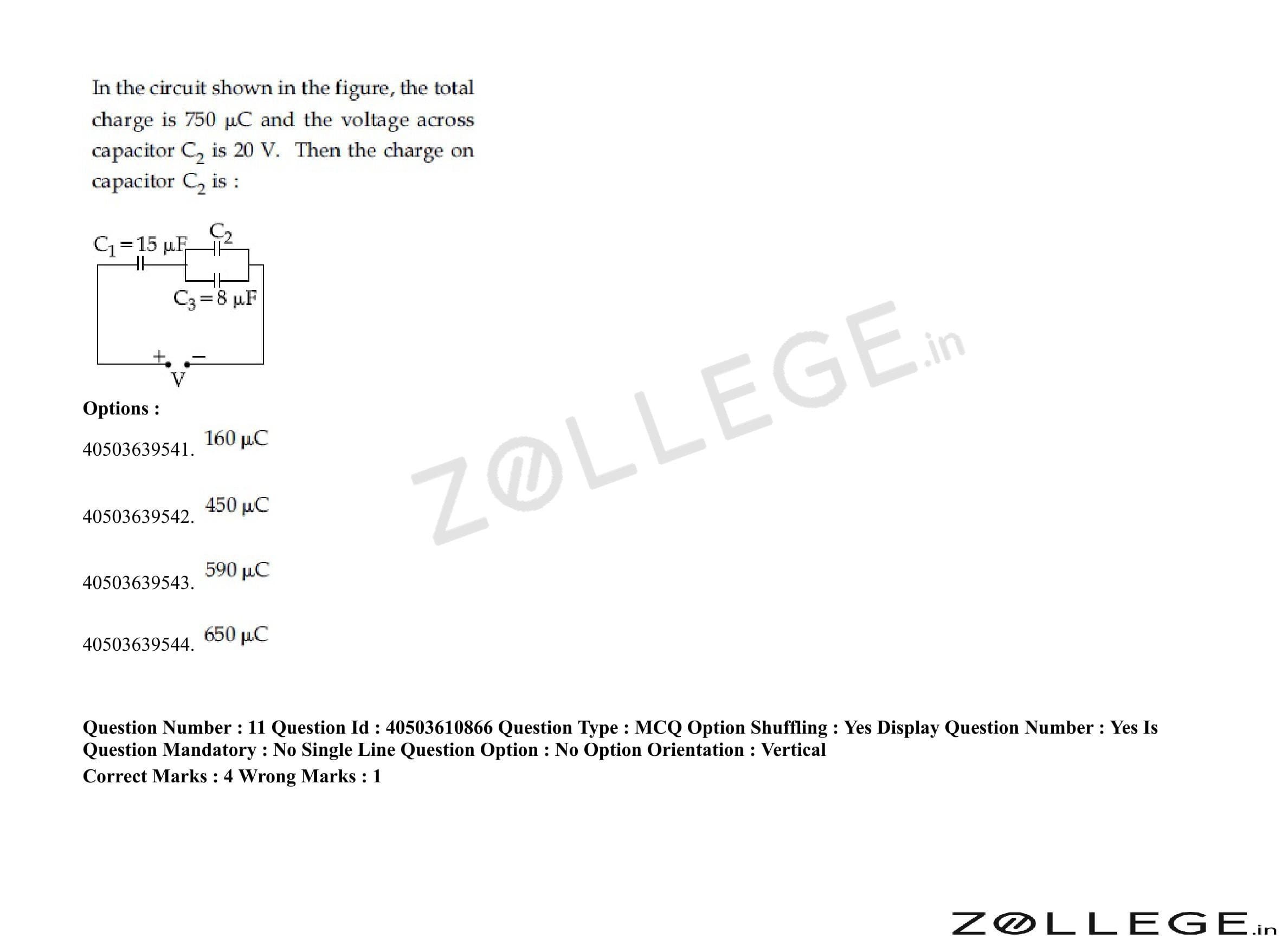
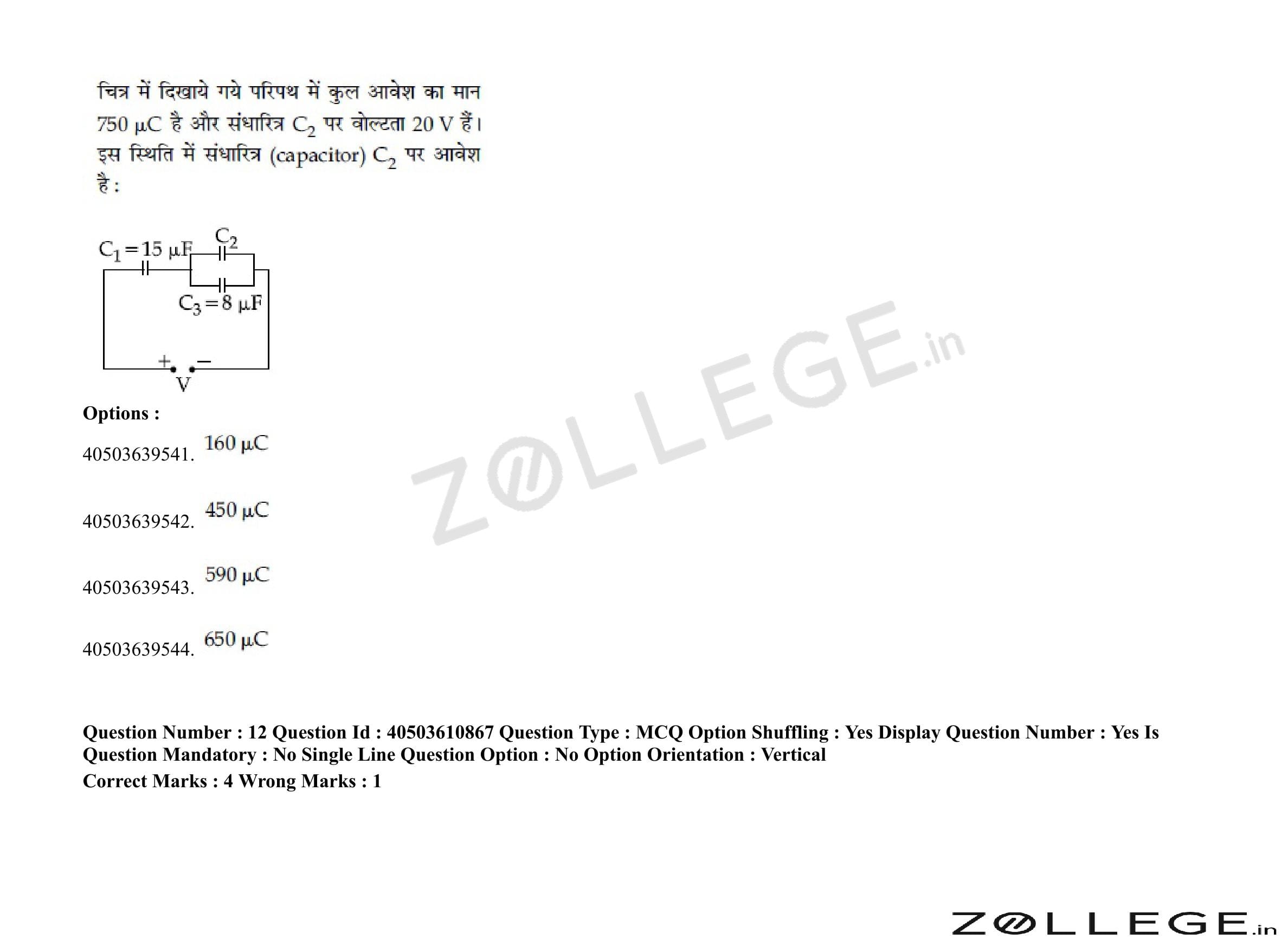
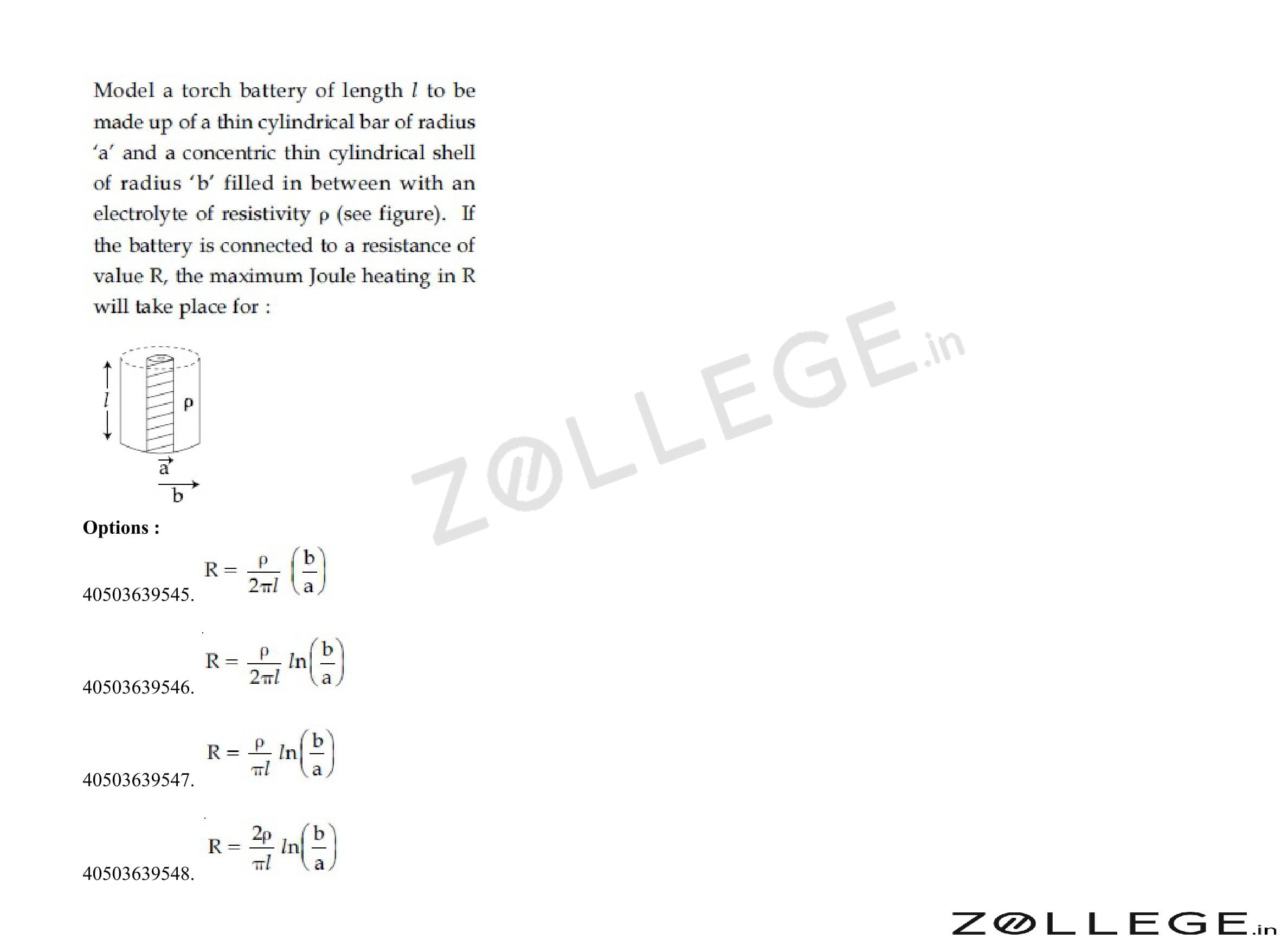
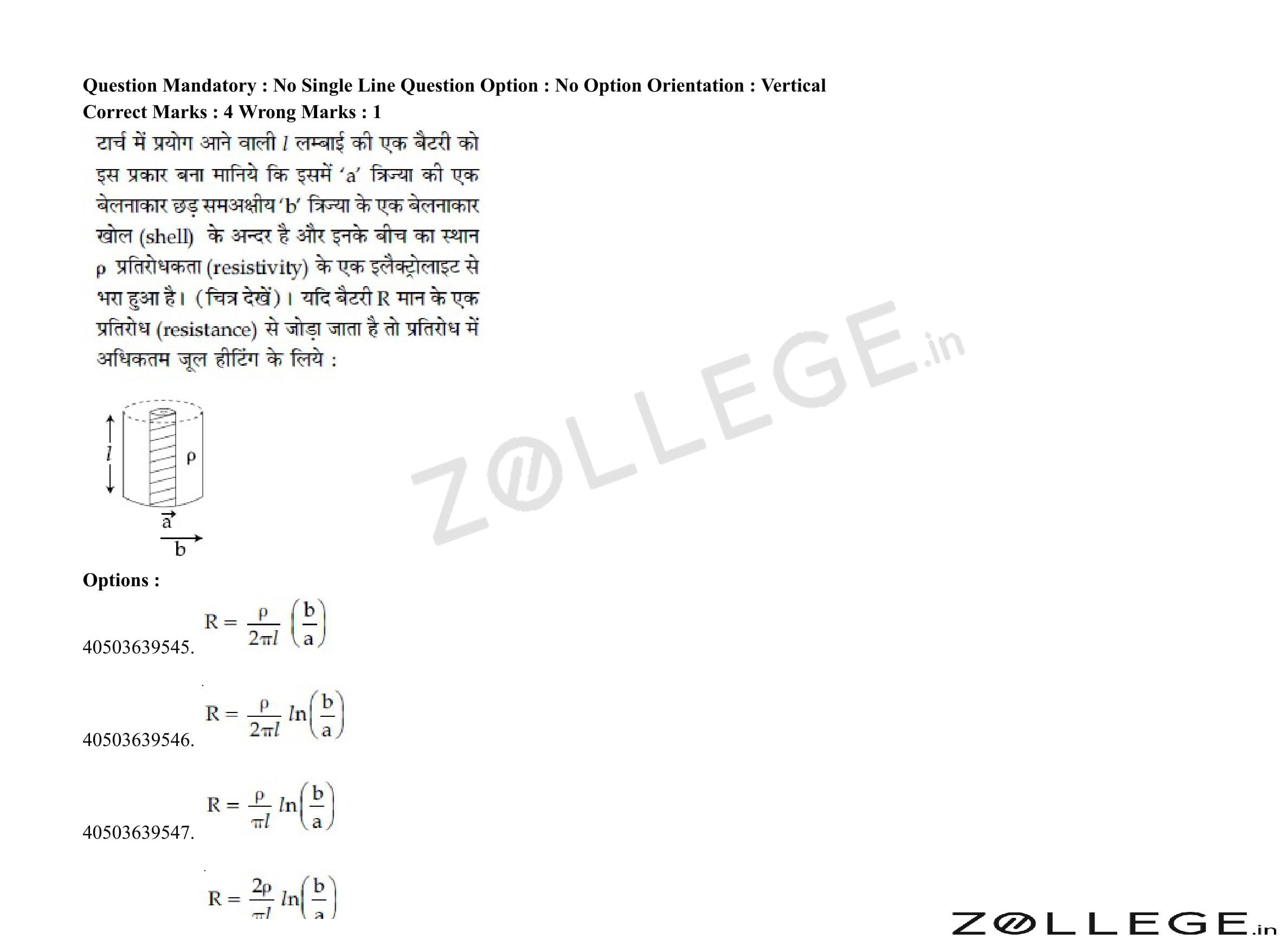
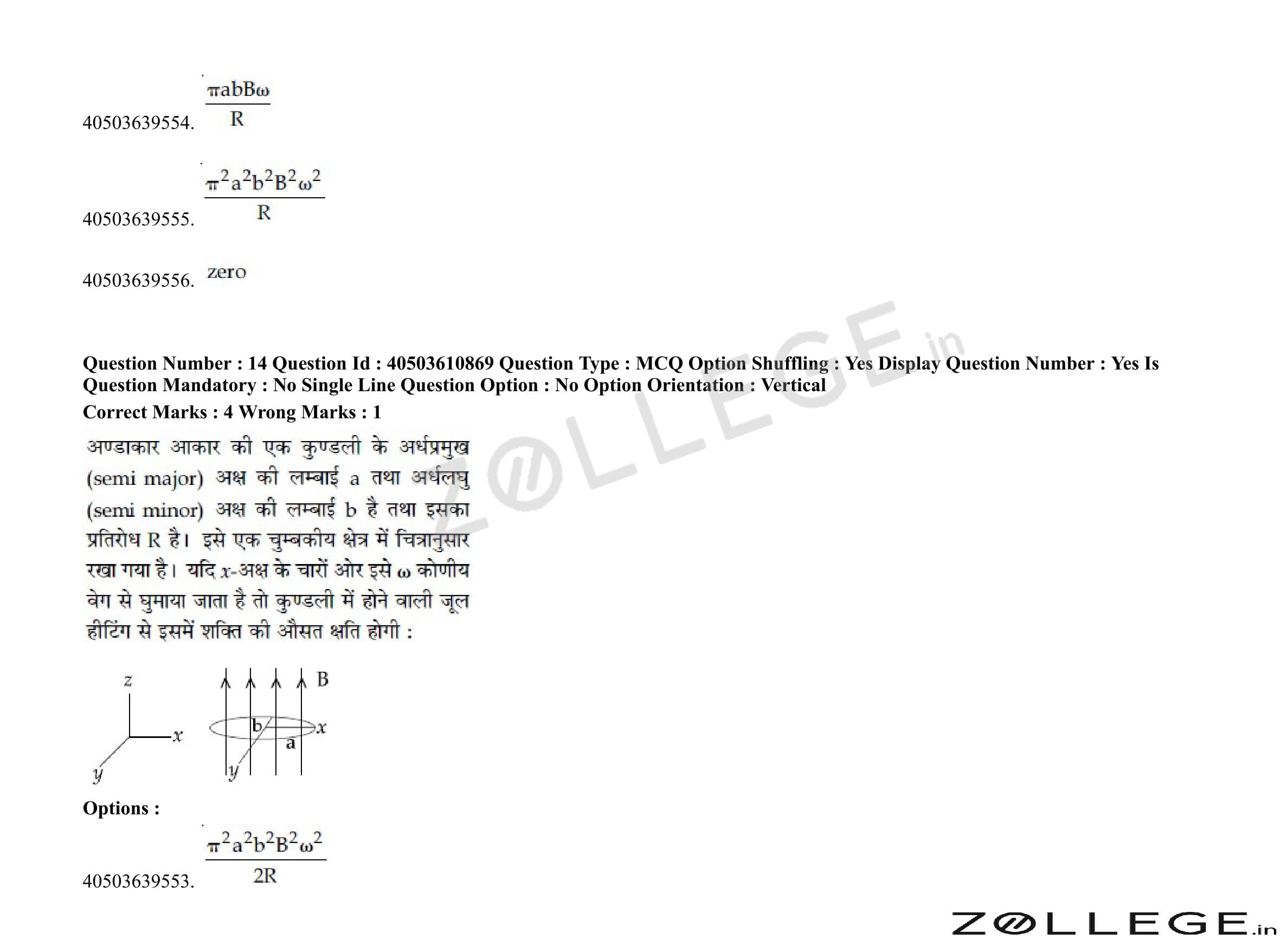
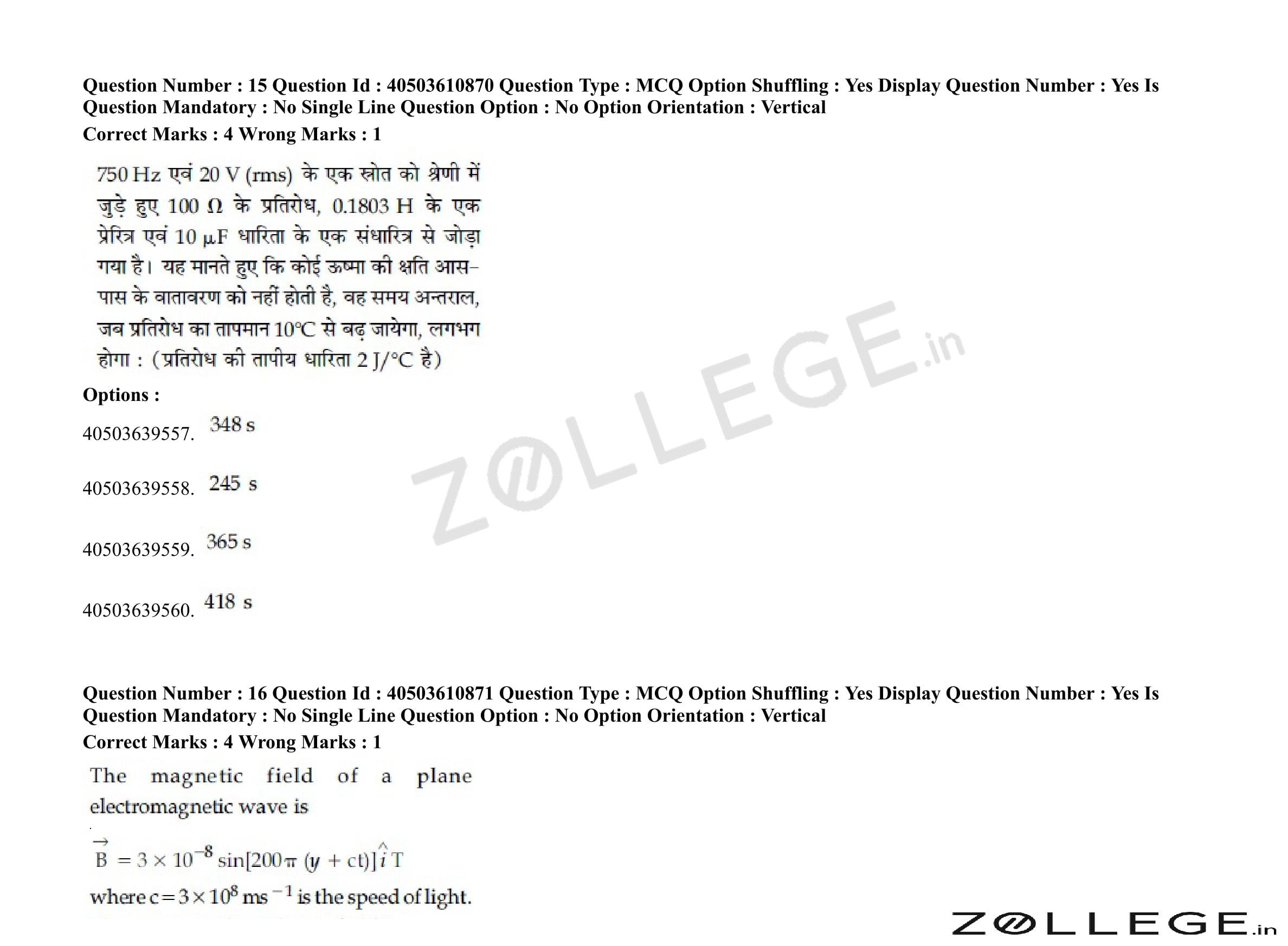
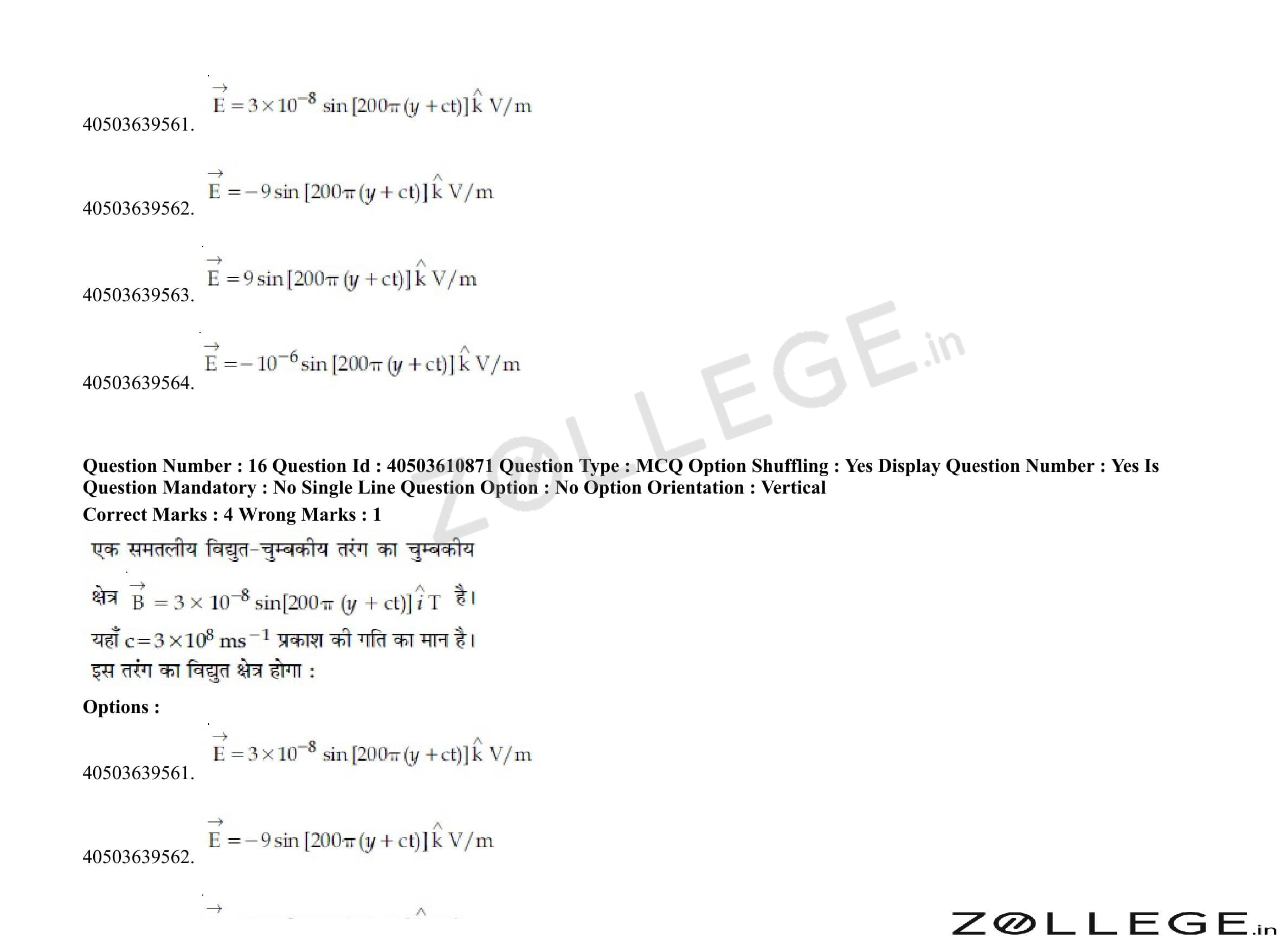
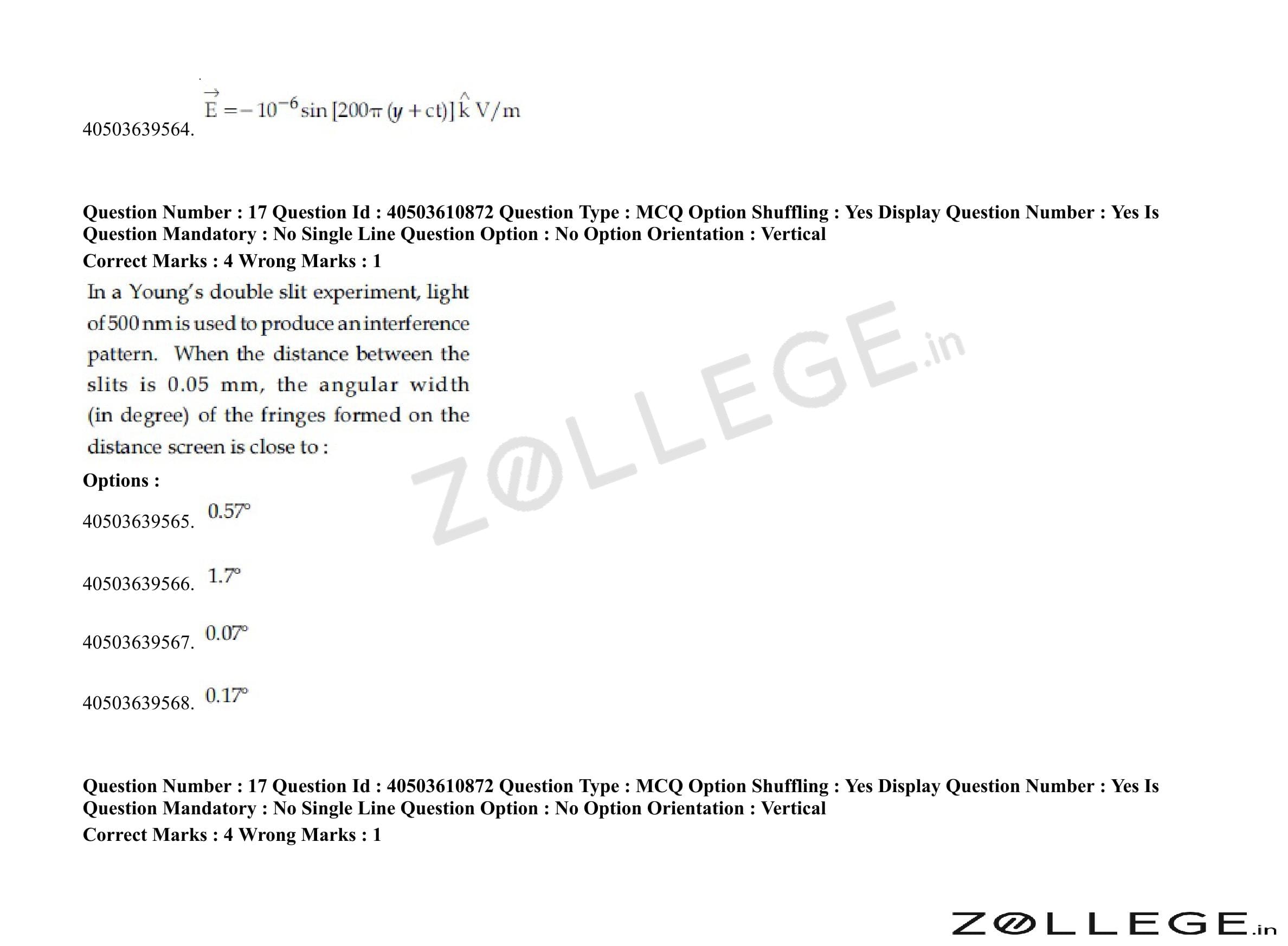
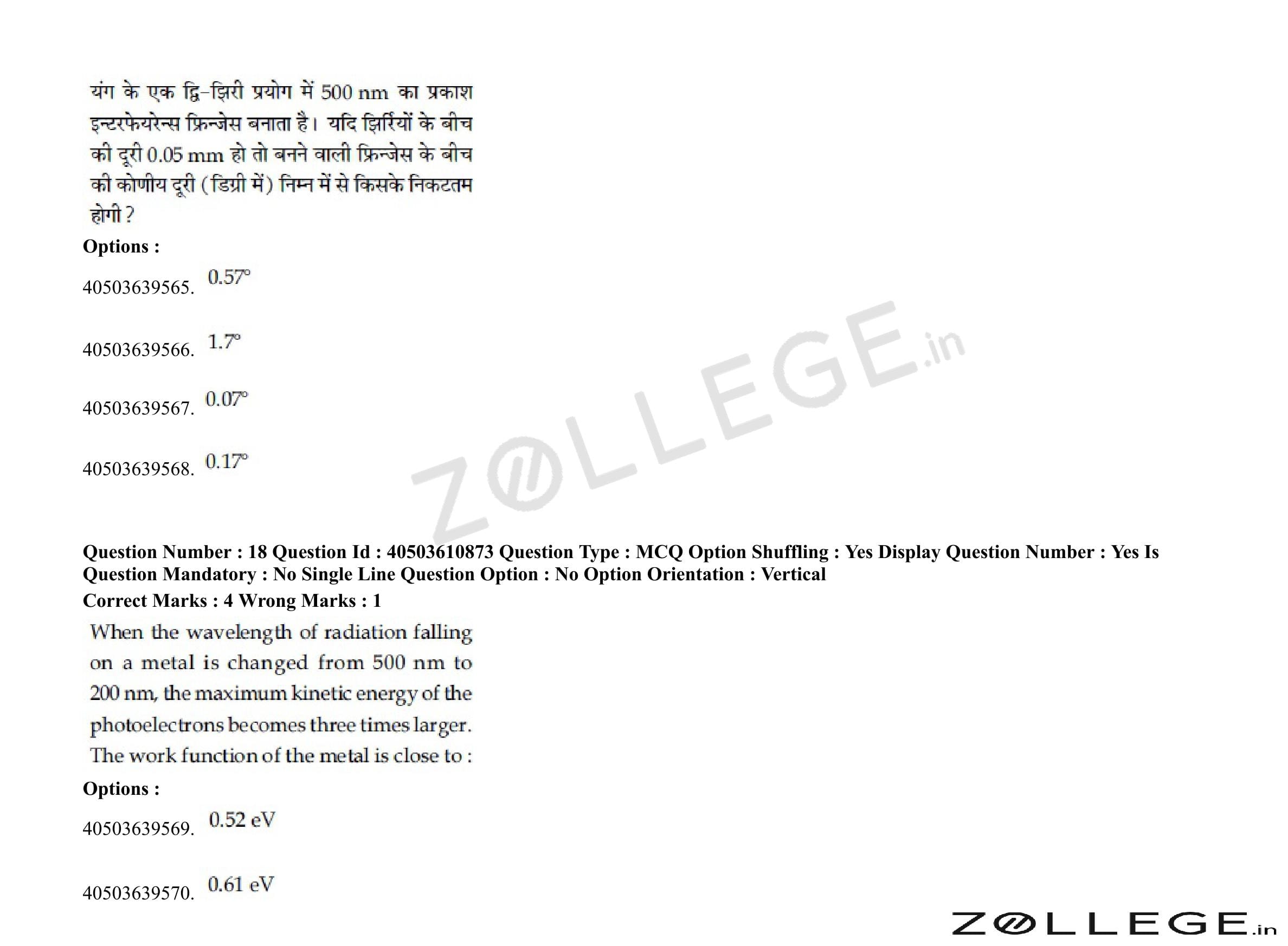
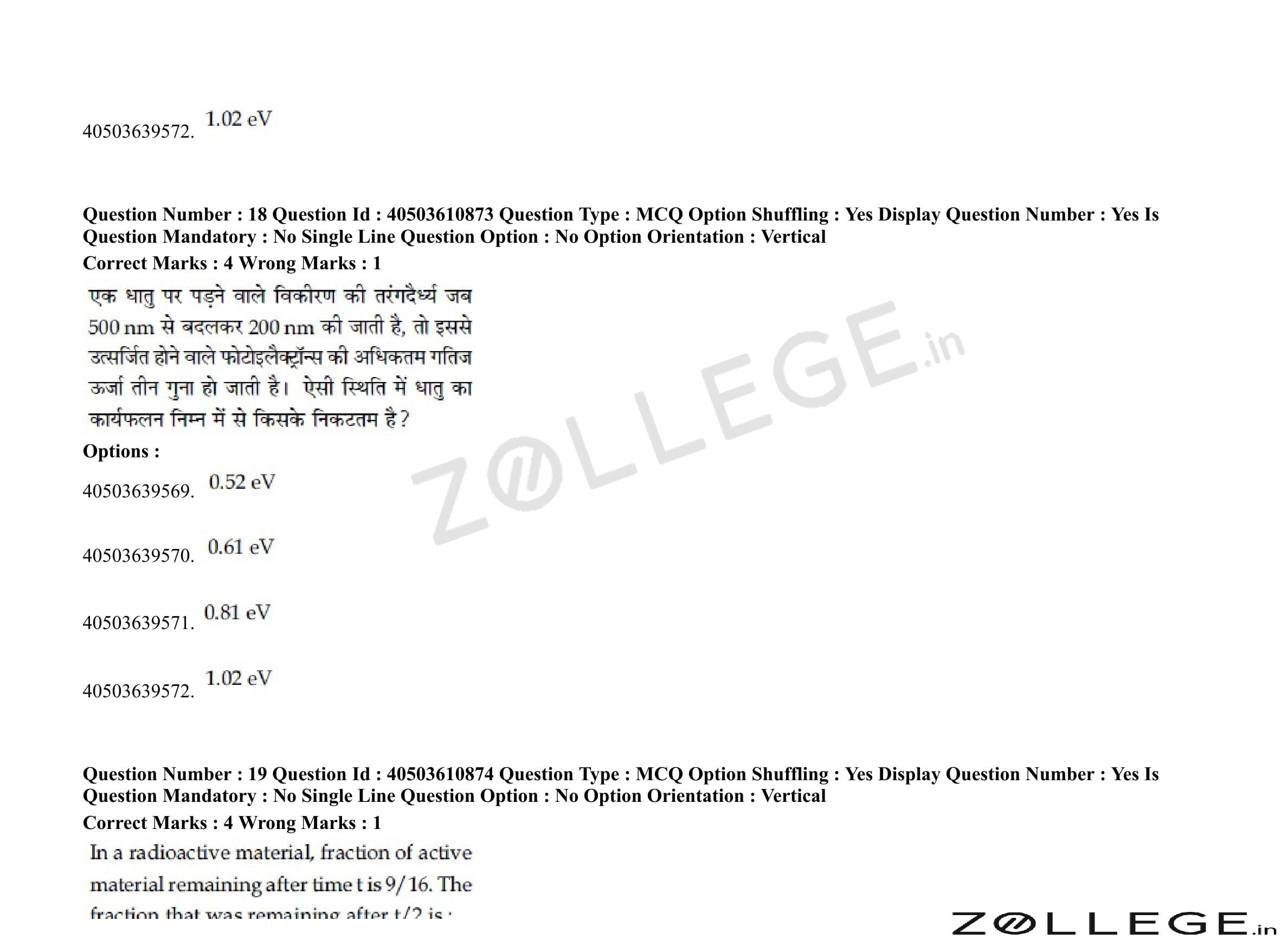
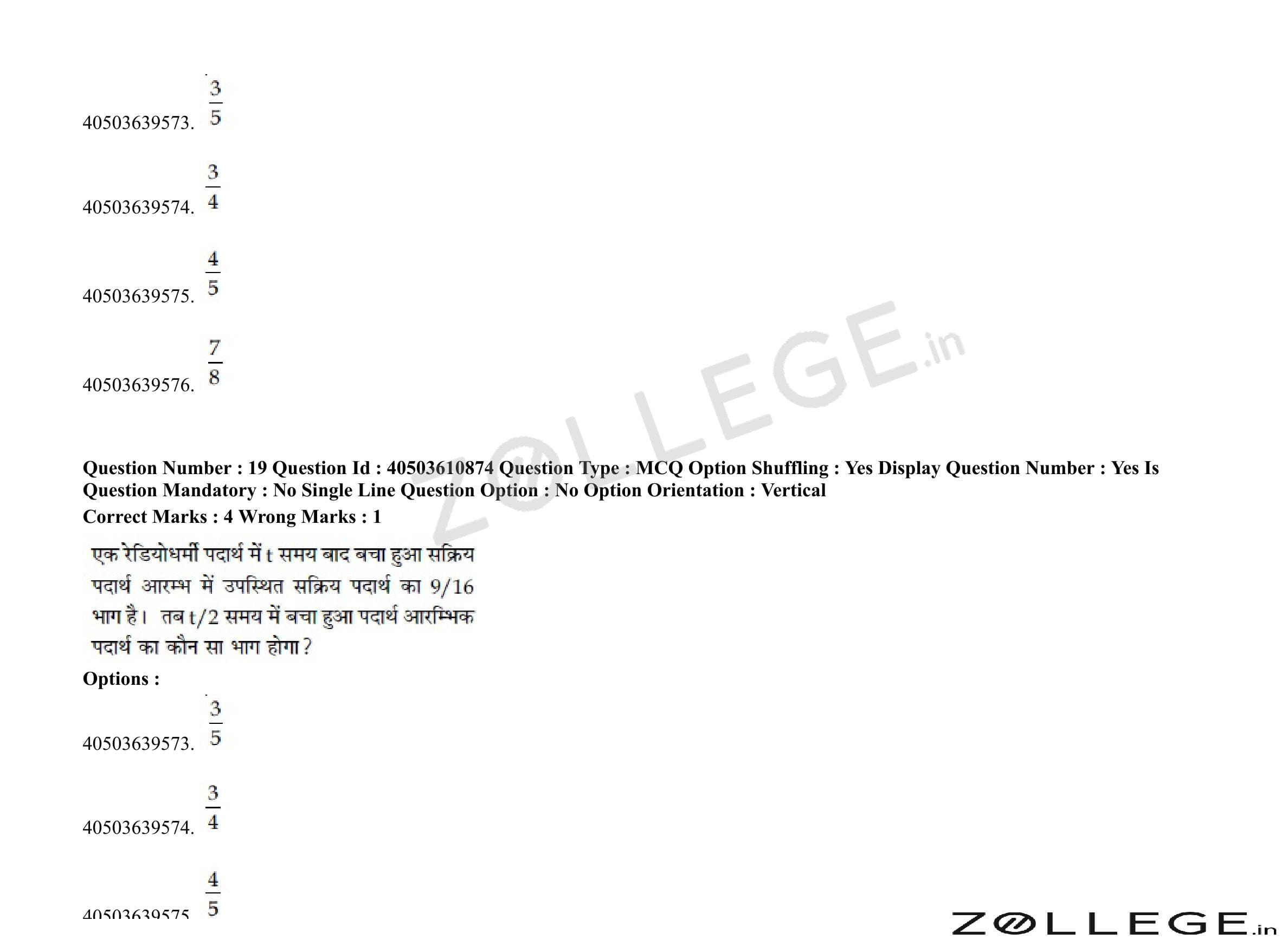
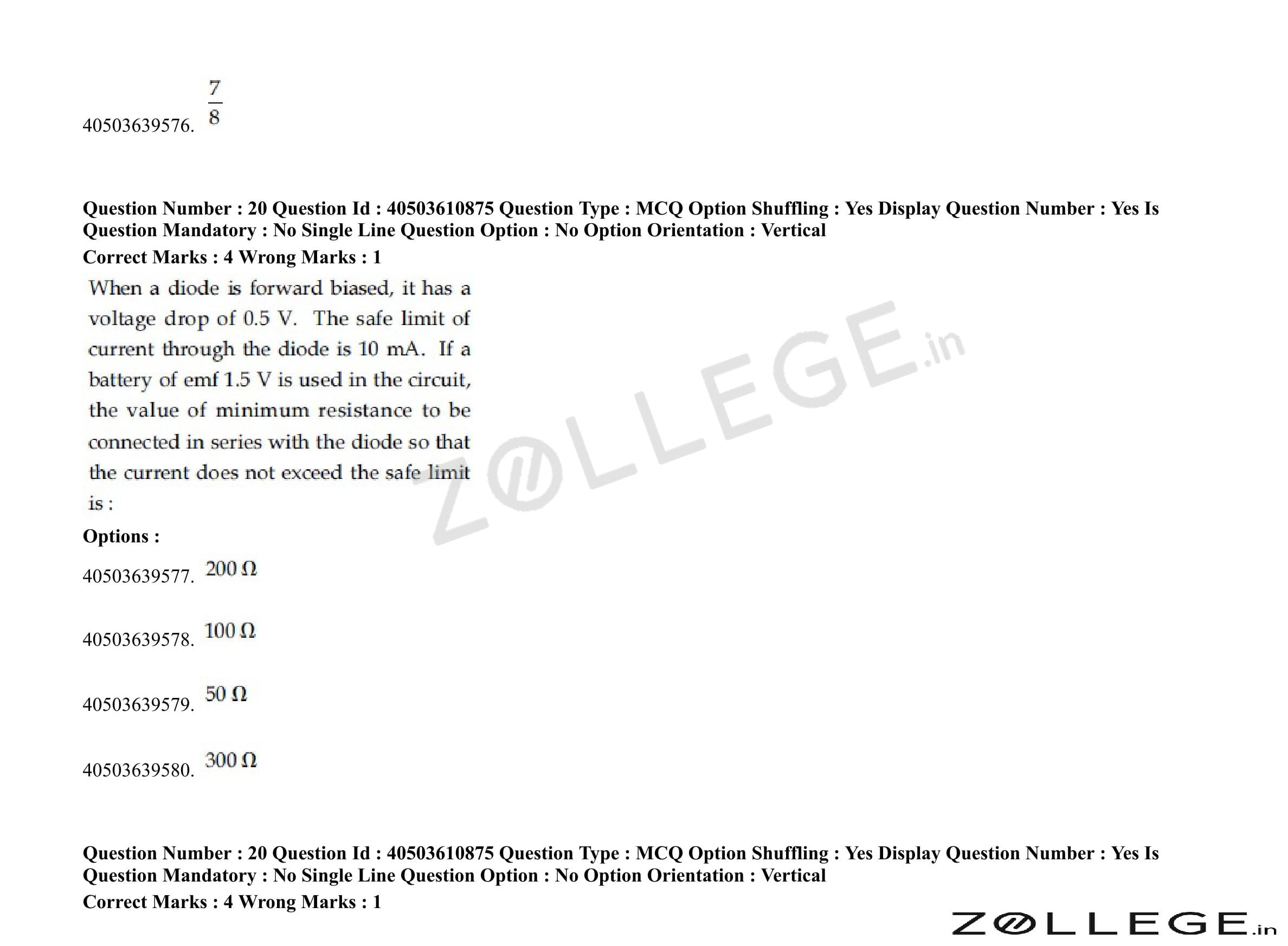
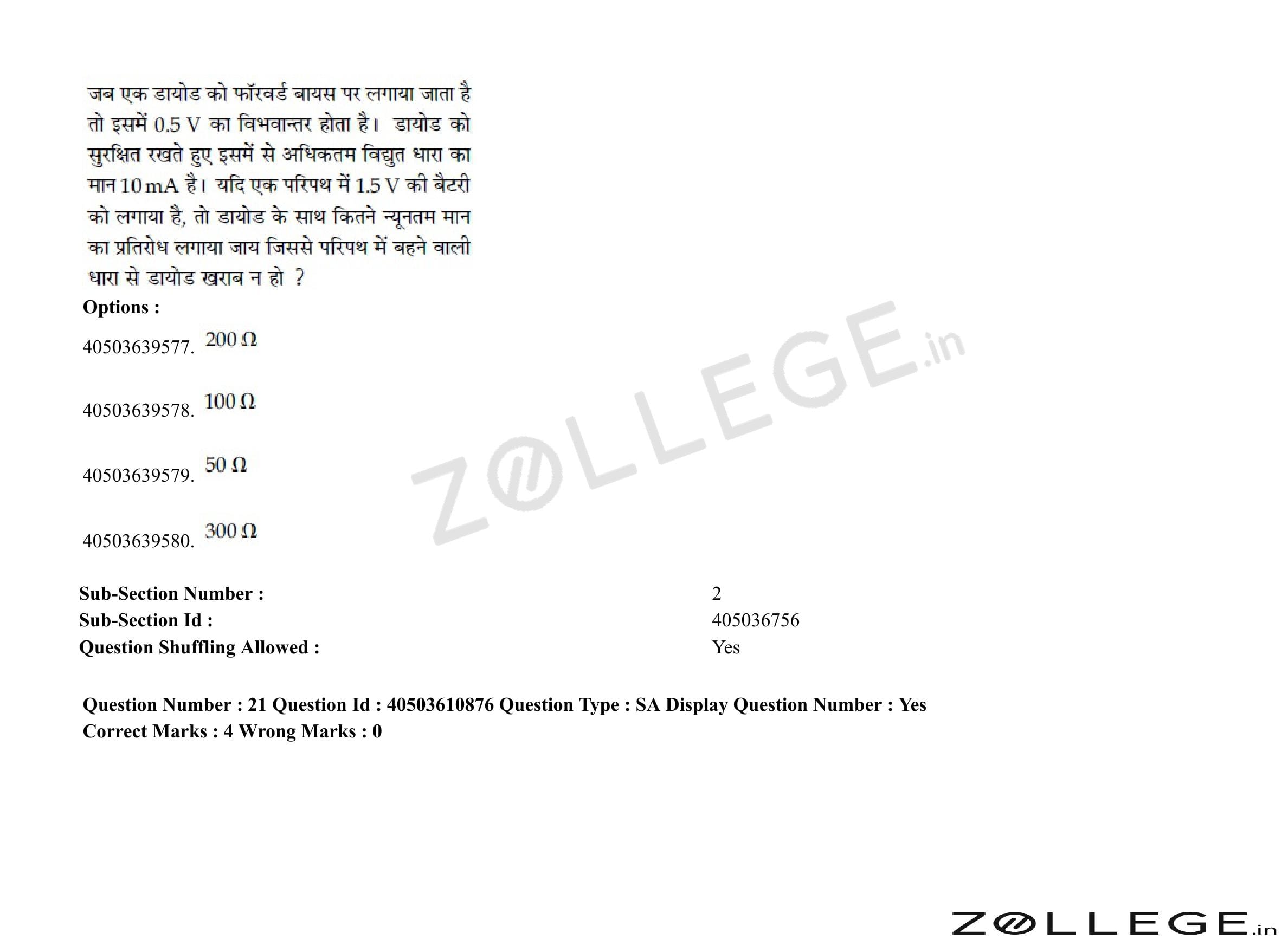
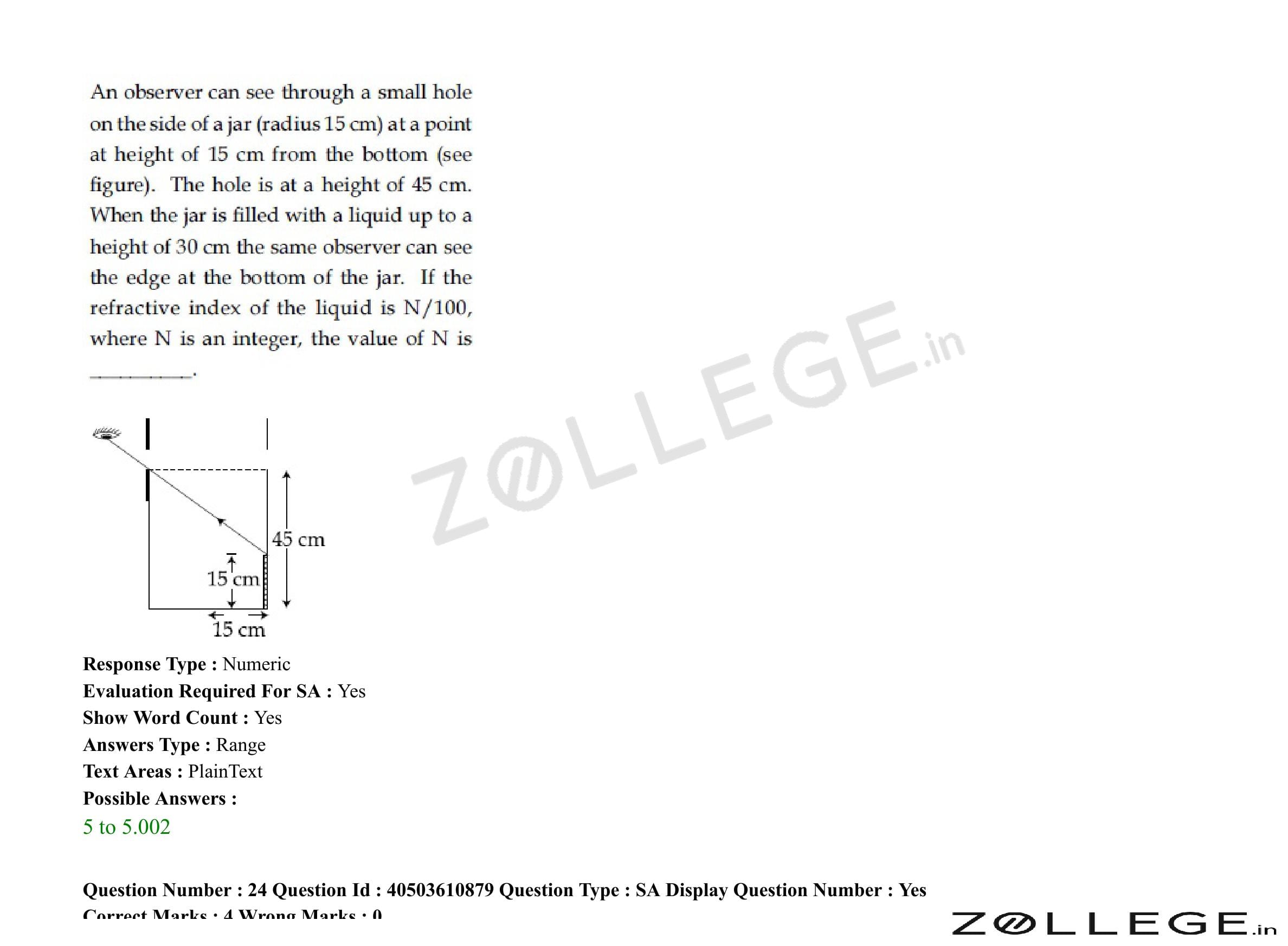
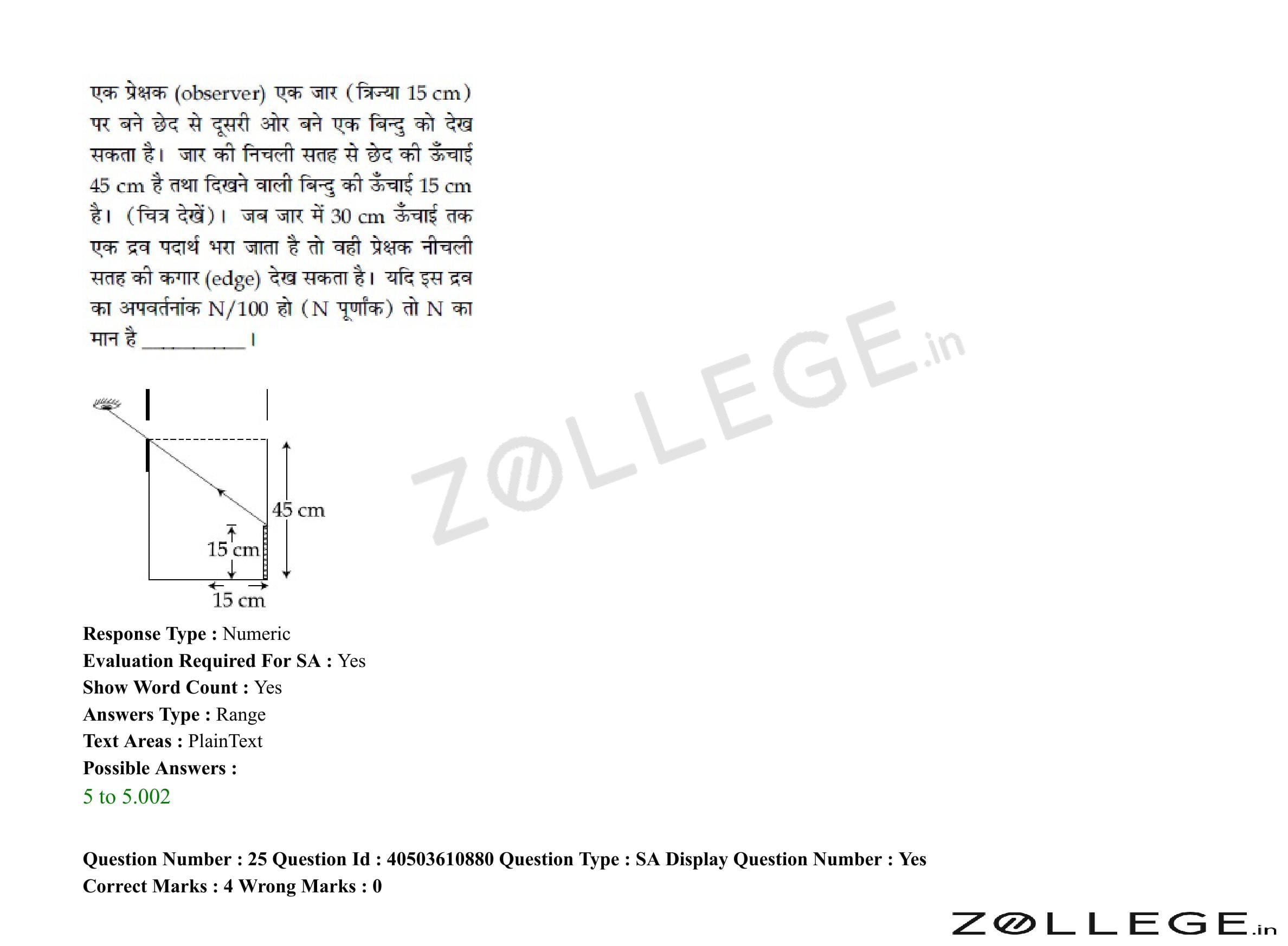
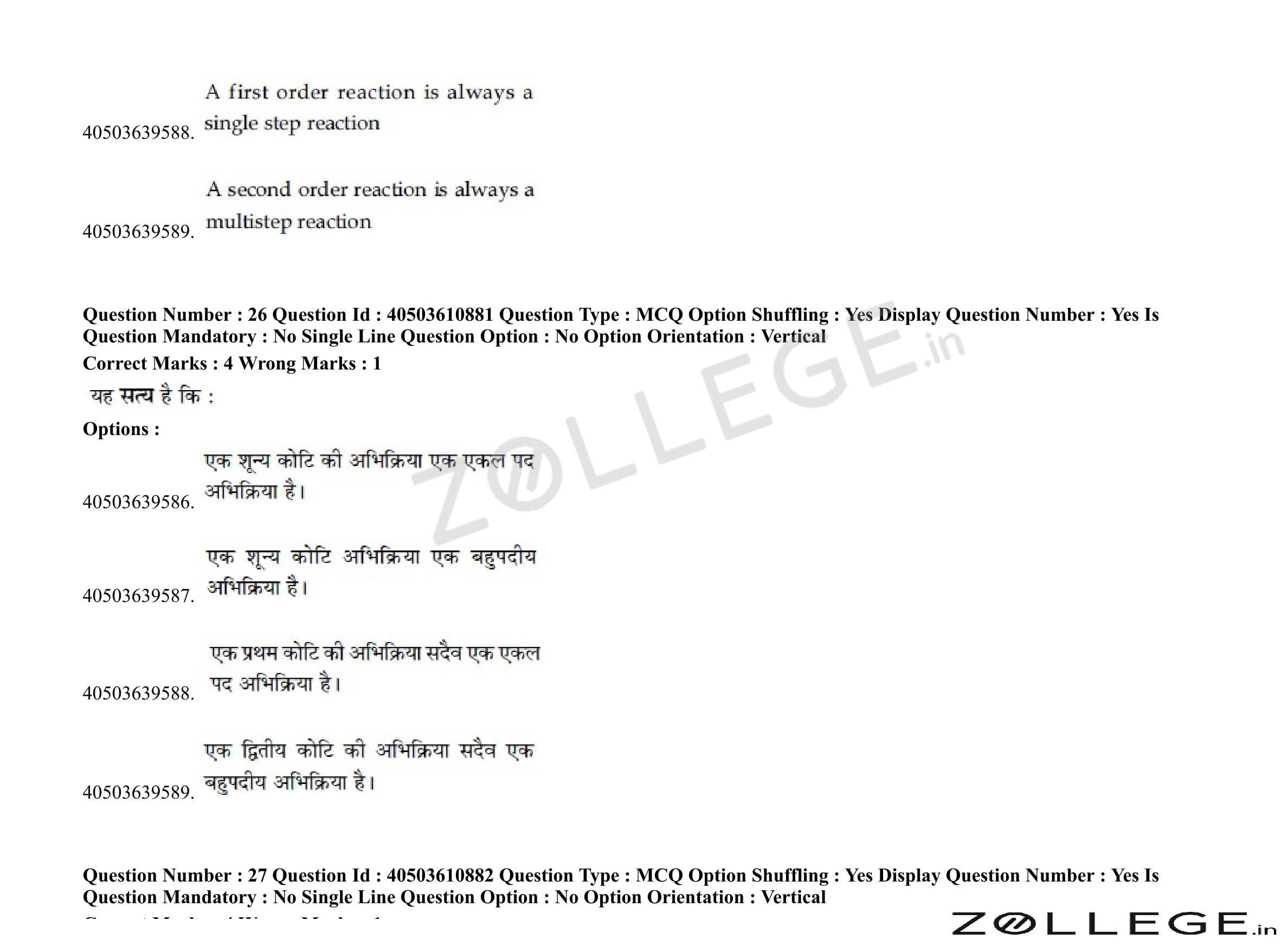
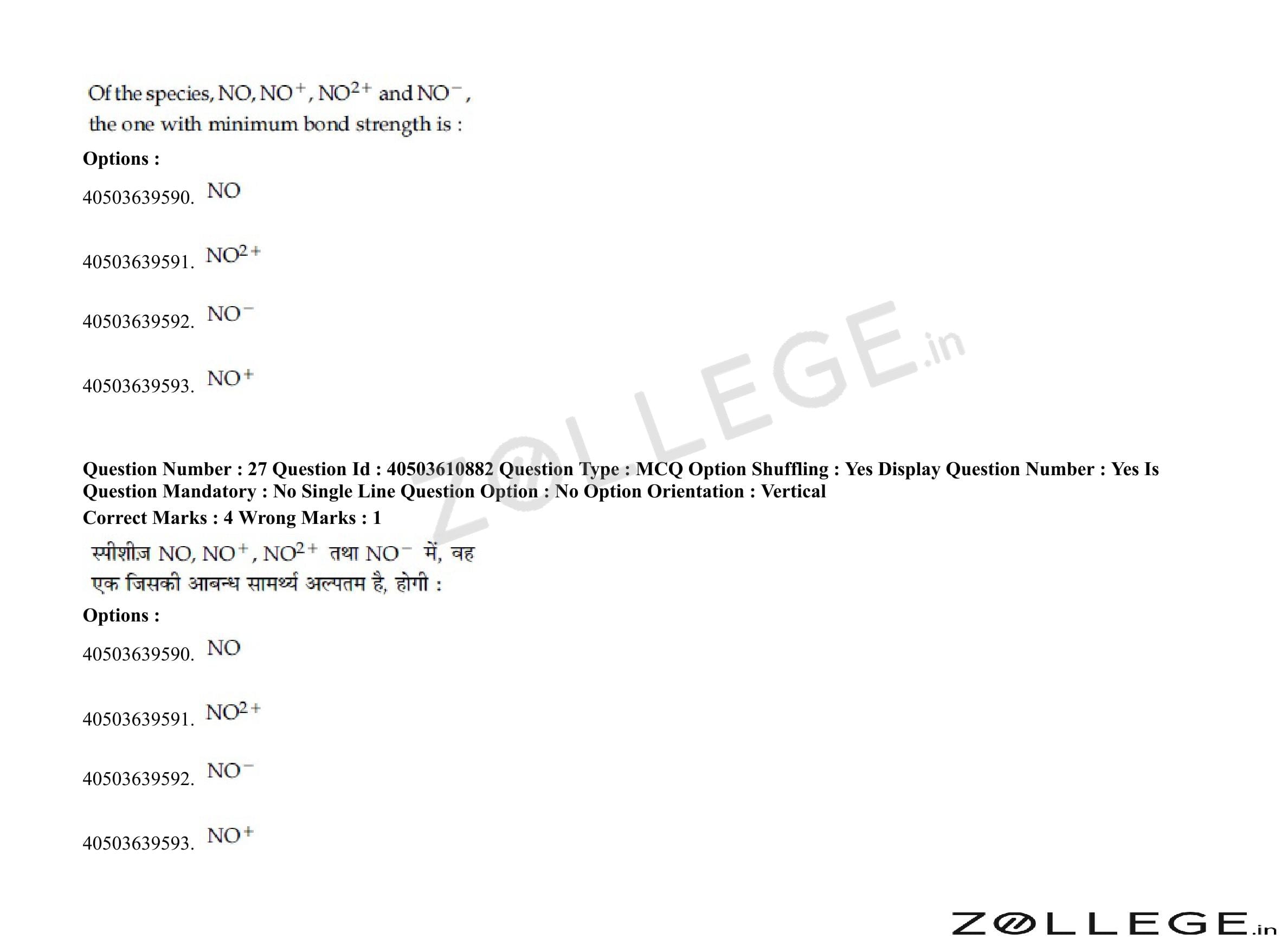
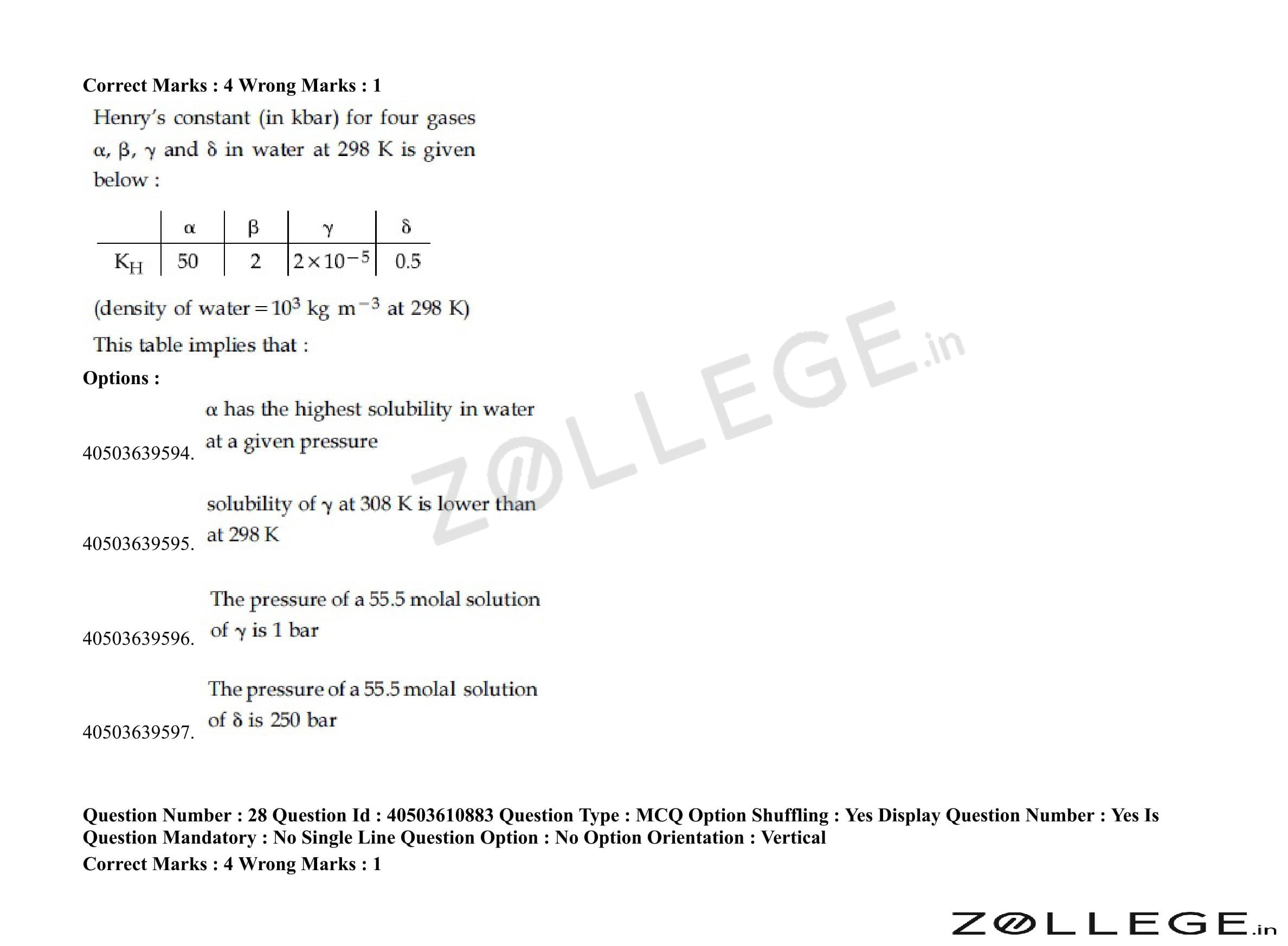
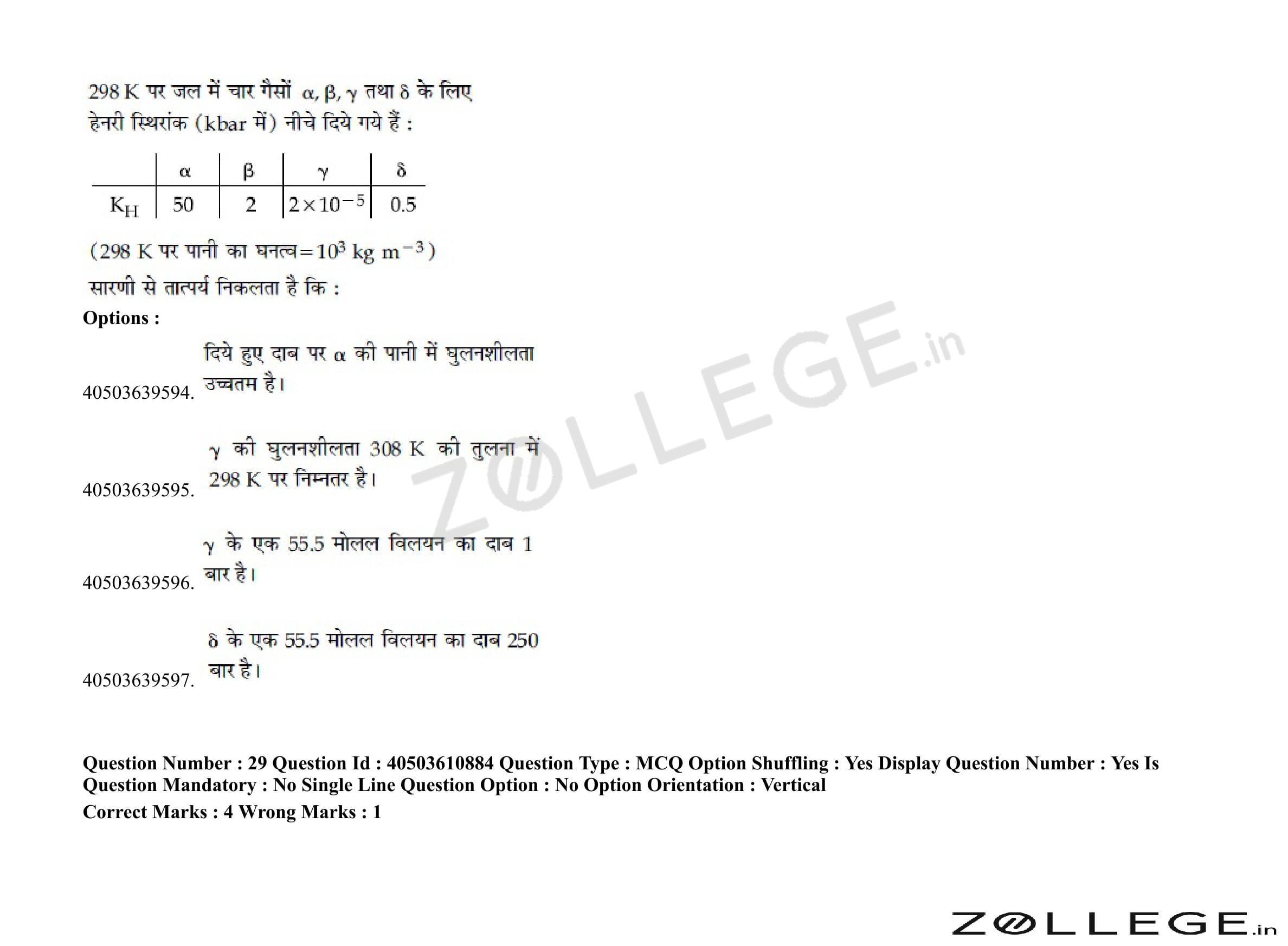
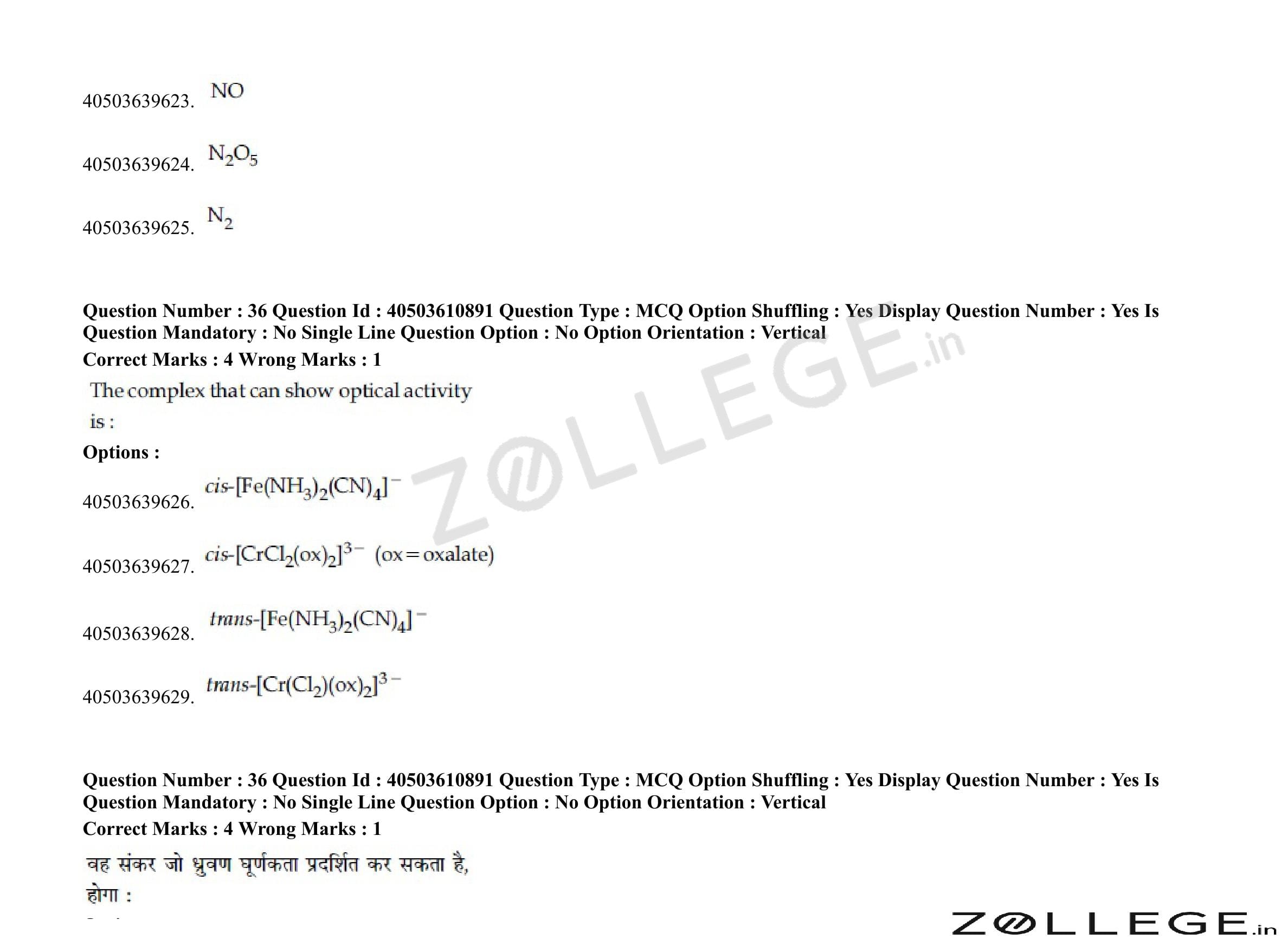
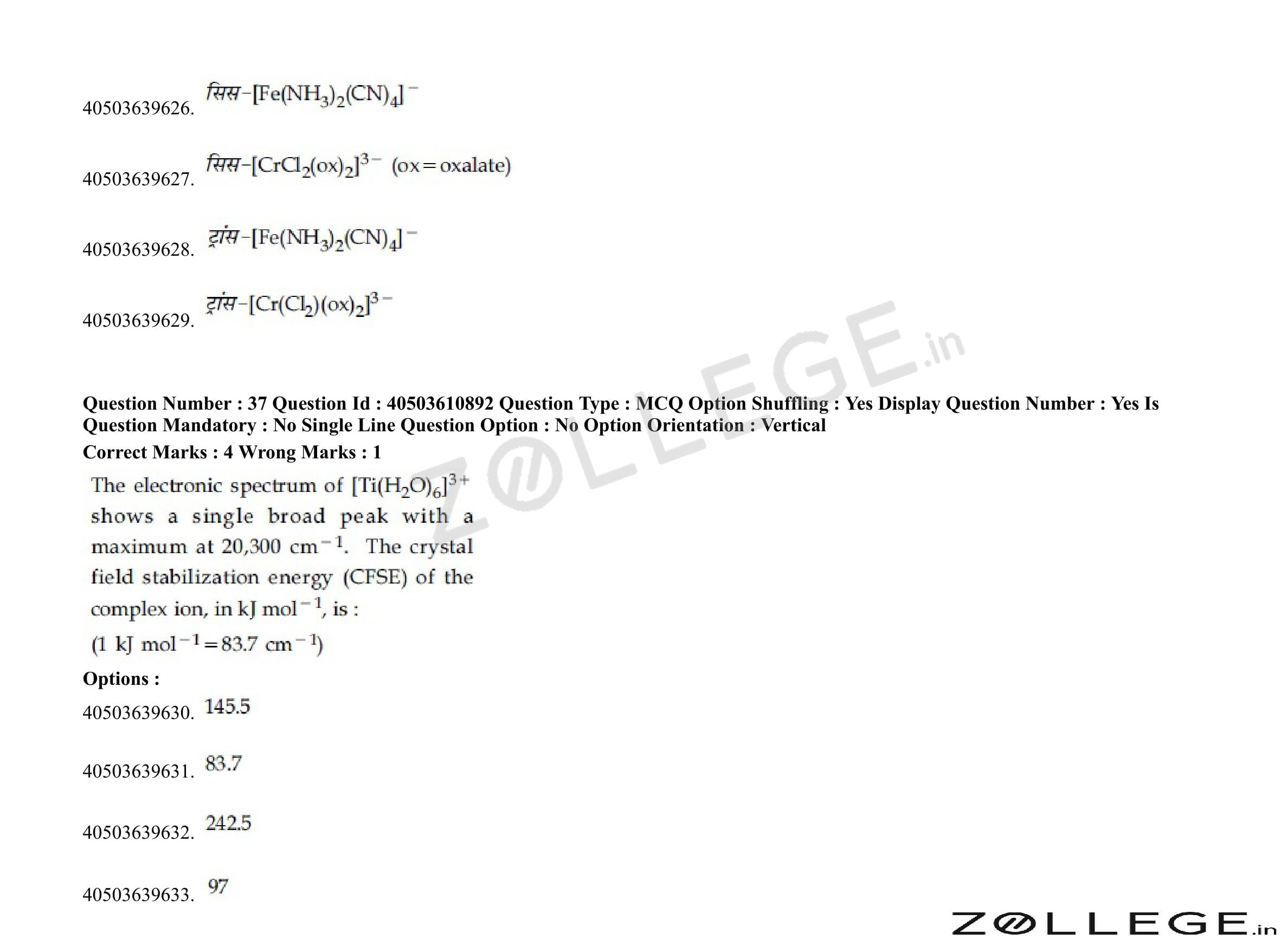
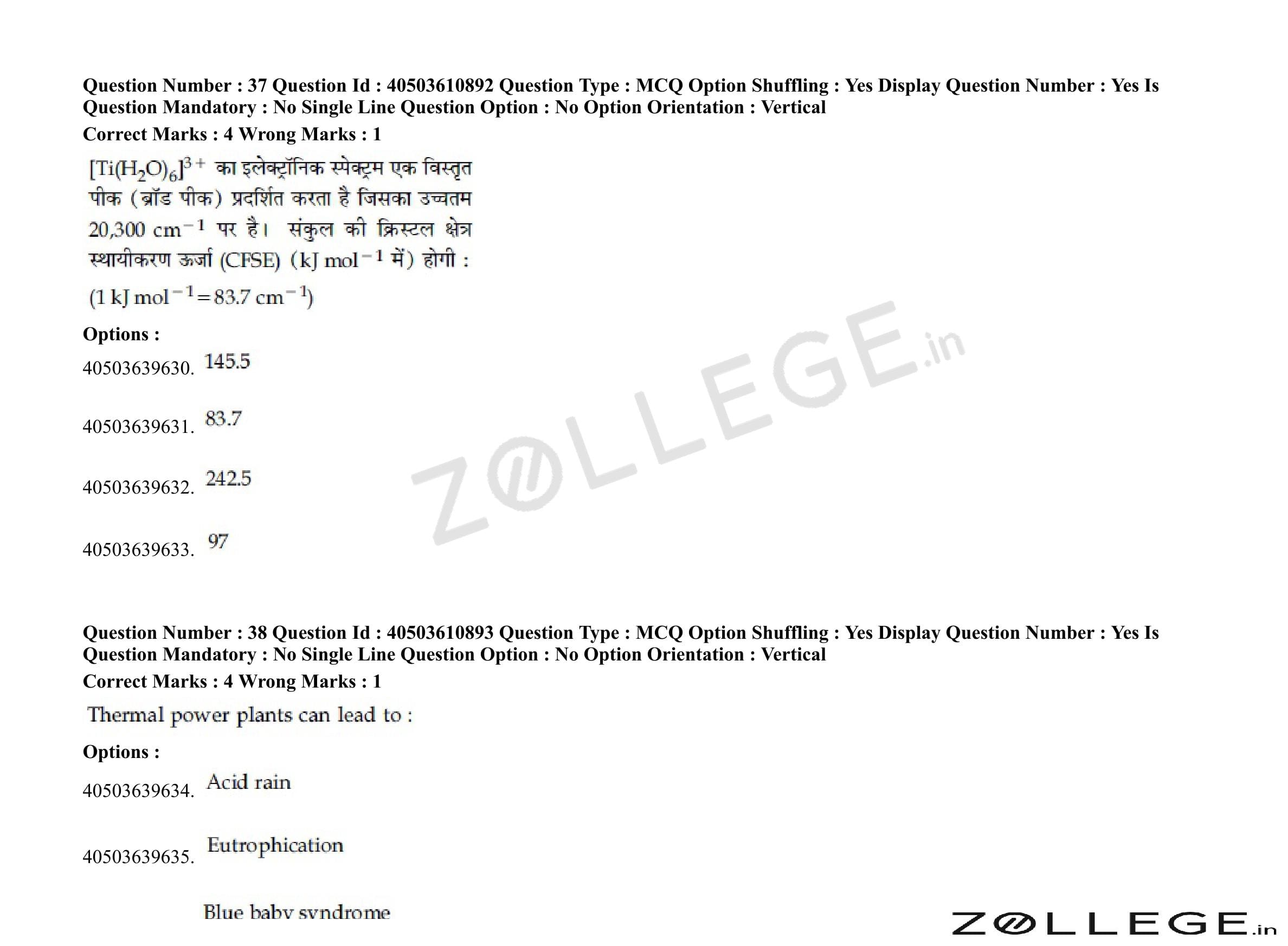
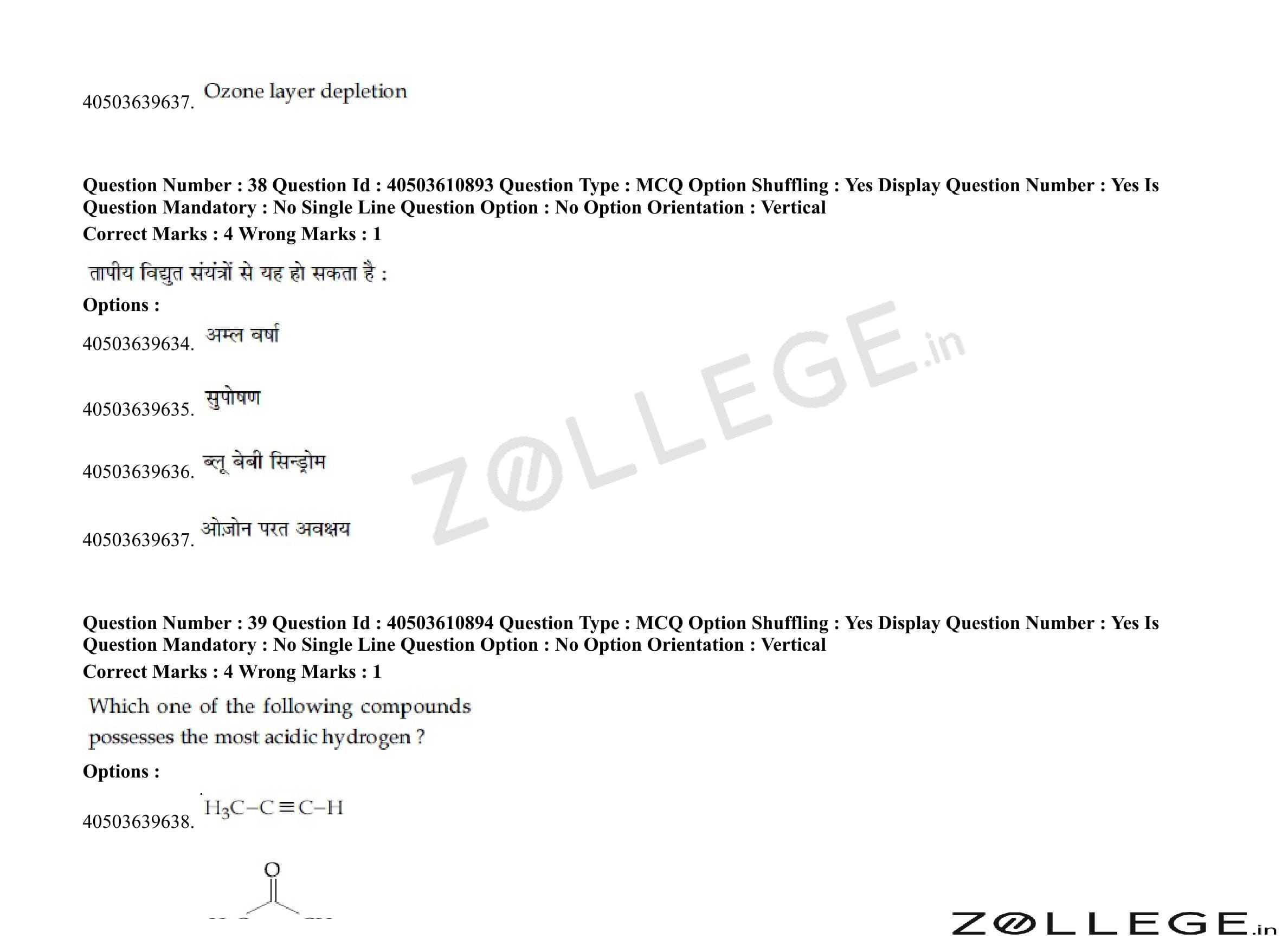
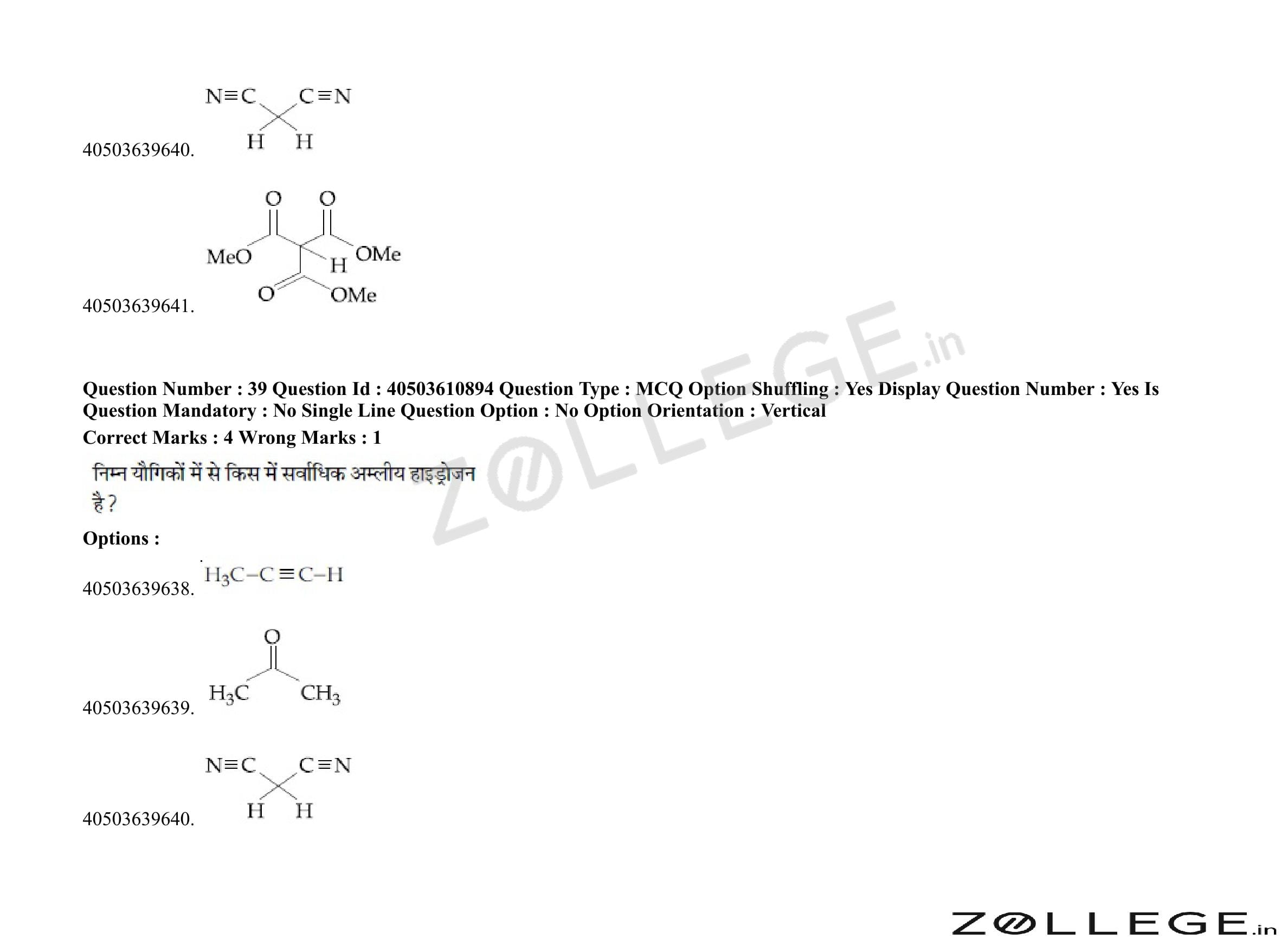
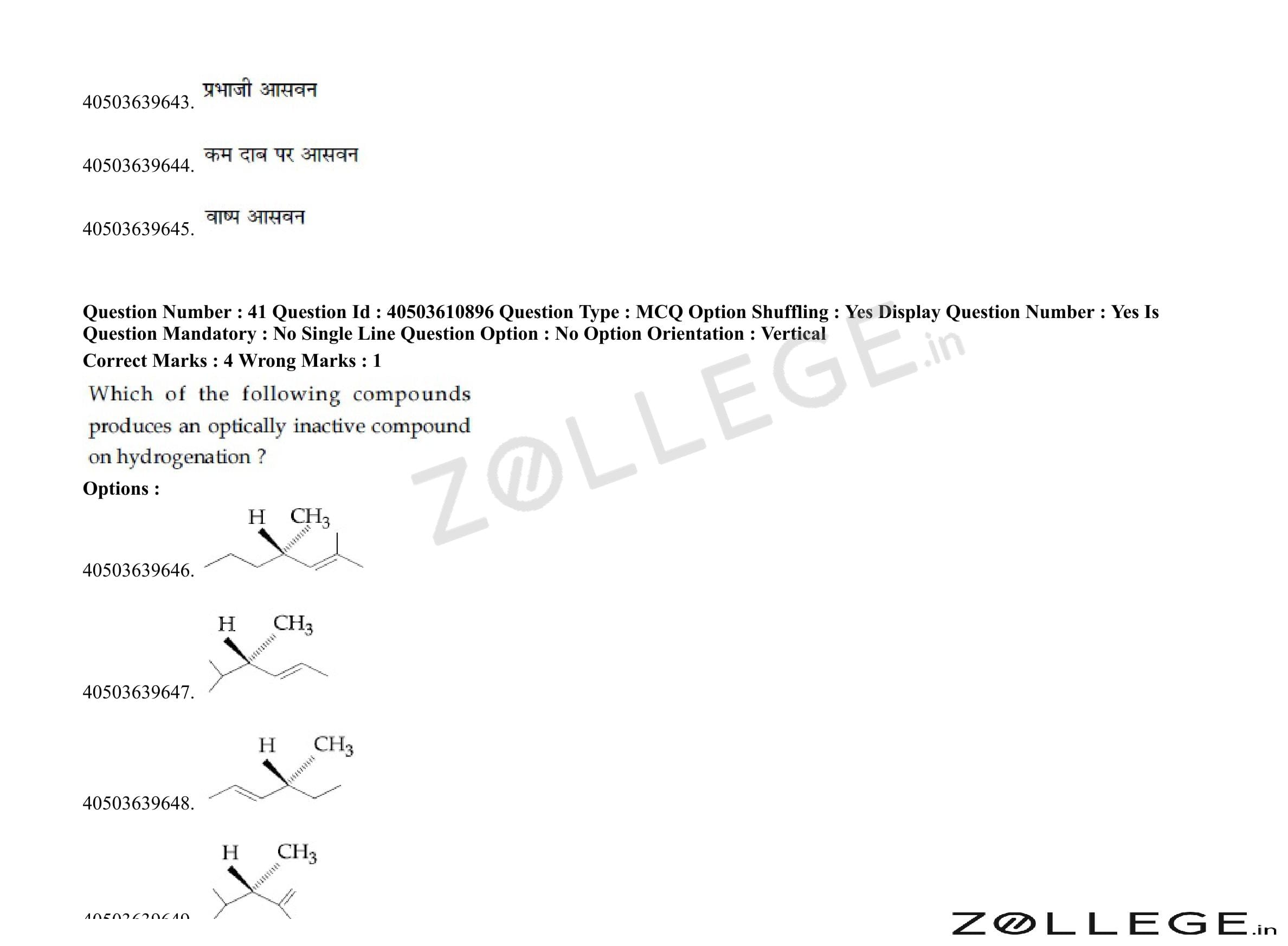
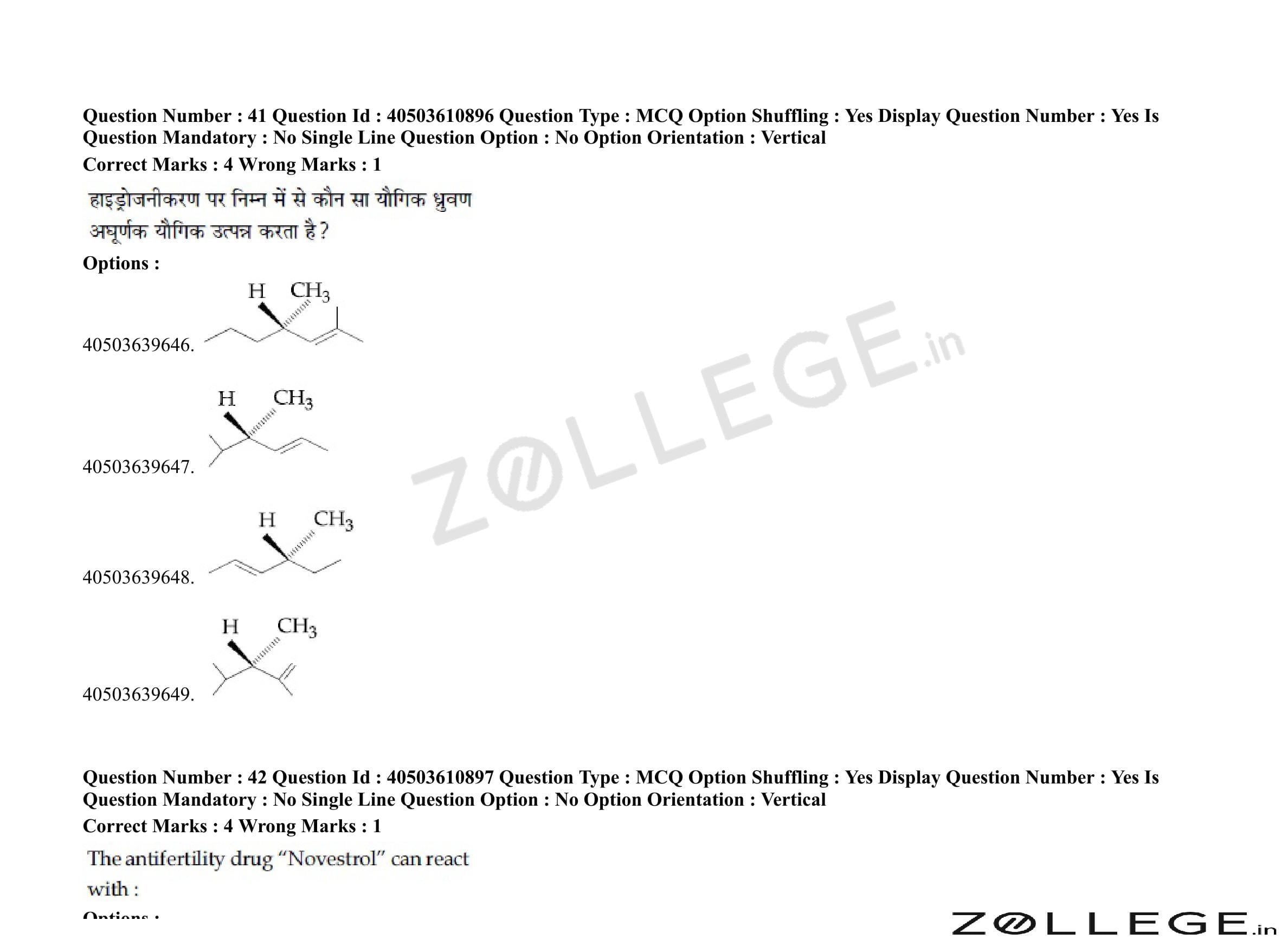
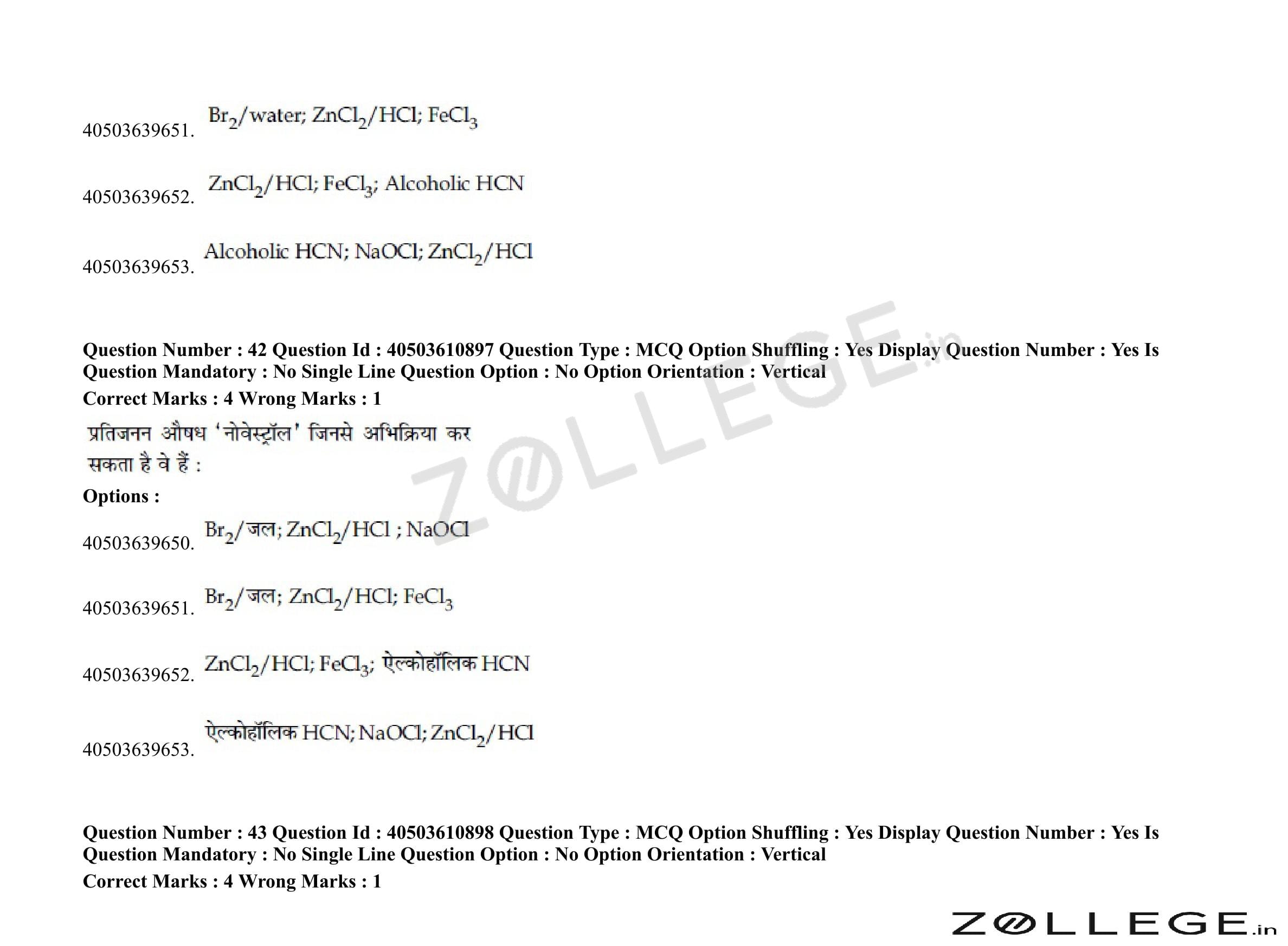
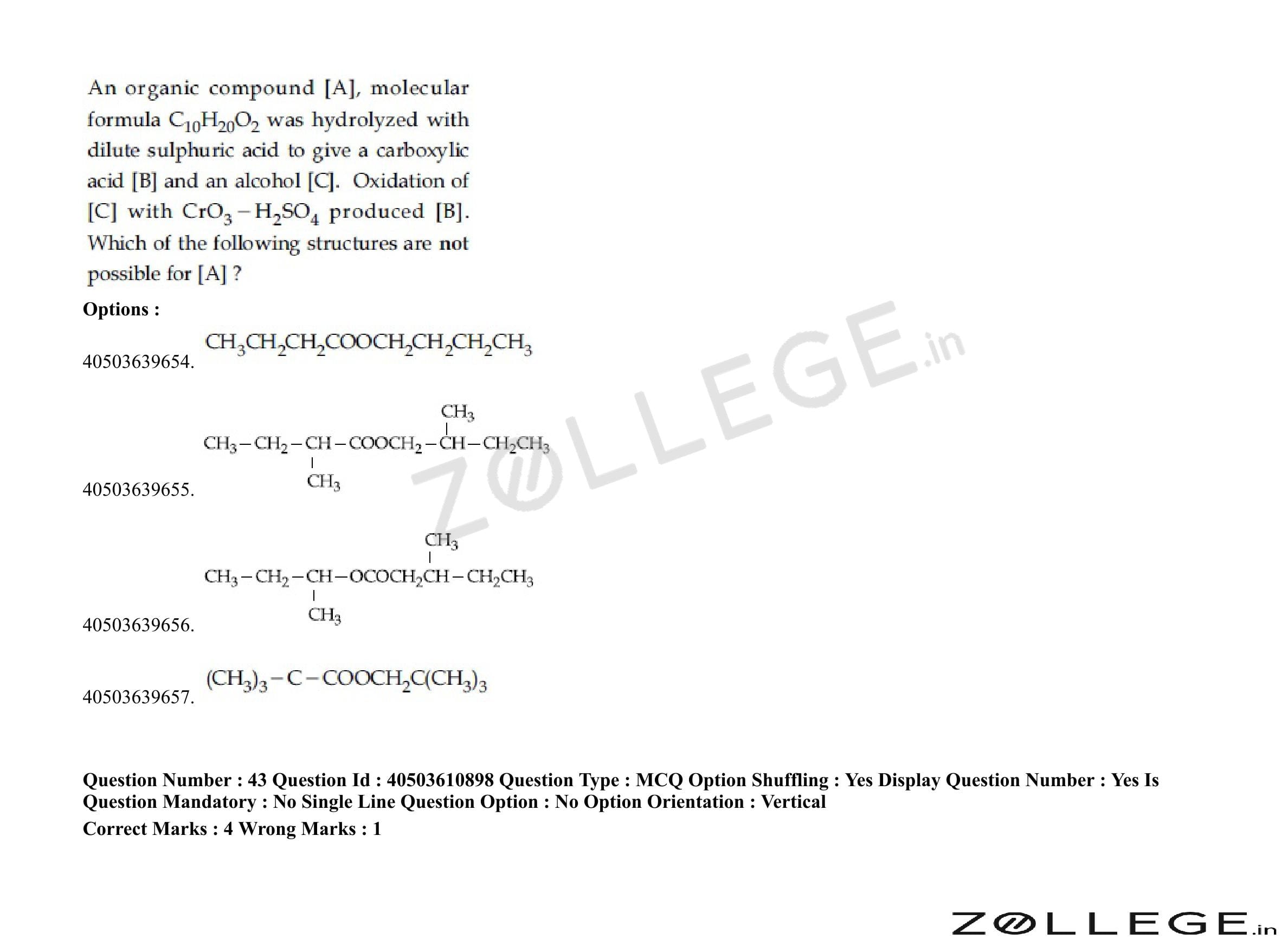
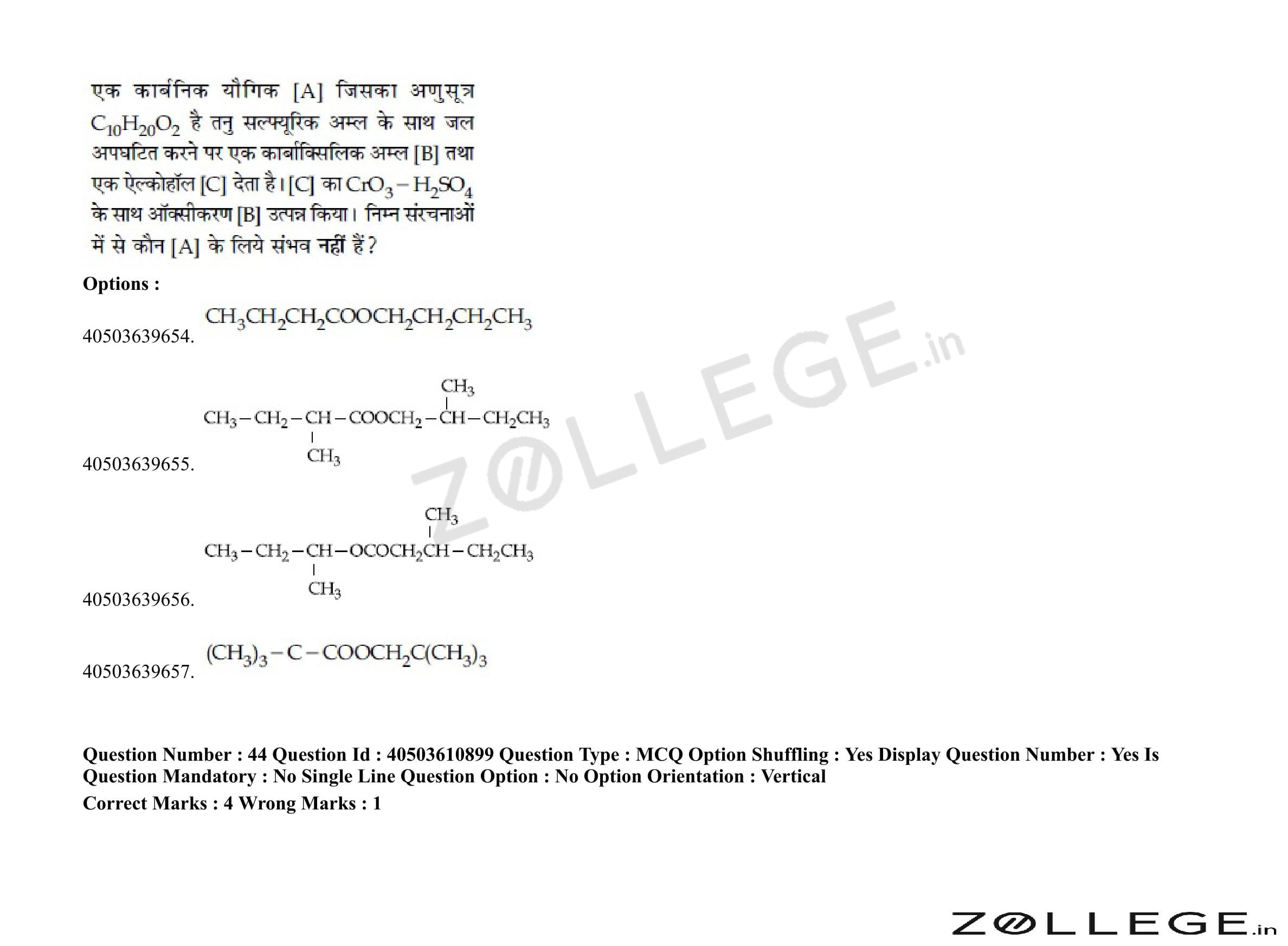
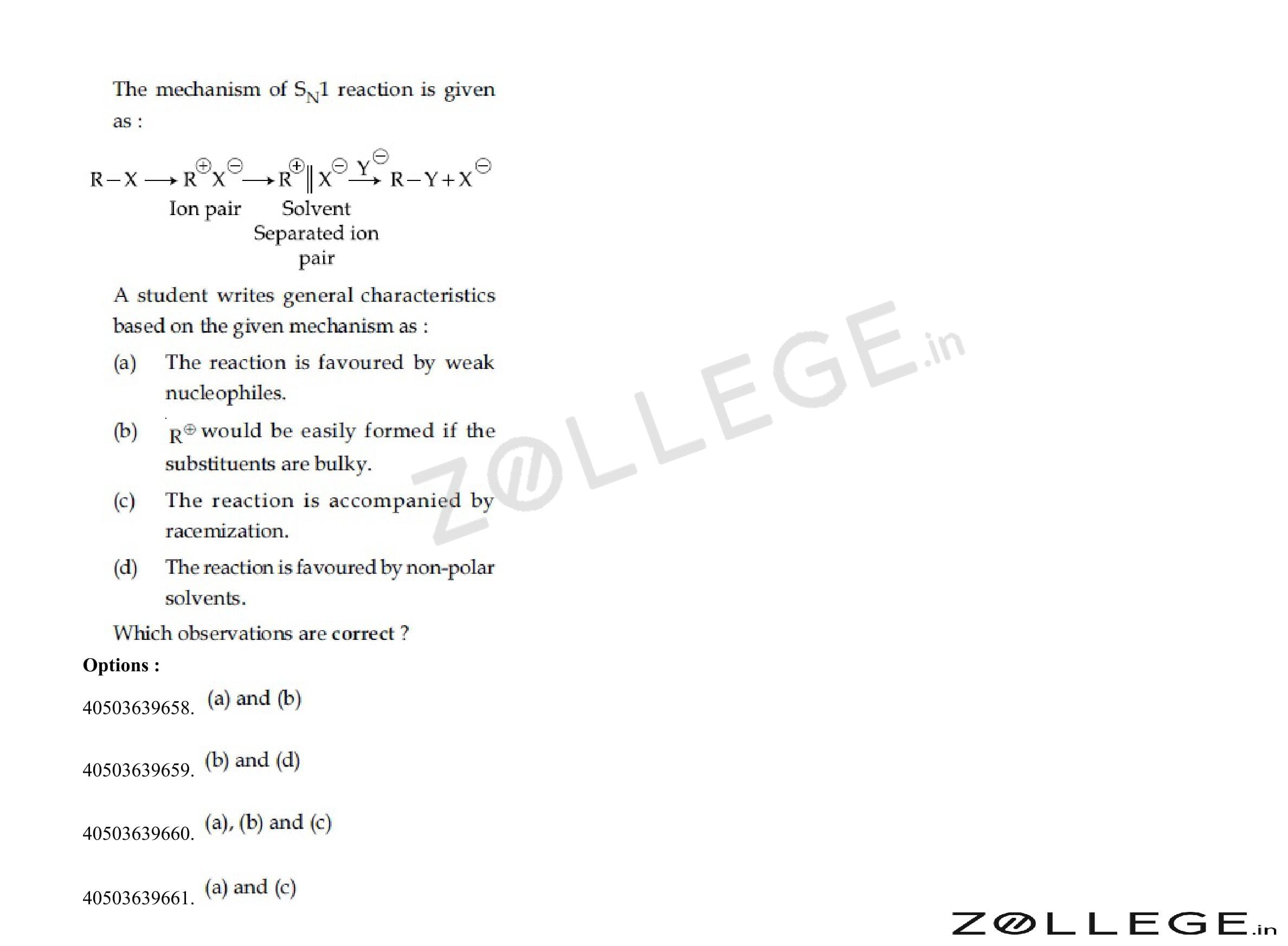
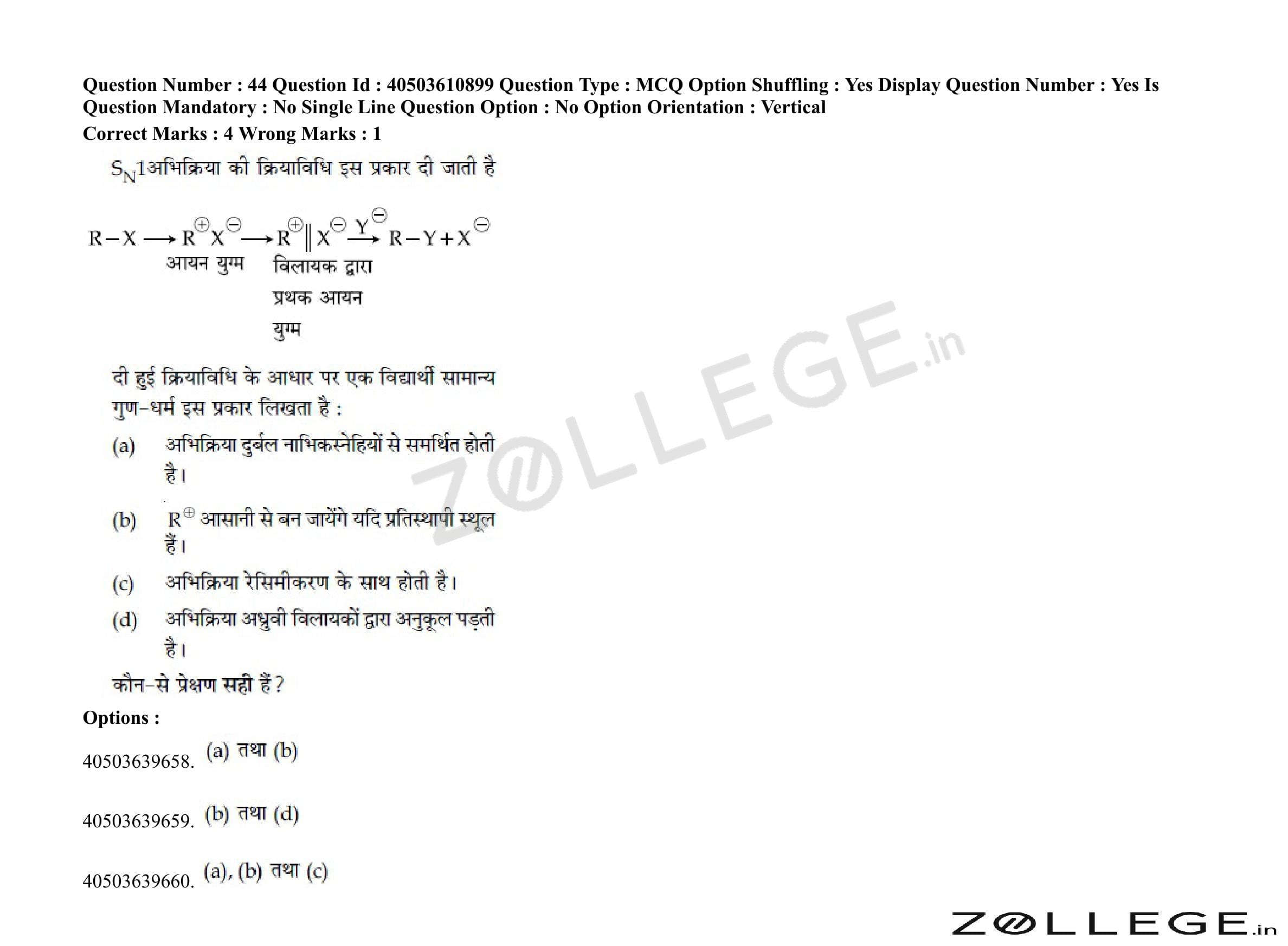
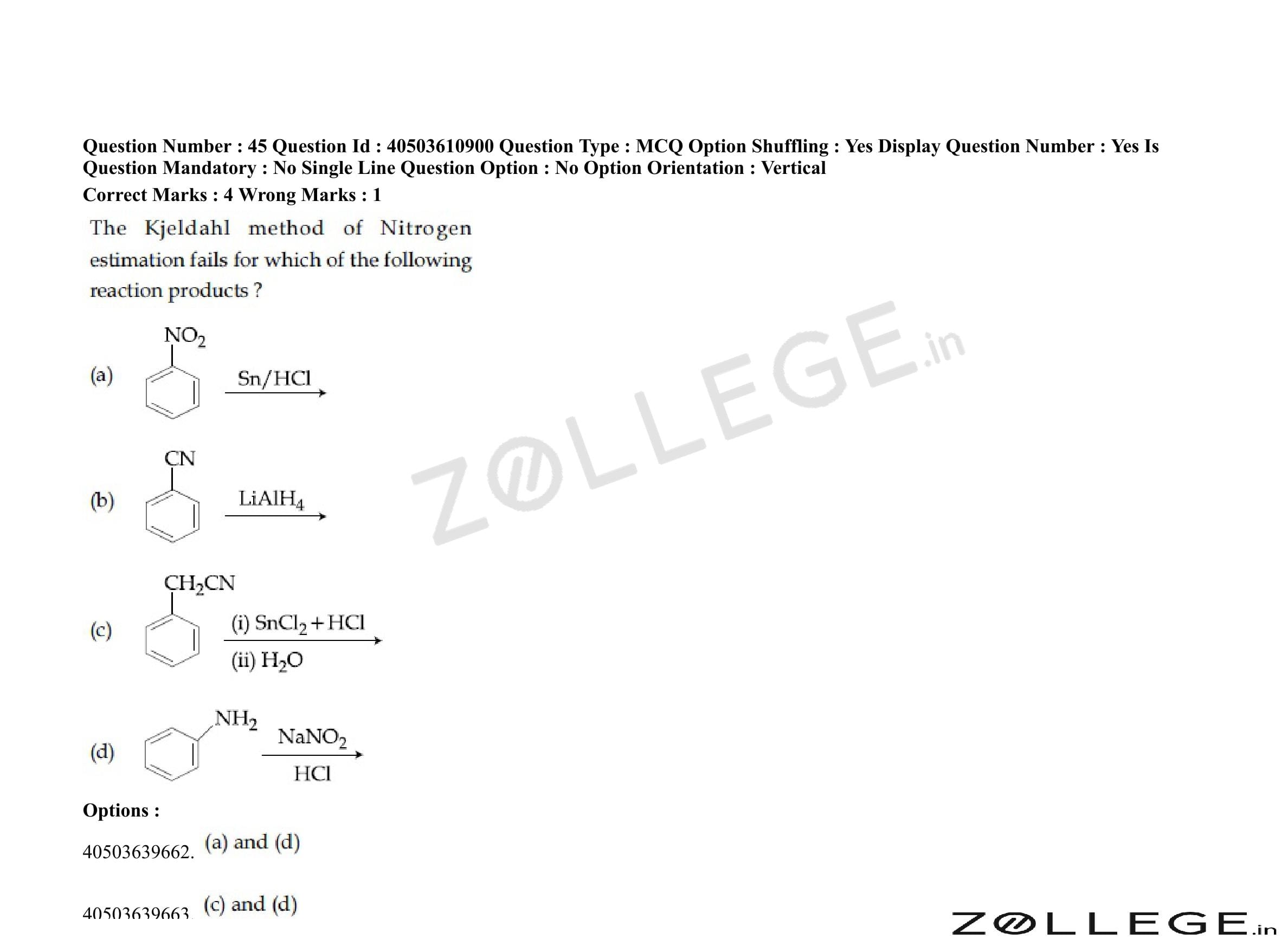
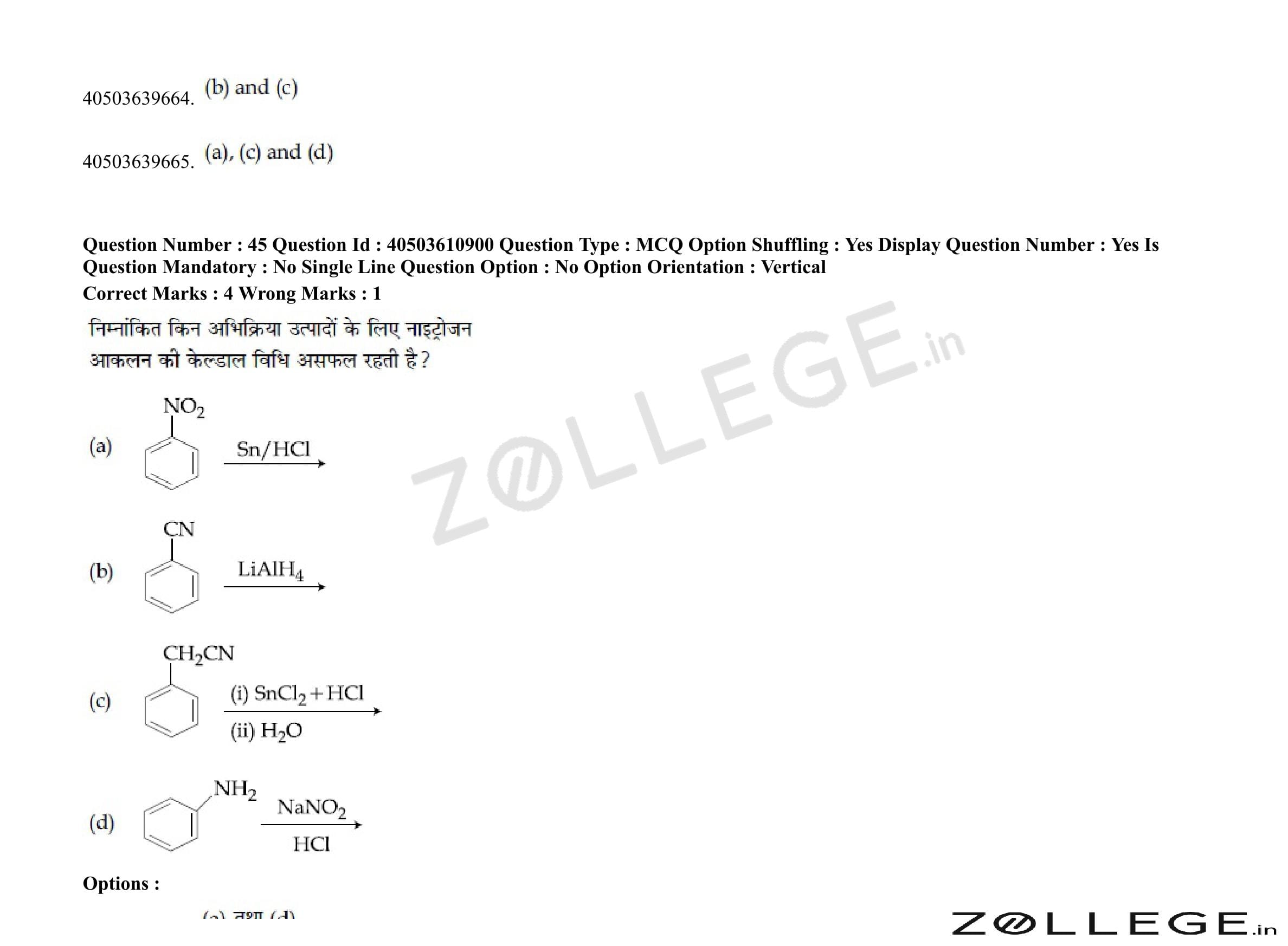
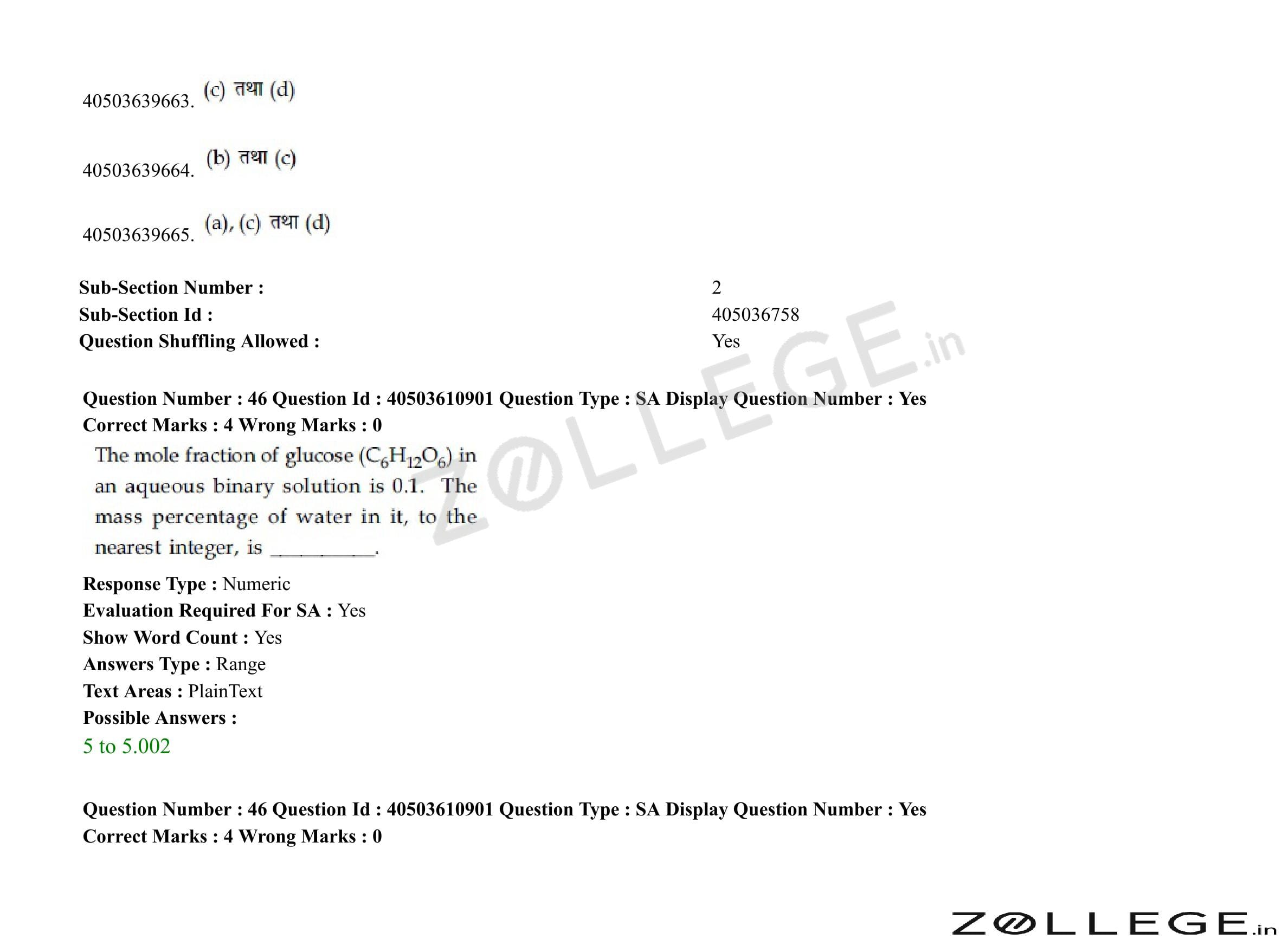
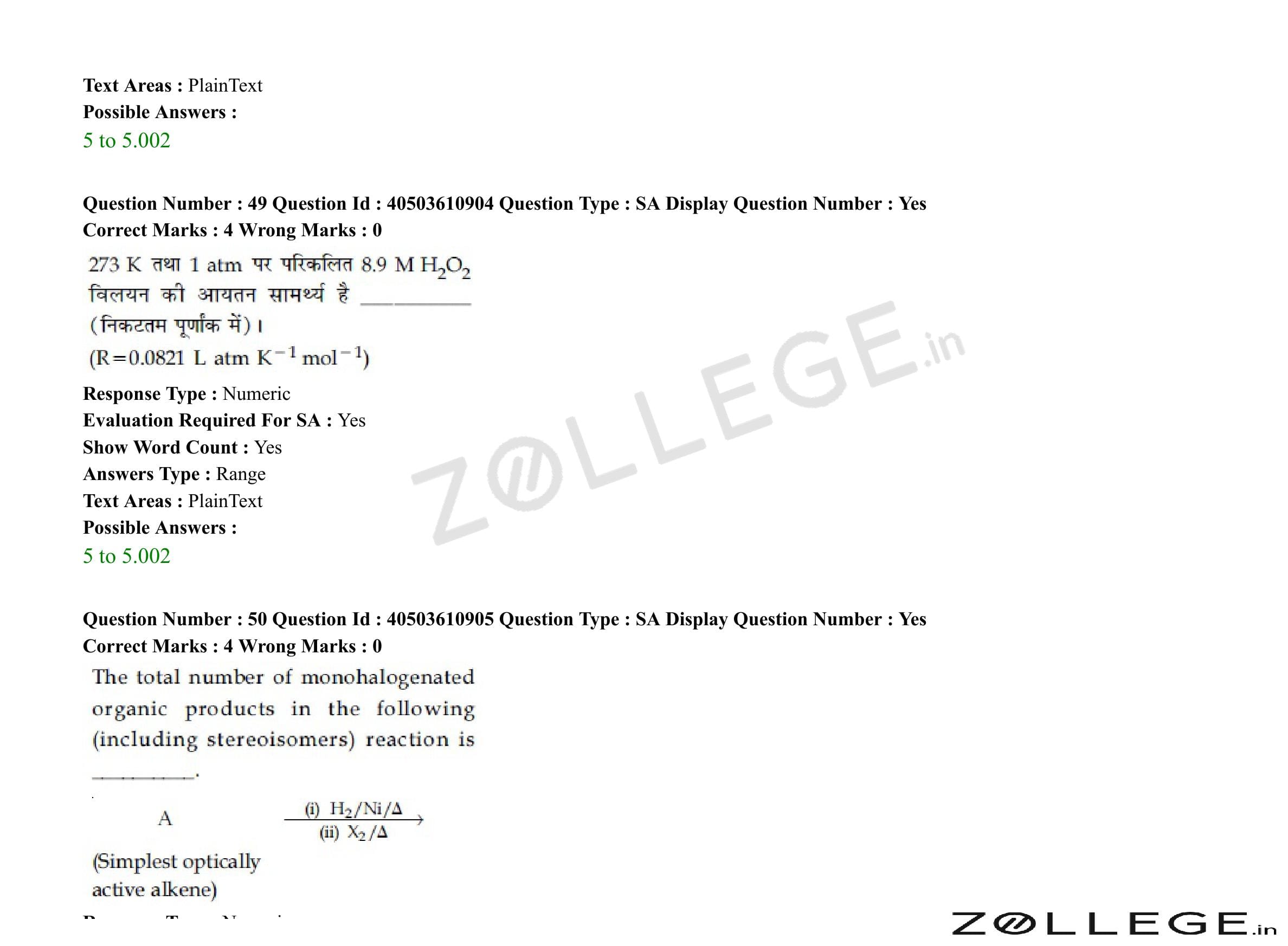
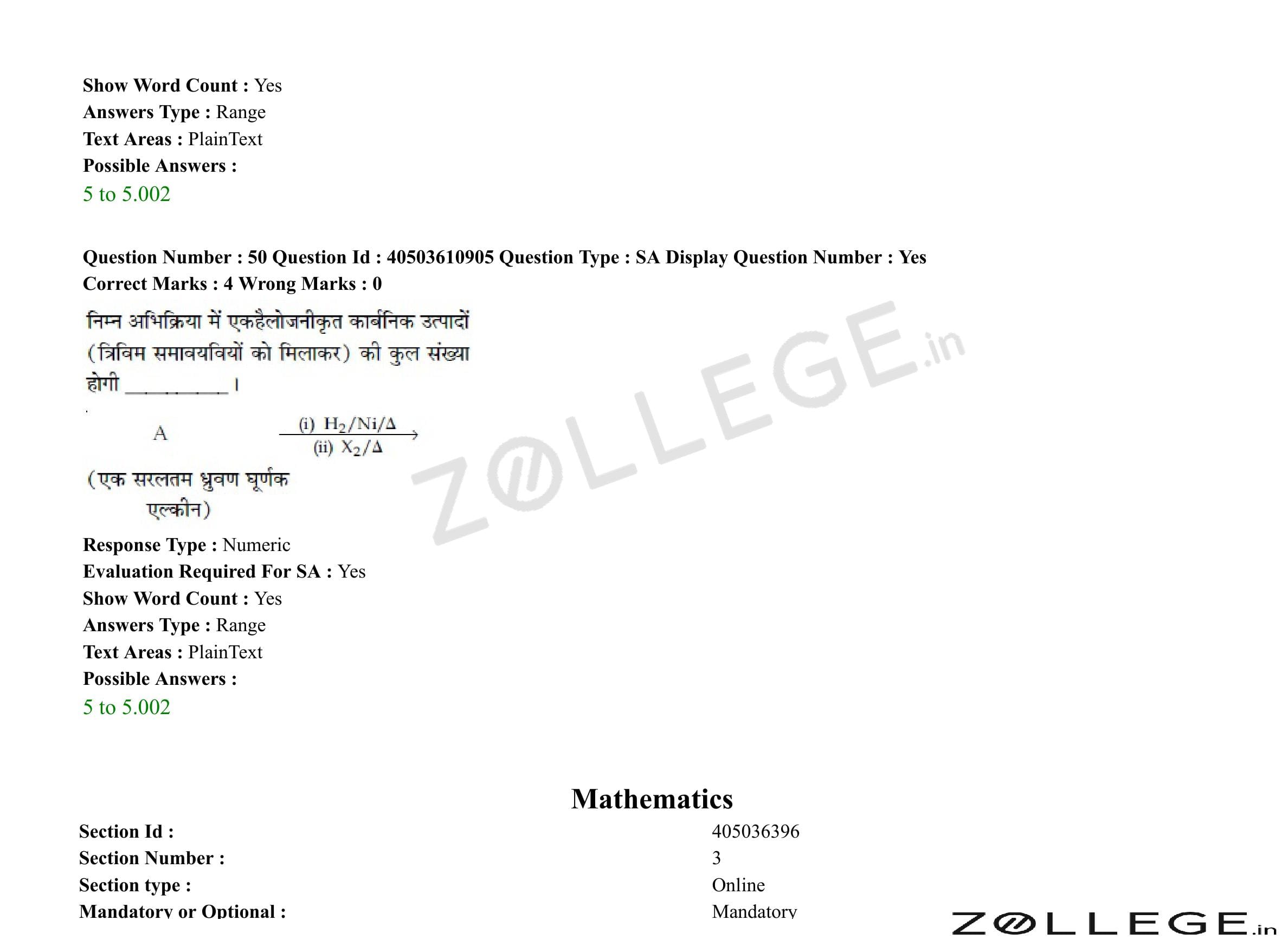
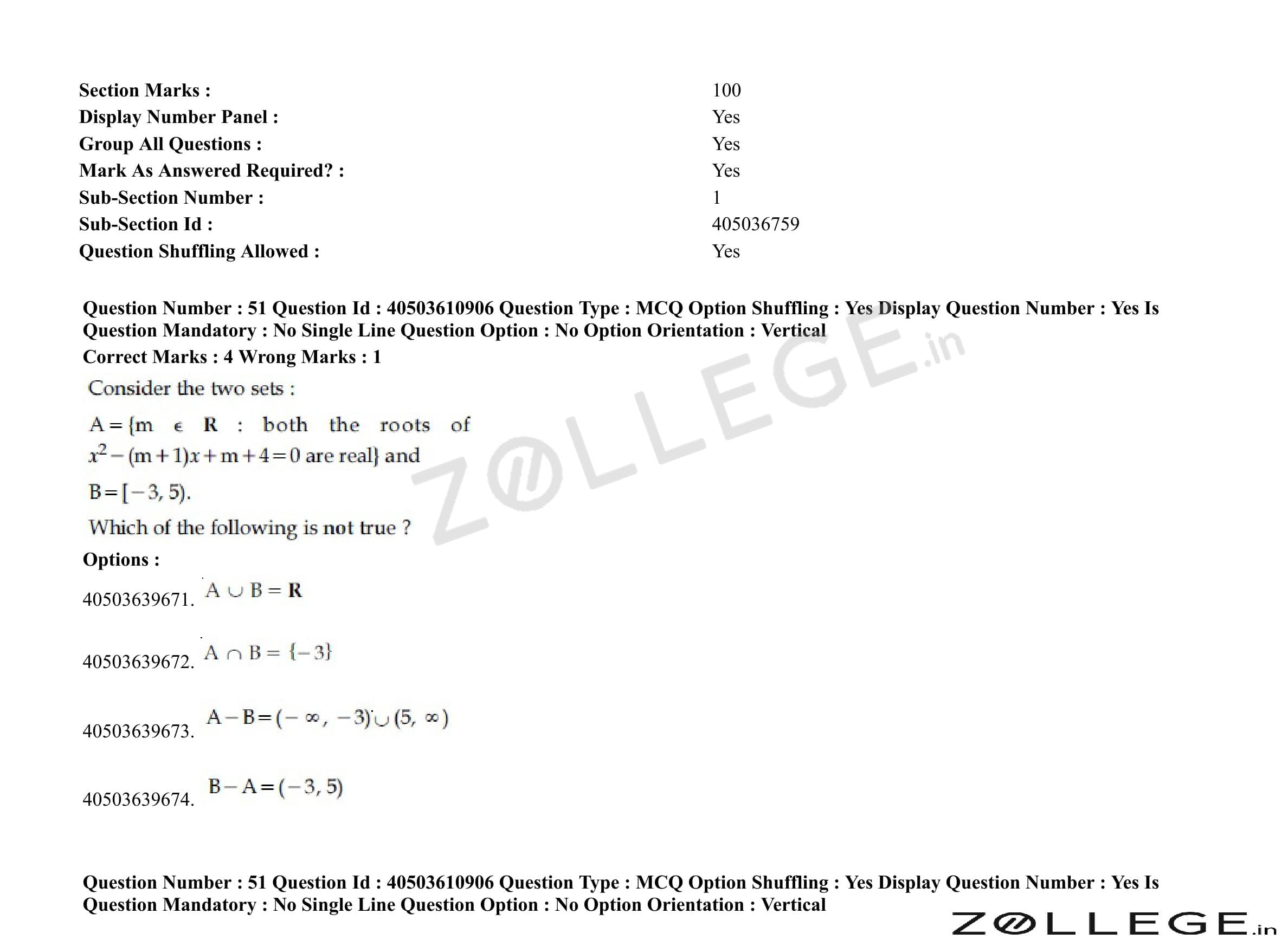
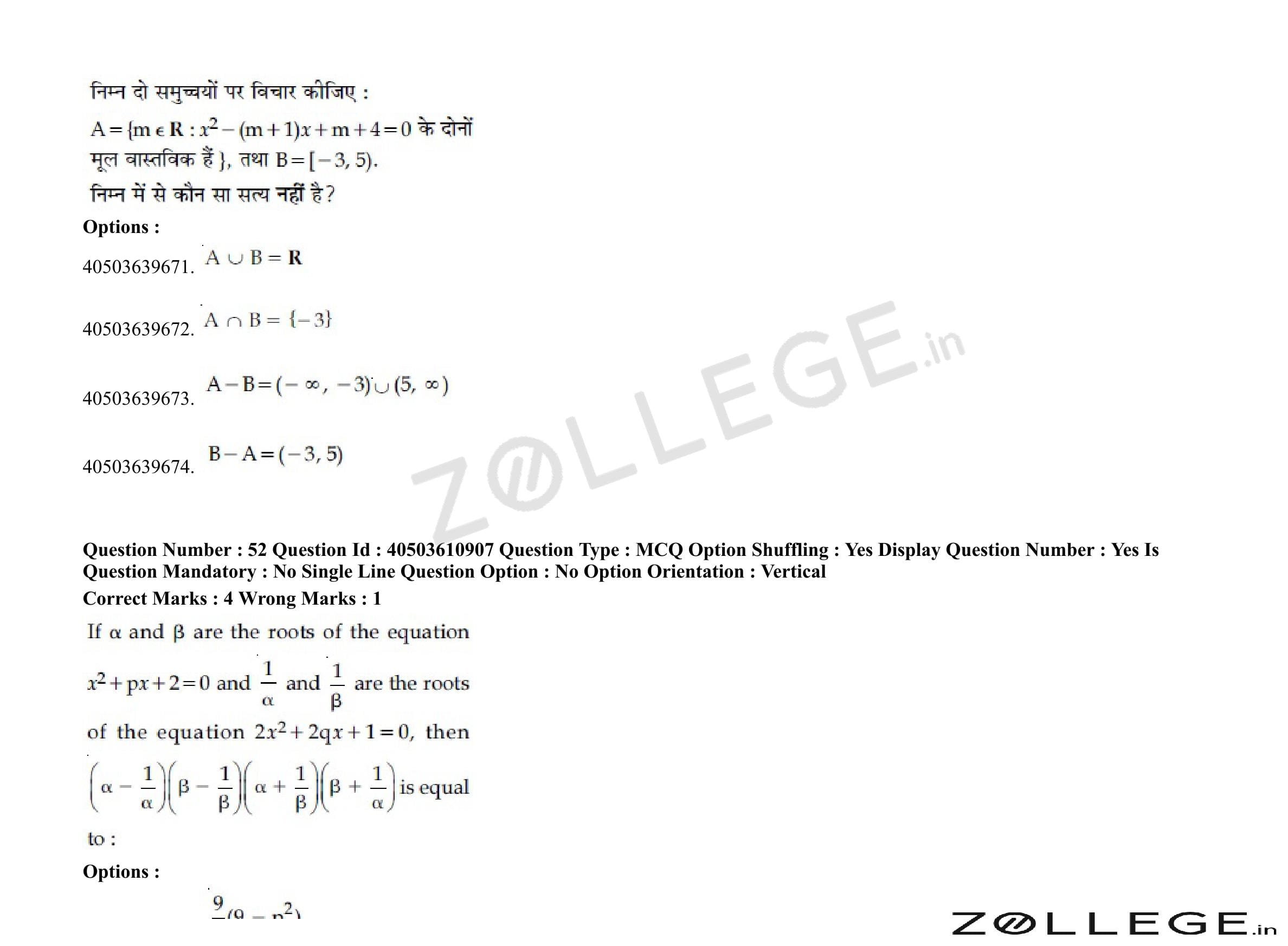
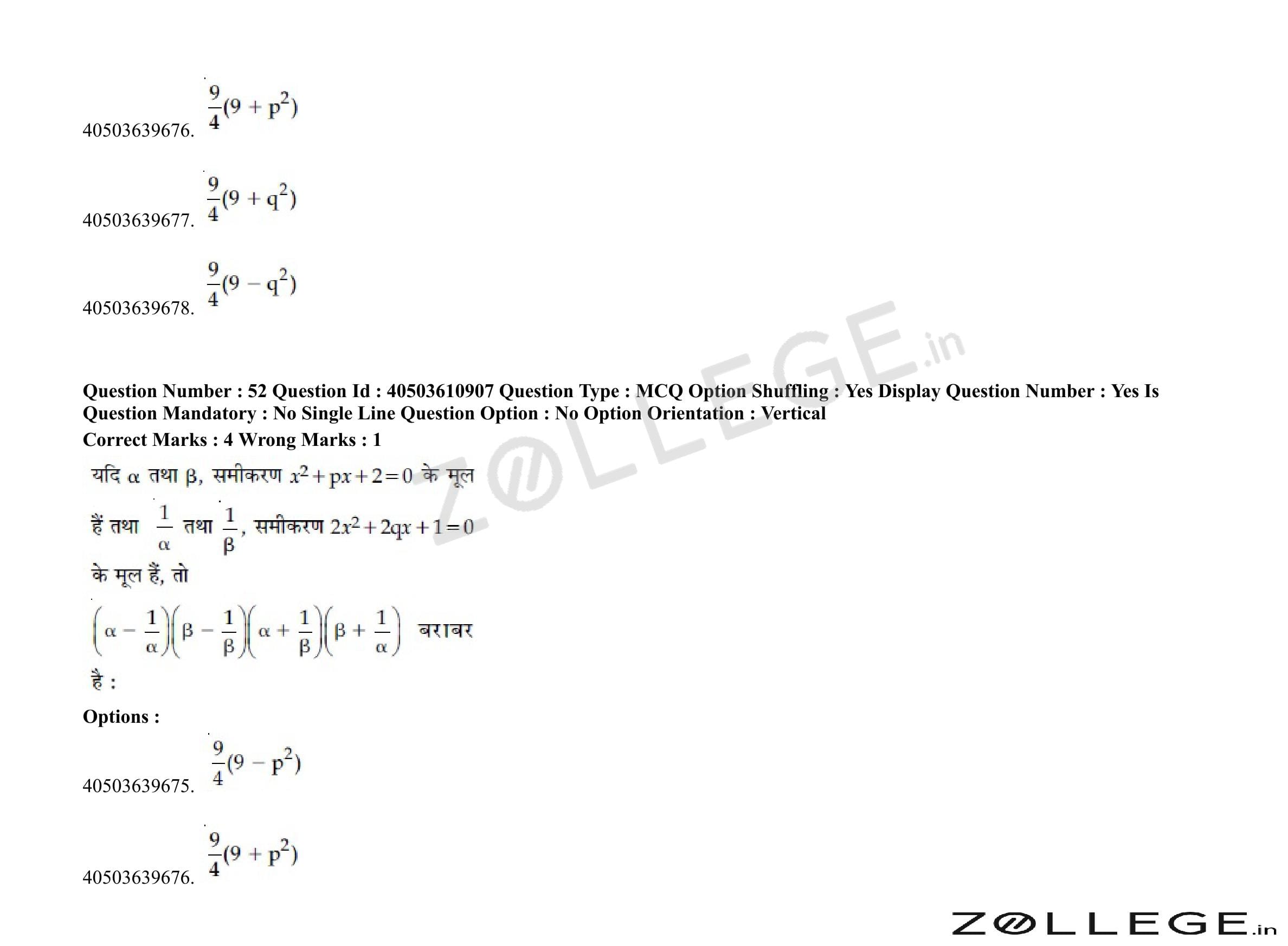
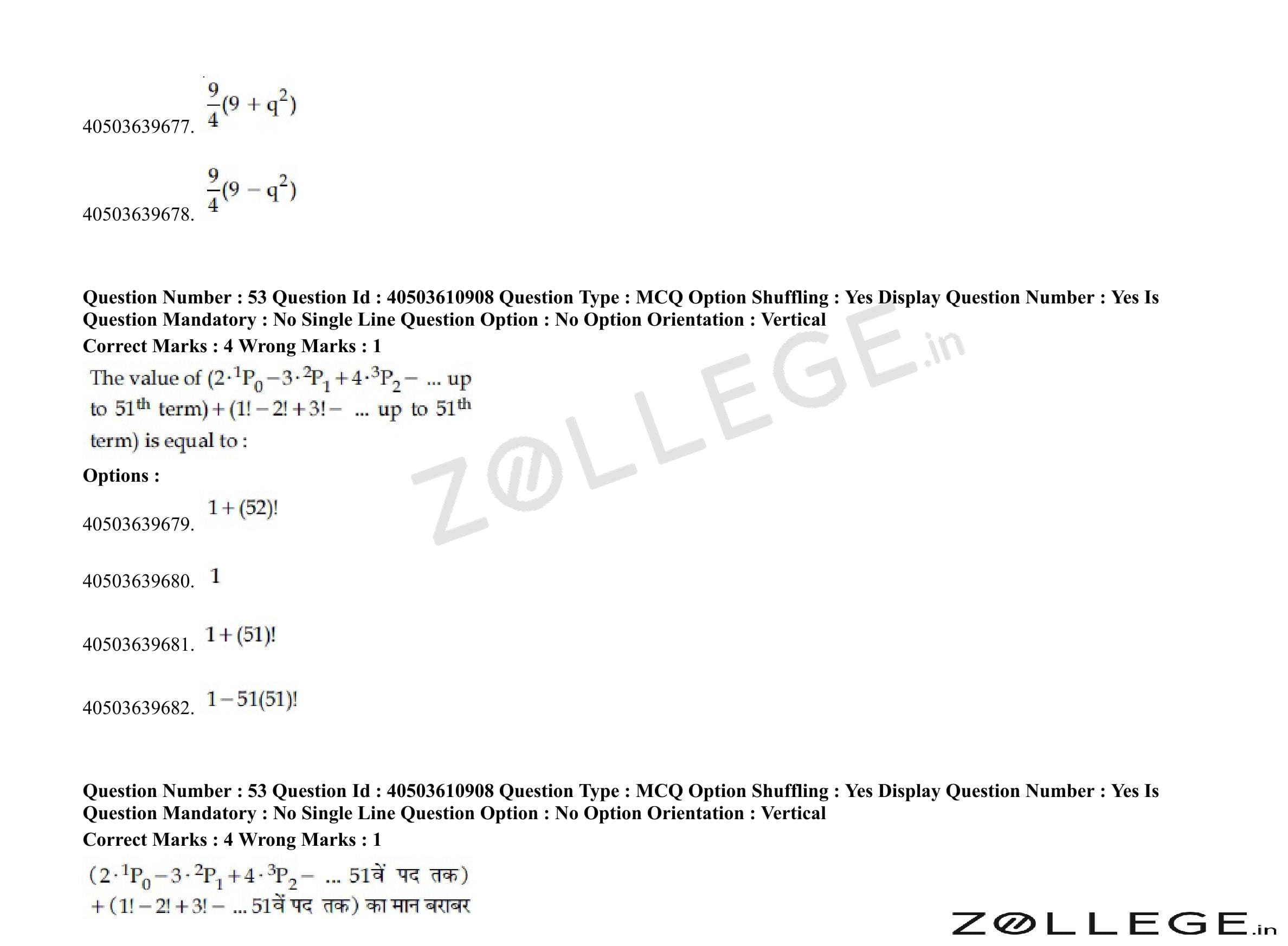
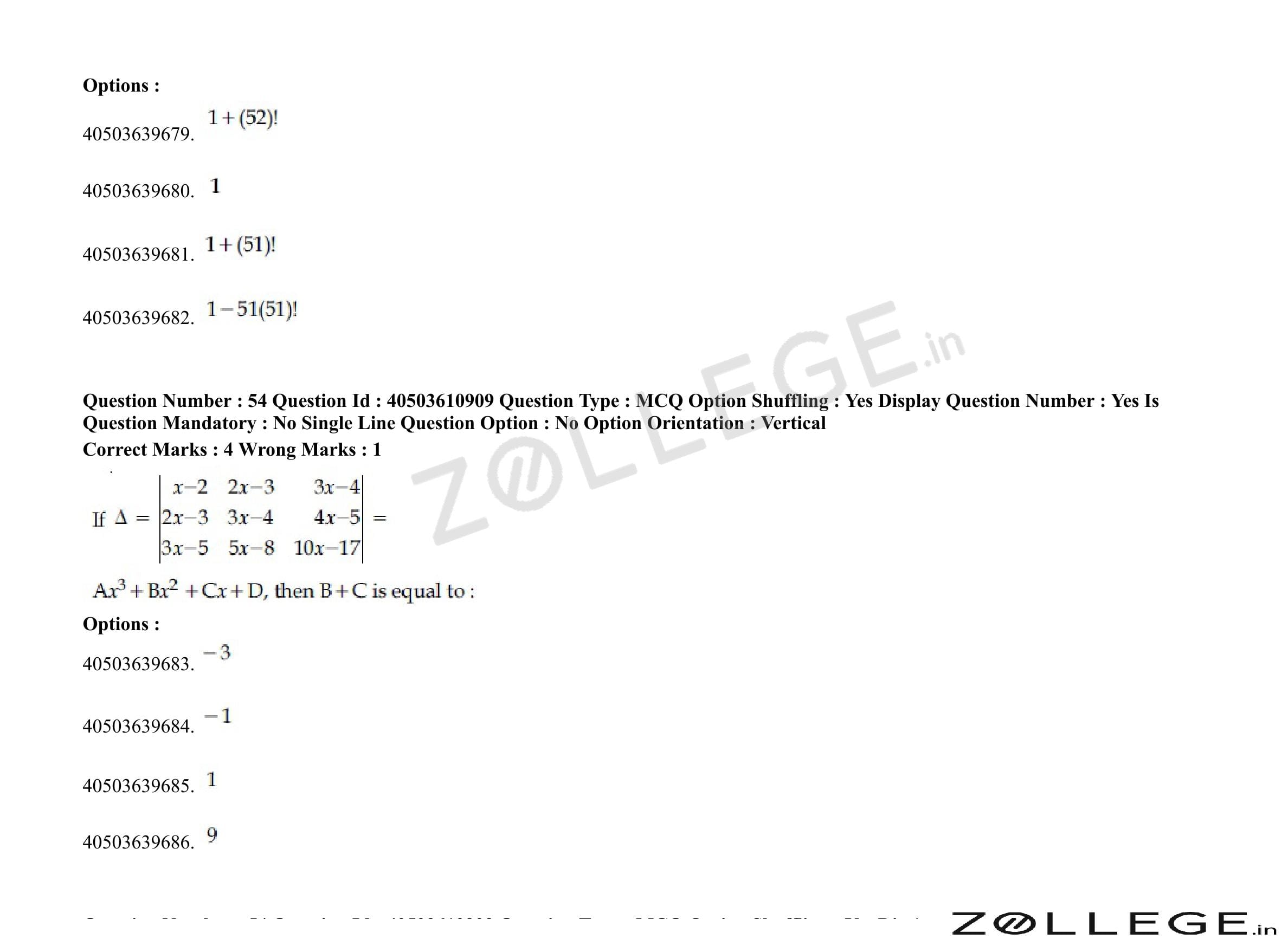
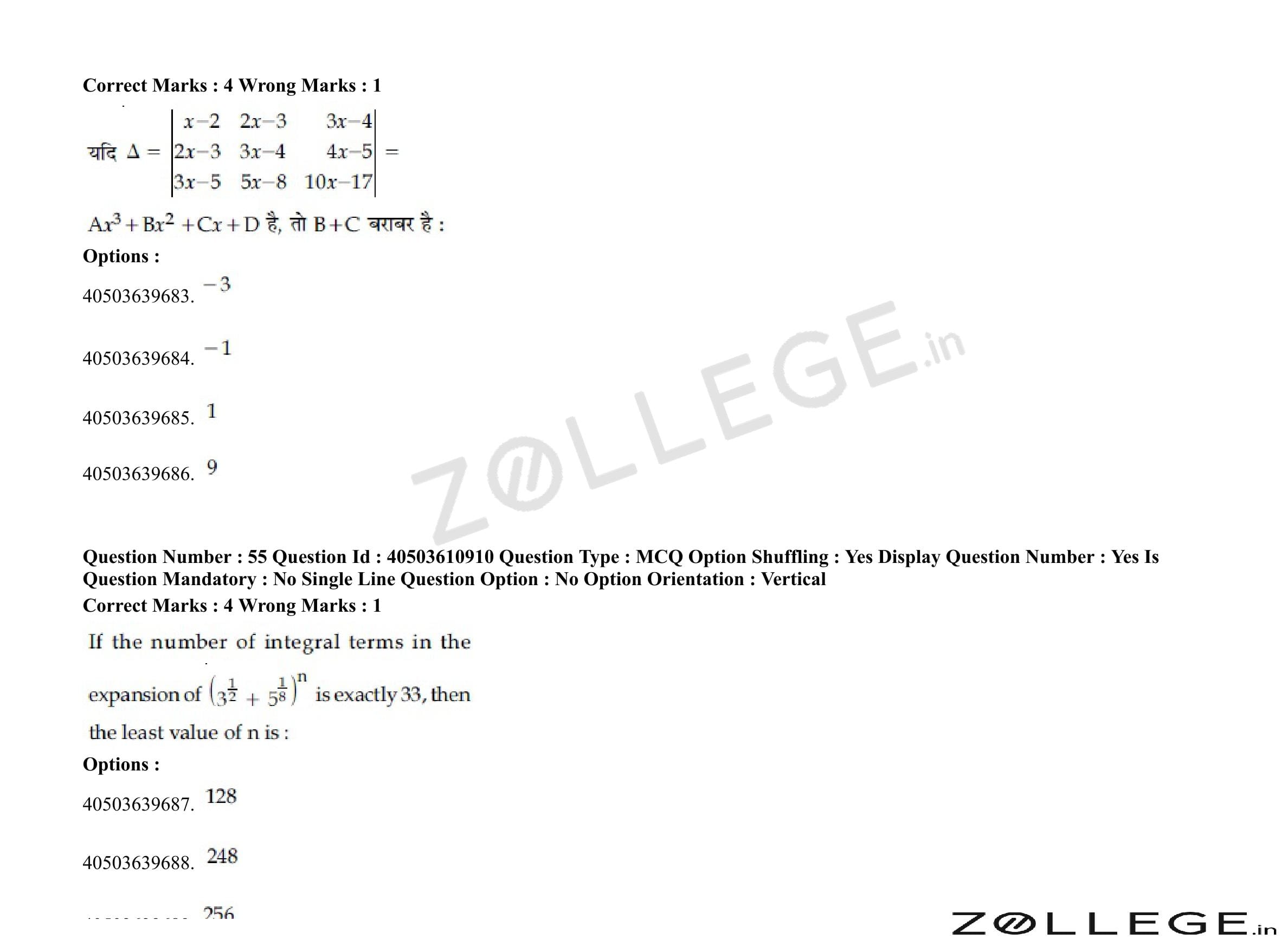
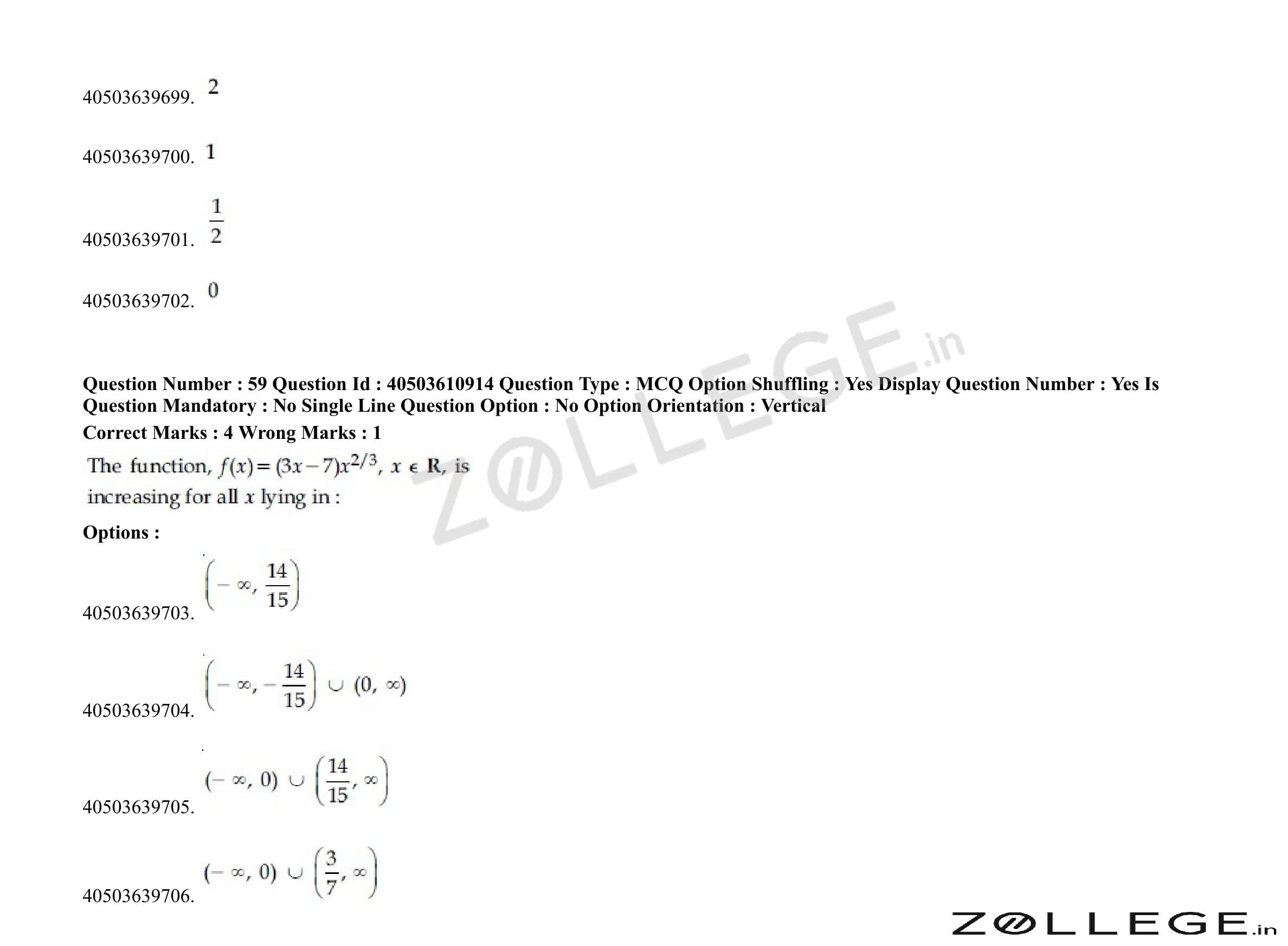
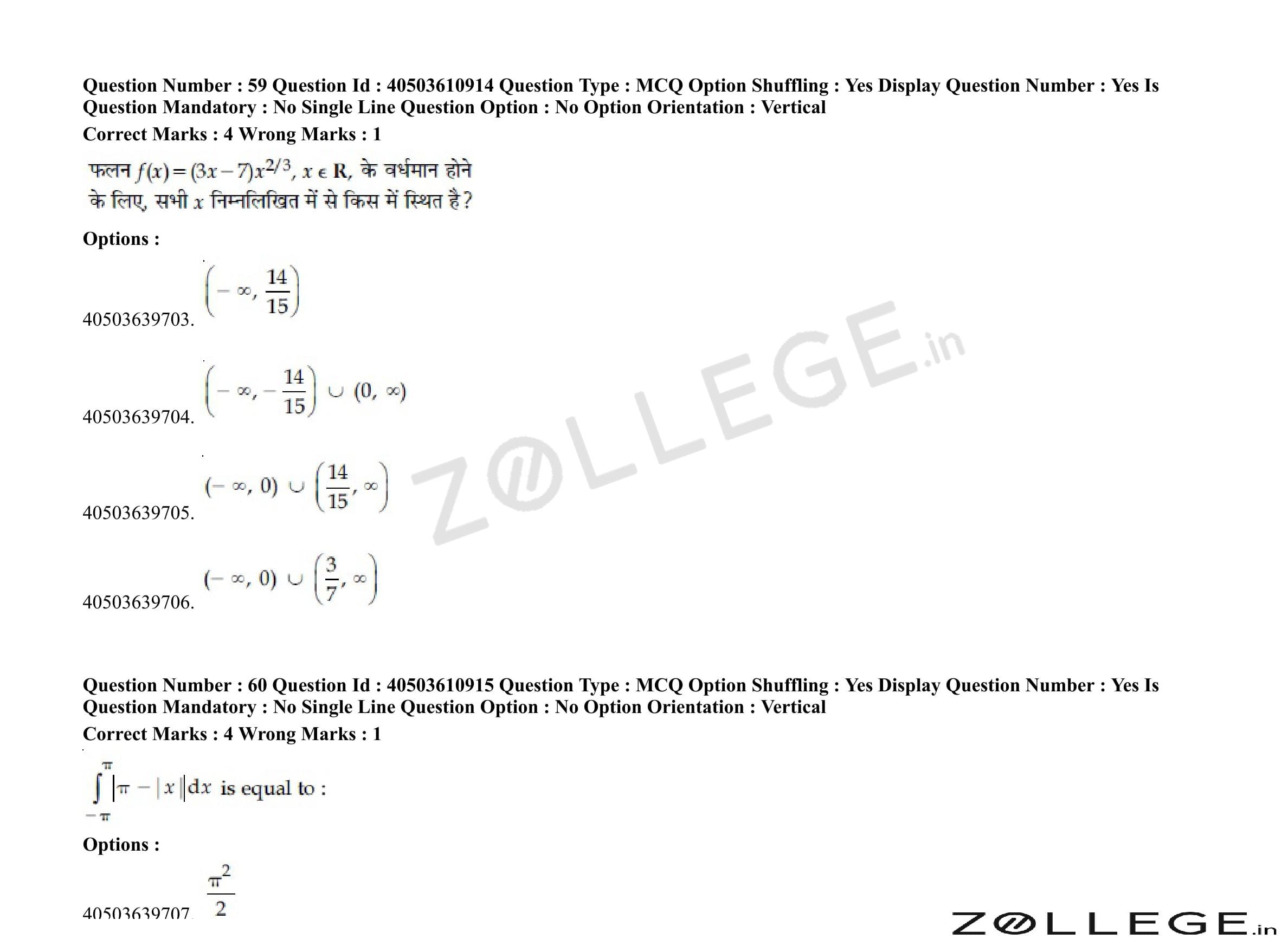
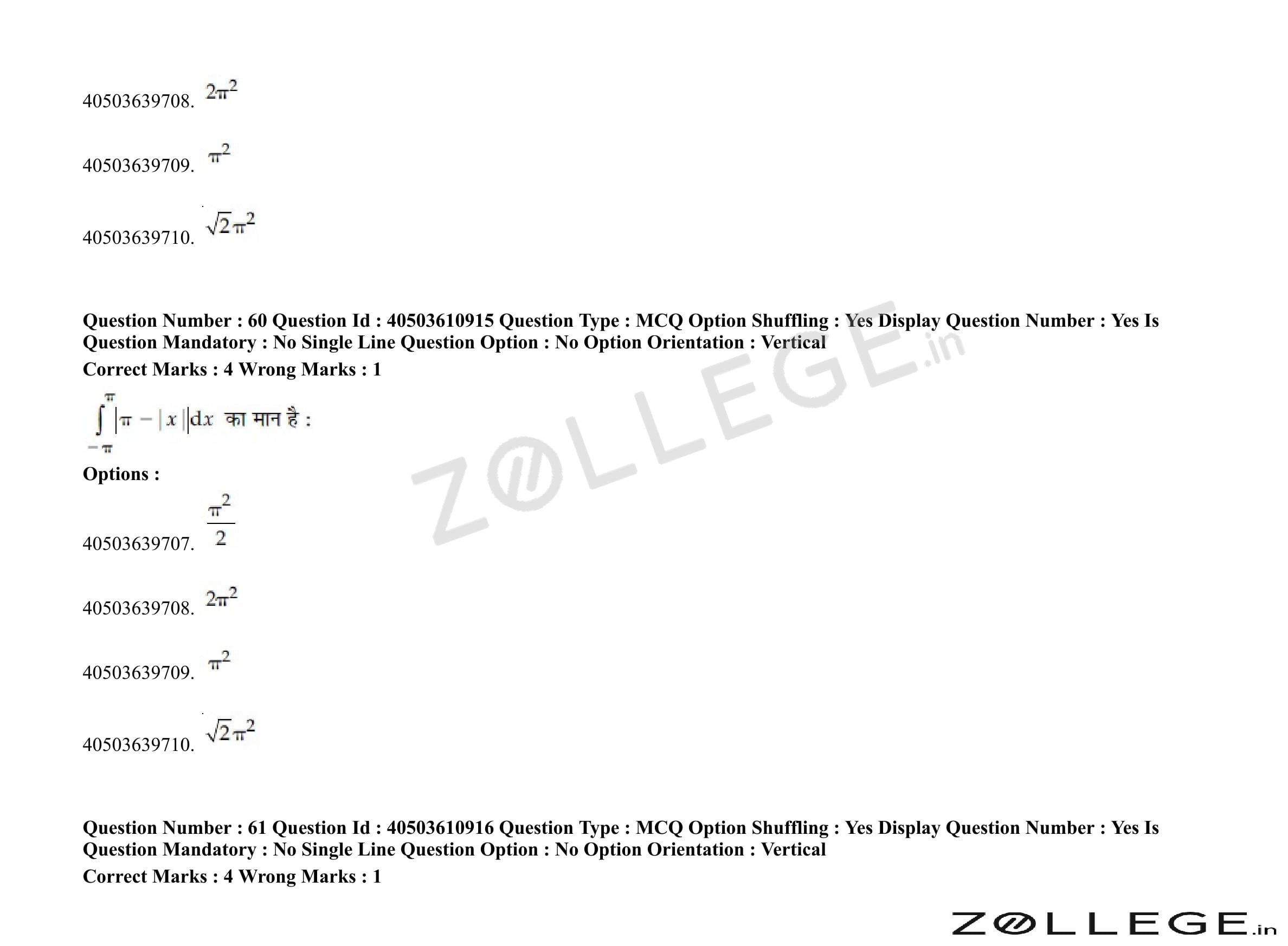
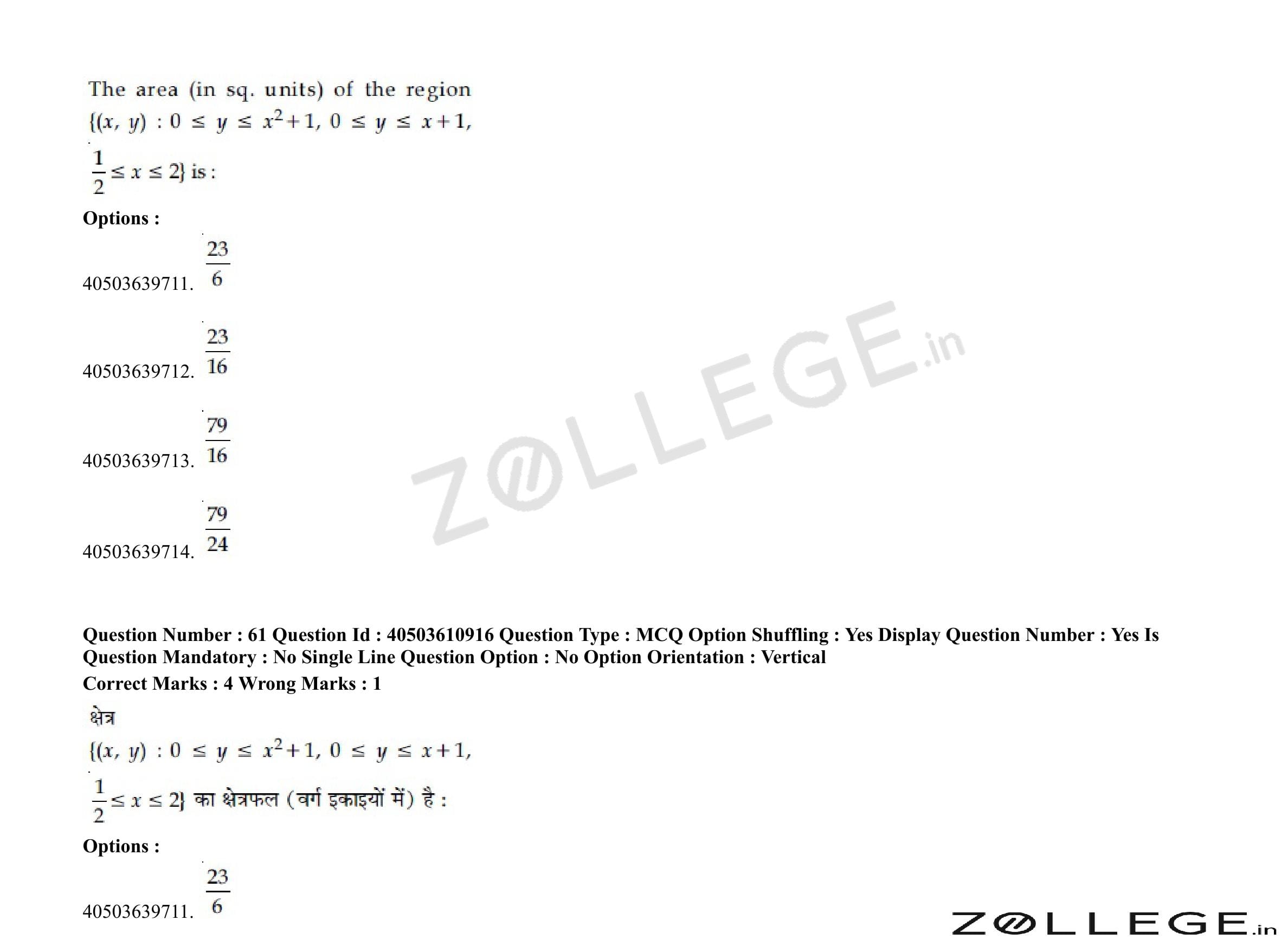
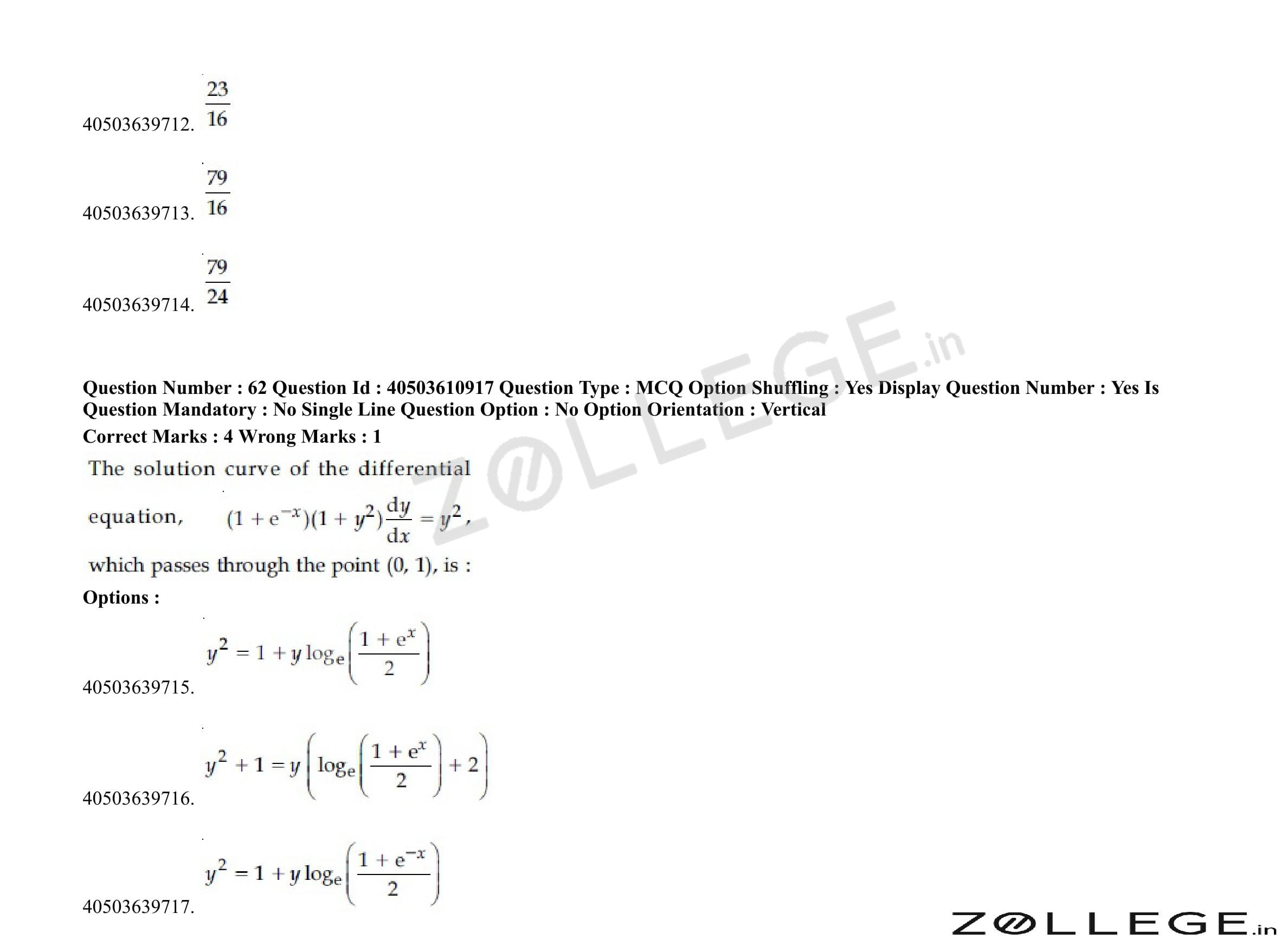
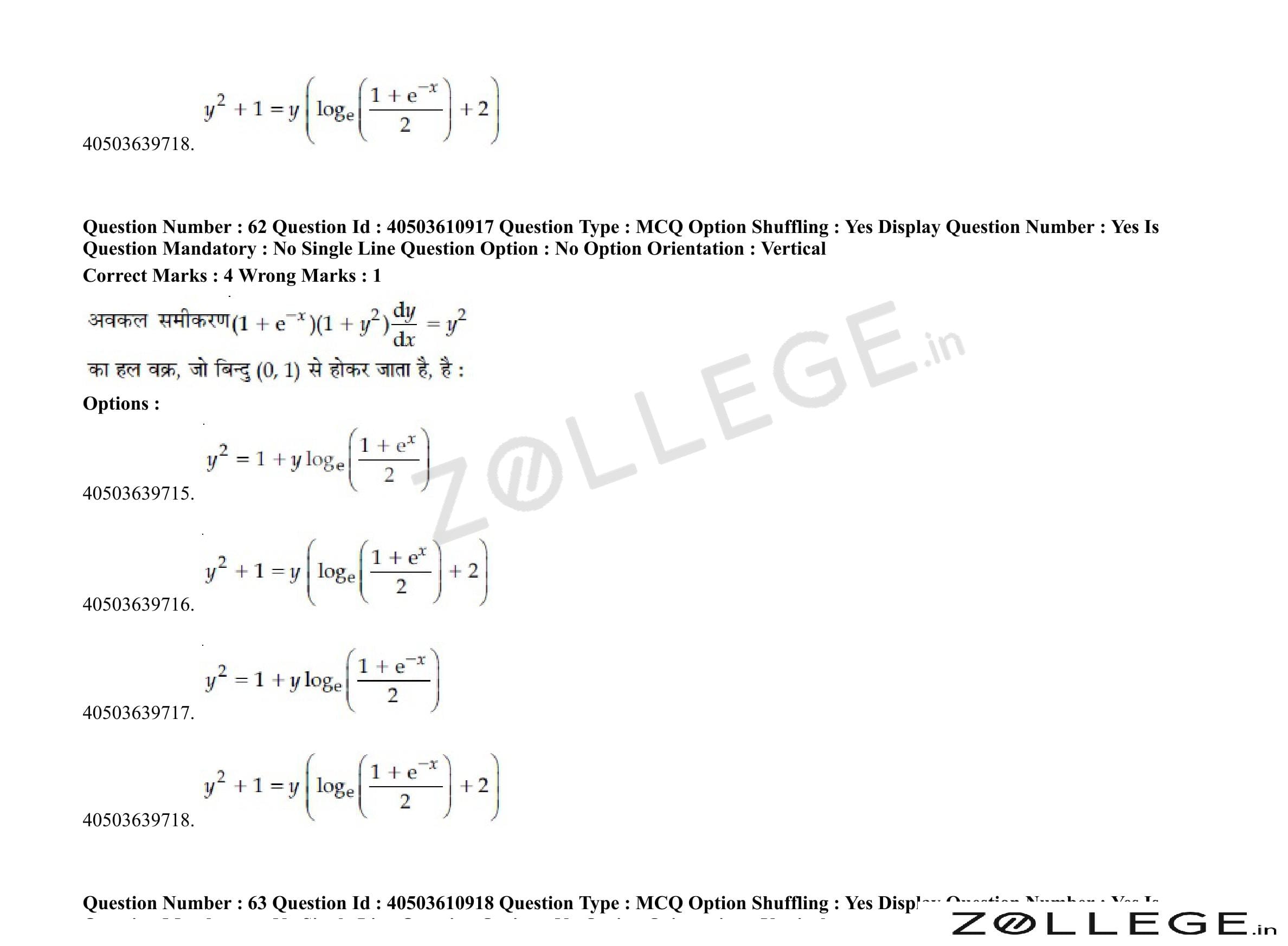
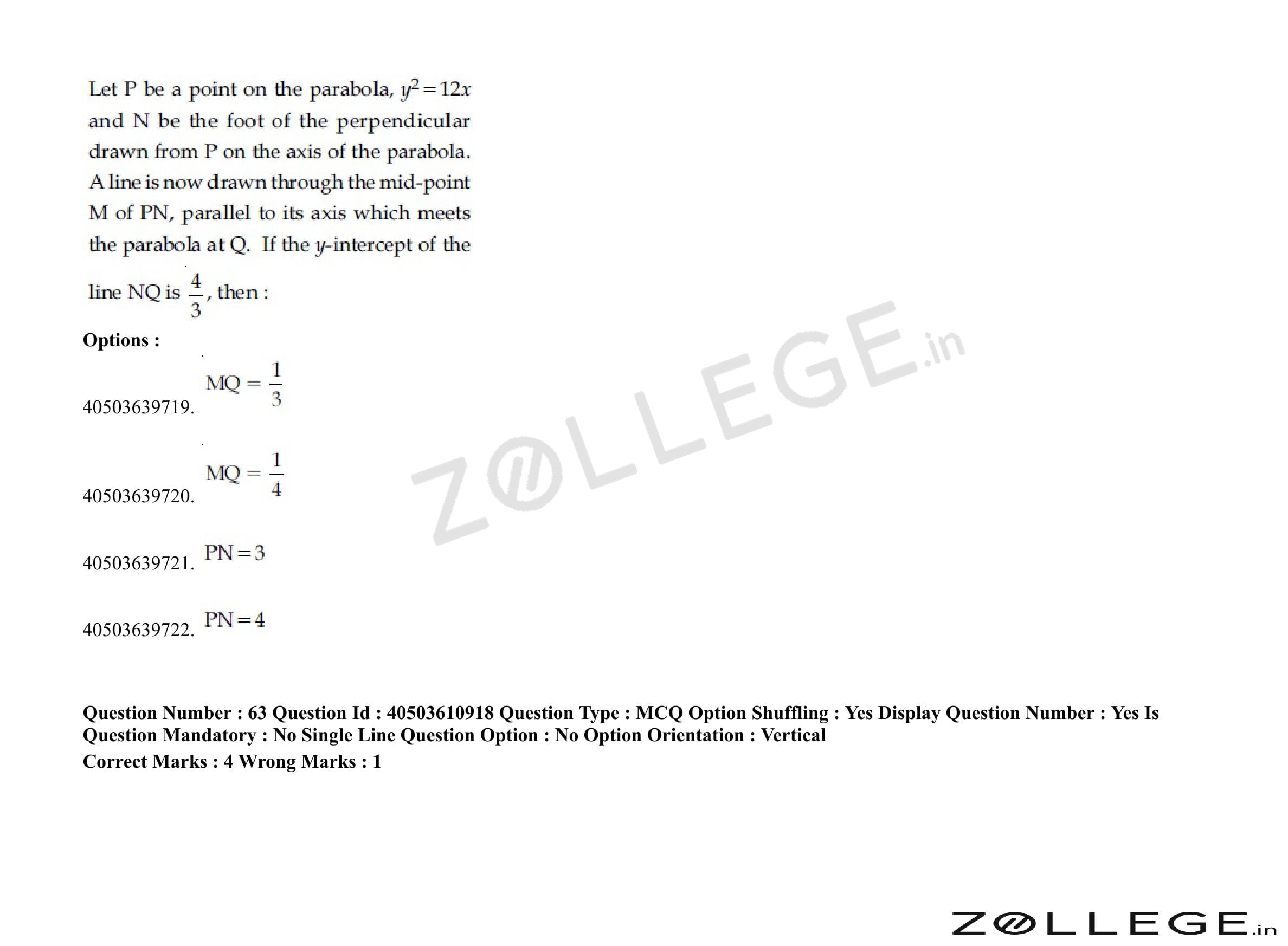
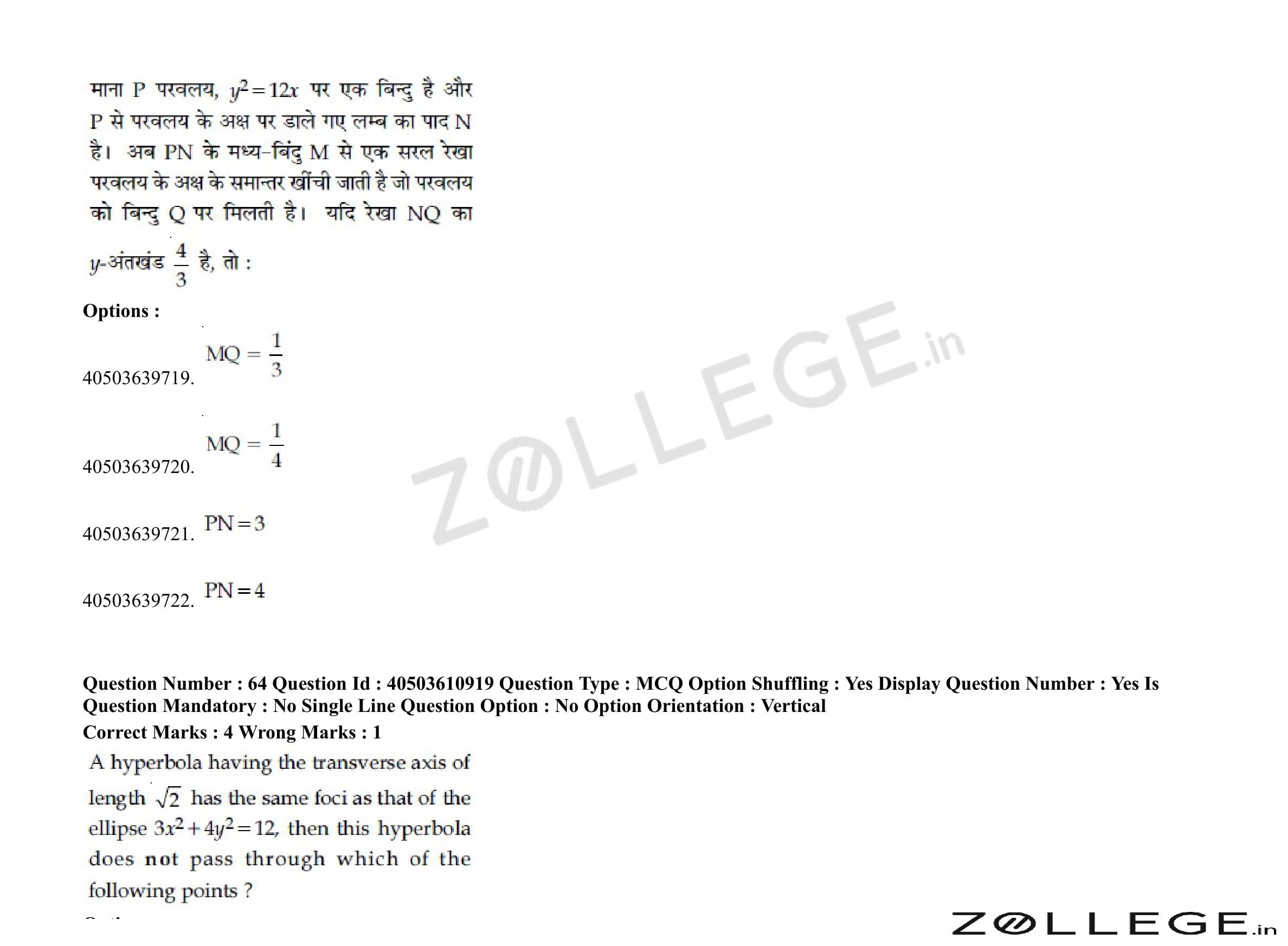
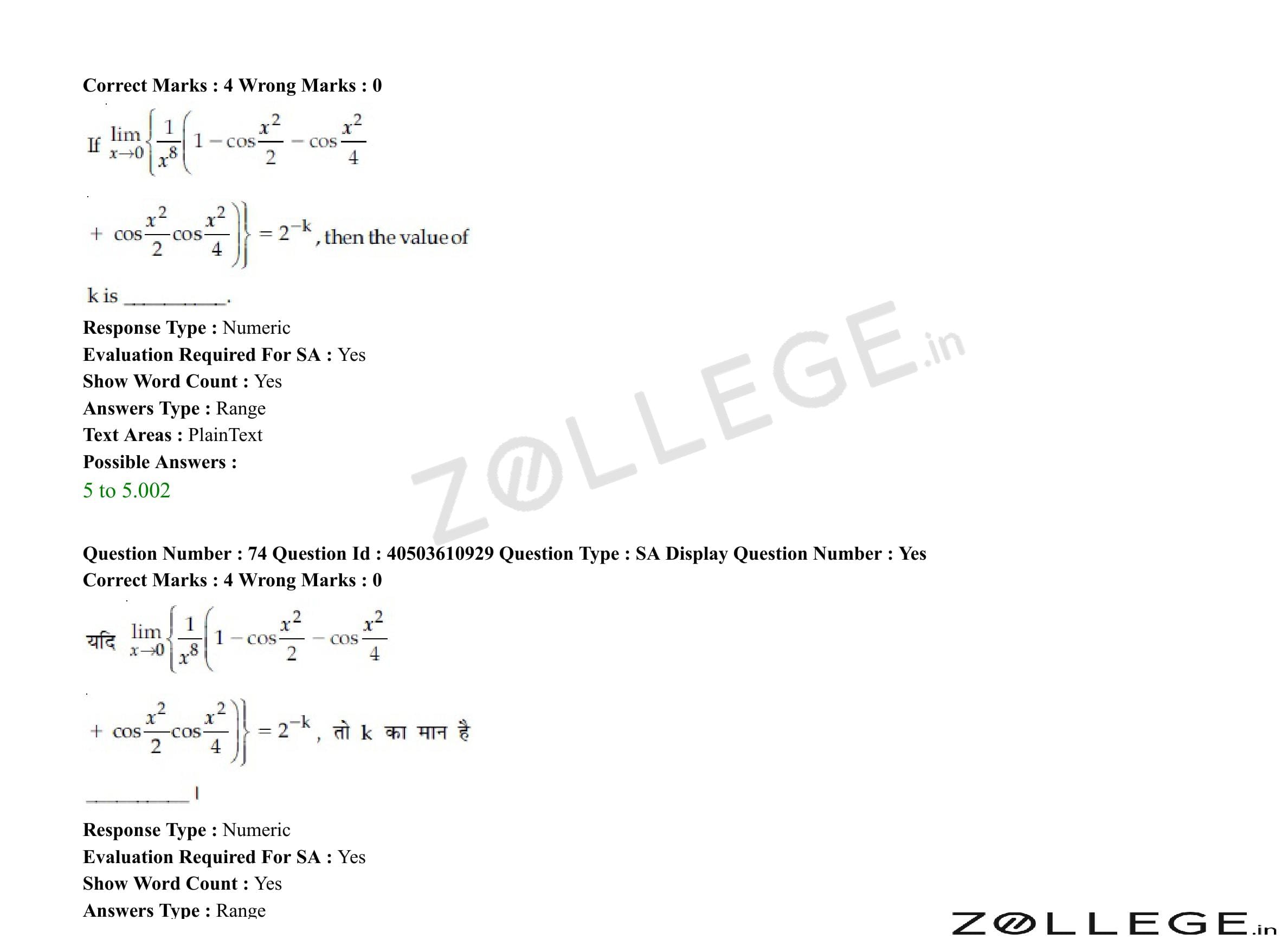
Previous Year JEE Main Question Papers
*The article might have information for the previous academic years, please refer the official website of the exam.