
JEE Main 2020 Question Paper with Answer Key PDF for B.E./ B.Tech(September 6, 2020 - Shift 2)


Content Writer | Updated On - Dec 29, 2025
JEE Main Question Papers are the most important study material for effective exam preparation. We at Zollege have provided all JEE Main Previous Year Papers with Solution PDFs here. JEE Main 2020 B. E. / B. Tech exam was conducted successfully on September 6, 2020. NTA conducted the exam in the Shift 2. According to student reactions and expert reviews, the paper was reported to be moderate to difficult.
Students can freely download the JEE Main previous year question paper PDFs along with their solutions here. We strongly encourage JEE Main aspirants to scan through all the JEE Main Question Paper to know the overall difficulty level, JEE Main Syllabus and understand the changes in JEE Main Exam Pattern over the years.
JEE Main 2020 B.E./ B.Tech Question Paper with Answer Key PDF (Shift 2)
| JEE Main 2020 B.E./ B.Tech Question Paper PDF | JEE Main 2020 B.E./ B.Tech Solution PDF |
|---|---|
| Download PDF | Check Solutions |

A student measuring the diameter of a pencil of circular cross-section with the help of a vernier scale records the following four readings: 5.50 mm, 5.55 mm, 5.45 mm, 5.65 mm. The average of these four readings is 5.5375 mm and the standard deviation of the data is 0.07395 mm. The average diameter of the pencil should therefore be recorded as:
View Solution
Step 1: Understanding the Concept:
In measurement and error analysis, the uncertainty (standard deviation) is typically rounded to two significant figures.
The mean value of the measurement must be rounded to the same decimal place as the rounded uncertainty to ensure consistent precision.
Step 2: Key Formula or Approach:
The recorded value is expressed as: \( Mean \pm Uncertainty \).
Step 3: Detailed Explanation:
1. The given standard deviation is \(\sigma = 0.07395\) mm.
2. Rounding this to two significant figures gives \(\sigma \approx 0.074\) mm.
3. This uncertainty value ends at the third decimal place.
4. The given average diameter is \(\bar{d} = 5.5375\) mm.
5. We must round the average to the third decimal place to match the uncertainty.
6. Rounding 5.5375 to three decimal places results in 5.538 (since the digit following 7 is 5 and the rule for "rounding to even" or standard rounding applies).
7. Therefore, the measurement is recorded as \((5.538 \pm 0.074)\) mm.
Step 4: Final Answer:
The average diameter should be recorded as \((5.538 \pm 0.074)\) mm.
Quick Tip: Always check the number of decimal places in the error term. The mean value cannot be more precise than its own uncertainty, so their decimal places must match.
When a car is at rest, its driver sees rain drops falling on it vertically. When driving the car with speed \(v\), he sees that rain drops are coming at an angle 60\(^\circ\) from the horizontal. On further increasing the speed of the car to \((1+\beta)v\), this angle changes to 45\(^\circ\). The value of \(\beta\) is close to:
View Solution
Step 1: Understanding the Concept:
This problem involves the relative velocity of rain with respect to a moving car.
Let the velocity of rain be \(\vec{v}_r\) and the velocity of the car be \(\vec{v}_c\).
The velocity of rain relative to the car is \(\vec{v}_{rc} = \vec{v}_r - \vec{v}_c\).
Step 2: Key Formula or Approach:
If rain falls vertically, \(\vec{v}_r = -v_r \hat{j}\) and \(\vec{v}_c = v_x \hat{i}\).
Then \(\vec{v}_{rc} = -v_x \hat{i} - v_r \hat{j}\).
The angle \(\theta\) with the horizontal is given by \(\tan \theta = \frac{|vertical component|}{|horizontal component|}\).
Step 3: Detailed Explanation:
Case 1: Car speed is \(v\). Angle with horizontal is 60\(^\circ\).
\[ \tan 60^\circ = \frac{v_r}{v} \implies \sqrt{3} = \frac{v_r}{v} \implies v_r = v\sqrt{3} \]
Case 2: Car speed is \((1+\beta)v\). Angle with horizontal is 45\(^\circ\).
\[ \tan 45^\circ = \frac{v_r}{(1+\beta)v} \implies 1 = \frac{v\sqrt{3}}{(1+\beta)v} \]
Solving for \(\beta\):
\[ 1 + \beta = \sqrt{3} \]
\[ \beta = \sqrt{3} - 1 \approx 1.732 - 1 = 0.732 \]
Step 4: Final Answer:
The value of \(\beta\) is approximately 0.73.
Quick Tip: In rain-man problems, sketch the velocity vector triangle. The horizontal component of the relative velocity is always the negative of the observer's velocity if the rain is originally vertical.
A particle moving in the \(xy\) plane experiences a velocity dependent force \(\vec{F} = k(v_y \hat{i} + v_x \hat{j})\), where \(v_x\) and \(v_y\) are the \(x\) and \(y\) components of its velocity \(\vec{v}\). If \(\vec{a}\) is the acceleration of the particle, then which of the following statements is true for the particle?
View Solution
Step 1: Understanding the Concept:
We evaluate the dynamics of the particle using Newton's second law \(\vec{F} = m\vec{a}\).
The force depends on the velocity components in a cross-coupled manner.
Step 2: Detailed Explanation:
The components of acceleration are:
\[ a_x = \frac{dv_x}{dt} = \frac{k}{m} v_y \quad --- (1) \]
\[ a_y = \frac{dv_y}{dt} = \frac{k}{m} v_x \quad --- (2) \]
Dividing (1) by (2):
\[ \frac{dv_x}{dv_y} = \frac{v_y}{v_x} \implies v_x dv_x = v_y dv_y \]
Integrating both sides:
\[ \int v_x dv_x = \int v_y dv_y \implies v_x^2 - v_y^2 = constant \quad --- (3) \]
Now check the quantity \(\vec{v} \times \vec{a}\):
\[ \vec{v} \times \vec{a} = (v_x \hat{i} + v_y \hat{j}) \times \frac{k}{m}(v_y \hat{i} + v_x \hat{j}) \]
\[ \vec{v} \times \vec{a} = \frac{k}{m} [v_x^2 (\hat{i} \times \hat{j}) + v_y^2 (\hat{j} \times \hat{i})] \]
\[ \vec{v} \times \vec{a} = \frac{k}{m} (v_x^2 - v_y^2) \hat{k} \]
Since from equation (3), \((v_x^2 - v_y^2)\) is constant, the cross product \(\vec{v} \times \vec{a}\) must be constant in time.
Step 3: Final Answer:
The statement "quantity \(\vec{v} \times \vec{a}\) is constant in time" is true.
Quick Tip: For velocity-dependent forces, checking if power \(\vec{F} \cdot \vec{v} = 0\) helps identify if Kinetic Energy is constant. Here \(\vec{F} \cdot \vec{v} = 2k v_x v_y \neq 0\), so KE is not constant.
Particle A of mass \(m_1\) moving with velocity \((\sqrt{3}\hat{i} + \hat{j}) ms^{-1}\) collides with another particle B of mass \(m_2\) which is at rest initially. Let \(\vec{V}_1\) and \(\vec{V}_2\) be the velocities of particles A and B after collision respectively. If \(m_1 = 2m_2\) and after collision \(\vec{V}_1 = (\hat{i} + \sqrt{3}\hat{j}) ms^{-1}\), the angle between \(\vec{V}_1\) and \(\vec{V}_2\) is:
View Solution
Step 1: Understanding the Concept:
In any collision, the total linear momentum is conserved in the absence of external forces.
\(\vec{p}_{initial} = \vec{p}_{final}\)
Step 2: Key Formula or Approach:
\[ m_1 \vec{u}_1 + m_2 \vec{u}_2 = m_1 \vec{V}_1 + m_2 \vec{V}_2 \]
Step 3: Detailed Explanation:
Given: \(m_1 = 2m_2\), \(\vec{u}_1 = (\sqrt{3}\hat{i} + \hat{j})\), \(\vec{u}_2 = 0\), \(\vec{V}_1 = (\hat{i} + \sqrt{3}\hat{j})\).
Applying conservation of momentum:
\[ 2m_2 (\sqrt{3}\hat{i} + \hat{j}) + 0 = 2m_2 (\hat{i} + \sqrt{3}\hat{j}) + m_2 \vec{V}_2 \]
Dividing by \(m_2\):
\[ 2\sqrt{3}\hat{i} + 2\hat{j} = 2\hat{i} + 2\sqrt{3}\hat{j} + \vec{V}_2 \]
\[ \vec{V}_2 = (2\sqrt{3} - 2)\hat{i} + (2 - 2\sqrt{3})\hat{j} \]
\[ \vec{V}_2 = 2(\sqrt{3} - 1)\hat{i} - 2(\sqrt{3} - 1)\hat{j} \]
Angle of \(\vec{V}_1\):
\[ \tan \theta_1 = \frac{\sqrt{3}}{1} \implies \theta_1 = 60^\circ \]
Angle of \(\vec{V}_2\):
\[ \tan \theta_2 = \frac{-2(\sqrt{3} - 1)}{2(\sqrt{3} - 1)} = -1 \implies \theta_2 = -45^\circ \]
The angle between \(\vec{V}_1\) and \(\vec{V}_2\) is \(\theta_1 - \theta_2 = 60^\circ - (-45^\circ) = 105^\circ\).
Step 4: Final Answer:
The angle between \(\vec{V}_1\) and \(\vec{V}_2\) is \(105^\circ\).
Quick Tip: When vectors have components in ratios like \(1:1\) or \(1:\sqrt{3}\), you can instantly identify the angles as \(45^\circ\), \(30^\circ\), or \(60^\circ\). This saves time compared to the dot product method.
The linear mass density of a thin rod AB of length L varies from A to B as \(\lambda(x) = \lambda_0 (1 + \frac{x}{L})\), where \(x\) is the distance from A. If M is the mass of the rod then its moment of inertia about an axis passing through A and perpendicular to the rod is:
View Solution
Step 1: Understanding the Concept:
For a rod with variable density, mass and moment of inertia are calculated by integrating over small elements \(dm = \lambda(x) dx\).
Step 2: Key Formula or Approach:
\[ M = \int_0^L \lambda(x) dx and I = \int_0^L x^2 \lambda(x) dx \]
Step 3: Detailed Explanation:
First, relate the total mass \(M\) to \(\lambda_0\):
\[ M = \int_0^L \lambda_0 (1 + \frac{x}{L}) dx = \lambda_0 [x + \frac{x^2}{2L}]_0^L = \lambda_0 (L + \frac{L}{2}) = \frac{3\lambda_0 L}{2} \]
\[ \lambda_0 = \frac{2M}{3L} \quad --- (1) \]
Now, calculate the moment of inertia \(I\) about point A (\(x=0\)):
\[ I = \int_0^L x^2 \lambda_0 (1 + \frac{x}{L}) dx = \lambda_0 \int_0^L (x^2 + \frac{x^3}{L}) dx \]
\[ I = \lambda_0 [\frac{x^3}{3} + \frac{x^4}{4L}]_0^L = \lambda_0 (\frac{L^3}{3} + \frac{L^3}{4}) = \lambda_0 \frac{7L^3}{12} \]
Substitute \(\lambda_0\) from equation (1):
\[ I = (\frac{2M}{3L}) (\frac{7L^3}{12}) = \frac{14ML^2}{36} = \frac{7}{18} ML^2 \]
Step 4: Final Answer:
The moment of inertia is \(\frac{7}{18} ML^2\).
Quick Tip: For these types of integration problems, always express the final answer in terms of \(M\) by finding the constant (like \(\lambda_0\)) in terms of \(M\) first.
Two planets have masses M and 16M and radii a and 2a, respectively. The separation between the centres of the planets is 10a. A body of mass m is fired from the surface of the larger planet towards the smaller planet along the line joining their centres. For the body to be able to reach the surface of smaller planet, the minimum firing speed needed is:
View Solution
Step 1: Understanding the Concept:
For the body to reach the smaller planet, it must at least reach the point where the gravitational forces from both planets cancel each other out (the neutral point).
Step 2: Detailed Explanation:
1. Finding the Neutral Point:
Let the neutral point be at distance \(x\) from the center of the smaller planet (M).
\[ \frac{GMm}{x^2} = \frac{G(16M)m}{(10a-x)^2} \implies \frac{1}{x} = \frac{4}{10a-x} \implies 4x = 10a - x \implies x = 2a \]
The neutral point is \(2a\) from \(M\) and \(8a\) from \(16M\).
2. Energy at Firing Point (Surface of 16M):
Distance from \(16M = 2a\), distance from \(M = 8a\).
\[ U_i = -\frac{G(16M)m}{2a} - \frac{GMm}{8a} = -8\frac{GMm}{a} - \frac{1}{8}\frac{GMm}{a} = -\frac{65 GMm}{8a} \]
3. Energy at Neutral Point:
Distance from \(16M = 8a\), distance from \(M = 2a\).
\[ U_n = -\frac{G(16M)m}{8a} - \frac{GMm}{2a} = -2\frac{GMm}{a} - \frac{1}{2}\frac{GMm}{a} = -\frac{5 GMm}{2a} = -\frac{20 GMm}{8a} \]
4. Conservation of Energy:
\[ \frac{1}{2}mv^2 + U_i = U_n \implies \frac{1}{2}mv^2 = U_n - U_i \]
\[ \frac{1}{2}mv^2 = -\frac{20 GMm}{8a} + \frac{65 GMm}{8a} = \frac{45 GMm}{8a} \]
\[ v^2 = \frac{45 GM}{4a} \implies v = \frac{3}{2} \sqrt{\frac{5GM}{a}} \]
Step 3: Final Answer:
The minimum firing speed is \(\frac{3}{2} \sqrt{\frac{5GM}{a}}\).
Quick Tip: Minimum velocity problems involving two gravity sources always require identifying the "saddle point" or neutral point in the potential energy landscape.
A fluid is flowing through a horizontal pipe of varying cross-section, with speed \(v ms^{-1}\) at a point where the pressure is P Pascal. At another point where pressure is \(\frac{P}{2}\) Pascal its speed is \(V ms^{-1}\). If the density of the fluid is \(\rho kg m^{-3}\) and the flow is streamline, then V is equal to:
View Solution
Step 1: Understanding the Concept:
Bernoulli's equation for a horizontal pipe (constant height) states that the sum of pressure energy and kinetic energy per unit volume is constant.
Step 2: Key Formula or Approach:
\[ P_1 + \frac{1}{2}\rho v_1^2 = P_2 + \frac{1}{2}\rho v_2^2 \]
Step 3: Detailed Explanation:
Substitute the given values: \(P_1 = P, v_1 = v\) and \(P_2 = P/2, v_2 = V\).
\[ P + \frac{1}{2}\rho v^2 = \frac{P}{2} + \frac{1}{2}\rho V^2 \]
Rearrange to group the pressure terms and the velocity terms:
\[ P - \frac{P}{2} = \frac{1}{2}\rho V^2 - \frac{1}{2}\rho v^2 \]
\[ \frac{P}{2} = \frac{\rho}{2}(V^2 - v^2) \]
Divide by \(\rho/2\):
\[ \frac{P}{\rho} = V^2 - v^2 \]
\[ V^2 = \frac{P}{\rho} + v^2 \implies V = \sqrt{\frac{P}{\rho} + v^2} \]
Step 4: Final Answer:
The speed \(V\) is equal to \(\sqrt{\frac{P}{\rho} + v^2}\).
Quick Tip: Remember that for horizontal streamline flow, where the pressure decreases, the velocity must increase. This is consistent with our result.
Three rods of identical cross-section and lengths are made of three different materials of thermal conductivity \(K_1, K_2\) and \(K_3\) respectively. They are joined together at their ends to make a long rod. One end of the long rod is maintained at 100\(^\circ\)C and the other at 0\(^\circ\)C. If the joints of the rod are at 70\(^\circ\)C and 20\(^\circ\)C in steady state and there is no loss of energy from the surface of the rod, the correct relationship between \(K_1, K_2\) and \(K_3\) is:

View Solution
Step 1: Understanding the Concept:
In steady state, the rate of heat flow (\(H = \frac{Q}{t}\)) through rods connected in series is the same.
Step 2: Key Formula or Approach:
\[ H = \frac{KA \Delta T}{L} \]
Since \(A\) and \(L\) are identical, \(K \Delta T = constant\).
Step 3: Detailed Explanation:
Temperature difference across rod 1: \(\Delta T_1 = 100 - 70 = 30^\circ\)C.
Temperature difference across rod 2: \(\Delta T_2 = 70 - 20 = 50^\circ\)C.
Temperature difference across rod 3: \(\Delta T_3 = 20 - 0 = 20^\circ\)C.
Equating heat flow:
\[ K_1(30) = K_2(50) = K_3(20) \]
From \(K_1(30) = K_3(20) \implies \frac{K_1}{K_3} = \frac{20}{30} = \frac{2}{3}\).
From \(K_2(50) = K_3(20) \implies \frac{K_2}{K_3} = \frac{20}{50} = \frac{2}{5}\).
Step 4: Final Answer:
The correct relationships are \(K_1 : K_3 = 2:3\) and \(K_2 : K_3 = 2:5\).
Quick Tip: For series combinations in steady state, the material with the highest temperature drop has the lowest thermal conductivity.
In a dilute gas at pressure P and temperature T, the mean time between successive collisions of a molecule varies with T as:
View Solution
Step 1: Understanding the Concept:
The mean time between collisions (\(\tau\)) is the mean free path (\(\lambda\)) divided by the average speed (\(v_{avg}\)).
Step 2: Key Formula or Approach:
\[ \tau = \frac{\lambda}{v_{avg}} \]
Step 3: Detailed Explanation:
1. The mean free path \(\lambda\) is given by \(\lambda = \frac{kT}{\sqrt{2} \pi d^2 P}\). For a given pressure \(P\), \(\lambda \propto T\).
2. The average velocity \(v_{avg}\) of molecules is proportional to \(\sqrt{T}\).
3. Therefore, \(\tau \propto \frac{T}{\sqrt{T}} \propto \sqrt{T}\).
Step 4: Final Answer:
The mean time varies as \(\sqrt{T}\).
Quick Tip: Notice that if the volume was constant (instead of pressure), the density would be constant, making \(\lambda\) constant, and \(\tau\) would then vary as \(1/\sqrt{T}\). Read the conditions (\(P\) vs \(V\)) carefully.
When a particle of mass m is attached to a vertical spring of spring constant k and released, its motion is described by \(y(t) = y_0 \sin^2 \omega t\), where 'y' is measured from the lower end of unstretched spring. Then \(\omega\) is:
View Solution
Step 1: Understanding the Concept:
When a mass is released from an unstretched vertical spring, it undergoes Simple Harmonic Motion (SHM) around an equilibrium position.
Step 2: Key Formula or Approach:
Use the trigonometric identity \(\sin^2 \theta = \frac{1 - \cos 2\theta}{2}\).
Step 3: Detailed Explanation:
The given equation is \(y(t) = y_0 \sin^2 \omega t = \frac{y_0}{2} (1 - \cos 2\omega t)\).
In SHM, the displacement from the origin is \(y = A(1 - \cos \Omega t)\), where \(\Omega\) is the natural frequency.
Comparing gives \(\Omega = 2\omega\) and amplitude \(A = \frac{y_0}{2}\).
The total range of motion is \(y_{max} = y_0\). For a mass released from the unstretched position, the maximum extension is \(y_{max} = \frac{2mg}{k}\).
Thus, \(y_0 = \frac{2mg}{k} \implies \frac{k}{m} = \frac{2g}{y_0}\).
The natural frequency \(\Omega = \sqrt{\frac{k}{m}} = \sqrt{\frac{2g}{y_0}}\).
Since \(\Omega = 2\omega\), we have \(2\omega = \sqrt{\frac{2g}{y_0}}\).
\(\omega = \frac{1}{2} \sqrt{\frac{2g}{y_0}} = \sqrt{\frac{2g}{4y_0}} = \sqrt{\frac{g}{2y_0}}\).
Step 4: Final Answer:
The value of \(\omega\) is \(\sqrt{\frac{g}{2y_0}}\).
Quick Tip: Whenever you see a \(\sin^2\) or \(\cos^2\) term in SHM, the actual angular frequency of the oscillation is twice the coefficient of \(t\) in the sine/cosine argument.
Consider the force F on a charge 'q' due to a uniformly charged spherical shell of radius R carrying charge Q distributed uniformly over it. Which one of the following statements is true for F, if 'q' is placed at distance r from the centre of the shell?
View Solution
Step 1: Understanding the Concept:
According to the shell theorem in electrostatics (based on Gauss's Law), the electric field inside a uniformly charged hollow spherical shell is zero, and outside, it acts as if the entire charge is concentrated at the center.
Step 2: Detailed Explanation:
For a shell of radius \(R\) and charge \(Q\):
1. Inside (\(r \textless R\)): The electric field \(E = 0\). Therefore, the force \(F = qE = 0\).
2. Outside (\(r \textgreater R\)): The electric field \(E = \frac{1}{4\pi\epsilon_0} \frac{Q}{r^2}\). Therefore, the force \(F = qE = \frac{1}{4\pi\epsilon_0} \frac{Qq}{r^2}\).
Looking at the options:
Statement (A) is wrong as it doesn't account for \(F=0\) inside.
Statement (B) and (D) are wrong because \(F\) is strictly zero for \(r \textless R\).
Statement (C) correctly states the law for points outside the shell.
Step 3: Final Answer:
The correct statement is \(F = \frac{1}{4\pi\epsilon_0} \frac{Qq}{r^2}\) for \(r \textgreater R\).
Quick Tip: The shell theorem applies to both Gravitation and Electrostatics. For any \(1/r^2\) force law, the field inside a symmetric hollow shell is always zero.
Two identical electric point dipoles have dipole moments \(\vec{p}_1 = p\hat{i}\) and \(\vec{p}_2 = -p\hat{i}\) and are held on the x axis at distance 'a' from each other. When released, they move along the x-axis with the direction of their dipole moments remaining unchanged. If the mass of each dipole is 'm', their speed when they are infinitely far apart is:
View Solution
Step 1: Understanding the Concept:
This problem involves the conservation of mechanical energy for a system of two interacting electric dipoles. The initial electrostatic potential energy of interaction is converted into the kinetic energy of the dipoles as they repel each other and move to infinity.
Step 2: Key Formula or Approach:
The potential energy of interaction between two dipoles \(\vec{p}_1\) and \(\vec{p}_2\) separated by a distance \(\vec{r}\) is given by: \[ U = \frac{1}{4\pi\epsilon_0 r^3} \left[ \vec{p}_1 \cdot \vec{p}_2 - 3(\vec{p}_1 \cdot \hat{r})(\vec{p}_2 \cdot \hat{r}) \right] \]
By Conservation of Energy: \(U_{initial} + K_{initial} = U_{final} + K_{final}\).
Step 3: Detailed Explanation:
1. Initial Potential Energy:
Given \(\vec{p}_1 = p\hat{i}\), \(\vec{p}_2 = -p\hat{i}\), and separation vector \(\vec{r} = a\hat{i}\) (so \(\hat{r} = \hat{i}\)).
\(\vec{p}_1 \cdot \vec{p}_2 = (p\hat{i}) \cdot (-p\hat{i}) = -p^2\)
\(\vec{p}_1 \cdot \hat{r} = (p\hat{i}) \cdot \hat{i} = p\)
\(\vec{p}_2 \cdot \hat{r} = (-p\hat{i}) \cdot \hat{i} = -p\)
\[ U_i = \frac{1}{4\pi\epsilon_0 a^3} \left[ -p^2 - 3(p)(-p) \right] = \frac{1}{4\pi\epsilon_0 a^3} [ -p^2 + 3p^2 ] = \frac{2p^2}{4\pi\epsilon_0 a^3} = \frac{p^2}{2\pi\epsilon_0 a^3} \]
2. Final Energy:
At infinite separation (\(r \to \infty\)), \(U_f = 0\).
Let \(v\) be the speed of each dipole. Total kinetic energy \(K_f = \frac{1}{2}mv^2 + \frac{1}{2}mv^2 = mv^2\).
3. Applying Conservation: \[ \frac{p^2}{2\pi\epsilon_0 a^3} = mv^2 \implies v^2 = \frac{p^2}{2\pi\epsilon_0 m a^3} \]
\[ v = \sqrt{\frac{p^2}{2\pi\epsilon_0 m a^3}} = \frac{p}{a} \sqrt{\frac{1}{2\pi\epsilon_0 m a}} \]
Step 4: Final Answer:
The speed when they are infinitely far apart is \(\frac{p}{a}\sqrt{\frac{1}{2\pi\epsilon_0 ma}}\).
Quick Tip: For dipoles aligned along the line joining them (axial position), the potential energy magnitude is exactly twice that of the equatorial position. Here, they are anti-parallel but on the same axis, leading to a positive (repulsive) potential energy.
In the figure shown, the current in the \(10 V\) battery is close to:

View Solution
Step 1: Understanding the Concept:
This circuit can be analyzed using Kirchhoff's Laws (Loop Rule or Nodal Analysis). We seek the current flowing through the branch containing the \(10 V\) battery.
Step 2: Key Formula or Approach:
Mesh current analysis or Nodal voltage method.
Step 3: Detailed Explanation:
Let's define two meshes: Loop 1 (left) and Loop 2 (right). Let \(i_1\) be clockwise current in Loop 1 and \(i_2\) be clockwise current in Loop 2.
1. Loop 1 (Left): \(20 - i_1(2) - i_1(5) - 10(i_1 - i_2) = 0\)
\(20 - 7i_1 - 10i_1 + 10i_2 = 0 \implies 17i_1 - 10i_2 = 20 \quad --- (1)\)
2. Loop 2 (Right): \(-10(i_2 - i_1) - 10 - i_2(4) = 0\)
\(-10i_2 + 10i_1 - 10 - 4i_2 = 0 \implies 10i_1 - 14i_2 = 10 \implies 5i_1 - 7i_2 = 5 \quad --- (2)\)
3. Solving the Equations:
From (2), \(i_1 = 1 + 1.4i_2\). Substitute into (1):
\(17(1 + 1.4i_2) - 10i_2 = 20\)
\(17 + 23.8i_2 - 10i_2 = 20 \implies 13.8i_2 = 3\)
\(i_2 = \frac{3}{13.8} \approx 0.217 A\).
Since \(i_2\) is positive, it flows in our assumed clockwise direction. In the right branch, a clockwise current flows from the positive terminal to the negative terminal of the \(10 V\) battery.
Step 4: Final Answer:
The current is approximately \(0.21 A\) from the positive to the negative terminal.
Quick Tip: When multiple batteries are present, assume directions for currents. A positive final value means the assumed direction is correct; a negative value means the current flows opposite to the assumption.
A charged particle going around in a circle can be considered to be a current loop. A particle of mass m carrying charge q is moving in a plane with speed \(v\) under the influence of magnetic field \(\vec{B}\). The magnetic moment of this moving particle:
View Solution
Step 1: Understanding the Concept:
A charged particle in a uniform magnetic field moves in a circular path. This motion creates an equivalent current loop, which has a magnetic moment. The magnetic moment of a circulating charge always opposes the external magnetic field (Lenz's law / diamagnetic behavior).
Step 2: Key Formula or Approach:
Magnetic moment magnitude \(\mu = IA\).
Current \(I = \frac{q}{T} = \frac{q v}{2\pi R}\).
Radius \(R = \frac{mv}{qB}\).
Step 3: Detailed Explanation:
1. Calculating Magnitude:
Area \(A = \pi R^2\).
\(\mu = \left( \frac{qv}{2\pi R} \right) (\pi R^2) = \frac{qvR}{2}\).
Substitute \(R = \frac{mv}{qB}\):
\(\mu = \frac{qv}{2} \cdot \frac{mv}{qB} = \frac{mv^2}{2B}\).
2. Vector Form:
The magnetic moment \(\vec{\mu}\) for a orbiting charge is opposite to the applied magnetic field \(\vec{B}\). \(\vec{\mu} = -\mu \hat{B} = -\frac{mv^2}{2B} \left( \frac{\vec{B}}{B} \right) = -\frac{mv^2 \vec{B}}{2B^2}\).
Step 4: Final Answer:
The magnetic moment is \(-\frac{mv^2 \vec{B}}{2B^2}\).
Quick Tip: For any orbiting mass \(m\) with charge \(q\), the ratio of magnetic moment to angular momentum is \(\frac{\mu}{L} = \frac{q}{2m}\). This is the gyromagnetic ratio.
A square loop of side 2a and carrying current I is kept in xz plane with its centre at origin. A long wire carrying the same current I is placed parallel to z-axis and passing through point \((0, b, 0)\), (\(b \gg a\)). The magnitude of torque on the loop about z-axis will be:
View Solution
Step 1: Understanding the Concept:
A current-carrying loop in an external magnetic field experiences a torque \(\vec{\tau} = \vec{m} \times \vec{B}\), where \(\vec{m}\) is the magnetic moment of the loop.
Step 2: Detailed Explanation:
1. Magnetic Moment of the Loop:
The loop is in the xz-plane. Area \(A = (2a)^2 = 4a^2\).
Direction of \(\vec{m}\) is perpendicular to xz-plane, i.e., along \(\hat{j}\). \(\vec{m} = I(4a^2)\hat{j}\).
2. Magnetic Field from the Wire:
The wire is at \((0, b, 0)\) parallel to z-axis (\(\hat{k}\)).
At the origin (centre of the loop), the distance is \(b\).
Using Ampere's Law: \(\vec{B} = \frac{\mu_0 I}{2\pi b} (\hat{k} \times \hat{j}) = \frac{\mu_0 I}{2\pi b} (-\hat{i})\).
3. Calculating Torque: \(\vec{\tau} = \vec{m} \times \vec{B} = (4I a^2 \hat{j}) \times \left( -\frac{\mu_0 I}{2\pi b} \hat{i} \right)\)
\(\vec{\tau} = -\frac{4\mu_0 I^2 a^2}{2\pi b} (\hat{j} \times \hat{i}) = -\frac{2\mu_0 I^2 a^2}{\pi b} (-\hat{k}) = \frac{2\mu_0 I^2 a^2}{\pi b} \hat{k}\).
Magnitude \(\tau = \frac{2\mu_0 I^2 a^2}{\pi b}\).
Step 3: Final Answer:
The magnitude of the torque is \(\frac{2\mu_0 I^2 a^2}{\pi b}\).
Quick Tip: When \(b \gg a\), the magnetic field can be considered uniform over the loop area, simplifying the calculation to \(\vec{m} \times \vec{B}\) at the center.
For a plane electromagnetic wave, the magnetic field at a point x and time t is \(\vec{B}(x, t) = \left[ 1.2 \times 10^{-7} \sin(0.5 \times 10^3 x + 1.5 \times 10^{11} t) \right] \hat{k}\) T. The instantaneous electric field \(\vec{E}\) corresponding to \(\vec{B}\) is: (speed of light \(c = 3 \times 10^8 ms^{-1}\))
View Solution
Step 1: Understanding the Concept:
In an electromagnetic wave, the electric field \(\vec{E}\) and magnetic field \(\vec{B}\) are perpendicular to each other and to the direction of wave propagation. The direction of propagation is given by \(\vec{E} \times \vec{B}\).
Step 2: Key Formula or Approach: \(E_0 = c B_0\).
Propagation direction \(\hat{n} = \frac{\vec{E} \times \vec{B}}{|\vec{E} \times \vec{B}|}\).
Step 3: Detailed Explanation:
1. Magnitude: \(E_0 = c \times B_0 = (3 \times 10^8) \times (1.2 \times 10^{-7}) = 36 V/m\).
2. Direction of Propagation:
The argument of the sine function is \((kx + \omega t)\), which indicates the wave travels in the negative x-direction (\(\hat{n} = -\hat{i}\)).
3. Direction of E:
Given \(\vec{B}\) is along \(\hat{k}\). We need \(\hat{E}\) such that \(\hat{E} \times \hat{k} = -\hat{i}\).
Using the right-hand rule for unit vectors: \((-\hat{j}) \times \hat{k} = -\hat{i}\).
Therefore, the electric field vector is along \(-\hat{j}\).
Step 4: Final Answer:
\(\vec{E}(x, t) = \left[ -36 \sin(0.5 \times 10^3 x + 1.5 \times 10^{11} t) \right] \hat{j} V/m\).
Quick Tip: Remember the cyclic order for EM waves: if propagation is \(-x\) and \(\vec{B}\) is \(+z\), then \(\vec{E}\) must be \(-y\) to satisfy \(\vec{E} \times \vec{B} \parallel \vec{v}\).
A double convex lens has power P and same radii of curvature R of both the surfaces. The radius of curvature of a surface of a plano-convex lens made of the same material with power 1.5 P is:
View Solution
Step 1: Understanding the Concept:
The power of a lens is given by Lens Maker's Formula: \(P = (n-1)\left( \frac{1}{R_1} - \frac{1}{R_2} \right)\).
Step 3: Detailed Explanation:
1. Double Convex Lens:
For a double convex lens with \(R_1 = +R\) and \(R_2 = -R\): \(P = (n-1) \left( \frac{1}{R} - \left( -\frac{1}{R} \right) \right) = \frac{2(n-1)}{R}\) \(\implies (n-1) = \frac{PR}{2} \quad --- (1)\)
2. Plano-Convex Lens:
For a plano-convex lens with \(R'_1 = +R'\) and \(R'_2 = \infty\): \(P' = (n-1) \left( \frac{1}{R'} - \frac{1}{\infty} \right) = \frac{(n-1)}{R'}\)
Given \(P' = 1.5 P\). \(1.5 P = \frac{(n-1)}{R'}\)
Substitute \((n-1)\) from equation (1): \(1.5 P = \frac{PR}{2R'}\)
\(1.5 = \frac{R}{2R'} \implies R' = \frac{R}{2 \times 1.5} = \frac{R}{3}\).
Step 4: Final Answer:
The radius of curvature for the plano-convex lens is \(\frac{R}{3}\).
Quick Tip: Converting a double convex lens into a plano-convex lens of the same radius halves its power. To increase power, you must significantly decrease the radius of curvature.
Given the masses of various atomic particles \(m_p = 1.0072 u\), \(m_n = 1.0087 u\), \(m_e = 0.000548 u\), \(m_\nu = 0\), \(m_d = 2.0141 u\), where p = proton, n = neutron, e = electron, \(\bar{\nu}\) = antineutrino and d = deuteron. Which of the following process is allowed by momentum and energy conservation?
View Solution
Step 1: Understanding the Concept:
A nuclear reaction is allowed if it satisfies conservation laws: charge conservation, baryon number conservation, lepton number conservation, and importantly, mass-energy conservation (\(Q\)-value must be positive for spontaneous/allowed processes).
Step 2: Detailed Explanation:
1. Analysis of Option (A): \(p \to n + e^+ + \nu\).
Mass of proton (\(1.0072 u\)) is less than mass of neutron (\(1.0087 u\)). A free proton cannot decay into a heavier neutron due to energy conservation.
2. Analysis of Option (B): \(e^+ + e^- \to \gamma\).
While energy is released, a single photon cannot satisfy both energy and momentum conservation. At least two photons are required.
3. Analysis of Option (C): \(n + p \to d + \gamma\).
Initial mass = \(1.0087 + 1.0072 = 2.0159 u\).
Final mass = \(2.0141 u\).
Mass of reactants \(\textgreater\) mass of products. This is an exothermic reaction (releasing binding energy), thus it is allowed.
4. Analysis of Option (D): \(n + n \to\) deuterium atom.
This violates charge conservation as initial charge is zero and deuterium nucleus is positive.
Step 3: Final Answer:
The allowed process is \(n + p \to d + \gamma\).
Quick Tip: Check mass conservation first. If the products are heavier than the reactants, the process is impossible for isolated stationary particles.
Assuming the nitrogen molecule is moving with r.m.s. velocity at 400 K, the de-Broglie wavelength of nitrogen molecule is close to: (Given: nitrogen molecule weight: \(4.64 \times 10^{-26} kg\), Boltzmann constant: \(1.38 \times 10^{-23} J/K\), Planck constant: \(6.63 \times 10^{-34} J.s\))
View Solution
Step 1: Understanding the Concept:
The de-Broglie wavelength is related to the momentum of a particle: \(\lambda = \frac{h}{p}\). For a gas molecule in thermal equilibrium, we use the root mean square (r.m.s) momentum.
Step 2: Key Formula or Approach:
Kinetic energy \(K = \frac{3}{2}kT = \frac{p^2}{2m} \implies p = \sqrt{3mkT}\).
\(\lambda = \frac{h}{\sqrt{3mkT}}\).
Step 3: Detailed Explanation:
1. Calculation of denominator: \(m = 4.64 \times 10^{-26} kg\), \(T = 400 K\), \(k = 1.38 \times 10^{-23} J/K\).
\(3mkT = 3 \times (4.64 \times 10^{-26}) \times (1.38 \times 10^{-23}) \times 400\)
\(3mkT \approx 7.68 \times 10^{-46} kg^2 m^2/s^2\).
\(\sqrt{3mkT} \approx 2.77 \times 10^{-23} kg.m/s\).
2. Calculation of wavelength: \(\lambda = \frac{6.63 \times 10^{-34}}{2.77 \times 10^{-23}} \approx 2.4 \times 10^{-11} m\).
Convert to Angstrom (\(1 \AA = 10^{-10} m\)): \(\lambda \approx 0.24 \AA\).
Step 4: Final Answer:
The de-Broglie wavelength is close to \(0.24 \AA\).
Quick Tip: For thermal de-Broglie wavelength calculations, remember that \(\lambda \propto \frac{1}{\sqrt{mT}}\). Heavier molecules at higher temperatures have shorter wavelengths.
A circuit to verify Ohm's law uses ammeter and voltmeter in series or parallel connected correctly to the resistor. In the circuit:
View Solution
Step 1: Understanding the Concept:
Ohm's law verification requires measuring the current (\(I\)) through a resistor and the potential difference (\(V\)) across it.
Step 2: Detailed Explanation:
1. Ammeter: To measure the total current passing through a specific component, an ammeter must be placed in the same path. Therefore, it is connected in series. It has very low resistance so as not to affect the total current.
2. Voltmeter: To measure the potential difference between two points, a voltmeter must be connected across those points. Therefore, it is connected in parallel. It has very high resistance to ensure it draws negligible current from the main circuit.
Step 3: Final Answer:
In the circuit, the ammeter is connected in series and the voltmeter in parallel.
Quick Tip: Mnemonic: Ammeter - Series (AS) and Voltmeter - Parallel (VP). Connecting them incorrectly can damage the ammeter (high current in parallel) or stop current flow (voltmeter in series).
The centre of mass of a solid hemisphere of radius 8 cm is x cm from the centre of the flat surface. Then value of x is \textunderscore\textunderscore\textunderscore\textunderscore\textunderscore.
View Solution
Step 1: Understanding the Concept:
The center of mass of a uniform solid hemisphere is located along the axis of symmetry.
For a solid hemisphere of radius \( R \), the distance of the center of mass from the center of its circular base (flat surface) is a standard derived result in rigid body dynamics.
Step 2: Key Formula or Approach:
The distance of the center of mass (\( y_{cm} \)) from the flat base is given by:
\[ y_{cm} = \frac{3R}{8} \]
Step 3: Detailed Explanation:
Given:
Radius of the solid hemisphere, \( R = 8 \) cm.
The distance from the center of the flat surface is given as \( x \).
Using the formula:
\[ x = \frac{3 \times 8}{8} \]
\[ x = 3 cm \]
Step 4: Final Answer:
The value of \( x \) is 3.
Quick Tip: Remember the difference: For a solid hemisphere, center of mass is at \( 3R/8 \), but for a hollow hemispherical shell, it is at \( R/2 \).
An engine operates by taking a monatomic ideal gas through the cycle shown in the figure. The percentage efficiency of the engine is close to \textunderscore\textunderscore\textunderscore\textunderscore\textunderscore.

View Solution
Step 1: Understanding the Concept:
Efficiency (\( \eta \)) of a heat engine is defined as the ratio of the net work done by the gas to the total heat absorbed by the gas during the cycle.
\[ \eta = \frac{W_{net}}{Q_{in}} \times 100% \]
Step 2: Key Formula or Approach:
1. Net work done \( W_{net} \) = Area of the rectangle in the P-V diagram.
2. For monatomic gas: \( C_v = \frac{3}{2}R \) and \( C_p = \frac{5}{2}R \).
3. \( \Delta Q = nC \Delta T = \Delta U + W \).
Step 3: Detailed Explanation:
1. Work Done:
\[ W_{net} = (2V_0 - V_0) \times (3P_0 - P_0) = V_0 \times 2P_0 = 2P_0 V_0 \]
2. Heat Absorbed (\( Q_{in} \)):
Heat is absorbed during processes where temperature increases (AB and BC).
- Process AB (Isochoric heating):
\[ Q_{AB} = n C_v \Delta T = \frac{3}{2} V_0 \Delta P = \frac{3}{2} V_0 (3P_0 - P_0) = 3P_0 V_0 \]
- Process BC (Isobaric heating):
\[ Q_{BC} = n C_p \Delta T = \frac{5}{2} (3P_0) \Delta V = \frac{5}{2} (3P_0) (2V_0 - V_0) = 7.5 P_0 V_0 \]
Total heat absorbed:
\[ Q_{in} = 3P_0 V_0 + 7.5 P_0 V_0 = 10.5 P_0 V_0 \]
3. Efficiency:
\[ \eta = \frac{2P_0 V_0}{10.5 P_0 V_0} = \frac{2}{10.5} \approx 0.1904 \]
\[ Percentage efficiency \approx 19.04% \]
Step 4: Final Answer:
The percentage efficiency of the engine is close to 19.
Quick Tip: In a rectangular P-V cycle, heat is only absorbed during the processes where pressure increases at constant volume and where volume increases at constant pressure.
In a series LR circuit, power of 400 W is dissipated from a source of 250 V, 50 Hz. The power factor of the circuit is 0.8. In order to bring the power factor to unity, a capacitor of value C is added in series to the L and R. Taking the value of C as \( (\frac{n}{3\pi}) \mu F \), then value of n is \textunderscore\textunderscore\textunderscore\textunderscore\textunderscore.
View Solution
Step 1: Understanding the Concept:
In an AC circuit, power factor is \( \cos \phi = \frac{R}{Z} \). Unity power factor (\( \cos \phi = 1 \)) occurs when the circuit is in resonance, i.e., \( X_L = X_C \).
Step 2: Key Formula or Approach:
1. Power \( P = V_{rms} I_{rms} \cos \phi \).
2. Impedance \( Z = \frac{V_{rms}}{I_{rms}} \).
3. Resistance \( R = Z \cos \phi \) and Inductive reactance \( X_L = Z \sin \phi \).
Step 3: Detailed Explanation:
1. Find Current:
\[ 400 = 250 \times I \times 0.8 \implies I = \frac{400}{200} = 2 A \]
2. Find Impedance and Components:
\[ Z = \frac{250}{2} = 125 \Omega \]
\[ R = 125 \times 0.8 = 100 \Omega \]
Since \( \cos \phi = 0.8 \), \( \sin \phi = 0.6 \).
\[ X_L = 125 \times 0.6 = 75 \Omega \]
3. Find Capacitor Value for Resonance (\( \cos \phi = 1 \)):
We need \( X_C = X_L = 75 \Omega \).
\[ \frac{1}{2\pi f C} = 75 \implies C = \frac{1}{2 \times \pi \times 50 \times 75} = \frac{1}{7500\pi} F \]
Convert to microfarads:
\[ C = \frac{10^6}{7500\pi} \mu F = \frac{10000}{75\pi} \mu F = \frac{400}{3\pi} \mu F \]
Comparing with \( C = \frac{n}{3\pi} \mu F \), we get \( n = 400 \).
Step 4: Final Answer:
The value of n is 400.
Quick Tip: To bring power factor to unity in an inductive circuit, the added capacitive reactance must exactly cancel the inductive reactance (\( X_C = X_L \)).
A Young's double-slit experiment is performed using monochromatic light of wavelength \( \lambda \). The intensity of light at a point on the screen, where the path difference is \( \lambda \), is K units. The intensity of light at a point where the path difference is \( \lambda/6 \) is given by \( \frac{nK}{12} \), where n is an integer. The value of n is \textunderscore\textunderscore\textunderscore\textunderscore\textunderscore.
View Solution
Step 1: Understanding the Concept:
Intensity in YDSE depends on the phase difference \( \phi \), which is related to the path difference \( \Delta x \) by \( \phi = \frac{2\pi}{\lambda} \Delta x \).
Step 2: Key Formula or Approach:
The resultant intensity is given by:
\[ I = I_{max} \cos^2\left(\frac{\phi}{2}\right) \]
Step 3: Detailed Explanation:
1. At path difference \( \Delta x = \lambda \):
Phase difference \( \phi = \frac{2\pi}{\lambda} (\lambda) = 2\pi \).
Intensity \( I_1 = I_{max} \cos^2(\pi) = I_{max} \).
Given \( I_1 = K \), so \( I_{max} = K \).
2. At path difference \( \Delta x = \lambda/6 \):
Phase difference \( \phi' = \frac{2\pi}{\lambda} \left(\frac{\lambda}{6}\right) = \frac{\pi}{3} \).
Resultant intensity \( I' = K \cos^2\left(\frac{\pi/3}{2}\right) = K \cos^2\left(\frac{\pi}{6}\right) \).
\[ I' = K \left(\frac{\sqrt{3}}{2}\right)^2 = \frac{3K}{4} \]
3. Find n:
To express in terms of \( \frac{nK}{12} \):
\[ \frac{3K}{4} = \frac{9K}{12} \]
Comparing this to \( \frac{nK}{12} \), we get \( n = 9 \).
Step 4: Final Answer:
The value of n is 9.
Quick Tip: Path difference of \( \lambda \) corresponds to a maxima where intensity is maximum (\( K = 4I_0 \)). Always convert path difference to phase difference first.
The output characteristics of a transistor is shown in the figure. When \( V_{CE} \) is 10 V and \( I_C = 4.0 \) mA, then value of \( \beta_{ac} \) is \textunderscore\textunderscore\textunderscore\textunderscore\textunderscore.

View Solution
Step 1: Understanding the Concept:
The AC current gain (\( \beta_{ac} \)) of a transistor in Common Emitter configuration is the ratio of change in collector current to the change in base current at a constant collector-emitter voltage.
Step 2: Key Formula or Approach:
\[ \beta_{ac} = \left( \frac{\Delta I_C}{\Delta I_B} \right)_{V_{CE} = constant} \]
Step 3: Detailed Explanation:
From the provided graph, we observe the values at \( V_{CE} = 10 \) V:
1. For \( I_B = 30 \mu A \), the collector current is \( I_{C1} = 4.0 \) mA.
2. For \( I_B = 40 \mu A \), the collector current is \( I_{C2} = 6.0 \) mA.
Now, calculate the changes:
\[ \Delta I_C = 6.0 mA - 4.0 mA = 2.0 mA = 2 \times 10^{-3} A \]
\[ \Delta I_B = 40 \mu A - 30 \mu A = 10 \mu A = 10 \times 10^{-6} A \]
Calculate \( \beta_{ac} \):
\[ \beta_{ac} = \frac{2 \times 10^{-3}}{10 \times 10^{-6}} = \frac{2}{10} \times 10^3 = 0.2 \times 1000 = 200 \]
Step 4: Final Answer:
The value of \( \beta_{ac} \) is 200.
Quick Tip: While reading the graph, ensure you pick values from the horizontal (saturated) region of the characteristic curves for the same \( V_{CE} \).
Which one of the following statements is not true?
View Solution
Step 1: Understanding the Concept:
Lactose is a disaccharide found in milk. It is composed of galactose and glucose units linked via a glycosidic bond.
Step 2: Detailed Explanation:
1. Statement (A): Lactose is indeed a disaccharide and its structure contains 8 -OH groups. This is true.
2. Statement (B): Upon hydrolysis with dilute acid or the enzyme lactase, lactose yields D-galactose and D-glucose. This is true.
3. Statement (C): Lactose has a free hemiacetal group on the glucose unit, making it a reducing sugar. It reacts positively with Fehling's and Tollens' reagents. This is true.
4. Statement (D): In lactose, the linkage is specifically a \( \beta \)-1,4-glycosidic linkage between \( C_1 \) of \( \beta \)-D-galactose and \( C_4 \) of \( \beta \)-D-glucose. The statement claiming it is an \( \alpha \)-linkage is incorrect.
Step 3: Final Answer:
Statement (D) is not true because the linkage is \( \beta \), not \( \alpha \).
Quick Tip: Remember: Lactose has \( \beta \)-linkage, Sucrose has \( \alpha, \beta \)-linkage, and Maltose has \( \alpha \)-linkage.
The correct match between Item - I and Item - II is:
Item - I \hspace{2cm Item - II
(a) Natural rubber \hspace{0.5cm (I) 1, 3-butadiene + styrene
(b) Neoprene \hspace{1.1cm (II) 1, 3-butadiene + acrylonitrile
(c) Buna-N \hspace{1.3cm (III) Chloroprene
(d) Buna-S \hspace{1.3cm (IV) Isoprene
View Solution
Step 1: Understanding the Concept:
Polymers are formed by the repetition of monomer units. Synthetic and natural rubbers have specific monomers or combinations of monomers (co-polymers).
Step 2: Detailed Explanation:
1. Natural Rubber: It is a linear polymer of isoprene (2-methyl-1,3-butadiene). Thus, (a) matches (IV).
2. Neoprene: It is a synthetic rubber formed by the polymerization of chloroprene (2-chloro-1,3-butadiene). Thus, (b) matches (III).
3. Buna-N: It is a co-polymer of 1,3-butadiene and acrylonitrile (Vinyl cyanide). Thus, (c) matches (II).
4. Buna-S: It is a co-polymer of 1,3-butadiene and styrene. Thus, (d) matches (I).
Matching these results: (a)-(IV), (b)-(III), (c)-(II), (d)-(I).
Step 3: Final Answer:
The correct matching corresponds to Option (D).
Quick Tip: In Buna-N, 'N' stands for Nitrile (Acrylonitrile). In Buna-S, 'S' stands for Styrene. This helps in quick identification.
Which of the following compounds can be prepared in good yield by Gabriel phthalimide synthesis?
- (A)
![]()
- (B)
![]()
- (C)
![]()
- (D)
![]()


View Solution
Step 1: Understanding the Concept:
Gabriel phthalimide synthesis is used for the preparation of pure primary aliphatic amines. It involves the nucleophilic substitution (\( S_N2 \)) of an alkyl halide by the phthalimide anion.
Step 2: Detailed Explanation:
1. Mechanism Limitation: The phthalimide anion is a nucleophile that attacks an alkyl halide.
2. Aromatic Amines (Option D): Aniline (\( Ph-NH_2 \)) cannot be prepared because aryl halides do not undergo nucleophilic substitution (\( S_N2 \)) easily due to partial double bond character of the C-X bond and electronic repulsion.
3. Secondary Amines (Option C): This method is specific for primary amines; secondary and tertiary amines are not formed.
4. Amides (Option A): Gabriel synthesis produces amines, not amides.
5. Benzylamine (Option B): Benzyl chloride (\( Ph-CH_2Cl \)) is a primary alkyl halide that undergoes \( S_N2 \) reaction very efficiently. Therefore, Benzylamine can be prepared in good yield.
Step 3: Final Answer:
Benzylamine (\( Ph-CH_2-NH_2 \)) can be prepared using this method.
Quick Tip: Gabriel synthesis is limited to \( 1^\circ \) aliphatic amines. It fails for aromatic amines (Aniline) and hindered halides.
The correct match between Item - I (starting material) and Item - II (reagent) for the preparation of benzaldehyde is:
Item - I \hspace{2cm Item - II
(I) Benzene \hspace{1.5cm (P) HCl and \( SnCl_2, H_2O \)
(II) Benzonitrile \hspace{0.9cm (Q) \( H_2, Pd-BaSO_4, S \) and quinoline
(III) Benzoyl Chloride \hspace{0.3cm (R) CO, HCl and \( AlCl_3 \)
View Solution
Step 1: Understanding the Concept:
Benzaldehyde can be prepared using various named organic reactions. Each starting material requires a specific set of reagents.
Step 2: Detailed Explanation:
1. Benzene to Benzaldehyde: This is the Gattermann-Koch reaction. It uses CO and HCl in the presence of anhydrous \( AlCl_3 \). Thus, (I) matches (R).
2. Benzonitrile to Benzaldehyde: This is the Stephen reduction. Nitriles are reduced with stannous chloride and HCl, followed by hydrolysis. Thus, (II) matches (P).
3. Benzoyl Chloride to Benzaldehyde: This is the Rosenmund reduction. It involves catalytic hydrogenation over Palladium supported on Barium sulphate, poisoned with sulphur or quinoline. Thus, (III) matches (Q).
Matching result: (I)-(R), (II)-(P), (III)-(Q).
Step 3: Final Answer:
The correct matching corresponds to Option (A).
Quick Tip: Rosenmund reduction (\( H_2, Pd-BaSO_4 \)) specifically reduces acid chlorides to aldehydes without further reducing them to alcohols.
The increasing order of the boiling points of the major products A, B and C of the following reactions will be:

View Solution
Step 1: Understanding the Concept:
Boiling points of haloalkanes depend on molecular weight and surface area. For isomers, branching decreases the surface area and hence decreases the boiling point.
Step 2: Detailed Explanation:
1. Reaction (a): Addition of HBr to but-1-ene in the presence of peroxide follows the anti-Markovnikov rule. The product A is 1-bromobutane (\( CH_3CH_2CH_2CH_2Br \)), which is a linear primary haloalkane.
2. Reaction (b): Addition of HBr to but-1-ene without peroxide follows the Markovnikov rule. The product B is 2-bromobutane (\( CH_3CH(Br)CH_2CH_3 \)), which is a branched secondary haloalkane.
3. Reaction (c): Addition of HBr to ethene yields bromoethane (\( CH_3CH_2Br \)), which is product C.
Comparison:
- C has the lowest molecular weight (\( C_2 \) vs \( C_4 \)), so it has the lowest boiling point.
- A and B are isomers. A is linear and B is branched. Linear isomers have larger surface area and stronger Van der Waals forces than branched ones. Thus, \( BP(A) \textgreater BP(B) \).
Increasing order: \( C \textless B \textless A \).
Step 3: Final Answer:
The correct order is C \textless B \textless A, matching Option (D).
Quick Tip: Boiling point order: Longer chain \textgreater Shorter chain; and for isomers: Primary (straight) \textgreater Secondary \textgreater Tertiary.
The IUPAC name of the following compound is:

View Solution
Step 1: Understanding the Concept:
To name a multi-substituted benzene derivative, we first identify the principal functional group to determine the parent name.
The priority order of functional groups is \( -CHO \textgreater -OH (in hydroxymethyl) \textgreater -NH_2 \textgreater -NO_2 \).
Thus, the principal group is the aldehyde, and the parent compound is benzaldehyde.
Step 2: Detailed Explanation:
1. The carbon attached to the aldehyde group (\( -CHO \)) is assigned locant 1.
2. We then number the ring to give the lowest possible locants to the substituents.
3. Numbering clockwise or anticlockwise to minimize the set of locants:
Locant 1: \( -CHO \)
Locant 3: \( -NH_2 \) (Amino)
Locant 4: \( -CH_2OH \) (Hydroxymethyl)
Locant 5: \( -NO_2 \) (Nitro)
4. The set of locants is (1, 3, 4, 5).
5. Alphabetical order of substituents: Amino, Hydroxymethyl, Nitro.
6. Combining these gives: 3-amino-4-hydroxymethyl-5-nitrobenzaldehyde.
Step 3: Final Answer:
The IUPAC name is 3-amino-4-hydroxymethyl-5-nitrobenzaldehyde.
Quick Tip: Always identify the highest priority group first to name the parent chain. For substituted benzenes, ensure the numbering provides the lowest locant set for all substituents combined.
Match the following:
Test / Method \quad \quad \quad Reagent
(i) Lucas Test \quad \quad \quad (a) \( C_6H_5SO_2Cl / aq. KOH \)
(ii) Dumas method \quad \quad (b) \( HNO_3 / AgNO_3 \)
(iii) Kjeldahl's method \quad (c) \( CuO / CO_2 \)
(iv) Hinsberg Test \quad \quad (d) Conc. \( HCl \) and \( ZnCl_2 \)
\quad \quad \quad \quad \quad \quad \quad \quad (e) \( H_2SO_4 \)
View Solution
Step 1: Understanding the Concept:
This question requires knowledge of specific chemical tests and quantitative estimation methods used in organic chemistry.
Step 2: Detailed Explanation:
1. Lucas Test (i): Used to distinguish between primary, secondary, and tertiary alcohols. The reagent is a mixture of concentrated \( HCl \) and anhydrous \( ZnCl_2 \). Thus, (i) matches (d).
2. Dumas method (ii): A method for the quantitative estimation of nitrogen in organic compounds where the compound is heated with copper oxide (\( CuO \)) in an atmosphere of \( CO_2 \). Thus, (ii) matches (c).
3. Kjeldahl's method (iii): Another method for nitrogen estimation where the organic compound is heated with concentrated sulphuric acid (\( H_2SO_4 \)). Thus, (iii) matches (e).
4. Hinsberg Test (iv): Used to distinguish between primary, secondary, and tertiary amines. The reagent is benzene sulphonyl chloride (\( C_6H_5SO_2Cl \)) in aqueous \( KOH \). Thus, (iv) matches (a).
Step 3: Final Answer:
The correct matching is (i)-(d), (ii)-(c), (iii)-(e), (iv)-(a).
Quick Tip: Remember that Kjeldahl's method is not applicable to compounds containing nitrogen in nitro (\( -NO_2 \)), azo (\( -N=N- \)) groups, or in the ring (like pyridine), because nitrogen in these cases cannot be converted to ammonium sulphate.
The element that can be refined by distillation is:
View Solution
Step 1: Understanding the Concept:
Distillation is a refining process used for metals that have low boiling points.
By heating the impure metal, the volatile metal evaporates and is collected as a pure distillate, leaving behind non-volatile impurities.
Step 2: Detailed Explanation:
1. Metals like Zinc (\( Zn \)), Cadmium (\( Cd \)), and Mercury (\( Hg \)) have relatively low boiling points compared to most other metals.
2. Impure Zinc is refined using this method to obtain pure metal.
3. Nickel is refined by the Mond process (vapor phase refining using \( CO \)).
4. Tin is refined by liquation (due to its low melting point).
5. Gallium is often refined by zone refining.
Step 3: Final Answer:
Zinc is the element that can be refined by distillation.
Quick Tip: Refining methods are based on physical property differences:
1. Distillation: Difference in boiling points (Zn, Hg, Cd).
2. Liquation: Difference in melting points (Sn, Pb).
3. Mond Process: Formation of volatile carbonyl (Ni).
Dihydrogen of high purity (\( \textgreater 99.95% \)) is obtained through:
View Solution
Step 1: Understanding the Concept:
Hydrogen gas can be prepared in various levels of purity depending on the method. High purity hydrogen is a specific requirement for certain industrial and laboratory processes.
Step 2: Detailed Explanation:
1. Electrolysis of acidified water yields hydrogen but with slightly lower purity due to the presence of other gases.
2. Electrolysis of brine (aqueous \( NaCl \)) produces \( H_2 \), \( Cl_2 \), and \( NaOH \), but the hydrogen is a byproduct and not of extremely high purity.
3. The reaction of metals like Zinc with acids is a standard laboratory preparation but contains impurities from the metal and the acid.
4. To obtain dihydrogen of very high purity (\( \textgreater 99.95% \)), the electrolysis of a warm aqueous barium hydroxide [\( Ba(OH)_2 \)] solution is carried out between nickel electrodes.
Step 3: Final Answer:
High purity dihydrogen is obtained by the electrolysis of warm \( Ba(OH)_2 \) solution using Ni electrodes.
Quick Tip: This is a standard NCERT fact. Remember: Ba(OH)\(_2\) + Ni electrodes = Ultra-pure \( H_2 \).
Match the following compounds (Column-I) with their uses (Column-II):
\begin{tabular{|c|c|c|c|
\hline
S. No. & Column - I & S. No. & Column - II
\hline
(I) & \( Ca(OH)_2 \) & (A) & casts of statues
\hline
(II) & \( NaCl \) & (B) & white wash
\hline
(III) & \( CaSO_4 \cdot \frac{1}{2}H_2O \) & (C) & antacid
\hline
(IV) & \( CaCO_3 \) & (D) & washing soda preparation
\hline
\end{tabular
View Solution
Step 1: Understanding the Concept:
This question involves the common industrial and household uses of s-block compounds.
Step 2: Detailed Explanation:
1. \( Ca(OH)_2 \) (Slaked Lime): Used extensively in the construction industry as a suspension for white wash. Thus, (I) matches (B).
2. \( NaCl \) (Common Salt): It is a starting material in the Solvay process for the preparation of washing soda (\( Na_2CO_3 \)). Thus, (II) matches (D).
3. \( CaSO_4 \cdot \frac{1}{2}H_2O \) (Plaster of Paris): Known for its property of setting into a hard mass, it is used for making casts of statues and in medicine for bone setting. Thus, (III) matches (A).
4. \( CaCO_3 \) (Calcium Carbonate): Used as a mild abrasive in toothpaste and as an antacid to neutralize stomach acid. Thus, (IV) matches (C).
Step 3: Final Answer:
The correct matching is (I)-(B), (II)-(D), (III)-(A), (IV)-(C).
Quick Tip: Calcium carbonate is found in nature in various forms like limestone, chalk, and marble. In pharmaceutical applications, it is a very common antacid.
The reaction of NO with \( N_2O_4 \) at 250 K gives:
View Solution
Step 1: Understanding the Concept:
The oxides of nitrogen can be interconverted under specific temperature and pressure conditions. Nitrogen sesquioxide (\( N_2O_3 \)) is a blue solid at low temperatures.
Step 2: Detailed Explanation:
1. At low temperatures (around 250 K), nitric oxide (\( NO \)) reacts with dinitrogen tetroxide (\( N_2O_4 \)) to form dinitrogen trioxide (\( N_2O_3 \)).
2. The chemical equation is:
\[ 2NO + N_2O_4 \xrightarrow{250 K} 2N_2O_3 \]
3. Alternatively, it can be viewed as the reaction between \( NO \) and \( NO_2 \) because \( N_2O_4 \) is in equilibrium with \( NO_2 \).
\[ NO + NO_2 \to N_2O_3 \]
4. \( N_2O_3 \) is an acidic oxide and exists as a blue liquid/solid.
Step 3: Final Answer:
The product of the reaction is \( N_2O_3 \).
Quick Tip: Remember the colors of nitrogen oxides: \( N_2O_3 \) is blue, \( NO_2 \) is brown, and others are generally colorless.
Reaction of an inorganic sulphite X with dilute \( H_2SO_4 \) generates compound Y. Reaction of Y with NaOH gives X. Further, the reaction of X with Y and water affords compound Z. Y and Z, respectively, are:
View Solution
Step 1: Understanding the Concept:
Sulphites react with dilute acids to release sulphur dioxide gas. This gas shows acidic properties and reacts with bases to form sulphites and bisulphites.
Step 2: Detailed Explanation:
1. Let the inorganic sulphite X be sodium sulphite, \( Na_2SO_3 \).
2. Reaction 1: X reacts with dilute \( H_2SO_4 \):
\[ Na_2SO_3 + H_2SO_4 \to Na_2SO_4 + H_2O + SO_2(g) \]
Here, Y is \( SO_2 \).
3. Reaction 2: Y (\( SO_2 \)) reacts with \( NaOH \) to regenerate X:
\[ 2NaOH + SO_2 \to Na_2SO_3 + H_2O \]
This confirms X is \( Na_2SO_3 \).
4. Reaction 3: X (\( Na_2SO_3 \)) reacts with Y (\( SO_2 \)) and water:
\[ Na_2SO_3 + SO_2 + H_2O \to 2NaHSO_3 \]
Here, Z is \( NaHSO_3 \) (Sodium bisulphite).
Step 3: Final Answer:
Compound Y is \( SO_2 \) and Z is \( NaHSO_3 \).
Quick Tip: This sequence is analogous to the reaction of carbonates with acids to release \( CO_2 \), which then forms bicarbonates with excess gas.
Mischmetal is an alloy consisting mainly of:
View Solution
Step 1: Understanding the Concept:
Mischmetal is a pyrophoric alloy used in lighter flints and magnesium-based alloys. Its composition is defined by the extraction of rare-earth elements.
Step 2: Detailed Explanation:
1. Mischmetal consists of about \( 95% \) lanthanoid metals (mainly Cerium, Lanthanum, and Neodymium).
2. It also contains approximately \( 5% \) Iron (\( Fe \)).
3. Traces of other elements like Sulphur, Carbon, Calcium, and Aluminium may also be present.
4. Therefore, it is primarily an alloy of lanthanoids.
Step 3: Final Answer:
Mischmetal is an alloy consisting mainly of lanthanoid metals.
Quick Tip: Cerium (\( Ce \)) is the most abundant lanthanoid in Mischmetal. Because it is pyrophoric, it is famously used to make flints for cigarette lighters.
For a \( d^4 \) metal ion in an octahedral field, the correct electronic configuration is:
View Solution
Step 1: Understanding the Concept:
Crystal Field Theory (CFT) explains the splitting of d-orbitals in an octahedral field into \( t_{2g} \) (lower energy) and \( e_g \) (higher energy) sets. For a \( d^4 \) system, the fourth electron can either enter the \( e_g \) set or pair up in the \( t_{2g} \) set, depending on the relative magnitude of the crystal field splitting energy (\( \Delta_o \)) and the pairing energy (\( P \)).
Step 2: Detailed Explanation:
1. Case 1: Weak field ligands (\( \Delta_o \textless P \)): The splitting energy is small. It is energetically more favorable for the fourth electron to occupy the higher energy \( e_g \) orbital than to pair up. This results in a high-spin configuration: \( t_{2g}^3 e_g^1 \).
2. Case 2: Strong field ligands (\( \Delta_o \textgreater P \)): The splitting energy is large. It is energetically more favorable for the fourth electron to pair up in the lower energy \( t_{2g} \) orbital. This results in a low-spin configuration: \( t_{2g}^4 e_g^0 \).
3. Checking options: Option (A) correctly identifies the strong field/low spin condition.
Step 3: Final Answer:
The correct configuration is \( t_{2g}^4 e_g^0 \) when \( \Delta_o \textgreater P \).
Quick Tip: Strong field ligands (\( CN^-, CO \)) cause large splitting (\( \Delta_o \textgreater P \)), leading to electron pairing and low-spin complexes.
The average molar mass of chlorine is \( 35.5 g mol^{-1} \). The ratio of \( ^{35}Cl \) to \( ^{37}Cl \) in naturally occurring chlorine is close to:
View Solution
Step 1: Understanding the Concept:
The average atomic mass of an element is the weighted average of the masses of its naturally occurring isotopes based on their relative abundance.
Step 2: Key Formula or Approach:
\[ Average mass = \frac{m_1x_1 + m_2x_2}{x_1 + x_2} \]
where \( m_1, m_2 \) are isotopic masses and \( x_1, x_2 \) are their relative ratios.
Step 3: Detailed Explanation:
Let the ratio of \( ^{35}Cl \) to \( ^{37}Cl \) be \( r : 1 \).
The average mass is given as \( 35.5 \).
\[ 35.5 = \frac{35(r) + 37(1)}{r + 1} \]
Multiply both sides by \( (r + 1) \):
\[ 35.5r + 35.5 = 35r + 37 \]
Rearrange to solve for \( r \):
\[ 35.5r - 35r = 37 - 35.5 \]
\[ 0.5r = 1.5 \]
\[ r = \frac{1.5}{0.5} = 3 \]
The ratio is \( 3 : 1 \).
Step 4: Final Answer:
The ratio of \( ^{35}Cl \) to \( ^{37}Cl \) is \( 3 : 1 \).
Quick Tip: This means chlorine is approximately \( 75% \) of \( ^{35}Cl \) and \( 25% \) of \( ^{37}Cl \). Since the average mass (\( 35.5 \)) is closer to \( 35 \) than \( 37 \), the abundance of \( ^{35}Cl \) must be higher.
A crystal is made up of metal ions \( 'M_1' \) and \( 'M_2' \) and oxide ions. Oxide ions form a ccp lattice structure. The cation \( 'M_1' \) occupies 50% of octahedral voids and the cation \( 'M_2' \) occupies 12.5% of tetrahedral voids of oxide lattice. The oxidation numbers of \( 'M_1' \) and \( 'M_2' \) are, respectively:
View Solution
Step 1: Understanding the Concept:
In a cubic close-packed (ccp) lattice of \( N \) anions, there are \( N \) octahedral voids (OV) and \( 2N \) tetrahedral voids (TV). The chemical formula of the crystal is determined by the ratio of atoms, and the total charge must be zero to maintain electrical neutrality.
Step 2: Detailed Explanation:
1. Let the number of oxide ions (\( O^{2-} \)) in the ccp lattice be \( N = 4 \) (since ccp is FCC).
2. Number of octahedral voids = \( N = 4 \).
3. Number of \( M_1 \) ions = 50% of OV = \( 0.5 \times 4 = 2 \).
4. Number of tetrahedral voids = \( 2N = 8 \).
5. Number of \( M_2 \) ions = 12.5% of TV = \( 0.125 \times 8 = 1 \).
6. The empirical formula of the compound is \( M_{1(2)}M_{2(1)}O_4 \).
7. Let the oxidation state of \( M_1 \) be \( x \) and \( M_2 \) be \( y \).
Applying the charge neutrality principle:
\[ 2x + y + 4(-2) = 0 \]
\[ 2x + y = 8 \]
8. Testing the given options:
- For (A): \( x = +2, y = +4 \implies 2(2) + 4 = 8 \) (Correct)
- For (B): \( x = +4, y = +2 \implies 2(4) + 2 = 10 \neq 8 \)
- For (C): \( x = +1, y = +3 \implies 2(1) + 3 = 5 \neq 8 \)
- For (D): \( x = +3, y = +1 \implies 2(3) + 1 = 7 \neq 8 \)
Step 3: Final Answer:
The oxidation numbers are +2 and +4 respectively.
Quick Tip: For any ccp/fcc structure, remember the 1:1:2 ratio for atoms:octahedral voids:tetrahedral voids. It saves time during void-occupancy calculations.
For a reaction, \( 4 M(s) + n O_2(g) \rightarrow 2 M_2 O_n(s) \), the free energy change is plotted as a function of temperature. The temperature below which the oxide is stable could be inferred from the plot as the point at which:
View Solution
Step 1: Understanding the Concept:
The Ellingham diagram plots the standard Gibbs free energy of formation (\( \Delta G^\circ \)) of oxides against temperature (\( T \)). A substance is thermodynamically stable when its free energy of formation is negative (\( \Delta G \textless 0 \)).
Step 2: Detailed Explanation:
1. For the reaction \( 4 M(s) + n O_2(g) \rightarrow 2 M_2 O_n(s) \), the stability of the oxide is determined by the value of \( \Delta G \).
2. If \( \Delta G \) is negative, the forward reaction (formation of oxide) is spontaneous, making the oxide stable relative to the pure metal and oxygen.
3. As the temperature increases, the \( \Delta G \) value for most metal oxides becomes less negative (moves upwards on the plot) because the entropy change (\( \Delta S \)) for the reaction (gas to solid) is negative, making the slope (\( -\Delta S \)) of the \( \Delta G \) vs \( T \) plot positive.
4. The point where the curve crosses the \( \Delta G = 0 \) line marks the transition. Below this temperature, \( \Delta G \textless 0 \) and the oxide is stable. Above this temperature, \( \Delta G \textgreater 0 \) and the oxide tends to decompose.
Step 3: Final Answer:
The stability limit is inferred when the free energy change crosses from negative to positive.
Quick Tip: In Ellingham diagrams, the lower the position of a metal's line, the more stable its oxide is, and the more likely it is to reduce the oxides of metals whose lines are higher.
A set of solutions is prepared using 180 g of water as a solvent and 10 g of different non-volatile solutes A, B and C. The relative lowering of vapour pressure in the presence of these solutes are in the order [Given, molar mass of A = 100 g mol\( ^{-1} \); B = 200 g mol\( ^{-1} \); C = 10,000 g mol\( ^{-1} \)]:
View Solution
Step 1: Understanding the Concept:
Relative lowering of vapour pressure (RLVP) is a colligative property, meaning it depends on the number of particles (moles) of the solute rather than their identity.
Step 2: Key Formula or Approach:
For a dilute solution, RLVP is given by the mole fraction of the solute:
\[ RLVP = \frac{P^\circ - P}{P^\circ} = \chi_{solute} = \frac{n_{solute}}{n_{solute} + n_{solvent}} \]
Since the amount of solvent and the mass of the solute are the same in all cases, RLVP is proportional to the number of moles of the solute.
Step 2: Detailed Explanation:
1. Mass of each solute (\( w \)) = 10 g.
2. Moles of solute (\( n \)) = \( \frac{w}{Molar mass} \).
3. For solute A: \( n_A = \frac{10}{100} = 0.10 mol \).
4. For solute B: \( n_B = \frac{10}{200} = 0.05 mol \).
5. For solute C: \( n_C = \frac{10}{10,000} = 0.001 mol \).
6. Comparing the moles: \( n_A \textgreater n_B \textgreater n_C \).
7. Since RLVP \( \propto n_{solute} \), the order of RLVP is A \textgreater B \textgreater C.
Step 3: Final Answer:
The order of relative lowering of vapour pressure is A \textgreater B \textgreater C.
Quick Tip: For the same mass of solute, colligative properties like RLVP, boiling point elevation, and freezing point depression are inversely proportional to the molar mass of the solute.
The value of \( K_c \) is 64 at 800 K for the reaction \( N_2(g) + 3H_2(g) \rightleftharpoons 2NH_3(g) \). The value of \( K_c \) for the following reaction is: \( NH_3(g) \rightleftharpoons \frac{1}{2}N_2(g) + \frac{3}{2}H_2(g) \)
View Solution
Step 1: Understanding the Concept:
When a chemical reaction is reversed, its equilibrium constant becomes the reciprocal of the original value. If the coefficients of a balanced equation are multiplied by a factor \( n \), the new equilibrium constant is the original raised to the power of \( n \).
Step 2: Detailed Explanation:
1. Given reaction: \( N_2(g) + 3H_2(g) \rightleftharpoons 2NH_3(g) \) with \( K_c = 64 \).
2. Step 1: Reverse the reaction.
\( 2NH_3(g) \rightleftharpoons N_2(g) + 3H_2(g) \)
New equilibrium constant \( K_{c1} = \frac{1}{K_c} = \frac{1}{64} \).
3. Step 2: Multiply the reaction by \( 1/2 \).
\( NH_3(g) \rightleftharpoons \frac{1}{2}N_2(g) + \frac{3}{2}H_2(g) \)
Final equilibrium constant \( K_c' = (K_{c1})^{1/2} = \sqrt{\frac{1}{64}} = \frac{1}{8} \).
Step 3: Final Answer:
The value of \( K_c \) for the target reaction is 1/8.
Quick Tip: Always perform the transformation in steps: first reverse (invert K), then scale (raise K to the factor). This prevents calculation errors with signs and exponents.
For the given cell; \( Cu(s)|Cu^{2+}(C_1)||Cu^{2+}(C_2)|Cu(s) \) change in Gibbs free energy (\( \Delta G \)) is negative, if:
View Solution
Step 1: Understanding the Concept:
This is a concentration cell. For any electrochemical cell, the change in Gibbs free energy is related to the cell potential by \( \Delta G = -nFE_{cell} \). For \( \Delta G \) to be negative, the cell potential \( E_{cell} \) must be positive (\( E_{cell} \textgreater 0 \)).
Step 2: Key Formula or Approach:
Using the Nernst equation for a concentration cell at 25\( ^\circ \)C:
\[ E_{cell} = E^\circ_{cell} - \frac{0.0591}{n} \log Q \]
For a concentration cell, \( E^\circ_{cell} = 0 \).
Step 2: Detailed Explanation:
1. Anode half-cell: \( Cu(s) \rightarrow Cu^{2+}(C_1) + 2e^- \)
2. Cathode half-cell: \( Cu^{2+}(C_2) + 2e^- \rightarrow Cu(s) \)
3. Net cell reaction: \( Cu^{2+}(C_2) \rightarrow Cu^{2+}(C_1) \)
4. Reaction quotient \( Q = \frac{C_1}{C_2} \).
5. \( E_{cell} = 0 - \frac{0.0591}{2} \log \frac{C_1}{C_2} \).
6. For \( \Delta G \textless 0 \), we need \( E_{cell} \textgreater 0 \).
\[ -\frac{0.0591}{2} \log \frac{C_1}{C_2} \textgreater 0 \implies \log \frac{C_1}{C_2} \textless 0 \]
\[ \frac{C_1}{C_2} \textless 1 \implies C_2 \textgreater C_1 \]
7. Checking options:
(A) \( C_1 = C_2 \implies C_2/C_1 = 1 \) (Not spontaneous)
(B) \( C_2 = C_1/\sqrt{2} \implies C_2 \textless C_1 \) (Not spontaneous)
(C) \( C_2 = \sqrt{2}C_1 \implies C_2 \textgreater C_1 \) (Spontaneous, \( \Delta G \textless 0 \))
(D) \( C_1 = 2C_2 \implies C_1 \textgreater C_2 \) (Not spontaneous)
Step 3: Final Answer:
The condition for a negative \( \Delta G \) is satisfied when \( C_2 = \sqrt{2}C_1 \).
Quick Tip: In any concentration cell, the reaction is spontaneous only if the ion flows from a higher concentration (cathode) to a lower concentration (anode). So, always check if \( C_{cathode} \textgreater C_{anode} \).
The atomic number of Unnilunium is \textunderscore\textunderscore\textunderscore\textunderscore\textunderscore.
View Solution
Step 1: Understanding the Concept:
IUPAC established a systematic naming convention for elements with atomic numbers greater than 100 using Latin/Greek numerical roots for each digit.
Step 2: Detailed Explanation:
The roots for digits are:
- 0 = nil
- 1 = un
- 2 = bi
- 3 = tri
... and so on.
Analyzing "Unnilunium":
1. **Un** corresponds to the digit **1**.
2. **nil** corresponds to the digit **0**.
3. **un** corresponds to the digit **1**.
4. The suffix is **-ium**.
Combining the digits gives: 101.
Step 3: Final Answer:
The atomic number of Unnilunium is 101.
Quick Tip: Unnilunium is Mendelevium (Md). Knowing the roots (un=1, nil=0, bi=2, tri=3...) allows you to decode any superheavy element name instantly.
If the solubility product of \( AB_2 \) is \( 3.20 \times 10^{-11} M^3 \), then the solubility of \( AB_2 \) in pure water is \textunderscore\textunderscore\textunderscore\textunderscore\textunderscore \( \times 10^{-4} mol L^{-1} \). [Assuming that neither kind of ion reacts with water]
View Solution
Step 1: Understanding the Concept:
The solubility product constant (\( K_{sp} \)) represents the equilibrium between a solid ionic compound and its dissolved ions in a saturated solution.
Step 2: Key Formula or Approach:
For a salt of type \( AB_2 \):
\( AB_2(s) \rightleftharpoons A^{2+}(aq) + 2B^-(aq) \)
If the solubility is \( s \), then concentrations are \([A^{2+}] = s\) and \([B^-] = 2s\).
\[ K_{sp} = [A^{2+}][B^-]^2 = (s)(2s)^2 = 4s^3 \]
Step 2: Detailed Explanation:
1. Given \( K_{sp} = 3.20 \times 10^{-11} \).
2. Setting up the equation:
\[ 4s^3 = 3.20 \times 10^{-11} \]
\[ s^3 = \frac{3.20 \times 10^{-11}}{4} = 0.80 \times 10^{-11} \]
\[ s^3 = 8.0 \times 10^{-12} \]
3. Taking the cube root:
\[ s = \sqrt[3]{8.0 \times 10^{-12}} = 2.0 \times 10^{-4} mol L^{-1} \]
Step 3: Final Answer:
The solubility is \( 2 \times 10^{-4} mol L^{-1} \). The value of the blank is 2.
Quick Tip: For any salt \( A_x B_y \), the shortcut is \( K_{sp} = x^x y^y s^{x+y} \). For \( AB_2 \), \( x=1, y=2 \), so \( K_{sp} = 1^1 2^2 s^{1+2} = 4s^3 \).
The rate of a reaction decreased by 3.555 times when the temperature was changed from \( 40^\circC \) to \( 30^\circC \). The activation energy (in kJ mol\( ^{-1} \)) of the reaction is \textunderscore\textunderscore\textunderscore\textunderscore\textunderscore.
View Solution
Step 1: Understanding the Concept:
The effect of temperature on the rate of reaction is described by the Arrhenius equation. A change in rate constant (or rate) with temperature allows the calculation of activation energy \( E_a \).
Step 2: Key Formula or Approach:
The logarithmic form of the Arrhenius equation is:
\[ \log \left( \frac{k_2}{k_1} \right) = \frac{E_a}{2.303 R} \left[ \frac{T_2 - T_1}{T_1 T_2} \right] \]
Step 2: Detailed Explanation:
1. Temperatures in Kelvin:
\( T_1 = 30 + 273 = 303 K \)
\( T_2 = 40 + 273 = 313 K \)
2. Given the rate decreases 3.555 times from 40 to 30 \( ^\circ \)C, then \( \frac{k_{40}}{k_{30}} = 3.555 \).
3. Let \( R = 8.314 J K^{-1} mol^{-1} \).
\[ \log(3.555) = \frac{E_a}{2.303 \times 8.314} \left[ \frac{313 - 303}{313 \times 303} \right] \]
4. Calculate components:
\( \log(3.555) \approx 0.5508 \)
\( 2.303 \times 8.314 \approx 19.147 \)
\( 313 \times 303 = 94839 \)
5. Solve for \( E_a \):
\[ 0.5508 = \frac{E_a}{19.147} \times \frac{10}{94839} \]
\[ E_a = \frac{0.5508 \times 19.147 \times 94839}{10} \approx 99992 J/mol \]
\[ E_a \approx 100 kJ mol^{-1} \]
Step 3: Final Answer:
The activation energy is 100 kJ mol\( ^{-1} \).
Quick Tip: Always use temperatures in Kelvin. Remember that \( \log(k_2/k_1) \) relates to the ratio of rates. If the rate doubles every 10 degrees, \( E_a \) is usually around 50-60 kJ/mol.
For Freundlich adsorption isotherm, a plot of \( \log(x/m) \) (y-axis) and \( \log p \) (x-axis) gives a straight line. The intercept and slope for the line is 0.4771 and 2, respectively. The mass of gas, adsorbed per gram of adsorbent if the initial pressure is 0.04 atm, is \textunderscore\textunderscore\textunderscore\textunderscore\textunderscore \( \times 10^{-4} g \). (\( \log 3 = 0.4771 \))
View Solution
Step 1: Understanding the Concept:
The Freundlich adsorption isotherm relates the amount of gas adsorbed by a unit mass of solid adsorbent with pressure. The linear form is \( \log(x/m) = \log k + \frac{1}{n} \log p \).
Step 2: Key Formula or Approach:
Equation of the line: \( Y = mX + C \)
Comparing terms: Intercept \( C = \log k \) and Slope \( m = \frac{1}{n} \).
Step 2: Detailed Explanation:
1. Given Intercept \( \log k = 0.4771 \).
Since \( \log 3 = 0.4771 \), then \( k = 3 \).
2. Given Slope \( \frac{1}{n} = 2 \).
3. Given pressure \( p = 0.04 atm \).
4. Calculate \( x/m \):
\[ \frac{x}{m} = k \cdot p^{1/n} \]
\[ \frac{x}{m} = 3 \times (0.04)^2 = 3 \times 0.0016 = 0.0048 \]
5. Express in \( \times 10^{-4} \):
\[ 0.0048 = 48 \times 10^{-4} \]
Step 3: Final Answer:
The mass adsorbed is \( 48 \times 10^{-4} g \). The value of the blank is 48.
Quick Tip: In adsorption problems, always check if the slope is \( 1/n \) or just \( n \). In standard Freundlich equations, the coefficient of \( \log p \) is \( 1/n \), which typically ranges from 0 to 1, though mathematically any value can be used in problems.
A solution of phenol in chloroform when treated with aqueous NaOH gives compound P as a major product. The mass percentage of carbon in P is \textunderscore\textunderscore\textunderscore\textunderscore\textunderscore. (to the nearest integer) (Atomic mass: C = 12; H = 1; O = 16)
View Solution
Step 1: Understanding the Concept:
The reaction of phenol with chloroform (\( CHCl_3 \)) and aqueous NaOH is the Reimer-Tiemann reaction. It introduces an aldehyde group (\( -CHO \)) at the ortho position of the phenol ring.
Step 2: Detailed Explanation:
1. Phenol + \( CHCl_3 \) + NaOH \( \rightarrow \) Salicylaldehyde (Major product P).
2. Structure of Salicylaldehyde: An ortho-hydroxybenzaldehyde.
3. Molecular Formula: \( C_7H_6O_2 \).
- Benzene ring: 6 carbons.
- Aldehyde group: 1 carbon.
- Total Carbons = 7.
4. Calculate Molar Mass of \( C_7H_6O_2 \):
- Carbon: \( 7 \times 12 = 84 g/mol \)
- Hydrogen: \( 6 \times 1 = 6 g/mol \)
- Oxygen: \( 2 \times 16 = 32 g/mol \)
- Total Molar Mass = \( 84 + 6 + 32 = 122 g/mol \).
5. Calculate Mass Percentage of Carbon:
\[ % C = \frac{Mass of Carbon}{Total Molar Mass} \times 100 \]
\[ % C = \frac{84}{122} \times 100 \approx 68.85% \]
6. Rounding to the nearest integer gives 69.
Step 3: Final Answer:
The mass percentage of carbon in Salicylaldehyde is 69%.
Quick Tip: Reimer-Tiemann reaction involves a dichlorocarbene (\( :CCl_2 \)) intermediate. Salicylaldehyde is the product, and its molar mass calculation is straightforward if you remember it's phenol + 1 Carbon + 1 Oxygen - 1 Hydrogen.
For a suitably chosen real constant a, let a function, \( f : \mathbb{R} - \{-a\} \to \mathbb{R} \) be defined by \( f(x) = \frac{a-x}{a+x} \). Further suppose that for any real number \( x \neq -a \) and \( f(x) \neq -a \), \( (f \circ f)(x) = x \). Then \( f\left(\frac{1}{2}\right) \) is equal to:
View Solution
Step 1: Understanding the Concept:
The condition \( (f \circ f)(x) = x \) implies that the function \( f(x) \) is its own inverse. This means if we substitute \( f(x) \) into the expression for \( f \), we should get back \( x \).
Step 2: Key Formula or Approach:
We will find the expression for \( f(f(x)) \) and equate it to \( x \) to find the value of the constant \( a \).
Step 3: Detailed Explanation:
Given \( f(x) = \frac{a-x}{a+x} \).
Calculate \( f(f(x)) \):
\[ f(f(x)) = \frac{a - f(x)}{a + f(x)} = \frac{a - \frac{a-x}{a+x}}{a + \frac{a-x}{a+x}} \]
Simplify the numerator and denominator:
\[ Numerator: a(a+x) - (a-x) = a^2 + ax - a + x = a(a-1) + x(a+1) \]
\[ Denominator: a(a+x) + (a-x) = a^2 + ax + a - x = a(a+1) + x(a-1) \]
Thus, \[ f(f(x)) = \frac{a(a-1) + x(a+1)}{a(a+1) + x(a-1)} \]
For \( f(f(x)) = x \) for all valid \( x \), we compare this with the identity function.
If \( a = 1 \), the expression becomes:
\[ \frac{1(1-1) + x(1+1)}{1(1+1) + x(1-1)} = \frac{2x}{2} = x \]
So, the constant is \( a = 1 \).
The function is \( f(x) = \frac{1-x}{1+x} \).
Now, calculate \( f\left(\frac{1}{2}\right) \):
\[ f\left(\frac{1}{2}\right) = \frac{1 - 1/2}{1 + 1/2} = \frac{1/2}{3/2} = \frac{1}{3} \]
Step 4: Final Answer:
The value of \( f\left(\frac{1}{2}\right) \) is \(\frac{1}{3}\).
Quick Tip: For a linear fractional transformation \( f(x) = \frac{Ax+B}{Cx+D} \), the condition for \( f(x) = f^{-1}(x) \) is simply \( A + D = 0 \). Here, \( f(x) = \frac{-x+a}{x+a} \), so \( -1 + a = 0 \implies a = 1 \).
If \(\alpha\) and \(\beta\) are the roots of the equation \( 2x(2x+1)=1 \), then \(\beta\) is equal to:
View Solution
Step 1: Understanding the Concept:
We use the properties of roots of a quadratic equation. If \(\alpha\) and \(\beta\) are roots of \( ax^2 + bx + c = 0 \), then \(\alpha + \beta = -b/a\) and \(\alpha \beta = c/a\). Also, the root satisfies the equation itself.
Step 2: Detailed Explanation:
The given equation is \( 4x^2 + 2x - 1 = 0 \).
Since \(\alpha\) and \(\beta\) are the roots:
Sum of roots: \( \alpha + \beta = -\frac{2}{4} = -\frac{1}{2} \implies \beta = -\frac{1}{2} - \alpha \quad --- (1) \)
Also, \(\alpha\) satisfies the equation:
\[ 4\alpha^2 + 2\alpha - 1 = 0 \implies 4\alpha^2 = 1 - 2\alpha \implies 2\alpha^2 = \frac{1}{2} - \alpha \quad --- (2) \]
We need to express \(\beta\) in terms of \(\alpha\) using the options.
Let's check Option (B): \( -2\alpha(\alpha+1) = -2\alpha^2 - 2\alpha \).
Substituting the value of \( 2\alpha^2 \) from (2):
\[ -2\alpha^2 - 2\alpha = -\left(\frac{1}{2} - \alpha\right) - 2\alpha = -\frac{1}{2} + \alpha - 2\alpha = -\frac{1}{2} - \alpha \]
This matches the expression for \(\beta\) from (1).
Step 3: Final Answer:
The root \(\beta\) is equal to \( -2\alpha(\alpha+1) \).
Quick Tip: When roots are irrational (as in this case), look for a relationship using the sum of roots and the quadratic property \( f(\alpha) = 0 \). Substitution of options is often the fastest way.
Let \( z = x + iy \) be a non-zero complex number such that \( z^2 = i|z|^2 \), where \( i = \sqrt{-1} \), then \( z \) lies on the:
View Solution
Step 1: Understanding the Concept:
We substitute the algebraic form of the complex number \( z = x + iy \) into the given equation and compare the real and imaginary parts.
Step 2: Detailed Explanation:
Given \( z = x + iy \). Then \( z^2 = (x+iy)^2 = x^2 - y^2 + 2xyi \).
Also, \( |z|^2 = x^2 + y^2 \).
The equation is \( z^2 = i|z|^2 \):
\[ x^2 - y^2 + 2xyi = i(x^2 + y^2) \]
Compare the real parts:
\[ x^2 - y^2 = 0 \implies y^2 = x^2 \implies y = \pm x \quad --- (1) \]
Compare the imaginary parts:
\[ 2xy = x^2 + y^2 \implies x^2 + y^2 - 2xy = 0 \implies (x-y)^2 = 0 \implies y = x \quad --- (2) \]
For both (1) and (2) to be satisfied, we must have \( y = x \).
Step 3: Final Answer:
The complex number \( z \) lies on the line \( y = x \).
Quick Tip: Alternatively, use polar form \( z = re^{i\theta} \). Then \( z^2 = r^2e^{i2\theta} = ir^2 = r^2e^{i\pi/2} \). Thus, \( 2\theta = 2k\pi + \pi/2 \implies \theta = k\pi + \pi/4 \). For a non-zero \( z \), this gives lines through the origin at \( 45^\circ \) or \( 225^\circ \), which is \( y = x \).
Let \( \theta = \frac{\pi}{5} \) and \( A = \begin{bmatrix} \cos\theta & \sin\theta
-\sin\theta & \cos\theta \end{bmatrix} \). If \( B = A + A^4 \), then \( \det(B) \):
View Solution
Step 1: Understanding the Concept:
The matrix \( A \) is a rotation matrix of the form \( R(-\theta) = \begin{bmatrix} \cos(-\theta) & -\sin(-\theta)
\sin(-\theta) & \cos(-\theta) \end{bmatrix} \). A useful property is \( A^n = \begin{bmatrix} \cos(n\theta) & \sin(n\theta)
-\sin(n\theta) & \cos(n\theta) \end{bmatrix} \).
Step 2: Detailed Explanation:
Given \( A = \begin{bmatrix} \cos\theta & \sin\theta
-\sin\theta & \cos\theta \end{bmatrix} \).
Then \( A^4 = \begin{bmatrix} \cos 4\theta & \sin 4\theta
-\sin 4\theta & \cos 4\theta \end{bmatrix} \).
Calculate \( B = A + A^4 \):
\[ B = \begin{bmatrix} \cos\theta + \cos 4\theta & \sin\theta + \sin 4\theta
-(\sin\theta + \sin 4\theta) & \cos\theta + \cos 4\theta \end{bmatrix} \]
This is a matrix of the form \( \begin{bmatrix} a & b
-b & a \end{bmatrix} \), so its determinant is \( a^2 + b^2 \).
\[ \det(B) = (\cos\theta + \cos 4\theta)^2 + (\sin\theta + \sin 4\theta)^2 \]
\[ \det(B) = \cos^2\theta + \cos^2 4\theta + 2\cos\theta\cos 4\theta + \sin^2\theta + \sin^2 4\theta + 2\sin\theta\sin 4\theta \]
Using \( \cos^2\phi + \sin^2\phi = 1 \) and \( \cos A \cos B + \sin A \sin B = \cos(A-B) \):
\[ \det(B) = 1 + 1 + 2\cos(4\theta - \theta) = 2 + 2\cos 3\theta \]
Given \( \theta = \pi/5 \), then \( 3\theta = 3\pi/5 = 108^\circ \).
\[ \cos(108^\circ) = \cos(180^\circ - 72^\circ) = -\cos 72^\circ = -\sin 18^\circ = -\frac{\sqrt{5}-1}{4} \]
\[ \det(B) = 2 + 2\left(-\frac{\sqrt{5}-1}{4}\right) = 2 - \frac{\sqrt{5}-1}{2} = \frac{4 - \sqrt{5} + 1}{2} = \frac{5 - \sqrt{5}}{2} \]
Since \( \sqrt{5} \approx 2.236 \):
\[ \det(B) \approx \frac{5 - 2.236}{2} = \frac{2.764}{2} = 1.382 \]
This value lies in the interval (1, 2).
Step 3: Final Answer:
The determinant of \( B \) lies in the range (1, 2).
Quick Tip: Rotation matrices are powerful. If \( A \) rotates by \( \phi \), then \( A^n \) rotates by \( n\phi \). Summing two rotation matrices always results in a scaled rotation matrix whose determinant is given by the law of cosines: \( 1^2 + 1^2 + 2(1)(1)\cos(angle difference) \).
If the constant term in the binomial expansion of \( \left(\sqrt{x} - \frac{k}{x^2}\right)^{10} \) is 405, then \( |k| \) equals:
View Solution
Step 1: Understanding the Concept:
The general term in the expansion of \( (a+b)^n \) is \( T_{r+1} = \binom{n}{r} a^{n-r} b^r \). To find the constant term, we solve for the value of \( r \) that makes the exponent of \( x \) equal to zero.
Step 2: Detailed Explanation:
Given expansion: \( \left(x^{1/2} - kx^{-2}\right)^{10} \).
The general term is:
\[ T_{r+1} = \binom{10}{r} (x^{1/2})^{10-r} (-kx^{-2})^r \]
\[ T_{r+1} = \binom{10}{r} x^{\frac{10-r}{2}} (-k)^r x^{-2r} \]
\[ T_{r+1} = \binom{10}{r} (-k)^r x^{\frac{10-r}{2} - 2r} = \binom{10}{r} (-k)^r x^{\frac{10-5r}{2}} \]
For the constant term, the exponent of \( x \) must be zero:
\[ \frac{10-5r}{2} = 0 \implies 10 = 5r \implies r = 2 \]
The constant term is:
\[ T_3 = \binom{10}{2} (-k)^2 = 45k^2 \]
We are given the constant term is 405:
\[ 45k^2 = 405 \implies k^2 = \frac{405}{45} = 9 \]
\[ |k| = \sqrt{9} = 3 \]
Step 3: Final Answer:
The value of \( |k| \) is 3.
Quick Tip: For constant term problems, use the formula for the exponent of \( x \): \( n\alpha - r(\alpha + \beta) = 0 \), where the term is \( (x^\alpha + x^{-\beta})^n \). Here \( 10(1/2) - r(1/2 + 2) = 0 \implies 5 - 2.5r = 0 \implies r=2 \).
The common difference of the A.P. \( b_1, b_2, ..., b_m \) is 2 more than the common difference of the A.P. \( a_1, a_2, ..., a_n \). If \( a_{40} = -159 \), \( a_{100} = -399 \) and \( b_{100} = a_{70} \), then \( b_1 \) is equal to:
View Solution
Step 1: Understanding the Concept:
An Arithmetic Progression (A.P.) is defined by its first term and common difference. The \( n^{th} \) term is given by \( T_n = a + (n-1)d \).
Step 2: Detailed Explanation:
Let \( d_a \) be the common difference of the first A.P. (\( a_i \)).
Given \( a_{100} = a_{40} + (100-40)d_a \):
\[ -399 = -159 + 60d_a \]
\[ 60d_a = -399 + 159 = -240 \implies d_a = -4 \]
The common difference of the second A.P. (\( b_i \)) is \( d_b = d_a + 2 = -4 + 2 = -2 \).
Calculate \( a_{70} \):
\[ a_{70} = a_{40} + 30d_a = -159 + 30(-4) = -159 - 120 = -279 \]
Given \( b_{100} = a_{70} \):
\[ b_{100} = -279 \]
Using the formula for \( b_{100} \):
\[ b_1 + 99d_b = -279 \]
\[ b_1 + 99(-2) = -279 \]
\[ b_1 - 198 = -279 \implies b_1 = -279 + 198 = -81 \]
Step 3: Final Answer:
The first term \( b_1 \) is -81.
Quick Tip: Save time by using the property \( d = \frac{T_p - T_q}{p - q} \). Here, \( d_a = \frac{-399 - (-159)}{100 - 40} = \frac{-240}{60} = -4 \).
For all twice differentiable functions \( f : \mathbb{R} \to \mathbb{R} \), with \( f(0)=f(1)=f'(0)=0 \), which of the following is true?
View Solution
Step 1: Understanding the Concept:
This question tests the application of Rolle's Theorem. Rolle's Theorem states that if a function \( g \) is continuous on \( [a, b] \), differentiable on \( (a, b) \), and \( g(a) = g(b) \), then there exists at least one \( c \in (a, b) \) such that \( g'(c) = 0 \).
Step 2: Detailed Explanation:
Given \( f(0) = 0 \) and \( f(1) = 0 \).
Since \( f \) is twice differentiable, it is continuous on \( [0, 1] \) and differentiable on \( (0, 1) \).
By applying Rolle's Theorem to \( f(x) \) on the interval \( [0, 1] \):
There exists at least one \( c \in (0, 1) \) such that \( f'(c) = 0 \).
Now, consider the function \( f'(x) \) on the interval \( [0, c] \):
1. We are given \( f'(0) = 0 \).
2. We found \( f'(c) = 0 \) for some \( c \in (0, 1) \).
3. Since \( f \) is twice differentiable, \( f' \) is continuous on \( [0, c] \) and differentiable on \( (0, c) \).
By applying Rolle's Theorem to \( f'(x) \) on the interval \( [0, c] \):
There exists at least one \( x_0 \in (0, c) \subseteq (0, 1) \) such that \( \frac{d}{dx}[f'(x)] = 0 \), i.e., \( f''(x_0) = 0 \).
Step 3: Final Answer:
Therefore, \( f''(x) = 0 \) for at least one \( x \in (0, 1) \).
Quick Tip: Repeated roots of \( f(x) \) (like \( x=0 \) since \( f(0)=f'(0)=0 \)) imply that the derivative also vanishes there. If a function has \( n \) roots in an interval, the \( (n-1)^{th} \) derivative must have at least one root in that interval.
Let \( f : \mathbb{R} \to \mathbb{R} \) be a function defined by \( f(x) = \max\{x, x^2\} \). Let S denote the set of all points in \( \mathbb{R} \) where \( f \) is not differentiable. Then S:
View Solution
Step 1: Understanding the Concept:
A function of the form \( \max\{g(x), h(x)\} \) is generally continuous, but it may not be differentiable at the points where \( g(x) = h(x) \). At these "crossover" points, the derivative may change abruptly.
Step 2: Detailed Explanation:
First, determine which function is larger:
\( x^2 \geq x \iff x^2 - x \geq 0 \iff x(x-1) \geq 0 \).
This happens when \( x \leq 0 \) or \( x \geq 1 \).
Thus, the function is:
\[ f(x) = \begin{cases} x^2 & if x \leq 0
x & if 0 \textless x \textless 1
x^2 & if x \geq 1 \end{cases} \]
Check differentiability at the transition points \( x=0 \) and \( x=1 \):
At \( x=0 \):
Left Hand Derivative (LHD): \( \frac{d}{dx}(x^2)|_{x=0} = 2(0) = 0 \).
Right Hand Derivative (RHD): \( \frac{d}{dx}(x)|_{x=0} = 1 \).
Since LHD \( \neq \) RHD, \( f \) is not differentiable at \( x=0 \).
At \( x=1 \):
LHD: \( \frac{d}{dx}(x)|_{x=1} = 1 \).
RHD: \( \frac{d}{dx}(x^2)|_{x=1} = 2(1) = 2 \).
Since LHD \( \neq \) RHD, \( f \) is not differentiable at \( x=1 \).
The set of points where \( f \) is not differentiable is \( S = \{0, 1\} \).
Step 3: Final Answer:
The set \( S \) is \{0, 1\.
Quick Tip: Draw the graphs. Wherever the graphs of \( y=x \) and \( y=x^2 \) intersect and have different slopes, the "max" or "min" function will have a sharp corner (cusp), making it non-differentiable.
If the tangent to the curve, \( y = f(x) = x \log_e x, (x \textgreater 0) \) at a point \( (c, f(c)) \) is parallel to the line segment joining the points \( (1, 0) \) and \( (e, e) \), then c is equal to:
View Solution
Step 1: Understanding the Concept:
Two lines are parallel if their slopes are equal. The slope of the tangent to the curve \( y=f(x) \) at \( x=c \) is given by \( f'(c) \). The slope of the line joining \( (x_1, y_1) \) and \( (x_2, y_2) \) is \( \frac{y_2 - y_1}{x_2 - x_1} \).
Step 2: Detailed Explanation:
1. Find the slope of the line segment joining \( (1, 0) \) and \( (e, e) \):
\[ m = \frac{e - 0}{e - 1} = \frac{e}{e - 1} \]
2. Find the derivative of \( f(x) = x \ln x \):
\[ f'(x) = 1 \cdot \ln x + x \cdot \frac{1}{x} = \ln x + 1 \]
3. Set the slope of the tangent at \( x=c \) equal to \( m \):
\[ \ln c + 1 = \frac{e}{e - 1} \]
\[ \ln c = \frac{e}{e - 1} - 1 = \frac{e - (e - 1)}{e - 1} \]
\[ \ln c = \frac{e - e + 1}{e - 1} = \frac{1}{e - 1} \]
Convert the logarithmic equation to exponential form:
\[ c = e^{\frac{1}{e-1}} \]
Step 3: Final Answer:
The value of \( c \) is \( e^{1/(e-1)} \).
Quick Tip: This problem is essentially a verification of the Mean Value Theorem. For the function \( f(x) = x \ln x \) on \( [1, e] \), there must exist a \( c \) such that \( f'(c) \) equals the average rate of change.
The set of all real values of \(\lambda\) for which the function \( f(x) = (1 - \cos^2 x) \cdot (\lambda + \sin x), x \in (-\pi/2, \pi/2) \) has exactly one maxima and exactly one minima, is:
View Solution
Step 1: Understanding the Concept:
For a function to have a local maximum or minimum, its derivative must be zero. For exactly one of each, we need exactly two distinct critical points within the given interval where the derivative changes sign.
Step 2: Detailed Explanation:
Simplify the function using \( 1 - \cos^2 x = \sin^2 x \):
\[ f(x) = \sin^2 x (\lambda + \sin x) = \lambda \sin^2 x + \sin^3 x \]
Let \( t = \sin x \). As \( x \in (-\pi/2, \pi/2) \), we have \( t \in (-1, 1) \).
Define \( g(t) = \lambda t^2 + t^3 \).
Find the derivative with respect to \( t \):
\[ g'(t) = 2\lambda t + 3t^2 = t(2\lambda + 3t) \]
The critical points are \( t = 0 \) and \( t = -\frac{2\lambda}{3} \).
For the function to have exactly one maxima and one minima in the interval \( t \in (-1, 1) \):
1. The two critical points must be distinct.
\[ 0 \neq -\frac{2\lambda}{3} \implies \lambda \neq 0 \]
2. The non-zero critical point must lie strictly within the interval \( (-1, 1) \).
\[ -1 \textless -\frac{2\lambda}{3} \textless 1 \]
Multiply by \( -3/2 \) (and reverse inequalities):
\[ \frac{3}{2} \textgreater \lambda \textgreater -\frac{3}{2} \]
So, \( \lambda \in (-3/2, 3/2) \) and \( \lambda \neq 0 \).
Step 3: Final Answer:
The set of all real values of \(\lambda\) is \( \left(-\frac{3}{2}, \frac{3}{2}\right) - \{0\} \).
Quick Tip: If \(\lambda = 0\), \( f(x) = \sin^3 x \), which is strictly increasing in the interval and has only a point of inflection at \( x=0 \), no local extrema. That's why we exclude zero.
The integral \(\int_{1}^{2} e^x \cdot x^x (2 + \log_e x) dx\) equals:
View Solution
Step 1: Understanding the Concept:
The given integral can be solved by identifying a function and its derivative. We look for a substitution or a part of the integrand that resembles the derivative of a product involving \(e^x\) and \(x^x\).
Step 2: Key Formula or Approach:
Let \(f(x) = e^x \cdot x^x\).
Using the product rule:
\[ \frac{d}{dx}(e^x \cdot x^x) = e^x \frac{d}{dx}(x^x) + x^x \frac{d}{dx}(e^x) \]
Recall that \(\frac{d}{dx}(x^x) = x^x(1 + \log_e x)\).
\[ \frac{d}{dx}(e^x \cdot x^x) = e^x \cdot x^x(1 + \log_e x) + x^x \cdot e^x \]
\[ \frac{d}{dx}(e^x \cdot x^x) = e^x \cdot x^x [ (1 + \log_e x) + 1 ] = e^x \cdot x^x (2 + \log_e x) \]
Step 3: Detailed Explanation:
The integrand is exactly the derivative of \(e^x \cdot x^x\).
\[ I = \int_{1}^{2} \frac{d}{dx}(e^x \cdot x^x) dx \]
\[ I = [e^x \cdot x^x]_1^2 \]
\[ I = (e^2 \cdot 2^2) - (e^1 \cdot 1^1) \]
\[ I = 4e^2 - e \]
Factorizing out \(e\):
\[ I = e(4e - 1) \]
Step 4: Final Answer:
The integral equals \(e(4e - 1)\).
Quick Tip: Whenever you see a combination of \(e^x\) and other functions, check if the integrand fits the form \(\frac{d}{dx}[e^x \cdot g(x)]\). This often simplifies integration by inspection.
The area (in sq. units) of the region enclosed by the curves \(y = x^2 - 1\) and \(y = 1 - x^2\) is equal to:
View Solution
Step 1: Understanding the Concept:
The area between two curves \(y = f(x)\) and \(y = g(x)\) from \(x=a\) to \(x=b\) is calculated as \(\int_{a}^{b} |f(x) - g(x)| dx\). First, we find the points of intersection to determine the limits of integration.
Step 2: Key Formula or Approach:
Set \(y_1 = y_2\):
\[ x^2 - 1 = 1 - x^2 \implies 2x^2 = 2 \implies x^2 = 1 \implies x = \pm 1 \]
Step 3: Detailed Explanation:
The curves intersect at \(x = -1\) and \(x = 1\).
In the interval \([-1, 1]\), \(1 - x^2 \geq x^2 - 1\).
\[ Area = \int_{-1}^{1} [(1 - x^2) - (x^2 - 1)] dx \]
\[ Area = \int_{-1}^{1} (2 - 2x^2) dx \]
Since the function is even, we can integrate from 0 to 1 and double the result:
\[ Area = 2 \int_{0}^{1} (2 - 2x^2) dx = 4 \int_{0}^{1} (1 - x^2) dx \]
\[ Area = 4 \left[ x - \frac{x^3}{3} \right]_0^1 = 4 \left( 1 - \frac{1}{3} \right) = 4 \cdot \frac{2}{3} = \frac{8}{3} \]
Step 4: Final Answer:
The area is \(\frac{8}{3}\) sq. units.
Quick Tip: Exploiting symmetry (even functions) reduces calculation steps and the likelihood of sign errors at the lower limit.
If \(y = \left(\frac{2}{\pi}x - 1\right)\csc x\) is the solution of the differential equation, \(\frac{dy}{dx} + p(x)y = \frac{2}{\pi}\csc x\), \(0 \textless x \textless \frac{\pi}{2}\), then the function \(p(x)\) is equal to:
View Solution
Step 1: Understanding the Concept:
We are given the solution to a first-order linear differential equation. By differentiating the solution and substituting it back into the differential equation, we can find the unknown function \(p(x)\).
Step 2: Detailed Explanation:
Given \(y = \left(\frac{2}{\pi}x - 1\right)\csc x\).
Differentiating with respect to \(x\):
\[ \frac{dy}{dx} = \frac{2}{\pi}\csc x + \left(\frac{2}{\pi}x - 1\right)(-\csc x \cot x) \]
Substitute \(y = \left(\frac{2}{\pi}x - 1\right)\csc x\) into the above derivative:
\[ \frac{dy}{dx} = \frac{2}{\pi}\csc x - y \cot x \]
Rearranging the terms:
\[ \frac{dy}{dx} + y \cot x = \frac{2}{\pi}\csc x \]
Comparing this with the given differential equation \(\frac{dy}{dx} + p(x)y = \frac{2}{\pi}\csc x\):
We find \(p(x) = \cot x\).
Step 3: Final Answer:
The function \(p(x)\) is equal to \(\cot x\).
Quick Tip: For linear differential equations of the form \(\frac{dy}{dx} + Py = Q\), if the solution is known, substitution is often faster than solving for the integrating factor.
Let L denote the line in the xy-plane with x and y intercepts as 3 and 1 respectively. Then the image of the point \((-1, -4)\) in this line is:
View Solution
Step 1: Understanding the Concept:
The equation of a line with intercepts \(a\) and \(b\) is \(\frac{x}{a} + \frac{y}{b} = 1\). The image of a point \((x_1, y_1)\) in a line \(ax + by + c = 0\) is found using the reflection formula.
Step 2: Key Formula or Approach:
Line equation: \(\frac{x}{3} + \frac{y}{1} = 1 \implies x + 3y - 3 = 0\).
Image \((x, y)\) of point \((x_1, y_1)\) is given by:
\[ \frac{x - x_1}{a} = \frac{y - y_1}{b} = -2 \frac{ax_1 + by_1 + c}{a^2 + b^2} \]
Step 3: Detailed Explanation:
Here, \((x_1, y_1) = (-1, -4)\) and \(a=1, b=3, c=-3\).
Calculate the ratio:
\[ -2 \frac{1(-1) + 3(-4) - 3}{1^2 + 3^2} = -2 \frac{-1 - 12 - 3}{10} = -2 \frac{-16}{10} = \frac{32}{10} = \frac{16}{5} \]
Now, find \(x\) and \(y\):
\[ \frac{x - (-1)}{1} = \frac{16}{5} \implies x + 1 = \frac{16}{5} \implies x = \frac{11}{5} \]
\[ \frac{y - (-4)}{3} = \frac{16}{5} \implies y + 4 = \frac{48}{5} \implies y = \frac{48}{5} - 4 = \frac{28}{5} \]
Step 4: Final Answer:
The image point is \(\left(\frac{11}{5}, \frac{28}{5}\right)\).
Quick Tip: Double check the intercept form conversion to general form. A common mistake is flipping the coefficients of \(x\) and \(y\).
The centre of the circle passing through the point \((0, 1)\) and touching the parabola \(y = x^2\) at the point \((2, 4)\) is:
View Solution
Step 1: Understanding the Concept:
The center of a circle touching a curve at a point must lie on the normal to the curve at that point. Also, the center is equidistant from any two points on the circle.
Step 2: Detailed Explanation:
1. Find the Normal at (2, 4):
For \(y = x^2\), the slope of tangent \(m_t = \frac{dy}{dx} = 2x\). At \((2, 4)\), \(m_t = 4\).
Slope of normal \(m_n = -\frac{1}{4}\).
Equation of normal: \(y - 4 = -\frac{1}{4}(x - 2) \implies x + 4y - 18 = 0\).
The center \((h, k)\) lies on this line: \(h + 4k - 18 = 0 \implies h = 18 - 4k \quad \dots(1)\).
2. Distance Property:
The distance from \((h, k)\) to \((2, 4)\) equals distance to \((0, 1)\):
\[ (h-2)^2 + (k-4)^2 = (h-0)^2 + (k-1)^2 \]
\[ h^2 - 4h + 4 + k^2 - 8k + 16 = h^2 + k^2 - 2k + 1 \]
\[ -4h - 6k + 19 = 0 \quad \dots(2) \]
3. Solving for h and k:
Substitute (1) into (2):
\[ -4(18 - 4k) - 6k + 19 = 0 \]
\[ -72 + 16k - 6k + 19 = 0 \implies 10k = 53 \implies k = \frac{53}{10} \]
Using (1): \(h = 18 - 4\left(\frac{53}{10}\right) = 18 - \frac{106}{5} = \frac{90 - 106}{5} = -\frac{16}{5}\).
Step 3: Final Answer:
The centre is \(\left(-\frac{16}{5}, \frac{53}{10}\right)\).
Quick Tip: For tangency problems with circles, the normal line is your best friend because it contains the center.
If the normal at an end of a latus rectum of an ellipse passes through an extremity of the minor axis, then the eccentricity \(e\) of the ellipse satisfies:
View Solution
Step 1: Understanding the Concept:
This problem relates the geometry of an ellipse's latus rectum, minor axis, and the equation of a normal.
Step 2: Detailed Explanation:
Let the ellipse be \(\frac{x^2}{a^2} + \frac{y^2}{b^2} = 1\).
End of latus rectum in first quadrant: \((ae, b^2/a)\).
The equation of the normal at \((x_1, y_1)\) is \(\frac{a^2 x}{x_1} - \frac{b^2 y}{y_1} = a^2 - b^2\).
Substituting \((ae, b^2/a)\):
\[ \frac{a^2 x}{ae} - \frac{b^2 y}{b^2/a} = a^2 - b^2 \implies \frac{ax}{e} - ay = a^2 e^2 \]
It passes through an extremity of the minor axis, \((0, -b)\):
\[ 0 - a(-b) = a^2 e^2 \implies ab = a^2 e^2 \implies b = ae^2 \]
Square both sides: \(b^2 = a^2 e^4\).
Substitute \(b^2 = a^2(1 - e^2)\):
\[ a^2(1 - e^2) = a^2 e^4 \implies 1 - e^2 = e^4 \implies e^4 + e^2 - 1 = 0 \]
Step 3: Final Answer:
The eccentricity satisfies \(e^4 + e^2 - 1 = 0\).
Quick Tip: Remember that for an ellipse, \(b^2 = a^2(1-e^2)\). If a normal at \((x_1, y_1)\) passes through \((\alpha, \beta)\), the condition \(\frac{a^2 \alpha}{x_1} - \frac{b^2 \beta}{y_1} = a^2 e^2\) holds.
A plane P meets the coordinate axes at A, B and C respectively. The centroid of \(\Delta ABC\) is given to be \((1, 1, 2)\). Then the equation of the line through this centroid and perpendicular to the plane P is:
View Solution
Step 1: Understanding the Concept:
A plane in intercept form is \(\frac{x}{a} + \frac{y}{b} + \frac{z}{c} = 1\). The centroid of the triangle formed by its intercepts is \((\frac{a}{3}, \frac{b}{3}, \frac{c}{3})\). A line perpendicular to a plane has direction ratios equal to the coefficients of \(x, y, z\) in the plane's general equation.
Step 2: Detailed Explanation:
1. Find Intercepts:
Given centroid \((1, 1, 2) = (\frac{a}{3}, \frac{b}{3}, \frac{c}{3})\).
Thus \(a=3, b=3, c=6\).
2. Equation of Plane P:
\[ \frac{x}{3} + \frac{y}{3} + \frac{z}{6} = 1 \implies 2x + 2y + z = 6 \]
3. Equation of Line:
The line passes through \((1, 1, 2)\) and is perpendicular to \(P\).
Direction ratios of the line = Direction ratios of the normal to \(P = (2, 2, 1)\).
Equation: \(\frac{x-1}{2} = \frac{y-1}{2} = \frac{z-2}{1}\).
Step 3: Final Answer:
The equation of the line is \(\frac{x-1}{2} = \frac{y-1}{2} = \frac{z-2}{1}\).
Quick Tip: Centroid \((x_0, y_0, z_0)\) implies intercepts \((3x_0, 3y_0, 3z_0)\). The normal direction ratios are \((\frac{1}{3x_0}, \frac{1}{3y_0}, \frac{1}{3z_0})\), which scale to \((\frac{1}{x_0}, \frac{1}{y_0}, \frac{1}{z_0})\).
The probabilities of three events A, B and C are given by \(P(A) = 0.6, P(B) = 0.4\) and \(P(C) = 0.5\). If \(P(A \cup B) = 0.8, P(A \cap C) = 0.3, P(A \cap B \cap C) = 0.2, P(B \cap C) = \beta\) and \(P(A \cup B \cup C) = \alpha\), where \(0.85 \leq \alpha \leq 0.95\), then \(\beta\) lies in the interval:
View Solution
Step 1: Understanding the Concept:
We use the inclusion-exclusion principle for three events:
\[ P(A \cup B \cup C) = P(A) + P(B) + P(C) - [P(A \cap B) + P(B \cap C) + P(C \cap A)] + P(A \cap B \cap C) \]
Step 2: Detailed Explanation:
1. Find \(P(A \cap B)\):
\(P(A \cup B) = P(A) + P(B) - P(A \cap B)\)
\(0.8 = 0.6 + 0.4 - P(A \cap B) \implies P(A \cap B) = 0.2\).
2. Substitute into 3-event formula:
\(\alpha = 0.6 + 0.4 + 0.5 - [0.2 + \beta + 0.3] + 0.2\)
\(\alpha = 1.5 - [0.5 + \beta] + 0.2\)
\(\alpha = 1.2 - \beta \implies \beta = 1.2 - \alpha\).
3. Apply inequality for \(\alpha\):
Given \(0.85 \leq \alpha \leq 0.95\)
\(-0.85 \geq -\alpha \geq -0.95\)
\(1.2 - 0.85 \geq 1.2 - \alpha \geq 1.2 - 0.95\)
\(0.35 \geq \beta \geq 0.25\).
Step 3: Final Answer:
The range of \(\beta\) is [0.25, 0.35].
Quick Tip: Calculate missing pairwise intersections first using given unions of two events before jumping into the triple union formula.
The angle of elevation of the summit of a mountain from a point on the ground is \(45^\circ\). After climbing up one km towards the summit at an inclination of \(30^\circ\) from the ground, the angle of elevation of the summit is found to be \(60^\circ\). Then the height (in km) of the summit from the ground is:
View Solution
Step 1: Understanding the Concept:
This height and distance problem requires visualizing horizontal and vertical shifts. As the observer climbs, both their elevation from the ground and their distance to the mountain base change.
Step 2: Detailed Explanation:
Let the summit be \(S\) and height be \(h\). Let \(O\) be the initial point on the ground and \(F\) be the foot of the mountain.
In \(\Delta SOF\), \(\angle SOF = 45^\circ\), so \(OF = h \cot 45^\circ = h\).
The observer climbs 1 km at \(30^\circ\) to point \(P\).
Horizontal distance of \(P\) from \(O\) is \(1 \cdot \cos 30^\circ = \frac{\sqrt{3}}{2}\).
Vertical height of \(P\) from ground is \(1 \cdot \sin 30^\circ = \frac{1}{2}\).
At \(P\), the remaining height to the summit is \(h' = h - \frac{1}{2}\).
The horizontal distance to the mountain base is \(d' = h - \frac{\sqrt{3}}{2}\).
Given angle of elevation at \(P\) is \(60^\circ\):
\[ \tan 60^\circ = \frac{h'}{d'} \implies \sqrt{3} = \frac{h - 1/2}{h - \sqrt{3}/2} \]
\[ \sqrt{3}(h - \sqrt{3}/2) = h - 1/2 \]
\[ \sqrt{3}h - \frac{3}{2} = h - \frac{1}{2} \]
\[ h(\sqrt{3} - 1) = \frac{3}{2} - \frac{1}{2} = 1 \]
\[ h = \frac{1}{\sqrt{3} - 1} \]
Step 3: Final Answer:
The height of the summit is \(\frac{1}{\sqrt{3} - 1}\) km.
Quick Tip: Always break down inclined motion into horizontal and vertical components to find new relative positions for subsequent calculations.
Consider the statement: "For an integer \(n\), if \(n^3 - 1\) is even, then \(n\) is odd." The contrapositive statement of this statement is:
View Solution
Step 1: Understanding the Concept:
The contrapositive of a conditional statement \(p \implies q\) is \(\neg q \implies \neg p\). A statement and its contrapositive are logically equivalent.
Step 2: Detailed Explanation:
The given statement is: "If \(n^3 - 1\) is even (\(p\)), then \(n\) is odd (\(q\))."
\(p: n^3 - 1\) is even.
\(q: n\) is odd.
Negations:
\(\neg q: n\) is not odd (which means \(n\) is even).
\(\neg p: n^3 - 1\) is not even (which means \(n^3 - 1\) is odd).
The contrapositive \(\neg q \implies \neg p\) is:
"If \(n\) is even, then \(n^3 - 1\) is odd."
Step 3: Final Answer:
The contrapositive statement is: "For an integer \(n\), if \(n\) is even, then \(n^3 - 1\) is odd."
Quick Tip: Converse is \(q \implies p\). Inverse is \(\neg p \implies \neg q\). Contrapositive is \(\neg q \implies \neg p\). Only the contrapositive is always logically equivalent to the original statement.
The sum of distinct values of \(\lambda\) for which the system of equations
\( (\lambda-1)x + (3\lambda+1)y + 2\lambda z = 0 \)
\( (\lambda-1)x + (4\lambda-2)y + (\lambda+3)z = 0 \)
\( 2x + (3\lambda+1)y + 3(\lambda-1)z = 0 \)
has non-zero solutions, is \textunderscore\textunderscore\textunderscore\textunderscore\textunderscore.
View Solution
Step 1: Understanding the Concept:
A system of homogeneous linear equations has non-zero (non-trivial) solutions if and only if the determinant of the coefficient matrix, \(\Delta\), is equal to zero.
Step 2: Key Formula or Approach:
The condition for non-zero solutions is:
\[ \Delta = \begin{vmatrix} \lambda-1 & 3\lambda+1 & 2\lambda
\lambda-1 & 4\lambda-2 & \lambda+3
2 & 3\lambda+1 & 3\lambda-3 \end{vmatrix} = 0 \]
Step 3: Detailed Explanation:
Applying row operations to simplify the determinant:
1. Perform \( R_2 \to R_2 - R_1 \):
\[ \begin{vmatrix} \lambda-1 & 3\lambda+1 & 2\lambda
0 & \lambda-3 & -\lambda+3
2 & 3\lambda+1 & 3\lambda-3 \end{vmatrix} = 0 \]
2. Perform \( R_3 \to R_3 - R_1 \):
\[ \begin{vmatrix} \lambda-1 & 3\lambda+1 & 2\lambda
0 & \lambda-3 & -(\lambda-3)
3-\lambda & 0 & \lambda-3 \end{vmatrix} = 0 \]
3. Factoring out \( (\lambda-3) \) from \( R_2 \) and \( R_3 \):
\[ (\lambda-3)^2 \begin{vmatrix} \lambda-1 & 3\lambda+1 & 2\lambda
0 & 1 & -1
-1 & 0 & 1 \end{vmatrix} = 0 \]
Expanding along the first row:
\[ (\lambda-3)^2 [ (\lambda-1)(1 - 0) - (3\lambda+1)(0 - 1) + 2\lambda(0 - (-1)) ] = 0 \]
\[ (\lambda-3)^2 [ (\lambda-1) + (3\lambda+1) + 2\lambda ] = 0 \]
\[ (\lambda-3)^2 [ 6\lambda ] = 0 \]
The distinct values of \(\lambda\) are \( 0 \) and \( 3 \).
The sum of these distinct values is \( 0 + 3 = 3 \).
Step 4: Final Answer:
The sum of distinct values of \(\lambda\) is 3.
Quick Tip: Using elementary row or column operations before expanding the determinant can significantly reduce the complexity of the characteristic equation.
The number of words (with or without meaning) that can be formed from all the letters of the word "LETTER" in which vowels never come together is \textunderscore\textunderscore\textunderscore\textunderscore\textunderscore.
View Solution
Step 1: Understanding the Concept:
To ensure that vowels never come together, we use the "Gap Method". We first arrange the consonants and then place the vowels in the gaps created between them.
Step 2: Key Formula or Approach:
1. Total letters in "LETTER": L, E, T, T, E, R (Total = 6).
2. Consonants: L, T, T, R (4 letters, T repeats twice).
3. Vowels: E, E (2 letters, E repeats twice).
Step 3: Detailed Explanation:
1. Arrange the consonants (L, T, T, R):
Number of ways = \( \frac{4!}{2!} = \frac{24}{2} = 12 \) ways.
2. There are 5 gaps created by 4 consonants (\( \_ C \_ C \_ C \_ C \_ \)).
3. Select 2 gaps out of 5 for the vowels (E, E):
Number of ways to choose gaps = \( \binom{5}{2} = 10 \).
4. Since the vowels (E, E) are identical, there is only 1 way to arrange them in the selected gaps.
Total words = (Ways to arrange consonants) \(\times\) (Ways to place vowels)
Total words = \( 12 \times 10 = 120 \).
Step 4: Final Answer:
The number of such words is 120.
Quick Tip: When objects must be separated, always arrange the remaining objects first and place the constrained objects in the gaps. If objects are identical, do not multiply by their internal permutations.
Suppose that a function \( f : \mathbb{R} \to \mathbb{R} \) satisfies \( f(x+y) = f(x)f(y) \) for all \( x, y \in \mathbb{R} \) and \( f(1) = 3 \). If \( \sum_{i=1}^{n} f(i) = 363 \), then \( n \) is equal to \textunderscore\textunderscore\textunderscore\textunderscore\textunderscore.
View Solution
Step 1: Understanding the Concept:
The functional equation \( f(x+y) = f(x)f(y) \) represents an exponential function of the form \( f(x) = a^x \).
Step 2: Key Formula or Approach:
1. Given \( f(1) = 3 \), then \( f(x) = 3^x \).
2. Sum of a Geometric Progression (GP): \( S_n = \frac{a(r^n - 1)}{r - 1} \).
Step 3: Detailed Explanation:
Given \( f(x) = 3^x \), the summation becomes:
\[ \sum_{i=1}^{n} 3^i = 3^1 + 3^2 + 3^3 + ... + 3^n = 363 \]
This is a GP where the first term \( a = 3 \), common ratio \( r = 3 \), and number of terms is \( n \).
Applying the GP sum formula:
\[ \frac{3(3^n - 1)}{3 - 1} = 363 \]
\[ \frac{3(3^n - 1)}{2} = 363 \]
Dividing both sides by 3:
\[ \frac{3^n - 1}{2} = 121 \]
\[ 3^n - 1 = 242 \]
\[ 3^n = 243 \]
Since \( 243 = 3^5 \), we have:
\[ n = 5 \]
Step 4: Final Answer:
The value of \( n \) is 5.
Quick Tip: Standard functional equations like \( f(x+y) = f(x)f(y) \to a^x \), \( f(x+y) = f(x) + f(y) \to kx \), and \( f(xy) = f(x) + f(y) \to \log_a x \) are high-frequency patterns in competitive exams.
If \( \vec{x} \) and \( \vec{y} \) be two non-zero vectors such that \( |\vec{x}+\vec{y}| = |\vec{x}| \) and \( 2\vec{x} + \lambda\vec{y} \) is perpendicular to \( \vec{y} \), then the value of \(\lambda\) is \textunderscore\textunderscore\textunderscore\textunderscore\textunderscore.
View Solution
Step 1: Understanding the Concept:
Two vectors are perpendicular if their dot product is zero. Magnitude properties of vectors can be expanded using the dot product: \( |\vec{a}|^2 = \vec{a} \cdot \vec{a} \).
Step 2: Detailed Explanation:
1. From the first condition \( |\vec{x}+\vec{y}| = |\vec{x}| \), squaring both sides gives:
\[ |\vec{x}+\vec{y}|^2 = |\vec{x}|^2 \]
\[ |\vec{x}|^2 + |\vec{y}|^2 + 2\vec{x}\cdot\vec{y} = |\vec{x}|^2 \]
\[ |\vec{y}|^2 + 2\vec{x}\cdot\vec{y} = 0 \]
\[ 2\vec{x}\cdot\vec{y} = -|\vec{y}|^2 \quad --- (1) \]
2. From the second condition, \( (2\vec{x} + \lambda\vec{y}) \) is perpendicular to \( \vec{y} \):
\[ (2\vec{x} + \lambda\vec{y}) \cdot \vec{y} = 0 \]
\[ 2\vec{x}\cdot\vec{y} + \lambda(\vec{y}\cdot\vec{y}) = 0 \]
\[ 2\vec{x}\cdot\vec{y} + \lambda|\vec{y}|^2 = 0 \quad --- (2) \]
3. Substitute the value from (1) into (2):
\[ -|\vec{y}|^2 + \lambda|\vec{y}|^2 = 0 \]
\[ (\lambda - 1) |\vec{y}|^2 = 0 \]
Since \( \vec{y} \) is a non-zero vector, \( |\vec{y}| \neq 0 \).
Therefore, \( \lambda - 1 = 0 \implies \lambda = 1 \).
Step 3: Final Answer:
The value of \(\lambda\) is 1.
Quick Tip: Geometric conditions in vector algebra (like perpendicularity or equal magnitudes) should almost always be translated into dot product equations to simplify the variables.
Consider the data on x taking the values 0, 2, 4, 8, ..., \( 2^n \) with frequencies \( \binom{n}{0}, \binom{n}{1}, \binom{n}{2}, ..., \binom{n}{n} \) respectively. If the mean of this data is \( \frac{728}{2^n} \), then \( n \) is equal to \textunderscore\textunderscore\textunderscore\textunderscore\textunderscore.
View Solution
Step 1: Understanding the Concept:
The mean (\( \bar{x} \)) of a discrete frequency distribution is given by the formula \( \bar{x} = \frac{\sum f_i x_i}{\sum f_i} \).
Step 2: Key Formula or Approach:
1. Sum of binomial coefficients: \( \sum_{r=0}^{n} \binom{n}{r} = 2^n \).
2. Binomial expansion: \( (1+x)^n = \sum_{r=0}^{n} \binom{n}{r} x^r \).
Step 3: Detailed Explanation:
1. Total frequency (\( \sum f_i \)):
\[ \sum f_i = \binom{n}{0} + \binom{n}{1} + ... + \binom{n}{n} = 2^n \]
2. Sum of observations (\( \sum f_i x_i \)):
\[ \sum f_i x_i = \binom{n}{0}(0) + \binom{n}{1}(2) + \binom{n}{2}(2^2) + ... + \binom{n}{n}(2^n) \]
Note that the first term is \( 0 \). The remaining series is \( \sum_{r=1}^{n} \binom{n}{r} 2^r \).
From the binomial theorem:
\[ (1 + 2)^n = \binom{n}{0}(2^0) + \binom{n}{1}(2^1) + \binom{n}{2}(2^2) + ... + \binom{n}{n}(2^n) \]
\[ 3^n = 1 + \sum_{r=1}^{n} \binom{n}{r} 2^r \]
Therefore, \( \sum f_i x_i = 3^n - 1 \).
3. Equating the calculated mean to the given mean:
\[ \frac{3^n - 1}{2^n} = \frac{728}{2^n} \]
\[ 3^n - 1 = 728 \]
\[ 3^n = 729 \]
Since \( 729 = 3^6 \), we have \( n = 6 \).
Step 4: Final Answer:
The value of \( n \) is 6.
Quick Tip: Identify the binomial expansion hidden in the frequency distribution product. The term \( \sum \binom{n}{r} a^r \) always simplifies to \( (1+a)^n \).
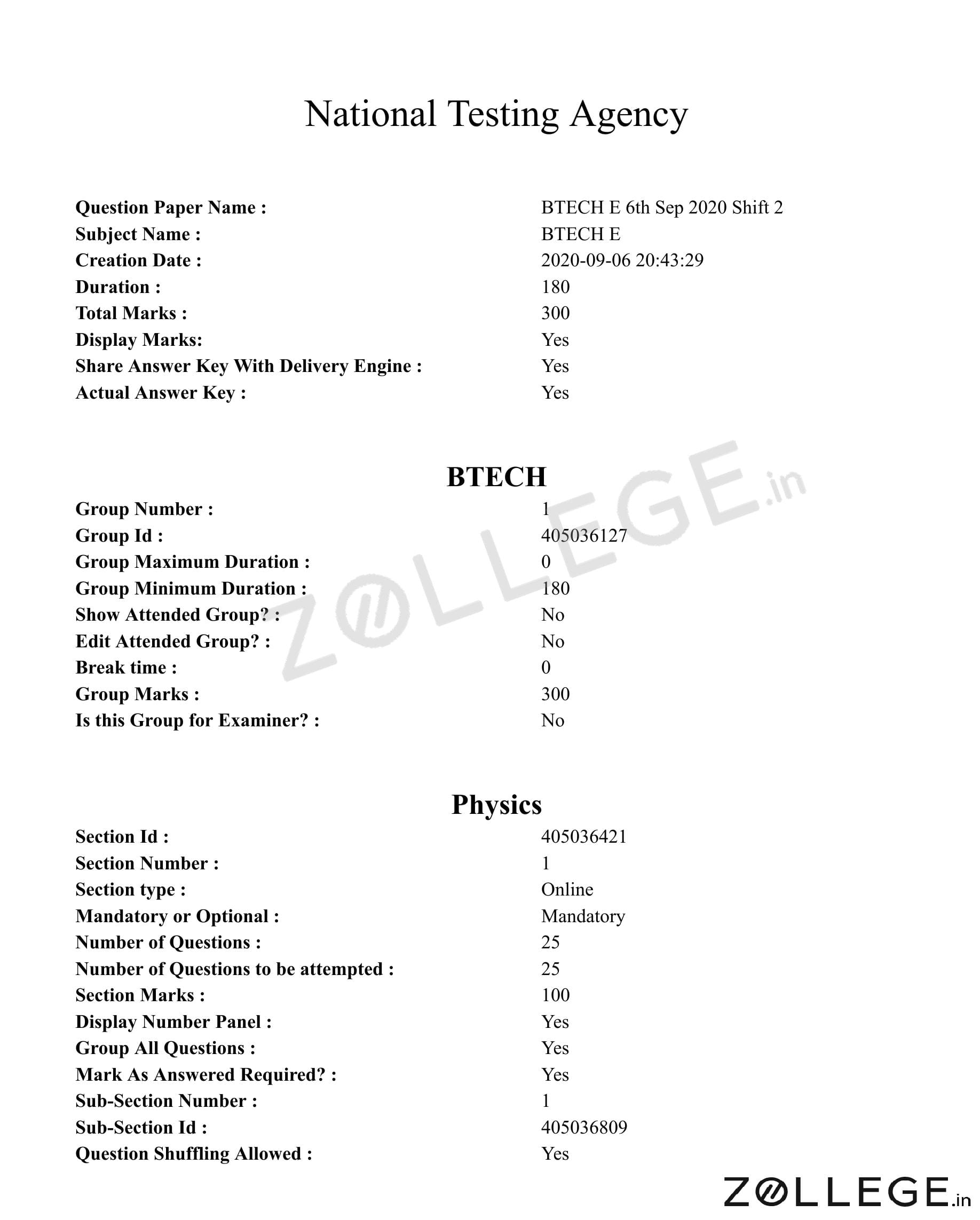
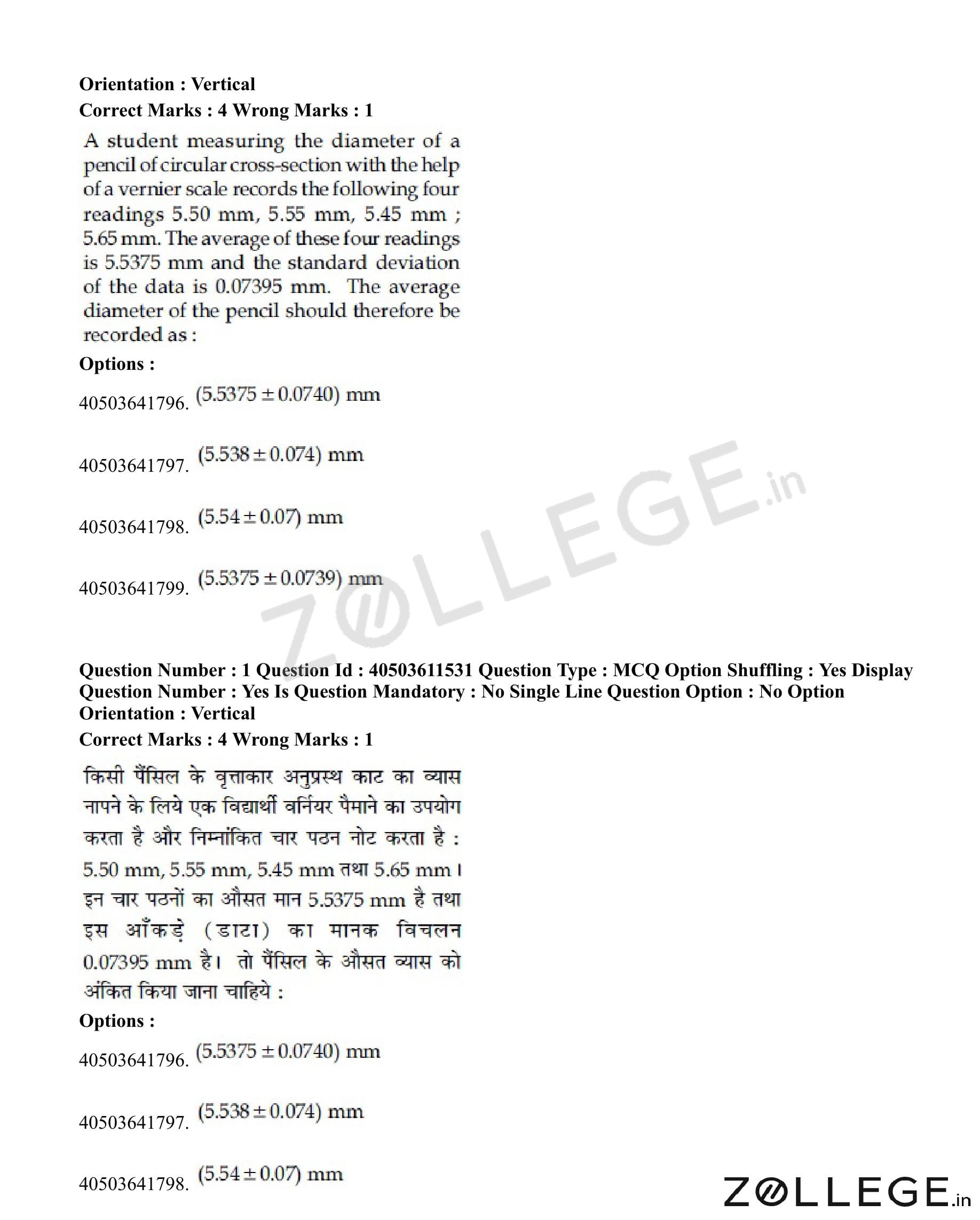
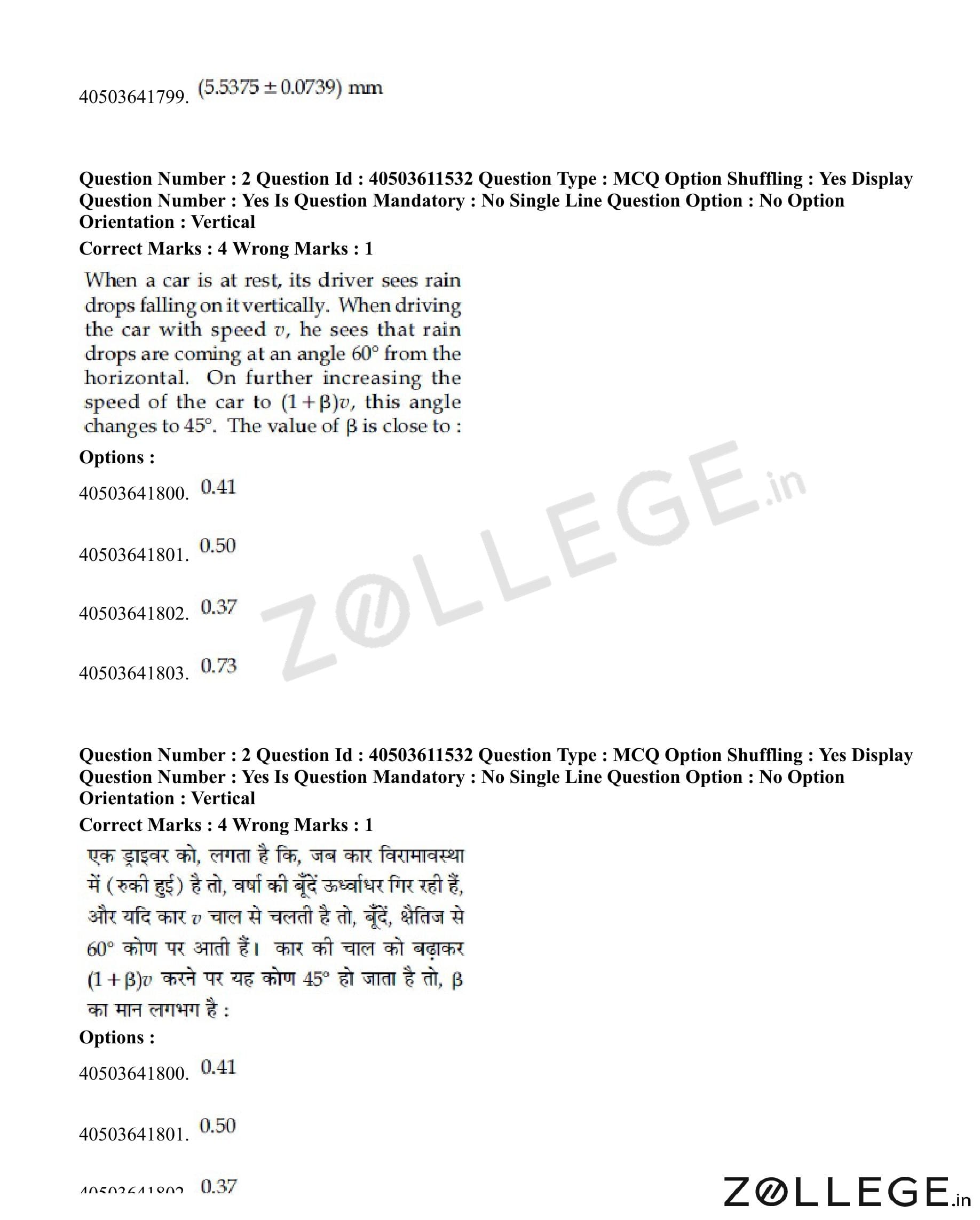
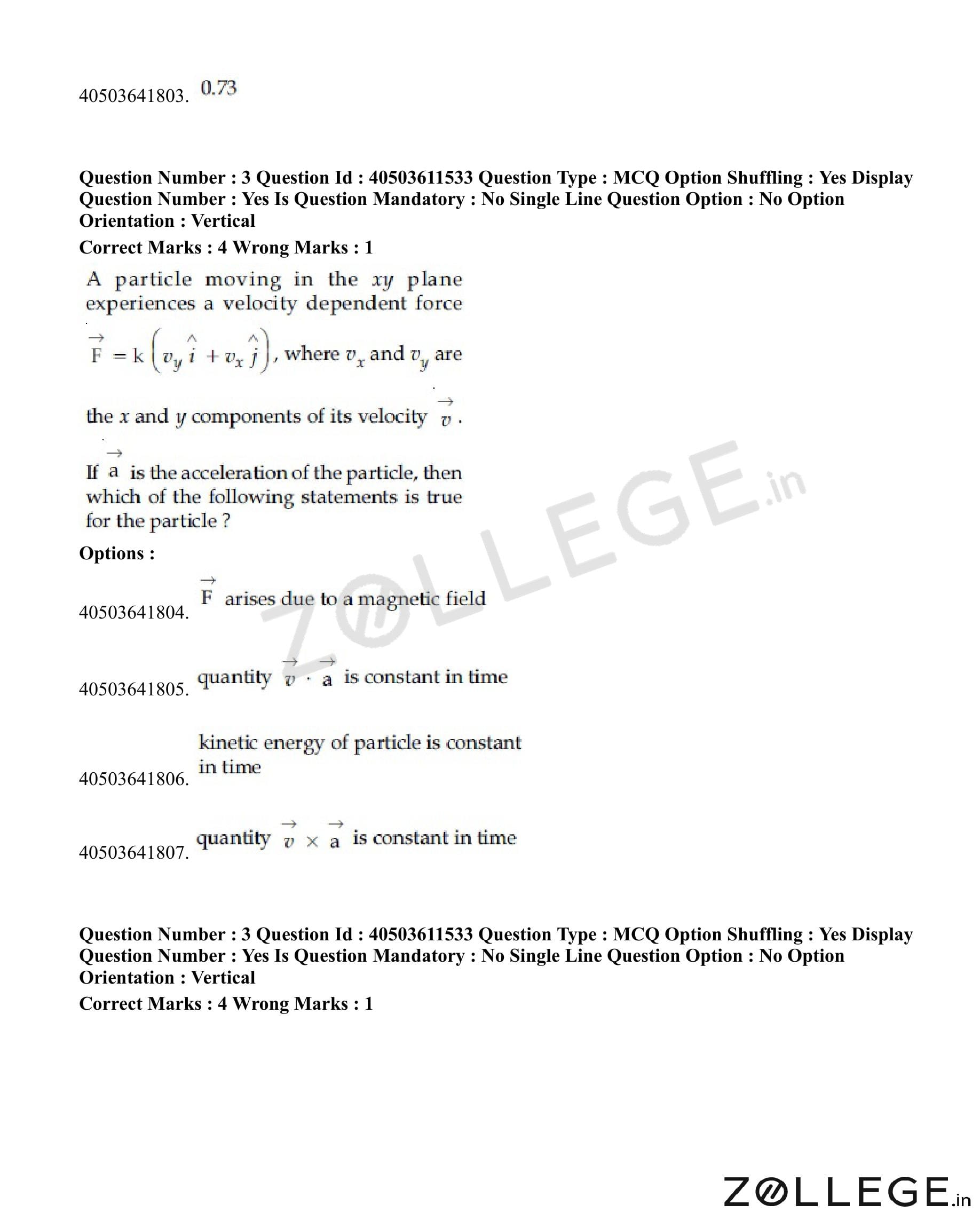
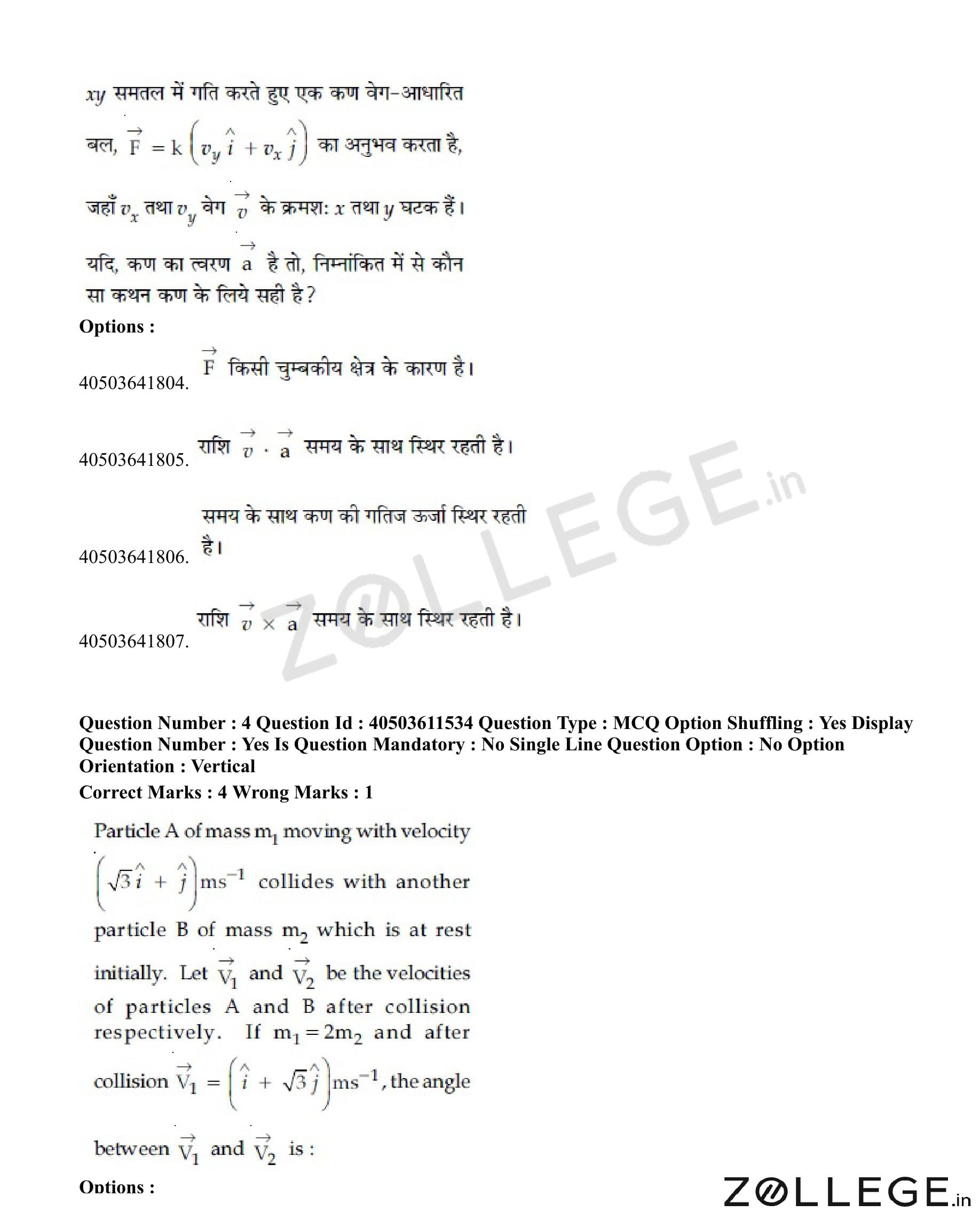
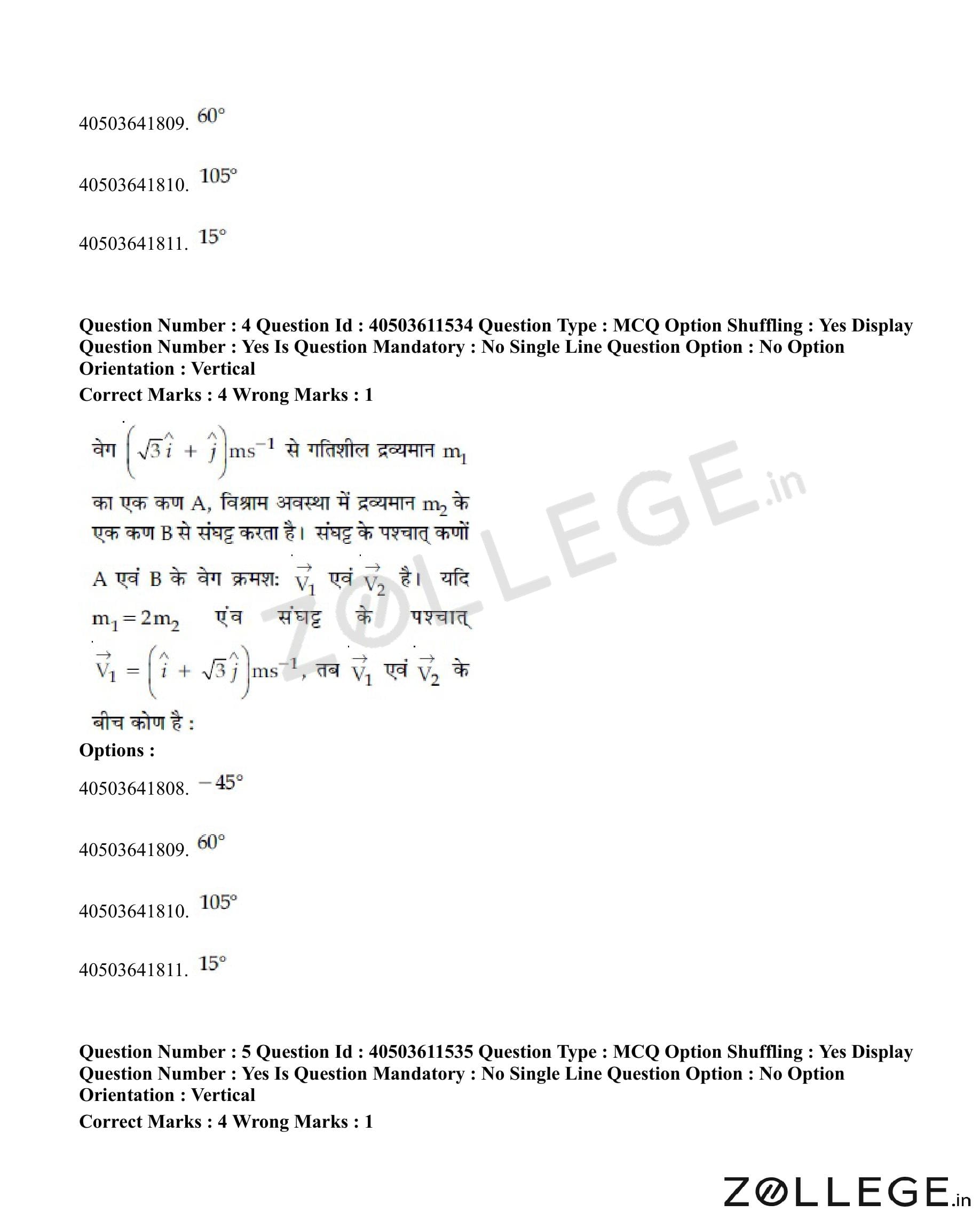
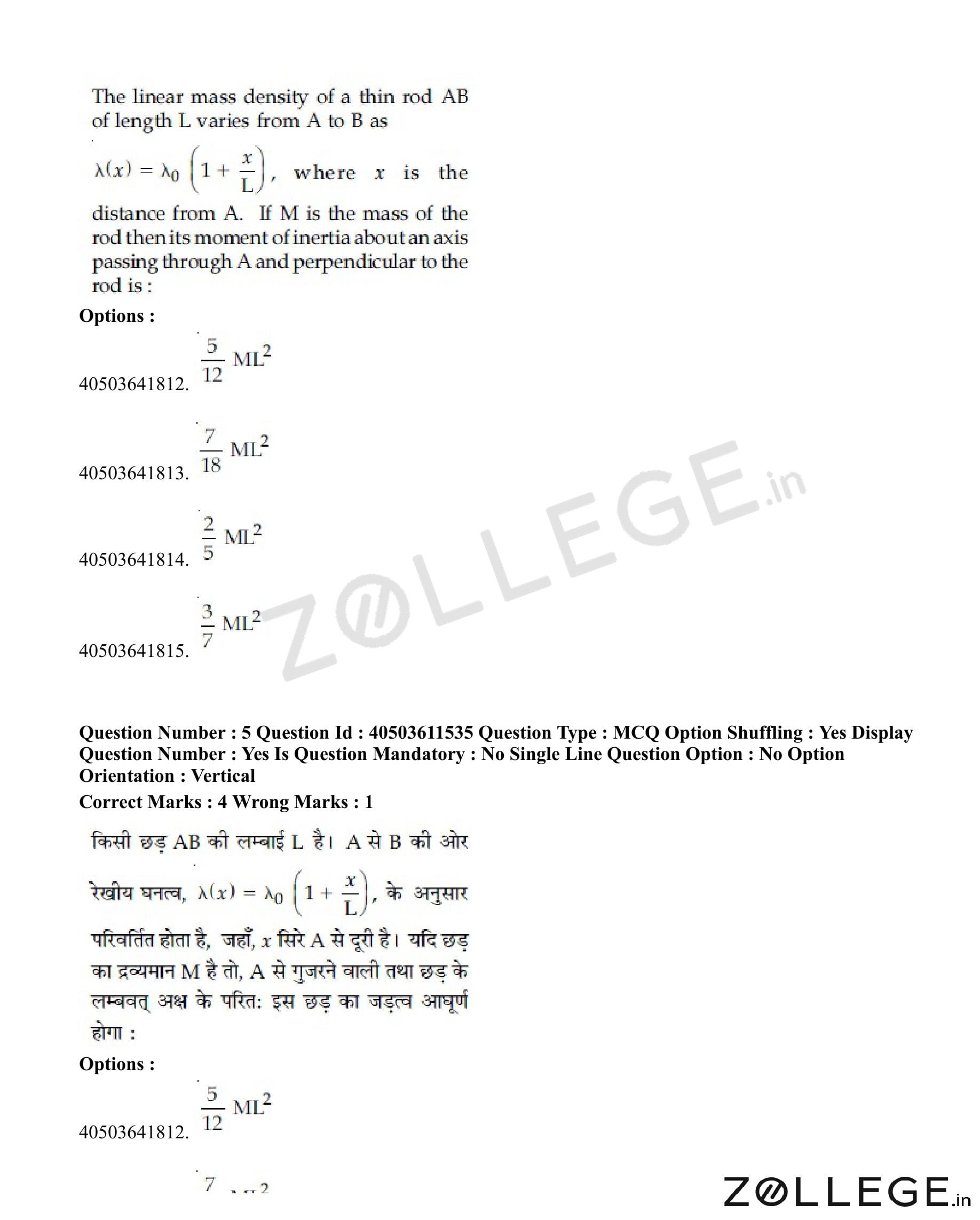
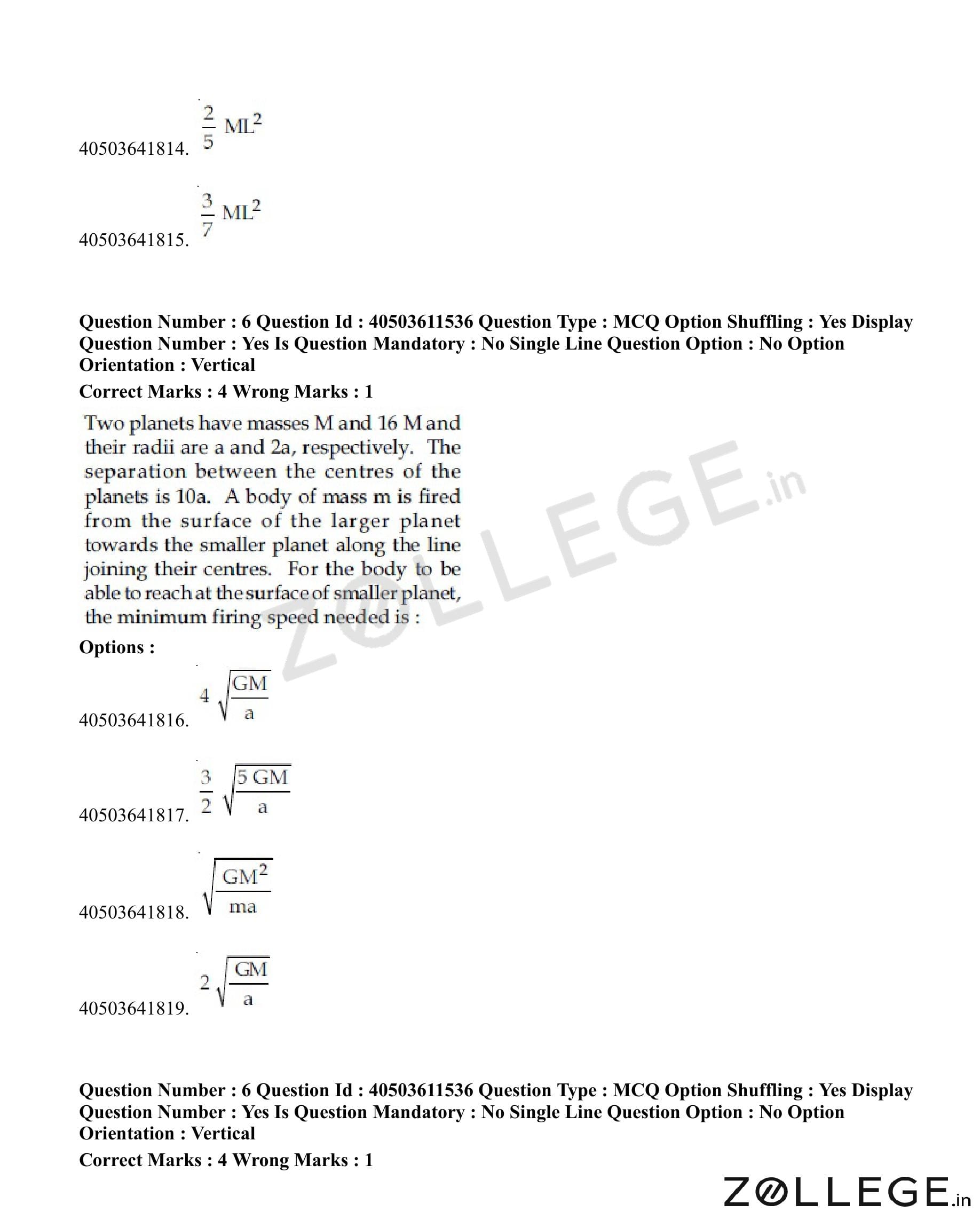
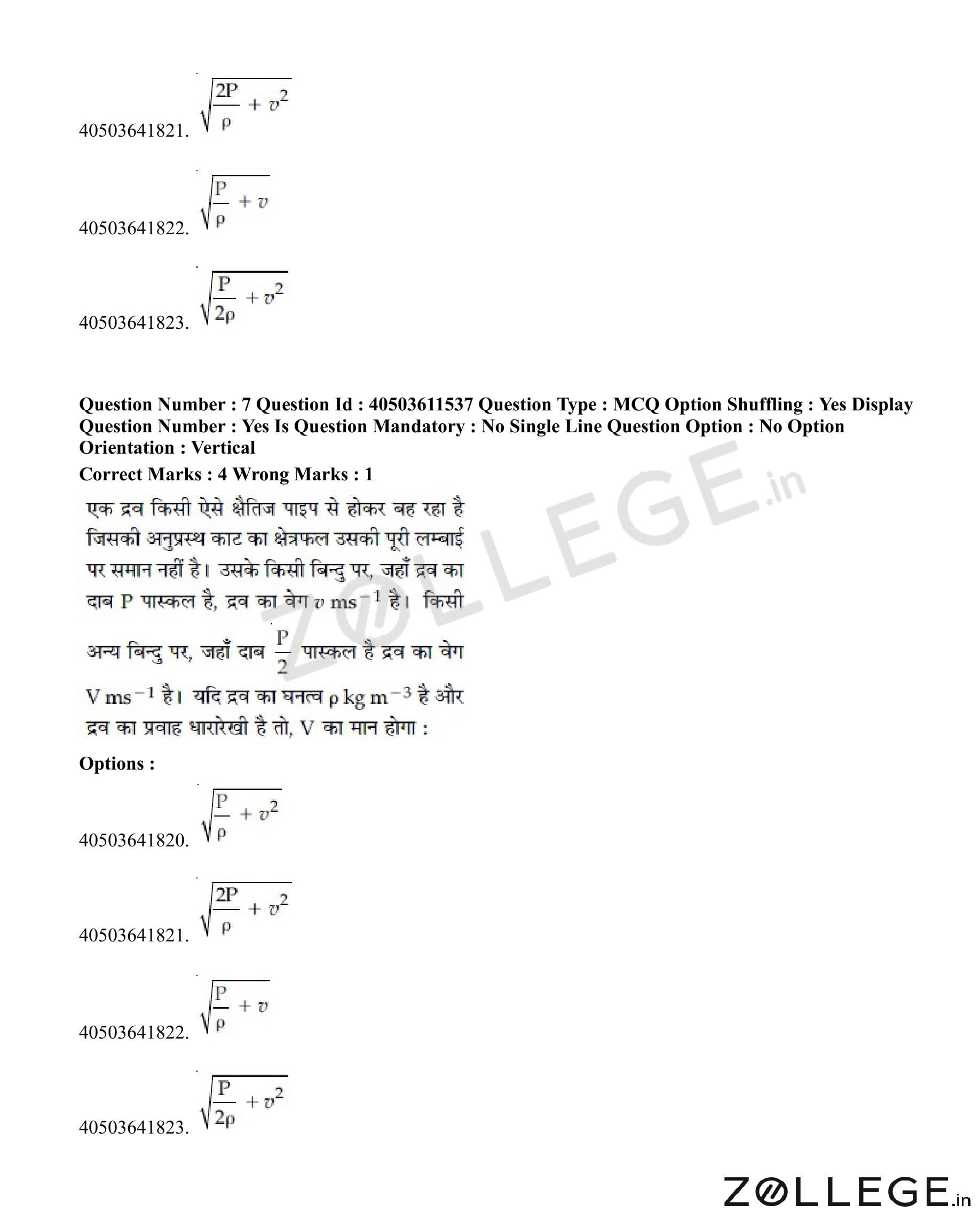
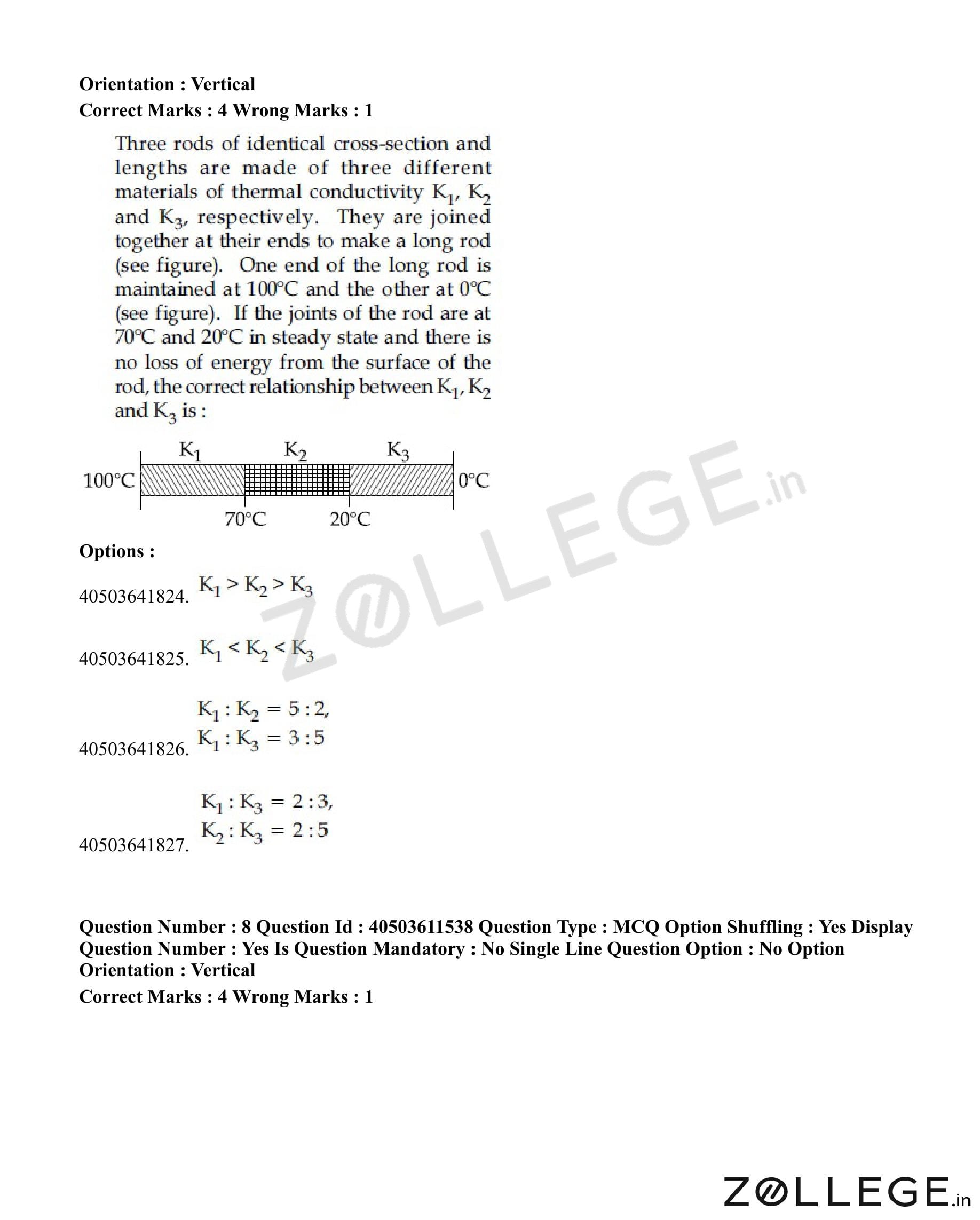
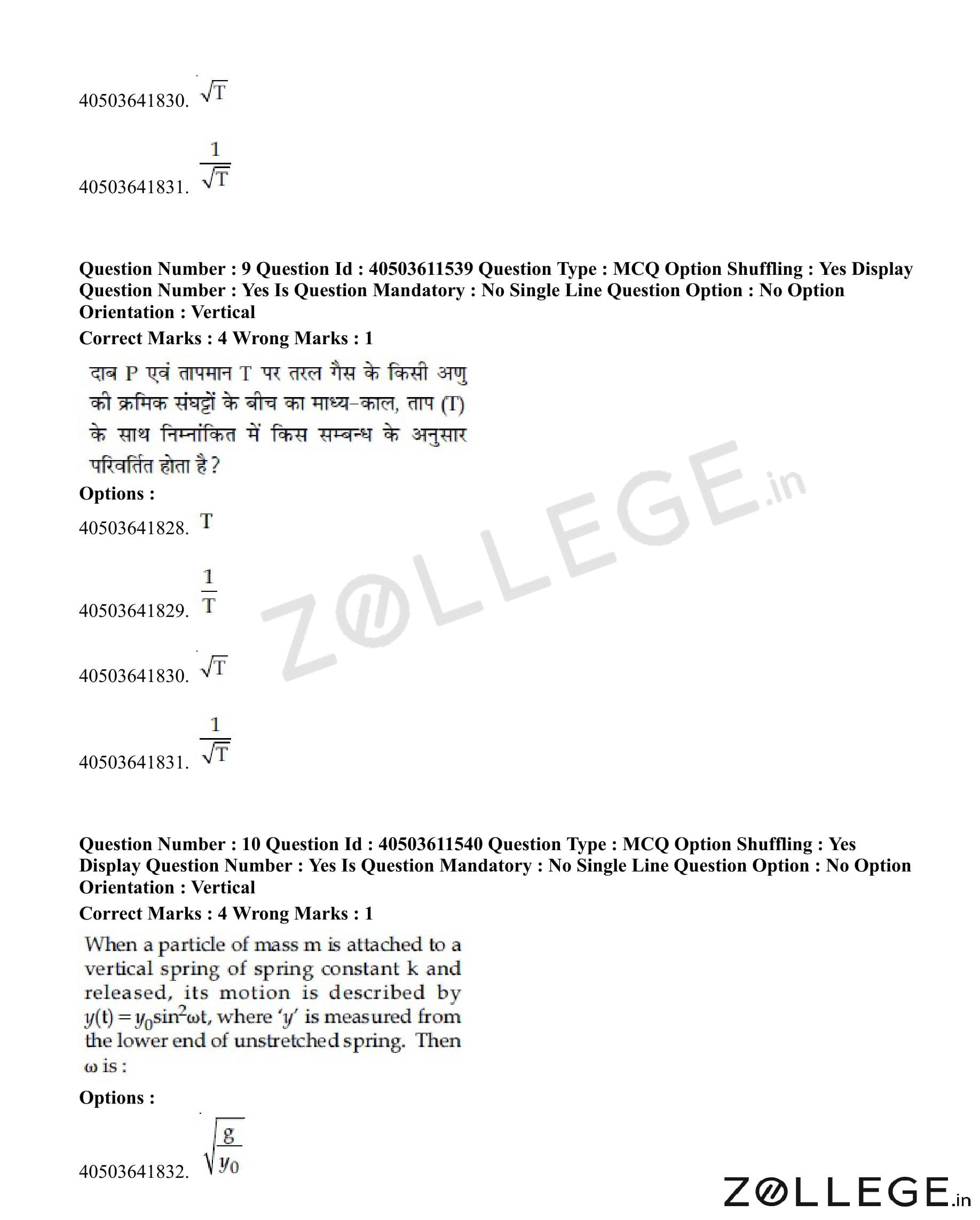
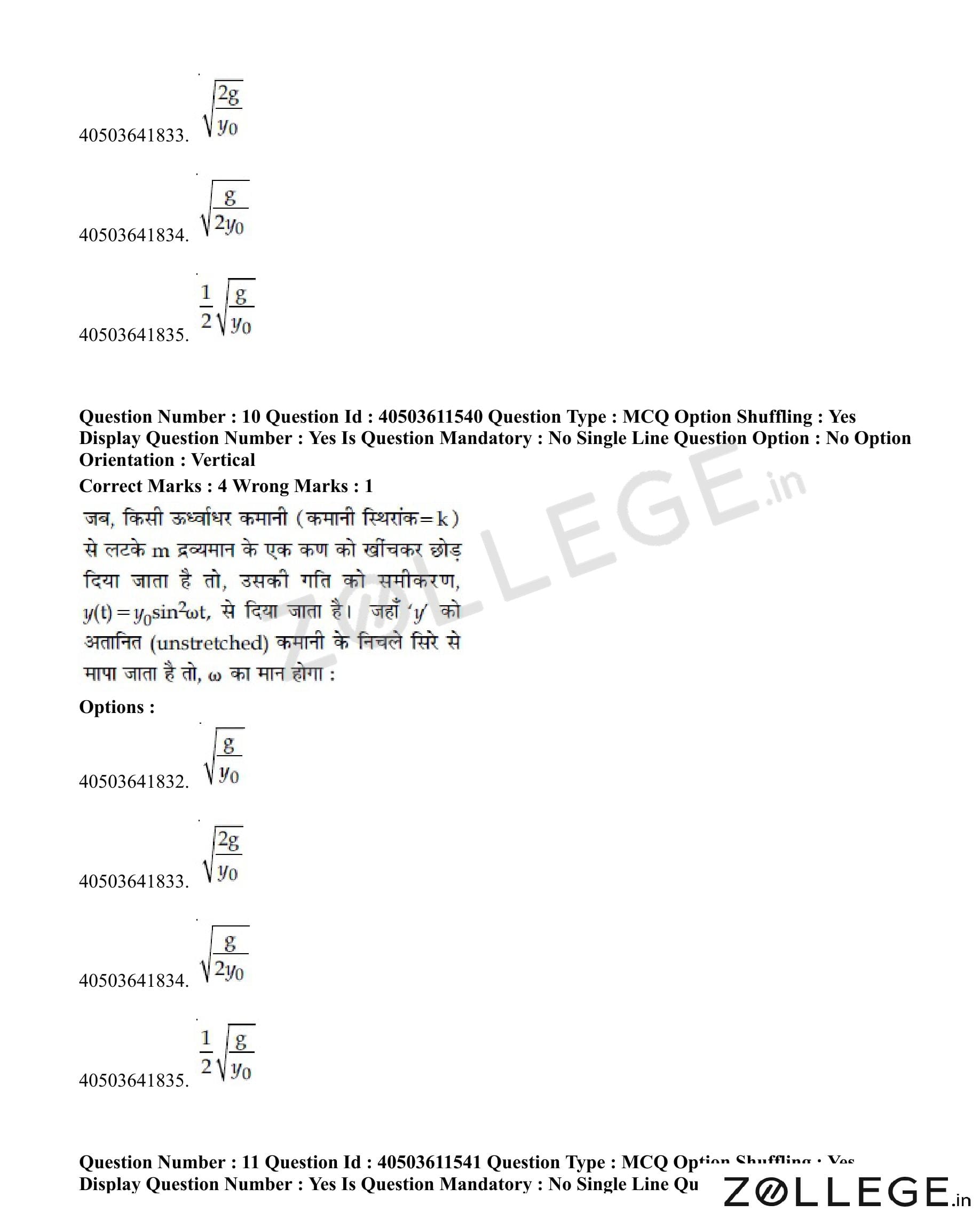
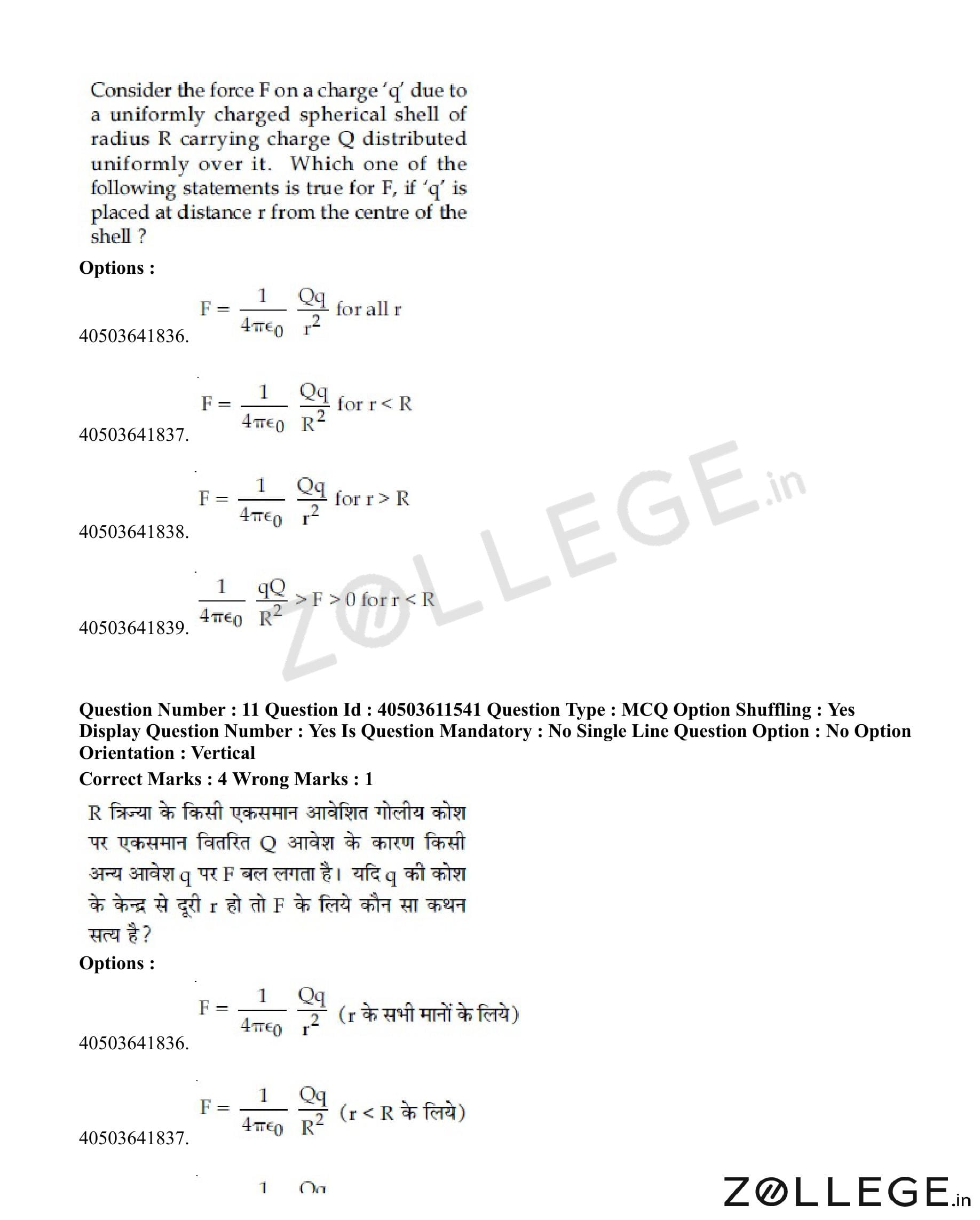
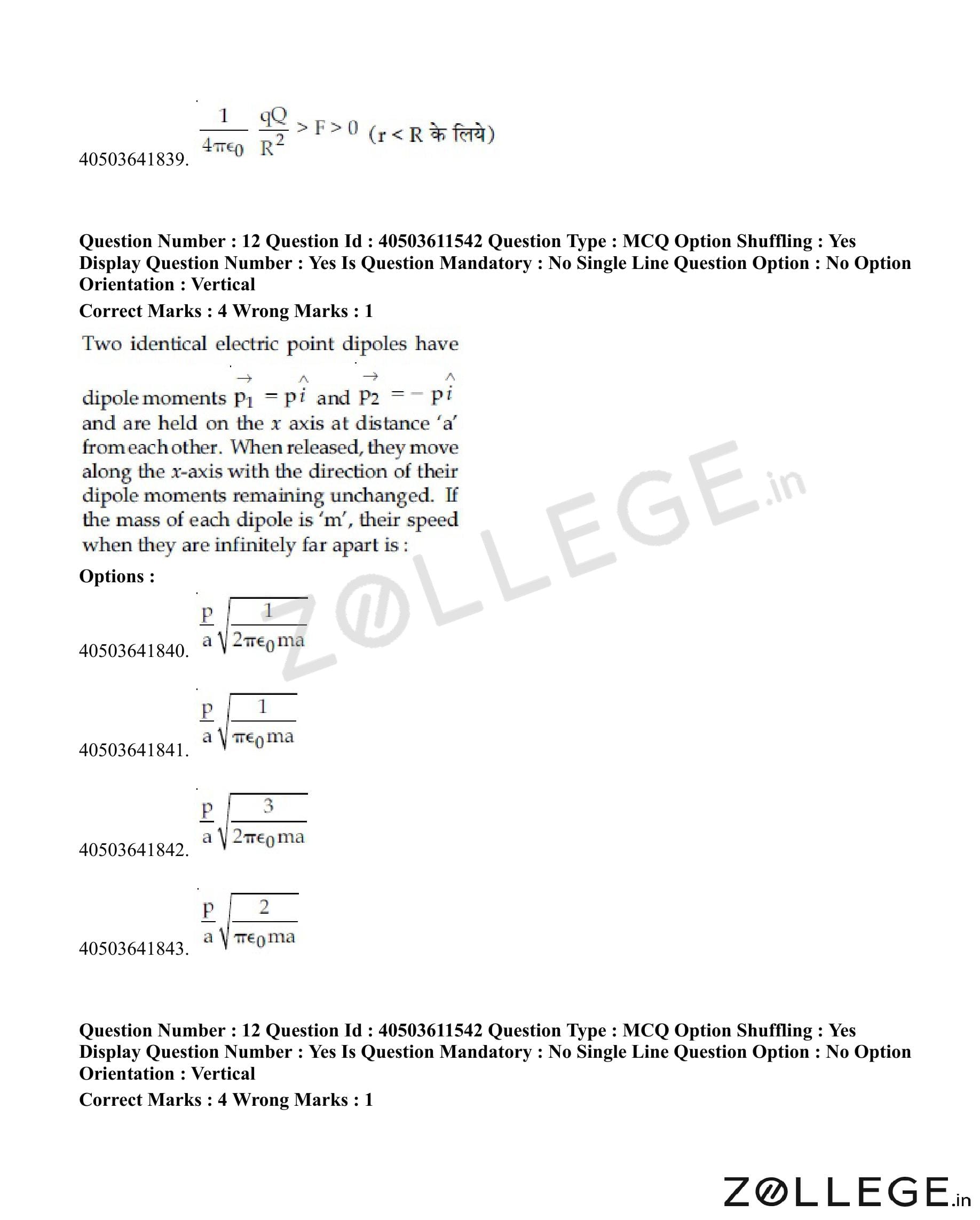
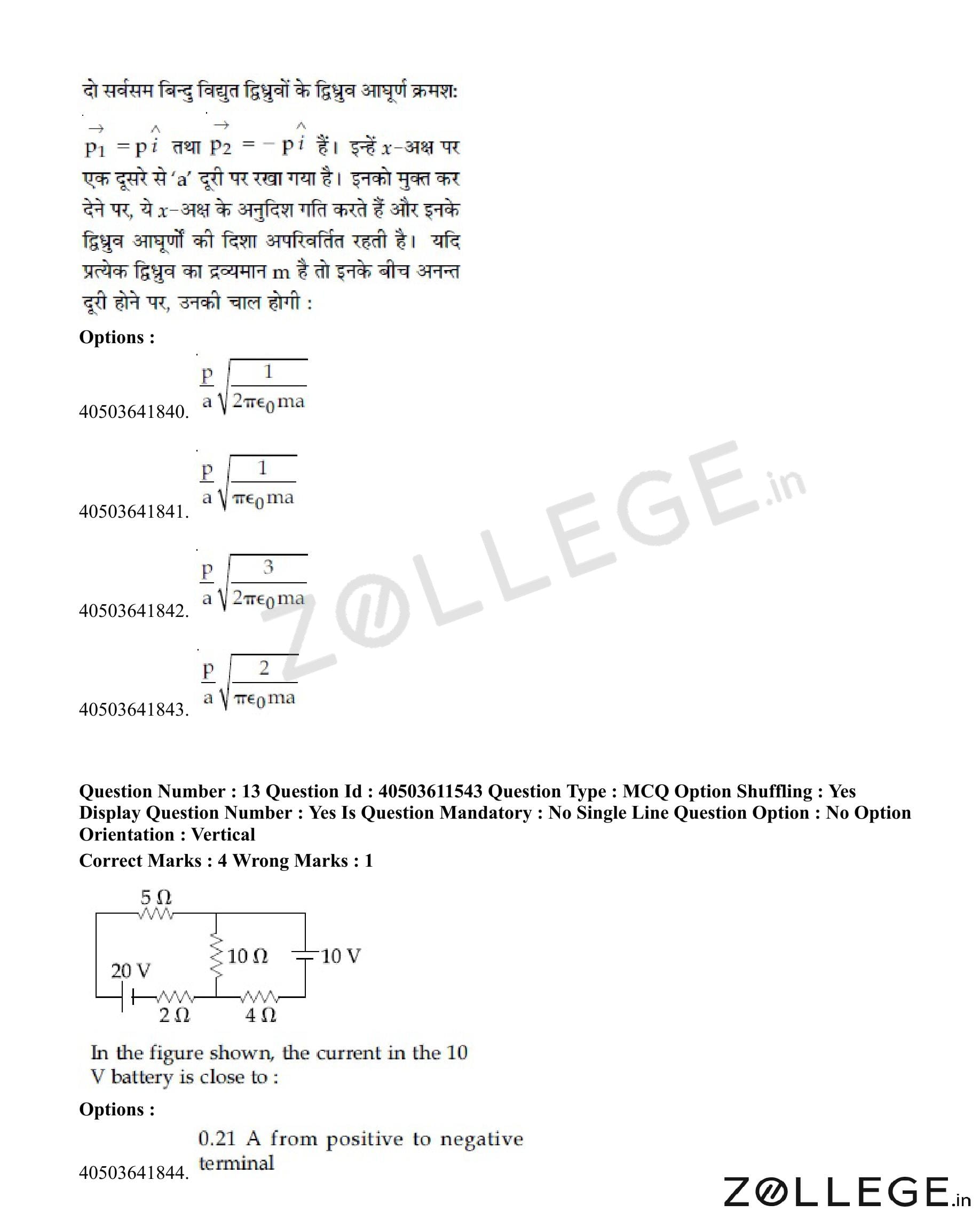
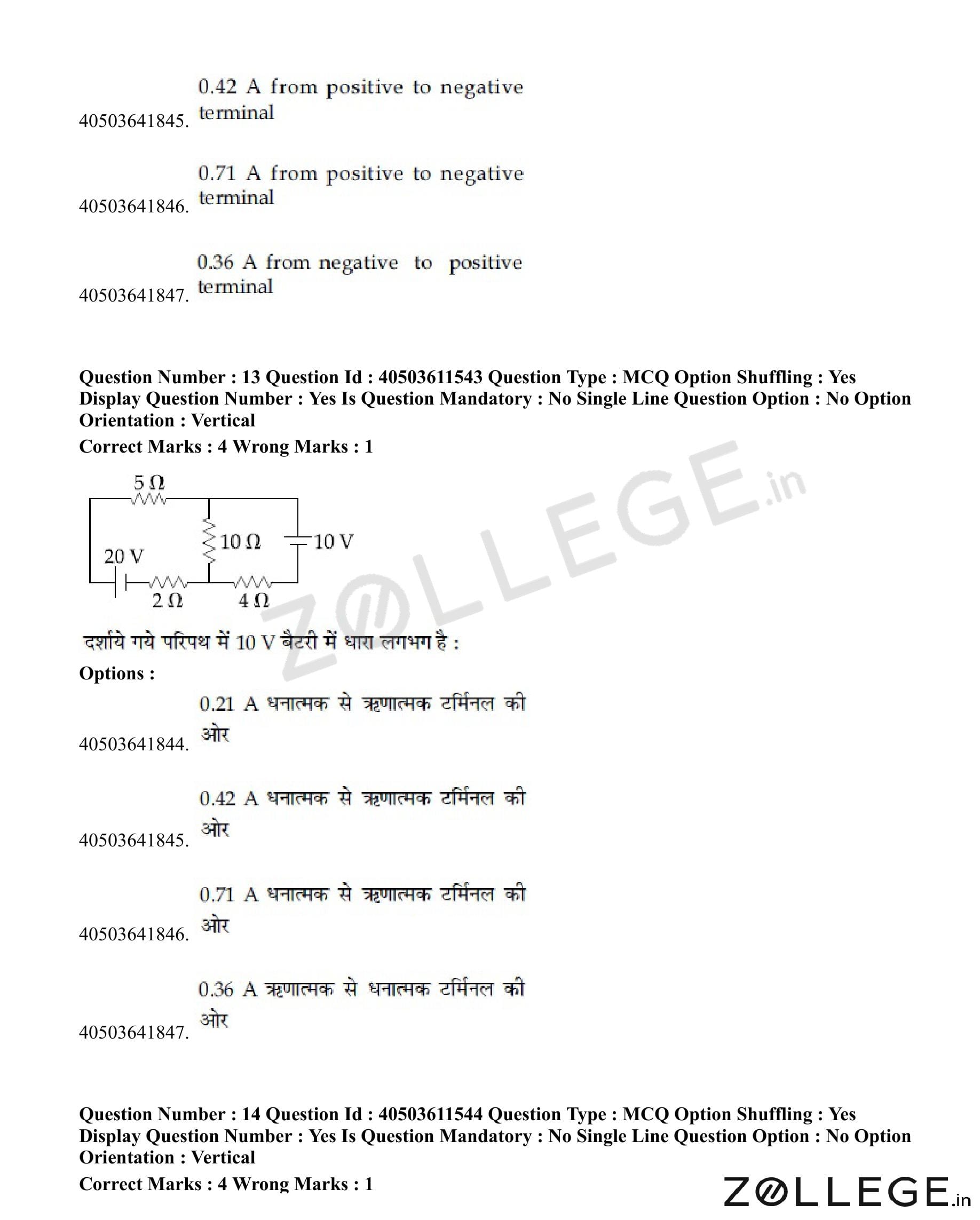
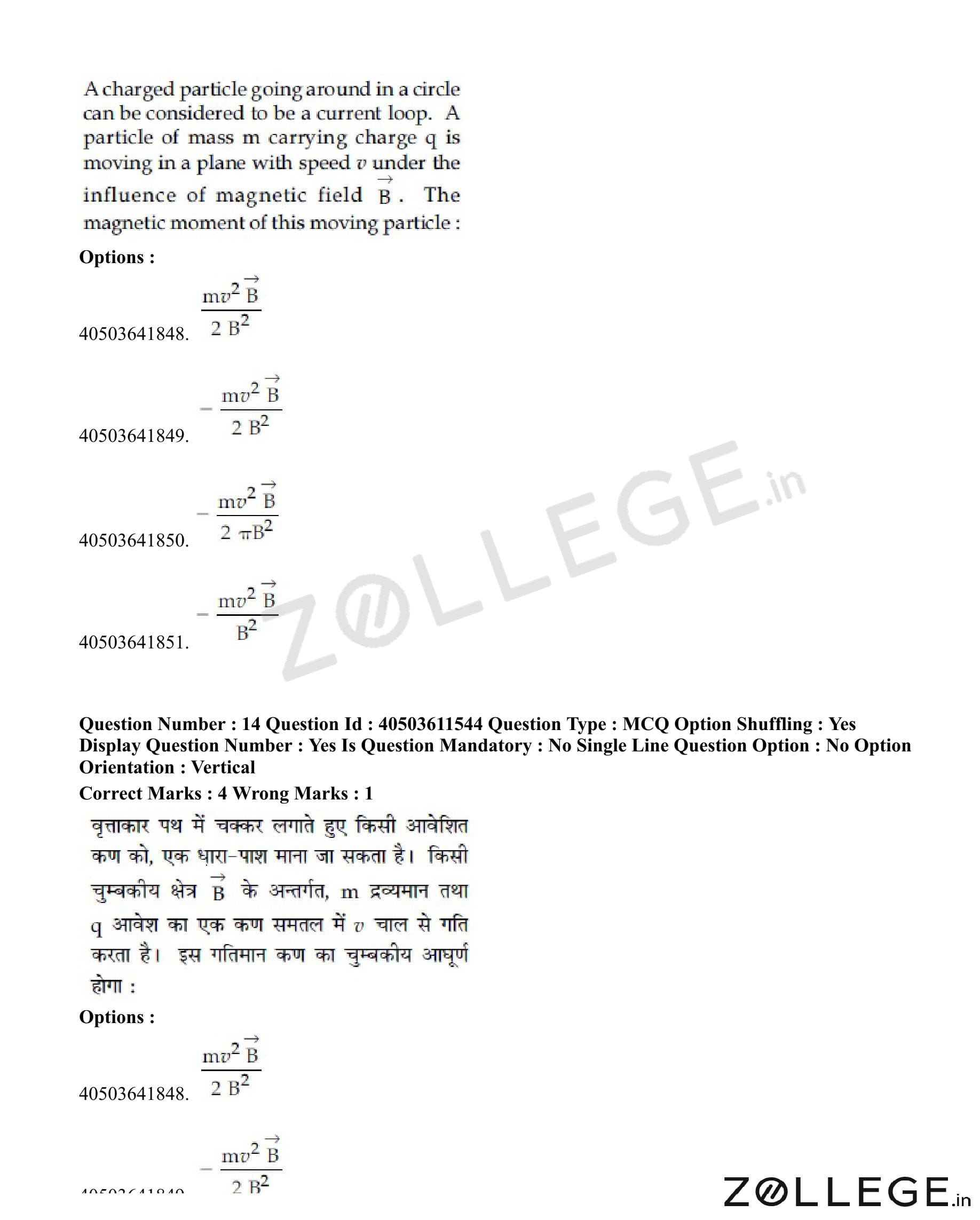
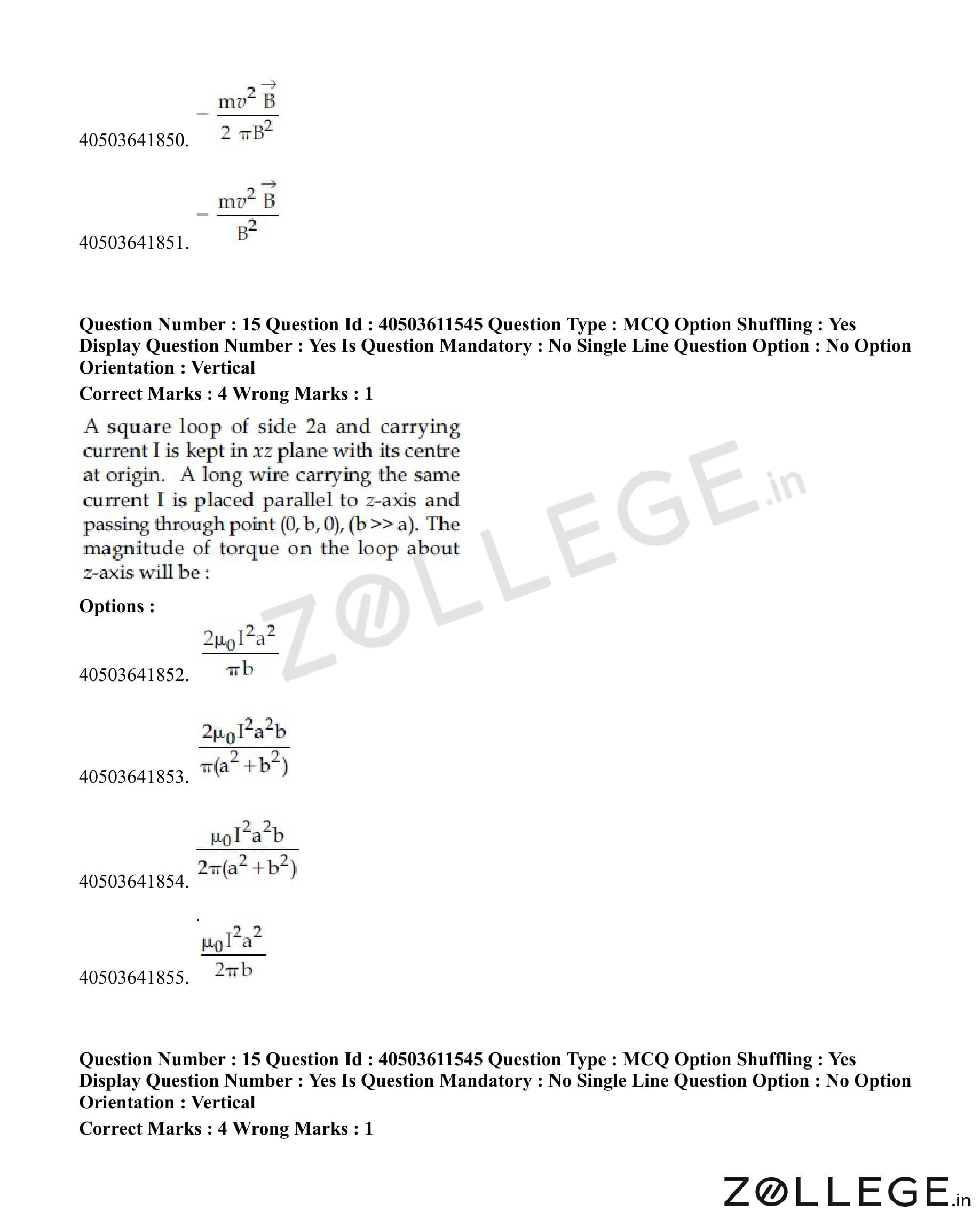
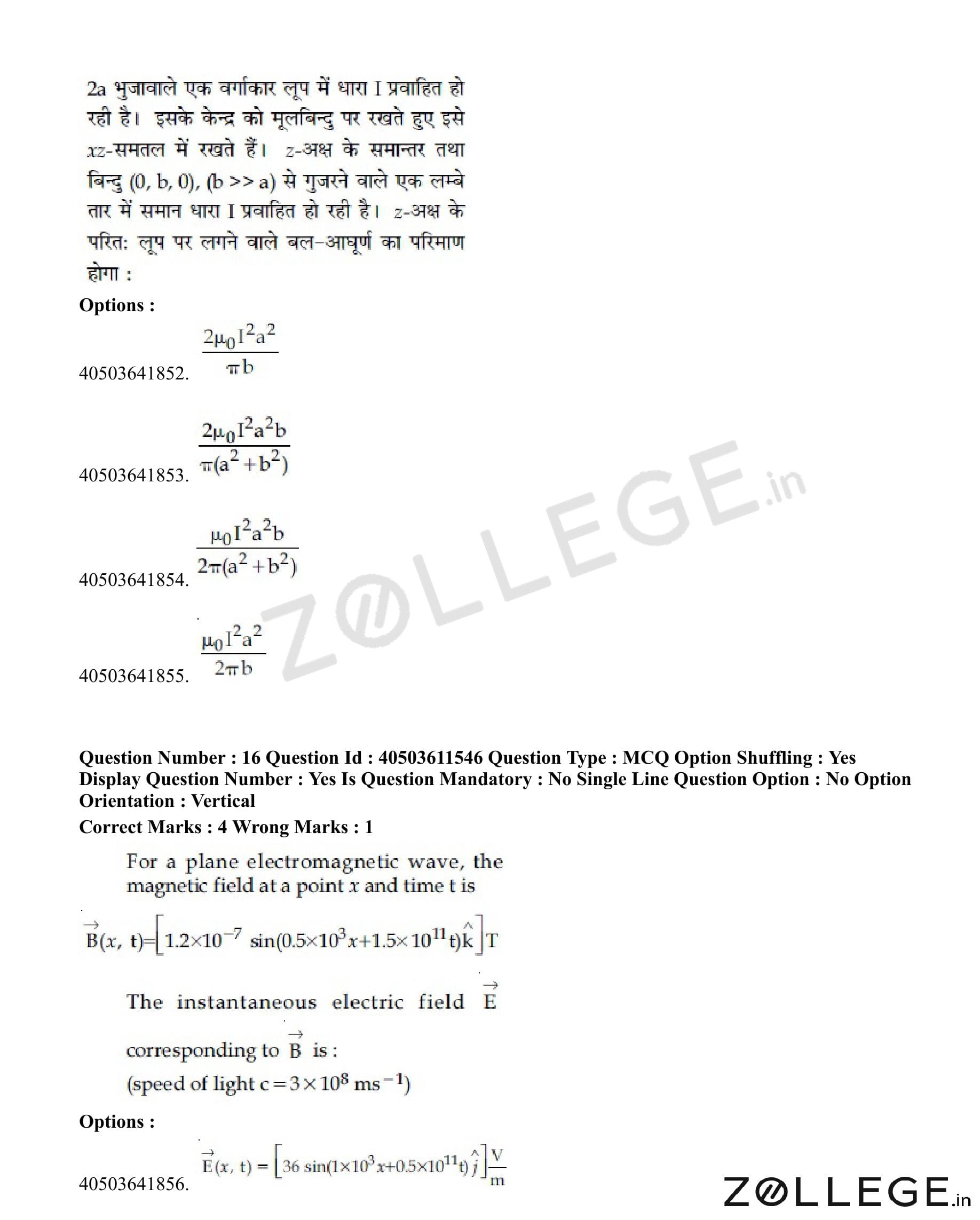
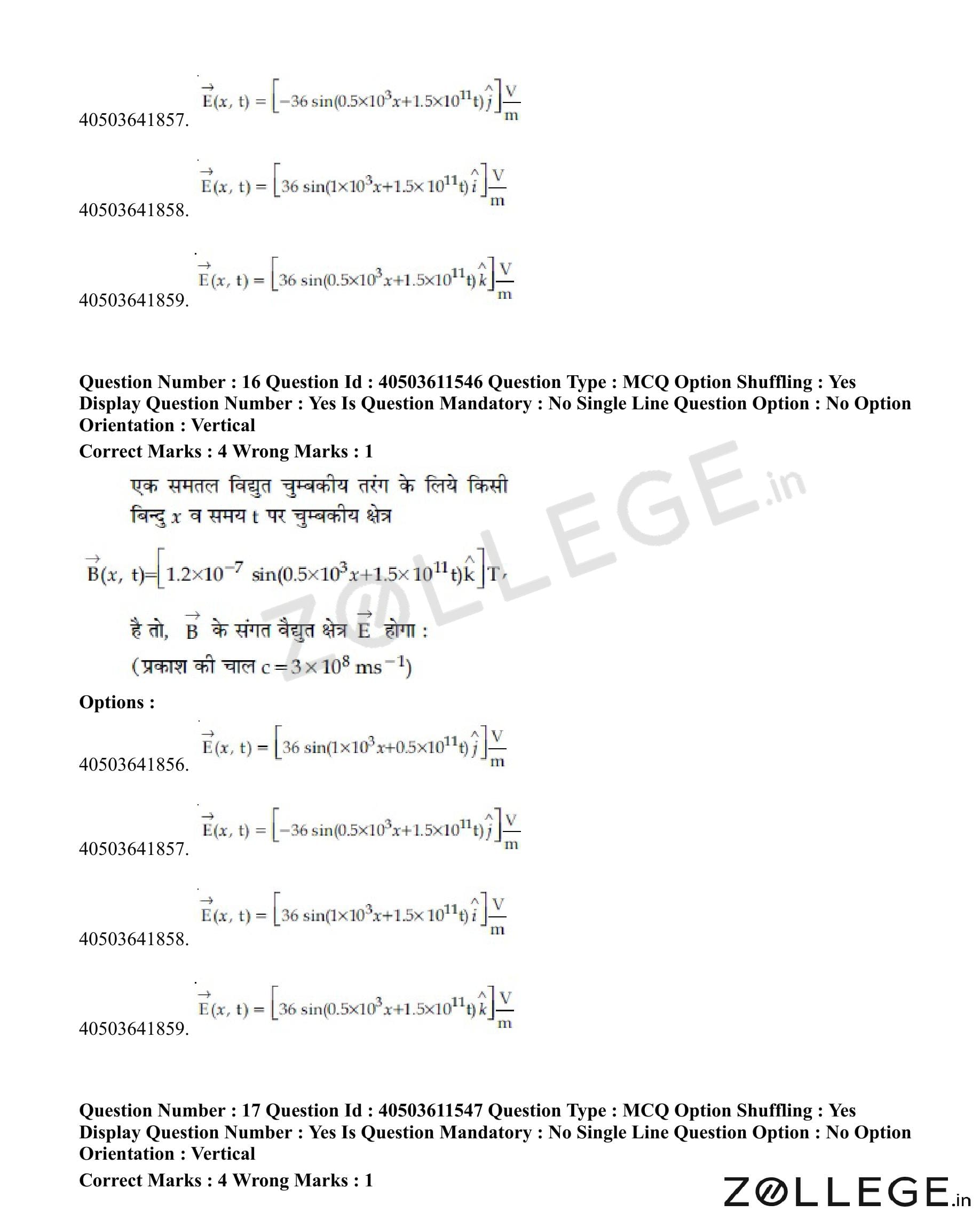
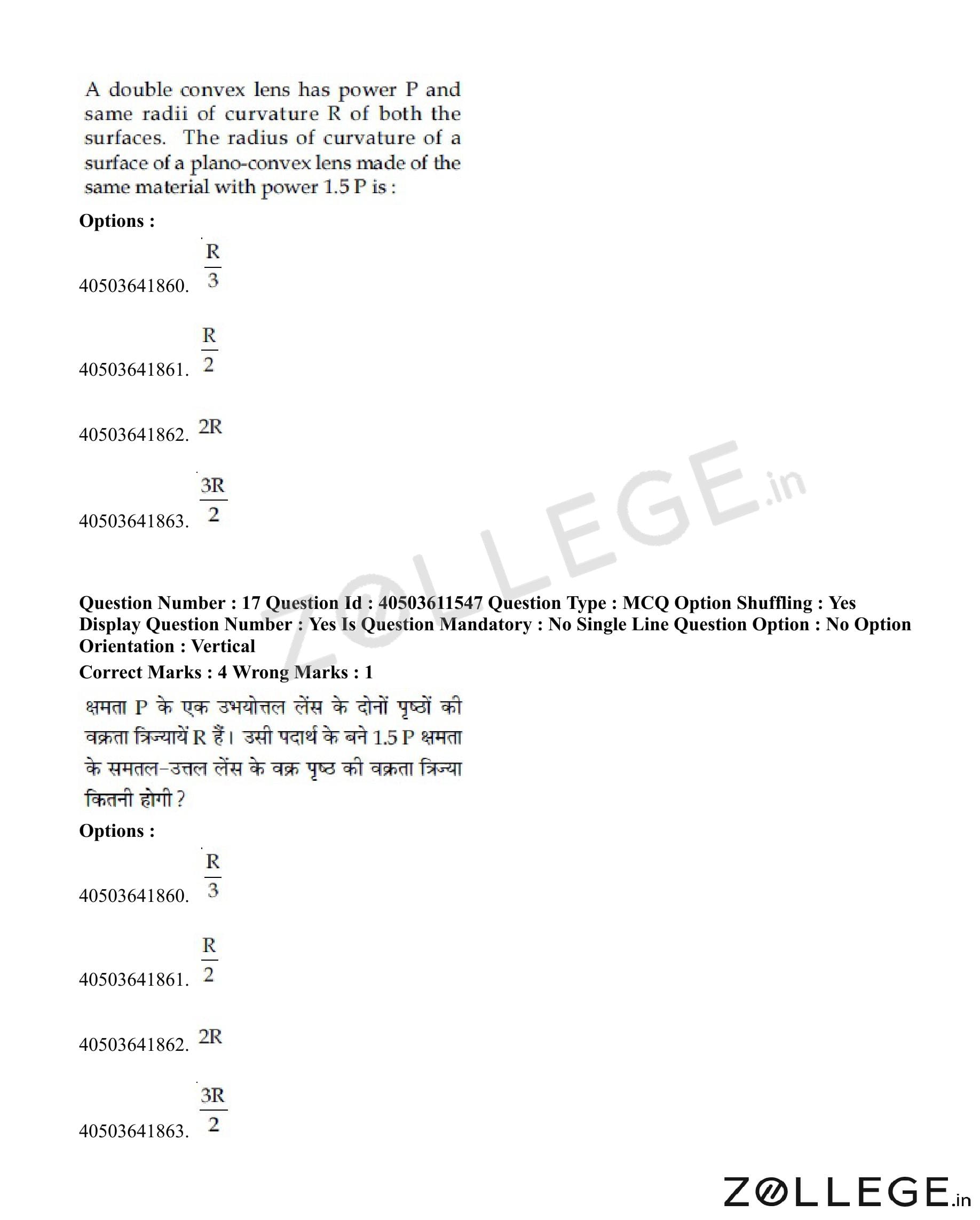
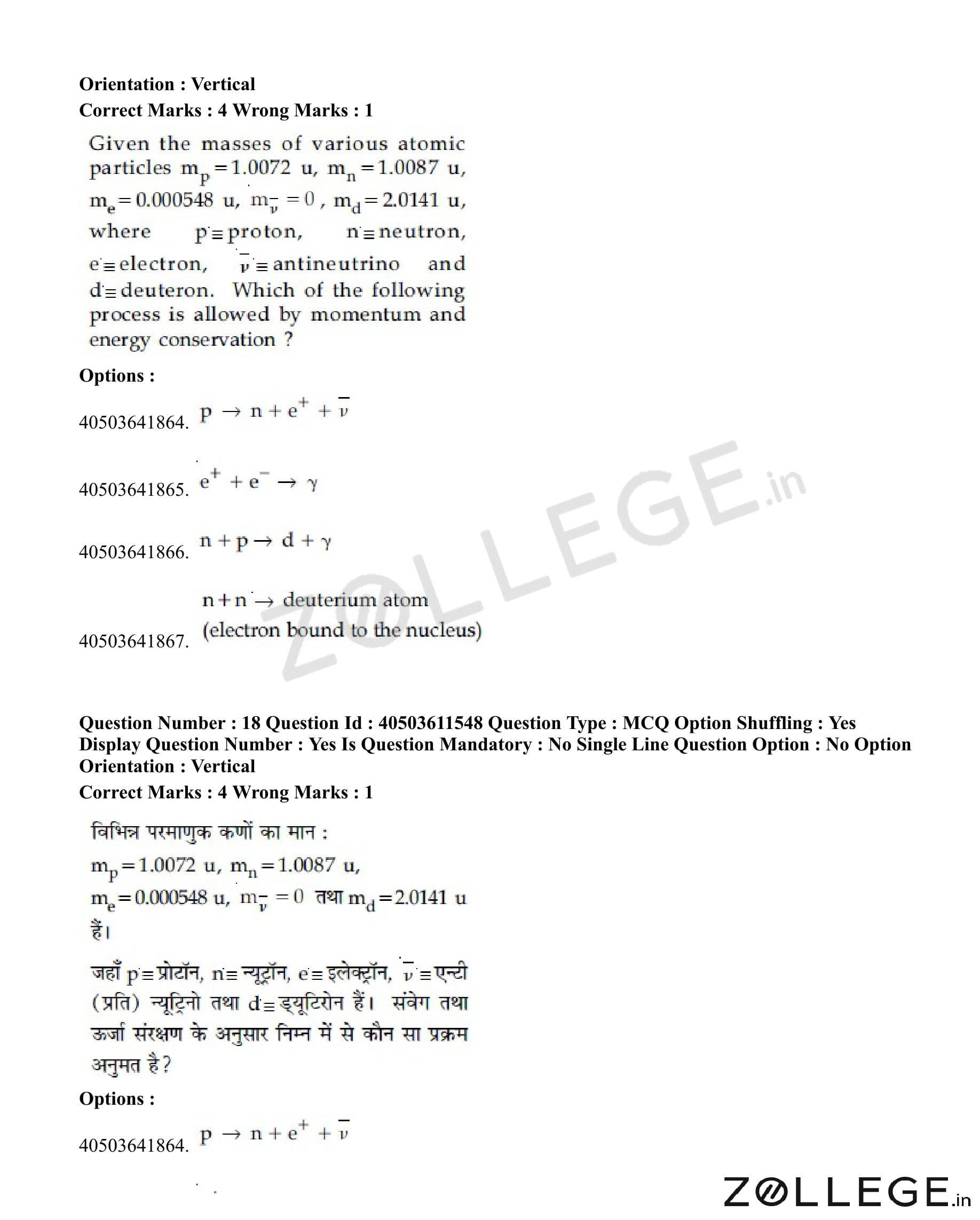
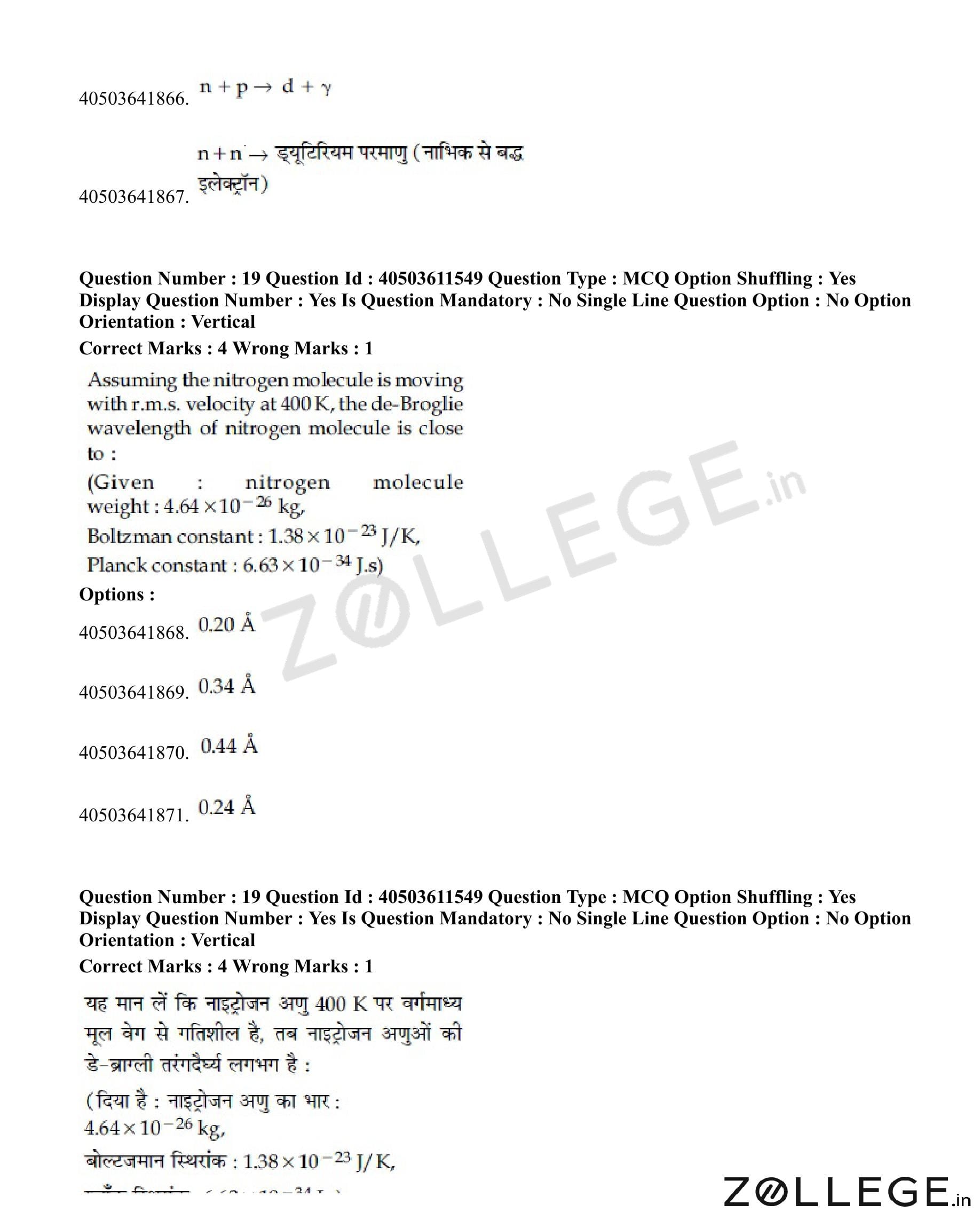
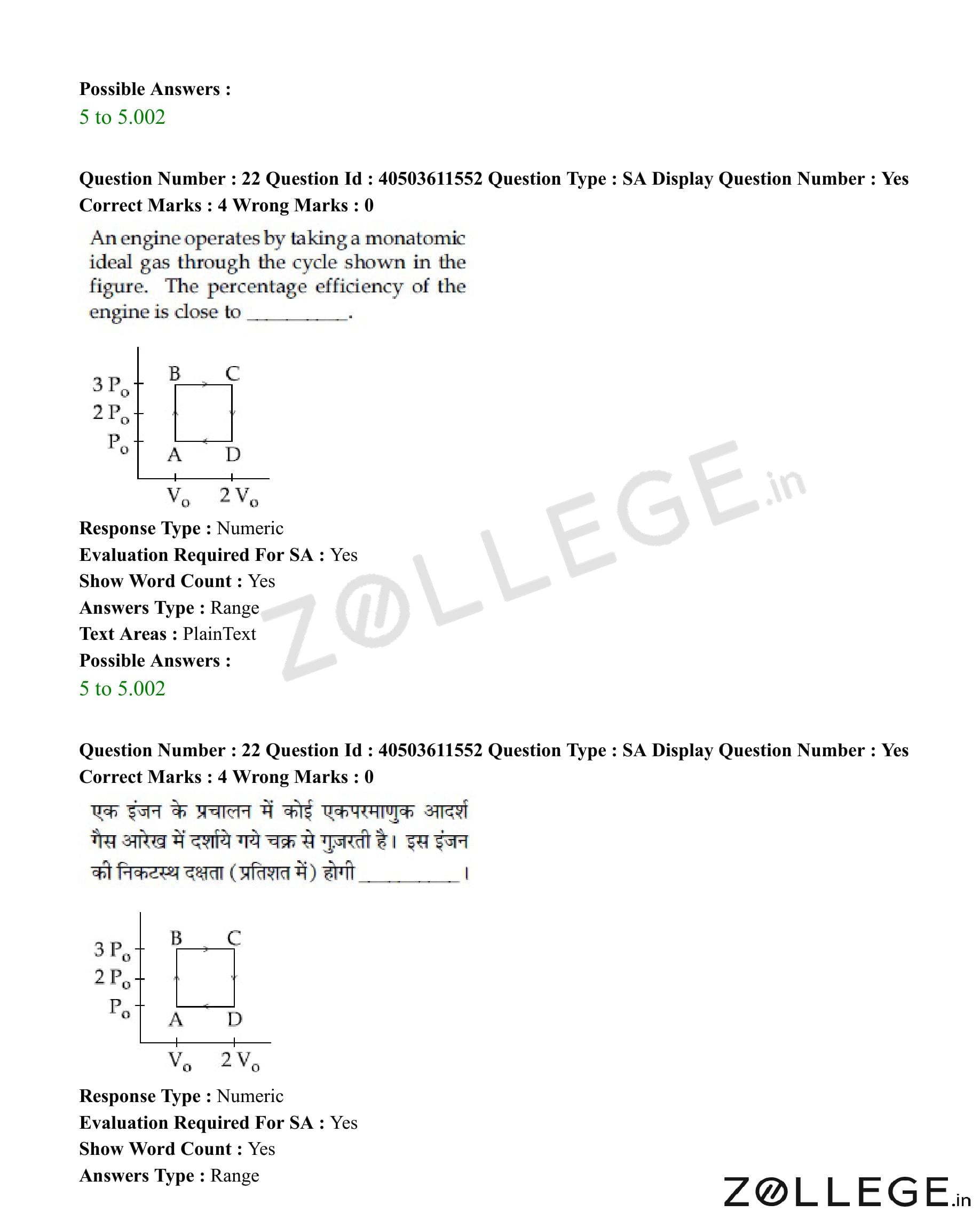
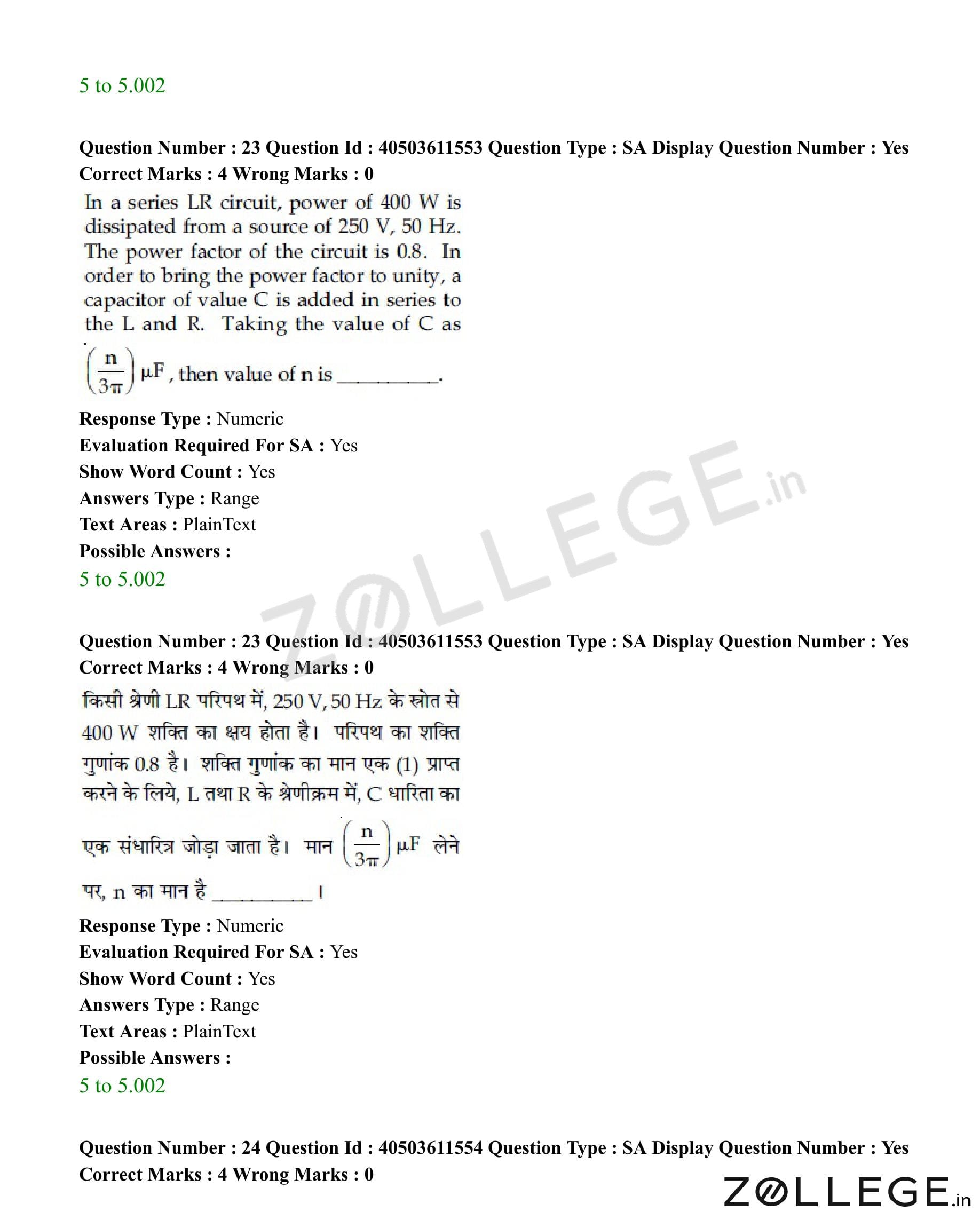
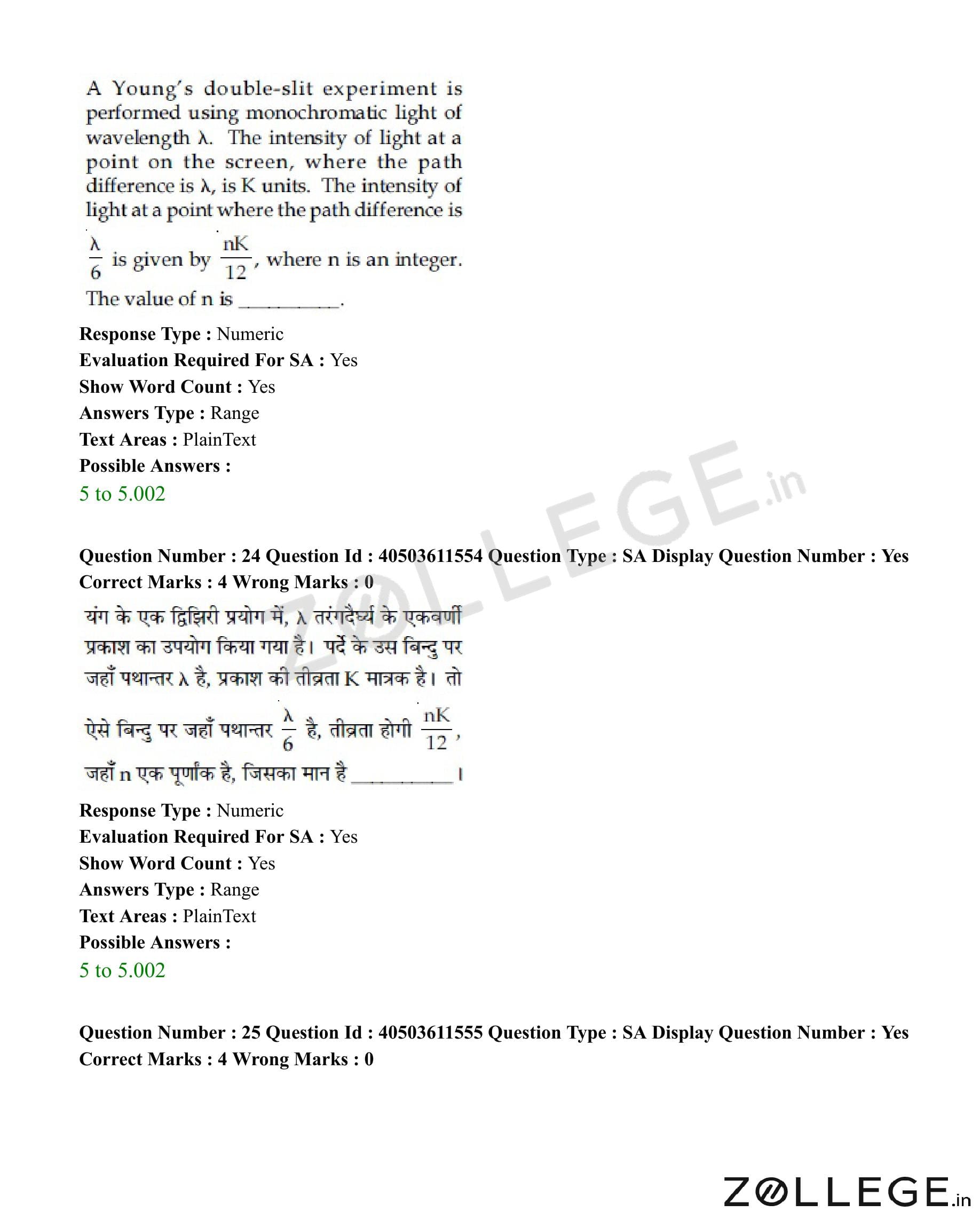
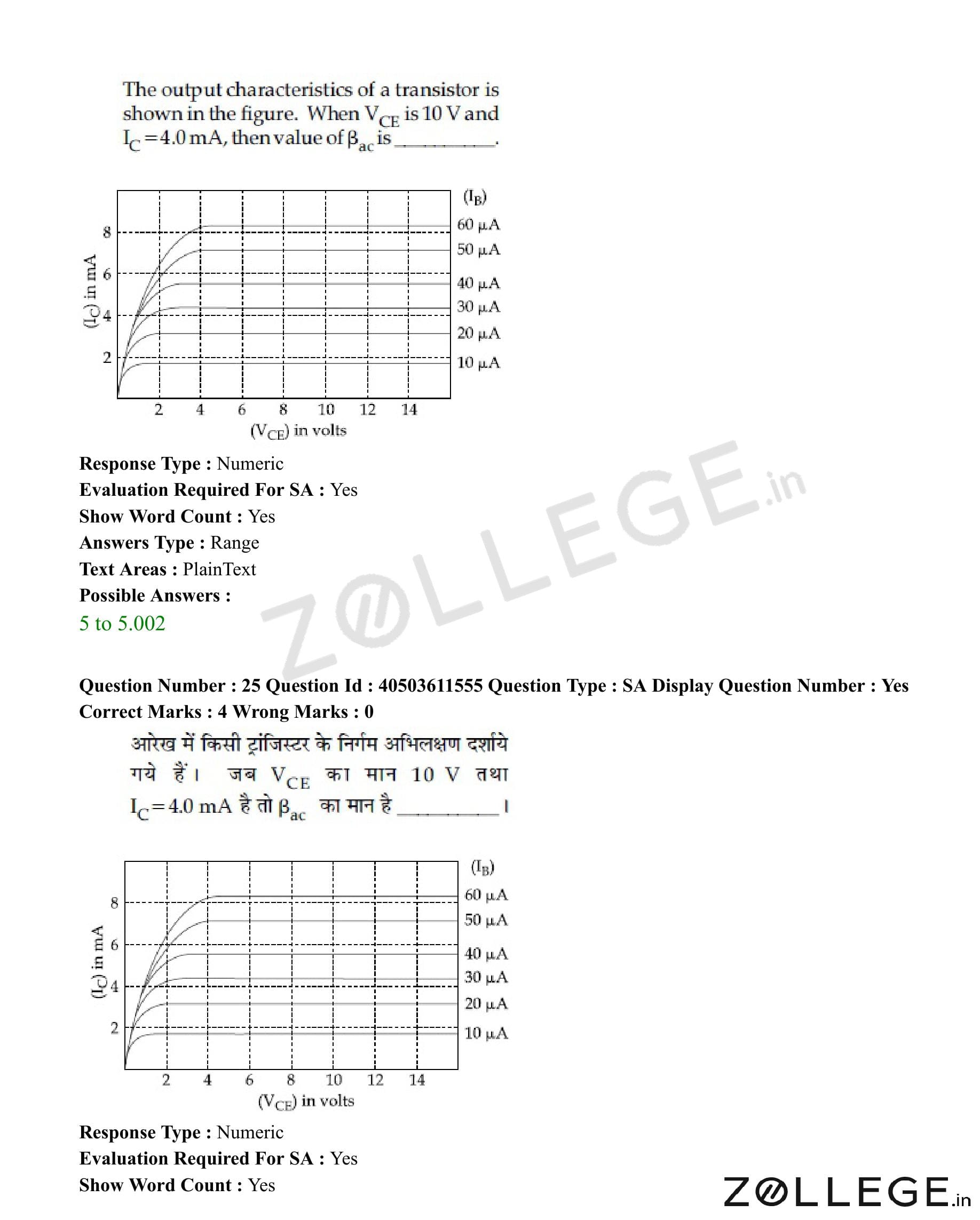
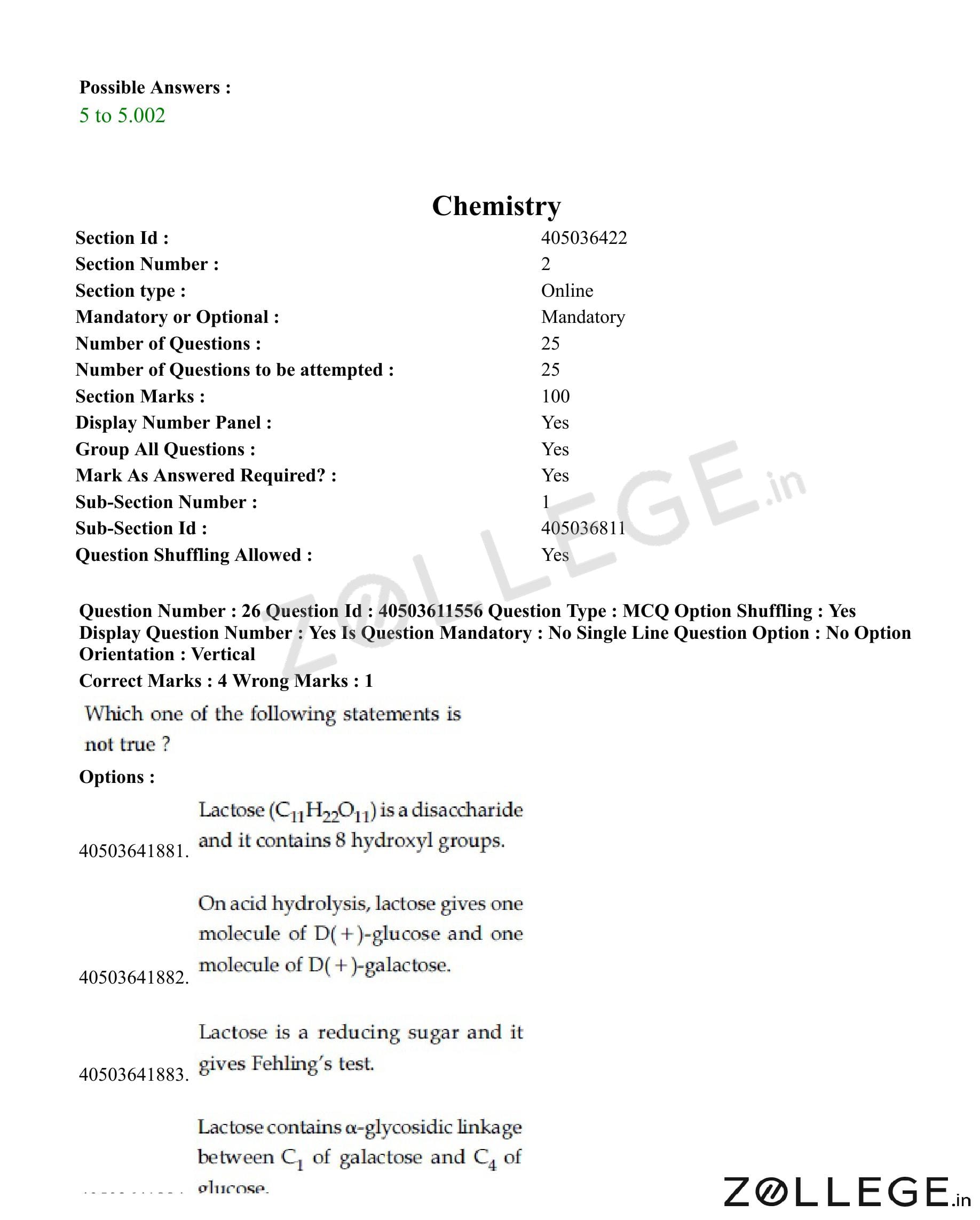
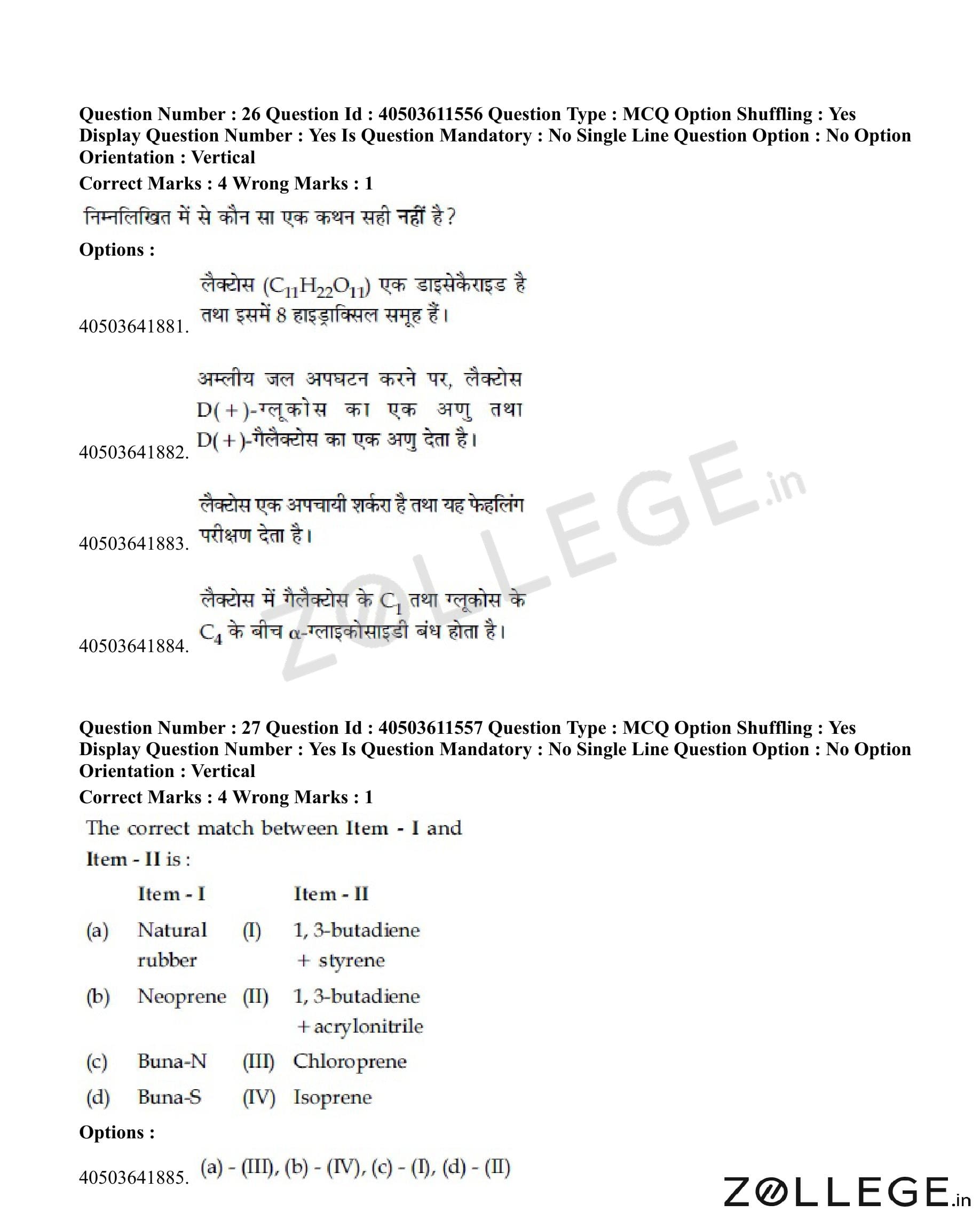
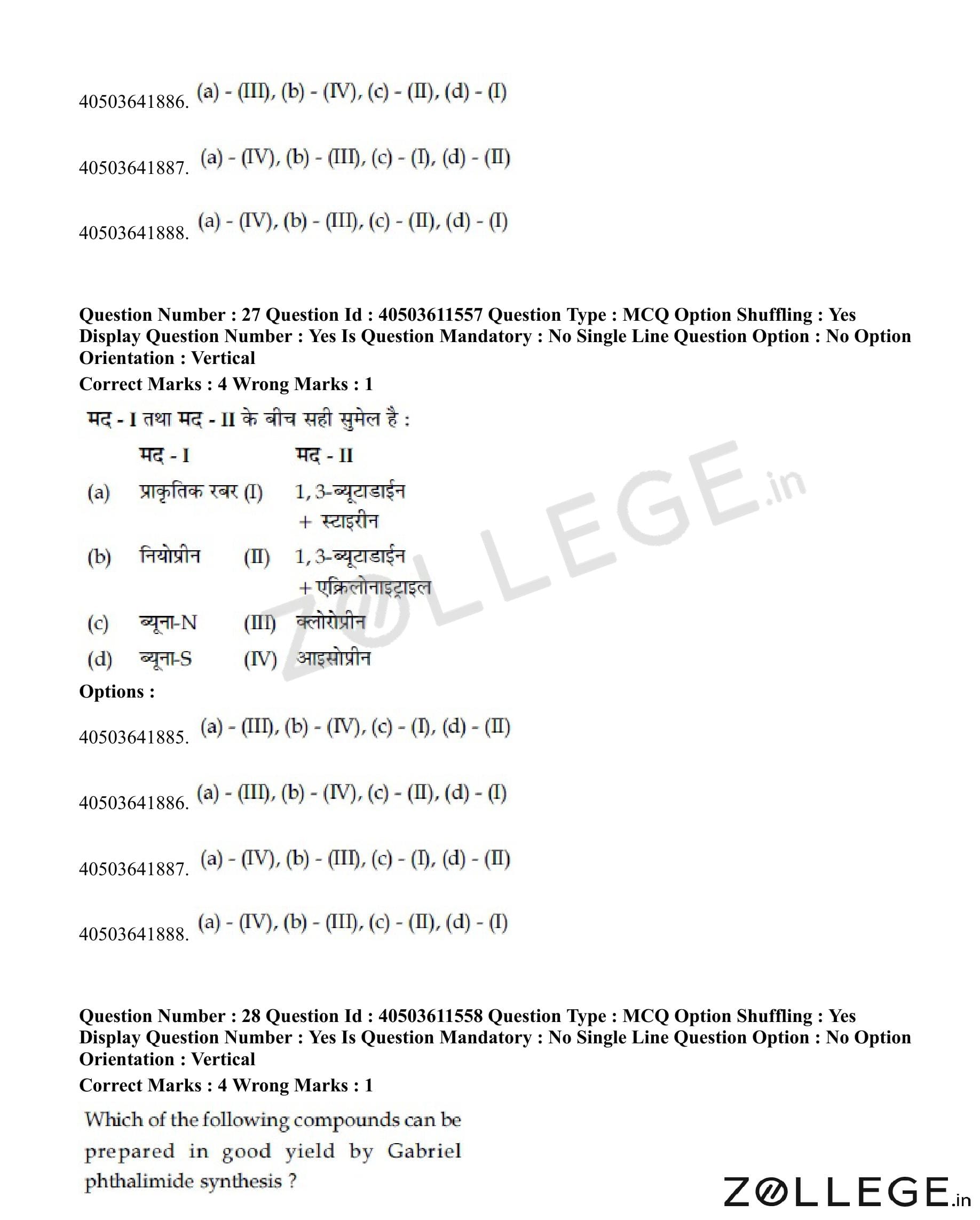
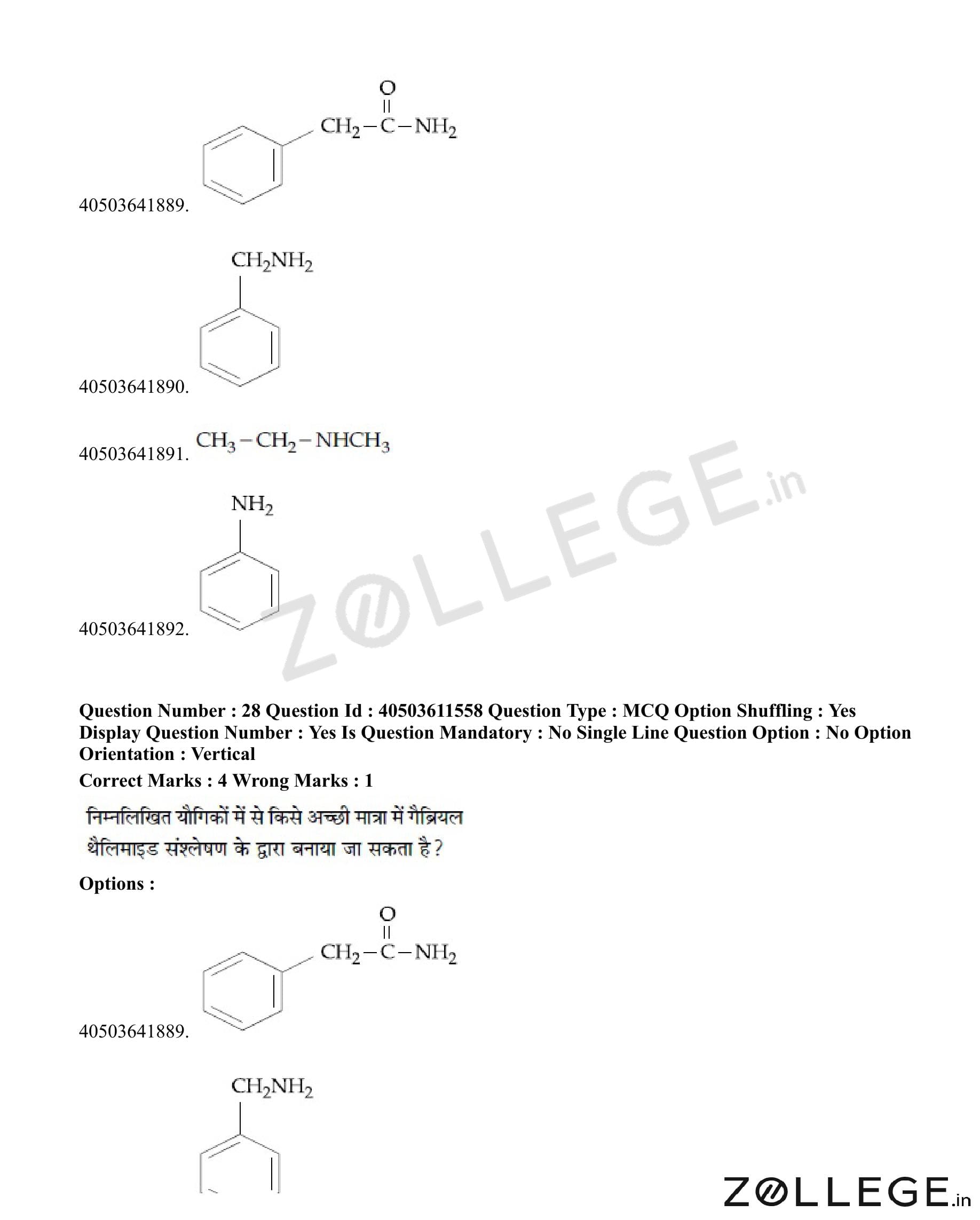
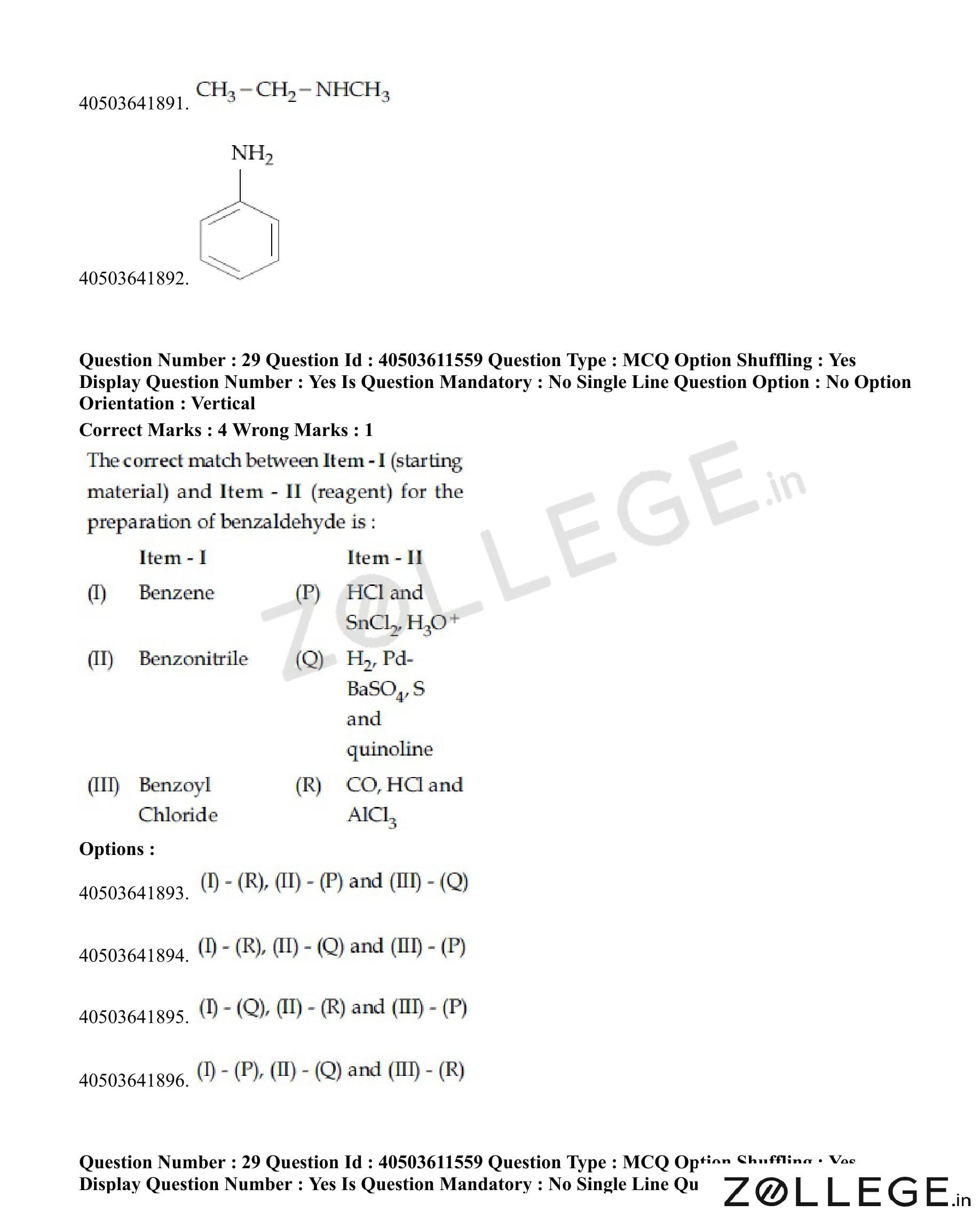
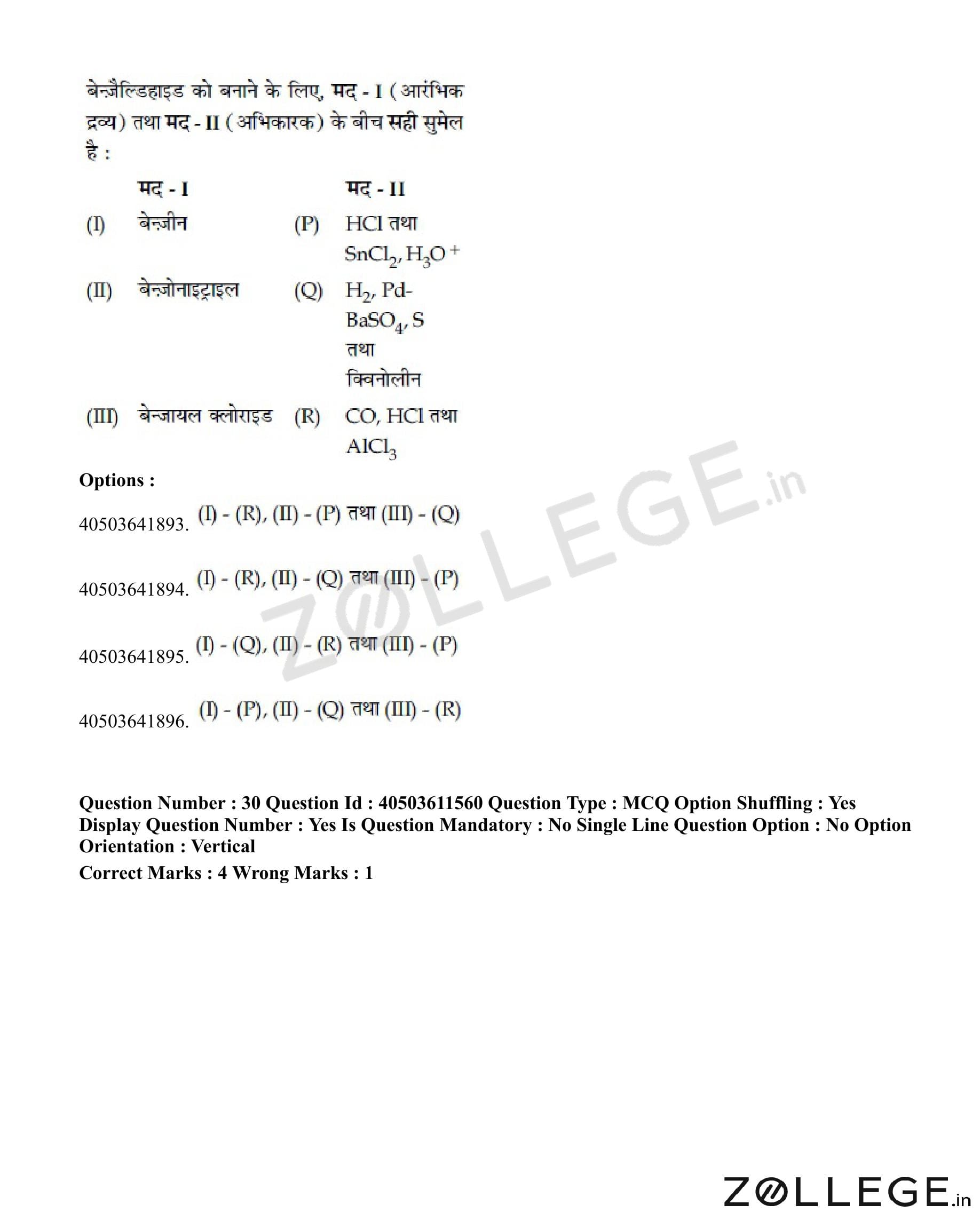
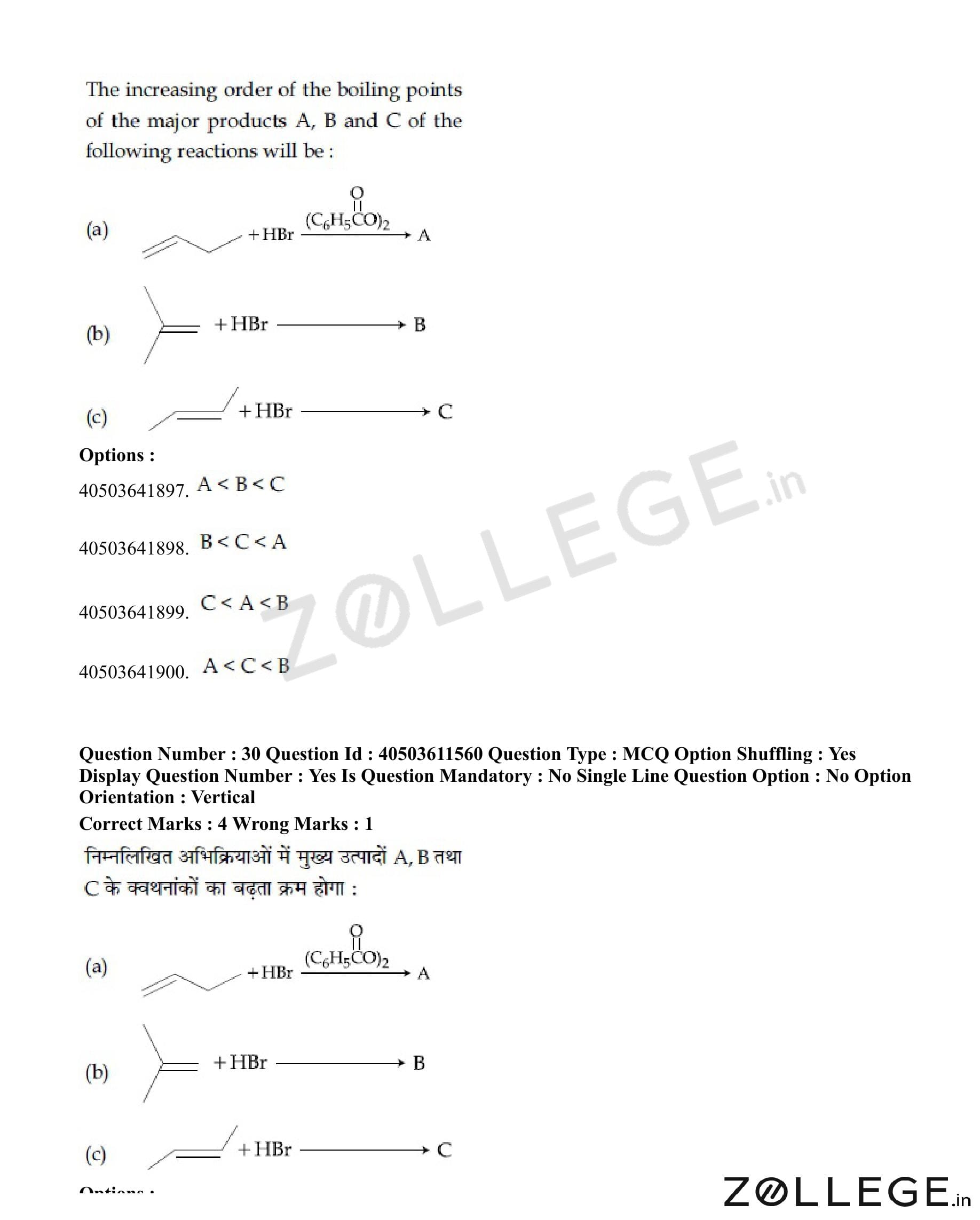
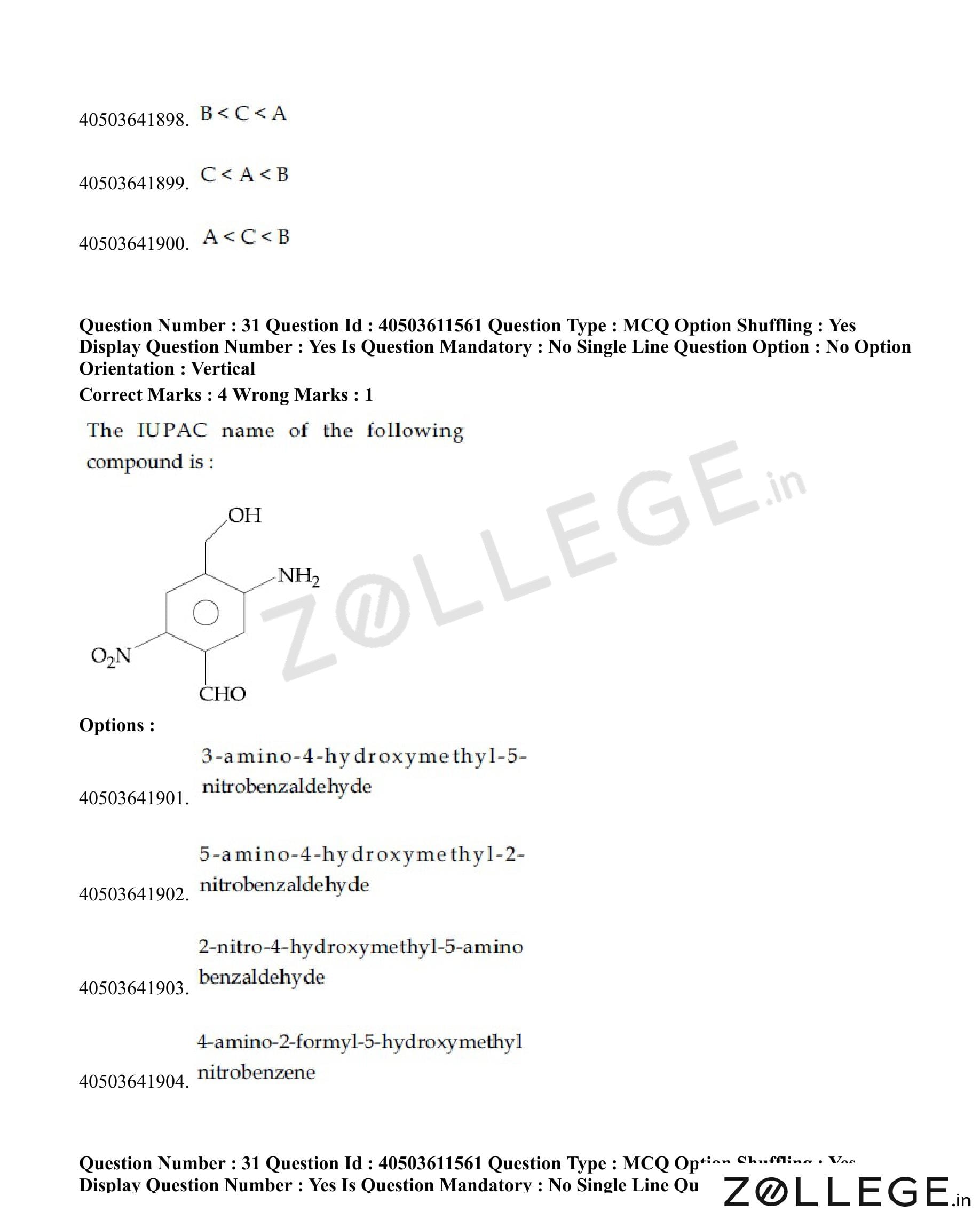
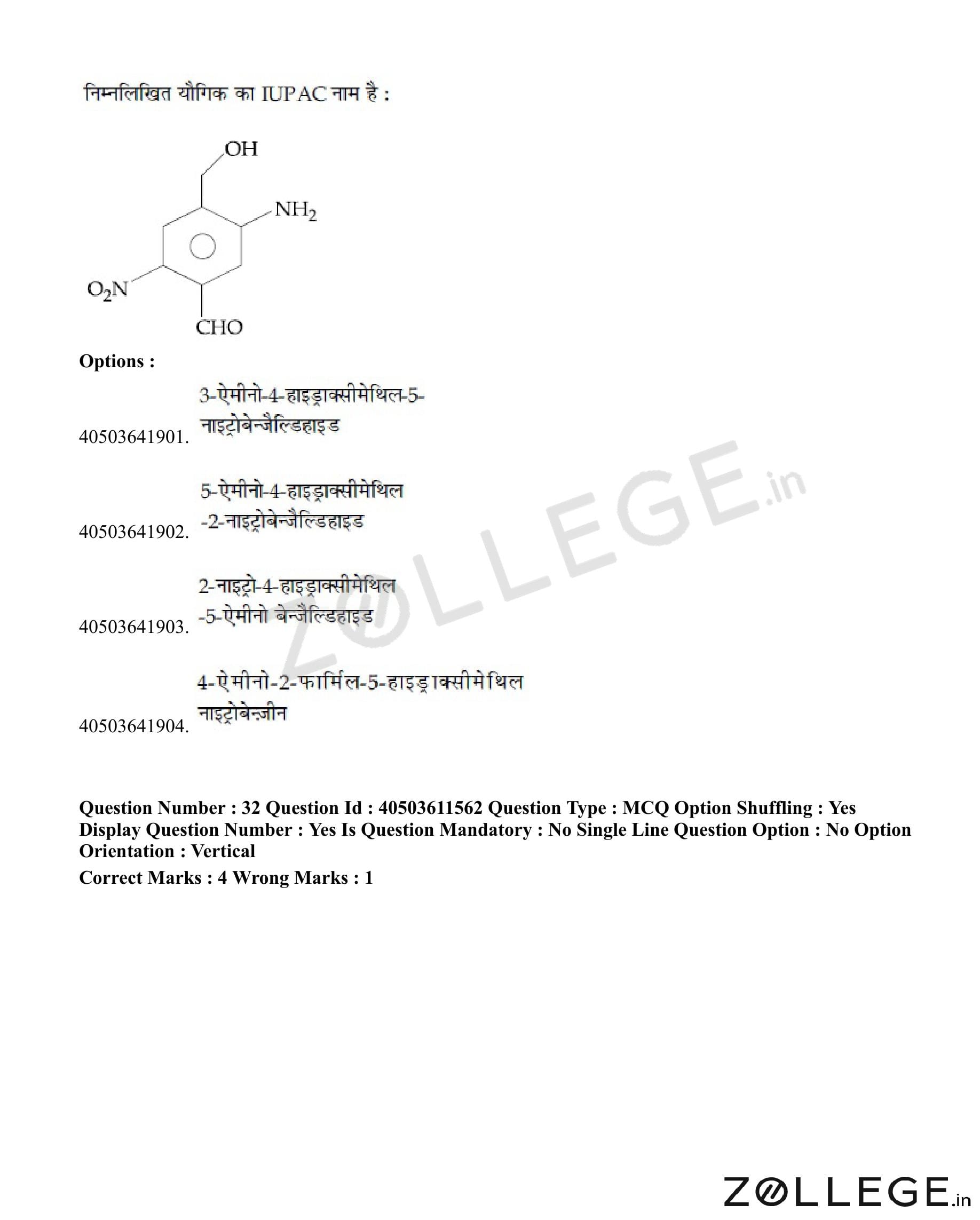
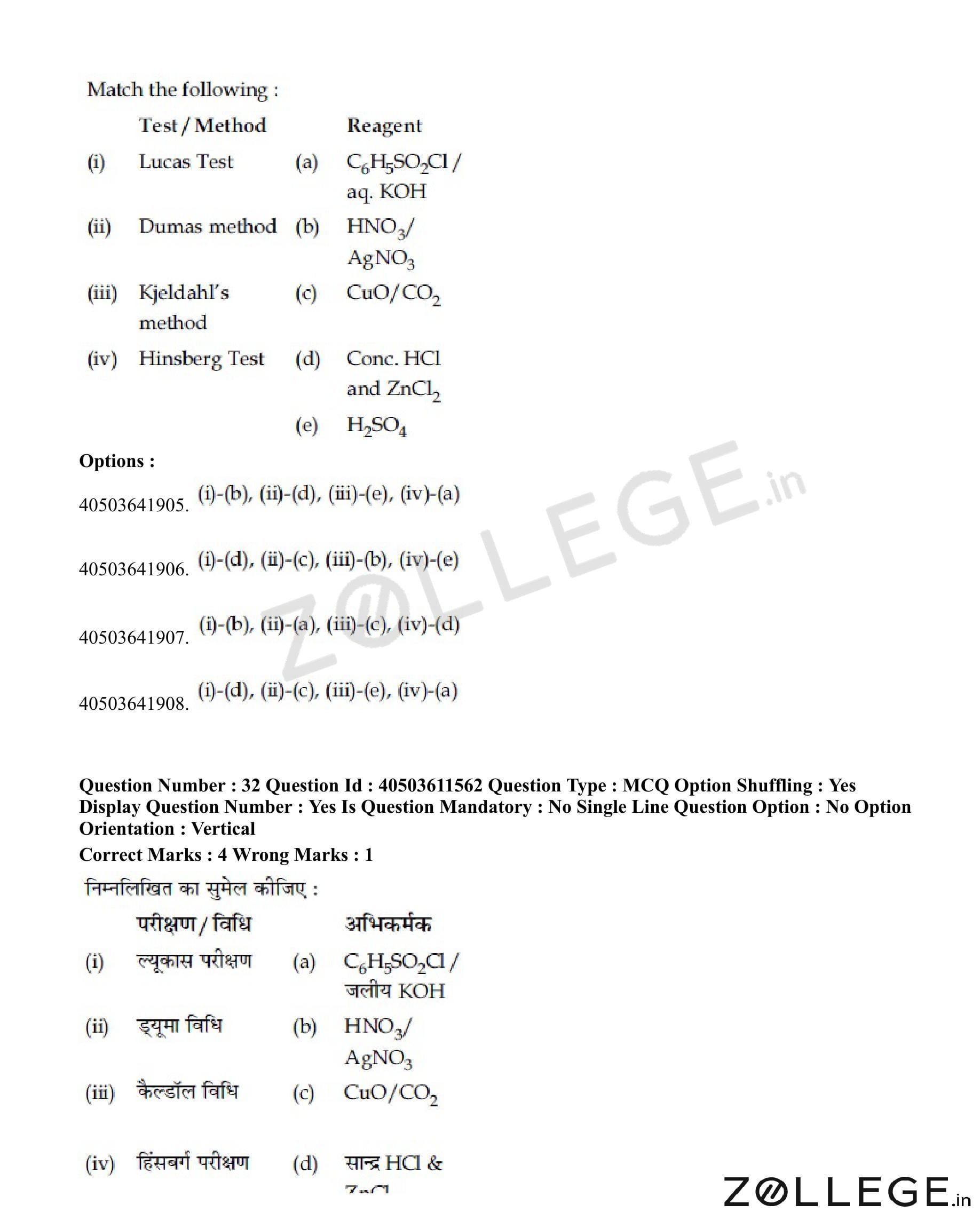
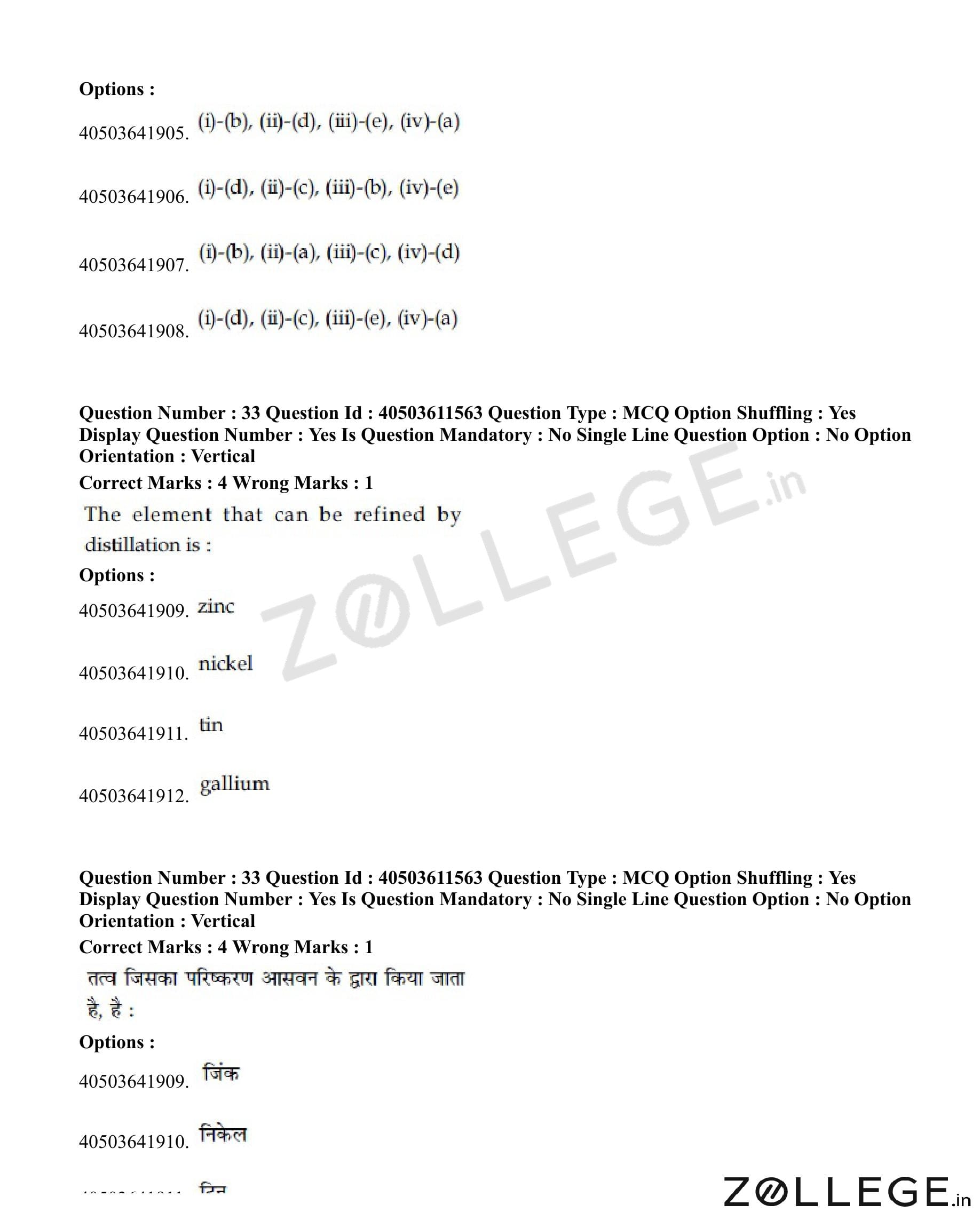
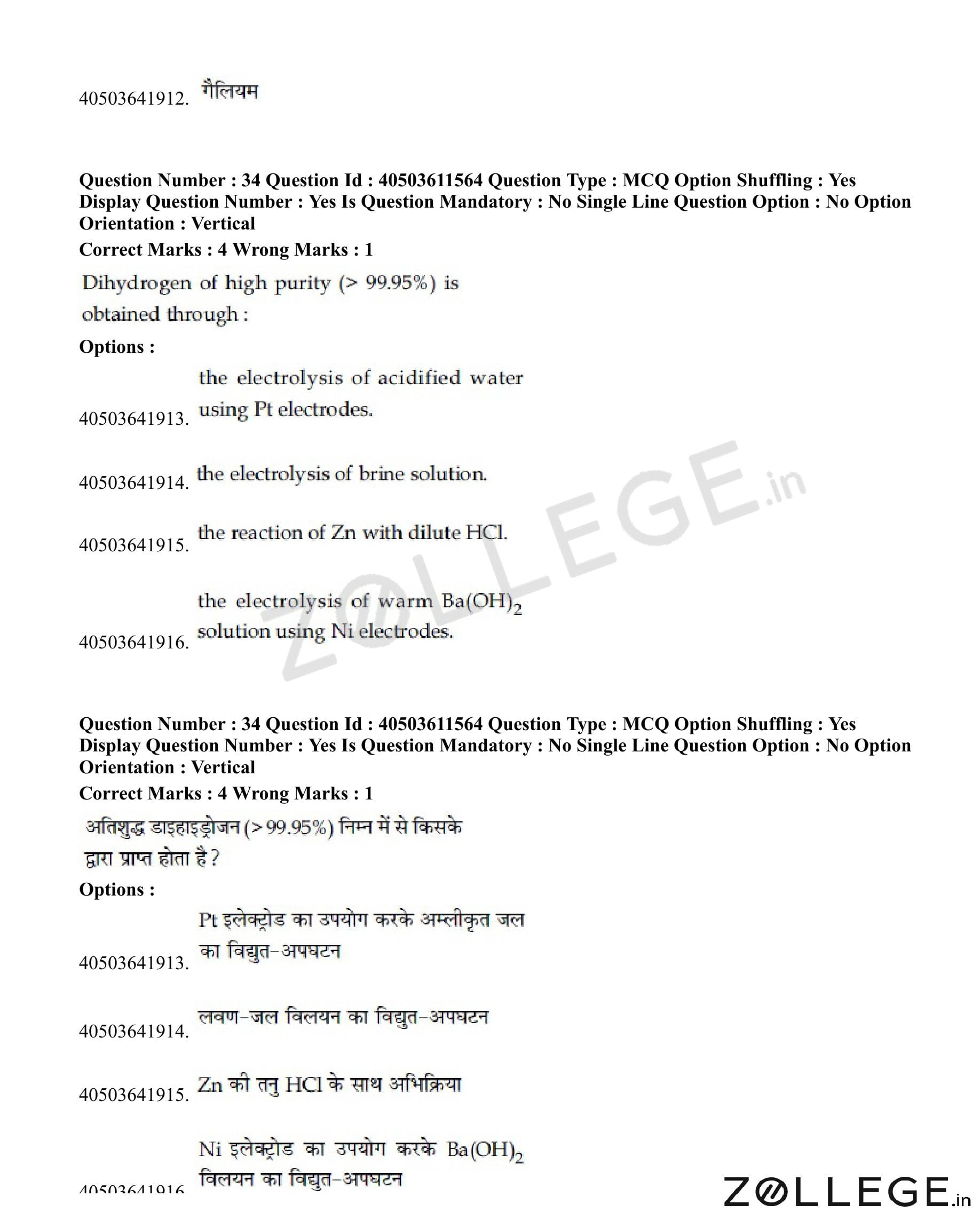
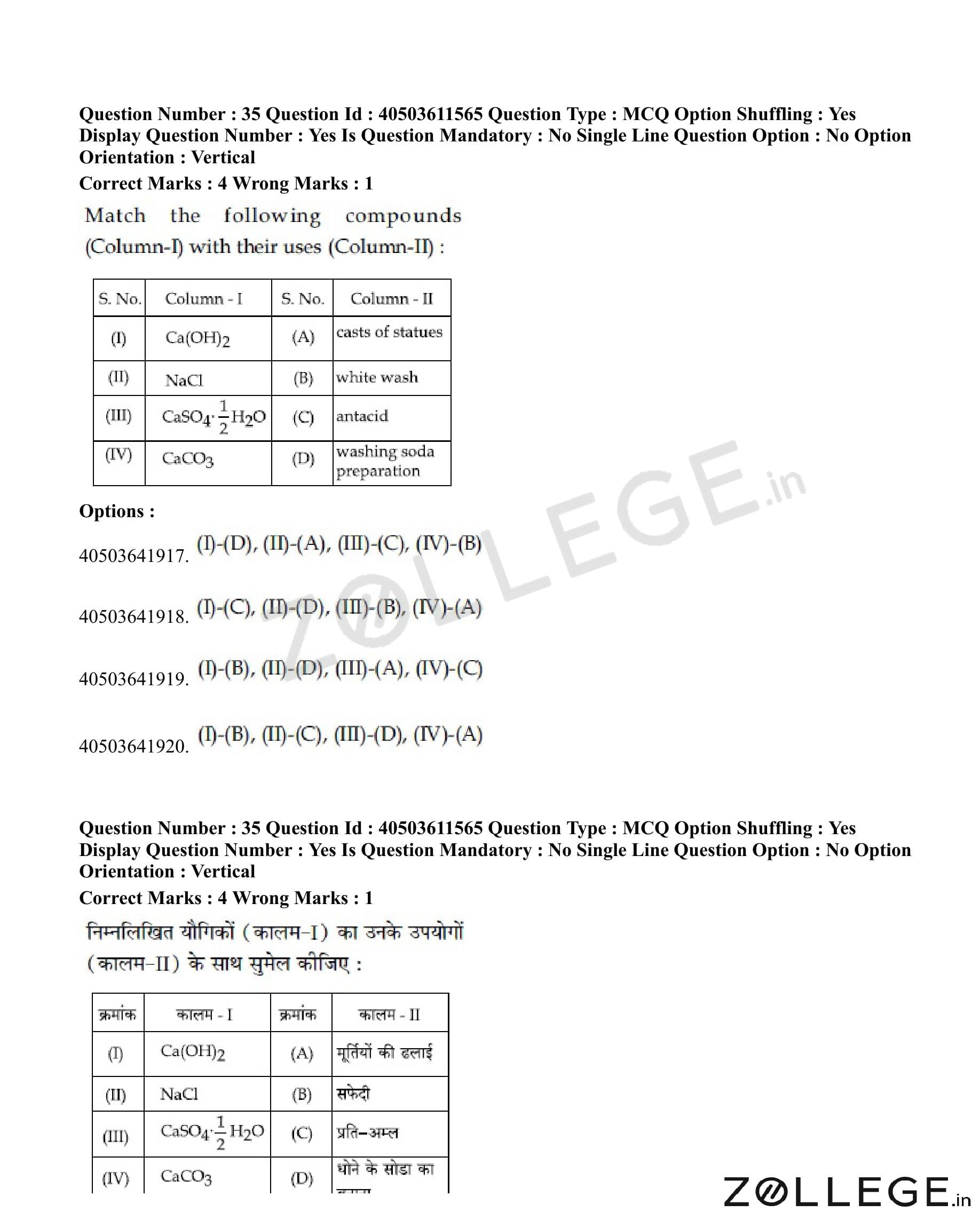
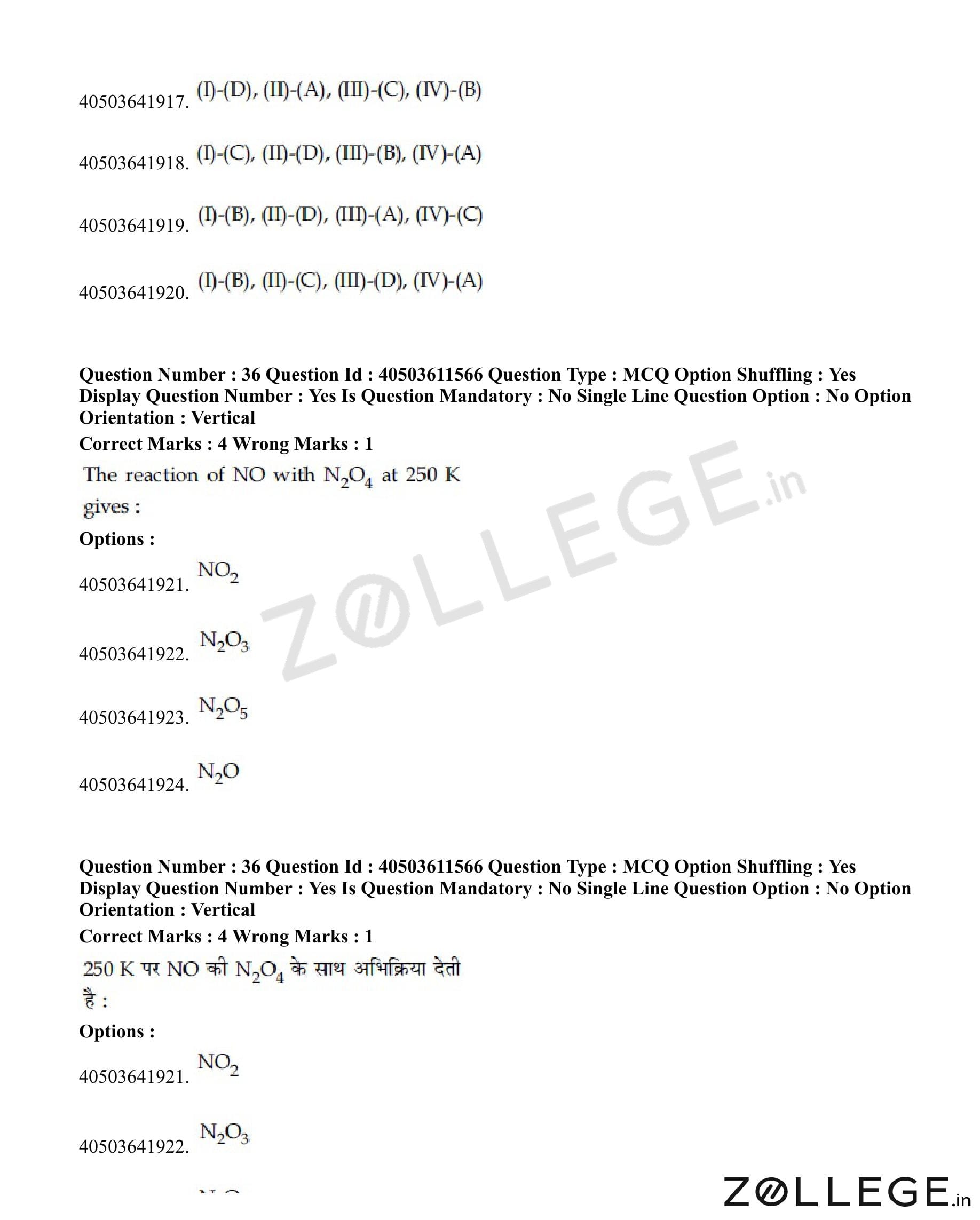
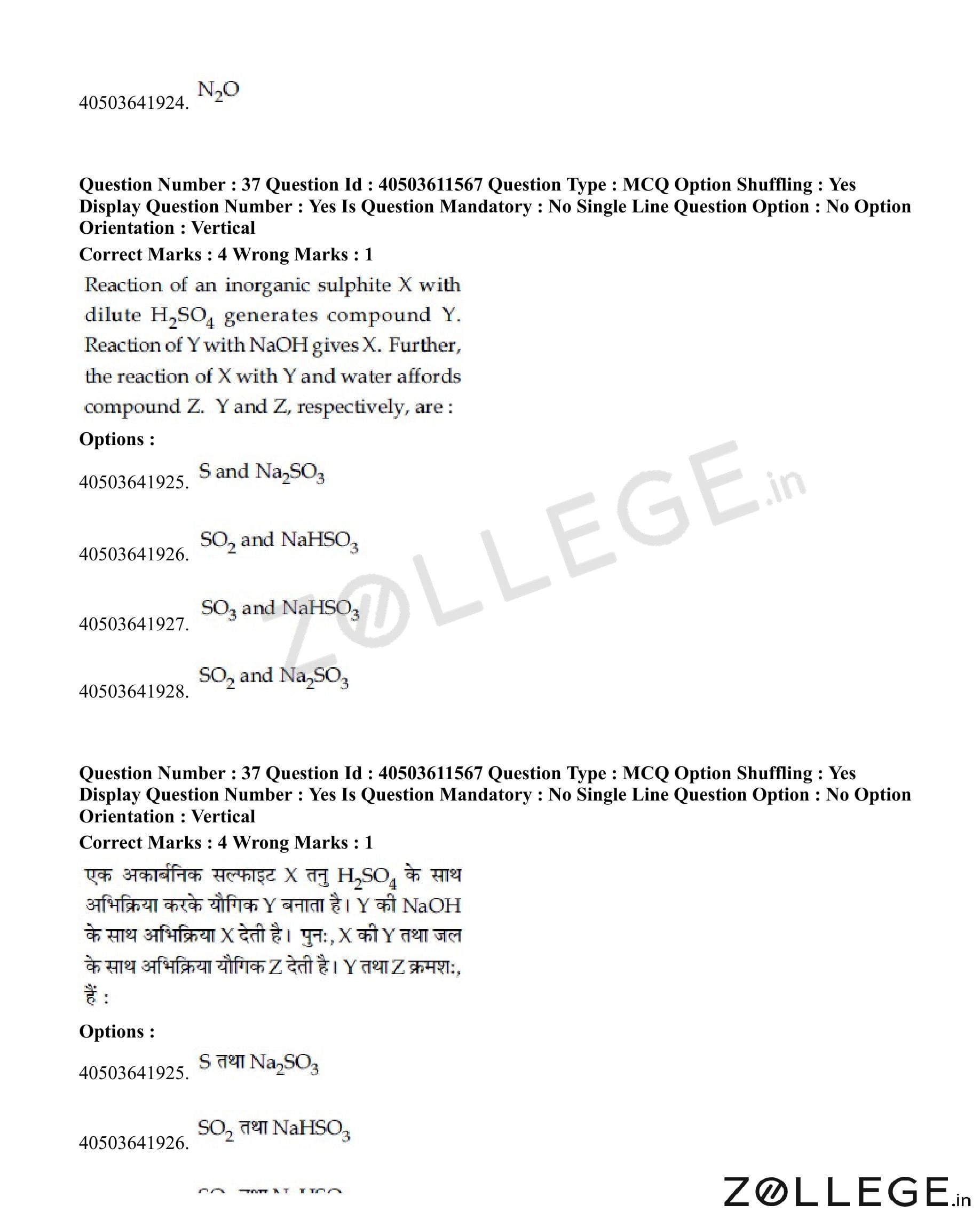
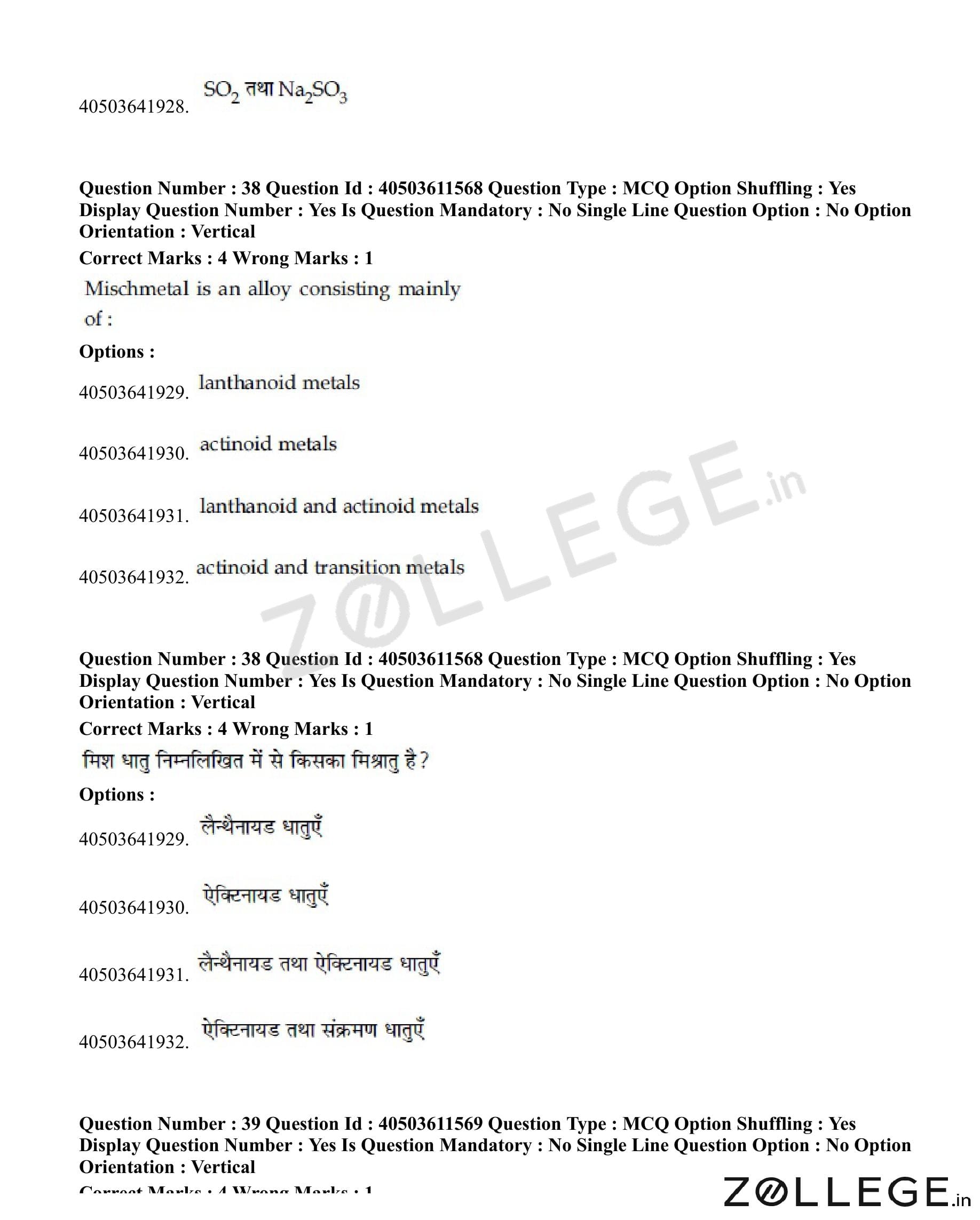
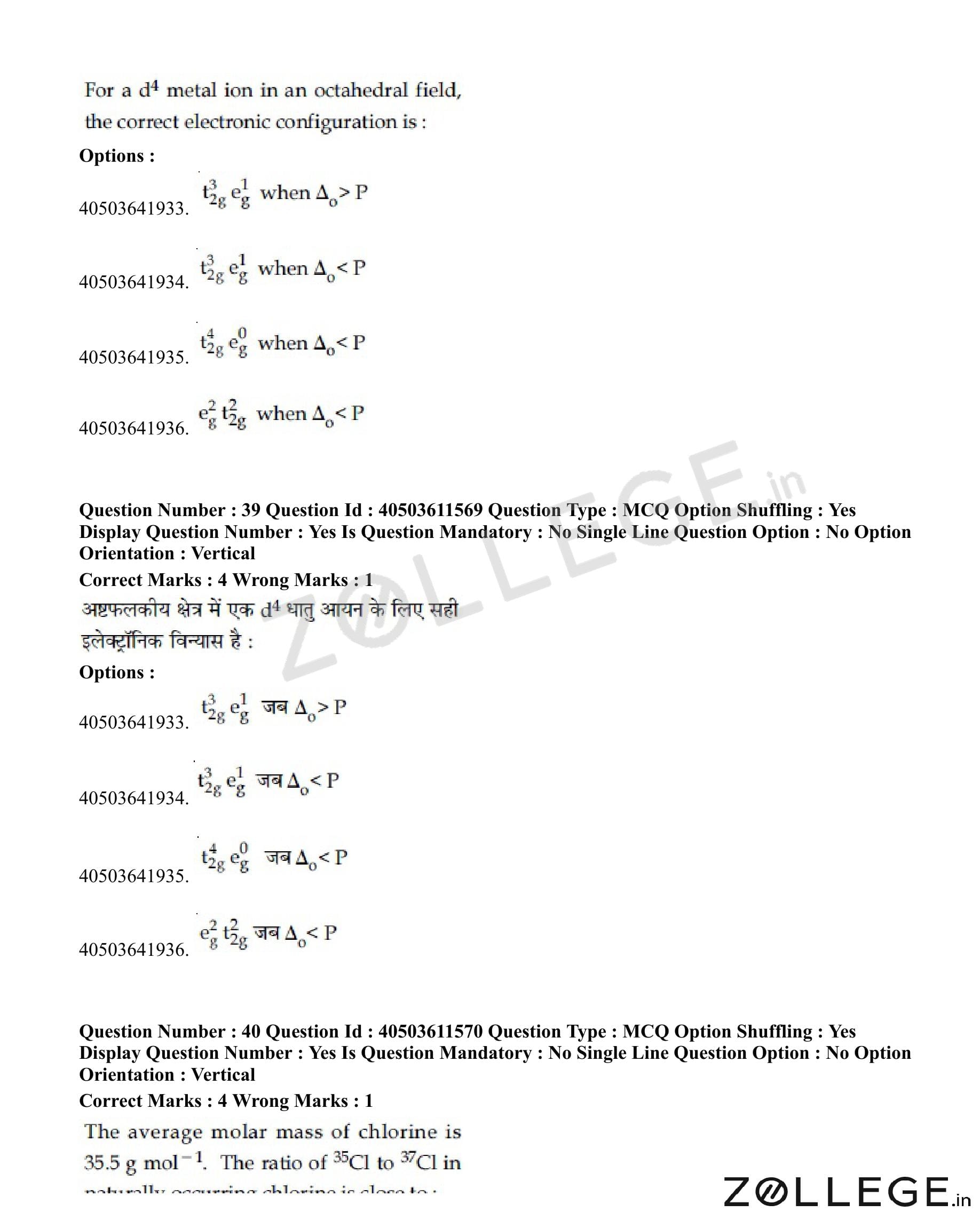
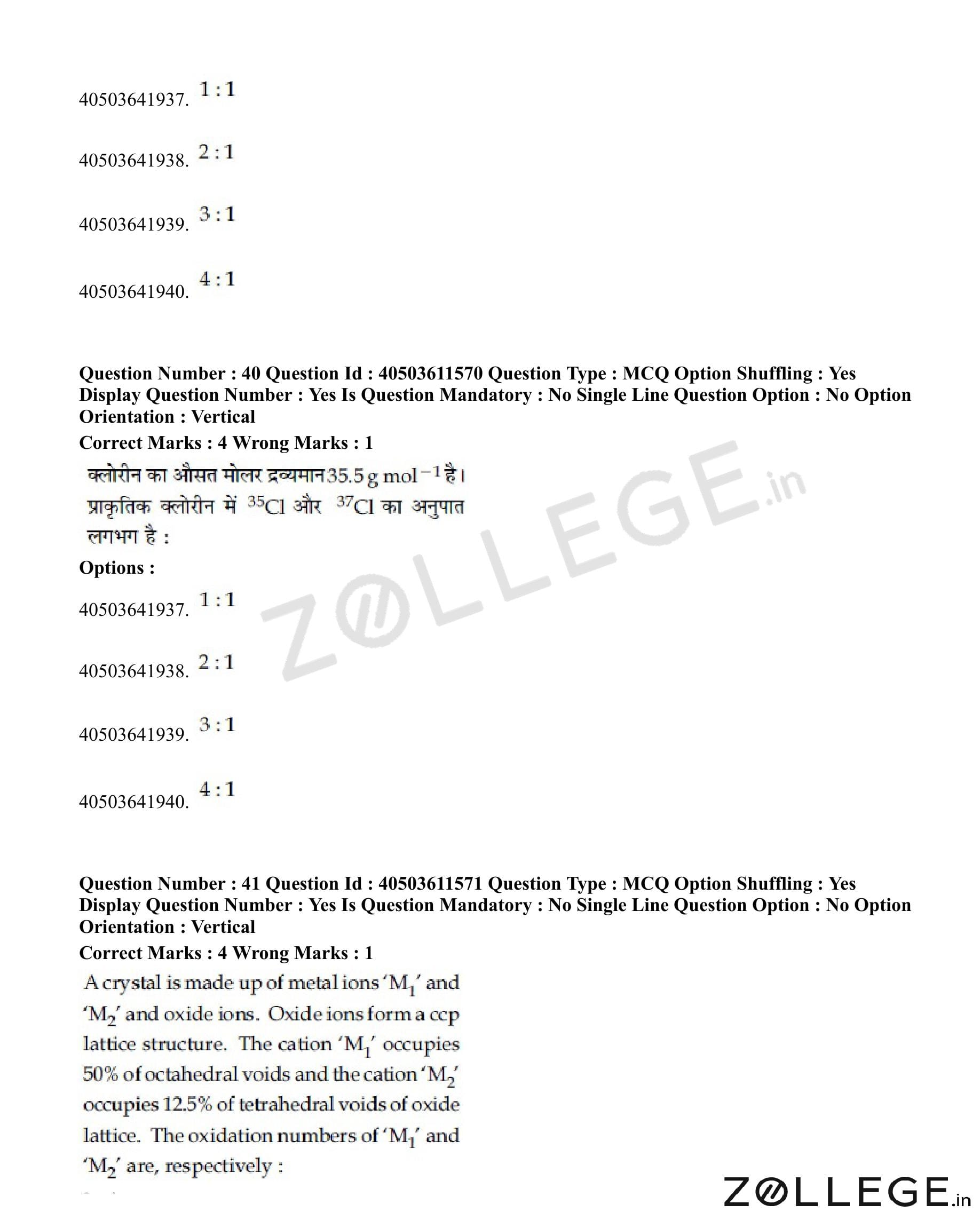
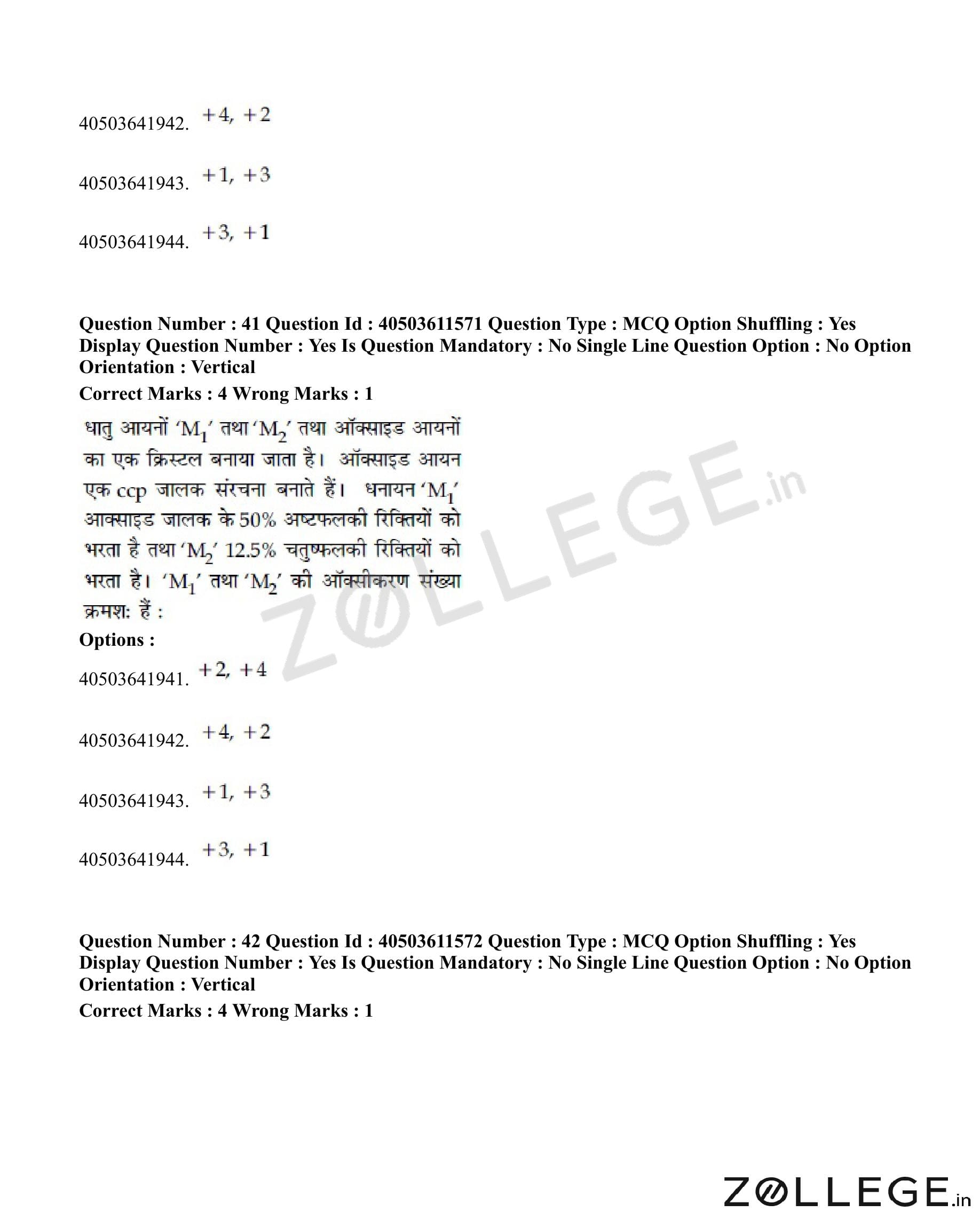
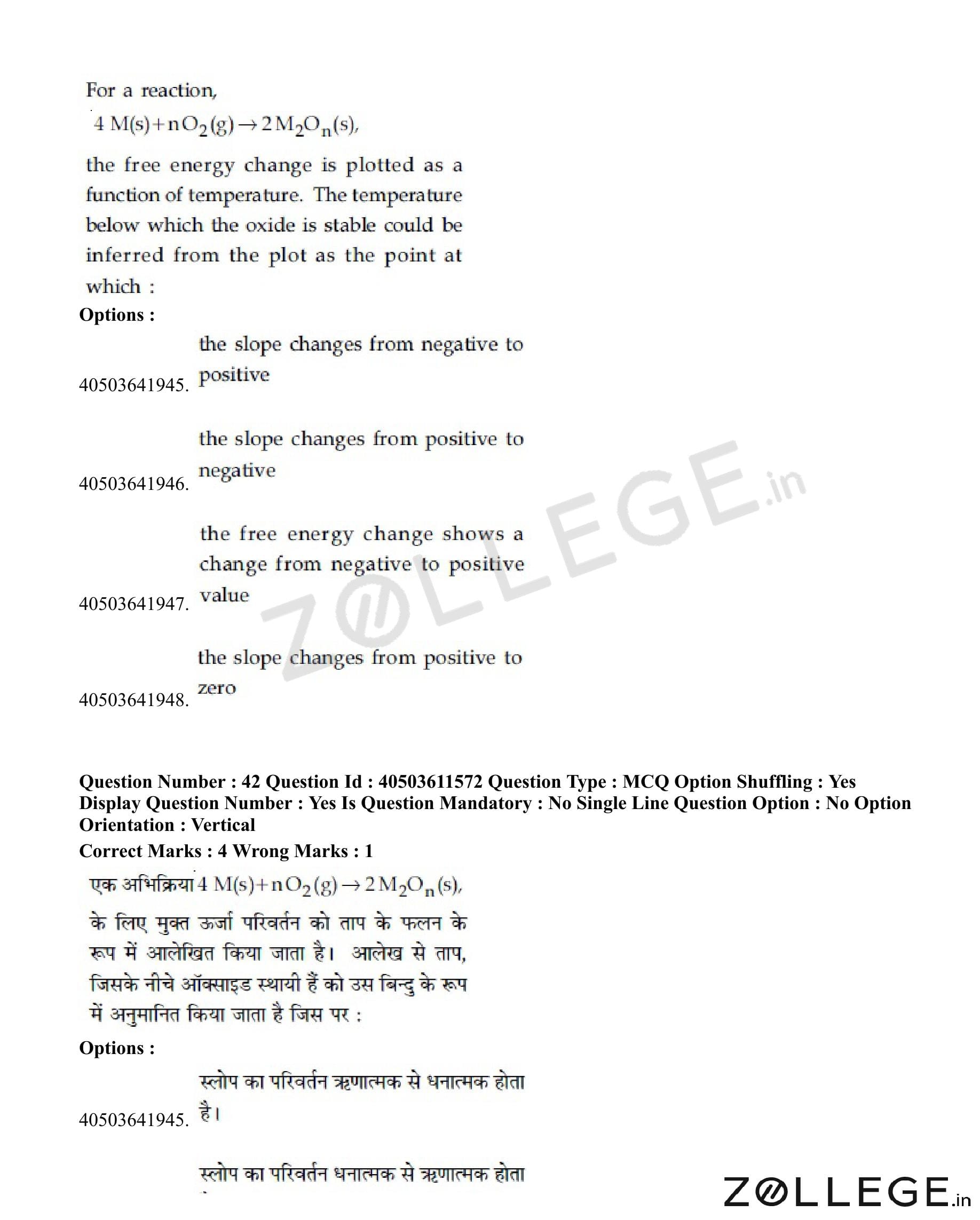
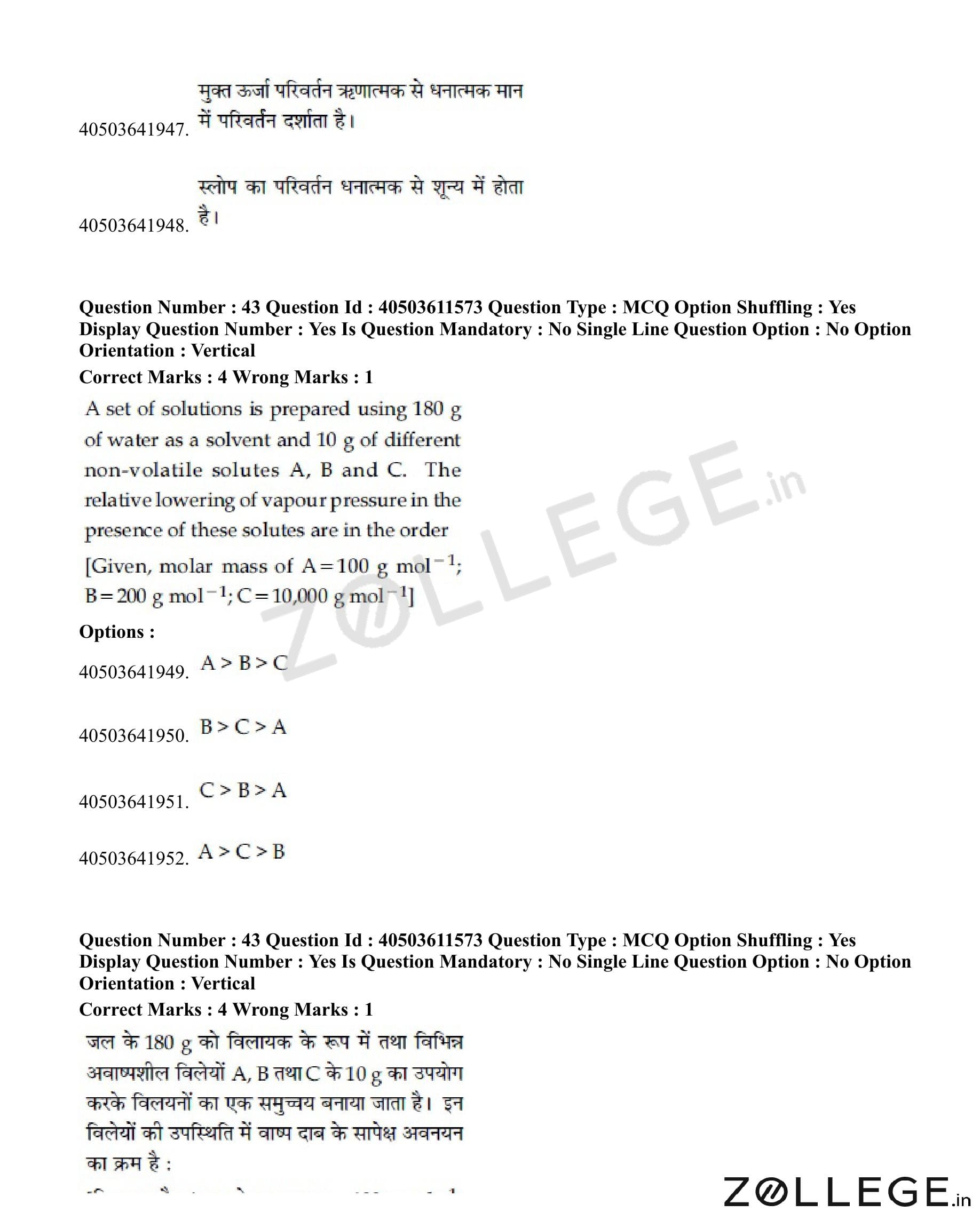
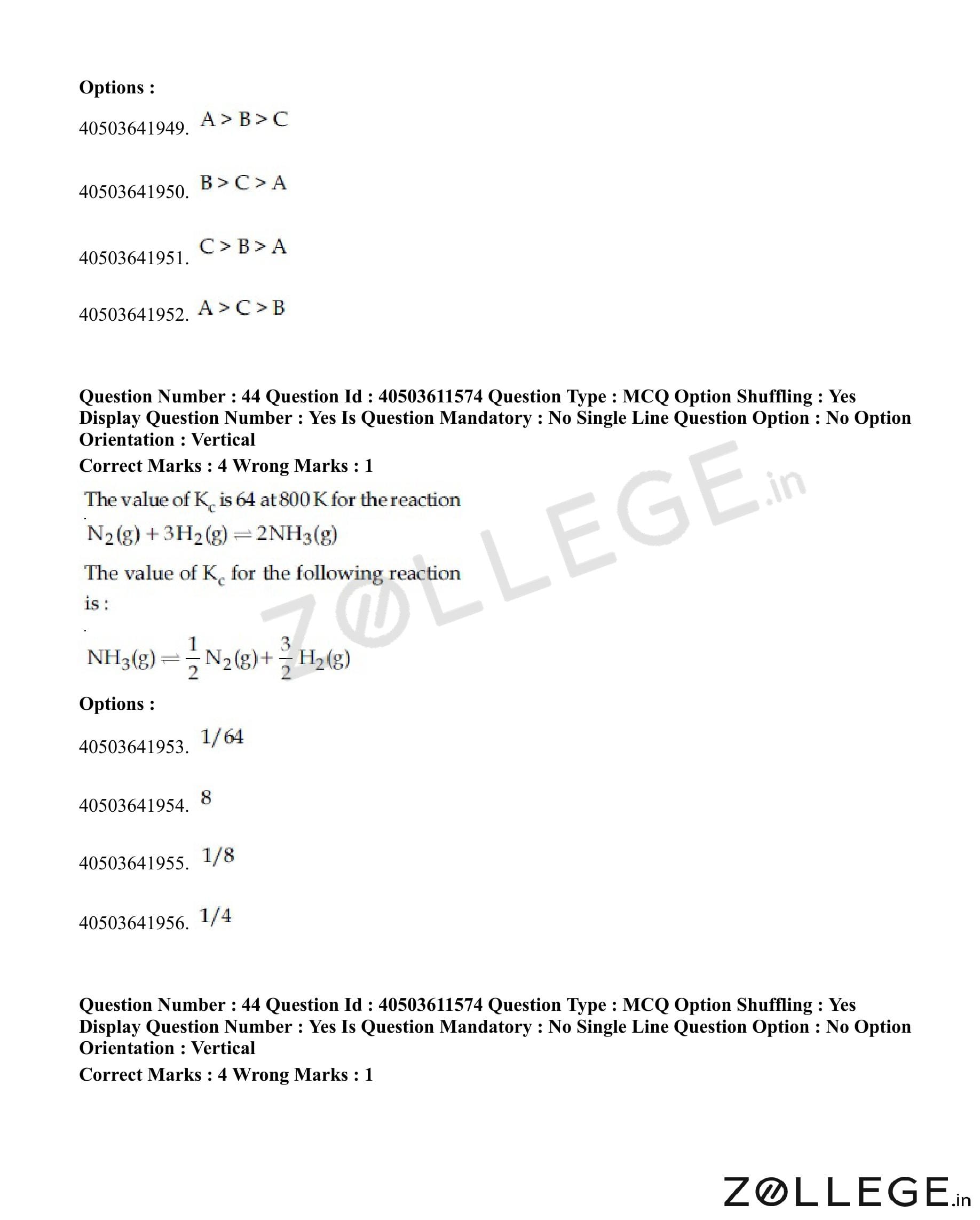
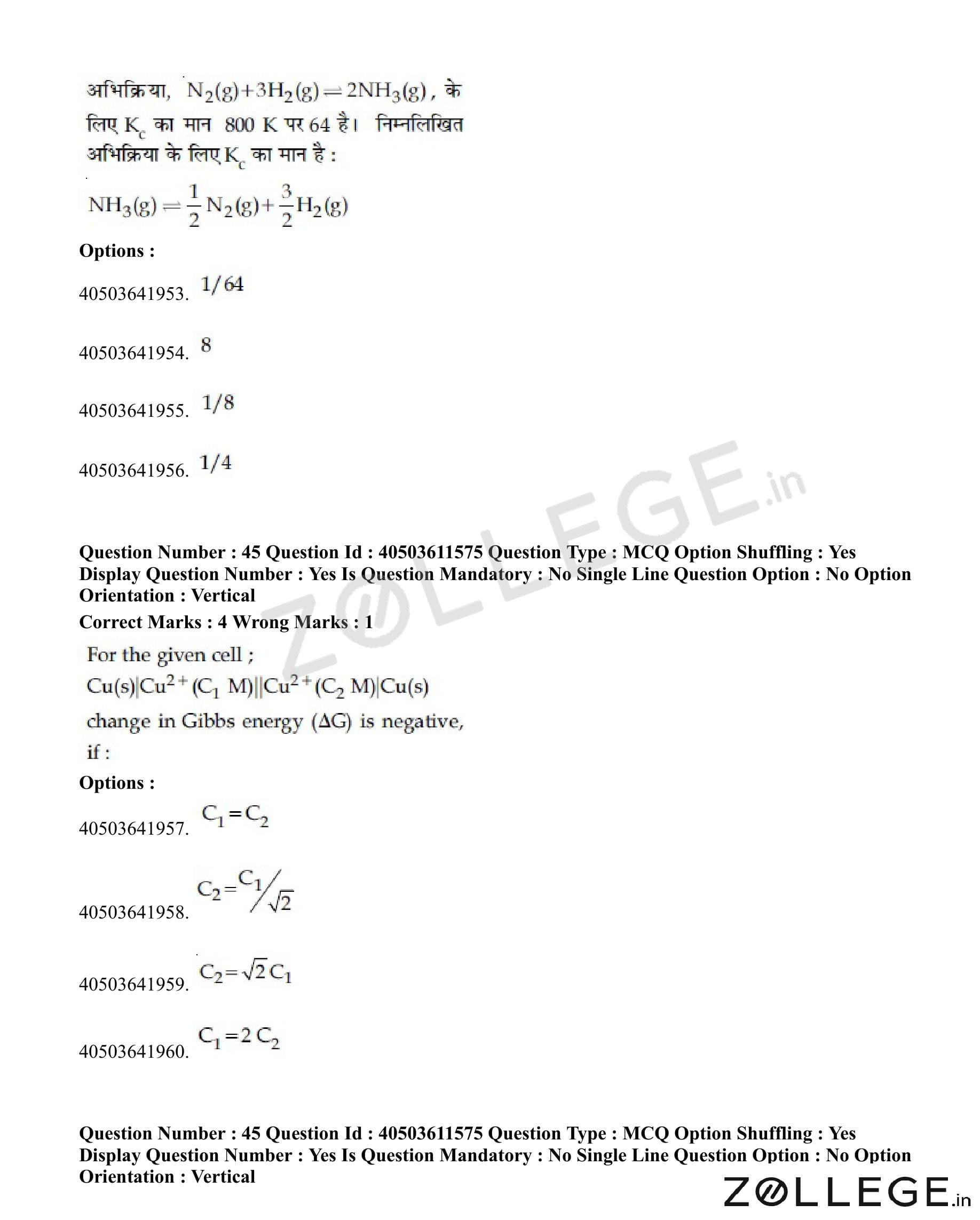
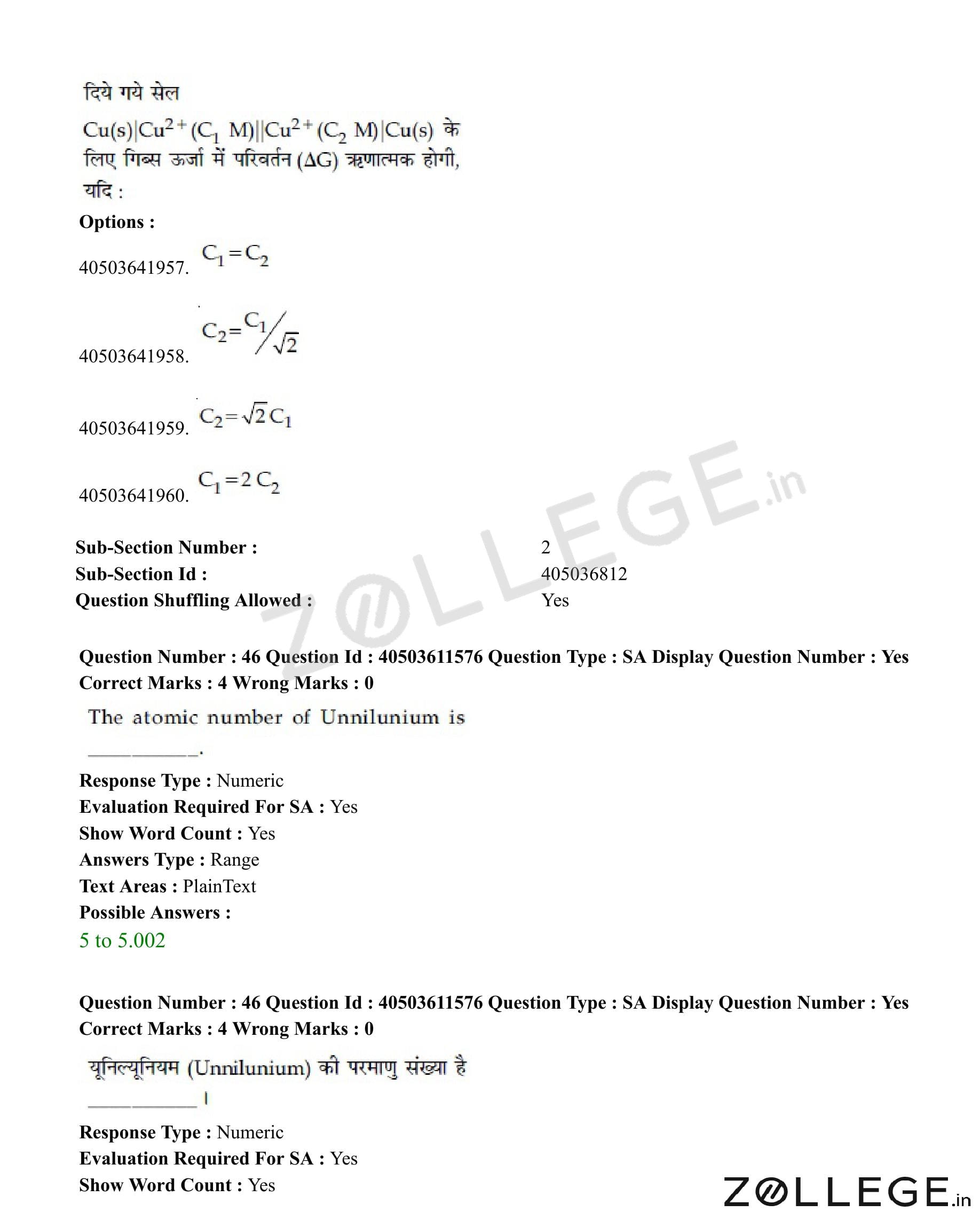
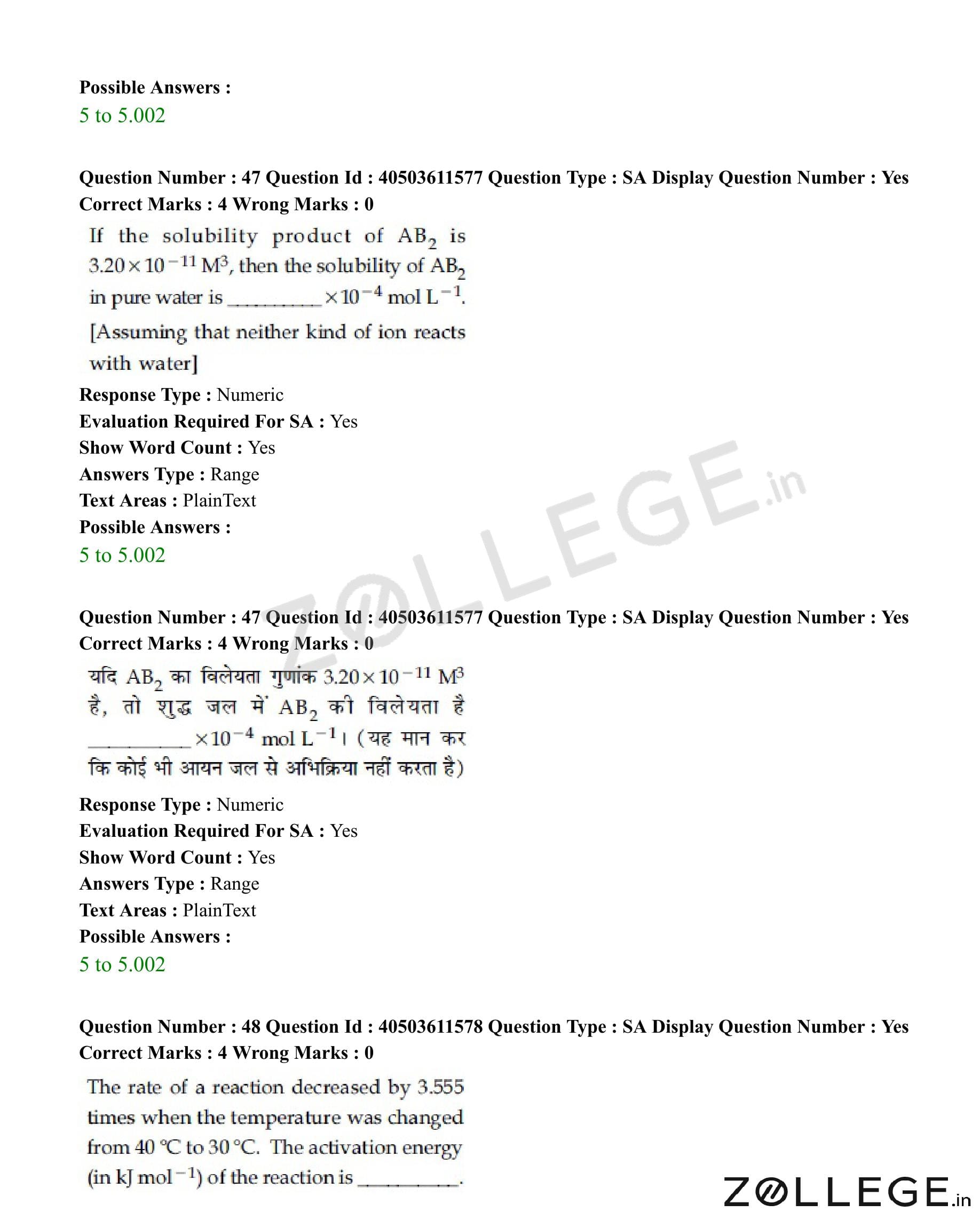
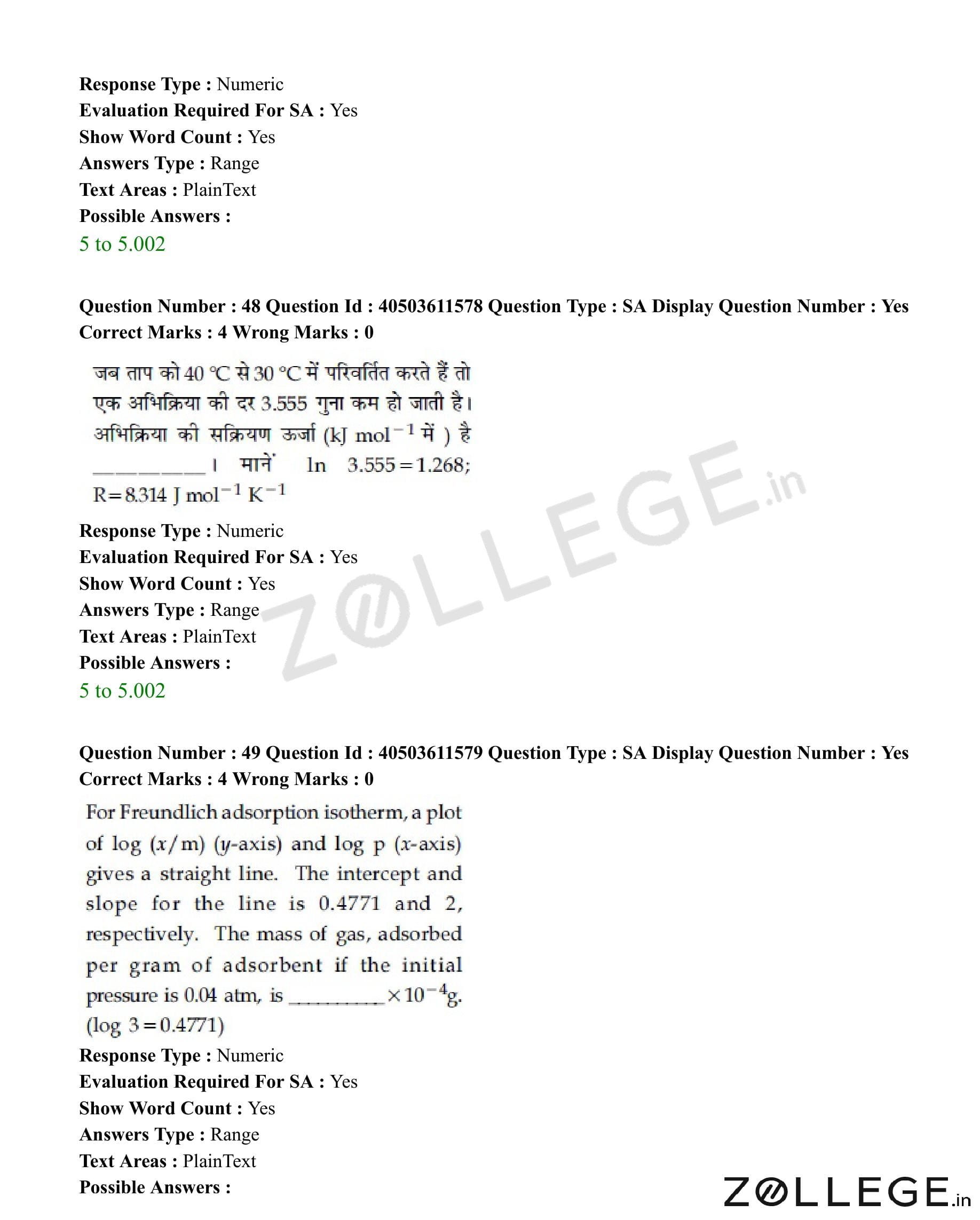
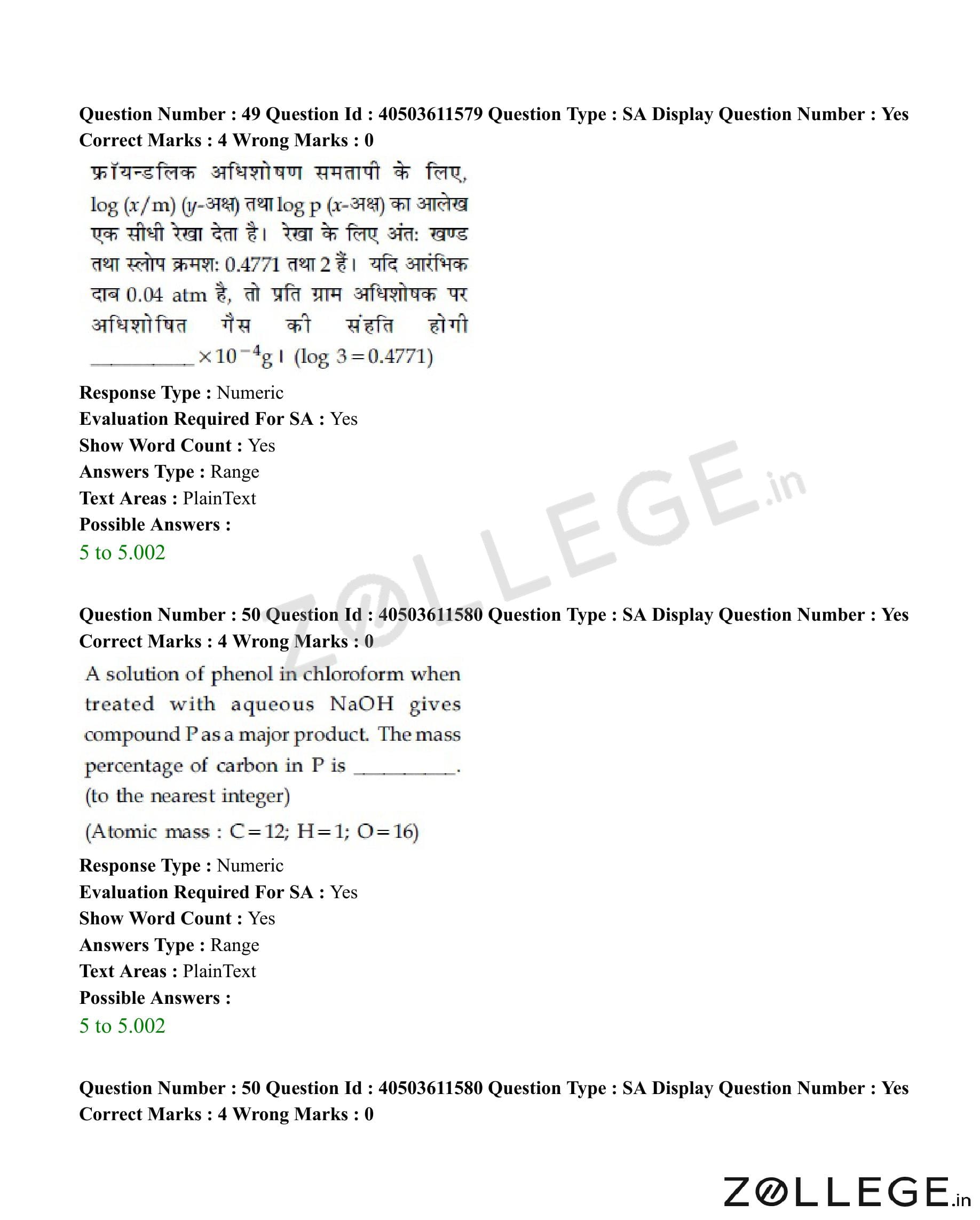
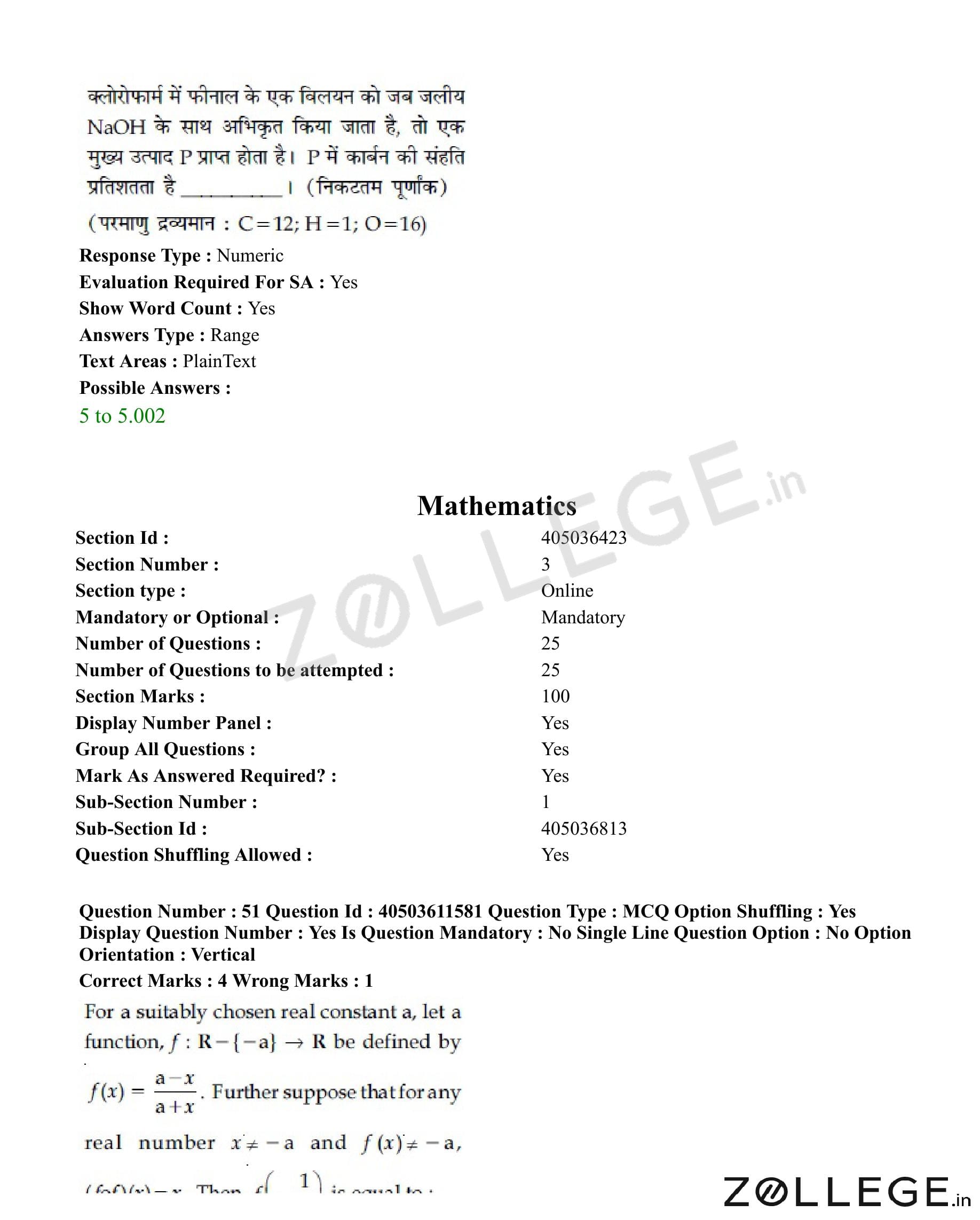
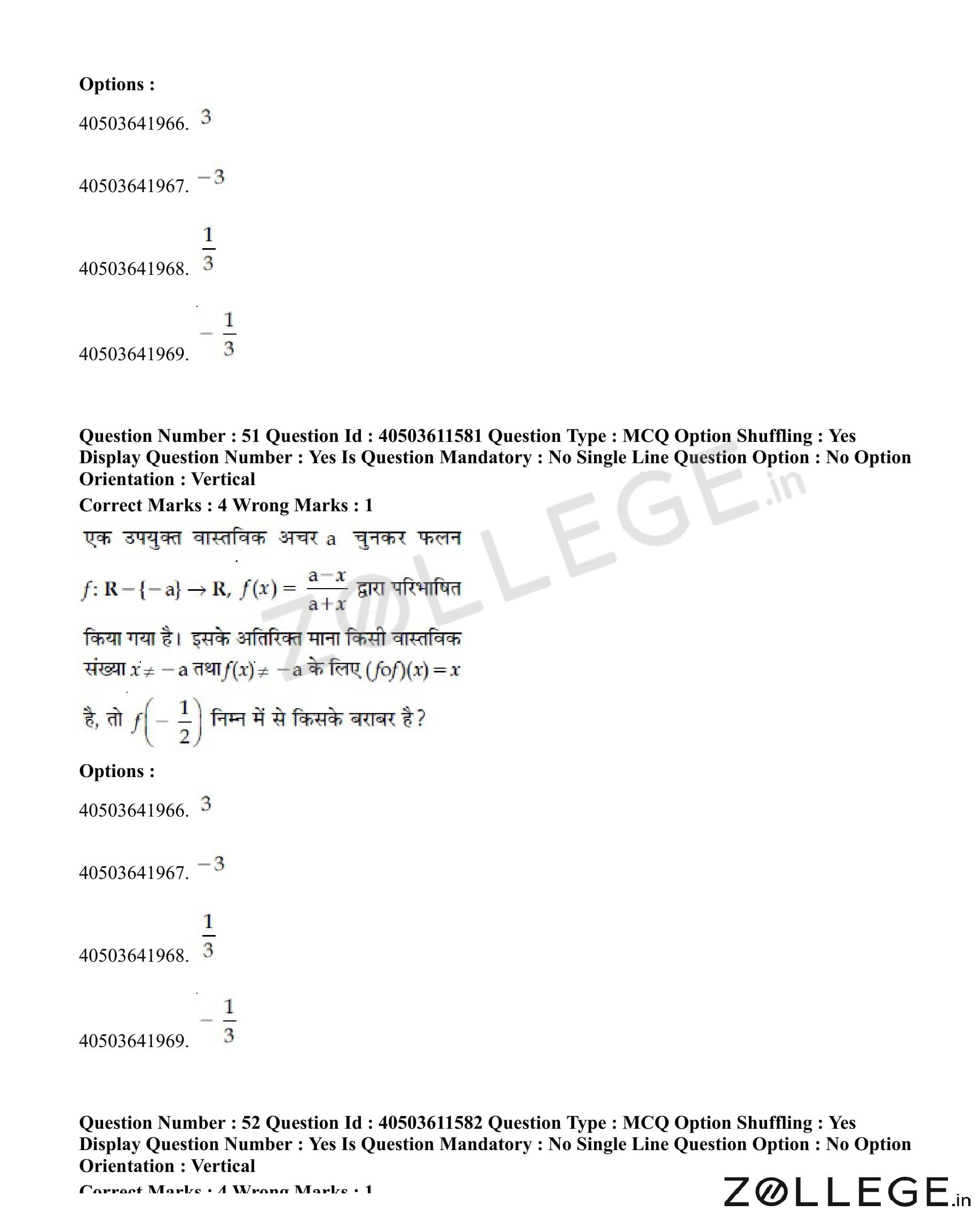
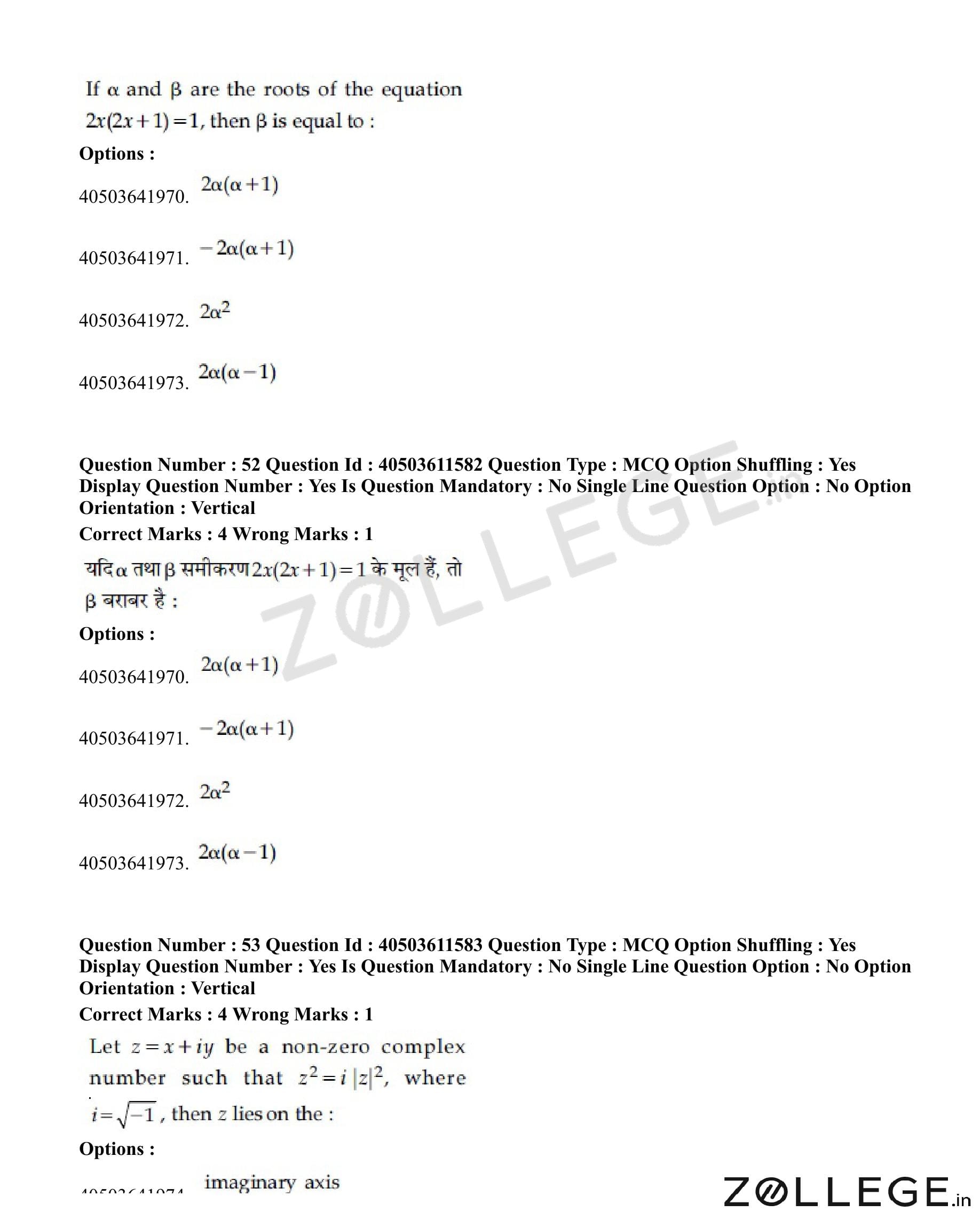
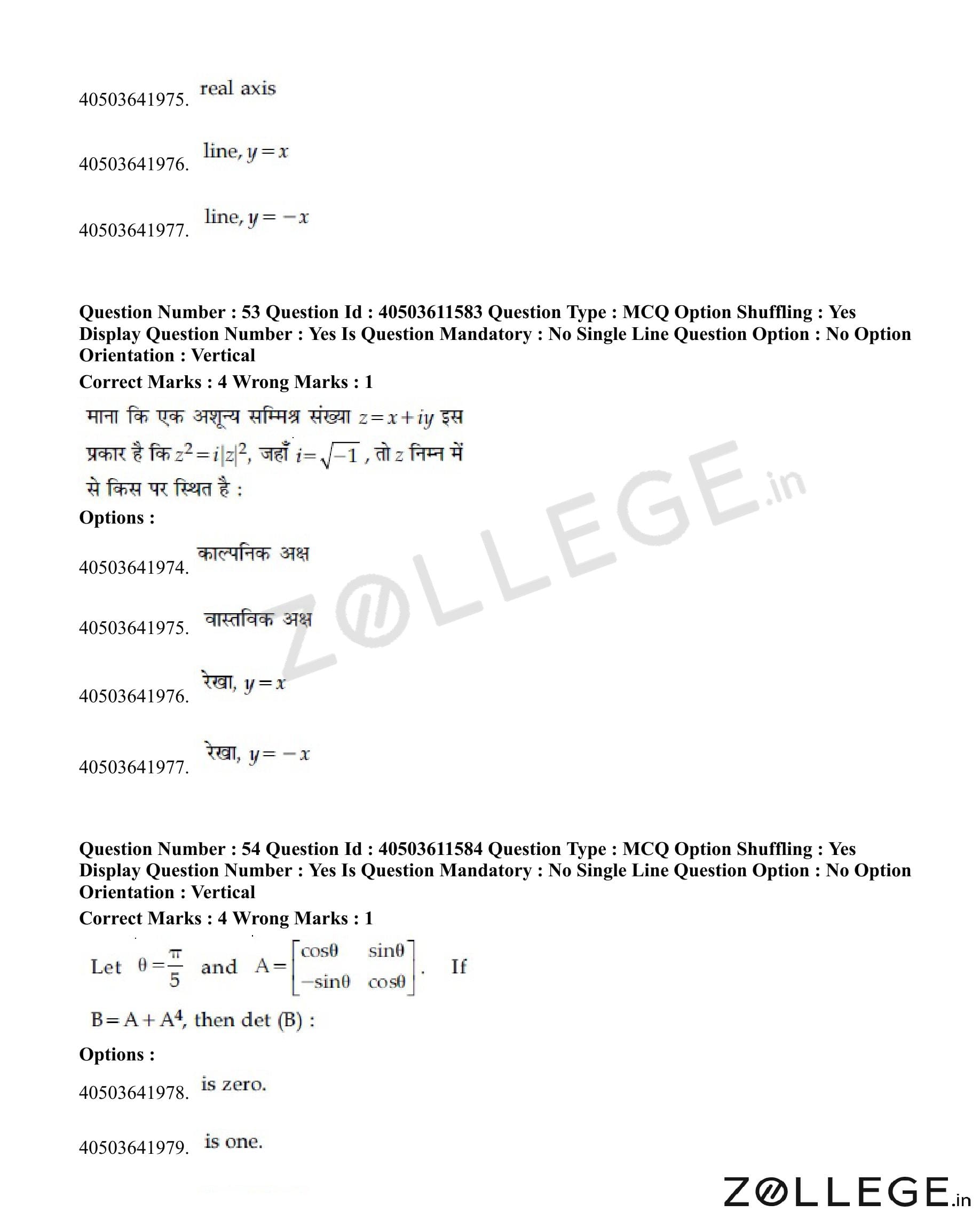
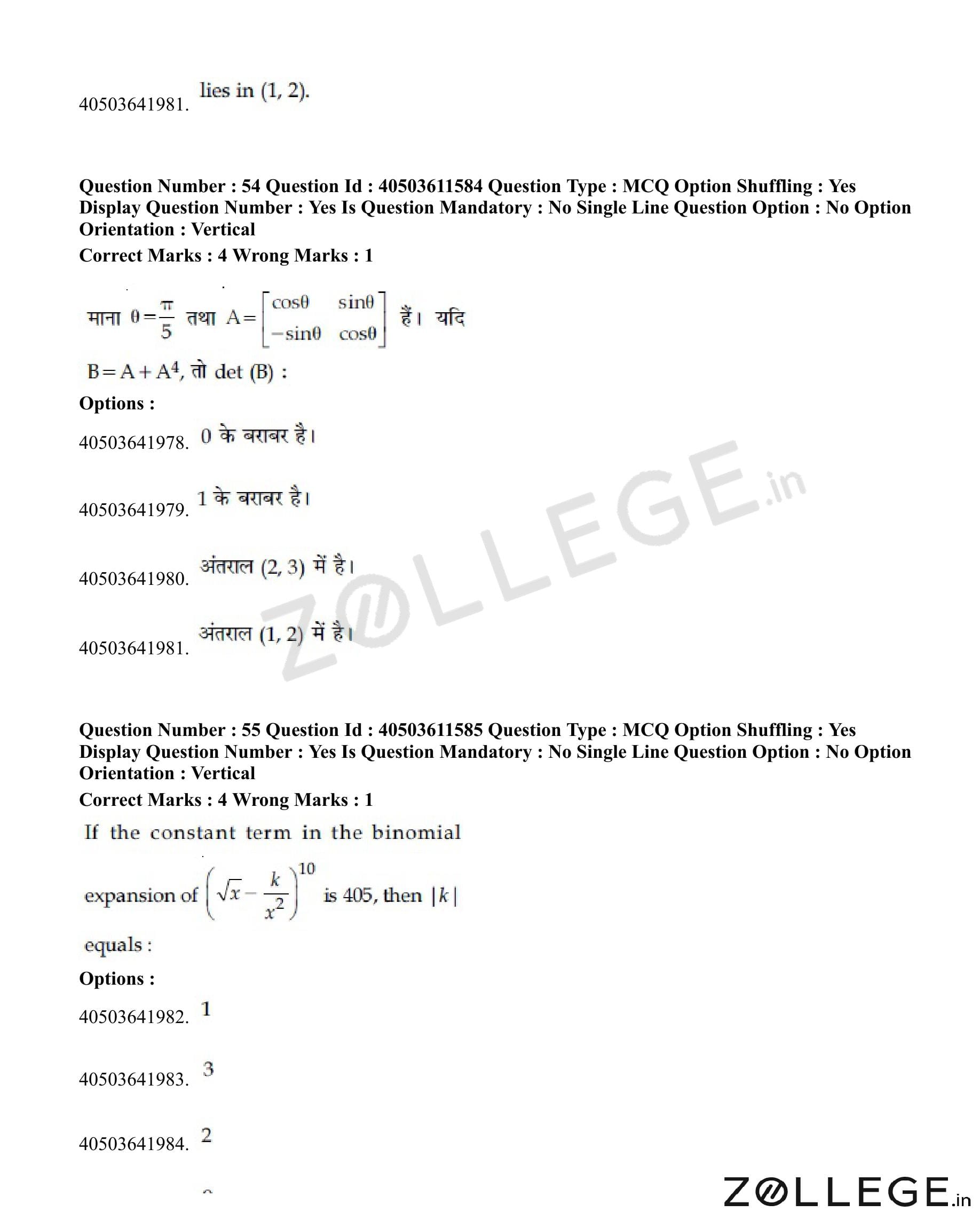
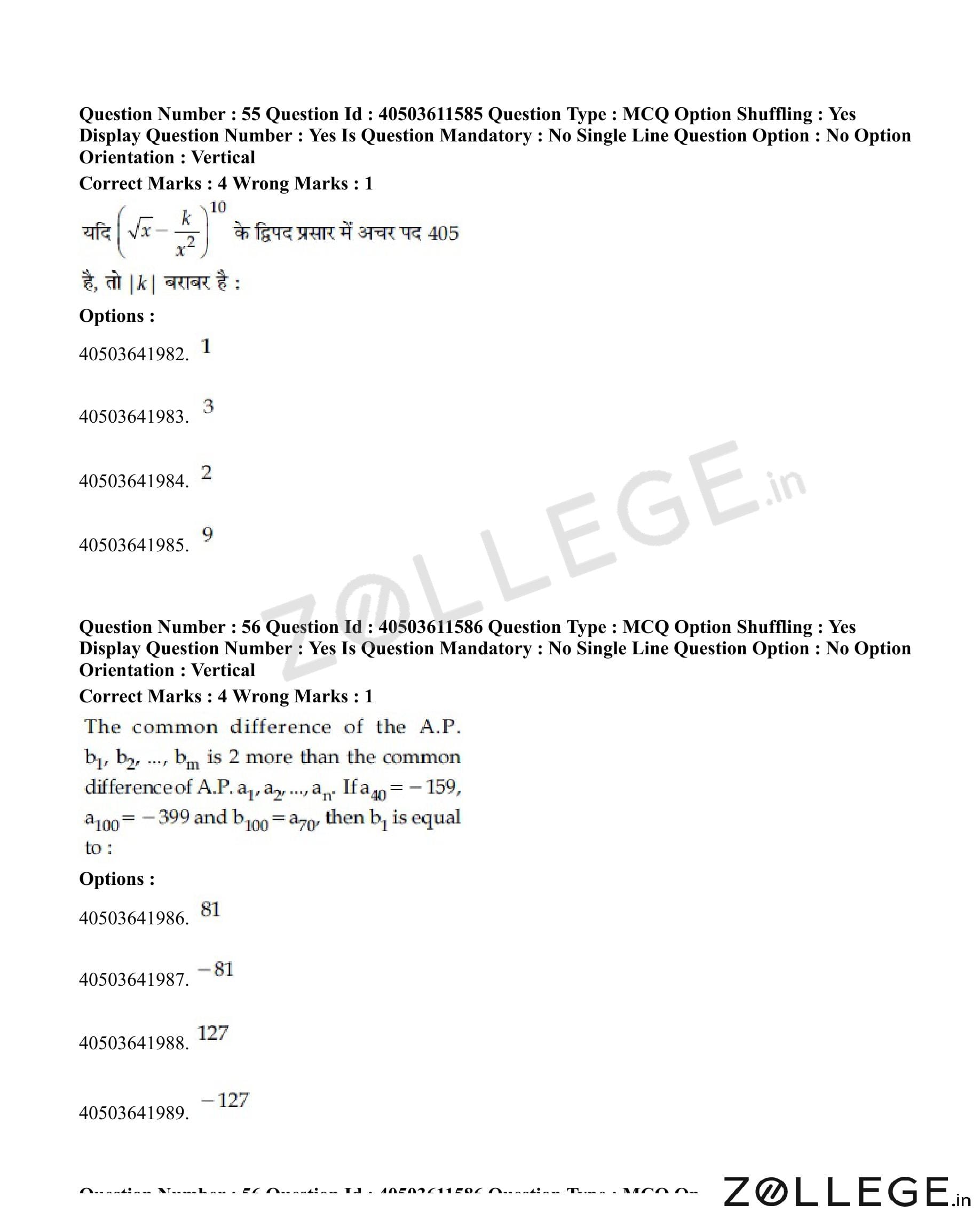
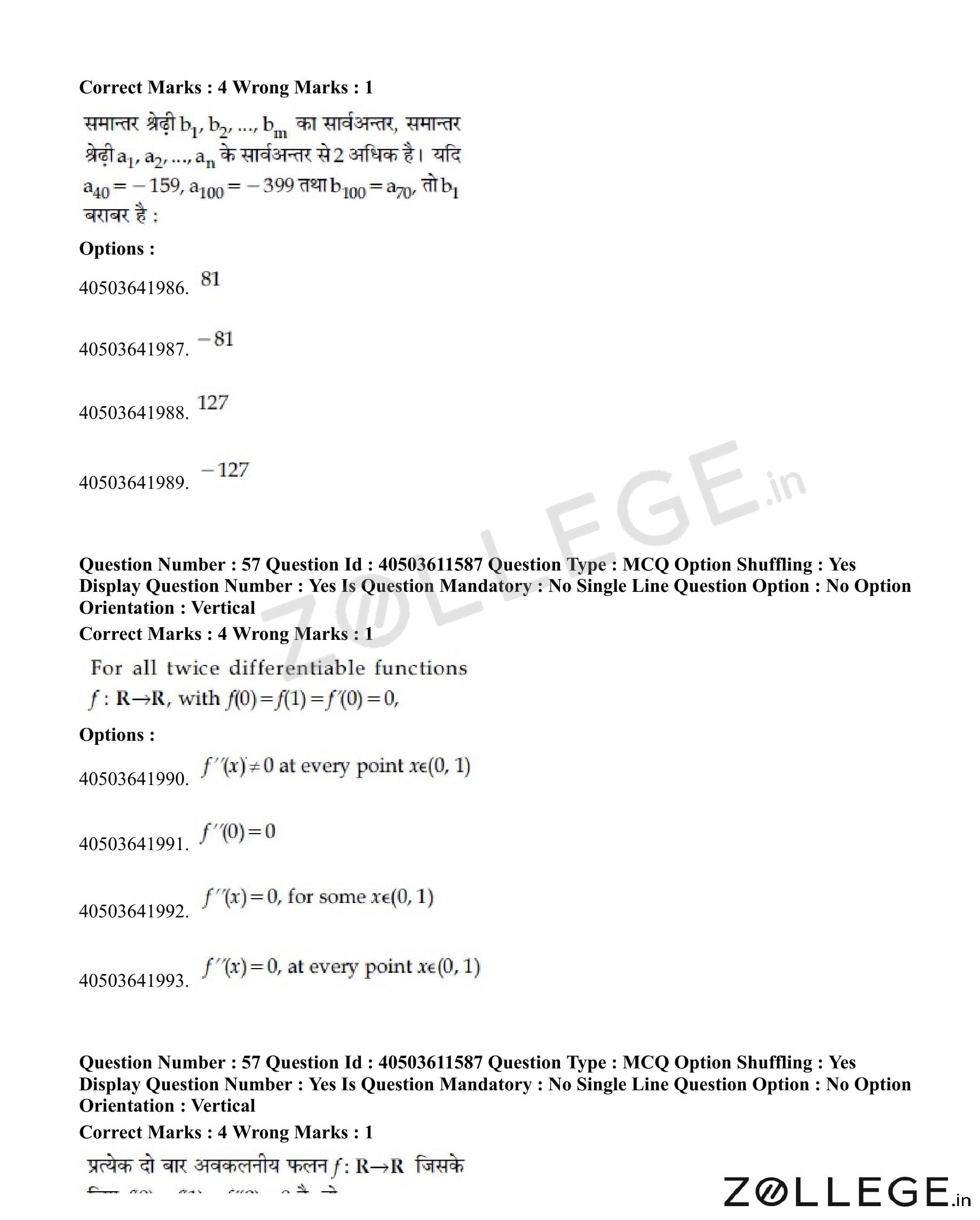
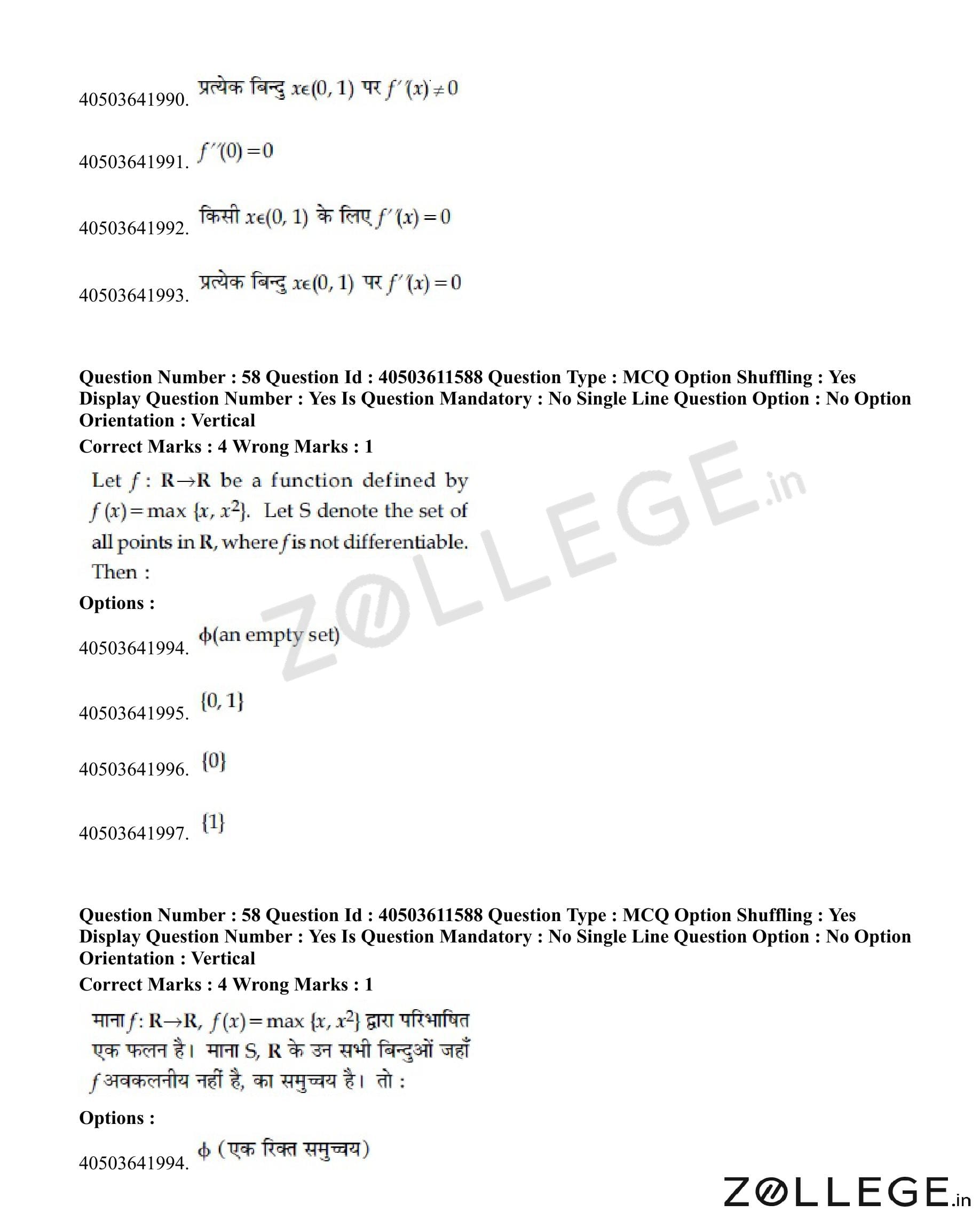
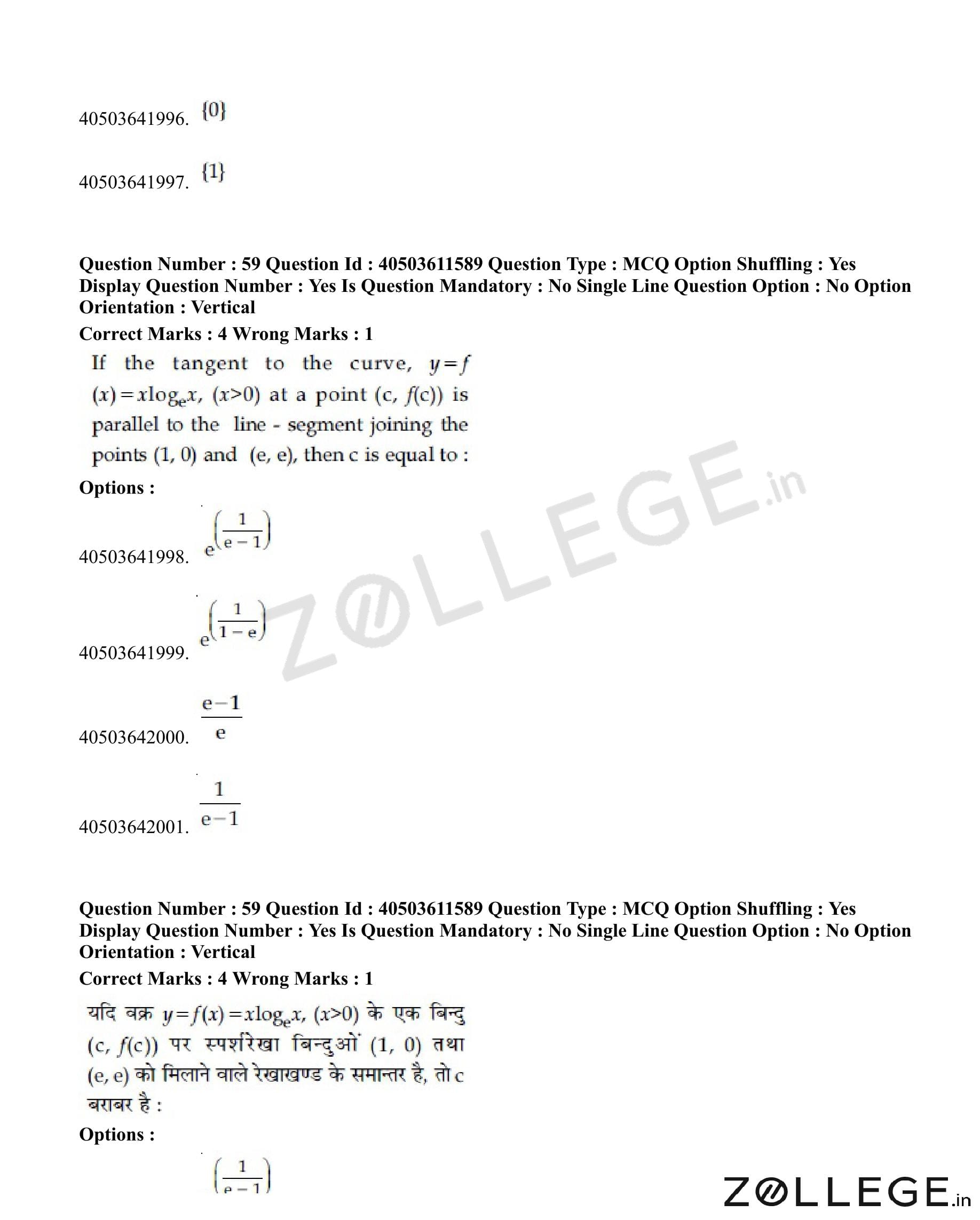
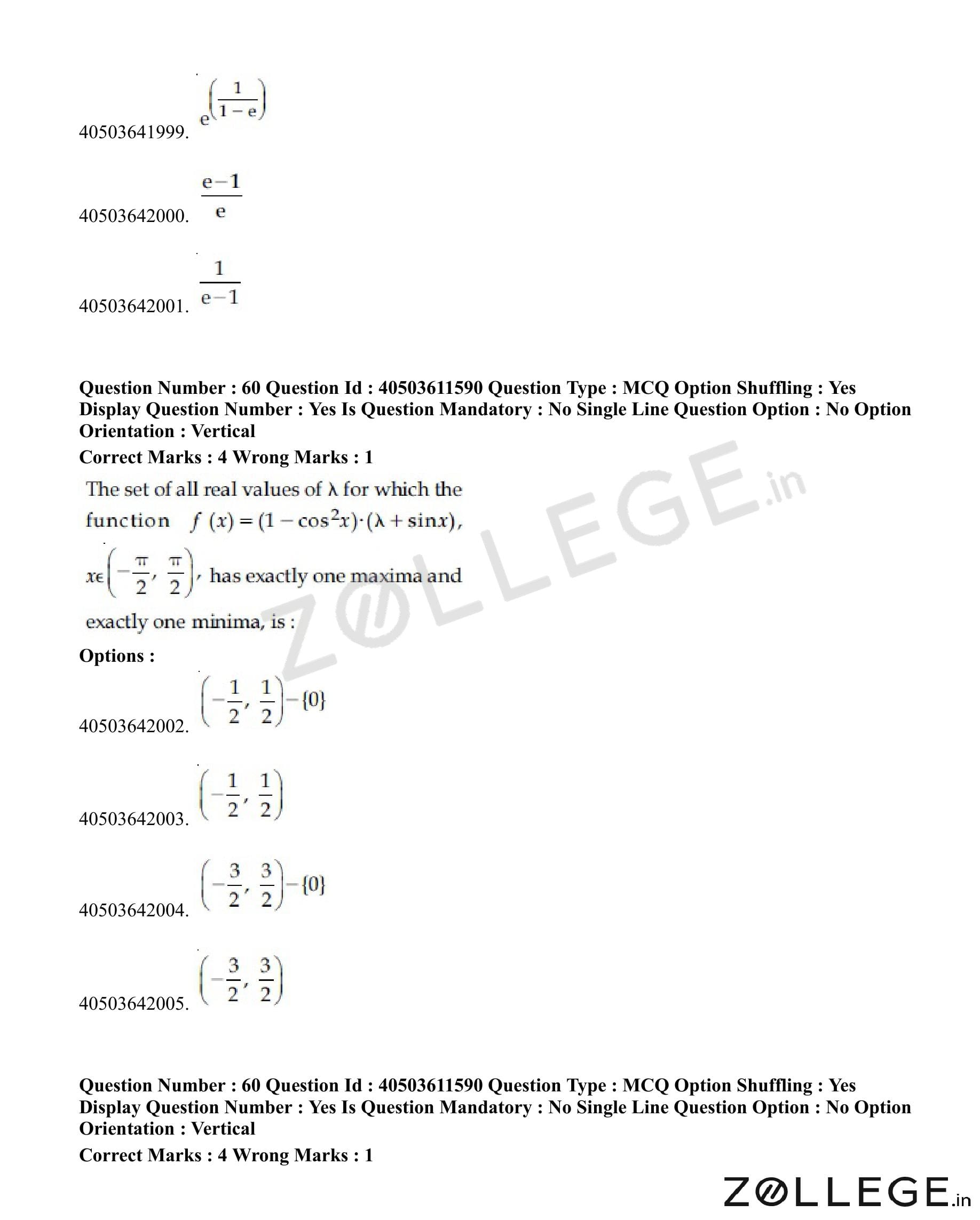
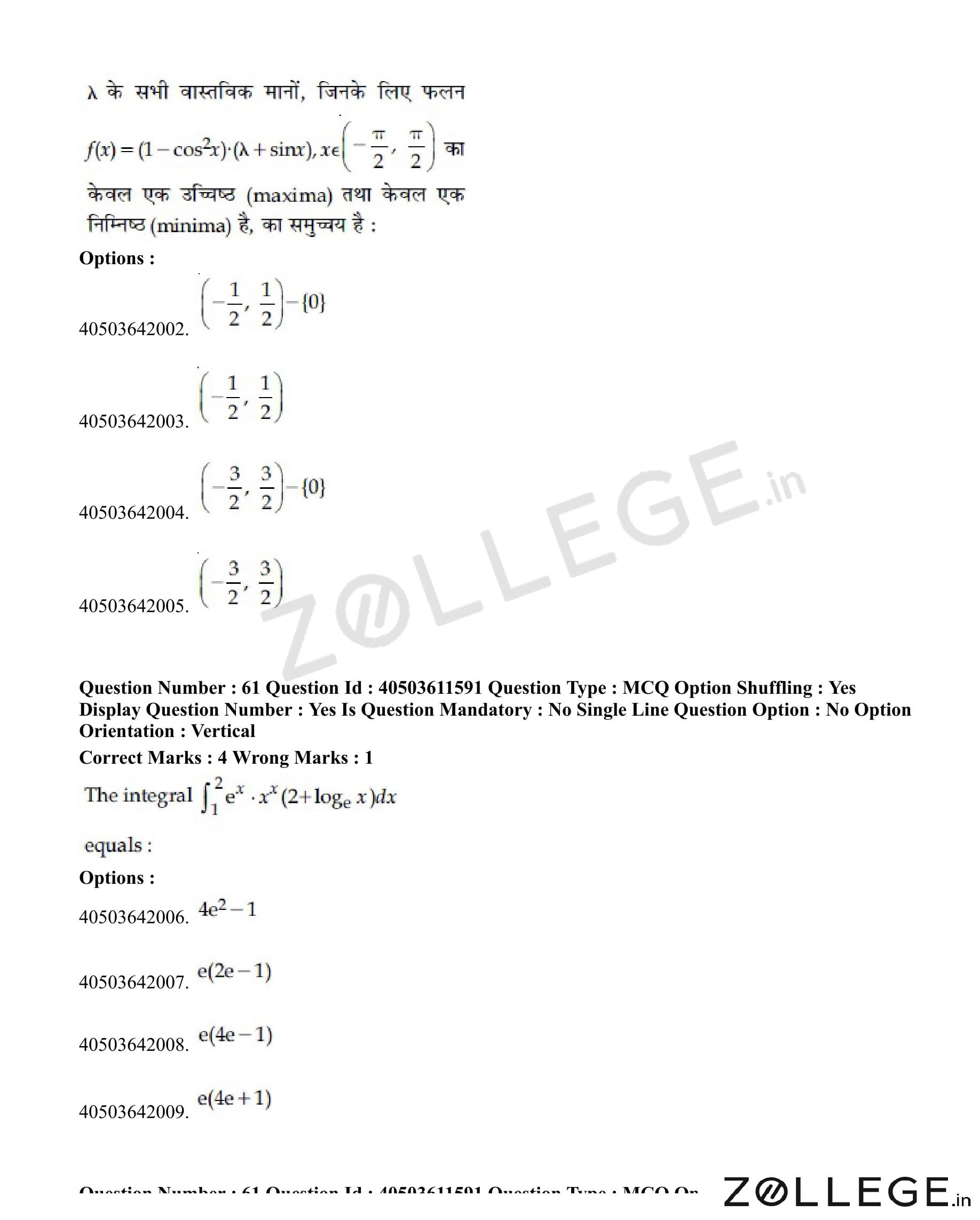
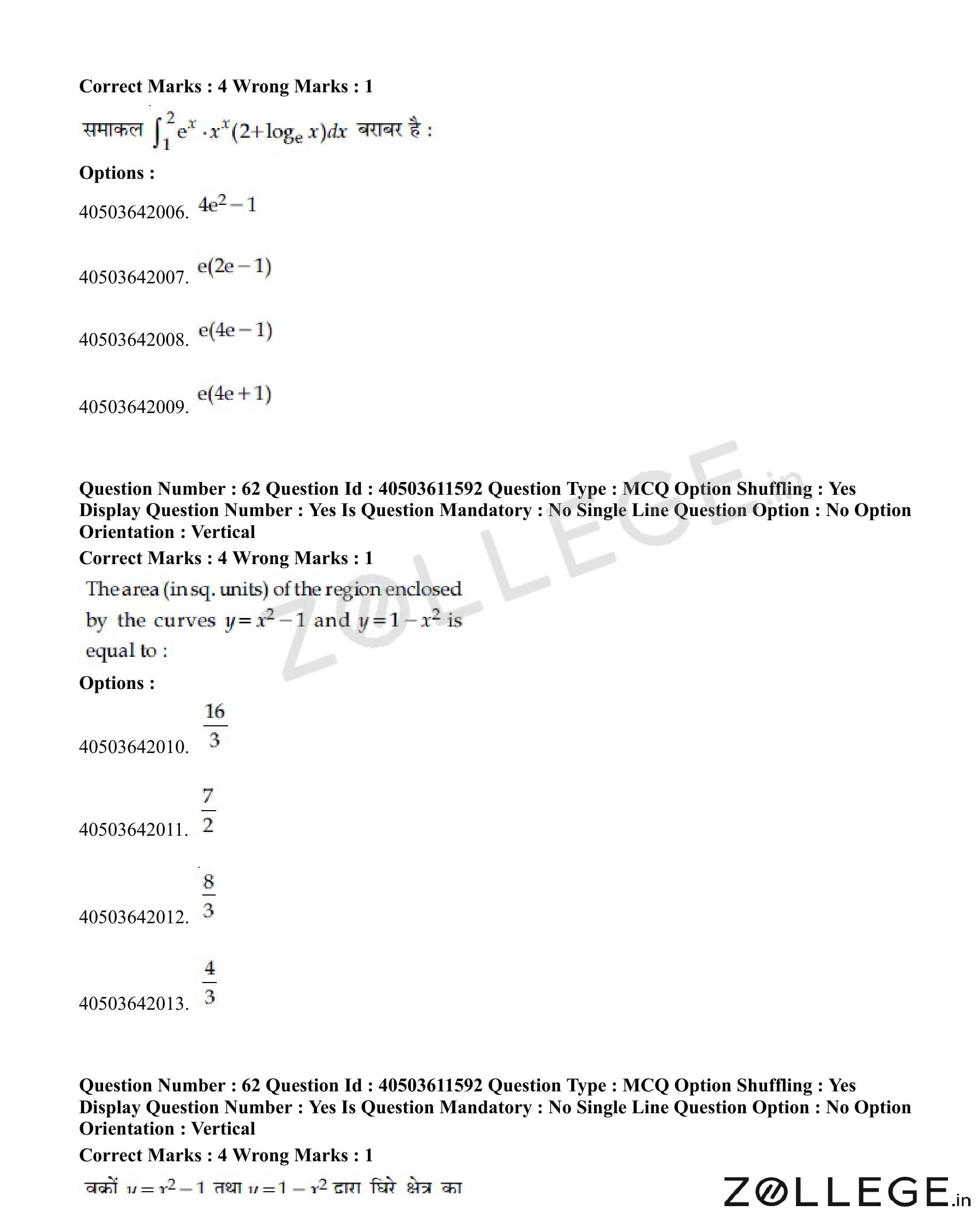
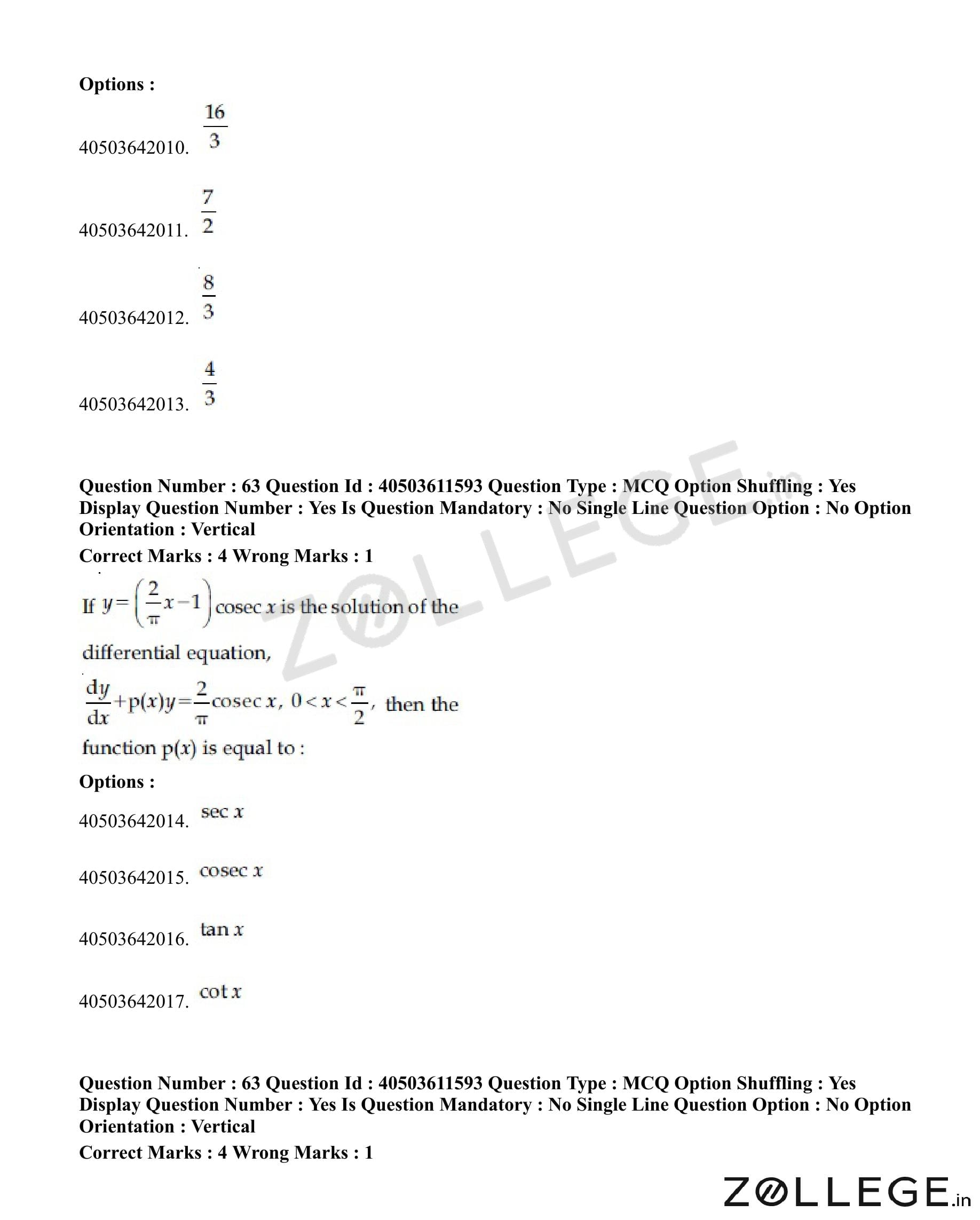
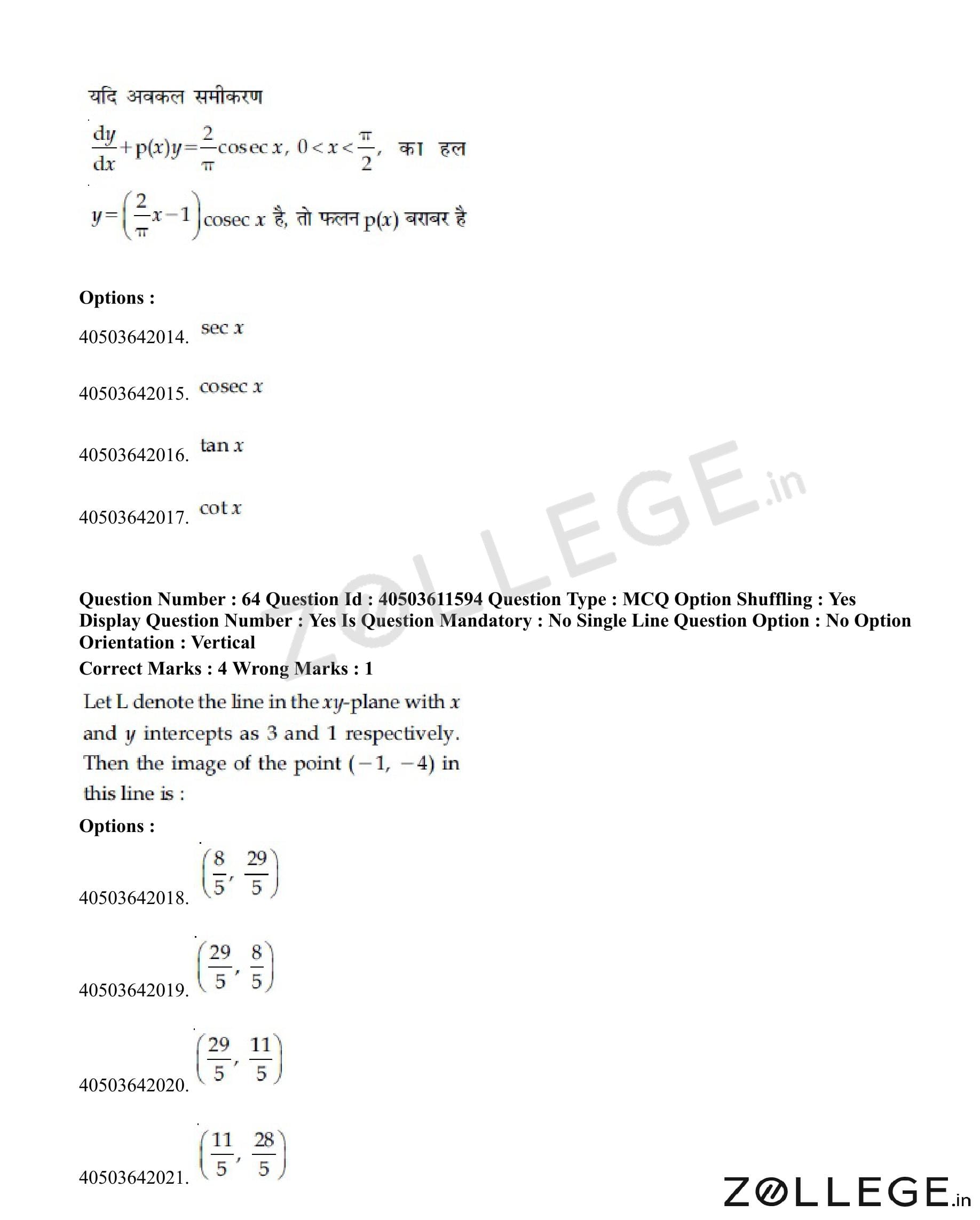
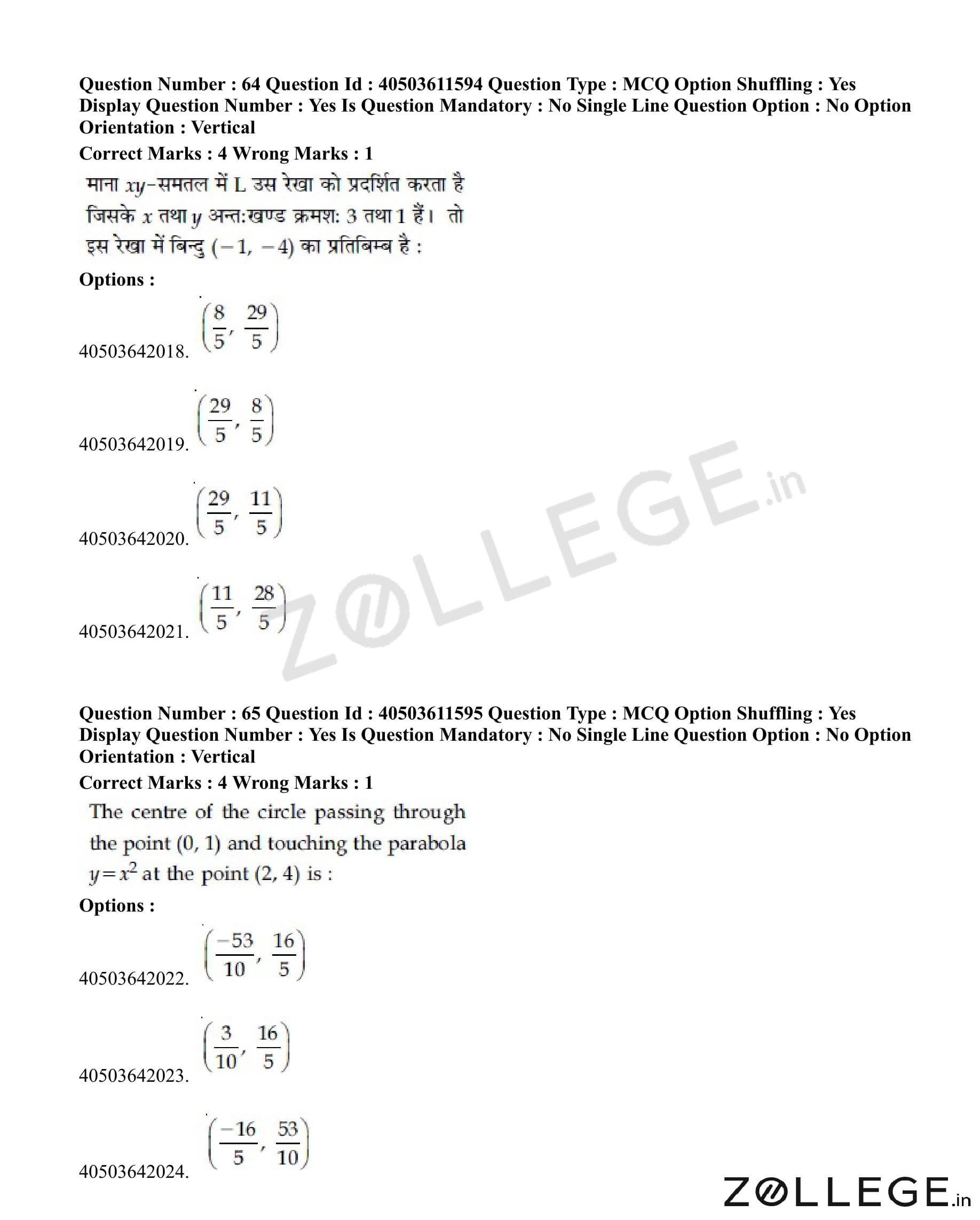
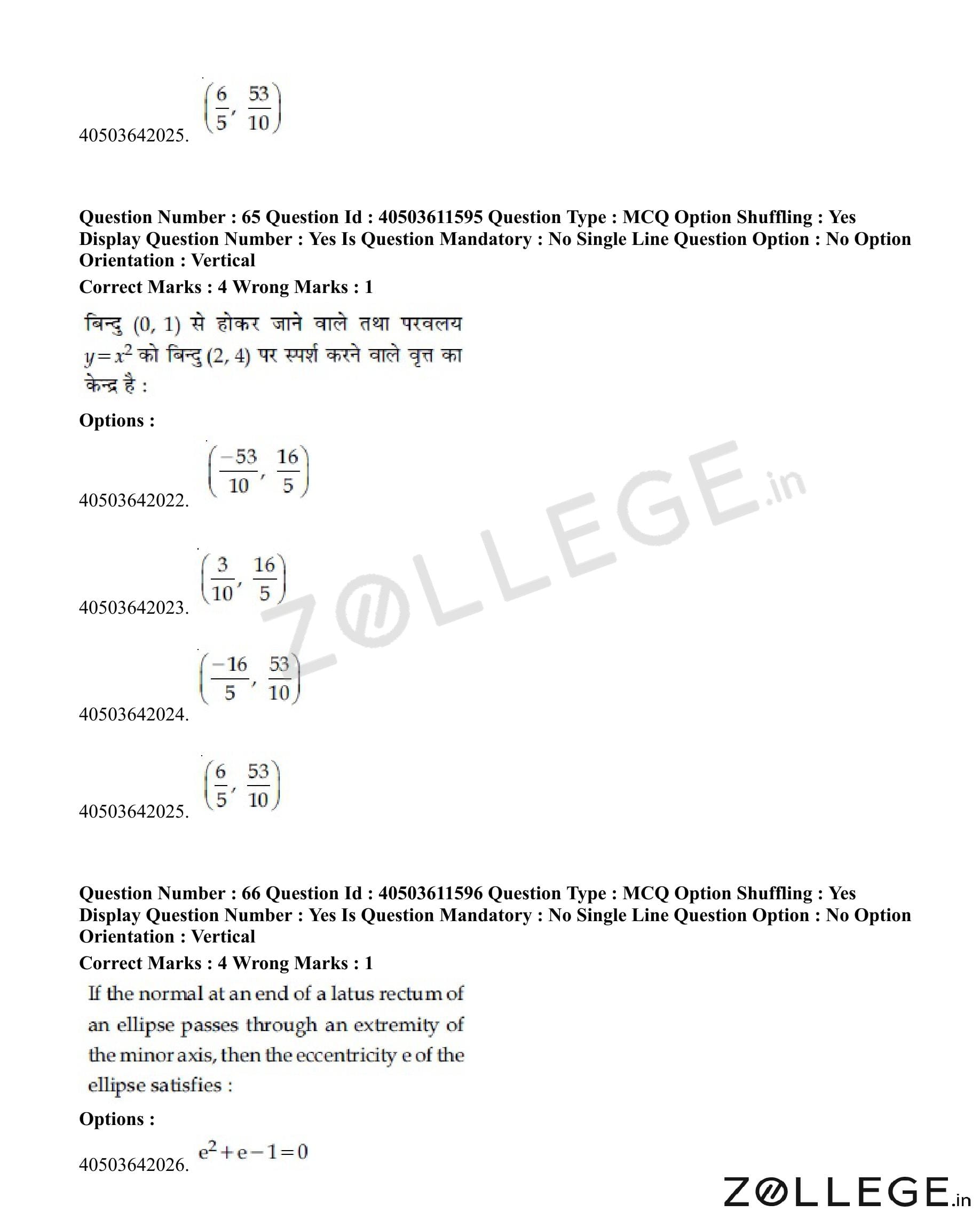
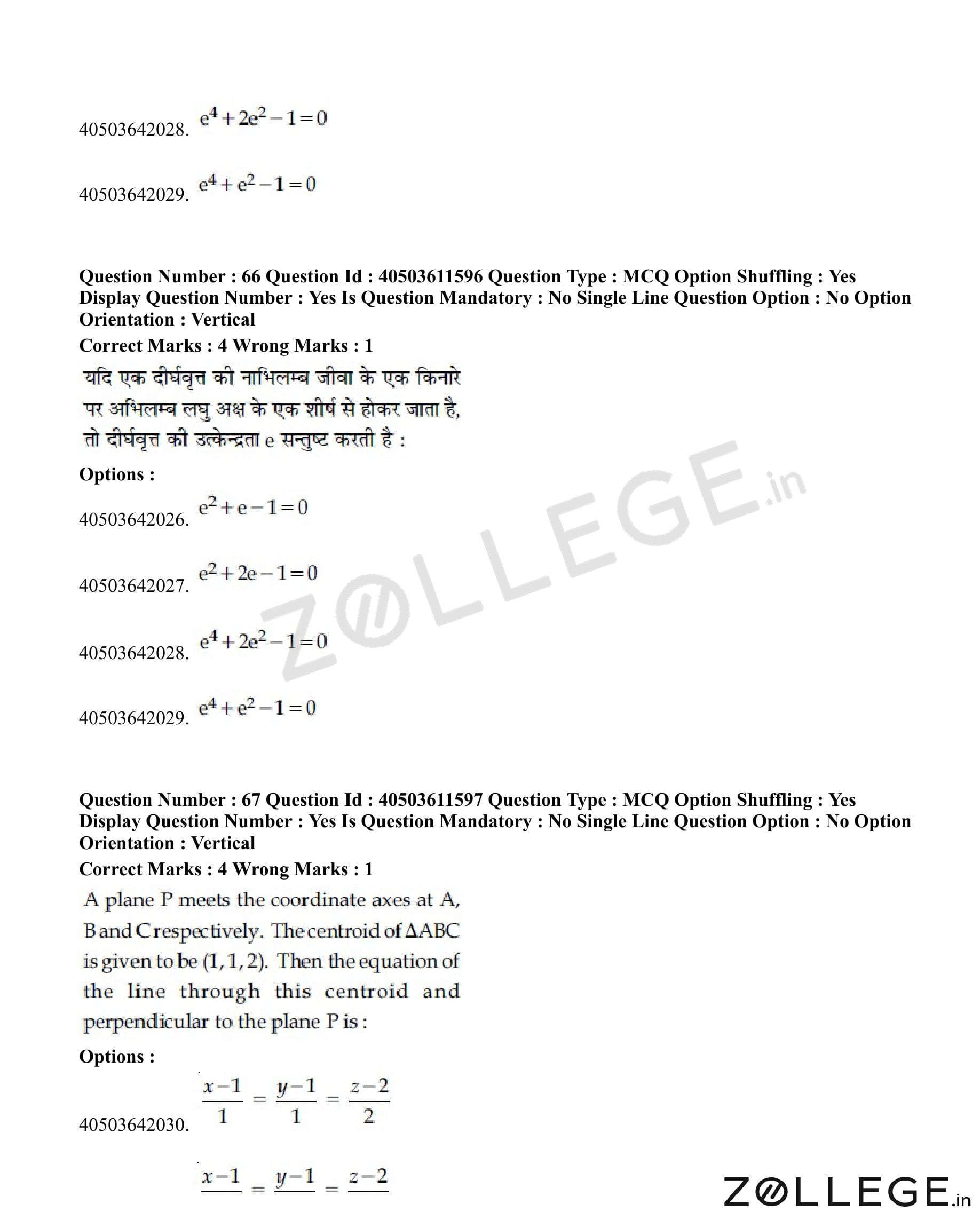
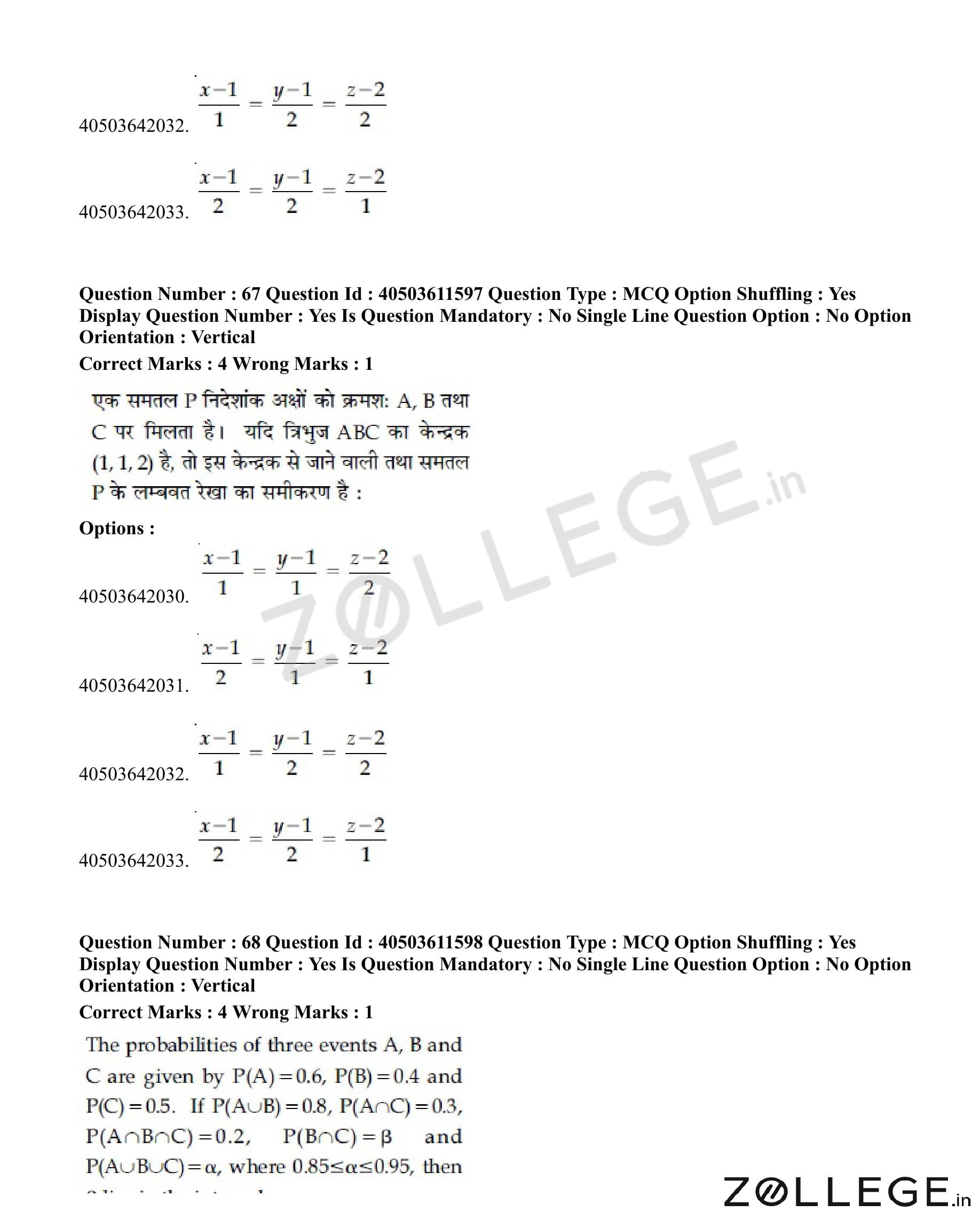
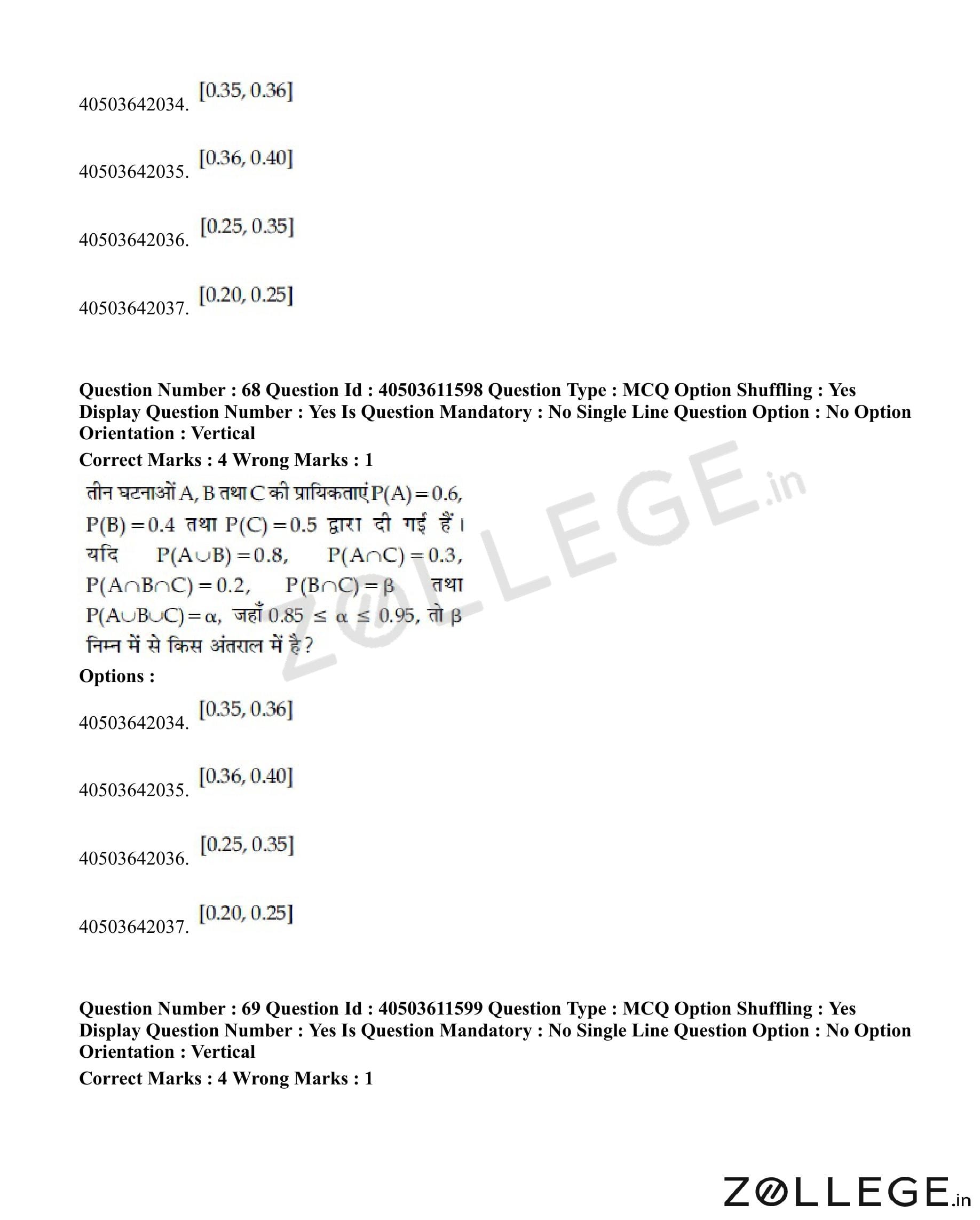
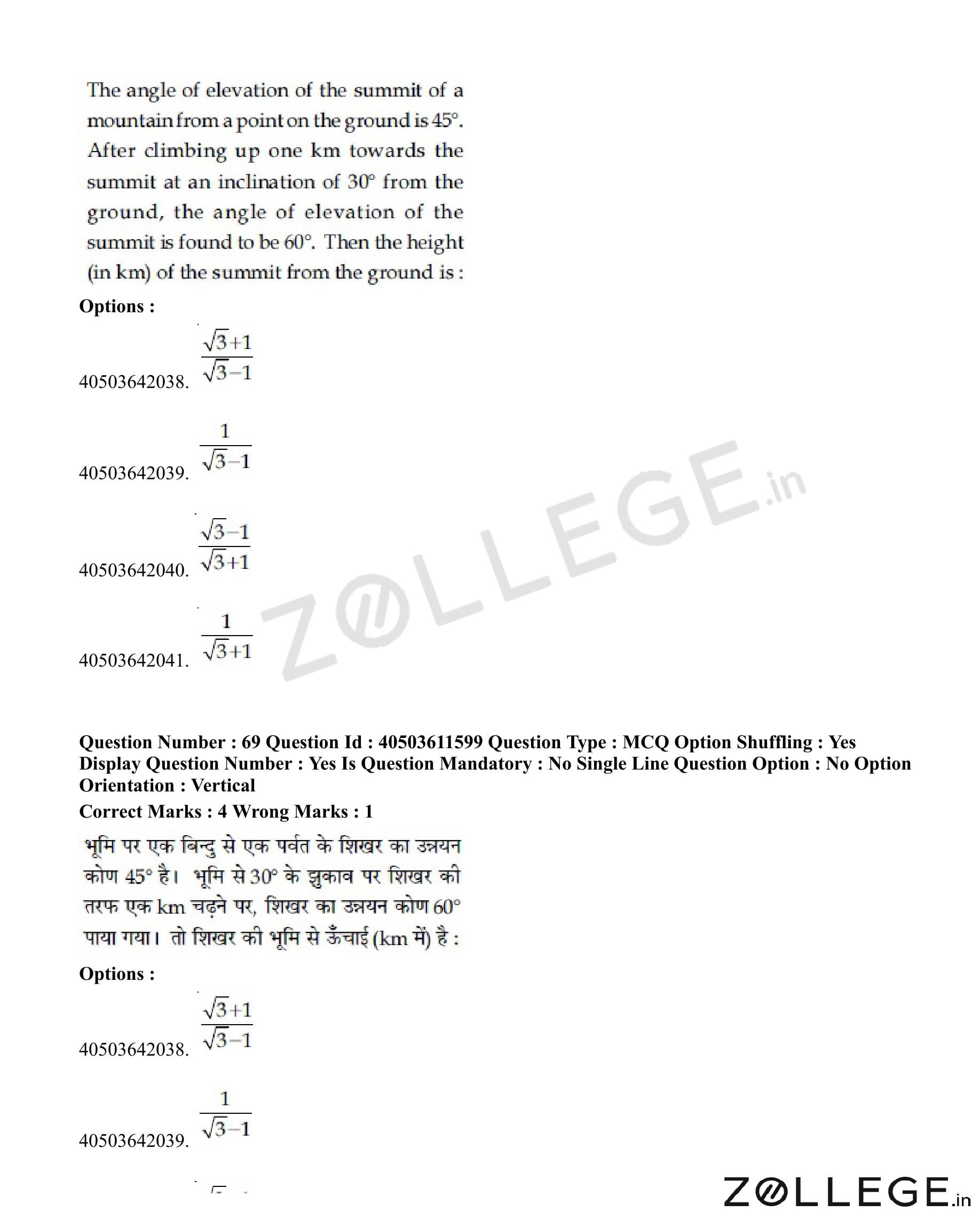
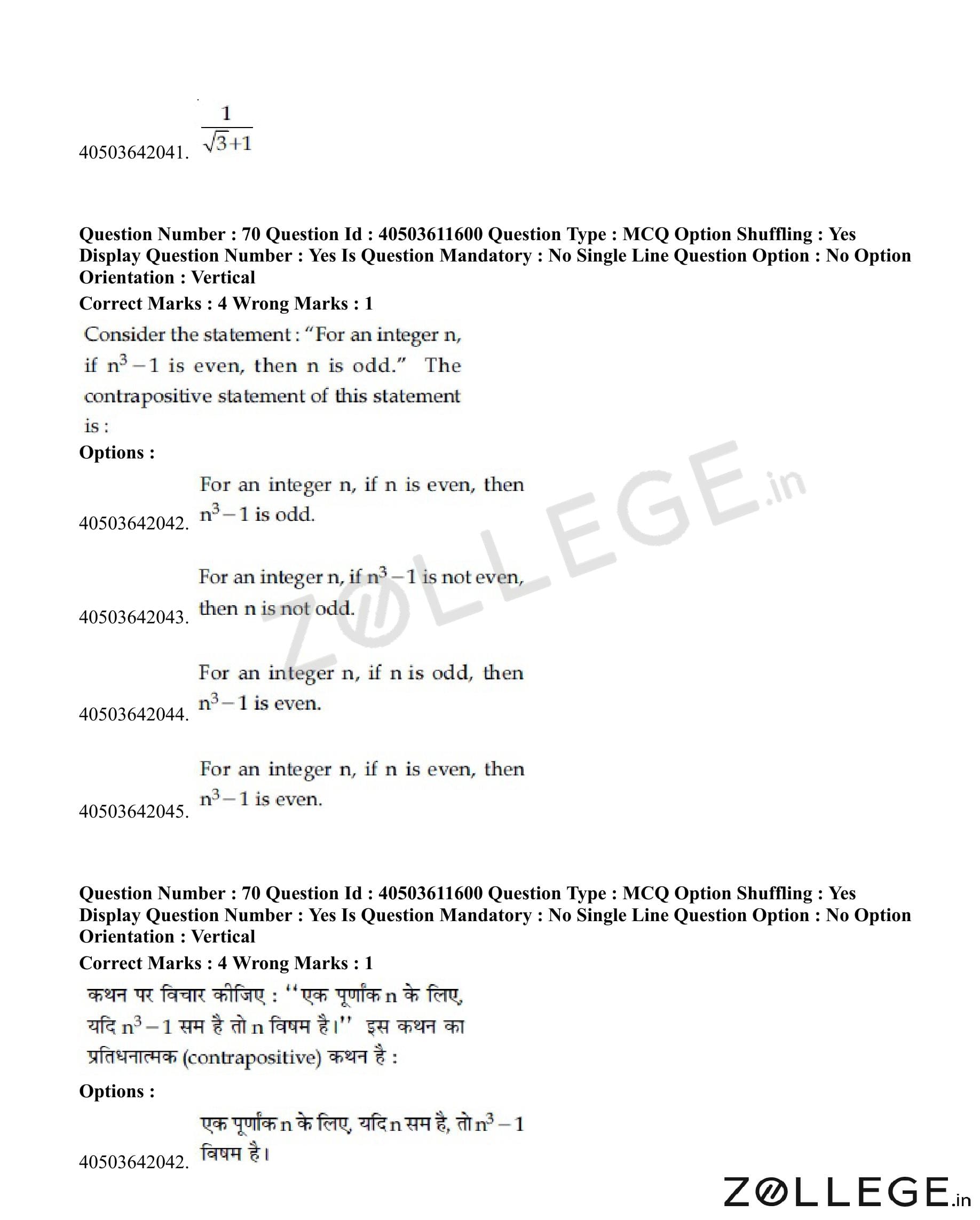
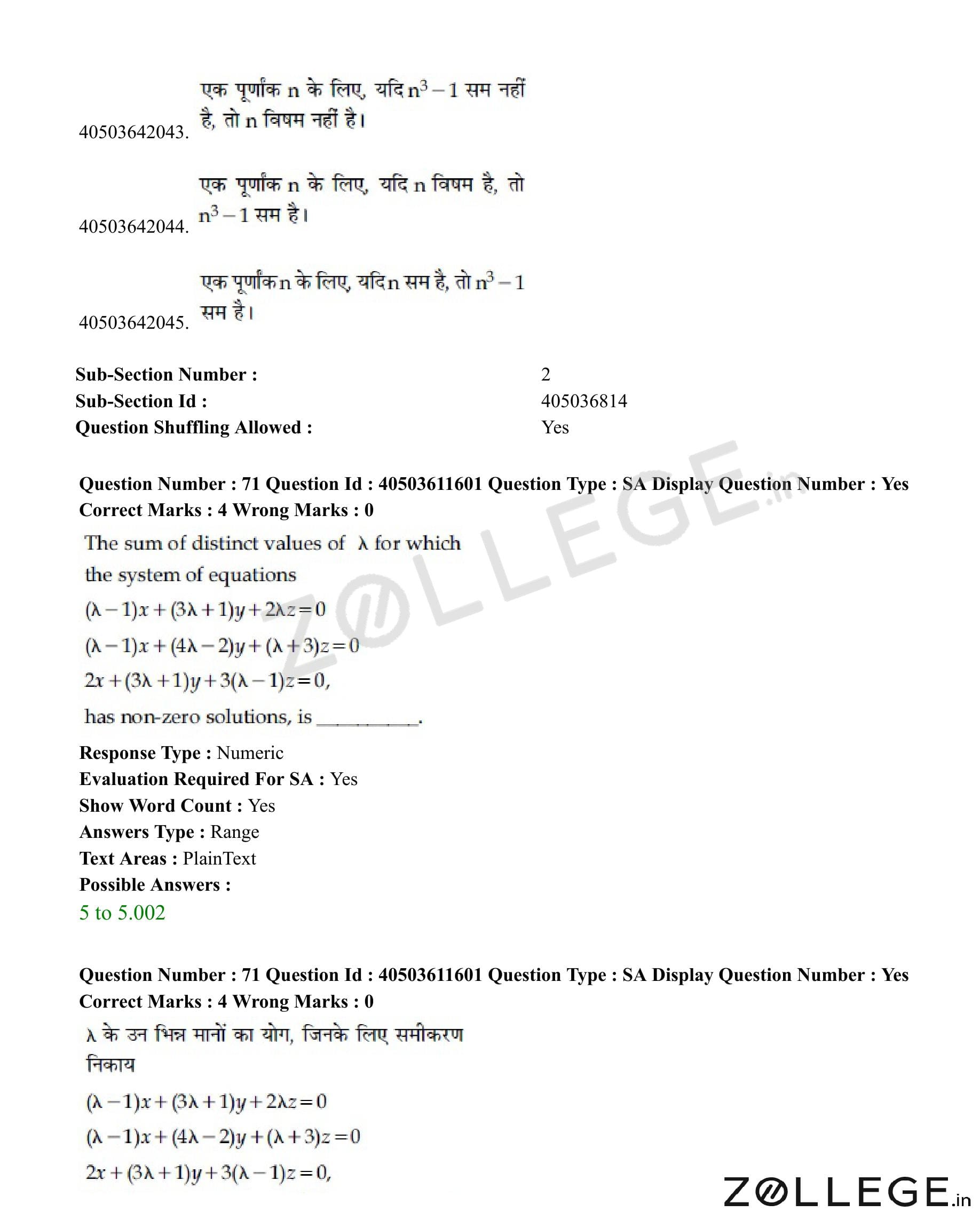
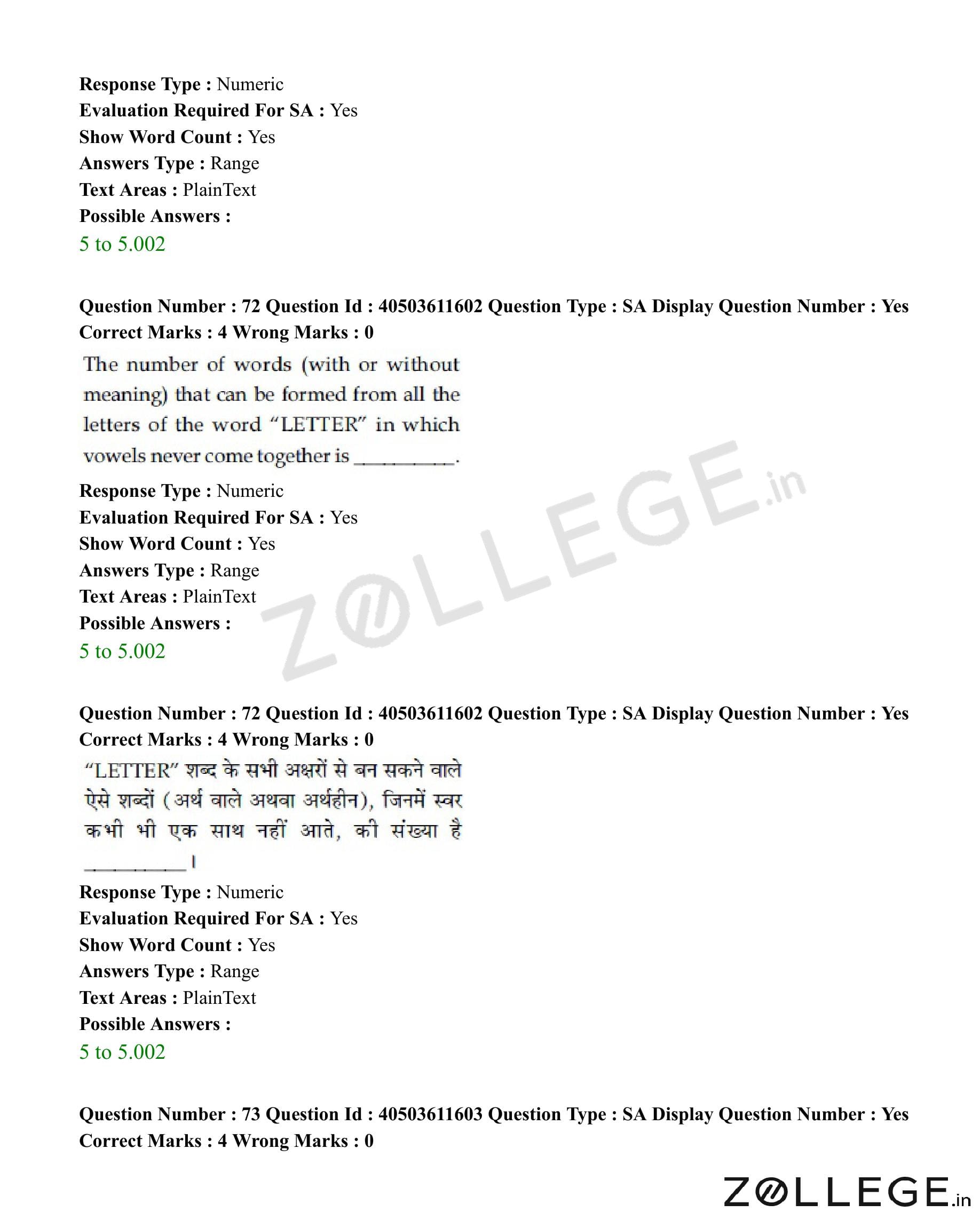
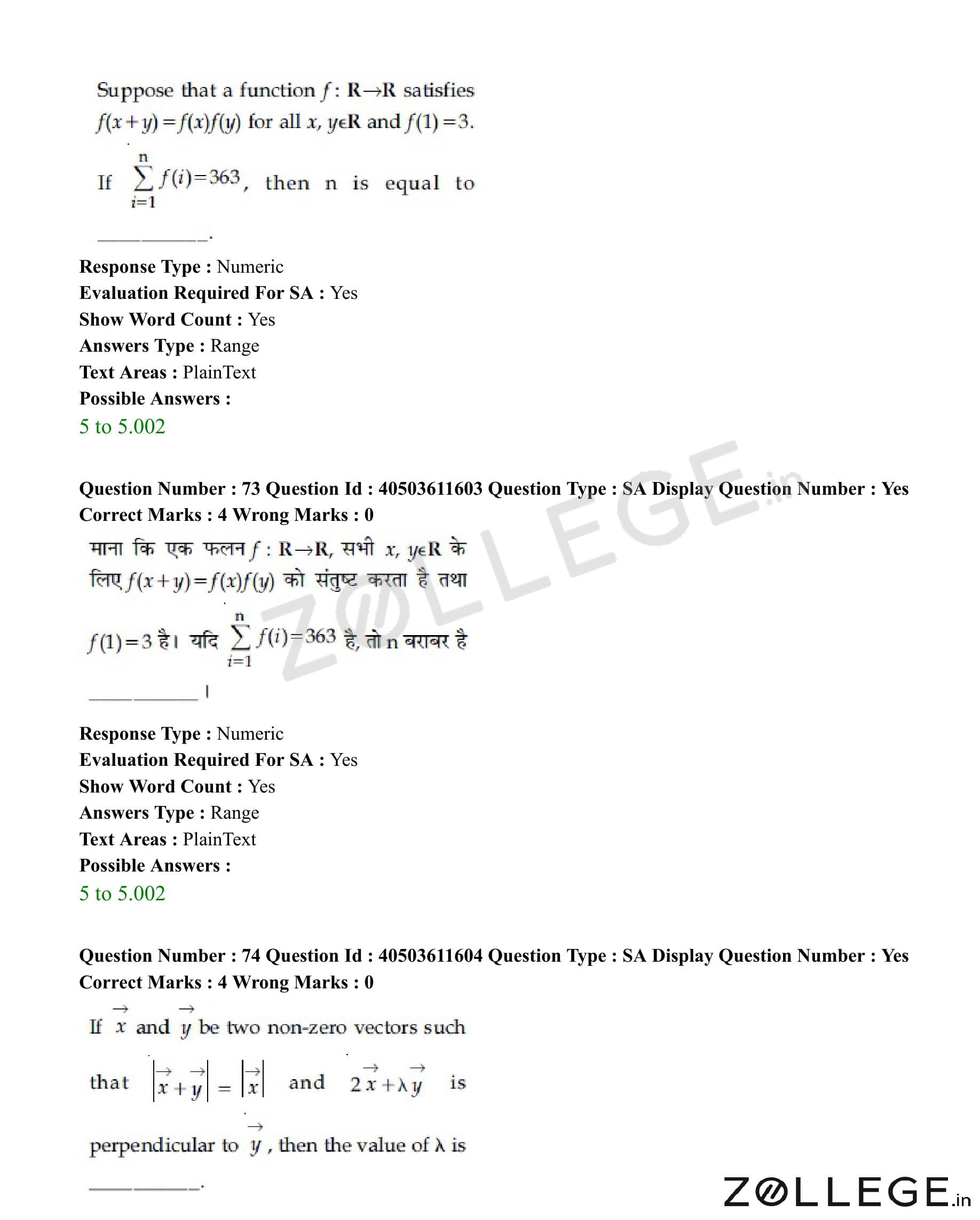
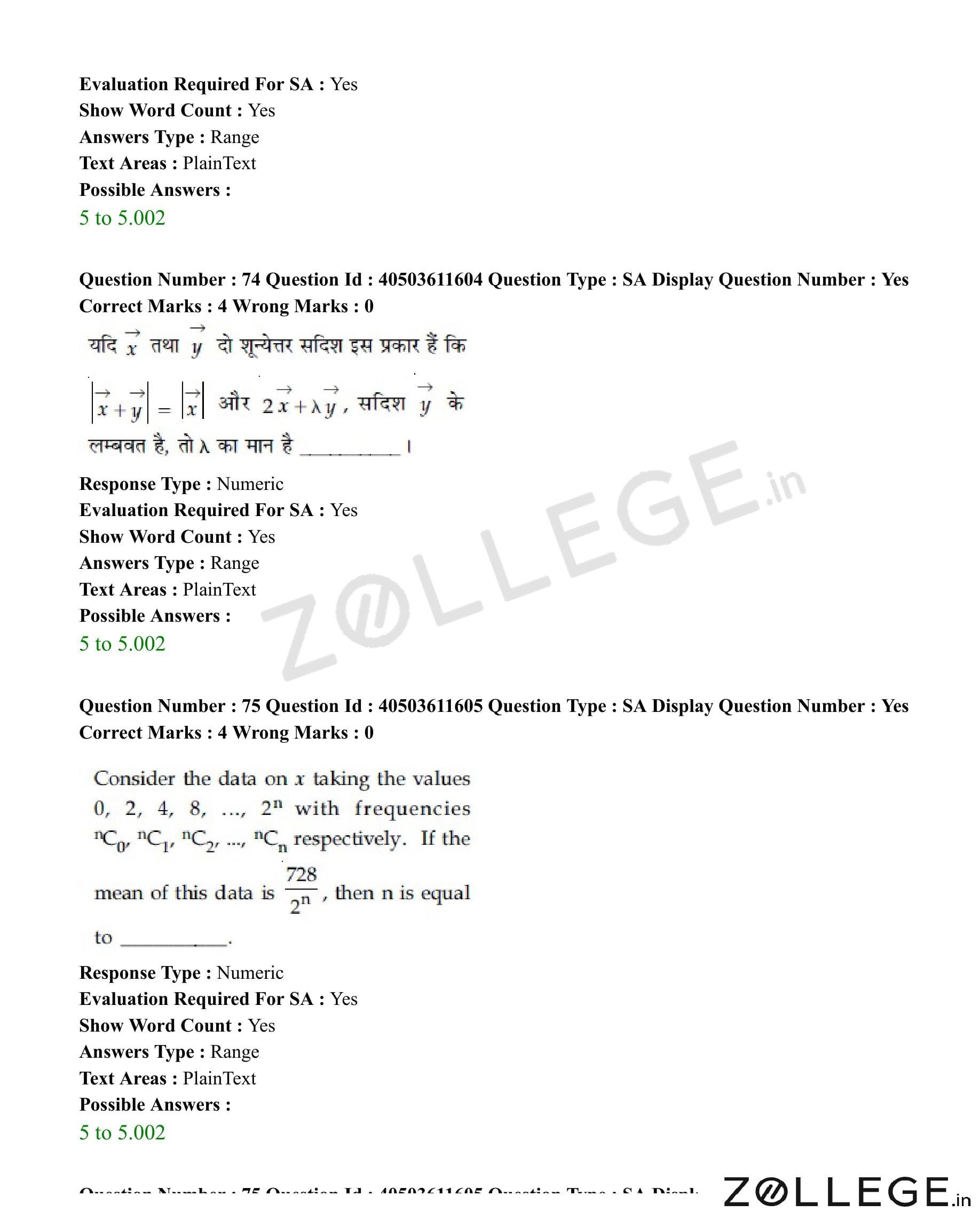
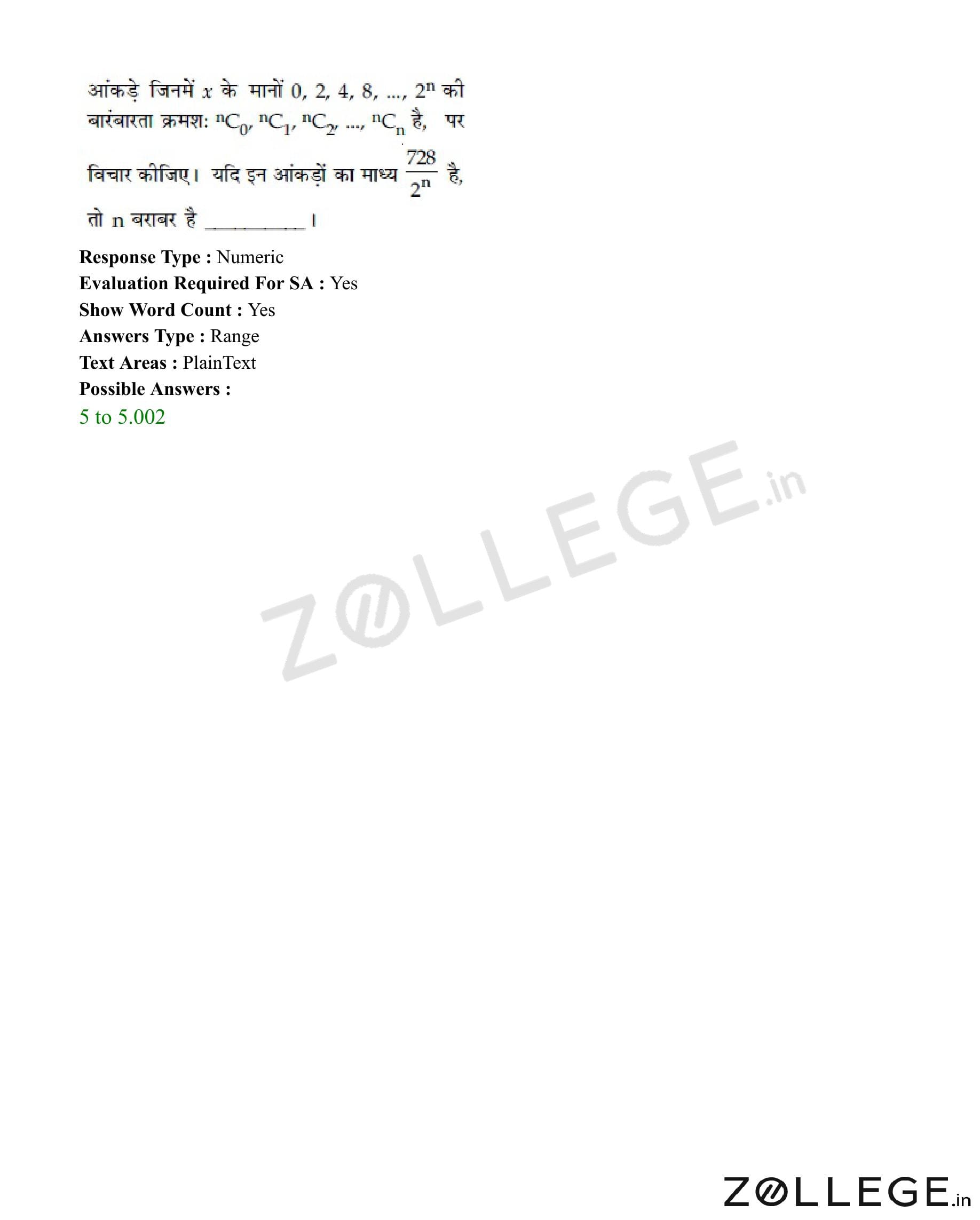
Previous Year JEE Main Question Papers
*The article might have information for the previous academic years, please refer the official website of the exam.