
JEE Main 2020 Question Paper with Answer Key PDF for B.E./ B.Tech(January 8 - Shift 1)


Content Writer | Updated On - Dec 23, 2025
JEE Main Question Papers are the most important study material for effective exam preparation. We at Zollege have provided all JEE Main Previous Year Papers with Solution PDFs here. JEE Main 2020 B. E. / B. Tech exam was conducted successfully on January 8, 2020. NTA conducted the exam in the Shift 1. According to student reactions and expert reviews, the paper was reported to be moderate.
Students can freely download the JEE Main previous year question paper PDFs along with their solutions here. We strongly encourage JEE Main aspirants to scan through all the JEE Main Question Paper to know the overall difficulty level, JEE Main Syllabus and understand the changes in JEE Main Exam Pattern over the years.
JEE Main 2020 B.E./ B.Tech Question Paper with Answer Key PDF (Shift 1)
| JEE Main 2020 B.E./ B.Tech Question Paper PDF | JEE Main 2020 B.E./ B.Tech Solutions PDF |
|---|---|
| Download PDF | Check Solutions |

The dimension of stopping potential \(V_0\) in photoelectric effect in units of Planck's constant 'h', speed of light 'c' and Gravitational constant 'G' and ampere A is :
View Solution
Step 1: Understanding the Concept:
Stopping potential \(V_0\) is the potential difference required to stop the most energetic photoelectrons.
Its dimensions are identical to electric potential, defined as work done per unit charge (\(V = W/q\)).
Step 2: Key Formula or Approach:
We express \(V_0\) as a product of the given constants:
\[ [V_0] = [h]^x [c]^y [G]^z [A]^w \]
Dimensional formulas:
- Stopping Potential \([V_0] = \frac{ML^2T^{-2}}{AT} = M^1 L^2 T^{-3} A^{-1}\)
- Planck's constant \([h] = ML^2T^{-1}\)
- Speed of light \([c] = L^1 T^{-1}\)
- Gravitational constant \([G] = M^{-1} L^3 T^{-2}\)
- Ampere \([A] = A^1\)
Step 3: Detailed Explanation:
Equating the dimensions:
\[ M^1 L^2 T^{-3} A^{-1} = (M^1 L^2 T^{-1})^x (L^1 T^{-1})^y (M^{-1} L^3 T^{-2})^z (A^1)^w \]
Comparing powers:
For A: \(w = -1\).
For M: \(x - z = 1\).
For L: \(2x + y + 3z = 2\).
For T: \(-x - y - 2z = -3 \implies x + y + 2z = 3\).
Subtracting the T-equation from the L-equation:
\[ (2x + y + 3z) - (x + y + 2z) = 2 - 3 \implies x + z = -1 \].
Solving the system:
1) \(x - z = 1\)
2) \(x + z = -1\)
Adding them gives \(2x = 0 \implies x = 0\).
Substituting \(x=0\) in (2) gives \(z = -1\).
Finding \(y\): \(0 + y + 2(-1) = 3 \implies y - 2 = 3 \implies y = 5\).
Thus, the dimensions are \(h^0 c^5 G^{-1} A^{-1}\).
Step 4: Final Answer:
The dimension of stopping potential \(V_0\) is \(h^0 c^5 G^{-1} A^{-1}\).
Quick Tip: If a physical quantity depends on Ampere (A), check the power of A first. Since \(V_0 = W/q = W/(It)\), the dimension of \(V_0\) contains \(A^{-1}\). If only one option has \(A^{-1}\) and the others differ in the power of A, you can pick the answer immediately.
A particle of mass m is fixed to one end of a light spring having force constant k and unstretched length l. The other end is fixed. The system is given an angular speed \(\omega\) about the fixed end of the spring such that it rotates in a circle in gravity free space. Then the stretch in the spring is :
View Solution
Step 1: Understanding the Concept:
When the mass rotates, it moves in a circle of radius greater than the unstretched length due to the outward centrifugal effect.
The spring force provides the necessary centripetal force for this rotation.
Step 2: Key Formula or Approach:
Let the stretch in the spring be \(x\).
The radius of the circular path is \(R = l + x\).
Centripetal Force \(F_c = m \omega^2 R = m \omega^2 (l + x)\).
Restoring Spring Force \(F_s = kx\).
Step 3: Detailed Explanation:
In the steady state of rotation:
\[ F_s = F_c \] \[ kx = m \omega^2 (l + x) \] \[ kx = m \omega^2 l + m \omega^2 x \]
Group the \(x\) terms on one side:
\[ kx - m \omega^2 x = m \omega^2 l \] \[ x (k - m \omega^2) = m \omega^2 l \] \[ x = \frac{m l \omega^2}{k - m \omega^2} \]
Step 4: Final Answer:
The stretch in the spring is \(\frac{m l \omega^2}{k - m \omega^2}\).
Quick Tip: Always remember that the radius of the circle in such problems is the total length of the spring (original length + extension). Failing to include the extension in the radius is a common error.
The coordinates of centre of mass of a uniform flag shaped lamina (thin flat plate) of mass 4 kg. (The coordinates of the same are shown in figure) are :

View Solution
Step 1: Understanding the Concept:
For a uniform lamina, the center of mass (CM) can be found by treating the object as a collection of simpler geometric shapes (rectangles) and calculating the weighted average of their individual centers.
Step 2: Key Formula or Approach:
Divide the flag into two rectangles:
1. Part 1 (Vertical): \(x \in [0, 1], y \in [0, 3]\). Area \(A_1 = 3 m^2\).
2. Part 2 (Horizontal): \(x \in [1, 2], y \in [2, 3]\). Area \(A_2 = 1 m^2\).
Total Area = 4 \(m^2\). Since total mass is 4 kg, the mass of Part 1 is 3 kg and Part 2 is 1 kg.
Step 3: Detailed Explanation:
Find individual CM coordinates:
- CM of Part 1 (\(C_1\)): \(x_1 = 0.5 m, y_1 = 1.5 m\).
- CM of Part 2 (\(C_2\)): \(x_2 = 1.5 m, y_2 = 2.5 m\).
Using the CM formula:
\[ x_{cm} = \frac{m_1 x_1 + m_2 x_2}{m_1 + m_2} = \frac{3(0.5) + 1(1.5)}{4} = \frac{1.5 + 1.5}{4} = \frac{3}{4} = 0.75 m \] \[ y_{cm} = \frac{m_1 y_1 + m_2 y_2}{m_1 + m_2} = \frac{3(1.5) + 1(2.5)}{4} = \frac{4.5 + 2.5}{4} = \frac{7}{4} = 1.75 m \]
Step 4: Final Answer:
The coordinates of the center of mass are (0.75 m, 1.75 m).
Quick Tip: For uniform flat plates, the mass is proportional to the area. You can directly use the areas of the sub-sections in the center of mass formula instead of actual mass values.
Consider a uniform rod of mass M = 4m and length l pivoted about its centre. A mass m moving with velocity v making angle \(\theta = \frac{\pi}{4}\) to the rod's long axis collides with one end of the rod and sticks to it. The angular speed of the rod-mass system just after the collision is :
View Solution
Step 1: Understanding the Concept:
During the collision, the torque about the pivot (center of the rod) is zero. Thus, the angular momentum of the system is conserved.
Step 2: Key Formula or Approach:
Angular Momentum Conservation: \(L_{initial} = L_{final}\).
\(L_i = m (\vec{r} \times \vec{v}) = m v_{\perp} r\).
\(L_f = I_{system} \omega\).
Step 3: Detailed Explanation:
Initial angular momentum:
The particle strikes at \(r = l/2\). The perpendicular component of velocity is \(v \sin(45^\circ) = v/\sqrt{2}\).
\[ L_i = m \left( \frac{v}{\sqrt{2}} \right) \frac{l}{2} = \frac{mvl}{2\sqrt{2}} \]
Final Moment of Inertia (\(I_{sys}\)):
- Rod (pivoted at center): \(I_{rod} = \frac{Ml^2}{12} = \frac{4m \cdot l^2}{12} = \frac{ml^2}{3}\).
- Stuck mass: \(I_{particle} = m (l/2)^2 = \frac{ml^2}{4}\).
- Total: \(I_{sys} = \frac{ml^2}{3} + \frac{ml^2}{4} = \frac{7ml^2}{12}\).
Applying conservation:
\[ \frac{mvl}{2\sqrt{2}} = \left( \frac{7ml^2}{12} \right) \omega \] \[ \omega = \frac{12 v}{2\sqrt{2} \cdot 7l} = \frac{6v}{7\sqrt{2}l} = \frac{6\sqrt{2}v}{7 \cdot 2 \cdot l} = \frac{3\sqrt{2}v}{7l} \]
Step 4: Final Answer:
The angular speed after the collision is \(\frac{3\sqrt{2}}{7} \frac{v}{l}\).
Quick Tip: In oblique collisions, only the component of momentum perpendicular to the line joining the pivot and collision point contributes to angular momentum.
Consider two solid spheres of radii \(R_1 = 1\) m, \(R_2 = 2\) m and masses \(M_1\) and \(M_2\) respectively. The gravitational field due to sphere (1) and (2) are shown. The value of \(\frac{M_1}{M_2}\) is :

View Solution
Step 1: Understanding the Concept:
The gravitational field of a solid sphere increases linearly inside and follows the inverse square law outside.
The maximum field occurs exactly at the surface, given by \(E_s = \frac{GM}{R^2}\).
Step 2: Key Formula or Approach:
From the provided graph:
For sphere 1, the peak field is \(E_1 = 2\) at \(R_1 = 1\).
For sphere 2, the peak field is \(E_2 = 3\) at \(R_2 = 2\).
Step 3: Detailed Explanation:
Setting up the equations for surface fields:
\[ E_1 = \frac{G M_1}{R_1^2} \implies 2 = \frac{G M_1}{1^2} \implies G M_1 = 2 \] \[ E_2 = \frac{G M_2}{R_2^2} \implies 3 = \frac{G M_2}{2^2} \implies G M_2 = 3 \times 4 = 12 \]
Dividing the mass expressions:
\[ \frac{M_1}{M_2} = \frac{GM_1}{GM_2} = \frac{2}{12} = \frac{1}{6} \]
Step 4: Final Answer:
The ratio \(\frac{M_1}{M_2}\) is \(\frac{1}{6}\).
Quick Tip: On a gravitational field vs. radius graph for a solid sphere, the "kink" or peak always indicates the radius of the sphere. Use the peak value as the surface field.
Consider a solid sphere of radius R and mass density \(\rho(r) = \rho_0 \left( 1 - \frac{r^2}{R^2} \right)\). The minimum density of a liquid in which this sphere will float is :
View Solution
Step 1: Understanding the Concept:
An object floats in a liquid if the density of the liquid is at least equal to the average density of the object.
Step 2: Key Formula or Approach:
Total mass \(M\) is calculated by integrating the density over the spherical volume:
\[ M = \int \rho(r) dV = \int_0^R \rho_0 \left( 1 - \frac{r^2}{R^2} \right) 4\pi r^2 dr \]
Step 3: Detailed Explanation:
Integrating the expression:
\[ M = 4\pi \rho_0 \int_0^R \left( r^2 - \frac{r^4}{R^2} \right) dr = 4\pi \rho_0 \left[ \frac{r^3}{3} - \frac{r^5}{5R^2} \right]_0^R \] \[ M = 4\pi \rho_0 \left( \frac{R^3}{3} - \frac{R^3}{5} \right) = 4\pi \rho_0 R^3 \left( \frac{5-3}{15} \right) = \frac{8 \pi \rho_0 R^3}{15} \]
Average density of the sphere:
\[ \rho_{avg} = \frac{M}{V} = \frac{\frac{8 \pi \rho_0 R^3}{15}}{\frac{4}{3} \pi R^3} = \frac{8}{15} \times \frac{3}{4} \rho_0 = \frac{2}{5} \rho_0 \]
To float, liquid density must be \(\geq \rho_{avg}\).
Step 4: Final Answer:
The minimum liquid density required for floating is \(\frac{2\rho_0}{5}\).
Quick Tip: For any variable density object, floating conditions are determined solely by the average density, which is total mass divided by total volume.
A leak proof cylinder of length 1 m, made of a metal which has very low coefficient of expansion is floating vertically in water at 0\(^{\circ}\)C such that its height above the water surface is 20 cm. When the temperature of water is increased to 4\(^{\circ}\)C, the height of the cylinder above the water surface becomes 21 cm. The density of water at T = 4\(^{\circ}\)C, relative to the density at T = 0\(^{\circ}\)C is close to :
View Solution
Step 1: Understanding the Concept:
The floating cylinder is in equilibrium when its weight equals the buoyancy force. Since the cylinder's expansion is negligible, its weight and volume remain constant.
Step 2: Key Formula or Approach:
Weight \(W = Buoyancy = \rho_{liquid} V_{submerged} g\).
At \(0^\circC\): Submerged length \(L_0 = 100 - 20 = 80 cm\).
At \(4^\circC\): Submerged length \(L_4 = 100 - 21 = 79 cm\).
Step 3: Detailed Explanation:
Equating the buoyancy forces (since weight is constant):
\[ \rho_0 \cdot A \cdot L_0 \cdot g = \rho_4 \cdot A \cdot L_4 \cdot g \] \[ \rho_0 \times 80 = \rho_4 \times 79 \]
The relative density of water at \(4^\circC\) with respect to \(0^\circC\) is:
\[ \frac{\rho_4}{\rho_0} = \frac{80}{79} \approx 1.0126 \]
Step 4: Final Answer:
The relative density is close to 1.01.
Quick Tip: Water has maximum density at \(4^\circC\). Therefore, the submerged volume of a floating body will be minimum at this temperature, meaning it will sit highest above the surface.
A thermodynamic cycle xyzx is shown on a V-T diagram. The P-V diagram that best describes this cycle is :

- (A)
![]()
- (B)
![]()
- (C)
![]()
- (D)
![]()


View Solution
Step 1: Understanding the Concept:
We must identify the nature of each process from the \(V-T\) diagram and translate it to the \(P-V\) diagram.
Step 2: Detailed Explanation:
- Process \(x \to y\): The line passes through the origin on \(V-T\). Since \(V \propto T\), it is an isobaric process (\(P = constant\)). \(V\) increases, so it's a horizontal line to the right on a \(P-V\) plot.
- Process \(y \to z\): The volume is constant (\(V = constant\)). This is an isochoric process. Temperature decreases, so pressure must decrease. It's a vertical line downwards on \(P-V\).
- Process \(z \to x\): The temperature is constant (\(T = constant\)). This is an isothermal process. As volume decreases, pressure must increase according to Boyle's law. It is a curved line on \(P-V\).
Step 3: Final Answer:
The \(P-V\) diagram matching these steps is option (A).
Quick Tip: Straight lines passing through the origin on a \(V-T\) diagram are always isobaric (constant pressure). Horizontal lines on \(V-T\) are isochoric, and vertical lines are isothermal.
The plot that depicts the behavior of the mean free time \(\tau\) for the molecules of an ideal gas, as a function of temperature (T), is :
- (A)
![]()
- (B)
![]()
- (C)
![]()
- (D)
![]()


View Solution
Step 1: Understanding the Concept:
Mean free time (\(\tau\)) is the average time between two consecutive collisions of gas molecules.
Step 2: Key Formula or Approach:
\[ \tau = \frac{\lambda}{v_{avg}} \]
where \(\lambda\) is mean free path and \(v_{avg}\) is average speed.
For an ideal gas at constant volume:
- \(\lambda\) is constant (depends on number density).
- \(v_{avg} \propto \sqrt{T}\).
Step 3: Detailed Explanation:
Substituting the speed relationship into the time formula:
\[ \tau \propto \frac{1}{\sqrt{T}} \]
This implies that a plot of \(\tau\) against \(\frac{1}{\sqrt{T}}\) will yield a straight line passing through the origin.
Step 4: Final Answer:
The behavior is correctly shown by the graph of \(\tau\) vs \(\frac{1}{\sqrt{T}}\).
Quick Tip: Mean free path \(\lambda\) is roughly constant for a gas in a closed container. Since molecules move faster as temperature increases, the time between collisions must decrease as \(1/\sqrt{T}\).
Three charged particles A, B and C with charges \(-4q\), \(2q\) and \(-2q\) are present on the circumference of a circle of radius d. The charged particles A, C and centre O of the circle formed an equilateral triangle as shown in figure. Electric field at O along x-direction is :

View Solution
Step 1: Understanding the Concept:
The electric field at the center is the vector sum of fields from each charge. Since \(A, C, O\) form an equilateral triangle of side \(d\), the angles of \(A\) and \(C\) are \(+30^\circ\) and \(-30^\circ\) relative to the x-axis.
Step 2: Key Formula or Approach:
Field magnitude: \(E = \frac{kq}{d^2}\).
- Charge A (\(-4q\)): at \(30^\circ\). Field is towards A. \(E_{Ax = \frac{k(4q)}{d^2} \cos(30^\circ)\).
- Charge C (\(-2q\)): at \(-30^\circ\) (or \(330^\circ\)). Field is towards C. \(E_{Cx = \frac{k(2q)}{d^2} \cos(-30^\circ)\).
- Charge B (\(2q\)): at \(150^\circ\). Field is away from B, which points towards \(330^\circ\). \(E_{Bx = \frac{k(2q)}{d^2} \cos(30^\circ)\).
Step 3: Detailed Explanation:
Calculate total \(x\) field component:
\[ E_x = \frac{kq}{d^2} \left[ 4 \cos 30^\circ + 2 \cos 30^\circ + 2 \cos 30^\circ \right] \] \[ E_x = \frac{kq}{d^2} \left[ 8 \cos 30^\circ \right] = \frac{kq}{d^2} \left[ 8 \cdot \frac{\sqrt{3}}{2} \right] = \frac{4\sqrt{3}kq}{d^2} \]
Substitute \(k = \frac{1}{4\pi\epsilon_0}\):
\[ E_x = \frac{4\sqrt{3}q}{4\pi\epsilon_0 d^2} = \frac{\sqrt{3}q}{\pi\epsilon_0 d^2} \]
Step 4: Final Answer:
The net electric field along the x-direction is \(\frac{\sqrt{3}q}{\pi\epsilon_0 d^2}\).
Quick Tip: Always draw the electric field vectors at the observation point first. Negative charges "pull" the field towards them, while positive charges "push" the field away. This helps in correctly assigning signs to the components.
Effective capacitance of parallel combination of two capacitors \(C_1\) and \(C_2\) is \(10\ \uF\). When these capacitors are individually connected to a voltage source of \(1\ V\), the energy stored in the capacitor \(C_2\) is 4 times that of \(C_1\). If these capacitors are connected in series, their effective capacitance will be :
View Solution
Step 1: Understanding the Concept:
For capacitors in parallel, the equivalent capacitance is the sum of individual capacitances (\(C_p = C_1 + C_2\)).
The energy stored in a capacitor is given by \(U = \frac{1}{2}CV^2\).
For capacitors in series, the equivalent capacitance is given by \(\frac{1}{C_s} = \frac{1}{C_1} + \frac{1}{C_2}\).
Step 2: Key Formula or Approach:
1. \(C_1 + C_2 = 10\ \muF\) (Parallel)
2. \(U_2 = 4 U_1\) (Energy relation at same voltage \(V = 1\ V\))
3. \(C_s = \frac{C_1 C_2}{C_1 + C_2}\) (Series)
Step 3: Detailed Explanation:
From the energy relationship:
\[ \frac{1}{2}C_2 V^2 = 4 \times \left( \frac{1}{2}C_1 V^2 \right) \] \[ C_2 = 4C_1 \]
Substituting this into the parallel capacitance equation:
\[ C_1 + 4C_1 = 10\ \muF \] \[ 5C_1 = 10\ \muF \implies C_1 = 2\ \muF \]
Then, \(C_2 = 4 \times 2 = 8\ \muF\).
Now, calculating the series capacitance:
\[ C_s = \frac{2 \times 8}{2 + 8} = \frac{16}{10} = 1.6\ \muF \]
Step 4: Final Answer:
The effective capacitance in series is \(1.6\ \muF\).
Quick Tip: When \(C_2 = nC_1\), the ratio of series to parallel capacitance is \(\frac{n}{(n+1)^2}\).
Here \(n=4\), so \(C_s/C_p = 4/25\). \(C_s = 10 \times (4/25) = 1.6\ \muF\).
Proton with kinetic energy of \(1\ MeV\) moves from south to north. It gets an acceleration of \(10^{12}\ m/s^2\) by an applied magnetic field (west to east). The value of magnetic field : (Rest mass of proton is \(1.6 \times 10^{-27}\ kg\))
View Solution
Step 1: Understanding the Concept:
A charged particle moving in a magnetic field experiences a Lorentz force \(F = q(\vec{v} \times \vec{B})\).
This force produces an acceleration \(a = F/m\).
Step 2: Key Formula or Approach:
1. Kinetic Energy \(K = \frac{1}{2}mv^2 \implies v = \sqrt{\frac{2K}{m}}\).
2. Force \(F = qvB \sin\theta = ma\).
3. Given \(\vec{v}\) is North (axis \(+y\)) and \(\vec{B}\) is East (axis \(+x\)), \(\theta = 90^\circ\).
Step 3: Detailed Explanation:
Conversion of units:
\(K = 1\ MeV = 10^6 \times 1.6 \times 10^{-19}\ J = 1.6 \times 10^{-13}\ J\).
Calculate velocity \(v\):
\[ v = \sqrt{\frac{2 \times 1.6 \times 10^{-13}}{1.6 \times 10^{-27}}} = \sqrt{2 \times 10^{14}} = \sqrt{2} \times 10^7\ m/s \]
Equating Magnetic Force to \(ma\):
\[ qvB = ma \implies B = \frac{ma}{qv} \]
Using \(q = 1.6 \times 10^{-19}\ C\):
\[ B = \frac{1.6 \times 10^{-27} \times 10^{12}}{1.6 \times 10^{-19} \times \sqrt{2} \times 10^7} \] \[ B = \frac{10^{-15}}{\sqrt{2} \times 10^{-12}} = \frac{10^{-3}}{\sqrt{2}}\ T \] \[ B \approx \frac{1}{1.414} \times 10^{-3}\ T \approx 0.707 \times 10^{-3}\ T = 0.707\ mT \]
Rounding to two significant figures, we get \(0.71\ mT\).
Step 4: Final Answer:
The value of the magnetic field is \(0.71\ mT\).
Quick Tip: Always check the orientation. "South to North" is perpendicular to "West to East", so \(\sin\theta = 1\). Use the shortcut \(v = \sqrt{2K/m}\) only if the speed is non-relativistic (\(v \ll c\)). Here \(v \approx 1.4 \times 10^7\ m/s\), which is about \(5%\) of \(c\), so classical mechanics is acceptable.
In finding the electric field using Gauss law the formula \(|\vec{E}| = \frac{q_{enc}}{\epsilon_0 |A|}\) is applicable. In the formula \(\epsilon_0\) is permittivity of free space, A is the area of Gaussian surface and \(q_{enc}\) is charge enclosed by the Gaussian surface. This equation can be used in which of the :
View Solution
Step 1: Understanding the Concept:
Gauss Law states that the total electric flux through a closed surface is \(\Phi = \oint \vec{E} \cdot d\vec{A} = \frac{q_{enc}}{\epsilon_0}\).
The dot product \(\vec{E} \cdot d\vec{A}\) equals \(E dA \cos\theta\).
Step 2: Detailed Explanation:
To reach the simplified form \(E = \frac{q_{enc}}{\epsilon_0 A}\), we must be able to write the integral as:
\[ \oint E \cos\theta dA = E \oint dA = E \cdot A \]
This requires two specific conditions:
1. The angle \(\theta\) must be constant and usually \(0^\circ\): This means \(\vec{E}\) is everywhere perpendicular to the surface. Since \(\vec{E}\) is also perpendicular to equipotential lines, a Gaussian surface where \(\vec{E} \parallel d\vec{A}\) is an equipotential surface.
2. The magnitude \(E\) must be constant over the entire area: Otherwise, it cannot be pulled out of the integral.
If these conditions are met, \(\Phi = E \cdot A = \frac{q_{enc}}{\epsilon_0}\), which rearranges to \(E = \frac{q_{enc}}{\epsilon_0 A}\).
Step 4: Final Answer:
The formula is valid only when the Gaussian surface is equipotential and the electric field magnitude is constant on it.
Quick Tip: Symmetry is the key to using Gauss Law. Spherical, cylindrical, and planar symmetries ensure both that \(E\) is constant and that the surface is equipotential, making the calculation algebraic instead of integral-based.
At time \(t=0\) magnetic field of \(1000\ Gauss\) is passing perpendicularly through the area defined by the closed loop shown in the figure. If the magnetic field reduces linearly to \(500\ Gauss\) in the next \(5\ s\), then induced EMF in the loop is :

View Solution
Step 1: Understanding the Concept:
According to Faraday's Law of Induction, the induced EMF is \(e = -\frac{d\Phi}{dt}\).
Since the field is perpendicular and uniform over the area, \(\Phi = B \cdot A\).
Step 2: Key Formula or Approach:
1. Change in Magnetic Flux \(\Delta \Phi = A \times (B_{final} - B_{initial})\).
2. Induced EMF \(e = A \left| \frac{\Delta B}{\Delta t} \right|\).
Step 3: Detailed Explanation:
First, calculate the area of the loop:
The outer rectangle area \(= 16\ cm \times 4\ cm = 64\ cm^2\).
The two triangular cutouts each have a base of \(2\ cm\) and a height of \(4\ cm\).
Area of one triangle \(= \frac{1}{2} \times 2 \times 4 = 4\ cm^2\).
Total area of loop \(A = 64 - (2 \times 4) = 56\ cm^2 = 56 \times 10^{-4}\ m^2\).
Magnetic field change:
\(B_i = 1000\ G = 0.1\ T\).
\(B_f = 500\ G = 0.05\ T\).
\(\Delta t = 5\ s\).
Rate of change \(|\frac{dB}{dt}| = \frac{0.1 - 0.05}{5} = \frac{0.05}{5} = 0.01\ T/s\).
Induced EMF:
\[ e = A \frac{dB}{dt} = 56 \times 10^{-4} \times 0.01 = 56 \times 10^{-6}\ V = 56\ \muV \]
Step 4: Final Answer:
The induced EMF is \(56\ \muV\).
Quick Tip: Remember the conversion factor: \(1\ Tesla = 10,000\ Gauss\). Forgetting to convert units to SI (Tesla and square meters) is a frequent cause of errors in electromagnetic problems.
The critical angle of a medium for a specific wavelength, if the medium has relative permittivity 3 and relative permeability \(4/3\) for this wavelength, will be :
View Solution
Step 1: Understanding the Concept:
The refractive index of a medium is related to its electromagnetic properties by \(n = \sqrt{\epsilon_r \mu_r}\).
The critical angle \(\theta_c\) for total internal reflection is given by \(\sin \theta_c = \frac{1}{n}\).
Step 2: Key Formula or Approach:
1. \(n = \sqrt{\epsilon_r \mu_r}\)
2. \(\theta_c = \sin^{-1}(1/n)\)
Step 3: Detailed Explanation:
Given \(\epsilon_r = 3\) and \(\mu_r = 4/3\):
Calculate the refractive index \(n\):
\[ n = \sqrt{3 \times \frac{4}{3}} = \sqrt{4} = 2 \]
Now, calculate the critical angle:
\[ \sin \theta_c = \frac{1}{n} = \frac{1}{2} \] \[ \theta_c = \sin^{-1}(1/2) = 30^\circ \]
Step 4: Final Answer:
The critical angle of the medium is \(30^\circ\).
Quick Tip: For most common transparent materials like glass or water, \(\mu_r \approx 1\). However, in advanced physics problems, always look out for non-unity \(\mu_r\). The formula \(v = 1/\sqrt{\epsilon \mu}\) is the fundamental source of the refractive index definition.
The magnifying power of a telescope with tube length \(60\ cm\) is 5. What is the focal length of its eye piece ?
View Solution
Step 1: Understanding the Concept:
For an astronomical telescope in normal adjustment (final image at infinity):
The magnifying power is \(M = \frac{f_o}{f_e}\).
The tube length (distance between lenses) is \(L = f_o + f_e\).
Step 2: Key Formula or Approach:
1. \(f_o / f_e = M\)
2. \(f_o + f_e = L\)
Step 3: Detailed Explanation:
Given \(M = 5\) and \(L = 60\ cm\):
From (1): \(f_o = 5 f_e\).
Substitute into (2):
\[ 5 f_e + f_e = 60 \] \[ 6 f_e = 60 \] \[ f_e = 10\ cm \]
(Correspondingly, \(f_o = 50\ cm\)).
Step 4: Final Answer:
The focal length of the eye piece is \(10\ cm\).
Quick Tip: "Normal adjustment" is the default assumption for telescope problems unless otherwise stated. It implies the most relaxed viewing state for the eye, with the light rays emerging parallel from the eyepiece.
When photon of energy \(4.0\ eV\) strikes the surface of a metal A, the ejected photoelectrons have maximum kinetic energy \(T_A\ eV\) and de-Broglie wavelength \(\lambda_A\). The maximum kinetic energy of photoelectrons liberated from another metal B by photon of energy \(4.50\ eV\) is \(T_B = (T_A - 1.5)\ eV\). If the de-Broglie wavelength of these photoelectrons \(\lambda_B = 2\lambda_A\), then the work function of metal B is :
View Solution
Step 1: Understanding the Concept:
1. Einstein's Photoelectric Equation: \(K_{max} = E - \phi\), where \(E\) is photon energy and \(\phi\) is work function.
2. de-Broglie Wavelength: \(\lambda = \frac{h}{p} = \frac{h}{\sqrt{2mK}}\).
Step 2: Key Formula or Approach:
1. \(\lambda \propto \frac{1}{\sqrt{K}} \implies \frac{K_A}{K_B} = \left( \frac{\lambda_B}{\lambda_A} \right)^2\).
2. \(T_B = T_A - 1.5\).
3. \(\phi_B = E_B - T_B\).
Step 3: Detailed Explanation:
Given \(\lambda_B = 2\lambda_A\):
\[ \frac{K_A}{K_B} = \left( \frac{2\lambda_A}{\lambda_A} \right)^2 = 4 \implies K_A = 4 K_B \]
Using the energy relation \(T_B = T_A - 1.5\):
\[ K_B = K_A - 1.5 \]
Substitute \(K_A = 4 K_B\):
\[ K_B = 4 K_B - 1.5 \implies 3 K_B = 1.5 \implies K_B = 0.5\ eV \]
Now find the work function for metal B (\(E_B = 4.5\ eV\)):
\[ \phi_B = E_B - K_B = 4.5 - 0.5 = 4.0\ eV \]
Step 4: Final Answer:
The work function of metal B is \(4\ eV\).
Quick Tip: In quantum physics, relations between wavelength and energy often appear as square or square-root dependencies. \(\lambda \propto 1/\sqrt{K}\) is one of the most vital relations to memorize for competitive exams.
The graph which depicts the results of Rutherford gold foil experiment with \(\alpha\)-particles is : (\(\theta\) : Scattering angle, Y : Number of scattered \(\alpha\)-particles detected)
- (A)
![]()
- (B)
![]()
- (C)
![]()
- (D)
![]()


View Solution
Step 1: Understanding the Concept:
Rutherford's Scattering Experiment showed that most \(\alpha\)-particles pass through the gold foil with very little deflection, and only a tiny fraction are scattered at large angles.
Step 2: Key Formula or Approach:
The number of scattered particles \(N(\theta)\) is given by the formula:
\[ N(\theta) \propto \frac{1}{\sin^4(\theta/2)} \]
Step 3: Detailed Explanation:
Analysis of the function:
1. When \(\theta\) is small (close to \(0^\circ\)), \(\sin(\theta/2)\) is very small, making \(N(\theta)\) extremely large. This corresponds to the particles passing straight through.
2. As \(\theta\) increases toward \(\pi\) (\(180^\circ\)), \(\sin(\theta/2)\) increases, causing \(N(\theta)\) to decrease drastically.
3. Graph 4 shows this "inverse decay" characteristic where the value is very high near the origin and stays very low for large angles.
Step 4: Final Answer:
The correct representation is Graph 4.
Quick Tip: The \(1/\sin^4(\theta/2)\) relationship is a consequence of the Coulomb inverse-square force law. The sharp drop in detections as the angle increases was the key evidence for the "nuclear" model of the atom (concentrated mass and charge).
Boolean relation at the output stage-Y for the following circuit is :

View Solution
Step 1: Understanding the Concept:
This circuit is a combination of a Diode OR gate and a Transistor NOT gate.
Step 2: Detailed Explanation:
1. Diode Stage: Two diodes with anodes at \(A\) and \(B\) form an OR gate. If either \(A=1\) or \(B=1\) (High voltage), the common cathode junction receives high voltage.
2. Transistor Stage: This junction is connected to the base of the transistor. When the base is High (\(A+B = 1\)), the transistor turns ON (saturates), and the collector voltage (Output Y) is pulled to Ground (\(0\)).
3. When both \(A=0\) and \(B=0\), the transistor is OFF, and the collector (Output Y) remains at High supply voltage (\(1\)).
Logic summary:
- \(A=0, B=0 \implies Y=1\)
- \(A=1, B=0 \implies Y=0\)
- \(A=0, B=1 \implies Y=0\)
- \(A=1, B=1 \implies Y=0\)
This describes a NOR gate: \(Y = \overline{A + B}\).
By De Morgan's Law:
\[ \overline{A + B} = \overline{A} \cdot \overline{B} \]
Step 4: Final Answer:
The output is \(Y = \overline{A} \cdot \overline{B}\).
Quick Tip: In digital circuits, a transistor configuration where the output is taken from the collector (Common Emitter) usually acts as an inverter (NOT gate). Always check what logic is driving the base.
The length of a potentiometer wire is \(1200\ cm\) and it carries a current of \(60\ mA\). For a cell of emf \(5\ V\) and internal resistance of \(20\ \Omega\), the null point on it is found to be at \(1000\ cm\). The resistance of whole wire is :
View Solution
Step 1: Understanding the Concept:
A potentiometer works on the principle that the potential drop across any length of a uniform wire carrying constant current is proportional to its length (\(V = k L\)).
At the null point, the potential drop across the wire length equals the EMF of the cell being measured.
Step 2: Key Formula or Approach:
1. Potential gradient \(k = E_{cell} / l_{null}\).
2. Total potential drop \(V_{total} = k \times L_{total}\).
3. Resistance of wire \(R_w = V_{total} / I_{wire}\).
Step 3: Detailed Explanation:
Given:
EMF of cell \(E = 5\ V\).
Null point \(l = 1000\ cm\).
Total length \(L = 1200\ cm\).
Current \(I = 60\ mA = 0.06\ A\).
Potential gradient \(k\):
\[ k = \frac{5\ V}{1000\ cm} = 0.005\ V/cm \]
Potential drop across the whole wire (\(1200\ cm\)):
\[ V_w = 0.005 \times 1200 = 6\ V \]
Resistance of the whole wire:
\[ R_w = \frac{V_w}{I} = \frac{6}{0.06} = 100\ \Omega \]
Step 4: Final Answer:
The resistance of the whole potentiometer wire is \(100\ \Omega\).
Quick Tip: Note that the internal resistance of the cell being measured (\(20\ \Omega\) here) does not affect the position of the null point because at the null point, no current flows through that cell. It is irrelevant data provided to test your conceptual clarity.
A particle is moving along the x-axis with its coordinate with time 't' given by \(x(t) = 10 + 8t - 3t^2\). Another particle is moving along the y-axis with its coordinate as a function of time given by \(y(t) = 5 - 8t^3\). At t = 1 s, the speed of the second particle as measured in the frame of the first particle is given as \(\sqrt{v}\). Then v (in m/s) is ________.
View Solution
Step 1: Understanding the Concept:
The speed of a particle in the frame of another is the magnitude of their relative velocity.
Relative velocity is given by \(\vec{v}_{21} = \vec{v}_2 - \vec{v}_1\).
Velocity is the derivative of position with respect to time, \(\vec{v} = \frac{d\vec{r}}{dt}\).
Step 2: Key Formula or Approach:
1. Velocity of particle 1: \(v_{1x} = \frac{dx}{dt}\).
2. Velocity of particle 2: \(v_{2y} = \frac{dy}{dt}\).
3. Relative speed: \(v_{rel} = \sqrt{(v_{2x} - v_{1x})^2 + (v_{2y} - v_{1y})^2}\).
Step 3: Detailed Explanation:
First, we find the velocity components for both particles.
For particle 1 (moving on x-axis):
\[ v_{1x} = \frac{d}{dt}(10 + 8t - 3t^2) = 8 - 6t \]
At \(t = 1 s\), \(v_{1x} = 8 - 6(1) = 2 m/s\).
Since it only moves on the x-axis, \(\vec{v}_1 = 2\hat{i}\).
For particle 2 (moving on y-axis):
\[ v_{2y} = \frac{d}{dt}(5 - 8t^3) = -24t^2 \]
At \(t = 1 s\), \(v_{2y} = -24(1)^2 = -24 m/s\).
Since it only moves on the y-axis, \(\vec{v}_2 = -24\hat{j}\).
The relative velocity of particle 2 with respect to particle 1 is:
\[ \vec{v}_{21} = \vec{v}_2 - \vec{v}_1 = -24\hat{j} - 2\hat{i} \]
The speed is the magnitude of this vector:
\[ |\vec{v}_{21}| = \sqrt{(-2)^2 + (-24)^2} = \sqrt{4 + 576} = \sqrt{580} m/s \]
The question states the speed is \(\sqrt{v}\).
Therefore, \(v = 580\).
Step 4: Final Answer:
The value of \(v\) is 580.
Quick Tip: When particles move along perpendicular axes, the square of the relative speed is simply the sum of the squares of their individual speeds (\(v_{rel}^2 = v_1^2 + v_2^2\)).
Always differentiate the position function to find instantaneous velocity before plugging in the time value.
A body A, of mass m = 0.1 kg has an initial velocity of \(3\hat{i} ms^{-1}\). It collides elastically with another body, B of the same mass which has an initial velocity of \(5\hat{j} ms^{-1}\). After collision, A moves with a velocity \(\vec{v} = 4(\hat{i} + \hat{j})\). The energy of B after collision is written as \(\frac{x}{10}\) J. The value of x is ________.
View Solution
Step 1: Understanding the Concept:
In an elastic collision between two bodies, both linear momentum and kinetic energy are conserved.
Conservation of linear momentum: \(m_A\vec{u}_A + m_B\vec{u}_B = m_A\vec{v}_A + m_B\vec{v}_B\).
Step 2: Key Formula or Approach:
Since \(m_A = m_B = m\), the momentum equation simplifies to:
\[ \vec{u}_A + \vec{u}_B = \vec{v}_A + \vec{v}_B \]
Final kinetic energy of B: \(K_B = \frac{1}{2} m |\vec{v}_B|^2\).
Step 3: Detailed Explanation:
Given:
\(m = 0.1 kg\).
\(\vec{u}_A = 3\hat{i}\).
\(\vec{u}_B = 5\hat{j}\).
\(\vec{v}_A = 4\hat{i} + 4\hat{j}\).
From conservation of momentum:
\[ 3\hat{i} + 5\hat{j} = (4\hat{i} + 4\hat{j}) + \vec{v}_B \]
\[ \vec{v}_B = (3 - 4)\hat{i} + (5 - 4)\hat{j} = -\hat{i} + \hat{j} \]
The magnitude of velocity of B after collision is:
\[ |\vec{v}_B| = \sqrt{(-1)^2 + 1^2} = \sqrt{2} m/s \]
The kinetic energy of body B after collision is:
\[ K_B = \frac{1}{2} m |\vec{v}_B|^2 = \frac{1}{2} (0.1) (\sqrt{2})^2 \]
\[ K_B = \frac{1}{2} \times 0.1 \times 2 = 0.1 J \]
The energy is given as \(\frac{x}{10}\) J.
\[ 0.1 = \frac{x}{10} \implies x = 1 \]
Step 4: Final Answer:
The value of \(x\) is 1.
Quick Tip: For equal masses, the vector sum of final velocities must equal the vector sum of initial velocities.
In elastic collisions of equal masses where one is at rest, the bodies move at \(90^\circ\) to each other; however, if both have initial velocity, use the vector momentum equation directly.
A one metre long (both ends open) organ pipe is kept in a gas that has double the density of air at STP. Assuming the speed of sound in air at STP is \(300 m/s\), the frequency difference between the fundamental and second harmonic of this pipe is ________ Hz.
View Solution
Step 1: Understanding the Concept:
The speed of sound in a gas is given by \(v = \sqrt{\frac{\gamma P}{\rho}}\).
For a given gas at the same pressure \(P\) and temperature (STP), the speed of sound is inversely proportional to the square root of density (\(v \propto \frac{1}{\sqrt{\rho}}\)).
Step 2: Key Formula or Approach:
1. \(v_{gas} = v_{air} \sqrt{\frac{\rho_{air}}{\rho_{gas}}}\).
2. For an open pipe of length \(L\), the \(n^{th}\) harmonic frequency is \(f_n = \frac{nv}{2L}\).
3. Frequency difference \(\Delta f = f_2 - f_1 = \frac{2v}{2L} - \frac{v}{2L} = \frac{v}{2L}\).
Step 3: Detailed Explanation:
Given:
\(L = 1 m\).
\(v_{air} = 300 m/s\).
\(\rho_{gas} = 2\rho_{air}\).
Calculating speed of sound in the gas:
\[ v_{gas} = 300 \sqrt{\frac{\rho_{air}}{2\rho_{air}}} = \frac{300}{\sqrt{2}} m/s \]
Calculating the frequency difference:
\[ \Delta f = \frac{v_{gas}}{2L} = \frac{300/\sqrt{2}}{2(1)} = \frac{150}{\sqrt{2}} Hz \]
Using \(\sqrt{2} \approx 1.414\):
\[ \Delta f \approx \frac{150}{1.414} \approx 106.08 Hz \]
Rounding to the nearest integer, we get 106 Hz.
Step 4: Final Answer:
The frequency difference is 106 Hz.
Quick Tip: For an open organ pipe, the frequency of the \(n^{th}\) harmonic is \(n\) times the fundamental frequency. Therefore, the difference between any two successive harmonics is always equal to the fundamental frequency (\(f_1\)).
Four resistances of \(15\ \Omega\), \(12\ \Omega\), \(4\ \Omega\) and \(10\ \Omega\) respectively in cyclic order to form Wheatstone's network. The resistance that is to be connected in parallel with the resistance of \(10\ \Omega\) to balance the network is ________ \(\Omega\).
View Solution
Step 1: Understanding the Concept:
A Wheatstone bridge with resistances \(P, Q, R, S\) in cyclic order is balanced when the product of opposite resistances is equal, or the ratio of adjacent resistances is equal: \(\frac{P}{Q} = \frac{S}{R}\).
Step 2: Key Formula or Approach:
Let \(P = 15\ \Omega, Q = 12\ \Omega, R = 4\ \Omega, S_{initial} = 10\ \Omega\).
To balance, we need a specific value \(S_{eff}\) such that \(\frac{15}{12} = \frac{S_{eff}}{4}\).
Step 3: Detailed Explanation:
Calculating the required equivalent resistance \(S_{eff}\):
\[ \frac{15}{12} = \frac{S_{eff}}{4} \]
\[ 1.25 = \frac{S_{eff}}{4} \implies S_{eff} = 1.25 \times 4 = 5\ \Omega \]
We currently have a \(10\ \Omega\) resistor in that arm. Let the resistance connected in parallel be \(R_x\).
The equivalent resistance of a parallel combination is:
\[ S_{eff} = \frac{10 \cdot R_x}{10 + R_x} \]
Setting \(S_{eff} = 5\ \Omega\):
\[ 5 = \frac{10 R_x}{10 + R_x} \]
\[ 50 + 5 R_x = 10 R_x \]
\[ 5 R_x = 50 \implies R_x = 10\ \Omega \]
Step 4: Final Answer:
The resistance to be connected in parallel is 10 \(\Omega\).
Quick Tip: If the required resistance is exactly half of the existing resistance, you must connect an equal resistance in parallel. Here, we needed \(5\ \Omega\) and had \(10\ \Omega\), so connecting \(10\ \Omega\) in parallel was the most efficient way to halve it.
A point object in air is in front of the curved surface of a plano-convex lens. The radius of curvature of the curved surface is 30 cm and the refractive index of the lens material is 1.5, then the focal length of the lens (in cm) is ________.
View Solution
Step 1: Understanding the Concept:
The focal length of a lens can be determined using the Lens Maker's Formula.
For a plano-convex lens, one surface is curved and the other is flat (infinite radius of curvature).
Step 2: Key Formula or Approach:
Lens Maker's Formula: \(\frac{1}{f} = (\mu - 1) \left( \frac{1}{R_1} - \frac{1}{R_2} \right)\).
For a plano-convex lens: \(R_1 = R\) and \(R_2 = \infty\).
Step 3: Detailed Explanation:
Given:
\(\mu = 1.5\).
\(R_1 = 30 cm\).
\(R_2 = \infty\).
Substituting into the formula:
\[ \frac{1}{f} = (1.5 - 1) \left( \frac{1}{30} - \frac{1}{\infty} \right) \]
\[ \frac{1}{f} = 0.5 \left( \frac{1}{30} - 0 \right) \]
\[ \frac{1}{f} = \frac{1}{2} \cdot \frac{1}{30} = \frac{1}{60} \]
\[ f = 60 cm \]
Step 4: Final Answer:
The focal length of the lens is 60 cm.
Quick Tip: For a plano-convex lens made of material with \(\mu = 1.5\), the focal length is exactly twice the radius of curvature (\(f = 2R\)). This is a very common shortcut in competitive exams.
The stoichiometry and solubility product of a salt with the solubility curve given below is, respectively :

View Solution
Step 1: Understanding the Concept:
The solubility product \(K_{sp}\) for a salt \(X_aY_b\) is given by \(K_{sp} = [X]^a [Y]^b\).
Any point on the solubility curve represents a saturated solution where the product of ionic concentrations remains constant.
Step 2: Key Formula or Approach:
Identify points on the curve and check which stoichiometric product (\([X][Y]\), \([X][Y]^2\), etc.) remains constant.
Step 3: Detailed Explanation:
From the graph, let's pick two clear points:
Point 1: \([X] = 1 mM\), \([Y] = 2 mM\).
Point 2: \([X] = 4 mM\), \([Y] = 1 mM\).
Testing \(XY\) stoichiometry (\([X][Y]\)):
Point 1: \(1 \times 2 = 2\).
Point 2: \(4 \times 1 = 4\). (Not constant).
Testing \(XY_2\) stoichiometry (\([X][Y]^2\)):
Point 1: \(1 \times (2)^2 = 4\).
Point 2: \(4 \times (1)^2 = 4\). (Constant!).
Thus, the stoichiometry is \(XY_2\).
Calculating \(K_{sp}\):
\[ K_{sp} = [X][Y]^2 = 4 (mM)^3 \]
Convert to molarity (M): \(1 mM = 10^{-3} M\).
\[ K_{sp} = 4 \times (10^{-3})^3 = 4 \times 10^{-9} M^3 \]
Step 4: Final Answer:
The stoichiometry is \(XY_2\) and \(K_{sp} = 4 \times 10^{-9} M^3\).
Quick Tip: Pick points where the curve crosses grid lines. If the product of \(x \cdot y^2\) is constant, the formula is \(XY_2\). If \(x^2 \cdot y\) is constant, it's \(X_2Y\). The "curvature" helps identify which ion is being squared.
The rate of a certain biochemical reaction at physiological temperature (T) occurs \(10^6\) times faster with enzyme than without. The change in the activation energy upon adding enzyme is :
View Solution
Step 1: Understanding the Concept:
Enzymes act as catalysts that speed up reactions by providing an alternative pathway with a lower activation energy.
The relationship between rate constant \(k\) and activation energy \(E_a\) is given by the Arrhenius equation: \(k = Ae^{-E_a/RT}\).
Step 2: Key Formula or Approach:
Ratio of rates: \(\frac{k_{cat}}{k_{uncat}} = \frac{e^{-E_{a,cat}/RT}}{e^{-E_{a,uncat}/RT}} = e^{(E_{a,uncat} - E_{a,cat})/RT} = e^{-\Delta E_a/RT}\).
Change in activation energy \(\Delta E_a = E_{a,cat} - E_{a,uncat}\).
Step 3: Detailed Explanation:
We are given \(\frac{k_{cat}}{k_{uncat}} = 10^6\).
Taking natural log on both sides:
\[ \ln(10^6) = \frac{E_{a,uncat} - E_{a,cat}}{RT} \]
\[ 6 \ln(10) = \frac{-(E_{a,cat} - E_{a,uncat})}{RT} \]
\[ 6 \ln(10) = \frac{-\Delta E_a}{RT} \]
\[ \Delta E_a = -6RT \ln(10) \]
Using the conversion \(\ln(10) = 2.303\):
\[ \Delta E_a = -6(2.303)RT \]
Step 4: Final Answer:
The change in activation energy is \(-6(2.303)RT\).
Quick Tip: Catalysts always decrease the activation energy, so the change (\(\Delta E_a\)) must be negative. You can immediately eliminate options with a positive sign.
As per Hardy-Schulze formulation, the order of coagulating power for a specific sol is :
View Solution
Step 1: Understanding the Concept:
The Hardy-Schulze rule states that the coagulating power of an electrolyte depends on the valency of the active ion (the ion carrying charge opposite to that of the sol particles).
Greater the valency of the coagulating ion, greater is its power to cause coagulation.
Step 2: Detailed Explanation:
Assuming the question compares the magnitude of the charge of the ions provided:
1. \(K_3[Fe(CN)_6]\) contains the complex anion \([Fe(CN)_6]^{3-}\). Valency = 3.
2. \(AlCl_3\) contains the cation \(Al^{3+}\). Valency = 3.
3. \(K_2CrO_4\) contains the anion \(CrO_4^{2-}\). Valency = 2.
4. \(KBr\) contains the anion \(Br^-\). Valency = 1.
5. \(KNO_3\) contains the anion \(NO_3^-\). Valency = 1.
The coagulating power generally follows the order of charge magnitude: \(3 > 2 > 1\).
Option (A) places \(K_3[Fe(CN)_6]\) (charge 3-) first, then \(AlCl_3\) (charge 3+), then \(K_2CrO_4\) (charge 2-), and finally the monovalent ions. This matches the rule that higher charge leads to higher power.
Step 3: Final Answer:
The correct order is \(K_3[Fe(CN)_6] > AlCl_3 > K_2CrO_4 > KBr > KNO_3\).
Quick Tip: Coagulating power is proportional to (valency)\(^n\), where \(n\) is usually around 4 to 6. This explains why a small increase in charge (e.g., from 1 to 3) leads to a massive increase in coagulating effectiveness.
The predominant intermolecular forces present in ethyl acetate, a liquid, are :
View Solution
Step 1: Understanding the Concept:
Intermolecular forces are the attractions between molecules.
The type of force depends on the polarity and structural features of the molecule (such as the presence of H bonded to electronegative atoms).
Step 2: Detailed Explanation:
Ethyl acetate has the chemical formula \(CH_3COOCH_2CH_3\).
1. London Dispersion Forces: These are present in all molecules, arising from temporary dipoles. Since ethyl acetate is a relatively large organic molecule, these forces are significant.
2. Dipole-Dipole Interactions: The ester group (\(C=O\) and \(C-O\)) creates a permanent molecular dipole moment because oxygen is more electronegative than carbon. Molecules align themselves to minimize potential energy.
3. Hydrogen Bonding: For hydrogen bonding to occur, a hydrogen atom must be directly bonded to a highly electronegative atom like \(N, O\), or \(F\). In ethyl acetate, all hydrogen atoms are bonded to carbon atoms (\(C-H\)). Therefore, it cannot form hydrogen bonds with other ethyl acetate molecules.
Step 3: Final Answer:
The predominant forces are London dispersion and dipole-dipole interactions.
Quick Tip: Remember: No \(H-F\), \(H-O\), or \(H-N\) bond means no intermolecular hydrogen bonding. Esters are polar but lack the \(H\) attached to \(O\) necessary for \(H\)-bonding.
For the Balmer series in the spectrum of H atom, \(\bar{\nu} = R_H \left[ \frac{1}{n_1^2} - \frac{1}{n_2^2} \right]\), the correct statements among (I) to (IV) are :
(I) As wavelength decreases, the lines in the series converge
(II) The integer \(n_1\) is equal to 2
(III) The lines of longest wavelength corresponds to \(n_2 = 3\)
(IV) The ionization energy of hydrogen can be calculated from wave number of these lines
View Solution
Step 1: Understanding the Concept:
The Balmer series corresponds to electronic transitions in a hydrogen atom where the final state is \(n=2\).
Step 2: Key Formula or Approach:
Wave number \(\bar{\nu} = \frac{1}{\lambda} = R_H \left( \frac{1}{2^2} - \frac{1}{n_2^2} \right)\) where \(n_2 = 3, 4, 5, \dots\)
Step 3: Detailed Explanation:
(I) Converging lines: As \(n_2\) increases, the energy difference between levels decreases, and the wave numbers approach a limit (\(R_H/4\)). Thus, as wavelength decreases (frequency increases), the spectral lines appear closer together or "converge". Statement (I) is correct.
(II) Value of \(n_1\): By definition, for the Balmer series, the lower energy level \(n_1\) is 2. Statement (II) is correct.
(III) Longest wavelength: The longest wavelength corresponds to the minimum energy transition. For \(n_1=2\), the minimum energy transition is from \(n_2=3\). Statement (III) is correct.
(IV) Ionization energy: The ionization energy of H-atom is the energy required to remove an electron from the ground state (\(n=1\) to \(\infty\)). The Balmer series involves transitions to \(n=2\). While \(R_H\) can be derived from Balmer lines and then used to find IE, the IE itself is not directly calculated from the wave numbers of "these lines" (Balmer lines) without further information or the ground state equation. In the context of standard exam choices, (I), (II), and (III) are the characteristic features of the series.
Step 4: Final Answer:
Statements (I), (II), and (III) are correct.
Quick Tip: For any series, the longest wavelength (lowest energy) is always the first line (\(n_1 + 1 \to n_1\)), and the shortest wavelength (highest energy) is the series limit (\(\infty \to n_1\)).
A graph of vapour pressure and temperature for three different liquids X, Y, and Z is shown below :

The following inferences are made :
(A) X has higher intermolecular interactions compared to Y.
(B) X has lower intermolecular interactions compared to Y.
(C) Z has lower intermolecular interactions compared to Y.
The correct inference(s) is/are :
View Solution
Step 1: Understanding the Concept:
Vapour pressure is the pressure exerted by a vapour in equilibrium with its liquid phase.
It is inversely proportional to the strength of intermolecular forces. Stronger forces hold molecules in the liquid phase more tightly, leading to lower vapour pressure.
Step 2: Detailed Explanation:
From the graph, at any constant temperature \(T\):
Vapour pressure (\(P\)) order is \(P_X > P_Y > P_Z\).
Since \(P \propto \frac{1}{Intermolecular forces}\), the order of the strength of intermolecular interactions is:
\(Z > Y > X\).
Evaluating the inferences:
(A) X has higher interactions than Y? False (\(X\) is lower).
(B) X has lower interactions than Y? True.
(C) Z has lower interactions than Y? False (\(Z\) is higher).
Step 3: Final Answer:
Only inference (B) is correct.
Quick Tip: Higher vapour pressure \(\implies\) Lower Boiling Point \(\implies\) Weaker Intermolecular Forces. Volatile liquids (like ether) have high vapour pressures and weak attractions.
The first ionization energy (in kJ/mol) of Na, Mg, Al and Si respectively, are :
View Solution
Step 1: Understanding the Concept:
First ionization energy (\(IE_1\)) generally increases across a period from left to right due to increasing effective nuclear charge.
However, anomalies occur due to stable electronic configurations (half-filled or fully-filled subshells).
Step 2: Detailed Explanation:
Elements: \(Na\) (Group 1), \(Mg\) (Group 2), \(Al\) (Group 13), \(Si\) (Group 14).
1. Trend: \(Na < Al < Mg < Si\).
2. Reason for \(Al < Mg\): Magnesium has a \(3s^2\) configuration (completely filled s-orbital), which is more stable. Aluminum has a \(3s^2 3p^1\) configuration; the \(3p\) electron is further from the nucleus and easier to remove.
3. Silicon: \(Si\) (\(3s^2 3p^2\)) has a higher \(IE_1\) than \(Mg\) and \(Al\) because of the further increase in nuclear charge across the period.
Comparing the values:
\(Na \approx 496\)
\(Mg \approx 737\)
\(Al \approx 577\)
\(Si \approx 786\)
This matches the sequence: 496, 737, 577, 786.
Step 3: Final Answer:
The correct ionization energies are 496, 737, 577, 786 kJ/mol.
Quick Tip: Always look for the Group 2 vs Group 13 and Group 15 vs Group 16 anomalies. \(IE_1\) for Group 2 \(> \) Group 13 and Group 15 \(> \) Group 16.
The strength of an aqueous NaOH solution is most accurately determined by titrating :
(Note : consider that an appropriate indicator is used)
View Solution
Step 1: Understanding the Concept:
To determine the strength (concentration) of an unknown solution accurately, it must be titrated against a primary standard solution.
Step 2: Detailed Explanation:
1. Primary Standards: Oxalic acid (\(H_2C_2O_4 \cdot 2H_2O\)) is a primary standard because it can be obtained in high purity, is stable, and its concentration doesn't change easily.
2. Secondary Standards: \(NaOH\) is a secondary standard because it is hygroscopic (absorbs moisture) and reacts with atmospheric \(CO_2\). Therefore, its strength must be determined by titration.
3. Titration setup: Usually, the standard solution (Oxalic acid) is taken in a conical flask (aliquot measured by pipette), and the solution to be standardized (\(NaOH\)) is taken in the burette.
4. Why not \(H_2SO_4\)?: Concentrated \(H_2SO_4\) is not a primary standard; its concentration is uncertain and changes due to moisture absorption.
Step 3: Final Answer:
Titrating \(NaOH\) against aqueous oxalic acid provides the most accurate results.
Quick Tip: In acid-base titrations, always titrate an unknown against a primary standard like Oxalic acid or \(Na_2CO_3\) for high accuracy.
When gypsum is heated to 393 K, it forms :
View Solution
Step 1: Understanding the Concept:
Gypsum is calcium sulfate dihydrate (\(CaSO_4 \cdot 2H_2O\)). Heating it causes dehydration in stages depending on temperature.
Step 2: Detailed Explanation:
The reaction upon heating is as follows:
1. At \(393 K\) (\(120^\circC\)):
\[ CaSO_4 \cdot 2H_2O \xrightarrow{393 K} CaSO_4 \cdot \frac{1}{2}H_2O + \frac{3}{2}H_2O \]
This product is known as Plaster of Paris (PoP). Note that \(0.5 H_2O\) is the same as \(\frac{1}{2}H_2O\).
2. If heated above \(473 K\):
It forms anhydrous \(CaSO_4\), which is known as "dead burnt plaster".
Step 3: Final Answer:
At \(393 K\), gypsum forms \(CaSO_4 \cdot 0.5 H_2O\).
Quick Tip: Temperature is critical: \(393 K \to\) Plaster of Paris. \(> 473 K \to\) Dead Burnt Plaster.
The number of bonds between sulphur and oxygen atoms in \(S_2O_8^{2-}\) and the number of bonds between sulphur and sulphur atoms in rhombic sulphur, respectively, are :
View Solution
Step 1: Understanding the Concept:
The question asks for the total count of specific covalent bonds in the molecular structures of perodisulfate ion and elemental sulfur.
Step 2: Detailed Explanation:
1. Peroxodisulfate ion (\(S_2O_8^{2-}\)):
The structure consists of two \(SO_4\) units linked by a peroxy (\(-O-O-\)) bridge: \(O_3S-O-O-SO_3^{2-}\).
In each \(S\) atom:
- 3 bonds to terminal oxygen atoms.
- 1 bond to the bridging oxygen atom.
Total \(S-O\) bonds = \((3 + 1) \times 2 = 8\).
2. Rhombic Sulphur (\(S_8\)):
Rhombic sulphur exists as \(S_8\) molecules with a "puckered" or "crown" shape. In this ring, each sulphur atom is covalently bonded to two other sulphur atoms.
In an 8-membered ring, there are exactly 8 \(S-S\) bonds.
Step 3: Final Answer:
The number of bonds are 8 and 8 respectively.
Quick Tip: Draw the structure! For \(S_8\) ring, \(n\) atoms in a single ring always have \(n\) bonds. For \(S_2O_8^{2-}\), there are no \(S-S\) bonds; only \(S-O\) and \(O-O\) bonds.
The third ionization enthalpy is minimum for :
View Solution
Step 1: Understanding the Concept:
Third ionization enthalpy (\(IE_3\)) is the energy required to remove an electron from a divalent cation (\(M^{2+} \to M^{3+} + e^-\)). It depends heavily on the electronic configuration of the \(M^{2+}\) ion.
Step 2: Detailed Explanation:
Let's examine the configurations of the \(M^{2+}\) ions for the given elements:
1. Ni (\(Z=28\)): \(Ni^{2+}\) is \([Ar] 3d^8\). Removing the 3rd electron (\(3d^8 \to 3d^7\)) is difficult.
2. Mn (\(Z=25\)): \(Mn^{2+}\) is \([Ar] 3d^5\). This is a half-filled d-orbital, which is extremely stable. \(IE_3\) for Mn is very high.
3. Fe (\(Z=26\)): \(Fe^{2+}\) is \([Ar] 3d^6\). Removing the 3rd electron (\(3d^6 \to 3d^5\)) results in a stable half-filled \(d^5\) configuration. This makes the process energetically favorable.
4. Co (\(Z=27\)): \(Co^{2+}\) is \([Ar] 3d^7\). Removing the 3rd electron (\(3d^7 \to 3d^6\)) does not lead to a specifically stable state.
Comparing these, \(IE_3\) for Fe is the lowest among these \(3d\) metals.
Step 3: Final Answer:
The third ionization enthalpy is minimum for Fe. Quick Tip: Always look for \(d^6 \to d^5\) or \(d^{11} \to d^{10}\) transitions. The gain in exchange energy from a half-filled or fully-filled subshell significantly lowers the ionization energy.
The complex that can show fac- and mer- isomers is :
View Solution
Step 1: Understanding the Concept:
Facial (fac) and meridional (mer) isomerism is a specific type of geometrical isomerism observed in octahedral complexes of the type \([MA_3B_3]\).
Step 2: Detailed Explanation:
1. Facial (fac) isomer: Three identical ligands occupy one face of the octahedron (positions 1, 2, 3).
2. Meridional (mer) isomer: Three identical ligands occupy a meridian of the octahedron (positions 1, 2, 6).
Checking the options:
(A) \([Co(NH_3)_3(NO_2)_3]\): This is of the form \(MA_3B_3\). It can exist in both fac and mer forms.
(B) \([CoCl_2(en)_2]\): This is \(M(AA)_2B_2\) type. It shows cis-trans isomerism.
(C) \([Co(NH_3)_4Cl_2]^+\): This is \(MA_4B_2\) type. It shows cis-trans isomerism.
(D) \([Pt(NH_3)_2Cl_2]\): This is a square planar complex (\(MA_2B_2\)). It shows cis-trans isomerism.
Step 3: Final Answer:
\([Co(NH_3)_3(NO_2)_3]\) shows fac- and mer- isomerism.
Quick Tip: Isomer memory: \(MA_4B_2 \to\) Cis/Trans. \(MA_3B_3 \to\) Fac/Mer.
Among the gases (a) - (e), the gases that cause greenhouse effect are :
(a) \(CO_2\)
(b) \(H_2O\)
(c) CFCs
(d) \(O_2\)
(e) \(O_3\)
View Solution
Step 1: Understanding the Concept:
The greenhouse effect is caused by gases that absorb and emit infrared radiation, trapping heat in the Earth's atmosphere.
Gases that are capable of changing their dipole moment during vibration are infrared active and can act as greenhouse gases.
Step 2: Detailed Explanation:
- (a) \(CO_2\) (Carbon Dioxide): This is the most well-known greenhouse gas, released through natural processes and human activities.
- (b) \(H_2O\) (Water Vapor): It is the most abundant greenhouse gas in the atmosphere and contributes significantly to the natural greenhouse effect.
- (c) CFCs (Chlorofluorocarbons): These are synthetic compounds that are extremely potent greenhouse gases and also contribute to ozone depletion.
- (d) \(O_2\) (Oxygen): Homonuclear diatomic molecules like \(O_2\) and \(N_2\) do not have a dipole moment and do not change their dipole moment upon vibration. Thus, they are not greenhouse gases.
- (e) \(O_3\) (Ozone): Tropospheric ozone acts as a greenhouse gas by trapping heat near the Earth's surface.
Therefore, the correct set is (a), (b), (c), and (e).
Step 3: Final Answer:
The gases causing the greenhouse effect are \(CO_2\), \(H_2O\), CFCs, and \(O_3\).
Quick Tip: Remember that major atmospheric components like \(N_2\) (78%) and \(O_2\) (21%) are NOT greenhouse gases. Only triatomic or more complex molecules (and heteronuclear diatomics like CO) generally show greenhouse activity.
The most suitable reagent for the given conversion is :

View Solution
Step 1: Understanding the Concept:
The question asks for a selective reducing agent that can reduce a carboxylic acid group (\(-COOH\)) to a primary alcohol (\(-CH_2OH\)) while leaving other sensitive functional groups like amides (\(-CONH_2\)), ketones (\(C=O\)), and nitriles (\(-CN\)) intact.
Step 2: Detailed Explanation:
Looking at the transformation:
1. Starting Material has: \(-COOH\), \(-CONH_2\), \(-CN\), and a Ketone group.
2. Product has: \(-CH_2OH\), \(-CONH_2\), \(-CN\), and the Ketone group remains unchanged.
- \(LiAlH_4\): It is a very strong reducing agent. It would reduce the acid to alcohol, but it would also reduce the ketone to a secondary alcohol and the nitrile/amide to amines.
- \(NaBH_4\): It is a mild reducing agent. It reduces ketones and aldehydes but is generally ineffective against carboxylic acids, amides, and nitriles.
- \(H_2/Pd\): It can reduce nitriles and ketones but is poor for reducing carboxylic acids directly to alcohols.
- \(B_2H_6\) (Diborane): It is highly selective for the reduction of carboxylic acids to primary alcohols. It reduces acids much faster than it reduces ketones, and it does not reduce nitriles or amides under standard conditions where the acid is reduced.
Step 3: Final Answer:
The reagent \(B_2H_6\) is the most suitable for the selective reduction of the \(-COOH\) group in the presence of other groups.
Quick Tip: Diborane (\(B_2H_6\)) is the "go-to" reagent for the selective reduction of carboxylic acids to alcohols in the presence of more reactive groups like esters or nitriles.
A flask contains a mixture of isohexane and 3-methylpentane. One of the liquids boils at \(63\ ^{\circ}C\) while the other boils at \(60\ ^{\circ}C\). What is the best way to separate the two liquids and which one will be distilled out first ?
View Solution
Step 1: Understanding the Concept:
Simple distillation is used when boiling points of two liquids differ by more than \(25\ K\).
Fractional distillation is used when the boiling point difference is small (less than \(25\ K\)).
Step 2: Detailed Explanation:
1. Method of Separation: The boiling points given are \(63\ ^{\circ}C\) and \(60\ ^{\circ}C\). The difference is only \(3\ ^{\circ}C\) (or \(3\ K\)). Since the difference is very small, fractional distillation must be used.
2. Order of Distillation: In any distillation process, the component with the lower boiling point evaporates more easily and distills out first.
- Isohexane (2-methylpentane) is more branched than 3-methylpentane? No, both are branched isomers of hexane.
- Generally, increasing branching decreases the surface area and the boiling point.
- Comparing the two: 2-methylpentane (isohexane) boils at \(\approx 60.3\ ^{\circ}C\) and 3-methylpentane boils at \(\approx 63.3\ ^{\circ}C\).
- Thus, isohexane has the lower boiling point (\(60\ ^{\circ}C\)) and will distill out first.
Step 3: Final Answer:
The mixture is separated by fractional distillation, and isohexane distills out first.
Quick Tip: For isomers of alkanes, the more symmetrical or compact the molecule (often due to branching), the lower the boiling point because of reduced van der Waals interactions. Fractional distillation is mandatory whenever \(\Delta BP < 25\ K\).
Arrange the following compounds in increasing order of C-OH bond length :
methanol, phenol, p-ethoxyphenol
View Solution
Step 1: Understanding the Concept:
Bond length is inversely proportional to bond order.
In organic compounds, resonance (delocalization of lone pairs) can introduce partial double bond character, which shortens the bond.
Step 2: Detailed Explanation:
1. Methanol (\(CH_3OH\)): The oxygen lone pair is not in resonance. The C-O bond is a pure single bond. Thus, it has the longest bond length.
2. Phenol (\(C_6H_5OH\)): The lone pair of electrons on oxygen is in resonance with the \(\pi\)-system of the benzene ring. This gives the C-O bond significant partial double bond character, making it the shortest.
3. p-ethoxyphenol (\(p-EtO-C_6H_4-OH\)): Here, the ethoxy group (\(-OEt\)) is an electron-donating group (\(+R\) effect). It increases the electron density on the benzene ring. This makes the ring less "eager" to accept the lone pair from the \(-OH\) group compared to phenol.
- Since delocalization of the \(-OH\) lone pair is slightly less than in pure phenol, the double bond character is slightly less, making the C-O bond slightly longer than in phenol but still much shorter than in methanol.
- Increasing order of bond length: phenol \(<\) p-ethoxyphenol \(<\) methanol.
Step 3: Final Answer:
The correct order is phenol \(<\) p-ethoxyphenol \(<\) methanol.
Quick Tip: Double bond character \(\propto\) delocalization. Electron donating groups at para position compete with the \(-OH\) group for resonance into the ring, thereby slightly increasing the C-O bond length relative to the unsubstituted phenol.
Which of the following statement is not true for glucose ?
View Solution
Step 1: Understanding the Concept:
Glucose is an aldohexose that exists primarily in a cyclic hemiacetal form. While it reacts with some reagents typical of aldehydes, its cyclic nature prevents it from showing certain standard aldehyde tests.
Step 2: Detailed Explanation:
- Option (A): True. The pentaacetate of glucose exists only in the cyclic form and cannot revert to the open-chain form because the \(-OH\) at \(C1\) is blocked by the acetyl group. Thus, it lacks the free aldehyde group needed to react with \(NH_2OH\).
- Option (B): True. In equilibrium, a small amount of open-chain glucose is present. Hydrolamine is a strong enough nucleophile to shift the equilibrium and react with the free aldehyde group to form an oxime.
- Option (C): False. Despite having an aldehyde group in the open-chain form, glucose does not give Schiff's test (or form the hydrogen sulfite addition product). This is because the cyclic form is stable, and the bulky Schiff's reagent cannot effectively react with the tiny concentration of the open form.
- Option (D): True. Glucose undergoes mutarotation and exists in two anomeric forms (\(\alpha\) and \(\beta\)) due to the formation of the hemiacetal ring.
Step 3: Final Answer:
The incorrect statement is that glucose gives Schiff's test.
Quick Tip: Glucose is a "rebellious" aldehyde. It fails the Schiff's test and \(NaHSO_3\) test, which is the primary evidence for its cyclic structure. Memorize these specific exceptions for biomolecules.
The major products A and B in the following reactions are :

- (A)
![]()
- (B)
![]()
- (C)
![]()
- (D)
![]()


View Solution
Step 1: Understanding the Concept:
Peroxides (\(RO-OR\)) act as radical initiators. They undergo homolytic cleavage to form radicals which can abstract a hydrogen atom from a substrate to generate a more stable carbon-centered radical.
Step 2: Detailed Explanation:
1. Formation of A: Peroxide generates a radical. This radical abstracts the tertiary hydrogen from isobutyronitrile (\((CH_3)_2CH-CN\)). The resulting radical \(A\) is \((CH_3)_2\dot{C}-CN\), which is highly stable due to resonance with the cyano group and inductive effects of the methyl groups.
2. Formation of B: The radical \(A\) then adds to the terminal \(CH_2\) of the alkene (vinyl cyanide, \(CH_2=CH-CN\)).
- Radical addition occurs at the less hindered terminal carbon to produce a new radical at the \(C2\) position which is stabilized by the cyanide group.
- This intermediate radical then abstracts a hydrogen atom from another molecule of isobutyronitrile to give product \(B\): \((CH_3)_2C(CN)-CH_2-CH_2-CN\).
Step 3: Final Answer:
A is the tertiary radical and B is the addition product to the alkene.
Quick Tip: Radical stability follows the order: \(3^\circ > 2^\circ > 1^\circ\). Always look for the most stable radical intermediate when a peroxide initiator is used.
The decreasing order of reactivity towards dehydrohalogenation (\(E_1\)) reaction of the following compounds is :

View Solution
Step 1: Understanding the Concept:
In an \(E_1\) (Elimination Unimolecular) reaction, the rate-determining step is the formation of a carbocation.
The rate of the \(E_1\) reaction is directly proportional to the stability of the carbocation intermediate formed.
Step 2: Detailed Explanation:
Let's analyze the carbocations formed after the removal of the chloride ion (\(Cl^-\)):
- (B) 3-chlorobut-1-ene: Forms a secondary allylic carbocation (\(CH_2=CH-\dot{C}H-CH_3\)). Allylic carbocations are exceptionally stable due to resonance. This will be the most reactive.
- (D) 2-chloro-2-methylpropane: Forms a tertiary carbocation (\((CH_3)_3C^+\)). Tertiary carbocations are very stable due to \(+I\) effect and hyperconjugation from 9 hydrogens.
- (A) chlorocyclohexane: Forms a secondary cyclic carbocation.
- (C) 2-chlorobutane: Forms a secondary acyclic carbocation (\(CH_3-\dot{C}H-CH_2-CH_3\)).
Between A and C: Secondary cyclic carbocations are typically slightly more reactive than acyclic ones in \(E_1\) due to better hyperconjugative overlap or relief of strain? Actually, in most competitive exam contexts, the order follows \(B (allylic) > D (3^\circ) > A (cyclic\ 2^\circ) > C (acyclic\ 2^\circ)\).
Decreasing order: \(B > D > A > C\).
Step 3: Final Answer:
The correct reactivity order is \(B > D > A > C\).
Quick Tip: Reactivity for \(E_1\) and \(S_N1\) follows the same trend: \textbf{Resonance-stabilized (Allylic/Benzylic) \(>\) Tertiary \(>\) Secondary \(>\) Primary}.
The major product of the following reaction is :

- (A)
![]()
- (B)
![]()
- (C)
![]()
- (D)
![]()


View Solution
Step 1: Understanding the Concept:
The reaction involves an acid-catalyzed cyclization of an acyclic terpene alcohol (like geraniol or nerol).
Dilute sulphuric acid provides protons that initiate the formation of a carbocation, which then undergoes intramolecular electrophilic addition to a double bond within the same molecule.
Step 2: Key Formula or Approach:
1. Protonation of the hydroxyl group.
2. Loss of water to form a resonance-stabilized allylic carbocation.
3. Nucleophilic attack by the distal double bond on the carbocation to form a stable six-membered ring.
4. Trapping of the resulting tertiary carbocation by water and deprotonation.
Step 3: Detailed Explanation:
In the presence of dilute \(H_2SO_4\), the primary alcohol group is protonated and leaves as a water molecule, generating an allylic carbocation.
This carbocation is located at the C1 position, but resonance allows the positive charge to be shared at C3.
The internal double bond (between C6 and C7) acts as a nucleophile and attacks the carbocation at C1 to form a cyclohexane ring.
This cyclization leads to a tertiary carbocation at the C7 position of the original chain.
Finally, a water molecule from the dilute acid medium attacks this tertiary carbocation, followed by deprotonation to yield \(\alpha\)-terpineol.
Structure (B) correctly represents this six-membered cyclic tertiary alcohol.
Step 4: Final Answer:
The major product is \(\alpha\)-terpineol, represented in Option 2.
Quick Tip: Acid-catalyzed cyclization of 1,5- or 1,6-dienes/enols is a common route to form stable 5 or 6-membered rings.
Always look for the most stable carbocation intermediate (tertiary and/or resonance-stabilized).
Ferrous sulphate heptahydrate is used to fortify foods with iron. The amount (in grams) of the salt required to achieve 10 ppm of iron in 100 kg of wheat is ______.
Atomic weight : Fe = 55.85; S = 32.00; O = 16.00
View Solution
Step 1: Understanding the Concept:
PPM (parts per million) is a measure of concentration representing the mass of solute per million parts of total mass.
10 ppm of iron means 10 grams of Fe in \(10^6\) grams of wheat.
Step 2: Key Formula or Approach:
1. \(Mass of iron needed = \frac{ppm \times Total Mass}{10^6}\)
2. \(Molar mass of FeSO_4 \cdot 7H_2O = Fe + S + 4O + 7(2H + O)\)
3. \(Mass of salt = \frac{Molar mass of salt}{Atomic mass of Fe} \times Mass of iron\)
Step 3: Detailed Explanation:
First, calculate the mass of iron required for 100 kg of wheat.
Total mass of wheat = \(100 kg = 10^5 g\).
Desired concentration = 10 ppm = \(\frac{10 g Fe}{10^6 g wheat}\).
Mass of Fe required = \( \frac{10}{10^6} \times 10^5 = 1 g \).
Next, determine the molar mass of the salt \(FeSO_4 \cdot 7H_2O\):
\(M = 55.85 + 32.00 + (4 \times 16.00) + (7 \times 18.02) = 55.85 + 32.00 + 64.00 + 126.14 = 277.99 g/mol \).
Calculate the mass of salt containing 1 g of Fe:
\[ Mass of salt = \frac{277.99}{55.85} \times 1 g \]
\[ Mass of salt \approx 4.9774 g \]
Rounding to significant figures, we get approximately 4.98 g.
Step 4: Final Answer:
The amount of salt required is 4.98 grams.
Quick Tip: PPM is equivalent to mg/kg. So 10 ppm = 10 mg of Fe per 1 kg of wheat.
For 100 kg, you need \(10 \times 100 = 1000 mg = 1 g\) of Fe.
This simple unit conversion saves calculation time.
The magnitude of work done by a gas that undergoes a reversible expansion along the path ABC shown in the figure is ______.

View Solution
Step 1: Understanding the Concept:
Work done in a pressure-volume process is the area under the P-V curve.
For a composite path, the total work is the sum of the work done during each individual step.
Step 2: Key Formula or Approach:
\[ W = \int P \, dV \]
Total work \(W = W_{AB} + W_{BC}\).
Area under AB (rectangle) = \(P_{AB} \times (V_B - V_A)\).
Area under BC (trapezium) = \(\frac{1}{2} \times (P_B + P_C) \times (V_C - V_B)\).
Step 3: Detailed Explanation:
For path AB:
Pressure is constant at 8 Pa. Volume changes from 2 \(m^3\) to 8 \(m^3\).
\[ W_{AB} = 8 \times (8 - 2) = 8 \times 6 = 48 J \].
For path BC:
The pressure changes linearly from 8 Pa to 4 Pa as volume changes from 8 \(m^3\) to 12 \(m^3\).
\[ W_{BC} = Area of trapezium = \frac{1}{2} \times (8 + 4) \times (12 - 8) \]
\[ W_{BC} = \frac{1}{2} \times 12 \times 4 = 24 J \].
Total magnitude of work done:
\[ W_{total} = 48 + 24 = 72 J \].
Step 4: Final Answer:
The magnitude of work done is 72 J.
Quick Tip: Always check the units on the axes. Here pressure is in Pa and volume in \(m^3\), so the work calculated (Area) will directly be in Joules (J).
Remember: Work is positive for expansion and negative for compression, but the question asks for the magnitude.
What would be the electrode potential for the given half cell reaction at pH = 5 ?
\[ 2H_2O \to O_2 + 4H^{\oplus} + 4e^-; E^{0}_{red} = 1.23 V \]
(R = 8.314 J \(mol^{-1}\) \(K^{-1}\); Temp = 298 K; oxygen under std. atm. pressure of 1 bar)
View Solution
Step 1: Understanding the Concept:
The electrode potential of a half-cell depends on the concentration of the species involved as described by the Nernst equation.
The given reaction is an oxidation. However, standard potentials are usually given as reduction potentials (\(E^0_{red}\)).
Step 2: Key Formula or Approach:
Consider the reduction half-reaction: \(O_2 + 4H^+ + 4e^- \to 2H_2O\).
Nernst Equation: \(E_{red} = E^0_{red} - \frac{0.0591}{n} \log \frac{1}{P_{O2} [H^+]^4} \) at 298 K.
Given pH = 5 \(\implies [H^+] = 10^{-5} M\).
Step 3: Detailed Explanation:
For the reduction process:
\(E = 1.23 - \frac{0.0591}{4} \log \left( \frac{1}{1 \times (10^{-5})^4} \right) \)
\(E = 1.23 - \frac{0.0591}{4} \log (10^{20}) \)
\(E = 1.23 - \frac{0.0591}{4} \times 20 \)
\(E = 1.23 - (0.0591 \times 5) \)
\(E = 1.23 - 0.2955 = 0.9345 V \).
The question asks for the electrode potential for the reaction as written (oxidation).
Usually, "electrode potential" refers to the reduction potential of the half-cell unless specified as "oxidation potential".
By convention, the reduction potential is reported as 0.9345 V.
Step 4: Final Answer:
The electrode potential is 0.9345 V.
Quick Tip: Shortcut for the oxygen half-cell: \(E = 1.23 - 0.0591 \times pH \).
Plugging in pH = 5: \(E = 1.23 - 0.059 \times 5 = 1.23 - 0.295 = 0.935 V \).
This saves significant time during the exam.
The volume (in mL) of 0.125 M \(AgNO_3\) required to quantitatively precipitate chloride ions in 0.3 g of \([Co(NH_3)_6]Cl_3\) is ______.
\(M_{[Co(NH_3)_6]Cl_3} = 267.46 g/mol\)
\(M_{AgNO_3} = 169.87 g/mol\)
View Solution
Step 1: Understanding the Concept:
In coordination compounds, only the chloride ions outside the coordination sphere (ionizable) react with silver nitrate to form a precipitate of \(AgCl\).
In \([Co(NH_3)_6]Cl_3\), there are 3 moles of chloride ions per mole of the complex.
Step 2: Key Formula or Approach:
1. \(Moles of complex = \frac{Mass}{Molar mass}\)
2. \(Moles of Cl^- = 3 \times Moles of complex\)
3. \(Moles of AgNO_3 required = Moles of Cl^-\)
4. \(Volume of AgNO_3 (mL) = \frac{Moles}{Molarity} \times 1000\)
Step 3: Detailed Explanation:
Moles of the complex:
\(n_{complex} = \frac{0.3}{267.46} \approx 0.00112166 mol \).
Moles of chloride ions to be precipitated:
\(n_{Cl^-} = 3 \times 0.00112166 = 0.003365 mol \).
Since \(Ag^+ + Cl^- \to AgCl\), moles of \(AgNO_3\) required = 0.003365 mol.
Volume of \(AgNO_3\):
\[ V = \frac{0.003365 mol}{0.125 M} = 0.02692 L \]
\[ V = 0.02692 \times 1000 mL = 26.92 mL \].
Step 4: Final Answer:
The volume required is 26.92 mL.
Quick Tip: Double check the formula of the complex. The number of chloride ions outside the brackets determines the stoichiometry of the titration.
Formula: \(Moles Ag^+ = Moles Cl^-\).
The number of chiral centers in penicillin is ______.
View Solution
Step 1: Understanding the Concept:
A chiral center is a carbon atom that is bonded to four different groups, resulting in optical activity.
Penicillin molecules have a core structure consisting of a \(\beta\)-lactam ring fused to a five-membered thiazolidine ring.
Step 2: Detailed Explanation:
Looking at the chemical structure of Penicillin (such as Penicillin G):
1. C-3: The carbon in the thiazolidine ring attached to the carboxyl group (\(-COOH\)) is chiral because it is bonded to the ring nitrogen, a sulfur atom (via a CH link), the carboxyl group, and a hydrogen atom.
2. C-5: The bridgehead carbon atom at the junction of the two rings is chiral. It is bonded to sulfur, nitrogen, the carbonyl of the lactam, and a hydrogen.
3. C-6: The carbon atom in the \(\beta\)-lactam ring that carries the side chain amide (\(R-CONH-\)) is chiral. It is bonded to the amide group, C-5, the carbonyl carbon, and a hydrogen.
Therefore, the core structure of penicillin contains 3 chiral centers.
Step 3: Final Answer:
The number of chiral centers in penicillin is 3.
Quick Tip: Chiral centers in bicyclic systems are often found at the bridgehead positions and at carbon atoms carrying external functional groups.
Visualizing the 3D geometry of the fused rings helps identify these centers.
The inverse function of \(f(x) = \frac{8^{2x} - 8^{-2x}}{8^{2x} + 8^{-2x}}, x \in (-1, 1)\), is
View Solution
Step 1: Understanding the Concept:
To find the inverse of a function \(y = f(x)\), we solve for \(x\) in terms of \(y\) and then replace \(y\) with \(x\).
The function involves exponential terms which can be simplified using logarithmic properties and the component-dividendo rule.
Step 2: Key Formula or Approach:
If \(\frac{a}{b} = \frac{c}{d}\), then by componendo and dividendo, \(\frac{a + b}{a - b} = \frac{c + d}{c - d}\).
Also, the base change formula for logarithms is \(\log_a b = \frac{\log_c b}{\log_c a}\).
Step 3: Detailed Explanation:
Let \(y = \frac{8^{2x} - 8^{-2x}}{8^{2x} + 8^{-2x}}\).
Multiplying numerator and denominator by \(8^{2x}\), we get:
\[ y = \frac{8^{4x} - 1}{8^{4x} + 1} \]
Applying componendo and dividendo:
\[ \frac{1 + y}{1 - y} = \frac{(8^{4x} + 1) + (8^{4x} - 1)}{(8^{4x} + 1) - (8^{4x} - 1)} \]
\[ \frac{1 + y}{1 - y} = \frac{2 \cdot 8^{4x}}{2} \]
\[ 8^{4x} = \frac{1 + y}{1 - y} \]
Taking logarithm to the base 8 on both sides:
\[ 4x = \log_8 \left( \frac{1 + y}{1 - y} \right) \]
\[ x = \frac{1}{4} \log_8 \left( \frac{1 + y}{1 - y} \right) \]
Using the base change formula to convert to base \(e\):
\[ x = \frac{1}{4} \cdot \frac{\log_e \left( \frac{1 + y}{1 - y} \right)}{\log_e 8} \]
Since \(\frac{1}{\log_e 8} = \log_8 e\), we have:
\[ x = \frac{1}{4} (\log_8 e) \log_e \left( \frac{1 + y}{1 - y} \right) \]
Replacing \(y\) with \(x\), the inverse function is \(f^{-1}(x) = \frac{1}{4} (\log_8 e) \log_e \left( \frac{1 + x}{1 - x} \right)\).
Step 4: Final Answer:
The inverse function is \(\frac{1}{4} (\log_8 e) \log_e \left( \frac{1 + x}{1 - x} \right)\).
Quick Tip: Whenever you see an expression of the form \(\frac{e^u - e^{-u}}{e^u + e^{-u}}\), it is the definition of \(\tanh(u)\). Finding the inverse involves solving for \(u\) using \(\frac{1}{2} \ln(\frac{1+y}{1-y})\).
If the equation, \(x^2 + bx + 45 = 0 \ (b \in \mathbb{R})\) has conjugate complex roots and they satisfy \(|z + 1| = 2\sqrt{10}\), then :
View Solution
Step 1: Understanding the Concept:
For a quadratic equation with real coefficients, if roots are complex, they must occur in conjugate pairs, say \(z = \alpha + i\beta\) and \(\bar{z} = \alpha - i\beta\).
We use the relations between roots and coefficients (sum and product) along with the given condition on the modulus.
Step 2: Key Formula or Approach:
Sum of roots: \(z + \bar{z} = -b\).
Product of roots: \(z \cdot \bar{z} = \alpha^2 + \beta^2 = 45\).
Modulus property: \(|x + iy|^2 = x^2 + y^2\).
Step 3: Detailed Explanation:
Let the roots be \(z = \alpha + i\beta\) and \(\bar{z} = \alpha - i\beta\).
Sum of roots: \(2\alpha = -b \implies \alpha = -b/2\).
Product of roots: \(\alpha^2 + \beta^2 = 45\).
Given condition: \(|z + 1| = 2\sqrt{10}\).
Squaring both sides: \(|(\alpha + 1) + i\beta|^2 = 40\).
\[ (\alpha + 1)^2 + \beta^2 = 40 \]
\[ \alpha^2 + 2\alpha + 1 + \beta^2 = 40 \]
Substituting \(\alpha^2 + \beta^2 = 45\) into the equation:
\[ 45 + 2\alpha + 1 = 40 \]
\[ 2\alpha = 40 - 46 = -6 \]
Since \(2\alpha = -b\), we have \(-b = -6 \implies b = 6\).
Now, evaluating the given options with \(b = 6\):
(A) \(b^2 + b = 36 + 6 = 42 \neq 12\).
(B) \(b^2 - b = 36 - 6 = 30 \neq 42\).
(C) \(b^2 - b = 36 - 6 = 30\). This matches.
(D) \(b^2 + b = 36 + 6 = 42 \neq 72\).
Step 4: Final Answer:
The correct relation is \(b^2 - b = 30\).
Quick Tip: For real quadratic equations, always remember \(|z|^2 = Product of roots\). The condition \(|z+1|^2 = 40\) can be expanded as \(|z|^2 + 2Re(z) + 1 = 40\), which is \(45 + (-b) + 1 = 40\) in one step.
For which of the following ordered pairs \((\mu, \delta)\), the system of linear equations
\(x + 2y + 3z = 1\)
\(3x + 4y + 5z = \mu\)
\(4x + 4y + 4z = \delta\)
is inconsistent ?
View Solution
Step 1: Understanding the Concept:
A system of linear equations is inconsistent if there is no solution. For a \(3 \times 3\) system, this often happens when the determinant of the coefficient matrix \(D = 0\) but one of the other determinants (\(D_x, D_y, D_z\)) is non-zero.
Step 2: Key Formula or Approach:
We use the augmented matrix \([A|B]\) and row reduction or observe the dependency between the equations.
Step 3: Detailed Explanation:
The system is:
1) \(x + 2y + 3z = 1\)
2) \(3x + 4y + 5z = \mu\)
3) \(4x + 4y + 4z = \delta \implies x + y + z = \delta/4\)
Let's eliminate \(x\) from equations (1) and (2) using (3):
From (1) - (3): \((x + 2y + 3z) - (x + y + z) = 1 - \delta/4 \implies y + 2z = 1 - \delta/4\).
Multiply by 2: \(2y + 4z = 2 - \delta/2\) (Eq A).
From (2) - 3(3): \((3x + 4y + 5z) - 3(x + y + z) = \mu - 3\delta/4 \implies y + 2z = \mu - 3\delta/4\).
Multiply by 2: \(2y + 4z = 2\mu - 3\delta/2\) (Eq B).
For the system to be consistent, Eq A must equal Eq B:
\[ 2 - \delta/2 = 2\mu - 3\delta/2 \]
\[ 3\delta/2 - \delta/2 - 2\mu + 2 = 0 \implies \delta - 2\mu + 2 = 0 \]
The system is inconsistent if \(\delta - 2\mu + 2 \neq 0\).
Checking the options:
(A) \((1, 0) \implies \mu=1, \delta=0\): \(0 - 2(1) + 2 = 0\) (Consistent).
(B) \((3, 4) \implies \mu=3, \delta=4\): \(4 - 2(3) + 2 = 0\) (Consistent).
(C) \((4, 3) \implies \mu=4, \delta=3\): \(3 - 2(4) + 2 = -3 \neq 0\) (Inconsistent).
(D) \((4, 6) \implies \mu=4, \delta=6\): \(6 - 2(4) + 2 = 0\) (Consistent).
Step 4: Final Answer:
The system is inconsistent for the pair \((4, 3)\).
Quick Tip: Observe that \(Eq(2) + Eq(1) = 4x + 6y + 8z\) while \(Eq(3) = 4x + 4y + 4z\). Another method is to check if any linear combination of the left-hand sides equals zero while the right-hand sides do not.
Let two points be \(A(1, -1)\) and \(B(0, 2)\). If a point \(P(x', y')\) be such that the area of \(\triangle PAB = 5\) sq. units and it lies on the line, \(3x + y - 4\lambda = 0\), then a value of \(\lambda\) is :
View Solution
Step 1: Understanding the Concept:
The area of a triangle with vertices \((x_1, y_1), (x_2, y_2), (x_3, y_3)\) is given by the determinant formula. Since \(P\) lies on a given line, we can relate its coordinates to \(\lambda\).
Step 2: Key Formula or Approach:
Area \(= \frac{1}{2} |x_1(y_2 - y_3) + x_2(y_3 - y_1) + x_3(y_1 - y_2)| = 5\).
Step 3: Detailed Explanation:
Vertices are \(P(x', y'), A(1, -1), B(0, 2)\).
Area \(= \frac{1}{2} |x'(-1 - 2) + 1(2 - y') + 0(y' - (-1))| = 5\)
\[ |-3x' + 2 - y'| = 10 \implies |3x' + y' - 2| = 10 \]
This gives two cases:
1) \(3x' + y' - 2 = 10 \implies 3x' + y' = 12\)
2) \(3x' + y' - 2 = -10 \implies 3x' + y' = -8\)
Since \(P(x', y')\) lies on \(3x + y - 4\lambda = 0\), we have \(3x' + y' = 4\lambda\).
Equating \(4\lambda\) with the results from the two cases:
Case 1: \(4\lambda = 12 \implies \lambda = 3\).
Case 2: \(4\lambda = -8 \implies \lambda = -2\).
Looking at the options, \(\lambda = 3\) is present.
Step 4: Final Answer:
The value of \(\lambda\) is \(3\).
Quick Tip: If a point lies on the line \(ax + by + c = 0\), then the expression \(ax' + by'\) is simply \(-c\). Area problems involving lines can often be solved by substituting the line equation directly into the area formula.
If \(a, b\) and \(c\) are the greatest values of \({}^{19}C_p, {}^{20}C_q\) and \({}^{21}C_r\) respectively, then :
View Solution
Step 1: Understanding the Concept:
The greatest value of a binomial coefficient \({}^nC_k\) occurs at the middle term(s).
If \(n\) is even, the greatest coefficient is \({}^nC_{n/2}\).
If \(n\) is odd, the greatest coefficients are \({}^nC_{(n-1)/2}\) and \({}^nC_{(n+1)/2}\), which are equal.
Step 2: Key Formula or Approach:
Identify \(a, b, c\) using the middle term property and then find the ratios between them using the formula \({}^nC_k = \frac{n}{k} \cdot {}^{n-1}C_{k-1}\).
Step 3: Detailed Explanation:
1) \(a\) is the greatest value of \({}^{19}C_p\). Since \(n=19\) is odd, the middle terms are \(k = (19-1)/2 = 9\) and \(k=10\). So \(a = {}^{19}C_9\).
2) \(b\) is the greatest value of \({}^{20}C_q\). Since \(n=20\) is even, the middle term is \(k = 20/2 = 10\). So \(b = {}^{20}C_{10}\).
3) \(c\) is the greatest value of \({}^{21}C_r\). Since \(n=21\) is odd, the middle terms are \(k=10\) and \(k=11\). So \(c = {}^{21}C_{10}\) (or \({}^{21}C_{11}\)).
Now, let's find the ratios:
\(\frac{b}{a} = \frac{{}^{20}C_{10}}{{}^{19}C_9} = \frac{20}{10} = 2 \implies b = 2a\).
\(\frac{c}{b} = \frac{{}^{21}C_{10}}{{}^{20}C_{10}} = \frac{21!}{10!11!} \cdot \frac{10!10!}{20!} = \frac{21}{11} \implies c = \frac{21}{11}b\).
Substituting \(b = 2a\): \(c = \frac{21}{11} (2a) = \frac{42a}{11}\).
From \(\frac{a}{11} = \frac{b}{22} = \frac{c}{k}\):
Since \(b = 2a\), \(\frac{a}{11} = \frac{2a}{22}\) which is consistent.
Now, \(\frac{b}{22} = \frac{c}{k} \implies k = \frac{22c}{b} = \frac{22(21b/11)}{b} = 2 \times 21 = 42\).
Thus, the relation is \(\frac{a}{11} = \frac{b}{22} = \frac{c}{42}\).
Step 4: Final Answer:
The relation is \(\frac{a}{11} = \frac{b}{22} = \frac{c}{42}\).
Quick Tip: Remember the useful property: \(\frac{{}^nC_r}{{}^{n-1}C_{r-1}} = \frac{n}{r}\). It simplifies many binomial ratio problems without having to expand the factorials.
Let \(f : \mathbb{R} \to \mathbb{R}\) be such that for all \(x \in \mathbb{R}\), \((2^{1+x} + 2^{1-x}), f(x)\) and \((3^x + 3^{-x})\) are in A.P., then the minimum value of \(f(x)\) is :
View Solution
Step 1: Understanding the Concept:
If three numbers \(A, B, C\) are in Arithmetic Progression (A.P.), then \(2B = A + C\).
To find the minimum value of an exponential sum, we can use the Arithmetic Mean - Geometric Mean (AM-GM) inequality.
Step 2: Key Formula or Approach:
For positive numbers, \(\frac{a + b}{2} \ge \sqrt{ab}\).
Specifically, \(a^x + a^{-x} \ge 2 \sqrt{a^x \cdot a^{-x}} = 2\).
Step 3: Detailed Explanation:
Given \((2^{1+x} + 2^{1-x}), f(x), (3^x + 3^{-x})\) are in A.P.
\[ 2f(x) = (2^{1+x} + 2^{1-x}) + (3^x + 3^{-x}) \]
\[ 2f(x) = 2 \cdot 2^x + \frac{2}{2^x} + (3^x + 3^{-x}) \]
\[ 2f(x) = 2(2^x + 2^{-x}) + (3^x + 3^{-x}) \]
Applying AM-GM on both parts:
1) \(2^x + 2^{-x} \ge 2\), with equality at \(x = 0\).
2) \(3^x + 3^{-x} \ge 2\), with equality at \(x = 0\).
So, \(2f(x) \ge 2(2) + 2 = 6\).
\[ f(x) \ge 3 \]
The minimum value occurs at \(x = 0\) and is equal to \(3\).
Step 4: Final Answer:
The minimum value of \(f(x)\) is \(3\).
Quick Tip: The sum of a positive number and its reciprocal \((u + 1/u)\) is always greater than or equal to 2. This is a very frequent application of the AM-GM inequality in calculus and algebra.
\(\lim_{x \to 0} \left( \frac{3x^2 + 2}{7x^2 + 2} \right)^{1/x^2}\) is equal to :
View Solution
Step 1: Understanding the Concept:
The limit is in the form \(1^\infty\) as \(x \to 0\) (since \((0+2)/(0+2) = 1\) and \(1/0 = \infty\)).
Step 2: Key Formula or Approach:
If \(\lim_{x \to a} f(x) = 1\) and \(\lim_{x \to a} g(x) = \infty\), then \(\lim_{x \to a} [f(x)]^{g(x)} = e^{\lim_{x \to a} g(x)[f(x) - 1]}\).
Step 3: Detailed Explanation:
Let \(L = \lim_{x \to 0} \left( \frac{3x^2 + 2}{7x^2 + 2} \right)^{1/x^2}\).
Using the \(1^\infty\) formula:
\[ L = e^{\lim_{x \to 0} \frac{1}{x^2} \left[ \frac{3x^2 + 2}{7x^2 + 2} - 1 \right]} \]
Evaluating the expression in the exponent:
\[ \frac{3x^2 + 2}{7x^2 + 2} - 1 = \frac{3x^2 + 2 - (7x^2 + 2)}{7x^2 + 2} = \frac{-4x^2}{7x^2 + 2} \]
Now, the limit in the exponent becomes:
\[ \lim_{x \to 0} \frac{1}{x^2} \left( \frac{-4x^2}{7x^2 + 2} \right) = \lim_{x \to 0} \frac{-4}{7x^2 + 2} \]
Substituting \(x = 0\):
\[ \frac{-4}{0 + 2} = -2 \]
Thus, the limit \(L = e^{-2} = \frac{1}{e^2}\).
Step 4: Final Answer:
The limit is \(\frac{1}{e^2}\).
Quick Tip: For limits of the form \((\frac{ax^2 + c}{bx^2 + c})^{1/x^2}\) as \(x \to 0\), the result is always \(e^{(a-b)/c}\). Here \((3-7)/2 = -2\), so \(e^{-2}\).
Let \(f(x) = x \cos^{-1}(-\sin|x|)\), \(x \in \left[-\frac{\pi}{2}, \frac{\pi}{2}\right]\), then which of the following is true ?
View Solution
Step 1: Understanding the Concept:
We need to simplify the function \(f(x)\) using inverse trigonometric properties. Note that \(\cos^{-1}(-u) = \pi - \cos^{-1}(u)\) and \(\cos^{-1}(\sin \theta) = \frac{\pi}{2} - \theta\) for \(\theta \in [0, \pi/2]\). We then analyze its derivative \(f'(x)\) for differentiability and monotonicity.
Step 2: Key Formula or Approach:
The function can be written as:
\[ f(x) = x \left( \pi - \cos^{-1}(\sin|x|) \right) = x \left( \pi - \left( \frac{\pi}{2} - |x| \right) \right) = x \left( \frac{\pi}{2} + |x| \right) \]
Step 3: Detailed Explanation:
Case 1: For \(x \ge 0\), \(f(x) = x(\frac{\pi}{2} + x) = \frac{\pi}{2}x + x^2\).
The derivative is \(f'(x) = \frac{\pi}{2} + 2x\) for \(x > 0\).
Case 2: For \(x < 0\), \(f(x) = x(\frac{\pi}{2} - x) = \frac{\pi}{2}x - x^2\).
The derivative is \(f'(x) = \frac{\pi}{2} - 2x\) for \(x < 0\).
Checking differentiability at \(x = 0\):
\(f'(0^+) = \lim_{x \to 0^+} (\frac{\pi}{2} + 2x) = \frac{\pi}{2}\).
\(f'(0^-) = \lim_{x \to 0^-} (\frac{\pi}{2} - 2x) = \frac{\pi}{2}\).
Since LHD = RHD, \(f\) is differentiable at \(x = 0\) and \(f'(0) = \frac{\pi}{2}\).
Now, analyze the second derivative \(f''(x)\) for monotonicity of \(f'\):
- On \((-\pi/2, 0)\), \(f'(x) = \frac{\pi}{2} - 2x \implies f''(x) = -2 < 0\). Thus, \(f'\) is decreasing in \((-\pi/2, 0)\).
- On \((0, \pi/2)\), \(f'(x) = \frac{\pi}{2} + 2x \implies f''(x) = 2 > 0\). Thus, \(f'\) is increasing in \((0, \pi/2)\).
Step 4: Final Answer:
\(f\) is differentiable at \(x=0\) with \(f'(0)=\frac{\pi}{2}\), and \(f'\) is decreasing in \((-\frac{\pi}{2}, 0)\) and increasing in \((0, \frac{\pi}{2})\).
Quick Tip: Simplify inverse functions carefully by breaking \(|x|\) into cases. For monotonicity of a function \(g(x)\), always check the sign of its derivative \(g'(x)\). Here, \(g(x) = f'(x)\), so we checked the sign of \(f''(x)\).
If \(c\) is a point at which Rolle's theorem holds for the function, \(f(x) = \log_e \left( \frac{x^2 + \alpha}{7x} \right)\) in the interval \([3, 4]\), where \(\alpha \in \mathbb{R}\), then \(f''(c)\) is equal to :
View Solution
Step 1: Understanding the Concept:
Rolle's theorem states that if \(f(x)\) is continuous on \([a, b]\) and differentiable on \((a, b)\), and \(f(a) = f(b)\), then there exists at least one \(c \in (a, b)\) such that \(f'(c) = 0\).
Step 2: Key Formula or Approach:
1. Find \(\alpha\) by setting \(f(3) = f(4)\).
2. Find \(c\) such that \(f'(c) = 0\).
3. Calculate \(f''(c)\).
Step 3: Detailed Explanation:
First, \(f(3) = f(4) \implies \log_e \left( \frac{9 + \alpha}{21} \right) = \log_e \left( \frac{16 + \alpha}{28} \right)\)
\(\implies \frac{9 + \alpha}{21} = \frac{16 + \alpha}{28} \implies \frac{9 + \alpha}{3} = \frac{16 + \alpha}{4}\)
\(36 + 4\alpha = 48 + 3\alpha \implies \alpha = 12\).
Now, \(f(x) = \log_e(x^2 + 12) - \log_e(7x)\).
\(f'(x) = \frac{2x}{x^2 + 12} - \frac{1}{x} = \frac{2x^2 - (x^2 + 12)}{x(x^2 + 12)} = \frac{x^2 - 12}{x(x^2 + 12)}\).
Rolle's theorem holds at \(c\), so \(f'(c) = 0 \implies \frac{c^2 - 12}{c(c^2 + 12)} = 0 \implies c^2 = 12\).
Since \(c \in (3, 4)\), \(c = \sqrt{12} = 2\sqrt{3}\).
Differentiate \(f'(x)\) to find \(f''(x)\):
\(f''(x) = \frac{d}{dx} \left( \frac{x^2 - 12}{x^3 + 12x} \right) = \frac{(x^3 + 12x)(2x) - (x^2 - 12)(3x^2 + 12)}{(x^3 + 12x)^2}\).
At \(x = c\), \(c^2 - 12 = 0\), so:
\(f''(c) = \frac{(c^3 + 12c)(2c) - 0}{(c^3 + 12c)^2} = \frac{2c}{c^3 + 12c} = \frac{2c}{c(c^2 + 12)} = \frac{2}{c^2 + 12}\).
Substituting \(c^2 = 12\):
\(f''(c) = \frac{2}{12 + 12} = \frac{2}{24} = \frac{1}{12}\).
Step 4: Final Answer:
The value of \(f''(c)\) is \(\frac{1}{12}\).
Quick Tip: When \(f'(x) = \frac{P(x)}{Q(x)}\) and \(f'(c) = 0\), then \(P(c) = 0\). By the quotient rule, \(f''(c) = \frac{Q(c)P'(c) - P(c)Q'(c)}{Q^2(c)} = \frac{P'(c)}{Q(c)}\). This simplified formula is much faster to use in competitive exams.
If \(\int \frac{\cos x \, dx}{\sin^3 x (1 + \sin^6 x)^{2/3}} = f(x) (1 + \sin^6 x)^{1/3} + c\) where \(c\) is a constant of integration, then \(3f\left(\frac{\pi}{3}\right)\) is equal to :
View Solution
Step 1: Understanding the Concept:
This is a problem of indefinite integration involving trigonometric functions. We use the substitution method by converting the expression into a form where a portion of the integrand is the derivative of another part.
Step 2: Key Formula or Approach:
Substitute \(\sin x = t \implies \cos x \, dx = dt\). The integral becomes \(I = \int \frac{dt}{t^3(1 + t^6)^{2/3}}\). We then factor out \(t^6\) from the bracket to simplify.
Step 3: Detailed Explanation:
Let \(I = \int \frac{dt}{t^3 (t^6(t^{-6} + 1))^{2/3}} = \int \frac{dt}{t^3 \cdot t^4 (1 + t^{-6})^{2/3}} = \int \frac{t^{-7} \, dt}{(1 + t^{-6})^{2/3}}\).
Now, substitute \(1 + t^{-6} = u \implies -6 t^{-7} \, dt = du \implies t^{-7} \, dt = -\frac{1}{6} \, du\).
The integral becomes:
\(I = -\frac{1}{6} \int u^{-2/3} \, du = -\frac{1}{6} \left( \frac{u^{1/3}}{1/3} \right) + c = -\frac{1}{2} u^{1/3} + c\).
Re-substituting \(u = 1 + t^{-6} = 1 + \sin^{-6} x = \frac{1 + \sin^6 x}{\sin^6 x}\):
\(I = -\frac{1}{2} \left( \frac{1 + \sin^6 x}{\sin^6 x} \right)^{1/3} + c = -\frac{1}{2 \sin^2 x} (1 + \sin^6 x)^{1/3} + c\).
Comparing with the given form \(f(x) (1 + \sin^6 x)^{1/3} + c\), we get:
\(f(x) = -\frac{1}{2 \sin^2 x}\).
Now, calculate \(3 f(\frac{\pi}{3})\):
\(\sin^2 \frac{\pi}{3} = (\frac{\sqrt{3}}{2})^2 = \frac{3}{4}\).
\(f(\frac{\pi}{3}) = -\frac{1}{2 \cdot (3/4)} = -\frac{1}{3/2} = -\frac{2}{3}\).
Therefore, \(3 f(\frac{\pi}{3}) = 3 \cdot (-\frac{2}{3}) = -2\).
Step 4: Final Answer:
The value of \(3 f\left(\frac{\pi}{3}\right)\) is \(-2\).
Quick Tip: For integrals of the type \(\int \frac{dt}{t^m (1 + t^n)^p}\), if \(m + n p\) is an integer? No, use the standard trick of taking the highest power of \(t\) out of the bracket to create a term \(1 + t^{-n}\) and its derivative \(t^{-(n+1)}\).
For \(a > 0\), let the curves \(C_1 : y^2 = ax\) and \(C_2 : x^2 = ay\) intersect at origin \(O\) and a point \(P\). Let the line \(x = b\) (\(0 < b < a\)) intersect the chord \(OP\) and the \(x\)-axis at points \(Q\) and \(R\), respectively. If the line \(x = b\) bisects the area bounded by the curves, \(C_1\) and \(C_2\), and the area of \(\Delta OQR = \frac{1}{2}\), then '\(a\)' satisfies the equation :
View Solution
Step 1: Understanding the Concept:
We first find the intersection points and the total area between the two parabolas. Then, we use the conditions provided about the bisecting line \(x=b\) and the area of triangle \(OQR\) to set up equations for \(a\) and \(b\).
Step 2: Key Formula or Approach:
1. Intersection of \(y^2 = ax\) and \(x^2 = ay\) is \((0,0)\) and \((a,a)\).
2. Total area between parabolas: \(A = \int_0^a (\sqrt{ax} - \frac{x^2}{a}) \, dx = \frac{a^2}{3}\).
3. Area of \(\Delta OQR = \frac{1}{2} \cdot base \cdot height\).
Step 3: Detailed Explanation:
Chord \(OP\) connects \((0,0)\) and \((a,a)\), so its equation is \(y = x\).
Line \(x = b\) intersects \(OP\) at \(Q(b, b)\) and the \(x\)-axis at \(R(b, 0)\).
Area of \(\Delta OQR = \frac{1}{2} |0(b - 0) + b(0 - 0) + b(0 - b)| = \frac{1}{2} b^2\).
Given Area of \(\Delta OQR = \frac{1}{2} \implies \frac{1}{2} b^2 = \frac{1}{2} \implies b = 1\) (since \(b > 0\)).
The total area bounded by \(C_1\) and \(C_2\) is \(A_{total} = \frac{a^2}{3}\).
The line \(x = b\) bisects this area, so:
\(\int_0^b (\sqrt{ax} - \frac{x^2}{a}) \, dx = \frac{1}{2} \cdot \frac{a^2}{3} = \frac{a^2}{6}\).
\([\frac{2}{3} \sqrt{a} x^{3/2} - \frac{x^3}{3a}]_0^b = \frac{a^2}{6} \implies \frac{2}{3} \sqrt{a} b^{3/2} - \frac{b^3}{3a} = \frac{a^2}{6}\).
Substituting \(b = 1\):
\(\frac{2\sqrt{a}}{3} - \frac{1}{3a} = \frac{a^2}{6} \implies 4a\sqrt{a} - 2 = a^3 \implies 4a^{3/2} = a^3 + 2\).
Squaring both sides to eliminate the fractional power:
\(16 a^3 = (a^3 + 2)^2 \implies 16 a^3 = a^6 + 4a^3 + 4\).
\(a^6 - 12a^3 + 4 = 0\).
Step 4: Final Answer:
The equation satisfied by '\(a\)' is \(a^6 - 12a^3 + 4 = 0\).
Quick Tip: For area between \(y^2 = 4ax\) and \(x^2 = 4by\), the area is always \(\frac{16ab}{3}\). Here \(4a \to a\) and \(4b \to a\), so Area = \(\frac{a \cdot a}{3} = \frac{a^2}{3}\). Using this general result saves time.
Let \(y = y(x)\) be a solution of the differential equation, \(\sqrt{1 - x^2} \frac{dy}{dx} + \sqrt{1 - y^2} = 0\), \(|x| < 1\). If \(y\left(\frac{1}{2}\right) = \frac{\sqrt{3}}{2}\), then \(y\left(-\frac{1}{\sqrt{2}}\right)\) is equal to :
View Solution
Step 1: Understanding the Concept:
This is a variable separable differential equation. We rearrange terms to group variables and then integrate both sides.
Step 2: Key Formula or Approach:
Rearrange: \(\frac{dy}{\sqrt{1 - y^2}} + \frac{dx}{\sqrt{1 - x^2}} = 0\).
Integrate: \(\int \frac{dy}{\sqrt{1 - y^2}} + \int \frac{dx}{\sqrt{1 - x^2}} = c\).
Step 2: Detailed Explanation:
Integrating gives: \(\sin^{-1} y + \sin^{-1} x = c\).
Using the initial condition \(y(1/2) = \sqrt{3}/2\):
\(\sin^{-1}(\frac{\sqrt{3}}{2}) + \sin^{-1}(\frac{1}{2}) = c \implies \frac{\pi}{3} + \frac{\pi}{6} = c \implies c = \frac{\pi}{2}\).
The general solution is \(\sin^{-1} y + \sin^{-1} x = \frac{\pi}{2}\).
This implies \(\sin^{-1} y = \frac{\pi}{2} - \sin^{-1} x = \cos^{-1} x\).
So, \(y = \sin(\cos^{-1} x) = \sqrt{1 - x^2}\).
Now, find \(y(-1/\sqrt{2})\):
\(y = \sqrt{1 - (-\frac{1}{\sqrt{2}})^2} = \sqrt{1 - \frac{1}{2}} = \sqrt{\frac{1}{2}} = \frac{1}{\sqrt{2}}\).
Step 3: Final Answer:
The value is \(\frac{1}{\sqrt{2}}\).
Quick Tip: The identity \(\sin^{-1} x + \cos^{-1} x = \pi/2\) is very useful. Here, the solution \(\sin^{-1} y + \sin^{-1} x = \pi/2\) simply means \(y = \cos(\sin^{-1} x)\) or \(y^2 + x^2 = 1\).
The locus of a point which divides the line segment joining the point \((0, -1)\) and a point on the parabola, \(x^2 = 4y\), internally in the ratio \(1 : 2\), is :
View Solution
Step 1: Understanding the Concept:
We use the parametric coordinates of the parabola to represent a general point on it. Then, we apply the section formula to find the coordinates \((h, k)\) of the dividing point and eliminate the parameter to find the locus.
Step 2: Key Formula or Approach:
Parabola \(x^2 = 4y \implies a = 1\). Parametric form: \((2t, t^2)\).
Section formula for ratio \(m : n\): \((h, k) = \left( \frac{mx_2 + nx_1}{m + n}, \frac{my_2 + ny_1}{m + n} \right)\).
Step 3: Detailed Explanation:
Let \(A\) be \((0, -1)\) and \(B\) be a point \((2t, t^2)\) on the parabola.
Point \(P(h, k)\) divides \(AB\) in \(1 : 2\) ratio.
\(h = \frac{1(2t) + 2(0)}{1 + 2} = \frac{2t}{3} \implies t = \frac{3h}{2}\).
\(k = \frac{1(t^2) + 2(-1)}{1 + 2} = \frac{t^2 - 2}{3} \implies 3k = t^2 - 2\).
Eliminating \(t\):
\(3k = (\frac{3h}{2})^2 - 2 \implies 3k = \frac{9h^2}{4} - 2\).
Multiply by 4: \(12k = 9h^2 - 8 \implies 9h^2 - 12k = 8\).
Replacing \((h, k)\) with \((x, y)\): \(9x^2 - 12y = 8\).
Step 4: Final Answer:
The locus is \(9x^2 - 12y = 8\).
Quick Tip: Parametric forms simplify locus problems significantly. For \(x^2 = 4ay\), always use \((2at, at^2)\). Here \(a=1\), making it very straightforward.
Let the line \(y = mx\) and the ellipse \(2x^2 + y^2 = 1\) intersect at a point \(P\) in the first quadrant. If the normal to this ellipse at \(P\) meets the co-ordinate axes at \(\left(-\frac{1}{3\sqrt{2}}, 0\right)\) and \((0, \beta)\), then \(\beta\) is equal to :
View Solution
Step 1: Understanding the Concept:
We find the intersection point \(P(x_1, y_1)\) in terms of \(m\), write the equation of the normal at \(P\), and use the given intercepts to find the unknowns.
Step 2: Key Formula or Approach:
Ellipse: \(\frac{x^2}{1/2} + \frac{y^2}{1} = 1 \implies a^2 = 1/2, b^2 = 1\).
Normal at \((x_1, y_1)\) for \(\frac{x^2}{a^2} + \frac{y^2}{b^2} = 1\): \(\frac{a^2 x}{x_1} - \frac{b^2 y}{y_1} = a^2 - b^2\).
Step 3: Detailed Explanation:
Equation of normal at \((x_1, y_1)\): \(\frac{(1/2)x}{x_1} - \frac{1y}{y_1} = \frac{1}{2} - 1 = -\frac{1}{2}\).
Multiply by \(-2\): \(\frac{-x}{x_1} + \frac{2y}{y_1} = 1\).
Intercept on \(x\)-axis (set \(y=0\)): \(-x_1\).
Given \(x\)-intercept is \(-\frac{1}{3\sqrt{2}}\), so \(-x_1 = -\frac{1}{3\sqrt{2}} \implies x_1 = \frac{1}{3\sqrt{2}}\).
Since \(P(x_1, y_1)\) lies on \(2x^2 + y^2 = 1\):
\(2(\frac{1}{18}) + y_1^2 = 1 \implies \frac{1}{9} + y_1^2 = 1 \implies y_1^2 = \frac{8}{9} \implies y_1 = \frac{2\sqrt{2}}{3}\) (as \(P\) is in 1st quadrant).
Intercept on \(y\)-axis (set \(x=0\)): \(\frac{2\beta}{y_1} = 1 \implies \beta = \frac{y_1}{2}\).
\(\beta = \frac{1}{2} \cdot \frac{2\sqrt{2}}{3} = \frac{\sqrt{2}}{3}\).
Step 4: Final Answer:
The value of \(\beta\) is \(\frac{\sqrt{2}}{3}\).
Quick Tip: Standard normal equation \(\frac{a^2 x}{x_1} - \frac{b^2 y}{y_1} = a^2 - b^2\) is the most direct way to solve this. Always transform the given ellipse equation into standard form \(\frac{x^2}{a^2} + \frac{y^2}{b^2} = 1\) first.
The shortest distance between the lines \(\frac{x - 3}{3} = \frac{y - 8}{-1} = \frac{z - 3}{1}\) and \(\frac{x + 3}{-3} = \frac{y + 7}{2} = \frac{z - 6}{4}\) is :
View Solution
Step 1: Understanding the Concept:
The shortest distance between two skew lines \(\vec{r} = \vec{a}_1 + \lambda\vec{b}_1\) and \(\vec{r} = \vec{a}_2 + \mu\vec{b}_2\) is given by the projection of the vector joining the points on the lines onto the vector perpendicular to both lines.
Step 2: Key Formula or Approach:
The formula for the shortest distance (\(SD\)) is:
\[ SD = \frac{|(\vec{a}_2 - \vec{a}_1) \cdot (\vec{b}_1 \times \vec{b}_2)|}{|\vec{b}_1 \times \vec{b}_2|} \]
Step 3: Detailed Explanation:
From the given equations:
Line 1: passes through \(\vec{a}_1 = (3, 8, 3)\) with direction \(\vec{b}_1 = (3, -1, 1)\).
Line 2: passes through \(\vec{a}_2 = (-3, -7, 6)\) with direction \(\vec{b}_2 = (-3, 2, 4)\).
First, calculate \((\vec{a}_2 - \vec{a}_1)\):
\[ \vec{a}_2 - \vec{a}_1 = (-3 - 3, -7 - 8, 6 - 3) = (-6, -15, 3) \]
Next, calculate the cross product \((\vec{b}_1 \times \vec{b}_2)\):
\[ \vec{b}_1 \times \vec{b}_2 = \begin{vmatrix} \hat{i} & \hat{j} & \hat{k}
3 & -1 & 1
-3 & 2 & 4 \end{vmatrix} = \hat{i}(-4 - 2) - \hat{j}(12 + 3) + \hat{k}(6 - 3) = (-6, -15, 3) \]
Calculate the magnitude \(|\vec{b}_1 \times \vec{b}_2|\):
\[ |\vec{b}_1 \times \vec{b}_2| = \sqrt{(-6)^2 + (-15)^2 + 3^2} = \sqrt{36 + 225 + 9} = \sqrt{270} = 3\sqrt{30} \]
Now, calculate the dot product \((\vec{a}_2 - \vec{a}_1) \cdot (\vec{b}_1 \times \vec{b}_2)\):
\[ (-6, -15, 3) \cdot (-6, -15, 3) = 36 + 225 + 9 = 270 \]
Finally, the shortest distance is:
\[ SD = \frac{270}{3\sqrt{30}} = \frac{90}{\sqrt{30}} = \frac{3 \times 30}{\sqrt{30}} = 3\sqrt{30} \]
Step 4: Final Answer:
The shortest distance is \(3\sqrt{30}\).
Quick Tip: If the vector \((\vec{a}_2 - \vec{a}_1)\) and \((\vec{b}_1 \times \vec{b}_2)\) are parallel or equal, the shortest distance is simply the magnitude of the cross product of the direction vectors divided by the magnitude of the cross product? No, it's simpler: the shortest distance formula results in the magnitude of the vector directly if it aligns with the common normal.
Let the volume of a parallelepiped whose coterminous edges are given by \(\vec{u} = \hat{i} + \hat{j} + \lambda\hat{k}\), \(\vec{v} = \hat{i} + \hat{j} + 3\hat{k}\) and \(\vec{w} = 2\hat{i} + \hat{j} + \hat{k}\) be 1 cu. unit. If \(\theta\) be the angle between the edges \(\vec{u}\) and \(\vec{w}\), then \(\cos \theta\) can be :
View Solution
Step 1: Understanding the Concept:
The volume of a parallelepiped with coterminous edges \(\vec{u}, \vec{v}, \vec{w}\) is given by the absolute value of the scalar triple product \(|[\vec{u} \vec{v} \vec{w}]|\). The angle \(\theta\) between two vectors is found using the dot product formula.
Step 2: Key Formula or Approach:
1. Volume \(= |\det(\vec{u}, \vec{v}, \vec{w})| = 1\).
2. \(\cos \theta = \frac{\vec{u} \cdot \vec{w}}{|\vec{u}| |\vec{w}|}\).
Step 3: Detailed Explanation:
Calculate the determinant for the volume:
\[ [\vec{u} \vec{v} \vec{w}] = \begin{vmatrix} 1 & 1 & \lambda
1 & 1 & 3
2 & 1 & 1 \end{vmatrix} \]
Expanding along the first row:
\[ [\vec{u} \vec{v} \vec{w}] = 1(1 - 3) - 1(1 - 6) + \lambda(1 - 2) = -2 + 5 - \lambda = 3 - \lambda \]
Given volume \(= 1\), so \(|3 - \lambda| = 1\).
This gives \(3 - \lambda = 1 \implies \lambda = 2\) or \(3 - \lambda = -1 \implies \lambda = 4\).
Now find \(\cos \theta\) between \(\vec{u} = \hat{i} + \hat{j} + \lambda\hat{k}\) and \(\vec{w} = 2\hat{i} + \hat{j} + \hat{k}\):
\[ \cos \theta = \frac{(1)(2) + (1)(1) + (\lambda)(1)}{\sqrt{1^2 + 1^2 + \lambda^2} \sqrt{2^2 + 1^2 + 1^2}} = \frac{3 + \lambda}{\sqrt{2 + \lambda^2} \sqrt{6}} \]
Case 1: \(\lambda = 2\)
\[ \cos \theta = \frac{3 + 2}{\sqrt{2 + 4} \sqrt{6}} = \frac{5}{\sqrt{6}\sqrt{6}} = \frac{5}{6} (not in options) \]
Case 2: \(\lambda = 4\)
\[ \cos \theta = \frac{3 + 4}{\sqrt{2 + 16} \sqrt{6}} = \frac{7}{\sqrt{18}\sqrt{6}} = \frac{7}{\sqrt{108}} = \frac{7}{6\sqrt{3}} \]
Step 4: Final Answer:
One possible value for \(\cos \theta\) is \(\frac{7}{6\sqrt{3}}\).
Quick Tip: Whenever volume is given, remember to use the modulus sign \(| \dots |\). This often leads to two possible values for a parameter, and usually only one leads to an answer matching the options.
The mean and the standard deviation (s.d.) of 10 observations are 20 and 2 respectively. Each of these 10 observations is multiplied by \(p\) and then reduced by \(q\), where \(p \neq 0\) and \(q \neq 0\). If the new mean and new s.d. become half of their original values, then \(q\) is equal to :
View Solution
Step 1: Understanding the Concept:
The mean is affected by both multiplication and subtraction/addition. The standard deviation is affected only by the magnitude of the multiplier and remains unchanged by addition or subtraction.
Step 2: Key Formula or Approach:
If \(y_i = p x_i - q\), then:
1. New mean \(\bar{y} = p \bar{x} - q\).
2. New s.d. \(\sigma_y = |p| \sigma_x\).
Step 3: Detailed Explanation:
Original mean \(\bar{x} = 20\), original s.d. \(\sigma_x = 2\).
New mean \(\bar{y} = \frac{20}{2} = 10\).
New s.d. \(\sigma_y = \frac{2}{2} = 1\).
From the s.d. transformation:
\[ 1 = |p| \cdot 2 \implies |p| = \frac{1}{2} \implies p = \pm \frac{1}{2} \]
From the mean transformation:
\[ 10 = p(20) - q \implies q = 20p - 10 \]
Case 1: If \(p = 1/2\)
\[ q = 20(1/2) - 10 = 10 - 10 = 0 \]
But it is given that \(q \neq 0\), so this case is rejected.
Case 2: If \(p = -1/2\)
\[ q = 20(-1/2) - 10 = -10 - 10 = -20 \]
This satisfies \(q \neq 0\).
Step 4: Final Answer:
The value of \(q\) is \(-20\).
Quick Tip: Always check constraints like \(p \neq 0, q \neq 0\). In problems involving scale and shift transformations, the standard deviation acts as a direct link to find the scale factor \(p\).
Let A and B be two independent events such that \(P(A) = \frac{1}{3}\) and \(P(B) = \frac{1}{6}\). Then, which of the following is TRUE ?
View Solution
Step 1: Understanding the Concept:
If two events A and B are independent, then the occurrence of one does not affect the probability of the other. This implies \(P(A/B) = P(A)\), \(P(A/B') = P(A)\), \(P(B/A) = P(B)\), and \(P(B/A') = P(B)\).
Step 2: Detailed Explanation:
Given \(P(A) = 1/3\) and \(P(B) = 1/6\). Since A and B are independent:
1. \(P(A \cap B) = P(A) \cdot P(B) = \frac{1}{3} \cdot \frac{1}{6} = \frac{1}{18}\).
2. \(P(A/B) = P(A) = \frac{1}{3}\). (Option B is false).
3. \(P(A/B') = P(A) = \frac{1}{3}\). (Option C is true).
4. \(P(A'/B') = P(A') = 1 - P(A) = \frac{2}{3}\). (Option D is false).
5. \(P(A \cup B) = P(A) + P(B) - P(A \cap B) = \frac{1}{3} + \frac{1}{6} - \frac{1}{18} = \frac{6+3-1}{18} = \frac{8}{18} = \frac{4}{9}\).
\(P(A / (A \cup B)) = \frac{P(A \cap (A \cup B))}{P(A \cup B)} = \frac{P(A)}{P(A \cup B)} = \frac{1/3}{4/9} = \frac{3}{4}\). (Option A is false).
Step 3: Final Answer:
The true statement is \(P(A/B') = \frac{1}{3}\).
Quick Tip: For independent events A and B, any combination of their complements (A', B') are also independent. This allows you to simplify conditional probabilities instantly.
Let \(f(x) = (\sin(\tan^{-1}x) + \sin(\cot^{-1}x))^2 - 1\), \(|x| > 1\). If \(\frac{dy}{dx} = \frac{1}{2} \frac{d}{dx} (\sin^{-1}(f(x)))\) and \(y(\sqrt{3}) = \frac{\pi}{6}\), then \(y(-\sqrt{3})\) is equal to :
View Solution
Step 1: Understanding the Concept:
We first simplify the expression for \(f(x)\) using trigonometric substitutions. Then, we solve the differential equation to find the function \(y(x)\) and use the boundary condition to find the constant of integration.
Step 2: Key Formula or Approach:
1. \(\sin(\tan^{-1} x) = \frac{x}{\sqrt{1+x^2}}\).
2. \(\sin(\cot^{-1} x) = \frac{1}{\sqrt{1+x^2}}\).
3. \(y = \frac{1}{2} \sin^{-1}(f(x)) + C\).
Step 3: Detailed Explanation:
Simplify \(f(x)\):
\[ f(x) = \left( \frac{x}{\sqrt{1+x^2}} + \frac{1}{\sqrt{1+x^2}} \right)^2 - 1 = \frac{(x+1)^2}{1+x^2} - 1 = \frac{x^2+2x+1 - 1-x^2}{1+x^2} = \frac{2x}{1+x^2} \]
Now, \(\frac{dy}{dx} = \frac{1}{2} \frac{d}{dx} (\sin^{-1}(\frac{2x}{1+x^2}))\).
Integrating both sides:
\[ y = \frac{1}{2} \sin^{-1} \left( \frac{2x}{1+x^2} \right) + C \]
For \(|x| > 1\), we know the identity: \(\sin^{-1}(\frac{2x}{1+x^2}) = sgn(x)\pi - 2\tan^{-1} x\).
For \(x = \sqrt{3} > 1\):
\[ y = \frac{1}{2} (\pi - 2\tan^{-1} x) + C = \frac{\pi}{2} - \tan^{-1} x + C \]
Given \(y(\sqrt{3}) = \pi/6\):
\[ \frac{\pi}{6} = \frac{\pi}{2} - \frac{\pi}{3} + C \implies \frac{\pi}{6} = \frac{\pi}{6} + C \implies C = 0 \]
So, for \(x > 1\), \(y = \frac{\pi}{2} - \tan^{-1} x\).
For \(x < -1\), the identity is \(\sin^{-1}(\frac{2x}{1+x^2}) = -\pi - 2\tan^{-1} x\):
\[ y = \frac{1}{2} (-\pi - 2\tan^{-1} x) = -\frac{\pi}{2} - \tan^{-1} x \]
Now calculate \(y(-\sqrt{3})\):
\[ y(-\sqrt{3}) = -\frac{\pi}{2} - \tan^{-1}(-\sqrt{3}) = -\frac{\pi}{2} - (-\frac{\pi}{3}) = -\frac{\pi}{6} \]
Wait, let's re-evaluate the integration constant if it's continuous? If the derivative is constant throughout, \(y = -\tan^{-1} x + C\).
\(y(\sqrt{3}) = -\pi/3 + C = \pi/6 \implies C = \pi/2\).
\(y(-\sqrt{3}) = -(-\pi/3) + \pi/2 = \frac{\pi}{3} + \frac{\pi}{2} = \frac{5\pi}{6}\).
Step 4: Final Answer:
The value of \(y(-\sqrt{3})\) is \(\frac{5\pi}{6}\).
Quick Tip: Be very careful with the range of \(\sin^{-1}(\frac{2x}{1+x^2})\). For \(|x| > 1\), its derivative is \(-\frac{2}{1+x^2}\). This makes the problem an integration of a simple rational function.
Which one of the following is a tautology ?
View Solution
Step 1: Understanding the Concept:
A tautology is a compound statement that is always true for all possible truth values of its simple components. We can use truth tables or logical equivalence to check each option.
Step 2: Detailed Explanation:
Check Option (C): \((P \land (P \to Q)) \to Q\)
We know \(P \to Q\) is equivalent to \(\neg P \lor Q\).
Inner part: \(P \land (\neg P \lor Q) \equiv (P \land \neg P) \lor (P \land Q) \equiv F \lor (P \land Q) \equiv P \land Q\).
Full expression: \((P \land Q) \to Q\).
An implication \(A \to B\) is equivalent to \(\neg A \lor B\).
So, \(\neg (P \land Q) \lor Q \equiv (\neg P \lor \neg Q) \lor Q \equiv \neg P \lor (\neg Q \lor Q) \equiv \neg P \lor T \equiv T\).
Since the final simplified result is \(T\), it is a tautology.
Checking others:
(A) \(P \land (P \lor Q) \equiv P\) (Absorption law). Not a tautology.
(B) \(P \lor (P \land Q) \equiv P\) (Absorption law). Not a tautology.
(D) \(Q \to (P \land Q) \equiv \neg Q \lor (P \land Q) \equiv (\neg Q \lor P) \land (\neg Q \lor Q) \equiv (\neg Q \lor P) \land T \equiv \neg Q \lor P\). Not a tautology.
Step 3: Final Answer:
The tautology is \((P \land (P \to Q)) \to Q\).
Quick Tip: \((P \land (P \to Q)) \to Q\) is a famous rule of inference called Modus Ponens. Any valid logical inference written as an implication where premises are joined by AND and the conclusion is the consequent, is always a tautology.
The least positive value of 'a' for which the equation, \(2x^2 + (a - 10)x + \frac{33}{2} = 2a\) has real roots is ________.
View Solution
Step 1: Understanding the Concept:
For a quadratic equation of the form \(Ax^2 + Bx + C = 0\) to have real roots, the discriminant \(D = B^2 - 4AC\) must be greater than or equal to zero (\(D \ge 0\)).
Step 2: Key Formula or Approach:
First, rewrite the given equation in standard form:
\[ 2x^2 + (a - 10)x + \left( \frac{33}{2} - 2a \right) = 0 \]
Identify coefficients: \(A = 2\), \(B = (a - 10)\), and \(C = \frac{33}{2} - 2a\).
Condition for real roots: \(B^2 - 4AC \ge 0\).
Step 3: Detailed Explanation:
Substitute the coefficients into the discriminant formula:
\[ (a - 10)^2 - 4(2) \left( \frac{33}{2} - 2a \right) \ge 0 \]
\[ a^2 - 20a + 100 - 8 \left( \frac{33}{2} - 2a \right) \ge 0 \]
\[ a^2 - 20a + 100 - 132 + 16a \ge 0 \]
\[ a^2 - 4a - 32 \ge 0 \]
Factoring the quadratic inequality:
\[ (a - 8)(a + 4) \ge 0 \]
The solution to this inequality is \(a \in (-\infty, -4] \cup [8, \infty)\).
We are asked for the least positive value of \(a\).
In the set \([8, \infty)\), the smallest value is 8.
Step 4: Final Answer:
The least positive value of \(a\) is 8.
Quick Tip: When solving inequalities of the form \((x-r_1)(x-r_2) \ge 0\), the solution lies outside the roots. Always check if the question specifies "positive", "integer", or "least" to narrow down the range.
The number of all \(3 \times 3\) matrices A, with entries from the set \(\{-1, 0, 1\}\) such that the sum of the diagonal elements of \(AA^T\) is 3, is ________.
View Solution
Step 1: Understanding the Concept:
The sum of the diagonal elements of a matrix is called its Trace. For any matrix \(A\), the trace of \(AA^T\) is equal to the sum of the squares of all the individual entries in the matrix \(A\).
Step 2: Key Formula or Approach:
Let \(A = [a_{ij}]\) for \(i, j \in \{1, 2, 3\}\).
\[ Trace(AA^T) = \sum_{i=1}^3 \sum_{j=1}^3 a_{ij}^2 = 3 \]
Since \(a_{ij} \in \{-1, 0, 1\}\), then \(a_{ij}^2\) can only be \(0\) (if \(a_{ij} = 0\)) or \(1\) (if \(a_{ij} = 1\) or \(-1\)).
Step 3: Detailed Explanation:
The condition \(\sum_{i=1}^3 \sum_{j=1}^3 a_{ij}^2 = 3\) implies that exactly three elements in the matrix must have their square equal to 1, and the remaining six elements must be 0.
1. Choose 3 positions out of 9 to place the non-zero elements:
\[ \binom{9}{3} = \frac{9 \times 8 \times 7}{3 \times 2 \times 1} = 84 ways. \]
2. For each of these 3 chosen positions, the entry can be either \(1\) or \(-1\) (2 choices each).
\[ Total choices for entries = 2 \times 2 \times 2 = 2^3 = 8 ways. \]
3. Total number of matrices = \(84 \times 8 = 672\).
Step 4: Final Answer:
The number of such matrices is 672.
Quick Tip: Remember that for any matrix \(A\), the \((i,i)\)-th entry of \(AA^T\) is the sum of squares of the elements in the \(i\)-th row of \(A\). Thus, \(Tr(AA^T)\) is the sum of squares of all elements in the matrix.
The sum \(\sum_{k=1}^{20} (1 + 2 + 3 + \dots + k)\) is ________.
View Solution
Step 1: Understanding the Concept:
The given expression is a summation of the partial sums of the first \(k\) natural numbers.
Step 2: Key Formula or Approach:
The sum of the first \(k\) natural numbers is given by:
\[ S_k = \frac{k(k + 1)}{2} \]
We need to find \(\sum_{k=1}^{20} \frac{k(k + 1)}{2}\).
Step 3: Detailed Explanation:
Expand the sum:
\[ S = \frac{1}{2} \sum_{k=1}^{20} (k^2 + k) = \frac{1}{2} \left[ \sum_{k=1}^{20} k^2 + \sum_{k=1}^{20} k \right] \]
Using standard formulas:
1. \(\sum_{k=1}^n k = \frac{n(n + 1)}{2}\). For \(n=20\), sum \(= \frac{20 \times 21}{2} = 210\).
2. \(\sum_{k=1}^n k^2 = \frac{n(n + 1)(2n + 1)}{6}\). For \(n=20\), sum \(= \frac{20 \times 21 \times 41}{6} = 10 \times 7 \times 41 = 2870\).
Substitute these values back:
\[ S = \frac{1}{2} [2870 + 210] = \frac{1}{2} [3080] = 1540 \]
Step 4: Final Answer:
The sum is 1540.
Quick Tip: The sum \(\sum_{k=1}^n \frac{k(k+1)}{2}\) is the sum of the first \(n\) triangular numbers, which is also the formula for the \(n\)-th tetrahedral number: \(\frac{n(n+1)(n+2)}{6}\).
Applying this: \(\frac{20 \times 21 \times 22}{6} = 20 \times 7 \times 11 = 1540\).
Let the normal at a point P on the curve \(y^2 - 3x^2 + y + 10 = 0\) intersect the y-axis at \((0, \frac{3}{2})\). If m is the slope of the tangent at P to the curve, then \(|m|\) is equal to ________.
View Solution
Step 1: Understanding the Concept:
The slope of the tangent at any point \((x_1, y_1)\) on a curve is given by the derivative \(\frac{dy}{dx}\). The normal at that point is perpendicular to the tangent.
Step 2: Key Formula or Approach:
1. Differentiate the curve: \(2y \frac{dy}{dx} - 6x + \frac{dy}{dx} = 0 \implies \frac{dy}{dx}(2y + 1) = 6x\).
2. Slope of tangent \(m = \frac{6x_1}{2y_1 + 1}\).
3. Slope of normal \(M = -\frac{1}{m} = -\frac{2y_1 + 1}{6x_1}\).
4. Equation of normal: \(y - y_1 = M(x - x_1)\).
Step 3: Detailed Explanation:
The normal passes through \((0, \frac{3}{2})\). Substitute this into the normal's equation:
\[ \frac{3}{2} - y_1 = -\frac{2y_1 + 1}{6x_1} (0 - x_1) \]
\[ \frac{3 - 2y_1}{2} = \frac{2y_1 + 1}{6} \]
Multiply both sides by 6:
\[ 3(3 - 2y_1) = 2y_1 + 1 \implies 9 - 6y_1 = 2y_1 + 1 \]
\[ 8 = 8y_1 \implies y_1 = 1 \]
Now, find \(x_1\) by substituting \(y_1 = 1\) into the original curve equation:
\[ (1)^2 - 3x_1^2 + (1) + 10 = 0 \implies 12 - 3x_1^2 = 0 \]
\[ 3x_1^2 = 12 \implies x_1^2 = 4 \implies x_1 = \pm 2 \]
Now calculate the slope \(m\):
\[ m = \frac{6x_1}{2y_1 + 1} = \frac{6(\pm 2)}{2(1) + 1} = \pm \frac{12}{3} = \pm 4 \]
Thus, \(|m| = 4\).
Step 4: Final Answer:
The value of \(|m|\) is 4.
Quick Tip: For any normal passing through the y-axis at \((0, Y)\), the relation is \((Y - y_1) = -\frac{x_1}{dy/dx}\). This simplifies to \(m(Y - y_1) = -x_1\).
An urn contains 5 red marbles, 4 black marbles and 3 white marbles. Then the number of ways in which 4 marbles can be drawn so that at the most three of them are red is ________.
View Solution
Step 1: Understanding the Concept:
To find the number of ways to draw marbles with "at most 3 red", it is easier to calculate the total number of ways to draw 4 marbles and subtract the cases that violate the condition (i.e., drawing 4 red marbles).
Step 2: Key Formula or Approach:
Total marbles \(= 5 (Red) + 4 (Black) + 3 (White) = 12\).
Total ways to draw 4 marbles \(= \binom{12}{4}\).
Ways to draw exactly 4 red marbles \(= \binom{5}{4}\).
Step 3: Detailed Explanation:
1. Calculate total possible draws:
\[ \binom{12}{4} = \frac{12 \times 11 \times 10 \times 9}{4 \times 3 \times 2 \times 1} = 11 \times 5 \times 9 = 495 \]
2. Calculate the "unwanted" draw (all 4 are red):
The marbles are drawn from the 5 available red ones.
\[ \binom{5}{4} = \binom{5}{1} = 5 \]
3. Calculate the required number of ways:
\[ Ways with at most 3 red = Total ways - Ways with 4 red \]
\[ = 495 - 5 = 490 \]
Step 4: Final Answer:
The number of ways is 490.
Quick Tip: When a condition is phrased as "at most", always check if the "complementary method" (Total - Restricted cases) is shorter than summing up all individual valid cases (0R, 1R, 2R, 3R).
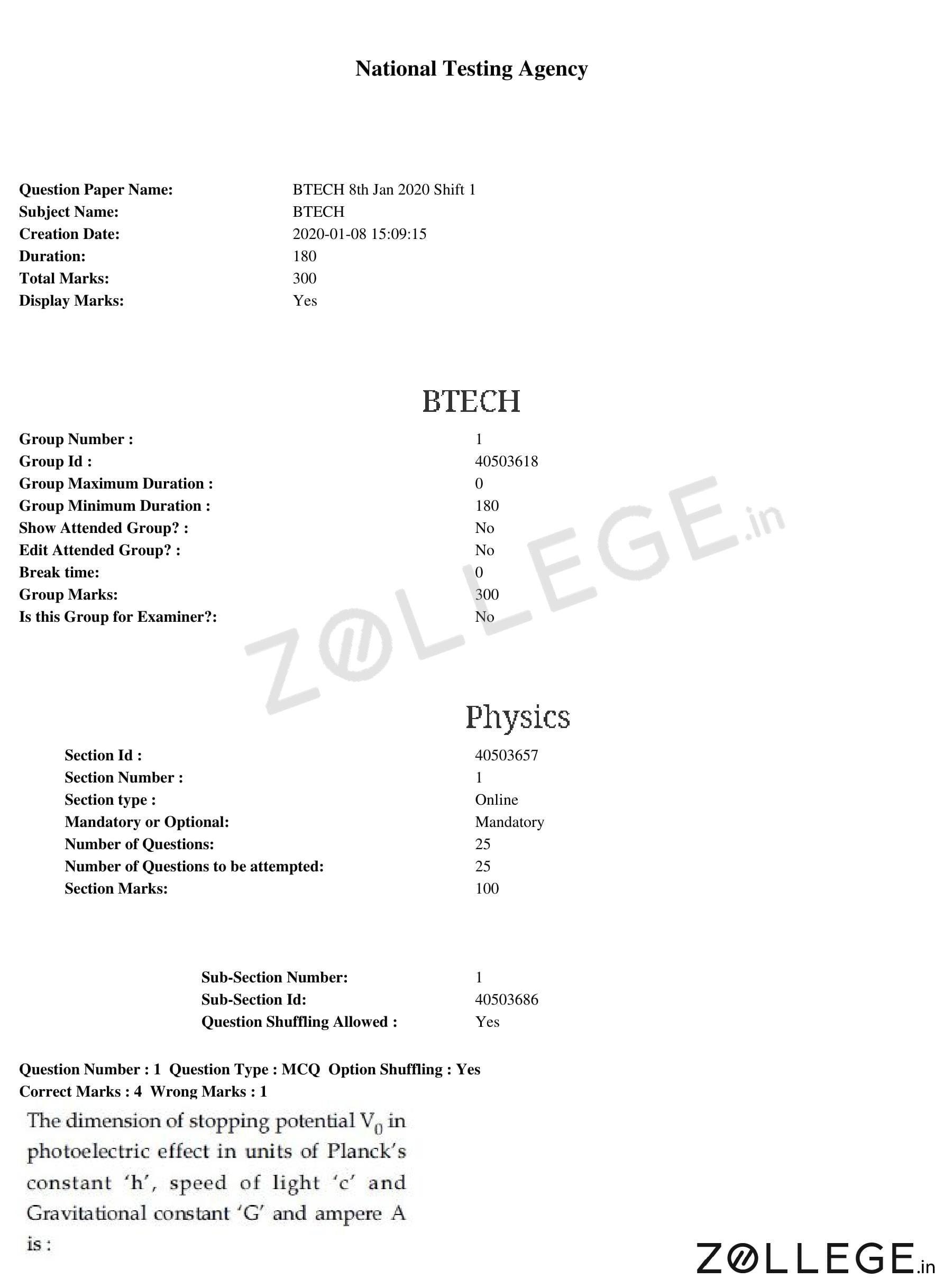
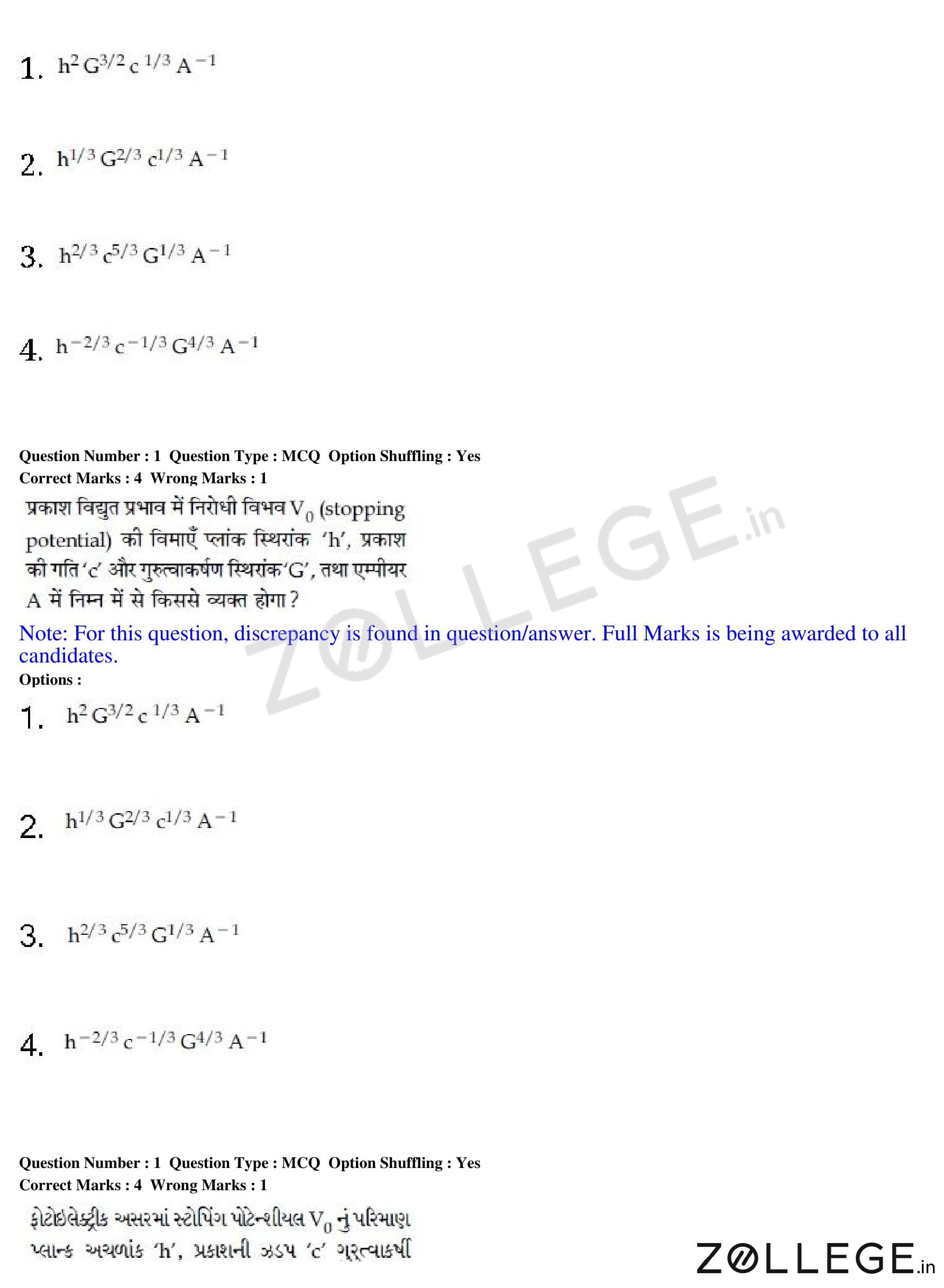
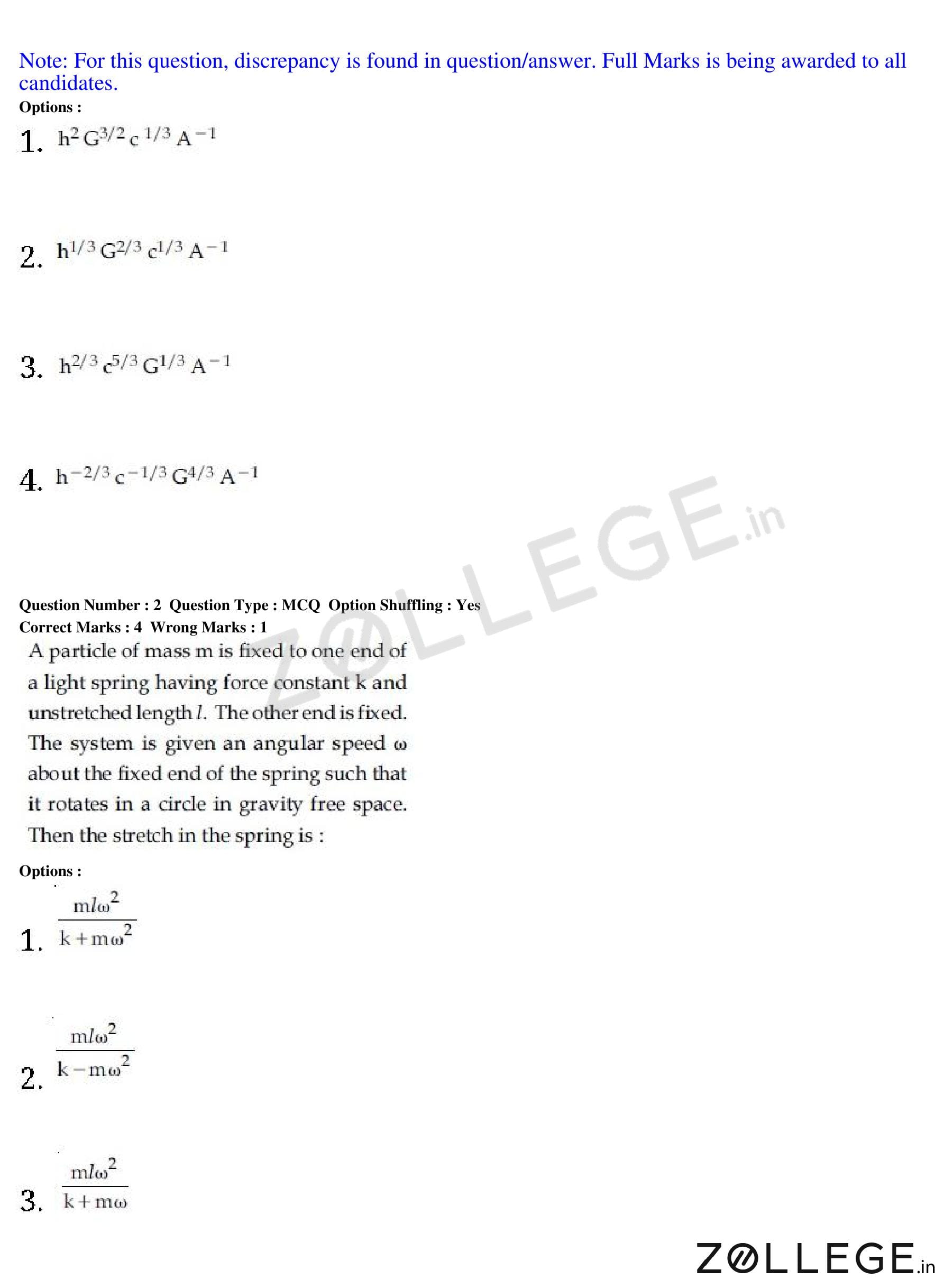
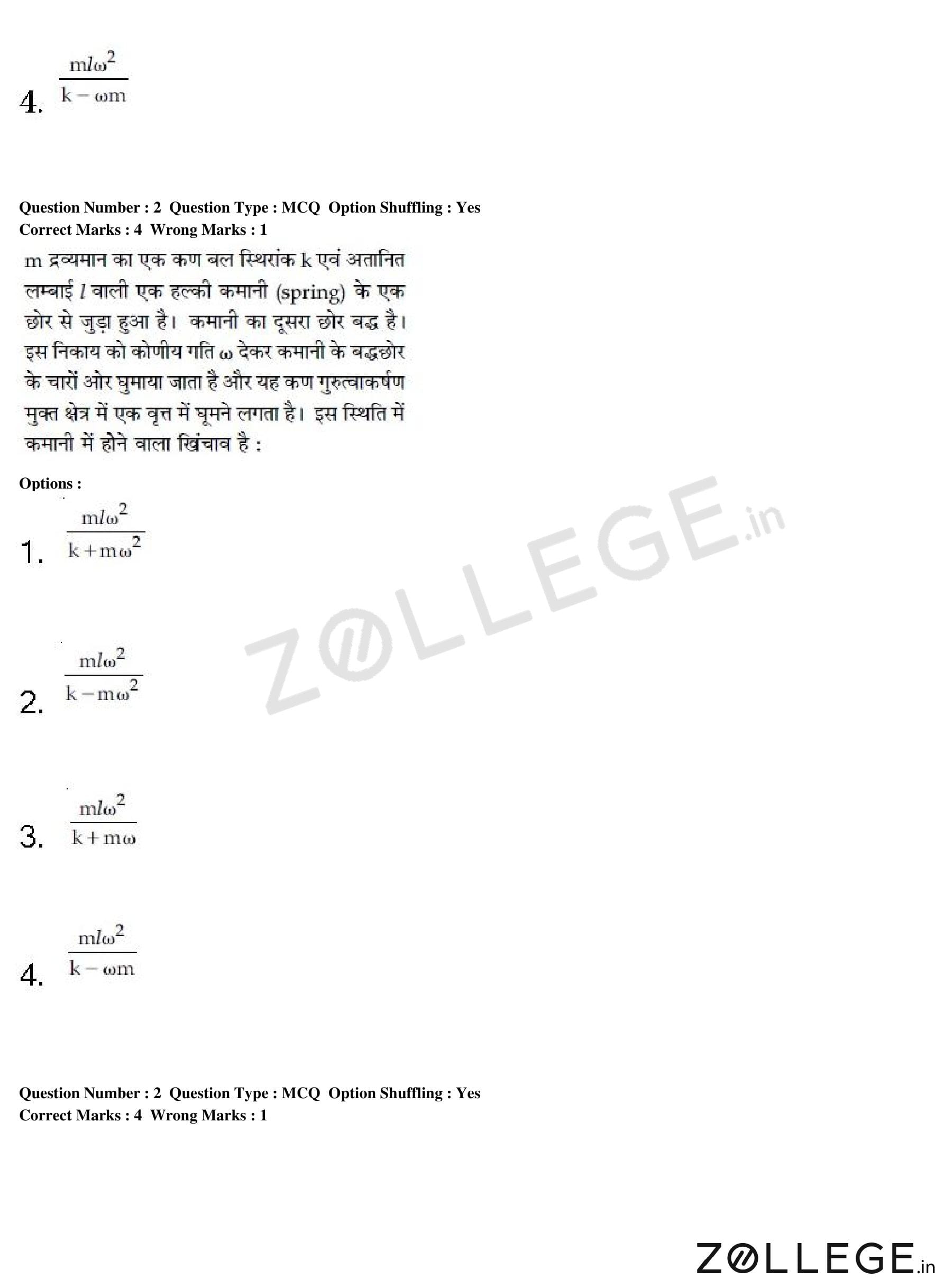
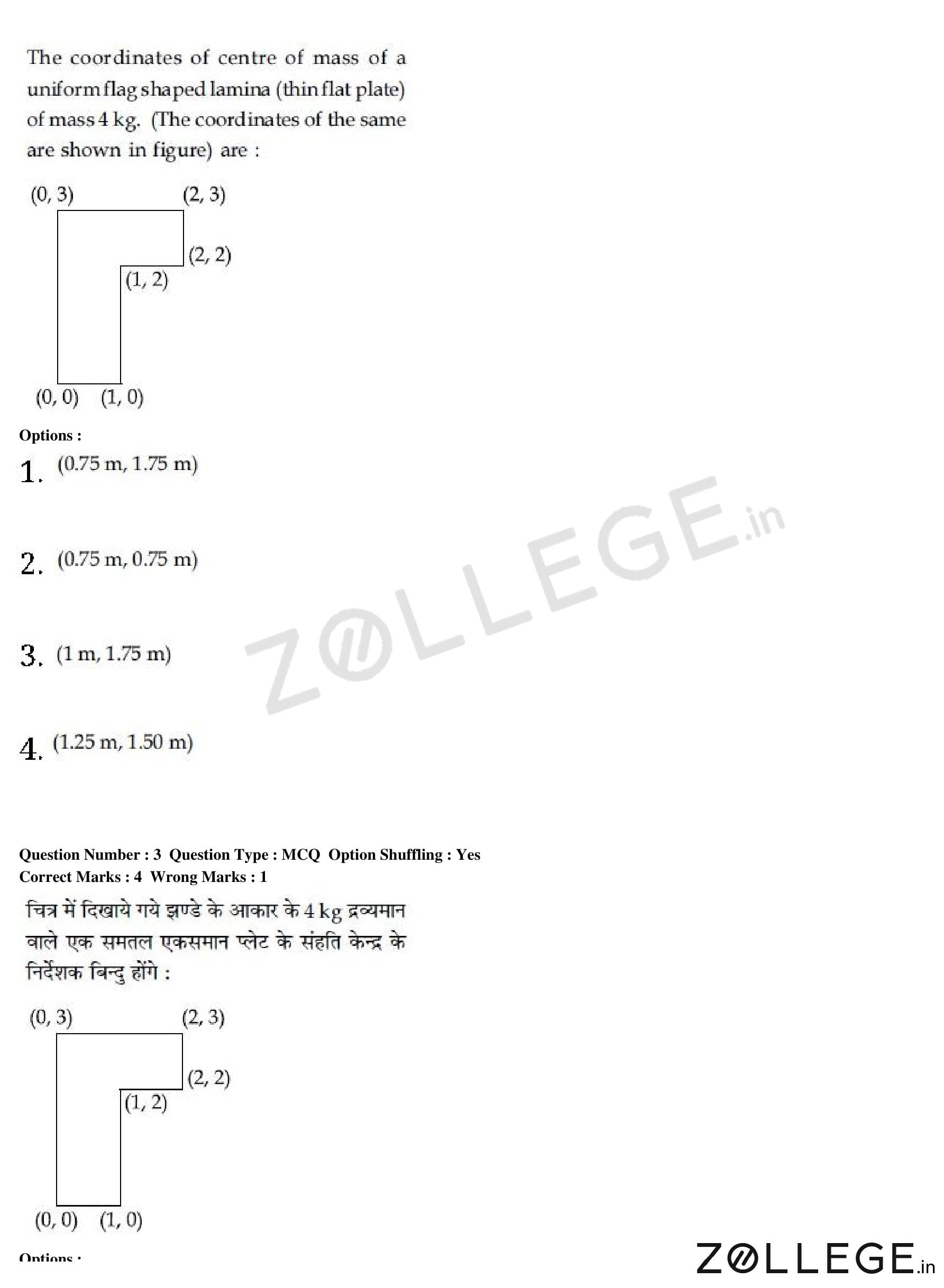
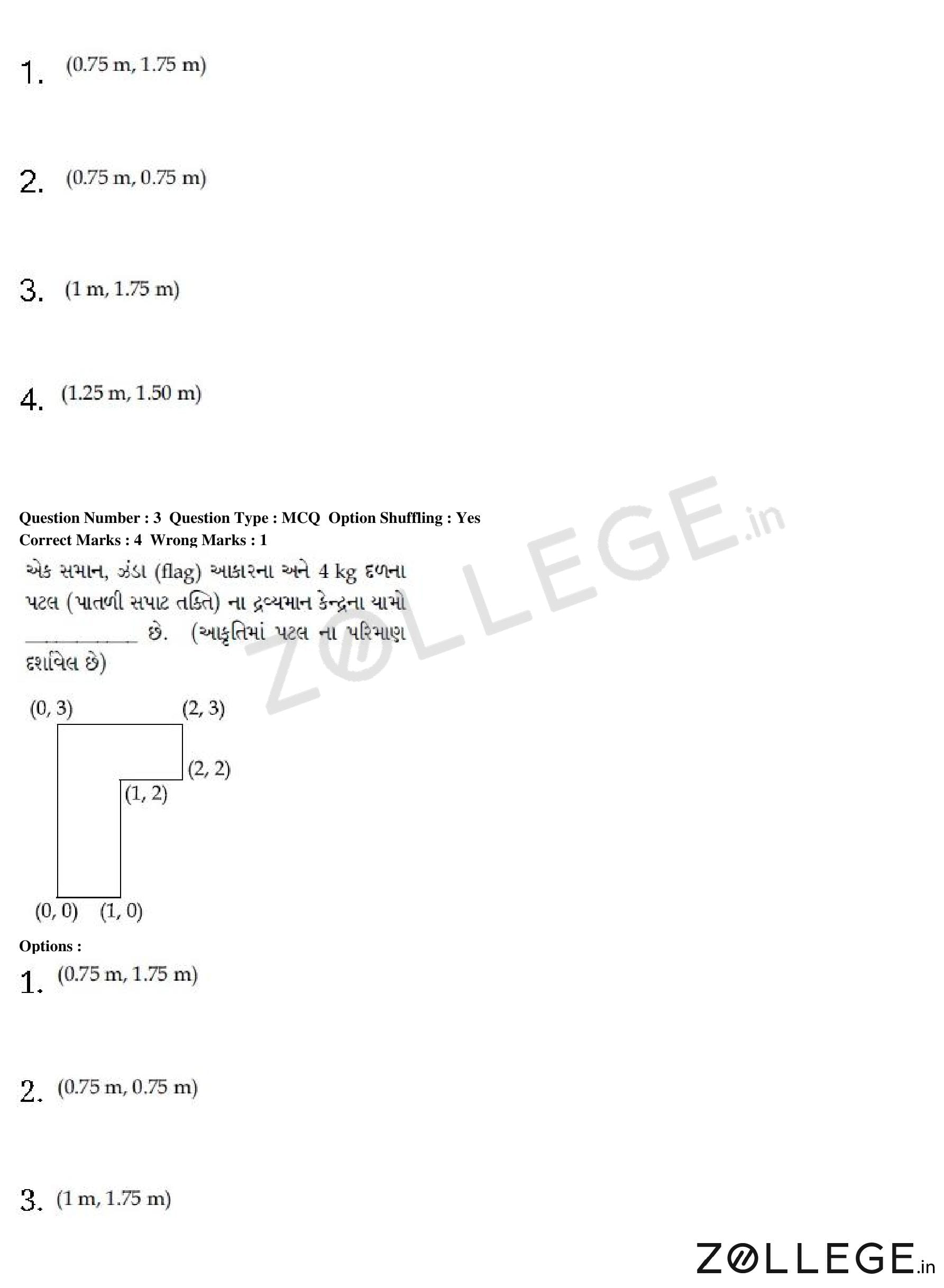
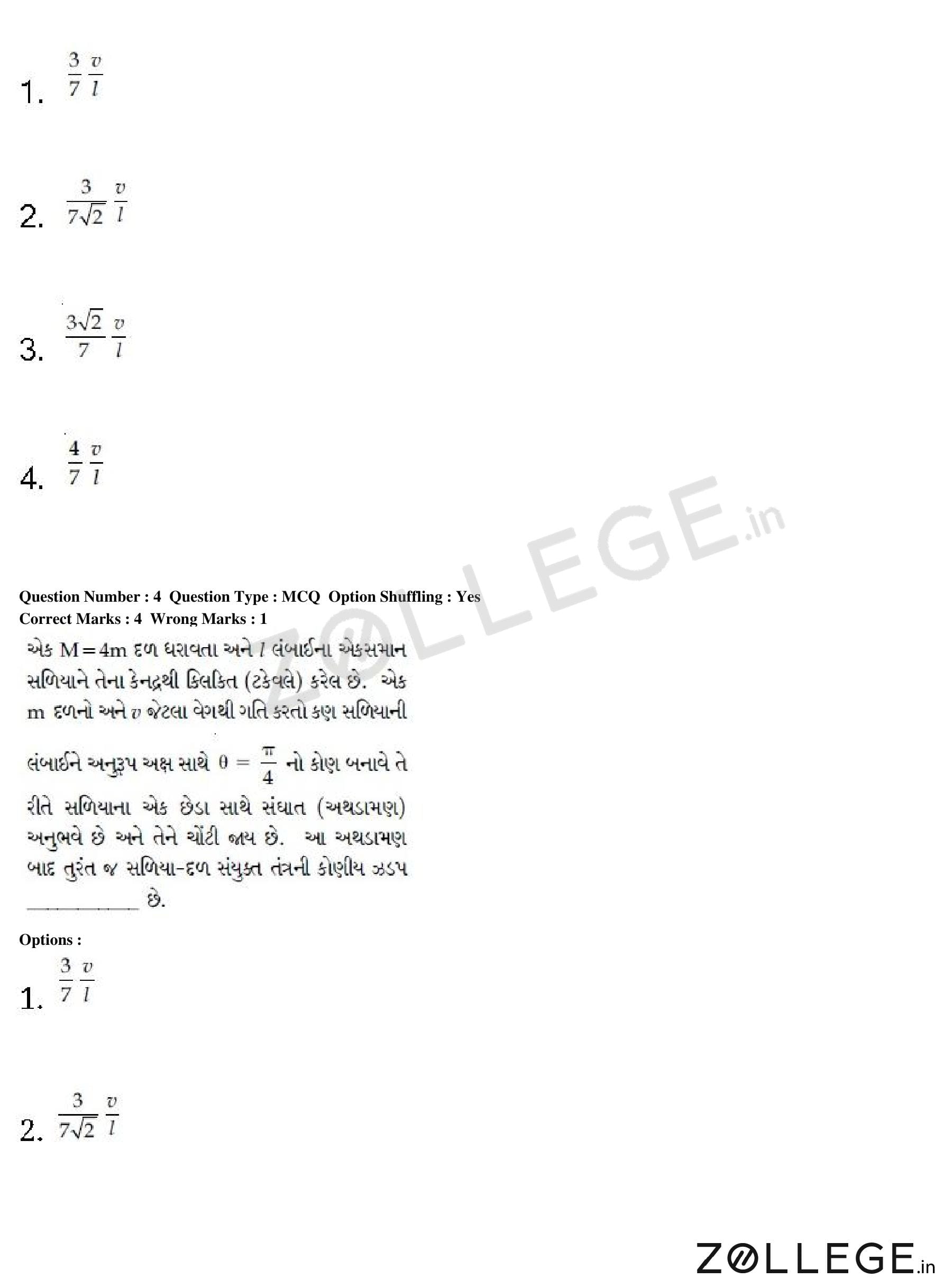
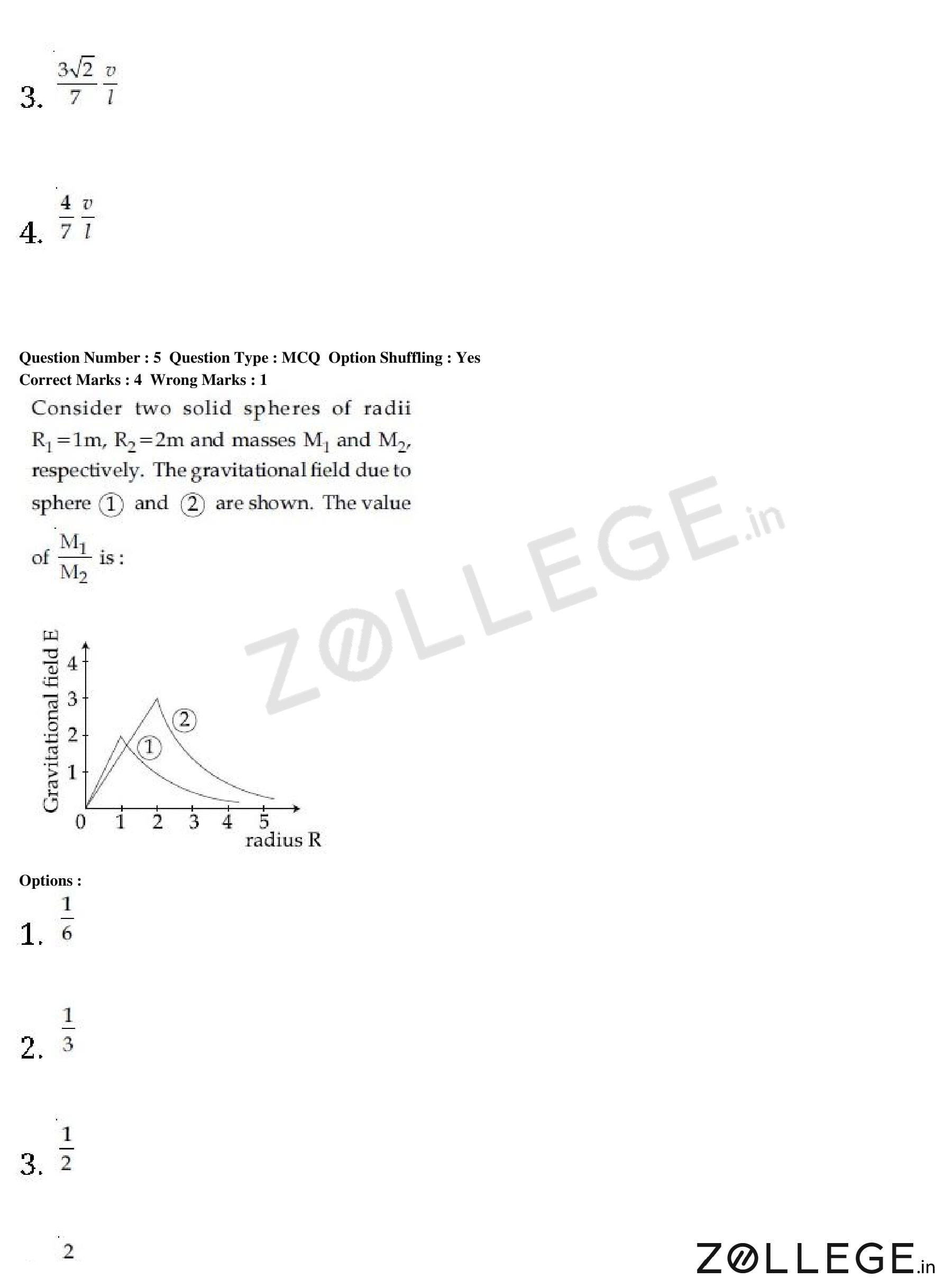
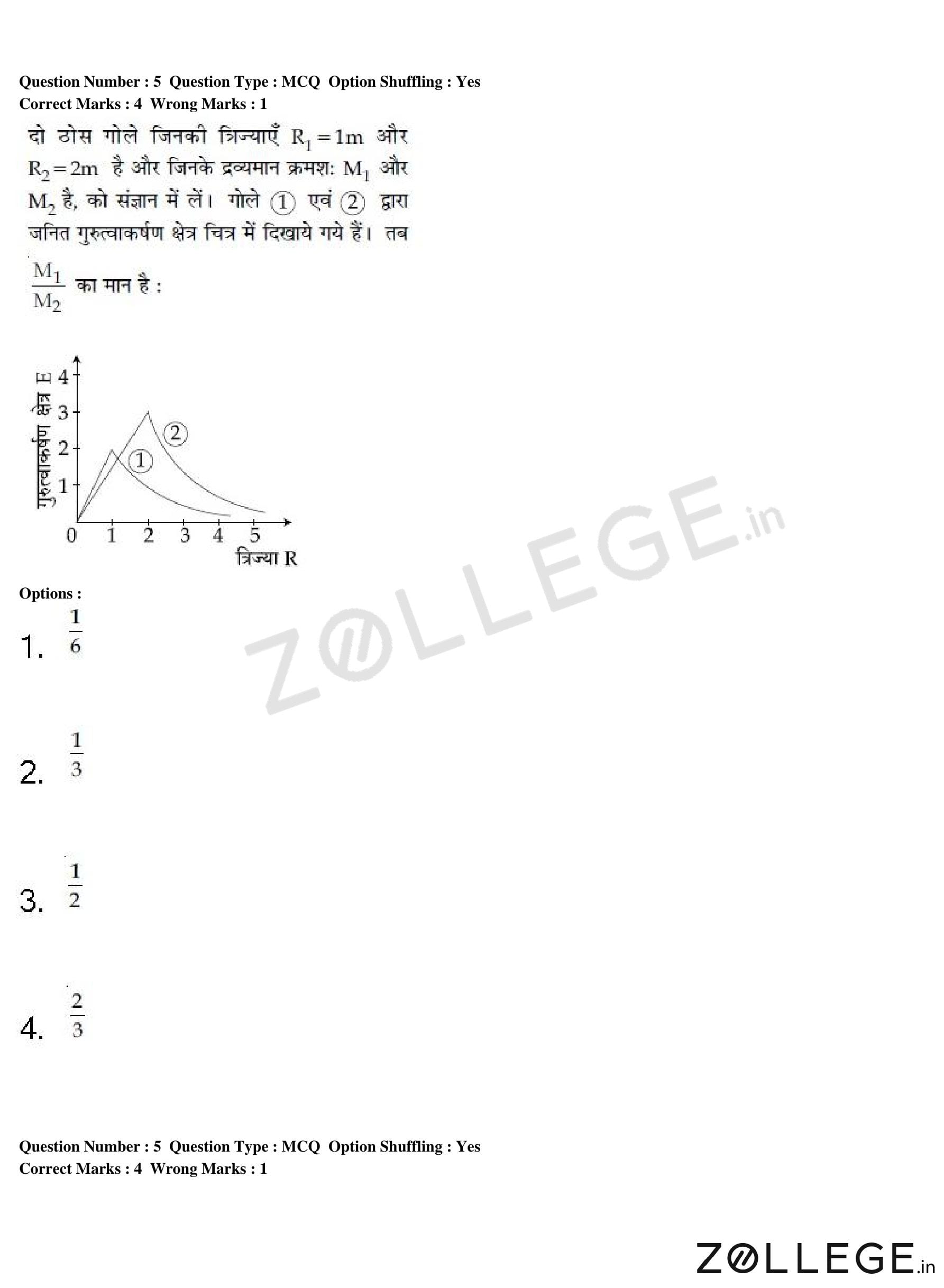
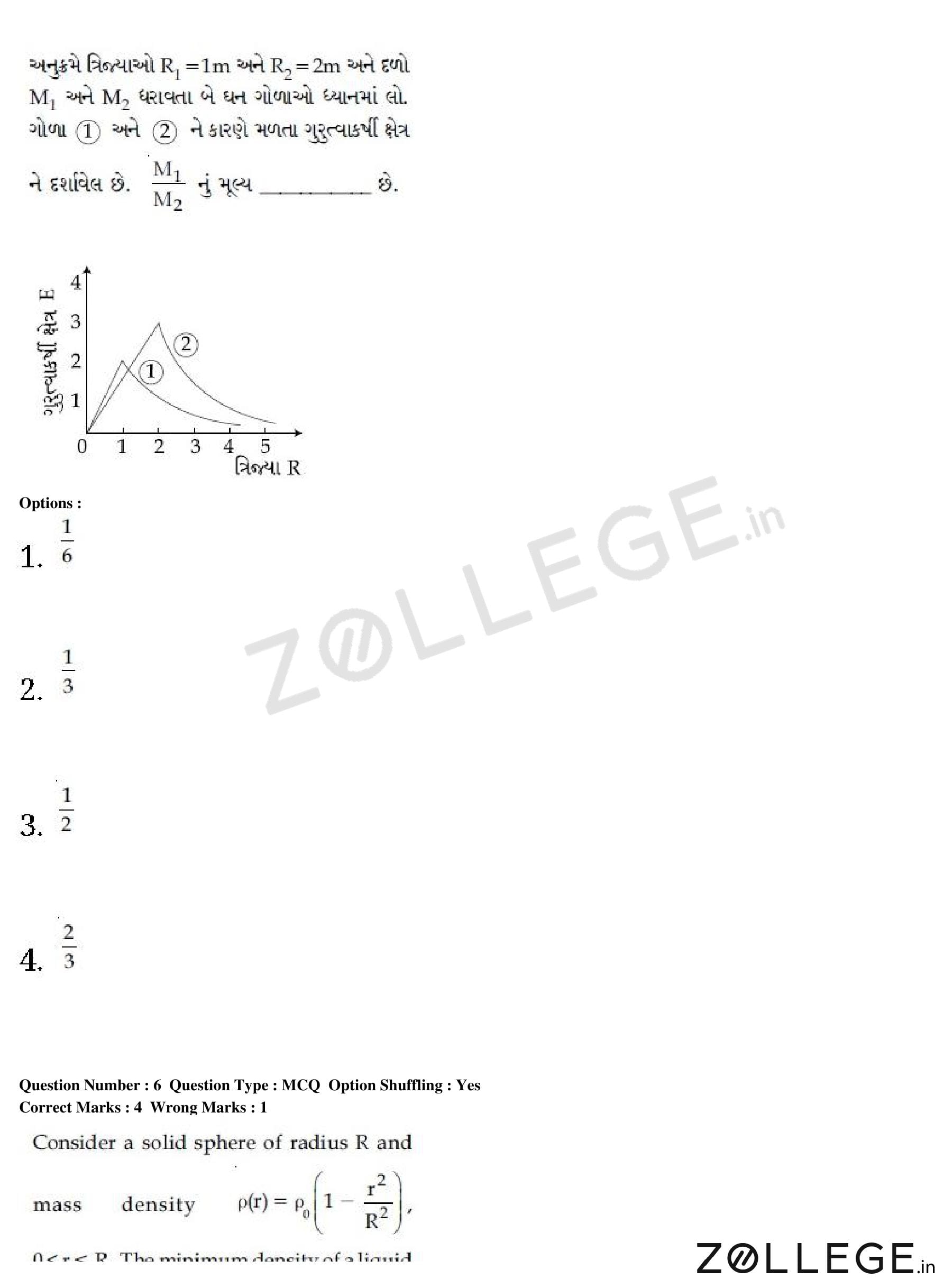
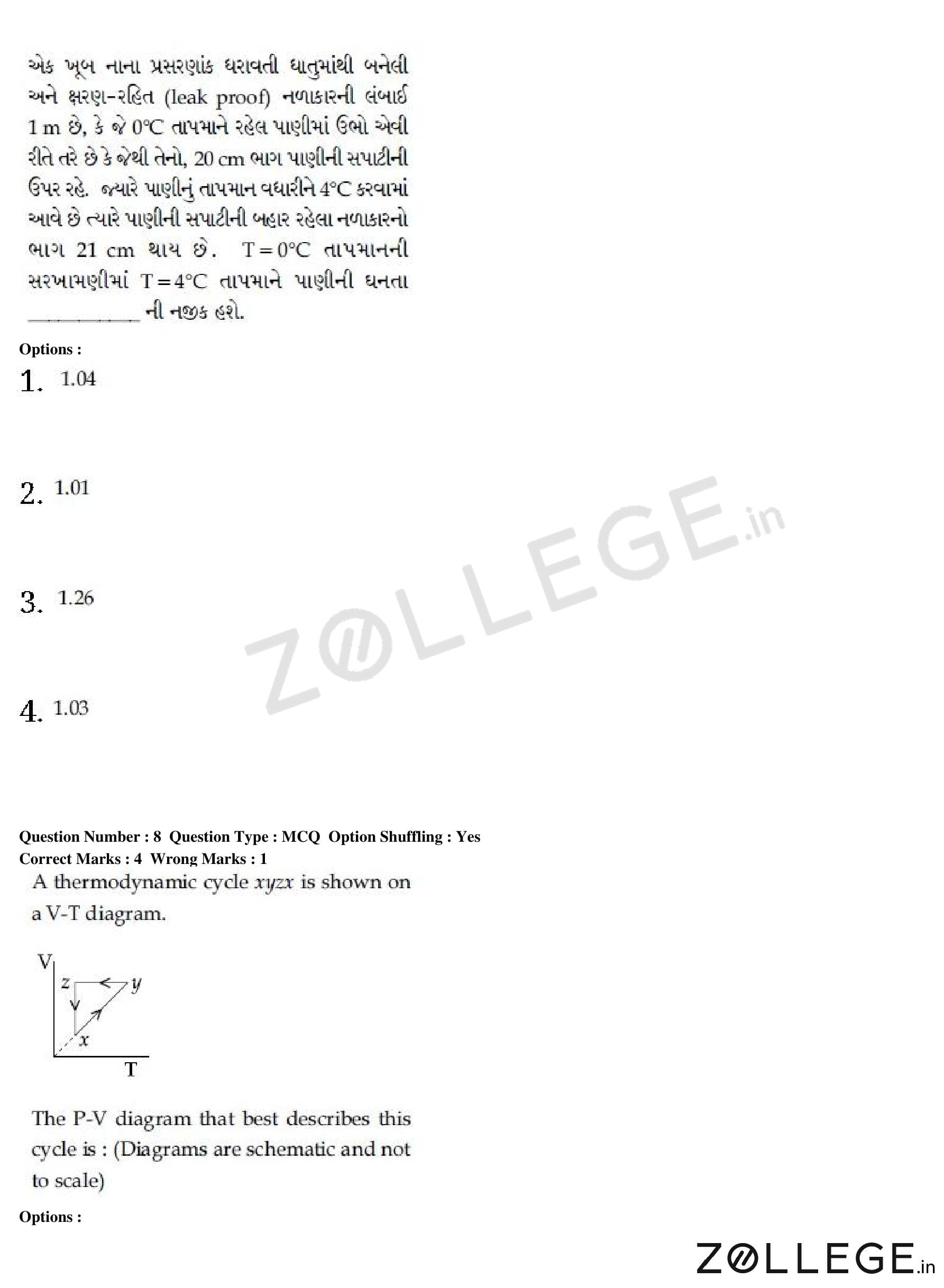
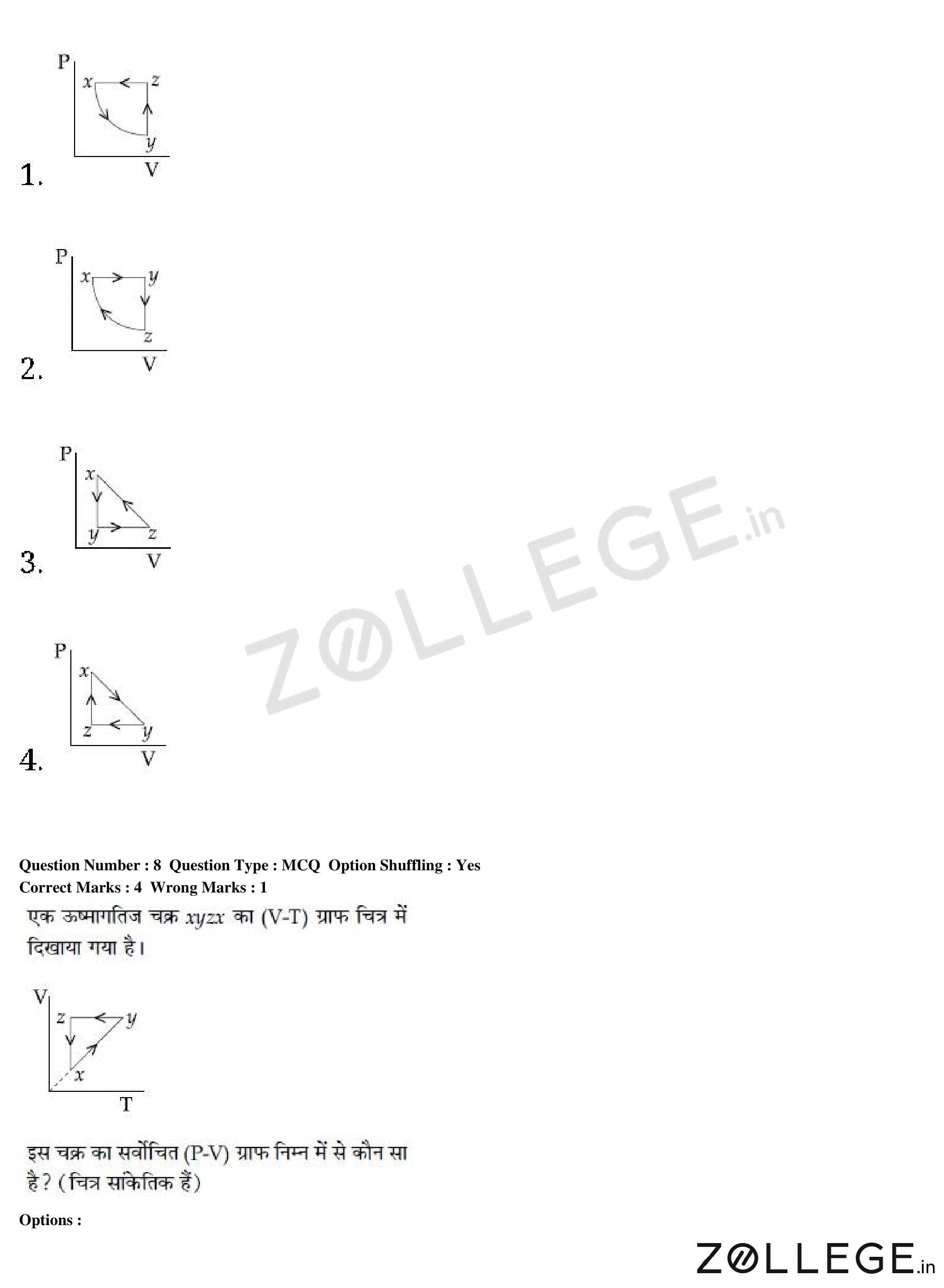
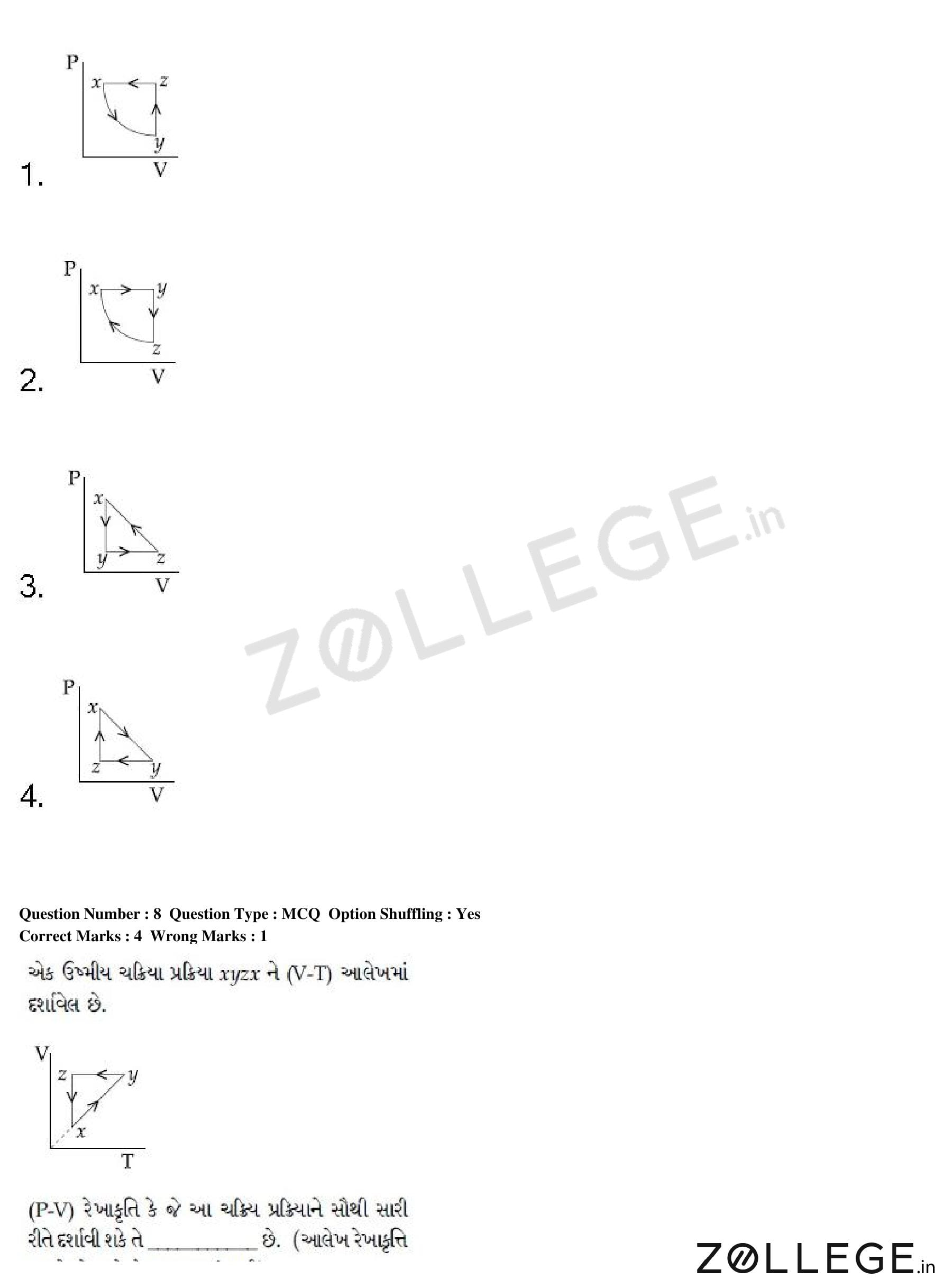
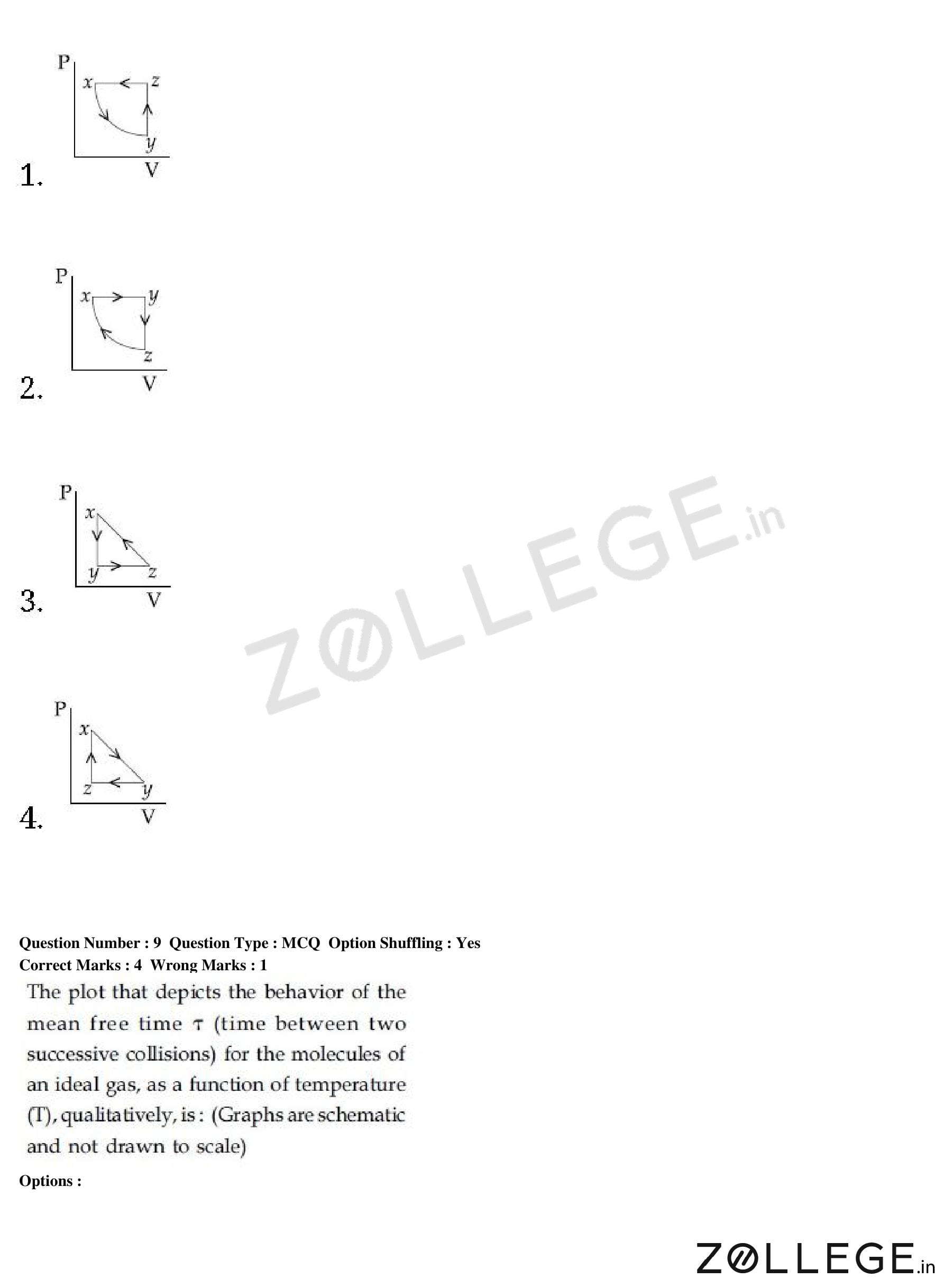
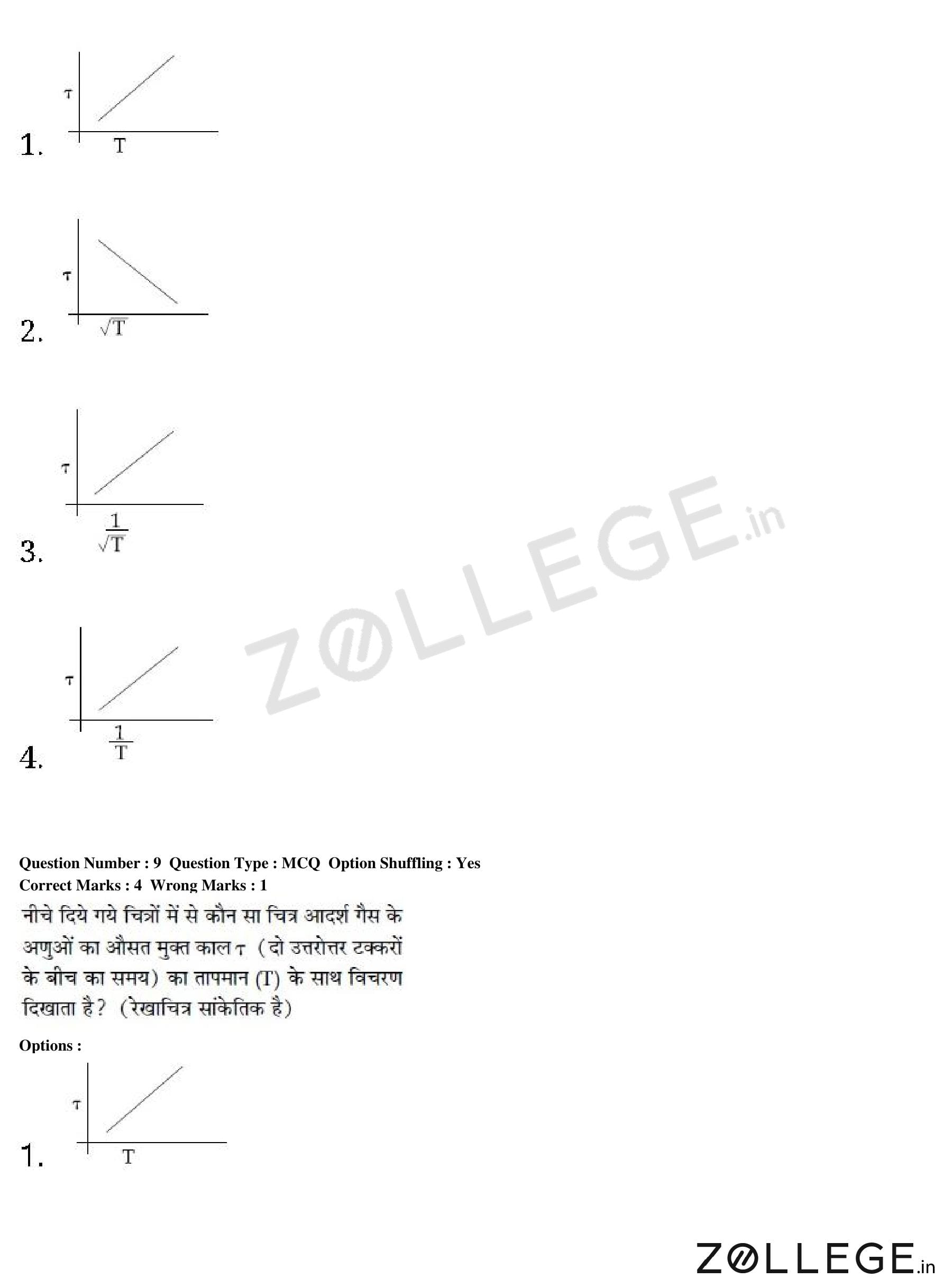
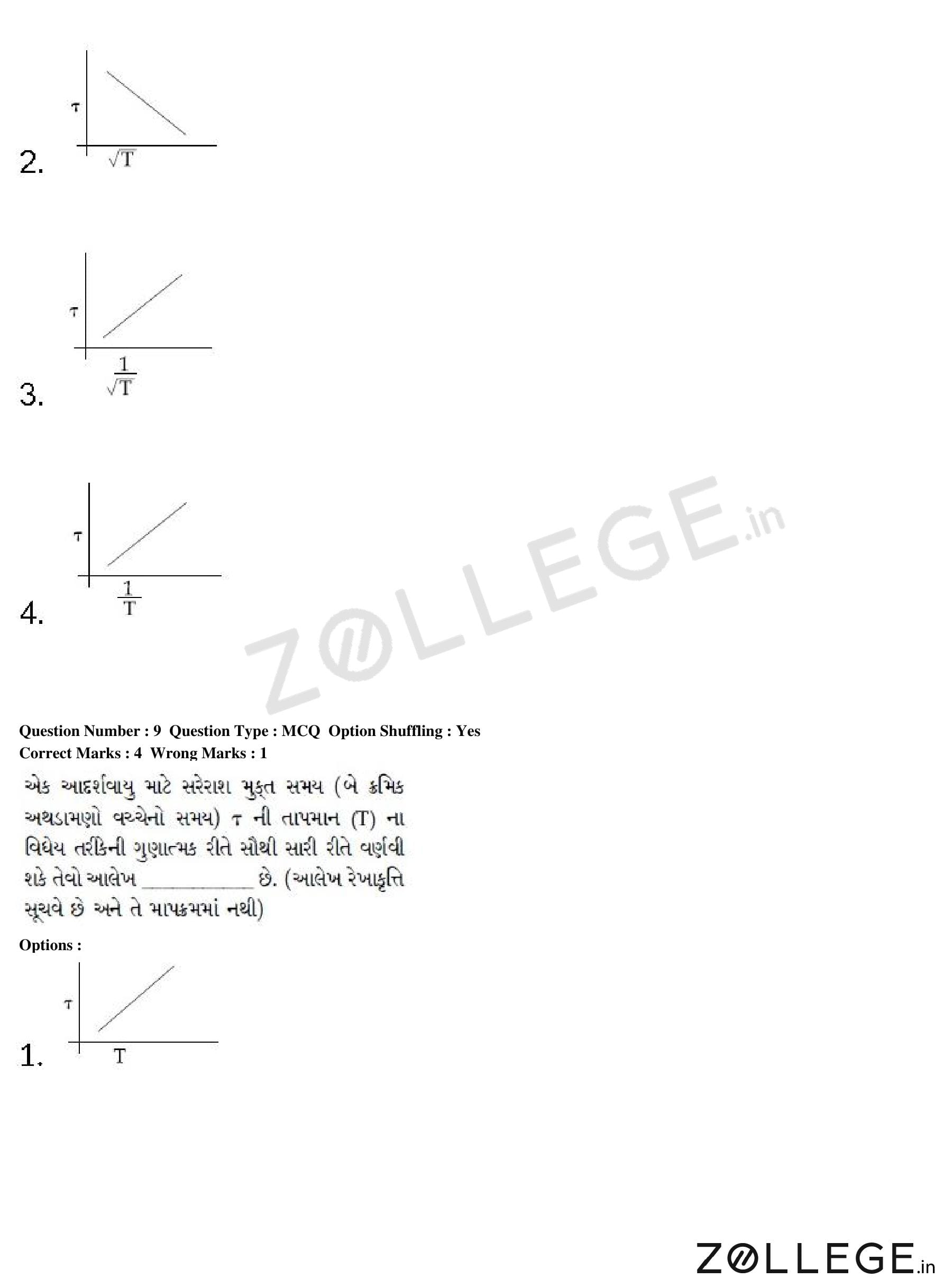
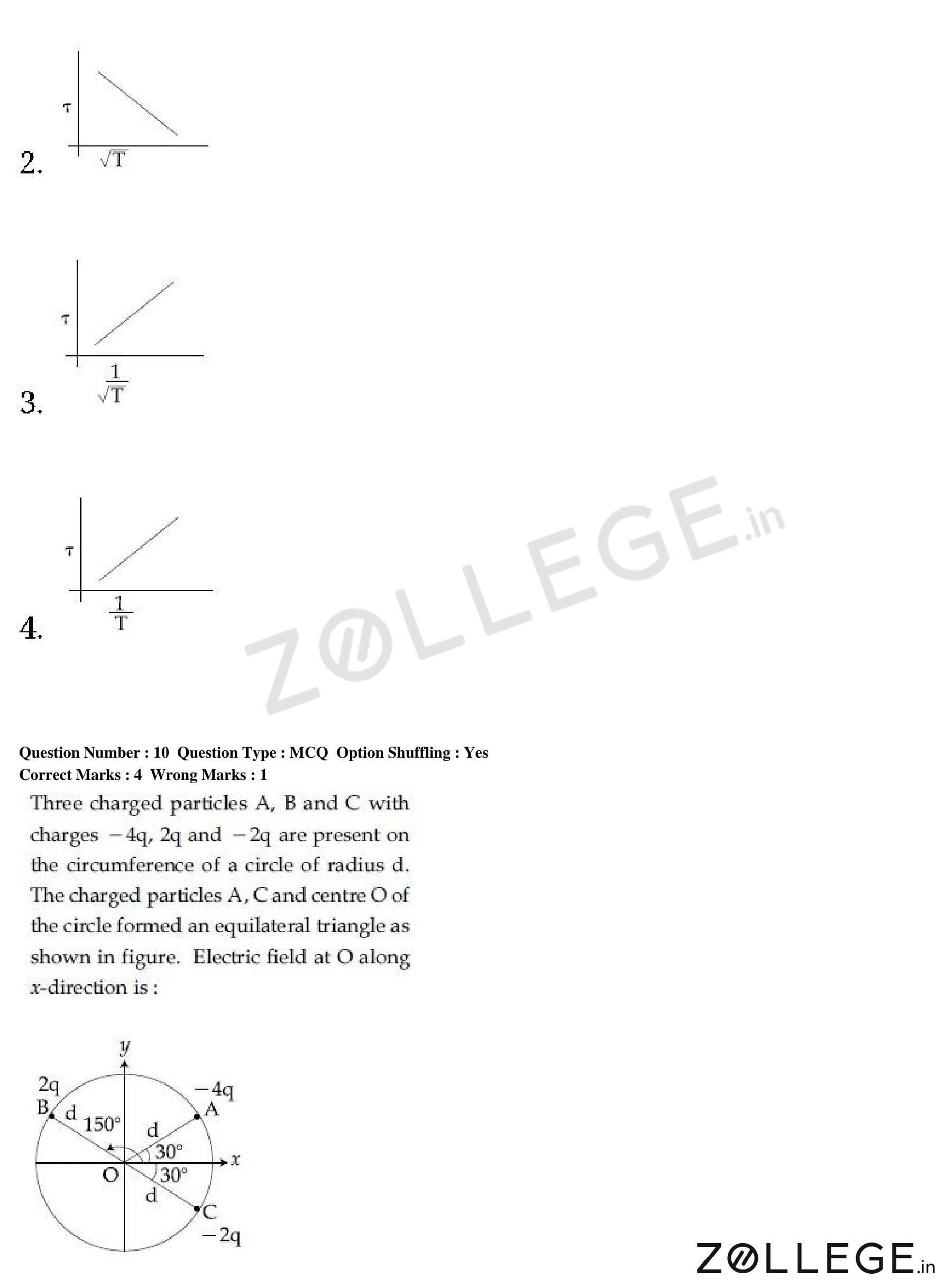
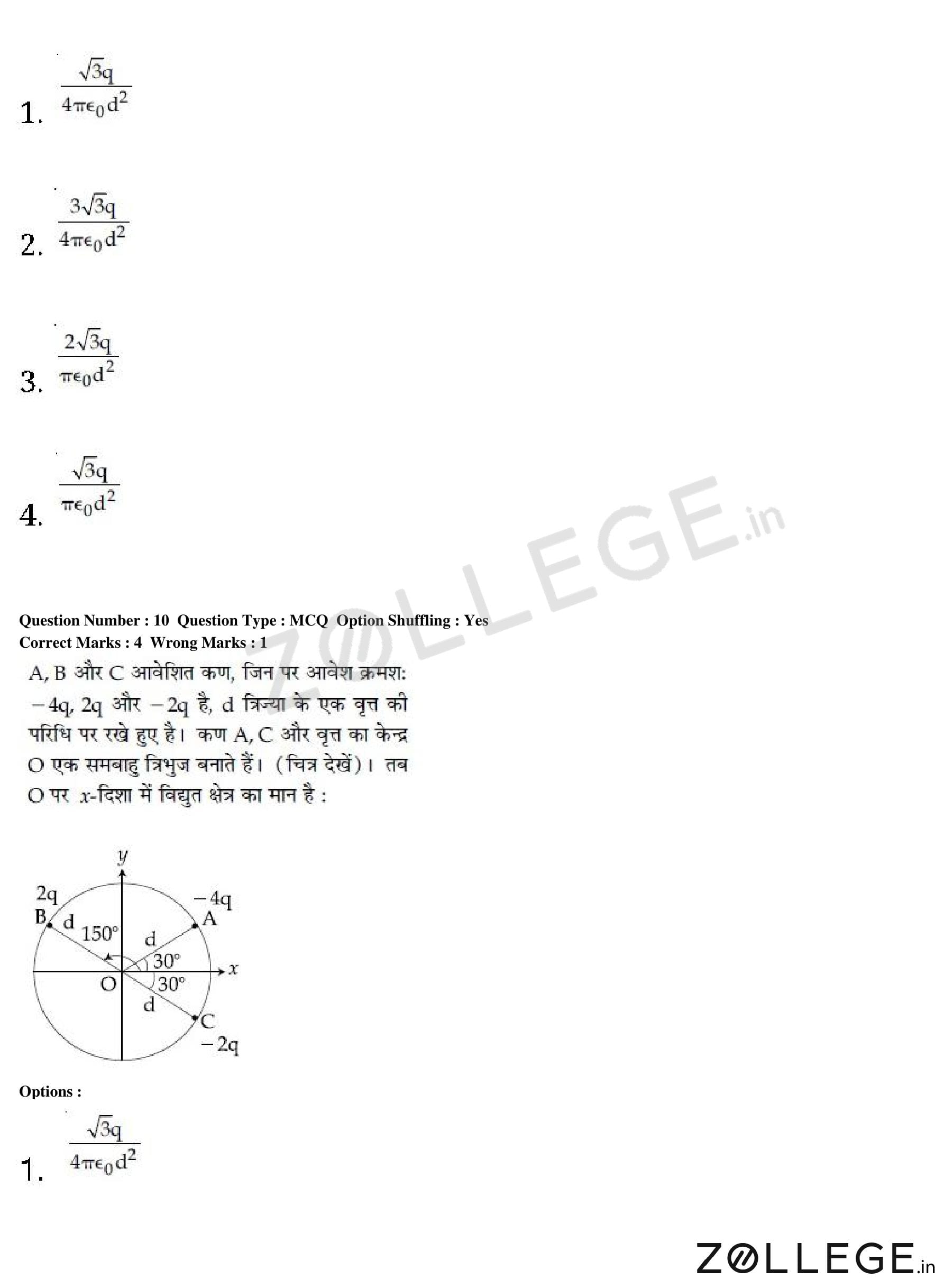
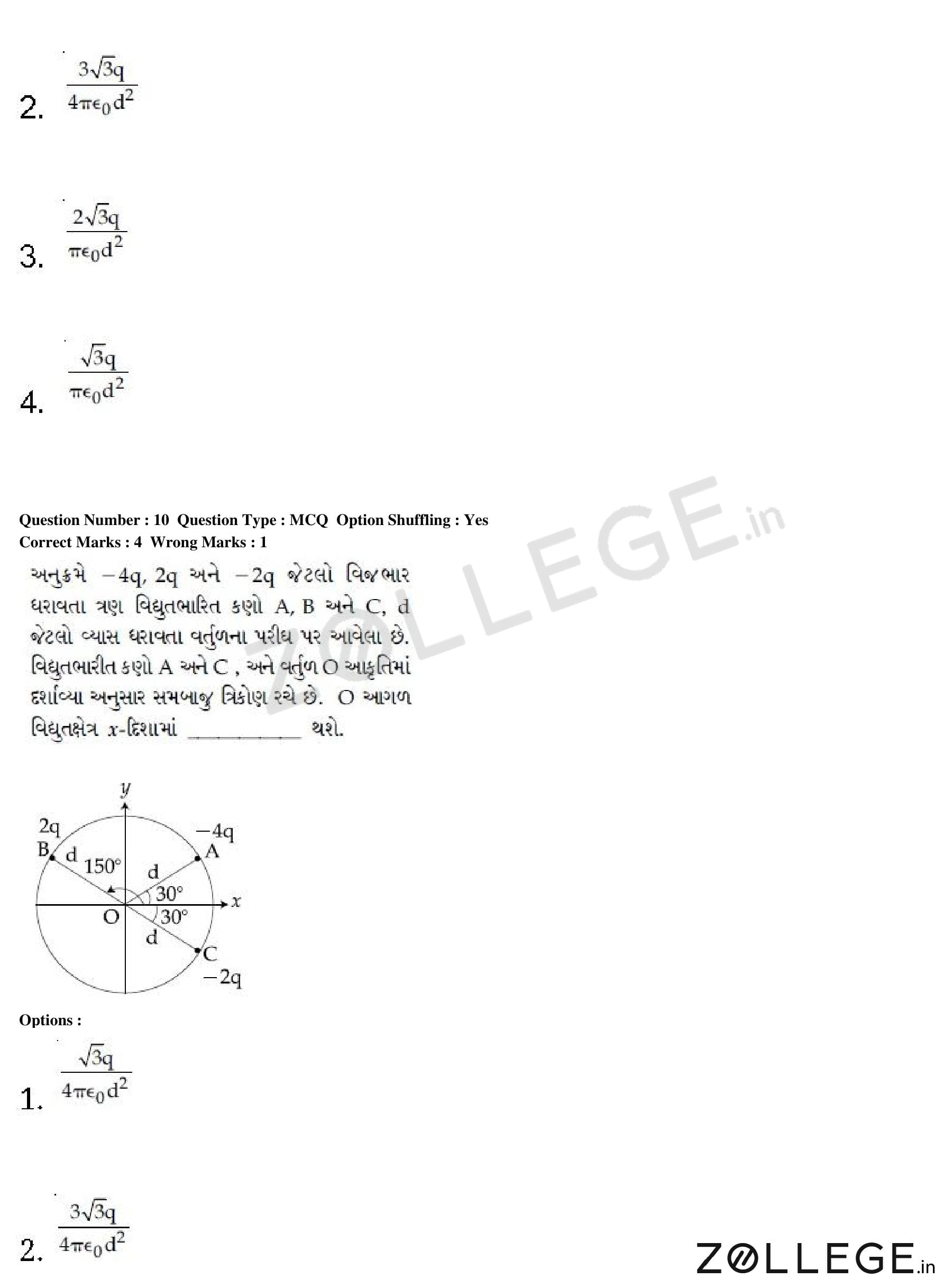
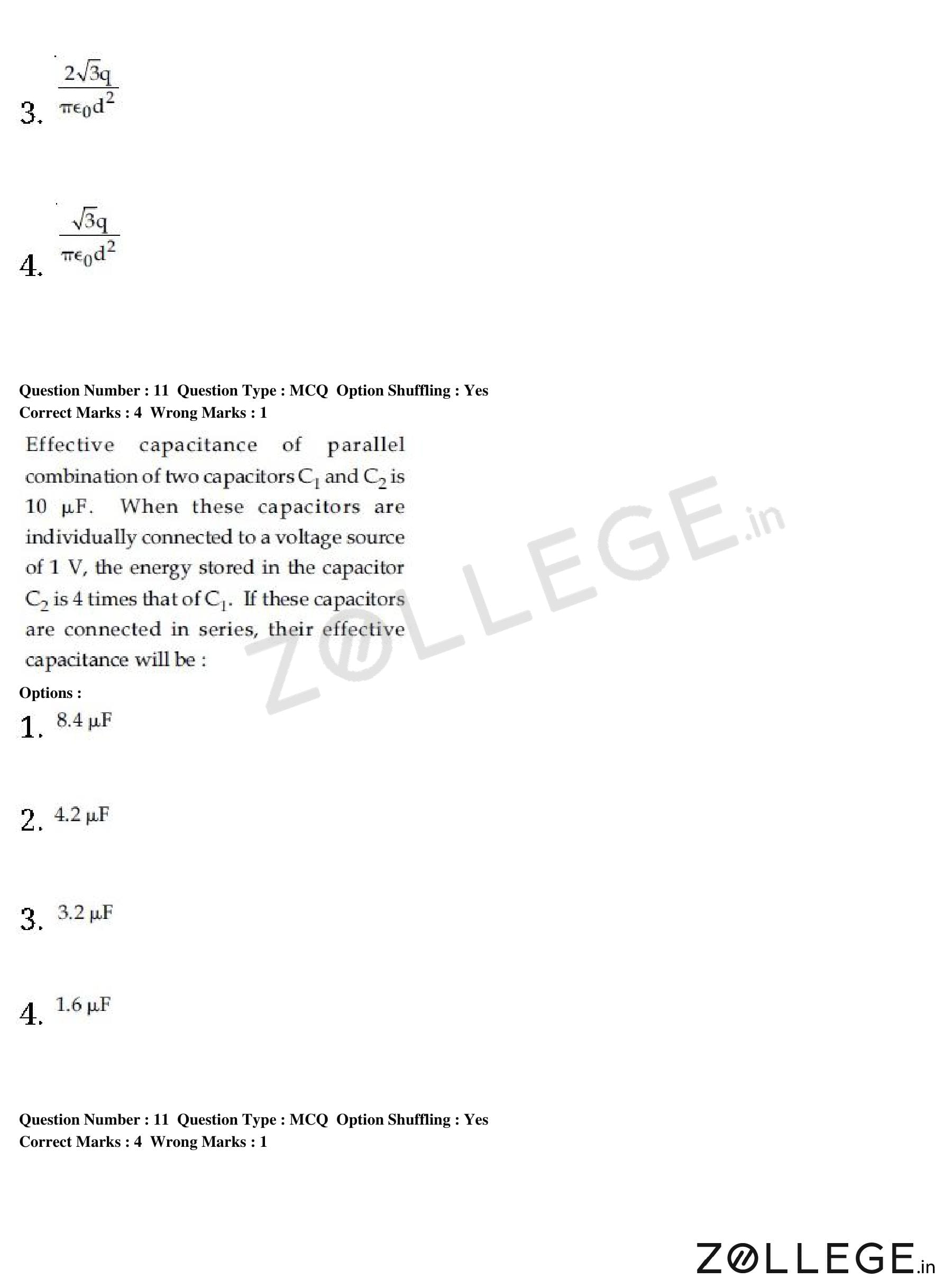
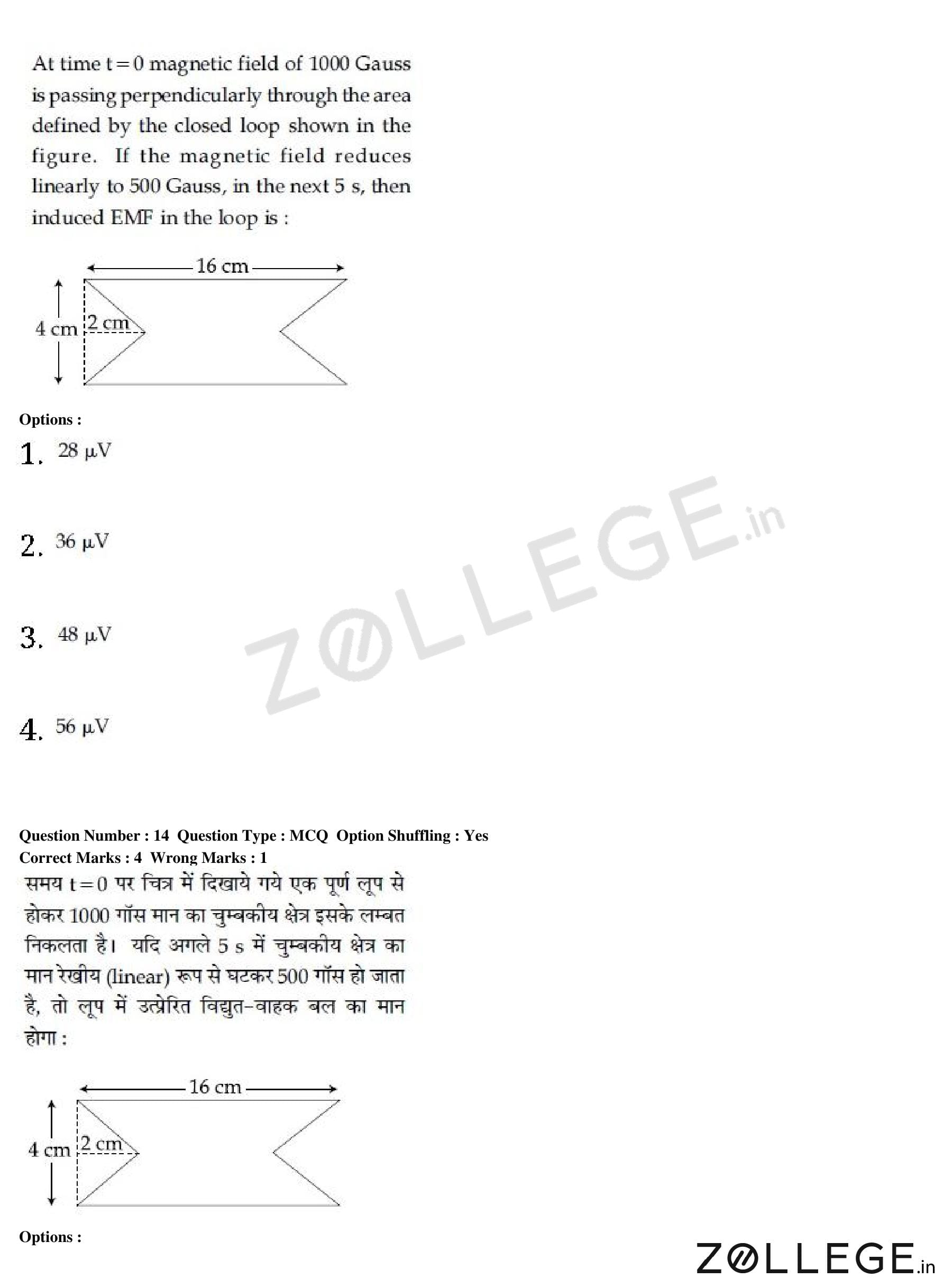
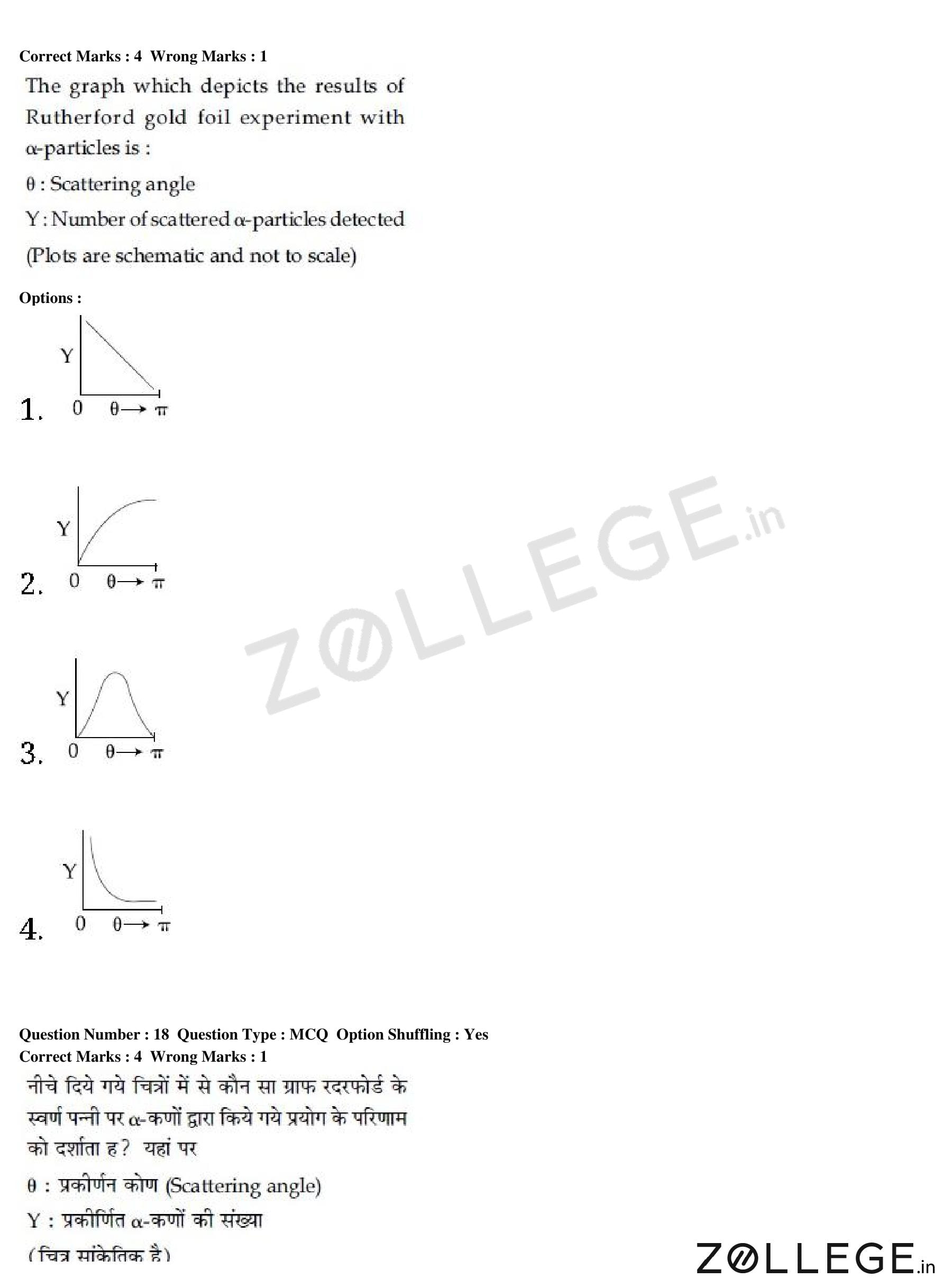
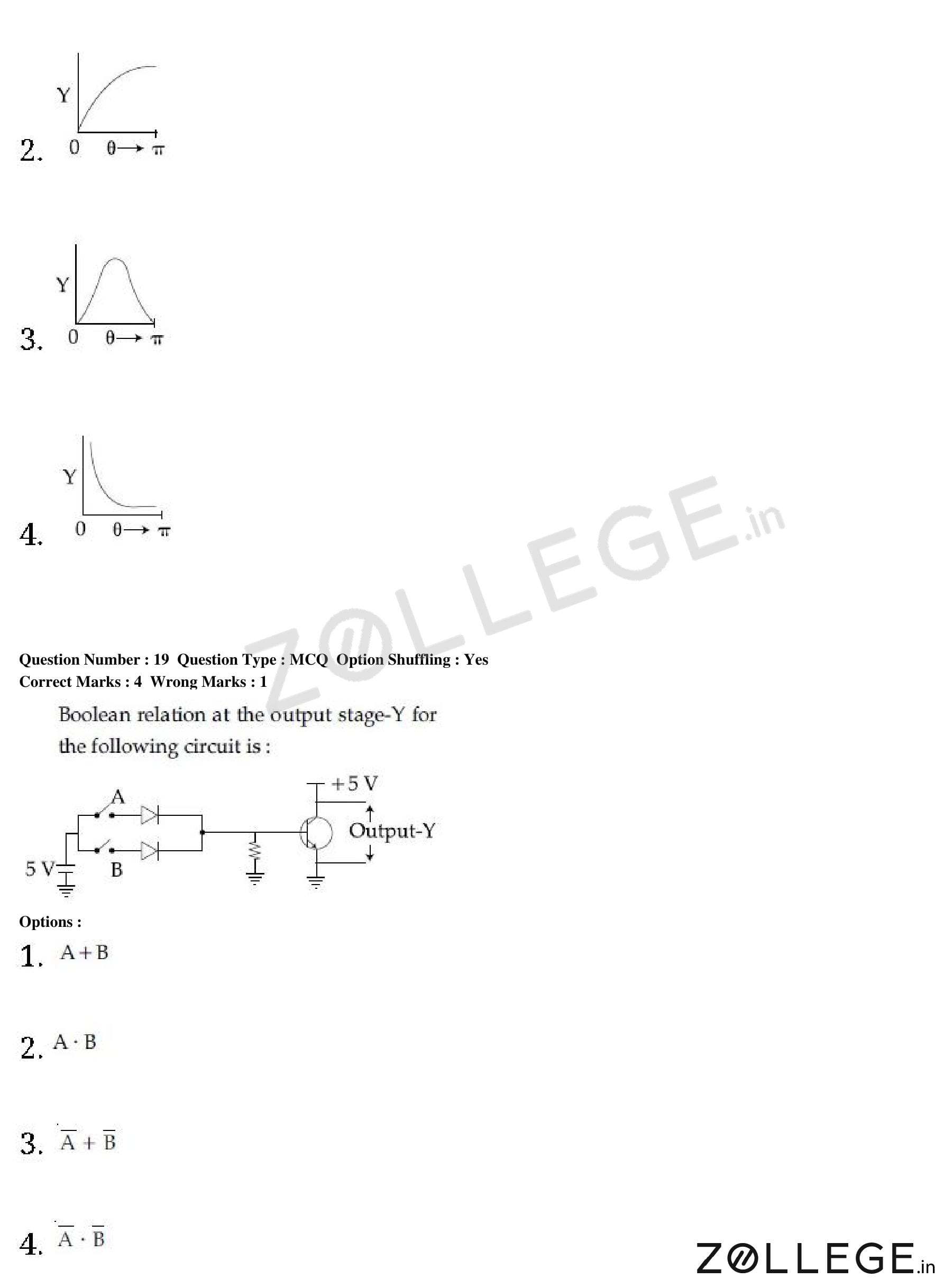
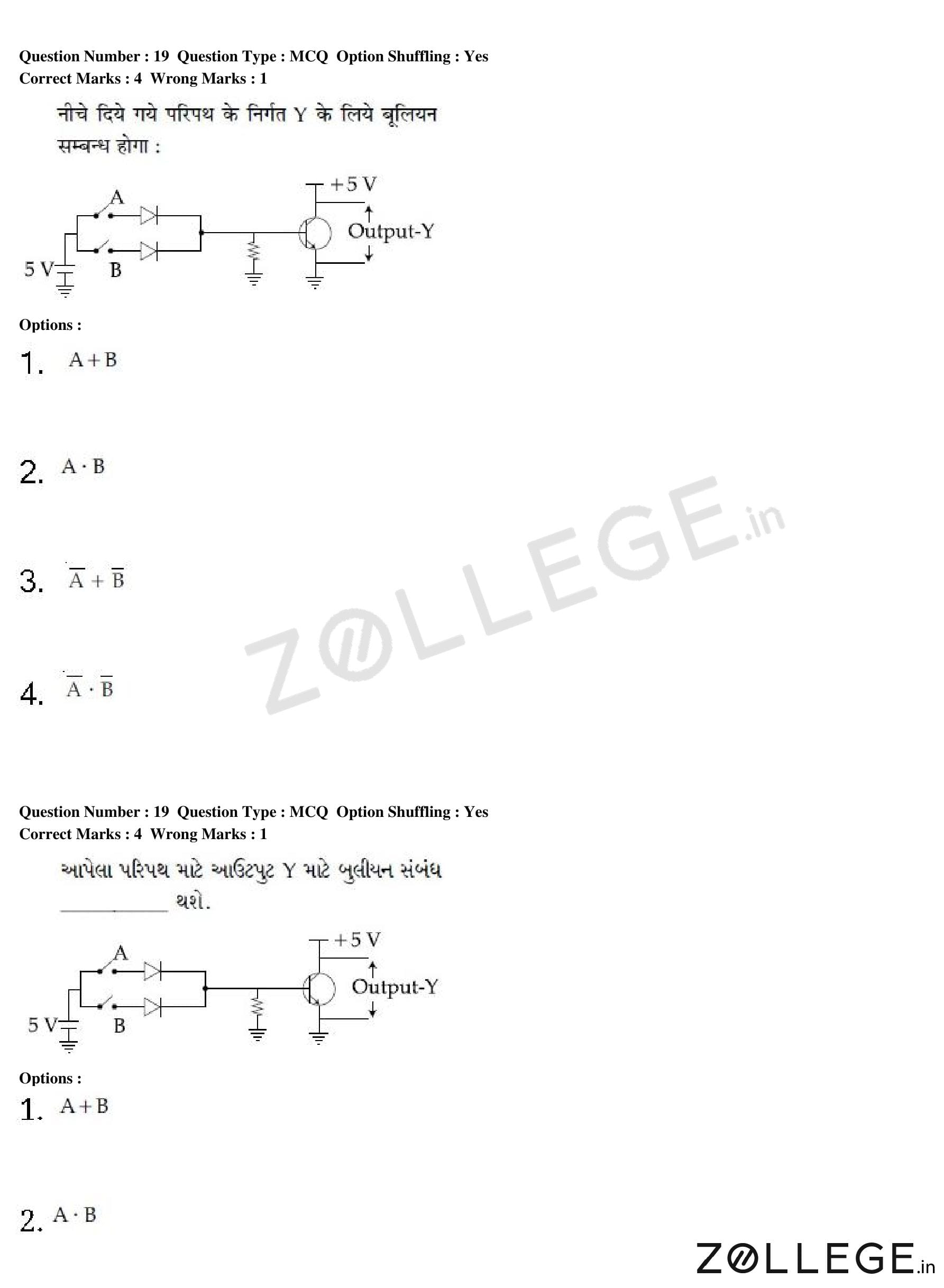
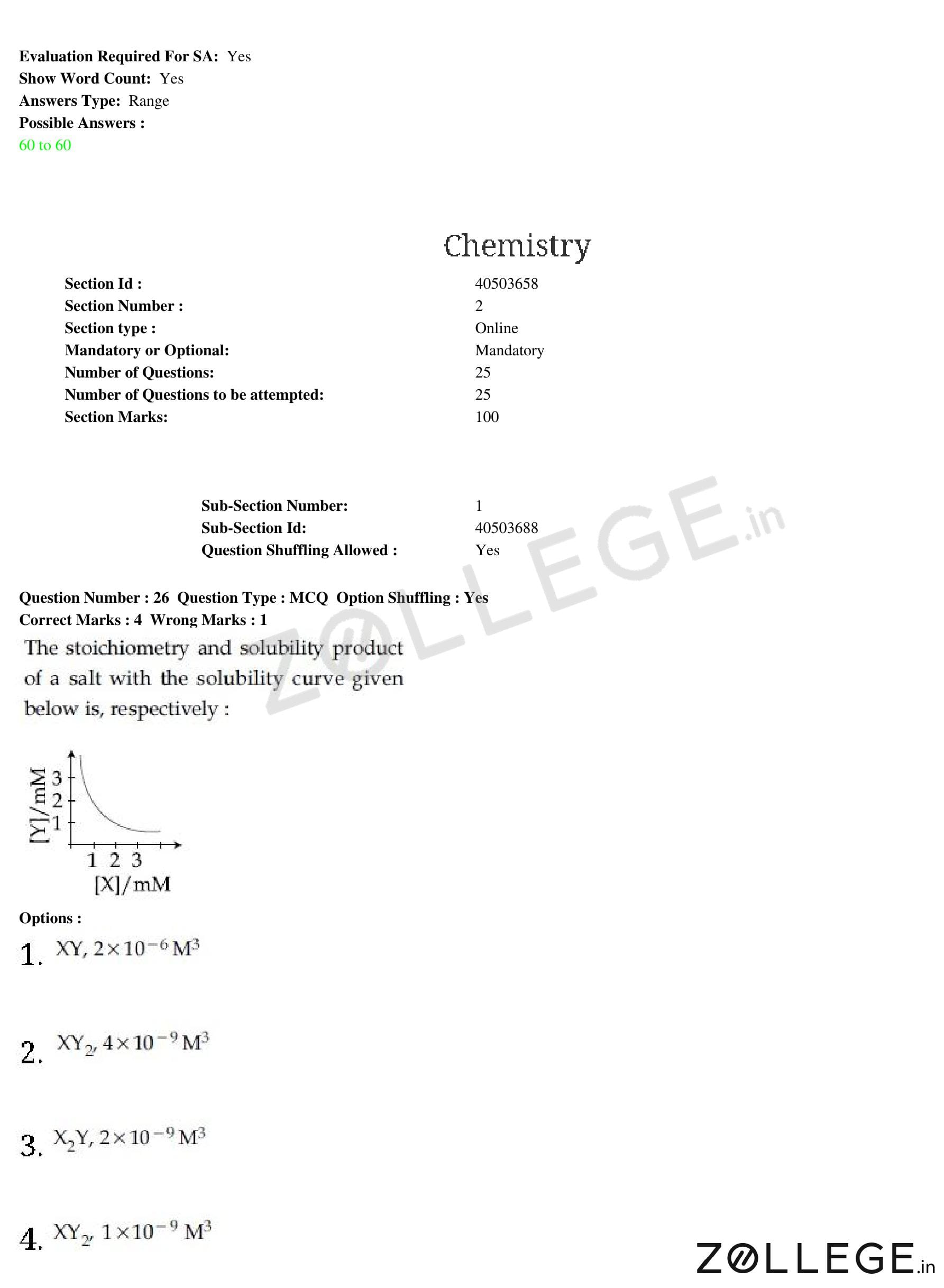
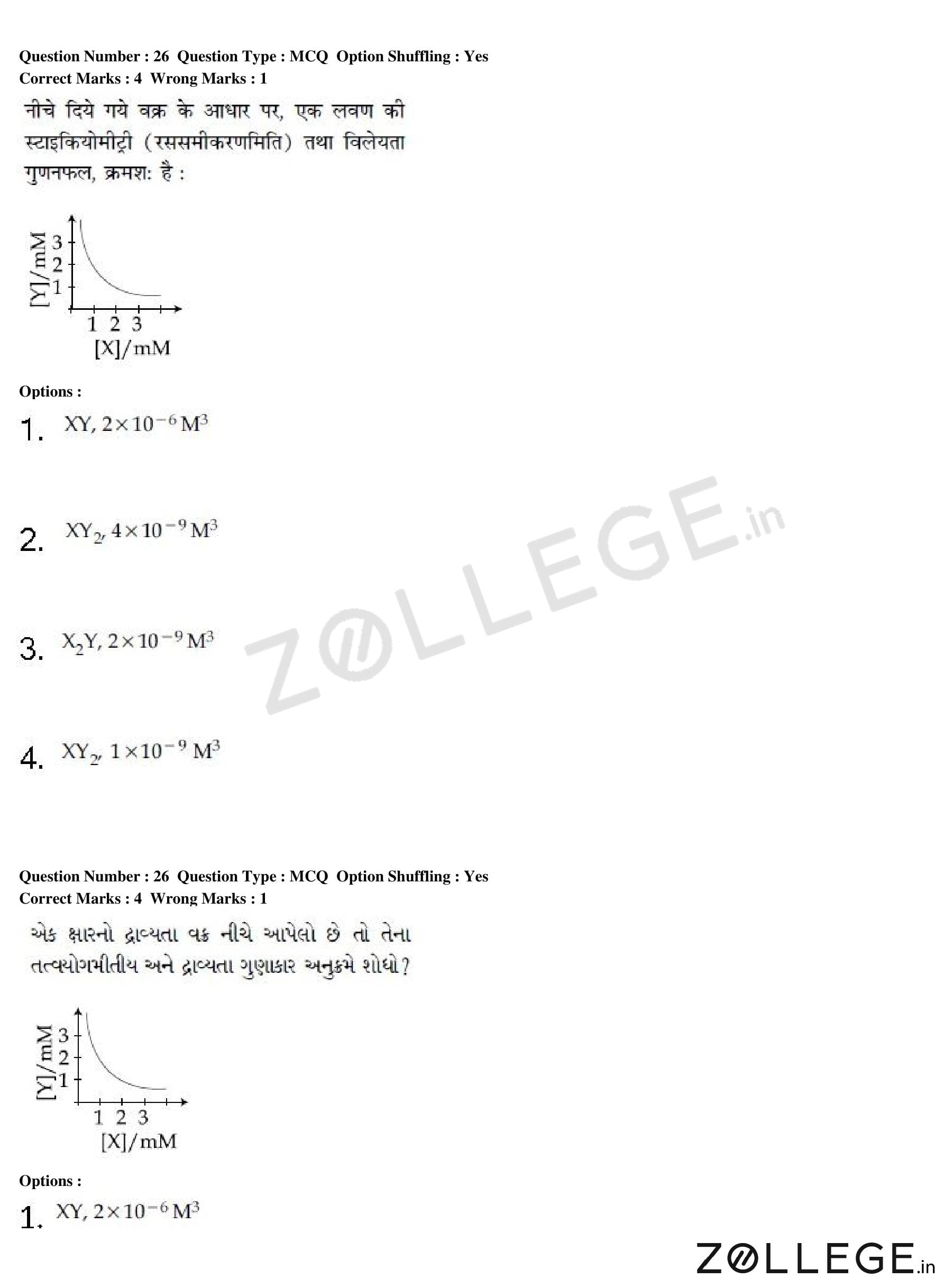
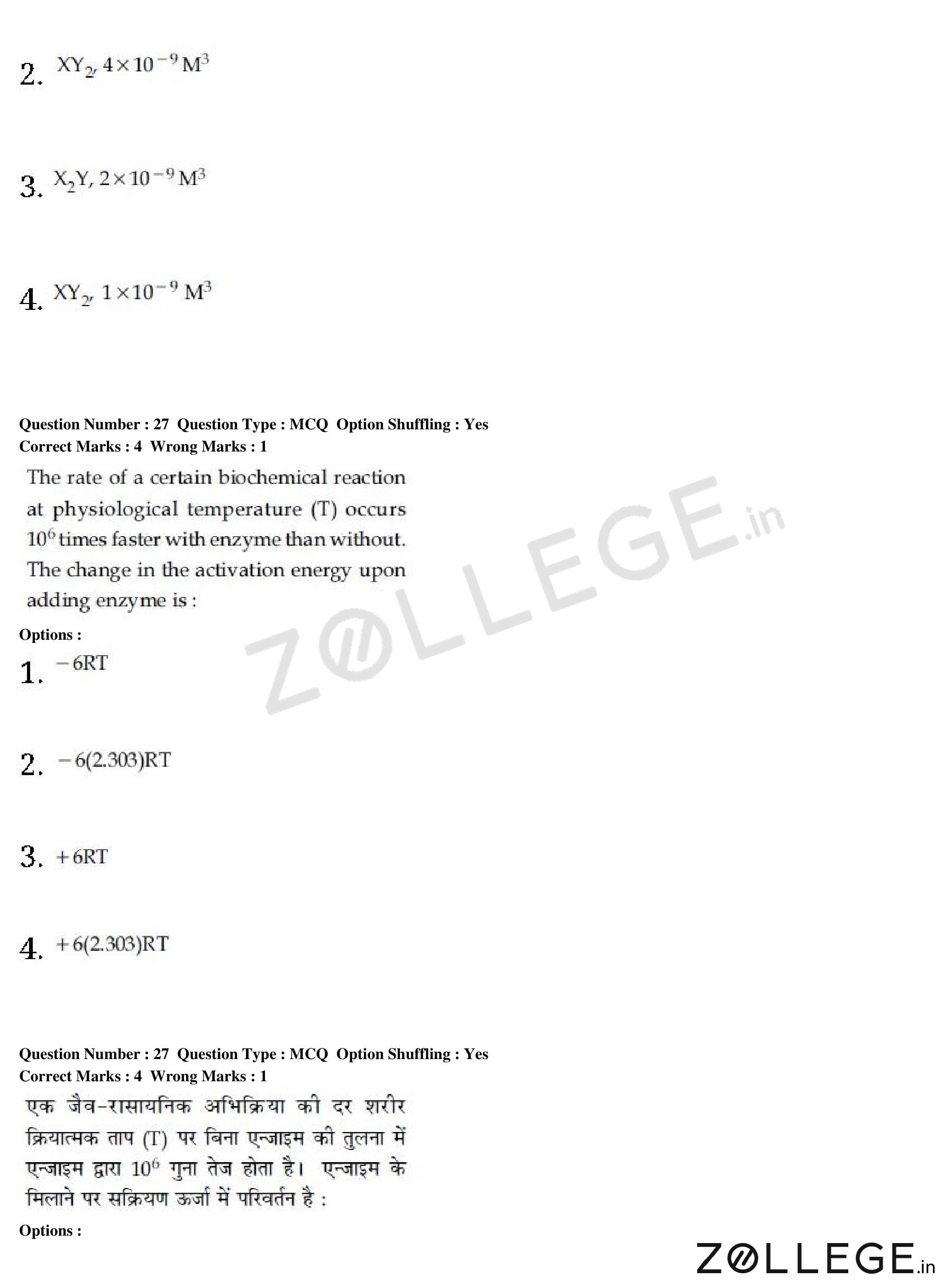
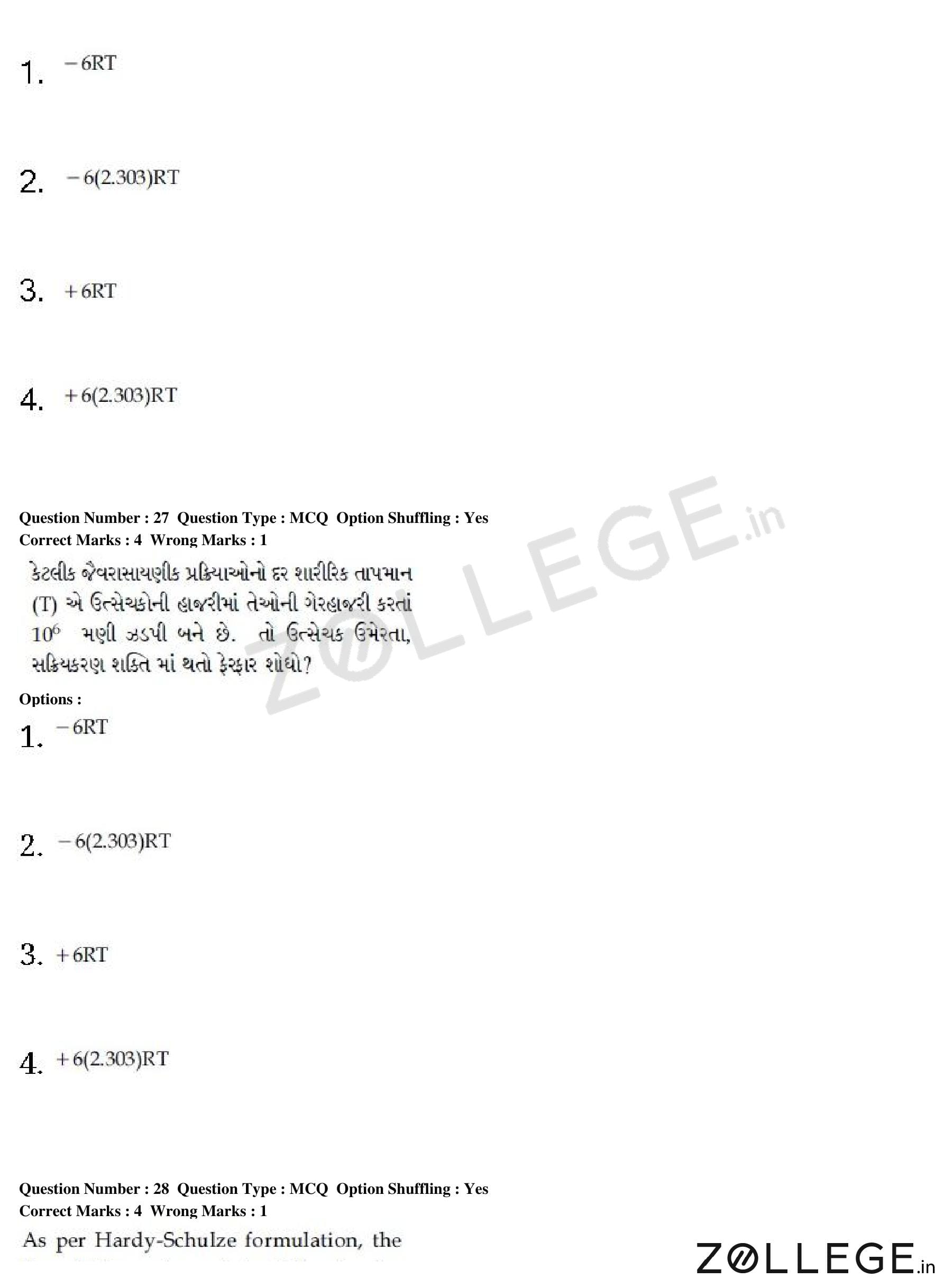
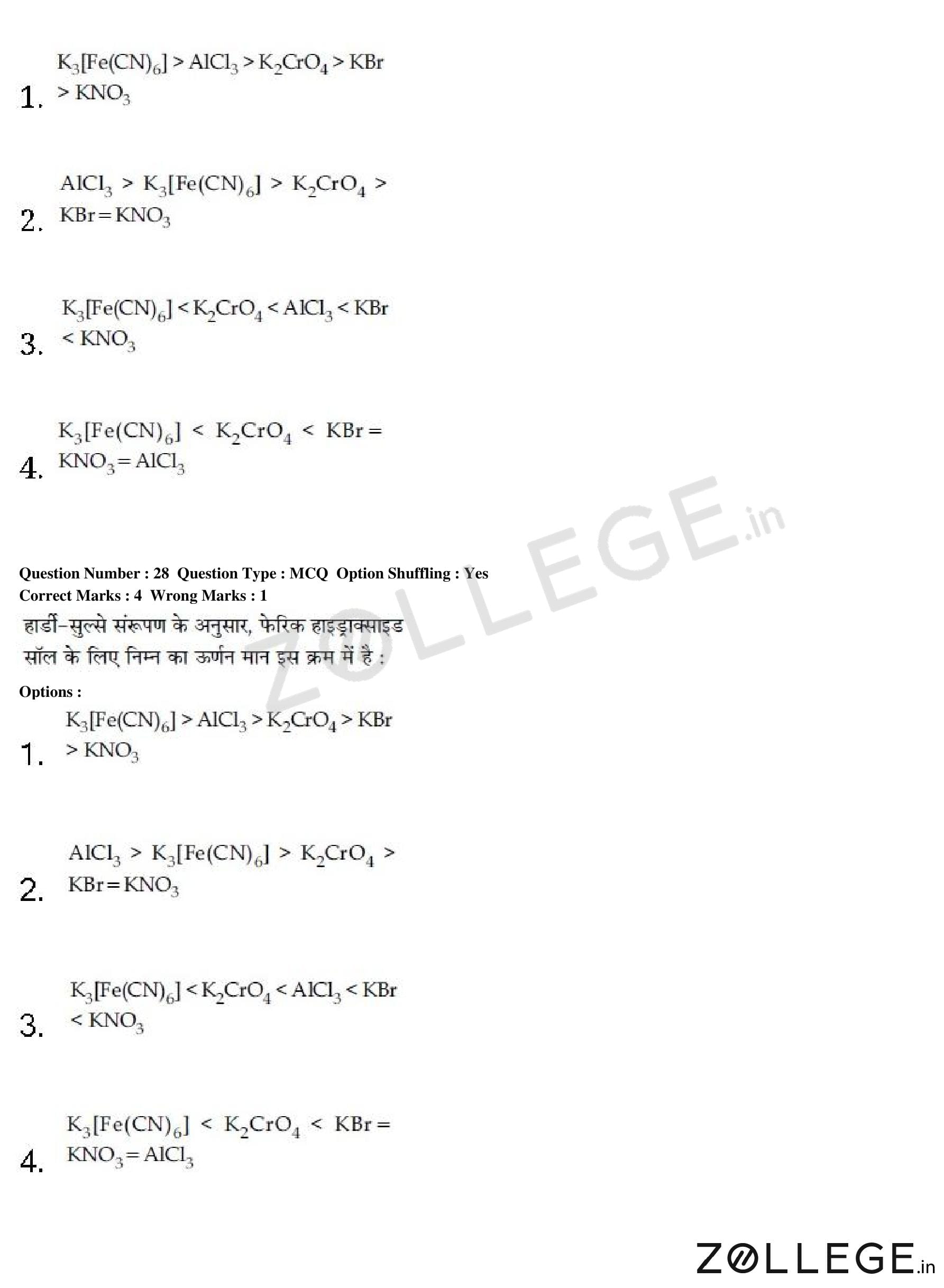
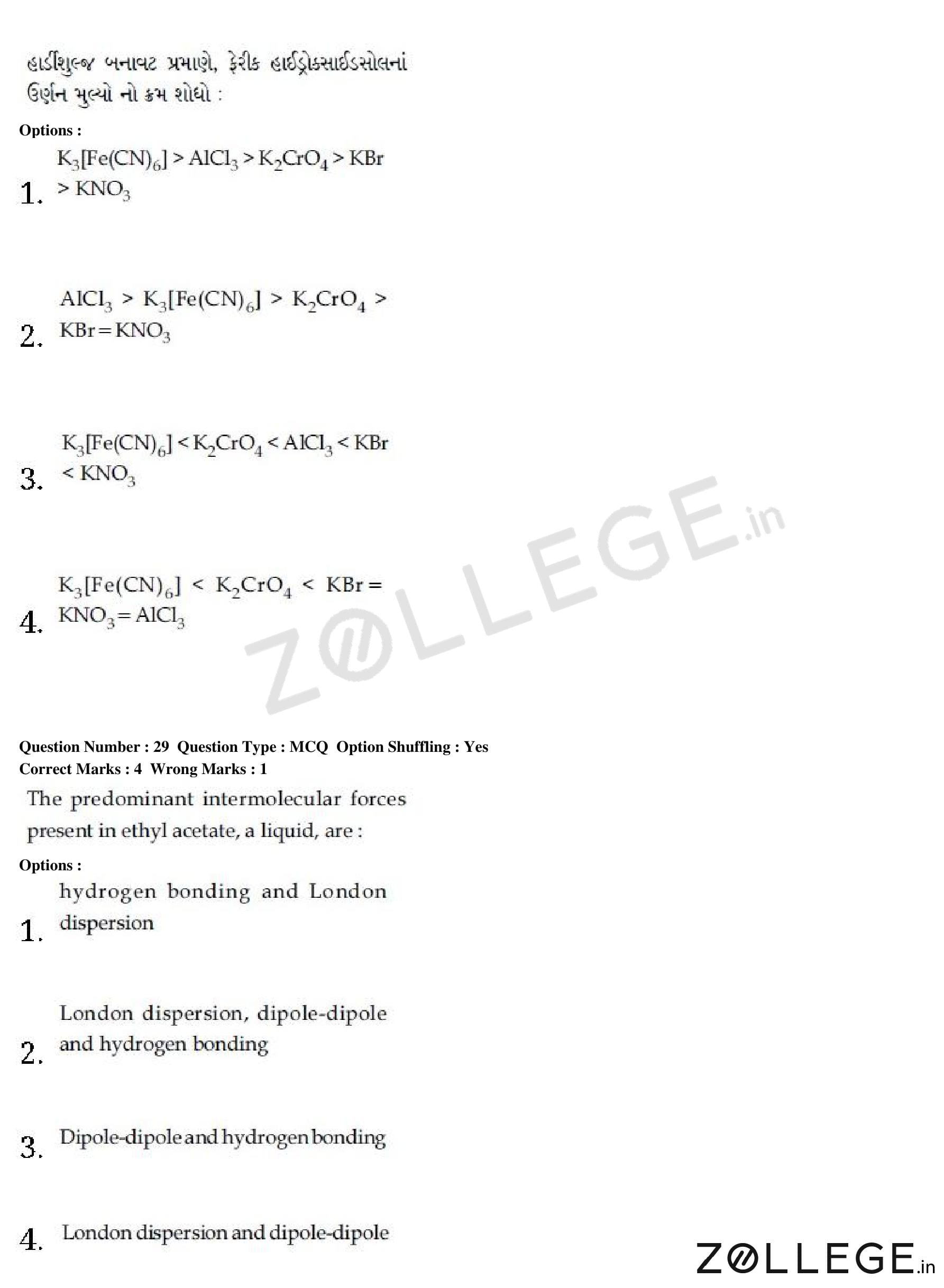
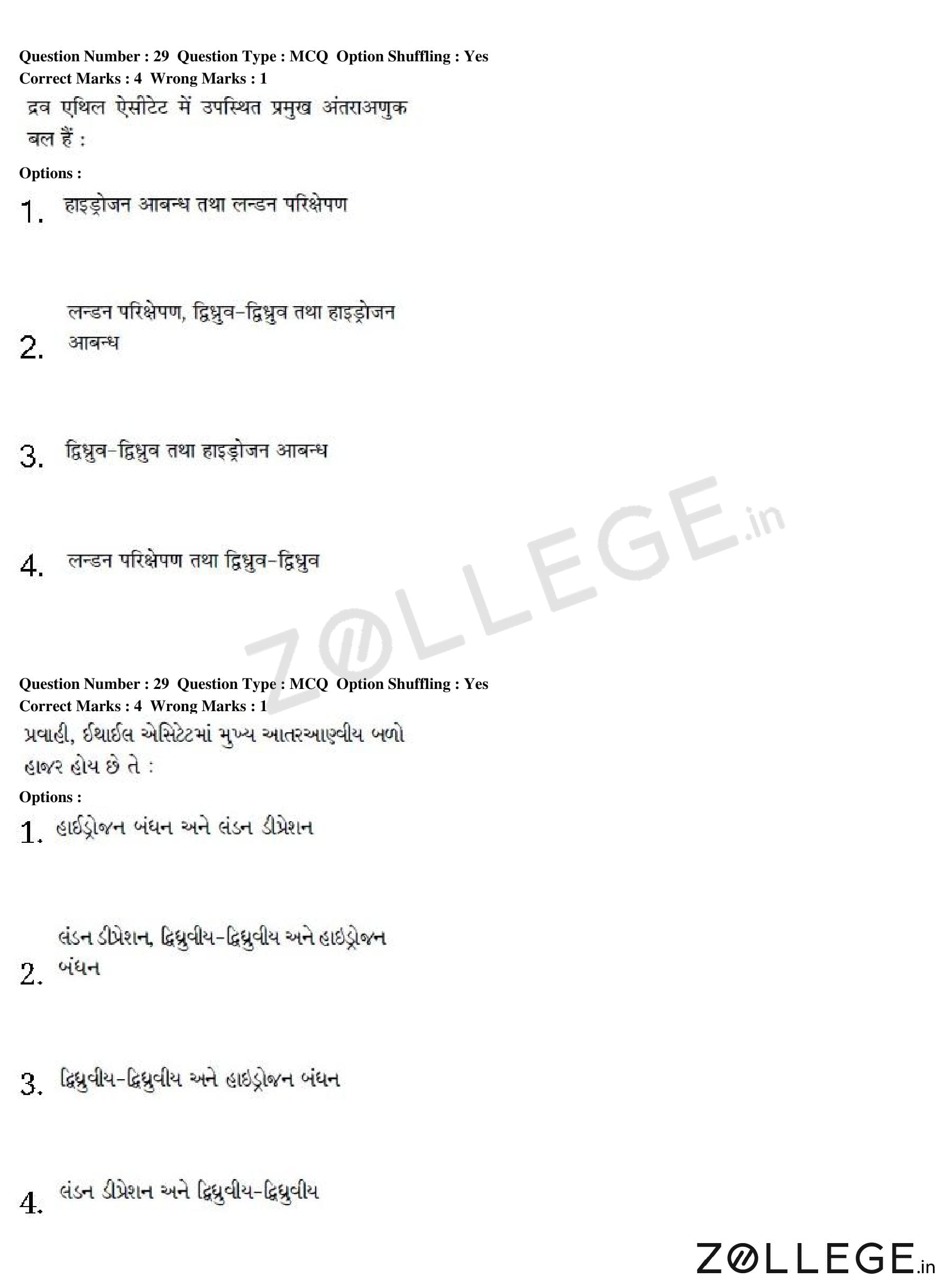
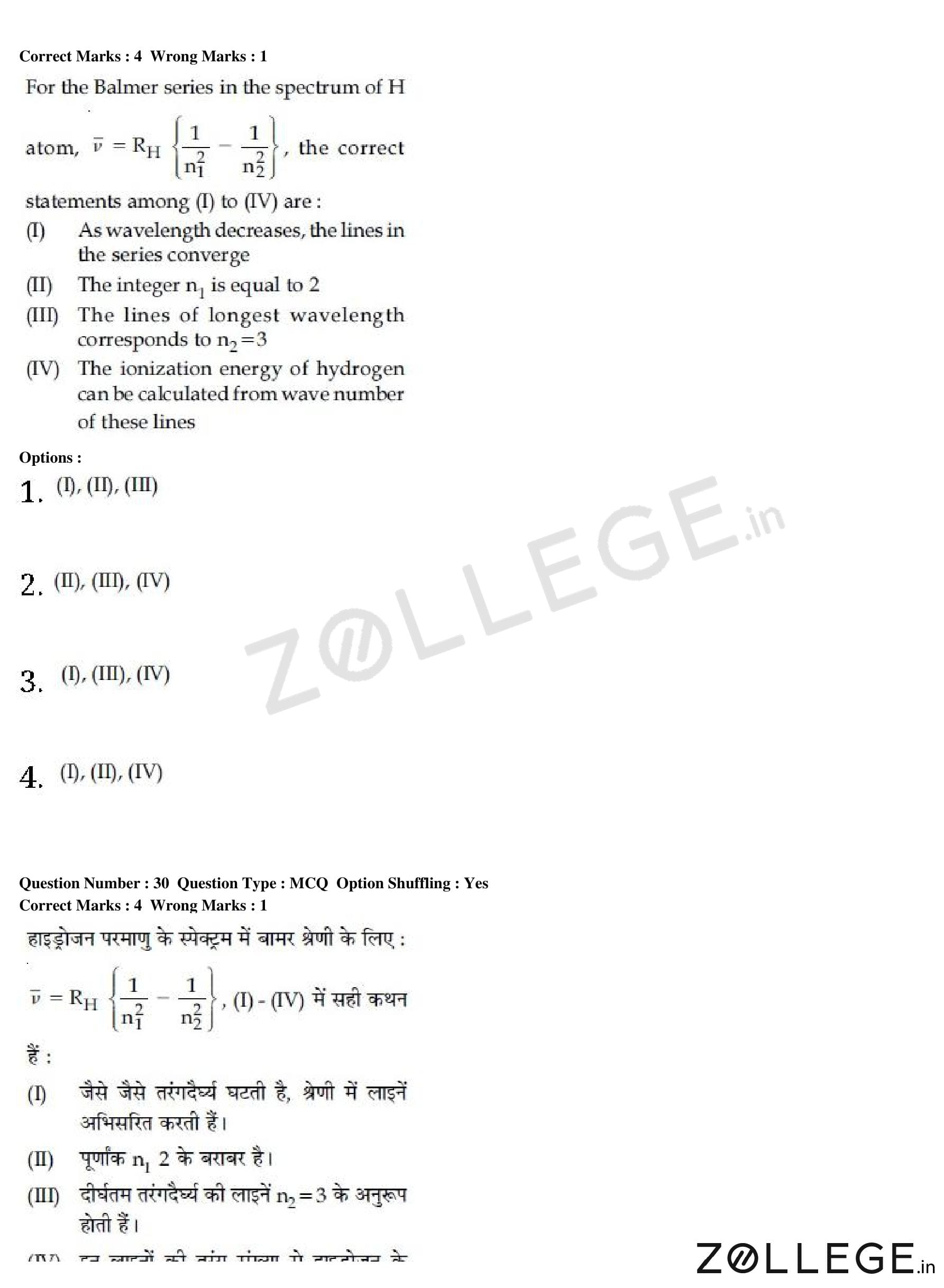
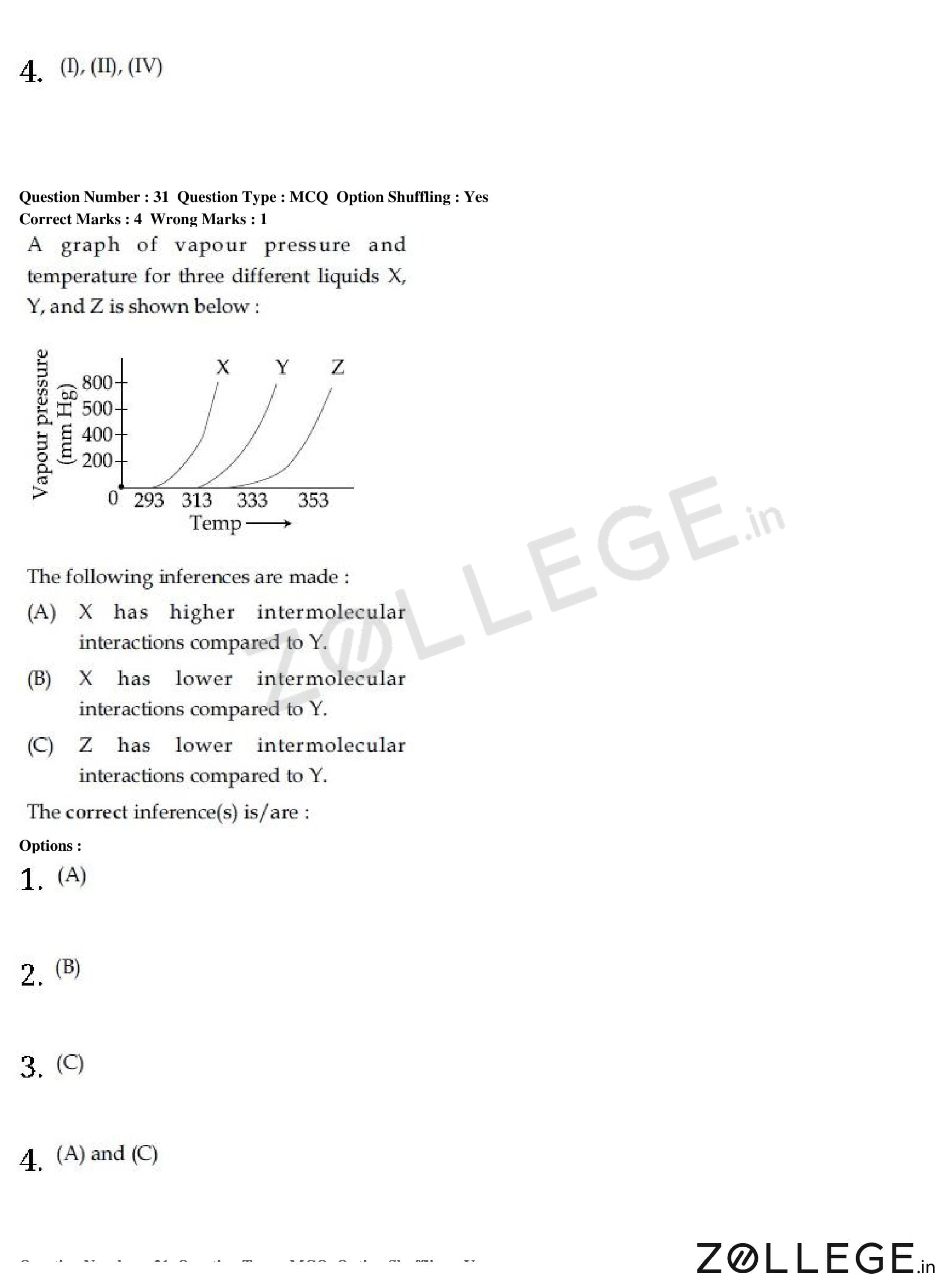
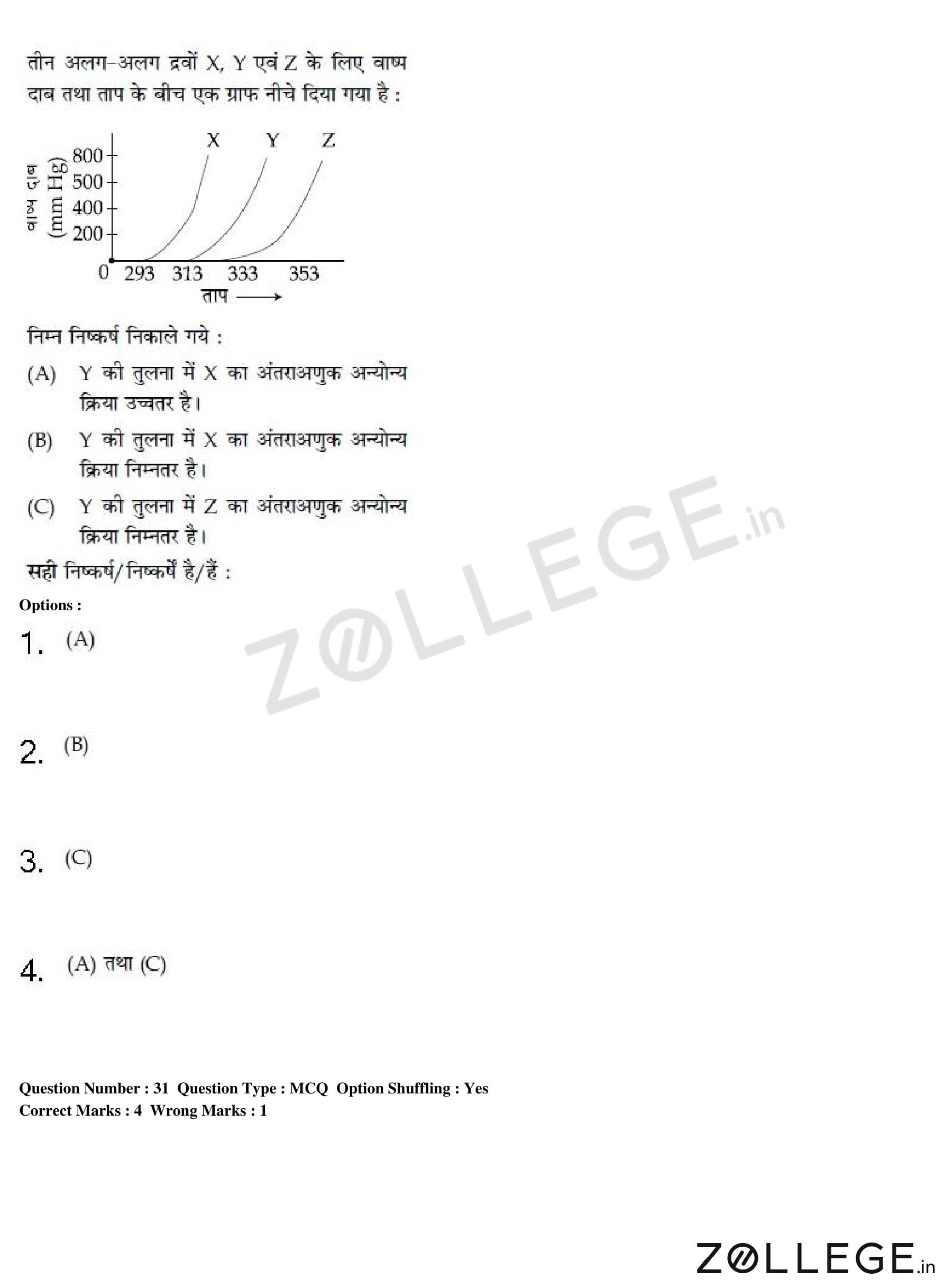
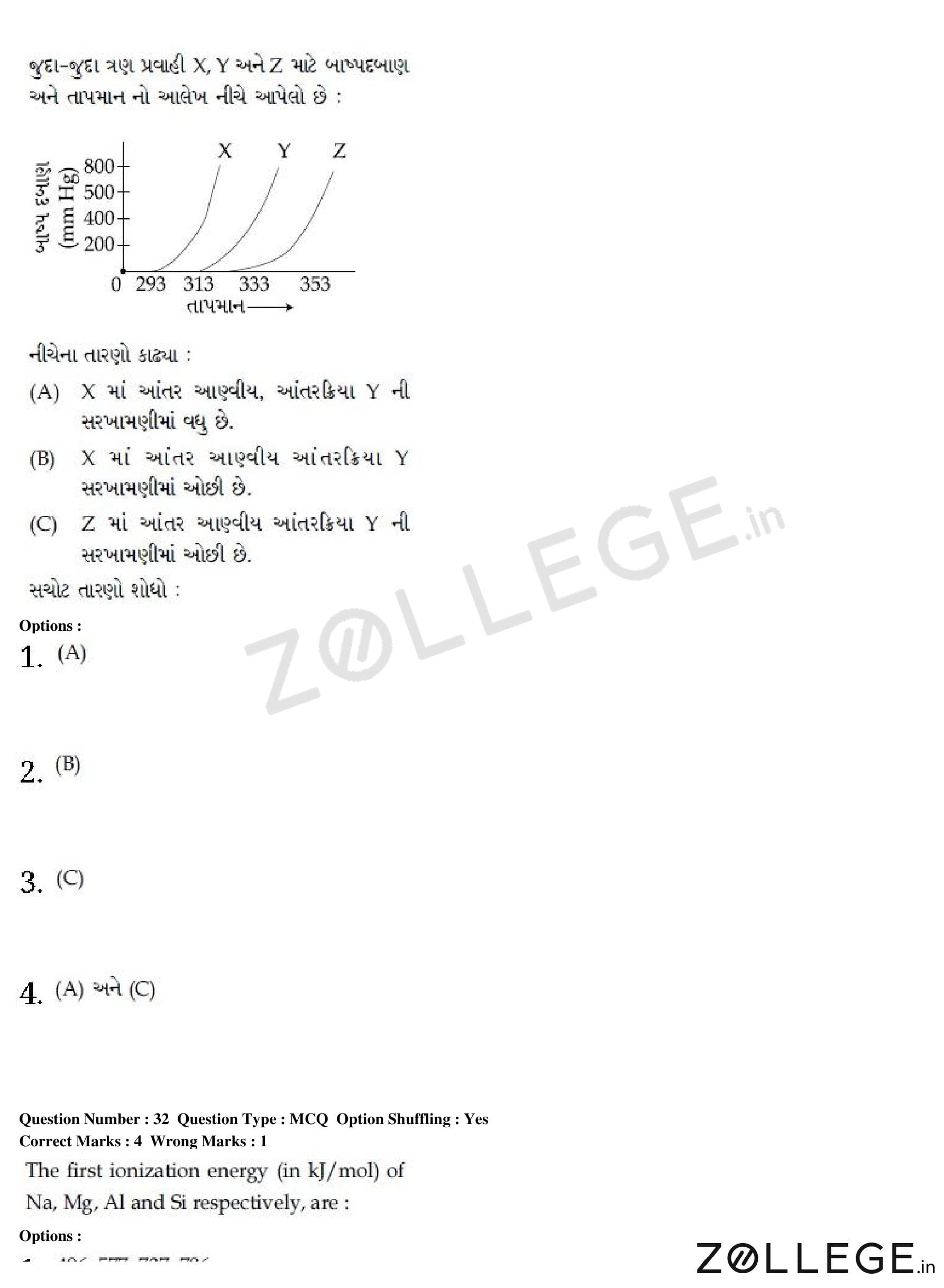
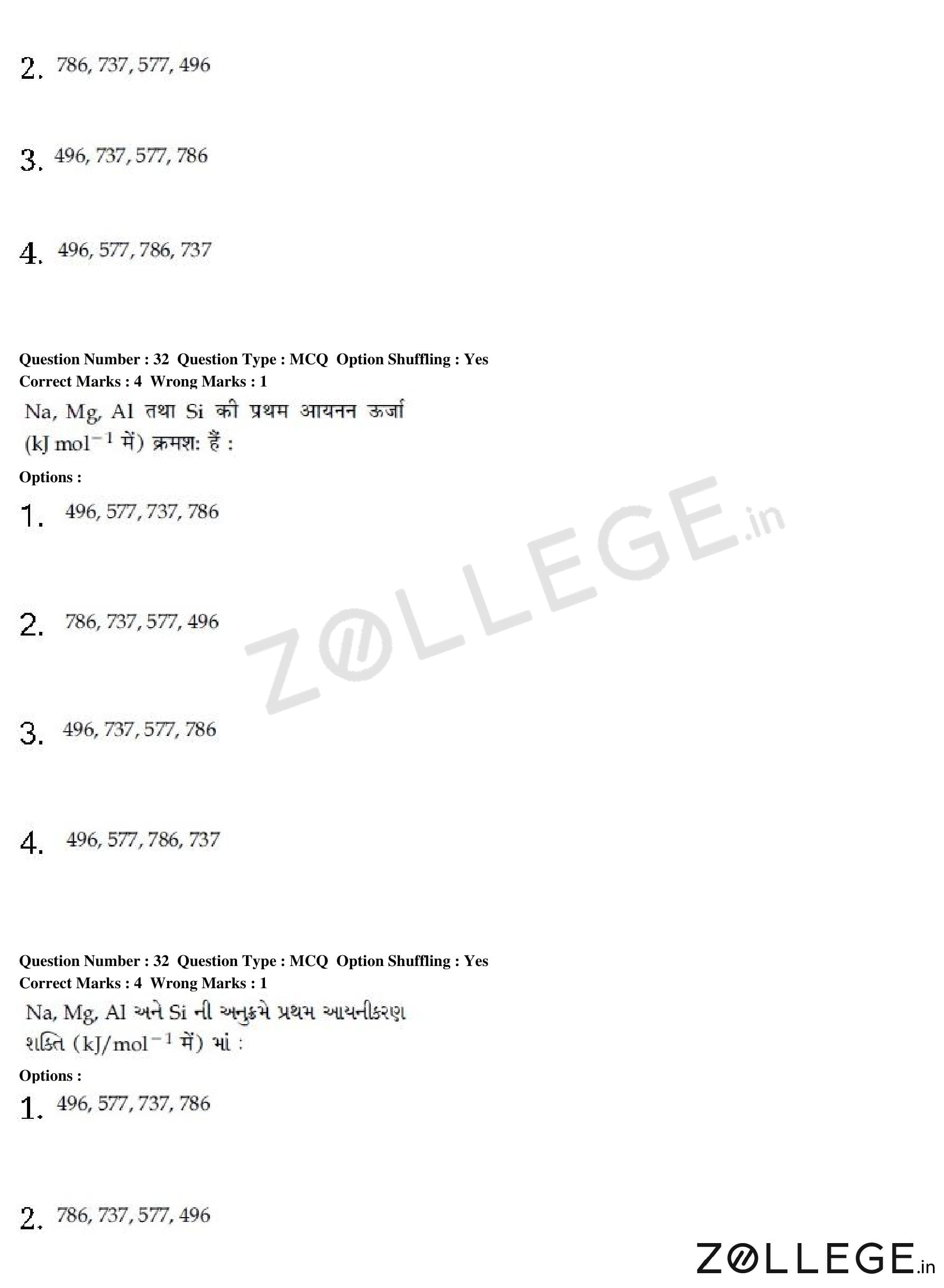
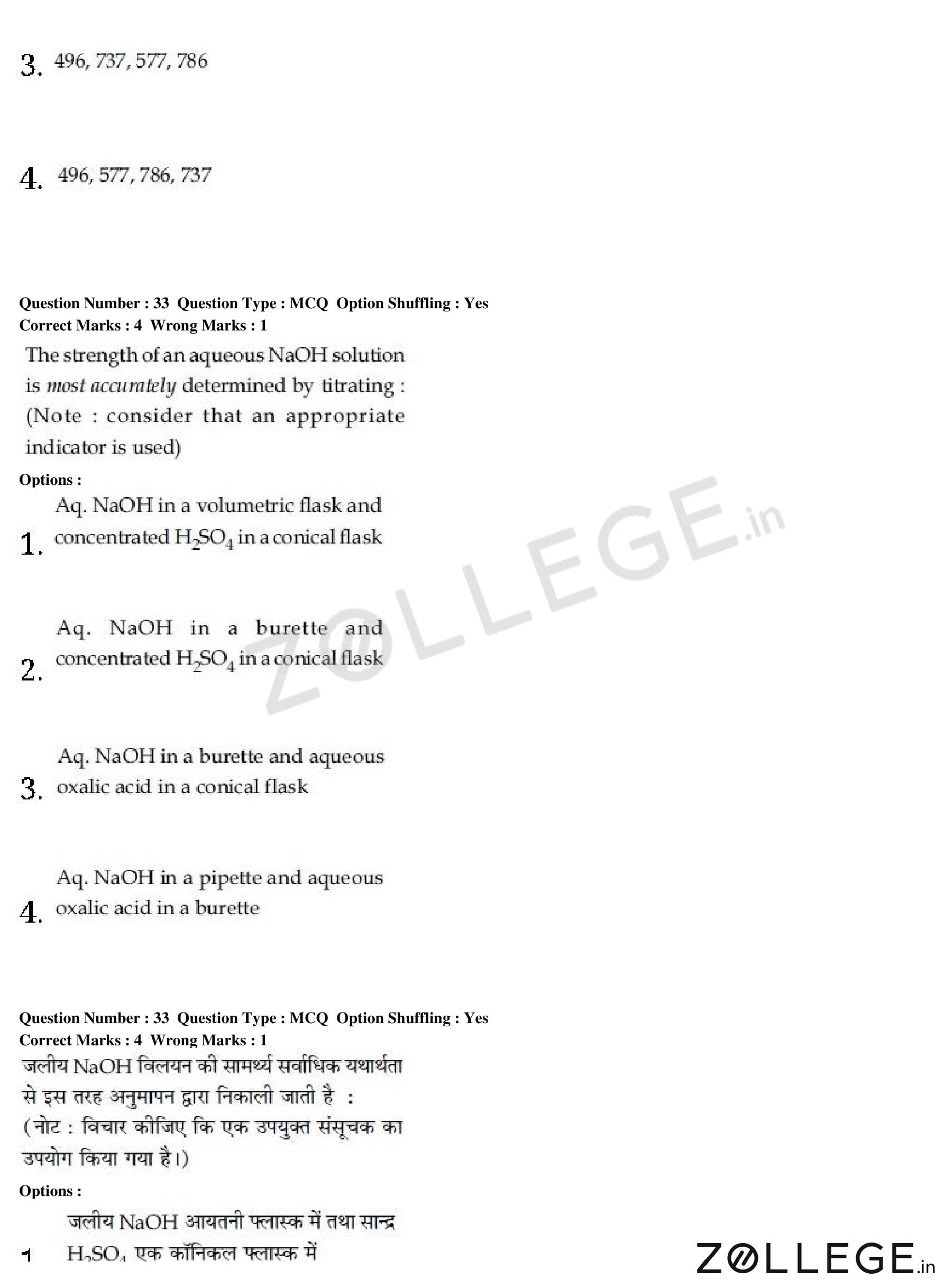
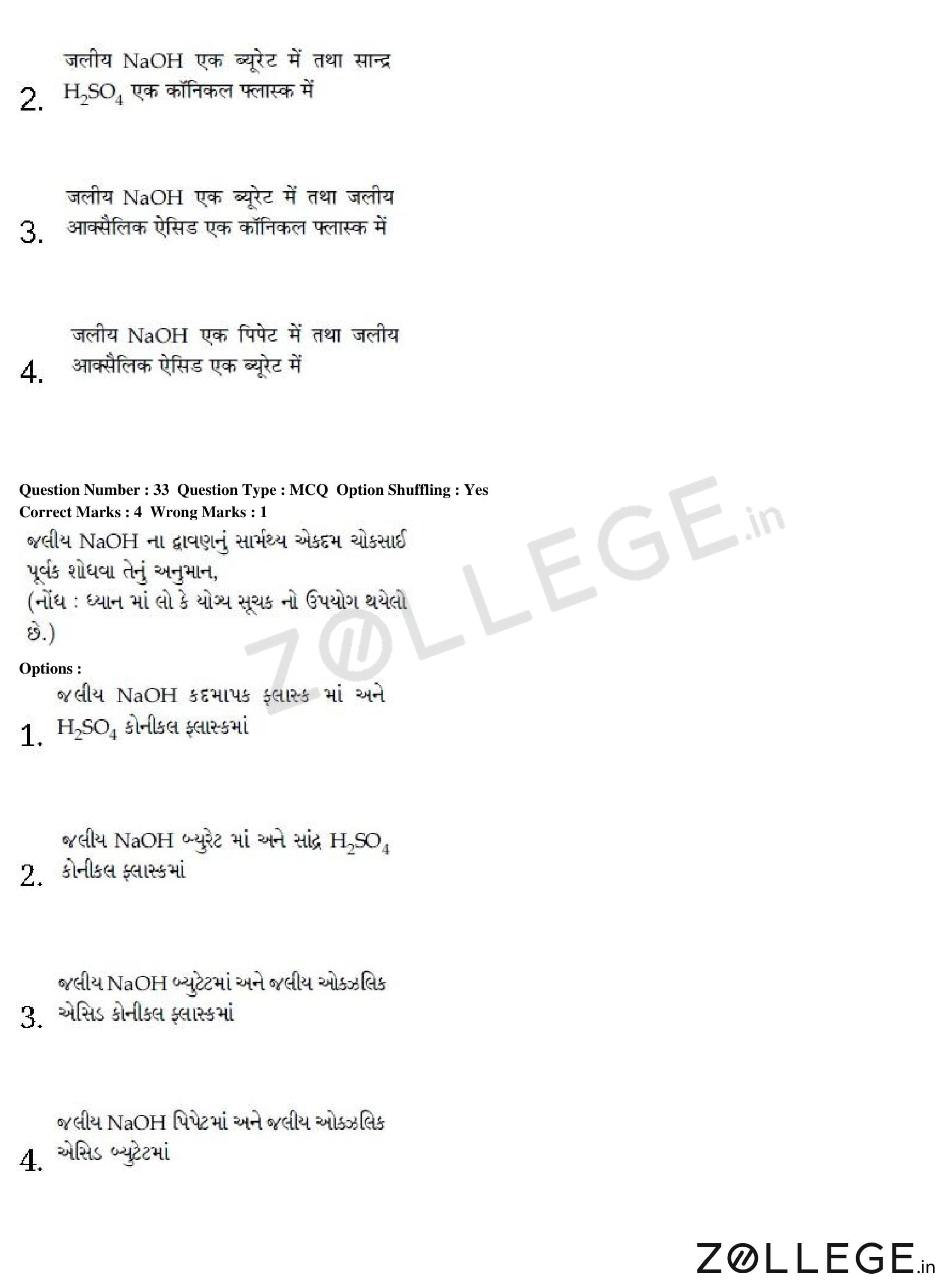
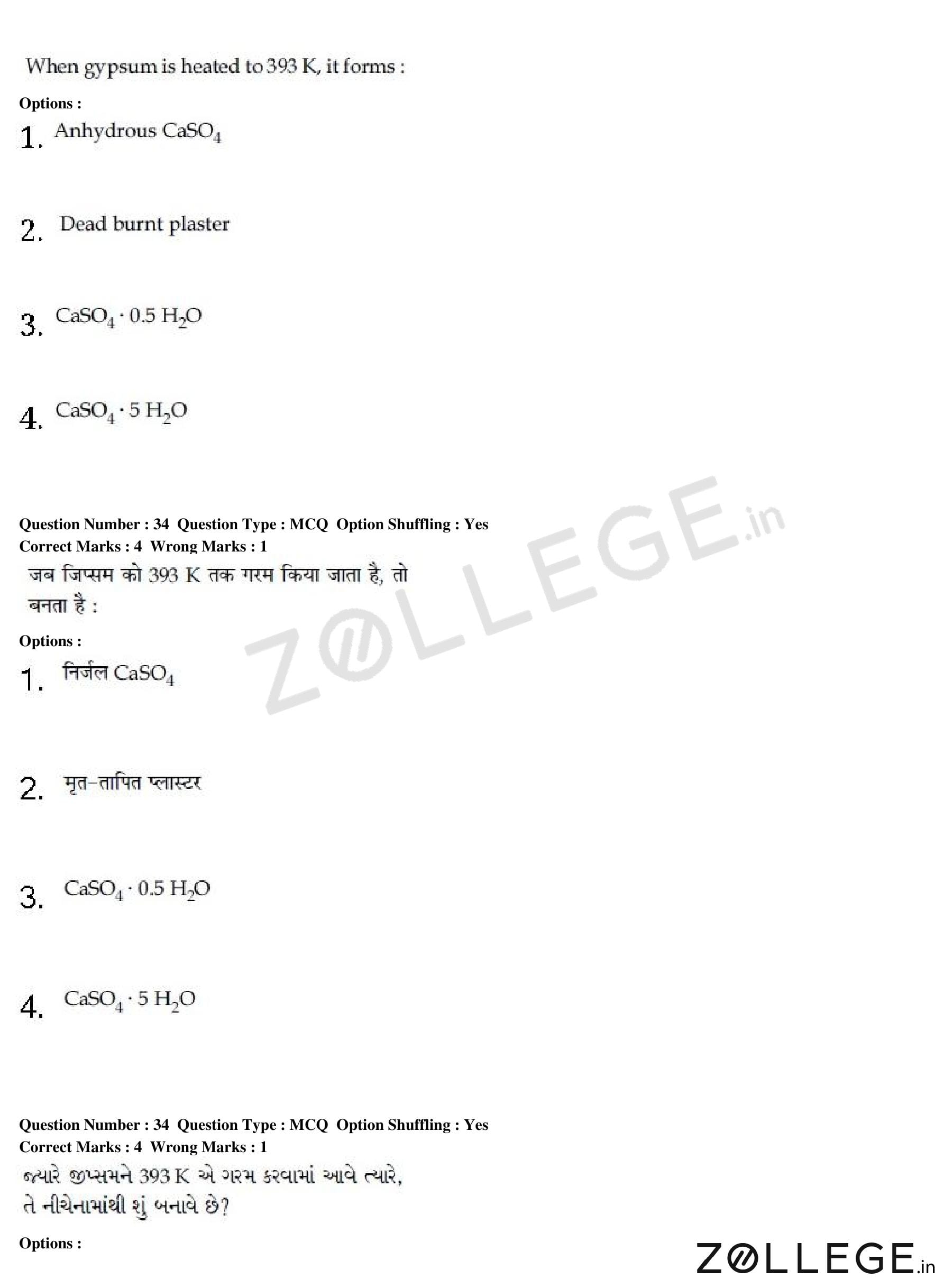
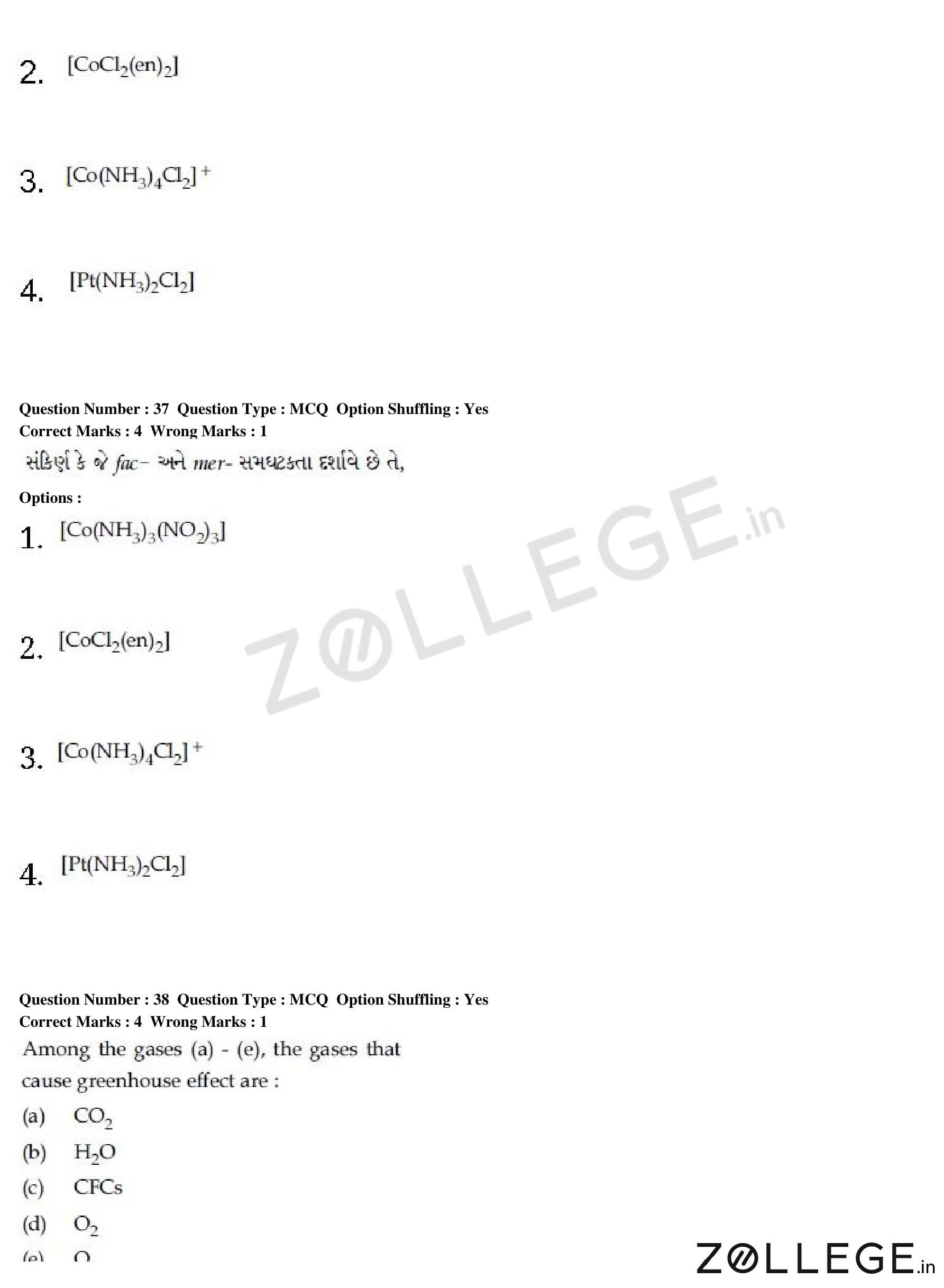
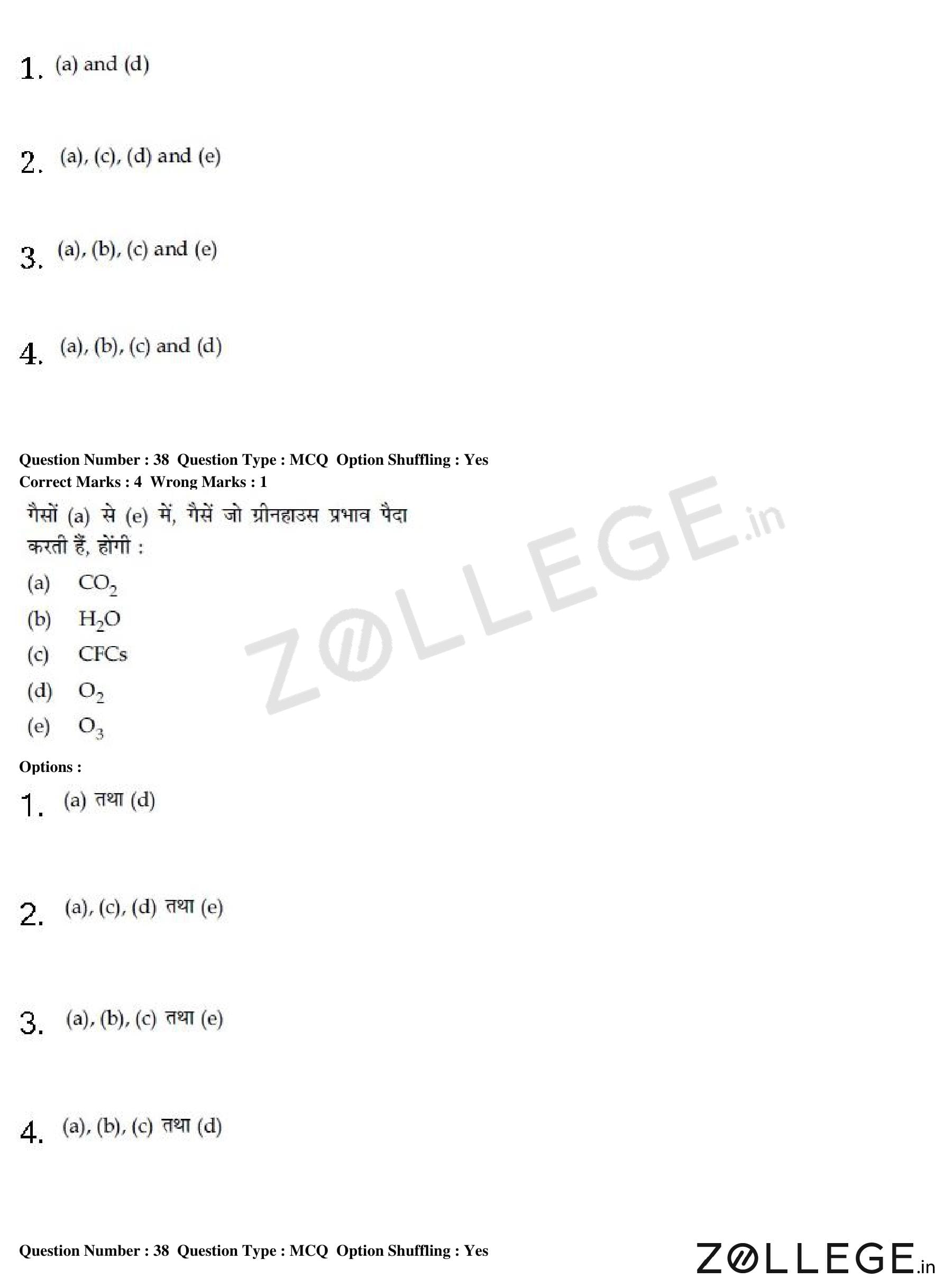
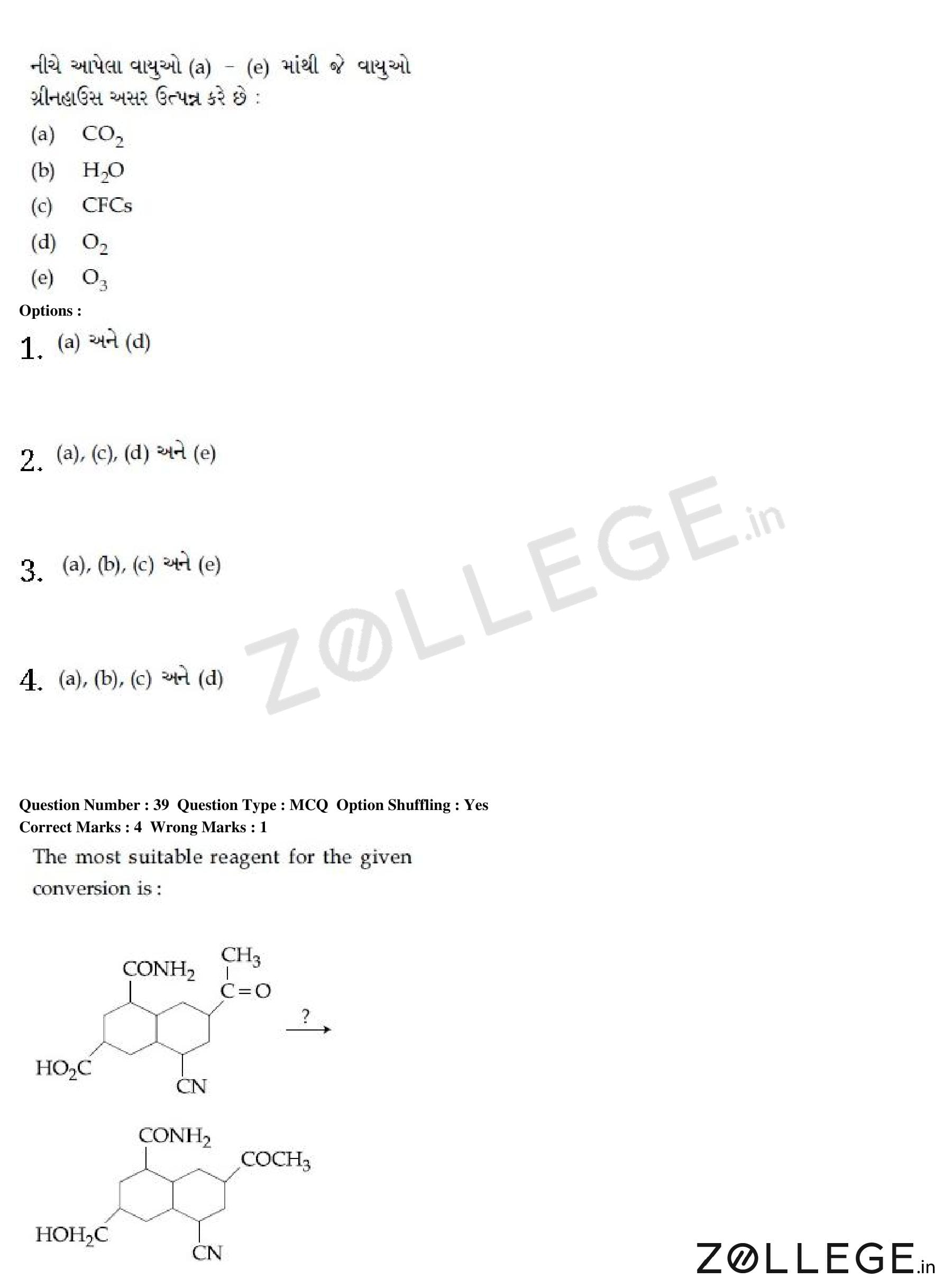
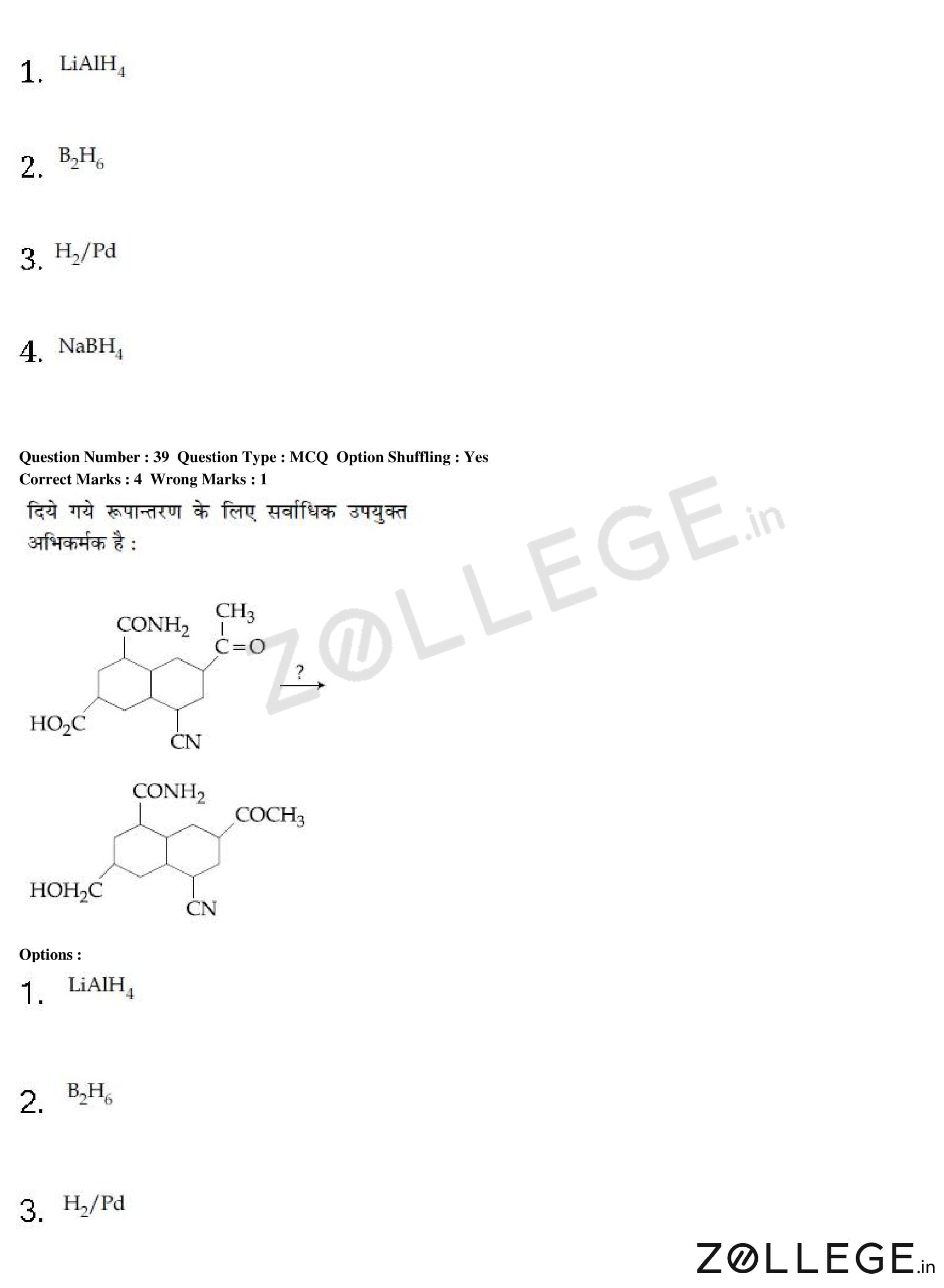
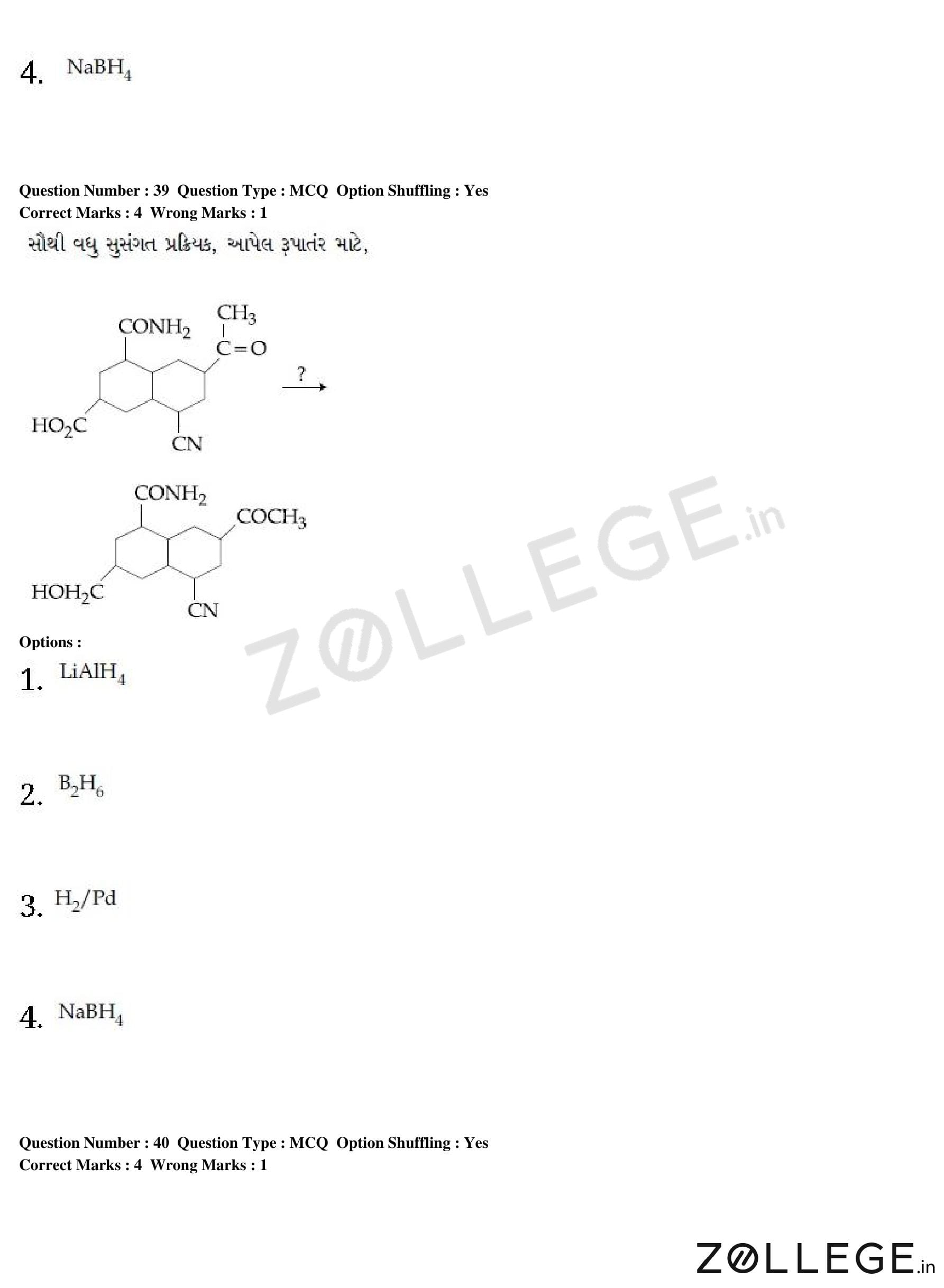
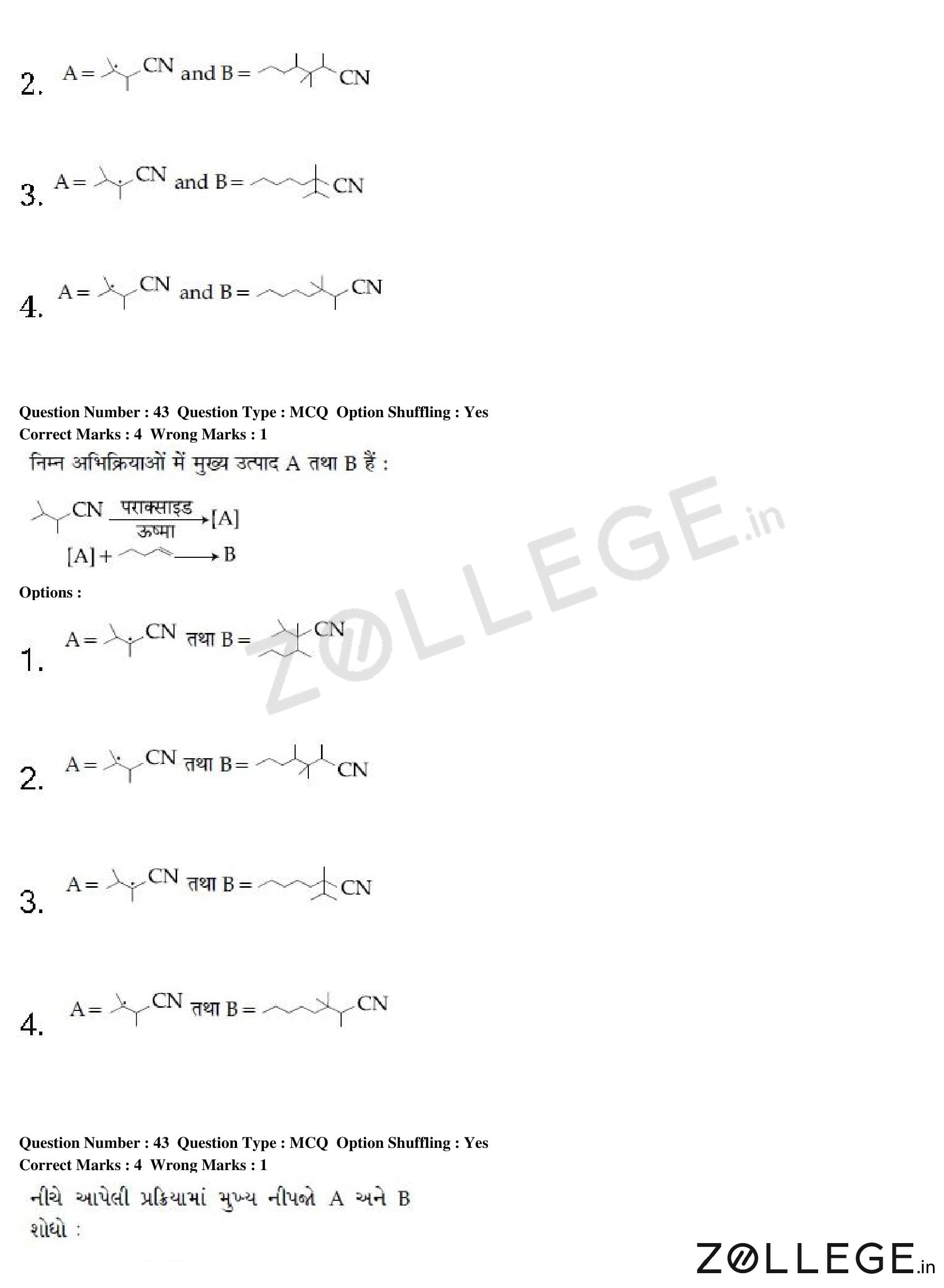
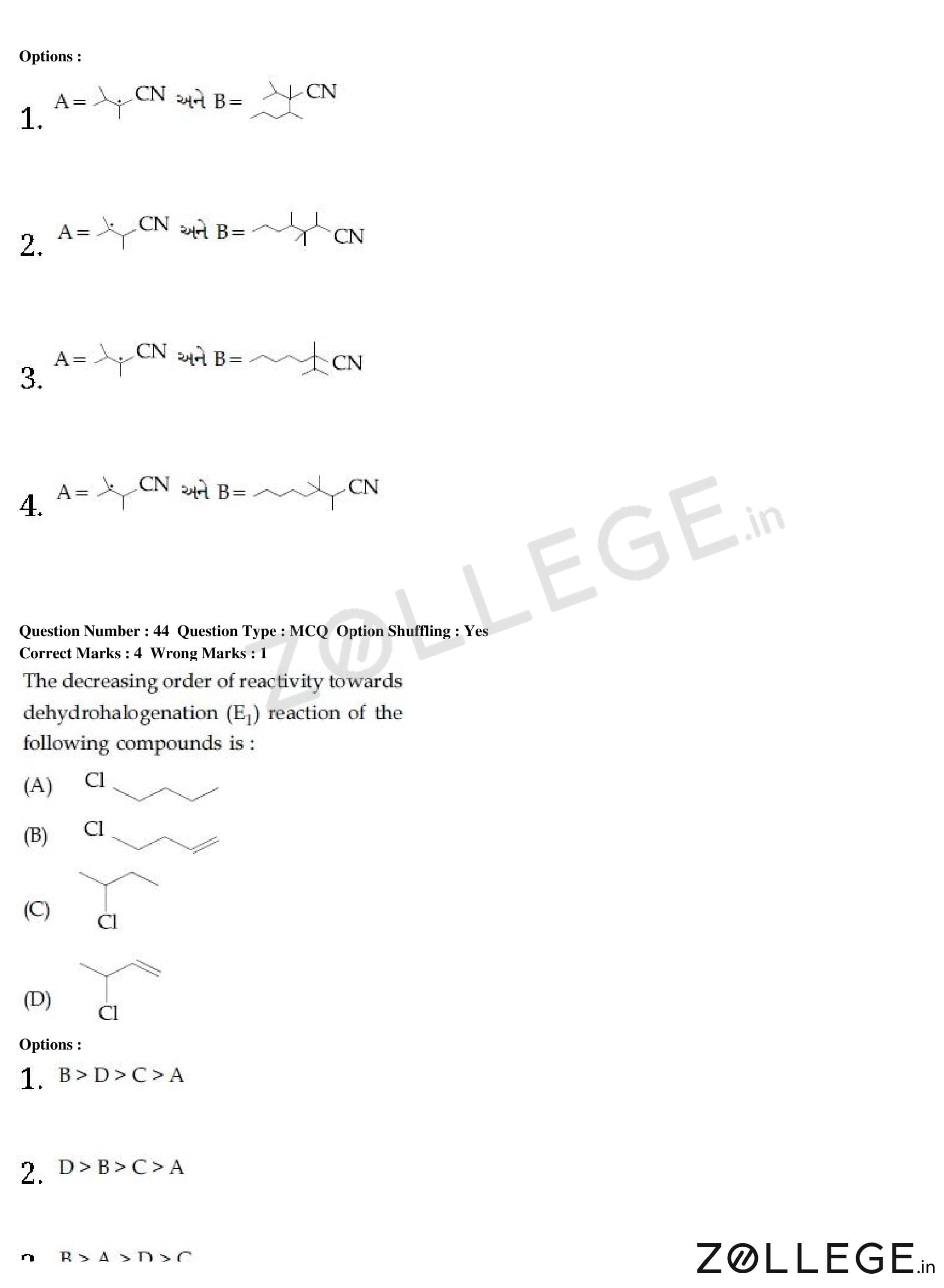
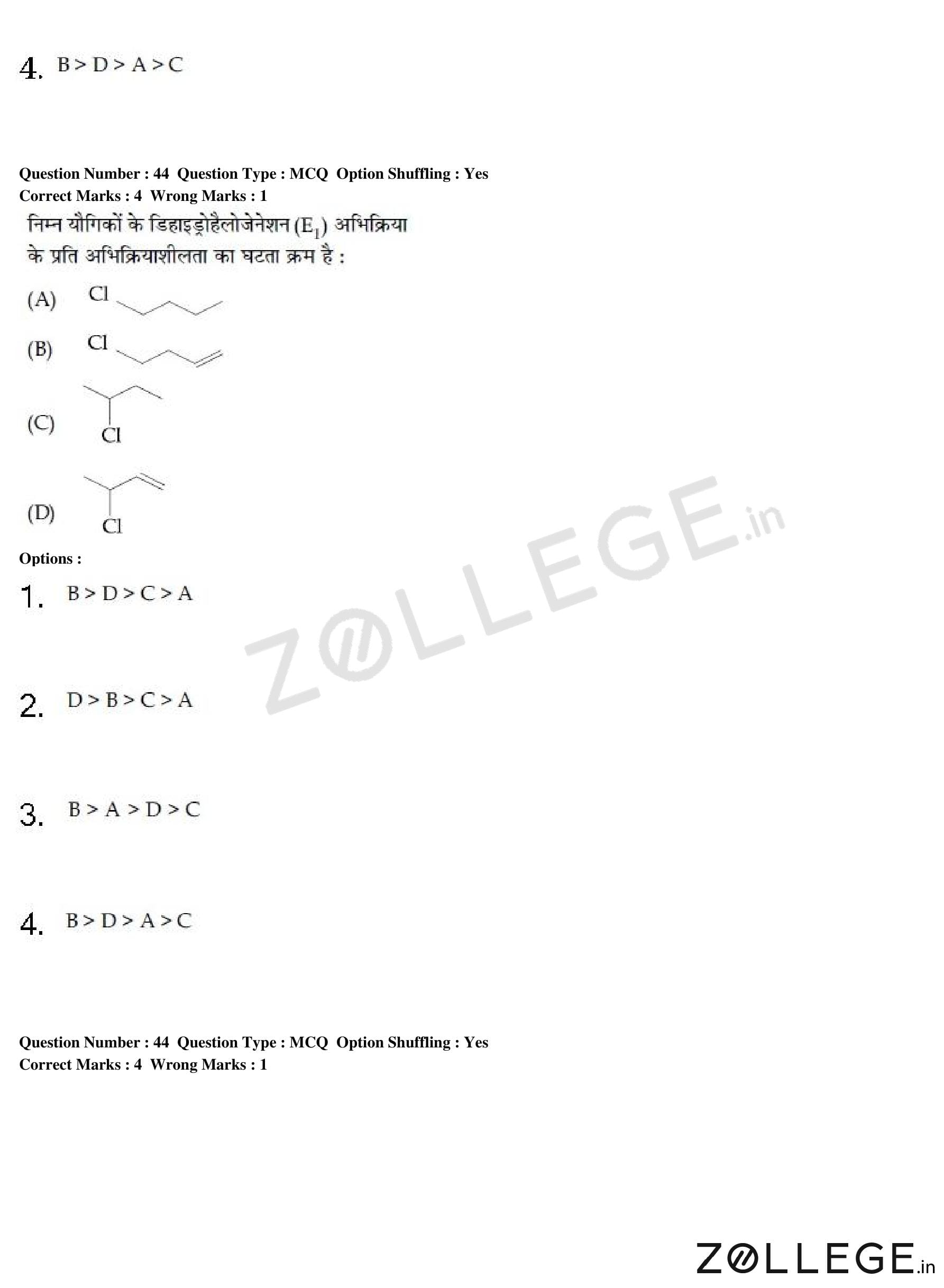
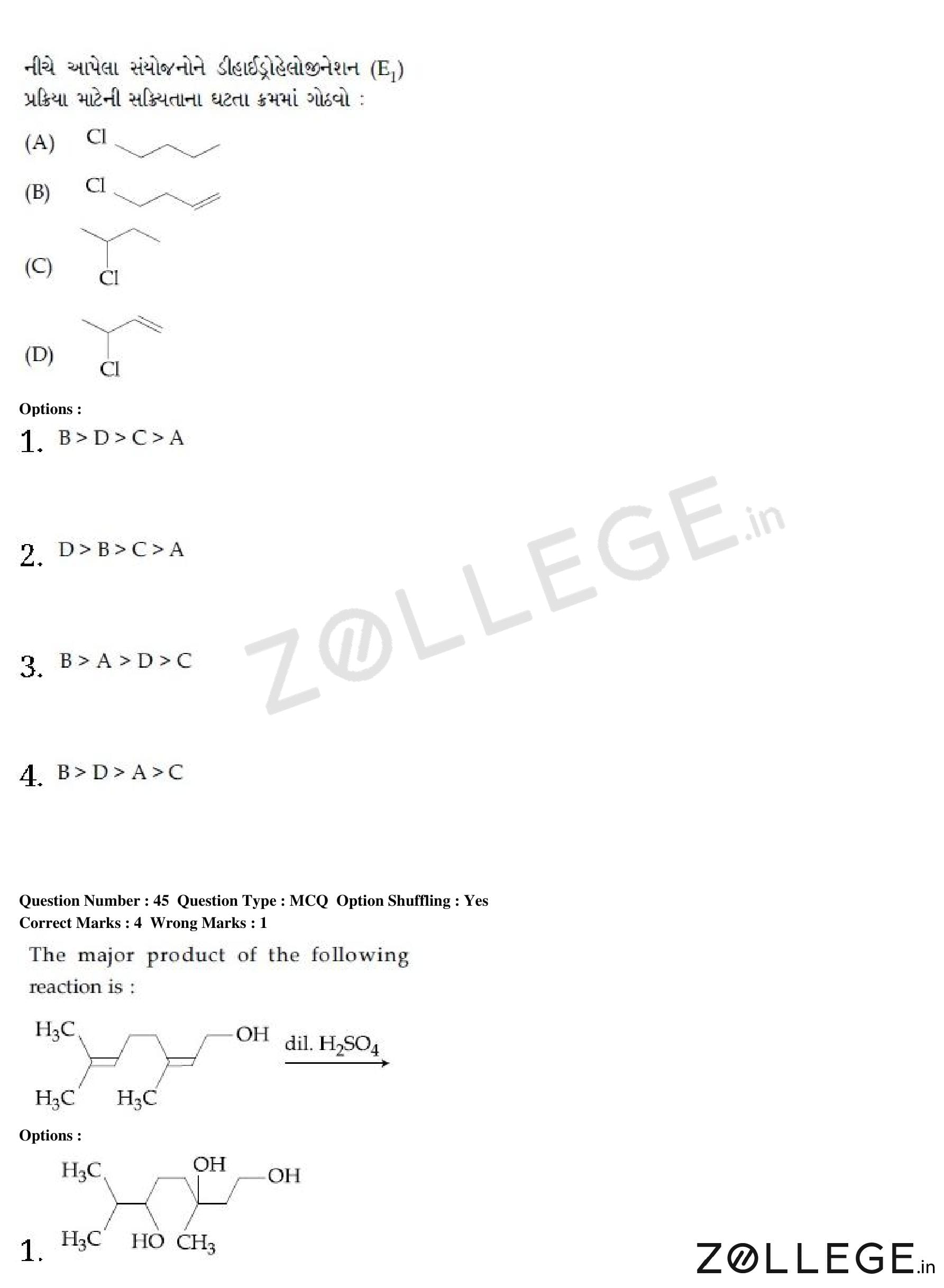
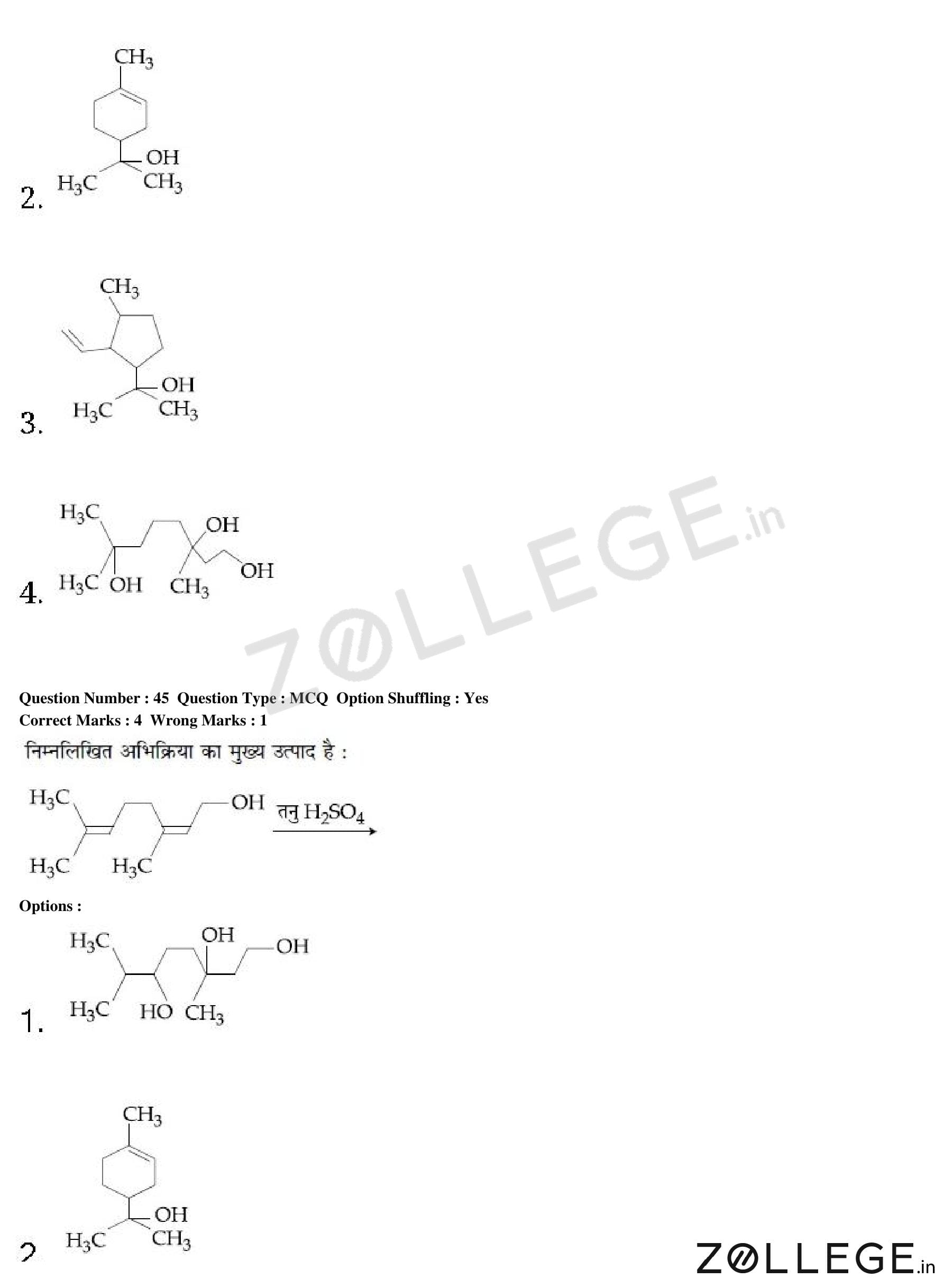
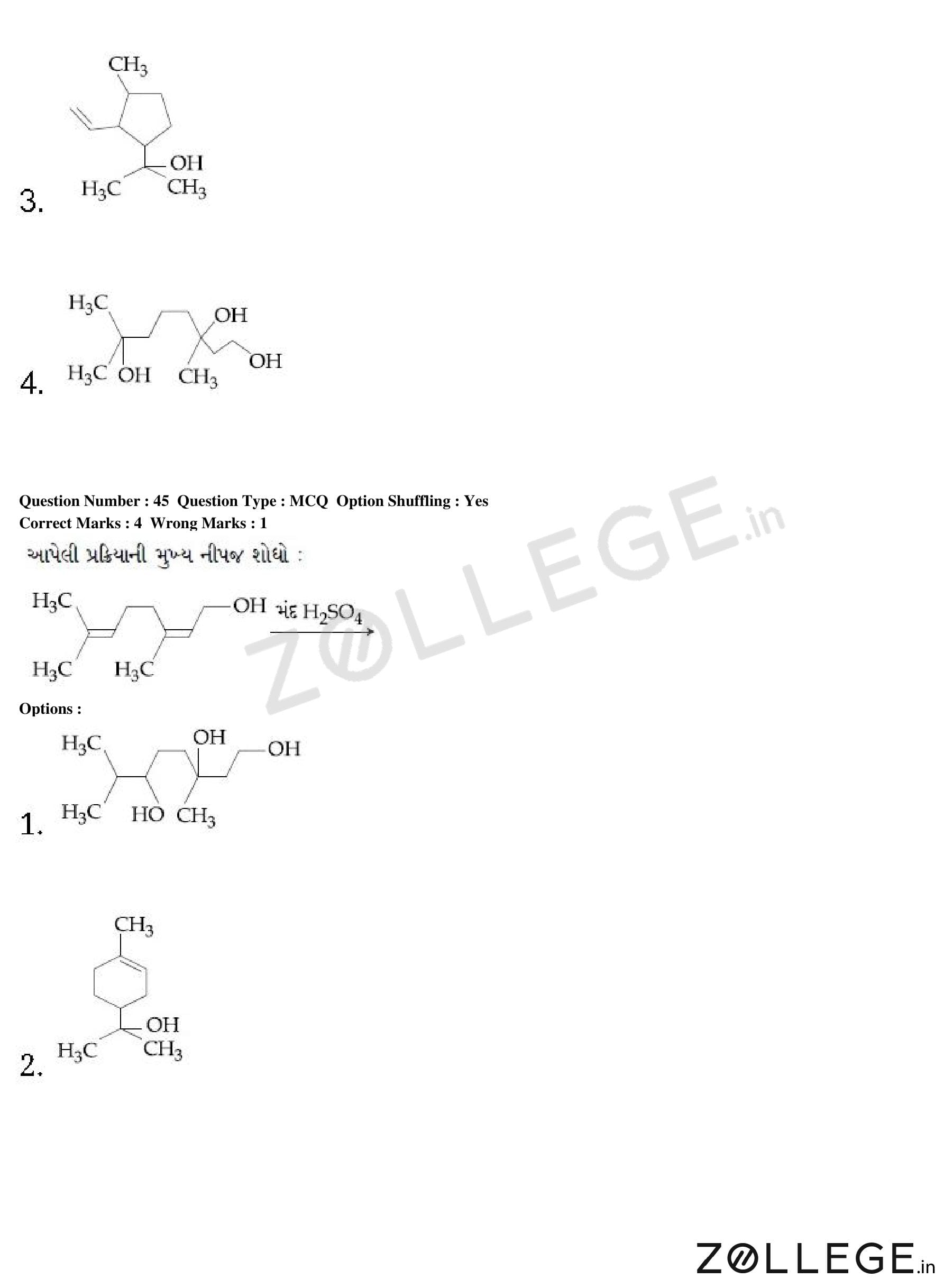
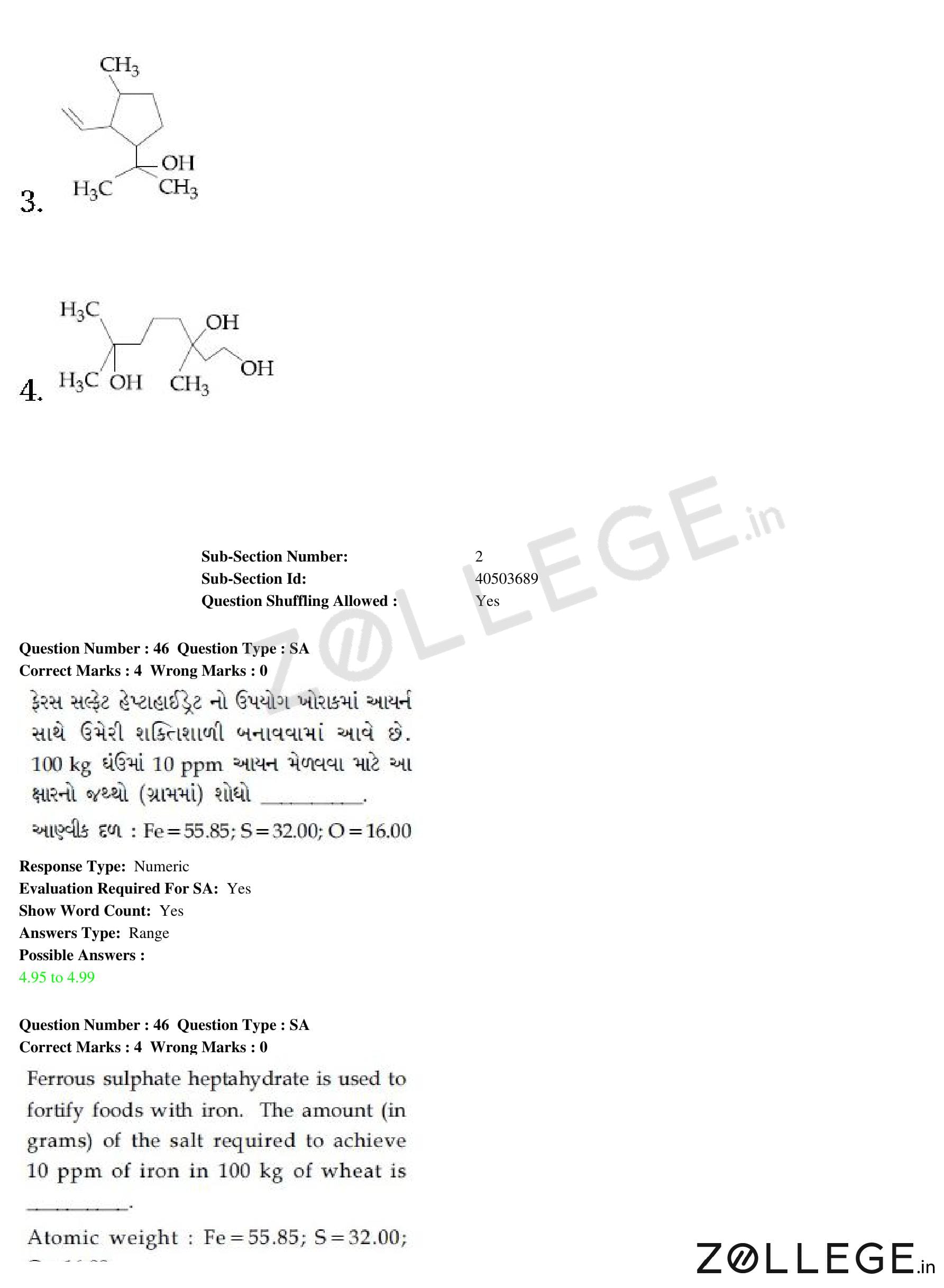
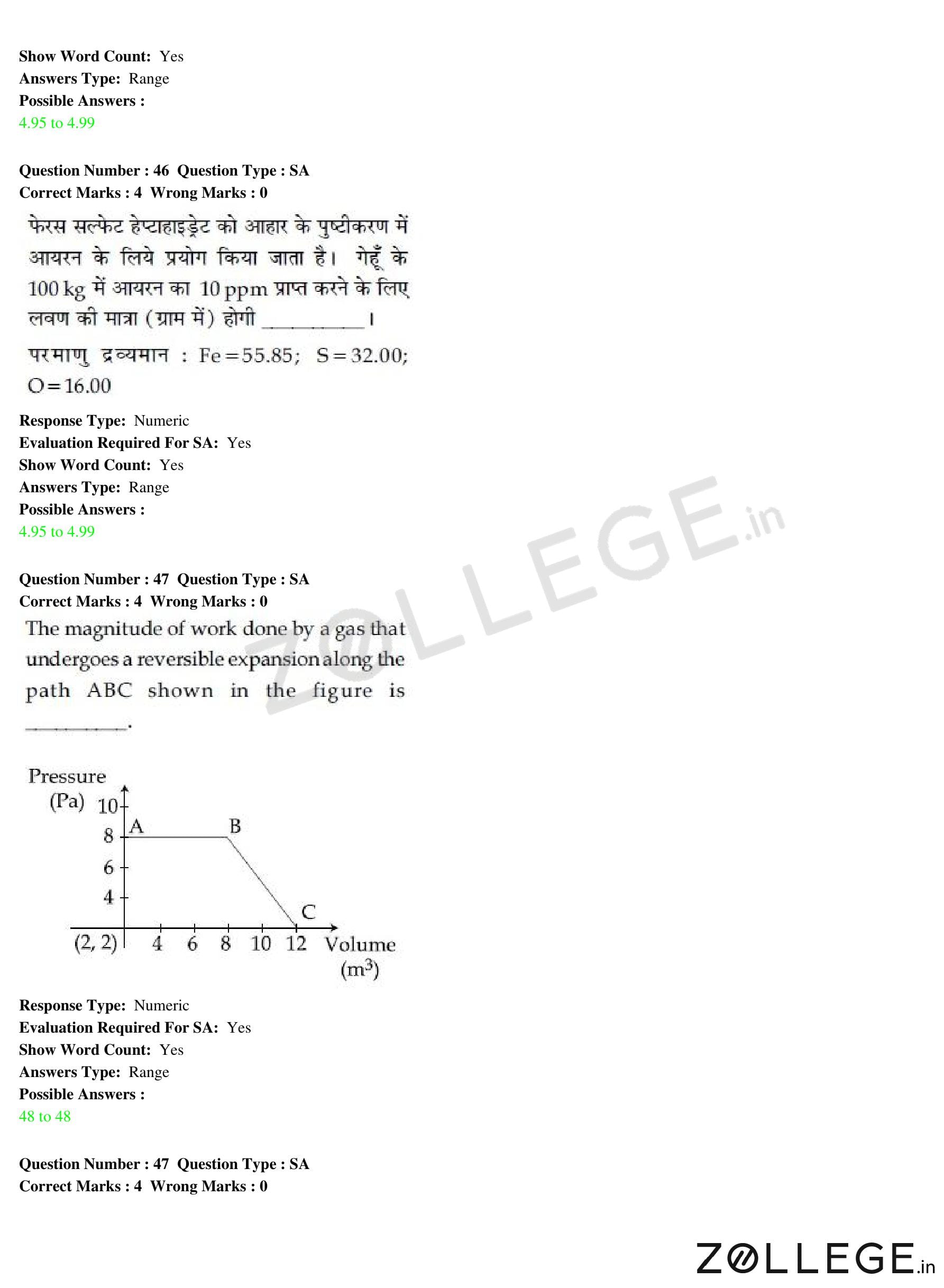
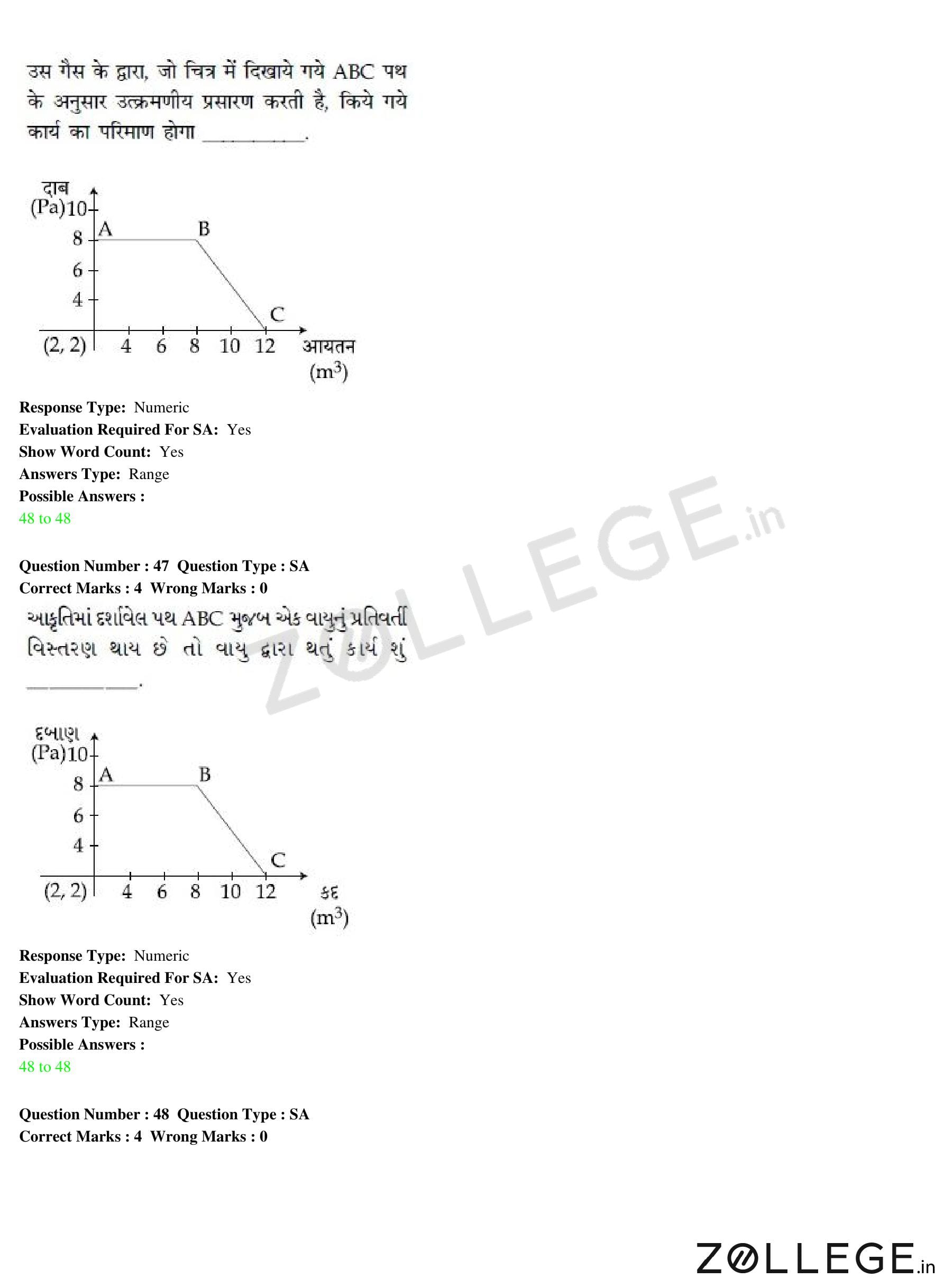
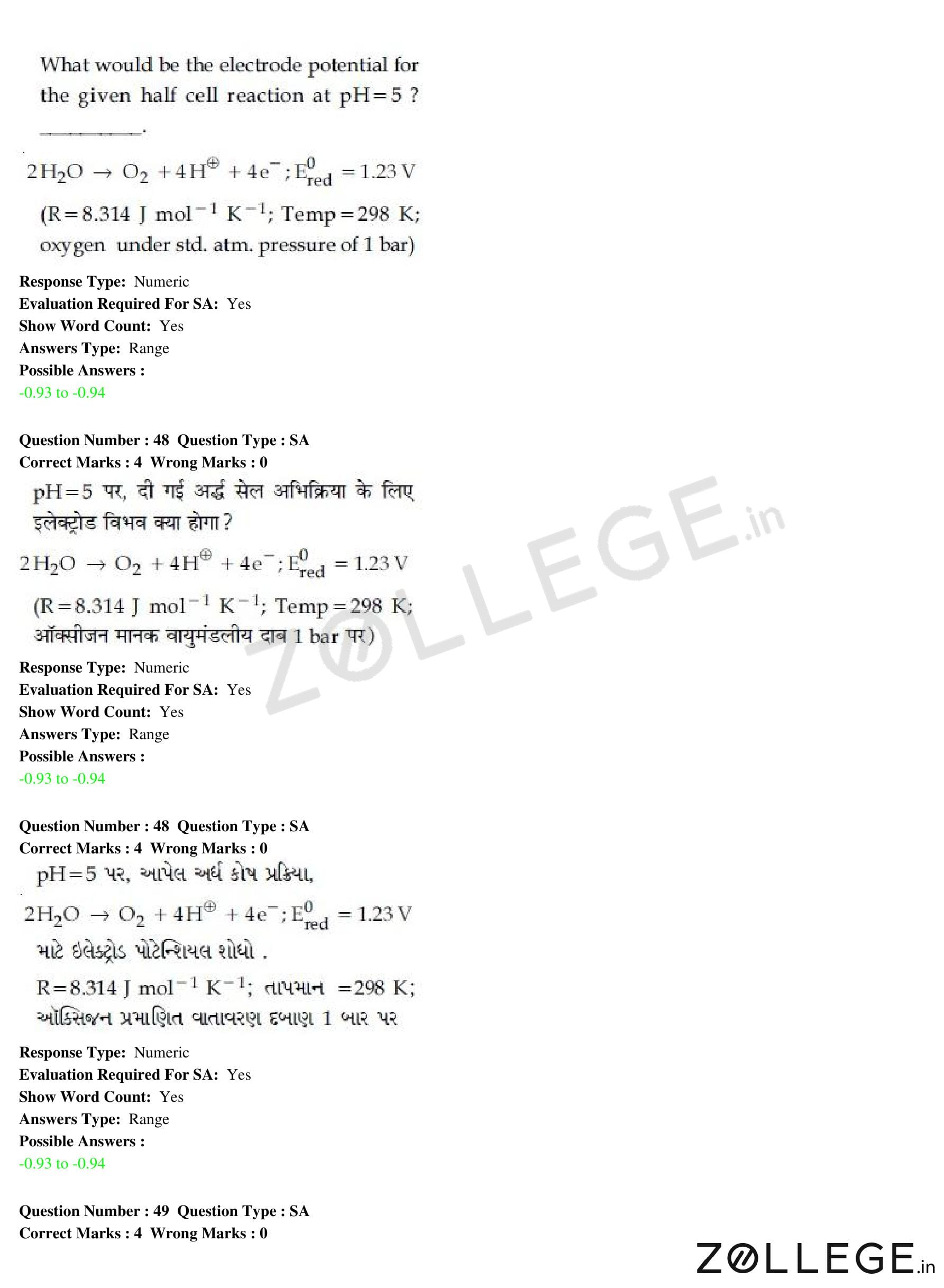
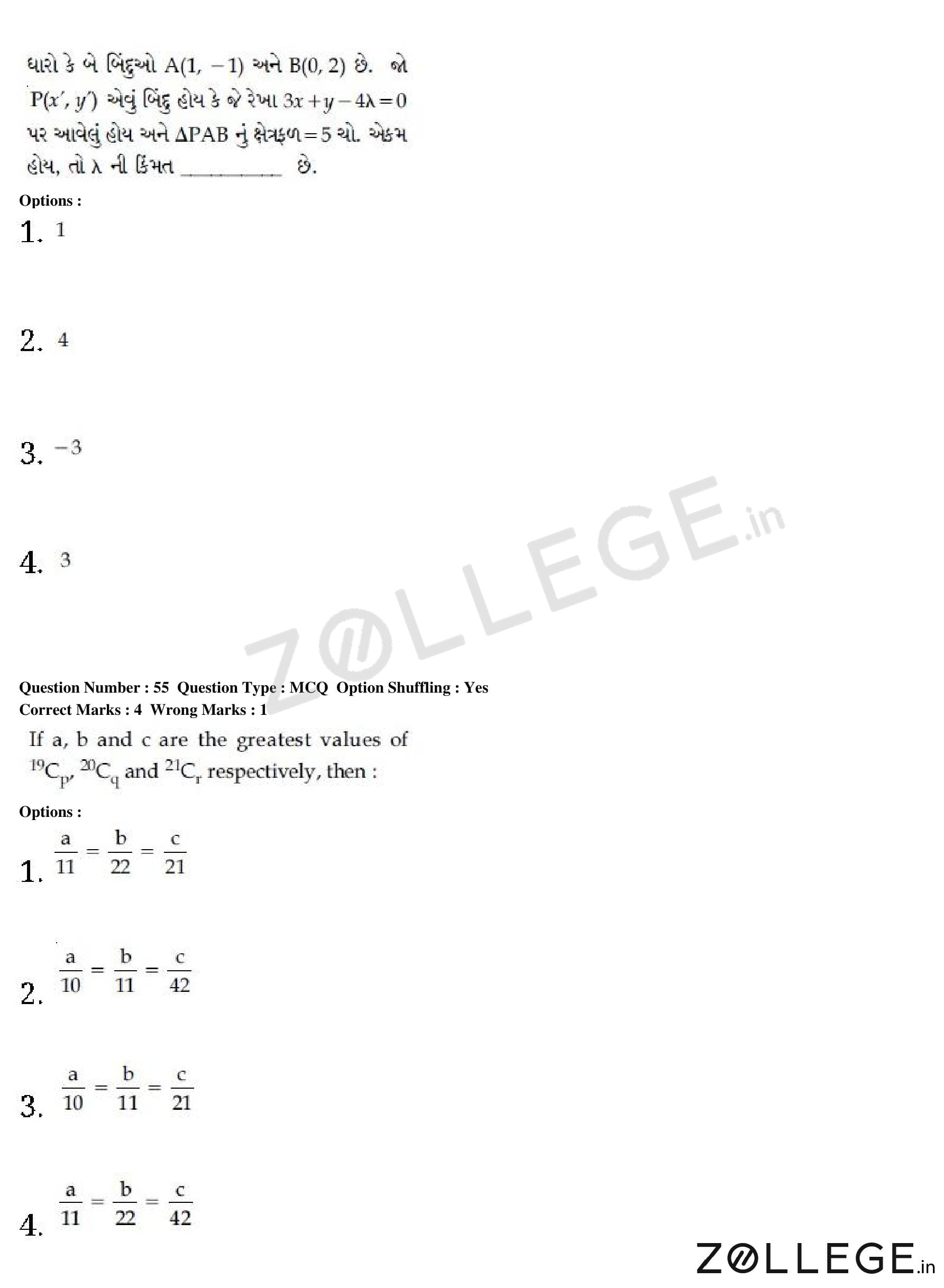
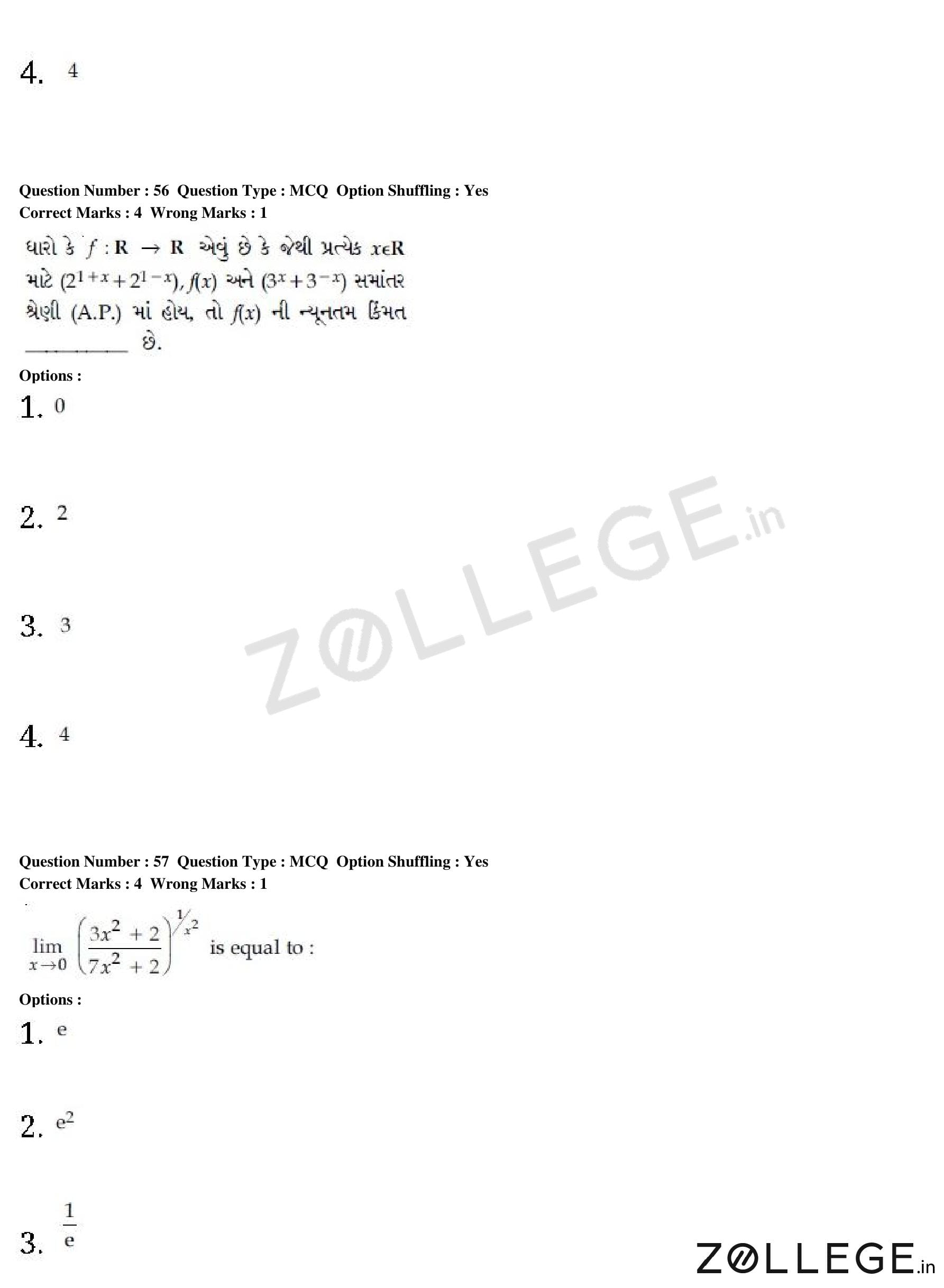
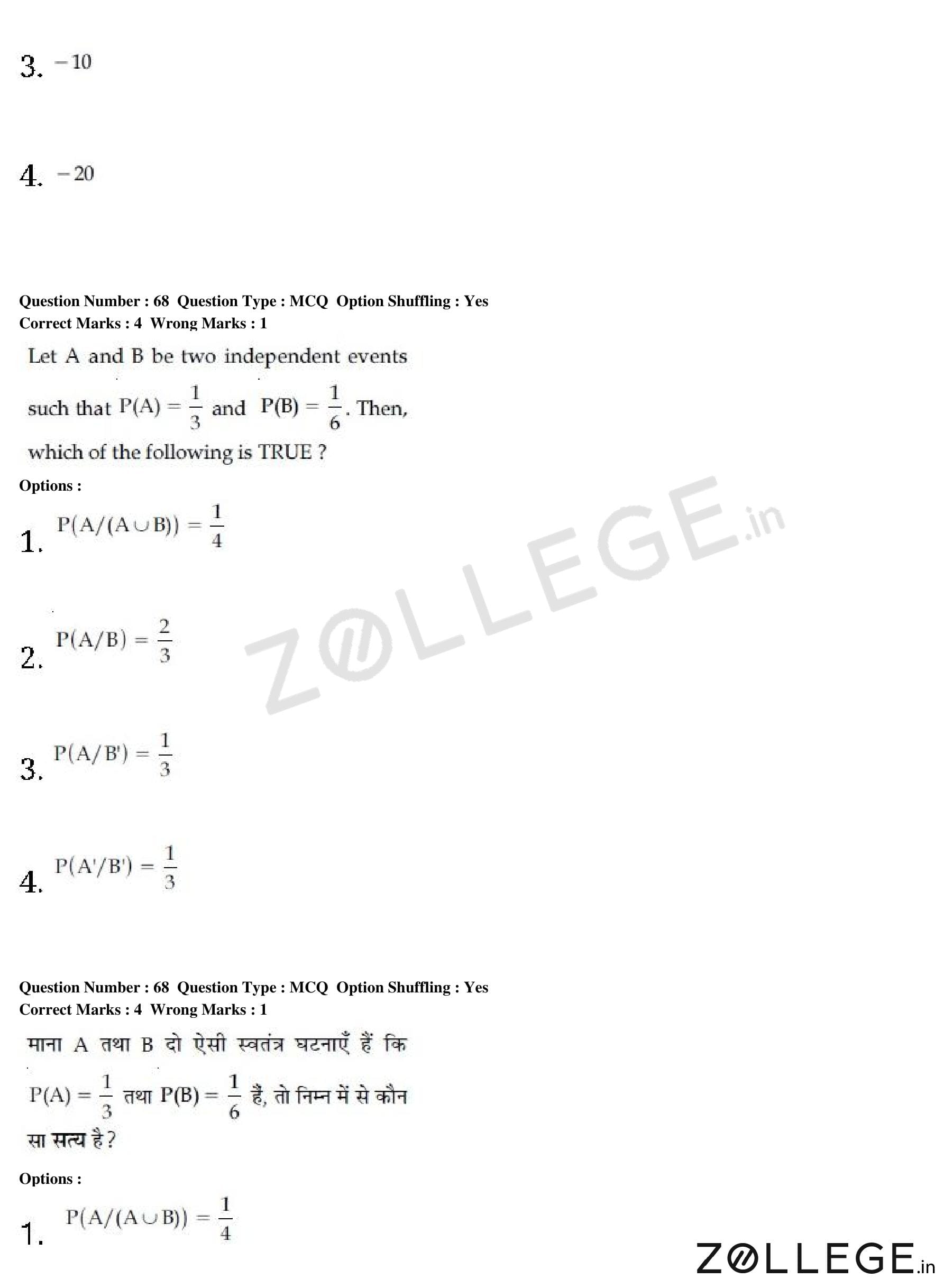
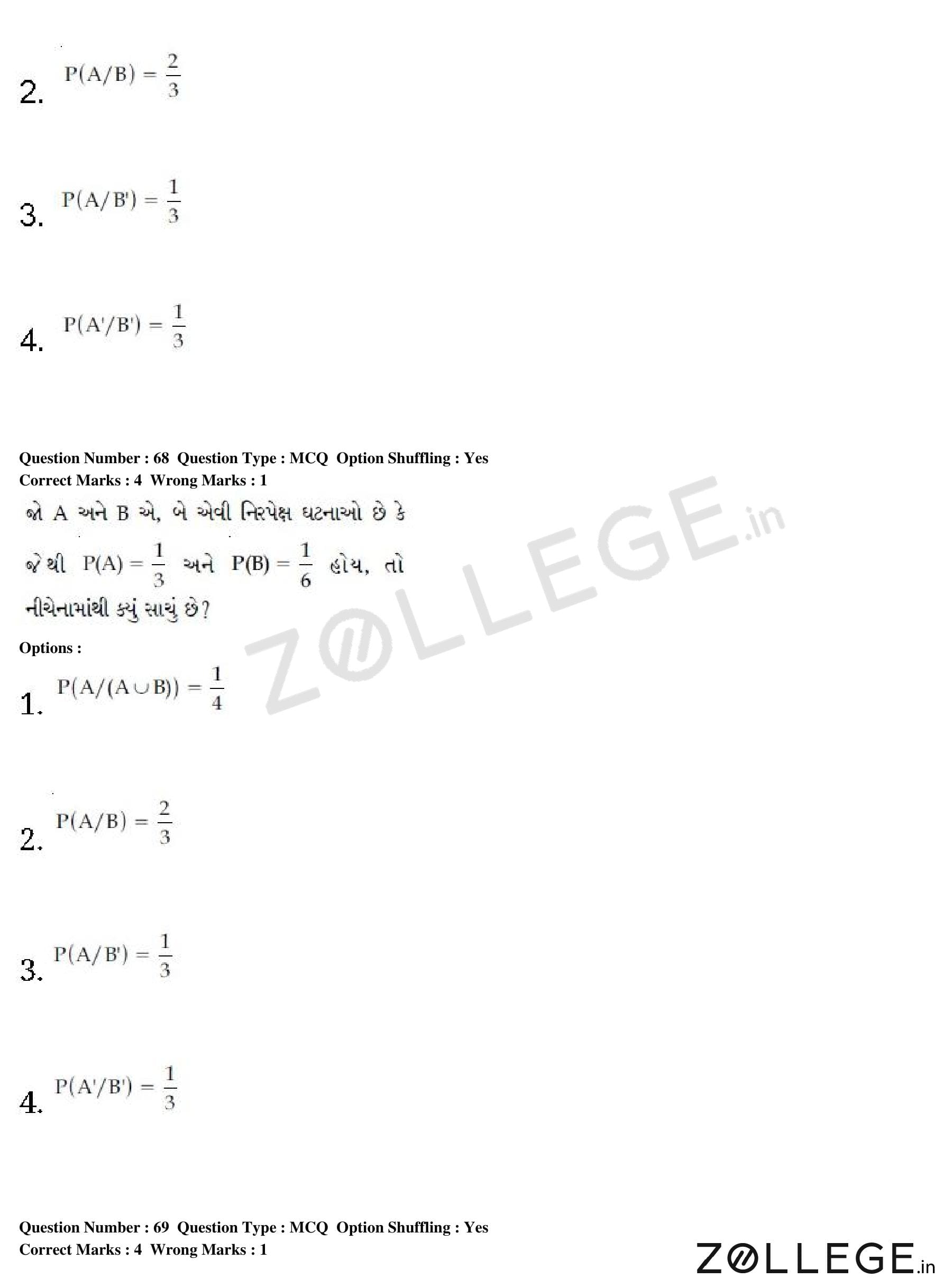
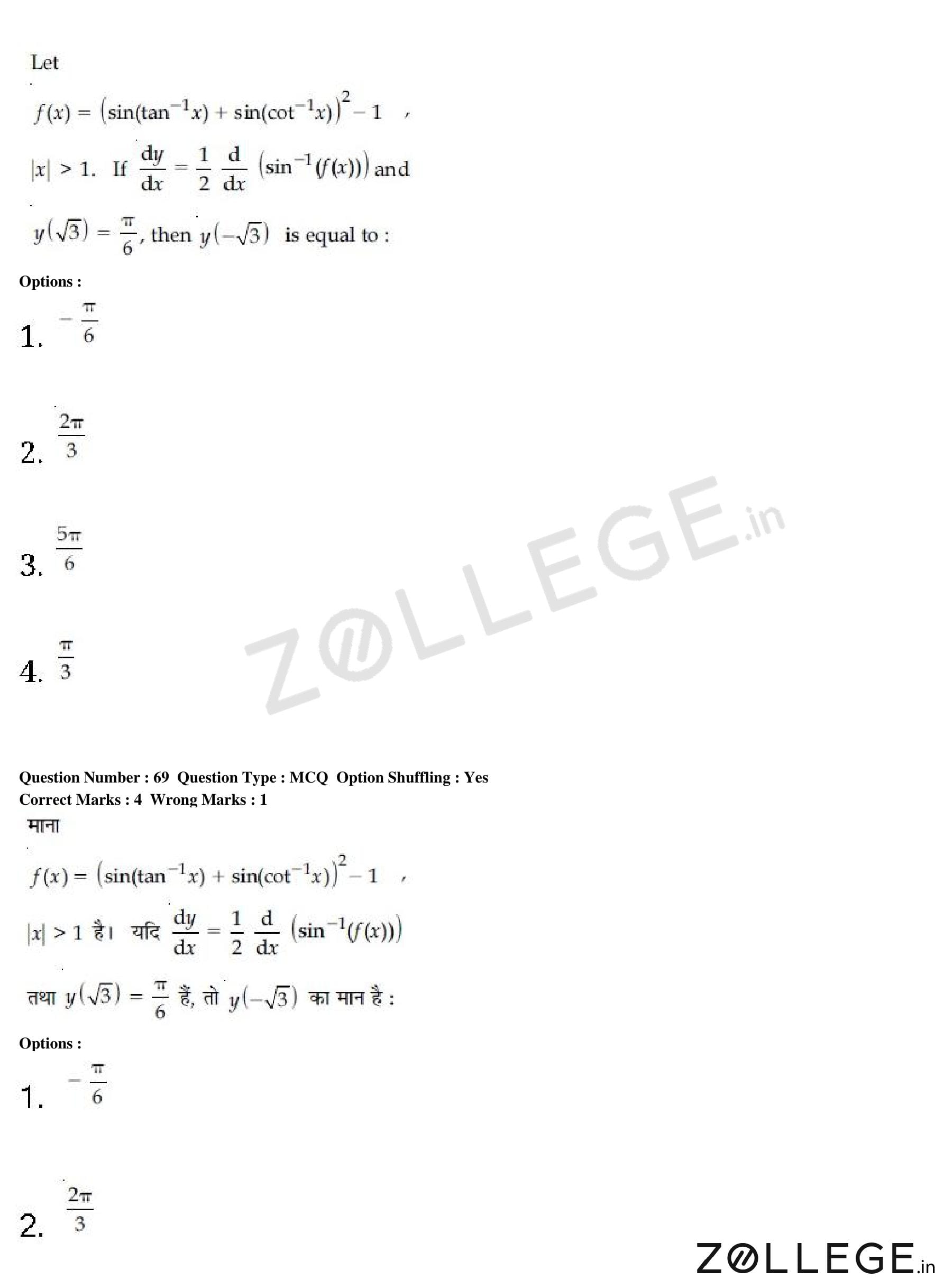
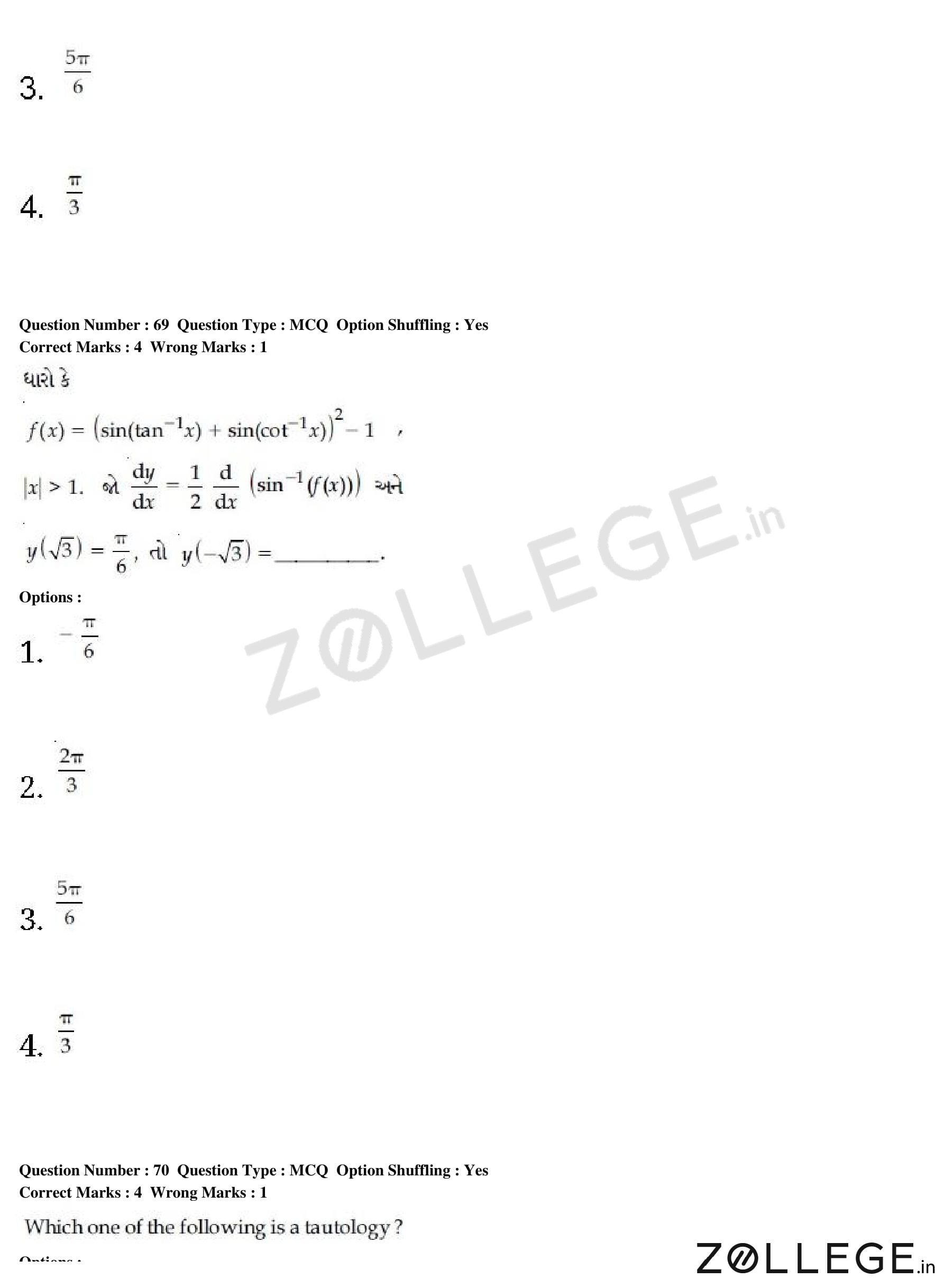
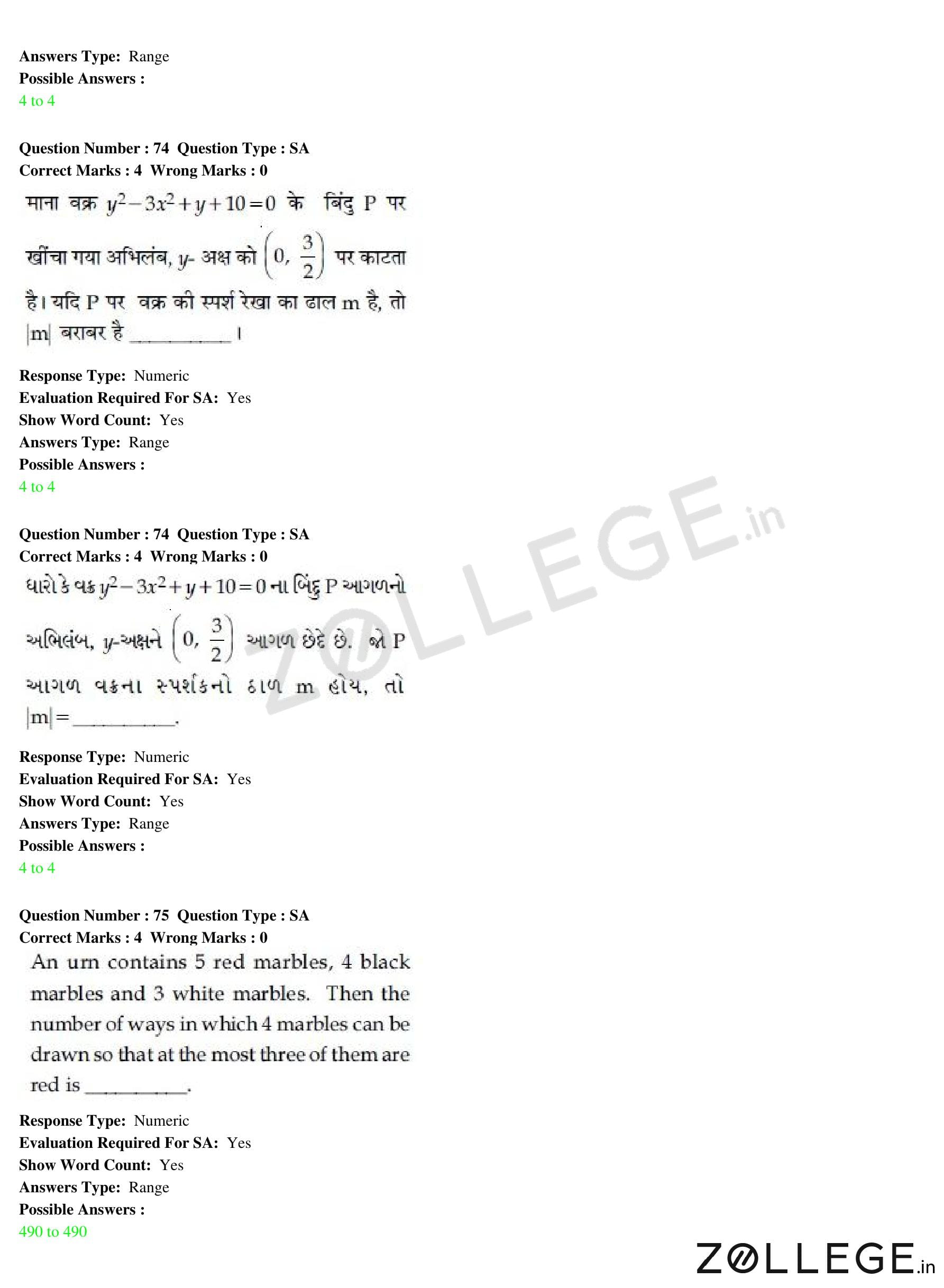
Previous Year JEE Main Question Papers
*The article might have information for the previous academic years, please refer the official website of the exam.