
JEE Main 2021 August 31 Shift 1 Question Paper with Answer Key PDF for B.E./ B.Tech


Content Writer | Updated On - Dec 23, 2025
JEE Main Question Papers are the most important study material for effective exam preparation. We at Zollege have provided JEE Main 2021 August 31 Shift 1 Question Paper with Solution PDFs here. JEE Main 2021 August 31 Shift 1 was conducted sucessfully by NTA for B.E./ B.Tech. According to student reactions and expert reviews, the paper was reported to be moderate.
Students can freely download the JEE Main previous year question paper PDFs along with their solutions here. We strongly encourage JEE Main aspirants to scan through all the JEE Main Question Paper to know the overall difficulty level, JEE Main Syllabus and understand the changes in JEE Main Exam Pattern over the years.
JEE Main 2021 B.E./ B.Tech Question Paper with Answer Key PDF (Shift 1)
| JEE Main 2021 Question Paper PDF | JEE Main 2021 Solutions PDF |
|---|---|
| Download PDF | Check Solutions |

Choose the correct waveform that can represent the voltage across R of the following circuit, assuming the diode is ideal one :

- (A)
![]()
- (B)
![]()
- (C)
![]()
- (D)
![]()


View Solution
Step 1: Understanding the Concept:
The circuit contains an AC source \( V_i = 10 \sin \omega t \), an ideal diode \( D \), a resistor \( R \), and a \( 3V \) DC battery.
The diode is ideal, acting as a short circuit when forward-biased and an open circuit when reverse-biased.
The diode will conduct only when the potential at its anode is greater than the potential at its cathode.
Step 2: Key Formula or Approach:
Using Kirchhoff's Voltage Law (KVL), the condition for the diode to conduct is:
\[ V_i > 3V \]
When the diode conducts (\( V_i > 3V \)), the voltage across the resistor \( V_R \) is:
\[ V_R = V_i - 3 \]
When the diode does not conduct (\( V_i \leq 3V \)), the current in the circuit is zero:
\[ V_R = 0 \]
Step 3: Detailed Explanation:
1. During the positive half cycle, the input voltage \( V_i \) increases from \( 0V \) to \( 10V \).
2. As long as \( V_i < 3V \), the diode is reverse-biased, and \( V_R = 0 \).
3. Once \( V_i \) exceeds \( 3V \), the diode becomes forward-biased (ON).
4. The voltage \( V_R \) follows the shape of the input wave but is shifted down by \( 3V \).
5. The peak value of \( V_R \) will be \( 10V - 3V = 7V \).
6. During the negative half cycle, \( V_i \) is negative, making the anode lower than the cathode, so the diode remains OFF and \( V_R = 0 \).
Step 4: Final Answer:
The resulting waveform should be zero until the input reaches \( 3V \), then rise to a peak and return to zero when the input falls below \( 3V \).
This matches the waveform shown in option (A).
Quick Tip: In clipper circuits with a series battery \( V_B \), the output across the load starts appearing only when the input exceeds the bias voltage \( V_B \).
In the following logic circuit the sequence of the inputs A, B are (0, 0), (0, 1), (1, 0) and (1, 1). The output Y for this sequence will be :

View Solution
Step 1: Understanding the Concept:
The circuit consists of three logic gates.
The first gate (top) is an AND gate with inputs \( A \) and \( B \).
The second gate (bottom) is an OR gate with inputs \( A \) and \( B \).
The third gate (right) is a NAND gate that takes the outputs of the first two gates as its inputs.
Step 2: Key Formula or Approach:
Let \( P \) be the output of the AND gate: \( P = A \cdot B \).
Let \( Q \) be the output of the OR gate: \( Q = A + B \).
The final output \( Y \) is the NAND of \( P \) and \( Q \):
\[ Y = \overline{P \cdot Q} = \overline{(A \cdot B) \cdot (A + B)} \]
Step 3: Detailed Explanation:
Let's evaluate the output for each input pair:
1. For \( (0, 0) \): \( P = 0 \cdot 0 = 0 \), \( Q = 0 + 0 = 0 \). Output \( Y = \overline{0 \cdot 0} = \overline{0} = 1 \).
2. For \( (0, 1) \): \( P = 0 \cdot 1 = 0 \), \( Q = 0 + 1 = 1 \). Output \( Y = \overline{0 \cdot 1} = \overline{0} = 1 \).
3. For \( (1, 0) \): \( P = 1 \cdot 0 = 0 \), \( Q = 1 + 0 = 1 \). Output \( Y = \overline{0 \cdot 1} = \overline{0} = 1 \).
4. For \( (1, 1) \): \( P = 1 \cdot 1 = 1 \), \( Q = 1 + 1 = 1 \). Output \( Y = \overline{1 \cdot 1} = \overline{1} = 0 \).
The resulting sequence of outputs is 1, 1, 1, 0.
Step 4: Final Answer:
The sequence for the given inputs is 1, 1, 1, 0.
Quick Tip: Notice that \( (A \cdot B) \cdot (A + B) \) simplifies to \( A \cdot B \) because \( AB \cdot A + AB \cdot B = AB + AB = AB \).
Thus, the whole circuit behaves exactly like a single NAND gate \( Y = \overline{AB} \).
A sample of a radioactive nucleus A disintegrates to another radioactive nucleus B, which in turn disintegrates to some other stable nucleus C. Plot of a graph showing the variation of number of atoms of nucleus B versus time is : (Assume that at t=0, there are no B atoms in the sample)
- (A)
![]()
- (B)
![]()
- (C)
![]()
- (D)
![]()


View Solution
Step 1: Understanding the Concept:
This describes a sequential radioactive decay process: \( A \xrightarrow{\lambda_A} B \xrightarrow{\lambda_B} C \).
Initially (\( t=0 \)), there are only atoms of \( A \). Nucleus \( B \) is produced by the decay of \( A \) and consumed by its own decay into \( C \).
Step 2: Key Formula or Approach:
The rate of change of the number of atoms of \( B \) is:
\[ \frac{dN_B}{dt} = \lambda_A N_A - \lambda_B N_B \]
Since \( N_A = N_0 e^{-\lambda_A t} \), the solution for \( N_B(t) \) is:
\[ N_B(t) = \frac{\lambda_A N_0}{\lambda_B - \lambda_A} (e^{-\lambda_A t} - e^{-\lambda_B t}) \]
Step 3: Detailed Explanation:
1. At \( t = 0 \), \( N_B = 0 \) as given in the problem.
2. Initially, because \( N_A \) is large and \( N_B \) is small, the production rate \( \lambda_A N_A \) is higher than the decay rate \( \lambda_B N_B \). Thus, \( N_B \) increases.
3. As time passes, \( N_A \) decreases exponentially and \( N_B \) increases, making the production rate fall and the decay rate rise.
4. Eventually, the decay rate equals the production rate (\( \frac{dN_B}{dt} = 0 \)), and \( N_B \) reaches its maximum.
5. After this peak, the production from the nearly exhausted supply of \( A \) cannot keep up with the decay of \( B \), so \( N_B \) starts decreasing toward zero as \( t \to \infty \).
Step 4: Final Answer:
The graph must start at zero, reach a peak, and then decay back to zero.
Graph (C) correctly depicts this variation.
Quick Tip: In successive disintegration \( A \to B \to C \), the intermediate product population always follows a "rise-then-fall" curve.
A moving proton and electron have the same de-Broglie wavelength. If K and P denote the K.E. and momentum respectively. Then choose the correct option :
View Solution
Step 1: Understanding the Concept:
The de-Broglie wavelength \( \lambda \) of a particle is determined by its momentum \( P \).
Kinetic energy \( K \) is related to momentum \( P \) and mass \( m \).
Step 2: Key Formula or Approach:
1. de-Broglie wavelength: \( \lambda = \frac{h}{P} \implies P = \frac{h}{\lambda} \).
2. Kinetic energy: \( K = \frac{P^2}{2m} \).
Step 3: Detailed Explanation:
Given that \( \lambda_p = \lambda_e \):
From the wavelength formula, since \( h \) is a constant, equal wavelengths imply equal momenta:
\[ P_p = P_e \]
Now, looking at the Kinetic Energy:
\[ K = \frac{P^2}{2m} \]
Since \( P \) is the same for both, \( K \) is inversely proportional to the mass:
\[ K \propto \frac{1}{m} \]
We know that the mass of a proton (\( m_p \)) is much greater than the mass of an electron (\( m_e \)):
\[ m_p > m_e \]
Therefore:
\[ K_p < K_e \]
Step 4: Final Answer:
The correct option is \( K_p < K_e \) and \( P_p = P_e \).
Quick Tip: For two particles with the same de-Broglie wavelength, the lighter particle will always possess more kinetic energy.
Two plane mirrors \( M_1 \) and \( M_2 \) are at right angle to each other shown. A point source 'P' is placed at 'a' and '2a' meter away from \( M_1 \) and \( M_2 \) respectively. The shortest distance between the images thus formed is : (Take \( \sqrt{5} = 2.3 \))

View Solution
Step 1: Understanding the Concept:
When two plane mirrors are placed at \( 90^\circ \), three images of a point source are formed.
If the intersection of the mirrors is at origin \( (0,0) \), mirror \( M_1 \) is on the y-axis, and \( M_2 \) is on the x-axis, then source \( P \) is at \( (a, 2a) \).
Step 2: Key Formula or Approach:
The images are located at:
Image 1 (\( I_1 \)): Reflection of \( P(a, 2a) \) in \( M_1 \) is \( (-a, 2a) \).
Image 2 (\( I_2 \)): Reflection of \( P(a, 2a) \) in \( M_2 \) is \( (a, -2a) \).
Image 3 (\( I_3 \)): Reflection of \( I_1 \) in \( M_2 \) (or \( I_2 \) in \( M_1 \)) is \( (-a, -2a) \).
Step 3: Detailed Explanation:
The distance between any two images can be calculated:
1. Distance between \( I_1 \) and \( I_3 \) is \( 2a - (-2a) = 4a \).
2. Distance between \( I_2 \) and \( I_3 \) is \( a - (-a) = 2a \).
3. Distance between \( I_1 \) and \( I_2 \):
\[ d = \sqrt{(a - (-a))^2 + (-2a - 2a)^2} = \sqrt{(2a)^2 + (-4a)^2} = \sqrt{4a^2 + 16a^2} = \sqrt{20a^2} \]
\[ d = 2\sqrt{5} a \]
Using the value \( \sqrt{5} = 2.3 \):
\[ d = 2 \times 2.3 \times a = 4.6a \]
The problem asks for "the shortest distance between the images". Usually, in such MCQ contexts with a specific mathematical hint like \( \sqrt{5} \), the question refers to the distance between the two primary images formed by the individual mirrors.
Step 4: Final Answer:
The distance \( 4.6a \) is derived using the provided hint.
Quick Tip: The four points (source and three images) form a rectangle. The distances between images are the lengths of the sides and the diagonal of this rectangle.
An object is placed at the focus of concave lens having focal length f. What is the magnification and distance of the image from the optical centre of the lens ?
View Solution
Step 1: Understanding the Concept:
For a concave lens, the focal length \( f \) is always negative according to the sign convention.
The object is placed at the focus, so \( u = -f \) (where \( f \) is the magnitude of focal length).
Step 2: Key Formula or Approach:
1. Lens Formula: \( \frac{1}{v} - \frac{1}{u} = \frac{1}{F} \).
2. Magnification: \( m = \frac{v}{u} \).
Step 3: Detailed Explanation:
Given \( u = -f \) and \( F = -f \):
Substitute into the lens formula:
\[ \frac{1}{v} - \frac{1}{-f} = \frac{1}{-f} \]
\[ \frac{1}{v} + \frac{1}{f} = -\frac{1}{f} \]
\[ \frac{1}{v} = -\frac{1}{f} - \frac{1}{f} = -\frac{2}{f} \]
\[ v = -\frac{f}{2} \]
The image distance from the optical center is \( \frac{f}{2} \).
Now, calculate magnification:
\[ m = \frac{v}{u} = \frac{-f/2}{-f} = \frac{1}{2} \]
Step 4: Final Answer:
The magnification is \( 1/2 \) and the image distance is \( f/2 \).
Quick Tip: Remember that a concave lens always forms a virtual, erect, and diminished image. Unlike a convex lens, placing an object at the focus of a concave lens does not create an image at infinity.
A small square loop of side 'a' and one turn is placed inside a larger square loop of side b and one turn (\( b \gg a \)). The two loops are coplanar with their centres coinciding. If a current I is passed in the square loop of side 'b', then the coefficient of mutual inductance between the two loops is :
View Solution
Step 1: Understanding the Concept:
Mutual inductance \( M \) is defined by the magnetic flux \( \phi \) through one loop due to current \( I \) in another: \( \phi = MI \).
Since \( b \gg a \), the magnetic field \( B \) produced by the larger loop can be considered uniform over the area of the smaller loop.
Step 2: Key Formula or Approach:
The magnetic field at the center of a square loop of side \( b \) is the sum of fields due to its four sides.
Magnetic field due to a finite wire of length \( L \) at distance \( r \) from its midpoint is \( B = \frac{\mu_0 I}{4\pi r} (\sin \theta_1 + \sin \theta_2) \).
Step 3: Detailed Explanation:
For one side of length \( b \), the distance to the center is \( r = b/2 \). The angles are \( \theta_1 = \theta_2 = 45^\circ \).
\[ B_{side} = \frac{\mu_0 I}{4\pi (b/2)} (\sin 45^\circ + \sin 45^\circ) = \frac{\mu_0 I}{2\pi b} \left(\frac{2}{\sqrt{2}}\right) = \frac{\mu_0 I}{\sqrt{2}\pi b} \]
Total field at the center due to 4 sides:
\[ B = 4 \times \frac{\mu_0 I}{\sqrt{2}\pi b} = \frac{2\sqrt{2} \mu_0 I}{\pi b} \]
Magnetic flux \( \phi \) through the smaller loop:
\[ \phi = B \cdot Area = \frac{2\sqrt{2} \mu_0 I}{\pi b} \cdot a^2 \]
Since \( \phi = MI \):
\[ M = \frac{2\sqrt{2} \mu_0 a^2}{\pi b} = \frac{\mu_0}{4\pi} \frac{8\sqrt{2} a^2}{b} \]
Step 4: Final Answer:
The coefficient of mutual inductance is \( \frac{\mu_0}{4\pi} \frac{8\sqrt{2} a^2}{b} \).
Quick Tip: For any two concentric coplanar loops, the mutual inductance always scales as \( M \propto \frac{(Small Area)}{Large Dimension} \).
In an ac circuit, an inductor, a capacitor and a resistor are connected in series with \( X_L = R = X_C \). Impedance of this circuit is :
View Solution
Step 1: Understanding the Concept:
The impedance \( Z \) of a series RLC circuit is the combined opposition to current flow.
Step 2: Key Formula or Approach:
The formula for series impedance is:
\[ Z = \sqrt{R^2 + (X_L - X_C)^2} \]
Step 3: Detailed Explanation:
Given the condition \( X_L = R = X_C \), we can specifically observe that:
\[ X_L = X_C \]
This is the condition for resonance.
Substitute these values into the impedance formula:
\[ Z = \sqrt{R^2 + (R - R)^2} \]
\[ Z = \sqrt{R^2 + 0^2} = R \]
Step 4: Final Answer:
The impedance is equal to \( R \).
Quick Tip: At resonance, the net reactance of the circuit is zero, and the circuit behaves as a purely resistive circuit with minimum impedance \( Z = R \).
Consider a galvanometer shunted with \( 5 \Omega \) resistance and \( 2% \) of current passes through it. What is the resistance of the given galvanometer ?
View Solution
Step 1: Understanding the Concept:
A shunt resistance \( S \) is connected in parallel with a galvanometer \( G \).
In a parallel combination, the potential difference across both components is the same.
Step 2: Key Formula or Approach:
Let \( I \) be the total current entering the system.
Current through galvanometer \( I_g \).
Current through shunt \( I_s = I - I_g \).
Equality of potential: \( I_g \times G = (I - I_g) \times S \).
Step 3: Detailed Explanation:
Given:
- \( S = 5 \Omega \).
- \( I_g = 2% of I = 0.02I \).
- \( I - I_g = 100% - 2% = 98% of I = 0.98I \).
Substitute into the formula:
\[ 0.02I \times G = 0.98I \times 5 \]
Divide both sides by \( I \):
\[ 0.02 \times G = 4.9 \]
\[ G = \frac{4.9}{0.02} = \frac{490}{2} \]
\[ G = 245 \Omega \]
Step 4: Final Answer:
The resistance of the galvanometer is \( 245 \Omega \).
Quick Tip: If \( \frac{1}{n} \) of the total current passes through the galvanometer, then the galvanometer resistance is \( G = (n - 1)S \).
Here, \( I_g = \frac{2}{100} I = \frac{1}{50} I \), so \( n = 50 \).
\( G = (50 - 1) \times 5 = 49 \times 5 = 245 \Omega \).
A coil having N turns is wound tightly in the form of a spiral with inner and outer radii 'a' and 'b' respectively. Find the magnetic field at centre, when a current I passes through coil :
View Solution
Step 1: Understanding the Concept:
The magnetic field at the center of a single circular loop of radius \( r \) carrying current \( I \) is given by \( B = \frac{\mu_0 I}{2r} \).
For a spiral coil, we treat it as a collection of infinitesimal concentric loops and integrate their contributions.
Step 2: Key Formula or Approach:
Number of turns per unit radial thickness is \( n = \frac{N}{b-a} \).
For a small radial element \( dr \) at distance \( r \) from the center, the number of turns is \( dN = n \, dr = \frac{N}{b-a} dr \).
Step 3: Detailed Explanation:
The infinitesimal magnetic field \( dB \) at the center due to the turns in width \( dr \) is:
\[ dB = \frac{\mu_0 (dN) I}{2r} = \frac{\mu_0 I}{2r} \left( \frac{N}{b-a} dr \right) \]
Total magnetic field \( B \) is obtained by integrating from \( r = a \) to \( r = b \):
\[ B = \int_a^b \frac{\mu_0 NI}{2(b-a)} \frac{1}{r} dr \]
\[ B = \frac{\mu_0 NI}{2(b-a)} \int_a^b \frac{1}{r} dr \]
\[ B = \frac{\mu_0 NI}{2(b-a)} \left[ \ln r \right]_a^b \]
\[ B = \frac{\mu_0 NI}{2(b-a)} (\ln b - \ln a) = \frac{\mu_0 NI}{2(b-a)} \ln \left( \frac{b}{a} \right) \]
Step 4: Final Answer:
The magnetic field at the center is \(\frac{\mu_0 IN}{2(b - a)} \log_e \left(\frac{b}{a}\right)\). Quick Tip: For continuous current distributions in circular geometries, always use the formula for a single loop and integrate over the density of turns.
Match List - I with List - II
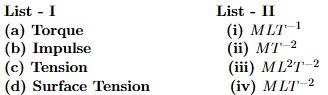
Choose the most appropriate answer from the option given below :
View Solution
Step 1: Understanding the Concept:
To match the lists, we need to find the dimensional formula for each physical quantity based on its fundamental definition.
Step 2: Detailed Explanation:
1. Torque (\( \tau \)): Defined as Force \(\times\) perpendicular distance.
\[ [\tau] = [MLT^{-2}] \times [L] = [ML^2T^{-2}] \]
Matches with (iii).
2. Impulse (\( J \)): Defined as Force \(\times\) time.
\[ [J] = [MLT^{-2}] \times [T] = [MLT^{-1}] \]
Matches with (i).
3. Tension (\( T \)): It is a type of Force.
\[ [T] = [MLT^{-2}] \]
Matches with (iv).
4. Surface Tension (\( S \)): Defined as Force per unit length.
\[ [S] = \frac{[MLT^{-2}]}{[L]} = [MT^{-2}] \]
Matches with (ii).
Mapping: (a)-(iii), (b)-(i), (c)-(iv), (d)-(ii).
Step 3: Final Answer:
The correct matching is (a)-(iii), (b)-(i), (c)-(iv), (d)-(ii). Quick Tip: Remember that Energy, Work, and Torque all share the same dimensions: \(ML^2T^{-2}\).
Two particles A and B having charges \(20\,\mu C\) and \(-5\,\mu C\) respectively are held fixed with a separation of \(5\,cm\). At what position a third charged particle should be placed so that it does not experience a net electric force ?
View Solution
Step 1: Understanding the Concept:
For a third charge to experience zero net force (equilibrium) when placed near two unlike charges, it must be placed outside the segment joining them, on the side of the smaller magnitude charge.
Step 2: Key Formula or Approach:
Let the third charge \( q \) be placed at distance \( x \) from the charge \( q_2 = -5\,\mu C \).
The distance from \( q_1 = 20\,\mu C \) will be \( (5 + x)\,cm \).
Equate the magnitudes of forces: \( \frac{k |q_1| |q|}{(5+x)^2} = \frac{k |q_2| |q|}{x^2} \).
Step 3: Detailed Explanation:
\[ \frac{20}{(5+x)^2} = \frac{5}{x^2} \]
Divide both sides by 5:
\[ \frac{4}{(5+x)^2} = \frac{1}{x^2} \]
Take the square root of both sides:
\[ \frac{2}{5+x} = \frac{1}{x} \]
\[ 2x = 5 + x \]
\[ x = 5\,cm \]
The position is \( 5\,cm \) away from the \(-5\,\mu C\) charge, on the side away from the \(20\,\mu C\) charge (right side).
Step 4: Final Answer:
The third charge should be placed at \(5\,cm\) from \(-5\,\mu C\) on the right side. Quick Tip: For like charges, equilibrium is in between. For unlike charges, equilibrium is outside, closer to the smaller charge.
Which of the following equations is dimensionally incorrect ?
Where t = time, h = height, s = surface tension, \(\theta\) = angle, \(\rho\) = density, a, r = radius, g = acceleration due to gravity, v = volume, p = pressure, W = work done, \(\Gamma\) = torque, \(\epsilon\) = permittivity, E = electric field, J = current density, L = length.
View Solution
Step 1: Understanding the Concept:
We check the dimensions of the left-hand side (LHS) and right-hand side (RHS) for each equation. If they don't match, the equation is dimensionally incorrect.
Step 2: Detailed Explanation:
(A) \(h = \frac{2s \cos\theta}{\rho rg}\):
LHS: \([L]\).
RHS: \(\frac{[MT^{-2}]}{[ML^{-3}][L][LT^{-2}]} = \frac{[MT^{-2}]}{[ML^{-1}T^{-2}]} = [L^2]\) --- Wait, \(\rho rg\) is \((ML^{-3})(L)(LT^{-2}) = ML^{-1}T^{-2}\). So RHS is \([MT^{-2}] / [ML^{-1}T^{-2}] = [L]\). Correct.
(B) \(v = \frac{\pi pa^4}{8\eta L}\):
In Poiseuille's law, the term on the RHS has dimensions of volume flow rate (\(L^3 T^{-1}\)).
LHS: \([v] = Volume = [L^3]\).
RHS: \(\frac{[p][a^4]}{[\eta][L]} = \frac{[ML^{-1}T^{-2}][L^4]}{[ML^{-1}T^{-1}][L]} = \frac{[ML^3T^{-2}]}{[MT^{-1}]} = [L^3T^{-1}]\).
LHS \(\neq\) RHS. Incorrect.
(C) \(W = \Gamma \theta\):
LHS: Work = \([ML^2T^{-2}]\).
RHS: Torque \(\times\) Angle = \([ML^2T^{-2}] \times [1] = [ML^2T^{-2}]\). Correct.
(D) \(J = \epsilon \frac{\partial E}{\partial t}\):
LHS: Current density = \([L^{-2}A]\).
RHS: \([\epsilon] \frac{[E]}{[T]} = [M^{-1}L^{-3}T^4A^2] \frac{[MLT^{-3}A^{-1}]}{[T]} = [L^{-2}A]\). Correct.
Step 3: Final Answer:
Equation (B) is dimensionally incorrect as Volume \(\neq\) Volume flow rate. Quick Tip: Poiseuille's equation specifically defines the rate of flow (\(V/t\)), not the total volume itself.
For an ideal gas the instantaneous change in pressure 'p' with volume 'v' is given by the equation \(\frac{dp}{dv} = -ap\). If \(p = p_0\) at \(v = 0\) is the given boundary condition, then the maximum temperature one mole of gas can attain is : (Here R is the gas constant)
View Solution
Step 1: Understanding the Concept:
We first find the pressure \( p \) as a function of volume \( v \) using the differential equation, then use the ideal gas law \( pv = RT \) to find temperature as a function of \( v \), and finally maximize it.
Step 2: Key Formula or Approach:
For 1 mole of ideal gas, \( T = \frac{pv}{R} \).
Integrate \(\frac{dp}{p} = -a \, dv\).
Step 3: Detailed Explanation:
\[ \int \frac{dp}{p} = \int -a \, dv \implies \ln p = -av + C \]
Using boundary condition \( p = p_0 \) at \( v = 0 \):
\[ \ln p_0 = 0 + C \implies C = \ln p_0 \] \[ \ln \left(\frac{p}{p_0}\right) = -av \implies p = p_0 e^{-av} \]
Now, expression for Temperature:
\[ T = \frac{pv}{R} = \frac{p_0 v e^{-av}}{R} \]
To find maximum temperature, set \(\frac{dT}{dv} = 0\):
\[ \frac{dT}{dv} = \frac{p_0}{R} \left[ e^{-av} + v(-a)e^{-av} \right] = 0 \] \[ 1 - av = 0 \implies v = \frac{1}{a} \]
Substitute \( v = 1/a \) in the temperature equation:
\[ T_{max} = \frac{p_0 (1/a) e^{-a(1/a)}}{R} = \frac{p_0}{a R e} \]
Step 4: Final Answer:
The maximum temperature attained is \(\frac{p_0}{aeR}\). Quick Tip: When dealing with maxima/minima in thermodynamics, express the variable (like T) in terms of one parameter (like v) and differentiate.
A reversible engine has an efficiency of \(\frac{1}{4}\). If the temperature of the sink is reduced by \(58^\circC\), its efficiency becomes double. Calculate the temperature of the sink :
View Solution
Step 1: Understanding the Concept:
Efficiency of a Carnot engine is given by \( \eta = 1 - \frac{T_2}{T_1} \), where \( T_1 \) is source temperature and \( T_2 \) is sink temperature in Kelvin.
Step 2: Key Formula or Approach:
Initial efficiency: \( \eta_1 = 1 - \frac{T_2}{T_1} = \frac{1}{4} \).
Final efficiency: \( \eta_2 = 1 - \frac{T_2 - 58}{T_1} = \frac{1}{2} \) (since efficiency doubles).
Step 3: Detailed Explanation:
From equation 1:
\[ \frac{T_2}{T_1} = 1 - \frac{1}{4} = \frac{3}{4} \implies T_1 = \frac{4}{3} T_2 \]
From equation 2:
\[ \frac{T_2 - 58}{T_1} = 1 - \frac{1}{2} = \frac{1}{2} \]
Substitute \( T_1 \) from the first part:
\[ \frac{T_2 - 58}{(4/3)T_2} = \frac{1}{2} \] \[ \frac{3(T_2 - 58)}{4T_2} = \frac{1}{2} \implies \frac{3T_2 - 174}{2T_2} = 1 \] \[ 3T_2 - 174 = 2T_2 \] \[ T_2 = 174\,K \]
In standard textbook problems of this type, the numerical value obtained for \( T_2 \) matches one of the options despite the unit label in the option. Here, 174 matches option (D).
Step 4: Final Answer:
The temperature of the sink is \(174^\circC\) (based on numerical result 174). Quick Tip: A change in temperature of \(58^\circC\) is equal to a change of \(58\,K\). Always perform efficiency calculations in Kelvin.
A uniform heavy rod of weight \(10\,kg\,ms^{-2}\), cross-sectional area \(100\,cm^2\) and length \(20\,cm\) is hanging from a fixed support. Young modulus of the material of the rod is \(2 \times 10^{11}\,Nm^{-2}\). Neglecting the lateral contraction, find the elongation of rod due to its own weight :
View Solution
Step 1: Understanding the Concept:
For a heavy rod hanging vertically, the tension is not uniform. It is maximum at the support and zero at the free end. The effective force causing elongation is half the weight of the rod.
Step 2: Key Formula or Approach: \[ \Delta L = \frac{WL}{2AY} \]
Where \( W \) is weight, \( L \) is length, \( A \) is area, and \( Y \) is Young's modulus.
Step 3: Detailed Explanation:
Given:
\( W = 10\,N \) (Weight unit \(kg\,ms^{-2}\) is equivalent to Newton).
\( L = 20\,cm = 0.2\,m \).
\( A = 100\,cm^2 = 100 \times 10^{-4}\,m^2 = 10^{-2}\,m^2 \).
\( Y = 2 \times 10^{11}\,Nm^{-2} \).
Calculation:
\[ \Delta L = \frac{10 \times 0.2}{2 \times 10^{-2} \times 2 \times 10^{11}} \] \[ \Delta L = \frac{2}{4 \times 10^9} \] \[ \Delta L = 0.5 \times 10^{-9} = 5 \times 10^{-10}\,m \]
Step 4: Final Answer:
The elongation of the rod is \(5 \times 10^{-10}\,m\). Quick Tip: For problems involving own weight, you can assume the entire weight acts at the center of mass, which is \(L/2\) from the support, leading to the factor of 1/2 in the formula.
The masses and radii of the earth and moon are (\(M_1, R_1\)) and (\(M_2, R_2\)) respectively. Their centres are at a distance 'r' apart. Find the minimum escape velocity for a particle of mass 'm' to be projected from the middle of these two masses :
View Solution
Step 1: Understanding the Concept:
Escape velocity is the minimum velocity required for an object to escape the gravitational field of a system, meaning its total mechanical energy at infinity becomes zero.
Step 2: Key Formula or Approach:
Total Energy = Kinetic Energy + Potential Energy = 0.
Potential Energy at midpoint (distance \(r/2\) from both): \( U = -\frac{GM_1m}{r/2} - \frac{GM_2m}{r/2} \).
Step 3: Detailed Explanation:
\[ U = -\frac{2Gm}{r}(M_1 + M_2) \]
By conservation of energy:
\[ \frac{1}{2} m V^2 + U = 0 \] \[ \frac{1}{2} m V^2 - \frac{2Gm}{r}(M_1 + M_2) = 0 \] \[ V^2 = \frac{4G(M_1 + M_2)}{r} \] \[ V = \sqrt{\frac{4G(M_1 + M_2)}{r}} \]
Step 4: Final Answer:
The minimum escape velocity is \(\sqrt{\frac{4G(M_1 + M_2)}{r}}\). Quick Tip: Potential is a scalar. Sum the individual potentials due to all nearby masses before applying energy conservation for escape velocity.
Angular momentum of a single particle moving with constant speed along circular path :
View Solution
Step 1: Understanding the Concept:
Angular momentum of a particle about the center of a circular path is given by \(\vec{L} = \vec{r} \times \vec{p}\), where \(\vec{r}\) is the position vector and \(\vec{p} = m\vec{v}\) is the linear momentum.
Step 2: Detailed Explanation:
1. Magnitude: In a circular path with constant speed \( v \) and radius \( R \), the velocity vector is always perpendicular to the radius vector. Thus, \( L = m v R \sin(90^\circ) = m v R \). Since \( m, v, R \) are constants, the magnitude remains same.
2. Direction: By the right-hand rule, the direction of \(\vec{L}\) is perpendicular to the plane of the circle. As the particle moves in the plane, the plane itself does not tilt, so the normal to the plane (the direction of \(\vec{L}\)) remains fixed.
Step 3: Final Answer:
Both the magnitude and direction of angular momentum remain constant. Quick Tip: For uniform circular motion, torque about the center is zero (\(\vec{r}\) and \(\vec{F}_c\) are anti-parallel), which implies angular momentum is conserved.
A helicopter is flying horizontally with a speed 'v' at an altitude 'h' has to drop a food packet for a man on the ground. What is the distance of helicopter from the man when the food packet is dropped ?
View Solution
Step 1: Understanding the Concept:
When the packet is dropped, it has an initial horizontal velocity \( v \) and zero initial vertical velocity. The time it takes to reach the ground depends only on the altitude \( h \).
Step 2: Key Formula or Approach:
Time of flight \( t = \sqrt{\frac{2h}{g}} \).
Horizontal range \( R = v \times t = v \sqrt{\frac{2h}{g}} \).
Step 3: Detailed Explanation:
The helicopter is at a height \( h \). The man is at the point where the packet will land, which is at a horizontal distance \( R \) from the point directly below the helicopter at the moment of release.
The distance \( D \) between the helicopter and the man at the moment of drop is the hypotenuse of the right triangle formed by \( h \) and \( R \):
\[ D = \sqrt{h^2 + R^2} \]
Substitute \( R \):
\[ D = \sqrt{h^2 + \left( v \sqrt{\frac{2h}{g}} \right)^2} \] \[ D = \sqrt{h^2 + \frac{2v^2h}{g}} \]
Step 4: Final Answer:
The distance is \(\sqrt{\frac{2v^2h}{g} + h^2}\). Quick Tip: Always break projectile motion into independent horizontal and vertical components. Time is the common variable connecting them.
A body of mass M moving at speed \(V_0\) collides elastically with a mass 'm' at rest. After the collision, the two masses move at angles \(\theta_1\) and \(\theta_2\) with respect to the initial direction of motion of the body of mass M. The largest possible value of the ratio M/m, for which the angles \(\theta_1\) and \(\theta_2\) will be equal, is :
View Solution
Step 1: Understanding the Concept:
In an elastic collision, both momentum and kinetic energy are conserved. If the scattering angles are equal (\(\theta_1 = \theta_2 = \theta\)), we can use conservation laws to find the constraints on the mass ratio.
Step 2: Key Formula or Approach:
Conservation of momentum (x and y directions):
\( MV_0 = MV_1 \cos\theta + mV_2 \cos\theta \implies MV_0 = (MV_1 + mV_2) \cos\theta \)
\( 0 = MV_1 \sin\theta - mV_2 \sin\theta \implies MV_1 = mV_2 \implies V_2 = \frac{M}{m}V_1 \)
Step 3: Detailed Explanation:
Substitute \( V_2 \) into the x-momentum equation:
\( MV_0 = (MV_1 + m \frac{M}{m} V_1) \cos\theta = 2MV_1 \cos\theta \implies V_1 = \frac{V_0}{2\cos\theta} \)
Conservation of Energy:
\( \frac{1}{2} MV_0^2 = \frac{1}{2} MV_1^2 + \frac{1}{2} mV_2^2 \)
\( MV_0^2 = M \left( \frac{V_0}{2\cos\theta} \right)^2 + m \left( \frac{M}{m} \frac{V_0}{2\cos\theta} \right)^2 \)
Divide by \( \frac{MV_0^2}{4\cos^2\theta} \):
\( 4\cos^2\theta = 1 + \frac{M}{m} \)
Since the maximum value of \(\cos^2\theta\) is 1:
\( 1 + \frac{M}{m} \leq 4 \times 1 \)
\( \frac{M}{m} \leq 3 \)
Step 4: Final Answer:
The largest possible value of the ratio M/m is 3. Quick Tip: For equal masses (\(M=m\)) in an elastic collision with one at rest, the particles always move at right angles (\(\theta_1 + \theta_2 = 90^\circ\)).
The voltage drop across \( 15 \, \Omega \) resistance in the given figure will be \(\dots\dots\) V.

View Solution
Step 1: Understanding the Concept:
In steady DC analysis, we calculate the equivalent resistance of the circuit to find the main current. Then, using current division rules, we find the current in specific branches to determine the voltage drop across individual resistors using Ohm's Law (\( V = IR \)).
Step 2: Key Formula or Approach:
1. Equivalent resistance of parallel resistors: \( R_p = \frac{R_1 R_2}{R_1 + R_2} \)
2. Total current: \( I = \frac{V}{R_{eq} + r} \)
Step 3: Detailed Explanation:
Let's simplify the parallel and series combinations in the upper and middle branches:
1. Upper Branch (\( R_{top} \)):
- First parallel part: \( 4 \, \Omega || 4 \, \Omega = 2 \, \Omega \).
- Second part: \( 2 \, \Omega \) in series.
- Third parallel part: \( 15 \, \Omega || 10 \, \Omega = \frac{15 \times 10}{15 + 10} = \frac{150}{25} = 6 \, \Omega \).
- Total resistance of upper branch: \( R_{top} = 2 + 2 + 6 = 10 \, \Omega \).
2. Middle Branch (\( R_{mid} \)):
- First parallel part: \( 8 \, \Omega || 8 \, \Omega = 4 \, \Omega \).
- Second parallel part: \( 12 \, \Omega || 12 \, \Omega = 6 \, \Omega \).
- Total resistance of middle branch: \( R_{mid} = 4 + 6 = 10 \, \Omega \).
3. Total Resistance and Current:
- These two branches are in parallel: \( R_{eq\_parallel} = \frac{10 \times 10}{10 + 10} = 5 \, \Omega \).
- Adding the internal/series resistor (\( 1 \, \Omega \)): \( R_{total} = 5 + 1 = 6 \, \Omega \).
- Total current from battery: \( I_{total} = \frac{12 \, V}{6 \, \Omega} = 2 \, A \).
4. Current Division:
- Since \( R_{top} = R_{mid} = 10 \, \Omega \), the current splits equally: \( I_{top} = 1 \, A \) and \( I_{mid} = 1 \, A \).
- The voltage drop across the \( 15 \, \Omega \) resistor is the voltage drop across the entire \( 15 || 10 \) parallel combo:
\[ V_{15 \Omega} = I_{top} \times R_{p2} = 1 \, A \times 6 \, \Omega = 6 \, V \]
Step 4: Final Answer:
The voltage drop across the \( 15 \, \Omega \) resistance is \( 6 \, V \). Quick Tip: When parallel branches have identical total resistance, the main current divides equally among them, significantly simplifying the node voltage calculations.
A particle of mass \( 1 \, kg \) is hanging from a spring of force constant \( 100 \, Nm^{-1} \). The mass is pulled slightly downward and released so that it executes free simple harmonic motion with time period T. The time when the kinetic energy and potential energy of the system will become equal, is \( \frac{T}{x} \). The value of x is \(\dots\dots\dots\).
View Solution
Step 1: Understanding the Concept:
In Simple Harmonic Motion (SHM), the total mechanical energy is conserved and alternates between Kinetic Energy (KE) and Potential Energy (PE). We need to find the specific time \( t \) relative to the period \( T \) when \( KE = PE \).
Step 2: Key Formula or Approach:
1. Displacement equation: \( y = A \sin(\omega t) \).
2. Potential Energy: \( PE = \frac{1}{2} k y^2 \).
3. Kinetic Energy: \( KE = \frac{1}{2} k (A^2 - y^2) \).
Step 3: Detailed Explanation:
Given the condition:
\[ KE = PE \]
\[ \frac{1}{2} k (A^2 - y^2) = \frac{1}{2} k y^2 \]
\[ A^2 - y^2 = y^2 \implies 2y^2 = A^2 \implies y = \frac{A}{\sqrt{2}} \]
Substitute this into the displacement equation (assuming the particle starts from the mean position at \( t=0 \)):
\[ A \sin(\omega t) = \frac{A}{\sqrt{2}} \]
\[ \sin(\omega t) = \frac{1}{\sqrt{2}} \]
The first time this occurs is at:
\[ \omega t = \frac{\pi}{4} \]
Since \( \omega = \frac{2\pi}{T} \):
\[ \left(\frac{2\pi}{T}\right) t = \frac{\pi}{4} \]
\[ t = \frac{T}{8} \]
Comparing this with the given form \( \frac{T}{x} \), we find \( x = 8 \).
Step 4: Final Answer:
The value of x is 8. Quick Tip: For any SHM, the energy is shared equally (\( KE = PE \)) when the displacement is \( \frac{1}{\sqrt{2}} \) times the amplitude, which occurs at \( 1/8^{th} \) of the total time period.
A car is moving on a plane inclined at \( 30^\circ \) to the horizontal with an acceleration of \( 10 \, ms^{-2} \) parallel to the plane upward. A bob is suspended by a string from the roof of the car. The angle in degrees which the string makes with the vertical is \(\dots\dots\dots\). (Take \( g = 10 \, ms^{-2} \))
View Solution
Step 1: Understanding the Concept:
In an accelerated frame of reference (the car), a pseudo force acts on the bob in a direction opposite to the car's acceleration. The string will align itself along the direction of the net effective gravity (\( \vec{g}_{eff} = \vec{g} - \vec{a} \)).
Step 2: Key Formula or Approach:
We resolve the gravitational acceleration \( \vec{g} \) and car acceleration \( \vec{a} \) into components to find the angle \( \theta \) with the vertical.
Step 3: Detailed Explanation:
Let's define a coordinate system where \( y \) is vertical (upward positive) and \( x \) is horizontal.
1. Acceleration of car (\( \vec{a} \)): Moves up the incline at \( 30^\circ \).
\[ a_x = 10 \cos 30^\circ = 5\sqrt{3} \, ms^{-2} \]
\[ a_y = 10 \sin 30^\circ = 5 \, ms^{-2} \]
2. Gravity (\( \vec{g} \)):
\[ g_x = 0, \quad g_y = -10 \, ms^{-2} \]
3. Effective Acceleration (\( \vec{g}' = \vec{g} - \vec{a} \)):
\[ g'_x = 0 - 5\sqrt{3} = -5\sqrt{3} \, ms^{-2} \]
\[ g'_y = -10 - 5 = -15 \, ms^{-2} \]
4. Angle with vertical (\( \theta \)):
The string hangs in the direction of \( \vec{g}' \). The angle \( \theta \) it makes with the vertical is:
\[ \tan \theta = \frac{|g'_x|}{|g'_y|} = \frac{5\sqrt{3}}{15} = \frac{\sqrt{3}}{3} = \frac{1}{\sqrt{3}} \]
\[ \theta = 30^\circ \]
Step 4: Final Answer:
The angle the string makes with the vertical is \( 30^\circ \). Quick Tip: Using vector subtraction \( \vec{g}_{eff} = \vec{g} - \vec{a} \) is often safer than resolving components along the incline, as it directly gives the angle with respect to standard horizontal/vertical axes.
A block moving horizontally on a smooth surface with a speed of \( 40 \, ms^{-1} \) splits into two equal parts. If one of the parts moves at \( 60 \, ms^{-1} \) in the same direction, then the fractional change in the kinetic energy will be \( x : 4 \) where \( x = \dots\dots\dots \).
View Solution
Step 1: Understanding the Concept:
This problem involves the conservation of linear momentum and the calculation of kinetic energy before and after the explosion (splitting) of the block.
Step 2: Key Formula or Approach:
1. Conservation of Momentum: \( m_1 v_1 + m_2 v_2 = M V \).
2. Kinetic Energy: \( K = \frac{1}{2} m v^2 \).
3. Fractional Change: \( \frac{\Delta K}{K_i} = \frac{K_f - K_i}{K_i} \).
Step 3: Detailed Explanation:
Let the total mass be \( M \). The block splits into two equal parts, so each mass is \( M/2 \).
1. Initial State:
- Initial speed \( V = 40 \, ms^{-1} \).
- Initial Momentum: \( P_i = M(40) \).
- Initial Kinetic Energy: \( K_i = \frac{1}{2} M (40)^2 = 800 M \).
2. Final State:
- Mass 1 (\( M/2 \)) moves at \( v_1 = 60 \, ms^{-1} \).
- Mass 2 (\( M/2 \)) moves at speed \( v_2 \).
- By Momentum Conservation: \( M(40) = \frac{M}{2}(60) + \frac{M}{2} v_2 \).
\[ 40 = 30 + \frac{v_2}{2} \implies \frac{v_2}{2} = 10 \implies v_2 = 20 \, ms^{-1} \]
- Final Kinetic Energy: \( K_f = \frac{1}{2} (\frac{M}{2}) (60)^2 + \frac{1}{2} (\frac{M}{2}) (20)^2 \)
\[ K_f = \frac{M}{4} (3600 + 400) = \frac{4000 M}{4} = 1000 M \]
3. Fractional Change:
- Change in KE: \( \Delta K = K_f - K_i = 1000 M - 800 M = 200 M \).
- Fractional Change: \( \frac{\Delta K}{K_i} = \frac{200 M}{800 M} = \frac{1}{4} \).
Comparing with \( x : 4 \), we get \( x = 1 \).
Step 4: Final Answer:
The value of x is 1. Quick Tip: In explosions or splitting where internal energy is released, the final kinetic energy is always greater than the initial kinetic energy, even though momentum remains conserved.
When a rubber ball is taken to a depth of \(\dots\dots\dots\) m in deep sea, its volume decreases by \( 0.5% \).
(The bulk modulus of rubber \(= 9.8 \times 10^8 \, Nm^{-2} \)
Density of sea water \(= 10^3 \, kg m^{-3} \)
\( g = 9.8 \, m/s^2 \))
View Solution
Step 1: Understanding the Concept:
The Bulk Modulus \( B \) relates the change in pressure \( \Delta P \) to the fractional change in volume \( \Delta V / V \). At a depth \( h \) in the sea, the increase in pressure is due to the weight of the water column.
Step 2: Key Formula or Approach:
1. Bulk Modulus: \( B = \frac{\Delta P}{\Delta V / V} \implies \Delta P = B \cdot \frac{\Delta V}{V} \).
2. Hydrostatic Pressure: \( \Delta P = \rho g h \).
Step 3: Detailed Explanation:
Given:
- \( \frac{\Delta V}{V} = 0.5% = 0.005 \).
- \( B = 9.8 \times 10^8 \, Nm^{-2} \).
1. Calculate required pressure change:
\[ \Delta P = B \times \frac{\Delta V}{V} = (9.8 \times 10^8) \times 0.005 \]
\[ \Delta P = 0.049 \times 10^8 = 4.9 \times 10^6 \, Pa \]
2. Calculate depth h:
\[ \rho g h = 4.9 \times 10^6 \]
\[ (10^3) \times (9.8) \times h = 4.9 \times 10^6 \]
\[ 9.8 \times 10^3 \times h = 4.9 \times 10^6 \]
\[ h = \frac{4.9 \times 10^6}{9.8 \times 10^3} = \frac{1}{2} \times 10^3 = 500 \, m \]
Step 4: Final Answer:
The ball is taken to a depth of 500 m. Quick Tip: Remember to convert percentage volume changes into decimals (\(0.5% \to 0.005\)) before using them in physical formulas.
A wire having a linear mass density \( 9.0 \times 10^{-4} \, kg/m \) is stretched between two rigid supports with a tension of \( 900 \, N \). The wire resonates at a frequency of \( 500 \, Hz \). The next higher frequency at which the same wire resonates is \( 550 \, Hz \). The length of the wire is \(\dots\dots\dots\) m.
View Solution
Step 1: Understanding the Concept:
For a string fixed at both ends, the resonance frequencies are integral multiples of the fundamental frequency (\( f_n = n \cdot f_1 \)). The difference between two successive resonance frequencies is equal to the fundamental frequency.
Step 2: Key Formula or Approach:
1. Fundamental Frequency: \( f_1 = f_{n+1} - f_n = \frac{v}{2L} \).
2. Wave Speed on String: \( v = \sqrt{\frac{T}{\mu}} \).
Step 3: Detailed Explanation:
1. Find Fundamental Frequency:
\[ f_1 = 550 \, Hz - 500 \, Hz = 50 \, Hz \]
2. Calculate Wave Speed (\( v \)):
Given \( T = 900 \, N \) and \( \mu = 9.0 \times 10^{-4} \, kg/m \).
\[ v = \sqrt{\frac{900}{9 \times 10^{-4}}} = \sqrt{\frac{100}{10^{-4}}} = \sqrt{10^6} = 1000 \, ms^{-1} \]
3. Calculate Length (L):
\[ f_1 = \frac{v}{2L} \implies 50 = \frac{1000}{2L} \]
\[ 100L = 1000 \]
\[ L = 10 \, m \]
Step 4: Final Answer:
The length of the wire is 10 m. Quick Tip: For any wave system where frequencies are harmonically related (like a string fixed at both ends), the fundamental frequency is always the greatest common divisor of all allowed frequencies.
A capacitor of \( 50 \, \mu F \) is connected in a circuit as shown in figure. The charge on the upper plate of the capacitor is \(\dots\dots\dots\) \( \mu C \).

View Solution
Step 1: Understanding the Concept:
In a DC circuit, after a long time (steady state), a capacitor behaves as an open circuit (infinite resistance). No steady current flows through the capacitor branch. The voltage across the capacitor will be equal to the potential difference across the branch it is connected in parallel with.
Step 2: Key Formula or Approach:
1. Ohm's Law: \( V = IR \).
2. Capacitance Equation: \( Q = CV \).
Step 3: Detailed Explanation:
1. Steady State Analysis:
Since the capacitor is an open circuit, the current \( I \) flows only through the three \( 2 \, k\Omega \) resistors which are in series.
\[ R_{total} = 2 \, k\Omega + 2 \, k\Omega + 2 \, k\Omega = 6 \, k\Omega \]
\[ I = \frac{V}{R_{total}} = \frac{6 \, V}{6 \, k\Omega} = 1 \, mA \]
2. Voltage across Capacitor:
The capacitor is connected in parallel with the bottom-most \( 2 \, k\Omega \) resistor. Therefore, the voltage across the capacitor \( V_c \) is:
\[ V_c = I \times 2 \, k\Omega = 1 \, mA \times 2 \, k\Omega = 2 \, V \]
3. Charge Calculation:
\[ Q = C \times V_c = 50 \, \mu F \times 2 \, V = 100 \, \mu C \]
Regarding the polarity: The upper terminal of the \( 6V \) source is positive. Following the potential drop, the junction at the top of the bottom resistor is at a higher potential than the negative terminal. Thus, the upper plate of the capacitor accumulates a positive charge of \( +100 \, \mu C \).
Step 4: Final Answer:
The charge on the upper plate is 100 \( \mu C \). Quick Tip: Always solve the DC resistor network first by treating capacitors as "breaks" in the circuit to find the steady-state voltages at the capacitor nodes.
A square shaped wire with resistance of each side \( 3 \, \Omega \) is bent to form a complete circle. The resistance between two diametrically opposite points of the circle in unit of \( \Omega \) will be \(\dots\dots\dots\).
View Solution
Step 1: Understanding the Concept:
The total resistance of a wire is proportional to its length. When a wire is bent into a circle, the resistance between diametrically opposite points is equivalent to two halves of the wire connected in parallel.
Step 2: Key Formula or Approach:
1. Total resistance: \( R_{total} = n \times r_{side} \).
2. Parallel resistance: \( R_{eq} = \frac{R_{half} \times R_{half}}{R_{half} + R_{half}} \).
Step 3: Detailed Explanation:
1. Total Resistance of the wire:
The wire has 4 sides, each of \( 3 \, \Omega \).
\[ R_{total} = 4 \times 3 = 12 \, \Omega \]
2. Resistance between diametrically opposite points:
When the \( 12 \, \Omega \) wire is bent into a circle, diametrically opposite points divide the circle into two equal lengths.
Each half-circle has a resistance:
\[ R_{half} = \frac{12 \, \Omega}{2} = 6 \, \Omega \]
These two halves are in parallel between the measurement points.
3. Equivalent Resistance:
\[ R_{eq} = \frac{6 \times 6}{6 + 6} = \frac{36}{12} = 3 \, \Omega \]
Step 4: Final Answer:
The resistance is 3 \( \Omega \). Quick Tip: For a uniform ring of total resistance \( R \), the resistance between points subtending an angle \( \theta \) at the center is \( R' = \frac{R \theta (2\pi - \theta)}{4\pi^2} \). For diametrically opposite points, \( \theta = \pi \), simplifying to \( R/4 \).
The electric field in an electromagnetic wave is given by \( E = (50 \, NC^{-1}) \sin \omega (t - x/c) \). The energy contained in a cylinder of volume V is \( 5.5 \times 10^{-12} \, J \). The value of V is \(\dots\dots\dots\) \( cm^3 \).
(given \( \epsilon_0 = 8.8 \times 10^{-12} \, C^2 N^{-1} m^{-2} \))
View Solution
Step 1: Understanding the Concept:
The average energy density \( u_{avg} \) of an electromagnetic wave is the total energy per unit volume, which is the sum of the average electric and magnetic energy densities.
Step 2: Key Formula or Approach:
1. Average Energy Density: \( u_{avg} = \frac{1}{2} \epsilon_0 E_0^2 \).
2. Total Energy: \( U = u_{avg} \times V \).
Step 3: Detailed Explanation:
Given:
- Peak Electric Field \( E_0 = 50 \, NC^{-1} \).
- Total Energy \( U = 5.5 \times 10^{-12} \, J \).
- \( \epsilon_0 = 8.8 \times 10^{-12} \, SI \, units \).
1. Calculate Average Energy Density:
\[ u_{avg} = \frac{1}{2} \times 8.8 \times 10^{-12} \times (50)^2 \]
\[ u_{avg} = 4.4 \times 10^{-12} \times 2500 = 11000 \times 10^{-12} = 1.1 \times 10^{-8} \, J/m^3 \]
2. Calculate Volume V in \( m^3 \):
\[ V = \frac{U}{u_{avg}} = \frac{5.5 \times 10^{-12}}{1.1 \times 10^{-8}} \]
\[ V = 5 \times 10^{-4} \, m^3 \]
3. Convert to \( cm^3 \):
Since \( 1 \, m^3 = 10^6 \, cm^3 \):
\[ V = 5 \times 10^{-4} \times 10^6 = 500 \, cm^3 \]
Step 4: Final Answer:
The value of V is 500 \( cm^3 \). Quick Tip: In electromagnetic waves, the total average energy density is \( \epsilon_0 E_{rms}^2 \) or \( \frac{1}{2} \epsilon_0 E_0^2 \). This accounts for both the electric and magnetic components which contribute equally on average.
If the sum of the heights of transmitting and receiving antennas in the line of sight of communication is fixed at \( 160 \, m \), then the maximum range of LOS communication is \(\dots\dots\dots\) km.
(Take radius of Earth \( = 6400 \, km \))
View Solution
Step 1: Understanding the Concept:
The maximum line-of-sight (LOS) distance \( d \) between two antennas of heights \( h_t \) and \( h_r \) is given by the sum of their individual horizons. To maximize this distance for a fixed sum of heights, the heights should be equal.
Step 2: Key Formula or Approach:
1. LOS Distance: \( d = \sqrt{2Rh_t} + \sqrt{2Rh_r} \).
2. Constraint: \( h_t + h_r = 160 \, m \).
Step 3: Detailed Explanation:
1. Maximization condition:
The function \( f(h_t, h_r) = \sqrt{h_t} + \sqrt{h_r} \) is maximized when \( h_t = h_r \) for a constant sum \( h_t + h_r \).
Thus, \( h_t = h_r = \frac{160}{2} = 80 \, m \).
2. Calculate Range d:
\[ d = \sqrt{2 \times 6400 \times 10^3 \times 80} + \sqrt{2 \times 6400 \times 10^3 \times 80} \]
\[ d = 2 \times \sqrt{2 \times 6.4 \times 10^6 \times 80} \]
\[ d = 2 \times \sqrt{1024 \times 10^6} \]
\[ d = 2 \times 32 \times 10^3 = 64000 \, m \]
3. Convert to km:
\[ d = 64 \, km \]
Step 4: Final Answer:
The maximum range is 64 km. Quick Tip: Using symmetry (making transmitting and receiving antennas of equal height) always yields the maximum range for a constrained total antenna material/height.
Which one of the following is the correct PV vs P plot at constant temperature for an ideal gas ? (P and V stand for pressure and volume of the gas respectively)
- (A)
![]()
- (B)
![]()
- (C)
![]()
- (D)
![]()


View Solution
Step 1: Understanding the Concept:
Boyle's Law states that for a fixed mass of an ideal gas at a constant temperature, the pressure of the gas is inversely proportional to its volume.
This means the product of pressure and volume remains constant.
Step 2: Key Formula or Approach:
From the ideal gas equation:
\[ PV = nRT \]
At constant temperature (\( T \)) and constant amount of gas (\( n \)), the term \( nRT \) is a constant.
Therefore, \( PV = constant \).
Step 3: Detailed Explanation:
Since \( PV \) is a constant, its value does not change regardless of the pressure \( P \) applied to the gas.
If we plot \( PV \) on the y-axis and \( P \) on the x-axis, the graph will be a straight line with a slope of zero.
This results in a horizontal line parallel to the pressure axis.
The other graphs represent different relationships:
- Graph A shows \( PV \) directly proportional to \( P \), which is incorrect.
- Graph B shows \( PV \) inversely proportional to \( P \), which is incorrect.
- Graph C shows a hyperbolic relationship, which usually describes \( P \) vs \( V \), not \( PV \) vs \( P \).
Step 4: Final Answer:
The correct plot is a horizontal line, as shown in option (D).
Quick Tip: For an ideal gas, any plot of \( PV \) against \( P \) or \( V \) at constant temperature will always be a horizontal straight line. Deviations from this line indicate non-ideal (real) gas behavior.
In the structure of the dichromate ion, there is a :
View Solution
Step 1: Understanding the Concept:
The dichromate ion \( (Cr_2O_7^{2-}) \) is formed by the sharing of a corner oxygen atom between two tetrahedral \( CrO_4 \) units.
Step 2: Detailed Explanation:
1. Bond Angle: In the \( Cr_2O_7^{2-} \) ion, the bridging \( Cr-O-Cr \) bond angle is approximately \( 126^\circ \). Because this angle is not \( 180^\circ \), the bond is non-linear (bent).
2. Symmetry: The two chromium atoms are in the same environment, and the bridging \( Cr-O \) bond lengths are equal (symmetrical).
3. Structure Details: The bridging \( Cr-O \) bond length is \( 179 \, pm \), which is longer than the terminal \( Cr-O \) bond lengths (\( 163 \, pm \)) due to the absence of resonance in the bridge.
Step 3: Final Answer:
The structure contains a non-linear symmetrical \( Cr-O-Cr \) linkage.
Quick Tip: Dichromate ions are stable in acidic medium, whereas chromate ions (\( CrO_4^{2-} \)) are stable in basic medium. The transition occurs via the \( Cr-O-Cr \) bridge formation.
Which one of the following \( 0.10 \, M \) aqueous solutions will exhibit the largest freezing point depression ?
View Solution
Step 1: Understanding the Concept:
Freezing point depression (\( \Delta T_f \)) is a colligative property, meaning it depends on the total number of solute particles (ions or molecules) present in the solution.
Step 2: Key Formula or Approach:
We use the van't Hoff factor (\( i \)) to account for dissociation:
\[ \Delta T_f = i \cdot K_f \cdot m \]
Since the concentration (\( 0.10 \, M \)) is the same for all, we compare the value of \( i \) for each solute.
Step 3: Detailed Explanation:
1. Glycine: An amino acid that exists mainly as a zwitterion in water but does not dissociate into multiple ions. \( i \approx 1 \).
2. Glucose: A non-electrolyte sugar that does not dissociate. \( i = 1 \).
3. \( KHSO_4 \): A strong electrolyte. In water, it dissociates completely into potassium ions and bisulfate ions:
\[ KHSO_4 \to K^+ + HSO_4^- \]
Additionally, \( HSO_4^- \) is a moderately strong acid and can further dissociate:
\[ HSO_4^- \rightleftharpoons H^+ + SO_4^{2-} \]
Thus, \( i \) is at least 2 and likely higher due to partial second dissociation.
4. Hydrazine (\( N_2H_4 \)): A weak base that barely dissociates in water. \( i \approx 1 \).
Step 4: Final Answer:
\( KHSO_4 \) provides the highest number of particles in solution, leading to the largest freezing point depression.
Quick Tip: For colligative property questions at equal concentration, always identify the solute that produces the maximum number of ions upon dissociation.
Select the graph that correctly describes the adsorption isotherms at two temperatures \( T_1 \) and \( T_2 \) (\( T_1 > T_2 \)) for a gas : (x - mass of the gas adsorbed, m - mass of adsorbent, P - pressure)
- (A)
![]()
- (B)
![]()
- (C)
![]()
- (D)
![]()


View Solution
Step 1: Understanding the Concept:
Adsorption of gases on solids (physisorption) is an exothermic process. According to Le Chatelier's principle, an increase in temperature shifts the equilibrium in the direction that absorbs heat (desorption).
Step 2: Detailed Explanation:
1. Effect of Temperature: At a given pressure, the amount of gas adsorbed (\( x/m \)) decreases with an increase in temperature.
2. Analyzing the Condition: We are given \( T_1 > T_2 \). This means \( T_2 \) is the lower temperature and \( T_1 \) is the higher temperature.
3. Graph behavior: For any specific pressure \( P \), the extent of adsorption at the lower temperature (\( T_2 \)) must be higher than at the higher temperature (\( T_1 \)).
4. Visualizing: On a plot of \( x/m \) vs \( P \), the curve for the lower temperature (\( T_2 \)) will always lie above the curve for the higher temperature (\( T_1 \)).
Step 3: Final Answer:
Graph (A) correctly shows the \( T_2 \) isotherm positioned above the \( T_1 \) isotherm for all values of \( P \).
Quick Tip: Physisorption is always exothermic (\( \Delta H < 0 \)). Therefore, low temperature and high pressure are the favorable conditions for the adsorption of gases on solids.
Given below are two statements : one is labelled as Assertion (A) and the other is labelled as Reason (R).
Assertion (A) : Metallic character decreases and non-metallic character increases on moving from left to right in a period.
Reason (R) : It is due to increase in ionisation enthalpy and decrease in electron gain enthalpy, when one moves from left to right in a period.
In the light of the above statements, choose the most appropriate answer from the options given below :
View Solution
Step 1: Understanding the Concept:
Metallic character is the tendency of an element to lose electrons (electropositivity), whereas non-metallic character is the tendency to gain electrons (electronegativity).
Step 2: Detailed Explanation:
1. Trends in a Period: As we move from left to right across a period, the atomic size decreases and the effective nuclear charge increases.
2. Ionization Enthalpy: Due to the increased nuclear pull, it becomes harder to remove an electron. Thus, Ionization Enthalpy increases. High IE leads to a decrease in the tendency to lose electrons, thereby decreasing metallic character.
3. Electron Gain Enthalpy: As the nuclear charge increases, the atoms have a greater affinity for electrons. The electron gain enthalpy generally becomes more negative (often phrased as "decreases" in the sense of becoming more exothermic). This increases non-metallic character.
4. Relationship: The changes in these energy parameters directly cause the shifts in chemical character described in the assertion.
Step 3: Final Answer:
Both statements are scientifically accurate, and the reason provides the fundamental cause for the observed periodic trend.
Quick Tip: Metallic character is directly proportional to atomic radius and inversely proportional to ionization energy. Non-metallic character follows the exact opposite trend.
Given below are two statements : one is labelled as Assertion (A) and the other is labelled as Reason (R).
Assertion (A) : Aluminium is extracted from bauxite by the electrolysis of molten mixture of \( Al_2O_3 \) with cryolite.
Reason (R) : The oxidation state of Al in cryolite is +3.
In the light of the above statements, choose the most appropriate answer from the options given below :
View Solution
Step 1: Understanding the Concept:
In the Hall-Heroult process, pure alumina (\( Al_2O_3 \)) is mixed with cryolite (\( Na_3AlF_6 \)) to facilitate electrolysis.
Step 2: Detailed Explanation:
1. Assertion (A): Alumina has a very high melting point (\( \sim 2300 \, K \)) and is a poor conductor in the solid state. Cryolite is added to lower the melting point to approximately \( 1173 \, K \) and increase electrical conductivity. Thus, the assertion is correct.
2. Reason (R): Cryolite is \( Na_3AlF_6 \). Calculating oxidation state: \( 3(+1) + x + 6(-1) = 0 \implies x = +3 \). The oxidation state of Al is indeed +3. Thus, the reason is also a correct statement.
3. Logical Link: The reason for adding cryolite is to act as a flux and a solvent. The fact that Al has a +3 oxidation state in it is not the explanation for why it is used in the extraction of Al from alumina.
Step 3: Final Answer:
Both statements are true individually, but the reason does not explain the assertion.
Quick Tip: Cryolite and Fluorspar (\( CaF_2 \)) are the two common additives in the electrolytic extraction of Aluminum used to manage melting points and conductivity.
Given below are two statements :
Statement I : The process of producing syn-gas is called gasification of coal.
Statement II : The composition of syn-gas is \( CO + CO_2 + H_2 \) (1 : 1 : 1).
In the light of the above statements, choose the most appropriate answer from the options given below :
View Solution
Step 1: Understanding the Concept:
Syn-gas (Synthesis gas) is a fuel gas mixture used as an intermediate in creating various chemicals and fuels.
Step 2: Detailed Explanation:
1. Statement I: The reaction of steam with coal at high temperature (\( \sim 1270 \, K \)) to produce synthesis gas is specifically known as coal gasification.
\[ C(s) + H_2O(g) \to CO(g) + H_2(g) \]
Thus, Statement I is true.
2. Statement II: Syn-gas is primarily a mixture of carbon monoxide (\( CO \)) and hydrogen (\( H_2 \)). While it may contain trace amounts of other gases, the "1:1:1" ratio including \( CO_2 \) is incorrect for the standard definition of syn-gas.
Thus, Statement II is false.
Step 3: Final Answer:
Statement I is true, while Statement II is incorrect.
Quick Tip: Water gas and syn-gas have the same components: \( CO + H_2 \). Syn-gas is the term used when the mixture is destined for chemical synthesis (like methanol production).
The major component/ingredient of Portland Cement is :
View Solution
Step 1: Understanding the Concept:
Portland cement is a complex mixture of silicates and aluminates of calcium produced by heating limestone and clay.
Step 2: Detailed Explanation:
The approximate percentage composition of Portland cement is:
- Tricalcium silicate (\( 3CaO \cdot SiO_2 \)): \( 45-51% \)
- Dicalcium silicate (\( 2CaO \cdot SiO_2 \)): \( 20-25% \)
- Tricalcium aluminate (\( 3CaO \cdot Al_2O_3 \)): \( 5-10% \)
- Other oxides (MgO, \( Fe_2O_3 \)): Small amounts.
Tricalcium silicate is the major component and is responsible for the early strength of concrete.
Step 3: Final Answer:
Tricalcium silicate is the primary ingredient of Portland cement.
Quick Tip: In cement production, Gypsum (\( CaSO_4 \cdot 2H_2O \)) is added to slow down the setting process so it can be worked for a longer period.
Which one of the following lanthanides exhibits +2 oxidation state with diamagnetic nature ? (Given Z for Nd=60, Yb=70, La=57, Ce=58)
View Solution
Step 1: Understanding the Concept:
Diamagnetism occurs when all electrons in an atom or ion are paired. In lanthanides, stability and magnetic properties often relate to the filling of the 4f subshell.
Step 2: Detailed Explanation:
1. Yb (Z=70): Ground state electronic configuration is \( [Xe] \, 4f^{14} \, 6s^2 \).
When it loses two electrons to form \( Yb^{2+} \), the configuration becomes \( [Xe] \, 4f^{14} \).
The 4f subshell is completely filled (14 electrons), and there are no unpaired electrons. Therefore, it is diamagnetic.
2. Nd (Z=60): \( Nd^{2+} \) would be \( [Xe] \, 4f^4 \), which has 4 unpaired electrons (paramagnetic).
3. La (Z=57): Typically shows +3. \( La^{2+} \) would be \( [Xe] \, 5d^1 \) (paramagnetic).
4. Ce (Z=58): Typically shows +3 or +4. \( Ce^{4+} \) is diamagnetic (\( 4f^0 \)), but the question asks for the +2 state.
Step 3: Final Answer:
\( Yb^{2+} \) is the lanthanide ion that is both in a +2 state and diamagnetic.
Quick Tip: Stability in lanthanide oxidation states usually follows the rule of stable subshells: empty (\( f^0 \)), half-filled (\( f^7 \)), or fully-filled (\( f^{14} \)).
The denticity of an organic ligand, biuret is :
View Solution
Step 1: Understanding the Concept:
Denticity is the number of donor atoms in a ligand that bind to a central metal atom in a coordination complex.
Step 2: Detailed Explanation:
1. Structure: Biuret (\( NH_2CONHCONH_2 \)) is formed by the condensation of two molecules of urea.
2. Donor Sites: It contains several nitrogen and oxygen atoms. However, it typically acts as a bidentate ligand.
3. Coordination: In most complexes, it coordinates through its two oxygen atoms or nitrogen atoms to form a stable chelate ring with the metal.
4. Example: In the biuret test for proteins, biuret complexes with Copper (\( II \)) ions using two coordination sites.
Step 3: Final Answer:
The denticity of biuret is 2.
Quick Tip: A ligand with denticity 2 is called "bidentate". Chelating ligands like biuret or ethylenediamine form rings that are more stable than non-chelating complexes.
BOD values (in ppm) for clean water (A) and polluted water (B) are expected respectively as :
View Solution
Step 1: Understanding the Concept:
Biochemical Oxygen Demand (BOD) is a measure of the amount of dissolved oxygen needed by aerobic biological organisms to break down organic material present in a given water sample at a certain temperature over a specific time period.
It is a widely used indicator of the organic quality of water.
Step 2: Detailed Explanation:
1. Clean Water: High-quality water has a very low concentration of organic waste. Consequently, the microorganisms require very little oxygen to decompose the matter. For clean water, the BOD value is typically less than 5 ppm.
2. Polluted Water: Highly polluted water contains significant amounts of organic matter (from sewage, industrial waste, etc.). Microorganisms consume a large amount of dissolved oxygen to decompose this waste. Water is considered highly polluted if its BOD value is 17 ppm or higher.
Step 3: Final Answer:
Based on the standard environmental chemistry criteria, clean water (A) has \( BOD < 5 \) ppm and polluted water (B) has \( BOD > 17 \) ppm.
Quick Tip: Higher BOD indicates lower dissolved oxygen levels and higher levels of organic pollution. Remember: Clean \( < 5 \), Polluted \( > 17 \).
Given below are two statements : one is labelled as Assertion (A) and the other is labelled as Reason (R).
Assertion (A) : A simple distillation can be used to separate a mixture of propanol and propanone.
Reason (R) : Two liquids with a difference of more than \( 20^\circC \) in their boiling points can be separated by simple distillations.
In the light of the above statements, choose the most appropriate answer from the options given below :
View Solution
Step 1: Understanding the Concept:
Simple distillation is a technique used to separate components of a mixture containing two miscible liquids that boil without decomposition and have a sufficient difference in their boiling points.
Step 2: Detailed Explanation:
1. Analyzing Assertion (A): Propanone (acetone) has a boiling point of approximately \( 56^\circC \). Propan-1-ol (propanol) has a boiling point of approximately \( 97^\circC \). The difference in their boiling points is \( 97 - 56 = 41^\circC \). Since this difference is significant, they can be effectively separated using simple distillation. Thus, the assertion is true.
2. Analyzing Reason (R): Generally, if the boiling point difference between two liquids is greater than \( 25^\circC \) (the question uses \( 20^\circC \) as a threshold, which is a common pedagogical benchmark for simple vs. fractional distillation), simple distillation is applicable. If the difference is less, fractional distillation is required. Thus, the reason is true.
3. Conclusion: The reason correctly explains why propanol and propanone can be separated by simple distillation (because their boiling point difference \( 41^\circC \) is greater than the \( 20^\circC \) threshold).
Step 3: Final Answer:
Both (A) and (R) are correct, and (R) is the correct explanation of (A).
Quick Tip: Simple distillation: \( \DeltaBP > 25^\circC \).
Fractional distillation: \( \DeltaBP < 25^\circC \).
Check the BP of common solvents: Acetone (\( 56^\circC \)), Water (\( 100^\circC \)), Ethanol (\( 78^\circC \)).
Choose the correct name for compound given below :

View Solution
Step 1: Understanding the Concept:
IUPAC nomenclature for unsaturated hydrocarbons (en-ynes) requires choosing the longest carbon chain containing both multiple bonds and numbering it to give the multiple bonds the lowest possible locants.
Step 2: Detailed Explanation:
1. Identify the Chain: The longest continuous carbon chain containing both the double and triple bond has 6 carbons, making the parent name "hex".
2. Numbering:
- If we number from left to right (starting from the triple bond end): Multiple bonds are at C2 (yne) and C4 (ene). Locants: (2, 4).
- If we number from right to left (starting from the double bond end): Multiple bonds are at C2 (ene) and C4 (yne). Locants: (2, 4).
- Tie-breaker Rule: If locants are the same from both ends, the double bond is given priority for the lower number. Therefore, we number from right to left.
3. Substituent and locants: The double bond is at C2, the triple bond is at C4. The bromine atom is attached to C2.
4. Stereochemistry: The double bond has high priority groups (Br and the rest of the chain) on opposite sides, which corresponds to the 'E' (Entgegen) configuration.
5. Combining names: 2-Bromo + hex + 2-en + 4-yne \(\to\) 2-Bromo-hex-2-en-4-yne.
Step 3: Final Answer:
The IUPAC name is (2E)-2-Bromo-hex-2-en-4-yne.
Quick Tip: IUPAC priority: "ene" before "yne" only when locants are identical. Remember to use "E/Z" for substituted alkenes.
Given below are two statements : one is labelled as Assertion (A) and the other is labelled as Reason (R).
Assertion (A) : Treatment of bromine water with propene yields 1-bromopropan-2-ol.
Reason (R) : Attack of water on bromonium ion follows Markovnikov rule and results in 1-bromopropan-2-ol.
In the light of the above statements, choose the most appropriate answer from the options given below :
View Solution
Step 1: Understanding the Concept:
The reaction of an alkene with bromine water (\( Br_2 / H_2O \)) is a halohydrin formation. It involves the electrophilic addition of bromine followed by the nucleophilic attack of water.
Step 2: Detailed Explanation:
1. Mechanism: In the first step, \( Br_2 \) acts as an electrophile. Propene (\( CH_3-CH=CH_2 \)) reacts with \( Br_2 \) to form a cyclic bromonium ion intermediate.
2. Regioselectivity: In the second step, water (the solvent and nucleophile) attacks the more substituted carbon atom of the bromonium ion. This is because the more substituted carbon bears more partial positive charge in the transition state (Markovnikov's logic).
3. Product Formation: The attack of \( H_2O \) on the 2nd carbon of propene (after \( Br^+ \) adds to the 1st carbon) followed by deprotonation yields 1-bromopropan-2-ol (\( CH_3-CH(OH)-CH_2Br \)).
4. Evaluating Statements: Assertion (A) is true as it describes the correct product. Reason (R) is true as it explains the regioselectivity of the water attack based on the Markovnikov rule logic applied to the bromonium ion.
Step 3: Final Answer:
Both (A) and (R) are true, and (R) is the correct explanation of (A).
Quick Tip: In halohydrin formation, the halogen always goes to the less substituted carbon, and the hydroxyl group goes to the more substituted carbon.
The correct order of reactivity of the given chlorides with acetate in acetic acid is :
- (A)
![]()
- (B)
![]()
- (C)
![]()
- (D)
![]()


View Solution
Step 1: Understanding the Concept:
The reaction of chlorides with acetate in acetic acid is a solvolysis-type reaction, which typically follows an \( S_N1 \) mechanism. The rate-determining step is the formation of a carbocation. Therefore, reactivity depends on carbocation stability.
Step 2: Detailed Explanation:
1. Structure (2): Removal of \( Cl^- \) gives a tertiary allylic carbocation stabilized by resonance and the inductive effect of the methyl group. This is the most stable intermediate.
2. Structure (3): Removal of \( Cl^- \) gives a secondary allylic carbocation. It is resonance-stabilized but less so than the tertiary allylic one.
3. Structure (1): This gives an allylic carbocation, but the positioning of the methyl group relative to the double bond in the starting material affects the stability compared to (3).
4. Structure (4): This involves a primary-like environment or less stabilized allylic system compared to others.
Reactivity order in \( S_N1 \): Tertiary allylic \( > \) Secondary allylic \( > \) Primary allylic.
Step 3: Final Answer:
Following the stability of carbocations, the correct order is (2) \( > \) (3) \( > \) (1) \( > \) (4).
Quick Tip: For solvolysis reactions in polar protic solvents (like acetic acid), always think carbocation stability: \( 3^\circ > 2^\circ > 1^\circ \), and resonance stabilization (Allylic/Benzylic) significantly increases reactivity.
The major product formed in the following reaction is :

- (A)
![]()
- (B)
![]()
- (C)
![]()
- (D)
![]()


View Solution
Step 1: Understanding the Concept:
The reaction is an acid-catalyzed dehydration of an alcohol. This reaction proceeds via carbocation formation, possible rearrangement, and finally elimination to form the most stable alkene (Saytzeff rule).
Step 2: Detailed Explanation:
1. Protonation and Water Loss: The reactant is 3,3-dimethylbutan-2-ol. Protonation of the \( -OH \) group followed by the loss of water generates a secondary carbocation at C2: \( CH_3-C(CH_3)_2-C^+H-CH_3 \).
2. Rearrangement: The secondary carbocation is adjacent to a quaternary carbon. To increase stability, a 1,2-methyl shift occurs. This creates a more stable tertiary carbocation: \( CH_3-C^+(CH_3)-CH(CH_3)_2 \).
3. Elimination: A proton is lost from the adjacent carbon to form an alkene. According to Saytzeff's rule, the more substituted alkene is the major product.
4. Final Product: Loss of a proton from the C3 carbon gives 2,3-dimethylbut-2-ene (\( CH_3-C(CH_3)=C(CH_3)-CH_3 \)). This is a tetrasubstituted alkene and is highly stable.
Step 3: Final Answer:
The major product is 2,3-dimethylbut-2-ene.
Quick Tip: Whenever a carbocation is formed, always check for 1,2-hydride or 1,2-methyl shifts to form a more stable carbocation before finishing the reaction.
The structure of product C, formed by the following sequence of reactions is :
\( CH_3COOH + SOCl_2 \to A \xrightarrow[AlCl_3]{Benzene} B \xrightarrow[^-OH]{KCN} C \)
- (A)
![]()
- (B)
![]()
- (C)
![]()
- (D)
![]()


View Solution
Step 1: Understanding the Concept:
This is a multi-step synthesis involving functional group transformations and a Friedel-Crafts acylation followed by nucleophilic addition.
Step 2: Detailed Explanation:
1. Step 1 (Acid to Acid Chloride): Acetic acid reacts with thionyl chloride (\( SOCl_2 \)) to form acetyl chloride.
\[ CH_3COOH + SOCl_2 \to CH_3COCl (A) + SO_2 + HCl \]
2. Step 2 (Friedel-Crafts Acylation): Acetyl chloride reacts with benzene in the presence of anhydrous \( AlCl_3 \) to form acetophenone.
\[ C_6H_6 + CH_3COCl \xrightarrow{AlCl_3} C_6H_5COCH_3 (B) + HCl \]
3. Step 2 (Nucleophilic Addition): Acetophenone reacts with \( KCN \) in a basic medium (\( OH^- \)) to undergo nucleophilic addition to the carbonyl group, forming a cyanohydrin.
\[ C_6H_5COCH_3 + CN^- \to C_6H_5-C(OH)(CH_3)(CN) (C) \]
The product is 2-hydroxy-2-phenylpropanenitrile.
Step 3: Final Answer:
The final product C is the cyanohydrin of acetophenone.
Quick Tip: Reaction of HCN/KCN with aldehydes or ketones always results in cyanohydrins, characterized by a \( -CN \) and an \( -OH \) group on the same carbon.
The major products A and B in the following set of reactions are :

- (A)
![]()
- (B)
![]()
- (C)
![]()
- (D)
![]()


View Solution
Step 1: Understanding the Concept:
The starting material is acetone cyanohydrin. This molecule contains both a hydroxyl group (\(-OH\)) and a nitrile group (\(-CN\)). The reactions involve functional group transformations of the nitrile group.
Step 2: Detailed Explanation:
Formation of Product A:
Acetone cyanohydrin is treated with \(LiAlH_4\), which is a powerful reducing agent. It reduces the nitrile (\(-CN\)) group to a primary amine (\(-CH_2NH_2\)) group. The alcohol group remains unchanged.
\[ (CH_3)_2C(OH)CN \xrightarrow{LiAlH_4 / H_3O^+} (CH_3)_2C(OH)CH_2NH_2 \]
Thus, A is 1-amino-2-methylpropan-2-ol.
Formation of Product B:
The nitrile group undergoes acidic hydrolysis when treated with \(H_3O^+\) and \(H_2SO_4\). Complete hydrolysis of a nitrile group yields a carboxylic acid group (\(-COOH\)).
\[ (CH_3)_2C(OH)CN \xrightarrow{H_3O^+ / H_2SO_4} (CH_3)_2C(OH)COOH \]
Thus, B is 2-hydroxy-2-methylpropanoic acid (also known as \(\alpha\)-hydroxyisobutyric acid).
Step 3: Final Answer:
Comparing the chemical logic with the provided options, Option (D) represents the correct structures.
Quick Tip: Nitriles are versatile intermediates: reduction with \(LiAlH_4\) gives primary amines, while acidic or basic hydrolysis gives carboxylic acids.
Monomer of Novolac is :
View Solution
Step 1: Understanding the Concept:
Novolac is a linear polymer of phenol and formaldehyde formed under acidic conditions. It is the precursor to Bakelite.
Step 2: Detailed Explanation:
The reaction between phenol and formaldehyde (\(HCHO\)) in the presence of an acid or base catalyst starts with the initial formation of \(o\)- and/or \(p\)-hydroxymethylphenol derivatives.
In the case of Novolac (acid-catalyzed, excess phenol), the \(o\)-hydroxymethylphenol (also known as salicyl alcohol) molecules undergo condensation to form a linear chain.
Therefore, \(o\)-hydroxymethylphenol is considered the primary monomer/intermediate unit for the linear Novolac resin.
Step 3: Final Answer:
Among the given options, \(o\)-hydroxymethylphenol is the correct choice. Option (B) relates to melamine-formaldehyde, (C) to Buna-S, and (D) to PHBV.
Quick Tip: Novolac is the linear resin, while Bakelite is the cross-linked version. Both are made from phenol and formaldehyde.
Which one of the following compounds contains \(\beta\)-C\(_1\)-C\(_4\) glycosidic linkage?
View Solution
Step 1: Understanding the Concept:
Glycosidic linkages are the oxygen bridges connecting monosaccharide units in disaccharides or polysaccharides. The \(\alpha\) or \(\beta\) prefix refers to the stereochemistry at the anomeric carbon (C\(_1\)).
Step 2: Detailed Explanation:
- Lactose: Composed of \(\beta\)-D-galactose and \(\beta\)-D-glucose. The linkage is between C\(_1\) of galactose and C\(_4\) of glucose in a \(\beta\) configuration (\(\beta\)-1,4-linkage).
- Amylose: A linear polymer of \(\alpha\)-D-glucose units joined by C\(_1\)-C\(_4\) glycosidic linkages in an \(\alpha\) configuration.
- Sucrose: Composed of \(\alpha\)-D-glucose and \(\beta\)-D-fructose joined by a glycosidic linkage between C\(_1\) of glucose and C\(_2\) of fructose (\(\alpha\)-1,2-linkage).
- Maltose: Composed of two \(\alpha\)-D-glucose units joined by a C\(_1\)-C\(_4\) glycosidic linkage in an \(\alpha\) configuration.
Step 3: Final Answer:
Only lactose contains the \(\beta\)-C\(_1\)-C\(_4\) glycosidic linkage.
Quick Tip: Milk sugar (Lactose) is unique among common dietary disaccharides for having a \(\beta\)-linkage that requires the specific enzyme lactase for digestion.
The molarity of the solution prepared by dissolving \(6.3 g\) of oxalic acid (\(H_2C_2O_4 \cdot 2H_2O\)) in \(250 mL\) of water in mol L\(^{-1}\) is \(x \times 10^{-2}\). The value of \(x\) is \(\dots\dots\dots\). (Nearest integer)
[Atomic mass : H : 1.0, C : 12.0, O : 16.0]
View Solution
Step 1: Understanding the Concept:
Molarity (\(M\)) is defined as the number of moles of solute dissolved in one litre of solution.
Step 2: Key Formula or Approach:
\[ Molarity (M) = \frac{moles of solute}{Volume of solution in Litres} \]
\[ Moles = \frac{Given mass}{Molar mass} \]
Step 3: Detailed Explanation:
1. Calculation of Molar Mass of Hydrated Oxalic Acid (\(H_2C_2O_4 \cdot 2H_2O\)):
\[ Molar mass = 2(1.0) + 2(12.0) + 4(16.0) + 2[2(1.0) + 16.0] \]
\[ Molar mass = 2 + 24 + 64 + 2(18) = 90 + 36 = 126 g/mol \]
2. Calculation of Moles:
\[ Moles = \frac{6.3 g}{126 g/mol} = 0.05 mol \]
3. Calculation of Molarity:
Volume = \(250 mL = 0.25 L \).
\[ M = \frac{0.05 mol}{0.25 L} = 0.2 mol/L \]
4. Finding the value of \(x\):
The question states Molarity = \(x \times 10^{-2}\).
\[ 0.2 = 20 \times 10^{-2} \implies x = 20 \]
Step 4: Final Answer:
The value of \(x\) is 20.
Quick Tip: Always include the water of crystallisation when calculating the molar mass of hydrated crystals like oxalic acid or Mohr's salt.
Ge (\(Z=32\)) in its ground state electronic configuration has \(x\) completely filled orbitals with \(m_l=0\). The value of \(x\) is \(\dots\dots\dots\).
View Solution
Step 1: Understanding the Concept:
Each subshell \(l\) has \(2l+1\) orbitals with magnetic quantum numbers \(m_l\) ranging from \(-l\) to \(+l\). For every subshell (\(s, p, d, f\)), exactly one orbital has \(m_l=0\).
Step 2: Detailed Explanation:
The ground state electronic configuration of Ge (\(Z=32\)) is:
\[ 1s^2 2s^2 2p^6 3s^2 3p^6 4s^2 3d^{10} 4p^2 \]
Let's identify the completely filled orbitals with \(m_l=0\):
- \(1s^2\): One \(s\) orbital (\(m_l=0\)). Completely filled. (1)
- \(2s^2\): One \(s\) orbital (\(m_l=0\)). Completely filled. (1)
- \(2p^6\): Three \(p\) orbitals (\(m_l = -1, 0, +1\)). The \(m_l=0\) orbital is completely filled. (1)
- \(3s^2\): One \(s\) orbital (\(m_l=0\)). Completely filled. (1)
- \(3p^6\): Three \(p\) orbitals (\(m_l = -1, 0, +1\)). The \(m_l=0\) orbital is completely filled. (1)
- \(4s^2\): One \(s\) orbital (\(m_l=0\)). Completely filled. (1)
- \(3d^{10}\): Five \(d\) orbitals (\(m_l = -2, -1, 0, 1, 2\)). The \(m_l=0\) orbital is completely filled. (1)
- \(4p^2\): According to Hund's rule, the 2 electrons occupy separate orbitals (e.g., \(m_l = -1\) and \(m_l = 0\)). The orbital with \(m_l=0\) contains only 1 electron and is thus not completely filled.
Sum of completely filled orbitals with \(m_l=0\): \( 1 + 1 + 1 + 1 + 1 + 1 + 1 = 7 \).
Step 3: Final Answer:
The value of \(x\) is 7.
Quick Tip: An orbital is "completely filled" only when it contains 2 electrons. Be careful with partially filled valence subshells like \(4p^2\).
According to the following figure, the magnitude of the enthalpy change of the reaction \(A + B \to M + N\) in kJ mol\(^{-1}\) is equal to \(\dots\dots\dots\). (Integer answer)
[Given: \(x = 20 kJ mol^{-1}\), \(y = 45 kJ mol^{-1}\), \(z = 15 kJ mol^{-1}\)]
View Solution
Step 1: Understanding the Concept:
In an energy profile diagram, the enthalpy change (\(\Delta H\)) of a reaction is the difference between the potential energy of the products and that of the reactants.
Step 2: Key Formula or Approach:
\[ \Delta H = Activation Energy (forward) - Activation Energy (backward) \]
Or, \(\Delta H = PE_{products} - PE_{reactants}\).
Step 3: Detailed Explanation:
From the provided graph:
- \(x\) is the height from the reactant level (\(A+B\)) to the peak of the barrier. This is the forward activation energy, \(E_{a(f)} = 20 kJ mol^{-1}\).
- \(y\) is the height from the product level (\(M+N\)) to the peak of the barrier. This is the backward activation energy, \(E_{a(b)} = 45 kJ mol^{-1}\).
Calculation of Enthalpy Change:
\[ \Delta H = E_{a(f)} - E_{a(b)} \]
\[ \Delta H = 20 - 45 = -25 kJ mol^{-1} \]
The question asks for the magnitude of the enthalpy change.
\[ |\Delta H| = |-25| = 25 kJ mol^{-1} \]
Step 4: Final Answer:
The magnitude of the enthalpy change is 25.
Quick Tip: If the backward activation energy is greater than the forward, the reaction is exothermic (\(\Delta H < 0\)), as seen in this diagram.
A\(_3\)B\(_2\) is a sparingly soluble salt of molar mass M (g mol\(^{-1}\)) and solubility \(x g L^{-1}\). The solubility product satisfies \(K_{sp} = a \left(\frac{x}{M}\right)^5\). The value of \(a\) is \(\dots\dots\dots\). (Integer answer)
View Solution
Step 1: Understanding the Concept:
The solubility product constant (\(K_{sp}\)) is the equilibrium constant for the dissolution of a sparingly soluble ionic compound. We must first convert the mass solubility (\(x g/L\)) to molar solubility (\(S mol/L\)).
Step 2: Key Formula or Approach:
\[ Molar solubility S = \frac{Solubility in g/L}{Molar mass in g/mol} = \frac{x}{M} \]
Step 3: Detailed Explanation:
The dissociation of salt \(A_3B_2\) is:
\[ A_3B_2(s) \rightleftharpoons 3A^{2+}(aq) + 2B^{3-}(aq) \]
If the molar solubility is \(S\), the concentrations at equilibrium are:
\[ [A^{2+}] = 3S \]
\[ [B^{3-}] = 2S \]
Expression for \(K_{sp}\):
\[ K_{sp} = [A^{2+}]^3 [B^{3-}]^2 = (3S)^3 (2S)^2 \]
\[ K_{sp} = (27S^3) (4S^2) = 108 S^5 \]
Substituting \(S = \frac{x}{M}\):
\[ K_{sp} = 108 \left(\frac{x}{M}\right)^5 \]
Comparing with the given form \(K_{sp} = a \left(\frac{x}{M}\right)^5\), we find \(a = 108\).
Step 4: Final Answer:
The value of \(a\) is 108.
Quick Tip: For a general salt \(A_xB_y\), the solubility product is \(K_{sp} = x^x y^y S^{(x+y)}\). For \(A_3B_2\), \(K_{sp} = 3^3 2^2 S^5 = 108 S^5\).
Consider the following cell reaction
\(Cd_{(s)} + Hg_2SO_{4(s)} + \frac{9}{5} H_2O_{(l)} \rightleftharpoons CdSO_4 \cdot \frac{9}{5} H_2O_{(s)} + 2Hg_{(l)}\)
The value of \(E_{cell}^0\) is \(4.315 V\) at 25\(^{\circ}\)C. If \(\Delta H^0 = -825.2 kJ mol^{-1}\), the standard entropy change \(\Delta S^0\) in J K\(^{-1}\) is \(\dots\dots\dots\). (Nearest integer)
[Given : Faraday constant = \(96487 C mol^{-1}\)]
View Solution
Step 1: Understanding the Concept:
We use the relationship between the standard cell potential and the standard Gibbs free energy change, and then apply the thermodynamic relation involving enthalpy and entropy.
Step 2: Key Formula or Approach:
1. \(\Delta G^0 = -nFE_{cell}^0\)
2. \(\Delta G^0 = \Delta H^0 - T\Delta S^0\)
Step 3: Detailed Explanation:
1. Determine \(n\): In the reaction, \(Cd\) is oxidised to \(Cd^{2+}\) in \(CdSO_4\), and \(Hg_2^{2+}\) in \(Hg_2SO_4\) is reduced to \(2Hg\). Thus, \(n = 2\).
2. Calculate \(\Delta G^0\):
\[ \Delta G^0 = -2 \times 96487 C/mol \times 4.315 V \]
\[ \Delta G^0 = -832682.8 J/mol = -832.68 kJ/mol \]
3. Calculate \(\Delta S^0\):
Given \(\Delta H^0 = -825.2 kJ/mol = -825200 J/mol\).
Temperature \(T = 25^\circC = 298 K\).
\[ \Delta G^0 = \Delta H^0 - T\Delta S^0 \]
\[ -832682.8 = -825200 - 298 \times \Delta S^0 \]
\[ 298 \times \Delta S^0 = -825200 + 832682.8 \]
\[ 298 \times \Delta S^0 = 7482.8 \]
\[ \Delta S^0 = \frac{7482.8}{298} \approx 25.11 J K^{-1} mol^{-1} \]
Step 4: Final Answer:
The standard entropy change to the nearest integer is 25.
Quick Tip: Ensure all energy units are consistent (either all in J or all in kJ) before performing addition or subtraction in thermodynamic equations.
For a first order reaction, the ratio of the time for \(75%\) completion of a reaction to the time for \(50%\) completion is \(\dots\dots\dots\). (Integer answer)
View Solution
Step 1: Understanding the Concept:
In a first-order reaction, the time required for a certain percentage of completion depends only on the rate constant and the fraction remaining. A useful property is that the time for \(75%\) completion is exactly twice the half-life.
Step 2: Key Formula or Approach:
\[ t = \frac{2.303}{k} \log \left( \frac{[A]_0}{[A]_t} \right) \]
Step 3: Detailed Explanation:
1. Time for \(50%\) completion (\(t_{1/2}\)):
Amount remaining is \(50%\) of \([A]_0\).
\[ t_{50%} = \frac{2.303}{k} \log \left( \frac{100}{50} \right) = \frac{2.303 \log 2}{k} = \frac{0.693}{k} \]
2. Time for \(75%\) completion (\(t_{75%}\)):
Amount remaining is \(25%\) of \([A]_0\).
\[ t_{75%} = \frac{2.303}{k} \log \left( \frac{100}{25} \right) = \frac{2.303 \log 4}{k} = \frac{2.303 \times 2 \log 2}{k} \]
3. Calculation of Ratio:
\[ Ratio = \frac{t_{75%}}{t_{50%}} = \frac{(2 \times 2.303 \log 2) / k}{(2.303 \log 2) / k} = 2 \]
Step 4: Final Answer:
The ratio is 2.
Quick Tip: For first-order reactions, \(t_{75%} = 2 \times t_{50%}\) and \(t_{87.5%} = 3 \times t_{50%}\). These power-of-two relationships are very common in exams.
The number of halogen/(s) forming halic (V) acid is \(\dots\dots\dots\).
View Solution
Step 1: Understanding the Concept:
Halic (V) acids are oxoacids of halogens where the halogen atom is in the \(+5\) oxidation state.
The general formula for these acids is \( HXO_3 \).
Step 2: Detailed Explanation:
We examine the common halogens: Fluorine, Chlorine, Bromine, and Iodine.
1. Fluorine (F): Being the most electronegative element, fluorine does not show positive oxidation states. It forms only one oxoacid, \( HOF \) (fluoric (I) acid), where its oxidation state is effectively treated as \(+1\) or \(-1\) depending on convention, but it never reaches \(+5\).
2. Chlorine (Cl): It forms chloric acid (\( HClO_3 \)), where the oxidation state of Cl is \(+5\).
3. Bromine (Br): It forms bromic acid (\( HBrO_3 \)), where the oxidation state of Br is \(+5\).
4. Iodine (I): It forms iodic acid (\( HIO_3 \)), where the oxidation state of I is \(+5\).
Thus, the three halogens that form halic (V) acids are Chlorine, Bromine, and Iodine.
Step 3: Final Answer:
The number of halogens forming halic (V) acid is 3.
Quick Tip: Oxoacids of halogens are named based on the oxidation state of the halogen: \(+1\) is Hypohalous, \(+3\) is Halous, \(+5\) is Halic, and \(+7\) is Perhalic.
The number of hydrogen bonded water molecule(s) associated with stoichiometry \( CuSO_4 \cdot 5H_2O \) is \(\dots\dots\dots\).
View Solution
Step 1: Understanding the Concept:
In hydrated copper(II) sulfate (\( CuSO_4 \cdot 5H_2O \)), the five water molecules are not bonded identically to the central metal ion or the lattice.
Step 2: Detailed Explanation:
The actual structure of blue vitriol is represented as \( [Cu(H_2O)_4]SO_4 \cdot H_2O \).
1. Four water molecules are coordinated directly to the \( Cu^{2+} \) ion in a square planar arrangement, forming coordinate covalent bonds.
2. The fifth water molecule is not directly attached to the copper ion. Instead, it is trapped in the crystal lattice.
3. This fifth water molecule is held in place by hydrogen bonds to the oxygen atoms of the sulfate (\( SO_4^{2-} \)) ion and the coordinated water molecules.
Step 3: Final Answer:
The number of hydrogen-bonded water molecules is 1.
Quick Tip: Heating \( CuSO_4 \cdot 5H_2O \) at different temperatures reveals this difference: the 4 coordinated water molecules are lost at around \( 100^\circ C \), but the 5th hydrogen-bonded water molecule requires heating up to \( 250^\circ C \) to be removed.
The total number of reagents from those given below, that can convert nitrobenzene into aniline is \(\dots\dots\dots\). (Integer answer)
I. \( Sn - HCl \)
II. \( Sn - NH_4OH \)
III. \( Fe - HCl \)
IV. \( Zn - HCl \)
V. \( H_2 - Pd \)
VI. \( H_2 - Raney \ Nickel \)
View Solution
Step 1: Understanding the Concept:
The conversion of nitrobenzene to aniline is a reduction process where the \( -NO_2 \) group is converted to an \( -NH_2 \) group. This can be achieved using metal-acid combinations or catalytic hydrogenation.
Step 2: Detailed Explanation:
1. Metal + Acid (I, III, IV): Reduction with metals like Sn, Fe, or Zn in the presence of concentrated \( HCl \) is the standard laboratory and industrial method. Specifically, \( Fe/HCl \) is preferred industrially as it produces \( FeCl_2 \) which hydrolyzes to release more \( HCl \).
2. Catalytic Hydrogenation (V, VI): Hydrogen gas in the presence of finely divided catalysts like Palladium (Pd) or Raney Nickel (Ni) reduces nitro groups to amines efficiently.
3. Sn + \( NH_4OH \) (II): This is a reduction in a basic/neutral medium. In such conditions, the reduction of nitrobenzene often stops at intermediate stages like phenylhydroxylamine or involves coupling to form azoxybenzene, depending on exact conditions. It is not the standard reagent to produce aniline.
Step 3: Final Answer:
Reagents I, III, IV, V, and VI are successful. The total count is 5.
Quick Tip: While many metals reduce nitro groups, the final product depends on the pH. Acidic medium results in aniline, whereas neutral or basic media lead to bimolecular reduction products.
Consider the sulphides \( HgS, PbS, CuS, Sb_2S_3, As_2S_3 \) and \( CdS \). Number of these sulphides soluble in \( 50% \ HNO_3 \) is \(\dots\dots\dots\).
View Solution
Step 1: Understanding the Concept:
Metal sulfides are classified in qualitative inorganic analysis by their solubility in different acids. Nitric acid (\( HNO_3 \)) acts as an oxidizing agent, converting sulfide ions (\( S^{2-} \)) into elemental sulfur (\( S \)), which helps dissolve the precipitate.
Step 2: Detailed Explanation:
1. \( HgS \): Mercuric sulfide is extremely insoluble and does not dissolve in boiling \( 50% \ HNO_3 \). It requires aqua regia (a mixture of \( HCl \) and \( HNO_3 \)) for dissolution.
2. \( PbS, CuS, CdS \): These Group IIA sulfides are soluble in hot dilute or \( 50% \ HNO_3 \) with the evolution of \( NO \) gas and formation of elemental sulfur.
3. \( Sb_2S_3, As_2S_3 \): These Group IIB sulfides are also soluble in concentrated or \( 50% \ HNO_3 \), though they are often separated using yellow ammonium sulfide first in standard schemes.
Counting the soluble ones: \( PbS, CuS, Sb_2S_3, As_2S_3 \), and \( CdS \).
Step 3: Final Answer:
The number of sulfides soluble in \( 50% \ HNO_3 \) is 5.
Quick Tip: \( HgS \) has the lowest solubility product among common Group II sulfides, making it the unique one that resists nitric acid.
Which of the following is not correct for relation \( R \) on the set of real numbers?
View Solution
Step 1: Understanding the Concept:
A relation \( R \) is reflexive if \( xRx \), symmetric if \( xRy \implies yRx \), and transitive if \( xRy \) and \( yRz \implies xRz \).
Step 2: Detailed Explanation:
Let's analyze the relation given in (C) and (D): \( R = \{ (x, y) : 0 < |x - y| \leq 1 \} \).
1. Symmetry: If \( 0 < |x - y| \leq 1 \), then since \( |x - y| = |y - x| \), we have \( 0 < |y - x| \leq 1 \). Thus, it is symmetric.
2. Transitivity: Let \( x = 0.8, y = 0, z = -0.8 \).
- \( |x - y| = |0.8 - 0| = 0.8 \), which satisfies \( 0 < 0.8 \leq 1 \). So \( xRy \).
- \( |y - z| = |0 - (-0.8)| = 0.8 \), which satisfies \( 0 < 0.8 \leq 1 \). So \( yRz \).
- However, \( |x - z| = |0.8 - (-0.8)| = 1.6 \). This does not satisfy \( \leq 1 \). So \( (x, z) \notin R \).
Therefore, the relation is not transitive.
3. Checking Option (D): Since it incorrectly claims the relation is transitive, option (D) is the statement that is "not correct".
Step 3: Final Answer:
Statement (D) is incorrect.
Quick Tip: Relations involving absolute differences like \( |x - y| \leq k \) are almost never transitive on real numbers, as small differences can accumulate to exceed the threshold \( k \).
The number of real roots of the equation \( e^{4x} + 2e^{3x} - e^x - 6 = 0 \) is :
View Solution
Step 1: Understanding the Concept:
We substitute \( t = e^x \) to convert the exponential equation into a polynomial equation. Since \( e^x \) is always positive for any real \( x \), we only look for positive real roots of the resulting polynomial.
Step 2: Detailed Explanation:
Let \( t = e^x \), where \( t > 0 \). The equation becomes:
\[ P(t) = t^4 + 2t^3 - t - 6 = 0 \]
Applying Descartes' Rule of Signs to \( P(t) \):
- The signs of the coefficients are \( (+1, +2, -1, -6) \).
- There is exactly one sign change (from \( +2 \) to \( -1 \)).
- According to the rule, there is exactly one positive real root for \( t \).
Let's check the function behavior:
- At \( t = 1 \), \( P(1) = 1 + 2 - 1 - 6 = -4 < 0 \).
- At \( t = 2 \), \( P(2) = 16 + 16 - 2 - 6 = 24 > 0 \).
By the Intermediate Value Theorem, a root exists between \( 1 \) and \( 2 \). Since there is only one positive root for \( t \), there is only one real value \( x = \ln t \) that satisfies the original equation.
Step 3: Final Answer:
The number of real roots is 1.
Quick Tip: For equations involving \( e^x \), transform to a polynomial in \( t \) and focus only on \( t > 0 \). Negative roots of the polynomial do not provide real solutions for \( x \).
If \( a_r = \cos\frac{2r\pi}{9} + i \sin\frac{2r\pi}{9}, r = 1, 2, 3, \dots, i = \sqrt{-1} \), then the determinant \( \begin{vmatrix} a_1 & a_2 & a_3
a_4 & a_5 & a_6
a_7 & a_8 & a_9 \end{vmatrix} \) is equal to :
View Solution
Step 1: Understanding the Concept:
The elements are defined as \( a_r = e^{i \frac{2r\pi}{9}} \). This implies that \( a_r = (a_1)^r \). Let \( a_1 = \alpha \). Then the elements are terms of a Geometric Progression.
Step 2: Detailed Explanation:
The determinant is:
\[ \Delta = \begin{vmatrix} \alpha & \alpha^2 & \alpha^3
\alpha^4 & \alpha^5 & \alpha^6
\alpha^7 & \alpha^8 & \alpha^9 \end{vmatrix} \]
Take out common factors from the rows:
- Factor out \( \alpha \) from \( R_1 \).
- Factor out \( \alpha^4 \) from \( R_2 \).
- Factor out \( \alpha^7 \) from \( R_3 \).
\[ \Delta = \alpha \cdot \alpha^4 \cdot \alpha^7 \begin{vmatrix} 1 & \alpha & \alpha^2
1 & \alpha & \alpha^2
1 & \alpha & \alpha^2 \end{vmatrix} \]
Since all the rows of the resulting determinant are identical, the value of the determinant is \( 0 \).
Now, check the options to see which one evaluates to \( 0 \):
- (B) \( a_1a_9 - a_3a_7 = \alpha^1 \alpha^9 - \alpha^3 \alpha^7 = \alpha^{10} - \alpha^{10} = 0 \).
- (C) \( a_2a_6 - a_4a_8 = \alpha^8 - \alpha^{12} \neq 0 \).
Step 3: Final Answer:
The determinant is \( 0 \), matching option (B).
Quick Tip: If the rows or columns of a determinant are in a Geometric Progression with the same common ratio, the determinant is always zero.
If the following system of linear equations
\( 2x + y + z = 5 \)
\( x - y + z = 3 \)
\( x + y + az = b \)
has no solution, then :
View Solution
Step 1: Understanding the Concept:
For a system of 3 linear equations to have no solution, the determinant of the coefficient matrix (\( \Delta \)) must be zero, but at least one of the determinants \( \Delta_x, \Delta_y, \) or \( \Delta_z \) must be non-zero.
Step 2: Detailed Explanation:
1. Calculate \( \Delta \):
\[ \Delta = \begin{vmatrix} 2 & 1 & 1
1 & -1 & 1
1 & 1 & a \end{vmatrix} \]
\[ \Delta = 2(-a - 1) - 1(a - 1) + 1(1 - (-1)) = -2a - 2 - a + 1 + 2 = -3a + 1 \]
Set \( \Delta = 0 \implies -3a + 1 = 0 \implies a = 1/3 \).
2. Calculate \( \Delta_z \): (for no solution, \( \Delta_z \neq 0 \))
\[ \Delta_z = \begin{vmatrix} 2 & 1 & 5
1 & -1 & 3
1 & 1 & b \end{vmatrix} \]
\[ \Delta_z = 2(-b - 3) - 1(b - 3) + 5(1 - (-1)) = -2b - 6 - b + 3 + 10 = -3b + 7 \]
For no solution, \( \Delta_z \neq 0 \implies -3b + 7 \neq 0 \implies b \neq 7/3 \).
Step 3: Final Answer:
The condition is \( a = 1/3, b \neq 7/3 \).
Quick Tip: Cramer's Rule: \( \Delta = 0 \) is the threshold. If all \( \Delta_i = 0 \), there are usually infinite solutions; if any \( \Delta_i \neq 0 \), there are no solutions.
Three numbers are in an increasing geometric progression with common ratio \( r \). If the middle number is doubled, then the new numbers are in an arithmetic progression with common difference \( d \). If the fourth term of GP is \( 3 r^2 \), then \( r^2 - d \) is equal to :
View Solution
Step 1: Understanding the Concept:
We use the properties of Geometric Progressions (\( a, ar, ar^2 \)) and Arithmetic Progressions (\( 2b = a + c \)) to solve for the variables \( a, r, \) and \( d \).
Step 2: Detailed Explanation:
1. Let GP be \( a, ar, ar^2 \). Condition for increasing: \( r > 1 \).
2. Doubling middle term: \( a, 2ar, ar^2 \) are in AP.
\[ 2(2ar) = a + ar^2 \implies 4r = 1 + r^2 \implies r^2 - 4r + 1 = 0 \]
Solving for \( r \): \( r = \frac{4 \pm \sqrt{16 - 4}}{2} = 2 \pm \sqrt{3} \).
Since \( r > 1 \), \( r = 2 + \sqrt{3} \).
3. Fourth term of GP is \( ar^3 = 3r^2 \).
\[ ar = 3 \implies a = \frac{3}{r} = \frac{3}{2 + \sqrt{3}} = 3(2 - \sqrt{3}) \]
4. Calculate \( d \): In the AP \( a, 2ar, ar^2 \), the difference is \( d = 2ar - a \).
\[ d = 2(3) - 3(2 - \sqrt{3}) = 6 - 6 + 3\sqrt{3} = 3\sqrt{3} \]
5. Calculate \( r^2 - d \):
\[ r^2 = (2 + \sqrt{3})^2 = 4 + 3 + 4\sqrt{3} = 7 + 4\sqrt{3} \]
\[ r^2 - d = (7 + 4\sqrt{3}) - 3\sqrt{3} = 7 + \sqrt{3} \]
Step 3: Final Answer:
The result is \( 7 + \sqrt{3} \).
Quick Tip: When \( a, b, c \) are in GP and \( a, 2b, c \) are in AP, the common ratio \( r \) always satisfies \( r^2 - 4r + 1 = 0 \). Memorizing this specific quadratic can save time.
The sum of 10 terms of the series \( \frac{3}{1^2 \times 2^2} + \frac{5}{2^2 \times 3^2} + \frac{7}{3^2 \times 4^2} + \dots \) is :
View Solution
Step 1: Understanding the Concept:
We find the general term \( T_n \) and express it as a difference of two terms (Method of Differences or Telescoping Series) to calculate the partial sum.
Step 2: Detailed Explanation:
1. The \( n^{th} \) term is \( T_n = \frac{2n + 1}{n^2(n + 1)^2} \).
2. Observe the relationship between the numerator and denominator:
\[ (n + 1)^2 - n^2 = (n^2 + 2n + 1) - n^2 = 2n + 1 \]
3. Rewrite \( T_n \):
\[ T_n = \frac{(n + 1)^2 - n^2}{n^2(n + 1)^2} = \frac{1}{n^2} - \frac{1}{(n + 1)^2} \]
4. Sum of first 10 terms:
\[ S_{10} = \sum_{n=1}^{10} \left( \frac{1}{n^2} - \frac{1}{(n + 1)^2} \right) \]
\[ S_{10} = \left( \frac{1}{1^2} - \frac{1}{2^2} \right) + \left( \frac{1}{2^2} - \frac{1}{3^2} \right) + \dots + \left( \frac{1}{10^2} - \frac{1}{11^2} \right) \]
Most terms cancel out (telescoping property):
\[ S_{10} = 1 - \frac{1}{11^2} = 1 - \frac{1}{121} = \frac{120}{121} \]
Step 3: Final Answer:
The sum is \( \frac{120}{121} \).
Quick Tip: In rational series where the numerator is the difference of factors in the denominator, the sum of \( N \) terms is almost always \( First Term Part - Last Term Part \).
\( \lim_{x \to 0} \frac{\sin^2(\pi \cos^4 x)}{x^4} \) is equal to :
View Solution
Step 1: Understanding the Concept:
As \( x \to 0 \), the argument of the sine function approaches \( \pi \). We use trigonometric identities to transform the argument into something that approaches \( 0 \) and then apply the standard limit \( \lim_{\theta \to 0} \frac{\sin \theta}{\theta} = 1 \).
Step 2: Detailed Explanation:
1. Since \( \sin^2(\theta) = \sin^2(\pi - \theta) \), we can write:
\[ \sin^2(\pi \cos^4 x) = \sin^2(\pi - \pi \cos^4 x) = \sin^2(\pi(1 - \cos^4 x)) \]
2. Factorize \( 1 - \cos^4 x \):
\[ 1 - \cos^4 x = (1 - \cos^2 x)(1 + \cos^2 x) = \sin^2 x (1 + \cos^2 x) \]
3. The expression becomes:
\[ \lim_{x \to 0} \frac{\sin^2(\pi \sin^2 x (1 + \cos^2 x))}{x^4} \]
4. Multiply and divide by the squared interior term to use the standard limit:
\[ \lim_{x \to 0} \left[ \frac{\sin(\pi \sin^2 x (1 + \cos^2 x))}{\pi \sin^2 x (1 + \cos^2 x)} \right]^2 \cdot \frac{\pi^2 \sin^4 x (1 + \cos^2 x)^2}{x^4} \]
5. Evaluate the limits:
- The term in the square brackets goes to \( 1^2 = 1 \).
- The remaining part is \( \pi^2 \cdot \left( \lim_{x \to 0} \frac{\sin x}{x} \right)^4 \cdot (1 + \cos^2 0)^2 \).
- This is \( \pi^2 \cdot 1^4 \cdot (1 + 1)^2 = \pi^2 \cdot 4 = 4\pi^2 \).
Step 3: Final Answer:
The limit is \( 4\pi^2 \).
Quick Tip: When you see \( \sin(f(x)) \) where \( f(x) \to \pi \) as \( x \to 0 \), use the identity \( \sin(\pi - \theta) \) to bring the argument to zero so you can apply the \( \frac{\sin \theta}{\theta} \) rule.
If the function \(f(x) = \begin{cases} \frac{1}{x} \log_e \left( \frac{1 + \frac{x}{a}}{1 - \frac{x}{b}} \right) , & x < 0
k , & x = 0
\frac{\cos^2 x - \sin^2 x - 1}{\sqrt{x^2 + 1} - 1} , & x > 0 \end{cases}\) is continuous at \(x = 0\), then \(\frac{1}{a} + \frac{1}{b} + \frac{4}{k}\) is equal to :
View Solution
Step 1: Understanding the Concept:
For a function \(f(x)\) to be continuous at \(x = a\), the left-hand limit (LHL), the right-hand limit (RHL), and the value of the function at that point must be equal:
\[ \lim_{x \to 0^-} f(x) = \lim_{x \to 0^+} f(x) = f(0) \]
Step 2: Key Formula or Approach:
We will use standard limits:
1. \(\lim_{u \to 0} \frac{\ln(1+u)}{u} = 1\)
2. Taylor expansions or standard trigonometric limits: \(\lim_{x \to 0} \frac{1 - \cos x}{x^2} = \frac{1}{2}\)
Step 3: Detailed Explanation:
Part 1: Left-Hand Limit (LHL) at \(x = 0\)
\[ LHL = \lim_{x \to 0^-} \frac{1}{x} \log_e \left( \frac{1 + x/a}{1 - x/b} \right) = \lim_{x \to 0^-} \frac{\ln(1 + x/a) - \ln(1 - x/b)}{x} \]
Applying the property \(\lim_{x \to 0} \frac{\ln(1+cx)}{x} = c\):
\[ LHL = \frac{1}{a} - \left( -\frac{1}{b} \right) = \frac{1}{a} + \frac{1}{b} \]
Part 2: Right-Hand Limit (RHL) at \(x = 0\)
\[ RHL = \lim_{x \to 0^+} \frac{\cos^2 x - \sin^2 x - 1}{\sqrt{x^2 + 1} - 1} = \lim_{x \to 0^+} \frac{\cos 2x - 1}{\sqrt{x^2 + 1} - 1} \]
Multiply by conjugate of the denominator:
\[ = \lim_{x \to 0^+} \frac{-(1 - \cos 2x)(\sqrt{x^2 + 1} + 1)}{(x^2 + 1) - 1} = \lim_{x \to 0^+} \frac{-(1 - \cos 2x)}{x^2} \cdot (\sqrt{x^2 + 1} + 1) \]
Since \(\lim_{x \to 0} \frac{1 - \cos 2x}{(2x)^2} = \frac{1}{2}\), then \(\lim_{x \to 0} \frac{1 - \cos 2x}{x^2} = \frac{1}{2} \cdot 4 = 2\):
\[ RHL = -2 \cdot (1 + 1) = -4 \]
Part 3: Equating for Continuity
For continuity at \(x = 0\), \(LHL = RHL = f(0)\):
\[ \frac{1}{a} + \frac{1}{b} = -4 = k \]
So, \(k = -4\) and \(\frac{1}{a} + \frac{1}{b} = -4\).
We need to find \(\frac{1}{a} + \frac{1}{b} + \frac{4}{k}\):
\[ \frac{1}{a} + \frac{1}{b} + \frac{4}{k} = -4 + \frac{4}{-4} = -4 - 1 = -5 \]
Step 4: Final Answer:
The value is \(-5\). Quick Tip: Standard limits are much faster than L'Hôpital's rule for expressions involving logarithms and square roots. Always try to simplify the expressions first.
The function \(f(x) = |x^2 - 2x - 3| \cdot e^{|9x^2 - 12x + 4|}\) is not differentiable at exactly :
View Solution
Step 1: Understanding the Concept:
A function of the form \(|g(x)| \cdot h(x)\) is not differentiable at points where \(g(x) = 0\), provided \(g'(x) \neq 0\) at those points and \(h(x)\) is smooth.
Step 2: Detailed Explanation:
Let's analyze the absolute value terms:
1. First term: \(x^2 - 2x - 3 = (x - 3)(x + 1)\). The roots are \(x = 3\) and \(x = -1\). The derivative of the inner function is \(2x - 2\), which is non-zero at both roots (\(2(3)-2 = 4\) and \(2(-1)-2 = -4\)). Thus, \(|x^2 - 2x - 3|\) is non-differentiable at \(x = 3\) and \(x = -1\).
2. Second term: \(9x^2 - 12x + 4 = (3x - 2)^2\). Since this is a perfect square, it is always non-negative.
Therefore, \(|9x^2 - 12x + 4| = |(3x - 2)^2| = (3x - 2)^2\).
The function becomes \(e^{(3x - 2)^2}\), which is a smooth composition of smooth functions and is differentiable for all real \(x\).
3. Full function: \(f(x) = |x^2 - 2x - 3| \cdot e^{(3x - 2)^2}\). The product of a non-differentiable function and a non-zero smooth function is non-differentiable.
Since \(e^{(3x - 2)^2}\) is never zero, the points of non-differentiability of \(f(x)\) are exactly the points where \(|x^2 - 2x - 3|\) is not differentiable.
Step 3: Final Answer:
The function is not differentiable at exactly two points: \(x = -1\) and \(x = 3\). Quick Tip: For \(|f(x)|\), check if the roots of \(f(x)\) are multiple roots. If a root is even-ordered (like a perfect square), the absolute value doesn't cause a cusp, and it remains differentiable.
The integral \(\int \frac{1}{\sqrt[4]{(x - 1)^3 (x + 2)^5}} \, dx\) is equal to :
(where C is a constant of integration)
View Solution
Step 1: Understanding the Concept:
This is an integral involving a rational power of a quotient. A common substitution for integrals of the form \(\int \frac{1}{(x - a)^m (x - b)^n} \, dx\) where \(m + n = 2\) is \(t = \frac{x - a}{x - b}\).
Step 2: Detailed Explanation:
The integral is:
\[ I = \int \frac{dx}{(x - 1)^{3/4} (x + 2)^{5/4}} \]
Rewrite the denominator by dividing and multiplying by \((x + 2)^{3/4}\):
\[ I = \int \frac{dx}{\frac{(x - 1)^{3/4}}{(x + 2)^{3/4}} \cdot (x + 2)^{3/4} \cdot (x + 2)^{5/4}} = \int \frac{1}{\left( \frac{x - 1}{x + 2} \right)^{3/4}} \cdot \frac{1}{(x + 2)^2} \, dx \]
Let \(t = \frac{x - 1}{x + 2}\).
Differentiate w.r.t \(x\):
\[ dt = \frac{(x + 2)(1) - (x - 1)(1)}{(x + 2)^2} \, dx = \frac{3}{(x + 2)^2} \, dx \implies \frac{dx}{(x + 2)^2} = \frac{dt}{3} \]
Substituting into the integral:
\[ I = \frac{1}{3} \int t^{-3/4} \, dt = \frac{1}{3} \cdot \frac{t^{-3/4 + 1}}{-3/4 + 1} + C = \frac{1}{3} \cdot \frac{t^{1/4}}{1/4} + C = \frac{4}{3} t^{1/4} + C \]
Substitute back \(t = \frac{x - 1}{x + 2}\):
\[ I = \frac{4}{3} \left( \frac{x - 1}{x + 2} \right)^{\frac{1}{4}} + C \]
Step 3: Final Answer:
The integral is \(\frac{4}{3} \left( \frac{x - 1}{x + 2} \right)^{1/4} + C\), which is option (A). Quick Tip: For integrals of the form \(\int (x - a)^{-m} (x - b)^{-n} \, dx\), if \(m + n\) is an integer, try the substitution \(t = \frac{x - a}{x - b}\). This usually simplifies the problem to a standard power rule integral.
If \(\frac{dy}{dx} = \frac{2^{x+y} - 2^x}{2^y}\), \(y(0) = 1\), then \(y(1)\) is equal to :
View Solution
Step 1: Understanding the Concept:
This is a first-order ordinary differential equation which can be solved using the variable separation method.
Step 2: Detailed Explanation:
Given:
\[ \frac{dy}{dx} = \frac{2^x \cdot 2^y - 2^x}{2^y} = \frac{2^x (2^y - 1)}{2^y} \]
Separate the variables:
\[ \frac{2^y}{2^y - 1} \, dy = 2^x \, dx \]
Integrate both sides:
\[ \int \frac{2^y}{2^y - 1} \, dy = \int 2^x \, dx \]
Let \(u = 2^y - 1 \implies du = 2^y \ln 2 \, dy\):
\[ \frac{1}{\ln 2} \int \frac{1}{u} \, du = \int 2^x \, dx \implies \frac{1}{\ln 2} \ln|2^y - 1| = \frac{2^x}{\ln 2} + C \]
Multiply by \(\ln 2\):
\[ \ln(2^y - 1) = 2^x + C' \]
Given boundary condition \(y(0) = 1\):
\[ \ln(2^1 - 1) = 2^0 + C' \implies \ln(1) = 1 + C' \implies 0 = 1 + C' \implies C' = -1 \]
The general solution is \(\ln(2^y - 1) = 2^x - 1\).
To find \(y(1)\), set \(x = 1\):
\[ \ln(2^y - 1) = 2^1 - 1 = 1 \implies 2^y - 1 = e^1 = e \]
\[ 2^y = 1 + e \implies y = \log_2 (1 + e) \]
Step 3: Final Answer:
The value of \(y(1)\) is \(\log_2 (1 + e)\). Quick Tip: When exponential terms are mixed in a differential equation, factoring out common terms usually reveals a variable-separable structure.
Let \(f\) be a non-negative function in \([0, 1]\) and twice differentiable in \((0, 1)\). If \(\int_0^x \sqrt{1 - (f'(t))^2} \, dt = \int_0^x f(t) \, dt\), \(0 \leq x \leq 1\) and \(f(0) = 0\), then \(\lim_{x \to 0} \frac{1}{x^2} \int_0^x f(t) \, dt\) :
View Solution
Step 1: Understanding the Concept:
We use the Leibniz Integral Rule to differentiate the integral equation and find the function \(f(x)\). Then, we calculate the required limit.
Step 2: Detailed Explanation:
Differentiating the given equation \(\int_0^x \sqrt{1 - (f'(t))^2} \, dt = \int_0^x f(t) \, dt\) with respect to \(x\):
\[ \sqrt{1 - (f'(x))^2} = f(x) \]
Square both sides:
\[ 1 - (f'(x))^2 = f^2(x) \implies (f'(x))^2 = 1 - f^2(x) \implies f'(x) = \pm \sqrt{1 - f^2(x)} \]
Since \(f\) is non-negative and \(f(0) = 0\), for small \(x\), the integral of \(f\) is positive, so \(f'(x)\) must be positive.
\[ \frac{df}{dx} = \sqrt{1 - f^2} \implies \int \frac{df}{\sqrt{1 - f^2}} = \int dx \implies \arcsin(f) = x + C \]
Using \(f(0) = 0 \implies \arcsin(0) = 0 + C \implies C = 0\).
Thus, \(f(x) = \sin x\).
Now, evaluate the limit:
\[ L = \lim_{x \to 0} \frac{1}{x^2} \int_0^x \sin t \, dt = \lim_{x \to 0} \frac{1}{x^2} [-\cos t]_0^x = \lim_{x \to 0} \frac{1 - \cos x}{x^2} \]
Using the standard limit \(\lim_{\theta \to 0} \frac{1 - \cos \theta}{\theta^2} = \frac{1}{2}\):
\[ L = \frac{1}{2} \]
Step 3: Final Answer:
The limit is \(\frac{1}{2}\). Quick Tip: Differentiating an equation containing integrals is a standard trick to convert an integral equation into a differential equation.
If \(p\) and \(q\) are the lengths of the perpendiculars from the origin on the lines, \(x \csc \alpha - y \sec \alpha = k \cot 2\alpha\) and \(x \sin \alpha + y \cos \alpha = k \sin 2\alpha\) respectively, then \(k^2\) is equal to :
View Solution
Step 1: Understanding the Concept:
The length of the perpendicular from the origin \((0, 0)\) to the line \(Ax + By + C = 0\) is given by \(d = \frac{|C|}{\sqrt{A^2 + B^2}}\).
Step 2: Detailed Explanation:
Line 1: \(x \csc \alpha - y \sec \alpha = k \cot 2\alpha \implies \frac{x}{\sin \alpha} - \frac{y}{\cos \alpha} = \frac{k \cos 2\alpha}{\sin 2\alpha}\).
Multiply by \(\sin \alpha \cos \alpha\):
\[ x \cos \alpha - y \sin \alpha = \frac{k \cos 2\alpha \cdot \sin \alpha \cos \alpha}{\sin 2\alpha} = \frac{k \cos 2\alpha \cdot \sin \alpha \cos \alpha}{2 \sin \alpha \cos \alpha} = \frac{k}{2} \cos 2\alpha \]
So, \(p = \frac{|-(k/2) \cos 2\alpha|}{\sqrt{\cos^2 \alpha + \sin^2 \alpha}} = \frac{k}{2} |\cos 2\alpha| \implies 2p = k |\cos 2\alpha|\).
Squaring: \(4p^2 = k^2 \cos^2 2\alpha\).
Line 2: \(x \sin \alpha + y \cos \alpha = k \sin 2\alpha\).
\[ q = \frac{|-k \sin 2\alpha|}{\sqrt{\sin^2 \alpha + \cos^2 \alpha}} = k |\sin 2\alpha| \]
Squaring: \(q^2 = k^2 \sin^2 2\alpha\).
Adding the two equations:
\[ 4p^2 + q^2 = k^2 (\cos^2 2\alpha + \sin^2 2\alpha) = k^2 \]
Step 3: Final Answer:
\(k^2 = 4p^2 + q^2\), which is option (D). Quick Tip: Simplify trigonometric coefficients into sine and cosine forms before calculating distances. It usually leads to the identity \(\sin^2 \theta + \cos^2 \theta = 1\).
The length of the latus rectum of a parabola, whose vertex and focus are on the positive \(x\)-axis at a distance \(R\) and \(S\) (\(S > R\)) respectively from the origin, is :
View Solution
Step 1: Understanding the Concept:
For a parabola, the distance between the vertex (\(V\)) and the focus (\(F\)) is denoted by \(a\). The length of the latus rectum is \(4a\).
Step 2: Detailed Explanation:
1. Let the origin be \(O(0, 0)\).
2. The vertex \(V\) is on the positive \(x\)-axis at distance \(R\), so \(V = (R, 0)\).
3. The focus \(F\) is on the positive \(x\)-axis at distance \(S\), so \(F = (S, 0)\).
4. The distance \(a = VF = |S - R|\). Since \(S > R\), \(a = S - R\).
5. The length of the latus rectum is given by \(4a\).
Substituting the value of \(a\):
\[ Length of L.R. = 4(S - R) \]
Step 3: Final Answer:
The length is \(4(S - R)\), which is option (D). Quick Tip: The focus-vertex distance is the fundamental parameter of a parabola. Once you have \(a\), the latus rectum is always \(4a\).
The line \(12x \cos \theta + 5y \sin \theta = 60\) is tangent to which of the following curves ?
View Solution
Step 1: Understanding the Concept:
The condition for a line \(lx + my = n\) to be tangent to the ellipse \(\frac{x^2}{a^2} + \frac{y^2}{b^2} = 1\) is \(a^2 l^2 + b^2 m^2 = n^2\).
Step 2: Detailed Explanation:
Given line: \(12 \cos \theta \cdot x + 5 \sin \theta \cdot y = 60\).
Here \(l = 12 \cos \theta\), \(m = 5 \sin \theta\), and \(n = 60\).
Let's analyze curve (C): \(144x^2 + 25y^2 = 3600 \implies \frac{x^2}{25} + \frac{y^2}{144} = 1\).
For this ellipse, \(a^2 = 25\) and \(b^2 = 144\).
Check the tangency condition:
\[ a^2 l^2 + b^2 m^2 = 25(12 \cos \theta)^2 + 144(5 \sin \theta)^2 \]
\[ = 25(144 \cos^2 \theta) + 144(25 \sin^2 \theta) = 3600 (\cos^2 \theta + \sin^2 \theta) = 3600 \]
Since \(n^2 = 60^2 = 3600\), the condition \(a^2 l^2 + b^2 m^2 = n^2\) is satisfied.
Therefore, the line is a tangent to curve (C).
Step 3: Final Answer:
The curve is \(144x^2 + 25y^2 = 3600\). Quick Tip: Convert the general equation of an ellipse to standard form \(\frac{x^2}{a^2} + \frac{y^2}{b^2} = 1\) to easily identify the semi-axes.
Let the equation of the plane, that passes through the point \((1, 4, -3)\) and contains the line of intersection of the planes \(3x - 2y + 4z - 7 = 0\) and \(x + 5y - 2z + 9 = 0\), be \(\alpha x + \beta y + \gamma z + 3 = 0\), then \(\alpha + \beta + \gamma\) is equal to :
View Solution
Step 1: Understanding the Concept:
A plane passing through the line of intersection of two planes \(P_1 = 0\) and \(P_2 = 0\) is given by the family of planes \(P_1 + \lambda P_2 = 0\).
Step 2: Detailed Explanation:
The family of planes is:
\[ (3x - 2y + 4z - 7) + \lambda (x + 5y - 2z + 9) = 0 \]
Since the plane passes through the point \((1, 4, -3)\):
\[ [3(1) - 2(4) + 4(-3) - 7] + \lambda [1 + 5(4) - 2(-3) + 9] = 0 \]
\[ [3 - 8 - 12 - 7] + \lambda [1 + 20 + 6 + 9] = 0 \]
\[ -24 + \lambda(36) = 0 \implies \lambda = \frac{24}{36} = \frac{2}{3} \]
Substitute \(\lambda = 2/3\) back into the family equation:
\[ 3(3x - 2y + 4z - 7) + 2(x + 5y - 2z + 9) = 0 \]
\[ 9x - 6y + 12z - 21 + 2x + 10y - 4z + 18 = 0 \]
\[ 11x + 4y + 8z - 3 = 0 \]
To make the constant term \(+3\), multiply the entire equation by \(-1\):
\[ -11x - 4y - 8z + 3 = 0 \]
Comparing this with \(\alpha x + \beta y + \gamma z + 3 = 0\):
\(\alpha = -11\), \(\beta = -4\), \(\gamma = -8\).
Calculate \(\alpha + \beta + \gamma\):
\[ -11 - 4 - 8 = -23 \]
Step 3: Final Answer:
The sum \(\alpha + \beta + \gamma\) is \(-23\), which is option (D). Quick Tip: Pay attention to the constant term in the required plane equation. In this case, the standard result ended in \(-3\), so a sign change was needed to match the given form \(\dots + 3 = 0\).
\(\csc 18^\circ\) is a root of the equation :
View Solution
Step 1: Understanding the Concept:
We use the known value of \(\sin 18^\circ\) to determine the numerical value of \(\csc 18^\circ\) and then find which quadratic equation it satisfies.
Step 2: Detailed Explanation:
We know that \(\sin 18^\circ = \frac{\sqrt{5} - 1}{4}\).
Therefore, \(\csc 18^\circ = \frac{1}{\sin 18^\circ} = \frac{4}{\sqrt{5} - 1}\).
Rationalizing the denominator:
\[ x = \frac{4(\sqrt{5} + 1)}{(\sqrt{5} - 1)(\sqrt{5} + 1)} = \frac{4(\sqrt{5} + 1)}{5 - 1} = \frac{4(\sqrt{5} + 1)}{4} = \sqrt{5} + 1 \]
Now, isolate the square root and square:
\[ x - 1 = \sqrt{5} \implies (x - 1)^2 = 5 \]
\[ x^2 - 2x + 1 = 5 \implies x^2 - 2x - 4 = 0 \]
Step 3: Final Answer:
\(\csc 18^\circ\) is a root of \(x^2 - 2x - 4 = 0\). Quick Tip: Memorizing common trigonometric values like \(\sin 18^\circ = \frac{\sqrt{5}-1}{4}\) and \(\cos 36^\circ = \frac{\sqrt{5}+1}{4}\) is very helpful in competitive exams.
Let \(\vec{a}\) and \(\vec{b}\) be two vectors such that \(|2\vec{a} + 3\vec{b}| = |3\vec{a} + \vec{b}|\) and the angle between \(\vec{a}\) and \(\vec{b}\) is \(60^\circ\). If \(\frac{1}{8} \vec{a}\) is a unit vector, then \(|\vec{b}|\) is equal to :
View Solution
Step 1: Understanding the Concept:
The magnitude squared of a vector \(\vec{v}\) is given by \(|\vec{v}|^2 = \vec{v} \cdot \vec{v}\). We use the dot product properties and the given angle to find the unknown magnitude.
Step 2: Detailed Explanation:
1. Given \(\frac{1}{8} \vec{a}\) is a unit vector \(\implies |\frac{1}{8} \vec{a}| = 1 \implies \frac{1}{8} |\vec{a}| = 1 \implies |\vec{a}| = 8\).
2. Square both sides of the given magnitude equation:
\[ |2\vec{a} + 3\vec{b}|^2 = |3\vec{a} + \vec{b}|^2 \]
\[ 4|\vec{a}|^2 + 9|\vec{b}|^2 + 12(\vec{a} \cdot \vec{b}) = 9|\vec{a}|^2 + |\vec{b}|^2 + 6(\vec{a} \cdot \vec{b}) \]
\[ 8|\vec{b}|^2 + 6(\vec{a} \cdot \vec{b}) = 5|\vec{a}|^2 \]
3. Substitute \(\vec{a} \cdot \vec{b} = |\vec{a}||\vec{b}| \cos 60^\circ\):
\[ 8|\vec{b}|^2 + 6(8|\vec{b}| \cdot \frac{1}{2}) = 5(8)^2 \]
\[ 8|\vec{b}|^2 + 24|\vec{b}| = 5 \cdot 64 = 320 \]
Divide by 8:
\[ |\vec{b}|^2 + 3|\vec{b}| - 40 = 0 \]
\[ (|\vec{b}| + 8)(|\vec{b}| - 5) = 0 \]
Since magnitude is always non-negative, \(|\vec{b}| = 5\).
Step 3: Final Answer:
The magnitude \(|\vec{b}|\) is \(5\). Quick Tip: Squaring both sides of a vector magnitude equality is the most effective way to produce an equation involving dot products.
A vertical pole fixed to the horizontal ground is divided in the ratio \(3 : 7\) by a mark on it with lower part shorter than the upper part. If the two parts subtend equal angles at a point on the ground \(18 m\) away from the base of the pole, then the height of the pole (in meters) is :
View Solution
Step 1: Understanding the Concept:
This problem uses basic trigonometry and the tangent double angle formula. We define the heights of the parts based on the ratio and equate the angles using the tangent function.
Step 2: Detailed Explanation:
1. Let the total height of the pole be \(H\). The mark divides it in ratio \(3:7\).
Lower part \(h_1 = 0.3H\), Upper part \(h_2 = 0.7H\).
2. Let the point on ground be \(P\), at distance \(d = 18m\).
3. Let the lower part subtend angle \(\theta\) at \(P\). Then \(\tan \theta = \frac{0.3H}{18}\).
4. The upper part subtends the same angle \(\theta\). Thus, the whole pole subtends angle \(2\theta\) at \(P\).
5. \(\tan 2\theta = \frac{H}{18}\).
6. Use the formula \(\tan 2\theta = \frac{2 \tan \theta}{1 - \tan^2 \theta}\):
\[ \frac{H}{18} = \frac{2 \cdot \frac{0.3H}{18}}{1 - (\frac{0.3H}{18})^2} \]
Divide by \(H/18\) (since \(H \neq 0\)):
\[ 1 = \frac{0.6}{1 - \frac{0.09 H^2}{324}} \implies 1 - \frac{0.09 H^2}{324} = 0.6 \]
\[ \frac{0.09 H^2}{324} = 0.4 \implies H^2 = \frac{0.4 \cdot 324}{0.09} = \frac{4 \cdot 324}{0.9} = \frac{40 \cdot 324}{9} \]
\[ H^2 = 40 \cdot 36 = 1440 \implies H = \sqrt{144 \cdot 10} = 12\sqrt{10} \]
Step 3: Final Answer:
The height of the pole is \(12\sqrt{10} m\). Quick Tip: When parts of a vertical object subtend angles, remember that the "upper" part subtends an angle that is the difference between the angle subtended by the whole object and the angle subtended by the lower part.
Let \(*, \square \in \{\wedge, \vee\}\) be such that the Boolean expression \((p * \sim q) \implies (p \square q)\) is a tautology. Then :
View Solution
Step 1: Understanding the Concept:
A Boolean expression is a tautology if it is true for all possible truth values of its variables. For an implication \(X \implies Y\) to be a tautology, whenever \(X\) is true, \(Y\) must also be true.
Step 2: Detailed Explanation:
Let's test Option (B): \(* = \wedge, \square = \vee\).
The expression is \((p \wedge \sim q) \implies (p \vee q)\).
Truth Table:
\begin{tabular{|c|c|c|c|c|c|
\hline \(p\) & \(q\) & \(\sim q\) & \(p \wedge \sim q\) & \(p \vee q\) & \((p \wedge \sim q) \implies (p \vee q)\)
\hline
T & T & F & F & T & T
T & F & T & T & T & T
F & T & F & F & T & T
F & F & T & F & F & T
\hline
\end{tabular
Since the last column is all True, the expression is a tautology for these operators.
If we checked (A): \((p \wedge \sim q) \implies (p \wedge q)\). If \(p=T, q=F\), the LHS is \(T\) but RHS is \(F\), so it's not a tautology.
Step 3: Final Answer:
The operators are \(* = \wedge\) and \(\square = \vee\). Quick Tip: For an implication to be a tautology, any combination of variables that makes the antecedent (\(X\)) true must also make the consequent (\(Y\)) true. Checking critical cases is often faster than a full table.
If \(\left(\frac{3^6}{4^4}\right)k\) is the term independent of \(x\) in the binomial expansion of \(\left(\frac{x}{4} - \frac{12}{x^2}\right)^{12}\), then \(k\) is equal to \(\dots\dots\dots\).
View Solution
Step 1: Understanding the Concept:
In the binomial expansion of \((a+b)^n\), the general term is given by \(T_{r+1} = \binom{n}{r} a^{n-r} b^r\).
To find the term independent of \(x\), we find the value of \(r\) for which the net power of \(x\) in the general term is zero.
Step 2: Key Formula or Approach:
For the expansion of \(\left(\frac{x}{4} - \frac{12}{x^2}\right)^{12}\), the general term is:
\[ T_{r+1} = \binom{12}{r} \left(\frac{x}{4}\right)^{12-r} \left(-\frac{12}{x^2}\right)^r \]
Step 3: Detailed Explanation:
Simplify the powers of \(x\):
\[ T_{r+1} = \binom{12}{r} \left(\frac{1}{4}\right)^{12-r} x^{12-r} (-12)^r x^{-2r} \]
\[ T_{r+1} = \binom{12}{r} \left(\frac{1}{4}\right)^{12-r} (-12)^r x^{12-3r} \]
For the term independent of \(x\), set the exponent of \(x\) to zero:
\[ 12 - 3r = 0 \implies r = 4 \]
The independent term is \(T_5\):
\[ T_5 = \binom{12}{4} \left(\frac{1}{4}\right)^{12-4} (-12)^4 = \binom{12}{4} \frac{1}{4^8} \cdot 3^4 \cdot 4^4 = \binom{12}{4} \frac{3^4}{4^4} \]
We are given that this term is equal to \(\left(\frac{3^6}{4^4}\right)k\):
\[ \binom{12}{4} \frac{3^4}{4^4} = \frac{3^6}{4^4} k \]
\[ \binom{12}{4} = 3^2 k \implies 9k = \frac{12 \cdot 11 \cdot 10 \cdot 9}{4 \cdot 3 \cdot 2 \cdot 1} \]
\[ 9k = 495 \implies k = 55 \]
Step 4: Final Answer:
The value of \(k\) is 55.
Quick Tip: In \((ax^p + bx^q)^n\), the term independent of \(x\) occurs at \(r = \frac{np}{p-q}\). Here, \(r = \frac{12(1)}{1 - (-2)} = \frac{12}{3} = 4\).
A point \(z\) moves in the complex plane such that \(\arg\left(\frac{z-2}{z+2}\right) = \frac{\pi}{4}\), then the minimum value of \(|z - 9\sqrt{2} - 2i|^2\) is equal to \(\dots\dots\dots\).
View Solution
Step 1: Understanding the Concept:
The locus \(\arg\left(\frac{z-z_1}{z-z_2}\right) = \theta\) represents an arc of a circle passing through \(z_1\) and \(z_2\).
The expression \(|z - z_0|^2\) represents the square of the distance from the moving point \(z\) to the fixed point \(z_0\).
Step 2: Detailed Explanation:
The points are \(A(-2,0)\) and \(B(2,0)\). Since \(\theta = \pi/4\), the arc is in the upper half-plane.
The center \(C\) lies on the perpendicular bisector of \(AB\), which is the \(y\)-axis (\(x=0\)).
The angle subtended by chord \(AB\) at the center is \(2 \times \frac{\pi}{4} = \frac{\pi}{2}\).
Let the center be \((0, y_0)\). The distance from \((0, y_0)\) to \((2, 0)\) is the radius \(R\).
In \(\triangle OBC\), where \(O\) is origin, \(y_0 = \frac{2}{\tan(\pi/4)} = 2\).
Center \(C = (0, 2)\). Radius \(R = \sqrt{2^2 + 2^2} = 2\sqrt{2}\).
The fixed point is \(P(9\sqrt{2}, 2)\).
The distance from center \(C(0,2)\) to \(P(9\sqrt{2}, 2)\) is:
\[ CP = \sqrt{(9\sqrt{2} - 0)^2 + (2 - 2)^2} = 9\sqrt{2} \]
The minimum distance from point \(P\) to the circle is \(d = CP - R\):
\[ d = 9\sqrt{2} - 2\sqrt{2} = 7\sqrt{2} \]
The minimum value of the square of the distance is:
\[ d^2 = (7\sqrt{2})^2 = 49 \times 2 = 98 \]
Step 3: Final Answer:
The minimum value is 98.
Quick Tip: For any point \(P\) outside a circle with center \(C\) and radius \(R\), the minimum distance to the circumference is \(|CP - R|\).
If 'R' is the least value of 'a' such that the function \(f(x) = x^2 + ax + 1\) is increasing on \([1, 2]\) and 'S' is the greatest value of 'a' such that the function \(f(x) = x^2 + ax + 1\) is decreasing on \([1, 2]\), then the value of \(|R-S|\) is \(\dots\dots\dots\).
View Solution
Step 1: Understanding the Concept:
For a differentiable function \(f(x)\), it is increasing on an interval if \(f'(x) \geq 0\) and decreasing if \(f'(x) \leq 0\) throughout that interval.
Step 2: Detailed Explanation:
The derivative of \(f(x)\) is \(f'(x) = 2x + a\).
1. Increasing on \([1, 2]\):
We need \(2x + a \geq 0\) for all \(x \in [1, 2]\).
Since \(2x+a\) is a linear increasing function of \(x\), its minimum value on \([1, 2]\) is at \(x=1\).
\[ 2(1) + a \geq 0 \implies a \geq -2 \]
The least value of \(a\) is \(R = -2\).
2. Decreasing on \([1, 2]\):
We need \(2x + a \leq 0\) for all \(x \in [1, 2]\).
The maximum value of \(2x+a\) on \([1, 2]\) occurs at \(x=2\).
\[ 2(2) + a \leq 0 \implies a \leq -4 \]
The greatest value of \(a\) is \(S = -4\).
3. Calculating \(|R-S|\):
\[ |R - S| = |-2 - (-4)| = |-2 + 4| = 2 \]
Step 3: Final Answer:
The value of \(|R-S|\) is 2.
Quick Tip: For quadratic functions, the vertex is at \(x = -a/2\). For the function to be increasing on \([1, 2]\), the vertex must be at or to the left of the interval (\(-a/2 \leq 1\)). For decreasing, it must be at or to the right (\(-a/2 \geq 2\)).
Let \([t]\) denote the greatest integer \(\leq t\). Then the value of \(8 \cdot \int_{-1/2}^{1} ([2x] + |x|) \, dx\) is \(\dots\dots\dots\).
View Solution
Step 1: Understanding the Concept:
The integral can be split into two parts: \(\int [2x] dx\) and \(\int |x| dx\). We integrate step functions and piecewise functions by breaking the interval at points of discontinuity or definition changes.
Step 2: Detailed Explanation:
Let \(I = \int_{-1/2}^{1} ([2x] + |x|) \, dx\).
1. Evaluating \(\int_{-1/2}^{1} [2x] dx\):
The value of \([2x]\) changes at \(2x = 0, 1 \implies x = 0, 1/2\).
\[ \int_{-1/2}^{0} -1 dx + \int_{0}^{1/2} 0 dx + \int_{1/2}^{1} 1 dx = [-1(0 - (-1/2))] + 0 + [1(1 - 1/2)] = -1/2 + 1/2 = 0 \]
2. Evaluating \(\int_{-1/2}^{1} |x| dx\):
\[ \int_{-1/2}^{0} -x dx + \int_{0}^{1} x dx = \left[ -\frac{x^2}{2} \right]_{-1/2}^{0} + \left[ \frac{x^2}{2} \right]_{0}^{1} \]
\[ = [0 - (-1/8)] + [1/2 - 0] = 1/8 + 1/2 = 5/8 \]
3. Total Integral:
\[ I = 0 + 5/8 = 5/8 \]
The required value is \(8 \cdot I = 8 \cdot (5/8) = 5\).
Step 3: Final Answer:
The value is 5.
Quick Tip: Always look for symmetry or net areas in GIF integrals. In this case, the negative area of \([2x]\) from \(-0.5\) to \(0\) perfectly cancelled the positive area from \(0.5\) to \(1\).
If \(x \phi(x) = \int_{5}^{x} (3t^2 - 2\phi'(t))dt\), \(x > -2\), and \(\phi(0)=4\), then \(\phi(2)\) is \(\dots\dots\dots\).
View Solution
Step 1: Understanding the Concept:
We differentiate both sides with respect to \(x\) using the Newton-Leibniz formula to convert the integral equation into a linear differential equation.
Step 2: Detailed Explanation:
Differentiate both sides of \(x \phi(x) = \int_{5}^{x} (3t^2 - 2\phi'(t))dt\) w.r.t \(x\):
\[ \phi(x) + x \phi'(x) = 3x^2 - 2\phi'(x) \]
Rearrange the terms:
\[ (x + 2) \phi'(x) + \phi(x) = 3x^2 \]
This is a first-order linear differential equation. Divide by \((x+2)\):
\[ \frac{d\phi}{dx} + \frac{1}{x+2} \phi = \frac{3x^2}{x+2} \]
Integrating factor (I.F.) = \(e^{\int \frac{1}{x+2} dx} = e^{\ln(x+2)} = x+2\).
Multiplying the equation by I.F.:
\[ \frac{d}{dx} [\phi(x) \cdot (x+2)] = \frac{3x^2}{x+2} \cdot (x+2) = 3x^2 \]
Integrate both sides:
\[ \phi(x) \cdot (x+2) = \int 3x^2 dx = x^3 + C \]
Using initial condition \(\phi(0) = 4\):
\[ 4(0 + 2) = 0^3 + C \implies C = 8 \]
So, \(\phi(x) = \frac{x^3 + 8}{x + 2}\).
Using the identity \(x^3+8 = (x+2)(x^2-2x+4)\):
\[ \phi(x) = x^2 - 2x + 4 \]
Now, \(\phi(2) = 2^2 - 2(2) + 4 = 4 - 4 + 4 = 4\).
Step 3: Final Answer:
The value of \(\phi(2)\) is 4.
Quick Tip: Notice that the left side \(\phi(x) + x\phi'(x)\) is almost the derivative of \(x\phi(x)\). Here, finding the I.F. leads directly to a very simple integration.
If the variable line \(3x + 4y = \alpha\) lies between the two circles \((x-1)^2 + (y-1)^2 = 1\) and \((x-9)^2 + (y-1)^2 = 4\), without intercepting a chord on either circle, then the sum of all the integral values of \(\alpha\) is \(\dots\dots\dots\).
View Solution
Step 1: Understanding the Concept:
For a line to lie between two circles without intersecting them, its distance from the centers must be greater than or equal to the respective radii, and the centers must lie on opposite sides of the line.
Step 2: Detailed Explanation:
Circle 1: Center \(C_1(1,1)\), Radius \(r_1 = 1\).
Circle 2: Center \(C_2(9,1)\), Radius \(r_2 = 2\).
Distance of line \(3x+4y-\alpha = 0\) from centers:
1. \(d_1 \geq 1 \implies \frac{|3(1)+4(1)-\alpha|}{5} \geq 1 \implies |7-\alpha| \geq 5 \implies \alpha \leq 2\) or \(\alpha \geq 12\).
2. \(d_2 \geq 2 \implies \frac{|3(9)+4(1)-\alpha|}{5} \geq 2 \implies |31-\alpha| \geq 10 \implies \alpha \leq 21\) or \(\alpha \geq 41\).
3. Since the line is between the circles, the centers must be on opposite sides:
\[ (3(1)+4(1)-\alpha)(3(9)+4(1)-\alpha) < 0 \implies (7-\alpha)(31-\alpha) < 0 \implies 7 < \alpha < 31 \]
Combining all conditions:
- From \(7 < \alpha < 31\) and (\(\alpha \leq 2\) or \(\alpha \geq 12\)): \(\alpha \in [12, 31)\).
- From \(\alpha \in [12, 31)\) and (\(\alpha \leq 21\) or \(\alpha \geq 41\)): \(\alpha \in [12, 21]\).
Integral values of \(\alpha = \{12, 13, 14, 15, 16, 17, 18, 19, 20, 21\}\).
Sum = \(\frac{10}{2}(12 + 21) = 5 \times 33 = 165\).
Step 3: Final Answer:
The sum of integral values is 165.
Quick Tip: The "opposite sides" condition is mathematically expressed by the product of the line's values at the two points being negative. This significantly narrows down the possible range for \(\alpha\).
The square of the distance of the point of intersection of the line \(\frac{x-1}{2} = \frac{y-2}{3} = \frac{z+1}{6}\) and the plane \(2x - y + z = 6\) from the point \((-1, -1, 2)\) is \(\dots\dots\dots\).
View Solution
Step 1: Understanding the Concept:
To find the intersection, we parameterize the line and substitute the coordinates into the plane equation. Once the point of intersection is found, we use the distance formula.
Step 2: Detailed Explanation:
Let the line be \(\frac{x-1}{2} = \frac{y-2}{3} = \frac{z+1}{6} = \lambda\).
General point on the line: \(x = 2\lambda + 1, y = 3\lambda + 2, z = 6\lambda - 1\).
Substituting this point into the plane \(2x - y + z = 6\):
\[ 2(2\lambda + 1) - (3\lambda + 2) + (6\lambda - 1) = 6 \]
\[ 4\lambda + 2 - 3\lambda - 2 + 6\lambda - 1 = 6 \implies 7\lambda = 7 \implies \lambda = 1 \]
Intersection point \(Q\):
\[ x = 2(1)+1 = 3, y = 3(1)+2 = 5, z = 6(1)-1 = 5 \implies Q = (3, 5, 5) \]
The fixed point is \(P(-1, -1, 2)\).
The distance \(PQ^2\) is:
\[ d^2 = (3 - (-1))^2 + (5 - (-1))^2 + (5 - 2)^2 \]
\[ d^2 = 4^2 + 6^2 + 3^2 = 16 + 36 + 9 = 61 \]
Step 3: Final Answer:
The square of the distance is 61.
Quick Tip: Always cross-verify your intersection point by checking if it satisfies both the line and the plane equations.
An electric instrument consists of two units. Each unit must function independently for the instrument to operate. The probability that the first unit functions is \(0.9\) and that of the second unit is \(0.8\). The instrument is switched on and it fails to operate. If the probability that only the first unit failed and second unit is functioning is \(p\), then \(98p\) is equal to \(\dots\dots\dots\).
View Solution
Step 1: Understanding the Concept:
This is a conditional probability problem. We need to find the probability of a specific failure mode given that the overall instrument has failed.
Step 2: Detailed Explanation:
Let \(A\) be the event that the 1st unit functions and \(B\) be the event that the 2nd unit functions.
\(P(A) = 0.9 \implies P(A') = 0.1\).
\(P(B) = 0.8 \implies P(B') = 0.2\).
The instrument operates only if both function: \(P(Operates) = P(A \cap B) = 0.9 \times 0.8 = 0.72\).
The instrument fails if it does not operate: \(P(F) = 1 - 0.72 = 0.28\).
We want the probability \(p = P(A' \cap B | F)\).
By definition of conditional probability:
\[ p = \frac{P(A' \cap B \cap F)}{P(F)} \]
Since \(A' \cap B\) implies the instrument has failed, \(A' \cap B \cap F = A' \cap B\).
\[ P(A' \cap B) = P(A')P(B) = 0.1 \times 0.8 = 0.08 \]
\[ p = \frac{0.08}{0.28} = \frac{8}{28} = \frac{2}{7} \]
The value required is \(98p = 98 \times \frac{2}{7} = 14 \times 2 = 28\).
Step 3: Final Answer:
The value is 28.
Quick Tip: For conditional probability \(P(X|F)\), always ensure that event \(X\) is actually a subset of the condition \(F\). Here, failing one unit is a specific way the whole instrument fails.
The number of six letter words (with or without meaning), formed using all the letters of the word 'VOWELS', so that all the consonants never come together, is \(\dots\dots\dots\).
View Solution
Step 1: Understanding the Concept:
The "never together" condition is usually handled by subtracting the cases where they all come together from the total permutations.
Step 2: Detailed Explanation:
The word 'VOWELS' has 6 letters: V, W, L, S (4 consonants) and O, E (2 vowels).
1. Total number of words:
Since all letters are distinct, Total = \(6! = 720\).
2. Cases where all consonants are together:
Treat {V, W, L, S as one block. We then have 3 entities: {VWLS, O, E.
Permutations of these 3 entities = \(3!\).
Internal permutations of the 4 consonants = \(4!\).
Together = \(3! \times 4! = 6 \times 24 = 144\).
3. Cases where all consonants never come together:
Result = Total - Together = \(720 - 144 = 576\).
Step 3: Final Answer:
The number of such words is 576.
Quick Tip: Be careful with the wording. "All consonants never come together" means we only exclude the single case where all 4 are in one block. If the question said "no two consonants are together", we would use the gap method.
The mean of 10 numbers \(7 \times 8, 10 \times 10, 13 \times 12, 16 \times 14, \dots\) is \(\dots\dots\dots\).
View Solution
Step 1: Understanding the Concept:
We first identify the general term (\(a_n\)) of the sequence, calculate the sum of the first 10 terms using sigma notation, and then divide by 10 to find the mean.
Step 2: Detailed Explanation:
The sequence is \(7 \times 8, 10 \times 10, 13 \times 12, 16 \times 14, \dots\)
1st factors: \(7, 10, 13, \dots\) (AP with \(a=7, d=3\)). General term = \(7 + (n-1)3 = 3n + 4\).
2nd factors: \(8, 10, 12, \dots\) (AP with \(a=8, d=2\)). General term = \(8 + (n-1)2 = 2n + 6\).
General term \(a_n = (3n+4)(2n+6) = 6n^2 + 18n + 8n + 24 = 6n^2 + 26n + 24\).
Total sum \(S_{10} = \sum_{n=1}^{10} (6n^2 + 26n + 24)\).
\[ S_{10} = 6 \sum n^2 + 26 \sum n + \sum 24 \]
\[ \sum_{n=1}^{10} n^2 = \frac{10(11)(21)}{6} = 385 \]
\[ \sum_{n=1}^{10} n = \frac{10 \times 11}{2} = 55 \]
\[ S_{10} = 6(385) + 26(55) + 24 \times 10 = 2310 + 1430 + 240 = 3980 \]
Mean = \(S_{10} / 10 = 3980 / 10 = 398\).
Step 3: Final Answer:
The mean is 398.
Quick Tip: For sequences defined as products of APs, always expand the general term into a polynomial in \(n\). This allows the direct use of standard summation formulae for \(n, n^2, \dots\)

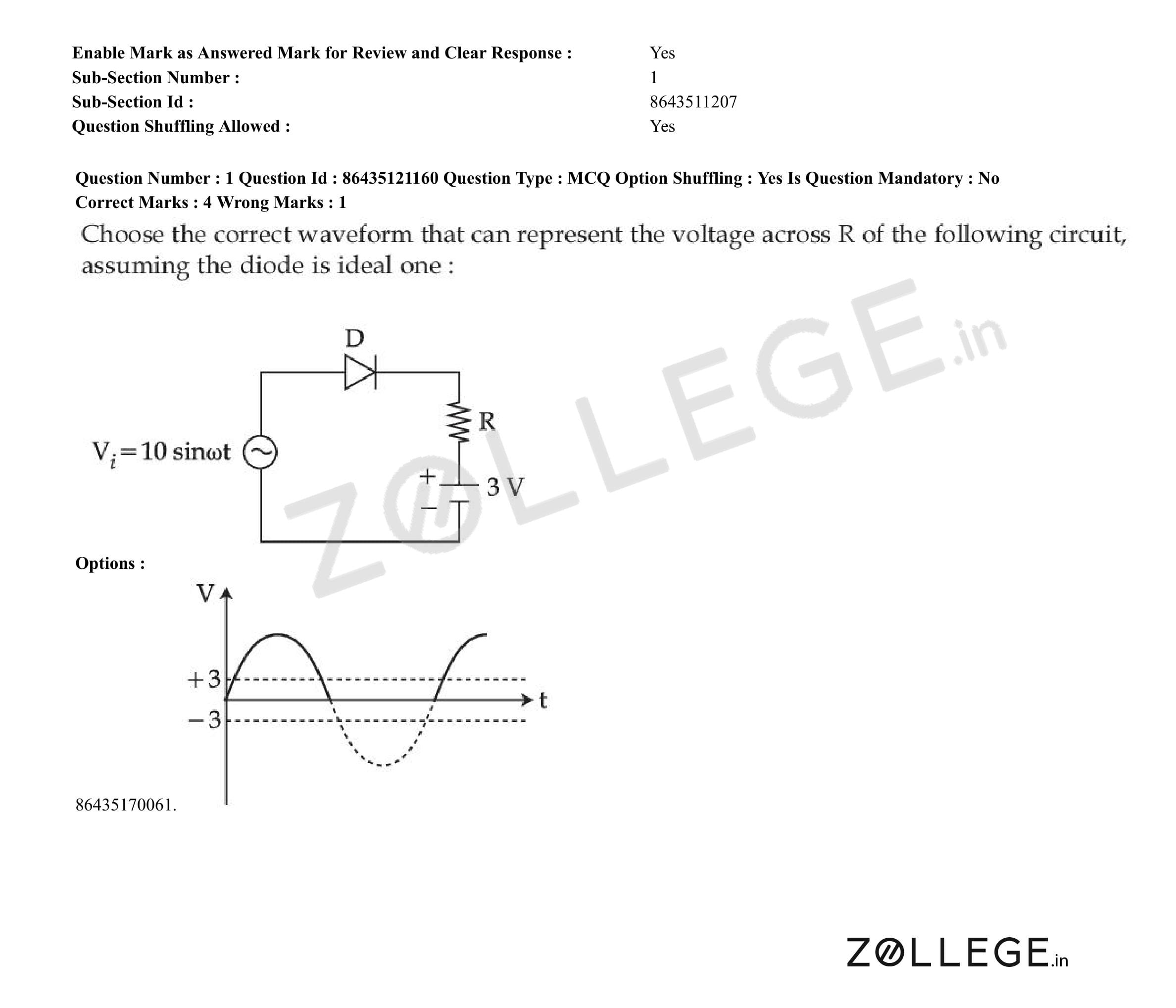
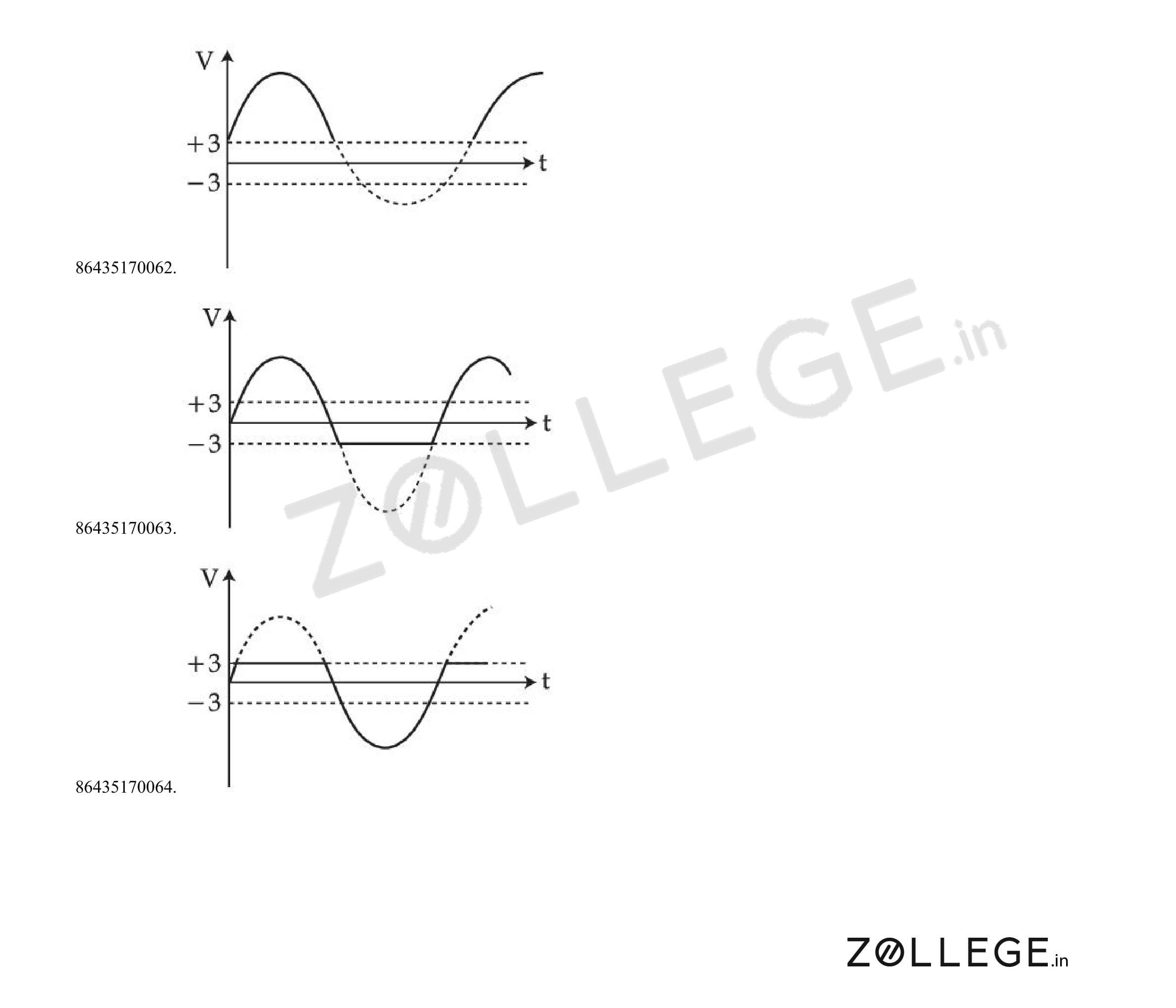
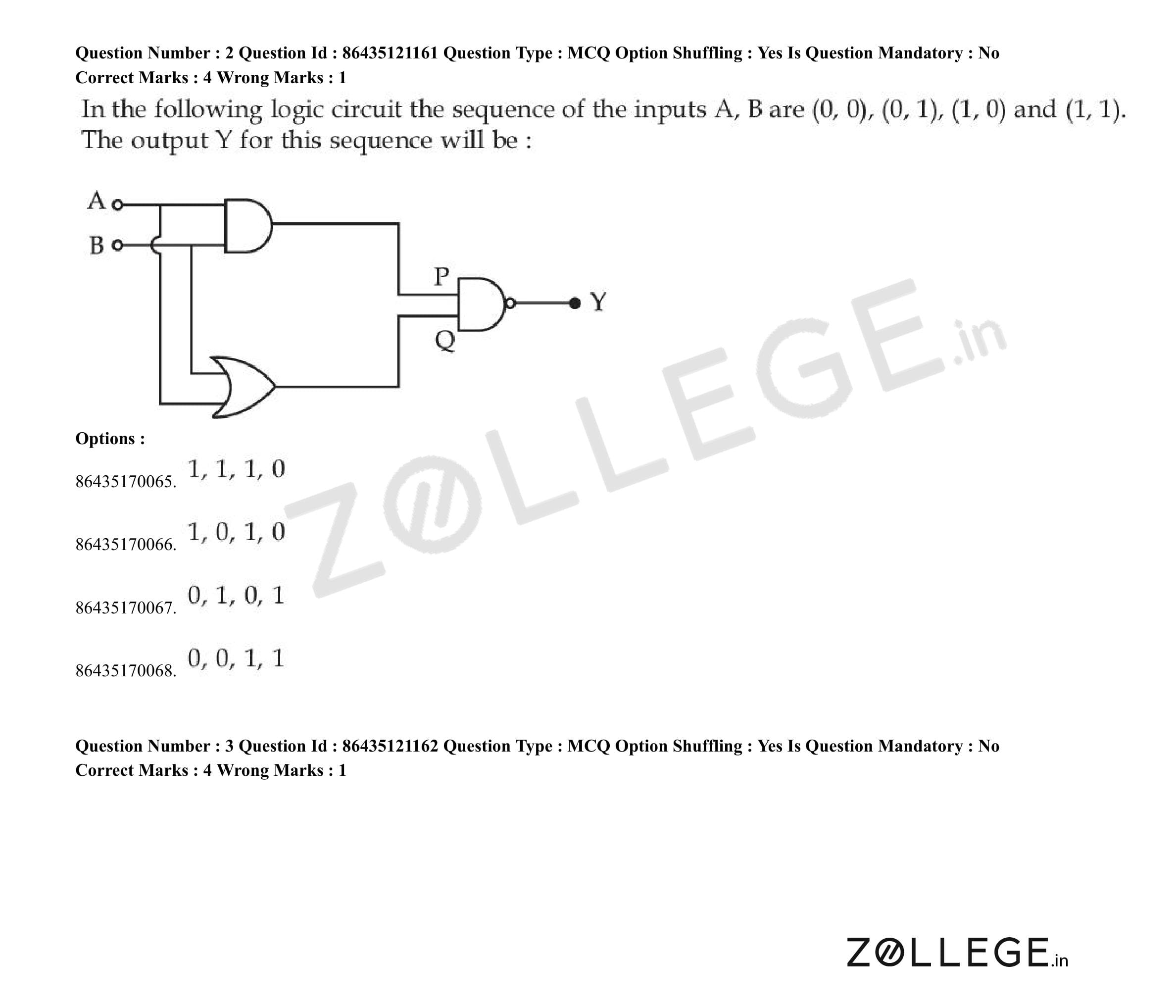
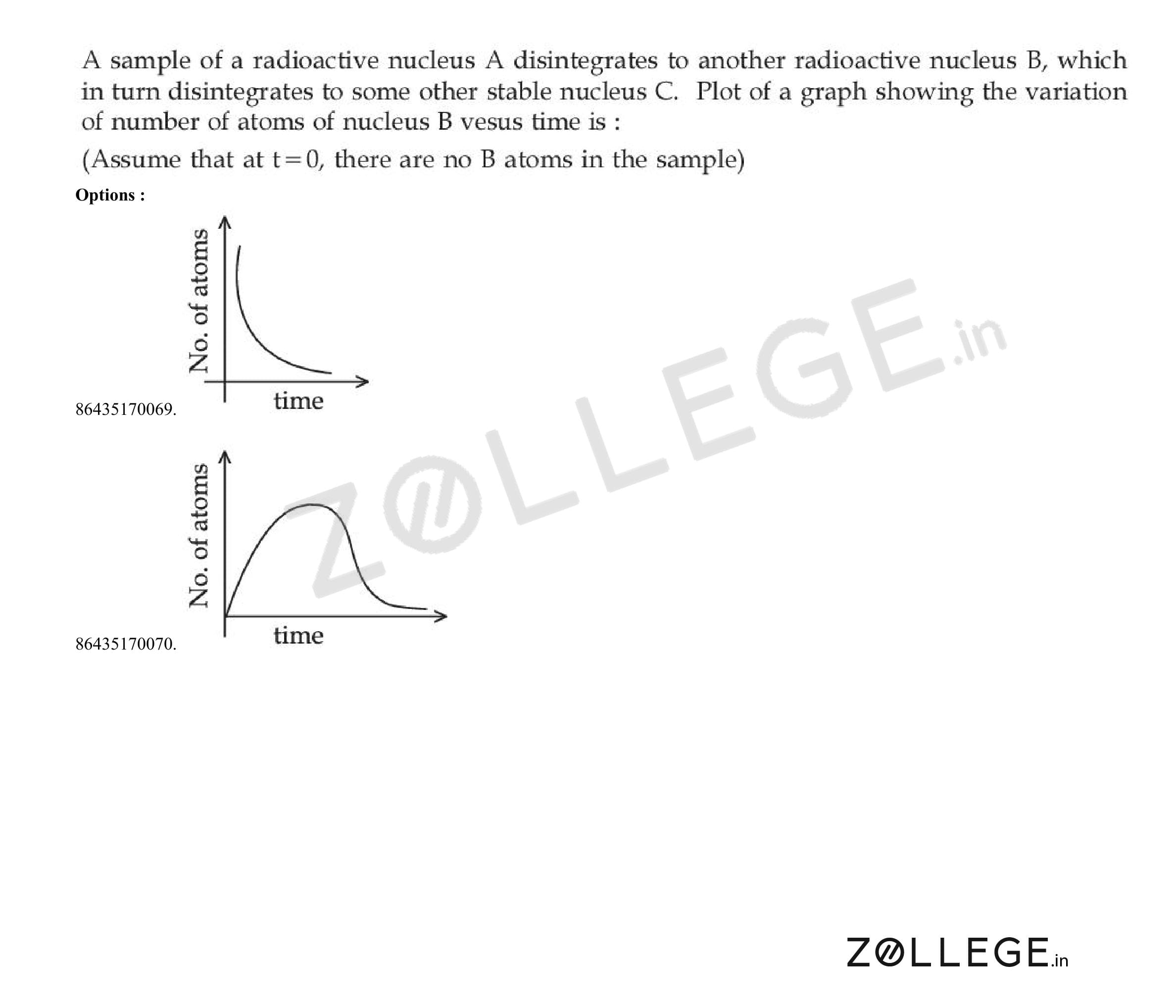
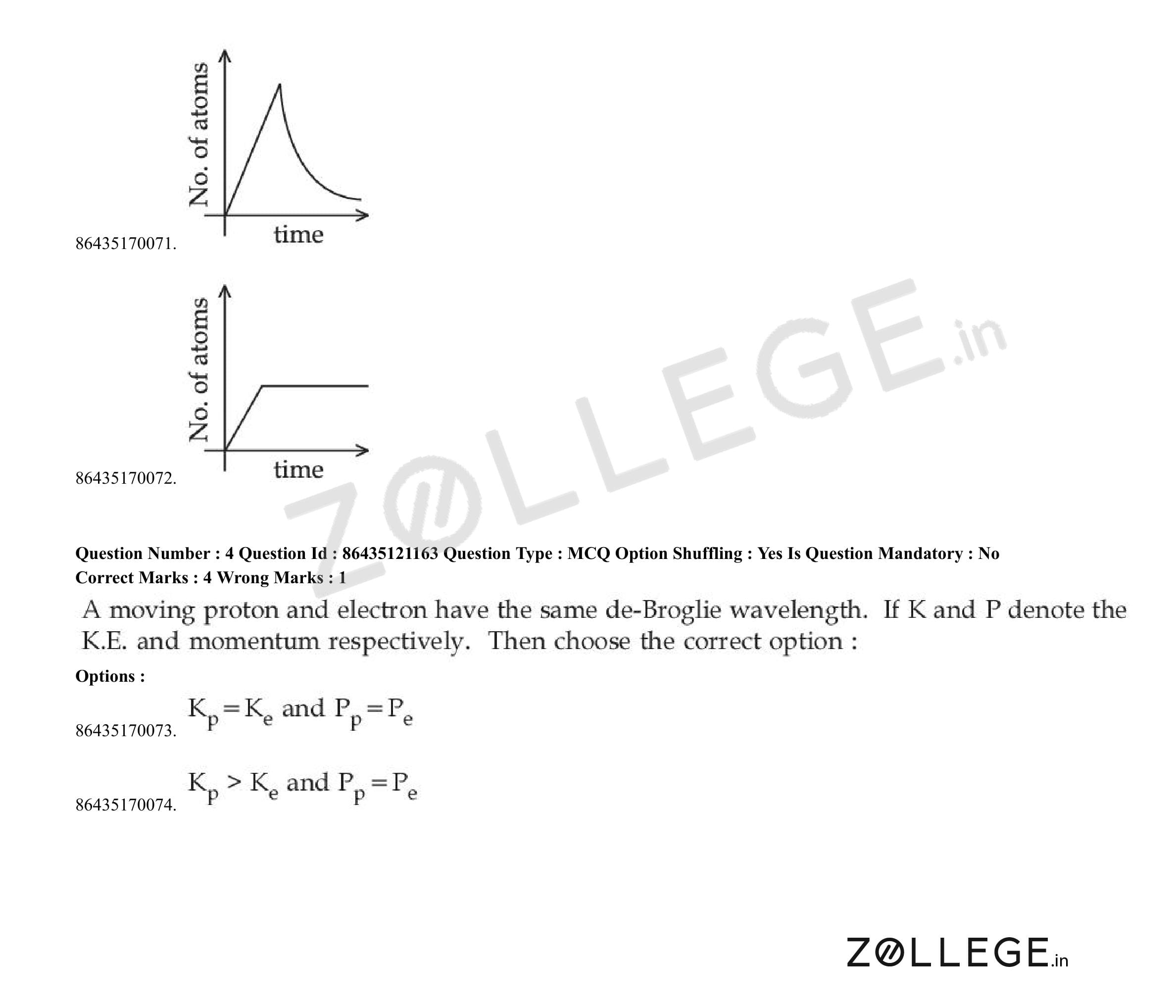
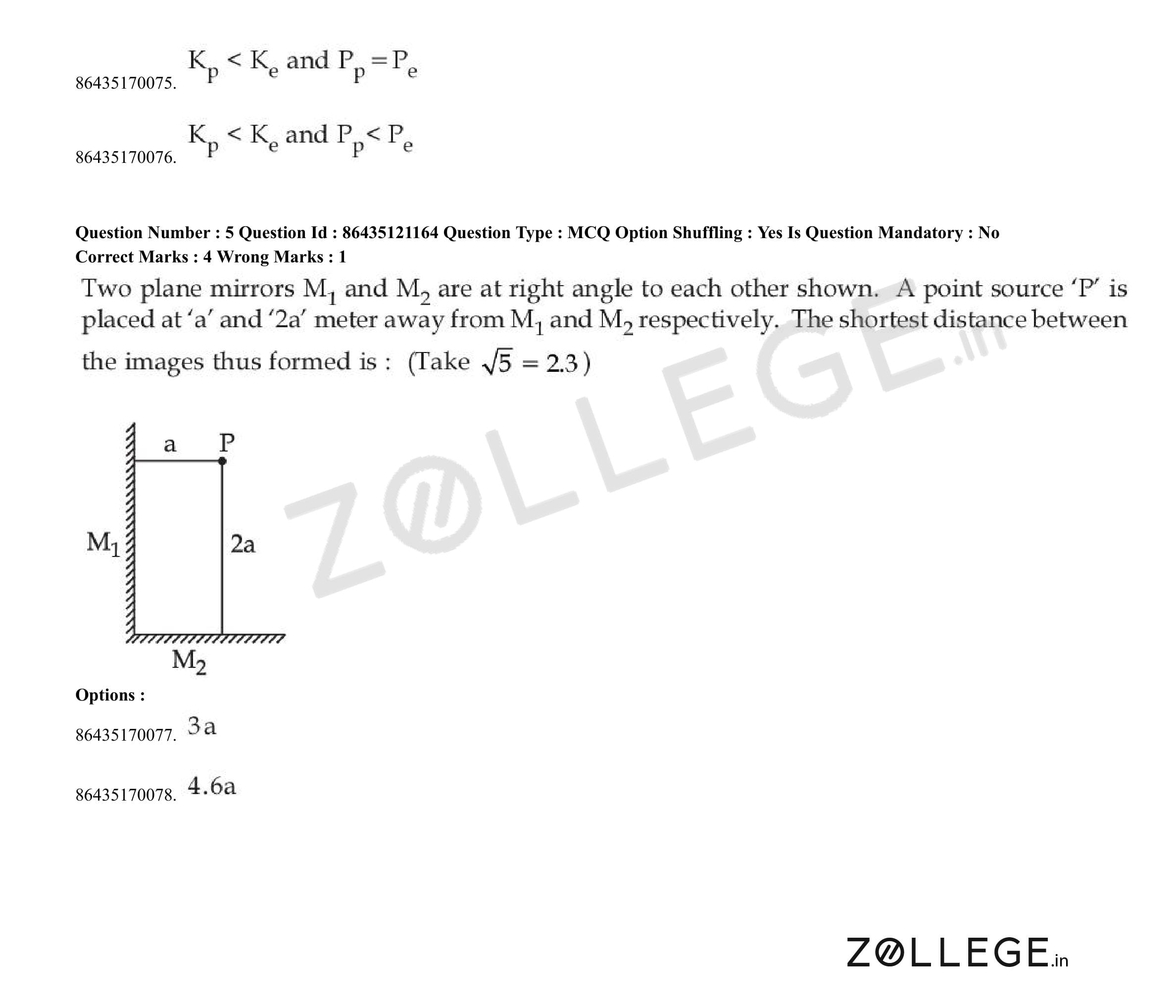
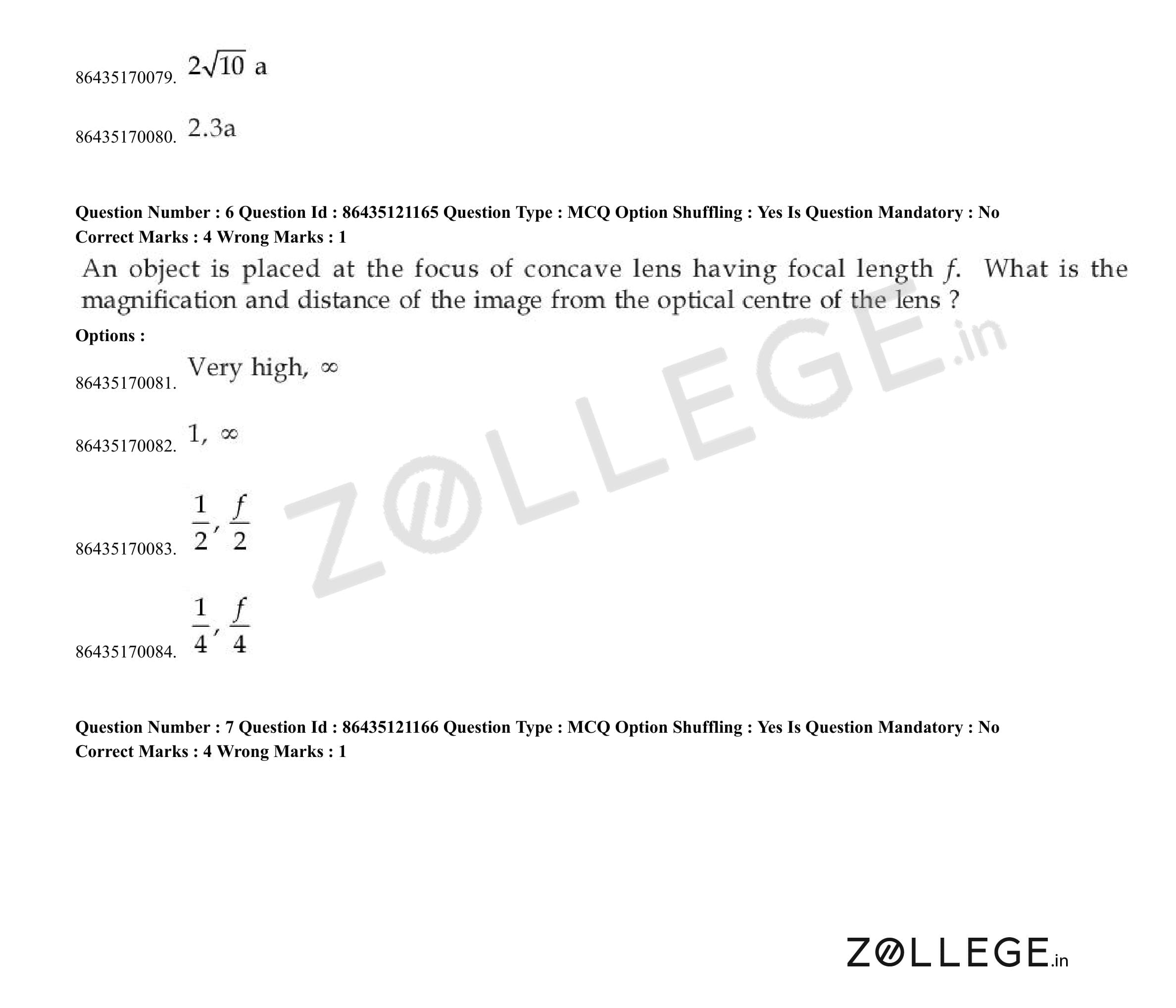
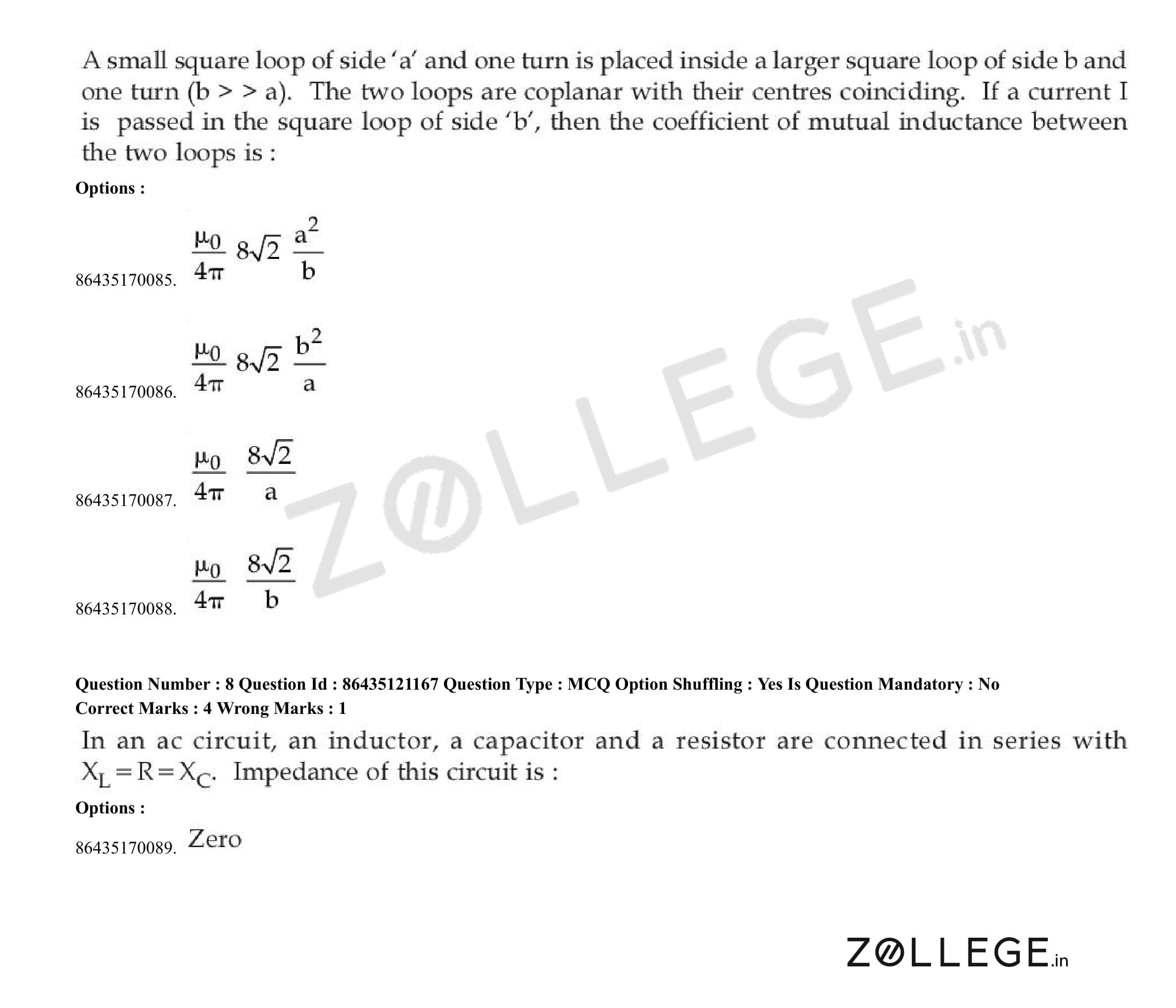
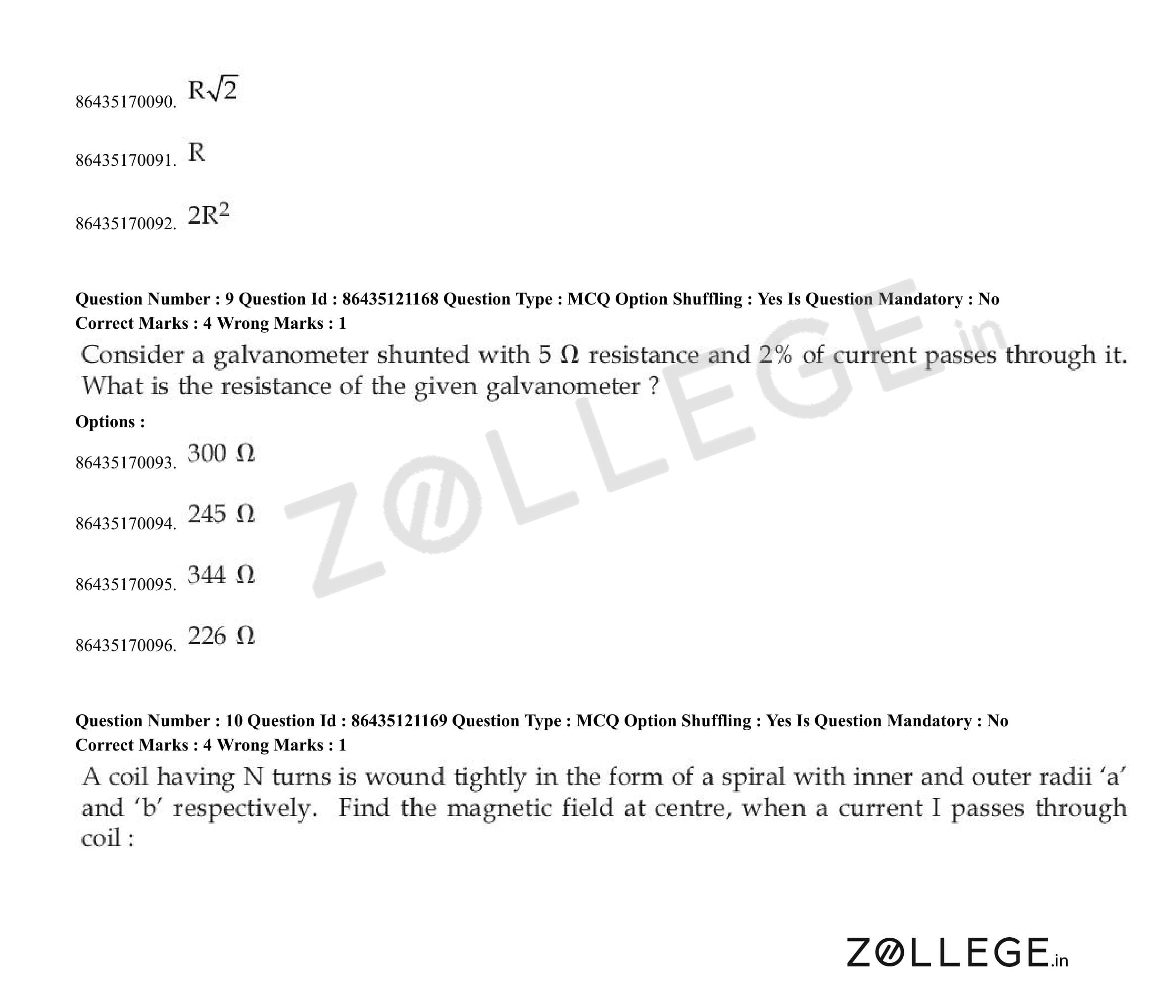
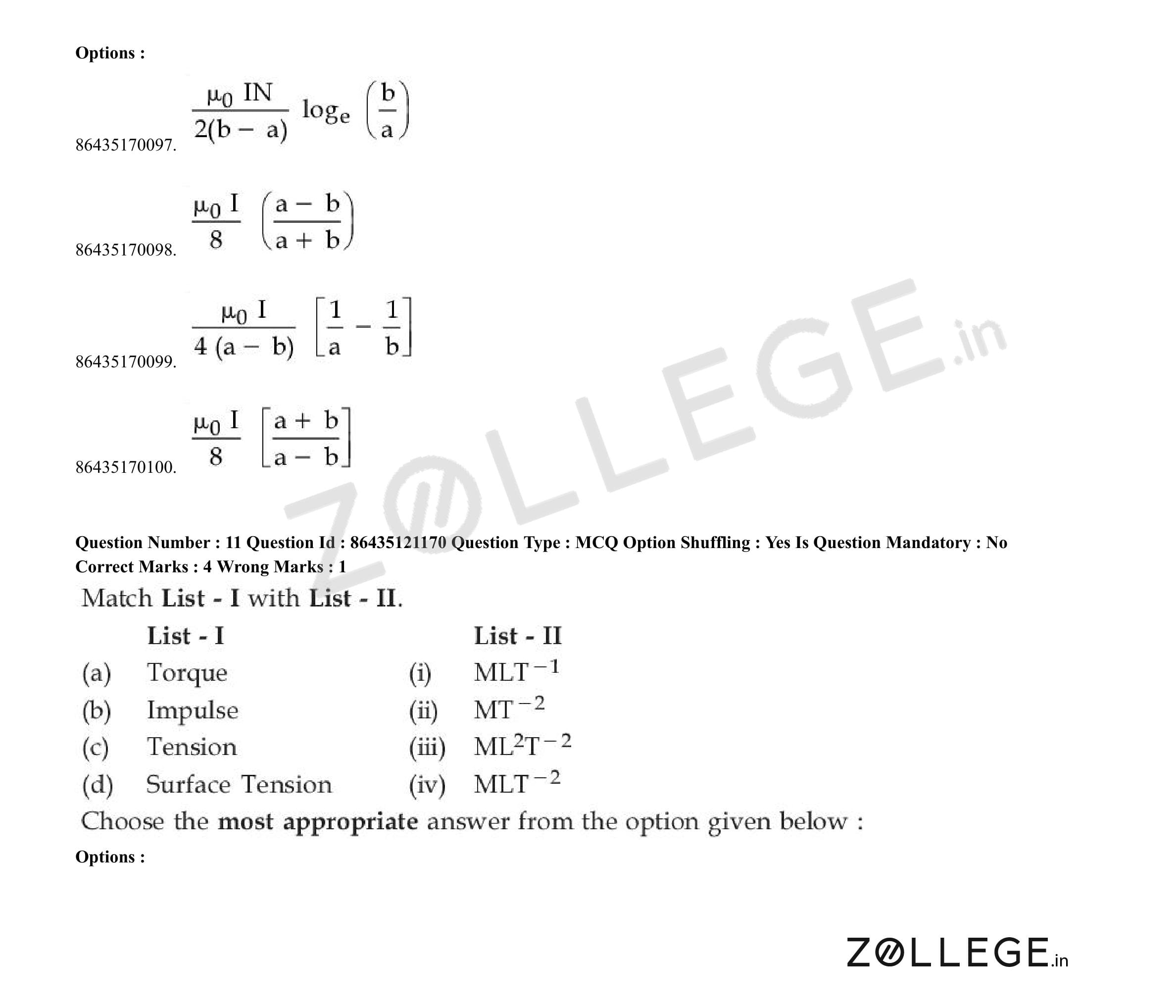
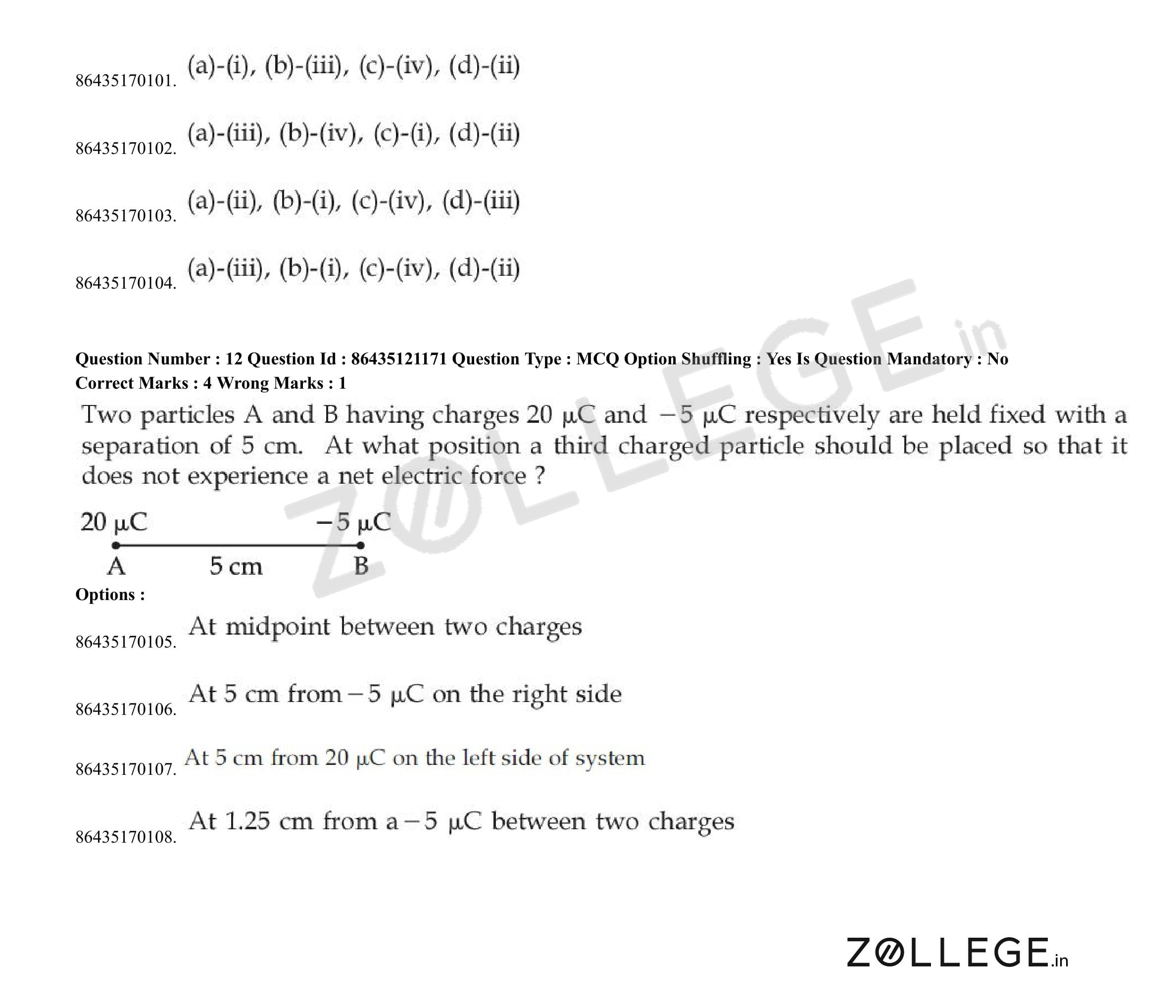
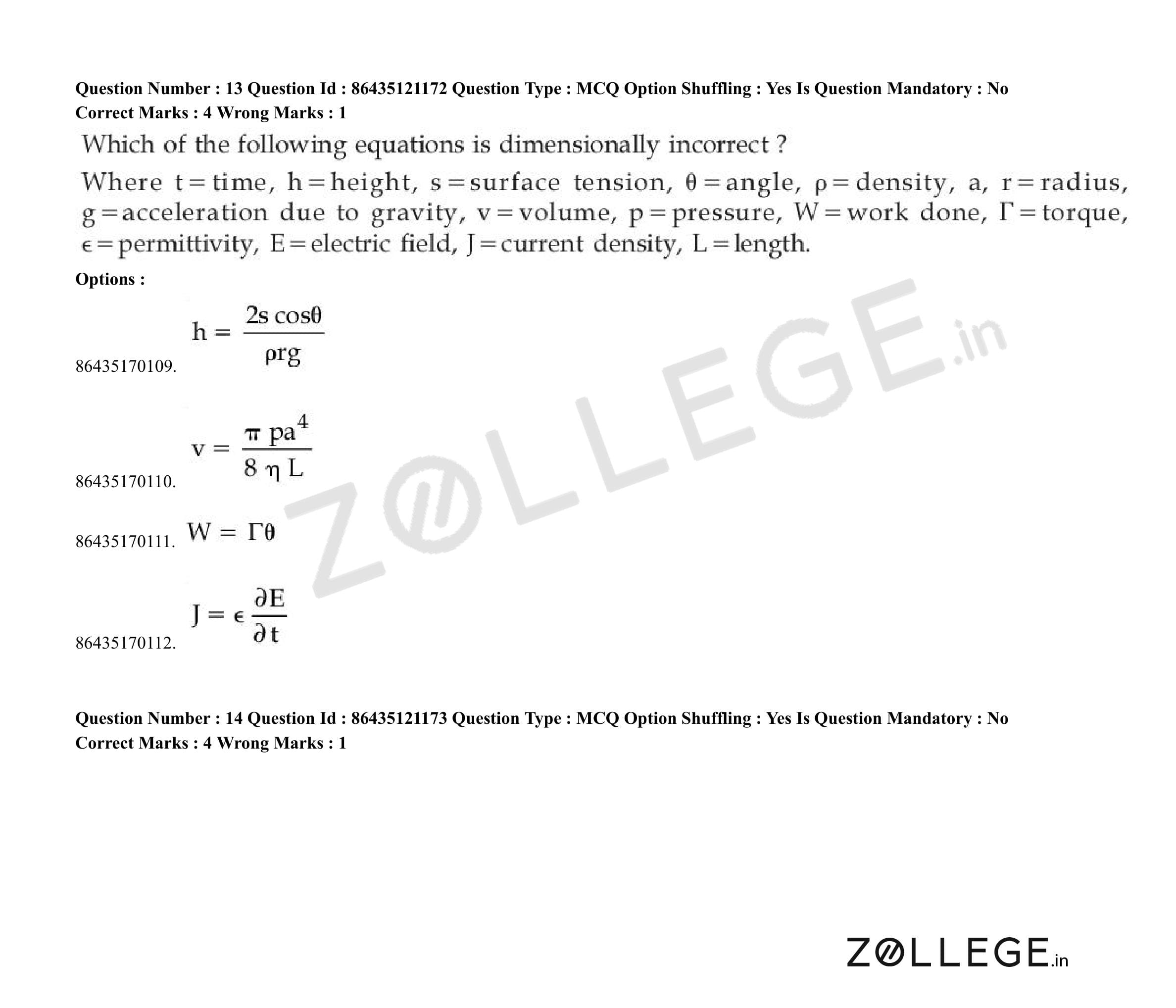
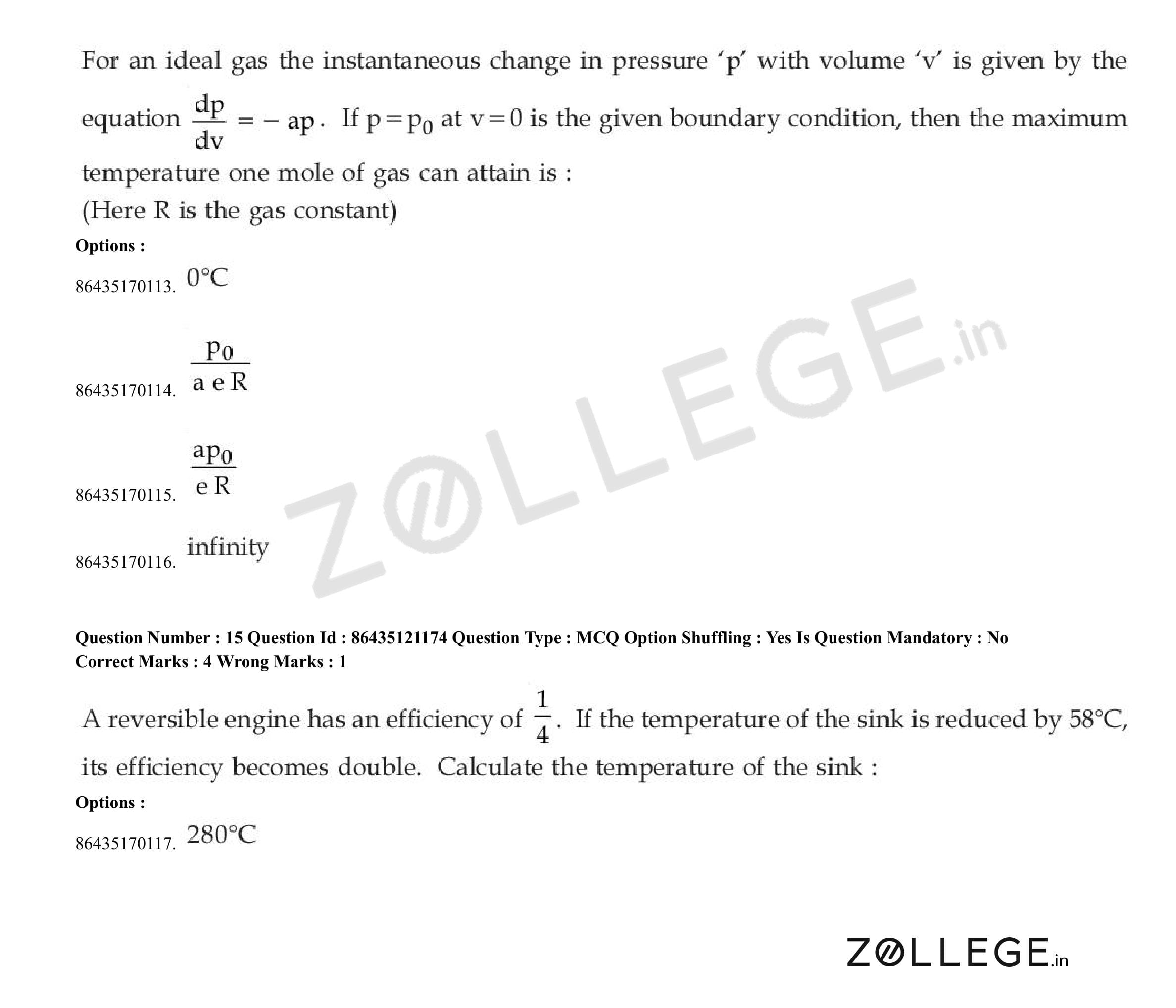
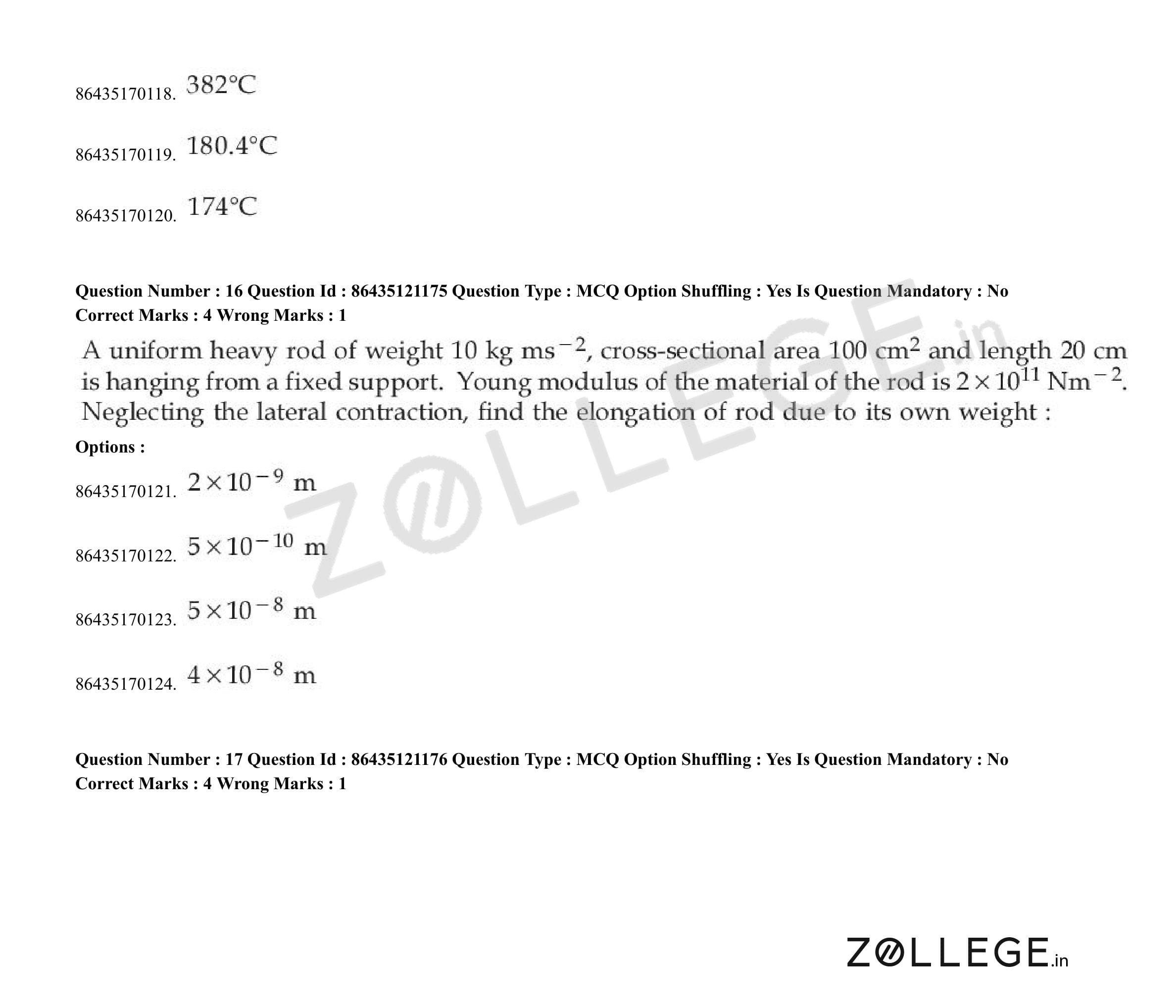
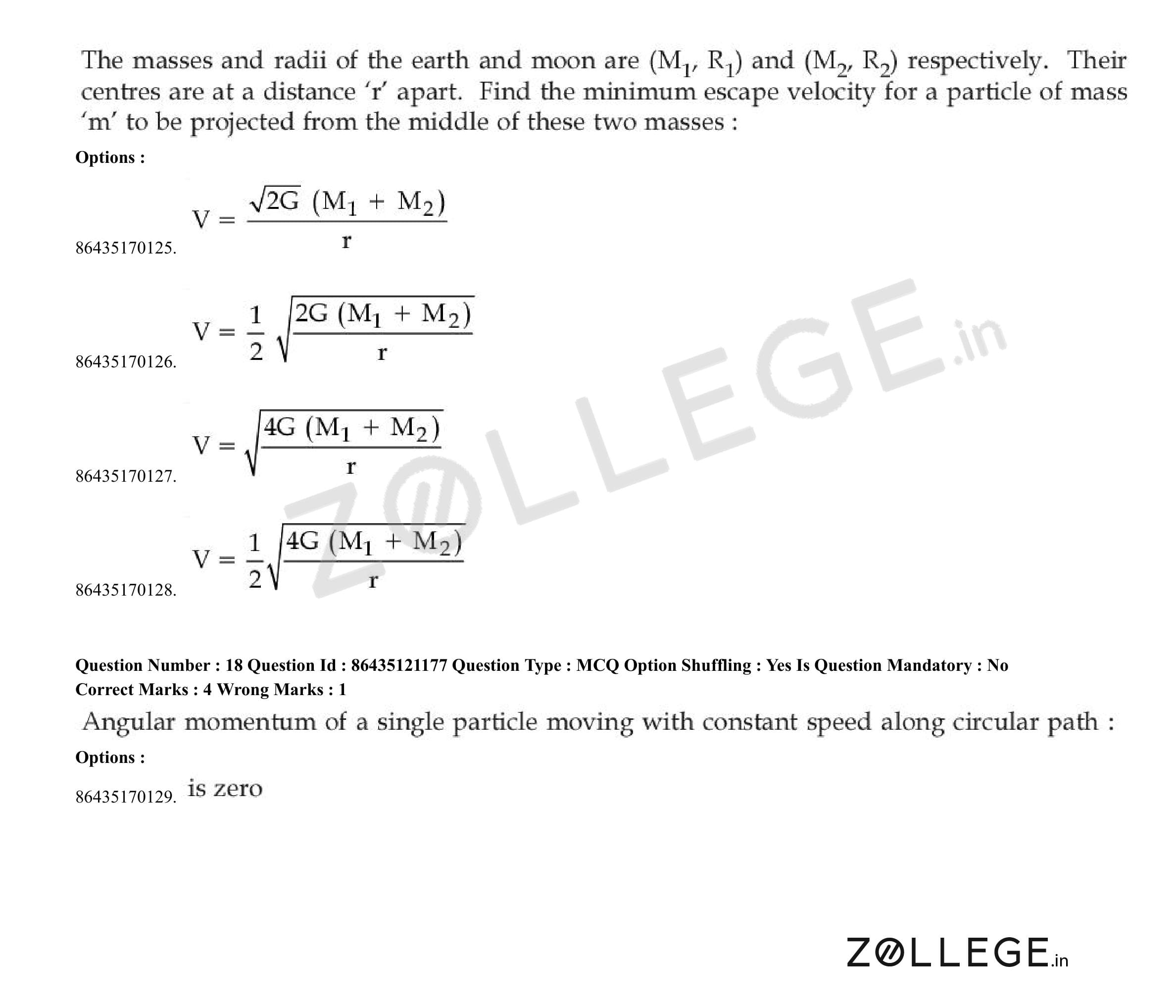
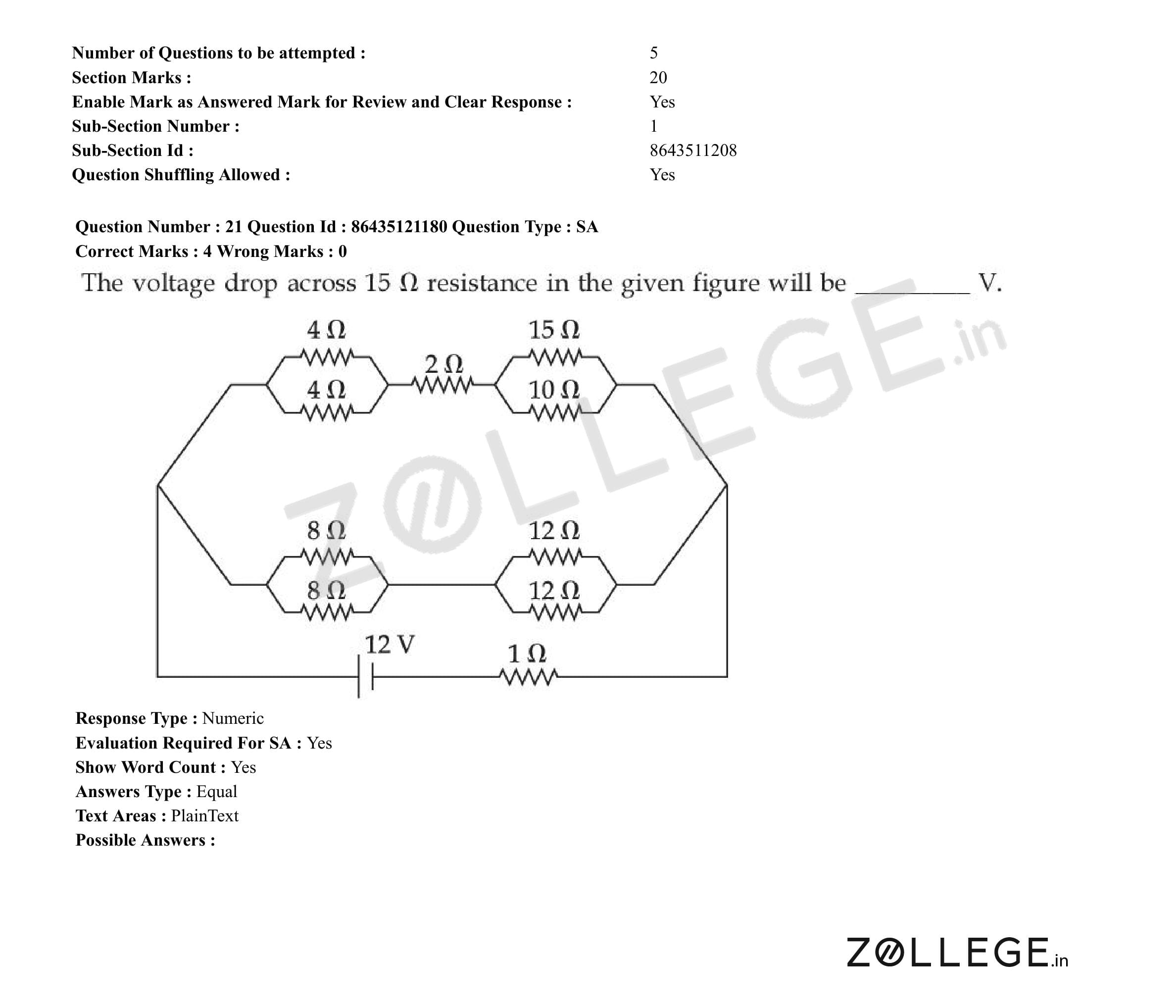
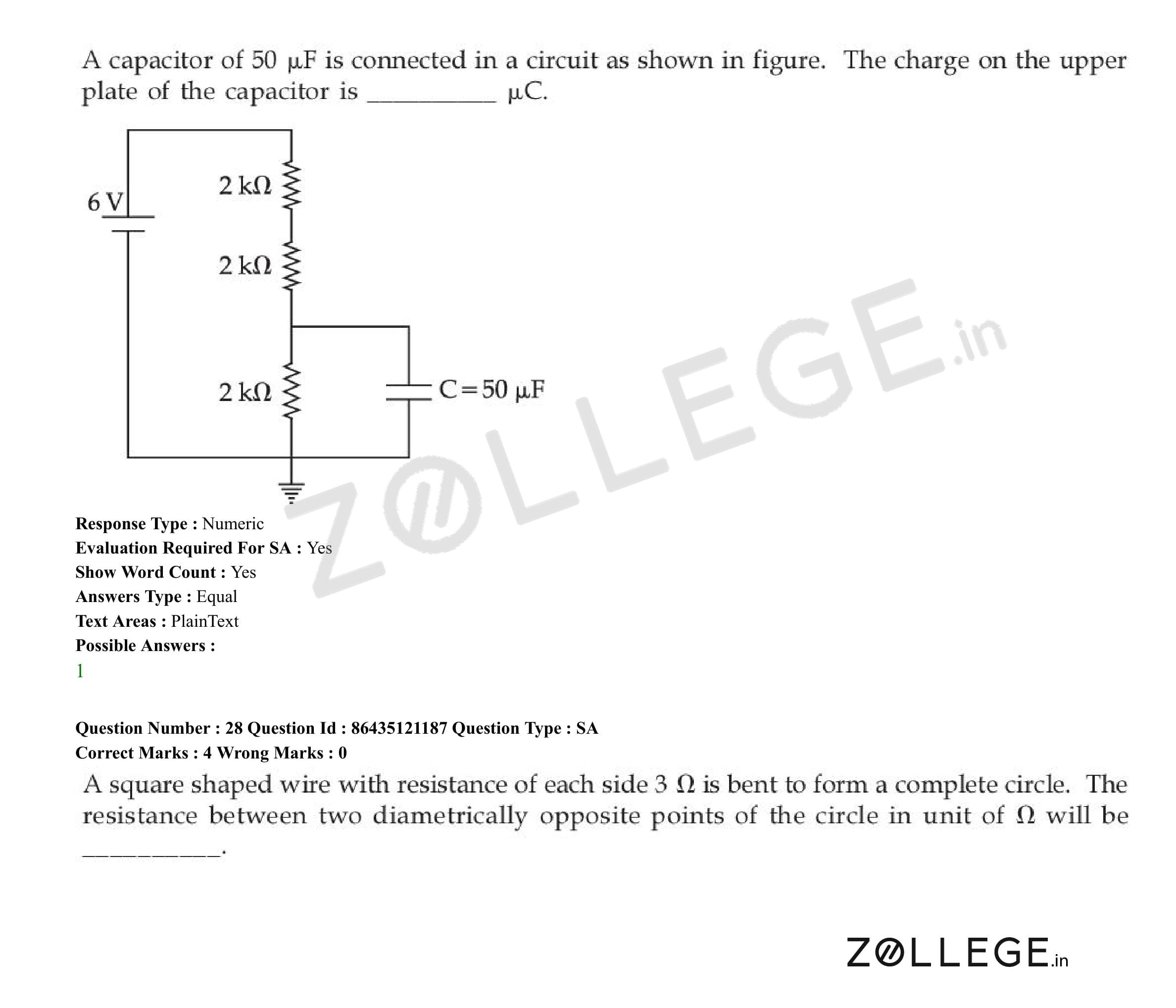
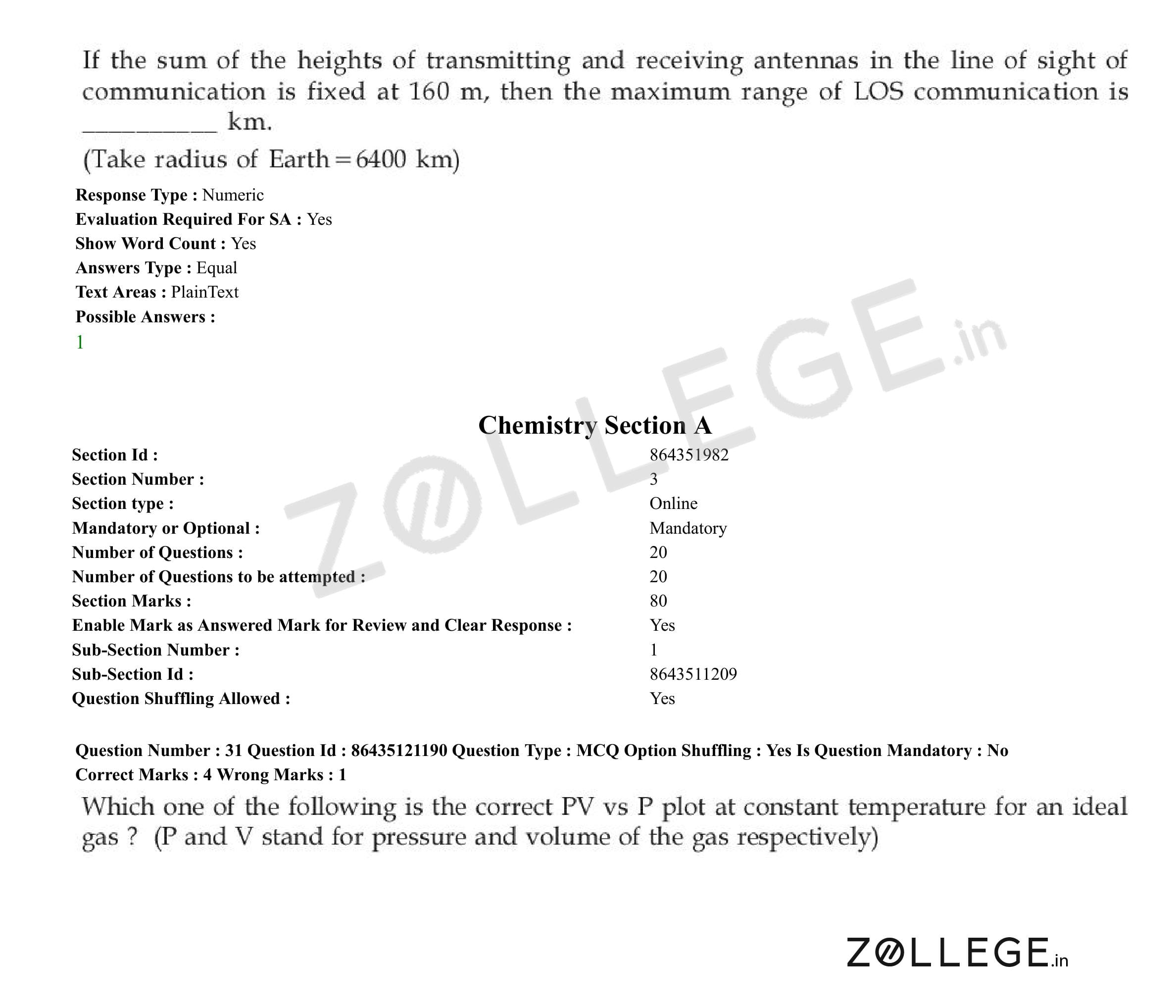
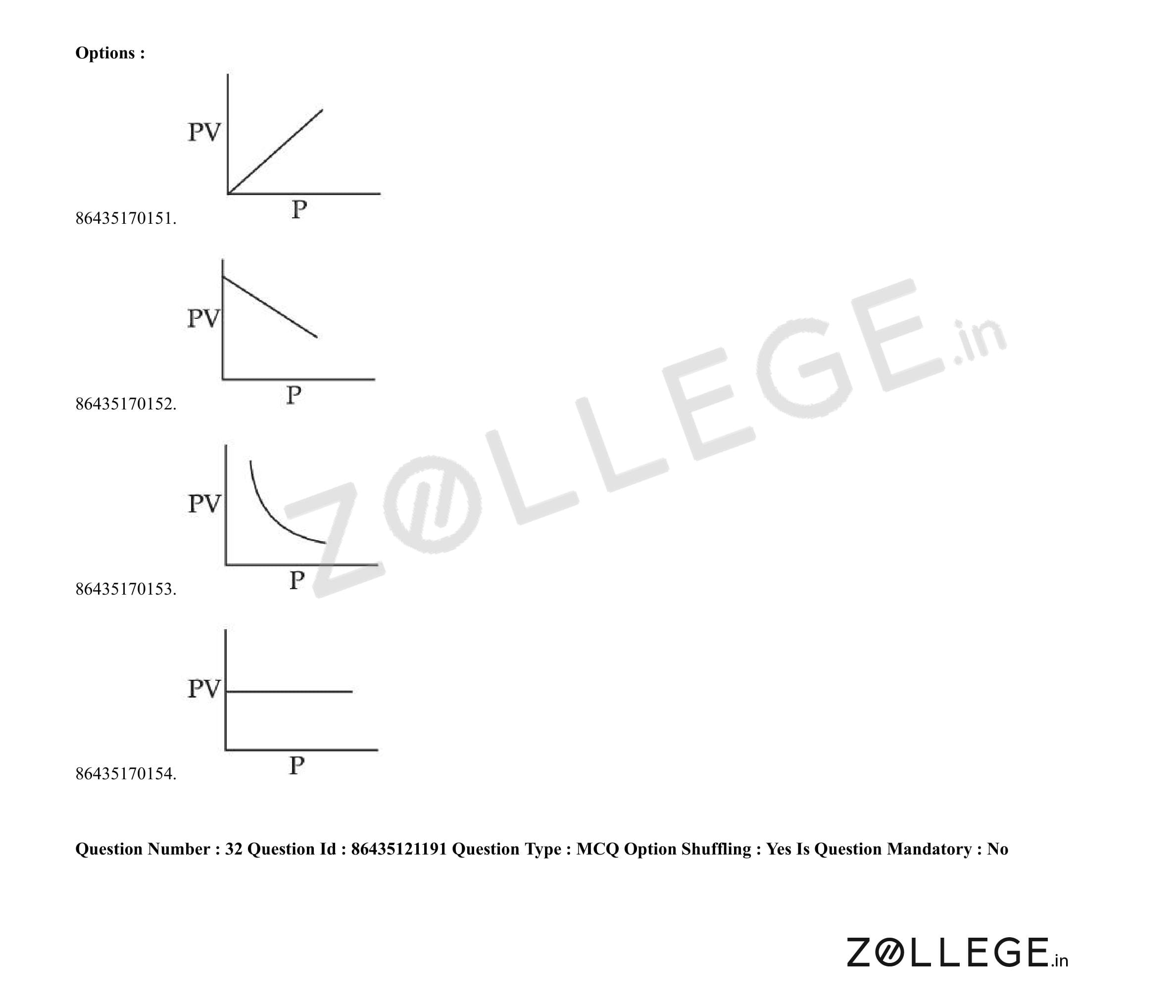
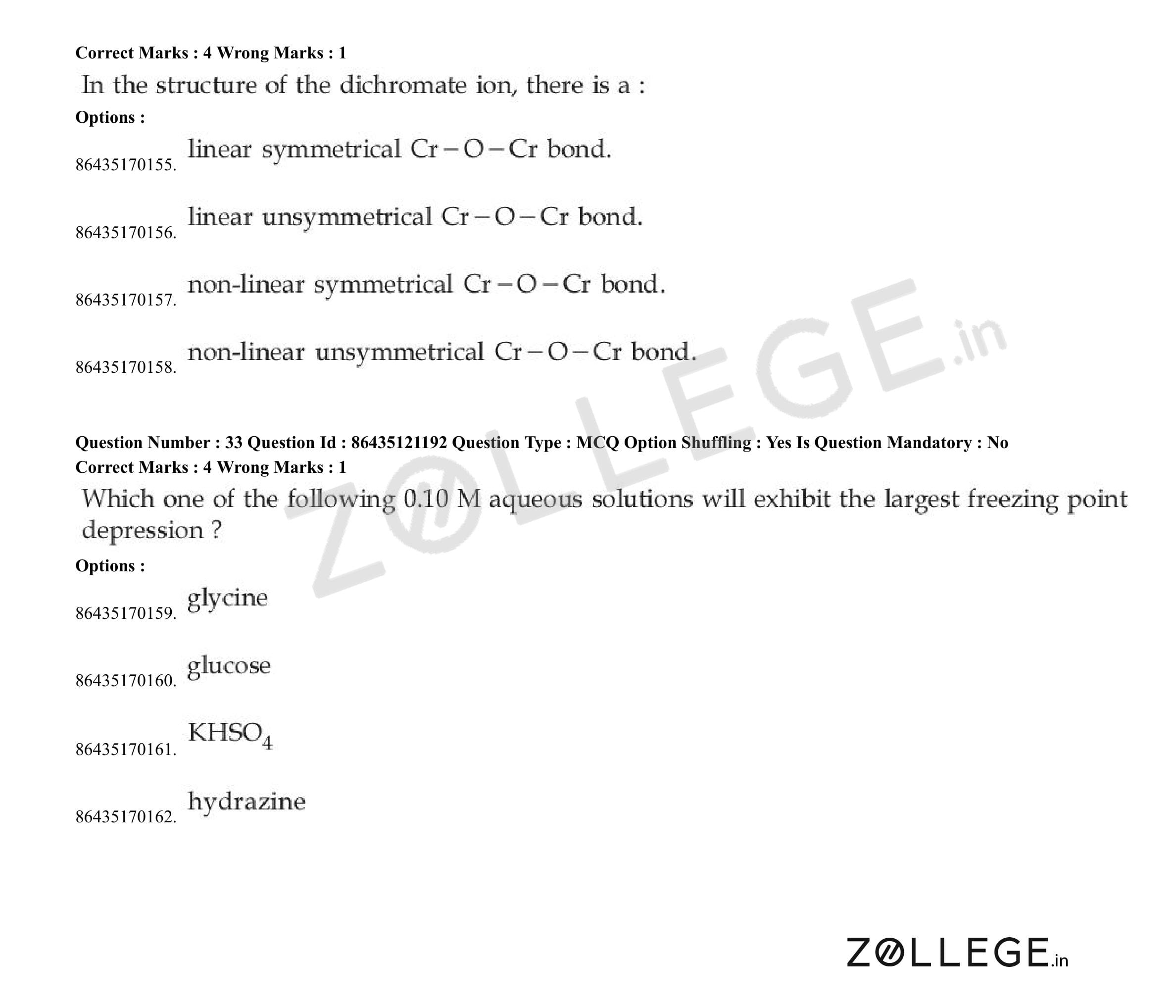
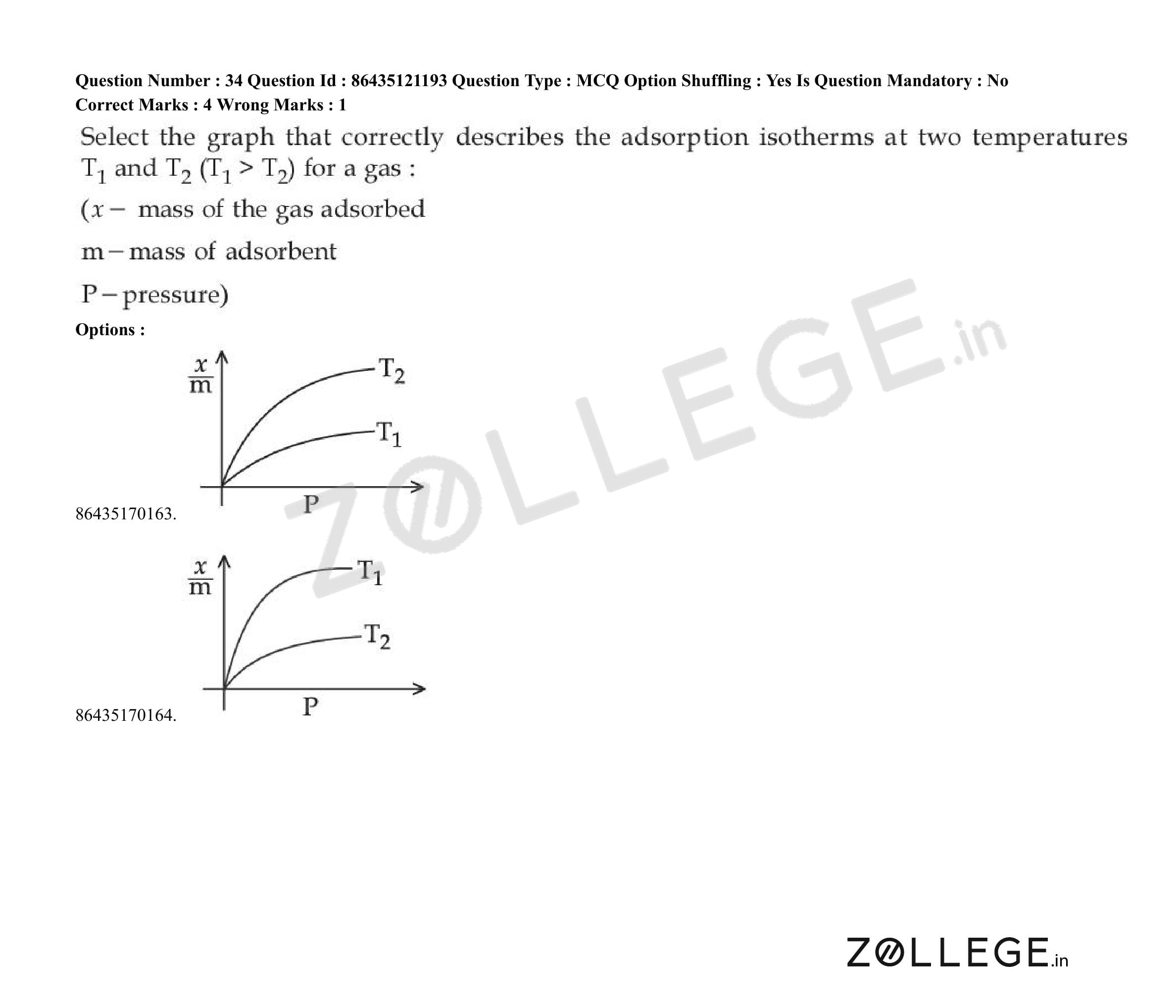
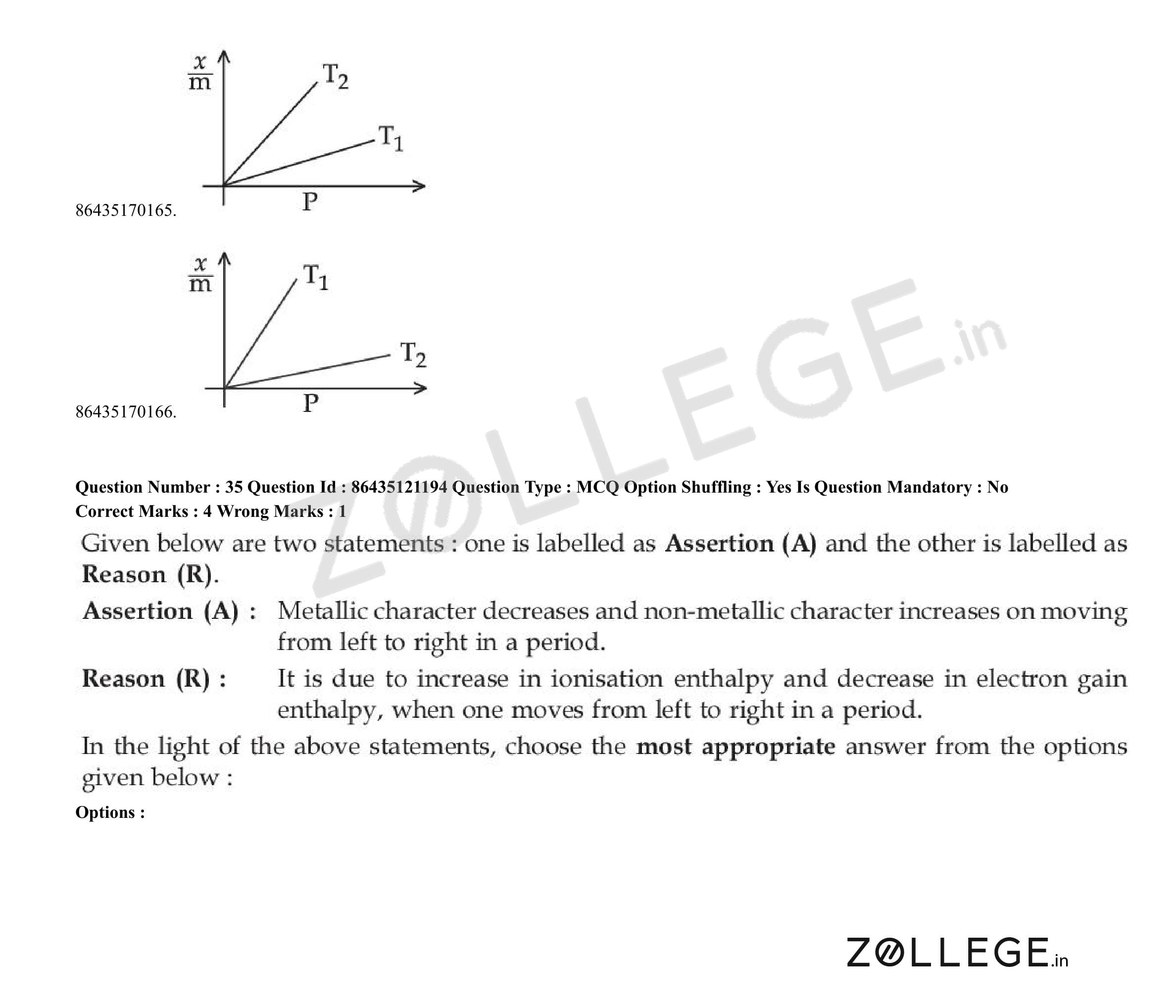
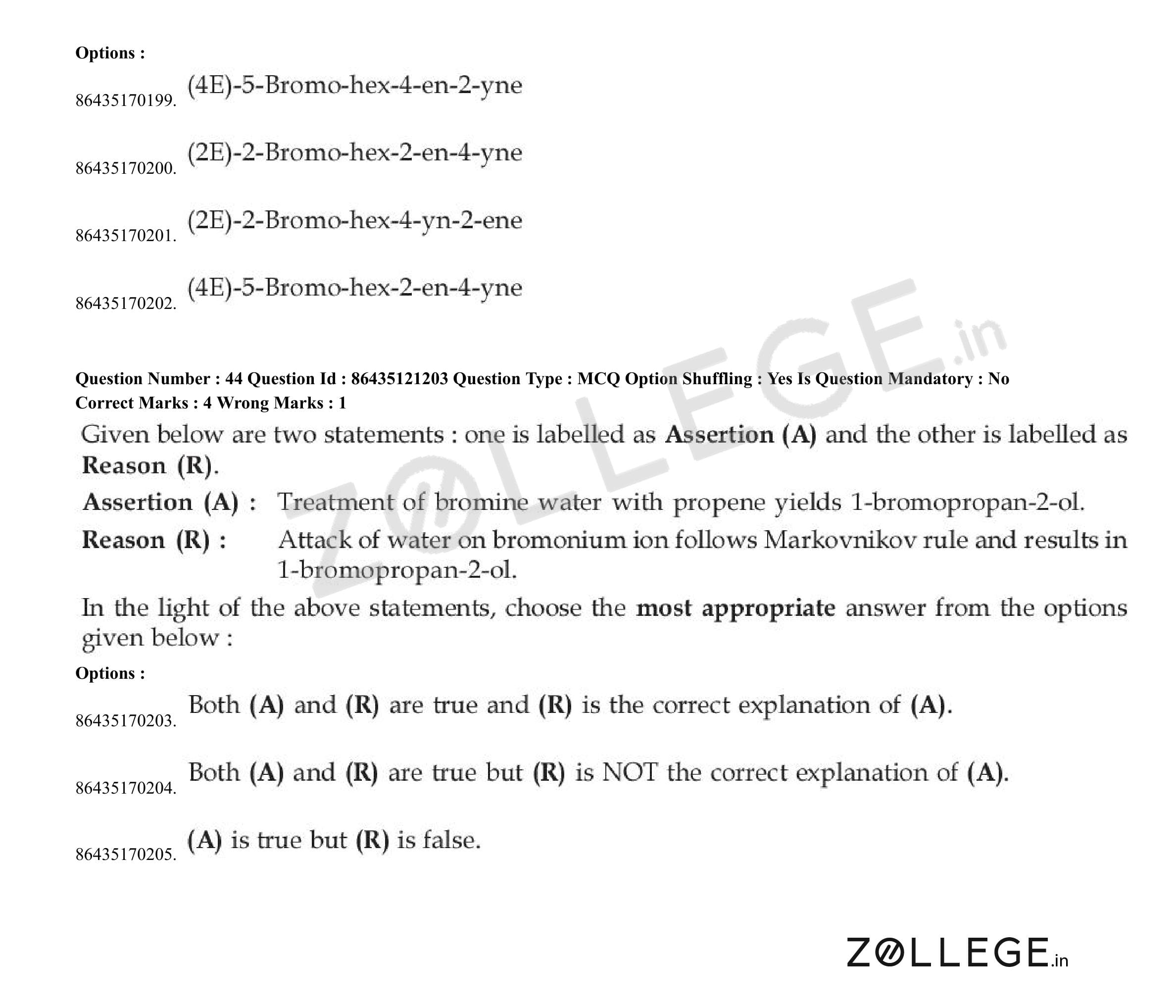
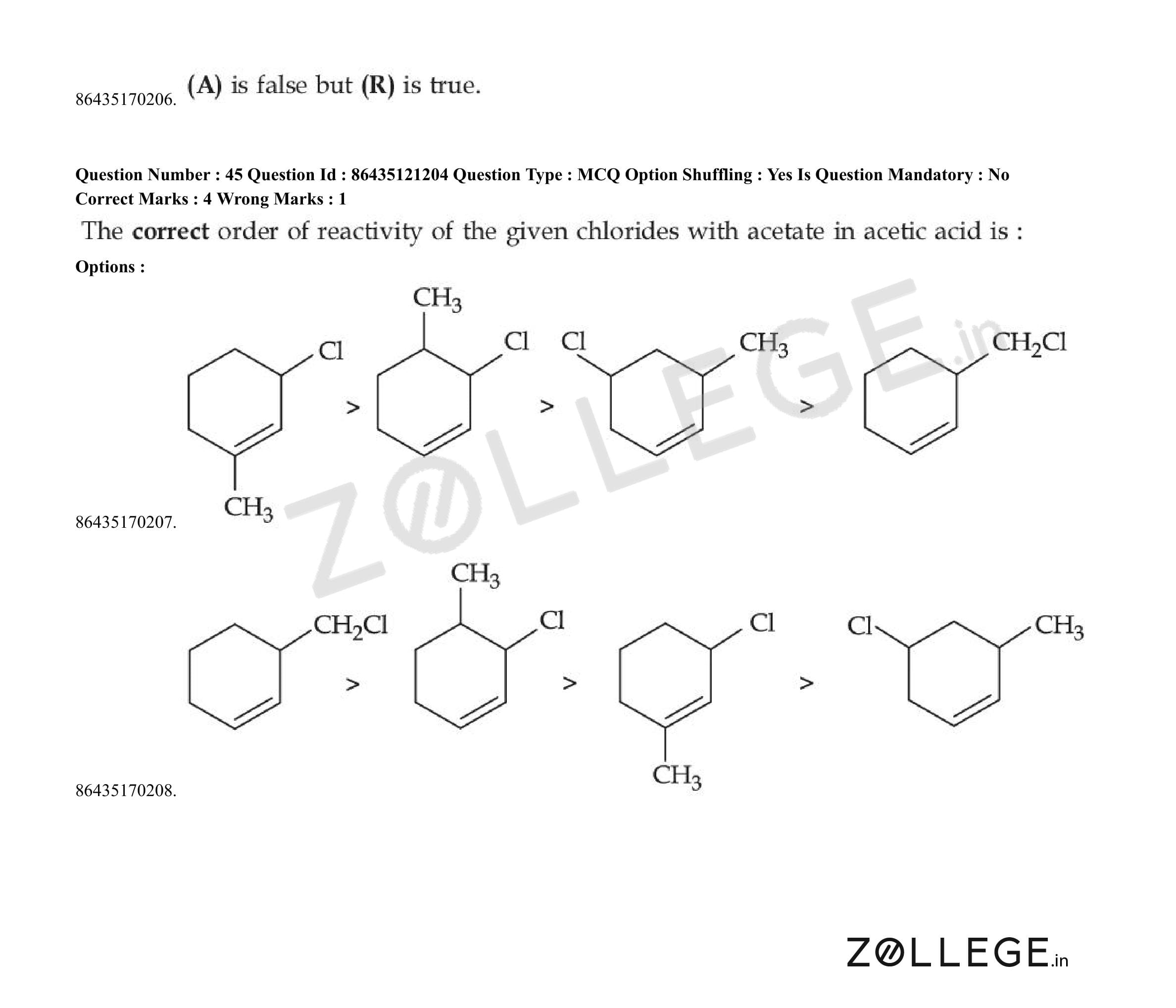
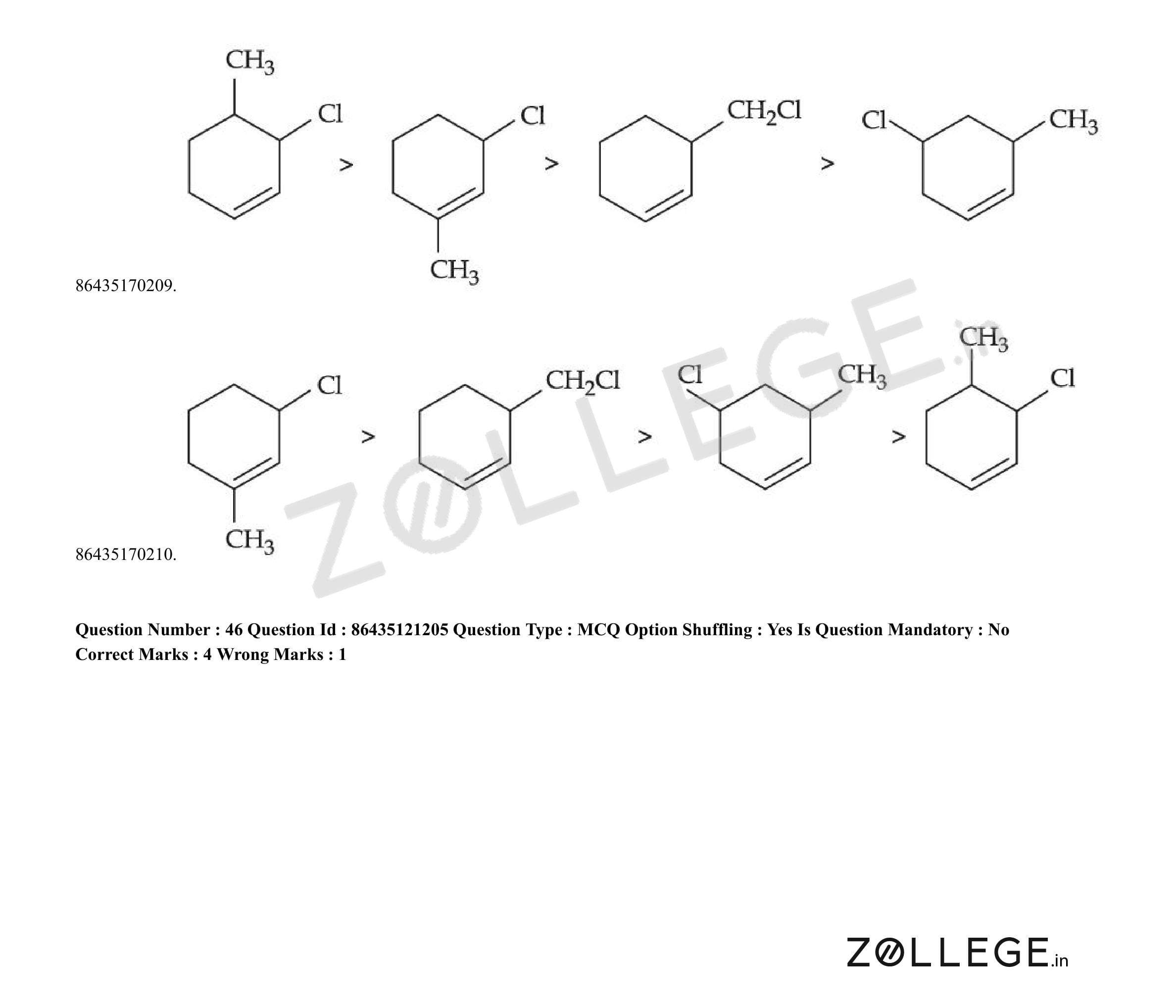
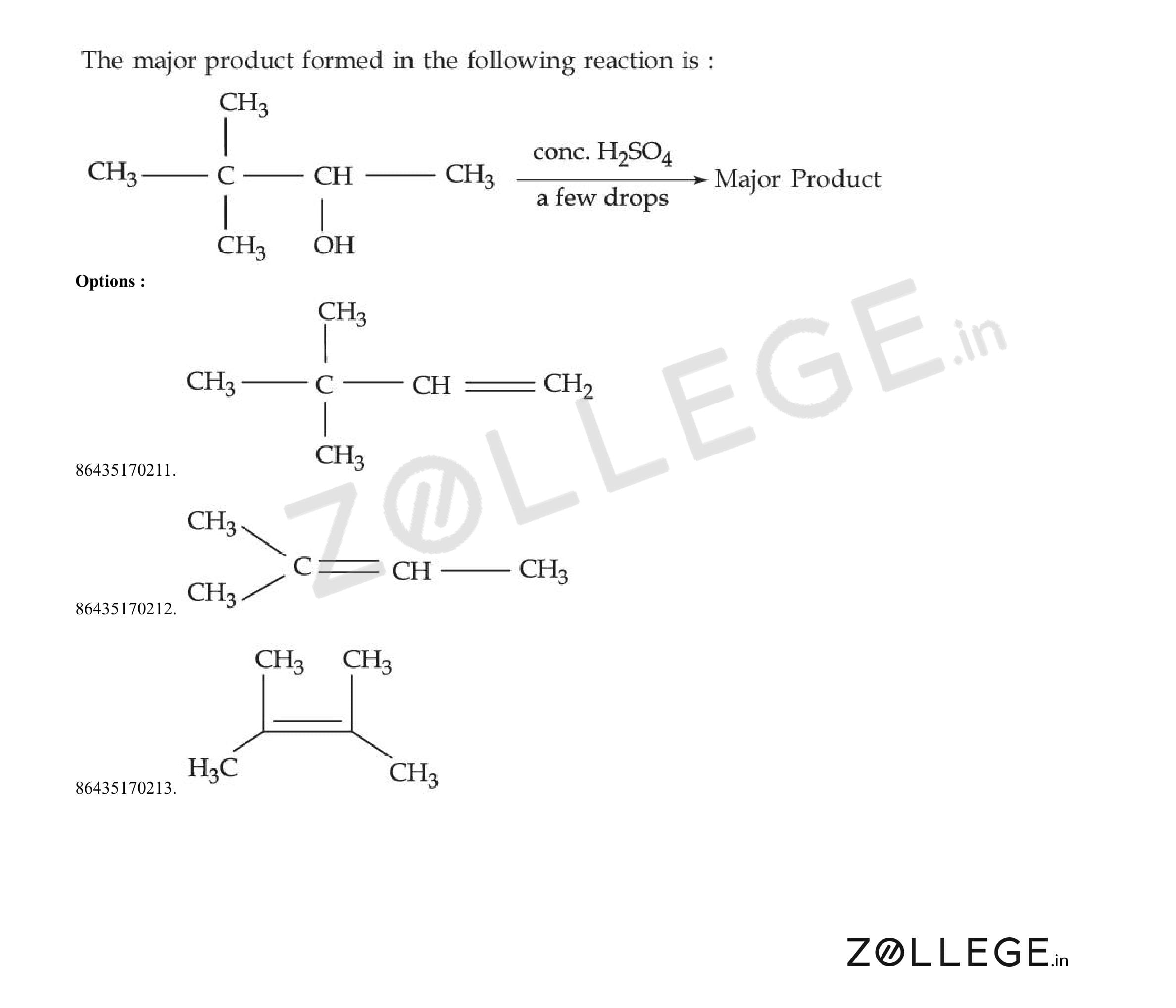
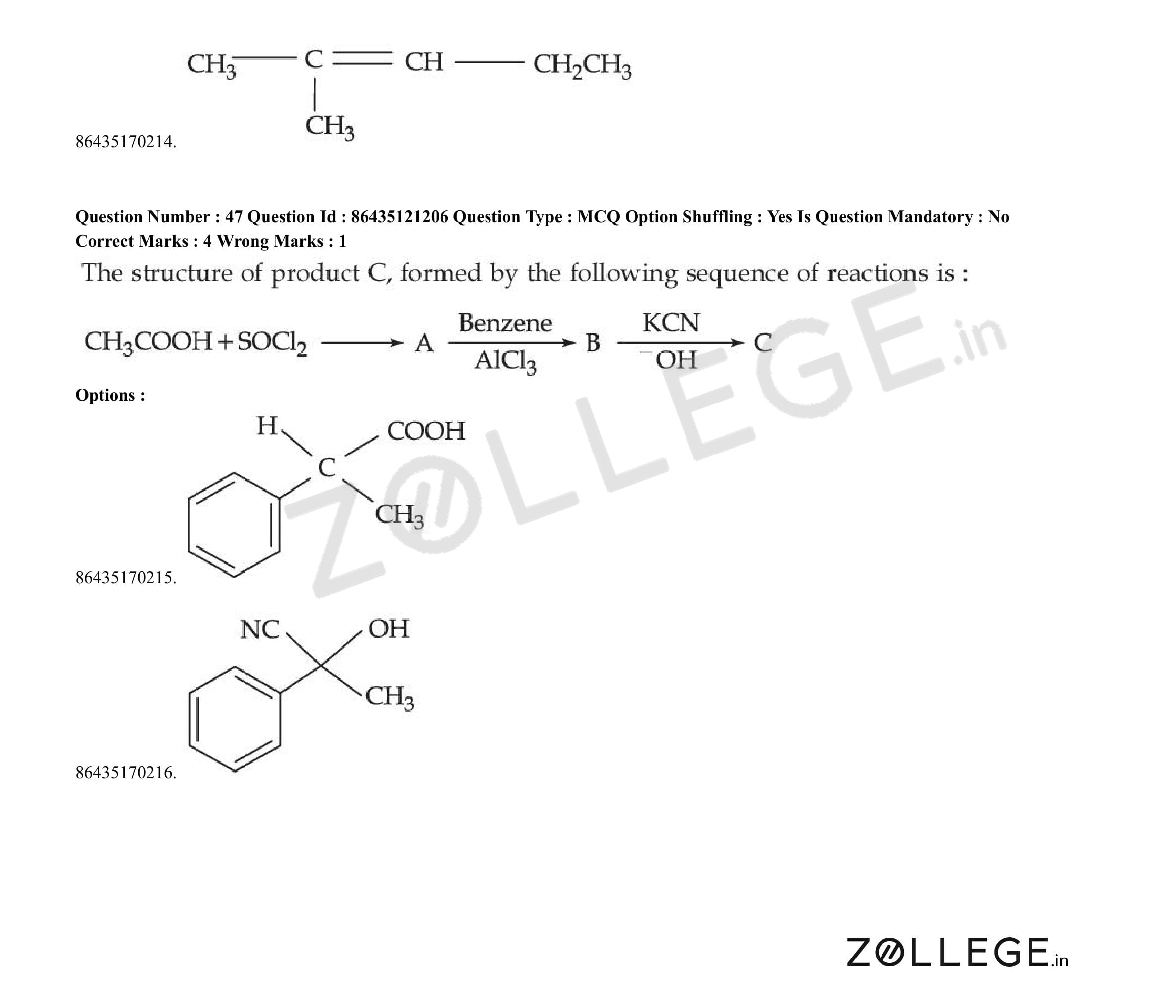
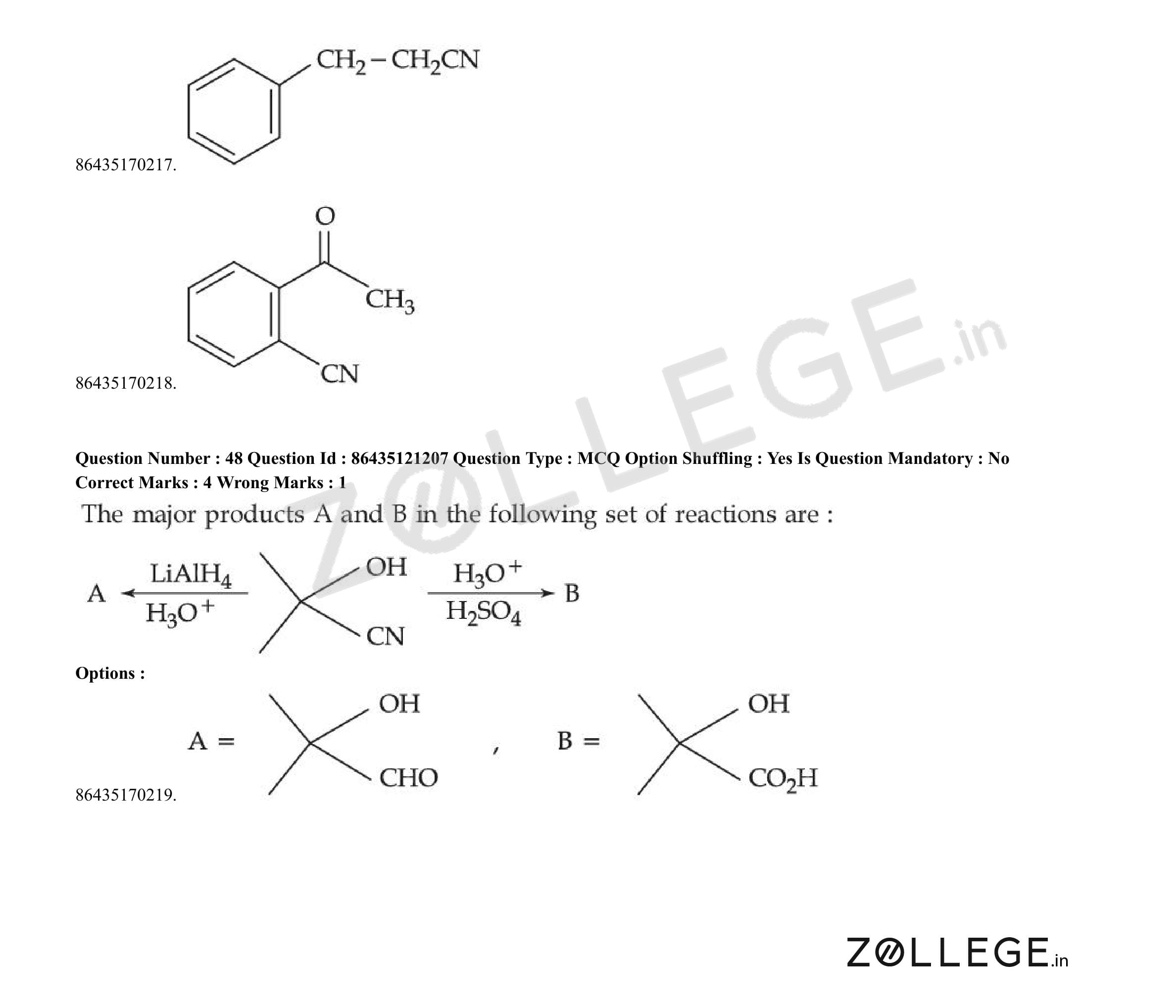
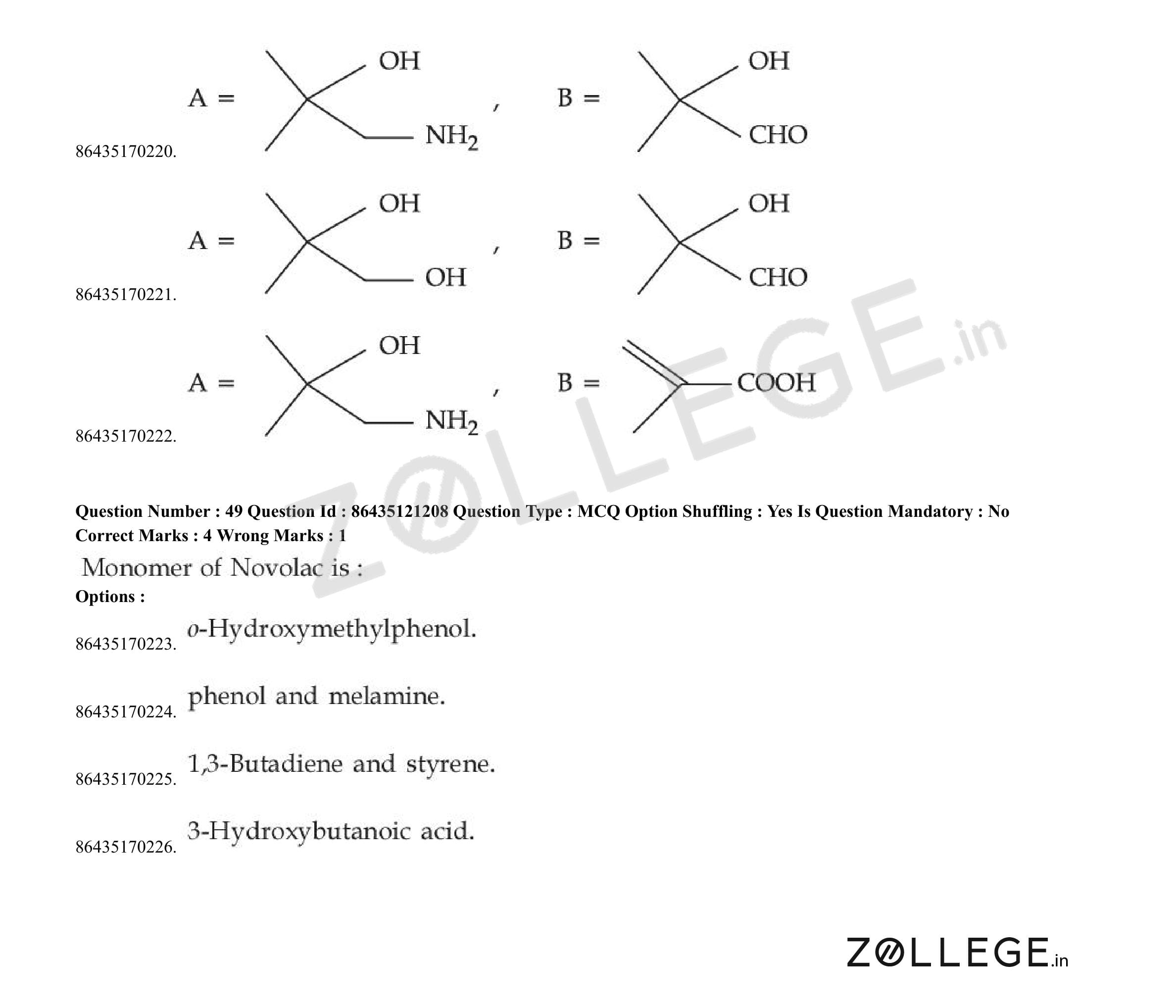
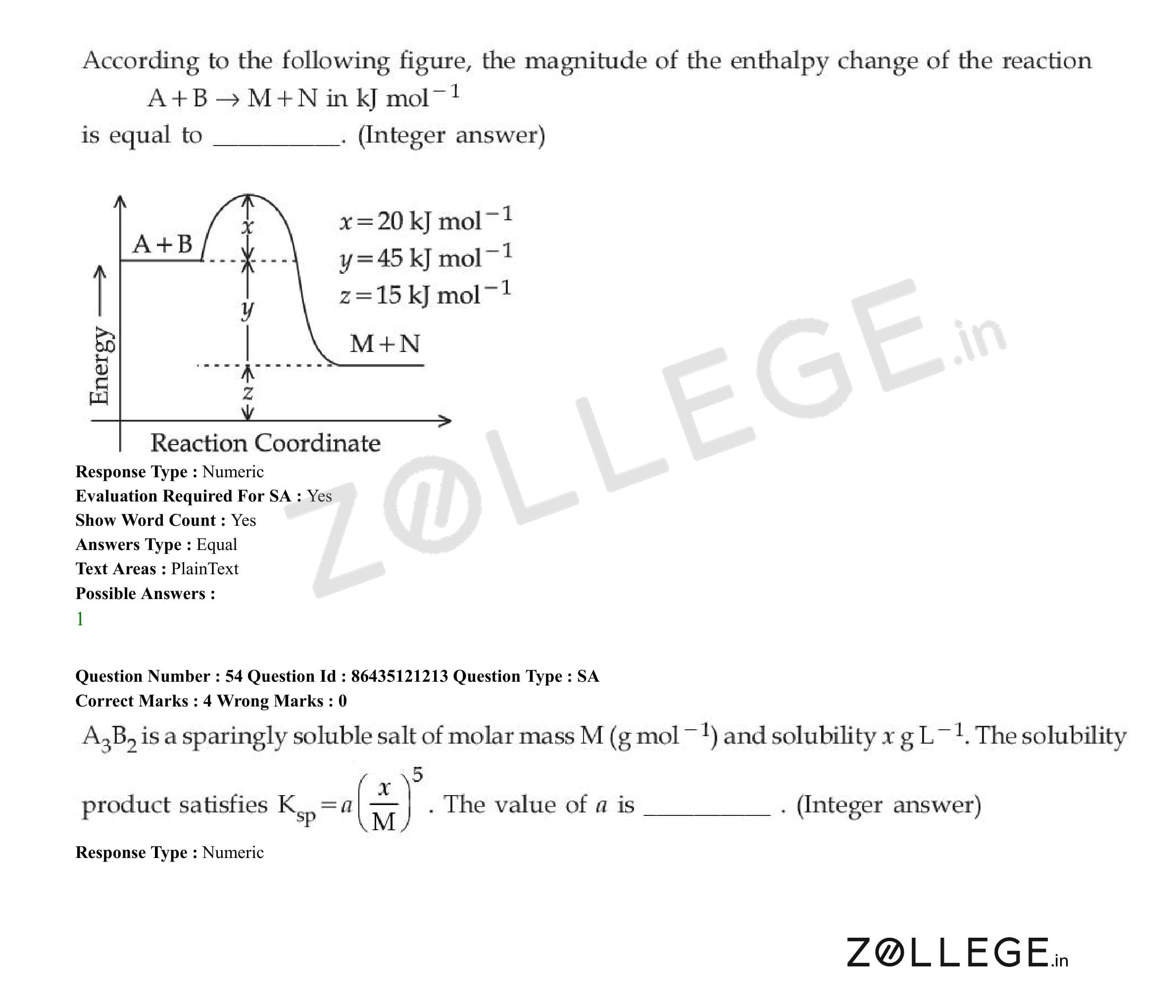
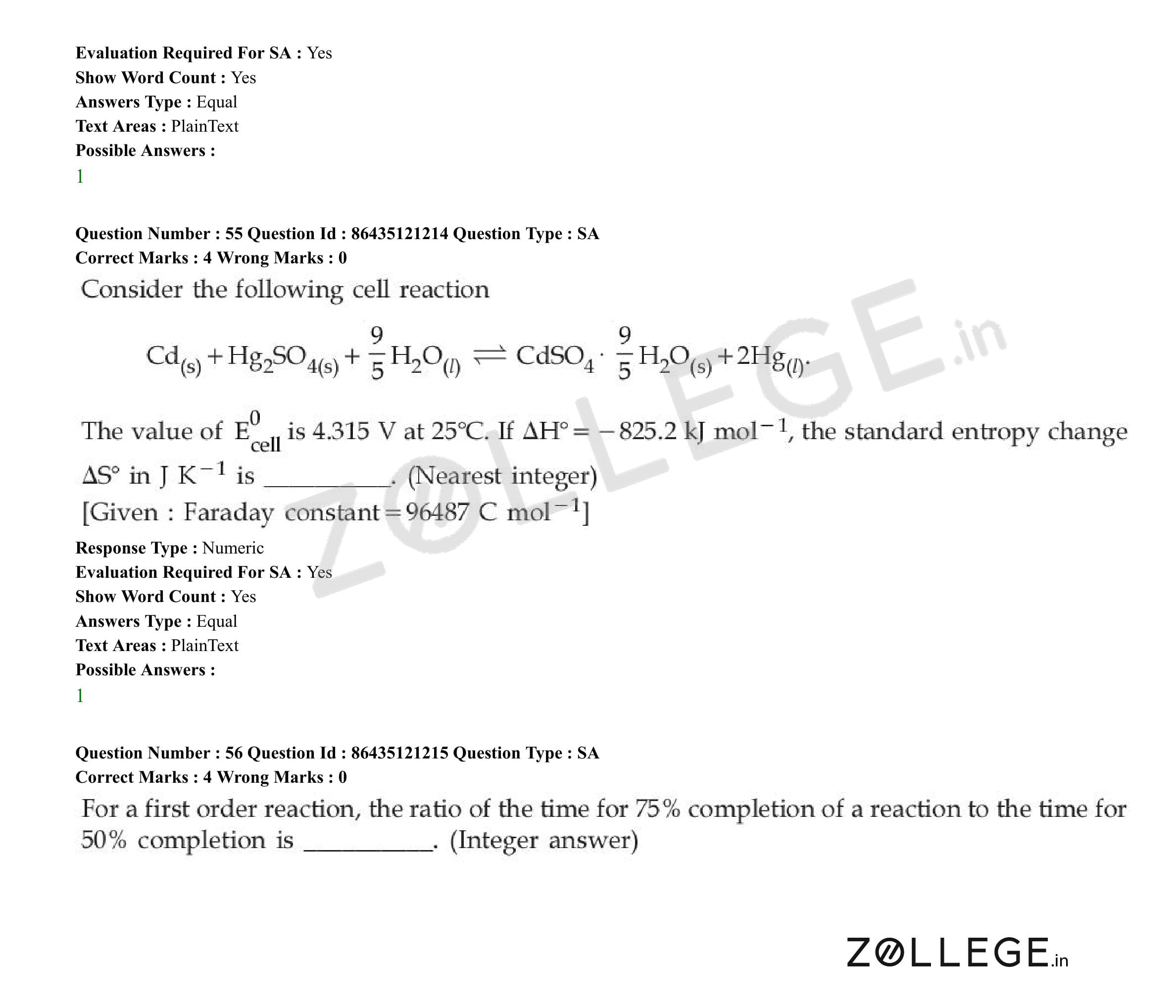
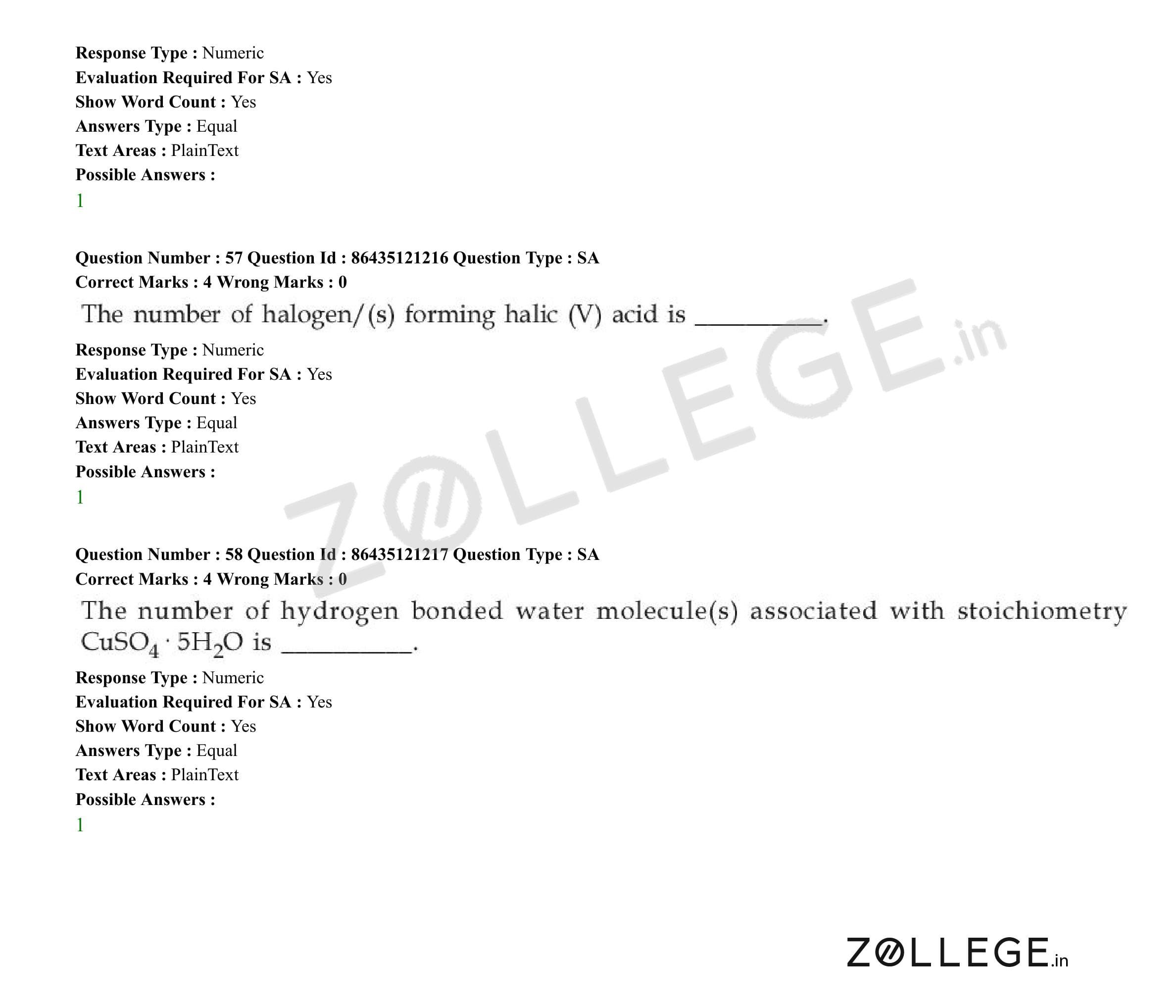
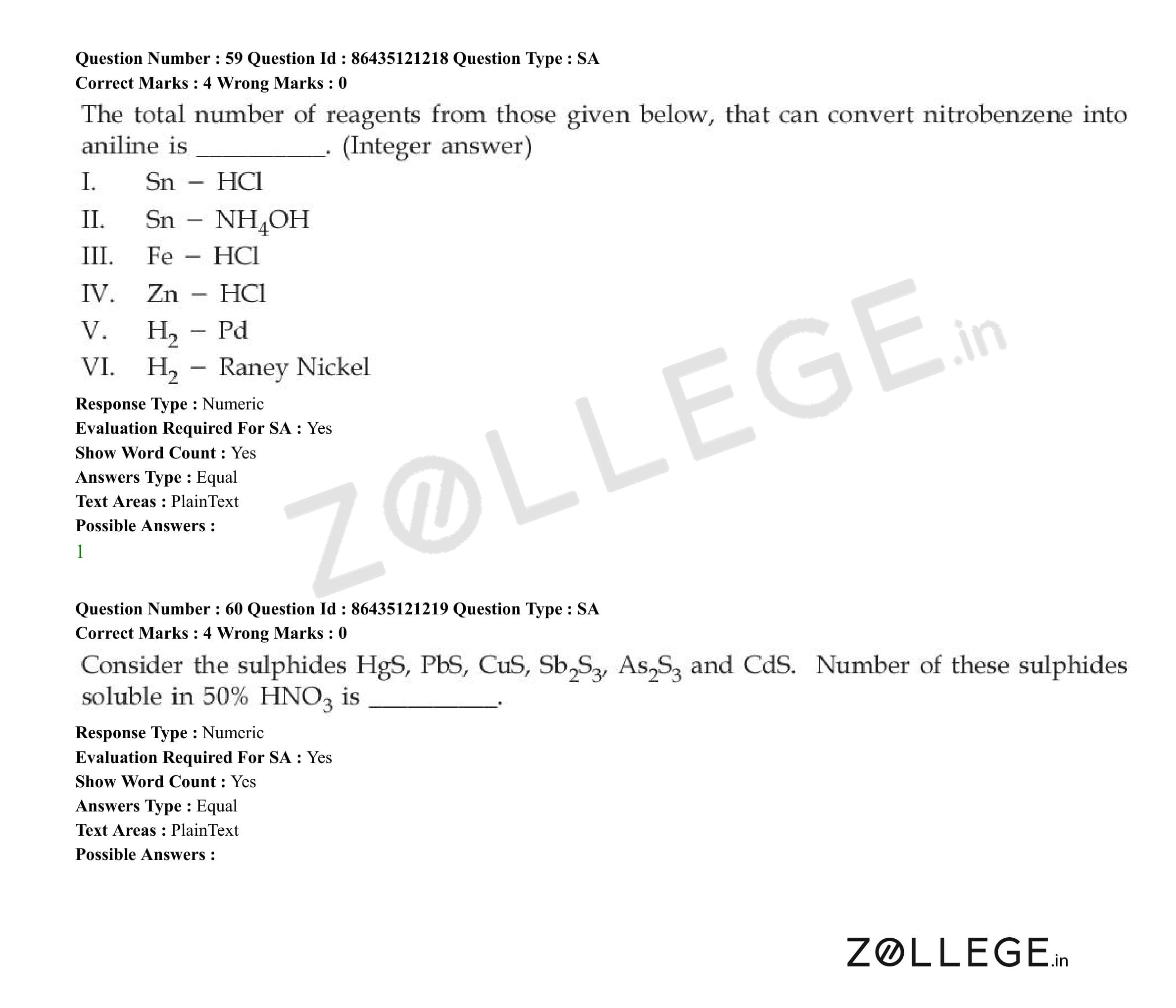
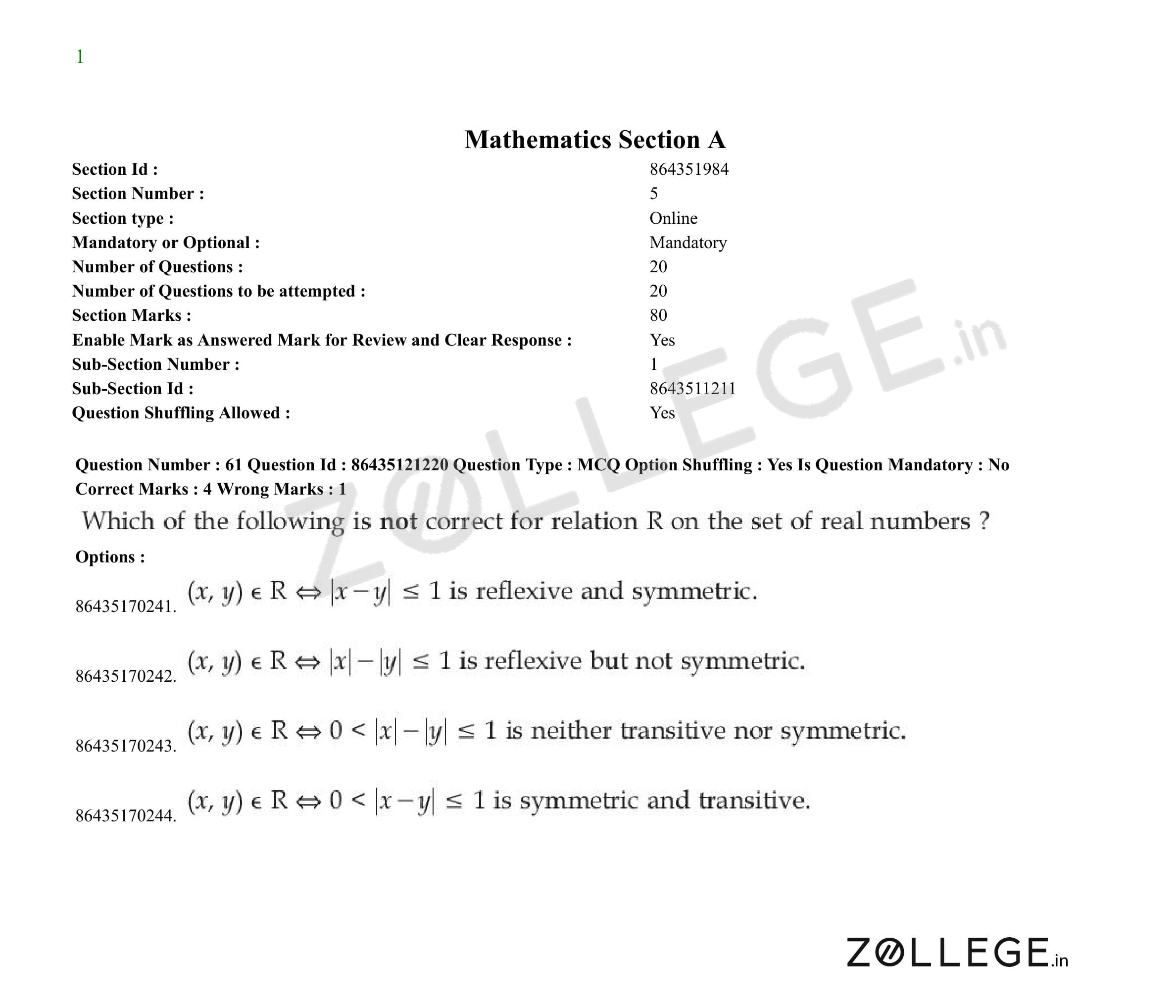
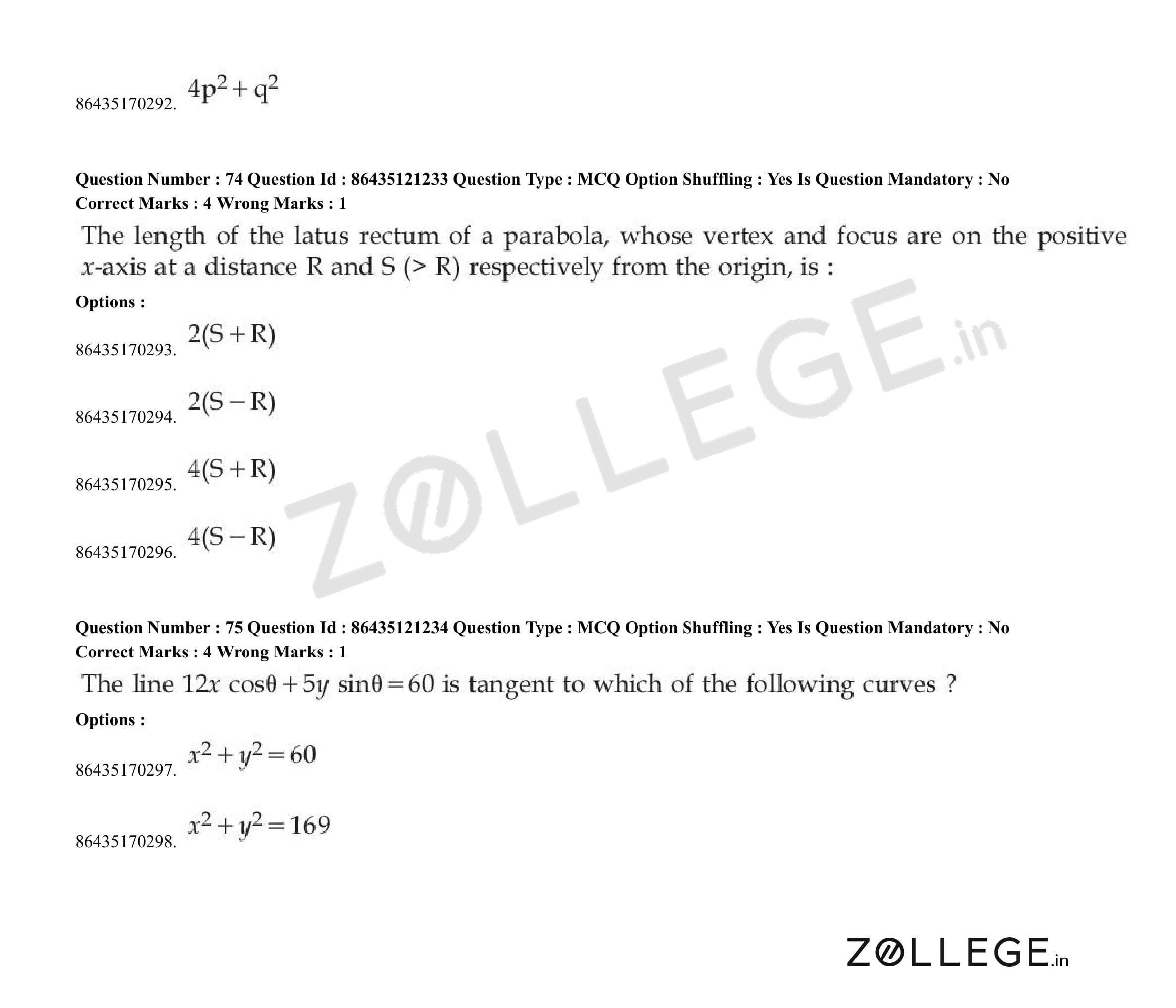
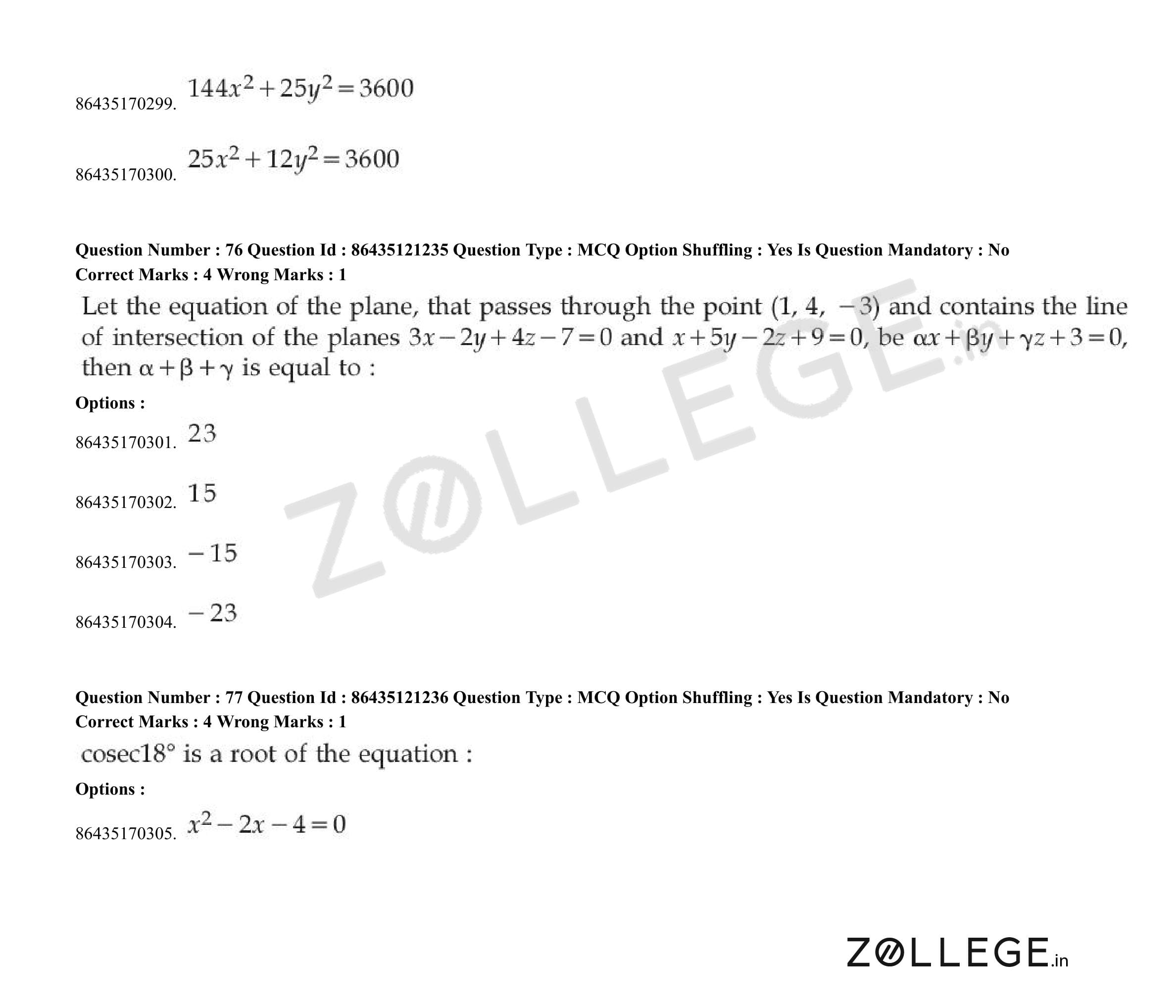
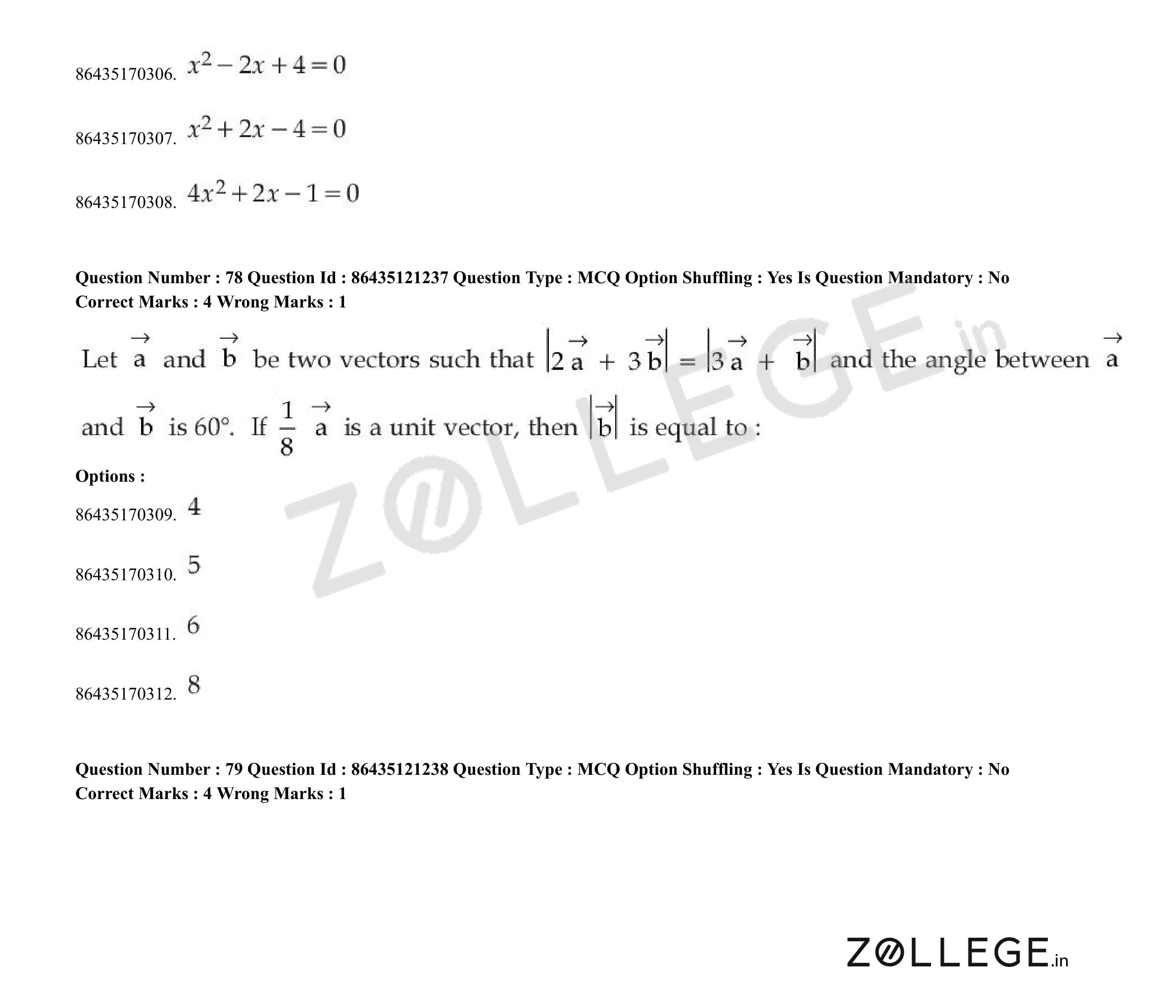
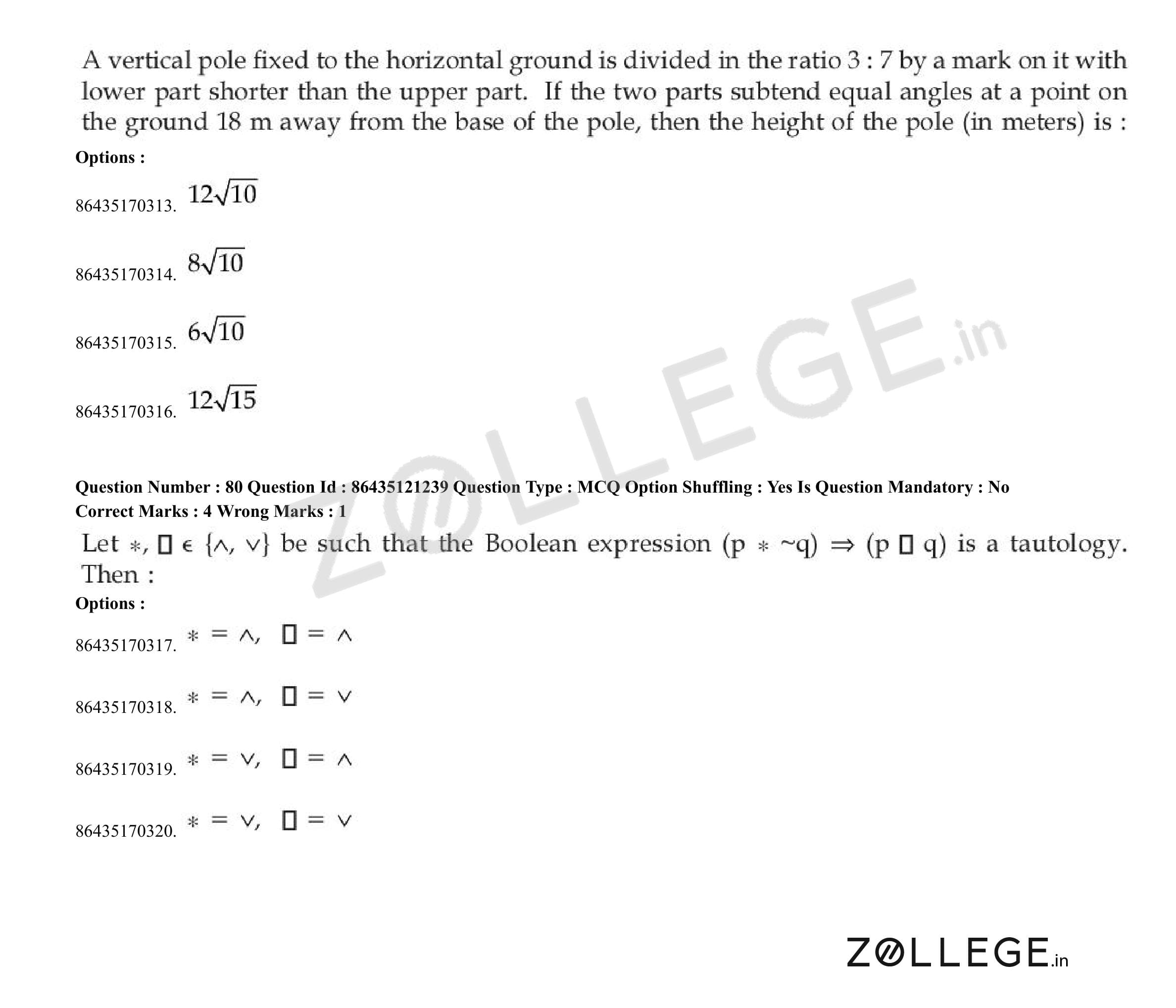
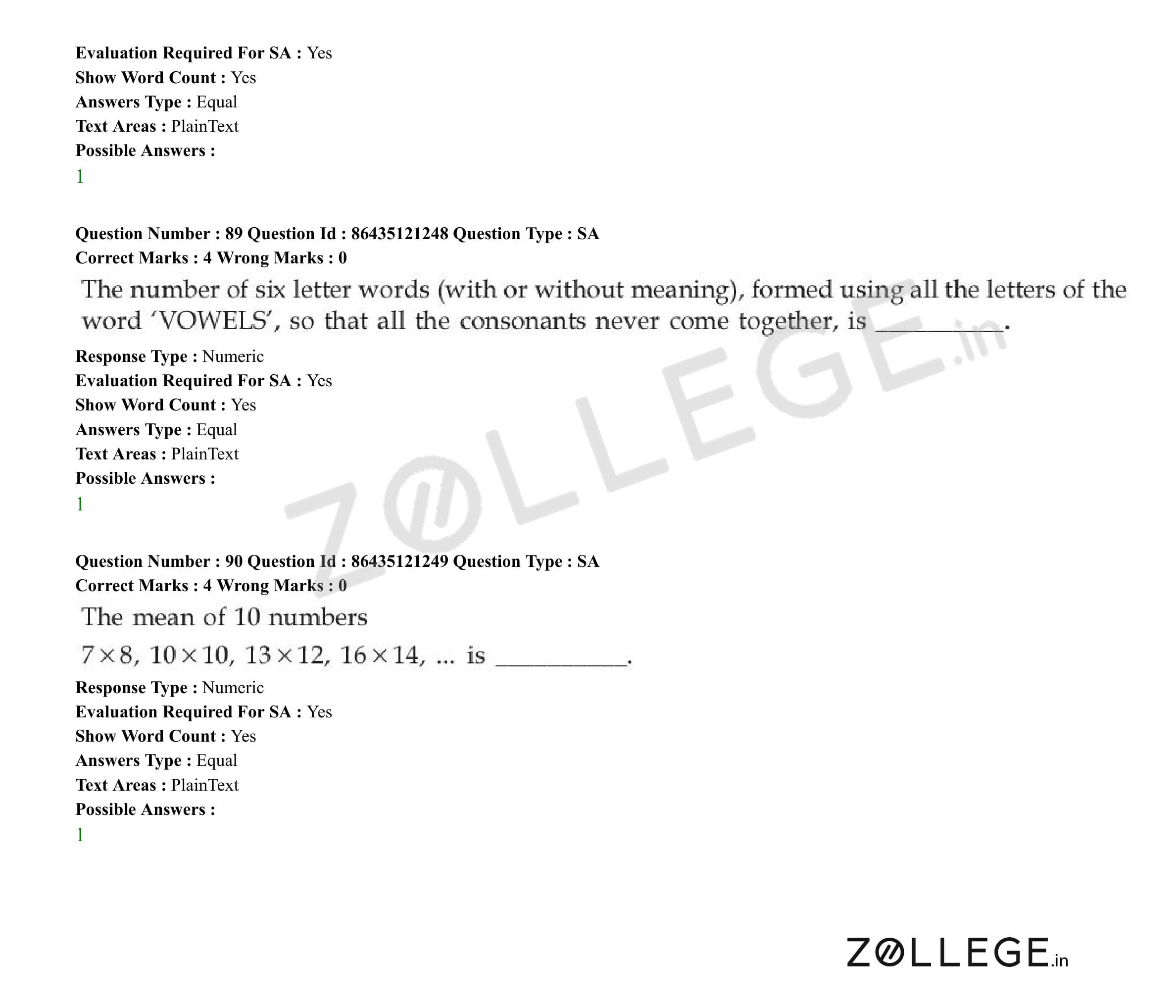
Previous Year JEE Main Question Papers
*The article might have information for the previous academic years, please refer the official website of the exam.