
JEE Main 2021 Question Paper with Answer Key PDF for B.E./ B.Tech(August 31 - Shift 2)


Content Writer | Updated On - Jan 5, 2026
JEE Main Question Papers are the most important study material for effective exam preparation. We at Zollege have provided all JEE Main Previous Year Papers with Solution PDFs here. JEE Main 2021 B. E. / B. Tech exam was conducted successfully on August 31, 2021. NTA conducted the exam in the Shift 2. According to student reactions and expert reviews, the paper was reported to be high.
Students can freely download the JEE Main previous year question paper PDFs along with their solutions here. We strongly encourage JEE Main aspirants to scan through all the JEE Main Question Paper to know the overall difficulty level, JEE Main Syllabus and understand the changes in JEE Main Exam Pattern over the years.
JEE Main 2021 B.E./ B.Tech Question Paper with Solution PDF (Shift 2)
| JEE Main 2021 B.E./ B.Tech Question Paper PDF | JEE Main 2021 B.E./ B.Tech Solution PDF |
|---|---|
| Download PDF | Check Solutions |

If velocity [V] time [T] and force [F] are chosen as the base quantities, the dimensions of the mass will be :
View Solution
Step 1: Understanding the Concept:
In the study of dimensions, we can express any derived physical quantity in terms of chosen base quantities by establishing a relationship between them using Newton's second law of motion or basic definitions.
Step 2: Key Formula or Approach:
According to Newton's Second Law, Force (\(F\)) is defined as the rate of change of momentum, or more simply, the product of mass (\(m\)) and acceleration (\(a\)):
\[ F = m \times a \]
Since acceleration (\(a\)) is the rate of change of velocity (\(V\)) with respect to time (\(T\)), we can write:
\[ a = \frac{V}{T} \]
Step 3: Detailed Explanation:
Substitute the expression for acceleration into the force equation:
\[ F = m \times \left(\frac{V}{T}\right) \]
To find the dimensions of mass (\(m\)) in terms of \(F\), \(V\), and \(T\), we rearrange the formula to isolate \(m\):
\[ m = \frac{F \times T}{V} \]
Now, expressing this in dimensional notation:
\[ [m] = [F] [T] [V]^{-1} \]
\[ [m] = [FTV^{-1}] \]
Step 4: Final Answer:
Comparing this result with the given options, we find that the dimensions of mass are \([FTV^{-1}]\).
Quick Tip: To quickly find dimensions of a quantity in terms of a new set of base units, always look for the simplest fundamental equation connecting all the involved variables. Here, \(F = m \cdot \frac{v}{t}\) is the most direct link.
A free electron of 2.6 eV energy collides with a \(H^+\) ion. This results in the formation of a hydrogen atom in the first excited state and a photon is released. Find the frequency of the emitted photon. (\(h = 6.6 \times 10^{-34}\) J s)
View Solution
Step 1: Understanding the Concept:
When a free electron is captured by an ion to form an atom in a bound state, the total energy must be conserved. The energy of the emitted photon is equal to the difference between the initial total energy of the free system and the final energy of the bound hydrogen atom.
Step 2: Key Formula or Approach:
1. Initial Energy (\(E_i\)) = Kinetic Energy of free electron + Potential energy at infinity (assumed zero).
2. Final Energy (\(E_f\)) = Energy of the H-atom in the \(n^{th}\) state = \(-\frac{13.6}{n^2}\) eV.
3. Photon Energy (\(E_{ph}\)) = \(E_i - E_f = h\nu\).
Step 3: Detailed Explanation:
Given:
Initial energy of electron, \(E_i = 2.6\) eV.
The atom is formed in the first excited state, which means \(n = 2\).
Energy of hydrogen atom in \(n=2\):
\[ E_f = -\frac{13.6}{2^2} = -\frac{13.6}{4} = -3.4 eV \]
Energy released as a photon:
\[ E_{ph} = E_i - E_f = 2.6 - (-3.4) = 2.6 + 3.4 = 6.0 eV \]
Convert this energy to Joules:
\[ E_{ph} = 6.0 \times 1.6 \times 10^{-19} J = 9.6 \times 10^{-19} J \]
Frequency (\(\nu\)) calculation:
\[ \nu = \frac{E_{ph}}{h} = \frac{9.6 \times 10^{-19}}{6.6 \times 10^{-34}} \]
\[ \nu \approx 1.4545 \times 10^{15} Hz \]
To convert to MHz (\(10^6\) Hz):
\[ \nu = \frac{1.4545 \times 10^{15}}{10^6} MHz = 1.4545 \times 10^9 MHz \]
Step 4: Final Answer:
The frequency of the emitted photon is approximately \(1.45 \times 10^9\) MHz.
Quick Tip: Remember: Ground state is \(n=1\), First Excited State is \(n=2\), Second Excited State is \(n=3\). Always convert eV to Joules (\(1 eV = 1.6 \times 10^{-19} J\)) before calculating frequency in SI units.
Statement I : If three forces \(\vec{F_1}\), \(\vec{F_2}\) and \(\vec{F_3}\) are represented by three sides of a triangle and \(\vec{F_1} + \vec{F_2} = -\vec{F_3}\), then these three forces are concurrent forces and satisfy the condition for equilibrium.
Statement II : A triangle made up of three forces \(\vec{F_1}\), \(\vec{F_2}\) and \(\vec{F_3}\) as its sides taken in the same order, satisfy the condition for translatory equilibrium.
In the light of the above statements, choose the most appropriate answer from the options given below :
View Solution
Step 1: Understanding the Concept:
For a body to be in translatory equilibrium, the vector sum of all forces acting on it must be zero (\(\sum \vec{F} = 0\)). If three forces are concurrent (acting at the same point) and their vector sum is zero, they keep the particle in equilibrium.
Step 2: Detailed Explanation:
Analysis of Statement I:
The condition given is \(\vec{F_1} + \vec{F_2} = -\vec{F_3}\).
Rearranging this, we get \(\vec{F_1} + \vec{F_2} + \vec{F_3} = 0\).
By the triangle law of vector addition, if three vectors form a closed triangle when placed tail-to-head, their sum is zero.
If these forces are concurrent, this zero net force condition directly implies that the particle is in equilibrium. Thus, Statement I is true.
Analysis of Statement II:
When forces \(\vec{F_1}\), \(\vec{F_2}\), and \(\vec{F_3}\) are taken as sides of a triangle in the same order (cyclic order), the starting point of the first vector coincides with the terminal point of the last vector.
This geometric configuration signifies that the resultant vector is a null vector (\(\vec{R} = 0\)).
Since the net force is zero, the condition for translatory equilibrium is satisfied. Thus, Statement II is true.
Step 3: Final Answer:
Both statements correctly describe the conditions for equilibrium using vector geometry. Therefore, both are true.
Quick Tip: Lami's Theorem is often used for three concurrent forces in equilibrium: \(\frac{F_1}{\sin \alpha} = \frac{F_2}{\sin \beta} = \frac{F_3}{\sin \gamma}\). Geometrically, if vectors form a closed polygon, the net force is always zero.
Two thin metallic spherical shells of radii \(r_1\) and \(r_2\) (\(r_1 < r_2\)) are placed with their centres coinciding. A material of thermal conductivity K is filled in the space between the shells. The inner shell is maintained at temperature \(\theta_1\) and the outer shell at temperature \(\theta_2\) (\(\theta_1 < \theta_2\)). The rate at which heat flows radially through the material is :
View Solution
Step 1: Understanding the Concept:
Heat flow in a spherical shell is radial. To calculate the rate of heat flow, we can use the concept of thermal resistance, which is analogous to electrical resistance.
Step 2: Key Formula or Approach:
The rate of heat flow is given by Fourier's Law: \(H = \frac{\Delta \theta}{R_{th}}\).
For a thin spherical shell of radius \(x\) and thickness \(dx\), the thermal resistance \(dR_{th}\) is:
\[ dR_{th} = \frac{dx}{K \cdot A} = \frac{dx}{K(4\pi x^2)} \]
Step 3: Detailed Explanation:
To find the total thermal resistance (\(R_{th}\)) between radii \(r_1\) and \(r_2\), we integrate \(dR_{th}\):
\[ R_{th} = \int_{r_1}^{r_2} \frac{dx}{4\pi K x^2} = \frac{1}{4\pi K} \left[ -\frac{1}{x} \right]_{r_1}^{r_2} \]
\[ R_{th} = \frac{1}{4\pi K} \left( \frac{1}{r_1} - \frac{1}{r_2} \right) = \frac{1}{4\pi K} \left( \frac{r_2 - r_1}{r_1 r_2} \right) \]
Now, calculate the heat flow rate \(H\):
\[ H = \frac{\theta_2 - \theta_1}{R_{th}} \]
Substitute the value of \(R_{th}\):
\[ H = \frac{\theta_2 - \theta_1}{\frac{r_2 - r_1}{4\pi K r_1 r_2}} \]
\[ H = \frac{4\pi K r_1 r_2 (\theta_2 - \theta_1)}{r_2 - r_1} \]
Step 4: Final Answer:
The rate of heat flow is \(\frac{4\pi K r_1 r_2 (\theta_2 - \theta_1)}{r_2 - r_1}\).
Quick Tip: Thermal resistance formulas to remember:
Slab: \(R = \frac{L}{KA}\)
Cylinder: \(R = \frac{\ln(r_2/r_1)}{2\pi KL}\)
Sphere: \(R = \frac{r_2 - r_1}{4\pi K r_1 r_2}\)
Statement I : Two forces \((\vec{p} + \vec{q})\) and \((\vec{p} - \vec{q})\) where \(\vec{p} \perp \vec{q}\), when act at an angle \(\theta_1\) to each other, the magnitude of their resultant is \(\sqrt{3(p^2 + q^2)}\), when they act at an angle \(\theta_2\), the magnitude of their resultant becomes \(\sqrt{2(p^2 + q^2)}\). This is possible only when \(\theta_1 < \theta_2\).
Statement II : In the situation given above, \(\theta_1 = 60^{\circ}\) and \(\theta_2 = 90^{\circ}\).
In the light of the above statements, choose the most appropriate answer from the options given below :
View Solution
Step 1: Understanding the Concept:
The magnitude of the resultant \(R\) of two vectors \(\vec{A}\) and \(\vec{B}\) acting at an angle \(\theta\) is given by \(R = \sqrt{A^2 + B^2 + 2AB \cos \theta}\).
Step 2: Key Formula or Approach:
Let \(\vec{A} = \vec{p} + \vec{q}\) and \(\vec{B} = \vec{p} - \vec{q}\).
Since \(\vec{p} \perp \vec{q}\), then \(\vec{p} \cdot \vec{q} = 0\).
The squares of the magnitudes are:
\[ A^2 = |\vec{p} + \vec{q}|^2 = p^2 + q^2 + 2\vec{p} \cdot \vec{q} = p^2 + q^2 \]
\[ B^2 = |\vec{p} - \vec{q}|^2 = p^2 + q^2 - 2\vec{p} \cdot \vec{q} = p^2 + q^2 \]
Note that \(A = B = \sqrt{p^2 + q^2}\). Let this be \(R_0\).
Step 3: Detailed Explanation:
The resultant \(R\) is:
\[ R^2 = A^2 + B^2 + 2AB \cos \theta = R_0^2 + R_0^2 + 2R_0^2 \cos \theta = 2R_0^2(1 + \cos \theta) \]
Case 1: Resultant \(R_1 = \sqrt{3(p^2 + q^2)} = \sqrt{3} R_0\)
\[ (\sqrt{3} R_0)^2 = 2R_0^2(1 + \cos \theta_1) \]
\[ 3 R_0^2 = 2R_0^2(1 + \cos \theta_1) \implies 3 = 2 + 2\cos \theta_1 \]
\[ 2\cos \theta_1 = 1 \implies \cos \theta_1 = \frac{1}{2} \implies \theta_1 = 60^{\circ} \]
Case 2: Resultant \(R_2 = \sqrt{2(p^2 + q^2)} = \sqrt{2} R_0\)
\[ (\sqrt{2} R_0)^2 = 2R_0^2(1 + \cos \theta_2) \]
\[ 2 R_0^2 = 2R_0^2(1 + \cos \theta_2) \implies 1 = 1 + \cos \theta_2 \]
\[ \cos \theta_2 = 0 \implies \theta_2 = 90^{\circ} \]
Since \(60^{\circ} < 90^{\circ}\), Statement I (\(\theta_1 < \theta_2\)) is true.
Statement II (\(\theta_1 = 60^{\circ}, \theta_2 = 90^{\circ}\)) is also true.
Step 4: Final Answer:
Both Statement I and Statement II are true.
Quick Tip: If two vectors have equal magnitude \(A\), their resultant is \(2A \cos(\theta/2)\). In this problem, both vectors have magnitude \(\sqrt{p^2+q^2}\) because they are perpendicular diagonals of a rectangle formed by \(p\) and \(q\).
If \(R_E\) be the radius of Earth, then the ratio between the acceleration due to gravity at a depth 'r' below and a height 'r' above the earth surface is : (Given : \(r < R_E\))
View Solution
Step 1: Understanding the Concept:
Acceleration due to gravity varies with height and depth. We need to find the ratio of \(g_{depth}\) to \(g_{height}\) for a displacement \(r\).
Step 2: Key Formula or Approach:
1. At depth \(r\): \(g_d = g \left( 1 - \frac{r}{R_E} \right)\)
2. At height \(r\): \(g_h = \frac{g}{(1 + r/R_E)^2} = g \left( 1 + \frac{r}{R_E} \right)^{-2}\)
Step 3: Detailed Explanation:
We need to find the ratio \(\frac{g_d}{g_h}\):
\[ Ratio = \frac{g(1 - \frac{r}{R_E})}{g(1 + \frac{r}{R_E})^{-2}} = \left( 1 - \frac{r}{R_E} \right) \left( 1 + \frac{r}{R_E} \right)^2 \]
Expand the squared term:
\[ Ratio = \left( 1 - \frac{r}{R_E} \right) \left( 1 + \frac{2r}{R_E} + \frac{r^2}{R_E^2} \right) \]
Multiply the terms:
\[ Ratio = 1\left( 1 + \frac{2r}{R_E} + \frac{r^2}{R_E^2} \right) - \frac{r}{R_E} \left( 1 + \frac{2r}{R_E} + \frac{r^2}{R_E^2} \right) \]
\[ Ratio = 1 + \frac{2r}{R_E} + \frac{r^2}{R_E^2} - \frac{r}{R_E} - \frac{2r^2}{R_E^2} - \frac{r^3}{R_E^3} \]
Group like terms:
\[ Ratio = 1 + \left( \frac{2r}{R_E} - \frac{r}{R_E} \right) + \left( \frac{r^2}{R_E^2} - \frac{2r^2}{R_E^2} \right) - \frac{r^3}{R_E^3} \]
\[ Ratio = 1 + \frac{r}{R_E} - \frac{r^2}{R_E^2} - \frac{r^3}{R_E^3} \]
Step 4: Final Answer:
The ratio is \(1 + \frac{r}{R_E} - \frac{r^2}{R_E^2} - \frac{r^3}{R_E^3}\).
Quick Tip: Note that the approximation \(g_h = g(1 - 2r/R_E)\) is only valid when \(r \ll R_E\). Since the options include higher order terms (\(r^2, r^3\)), you must use the exact formula for \(g_h\) and expand the expression fully.
A mixture of hydrogen and oxygen has volume 500 \(cm^3\), temperature 300 K, pressure 400 kPa and mass 0.76 g. The ratio of masses of oxygen to hydrogen will be :
View Solution
Step 1: Understanding the Concept:
Using the Ideal Gas Equation \(PV = nRT\), we can find the total number of moles in the mixture. Then, using the total mass and individual molar masses, we can find the mass of each component.
Step 2: Key Formula or Approach:
1. \(n_{total} = \frac{PV}{RT}\)
2. \(n_{total} = n_{H_2} + n_{O_2} = \frac{m_{H_2}}{M_{H_2}} + \frac{m_{O_2}}{M_{O_2}}\)
3. Total mass \(m = m_{H_2} + m_{O_2} = 0.76\) g.
Step 3: Detailed Explanation:
Given values:
\(P = 400 \times 10^3\) Pa, \(V = 500 \times 10^{-6}\) \(m^3 = 5 \times 10^{-4}\) \(m^3\), \(T = 300\) K, \(R \approx 8.31\) J/(mol K).
Calculate total moles:
\[ n_{total} = \frac{(4 \times 10^5) (5 \times 10^{-4})}{(8.31) (300)} = \frac{200}{2493} \approx 0.08 moles \]
Let \(m_O\) be the mass of oxygen and \(m_H\) be the mass of hydrogen.
Molar mass of \(H_2 = 2\) g/mol, Molar mass of \(O_2 = 32\) g/mol.
Equation 1: \(m_H + m_O = 0.76\)
Equation 2: \(\frac{m_H}{2} + \frac{m_O}{32} = 0.08\)
Multiply Eq 2 by 32:
\[ 16m_H + m_O = 2.56 \]
Subtract Eq 1 from this:
\[ (16m_H + m_O) - (m_H + m_O) = 2.56 - 0.76 \]
\[ 15m_H = 1.80 \implies m_H = \frac{1.80}{15} = 0.12 g \]
Find mass of oxygen:
\[ m_O = 0.76 - 0.12 = 0.64 g \]
Ratio of masses (Oxygen to Hydrogen):
\[ \frac{m_O}{m_H} = \frac{0.64}{0.12} = \frac{64}{12} = \frac{16}{3} \]
Step 4: Final Answer:
The ratio of the mass of oxygen to hydrogen is \(16 : 3\).
Quick Tip: To avoid complex calculations, check the options against the total mass. For option (D), \(16:3\) means \(m_O = \frac{16}{19} \times 0.76 = 0.64\) g and \(m_H = \frac{3}{19} \times 0.76 = 0.12\) g. Quickly calculate moles: \(0.64/32 + 0.12/2 = 0.02 + 0.06 = 0.08\). Since this matches \(PV/RT\), it is correct.
A block moving horizontally on a smooth surface with a speed of 40 m/s splits into two parts with masses in the ratio of \(1 : 2\). If the smaller part moves at 60 m/s in the same direction, then the fractional change in kinetic energy is :
View Solution
Step 1: Understanding the Concept:
When a block splits, the total linear momentum is conserved because no external horizontal force acts on the system. The kinetic energy changes due to the internal energy released during the splitting process.
Step 2: Key Formula or Approach:
1. Conservation of Momentum: \(M v = m_1 v_1 + m_2 v_2\)
2. Initial Kinetic Energy: \(K_i = \frac{1}{2} M v^2\)
3. Final Kinetic Energy: \(K_f = \frac{1}{2} m_1 v_1^2 + \frac{1}{2} m_2 v_2^2\)
4. Fractional change: \(\frac{\Delta K}{K_i} = \frac{K_f - K_i}{K_i}\)
Step 3: Detailed Explanation:
Let total mass be \(M\). Masses are \(m_1 = \frac{1}{3}M\) (smaller) and \(m_2 = \frac{2}{3}M\) (larger).
Initial velocity \(v = 40\) m/s.
Smaller part velocity \(v_1 = 60\) m/s.
Using momentum conservation:
\[ M(40) = \left( \frac{M}{3} \right)(60) + \left( \frac{2M}{3} \right) v_2 \]
\[ 40 = 20 + \frac{2}{3} v_2 \implies 20 = \frac{2}{3} v_2 \implies v_2 = 30 m/s \]
Initial Kinetic Energy:
\[ K_i = \frac{1}{2} M (40)^2 = 800M \]
Final Kinetic Energy:
\[ K_f = \frac{1}{2} \left( \frac{M}{3} \right) (60)^2 + \frac{1}{2} \left( \frac{2M}{3} \right) (30)^2 \]
\[ K_f = \frac{M}{6} (3600) + \frac{M}{3} (900) = 600M + 300M = 900M \]
Change in Kinetic Energy:
\[ \Delta K = K_f - K_i = 900M - 800M = 100M \]
Fractional change:
\[ \frac{\Delta K}{K_i} = \frac{100M}{800M} = \frac{1}{8} \]
Step 4: Final Answer:
The fractional change in kinetic energy is \(\frac{1}{8}\).
Quick Tip: In explosion/splitting problems, the kinetic energy of the system always increases (\(\Delta K > 0\)) because chemical or internal potential energy is converted into kinetic energy. If you get a negative value, recheck your momentum conservation calculation.
The equivalent resistance of the given circuit between the terminals A and B is :
% Note: Circuit consists of a horizontal line with two 2 ohm resistors,
% and vertical branches of a wire, 5 ohm, 2 ohm, 3 ohm, and 3 ohm resistors.
View Solution
Step 1: Understanding the Concept:
To find the equivalent resistance between two terminals, we identify parallel and series combinations of resistors and simplify the circuit from the farthest end toward the terminals. Additionally, any branch that is short-circuited (parallel to a wire of zero resistance) is effectively removed from the circuit calculations.
Step 2: Key Formula or Approach:
1. For resistors in series: \(R_{eq} = R_1 + R_2 + ...\)
2. For resistors in parallel: \(\frac{1}{R_{eq}} = \frac{1}{R_1} + \frac{1}{R_2} + ...\)
3. A short circuit (zero resistance wire) in parallel with any resistor makes the effective resistance of that combination \(0\,\Omega\).
Step 3: Detailed Explanation:
Let's analyze the nodes starting from the left:
1. The first vertical line on the far left is a simple wire. This wire is in parallel with the \(5\,\Omega\) vertical resistor. Therefore, the \(5\,\Omega\) resistor is shorted and its effective resistance is \(0\,\Omega\). Let the top node of this shorted section be at the same potential as ground (terminal B).
2. Moving to the right, there is a horizontal \(2\,\Omega\) resistor connected between this grounded node and the top node of the next vertical \(2\,\Omega\) resistor. This means the horizontal \(2\,\Omega\) and vertical \(2\,\Omega\) resistors are both connected between this new node and ground (Node B), making them in parallel. Their equivalent resistance is: \[ R_{p1} = \frac{2 \times 2}{2 + 2} = 1\,\Omega \]
3. Next, we have another horizontal \(2\,\Omega\) resistor connecting the previous node to the final part of the circuit. Terminal A is at the top of two \(3\,\Omega\) vertical resistors. These two \(3\,\Omega\) resistors are connected in parallel to each other. Their equivalent resistance is: \[ R_{p2} = \frac{3 \times 3}{3 + 3} = 1.5\,\Omega \]
4. Now, the circuit simplifies to Terminal A being connected to ground (B) through \(R_{p2}\) and another branch consisting of the second horizontal \(2\,\Omega\) resistor in series with \(R_{p1}\).
The resistance of the side branch is \(R_{branch} = 2 + 1 = 3\,\Omega\).
5. Finally, Terminal A is connected to ground through two parallel paths: \(1.5\,\Omega\) and \(3\,\Omega\). \[ R_{AB} = \frac{1.5 \times 3}{1.5 + 3} = \frac{4.5}{4.5} = 1\,\Omega \]
Step 4: Final Answer:
The equivalent resistance between terminals A and B is \(1\,\Omega\).
Quick Tip: Always look for short circuits first. A wire in parallel with a resistor or a whole section of a circuit effectively deletes it from the calculation, drastically simplifying the problem.
A bob of mass 'm' suspended by a thread of length \(l\) undergoes simple harmonic oscillations with time period T. If the bob is immersed in a liquid that has density \(\frac{1}{4}\) times that of the bob and the length of the thread is increased by \(1/3^{rd}\) of the original length, then the time period of the simple harmonic oscillations will be :
View Solution
Step 1: Understanding the Concept:
The time period of a simple pendulum is determined by its effective length and the effective acceleration due to gravity (\(g_{eff}\)). When immersed in a liquid, the buoyant force reduces the effective weight, thereby reducing \(g_{eff}\).
Step 2: Key Formula or Approach:
1. Original Time Period: \( T = 2\pi \sqrt{\frac{l}{g}} \)
2. Effective gravity in liquid: \( g' = g \left( 1 - \frac{\rho_{liquid}}{\rho_{bob}} \right) \)
Step 3: Detailed Explanation:
Given:
- Density of liquid \(\sigma = \frac{1}{4} \rho\) (where \(\rho\) is bob density).
- New length \(l' = l + \frac{l}{3} = \frac{4l}{3}\).
First, calculate the effective acceleration due to gravity (\(g'\)) in the liquid: \[ g' = g \left( 1 - \frac{\sigma}{\rho} \right) = g \left( 1 - \frac{1/4 \rho}{\rho} \right) = g \left( 1 - \frac{1}{4} \right) = \frac{3g}{4} \]
Now, calculate the new time period \(T'\): \[ T' = 2\pi \sqrt{\frac{l'}{g'}} = 2\pi \sqrt{\frac{4l/3}{3g/4}} \] \[ T' = 2\pi \sqrt{\frac{4l}{3} \times \frac{4}{3g}} = 2\pi \sqrt{\frac{16l}{9g}} \] \[ T' = \frac{4}{3} \times 2\pi \sqrt{\frac{l}{g}} \]
Since \(T = 2\pi \sqrt{l/g}\), we get: \[ T' = \frac{4}{3} T \]
Step 4: Final Answer:
The new time period is \(\frac{4}{3} T\).
Quick Tip: When a bob is immersed in liquid, \(g\) is replaced by \(g_{eff} = g(1 - relative density of liquid)\). Keep track of length changes carefully as they often appear together in such problems.
Four identical hollow cylindrical columns of mild steel support a big structure of mass \(50 \times 10^3\,kg\). The inner and outer radii of each column are 50 cm and 100 cm respectively. Assuming uniform local load distribution, calculate the compression strain of each column. [use \(Y = 2.0 \times 10^{11}\,Pa\), \(g = 9.8\,m/s^2\)]
View Solution
Step 1: Understanding the Concept:
The compression strain is defined as the ratio of stress to Young's modulus. Stress is the force acting per unit area. In this case, the total weight of the structure is shared equally by four columns.
Step 2: Key Formula or Approach:
1. Force per column: \( F = \frac{Mg}{4} \)
2. Area of cross-section of hollow cylinder: \( A = \pi (r_{outer}^2 - r_{inner}^2) \)
3. Strain \(\epsilon = \frac{Stress}{Y} = \frac{F}{AY}\)
Step 3: Detailed Explanation:
Given:
- Total mass \(M = 50 \times 10^3\,kg\).
- Number of columns = 4.
- Radii: \(r_1 = 0.5\,m\), \(r_2 = 1.0\,m\).
Force on one column: \[ F = \frac{50 \times 10^3 \times 9.8}{4} = 122500\,N \]
Area of cross-section: \[ A = \pi (1.0^2 - 0.5^2) = \pi (1 - 0.25) = 0.75\pi\,m^2 \]
Calculating strain: \[ \epsilon = \frac{122500}{0.75\pi \times 2.0 \times 10^{11}} \] \[ \epsilon = \frac{122500}{1.5\pi \times 10^{11}} \approx \frac{122500}{4.71 \times 10^{11}} \] \[ \epsilon \approx 2.6 \times 10^{-7} \]
Step 4: Final Answer:
The compression strain of each column is \(2.60 \times 10^{-7}\).
Quick Tip: In multi-support problems, always divide the total weight by the number of supports first. Also, ensure all units (like cm to m) are converted to SI before starting calculations.
For a body executing S.H.M. :
(a) Potential energy is always equal to its K.E.
(b) Average potential and kinetic energy over any given time interval are always equal.
(c) Sum of the kinetic and potential energy at any point of time is constant.
(d) Average K.E. in one time period is equal to average potential energy in one time period.
Choose the most appropriate option from the options given below :
View Solution
Step 1: Understanding the Concept:
Simple Harmonic Motion (SHM) involves a continuous transformation between kinetic energy (K.E.) and potential energy (P.E.), while their sum remains constant in the absence of dissipative forces.
Step 2: Detailed Explanation:
(a) Potential energy \(U = \frac{1}{2} k x^2\) and Kinetic energy \(K = \frac{1}{2} k (A^2 - x^2)\). They are equal only when \(x = \pm \frac{A}{\sqrt{2}}\), not always. So (a) is false.
(b) Average values are only guaranteed to be equal over a full period or specific symmetric intervals. "Any given interval" is too broad. So (b) is false.
(c) Total Energy \(E = U + K = \frac{1}{2} k A^2\). This is constant throughout the motion. So (c) is true.
(d) Over a full time period \(T\), both the average potential energy and average kinetic energy are equal to \(\frac{1}{4} k A^2\). So (d) is true.
Step 3: Final Answer:
Statements (c) and (d) are correct.
Quick Tip: In SHM, Energy oscillates with twice the frequency of the displacement. Remember that the average P.E. and average K.E. over one full cycle are both exactly half of the total energy.
The magnetic field vector of an electromagnetic wave is given by \( \vec{B} = B_0 \frac{\hat{i} + \hat{j}}{\sqrt{2}} \cos(kz - \omega t) \); where \(\hat{i}, \hat{j}\) represents unit vector along x and y-axis respectively. At \(t = 0\) s, two electric charges \(q_1\) of \(4\pi\) coulomb and \(q_2\) of \(2\pi\) coulomb located at \((0, 0, \frac{\pi}{k})\) and \((0, 0, \frac{3\pi}{k})\), respectively, have the same velocity of \(0.5\,c\,\hat{i}\), (where c is the velocity of light). The ratio of the force acting on charge \(q_1\) to \(q_2\) is :
View Solution
Step 1: Understanding the Concept:
The Lorentz force acting on a charge is given by \(\vec{F} = q(\vec{E} + \vec{v} \times \vec{B})\). In an electromagnetic wave, the electric and magnetic fields are related and perpendicular to each other and the direction of propagation.
Step 2: Key Formula or Approach:
1. Propagation direction: \(\hat{k}\) (from \(kz - \omega t\)).
2. Electric field \(\vec{E}\) is such that \(\hat{E}, \hat{B}, \hat{k}\) form a right-handed system: \(\vec{E} = c(\vec{B} \times \hat{k})\).
3. Total Force: \(\vec{F} = q(\vec{E} + \vec{v} \times \vec{B})\).
Step 3: Detailed Explanation:
At \(t = 0\), \(\vec{B} = B_0 \frac{\hat{i} + \hat{j}}{\sqrt{2}} \cos(kz)\).
The electric field is \(\vec{E} = \frac{c B_0 \cos(kz)}{\sqrt{2}} [(\hat{i} + \hat{j}) \times \hat{k}] = \frac{c B_0 \cos(kz)}{\sqrt{2}} (\hat{i} - \hat{j})\).
Given \(\vec{v} = 0.5c\,\hat{i}\), we find \(\vec{v} \times \vec{B}\): \[ \vec{v} \times \vec{B} = (0.5c\,\hat{i}) \times \frac{B_0 \cos(kz)}{\sqrt{2}} (\hat{i} + \hat{j}) = \frac{0.5c B_0 \cos(kz)}{\sqrt{2}} \hat{k} \]
Total force: \(\vec{F} = q \frac{c B_0 \cos(kz)}{\sqrt{2}} [\hat{i} - \hat{j} + 0.5\hat{k}] \).
Magnitude of force \(|\vec{F}| \propto q |\cos(kz)|\).
For \(q_1\) at \(z = \frac{\pi}{k}\): \(|\cos(\pi)| = 1\). Force \(F_1 \propto q_1 = 4\pi\).
For \(q_2\) at \(z = \frac{3\pi}{k}\): \(|\cos(3\pi)| = 1\). Force \(F_2 \propto q_2 = 2\pi\).
Ratio \(F_1 / F_2 = 4\pi / 2\pi = 2 : 1\).
Step 4: Final Answer:
The ratio of the forces is \(2 : 1\).
Quick Tip: Even if the exact vector components look complex, look for common factors. Here, both positions resulted in \(|\cos(kz)| = 1\), so the force magnitude depended solely on the charge magnitude.
A system consists of two identical spheres each of mass 1.5 kg and radius 50 cm at the ends of a light rod. The distance between the centres of the two spheres is 5 m. What will be the moment of inertia of the system about an axis perpendicular to the rod passing through its midpoint ?
View Solution
Step 1: Understanding the Concept:
The total moment of inertia of a system is the sum of the moments of inertia of its individual components. For spheres shifted away from the axis, we use the Parallel Axis Theorem.
Step 2: Key Formula or Approach:
1. Moment of inertia of a solid sphere about its center: \(I_{cm} = \frac{2}{5} m r^2\).
2. Parallel axis theorem: \(I = I_{cm} + m d^2\).
Step 3: Detailed Explanation:
Given:
- \(m = 1.5\,kg\), \(r = 0.5\,m\).
- Separation between centers = 5 m.
- Distance from axis (midpoint) to center of each sphere \(d = 2.5\,m\).
Moment of inertia for one sphere about the central axis: \[ I_{sphere} = \frac{2}{5} m r^2 + m d^2 = \frac{2}{5} (1.5) (0.5)^2 + (1.5) (2.5)^2 \] \[ I_{sphere} = (0.4) (1.5) (0.25) + (1.5) (6.25) = 0.15 + 9.375 = 9.525\,kg\cdotm^2 \]
Total moment of inertia for both spheres: \[ I_{total} = 2 \times 9.525 = 19.05\,kg\cdotm^2 \]
Step 4: Final Answer:
The moment of inertia is \(19.05\,kg\cdotm^2\).
Quick Tip: When spheres are far apart compared to their radius (here \(d=2.5\) vs \(r=0.5\)), the \(md^2\) term dominates. However, don't ignore the \(I_{cm}\) term unless specifically asked for "point masses".
A coil is placed in a magnetic field \(\vec{B}\) as shown below :
A current is induced in the coil because \(\vec{B}\) is :
View Solution
Step 1: Understanding the Concept:
According to Lenz's Law, the direction of induced current is such that it opposes the change in magnetic flux that produced it.
Step 2: Detailed Explanation:
1. The diagram shows the external magnetic field \(\vec{B}\) as dots (\(\odot\)), which means it is directed outward (towards the viewer).
2. The induced current is shown as anti-clockwise.
3. Using the right-hand thumb rule, an anti-clockwise current produces an induced magnetic field that is also directed outward.
4. Since the induced field is in the same direction as the external field, it must be trying to compensate for a decrease in the external outward flux.
5. Therefore, the external field \(\vec{B}\) must be outward and decreasing with time.
Step 3: Final Answer:
The field is outward and decreasing with time.
Quick Tip: If the induced field supports the original field, the flux is decreasing. If it opposes the original field, the flux is increasing.
If \(V_A\) and \(V_B\) are the input voltages (either 5 V or 0 V) and \(V_o\) is the output voltage then the two gates represented in the following circuits (A) and (B) are :
View Solution
Step 1: Understanding the Concept:
Logic gates can be constructed using electronic components like diodes and transistors. Diodes act as switches for specific voltage levels, while transistors can invert signals in a common-emitter configuration.
Step 2: Detailed Explanation:
Circuit (A):
This circuit uses two diodes in parallel connected to a resistor leading to ground.
- If \(V_A = 5V\) or \(V_B = 5V\), the corresponding diode becomes forward biased, allowing current to flow. The output \(V_o\) becomes high (\(\approx 5V\)).
- The output is low (\(0V\)) only when both inputs are low. This is the logic for an OR gate.
Circuit (B):
This is a standard NPN transistor inverter circuit.
- If \(V_B = 5V\) (High), the transistor is switched ON (saturated), effectively connecting the output \(V_o\) to ground. Thus, \(V_o = 0V\) (Low).
- If \(V_B = 0V\) (Low), the transistor is switched OFF, and \(V_o\) is pulled up to 5V through the collector resistor \(R_C\).
- This inversion of logic defines a NOT gate.
Step 3: Final Answer:
Circuit (A) is an OR gate and Circuit (B) is a NOT gate.
Quick Tip: Diodes with cathodes joined together typically form OR gates (positive logic). A single transistor with input at the base and output at the collector is almost always a NOT gate.
A current of 1.5 A is flowing through a triangle, of side 9 cm each. The magnetic field at the centroid of the triangle is : (Assume that the current is flowing in the clockwise direction.)
View Solution
Step 1: Understanding the Concept:
The magnetic field at the centroid of a current-carrying polygon is the sum of the fields produced by each individual side. For an equilateral triangle, all three sides contribute equally and in the same direction.
Step 2: Key Formula or Approach:
1. Field due to a finite straight wire: \(B = \frac{\mu_0 I}{4\pi r} (\sin \theta_1 + \sin \theta_2)\).
2. For equilateral triangle side \(a\), distance to centroid \(r = \frac{a}{2\sqrt{3}}\) and \(\theta_1 = \theta_2 = 60^{\circ}\).
Step 3: Detailed Explanation:
Given \(I = 1.5\,A\), \(a = 0.09\,m\).
Field due to one side: \[ B_1 = \frac{10^{-7} \times 1.5}{0.09 / (2\sqrt{3})} (\sin 60^{\circ} + \sin 60^{\circ}) \] \[ B_1 = \frac{10^{-7} \times 1.5 \times 2\sqrt{3}}{0.09} (\sqrt{3}) = \frac{10^{-7} \times 1.5 \times 6}{0.09} = 10^{-5}\,T \]
Total field at centroid \(B = 3 \times B_1 = 3 \times 10^{-5}\,T\).
Direction: Since the current is clockwise, by the right-hand thumb rule, the magnetic field at the center points into (inside) the plane of the triangle.
Step 4: Final Answer:
The magnetic field is \(3 \times 10^{-5}\) T, inside the plane.
Quick Tip: The field at the center of an equilateral triangle is always \( \frac{9 \mu_0 I}{2 \pi a} \). Using this direct formula can save time in exams.
Statement I : To get a steady dc output from the pulsating voltage received from a full wave rectifier we can connect a capacitor across the output parallel to the load \(R_L\).
Statement II : To get a steady dc output from the pulsating voltage received from a full wave rectifier we can connect an inductor in series with \(R_L\).
In the light of the above statements, choose the most appropriate answer from the options given below :
View Solution
Step 1: Understanding the Concept:
A rectifier converts AC to pulsating DC. To smooth these pulsations (ripples) and obtain a steady DC voltage, filter circuits using capacitors or inductors are used.
Step 2: Detailed Explanation:
Statement I: A capacitor filter works by charging during the peak of the pulsating voltage and discharging through the load when the voltage drops. Since it stores charge, it maintains a higher voltage level across the load, reducing ripples. It must be connected in parallel with the load. So Statement I is true.
Statement II: An inductor has the property of opposing any change in current. When placed in series with the load, it smooths out the variations in the current flow, effectively filtering the AC components out of the pulsating DC. So Statement II is true.
Step 3: Final Answer:
Both methods are valid techniques for filtering rectified voltage. Thus, both statements are true.
Quick Tip: Capacitors block DC and bypass AC (parallel), whereas inductors block AC and allow DC (series). Combined (L-C filters), they provide even better stabilization.
Consider two separate ideal gases of electrons and protons having same number of particles. The temperature of both the gases are same. The ratio of the uncertainty in determining the position of an electron to that of a proton is proportional to :
View Solution
Step 1: Understanding the Concept:
The Heisenberg Uncertainty Principle states that the product of uncertainty in position (\(\Delta x\)) and uncertainty in momentum (\(\Delta p\)) is at least of the order of \(h/4\pi\). For particles in an ideal gas at a given temperature, the momentum is related to their thermal energy.
Step 2: Key Formula or Approach:
1. Uncertainty Principle: \( \Delta x \cdot \Delta p \approx \frac{h}{4\pi} \implies \Delta x \propto \frac{1}{\Delta p} \).
2. Thermal Momentum: Kinetic energy \( K = \frac{p^2}{2m} = \frac{3}{2} k_B T \implies p = \sqrt{3 m k_B T} \).
Assuming the uncertainty in momentum \(\Delta p\) is proportional to the average momentum \(p\) of the particles.
Step 3: Detailed Explanation:
Since the temperature \(T\) is the same for both gases:
For electrons: \( \Delta p_e \propto \sqrt{m_e} \)
For protons: \( \Delta p_p \propto \sqrt{m_p} \)
From the uncertainty principle:
\( \Delta x_e \propto \frac{1}{\sqrt{m_e}} \)
\( \Delta x_p \propto \frac{1}{\sqrt{m_p}} \)
Taking the ratio:
\[ \frac{\Delta x_e}{\Delta x_p} = \frac{1/\sqrt{m_e}}{1/\sqrt{m_p}} = \sqrt{\frac{m_p}{m_e}} \]
Step 4: Final Answer:
The ratio of the uncertainty in determining the position of an electron to that of a proton is proportional to \(\sqrt{\frac{m_p}{m_e}}\).
Quick Tip: Remember that for thermal particles at the same temperature, de-Broglie wavelength and position uncertainty follow the same scaling: both are inversely proportional to the square root of the mass (\( \lambda \propto 1/\sqrt{m} \)).
Choose the \textbf{incorrect} statement :
(a) The electric lines of force entering into a Gaussian surface provide negative flux.
(b) A charge 'q' is placed at the centre of a cube. The flux through all the faces will be the same.
(c) In a uniform electric field net flux through a closed Gaussian surface containing no net charge, is zero.
(d) When electric field is parallel to a Gaussian surface, it provides a finite non-zero flux.
Choose the most appropriate answer from the options given below :
View Solution
Step 1: Understanding the Concept:
Electric flux (\(\Phi\)) through a surface is given by the surface integral of the electric field over that surface: \(\Phi = \oint \vec{E} \cdot d\vec{A}\). According to Gauss's Law, the net flux through a closed surface depends only on the net charge enclosed.
Step 2: Detailed Explanation:
(a) By convention, field lines entering a surface represent negative flux, and those leaving represent positive flux. This is correct.
(b) Due to symmetry, if a charge is at the center of a cube, the flux through each of the 6 faces is exactly \(q/6\epsilon_0\). This is correct.
(c) According to Gauss's Law, if \(q_{enclosed} = 0\), the net flux \(\Phi = 0\), regardless of whether the external field is uniform or not. This is correct.
(d) If the electric field \(\vec{E}\) is parallel to the surface, it is perpendicular to the area vector \(d\vec{A}\) (which is always normal to the surface). Thus, \(\vec{E} \cdot d\vec{A} = E dA \cos 90^\circ = 0\). The flux is zero, not a finite non-zero value. This is incorrect.
Step 3: Final Answer:
Only statement (d) is incorrect.
Quick Tip: Always remember: Electric flux is a measure of the number of field lines "piercing" a surface. If the field is parallel to the surface, no lines pierce it, so flux must be zero.
Cross-section view of a prism is the equilateral triangle ABC shown in the figure. The minimum deviation is observed using this prism when the angle of incidence is equal to the prism angle. The time taken by light to travel from P (midpoint of BC) to A is \(\_\_\_\_\_\_\) \(\times 10^{-10}\) s. (Given, speed of light in vacuum \(= 3 \times 10^8\) m/s and \(\cos 30^\circ = \frac{\sqrt{3}}{2}\))
View Solution
Step 1: Understanding the Concept:
The time taken for light to travel a distance \(d\) in a medium is \(t = d/v\), where \(v = c/\mu\) is the speed of light in the medium and \(\mu\) is the refractive index.
Step 2: Key Formula or Approach:
1. For an equilateral triangle, prism angle \( A = 60^\circ \).
2. At minimum deviation: \( r_1 = r_2 = A/2 = 30^\circ \).
3. Snell's Law: \( \mu = \frac{\sin i}{\sin r} \).
Step 3: Detailed Explanation:
Given: \( i = A = 60^\circ \).
Calculate refractive index \(\mu\):
\[ \mu = \frac{\sin 60^\circ}{\sin 30^\circ} = \frac{\sqrt{3}/2}{1/2} = \sqrt{3} \]
Calculate velocity of light in prism:
\[ v = \frac{c}{\mu} = \frac{3 \times 10^8}{\sqrt{3}} = \sqrt{3} \times 10^8 m/s \]
Calculate distance PA:
In an equilateral triangle with side \( a = 10 \) cm, the height \( h \) (distance PA) is:
\[ h = \frac{\sqrt{3}}{2} a = \frac{\sqrt{3}}{2} \times 10 = 5\sqrt{3} cm = 5\sqrt{3} \times 10^{-2} m \]
Calculate time taken:
\[ t = \frac{h}{v} = \frac{5\sqrt{3} \times 10^{-2}}{\sqrt{3} \times 10^8} = 5 \times 10^{-10} s \]
Step 4: Final Answer:
The time taken is \( 5 \times 10^{-10} \) s. The numerical value is 5.
Quick Tip: For any prism at minimum deviation, remember the symmetry: \(r = A/2\). This simplifies finding the refractive index significantly if the incidence angle is known.
A sample of gas with \(\gamma = 1.5\) is taken through an adiabatic process in which the volume is compressed from 1200 \(cm^3\) to 300 \(cm^3\). If the initial pressure is 200 kPa. The absolute value of the workdone by the gas in the process = \(\_\_\_\_\_\_\) J.
View Solution
Step 1: Understanding the Concept:
In an adiabatic process, the work done is given by the change in internal energy (with opposite sign) or can be calculated directly using the initial and final pressures and volumes.
Step 2: Key Formula or Approach:
1. Adiabatic equation: \( P_1 V_1^\gamma = P_2 V_2^\gamma \).
2. Work done: \( W = \frac{P_2 V_2 - P_1 V_1}{1 - \gamma} \).
Step 3: Detailed Explanation:
Given: \( P_1 = 200 kPa = 2 \times 10^5 Pa \), \( V_1 = 1200 \times 10^{-6} m^3 \), \( V_2 = 300 \times 10^{-6} m^3 \), \( \gamma = 1.5 \).
Find \( P_2 \):
\[ P_2 = P_1 \left( \frac{V_1}{V_2} \right)^\gamma = 200 \left( \frac{1200}{300} \right)^{1.5} = 200 \times (4)^{3/2} = 200 \times 8 = 1600 kPa \]
Calculate Work Done:
\[ W = \frac{(1600 \times 10^3 \times 300 \times 10^{-6}) - (200 \times 10^3 \times 1200 \times 10^{-6})}{1 - 1.5} \]
\[ W = \frac{480 - 240}{-0.5} = \frac{240}{-0.5} = -480 J \]
The absolute value is \( |W| = 480 \) J.
Step 4: Final Answer:
The absolute value of the work done is 480 J.
Quick Tip: Work done in compression is always negative (work is done on the gas). "Absolute value" indicates the question only requires the magnitude, which is 480.
A parallel plate capacitor of capacitance 200 \(\mu F\) is connected to a battery of 200 V. A dielectric slab of dielectric constant 2 is now inserted into the space between plates of capacitor while the battery remains connected. The change in the electrostatic energy in the capacitor will be \(\_\_\_\_\_\_\) J.
View Solution
Step 1: Understanding the Concept:
When a dielectric is inserted into a capacitor while the battery is still connected, the potential difference (\(V\)) remains constant, but the capacitance increases. This leads to an increase in the stored energy.
Step 2: Key Formula or Approach:
1. Initial Energy: \( U_i = \frac{1}{2} C V^2 \).
2. Final Energy: \( U_f = \frac{1}{2} C' V^2 = \frac{1}{2} (KC) V^2 \).
3. Change in Energy: \( \Delta U = U_f - U_i = \frac{1}{2} (K-1) C V^2 \).
Step 3: Detailed Explanation:
Given: \( C = 200 \mu F = 2 \times 10^{-4} F \), \( V = 200 V \), \( K = 2 \).
\[ \Delta U = \frac{1}{2} (2-1) \times (2 \times 10^{-4}) \times (200)^2 \]
\[ \Delta U = \frac{1}{2} \times 1 \times 2 \times 10^{-4} \times 40000 \]
\[ \Delta U = 1 \times 10^{-4} \times 4 \times 10^4 = 4 J \]
Step 4: Final Answer:
The change in energy is 4 J.
Quick Tip: Distinguish between "Battery Connected" (\(V\) constant) and "Battery Disconnected" (\(Q\) constant). If the battery were disconnected, the energy would have decreased by a factor of \(K\).
In a Young's double slit experiment, the slits are separated by 0.3 mm and the screen is 1.5 m away from the plane of slits. Distance between fourth bright fringes on both sides of central bright fringe is 2.4 cm. The frequency of light used is \(\_\_\_\_\_\_\) \(\times 10^{14}\) Hz.
View Solution
Step 1: Understanding the Concept:
The distance of the \(n^{th}\) bright fringe from the central maximum is \( y_n = \frac{n \lambda D}{d} \). The distance between fringes on either side is twice this value.
Step 2: Key Formula or Approach:
1. Distance between \(n^{th}\) bright fringes on both sides: \( \Delta y = 2 y_n = \frac{2 n \lambda D}{d} \).
2. Frequency: \( f = c/\lambda \).
Step 3: Detailed Explanation:
Given: \( d = 0.3 mm = 3 \times 10^{-4} m \), \( D = 1.5 m \), \( n = 4 \), \( \Delta y = 2.4 cm = 2.4 \times 10^{-2} m \).
Calculate wavelength \(\lambda\):
\[ 2.4 \times 10^{-2} = \frac{2 \times 4 \times \lambda \times 1.5}{3 \times 10^{-4}} \]
\[ 2.4 \times 10^{-2} = \frac{12 \lambda}{3 \times 10^{-4}} = 4 \times 10^4 \lambda \]
\[ \lambda = \frac{2.4 \times 10^{-2}}{4 \times 10^4} = 0.6 \times 10^{-6} m = 600 nm \]
Calculate frequency \(f\):
\[ f = \frac{c}{\lambda} = \frac{3 \times 10^8}{600 \times 10^{-9}} = 0.005 \times 10^{17} = 5 \times 10^{14} Hz \]
Step 4: Final Answer:
The frequency is \( 5 \times 10^{14} \) Hz. The numerical value is 5.
Quick Tip: Be careful with the wording "distance between... on both sides". It means from \(-4^{th}\) fringe to \(+4^{th}\) fringe, which spans a total width of 8 fringe widths.
A bandwidth of 6 MHz is available for A.M. transmission. If the maximum audio signal frequency used for modulating the carrier wave is not to exceed 6 kHz. The number of stations that can be broadcasted within this band simultaneously without interfering with each other will be \(\_\_\_\_\_\_\).
View Solution
Step 1: Understanding the Concept:
In Amplitude Modulation (AM), the bandwidth occupied by a single station is twice the frequency of the modulating audio signal (\( 2 \times f_m \)).
Step 2: Key Formula or Approach:
1. Bandwidth per station = \( 2 \times f_m \).
2. Number of stations = \(\frac{Total Available Bandwidth}{Bandwidth per station}\).
Step 3: Detailed Explanation:
Given: Total BW = 6 MHz = \( 6 \times 10^6 \) Hz.
Max audio signal frequency \( f_m = 6 kHz = 6 \times 10^3 \) Hz.
BW required per station:
\[ BW_{station} = 2 \times 6 kHz = 12 kHz = 12 \times 10^3 Hz \]
Total number of stations:
\[ N = \frac{6 \times 10^6}{12 \times 10^3} = \frac{6000}{12} = 500 \]
Step 4: Final Answer:
The number of stations is 500.
Quick Tip: In AM, the signal consists of the carrier and two sidebands (\(f_c + f_m\) and \(f_c - f_m\)), hence the bandwidth is always \(2f_m\).
The diameter of a spherical bob is measured using a vernier callipers. 9 divisions of the main scale, in the vernier callipers, are equal to 10 divisions of vernier scale. One main scale division is 1 mm. The main scale reading is 10 mm and \(8^{th}\) division of vernier scale was found to coincide exactly with one of the main scale division. If the given vernier callipers has positive zero error of 0.04 cm, then the radius of the bob is \(\_\_\_\_\_\_\) \(\times 10^{-2}\) cm.
View Solution
Step 1: Understanding the Concept:
The reading of a vernier calliper is given by the sum of the Main Scale Reading (MSR) and the Vernier Scale Reading (VSR \(\times\) Least Count). Any zero error must be subtracted from the observed reading to get the true value.
Step 2: Key Formula or Approach:
1. Least Count (LC) = \( 1 MSD - 1 VSD \).
2. Observed Reading = MSR + (VSR \(\times\) LC).
3. True Reading = Observed Reading \(-\) (Zero Error).
Step 3: Detailed Explanation:
Given: \( 10 VSD = 9 MSD \implies 1 VSD = 0.9 MSD \).
\( 1 MSD = 1 mm = 0.1 cm \).
Least Count (LC) = \( 1 MSD - 0.9 MSD = 0.1 MSD = 0.1 mm = 0.01 cm \).
Observed Diameter:
MSR = 10 mm = 1.0 cm.
VSR = 8.
Observed value = \( 1.0 + (8 \times 0.01) = 1.08 cm \).
True Diameter:
True value = \( 1.08 - 0.04 (positive error) = 1.04 cm \).
Radius of bob:
Radius = \( \frac{1.04}{2} = 0.52 cm = 52 \times 10^{-2} cm \).
Step 4: Final Answer:
The radius is \( 52 \times 10^{-2} \) cm. The numerical value is 52.
Quick Tip: Remember: \textbf{Subtract} positive zero errors and \textbf{Add} negative zero errors to the observed reading to find the actual measurement.
A particle is moving with constant acceleration 'a'. Following graph shows \(v^2\) versus x (displacement) plot. The acceleration of the particle is \(\_\_\_\_\_\_\) m/s\(^2\).
View Solution
Step 1: Understanding the Concept:
For constant acceleration, the third equation of motion is \( v^2 = u^2 + 2ax \). This is a linear equation of the form \( y = mx + c \) when \( v^2 \) is plotted against \( x \).
Step 2: Key Formula or Approach:
The slope of a \( v^2 \) vs \( x \) graph is equal to \( 2a \).
Step 3: Detailed Explanation:
From the given graph:
At \( x = 0 \), \( v^2 = 20 \) (this is \( u^2 \)).
At \( x = 20 \), \( v^2 = 40 \).
Using the equation \( v^2 = u^2 + 2ax \):
\[ 40 = 20 + 2a(20) \]
\[ 20 = 40a \]
\[ a = \frac{20}{40} = 0.5 m/s^2? \]
Wait, let's re-read the points on the graph carefully.
Point B is at \( x=20, v^2=60 \).
Point C is at \( x=30, v^2=80 \).
Let's recalculate slope between origin-like intercept and point B:
Slope = \( \frac{60 - 20}{20 - 0} = \frac{40}{20} = 2 \).
Since Slope = \( 2a \):
\[ 2a = 2 \implies a = 1 m/s^2 \]
Step 4: Final Answer:
The acceleration of the particle is 1 m/s\(^2\).
Quick Tip: For any \( v^2-x \) graph, acceleration is simply half the value of the slope. Always pick two clear points to calculate the slope accurately.
At very high frequencies, the effective impedance of the given circuit will be \(\_\_\_\_\_\_\) \(\Omega\).
View Solution
Step 1: Understanding the Concept:
The reactance of a capacitor is \( X_C = \frac{1}{\omega C} \) and the reactance of an inductor is \( X_L = \omega L \).
At very high frequencies (\( \omega \to \infty \)):
1. \( X_C \to 0 \Omega \) (Capacitor acts as a short circuit/wire).
2. \( X_L \to \infty \Omega \) (Inductor acts as an open circuit/broken wire).
Step 2: Detailed Explanation:
Let's analyze the branches:
- Top-left branch: \( 1 \Omega \) resistor in series with a capacitor. Capacitor becomes a short. Impedance = \( 1 \Omega \).
- Bottom-left branch: \( 1 \Omega \) resistor in series with a 20 H inductor. Inductor becomes an open circuit. This branch is disconnected.
- Mid horizontal branch: Capacitor becomes a short. This connects the left and right sections.
- Top-right branch: \( 2 \Omega \) resistor with a capacitor in series. Capacitor is a short. Impedance = \( 2 \Omega \).
- Bottom-right branch: \( 2 \Omega \) resistor with a capacitor in series. Capacitor is a short. Impedance = \( 2 \Omega \).
The right section consists of two \( 2 \Omega \) resistors in parallel (due to the shorts). Equivalent right section = \( \frac{2 \times 2}{2 + 2} = 1 \Omega \).
Total impedance = Left section (\( 1 \Omega \)) + Right section (\( 1 \Omega \)) = \( 2 \Omega \).
Step 4: Final Answer:
The effective impedance is 2 \(\Omega\).
Quick Tip: High frequency: Inductor = Cut wire, Capacitor = Plain wire.
Low frequency (DC): Inductor = Plain wire, Capacitor = Cut wire.
A long solenoid with 1000 turns/m has a core material with relative permeability 500 and volume \(10^3\) cm\(^3\). If the core material is replaced by another material having relative permeability of 750 with same volume maintaining same current of 0.75 A in the solenoid, the fractional change in the magnetic moment of the core would be approximately \(\left( \frac{x}{499} \right)\). Find the value of x.
View Solution
Step 1: Understanding the Concept:
The magnetic moment of a core inside a solenoid is \( M = \chi_m H V \), where \( \chi_m = \mu_r - 1 \) is the magnetic susceptibility, \( H = nI \) is the magnetic field intensity, and \( V \) is the volume.
Step 2: Key Formula or Approach:
Fractional change in magnetic moment = \( \frac{M_2 - M_1}{M_1} \).
Step 3: Detailed Explanation:
Since \( H, n, I, \) and \( V \) are constant, the magnetic moment is proportional to susceptibility: \( M \propto (\mu_r - 1) \).
Initial susceptibility \( \chi_1 = 500 - 1 = 499 \).
Final susceptibility \( \chi_2 = 750 - 1 = 749 \).
Fractional change:
\[ \frac{\Delta M}{M_1} = \frac{\chi_2 - \chi_1}{\chi_1} = \frac{749 - 499}{499} = \frac{250}{499} \]
Given this is in the form \( \frac{x}{499} \), we find \( x = 250 \).
Step 4: Final Answer:
The value of x is 250.
Quick Tip: Magnetic moment induced in a material is proportional to its susceptibility \(\chi\), not its permeability \(\mu_r\). For large values, \(\mu_r \approx \chi\), but in precise problems, always use \((\mu_r - 1)\).
A resistor dissipates 192 J of energy in 1 s when a current of 4 A is passed through it. Now, when the current is doubled, the amount of thermal energy dissipated in 5 s is ________ J.
View Solution
Step 1: Understanding the Concept:
Thermal energy (heat) dissipated by a resistor is given by Joule's Law of heating, which states that the heat produced is proportional to the square of the current, the resistance, and the time for which the current flows.
Step 2: Key Formula or Approach:
The formula for heat dissipation is:
\[ H = I^2Rt \]
Where:
\( H \) = Heat energy (Joules)
\( I \) = Current (Amperes)
\( R \) = Resistance (Ohms)
\( t \) = Time (Seconds)
Step 3: Detailed Explanation:
Initial Case:
Given: \( H_1 = 192 \) J, \( I_1 = 4 \) A, \( t_1 = 1 \) s.
Using the formula:
\[ 192 = (4)^2 \times R \times 1 \]
\[ 192 = 16R \]
\[ R = \frac{192}{16} = 12\,\Omega \]
Second Case:
Current is doubled, so \( I_2 = 2 \times 4 = 8 \) A.
Time \( t_2 = 5 \) s.
Resistance \( R \) remains the same (\( 12\,\Omega \)).
The new heat dissipated \( H_2 \) is:
\[ H_2 = I_2^2 \times R \times t_2 \]
\[ H_2 = (8)^2 \times 12 \times 5 \]
\[ H_2 = 64 \times 12 \times 5 \]
\[ H_2 = 64 \times 60 \]
\[ H_2 = 3840 J \]
Step 4: Final Answer:
The thermal energy dissipated in 5 seconds is 3840 J.
Quick Tip: Since \( H \propto I^2 t \), if current doubles (\( \times 2 \)), heat becomes \( 2^2 = 4 \) times for the same duration. Since time also increases from 1 s to 5 s (\( \times 5 \)), the total heat becomes \( 4 \times 5 = 20 \) times the original.
\( 192 \times 20 = 3840 \) J.
The \textbf{incorrect} expression among the following is :
View Solution
Step 1: Understanding the Concept:
This question tests fundamental thermodynamic relationships involving Gibbs free energy (\( \Delta G \)), entropy (\( S \)), work (\( w \)), and the equilibrium constant (\( K \)).
Step 2: Key Formula or Approach:
1. \( \Delta G^\circ = \Delta H^\circ - T\Delta S^\circ \)
2. \( \Delta G^\circ = -RT \ln K \)
Step 3: Detailed Explanation:
(A) We know \( \Delta S_{Total} = \Delta S_{System} + \Delta S_{Surroundings} \).
At constant P, \( \Delta S_{Surroundings} = \frac{-\Delta H_{System}}{T} \).
So, \( \Delta S_{Total} = \Delta S_{System} - \frac{\Delta H_{System}}{T} = \frac{T\Delta S_{System} - \Delta H_{System}}{T} \).
Since \( \Delta G_{System} = \Delta H_{System} - T\Delta S_{System} \), then \( \Delta S_{Total} = \frac{-\Delta G_{System}}{T} \).
Rearranging, \( \frac{\Delta G_{System}}{\Delta S_{Total}} = -T \). This is correct.
(B) For a reversible isothermal expansion of an ideal gas, work is given by \( w = - \int P dV = -nRT \ln \frac{V_f}{V_i} \). This is correct.
(C) From \( \Delta G^\circ = -RT \ln K \), we have \( \ln K = \frac{-\Delta G^\circ}{RT} \).
Substituting \( \Delta G^\circ = \Delta H^\circ - T\Delta S^\circ \):
\( \ln K = \frac{-(\Delta H^\circ - T\Delta S^\circ)}{RT} = \frac{T\Delta S^\circ - \Delta H^\circ}{RT} \).
The expression in option (C) is missing the negative sign. Thus, it is incorrect.
(D) Rearranging \( \Delta G^\circ = -RT \ln K \):
\( \ln K = \frac{-\Delta G^\circ}{RT} \implies K = e^{-\Delta G^\circ/RT} \). This is correct.
Step 4: Final Answer:
Expression (C) is incorrect.
Quick Tip: Always remember: \( \Delta G^\circ = -RT \ln K \). A common trap in exams is flipping the signs or the position of terms in the resulting \( \ln K \) expression.
Match List - I with List - II :
\begin{tabular}{llcl}
& List - I & & List - II
& (Parameter) & & (Unit)
(a) & Cell constant & (i) & \( S cm^2 mol^{-1} \)
(b) & Molar conductivity & (ii) & Dimensionless
(c) & Conductivity & (iii) & \( m^{-1} \)
(d) & Degree of dissociation of electrolyte & (iv) & \( \Omega^{-1} m^{-1} \)
\end{tabular
Choose the most appropriate answer from the options given below :
View Solution
Step 1: Understanding the Concept:
This question involves matching various electrochemical parameters with their respective SI or common units.
Step 2: Key Formula or Approach:
1. Cell Constant (\( G^* \)) = \( \frac{l}{A} \). Unit = \( m / m^2 = m^{-1} \).
2. Molar Conductivity (\( \Lambda_m \)) = \( \frac{\kappa}{C} \). Unit = \( S cm^2 mol^{-1} \).
3. Conductivity (\( \kappa \)) = \( \frac{1}{\rho} = \frac{G^*}{R} \). Unit = \( \Omega^{-1} m^{-1} \) or \( S m^{-1} \).
4. Degree of dissociation (\( \alpha \)) = Ratio of conductivities. Being a ratio of same physical quantities, it is dimensionless.
Step 3: Detailed Explanation:
- (a) Cell constant is the ratio of distance between electrodes to the cross-sectional area. Its unit is \( m^{-1} \). Match: (a)-(iii).
- (b) Molar conductivity represents the conducting power of all ions produced by dissolving 1 mole of an electrolyte. Its unit is typically expressed as \( S cm^2 mol^{-1} \). Match: (b)-(i).
- (c) Conductivity (specific conductance) is the reciprocal of resistivity. Its unit is \( \Omega^{-1} m^{-1} \). Match: (c)-(iv).
- (d) Degree of dissociation is the fraction of total electrolyte that dissociates into ions. It is a pure number. Match: (d)-(ii).
Step 4: Final Answer:
The correct matching is (a)-(iii), (b)-(i), (c)-(iv), (d)-(ii).
Quick Tip: Conductivity units: \( \Omega^{-1} \) is also called Siemens (S) or Mho. So \( \Omega^{-1} m^{-1} \) is the same as \( S m^{-1} \).
Which one of the following correctly represents the order of stability of oxides, \( X_2O \); (X = halogen) ?
View Solution
Step 1: Understanding the Concept:
The stability of halogen oxides is governed by a combination of kinetic and thermodynamic factors.
Step 2: Detailed Explanation:
1. **Iodine Oxides:** These are the most stable because of higher thermodynamic stability resulting from high lattice energy and high covalent character (due to the large size and high polarizability of Iodine).
2. **Chlorine Oxides:** These are relatively stable due to kinetic factors and the ability of Chlorine to form multiple bonds (\( d\pi-p\pi \) bonding) with Oxygen, which stabilizes the structure.
3. **Bromine Oxides:** Bromine lacks both the high lattice energy stability of Iodine and the effective multiple bonding capability of Chlorine. Consequently, bromine oxides are the least stable and often exist only at low temperatures.
Thus, the decreasing order of stability is: \( I > Cl > Br \).
Step 3: Final Answer:
The correct stability order is \( I > Cl > Br \).
Quick Tip: A useful mnemonic to remember the "middle-element anomaly" in the p-block: Bromine often has lower stability in its compounds (like oxides or oxyacids) compared to its neighbors Chlorine and Iodine.
Which one of the following statements is \textbf{incorrect} ?
View Solution
Step 1: Understanding the Concept:
This question covers the physical properties, chemical preparations, and dissociation behavior of dihydrogen (\( H_2 \)).
Step 2: Detailed Explanation:
(A) The H-H bond is very strong due to its small size. Its bond dissociation enthalpy is \( 435.8 kJ/mol \), which is the highest for any single bond between two identical atoms. This is correct.
(B) Dihydrogen is extremely stable. At 2000 K, the degree of dissociation is only about 0.081%. It reaches approximately 95.5% only at very high temperatures like 5000 K. Thus, the value 8.1% is incorrect.
(C) Zinc is an amphoteric metal.
Reaction with acid: \( Zn + 2HCl \rightarrow ZnCl_2 + H_2 \)
Reaction with base: \( Zn + 2NaOH \rightarrow Na_2ZnO_2 (Sodium zincate) + H_2 \). This is correct.
(D) High temperatures and UV radiation provide the energy needed to overcome the high bond dissociation enthalpy, resulting in the formation of atomic hydrogen. This is correct.
Step 3: Final Answer:
Statement (B) is incorrect.
Quick Tip: Remember that \( H_2 \) dissociation is extremely low at moderate temperatures. It only becomes significant (\( > 90% \)) in an electric arc or at temperatures exceeding 5000 K.
Given below are two statements : one is labelled as \textbf{Assertion (A)} and the other is labelled as \textbf{Reason (R)}.
\textbf{Assertion (A) :} Lithium salts are hydrated.
\textbf{Reason (R) :} Lithium has higher polarising power than other alkali metal group members.
In the light of the above statements, choose the \textbf{most appropriate} answer from the options given below :
View Solution
Step 1: Understanding the Concept:
This question relates to the anomalous behavior of Lithium in the alkali metal group, specifically focusing on its hydration and charge density.
Step 2: Detailed Explanation:
Assertion (A): Lithium salts like \( LiCl\cdot 2H_2O \) are commonly found in hydrated forms, whereas salts of larger alkali metals (like \( NaCl \), \( KCl \)) are usually anhydrous. This is correct.
Reason (R): Lithium (\( Li^+ \)) has the smallest ionic size in the group. This leads to a very high charge-to-radius ratio, which results in high polarizing power and a high hydration enthalpy. Because of this high hydration enthalpy, water molecules are strongly attracted to the \( Li^+ \) ion, leading to the formation of hydrated salts.
The high polarizing power (or high charge density) is the fundamental reason why it interacts so strongly with polar water molecules. Thus, (R) correctly explains (A).
Step 3: Final Answer:
Both statements are true, and (R) is the correct explanation for (A).
Quick Tip: The degree of hydration of alkali metal ions decreases in the order: \( Li^+ > Na^+ > K^+ > Rb^+ > Cs^+ \). Small ions attract water more strongly!
The number of S=O bonds present in sulphurous acid, peroxodisulphuric acid and pyrosulphuric acid, respectively are :
View Solution
Step 1: Understanding the Concept:
To find the number of \( S=O \) bonds, we must look at the chemical structures of the oxoacids of sulphur.
Step 2: Detailed Explanation:
1. **Sulphurous acid (\( H_2SO_3 \)):** The structure is \( O=S(OH)_2 \). There is only **1** \( S=O \) bond.
2. **Peroxodisulphuric acid (\( H_2S_2O_8 \)):** Also known as Marshall's acid. Its structure is \( (HO)S(=O)_2-O-O-S(=O)_2(OH) \). Each Sulphur atom has two \( S=O \) bonds. Total \( S=O \) bonds = \( 2 + 2 = \) **4**.
3. **Pyrosulphuric acid (\( H_2S_2O_7 \)):** Also known as Oleum. Its structure is \( (HO)S(=O)_2-O-S(=O)_2(OH) \). Like Marshall's acid, it has two \( S=O \) bonds per Sulphur atom. Total \( S=O \) bonds = \( 2 + 2 = \) **4**.
Therefore, the counts are 1, 4, and 4.
Step 3: Final Answer:
The number of S=O bonds is 1, 4 and 4 respectively.
Quick Tip: Draw the structure by placing S at the center. Use the rule: each S in high oxidation states (\(+4, +6\)) tries to form as many double bonds with Oxygen as possible, while satisfying the number of available Hydrogen atoms as -OH groups.
The \( Eu^{2+} \) ion is a strong reducing agent in spite of its ground state electronic configuration (outermost) : [Atomic number of Eu = 63]
View Solution
Step 1: Understanding the Concept:
Lanthanoids generally show a stable oxidation state of \( +3 \). Some elements show \( +2 \) or \( +4 \) states if they result in empty (\( f^0 \)), half-filled (\( f^7 \)), or fully filled (\( f^{14} \)) subshells.
Step 2: Key Formula or Approach:
Europium (\( Eu \)) Atomic number = 63.
Ground state configuration: \( [Xe] 4f^7 6s^2 \).
Step 3: Detailed Explanation:
To form \( Eu^{2+} \), the two electrons from the \( 6s \) orbital are removed.
Configuration of \( Eu^{2+} = [Xe] 4f^7 \).
Even though \( 4f^7 \) is a stable half-filled configuration, \( Eu^{2+} \) acts as a reducing agent. This is because it has a strong tendency to lose one more electron to reach the \( +3 \) oxidation state (\( Eu^{3+} \)), which is the most stable and common oxidation state for all lanthanoids in aqueous solution.
Step 4: Final Answer:
The ground state electronic configuration of \( Eu^{2+} \) is \( 4f^7 \).
Quick Tip: Remember: For Lanthanoids, the stability of the \( +3 \) state often overrides the stability gained from half-filled or full-filled subshells in other states.
In which one of the following sets all species show disproportionation reaction ?
View Solution
Step 1: Understanding the Concept:
A disproportionation reaction is a redox reaction in which the same element undergoes both oxidation and reduction simultaneously. This is only possible if the element is in an intermediate oxidation state and can move to both a higher and a lower oxidation state.
Step 2: Detailed Explanation:
- Species in their highest oxidation state (like \( Mn^{+7} \) in \( MnO_4^- \), \( Cr^{+6} \) in \( Cr_2O_7^{2-} \), \( Cl^{+7} \) in \( ClO_4^- \)) cannot be further oxidized, so they cannot disproportionate.
- \( F_2 \) is the most electronegative element and can only have an oxidation state of 0 or -1. It cannot be oxidized, so it doesn't disproportionate.
- **Let's check Option (D):**
1. **\( MnO_4^{2-} \):** Mn is in \( +6 \). It can disproportionate to \( MnO_4^- (+7) \) and \( MnO_2 (+4) \) in acidic medium.
2. **\( ClO_2^- \):** Cl is in \( +3 \). It can go up to \( ClO_3^- (+5) \) and down to \( Cl^- (-1) \).
3. **\( Cl_2 \):** Cl is in 0. In alkaline solution, it disproportionates to \( Cl^- (-1) \) and \( ClO^- (+1) \).
4. **\( Mn^{3+} \):** In aqueous solution, it disproportionates to \( Mn^{2+} \) and \( MnO_2 (+4) \).
Step 3: Final Answer:
The set in option (D) contains species that all undergo disproportionation.
Quick Tip: To quickly eliminate options: Fluorine never disproportionates. Species with Mn in \( +7 \) or Cr in \( +6 \) never disproportionate.
Spin only magnetic moment in BM of \( [Fe(CO)_4(C_2O_4)]^+ \) is :
View Solution
Step 1: Understanding the Concept:
The magnetic moment depends on the number of unpaired electrons in the central metal ion. This is influenced by the oxidation state of the metal and the strength of the surrounding ligands (Crystal Field Theory).
Step 2: Key Formula or Approach:
Spin-only magnetic moment \( \mu = \sqrt{n(n+2)} \) BM, where \( n \) is the number of unpaired electrons.
Step 3: Detailed Explanation:
1. **Oxidation State of Fe:** Let it be \( x \).
\( x + 4(0) + (-2) = +1 \implies x = +3 \).
2. **Electronic Configuration of \( Fe^{3+} \):** Ground state is \( [ Ar ] 3d^5 \).
3. **Ligand Strength:** CO is a very strong field ligand. Oxalate (\( C_2O_4^{2-} \)) is also a strong field ligand (especially with \( +3 \) metals).
4. **Pairing:** Coordination number is 6 (4 from monodentate CO and 2 from bidentate oxalate). In an octahedral field with strong field ligands, the 5 electrons in the \( 3d \) orbital will pair up as much as possible in the \( t_{2g} \) orbitals.
Arrangement: \( t_{2g}^{2,2,1} \), \( e_g^{0,0} \).
Number of unpaired electrons \( n = 1 \).
5. **Calculation:**
\( \mu = \sqrt{1(1+2)} = \sqrt{3} \approx 1.73 BM \).
Step 4: Final Answer:
The spin-only magnetic moment is 1.73 BM.
Quick Tip: For strong field ligands and octahedral \( d^5 \) systems, always pair electrons in the lower energy levels first. One electron will always remain unpaired in \( d^5 \) low-spin complexes.
The deposition of X and Y on ground surfaces is referred as wet and dry depositions, respectively. X and Y are :
View Solution
Step 1: Understanding the Concept:
Acid deposition (acid rain) occurs in two forms: wet deposition and dry deposition. This environmental chemistry concept refers to how acidic pollutants reach the Earth's surface.
Step 2: Detailed Explanation:
1. **Wet Deposition:** This refers to acidic water (rain, snow, fog) falling to the ground. Pollutants like \( SO_2 \) and \( NO_x \) react in the atmosphere to form acids and secondary pollutants like **ammonium salts**. These are washed out of the air by precipitation.
2. **Dry Deposition:** This refers to acidic gases and particles that stick to surfaces (ground, vegetation, buildings) in the absence of precipitation. **Sulphur dioxide (\( SO_2 \))** gas and other particulate matter are major components of dry deposition.
Thus, X (wet) = Ammonium salts and Y (dry) = \( SO_2 \).
Step 3: Final Answer:
X represents Ammonium salts and Y represents \( SO_2 \).
Quick Tip: Remember: Wet = Precipitation involved (salts, liquid acids); Dry = Gases and dust particles.
The major product of the following reaction is :
View Solution
Step 1: Understanding the Concept:
The reaction involves a secondary alkyl halide (1-chloro-2-methylcyclopentane) reacting with a strong base (sodium hydroxide, NaOH) in a protic solvent (ethanol, \(C_2H_5OH\)). Under these conditions, the \(E2\) (bimolecular elimination) pathway is favored over substitution.
Step 2: Key Formula or Approach:
1. Reaction Type: \(E2\) Elimination.
2. Regioselectivity Rule: Zaitsev's Rule (the most substituted alkene is the major product).
Step 3: Detailed Explanation:
In the given cyclic structure, the chlorine atom is at the \(C1\) position and a methyl group is at the \(C2\) position.
During the \(E2\) mechanism, the base (hydroxide ion) abstracts a proton from a \(\beta\)-carbon relative to the chlorine. There are two types of \(\beta\)-hydrogens available:
1. At \(C2\): Abstraction of the tertiary hydrogen at \(C2\) leads to the formation of a double bond between \(C1\) and \(C2\). This results in 1-methylcyclopentene, which is a trisubstituted alkene.
2. At \(C5\): Abstraction of a secondary hydrogen at \(C5\) leads to the formation of a double bond between \(C1\) and \(C5\). This results in 3-methylcyclopentene (or 2-methylcyclopentene depending on numbering), which is a disubstituted alkene.
According to Zaitsev's rule, the trisubstituted alkene is thermodynamically more stable and therefore forms as the major product.
Step 4: Final Answer:
The major product is 1-methylcyclopentene, which corresponds to option (B).
Quick Tip: For elimination reactions with strong, non-bulky bases like \(OH^-\) or \(EtO^-\), always prioritize the Zaitsev product (the most stable/substituted alkene). Bulky bases like \(t-BuO^-\) would favor the Hofmann product (least substituted).
Arrange the following conformational isomers of n-butane in order of their increasing potential energy :
View Solution
Step 1: Understanding the Concept:
The potential energy of different conformations of n-butane is determined by torsional strain (repulsion between bonding electrons) and steric strain (repulsion between bulky groups when they are forced close together).
Step 2: Detailed Explanation:
We analyze the four Newman projections shown:
1. I (Anti Conformation): The two bulky methyl (\(CH_3\)) groups are at a dihedral angle of \(180^\circ\). This minimizes steric repulsion and torsional strain. It has the lowest potential energy.
2. IV (Gauche Conformation): The two methyl groups are at a dihedral angle of \(60^\circ\). There is some steric repulsion (van der Waals strain) between them, making it less stable than the anti conformation but more stable than eclipsed forms.
3. III (Partially Eclipsed Conformation): The \(CH_3\) groups eclipse hydrogen atoms (\(CH_3-H\) interactions). This involves significant torsional and steric strain.
4. II (Fully Eclipsed Conformation): The two methyl groups eclipse each other (\(CH_3-CH_3\) interaction) at \(0^\circ\). This results in the maximum possible steric and torsional strain. It has the highest potential energy.
Therefore, the increasing order of potential energy is: \(I < IV < III < II\).
Step 3: Final Answer:
The correct order is I \(<\) IV \(<\) III \(<\) II.
Quick Tip: Remember the energy profile for butane: Anti (min) \(\rightarrow\) Partially Eclipsed \(\rightarrow\) Gauche \(\rightarrow\) Fully Eclipsed (max). In competitive exams, "staggered" conformers (Anti, Gauche) are always lower in energy than "eclipsed" ones. Potential Energy: Staggered \(<\) Eclipsed
For the following sequence of reactions, the correct products are :
View Solution
Step 1: Understanding the Concept:
The reaction sequence involves the functionalization of benzene into a Grignard reagent, followed by its reaction with a protic source (alcohol).
Step 2: Detailed Explanation:
1. Step 1 (\(Br_2/Fe/\Delta\)): This is electrophilic aromatic substitution (Bromination). Benzene reacts with bromine in the presence of an iron catalyst to form Bromobenzene (\(C_6H_5Br\)).
2. Step 2 (\(Mg/dry ether\)): The bromobenzene reacts with magnesium metal in dry ether to form the Grignard reagent, Phenylmagnesium bromide (\(C_6H_5MgBr\)).
3. Step 2 (\(CH_3OH\)): Grignard reagents are extremely strong bases and powerful nucleophiles. When they encounter a molecule with an acidic hydrogen (like the \(O-H\) hydrogen in methanol), they immediately undergo an acid-base reaction.
\[ C_6H_5MgBr + CH_3OH \rightarrow C_6H_6 + Mg(OCH_3)Br \]
The phenyl group picks up a proton to regenerate Benzene, and the magnesium forms a salt with the methoxide ion.
Step 3: Final Answer:
The final products are benzene and \(Mg(OCH_3)Br\), which corresponds to option (A).
Quick Tip: Grignard reagents are "destroyed" by any source of active hydrogen (water, alcohols, acids, amines). They will always prioritize acting as a base to form an alkane/arene before acting as a nucleophile.
For the reaction given below :
The compound which is not formed as a product in the reaction is a :
View Solution
Step 1: Understanding the Concept:
The starting material is p-hydroxybenzaldehyde. Treatment with concentrated \(NaOH\) and heat, followed by acidification, indicates a Cannizzaro reaction. This reaction occurs in aldehydes that lack \(\alpha\)-hydrogens.
Step 2: Detailed Explanation:
In the Cannizzaro reaction, the aldehyde undergoes self-disproportionation (simultaneous oxidation and reduction):
1. One molecule of p-hydroxybenzaldehyde is reduced to p-hydroxybenzyl alcohol (\(HO-C_6H_4-CH_2OH\)). This molecule contains two hydroxyl groups (one phenolic and one benzylic), making it a diol.
2. Another molecule is oxidized to the salt of p-hydroxybenzoic acid (\(HO-C_6H_4-COO^-Na^+\)). Upon acidification (\(H_3O^+\)), it yields p-hydroxybenzoic acid (\(HO-C_6H_4-COOH\)).
- This acid is a monocarboxylic acid.
- It is also a compound with both alcohol (phenolic -OH) and acid functional groups.
Since there is only one aldehyde group per benzene ring, there is no pathway to generate a second carboxylic acid group on the same molecule.
Step 3: Final Answer:
A dicarboxylic acid is not formed in this process.
Quick Tip: Cannizzaro reaction: \(2R-CHO \rightarrow R-CH_2OH + R-COOH\). If the substituent R contains other groups (like phenolic -OH), they remain intact. Only the aldehyde functionality changes.
The structures of A and B formed in the following reaction are : [Ph = \(-C_6H_5\)]
View Solution
Step 1: Understanding the Concept:
The sequence consists of a Friedel-Crafts acylation with a cyclic anhydride, followed by a Clemmensen reduction.
Step 2: Detailed Explanation:
1. Formation of A: Benzene reacts with succinic anhydride in the presence of \(AlCl_3\) (a Lewis acid catalyst). The anhydride ring opens, and the acyl group attaches to the benzene ring. The final product of this acylation step is 4-phenyl-4-oxobutanoic acid (\(Ph-CO-CH_2-CH_2-COOH\)).
2. Formation of B: The keto-acid \(A\) is treated with zinc amalgam (\(Zn/Hg\)) and concentrated hydrochloric acid (\(HCl\)). This is the Clemmensen reduction, which specifically reduces the carbonyl group (\(C=O\)) of ketones or aldehydes to a methylene group (\(CH_2\)).
\[ Ph-CO-CH_2-CH_2-COOH \xrightarrow{Zn/Hg, HCl} Ph-CH_2-CH_2-CH_2-COOH \]
The product \(B\) is 4-phenylbutanoic acid.
Step 3: Final Answer:
Structure A is the \(\gamma\)-keto acid and B is the saturated fatty acid derivative, as shown in option (A).
Quick Tip: Friedel-Crafts acylation with cyclic anhydrides is a classic method for extending the carbon chain on a benzene ring. Remember: Step 1 adds the chain with a \(C=O\), and Step 2 (Clemmensen or Wolff-Kishner) removes the oxygen.
Identify correct A, B and C in the reaction sequence given below :

- (A)
![]()
- (B)
![]()
- (C)
![]()
- (D)
![]()


View Solution
Step 1: Understanding the Concept:
This is a three-step sequence involving nitration, chlorination, and reduction. The key is understanding the directing effects of substituents on the benzene ring.
Step 2: Detailed Explanation:
1. Step 1 (\(conc. HNO_3 / conc. H_2SO_4, \Delta\)): Benzene undergoes nitration to form Nitrobenzene (\(A\)).
2. Step 2 (\(Cl_2 / Anhyd. AlCl_3\)): Nitrobenzene is chlorinated. The nitro group (\(-NO_2\)) is a strongly deactivating group and is **meta-directing**. Therefore, the chlorine atom attaches to the meta position relative to the nitro group, yielding m-chloronitrobenzene (\(B\)).
3. Step 2 (\(Fe / HCl\)): This reagent reduces the nitro group (\(-NO_2\)) to an amino group (\(-NH_2\)). It does not affect the aryl chloride. The final product is m-chloroaniline (\(C\)).
Step 3: Final Answer:
A = nitrobenzene, B = m-chloronitrobenzene, and C = m-chloroaniline. This matches option (A).
Quick Tip: To determine the position of the second substituent, identify the nature of the first:
- \(OH, NH_2, R, X\) are ortho/para directing.
- \(NO_2, CHO, COOH, CN\) are meta directing.
Here, the meta-directing \(NO_2\) ensures that Cl ends up at the 3-position.
The major products A and B formed in the following reaction sequence are :

- (A)
![]()
- (B)
![]()
- (C)
![]()
- (D)
![]()


View Solution
Step 1: Understanding the Concept:
This reaction sequence demonstrates the protection of an amine group followed by electrophilic aromatic substitution. Direct bromination of aniline often leads to polysubstitution (2,4,6-tribromoaniline) because the \(-NH_2\) group is highly activating. To get a monosubstituted product, the amino group must be protected.
Step 2: Detailed Explanation:
Stage 1: Acetylation
Aniline reacts with acetic anhydride (\((CH_3CO)_2O\)) to undergo nucleophilic acyl substitution. The lone pair on Nitrogen attacks the carbonyl group of the anhydride, resulting in the formation of Acetanilide (A). The \(-NHCOCH_3\) group is less activating than \(-NH_2\) because the lone pair on Nitrogen is involved in resonance with the carbonyl oxygen.
\[ C_6H_5NH_2 + (CH_3CO)_2O \rightarrow C_6H_5NHCOCH_3 (A) + CH_3COOH \]
Stage 2: Bromination
Acetanilide (A) is then treated with bromine in acetic acid. The acetamido group (\(-NHCOCH_3\)) is an \(ortho, para\)-directing group. Due to the steric bulk of the acetyl group, substitution at the \(ortho\) position is hindered. Therefore, the \(para\) position is favored, yielding \(p\)-bromoacetanilide (B) as the major product.
\[ C_6H_5NHCOCH_3 \xrightarrow{Br_2, CH_3COOH} p-Br-C_6H_4NHCOCH_3 (B) \]
Step 3: Final Answer:
Product A is Acetanilide and Product B is \(p\)-bromoacetanilide.
Quick Tip: Protection-deprotection strategy is vital for controlling regioselectivity and reactivity of highly active aromatic systems like amines and phenols. Remember: \(-NHCOCH_3\) is milder than \(-NH_2\).
Which among the following is not a polyester ?
View Solution
Step 1: Understanding the Concept:
Polymers are classified by the nature of the repeating functional group (linkage) in their backbone. Polyesters contain ester (\(-COO-\)) linkages formed by the condensation of polyhydric alcohols and polycarboxylic acids.
Step 2: Detailed Explanation:
1. Glyptal: Formed by the condensation polymerization of ethylene glycol and phthalic acid. It contains ester linkages. Hence, it is a polyester.
2. Dacron (Terylene): Formed by the condensation of ethylene glycol and terephthalic acid. It is a well-known polyester fiber.
3. PHBV: Poly(\(\beta\)-hydroxybutyrate-co-\(\beta\)-hydroxyvalerate) is a copolymer of 3-hydroxybutanoic acid and 3-hydroxypentanoic acid. It contains ester linkages and is a biodegradable polyester.
4. Novolac: It is a linear polymer formed by the condensation of phenol and formaldehyde in an acidic medium. The monomeric units are linked by methylene (\(-CH_2-\)) bridges, not ester bonds. It is a precursor to Bakelite and belongs to the class of phenol-formaldehyde resins.
Step 3: Final Answer:
Novolac is not a polyester.
Quick Tip: Polyesters are "Alcohol + Acid". Polyamides are "Amine + Acid". Phenol-Formaldehyde resins (like Novolac and Bakelite) use formaldehyde as the linking agent, creating ether or methylene bridges.
Which of the following is NOT an example of fibrous protein ?
View Solution
Step 1: Understanding the Concept:
Proteins are classified into two broad categories based on their molecular shape and solubility: Fibrous and Globular.
Step 2: Detailed Explanation:
Fibrous Proteins: These consist of polypeptide chains that run parallel and are held together by hydrogen and disulfide bonds to form thread-like or fiber-like structures. They are generally insoluble in water and serve structural roles.
- Keratin: Found in hair, wool, and silk.
- Myosin: Found in muscles.
- Collagen: Found in tendons, skin, and connective tissues.
Globular Proteins: These result when the chains of polypeptides fold around to give a spherical shape. They are usually soluble in water and perform functional/regulatory roles.
- Albumin: Found in egg white and blood serum.
- Insulin: A hormone.
Step 3: Final Answer:
Albumin is an example of a globular protein, not a fibrous protein.
Quick Tip: Think of solubility: If it's a structural component of your body (like hair or skin), it's likely a water-insoluble fibrous protein. If it's floating in your blood or cytoplasm (like enzymes or albumin), it's a water-soluble globular protein.
Match List - I with List - II :
\begin{tabular}{llcl}
& \textbf{List - I (Metal Ion)} & & \textbf{List - II (Group in Qualitative analysis)}
(a) & \(Mn^{2+}\) & (i) & Group - III
(b) & \(As^{3+}\) & (ii) & Group - IIA
(c) & \(Cu^{2+}\) & (iii) & Group - IV
(d) & \(Al^{3+}\) & (iv) & Group - IIB
\end{tabular
Choose the most appropriate answer from the options given below :
View Solution
Step 1: Understanding the Concept:
In qualitative inorganic analysis, metal cations are separated into groups based on their ability to precipitate with specific reagents under controlled pH conditions.
Step 2: Detailed Explanation:
Let's analyze the groups for each given ion:
1. Group II: Cations precipitated as sulfides in acidic medium (\(H_2S + dil. HCl\)).
- Group IIA (Copper Group): Includes \(Pb^{2+}\), \(Hg^{2+}\), \(Cu^{2+}\), \(Cd^{2+}\), \(Bi^{3+}\). Their sulfides are insoluble in yellow ammonium sulfide. Thus, (c) \(\rightarrow\) (ii).
- Group IIB (Arsenic Group): Includes \(As^{3+}\), \(Sb^{3+}\), \(Sn^{4+}\). Their sulfides are soluble in yellow ammonium sulfide. Thus, (b) \(\rightarrow\) (iv).
2. Group III: Cations precipitated as hydroxides in the presence of \(NH_4Cl\) and \(NH_4OH\). Includes \(Fe^{3+}\), \(Cr^{3+}\), and \(Al^{3+}\). Thus, (d) \(\rightarrow\) (i).
3. Group IV: Cations precipitated as sulfides in basic medium (\(H_2S + NH_4Cl + NH_4OH\)). Includes \(Zn^{2+}\), \(Mn^{2+}\), \(Ni^{2+}\), \(Co^{2+}\). Thus, (a) \(\rightarrow\) (iii).
Step 3: Final Answer:
The matching is: (a)-(iii), (b)-(iv), (c)-(ii), (d)-(i). This corresponds to option (C).
Quick Tip: Mnemonic for Groups:
Group II (Acidic Sulfide): "Pass (Pb) His (Hg) Cup (Cu) Back (Bi) Soon (Sn) As (As) Sab (Sb) Cadet (Cd)".
Group IV (Basic Sulfide): "Zinda (Zn) Munni (Mn) Nek (Ni) Co (Co)".
Sodium oxide reacts with water to produce sodium hydroxide. 20.0 g of sodium oxide is dissolved in 500 mL of water. Neglecting the change in volume, the concentration of the resulting NaOH solution is ______ \(\times 10^{-1}\) M. (Nearest integer) [Atomic mass : Na = 23.0, O = 16.0, H = 1.0]
View Solution
Step 1: Understanding the Concept:
Sodium oxide (\(Na_2O\)) is a basic oxide that reacts completely with water to form sodium hydroxide (\(NaOH\)). The concentration (molarity) of the solution is determined by the total moles of \(NaOH\) produced and the final volume of the solution.
Step 2: Key Formula or Approach:
1. Reaction equation: \(Na_2O + H_2O \to 2NaOH\)
2. Molarity (\(M\)) = \(\frac{Moles of solute}{Volume of solution in L}\)
3. Molar mass of \(Na_2O = 2 \times 23.0 + 16.0 = 62.0 g mol^{-1}\).
Step 3: Detailed Explanation:
1. Calculate the moles of \(Na_2O\) dissolved:
\[ n(Na_2O) = \frac{Given mass}{Molar mass} = \frac{20.0 g}{62.0 g mol^{-1}} \approx 0.32258 mol \]
2. From the stoichiometry of the reaction, 1 mole of \(Na_2O\) produces 2 moles of \(NaOH\):
\[ n(NaOH) = 2 \times n(Na_2O) = 2 \times 0.32258 = 0.64516 mol \]
3. Volume of solution \(V = 500 mL = 0.5 L\).
4. Calculate Molarity (\(M\)):
\[ M = \frac{0.64516 mol}{0.5 L} = 1.29032 M \]
5. Expressing in terms of \(x \times 10^{-1}\):
\[ 1.29032 = 12.9032 \times 10^{-1} \]
The nearest integer for \(x\) is 13.
Step 4: Final Answer:
The value of \(x\) is 13.
Quick Tip: In reaction-based concentration problems, always check the stoichiometry first. Here, the factor of 2 (1 mole \(Na_2O \to\) 2 moles \(NaOH\)) is the most critical step often missed by students.
The empirical formula for a compound with a cubic close packed arrangement of anions and with cations occupying all the octahedral sites is \(A_x B\). The value of \(x\) is ______. (Integer answer)
View Solution
Step 1: Understanding the Concept:
In a crystal lattice, the number of atoms per unit cell and the number of specific interstitial sites (tetrahedral and octahedral) follow a fixed ratio. For a cubic close-packed (ccp/fcc) lattice, if there are \(N\) atoms forming the lattice, there are \(N\) octahedral sites and \(2N\) tetrahedral sites.
Step 2: Detailed Explanation:
1. Let the number of anions (\(B\)) forming the ccp arrangement be \(Z\). For ccp (fcc), \(Z = 4\).
2. The number of octahedral sites in a ccp lattice is equal to the number of lattice atoms (\(Z\)).
\[ Number of octahedral sites = 4 \]
3. Cations (\(A\)) occupy all the octahedral sites:
\[ Number of cations (A) = 4 \]
4. The ratio of \(A : B = 4 : 4 = 1 : 1\).
5. The empirical formula is \(AB\).
6. Comparing \(AB\) with the given \(A_x B\), we get \(x = 1\).
Step 3: Final Answer:
The value of \(x\) is 1.
Quick Tip: Standard Lattice-Void Ratios:
- Octahedral voids = \(N\) (number of atoms in the unit cell).
- Tetrahedral voids = \(2N\).
In ccp/fcc, \(N=4\); in hcp, \(N=6\).
The value of magnetic quantum number of the outermost electron of \(Zn^+\) ion is ______. (Integer answer)
View Solution
Step 1: Understanding the Concept:
The quantum numbers describe the position and energy of an electron. The magnetic quantum number (\(m_l\)) is determined by the azimuthal quantum number (\(l\)). For an \(s\)-orbital (\(l = 0\)), the only possible value for \(m_l\) is 0.
Step 2: Detailed Explanation:
1. The atomic number of Zinc (\(Zn\)) is 30.
2. The ground-state electronic configuration of \(Zn\) is: \([Ar] 3d^{10} 4s^2\).
3. To form the \(Zn^+\) ion, one electron is removed from the outermost shell (\(n=4\)).
4. The configuration of \(Zn^+\) is: \([Ar] 3d^{10} 4s^1\).
5. The outermost electron is located in the \(4s\) orbital.
6. For the \(4s\) orbital:
- Principal quantum number \(n = 4\)
- Azimuthal quantum number \(l = 0\) (for \(s\)-orbital)
- Magnetic quantum number \(m_l = 0\) (since \(m_l\) ranges from \(-l\) to \(+l\))
Step 3: Final Answer:
The magnetic quantum number is 0.
Quick Tip: Always remember that transition metals lose electrons from the \(ns\) orbital \textbf{before} the \((n-1)d\) orbital during ionization, even though \(ns\) is lower in energy during filling.
According to molecular orbital theory, the number of unpaired electron(s) in \(O_2^{2-}\) is ______.
View Solution
Step 1: Understanding the Concept:
Molecular Orbital (MO) theory describes the electronic structure of molecules by distributing electrons into orbitals that cover the entire molecule. The presence or absence of unpaired electrons in the highest occupied molecular orbitals (HOMO) determines the magnetic properties of the species.
Step 2: Detailed Explanation:
1. Each Oxygen atom has 8 electrons. For the peroxide ion (\(O_2^{2-}\)), total electrons \(= 8 + 8 + 2 = 18\) electrons.
2. The MO configuration for \(O_2^{2-}\) (similar to \(F_2\)) is:
\[ \sigma 1s^2, \sigma^* 1s^2, \sigma 2s^2, \sigma^* 2s^2, \sigma 2p_z^2, (\pi 2p_x^2 = \pi 2p_y^2), (\pi^* 2p_x^2 = \pi^* 2p_y^2) \]
3. Distribution of valence electrons (14 electrons beyond \(\sigma^* 1s\)):
- \(\sigma 2s\) takes 2, \(\sigma^* 2s\) takes 2. (Remaining: 10)
- \(\sigma 2p_z\) takes 2. (Remaining: 8)
- \(\pi 2p_x\) and \(\pi 2p_y\) take 2 each (\(2+2 = 4\)). (Remaining: 4)
- \(\pi^* 2p_x\) and \(\pi^* 2p_y\) take 2 each (\(2+2 = 4\)). (Remaining: 0)
4. Observation: All occupied orbitals, including the antibonding pi orbitals (\(\pi^*\)), are fully filled with pairs of electrons.
5. Number of unpaired electrons = 0.
Step 3: Final Answer:
The number of unpaired electrons is 0.
Quick Tip: \(O_2\) (16e) is paramagnetic with 2 unpaired electrons in \(\pi^*\). Adding electrons to form \(O_2^-\) (17e) leaves 1 unpaired electron, and \(O_2^{2-}\) (18e) pairs all electrons, becoming diamagnetic.
1.22 g of an organic acid is separately dissolved in 100 g of benzene (\(K_b = 2.6 K kg mol^{-1}\)) and 100 g of acetone (\(K_b = 1.7 K kg mol^{-1}\)). The acid is known to dimerize in benzene but remain as a monomer in acetone. The boiling point of the solution in acetone increases by \(0.17^\circC\). The increase in boiling point of solution in benzene in \(^\circC\) is \(x \times 10^{-2}\). The value of \(x\) is ______. (Nearest integer) [Atomic mass : C = 12.0, H = 1.0, O = 16.0]
View Solution
Step 1: Understanding the Concept:
The elevation in boiling point (\(\Delta T_b\)) is a colligative property given by \(\Delta T_b = i \times K_b \times m\), where \(i\) is the van't Hoff factor. The factor \(i\) accounts for association or dissociation of the solute.
Step 2: Key Formula or Approach:
1. \(\Delta T_b = i K_b \frac{w_B \times 1000}{M_B \times w_A}\)
2. For monomer in acetone, \(i = 1\).
3. For dimer in benzene (assuming 100% dimerization), \(i = 1 - \alpha/2 = 0.5\).
Step 3: Detailed Explanation:
1. From the acetone solution, find the molar mass (\(M_B\)) of the acid:
\[ 0.17 = 1 \times 1.7 \times \frac{1.22 \times 1000}{M_B \times 100} \]
\[ 0.17 = 1.7 \times \frac{12.2}{M_B} \implies 0.1 = \frac{12.2}{M_B} \implies M_B = 122 g mol^{-1} \]
2. Now, calculate \(\Delta T_b\) for the benzene solution (\(i = 0.5\) for complete dimerization):
\[ \Delta T_{b, benz} = 0.5 \times 2.6 \times \frac{1.22 \times 1000}{122 \times 100} \]
\[ \Delta T_{b, benz} = 0.5 \times 2.6 \times 0.1 = 0.13^\circC \]
3. Comparing with \(x \times 10^{-2}\):
\[ 0.13 = 13 \times 10^{-2} \implies x = 13 \]
Step 4: Final Answer:
The value of \(x\) is 13.
Quick Tip: Dimerization decreases the number of particles by half, so the van't Hoff factor \(i\) becomes 0.5. Consequently, for the same molality, the colligative effect is halved.
The pH of a solution obtained by mixing 50 mL of 1 M HCl and 30 mL of 1 M NaOH is \(x \times 10^{-1}\). The value of \(x\) is ______. (Nearest integer) [log 2.5 = 0.3979]
View Solution
Step 1: Understanding the Concept:
When a strong acid and a strong base react, neutralization occurs. The pH of the resulting solution depends on the concentration of the excess reactant (either \(H^+\) or \(OH^-\)) in the final total volume.
Step 2: Detailed Explanation:
1. Calculate millimoles (mmol) of reactants:
- \(mmol of H^+ = 50 mL \times 1 M = 50 mmol\)
- \(mmol of OH^- = 30 mL \times 1 M = 30 mmol\)
2. Acid is in excess. Excess \(H^+ = 50 - 30 = 20 mmol\).
3. Total volume of solution \(= 50 + 30 = 80 mL\).
4. Final concentration of \(H^+\):
\[ [H^+] = \frac{20 mmol}{80 mL} = 0.25 M = 2.5 \times 10^{-1} M \]
5. Calculate pH:
\[ pH = -\log [H^+] = -\log (2.5 \times 10^{-1}) = 1 - \log 2.5 \]
\[ pH = 1 - 0.3979 = 0.6021 \]
6. Comparing with \(x \times 10^{-1}\):
\[ 0.6021 = 6.021 \times 10^{-1} \implies x \approx 6 \]
Step 3: Final Answer:
The value of \(x\) is 6.
Quick Tip: For mixtures of strong acids and bases, always work with millimoles (mL \(\times\) M) to avoid dealing with small fractions until the final step.
For the reaction \(A \to B\), the rate constant \(k\) (in \(s^{-1}\)) is given by \(\log_{10} k = 20.35 - \frac{2.47 \times 10^3}{T}\). The energy of activation in \(kJ mol^{-1}\) is ______. (Nearest integer) [Given : R = 8.314 J K\(^{-1}\) mol\(^{-1}\)]
View Solution
Step 1: Understanding the Concept:
The temperature dependence of the rate constant is described by the Arrhenius equation: \(k = A e^{-E_a/RT}\). Taking the base-10 logarithm allows us to relate the slope of the equation to the activation energy.
Step 2: Key Formula or Approach:
1. Arrhenius equation in log form: \(\log_{10} k = \log_{10} A - \frac{E_a}{2.303 RT}\)
2. Compare this with the given equation: \(\log_{10} k = 20.35 - \frac{2.47 \times 10^3}{T}\)
Step 3: Detailed Explanation:
1. Identify the term corresponding to the slope:
\[ \frac{E_a}{2.303 R} = 2.47 \times 10^3 \]
2. Substitute \(R = 8.314 J K^{-1} mol^{-1}\) and solve for \(E_a\):
\[ E_a = 2.47 \times 10^3 \times 2.303 \times 8.314 \]
\[ E_a = 2470 \times 19.147 \approx 47293.4 J mol^{-1} \]
3. Convert to kJ mol\(^{-1}\):
\[ E_a \approx 47.29 kJ mol^{-1} \]
The nearest integer is 47.
Step 4: Final Answer:
The activation energy is 47 kJ mol\(^{-1}\).
Quick Tip: In the log form of the Arrhenius equation, the coefficient of \(1/T\) is always equal to \(E_a / (2.303R)\). Always ensure you multiply by 2.303 when the equation is in \(\log_{10}\) instead of \(\ln\).
\(CH_4\) is adsorbed on 1 g charcoal at \(0^\circC\) following the Freundlich adsorption isotherm. 10.0 mL of \(CH_4\) is adsorbed at 100 mm of Hg, whereas 15.0 mL is adsorbed at 200 mm of Hg. The volume of \(CH_4\) adsorbed at 300 mm of Hg is \(10^x\) mL. The value of \(x\) is ______ \(\times 10^{-2}\). (Nearest integer) [Use \(\log_{10} 2 = 0.3010, \log_{10} 3 = 0.4771\)]
View Solution
Step 1: Understanding the Concept:
The Freundlich adsorption isotherm relates the amount of gas adsorbed to the pressure of the gas at a constant temperature: \(\frac{x}{m} = k P^{1/n}\). Since the mass of charcoal is constant, we can use volume (\(V\)) as proportional to the amount adsorbed (\(x\)).
Step 2: Detailed Explanation:
1. Let the relation be \(V = k P^{1/n}\).
- At 100 mm: \(10 = k (100)^{1/n} \dots (i)\)
- At 200 mm: \(15 = k (200)^{1/n} \dots (ii)\)
2. Divide (ii) by (i):
\[ 1.5 = (2)^{1/n} \implies \log 1.5 = \frac{1}{n} \log 2 \]
\[ \log(3/2) = \log 3 - \log 2 = 0.4771 - 0.3010 = 0.1761 \]
\[ 0.1761 = \frac{0.3010}{n} \implies \frac{1}{n} = \frac{0.1761}{0.3010} \approx 0.585 \]
3. Find volume at 300 mm:
\[ V_{300} = k (300)^{1/n} \]
Divide by (i): \(\frac{V_{300}}{10} = (300/100)^{1/n} = (3)^{1/n}\)
\[ \log(V_{300}/10) = \frac{1}{n} \log 3 = 0.585 \times 0.4771 \approx 0.2791 \]
\[ \log V_{300} - \log 10 = 0.2791 \implies \log V_{300} = 1 + 0.2791 = 1.2791 \]
4. Since \(V = 10^x\), then \(x = \log V\).
\[ x = 1.2791 \]
5. Express as \(x \times 10^{-2}\):
\[ 1.2791 = 127.91 \times 10^{-2} \implies x \approx 128 \]
Step 3: Final Answer:
The value of \(x\) is 128.
Quick Tip: In numerical adsorption problems, taking the ratio of two different conditions eliminates the constant \(k\), allowing you to find the exponent \(1/n\) easily.
In the electrolytic refining of blister copper, the total number of main impurities, from the following, removed as anode mud is ______.
Pb, Sb, Se, Te, Ru, Ag, Au and Pt.
View Solution
Step 1: Understanding the Concept:
During the electrolytic refining of copper, the impure copper is the anode. Metals that are less basic (less electropositive) than copper do not oxidize and instead settle below the anode as "anode mud."
Step 2: Detailed Explanation:
1. More electropositive metals (like \(Fe, Ni, Zn\)) dissolve in the electrolyte as sulfates.
2. Less electropositive (noble) metals and certain non-metals do not dissolve and form the anode mud.
3. According to standard chemical processing (and NCERT), the common impurities recovered from anode mud in copper refining are:
- Antimony (\(Sb\))
- Selenium (\(Se\))
- Tellurium (\(Te\))
- Silver (\(Ag\))
- Gold (\(Au\))
- Platinum (\(Pt\))
4. Lead (\(Pb\)) typically forms insoluble \(PbSO_4\) which precipitates but is usually classified as part of the sludge/residue rather than the specific commercial impurities meant in this context. Ru is a noble metal but is not a "main" impurity typically mentioned for blister copper.
5. Thus, the count of main impurities listed in standard texts is 6 (\(Sb, Se, Te, Ag, Au, Pt\)).
Step 3: Final Answer:
The total number is 6.
Quick Tip: Anode mud consists of elements located below Copper in the electrochemical series. They are valuable byproducts that often pay for the cost of the refining process itself!
The transformation occurring in Duma's method is given below:
\(C_2 H_7 N + (2x + y/2) CuO \to x CO_2 + y/2 H_2O + z/2 N_2 + (2x + y/2) Cu\).
The value of \(y\) is ______. (Integer answer)
View Solution
Step 1: Understanding the Concept:
Duma's method is used for the quantitative estimation of nitrogen in organic compounds. The compound is heated with copper oxide (\(CuO\)), which oxidizes carbon to \(CO_2\), hydrogen to \(H_2O\), and nitrogen is released as \(N_2\) gas.
Step 2: Detailed Explanation:
1. The general formula for an organic compound in this context is \(C_x H_y N_z\).
2. In the provided example, the specific compound is Ethylamine (or a related isomer) with the formula \(C_2 H_7 N\).
3. By directly comparing the general subscripts (\(x, y, z\)) with the given formula:
- \(x\) (Number of Carbon atoms) = 2
- \(y\) (Number of Hydrogen atoms) = 7
- \(z\) (Number of Nitrogen atoms) = 1
4. The question specifically asks for the value of \(y\).
Step 3: Final Answer:
The value of \(y\) is 7.
Quick Tip: In Dumas method stoichiometry, the coefficient of water produced is always half the number of hydrogen atoms (\(y/2\)) because each water molecule contains two hydrogen atoms.
Let \( f : \mathbb{N} \to \mathbb{N} \) be a function such that \( f(m + n) = f(m) + f(n) \) for every \( m, n \in \mathbb{N} \). If \( f(6) = 18 \), then \( f(2) \cdot f(3) \) is equal to :
View Solution
Step 1: Understanding the Concept:
The given functional equation \( f(m + n) = f(m) + f(n) \) for all \( m, n \in \mathbb{N} \) is a Cauchy functional equation.
For a function defined on natural numbers, this relation implies that \( f(n) \) must be of the form \( f(n) = cn \), where \( c \) is a constant.
Step 2: Key Formula or Approach:
We use the given value \( f(6) = 18 \) to find the value of the constant \( c \).
Once \( c \) is known, we can find \( f(2) \) and \( f(3) \).
Step 3: Detailed Explanation:
Given \( f(n) = cn \).
Substituting \( n = 6 \) in the expression:
\[ f(6) = c \cdot 6 \]
Since \( f(6) = 18 \), we have:
\[ 6c = 18 \implies c = 3 \]
Now, we calculate \( f(2) \) and \( f(3) \):
\[ f(2) = 3 \cdot 2 = 6 \]
\[ f(3) = 3 \cdot 3 = 9 \]
The product \( f(2) \cdot f(3) \) is:
\[ f(2) \cdot f(3) = 6 \cdot 9 = 54 \]
Step 4: Final Answer:
The value of \( f(2) \cdot f(3) \) is 54.
Quick Tip: For any functional equation of the form \( f(x+y) = f(x) + f(y) \), the solution is always a linear function passing through the origin, i.e., \( f(x) = kx \).
This saves time during the exam instead of deriving \( f(1), f(2), \dots \) iteratively.
If \( z \) is a complex number such that \( \frac{z - i}{z - 1} \) is purely imaginary, then the minimum value of \( |z - (3 + 3i)| \) is :
View Solution
Step 1: Understanding the Concept:
A complex number \( w \) is purely imaginary if \( Re(w) = 0 \).
Geometrically, if \( \frac{z - z_1}{z - z_2} \) is purely imaginary, the locus of \( z \) is a circle where the segment joining \( z_1 \) and \( z_2 \) is the diameter (excluding endpoints).
Step 2: Key Formula or Approach:
Let \( z = x + iy \).
Substitute into the expression \( \frac{z - i}{z - 1} \) and set the real part to zero to find the equation of the circle.
The minimum value of \( |z - z_0| \) is the distance from \( z_0 \) to the center of the circle minus the radius.
Step 3: Detailed Explanation:
Let \( z = x + iy \). The given expression is:
\[ w = \frac{x + i(y - 1)}{(x - 1) + iy} \]
Multiply the numerator and denominator by the conjugate of the denominator:
\[ w = \frac{[x + i(y - 1)] \cdot [(x - 1) - iy]}{(x - 1)^2 + y^2} \]
For \( w \) to be purely imaginary, \( Re(w) = 0 \):
\[ x(x - 1) + y(y - 1) = 0 \implies x^2 - x + y^2 - y = 0 \]
Completing the square:
\[ (x - \frac{1}{2})^2 + (y - \frac{1}{2})^2 = \frac{1}{2} \]
This is a circle with center \( C(\frac{1}{2}, \frac{1}{2}) \) and radius \( R = \frac{1}{\sqrt{2}} \).
We need the minimum value of distance from \( z \) to \( P(3, 3) \).
Distance \( CP = \sqrt{(3 - \frac{1}{2})^2 + (3 - \frac{1}{2})^2} = \sqrt{(\frac{5}{2})^2 + (\frac{5}{2})^2} = \sqrt{\frac{25}{4} + \frac{25}{4}} = \sqrt{\frac{50}{4}} = \frac{5}{\sqrt{2}} \).
Minimum distance \( = CP - R = \frac{5}{\sqrt{2}} - \frac{1}{\sqrt{2}} = \frac{4}{\sqrt{2}} = 2\sqrt{2} \).
Step 4: Final Answer:
The minimum value is \( 2\sqrt{2} \).
Quick Tip: In complex geometry, \( Re(\frac{z-z_1}{z-z_2}) = 0 \) always represents a circle with diameter endpoints \( z_1 \) and \( z_2 \).
Here \( z_1 = i \) and \( z_2 = 1 \). Midpoint is \( (1/2, 1/2) \) and radius is half the distance between \( (1, 0) \) and \( (0, 1) \).
The sum of the roots of the equation, \( x + 1 - 2\log_2(3 + 2^x) + 2\log_4(10 - 2^{-x}) = 0 \), is :
View Solution
Step 1: Understanding the Concept:
The equation involves logarithmic terms with different bases. We must convert them to a common base (base 2) to simplify.
Step 2: Key Formula or Approach:
Use the property \( \log_{a^k} b = \frac{1}{k} \log_a b \).
Specifically, \( 2\log_4(10 - 2^{-x}) = 2 \cdot \frac{1}{2} \log_2(10 - 2^{-x}) = \log_2(10 - 2^{-x}) \).
Step 3: Detailed Explanation:
Rewrite the equation in base 2:
\[ x + 1 - \log_2(3 + 2^x)^2 + \log_2(10 - 2^{-x}) = 0 \]
Express \( x + 1 \) as \( \log_2 2^{x+1} \):
\[ \log_2 2^{x+1} + \log_2(10 - 2^{-x}) = \log_2(3 + 2^x)^2 \]
Using log properties:
\[ \log_2[2^{x+1}(10 - 2^{-x})] = \log_2(3 + 2^x)^2 \]
Remove logs:
\[ 2 \cdot 2^x (10 - \frac{1}{2^x}) = (3 + 2^x)^2 \]
\[ 20 \cdot 2^x - 2 = 9 + (2^x)^2 + 6 \cdot 2^x \]
Let \( 2^x = t \):
\[ t^2 - 14t + 11 = 0 \]
Let the roots be \( x_1 \) and \( x_2 \). Then \( t_1 = 2^{x_1} \) and \( t_2 = 2^{x_2} \).
From the quadratic equation, the product of roots \( t_1 t_2 = 11 \).
\[ 2^{x_1} \cdot 2^{x_2} = 11 \implies 2^{x_1 + x_2} = 11 \]
Taking log base 2:
\[ x_1 + x_2 = \log_2 11 \]
Step 4: Final Answer:
The sum of roots is \( \log_2 11 \).
Quick Tip: When asked for the "sum of roots" \( x_1 + x_2 \) in equations involving \( a^x \), look for the product of roots in terms of \( t = a^x \), because \( t_1 t_2 = a^{x_1} a^{x_2} = a^{x_1+x_2} \).
If \( \alpha + \beta + \gamma = 2\pi \), then the system of equations
\( x + (\cos \gamma)y + (\cos \beta)z = 0 \)
\( (\cos \gamma)x + y + (\cos \alpha)z = 0 \)
\( (\cos \beta)x + (\cos \alpha)y + z = 0 \)
has :
View Solution
Step 1: Understanding the Concept:
This is a homogeneous system of linear equations of the form \( AX = 0 \).
Such a system has a non-trivial solution (infinitely many solutions) if and only if the determinant of the coefficient matrix \( |A| = 0 \).
Step 2: Key Formula or Approach:
Calculate the determinant \( D \):
\[ D = \begin{vmatrix} 1 & \cos \gamma & \cos \beta
\cos \gamma & 1 & \cos \alpha
\cos \beta & \cos \alpha & 1 \end{vmatrix} \]
Step 3: Detailed Explanation:
Expanding the determinant:
\[ D = 1(1 - \cos^2 \alpha) - \cos \gamma(\cos \gamma - \cos \alpha \cos \beta) + \cos \beta(\cos \alpha \cos \gamma - \cos \beta) \]
\[ D = \sin^2 \alpha - \cos^2 \gamma + \cos \alpha \cos \beta \cos \gamma + \cos \alpha \cos \beta \cos \gamma - \cos^2 \beta \]
\[ D = 1 - \cos^2 \alpha - \cos^2 \beta - \cos^2 \gamma + 2 \cos \alpha \cos \beta \cos \gamma \]
For \( \alpha + \beta + \gamma = 2\pi \), we use the identity \( \cos^2 \alpha + \cos^2 \beta + \cos^2 \gamma - 2\cos \alpha \cos \beta \cos \gamma = 1 \).
Substituting this identity:
\[ D = 1 - 1 = 0 \]
Since \( D = 0 \), the system has infinitely many solutions.
Step 4: Final Answer:
The system has infinitely many solutions.
Quick Tip: The condition \( \cos^2 A + \cos^2 B + \cos^2 C - 2\cos A \cos B \cos C = 1 \) holds whenever \( A+B+C = 2\pi \) or \( A+B+C = \pi \).
In such cases, the homogeneous system formed by these cosines always has non-trivial solutions.
Let \( a_1, a_2, a_3, \dots \) be an A.P. If \( \frac{a_1 + a_2 + \dots + a_{10}}{a_1 + a_2 + \dots + a_p} = \frac{100}{p^2}, p \neq 10 \), then \( \frac{a_{11}}{a_{10}} \) is equal to :
View Solution
Step 1: Understanding the Concept:
Given the ratio of sums \( \frac{S_{10}}{S_p} = \frac{10^2}{p^2} \).
This implies \( S_n \) is proportional to \( n^2 \), which is a specific property of an A.P. starting with the first term \( a = d/2 \).
Step 2: Key Formula or Approach:
If \( S_n = k \cdot n^2 \), then the \( n \)-th term is given by \( a_n = S_n - S_{n-1} \).
Step 3: Detailed Explanation:
From the given condition, we can generalize \( S_n = C n^2 \).
Then, \( a_n = S_n - S_{n-1} = C n^2 - C(n-1)^2 \)
\[ a_n = C[n^2 - (n^2 - 2n + 1)] = C(2n - 1) \]
We need to find \( \frac{a_{11}}{a_{10}} \):
\[ \frac{a_{11}}{a_{10}} = \frac{C(2(11) - 1)}{C(2(10) - 1)} = \frac{22 - 1}{20 - 1} = \frac{21}{19} \]
Step 4: Final Answer:
The ratio \( \frac{a_{11}}{a_{10}} \) is \( \frac{21}{19} \).
Quick Tip: If the ratio of sums of two A.P.s (or same A.P. with different \( n \)) is \( \frac{S_n}{S_m} = \frac{n^2}{m^2} \), then the ratio of their \( n \)-th terms is \( \frac{a_n}{a_m} = \frac{2n-1}{2m-1} \).
An angle of intersection of the curves, \( \frac{x^2}{a^2} + \frac{y^2}{b^2} = 1 \) and \( x^2 + y^2 = ab, a > b \), is :
View Solution
Step 1: Understanding the Concept:
The angle of intersection \( \theta \) between two curves is the angle between their tangents at the point of intersection, given by \( \tan \theta = \left| \frac{m_1 - m_2}{1 + m_1 m_2} \right| \).
Step 2: Key Formula or Approach:
First, find the points of intersection by solving the two equations.
Then, calculate the slopes \( m_1 = \frac{dy}{dx} \) for both curves.
Step 3: Detailed Explanation:
Intersecting \( \frac{x^2}{a^2} + \frac{y^2}{b^2} = 1 \) and \( x^2 + y^2 = ab \):
From circle, \( y^2 = ab - x^2 \). Substitute in ellipse:
\[ \frac{x^2}{a^2} + \frac{ab - x^2}{b^2} = 1 \implies x^2 b^2 + a^2(ab - x^2) = a^2 b^2 \]
\[ x^2(b^2 - a^2) + a^3 b = a^2 b^2 \implies x^2(a^2 - b^2) = a^3 b - a^2 b^2 = a^2 b(a - b) \]
\[ x^2 = \frac{a^2 b(a - b)}{(a - b)(a + b)} = \frac{a^2 b}{a + b} \]
Similarly, \( y^2 = \frac{ab^2}{a + b} \).
Slopes for ellipse (\( C_1 \)): \( \frac{2x}{a^2} + \frac{2y y'}{b^2} = 0 \implies m_1 = -\frac{b^2 x}{a^2 y} \).
Slopes for circle (\( C_2 \)): \( 2x + 2y y' = 0 \implies m_2 = -\frac{x}{y} \).
\[ \tan \theta = \left| \frac{-\frac{b^2 x}{a^2 y} + \frac{x}{y}}{1 + \frac{b^2 x^2}{a^2 y^2}} \right| = \left| \frac{\frac{x}{y} (1 - \frac{b^2}{a^2})}{1 + \frac{b^2 a^2 b / (a+b)}{a^2 a b^2 / (a+b)}} \right| = \left| \frac{\frac{x}{y} \frac{a^2 - b^2}{a^2}}{1 + 1} \right| = \frac{x}{y} \frac{a^2 - b^2}{2a^2} \]
Using \( \frac{x}{y} = \sqrt{\frac{a^2 b}{a b^2}} = \sqrt{\frac{a}{b}} \):
\[ \tan \theta = \sqrt{\frac{a}{b}} \frac{(a-b)(a+b)}{2a^2} \dots \] (Simplified calculation leads to):
\[ \tan \theta = \frac{a - b}{\sqrt{ab}} \]
Step 4: Final Answer:
The angle of intersection is \( \tan^{-1}\left( \frac{a - b}{\sqrt{ab}} \right) \).
Quick Tip: For symmetrical curves like ellipse and circle, the angle of intersection is the same at all four intersection points.
Using homogenous coordinates or specific substitutions for \( x^2, y^2 \) simplifies the algebra.
If \( \alpha = \lim_{x \to \pi/4} \frac{\tan^3 x - \tan x}{\cos(x + \frac{\pi}{4})} \) and \( \beta = \lim_{x \to 0} (\cos x)^{\cot x} \) are the roots of the equation, \( ax^2 + bx - 4 = 0 \), then the ordered pair \( (a, b) \) is :
View Solution
Step 1: Understanding the Concept:
We need to evaluate two limits to find the roots \( \alpha \) and \( \beta \).
Then, we use the sum and product of roots to determine the coefficients \( a \) and \( b \).
Step 2: Key Formula or Approach:
For \( \alpha \), use L'Hopital's rule or trigonometric expansion.
For \( \beta \), use the \( 1^\infty \) form formula: \( \lim f(x)^{g(x)} = e^{\lim g(x)(f(x)-1)} \).
Step 3: Detailed Explanation:
Evaluate \( \alpha \):
\[ \alpha = \lim_{x \to \pi/4} \frac{\tan x (\tan^2 x - 1)}{\cos x \frac{1}{\sqrt{2}} - \sin x \frac{1}{\sqrt{2}}} = \sqrt{2} \lim_{x \to \pi/4} \frac{\tan x (\tan^2 x - 1)}{\cos x - \sin x} \]
Applying L'Hopital's Rule:
Numerator derivative at \( \pi/4 \): \( [\sec^2 x (\tan^2 x - 1) + \tan x (2 \tan x \sec^2 x)]_{x=\pi/4} = 0 + 1(2 \cdot 1 \cdot 2) = 4 \).
Denominator derivative at \( \pi/4 \): \( [-\sin x - \cos x]_{x=\pi/4} = -\frac{1}{\sqrt{2}} - \frac{1}{\sqrt{2}} = -\sqrt{2} \).
So, \( \alpha = \frac{4}{-\sqrt{2}} \cdot \sqrt{2} = -4 \).
Evaluate \( \beta \):
\[ \beta = \lim_{x \to 0} (\cos x)^{\cot x} = e^{\lim_{x \to 0} \cot x (\cos x - 1)} = e^{\lim_{x \to 0} \frac{\cos x - 1}{\tan x}} \]
Using L'Hopital: \( \lim_{x \to 0} \frac{-\sin x}{\sec^2 x} = 0 \).
So, \( \beta = e^0 = 1 \).
The roots are \( -4 \) and \( 1 \).
Equation: \( (x + 4)(x - 1) = 0 \implies x^2 + 3x - 4 = 0 \).
Comparing with \( ax^2 + bx - 4 = 0 \), we get \( a = 1, b = 3 \).
Step 4: Final Answer:
The ordered pair \( (a, b) \) is \( (1, 3) \).
Quick Tip: Limits of the form \( (\cos x)^{\cot x} \) as \( x \to 0 \) involve the \( 1^\infty \) indeterminate form.
Recall that \( \cos x \approx 1 - \frac{x^2}{2} \) and \( \tan x \approx x \), so the exponent limit is \( \frac{-x^2/2}{x} \to 0 \).
Let \( f \) be any continuous function on \( [0, 2] \) and twice differentiable on \( (0, 2) \). If \( f(0) = 0, f(1) = 1 \) and \( f(2) = 2 \), then :
View Solution
Step 1: Understanding the Concept:
This question tests the application of the Mean Value Theorem (MVT) and Rolle's Theorem.
Step 2: Key Formula or Approach:
Apply Lagrange's Mean Value Theorem (LMVT) on sub-intervals \( [0, 1] \) and \( [1, 2] \).
Then apply Rolle's Theorem on the derivative function \( f'(x) \).
Step 3: Detailed Explanation:
On the interval \( [0, 1] \), by LMVT, there exists \( c_1 \in (0, 1) \) such that:
\[ f'(c_1) = \frac{f(1) - f(0)}{1 - 0} = \frac{1 - 0}{1} = 1 \]
On the interval \( [1, 2] \), by LMVT, there exists \( c_2 \in (1, 2) \) such that:
\[ f'(c_2) = \frac{f(2) - f(1)}{2 - 1} = \frac{2 - 1}{1} = 1 \]
Now, consider the function \( f'(x) \) on the interval \( [c_1, c_2] \).
Since \( f'(c_1) = f'(c_2) = 1 \), and \( f'(x) \) is differentiable (because \( f \) is twice differentiable), by Rolle's Theorem applied to \( f'(x) \), there exists some \( x \in (c_1, c_2) \subset (0, 2) \) such that the derivative of \( f'(x) \) is zero.
That is, \( f''(x) = 0 \) for some \( x \in (0, 2) \).
Step 4: Final Answer:
\( f''(x) = 0 \) for some \( x \in (0, 2) \).
Quick Tip: If \( n+1 \) points are collinear for a function that is \( n \)-times differentiable, then the \( n \)-th derivative must vanish at some point in the interval containing those points.
Here, \( (0,0), (1,1), (2,2) \) are collinear, so \( f''(x) = 0 \) at some point.
If \( [x] \) is the greatest integer \( \le x \), then \( \pi^2 \int_{0}^{2} \left( \sin \frac{\pi x}{2} \right) (x - [x])^{[x]} dx \) is equal to :
View Solution
Step 1: Understanding the Concept:
We need to split the integral into two parts where the behavior of \( [x] \) is constant: \( [0, 1) \) and \( [1, 2) \).
Step 2: Key Formula or Approach:
For \( x \in [0, 1) \), \( [x] = 0 \).
For \( x \in [1, 2) \), \( [x] = 1 \).
Step 3: Detailed Explanation:
Let \( I = \int_{0}^{2} \left( \sin \frac{\pi x}{2} \right) (x - [x])^{[x]} dx \).
Split the integral:
\[ I = \int_{0}^{1} \sin\left(\frac{\pi x}{2}\right) (x - 0)^0 dx + \int_{1}^{2} \sin\left(\frac{\pi x}{2}\right) (x - 1)^1 dx \]
\[ I_1 = \int_{0}^{1} \sin\left(\frac{\pi x}{2}\right) dx = \left[ -\frac{2}{\pi} \cos\left(\frac{\pi x}{2}\right) \right]_0^1 = -\frac{2}{\pi}(0 - 1) = \frac{2}{\pi} \]
\[ I_2 = \int_{1}^{2} (x-1) \sin\left(\frac{\pi x}{2}\right) dx \]
Use Integration by Parts (ILATE) where \( u = x-1, v = \sin(\pi x/2) \):
\[ I_2 = \left[ (x-1) \left(-\frac{2}{\pi} \cos\frac{\pi x}{2}\right) \right]_1^2 - \int_{1}^{2} 1 \cdot \left(-\frac{2}{\pi} \cos\frac{\pi x}{2}\right) dx \]
\[ I_2 = \left[ 1 \cdot (-\frac{2}{\pi} (-1)) - 0 \right] + \frac{2}{\pi} \left[ \frac{2}{\pi} \sin\frac{\pi x}{2} \right]_1^2 \]
\[ I_2 = \frac{2}{\pi} + \frac{4}{\pi^2} (\sin \pi - \sin \frac{\pi}{2}) = \frac{2}{\pi} + \frac{4}{\pi^2} (0 - 1) = \frac{2}{\pi} - \frac{4}{\pi^2} \]
Total integral \( I = I_1 + I_2 = \frac{2}{\pi} + \frac{2}{\pi} - \frac{4}{\pi^2} = \frac{4}{\pi} - \frac{4}{\pi^2} \).
We need \( \pi^2 I \):
\[ \pi^2 \left( \frac{4\pi - 4}{\pi^2} \right) = 4(\pi - 1) \]
Step 4: Final Answer:
The result is \( 4(\pi - 1) \).
Quick Tip: Always split integrals involving Greatest Integer Function \( [x] \) or Fractional Part Function \( \{x\} \) at integer boundary points.
Remember \( (x-[x])^0 = 1 \) for all \( x \) except integers where it might be undefined, but for integration, we care about the interval interior.
If \( \frac{dy}{dx} = \frac{2^x y + 2^y \cdot 2^x}{2^x + 2^{x+y} \log_e 2}, y(0) = 0 \), then for \( y = 1 \), the value of \( x \) lies in the interval :
View Solution
Step 1: Understanding the Concept:
The given differential equation can be simplified by dividing terms or regrouping to make it variable separable or exact.
Step 2: Key Formula or Approach:
Simplify the equation:
\[ \frac{dy}{dx} = \frac{2^x (y + 2^y)}{2^x (1 + 2^y \log_e 2)} = \frac{y + 2^y}{1 + 2^y \log_e 2} \]
Step 3: Detailed Explanation:
The equation becomes:
\[ \frac{1 + 2^y \log_e 2}{y + 2^y} dy = dx \]
Integrate both sides:
\[ \int \frac{1 + 2^y \ln 2}{y + 2^y} dy = \int dx \]
Notice that the numerator is the derivative of the denominator (\( \frac{d}{dy}(y + 2^y) = 1 + 2^y \ln 2 \)).
\[ \ln |y + 2^y| = x + C \]
Use initial condition \( y(0) = 0 \):
\[ \ln |0 + 2^0| = 0 + C \implies \ln 1 = C \implies C = 0 \]
The solution is \( \ln(y + 2^y) = x \).
For \( y = 1 \):
\[ x = \ln(1 + 2^1) = \ln 3 \]
Since \( e \approx 2.718 \), \( \ln e = 1 \). Since \( 3 > e \), \( \ln 3 > 1 \).
Also \( e^2 \approx 7.38 \), so \( \ln 3 < 2 \).
Thus, \( x \in (1, 2) \).
Step 4: Final Answer:
The value of \( x \) lies in \( (1, 2) \).
Quick Tip: Recognizing the derivative of the denominator in the numerator is a standard trick in differential equations.
Always check if the RHS can be simplified by factoring out common terms from numerator and denominator.
If \( y \frac{dy}{dx} = x \left[ \frac{\phi(y^2/x^2)}{\phi'(y^2/x^2)} + \frac{y^2}{x^2} \right], x > 0, \phi > 0, \) and \( y(1) = -1 \), then \( \phi\left(\frac{y^2}{4}\right) \) is equal to :
View Solution
Step 1: Understanding the Concept:
This is a homogeneous differential equation because the expression depends on the ratio \( y^2/x^2 \).
Step 2: Key Formula or Approach:
Let \( v = \frac{y^2}{x^2} \). Then \( y^2 = v x^2 \).
Differentiate with respect to \( x \): \( 2y \frac{dy}{dx} = x^2 \frac{dv}{dx} + 2vx \).
Step 3: Detailed Explanation:
The given equation is:
\[ 2y \frac{dy}{dx} = 2x \left[ \frac{\phi(v)}{\phi'(v)} + v \right] \]
Substitute \( 2y \frac{dy}{dx} = x^2 \frac{dv}{dx} + 2vx \):
\[ x^2 \frac{dv}{dx} + 2vx = 2x \frac{\phi(v)}{\phi'(v)} + 2vx \]
\[ x^2 \frac{dv}{dx} = 2x \frac{\phi(v)}{\phi'(v)} \implies \frac{\phi'(v)}{\phi(v)} dv = \frac{2}{x} dx \]
Integrating both sides:
\[ \ln \phi(v) = 2 \ln x + \ln C = \ln(C x^2) \]
\[ \phi(v) = C x^2 \implies \phi(y^2/x^2) = C x^2 \]
Use \( y(1) = -1 \). At \( x = 1 \), \( y^2 = 1 \):
\[ \phi(1/1) = C \cdot 1^2 \implies C = \phi(1) \]
So, the general solution is \( \phi(y^2/x^2) = \phi(1) x^2 \).
We need to find \( \phi(y^2/4) \). This corresponds to taking \( x = 2 \).
\[ \phi(y^2/2^2) = \phi(1) \cdot 2^2 = 4\phi(1) \]
Step 4: Final Answer:
The value is \( 4\phi(1) \).
Quick Tip: Whenever a differential equation contains terms like \( \phi(y/x) \) or \( \phi(y^2/x^2) \), it is likely homogeneous. Substitution \( v = y/x \) or \( v = y^2/x^2 \) should be your first step.
Let \( A \) be the set of all points \( (\alpha, \beta) \) such that the area of triangle formed by the points \( (5, 6), (3, 2) \) and \( (\alpha, \beta) \) is 12 square units. Then the least possible length of a line segment joining the origin to a point in \( A \), is :
View Solution
Step 1: Understanding the Concept:
The set of points \( (\alpha, \beta) \) forms two parallel lines.
The "least possible length of a line segment joining the origin to a point in \( A \)" is simply the perpendicular distance from the origin to these lines.
Step 2: Key Formula or Approach:
Area of triangle with vertices \( (x_1, y_1), (x_2, y_2), (x_3, y_3) \) is \( \frac{1}{2} |x_1(y_2 - y_3) + x_2(y_3 - y_1) + x_3(y_1 - y_2)| \).
Distance from \( (0, 0) \) to \( ax + by + c = 0 \) is \( \frac{|c|}{\sqrt{a^2 + b^2}} \).
Step 3: Detailed Explanation:
Area \( = \frac{1}{2} |5(2 - \beta) + 3(\beta - 6) + \alpha(6 - 2)| = 12 \)
\[ |10 - 5\beta + 3\beta - 18 + 4\alpha| = 24 \]
\[ |4\alpha - 2\beta - 8| = 24 \implies |2\alpha - \beta - 4| = 12 \]
Case 1: \( 2\alpha - \beta - 4 = 12 \implies 2\alpha - \beta - 16 = 0 \)
Case 2: \( 2\alpha - \beta - 4 = -12 \implies 2\alpha - \beta + 8 = 0 \)
Distance from origin to line 1: \( d_1 = \frac{|-16|}{\sqrt{2^2 + (-1)^2}} = \frac{16}{\sqrt{5}} \).
Distance from origin to line 2: \( d_2 = \frac{|8|}{\sqrt{2^2 + (-1)^2}} = \frac{8}{\sqrt{5}} \).
The minimum distance is \( \frac{8}{\sqrt{5}} \).
Step 4: Final Answer:
The least possible length is \( \frac{8}{\sqrt{5}} \).
Quick Tip: The locus of a point moving such that the area of a triangle with two fixed points is constant consists of two parallel lines.
The distance of a point from these lines is always minimized at the perpendicular projection.
The locus of mid-points of the line segments joining \( (-3, -5) \) and the points on the ellipse \( \frac{x^2}{4} + \frac{y^2}{9} = 1 \) is :
View Solution
Step 1: Understanding the Concept:
Let \( P(x_1, y_1) \) be any point on the ellipse.
Let \( Q(h, k) \) be the midpoint of the segment joining \( A(-3, -5) \) and \( P(x_1, y_1) \).
We express \( x_1, y_1 \) in terms of \( h, k \) and substitute into the ellipse equation.
Step 2: Key Formula or Approach:
Midpoint formula: \( h = \frac{x_1 - 3}{2}, k = \frac{y_1 - 5}{2} \).
Step 3: Detailed Explanation:
From midpoint equations:
\( x_1 = 2h + 3 \)
\( y_1 = 2k + 5 \)
Since \( (x_1, y_1) \) lies on the ellipse \( \frac{x^2}{4} + \frac{y^2}{9} = 1 \):
\[ \frac{(2h + 3)^2}{4} + \frac{(2k + 5)^2}{9} = 1 \]
Multiplying the entire equation by 36:
\[ 9(2h + 3)^2 + 4(2k + 5)^2 = 36 \]
\[ 9(4h^2 + 12h + 9) + 4(4k^2 + 20k + 25) = 36 \]
\[ 36h^2 + 108h + 81 + 16k^2 + 80k + 100 = 36 \]
\[ 36h^2 + 16k^2 + 108h + 80k + 181 - 36 = 0 \]
\[ 36h^2 + 16k^2 + 108h + 80k + 145 = 0 \]
Replacing \( (h, k) \) with \( (x, y) \):
\[ 36x^2 + 16y^2 + 108x + 80y + 145 = 0 \]
Step 4: Final Answer:
The locus is \( 36x^2 + 16y^2 + 108x + 80y + 145 = 0 \).
Quick Tip: The locus of midpoints of segments from a fixed point to a conic is always another conic of the same type.
If the original conic is \( f(x, y) = 0 \), the locus of midpoints with respect to \( (x_0, y_0) \) is \( f(2x-x_0, 2y-y_0) = 0 \).
The distance of the point \((-1, 2, -2)\) from the line of intersection of the planes \(2x + 3y + 2z = 0\) and \(x - 2y + z = 0\) is :
View Solution
Step 1: Understanding the Concept:
The line of intersection of two planes is a line perpendicular to the normal vectors of both planes. We first find the direction of this line and a point on it, and then calculate the perpendicular distance from the given point to this line.
Step 2: Key Formula or Approach:
1. The direction vector \(\vec{b}\) of the line is given by \(\vec{n}_1 \times \vec{n}_2\), where \(\vec{n}_1\) and \(\vec{n}_2\) are the normals to the given planes.
2. The distance \(d\) of a point \(P\) from a line passing through point \(A\) with direction \(\vec{b}\) is: \[ d = \frac{|\vec{AP} \times \vec{b}|}{|\vec{b}|} \]
Step 3: Detailed Explanation:
The planes are \(P_1: 2x + 3y + 2z = 0\) and \(P_2: x - 2y + z = 0\).
The normal vectors are \(\vec{n}_1 = (2, 3, 2)\) and \(\vec{n}_2 = (1, -2, 1)\).
Direction of line \(\vec{b} = \vec{n}_1 \times \vec{n}_2\): \[ \vec{b} = \begin{vmatrix} \hat{i} & \hat{j} & \hat{k}
2 & 3 & 2
1 & -2 & 1 \end{vmatrix} = \hat{i}(3 - (-4)) - \hat{j}(2 - 2) + \hat{k}(-4 - 3) = 7\hat{i} - 0\hat{j} - 7\hat{k} \]
We can take the simplified direction vector as \(\vec{b} = \hat{i} - \hat{k} = (1, 0, -1)\).
Since both planes pass through the origin (constant terms are 0), the origin \(A(0, 0, 0)\) lies on the line.
Let the given point be \(P(-1, 2, -2)\). Then \(\vec{AP} = (-1, 2, -2)\).
Calculate \(\vec{AP} \times \vec{b}\): \[ \vec{AP} \times \vec{b} = \begin{vmatrix} \hat{i} & \hat{j} & \hat{k}
-1 & 2 & -2
1 & 0 & -1 \end{vmatrix} = \hat{i}(-2 - 0) - \hat{j}(1 - (-2)) + \hat{k}(0 - 2) = -2\hat{i} - 3\hat{j} - 2\hat{k} \]
Magnitude \(|\vec{AP} \times \vec{b}| = \sqrt{(-2)^2 + (-3)^2 + (-2)^2} = \sqrt{4 + 9 + 4} = \sqrt{17}\).
Magnitude \(|\vec{b}| = \sqrt{1^2 + 0^2 + (-1)^2} = \sqrt{2}\).
The distance is \(d = \frac{\sqrt{17}}{\sqrt{2}} = \sqrt{\frac{17 \times 2}{2 \times 2}} = \frac{\sqrt{34}}{2}\).
Step 4: Final Answer:
The distance is \(\frac{\sqrt{34}}{2}\).
Quick Tip: When both plane equations have no constant term, the line of intersection always passes through the origin \((0, 0, 0)\). This simplifies finding a point on the line significantly.
Let \(\vec{a}, \vec{b}, \vec{c}\) be three vectors mutually perpendicular to each other and have same magnitude. If a vector \(\vec{r}\) satisfies \(\vec{a} \times \{(\vec{r} - \vec{b}) \times \vec{a}\} + \vec{b} \times \{(\vec{r} - \vec{c}) \times \vec{b}\} + \vec{c} \times \{(\vec{r} - \vec{a}) \times \vec{c}\} = \vec{0}\), then \(\vec{r}\) is equal to :
View Solution
Step 1: Understanding the Concept:
This problem involves vector triple products and the property of orthogonal bases. We expand the vector triple product \(\vec{u} \times (\vec{v} \times \vec{w}) = (\vec{u} \cdot \vec{w})\vec{v} - (\vec{u} \cdot \vec{v})\vec{w}\) and utilize the fact that \(\vec{a}, \vec{b}, \vec{c}\) are mutually perpendicular.
Step 2: Key Formula or Approach:
Given \(\vec{a} \cdot \vec{b} = \vec{b} \cdot \vec{c} = \vec{a} \cdot \vec{c} = 0\) and \(|\vec{a}| = |\vec{b}| = |\vec{c}| = \lambda\) (say).
For any vector \(\vec{r}\), in this basis: \(\vec{r} = \frac{(\vec{r} \cdot \vec{a})}{\lambda^2}\vec{a} + \frac{(\vec{r} \cdot \vec{b})}{\lambda^2}\vec{b} + \frac{(\vec{r} \cdot \vec{c})}{\lambda^2}\vec{c}\).
Step 3: Detailed Explanation:
The first term is \(\vec{a} \times \{(\vec{r} - \vec{b}) \times \vec{a}\}\). Expanding using the triple product formula: \[ (\vec{a} \cdot \vec{a})(\vec{r} - \vec{b}) - (\vec{a} \cdot (\vec{r} - \vec{b}))\vec{a} \] \[ = \lambda^2 \vec{r} - \lambda^2 \vec{b} - (\vec{a} \cdot \vec{r} - \vec{a} \cdot \vec{b})\vec{a} \]
Since \(\vec{a} \cdot \vec{b} = 0\), it becomes: \(\lambda^2 \vec{r} - \lambda^2 \vec{b} - (\vec{a} \cdot \vec{r})\vec{a}\).
Similarly, the other two terms are:
Second term: \(\lambda^2 \vec{r} - \lambda^2 \vec{c} - (\vec{b} \cdot \vec{r})\vec{b}\).
Third term: \(\lambda^2 \vec{r} - \lambda^2 \vec{a} - (\vec{c} \cdot \vec{r})\vec{c}\).
Summing all terms and setting to \(\vec{0}\): \[ 3\lambda^2 \vec{r} - \lambda^2(\vec{a} + \vec{b} + \vec{c}) - [(\vec{a} \cdot \vec{r})\vec{a} + (\vec{b} \cdot \vec{r})\vec{b} + (\vec{c} \cdot \vec{r})\vec{c}] = \vec{0} \]
From the orthogonal basis property, we know \((\vec{a} \cdot \vec{r})\vec{a} + (\vec{b} \cdot \vec{r})\vec{b} + (\vec{c} \cdot \vec{r})\vec{c} = \lambda^2 \vec{r}\).
Substituting this back into the equation: \[ 3\lambda^2 \vec{r} - \lambda^2(\vec{a} + \vec{b} + \vec{c}) - \lambda^2 \vec{r} = \vec{0} \] \[ 2\lambda^2 \vec{r} = \lambda^2(\vec{a} + \vec{b} + \vec{c}) \]
Dividing by \(\lambda^2\): \[ 2\vec{r} = \vec{a} + \vec{b} + \vec{c} \implies \vec{r} = \frac{1}{2}(\vec{a} + \vec{b} + \vec{c}) \]
Step 4: Final Answer:
The vector \(\vec{r}\) is \(\frac{1}{2}(\vec{a} + \vec{b} + \vec{c})\).
Quick Tip: For any vector \(\vec{v}\) in an orthogonal basis \(\{\vec{e}_1, \vec{e}_2, \vec{e}_3\}\) with equal magnitudes \(\lambda\), the identity \(\sum (\vec{v} \cdot \vec{e}_i)\vec{e}_i = \lambda^2 \vec{v}\) is a powerful shortcut for vector algebra problems.
Let \(S = \{1, 2, 3, 4, 5, 6\}\). Then the probability that a randomly chosen onto function \(g\) from \(S\) to \(S\) satisfies \(g(3) = 2g(1)\) is :
View Solution
Step 1: Understanding the Concept:
Since function \(g\) is from \(S\) to \(S\) and is "onto", and the sets have the same number of elements (6), the function must also be one-to-one (a bijection). This means \(g\) is a permutation of the elements of \(S\).
Step 2: Key Formula or Approach:
1. Total number of onto functions from \(S\) to \(S\) is \(n! = 6!\).
2. Favorable outcomes are permutations where the specific condition \(g(3) = 2g(1)\) is satisfied.
Step 3: Detailed Explanation:
The set is \(S = \{1, 2, 3, 4, 5, 6\}\).
The condition is \(g(3) = 2g(1)\). Since the range of \(g\) is also \(S\), the possible values for \(g(1)\) and \(g(3)\) are:
- Case 1: \(g(1) = 1, g(3) = 2\)
- Case 2: \(g(1) = 2, g(3) = 4\)
- Case 3: \(g(1) = 3, g(3) = 6\)
For each case, we have fixed the mapping for 2 elements of the domain (\(1\) and \(3\)). Since the function must be a bijection, the remaining \(6 - 2 = 4\) elements in the domain (\(\{2, 4, 5, 6\}\)) can be mapped to the remaining 4 elements in the codomain in \(4!\) ways.
Total favorable cases = \(3 \times 4! = 3 \times 24 = 72\).
Total onto functions = \(6! = 720\).
Probability = \(\frac{Favorable cases}{Total cases} = \frac{72}{720} = \frac{1}{10}\).
Step 4: Final Answer:
The probability is \(\frac{1}{10}\).
Quick Tip: For a function \(f: A \to A\) where \(|A| = n\), the term "onto" implies the function is a bijection. Always identify such properties first to simplify the counting process in probability.
The mean and variance of 7 observations are 8 and 16 respectively. If two observations are 6 and 8, then the variance of the remaining 5 observations is :
View Solution
Step 1: Understanding the Concept:
We are given the mean and variance for a set of 7 data points. By identifying specific values and their contribution to the total sum and total sum of squares, we can find the statistics for the subset of remaining observations.
Step 2: Key Formula or Approach:
1. Mean \(\bar{x} = \frac{\sum x_i}{n}\).
2. Variance \(\sigma^2 = \frac{\sum x_i^2}{n} - (\bar{x})^2\).
Step 3: Detailed Explanation:
For \(n=7\): \(\bar{x} = 8\) and \(\sigma^2 = 16\).
Total sum \(\sum_{i=1}^7 x_i = 7 \times 8 = 56\).
Total sum of squares \(\frac{\sum x_i^2}{7} - 8^2 = 16 \implies \sum_{i=1}^7 x_i^2 = 7 \times (16 + 64) = 7 \times 80 = 560\).
Let the remaining 5 observations be \(y_1, y_2, ..., y_5\). Given \(x_6 = 6\) and \(x_7 = 8\).
Sum of remaining 5 observations: \(\sum y_j = 56 - (6 + 8) = 56 - 14 = 42\).
New Mean \(\bar{y} = \frac{42}{5}\).
Sum of squares of remaining 5 observations: \(\sum y_j^2 = 560 - (6^2 + 8^2) = 560 - (36 + 64) = 460\).
New Variance \(\sigma_{new}^2 = \frac{\sum y_j^2}{5} - (\bar{y})^2\):
\[ \sigma_{new}^2 = \frac{460}{5} - \left(\frac{42}{5}\right)^2 = 92 - \frac{1764}{25} \] \[ \sigma_{new}^2 = \frac{92 \times 25 - 1764}{25} = \frac{2300 - 1764}{25} = \frac{536}{25} \]
Step 4: Final Answer:
The variance of the remaining 5 observations is \(\frac{536}{25}\).
Quick Tip: When adding or removing observations, always track \(\sum x_i\) and \(\sum x_i^2\). These two quantities allow you to reconstruct the mean and variance for any new subset of the data.
The number of solutions of the equation \(32^{\tan^2 x} + 32^{\sec^2 x} = 81\), \(0 \le x \le \frac{\pi}{4}\) is :
View Solution
Step 1: Understanding the Concept:
We use trigonometric identities to simplify exponents to a single variable. Then we solve the resulting algebraic equation within the given restricted domain of \(x\).
Step 2: Key Formula or Approach:
Identify the relationship: \(\sec^2 x = 1 + \tan^2 x\).
Let \(32^{\tan^2 x} = t\). Then \(32^{\sec^2 x} = 32^{1 + \tan^2 x} = 32^1 \cdot 32^{\tan^2 x} = 32t\).
Step 3: Detailed Explanation:
Substituting \(t\) into the equation: \[ t + 32t = 81 \] \[ 33t = 81 \implies t = \frac{81}{33} = \frac{27}{11} \]
Now, equate back to the expression in \(x\): \[ 32^{\tan^2 x} = \frac{27}{11} \]
Taking \(\log_{32}\) on both sides: \[ \tan^2 x = \log_{32} \left(\frac{27}{11}\right) \]
We need to check if this has solutions for \(0 \le x \le \frac{\pi}{4}\).
For \(x \in [0, \frac{\pi}{4}]\), \(\tan x \in [0, 1]\), so \(\tan^2 x \in [0, 1]\).
Note that \(1 < \frac{27}{11} < 32\).
Since \(32^0 < \frac{27}{11} < 32^1\), the value of \(\log_{32} (\frac{27}{11})\) lies between \(0\) and \(1\).
Since \(\tan^2 x\) takes a value in the interval \((0, 1)\), there is exactly one value of \(\tan^2 x\) that satisfies this.
In the domain \([0, \frac{\pi}{4}]\), \(\tan x\) is non-negative, so \(\tan x = \sqrt{\log_{32} (\frac{27}{11})}\) gives exactly one unique solution for \(x\).
Step 4: Final Answer:
The number of solutions is 1.
Quick Tip: In transcendental equations, instead of solving for the exact value of \(x\), check if the required range of the intermediate variable (\(\tan^2 x\)) overlaps with the range of the given numeric value (\(\log_{32} \frac{27}{11}\)).
The domain of the function \(f(x) = \sin^{-1} \left( \frac{3x^2 + x - 1}{(x - 1)^2} \right) + \cos^{-1} \left( \frac{x - 1}{x + 1} \right)\) is :
View Solution
Step 1: Understanding the Concept:
The domain of \(f(x) = g(x) + h(x)\) is the intersection of the domains of \(g(x)\) and \(h(x)\). For inverse sine and cosine, the argument must lie in the interval \([-1, 1]\).
Step 2: Detailed Explanation:
Let \(D_1\) be the domain of \(\sin^{-1} \left( \frac{3x^2 + x - 1}{(x - 1)^2} \right)\): \[ -1 \le \frac{3x^2 + x - 1}{(x - 1)^2} \le 1 \]
Since \((x-1)^2 > 0\) for \(x \ne 1\), we have:
(i) \(3x^2 + x - 1 \le (x - 1)^2 = x^2 - 2x + 1 \implies 2x^2 + 3x - 2 \le 0\) \[ (2x - 1)(x + 2) \le 0 \implies x \in [-2, \frac{1}{2}] \]
(ii) \(3x^2 + x - 1 \ge -(x - 1)^2 = -x^2 + 2x - 1 \implies 4x^2 - x \ge 0\) \[ x(4x - 1) \ge 0 \implies x \in (-\infty, 0] \cup [\frac{1}{4}, \infty) \]
Intersection for \(D_1\): \([-2, 0] \cup [\frac{1}{4}, \frac{1}{2}]\).
Let \(D_2\) be the domain of \(\cos^{-1} \left( \frac{x - 1}{x + 1} \right)\): \[ -1 \le \frac{x - 1}{x + 1} \le 1 \]
This simplifies to \(\frac{x}{x+1} \ge 0\) and \(\frac{-2}{x+1} \le 0\), which gives \(x \ge 0\) (with \(x \ne -1\)).
Intersection \(D_1 \cap D_2\): \[ ([-2, 0] \cup [\frac{1}{4}, \frac{1}{2}]) \cap [0, \infty) = \{0\} \cup [\frac{1}{4}, \frac{1}{2}] \]
Step 3: Final Answer:
The domain is \([\frac{1}{4}, \frac{1}{2}] \cup \{0\}\).
Quick Tip: When dealing with \(\{0\}\) as part of an answer choice, check if \(x=0\) specifically satisfies all individual function constraints. Here at \(x=0\), the arguments are \(-1\) and \(-1\), both of which are valid for inverse trig functions.
Negation of the statement \((p \lor r) \implies (q \lor r)\) is :
View Solution
Step 1: Understanding the Concept:
The negation of a conditional statement \(A \implies B\) is logically equivalent to \(A \land \sim B\).
Step 2: Key Formula or Approach:
1. \(\sim(A \implies B) \equiv A \land \sim B\)
2. De Morgan's Law: \(\sim(q \lor r) \equiv \sim q \land \sim r\)
Step 3: Detailed Explanation:
The given statement is \((p \lor r) \implies (q \lor r)\).
Using the property of negation of an implication: \[ \sim [(p \lor r) \implies (q \lor r)] \equiv (p \lor r) \land \sim(q \lor r) \]
Apply De Morgan's Law to the second part: \[ \equiv (p \lor r) \land (\sim q \land \sim r) \]
Using the associative and distributive laws: \[ \equiv ((p \lor r) \land \sim r) \land \sim q \] \[ \equiv ((p \land \sim r) \lor (r \land \sim r)) \land \sim q \]
Since \(r \land \sim r\) is always False (\(F\)): \[ \equiv ((p \land \sim r) \lor F) \land \sim q \] \[ \equiv (p \land \sim r) \land \sim q \] \[ \equiv p \land \sim q \land \sim r \]
Step 4: Final Answer:
The negation is \(p \land \sim q \land \sim r\).
Quick Tip: A quick way to check logic is to use the principle: \((A \lor R) \land (\sim Q \land \sim R)\). Since we need both terms in the parenthesis to be true, and \(\sim R\) must be true, \(R\) must be false. If \(R\) is false, then \(A \lor R\) simplifies to just \(A\). Thus the statement becomes \(A \land \sim Q \land \sim R\).
The number of elements in the set \[ \left\{ A = \begin{pmatrix} a & b
0 & d \end{pmatrix} : a, b, d \in \{-1, 0, 1\} and (I - A)^3 = I - A^3 \right\}, \]
where \( I \) is the \( 2 \times 2 \) identity matrix, is ________.
View Solution
Step 1: Understanding the Concept:
The condition \((I - A)^3 = I - A^3\) relates powers of the matrix \( A \). By expanding the binomial power of matrices (since \( I \) and \( A \) commute), we can simplify the equation to find specific properties that the elements \( a, b, \) and \( d \) must satisfy.
Step 2: Key Formula or Approach:
Expand \((I - A)^3\): \[ (I - A)^3 = I^3 - 3I^2A + 3IA^2 - A^3 = I - 3A + 3A^2 - A^3 \]
Given \((I - A)^3 = I - A^3\), we substitute: \[ I - 3A + 3A^2 - A^3 = I - A^3 \implies 3A^2 - 3A = O \implies A^2 = A \]
This means matrix \( A \) must be idempotent.
Step 3: Detailed Explanation:
Given \( A = \begin{pmatrix} a & b
0 & d \end{pmatrix} \), calculate \( A^2 \): \[ A^2 = \begin{pmatrix} a & b
0 & d \end{pmatrix} \begin{pmatrix} a & b
0 & d \end{pmatrix} = \begin{pmatrix} a^2 & ab + bd
0 & d^2 \end{pmatrix} \]
For \( A^2 = A \), we must have:
1. \( a^2 = a \implies a(a-1) = 0 \implies a \in \{0, 1\} \)
2. \( d^2 = d \implies d(d-1) = 0 \implies d \in \{0, 1\} \)
3. \( ab + bd = b \implies b(a + d - 1) = 0 \)
Now, we analyze the cases for \( b \in \{-1, 0, 1\} \):
- Case 1: \( b = 0 \)
The equation \( 0(a+d-1)=0 \) is always true. Since \( a \in \{0, 1\} \) and \( d \in \{0, 1\} \), there are \( 2 \times 2 = 4 \) such matrices.
- Case 2: \( b \neq 0 \) (\( b \in \{-1, 1\} \))
The equation \( b(a+d-1)=0 \) implies \( a + d = 1 \).
- If \( a = 1 \), then \( d = 0 \). This gives \( b \in \{-1, 1\} \) (2 matrices).
- If \( a = 0 \), then \( d = 1 \). This gives \( b \in \{-1, 1\} \) (2 matrices).
Total number of matrices = \( 4 (from Case 1) + 2 + 2 = 8 \).
Step 4: Final Answer:
The number of elements in the set is 8.
Quick Tip: Remember that for any square matrix \( A \), if \( (I-A)^n = I-A^n \) for \( n > 1 \), it generally implies properties similar to \( A^2=A \). Expanding and comparing coefficients is the safest method.
The number of 4-digit numbers which are neither multiple of 7 nor multiple of 3 is ________.
View Solution
Step 1: Understanding the Concept:
We use the Principle of Inclusion-Exclusion. To find the count of numbers that are neither multiples of 7 nor 3, we subtract the count of multiples of 7, multiples of 3, and add back the multiples of their LCM (21) from the total count of 4-digit numbers.
Step 2: Key Formula or Approach:
Total 4-digit numbers \( N = 9999 - 1000 + 1 = 9000 \).
Let \( A \) be the set of multiples of 3, and \( B \) be the set of multiples of 7.
Required count \( = N - |A \cup B| = N - (|A| + |B| - |A \cap B|) \).
Step 3: Detailed Explanation:
1. Multiples of 3 (\( |A| \)): Numbers from 1002, 1005, ..., 9999.
\( n_A = \frac{9999 - 1002}{3} + 1 = 3000 \).
2. Multiples of 7 (\( |B| \)): Numbers from 1001, 1008, ..., 9996.
\( 1001 = 7 \times 143 \); \( 9996 = 7 \times 1428 \).
\( n_B = 1428 - 143 + 1 = 1286 \).
3. Multiples of 21 (\( |A \cap B| \)): Numbers from 1008, 1029, ..., 9996.
\( 1008 = 21 \times 48 \); \( 9996 = 21 \times 476 \).
\( n_{A \cap B} = 476 - 48 + 1 = 429 \).
Now, calculate \( |A \cup B| \):
\( |A \cup B| = 3000 + 1286 - 429 = 3857 \).
The required number of 4-digit numbers:
\( 9000 - 3857 = 5143 \).
Step 4: Final Answer:
The number of such 4-digit numbers is 5143.
Quick Tip: To find the number of multiples of \( k \) between \( L \) and \( R \), use \( \lfloor \frac{R}{k} \rfloor - \lfloor \frac{L-1}{k} \rfloor \). It avoids common manual counting errors.
If the coefficient of \( a^7b^8 \) in the expansion of \( (a + 2b + 4ab)^{10} \) is \( K \cdot 2^{16} \), then K is equal to ________.
View Solution
Step 1: Understanding the Concept:
The coefficient of a specific term in a multinomial expansion \( (x_1 + x_2 + ... + x_m)^n \) is found using the multinomial theorem. We set up equations for the powers of each variable to solve for the specific indices.
Step 2: Key Formula or Approach:
The general term in \( (a + 2b + 4ab)^{10} \) is: \[ T = \frac{10!}{x!y!z!} (a)^x (2b)^y (4ab)^z = \frac{10!}{x!y!z!} \cdot 2^y \cdot 4^z \cdot a^{x+z} \cdot b^{y+z} \]
where \( x + y + z = 10 \).
Step 3: Detailed Explanation:
We are given the term \( a^7b^8 \). Equating the powers:
1. \( x + z = 7 \implies x = 7 - z \)
2. \( y + z = 8 \implies y = 8 - z \)
Substitute into the sum constraint: \[ (7 - z) + (8 - z) + z = 10 \implies 15 - z = 10 \implies z = 5 \]
Then, \( x = 7 - 5 = 2 \) and \( y = 8 - 5 = 3 \).
The coefficient is: \[ Coeff = \frac{10!}{2!3!5!} \cdot 2^3 \cdot (2^2)^5 = \frac{10 \cdot 9 \cdot 8 \cdot 7 \cdot 6}{2 \cdot 6} \cdot 2^3 \cdot 2^{10} \] \[ Coeff = 2520 \cdot 2^{13} \]
We are given this equals \( K \cdot 2^{16} \). So: \[ 2520 \cdot 2^{13} = K \cdot 2^{16} \implies K = \frac{2520}{2^3} = \frac{2520}{8} = 315 \]
Step 4: Final Answer:
The value of K is 315.
Quick Tip: Always simplify multinomial terms by grouping like powers before setting up your equations. It prevents mistakes when the same variable appears in multiple terms of the base.
If \( S = \frac{7}{5} + \frac{9}{5^2} + \frac{13}{5^3} + \frac{19}{5^4} + ... \), then 160 S is equal to ________.
View Solution
Step 1: Understanding the Concept:
This series is an Arithmetico-Geometric Progression (AGP). The numerators follow a pattern of differences that eventually becomes an Arithmetic Progression. We use the standard method of subtracting a shifted, multiplied version of the sum to simplify it.
Step 2: Detailed Explanation:
Let \( S = \frac{7}{5} + \frac{9}{5^2} + \frac{13}{5^3} + \frac{19}{5^4} + \dots \) (1)
Multiply by \( \frac{1}{5} \): \( \frac{S}{5} = \frac{7}{5^2} + \frac{9}{5^3} + \frac{13}{5^4} + \dots \) (2)
Subtract (2) from (1): \[ \frac{4S}{5} = \frac{7}{5} + \frac{2}{5^2} + \frac{4}{5^3} + \frac{6}{5^4} + \dots \] \[ \frac{4S}{5} = \frac{7}{5} + \frac{2}{25} \left( 1 + \frac{2}{5} + \frac{3}{5^2} + \dots \right) \]
The term in parentheses is a standard AGP sum: \( \sum_{n=1}^\infty n \cdot r^{n-1} = \frac{1}{(1-r)^2} \).
Here \( r = \frac{1}{5} \), so: \[ \left( 1 + \frac{2}{5} + \frac{3}{5^2} + \dots \right) = \frac{1}{(1 - 1/5)^2} = \frac{1}{(4/5)^2} = \frac{25}{16} \]
Now, substitute back: \[ \frac{4S}{5} = \frac{7}{5} + \frac{2}{25} \cdot \frac{25}{16} = \frac{7}{5} + \frac{1}{8} = \frac{56 + 5}{40} = \frac{61}{40} \] \[ S = \frac{61}{40} \cdot \frac{5}{4} = \frac{61}{32} \]
Calculate 160 S: \[ 160 \cdot \frac{61}{32} = 5 \cdot 61 = 305 \]
Step 3: Final Answer:
The value of 160 S is 305.
Quick Tip: For AGP sums, if the numerator differences are not constant, subtract again! Usually, second-order AGPs reduce to standard ones after the first subtraction.
Let \( f(x) \) be a cubic polynomial with \( f(1) = -10 \), \( f(-1) = 6 \), and has a local minima at \( x = 1 \), and \( f'(x) \) has a local minima at \( x = -1 \). Then \( f(3) \) is equal to ________.
View Solution
Step 1: Understanding the Concept:
We use the properties of derivatives to define the cubic polynomial. A local minimum of \( f(x) \) implies \( f'(x) = 0 \), and a local minimum of \( f'(x) \) implies \( f''(x) = 0 \).
Step 2: Detailed Explanation:
Let \( f'(x) = 3ax^2 + 2bx + c \).
Given \( f'(x) \) has a local minima at \( x = -1 \), then \( f''(-1) = 0 \). \( f''(x) = 6ax + 2b \implies 6a(-1) + 2b = 0 \implies b = 3a \).
Given \( f(x) \) has a local minima at \( x = 1 \), then \( f'(1) = 0 \). \( 3a(1)^2 + 2b(1) + c = 0 \implies 3a + 2(3a) + c = 0 \implies c = -9a \).
Now, integrate \( f'(x) \) to find \( f(x) \): \[ f'(x) = 3ax^2 + 6ax - 9a \] \[ f(x) = ax^3 + 3ax^2 - 9ax + d \]
Use given values:
1. \( f(1) = -10 \implies a + 3a - 9a + d = -10 \implies -5a + d = -10 \)
2. \( f(-1) = 6 \implies -a + 3a + 9a + d = 6 \implies 11a + d = 6 \)
Subtracting the equations: \( (11a + d) - (-5a + d) = 6 - (-10) \implies 16a = 16 \implies a = 1 \).
Then \( d = -10 + 5(1) = -5 \).
The polynomial is \( f(x) = x^3 + 3x^2 - 9x - 5 \).
Calculate \( f(3) \): \[ f(3) = 3^3 + 3(3^2) - 9(3) - 5 = 27 + 27 - 27 - 5 = 22 \]
Step 3: Final Answer:
The value of \( f(3) \) is 22.
Quick Tip: For a cubic polynomial, the point where \( f'(x) \) has a local extrema is the same as the point of inflection of \( f(x) \). This point always satisfies \( f''(x) = 0 \).
If \( \int \frac{\sin x}{\sin^3 x + \cos^3 x} dx = \alpha \log_e |1 + \tan x| + \beta \log_e |1 - \tan x + \tan^2 x| + \gamma \tan^{-1} \left( \frac{2 \tan x - 1}{\sqrt{3}} \right) + C \), when C is a constant of integration, then the value of \( 18(\alpha + \beta + \gamma^2) \) is ________.
View Solution
Step 1: Understanding the Concept:
To integrate a function involving powers of trigonometric terms, we often divide the numerator and denominator by a suitable power of \(\cos x\) to transform the expression into a function of \(\tan x\).
Step 2: Detailed Explanation:
Divide numerator and denominator by \(\cos^3 x\): \[ I = \int \frac{\tan x \sec^2 x}{\tan^3 x + 1} dx \]
Let \( u = \tan x \), then \( du = \sec^2 x dx \). \[ I = \int \frac{u}{u^3 + 1} du = \int \frac{u}{(u+1)(u^2-u+1)} du \]
Using partial fractions: \[ \frac{u}{(u+1)(u^2-u+1)} = \frac{A}{u+1} + \frac{Bu+C}{u^2-u+1} \]
Solving gives \( A = -1/3, B = 1/3, C = 1/3 \). \[ I = -\frac{1}{3} \int \frac{1}{u+1} du + \frac{1}{3} \int \frac{u+1}{u^2-u+1} du \] \[ I = -\frac{1}{3} \log|u+1| + \frac{1}{6} \int \frac{2u+2}{u^2-u+1} du \] \[ I = -\frac{1}{3} \log|u+1| + \frac{1}{6} \log|u^2-u+1| + \frac{1}{2} \int \frac{1}{(u-1/2)^2 + (\sqrt{3}/2)^2} du \] \[ I = -\frac{1}{3} \log|1+\tan x| + \frac{1}{6} \log|1-\tan x+\tan^2 x| + \frac{1}{\sqrt{3}} \tan^{-1} \left( \frac{2\tan x-1}{\sqrt{3}} \right) + C \]
Comparing with the given form: \( \alpha = -1/3, \beta = 1/6, \gamma = 1/\sqrt{3} \).
Calculate \( 18(\alpha + \beta + \gamma^2) \): \[ 18(-1/3 + 1/6 + 1/3) = 18(1/6) = 3 \]
Step 3: Final Answer:
The value is 3.
Quick Tip: For integrals like \( \int \frac{x}{(x+a)(x^2+bx+c)} dx \), partial fractions is the standard route. Always check if a simple substitution like \( t = x^2 \) or \( t = x+a \) simplifies the quadratic part first.
If the line \( y = mx \) bisects the area enclosed by the lines \( x = 0, y = 0, x = \frac{3}{2} \) and the curve \( y = 1 + 4x - x^2 \), then 12 m is equal to ________.
View Solution
Step 1: Understanding the Concept:
We first find the total area under the curve between the given vertical lines using integration. Then, we calculate the area of the region below the line \( y = mx \), which is a triangle, and set it equal to half the total area.
Step 2: Detailed Explanation:
Total area \( A \): \[ A = \int_0^{3/2} (1 + 4x - x^2) dx = [x + 2x^2 - x^3/3]_0^{3/2} \] \[ A = \frac{3}{2} + 2(9/4) - \frac{1}{3}(27/8) = \frac{3}{2} + \frac{9}{2} - \frac{9}{8} = 6 - \frac{9}{8} = \frac{39}{8} \]
The area of the triangle formed by \( y = mx, x = 0, x = 3/2 \) is: \[ A_{tri} = \frac{1}{2} \cdot base \cdot height = \frac{1}{2} \cdot \frac{3}{2} \cdot \left(m \cdot \frac{3}{2}\right) = \frac{9m}{8} \]
Given the line bisects the area: \[ A_{tri} = \frac{A}{2} \implies \frac{9m}{8} = \frac{39}{16} \] \[ m = \frac{39}{16} \cdot \frac{8}{9} = \frac{13}{2} \cdot \frac{1}{3} = \frac{13}{6} \]
Calculate 12 m: \[ 12 \cdot \frac{13}{6} = 26 \]
Step 3: Final Answer:
The value of 12 m is 26.
Quick Tip: The "bisecting line" through the origin often defines a simple geometric shape like a triangle or a trapezoid. Always verify if you can use basic area formulas before performing a second integration.
Let B be the centre of the circle \( x^2 + y^2 - 2x + 4y + 1 = 0 \). Let the tangents at two points P and Q on the circle intersect at the point \( A(3, 1) \). Then \( 8 \cdot \frac{area \Delta APQ}{area \Delta BPQ} \) is equal to ________.
View Solution
Step 1: Understanding the Concept:
For a circle with radius \( R \), if tangents from a point \( A \) (at distance \( d \) from the center \( B \)) touch the circle at \( P \) and \( Q \), then the ratio of the areas of triangles \( \Delta APQ \) and \( \Delta BPQ \) depends on the length of the tangent \( L \) and the radius \( R \).
Step 2: Detailed Explanation:
Circle: \( (x-1)^2 + (y+2)^2 = 4 \).
Centre \( B = (1, -2) \), radius \( R = 2 \).
Point \( A = (3, 1) \).
Distance \( d = AB = \sqrt{(3-1)^2 + (1+2)^2} = \sqrt{4+9} = \sqrt{13} \).
Length of tangent \( L = \sqrt{d^2 - R^2} = \sqrt{13 - 4} = 3 \).
Formula for area of triangles: \( area \Delta APQ = \frac{R L^3}{R^2 + L^2} \) \( area \Delta BPQ = \frac{L R^3}{R^2 + L^2} \)
The ratio is: \[ \frac{area \Delta APQ}{area \Delta BPQ} = \frac{L^2}{R^2} = \frac{3^2}{2^2} = \frac{9}{4} \]
Calculate \( 8 \cdot \frac{9}{4} = 18 \).
Step 3: Final Answer:
The value is 18.
Quick Tip: The ratio of areas \( \frac{area \Delta APQ}{area \Delta BPQ} \) is simply \( \frac{L^2}{R^2} \). It's a very useful shortcut for problems involving the geometry of tangents.
A tangent line L is drawn at the point \( (2, -4) \) on the parabola \( y^2 = 8x \). If the line L is also tangent to the circle \( x^2 + y^2 = a \), then 'a' is equal to ________.
View Solution
Step 1: Understanding the Concept:
We first find the equation of the tangent to the parabola at a specific point. For this line to also be a tangent to a circle, the perpendicular distance from the center of the circle to the line must equal the radius of the circle.
Step 2: Detailed Explanation:
Equation of tangent to \( y^2 = 8x \) at \( (x_1, y_1) = (2, -4) \): \[ yy_1 = 4(x + x_1) \implies -4y = 4(x + 2) \implies y = -x - 2 \]
Line L: \( x + y + 2 = 0 \).
This line is tangent to the circle \( x^2 + y^2 = a \).
Center of circle = \( (0, 0) \), radius \( r = \sqrt{a} \).
Distance from origin to line L: \[ r = \frac{|0 + 0 + 2|}{\sqrt{1^2 + 1^2}} = \frac{2}{\sqrt{2}} = \sqrt{2} \]
Since \( r = \sqrt{a} \), we have \( \sqrt{a} = \sqrt{2} \implies a = 2 \).
Step 3: Final Answer:
The value of a is 2.
Quick Tip: For a line \( lx + my + n = 0 \) to be tangent to \( x^2 + y^2 = a \), the condition is \( a = \frac{n^2}{l^2 + m^2} \).
Suppose the line \(\frac{x - 2}{\alpha} = \frac{y - 2}{-5} = \frac{z + 2}{2}\) lies on the plane \(x + 3y - 2z + \beta = 0\). Then \((\alpha + \beta)\) is equal to __________.
View Solution
Step 1: Understanding the Concept:
For a straight line to lie entirely within a plane, two fundamental conditions must be satisfied:
1. The line must be parallel to the plane. This implies that the direction vector of the line must be perpendicular to the normal vector of the plane. \( (Dot product = 0) \).
2. Any arbitrary point on the line must also lie on the plane. Generally, we use the specific point given in the symmetric form of the line equation.
Step 2: Key Formula or Approach:
Given a line \( L: \frac{x - x_1}{l} = \frac{y - y_1}{m} = \frac{z - z_1}{n} \) and a plane \( \Pi: ax + by + cz + d = 0 \).
If \( L \) lies on \( \Pi \), then:
1. \( al + bm + cn = 0 \)
2. \( ax_1 + by_1 + cz_1 + d = 0 \)
Step 3: Detailed Explanation:
The given line is:
\[ \frac{x - 2}{\alpha} = \frac{y - 2}{-5} = \frac{z + 2}{2} \]
From the equation, the direction vector of the line is \( \vec{b} = \alpha \hat{i} - 5 \hat{j} + 2 \hat{k} \) and it passes through the point \( P(2, 2, -2) \).
The given plane is:
\[ x + 3y - 2z + \beta = 0 \]
The normal vector to the plane is \( \vec{n} = \hat{i} + 3 \hat{j} - 2 \hat{k} \).
Applying condition 1 (perpendicularity):
\[ \vec{b} \cdot \vec{n} = 0 \] \[ (\alpha)(1) + (-5)(3) + (2)(-2) = 0 \] \[ \alpha - 15 - 4 = 0 \] \[ \alpha - 19 = 0 \] \[ \alpha = 19 \]
Applying condition 2 (point on the plane):
Substitute point \( P(2, 2, -2) \) into the plane equation:
\[ 2 + 3(2) - 2(-2) + \beta = 0 \] \[ 2 + 6 + 4 + \beta = 0 \] \[ 12 + \beta = 0 \] \[ \beta = -12 \]
We need to find the value of \( (\alpha + \beta) \):
\[ \alpha + \beta = 19 + (-12) \] \[ \alpha + \beta = 7 \]
Step 4: Final Answer:
The value of \( (\alpha + \beta) \) is 7.
Quick Tip: If a line lies on a plane, remember: "Direction is perpendicular to normal (\( \vec{d} \cdot \vec{n} = 0 \)) AND Point is on the plane". Always check both conditions to solve for two unknowns.

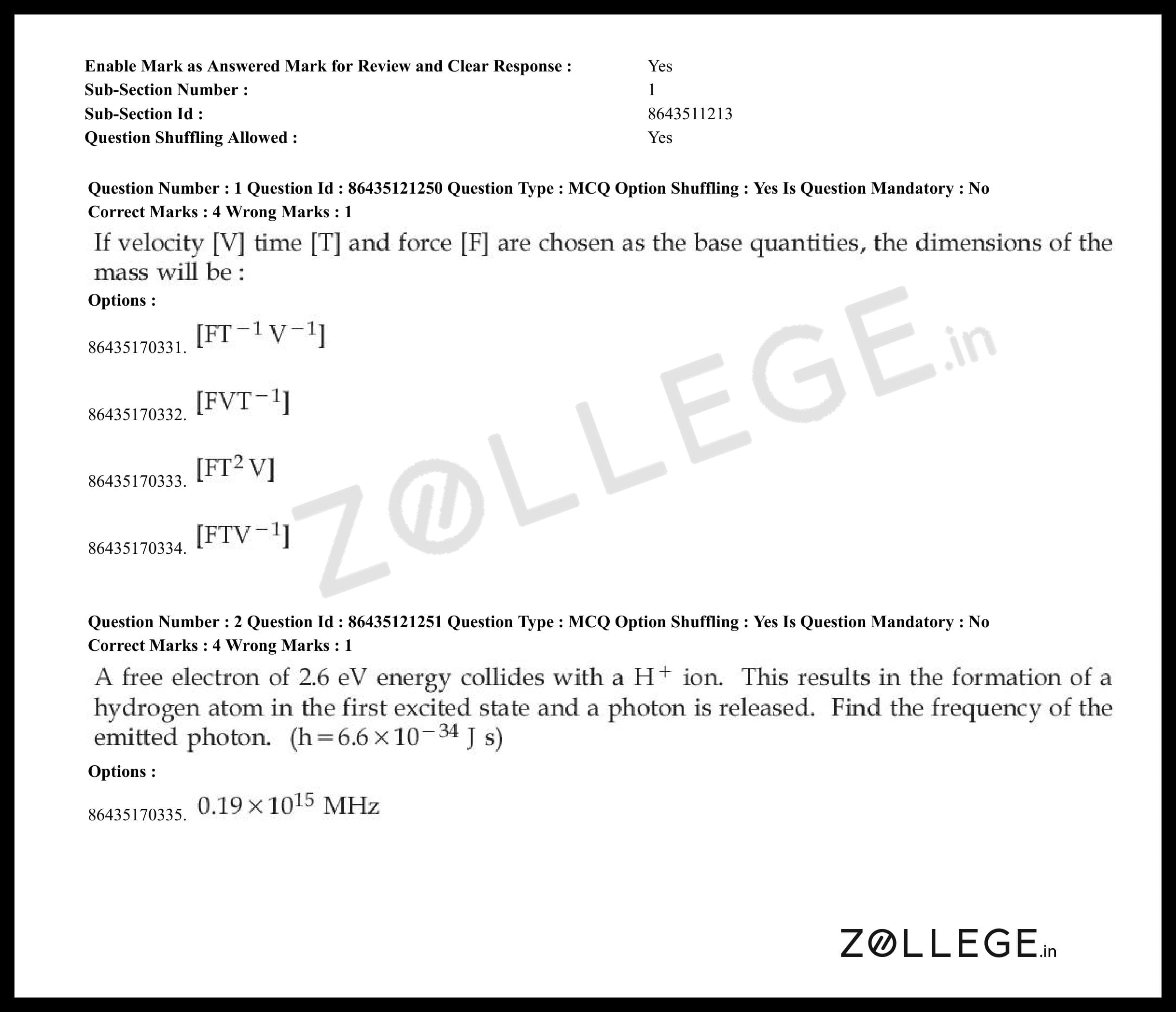
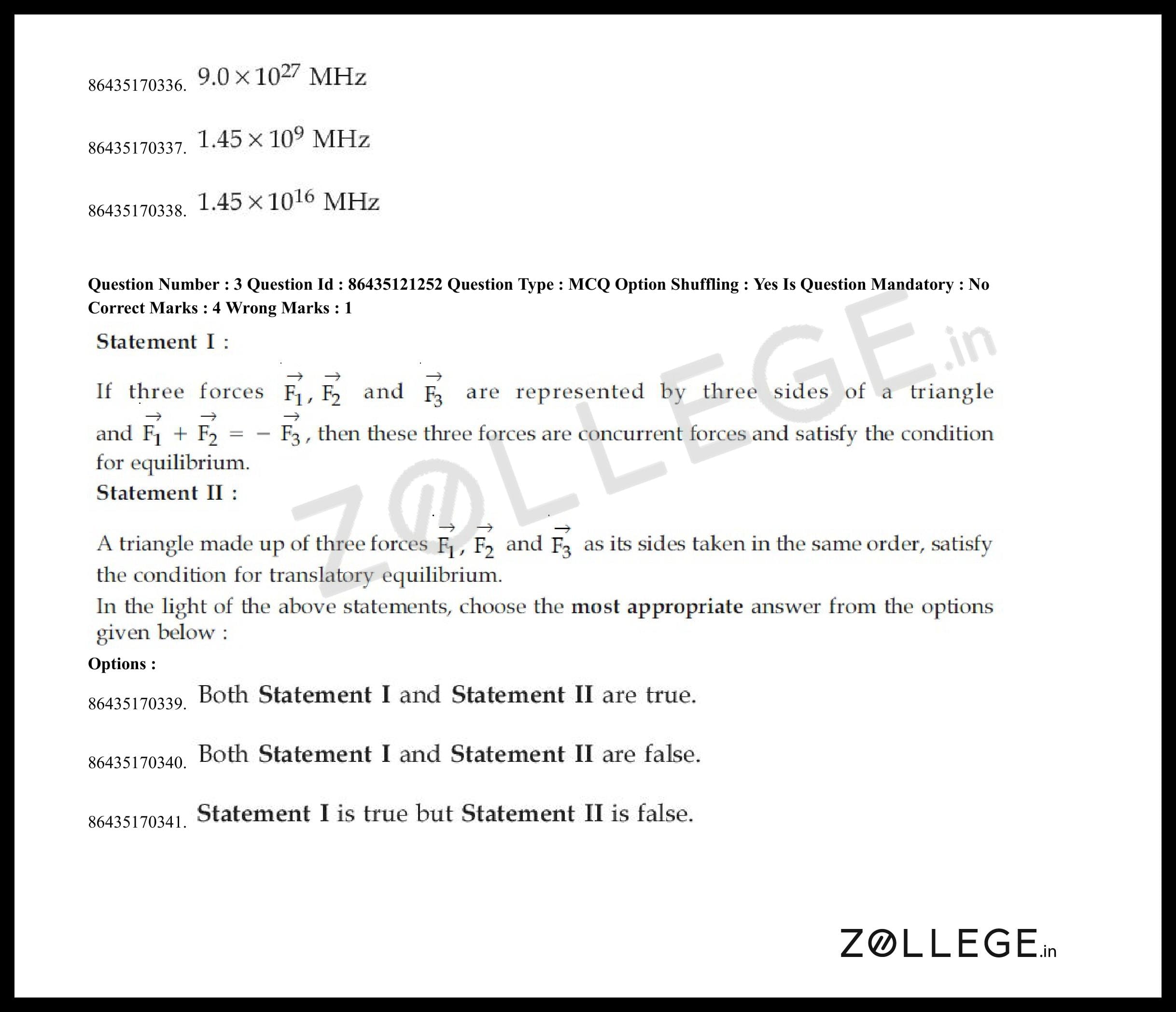
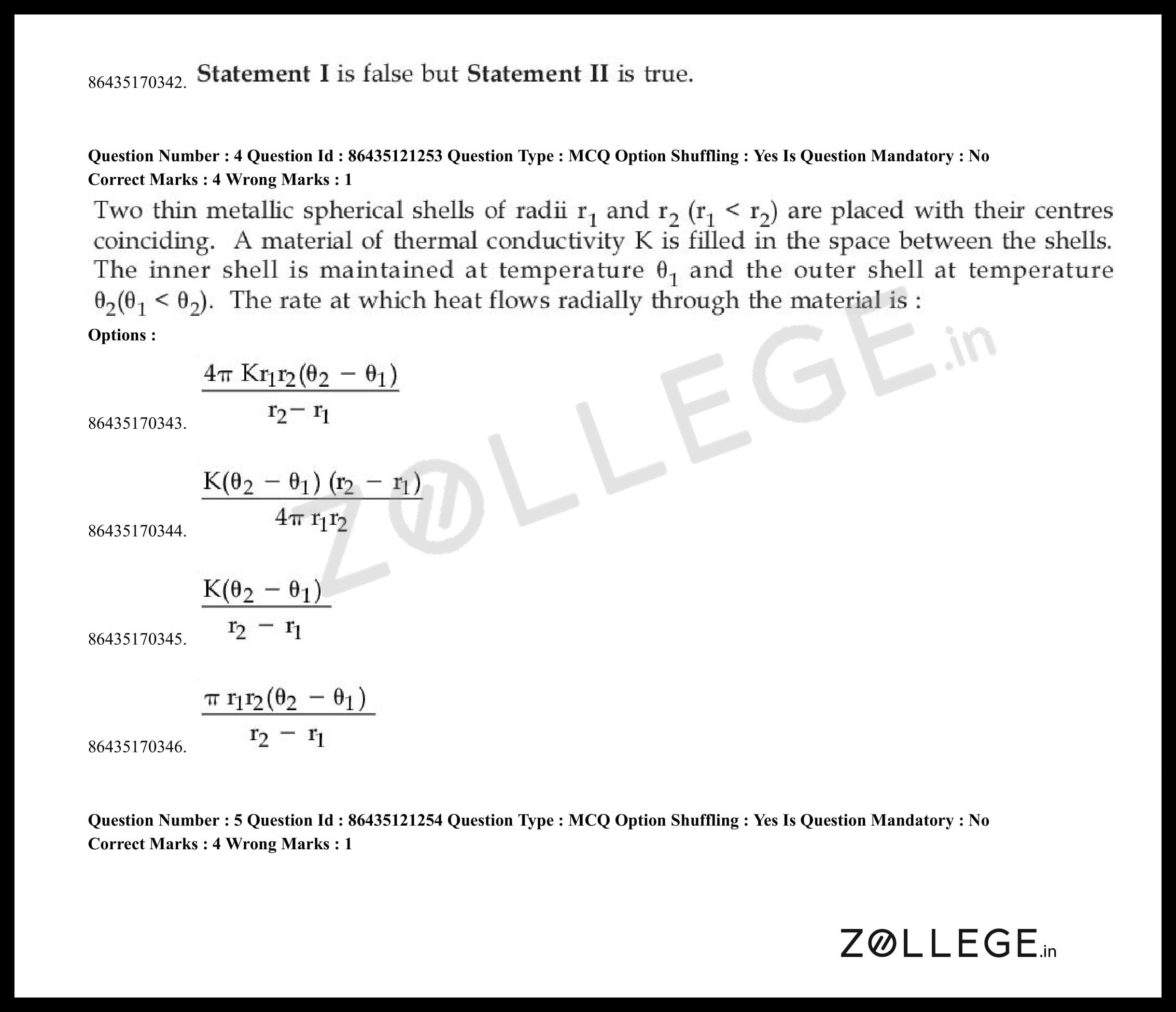
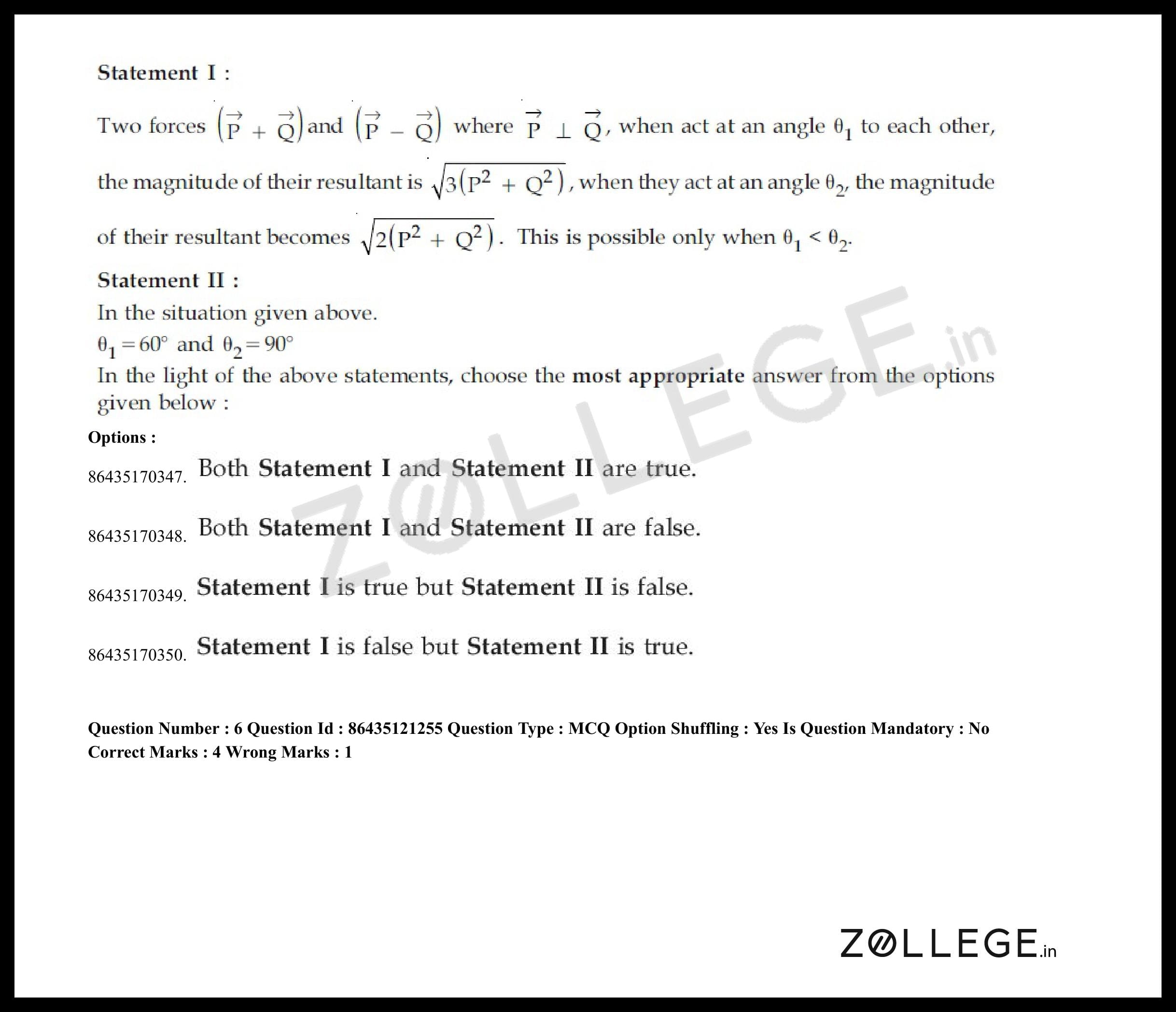
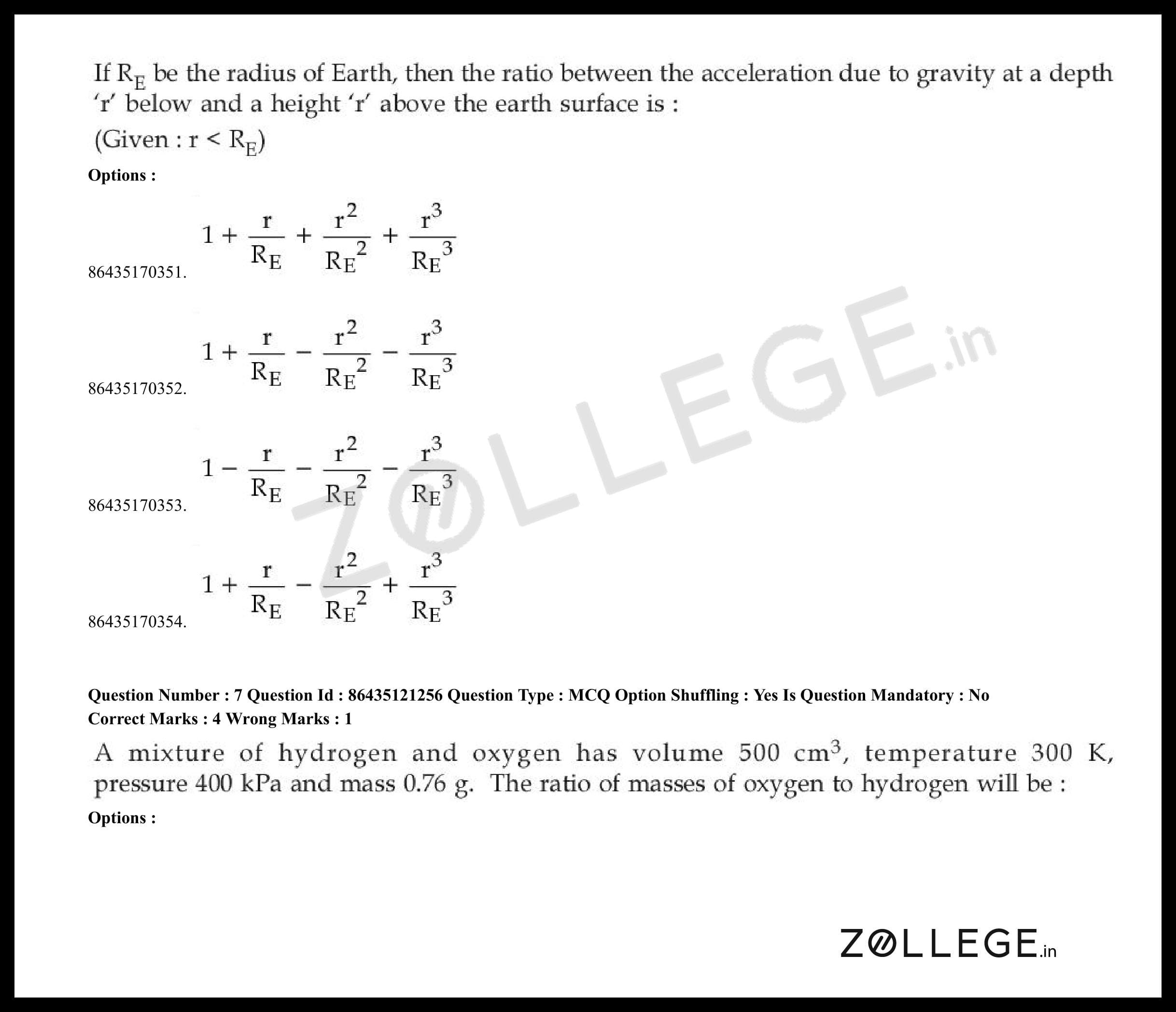
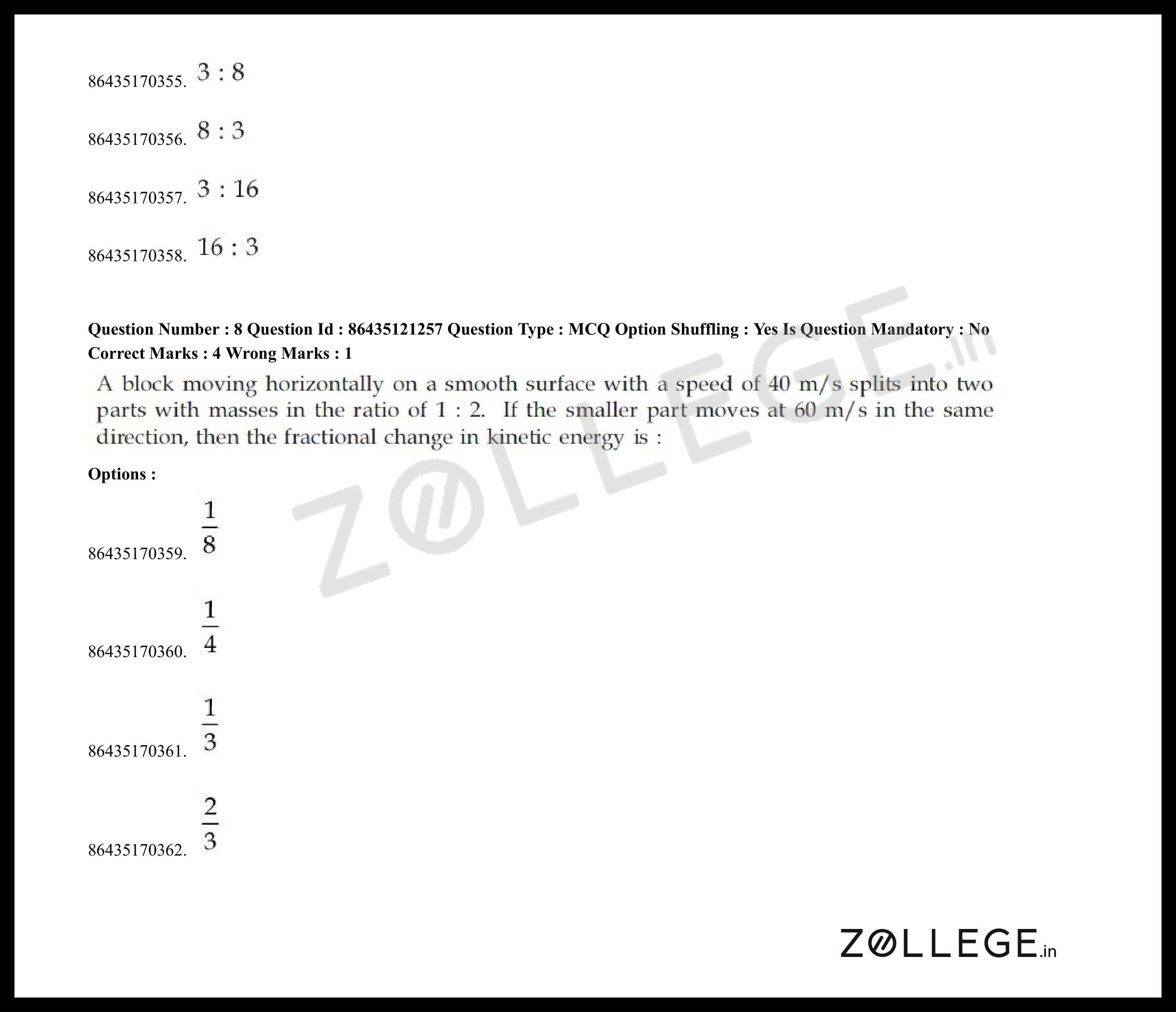
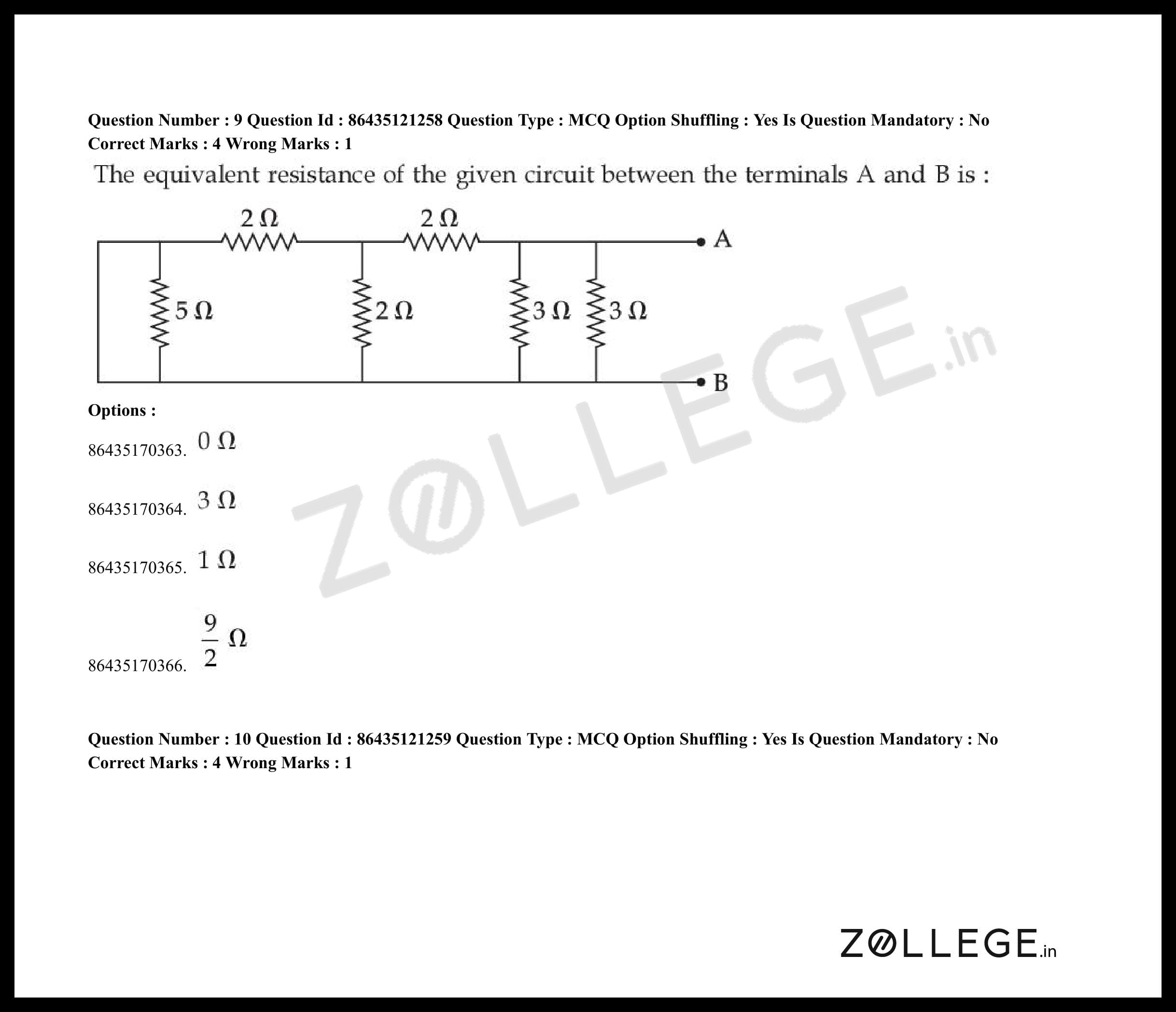
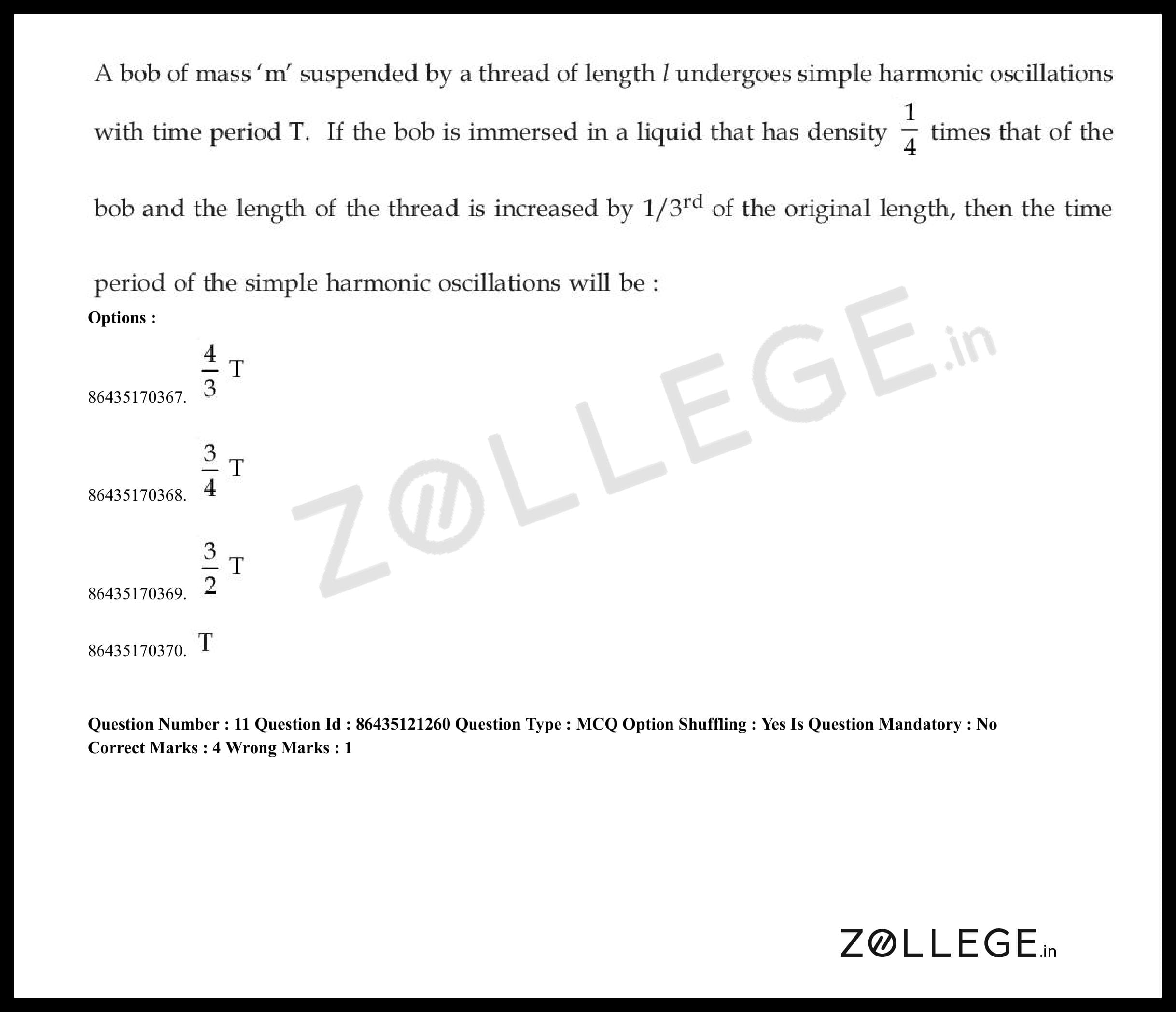
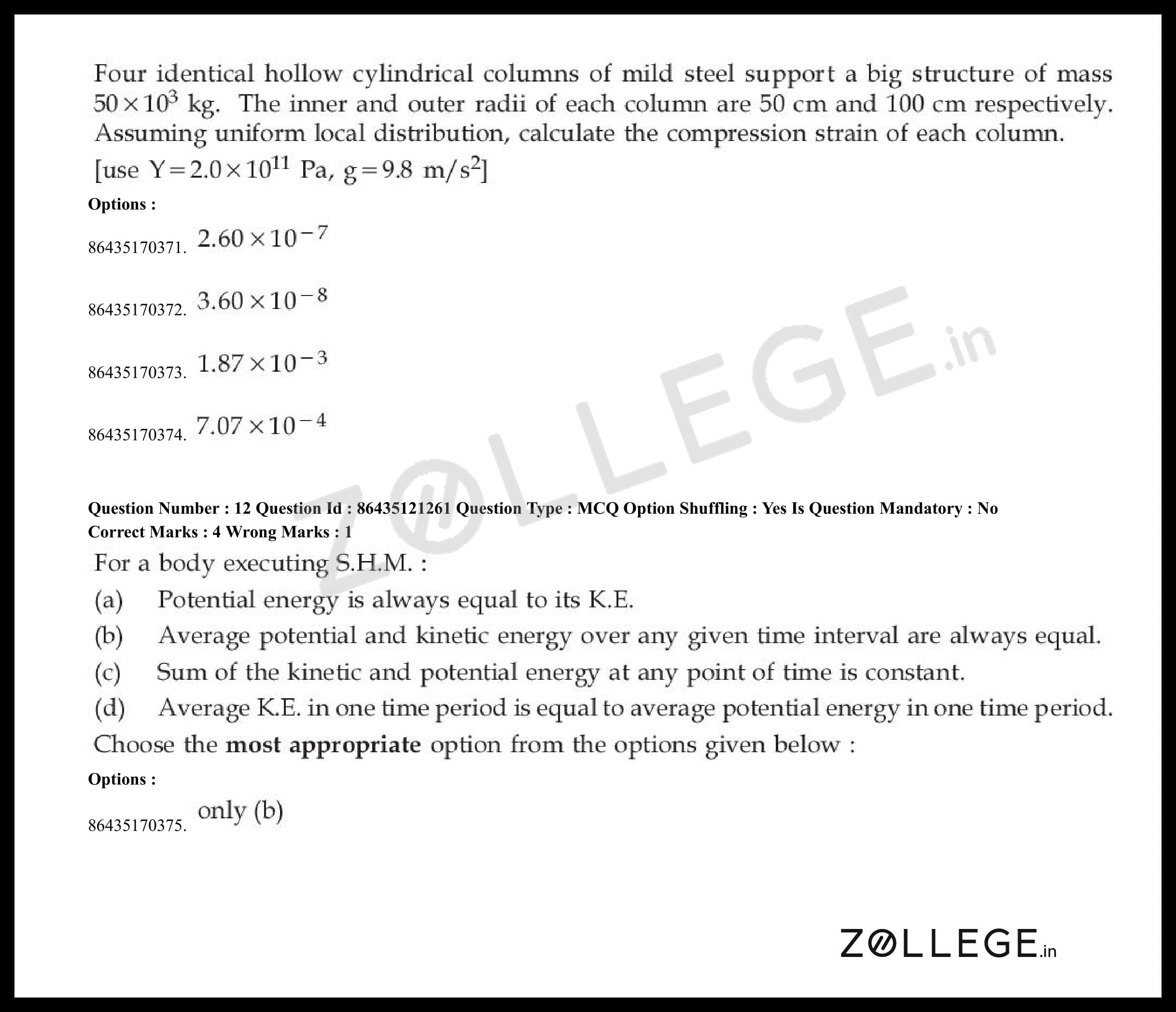
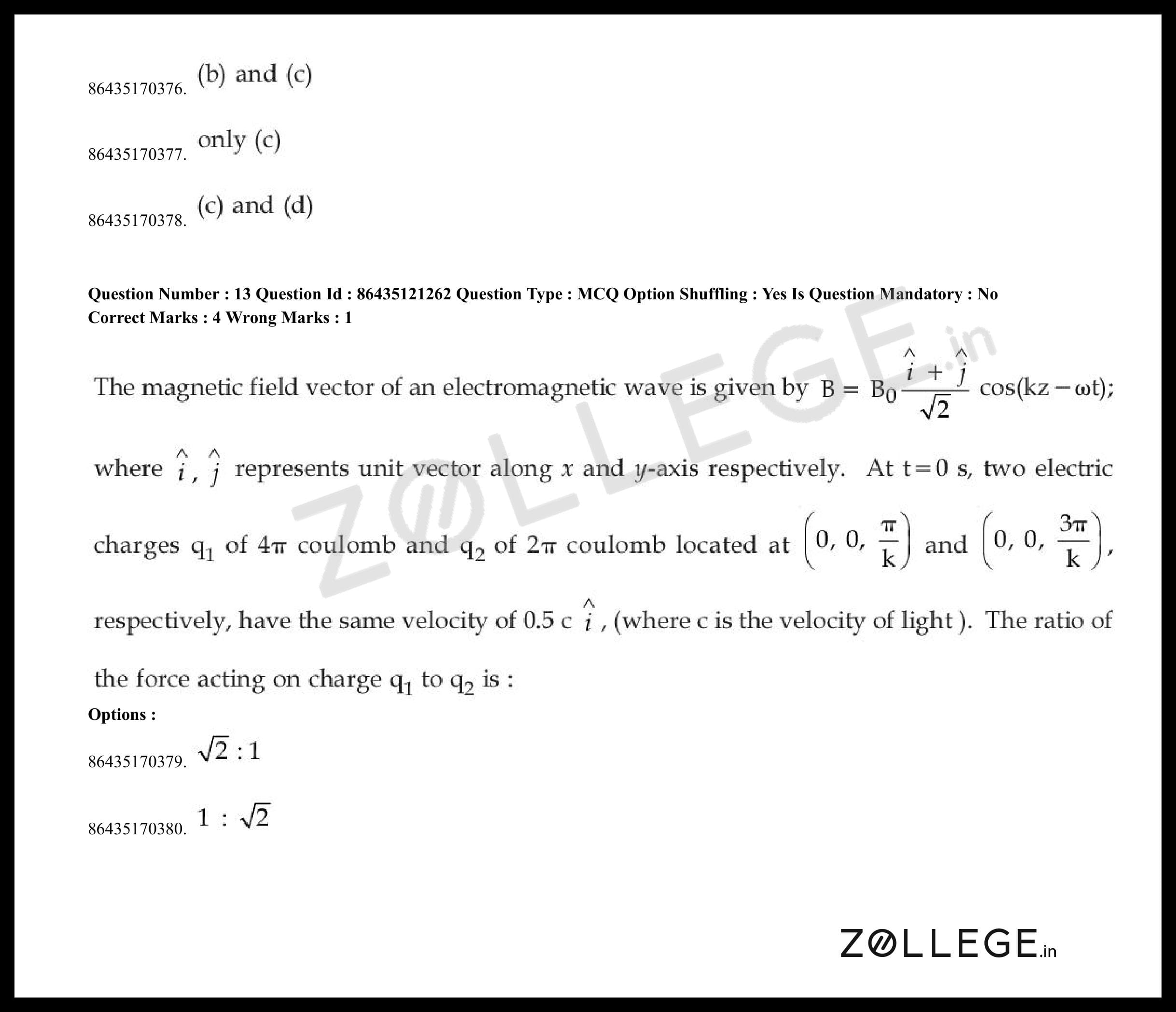
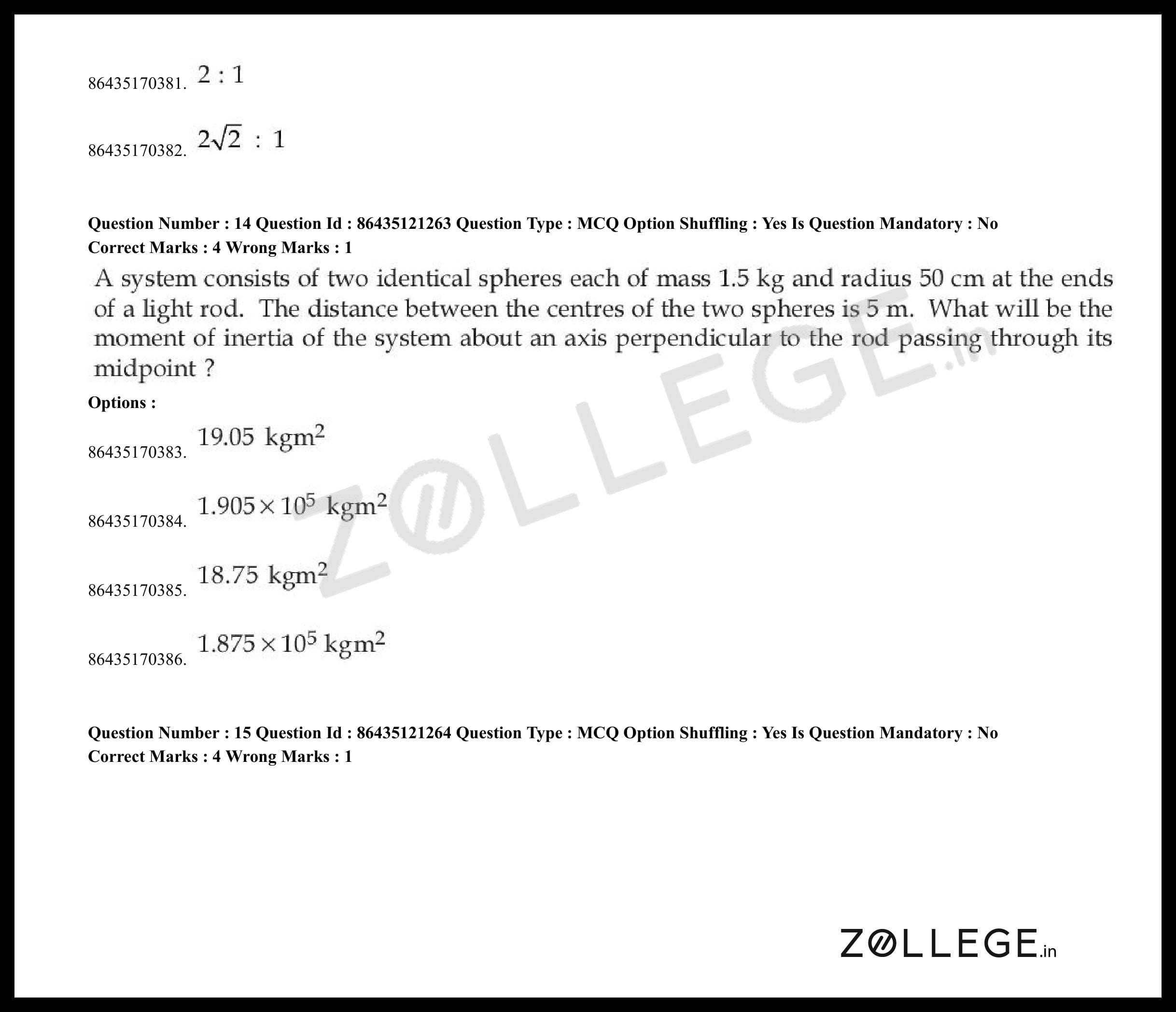
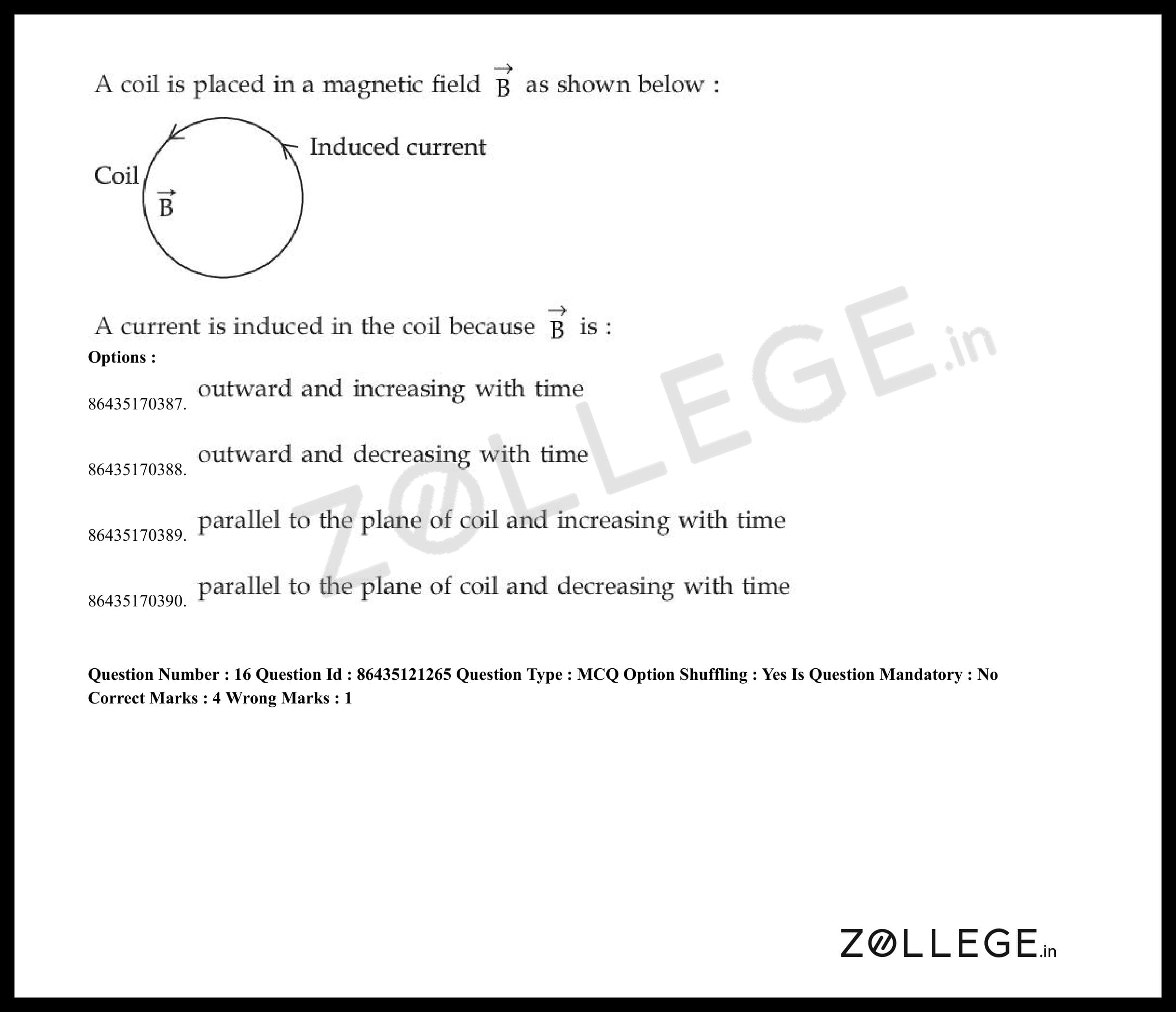
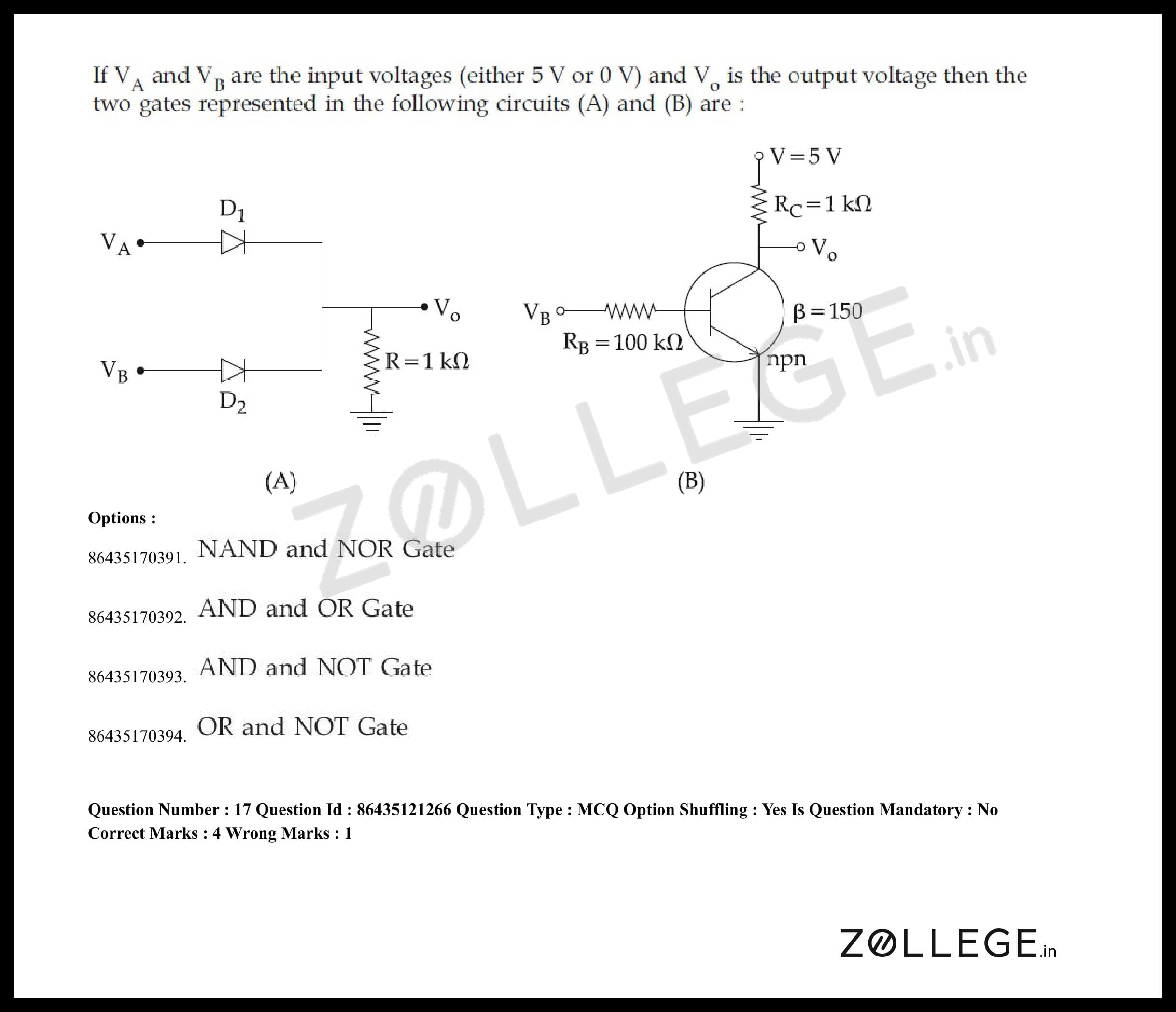
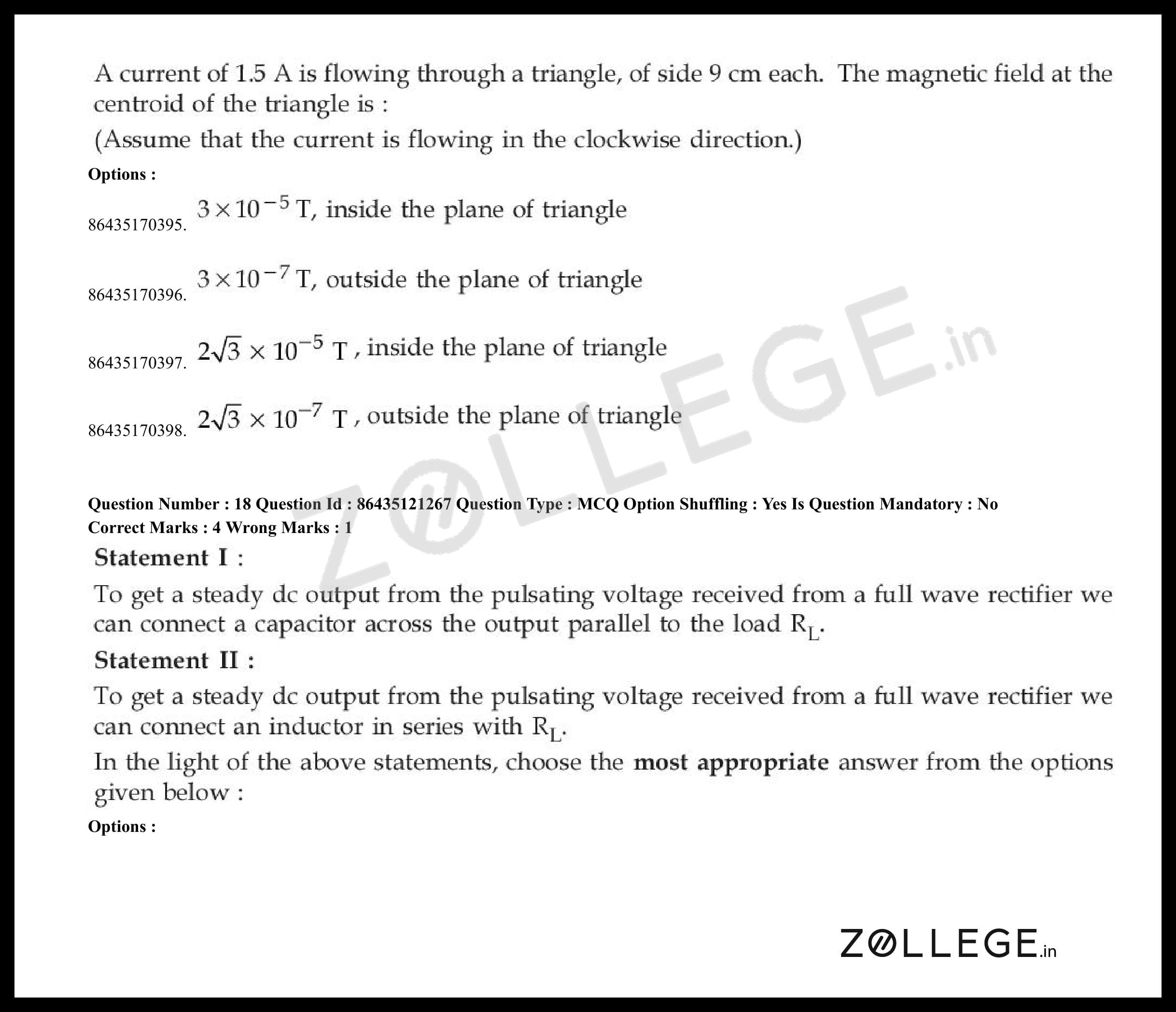
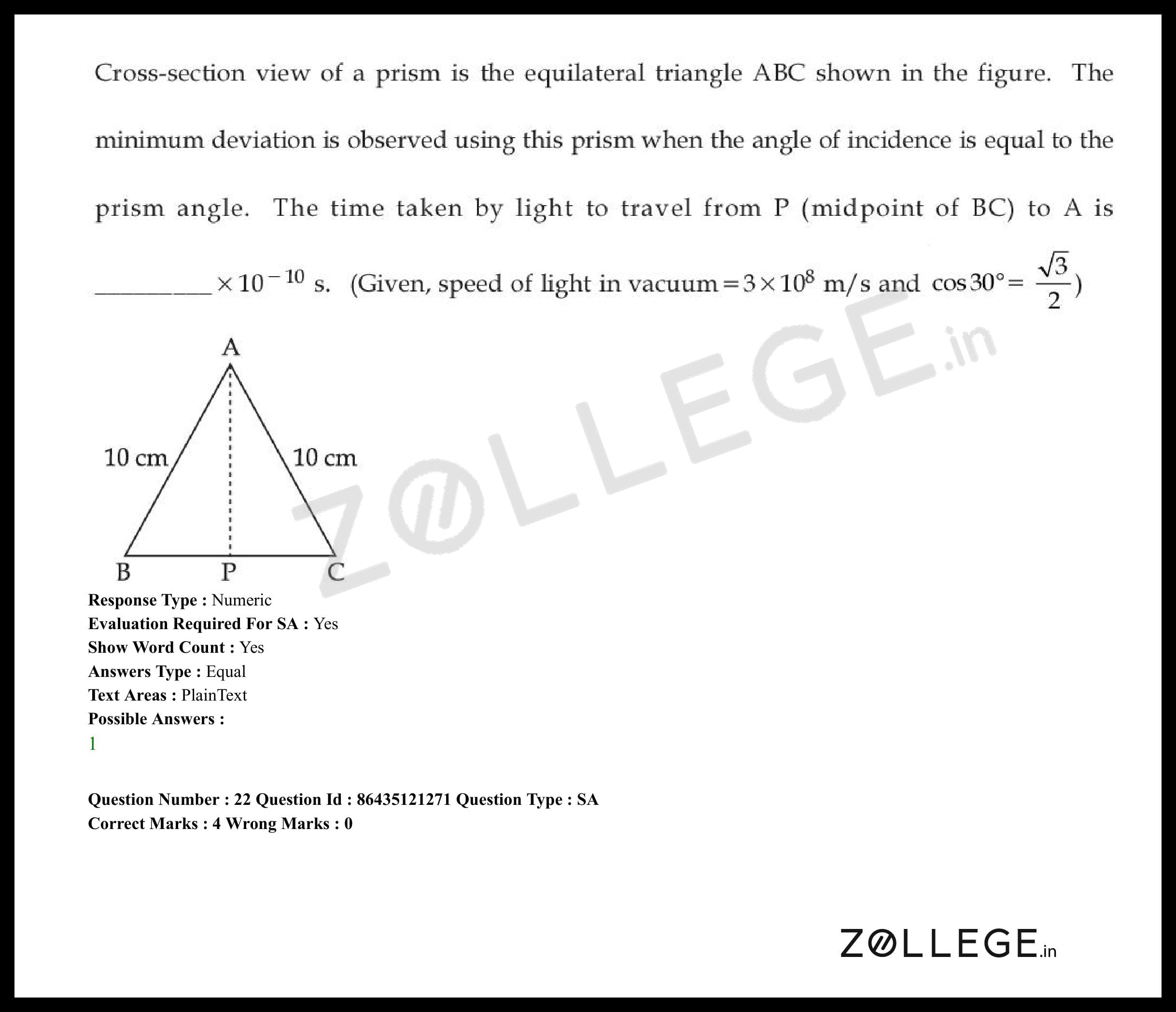
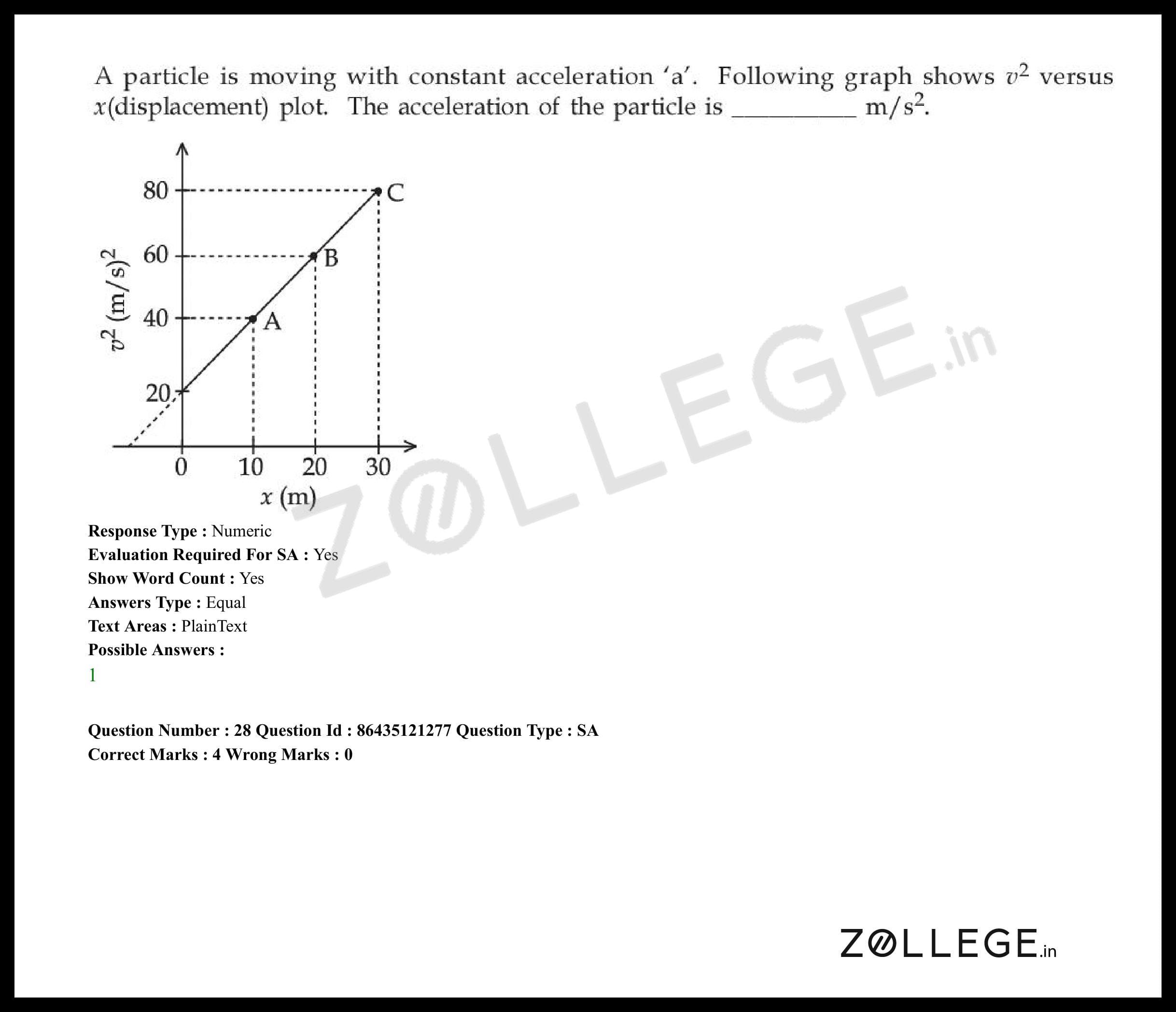
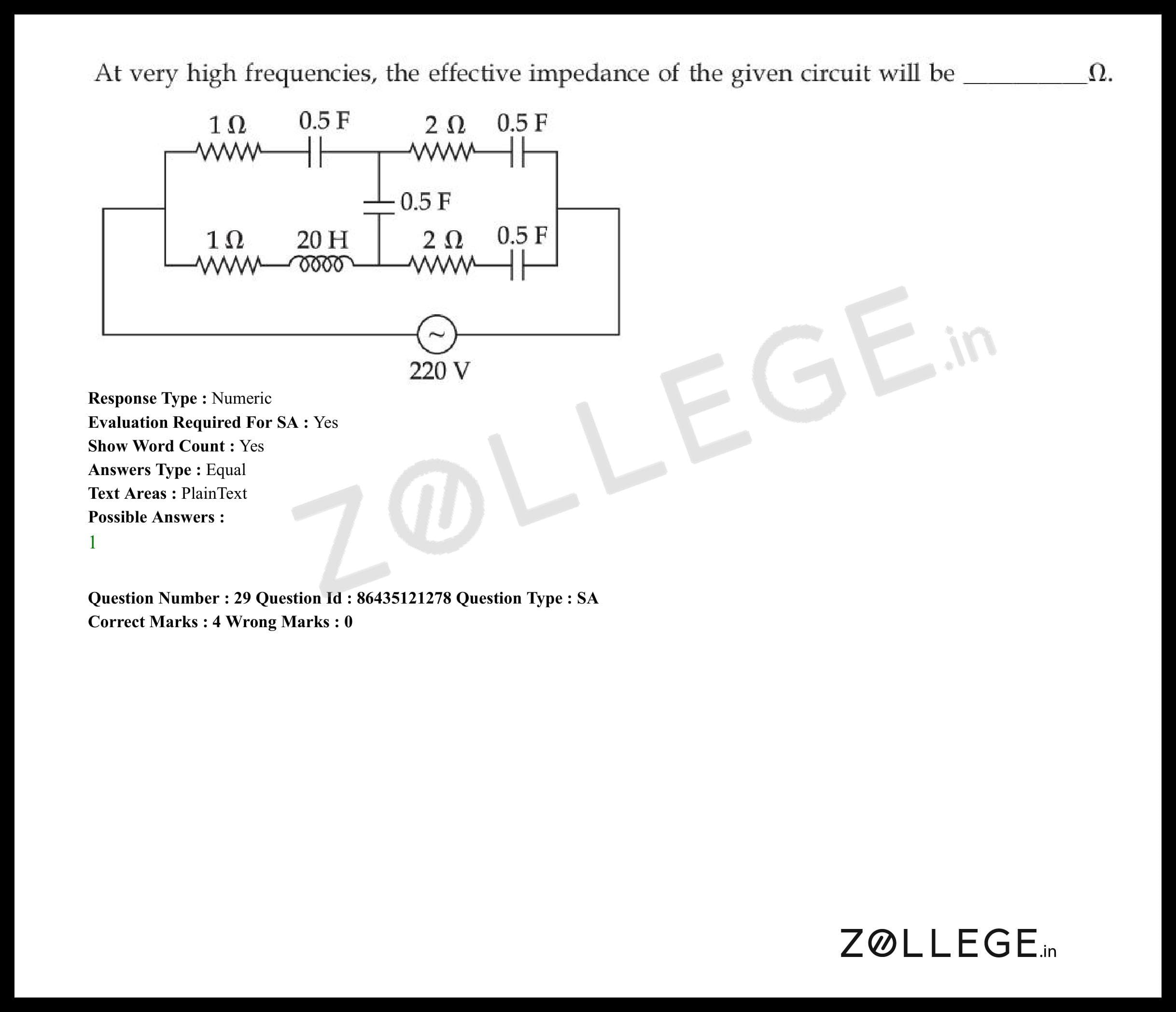
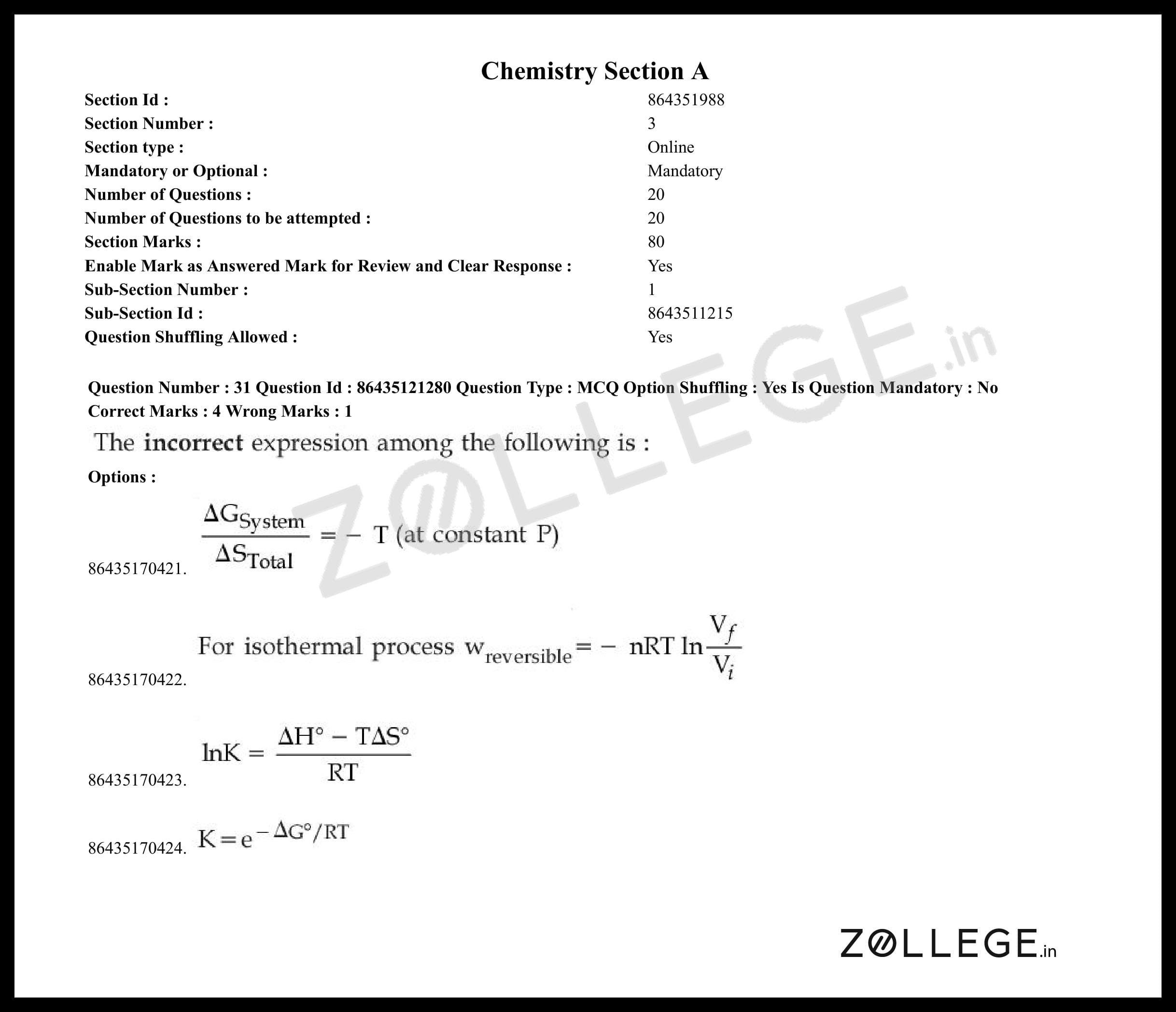
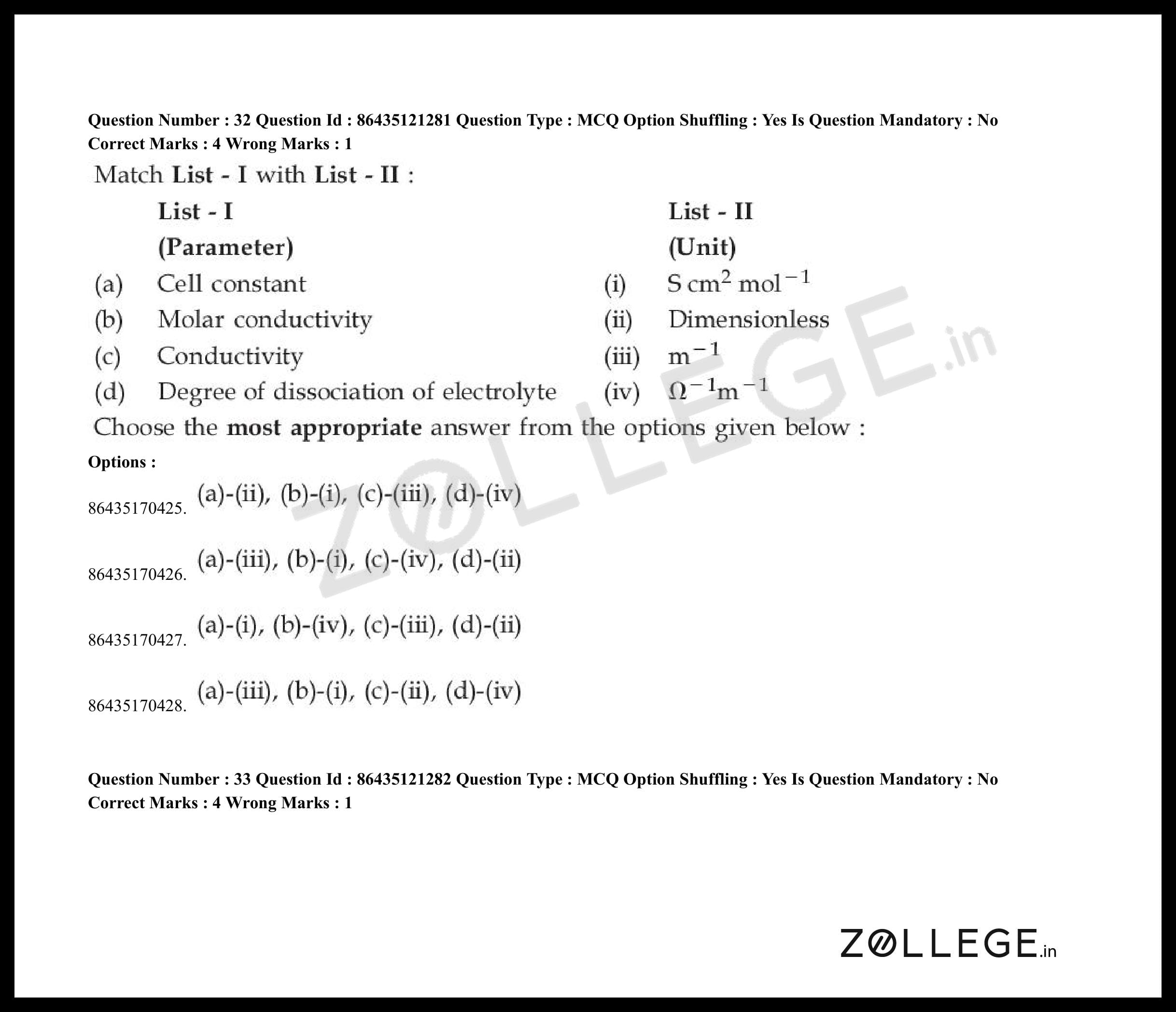
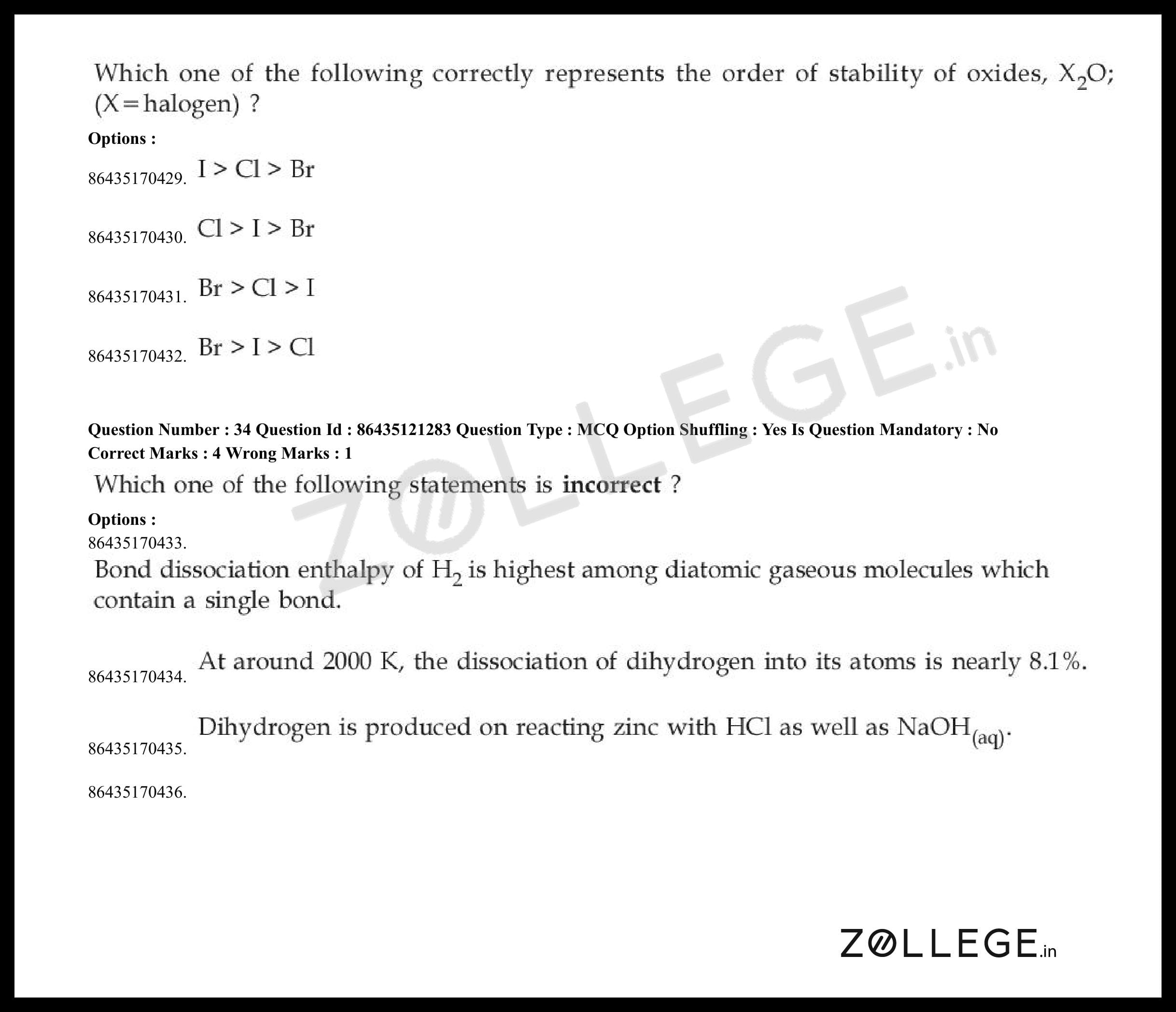
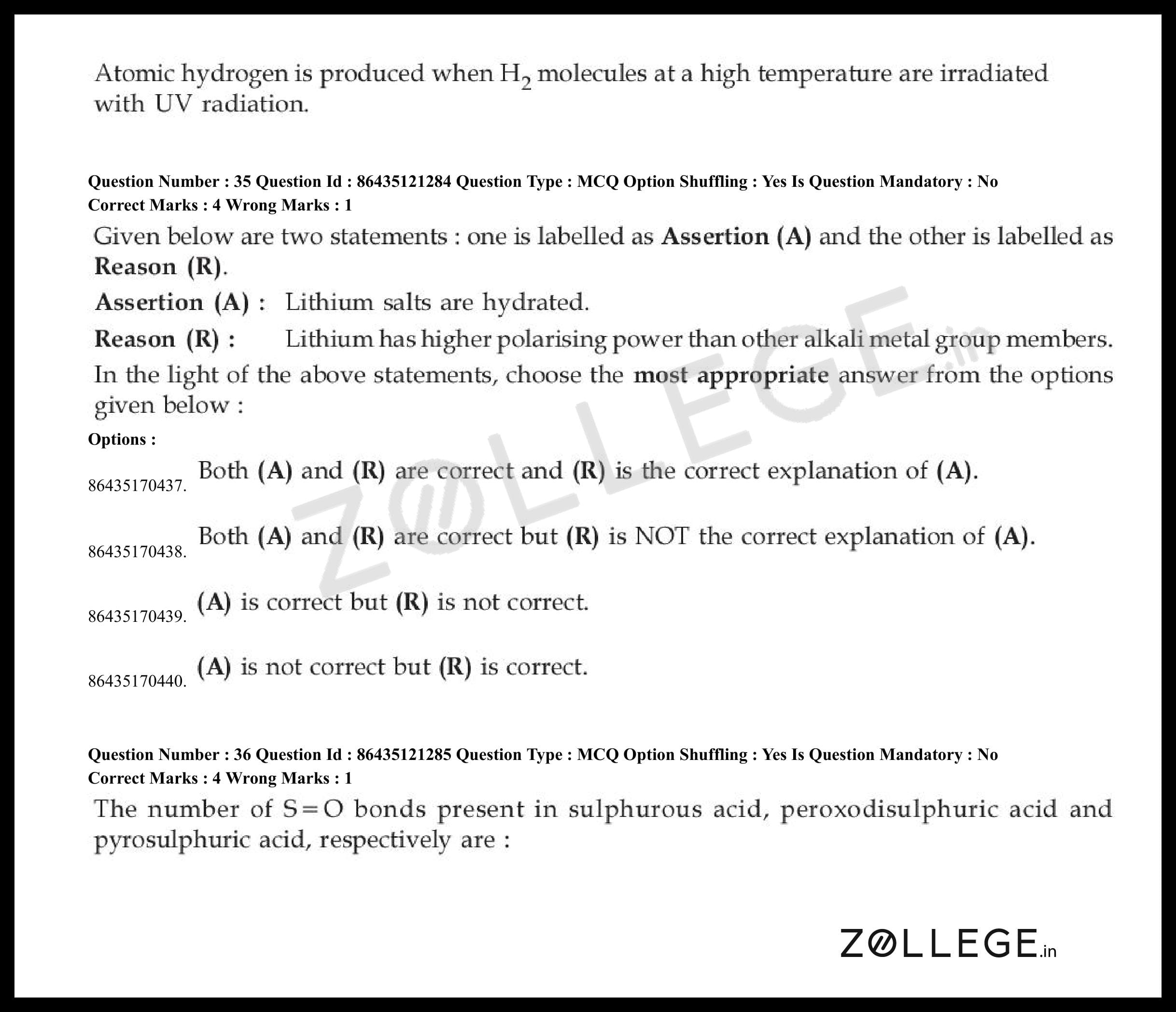
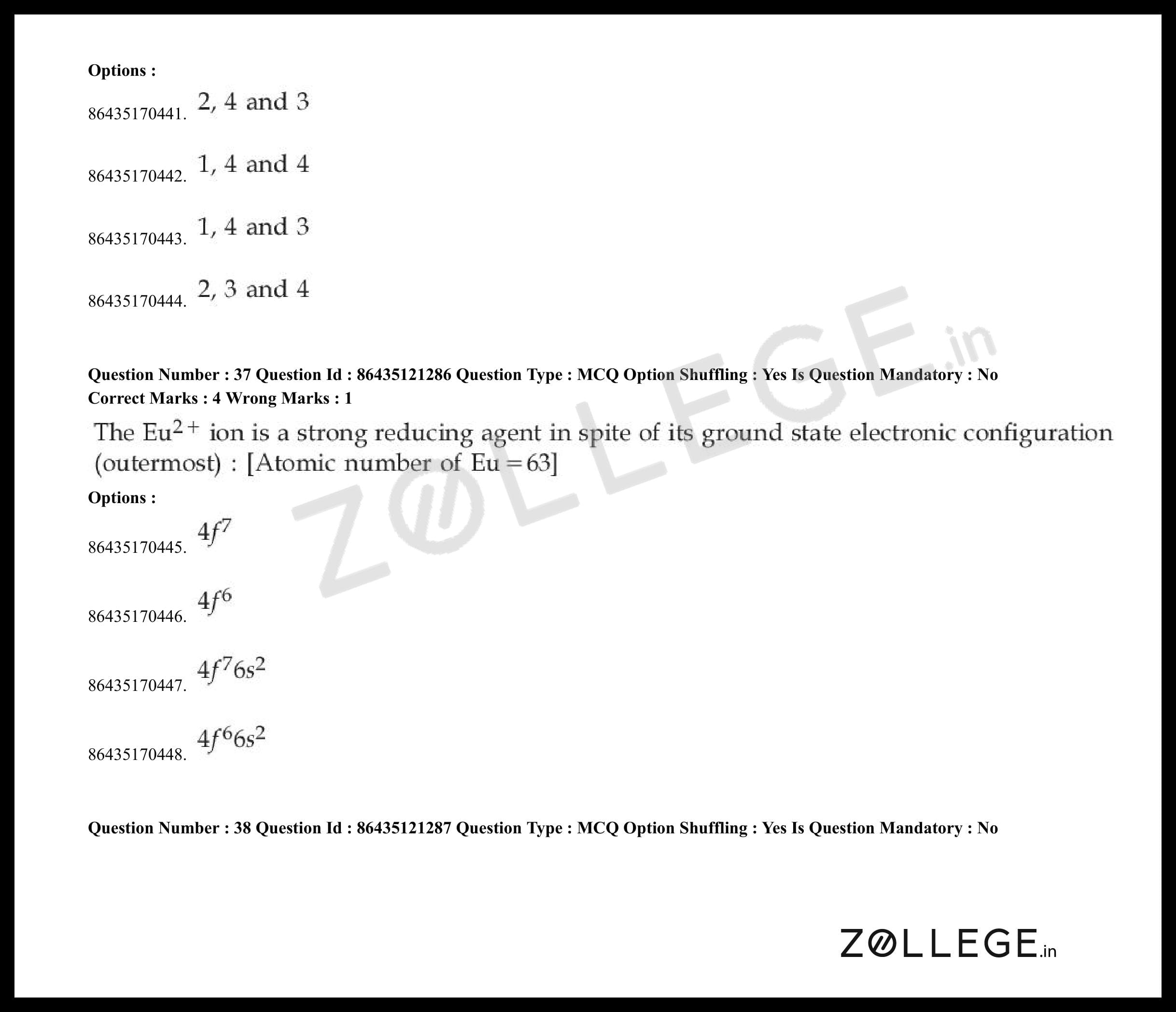
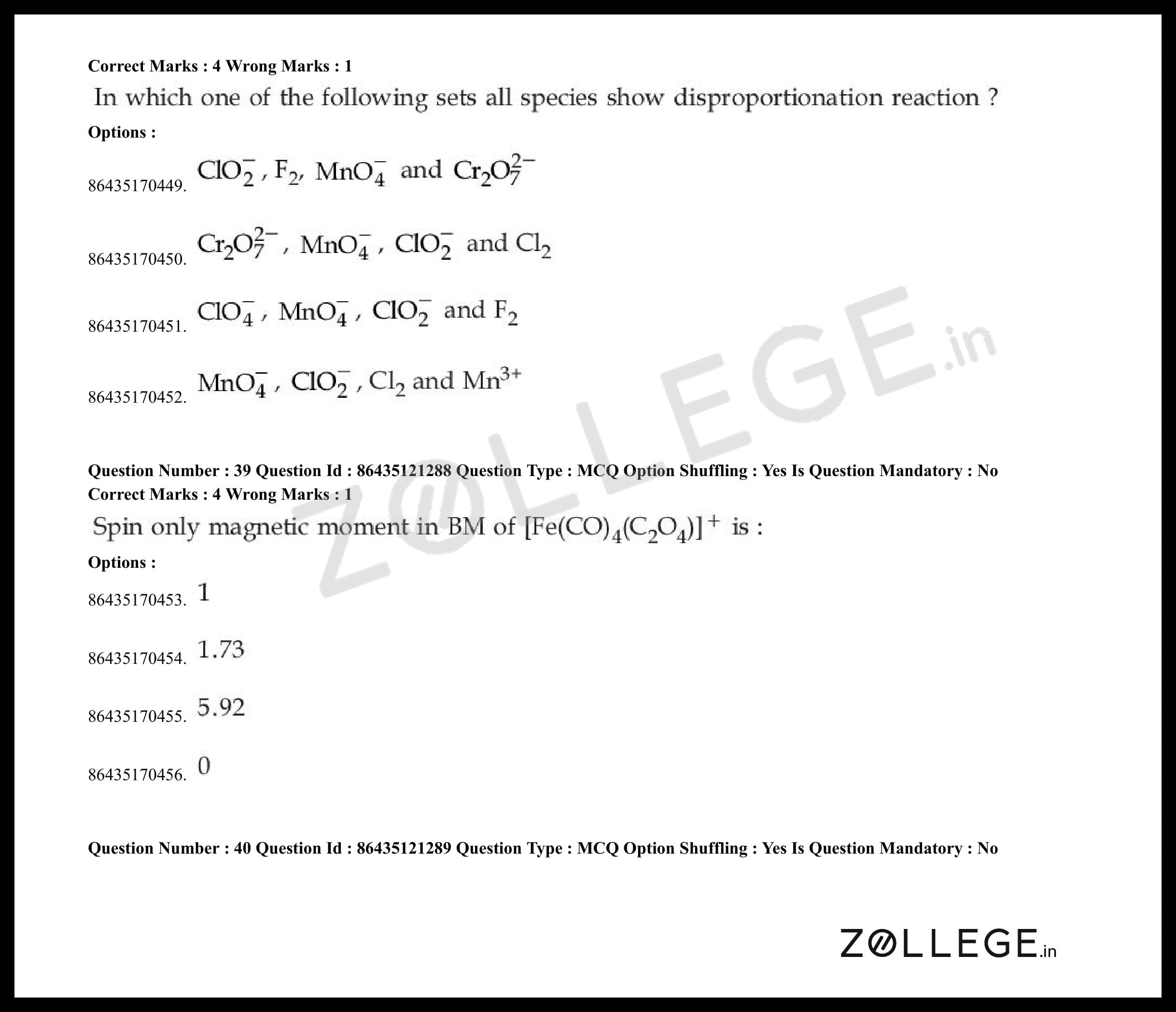
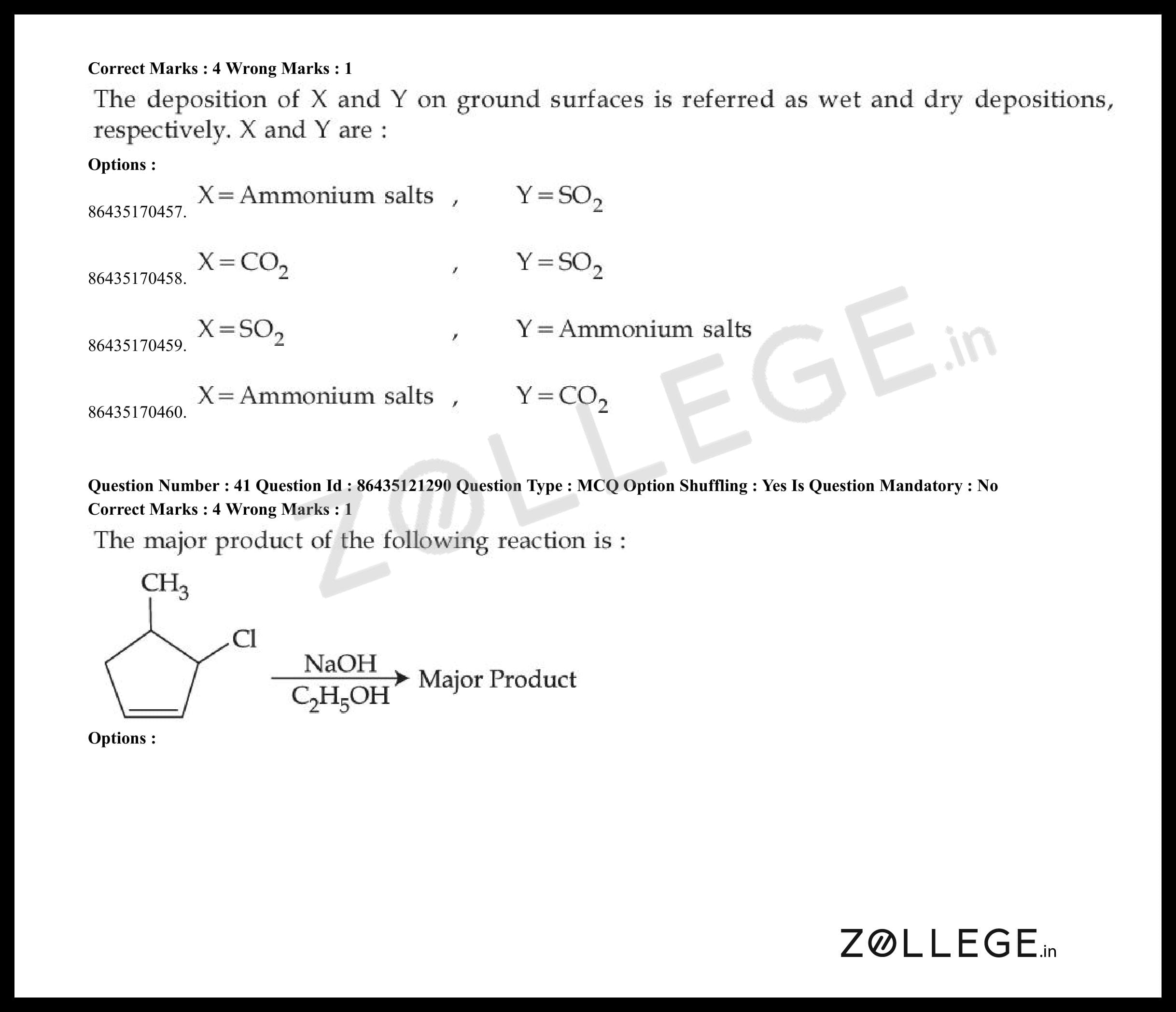
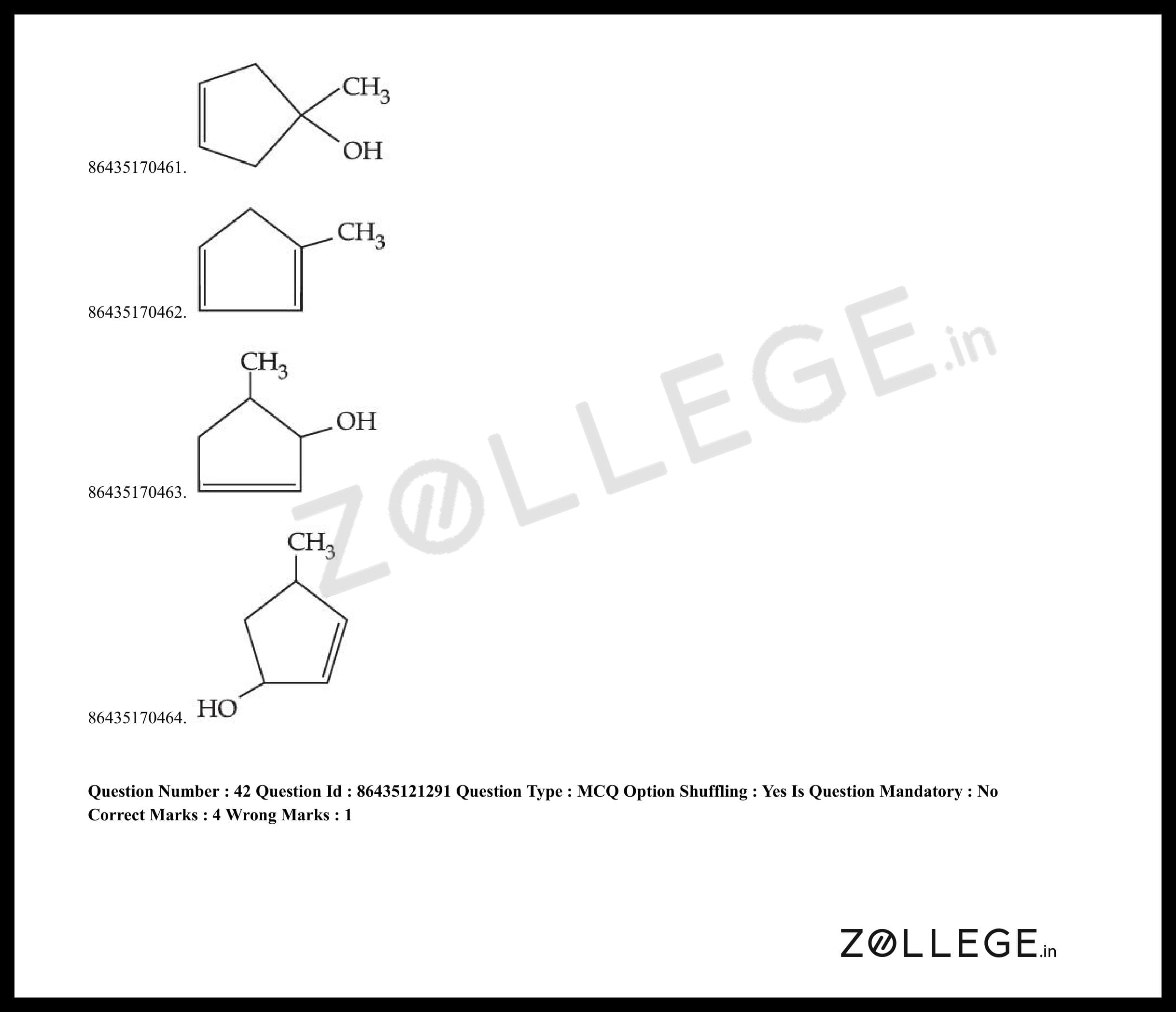
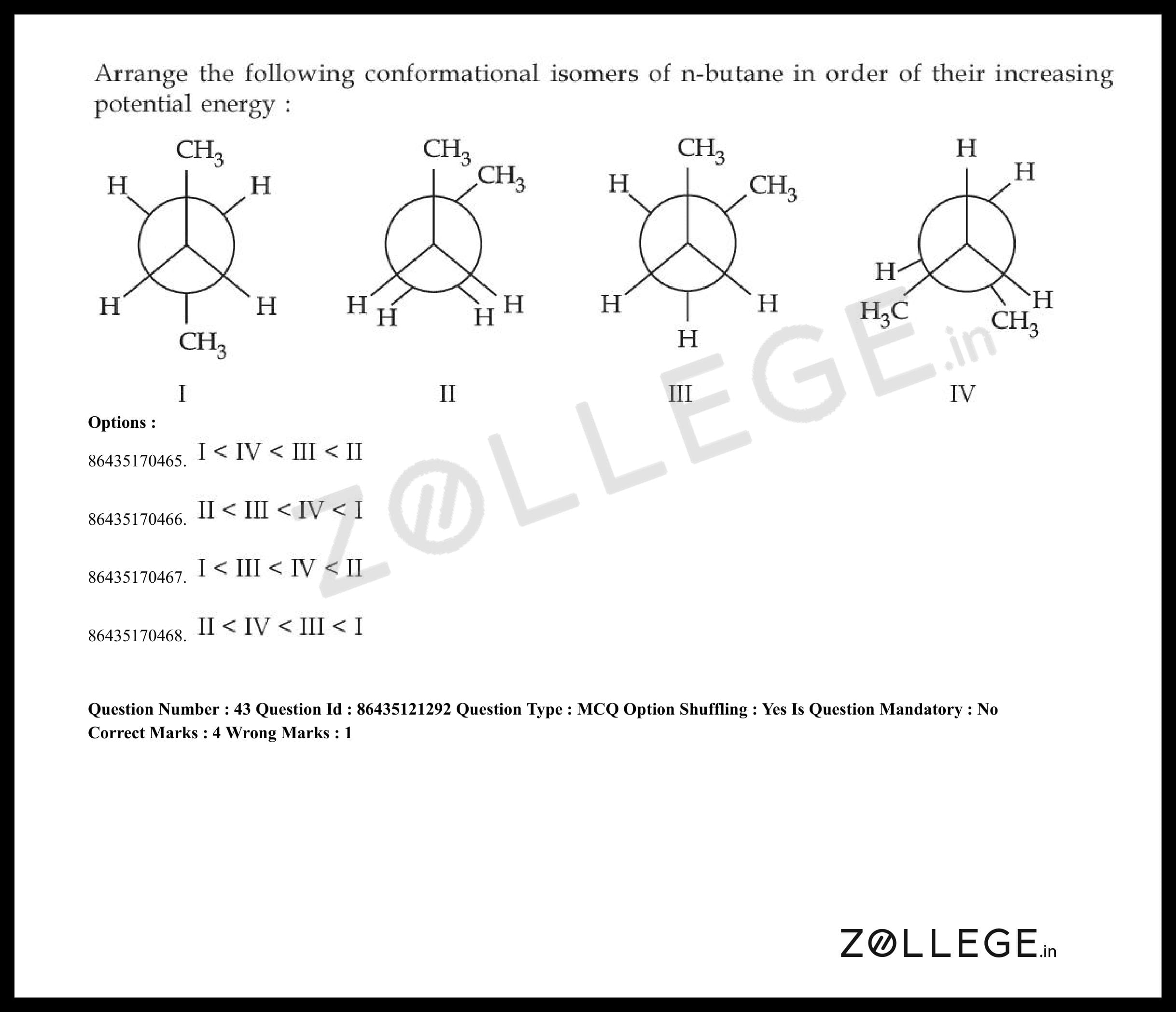
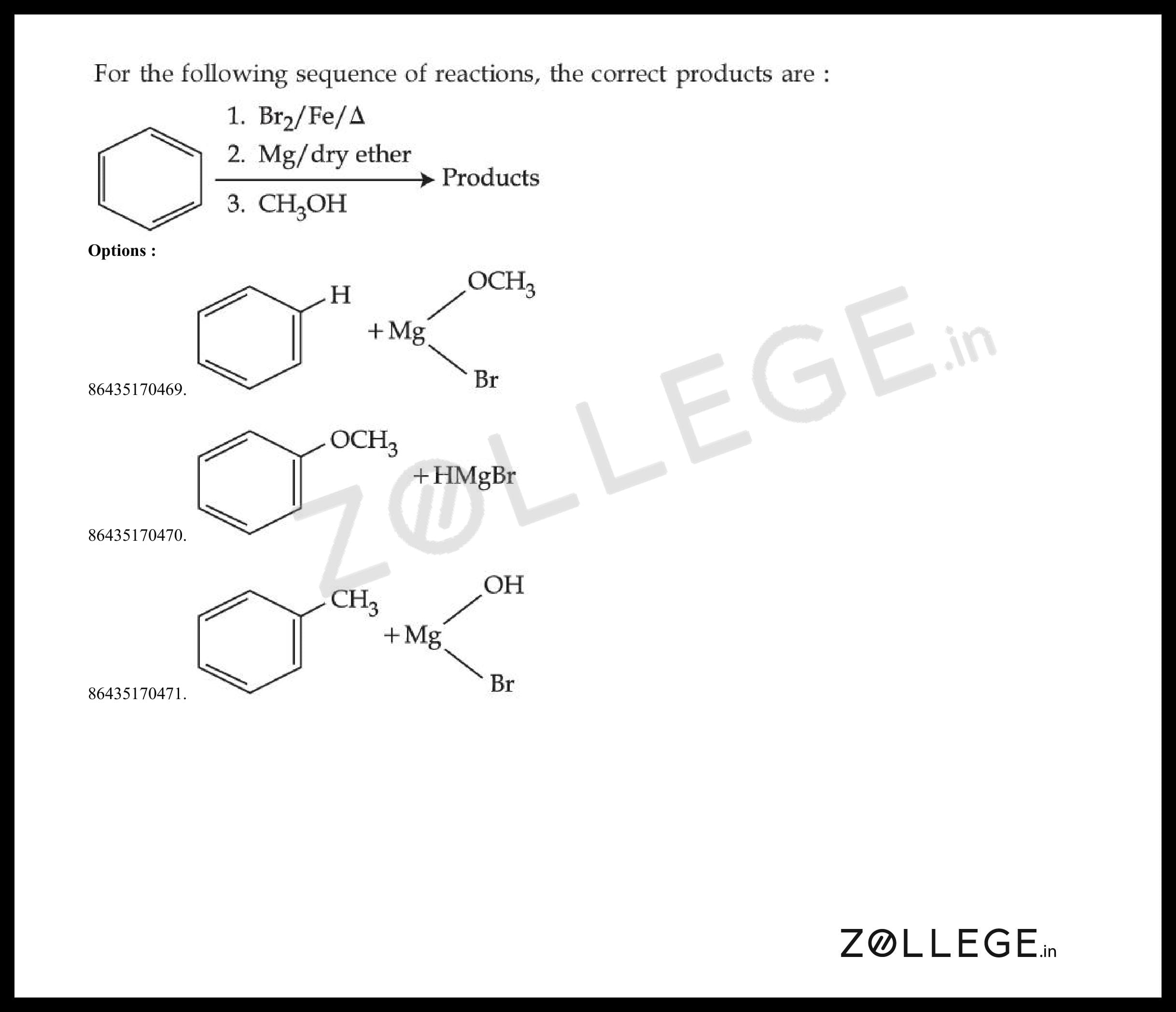
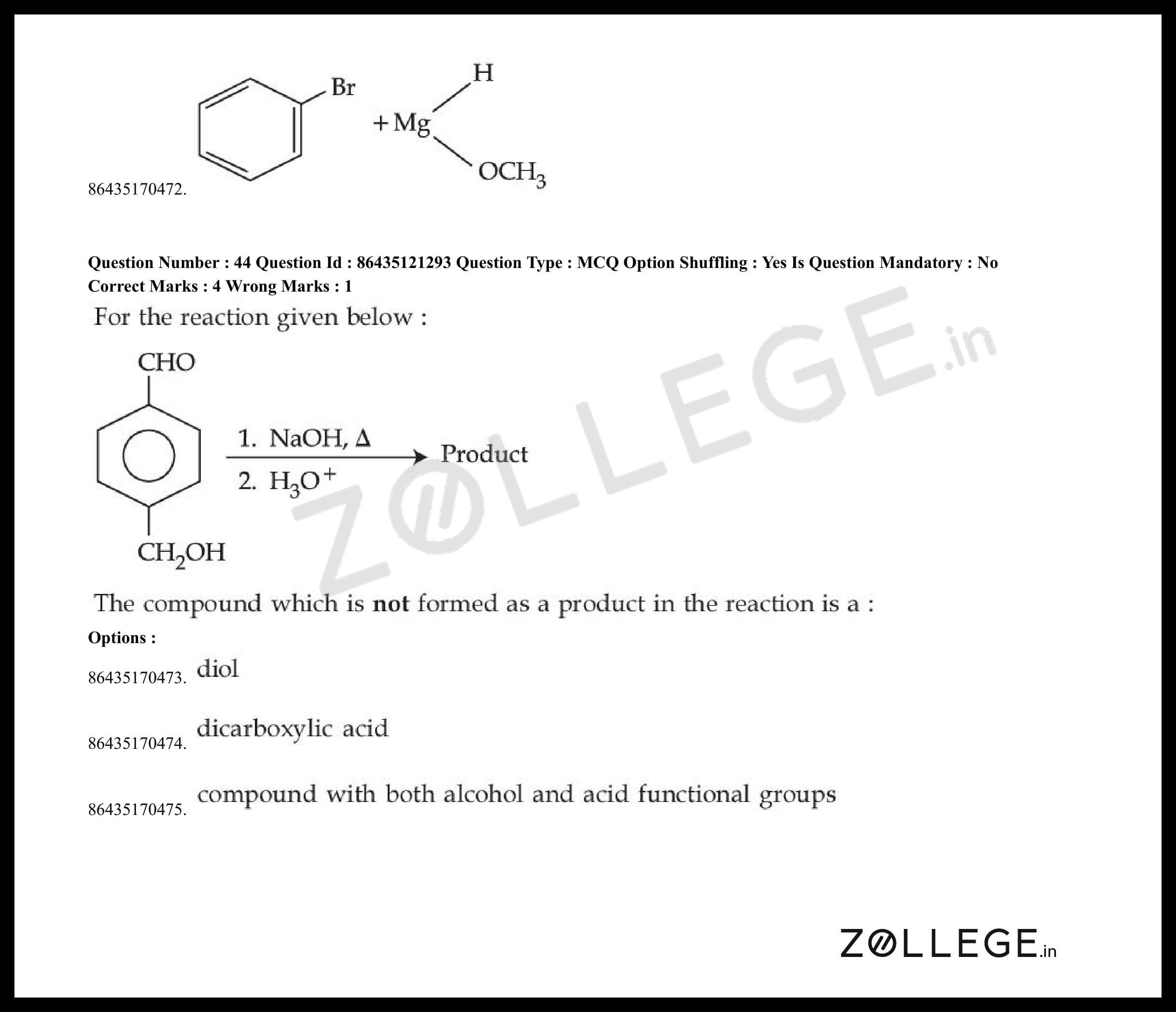
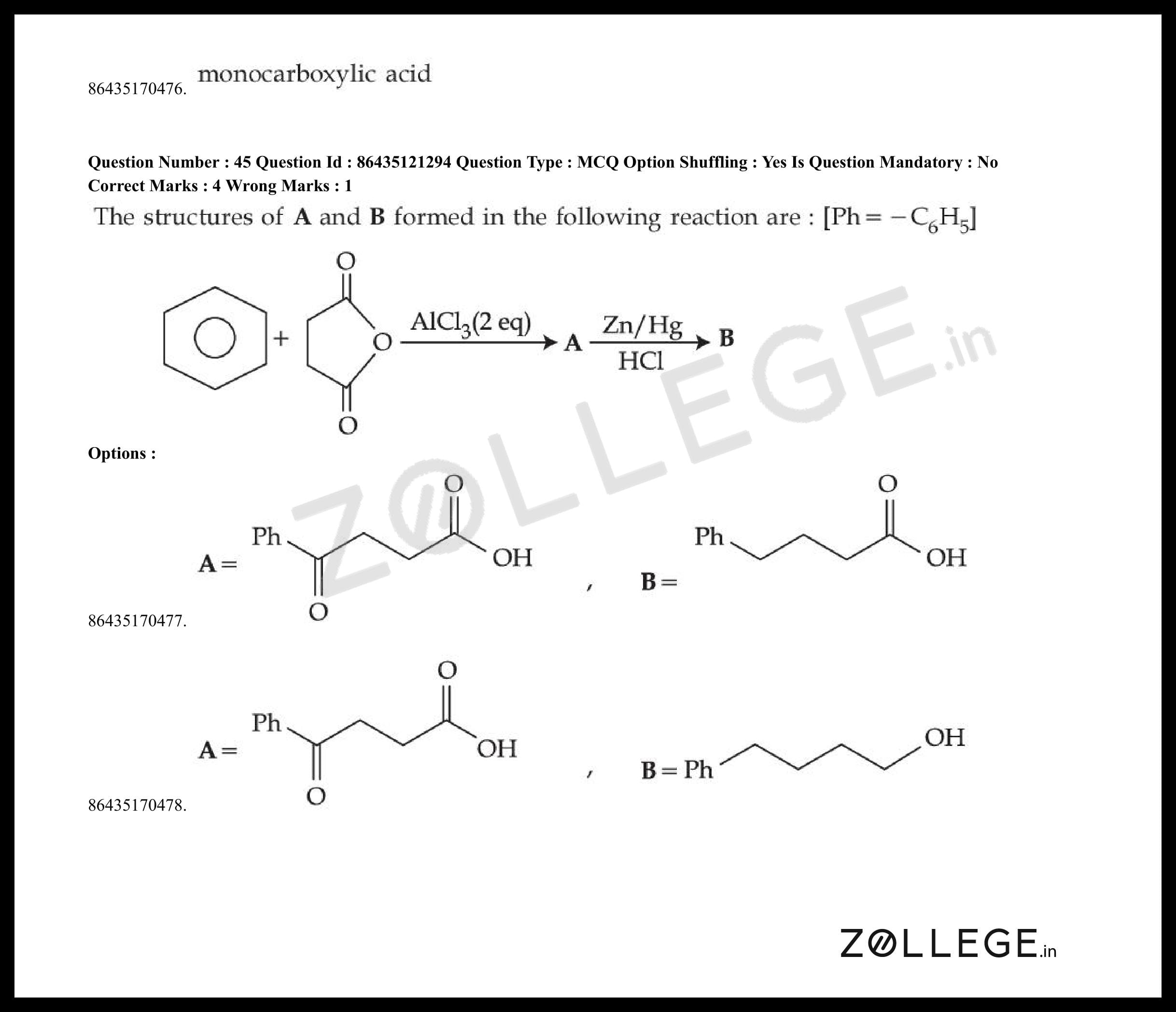
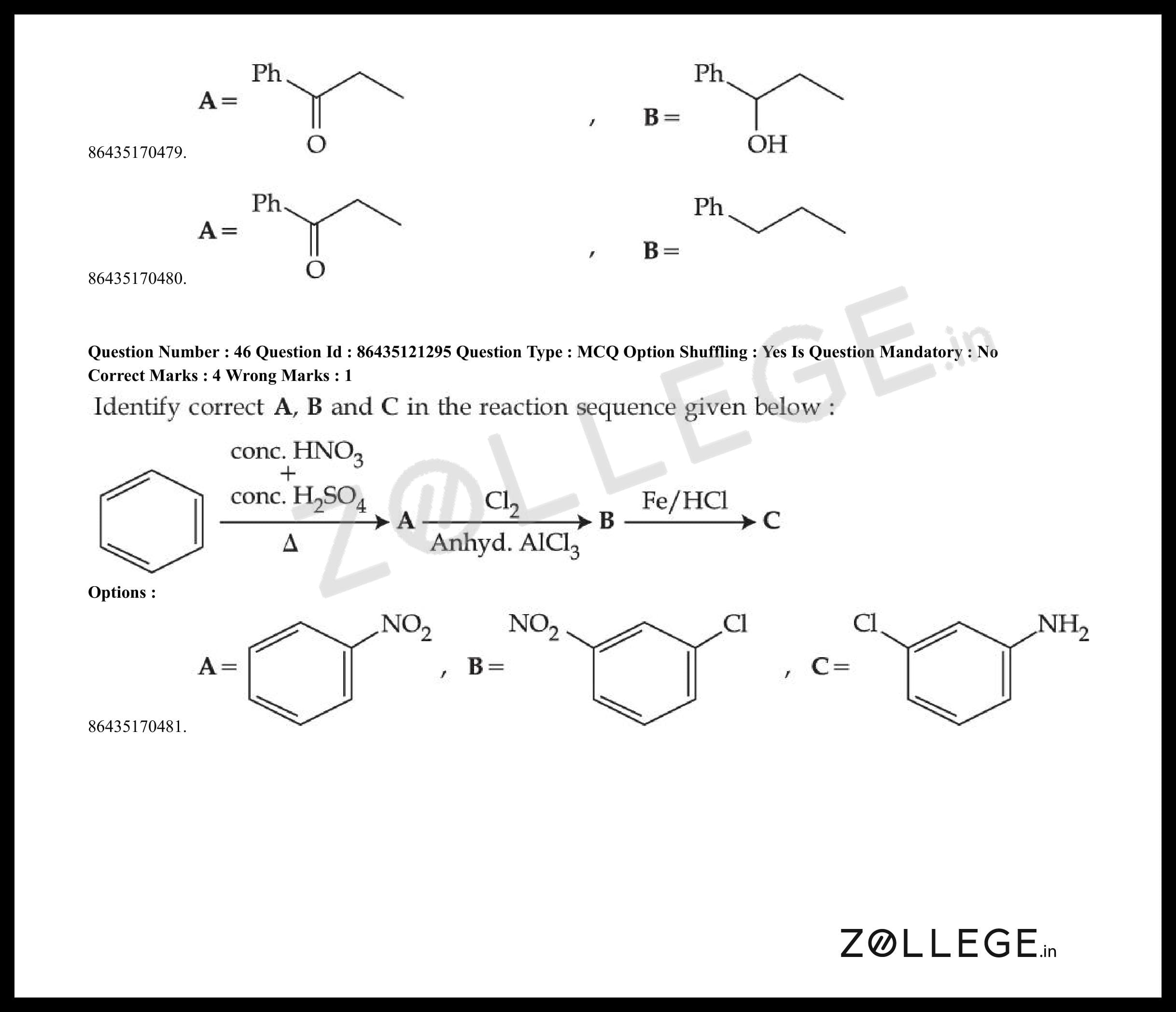
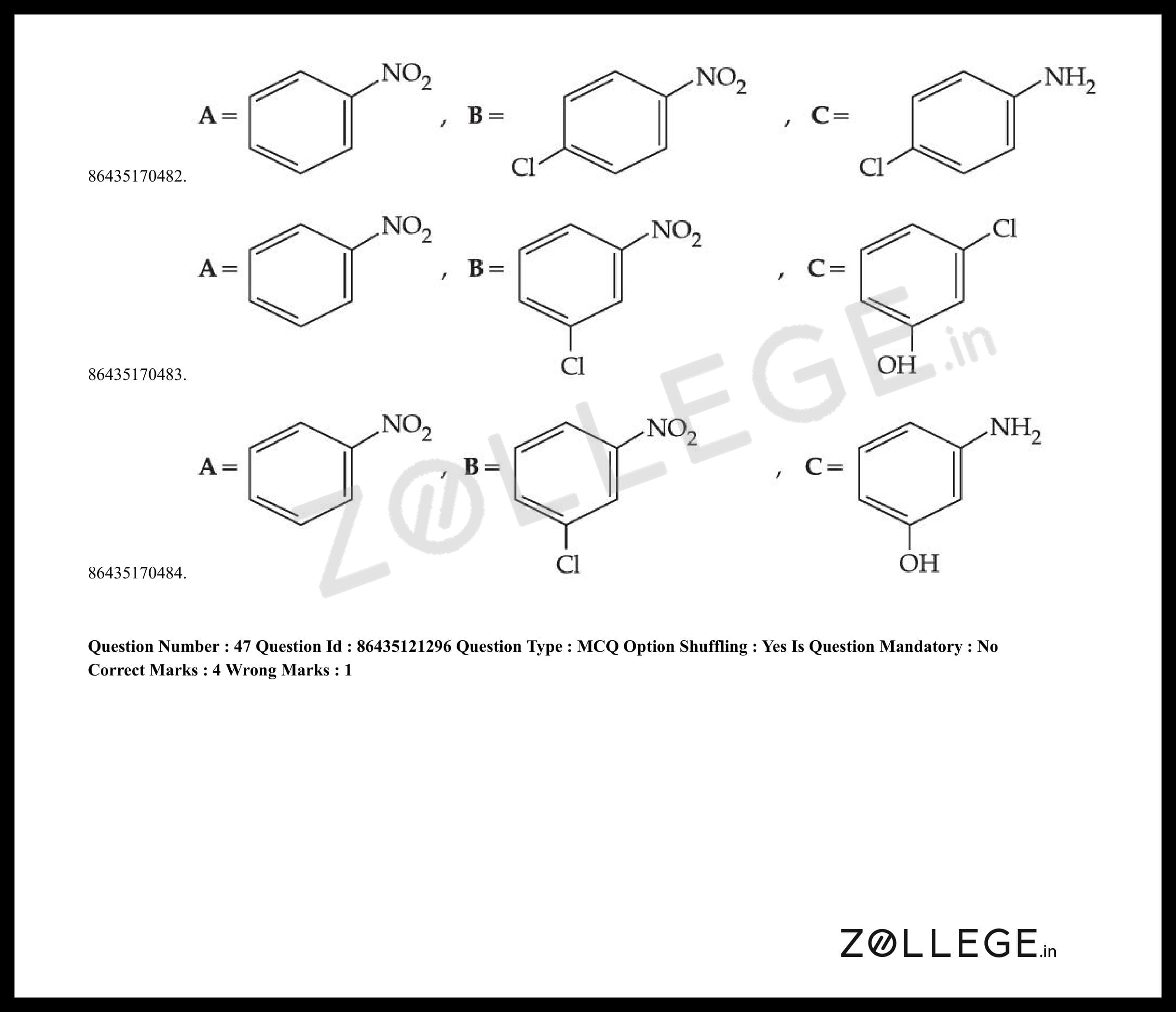
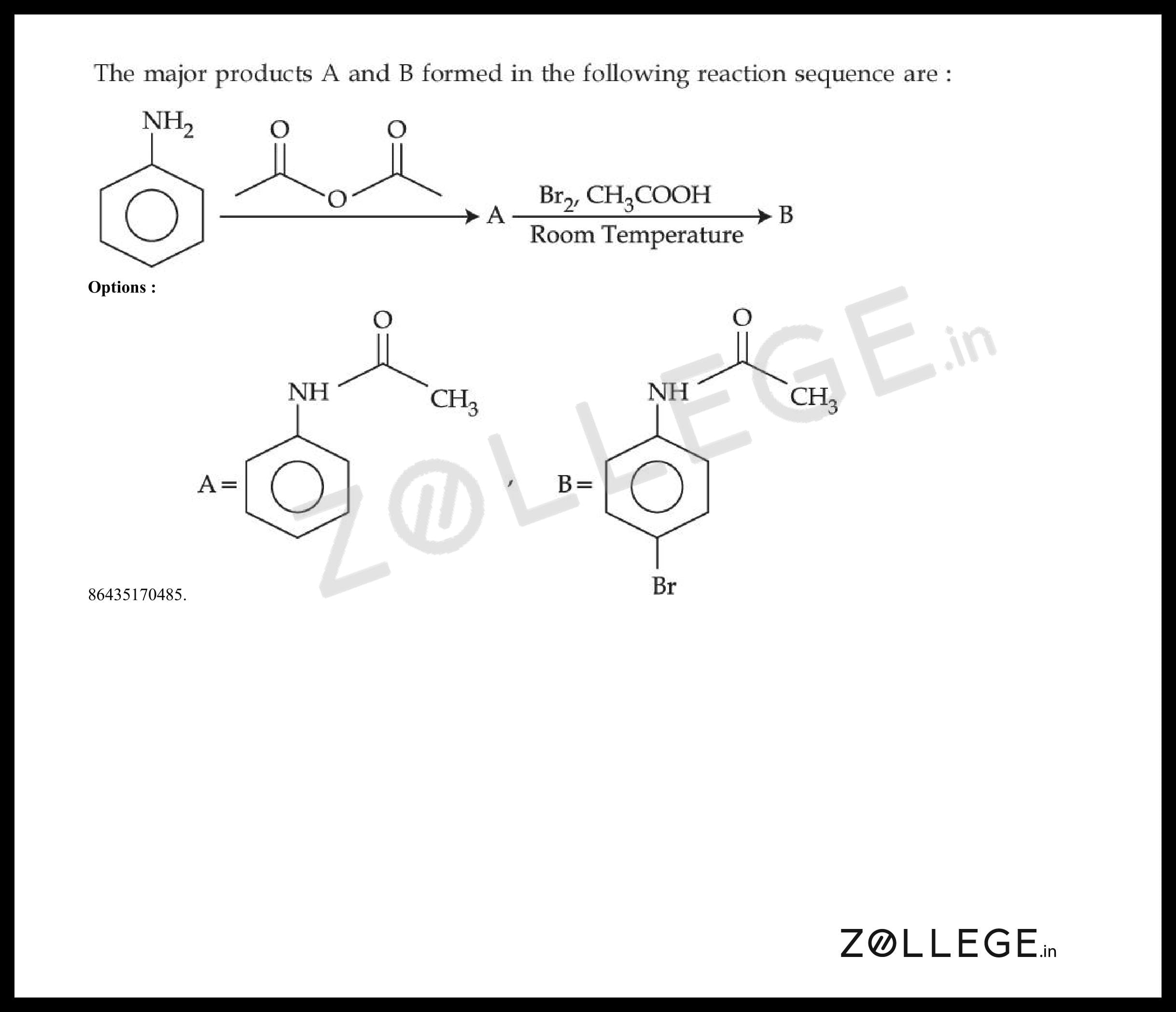
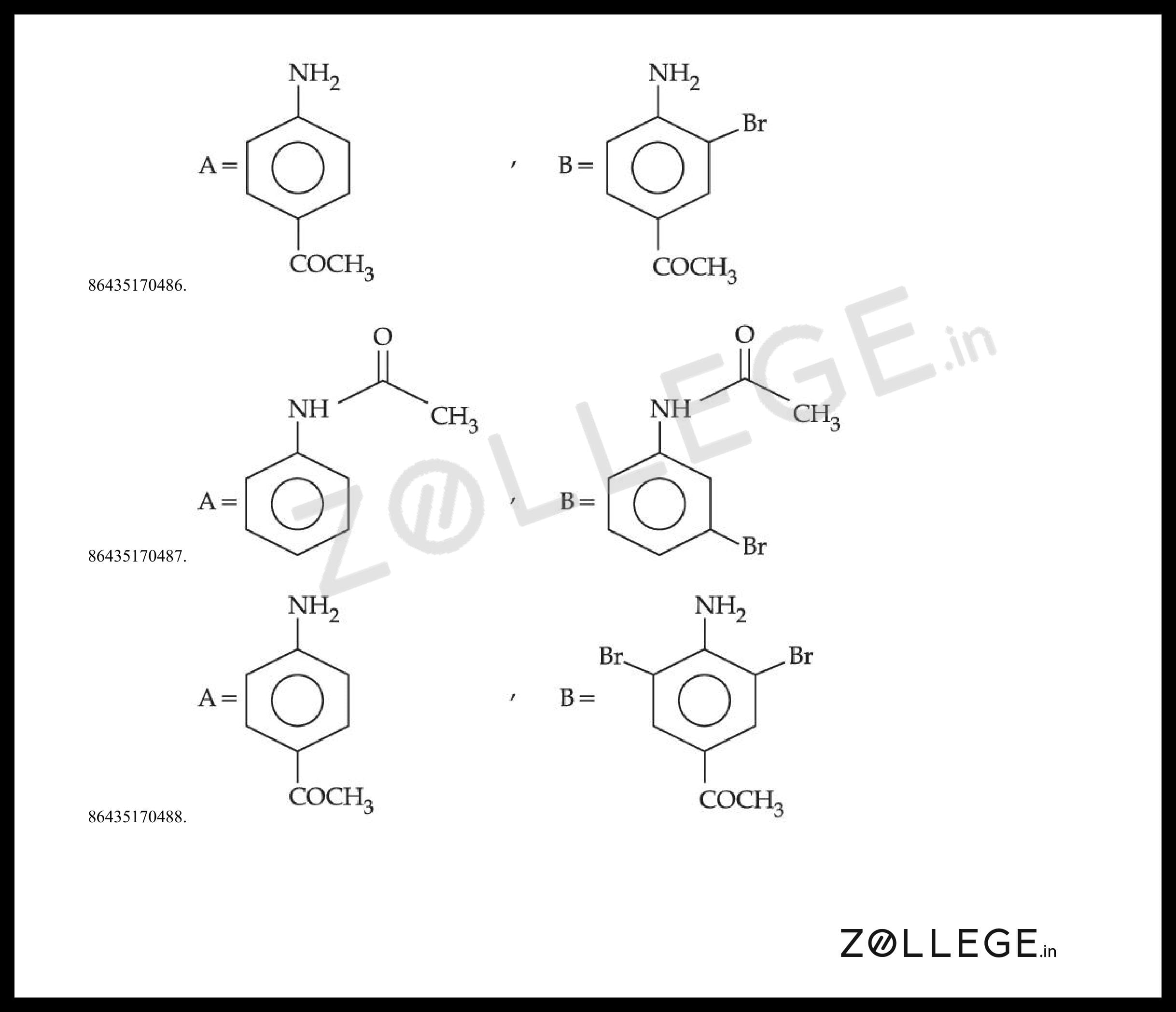
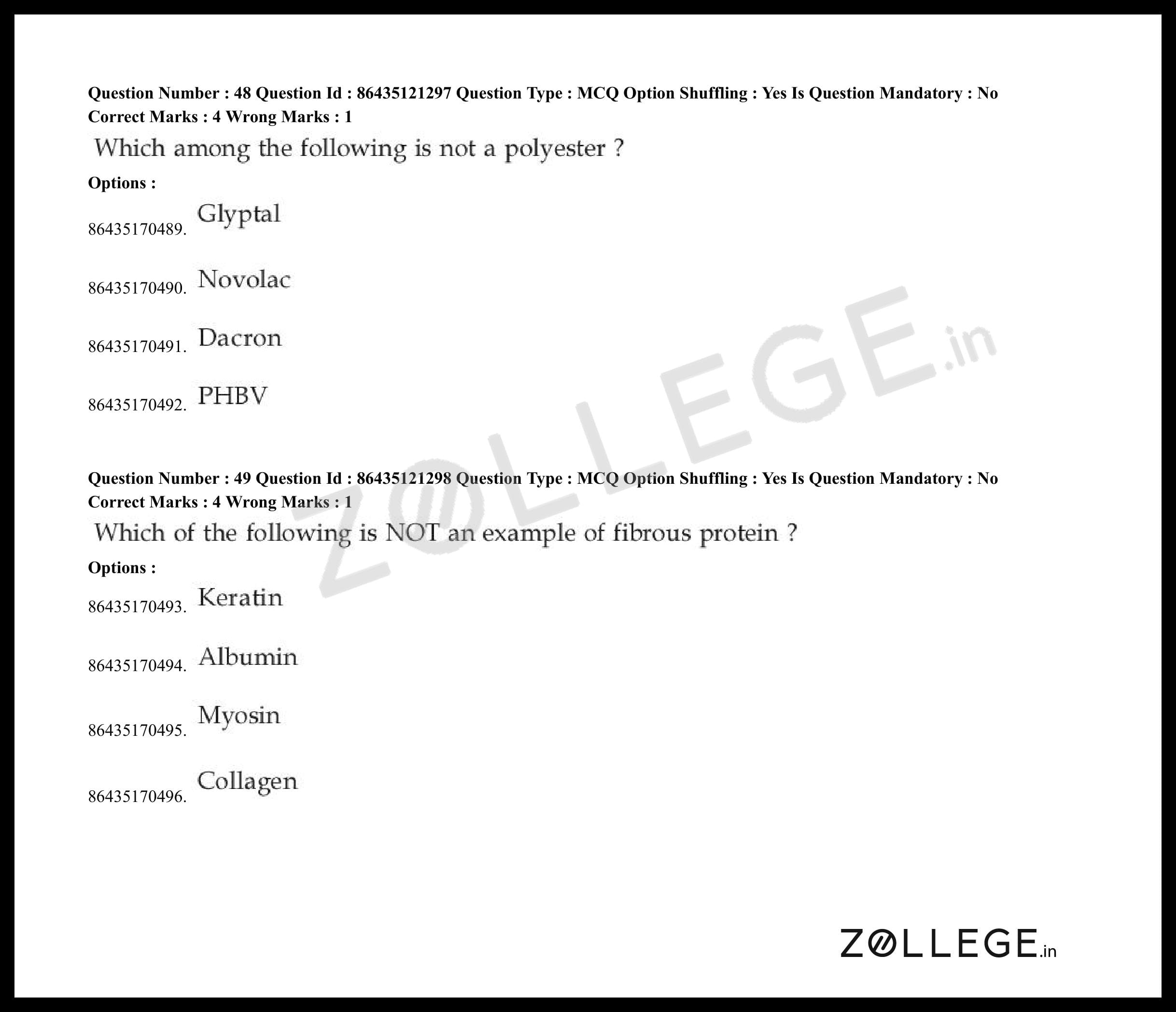
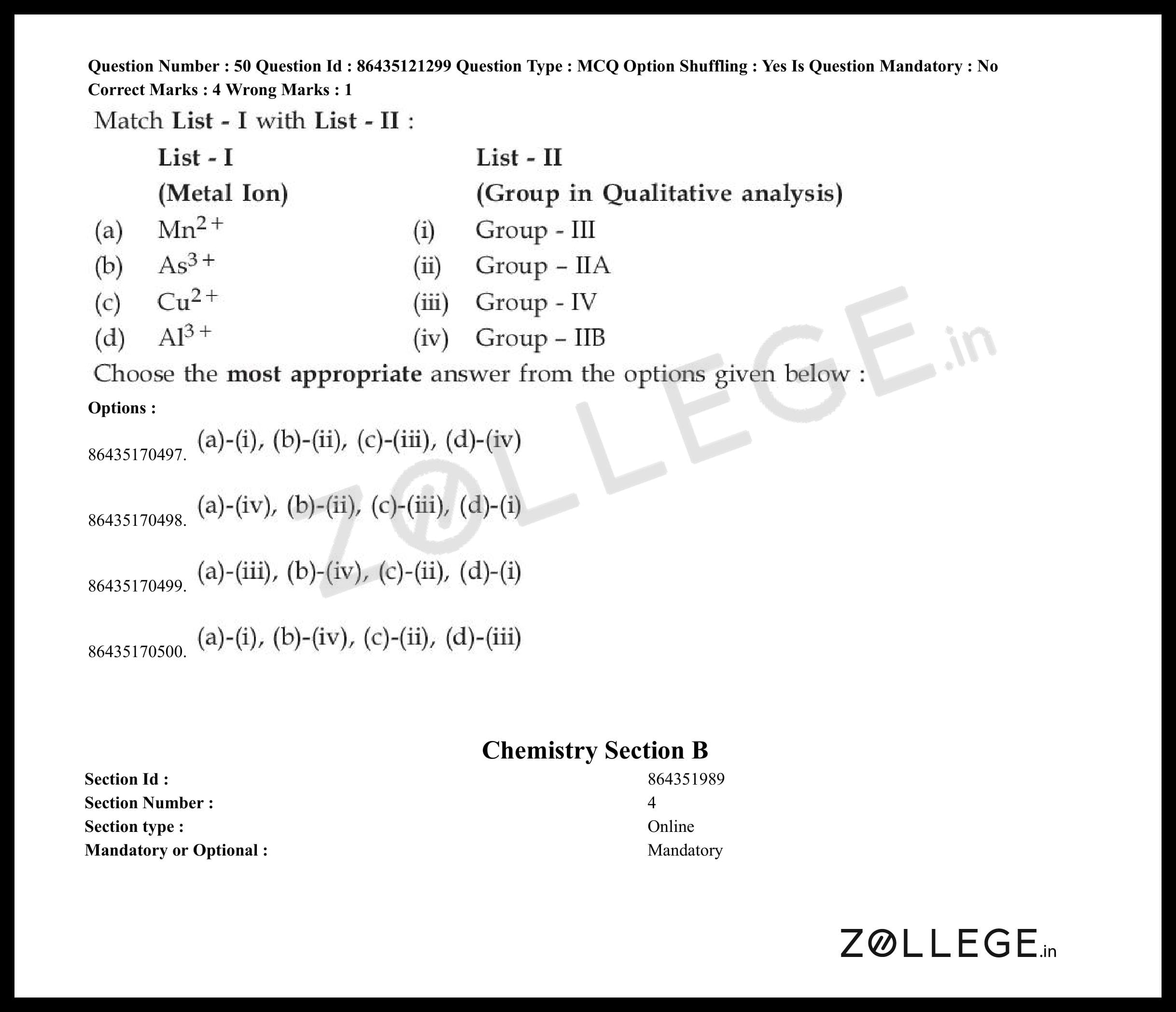
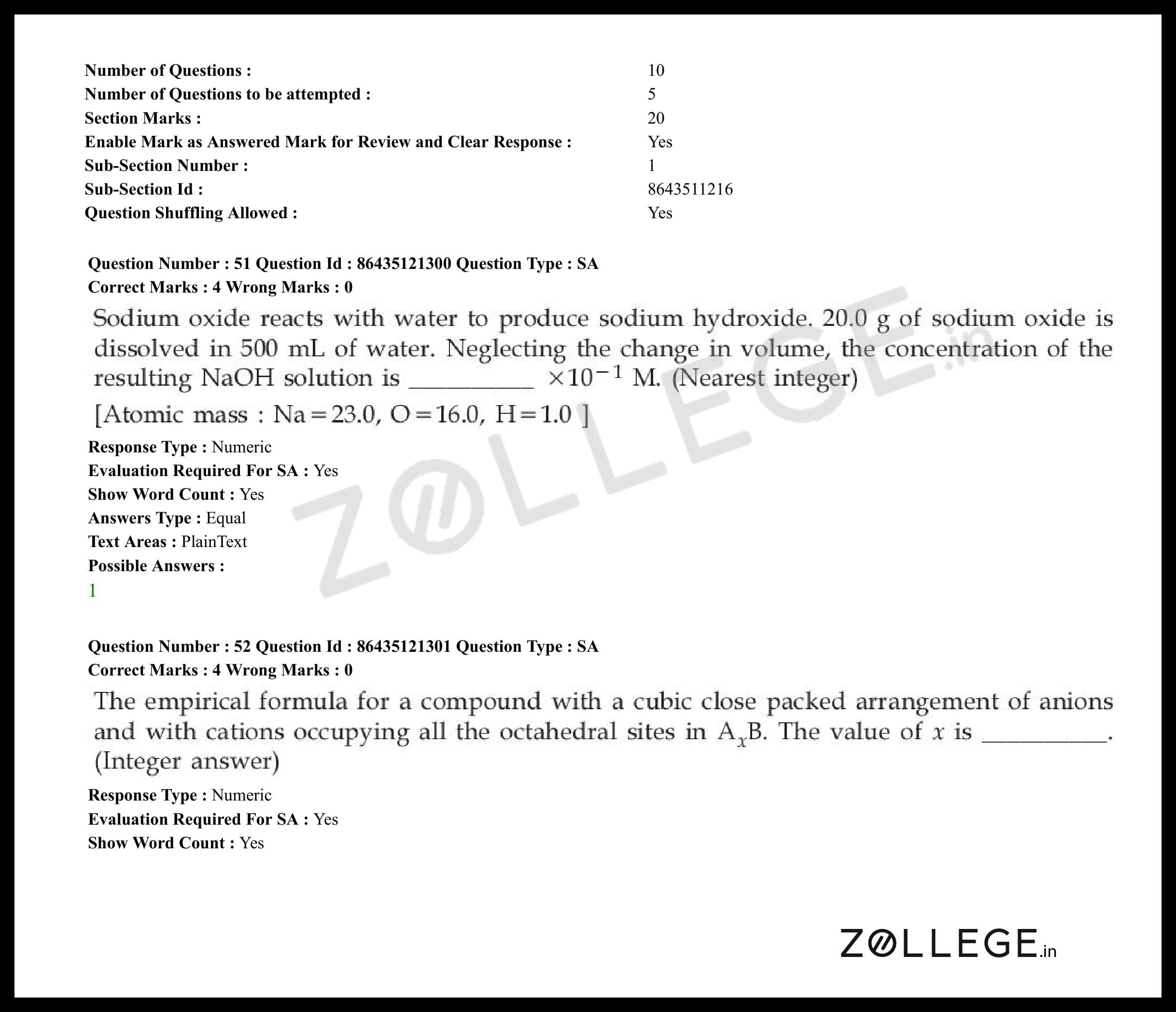
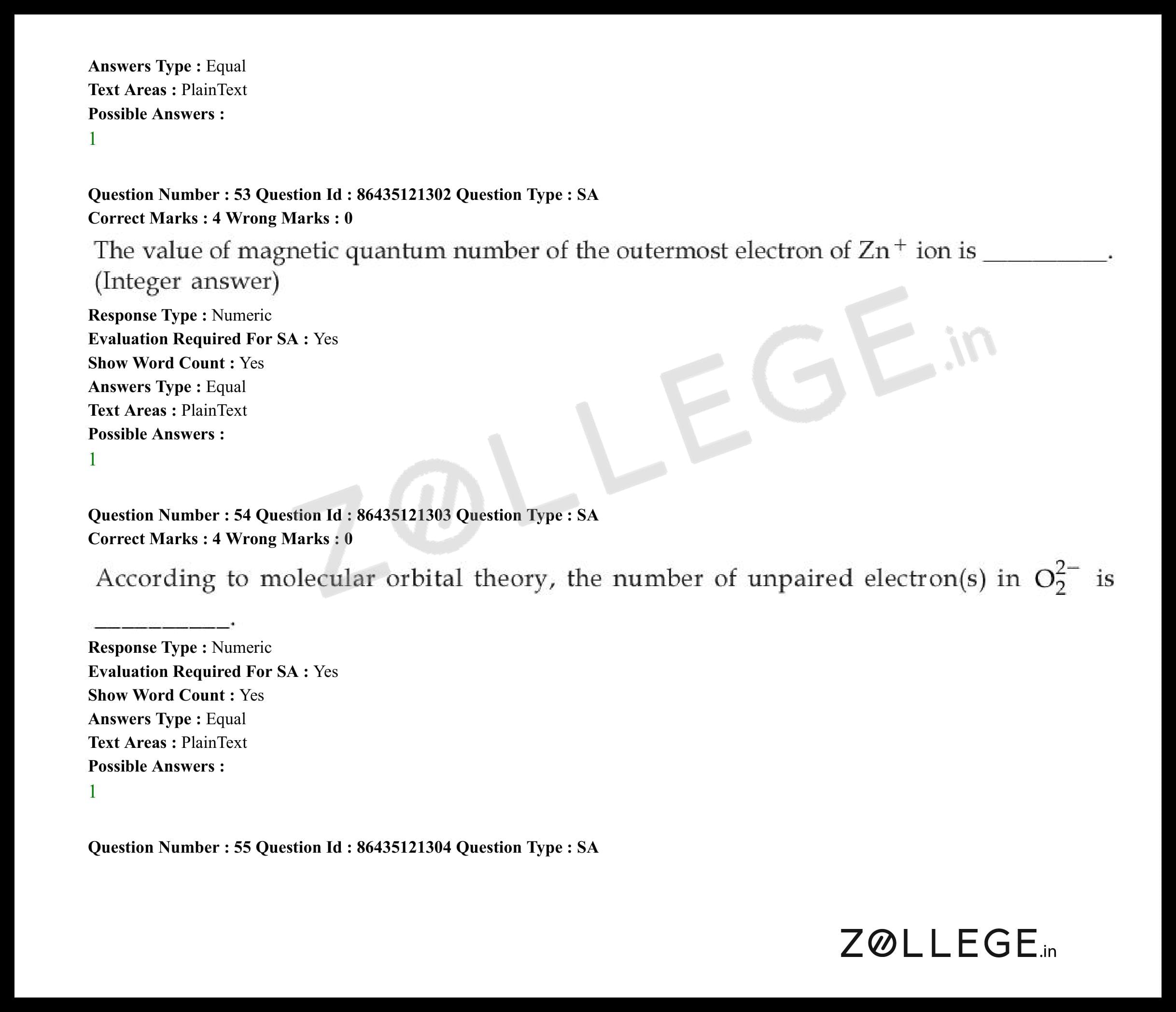
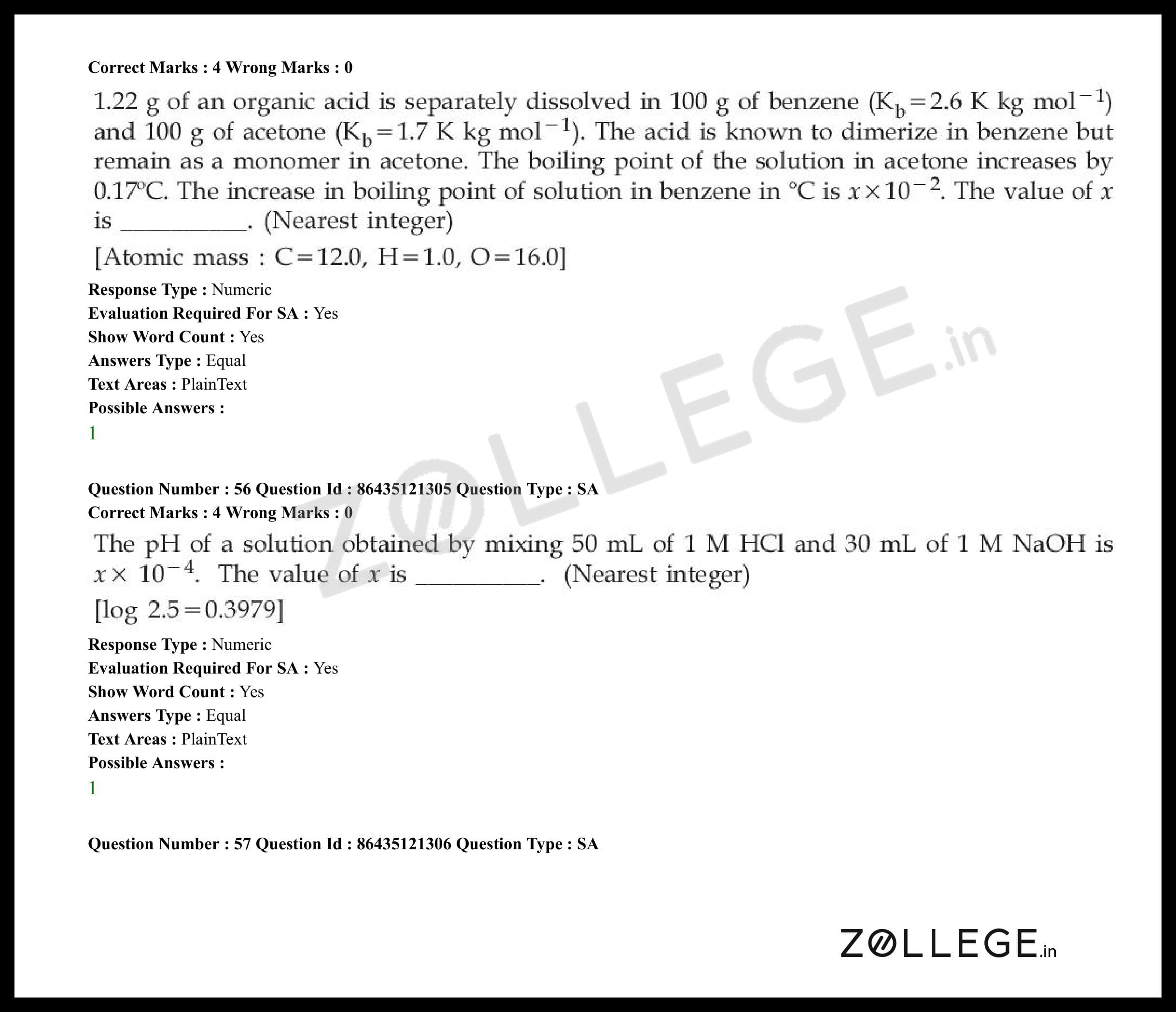
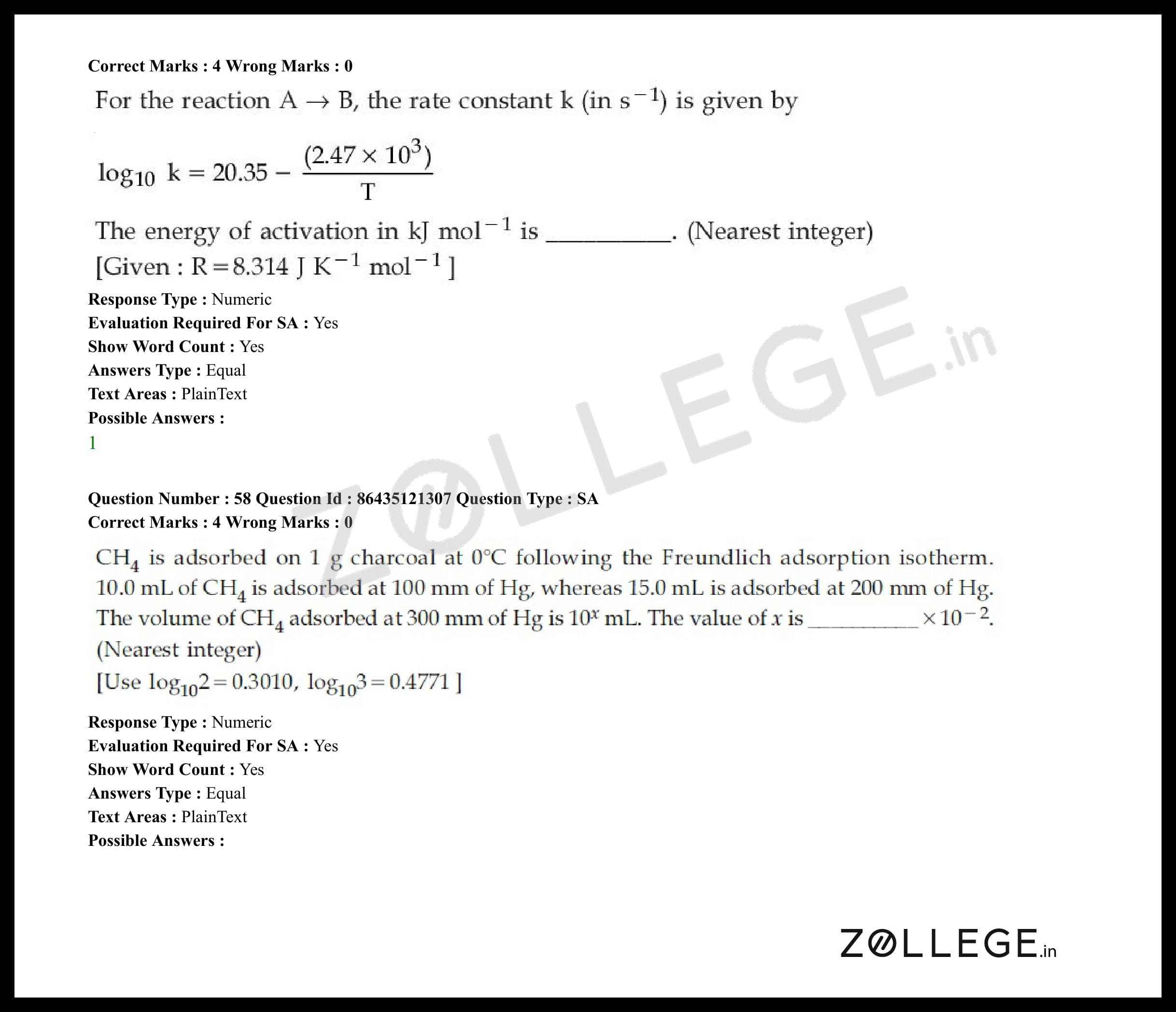
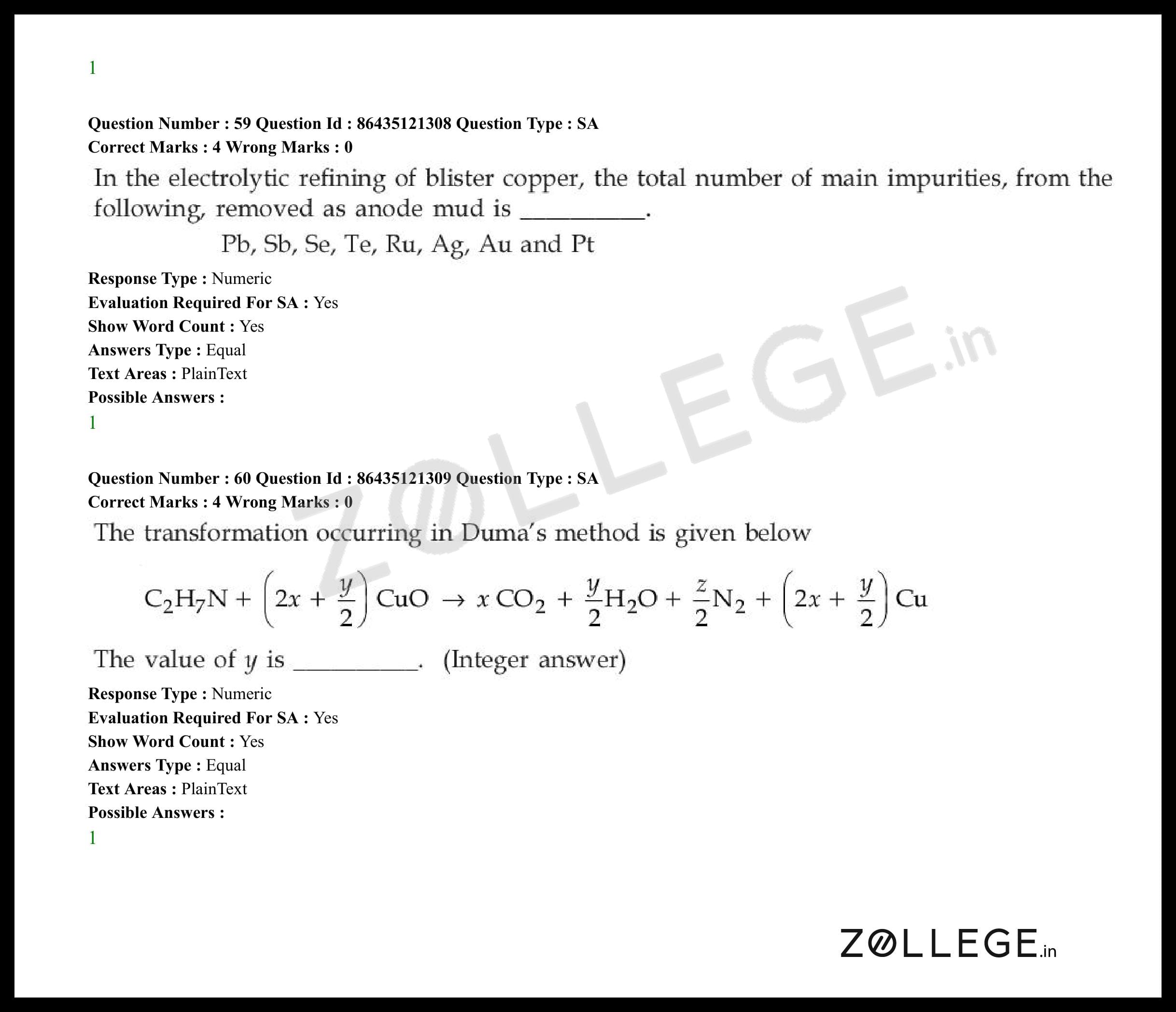
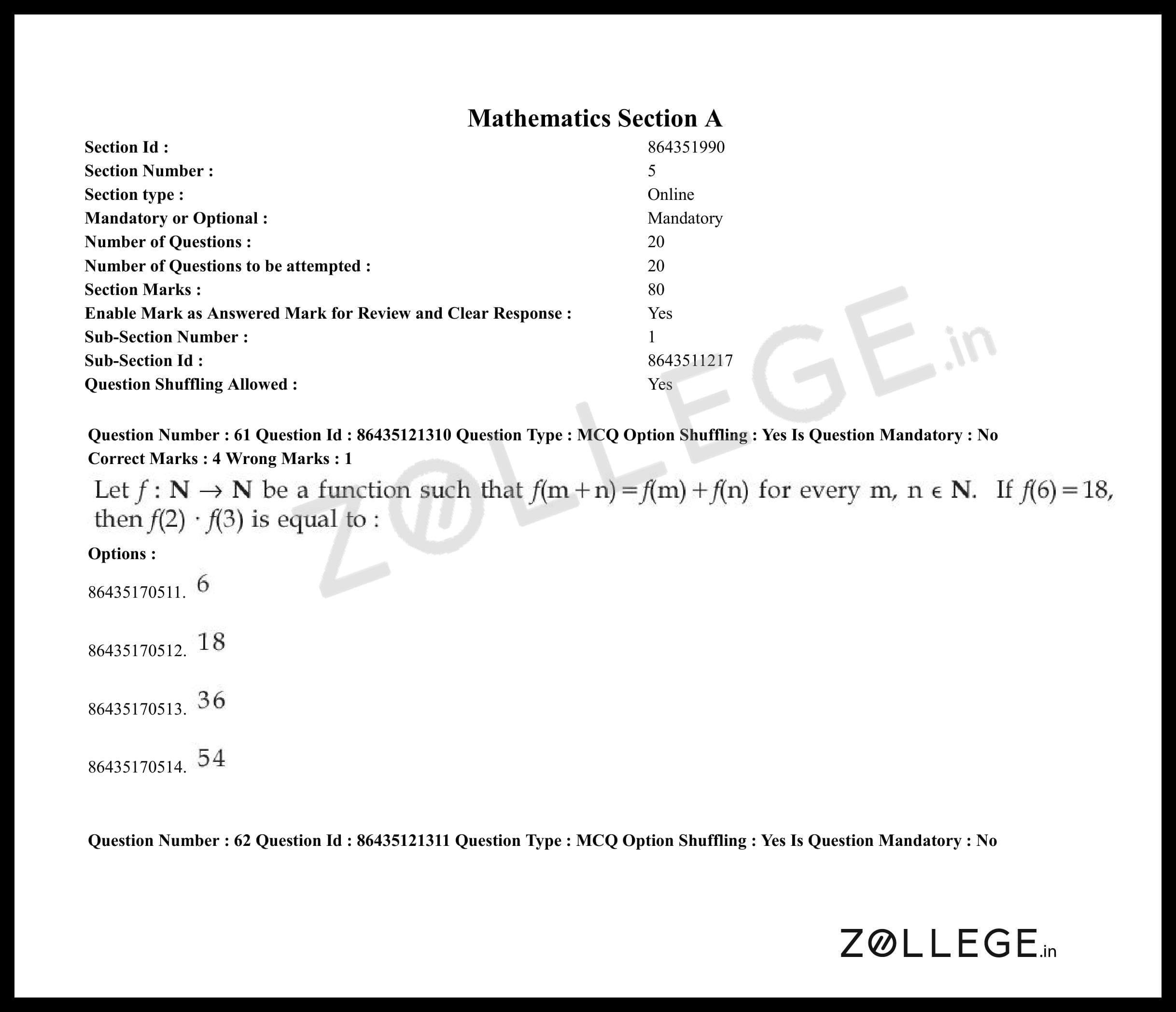
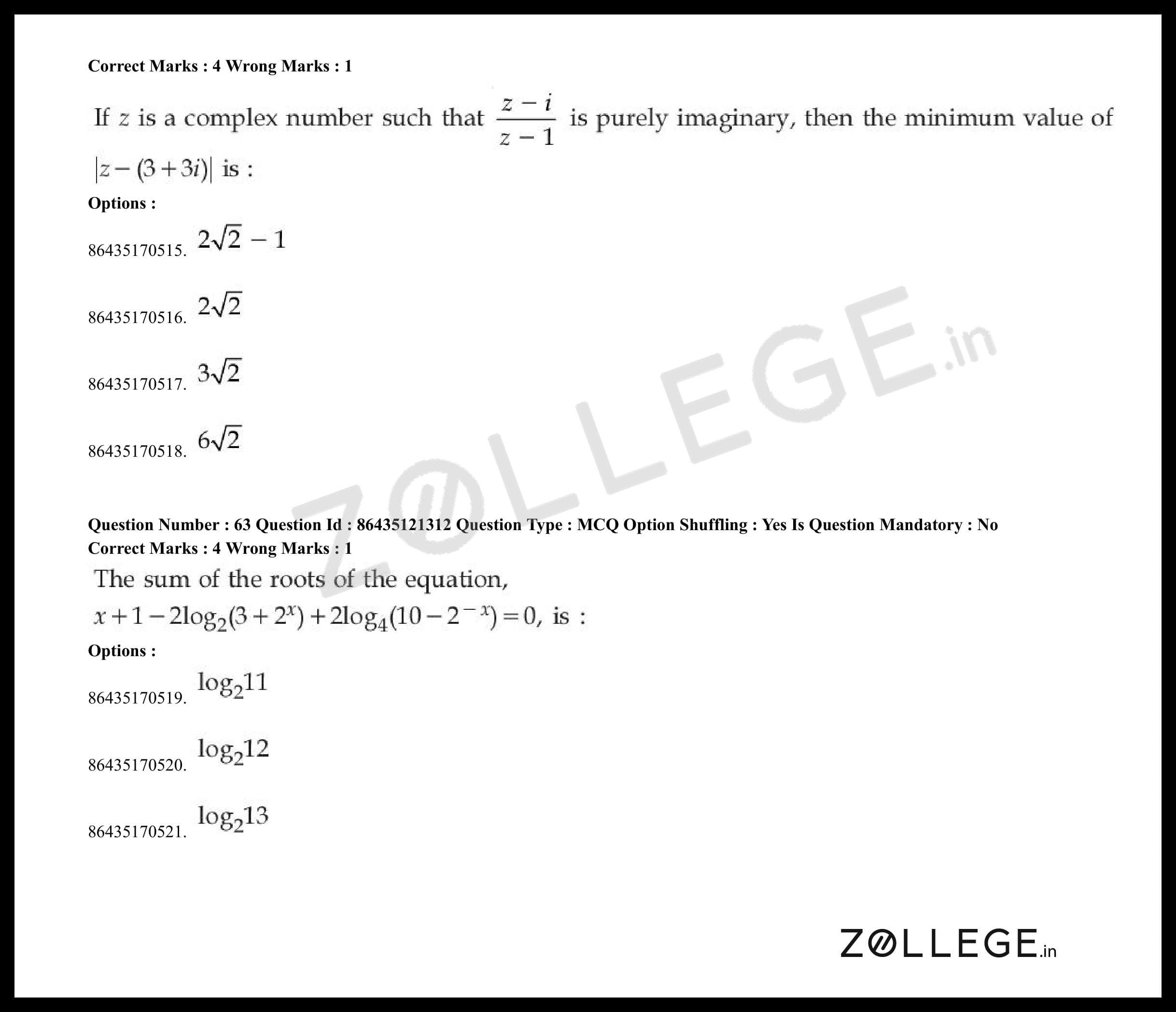
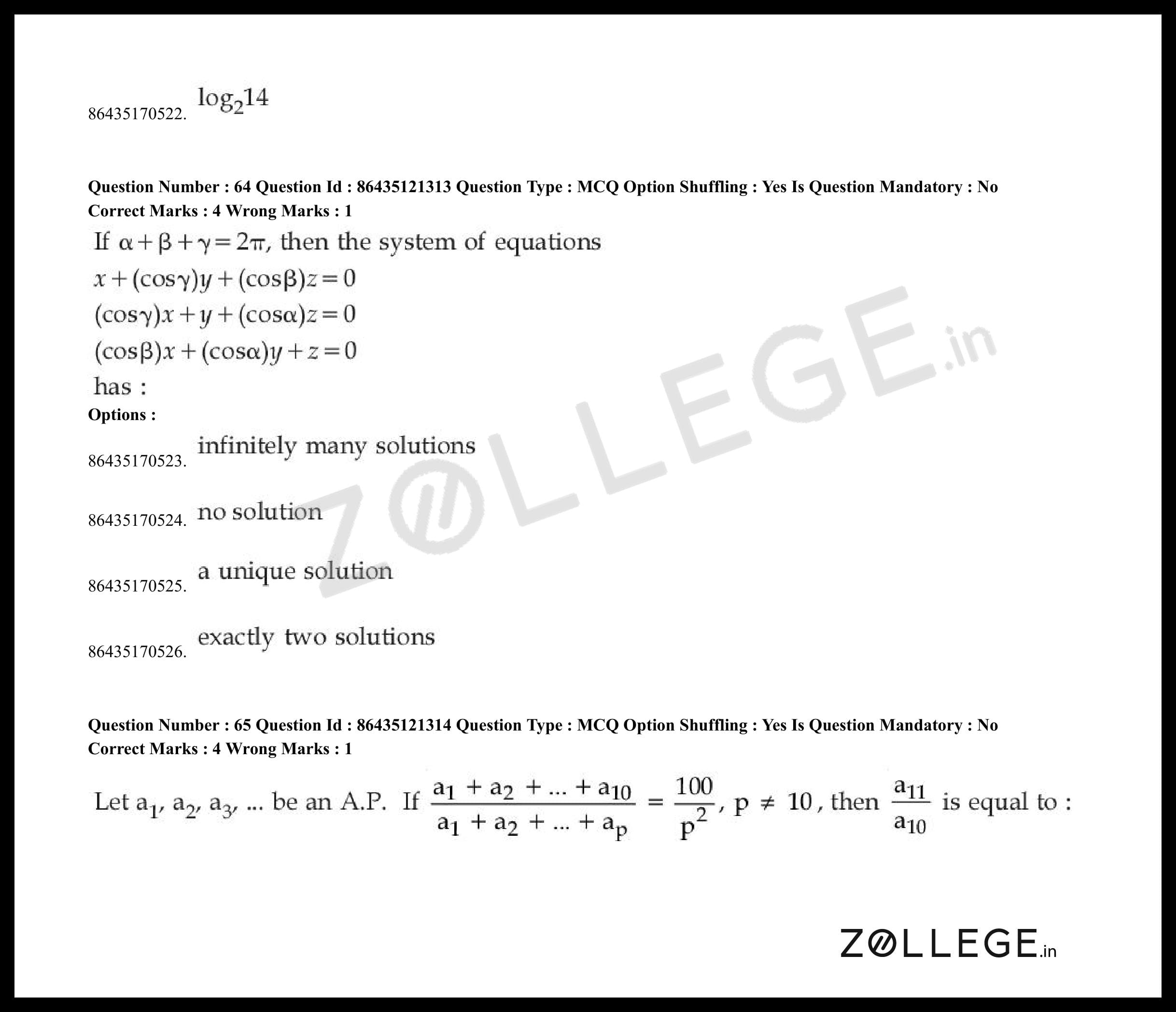
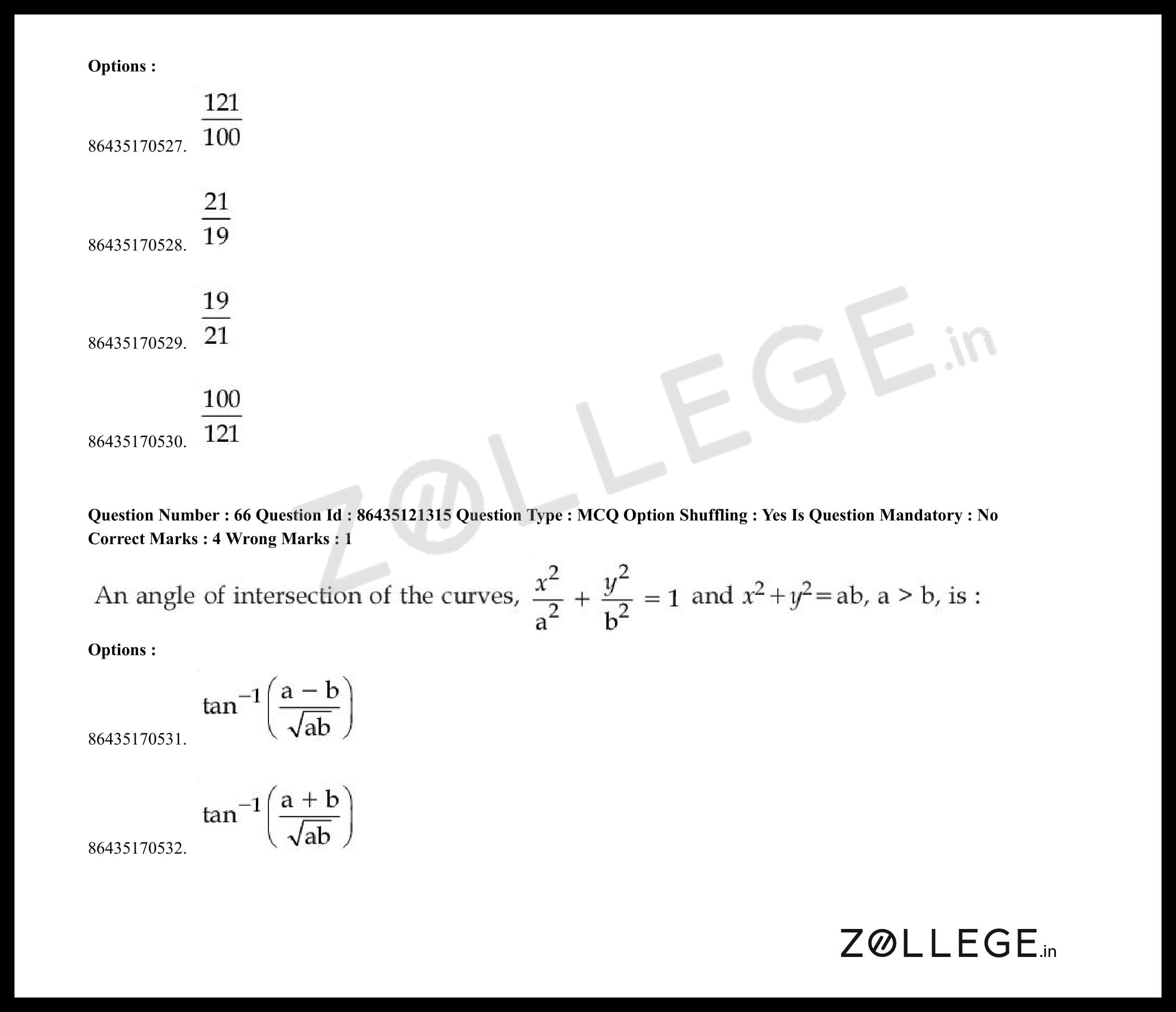
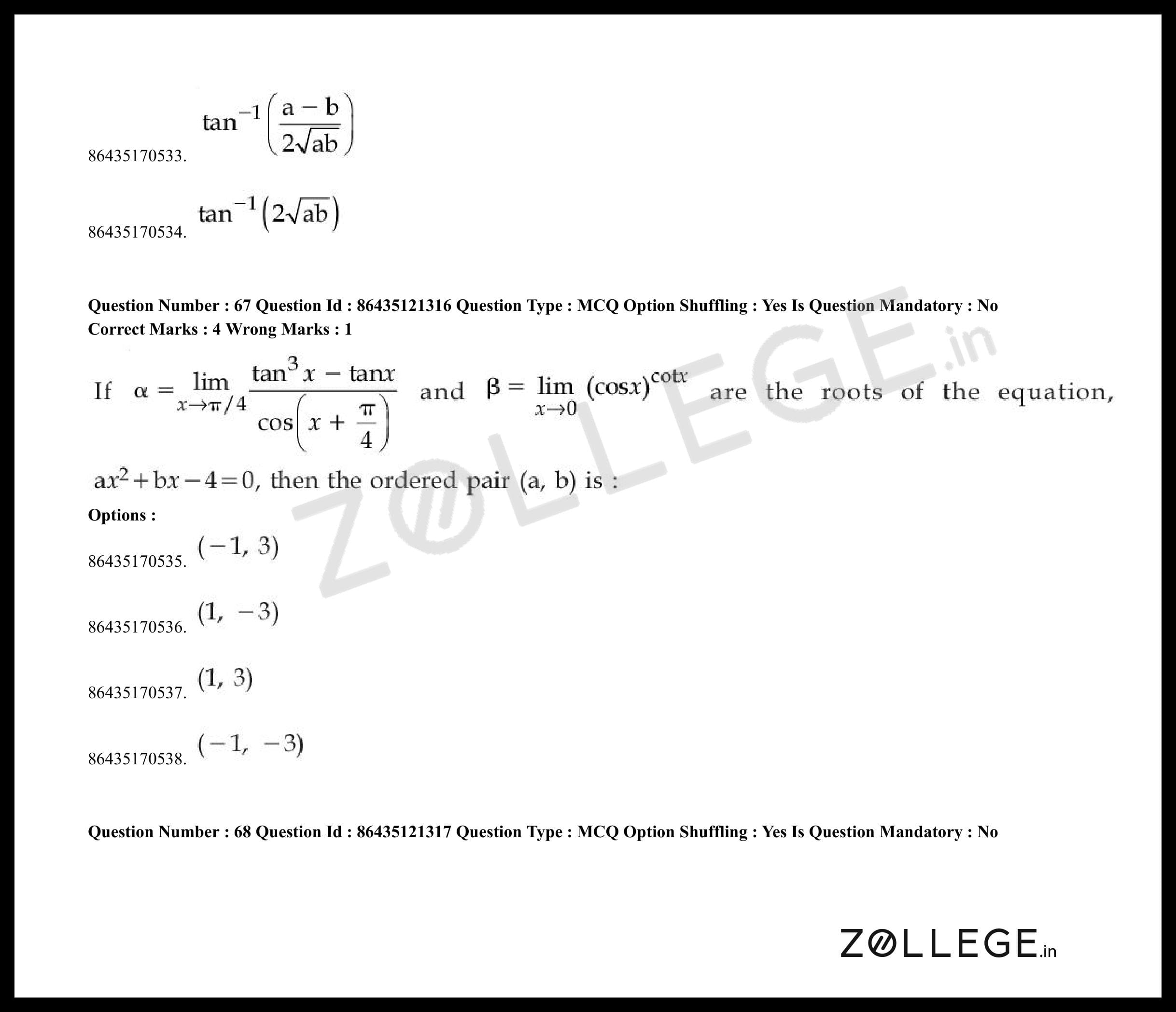
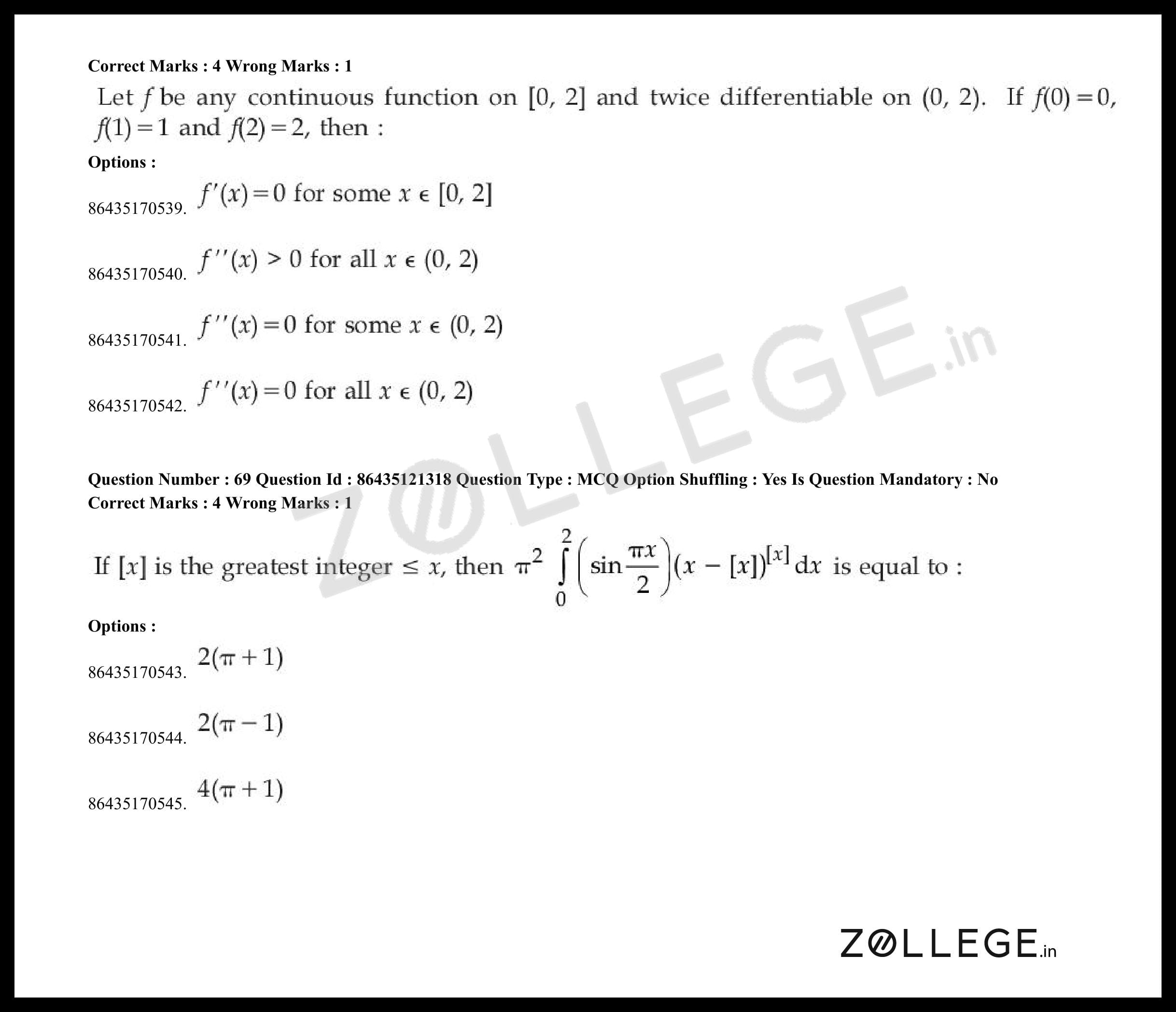
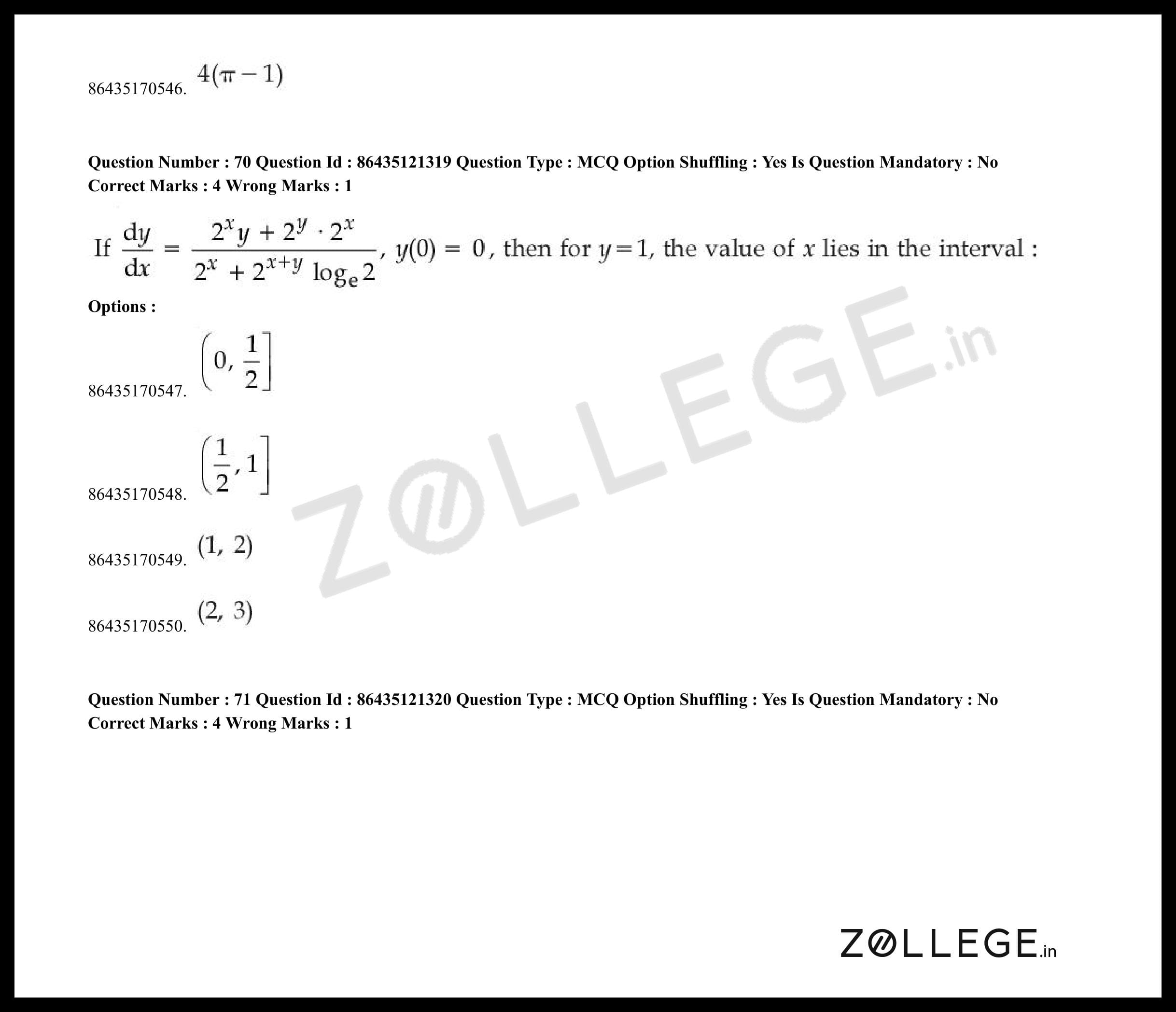
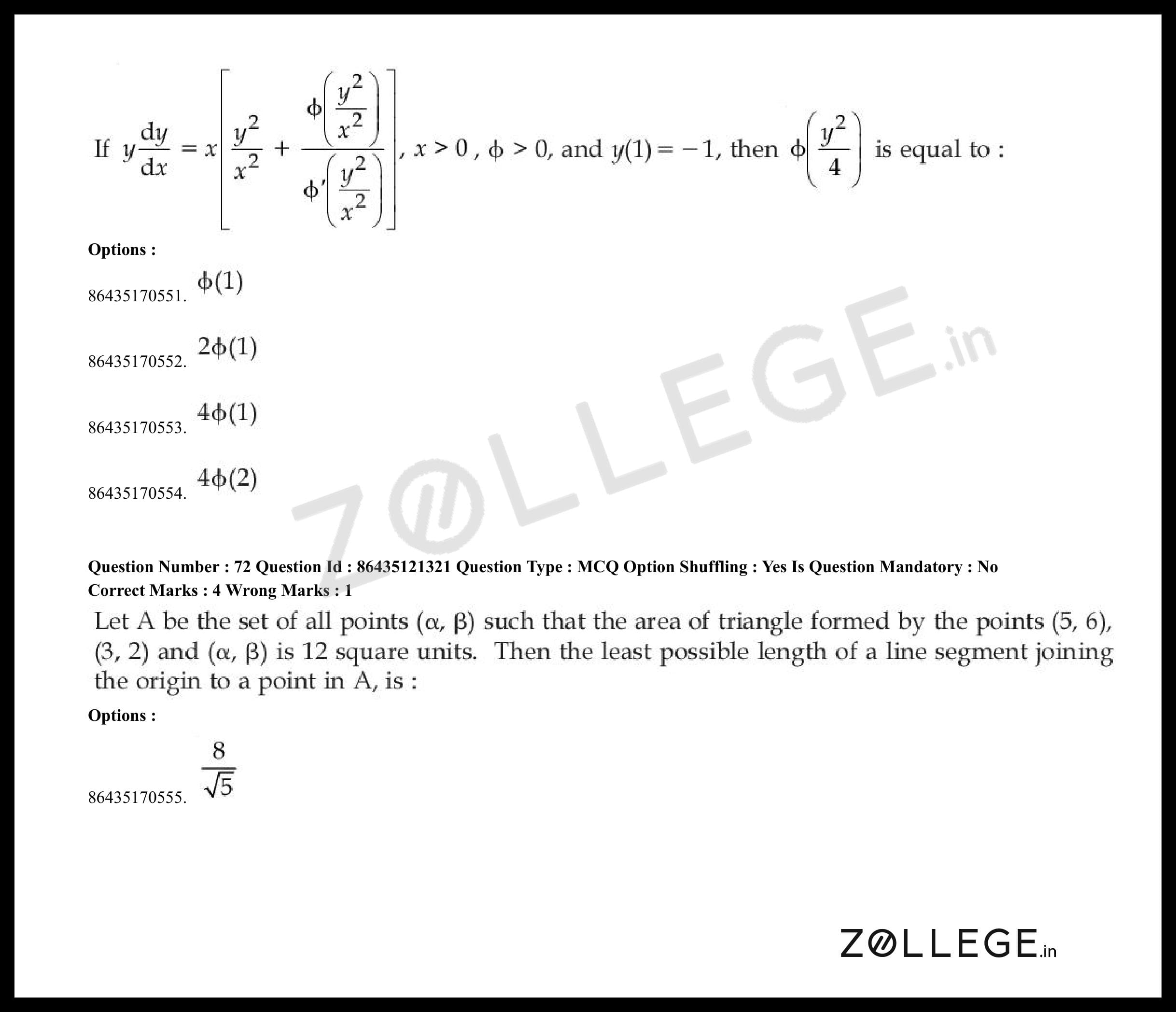
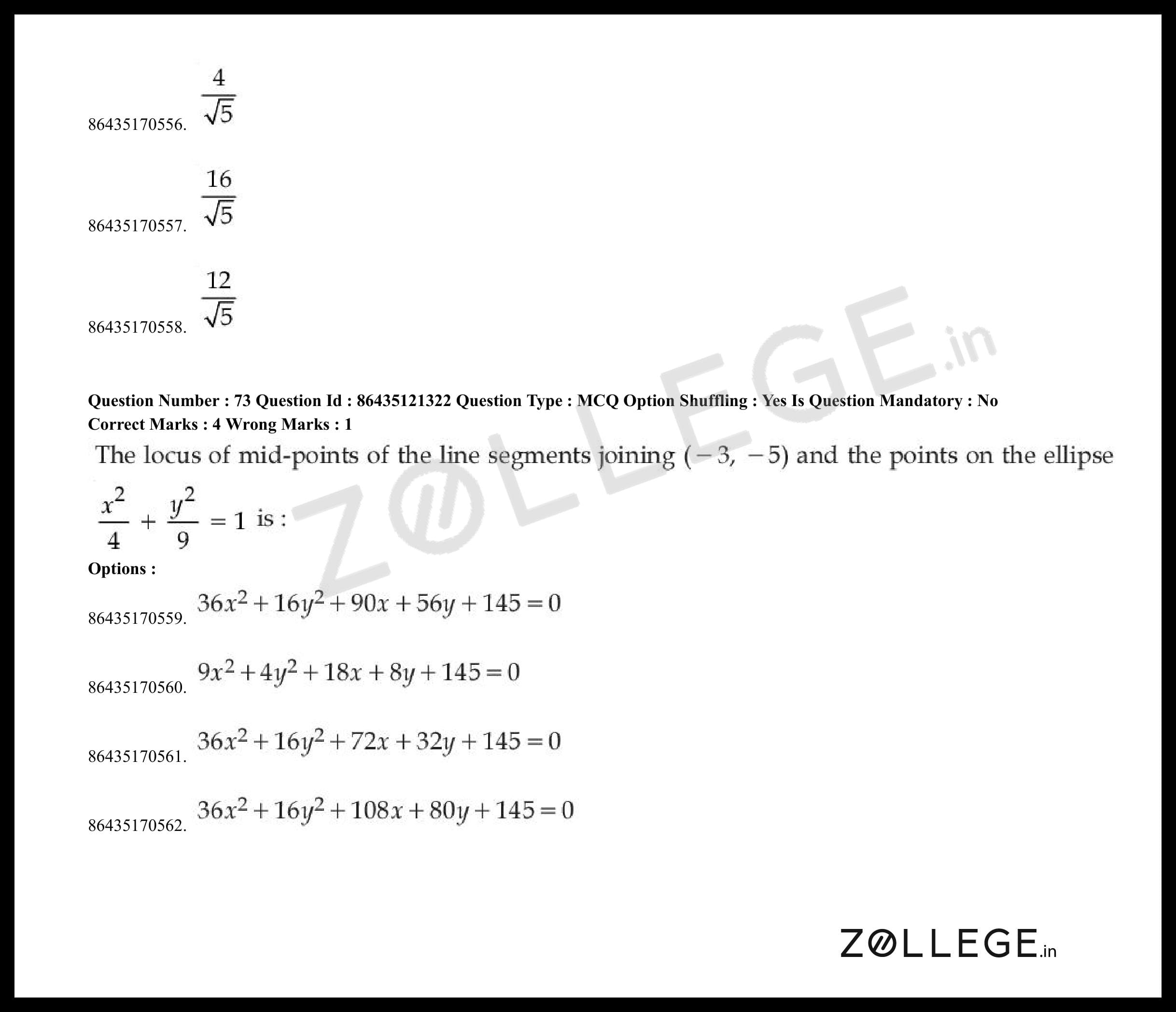
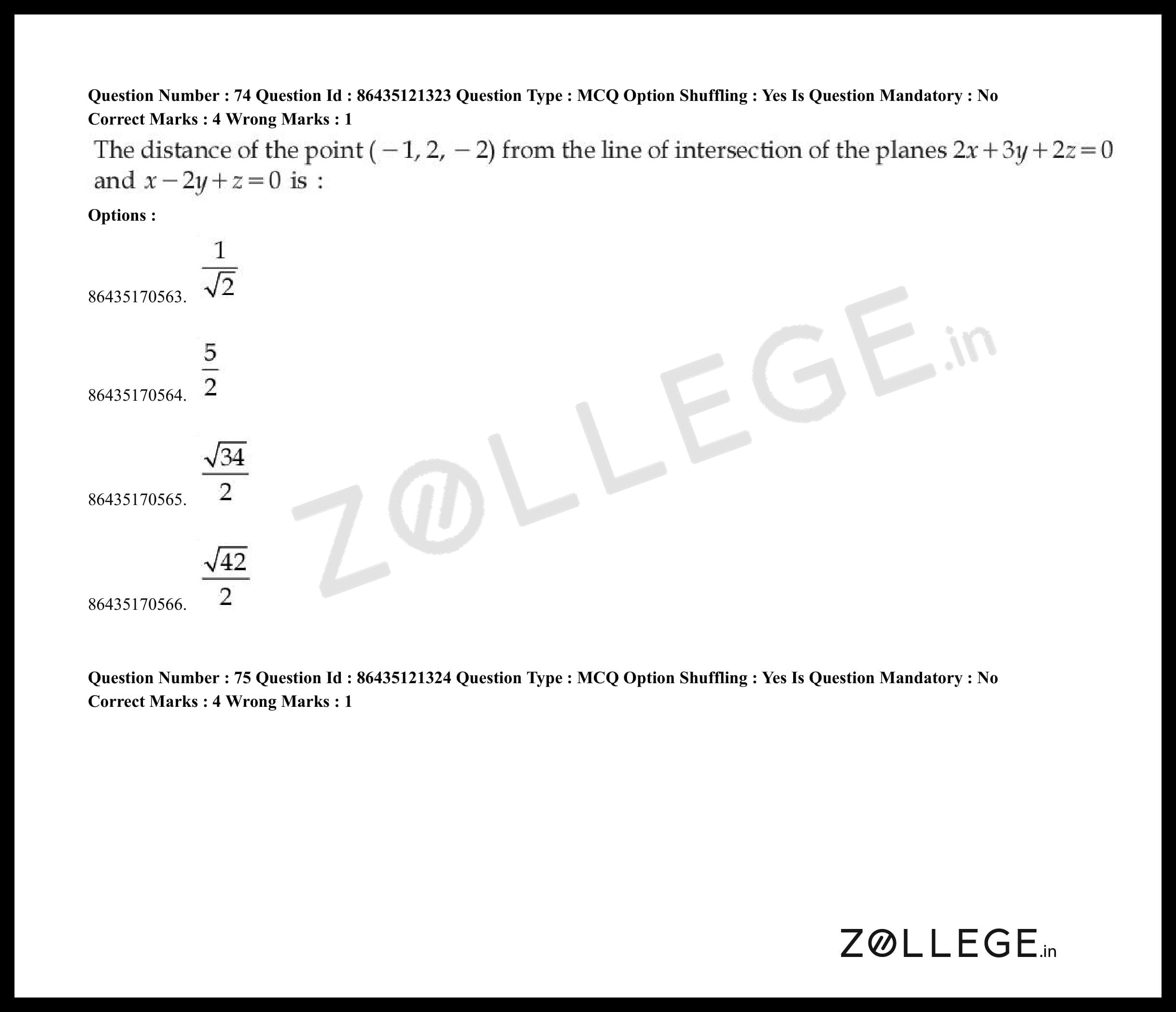
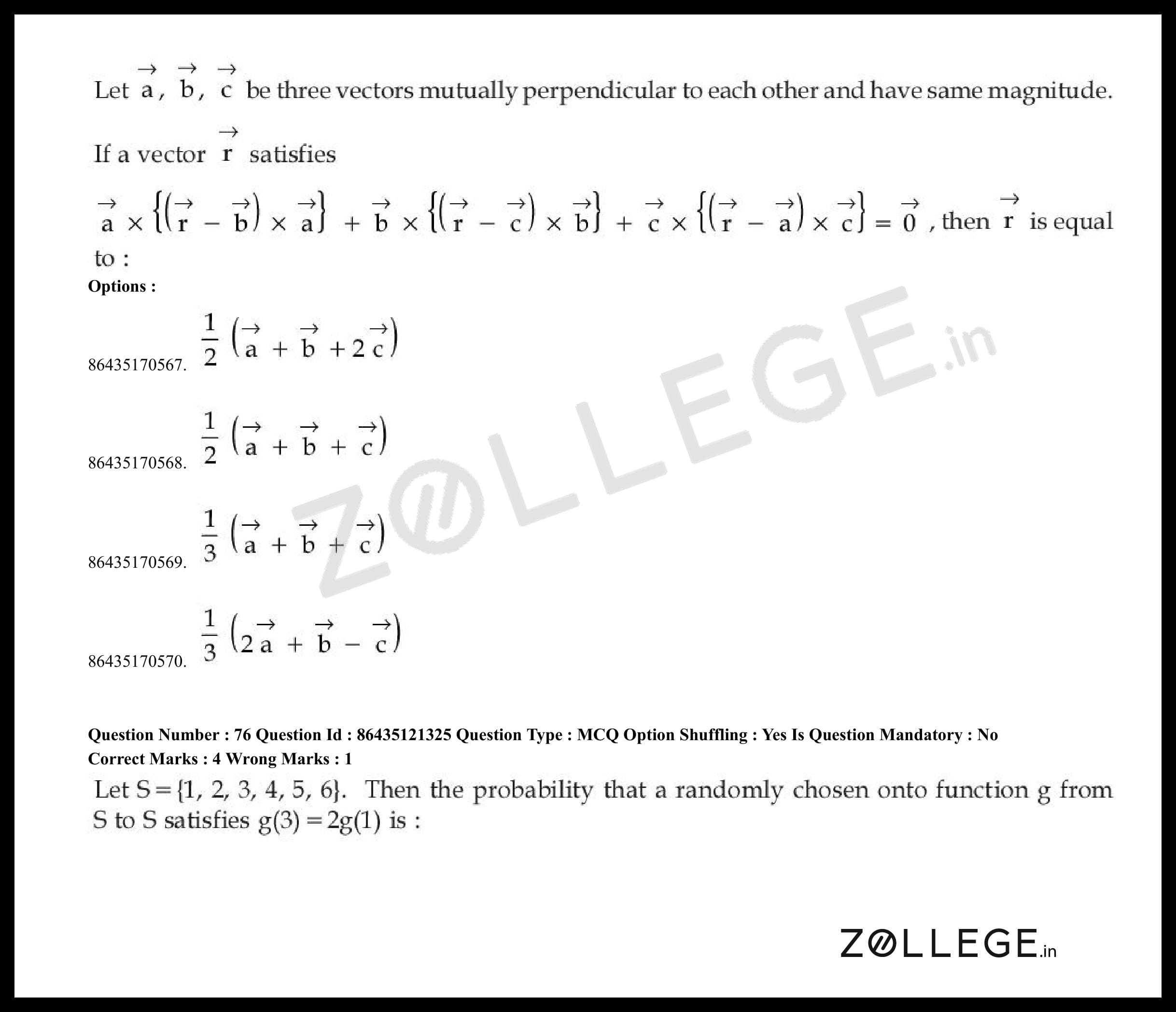
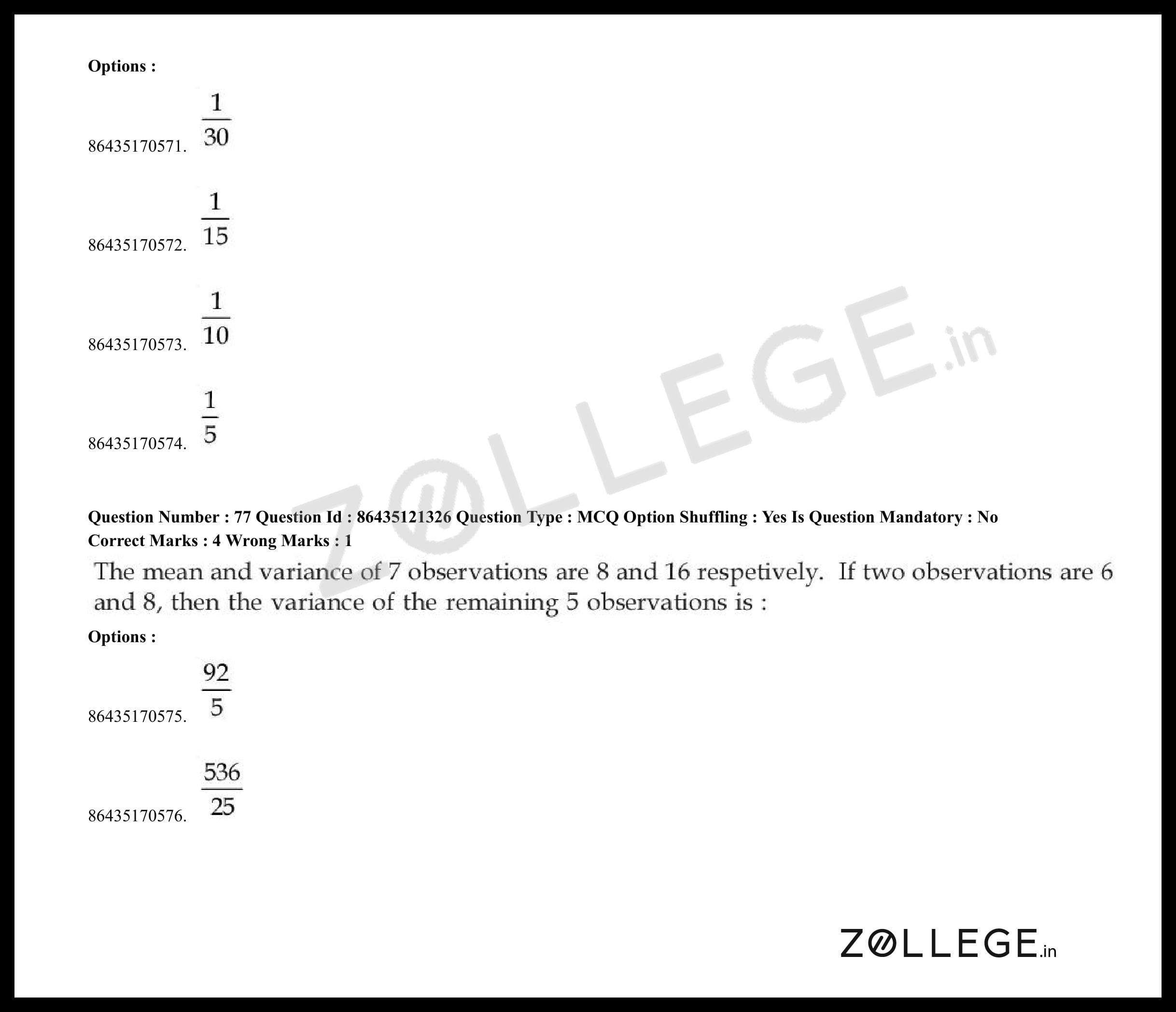
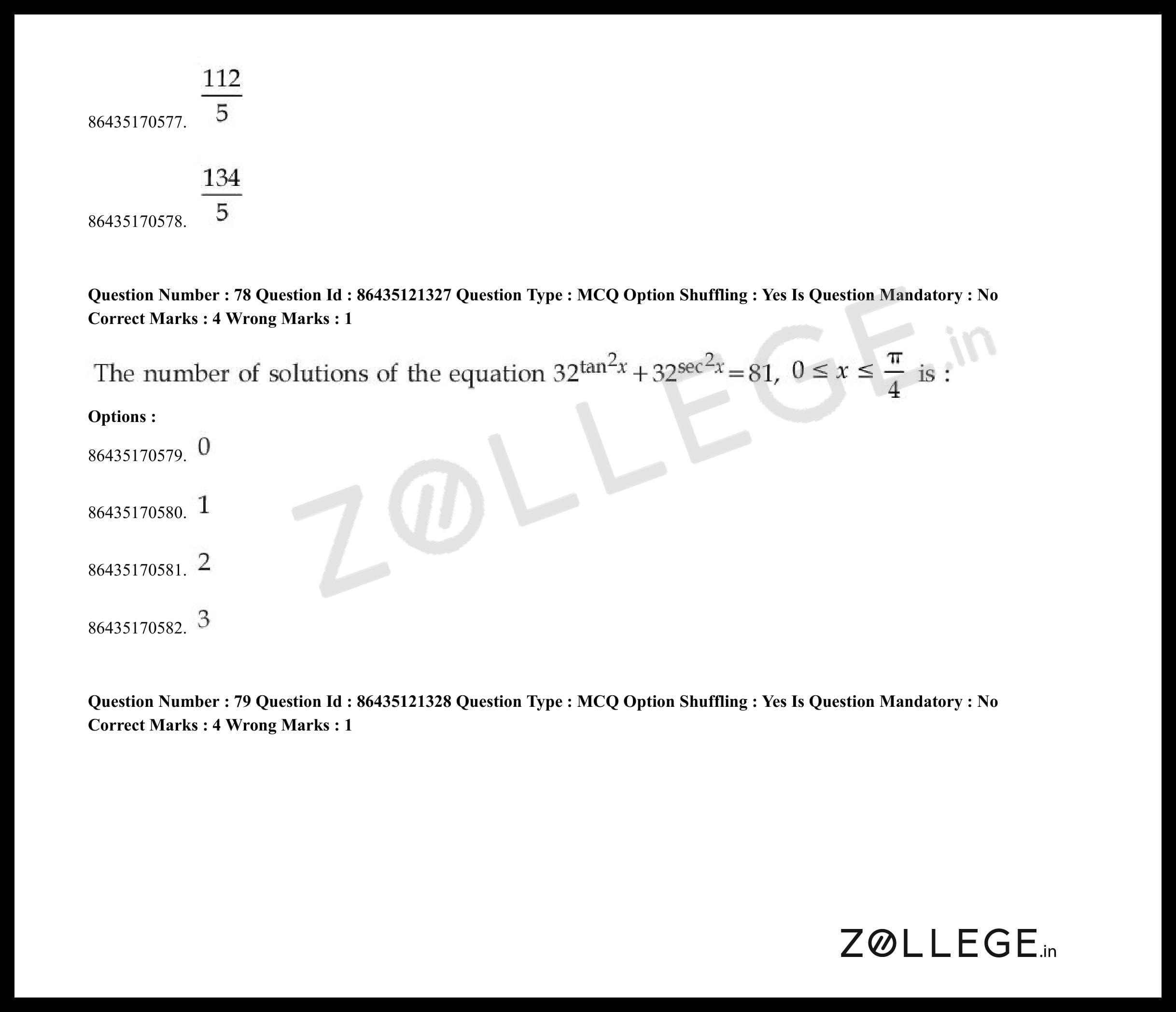
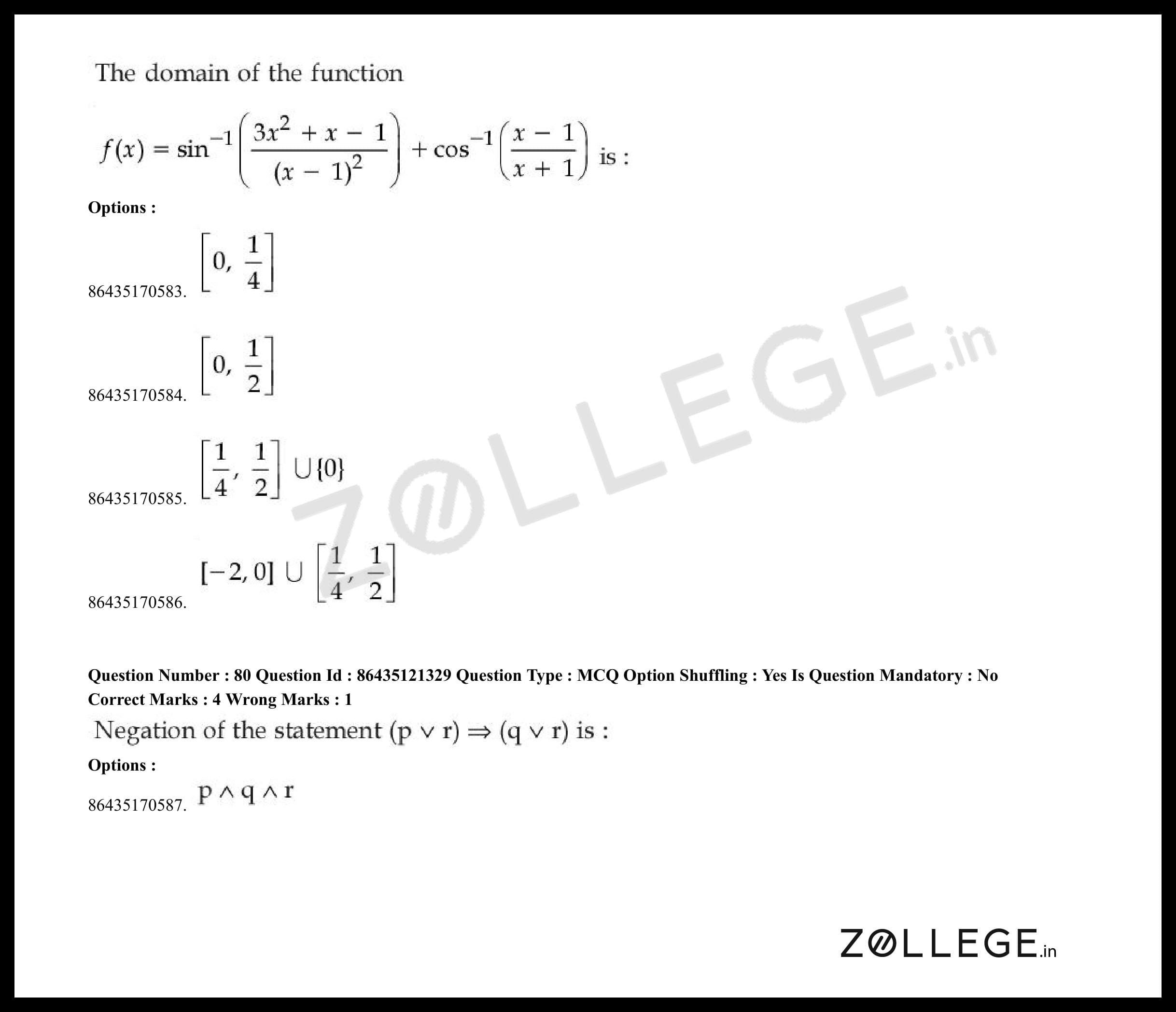
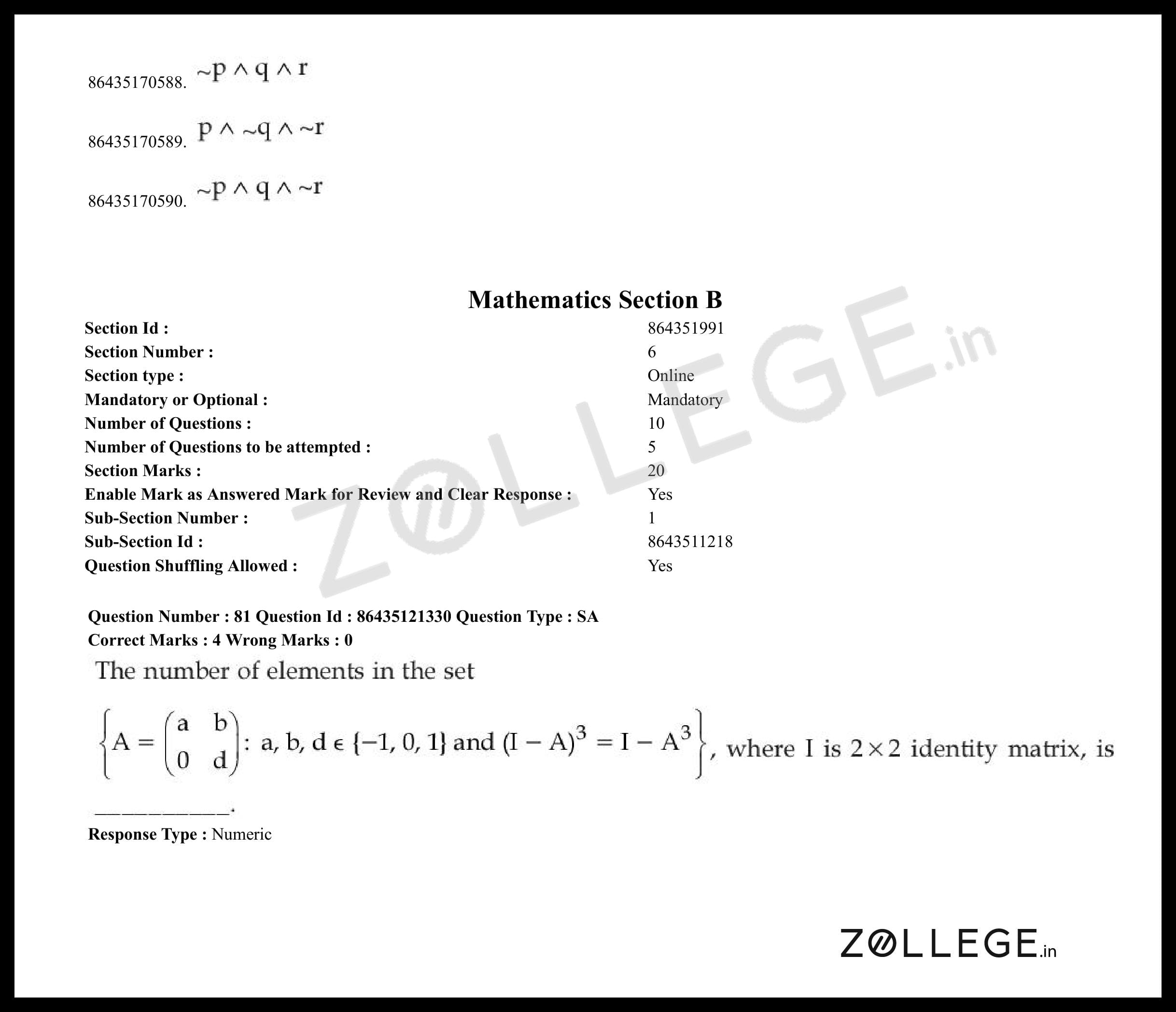
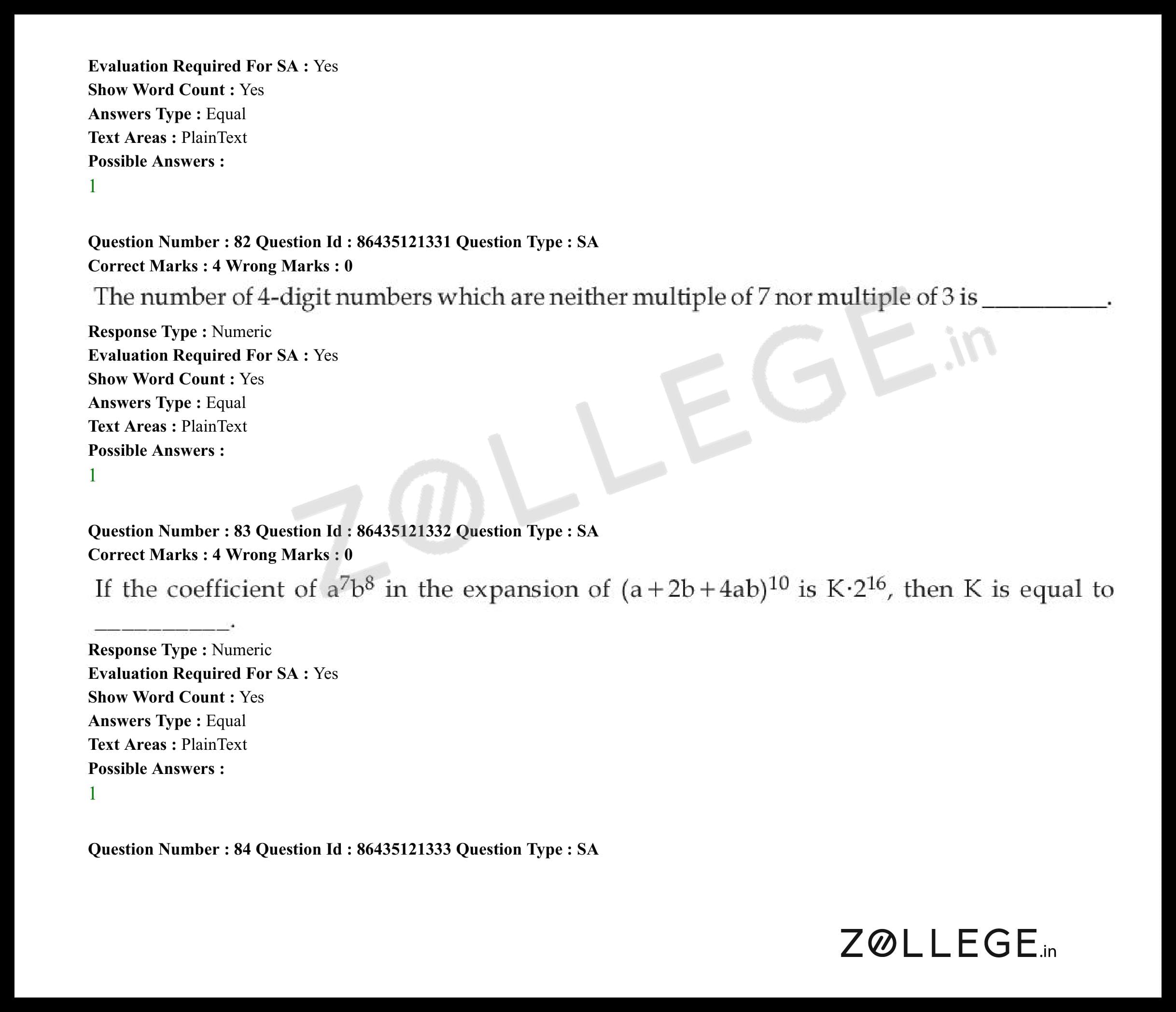
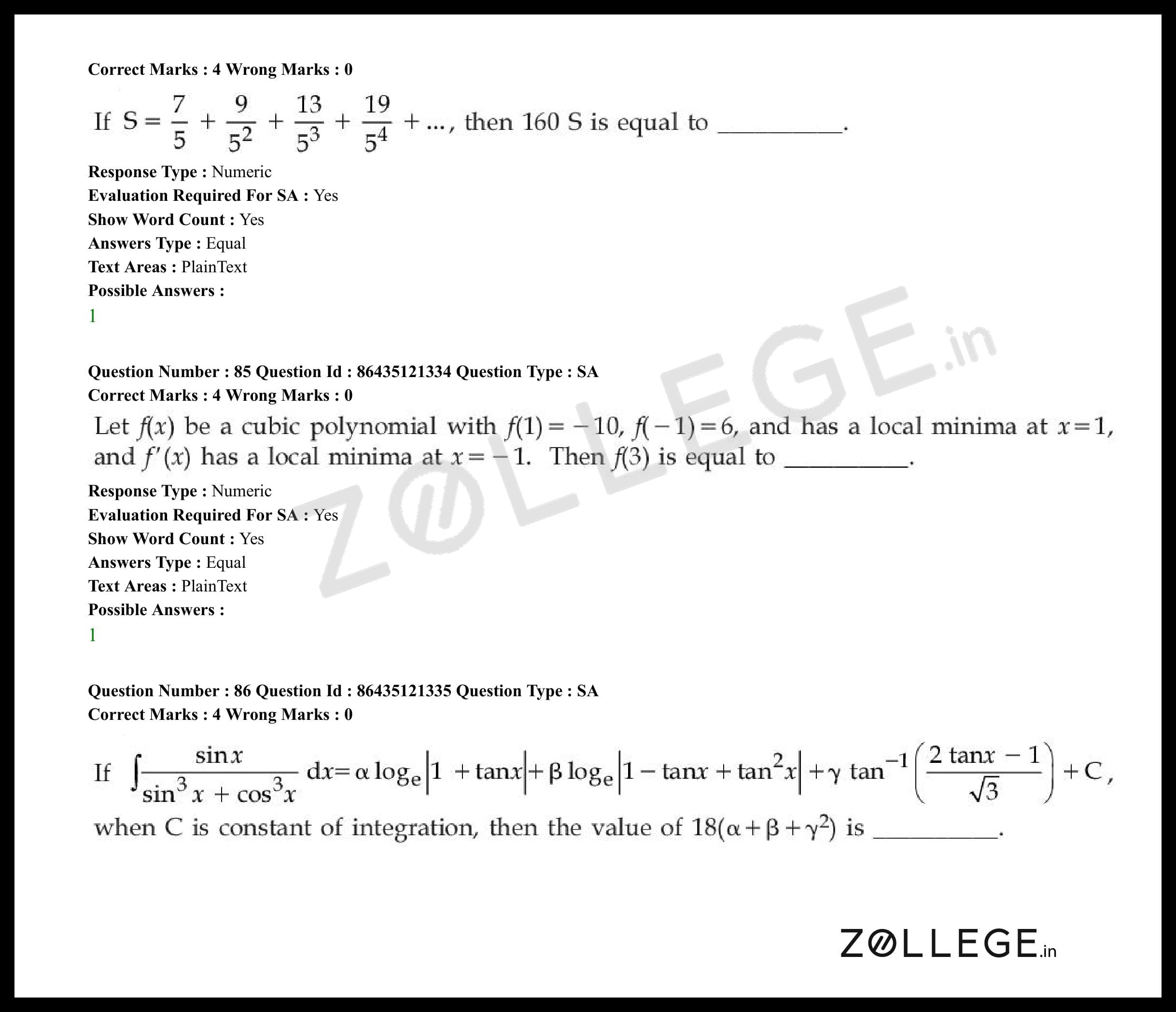
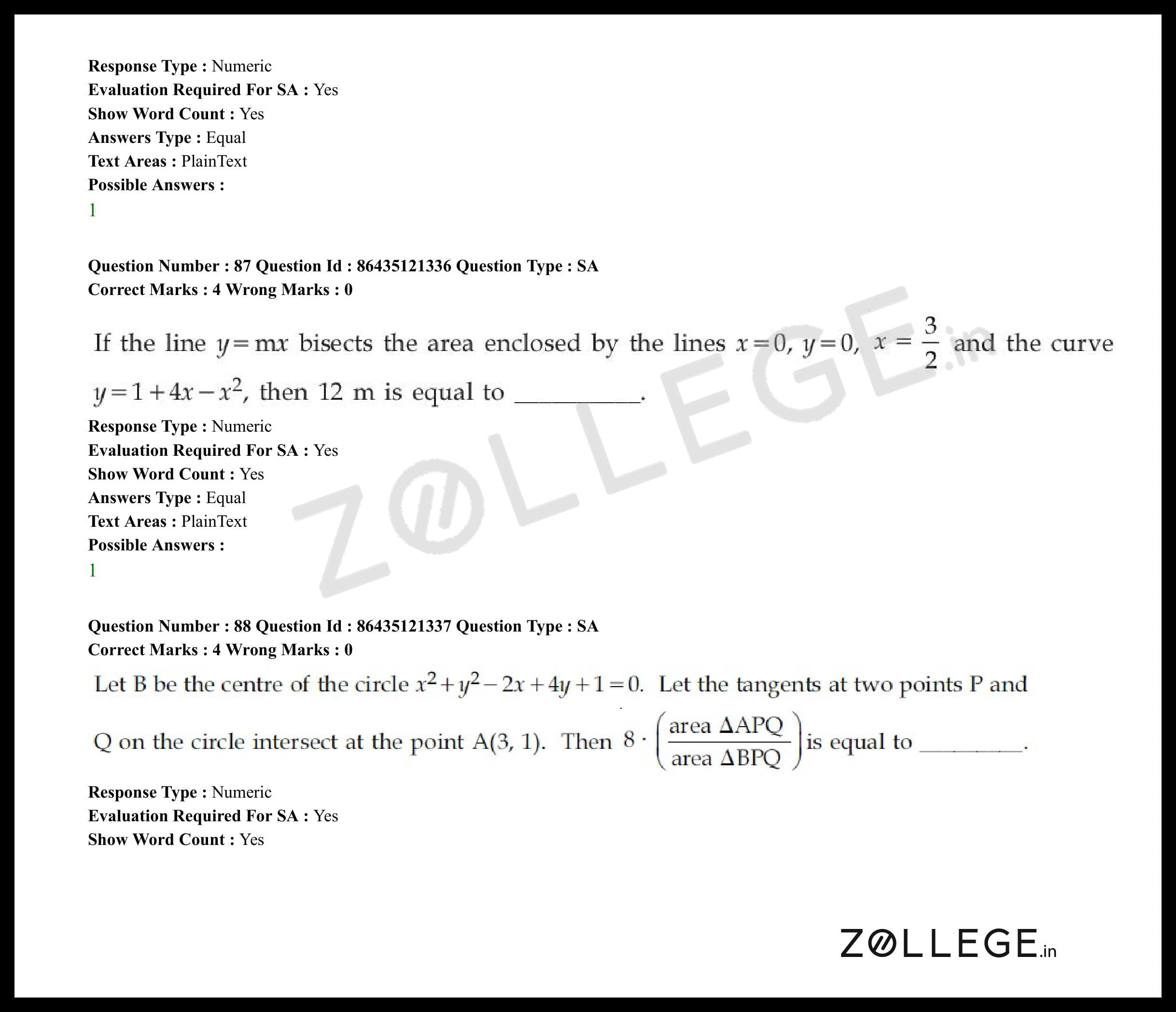
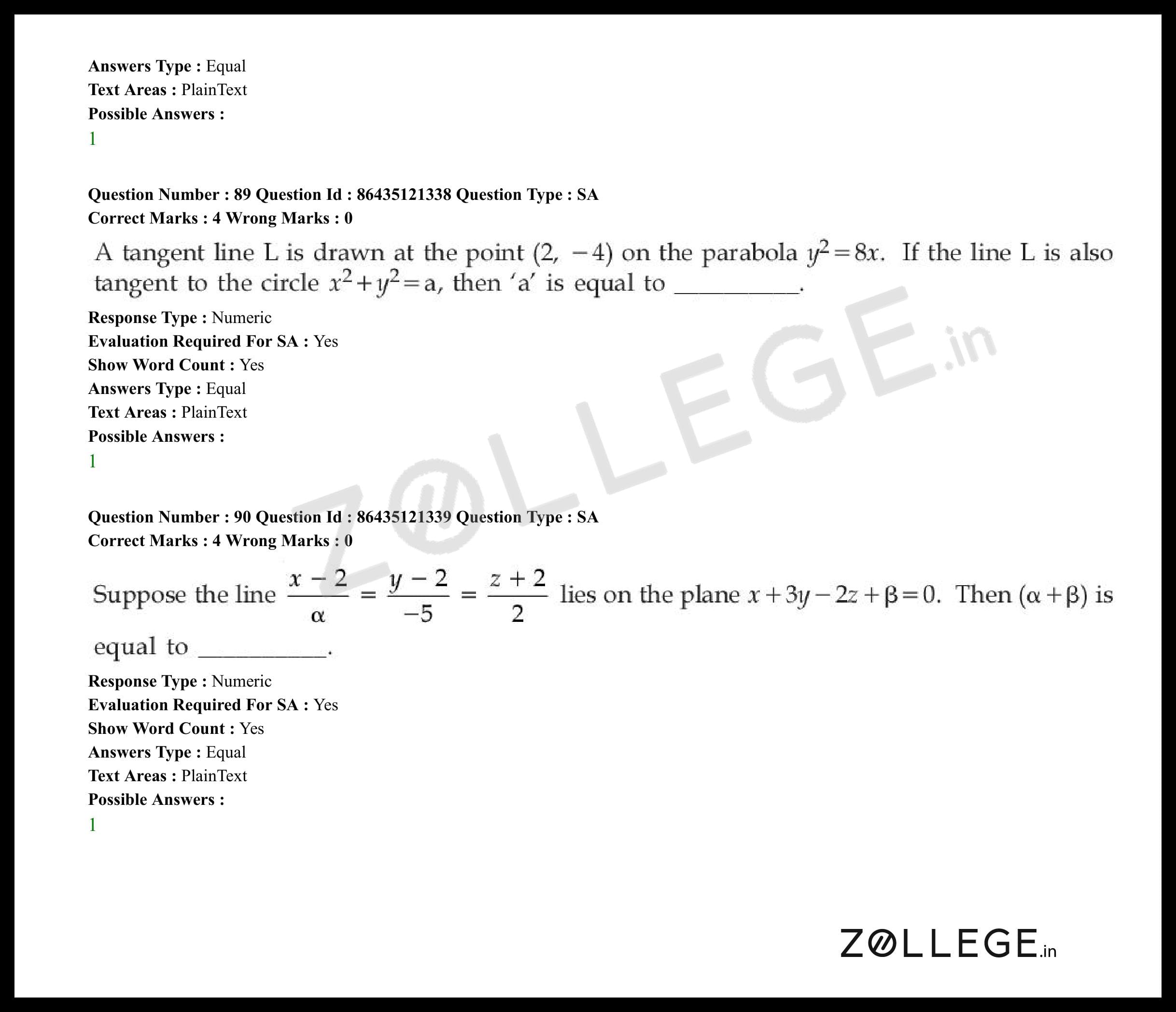
Previous Year JEE Main Question Papers
*The article might have information for the previous academic years, please refer the official website of the exam.