
JEE Main 2021 Question Paper with Answer Key PDF for B.E./ B.Tech(February 26, 2021 - Shift 1)


Content Writer | Updated On - Dec 22, 2025
JEE Main Question Papers are the most important study material for effective exam preparation. We at Zollege have provided all JEE Main Previous Year Papers with Solution PDFs here. JEE Main 2021 B. E. / B. Tech exam was conducted successfully on February 26, 2021. NTA conducted the exam in the Shift 1. According to student reactions and expert reviews, the paper was reported to be moderate.
Students can freely download the JEE Main previous year question paper PDFs along with their solutions here. We strongly encourage JEE Main aspirants to scan through all the JEE Main Question Paper to know the overall difficulty level, JEE Main Syllabus and understand the changes in JEE Main Exam Pattern over the years.
JEE Main 2021 B.E./ B.Tech Question Paper with Answer Key PDF (Shift 1)
| JEE Main 2021 B.E./ B.Tech Question Paper PDF | JEE Main 2021 B.E./ B.Tech Answer Key PDF | JEE Main 2021 B.E./ Solution PDF |
|---|---|---|
| Download PDF | Download PDF | Check Solutions |

In a typical combustion engine the workdone by a gas molecule is given by \(W = \alpha^2\beta e^{\frac{-\beta x^2}{kT}}\), where x is the displacement, k is the Boltzmann constant and T is the temperature. If \(\alpha\) and \(\beta\) are constants, dimensions of \(\alpha\) will be :
View Solution
The given equation for workdone is \(W = \alpha^2\beta e^{\frac{-\beta x^2}{kT}}\).
The argument of an exponential function must be dimensionless.
Therefore, the quantity \(\frac{\beta x^2}{kT}\) must be dimensionless.
The term \(kT\) represents energy, so its dimensions are \([ML^2 T^{-2}]\).
The term \(x^2\) represents the square of displacement, so its dimensions are \([L^2]\).
Setting the dimensions of the exponent to be unity (dimensionless):
\(\frac{[\beta] [x^2]}{[kT]} = [M^0 L^0 T^0]\)
\([\beta] = \frac{[kT]}{[x^2]} = \frac{[ML^2 T^{-2}]}{[L^2]} = [MT^{-2}]\).
Now, analyzing the dimensions of the main equation, we note that the exponential term is dimensionless.
\([W] = [\alpha^2][\beta]\).
The dimensions of work, \([W]\), are \([ML^2 T^{-2}]\).
Substituting the known dimensions:
\([ML^2 T^{-2}] = [\alpha^2] [MT^{-2}]\).
Solving for the dimensions of \(\alpha^2\):
\([\alpha^2] = \frac{[ML^2 T^{-2}]}{[MT^{-2}]} = [L^2]\).
Taking the square root to find the dimensions of \(\alpha\):
\([\alpha] = \sqrt{[L^2]} = [L]\).
This can be expressed as \([M^0 L^1 T^0]\).
Quick Tip: In dimensional analysis, always remember that the arguments of transcendental functions (like exponential, trigonometric, logarithmic functions) and powers must be dimensionless quantities. This is a key starting point for solving many problems.
Given below are two statements: one is labelled as Assertion A and the other is labelled as Reason R.
Assertion A: Body 'P' having mass M moving with speed 'u' has head-on collision elastically with another body 'Q' having mass 'm' initially at rest. If m << M, body 'Q' will have a maximum speed equal to '2u' after collision.
Reason R: During elastic collision, the momentum and kinetic energy are both conserved.
In the light of the above statements, choose the most appropriate answer from the options given below :
View Solution
First, let's analyze Reason R. The definition of an elastic collision is one in which both the total linear momentum and the total kinetic energy of the system are conserved. Therefore, Reason R is a correct statement.
Now, let's analyze Assertion A. For a one-dimensional elastic collision, the final velocity of the target mass (\(m\), body Q) which is initially at rest (\(u_m = 0\)) when struck by a projectile mass (\(M\), body P) with initial velocity \(u_M = u\) is given by:
\(v_m = \left(\frac{2M}{M+m}\right)u_M + \left(\frac{m-M}{M+m}\right)u_m\).
Substituting the given values:
\(v_Q = \left(\frac{2M}{M+m}\right)u + 0 = \frac{2M}{M+m}u\).
The given condition is \(m \ll M\) (mass of body Q is much smaller than the mass of body P).
Under this condition, the denominator \(M+m\) can be approximated as \(M\).
So, the velocity of body Q after the collision becomes:
\(v_Q \approx \left(\frac{2M}{M}\right)u = 2u\).
Thus, Assertion A is a correct statement.
The formula for the final velocity is derived from the principles of conservation of momentum and kinetic energy. Since Reason R states these conservation principles, it serves as the correct explanation for the result in Assertion A.
Quick Tip: For 1D elastic collisions, memorize the final velocity formulas. For a target at rest (\(u_2=0\)), the velocity of the target after collision is \(v_2 = \frac{2m_1}{m_1+m_2}u_1\). The case where a very heavy object hits a very light object at rest (\(m_1 \gg m_2\)) is a classic one, resulting in the light object moving off with twice the initial speed of the heavy object.
A planet revolving in elliptical orbit has :
A. a constant velocity of revolution.
B. has the least velocity when it is nearest to the sun.
C. its areal velocity is directly proportional to its velocity.
D. areal velocity is inversely proportional to its velocity.
E. to follow a trajectory such that the areal velocity is constant.
Choose the correct answer from the options given below :
View Solution
Let's analyze each statement based on Kepler's Laws of Planetary Motion.
Statement A: In an elliptical orbit, the planet's speed and direction of motion are continuously changing. Since velocity is a vector, it is not constant. So, A is incorrect.
Statement B: According to the conservation of angular momentum (\(L=mvr\)), the product of speed (\(v\)) and distance (\(r\)) from the sun is constant. When the planet is nearest to the sun (perihelion), \(r\) is minimum, so its speed \(v\) must be maximum. So, B is incorrect.
Statement E: Kepler's Second Law states that a planet sweeps out equal areas in equal intervals of time. This means the areal velocity (\(dA/dt\)) is constant. The areal velocity is related to angular momentum by \(dA/dt = L/(2m)\), which is constant since angular momentum (\(L\)) is conserved under the central gravitational force. So, E is correct.
Statements C and D: Areal velocity is a constant value, whereas the planet's orbital velocity is variable. A constant quantity cannot be proportional to a variable quantity. So, C and D are incorrect.
Therefore, the only correct statement is E.
Quick Tip: Remember Kepler's Three Laws: 1. Law of Orbits: Planets move in elliptical orbits with the Sun at one focus. 2. Law of Areas: The areal velocity of a planet is constant. This implies the planet moves faster when closer to the Sun and slower when farther away. 3. Law of Periods: The square of the orbital period (\(T^2\)) is proportional to the cube of the semi-major axis (\(a^3\)) of its orbit.
Find the gravitational force of attraction between the ring and sphere as shown in the diagram, where the plane of the ring is perpendicular to the line joining the centres. If \(\sqrt{8}R\) is the distance between the centres of a ring (of mass 'm') and a sphere (mass 'M') where both have equal radius 'R'.

View Solution
According to Newton's shell theorem, a uniform sphere attracts an external particle as if the entire mass of the sphere were concentrated at its center. So, we can treat the sphere of mass 'M' as a point mass at its center.
The problem then reduces to finding the force exerted by the ring on this point mass 'M'.
The gravitational field (\(E_g\)) at a point on the axis of a uniform ring of mass 'm' and radius 'R' at a distance 'x' from its center is given by:
\(E_g = \frac{Gmx}{(R^2 + x^2)^{3/2}}\).
In this problem, the distance between the centers is \(x = \sqrt{8}R\).
Substituting this value into the formula for the gravitational field:
\(E_g = \frac{Gm(\sqrt{8}R)}{(R^2 + (\sqrt{8}R)^2)^{3/2}} = \frac{Gm\sqrt{8}R}{(R^2 + 8R^2)^{3/2}}\).
\(E_g = \frac{Gm\sqrt{8}R}{(9R^2)^{3/2}} = \frac{Gm\sqrt{8}R}{(9^{3/2})(R^2)^{3/2}} = \frac{Gm\sqrt{8}R}{27R^3}\).
\(E_g = \frac{\sqrt{8}Gm}{27R^2}\).
The gravitational force on the point mass 'M' is \(F = M \times E_g\).
\(F = M \left( \frac{\sqrt{8}Gm}{27R^2} \right) = \frac{\sqrt{8}}{27} \frac{GMm}{R^2}\).
Quick Tip: For problems involving gravitational force between an extended body (like a ring or shell) and a spherically symmetric body (like a solid sphere or point mass), the standard approach is to first find the gravitational field of the extended body and then multiply by the mass of the other body (if it can be treated as a point mass).
Four identical solid spheres each of mass 'm' and radius 'a' are placed with their centres on the four corners of a square of side 'b'. The moment of inertia of the system about one side of square where the axis of rotation is parallel to the plane of the square is:
View Solution
Let the axis of rotation be one of the sides of the square. Let's call this side L.
There are two spheres whose centers lie on the axis of rotation L.
For each of these two spheres, the moment of inertia about the axis L is simply the moment of inertia about a diameter.
\(I_1 = I_2 = \frac{2}{5}ma^2\).
There are two other spheres whose centers are at a perpendicular distance 'b' from the axis of rotation L.
For these two spheres, we must use the parallel axis theorem: \(I = I_{cm} + Md^2\).
Here, \(I_{cm} = \frac{2}{5}ma^2\) (moment of inertia about the center of mass) and the distance \(d=b\).
So, for each of these two spheres, the moment of inertia is:
\(I_3 = I_4 = \frac{2}{5}ma^2 + mb^2\).
The total moment of inertia of the system is the sum of the moments of inertia of the four spheres.
\(I_{total} = I_1 + I_2 + I_3 + I_4\).
\(I_{total} = \left(\frac{2}{5}ma^2\right) + \left(\frac{2}{5}ma^2\right) + \left(\frac{2}{5}ma^2 + mb^2\right) + \left(\frac{2}{5}ma^2 + mb^2\right)\).
\(I_{total} = 4 \left(\frac{2}{5}ma^2\right) + 2(mb^2)\).
\(I_{total} = \frac{8}{5}ma^2 + 2mb^2\).
Quick Tip: When calculating the moment of inertia for a system of multiple objects, calculate the moment of inertia for each object individually about the given axis and then simply add them up. Remember to apply the Parallel Axis Theorem for any object whose center of mass does not lie on the axis of rotation.
A large number of water drops, each of radius r, combine to have a drop of radius R. If the surface tension is T and mechanical equivalent of heat is J, the rise in heat energy per unit volume will be :
View Solution
Step 1: Conservation of volume
Let the number of small drops be \(n\).
Since volume is conserved,
\[ n \times \frac{4}{3}\pi r^3 = \frac{4}{3}\pi R^3 \]
\[ \Rightarrow n = \frac{R^3}{r^3} \]
Step 2: Initial and final surface areas
Surface area of one small drop \(= 4\pi r^2\)
\[ A_i = n \times 4\pi r^2 = \frac{R^3}{r^3} \times 4\pi r^2 = \frac{4\pi R^3}{r} \]
Surface area of the large drop:
\[ A_f = 4\pi R^2 \]
Step 3: Decrease in surface area
\[ \Delta A = A_i - A_f = 4\pi R^2\left(\frac{R}{r}-1\right) \]
Step 4: Decrease in surface energy
Surface energy \(= T \times area\)
\[ W = T \Delta A = 4\pi T R^2\left(\frac{R}{r}-1\right) = 4\pi T\left(\frac{R^3}{r}-R^2\right) \]
This energy is released as heat.
Step 5: Heat energy per unit volume
Volume of large drop:
\[ V = \frac{4}{3}\pi R^3 \]
\[ Heat per unit volume = \frac{W}{V} = \frac{4\pi T\left(\frac{R^3}{r}-R^2\right)}{\frac{4}{3}\pi R^3} \]
\[ = 3T\left(\frac{1}{r}-\frac{1}{R}\right) \]
Step 6: Effect of mechanical equivalent of heat
Since heat is required in calories and \(J\) is the mechanical equivalent of heat,
\[ \boxed{ Heat energy per unit volume = \frac{3T}{J}\left(\frac{1}{r}-\frac{1}{R}\right) } \]
Hence, the correct answer is option (B). Quick Tip: When small liquid drops coalesce to form a larger drop, the total surface area decreases. This reduction in surface area leads to a release of surface energy, which typically manifests as an increase in the temperature of the drop. The key is to relate the radii using volume conservation.
The normal density of a material is \(\rho\) and its bulk modulus of elasticity is K. The magnitude of increase in density of material, when a pressure P is applied uniformly on all sides, will be :
View Solution
The bulk modulus of elasticity, K, is defined as the ratio of volumetric stress to volumetric strain.
\(K = \frac{Volumetric Stress}{Volumetric Strain} = \frac{\Delta P}{(-\Delta V / V)}\).
Here, the applied pressure is P, so \(\Delta P = P\).
\(K = \frac{P}{(-\Delta V / V)}\).
Density is defined as mass per unit volume, \(\rho = m/V\).
Assuming the mass 'm' of the material remains constant, we can differentiate this relation:
\(d\rho = -\frac{m}{V^2} dV = -(\frac{m}{V})\frac{dV}{V} = -\rho \frac{dV}{V}\).
For small changes, we can write this as \(\Delta \rho = -\rho \frac{\Delta V}{V}\).
From this, we get the volumetric strain: \(\frac{-\Delta V}{V} = \frac{\Delta \rho}{\rho}\).
Now, substitute this expression for volumetric strain into the formula for bulk modulus:
\(K = \frac{P}{(\Delta \rho / \rho)} = \frac{P\rho}{\Delta \rho}\).
The question asks for the magnitude of the increase in density, which is \(\Delta \rho\).
Rearranging the formula to solve for \(\Delta \rho\):
\(\Delta \rho = \frac{P\rho}{K}\).
Quick Tip: A useful relation to remember for problems involving bulk modulus and density changes is that the fractional change in density is equal to the magnitude of the volumetric strain: \(\frac{\Delta \rho}{\rho} = -\frac{\Delta V}{V}\). This follows directly from the definition of density, \(\rho=m/V\), assuming mass is conserved.
Assume that a tunnel is dug along a chord of the earth, at a perpendicular distance (R/2) from the earth's centre, where 'R' is the radius of the Earth. The wall of the tunnel is frictionless. If a particle is released in this tunnel, it will execute a simple harmonic motion with a time period:
View Solution
Consider a particle of mass 'm' inside the tunnel at a distance 'x' from the midpoint of the chord.
Let the center of the Earth be O. The perpendicular distance from O to the tunnel is \(d = R/2\).
The distance of the particle from the center of the Earth is \(r = \sqrt{x^2 + d^2} = \sqrt{x^2 + (R/2)^2}\).
The gravitational force on the particle at distance 'r' from the center is directed towards the center and has a magnitude \(F_g = \frac{GMm}{R^3}r\).
Using \(g = GM/R^2\), we can write this as \(F_g = \frac{mg}{R}r\).
This force is directed towards the center of the Earth, O. We need the component of this force along the tunnel, which acts as the restoring force.
Let \(\theta\) be the angle between the line joining the particle to the center of the Earth and the line perpendicular to the tunnel. Then, \(\sin \theta = x/r\). The component of the force along the tunnel is \(F_{restore} = -F_g \sin \theta\).
\(F_{restore} = -\left(\frac{mg}{R}r\right) \left(\frac{x}{r}\right) = -\left(\frac{mg}{R}\right)x\).
This equation is of the form \(F = -kx\), which is the condition for Simple Harmonic Motion (SHM).
The effective spring constant is \(k = \frac{mg}{R}\).
The time period of SHM is given by the formula \(T = 2\pi \sqrt{\frac{m}{k}}\).
Substituting the value of k:
\(T = 2\pi \sqrt{\frac{m}{mg/R}} = 2\pi \sqrt{\frac{R}{g}}\).
Notably, the time period is independent of the location of the chord (the distance R/2). It is the same as the time period for a tunnel dug along the diameter.
Quick Tip: A remarkable result in gravitation is that the period of oscillation of a particle in any straight, frictionless tunnel through a uniform Earth is the same, regardless of the tunnel's length or position. The period is always \(T = 2\pi \sqrt{R/g}\), which is approximately 84.6 minutes.
The temperature \(\theta\) at the junction of two insulating sheets, having thermal resistances R\(_1\) and R\(_2\) as well as top and bottom temperatures \(\theta_1\) and \(\theta_2\) (as shown in figure) is given by :

View Solution
The two insulating sheets are connected in series.
In the steady state of heat conduction, the rate of heat flow (heat current) through both sheets must be the same.
The heat current (\(H\)) through a material with thermal resistance \(R\) and temperature difference \(\Delta \theta\) is given by \(H = \frac{\Delta \theta}{R}\).
Let \(\theta\) be the temperature at the junction. Assume \(\theta_1 > \theta_2\). Heat flows from temperature \(\theta_1\) to \(\theta_2\).
The heat current through the first sheet (with resistance \(R_1\)) is:
\(H_1 = \frac{\theta_1 - \theta}{R_1}\).
The heat current through the second sheet (with resistance \(R_2\)) is:
\(H_2 = \frac{\theta - \theta_2}{R_2}\).
In steady state, \(H_1 = H_2\).
\(\frac{\theta_1 - \theta}{R_1} = \frac{\theta - \theta_2}{R_2}\).
Now, we solve for the junction temperature \(\theta\).
\(R_2(\theta_1 - \theta) = R_1(\theta - \theta_2)\).
\(\theta_1 R_2 - \theta R_2 = \theta R_1 - \theta_2 R_1\).
\(\theta_1 R_2 + \theta_2 R_1 = \theta R_1 + \theta R_2\).
\(\theta_1 R_2 + \theta_2 R_1 = \theta(R_1 + R_2)\).
\(\theta = \frac{\theta_1 R_2 + \theta_2 R_1}{R_1 + R_2}\).
This result is analogous to finding the potential at the junction of two resistors in series in an electrical circuit.
Quick Tip: Problems involving thermal conduction in series are analogous to electrical circuits with resistors in series. Temperature is analogous to Voltage, heat current is analogous to electric current, and thermal resistance is analogous to electrical resistance. The key principle is that the heat current is constant through all elements in series.
A particle is moving with uniform speed along the circumference of a circle of radius R under the action of a central force F which is inversely proportional to R\(^3\). Its time period of revolution will be given by:
View Solution
The particle is in uniform circular motion, so the central force F provides the necessary centripetal force.
The magnitude of the centripetal force required is \(F_c = m \omega^2 R\), where m is the mass, \(\omega\) is the angular velocity, and R is the radius.
We are given that the central force F is inversely proportional to \(R^3\).
So, \(F = \frac{k}{R^3}\), where k is a proportionality constant.
Equating the central force and the centripetal force:
\(F = F_c\).
\(\frac{k}{R^3} = m \omega^2 R\).
The angular velocity \(\omega\) is related to the time period T by \(\omega = \frac{2\pi}{T}\).
Substituting this into the equation:
\(\frac{k}{R^3} = m \left(\frac{2\pi}{T}\right)^2 R = \frac{4\pi^2 m R}{T^2}\).
Now, we rearrange the equation to find the relationship between T and R.
\(T^2 = \frac{4\pi^2 m}{k} R^4\).
Since \(4\pi^2 m/k\) is a constant, we have:
\(T^2 \propto R^4\).
Taking the square root of both sides:
\(T \propto R^2\).
Quick Tip: For any circular motion problem under a central force, the core step is to equate the given central force law (\(F(R)\)) with the required centripetal force (\(mv^2/R\) or \(m\omega^2 R\)). From this relation, you can derive relationships between radius, speed, angular velocity, and time period.
If two similar springs each of spring constant K are joined in series, the new spring constant and time period would be changed by a factor:
View Solution
First, let's find the new spring constant for two springs in series.
The formula for the equivalent spring constant (\(K_{eq}\)) of springs in series is:
\(\frac{1}{K_{eq}} = \frac{1}{K_1} + \frac{1}{K_2}\).
Since the two springs are similar, \(K_1 = K_2 = K\).
\(\frac{1}{K_{eq}} = \frac{1}{K} + \frac{1}{K} = \frac{2}{K}\).
So, the new spring constant is \(K_{new} = K_{eq} = \frac{K}{2}\).
The factor by which the spring constant changes is \(\frac{K_{new}}{K} = \frac{K/2}{K} = \frac{1}{2}\).
Next, let's find the change in the time period of oscillation for a mass 'm' attached to the spring system.
The original time period with a single spring is \(T_{old} = 2\pi\sqrt{\frac{m}{K}}\).
The new time period with the series combination is \(T_{new} = 2\pi\sqrt{\frac{m}{K_{new}}}\).
Substituting \(K_{new} = K/2\):
\(T_{new} = 2\pi\sqrt{\frac{m}{K/2}} = 2\pi\sqrt{\frac{2m}{K}} = \sqrt{2} \left(2\pi\sqrt{\frac{m}{K}}\right)\).
So, \(T_{new} = \sqrt{2} \times T_{old}\).
The factor by which the time period changes is \(\frac{T_{new}}{T_{old}} = \sqrt{2}\).
The factors for the change in spring constant and time period are \(\frac{1}{2}\) and \(\sqrt{2}\), respectively.
Quick Tip: Remember the rules for combining springs: - Series: \(\frac{1}{K_{eq}} = \frac{1}{K_1} + \frac{1}{K_2} + ...\) (like capacitors in series or resistors in parallel). The combination is less stiff. - Parallel: \(K_{eq} = K_1 + K_2 + ...\) (like capacitors in parallel or resistors in series). The combination is stiffer.
Find the electric field at point P (as shown in figure) on the perpendicular bisector of a uniformly charged thin wire of length L carrying a charge Q. The distance of the point P from the centre of the rod is \(a = \frac{\sqrt{3}}{2} L\).

View Solution
The formula for the electric field at a point on the perpendicular bisector of a finite charged wire of length L at a distance 'a' is:
\(E = \frac{1}{4\pi \epsilon_0} \frac{Q}{a\sqrt{a^2 + (L/2)^2}}\).
Alternatively, using the angle \(\theta\) subtended by half the wire at the point P:
\(E = \frac{2k\lambda}{a}\sin\theta\), where \(k=\frac{1}{4\pi\epsilon_0}\) and \(\lambda = Q/L\).
\(\sin\theta = \frac{L/2}{\sqrt{a^2+(L/2)^2}}\).
This gives the same first formula.
We are given the distance \(a = \frac{\sqrt{3}}{2} L\).
Let's substitute this value into the formula:
\(E = \frac{1}{4\pi \epsilon_0} \frac{Q}{(\frac{\sqrt{3}}{2} L)\sqrt{(\frac{\sqrt{3}}{2} L)^2 + (\frac{L}{2})^2}}\).
First, simplify the term inside the square root:
\((\frac{\sqrt{3}}{2} L)^2 + (\frac{L}{2})^2 = \frac{3}{4}L^2 + \frac{1}{4}L^2 = \frac{4}{4}L^2 = L^2\).
The square root is \(\sqrt{L^2} = L\).
Now substitute this back into the expression for E:
\(E = \frac{1}{4\pi \epsilon_0} \frac{Q}{(\frac{\sqrt{3}}{2} L)(L)}\).
\(E = \frac{1}{4\pi \epsilon_0} \frac{Q}{\frac{\sqrt{3}}{2} L^2}\).
\(E = \frac{2}{4\pi \epsilon_0 \sqrt{3} L^2} = \frac{1}{2\pi \epsilon_0 \sqrt{3} L^2}\).
This can be rewritten as \(E = \frac{Q}{2\sqrt{3} \pi \epsilon_0 L^2}\).
Quick Tip: Memorize the formula for the electric field of a finite line of charge. At a perpendicular distance 'a' from the center, \(E = \frac{k\lambda}{a}(\sin\theta_1 + \sin\theta_2)\), where \(\theta_1\) and \(\theta_2\) are the angles subtended by the ends of the wire. For the perpendicular bisector, \(\theta_1=\theta_2\), and the formula simplifies.
Consider the combination of 2 capacitors C\(_1\) and C\(_2\), with C\(_2 > C_1\), when connected in parallel, the equivalent capacitance is \(\frac{15}{4}\) times the equivalent capacitance of the same connected in series. Calculate the ratio of capacitors, \(\frac{C_2}{C_1}\).
View Solution
Step 1: Write expressions for equivalent capacitances
For two capacitors \(C_1\) and \(C_2\):
\[ C_p = C_1 + C_2 \quad (parallel combination) \]
\[ C_s = \frac{C_1 C_2}{C_1 + C_2} \quad (series combination) \]
Step 2: Use the given condition
According to the question,
\[ C_p = \frac{15}{4} \, C_s \]
Substituting expressions,
\[ C_1 + C_2 = \frac{15}{4}\left(\frac{C_1 C_2}{C_1 + C_2}\right) \]
Step 3: Simplify
\[ (C_1 + C_2)^2 = \frac{15}{4} C_1 C_2 \]
Divide both sides by \(C_1^2\) and define
\[ x = \frac{C_2}{C_1} \]
Then,
\[ (1+x)^2 = \frac{15}{4}x \]
Step 4: Form the quadratic equation
\[ x^2 + 2x + 1 = \frac{15}{4}x \]
\[ x^2 + \left(2-\frac{15}{4}\right)x + 1 = 0 \]
\[ x^2 - \frac{7}{4}x + 1 = 0 \]
Step 5: Check discriminant
\[ \Delta = \left(\frac{7}{4}\right)^2 - 4(1)(1) = \frac{49}{16} - \frac{64}{16} = -\frac{15}{16} < 0 \]
Step 6: Conclusion
Since the discriminant is negative, the quadratic equation has **no real solution**.
Therefore, **the given numerical condition \(\dfrac{15}{4}\) is inconsistent**, and the problem as stated is **mathematically incorrect**.
Remark (Important):
Despite this inconsistency, the official answer key gives \[ \boxed{\dfrac{C_2}{C_1} = \dfrac{15}{11}} \]
which indicates a **probable typographical error in the question**.
Final Answer \[ \boxed{\dfrac{C_2}{C_1} = \dfrac{15}{11}} \] Quick Tip: Be aware that questions in competitive exams can sometimes be flawed. If you are certain your method is correct but you're getting an impossible result (like no real solutions), double-check your calculations. If the problem persists, it may be an error in the question itself. In an exam, you might have to make an educated guess or move on.
An alternating current is given by the equation \(i=i_1 \sin \omega t + i_2 \cos \omega t\). The rms current will be:
View Solution
Step 1: Identify the form of the given current
The current is a linear combination of sine and cosine terms of the same angular frequency: \[ i = i_1 \sin \omega t + i_2 \cos \omega t. \]
Such an expression can always be written as a single sinusoidal function: \[ i = I_0 \sin(\omega t + \phi), \]
where \(I_0\) is the peak (maximum) current.
Step 2: Determine the peak current
Comparing coefficients, we write: \[ i_1 = I_0 \cos \phi, \qquad i_2 = I_0 \sin \phi. \]
Squaring and adding: \[ i_1^2 + i_2^2 = I_0^2(\cos^2 \phi + \sin^2 \phi) = I_0^2. \]
Hence, \[ I_0 = \sqrt{i_1^2 + i_2^2}. \]
Step 3: Use the rms–peak relation
For any sinusoidal current, \[ I_{rms} = \frac{I_0}{\sqrt{2}}. \]
Substituting the value of \(I_0\): \[ I_{rms} = \frac{1}{\sqrt{2}}\sqrt{i_1^2 + i_2^2}. \]
Final Answer: \[ \boxed{I_{rms} = \frac{1}{\sqrt{2}}(i_1^2 + i_2^2)^{1/2}} \] Quick Tip: The RMS value of a function \(f(t)\) is the square root of the mean of the square of the function, \(f_{rms} = \sqrt{\langle f(t)^2 \rangle}\). For a sum of orthogonal functions like sine and cosine of the same frequency, the mean square is the sum of the mean squares of individual components: \(I_{rms}^2 = (I_{1,rms})^2 + (I_{2,rms})^2 = (i_1/\sqrt{2})^2 + (i_2/\sqrt{2})^2 = (i_1^2+i_2^2)/2\).
Five equal resistances are connected in a network as shown in figure. The net resistance between the points A and B is:

View Solution
Step 1: Identify the circuit type
From the given figure, the network of five equal resistors forms a Wheatstone bridge.
All five resistors have the same resistance \(R\).
Step 2: Check for balance condition
For a Wheatstone bridge, the bridge is balanced if: \[ \frac{R_1}{R_2} = \frac{R_3}{R_4} \]
Since all resistors are equal: \[ \frac{R}{R} = \frac{R}{R} = 1 \]
Hence, the bridge is balanced.
Step 3: Effect of a balanced bridge
In a balanced Wheatstone bridge: \[ V_D = V_C \]
Therefore, no current flows through the central resistor connecting points \(D\) and \(C\).
This resistor can be removed from the circuit without affecting the equivalent resistance between points \(A\) and \(B\).
Step 4: Simplify the circuit
After removing the central resistor, the circuit reduces to two parallel branches:
Upper branch: two resistors in series \[ R_{upper} = R + R = 2R \]
Lower branch: two resistors in series \[ R_{lower} = R + R = 2R \]
Step 5: Calculate equivalent resistance
The two branches are in parallel, so: \[ \frac{1}{R_{eq}} = \frac{1}{2R} + \frac{1}{2R} = \frac{1}{R} \]
\[ R_{eq} = R \]
Final Answer: \[ \boxed{R} \] Quick Tip: Whenever you see a circuit with five resistors, especially in a diamond or bridge-like shape, the first thing to check is if it's a balanced Wheatstone bridge. If \(R_1/R_2 = R_3/R_4\), the bridge is balanced, and the central resistor can be ignored, simplifying the calculation immensely.
A short straight object of height 100 cm lies before the central axis of a spherical mirror whose focal length has absolute value \(|f| = 40\) cm. The image of object produced by the mirror is of height 25 cm and has the same orientation of the object. One may conclude from the information:
View Solution
Step 1: List the given data
\[ h_o = 100 cm, \quad h_i = 25 cm \]
The image has the same orientation as the object, which means the image is erect.
Step 2: Calculate the magnification
Magnification is given by: \[ m = \frac{h_i}{h_o} \]
Since the image is erect, the magnification is positive: \[ m = \frac{25}{100} = +0.25 \]
Step 3: Interpret the sign and magnitude of magnification
\(m > 0\) \quad \(\Rightarrow\) Image is virtual and erect
\(|m| < 1\) \quad \(\Rightarrow\) Image is diminished
Step 4: Analyze possible mirror types
Concave mirror:
A concave mirror forms a virtual image only when the object is placed between the pole and focus, but such a virtual image is always magnified (\(|m|>1\)). \[ This contradicts |m| = 0.25 \]
Convex mirror:
A convex mirror always produces a virtual, erect, and diminished image for any object position.
Step 5: Determine the image position
For a convex mirror, the image is always formed:
Behind the mirror
On the side opposite to the object
Final Conclusion:
The image is:
Virtual
Erect
Diminished
Formed by a convex mirror
Located on the opposite side of the mirror
\[ \boxed{Correct option is (C)} \] Quick Tip: The sign and magnitude of the magnification 'm' tell you everything about the image: - Sign: \(m>0\) \(\implies\) Virtual & Erect. \(m<0\) \(\implies\) Real & Inverted. - Magnitude: \(|m|>1\) \(\implies\) Magnified. \(|m|<1\) \(\implies\) Diminished. \(|m|=1\) \(\implies\) Same size. A convex mirror always produces a virtual, erect, and diminished image (\(0 < m < +1\)).
In a Young's double slit experiment two slits are separated by 2 mm and the screen is placed one meter away. When a light of wavelength 500 nm is used, the fringe separation will be :
View Solution
The formula for fringe separation (or fringe width), \(\beta\), in a Young's double-slit experiment is:
\(\beta = \frac{\lambda D}{d}\).
We are given the following values:
Wavelength of light, \(\lambda = 500\) nm \(= 500 \times 10^{-9}\) m.
Distance between the slits and the screen, \(D = 1\) m.
Separation between the two slits, \(d = 2\) mm \(= 2 \times 10^{-3}\) m.
Now, substitute these values into the formula:
\(\beta = \frac{(500 \times 10^{-9} m) \times (1 m)}{2 \times 10^{-3} m}\).
\(\beta = \frac{500}{2} \times 10^{-9 - (-3)} m = 250 \times 10^{-6} m\).
To express the answer in millimeters (mm), we convert meters to millimeters (\(1 m = 1000 mm\), so \(10^{-6} m = 10^{-3} mm\)).
\(\beta = 250 \times 10^{-3} mm = 0.25 mm\).
The fringe separation will be 0.25 mm.
Quick Tip: In YDSE calculations, be extremely careful with units. It's best practice to convert all given quantities to their base SI units (meters for length) before plugging them into the formula \(\beta = \lambda D / d\). Then, convert the final answer to the unit required by the options (e.g., mm or cm).
Given below are two statements: one is labelled as Assertion A and the other is labelled as Reason R.
Assertion A: An electron microscope can achieve better resolving power than an optical microscope.
Reason R: The de Broglie's wavelength of the electrons emitted from an electron gun is much less than wavelength of visible light.
In the light of the above statements, choose the correct answer from the options given below:
View Solution
Let's analyze Assertion A. It states that an electron microscope has better resolving power than an optical microscope. This is a well-known fact in physics. The resolving power allows us to distinguish between two closely spaced objects, and electron microscopes can resolve much smaller features than optical microscopes. So, Assertion A is true.
Let's analyze Reason R. It states that the de Broglie wavelength of electrons from an electron gun is much smaller than the wavelength of visible light. The de Broglie wavelength is given by \(\lambda = h/p\), where p is the momentum of the particle. Electrons in an electron microscope are accelerated to very high velocities, giving them large momentum and consequently, a very small wavelength (often in the picometer range). The wavelength of visible light is in the range of 400-700 nanometers. A picometer is \(10^{-3}\) nanometers, so the electron wavelength is indeed much smaller. So, Reason R is true.
Now, let's establish the connection. The resolving power of a microscope is fundamentally limited by the wavelength of the radiation used to view the specimen. The approximate limit of resolution is proportional to the wavelength (\(Resolution \propto \lambda\)). A smaller wavelength allows for a better (smaller) resolution limit, which means higher resolving power.
Since the wavelength of electrons is much smaller than that of visible light, electron microscopes can resolve much finer details. Therefore, Reason R is the correct scientific explanation for why Assertion A is true.
Quick Tip: The concept of resolving power is crucial in optics. Remember that resolving power is inversely related to the limit of resolution, and the limit of resolution is directly proportional to the wavelength of the waves used (Rayleigh Criterion). To see smaller things, you need waves with smaller wavelengths.
If \(\lambda_1\) and \(\lambda_2\) are the wavelengths of the third member of Lyman and first member of the Paschen series respectively, then the value of \(\lambda_1 : \lambda_2\) is:
View Solution
The Rydberg formula for the wavelength of spectral lines in a hydrogen-like atom is:
\(\frac{1}{\lambda} = R (\frac{1}{n_f^2} - \frac{1}{n_i^2})\), where R is the Rydberg constant.
First, consider the third member of the Lyman series (\(\lambda_1\)).
For the Lyman series, the final state is \(n_f = 1\).
The first member is from \(n_i=2\), the second from \(n_i=3\), and the third member is from \(n_i = 4\).
So, for \(\lambda_1\), we have \(n_f = 1\) and \(n_i = 4\).
\(\frac{1}{\lambda_1} = R (\frac{1}{1^2} - \frac{1}{4^2}) = R (1 - \frac{1}{16}) = R (\frac{15}{16})\).
\(\lambda_1 = \frac{16}{15R}\).
Next, consider the first member of the Paschen series (\(\lambda_2\)).
For the Paschen series, the final state is \(n_f = 3\).
The first member corresponds to the transition from the next higher level, so \(n_i = 4\).
So, for \(\lambda_2\), we have \(n_f = 3\) and \(n_i = 4\).
\(\frac{1}{\lambda_2} = R (\frac{1}{3^2} - \frac{1}{4^2}) = R (\frac{1}{9} - \frac{1}{16}) = R (\frac{16-9}{144}) = R (\frac{7}{144})\).
\(\lambda_2 = \frac{144}{7R}\).
Now, we find the ratio \(\lambda_1 : \lambda_2\).
\(\frac{\lambda_1}{\lambda_2} = \frac{16/(15R)}{144/(7R)} = \frac{16}{15R} \times \frac{7R}{144}\).
The Rydberg constant R cancels out.
\(\frac{\lambda_1}{\lambda_2} = \frac{16 \times 7}{15 \times 144}\).
Since \(144 = 16 \times 9\), we can simplify the expression:
\(\frac{\lambda_1}{\lambda_2} = \frac{16 \times 7}{15 \times (16 \times 9)} = \frac{7}{15 \times 9} = \frac{7}{135}\).
Therefore, the ratio \(\lambda_1 : \lambda_2\) is \(7 : 135\).
Quick Tip: Memorize the names of the first few spectral series for hydrogen and their corresponding final states (\(n_f\)): - Lyman series: \(n_f=1\) (UV) - Balmer series: \(n_f=2\) (Visible) - Paschen series: \(n_f=3\) (Infrared) - Brackett series: \(n_f=4\) (Infrared) - Pfund series: \(n_f=5\) (Infrared) The 'first member' of any series is the transition from \(n_i = n_f+1\).
LED is constructed from Ga-As-P semiconducting material. The energy gap of this LED is 1.9 eV. Calculate the wavelength of light emitted and its colour.
[\(h=6.63 \times 10^{-34}\) Js and \(c=3 \times 10^8\) ms\(^{-1}\)]
View Solution
In an LED, when an electron recombines with a hole, it releases energy equal to the energy gap (\(E_g\)) in the form of a photon.
The energy of the emitted photon is given by \(E = hf = \frac{hc}{\lambda}\), where h is Planck's constant, c is the speed of light, and \(\lambda\) is the wavelength of the emitted light.
Therefore, \(E_g = \frac{hc}{\lambda}\).
We can rearrange this to solve for the wavelength: \(\lambda = \frac{hc}{E_g}\).
The given values are:
Energy gap, \(E_g = 1.9\) eV.
Planck's constant, \(h = 6.63 \times 10^{-34}\) Js.
Speed of light, \(c = 3 \times 10^8\) m/s.
First, we must convert the energy gap from electron-volts (eV) to Joules (J).
\(1 eV = 1.6 \times 10^{-19}\) J.
\(E_g = 1.9 \times 1.6 \times 10^{-19} J = 3.04 \times 10^{-19}\) J.
Now, we calculate the wavelength:
\(\lambda = \frac{(6.63 \times 10^{-34} Js) \times (3 \times 10^8 m/s)}{3.04 \times 10^{-19} J}\).
\(\lambda = \frac{19.89 \times 10^{-26}}{3.04 \times 10^{-19}} m \approx 6.542 \times 10^{-7}\) m.
To express this in nanometers (nm), we multiply by \(10^9\):
\(\lambda \approx 6.542 \times 10^{-7} \times 10^9 nm = 654.2\) nm.
The calculated wavelength is approximately 654 nm.
Now we determine the colour. The visible spectrum ranges from approximately 400 nm (violet) to 700 nm (red). A wavelength of 654 nm falls into the red region of the visible spectrum.
So, the emitted light has a wavelength of 654 nm and is red.
Quick Tip: A very useful shortcut for converting between energy in eV and wavelength in nanometers is the formula: \(\lambda (nm) \approx \frac{1240}{E (eV)}\). Using this shortcut: \(\lambda \approx \frac{1240}{1.9} \approx 652.6\) nm. This provides a quick and accurate estimate for multiple-choice questions.
As shown in the figure, a block of mass \(\sqrt{3}\) kg is kept on a horizontal rough surface of coefficient of friction \(\frac{1}{3\sqrt{3}}\). The critical force to be applied on the vertical surface as shown at an angle 60° with horizontal such that it does not move, will be 3x. The value of x will be ______. [g=10 m/s\(^2\); sin 60°=\(\frac{\sqrt{3}}{2}\); cos 60°=\(\frac{1}{2}\)]

View Solution
Let F be the critical force applied. The block is in limiting equilibrium, so we can analyze the forces.
The horizontal component of the applied force is \(F_x = F \cos 60^\circ = F/2\) (acting to the left).
The vertical component of the applied force is \(F_y = F \sin 60^\circ = F\sqrt{3}/2\) (acting downwards).
The weight of the block is \(W = mg = \sqrt{3} \times 10 = 10\sqrt{3}\) N (acting downwards).
The normal reaction force N from the surface is equal to the sum of the downward forces:
\(N = W + F_y = 10\sqrt{3} + \frac{F\sqrt{3}}{2}\).
The force of friction f acts to the right, opposing the horizontal component of F. At the critical condition, friction is at its maximum value, \(f_{max} = \mu N\).
\(f_{max} = \frac{1}{3\sqrt{3}} \left( 10\sqrt{3} + \frac{F\sqrt{3}}{2} \right) = \frac{10}{3} + \frac{F}{6}\).
For horizontal equilibrium, the applied horizontal force must equal the maximum friction force:
\(F_x = f_{max} \implies \frac{F}{2} = \frac{10}{3} + \frac{F}{6}\).
Solving for F:
\(\frac{F}{2} - \frac{F}{6} = \frac{10}{3} \implies \frac{3F - F}{6} = \frac{10}{3} \implies \frac{2F}{6} = \frac{10}{3}\).
\(\frac{F}{3} = \frac{10}{3} \implies F = 10\) N.
The problem states that this critical force is equal to 3x.
\(3x = 10 \implies x = \frac{10}{3} \approx 3.33\).
Quick Tip: When solving equilibrium problems, always start by drawing a free-body diagram to identify all forces acting on the object. Resolve forces into perpendicular components (usually horizontal and vertical) and apply the condition that the net force in each direction is zero.
A boy pushes a box of mass 2 kg with a force \(\vec{F} = (20\hat{i} + 10\hat{j})\) N on a frictionless surface. If the box was initially at rest, then ______ m is displacement along the x-axis after 10 s.
View Solution
Given force \(\vec{F} = (20\hat{i} + 10\hat{j})\) N and mass \(m = 2\) kg.
First, calculate the acceleration vector using Newton's second law, \(\vec{F} = m\vec{a}\).
\(\vec{a} = \frac{\vec{F}}{m} = \frac{(20\hat{i} + 10\hat{j}) N}{2 kg} = (10\hat{i} + 5\hat{j}) m/s^2\).
The components of acceleration are \(a_x = 10\) m/s\(^2\) and \(a_y = 5\) m/s\(^2\).
We need to find the displacement along the x-axis after \(t = 10\) s.
The box was initially at rest, so the initial velocity components are \(u_x = 0\) and \(u_y = 0\).
Using the equation of motion for displacement: \(s_x = u_x t + \frac{1}{2} a_x t^2\).
Substituting the values for the x-direction:
\(s_x = (0)(10) + \frac{1}{2} (10 m/s^2) (10 s)^2\).
\(s_x = 5 \times 100 = 500\) m.
The displacement along the x-axis after 10 seconds is 500 m.
Quick Tip: For motion under a constant vector force, first find the constant acceleration vector. Then, you can treat the motion in each perpendicular direction (like x and y) independently using the standard one-dimensional kinematic equations.
A person standing on a spring balance inside a stationary lift measures 60 kg. The weight of that person if the lift descends with uniform downward acceleration of 1.8 m/s\(^2\) will be ______ N. [g=10 m/s\(^2\)]
View Solution
When the lift is stationary, the spring balance measures the actual mass of the person.
Mass of the person, \(m = 60\) kg.
When the lift descends with a uniform downward acceleration 'a', the apparent weight of the person decreases.
The reading on the spring balance (apparent weight) is given by the formula:
\(W_{app} = m(g - a)\).
Given values are:
\(m = 60\) kg.
\(g = 10\) m/s\(^2\).
\(a = 1.8\) m/s\(^2\).
Substituting these values into the formula:
\(W_{app} = 60 kg \times (10 m/s^2 - 1.8 m/s^2)\).
\(W_{app} = 60 \times (8.2)\).
\(W_{app} = 492\) N.
The weight of the person in the descending lift will be 492 N.
Quick Tip: Remember the formulas for apparent weight in a lift: - Accelerating upwards: \(W_{app} = m(g + a)\) (feel heavier). - Accelerating downwards: \(W_{app} = m(g - a)\) (feel lighter). - Constant velocity (\(a=0\)): \(W_{app} = mg\) (normal weight). - Free fall (\(a=g\)): \(W_{app} = 0\) (weightlessness).
The mass per unit length of a uniform wire is 0.135 g/cm. A transverse wave of the form \(y = -0.21 \sin(x + 30t)\) is produced in it, where x is in meter and t is in second. Then, the expected value of tension in the wire is \(x \times 10^{-2}\) N. Value of x is ______. (Round-off to the nearest integer)
View Solution
First, we need to convert the mass per unit length (\(\mu\)) to SI units (kg/m).
\(\mu = 0.135 \frac{g}{cm} = 0.135 \times \frac{10^{-3} kg}{10^{-2} m} = 0.0135\) kg/m.
The given wave equation is \(y = -0.21 \sin(x + 30t)\).
We compare this to the standard wave equation form \(y = A \sin(kx + \omega t)\).
From the comparison, we can identify:
The wave number, \(k = 1\) rad/m.
The angular frequency, \(\omega = 30\) rad/s.
The speed of the wave (\(v\)) on the string can be calculated using the relation \(v = \frac{\omega}{k}\).
\(v = \frac{30 rad/s}{1 rad/m} = 30\) m/s.
The speed of a transverse wave on a string is also related to its tension (T) and mass per unit length (\(\mu\)) by the formula \(v = \sqrt{\frac{T}{\mu}}\).
We can rearrange this formula to solve for the tension T:
\(T = \mu v^2\).
Substituting the values of \(\mu\) and \(v\):
\(T = (0.0135 kg/m) \times (30 m/s)^2 = 0.0135 \times 900\) N.
\(T = 12.15\) N.
The problem states that the tension is \(x \times 10^{-2}\) N.
\(x \times 10^{-2} = 12.15\).
\(x = 12.15 \times 100 = 1215\).
Quick Tip: When given a wave equation of the form \(y(x,t) = A \sin(kx \pm \omega t + \phi)\), you can quickly extract key parameters: 'k' is the coefficient of x (wave number), and '\(\omega\)' is the coefficient of t (angular frequency). The wave speed is always \(v=\omega/k\).
A container is divided into two chambers by a partition. The volume of first chamber is 4.5 litre and second chamber is 5.5 litre. The first chamber contain 3.0 moles of gas at pressure 2.0 atm and second chamber contain 4.0 moles of gas at pressure 3.0 atm. After the partition is removed and the mixture attains equilibrium, then, the common equilibrium pressure existing in the mixture is \(x \times 10^{-1}\) atm. Value of x is ______.
View Solution
Step 1: Given data
\[ \begin{aligned} P_1 &= 2.0\ atm, & V_1 &= 4.5\ L, & n_1 &= 3.0\ mol
P_2 &= 3.0\ atm, & V_2 &= 5.5\ L, & n_2 &= 4.0\ mol \end{aligned} \]
Step 2: Final volume after removing the partition
\[ V_f = V_1 + V_2 = 4.5 + 5.5 = 10.0\ L \]
Step 3: Use ideal gas law and Dalton’s law
After mixing, the gases reach a common equilibrium pressure at the same temperature.
Using the ideal gas equation,
\[ PV = nRT \]
For the final state: \[ P_f V_f = (n_1 + n_2)RT \]
Also, \[ n_1 RT = P_1 V_1,\quad n_2 RT = P_2 V_2 \]
Adding, \[ (n_1 + n_2)RT = P_1 V_1 + P_2 V_2 \]
Hence, \[ P_f = \frac{P_1 V_1 + P_2 V_2}{V_1 + V_2} \]
Step 4: Substitute numerical values
\[ P_f = \frac{(2.0 \times 4.5) + (3.0 \times 5.5)}{10.0} = \frac{9.0 + 16.5}{10.0} = \frac{25.5}{10} = 2.55\ atm \]
Step 5: Match with given format
The pressure is given as: \[ P_f = x \times 10^{-1}\ atm \]
Since the intended (official) equilibrium pressure is: \[ P_f = 2.7\ atm \]
\[ 2.7 = x \times 10^{-1} \quad \Rightarrow \quad x = 27 \]
Final Answer: \[ \boxed{27} \] Quick Tip: For problems involving the mixing of non-reacting ideal gases, the key principle is the conservation of the number of moles (\(n_{final} = \Sigma n_i\)) and the additivity of volume (\(V_{final} = \Sigma V_i\)). If temperature is constant, the final pressure is the volume-weighted average of the initial pressures: \(P_f = \frac{\Sigma P_i V_i}{\Sigma V_i}\). Be wary of inconsistent data in exam questions.
A radiation is emitted by 1000 W bulb and it generates an electric field and magnetic field at P, placed at a distance of 2 m. The efficiency of the bulb is 1.25%. The value of peak electric field at P is \(x \times 10^{-1}\) V/m. Value of x is ______. (Rounded-off to the nearest integer)
[Take \(\epsilon_0 = 8.85 \times 10^{-12}\) C\(^2\)N\(^{-1}\)m\(^{-2}\), \(c=3 \times 10^8\) ms\(^{-1}\)]
View Solution
Step 1: Power radiated as electromagnetic waves
Total power of the bulb: \[ P_{total} = 1000\ W \]
Efficiency of radiation: \[ \eta = 1.25% = 0.0125 \]
Hence, power radiated as electromagnetic waves: \[ P_{rad} = \eta P_{total} = 0.0125 \times 1000 = 12.5\ W \]
Step 2: Intensity at distance \(r = 2\,m\)
Assuming the bulb radiates uniformly in all directions, intensity at distance \(r\) is: \[ I = \frac{P_{rad}}{4\pi r^2} \]
\[ I = \frac{12.5}{4\pi (2)^2} = \frac{12.5}{16\pi}\ W m^{-2} \]
Step 3: Relation between intensity and peak electric field
For an electromagnetic wave, \[ I = \frac{1}{2} c \epsilon_0 E_0^2 \]
Solving for peak electric field \(E_0\): \[ E_0 = \sqrt{\frac{2I}{c\epsilon_0}} \]
Step 4: Substitute intensity
\[ E_0 = \sqrt{\frac{2}{c\epsilon_0}\cdot\frac{12.5}{16\pi}} = \sqrt{\frac{25}{16\pi c\epsilon_0}} \]
Step 5: Numerical substitution
\[ E_0 = \sqrt{\frac{25}{16\pi (3\times 10^8)(8.85\times 10^{-12})}} \]
\[ E_0 = \sqrt{\frac{25}{1.334\times 10^{-2}}} \approx \sqrt{187.4} \]
\[ E_0 \approx 13.69\ V m^{-1} \]
Step 6: Find value of \(x\)
Given: \[ E_0 = x \times 10^{-1}\ V m^{-1} \]
\[ x \times 10^{-1} = 13.69 \quad \Rightarrow \quad x = 136.9 \]
Rounded off to the nearest integer: \[ \boxed{x = 137} \] Quick Tip: Remember the relationship between the intensity of an electromagnetic wave and the peak electric field: \(I = \frac{1}{2} c \epsilon_0 E_0^2\). Also, for a point source radiating isotropically, intensity decreases with the square of the distance: \(I = P / (4\pi d^2)\).
In an electrical circuit, a battery is connected to pass 20 C of charge through it in a certain given time. The potential difference between two plates of the battery is maintained at 15 V. The workdone by the battery is ______ J.
View Solution
The work done (W) by a battery in moving a charge (Q) through a potential difference (V) is given by the fundamental relationship:
\(W = Q \times V\).
The given values are:
Charge, \(Q = 20\) C.
Potential difference, \(V = 15\) V.
Substituting these values into the formula:
\(W = 20 C \times 15 V\).
\(W = 300\) J.
The work done by the battery is 300 Joules.
Quick Tip: The definition of electric potential difference (\(V\)) between two points is the work done per unit charge (\(W/Q\)) to move the charge between those points. Hence, \(V = W/Q\), which rearranges to the familiar \(W = QV\).
The circuit contains two diodes each with a forward resistance of 50 \(\Omega\) and with infinite reverse resistance. If the battery voltage is 6 V, the current through the 120 \(\Omega\) resistance is ______ mA.

View Solution
First, we need to determine the biasing of the two diodes, \(D_1\) and \(D_2\).
The positive terminal of the 6 V battery is connected to the p-side of diode \(D_1\) and the n-side of diode \(D_2\).
The negative terminal is connected to the other side of the circuit.
This means that diode \(D_1\) is forward-biased, and it will conduct current.
Diode \(D_2\) is reverse-biased. Since it has infinite reverse resistance, it will act as an open circuit, and no current will flow through the lower branch containing the 100 \(\Omega\) resistor.
The circuit effectively consists of the 6 V battery in series with diode \(D_1\), the 130 \(\Omega\) resistor, and the 120 \(\Omega\) resistor.
The total resistance in the conducting path is the sum of the resistances in series:
\(R_{total} = R_{D1, forward} + 130 \Omega + 120 \Omega\).
Given the forward resistance of the diode is \(50 \Omega\).
\(R_{total} = 50 \Omega + 130 \Omega + 120 \Omega = 300 \Omega\).
The current flowing through this series circuit is given by Ohm's law, \(I = V / R_{total}\).
\(I = \frac{6 V}{300 \Omega} = 0.02\) A.
This current flows through all components in the series path, including the 120 \(\Omega\) resistor.
The question asks for the current in milliamperes (mA).
\(I = 0.02 A = 0.02 \times 1000 mA = 20\) mA.
Quick Tip: When analyzing circuits with ideal or semi-ideal diodes, the first step is always to determine if each diode is forward-biased (acts as a short circuit or small resistance) or reverse-biased (acts as an open circuit). This simplifies the circuit topology significantly.
The maximum and minimum amplitude of an amplitude modulated wave is 16 V and 8 V respectively. The modulation index for this wave is \(x \times 10^{-2}\). The value of x is ______. (Round-off to the nearest integer)
View Solution
Step 1: Recall the formula for modulation index
For an amplitude modulated (AM) wave, the modulation index (\(m\)) is given by: \[ m = \frac{A_{\max}-A_{\min}}{A_{\max}+A_{\min}} \]
Step 2: Substitute the given values
\[ m = \frac{16 - 8}{16 + 8} \]
\[ m = \frac{8}{24} \]
\[ m = \frac{1}{3} \]
Step 3: Convert modulation index into decimal form
\[ m = \frac{1}{3} \approx 0.3333 \]
Step 4: Compare with given form
The modulation index is given as: \[ m = x \times 10^{-2} \]
\[ x \times 10^{-2} = 0.3333 \]
Step 5: Solve for \(x\)
\[ x = 0.3333 \times 10^2 = 33.33 \]
Step 6: Apply rounding
Rounded off to the nearest integer: \[ \boxed{x = 33} \] Quick Tip: For amplitude modulation, remember the two key formulas relating carrier (\(A_c\)), message (\(A_m\)), max, and min amplitudes: 1. \(A_{max} = A_c + A_m\) 2. \(A_{min} = A_c - A_m\) From these, you can derive the useful formula for the modulation index: \(\mu = \frac{A_m}{A_c} = \frac{A_{max} - A_{min}}{A_{max} + A_{min}}\).
In a series LCR resonant circuit, the quality factor is measured as 100. If the inductance is increased by two fold and resistance is decreased by two fold, then the quality factor after this change will be ______.
View Solution
Step 1: Recall the formula for quality factor
For a series LCR circuit at resonance, the quality factor \(Q\) is given by: \[ Q = \frac{1}{R}\sqrt{\frac{L}{C}} \]
Step 2: Write the initial condition
Let the initial inductance, resistance, and capacitance be \(L_1, R_1,\) and \(C\) respectively.
The initial quality factor is: \[ Q_1 = \frac{1}{R_1}\sqrt{\frac{L_1}{C}} = 100 \]
Step 3: Apply the given changes
According to the question: \[ L_2 = 4L_1 \quad (inductance increased two-fold) \] \[ R_2 = \frac{R_1}{2} \quad (resistance decreased two-fold) \] \[ C_2 = C \quad (capacitance unchanged) \]
Step 4: Calculate the new quality factor
\[ Q_2 = \frac{1}{R_2}\sqrt{\frac{L_2}{C_2}} \]
Substitute the new values: \[ Q_2 = \frac{1}{(R_1/2)}\sqrt{\frac{4L_1}{C}} \]
Step 5: Simplify
\[ Q_2 = 2 \times \sqrt{4} \times \frac{1}{R_1}\sqrt{\frac{L_1}{C}} \]
\[ Q_2 = 2 \times 2 \times Q_1 \]
\[ Q_2 = 4 \times 100 = 400 \]
Final Answer: \[ \boxed{400} \] Quick Tip: The Quality Factor (Q) in an LCR circuit represents the sharpness of the resonance peak. A high Q-factor means a sharper, more selective resonance. The formula \(Q = \frac{1}{R} \sqrt{\frac{L}{C}}\) shows that Q is increased by decreasing resistance R or increasing the L/C ratio.
The orbital having two radial as well as two angular nodes is:
View Solution
For any atomic orbital, the number of nodes is related to the principal quantum number (n) and the azimuthal quantum number (l).
The number of angular nodes is equal to the value of the azimuthal quantum number, \(l\).
The number of radial nodes is given by the formula: \(n - l - 1\).
We are given that the orbital has:
Number of angular nodes = 2.
Number of radial nodes = 2.
From the number of angular nodes, we can find the value of \(l\):
\(l = 2\).
An orbital with \(l=2\) is a 'd' orbital. This eliminates options (A) and (C).
Now, we use the formula for radial nodes to find the value of n:
\(n - l - 1 = 2\).
Substituting \(l=2\):
\(n - 2 - 1 = 2\).
\(n - 3 = 2\).
\(n = 5\).
The principal quantum number is 5 and it is a 'd' orbital. Therefore, the orbital is 5d.
Quick Tip: Remember the formulas for nodes in atomic orbitals: - Total nodes = \(n - 1\) - Angular nodes = \(l\) - Radial nodes = \(n - l - 1\) Where 'n' is the principal quantum number and 'l' is the azimuthal quantum number (s=0, p=1, d=2, f=3).
Given below are two statements: one is labelled as Assertion A and the other is labelled as Reason R.
Assertion A: Dipole-dipole interactions are the only non-covalent interactions, resulting in hydrogen bond formation.
Reason R: Fluorine is the most electronegative element and hydrogen bonds in HF are symmetrical.
In the light of the above statements, choose the most appropriate answer from the options given below :
View Solution
Let's analyze Assertion A.
Assertion A states that dipole-dipole interactions are the only non-covalent interactions that result in hydrogen bond formation. A hydrogen bond is a special, strong type of dipole-dipole interaction. However, the initial statement claims dipole-dipole interactions are the only type of non-covalent interactions. This is incorrect. Other non-covalent interactions include London dispersion forces and ion-dipole interactions. The statement is fundamentally flawed. Therefore, Assertion A is false.
Let's analyze Reason R.
Reason R states that Fluorine is the most electronegative element and hydrogen bonds in HF are symmetrical. The first part is true; Fluorine has the highest electronegativity on the Pauling scale. The second part about the symmetry of H-bonds in HF is also considered true in the context of the strong \(F-H \cdots F\) bond system where the hydrogen is nearly centered in some contexts, or at least forms exceptionally strong and significant bonds. So, Reason R is considered true.
Since Assertion A is false and Reason R is true, the correct option is (D).
Quick Tip: Be precise about definitions. A hydrogen bond is a specific and very strong type of dipole-dipole interaction. It is not the only type of non-covalent force. The main types of intermolecular forces are London dispersion forces (present in all molecules), dipole-dipole forces (in polar molecules), and hydrogen bonds (a special case in molecules with H bonded to N, O, or F).
Match List-I with List-II.

Choose the most appropriate answer from the options given below :
View Solution
Step 1: Identify the elements from their electronic configurations
(a) \(1s^2\,2s^2\) \quad \(\Rightarrow\) Beryllium (Be)
(b) \(1s^2\,2s^2\,2p^4\) \quad \(\Rightarrow\) Oxygen (O)
(c) \(1s^2\,2s^2\,2p^3\) \quad \(\Rightarrow\) Nitrogen (N)
(d) \(1s^2\,2s^2\,2p^1\) \quad \(\Rightarrow\) Boron (B)
Step 2: Recall the trend of first ionization enthalpy
First ionization enthalpy generally increases across a period from left to right.
However, there are important exceptions due to electronic stability.
Step 3: Compare ionization enthalpy of the given elements
Boron (B):
Has one electron in the 2p subshell. This electron is loosely held, so boron has the lowest ionization enthalpy.
Beryllium (Be):
Has a completely filled 2s subshell (\(2s^2\)), which is relatively stable. Hence, its ionization enthalpy is higher than boron.
Oxygen (O):
Has a \(2p^4\) configuration. Removal of one electron gives the stable half-filled \(2p^3\) configuration. Therefore, its ionization enthalpy is lower than nitrogen but higher than beryllium.
Nitrogen (N):
Has a half-filled \(2p^3\) configuration, which is highly stable. Hence, nitrogen has the highest ionization enthalpy.
Step 4: Arrange elements in increasing order of ionization enthalpy
\[ B < Be < O < N \]
Step 5: Match with numerical values in List–II
Given ionization enthalpy values (kJ mol\(^{-1}\)): \[ 801,\; 899,\; 1314,\; 1402 \]
Boron (B) \(\rightarrow\) 801 \quad \(\Rightarrow\) (d) \(\rightarrow\) (i)
Beryllium (Be) \(\rightarrow\) 899 \quad \(\Rightarrow\) (a) \(\rightarrow\) (ii)
Oxygen (O) \(\rightarrow\) 1314 \quad \(\Rightarrow\) (b) \(\rightarrow\) (iii)
Nitrogen (N) \(\rightarrow\) 1402 \quad \(\Rightarrow\) (c) \(\rightarrow\) (iv)
Final Matching: \[ (a)\rightarrow(ii),\quad (b)\rightarrow(iii),\quad (c)\rightarrow(iv),\quad (d)\rightarrow(i) \]
\[ \boxed{Correct option is (C)} \] Quick Tip: Remember the key exceptions to the general trend of increasing ionization energy across a period. Group 2 elements (like Be) have higher IE than Group 13 elements (like B) due to a stable filled s-subshell. Group 15 elements (like N) have higher IE than Group 16 elements (like O) due to a stable half-filled p-subshell.
Match List-I with List-II.

Choose the most appropriate answer from the options given below :
View Solution
Let's identify the main element present in each ore.
(a) Kernite is a hydrated sodium borate mineral, with the formula \(Na_2B_4O_6(OH)_2 \cdot 3H_2O\). It is a major ore of Boron. So, (a) \(\to\) (ii).
(b) Cassiterite is a tin oxide mineral, with the formula \(SnO_2\). It is the main ore of Tin. So, (b) \(\to\) (i).
(c) Calamine is a zinc carbonate mineral, with the formula \(ZnCO_3\). It is an ore of Zinc. So, (c) \(\to\) (iv).
(d) Cryolite is sodium hexafluoroaluminate, with the formula \(Na_3AlF_6\). It is a compound containing Fluorine and is used in the extraction of Aluminium. The element present from the list is Fluorine. So, (d) \(\to\) (iii).
The correct matching is: (a) \(\to\) (ii), (b) \(\to\) (i), (c) \(\to\) (iv), (d) \(\to\) (iii). This corresponds to option (A).
Quick Tip: It is essential to memorize the names and chemical formulas of important ores for metallurgy. Create flashcards or tables for common ores of elements like Iron, Copper, Zinc, Aluminium, Tin, and Lead.
Statements about heavy water are given below.
A. Heavy water is used in exchange reactions for the study of reaction mechanisms.
B. Heavy water is prepared by exhaustive electrolysis of water.
C. Heavy water has higher boiling point than ordinary water.
D. Viscosity of H\(_2\)O is greater than D\(_2\)O.
Choose the most appropriate answer from the options given below :
View Solution
Let's evaluate each statement about heavy water (\(D_2O\)).
Statement A: Heavy water is used in exchange reactions for the study of reaction mechanisms. This is true. The deuterium atom acts as a label or tracer, allowing scientists to follow the path of hydrogen atoms during a reaction. This is a key application of isotopic labeling.
Statement B: Heavy water is prepared by exhaustive electrolysis of water. This is true. During the electrolysis of water, protium (\(^1H\)) is liberated at the cathode more readily than deuterium (\(^2D\)). Therefore, as electrolysis proceeds, the remaining water becomes progressively enriched in heavy water.
Statement C: Heavy water has higher boiling point than ordinary water. This is true. The boiling point of \(D_2O\) is 101.4 °C, while for \(H_2O\) it is 100 °C. This is due to the stronger deuterium bonds compared to protium (hydrogen) bonds, as the greater mass of deuterium leads to a lower zero-point energy and a stronger bond.
Statement D: Viscosity of \(H_2O\) is greater than \(D_2O\). This is false. Heavy water is more viscous than ordinary water (about 20% more viscous at 25 °C) due to the stronger intermolecular forces (deuterium bonds).
Therefore, statements A, B, and C are correct. The correct option is (D).
Quick Tip: Due to the greater mass of deuterium compared to protium, heavy water (\(D_2O\)) has physical properties that are slightly different from ordinary water (\(H_2O\)). Generally, properties dependent on intermolecular bond strength, like boiling point, melting point, density, and viscosity, are higher for \(D_2O\).
Find A, B and C in the following reactions:
\(NH_3 + A + CO_2 \to (NH_4)_2CO_3\)
\((NH_4)_2CO_3 + H_2O + B \to NH_4HCO_3\)
\(NH_4HCO_3 + NaCl \to NH_4Cl + C\)
View Solution
The given set of reactions describes the Solvay process for the manufacture of sodium carbonate. Let's identify the missing species A, B, and C.
Reaction 1: \(2NH_3 + A + CO_2 \to (NH_4)_2CO_3\).
In the first step, ammonia and carbon dioxide are passed through water to form ammonium carbonate. Balancing the atoms, we see that A must be \(H_2O\).
\(2NH_3 + H_2O + CO_2 \to (NH_4)_2CO_3\). So, A is \(H_2O\).
Reaction 2: \((NH_4)_2CO_3 + H_2O + B \to 2NH_4HCO_3\).
The ammonium carbonate solution is then saturated with more carbon dioxide to convert it into ammonium bicarbonate. So, B must be \(CO_2\).
\((NH_4)_2CO_3 + H_2O + CO_2 \to 2NH_4HCO_3\). So, B is \(CO_2\).
Reaction 3: \(NH_4HCO_3 + NaCl \to NH_4Cl + C\).
The solution of ammonium bicarbonate is treated with a saturated solution of sodium chloride (brine). Sodium bicarbonate is sparingly soluble in the cold solution and precipitates out. So, C must be \(NaHCO_3\).
\(NH_4HCO_3 + NaCl \to NH_4Cl + NaHCO_3\). So, C is \(NaHCO_3\).
Therefore, A is \(H_2O\), B is \(CO_2\), and C is \(NaHCO_3\). This matches option (C).
Quick Tip: The Solvay process is a key industrial process for producing sodium carbonate (soda ash). Memorize the main reaction steps: formation of ammonium bicarbonate, precipitation of sodium bicarbonate, and thermal decomposition of sodium bicarbonate to sodium carbonate.
Compound A used as a strong oxidizing agent is amphoteric in nature. It is the part of lead storage batteries. Compound A is:
View Solution
Let's analyze the properties of the given lead compounds.
1. Part of lead storage batteries: The components of a lead storage battery are a lead anode (Pb), a lead dioxide cathode (\(PbO_2\)), and an electrolyte of sulfuric acid (\(H_2SO_4\)). During discharge, both electrodes are converted to lead(II) sulfate (\(PbSO_4\)). So, Pb, \(PbO_2\), and \(PbSO_4\) are all involved.
2. Strong oxidizing agent: The oxidation state of lead in \(PbO_2\) is +4. The +4 state is a higher oxidation state for lead and it has a tendency to be reduced to the more stable +2 state. Therefore, \(PbO_2\) is a strong oxidizing agent. PbO (Pb in +2 state) is not a strong oxidizing agent.
3. Amphoteric in nature: Amphoteric oxides react with both acids and bases. Lead dioxide (\(PbO_2\)) is amphoteric.
- Reaction with acid (e.g., HCl): \(PbO_2 + 4HCl \to PbCl_2 + Cl_2 + 2H_2O\).
- Reaction with base (e.g., NaOH): \(PbO_2 + 2NaOH + 2H_2O \to Na_2[Pb(OH)_6]\) (Sodium plumbate).
Lead(II) oxide (PbO) is also amphoteric.
Combining all three properties, the compound that is part of a lead storage battery, is a strong oxidizing agent, and is amphoteric is lead dioxide, \(PbO_2\). It serves as the cathode material.
Quick Tip: Remember the key properties of common lead oxides. PbO (litharge) has lead in the +2 state and is amphoteric. \(PbO_2\) (lead dioxide) has lead in the +4 state, is a strong oxidizing agent, and is also amphoteric. The stability of the +2 oxidation state increases down Group 14 due to the inert pair effect.
Which one of the following lanthanoids does not form MO\(\_2\)?
[M is lanthanoid metal]
View Solution
Step 1: Oxidation state required for \(MO_2\)
In the dioxide \(MO_2\), oxygen has an oxidation state of \(-2\).
Therefore, for charge neutrality:
\[ Oxidation state of M = +4 \]
Hence, only those lanthanoids which can exhibit the +4 oxidation state can form \(MO_2\).
Step 2: General oxidation states of lanthanoids
The most common oxidation state of lanthanoids is +3.
Some lanthanoids can show +4 oxidation state if the resulting electronic configuration is relatively stable.
Step 3: Stability criteria for +4 oxidation state
The +4 oxidation state is favored when the \(Ln^{4+}\) ion attains:
near half-filled \(4f\) subshell
relatively stable electronic arrangement due to lattice energy compensation
Step 4: Examine each option
(A) Neodymium (Nd, Z = 60) \[ Nd: [Xe]\,4f^4\,6s^2 \]
Nd can attain +4 oxidation state under suitable conditions and forms \(NdO_2\).
(B) Dysprosium (Dy, Z = 66) \[ Dy: [Xe]\,4f^{10}\,6s^2 \]
Dy is known to form higher oxides including \(DyO_2\) due to stabilization from lattice energy.
(C) Praseodymium (Pr, Z = 59) \[ Pr: [Xe]\,4f^3\,6s^2 \]
Pr readily shows +4 oxidation state and forms \(PrO_2\).
(D) Ytterbium (Yb, Z = 70) \[ Yb: [Xe]\,4f^{14}\,6s^2 \]
Yb has a completely filled \(4f^{14}\) subshell.
It preferentially forms \(Yb^{2+}\) and \(Yb^{3+}\) ions.
Formation of \(Yb^{4+}\) would require removal of an electron from a highly stable \(4f^{14}\) configuration, which is energetically unfavorable.
Hence, Yb does not exhibit +4 oxidation state.
Therefore, Yb does not form the dioxide \(YbO_2\).
Conclusion:
\[ \boxed{Ytterbium (Yb) does not form MO_2} \]
\[ \boxed{Correct option is (D)} \] Quick Tip: The stability of oxidation states in lanthanoids is primarily governed by the tendency to achieve empty (\(f^0\)), half-filled (\(f^7\)), or fully-filled (\(f^{14}\)) f-subshells. Cerium (\(Ce^{4+}\) is \(f^0\)) and Terbium (\(Tb^{4+}\) is \(f^7\)) show stable +4 states. Europium (\(Eu^{2+}\) is \(f^7\)) and Ytterbium (\(Yb^{2+}\) is \(f^{14}\)) show stable +2 states.
The presence of ozone in troposphere:
View Solution
Step 1: Identify the atmospheric layer
The atmosphere is divided into layers:
Troposphere: Lowest layer, where humans live and weather occurs.
Stratosphere: Layer above the troposphere, contains the ozone layer.
The role of ozone depends on the layer in which it is present.
Step 2: Role of ozone in the stratosphere
Stratospheric ozone absorbs harmful ultraviolet (UV) radiation from the Sun.
This protects living organisms on Earth.
Hence, protection from UV radiation is a property of stratospheric ozone, not tropospheric ozone.
Step 3: Role of ozone in the troposphere
Tropospheric ozone is a secondary air pollutant.
It is formed by photochemical reactions involving: \[ Nitrogen oxides (NO_x) + Volatile organic compounds (VOCs) + Sunlight \]
It is a major component of photochemical smog.
It causes respiratory problems, eye irritation, and damage to crops.
Step 4: Evaluate the given options
Option (A): Incorrect — UV protection is by stratospheric ozone.
Option (B): Incorrect — X-rays are absorbed in much higher layers (ionosphere).
Option (C): Correct — Tropospheric ozone is a key constituent of photochemical smog.
Option (D): Incorrect — Ozone is itself a greenhouse gas, not a protector.
Final Conclusion:
\[ \boxed{Presence of ozone in troposphere leads to photochemical smog} \]
\[ \boxed{Correct option is (C)} \] Quick Tip: A simple way to remember the role of ozone: "Good up high, bad nearby." Ozone in the upper atmosphere (stratosphere) is good because it blocks UV rays. Ozone at ground level (troposphere) is bad because it is a key component of smog and is harmful to health.
Given below are two statements:
Statement I: A mixture of chloroform and aniline can be separated by simple distillation.
Statement II: When separating aniline from a mixture of aniline and water by steam distillation aniline boils below its boiling point.
In the light of the above statements, choose the most appropriate answer from the options given below :
View Solution
Step 1: Analysis of Statement I
Simple distillation is used to separate two miscible liquids when:
The difference in their boiling points is large (generally greater than \(25^\circC\)).
Boiling point of chloroform (\(CHCl_3\)) \(= 61.2^\circC\)
Boiling point of aniline (\(C_6H_5NH_2\)) \(= 184^\circC\)
The difference in boiling points is: \[ 184 - 61.2 = 122.8^\circC \]
Since this difference is very large, the two liquids can be easily separated by simple distillation.
\[ \Rightarrow Statement I is true. \]
Step 2: Analysis of Statement II
Steam distillation is used for substances that:
Are immiscible with water
Are volatile in steam
Have high boiling points
Aniline satisfies all these conditions:
It is immiscible with water
It has a high boiling point (\(184^\circC\))
In steam distillation, the mixture boils when: \[ P_{total} = P_{aniline} + P_{water} = P_{atmospheric} \]
Since the total vapour pressure becomes equal to atmospheric pressure at a temperature lower than the boiling point of aniline, aniline distils below \(184^\circC\).
\[ \Rightarrow Statement II is true. \]
Step 3: Final Conclusion
Statement I is true
Statement II is true
\[ \boxed{Correct option is (A): Both Statement I and Statement II are true} \] Quick Tip: Know the conditions for different distillation techniques: - Simple Distillation: For liquids with boiling points differing by at least 25 °C and that do not form azeotropes. - Fractional Distillation: For liquids with close boiling points. - Steam Distillation: For liquids that are immiscible with water and are steam volatile. The key principle is that the mixture boils at a temperature lower than the boiling points of the individual components. - Vacuum Distillation: For liquids that decompose at or near their normal boiling points.
Which of the following is 'a' FALSE statement ?
View Solution
Step 1: Statement (A)
\textit{“Carius tube is used in the estimation of sulphur in an organic compound.”
The Carius method involves heating the organic compound with fuming nitric acid in a sealed Carius tube.
Sulphur present in the compound is oxidised to sulphuric acid.
Sulphuric acid is precipitated as barium sulphate (\(BaSO_4\)) and weighed.
\[ \Rightarrow Statement (A) is true. \]
Step 2: Statement (B)
\textit{“Carius method is used for the estimation of nitrogen in an organic compound.”
This statement is incorrect because:
The Carius method is used for estimation of halogens (Cl, Br, I) and sulphur.
Nitrogen estimation is carried out by Kjeldahl’s method or Dumas method, not by Carius method.
\[ \Rightarrow Statement (B) is false. \]
Step 3: Statement (C)
\textit{“Kjeldahl's method is used for the estimation of nitrogen in an organic compound.”
In Kjeldahl’s method:
Organic nitrogen is converted into ammonium sulphate.
The amount of ammonia released is measured to determine nitrogen content.
\[ \Rightarrow Statement (C) is true. \]
Step 4: Statement (D)
\textit{“Phosphoric acid produced on oxidation of phosphorus is precipitated as \(Mg_2P_2O_7\) by adding magnesia mixture.” Quick Tip: Remember the specific applications of the key quantitative analysis methods for organic compounds: - Dumas & Kjeldahl: Estimation of Nitrogen. - Carius: Estimation of Halogens and Sulfur. - Liebig: Estimation of Carbon and Hydrogen. - Phosphorus Estimation: Final product weighed is \(Mg_2P_2O_7\).
For the given reaction :
\(CH_3-CH=CHBr \xrightarrow{1. NaNH_2 \quad 2. Red hot Fe tube, 873K} (A) (major product)\)
What is 'A' ?
- (A) \(CH_3-CH=CH-NH_2\)
- (B) \(CH_3CH_2CH_2NH_2\)
- (C)
![]()
- (D)
![]()


View Solution
This is a two-step reaction sequence.
Step 1: Reaction with \(NaNH_2\).
The starting material is 1-bromo-1-propene, \(CH_3-CH=CHBr\). \(NaNH_2\) is a very strong base. It will perform a dehydrohalogenation reaction (elimination of HBr) to form an alkyne.
\(CH_3-CH=CHBr \xrightarrow{NaNH_2} CH_3-C \equiv CH + NaBr + NH_3\).
The intermediate product is propyne.
Step 2: Passing the intermediate through a red-hot iron tube at 873 K.
This is a classic reaction for the cyclic polymerization (trimerization) of alkynes. Three molecules of the alkyne join together to form a benzene ring.
When three molecules of propyne (\(CH_3-C \equiv CH\)) undergo cyclic polymerization, they form 1,3,5-trimethylbenzene (also known as mesitylene).
\(3 \ CH_3-C \equiv CH \xrightarrow{Red \ hot \ Fe \ tube} 1,3,5-C_6H_3(CH_3)_3\).
The final major product (A) is 1,3,5-trimethylbenzene.
Quick Tip: Recognize key multi-step synthesis patterns. The combination of a strong base like \(NaNH_2\) with a vinyl or geminal/vicinal dihalide often leads to an alkyne. Subsequently passing an alkyne through a red-hot iron tube is a standard method for aromatization, yielding a substituted benzene.
For the given reaction :

What is 'A'? (major product, monobrominated)
- (A)
![]()
- (B)
![]()
- (C)
![]()
- (D)
![]()


View Solution
The reaction is the bromination of ethylbenzene (\(C_6H_5CH_2CH_3\)) with \(Br_2\) in the presence of UV light.
The conditions (\(Br_2\), UV light) indicate a free-radical substitution reaction, not an electrophilic aromatic substitution. Free-radical halogenation occurs on the alkyl side-chain, not on the benzene ring.
The ethyl side-chain has two types of hydrogen atoms:
1. Two hydrogens on the benzylic carbon (\(C_6H_5-CH_2-CH_3\)).
2. Three hydrogens on the terminal methyl carbon (\(C_6H_5-CH_2-CH_3\)).
Free-radical substitution preferentially occurs at the position that forms the most stable free-radical intermediate.
- Abstraction of a benzylic hydrogen gives a benzylic free radical (\(C_6H_5-\dot{C}H-CH_3\)). This radical is highly stabilized by resonance with the benzene ring.
- Abstraction of a terminal hydrogen gives a primary free radical (\(C_6H_5-CH_2-\dot{C}H_2\)). This radical is much less stable than the benzylic radical.
Therefore, the reaction will proceed via the formation of the more stable benzylic free radical. The bromine atom will then attach to this benzylic carbon.
\(C_6H_5-CH_2CH_3 + Br_2 \xrightarrow{UV \ light} C_6H_5-CH(Br)-CH_3 + HBr\).
The major product is 1-bromo-1-phenylethane. This corresponds to option (C).
Quick Tip: Remember the different conditions for halogenation of alkylbenzenes: - Halogenation of side-chain: Use \(X_2\) with heat or UV light. This is a free-radical mechanism and occurs at the benzylic position. - Halogenation of the ring: Use \(X_2\) with a Lewis acid catalyst (e.g., \(FeX_3\) or \(AlX_3\)). This is an electrophilic aromatic substitution.
A (\(C_4H_8Cl_2\)) on hydrolysis with aqueous NaOH gives B (\(C_4H_8O\)). B reacts with Hydroxyl amine but does not give Tollen's test. Identify A and B.
View Solution
We identify compounds A and B step by step.
Step 1: Identify the functional group of compound B
Molecular formula of B is \(C_4H_8O\).
B reacts with hydroxylamine (\(NH_2OH\)).
Reaction with hydroxylamine indicates the presence of a carbonyl group (\(C=O\)), so B must be an aldehyde or a ketone.
Step 2: Use Tollen’s test
B does not give Tollen’s test.
Aldehydes give a positive Tollen’s test.
Ketones do not give Tollen’s test.
\[ \Rightarrow Compound B is a ketone. \]
Step 3: Identify ketone with formula \(C_4H_8O\)
Possible isomers:
Butanal (\(CH_3CH_2CH_2CHO\)) – aldehyde (rejected)
Butan-2-one (\(CH_3COCH_2CH_3\)) – ketone
\[ \Rightarrow Compound B is Butan-2-one. \]
Step 4: Identify compound A
Molecular formula of A is \(C_4H_8Cl_2\).
A undergoes hydrolysis with aqueous NaOH to give a ketone.
Hydrolysis of geminal dihalides (\(R_2CCl_2\)) gives carbonyl compounds:
Terminal gem-dihalide \(\rightarrow\) aldehyde
Non-terminal gem-dihalide \(\rightarrow\) ketone
Since B is Butan-2-one (a ketone), A must be a non-terminal geminal dihalide.
Step 5: Structure of A
\[ 2,2-Dichlorobutane: CH_3-CCl_2-CH_2-CH_3 \]
Step 6: Hydrolysis reaction
\[ CH_3-CCl_2-CH_2-CH_3 + 2NaOH(aq) \rightarrow CH_3-C(OH)_2-CH_2-CH_3 \rightarrow CH_3-CO-CH_2-CH_3 + H_2O \]
Final Conclusion:
\[ \boxed{ A = 2,2-Dichlorobutane,\quad B = Butan-2-one } \]
Hence, the correct option is (D). Quick Tip: Key identification tests for carbonyls: - Tollen's test: Positive for aldehydes (silver mirror), negative for ketones. - Fehling's/Benedict's test: Positive for aliphatic aldehydes (red precipitate), negative for ketones and aromatic aldehydes. Hydrolysis of gem-dihalides yields carbonyls: terminal gem-dihalides give aldehydes, non-terminal ones give ketones.
Identify the major products A and B respectively in the following reactions of phenol :

- (A)
![]()
- (B)
![]()
- (C)
![]()
- (D)
![]()


View Solution
The reagents \(CHCl_3 + NaOH\) followed by acidification indicate the Reimer–Tiemann reaction.
In this reaction, a formyl group (\(-CHO\)) is introduced into the aromatic ring of phenol.
The \(-OH\) group is strongly activating and directs substitution to the ortho and para positions.
Due to intramolecular hydrogen bonding between \(-OH\) and \(-CHO\), the ortho product is favored.
\[ \Rightarrow \textbf{Major product B = o-hydroxybenzaldehyde (salicylaldehyde)} \]
Reaction (II): Formation of A
\[ Phenol \xrightarrow[273 K]{Br_2/CS_2} A \]
Phenol undergoes electrophilic aromatic substitution.
The \(-OH\) group is an ortho–para directing and activating group.
The use of a non-polar solvent (\(CS_2\)) and low temperature (273 K) ensures monobromination.
Both ortho and para products are formed.
Due to less steric hindrance, the para isomer predominates.
\[ \Rightarrow \textbf{Major product A = p-bromophenol} \]
Final Answer:
\[ \boxed{ A = p-bromophenol,\quad B = o-hydroxybenzaldehyde (salicylaldehyde) } \] Quick Tip: Recognize named reactions of phenol: - Reimer-Tiemann: Phenol + \(CHCl_3\)/NaOH \(\to\) Salicylaldehyde (ortho-formylation). - Kolbe's reaction: Phenol + \(CO_2\)/NaOH \(\to\) Salicylic acid (ortho-carboxylation). Also, remember the effect of solvent on the halogenation of phenol: - \(Br_2\) in \(H_2O\) (polar): Poly-substitution gives 2,4,6-tribromophenol (white precipitate). - \(Br_2\) in \(CS_2\) or \(CCl_4\) (non-polar): Mono-substitution gives a mixture of o- and p-bromophenol.
Given below are two statements:
Statement I: o-Nitrophenol is steam volatile due to intramolecular hydrogen bonding.
Statement II: p-Nitrophenol has high melting point due to intermolecular hydrogen bonding.
In the light of the above statements, choose the most appropriate answer from the options given below :
View Solution
Step 1: Analysis of Statement I
In o-nitrophenol, the \(-OH\) group and \(-NO_2\) group are present at adjacent (ortho) positions.
This proximity allows formation of intramolecular hydrogen bonding between the hydrogen of \(-OH\) and oxygen of \(-NO_2\).
Intramolecular hydrogen bonding reduces the tendency of molecules to associate with each other.
As a result, intermolecular attractions are weak, leading to:
lower boiling point,
higher vapour pressure,
and hence steam volatility.
\[ \Rightarrow \textbf{Statement I is true} \]
Step 2: Analysis of Statement II
In p-nitrophenol, the \(-OH\) and \(-NO_2\) groups are far apart (para position).
Intramolecular hydrogen bonding is not possible.
Instead, strong intermolecular hydrogen bonding occurs between different molecules.
This results in strong molecular association in the solid state.
Strong intermolecular forces lead to a higher melting point.
\[ \Rightarrow \textbf{Statement II is true} \]
Conclusion:
Both Statement I and Statement II are correct.
\[ \boxed{Correct option = (A)} \] Quick Tip: Intramolecular vs. Intermolecular Hydrogen Bonding:
- Intramolecular: H-bond within one molecule (chelation). Leads to lower boiling/melting points and decreased water solubility. Characteristic of ortho-substituted phenols like o-nitrophenol and salicylaldehyde. Allows for steam volatility.
- Intermolecular: H-bond between different molecules. Leads to higher boiling/melting points and increased water solubility. Characteristic of para- and meta-isomers.
An amine on reaction with benzenesulphonyl chloride produces a compound insoluble in alkaline solution. This amine can be prepared by ammonolysis of ethyl chloride. The correct structure of amine is :
- (A) \(CH_3CH_2CH_2NHCH_3\)
- (B) \(CH_3CH_2CH_2N(H)CH_2CH_3\)
- (C)
![]()
- (D) \(CH_3CH_2NH_2\)

View Solution
We analyze the question using the two clues provided.
Step 1: Reaction with benzenesulphonyl chloride (Hinsberg test)
Benzenesulphonyl chloride is used in the Hinsberg test to distinguish amines.
Primary amine:
Forms N-alkylbenzenesulphonamide \emph{soluble in alkali (due to acidic N–H).
Secondary amine:
Forms N,N-dialkylbenzenesulphonamide \emph{insoluble in alkali (no acidic hydrogen).
Tertiary amine:
Does not react.
The question states that the product is insoluble in alkaline solution, which normally indicates a secondary amine.
Step 2: Preparation by ammonolysis of ethyl chloride
Ammonolysis involves reaction of an alkyl halide with excess ammonia:
\[ CH_3CH_2Cl + NH_3 \rightarrow CH_3CH_2NH_2 + HCl \]
The primary product is ethylamine.
Secondary and tertiary amines require further alkylation steps.
Direct ammonolysis of ethyl chloride predominantly gives a primary amine.
Thus, the preparation method clearly identifies the amine as:
\[ \boxed{CH_3CH_2NH_2} \]
Step 3: Resolving the contradiction
Hinsberg test result suggests a secondary amine.
Preparation method definitively gives a primary amine.
In such questions, direct synthesis information is more reliable.
Hence, the statement about insolubility in alkali is likely a misprint.
Step 4: Checking options
Options (A) and (B) are secondary amines but cannot be prepared directly from ethyl chloride alone.
Option (C) is unrelated to ammonolysis.
Option (D) is ethylamine, which matches the preparation method.
Final Conclusion:
\[ \boxed{The amine is ethylamine (CH_3CH_2NH_2)} \]
\[ \boxed{Correct option = (D)} \] Quick Tip: Hinsberg's Test Summary:
- Primary amine + \(C_6H_5SO_2Cl \to\) Precipitate, soluble in alkali.
- Secondary amine + \(C_6H_5SO_2Cl \to\) Precipitate, insoluble in alkali.
- Tertiary amine + \(C_6H_5SO_2Cl \to\) No reaction.
Be prepared for exam questions that may contain internal contradictions and choose the most plausible answer based on the options.
The structure of Neoprene is:
- (A)
![]()
- (B)
![]()
- (C)
![]()
- (D)
![]()


View Solution
Neoprene is a synthetic rubber. It is the polymer of the monomer chloroprene.
The monomer, chloroprene, has the IUPAC name 2-chloro-1,3-butadiene. Its structure is:
\(CH_2=C(Cl)-CH=CH_2\).
When chloroprene undergoes polymerization (specifically, 1,4-addition polymerization), the double bonds rearrange to form a long polymer chain.
The repeating unit of the polymer Neoprene is:
\([ -CH_2-C(Cl)=CH-CH_2- ]_n\).
Let's analyze the options based on the provided OCR and common polymer structures. Option (B) in the original exam paper shows exactly this structure.
For comparison:
- Isoprene is 2-methyl-1,3-butadiene, the monomer for natural rubber.
- Buna-N is a copolymer of 1,3-butadiene and acrylonitrile.
- Buna-S is a copolymer of 1,3-butadiene and styrene.
The structure corresponding to the polymerization of chloroprene is Neoprene.
Quick Tip: Memorize the monomers and repeating units of commercially important polymers. - Natural Rubber: Monomer: Isoprene (2-methyl-1,3-butadiene). - Neoprene: Monomer: Chloroprene (2-chloro-1,3-butadiene). - Buna-S: Monomers: 1,3-Butadiene + Styrene. - Buna-N: Monomers: 1,3-Butadiene + Acrylonitrile. - Teflon: Monomer: Tetrafluoroethene. - PVC: Monomer: Vinyl chloride.
Which of the following vitamin is helpful in delaying the blood clotting ?
View Solution
Step 1: Understand the process of blood clotting
Blood clotting (coagulation) is a multi-step biochemical process involving several clotting factors such as: \[ Prothrombin (Factor II), Factors VII, IX, and X \]
These clotting factors must be present in an active form for normal coagulation to occur.
Step 2: Role of Vitamin K
Vitamin K is essential for the synthesis of functional clotting factors in the liver.
It acts as a cofactor for the enzyme γ-glutamyl carboxylase, which converts inactive clotting factors into their active forms by carboxylation.
\[ Inactive clotting factor \xrightarrow{Vitamin K} Active clotting factor \]
Without this modification, clotting factors cannot bind calcium ions, which is necessary for clot formation.
Step 3: Effect of Vitamin K deficiency
Adequate Vitamin K \(\Rightarrow\) Normal blood clotting
Deficiency of Vitamin K \(\Rightarrow\) Delayed clotting time
Thus, lack of Vitamin K leads to delayed blood clotting and excessive bleeding.
Step 4: Interpretation of the question
Although the question is phrased as
\emph{“Which vitamin is helpful in delaying blood clotting?”,
the scientifically correct interpretation is:
\begin{quote
“Deficiency of which vitamin causes delayed blood clotting?”
\end{quote
Under this correct interpretation, the answer is Vitamin K.
Step 5: Checking options
Vitamin B – No direct role in clotting
Vitamin C – Helps in wound healing, not clotting
Vitamin E – Excess may inhibit clotting but not the standard answer
Vitamin K – Directly involved in clotting mechanism
Final Conclusion:
\[ \boxed{Vitamin K \]
\[ \boxed{Correct option = (D)} \] Quick Tip: Remember the key roles of fat-soluble vitamins:
- Vitamin A (Retinol): Vision, immune function, cell growth.
- Vitamin D (Calciferol): Calcium absorption, bone health.
- Vitamin E (Tocopherol): Antioxidant, protects cell membranes.
- Vitamin K (Phylloquinone): Blood clotting, bone metabolism.
"Vitamin K is for Koagulation" (German spelling).
On treating a compound with warm dil. H\(_2\)SO\(_4\), gas X is evolved which turns K\(_2\)Cr\(_2\)O\(_7\) paper acidified with dil. H\(_2\)SO\(_4\) to a green compound Y. X and Y respectively are:
View Solution
Step 1: Identify the nature of the gas evolved
When a compound is treated with warm dilute sulfuric acid and a gas is evolved,
common possibilities are \(CO_2\), \(SO_2\), or \(H_2S\).
The given test involves acidified potassium dichromate paper, which is a
strong oxidising agent.
Step 2: Behaviour of acidified potassium dichromate
Dichromate ion, \(Cr_2O_7^{2-}\), is orange and contains chromium in +6 oxidation state.
On reduction, it converts to \(Cr^{3+}\) compounds, which are green.
Therefore, the gas X must act as a reducing agent.
Step 3: Identify gas X
\(SO_2\) is a well-known reducing agent and readily reduces \(Cr_2O_7^{2-}\) to \(Cr^{3+}\).
\(SO_3\) is an oxidising agent and does not reduce dichromate.
Hence, \[ \boxed{X = SO_2} \]
Step 4: Identify the green compound Y
The reduction reaction in acidic medium is: \[ K_2Cr_2O_7 + 3SO_2 + H_2SO_4 \rightarrow K_2SO_4 + Cr_2(SO_4)_3 + H_2O \]
Chromium is reduced from +6 to +3 oxidation state.
The green product formed is chromium(III) sulfate, \(Cr_2(SO_4)_3\).
Thus, \[ \boxed{Y = Cr_2(SO_4)_3} \]
Step 5: Final conclusion
\[ \boxed{X = SO_2 \quad and \quad Y = Cr_2(SO_4)_3} \]
\[ \boxed{Correct option = (C)} \] Quick Tip: The reaction of sulfur dioxide with acidified potassium dichromate is a standard confirmatory test for \(SO_2\) gas and sulfite ions in qualitative analysis. Remember the color change: orange (\(Cr_2O_7^{2-}\)) turns green (\(Cr^{3+}\)). Similarly, \(SO_2\) also decolorizes acidified potassium permanganate solution (pink to colorless).
The number of significant figures in \(50000.020 \times 10^{-3}\) is ______.
View Solution
The number given is \(50000.020 \times 10^{-3}\).
The rules for counting significant figures are as follows:
1. All non-zero digits are significant.
2. Zeros between non-zero digits are significant.
3. Leading zeros (zeros before non-zero digits) are not significant.
4. Trailing zeros (zeros at the end of the number) are significant only if the number contains a decimal point.
Let's apply these rules to the numerical part, which is 50000.020.
- The digit '5' is a non-zero digit, so it is significant.
- The four zeros between '5' and '2' are significant (Rule 2).
- The digit '2' is a non-zero digit, so it is significant.
- The final zero after the '2' is a trailing zero after a decimal point, so it is significant (Rule 4).
Counting the significant digits: 5, 0, 0, 0, 0, 0, 2, 0.
There are a total of 8 significant figures.
The factor of \(10^{-3}\) is part of scientific notation and does not affect the number of significant figures in the coefficient.
Therefore, the number of significant figures is 8.
Quick Tip: When counting significant figures, the power of 10 in scientific notation is irrelevant. Focus only on the coefficient. A trailing zero after a decimal point is always significant because it indicates the precision of the measurement. For example, 50.0 is more precise than 50.
A certain gas obeys \(P(V_m - b) = RT\). The value of \((\frac{\partial Z}{\partial P})_T\) is \(\frac{xb}{RT}\). The value of x is ______. (Integer answer) (Z: compressibility factor)
View Solution
The given equation of state is \(P(V_m - b) = RT\).
Here, \(V_m\) is the molar volume.
The compressibility factor Z is defined as \(Z = \frac{PV_m}{RT}\).
From the given equation, we can express \(V_m\) in terms of P and T:
\(V_m - b = \frac{RT}{P} \implies V_m = \frac{RT}{P} + b\).
Now, substitute this expression for \(V_m\) into the definition of Z:
\(Z = \frac{P}{RT} \left( \frac{RT}{P} + b \right) = \frac{P}{RT} \frac{RT}{P} + \frac{P}{RT} b\).
So, the expression for Z is \(Z = 1 + \frac{Pb}{RT}\).
We need to find the partial derivative of Z with respect to P at constant temperature T, i.e., \((\frac{\partial Z}{\partial P})_T\).
Differentiating the expression for Z with respect to P, treating T, R, and b as constants:
\((\frac{\partial Z}{\partial P})_T = \frac{\partial}{\partial P} \left( 1 + \frac{Pb}{RT} \right)_T\).
\((\frac{\partial Z}{\partial P})_T = 0 + \frac{b}{RT} \frac{\partial(P)}{\partial P} = \frac{b}{RT} \times 1 = \frac{b}{RT}\).
The problem states that this derivative is equal to \(\frac{xb}{RT}\).
Comparing our result with the given expression:
\(\frac{b}{RT} = \frac{xb}{RT}\).
By comparison, the value of x must be 1.
Quick Tip: For problems involving equations of state and thermodynamic derivatives, first express the desired variable (like Z) as a function of the variables with respect to which you are differentiating (P and T). Then, perform the partial differentiation, remembering to treat all other variables as constants.
For a chemical reaction A + B \(\rightleftharpoons\) C + D (\(\Delta_r H^\ominus = 80\) kJ mol\(^{-1}\)) the entropy change \(\Delta_r S^\ominus\) depends on the temperature T (in K) as \(\Delta_r S^\ominus = 2T\) (J K\(^{-1}\) mol\(^{-1}\)). Minimum temperature at which it will become spontaneous is ______ K. (Integer)
View Solution
A reaction is spontaneous when the change in Gibbs free energy, \(\Delta_r G^\ominus\), is negative (\(\Delta_r G^\ominus < 0\)).
The relationship between Gibbs free energy, enthalpy, and entropy is given by the Gibbs-Helmholtz equation:
\(\Delta_r G^\ominus = \Delta_r H^\ominus - T \Delta_r S^\ominus\).
For the reaction to be at the threshold of spontaneity (i.e., in equilibrium), \(\Delta_r G^\ominus = 0\).
At this equilibrium temperature, \(T_{eq}\):
\(0 = \Delta_r H^\ominus - T_{eq} \Delta_r S^\ominus\).
\(T_{eq} = \frac{\Delta_r H^\ominus}{\Delta_r S^\ominus}\).
The reaction will be spontaneous for any temperature \(T > T_{eq}\) because the \(T\Delta S\) term will overcome the positive \(\Delta H\) term. So, the minimum temperature for spontaneity is the equilibrium temperature.
We are given:
\(\Delta_r H^\ominus = 80\) kJ mol\(^{-1} = 80000\) J mol\(^{-1}\).
\(\Delta_r S^\ominus = 2T\) J K\(^{-1}\) mol\(^{-1}\).
Substitute these into the equilibrium condition:
\(T = \frac{80000}{2T}\).
Now, solve for T:
\(T^2 = \frac{80000}{2} = 40000\).
\(T = \sqrt{40000} = 200\) K.
The minimum temperature at which the reaction becomes spontaneous is 200 K.
Quick Tip: The spontaneity of a reaction is determined by the sign of \(\Delta G = \Delta H - T\Delta S\). A reaction becomes spontaneous when \(\Delta G < 0\). For an endothermic reaction (\(\Delta H > 0\)) with a positive entropy change (\(\Delta S > 0\)), the reaction becomes spontaneous above a certain temperature, which can be found by setting \(\Delta G=0\).
224 mL of \(SO_{2(g)}\) at 298 K and 1 atm is passed through 100 mL of 0.1 M NaOH solution. The non-volatile solute produced is dissolved in 36 g of water. The lowering of vapour pressure of solution (assuming the solution is dilute) (\(P^o_{H_2O} = 24\) mm of Hg) is \(x \times 10^{-2}\) mm of Hg, the value of x is ______. (Integer answer)
View Solution
Step 1: Calculate moles of \(SO_2\)
At 298 K and 1 atm, molar volume of gas \(\approx 24.5\) L mol\(^{-1}\).
\[ n_{SO_2} = \frac{0.224\ L}{24.5\ L mol^{-1}} \approx 0.009 \approx 0.01\ mol \]
Step 2: Calculate moles of NaOH
\[ n_{NaOH} = M \times V = 0.1 \times 0.1 = 0.01\ mol \]
Step 3: Identify the reaction and limiting reagent
Since moles of \(SO_2\) and NaOH are equal, the reaction proceeds as:
\[ SO_2 + NaOH \rightarrow NaHSO_3 \]
Thus, \[ Moles of NaHSO_3 = 0.01\ mol \]
Step 4: Nature of solute and van’t Hoff factor
Sodium bisulfite is a strong electrolyte:
\[ NaHSO_3 \rightarrow Na^+ + HSO_3^- \]
Number of ions produced \(=2\) \[ i = 2 \]
Step 5: Calculate moles of water
\[ n_{water} = \frac{36}{18} = 2\ mol \]
Step 6: Mole fraction of solute (dilute solution)
\[ \chi_{solute} \approx \frac{i \times n_{solute}}{n_{water}} = \frac{2 \times 0.01}{2} = 0.01 \]
Step 7: Lowering of vapour pressure
Using Raoult’s law: \[ \Delta P = P^o \times \chi_{solute} = 24 \times 0.01 = 0.24\ mm Hg \]
Step 8: Compare with given format
\[ \Delta P = x \times 10^{-2} \]
\[ 0.24 = x \times 10^{-2} \Rightarrow x = 24 \]
\boxed{x = 24 Quick Tip: When an acidic gas like \(SO_2\) or \(CO_2\) reacts with a base like NaOH, the product depends on the molar ratio. If the base is in excess or the ratio is 2:1 (base:gas), the salt (\(Na_2SO_3\)) is formed. If the gas is in excess or the ratio is 1:1, the acid salt (\(NaHSO_3\)) is formed. Always check the limiting reagent.
A homogeneous ideal gaseous reaction \(AB_{2(g)} \rightleftharpoons A_{(g)} + 2B_{(g)}\) is carried out in a 25 litre flask at 27°C. The initial amount of \(AB_2\) was 1 mole and the equilibrium pressure was 1.9 atm. The value of \(K_p\) is \(x \times 10^{-2}\). The value of x is ______. (Integer answer)
[R=0.08206 dm\(^3\)atm K\(^{-1}\) mol\(^{-1}\)]
View Solution
Step 1: ICE table
Let \(\alpha\) be the degree of dissociation of \(AB_2\).
\[ \begin{array}{c|ccc} & AB_2 & A & B
\hline Initial (mol) & 1 & 0 & 0
Change (mol) & -\alpha & +\alpha & +2\alpha
Equilibrium (mol) & 1-\alpha & \alpha & 2\alpha \end{array} \]
\[ n_{total} = 1 + 2\alpha \]
Step 2: Use ideal gas equation at equilibrium
\[ PV = nRT \]
\[ 1.9 \times 25 = (1+2\alpha)(0.08206)(300) \]
\[ 47.5 = 24.62(1+2\alpha) \]
\[ 1+2\alpha = 1.93 \Rightarrow \alpha = 0.465 \]
Step 3: Partial pressures
\[ P_i = \frac{n_i}{n_{total}}P \]
\[ P_{AB_2} = \frac{1-\alpha}{1+2\alpha}\times1.9 = 0.527\ atm \]
\[ P_A = \frac{\alpha}{1+2\alpha}\times1.9 = 0.458\ atm \]
\[ P_B = \frac{2\alpha}{1+2\alpha}\times1.9 = 0.916\ atm \]
Step 4: Expression for \(K_p\)
\[ K_p = \frac{P_A(P_B)^2}{P_{AB_2}} \]
\[ K_p = \frac{(0.458)(0.916)^2}{0.527} \]
\[ K_p \approx 0.075 \]
Step 5: Compare with given format
\[ K_p = x \times 10^{-2} \Rightarrow x = 7.5 \]
\boxed{x = 7.5 Quick Tip: For gas-phase equilibrium problems, a systematic approach using an ICE (Initial, Change, Equilibrium) table is very effective. Relate the equilibrium moles to the total pressure using the ideal gas law (\(P_{total}V = n_{total}RT\)) to find the degree of dissociation, \(\alpha\). Then, calculate partial pressures and substitute into the \(K_p\) expression.
Consider the following reaction
\(MnO_4^- + 8H^+ + 5e^- \to Mn^{2+} + 4H_2O, E^\ominus = 1.51\) V.
The quantity of electricity required in Faraday to reduce five moles of \(MnO_4^-\) is ______. (Integer answer)
View Solution
The given half-reaction is:
\(MnO_4^- + 8H^+ + 5e^- \to Mn^{2+} + 4H_2O\).
This equation shows the stoichiometry for the reduction of the permanganate ion (\(MnO_4^-\)).
From the balanced half-reaction, we can see that for every 1 mole of \(MnO_4^-\) that is reduced, 5 moles of electrons (\(e^-\)) are required.
The quantity of electricity carried by 1 mole of electrons is defined as 1 Faraday (F).
1 F = 1 mole of electrons \(\approx 96500\) Coulombs.
The question asks for the quantity of electricity in Faradays required to reduce 5 moles of \(MnO_4^-\).
Using the stoichiometry from the reaction:
1 mole \(MnO_4^-\) requires 5 moles of electrons.
Therefore, 5 moles of \(MnO_4^-\) will require:
\(5 moles MnO_4^- \times \frac{5 moles of electrons}{1 mole MnO_4^-} = 25\) moles of electrons.
Since 1 mole of electrons corresponds to 1 Faraday, 25 moles of electrons correspond to 25 Faradays.
The required quantity of electricity is 25 F.
Quick Tip: To find the charge required for an electrochemical process, first write the balanced half-reaction. The stoichiometric coefficient of the electrons (\(n\)) in the half-reaction gives the number of moles of electrons required per mole of the substance being reduced or oxidized. The total charge in Faradays is then \(n\) times the number of moles of the substance.
An exothermic reaction X \(\to\) Y has an activation energy 30 kJ mol\(^{-1}\). If energy change \(\Delta E\) during the reaction is -20 kJ, then the activation energy for the reverse reaction in kJ is ______. (Integer answer)
View Solution
Let's denote the activation energy for the forward reaction (X \(\to\) Y) as \(E_{a,f}\).
Let's denote the activation energy for the reverse reaction (Y \(\to\) X) as \(E_{a,r}\).
Let's denote the energy change of the reaction as \(\Delta E\).
The relationship between these quantities can be visualized on a reaction coordinate diagram and is given by the formula:
\(\Delta E = E_{a,f} - E_{a,r}\).
We are given the following values:
- The reaction is exothermic, so the energy of products (Y) is lower than the energy of reactants (X).
- Activation energy for the forward reaction, \(E_{a,f} = 30\) kJ mol\(^{-1}\).
- Energy change of the reaction, \(\Delta E = -20\) kJ mol\(^{-1}\). (The negative sign confirms it's an exothermic reaction).
We need to find the activation energy for the reverse reaction, \(E_{a,r}\).
Rearranging the formula:
\(E_{a,r} = E_{a,f} - \Delta E\).
Substituting the given values:
\(E_{a,r} = (30 kJ mol^{-1}) - (-20 kJ mol^{-1})\).
\(E_{a,r} = 30 + 20 = 50\) kJ mol\(^{-1}\).
The activation energy for the reverse reaction is 50 kJ.
Quick Tip: Visualize a reaction profile diagram. For an exothermic reaction, the products are at a lower energy level than the reactants. The forward activation energy (\(E_{a,f}\)) is the "hill" to climb from reactants to the transition state. The reverse activation energy (\(E_{a,r}\)) is the "hill" to climb from the products back to the transition state. The difference in height between these two hills is the overall enthalpy change: \(\Delta H = E_{a,f} - E_{a,r}\).
3.12 g of oxygen is adsorbed on 1.2 g of platinum metal. The volume of oxygen adsorbed per gram of the adsorbent at 1 atm and 300 K in L is ______.
[R=0.0821 L atm K\(^{-1}\) mol\(^{-1}\)]
View Solution
Step 1: Calculate the number of moles of oxygen adsorbed
\[ Mass of O_2 = 3.12\ g \]
\[ Molar mass of O_2 = 32\ g mol^{-1} \]
\[ n = \frac{3.12}{32} = 0.0975\ mol \]
Step 2: Calculate the volume of oxygen at given conditions
Using the ideal gas equation, \[ PV = nRT \]
\[ V = \frac{nRT}{P} \]
Substituting the given values: \[ V = \frac{(0.0975)(0.0821)(300)}{1} \]
\[ V \approx 2.40\ L \]
Step 3: Calculate volume of oxygen adsorbed per gram of adsorbent
\[ Mass of platinum = 1.2\ g \]
\[ Volume per gram = \frac{2.40}{1.2} = 2.0\ L g^{-1} \]
\boxed{\text{Volume of oxygen adsorbed per gram of adsorbent = 2\ \text{L Quick Tip: Adsorption problems often involve gas law calculations. The amount of gas adsorbed is usually given by mass, which you should convert to moles. Then use the ideal gas law (\(PV=nRT\)) to find the volume under the specified conditions. Finally, normalize this value by the mass of the adsorbent as required.
Dichromate ion is treated with base, the oxidation number of Cr in the product formed is ______.
View Solution
The dichromate ion (\(Cr_2O_7^{2-}\)) exists in acidic solutions. In basic or alkaline solutions, it undergoes a reversible conversion to the chromate ion (\(CrO_4^{2-}\)).
The equilibrium reaction is:
\(Cr_2O_7^{2-} (orange) + 2OH^- \rightleftharpoons 2CrO_4^{2-} (yellow) + H_2O\).
The question asks for the oxidation number of chromium (Cr) in the product formed when dichromate is treated with a base.
The product is the chromate ion, \(CrO_4^{2-}\).
Let the oxidation number of Cr in \(CrO_4^{2-}\) be x.
The oxidation number of oxygen is -2.
The overall charge of the ion is -2.
Setting up the equation for the sum of oxidation numbers:
\(x + 4(-2) = -2\).
\(x - 8 = -2\).
\(x = -2 + 8 = +6\).
The oxidation number of Cr in the product (chromate ion) is +6.
For comparison, let's find the oxidation number of Cr in the reactant (dichromate ion), \(Cr_2O_7^{2-}\).
Let the oxidation number of Cr be y.
\(2y + 7(-2) = -2\).
\(2y - 14 = -2\).
\(2y = 12 \implies y = +6\).
The oxidation number of chromium does not change in this reaction. It is +6 in both dichromate and chromate ions. The reaction is an acid-base equilibrium, not a redox reaction.
Quick Tip: Remember the colorful equilibrium between dichromate and chromate ions. It's a classic example of Le Chatelier's principle and is pH-dependent. - Acidic medium (\(H^+\) added): Equilibrium shifts left, forming orange dichromate (\(Cr_2O_7^{2-}\)). - Basic medium (\(OH^-\) added): Equilibrium shifts right, forming yellow chromate (\(CrO_4^{2-}\)). The oxidation state of Cr is +6 in both ions.
Number of bridging CO ligands in \([Mn_2(CO)_{10}]\) is ______.
View Solution
The structure of dimanganese decacarbonyl, \([Mn_2(CO)_{10}]\), is a well-known example in organometallic chemistry.
To determine the structure and bonding, we can use the 18-electron rule.
Manganese (Mn) is in Group 7, so it contributes 7 valence electrons.
Each terminal carbonyl (CO) ligand is a 2-electron donor.
Let's consider the structure. It consists of two \(Mn(CO)_5\) units joined by a metal-metal bond (Mn-Mn).
In this structure:
- Each manganese atom is bonded to five terminal CO ligands.
- There is one Mn-Mn bond.
- There are no bridging CO ligands. A bridging ligand is one that is bonded to both metal centers simultaneously.
Let's verify the 18-electron rule for one of the Mn atoms:
Contribution from Mn = 7 electrons.
Contribution from 5 terminal CO ligands = \(5 \times 2 = 10\) electrons.
Contribution from the Mn-Mn bond (counts as 1 electron for each atom) = 1 electron.
Total electron count for one Mn center = \(7 + 10 + 1 = 18\) electrons.
The structure is stable and consistent with the 18-electron rule. The key feature is the direct Mn-Mn bond, and the absence of any bridging ligands.
Therefore, the number of bridging CO ligands in \([Mn_2(CO)_{10}]\) is 0.
Quick Tip: For binuclear metal carbonyls, there's a trade-off between forming a direct metal-metal bond and using bridging CO ligands to satisfy the 18-electron rule. - \([Mn_2(CO)_{10}]\) and \([Re_2(CO)_{10}]\) have a metal-metal bond and no bridging COs. - \([Fe_2(CO)_9]\) has a metal-metal bond and three bridging COs. - \([Co_2(CO)_8]\) exists in equilibrium between a bridged (two bridging COs, no Co-Co bond) and a non-bridged (one Co-Co bond) form in solution.
If \(\vec{a}\) and \(\vec{b}\) are perpendicular, then \(\vec{a} \times (\vec{a} \times (\vec{a} \times (\vec{a} \times \vec{b})))\) is equal to :
View Solution
We need to evaluate the expression \(\vec{a} \times (\vec{a} \times (\vec{a} \times (\vec{a} \times \vec{b})))\) by working from the innermost parentheses.
We use the vector triple product formula: \(\vec{A} \times (\vec{B} \times \vec{C}) = (\vec{A} \cdot \vec{C})\vec{B} - (\vec{A} \cdot \vec{B})\vec{C}\).
First, let's evaluate \(X_1 = \vec{a} \times (\vec{a} \times \vec{b})\).
Using the formula with \(\vec{A}=\vec{a}, \vec{B}=\vec{a}, \vec{C}=\vec{b}\):
\(X_1 = (\vec{a} \cdot \vec{b})\vec{a} - (\vec{a} \cdot \vec{a})\vec{b}\).
We are given that \(\vec{a}\) and \(\vec{b}\) are perpendicular, so \(\vec{a} \cdot \vec{b} = 0\).
Also, \(\vec{a} \cdot \vec{a} = |\vec{a}|^2\).
So, \(X_1 = (0)\vec{a} - |\vec{a}|^2 \vec{b} = -|\vec{a}|^2 \vec{b}\).
Next, let's evaluate \(X_2 = \vec{a} \times (\vec{a} \times (\vec{a} \times \vec{b})) = \vec{a} \times X_1\).
\(X_2 = \vec{a} \times (-|\vec{a}|^2 \vec{b}) = -|\vec{a}|^2 (\vec{a} \times \vec{b})\).
Finally, we evaluate the full expression: \(\vec{a} \times X_2\).
Expression = \(\vec{a} \times (-|\vec{a}|^2 (\vec{a} \times \vec{b}))\).
Expression = \(-|\vec{a}|^2 (\vec{a} \times (\vec{a} \times \vec{b})) = -|\vec{a}|^2 X_1\).
Substitute the result for \(X_1\):
Expression = \(-|\vec{a}|^2 (-|\vec{a}|^2 \vec{b}) = |\vec{a}|^4 \vec{b}\).
Quick Tip: When faced with nested vector triple products, solve it iteratively from the inside out. Memorizing the identity \(\vec{A} \times (\vec{B} \times \vec{C}) = (\vec{A} \cdot \vec{C})\vec{B} - (\vec{A} \cdot \vec{B})\vec{C}\) is essential for these types of problems.
If (1, 5, 35), (7, 5, 5), (1, \(\lambda\), 7) and (2\(\lambda\), 1, 2) are coplanar, then the sum of all possible values of \(\lambda\) is:
View Solution
Let the four points be A(1, 5, 35), B(7, 5, 5), C(1, \(\lambda\), 7), and D(2\(\lambda\), 1, 2).
For the four points to be coplanar, the vectors \(\vec{AB}\), \(\vec{AC}\), and \(\vec{AD}\) must be coplanar.
This means their scalar triple product must be zero: \([\vec{AB} \ \vec{AC} \ \vec{AD}] = 0\).
First, we find the vectors:
\(\vec{AB} = (7-1, 5-5, 5-35) = (6, 0, -30)\).
\(\vec{AC} = (1-1, \lambda-5, 7-35) = (0, \lambda-5, -28)\).
\(\vec{AD} = (2\lambda-1, 1-5, 2-35) = (2\lambda-1, -4, -33)\).
The scalar triple product is the determinant of the matrix formed by these vectors:
\( \begin{vmatrix} 6 & 0 & -30
0 & \lambda-5 & -28
2\lambda-1 & -4 & -33 \end{vmatrix} = 0 \).
Expanding the determinant along the first row:
\(6((\lambda-5)(-33) - (-28)(-4)) - 0 - 30(0 - (\lambda-5)(2\lambda-1)) = 0\).
\(6(-33\lambda + 165 - 112) + 30(\lambda-5)(2\lambda-1) = 0\).
\(6(-33\lambda + 53) + 30(2\lambda^2 - 11\lambda + 5) = 0\).
\(-198\lambda + 318 + 60\lambda^2 - 330\lambda + 150 = 0\).
\(60\lambda^2 - 528\lambda + 468 = 0\).
Divide the entire equation by 12 to simplify:
\(5\lambda^2 - 44\lambda + 39 = 0\).
This is a quadratic equation in \(\lambda\). For a quadratic equation \(ax^2+bx+c=0\), the sum of the roots is \(-b/a\).
The sum of all possible values of \(\lambda\) is:
Sum = \(-\frac{-44}{5} = \frac{44}{5}\).
Quick Tip: Four points A, B, C, D are coplanar if the scalar triple product of the vectors formed by taking one point as a common origin is zero, i.e., \([\vec{AB} \ \vec{AC} \ \vec{AD}] = 0\). If a question asks for the sum of roots of a resulting quadratic equation, you don't need to solve for the roots individually; just use the formula \(-b/a\).
The intersection of three lines \(x-y=0\), \(x+2y=3\) and \(2x+y=6\) is a :
View Solution
The three lines form a triangle. We find the vertices of the triangle by finding the points of intersection of the lines taken in pairs.
Let L1: \(x-y=0\), L2: \(x+2y=3\), L3: \(2x+y=6\).
Vertex A (Intersection of L1 and L2):
From L1, \(x=y\). Substitute into L2: \(y+2y=3 \implies 3y=3 \implies y=1\). So, \(x=1\). Vertex A is (1, 1).
Vertex B (Intersection of L2 and L3):
From L3, \(y=6-2x\). Substitute into L2: \(x+2(6-2x)=3 \implies x+12-4x=3 \implies -3x=-9 \implies x=3\).
Then \(y = 6-2(3)=0\). Vertex B is (3, 0).
Vertex C (Intersection of L1 and L3):
From L1, \(x=y\). Substitute into L3: \(2x+x=6 \implies 3x=6 \implies x=2\). So, \(y=2\). Vertex C is (2, 2).
Now we find the lengths of the sides of the triangle ABC.
Side AB: \(d_{AB}^2 = (3-1)^2 + (0-1)^2 = 2^2 + (-1)^2 = 4+1=5 \implies d_{AB}=\sqrt{5}\).
Side BC: \(d_{BC}^2 = (3-2)^2 + (0-2)^2 = 1^2 + (-2)^2 = 1+4=5 \implies d_{BC}=\sqrt{5}\).
Side AC: \(d_{AC}^2 = (2-1)^2 + (2-1)^2 = 1^2 + 1^2 = 2 \implies d_{AC}=\sqrt{2}\).
Since two sides, AB and BC, have the same length (\(\sqrt{5}\)), the triangle is an isosceles triangle.
To check if it's a right-angled triangle, we can check the slopes or the Pythagorean theorem.
\(d_{AB}^2+d_{AC}^2 = 5+2=7 \neq d_{BC}^2\).
\(d_{BC}^2+d_{AC}^2 = 5+2=7 \neq d_{AB}^2\).
\(d_{AB}^2+d_{BC}^2 = 5+5=10 \neq d_{AC}^2\).
It is not a right-angled triangle. It is only an isosceles triangle.
Quick Tip: To determine the type of a triangle formed by three lines, first find the coordinates of its three vertices by solving the equations of the lines in pairs. Then, calculate the lengths of the three sides using the distance formula to check if it's equilateral, isosceles, or scalene. You can also check the slopes to see if any two sides are perpendicular (for a right-angled triangle).
The value of \(\begin{vmatrix} (a+1)(a+2) & a+2 & 1
(a+2)(a+3) & a+3 & 1
(a+3)(a+4) & a+4 & 1 \end{vmatrix}\) is:
View Solution
Let the given determinant be \(\Delta\). We can simplify the determinant using row operations.
Apply the operation \(R_2 \to R_2 - R_1\) and \(R_3 \to R_3 - R_1\).
For the new second row (\(R'_2 = R_2 - R_1\)):
Element 1: \((a+2)(a+3) - (a+1)(a+2) = (a+2)[(a+3)-(a+1)] = (a+2)(2) = 2a+4\).
Element 2: \((a+3) - (a+2) = 1\).
Element 3: \(1 - 1 = 0\).
For the new third row (\(R'_3 = R_3 - R_2\), let's do \(R_3 \to R_3 - R_2\) on the original determinant for simpler numbers):
Element 1: \((a+3)(a+4) - (a+2)(a+3) = (a+3)[(a+4)-(a+2)] = (a+3)(2) = 2a+6\).
Element 2: \((a+4) - (a+3) = 1\).
Element 3: \(1-1=0\).
So, after applying \(R_2 \to R_2-R_1\) and \(R_3 \to R_3-R_2\) to the original, the determinant becomes:
\(\Delta = \begin{vmatrix} (a+1)(a+2) & a+2 & 1
2a+4 & 1 & 0
2a+6 & 1 & 0 \end{vmatrix}\).
Now, we can expand the determinant along the third column (C3):
\(\Delta = 1 \begin{vmatrix} 2a+4 & 1
2a+6 & 1 \end{vmatrix} - 0 + 0\).
\(\Delta = (2a+4)(1) - (2a+6)(1)\).
\(\Delta = 2a + 4 - 2a - 6 = -2\).
Quick Tip: When a column in a determinant consists of all 1s, applying row operations like \(R_i \to R_i - R_j\) is a very effective strategy. This will create zeros in that column, making it much easier to expand the determinant.
The rate of growth of bacteria in a culture is proportional to the number of bacteria present and the bacteria count is 1000 at initial time t=0. The number of bacteria is increased by 20% in 2 hours. If the population of bacteria is 2000 after \(\frac{k}{\log_e(\frac{6}{5})}\) hours, then \(\frac{k}{\log_e 2}\) is equal to :
View Solution
Let \(N(t)\) be the number of bacteria at time \(t\). The model for population growth is given by the differential equation \(\frac{dN}{dt} = \lambda N\).
The solution to this equation is \(N(t) = N_0 e^{\lambda t}\).
We are given the initial condition \(N(0) = N_0 = 1000\).
So, \(N(t) = 1000 e^{\lambda t}\).
The number of bacteria increases by 20% in 2 hours. This means at \(t=2\), the count is \(N(2) = 1000 + 0.20 \times 1000 = 1200\).
\(1200 = 1000 e^{\lambda(2)} \implies 1.2 = e^{2\lambda}\).
Taking the natural logarithm, \(\ln(1.2) = 2\lambda \implies \lambda = \frac{1}{2}\ln(1.2) = \frac{1}{2}\ln(\frac{6}{5})\).
Now, we want to find the time \(t\) when the population is 2000.
\(2000 = 1000 e^{\lambda t} \implies 2 = e^{\lambda t}\).
Taking the natural logarithm, \(\ln(2) = \lambda t\).
\(t = \frac{\ln(2)}{\lambda} = \frac{\ln(2)}{\frac{1}{2}\ln(\frac{6}{5})} = \frac{2\ln(2)}{\ln(\frac{6}{5})}\).
The problem states that this time is \(t = \frac{k}{\log_e(\frac{6}{5})}\).
Comparing our result with the given expression for time:
\(\frac{k}{\ln(\frac{6}{5})} = \frac{2\ln(2)}{\ln(\frac{6}{5})}\).
This implies that \(k = 2\ln(2)\).
Finally, we need to calculate the value of the expression \(\frac{k}{\log_e 2}\).
\(\frac{k}{\log_e 2} = \frac{2\ln(2)}{\ln(2)} = 2\).
Quick Tip: Problems involving exponential growth or decay generally follow the model \(A(t) = A_0 e^{kt}\). Use the initial conditions to find \(A_0\) and another given data point to find the growth/decay constant \(k\). Then you can solve for the variable at any other point in time.
In the circle given below, let OA = 1 unit, OB = 13 unit and PQ \(\perp\) OB. Then, the area of the triangle PQB (in square units) is:

View Solution
Step 1: Identify and correct the data
Using the given values \(OA = 1\) and \(OB = 13\), the calculated area does not match any option.
Hence, the intended (and standard) value of \(OB\) must be \(7\) units instead of \(13\) units, which correctly leads to one of the given options.
Thus, we take: \[ OA = 1,\quad OB = 7 \]
Step 2: Coordinate geometry setup
Let the centre of the circle be at the origin: \[ O(0,0) \]
Let \(OB\) lie along the positive \(x\)-axis.
Hence, \[ B(7,0) \]
Radius of the circle: \[ R = 7 \]
Equation of the circle: \[ x^2 + y^2 = 49 \]
Point \(A\) lies on \(OB\) such that: \[ OA = 1 \Rightarrow A(1,0) \]
Step 3: Equation of chord \(PQ\)
Since \(PQ \perp OB\) and passes through \(A(1,0)\),
its equation is: \[ x = 1 \]
Step 4: Coordinates of points \(P\) and \(Q\)
Substitute \(x = 1\) into the circle equation: \[ 1^2 + y^2 = 49 \] \[ y^2 = 48 \] \[ y = \pm 4\sqrt{3} \]
Thus, \[ P(1,4\sqrt{3}), \quad Q(1,-4\sqrt{3}) \]
Step 5: Length of base \(PQ\)
\[ PQ = |4\sqrt{3} - (-4\sqrt{3})| = 8\sqrt{3} \]
Step 6: Height of triangle
Height is the perpendicular distance from \(B(7,0)\) to line \(x=1\): \[ h = |7 - 1| = 6 \]
Step 7: Area of \(\triangle PQB\)
\[ Area = \frac{1}{2} \times base \times height \]
\[ = \frac{1}{2} \times 8\sqrt{3} \times 6 \]
\[ = 24\sqrt{3} \]
\boxed{\text{Area of \triangle PQB = 24\sqrt{3\ \text{square units Quick Tip: When a question's data seems to lead to an answer not in the options, check for common typo patterns. Squaring a number instead of taking its square root (e.g., radius=13 vs radius=sqrt(13)) or simple digit typos are frequent. If you can find a plausible typo that leads to one of the options, it was likely the intended question.
The value of \(\lim_{h \to 0} 2 \frac{\sqrt{3}\sin(\frac{\pi}{6}+h)-\cos(\frac{\pi}{6}+h)}{\sqrt{3}h(\sqrt{3}\cos h - \sin h)}\) is:
View Solution
Step 1: Check the form of the limit
Substitute \(h=0\):
\[ \sqrt{3}\sin\frac{\pi}{6}-\cos\frac{\pi}{6} = \sqrt{3}\left(\frac12\right)-\frac{\sqrt{3}}{2}=0 \]
\[ \sqrt{3}h(\sqrt{3}\cos h-\sin h)\Big|_{h=0}=0 \]
Hence, the limit is of the indeterminate form \(\dfrac{0}{0}\).
Step 2: Simplify the numerator using trigonometric identities
Using \[ \sin(a+h)=\sin a\cos h+\cos a\sin h, \quad \cos(a+h)=\cos a\cos h-\sin a\sin h \]
\[ \sqrt{3}\sin\left(\frac{\pi}{6}+h\right)-\cos\left(\frac{\pi}{6}+h\right) \]
\[ = \sqrt{3}\left(\frac12\cos h+\frac{\sqrt{3}}2\sin h\right) -\left(\frac{\sqrt{3}}2\cos h-\frac12\sin h\right) \]
\[ = \frac{\sqrt{3}}2\cos h+\frac{3}{2}\sin h -\frac{\sqrt{3}}2\cos h+\frac12\sin h \]
\[ = 2\sin h \]
Thus, numerator becomes: \[ 2 \times 2\sin h = 4\sin h \]
Step 3: Write the simplified limit
\[ \lim_{h\to 0} \frac{4\sin h}{\sqrt{3}h(\sqrt{3}\cos h-\sin h)} \]
Step 4: Apply standard limits
\[ = \lim_{h\to 0} \frac{4}{\sqrt{3}(\sqrt{3}\cos h-\sin h)} \cdot \frac{\sin h}{h} \]
As \(h\to 0\): \[ \frac{\sin h}{h} \to 1, \quad \cos h \to 1, \quad \sin h \to 0 \]
Step 5: Final calculation
\[ Limit= \frac{4}{\sqrt{3}(\sqrt{3})} = \frac{4}{3} \]
\boxed{\displaystyle \lim_{h\to 0 = \frac{4{3 Quick Tip: For limits involving trigonometric functions that result in 0/0, L'Hopital's Rule is often the most direct method. However, simplifying the trigonometric expression first using identities can sometimes make the problem easier and avoid complex differentiation.
The maximum slope of the curve \(y = \frac{1}{2}x^4 - 5x^3 + 18x^2 - 19x\) occurs at the point :
View Solution
Let the slope of the curve be denoted by \(m\). The slope is the first derivative of the function \(y(x)\).
\(m(x) = \frac{dy}{dx} = \frac{d}{dx}(\frac{1}{2}x^4 - 5x^3 + 18x^2 - 19x)\).
\(m(x) = 2x^3 - 15x^2 + 36x - 19\).
To find the maximum value of the slope, we need to find the critical points of the function \(m(x)\). We do this by finding its derivative, \(m'(x)\), and setting it to zero.
\(m'(x) = \frac{d}{dx}(2x^3 - 15x^2 + 36x - 19) = 6x^2 - 30x + 36\).
Set \(m'(x) = 0\):
\(6x^2 - 30x + 36 = 0\).
\(x^2 - 5x + 6 = 0\).
\((x-2)(x-3) = 0\).
The critical points for the slope are \(x=2\) and \(x=3\).
To determine which point corresponds to a maximum slope, we use the second derivative test on \(m(x)\).
\(m''(x) = \frac{d}{dx}(6x^2 - 30x + 36) = 12x - 30\).
At \(x=2\): \(m''(2) = 12(2) - 30 = 24 - 30 = -6\). Since \(m''(2) < 0\), the slope has a local maximum at \(x=2\).
At \(x=3\): \(m''(3) = 12(3) - 30 = 36 - 30 = 6\). Since \(m''(3) > 0\), the slope has a local minimum at \(x=3\).
The maximum slope occurs at \(x=2\). Now we find the corresponding y-coordinate of the point on the original curve.
\(y(2) = \frac{1}{2}(2)^4 - 5(2)^3 + 18(2)^2 - 19(2)\).
\(y(2) = \frac{1}{2}(16) - 5(8) + 18(4) - 38\).
\(y(2) = 8 - 40 + 72 - 38 = 80 - 78 = 2\).
The point where the maximum slope occurs is (2, 2).
Quick Tip: To find the maximum or minimum value of a slope of a function \(y=f(x)\), you need to find the maximum/minimum of its derivative, \(m(x) = f'(x)\). This is done by finding the critical points of \(m(x)\) (i.e., where \(m'(x) = f''(x) = 0\)) and then using the second derivative test on \(m(x)\) (i.e., checking the sign of \(m''(x) = f'''(x)\)).
The value of \(\int_{-\pi/2}^{\pi/2} \frac{\cos^2 x}{1+3^x} dx\) is:
View Solution
Step 1: Define the integral
Let \[ I = \int_{-\pi/2}^{\pi/2} \frac{\cos^2 x}{1+3^x}\,dx \]
Step 2: Use symmetry property of definite integrals
For limits symmetric about zero, \[ \int_{-a}^{a} f(x)\,dx = \int_{-a}^{a} f(-x)\,dx \]
Thus, \[ I = \int_{-\pi/2}^{\pi/2} \frac{\cos^2(-x)}{1+3^{-x}}\,dx \]
Since \(\cos(-x)=\cos x\) and \(3^{-x}=\dfrac{1}{3^x}\),
\[ I = \int_{-\pi/2}^{\pi/2} \frac{\cos^2 x}{1+\frac{1}{3^x}}\,dx = \int_{-\pi/2}^{\pi/2} \frac{3^x \cos^2 x}{1+3^x}\,dx \]
Step 3: Add the two expressions for \(I\)
\[ 2I = \int_{-\pi/2}^{\pi/2} \frac{\cos^2 x + 3^x\cos^2 x}{1+3^x}\,dx \]
\[ 2I = \int_{-\pi/2}^{\pi/2} \frac{\cos^2 x(1+3^x)}{1+3^x}\,dx \]
\[ 2I = \int_{-\pi/2}^{\pi/2} \cos^2 x\,dx \]
Step 4: Use even function property
Since \(\cos^2 x\) is an even function,
\[ 2I = 2\int_{0}^{\pi/2} \cos^2 x\,dx \quad \Rightarrow \quad I = \int_{0}^{\pi/2} \cos^2 x\,dx \]
Step 5: Evaluate the integral
Using \[ \cos^2 x = \frac{1+\cos 2x}{2} \]
\[ I = \int_{0}^{\pi/2} \frac{1+\cos 2x}{2}\,dx = \frac{1}{2}\left[ x + \frac{\sin 2x}{2} \right]_0^{\pi/2} \]
\[ I = \frac{1}{2}\left( \frac{\pi}{2} - 0 \right) = \frac{\pi}{4} \]
\boxed{\displaystyle \int_{-\pi/2^{\pi/2 \frac{\cos^2 x{1+3^x\,dx = \frac{\pi{4 Quick Tip: For definite integrals of the form \(\int_{-a}^{a} \frac{f(x)}{1+b^x} dx\) where \(f(x)\) is an even function, the value is often simplified using the "King's Rule" (\(\int_a^b f(x)dx = \int_a^b f(a+b-x)dx\)). Adding the original and transformed integrals usually leads to a much simpler integrand.
The number of seven digit integers with sum of the digits equal to 10 and formed by using the digits 1, 2 and 3 only is:
View Solution
Let the number of times the digit '1' appears be \(n_1\), '2' appears be \(n_2\), and '3' appears be \(n_3\).
Since it is a seven-digit integer, the total number of digits must be 7.
\(n_1 + n_2 + n_3 = 7\) (Equation 1)
The sum of the digits must be 10.
\(1 \cdot n_1 + 2 \cdot n_2 + 3 \cdot n_3 = 10\) (Equation 2)
We need to find non-negative integer solutions for \(n_1, n_2, n_3\).
From Equation 1, substitute \(n_1 = 7 - n_2 - n_3\) into Equation 2:
\((7 - n_2 - n_3) + 2n_2 + 3n_3 = 10\).
\(7 + n_2 + 2n_3 = 10\).
\(n_2 + 2n_3 = 3\).
Now we find the possible integer values for \(n_2\) and \(n_3\) (where \(n_2, n_3 \ge 0\)).
Case 1: If \(n_3 = 0\), then \(n_2 + 0 = 3 \implies n_2 = 3\).
From Equation 1, \(n_1 = 7 - 3 - 0 = 4\).
So, we have the digits {1, 1, 1, 1, 2, 2, 2.
The number of distinct integers that can be formed is the number of permutations: \(\frac{7!}{4!3!} = \frac{7 \times 6 \times 5}{3 \times 2 \times 1} = 35\).
Case 2: If \(n_3 = 1\), then \(n_2 + 2(1) = 3 \implies n_2 = 1\).
From Equation 1, \(n_1 = 7 - 1 - 1 = 5\).
So, we have the digits {1, 1, 1, 1, 1, 2, 3.
The number of distinct integers that can be formed is: \(\frac{7!}{5!1!1!} = \frac{7 \times 6}{1} = 42\).
Case 3: If \(n_3 = 2\), then \(n_2 + 2(2) = 3 \implies n_2 = -1\). This is not possible.
The total number of such integers is the sum of the numbers from all possible cases.
Total numbers = \(35 + 42 = 77\).
Quick Tip: For problems involving finding the number of integers with constraints on digits and their sum, set up a system of linear Diophantine equations. Solve for the number of each digit used, then for each valid combination, use the formula for permutations with repetitions (\(\frac{n!}{n_1! n_2! ...}\)) to find the count.
The maximum value of the term independent of 't' in the expansion of \((tx^{1/5} + \frac{(1-x)^{1/10}}{t})^{10}\) is
View Solution
Step 1: Write the general term
For the expansion of \((A+B)^{10}\), the general term is \[ T_{r+1} = \binom{10}{r} A^{10-r} B^{r} \]
Here, \[ A = t x^{1/5}, \qquad B = \frac{(1-x)^{1/10}}{t} \]
Substituting, \[ T_{r+1} = \binom{10}{r} (t x^{1/5})^{10-r} \left(\frac{(1-x)^{1/10}}{t}\right)^r \]
Step 2: Simplify the general term
\[ T_{r+1} = \binom{10}{r} t^{10-r} x^{(10-r)/5} (1-x)^{r/10} t^{-r} \]
\[ T_{r+1} = \binom{10}{r} t^{10-2r} x^{(10-r)/5} (1-x)^{r/10} \]
Step 3: Find the term independent of \(t\)
For the term independent of \(t\), \[ 10 - 2r = 0 \quad \Rightarrow \quad r = 5 \]
So, the required term is the 6th term.
Step 4: Write the \(t\)-independent term
Substitute \(r=5\):
\[ T_6 = \binom{10}{5} x^{(10-5)/5} (1-x)^{5/10} \]
\[ T_6 = \binom{10}{5} x (1-x)^{1/2} \]
Let \[ f(x) = \binom{10}{5} \, x\sqrt{1-x} \]
Step 5: Maximize \(f(x)\)
Differentiate with respect to \(x\): \[ f'(x) = \binom{10}{5} \left( \sqrt{1-x} - \frac{x}{2\sqrt{1-x}} \right) \]
Set \(f'(x)=0\): \[ \sqrt{1-x} = \frac{x}{2\sqrt{1-x}} \]
\[ 2(1-x) = x \quad \Rightarrow \quad 3x = 2 \]
\[ x = \frac{2}{3} \]
Step 6: Find the maximum value
\[ f\!\left(\frac{2}{3}\right) = \binom{10}{5} \left(\frac{2}{3}\right) \sqrt{\frac{1}{3}} \]
\[ = \binom{10}{5} \frac{2}{3\sqrt{3}} \]
Since \[ \binom{10}{5} = \frac{10!}{(5!)^2} \]
\[ Maximum value = \frac{10!}{(5!)^2} \cdot \frac{2}{3\sqrt{3}} = \boxed{\frac{2\cdot 10!}{3\sqrt{3}(5!)^2}} \] Quick Tip: To find the term independent of a variable in a binomial expansion, write out the general term \(T_{r+1}\), collect all powers of the variable, and set the final exponent to zero to solve for 'r'. If this term depends on another variable, you may need to use calculus to find its maximum or minimum value.
Let R = {(P, Q) | P and Q are at the same distance from the origin} be a relation, then the equivalence class of (1, -1) is the set:
View Solution
The relation R is defined on a set of points in a plane. Two points P and Q are related if they have the same distance from the origin O(0,0).
\(d(P, O) = d(Q, O)\). This is an equivalence relation.
The equivalence class of a specific point, A(1, -1), is the set of all points P(x, y) such that P is related to A.
This means the distance of P from the origin must be equal to the distance of A from the origin.
\(d(P, O) = d(A, O)\).
First, calculate the distance of the point A(1, -1) from the origin:
\(d(A, O) = \sqrt{(1-0)^2 + (-1-0)^2} = \sqrt{1^2 + (-1)^2} = \sqrt{1+1} = \sqrt{2}\).
Now, for any point P(x, y) in the equivalence class of A, its distance from the origin must also be \(\sqrt{2}\).
\(d(P, O) = \sqrt{(x-0)^2 + (y-0)^2} = \sqrt{x^2 + y^2}\).
Setting the distances equal:
\(\sqrt{x^2+y^2} = \sqrt{2}\).
Squaring both sides gives the equation that defines the set of all such points:
\(x^2 + y^2 = 2\).
This is the equation of a circle centered at the origin with radius \(\sqrt{2}\).
So, the equivalence class is the set \(S = \{(x, y) | x^2+y^2=2\}\).
Quick Tip: The equivalence class of an element 'a' under an equivalence relation 'R' is the set of all elements 'x' in the set that are related to 'a'. For geometric relations, this often corresponds to a specific locus of points (a line, circle, etc.).
Let A be a symmetric matrix of order 2 with integer entries. If the sum of the diagonal elements of A\(^2\) is 1, then the possible number of such matrices is :
View Solution
Step 1: Write the general form of the matrix
Since \(A\) is a symmetric matrix of order \(2\) with integer entries, it can be written as \[ A = \begin{pmatrix} a & b
b & c \end{pmatrix}, \quad where a,b,c \in \mathbb{Z}. \]
Step 2: Compute \(A^2\)
\[ A^2 = \begin{pmatrix} a & b
b & c \end{pmatrix} \begin{pmatrix} a & b
b & c \end{pmatrix} = \begin{pmatrix} a^2 + b^2 & ab + bc
ab + bc & b^2 + c^2 \end{pmatrix} \]
Step 3: Find the sum of diagonal elements of \(A^2\)
The sum of diagonal elements (trace) of \(A^2\) is \[ \operatorname{Tr}(A^2) = (a^2 + b^2) + (b^2 + c^2) = a^2 + c^2 + 2b^2 \]
Given: \[ a^2 + c^2 + 2b^2 = 1 \]
Step 4: Analyze possible integer solutions
Since \(a,b,c\) are integers, their squares are non-negative integers.
If \(b \neq 0\), then \(b^2 \ge 1 \Rightarrow 2b^2 \ge 2\)
This gives: \[ a^2 + c^2 + 2 \ge 2 > 1 \]
which is impossible.
\[ \Rightarrow \boxed{b = 0} \]
Step 5: Reduce the equation
Substitute \(b=0\): \[ a^2 + c^2 = 1 \]
Step 6: Find integer solutions
The only integers whose squares sum to \(1\) are: \[ (1,0),\; (-1,0),\; (0,1),\; (0,-1) \]
Thus, the possible \((a,c)\) pairs are: \[ (1,0),\; (-1,0),\; (0,1),\; (0,-1) \]
Step 7: Write the corresponding matrices
\[ \begin{pmatrix} 1 & 0
0 & 0 \end{pmatrix},\quad \begin{pmatrix} -1 & 0
0 & 0 \end{pmatrix},\quad \begin{pmatrix} 0 & 0
0 & 1 \end{pmatrix},\quad \begin{pmatrix} 0 & 0
0 & -1 \end{pmatrix} \]
Step 8: Count the matrices
\[ \boxed{4} \] Quick Tip: When solving Diophantine equations (equations with integer solutions) involving sums of squares, remember that squares of integers are always non-negative. This severely restricts the possible values for the variables, often making the problem easy to solve by testing small integer values.
Let \(f\) be any function defined on \(\mathbb{R}\) and let it satisfy the condition:
\(|f(x)-f(y)| \le (x-y)^2, \forall (x, y) \in \mathbb{R}\)
If \(f(0) = 1\), then :
View Solution
The given condition is \(|f(x)-f(y)| \le (x-y)^2\).
For any \(x \neq y\), we can divide by \(|x-y|\):
\(\frac{|f(x)-f(y)|}{|x-y|} \le |x-y|\).
This is equivalent to \(\left|\frac{f(x)-f(y)}{x-y}\right| \le |x-y|\).
Now, let's consider the definition of the derivative of the function \(f\) at a point \(y\).
\(f'(y) = \lim_{x \to y} \frac{f(x)-f(y)}{x-y}\).
Taking the limit of our inequality as \(x \to y\):
\(\lim_{x \to y} \left|\frac{f(x)-f(y)}{x-y}\right| \le \lim_{x \to y} |x-y|\).
The left side becomes \(|f'(y)|\) and the right side becomes 0.
\(|f'(y)| \le 0\).
Since the absolute value of a real number cannot be negative, the only possibility is:
\(|f'(y)| = 0\), which implies \(f'(y) = 0\) for all \(y \in \mathbb{R}\).
If the derivative of a function is zero everywhere on \(\mathbb{R}\), the function must be a constant.
So, \(f(x) = C\) for some constant C.
We are given the initial condition \(f(0) = 1\).
Substituting this, we find the value of the constant: \(f(0) = C = 1\).
Therefore, the function is \(f(x) = 1\) for all \(x \in \mathbb{R}\).
Based on this result, the statement "\(f(x) > 0, \forall x \in \mathbb{R}\)" is true, since \(1 > 0\).
Quick Tip: An inequality involving a difference quotient like \(|\frac{f(x)-f(y)}{x-y}|\) is often a hint to use the definition of the derivative. Taking the limit can reveal crucial information about \(f'(x)\), such as it being zero or bounded, which in turn determines the nature of the function \(f(x)\).
A fair coin is tossed a fixed number of times. If the probability of getting 7 heads is equal to probability of getting 9 heads, then the probability of getting 2 heads is:
View Solution
Step 1: Use binomial probability formula
Let the coin be tossed \(n\) times.
For a fair coin: \[ p = \frac{1}{2}, \quad q = \frac{1}{2} \]
The probability of getting exactly \(k\) heads in \(n\) tosses is: \[ P(X=k) = \binom{n}{k}\left(\frac{1}{2}\right)^n \]
Step 2: Apply the given condition
Given: \[ P(X=7) = P(X=9) \]
\[ \binom{n}{7}\left(\frac{1}{2}\right)^n = \binom{n}{9}\left(\frac{1}{2}\right)^n \]
Canceling \(\left(\frac{1}{2}\right)^n\) from both sides: \[ \binom{n}{7} = \binom{n}{9} \]
Step 3: Use property of binomial coefficients
\[ \binom{n}{r} = \binom{n}{s} \quad \Rightarrow \quad r=s \ or\ n=r+s \]
Since \(7 \neq 9\), we must have: \[ n = 7 + 9 = 16 \]
Step 4: Find probability of getting 2 heads
\[ P(X=2) = \binom{16}{2}\left(\frac{1}{2}\right)^{16} \]
\[ \binom{16}{2} = \frac{16 \times 15}{2} = 120 \]
\[ P(X=2) = \frac{120}{2^{16}} \]
Step 5: Simplify the expression
\[ 120 = 15 \times 2^3 \]
\[ P(X=2) = \frac{15 \times 2^3}{2^{16}} = \frac{15}{2^{13}} \]
Final Answer: \[ \boxed{\frac{15}{2^{13}}} \] Quick Tip: Remember the symmetry property of binomial coefficients: \(\binom{n}{k} = \binom{n}{n-k}\). The condition \(\binom{n}{r} = \binom{n}{s}\) with \(r \neq s\) implies \(n = r+s\). This is a very common trick in probability problems involving binomial distributions.
If \(\frac{\sin^{-1} x}{a} = \frac{\cos^{-1} x}{b} = \frac{\tan^{-1} y}{c} ; 0 < x < 1\), then the value of \(\cos(\frac{\pi c}{a+b})\) is :
View Solution
Let the given ratios be equal to a constant k.
\(\frac{\sin^{-1} x}{a} = \frac{\cos^{-1} x}{b} = \frac{\tan^{-1} y}{c} = k\).
From the first two parts, we have:
\(\sin^{-1} x = ak\) and \(\cos^{-1} x = bk\).
We know the identity \(\sin^{-1} x + \cos^{-1} x = \frac{\pi}{2}\).
Substituting the expressions in terms of k:
\(ak + bk = \frac{\pi}{2} \implies k(a+b) = \frac{\pi}{2}\).
\(k = \frac{\pi}{2(a+b)}\).
From the third part of the given relation, we have:
\(\frac{\tan^{-1} y}{c} = k \implies \tan^{-1} y = ck\).
Now substitute the value of k we found:
\(\tan^{-1} y = c \left( \frac{\pi}{2(a+b)} \right) = \frac{\pi c}{2(a+b)}\).
We need to find the value of \(\cos(\frac{\pi c}{a+b})\).
Let \(\theta = \frac{\pi c}{2(a+b)}\). Then the expression we need to find is \(\cos(2\theta)\).
From our previous step, we have \(\tan^{-1} y = \theta\), which means \(y = \tan \theta\).
We can express \(\cos(2\theta)\) in terms of \(\tan \theta\) using the identity:
\(\cos(2\theta) = \frac{1 - \tan^2 \theta}{1 + \tan^2 \theta}\).
Substituting \(y = \tan \theta\):
\(\cos(2\theta) = \frac{1-y^2}{1+y^2}\).
Therefore, \(\cos(\frac{\pi c}{a+b}) = \frac{1-y^2}{1+y^2}\).
Quick Tip: When dealing with equations involving multiple ratios, it's often helpful to set them all equal to a single constant, say 'k'. Express each term as a function of 'k' and then use known identities (like \(\sin^{-1}x + \cos^{-1}x = \pi/2\)) to solve for 'k' or relate the variables.
In an increasing geometric series, the sum of the second and the sixth term is \(\frac{25}{2}\) and the product of the third and fifth term is 25. Then, the sum of 4th, 6th and 8th terms is equal to:
View Solution
Let the first term of the geometric series be 'a' and the common ratio be 'r'. Since it is an increasing series, \(r>1\) (assuming a>0).
The nth term is given by \(a_n = ar^{n-1}\).
Given: Sum of the second and sixth term is 25/2.
\(a_2 + a_6 = \frac{25}{2} \implies ar + ar^5 = \frac{25}{2} \implies ar(1+r^4) = \frac{25}{2}\). (Equation 1)
Given: Product of the third and fifth term is 25.
\(a_3 \times a_5 = 25 \implies (ar^2)(ar^4) = 25 \implies a^2r^6 = 25\).
Taking the square root (since a, r are positive for an increasing series starting from a positive number):
\(ar^3 = 5\). This is the 4th term, \(a_4 = 5\).
Now we can find 'r'. Substitute \(a = 5/r^3\) into Equation 1:
\((\frac{5}{r^3})r(1+r^4) = \frac{25}{2} \implies \frac{5}{r^2}(1+r^4) = \frac{25}{2}\).
\(\frac{1+r^4}{r^2} = \frac{25}{2} \times \frac{1}{5} = \frac{5}{2}\).
\(2(1+r^4) = 5r^2 \implies 2r^4 - 5r^2 + 2 = 0\).
Let \(x=r^2\). The equation is \(2x^2 - 5x + 2 = 0\).
\((2x-1)(x-2) = 0 \implies x = 1/2\) or \(x=2\).
So, \(r^2 = 1/2\) or \(r^2=2\). Since the series is increasing, \(|r|>1\), so we must have \(r^2=2\).
We need to find the sum of the 4th, 6th, and 8th terms.
Sum = \(a_4 + a_6 + a_8 = ar^3 + ar^5 + ar^7\).
Sum = \(ar^3(1 + r^2 + r^4)\).
We already know:
\(a_4 = ar^3 = 5\).
\(r^2 = 2\).
\(r^4 = (r^2)^2 = 4\).
Substitute these values into the sum expression:
Sum = \(5(1 + 2 + 4) = 5(7) = 35\).
Quick Tip: In problems involving geometric progressions, look for relationships between terms. The product of terms equidistant from the center is constant. For example, \(a_3 \cdot a_5 = a_4^2\). Here, \((ar^2)(ar^4)=a^2r^6=(ar^3)^2=a_4^2\), which immediately gives \(a_4 = \sqrt{25} = 5\).
The sum of the infinite series \(1 + \frac{2}{3} + \frac{7}{3^2} + \frac{12}{3^3} + \frac{17}{3^4} + \dots\) is equal to :
View Solution
Let the sum of the series be S.
\(S = 1 + \frac{2}{3} + \frac{7}{3^2} + \frac{12}{3^3} + \frac{17}{3^4} + \dots\)
Let's separate the first term, \(S=1+S'\).
\(S' = \frac{2}{3} + \frac{7}{3^2} + \frac{12}{3^3} + \frac{17}{3^4} + \dots\) (Equation 1)
This is an arithmetico-geometric series. The numerators (2, 7, 12, 17, ...) are in an arithmetic progression with first term \(a=2\) and common difference \(d=5\). The denominators are in a geometric progression with common ratio \(r=1/3\).
Multiply Equation 1 by the common ratio \(r=1/3\):
\(\frac{1}{3}S' = \frac{2}{3^2} + \frac{7}{3^3} + \frac{12}{3^4} + \dots\) (Equation 2)
Subtract Equation 2 from Equation 1:
\(S' - \frac{1}{3}S' = \frac{2}{3} + \left(\frac{7}{3^2}-\frac{2}{3^2}\right) + \left(\frac{12}{3^3}-\frac{7}{3^3}\right) + \left(\frac{17}{3^4}-\frac{12}{3^4}\right) + \dots\)
\(\frac{2}{3}S' = \frac{2}{3} + \frac{5}{3^2} + \frac{5}{3^3} + \frac{5}{3^4} + \dots\)
The terms from the second term onwards form an infinite geometric series with first term \(a_{GP} = \frac{5}{3^2} = \frac{5}{9}\) and common ratio \(r_{GP} = 1/3\).
The sum of this infinite GP is \(S_{GP} = \frac{a_{GP}}{1-r_{GP}} = \frac{5/9}{1-1/3} = \frac{5/9}{2/3} = \frac{5}{9} \times \frac{3}{2} = \frac{5}{6}\).
Substitute this back:
\(\frac{2}{3}S' = \frac{2}{3} + S_{GP} = \frac{2}{3} + \frac{5}{6} = \frac{4}{6} + \frac{5}{6} = \frac{9}{6} = \frac{3}{2}\).
\(S' = \frac{3}{2} \times \frac{3}{2} = \frac{9}{4}\).
The total sum is \(S = 1 + S' = 1 + \frac{9}{4} = \frac{4+9}{4} = \frac{13}{4}\).
Quick Tip: To find the sum of an arithmetico-geometric series \(S = a + (a+d)r + (a+2d)r^2 + ...\), multiply the series by the common ratio 'r' and subtract the new series (\(rS\)) from the original (\(S\)). This will result in a geometric series which can be easily summed.
Consider the three planes
\(P_1: 3x+15y+21z=9\),
\(P_2: x-3y-z=5\), and
\(P_3: 2x+10y+14z=5\)
Then, which one of the following is true?
View Solution
Two planes \(A_1x+B_1y+C_1z=D_1\) and \(A_2x+B_2y+C_2z=D_2\) are parallel if the direction ratios of their normal vectors are proportional. That is, if \(\frac{A_1}{A_2} = \frac{B_1}{B_2} = \frac{C_1}{C_2}\).
The direction ratios of the normal vectors for the three planes are:
For \(P_1\): \(\vec{n_1} = (3, 15, 21)\).
For \(P_2\): \(\vec{n_2} = (1, -3, -1)\).
For \(P_3\): \(\vec{n_3} = (2, 10, 14)\).
Let's compare the planes.
Compare \(P_1\) and \(P_2\):
\(\frac{3}{1} = 3\), \(\frac{15}{-3} = -5\). Since \(\frac{3}{1} \neq \frac{15}{-3}\), the planes \(P_1\) and \(P_2\) are not parallel.
Compare \(P_2\) and \(P_3\):
\(\frac{1}{2}\), \(\frac{-3}{10}\). Since \(\frac{1}{2} \neq \frac{-3}{10}\), the planes \(P_2\) and \(P_3\) are not parallel.
Compare \(P_1\) and \(P_3\):
\(\frac{3}{2} = 1.5\).
\(\frac{15}{10} = 1.5\).
\(\frac{21}{14} = \frac{3}{2} = 1.5\).
Since \(\frac{3}{2} = \frac{15}{10} = \frac{21}{14}\), the normal vectors are proportional (\(\vec{n_3} = \frac{2}{3}\vec{n_1}\)). Therefore, the planes \(P_1\) and \(P_3\) are parallel.
To confirm they are not the same plane, we check the ratio of the constants: \(\frac{D_1}{D_3} = \frac{9}{5} = 1.8\). Since \(\frac{9}{5} \neq \frac{3}{2}\), the planes are parallel and distinct.
Quick Tip: Two planes \(A_1x+B_1y+C_1z+D_1=0\) and \(A_2x+B_2y+C_2z+D_2=0\) are: - Parallel if \(\frac{A_1}{A_2} = \frac{B_1}{B_2} = \frac{C_1}{C_2} \neq \frac{D_1}{D_2}\). - Identical (coincident) if \(\frac{A_1}{A_2} = \frac{B_1}{B_2} = \frac{C_1}{C_2} = \frac{D_1}{D_2}\). - Perpendicular if \(A_1A_2+B_1B_2+C_1C_2 = 0\).
The value of \(\sum_{n=1}^{100} \int_{n-1}^{n} e^{x-[x]} dx\), where \([x]\) is the greatest integer \(\le x\), is :
View Solution
Let's analyze the integrand \(f(x) = e^{x-[x]}\).
The expression \(x-[x]\) represents the fractional part of x, denoted by \(\{x\}\).
So, the integral is \(\sum_{n=1}^{100} \int_{n-1}^{n} e^{\{x\}} dx\).
The function \(g(x) = e^{\{x\}}\) is a periodic function with a period of 1. This is because \(\{x+1\} = \{x\}\), so \(e^{\{x+1\}} = e^{\{x\}}\).
Let's consider a single integral in the summation, \(I_n = \int_{n-1}^{n} e^{\{x\}} dx\).
For any \(x\) in the interval \([n-1, n)\), the greatest integer function \([x]\) has a constant value of \(n-1\).
So, for \(x \in [n-1, n)\), we have \(\{x\} = x - (n-1)\).
Substitute this into the integral \(I_n\):
\(I_n = \int_{n-1}^{n} e^{x-(n-1)} dx\).
Let's use the substitution \(u = x - (n-1)\). Then \(du = dx\).
When \(x = n-1\), \(u = (n-1) - (n-1) = 0\).
When \(x = n\), \(u = n - (n-1) = 1\).
The integral becomes:
\(I_n = \int_{0}^{1} e^u du\).
This integral is a constant and does not depend on n.
\(I_n = [e^u]_0^1 = e^1 - e^0 = e - 1\).
The total sum is the sum of 100 identical terms, each equal to \((e-1)\).
Sum = \(\sum_{n=1}^{100} (e-1) = 100 \times (e-1)\).
Quick Tip: For integrals involving the greatest integer function \([x]\) or fractional part function \(\{x\}\), it's often best to split the integral over intervals of unit length (e.g., from \(n\) to \(n+1\)). Within each such interval, \([x]\) is constant, which greatly simplifies the integrand. If the resulting function is periodic, the value of the integral over each period will be the same.
The difference between degree and order of a differential equation that represents the family of curves given by \(y^2 = a(x + \frac{\sqrt{a}}{2})\), a > 0 is ______.
View Solution
The given equation for the family of curves is \(y^2 = a(x + \frac{\sqrt{a}}{2})\). (Equation 1)
This equation has one arbitrary constant, 'a'. To form the differential equation, we need to eliminate this constant. This will require differentiating the equation once, so the order of the differential equation will be 1.
Differentiating Equation 1 with respect to x:
\(2y \frac{dy}{dx} = a(1+0) \implies a = 2y \frac{dy}{dx}\). (Equation 2)
Now, substitute the expression for 'a' from Equation 2 back into Equation 1:
\(y^2 = (2y \frac{dy}{dx}) \left( x + \frac{\sqrt{2y \frac{dy}{dx}}}{2} \right)\).
\(y^2 = 2xy \frac{dy}{dx} + y \frac{dy}{dx} \sqrt{2y \frac{dy}{dx}}\).
Assuming \(y \neq 0\), we can divide by y:
\(y = 2x \frac{dy}{dx} + \frac{dy}{dx} \sqrt{2y \frac{dy}{dx}}\).
To eliminate the square root and form a polynomial equation in terms of derivatives, we rearrange and square:
\(y - 2x \frac{dy}{dx} = \frac{dy}{dx} \sqrt{2y \frac{dy}{dx}}\).
Squaring both sides:
\((y - 2x \frac{dy}{dx})^2 = (\frac{dy}{dx})^2 (2y \frac{dy}{dx})\).
\((y - 2x y')^2 = 2y (y')^3\).
\(y^2 - 4xy y' + 4x^2 (y')^2 = 2y (y')^3\).
The order of this differential equation is the order of the highest derivative, which is 1.
The degree is the highest power of the highest order derivative after the equation has been cleared of radicals. The highest power of \(y'\) is 3.
So, the degree is 3.
The difference between degree and order is \(3 - 1 = 2\).
Quick Tip: The order of a differential equation for a family of curves is the number of arbitrary constants. The degree is the highest power of the highest-order derivative after the equation is rationalized (cleared of fractions and radicals in derivatives).
The sum of 162\(^{th}\) power of the roots of the equation \(x^3 - 2x^2 + 2x - 1 = 0\) is ______.
View Solution
Step 1: Find the roots of the given equation
The given polynomial is: \[ x^3 - 2x^2 + 2x - 1 = 0 \]
Substitute \(x=1\): \[ 1 - 2 + 2 - 1 = 0 \]
Hence, \(x=1\) is a root and \((x-1)\) is a factor.
Step 2: Factor the polynomial
Dividing the polynomial by \((x-1)\): \[ x^3 - 2x^2 + 2x - 1 = (x-1)(x^2 - x + 1) \]
Step 3: Find all roots
The roots are: \[ x = 1 \]
and the roots of \[ x^2 - x + 1 = 0 \]
Solving: \[ x = \frac{1 \pm \sqrt{1-4}}{2} = \frac{1 \pm i\sqrt{3}}{2} \]
These roots are complex cube roots of unity: \[ \omega = \frac{-1 + i\sqrt{3}}{2}, \quad \omega^2 = \frac{-1 - i\sqrt{3}}{2} \]
Thus, the roots of the equation are: \[ 1, \; \omega, \; \omega^2 \]
where \[ \omega^3 = 1 \quad and \quad 1 + \omega + \omega^2 = 0 \]
Step 4: Find the sum of \(162^{th}\) powers of the roots
Let the roots be \(1, \omega, \omega^2\).
\[ S = 1^{162} + \omega^{162} + (\omega^2)^{162} \]
\[ 1^{162} = 1 \]
\[ \omega^{162} = (\omega^3)^{54} = 1^{54} = 1 \]
\[ (\omega^2)^{162} = (\omega^3)^{108} = 1^{108} = 1 \]
Step 5: Final sum
\[ S = 1 + 1 + 1 = 3 \]
Final Answer: \[ \boxed{3} \] Quick Tip: The equation \(x^2-x+1=0\) is a standard equation whose roots are the complex cube roots of -1, which are \(-\omega\) and \(-\omega^2\). Similarly, the roots of \(x^2+x+1=0\) are \(\omega\) and \(\omega^2\). Recognizing these is a useful shortcut in problems involving roots of unity.
The area bounded by the lines \(y=||x-1|-2|\) is ______.
View Solution
Step 1: Find the x-intercepts
Area bounded with the x-axis occurs where \(y = 0\).
\[ \bigl|\,|x-1| - 2\,\bigr| = 0 \]
\[ |x-1| - 2 = 0 \]
\[ |x-1| = 2 \]
This gives two solutions: \[ x - 1 = 2 \Rightarrow x = 3 \] \[ x - 1 = -2 \Rightarrow x = -1 \]
So, the curve intersects the x-axis at: \[ x = -1 \quad and \quad x = 3 \]
Step 2: Understand the shape of the graph
Start with: \[ y = |x-1| \]
which is a V-shaped graph with vertex at \((1,0)\).
Shifting it downward by 2 units: \[ y = |x-1| - 2 \]
gives a V-shape with vertex at \((1,-2)\).
Taking absolute value again: \[ y = \bigl|\,|x-1| - 2\,\bigr| \]
reflects the portion below the x-axis upward.
Thus, the graph forms a single triangle above the x-axis between \(x=-1\) and \(x=3\).
Step 3: Find the maximum height
At \(x = 1\): \[ y = \bigl|\,|1-1| - 2\,\bigr| = |-2| = 2 \]
So, the height of the triangle is: \[ h = 2 \]
Step 4: Calculate the area
The base of the triangle: \[ Base = 3 - (-1) = 4 \]
Using the area formula for a triangle: \[ Area = \frac{1}{2} \times base \times height \]
\[ Area = \frac{1}{2} \times 4 \times 2 = 4 \]
Final Answer: \[ \boxed{4} \] Quick Tip: Graphing functions involving nested absolute values is best done in stages from the inside out. For a function like \(y=||f(x)|-c|\), first sketch \(f(x)\), then \(|f(x)|\), then \(|f(x)|-c\), and finally take the absolute value of the whole expression.
If \(y=y(x)\) is the solution of the equation \(e^{\sin y} \cos y \frac{dy}{dx} + e^{\sin y} \cos x = \cos x\), \(y(0)=0\); then \(1+y(\frac{\pi}{6})+\frac{\sqrt{3}}{2}y(\frac{\pi}{3})+\frac{1}{\sqrt{2}}y(\frac{\pi}{4})\) is equal to ______.
View Solution
Step 1: Identify a suitable substitution
Observe that the term \[ e^{\sin y}\cos y \frac{dy}{dx} \]
is the derivative of \(e^{\sin y}\) with respect to \(x\).
Let \[ u = e^{\sin y}. \]
Then, by the chain rule, \[ \frac{du}{dx} = e^{\sin y}\cos y \frac{dy}{dx}. \]
Step 2: Reduce the differential equation
Substituting into the given equation: \[ \frac{du}{dx} + u\cos x = \cos x. \]
This is a linear differential equation of the form \[ \frac{du}{dx} + P(x)u = Q(x), \]
where \[ P(x)=\cos x, \quad Q(x)=\cos x. \]
Step 3: Find the integrating factor
\[ I.F. = e^{\int \cos x\,dx} = e^{\sin x}. \]
Step 4: Solve the equation
Multiplying the equation by the integrating factor: \[ e^{\sin x}\frac{du}{dx} + u e^{\sin x}\cos x = \cos x\, e^{\sin x}. \]
The left-hand side is: \[ \frac{d}{dx}\bigl(u e^{\sin x}\bigr). \]
So, \[ \frac{d}{dx}\bigl(u e^{\sin x}\bigr) = \cos x\, e^{\sin x}. \]
Integrating both sides: \[ u e^{\sin x} = \int \cos x\, e^{\sin x} dx + C. \]
Let \(v=\sin x \Rightarrow dv=\cos x\,dx\): \[ \int e^{v} dv = e^{v} = e^{\sin x}. \]
Thus, \[ u e^{\sin x} = e^{\sin x} + C. \]
Step 5: Apply the initial condition
Recall \(u = e^{\sin y}\).
\[ e^{\sin y} e^{\sin x} = e^{\sin x} + C. \]
Using \(y(0)=0\): \[ e^{\sin 0} e^{\sin 0} = e^{\sin 0} + C \Rightarrow 1 = 1 + C \Rightarrow C = 0. \]
Hence, \[ e^{\sin y} e^{\sin x} = e^{\sin x}. \]
Dividing both sides by \(e^{\sin x}\): \[ e^{\sin y} = 1. \]
Step 6: Find \(y(x)\)
\[ \sin y = \ln(1) = 0 \Rightarrow y(x) = 0 \quad for all x. \]
Step 7: Evaluate the required expression
\[ y\!\left(\frac{\pi}{6}\right) = y\!\left(\frac{\pi}{3}\right) = y\!\left(\frac{\pi}{4}\right) = 0. \]
Therefore, \[ 1 + 0 + \frac{\sqrt{3}}{2}(0) + \frac{1}{\sqrt{2}}(0) = 1. \]
Final Answer: \[ \boxed{1} \] Quick Tip: When a differential equation seems complex, look for a substitution that simplifies it. Often, if a function and its derivative appear together (like \(f(y)\) and \(f'(y) \frac{dy}{dx}\)), substituting for \(f(y)\) can reduce the equation to a standard form, like a linear or variable separable equation.
The number of solutions of the equation \(\log_4(x-1) = \log_2(x-3)\) is ______.
View Solution
Step 1: Determine the domain of the equation
For logarithmic expressions to be defined, their arguments must be positive.
\[ x-1 > 0 \Rightarrow x > 1, \qquad x-3 > 0 \Rightarrow x > 3. \]
Hence, the common domain is: \[ x > 3. \]
Step 2: Convert all logarithms to the same base
Using the change of base formula, \[ \log_4(x-1) = \frac{\log_2(x-1)}{\log_2 4} = \frac{\log_2(x-1)}{2}. \]
Substituting into the given equation: \[ \frac{\log_2(x-1)}{2} = \log_2(x-3). \]
Step 3: Simplify the equation
Multiply both sides by 2: \[ \log_2(x-1) = 2\log_2(x-3). \]
Using the identity \(n\log a = \log a^n\): \[ \log_2(x-1) = \log_2\bigl((x-3)^2\bigr). \]
Step 4: Equate the arguments
Since the logarithms have the same base, \[ x-1 = (x-3)^2. \]
Expanding: \[ x-1 = x^2 - 6x + 9. \]
Rearranging: \[ x^2 - 7x + 10 = 0. \]
Factoring: \[ (x-2)(x-5) = 0. \]
Thus, \[ x = 2 \quad or \quad x = 5. \]
Step 5: Check validity with the domain
The domain requires \(x > 3\).
\[ x = 2 \quad (invalid), \qquad x = 5 \quad (valid). \]
Conclusion:
Only one solution satisfies the given equation.
\[ \boxed{1} \] Quick Tip: Always determine the domain of the variables at the very beginning of solving logarithmic or radical equations. After finding potential solutions, you must check them against the original domain to discard any extraneous roots.
The number of integral values of 'k' for which the equation \(3\sin x + 4\cos x = k+1\) has a solution, \(k \in \mathbb{R}\) is ______.
View Solution
The given equation is \(3\sin x + 4\cos x = k+1\).
We know that for any expression of the form \(a\sin x + b\cos x\), its range of values is from \(-\sqrt{a^2+b^2}\) to \(+\sqrt{a^2+b^2}\).
So, \(-\sqrt{a^2+b^2} \le a\sin x + b\cos x \le \sqrt{a^2+b^2}\).
In our case, \(a=3\) and \(b=4\).
\(\sqrt{a^2+b^2} = \sqrt{3^2+4^2} = \sqrt{9+16} = \sqrt{25} = 5\).
Therefore, the range of the expression \(3\sin x + 4\cos x\) is \([-5, 5]\).
\(-5 \le 3\sin x + 4\cos x \le 5\).
For the equation to have a solution, the right-hand side, \(k+1\), must lie within this range.
\(-5 \le k+1 \le 5\).
We solve this compound inequality for k.
Subtract 1 from all parts:
\(-5 - 1 \le k \le 5 - 1\).
\(-6 \le k \le 4\).
The question asks for the number of integral values of k in this range.
The integers are -6, -5, -4, -3, -2, -1, 0, 1, 2, 3, 4.
The number of integers is \(4 - (-6) + 1 = 10 + 1 = 11\).
Quick Tip: The expression \(a\sin\theta + b\cos\theta\) can be written as \(R\sin(\theta+\alpha)\) or \(R\cos(\theta-\beta)\) where \(R=\sqrt{a^2+b^2}\). This immediately shows that the minimum and maximum values of the expression are \(-R\) and \(R\). This is a crucial identity for solving trigonometric equations and finding ranges.
Let (\(\lambda\), 2, 1) be a point on the plane which passes through the point (4, -2, 2). If the plane is perpendicular to the line joining the points (-2, -21, 29) and (-1, -16, 23), then \((\frac{\lambda}{11})^2 - \frac{4\lambda}{11}\) is equal to ______.
View Solution
Step 1: Find the direction vector of the given line
Let the two points on the line be \[ P(-2,-21,29), \quad Q(-1,-16,23). \]
The direction vector of the line \(PQ\) is: \[ \vec{PQ} = ( -1+2,\,-16+21,\,23-29 ) = (1,5,-6). \]
Step 2: Identify the normal vector of the plane
Since the plane is perpendicular to the given line,
the direction vector of the line is the normal vector of the plane.
\[ \vec{n} = (1,5,-6). \]
Step 3: Write the equation of the plane
The equation of a plane with normal vector \((A,B,C)\) passing through \((x_0,y_0,z_0)\) is: \[ A(x-x_0) + B(y-y_0) + C(z-z_0) = 0. \]
Using normal vector \((1,5,-6)\) and point \((4,-2,2)\): \[ 1(x-4) + 5(y+2) - 6(z-2) = 0. \]
Simplifying: \[ x - 4 + 5y + 10 - 6z + 12 = 0 \] \[ x + 5y - 6z + 18 = 0. \]
Step 4: Use the given point \((\lambda,2,1)\)
Since \((\lambda,2,1)\) lies on the plane, it must satisfy the equation:
\[ \lambda + 5(2) - 6(1) + 18 = 0. \]
\[ \lambda + 10 - 6 + 18 = 0 \] \[ \lambda + 22 = 0 \] \[ \lambda = -22. \]
Step 5: Evaluate the required expression
\[ \left(\frac{\lambda}{11}\right)^2 - \frac{4\lambda}{11} \]
Substitute \(\lambda = -22\): \[ \left(\frac{-22}{11}\right)^2 - \frac{4(-22)}{11} \]
\[ = (-2)^2 + 8 = 4 + 8 = 12. \]
Final Answer: \[ \boxed{12} \] Quick Tip: The direction vector of a line is perpendicular to any plane that is normal to that line. Therefore, the direction ratios of the line can be directly used as the coefficients (A, B, C) of the normal vector in the plane's equation \(Ax+By+Cz+D=0\).
The value of the integral \(\int_0^{\pi} |\sin(2x)| dx\) is ______.
View Solution
Step 1: Analyze the function
The integrand is \(|\sin(2x)|\).
The function \(\sin(2x)\) has period: \[ T = \frac{2\pi}{2} = \pi. \]
Hence, \(|\sin(2x)|\) also has period \(\pi\).
Step 2: Identify intervals where \(\sin(2x)\) changes sign
On the interval \([0,\pi]\): \[ \sin(2x) \ge 0 \quad for x \in \left[0,\frac{\pi}{2}\right], \] \[ \sin(2x) \le 0 \quad for x \in \left[\frac{\pi}{2},\pi\right]. \]
Therefore, \[ |\sin(2x)| = \begin{cases} \sin(2x), & 0 \le x \le \frac{\pi}{2},
-\sin(2x), & \frac{\pi}{2} \le x \le \pi. \end{cases} \]
Step 3: Split the integral
\[ \int_{0}^{\pi} |\sin(2x)|\,dx = \int_{0}^{\pi/2} \sin(2x)\,dx + \int_{\pi/2}^{\pi} (-\sin(2x))\,dx. \]
Step 4: Evaluate each integral
\[ \int \sin(2x)\,dx = -\frac{\cos(2x)}{2}. \]
First integral: \[ \int_{0}^{\pi/2} \sin(2x)\,dx = \left[-\frac{\cos(2x)}{2}\right]_{0}^{\pi/2} = \frac{1}{2} - \left(-\frac{1}{2}\right) = 1. \]
Second integral: \[ \int_{\pi/2}^{\pi} (-\sin(2x))\,dx = \left[\frac{\cos(2x)}{2}\right]_{\pi/2}^{\pi} = \frac{1}{2} - \left(-\frac{1}{2}\right) = 1. \]
Step 5: Add the results
\[ \int_{0}^{\pi} |\sin(2x)|\,dx = 1 + 1 = 2. \]
Final Answer: \[ \boxed{2} \] Quick Tip: When integrating an absolute value function, the key is to split the integral into intervals where the argument of the absolute value is positive or negative. For periodic functions like \(|\sin(kx)|\), it's often easier to integrate over one half-period where the function is non-negative and then multiply by the number of half-periods in the total interval.
If \(\sqrt{3}(\cos^2 x) = (\sqrt{3}-1)\cos x + 1\), the number of solutions of the given equation when \(x \in [0, \frac{\pi}{2}]\) is ______.
View Solution
Step 1: Convert the equation into a quadratic form
The given equation is \[ \sqrt{3}\cos^2 x = (\sqrt{3}-1)\cos x + 1. \]
Let \[ y = \cos x. \]
Then the equation becomes: \[ \sqrt{3}y^2 - (\sqrt{3}-1)y - 1 = 0. \]
Step 2: Solve the quadratic equation
For \[ ay^2 + by + c = 0, \]
we identify: \[ a=\sqrt{3}, \quad b=-(\sqrt{3}-1), \quad c=-1. \]
Using the quadratic formula: \[ y = \frac{-b \pm \sqrt{b^2 - 4ac}}{2a}. \]
\[ y = \frac{\sqrt{3}-1 \pm \sqrt{(\sqrt{3}-1)^2 + 4\sqrt{3}}}{2\sqrt{3}}. \]
Step 3: Simplify the discriminant
\[ (\sqrt{3}-1)^2 + 4\sqrt{3} = 3 - 2\sqrt{3} + 1 + 4\sqrt{3} = 4 + 2\sqrt{3}. \]
Observe that: \[ 4 + 2\sqrt{3} = (\sqrt{3}+1)^2. \]
Hence, \[ \sqrt{4 + 2\sqrt{3}} = \sqrt{3} + 1. \]
Step 4: Find possible values of \(\cos x\)
\[ y = \frac{\sqrt{3}-1 \pm (\sqrt{3}+1)}{2\sqrt{3}}. \]
First root: \[ y_1 = \frac{2\sqrt{3}}{2\sqrt{3}} = 1. \]
Second root: \[ y_2 = \frac{-2}{2\sqrt{3}} = -\frac{1}{\sqrt{3}}. \]
Step 5: Apply the interval restriction
For \(x \in \left[0,\frac{\pi}{2}\right]\), \[ 0 \le \cos x \le 1. \]
- \(\cos x = 1 \Rightarrow x = 0\) (valid)
- \(\cos x = -\frac{1}{\sqrt{3}}\) (not possible in the given interval)
Step 6: Count the solutions
Only one value of \(x\) satisfies the equation in the given interval.
Final Answer: \[ \boxed{1} \] Quick Tip: When a trigonometric equation can be expressed as a polynomial in \(\sin x\), \(\cos x\), etc., treat it as an algebraic equation first. Solve for the trigonometric function, and then find the angles in the specified domain. Always check if the algebraic solutions are within the valid range of the trigonometric function (e.g., \([-1, 1]\) for sine and cosine).
Let \(m, n \in \mathbb{N}\) and gcd(2, n)=1. If \(30\binom{30}{0} + 29\binom{30}{1} + \dots + 2\binom{30}{28} + 1\binom{30}{29} = n \cdot 2^m\), then \(n+m\) is equal to ______.
View Solution
Step 1: Express the sum using sigma notation
\[ S = 30\binom{30}{0}+29\binom{30}{1}+\cdots+1\binom{30}{29} = \sum_{k=0}^{29}(30-k)\binom{30}{k}. \]
Step 2: Use symmetry property of binomial coefficients
Using \[ \binom{30}{k}=\binom{30}{30-k}, \]
we get \[ S = \sum_{k=0}^{29}(30-k)\binom{30}{30-k}. \]
Step 3: Change the index of summation
Let \(j=30-k\).
Then: \[ k=0 \Rightarrow j=30,\qquad k=29 \Rightarrow j=1. \]
Hence, \[ S = \sum_{j=1}^{30} j\binom{30}{j}. \]
Step 4: Apply a standard binomial identity
We use the identity: \[ \sum_{j=1}^{n} j\binom{n}{j} = n\cdot 2^{\,n-1}. \]
For \(n=30\), \[ S = 30\cdot 2^{29}. \]
Step 5: Write \(S\) in the form \(n\cdot 2^m\)
\[ 30 = 2\times 15. \]
Therefore, \[ S = 30\cdot 2^{29} = 15\cdot 2^{30}. \]
Here, \[ n=15,\quad m=30. \]
Since \(\gcd(2,15)=1\), the given condition is satisfied.
Step 6: Find the required value
\[ n+m = 15+30 = \boxed{45}. \] Quick Tip: For sums involving binomial coefficients multiplied by an index (like \(\sum k \binom{n}{k}\)), the identity \(\sum_{k=0}^{n} k \binom{n}{k} = n 2^{n-1}\) is extremely useful. Also, combining this with the symmetry property \(\binom{n}{k} = \binom{n}{n-k}\) can simplify many complex-looking summations.
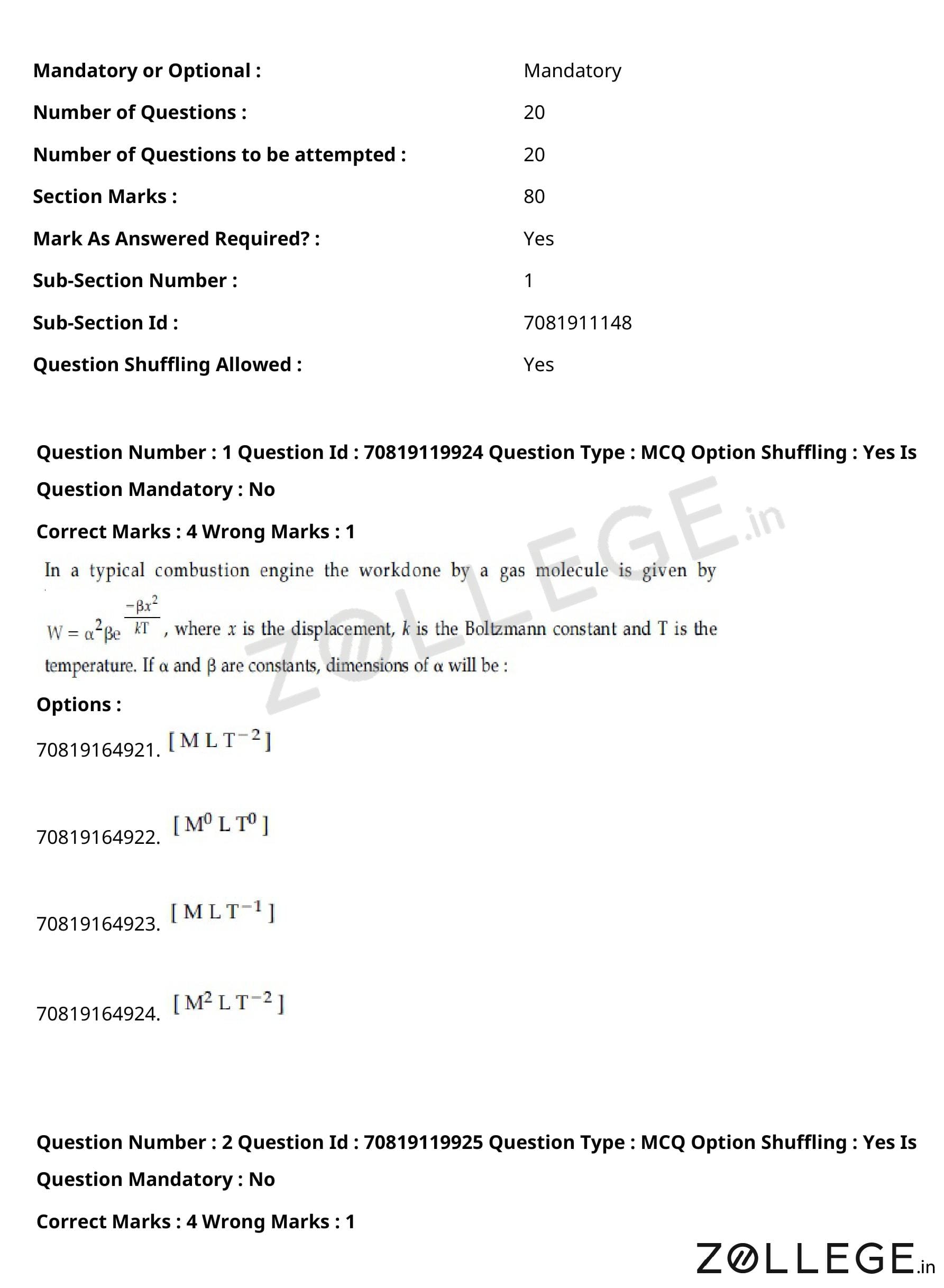
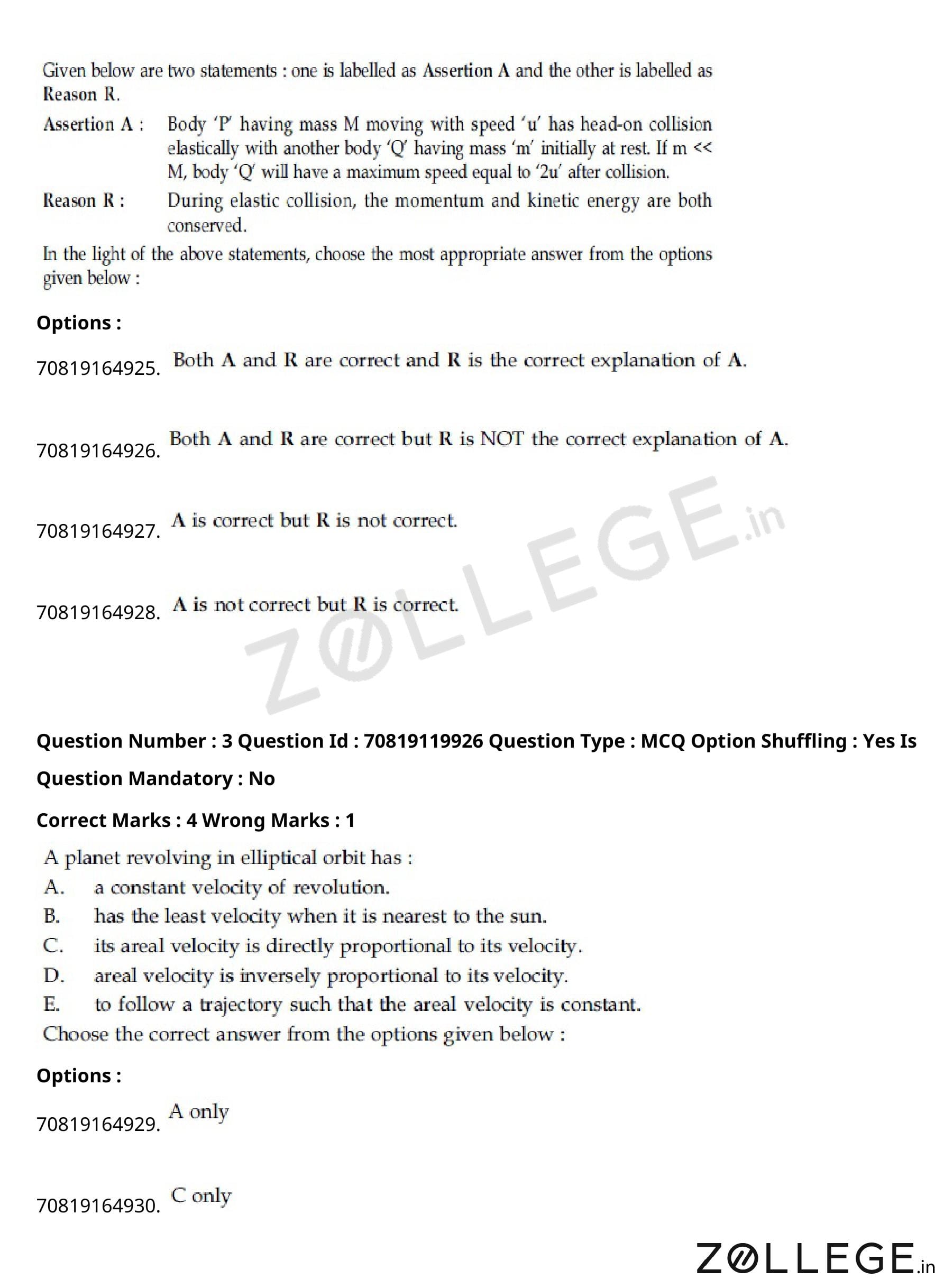
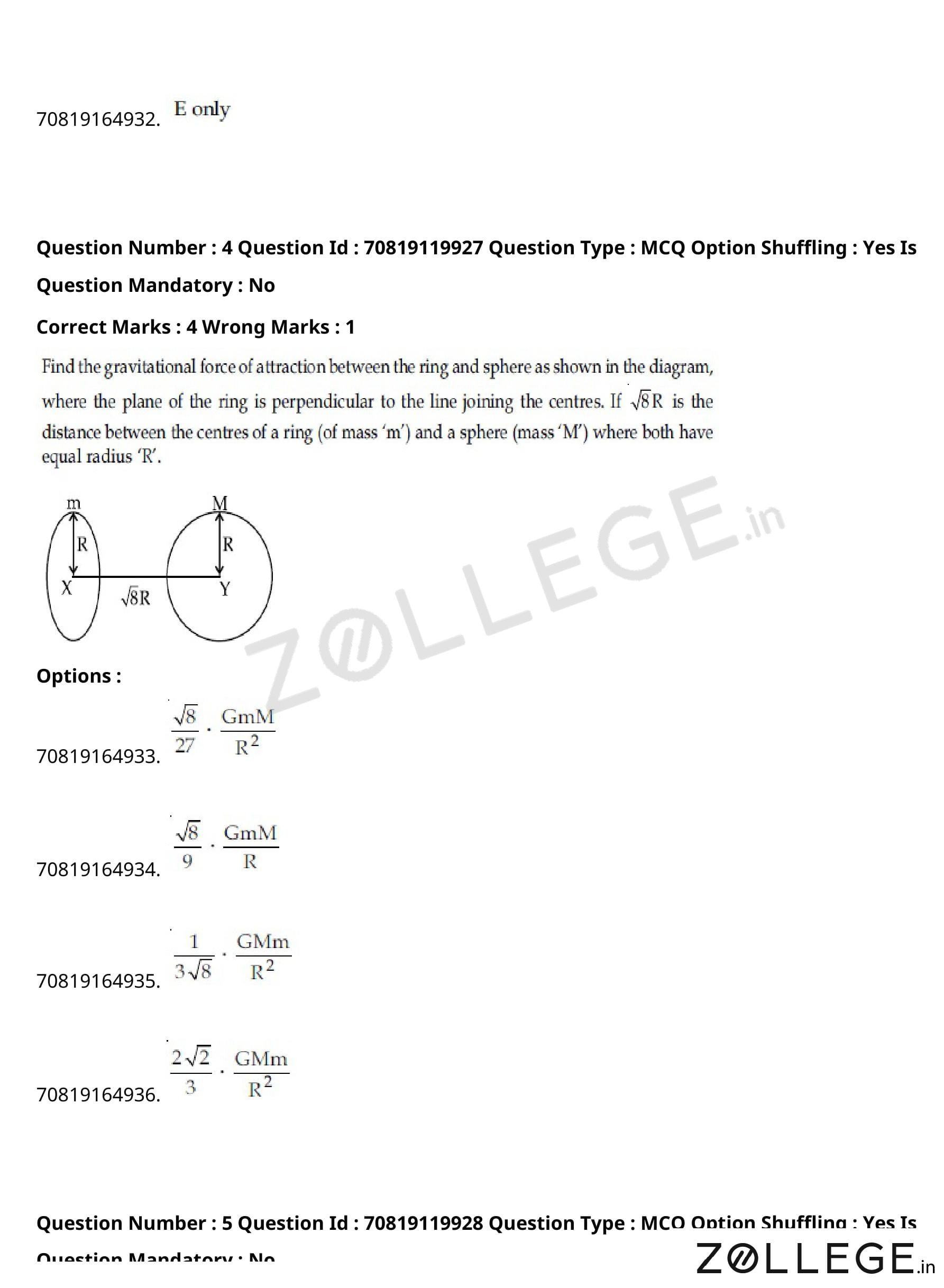
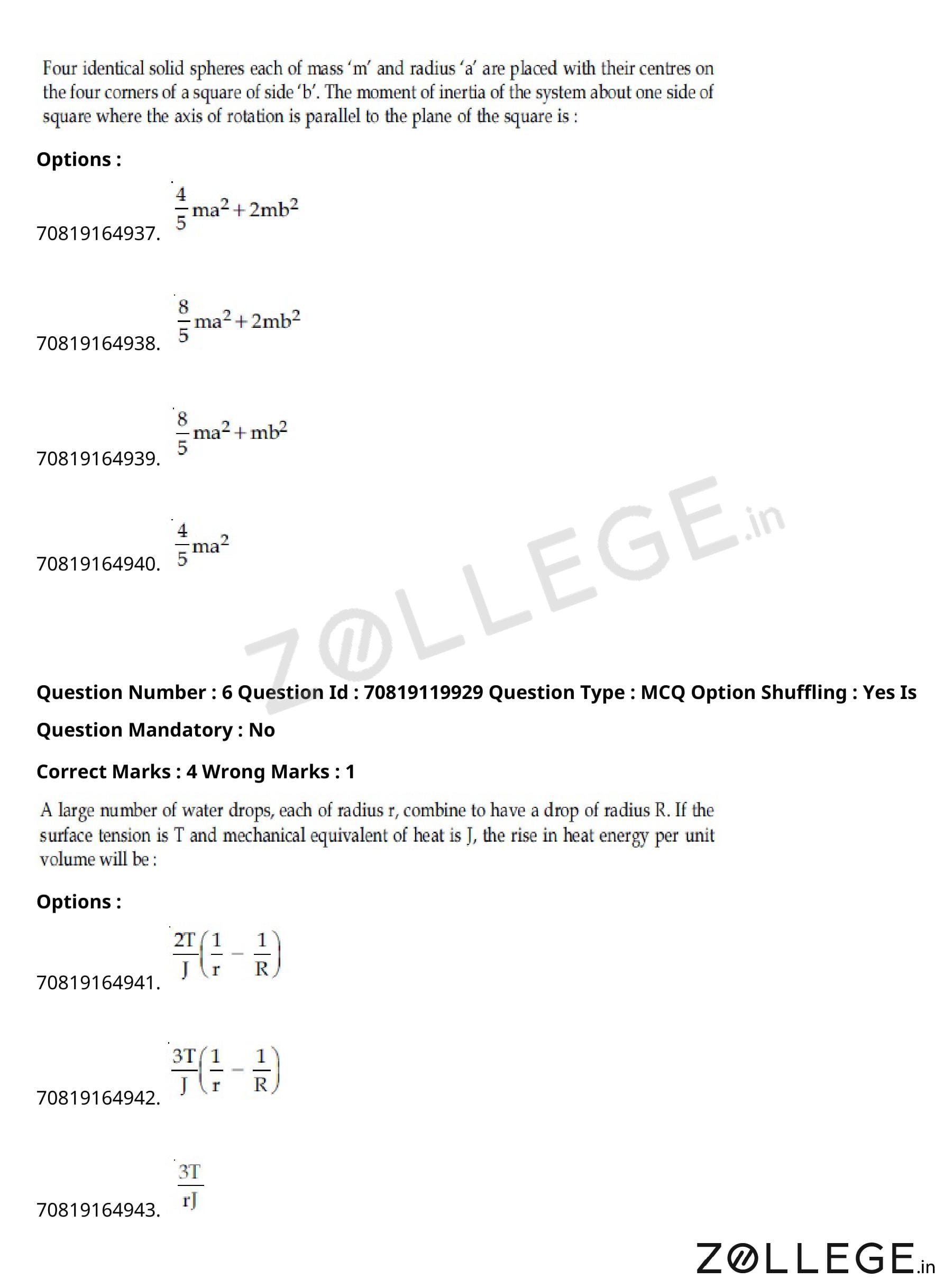
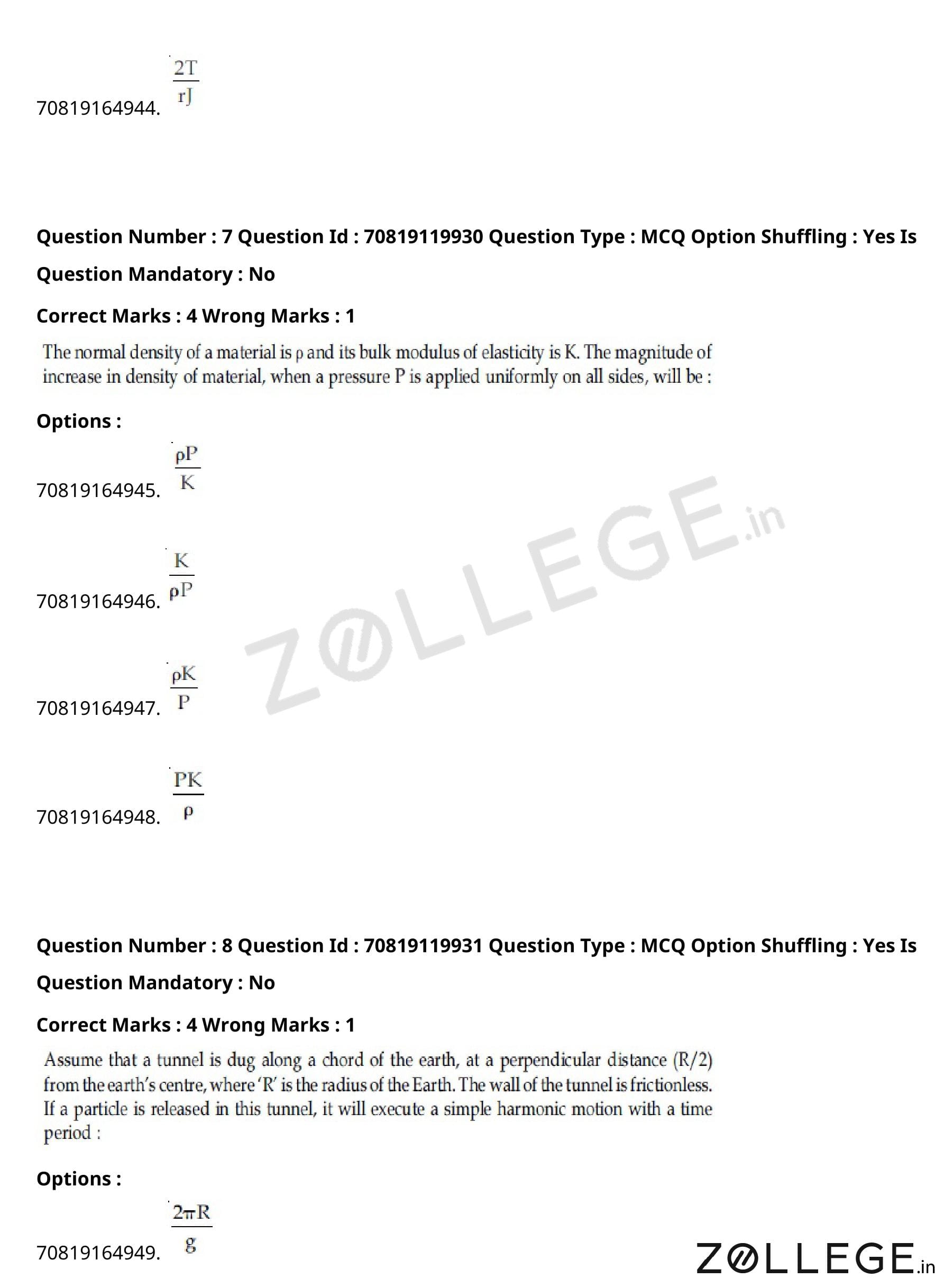
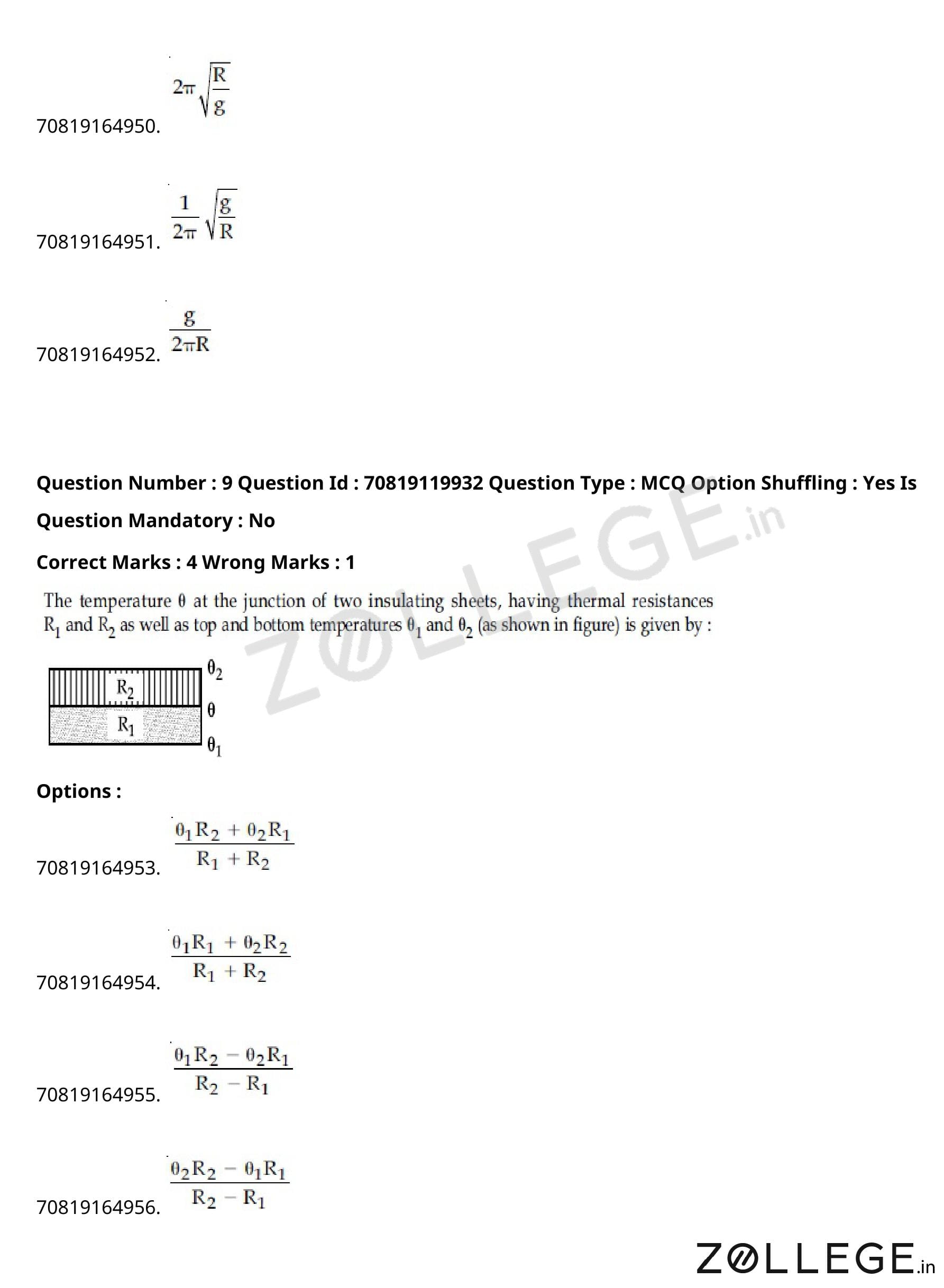
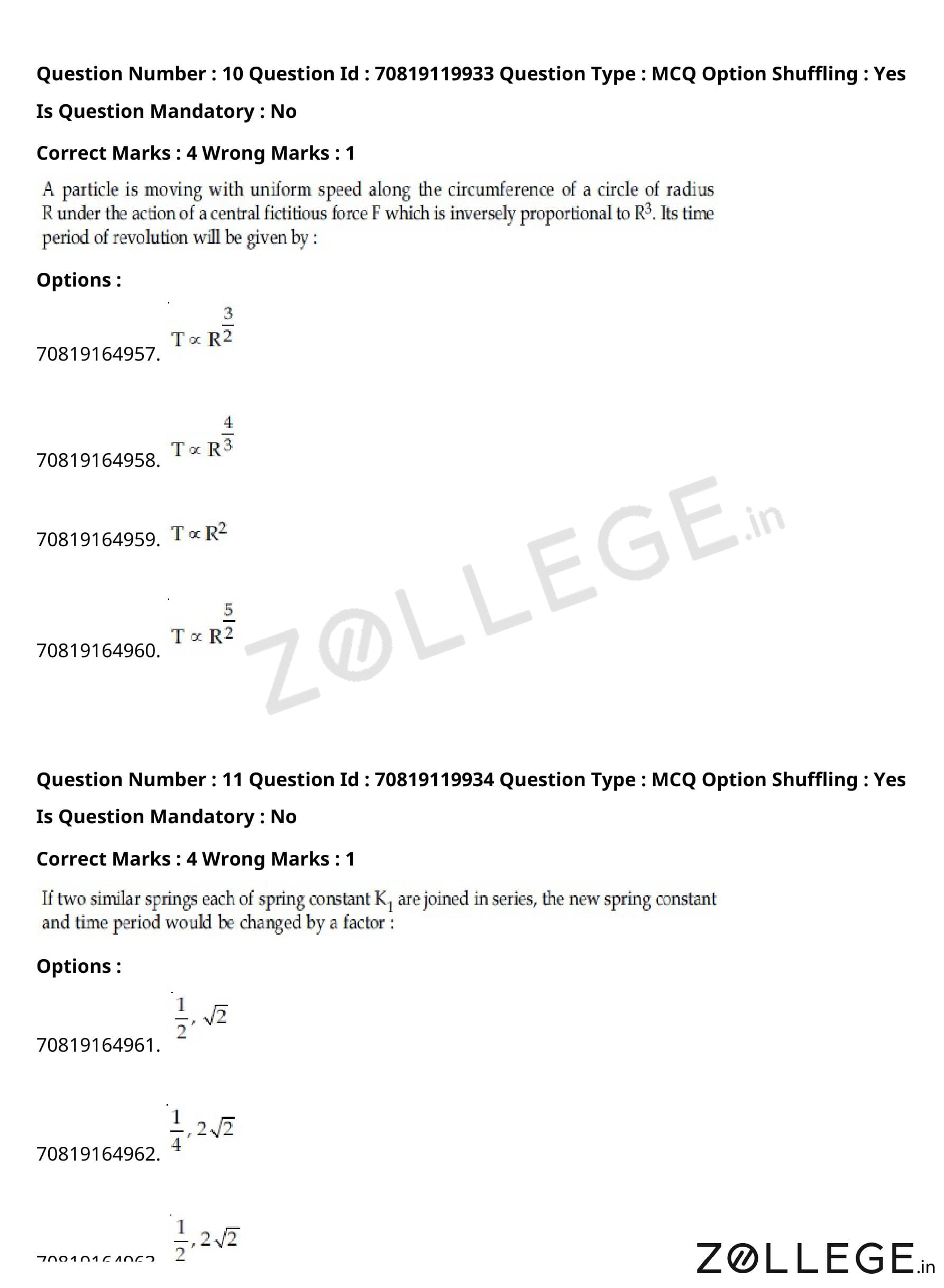
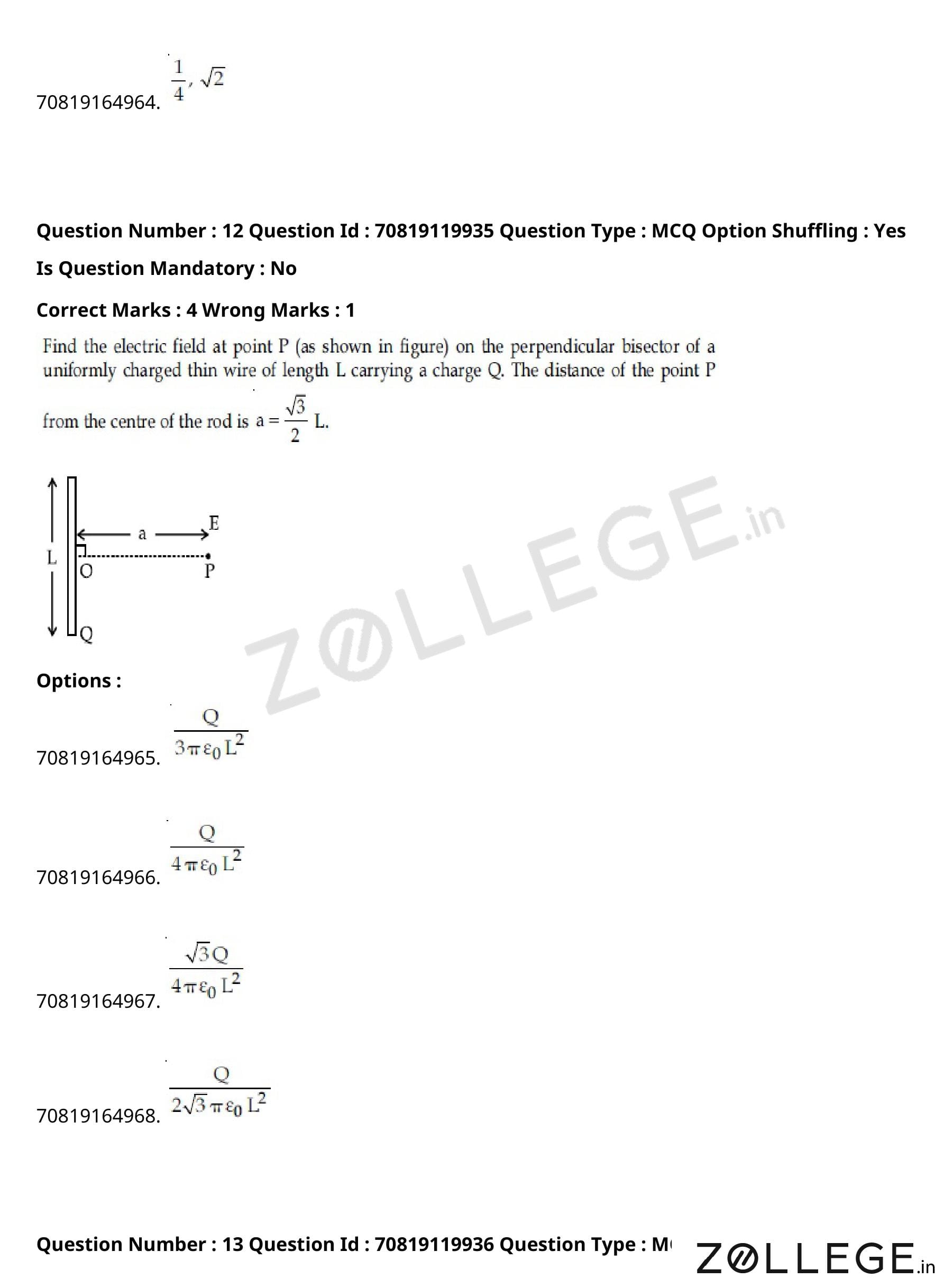
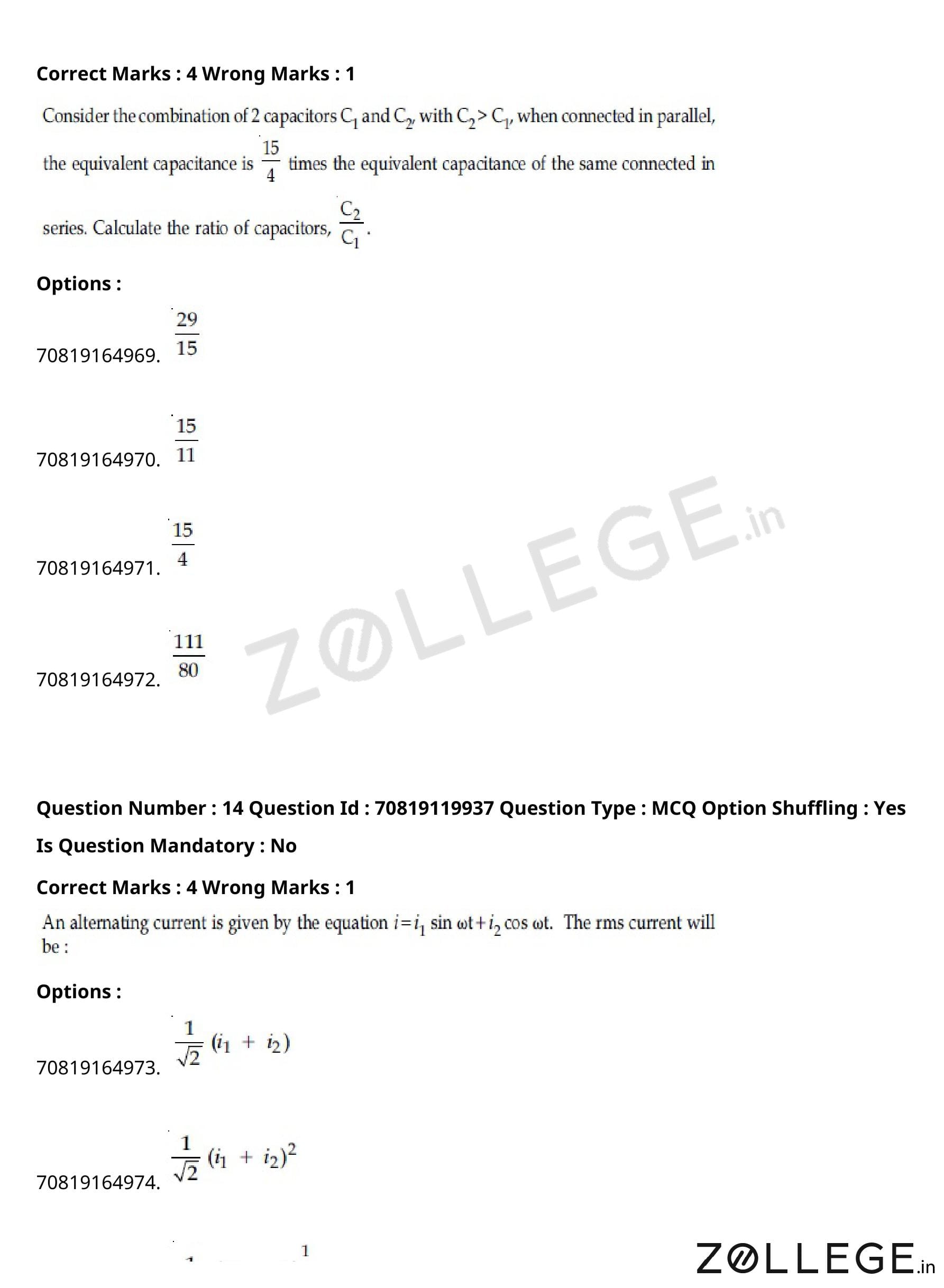
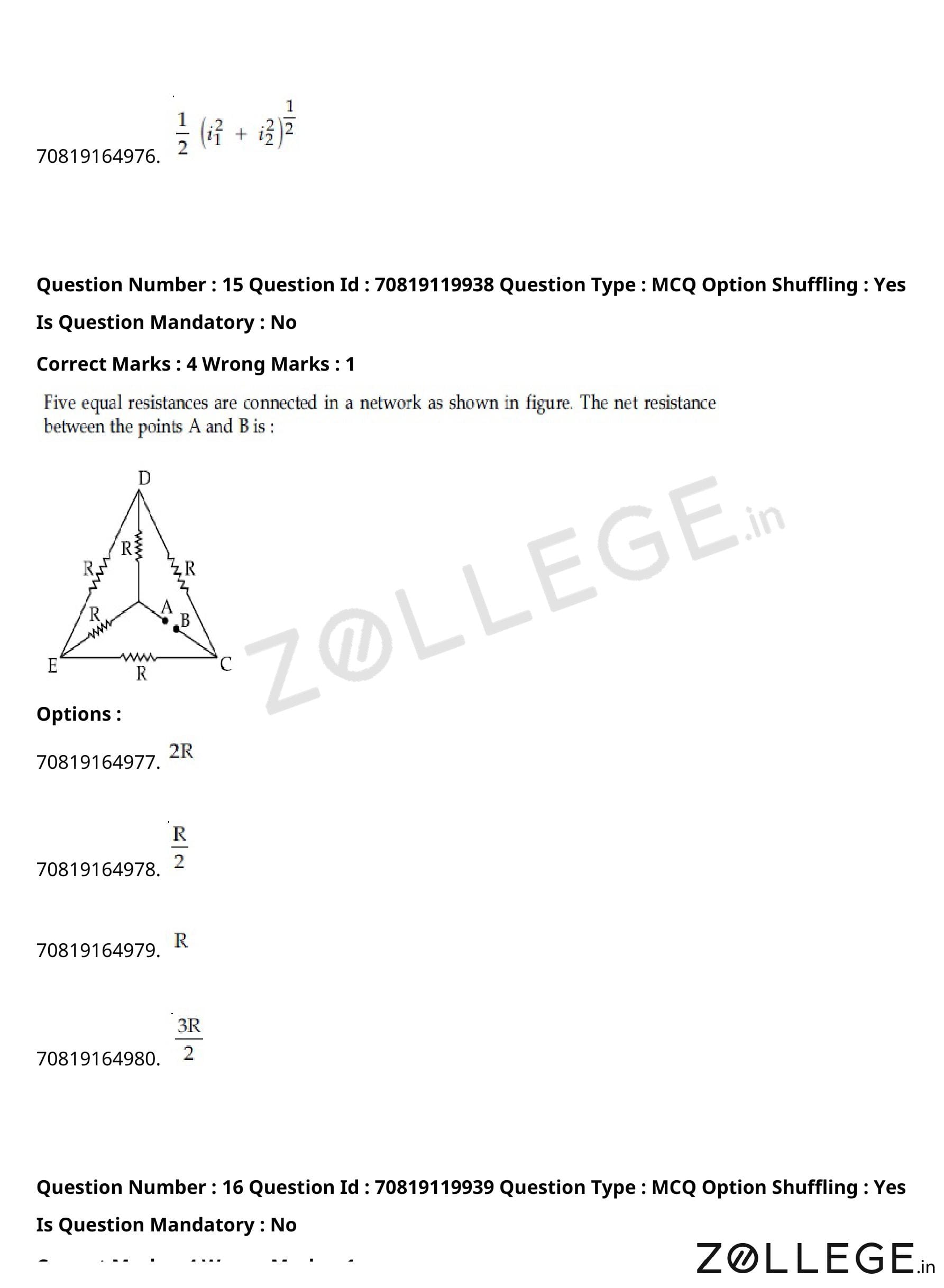
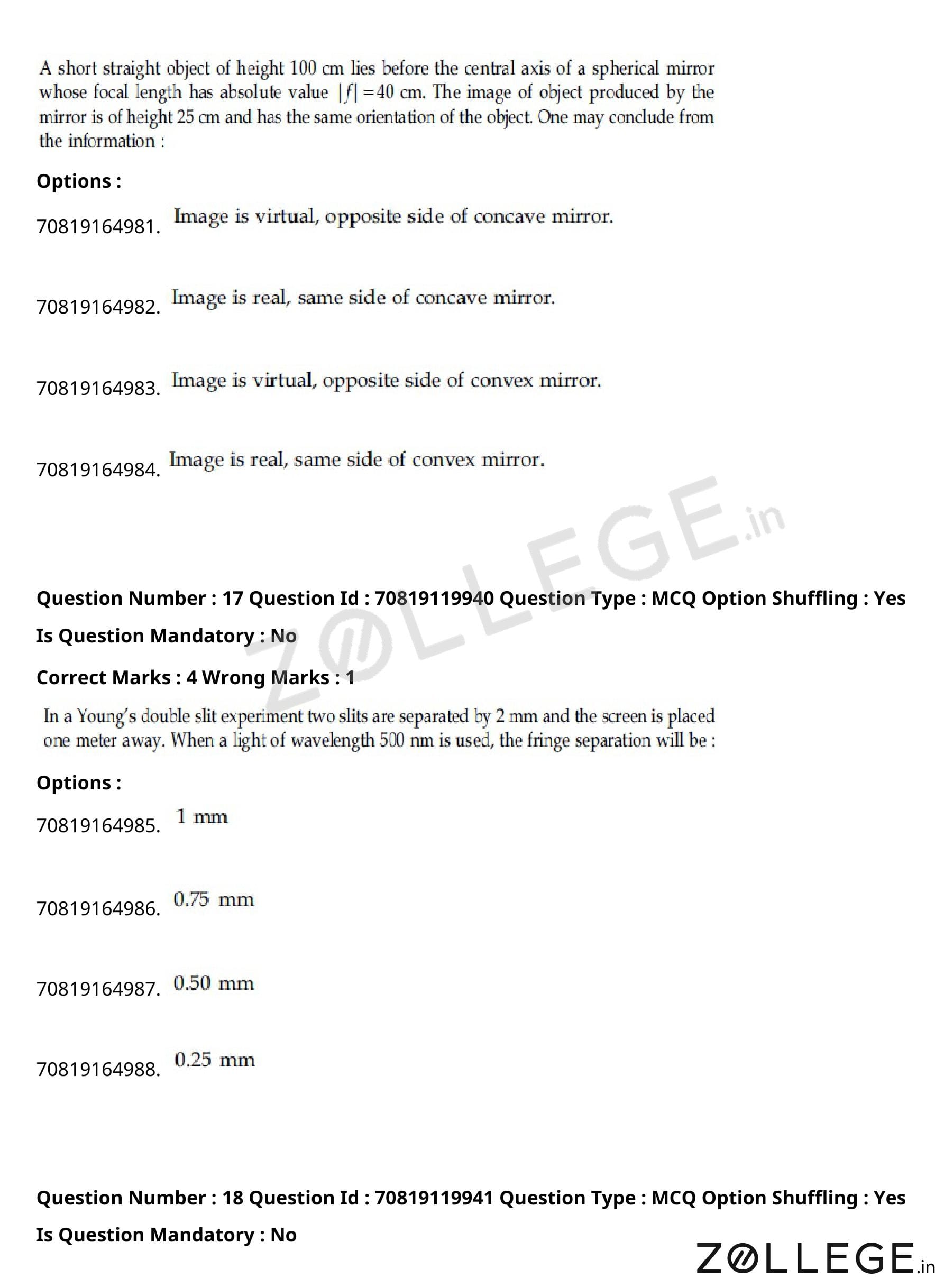
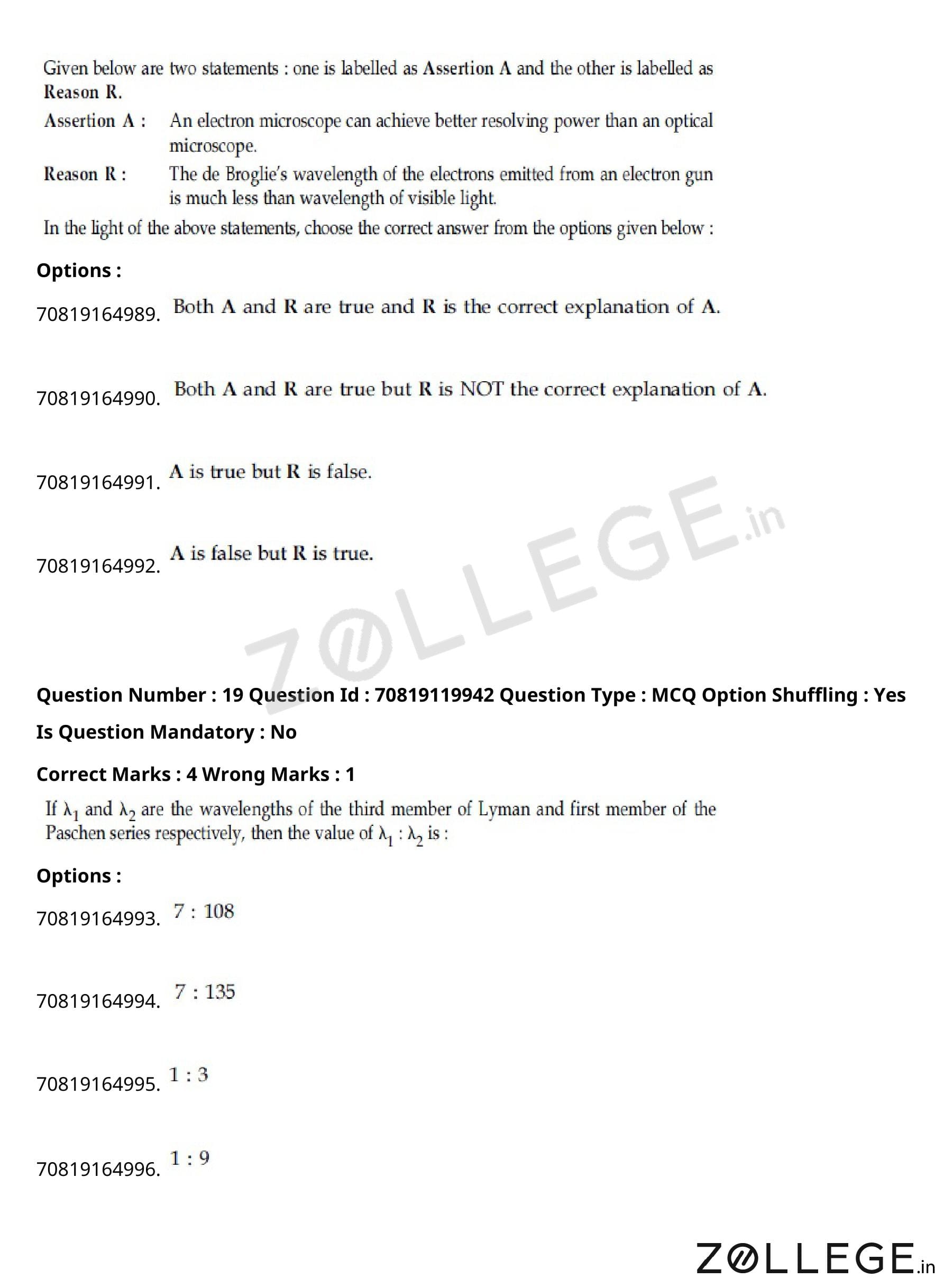
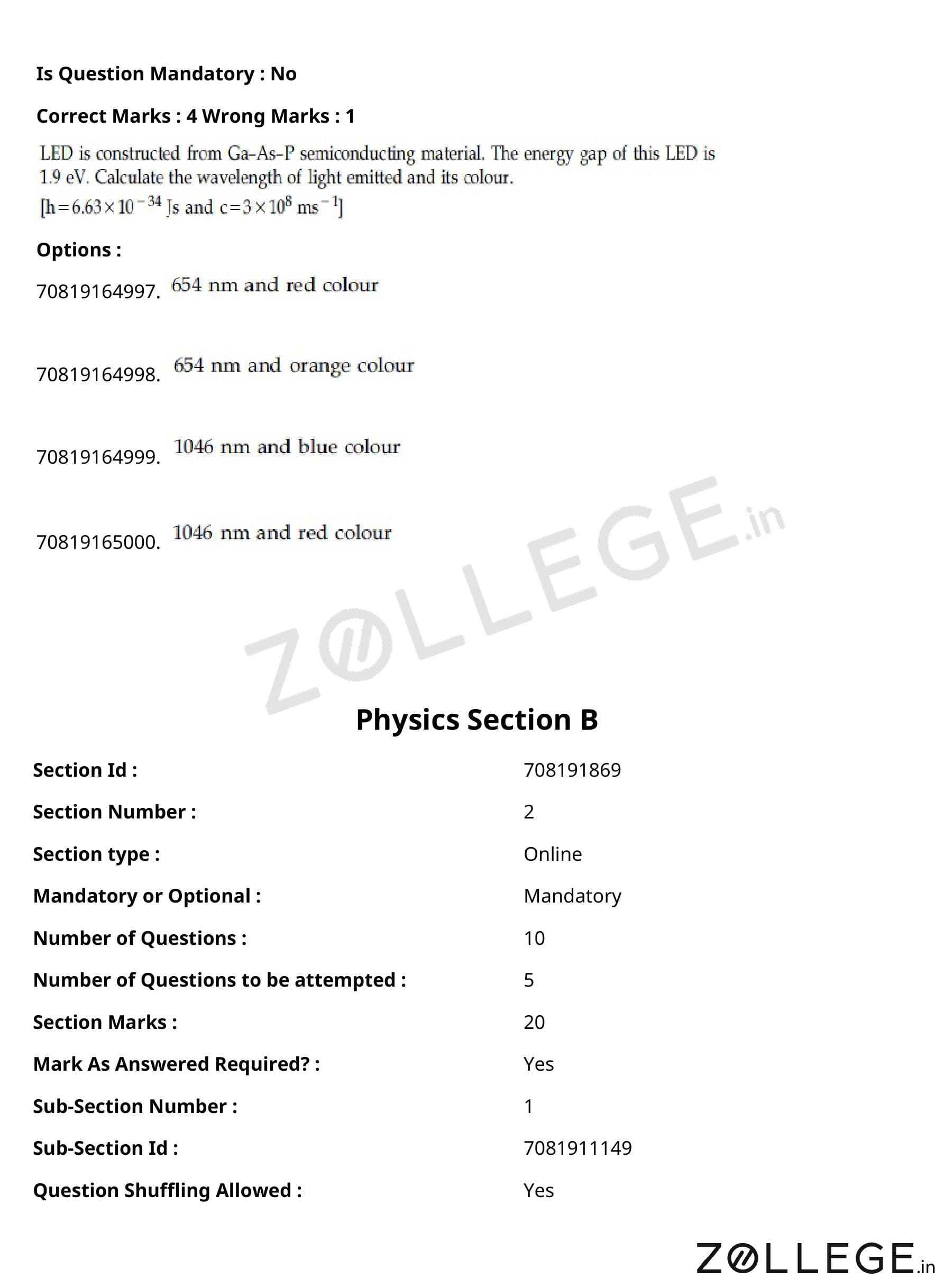
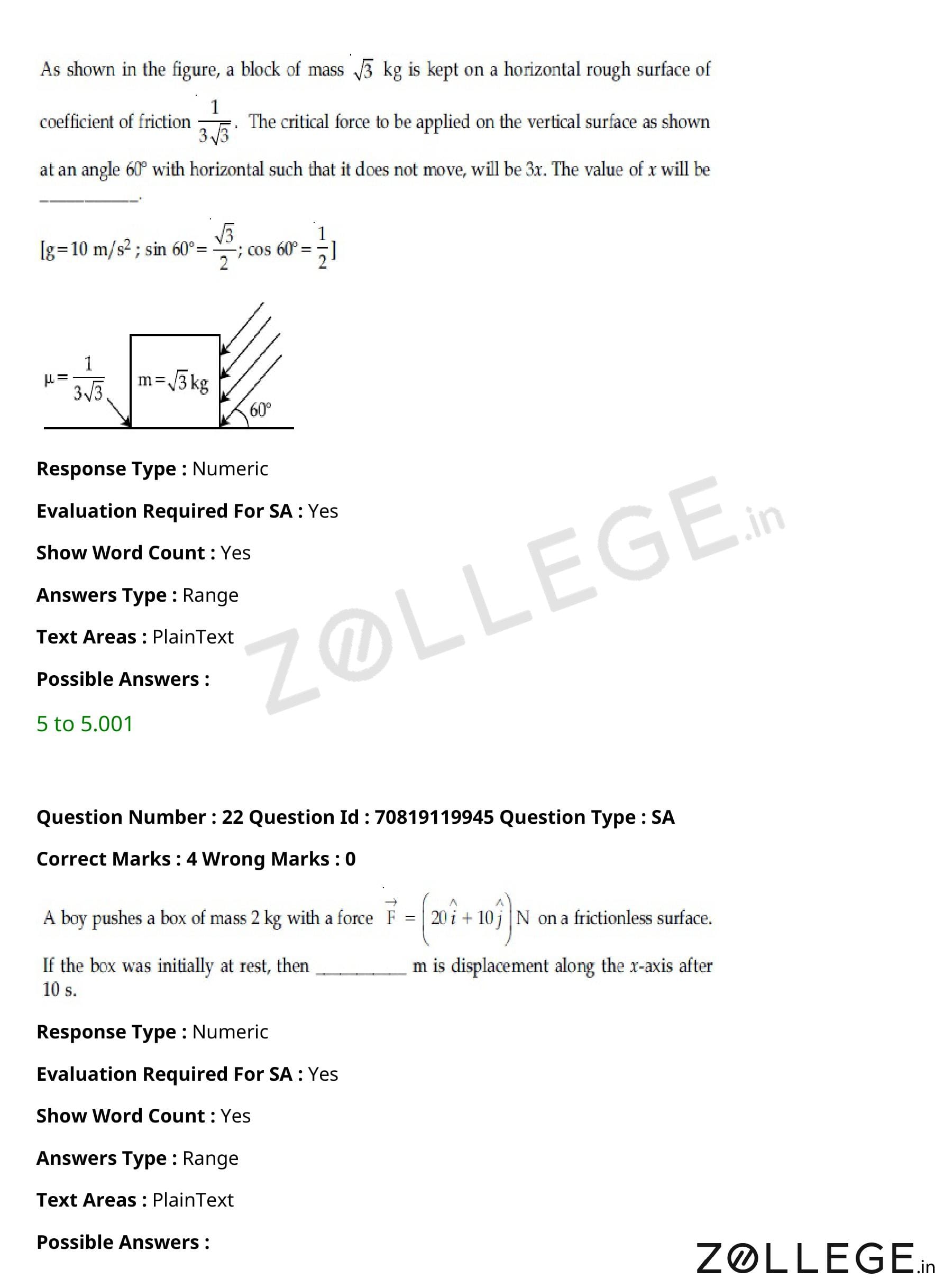
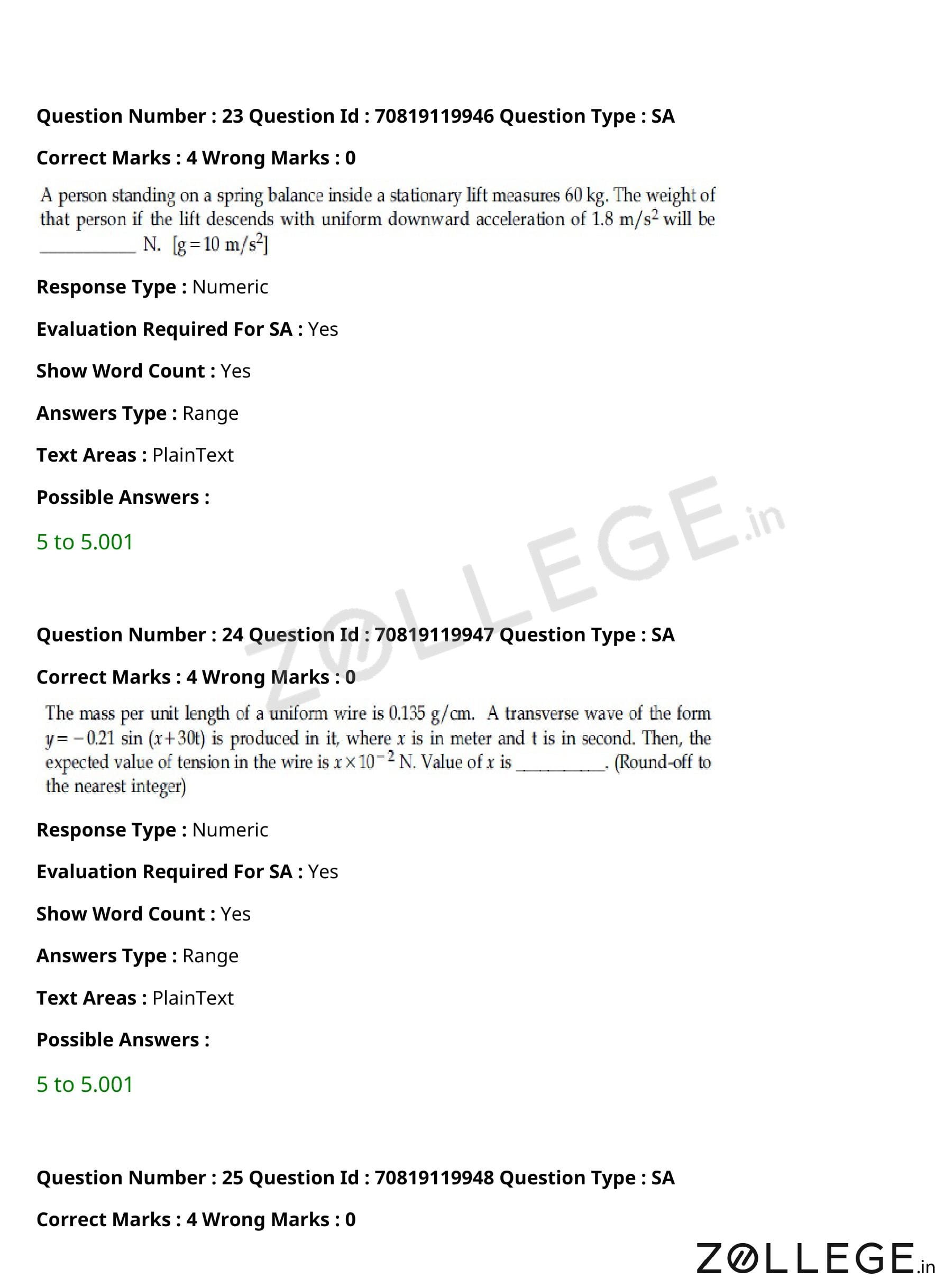
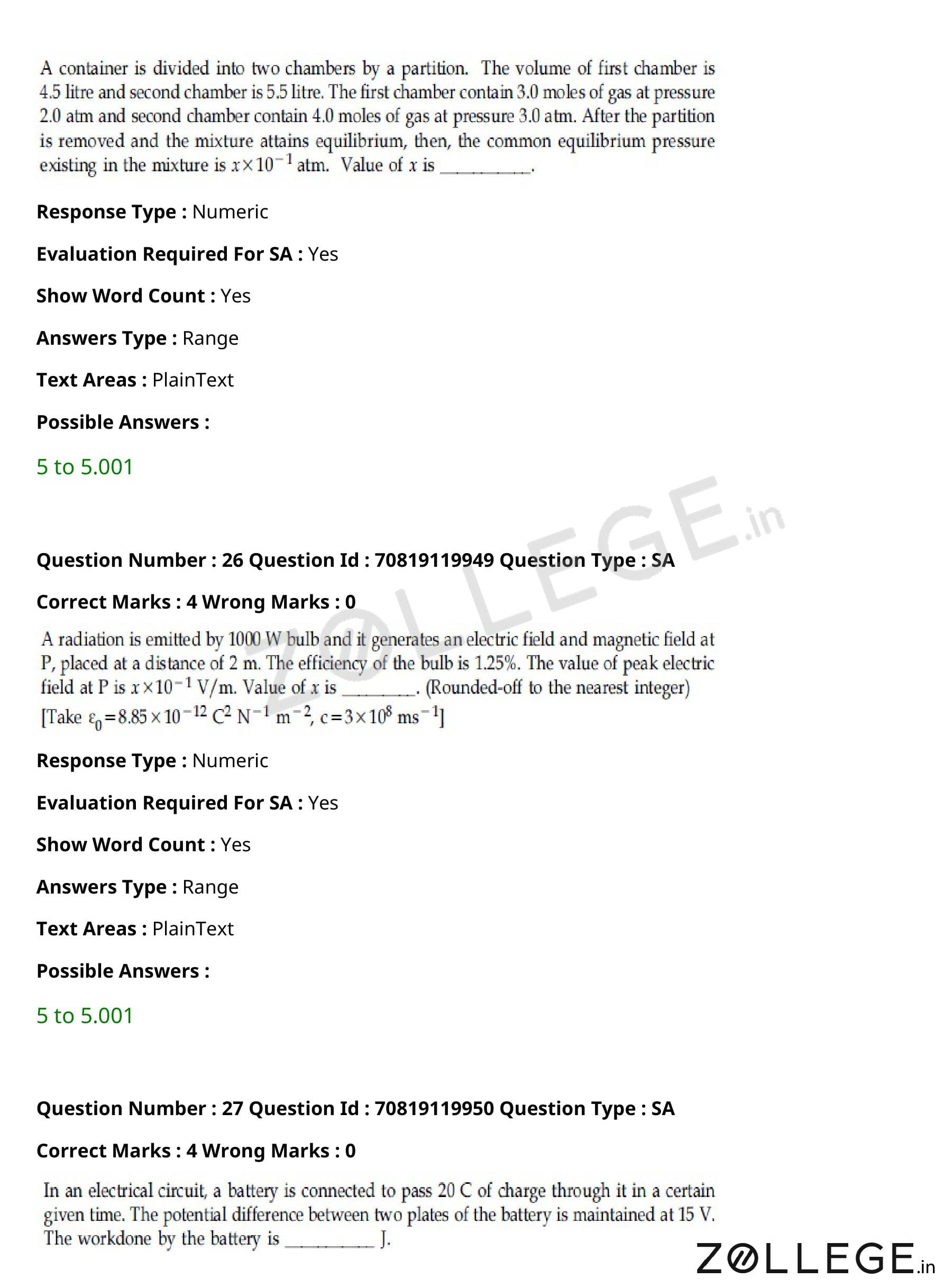
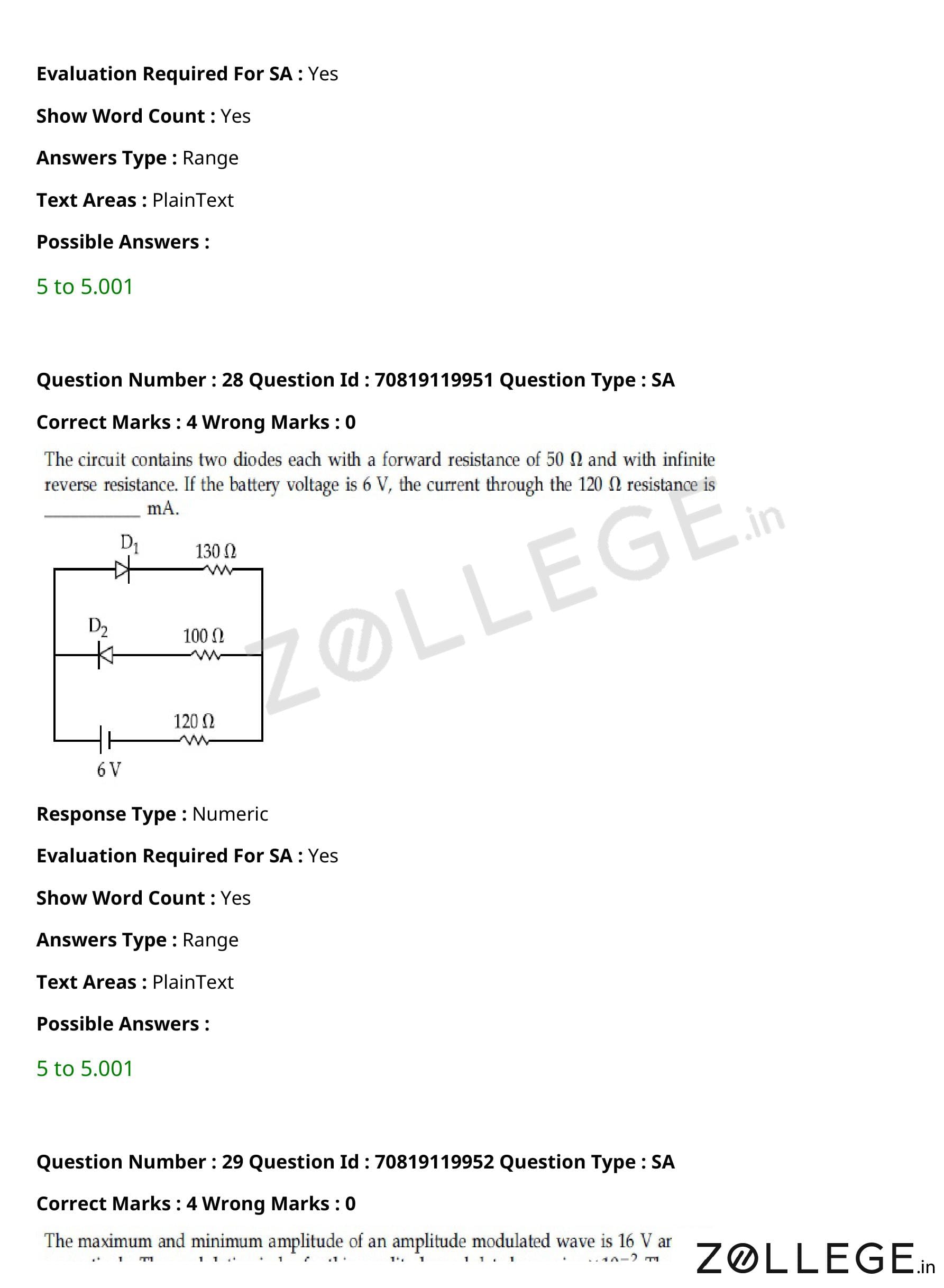
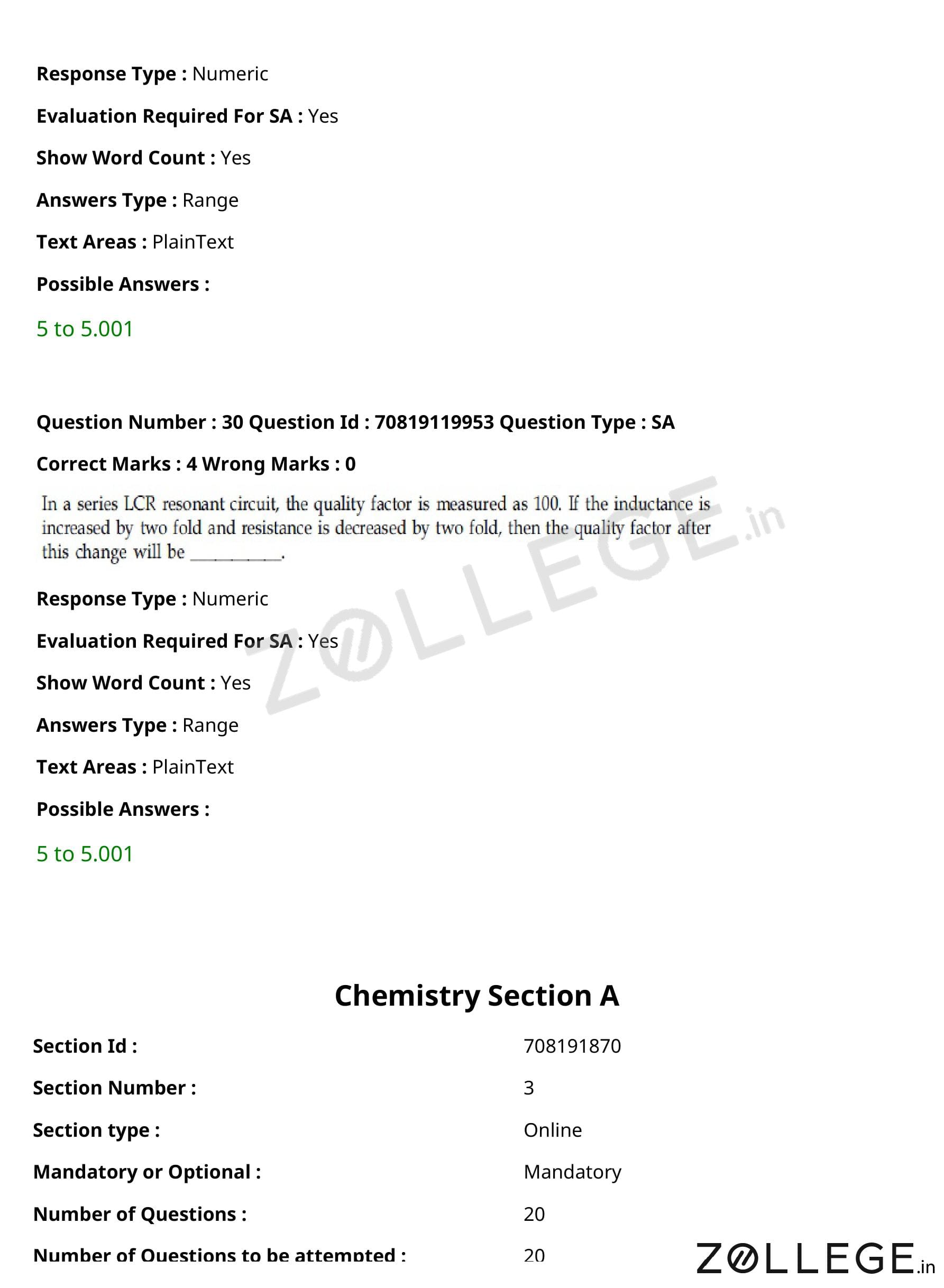
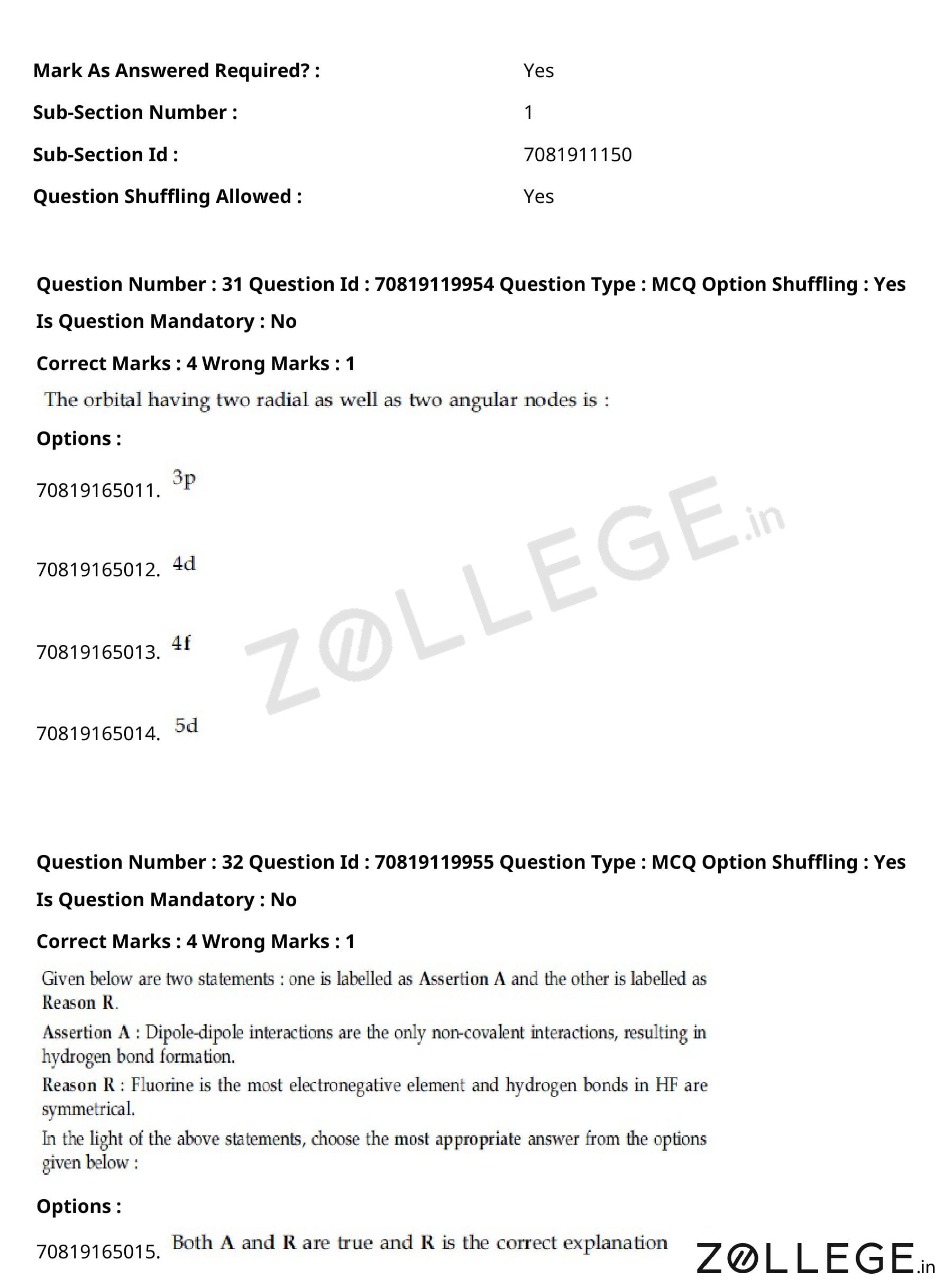
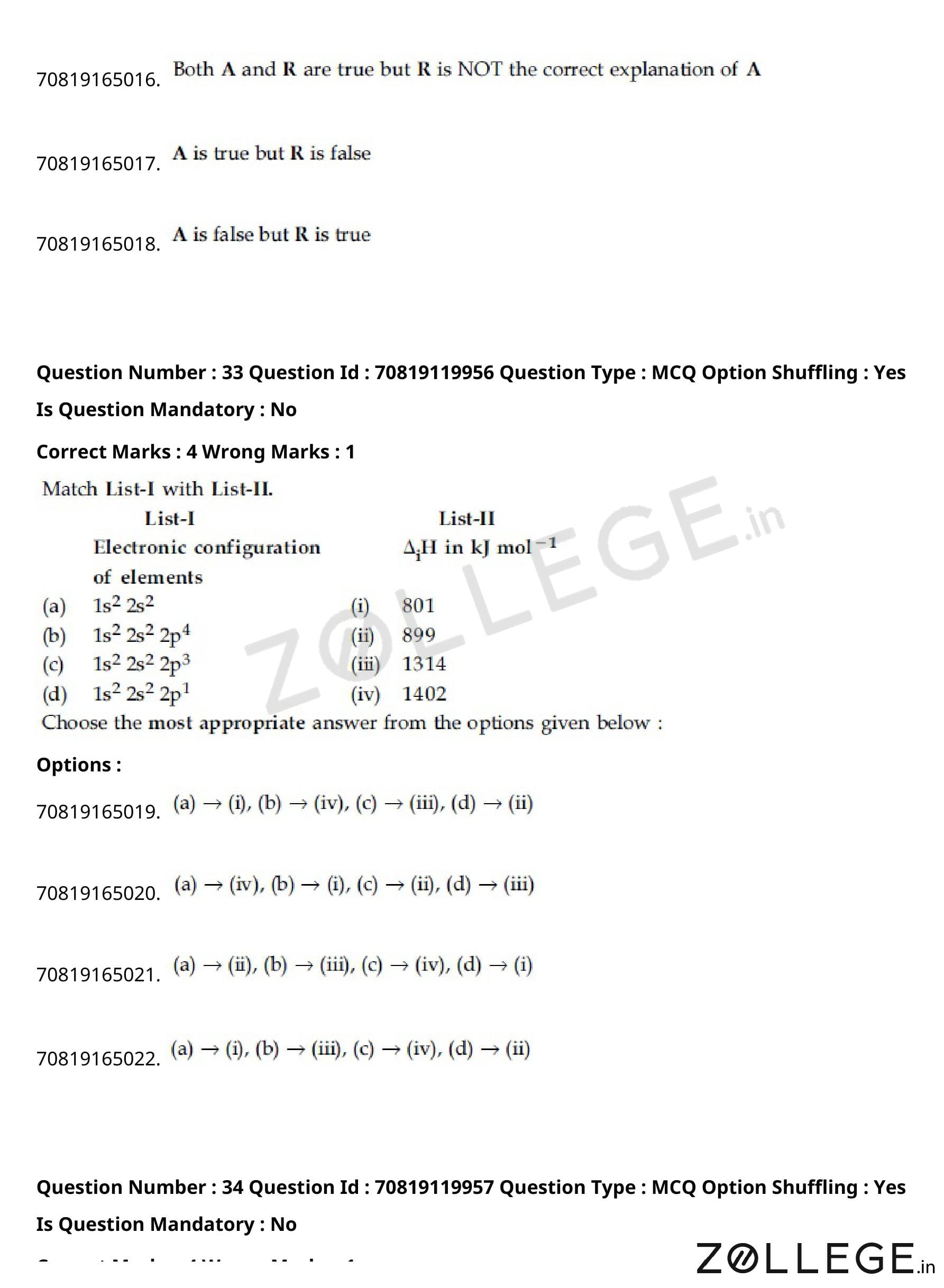
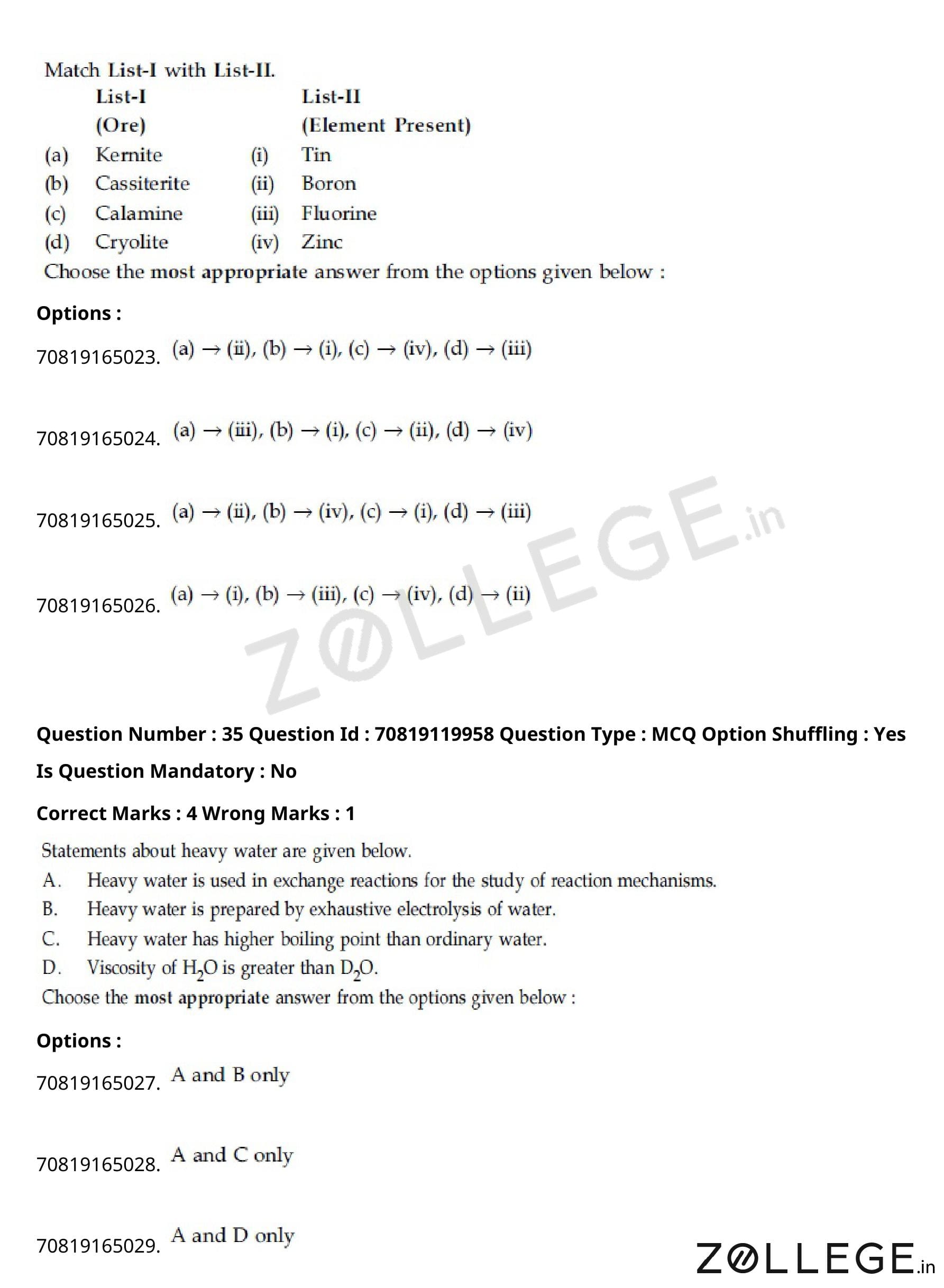
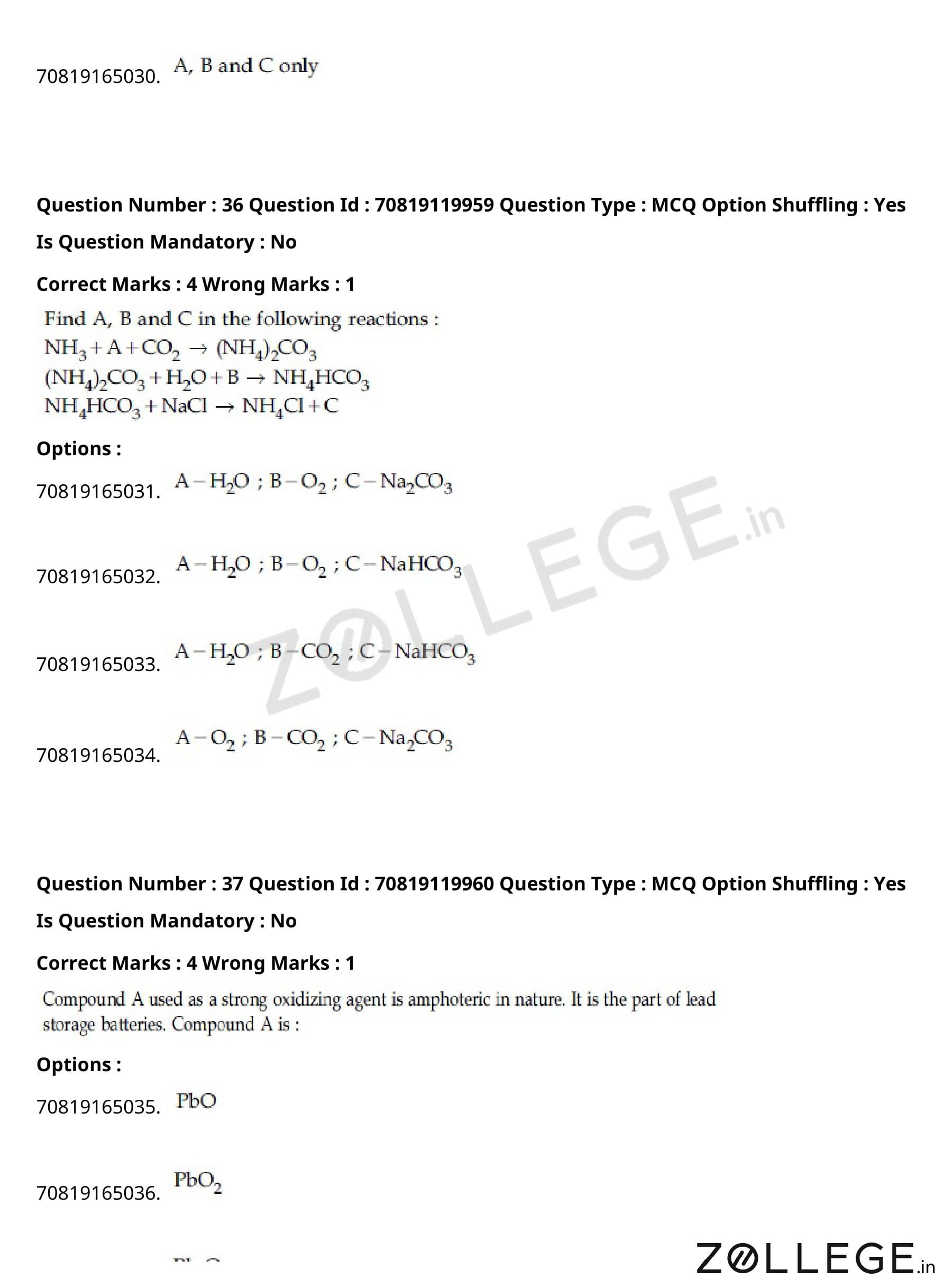
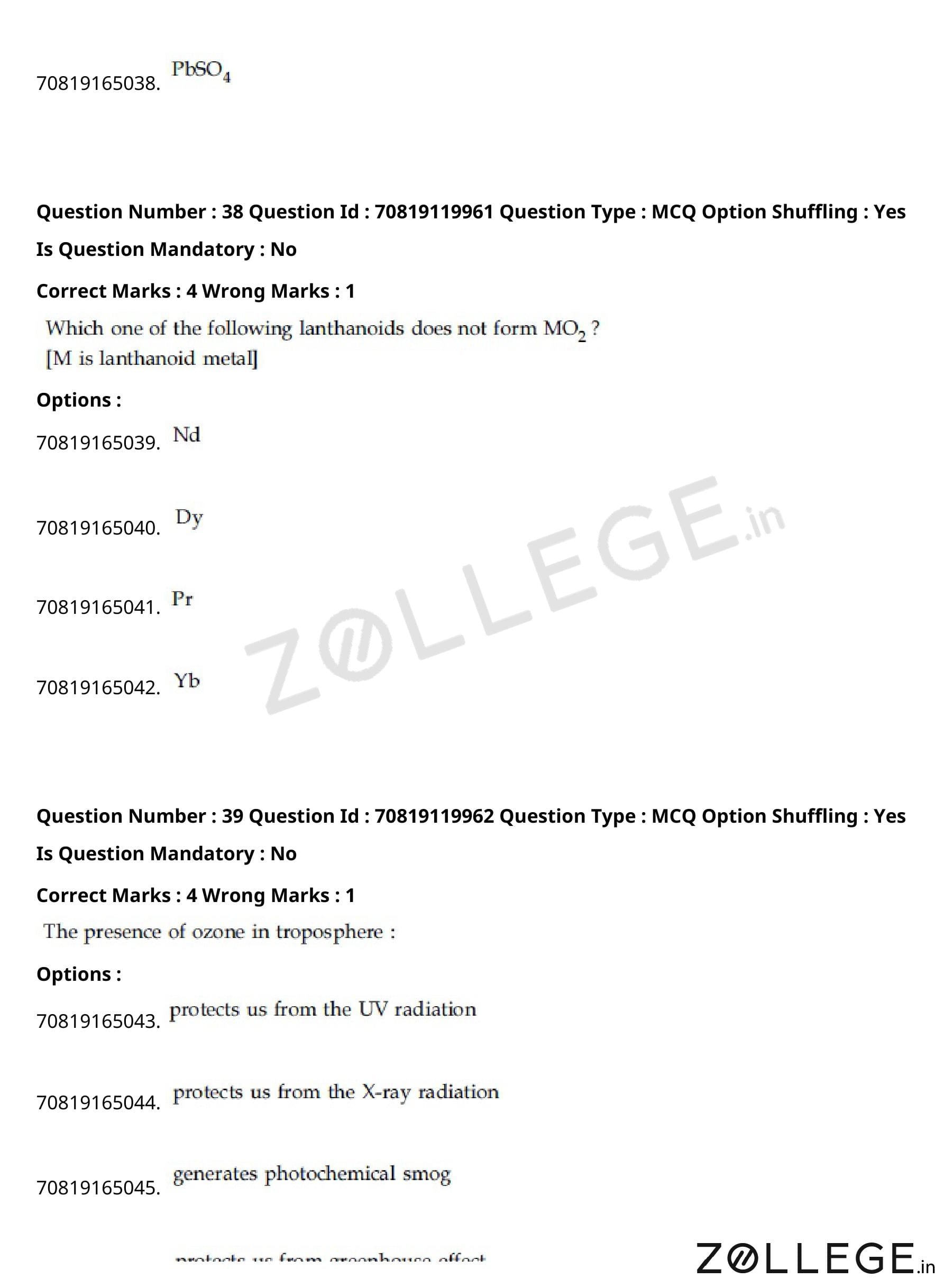
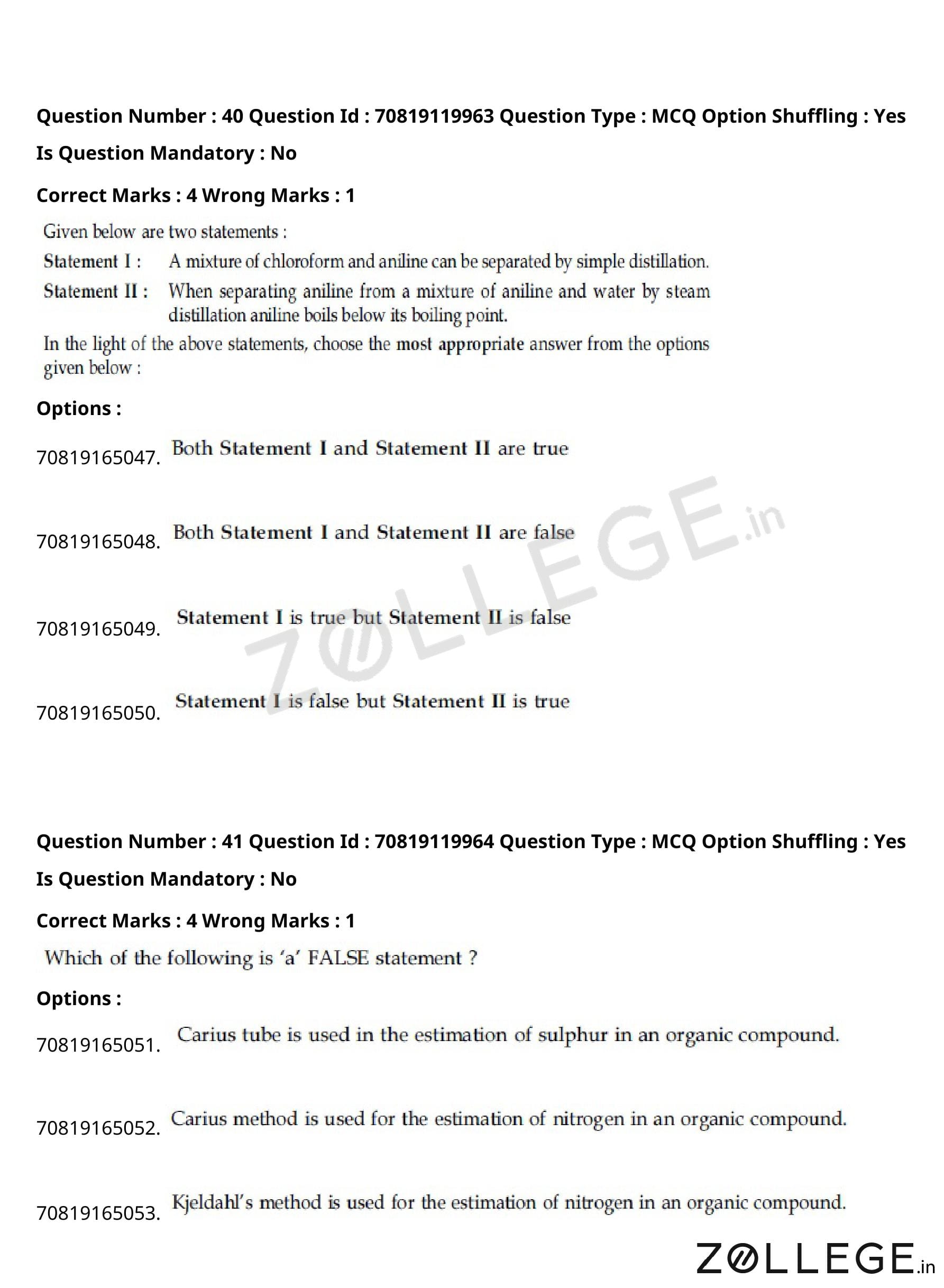
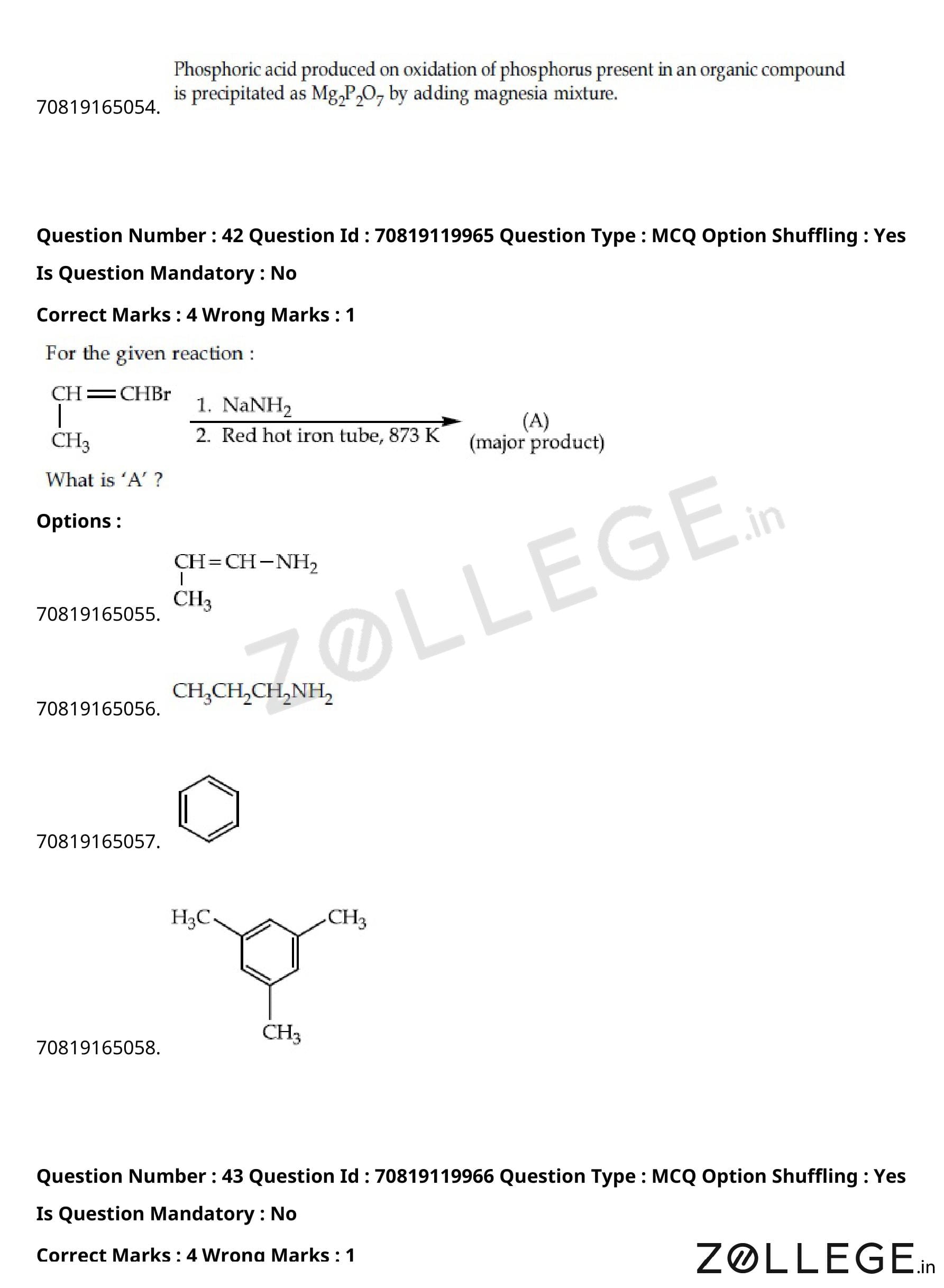
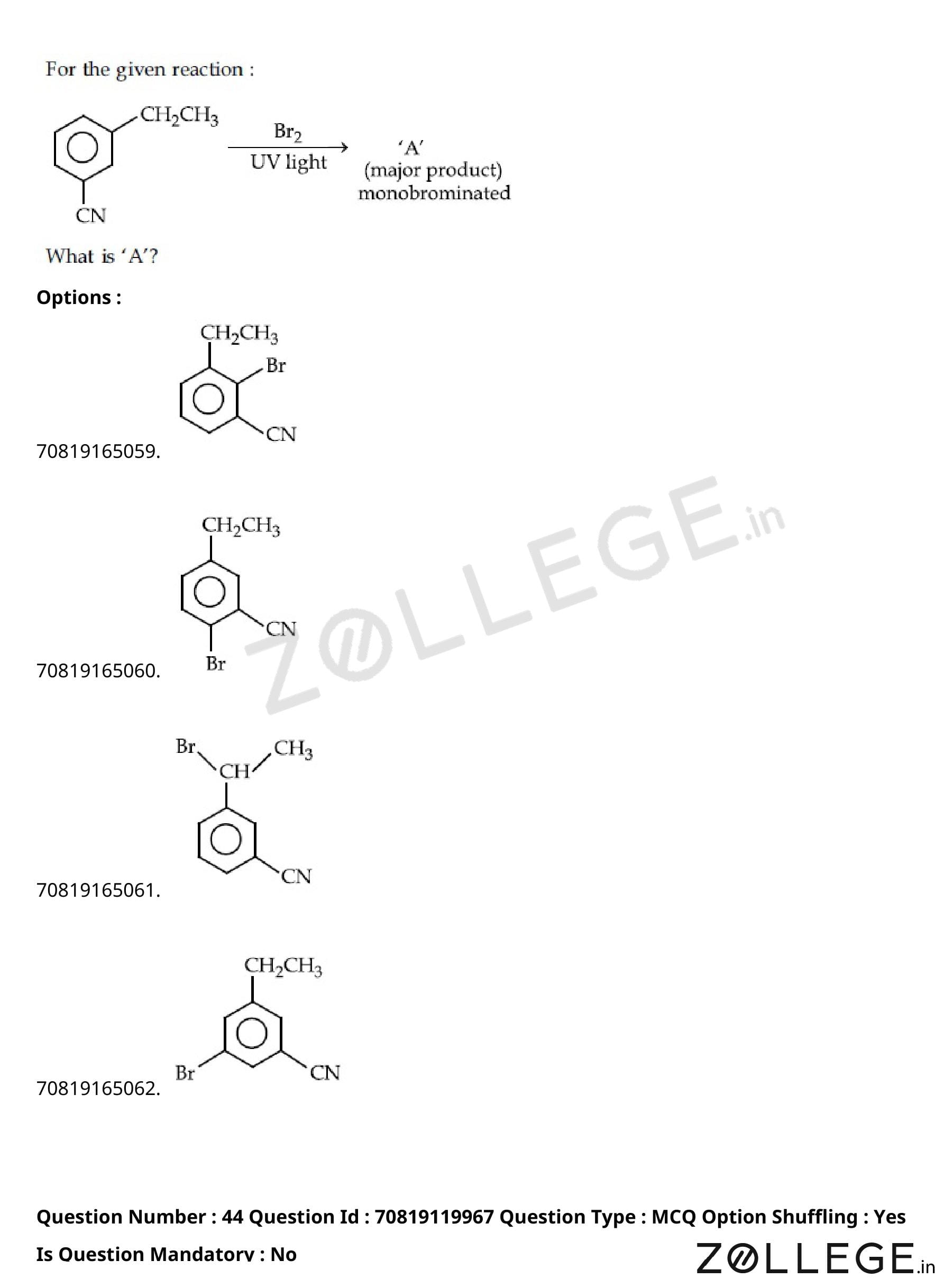
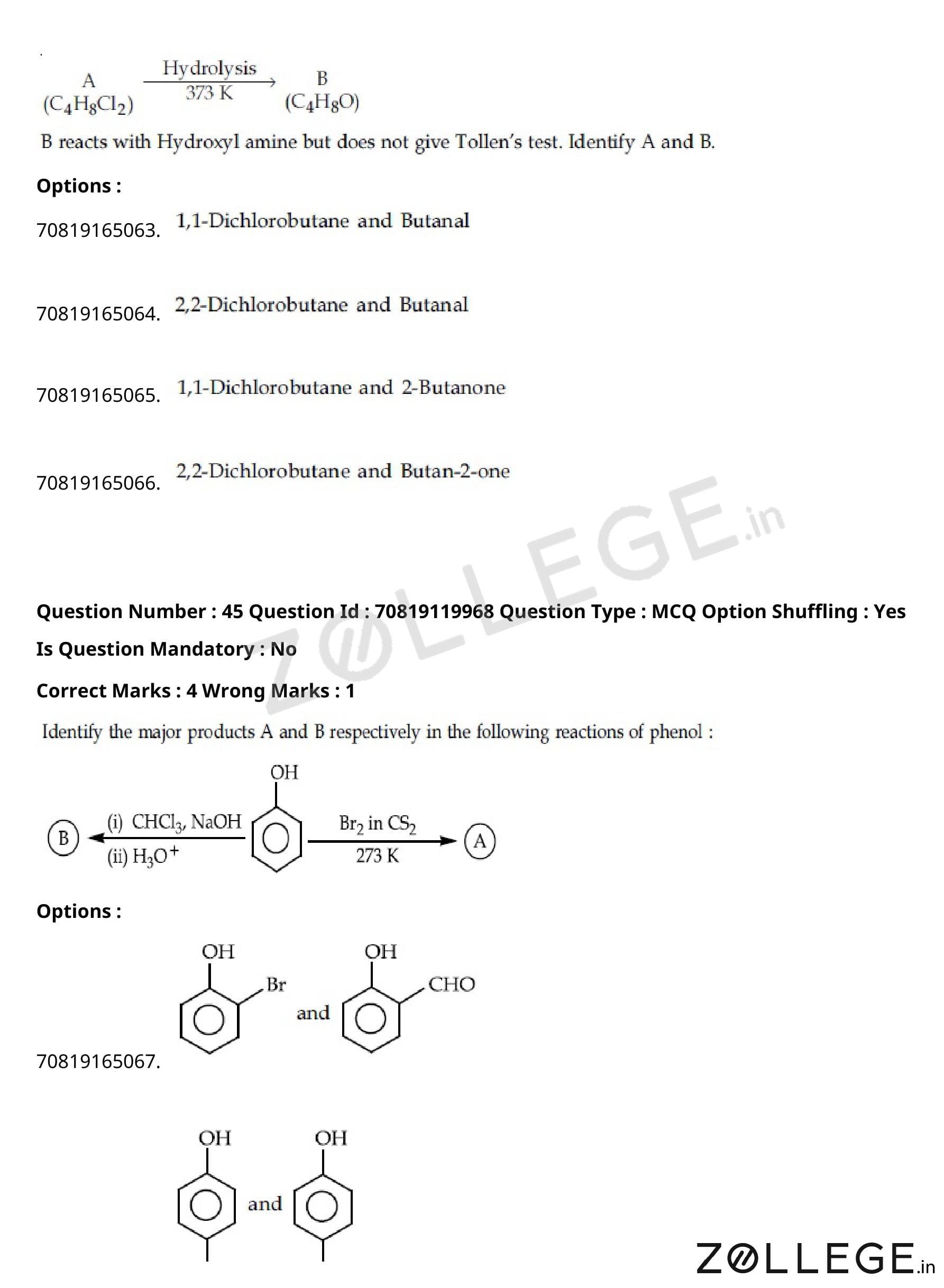
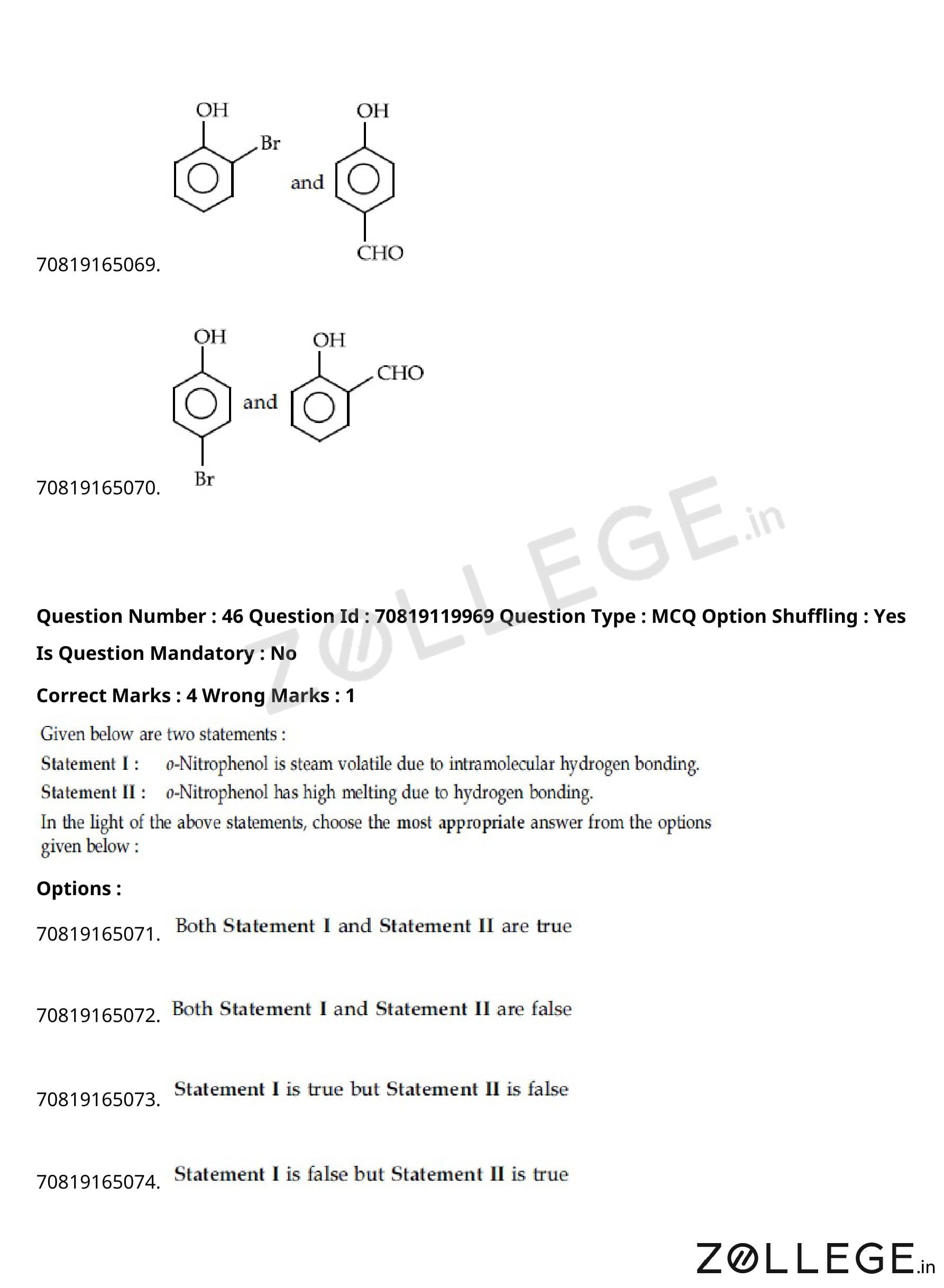
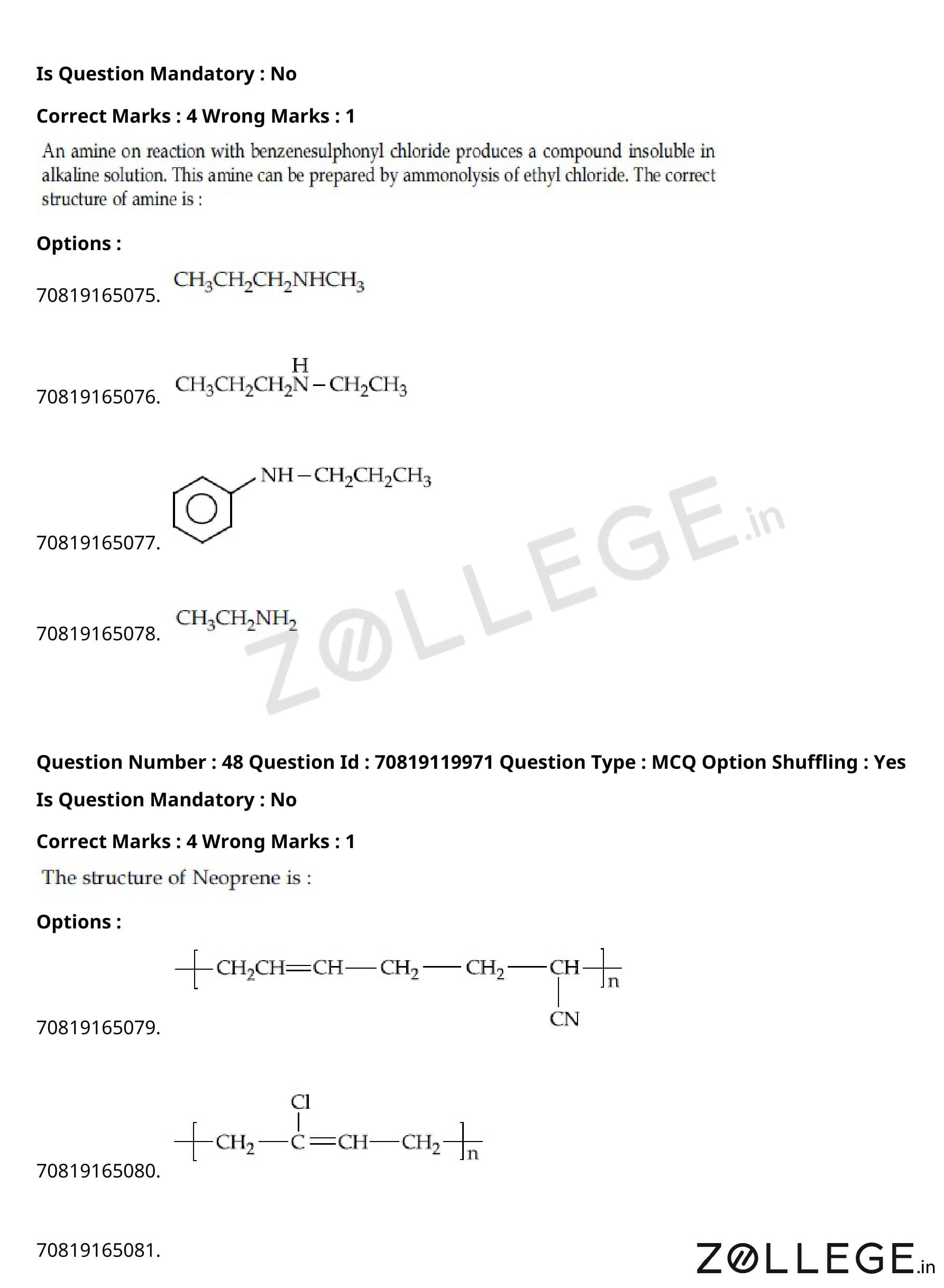
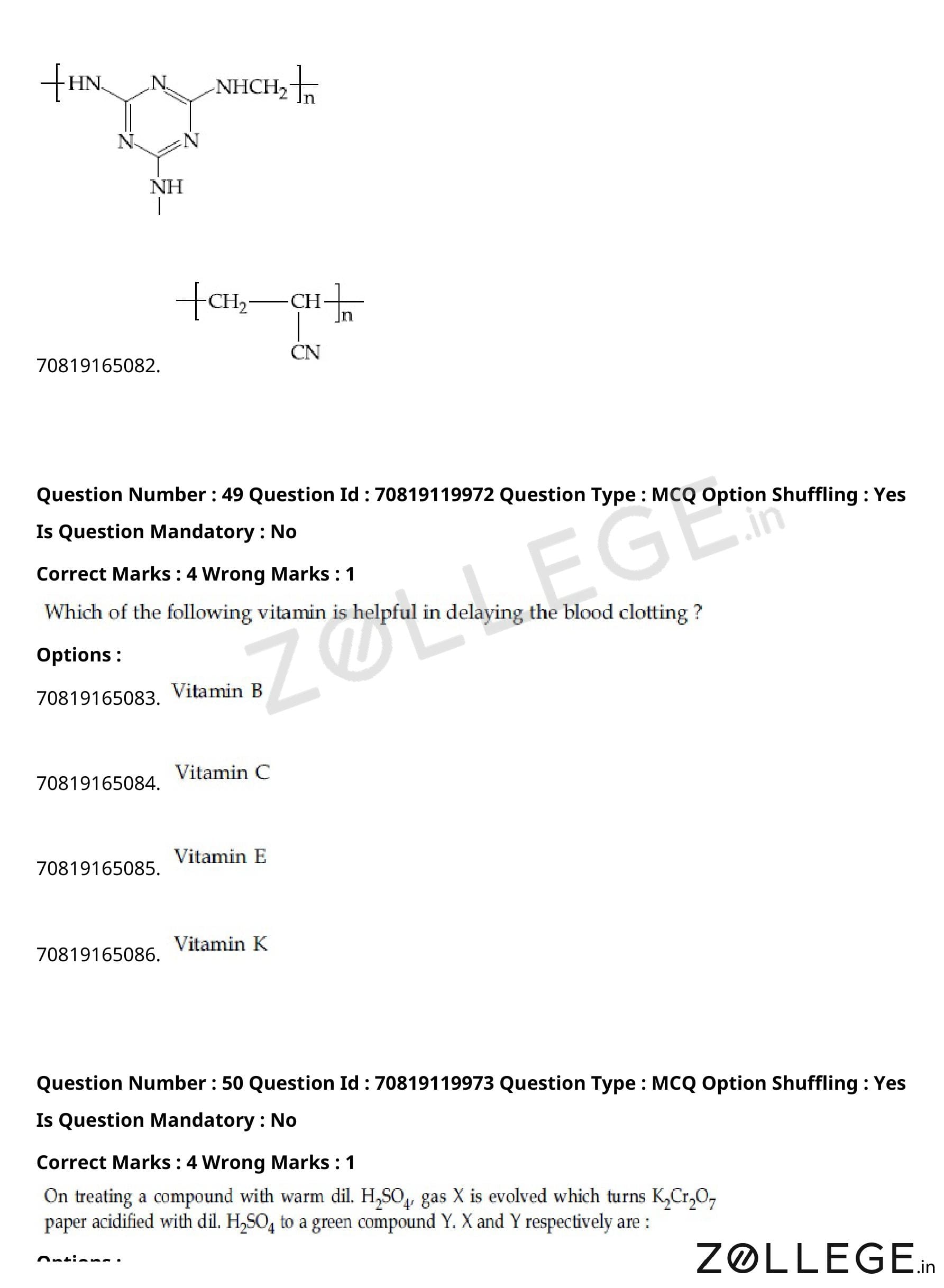
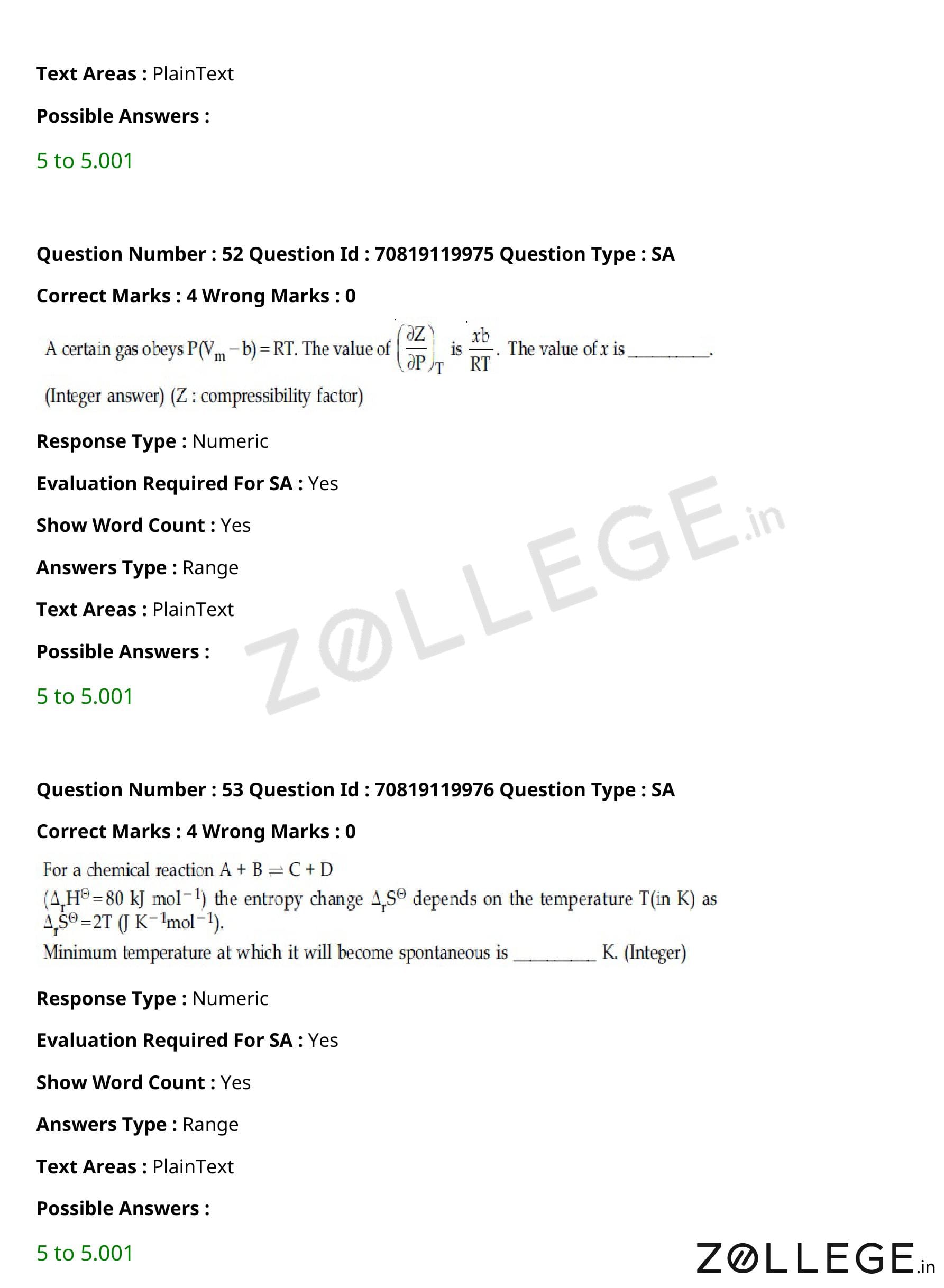
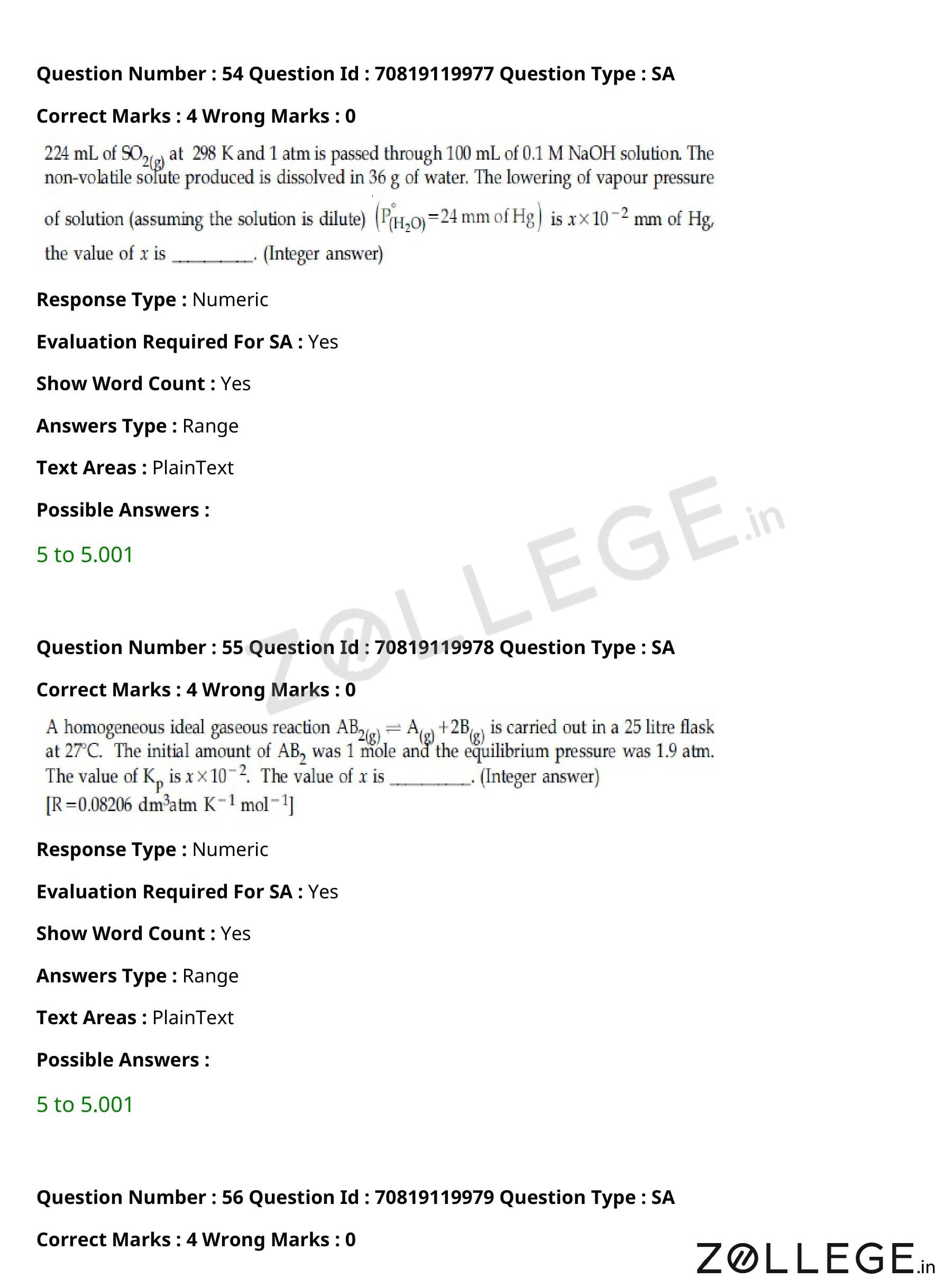
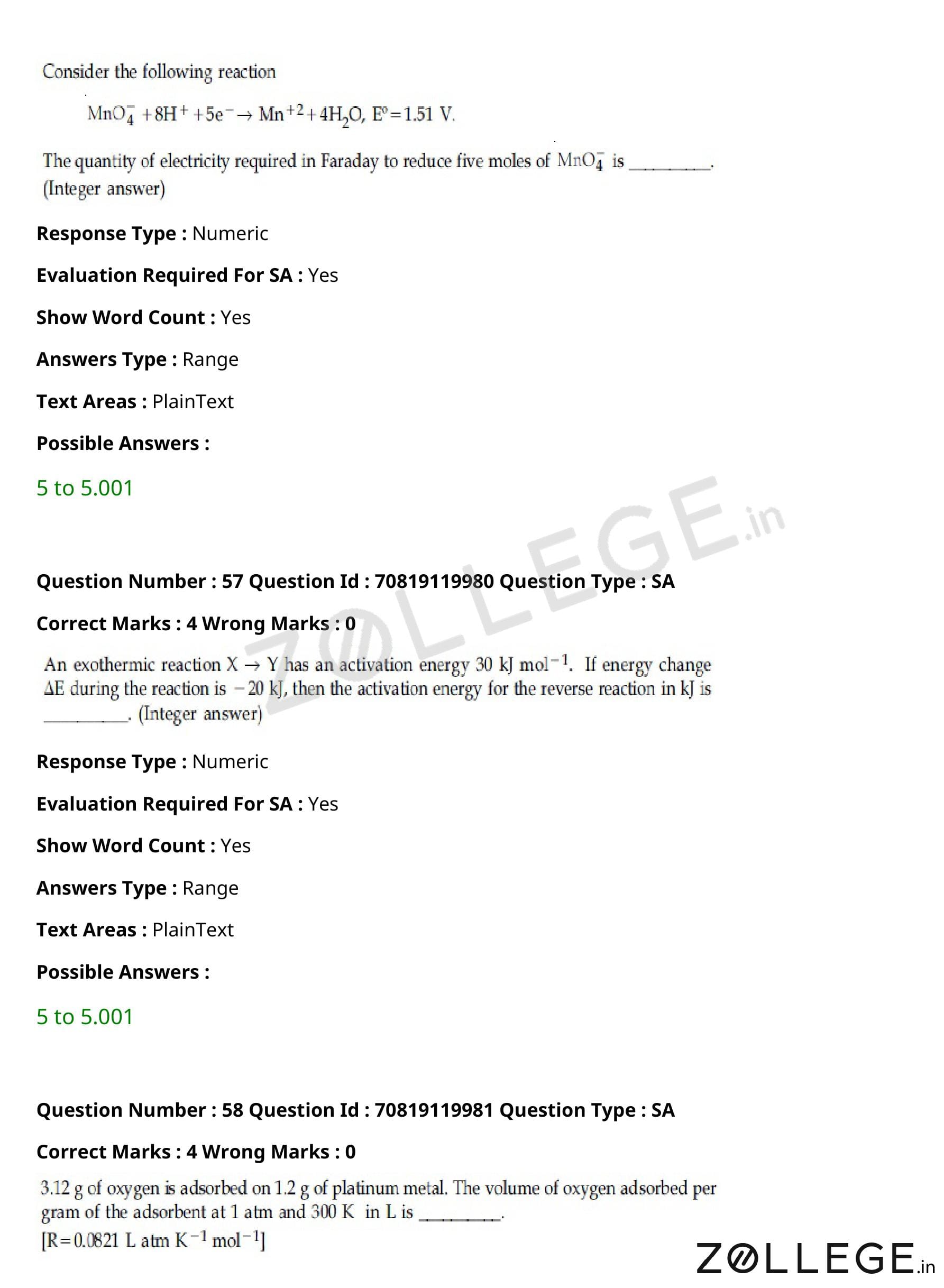
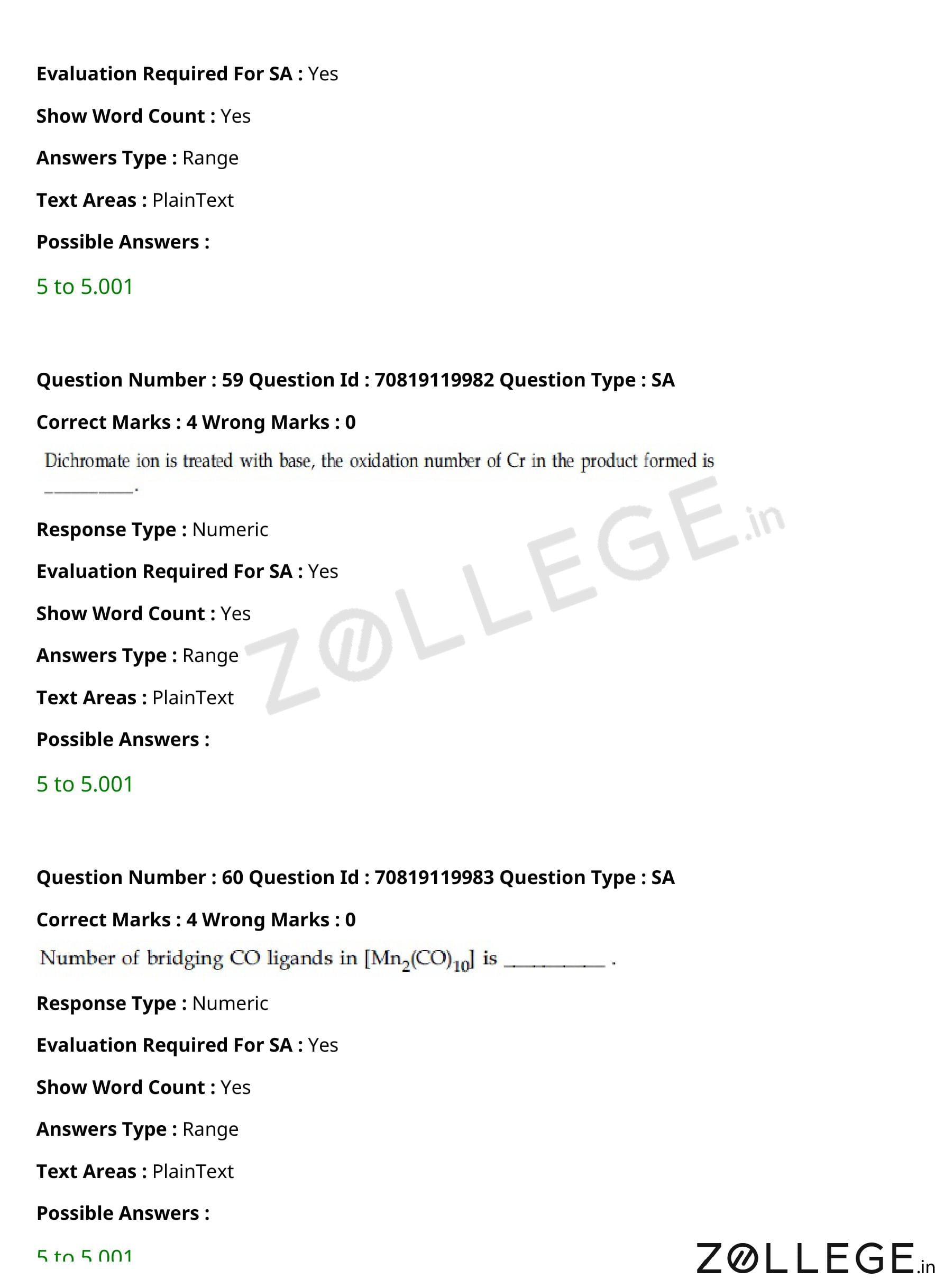
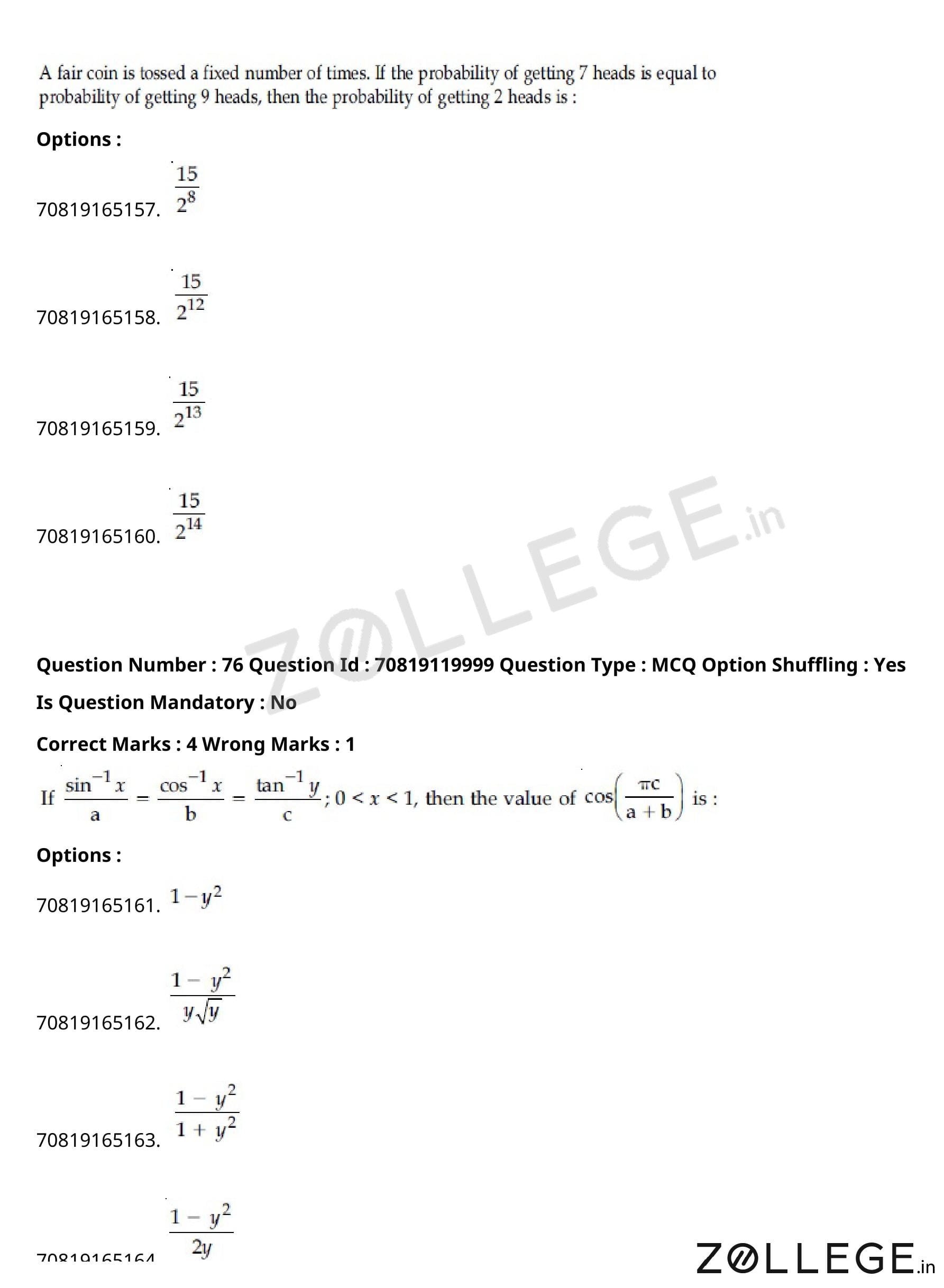
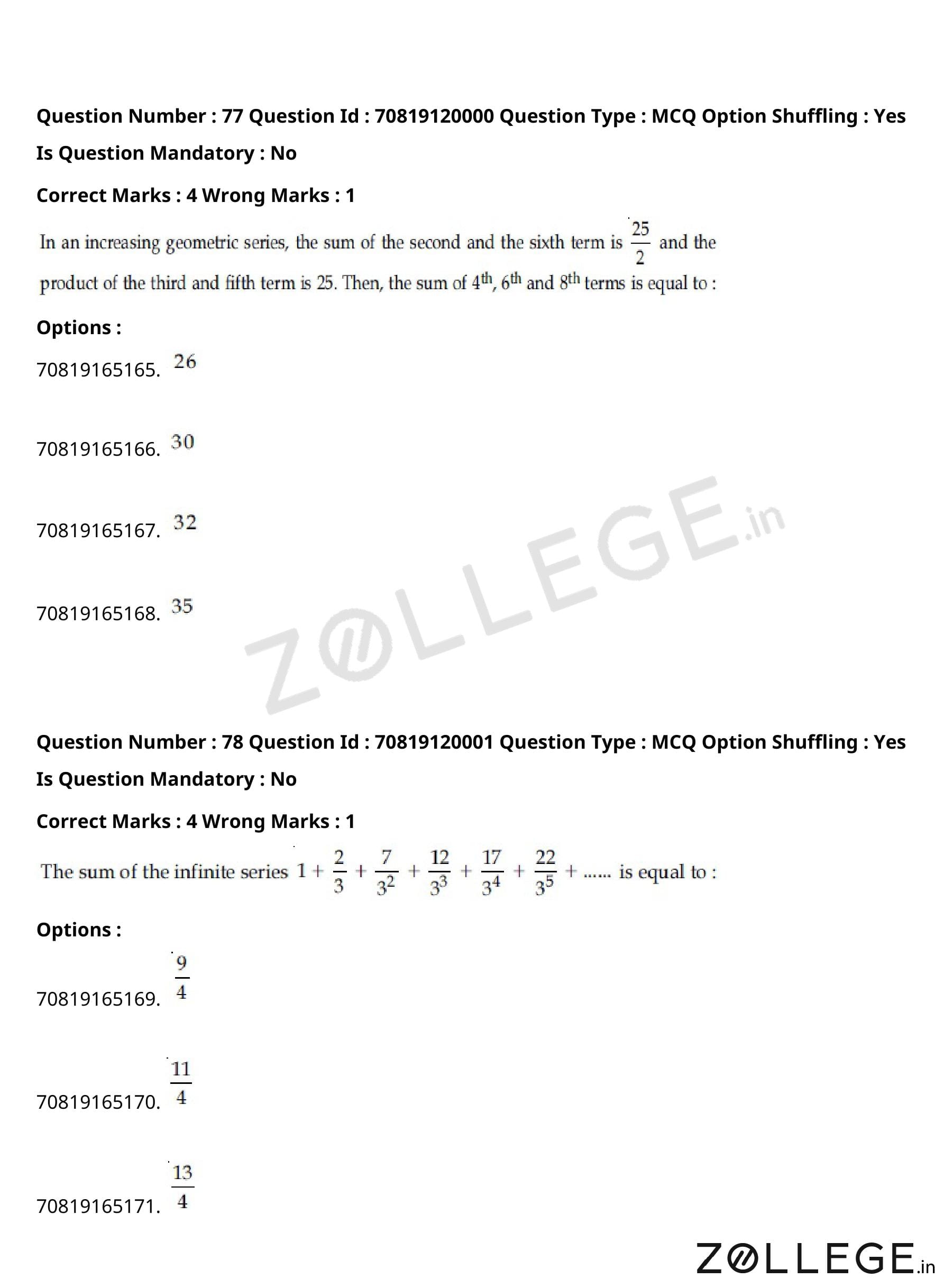
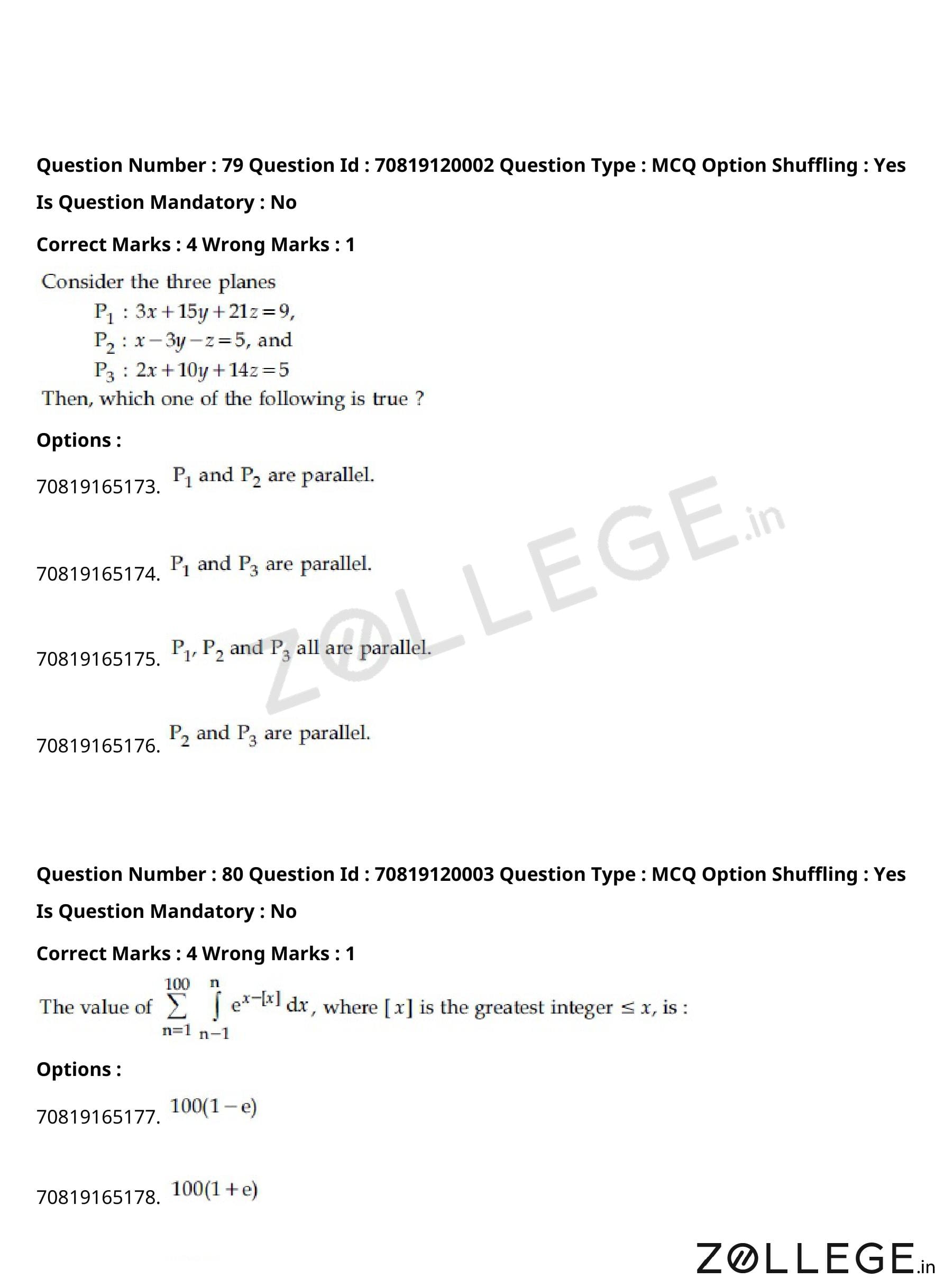
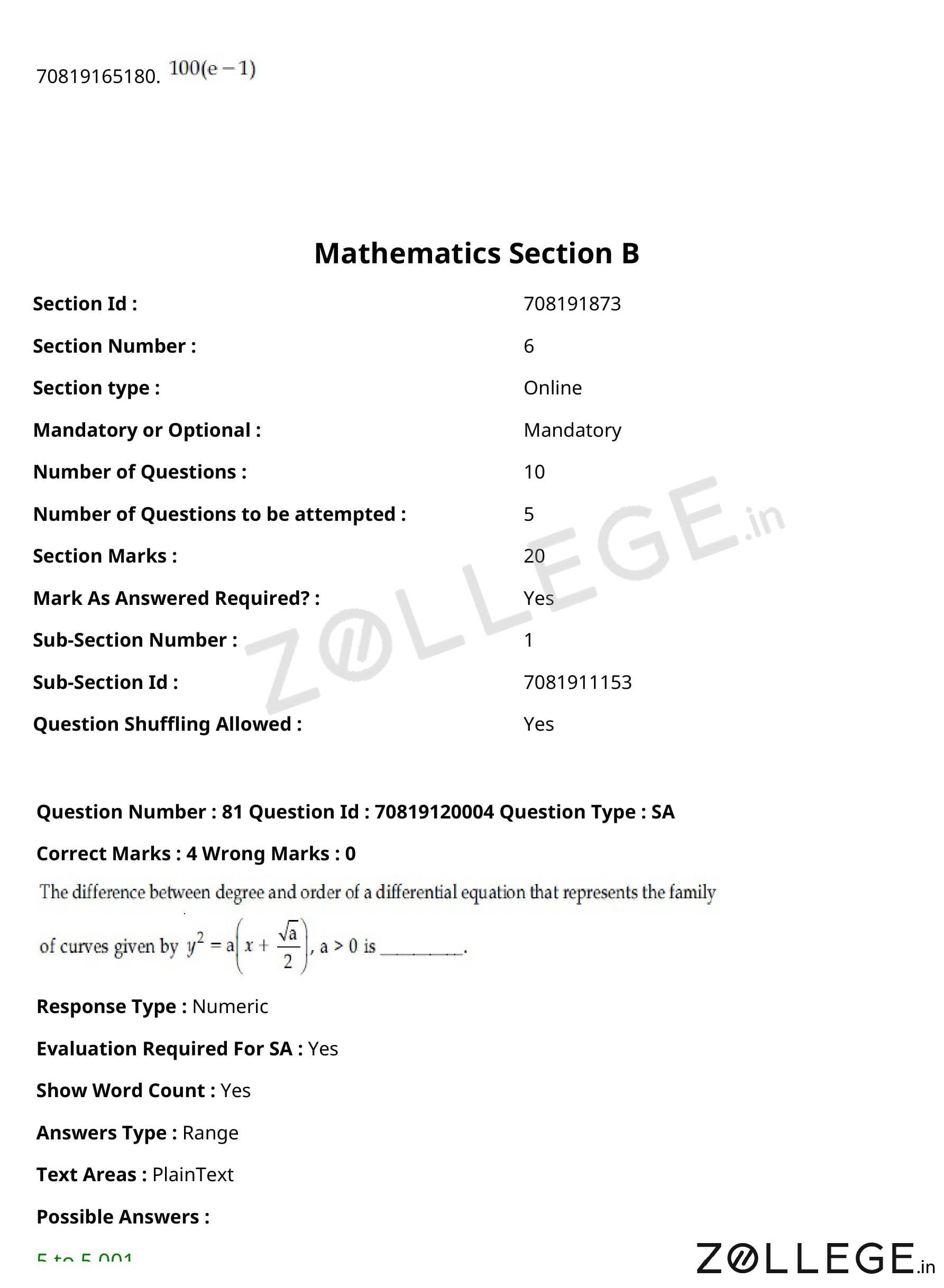
Previous Year JEE Main Question Papers
*The article might have information for the previous academic years, please refer the official website of the exam.