
JEE Main 2021 Question Paper with Answer Key PDF for B.Arch(September 2, 2021 - Shift 2)


Content Writer | Updated On - Dec 23, 2025
JEE Main Question Papers are the most important study material for effective exam preparation. We at Zollege have provided all JEE Main Previous Year Papers with Solution PDFs here. JEE Main 2021 B. Arch exam was conducted successfully on September 2, 2021. NTA conducted the exam in the Shift 2. According to student reactions and expert reviews, the paper was reported to be moderate.
Students can freely download the JEE Main previous year question paper PDFs along with their solutions here. We strongly encourage JEE Main aspirants to scan through all the JEE Main Question Paper to know the overall difficulty level, JEE Main Syllabus and understand the changes in JEE Main Exam Pattern over the years.
JEE Main 2021 B.Arch Question Paper with Answer Key PDF (Shift 2)
| JEE Main 2021 B.Arch Question Paper PDF | JEE Main 2021 B.Arch Answer Key PDF | JEE Main 2021 B.Arch Solution PDF |
|---|---|---|
| Download PDF | Download PDF | Check Solutions |

The domain of the function, \( f(x) = \sqrt{\frac{\log_{0.6} |x - 2|}{|x|}} \) is :
View Solution
Step 1: Identify the conditions for the function \( f(x) = \sqrt{\frac{\log_{0.6} |x - 2|}{|x|}} \) to be defined.
The expression inside the square root must be non-negative: \( \frac{\log_{0.6} |x - 2|}{|x|} \ge 0 \).
The denominator must not be zero: \( |x| \ne 0 \implies x \ne 0 \).
The argument of the logarithm must be positive: \( |x - 2| > 0 \implies x - 2 \ne 0 \implies x \ne 2 \).
Step 2: Analyze the square root condition.
Since \( |x| > 0 \) for all \( x \ne 0 \), the inequality \( \frac{\log_{0.6} |x - 2|}{|x|} \ge 0 \) is satisfied if and only if: \[ \log_{0.6} |x - 2| \ge 0 \]
Step 3: Solve the logarithmic inequality.
The base of the logarithm is \( 0.6 \). Since \( 0 < 0.6 < 1 \), the inequality sign reverses when we remove the logarithm: \[ \log_{0.6} |x - 2| \ge \log_{0.6} 1 \implies |x - 2| \le 1 \]
This can be rewritten as: \[ -1 \le x - 2 \le 1 \]
Adding 2 to all sides gives: \[ 1 \le x \le 3 \implies x \in [1, 3] \]
Step 4: Combine with the other constraints.
From the previous steps, we have \( x \in [1, 3] \), but we must exclude \( x \ne 2 \) and \( x \ne 0 \). Since \( 0 \) is not in the interval \( [1, 3] \), we only need to remove \( 2 \). \[ Domain = [1, 3] - \{2\} = [1, 2) \cup (2, 3] \] Quick Tip: When solving logarithmic inequalities of the form \( \log_a f(x) \ge 0 \): If \( a > 1 \), then \( f(x) \ge 1 \). If \( 0 < a < 1 \), then \( 0 < f(x) \le 1 \). Always remember to exclude points where any denominator becomes zero.
Let \(\alpha\) and \(\beta\) be the roots of the quadratic equation \(x^2 + \sqrt{3}x + 1 = 0\). Then \(\alpha^{2022} + \beta^{2022}\) is equal to :
View Solution
Step 1: Find the roots of the quadratic equation \(x^2 + \sqrt{3}x + 1 = 0\) using the quadratic formula: \[ x = \frac{-b \pm \sqrt{b^2 - 4ac}}{2a} \]
Given \(a = 1, b = \sqrt{3}, c = 1\): \[ x = \frac{-\sqrt{3} \pm \sqrt{(\sqrt{3})^2 - 4(1)(1)}}{2(1)} = \frac{-\sqrt{3} \pm \sqrt{3 - 4}}{2} = \frac{-\sqrt{3} \pm i}{2} \]
Let the roots be \(\alpha = \frac{-\sqrt{3} + i}{2}\) and \(\beta = \frac{-\sqrt{3} - i}{2}\).
Step 2: Convert the roots into polar (Euler) form: \[ \alpha = -\frac{\sqrt{3}}{2} + \frac{i}{2} = \cos\left(\frac{5\pi}{6}\right) + i\sin\left(\frac{5\pi}{6}\right) = e^{i\frac{5\pi}{6}} \] \[ \beta = -\frac{\sqrt{3}}{2} - \frac{i}{2} = \cos\left(\frac{5\pi}{6}\right) - i\sin\left(\frac{5\pi}{6}\right) = e^{-i\frac{5\pi}{6}} \]
Step 3: Use De Moivre's Theorem to calculate \(\alpha^{2022} + \beta^{2022}\): \[ \alpha^{2022} = \left(e^{i\frac{5\pi}{6}}\right)^{2022} = e^{i\left(\frac{5\pi}{6} \times 2022\right)} = e^{i(5\pi \times 337)} = e^{i(1685\pi)} \]
Since \(1685\) is an odd integer, \(e^{ik\pi} = -1\) for any odd \(k\). \[ \alpha^{2022} = \cos(1685\pi) + i\sin(1685\pi) = -1 + 0 = -1 \]
Similarly, \[ \beta^{2022} = \left(e^{-i\frac{5\pi}{6}}\right)^{2022} = e^{-i(1685\pi)} = \cos(-1685\pi) + i\sin(-1685\pi) = -1 + 0 = -1 \]
Step 4: Calculate the final sum: \[ \alpha^{2022} + \beta^{2022} = -1 + (-1) = -2 \] Quick Tip: When asked to find high powers of roots of a quadratic equation with a negative discriminant, always convert the complex roots into polar form. Applying De Moivre's Theorem (\((\cos \theta + i\sin \theta)^n = \cos n\theta + i\sin n\theta\)) makes the calculation straightforward.
If \( A = \begin{pmatrix} 0 & 0 & 2
1 & 0 & 0
0 & -1 & 0 \end{pmatrix} \), then :
View Solution
Step 1: Find the characteristic equation of matrix \( A \) using \( |A - \lambda I| = 0 \). \[ \begin{vmatrix} 0 - \lambda & 0 & 2
1 & 0 - \lambda & 0
0 & -1 & 0 - \lambda \end{vmatrix} = 0 \]
Expanding along the first row: \[ -\lambda \begin{vmatrix} -\lambda & 0
-1 & -\lambda \end{vmatrix} - 0 + 2 \begin{vmatrix} 1 & -\lambda
0 & -1 \end{vmatrix} = 0 \] \[ -\lambda(\lambda^2 - 0) + 2(-1 - 0) = 0 \] \[ -\lambda^3 - 2 = 0 \implies \lambda^3 = -2 \]
Step 2: According to the Cayley-Hamilton Theorem, the matrix \( A \) satisfies its own characteristic equation. \[ A^3 = -2I \]
Where \( I \) is the identity matrix.
Step 3: Calculate higher powers of \( A \) to verify the options. \[ A^6 = (A^3)^2 = (-2I)^2 = 4I^2 = 4I \] \[ A^{12} = (A^6)^2 = (4I)^2 = 16I \]
Step 4: Check the relationship in option (3). \[ 4A^6 = 4(4I) = 16I \]
Since \( A^{12} = 16I \), we have \( A^{12} = 4A^6 \). Quick Tip: The Cayley-Hamilton Theorem is the most efficient way to find relations between high powers of a matrix. Once you find \( A^n = kI \), then \( A^{2n} = k^2 I \), and any linear relation becomes a simple scalar comparison.
The sum of all values of \( \lambda \), for which the system of equations \[ x + y + z = 1 \] \[ x + 2y + 4z = \lambda \] \[ x + 4y + 10z = \lambda^2 \]
has infinitely many solutions, is :
View Solution
Step 1: Find the determinant of the coefficient matrix (\( \Delta \)). \[ \Delta = \begin{vmatrix} 1 & 1 & 1
1 & 2 & 4
1 & 4 & 10 \end{vmatrix} \] \[ \Delta = 1(20 - 16) - 1(10 - 4) + 1(4 - 2) \] \[ \Delta = 4 - 6 + 2 = 0 \]
Since \( \Delta = 0 \), the system will have infinitely many solutions if \( \Delta_x = \Delta_y = \Delta_z = 0 \).
Step 2: Set \( \Delta_x = 0 \) to find the values of \( \lambda \). \[ \Delta_x = \begin{vmatrix} 1 & 1 & 1
\lambda & 2 & 4
\lambda^2 & 4 & 10 \end{vmatrix} = 0 \] \[ 1(20 - 16) - 1(10\lambda - 4\lambda^2) + 1(4\lambda - 2\lambda^2) = 0 \] \[ 4 - 10\lambda + 4\lambda^2 + 4\lambda - 2\lambda^2 = 0 \] \[ 2\lambda^2 - 6\lambda + 4 = 0 \] \[ \lambda^2 - 3\lambda + 2 = 0 \]
Step 3: Solve for \( \lambda \).
Factorizing the quadratic equation: \[ (\lambda - 1)(\lambda - 2) = 0 \]
So, \( \lambda = 1 \) or \( \lambda = 2 \).
Step 4: Calculate the sum of all values of \( \lambda \). \[ Sum = 1 + 2 = 3 \] Quick Tip: For a system of non-homogeneous linear equations \( AX = B \) to have infinitely many solutions: The determinant of the coefficient matrix (\( \Delta \)) must be 0. All the sub-determinants (\( \Delta_x, \Delta_y, \Delta_z \)) must also be 0. If \( \Delta = 0 \) but at least one of \( \Delta_x, \Delta_y, \Delta_z \) is non-zero, the system has no solution.
Let \( f(x) = \max\{x^2, x^3\} \) for all \( x \in \mathbb{R} \). Then which of the following is NOT true ?
View Solution
Step 1: Determine the piecewise expression for \( f(x) = \max\{x^2, x^3\} \).
We compare the values of \( x^2 \) and \( x^3 \) over the real number line. The intersection points are: \[ x^2 = x^3 \implies x^2(x - 1) = 0 \implies x = 0 or x = 1 \]
- For \( x \le 0 \): \( x^2 \ge 0 \) and \( x^3 \le 0 \), so \( \max\{x^2, x^3\} = x^2 \).
- For \( 0 < x < 1 \): \( x^2 > x^3 \), so \( \max\{x^2, x^3\} = x^2 \).
- For \( x \ge 1 \): \( x^3 \ge x^2 \), so \( \max\{x^2, x^3\} = x^3 \).
Thus, the function is: \[ f(x) = \begin{cases} x^2, & x < 1
x^3, & x \ge 1 \end{cases} \]
Step 2: Analyze continuity and differentiability.
- Continuity: \( f(x) \) is continuous for all \( x \) because both \( x^2 \) and \( x^3 \) are continuous everywhere, and at the transition point \( x = 1 \), \( \lim_{x \to 1^-} f(x) = 1^2 = 1 \) and \( \lim_{x \to 1^+} f(x) = 1^3 = 1 \). So, Option (1) is true.
- Differentiability:
- For \( x < 1 \), \( f'(x) = 2x \). At \( x = 0 \), both sides of the junction are defined by \( x^2 \), so it is differentiable there.
- At \( x = 1 \):
Left-hand derivative (LHD) \( = \frac{d}{dx}(x^2)\big|_{x=1} = 2(1) = 2 \).
Right-hand derivative (RHD) \( = \frac{d}{dx}(x^3)\big|_{x=1} = 3(1)^2 = 3 \).
Since LHD \( \neq \) RHD, \( f \) is not differentiable at \( x = 1 \).
Thus, \( f \) is not differentiable at exactly one point. This means Option (2) is true and Option (3) is false.
Step 3: Verify Option (4).
- \( f'(-\frac{1}{2}) = 2(-\frac{1}{2}) = -1 \)
- \( f'(\frac{1}{8}) = 2(\frac{1}{8}) = \frac{1}{4} \)
- \( f'(\frac{3}{2}) = 3(\frac{3}{2})^2 = 3(\frac{9}{4}) = \frac{27}{4} \)
Sum: \( -1 + \frac{1}{4} + \frac{27}{4} = -1 + 7 = 6 \). So, Option (4) is true.
The statement that is NOT true is (3). Quick Tip: When dealing with \( \max \) or \( \min \) functions, the points of intersection of the functions inside the bracket are critical. They are the only points where the function might switch its rule and thus potentially lose differentiability (creating "sharp corners").
The sum of the series \[ \frac{1}{6} + \frac{5}{6^2} + \frac{19}{6^3} + \dots + \frac{3^{10} - 2^{10}}{3^{10} \cdot 2^{10}} is : \]
View Solution
Step 1: Identify the general term (\( T_k \)) of the series.
By examining the given terms: \[ T_1 = \frac{1}{6} = \frac{3^1 - 2^1}{6^1} \] \[ T_2 = \frac{5}{6^2} = \frac{9 - 4}{36} = \frac{3^2 - 2^2}{6^2} \] \[ T_3 = \frac{19}{6^3} = \frac{27 - 8}{216} = \frac{3^3 - 2^3}{6^3} \]
The general term is \( T_k = \frac{3^k - 2^k}{6^k} \). The series has 10 terms.
Step 2: Simplify the general term for summation. \[ T_k = \frac{3^k}{6^k} - \frac{2^k}{6^k} = \left(\frac{1}{2}\right)^k - \left(\frac{1}{3}\right)^k \]
Step 3: Calculate the sum of the series.
The sum \( S \) is the difference of two finite geometric progressions (GP): \[ S = \sum_{k=1}^{10} \left[ \left(\frac{1}{2}\right)^k - \left(\frac{1}{3}\right)^k \right] = \sum_{k=1}^{10} \left(\frac{1}{2}\right)^k - \sum_{k=1}^{10} \left(\frac{1}{3}\right)^k \]
Using the GP sum formula \( S_n = \frac{a(1-r^n)}{1-r} \):
- For the first GP (\( a=1/2, r=1/2 \)): \( S_{GP1} = \frac{\frac{1}{2}(1 - (1/2)^{10})}{1 - 1/2} = 1 - \frac{1}{2^{10}} \)
- For the second GP (\( a=1/3, r=1/3 \)): \( S_{GP2} = \frac{\frac{1}{3}(1 - (1/3)^{10})}{1 - 1/3} = \frac{1}{2} \left( 1 - \frac{1}{3^{10}} \right) = \frac{1}{2} - \frac{1}{2 \cdot 3^{10}} \)
Step 4: Find the final simplified expression. \[ S = \left( 1 - \frac{1}{2^{10}} \right) - \left( \frac{1}{2} - \frac{1}{2 \cdot 3^{10}} \right) = \frac{1}{2} - \frac{1}{2^{10}} + \frac{1}{2 \cdot 3^{10}} \]
Taking the common denominator \( 6^{10} = 2^{10} \cdot 3^{10} \): \[ S = \frac{2^9 \cdot 3^{10} - 3^{10} + 2^9}{6^{10}} = \frac{(2^9 - 1) 3^{10} + 2^9}{6^{10}} \]
Since \( 2^9 - 1 = 512 - 1 = 511 \): \[ S = \frac{511 \cdot 3^{10} + 2^9}{6^{10}} \] Quick Tip: Always try to split complex general terms into simpler components (Method of Differences). Here, splitting the fraction into two basic geometric series makes the summation much easier than trying to solve it as a single mixed series.
\( \lim_{x \to 0} \frac{1}{x^2} \left( e^{x^2} - \cos \frac{x}{2} \right) \) is equal to :
View Solution
Step 1: Identify the indeterminate form.
As \( x \to 0 \), the numerator \( e^{x^2} - \cos(x/2) \to 1 - 1 = 0 \) and the denominator \( x^2 \to 0 \).
This is a \( \frac{0}{0} \) indeterminate form.
Step 2: Use Taylor series expansion for the functions involved.
The standard expansions around \( x = 0 \) are: \[ e^u = 1 + u + \frac{u^2}{2!} + \dots \implies e^{x^2} = 1 + x^2 + O(x^4) \] \[ \cos u = 1 - \frac{u^2}{2!} + \dots \implies \cos\left(\frac{x}{2}\right) = 1 - \frac{(x/2)^2}{2!} + O(x^4) = 1 - \frac{x^2}{8} + O(x^4) \]
Step 3: Substitute these expansions back into the original limit. \[ L = \lim_{x \to 0} \frac{(1 + x^2 + \dots) - (1 - \frac{x^2}{8} + \dots)}{x^2} \] \[ L = \lim_{x \to 0} \frac{1 + x^2 - 1 + \frac{x^2}{8}}{x^2} \] \[ L = \lim_{x \to 0} \frac{\frac{9x^2}{8}}{x^2} = \frac{9}{8} \] Quick Tip: For limits at \( x = 0 \), using Taylor series expansions for \( e^x \), \( \sin x \), and \( \cos x \) is often faster and less prone to calculation errors than applying L'Hôpital's Rule multiple times.
If \( \int \sqrt{\frac{\cos(x - \theta)}{\cos(x + \theta)}} \, dx = \alpha \sin^{-1} \left( \frac{\sin x}{\cos \theta} \right) + \beta \log_e \left| \cos x + \sqrt{\cos^2 x - \sin^2 \theta} \right| + C \), where \( C \) is a constant of integration and \( \frac{\pi}{6} < \theta < \frac{\pi}{4} \), then \( \alpha \sin \theta + \beta \cos \theta \) is equal to :
View Solution
Step 1: Simplify the integrand.
Multiply the numerator and denominator inside the square root by \(\sqrt{\cos(x - \theta)}\): \[ I = \int \sqrt{\frac{\cos(x - \theta)}{\cos(x + \theta)}} \cdot \frac{\sqrt{\cos(x - \theta)}}{\sqrt{\cos(x - \theta)}} \, dx = \int \frac{\cos(x - \theta)}{\sqrt{\cos(x + \theta)\cos(x - \theta)}} \, dx \]
Using the identity \( \cos(A+B)\cos(A-B) = \cos^2 A - \sin^2 B \), the denominator becomes \(\sqrt{\cos^2 x - \sin^2 \theta}\).
Expanding the numerator: \[ I = \int \frac{\cos x \cos \theta + \sin x \sin \theta}{\sqrt{\cos^2 x - \sin^2 \theta}} \, dx \]
Step 2: Split into two integrals. \[ I = \cos \theta \int \frac{\cos x}{\sqrt{\cos^2 x - \sin^2 \theta}} \, dx + \sin \theta \int \frac{\sin x}{\sqrt{\cos^2 x - \sin^2 \theta}} \, dx \] \[ I = \cos \theta \int \frac{\cos x}{\sqrt{1 - \sin^2 x - \sin^2 \theta}} \, dx + \sin \theta \int \frac{\sin x}{\sqrt{\cos^2 x - \sin^2 \theta}} \, dx \] \[ I = \cos \theta \int \frac{\cos x}{\sqrt{\cos^2 \theta - \sin^2 x}} \, dx + \sin \theta \int \frac{\sin x}{\sqrt{\cos^2 x - \sin^2 \theta}} \, dx \]
Step 3: Perform substitutions and integrate.
For the first part, let \( u = \sin x \), \( du = \cos x \, dx \): \[ I_1 = \cos \theta \int \frac{du}{\sqrt{\cos^2 \theta - u^2}} = \cos \theta \sin^{-1} \left( \frac{u}{\cos \theta} \right) = \cos \theta \sin^{-1} \left( \frac{\sin x}{\cos \theta} \right) \]
For the second part, let \( v = \cos x \), \( dv = -\sin x \, dx \): \[ I_2 = \sin \theta \int \frac{-dv}{\sqrt{v^2 - \sin^2 \theta}} = -\sin \theta \log_e \left| v + \sqrt{v^2 - \sin^2 \theta} \right| \] \[ I_2 = -\sin \theta \log_e \left| \cos x + \sqrt{\cos^2 x - \sin^2 \theta} \right| \]
Step 4: Compare with the given expression to find \(\alpha\) and \(\beta\).
From the integration results, we have \(\alpha = \cos \theta\) and \(\beta = -\sin \theta\).
Therefore: \[ \alpha \sin \theta + \beta \cos \theta = (\cos \theta) \sin \theta + (-\sin \theta) \cos \theta = \sin \theta \cos \theta - \sin \theta \cos \theta = 0 \] Quick Tip: To solve integrals of the form \(\int \sqrt{\frac{L_1}{L_2}} dx\), multiplying the numerator and denominator by \(\sqrt{L_1}\) often helps in linearizing the numerator. Use the identity \( \cos(x+\theta)\cos(x-\theta) = \cos^2 x - \sin^2 \theta \) to simplify the square root term.
If \( I = \int_{0}^{1} \tan^{-1}(\sqrt{x} + 1) \, dx \) and \( J = \int_{0}^{1} \frac{\sqrt{x}}{x + 2\sqrt{x} + 2} \, dx \), then the value of \( 2I + J \) is equal to :
View Solution
Step 1: Apply integration by parts to the integral \( I \).
Let \( u = \tan^{-1}(\sqrt{x} + 1) \) and \( dv = dx \).
Then, differentiate \( u \): \[ du = \frac{1}{1 + (\sqrt{x} + 1)^2} \cdot \frac{d}{dx}(\sqrt{x} + 1) \, dx = \frac{1}{1 + (x + 2\sqrt{x} + 1)} \cdot \frac{1}{2\sqrt{x}} \, dx \] \[ du = \frac{1}{x + 2\sqrt{x} + 2} \cdot \frac{1}{2\sqrt{x}} \, dx \]
Integrate \( dv \): \[ v = x \]
Step 2: Use the integration by parts formula \( \int u \, dv = uv - \int v \, du \). \[ I = \left[ x \tan^{-1}(\sqrt{x} + 1) \right]_{0}^{1} - \int_{0}^{1} \frac{x}{2\sqrt{x}(x + 2\sqrt{x} + 2)} \, dx \] \[ I = \left( 1 \cdot \tan^{-1}(1 + 1) - 0 \cdot \tan^{-1}(1) \right) - \frac{1}{2} \int_{0}^{1} \frac{\sqrt{x}}{x + 2\sqrt{x} + 2} \, dx \] \[ I = \tan^{-1}(2) - \frac{1}{2} J \]
Step 3: Rearrange the equation to find \( 2I + J \).
Multiplying the entire equation by 2: \[ 2I = 2\tan^{-1}(2) - J \] \[ 2I + J = 2\tan^{-1}(2) \] Quick Tip: When faced with two related integrals \( I \) and \( J \), check if applying integration by parts to the more complex one (\( I \)) expresses it in terms of the simpler one (\( J \)). This avoids evaluating difficult integrals separately.
Let \( y=y(x) \) be the solution of the differential equation \( x\frac{dy}{dx} = (2x + 3)e^x + xy, x > 0 \). If \( y(e)=(2e + 3)e^e \), then \( \frac{d^2y}{dx^2} - \frac{dy}{dx} \) at \( x=1 \) is equal to :
View Solution
Step 1: Rewrite the given differential equation in the standard linear form \( \frac{dy}{dx} + P(x)y = Q(x) \). \[ x\frac{dy}{dx} - xy = (2x + 3)e^x \]
Dividing by \( x \) (since \( x > 0 \)): \[ \frac{dy}{dx} - y = \left(2 + \frac{3}{x}\right)e^x \]
Here, \( P(x) = -1 \) and \( Q(x) = \left(2 + \frac{3}{x}\right)e^x \).
Step 2: Find the Integrating Factor (I.F.). \[ I.F. = e^{\int P(x) dx} = e^{\int -1 dx} = e^{-x} \]
Step 3: Find the general solution.
Multiply the linear form by the I.F.: \[ y \cdot e^{-x} = \int \left(2 + \frac{3}{x}\right)e^x \cdot e^{-x} dx + C \] \[ y \cdot e^{-x} = \int \left(2 + \frac{3}{x}\right) dx + C \] \[ y \cdot e^{-x} = 2x + 3\ln x + C \implies y = (2x + 3\ln x + C)e^x \]
Step 4: Apply the boundary condition \( y(e) = (2e + 3)e^e \) to find the constant \( C \). \[ (2e + 3\ln e + C)e^e = (2e + 3)e^e \] \[ 2e + 3 + C = 2e + 3 \implies C = 0 \]
So, the particular solution is \( y = (2x + 3\ln x)e^x \).
Step 5: Calculate the value of the expression \( \frac{d^2y}{dx^2} - \frac{dy}{dx} \) at \( x=1 \).
From the rearranged equation in Step 1: \[ \frac{dy}{dx} - y = \left(2 + \frac{3}{x}\right)e^x \]
Differentiating both sides with respect to \( x \): \[ \frac{d^2y}{dx^2} - \frac{dy}{dx} = \frac{d}{dx} \left[ \left(2 + \frac{3}{x}\right)e^x \right] \]
Applying the product rule on the right-hand side: \[ \frac{d^2y}{dx^2} - \frac{dy}{dx} = \left(-\frac{3}{x^2}\right)e^x + \left(2 + \frac{3}{x}\right)e^x = e^x \left( 2 + \frac{3}{x} - \frac{3}{x^2} \right) \]
At \( x = 1 \): \[ \left[ \frac{d^2y}{dx^2} - \frac{dy}{dx} \right]_{x=1} = e^1 \left( 2 + \frac{3}{1} - \frac{3}{1^2} \right) = e(2 + 3 - 3) = 2e \] Quick Tip: When asked for an expression involving higher-order derivatives of a solution to a differential equation, don't forget that you can differentiate the original differential equation itself. This often avoids the need for back-substitution of the full solution, saving significant time.
Let \( f \) be a non-zero polynomial function such that \( f(3x) = f'(x) f''(x) \). Then the value of \( f(6) \) is :
View Solution
Step 1: Determine the degree of the polynomial \( f(x) \).
Let the degree of the polynomial \( f(x) \) be \( n \).
The degree of \( f(3x) \) is \( n \).
The degree of \( f'(x) \) is \( n - 1 \) and the degree of \( f''(x) \) is \( n - 2 \).
Given the identity \( f(3x) = f'(x) f''(x) \), equating the degrees of both sides gives: \[ n = (n - 1) + (n - 2) \] \[ n = 2n - 3 \implies n = 3 \]
Thus, \( f(x) \) is a cubic polynomial.
Step 2: Determine the polynomial \( f(x) \).
Let \( f(x) = ax^3 + bx^2 + cx + d \).
Then, \( f'(x) = 3ax^2 + 2bx + c \) and \( f''(x) = 6ax + 2b \).
Substitute these into the given functional equation: \[ a(3x)^3 + b(3x)^2 + c(3x) + d = (3ax^2 + 2bx + c)(6ax + 2b) \] \[ 27ax^3 + 9bx^2 + 3cx + d = 18a^2x^3 + 18abx^2 + (4b^2 + 6ac)x + 2bc \]
Comparing the coefficients of like powers of \( x \):
For \( x^3 \): \( 27a = 18a^2 \). Since \( f \) is non-zero, \( a \neq 0 \), so \( a = \frac{27}{18} = \frac{3}{2} \).
For \( x^2 \): \( 9b = 18ab \). Substituting \( a = \frac{3}{2} \), we get \( 9b = 27b \implies b = 0 \).
For \( x \): \( 3c = 4b^2 + 6ac \). Substituting \( b = 0 \) and \( a = \frac{3}{2} \), we get \( 3c = 9c \implies c = 0 \).
For the constant term: \( d = 2bc \). Substituting \( b = 0 \), we get \( d = 0 \).
Therefore, the function is \( f(x) = \frac{3}{2}x^3 \).
Step 3: Calculate \( f(6) \). \[ f(6) = \frac{3}{2}(6)^3 = \frac{3}{2}(216) = 3 \times 108 = 324 \] Quick Tip: To find an unknown polynomial from a functional equation involving its derivatives, always begin by equating the \textbf{degree} of the terms on both sides of the equation.
A rod AB of length 4 units rests against a vertical wall with A on the horizontal floor. P is a point on AB such that AP : PB = 2 : 1. If the rod slides down along the wall in a vertical plane, then the point P(x, y) moves on the curve :
View Solution
Step 1: Setup the coordinate system and identify endpoints.
Let the horizontal floor be the \(x\)-axis and the vertical wall be the \(y\)-axis.
Let point \(A\) be on the \(x\)-axis, so \(A = (a, 0)\).
Let point \(B\) be on the \(y\)-axis, so \(B = (0, b)\).
Step 2: Relate coordinates to the rod length.
The length of the rod \(AB\) is given as 4 units.
Using the distance formula: \[ \sqrt{(a-0)^2 + (0-b)^2} = 4 \implies a^2 + b^2 = 16 \quad \dots(1) \]
Step 3: Find the coordinates of point \(P(x, y)\) using the section formula.
Point \(P\) divides \(AB\) in the ratio \(2:1\) starting from \(A\).
Using internal division: \[ x = \frac{2(0) + 1(a)}{2+1} = \frac{a}{3} \implies a = 3x \] \[ y = \frac{2(b) + 1(0)}{2+1} = \frac{2b}{3} \implies b = \frac{3y}{2} \]
Step 4: Substitute \(a\) and \(b\) back into the length equation (1). \[ (3x)^2 + \left(\frac{3y}{2}\right)^2 = 16 \] \[ 9x^2 + \frac{9y^2}{4} = 16 \]
Multiplying the entire equation by 4: \[ 36x^2 + 9y^2 = 64 \] Quick Tip: Locus problems involving a sliding ladder/rod are best solved by setting up axes along the floor and wall. Use the Pythagorean theorem for the fixed length and the section formula to relate the moving point's coordinates to the varying intercepts on the axes.
Let \(A(1, 2)\) and \(B(3, 6)\) are two points on a circle of radius \(R\), whose one of the diameters is along the line \(2x - y + 4 = 0\). Then \(R^2\) is equal to :
View Solution
Step 1: Find the center of the circle.
Let the center of the circle be \(C(h, k)\). Since the diameter is along the line \(2x - y + 4 = 0\), the center must lie on this line. \[ 2h - k + 4 = 0 \implies k = 2h + 4 \quad \dots(1) \]
Step 2: Equate the distances from the center to points \(A\) and \(B\).
Points \(A(1, 2)\) and \(B(3, 6)\) lie on the circle, so their distance from the center is equal to the radius \(R\). \[ R^2 = (h - 1)^2 + (k - 2)^2 = (h - 3)^2 + (k - 6)^2 \]
Substituting \(k = 2h + 4\) from equation (1): \[ (h - 1)^2 + (2h + 4 - 2)^2 = (h - 3)^2 + (2h + 4 - 6)^2 \] \[ (h - 1)^2 + (2h + 2)^2 = (h - 3)^2 + (2h - 2)^2 \]
Expanding both sides: \[ h^2 - 2h + 1 + 4h^2 + 8h + 4 = h^2 - 6h + 9 + 4h^2 - 8h + 4 \] \[ 5h^2 + 6h + 5 = 5h^2 - 14h + 13 \] \[ 6h + 14h = 13 - 5 \] \[ 20h = 8 \implies h = \frac{8}{20} = \frac{2}{5} \]
Step 3: Calculate \(k\) and \(R^2\).
Substituting \(h = 2/5\) into equation (1): \[ k = 2\left(\frac{2}{5}\right) + 4 = \frac{4}{5} + 4 = \frac{24}{5} \]
Now, find \(R^2\) using point \(A(1, 2)\): \[ R^2 = \left(\frac{2}{5} - 1\right)^2 + \left(\frac{24}{5} - 2\right)^2 \] \[ R^2 = \left(-\frac{3}{5}\right)^2 + \left(\frac{14}{5}\right)^2 = \frac{9}{25} + \frac{196}{25} \] \[ R^2 = \frac{205}{25} = \frac{41}{5} \] Quick Tip: The center of a circle always lies on any of its diameters. Alternatively, the perpendicular bisector of any chord (like AB) passes through the center. Finding the intersection of the given diameter and the perpendicular bisector of AB is often a quicker way to locate the center.
A line perpendicular to the line \( 4x = 3y \) is a tangent to the parabola \( y^2 = 3x + 1 \) at a point P on it. If S is the focus of the parabola, then the equation of the line SP is :
View Solution
Step 1: Find the focus \( S \) of the parabola.
The equation of the parabola is \( y^2 = 3x + 1 \). Rewrite it in standard form: \[ y^2 = 3\left(x + \frac{1}{3}\right) \]
Comparing with \( y^2 = 4a(x - h) \): \( 4a = 3 \implies a = \frac{3}{4} \) and vertex \( V = \left(-\frac{1}{3}, 0\right) \).
Focus \( S = (h + a, 0) = \left(-\frac{1}{3} + \frac{3}{4}, 0\right) = \left(\frac{-4 + 9}{12}, 0\right) = \left(\frac{5}{12}, 0\right) \).
Step 2: Find the slope of the tangent at \( P \).
The given line is \( 4x = 3y \implies y = \frac{4}{3}x \), so its slope \( m_1 = \frac{4}{3} \).
The tangent is perpendicular to this line, so its slope \( m = -\frac{1}{m_1} = -\frac{3}{4} \).
Step 3: Find the coordinates of point \( P \).
Differentiating the parabola equation \( y^2 = 3x + 1 \) with respect to \( x \): \[ 2y \frac{dy}{dx} = 3 \implies \frac{dy}{dx} = \frac{3}{2y} \]
At point \( P \), the slope of the tangent is \( -\frac{3}{4} \): \[ \frac{3}{2y} = -\frac{3}{4} \implies 2y = -4 \implies y = -2 \]
Substitute \( y = -2 \) into the parabola equation to find \( x \): \[ (-2)^2 = 3x + 1 \implies 4 = 3x + 1 \implies 3x = 3 \implies x = 1 \]
So, point \( P = (1, -2) \).
Step 4: Find the equation of line \( SP \).
Point \( S = \left(\frac{5}{12}, 0\right) \) and point \( P = (1, -2) \).
Slope of \( SP = \frac{-2 - 0}{1 - \frac{5}{12}} = \frac{-2}{\frac{7}{12}} = -\frac{24}{7} \).
Equation of the line \( SP \): \[ y - 0 = -\frac{24}{7} \left(x - \frac{5}{12}\right) \] \[ 7y = -24x + 24\left(\frac{5}{12}\right) \] \[ 7y = -24x + 10 \implies 24x + 7y = 10 \] Quick Tip: For a parabola \( y^2 = 4ax \), the point of contact for a tangent with slope \( m \) is \( \left(\frac{a}{m^2}, \frac{2a}{m}\right) \). For shifted parabolas, apply the shift to this point. Alternatively, using calculus (\( dy/dx \)) is often safer and more intuitive.
If a line \( px + qy = 12 \) is a tangent to the ellipse \( 4x^2 + 9y^2 = 16 \), then \( pq \) can NOT be equal to :
View Solution
Step 1: Convert the ellipse equation to its standard form \( \frac{x^2}{a^2} + \frac{y^2}{b^2} = 1 \).
Given: \( 4x^2 + 9y^2 = 16 \).
Dividing by 16: \( \frac{x^2}{4} + \frac{y^2}{16/9} = 1 \).
Comparing with the standard form, we get \( a^2 = 4 \) and \( b^2 = \frac{16}{9} \).
Step 2: Express the line \( px + qy = 12 \) in slope-intercept form \( y = mx + c \). \( qy = -px + 12 \implies y = \left(-\frac{p}{q}\right)x + \frac{12}{q} \).
So, the slope \( m = -\frac{p}{q} \) and the intercept \( c = \frac{12}{q} \).
Step 3: Apply the condition for tangency to an ellipse.
A line \( y = mx + c \) is tangent to the ellipse \( \frac{x^2}{a^2} + \frac{y^2}{b^2} = 1 \) if \( c^2 = a^2m^2 + b^2 \).
Substituting the values: \[ \left(\frac{12}{q}\right)^2 = 4\left(-\frac{p}{q}\right)^2 + \frac{16}{9} \] \[ \frac{144}{q^2} = \frac{4p^2}{q^2} + \frac{16}{9} \]
Multiplying the entire equation by \( 9q^2 \): \[ 1296 = 36p^2 + 16q^2 \]
Dividing by 4: \[ 9p^2 + 4q^2 = 324 \]
Step 4: Use the AM-GM inequality to determine the possible range for \( pq \).
According to the AM-GM inequality for positive terms \( 9p^2 \) and \( 4q^2 \): \[ \frac{9p^2 + 4q^2}{2} \ge \sqrt{9p^2 \cdot 4q^2} \] \[ \frac{324}{2} \ge \sqrt{36p^2q^2} \] \[ 162 \ge 6|pq| \] \[ |pq| \le 27 \]
This implies that the value of \( pq \) must lie in the interval \( [-27, 27] \).
Comparing this range with the given options, \( 29 \) is the only value that falls outside the possible range. Quick Tip: The condition for a line \( Lx + My + N = 0 \) to be tangent to the ellipse \( \frac{x^2}{a^2} + \frac{y^2}{b^2} = 1 \) can also be written as \( a^2L^2 + b^2M^2 = N^2 \). Using this directly: \( 4(p^2) + \frac{16}{9}(q^2) = 12^2 = 144 \), which simplifies to \( 9p^2 + 4q^2 = 324 \).
If the angle between the line \( \frac{x+1}{1} = \frac{y-1}{2} = \frac{z+2}{-1} \) and the plane \( P : 2x - y - \lambda z + 4 = 0 \), \( \lambda > 0 \), is \( \sin^{-1} \left( \frac{1}{9\sqrt{6}} \right) \), then the distance of the point \( (-1, 1, -2) \) from the plane \( P \) is :
View Solution
Step 1: Identify the direction vector of the line and the normal vector of the plane.
Direction vector of the line, \( \vec{b} = \hat{i} + 2\hat{j} - \hat{k} \).
Normal vector to the plane \( P \), \( \vec{n} = 2\hat{i} - \hat{j} - \lambda\hat{k} \).
Step 2: Use the formula for the angle \( \theta \) between a line and a plane.
The angle \( \theta \) is given by: \[ \sin \theta = \frac{|\vec{b} \cdot \vec{n}|}{|\vec{b}| |\vec{n}|} \]
Given \( \sin \theta = \frac{1}{9\sqrt{6}} \).
Calculate the dot product and magnitudes: \( \vec{b} \cdot \vec{n} = (1)(2) + (2)(-1) + (-1)(-\lambda) = 2 - 2 + \lambda = \lambda \). \( |\vec{b}| = \sqrt{1^2 + 2^2 + (-1)^2} = \sqrt{6} \). \( |\vec{n}| = \sqrt{2^2 + (-1)^2 + (-\lambda)^2} = \sqrt{5 + \lambda^2} \).
Step 3: Solve for \( \lambda \).
Substituting the values into the angle formula: \[ \frac{|\lambda|}{\sqrt{6} \cdot \sqrt{5 + \lambda^2}} = \frac{1}{9\sqrt{6}} \implies \frac{|\lambda|}{\sqrt{5 + \lambda^2}} = \frac{1}{9} \]
Squaring both sides: \[ \frac{\lambda^2}{5 + \lambda^2} = \frac{1}{81} \implies 81\lambda^2 = 5 + \lambda^2 \implies 80\lambda^2 = 5 \] \[ \lambda^2 = \frac{5}{80} = \frac{1}{16} \implies \lambda = \frac{1}{4} \quad (as \lambda > 0) \]
Step 4: Find the distance of point \( Q(-1, 1, -2) \) from the plane.
The equation of plane \( P \) is \( 2x - y - \frac{1}{4}z + 4 = 0 \), or \( 8x - 4y - z + 16 = 0 \).
The distance \( d \) from point \( (x_0, y_0, z_0) \) to plane \( ax+by+cz+d=0 \) is: \[ d = \frac{|ax_0 + by_0 + cz_0 + d|}{\sqrt{a^2 + b^2 + c^2}} \] \[ d = \frac{|8(-1) - 4(1) - 1(-2) + 16|}{\sqrt{8^2 + (-4)^2 + (-1)^2}} = \frac{|-8 - 4 + 2 + 16|}{\sqrt{64 + 16 + 1}} \] \[ d = \frac{6}{\sqrt{81}} = \frac{6}{9} = \frac{2}{3} \] Quick Tip: Remember that the angle between a line and a plane is determined using the \textbf{sine} function (\( \sin \theta \)), whereas the angle between two planes or two lines is determined using the \textbf{cosine} function.
Let the distinct numbers a, b, c be the \(p^{th}, q^{th}\) and \(r^{th}\) terms of a geometric progression of positive terms. Then the angle between the vectors \(\vec{u} = (\log_e a^2)\hat{i} + (\log_e b^2)\hat{j} + (\log_e c^2)\hat{k}\) and \(\vec{v} = (q-r)\hat{i} + (r-p)\hat{j} + (p-q)\hat{k}\) is :
View Solution
Step 1: Express \(a, b,\) and \(c\) using the general formula for a Geometric Progression (GP).
Let the first term of the GP be \(A\) and the common ratio be \(R\) (where \(A > 0\) and \(R > 0\)). \[ a = AR^{p-1}, \quad b = AR^{q-1}, \quad c = AR^{r-1} \]
Step 2: Take the natural logarithm of these terms and simplify the components of vector \(\vec{u}\).
Using \(\log_e a^2 = 2 \log_e a\): \[ \log_e a = \log_e A + (p-1) \log_e R \] \[ \log_e b = \log_e A + (q-1) \log_e R \] \[ \log_e c = \log_e A + (r-1) \log_e R \]
The vector \(\vec{u}\) is \( 2(\log_e a)\hat{i} + 2(\log_e b)\hat{j} + 2(\log_e c)\hat{k} \).
Step 3: Calculate the dot product of \(\vec{u}\) and \(\vec{v}\). \[ \vec{u} \cdot \vec{v} = 2 \left[ \log_e a(q-r) + \log_e b(r-p) + \log_e c(p-q) \right] \]
Substitute the expressions from Step 2: \[ \vec{u} \cdot \vec{v} = 2 \left[ (\log_e A + (p-1)\log_e R)(q-r) + (\log_e A + (q-1)\log_e R)(r-p) + (\log_e A + (r-1)\log_e R)(p-q) \right] \]
Grouping the terms with \(\log_e A\) and \(\log_e R\): \[ = 2 \log_e A \underbrace{[(q-r) + (r-p) + (p-q)]}_{=0} + 2 \log_e R \underbrace{[(p-1)(q-r) + (q-1)(r-p) + (r-1)(p-q)]}_{=0} \]
The second term evaluates as: \( (pq - pr - q + r) + (qr - qp - r + p) + (rp - rq - p + q) = 0 \).
Thus, \(\vec{u} \cdot \vec{v} = 0\).
Step 4: Conclusion.
Since the dot product of the two vectors is zero, the vectors are perpendicular (orthogonal).
Therefore, the angle between \(\vec{u}\) and \(\vec{v}\) is \(\frac{\pi}{2}\). Quick Tip: Whenever you see cyclic terms like \((q-r)\hat{i} + (r-p)\hat{j} + (p-q)\hat{k}\) in a vector problem, their sum is always zero. If the components of the other vector are in an Arithmetic Progression (like the logs of terms in a GP), their dot product will likely be zero.
For \( 0 < x < \pi \), the sum of the solutions of the equation \( 4^{\left(\frac{1}{2}\sin x + \frac{1}{4}\sin^2 x + \frac{1}{8}\sin^3 x + \dots\right)} = 2^{\frac{2}{3}} \) is :
View Solution
Step 1: Simplify the exponent in the given equation.
The exponent is an infinite geometric series: \[ S = \frac{1}{2}\sin x + \frac{1}{4}\sin^2 x + \frac{1}{8}\sin^3 x + \dots \]
The first term is \( a = \frac{1}{2}\sin x \) and the common ratio is \( r = \frac{1}{2}\sin x \).
For \( 0 < x < \pi \), we have \( 0 < \sin x \le 1 \), which implies \( 0 < r \le \frac{1}{2} \). Since \( |r| < 1 \), the sum is given by the formula \( S = \frac{a}{1 - r} \): \[ S = \frac{\frac{1}{2}\sin x}{1 - \frac{1}{2}\sin x} = \frac{\sin x}{2 - \sin x} \]
Step 2: Substitute the simplified exponent back into the exponential equation.
The original equation is \( 4^S = 2^{\frac{2}{3}} \). Writing both sides with base 2: \[ (2^2)^S = 2^{\frac{2}{3}} \implies 2^{2S} = 2^{\frac{2}{3}} \]
Equating the exponents: \[ 2S = \frac{2}{3} \implies S = \frac{1}{3} \]
Step 3: Solve for \( \sin x \).
Equating the two expressions for \( S \): \[ \frac{\sin x}{2 - \sin x} = \frac{1}{3} \] \[ 3\sin x = 2 - \sin x \implies 4\sin x = 2 \implies \sin x = \frac{1}{2} \]
Step 4: Find the solutions in the interval \( (0, \pi) \).
In the interval \( (0, \pi) \), the equation \( \sin x = \frac{1}{2} \) has two solutions: \[ x_1 = \frac{\pi}{6} \quad and \quad x_2 = \pi - \frac{\pi}{6} = \frac{5\pi}{6} \]
Step 5: Calculate the sum of the solutions. \[ Sum = \frac{\pi}{6} + \frac{5\pi}{6} = \frac{6\pi}{6} = \pi \] Quick Tip: For equations where the variable is part of an infinite geometric series in the exponent, simplify the exponent using \( S_\infty = \frac{a}{1-r} \) first. Then, express both sides of the equation with a common base to solve for the value of the series.
The domain of the function \[ f(x) = \tan^{-1}\left(\sqrt{x^2 + x - 2}\right) + \sec^{-1}(x^2 - 5x + 3) is : \]
View Solution
Step 1: Find the domain condition for the first term.
For \(\tan^{-1}\left(\sqrt{x^2 + x - 2}\right)\) to be defined, the expression inside the square root must be non-negative: \[x^2 + x - 2 \ge 0\]
Factorizing the quadratic: \[(x + 2)(x - 1) \ge 0\]
This gives: \[x \in (-\infty, -2] \cup [1, \infty) \quad \dots (1)\]
Step 2: Find the domain condition for the second term.
For \(\sec^{-1}(x^2 - 5x + 3)\) to be defined, the argument of \(\sec^{-1}\) must satisfy \(|x^2 - 5x + 3| \ge 1\). This leads to two cases:
Case (i): \(x^2 - 5x + 3 \ge 1\) \[x^2 - 5x + 2 \ge 0\]
Roots of \(x^2 - 5x + 2 = 0\) are \(x = \frac{5 \pm \sqrt{25 - 8}}{2} = \frac{5 \pm \sqrt{17}}{2}\).
So, \(x \in \left(-\infty, \frac{5 - \sqrt{17}}{2}\right] \cup \left[\frac{5 + \sqrt{17}}{2}, \infty\right) \quad \dots (2)\)
Case (ii): \(x^2 - 5x + 3 \le -1\) \[x^2 - 5x + 4 \le 0\]
Factorizing: \((x - 1)(x - 4) \le 0\).
So, \(x \in [1, 4] \quad \dots (3)\)
Combining Case (i) and Case (ii), the domain for the second term is: \[x \in \left(-\infty, \frac{5 - \sqrt{17}}{2}\right] \cup [1, 4] \cup \left[\frac{5 + \sqrt{17}}{2}, \infty\right) \quad \dots (4)\]
Step 3: Find the final domain by intersecting conditions (1) and (4).
Approximate values: \(\frac{5 - \sqrt{17}}{2} \approx \frac{5 - 4.12}{2} \approx 0.44\) and \(\frac{5 + \sqrt{17}}{2} \approx \frac{5 + 4.12}{2} \approx 4.56\).
Intersecting \((-\infty, -2] \cup [1, \infty)\) with \((-\infty, 0.44] \cup [1, 4] \cup [4.56, \infty)\):
- \((-\infty, -2] \cap (-\infty, 0.44] = (-\infty, -2]\)
- \([1, \infty) \cap \left([1, 4] \cup \left[\frac{5 + \sqrt{17}}{2}, \infty\right)\right) = [1, 4] \cup \left[\frac{5 + \sqrt{17}}{2}, \infty\right)\)
Therefore, the total domain is: \[x \in (-\infty, -2] \cup [1, 4] \cup \left[\frac{5 + \sqrt{17}}{2}, \infty\right)\] Quick Tip: The domain of a sum of functions is the \textbf{intersection} of their individual domains. - Domain of \(\sqrt{g(x)}\) is \(g(x) \ge 0\). - Domain of \(\sec^{-1}(h(x))\) is \(h(x) \le -1\) or \(h(x) \ge 1\).
Which of the following is equivalent to \( p \leftrightarrow q \) ?
View Solution
Step 1: Understand the logical meaning of \( p \leftrightarrow q \).
The biconditional statement \( p \leftrightarrow q \) (if and only if) is true when both \( p \) and \( q \) have the same truth value.
Step 2: Analyze the cases where the statement is true.
There are exactly two scenarios where \( p \) and \( q \) share the same truth value:
Both \( p \) and \( q \) are True: represented by the conjunction \( (p \wedge q) \).
Both \( p \) and \( q \) are False: represented by the conjunction \( (\sim p \wedge \sim q) \).
Step 3: Combine these cases using the OR (\(\vee\)) operator.
Since either scenario makes the biconditional true, we join them with a disjunction: \[ p \leftrightarrow q \equiv (p \wedge q) \vee (\sim p \wedge \sim q) \]
This matches option (2). Quick Tip: Remember the truth table for \( p \leftrightarrow q \): it is 'T' only at the first row (T, T) and the last row (F, F). Option (2) directly represents these two "True" rows of the truth table. Note that option (3) represents the negation of XOR, which is also equivalent to \( p \leftrightarrow q \), but written as \( \sim(p \oplus q) \).
Three fair dice are thrown. The number of ways to obtain a total of 11 is _________.
View Solution
Step 1: Identify the constraints.
Let \(x_1, x_2, x_3\) be the outcomes of the three dice.
We need to find the number of integer solutions to: \(x_1 + x_2 + x_3 = 11\), where \(1 \le x_i \le 6\).
Step 2: Use the multinomial theorem.
The number of ways is the coefficient of \(x^{11}\) in the expansion of: \((x^1 + x^2 + x^3 + x^4 + x^5 + x^6)^3\) \(= x^3 (1 + x + x^2 + x^3 + x^4 + x^5)^3\) \(= x^3 \left(\frac{1 - x^6}{1 - x}\right)^3 = x^3 (1 - x^6)^3 (1 - x)^{-3}\)
Step 3: Expand the terms.
Ways = Coefficient of \(x^8\) in \((1 - 3x^6 + 3x^{12} - x^{18}) (1 - x)^{-3}\)
Using the identity \((1 - x)^{-n} = \sum_{r=0}^{\infty} \binom{n+r-1}{r} x^r\):
- Term from \(1 \cdot x^8\): \(\binom{3+8-1}{8} = \binom{10}{8} = \frac{10 \times 9}{2} = 45\).
- Term from \(-3x^6 \cdot x^2\): \(-3 \times \binom{3+2-1}{2} = -3 \times \binom{4}{2} = -3 \times 6 = -18\).
Step 4: Calculate the total.
Total ways \(= 45 - 18 = 27\). Quick Tip: For the sum of \(n\) dice to be \(S\), the number of ways is the coefficient of \(x^S\) in \((x+x^2+x^3+x^4+x^5+x^6)^n\). Alternatively, list partitions of 11 into 3 parts (1 to 6) and calculate their permutations.
If a plane, that contains the line \(\vec{r} = (1, -1, 1) + \lambda(2, 3, -6), \lambda \in \mathbb{R}\), passes through the point \((2, 0, 2)\) and is at a distance \(d\) from the origin, then the value of \(73 d^2\) is _________.
View Solution
Step 1: Find the normal vector to the plane.
The plane contains the point \(A(1, -1, 1)\) (from the line) and \(B(2, 0, 2)\) (given).
A vector in the plane is \(\vec{AB} = (2-1, 0-(-1), 2-1) = (1, 1, 1)\).
The plane also contains the direction vector of the line \(\vec{v} = (2, 3, -6)\).
The normal vector \(\vec{n} = \vec{AB} \times \vec{v}\): \[ \vec{n} = \begin{vmatrix} \hat{i} & \hat{j} & \hat{k}
1 & 1 & 1
2 & 3 & -6 \end{vmatrix} = \hat{i}(-6-3) - \hat{j}(-6-2) + \hat{k}(3-2) = -9\hat{i} + 8\hat{j} + \hat{k} \]
Step 2: Find the equation of the plane.
Using point \(B(2, 0, 2)\): \(-9(x - 2) + 8(y - 0) + 1(z - 2) = 0\) \(-9x + 18 + 8y + z - 2 = 0 \implies 9x - 8y - z - 16 = 0\).
Step 3: Calculate the distance \(d\) from the origin \((0, 0, 0)\). \[ d = \frac{|9(0) - 8(0) - (0) - 16|}{\sqrt{9^2 + (-8)^2 + (-1)^2}} = \frac{16}{\sqrt{81 + 64 + 1}} = \frac{16}{\sqrt{146}} \]
Step 4: Find the value of \(73 d^2\). \[ d^2 = \frac{256}{146} = \frac{128}{73} \] \[ 73 d^2 = 73 \times \frac{128}{73} = 128 \] Quick Tip: To find the equation of a plane containing a line and a point, the normal vector is the cross product of the line's direction vector and the vector joining the given point to any point on the line.
Number of real roots of the equation \( \sqrt{x+2} - \sqrt{x-2} = \sqrt{4x-1} \) is _________.
View Solution
Step 1: Determine the domain of the equation.
For the square root terms to be defined in the set of real numbers, the expressions inside them must be non-negative:
\( x + 2 \ge 0 \Rightarrow x \ge -2 \)
\( x - 2 \ge 0 \Rightarrow x \ge 2 \)
\( 4x - 1 \ge 0 \Rightarrow x \ge 1/4 \)
The intersection of these conditions defines the domain as \( x \in [2, \infty) \).
Step 2: Analyze the behavior of the left-hand side (LHS) function.
Let \( f(x) = \sqrt{x+2} - \sqrt{x-2} \). By rationalizing the expression: \[ f(x) = \frac{(\sqrt{x+2} - \sqrt{x-2})(\sqrt{x+2} + \sqrt{x-2})}{\sqrt{x+2} + \sqrt{x-2}} = \frac{(x+2) - (x-2)}{\sqrt{x+2} + \sqrt{x-2}} = \frac{4}{\sqrt{x+2} + \sqrt{x-2}} \]
As \( x \) increases, the denominator increases, so \( f(x) \) is a strictly decreasing function on the domain.
The maximum value occurs at the start of the domain (\( x = 2 \)): \[ f(2) = \sqrt{2+2} - \sqrt{2-2} = 2 \]
As \( x \to \infty \), \( f(x) \to 0 \). Thus, for all \( x \in [2, \infty) \), \( 0 < f(x) \le 2 \).
Step 3: Analyze the behavior of the right-hand side (RHS) function.
Let \( g(x) = \sqrt{4x-1} \). This is a strictly increasing function.
The minimum value on the domain occurs at \( x = 2 \): \[ g(2) = \sqrt{4(2)-1} = \sqrt{7} \approx 2.646 \]
Since the minimum value of \( g(x) \) (\( \approx 2.646 \)) is strictly greater than the maximum value of \( f(x) \) (\( 2 \)), there is no value of \( x \) for which \( f(x) = g(x) \).
Step 4: Conclusion.
There are no real roots for the given equation.
Number of real roots = 0. Quick Tip: Before solving radical equations by squaring both sides, always check the domain and compare the ranges of the LHS and RHS. Comparing the extrema (minimum/maximum) of both sides can often prove that no solution exists without performing complex algebra.
Between 1 and 31, \( n \) numbers have been inserted in such a way that the resulting sequence is an A.P. If the ratio of \((n-1)^{th}\) and \(7^{th}\) inserted numbers is \( 9 : 5 \), then \( n \) is equal to _________.
View Solution
Step 1: Define the A.P. sequence and the common difference.
Let the inserted numbers (arithmetic means) be \( A_1, A_2, \dots, A_n \).
The total sequence is \( 1, A_1, A_2, \dots, A_n, 31 \), which contains \( n+2 \) terms.
Let \( d \) be the common difference. The \( (n+2)^{th} \) term is 31: \[ a_{n+2} = a_1 + (n+2-1)d \Rightarrow 31 = 1 + (n+1)d \] \[ d = \frac{30}{n+1} \]
Step 2: Express the specific inserted numbers in terms of \( n \).
The \( k^{th} \) inserted number is the \( (k+1)^{th} \) term of the sequence: \( A_k = 1 + kd \).
The \( 7^{th} \) inserted number: \( A_7 = 1 + 7d = 1 + 7\left(\frac{30}{n+1}\right) = \frac{n + 1 + 210}{n+1} = \frac{n + 211}{n+1} \)
The \( (n-1)^{th} \) inserted number: \( A_{n-1} = 1 + (n-1)d = 1 + (n-1)\left(\frac{30}{n+1}\right) = \frac{n + 1 + 30n - 30}{n+1} = \frac{31n - 29}{n+1} \)
Step 3: Solve for \( n \) using the given ratio.
Given \( \frac{A_{n-1}}{A_7} = \frac{9}{5} \): \[ \frac{\frac{31n-29}{n+1}}{\frac{n+211}{n+1}} = \frac{9}{5} \Rightarrow \frac{31n-29}{n+211} = \frac{9}{5} \]
Cross-multiplying: \[ 5(31n - 29) = 9(n + 211) \] \[ 155n - 145 = 9n + 1899 \] \[ 146n = 2044 \] \[ n = \frac{2044}{146} = 14 \] Quick Tip: When \( n \) arithmetic means are inserted between \( a \) and \( b \), the common difference is always \( d = \frac{b-a}{n+1} \). Remember that the \( k^{th} \) mean is the \( (k+1)^{th} \) term of the overall sequence.
The sum of absolute maximum and absolute minimum values of the function \( f(x) = |4x^2 + 3x - 10| + x^2 - 2x + 5, x \in [-3, 1] \) is _________.
View Solution
Step 1: Determine where the expression inside the absolute value, \( g(x) = 4x^2 + 3x - 10 \), changes sign.
The roots of \( 4x^2 + 3x - 10 = 0 \) are: \[ x = \frac{-3 \pm \sqrt{9 - 4(4)(-10)}}{2(4)} = \frac{-3 \pm 13}{8} \implies x = 1.25, -2 \]
In the interval \([-3, 1]\), the function changes sign only at \( x = -2 \).
Step 2: Redefine \( f(x) \) as a piecewise function.
- For \( x \in [-3, -2] \), \( 4x^2 + 3x - 10 \ge 0 \): \[ f(x) = (4x^2 + 3x - 10) + x^2 - 2x + 5 = 5x^2 + x - 5 \]
The vertex of this parabola is at \( x = -1/10 \), which is outside \([-3, -2]\).
Check endpoints: \( f(-3) = 5(-3)^2 + (-3) - 5 = 45 - 8 = 37 \); \( f(-2) = 5(-2)^2 + (-2) - 5 = 20 - 7 = 13 \).
- For \( x \in [-2, 1] \), \( 4x^2 + 3x - 10 \le 0 \): \[ f(x) = -(4x^2 + 3x - 10) + x^2 - 2x + 5 = -3x^2 - 5x + 15 \]
The vertex is at \( x = -(-5)/(2 \cdot -3) = -5/6 \approx -0.83 \), which is inside \([-2, 1]\).
Values: \( f(-2) = 13 \); \( f(-5/6) = -3(25/36) - 5(-5/6) + 15 = 17.08 \); \( f(1) = -3 - 5 + 15 = 7 \).
Step 3: Identify absolute extrema.
Comparing all calculated values \(\{37, 13, 17.08, 7\}\):
Absolute maximum is \( 37 \).
Absolute minimum is \( 7 \).
Sum \( = 37 + 7 = 44 \). Quick Tip: To find absolute extrema on a closed interval \([a, b]\), check the function values at the endpoints and at all points where the derivative is zero or does not exist (including points where piecewise definitions change).
If the area (in sq. units) of the region bounded by the curve \( y = |x-2| + |2x-3| + |3x-4| \) and the line \( y = 3 \) is \( A \), then \( 12A \) is equal to _________.
View Solution
Step 1: Define the piecewise nature of the curve \( y = f(x) = |x-2| + |2x-3| + |3x-4| \).
Critical points are at \( x = 4/3, 1.5, 2 \).
Intersection with \( y = 3 \):
- For \( x \le 4/3 \): \( y = -(x-2) - (2x-3) - (3x-4) = -6x + 9 = 3 \implies x = 1 \).
- For \( x \ge 2 \): \( y = (x-2) + (2x-3) + (3x-4) = 6x - 9 = 3 \implies x = 2 \).
The region of interest is \( x \in [1, 2] \).
Step 2: Calculate the area \( A \) using sub-intervals.
- On \([1, 4/3]\): \( y = -6x + 9 \). Area \(= \int_{1}^{4/3} [3 - (-6x + 9)] \, dx = \int_{1}^{4/3} (6x - 6) \, dx = [3x^2 - 6x]_{1}^{4/3} = 1/3 \).
- On \([4/3, 1.5]\): \( y = -(x-2) - (2x-3) + (3x-4) = 1 \). Area \(= (1.5 - 4/3) \times (3 - 1) = 1/6 \times 2 = 1/3 \).
- On \([1.5, 2]\): \( y = -(x-2) + (2x-3) + (3x-4) = 4x - 5 \). Area \(= \int_{1.5}^{2} [3 - (4x - 5)] \, dx = \int_{1.5}^{2} (8 - 4x) \, dx = 1/2 \).
Step 3: Compute \( 12A \). \( A = 1/3 + 1/3 + 1/2 = 7/6 \). \( 12A = 12 \times \frac{7}{6} = 14 \). Quick Tip: For sum-of-modulus functions, the curve consists of line segments. Calculate the values at the critical points and boundary intersections to sketch the region and often find the area using basic geometry (triangles and rectangles).
The coefficient of \( a^4b^6c^6 \) in the expansion of \( (ab + bc + ca)^8 \) is _________.
View Solution
Step 1: Use the Multinomial Theorem.
The general term in the expansion of \( (x + y + z)^n \) is given by: \[ \frac{n!}{n_1! n_2! n_3!} x^{n_1} y^{n_2} z^{n_3} \quad where n_1 + n_2 + n_3 = n \]
Here, \( x = ab, y = bc, z = ca \), and \( n = 8 \).
Step 2: Set up the powers of \( a, b, \) and \( c \).
The general term is: \[ \frac{8!}{n_1! n_2! n_3!} (ab)^{n_1} (bc)^{n_2} (ca)^{n_3} = \frac{8!}{n_1! n_2! n_3!} a^{n_1+n_3} b^{n_1+n_2} c^{n_2+n_3} \]
We are looking for the coefficient of \( a^4 b^6 c^6 \). Equating the powers:
\( n_1 + n_3 = 4 \)
\( n_1 + n_2 = 6 \)
\( n_2 + n_3 = 6 \)
Step 3: Solve for \( n_1, n_2, \) and \( n_3 \).
Adding equations (1), (2), and (3): \[ 2(n_1 + n_2 + n_3) = 16 \implies n_1 + n_2 + n_3 = 8 \]
(This matches the value of \( n \)).
- From (1): \( n_2 = 8 - 4 = 4 \)
- From (2): \( n_3 = 8 - 6 = 2 \)
- From (3): \( n_1 = 8 - 6 = 2 \)
Step 4: Calculate the coefficient. \[ Coefficient = \frac{8!}{2! 4! 2!} = \frac{40320}{2 \times 24 \times 2} = \frac{40320}{96} = 420 \] Quick Tip: For multinomial expansions of the form \( (ab+bc+ca)^n \), the powers of each variable in the target term must sum to \( 2n \). If they don't, the coefficient is zero. Here \( 4+6+6 = 16 \), which is \( 2 \times 8 \).
The number of ordered pairs (a, b), such that the function \( f(x) = 4x^3 - (3a + 2b)x^2 + 2abx \) is decreasing in \( \left[ \frac{3}{2}, \frac{5}{3} \right] \) and increasing in \( \mathbb{R} - \left[ \frac{3}{2}, \frac{5}{3} \right] \), is _________.
View Solution
Step 1: Find the derivative \( f'(x) \). \[ f'(x) = 12x^2 - 2(3a + 2b)x + 2ab \]
Factorize the quadratic expression: \[ f'(x) = 2 [ 6x^2 - (3a + 2b)x + ab ] \] \[ f'(x) = 2 [ 3x(2x - a) - b(2x - a) ] = 2(3x - b)(2x - a) \]
Step 2: Determine the roots of \( f'(x) = 0 \).
The roots are \( x = \frac{b}{3} \) and \( x = \frac{a}{2} \).
Step 3: Use the condition for monotonicity.
For a cubic function with a positive leading coefficient, the function decreases between its critical points and increases elsewhere.
Therefore, the set of roots \( \{ \frac{b}{3}, \frac{a}{2} \} \) must be exactly the set of boundaries \( \{ \frac{3}{2}, \frac{5}{3} \} \).
Step 4: Find the ordered pairs \( (a, b) \).
There are two possible cases:
\( \frac{b}{3} = \frac{3}{2} \) and \( \frac{a}{2} = \frac{5}{3} \implies b = \frac{9}{2}, a = \frac{10}{3} \). Pair: \( (\frac{10}{3}, \frac{9}{2}) \).
\( \frac{a}{2} = \frac{3}{2} \) and \( \frac{b}{3} = \frac{5}{3} \implies a = 3, b = 5 \). Pair: \( (3, 5) \).
Thus, there are 2 such ordered pairs. Quick Tip: If a cubic function \( f(x) \) changes its nature (increasing/decreasing) exactly at \( x_1 \) and \( x_2 \), then \( x_1 \) and \( x_2 \) must be the roots of \( f'(x) = 0 \).
Three numbers are randomly picked from the set {0, 1, 2, 3, 4, 5, 6, 7, 8, 9} one after another without replacement. If p be the probability that the smallest of these three numbers is less than 4, then 18p is equal to _________.
View Solution
Step 1: Calculate the total number of ways to pick 3 numbers.
The set has 10 elements. Since we pick 3 numbers without replacement, the total number of ways to choose a subset of 3 is: \[ n(S) = \binom{10}{3} = \frac{10 \times 9 \times 8}{3 \times 2 \times 1} = 120 \]
Step 2: Use the complement to find the probability \( p \).
Let \( E \) be the event that the smallest number is less than 4. The complement event \( E' \) is that the smallest number is \(\ge 4\). This means all three numbers must be selected from the subset \(\{4, 5, 6, 7, 8, 9\}\), which has 6 elements. \[ n(E') = \binom{6}{3} = \frac{6 \times 5 \times 4}{3 \times 2 \times 1} = 20 \]
Step 3: Calculate \( p \) and the required value.
The probability of the complement is \( P(E') = \frac{20}{120} = \frac{1}{6} \).
Thus, \( p = 1 - P(E') = 1 - \frac{1}{6} = \frac{5}{6} \).
The required value is \( 18p = 18 \times \frac{5}{6} = 3 \times 5 = 15 \). Quick Tip: When a question involves "at least one" or "smallest/largest is less/greater than...", it is often much faster to calculate the probability of the complement and subtract it from 1.
If the mean of the numbers 3, 4, a, b, 10 is 6 and their standard deviation is \(\sqrt{6.8}\), then \( a^3 + b^3 \) is equal to _________.
View Solution
Step 1: Use the mean to find the sum \( a + b \). \[ Mean = \frac{3 + 4 + a + b + 10}{5} = 6 \] \[ 17 + a + b = 30 \implies a + b = 13 \quad \dots(1) \]
Step 2: Use the standard deviation/variance to find \( a^2 + b^2 \). \[ Variance (\sigma^2) = (\sqrt{6.8})^2 = 6.8 \] \[ \sigma^2 = \frac{\sum x_i^2}{n} - (mean)^2 \] \[ 6.8 = \frac{3^2 + 4^2 + a^2 + b^2 + 10^2}{5} - 6^2 \] \[ 6.8 + 36 = \frac{9 + 16 + a^2 + b^2 + 100}{5} \implies 42.8 \times 5 = 125 + a^2 + b^2 \] \[ 214 = 125 + a^2 + b^2 \implies a^2 + b^2 = 89 \quad \dots(2) \]
Step 3: Calculate \( ab \) and then \( a^3 + b^3 \).
From \((a+b)^2 = a^2 + b^2 + 2ab\): \[ 13^2 = 89 + 2ab \implies 169 - 89 = 2ab \implies 80 = 2ab \implies ab = 40 \]
Now, use the identity \( a^3 + b^3 = (a + b)(a^2 + b^2 - ab) \): \[ a^3 + b^3 = 13 \times (89 - 40) = 13 \times 49 = 637 \] Quick Tip: To find the sum of cubes \( a^3 + b^3 \) when you have the mean and variance, aim to find the symmetric sums \( a+b \) and \( ab \) first. This avoids solving for individual values of \( a \) and \( b \).
Match List - I with List - II :

\
View Solution
Step 1: Match Jaisalmer. It is known as the **Golden City** due to the yellow sandstone architecture and the Thar Desert. (A) \(\to\) (II).
Step 2: Match Jodhpur. It is known as the **Blue City** because of the blue-painted houses in the old city area. (B) \(\to\) (IV).
Step 3: Match Jaipur. It is the capital of Rajasthan and famously known as the **Pink City**. (C) \(\to\) (I).
Step 4: Match Udaipur. Known for its sophisticated lake systems, it is called the **City of Lakes** or Lake City. (D) \(\to\) (III).
Quick Tip: Rajasthan's cities are often associated with colors. Jaisalmer (Yellow/Gold), Jaipur (Pink), and Jodhpur (Blue) are the most common ones asked in exams.
Match List - I with List - II :

View Solution
Step 1: Jod Gumbaz is located in **Bijapur** (Vijayapura), Karnataka. It consists of twin tombs. (A) \(\to\) (III).
Step 2: Shore and Cave temples are a hallmark of the Pallava architecture in **Mahabalipuram**, Tamil Nadu. (B) \(\to\) (I).
Step 3: The Sri Ranganathaswamy Temple is a massive Hindu temple complex located in **Srirangam**. (C) \(\to\) (IV).
Step 4: The Meenakshi Amman Temple is a historic Hindu temple located on the southern bank of the Vaigai River in **Madurai**. (D) \(\to\) (II).
Quick Tip: Most Dravidian architectural masterpieces are located in Tamil Nadu. Madurai and Srirangam are two of the most significant temple towns in South India.
Which is the largest monastery in India ?
View Solution
The **Tawang Monastery**, located in the Tawang district of Arunachal Pradesh, is the largest monastery in India and the second largest in the world after the Potala Palace in Lhasa, Tibet. Quick Tip: Tawang Monastery belongs to the Gelugpa school of Mahayana Buddhism and was founded by Merak Lama Lodre Gyatso in 1680-1681.
Where is 'Junagadh fort' choose the correct option amongst the following ?
View Solution
**Junagarh Fort** is located in the city of **Bikaner**, Rajasthan. Unlike many other forts in Rajasthan which were built on hilltops, Junagarh is one of the few major forts built on a plain. It was built by Raja Rai Singh, the sixth ruler of Bikaner. Quick Tip: Do not confuse *Junagarh Fort* (Bikaner, Rajasthan) with the city *Junagadh* in Gujarat.
'Kyoto protocol' summit was held in which country ?
View Solution
The **Kyoto Protocol** is an international treaty which extends the 1992 United Nations Framework Convention on Climate Change (UNFCCC). It was adopted in **Kyoto, Japan**, on 11 December 1997 and entered into force on 16 February 2005. Quick Tip: The Kyoto Protocol focused specifically on reducing greenhouse gas emissions to combat global warming.
What was Delhi’s old name?
View Solution
Shahajahanabad was the historic walled city of Delhi, founded in 1638 by the Mughal Emperor Shah Jahan. It served as the capital of the Mughal Empire until its fall in 1857. Today, this area is widely known as "Old Delhi." Quick Tip: The city of Shahajahanabad was famous for its grand architecture, including the Red Fort (Lal Qila) and the Jama Masjid.
Match List - I (City/Town) with List - II (River) where traditional Ghats are situated:

View Solution
By matching the cities with the rivers they are situated upon:
Maheshwar is located on the banks of the Narmada river.
Kolhapur is situated on the banks of the Panchganga river.
Ujjain is a holy city on the banks of the Shipra river.
Varanasi is world-famous for its ghats on the Ganga river. Quick Tip: Ujjain is one of the four sites for the Kumbh Mela, which is held on the banks of the Shipra River.
‘Rani Ki Vav’ is an example of:
View Solution
Rani Ki Vav (The Queen's Stepwell) is an intricate stepwell located in Patan, Gujarat. It was built in the 11th century as a memorial to King Bhimdev I by his widowed queen, Udayamati. It is recognized as a UNESCO World Heritage Site for its exceptional Maru-Gurjara architectural style. Quick Tip: Rani Ki Vav is depicted on the reverse side of the current Indian \textbf{₹100 banknote}.
‘Al-Khazneh’ the treasury is located in:
View Solution
Al-Khazneh, meaning "The Treasury," is the most famous and elaborate structure in the ancient city of Petra in Jordan. It was carved out of a sandstone rock face by the Nabataeans in the 1st century AD. Quick Tip: Petra is often referred to as the "Rose City" due to the color of the stone from which it is carved and is one of the New Seven Wonders of the World.
Proposed ‘Central Vista’ project is located in which city?
View Solution
The Central Vista Redevelopment Project is a major government project aimed at revamping the central administrative area of India, located in New Delhi. It includes the construction of a new Parliament building, a common central secretariat, and the renovation of the Rajpath area. Quick Tip: The project covers the 3.2 km stretch between Rashtrapati Bhavan and India Gate in the heart of the national capital.
Originally there were five 'Jantar Mantars' (Architectural Observatories) constructed by 'Raja Jai Singh'. Which out of those got destroyed in the 19th century?
View Solution
Maharaja Sawai Jai Singh II of Jaipur constructed five astronomical observatories, known as Jantar Mantars, in the early 18th century. These were located in New Delhi, Jaipur, Ujjain, Varanasi, and Mathura. While four of them still exist, the observatory at **Mathura** was destroyed just before the revolt of 1857. Quick Tip: The five Jantar Mantars are located in North and Central India: Delhi, Jaipur, Ujjain, Varanasi, and Mathura. Only the one at Mathura is no longer standing.
The local term 'Barsati' in a building mean:
View Solution
In Indian architectural terminology, a **'Barsati'** refers to a small covered room or a penthouse-like structure on the roof of a house, originally intended to provide shelter during the monsoon (Barish) while enjoying the terrace. In modern building terminology, it is often associated with the **'Mumty'**, which is the small structure built on the roof to cover the staircase. Quick Tip: The word 'Barsati' is derived from 'Barish' (rain), signifying a shelter on the terrace. A Mumty is technically the housing for the stairs, but the terms are often linked in terrace design.
Lingraj temple is situated in :
View Solution
The **Lingaraj Temple** is a magnificent Hindu temple dedicated to Lord Shiva and is the largest temple in **Bhubaneswar**, the capital city of Odisha. It is a masterpiece of Kalinga architecture, built in the 11th century. Quick Tip: Bhubaneswar is often called the "Temple City of India" because of the hundreds of temples it houses, with Lingaraj being the most prominent.
Porcelain is a product made up of :
View Solution
**Porcelain** is a ceramic material made by heating materials, generally including **kaolin (a type of white clay)**, in a kiln to temperatures between 1,200 and 1,400 °C. Quick Tip: Porcelain is a specific type of fine ceramic. All ceramics are primarily made from clay-based materials.
Bhagalpur is known for :
View Solution
Step 1: Understanding the Question:
The question asks to identify the specific commodity or industry for which the city of Bhagalpur is historically and economically famous.
Step 2: Detailed Explanation:
Bhagalpur is a prominent city located in the state of Bihar, India.
It has gained global recognition for its specialized production of Tussar silk.
Tussar silk is a type of wild silk made from the cocoons of larvae of several species of moths.
Due to its centuries-old tradition of silk weaving and being one of the largest producers of Tussar silk in India, Bhagalpur is widely known as the "Silk City of India".
Step 3: Final Answer:
Based on the economic significance and historical context of the region, the correct option is (B).
Quick Tip: Remember city monikers for static General Knowledge.
Bhagalpur = Silk City.
Surat = Diamond City.
Lucknow = City of Nawabs (famous for Chikan embroidery).
Which one of the following terms is used to describe trade between two or more countries ?
View Solution
Step 1: Understanding the Question:
The objective is to identify the correct economic terminology for the exchange of goods and services that occurs across national boundaries.
Step 2: Detailed Explanation:
Commercial activities are categorized based on geographical scope:
1. Internal / Domestic / Local Trade: This refers to the exchange of goods and services within the political and geographical boundaries of a single nation.
2. International / Foreign Trade: This specifically refers to the exchange of capital, goods, and services across international borders or territories. It involves multiple countries, various currencies, and international regulations.
While "External trade" is sometimes used as a synonym for trade outside a specific region, "International trade" is the most precise and formal term used globally to describe trade between sovereign nations.
Step 3: Final Answer:
The term specifically used to describe trade involving two or more different countries is International trade.
Therefore, the correct option is (C).
Quick Tip: Always look for the most specific technical term in Economics.
"International" directly implies interaction between two or more "nations", which makes it the most suitable answer for trade between "countries".
Who has designed the ‘India Habitat Center’ building situated at New Delhi ?
View Solution
Step 1: Understanding the Question:
The question asks for the identity of the architect responsible for the design of the India Habitat Centre (IHC) in New Delhi.
Step 2: Detailed Explanation:
The India Habitat Centre was designed by the American architect Joseph Allen Stein.
Stein was a significant figure in modern Indian architecture, particularly known for his work in the Lodi Estate area of Delhi.
His designs are characterized by a "regional modernist" style that integrates buildings with gardens and landscape.
Apart from the IHC, he also designed the India International Centre and the Ford Foundation headquarters in the same vicinity.
Step 3: Final Answer:
Based on historical architectural records of New Delhi's institutional buildings, the designer is Joseph Allein Stein.
Therefore, the correct option is (B).
Quick Tip: Joseph Allen Stein’s influence on the Lodi Estate area was so great that the locality is often referred to as "Steinabad".
Studying the works of prominent architects like Charles Correa and B.V. Doshi is essential for architecture entrance exams.
Mirror the words along X-Y axis and choose the correct option amongst the following.

View Solution
Step 1: Understanding the Question:
The task is to determine the visual transformation of the word "SUCCESS" when mirrored along a horizontal axis (X-Y) placed below the word.
Step 2: Detailed Explanation:
When a mirror is placed horizontally (X-Y axis below the object), the resulting image is known as a "Water Image".
In a water image, the left and right sides of the characters remain in their original positions.
However, the top and bottom parts of each character are vertically inverted.
For the word SUCCESS:
- The letter 'S' flips vertically.
- The letter 'U' becomes an inverted arch shape.
- The letters 'C' and 'E' flip vertically but look similar if they have horizontal symmetry.
Comparing this to the provided options, the vertically inverted version corresponds to the intended transformation.
Step 3: Final Answer:
A horizontal mirror line creates a vertical flip, which corresponds to option (A).
Quick Tip: Mirror on the side (vertical axis) = Lateral Inversion (Left becomes Right).
Mirror at the bottom (horizontal axis) = Vertical Inversion (Top becomes Bottom).
This is a standard rule in visual reasoning for competitive exams.
Match the cities in List - I with their iconic skylines shown in List - II :

View Solution
Step 1: Understanding the Question:
The objective is to correctly pair world-famous cities with their most recognizable architectural landmarks or skylines.
Step 2: Detailed Explanation:
By analyzing the characteristic landmarks of each city:
1. Dubai (A): The most iconic feature is the Burj Khalifa, the tallest building in the world. This matches with (III).
2. London (B): The skyline is famous for the historical Elizabeth Tower (Big Ben) and the modern "Gherkin" building. This matches with (II).
3. New York (C): The Statue of Liberty is the quintessential symbol representing the New York skyline from the harbor. This matches with (IV).
4. Kuala Lumpur (D): It is globally recognized for the Petronas Twin Towers, which were once the world's tallest buildings. This matches with (I).
Step 3: Final Answer:
Combining these pairs, we get: (A)-(III), (B)-(II), (C)-(IV), (D)-(I).
This matches option (C).
Quick Tip: Identify the most unique structure first to eliminate options.
For example, the Burj Khalifa (Dubai) and Petronas Towers (KL) are very distinct and usually the easiest to identify in such sets.
Match the famous architectural landmarks in List - I with their images in List - II :

View Solution
Step 1: Understanding the Question:
The task is to match the names of world-famous architectural landmarks with their visual representations.
Step 2: Detailed Explanation:
1. Empire State Building (A): An Art Deco skyscraper in New York City with a tiered top and a distinct spire. It matches image (III).
2. Sydney Opera House (B): Famous for its expressionist design featuring white concrete "shells" or sails. It matches image (IV).
3. Hagia Sophia (C): A historic site in Istanbul, Turkey, known for its massive dome and four surrounding minarets. It matches image (I).
4. Guggenheim Museum Bilbao (D): Designed by Frank Gehry, it is famous for its swirling, metallic, titanium-clad deconstructivist form. It matches image (II).
Step 3: Final Answer:
The correct matching sequence is: (A)-(III), (B)-(IV), (C)-(I), (D)-(II).
This corresponds to option (A).
Quick Tip: Associate key architectural styles with these buildings:
- Empire State = Art Deco.
- Sydney Opera House = Expressionism.
- Guggenheim Bilbao = Deconstructivism.
- Hagia Sophia = Byzantine/Ottoman.
The 3D figure shows the view of an object. Identify the correct top view, amongst the answer figure's.

- (A)
![]()
- (B)
![]()
- (C)
![]()
- (D)
![]()


View Solution
Step 1: Understanding the Question:
The goal is to determine the 2D plan view (view from directly above) of the provided 3D isometric object.
Step 2: Detailed Explanation:
1. Object Analysis: The 3D object is composed of multiple blocks. It has a central structure with projecting arms.
2. Footprint Identification: Looking from the top, the outer boundaries of the base and all upper surfaces must be projected onto a flat plane.
3. Symmetry and Proportions:
- The object has three arms of equal width and length (top, bottom, and left).
- The right-hand side is dominated by a taller, larger rectangular block that extends further than the other three arms.
- This results in a "cross" shape where one arm is noticeably larger and more rectangular than the others.
4. Matching: Option 4 correctly shows three identical square arms and one larger rectangular arm on the right, which matches the geometry of the 3D model.
Step 3: Final Answer:
Comparing the spatial arrangement of the 3D block to the 2D projections, Option (D) represents the accurate top view.
Quick Tip: When finding the top view, imagine the object is pressed flat against the ground.
Count the number of faces visible from above and check if their relative sizes (e.g., squares vs. rectangles) match the options.
The problem figure shows the top view of an object. Identify the correct elevation looking in the direction of arrow, amongst the answer figure's.

- (A)
![]()
- (B)
![]()
- (C)
![]()
- (D)
![]()


View Solution
Step 1: Understanding the Question:
The question provides a top view (plan) of a group of objects and asks us to identify the correct front elevation from the direction indicated by the arrow (bottom to top).
Step 2: Detailed Explanation:
To find the correct elevation, we must project every vertical edge from the top view downwards:
1. Leftmost Object (Top-Left): The top view shows this object has two distinct rectangular parts separated by a vertical line. Looking from the arrow, we will see two vertical rectangular segments in the elevation.
2. Rightmost Object (Bottom-Right): Similar to the leftmost object, its top view also displays two distinct parts. Thus, it will contribute two vertical rectangular segments on the far right of the elevation.
3. Middle Objects (Bottom-Middle and Top-Right):
- There is a foreground object (Middle-Bottom) and a background object (Top-Right) in the center.
- The foreground object has two visible parts from the arrow's direction.
- The background object is wider than the foreground one. Therefore, its outer edges will be visible on both the left and right sides of the foreground object.
- This results in a total of four vertical segments in the middle section of the elevation.
Step 3: Final Answer:
Summing the segments, we expect \(2 (left) + 4 (middle) + 2 (right) = 8\) vertical segments in total.
Only Option (A) correctly depicts this level of detail, showing all the projected vertical lines and planes for each of the four objects.
Quick Tip: To solve plan-to-elevation questions, imagine vertical "laser lines" dropping from every corner of the plan. The number of unique vertical lines in your projection must match the number of vertical lines in the correct elevation.
A tennis ball is cut according to the pattern of the grooves of a screw. Which of the following is the correct output :
- (A)
![]()
- (B)
![]()
- (C)
![]()
- (D)
![]()


View Solution
Step 1: Understanding the Question:
The question asks us to visualize the physical result of cutting a spherical object (a tennis ball) along a path that follows the "grooves of a screw."
Step 2: Detailed Explanation:
A screw thread or groove is geometrically defined as a helix.
When a sphere is sliced along a helical path:
1. The cuts are not parallel planes. Therefore, options (A) and (B), which represent simple vertical slices resulting from parallel straight cuts, are incorrect.
2. A helical cut winds around the center of the ball. If the ball is cut all the way through according to this spiral, the resulting fragments will be curved, tapering strips that fit together to form the sphere.
3. Option (C) provides a 3D perspective of these individual helical segments. It clearly shows the thickness of the tennis ball's wall and the way the slices curve around the spherical geometry, much like a peeled orange or a continuous screw thread wrapped into a ball shape.
4. Option (D) is a 2D representation and does not capture the 3D nature of the physical "output" fragments.
Step 3: Final Answer:
The 3D exploded view in option (C) is the only representation that accurately depicts the physical fragments resulting from a helical (screw-like) cut on a sphere.
Quick Tip: In spatial reasoning, distinguish between "patterns" (2D) and "outputs" (3D).
A "cut" typically results in 3D pieces. Look for the option that shows volume and perspective (exploded views) to represent a physical object being disassembled.
One of the following answer figure is hidden in the problem figure in same size and direction select correct one.

- (A)
![]()
- (B)
![]()
- (C)
![]()
- (D)
![]()


View Solution
Step 1: Understanding the Question:
This is an "Embedded Figures" problem. We need to find which of the four simpler shapes (options) is contained within the complex grid of the problem figure, maintaining its exact orientation and size.
Step 2: Detailed Explanation:
1. Analysis of Option (B): The figure is a step-like shape (a 'Z' or 'S' variant) composed of four segments.
2. Scanning the Grid: If we look at the second column from the left in the problem figure, we can trace this exact "step" pattern starting from the second row down to the third row.
3. Elimination:
- The inverted 'U' (Option A) does not exist with the correct proportions in the grid lines.
- The specific 'L' shape (Option C) with a short base is not present in that exact orientation.
- There are no four-way intersections forming a perfect '+' cross (Option D) in the internal lines of the figure.
Step 3: Final Answer:
Only the step-like shape in Option (B) matches a distinct set of lines in the problem figure.
Therefore, the correct option is (B).
Quick Tip: To solve embedded figure questions, focus on unique angles or "junctions" (like the corners of the 'Z' shape).
Mentally "overlay" each option onto the problem figure to see which one fits perfectly without rotation.
Which of the answer figure is correct mirror image of the problem figure with respect to X-X ?

- (A)
![]()
- (B)
![]()
- (C)
![]()
- (D)
![]()


View Solution
Step 1: Understanding the Question:
We need to find the mirror image of the given square figure across the vertical axis X-X situated on the right side.
Step 2: Detailed Explanation:
In a vertical mirror image (lateral inversion):
- Objects on the left side of the original figure move to the right side of the image.
- Objects on the right side of the original figure move to the left side of the image.
- Top and Bottom positions remain unchanged.
Step 3: Analyzing Components:
1. Outer Corners:
- Top-Left (Circle) \(\rightarrow\) becomes Top-Right in the image.
- Top-Right (Square) \(\rightarrow\) becomes Top-Left in the image.
- Bottom-Left (Square) \(\rightarrow\) becomes Bottom-Right in the image.
- Bottom-Right (Circle) \(\rightarrow\) becomes Bottom-Left in the image.
2. Internal Triangles:
- The triangle pointing up (mid-left-top) will move to mid-right-top and still point up.
- The triangle pointing down (mid-right-top) will move to mid-left-top and still point down.
3. Central Lines: The pinwheel-like lines will also reverse their lateral direction.
Step 4: Matching with Options:
- Option (B) correctly places the Square at the Top-Left and the Circle at the Bottom-Left, matching our derivation of the swapped positions.
Step 5: Final Answer:
Based on the principles of lateral inversion, Option (B) is the correct mirror image.
Quick Tip: "Near stays Near, Far stays Far."
The elements closest to the mirror line (X-X) in the problem figure (the square and triangle on the right) must be the ones closest to the mirror line in the answer figure (appearing on its left).
Which one of the answer figure is correct mirror image of problem figure with respect to X-X ?

- (A)
![]()
- (B)
![]()
- (C)
![]()
- (D)
![]()


View Solution
Step 1: Understanding the Question:
The objective is to identify the laterally inverted image (mirror image) of the given composite figure across a vertical mirror line \(X-X\) situated on the right side of the problem figure.
Step 2: Detailed Explanation:
In a vertical mirror reflection (along the Y-axis):
- Left and right positions are interchanged (lateral inversion).
- Top and bottom positions remain identical.
- Individual symbols or characters also undergo lateral inversion (e.g., 'S' becomes 'Ƨ').
Let's analyze the transformation of each component:
1. Top Corner Elements:
- The letter 'S' (top-left) moves to the top-right and reflects to become 'Ƨ'.
- The circle 'O' (top-right) moves to the top-left and remains as 'O' due to its horizontal symmetry.
2. Bottom Corner Elements:
- The downward-pointing triangle \(\nabla\) (bottom-left) moves to the bottom-right.
- The upward-pointing triangle \(\Delta\) (bottom-right) moves to the bottom-left.
3. Central Complex Elements:
- The small inner circle, originally at the top-left within the larger circle, must shift to the top-right in the mirror image.
- Dot placement: A dot on the right edge of the small circle moves to its left edge. A dot located at the bottom-left region of the large circle moves to its bottom-right region.
Step 3: Final Answer:
- Option (B) fails because the letter 'S' is still on the left.
- Option (C) fails because the small inner circle has not moved to the right.
- Option (D) fails because while the small circle is on the right, its internal dot remains on the right side, which is incorrect for a mirror reflection.
- Option (A) correctly reflects all positions and character orientations.
Quick Tip: To quickly solve complex mirror image problems, pick one asymmetric detail (like the position of the small inner circle or the direction of the letter 'S') and use it to eliminate obviously wrong options immediately.
Which one of the answer figure is correct mirror image of problem figure with respect to X-X ?

- (A)
![]()
- (B)
![]()
- (C)
![]()
- (D)
![]()


View Solution
Step 1: Understanding the Question:
The task is to find the mirror image of a right-angled triangle containing specific internal textures across its hypotenuse (the line X-X).
Step 2: Detailed Explanation:
Mirroring along a diagonal axis like the hypotenuse of a right triangle involves a "fold" across that line.
1. Position: The original triangle is located above and to the left of the axis X-X. Its mirror image must be located symmetrically below and to the right of the axis.
2. Orientation: Vertical lines in the original figure (parallel to the vertical side) will become horizontal in the mirror image (parallel to the base of the new position).
3. Internal Details: The small grid section and horizontal line patterns must also switch positions and orientations relative to the mirror line.
Looking at the options, only figure correctly places the reflected triangle on the opposite side of the mirror line with the appropriate transformation of internal textures.
Step 3: Final Answer:
Option (B) represents the geometrically accurate reflection across the diagonal axis X-X.
Quick Tip: When mirroring across a \(45^\circ\) diagonal line, horizontal lines become vertical and vertical lines become horizontal. Think of it as a \(90^\circ\) rotation followed by a flip.
Which one of the answer figure will complete the sequence of the problem figure ? Choose correct one.

- (A)
![]()
- (B)
![]()
- (C)
![]()
- (D)
![]()


View Solution
Step 1: Understanding the Question:
We need to identify the next figure in a logical sequence based on the orientation of line patterns within a square.
Step 2: Detailed Explanation:
Let's analyze the sequence of line directions:
- Figure (a): Vertical lines (\(90^\circ\)).
- Figure (b): Horizontal lines (\(0^\circ\) or \(180^\circ\)).
- Figure (c): Diagonal lines from Top-Left to Bottom-Right (\(135^\circ\)).
The sequence follows a systematic rotation of line orientations. After vertical, horizontal, and one set of diagonals, the most logical completion for the set is the remaining diagonal direction.
Looking at the options:
- shows diagonal lines from Bottom-Left to Top-Right (\(45^\circ\)).
Step 3: Final Answer:
The logical progression of primary orientations leads to the second diagonal, which is Option (C).
Quick Tip: In line-pattern sequences, look for angular increments. Here, the sequence represents the four main directions used in architectural hatching: horizontal, vertical, and two diagonals.
Which one of the answer figure will complete the sequence of the problem figure ? Choose the correct one.

- (A)
![]()
- (B)
![]()
- (C)
![]()
- (D)
![]()


View Solution
Step 1: Understanding the Question:
The goal is to find the figure that logically follows the transition of geometric shapes and internal shading patterns.
Step 2: Detailed Explanation:
1. Shape Transition: The outer boundaries evolve from a Square \(\rightarrow\) Rectangle (stretched square) \(\rightarrow\) Ellipse (curved rectangle). The next logical evolution is a Circle (curved square).
2. Internal Pattern: Each figure contains a cross-division ('X' or '+') and specific shaded quadrants.
- Figure (a): Square with 'X' division.
- Figure (c): Ellipse with 'X' division.
The final figure should be a circle with a similar symmetric internal division.
3. Evaluation: Option shows a circle with radial and concentric divisions that match the complexity and symmetry of the previous steps.
Step 3: Final Answer:
Following the geometric progression from rectilinear to curvilinear forms, Option (A) is the correct fit.
Quick Tip: Geometric sequences often involve a transition from angularity to circularity. Track the change in the number of vertices or the smoothness of the curve.
The 3D figure shows the view of an object. Find out the odd shape from the answer figures which is not related to 3D figure.

- (A)
![]()
- (B)
![]()
- (C)
![]()
- (D)
![]()


View Solution
Step 1: Understanding the Question:
Identify which 2D shape among the options cannot be a valid orthographic projection (top, front, or side view) of the given 3D object.
Step 2: Detailed Explanation:
The 3D object consists of a vertical rectangular member, a horizontal cross-member, and a tapered base.
- Front/Side views: Would show rectangular forms for the vertical and horizontal parts and a trapezoidal form for the base.
- Top view: Would show the footprint of the vertical pillar and the horizontal arms as intersecting rectangles.
- Analysis of Option (D): Figure shows a perfectly symmetrical cross shape with a trapezoidal bottom. Given the proportions and assembly of the 3D model, no single direct orthographic view would result in this specific combined silhouette.
Step 3: Final Answer:
Option (D) does not represent a standard projection of the 3D figure and is the odd one out.
Quick Tip: To find the "odd" view, mentally project the object along the X, Y, and Z axes. If a 2D shape contains details from two different axes simultaneously without being an isometric view, it is likely incorrect.
The 3D figure shows the view of an object. Identify the correct view when figure opened up amongst the answer figures.

- (A)
![]()
- (B)
![]()
- (C)
![]()
- (D)
![]()


View Solution
Step 1: Understanding the Question:
Identify the correct "net" (unfolded surface area) of the house-shaped 3D object.
Step 2: Detailed Explanation:
The object is a pentagonal prism (house shape). To find its net, we must count all its faces:
1. Floor: 1 rectangle.
2. Side Walls: 2 rectangles.
3. Roof Slants: 2 rectangles.
4. End Walls (Gables): 2 pentagonal shapes (or a triangle on top of a rectangle).
In total, we need 5 rectangular surfaces connected in a row and 2 triangular/pentagonal end pieces.
Looking at option (A), it shows a central chain of 5 rectangles (representing floor, walls, and roof) with two triangular end caps attached to the appropriate wall section. This perfectly describes the surface development of the given prism.
Step 3: Final Answer:
Option (A) is the only valid net for the house-shaped object.
Quick Tip: When unfolding a prism, the "side faces" always form a long strip of rectangles. The "base faces" (ends) will be attached to the sides of this strip.
The 3D figure shows the view of an object. Identify the correct view when the figure opened up from amongst the answer figures.

- (A)
![]()
- (B)
![]()
- (C)
![]()
- (D)
![]()


View Solution
Step 1: Understanding the Question:
Determine the correct net of a regular hexagonal prism.
Step 2: Detailed Explanation:
A hexagonal prism consists of:
- Two hexagonal bases.
- Six rectangular side faces connecting the corresponding edges of the two hexagons.
The net should consist of a row of 6 identical rectangles. The two hexagons should be attached to opposite sides of this rectangular strip.
Comparing the options:
- Option (A) correctly shows 6 rectangles in a row and two hexagons.
- Other options have the wrong number of rectangles or incorrect base shapes (e.g., octagons or distorted hexagons).
Step 3: Final Answer:
The correct surface development for a hexagonal prism is Option (A).
Quick Tip: For any n-gonal prism, the net has exactly \(n\) rectangles in a row and 2 n-gonal bases. For a hexagon, \(n=6\).
The problem figure shows the top view of an object. Identify the correct elevation amongst the answer figure looking in the direction of the arrow.

- (A)
![]()
- (B)
![]()
- (C)
![]()
- (D)
![]()


View Solution
Step 1: Understanding the Question:
Translate the given 2D plan (top view) into a front elevation based on the arrow's direction.
Step 2: Detailed Explanation:
Looking from the arrow:
1. Base: There is a wide rectangular base.
2. Left side: A square in the plan corresponds to a rectangular block in the elevation.
3. Right side: Two circles in the plan correspond to two vertical cylinders in the elevation.
4. Tops of objects: In standard drafting without shading, a circle in a plan view represents a flat-topped cylinder unless a central dot (apex of a cone) or shading (dome) is present.
- Option (A) shows rounded tops.
- Option (D) shows pointed tops.
- Option (C) [86435174641] shows flat rectangular tops, which is the direct orthographic projection of simple cylinders.
Step 3: Final Answer:
Option (C) correctly projects the flat-topped geometry indicated by the plan.
Quick Tip: In plan-to-elevation conversion, a circle without any internal lines or dots usually indicates a flat-topped cylinder, appearing as a rectangle in elevation.
The 3D figure shows the view of an object. Identify the correct top view, from amongst the answer figure.

- (A)
![]()
- (B)
![]()
- (C)
![]()
- (D)
![]()


View Solution
Step 1: Understanding the Question:
Find the 2D plan view of the provided 3D U-shaped block.
Step 2: Detailed Explanation:
The 3D object is an 'L' or 'U' shaped assembly with a taller section.
- Looking from the top, we will see the footprint of all horizontal surfaces.
- The base forms an 'L' shape.
- The taller vertical part also has a square top surface.
- This results in a grid-like plan where some squares are at a higher level than others, but they all project onto a single plane.
Option (A) correctly depicts the 'L' shaped arrangement of visible square surfaces.
Step 3: Final Answer:
Option (A) is the correct top view based on the object's geometry.
Quick Tip: To find the top view, imagine "flattening" the object vertically. The outlines of all horizontal faces must be represented in their correct relative positions.
The 3D figure shows the view of an object. Identify the correct view in the direction of the arrow, from the answer figure's.

- (A)
![]()
- (B)
![]()
- (C)
![]()
- (D)
![]()


View Solution
Step 1: Understanding the Question:
The task is to identify the 2D plan view (view from directly above) of the provided 3D object, where the arrow indicates the orientation for viewing.
Step 2: Detailed Explanation:
By observing the 3D figure, we can decompose the top view into its constituent parts from left to right:
1. Far Left: A simple rectangular block, which appears as a solid rectangle in the plan.
2. Middle-Left: A sloped or ramp-like block. From above, this also appears as a rectangle.
3. Far Right: A tall vertical square column. This appears as a square.
4. Middle-Right (foreground): A small cone sits on the base plate. In a plan view, a cone is represented by a circle with a central dot (the apex).
Comparing this decomposition to the options:
- Option (A) has an incorrect arrangement and missing details.
- Option (D) correctly shows two distinct rectangular shapes on the left, followed by a square (the tall column) and a circle with a central dot (the cone) on the right.
Step 3: Final Answer:
Option (D) provides the most accurate orthographic projection from the top.
Quick Tip: In architectural and engineering drawings, a circle with a center dot always represents a cone or a sphere viewed from above. Use this unique feature to quickly eliminate options.
The 3D figure shows the view of an object. Identify the correct top view, amongst the answer figures.

- (A)
![]()
- (B)
![]()
- (C)
![]()
- (D)
![]()


View Solution
Step 1: Understanding the Question:
Determine the 2D plan projection of a tiered 'L-shaped' base with a tall rectangular column.
Step 2: Detailed Explanation:
1. Base Analysis: The object has a tiered 'L' base. Looking from the top, this will appear as a larger 'L' shape with a smaller 'L' nested inside it.
2. Column Position: There is a tall, slender rectangular column situated at the inner corner of the top tier.
3. Plan Projection: In the top view, we expect to see the boundary of the lowest level, the boundary of the second level, and the top face of the column.
- Option (B) correctly depicts the two nested 'L' shapes representing the tiers and a small square at the inner corner representing the tall column.
Step 3: Final Answer:
The geometry matches the layout shown in Option (B).
Quick Tip: For tiered objects, the top view should show concentric or nested boundaries corresponding to each change in height level.
The 3D figure shows the view of an object. Identify the correct top view, amongst the answer figure's.

- (A)
![]()
- (B)
![]()
- (C)
![]()
- (D)
![]()


View Solution
Step 1: Understanding the Question:
The goal is to translate the complex multi-level 3D block into a 2D plan view.
Step 2: Detailed Explanation:
The 3D block is built on a \(3 \times 3\) grid base.
1. Highest Point: The top-right corner of the block is the highest point, forming a single square face.
2. Mid-Levels: Surrounding this high point, there are several blocks at lower levels, creating an 'S' or 'L' like chain of surfaces.
3. Empty spaces: Some grid cells in the plan will be empty (representing the base plate level).
4. Verification: Comparing the 3D assembly to the grid-based options on page 14:
- Option (B) accurately represents the arrangement of surfaces, with the highest square placed correctly relative to the rest of the stepped structure.
Step 3: Final Answer:
Option (B) is the correct plan view.
Quick Tip: Mentally superimpose a \(3 \times 3\) grid over the 3D object to determine which cells contain elevated surfaces and which do not.
The 3D figure shows the view of an object. Identify the correct view looking in the direction of arrow, from answer figure's.

- (A)
![]()
- (B)
![]()
- (C)
![]()
- (D)
![]()


View Solution
Step 1: Understanding the Question:
Find the front elevation of the gem-like faceted prism from the direction of the arrow (bottom-left).
Step 2: Detailed Explanation:
1. Object Shape: The object is a prism with faceted, triangular-shaped side walls. It has an internal triangular cutout.
2. Projection: Looking from the arrow's direction, the outer profile is rectangular. The internal details visible are the edges of the triangular faces.
3. Component Breakdown: You will see the main rectangular face divided by a diagonal line (the ridge of the prism's face) and a triangular shape representing the internal structure or cutout.
- Option (A) correctly shows this combination of a rectangular border, a diagonal divider, and an internal triangular element.
Step 3: Final Answer:
Option (A) accurately represents the orthographic projection from that specific angle.
Quick Tip: Identify the silhouette first. Even if an object is faceted, its orthographic elevation will often have a standard rectilinear or polygonal outline.
The 3D figure shows the view of an object. Identify the correct view looking in the direction of arrow, from given answer figures.

- (A)
![]()
- (B)
![]()
- (C)
![]()
- (D)
![]()


View Solution
Step 1: Understanding the Question:
Find the elevation of the same gem-like object but from the opposite direction (bottom-right arrow).
Step 2: Detailed Explanation:
1. Analysis: From this angle, we are looking at the side profile of the prism.
2. Silhouette: The outer shape remains rectangular in elevation.
3. Internal lines: The internal triangular cutout is now oriented differently relative to the viewer. We expect to see a triangle within the rectangle, but mirrored or shifted compared to the previous question.
- Option (C) correctly depicts the rectangular boundary with a triangle inside, matching the view from this specific direction.
Step 3: Final Answer:
The correct elevation is Option (C).
Quick Tip: When the same object is viewed from different sides, look for symmetry or lateral reversal in the internal details of the elevation options.
The 3D figure shows the view of an object. Identify the correct view looking in the direction of arrow amongst the answer figures.

- (A)
![]()
- (B)
![]()
- (C)
![]()
- (D)
![]()


View Solution
Step 1: Understanding the Question:
Find the front elevation of the object consisting of an 'L' shaped wall and a base with a circular tab, from the direction of the arrow.
Step 2: Detailed Explanation:
Looking from the arrow (bottom-right):
1. Left side: We see the side edge of the vertical 'L' wall, which appears as a tall, narrow rectangle.
2. Right side: We see the base plate extending outwards.
3. Tab with Hole: The circular part of the base with a hole is visible. In front elevation, this tab appears as a rectangle with the hole shown as two hidden lines or a smaller rectangle.
- Option (D) shows the vertical wall segment and the base with the small rectangular projection representing the tab accurately.
Step 3: Final Answer:
Option (D) provides the correct front elevation.
Quick Tip: Curved surfaces (like the circular tab) appear as rectangles in a direct 2D orthographic elevation if they are perpendicular to the line of sight.
The 3D figure shows the view of an object. Identify the correct view looking in the direction of arrow, from answer figure's.

- (A)
![]()
- (B)
![]()
- (C)
![]()
- (D)
![]()


View Solution
Step 1: Understanding the Question:
Identify the side elevation of the same object (L-wall and base) from the bottom-left arrow.
Step 2: Detailed Explanation:
From this direction, we see the full profile of the object:
1. Main Shape: The tall 'L' shaped profile of the vertical wall is clearly visible.
2. Base: The base plate is seen from the side as a horizontal line.
3. Tab: The circular tab with the hole extends to the right.
- Option (A) correctly captures the 'L' profile of the wall and the rectangular protrusion of the base tab.
Step 3: Final Answer:
The correct side elevation is Option (A).
Quick Tip: Side views are often the most descriptive for 'L' shaped objects because they reveal the true height and depth proportions.
The 3D figure shows view of an object. Identify the correct view looking in the direction of arrow, from the answer figure's.

- (A)
![]()
- (B)
![]()
- (C)
![]()
- (D)
![]()


View Solution
Step 1: Understanding the Question:
Find the elevation of the sloped block with a rectangular cutout from the bottom-right arrow.
Step 2: Detailed Explanation:
1. Overall Shape: The object has a sloped front face. In elevation, this slope will appear as a simple rectangle.
2. Cutout: There is a rectangular cutout or hole in the middle.
3. Step: There is a small rectangular block projecting from the lower front.
- Option (B) correctly depicts the rectangle for the slope, the vertical lines for the cutout, and the small protruding block at the bottom.
Step 3: Final Answer:
The correct view is Option (B).
Quick Tip: A sloped surface viewed from the front appears as a rectangle whose height is equal to the vertical height of the slope.
The 3D figure shows view of an object, looking in the direction of arrow, identify the correct elevation from the answer figures.

- (A)
![]()
- (B)
![]()
- (C)
![]()
- (D)
![]()


View Solution
Step 1: Understanding the Question:
Identify the side elevation of the sloped object from the bottom-left arrow.
Step 2: Detailed Explanation:
From this side, the true trapezoidal profile of the object is visible:
1. Back edge: A tall vertical line.
2. Front edge: A shorter vertical line at the base.
3. Top: A horizontal top surface.
4. Connective: A diagonal line connecting the top to the bottom-front.
- Option (D) correctly shows this trapezoidal silhouette with the small rectangular step at the front.
Step 3: Final Answer:
The correct side view is Option (D).
Quick Tip: To identify a side view, look for the "cut-through" shape or profile of the object. Slopes will clearly appear as diagonals in this view.
The 3D figure shows the view of an object. Identify the correct view looking in the direction of arrow, from the answer figure's.

- (A)
![]()
- (B)
![]()
- (C)
![]()
- (D)
![]()


View Solution
Step 1: Understanding the Question:
Identify the elevation of a walled corner containing stairs from the direction of the arrow.
Step 2: Detailed Explanation:
1. Context: The viewer is looking diagonally into a corner formed by two walls.
2. Stairs: There are three visible steps inside the corner.
3. Projection: In a 2D view from this angle, we will see the "staircase profile" against the backdrop of the walls.
- Option (C) correctly shows the three steps as a series of nested rectangles or "stairs" within the larger rectangular frame of the walls.
Step 3: Final Answer:
The correct visual projection is Option (C).
Quick Tip: When viewing stairs, count the number of risers (vertical parts) and treads (horizontal parts). The correct answer must match this count.
The 3D figures shows the view of an object. Identify the correct view looking in the direction of arrow, from the given answer figures.

- (A)
![]()
- (B)
![]()
- (C)
![]()
- (D)
![]()


View Solution
Step 1: Understanding the Question:
Find the elevation of the complex 'T-shaped' block with cutouts from the bottom-left arrow.
Step 2: Detailed Explanation:
1. Main form: The object is a tall block with a horizontal top member.
2. Cutouts: There are several rectangular cutouts at the base and in the middle.
3. Viewing angle: From the left, we see the side profile. The top horizontal bar will project as a wide rectangle, and the vertical base will show its cutouts.
- Option (B) accurately represents this specific "inverted T" or "U" like profile with the internal rectangular voids correctly placed.
Step 3: Final Answer:
Option (B) is the correct view.
Quick Tip: Focus on the negative space (the cutouts). The shape and position of the holes in the answer must match the 3D model exactly.
The 3D figure shows the view of an object. Identify the correct view looking in the direction of arrow, from the given answer figure's.

- (A)
![]()
- (B)
![]()
- (C)
![]()
- (D)
![]()


View Solution
Step 1: Understanding the Question:
Find the side elevation of the 'Y' or 'W' shaped block from the direction of the arrow.
Step 2: Detailed Explanation:
1. Geometry: The object has two tall prongs connected to a common base.
2. View: Looking from the side, the two prongs will overlap or be seen in succession. The profile is characterized by a central vertical member and two outward-angled branches.
- Option (A) correctly captures this silhouette, showing the wide top and the tapered/stepped base.
Step 3: Final Answer:
Option (A) is the correct 2D projection.
Quick Tip: For branch-like objects, look for the correct number of "arms" or "legs" in the elevation view.
One of the following answer figure is hidden in the problem figure in same size and direction. Select to correct one.

- (A)
![]()
- (B)
![]()
- (C)
![]()
- (D)
![]()


View Solution
Step 1: Understanding the Question:
This is an embedded figure problem. Find which small shape is contained exactly within the mosaic grid.
Step 2: Detailed Explanation:
1. Analysis of Option (A): Figure is a trapezoid with specific internal angles.
2. Scan: By looking at the lower-right section of the problem mosaic, one can trace the exact outlines of this trapezoid using the existing grid lines.
Step 3: Final Answer:
Only Option (A) matches a subset of lines in the problem figure.
Quick Tip: Scan for the unique angles of the target shape. In this case, the specific slant of the trapezoid's side is the key identifier.
One of the following answer figure is hidden in the problem figure in same size and direction. Select correct one.

- (A)
![]()
- (B)
![]()
- (C)
![]()
- (D)
![]()


View Solution
Step 1: Understanding the Question:
Find another hidden shape in the same mosaic figure.
Step 2: Detailed Explanation:
1. Analysis of Option (D): Figure is a small irregular quadrilateral (a "kite-like" shape).
2. Scan: This small polygon can be found near the top-center of the problem mosaic. It is formed by the intersection of four specific lines in the pattern.
Step 3: Final Answer:
Option (D) is correctly embedded in the problem figure.
Quick Tip: Small figures are often found at the junctions where multiple diagonal lines cross.
One of the following answer figure is hidden in the problem figure in same size and direction. Select correct one.

- (A)
![]()
- (B)
![]()
- (C)
![]()
- (D)
![]()


View Solution
Step 1: Understanding the Question:
Find the third hidden shape in the mosaic pattern.
Step 2: Detailed Explanation:
1. Analysis of Option (C): Figure is a thin, elongated polygon (resembling a boomerang or a wide triangle).
2. Scan: Looking at the left-middle portion of the mosaic, the boundaries of this thin shape align perfectly with the pattern's lines.
Step 3: Final Answer:
Option (C) is the correctly hidden figure.
Quick Tip: Look for the longest straight edge of the shape and try to find a matching line segment in the mosaic first.
Monsoon first reach to which state of India ?
View Solution
Step 1: Understanding the Question:
The question asks for the Indian state that typically receives the seasonal monsoon rains first.
Step 2: Detailed Explanation:
The Southwest Monsoon, which provides most of India's annual rainfall, originates in the Indian Ocean.
Due to India's geography and the Earth's rotation, these moisture-laden winds first encounter the southwestern coastline.
The state of Kerala is situated on this coast and is the traditional entry point for the monsoon on the Indian mainland, usually arriving around June 1st. From there, the monsoon travels north and east to cover the rest of the subcontinent.
Step 3: Final Answer:
Kerala is the first state to receive the monsoon.
Therefore, the correct option is (C).
Quick Tip: Memorize the "Monsoon Onset" date for Kerala (June 1st) as a standard benchmark in Indian geography and climatology.
Draw a proportionate sketch of given reference image with black and white rendering techniques of your choice. Picture should fit in given space for this answer.

View Solution
Step 1: Understanding the Question:
This subjective drawing task tests the ability to observe a reference image (a traditional Indian dancer) and replicate it with accurate proportions and effective light-and-shadow rendering in black and white.
Step 2: Detailed Explanation:
1. Proportions and Gesture: Begin by sketching a light wireframe or "stick figure" to capture the dynamic, curved pose (often referred to as 'Tribhanga' in Indian classical dance). Ensure the head, torso, and legs are sized correctly relative to one another.
2. Structural Blocking: Draw basic geometric shapes to define the volume of the limbs and body. Note the flow of the *dupatta* (veil) as it creates a frame around the dancer.
3. Detailing: Add specific features such as the jewelry, facial expression, and the intricate folds of the traditional costume. Focus on the sharp edges of the jewelry versus the soft folds of the fabric.
4. Rendering: Use a range of pencils (like 2B, 4B, and 6B) to apply shading. Identify the light source—areas directly hitting the light should remain white or light grey, while recessed folds and the area under the chin should have deep shadows. Techniques like blending, cross-hatching, or stippling can be used to add texture.
Step 3: Final Answer:
The final result should be a balanced, centered sketch that captures the motion and elegance of the reference figure using a full range of grayscale tones.
Quick Tip: Use the 'Grid Method' if you find proportions difficult. Draw a light grid over the reference and your paper to match the position of every limb and fold exactly.
Create a wall mosaic for a metro station using triangles of any size and overall panel size of your choice. The theme of mosaic is 'Environment'. Use colours to make the mosaic attractive and meaningful.
View Solution
Step 1: Understanding the Question:
This design task requires creating a public art piece using a specific geometric constraint (triangles) to communicate the theme of 'Environment'.
Step 2: Detailed Explanation:
1. Theme Conceptualization: 'Environment' can be represented through symbols like trees, leaves, water droplets, the sun, or mountains.
2. Geometric Translation: Break down these natural forms into various triangles. For instance, a tree can be composed of multiple shades of green triangles forming a canopy and brown triangles for the trunk.
3. Color Palette: Use vibrant greens, earthy browns, sky blues, and sun yellows. Contrast these with a neutral background color to make the "mosaic" tiles stand out.
4. Composition for a Metro Station: Since metro walls are usually long horizontal panels, design the mosaic to have a sense of rhythm and flow, perhaps depicting a transition from a forest to a river.
Step 3: Final Answer:
A completed mosaic design where nature-inspired forms are abstracted into triangular shards, creating a modern and meaningful mural.
Quick Tip: For mosaic designs, vary the size of your triangles. Use small triangles for intricate details (like a leaf's veins) and larger ones for broad areas (like the sky) to create visual interest.
Consider yourself a fish in the aquarium that is in a room and a girl is standing near the aquarium and playing with the fish. Create the view of the room according the eye of fish.
View Solution
Step 1: Understanding the Question:
This question tests spatial imagination and the ability to apply "fish-eye" perspective, which involves extreme wide-angle distortion and refraction effects.
Step 2: Detailed Explanation:
1. Point of View: The viewer is "underwater." The edges of the frame should represent the interior boundaries of the aquarium glass.
2. Fish-Eye Distortion: Straight lines of the room (like the ceiling-wall junction or windows) should be drawn as curves bending towards the center of the image. The room will appear spherical.
3. Refraction at the Glass: The girl's face, being very close to the glass, will appear significantly enlarged and slightly blurred or warped due to the transition of light from air to glass to water.
4. Foreground Context: Include elements like bubbles rising, the texture of the aquarium gravel at the bottom, and perhaps a blurry water plant in the corner to establish the underwater setting.
Step 3: Final Answer:
A perspective drawing that emphasizes the circular distortion of the room and the "looming" presence of the girl looking into the tank.
Quick Tip: To master this, imagine a '5-point perspective' grid. All vertical and horizontal lines in the room should curve, except for the ones passing exactly through the center of your view.
Create picture with fish/fishes, a girl, boat, farmers, tractor, trees and plants.
View Solution
Step 1: Understanding the Question:
The task is to compose a single, coherent scene incorporating a wide variety of disparate elements: aquatic life, a human figure, transportation, agriculture, and nature.
Step 2: Detailed Explanation:
1. Setting the Scene: A rural riverbank provides the most logical setting to connect all elements.
2. Foreground (Aquatic/Human): Draw a river in the foreground. Make the water slightly transparent to show fish swimming underneath. A girl can be shown sitting on a small wooden boat on the river or standing by the bank.
3. Midground (Agriculture): Beyond the riverbank, draw a wide field. Here, farmers can be depicted engaged in labor, with a tractor parked or in use in the background.
4. Background (Nature): Surround the farm and river with lush trees and various plants to provide depth and a complete "environment."
5. Composition: Use the 'Rule of Thirds'—place the girl and boat on one third and the tractor/farmers on another to create a balanced, dynamic layout.
Step 3: Final Answer:
A detailed landscape illustration where the transition from the river to the farmland allows for the seamless integration of all the required subjects.
Quick Tip: Always use 'Atmospheric Perspective'. Objects in the distance (like the tractor and far trees) should be drawn smaller and with less detail compared to the foreground fish and girl.

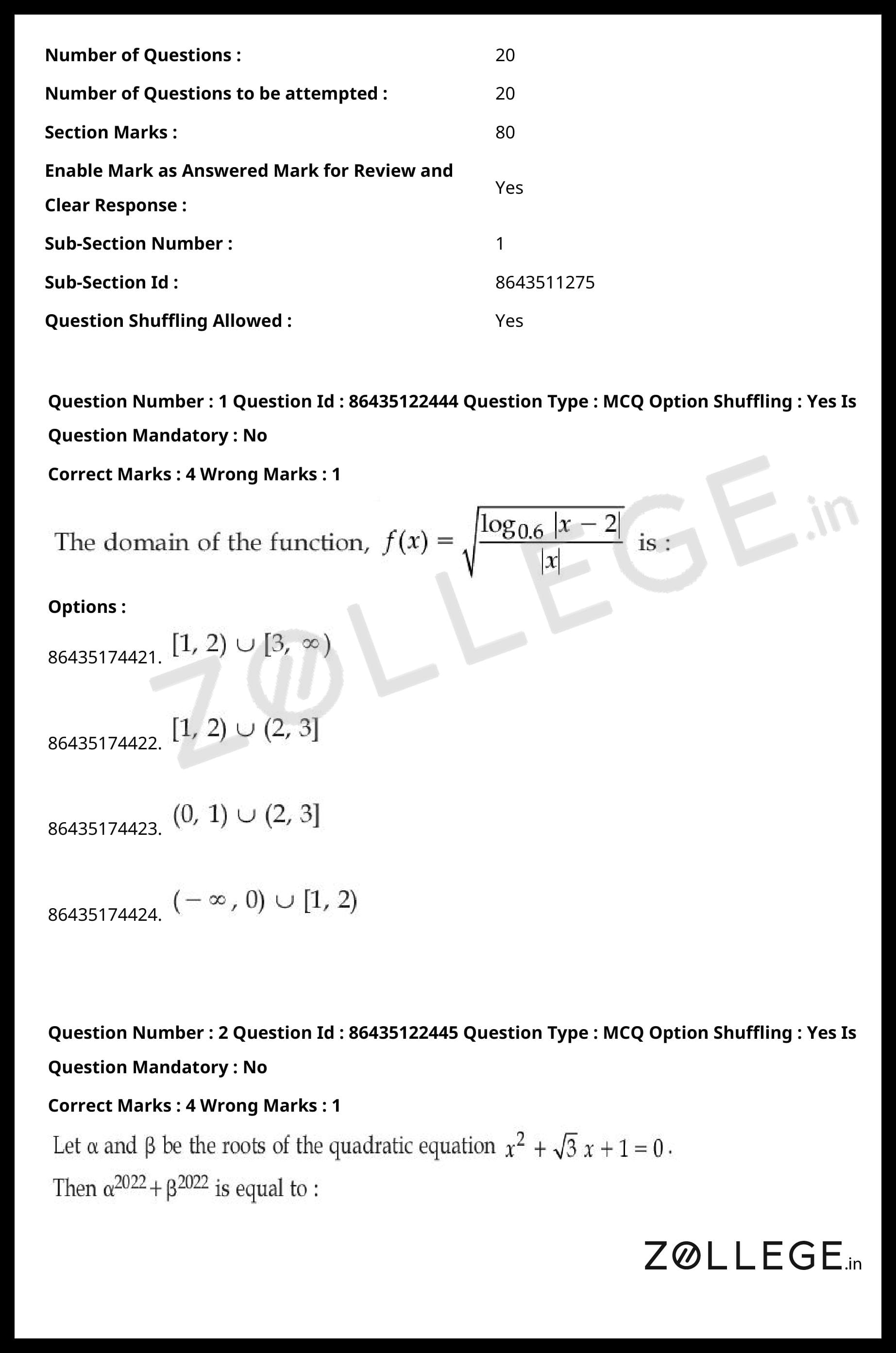
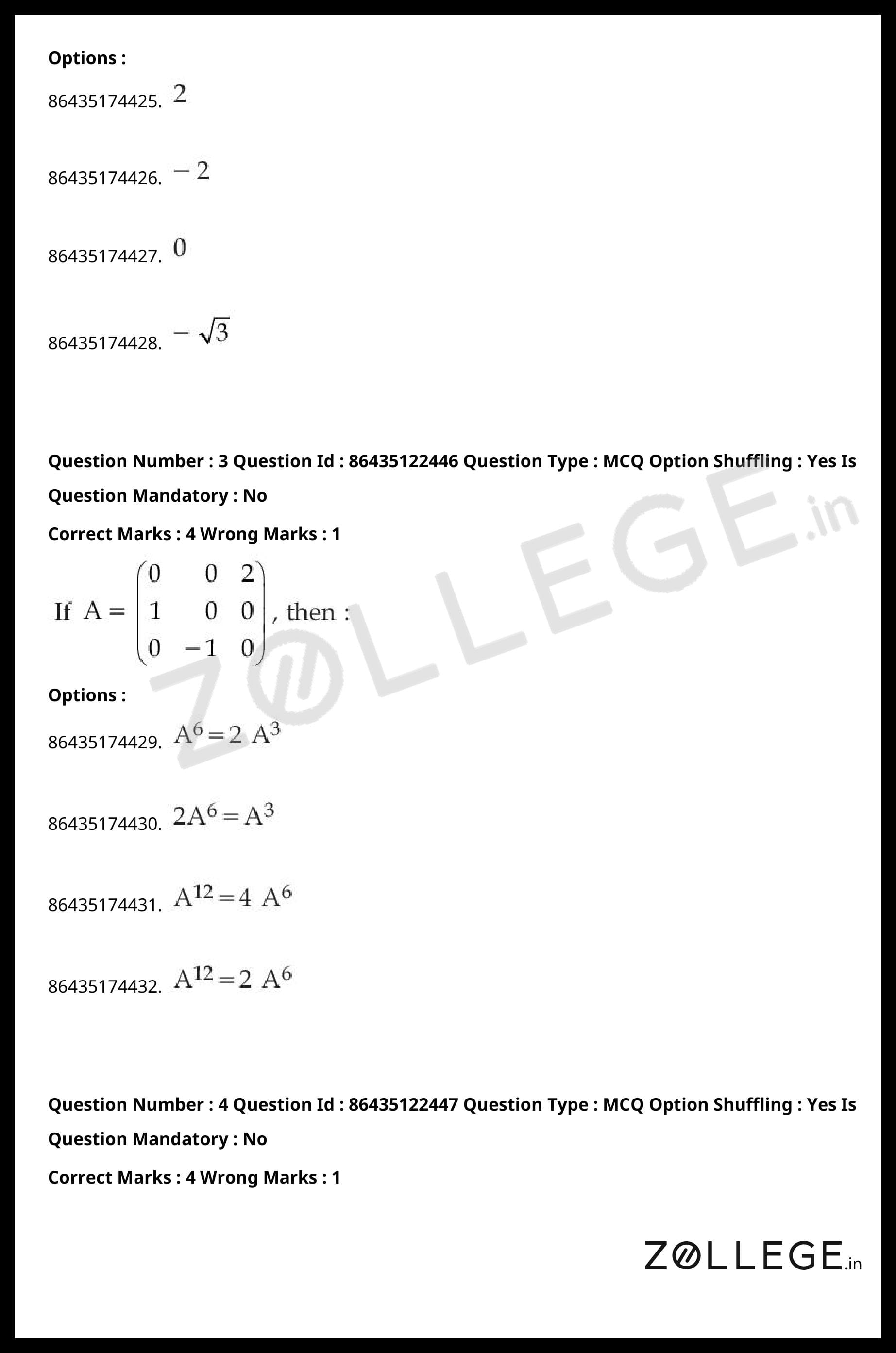
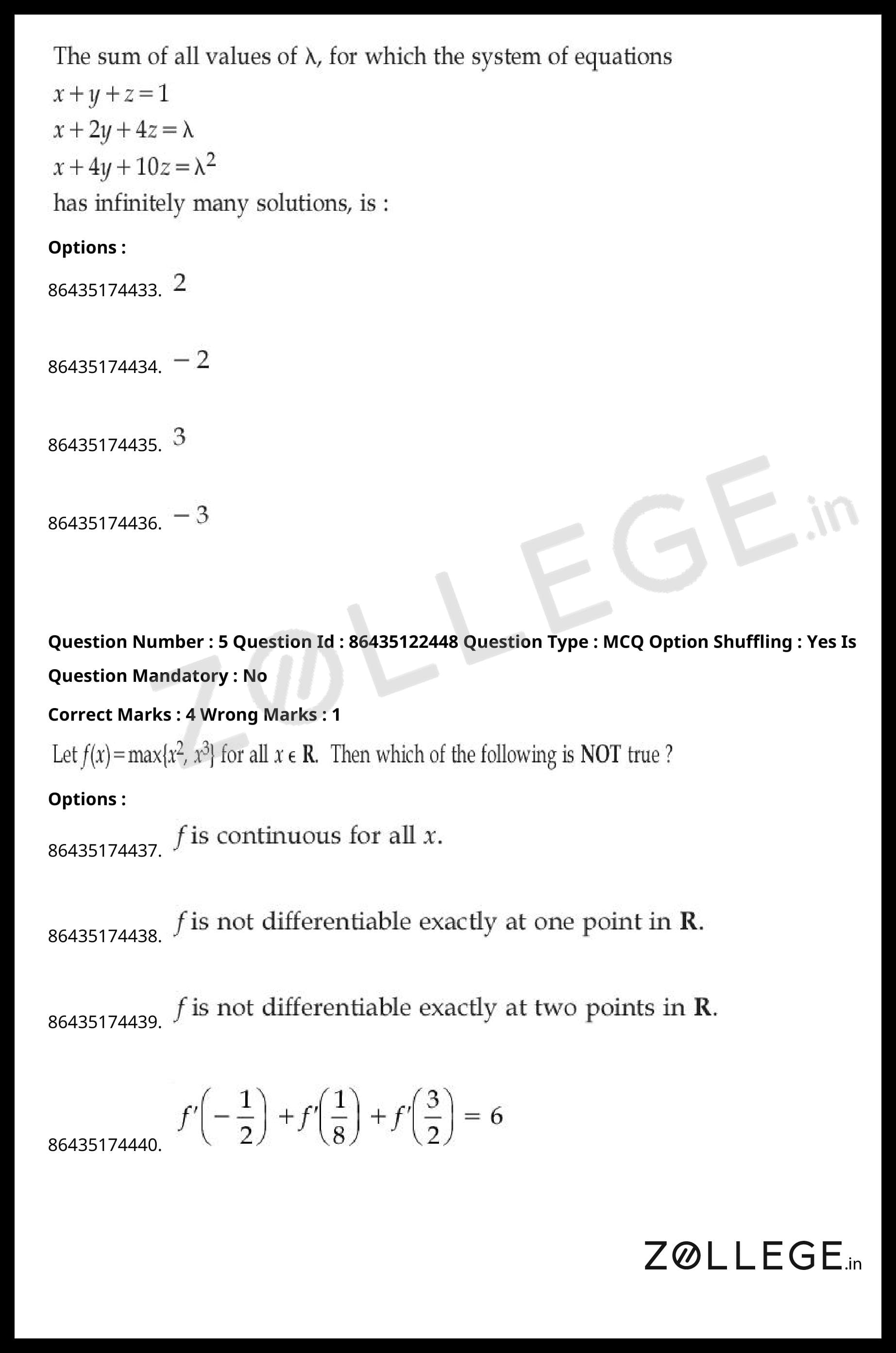
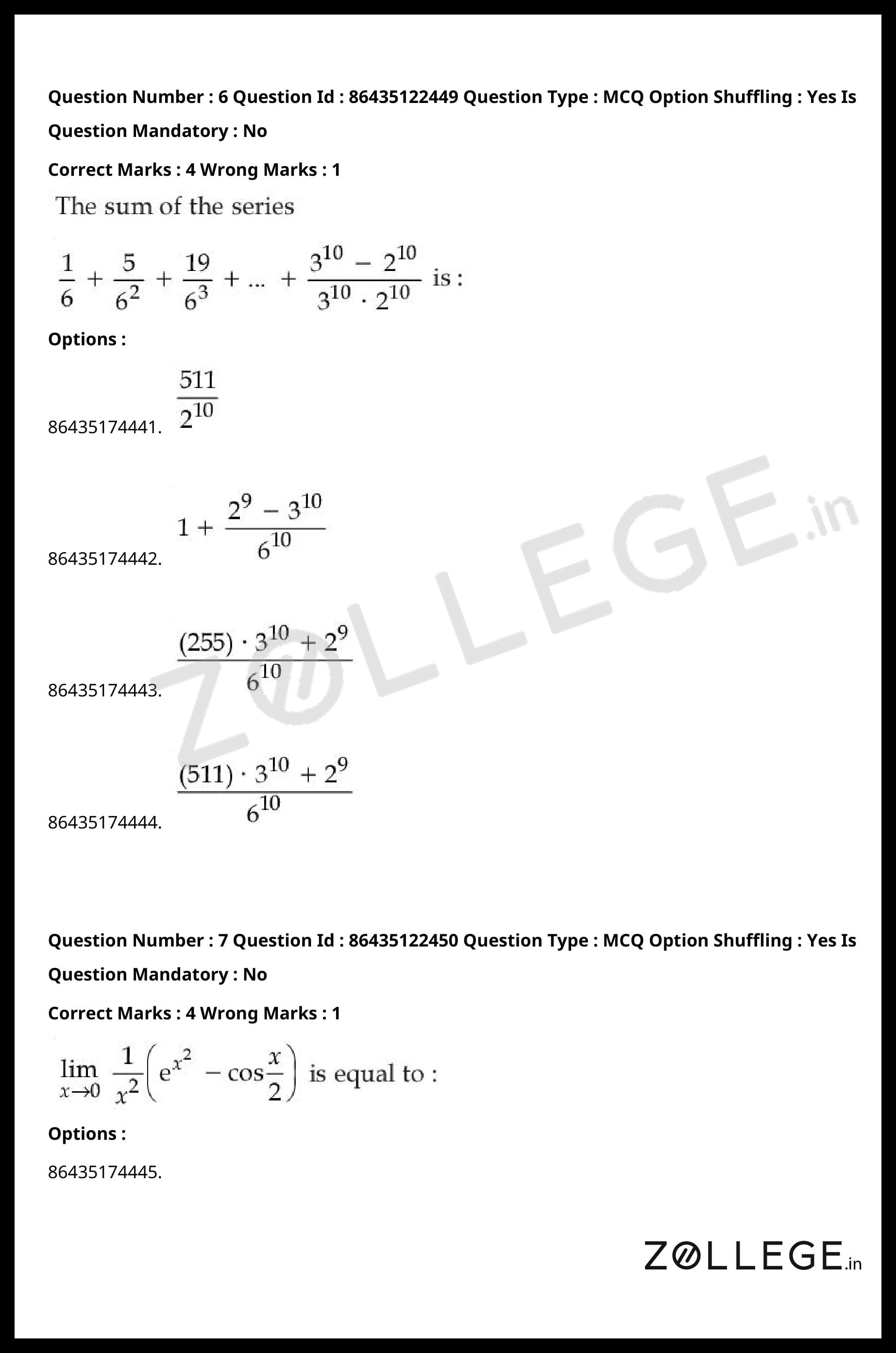
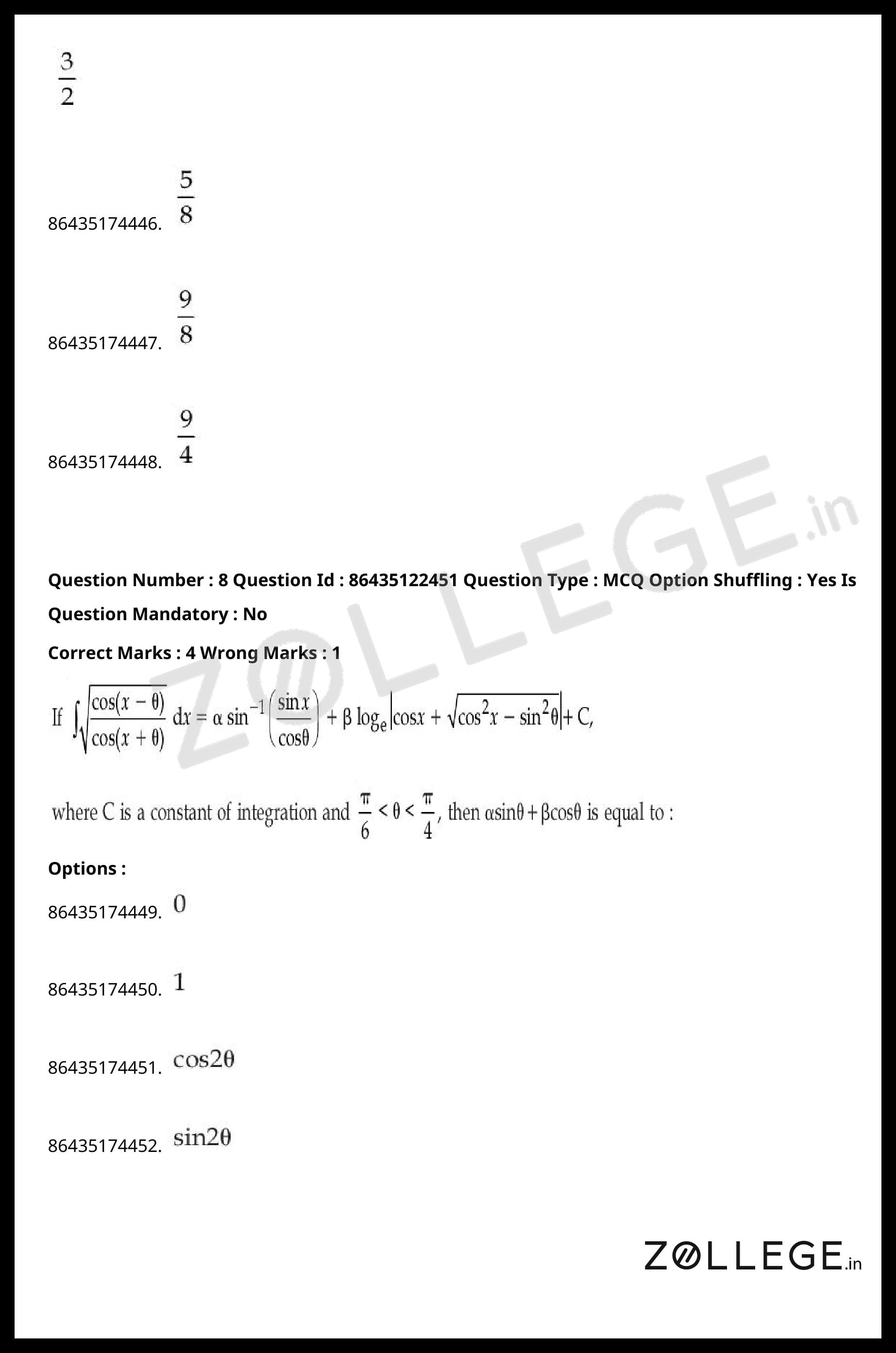

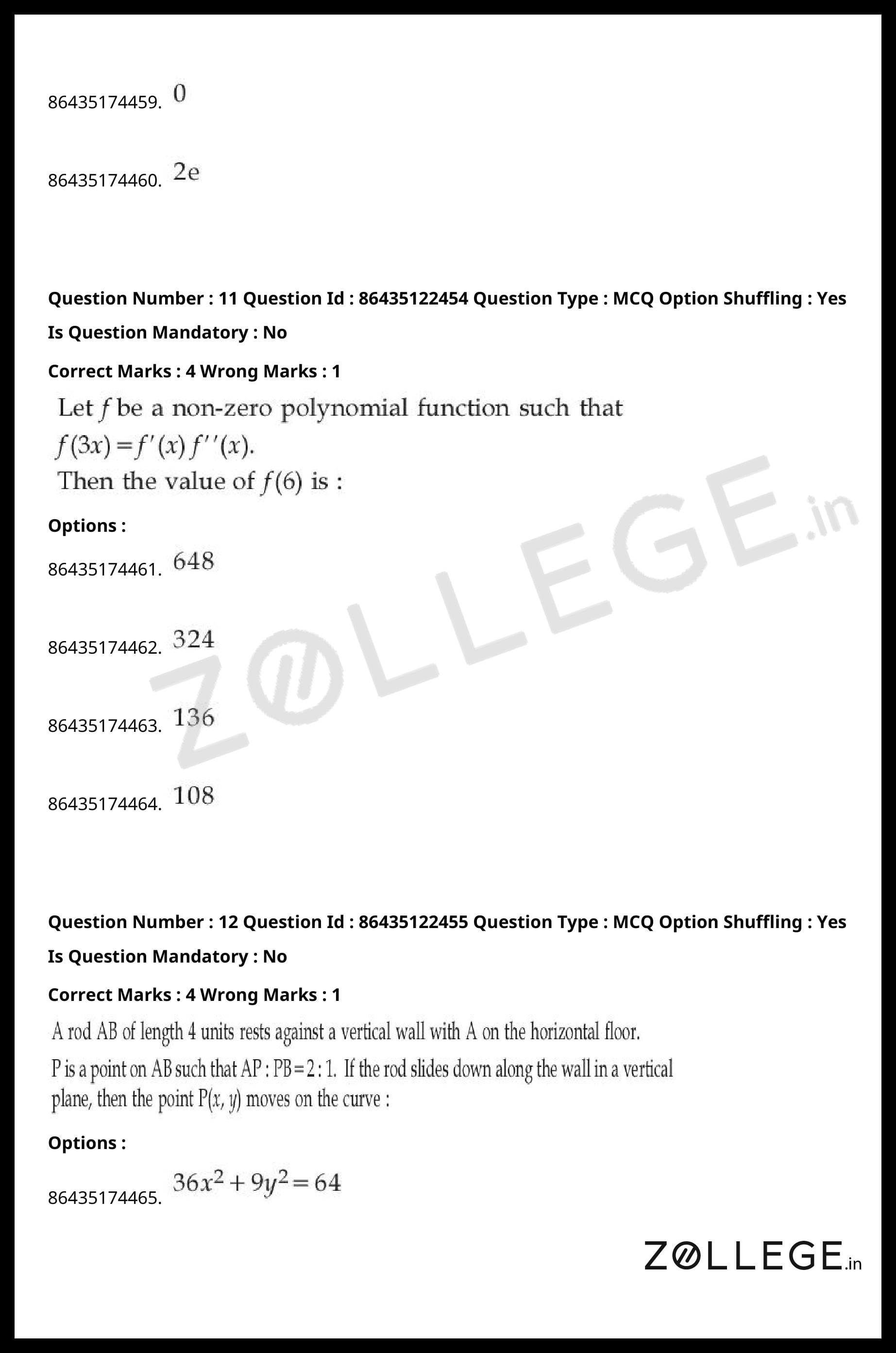
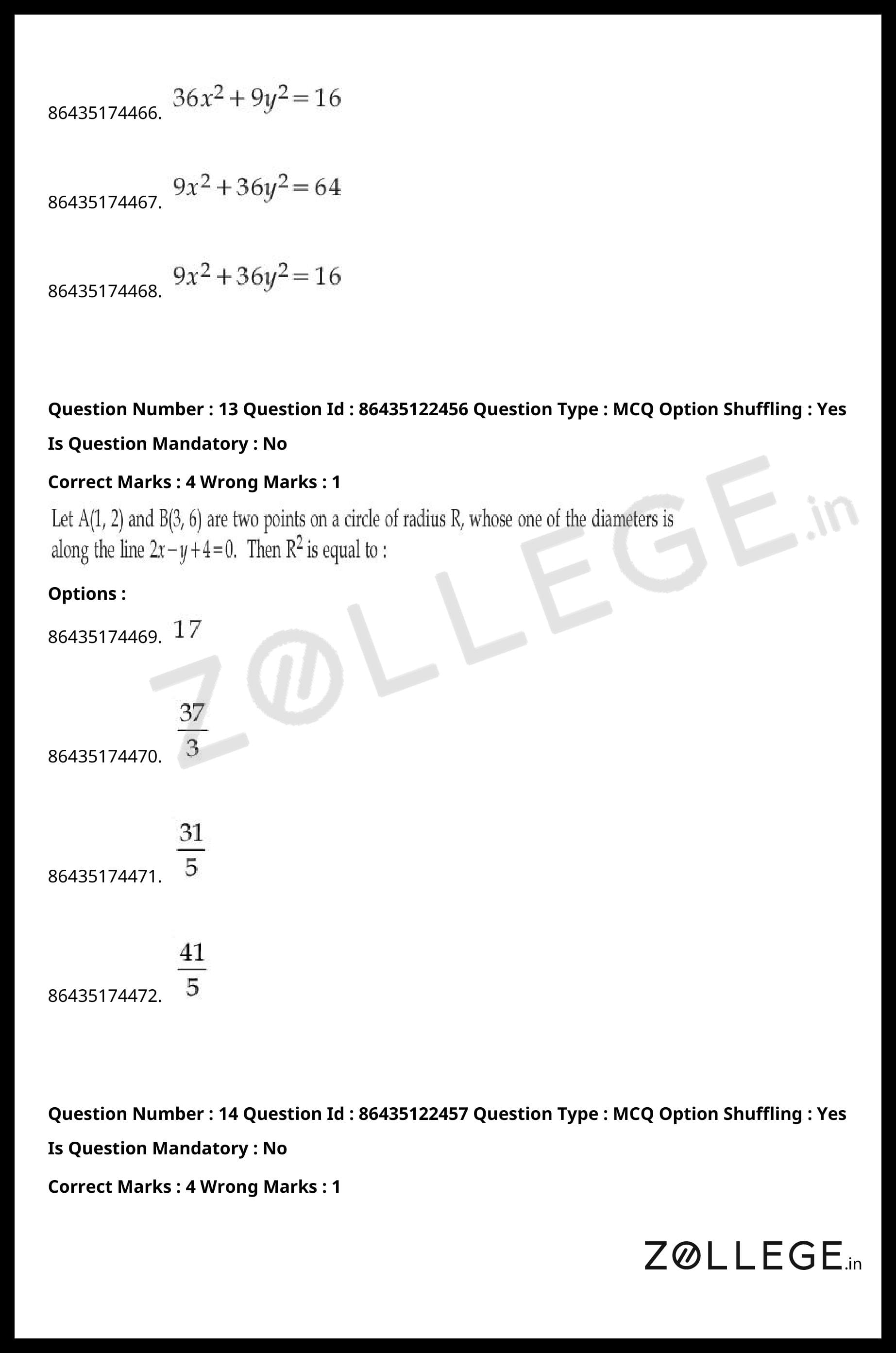
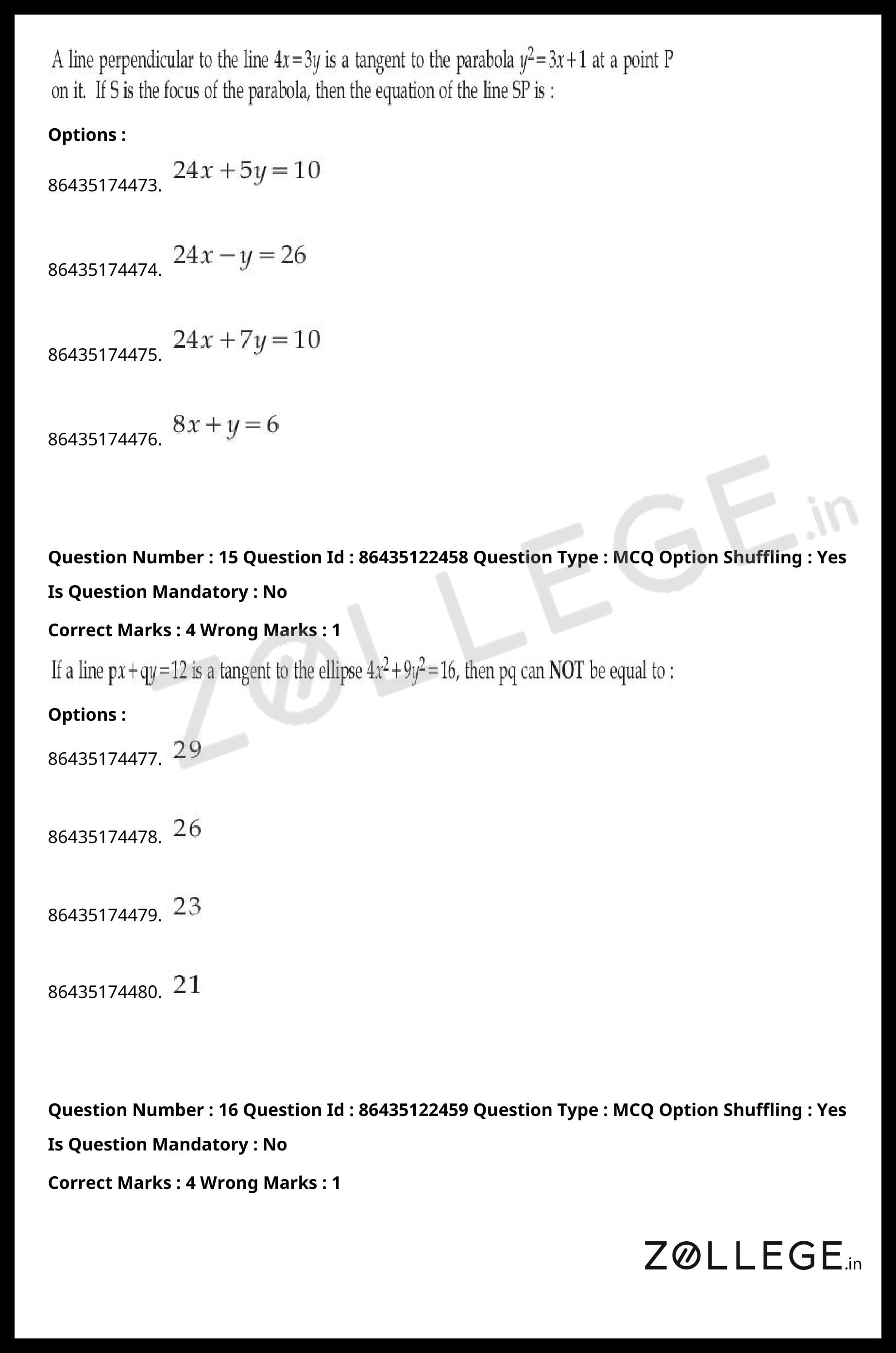

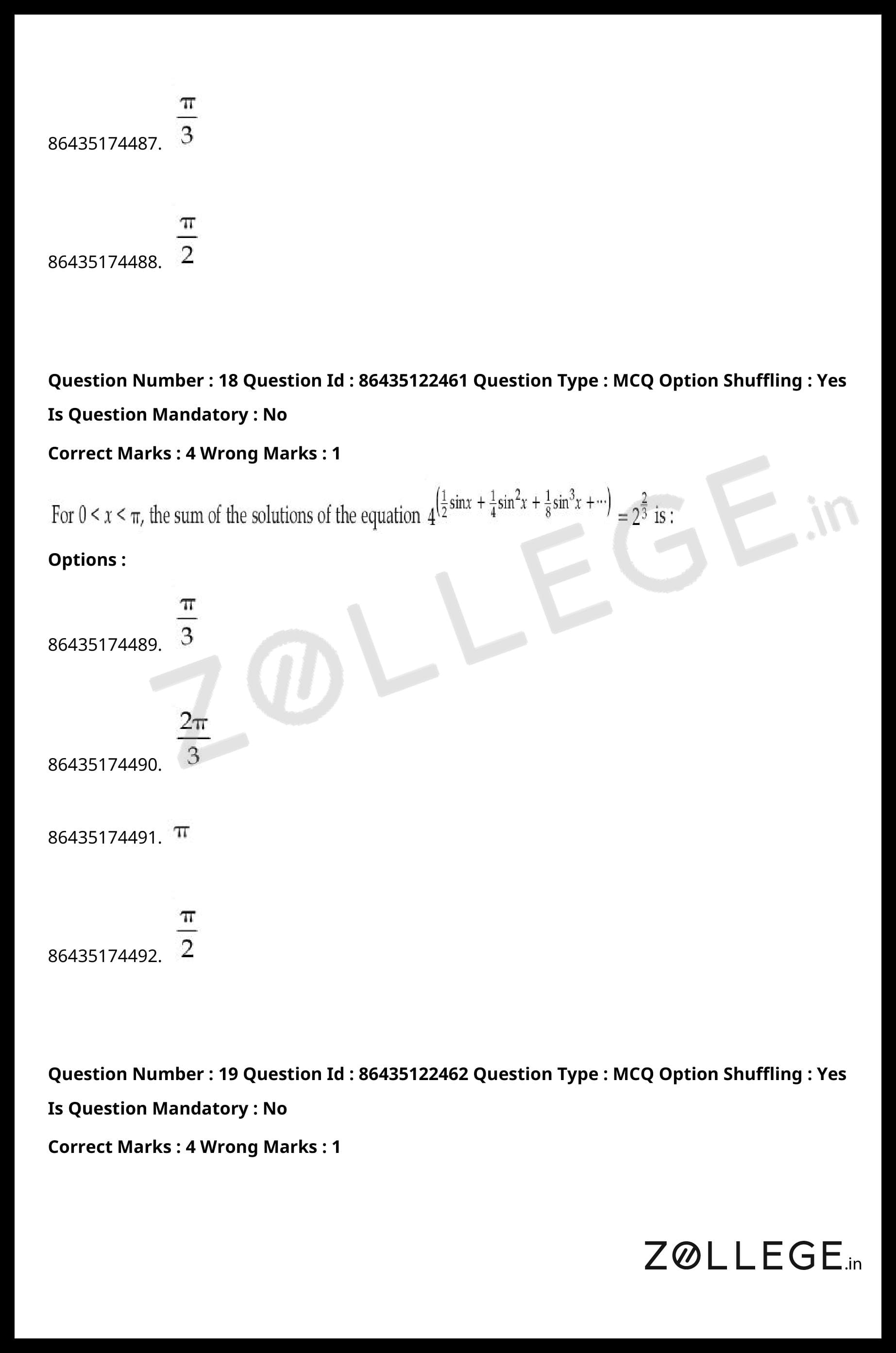
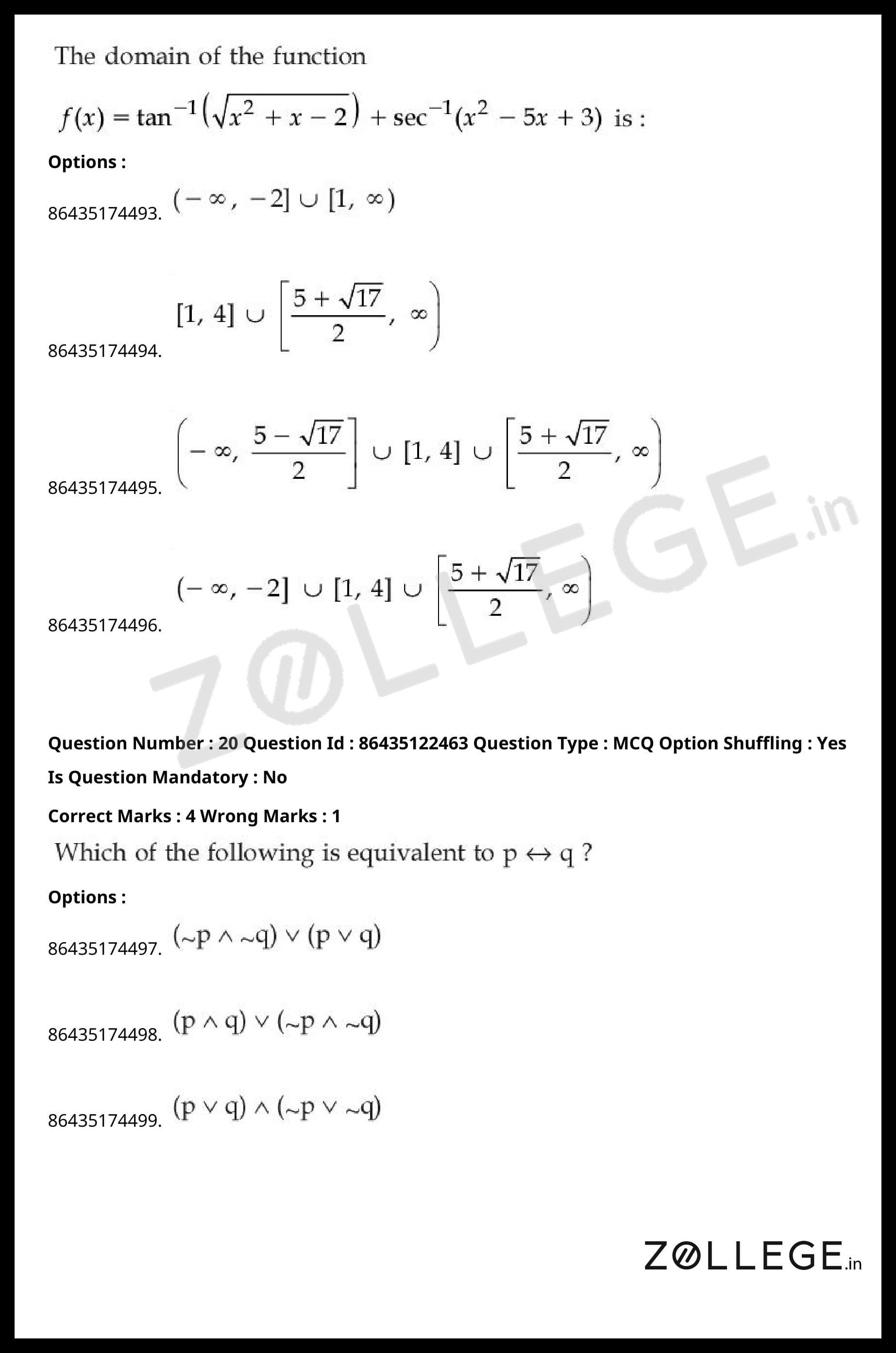
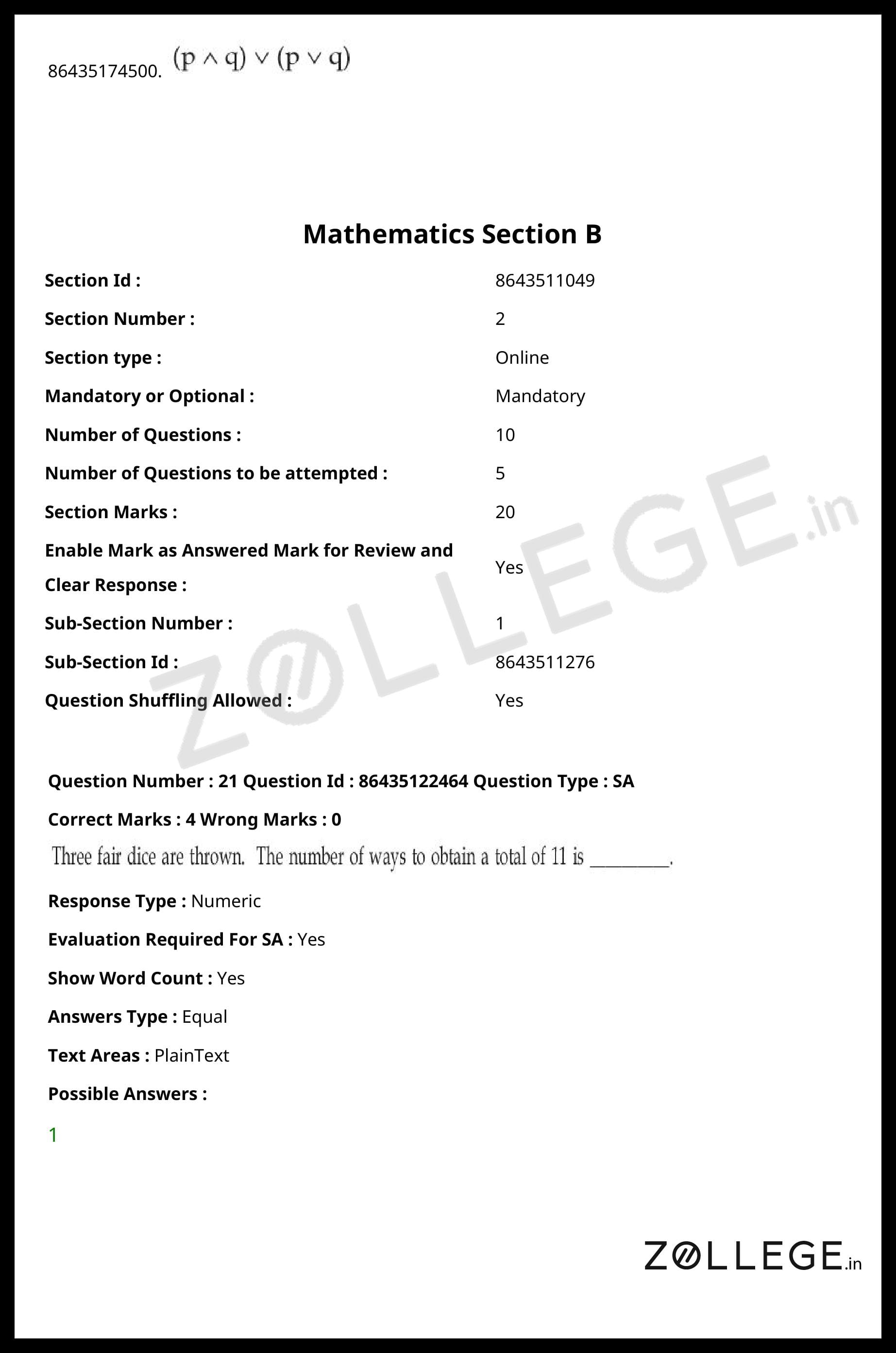
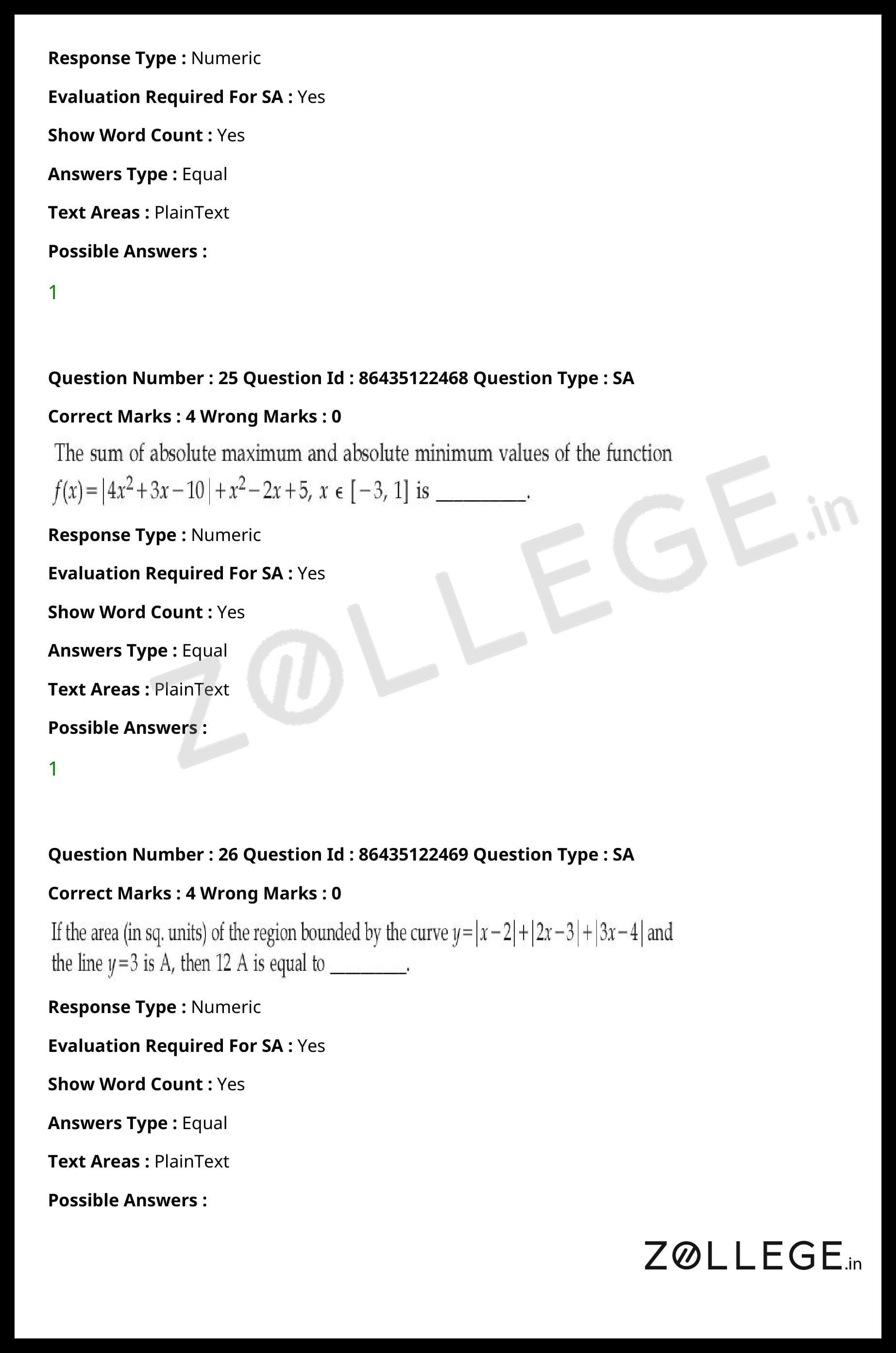
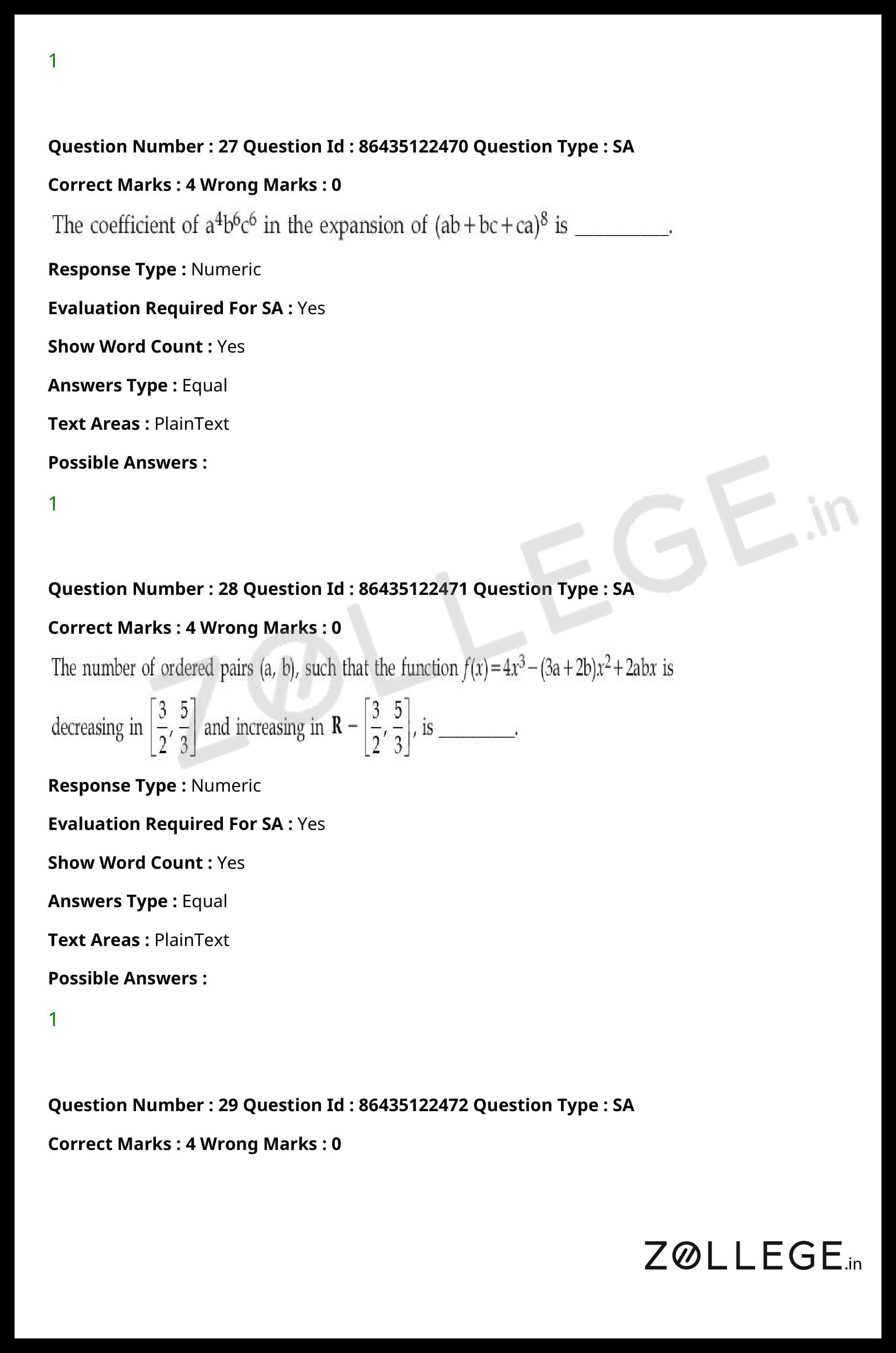
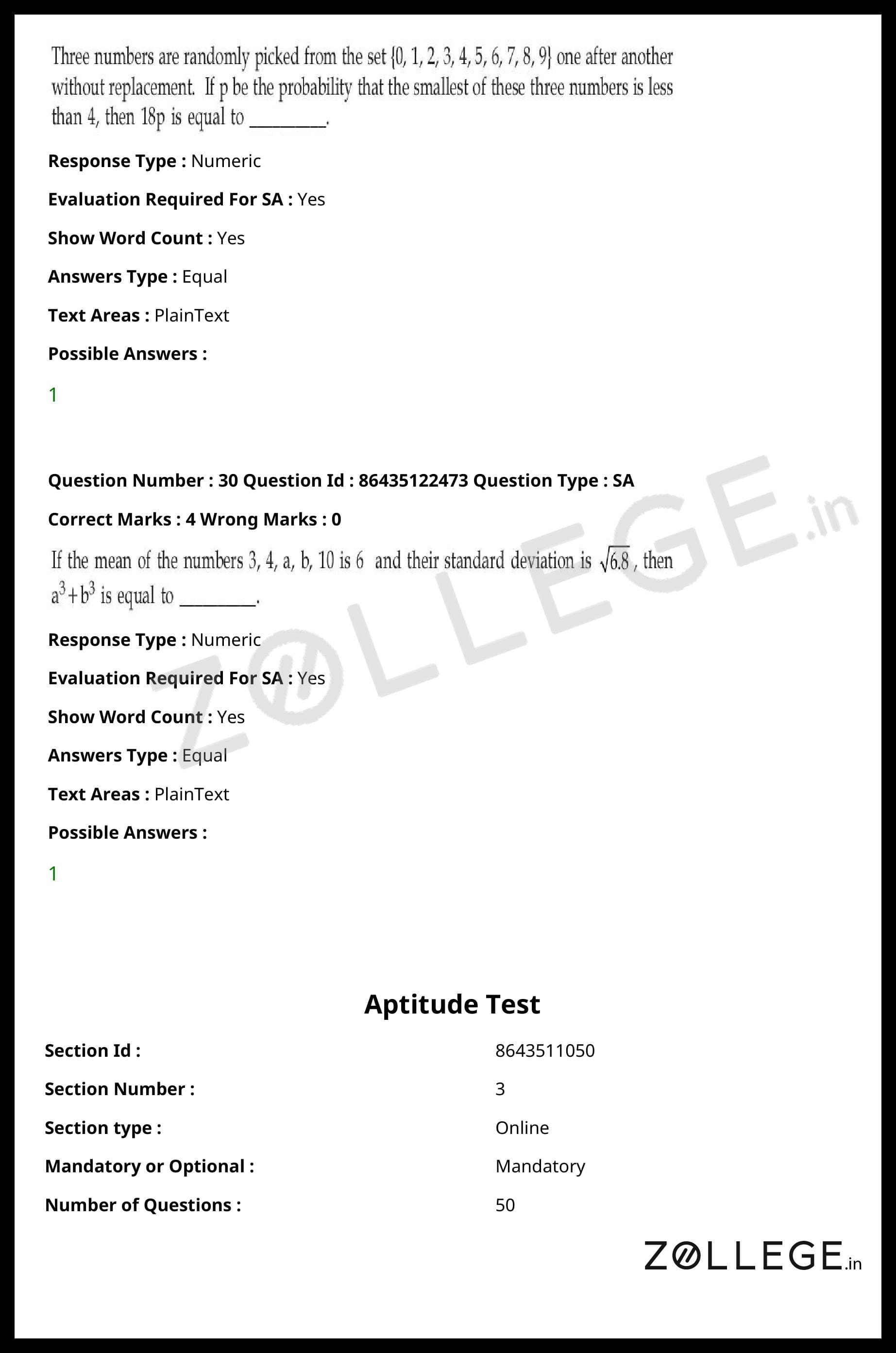
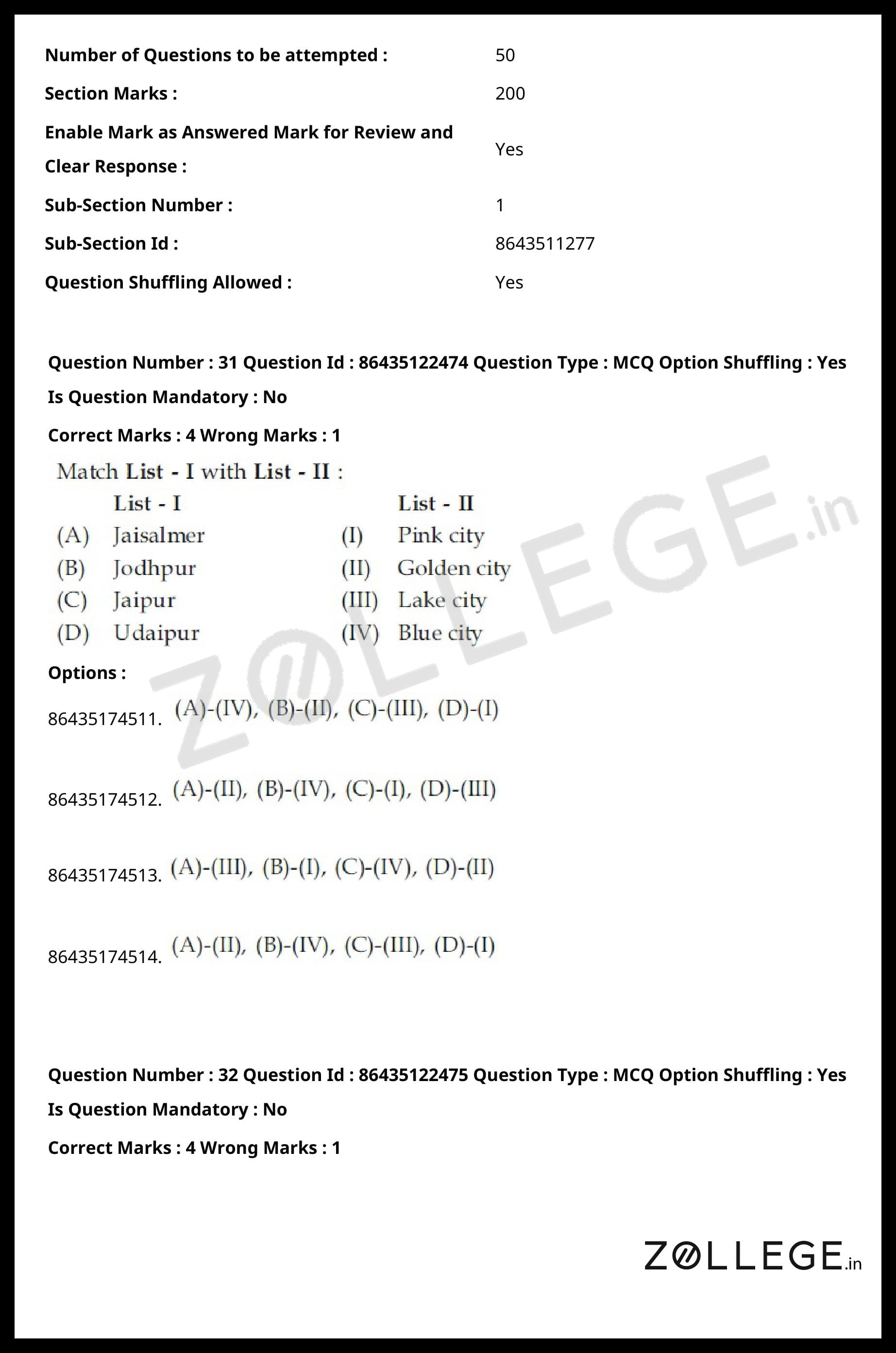





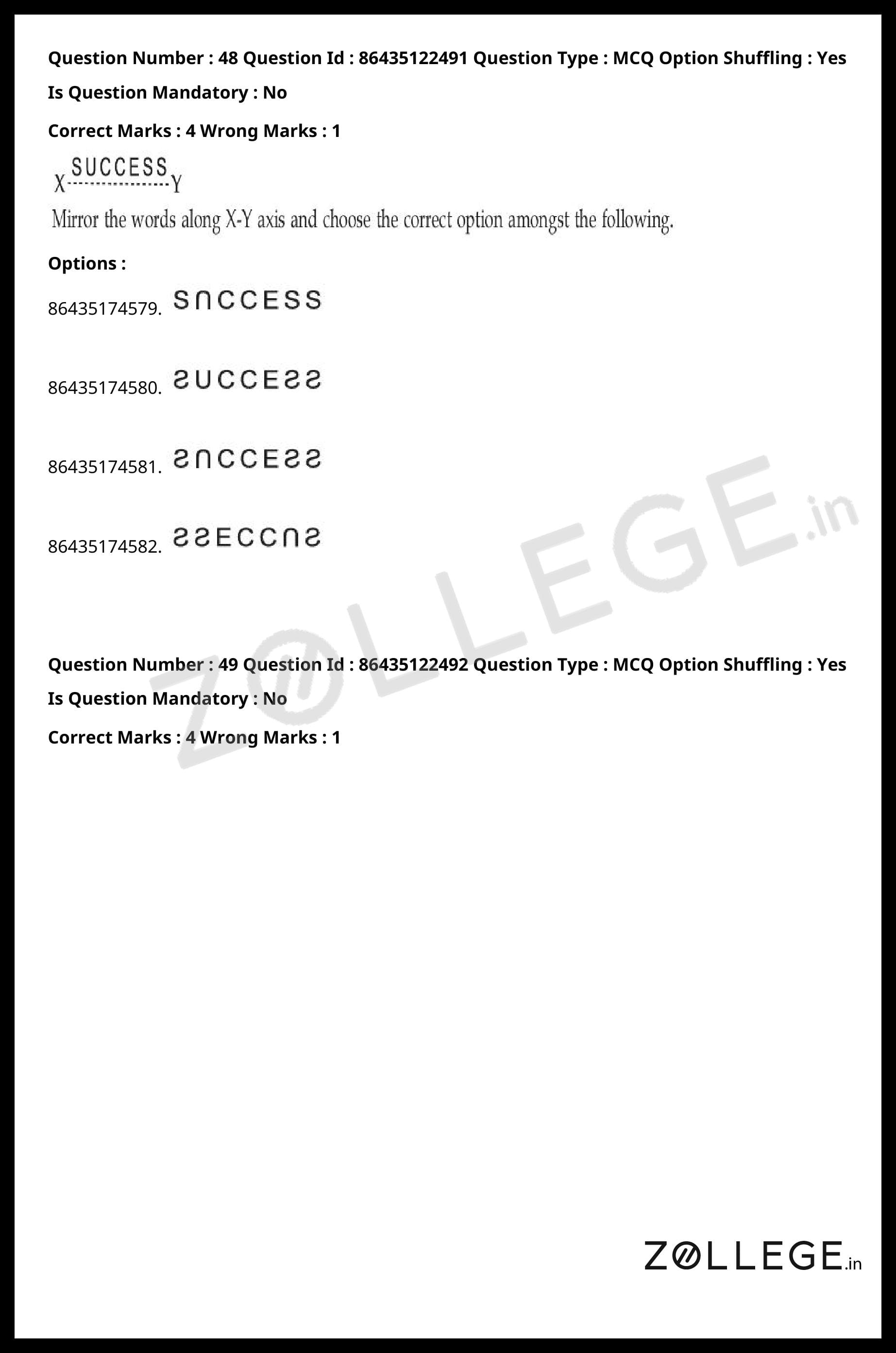
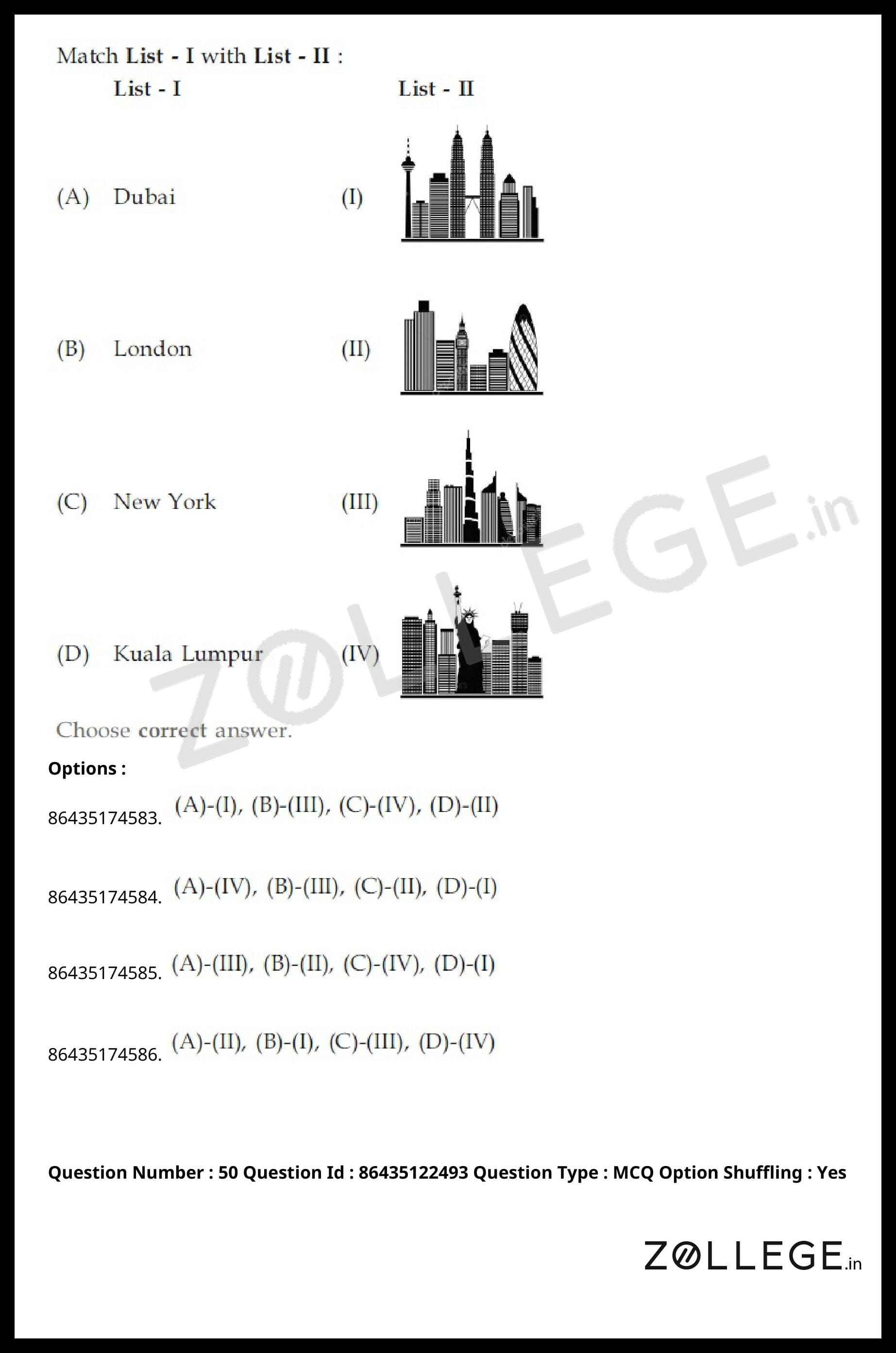
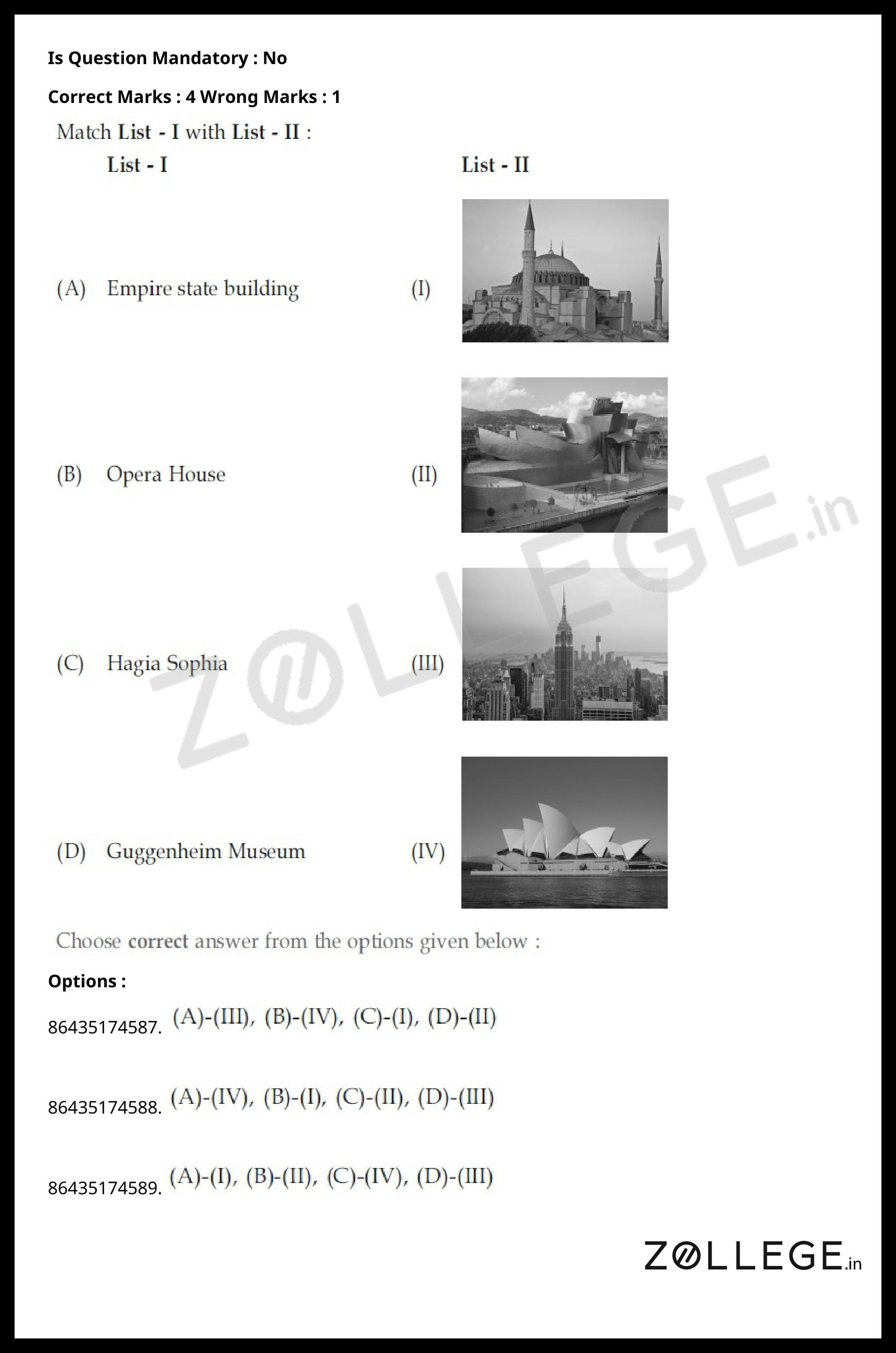
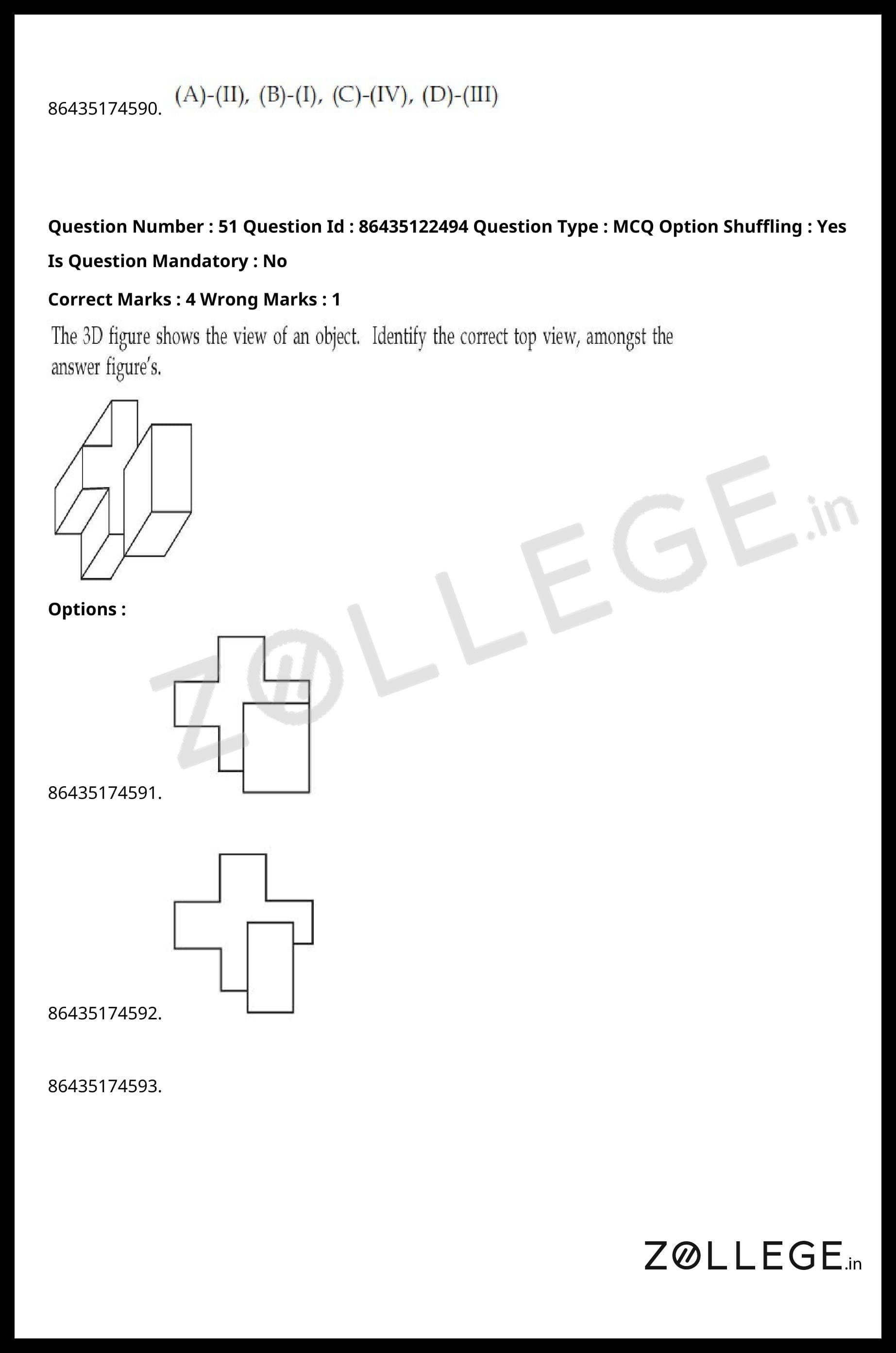
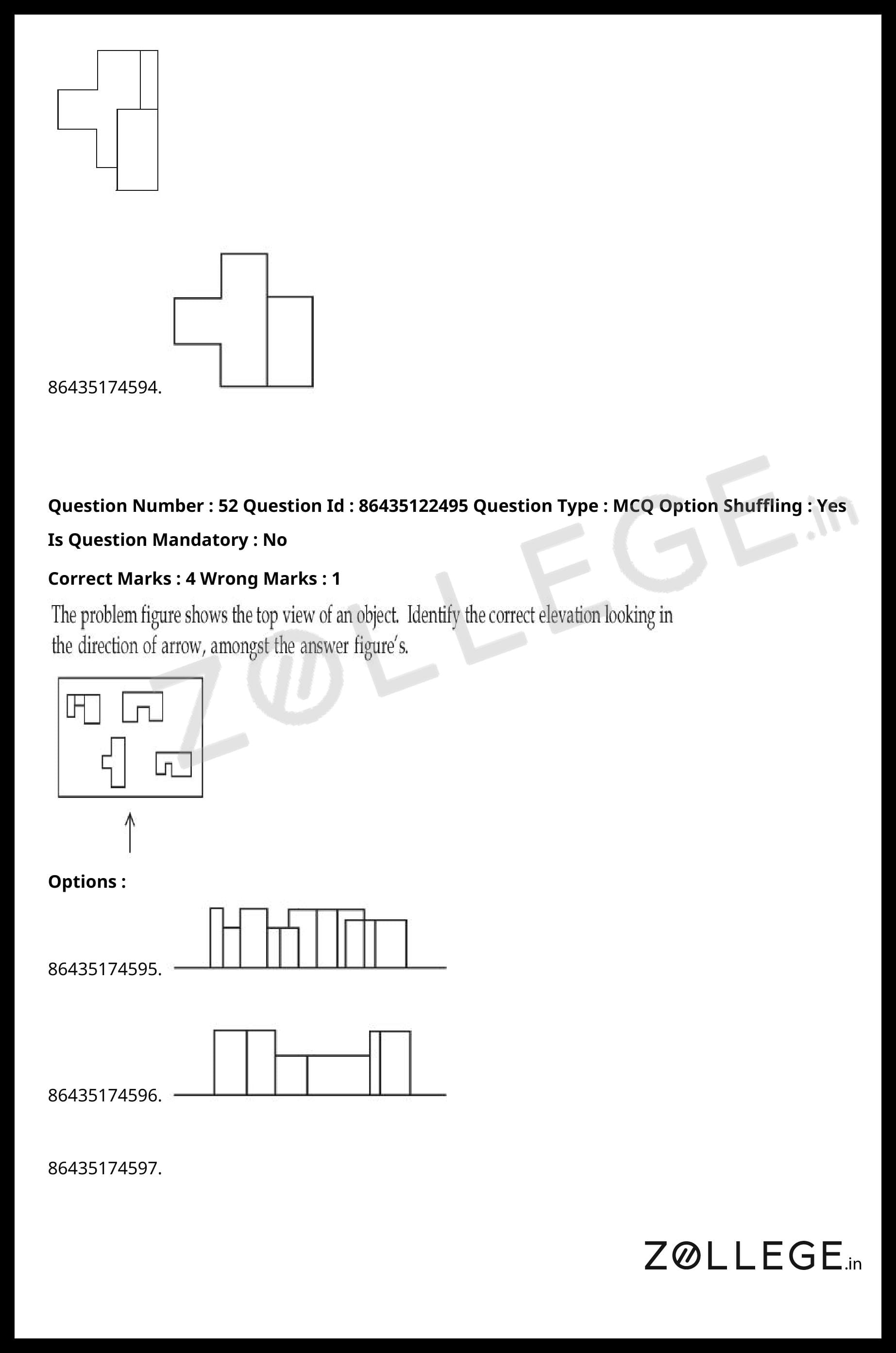
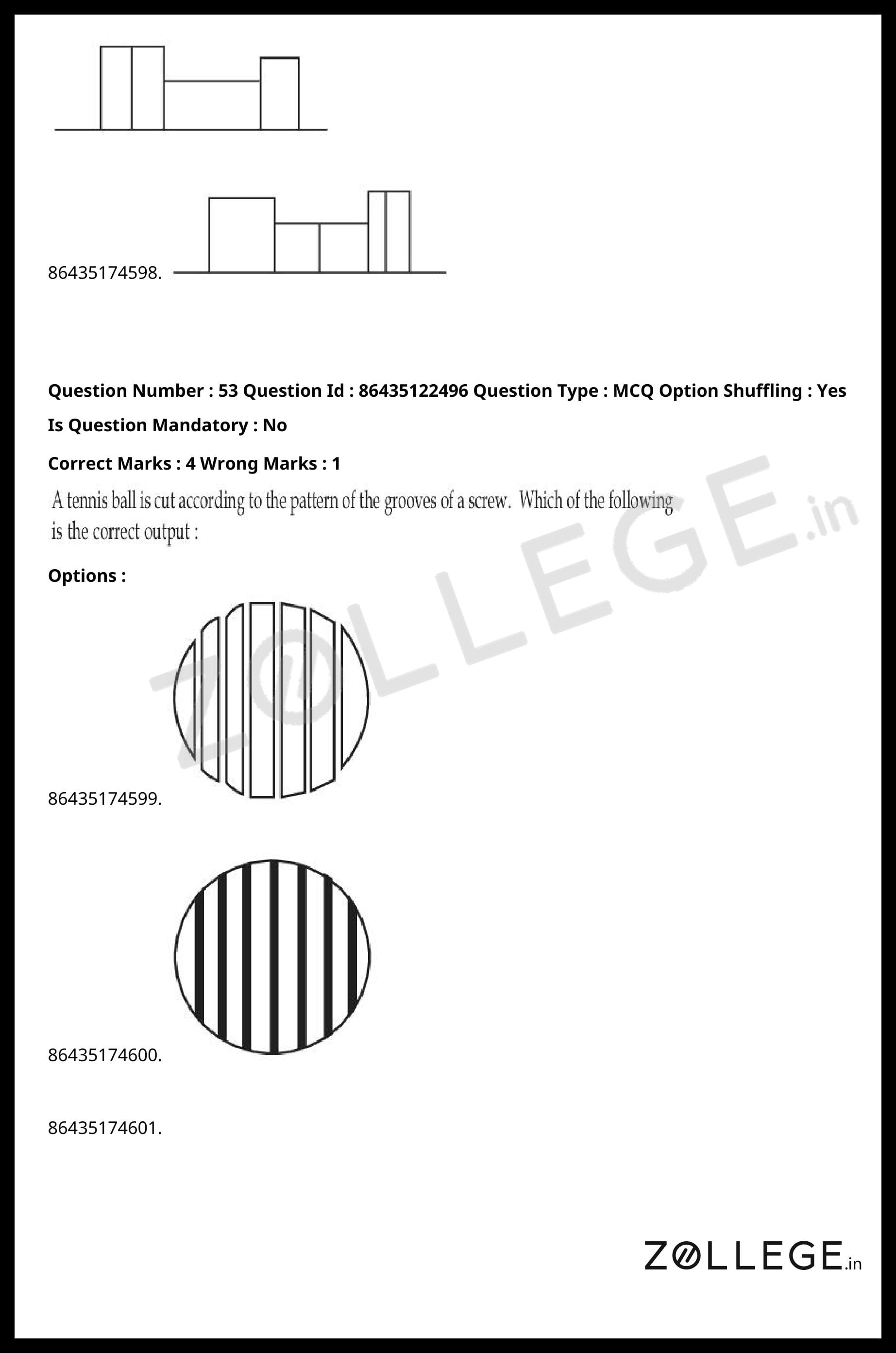
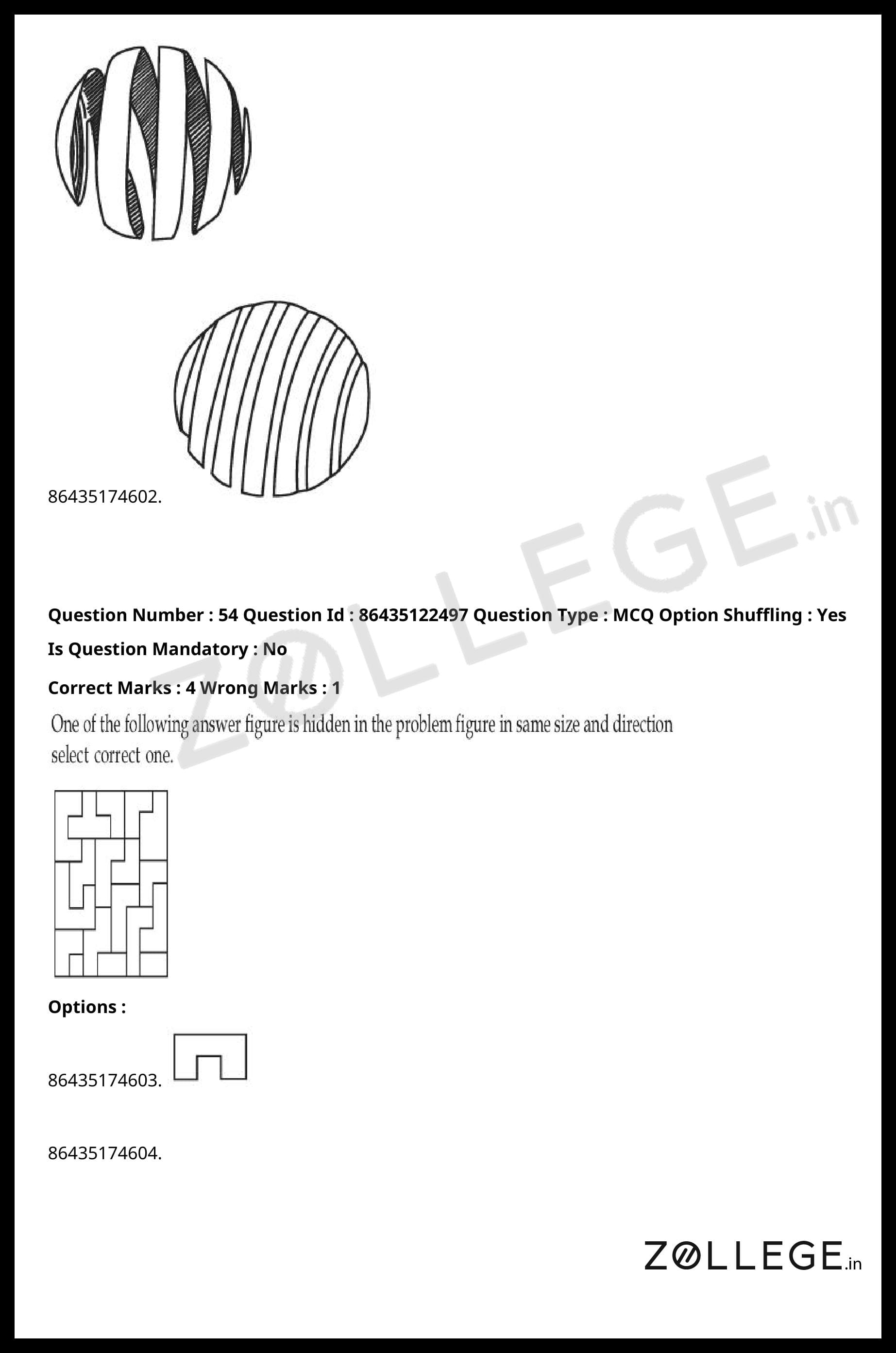
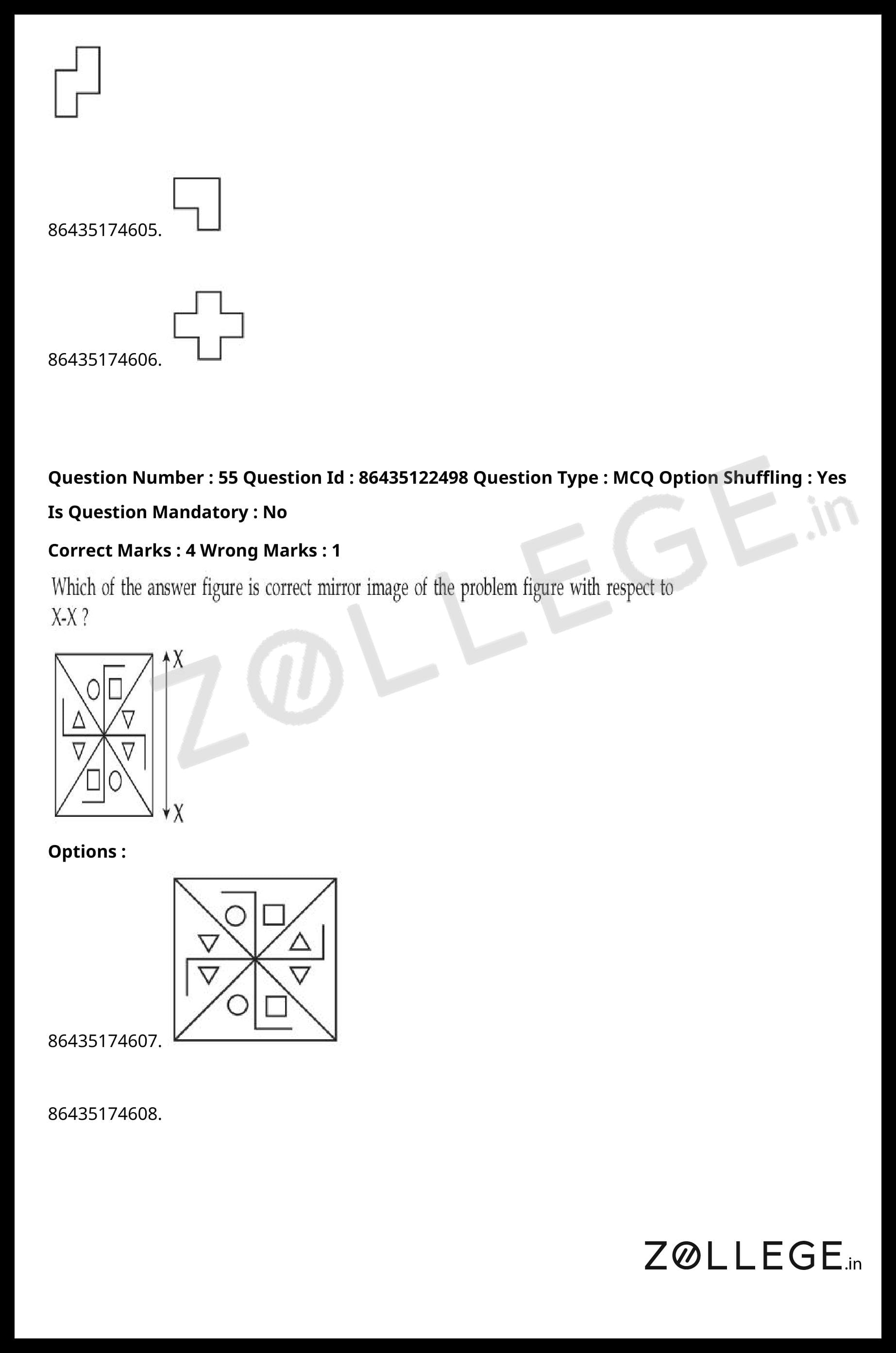
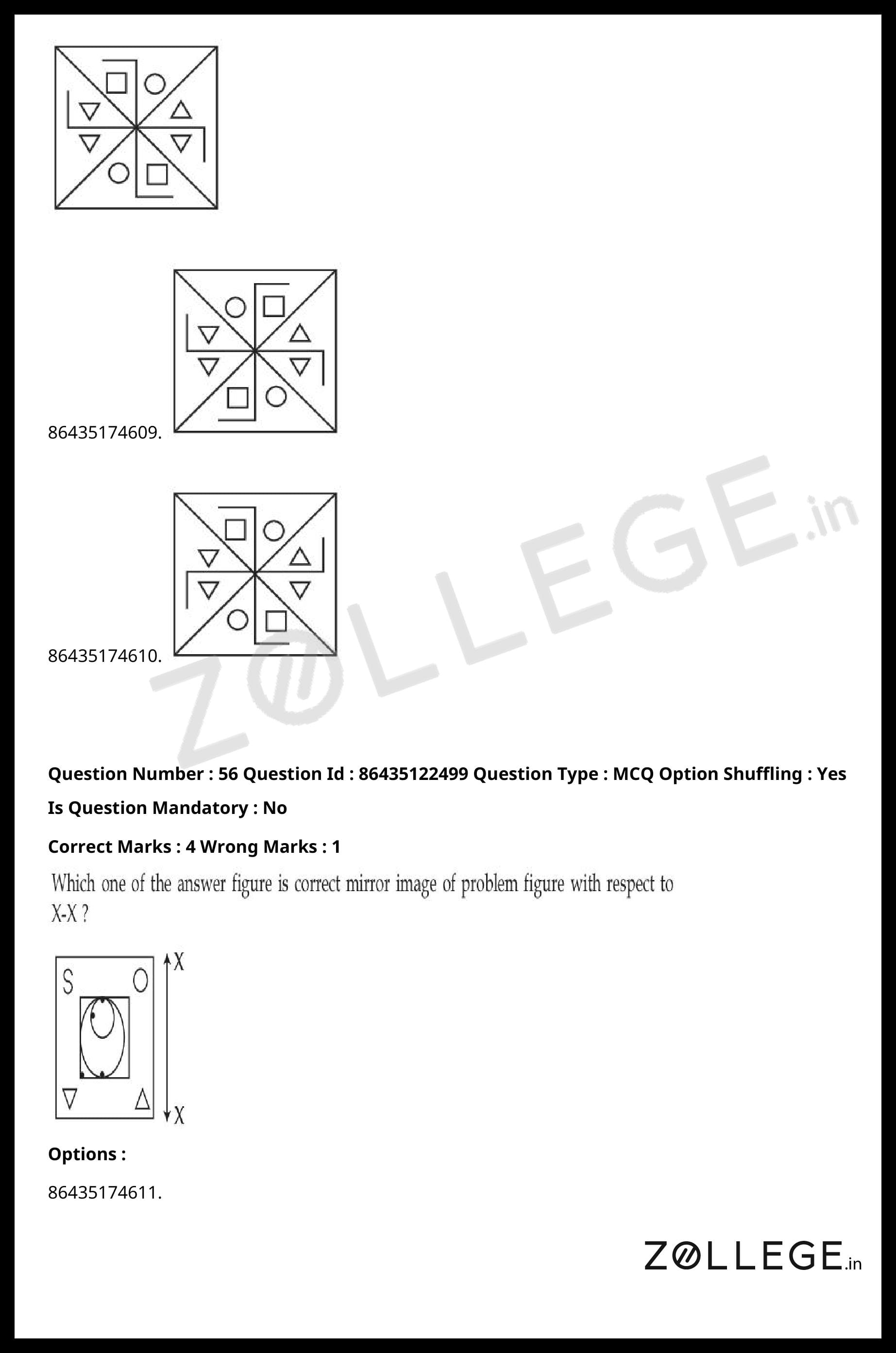
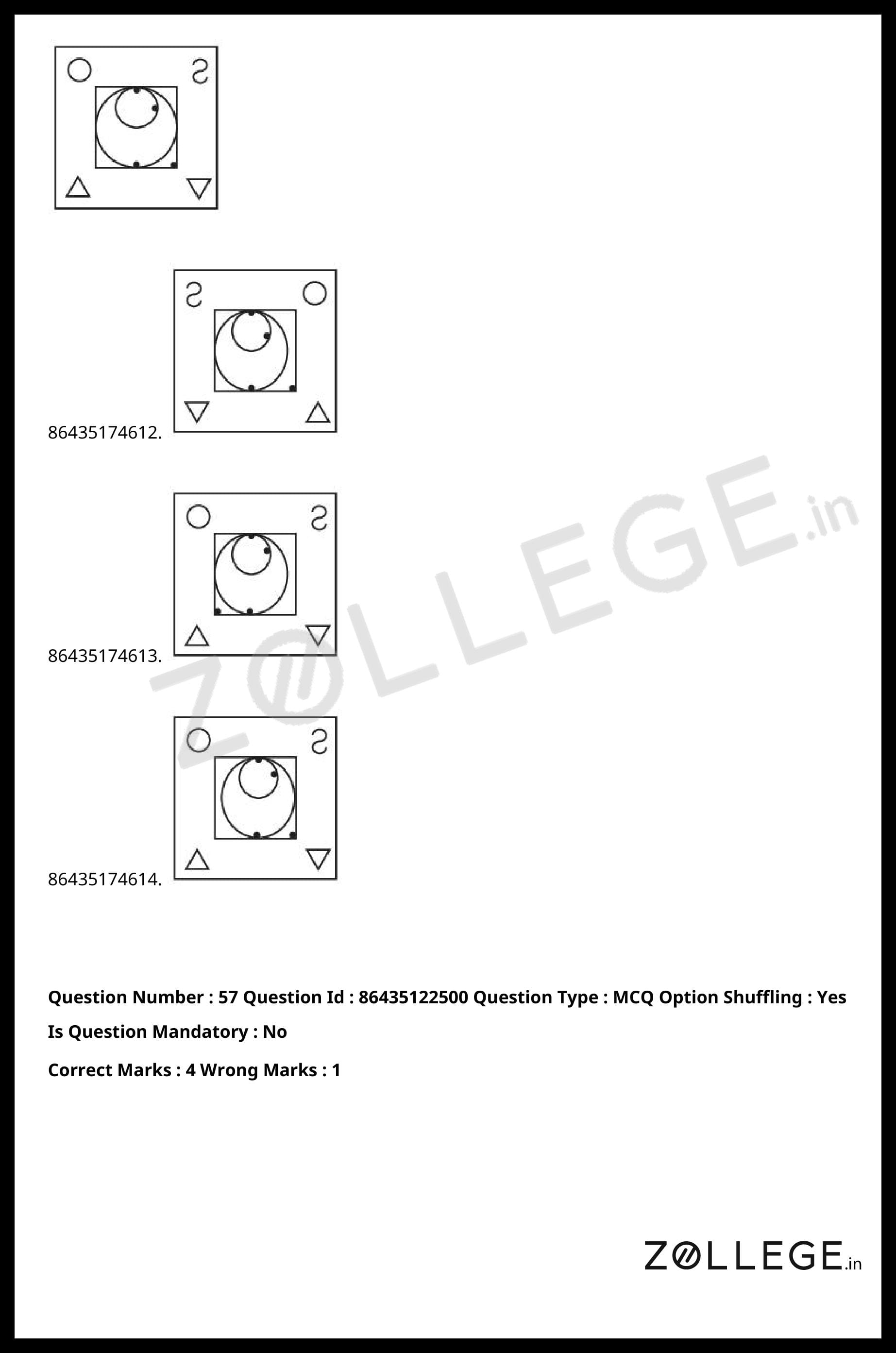
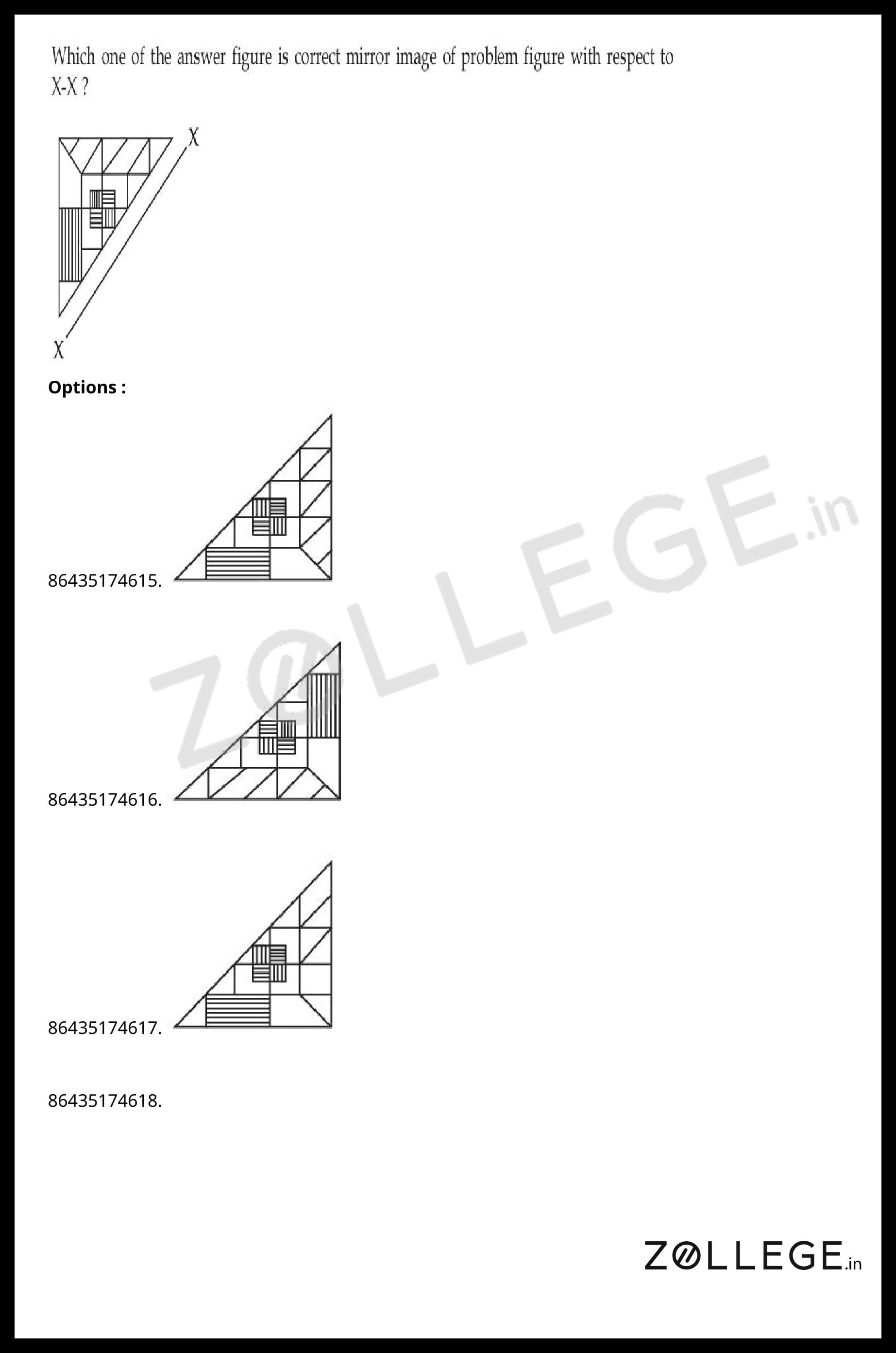
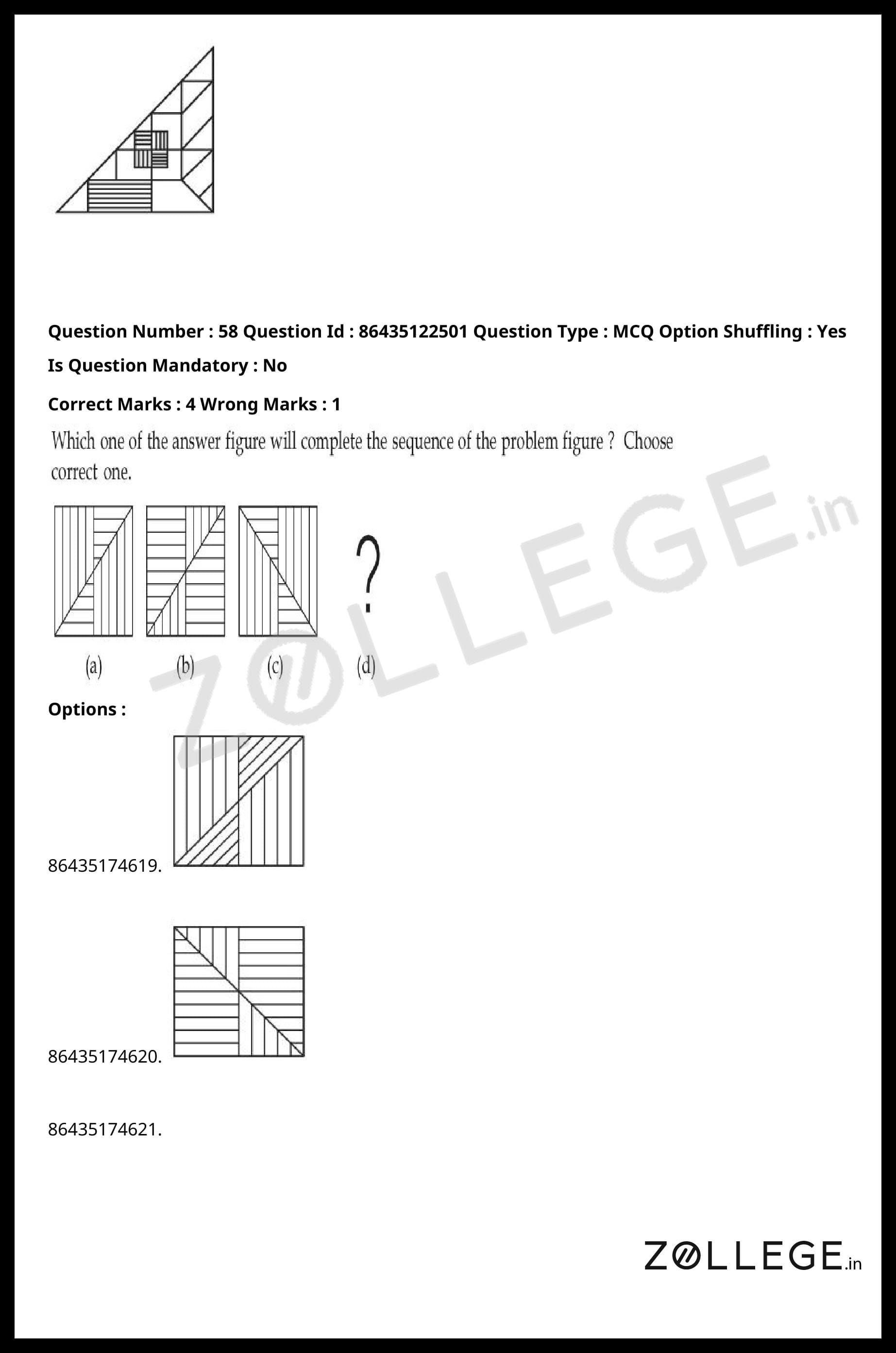
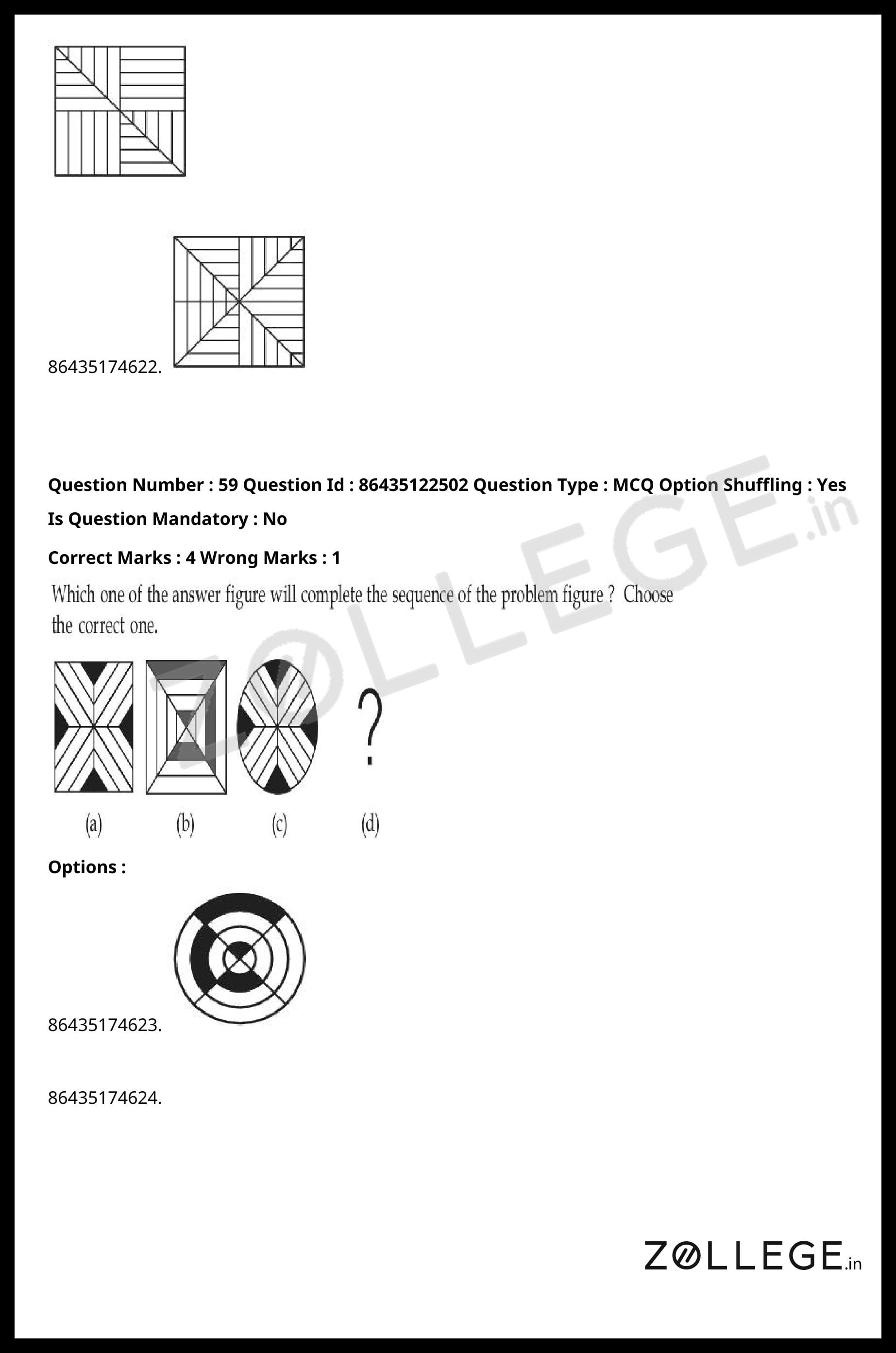
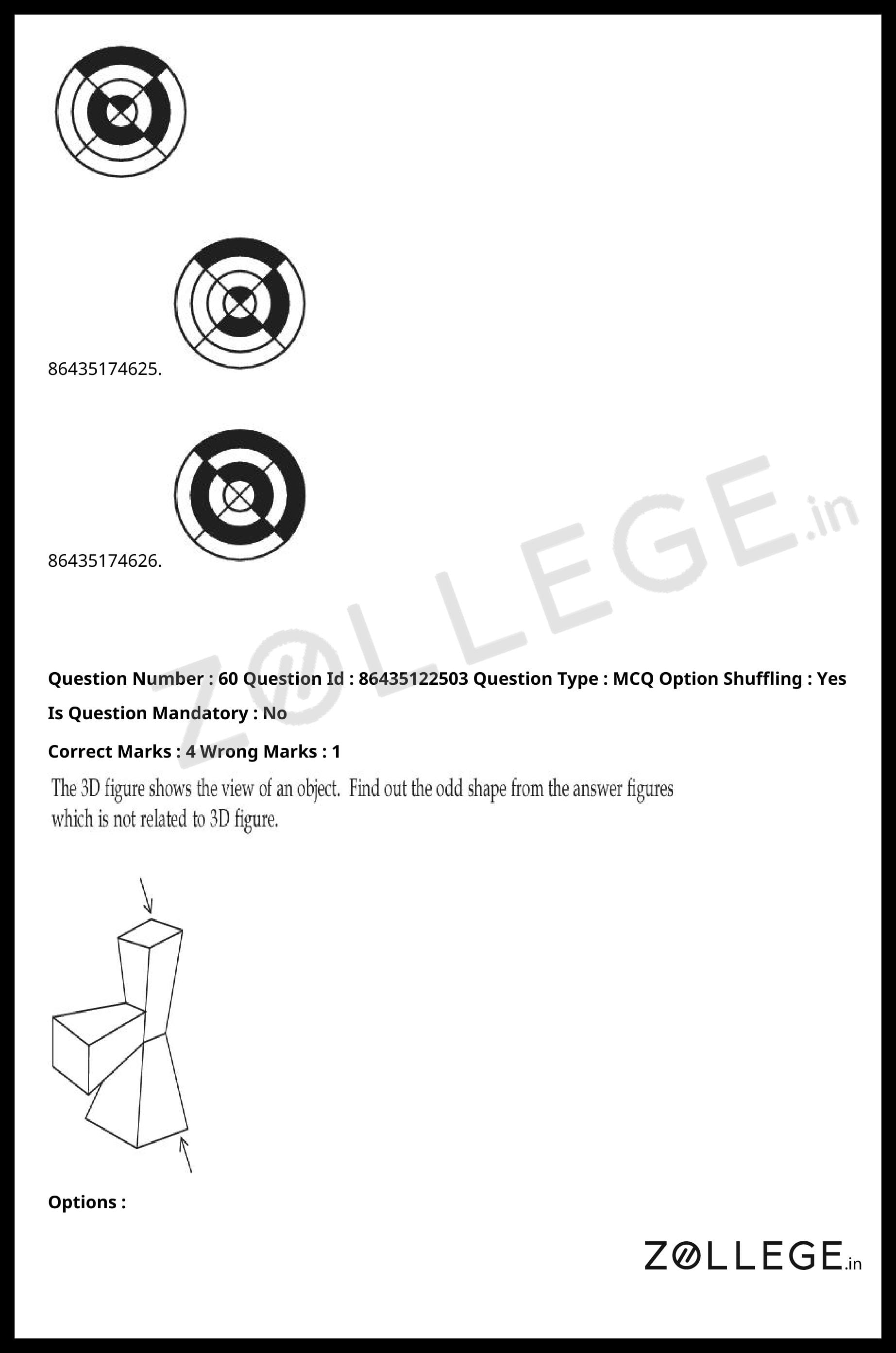
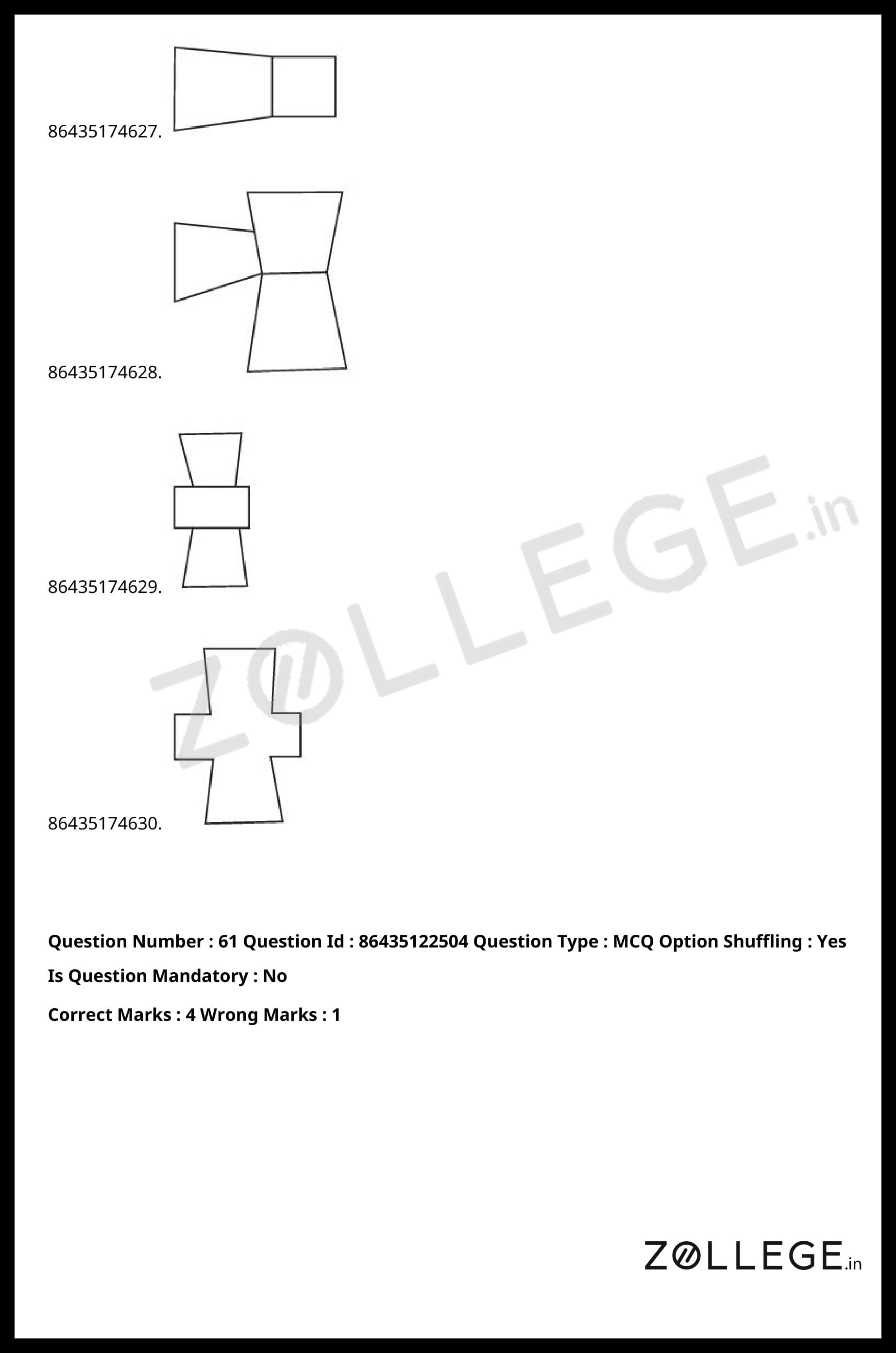
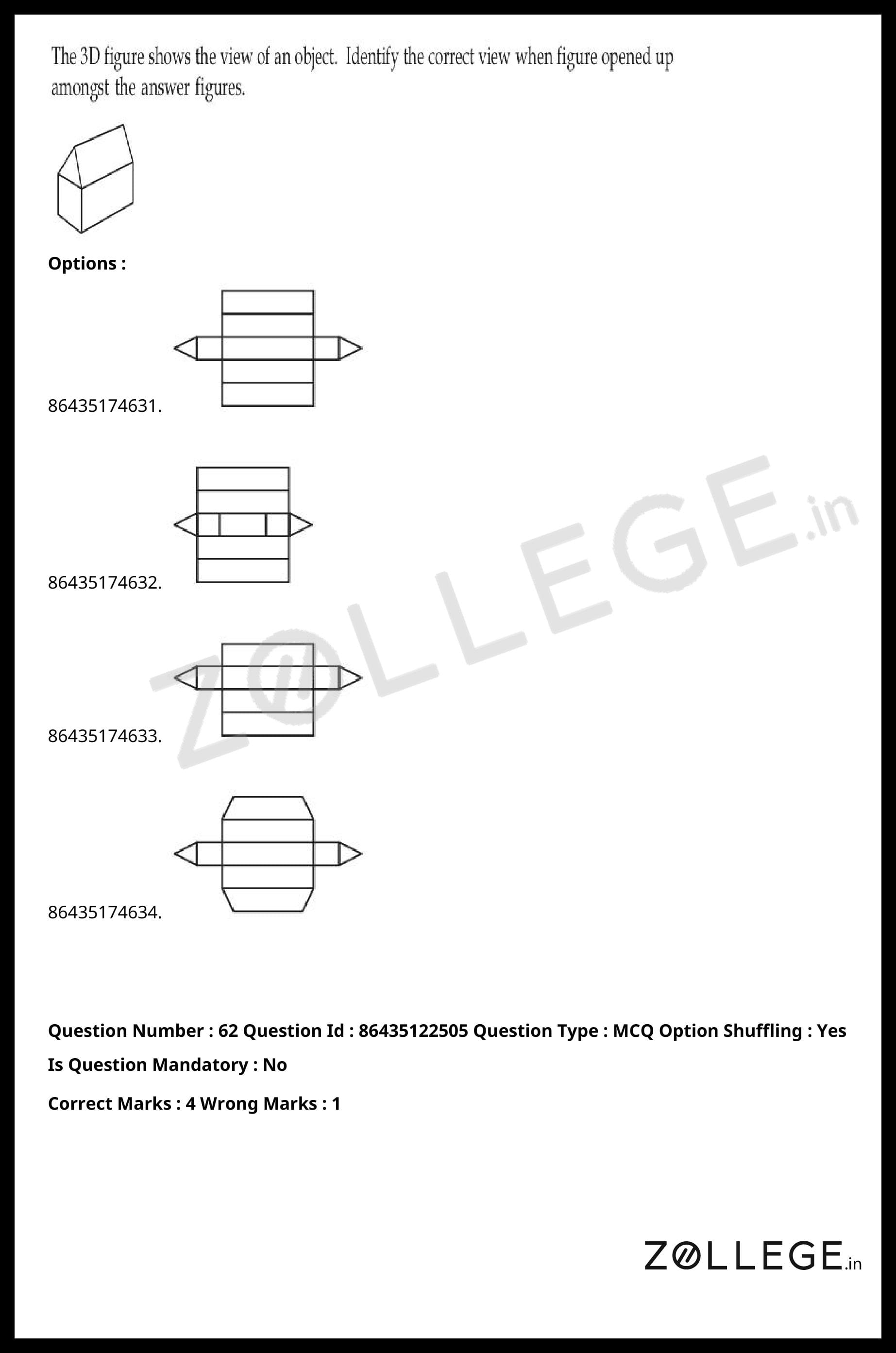
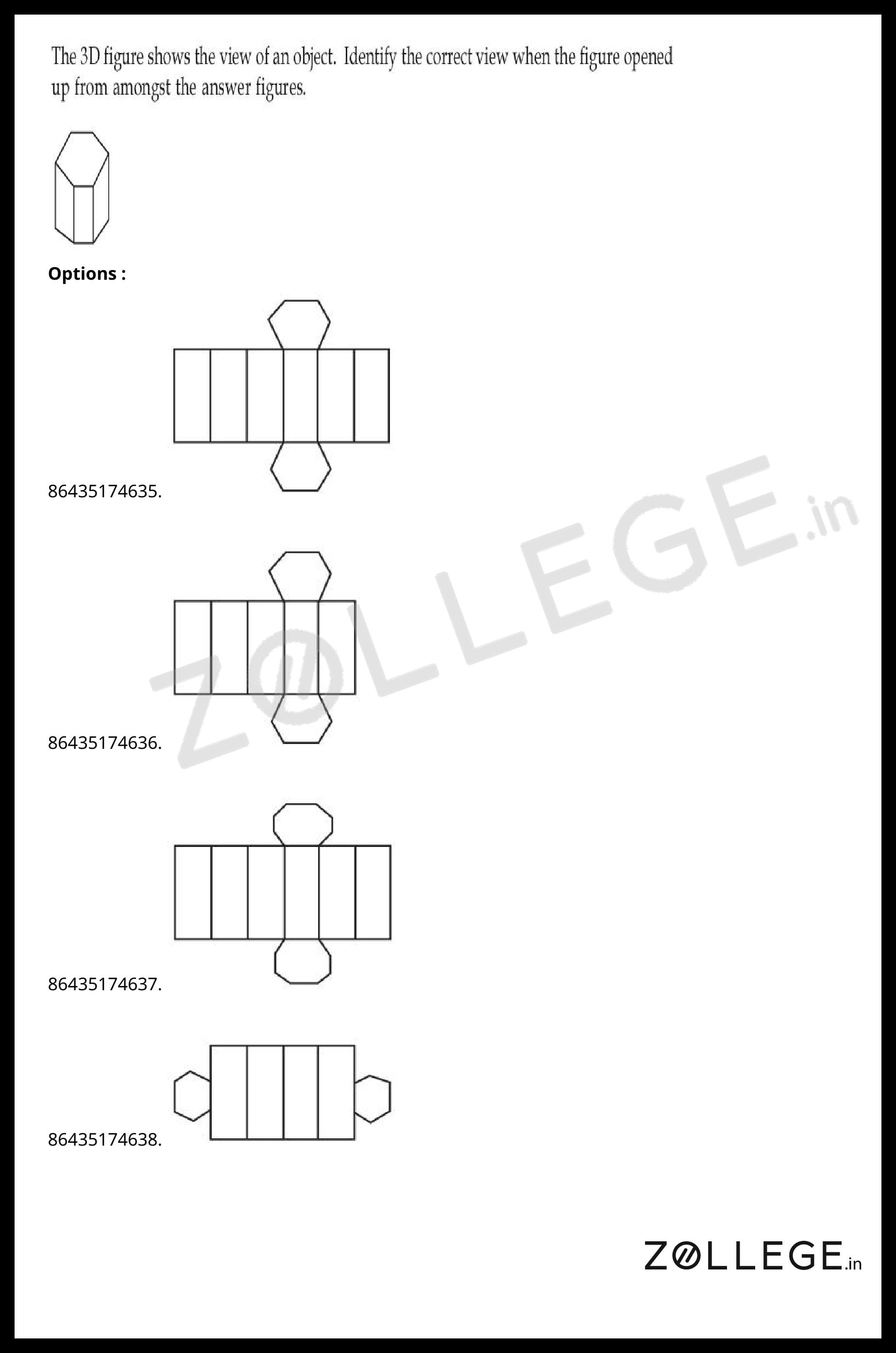
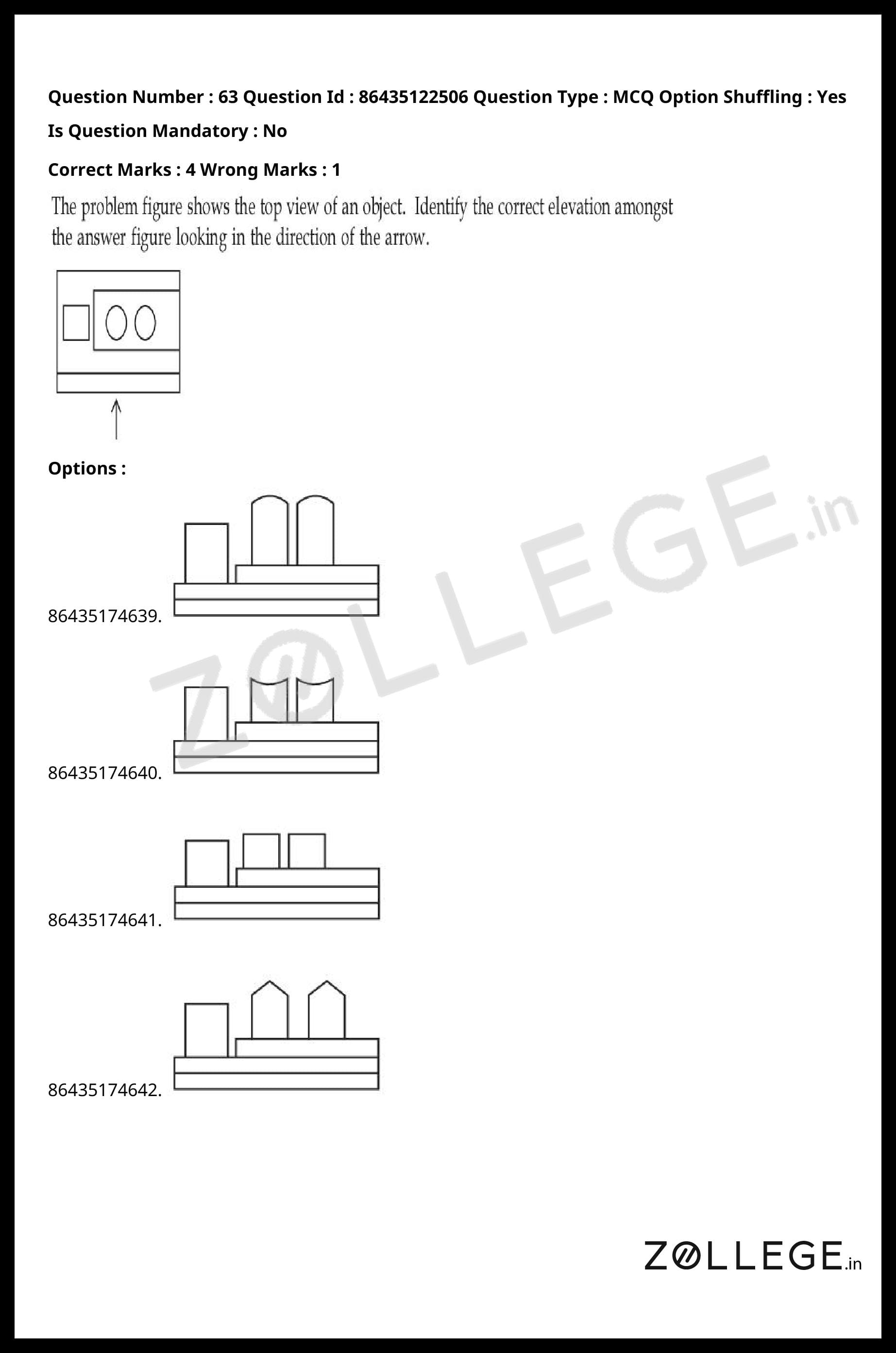
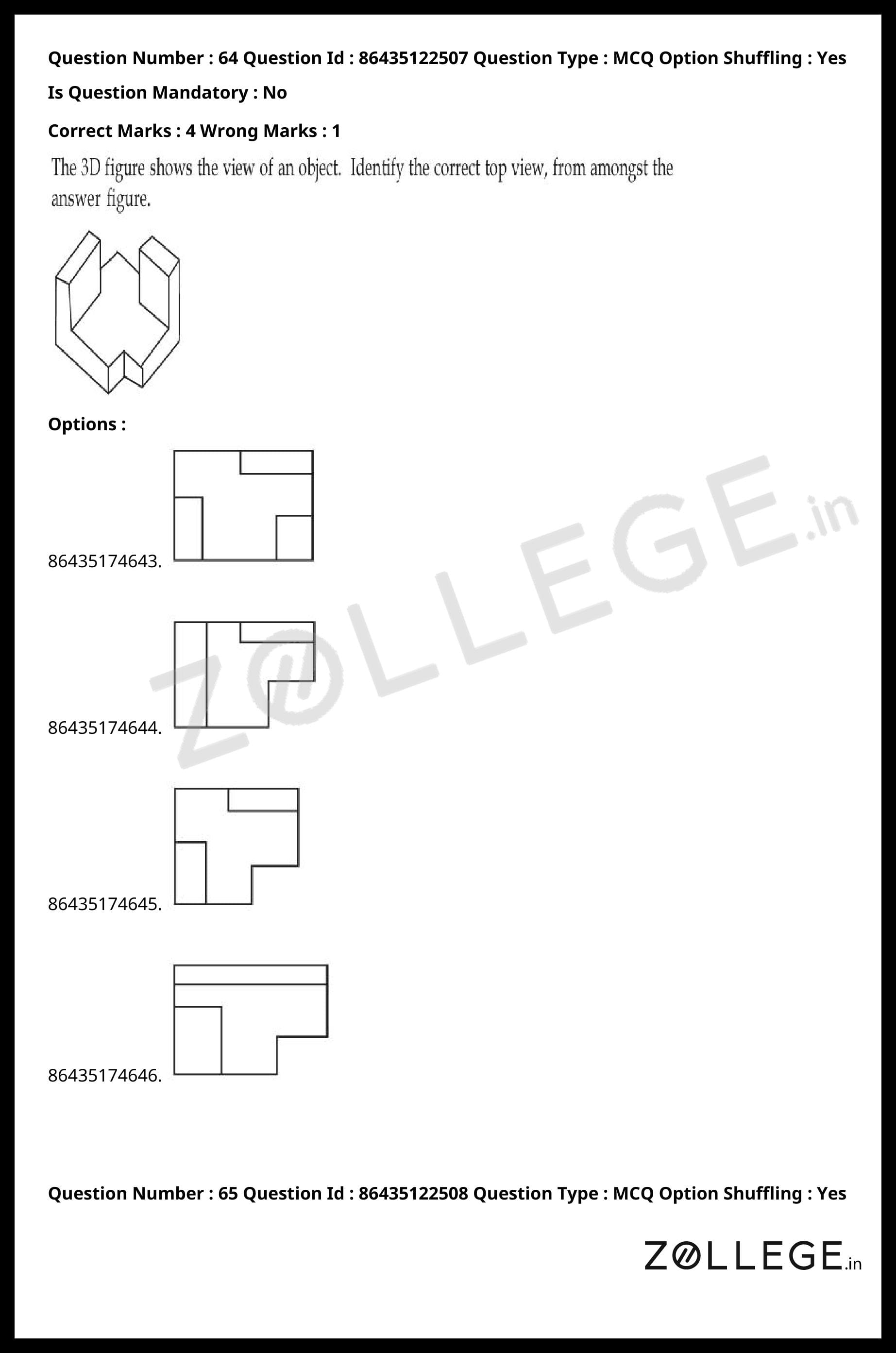
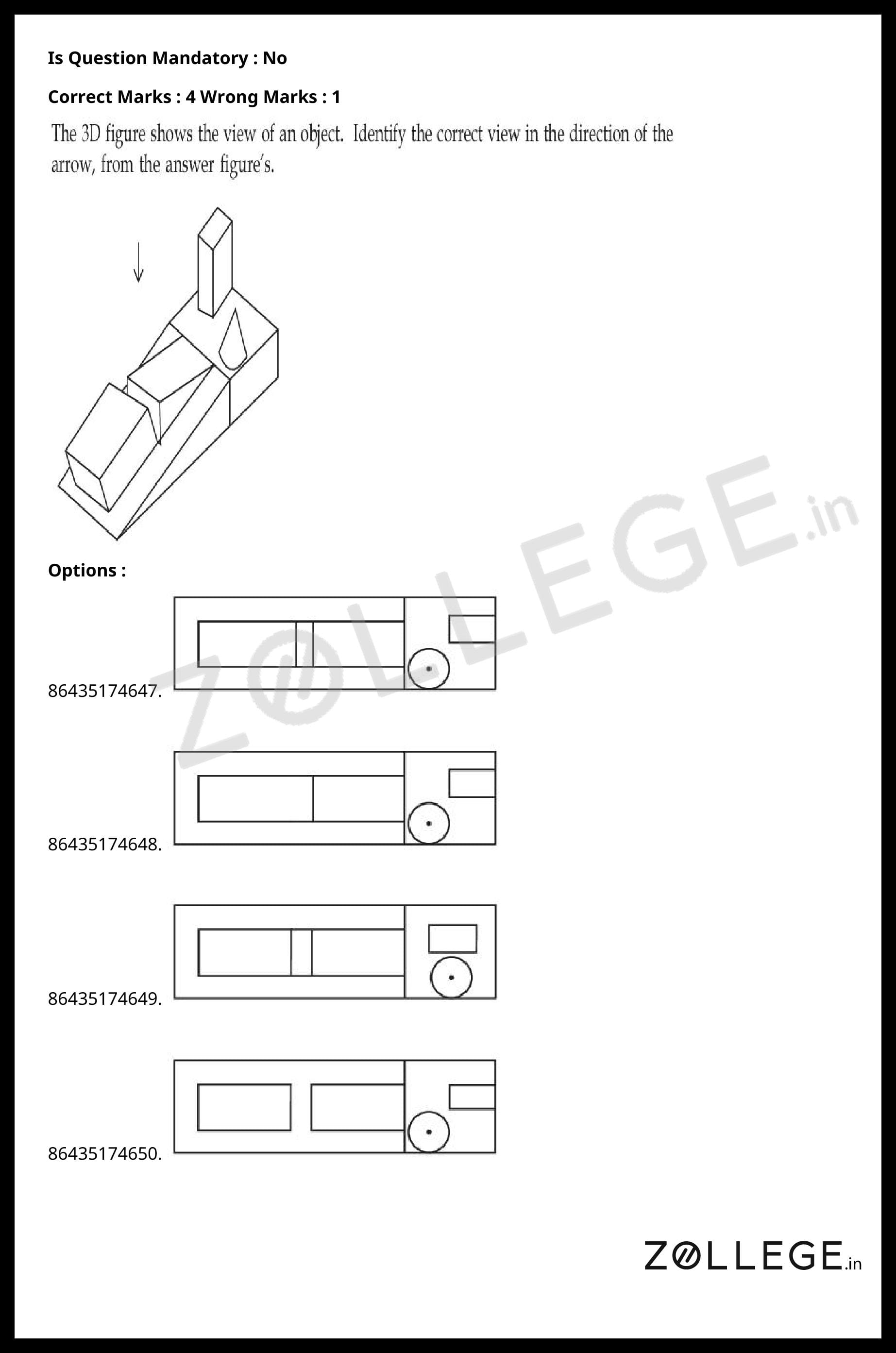
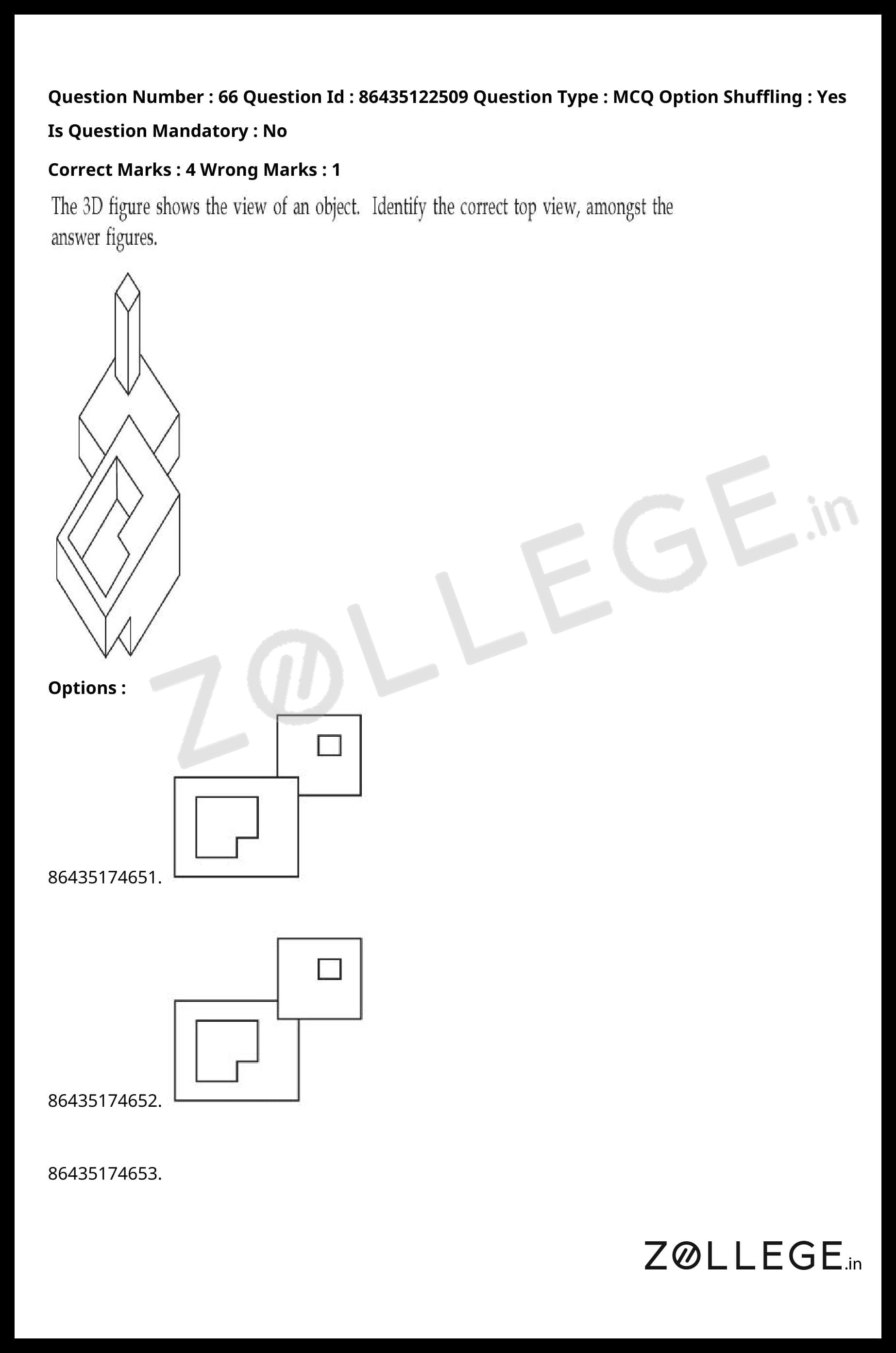
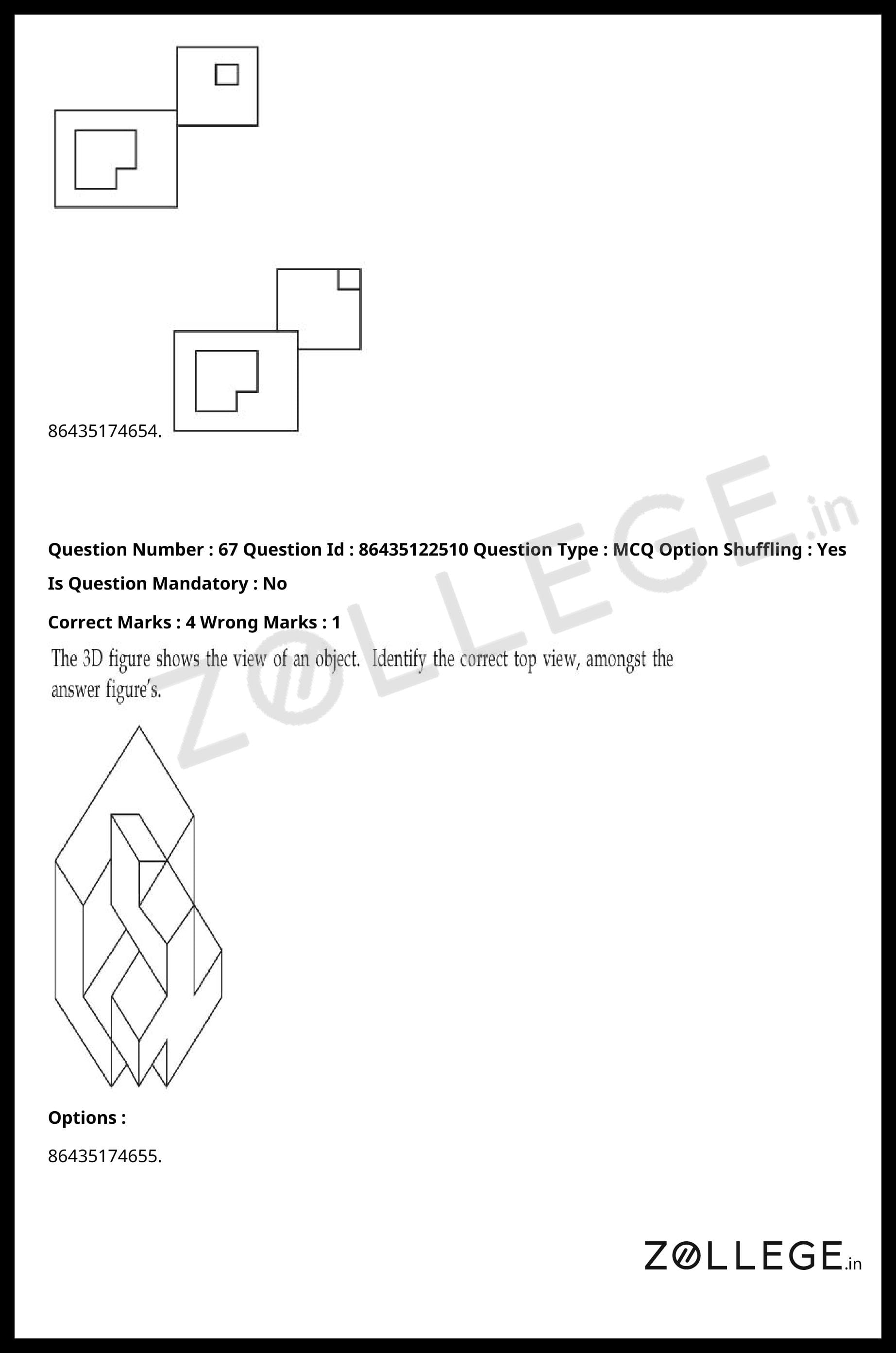
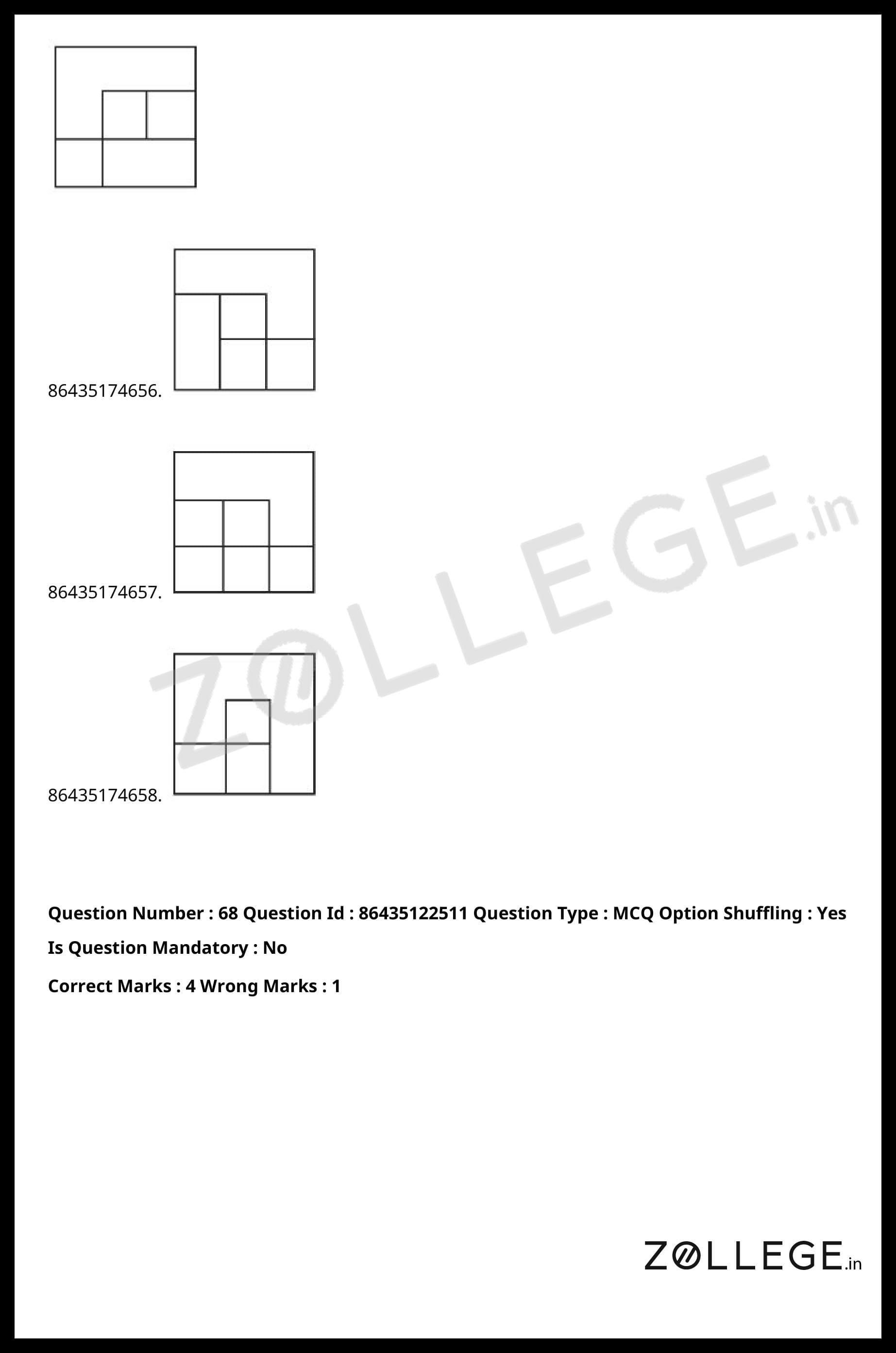
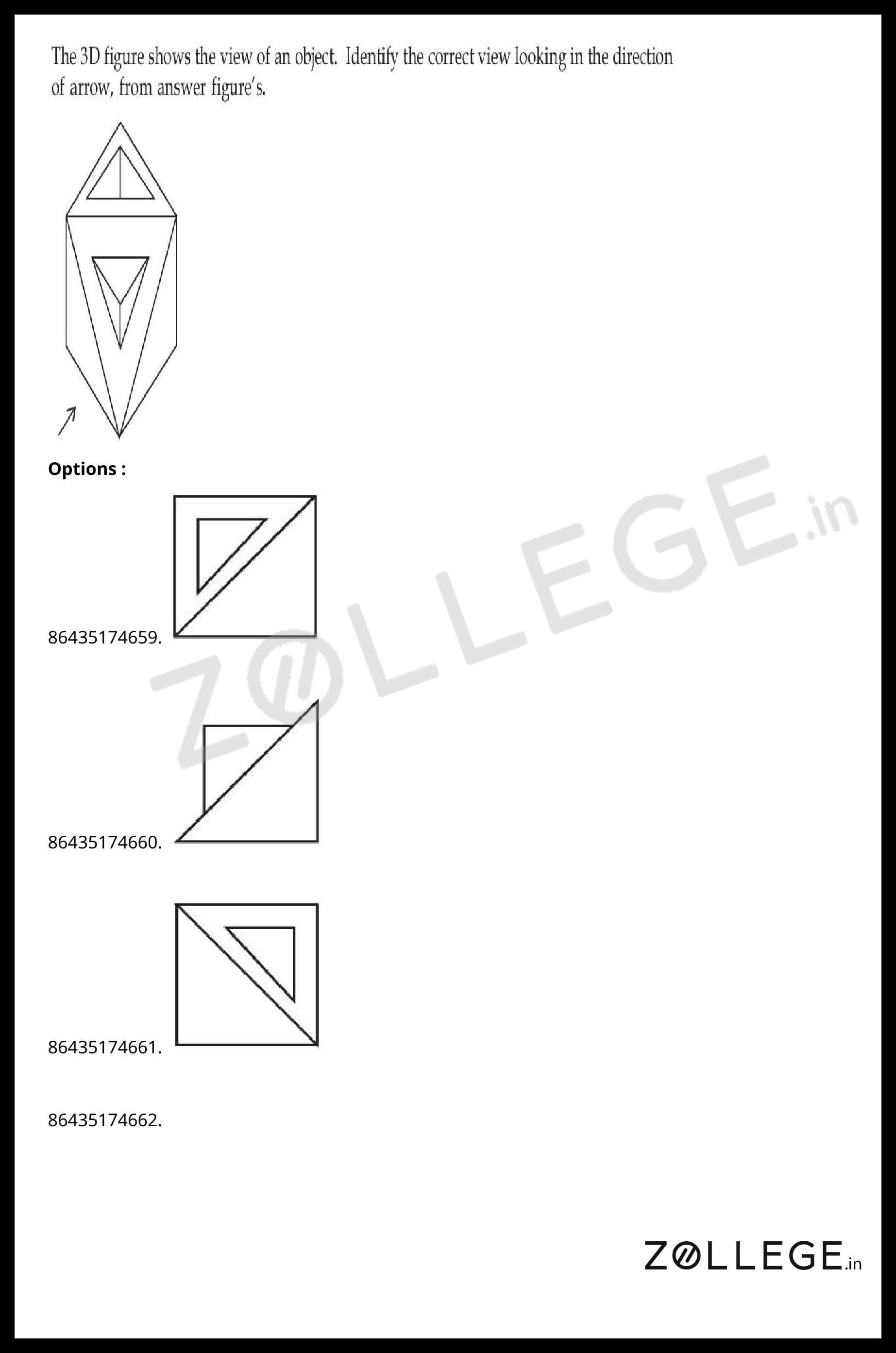
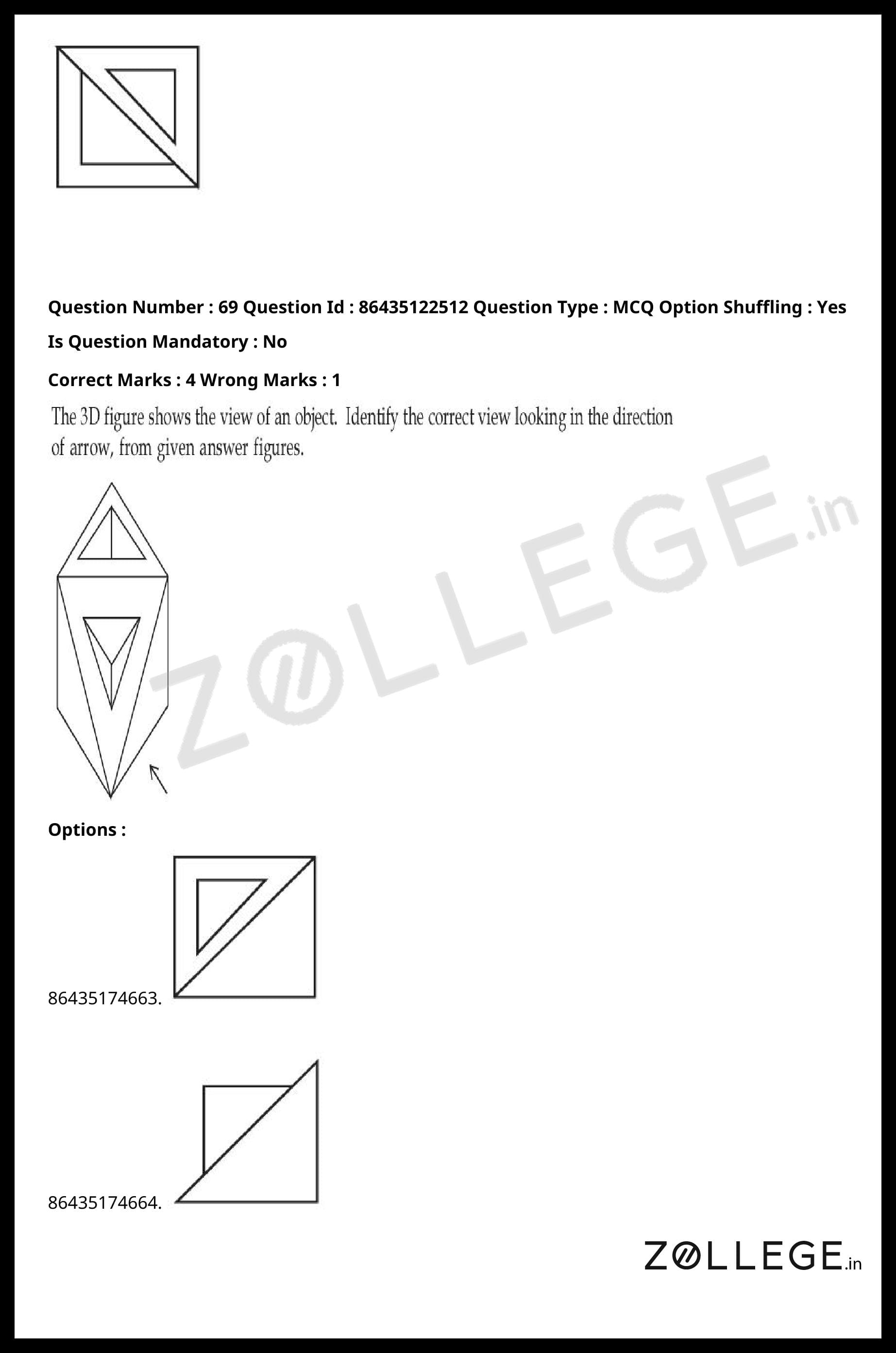
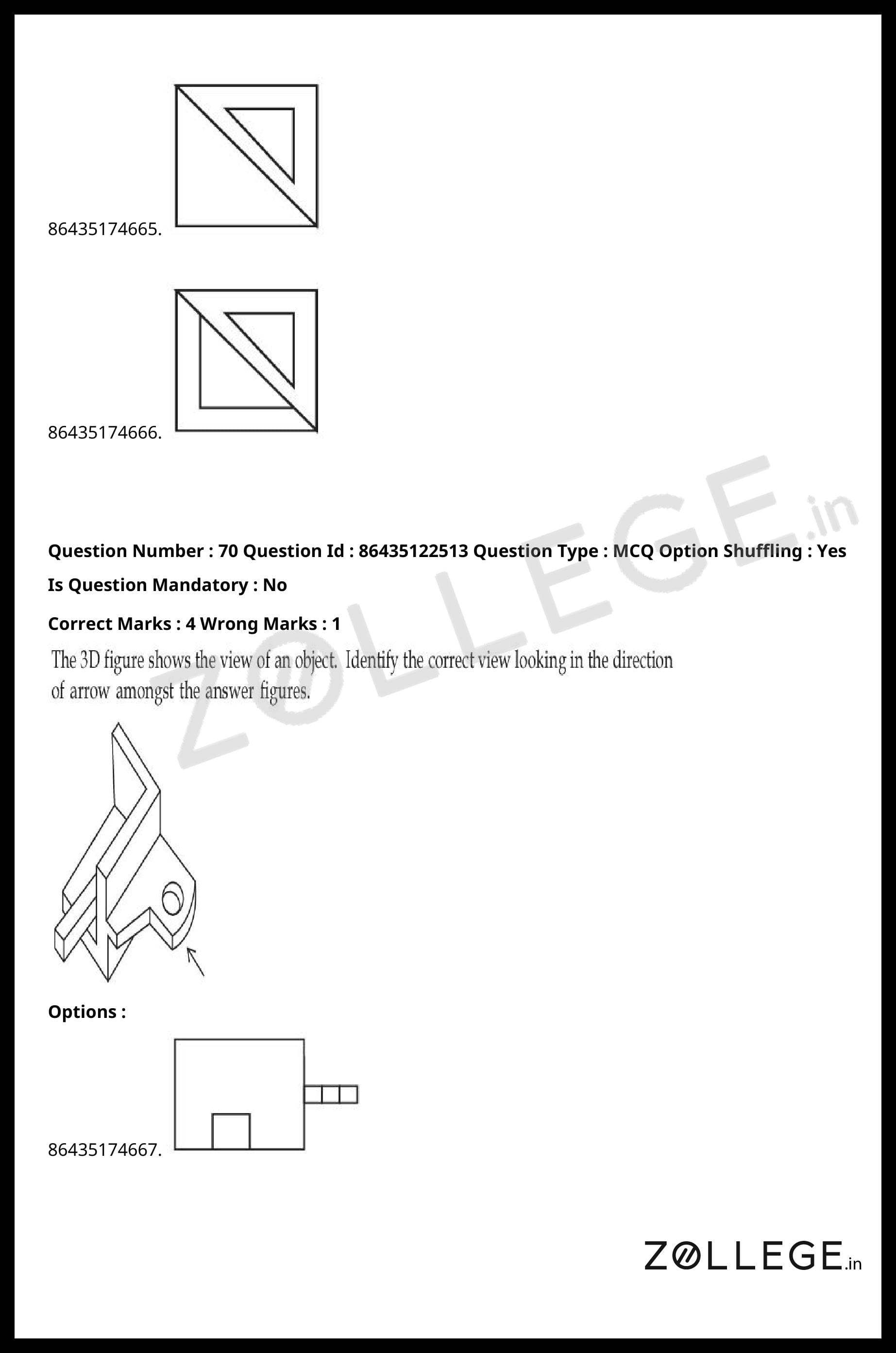
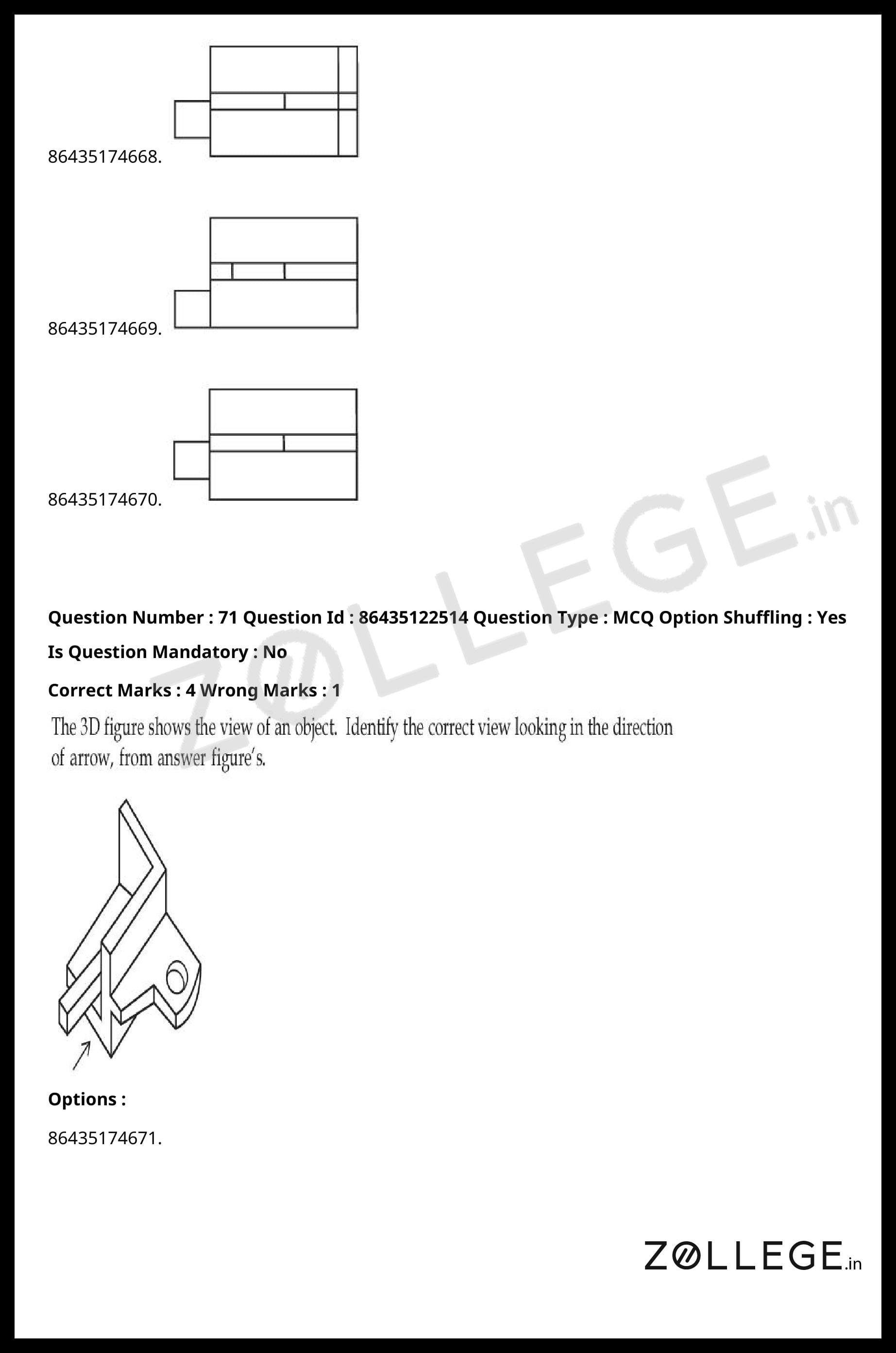
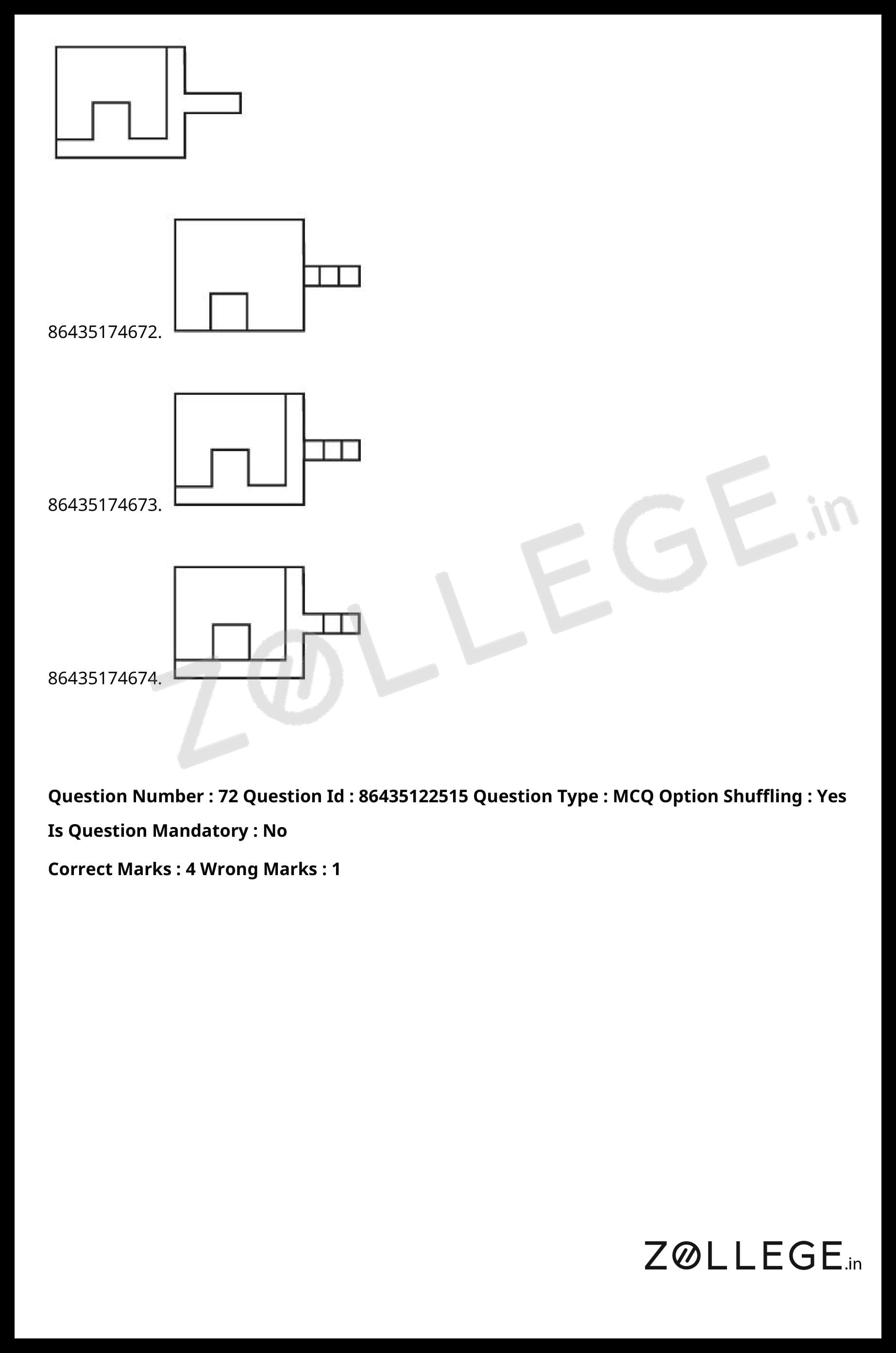
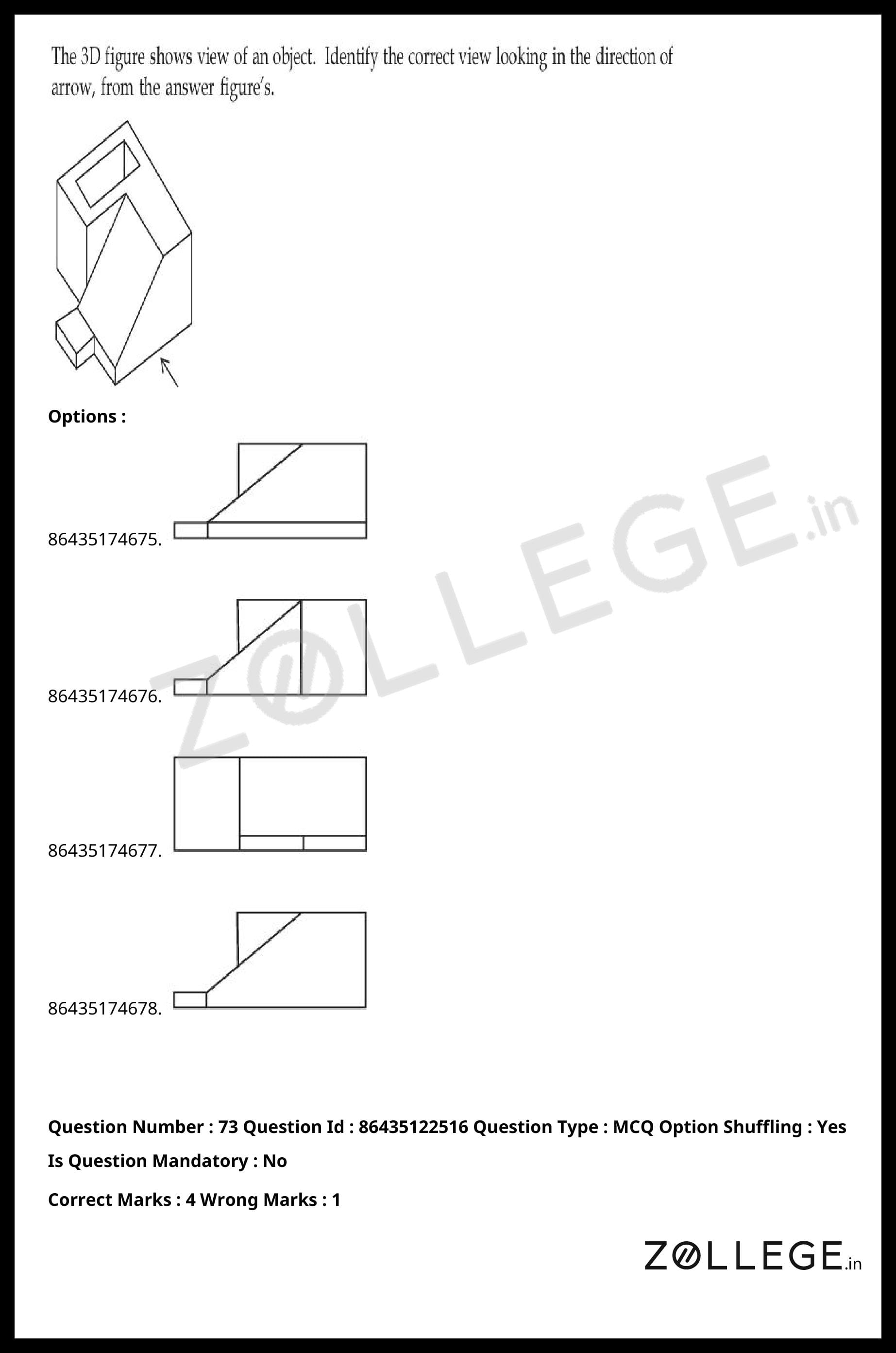
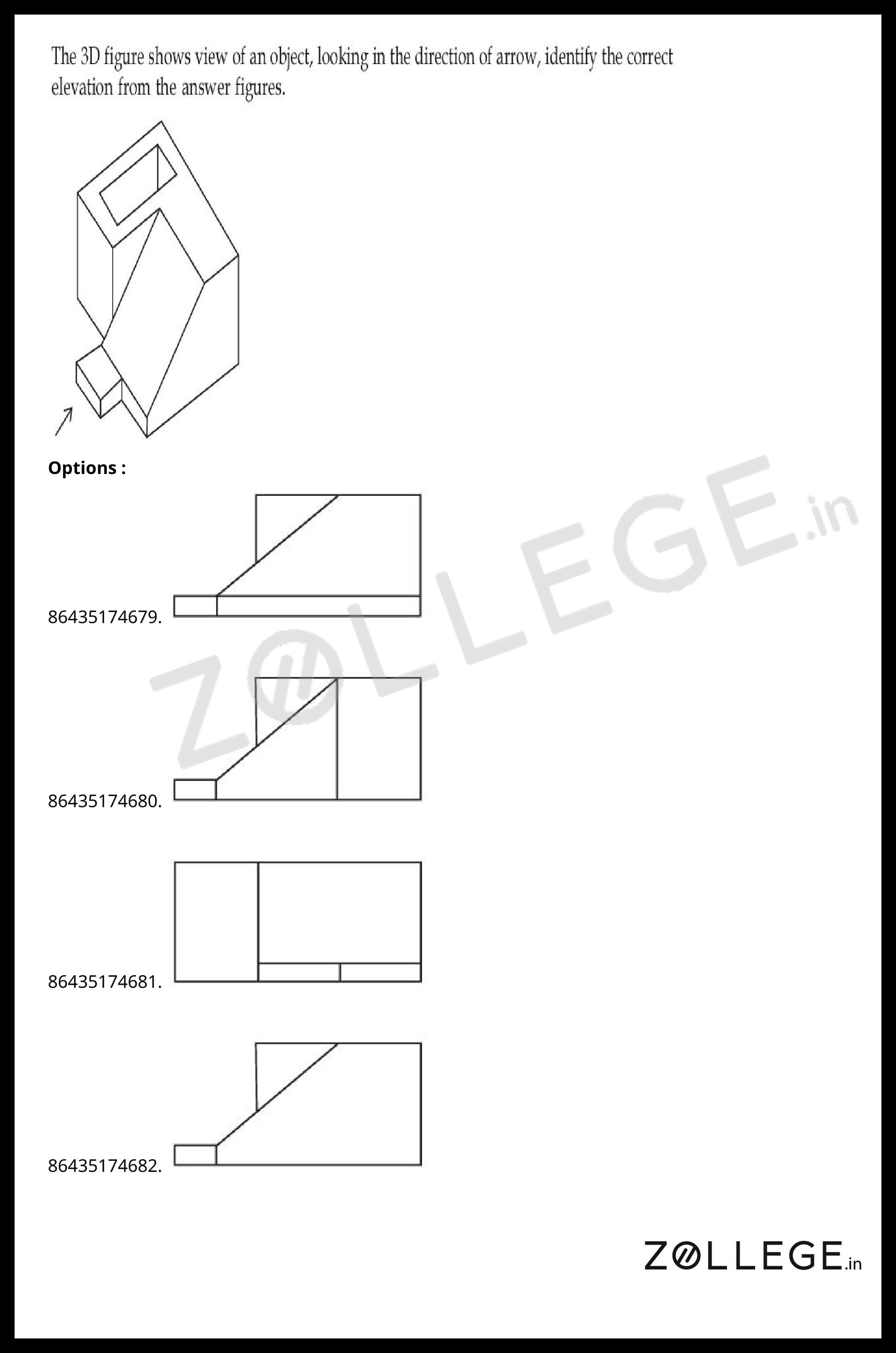
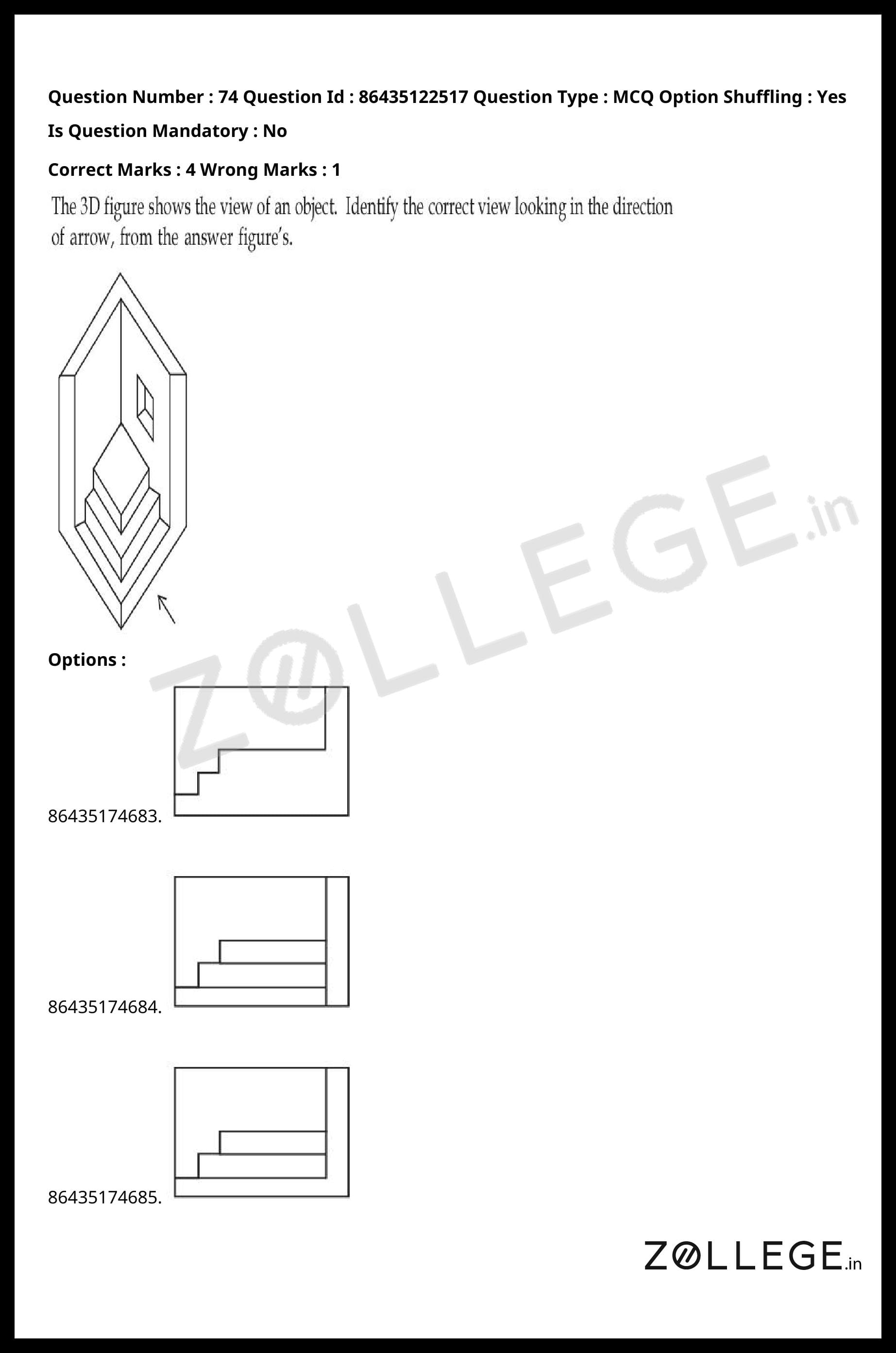
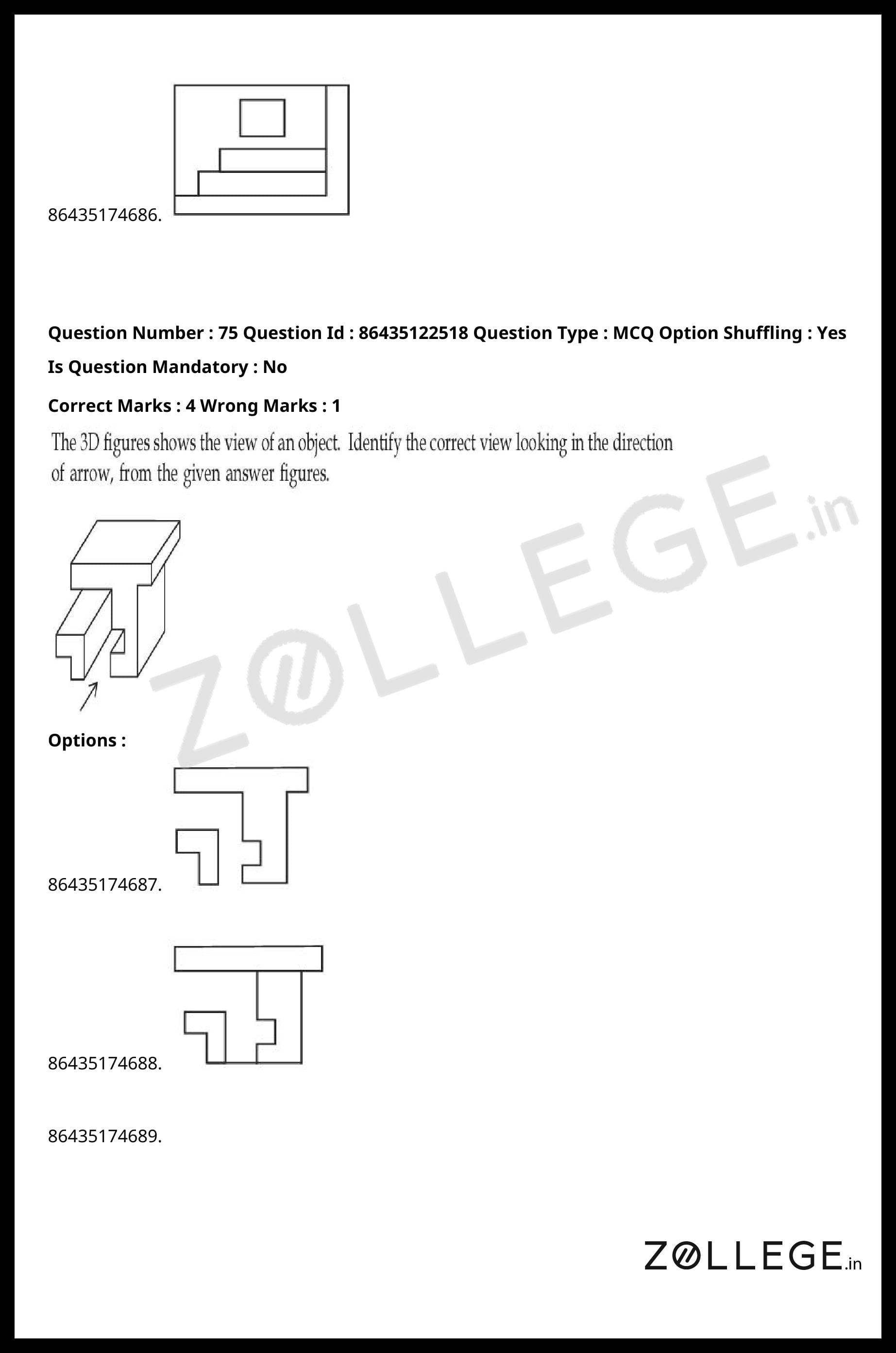
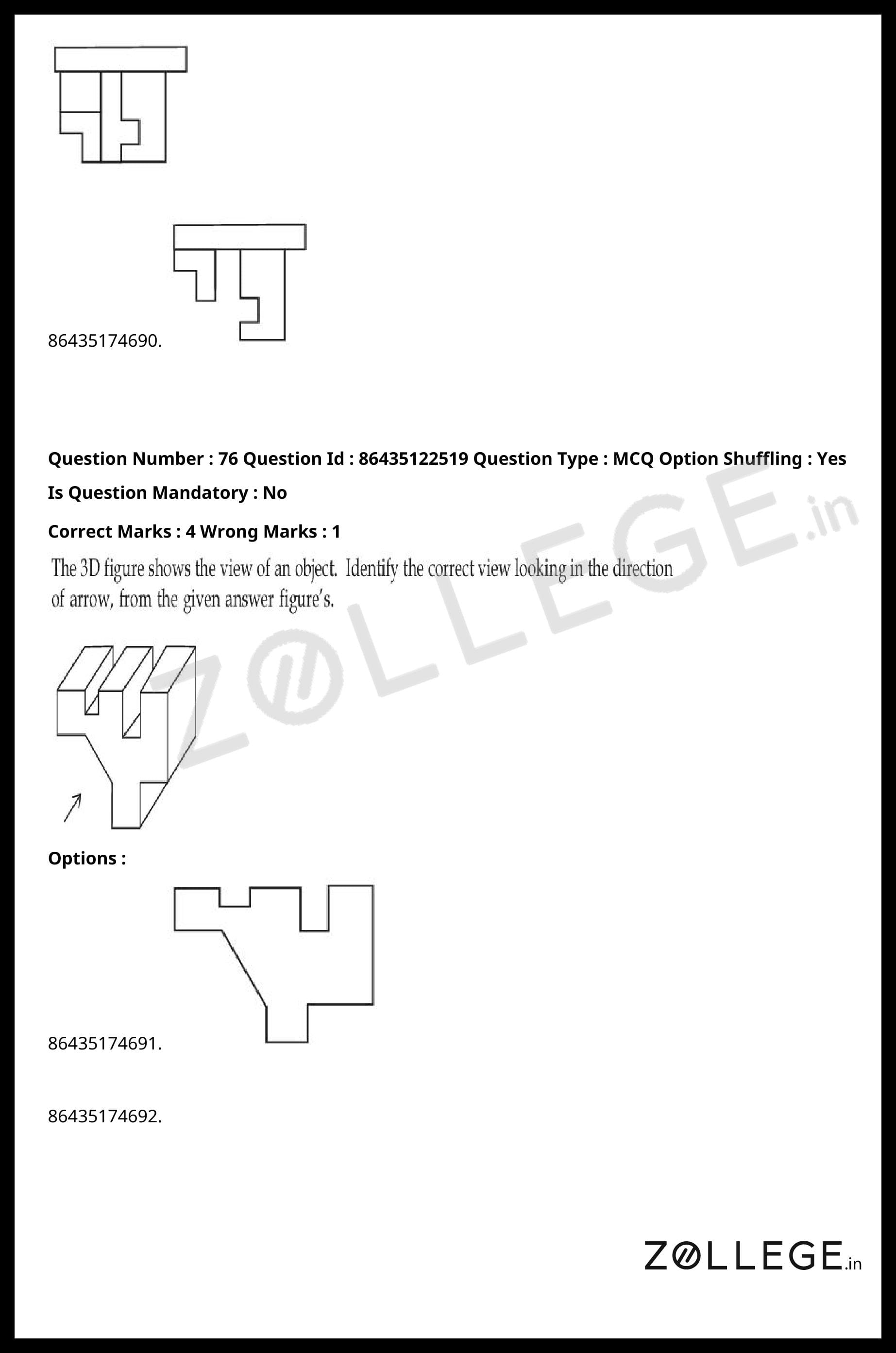
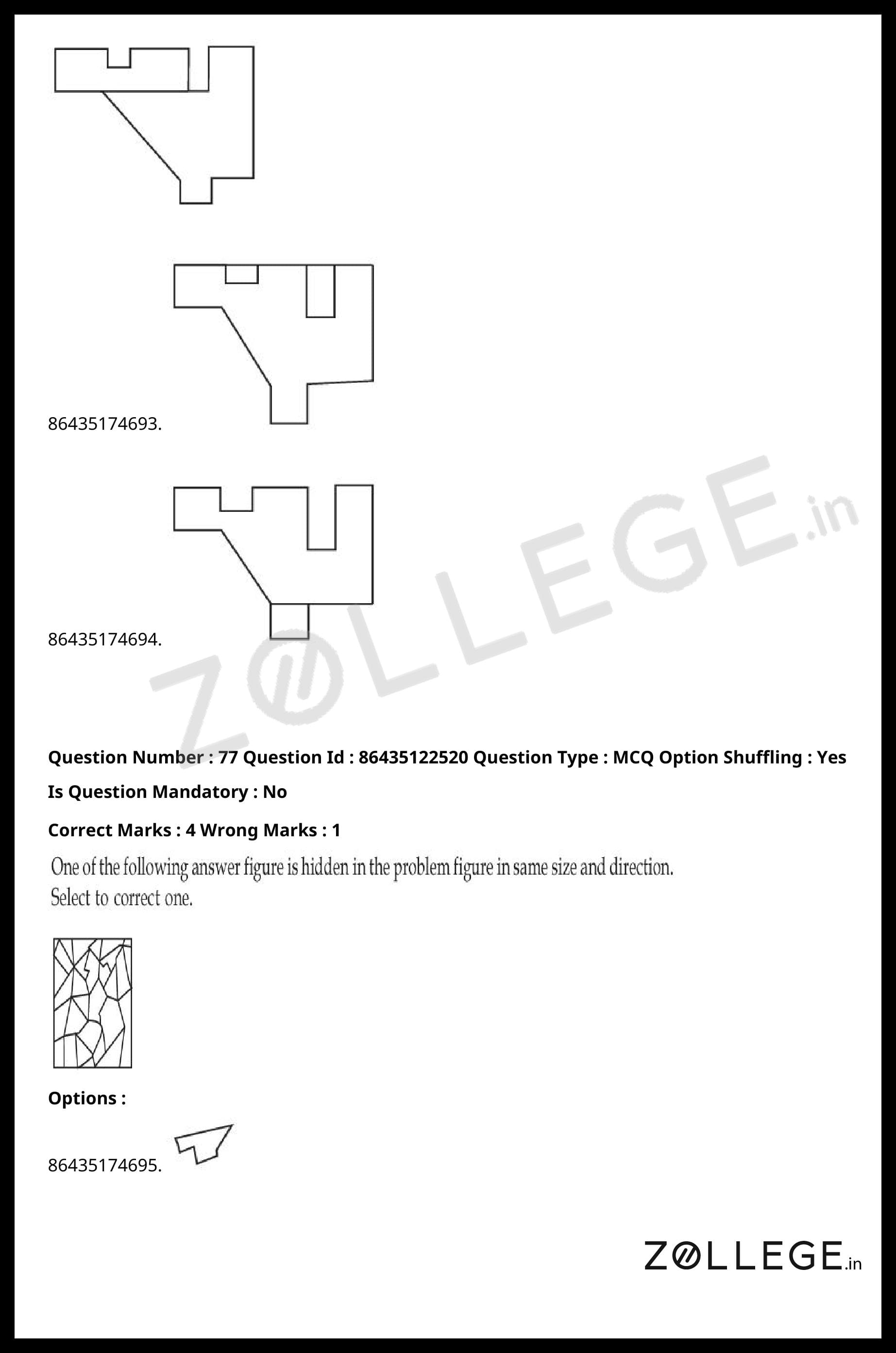
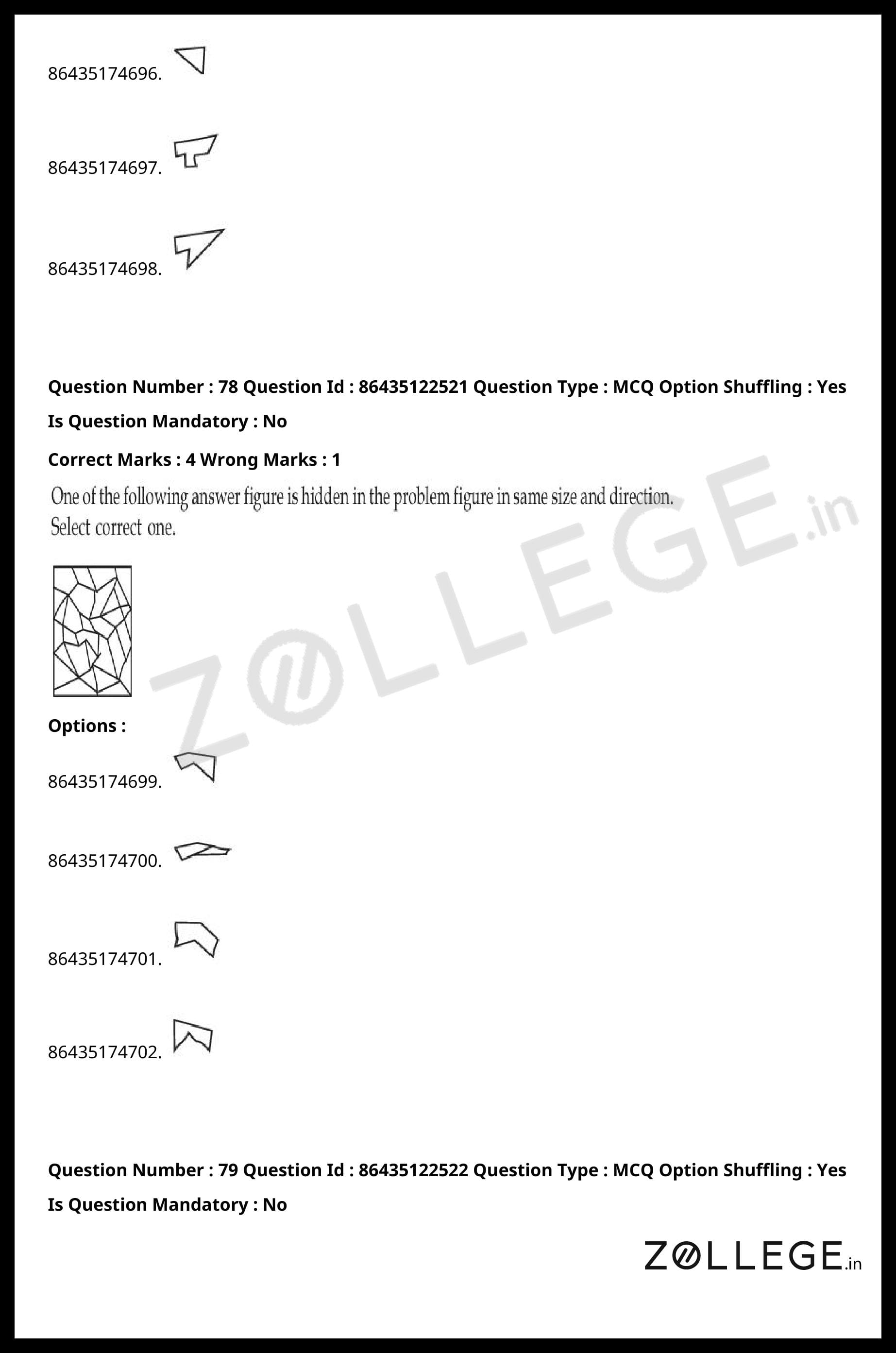
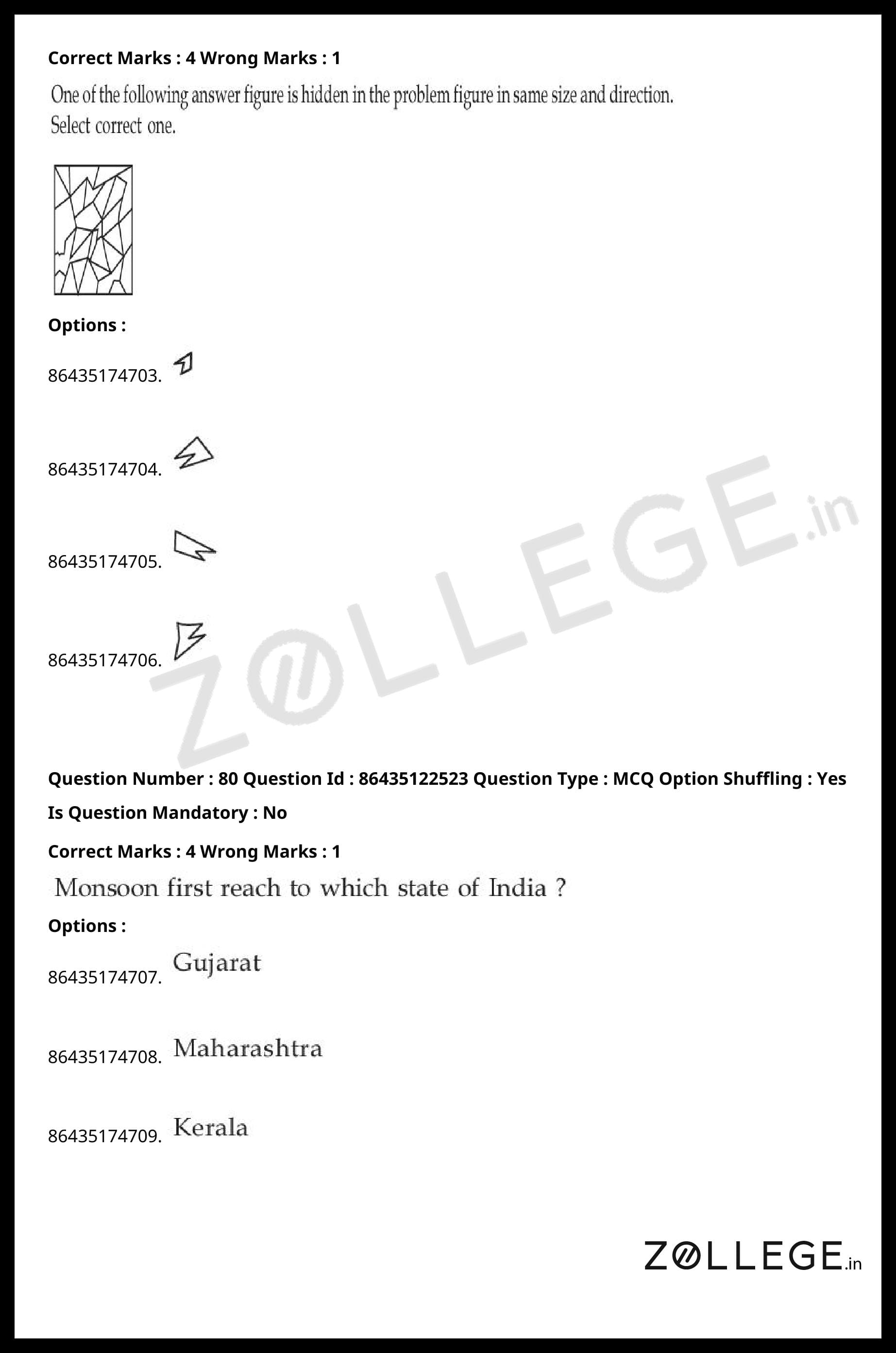

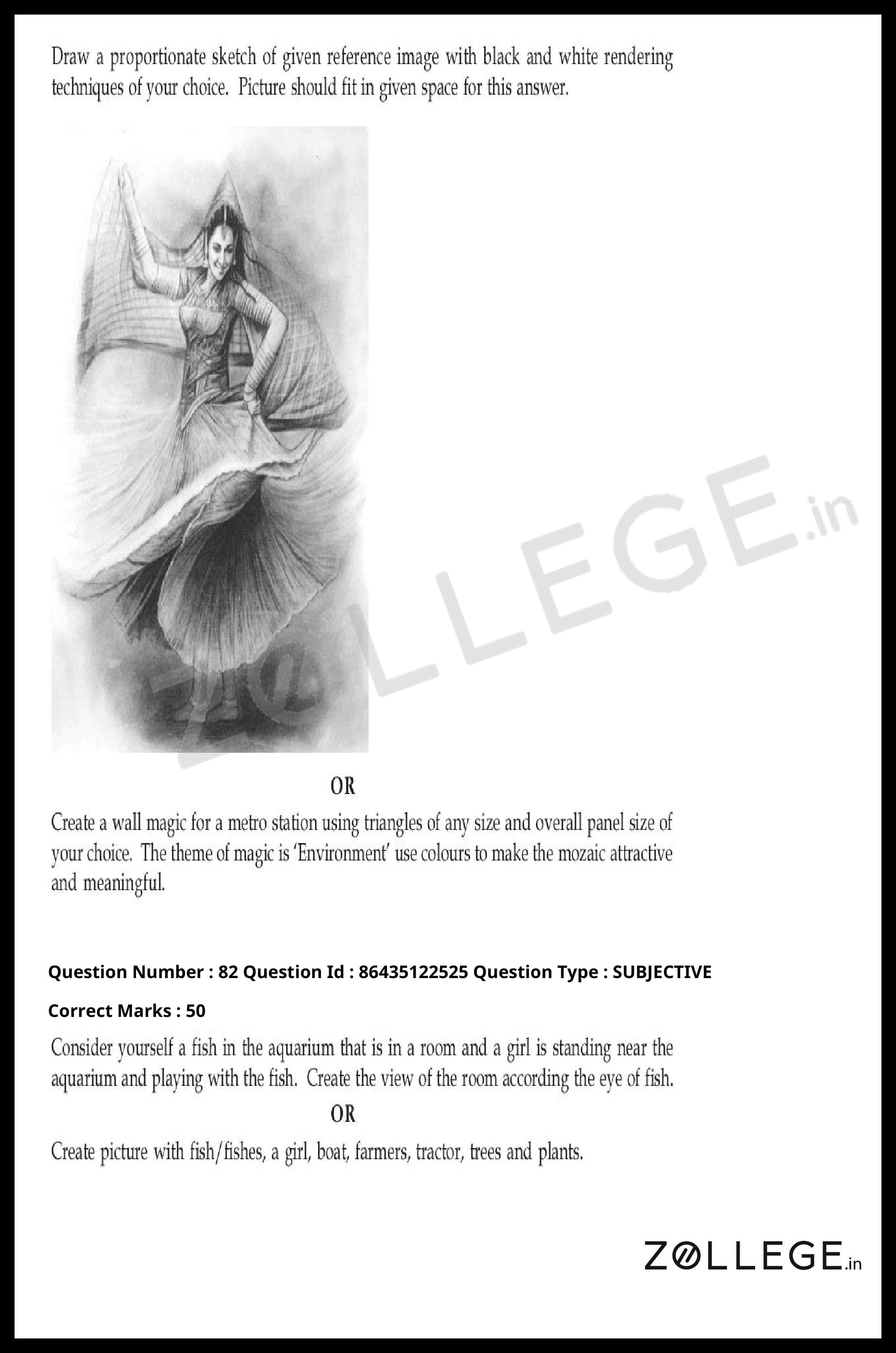
Previous Year JEE Main Question Papers
*The article might have information for the previous academic years, please refer the official website of the exam.