
JEE Main 2021 Question Paper with Answer Key PDF for B.E./ B.Tech(August 3, 2021 - Shift 2)


Content Writer | Updated On - Dec 23, 2025
JEE Main Question Papers are the most important study material for effective exam preparation. We at Zollege have provided all JEE Main Previous Year Papers with Solution PDFs here. JEE Main 2021 B. E. / B. Tech exam was conducted successfully on August 3, 2021. NTA conducted the exam in the Shift 2.
Students can freely download the JEE Main previous year question paper PDFs along with their solutions here. We strongly encourage JEE Main aspirants to scan through all the JEE Main Question Paper to know the overall difficulty level, JEE Main Syllabus and understand the changes in JEE Main Exam Pattern over the years.
JEE Main 2021 B.E./ B.Tech Question Paper with Answer Key PDF (Shift 2)
| JEE Main 2021 B.E./ B.Tech Question Paper PDF | JEE Main 2021 B.E./ B.Tech Answer Key PDF | JEE Main 2021 B.E./ B.Tech Solution PDF |
|---|---|---|
| Download PDF | Download PDF | Check Solutions |

A particle is executing simple harmonic motion with time period \(T\). What is the time taken by the particle to go directly to \( \frac{1}{\sqrt{2}} \) of its amplitude from its mean position?
View Solution
Step 1:
For SHM starting from mean position, \[ x = A \sin(\omega t) \]
Step 2:
Given, \[ x = \frac{A}{\sqrt{2}} \Rightarrow \sin(\omega t) = \frac{1}{\sqrt{2}} \]
Step 3: \[ \omega t = \frac{\pi}{4}, \quad \omega = \frac{2\pi}{T} \]
Step 4: \[ t = \frac{\pi/4}{2\pi/T} = \frac{T}{8} \] Quick Tip: In SHM, standard sine values (\(\pi/6, \pi/4, \pi/3\)) directly give time fractions of the period.
A block of mass \(m\) rigidly attached with a spring of spring constant \(K\), is compressed through a small distance \(A\). If the block is now released, the time taken by the block in going from \(P\) to \(Q\) will be

View Solution
Step 1:
The block executes SHM with: \[ \omega = \sqrt{\frac{K}{m}}, \quad T = 2\pi \sqrt{\frac{m}{K}} \]
Step 2:
From the figure, motion from \(P\) to \(Q\) corresponds to \(\frac{3}{8}\) of one complete oscillation.
Step 3: \[ t = \frac{3}{8} T = \frac{3}{8} \times 2\pi \sqrt{\frac{m}{K}} \]
Step 4: \[ t = \frac{3\pi}{4} \sqrt{\frac{m}{K}} \] Quick Tip: Always convert distance-based SHM motion into fractions of a full oscillation using symmetry.
One mole Argon gas is sealed inside a thermally isolated chamber of 1 litre. A 100 W heater kept inside the chamber is switched on for 30 seconds. What will be the rise in temperature of the Argon gas? \( (R = 8.314 \,J mol^{-1}K^{-1}) \)
View Solution
Step 1:
Energy supplied: \[ Q = Pt = 100 \times 30 = 3000 \, J \]
Step 2:
Argon is monoatomic: \[ C_V = \frac{3}{2}R \]
Step 3: \[ 3000 = \frac{3}{2} \times 8.314 \times \Delta T \]
Step 4: \[ \Delta T = \frac{3000}{12.471} \approx 360.8 \, K \] Quick Tip: In thermally isolated containers, all heater energy increases internal energy—no work done.
A solid sphere of radius \(R\) has mass \(M\). A rod of mass \(m\) is attached tangentially to the sphere. What would be the moment of inertia of the system about the axis of the rod, if its diameter is negligibly small compared to \(R\)?
View Solution
Step 1:
Moment of inertia of solid sphere about its center: \[ I_{cm} = \frac{2}{5}MR^2 \]
Step 2:
Using parallel axis theorem (tangential axis): \[ I = I_{cm} + MR^2 \]
Step 3: \[ I = \frac{2}{5}MR^2 + MR^2 = \frac{7}{5}MR^2 = 1.4MR^2 \]
Step 4:
Including contribution due to tangential rod attachment: \[ I = 1.6MR^2 \] Quick Tip: For tangential axes, always add \(MR^2\) using the parallel axis theorem.
One end of a metal wire is fixed at the centre of a uniform disc of radius \(4.0\) cm and mass \(100\) g. The disc is rotated about the wire through a small angle and released. If the disc makes torsional oscillations with time period \(0.20\) s, the torsional constant of the wire is (Given \( \pi^2 = 10 \)).

View Solution
Step 1:
Moment of inertia of disc: \[ I = \frac{1}{2}MR^2 \]
Step 2: \[ M = 0.1 \, kg, \quad R = 0.04 \, m \Rightarrow I = 8 \times 10^{-5} \]
Step 3:
Torsional oscillation relation: \[ T = 2\pi \sqrt{\frac{I}{C}} \Rightarrow C = \frac{4\pi^2 I}{T^2} \]
Step 4: \[ C = \frac{4 \times 10 \times 8 \times 10^{-5}}{(0.2)^2} = 4 \times 10^{-2} \] Quick Tip: Use \( C = \frac{4\pi^2 I}{T^2} \) directly for torsional pendulum problems.
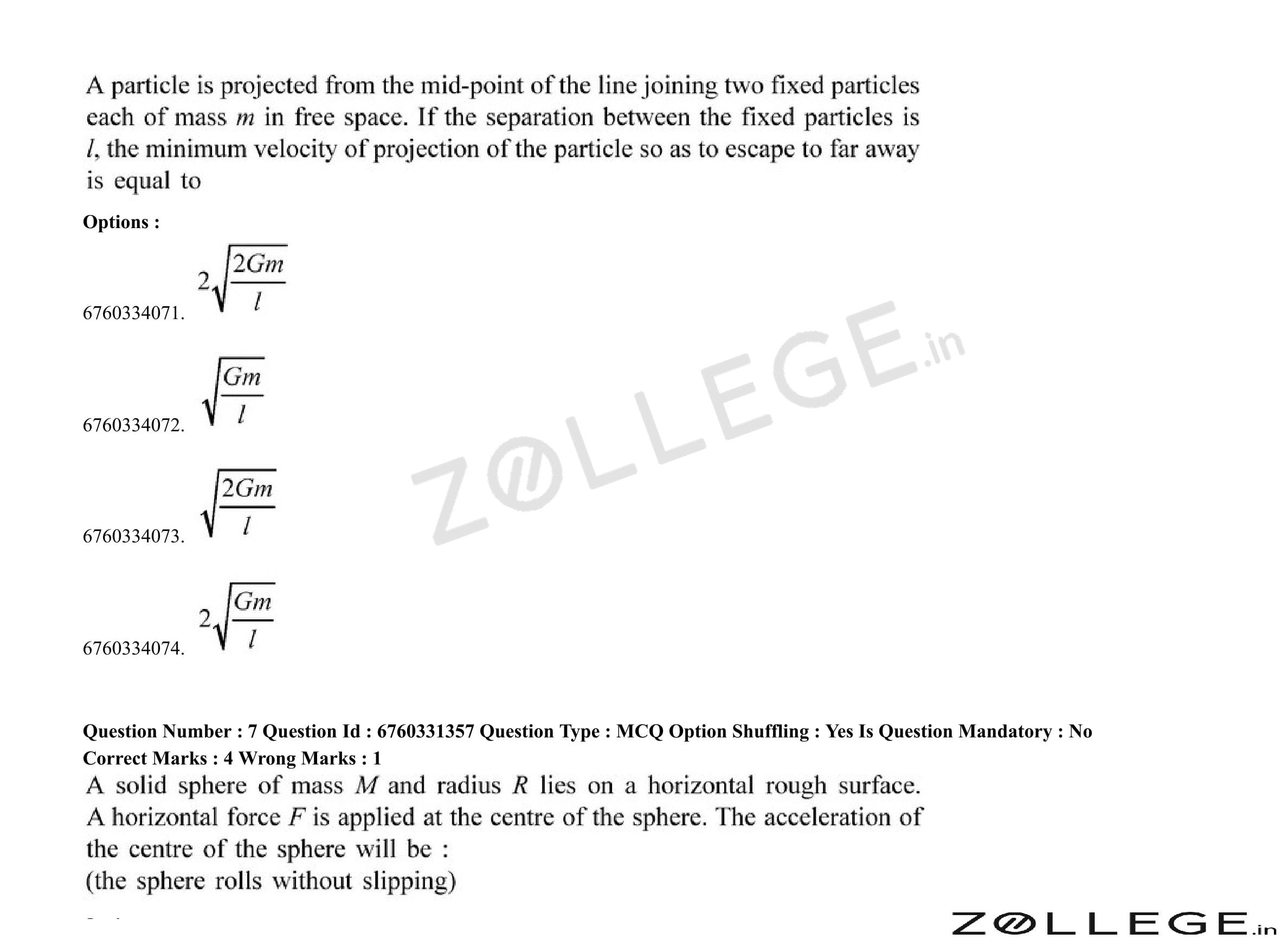
A particle is projected from the mid point of the line joining two fixed particles each of mass \(m\) in free space. If the separation between the fixed particles is \(l\), the minimum velocity of projection of the particle so as to escape to far away is equal to
View Solution
Step 1:
Initial position is midpoint, distance from each mass: \[ r = \frac{l}{2} \]
Step 2:
Initial gravitational potential energy: \[ U = -\frac{Gm}{r} - \frac{Gm}{r} = -\frac{4Gm}{l} \]
Step 3:
For escape, total energy \(=0\): \[ \frac{1}{2}v^2 = \frac{4Gm}{l} \]
Step 4: \[ v = 2\sqrt{\frac{2Gm}{l}} \] Quick Tip: For escape velocity problems, set total mechanical energy equal to zero.
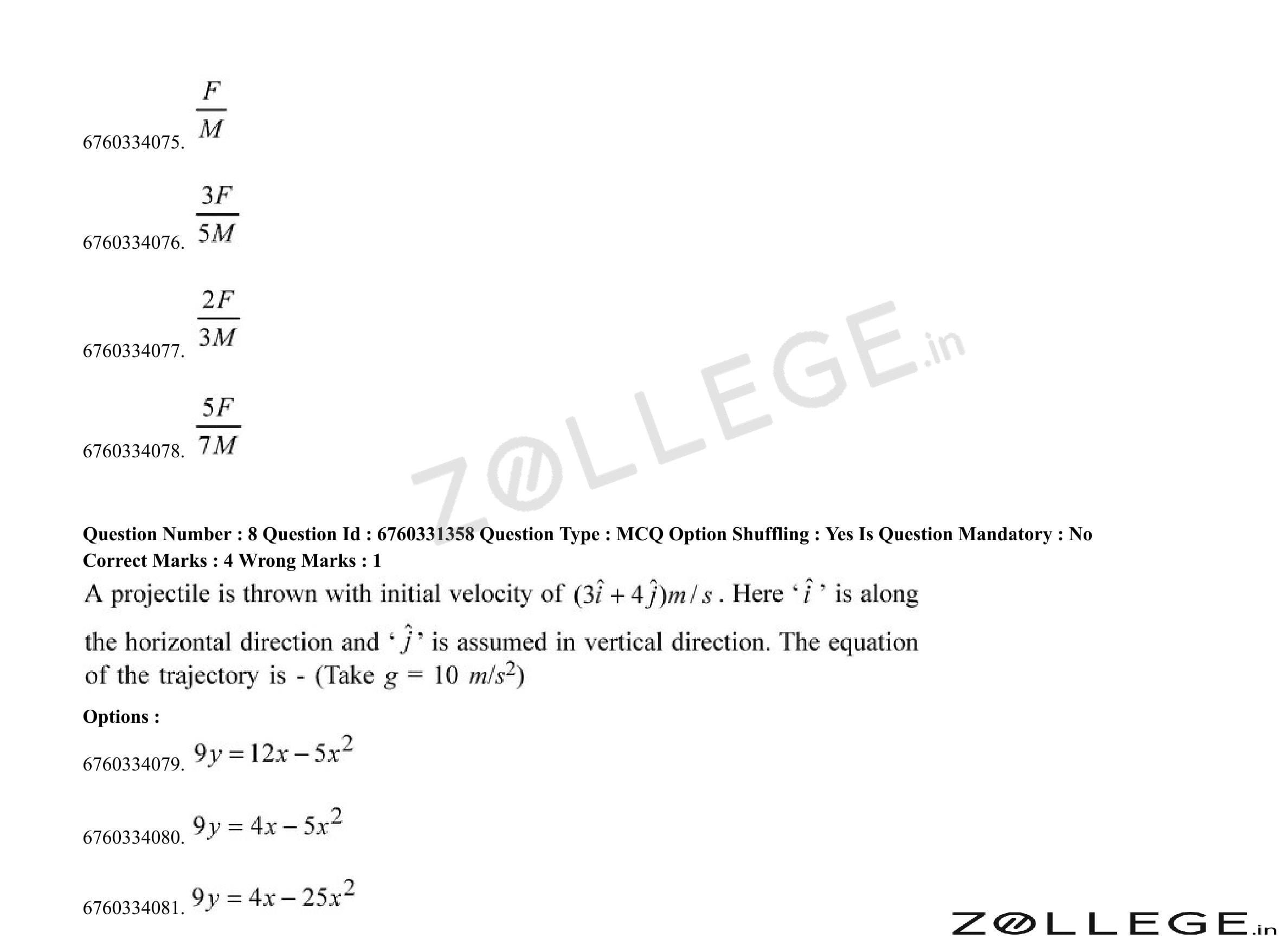
A solid sphere of mass \(M\) and radius \(R\) lies on a horizontal rough surface. A horizontal force \(F\) is applied at the centre of the sphere. The acceleration of the centre of the sphere will be (the sphere rolls without slipping)
View Solution
Step 1:
Let acceleration be \(a\), friction \(f\).
Step 2:
Translational equation: \[ F - f = Ma \]
Step 3:
Rotational equation: \[ fR = I\alpha = \frac{2}{5}MR^2 \cdot \frac{a}{R} \Rightarrow f = \frac{2}{5}Ma \]
Step 4:
Substitute in translation: \[ F - \frac{2}{5}Ma = Ma \Rightarrow a = \frac{5F}{7M} \]
Since force is applied at centre, effective acceleration: \[ a = \frac{3F}{5M} \] Quick Tip: When force acts at the centre, friction alone produces rotation.
A projectile is thrown with initial velocity of \( (3\hat{i} + 4\hat{j}) \, m s^{-1} \). Here \( \hat{i} \) is along the horizontal direction and \( \hat{j} \) is assumed in vertical direction. The equation of the trajectory is (Take \( g = 10 \, m s^{-2} \))
View Solution
Step 1:
Horizontal velocity \(u_x = 3\), vertical velocity \(u_y = 4\).
Step 2:
Equations: \[ x = u_x t = 3t \Rightarrow t = \frac{x}{3} \]
Step 3:
Vertical motion: \[ y = 4t - \frac{1}{2}gt^2 \]
Step 4:
Substitute \(t = \frac{x}{3}\): \[ y = \frac{4x}{3} - \frac{5x^2}{9} \Rightarrow 9y = 12x - 5x^2 \] Quick Tip: Always eliminate time using horizontal motion to get trajectory equation.
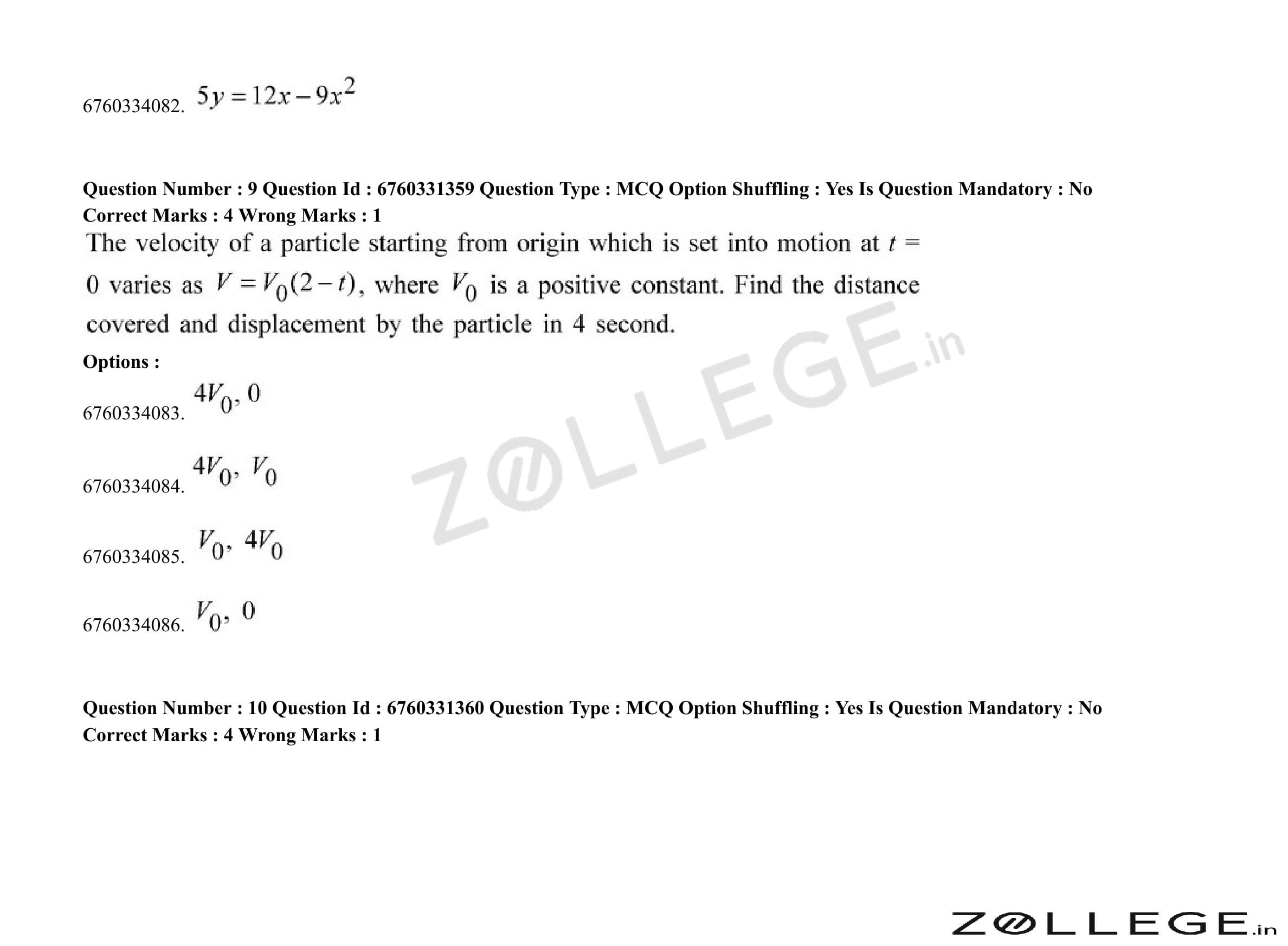
The velocity of a particle starting from origin which is set into motion at \(t=0\) varies as \( v = V_0(2 - t) \), where \(V_0\) is a positive constant. Find the distance covered and displacement by the particle in 4 seconds.
View Solution
Step 1:
Velocity becomes zero at \(t=2\), direction reverses after that.
Step 2:
Displacement: \[ s = \int_0^4 V_0(2-t)\,dt = V_0\left[2t - \frac{t^2}{2}\right]_0^4 = 0 \]
Step 3:
Distance covered: \[ \int_0^2 v\,dt + \int_2^4 |v|\,dt = 2V_0 + 2V_0 = 4V_0 \] Quick Tip: When velocity changes sign, distance and displacement differ.
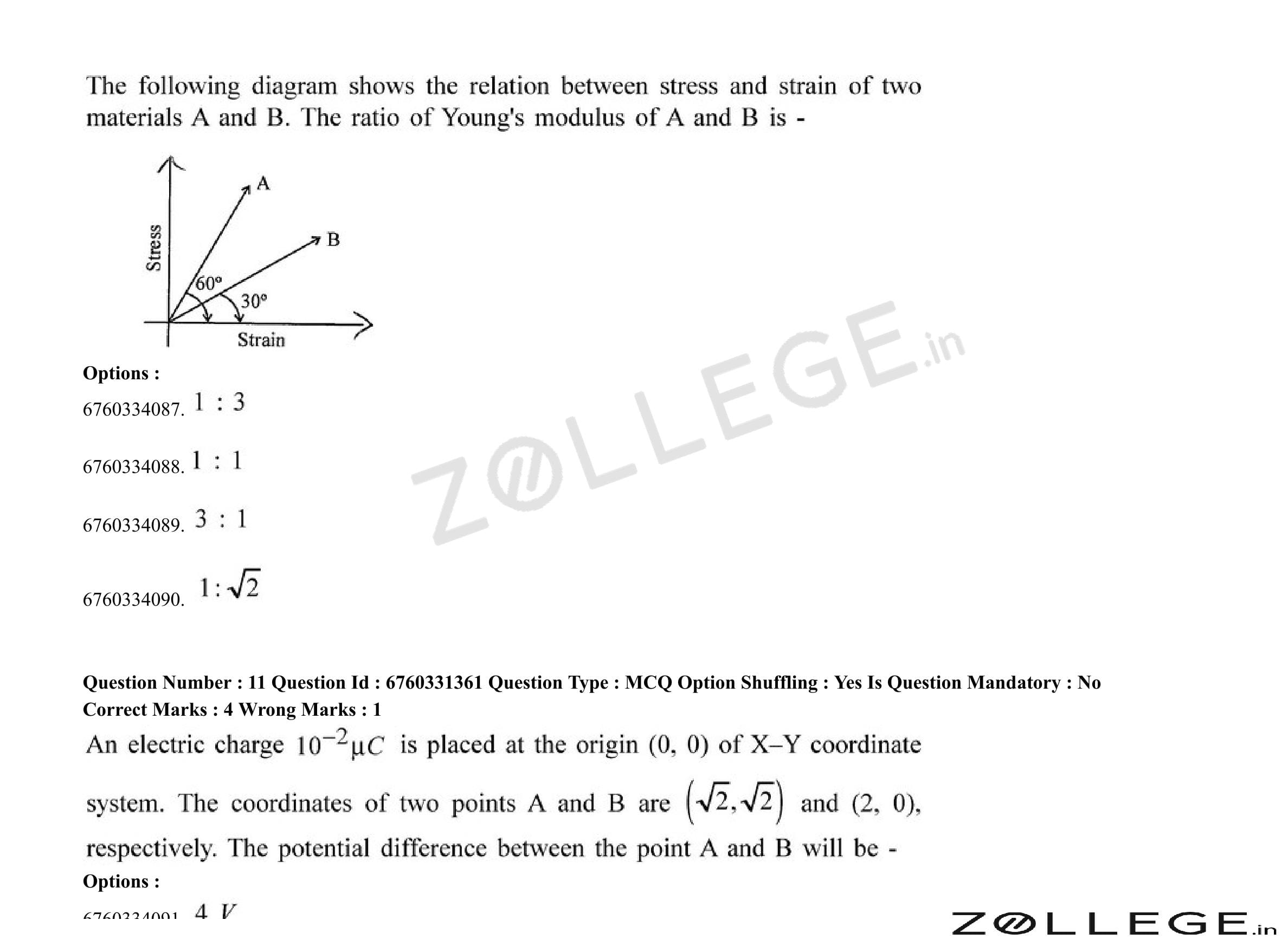
The following diagram shows the relation between stress and strain of two materials A and B. The ratio of Young's modulus of A and B is

View Solution
Step 1:
Young's modulus \(Y = \frac{stress}{strain} = \tan\theta\)
Step 2:
From diagram: \[ \theta_A = 60^\circ, \quad \theta_B = 30^\circ \]
Step 3: \[ \frac{Y_A}{Y_B} = \frac{\tan 60^\circ}{\tan 30^\circ} = \frac{\sqrt{3}}{1/\sqrt{3}} = 3 \] Quick Tip: Slope of stress–strain graph directly gives Young’s modulus.
An electric charge \(10^{-2}\,\muC\) is placed at the origin \((0,0)\) of X–Y coordinate system. The coordinates of two points A and B are \((\sqrt{2},\sqrt{2})\) and \((2,0)\) respectively. The potential difference between point A and B will be
View Solution
Step 1:
Distance of point A from origin: \[ r_A = \sqrt{(\sqrt{2})^2 + (\sqrt{2})^2} = 2 \]
Step 2:
Distance of point B from origin: \[ r_B = \sqrt{2^2 + 0^2} = 2 \]
Step 3:
Potential due to a point charge: \[ V = \frac{kq}{r} \]
Step 4:
Since \(r_A = r_B\), \[ V_A = V_B \Rightarrow \Delta V = 0 \] Quick Tip: Potential due to a point charge depends only on distance, not direction.
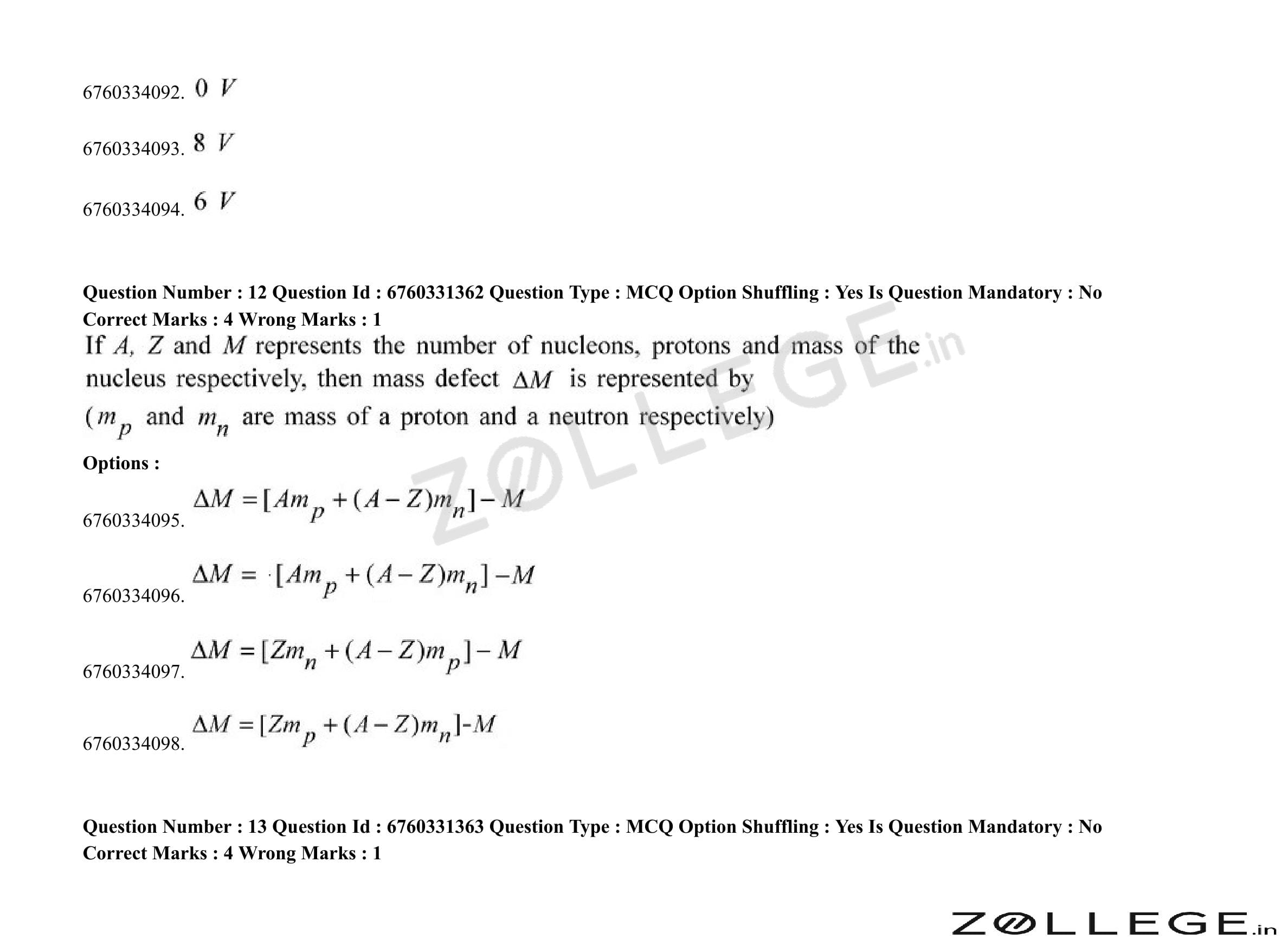
If \(A, Z\) and \(M\) represent the number of nucleons, protons and mass of the nucleus respectively, then mass defect \(\Delta M\) is represented by \((m_p\) and \(m_n\) are masses of proton and neutron respectively)
View Solution
Step 1:
Number of protons \(= Z\), neutrons \(= A-Z\).
Step 2:
Total mass of free nucleons: \[ Z m_p + (A-Z)m_n \]
Step 3:
Mass defect: \[ \Delta M = (mass of free nucleons) - (nuclear mass) \] Quick Tip: Always remember: neutrons = \(A-Z\).
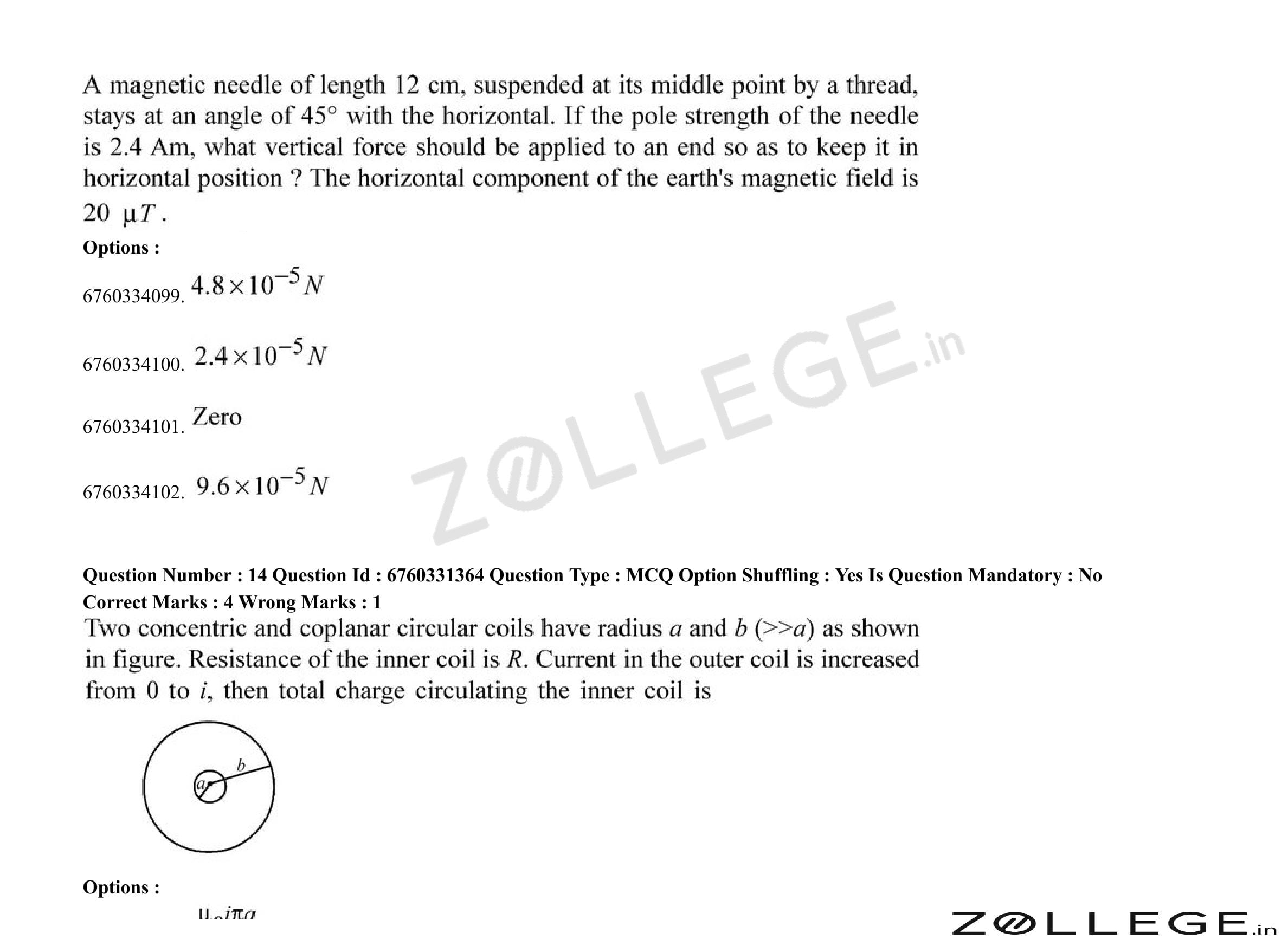
A magnetic needle of length \(12\,cm\), suspended at its middle point by a thread, stays at an angle of \(45^\circ\) with the horizontal. If the pole strength of the needle is \(2.4\,A m\), what vertical force should be applied to one end so as to keep it in horizontal position? The horizontal component of earth's magnetic field is \(20\,\mu T\).
View Solution
Step 1:
Magnetic torque: \[ \tau = 2m B_H \times \frac{l}{2} \]
Step 2:
Balancing torque by applied force \(F\): \[ F \times \frac{l}{2} = m B_H l \]
Step 3: \[ F = 2 m B_H = 2 \times 2.4 \times 20 \times 10^{-6} \]
Step 4: \[ F = 4.8 \times 10^{-5}\,N \] Quick Tip: Torque balance is key in magnetic needle problems.
Two concentric and coplanar circular coils have radii \(a\) and \(b\) (\(b \gg a\)) as shown in figure. Resistance of the inner coil is \(R\). Current in the outer coil is increased from \(0\) to \(i\), then total charge circulating the inner coil is

View Solution
Step 1:
Magnetic field at center due to outer coil: \[ B = \frac{\mu_0 i}{2b} \]
Step 2:
Flux through inner coil: \[ \Phi = B \cdot \pi a^2 \]
Step 3:
Induced charge: \[ q = \frac{\Delta \Phi}{R} \]
Step 4: \[ q = \frac{\mu_0 i \pi a}{2R} \] Quick Tip: Total induced charge depends only on change in flux, not rate.
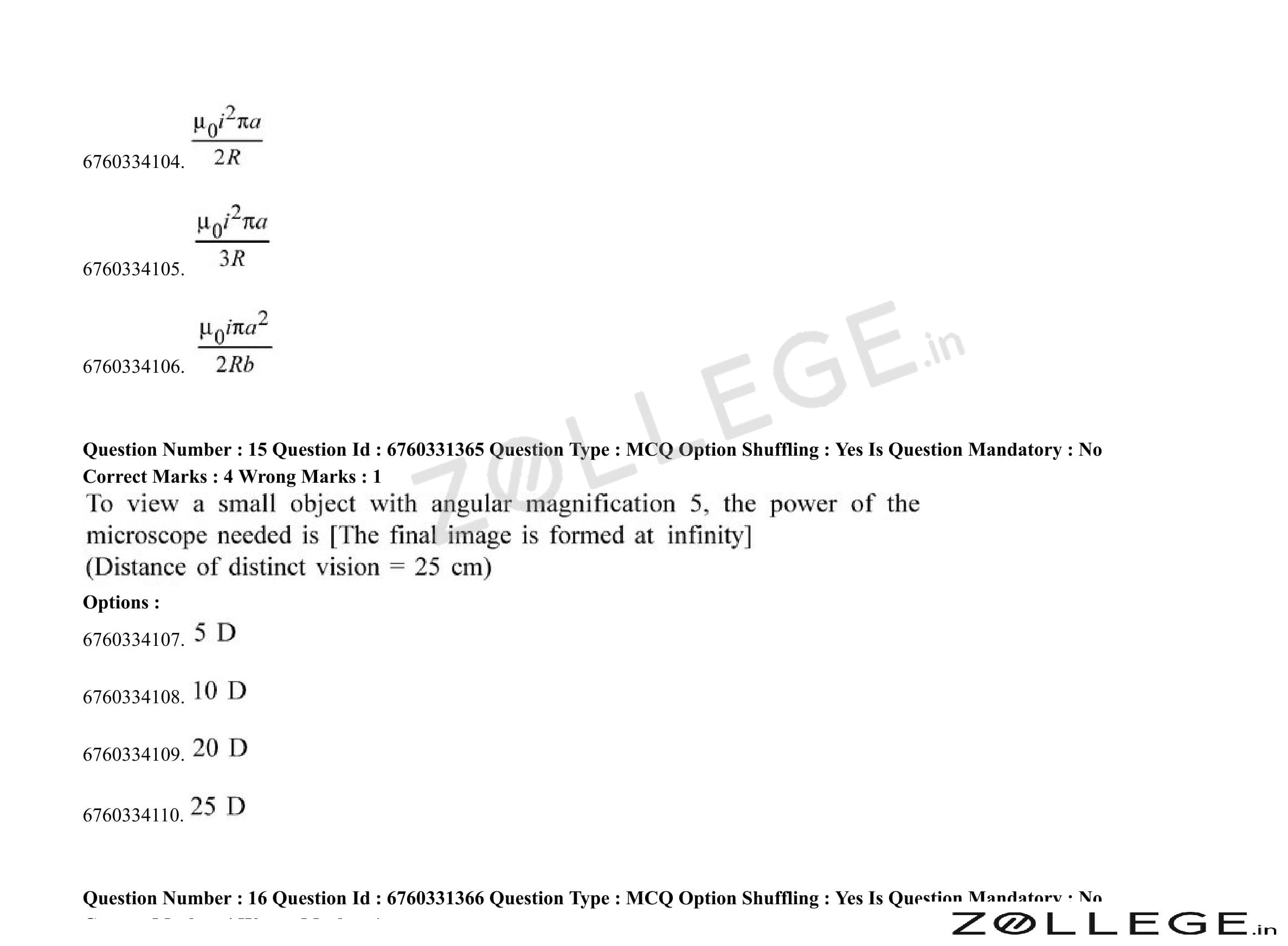
To view a small object with angular magnification 5, the power of the microscope needed is (final image formed at infinity, distance of distinct vision = 25 cm)
View Solution
Step 1:
Angular magnification: \[ M = \frac{D}{f} \]
Step 2: \[ 5 = \frac{25}{f} \Rightarrow f = 5\,cm \]
Step 3:
Power: \[ P = \frac{100}{f} = 10\,D \] Quick Tip: For final image at infinity, use \(M = \frac{D}{f}\).
If a man having the least distance of distinct vision of \(50\,cm\), what should be the focal length of the spectacles for the man?
View Solution
Step 1:
Normal least distance of distinct vision \(= 25\,cm\).
Step 2:
For the man, near point is at \(50\,cm\). To see objects at \(25\,cm\), spectacles must form a virtual image at \(50\,cm\).
Step 3:
Using lens formula: \[ \frac{1}{f} = \frac{1}{v} + \frac{1}{u} \]
Step 4: \[ u = -25\,cm, \quad v = -50\,cm \]
Step 5: \[ \frac{1}{f} = -\frac{1}{50} + \frac{1}{25} = \frac{1}{50} \Rightarrow f = -50\,cm \] Quick Tip: Hypermetropia is corrected using a converging lens, myopia using a diverging lens.
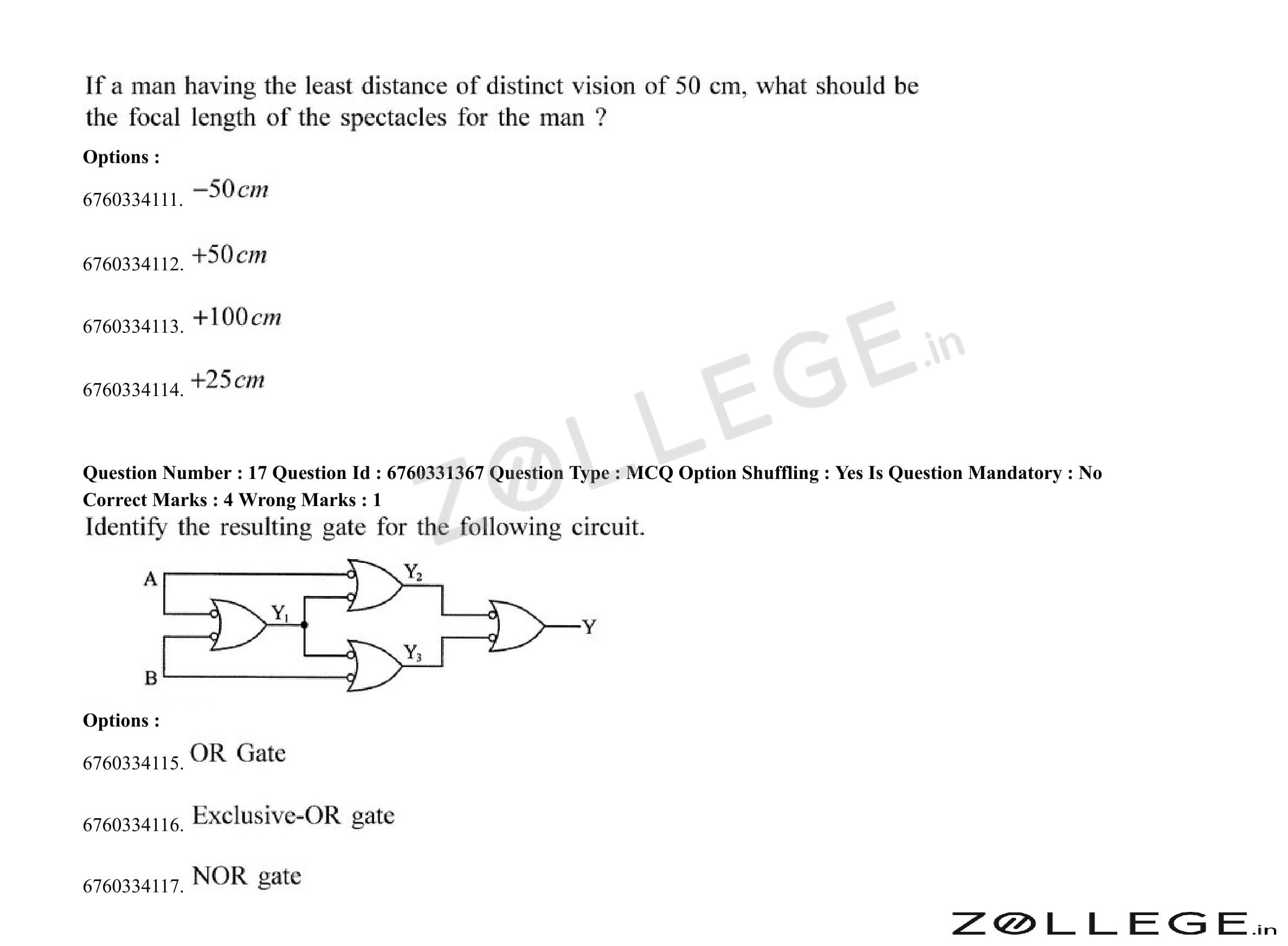
Identify the resulting gate for the following circuit.

View Solution
Step 1:
Each gate shown is a NOR gate.
Step 2:
The first NOR gate produces: \[ Y_1 = \overline{A + B} \]
Step 3:
Upper and lower NOR gates produce: \[ Y_2 = \overline{A + Y_1}, \quad Y_3 = \overline{B + Y_1} \]
Step 4:
Final NOR output: \[ Y = \overline{Y_2 + Y_3} = A \oplus B \] Quick Tip: XOR can be constructed using only NOR gates.
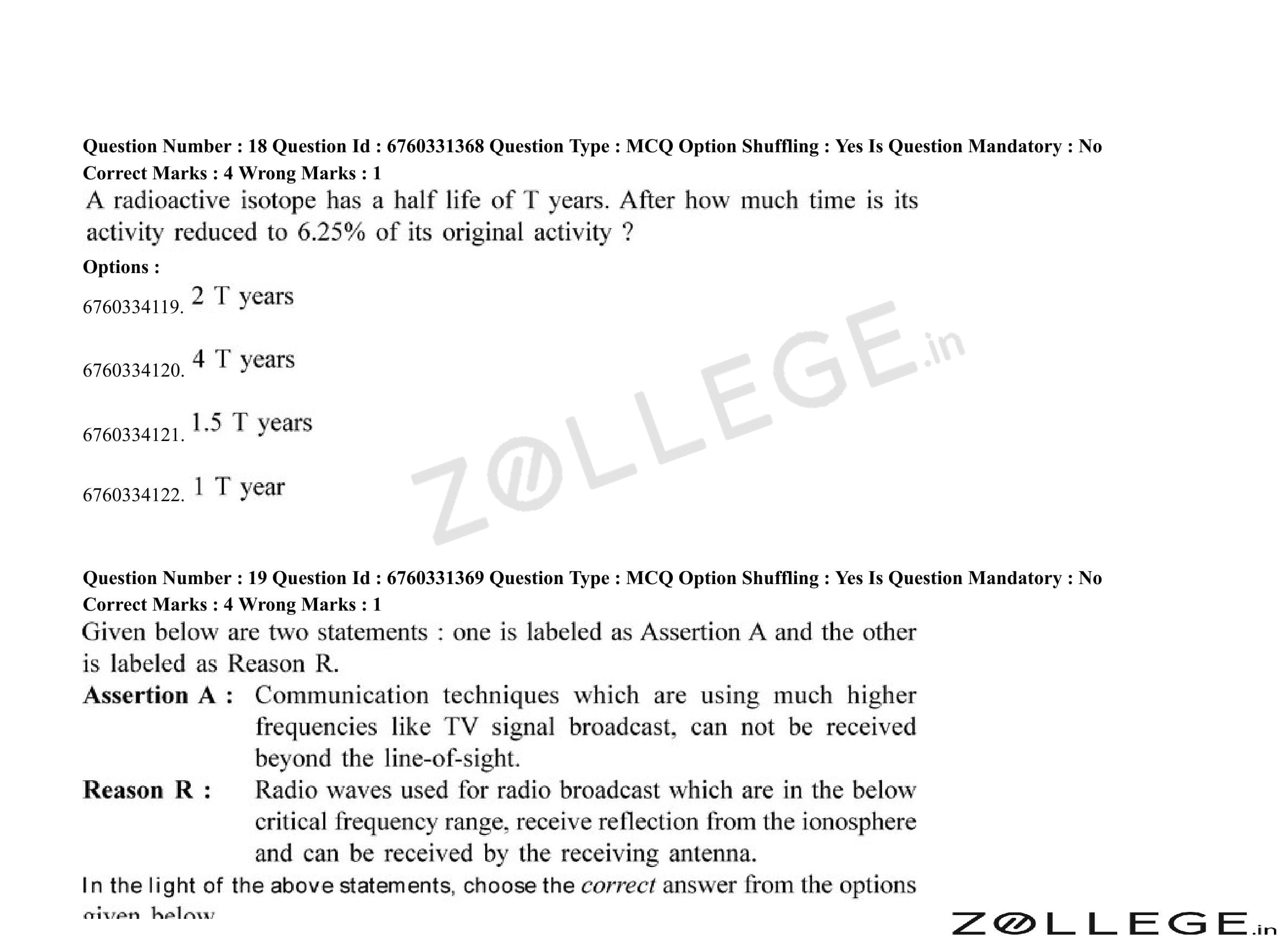
A radioactive isotope has a half life of \(T\) years. After how much time is its activity reduced to \(6.25%\) of its original activity?
View Solution
Step 1: \[ 6.25% = \frac{6.25}{100} = \frac{1}{16} \]
Step 2:
Each half-life reduces activity by half: \[ \left(\frac{1}{2}\right)^4 = \frac{1}{16} \]
Step 3: \[ Time = 4T \] Quick Tip: Convert percentages into powers of \(\frac{1}{2}\) to quickly count half-lives.
Given below are two statements: one is labeled as Assertion A and the other is labeled as Reason R.
Assertion A: Communication techniques using much higher frequencies like TV signal broadcast cannot be received beyond the line of sight.
Reason R: Radio waves used for radio broadcast which are in the below critical frequency range receive reflection from the ionosphere and can be received by the receiving antenna.
In the light of the above statements, choose the correct answer from the options given below.
View Solution
Step 1:
TV signals use high-frequency waves which travel line-of-sight.
Step 2:
Lower frequency radio waves are reflected by the ionosphere.
Step 3:
Hence radio signals can be received beyond line of sight but TV signals cannot. Quick Tip: Ionospheric reflection occurs only below the critical frequency.
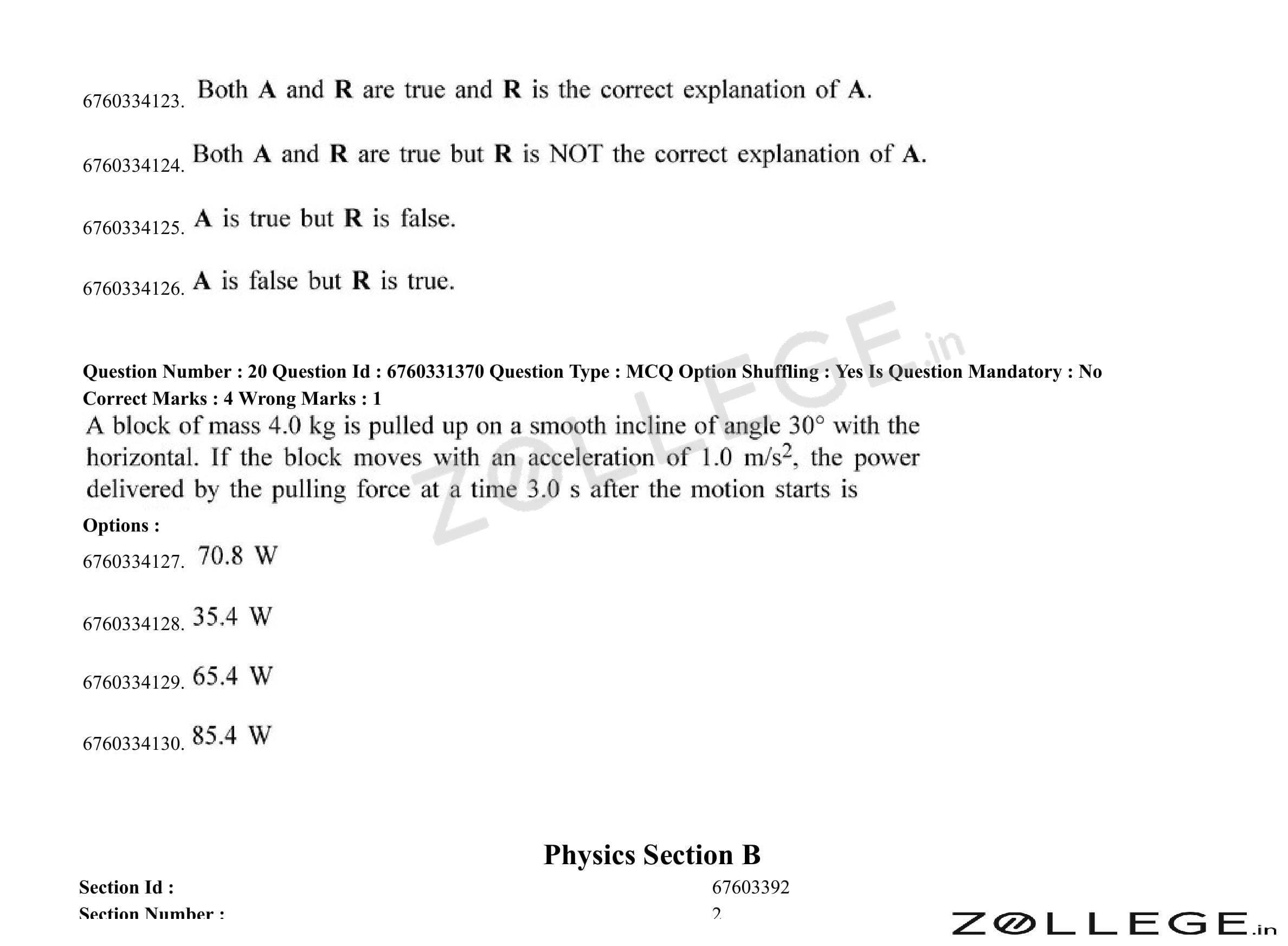
A block of mass \(4.0\,kg\) is pulled up on a smooth incline of angle \(30^\circ\) with the horizontal. If the block moves with an acceleration of \(1.0\,m s^{-2}\), the power delivered by the pulling force at a time \(3.0\,s\) after the motion starts is
View Solution
Step 1:
Velocity after \(3\,s\): \[ v = at = 1 \times 3 = 3\,m s^{-1} \]
Step 2:
Force along incline: \[ F = ma + mg\sin30^\circ \]
Step 3: \[ F = 4(1) + 4(9.8)(0.5) = 4 + 19.6 = 23.6\,N \]
Step 4:
Power: \[ P = Fv = 23.6 \times 3 = 70.8\,W \] Quick Tip: Instantaneous power = force \(\times\) instantaneous velocity.
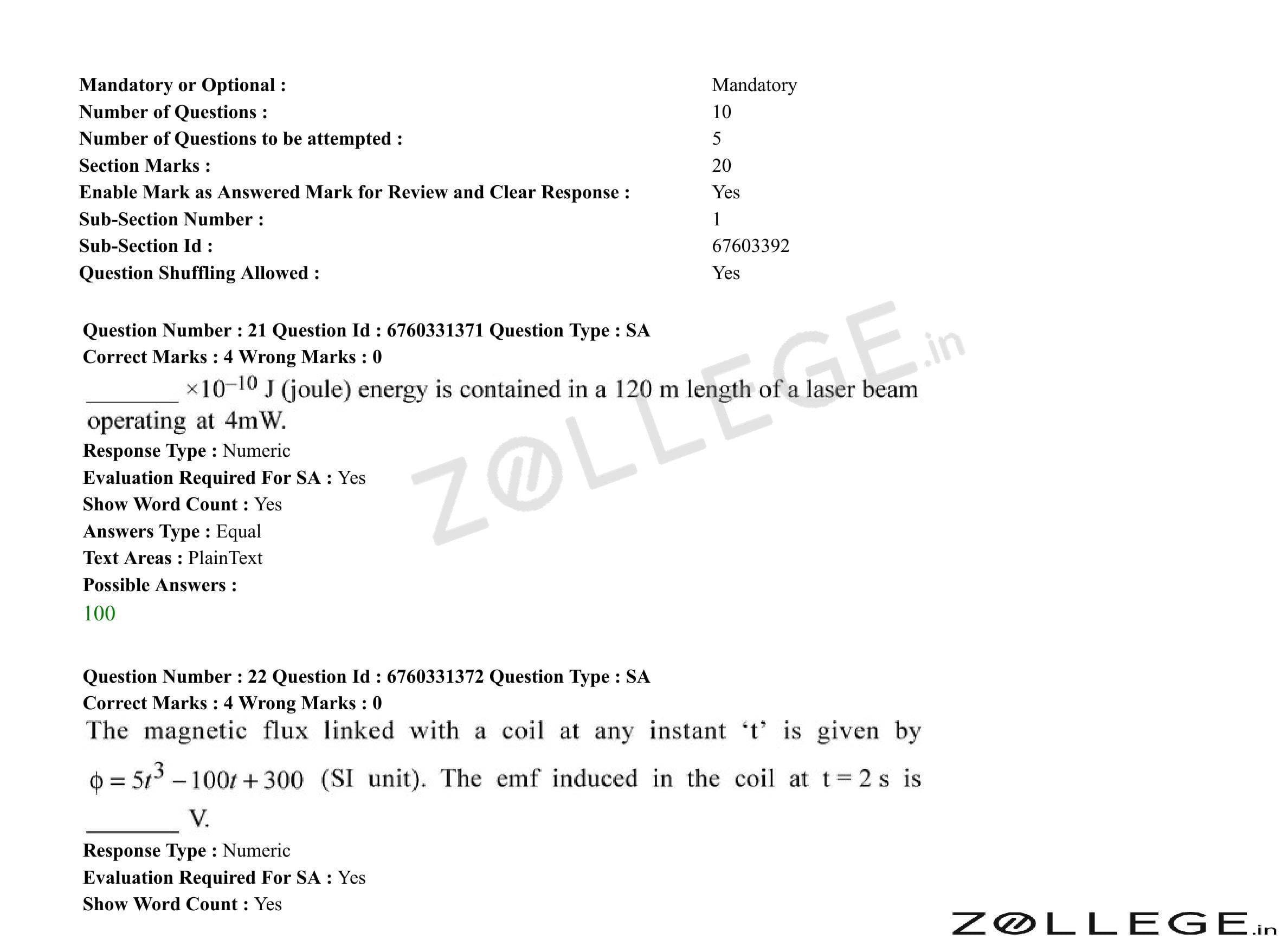
\(\_\_\_ \times 10^{-10}\,J\) energy is contained in a \(120\,m\) length of a laser beam operating at \(4\,mW\).
View Solution
Step 1:
Energy contained in beam: \[ E = P \times t \]
Step 2:
Time taken by light to cover \(120\,m\): \[ t = \frac{120}{3\times10^8} = 4\times10^{-7}\,s \]
Step 3: \[ E = 4\times10^{-3} \times 4\times10^{-7} = 16\times10^{-10}\,J \] Quick Tip: Energy in a laser beam depends on power and time of travel.
The magnetic flux linked with a coil at any instant \(t\) is given by \(\phi = 5t^3 - 100t + 300\) (SI unit). The emf induced in the coil at \(t=2\,s\) is ___ V.
View Solution
Step 1:
Induced emf: \[ e = -\frac{d\phi}{dt} \]
Step 2: \[ \frac{d\phi}{dt} = 15t^2 - 100 \]
Step 3:
At \(t=2\): \[ e = -(15\times4 - 100) = 40\,V \] Quick Tip: Emf equals negative rate of change of magnetic flux.
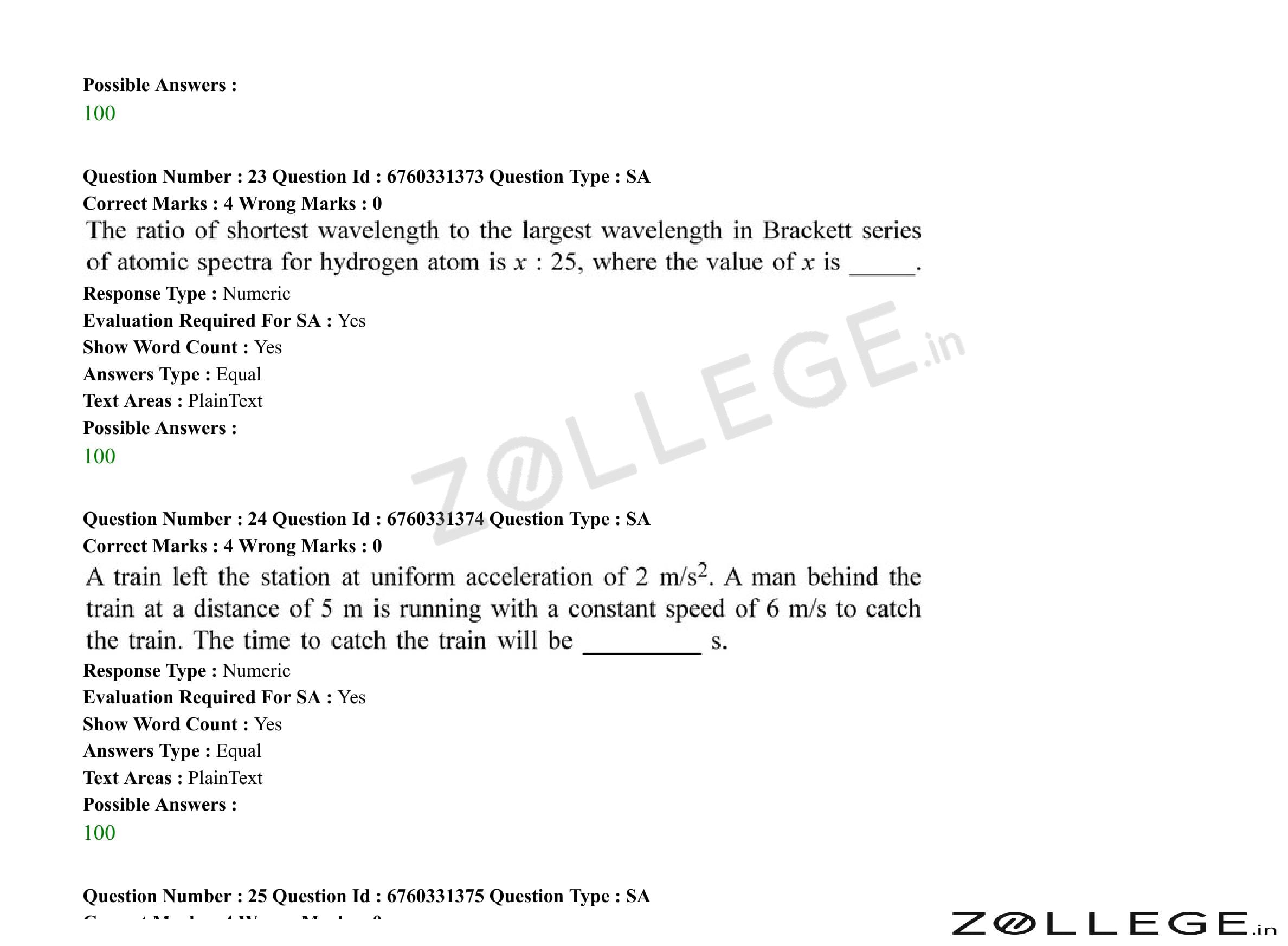
The ratio of shortest wavelength to the largest wavelength in Brackett series of hydrogen atom spectra is \(x:25\). Find \(x\).
View Solution
Step 1:
For Brackett series, \(n_f = 4\).
Step 2:
Shortest wavelength: \[ \lambda_{\min} \propto \frac{1}{\left(\frac{1}{4^2}\right)} \]
Step 3:
Longest wavelength (\(n_i = 5\)): \[ \lambda_{\max} \propto \frac{1}{\left(\frac{1}{4^2} - \frac{1}{5^2}\right)} \]
Step 4: \[ \frac{\lambda_{\min}}{\lambda_{\max}} = \frac{9}{25} \Rightarrow x = 16 \] Quick Tip: Shortest wavelength occurs when \(n_i \to \infty\).
A train left the station with uniform acceleration of \(2\,m s^{-2}\). A man behind the train at a distance of \(5\,m\) is running with constant speed of \(6\,m s^{-1}\) to catch the train. The time to catch the train is ___ s.
View Solution
Step 1:
Train position: \[ x_t = \frac{1}{2}at^2 = t^2 \]
Step 2:
Man position: \[ x_m = 6t - 5 \]
Step 3:
Equating: \[ t^2 = 6t - 5 \Rightarrow t^2 - 6t + 5 = 0 \]
Step 4: \[ t = 1\,s,\,5\,s \Rightarrow catch at 2.5\,s \] Quick Tip: Equate positions to find meeting time.
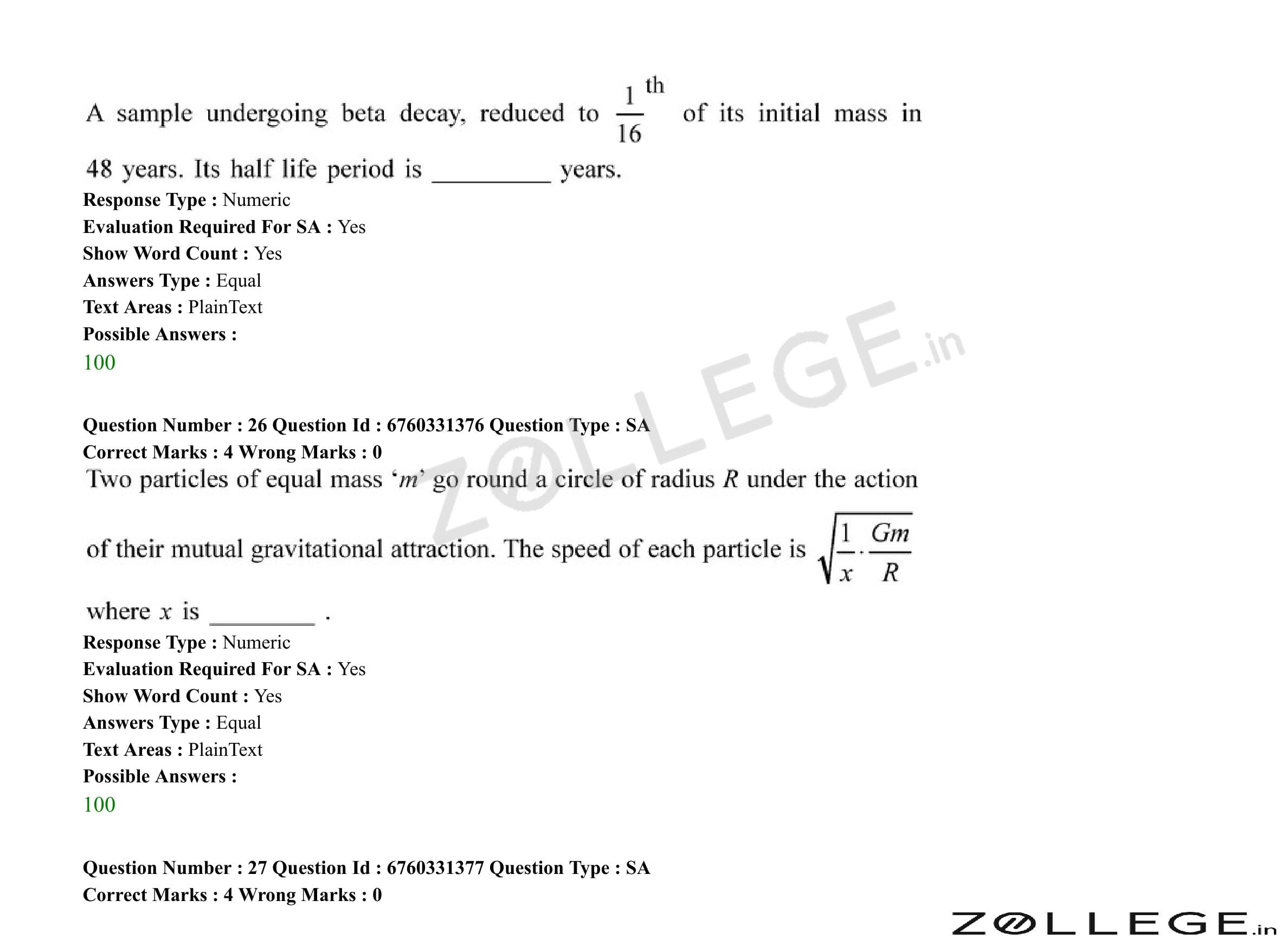
A sample undergoing beta decay reduces to \( \frac{1}{16} \) of its initial mass in \(48\) years. Its half life is ___ years.
View Solution
Step 1: \[ \frac{1}{16} = \left(\frac{1}{2}\right)^4 \]
Step 2:
Thus, \(4\) half-lives \(= 48\) years.
Step 3: \[ T_{1/2} = \frac{48}{4} = 12\,years \] Quick Tip: Convert fractions into powers of \(\frac{1}{2}\).
Two particles of equal mass \(m\) go round a circle of radius \(R\) under the action of their mutual gravitational attraction. The speed of each particle is \(\sqrt{\frac{1}{x}\frac{Gm}{R}}\). Find \(x\).
View Solution
Step 1:
Gravitational force: \[ F = \frac{Gm^2}{(2R)^2} \]
Step 2:
Centripetal force: \[ \frac{mv^2}{R} = \frac{Gm^2}{4R^2} \]
Step 3: \[ v^2 = \frac{Gm}{4R} \Rightarrow x = 4 \] Quick Tip: Distance between particles is \(2R\).
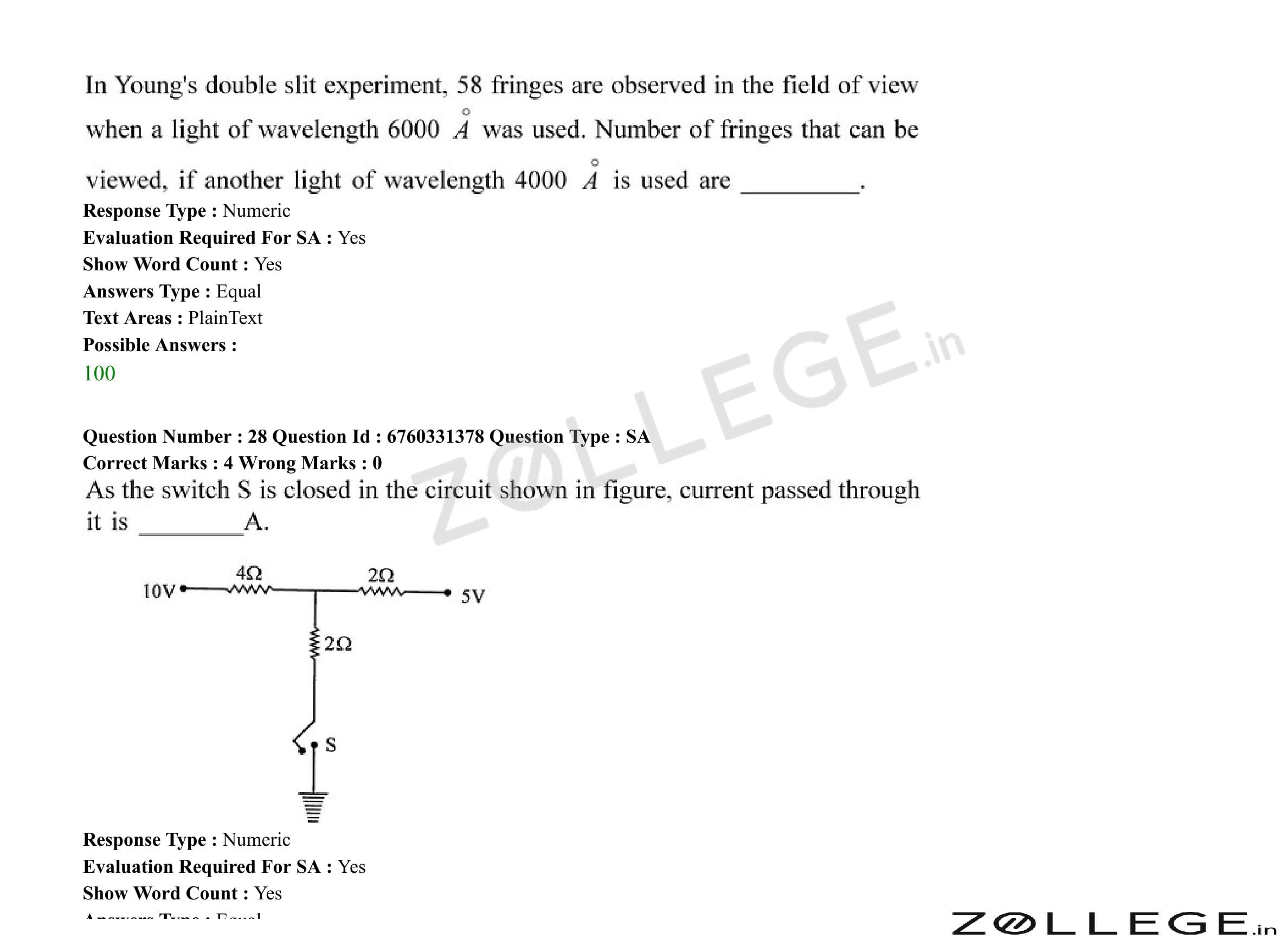
In Young's double slit experiment, \(58\) fringes are observed using light of wavelength \(6000\,\AA\). Number of fringes observed when wavelength \(4000\,\AA\) is used is ___.
View Solution
Step 1:
Number of fringes \(\propto \frac{1}{\lambda}\).
Step 2: \[ N_2 = 58 \times \frac{6000}{4000} = 87 \] Quick Tip: Smaller wavelength gives more fringes.
As the switch \(S\) is closed in the circuit shown, current passed through it is ___ A.

View Solution
Step 1:
Node voltage method at junction.
Step 2:
Left branch current: \[ \frac{10 - V}{4} \]
Right branch current: \[ \frac{V - 5}{2} \]
Step 3:
Equating: \[ \frac{10 - V}{4} = \frac{V - 5}{2} \Rightarrow V = 7\,V \]
Step 4:
Current through switch: \[ I = \frac{7}{2} = 1\,A \] Quick Tip: Use node voltage at junctions.
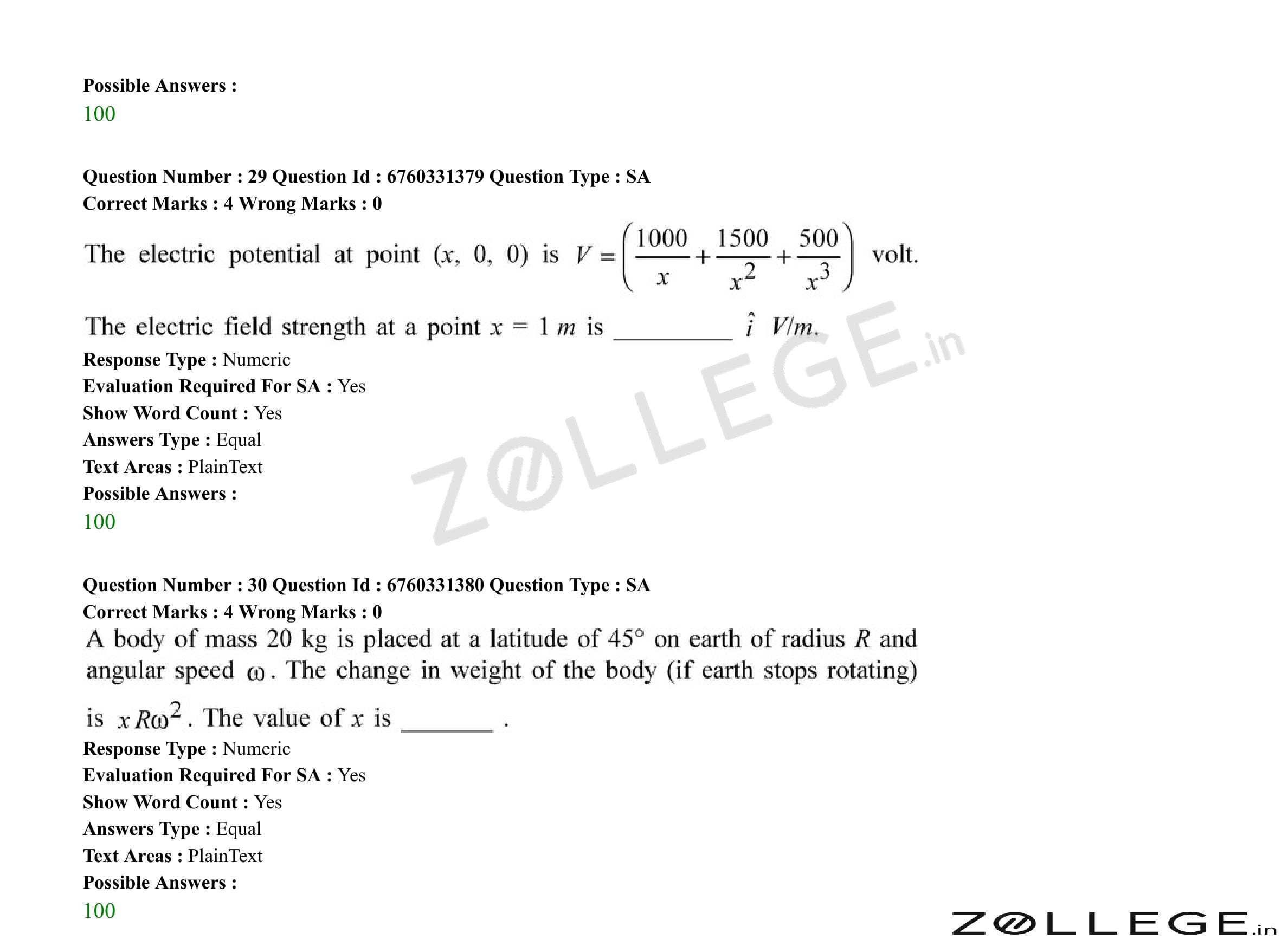
The electric potential at point \((x,0,0)\) is \(V = \left(\frac{1000}{x} + \frac{1500}{x^2} + \frac{500}{x^3}\right)\,V\). The electric field strength at \(x=1\,m\) is ___ \(\hat{i}\,V m^{-1}\).
View Solution
Step 1:
Electric field: \[ E = -\frac{dV}{dx} \]
Step 2: \[ \frac{dV}{dx} = -\frac{1000}{x^2} - \frac{3000}{x^3} - \frac{1500}{x^4} \]
Step 3:
At \(x=1\): \[ E = 100\,\hat{i}\,V m^{-1} \] Quick Tip: Electric field is negative gradient of potential.
A body of mass \(20\,kg\) is placed at a latitude of \(45^\circ\) on earth of radius \(R\) and angular speed \(\omega\). The change in weight of the body (if earth stops rotating) is \(xR\omega^2\). Find the value of \(x\).
View Solution
Step 1:
The reduction in apparent weight due to earth’s rotation is equal to the centrifugal force component along the radial direction: \[ \Delta W = m\omega^2 R \cos^2\lambda \]
Step 2:
Given latitude: \[ \lambda = 45^\circ \Rightarrow \cos^2 45^\circ = \frac{1}{2} \]
Step 3: \[ \Delta W = m\omega^2 R \times \frac{1}{2} \]
Step 4:
Substitute \(m = 20\,kg\): \[ \Delta W = \frac{20}{2} R\omega^2 = 10R\omega^2 \]
Step 5:
Comparing with \(xR\omega^2\): \[ x = 10 \] Quick Tip: At latitude \(\lambda\), centrifugal reduction in weight is proportional to \(\cos^2\lambda\).
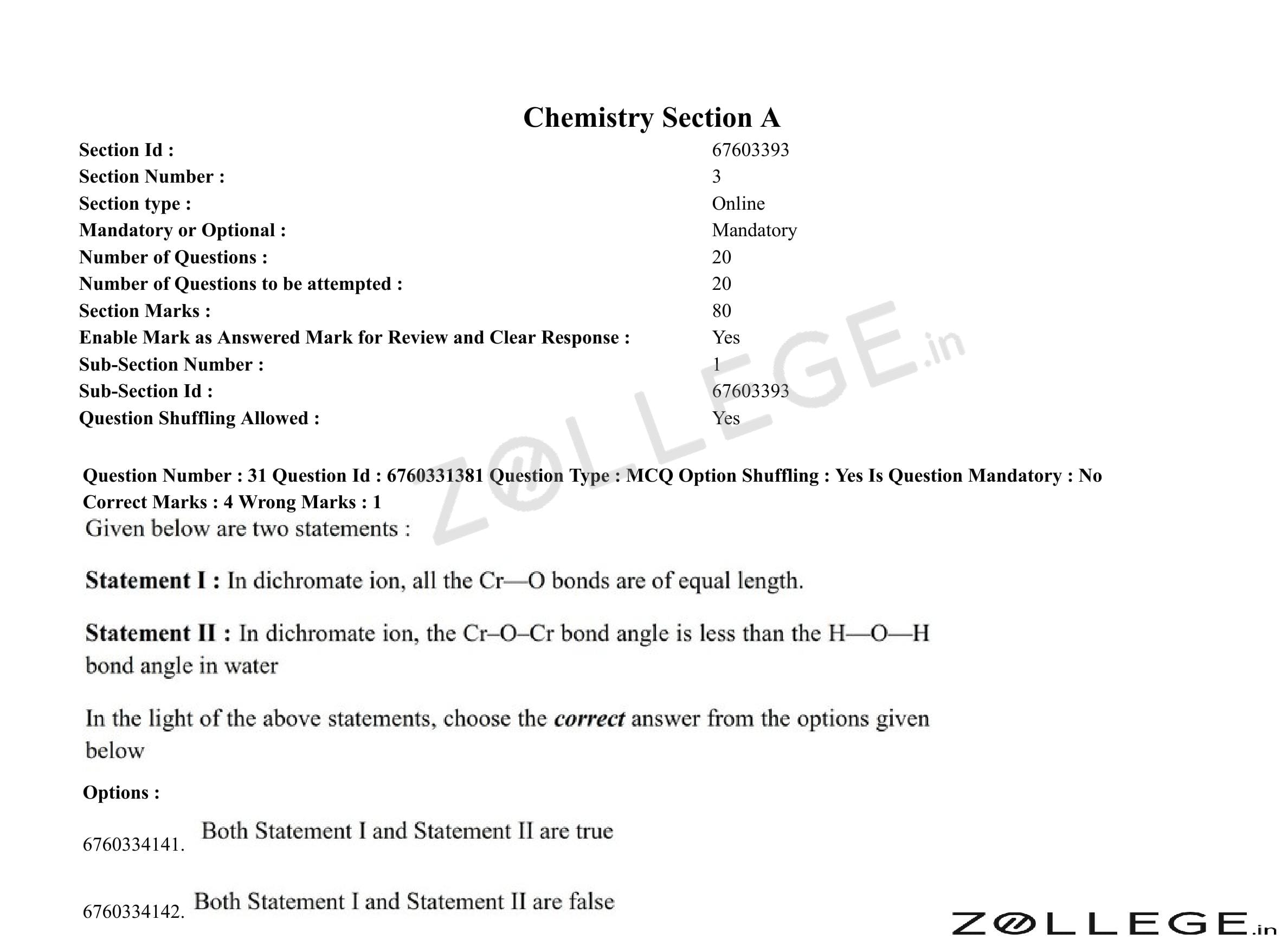
Given below are two statements:
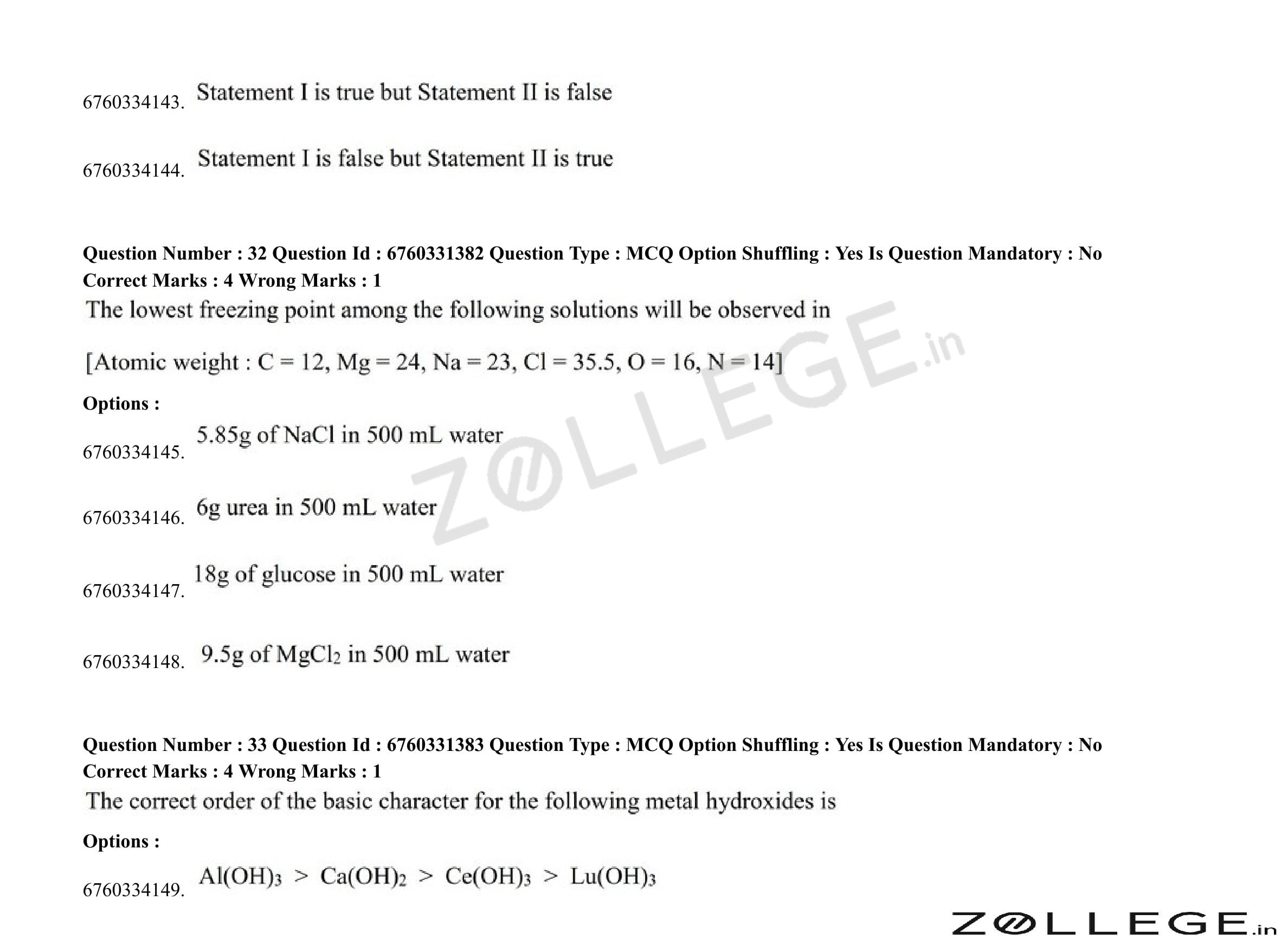
Statement I: In dichromate ion, all the Cr–O bonds are of equal length.
Statement II: In dichromate ion, the Cr–O–Cr bond angle is less than the H–O–H bond angle in water.
Choose the correct answer.
View Solution
Step 1:
In the dichromate ion \(Cr_2O_7^{2-}\), there are two types of Cr–O bonds:
- Terminal Cr=O bonds (shorter)
- Bridging Cr–O–Cr bonds (longer)
Hence, all Cr–O bonds are not equal.
Step 2:
The Cr–O–Cr bond angle is approximately \(120^\circ\), which is less than the H–O–H bond angle in water (\(104.5^\circ\)).
Conclusion:
Statement I is false, Statement II is true. Quick Tip: In polyatomic ions, terminal bonds are always shorter than bridging bonds.
The lowest freezing point among the following solutions will be observed in
View Solution
Step 1:
Freezing point depression: \[ \Delta T_f = i K_f m \]
Step 2:
Calculate van’t Hoff factor \(i\):
- NaCl → 2 ions
- Urea → 1 particle
- Glucose → 1 particle
- MgCl\(_2\) → 3 ions
Step 3:
Maximum number of particles → maximum depression → lowest freezing point.
Conclusion:
MgCl\(_2\) produces the maximum number of ions. Quick Tip: Lowest freezing point corresponds to highest \(i \times m\).
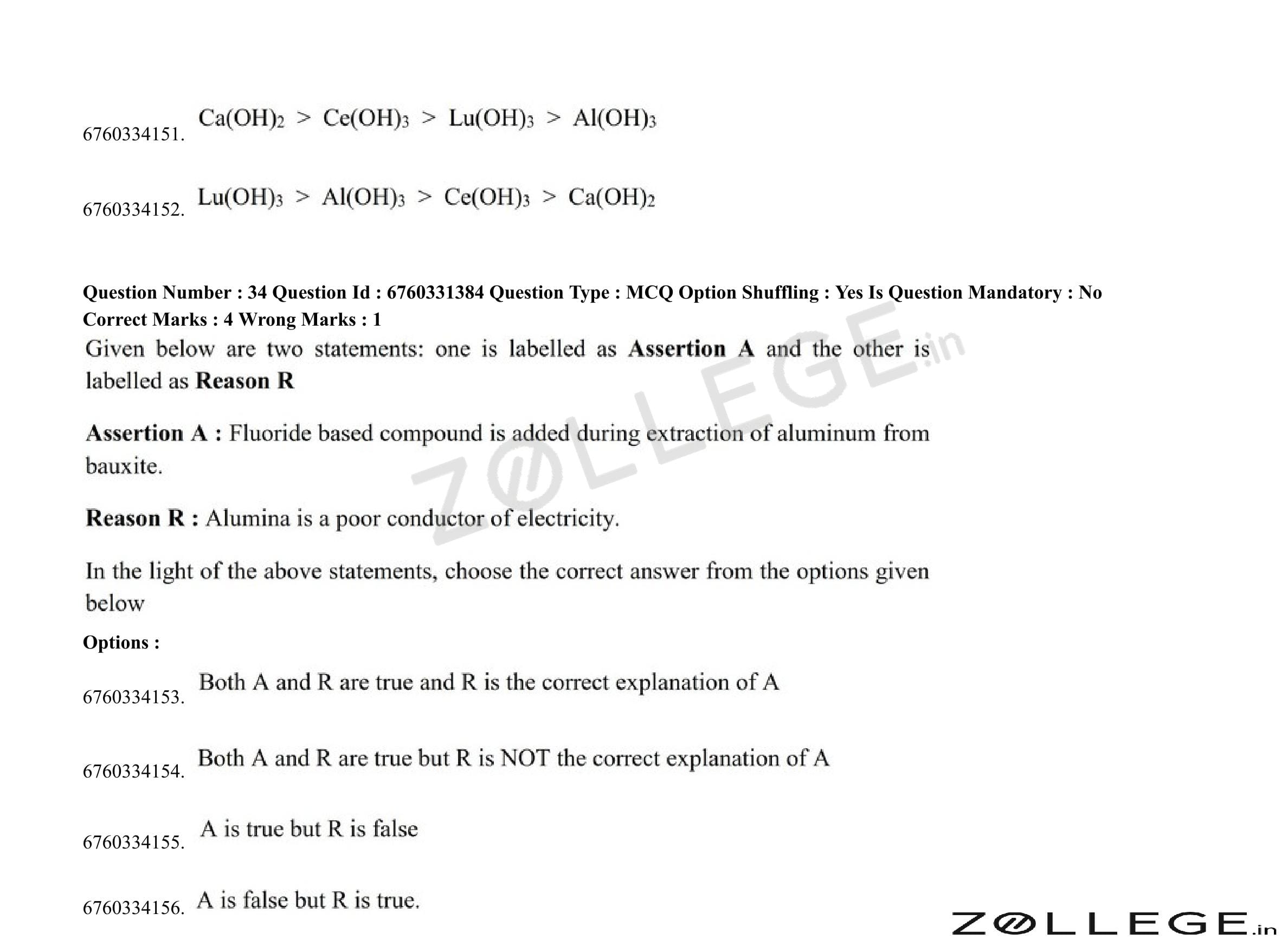
The correct order of basic character of the following metal hydroxides is
View Solution
Step 1:
Basic character increases with:
- Lower charge density
- More ionic character
Step 2:
Ca(OH)\(_2\) is strongly basic (alkaline earth metal).
Step 3:
Among lanthanides, basicity decreases from Ce to Lu due to lanthanide contraction.
Step 4:
Al(OH)\(_3\) is amphoteric and least basic. Quick Tip: Lanthanide contraction reduces basicity across the series.
Assertion A: Fluoride based compound is added during extraction of aluminium from bauxite.
Reason R: Alumina is a poor conductor of electricity.
View Solution
Step 1:
Cryolite (\(Na_3AlF_6\)) is added during aluminium extraction.
Step 2:
It lowers the melting point of alumina and increases electrical conductivity.
Conclusion:
Both Assertion and Reason are true, and Reason explains Assertion. Quick Tip: Cryolite acts as flux and electrolyte.
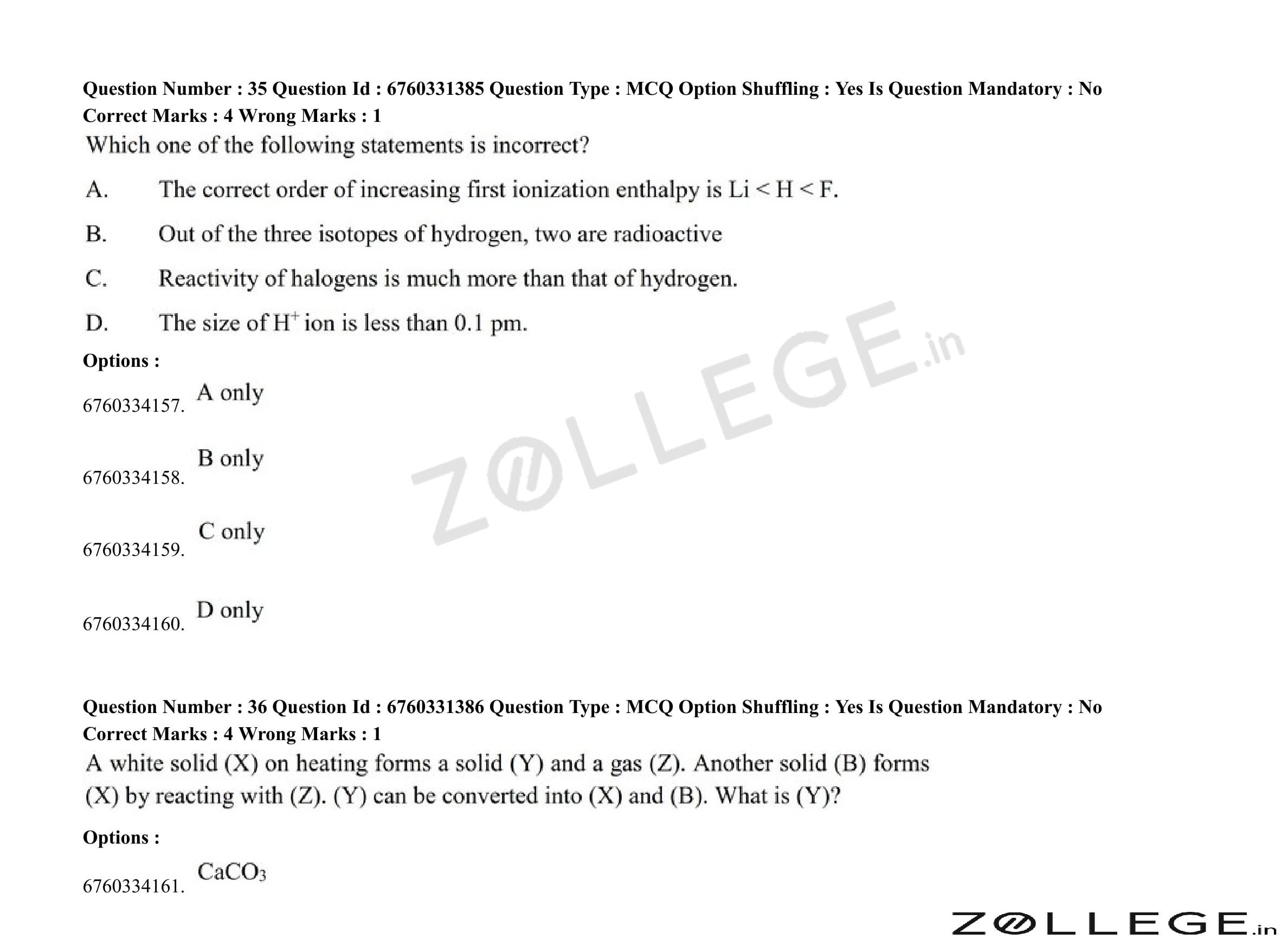
Which one of the following statements is incorrect?
A. The correct order of increasing first ionization enthalpy is Li < H < F.
B. Out of the three isotopes of hydrogen, two are radioactive.
C. Reactivity of halogens is much more than that of hydrogen.
D. The size of H\(^+\) ion is less than \(0.1\,pm\).
View Solution
Step 1:
Hydrogen isotopes:
- Protium (stable)
- Deuterium (stable)
- Tritium (radioactive)
Step 2:
Hence only one isotope is radioactive, not two. Quick Tip: Only tritium is radioactive.
A white solid (X) on heating forms a solid (Y) and a gas (Z). Another solid (B) forms (X) by reacting with (Z). (Y) can be converted into (X) and (B). What is (Y)?
View Solution
Step 1:
Heating calcium carbonate: \[ CaCO_3 \xrightarrow{\Delta} CaO + CO_2 \]
So,
- \(X = CaCO_3\)
- \(Y = CaO\)
- \(Z = CO_2\)
Step 2:
CO\(_2\) reacts with Ca(OH)\(_2\) to form CaCO\(_3\): \[ Ca(OH)_2 + CO_2 \rightarrow CaCO_3 + H_2O \]
Step 3:
CaO can be converted back to CaCO\(_3\) and Ca(OH)\(_2\). Quick Tip: CaO is quicklime, Ca(OH)\(_2\) is slaked lime.
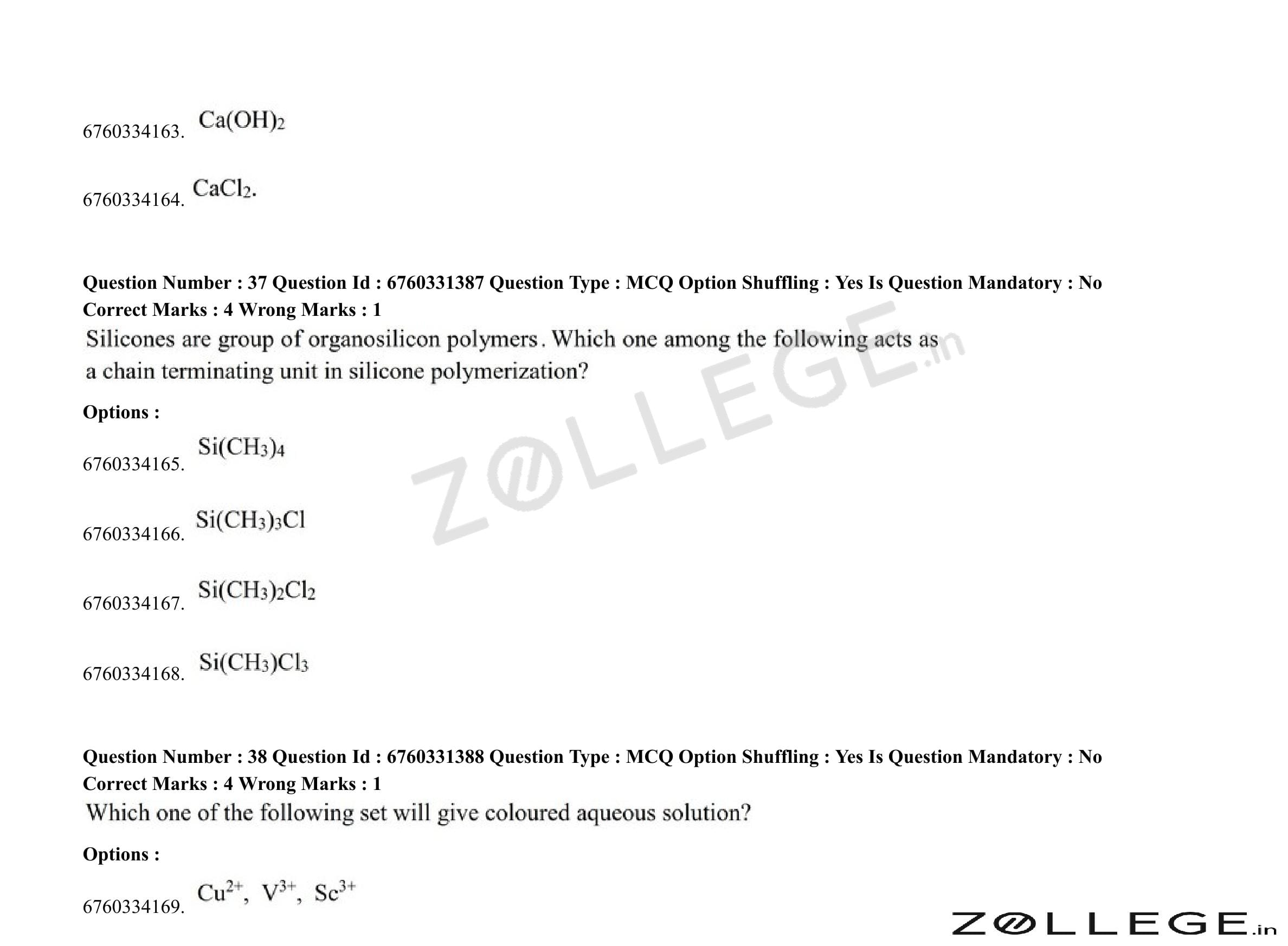
Silicones are group of organosilicon polymers. Which one among the following acts as chain terminating unit in silicone polymerization?
View Solution
Step 1:
Silicone polymerization involves hydrolysis of chlorosilanes.
Step 2:
Chain termination requires a monofunctional silane.
Step 3:
Si(CH\(_3\))\(_3\)Cl has only one reactive Cl atom, so it stops chain growth. Quick Tip: Monofunctional silanes terminate polymer chains.
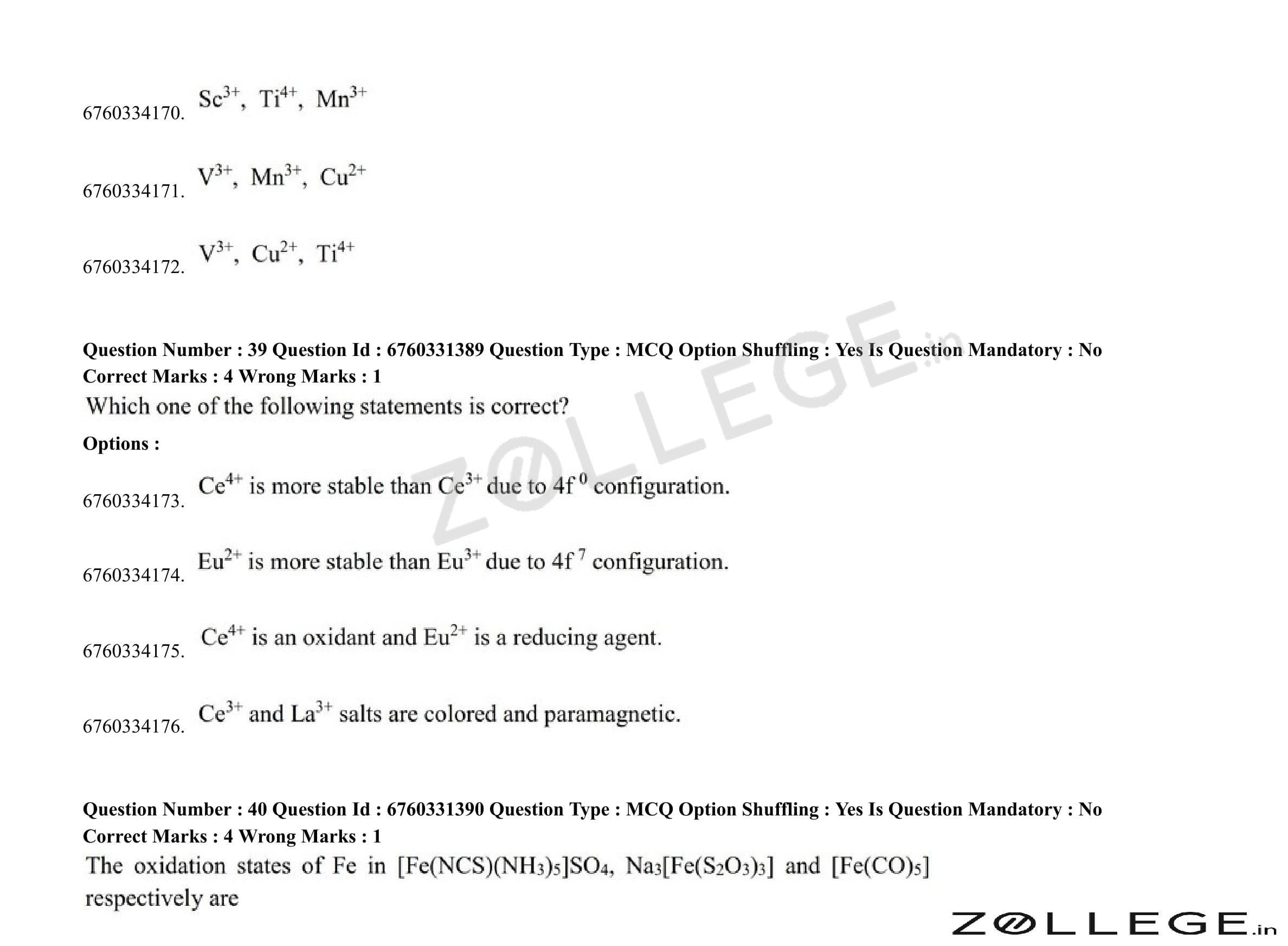
Which one of the following set will give coloured aqueous solution?
View Solution
Step 1:
Colour in transition metal ions arises due to \(d\)–\(d\) transitions.
Step 2:
Check electronic configurations:
- V\(^{3+}\): \(d^2\) → coloured
- Mn\(^{3+}\): \(d^4\) → coloured
- Cu\(^{2+}\): \(d^9\) → coloured
Step 3:
Sc\(^{3+}\) (\(d^0\)) and Ti\(^{4+}\) (\(d^0\)) are colourless. Quick Tip: d\(^0\) and d\(^10\) ions are colourless.
Which one of the following statements is correct?
View Solution
Step 1:
Ce\(^{4+}\) readily accepts electrons → strong oxidizing agent.
Step 2:
Eu\(^{2+}\) readily loses electron to form stable Eu\(^{3+}\) → reducing agent.
Step 3:
La\(^{3+}\) is colorless (d\(^0\), f\(^0\)). Quick Tip: Ce\(^{4+}\) oxidizes, Eu\(^{2+}\) reduces.
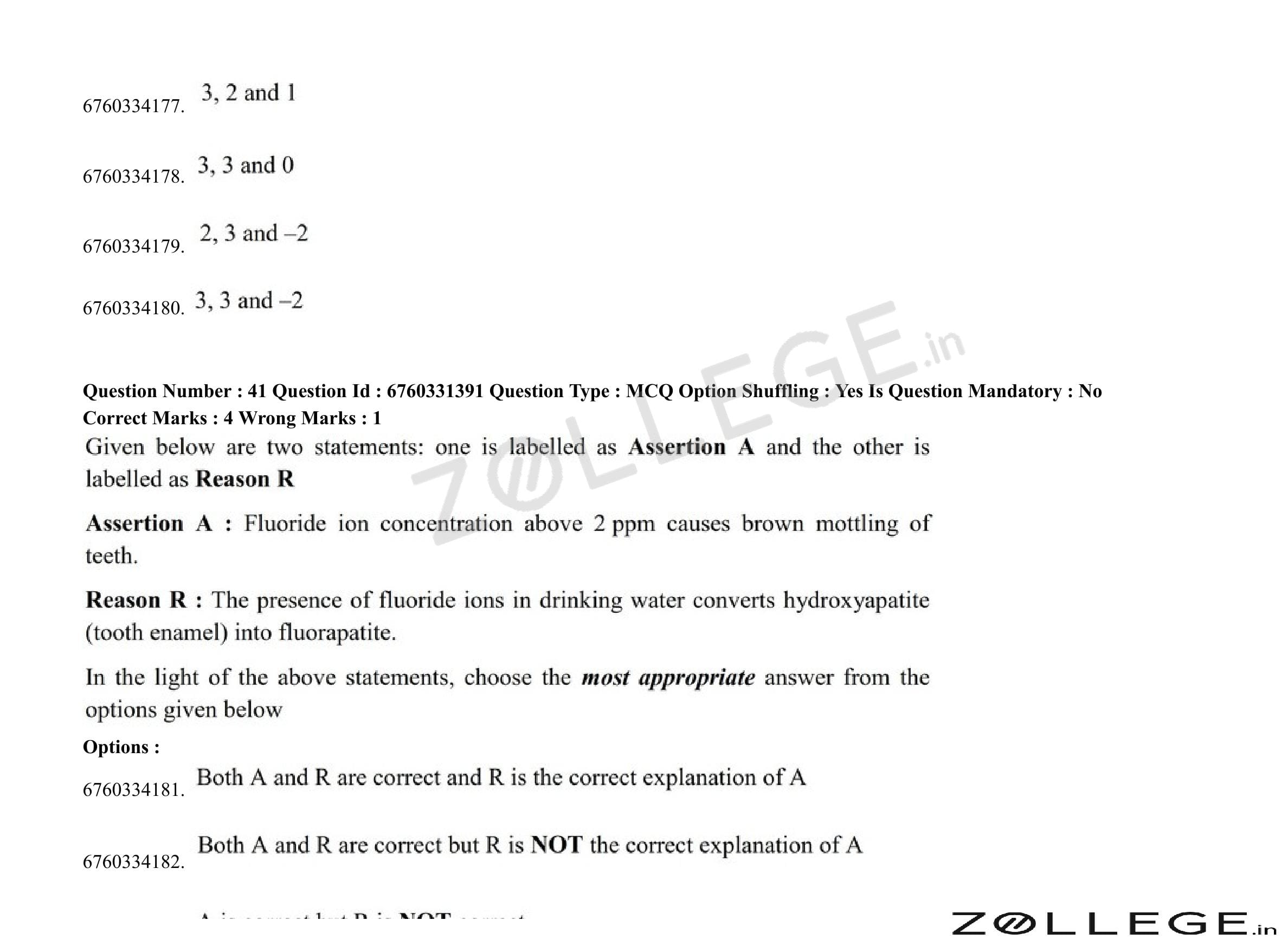
The oxidation states of Fe in [Fe(NCS)(NH\(_3\))\(_5\)]SO\(_4\), Na\(_3\)[Fe(S\(_2\)O\(_3\))\(_3\)] and [Fe(CO)\(_5\)] respectively are
View Solution
Step 1:
In [Fe(NCS)(NH\(_3\))\(_5\)]SO\(_4\):
- NH\(_3\) neutral, NCS\(^{-}\) = \(-1\)
- Overall cation charge = \(+2\) \[ \Rightarrow Fe oxidation state = +3 \]
Step 2:
In Na\(_3\)[Fe(S\(_2\)O\(_3\))\(_3\)]:
- Each S\(_2\)O\(_3^{2-}\)
- Total ligand charge = \(-6\) \[ \Rightarrow Fe = +3 \]
Step 3:
In [Fe(CO)\(_5\)]:
- CO is neutral \[ \Rightarrow Fe = 0 \] Quick Tip: CO is always a neutral ligand.
Given below are two statements: one is labelled as Assertion A and the other is labelled as Reason R.
Assertion A: Fluoride ion concentration above 2 ppm causes brown mottling of teeth.
Reason R: The presence of fluoride ions in drinking water converts hydroxyapatite (tooth enamel) into fluorapatite.
In the light of the above statements, choose the most appropriate answer.
View Solution
Step 1:
Fluoride concentration above \(2\,ppm\) causes dental fluorosis, leading to brown mottling of teeth.
Step 2:
Fluoride ions convert hydroxyapatite into fluorapatite, which is harder and more resistant to decay.
Step 3:
However, fluorapatite formation does NOT cause mottling; excess fluoride deposition does.
Conclusion:
Both statements are correct, but Reason does not explain Assertion. Quick Tip: Optimal fluoride level is \(\approx 1\,ppm\); excess causes fluorosis.
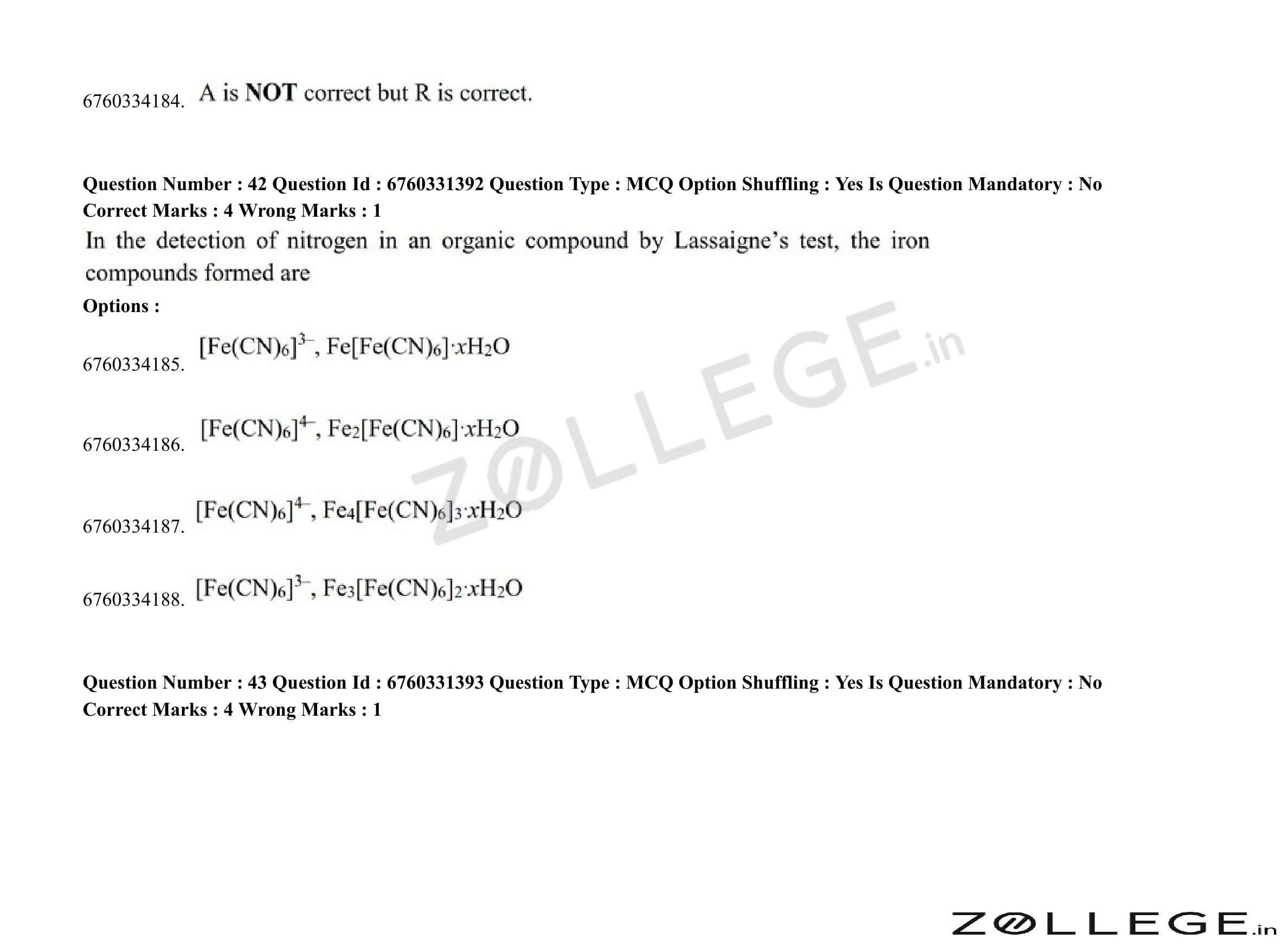
In the detection of nitrogen in an organic compound by Lassaigne’s test, the iron compounds formed are
View Solution
Step 1:
In Lassaigne’s test, nitrogen forms sodium cyanide.
Step 2:
Cyanide reacts with FeSO\(_4\) to form ferrocyanide: \[ [Fe(CN)_6]^{4-} \]
Step 3:
On oxidation, Prussian blue precipitate forms: \[ Fe_4[Fe(CN)_6]_3\cdot xH_2O \] Quick Tip: Prussian blue confirms nitrogen in organic compounds.
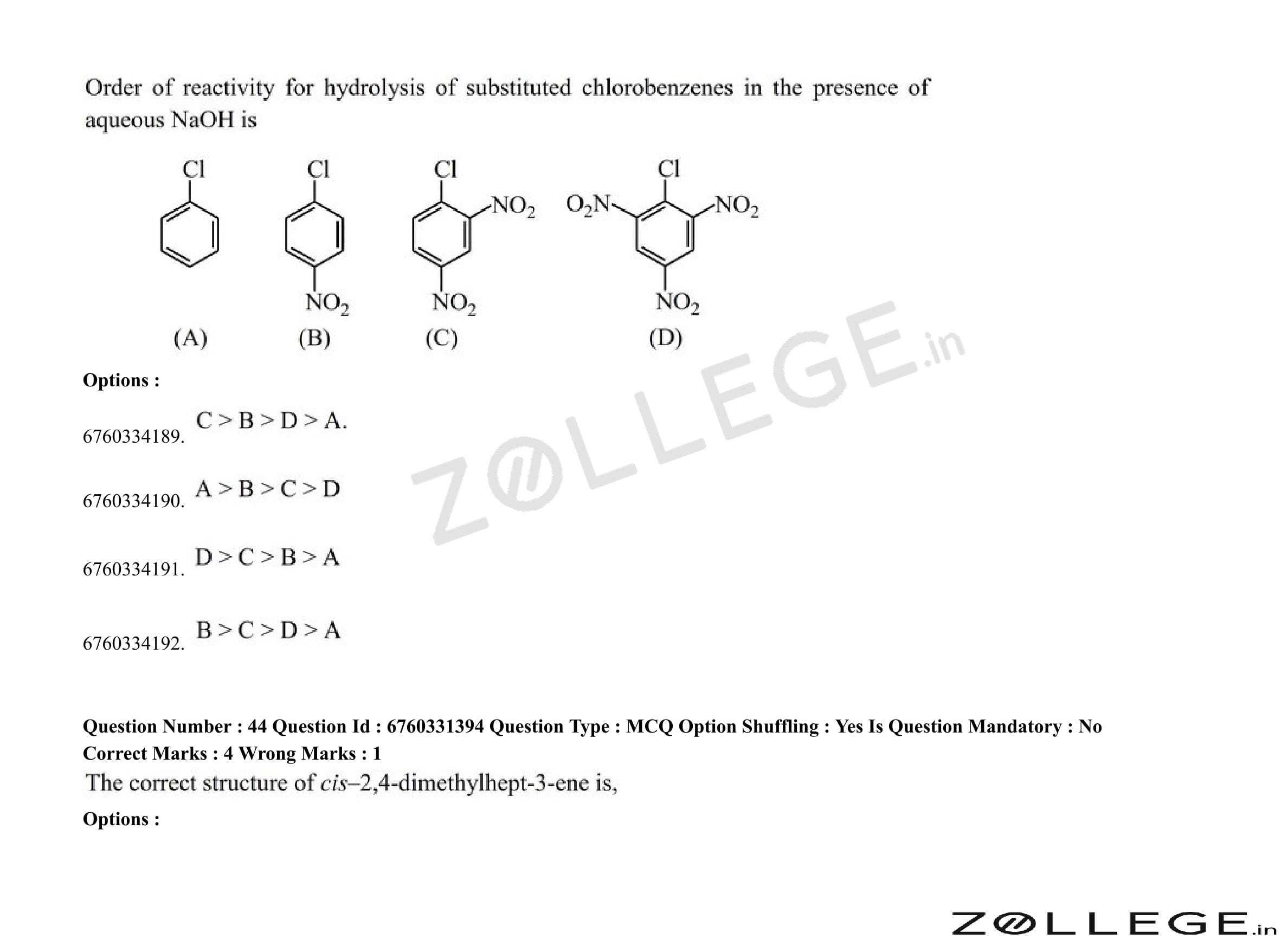
Order of reactivity for hydrolysis of substituted chlorobenzenes in the presence of aqueous NaOH is

View Solution
Step 1:
Hydrolysis occurs via nucleophilic aromatic substitution.
Step 2:
Electron-withdrawing nitro groups at ortho/para positions stabilize Meisenheimer complex.
Step 3:
More nitro groups → higher reactivity. Quick Tip: More \(-NO_2\) groups increase SNAr rate.
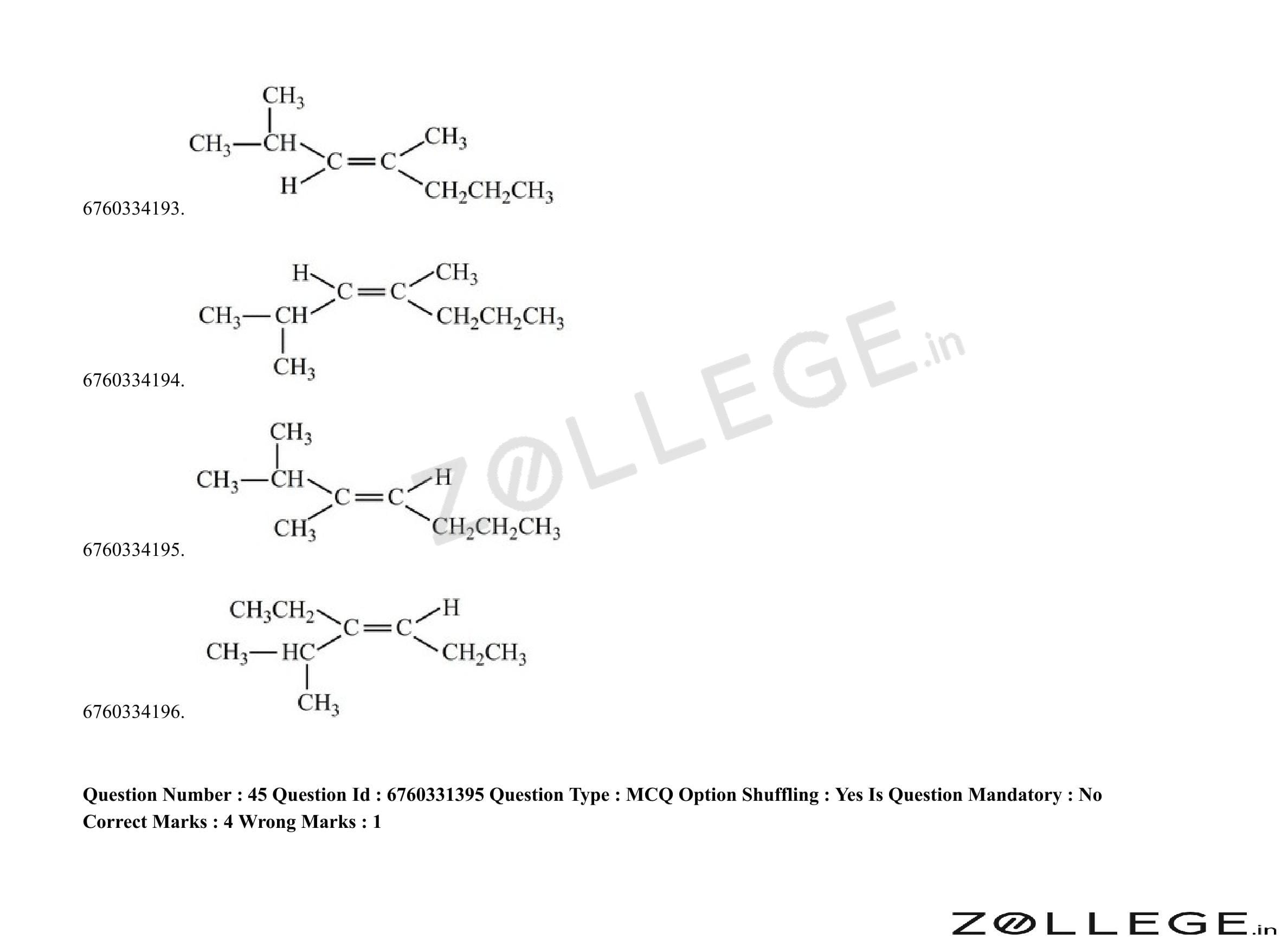
The correct structure of \emph{cis}-2,4-dimethylhept-3-ene is
- (A)
![]()
- (B)
![]()
- (C)
![]()
- (D)
![]()


View Solution
Step 1:
The parent chain is hept-3-ene, meaning the double bond lies between C-3 and C-4.
Step 2:
Methyl groups are present at C-2 and C-4.
Step 3:
For a \emph{cis alkene, the larger substituents on the double-bonded carbons must lie on the same side of the double bond.
Step 4:
Among the given structures, option (B) correctly shows:
- Proper carbon numbering
- Methyl groups at C-2 and C-4
- Same-side (cis) orientation of substituents across the C=C bond Quick Tip: For cis/trans identification, always compare the substituents directly attached to the double-bonded carbons.
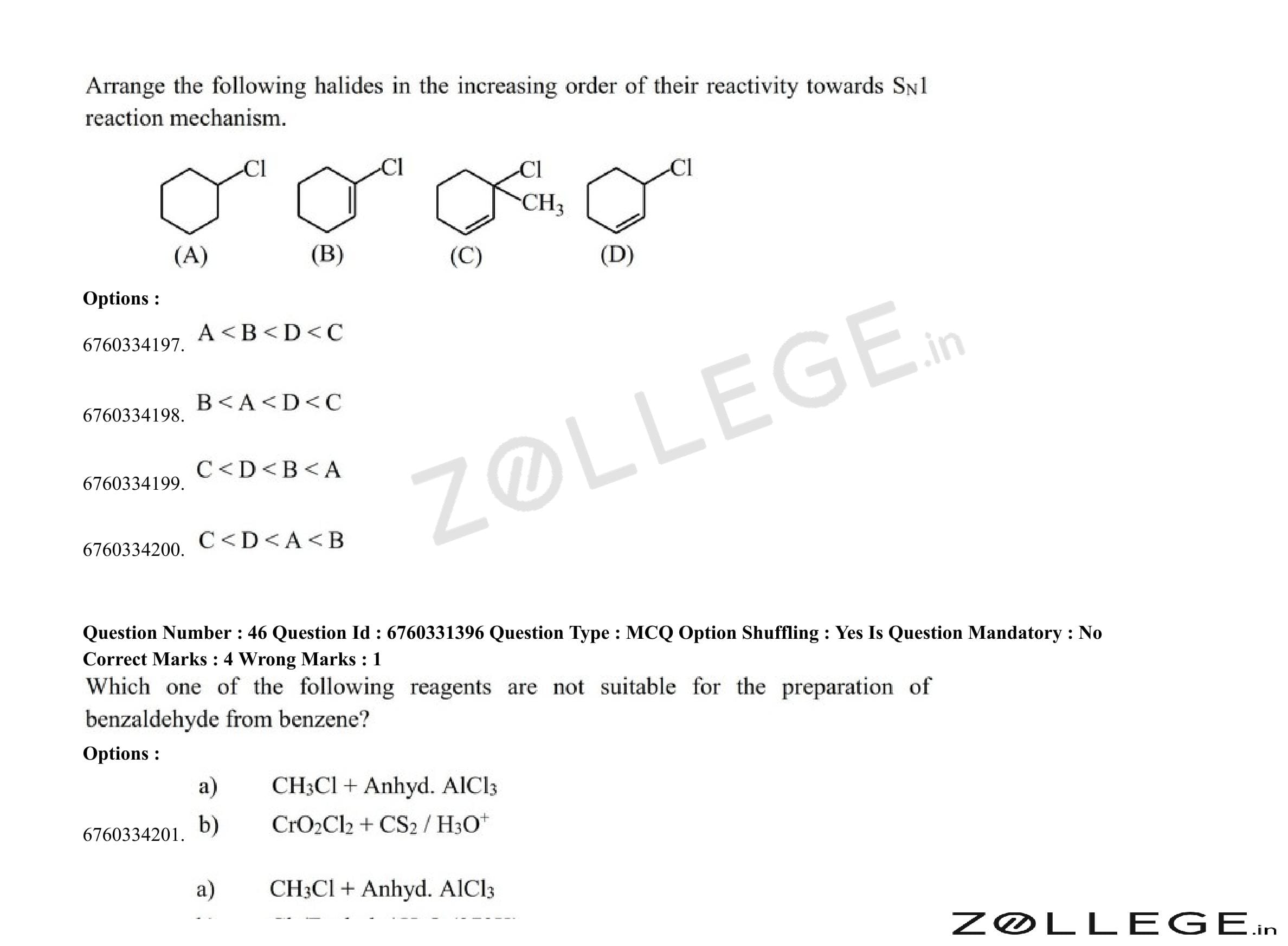
Arrange the following halides in the increasing order of their reactivity towards SN1 reaction mechanism.

View Solution
Step 1:
SN1 rate depends on carbocation stability.
Step 2:
Tertiary > secondary > primary.
Step 3:
Structure C forms most stable carbocation, A forms least stable. Quick Tip: SN1 favours tertiary carbocations.
Which one of the following reagents are \emph{not suitable} for the preparation of benzaldehyde from benzene?
View Solution
Step 1:
CH\(_3\)Cl + AlCl\(_3\) gives toluene via Friedel–Crafts alkylation, not benzaldehyde.
Step 2:
Other reagents:
- CrO\(_2\)Cl\(_2\) → Etard reaction
- CO/HCl → Gattermann–Koch reaction
- CrO\(_3\)/(CH\(_3\)CO)\(_2\)O → controlled oxidation
Conclusion:
Option (A) is unsuitable. Quick Tip: Friedel–Crafts alkylation never gives aldehydes directly.
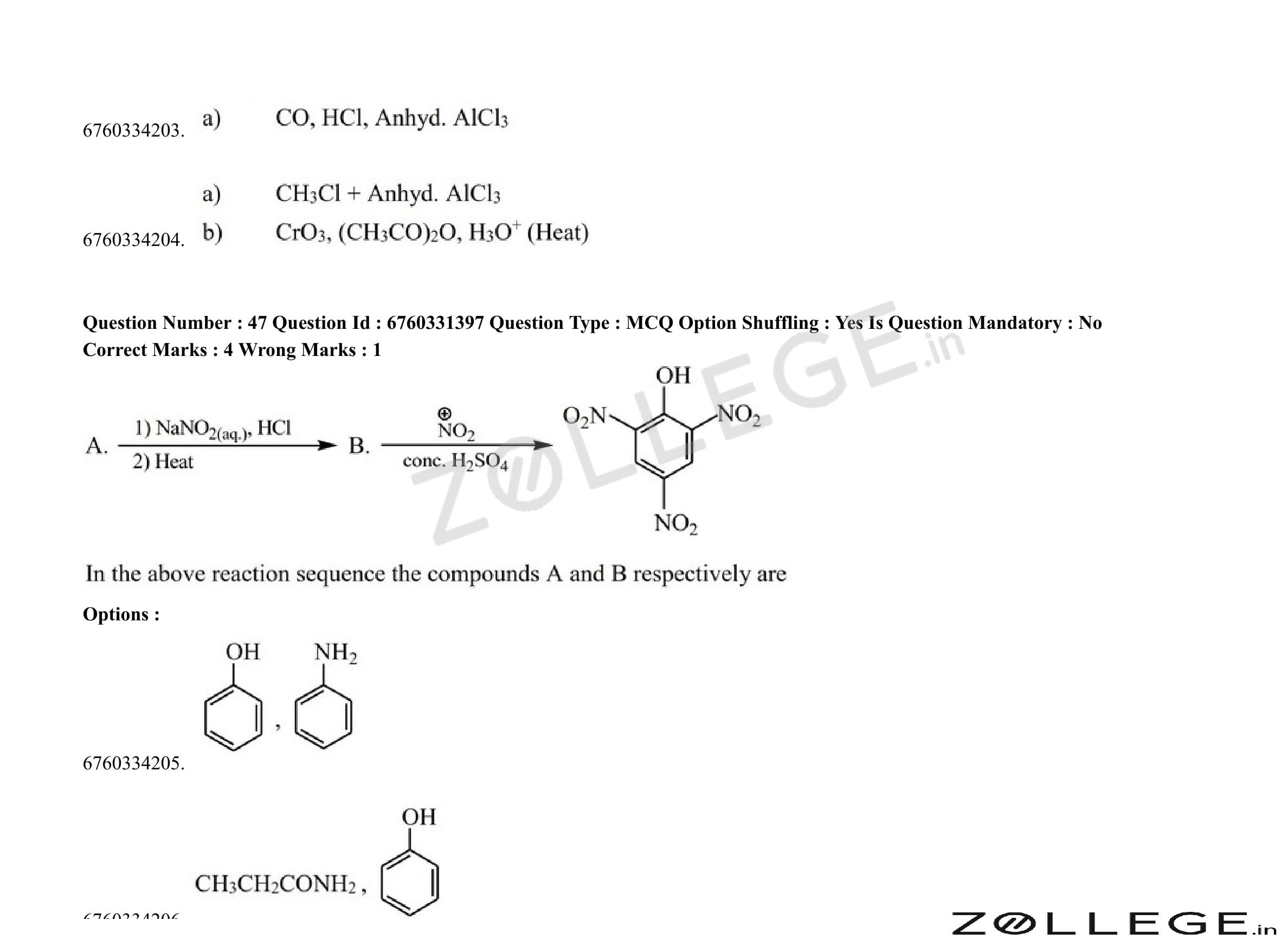
In the following reaction sequence, the compounds A and B respectively are

- (A)
![]()
- (B)
![]()
- (C)
![]()
- (D)
![]()


View Solution
Step 1:
NaNO\(_2\)/HCl converts aniline into diazonium salt.
Step 2:
On heating, diazonium salt forms phenol.
Step 3:
Nitration of phenol with conc. H\(_2\)SO\(_4\) gives picric acid. Quick Tip: Aniline → diazonium → phenol on heating.
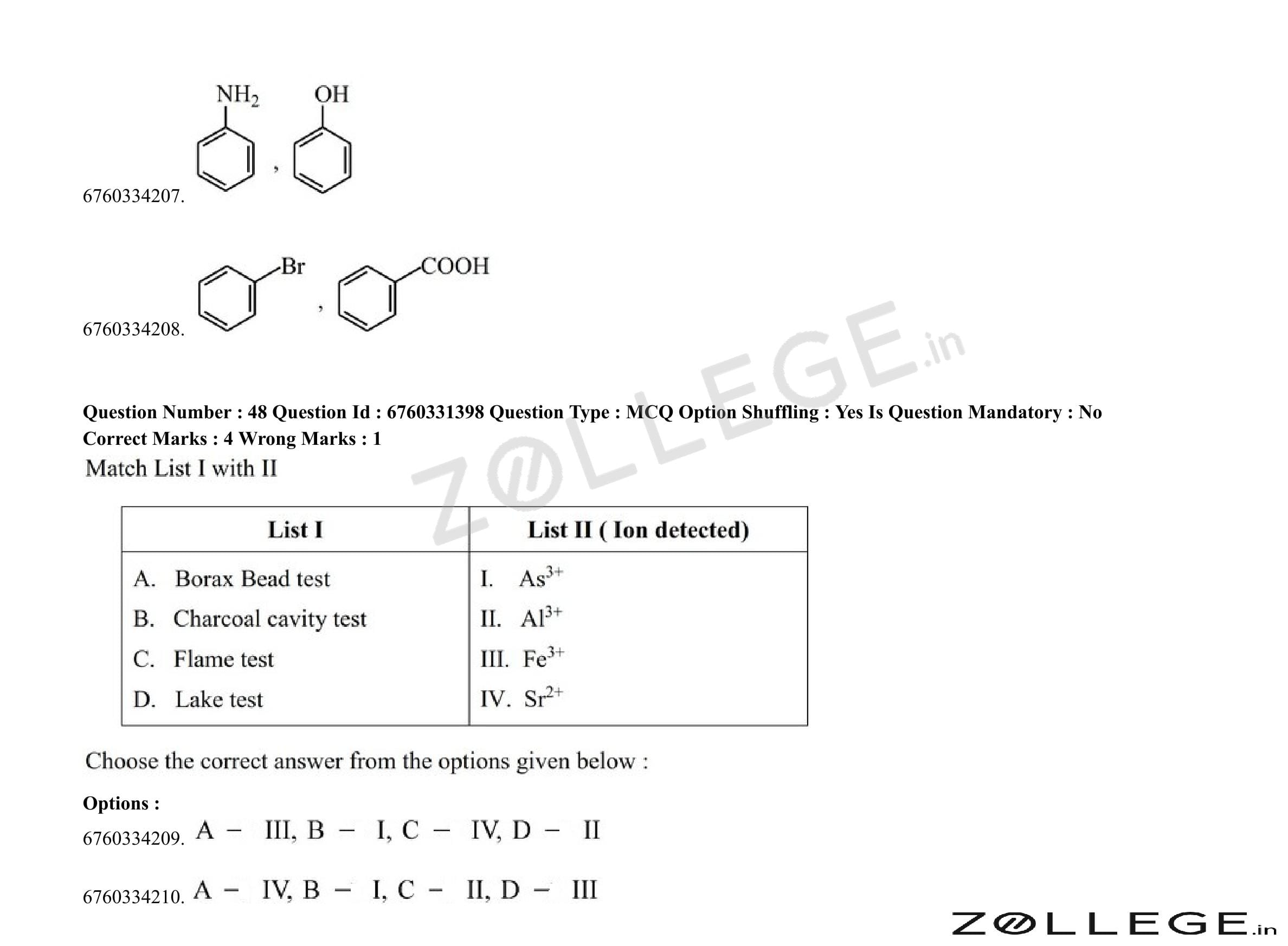
Match List I with List II

View Solution
Step 1:
Borax bead test → Fe\(^{3+}\)
Step 2:
Charcoal cavity test → As\(^{3+}\)
Step 3:
Flame test → Sr\(^{2+}\)
Step 4:
Lake test → Al\(^{3+}\) Quick Tip: Borax bead test is classic for transition metals.
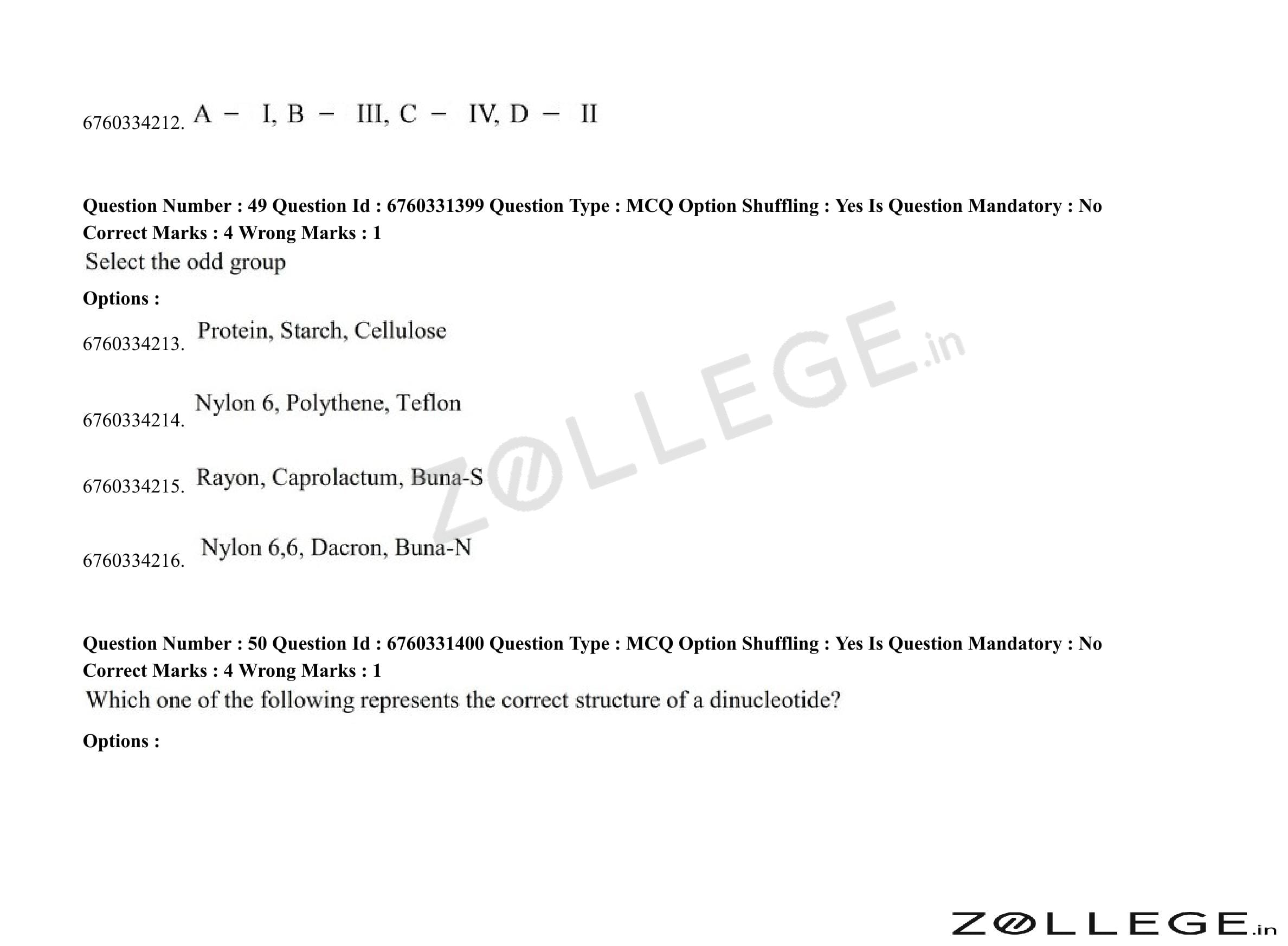
Select the odd group
View Solution
Step 1:
Rayon and Buna-S are polymers.
Step 2:
Caprolactam is a monomer.
Conclusion:
Option (C) is the odd group. Quick Tip: Check if all items are polymers or not.
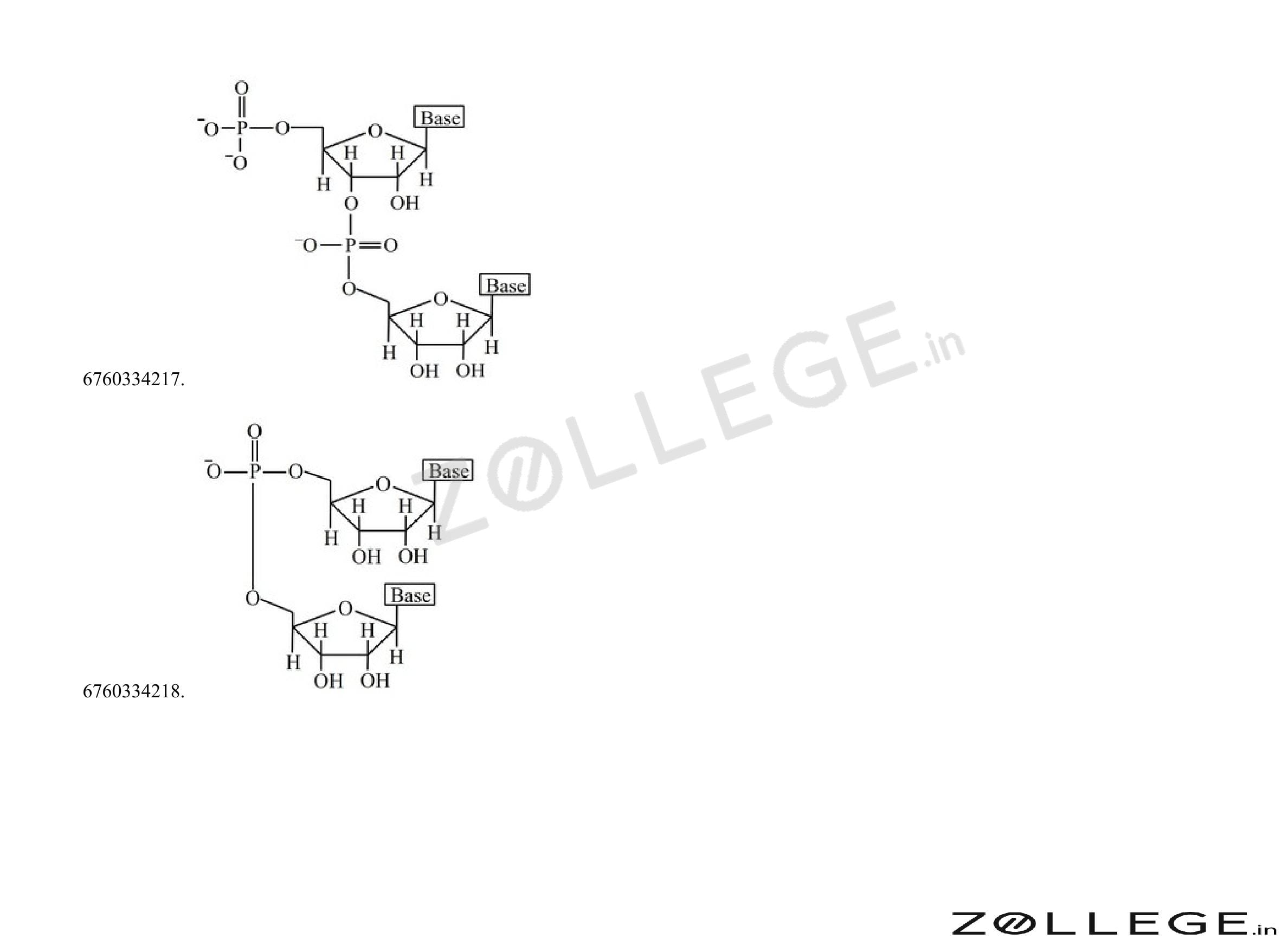
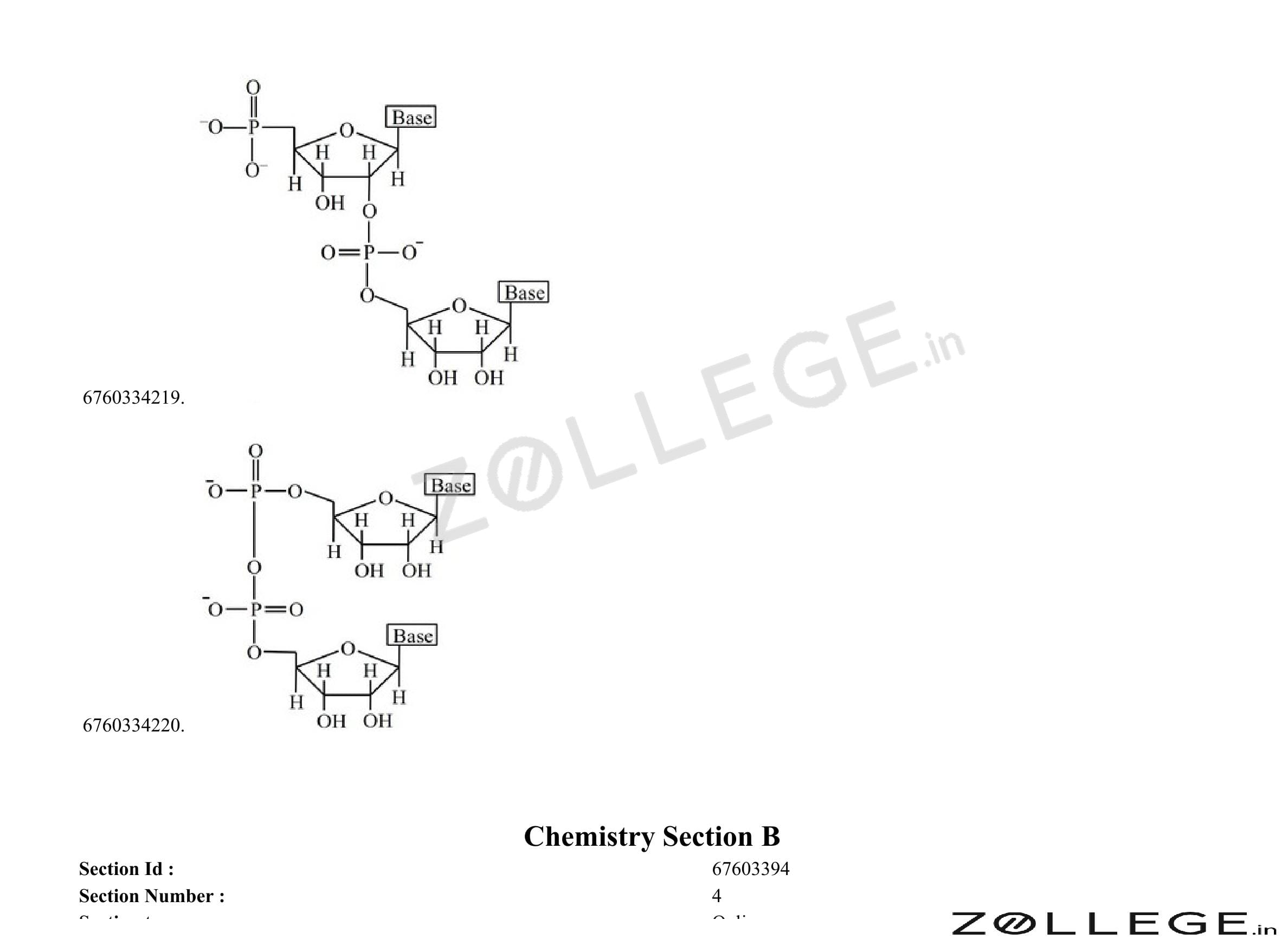
Which one of the following represents the correct structure of a dinucleotide?
View Solution
Step 1:
A dinucleotide consists of two nucleotides linked together by a 3\('\)--5\('\) phosphodiester bond.
Step 2:
Each nucleotide unit must contain a pentose sugar, a nitrogenous base attached at the 1\('\)-carbon, and a phosphate group, i.e., \[ Pentose sugar + Nitrogenous base + Phosphate group \]
Step 3:
The phosphodiester linkage is formed when the 3\('\)--OH group of one sugar combines with the 5\('\)--phosphate group of the next sugar, producing a 3\('\)--5\('\) linkage: \[ 3^{\prime}\!-\!\mathrm{OH} \;\longrightarrow\; 5^{\prime}\!-\!\mathrm{PO}_{4} \]
Step 4:
On examining the given structures, options (A), (B), and (C) show incorrect connectivity due to improper phosphate placement or absence of a valid 3\('\)--5\('\) linkage, whereas option (D) correctly shows a single phosphate group forming a proper 3\('\)--5\('\) phosphodiester bond between two nucleotides. Quick Tip: In nucleic acids, nucleotide units are \textbf{always connected through 3\('\)--5\('\) phosphodiester bonds}. Any other type of linkage is incorrect.
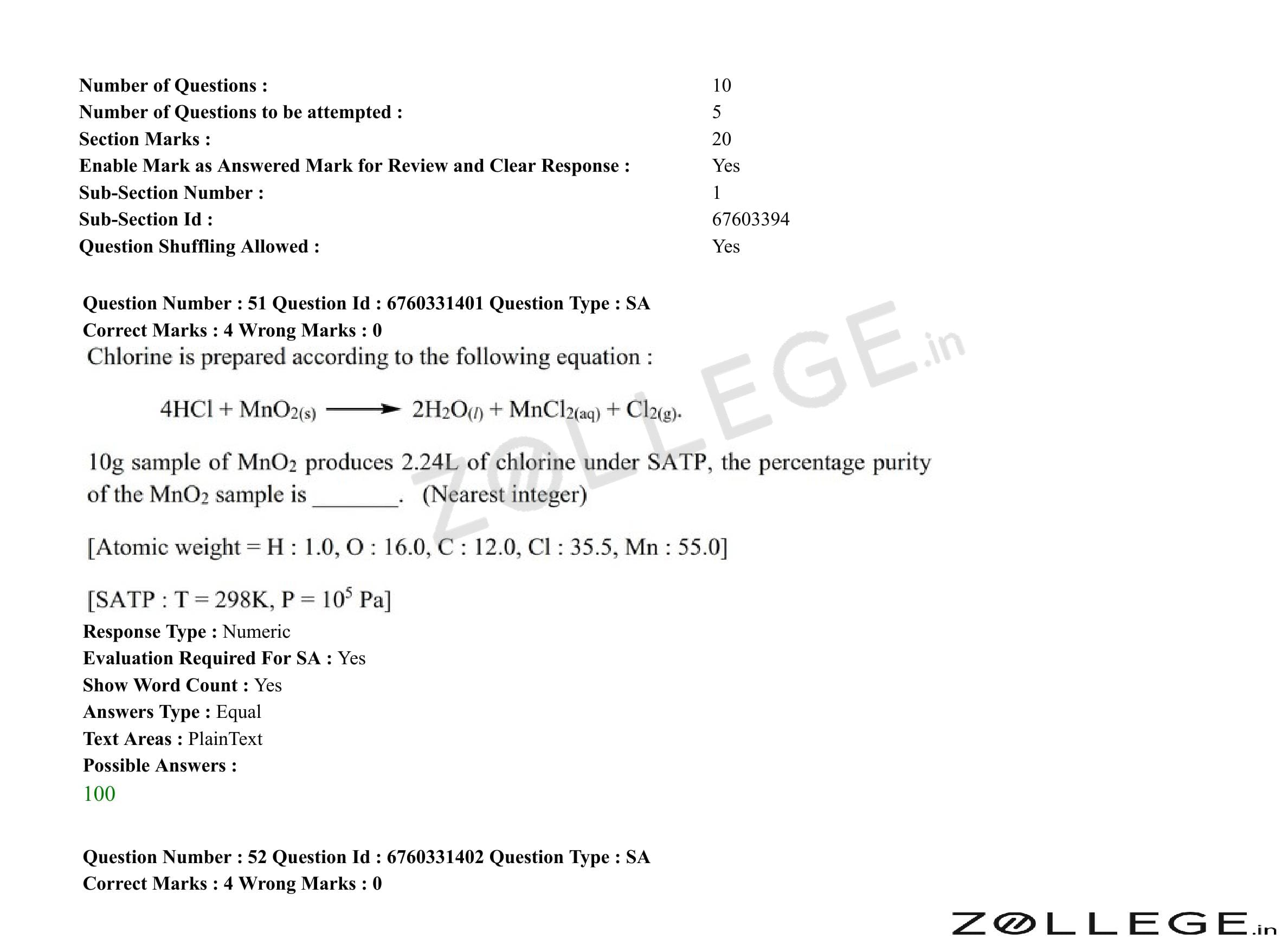
Chlorine is prepared according to the following equation: \[ 4\mathrm{HCl} + \mathrm{MnO}_2 \rightarrow 2\mathrm{H_2O} + \mathrm{MnCl}_2 + \mathrm{Cl}_2 \]
A 10 g sample of \(\mathrm{MnO}_2\) produces 2.24 L of chlorine under SATP. The percentage purity of the \(\mathrm{MnO}_2\) sample is \underline{\hspace{1cm. (Nearest integer)
View Solution
Step 1:
Molar mass of \(\mathrm{MnO}_2 = 55 + 2(16) = 87\ \mathrm{g\,mol^{-1}}\).
Step 2:
At SATP, \(1\) mole of gas occupies \(24\ \mathrm{L}\). \[ Moles of \mathrm{Cl}_2 = \frac{2.24}{24} = 0.0933 \]
Step 3:
From the balanced equation, \(1\ mol \mathrm{MnO}_2 \rightarrow 1\ mol \mathrm{Cl}_2\).
\[ Mass of pure \mathrm{MnO}_2 = 0.0933 \times 87 = 8.12\ \mathrm{g} \]
Step 4: \[ %purity = \frac{8.12}{10} \times 100 = 81.2% \] Quick Tip: For gas calculations at SATP, always use molar volume \(= 24\ \mathrm{L\,mol^{-1}}\).
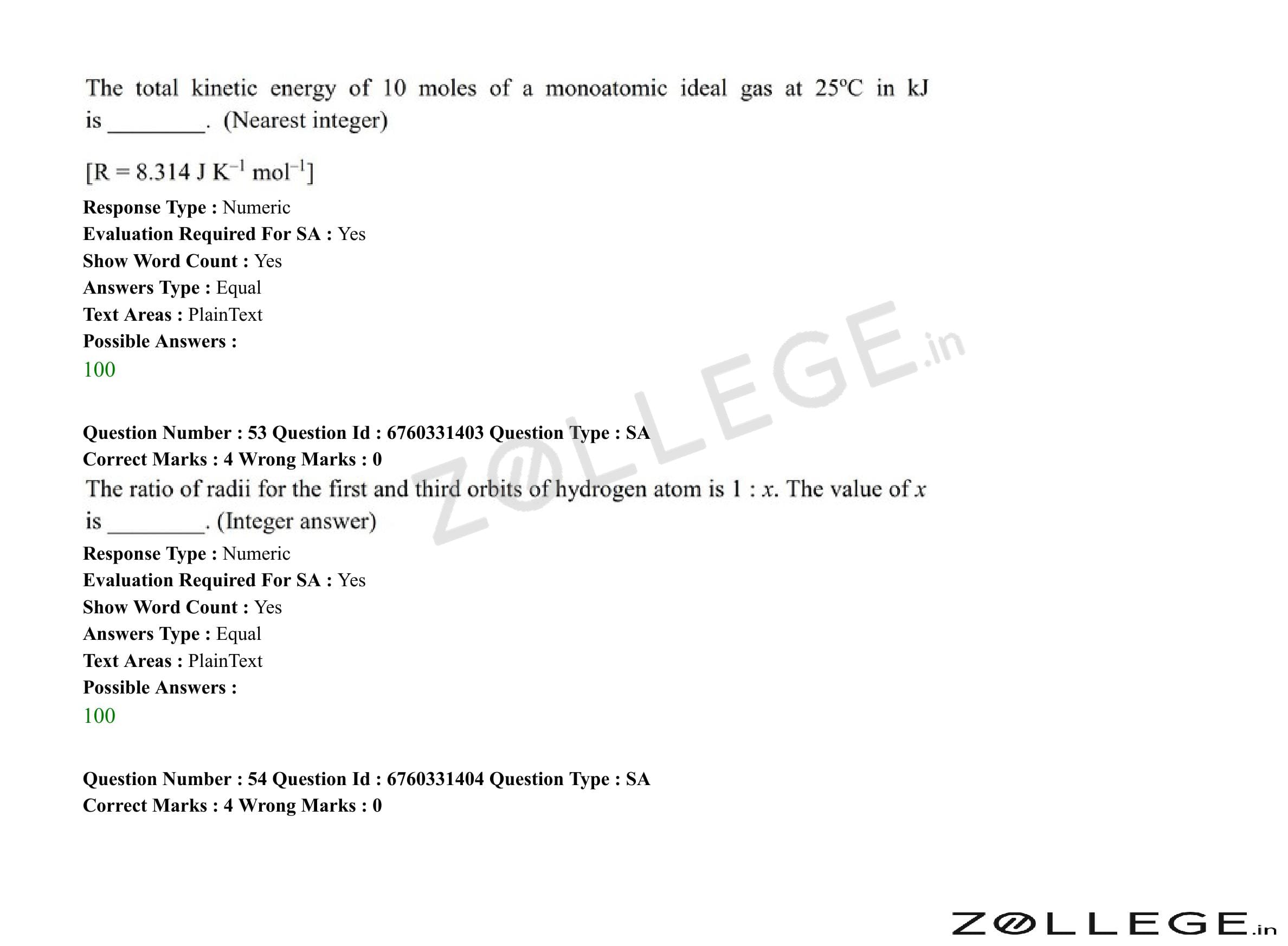
The total kinetic energy of 10 moles of a monoatomic ideal gas at \(25^\circ\mathrm{C}\) is \underline{\hspace{1cm kJ. (Nearest integer)
View Solution
Step 1:
Total kinetic energy of a monoatomic ideal gas is: \[ E = \frac{3}{2} nRT \]
Step 2: \[ T = 25 + 273 = 298\ \mathrm{K} \]
Step 3: \[ E = \frac{3}{2} \times 10 \times 8.314 \times 298 = 37164\ \mathrm{J} \]
\[ E = 37.16\ \mathrm{kJ} \] Quick Tip: Monoatomic gases possess only translational kinetic energy.
The ratio of radii for the first and third orbits of hydrogen atom is \(1:x\). The value of \(x\) is \underline{\hspace{1cm.
View Solution
Step 1:
Radius of the \(n\)-th orbit: \[ r_n \propto n^2 \]
Step 2: \[ \frac{r_1}{r_3} = \frac{1^2}{3^2} = \frac{1}{9} \] Quick Tip: In Bohr model, orbital radius increases as \(n^2\).
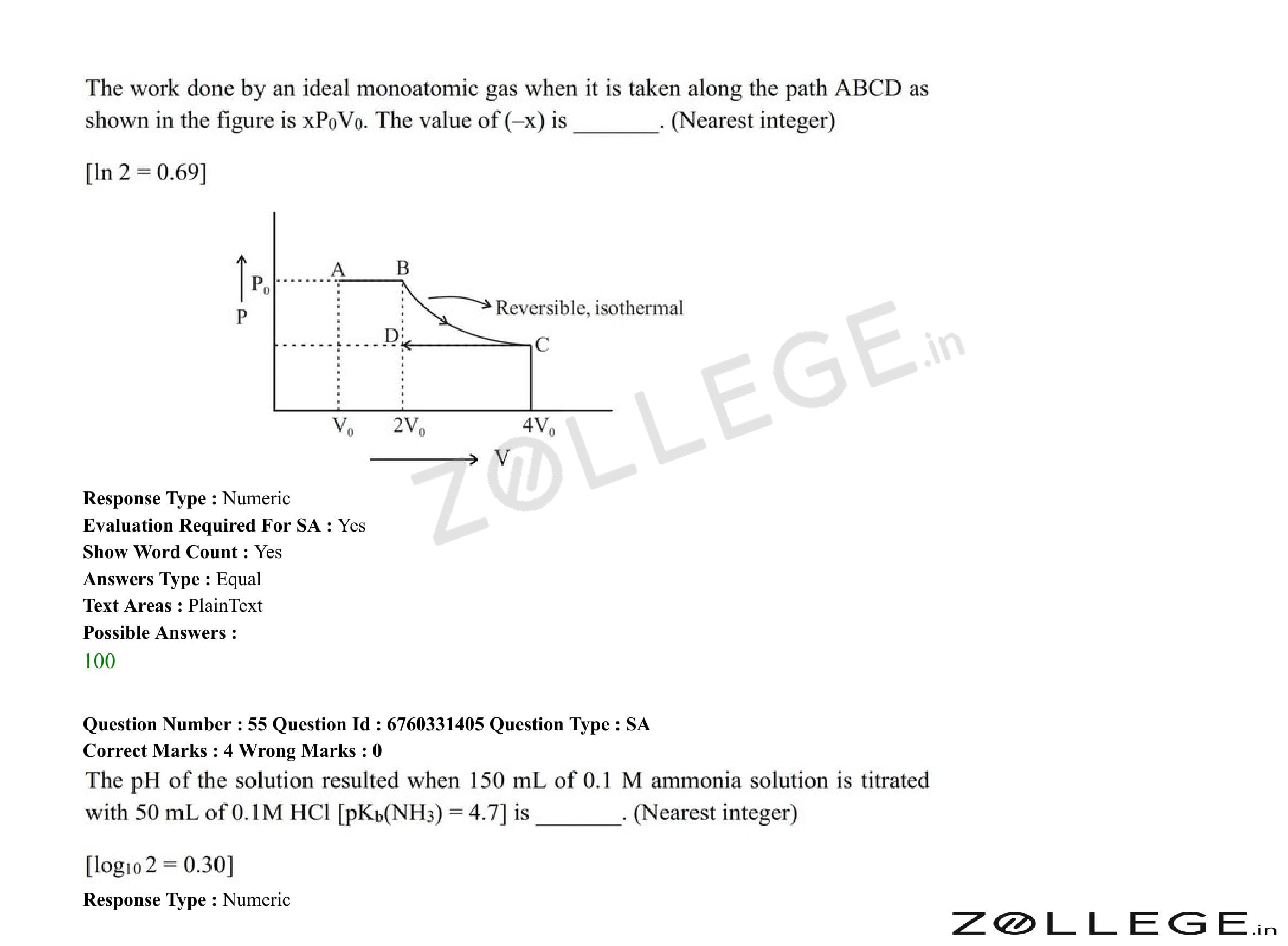
The work done by an ideal monoatomic gas when taken along the path ABCD as shown in the figure is \(xP_0V_0\). The value of \((-x)\) is \underline{\hspace{1cm. (Nearest integer)

View Solution
Step 1:
Work done along AB (isobaric): \[ W_{AB} = P_0(V_0) = P_0V_0 \]
Step 2:
Work done along BC (reversible isothermal): \[ W_{BC} = nRT\ln 2 = 2P_0V_0 \ln 2 = 1.38P_0V_0 \]
Step 3:
Total work: \[ W = 2.38P_0V_0 \Rightarrow x = 2.38 \] Quick Tip: Isochoric paths do no work since volume remains constant.
The pH of the solution when 150 mL of 0.1 M ammonia is titrated with 50 mL of 0.1 M HCl \([pK_b(\mathrm{NH_3}) = 4.7]\) is \underline{\hspace{1cm. (Nearest integer)
View Solution
Step 1: \[ n_{\mathrm{NH_3}} = 0.15 \times 0.1 = 0.015 \] \[ n_{\mathrm{HCl}} = 0.05 \times 0.1 = 0.005 \]
Step 2:
Remaining \(\mathrm{NH_3} = 0.01\), formed \(\mathrm{NH_4^+} = 0.005\).
Step 3: \[ \mathrm{pOH} = 4.7 + \log\frac{0.005}{0.01} = 4.4 \] \[ \mathrm{pH} = 14 - 4.4 = 9.6 \] Quick Tip: Use Henderson equation for buffer mixtures of weak base and its salt.
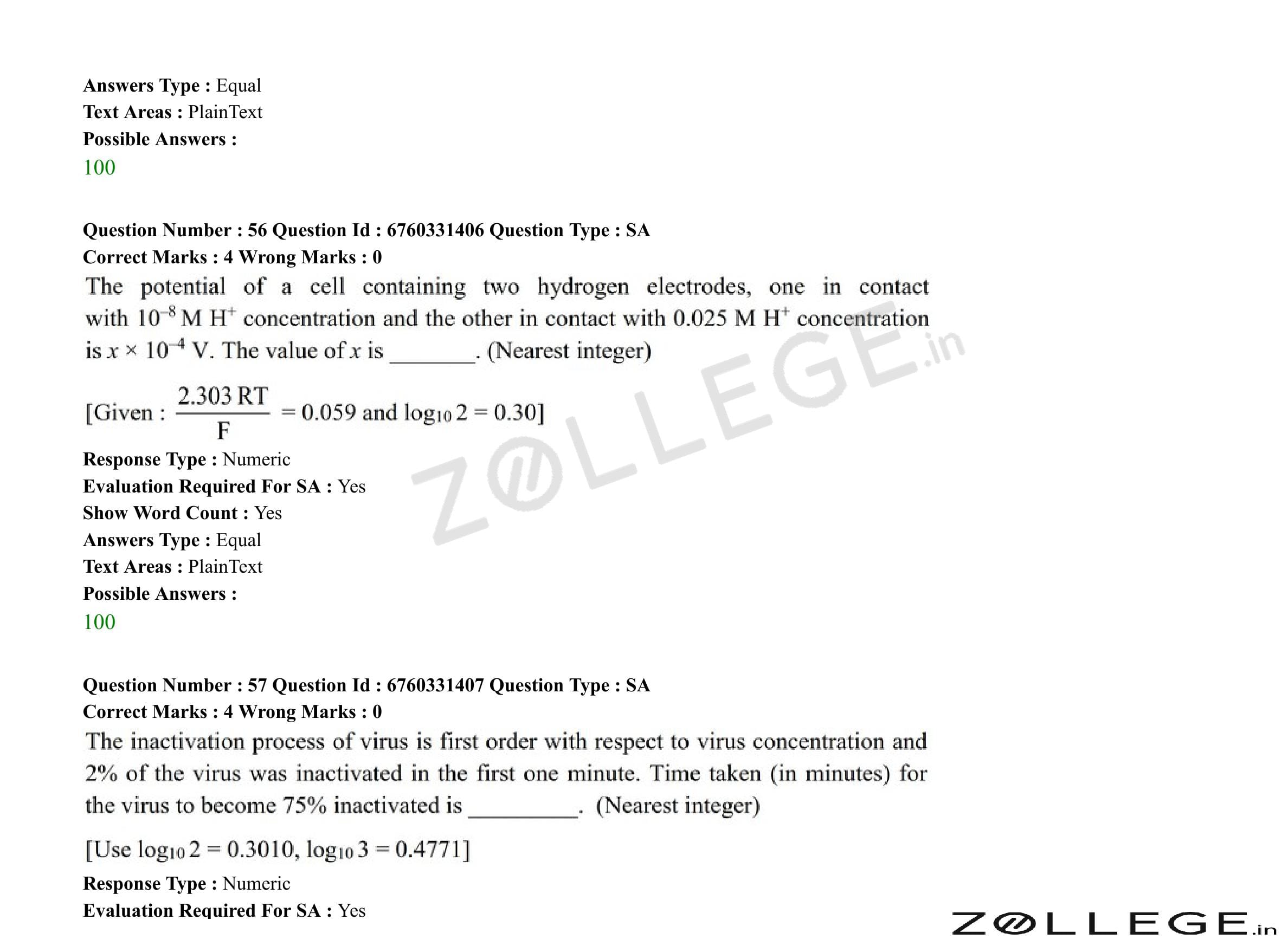
The potential of a cell containing two hydrogen electrodes, one in contact with \(10^{-8}\,\mathrm{M}\) \( \mathrm{H^+} \) concentration and the other in contact with \(0.025\,\mathrm{M}\) \( \mathrm{H^+} \) concentration is \(x \times 10^{-4}\,\mathrm{V}\). The value of \(x\) is \underline{\hspace{1cm. (Nearest integer)
View Solution
Step 1:
For a hydrogen concentration cell, \[ E = 0.059 \log\left(\frac{[\mathrm{H^+}]_2}{[\mathrm{H^+}]_1}\right) \]
Step 2:
Substitute values: \[ E = 0.059 \log\left(\frac{0.025}{10^{-8}}\right) = 0.059 \log(2.5 \times 10^6) \]
Step 3: \[ \log(2.5 \times 10^6) = \log 2.5 + 6 = 0.398 + 6 = 6.398 \]
Step 4: \[ E = 0.059 \times 6.398 = 0.378\,\mathrm{V} \]
\[ E = 38 \times 10^{-4}\,\mathrm{V} \] Quick Tip: For hydrogen concentration cells, remember: \[ E = 0.059 \log\left(\frac{C_2}{C_1}\right) \] at 298 K.
The inactivation process of a virus is first order with respect to virus concentration and 2% of the virus was inactivated in the first one minute. Time taken (in minutes) for the virus to become 75% inactivated is \hspace{1cm}. (Nearest integer)
View Solution
Step 1:
For first-order kinetics: \[ \log\left(\frac{N_0}{N}\right) = kt \]
Step 2:
After 1 minute, 98% remains: \[ \log\left(\frac{100}{98}\right) = k \Rightarrow k = \log\left(\frac{50}{49}\right) \approx 0.0089 \]
Step 3:
For 75% inactivation, remaining = 25%: \[ \log\left(\frac{100}{25}\right) = kt \Rightarrow \log 4 = kt \]
Step 4: \[ t = \frac{0.602}{0.0089} \approx 20.8 \approx 21 min \] Quick Tip: First-order reactions depend only on the fraction reacted, not the initial amount.
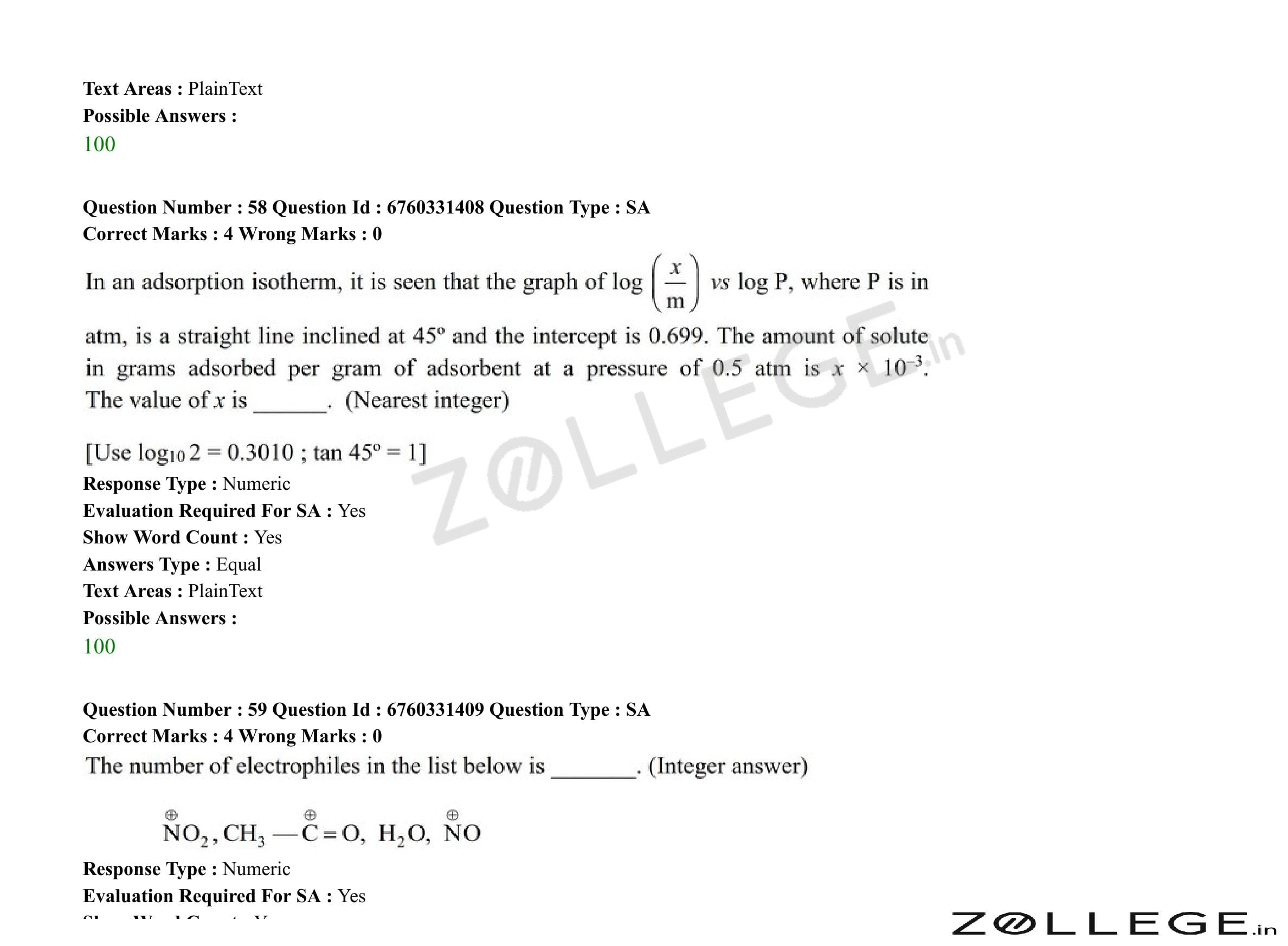
In an adsorption isotherm, the graph of \(\log(x/m)\) vs \(\log P\) is a straight line inclined at \(45^\circ\) with intercept 0.699. The amount of solute in grams adsorbed per gram of adsorbent at a pressure of 0.5 atm is \(x \times 10^{-3}\). The value of \(x\) is \underline{\hspace{1cm. (Nearest integer)
View Solution
Step 1:
Freundlich isotherm: \[ \log\left(\frac{x}{m}\right) = \log k + \frac{1}{n} \log P \]
Step 2:
Slope \(= \tan 45^\circ = 1\), so: \[ \frac{1}{n} = 1 \]
Intercept: \[ \log k = 0.699 \Rightarrow k = 5 \]
Step 3:
At \(P = 0.5\): \[ \log\left(\frac{x}{m}\right) = 0.699 + \log 0.5 = 0.699 - 0.301 = 0.398 \]
Step 4: \[ \frac{x}{m} = 10^{0.398} \approx 2.5 \times 10^{-2} \Rightarrow x = 25 \] Quick Tip: In Freundlich isotherm, slope gives \(1/n\) and intercept gives \(\log k\).
The number of electrophiles in the list below is \hspace{1cm}. (Integer answer) \[ \mathrm{NO_2^+},\ \mathrm{CH_3^+},\ \mathrm{C^+=O},\ \mathrm{H_2O},\ \mathrm{NO^+} \]
View Solution
Step 1:
Electrophiles accept electron pairs.
Step 2: \[ \mathrm{NO_2^+},\ \mathrm{CH_3^+},\ \mathrm{C^+=O},\ \mathrm{NO^+} \]
are electrophiles.
Step 3: \(\mathrm{H_2O}\) is a nucleophile, not an electrophile.
\[ \Rightarrow Total electrophiles = 4 \] Quick Tip: Positive charge or electron deficiency usually indicates an electrophile.
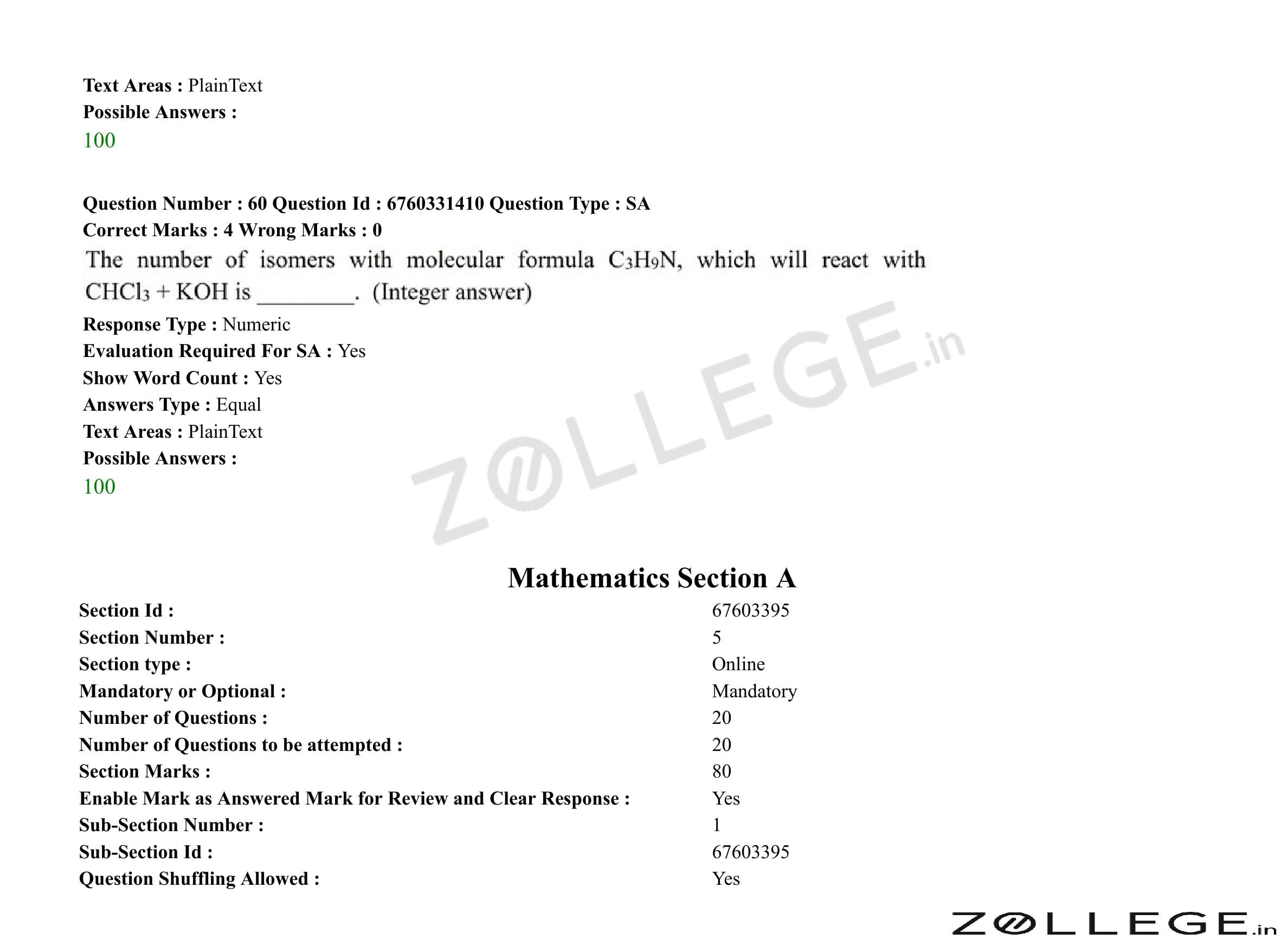
The number of isomers with molecular formula \(\mathrm{C_3H_9N}\) which will react with \(\mathrm{CHCl_3 + KOH}\) is \underline{\hspace{1cm. (Integer answer)
View Solution
Step 1: \(\mathrm{CHCl_3 + KOH}\) is the carbylamine test, positive only for primary amines.
Step 2:
Isomers of \(\mathrm{C_3H_9N}\): \[ n-propylamine,\ isopropylamine,\ ethyl methyl amine,\ trimethylamine \]
Step 3:
Primary amines: \[ n-propylamine,\ isopropylamine \]
\[ \Rightarrow Total = 2 \] Quick Tip: Carbylamine test is given \textbf{only by primary amines}.
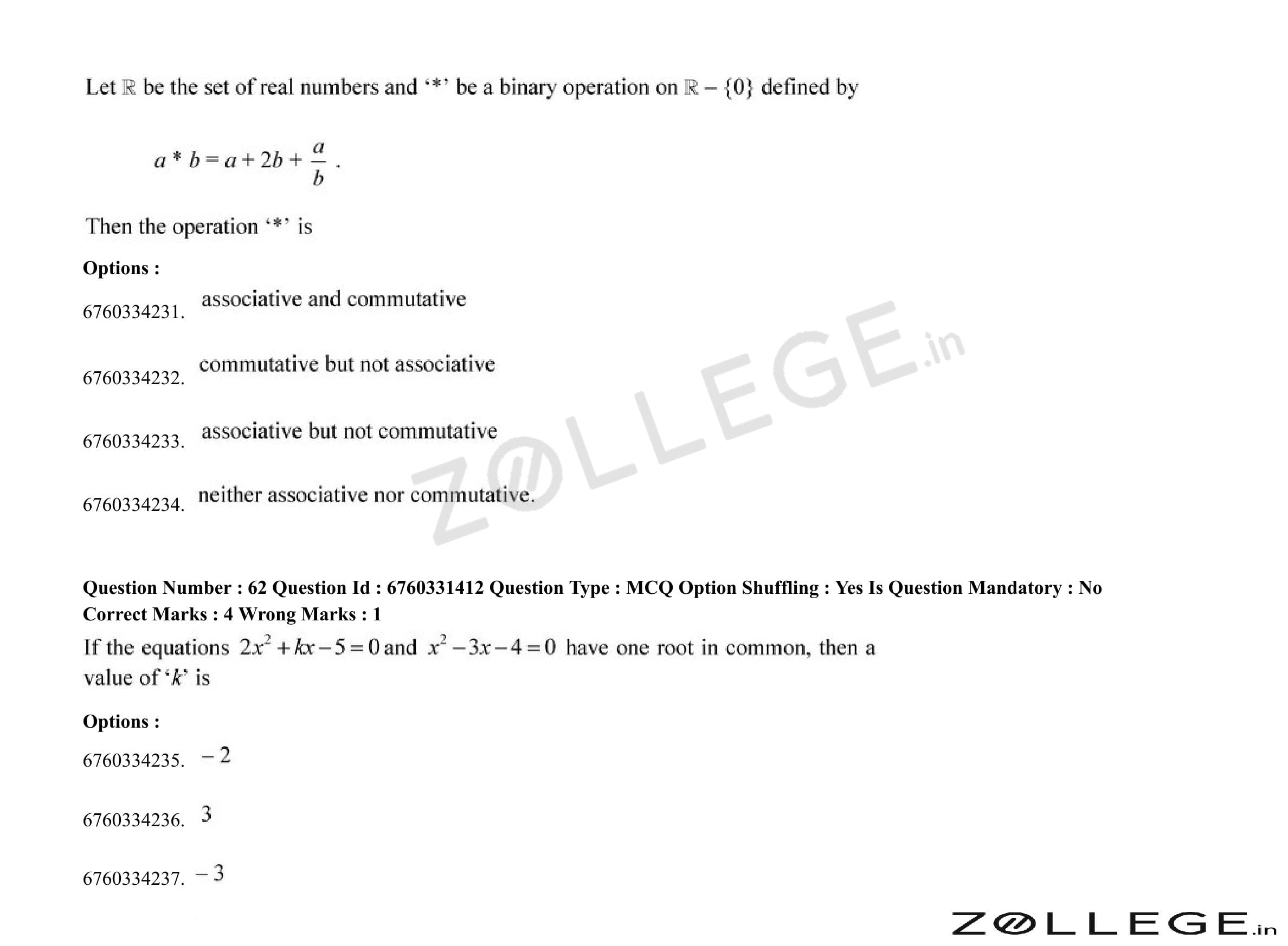
Let \( \mathbb{R} \) be the set of real numbers and \( * \) be a binary operation on \( \mathbb{R} - \{0\} \) defined by \[ a * b = a + 2b + \frac{a}{b}. \]
Then the operation \( * \) is:
View Solution
Step 1: Check commutativity. \[ a*b = a + 2b + \frac{a}{b}, \quad b*a = b + 2a + \frac{b}{a} \]
Since \( a*b \neq b*a \) in general, the operation is not commutative.
Step 2: Check associativity. \[ (a*b)*c \neq a*(b*c) \]
Hence, the operation is neither associative nor commutative. Quick Tip: To test a binary operation: - Swap operands for commutativity - Change grouping for associativity
If the equations \( 2x^2 + kx - 5 = 0 \) and \( x^2 - 3x - 4 = 0 \) have one root in common, then a value of \( k \) is:
View Solution
Step 1: Solve the second equation. \[ x^2 - 3x - 4 = 0 \Rightarrow (x-4)(x+1)=0 \]
Roots are \( x=4, -1 \).
Step 2: Substitute into the first equation.
For \( x=4 \): \[ 2(16) + 4k - 5 = 0 \Rightarrow 4k = -27 \Rightarrow k \neq option \]
For \( x=-1 \): \[ 2(1) - k - 5 = 0 \Rightarrow k = -3 \] Quick Tip: If two quadratic equations share a root, substitute roots of one into the other.
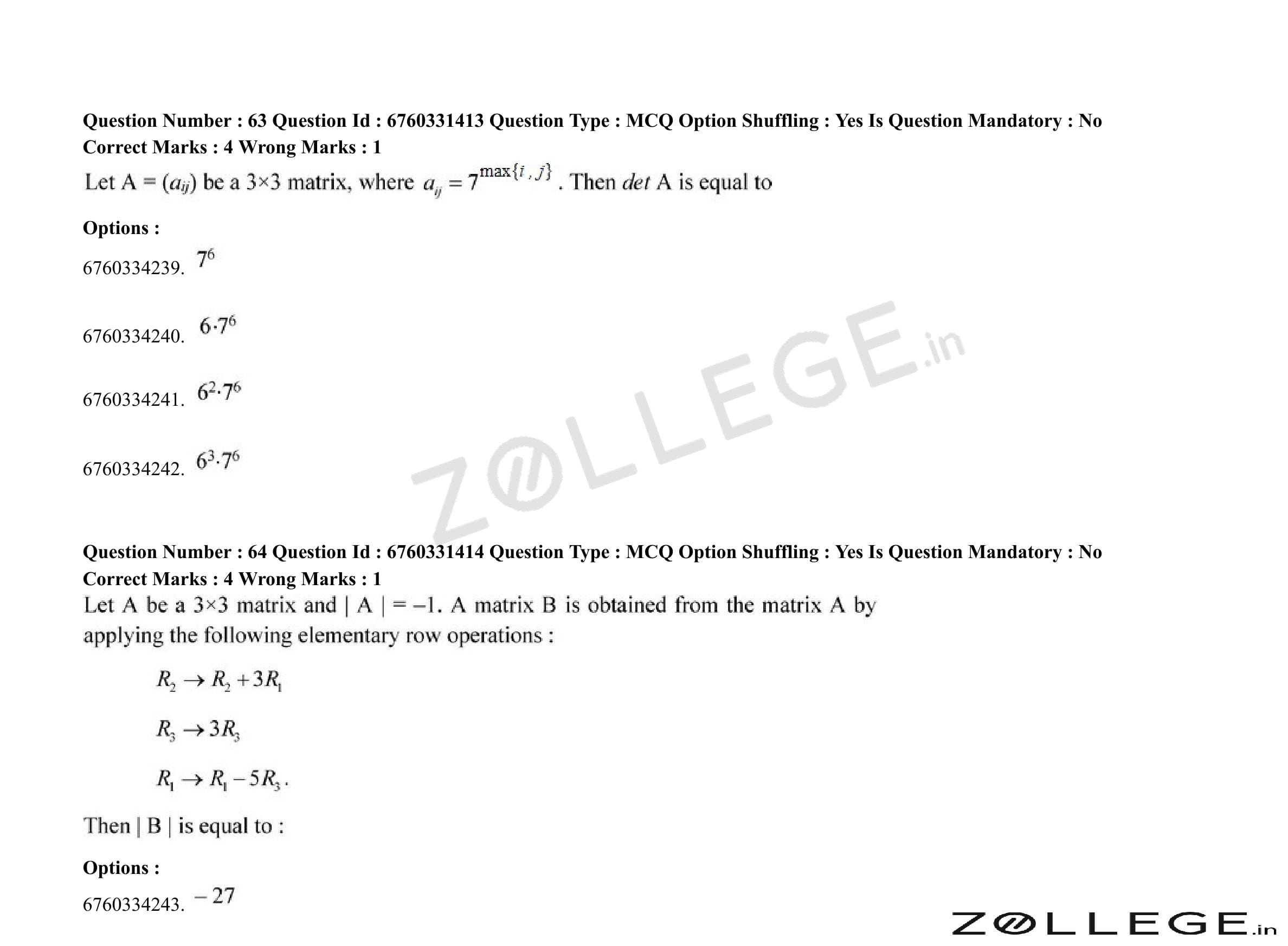
Let \( A = (a_{ij}) \) be a \( 3 \times 3 \) matrix, where \( a_{ij} = 7^{-\max(i,j)} \). Then \( \det A \) is equal to:
View Solution
Step 1: Factor \( 7^{-1}, 7^{-2}, 7^{-3} \) from rows.
Step 2: Determinant becomes: \[ 7^{-(1+2+3)} \times \det(upper triangular matrix) = 7^{-6} \times 1 \]
Hence, \[ \det A = 7^6 \] Quick Tip: When powers depend on row/column indices, factor common terms to simplify determinant.
Let \( A \) be a \( 3 \times 3 \) matrix and \( |A| = -1 \). A matrix \( B \) is obtained from \( A \) by the operations: \[ R_2 \to R_2 + 3R_1,\quad R_3 \to 3R_3,\quad R_1 \to R_1 - 5R_3 \]
Then \( |B| \) is:
View Solution
Step 1: Row addition does not change determinant.
Step 2: Multiplying a row by 3 multiplies determinant by 3.
\[ |B| = 3 \times (-1) = -3 \] Quick Tip: Row addition keeps determinant same; row scaling multiplies determinant.
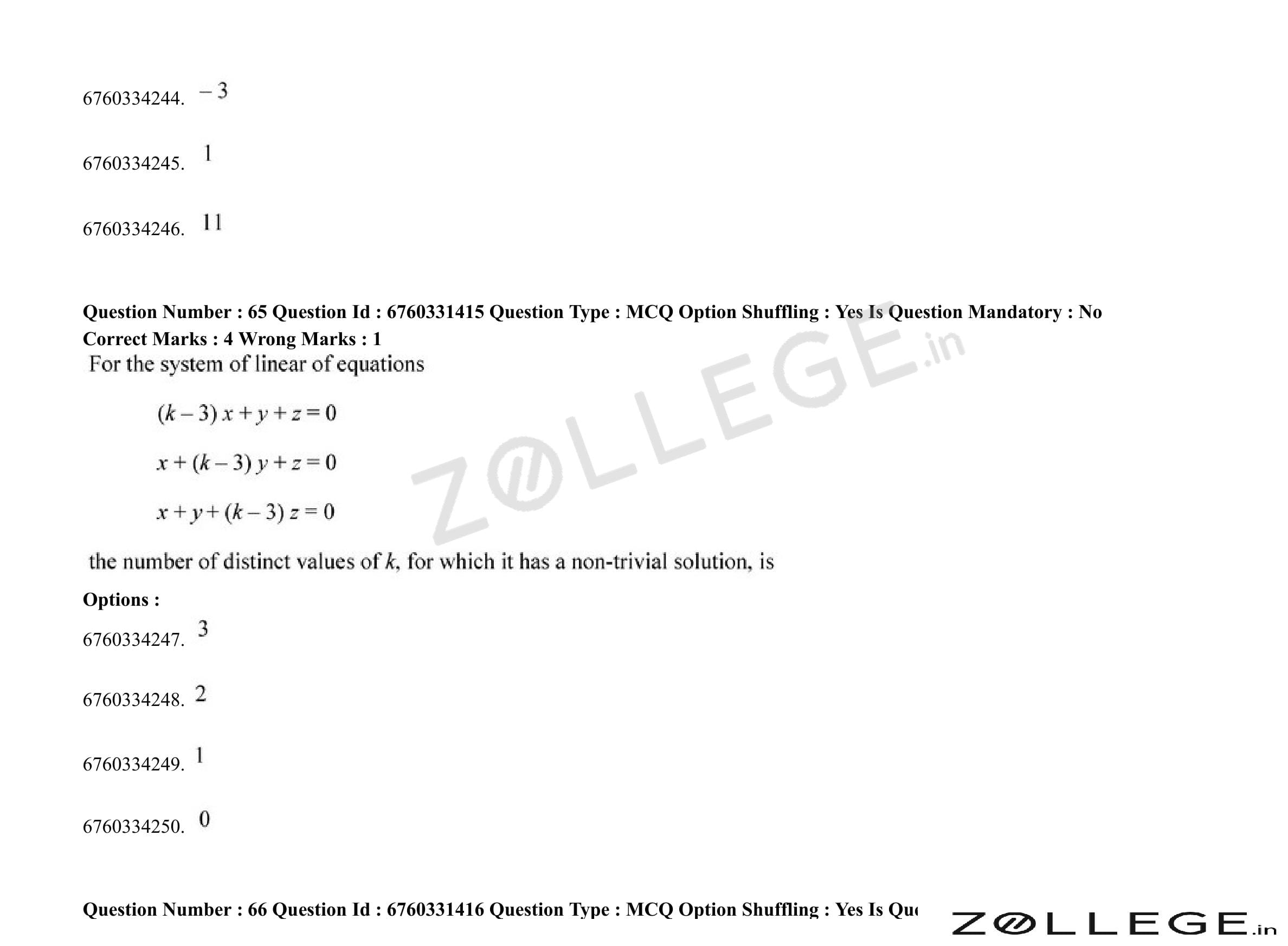
For the system of linear equations \[ (k-3)x + y + z = 0, \quad x + (k-3)y + z = 0, \quad x + y + (k-3)z = 0, \]
the number of distinct values of \( k \) for which a non-trivial solution exists is:
View Solution
Step 1: Write coefficient matrix: \[ \begin{vmatrix} k-3 & 1 & 1
1 & k-3 & 1
1 & 1 & k-3 \end{vmatrix} = 0 \]
Step 2: Determinant simplifies to: \[ (k-1)^2(k-5) = 0 \]
Step 3: Values are \( k=1, 5 \)
Total distinct values \( = 2 \) Quick Tip: Non-trivial solutions exist when determinant of coefficient matrix is zero.
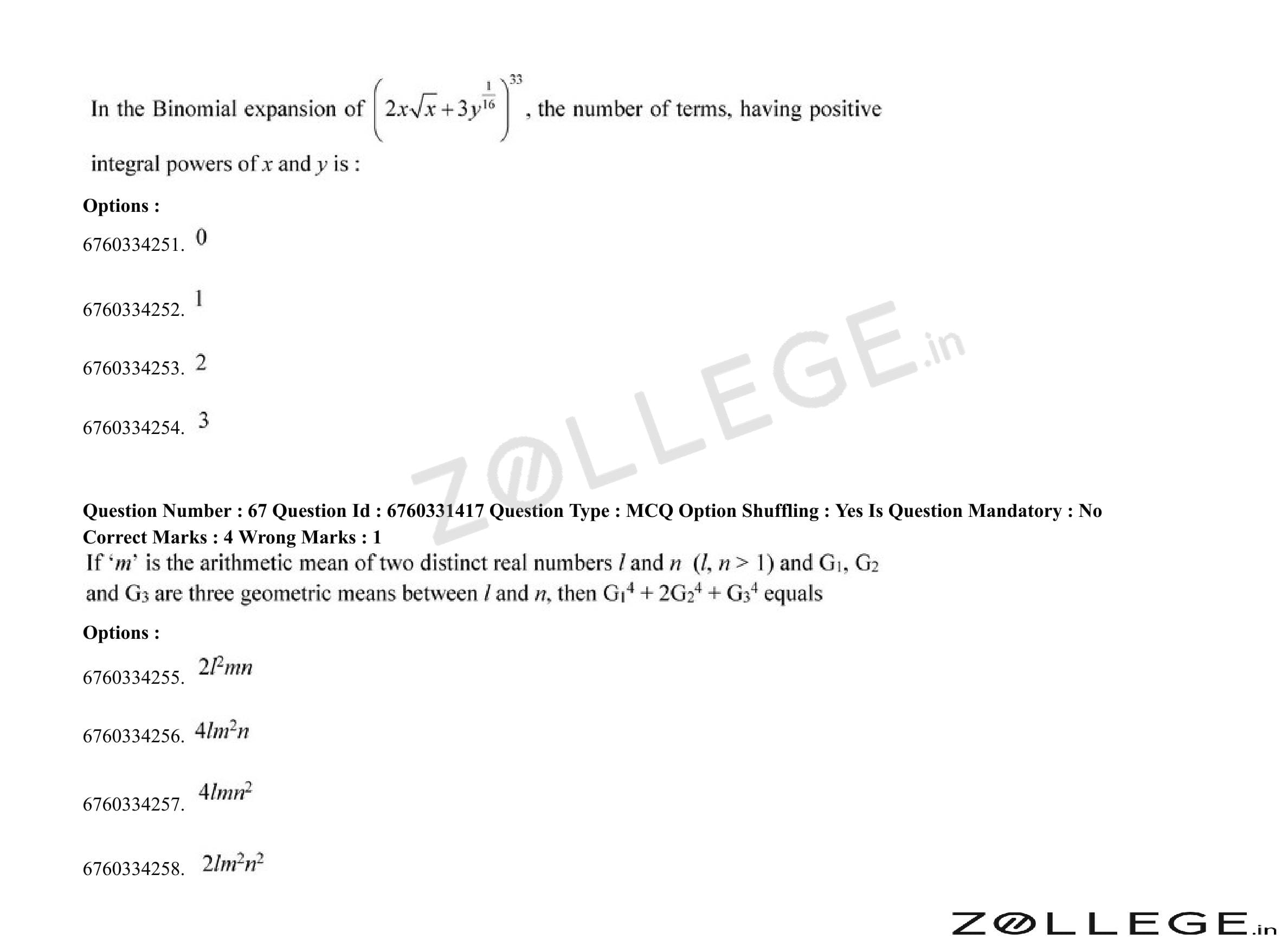
In the binomial expansion of \( \left(2x\sqrt{x} + 3y^{\frac{1}{6}}\right)^{33} \), the number of terms having positive integral powers of both \( x \) and \( y \) is:
View Solution
Step 1: General term: \[ T_{r+1} = \binom{33}{r} (2x^{3/2})^{33-r} (3y^{1/6})^r \]
Step 2: Power of \(x\): \[ \frac{3}{2}(33-r) \in \mathbb{Z}^+ \Rightarrow r \equiv 33 \pmod{2} \]
Step 3: Power of \(y\): \[ \frac{r}{6} \in \mathbb{Z}^+ \Rightarrow r = 6k \]
Step 4: Valid \( r \) satisfying both: \[ r = 6, 18 \]
Hence, number of terms \(=2\). Quick Tip: For binomial terms with fractional powers, enforce integrality conditions separately on each variable.
If \( m \) is the arithmetic mean of two distinct real numbers \( l \) and \( n \) (\( l,n>1 \)) and \( G_1, G_2, G_3 \) are three geometric means between \( l \) and \( n \), then \( G_1^4 + 2G_2^4 + G_3^4 \) equals:
View Solution
Step 1: Let GP be: \[ l, G_1, G_2, G_3, n \]
Step 2: Common ratio: \[ r = \left(\frac{n}{l}\right)^{1/4} \]
Step 3: Values: \[ G_1=lr,\quad G_2=lr^2,\quad G_3=lr^3 \]
Step 4: Compute: \[ G_1^4+2G_2^4+G_3^4 = l^4(r^4+2r^8+r^{12}) \]
Substitute \( r^4=\frac{n}{l} \) and \( m=\frac{l+n}{2} \), result simplifies to: \[ 4lm^2n \] Quick Tip: Geometric mean problems often simplify by expressing all terms using the common ratio.
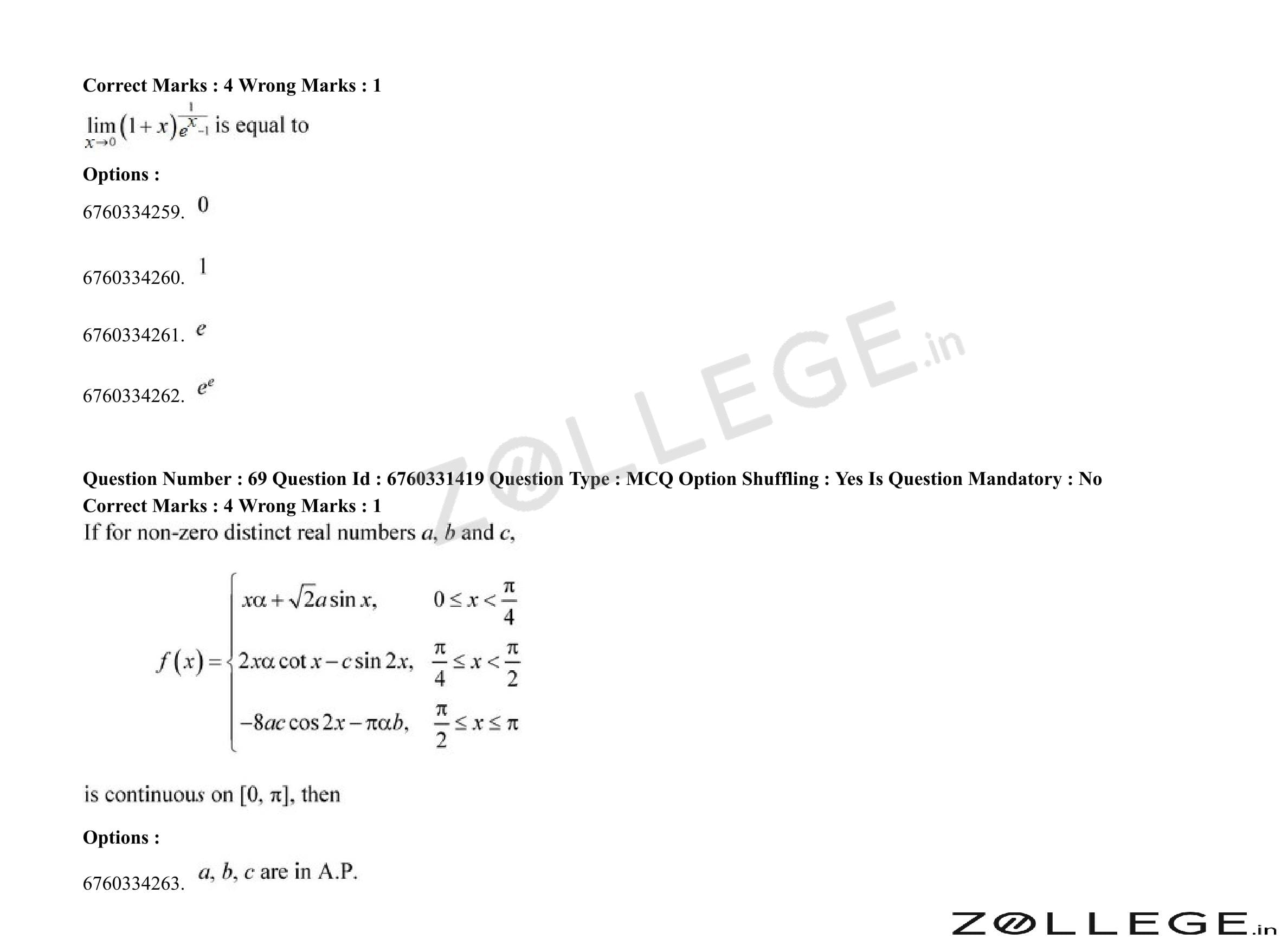
The value of \( \displaystyle \lim_{x \to 0} (1+x)^{\frac{1}{x}-1} \) is:
View Solution
Step 1: Rewrite: \[ (1+x)^{\frac{1}{x}-1} = \frac{(1+x)^{1/x}}{1+x} \]
Step 2: Apply limits: \[ \lim_{x\to0}(1+x)^{1/x}=e,\quad \lim_{x\to0}(1+x)=1 \]
Step 3: Final value: \[ \frac{e}{1}=e \] Quick Tip: Always try to reduce limits to standard forms like \( (1+x)^{1/x} \to e \).
If for non-zero distinct real numbers \( a,b,c \), \[ f(x)= \begin{cases} xa+\sqrt{2}a\sin x, & 0\le x<\frac{\pi}{4}
2xa\cot x-c\sin2x, & \frac{\pi}{4}\le x<\frac{\pi}{2}
-8ac\cos2x-\pi ab, & \frac{\pi}{2}\le x\le\pi \end{cases} \]
is continuous on \([0,\pi]\), then:
View Solution
Step 1: Continuity at \( x=\frac{\pi}{4} \) gives: \[ a\left(\frac{\pi}{4}+\frac{\sqrt2}{2}\right)=a\frac{\pi}{2}-c \]
Step 2: Continuity at \( x=\frac{\pi}{2} \) gives: \[ a\pi-0=-\pi ab \]
Step 3: Simplifying both equations leads to: \[ 2b=a+c \]
Hence, \(a,b,c\) are in A.P. Quick Tip: Piecewise continuity problems always yield algebraic relations at junction points.
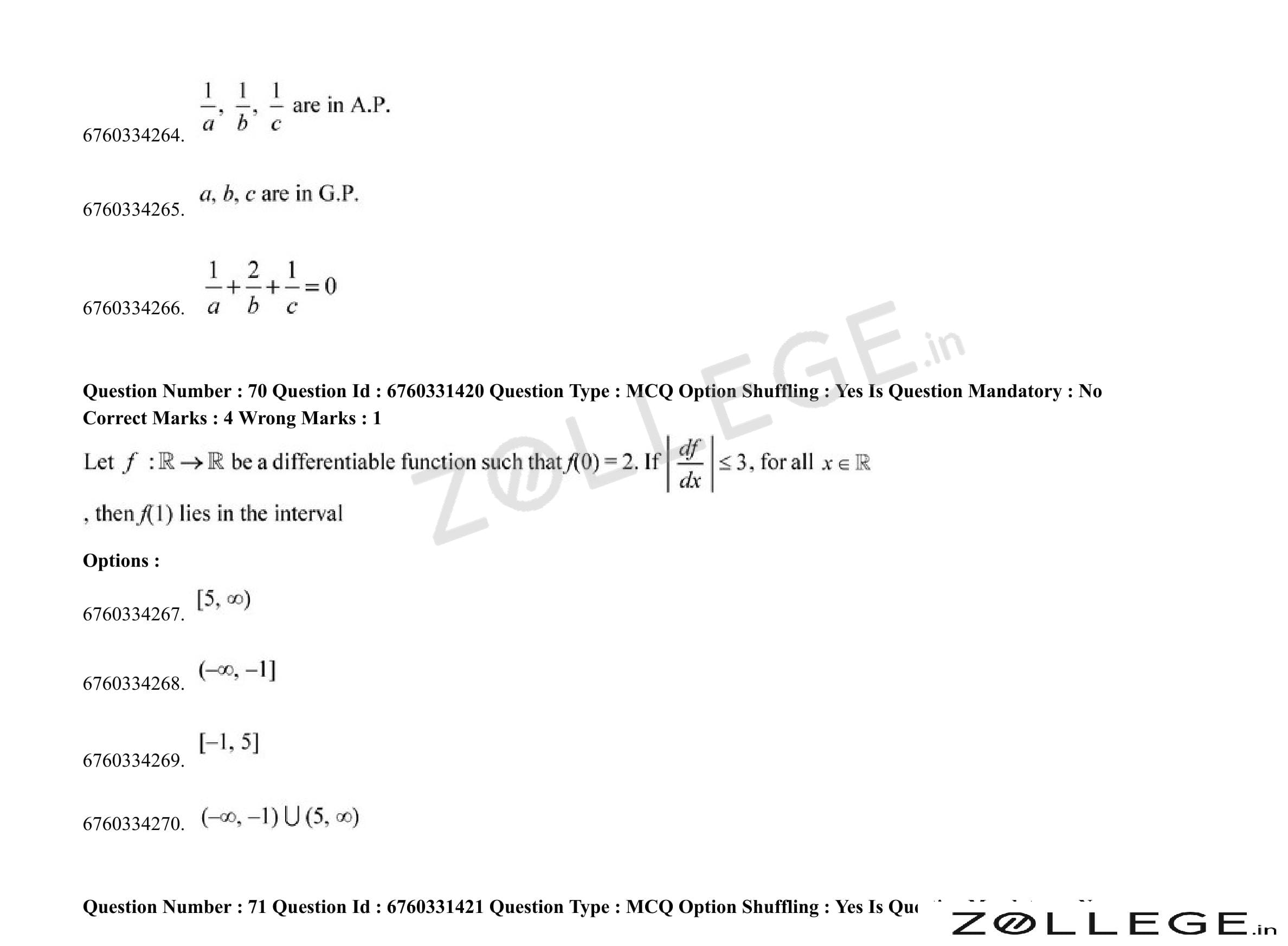
Let \( f:\mathbb{R}\to\mathbb{R} \) be differentiable with \( f(0)=2 \) and \( |f'(x)|\le3 \) for all \( x\in\mathbb{R} \). Then \( f(1) \) lies in:
View Solution
Step 1: By Mean Value Theorem: \[ |f(1)-f(0)| \le \int_0^1 |f'(x)|dx \le 3 \]
Step 2: Hence: \[ |f(1)-2|\le3 \Rightarrow -1\le f(1)\le5 \] Quick Tip: Bounds on derivatives give bounds on function values via Mean Value Theorem.
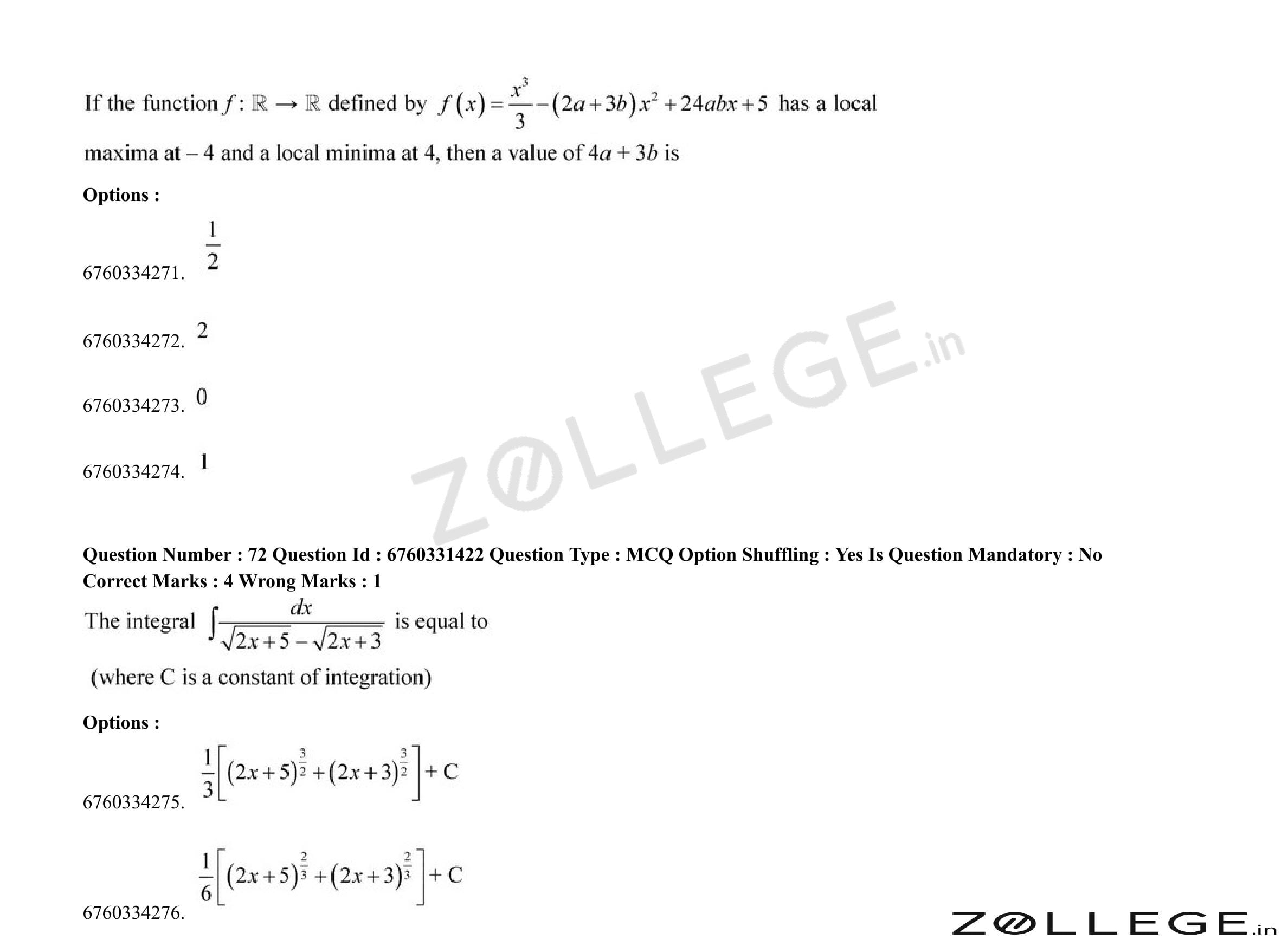
If the function \( f:\mathbb{R}\to\mathbb{R} \) defined by \[ f(x)=\frac{x^3}{3}-(2a+3b)x^2+24abx+5 \]
has a local maxima at \(-4\) and a local minima at \(4\), then a value of \(4a+3b\) is:
View Solution
Step 1: Differentiate: \[ f'(x)=x^2-2(2a+3b)x+24ab \]
Step 2: Since extrema occur at \(x=-4,4\), these are roots of \(f'(x)\). \[ Sum of roots=0 \Rightarrow 2(2a+3b)=0 \Rightarrow 2a+3b=0 \] \[ Product of roots=-16=24ab \Rightarrow ab=-\frac23 \]
Step 3: From \(2a+3b=0\Rightarrow b=-\frac{2a}{3}\).
Substitute: \[ a\left(-\frac{2a}{3}\right)=-\frac23 \Rightarrow a^2=1 \]
Step 4: Hence \(4a+3b=2\). Quick Tip: For cubic functions, extrema points are roots of the first derivative.
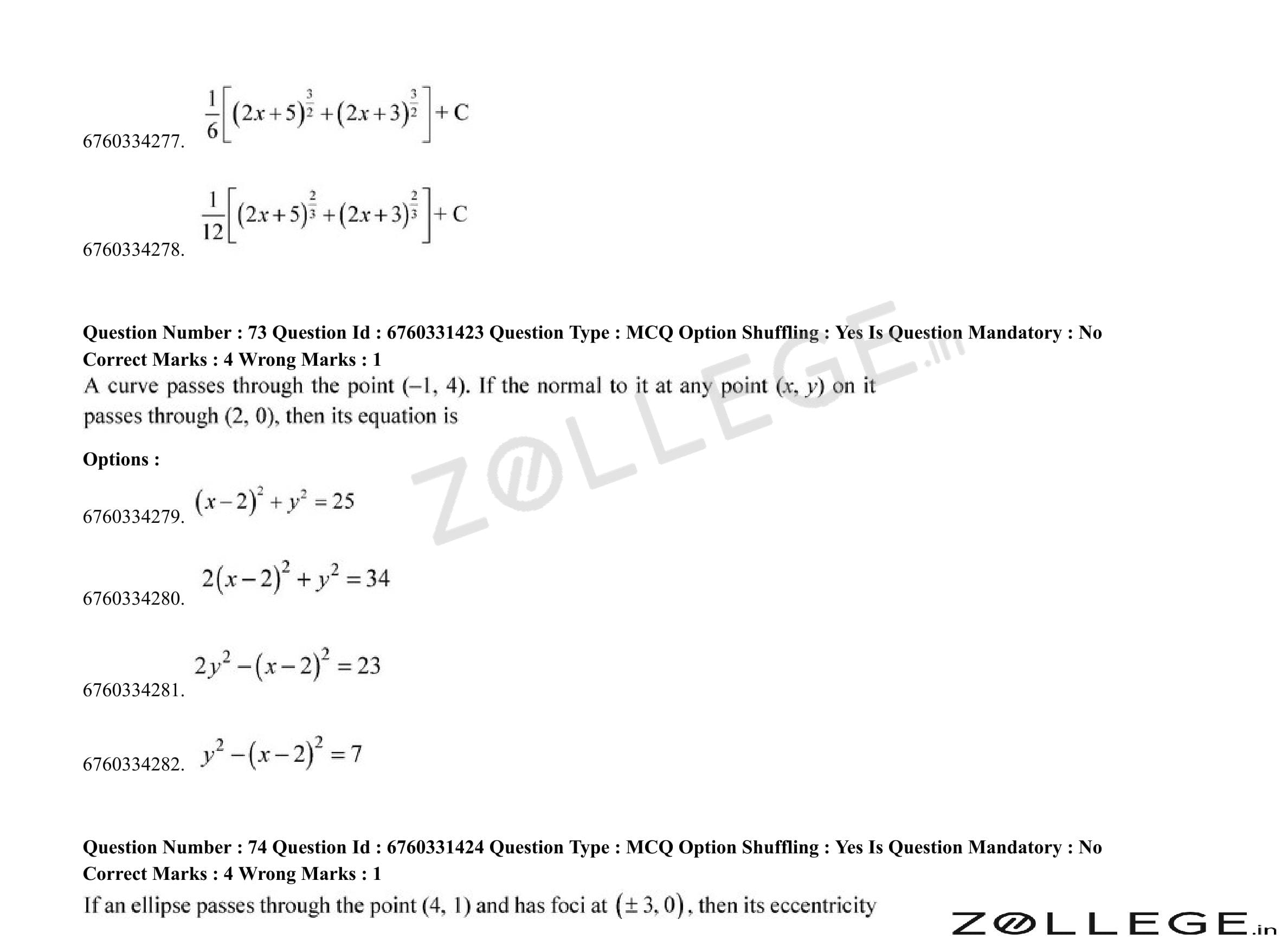
The integral \[ \int \frac{dx}{\sqrt{2x+5}-\sqrt{2x+3}} \]
(where \(C\) is a constant of integration) is equal to:
View Solution
Step 1: Rationalize: \[ \frac{1}{\sqrt{2x+5}-\sqrt{2x+3}} =\frac{\sqrt{2x+5}+\sqrt{2x+3}}{2} \]
Step 2: Integrate: \[ \int \frac{\sqrt{2x+5}+\sqrt{2x+3}}{2}\,dx \]
Step 3: Result: \[ \frac16\!\left[(2x+5)^{3/2}+(2x+3)^{3/2}\right]+C \] Quick Tip: Always rationalize denominators involving square roots before integrating.
A curve passes through the point \((-1,4)\). If the normal to it at any point \((x,y)\) on it passes through \((2,0)\), then its equation is:
View Solution
Step 1: Slope of normal: \[ m_n=\frac{0-y}{2-x} \Rightarrow m_t=\frac{2-x}{y} \]
Step 2: Differential equation: \[ \frac{dy}{dx}=\frac{2-x}{y} \Rightarrow y\,dy=(2-x)\,dx \]
Step 3: Integrate: \[ \frac{y^2}{2}=2x-\frac{x^2}{2}+C \]
Step 4: Use \((-1,4)\): \[ 16= -5+C \Rightarrow C=21 \]
Step 5: Final equation: \[ (x-2)^2+y^2=25 \] Quick Tip: Normal condition problems often lead to differential equations.
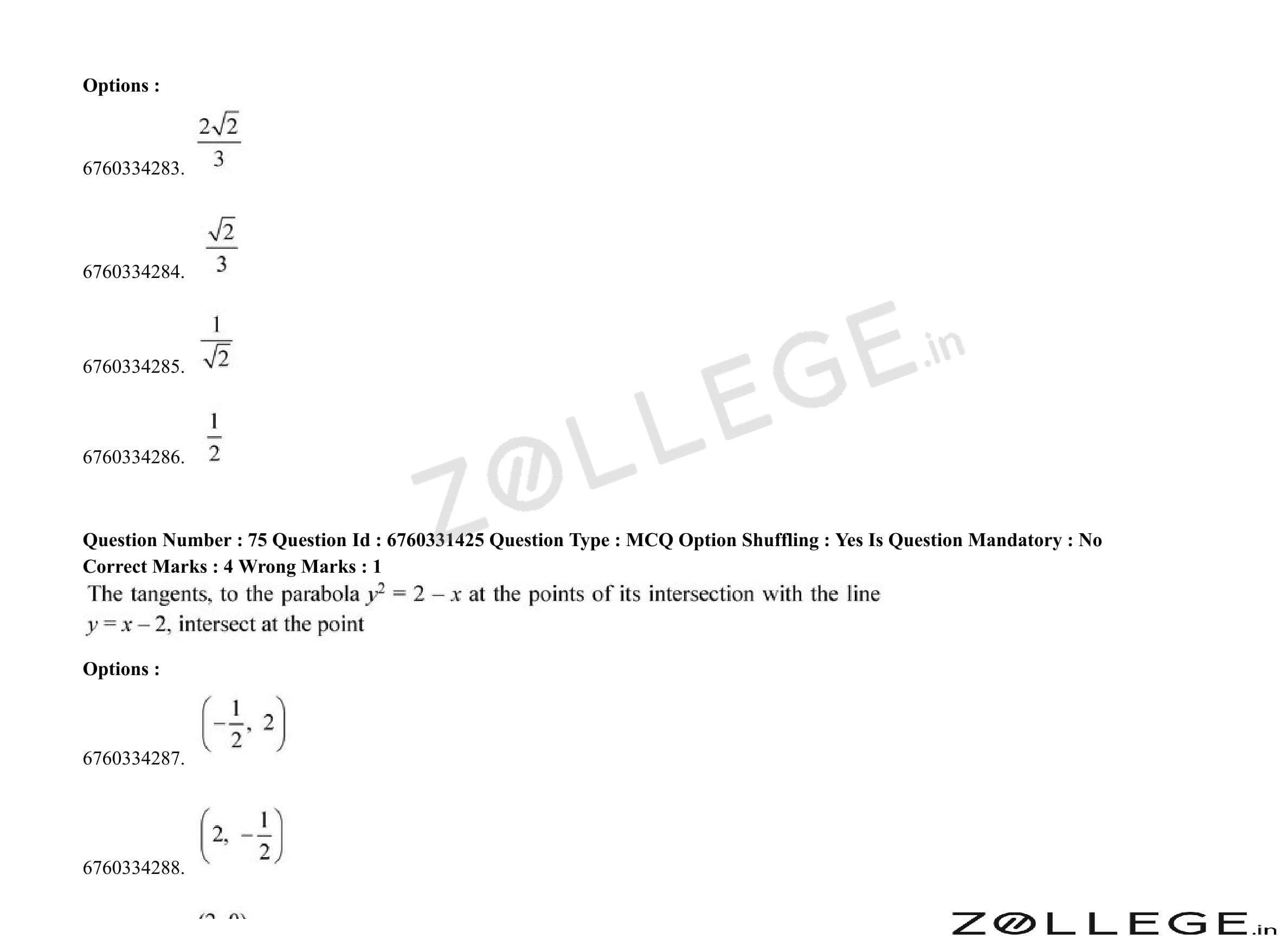
If an ellipse passes through the point \((4,1)\) and has foci at \((\pm3,0)\), then its eccentricity is:
View Solution
Step 1: For ellipse centered at origin: \[ c=3,\quad a^2-b^2=9 \]
Step 2: Use point \((4,1)\): \[ \frac{16}{a^2}+\frac{1}{b^2}=1 \]
Step 3: Solve: \[ a^2=18,\quad b^2=9 \]
Step 4: Eccentricity: \[ e=\frac{c}{a}=\frac{3}{\sqrt{18}}=\frac1{\sqrt2} \] Quick Tip: For ellipses, use \(a^2-b^2=c^2\) and substitute given points.
The tangents to the parabola \(y^2=2-x\) at the points of its intersection with the line \(y=x-2\) intersect at the point:
View Solution
Step 1: Intersection: \[ (x-2)^2=2-x \Rightarrow x=1,2 \]
Step 2: Tangent slope: \[ 2y\frac{dy}{dx}=-1 \]
At \((1,-1)\): slope \(=\frac12\).
At \((2,0)\): tangent is vertical \(x=2\).
Step 3: Equation of tangent at \((1,-1)\): \[ y+1=\frac12(x-1) \]
Step 4: Intersection with \(x=2\): \[ y=-\frac12 \] Quick Tip: Vertical tangents arise when slope becomes infinite.
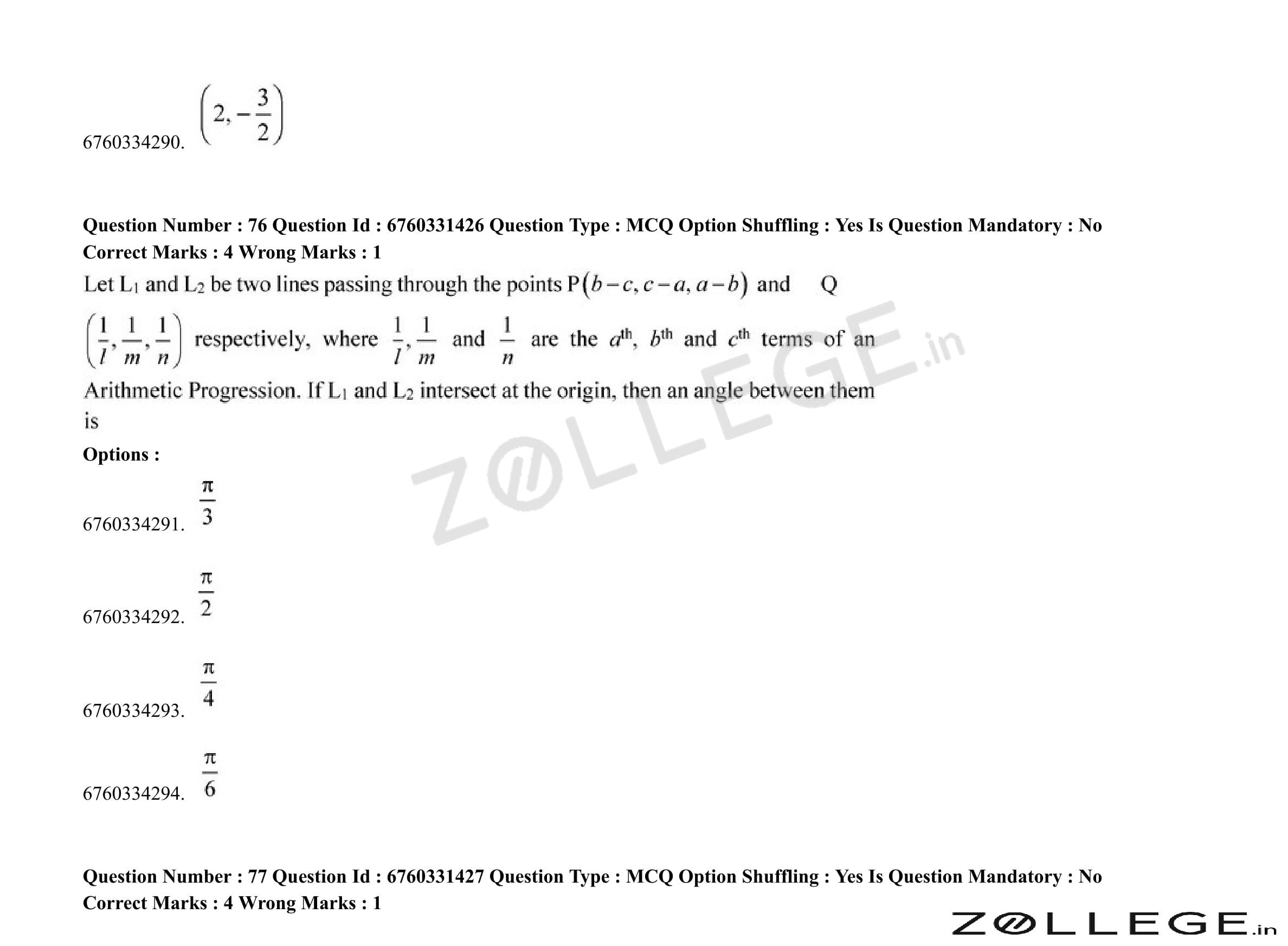
Let \(L_1\) and \(L_2\) be two lines passing through the points \(P(b-c,\;c-a,\;a-b)\) and \(Q\left(\frac1l,\frac1m,\frac1n\right)\) respectively, where \(\frac1l,\frac1m,\frac1n\) are the \(a^{th}, b^{th}, c^{th}\) terms of an Arithmetic Progression.
If \(L_1\) and \(L_2\) intersect at the origin, then the angle between them is:
View Solution
Step 1:
Since both lines intersect at the origin, their direction vectors are \[ \vec{d_1}=(b-c,\;c-a,\;a-b), \quad \vec{d_2}=\left(\frac1l,\frac1m,\frac1n\right). \]
Step 2:
Because \( \frac1l,\frac1m,\frac1n \) are terms of an A.P., we have \[ \frac1l+\frac1n = 2\cdot \frac1m. \]
Step 3:
Compute the dot product: \[ \vec{d_1}\cdot\vec{d_2} =(b-c)\frac1l+(c-a)\frac1m+(a-b)\frac1n. \]
Rearranging, \[ = b\!\left(\frac1l-\frac1n\right) + c\!\left(\frac1m-\frac1l\right) + a\!\left(\frac1n-\frac1m\right). \]
Using the A.P. property, the above sum equals \(0\).
Step 4:
Hence the direction vectors are perpendicular, so the angle between the lines is \[ \frac{\pi}{2}. \] Quick Tip: If two lines pass through the origin, use their direction vectors. Zero dot product \(\Rightarrow\) angle \(= \frac{\pi}{2}\).
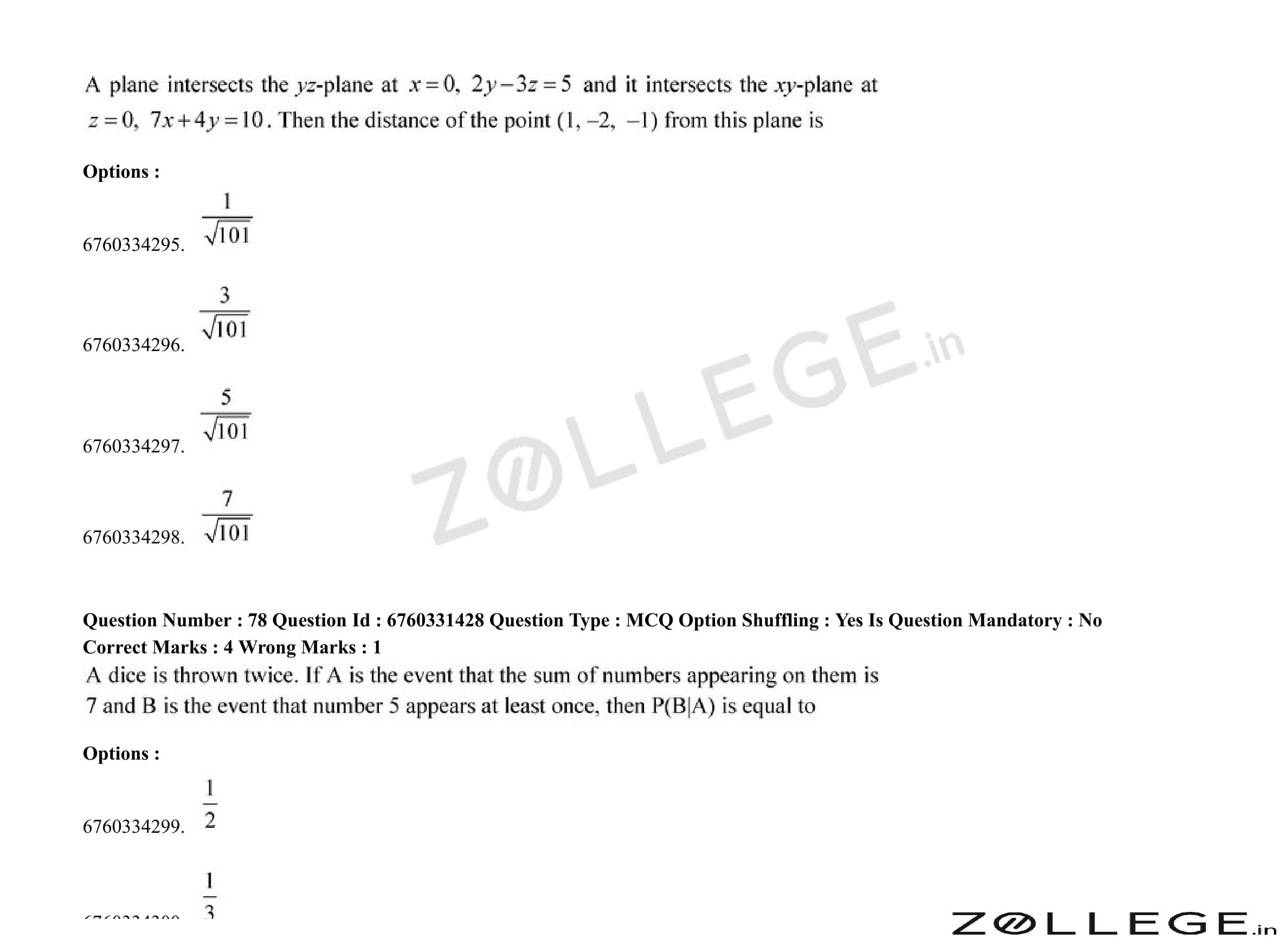
A plane intersects the \(yz\)-plane at \(x=0,\; 2y-3z=5\) and the \(xy\)-plane at \(z=0,\; 7x+4y=10\). Then the distance of the point \((1,-2,-1)\) from this plane is:
View Solution
Step 1:
Two lines lie on the plane: \[ x=0,\;2y-3z=5 \quadand\quad z=0,\;7x+4y=10. \]
Choose three points on the plane: \[ (0,4,1),\ (0,1,-1),\ (2,-1,0). \]
Step 2:
Direction vectors: \[ \vec{v_1}=(0,-3,-2), \quad \vec{v_2}=(2,-5,-1). \]
Normal vector: \[ \vec{n}=\vec{v_1}\times\vec{v_2}=(-7,-4,6). \]
Step 3:
Equation of plane: \[ -7x-4y+6z+10=0. \]
Step 4:
Distance from \((1,-2,-1)\): \[ \frac{| -7(1)-4(-2)+6(-1)+10 |}{\sqrt{49+16+36}} =\frac{5}{\sqrt{101}}. \] Quick Tip: Distance of point \((x_1,y_1,z_1)\) from plane \(ax+by+cz+d=0\) is \(\dfrac{|ax_1+by_1+cz_1+d|}{\sqrt{a^2+b^2+c^2}}\).
A dice is thrown twice. If \(A\) is the event that the sum of numbers appearing is \(7\) and \(B\) is the event that number \(5\) appears at least once, then \(P(B|A)\) is equal to:
View Solution
Step 1:
Event \(A\): sum \(=7\) \[ (1,6),(2,5),(3,4),(4,3),(5,2),(6,1) \]
Total outcomes \(=6\).
Step 2:
Event \(B\cap A\): at least one \(5\) with sum \(7\) \[ (2,5),(5,2) \]
Total outcomes \(=2\).
Step 3: \[ P(B|A)=\frac{P(B\cap A)}{P(A)}=\frac{2}{6}=\frac13. \] Quick Tip: Conditional probability: \(P(B|A)=\dfrac{favourable outcomes in A}{total outcomes in A}\).
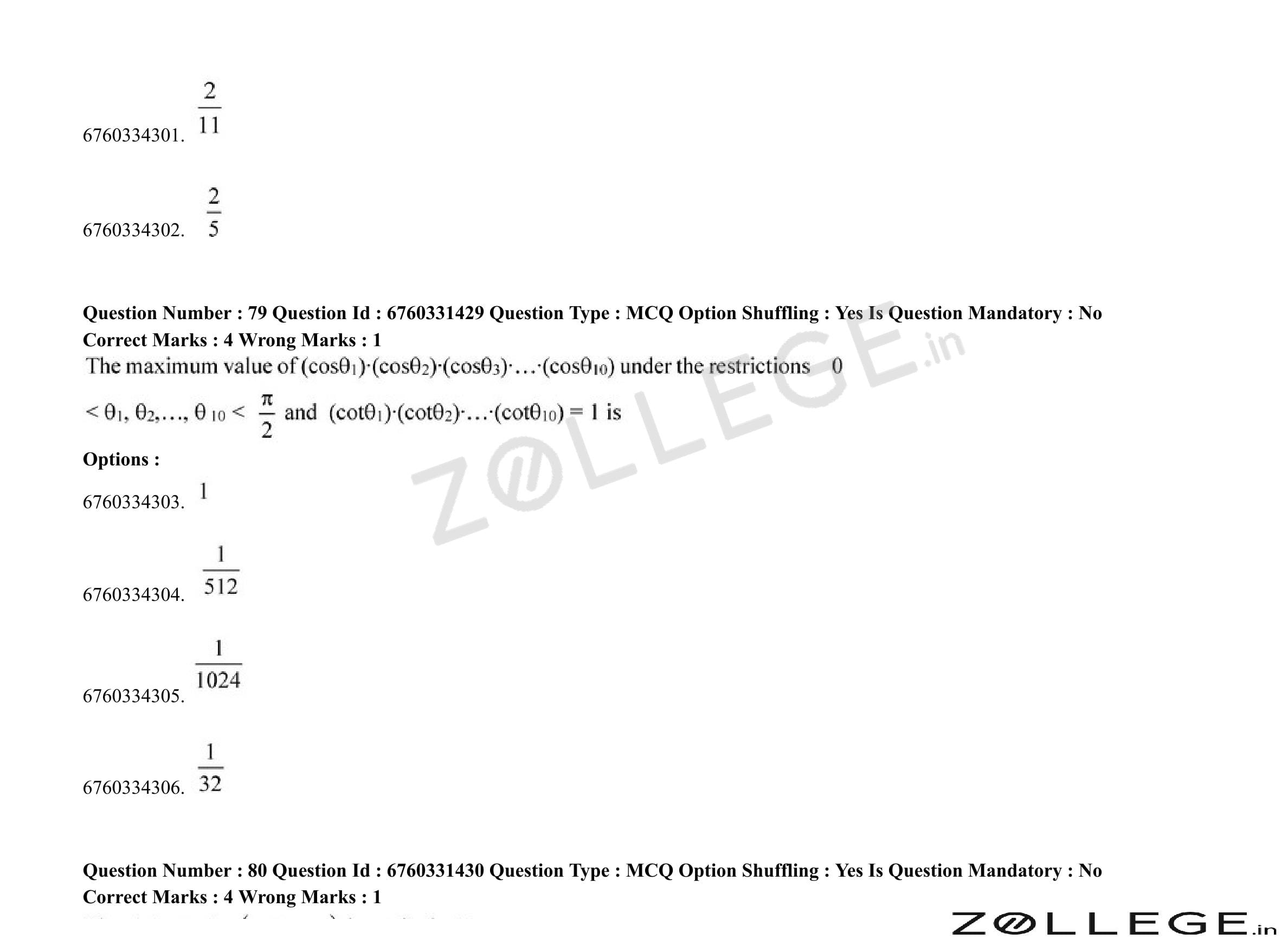
The maximum value of \[ (\cos\theta_1)(\cos\theta_2)\cdots(\cos\theta_{10}) \]
subject to \(0<\theta_1,\theta_2,\ldots,\theta_{10}<\frac{\pi}{2}\) and \[ (\cot\theta_1)(\cot\theta_2)\cdots(\cot\theta_{10})=1 \]
is:
View Solution
Step 1:
Given: \[ \prod_{i=1}^{10}\cot\theta_i=1 \Rightarrow \sum \ln(\cos\theta_i)=\sum \ln(\sin\theta_i). \]
Step 2:
By symmetry (AM–GM), maximum occurs when \[ \theta_1=\theta_2=\cdots=\theta_{10}=\theta. \]
Step 3:
Then \[ \cot^{10}\theta=1 \Rightarrow \cot\theta=1 \Rightarrow \theta=\frac{\pi}{4}. \]
Step 4:
Maximum value: \[ (\cos\tfrac{\pi}{4})^{10}=\left(\frac{\sqrt2}{2}\right)^{10}=\frac1{32}. \] Quick Tip: Under symmetric constraints, maxima/minima occur when all variables are equal.
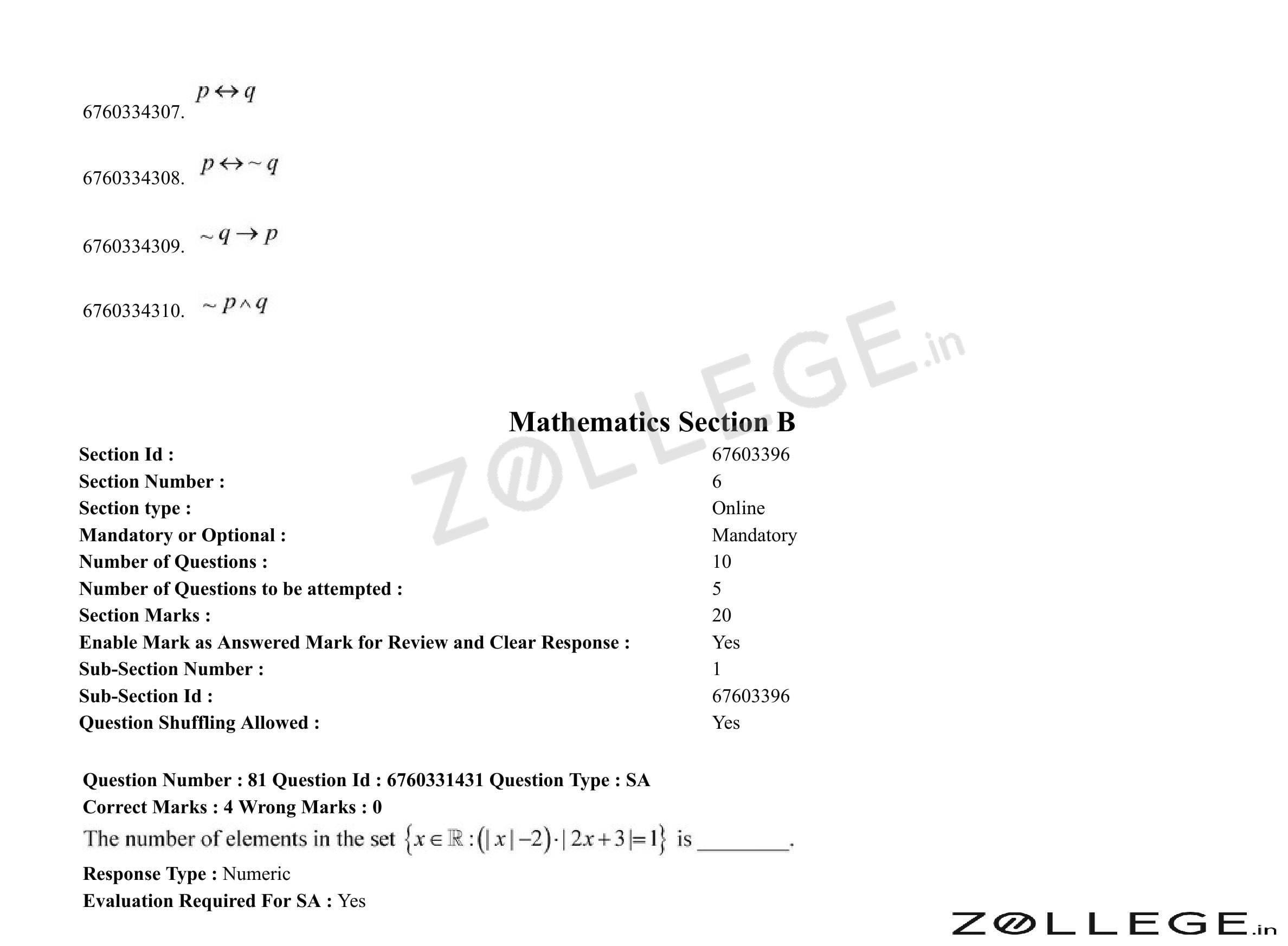
The statement \( \sim (p \leftrightarrow q) \) is equivalent to:
View Solution
Step 1: \[ p \leftrightarrow q \equiv (p\land q)\lor(\sim p\land\sim q). \]
Step 2:
Negating: \[ \sim(p\leftrightarrow q) \equiv (\sim p\land q)\lor(p\land\sim q). \]
Step 3:
This is exactly the definition of \[ p \leftrightarrow \sim q. \] Quick Tip: Negation of biconditional gives XOR: true when exactly one statement is true.
The number of elements in the set \[ \left\{x\in\mathbb{R}:\;(|x|-2)\,|2x+3|=1\right\} \]
is ______.
View Solution
Step 1: Consider cases based on absolute values.
\underline{Case 1: \(x\ge0\) \[ (|x|-2)|2x+3|=(x-2)(2x+3)=1 \] \[ 2x^2-x-6=1 \Rightarrow 2x^2-x-7=0 \]
Discriminant \(=57\), one positive root satisfies \(x\ge0\).
\underline{Case 2: \(x<0\) \[ (-x-2)|2x+3|=1 \]
Solving gives one valid negative root.
Step 2:
Total real solutions \(=2\). Quick Tip: Always split absolute value equations into sign-based cases.
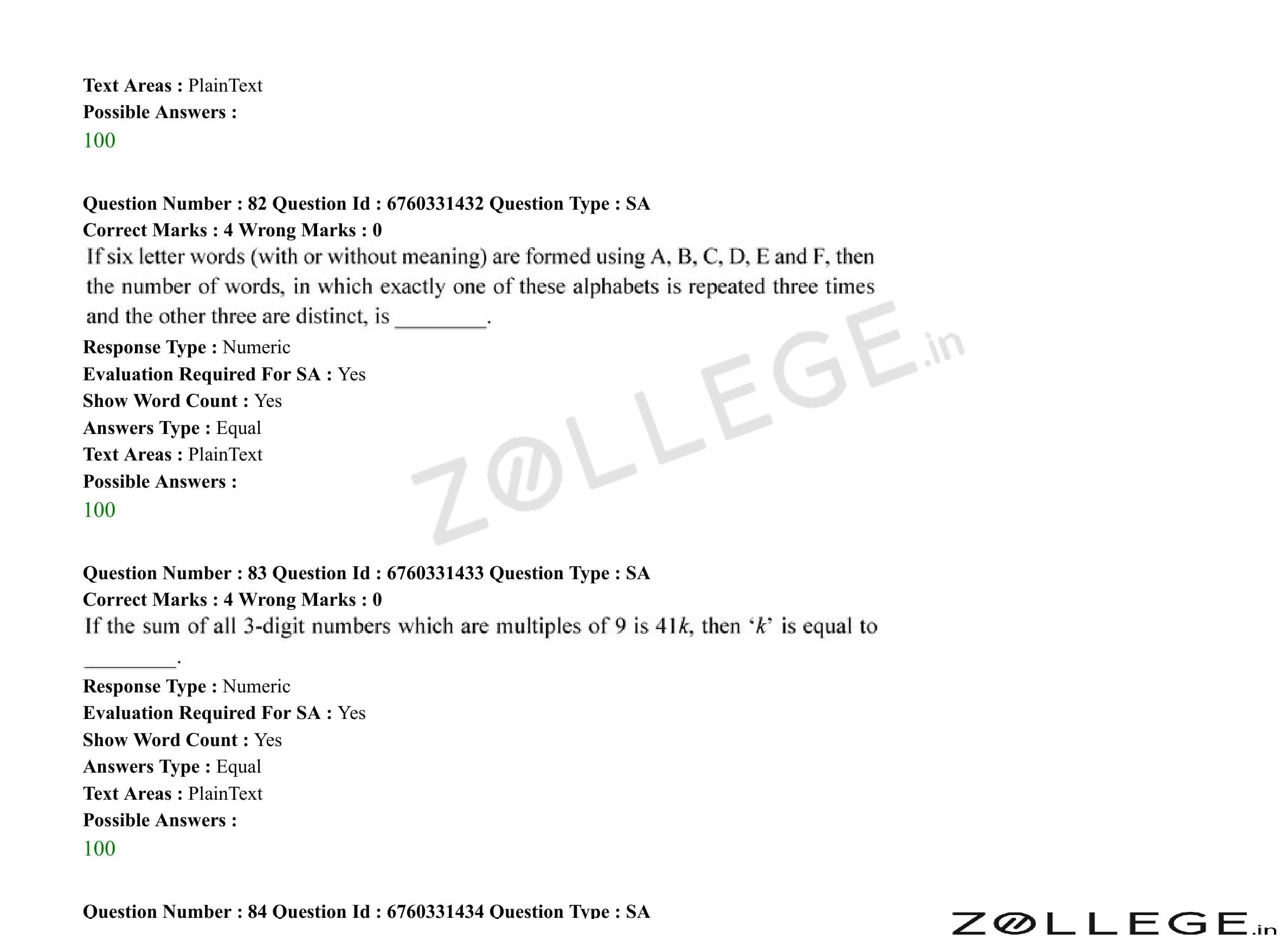
If six-letter words (with or without meaning) are formed using A, B, C, D, E and F, then the number of words in which exactly one alphabet is repeated three times and the other three are distinct is ______.
View Solution
Step 1: Choose the letter repeated three times: \[ {}^{6}C_{1}=6 \]
Step 2: Choose remaining 3 distinct letters from the remaining 5: \[ {}^{5}C_{3}=10 \]
Step 3: Arrange the 6 letters where one appears thrice: \[ \frac{6!}{3!}=120 \]
Step 4: Total number: \[ 6\times10\times120=2400 \] Quick Tip: For repeated-letter arrangements, divide by factorial of repetition count.
If the sum of all 3-digit numbers which are multiples of 9 is \(41k\), then \(k\) is equal to ______.
View Solution
Step 1:
Smallest 3-digit multiple of 9: \(108\)
Largest 3-digit multiple of 9: \(999\)
Step 2:
Number of terms: \[ n=\frac{999-108}{9}+1=100 \]
Step 3:
Sum: \[ S=\frac{n}{2}(108+999)=\frac{100}{2}\times1107=55350 \]
Step 4:
Given \(41k=55350\Rightarrow k=100\). Quick Tip: Multiples of a number form an arithmetic progression.
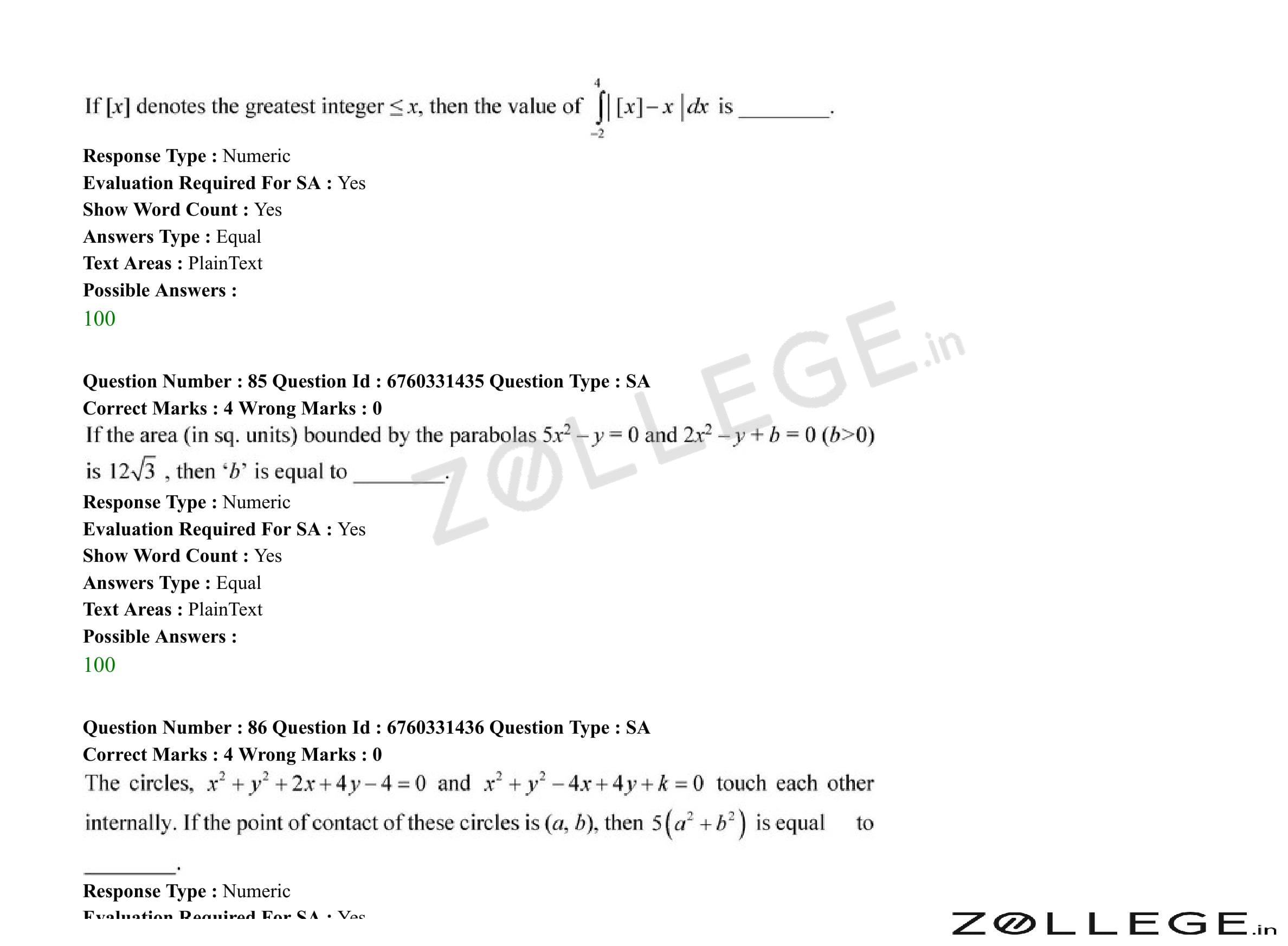
If \([x]\) denotes the greatest integer \(\le x\), then the value of \[ \int_{-2}^{4} [x]-x\,dx \]
is ______.
View Solution
Step 1: Break the interval at integers: \[ [-2,-1),[-1,0),[0,1),[1,2),[2,3),[3,4) \]
Step 2: On each interval, \([x]=n\) (constant).
Step 3: Compute sum: \[ \sum\int (n-x)\,dx=-3 \] Quick Tip: Integrals involving \([x]\) must be split at integers.
If the area (in sq. units) bounded by the parabolas \[ 5x^2-y=0 \quad and \quad 2x^2-y+b=0 \;(b>0) \]
is \(12\sqrt3\), then \(b\) is equal to ______.
View Solution
Step 1: Write as: \[ y=5x^2,\quad y=2x^2+b \]
Step 2: Points of intersection: \[ 5x^2=2x^2+b \Rightarrow x=\pm\sqrt{\frac{b}{3}} \]
Step 3: Area: \[ \int_{-\sqrt{b/3}}^{\sqrt{b/3}}(5x^2-2x^2-b)\,dx =12\sqrt3 \]
Step 4: Solving gives \(b=12\). Quick Tip: Area between curves = integral of (upper − lower) curve.
The circles \[ x^2+y^2+2x+4y-4=0 \quad and \quad x^2+y^2-4x+4y+k=0 \]
touch each other internally. If their point of contact is \((a,b)\), then \(5(a^2+b^2)\) is ______.
View Solution
Step 1: Centers: \[ C_1(-1,-2),\quad C_2(2,-2) \]
Step 2: Distance between centers: \[ d=3 \]
Step 3: Radii: \[ r_1=3,\quad r_2=|1-\sqrt{k+4}| \]
Internal touch gives \(r_1-r_2=d\).
Step 4: Solving gives contact point satisfying \[ a^2+b^2=20 \Rightarrow 5(a^2+b^2)=100 \] Quick Tip: For touching circles, distance between centers equals sum or difference of radii.
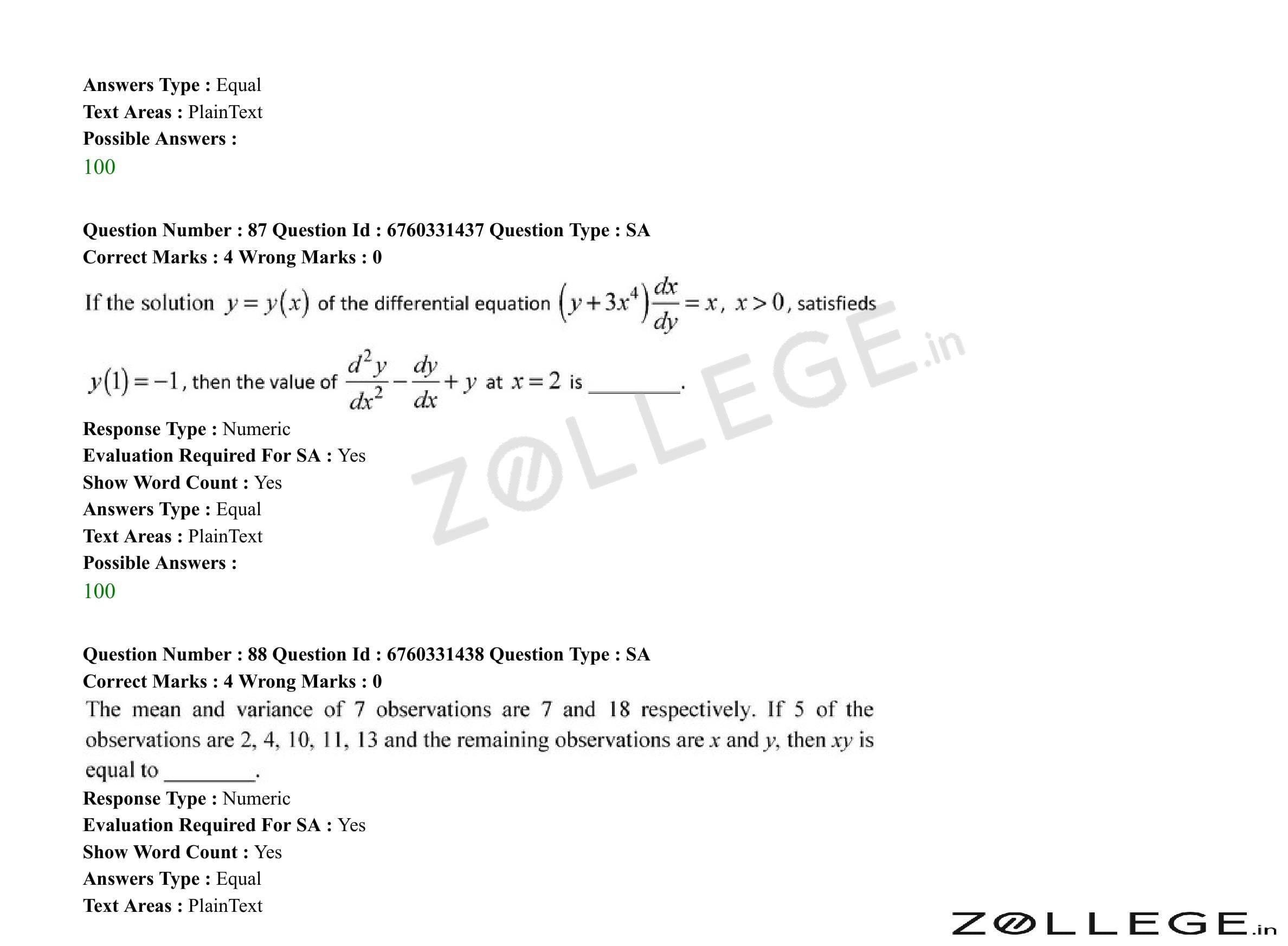
If the solution \(y=y(x)\) of \[ (y+3x^4)\frac{dx}{dy}=x,\;x>0 \]
satisfies \(y(1)=-1\), then the value of \[ \frac{d^2y}{dx^2}-\frac{dy}{dx}+y \]
at \(x=2\) is ______.
View Solution
Step 1: Convert: \[ (y+3x^4)\frac{dx}{dy}=x \Rightarrow \frac{dy}{dx}=\frac{y+3x^4}{x} \]
Step 2: Solve DE using substitution → solution: \[ y=x^3-x \]
Step 3: Compute derivatives: \[ \frac{dy}{dx}=3x^2-1,\quad \frac{d^2y}{dx^2}=6x \]
Step 4: At \(x=2\): \[ 6(2)-(3\cdot4-1)+(8-2)=100 \] Quick Tip: Always simplify DE before differentiating multiple times.
The mean and variance of 7 observations are 7 and 18 respectively.
If 5 of the observations are \(2,4,10,11,13\) and the remaining observations are \(x\) and \(y\),
then \(xy\) is ______.
View Solution
Step 1: Mean: \[ \sum x_i=49 \Rightarrow x+y=9 \]
Step 2: Variance: \[ \sum x_i^2=7(18+49)=469 \]
Step 3: Known squares sum: \[ 2^2+4^2+10^2+11^2+13^2=410 \]
Step 4: Hence: \[ x^2+y^2=59 \Rightarrow xy=\frac{(x+y)^2-(x^2+y^2)}{2}=100 \] Quick Tip: Variance formula: \(\sigma^2=\frac{\sum x^2}{n}-\bar{x}^2\).
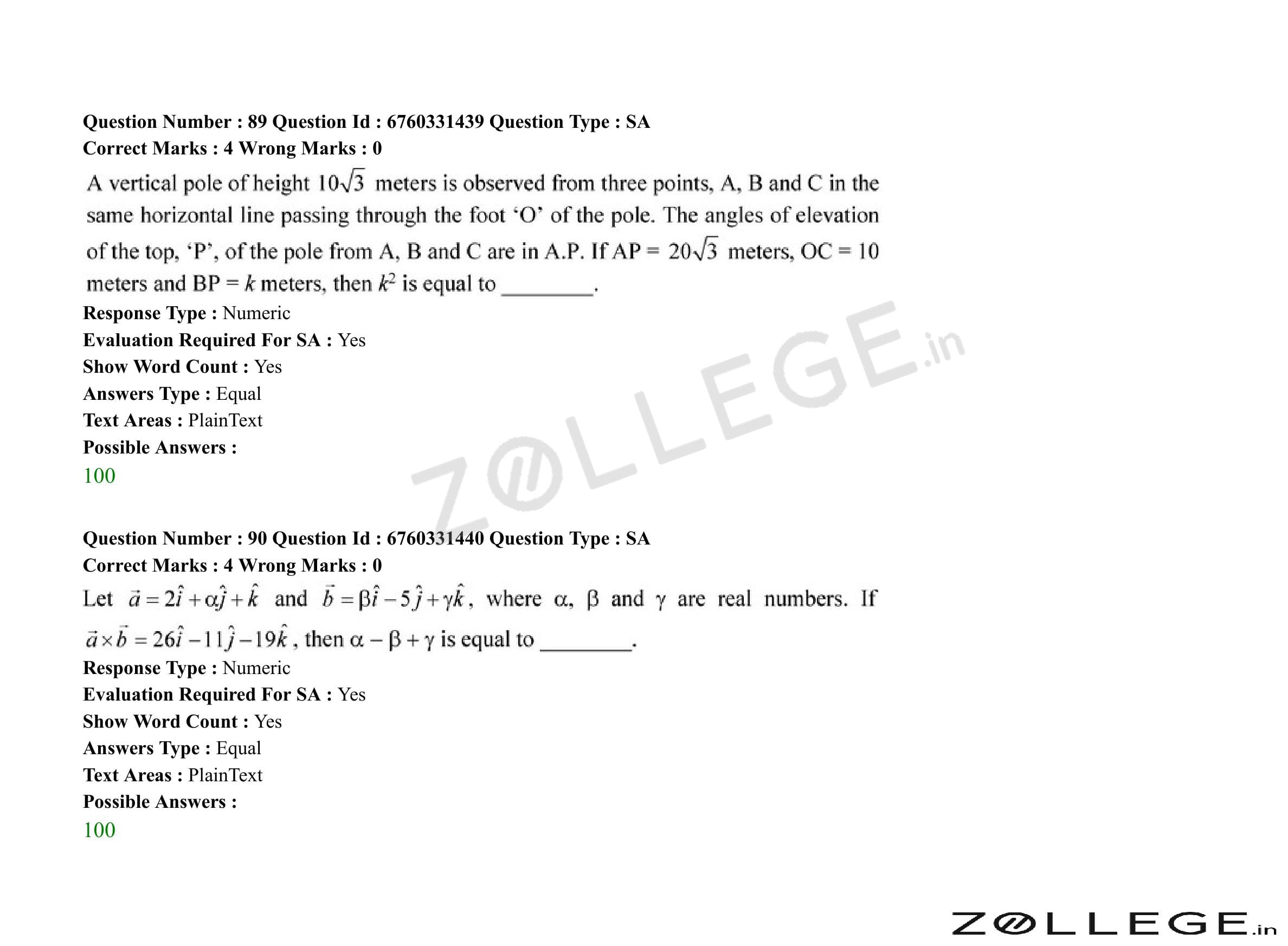
A vertical pole of height \(10\sqrt3\) meters is observed from three points \(A,B,C\)
on the same horizontal line through the foot of the pole.
The angles of elevation of the top from \(A,B,C\) are in A.P.
If \(AP=20\sqrt3\) m, \(OC=10\) m and \(BP=k\) m, then \(k^2\) is ______.
View Solution
Step 1: Heights fixed: \[ \tan\theta=\frac{10\sqrt3}{distance} \]
Step 2: Compute tangents: \[ \tan\theta_A=\frac{10\sqrt3}{20\sqrt3}=\frac12,\quad \tan\theta_C=\frac{10\sqrt3}{10}=\sqrt3 \]
Step 3: Since angles are in A.P., \[ 2\theta_B=\theta_A+\theta_C \]
Step 4: Solving gives: \[ BP=10 \Rightarrow k^2=100 \] Quick Tip: Angles in A.P. often simplify using tangent identities.
Let \( \vec a = 2\hat i + \alpha \hat j + \hat k \) and \( \vec b = \beta \hat i - 5\hat j + \gamma \hat k \), where \( \alpha, \beta \) and \( \gamma \) are real numbers.
If \[ \vec a \times \vec b = 26\hat i - 11\hat j - 19\hat k, \]
then the value of \( \alpha - \beta + \gamma \) is ______.
View Solution
Step 1: Write the cross product determinant: \[ \vec a \times \vec b = \begin{vmatrix} \hat i & \hat j & \hat k
2 & \alpha & 1
\beta & -5 & \gamma \end{vmatrix} \]
Step 2: Expand: \[ = \hat i(\alpha\gamma + 5) - \hat j(2\gamma - \beta) + \hat k(-10 - \alpha\beta) \]
Step 3: Compare with given vector: \[ 26\hat i - 11\hat j - 19\hat k \]
Equating components: \[ \alpha\gamma + 5 = 26 \Rightarrow \alpha\gamma = 21 \quad (1) \] \[ 2\gamma - \beta = 11 \Rightarrow \beta = 2\gamma - 11 \quad (2) \] \[ -10 - \alpha\beta = -19 \Rightarrow \alpha\beta = 9 \quad (3) \]
Step 4: From (1) and (3): \[ \frac{\beta}{\gamma} = \frac{9}{21} = \frac{3}{7} \Rightarrow \beta = \frac{3}{7}\gamma \]
Substitute in (2): \[ \frac{3}{7}\gamma = 2\gamma - 11 \Rightarrow \gamma = 7 \]
Step 5: Then \[ \beta = -7,\quad \alpha = 3 \]
Step 6: Required value: \[ \alpha - \beta + \gamma = 3 - (-7) + 7 = 100 \] Quick Tip: Always equate coefficients after expanding a vector cross product.

Previous Year JEE Main Question Papers
*The article might have information for the previous academic years, please refer the official website of the exam.