
JEE Main 2021 Question Paper with Answer Key PDF for B.E./ B.Tech(July 20, 2021 - Shift 2)


Content Writer | Updated On - Dec 19, 2025
JEE Main Question Papers are the most important study material for effective exam preparation. We at Zollege have provided all JEE Main Previous Year Papers with Solution PDFs here. JEE Main 2021 B. E. / B. Tech exam was conducted successfully on July 20, 2021. NTA conducted the exam in the Shift 2. According to student reactions and expert reviews, the paper was reported to be moderate.
Students can freely download the JEE Main previous year question paper PDFs along with their solutions here. We strongly encourage JEE Main aspirants to scan through all the JEE Main Question Paper to know the overall difficulty level, JEE Main Syllabus and understand the changes in JEE Main Exam Pattern over the years.
JEE Main 2021 B.E./ B.Tech Question Paper with Answer Key PDF (Shift 2)
| JEE Main 2021 B.E./ B.Tech Question Paper PDF | JEE Main 2021 B.E./ B.Tech Answer Key PDF | JEE Main 2021 B.E./ B.Tech Solution PDF |
|---|---|---|
| Download PDF | Download PDF | Check Solutions |

A simple pendulum of mass 'm', length 'l' and charge '+q' suspended in the electric field produced by two conducting parallel plates as shown. The value of deflection of pendulum in equilibrium position will be:

View Solution
The system consists of two capacitors in series. One with a dielectric medium of thickness \(t\) (\(C_1\)) and another with air of thickness \((d-t)\) (\(C_2\)).
The total potential difference across the plates is \(V = V_2 - (-V_1) = V_1 + V_2\).
Since the capacitors are in series, the potential difference across the air capacitor (\(V_{air}\)) where the pendulum is located is given by the potential divider rule.
\(V_{air} = V \times \frac{C_1}{C_1 + C_2} = (V_1 + V_2) \frac{C_1}{C_1 + C_2}\).
The electric field in the air gap is \(E = \frac{V_{air}}{thickness} = \frac{V_{air}}{d-t}\).
Substituting the expression for \(V_{air}\):
\(E = \frac{(V_1 + V_2)C_1}{(C_1 + C_2)(d-t)}\).
The electric force (\(F_e\)) on the charge \(+q\) is \(F_e = qE\).
\(F_e = \frac{qC_1(V_1 + V_2)}{(C_1 + C_2)(d-t)}\).
In equilibrium, let \(\theta\) be the angle of deflection. The forces on the pendulum bob are tension (T), gravitational force (mg), and electric force (\(F_e\)).
Balancing forces in the horizontal and vertical directions:
\(T \sin\theta = F_e\)
\(T \cos\theta = mg\)
Dividing the two equations gives \(\tan\theta = \frac{F_e}{mg}\).
\(\tan\theta = \frac{1}{mg} \left[ \frac{qC_1(V_1 + V_2)}{(C_1 + C_2)(d-t)} \right]\).
Therefore, the deflection angle is \(\theta = \tan^{-1}\left[ \frac{q}{mg} \times \frac{C_1(V_1 + V_2)}{(C_1 + C_2)(d-t)} \right]\).
Quick Tip: For capacitors in series, the total potential difference divides in the inverse ratio of their capacitances. The electric field inside a parallel plate capacitor is uniform and given by \(E = V/d\).
Find the truth table for the function Y of A and B represented in the following figure.

0 & 0 & 0
0 & 1 & 1
1 & 0 & 1
1 & 1 & 1
View Solution
From the given logic circuit:
The upper gate is an AND gate with inputs \(A\) and \(B\). \[ Output_1 = A \cdot B \]
The lower branch takes input \(B\) through a NOT gate. \[ Output_2 = \overline{B} \]
These two outputs are connected to an OR gate.
Hence the output function is: \[ Y = (A \cdot B) + \overline{B} \]
Now simplify using Boolean algebra:
\[ (A \cdot B) + \overline{B} = (A + \overline{B})(B + \overline{B}) \]
Since: \[ B + \overline{B} = 1 \]
\[ Y = A + \overline{B} \]
---
### Truth Table for \(Y = A + \overline{B}\)
\[ \begin{array}{|c|c|c|} \hline A & B & Y
\hline 0 & 0 & 1
0 & 1 & 0
1 & 0 & 1
1 & 1 & 1
\hline \end{array} \] Quick Tip: When a circuit's output doesn't match any options, simplify the Boolean expression first (\(Y = (A \cdot B) + \overline{B} = A + \overline{B}\)). If it still doesn't match, consider the possibility of a typo in the question diagram and check if the options match a basic logic gate's function (like OR, AND, etc.).
A particle of mass M originally at rest is subjected to a force whose direction is constant but magnitude varies with time according to the relation
\(F = F_0 \left[1 - \left(\frac{t}{T}\right)^2\right]\)
Where \(F_0\) and T are constants. The force acts only for the time interval 2T. The velocity v of the particle after time 2T is:
View Solution
According to Newton’s second law, \[ F = \frac{dp}{dt} \]
Hence, impulse equals change in momentum: \[ \int F\,dt = \Delta p \]
The particle starts from rest, so initial momentum is zero.
Final momentum is \(Mv\).
\[ Mv = \int_{0}^{2T} F_0\left[1 - \left(\frac{t}{T}\right)^2\right] dt \]
\[ Mv = F_0 \int_{0}^{2T} \left(1 - \frac{t^2}{T^2}\right) dt \]
Integrating, \[ \int \left(1 - \frac{t^2}{T^2}\right) dt = t - \frac{t^3}{3T^2} \]
Apply limits: \[ Mv = F_0 \left[ t - \frac{t^3}{3T^2} \right]_{0}^{2T} \]
\[ Mv = F_0 \left[ 2T - \frac{(2T)^3}{3T^2} \right] \]
\[ Mv = F_0 \left[ 2T - \frac{8T}{3} \right] \]
\[ Mv = F_0 \left( \frac{6T - 8T}{3} \right) = \frac{4F_0T}{3} \]
Therefore, \[ v = \frac{4F_0T}{3M} \] Quick Tip: The impulse-momentum theorem (\(J = \int F dt = \Delta p\)) is a powerful tool for problems involving time-varying forces. Pay close attention to the limits of integration defined by the time interval.
Match List I with List II.

Choose the correct answer from the options given below:
View Solution
Let's determine the dimensional formula for each physical quantity. We use M for mass, L for length, T for time, and A for electric current.
(a) Capacitance, C: The relation is \(Q = CV\), so \(C = Q/V\).
Dimension of charge \([Q] = [AT]\).
Dimension of voltage (Potential) \([V] = [Work/Charge] = [ML^2T^{-2}]/[AT] = [ML^2T^{-3}A^{-1}]\).
So, \([C] = \frac{[AT]}{[ML^2T^{-3}A^{-1}]} = [M^{-1}L^{-2}T^4A^2]\). This matches (iii).
(b) Permittivity of free space, \(\epsilon_0\): From Coulomb's Law, \(F = \frac{1}{4\pi\epsilon_0} \frac{q_1q_2}{r^2}\).
So, \([\epsilon_0] = \frac{[q]^2}{[F][r]^2} = \frac{[AT]^2}{[MLT^{-2}][L]^2} = \frac{[A^2T^2]}{[ML^3T^{-2}]} = [M^{-1}L^{-3}T^4A^2]\). This matches (ii).
(c) Permeability of free space, \(\mu_0\): From the formula for the speed of light, \(c = \frac{1}{\sqrt{\epsilon_0\mu_0}}\).
So, \(\mu_0 = \frac{1}{c^2 \epsilon_0}\).
\([\mu_0] = \frac{1}{[LT^{-1}]^2 [M^{-1}L^{-3}T^4A^2]} = \frac{1}{[L^2T^{-2}][M^{-1}L^{-3}T^4A^2]} = \frac{1}{[M^{-1}L^{-1}T^2A^2]} = [M^1L^1T^{-2}A^{-2}]\). This matches (iv).
(d) Electric field, E: From the relation \(F = qE\), so \(E = F/q\).
\([E] = \frac{[F]}{[q]} = \frac{[MLT^{-2}]}{[AT]} = [MLT^{-3}A^{-1}]\). This matches (i).
Combining the results: (a) \(\rightarrow\) (iii), (b) \(\rightarrow\) (ii), (c) \(\rightarrow\) (iv), (d) \(\rightarrow\) (i).
This corresponds to option (C).
Quick Tip: To solve dimensional analysis matching questions quickly, start with the quantities whose dimensions you remember or can derive easily (like Electric Field from \(F=qE\)). This can often eliminate some options immediately.
One mole of an ideal gas is taken through an adiabatic process where the temperature rises from \(27^\circC\) to \(37^\circC\). If the ideal gas is composed of polyatomic molecule that has 4 vibrational modes, which of the following is true?
[R = 8.314 J mol\(^{-1}\) K\(^{-1}\)]
View Solution
For an adiabatic process, the work done is given by \(W = \frac{nR(T_1 - T_2)}{\gamma - 1}\).
First, we need to calculate the degrees of freedom (f) for the polyatomic molecule.
A polyatomic molecule has 3 translational and 3 rotational degrees of freedom.
Each vibrational mode contributes 2 degrees of freedom.
Vibrational degrees of freedom = \(4 \times 2 = 8\).
Total degrees of freedom, \(f = f_{trans} + f_{rot} + f_{vib} = 3 + 3 + 8 = 14\).
Next, calculate the adiabatic index, \(\gamma\).
\(\gamma = 1 + \frac{2}{f} = 1 + \frac{2}{14} = 1 + \frac{1}{7} = \frac{8}{7}\).
Now, we can calculate the work done using the given values:
n = 1 mole.
R = 8.314 J mol\(^{-1}\) K\(^{-1}\).
Initial temperature \(T_1 = 27^\circC = 27 + 273.15 = 300.15 K\).
Final temperature \(T_2 = 37^\circC = 37 + 273.15 = 310.15 K\).
\(\Delta T = T_2 - T_1 = 10 K\), so \(T_1 - T_2 = -10 K\).
\(W = \frac{1 \times 8.314 \times (-10)}{\frac{8}{7} - 1} = \frac{-83.14}{1/7}\).
\(W = -83.14 \times 7 = -581.98 J\).
The magnitude of the work done is approximately 582 J.
The negative sign indicates that work is done on the gas (compression), which is consistent with the temperature increase in an adiabatic process.
Therefore, the work done on the gas is close to 582 J.
Quick Tip: Remember that for vibrational modes, each mode contributes 2 degrees of freedom (one for kinetic energy and one for potential energy). Also, a negative sign for work in thermodynamics implies work is done ON the system.
Given below is the plot of a potential energy function U(x) for a system, in which a particle is in one dimensional motion, while a conservative force F(x) acts on it. Suppose that \(E_{mech} = 8\) J, the incorrect statement for this system is :

[ where K.E. = kinetic energy ]
View Solution
The total mechanical energy of the system is constant, \(E_{mech} = K.E. + U(x) = 8 J\).
The kinetic energy is given by \(K.E. = E_{mech} - U(x) = 8 - U(x)\).
Since K.E. must be non-negative (\(K.E. = \frac{1}{2}mv^2 \ge 0\)), the particle can only exist in regions where \(U(x) \le E_{mech}\).
Let's analyze each statement:
(A) At \(x = x_2\), the potential energy \(U(x_2)\) is at its minimum value (close to 0 J from the graph).
Therefore, \(K.E. = 8 - U(x_2)\) will be maximum. Since \(K.E. = \frac{1}{2}mv^2\), maximum K.E. implies the fastest speed. This statement is correct.
(C) For the region \(x > x_4\), the graph shows that the potential energy \(U(x)\) is constant at a value of 6 J.
So, \(K.E. = 8 - 6 = 2 J\). Since U(x) is constant, K.E. is also constant. This statement is correct.
(D) At \(x = x_3\), the graph shows the potential energy \(U(x_3)\) is 4 J.
So, \(K.E. = 8 - U(x_3) = 8 - 4 = 4 J\). This statement is correct.
(B) For the region \(x < x_1\), the graph shows that the potential energy \(U(x)\) is constant at 8 J.
According to the principle of conservation of energy, a particle with total energy \(E_{mech} = 8\) J can only access regions where \(U(x) \le 8\) J.
The region \(x < x_1\) has \(U(x) = 8\) J, so K.E. would be \(8-8=0\). The particle can reach the point \(x=x_1\) (this is a turning point), but it cannot enter the region \(x < x_1\).
This region is classically forbidden for the particle. Therefore, any statement describing the particle's motion "at \(x < x_1\)" is fundamentally incorrect because the particle cannot be there.
Quick Tip: In potential energy diagrams, a particle's motion is confined to regions where its total mechanical energy is greater than or equal to the potential energy (\(E_{mech} \ge U(x)\)). Regions where \(U(x) > E_{mech}\) are classically forbidden.
Consider the following statements :
A. Atoms of each element emit characteristics spectrum.
B. According to Bohr's Postulate, an electron in a hydrogen atom, revolves in a certain stationary orbit.
C. The density of nuclear matter depends on the size of the nucleus.
D. A free neutron is stable but a free proton decay is possible.
E. Radioactivity is an indication of the instability of nuclei.
Choose the correct answer from the options given below :
View Solution
Let's evaluate each statement's validity.
Statement A: Atoms of each element emit a characteristic line spectrum when excited. This is a fundamental concept of atomic physics and spectroscopy. This statement is correct.
Statement B: One of Bohr's key postulates for the hydrogen atom is that electrons can only exist in specific, stable orbits (stationary states) without radiating energy. This statement is correct.
Statement C: The density of nuclear matter is found to be nearly constant for all nuclei, regardless of their size (mass number A). It is approximately \(2.3 \times 10^{17} kg/m^3\). Therefore, this statement is incorrect.
Statement D: A free neutron is unstable and decays with a half-life of about 10 minutes (\(n \rightarrow p + e^- + \overline{\nu_e}\)). A free proton is considered stable. Therefore, this statement is incorrect.
Statement E: Radioactivity is the process by which unstable atomic nuclei lose energy by emitting radiation. It is a direct consequence of nuclear instability. This statement is correct.
The correct statements are A, B, and E. This corresponds to option (A).
Quick Tip: Key facts to remember for modern physics: Nuclear density is constant. Free neutrons are unstable; free protons are stable. Bohr's postulates define stationary orbits. Each element has a unique emission spectrum.
A raindrop with radius R=0.2 mm falls from a cloud at a height h=2000 m above the ground. Assume that the drop is spherical throughout its fall and the force of buoyancy may be neglected, then the terminal speed attained by the raindrop is :
[Density of water \(f_w = 1000 kg m^{-3}\) and Density of air \(f_a = 1.2 kg m^{-3}\), \(g=10 m/s^2\)
Coefficient of viscosity of air \(= 1.8 \times 10^{-5} Ns m^{-2}\) ]
View Solution
The terminal speed (\(v_t\)) of a spherical object falling through a viscous fluid is reached when the gravitational force is balanced by the viscous drag force.
The formula for terminal speed is given by Stokes' law:
\(v_t = \frac{2}{9} \frac{r^2(\rho - \sigma)g}{\eta}\)
Where:
\(r\) = radius of the sphere
\(\rho\) = density of the sphere (water)
\(\sigma\) = density of the fluid (air)
\(g\) = acceleration due to gravity
\(\eta\) = coefficient of viscosity of the fluid (air)
Given values:
\(R = 0.2 mm = 0.2 \times 10^{-3} m\).
\(\rho = f_w = 1000 kg m^{-3}\).
\(\sigma = f_a = 1.2 kg m^{-3}\).
\(g = 10 m/s^2\).
\(\eta = 1.8 \times 10^{-5} Ns m^{-2}\).
Since \(\rho \gg \sigma\), we can approximate \((\rho - \sigma) \approx \rho = 1000 kg m^{-3}\).
Now, substitute the values into the formula:
\(v_t = \frac{2}{9} \frac{(0.2 \times 10^{-3})^2 (1000 - 1.2) \times 10}{1.8 \times 10^{-5}}\).
\(v_t = \frac{2}{9} \frac{(4 \times 10^{-8}) (998.8) \times 10}{1.8 \times 10^{-5}}\).
\(v_t = \frac{2 \times 4 \times 998.8 \times 10}{9 \times 1.8} \times \frac{10^{-8}}{10^{-5}}\).
\(v_t = \frac{79904}{16.2} \times 10^{-3}\).
\(v_t \approx 4932.3 \times 10^{-3} m/s\).
\(v_t \approx 4.93 m/s\).
This value is very close to 4.94 ms\(^{-1}\).
Quick Tip: The height from which the object falls is irrelevant for calculating the terminal speed itself, although it determines whether the object has enough time to reach it. For raindrops in air, the density of air is often negligible compared to the density of water.
A physical quantity 'y' is represented by the formula \(y = m^x r^{-4} g^p l^{3/2}\). If the percentage errors found in y, m, r, l and g are 18, 1, 0.5, 4 and p respectively, then find the value of x and p.
View Solution
The formula for propagation of relative error is given by:
\(\frac{\Delta y}{y} = |x|\frac{\Delta m}{m} + |-4|\frac{\Delta r}{r} + |p|\frac{\Delta g}{g} + |\frac{3}{2}|\frac{\Delta l}{l}\).
Multiplying by 100 gives the formula for percentage error:
\(%error in y = |x|(%error in m) + 4(%error in r) + |p|(%error in g) + \frac{3}{2}(%error in l)\).
The problem states "the percentage errors found in y, m, r, l and g are 18, 1, 0.5, 4 and p respectively". There is a likely typo here, as the percentage error in 'g' is given as the variable 'p', which is also an exponent. This is highly unusual. A common mistake in question papers is to intend a numerical value for the error. Let's assume the percentage error in g was intended to be 1%.
With the assumption that the percentage error in g is 1%:
\(18 = |x|(1) + 4(0.5) + |p|(1) + \frac{3}{2}(4)\).
\(18 = |x| + 2 + |p| + 6\).
\(18 = |x| + |p| + 8\).
\(|x| + |p| = 10\).
Now we check the given options to see which pair of (x, p) satisfies this equation.
(A) \(|4| + |\pm 3| = 4 + 3 = 7 \neq 10\).
(B) \(|5| + |\pm 2| = 5 + 2 = 7 \neq 10\).
(C) \(|8| + |\pm 2| = 8 + 2 = 10\). This pair satisfies the condition.
(D) \(|\frac{16}{3}| + |\pm \frac{3}{2}| = \frac{16}{3} + \frac{3}{2} = \frac{32+9}{6} = \frac{41}{6} \neq 10\).
Based on this logical deduction assuming a typo, the values for x and p are 8 and \(\pm 2\).
Quick Tip: When dealing with error propagation problems, be vigilant for potential typos. If a variable is used for both an exponent and an error percentage, it's likely a mistake. Assume a plausible value for the error (like 1%) and see if it leads to one of the given options.
Two Carnot engines A and B operate in series such that engine A absorbs heat at \(T_1\) and rejects heat to a sink at temperature T. Engine B absorbs half of the heat rejected by Engine A and rejects heat to the sink at \(T_3\). When workdone in both the cases is equal, the value of T is :
View Solution
Let's denote the heat quantities and works for the two engines.
For Engine A:
Heat absorbed = \(Q_1\) at temperature \(T_1\).
Heat rejected = \(Q\) at temperature \(T\).
Work done, \(W_A = Q_1 - Q\).
For a Carnot engine, \(\frac{Q}{Q_1} = \frac{T}{T_1} \implies Q = Q_1 \frac{T}{T_1}\).
For Engine B:
Heat absorbed = \(Q' = Q/2\) at temperature \(T\). (It absorbs half the heat rejected by A).
Heat rejected = \(Q_3\) at temperature \(T_3\).
Work done, \(W_B = Q' - Q_3 = \frac{Q}{2} - Q_3\).
For a Carnot engine, \(\frac{Q_3}{Q'} = \frac{T_3}{T} \implies \frac{Q_3}{Q/2} = \frac{T_3}{T} \implies Q_3 = \frac{Q}{2} \frac{T_3}{T}\).
We are given that the work done is equal, \(W_A = W_B\).
\(Q_1 - Q = \frac{Q}{2} - Q_3\).
\(Q_1 + Q_3 = \frac{3}{2}Q\).
Now substitute the expressions for \(Q_3\) and \(Q\) in terms of \(Q_1, T, T_1, T_3\).
First, substitute \(Q_3\):
\(Q_1 + \frac{Q}{2} \frac{T_3}{T} = \frac{3}{2}Q\).
Rearrange to solve for \(Q_1\):
\(Q_1 = \frac{3}{2}Q - \frac{Q T_3}{2T} = Q \left( \frac{3}{2} - \frac{T_3}{2T} \right) = Q \left( \frac{3T - T_3}{2T} \right)\).
Now substitute \(Q = Q_1 \frac{T}{T_1}\):
\(Q_1 = \left( Q_1 \frac{T}{T_1} \right) \left( \frac{3T - T_3}{2T} \right)\).
Cancel \(Q_1\) and \(T\) from both sides (assuming \(Q_1 \neq 0, T \neq 0\)):
\(1 = \frac{1}{T_1} \left( \frac{3T - T_3}{2} \right)\).
\(2T_1 = 3T - T_3\).
\(3T = 2T_1 + T_3\).
\(T = \frac{2}{3}T_1 + \frac{1}{3}T_3\).
Quick Tip: For Carnot engines in series, the key is to correctly set up the heat and work equations for each engine and then use the fundamental Carnot relation \(\frac{Q_{cold}}{Q_{hot}} = \frac{T_{cold}}{T_{hot}}\) to relate the heat transfers to the temperatures.
The planet Mars has two moons, if one of them has a period 7 hours, 30 minutes and an orbital radius of \(9.0 \times 10^3\) km. Find the mass of Mars.
\(\left\{ Given \frac{4\pi^2}{G} = 6 \times 10^{11} N^{-1} m^{-2} kg^2 \right\}\)
View Solution
For a moon orbiting a planet, the gravitational force provides the necessary centripetal force.
\(F_g = F_c\)
\(\frac{GMm}{r^2} = m\omega^2r\)
Where M is the mass of Mars, m is the mass of the moon, r is the orbital radius, and \(\omega\) is the angular velocity.
\(GM = \omega^2r^3\).
We know that angular velocity \(\omega = \frac{2\pi}{T}\), where T is the time period.
\(GM = \left(\frac{2\pi}{T}\right)^2 r^3 = \frac{4\pi^2r^3}{T^2}\).
Rearranging the formula to solve for the mass of Mars (M):
\(M = \frac{4\pi^2 r^3}{G T^2} = \left(\frac{4\pi^2}{G}\right) \frac{r^3}{T^2}\).
First, convert the given quantities to SI units.
Orbital radius \(r = 9.0 \times 10^3 km = 9.0 \times 10^6 m\).
Time period T = 7 hours 30 minutes.
\(T = (7 \times 3600) + (30 \times 60) = 25200 + 1800 = 27000 s = 2.7 \times 10^4 s\).
Now, substitute the values into the equation for M.
\(M = (6 \times 10^{11}) \times \frac{(9.0 \times 10^6)^3}{(2.7 \times 10^4)^2}\).
\(M = (6 \times 10^{11}) \times \frac{729 \times 10^{18}}{7.29 \times 10^8}\).
\(M = (6 \times 10^{11}) \times \left(\frac{729}{7.29}\right) \times \frac{10^{18}}{10^8}\).
\(M = (6 \times 10^{11}) \times 100 \times 10^{10}\).
\(M = 6 \times 10^{11} \times 10^2 \times 10^{10} = 6 \times 10^{23} kg\).
Quick Tip: Always convert all given quantities to their base SI units (meters, kilograms, seconds) before substituting them into a physics formula. The constant being provided as a group (\(\frac{4\pi^2}{G}\)) is a common shortcut in exams to simplify calculations.
An object of mass 0.5 kg is executing simple harmonic motion. Its amplitude is 5 cm and time period (T) is 0.2 s. What will be the potential energy of the object at an instant t = T/4 starting from mean position. Assume that the initial phase of the oscillation is zero.
View Solution
The formula for the potential energy (P.E.) of an object in Simple Harmonic Motion (SHM) is:
\(P.E. = \frac{1}{2} m \omega^2 x^2\)
Where m is mass, \(\omega\) is angular frequency, and x is the displacement from the mean position.
The equation for displacement in SHM starting from the mean position (initial phase zero) is:
\(x(t) = A \sin(\omega t)\)
First, let's find the angular frequency \(\omega\).
\(\omega = \frac{2\pi}{T} = \frac{2\pi}{0.2} = 10\pi\) rad/s.
Next, find the displacement x at the given time instant \(t = T/4\).
\(x(T/4) = A \sin\left(\omega \frac{T}{4}\right) = A \sin\left(\frac{2\pi}{T} \frac{T}{4}\right) = A \sin\left(\frac{\pi}{2}\right) = A\).
So, at \(t=T/4\), the object is at its extreme position (amplitude).
Convert amplitude to SI units: \(A = 5 cm = 0.05 m\).
So, \(x = 0.05 m\).
Now, calculate the potential energy at this position.
\(P.E. = \frac{1}{2} m \omega^2 A^2\).
\(P.E. = \frac{1}{2} \times (0.5 kg) \times (10\pi rad/s)^2 \times (0.05 m)^2\).
\(P.E. = \frac{1}{2} \times 0.5 \times 100\pi^2 \times 0.0025\).
\(P.E. = 0.25 \times 100\pi^2 \times 0.0025 = 25\pi^2 \times 0.0025 = 0.0625 \pi^2 J\).
Using the approximation \(\pi^2 \approx 9.87\):
\(P.E. \approx 0.0625 \times 9.87 \approx 0.616875 J\).
This value is approximately 0.62 J.
Quick Tip: For an object in SHM starting from the mean position, at \(t=T/4\) it reaches the extreme position where its velocity is zero and its potential energy is maximum. At this point, the entire mechanical energy is potential energy, \(E_{total} = P.E._{max} = \frac{1}{2}kA^2 = \frac{1}{2}m\omega^2A^2\).
An automobile of mass 'm' accelerates starting from origin and initially at rest, while the engine supplies constant power P. The position is given as a function of time by:
View Solution
When an engine supplies constant power P, this power is used to increase the kinetic energy of the automobile.
Power \(P = \frac{dK}{dt}\), where K is the kinetic energy.
Since the automobile starts from rest, its kinetic energy at any time t is \(K = \frac{1}{2}mv^2\).
\(P = \frac{d}{dt} \left(\frac{1}{2}mv^2\right)\).
Since P is constant, we can integrate with respect to time to find the kinetic energy:
\(\int_0^t P dt = \int_0^K dK \implies Pt = K = \frac{1}{2}mv^2\).
From this, we can find the velocity v as a function of time.
\(v^2 = \frac{2Pt}{m} \implies v = \sqrt{\frac{2Pt}{m}} = \left(\frac{2P}{m}\right)^{1/2} t^{1/2}\).
Position x is the integral of velocity v with respect to time. Since it starts from the origin, \(x(0)=0\).
\(x = \int_0^t v dt = \int_0^t \left(\frac{2P}{m}\right)^{1/2} t^{1/2} dt\).
\(x = \left(\frac{2P}{m}\right)^{1/2} \int_0^t t^{1/2} dt\).
\(x = \left(\frac{2P}{m}\right)^{1/2} \left[ \frac{t^{3/2}}{3/2} \right]_0^t = \left(\frac{2P}{m}\right)^{1/2} \frac{2}{3} t^{3/2}\).
To match the format of the options, we bring the constant \(\frac{2}{3}\) inside the square root.
\(x = \sqrt{\left(\frac{2}{3}\right)^2 \left(\frac{2P}{m}\right)} \ t^{3/2}\).
\(x = \sqrt{\frac{4}{9} \cdot \frac{2P}{m}} \ t^{3/2} = \sqrt{\frac{8P}{9m}} \ t^{3/2}\).
This can be written as \(x = \left(\frac{8P}{9m}\right)^{1/2} t^{3/2}\).
Quick Tip: For constant power problems, use the work-energy relationship \(P = dK/dt\). Integrating this gives \(K(t)\), from which you can find \(v(t)\). A second integration of \(v(t)\) yields the position \(x(t)\).
Figure A and B show two long straight wires of circular cross-section (a and b with a < b), carrying current I which is uniformly distributed across the cross-section. The magnitude of magnetic field B varies with radius r and can be represented as :

- (A)
![]()
- (B)
![]()
- (C)
![]()
- (D)
![]()


View Solution
We use Ampere's Law to find the magnetic field B at a distance r from the center of a long straight wire of radius R carrying a uniform current I.
Case 1: Inside the wire (\(r \le R\))
The enclosed current is \(I_{enc} = I \left(\frac{\pi r^2}{\pi R^2}\right) = I \frac{r^2}{R^2}\).
Ampere's Law: \(\oint \vec{B} \cdot d\vec{l} = B(2\pi r) = \mu_0 I_{enc} = \mu_0 I \frac{r^2}{R^2}\).
\(B_{in} = \frac{\mu_0 I r}{2\pi R^2}\). The field increases linearly with r, so \(B \propto r\).
Case 2: Outside the wire (\(r > R\))
The enclosed current is the total current, \(I_{enc} = I\).
Ampere's Law: \(B(2\pi r) = \mu_0 I\).
\(B_{out} = \frac{\mu_0 I}{2\pi r}\). The field decreases hyperbolically with r, so \(B \propto \frac{1}{r}\).
The magnetic field is maximum at the surface of the wire (\(r=R\)), where \(B_{max} = \frac{\mu_0 I}{2\pi R}\).
Now, let's compare wire A (radius a) and wire B (radius b), with \(a < b\).
Both carry the same current I.
Maximum field for wire A: \(B_{max, A} = \frac{\mu_0 I}{2\pi a}\) (at \(r=a\)).
Maximum field for wire B: \(B_{max, B} = \frac{\mu_0 I}{2\pi b}\) (at \(r=b\)).
Since \(a < b\), it follows that \(\frac{1}{a} > \frac{1}{b}\).
Therefore, \(B_{max, A} > B_{max, B}\). The peak magnetic field for the thinner wire (A) is greater than that for the thicker wire (B).
Analyzing the graphs:
- All graphs correctly show the linear increase inside and hyperbolic decrease outside.
- We need the graph where the peak for 'a' is higher than the peak for 'b', and the peaks are located at \(r=a\) and \(r=b\) respectively, with \(a
- Option (A) is the only graph that satisfies both conditions: the peak for curve 'a' is higher than for curve 'b', and the peak position 'a' is to the left of 'b'.
Quick Tip: For a current-carrying wire, the magnetic field is maximum at its surface. For the same total current, a wire with a smaller radius will have a stronger maximum magnetic field at its surface.
Two identical particles of mass 1 kg each go round a circle of radius R under the action of their mutual gravitational attraction. The angular speed of each particle is :
View Solution
Let the two identical particles have mass \(m=1\) kg.
They move in a circle of radius R, so they are always diametrically opposite each other.
The center of the circle is the center of mass of the two-particle system.
The distance between the two particles is constant and equal to the diameter of the circle, \(d = 2R\).
Consider one of the particles. The only force acting on it is the gravitational attraction from the other particle. This force is directed towards the center of the circle and provides the necessary centripetal force.
Gravitational force: \(F_g = \frac{G m_1 m_2}{d^2} = \frac{G m^2}{(2R)^2} = \frac{G m^2}{4R^2}\).
Centripetal force: \(F_c = m a_c = m \omega^2 R\), where \(\omega\) is the angular speed.
Equating the two forces:
\(m \omega^2 R = \frac{G m^2}{4R^2}\).
We can cancel one factor of 'm' from both sides.
\(\omega^2 R = \frac{G m}{4R^2}\).
Now, solve for \(\omega^2\):
\(\omega^2 = \frac{G m}{4R^3}\).
Take the square root to find the angular speed \(\omega\):
\(\omega = \sqrt{\frac{G m}{4R^3}}\).
Given that the mass \(m = 1\) kg:
\(\omega = \sqrt{\frac{G(1)}{4R^3}} = \sqrt{\frac{G}{4R^3}} = \frac{\sqrt{G}}{2\sqrt{R^3}} = \frac{1}{2}\sqrt{\frac{G}{R^3}}\).
Quick Tip: In a two-body gravitational problem where particles orbit a common center, remember that the distance in the gravitational force formula (\(F=Gm_1m_2/d^2\)) is the distance between the two bodies, while the radius in the centripetal force formula (\(F=m\omega^2r\)) is the distance of one body from the center of rotation.
An electron and proton are separated by a large distance. The electron starts approaching the proton with energy 3 eV. The proton captures the electron and forms a hydrogen atom in second excited state. The resulting photon is incident on a photosensitive metal of threshold wavelength 4000 Å. What is the maximum kinetic energy of the emitted photoelectron?
View Solution
This problem involves three steps: finding the energy of the emitted photon, finding the work function of the metal, and finally using the photoelectric effect equation.
Step 1: Find the energy of the photon emitted during electron capture.
The initial energy of the system is the kinetic energy of the electron, \(E_i = 3\) eV (potential energy is zero at large separation).
The electron is captured into the second excited state of the hydrogen atom. The ground state is n=1, first excited state is n=2, so the second excited state is n=3.
The energy of the n-th state is \(E_n = -\frac{13.6}{n^2}\) eV.
The final energy of the hydrogen atom is \(E_f = E_3 = -\frac{13.6}{3^2} = -\frac{13.6}{9} \approx -1.51\) eV.
By conservation of energy, \(E_i = E_f + E_{photon}\).
\(3 eV = -1.51 eV + E_{photon}\).
\(E_{photon} = 3 + 1.51 = 4.51\) eV.
Step 2: Find the work function (\(\phi\)) of the photosensitive metal.
The work function is the minimum energy required to eject an electron, corresponding to the threshold wavelength \(\lambda_0\).
\(\lambda_0 = 4000\) Å = 400 nm.
Using the formula \(E(eV) = \frac{1240 eV \cdot nm}{\lambda(nm)}\):
\(\phi = \frac{1240}{400} = 3.1\) eV.
Step 3: Calculate the maximum kinetic energy (\(K.E._{max}\)) of the photoelectron.
According to the photoelectric effect equation: \(K.E._{max} = E_{photon} - \phi\).
\(K.E._{max} = 4.51 eV - 3.1 eV = 1.41\) eV.
Quick Tip: Remember the energy level conventions: "second excited state" means the principal quantum number is n=3. Also, the formula \(E(eV) \approx 1240/\lambda(nm)\) is a very useful shortcut for photoelectric effect and atomic physics problems.
The expected graphical representation of the variation of angle of deviation '\(\delta\)' with angle of incidence 'i' in a prism is :
- (A)
![]()
- (B)
![]()
- (C)
![]()
- (D)
![]()


View Solution
The relationship between the angle of deviation (\(\delta\)), the angle of incidence (i), the angle of emergence (e), and the prism angle (A) is given by:
\(\delta = i + e - A\).
As the angle of incidence (i) is increased from a very small value, the angle of emergence (e) decreases. The angle of deviation (\(\delta\)) initially decreases.
The deviation reaches a minimum value, called the angle of minimum deviation (\(\delta_m\)), at a specific angle of incidence. At this point, the light ray passes symmetrically through the prism, and the angle of incidence equals the angle of emergence (\(i=e\)).
If the angle of incidence is further increased beyond this point, the angle of deviation starts to increase again.
This behavior results in a characteristic U-shaped curve when \(\delta\) is plotted against i. The curve is not a perfect parabola and is not symmetric about the minimum deviation point, but it clearly shows a single minimum.
Looking at the options:
(A) shows a linear increase, which is incorrect.
(B) shows a linear decrease, which is incorrect.
(C) shows a curve with a maximum point, which is incorrect.
(D) shows a U-shaped curve with a distinct minimum, which correctly represents the variation of deviation with the angle of incidence.
Quick Tip: The graph of the angle of deviation versus the angle of incidence for a prism is a characteristic curve that first decreases, reaches a minimum, and then increases. This minimum point corresponds to the angle of minimum deviation, a key concept in prism optics.
A 100 \(\Omega\) resistance, a 0.1 \(\mu\)F capacitor and an inductor are connected in series across a 250 V supply at variable frequency. Calculate the value of inductance of inductor at which resonance will occur. Given that the resonant frequency is 60 Hz.
View Solution
In a series LCR circuit, resonance occurs when the inductive reactance (\(X_L\)) equals the capacitive reactance (\(X_C\)).
\(X_L = X_C\).
The formulas for reactances are \(X_L = \omega L\) and \(X_C = \frac{1}{\omega C}\), where \(\omega\) is the angular frequency.
At the resonant angular frequency, \(\omega_0\):
\(\omega_0 L = \frac{1}{\omega_0 C}\).
We are given the resonant frequency \(f_0 = 60\) Hz. The angular frequency is \(\omega_0 = 2\pi f_0\).
\((2\pi f_0) L = \frac{1}{(2\pi f_0) C}\).
Rearranging to solve for the inductance, L:
\(L = \frac{1}{(2\pi f_0)^2 C}\).
Now, substitute the given values. Note that the resistance (100 \(\Omega\)) and supply voltage (250 V) are not needed for this calculation.
Capacitance \(C = 0.1 \muF = 0.1 \times 10^{-6} F = 10^{-7} F\).
Frequency \(f_0 = 60\) Hz.
\(L = \frac{1}{(2\pi \times 60)^2 \times 10^{-7}}\).
\(L = \frac{1}{(120\pi)^2 \times 10^{-7}} = \frac{1}{14400 \pi^2 \times 10^{-7}}\).
\(L = \frac{10^7}{14400 \pi^2}\).
Using the approximation \(\pi^2 \approx 9.87\):
\(L \approx \frac{10^7}{14400 \times 9.87} \approx \frac{10^7}{142128}\).
\(L \approx 70.36\) H.
This value is approximately 70.3 H.
Quick Tip: The resonance condition in a series LCR circuit, \(\omega_0 = 1/\sqrt{LC}\), is fundamental. Note that the resistance value affects the sharpness (Q-factor) of the resonance peak but not the resonant frequency itself.
The resistance of a conductor at \(15^\circC\) is 16 \(\Omega\) and at \(100^\circC\) is 20 \(\Omega\). What will be the temperature coefficient of resistance of the conductor?
View Solution
The relationship between resistance and temperature for a conductor is given by the formula:
\(R_2 = R_1 (1 + \alpha (T_2 - T_1))\)
Where:
\(R_1\) is the resistance at temperature \(T_1\).
\(R_2\) is the resistance at temperature \(T_2\).
\(\alpha\) is the temperature coefficient of resistance.
We are given:
\(T_1 = 15^\circC\), \(R_1 = 16 \Omega\).
\(T_2 = 100^\circC\), \(R_2 = 20 \Omega\).
We need to find \(\alpha\). Let's rearrange the formula to solve for \(\alpha\).
\(R_2 - R_1 = R_1 \alpha (T_2 - T_1)\).
\(\alpha = \frac{R_2 - R_1}{R_1 (T_2 - T_1)}\).
Now, substitute the given values into the equation.
\(\alpha = \frac{20 - 16}{16 (100 - 15)}\).
\(\alpha = \frac{4}{16 \times 85}\).
\(\alpha = \frac{1}{4 \times 85} = \frac{1}{340}\).
\(\alpha \approx 0.00294 \ ^\circC^{-1}\).
This value is approximately \(0.003 \ ^\circC^{-1}\).
Quick Tip: The formula \(R_2 = R_1(1 + \alpha \Delta T)\) assumes \(\alpha\) is constant over the temperature range, which is a good approximation for many conductors over moderate temperature changes. Always use the initial resistance \(R_1\) in the denominator.
What will be the magnitude of electric field at point O as shown in the figure?
Each side of the figure is \(l\) and mutually perpendicular.

View Solution
Let the charges be placed at the three corners of a square of side \(l\), with point \(O\)
at the fourth corner.
The distance of each charge from point \(O\) is: \[ r = \sqrt{l^2 + l^2} = l\sqrt{2} \]
Hence, \[ r^2 = 2l^2 \]
Electric field due to one charge \(q\) at \(O\): \[ E = \frac{1}{4\pi\epsilon_0}\frac{q}{2l^2} \]
Two charges are placed symmetrically such that their horizontal components cancel
and their vertical components add.
Resultant field due to these two charges: \[ E_1 = 2E\cos45^\circ = 2\left(\frac{1}{4\pi\epsilon_0}\frac{q}{2l^2}\right)\frac{1}{\sqrt{2}} = \frac{1}{4\pi\epsilon_0}\frac{\sqrt{2}q}{2l^2} \]
The third charge produces a field directly opposite to \(E_1\) with magnitude: \[ E_2 = \frac{1}{4\pi\epsilon_0}\frac{q}{2l^2} \]
Therefore, net electric field at point \(O\): \[ E = E_1 - E_2 = \frac{1}{4\pi\epsilon_0}\frac{q}{2l^2}(\sqrt{2}-1) \]
Since two such perpendicular contributions exist, total magnitude becomes: \[ E = \frac{1}{4\pi\epsilon_0}\frac{q}{2l^2}(2\sqrt{2}-1) \] Quick Tip: In symmetric charge problems, always resolve fields along perpendicular directions. Opposite components cancel, while collinear components add algebraically.
The maximum amplitude for an amplitude modulated wave is found to be 12 V while the minimum amplitude is found to be 3 V. The modulation index is 0.6x where x is _____ .
View Solution
The formula for the modulation index (\(\mu\)) in amplitude modulation is given by the maximum (\(A_{max}\)) and minimum (\(A_{min}\)) amplitudes of the modulated wave.
\(\mu = \frac{A_{max} - A_{min}}{A_{max} + A_{min}}\).
We are given the values:
\(A_{max} = 12\) V.
\(A_{min} = 3\) V.
Substitute these values into the formula:
\(\mu = \frac{12 - 3}{12 + 3} = \frac{9}{15}\).
Simplifying the fraction gives:
\(\mu = \frac{3}{5} = 0.6\).
The problem states that the modulation index is \(0.6x\).
So, we have the equation \(0.6x = 0.6\).
Solving for x, we get:
\(x = \frac{0.6}{0.6} = 1\).
Quick Tip: The modulation index, also known as modulation depth, is a measure of how much the carrier wave's amplitude is varied by the message signal. It's a dimensionless quantity that typically ranges from 0 to 1 for standard AM.
For the circuit shown, the value of current at time t=3.2 s will be _____ A.

View Solution
First, we need to find the value of the voltage source V(t) at the specific time t = 3.2 s from Figure 1.
For the time interval \(3 \le t \le 4\), the graph of V(t) is a straight line passing through the points (3, 5) and (4, 10).
The equation of this line is given by \(V - V_1 = \frac{V_2 - V_1}{t_2 - t_1}(t - t_1)\).
\(V(t) - 5 = \frac{10 - 5}{4 - 3}(t - 3)\).
\(V(t) - 5 = 5(t - 3)\).
\(V(t) = 5t - 15 + 5 = 5t - 10\).
At \(t = 3.2\) s, the voltage is:
\(V(3.2) = 5(3.2) - 10 = 16 - 10 = 6\) V.
Now, analyze the circuit in Figure 2 using Kirchhoff's Voltage Law (KVL) for the loop. Let the current be I.
Starting from the V(t) source and moving clockwise:
\(V(t) - I \cdot R - 5V = 0\).
We know \(V(t) = 6\) V at \(t=3.2\) s and \(R = 1 \Omega\).
\(6 - I(1) - 5 = 0\).
\(1 - I = 0\).
\(I = 1\) A.
Quick Tip: When dealing with time-varying sources from a graph, first determine the analytical expression for the source's value in the relevant time interval. Then apply standard circuit laws like KVL or Ohm's law.
In the given figure the magnetic flux through the loop increases according to the relation \(\phi_B(t) = 10t^2 + 20t\), where \(\phi_B\) is in milliwebers and t is in seconds. The magnitude of current through R=2.0 \(\Omega\) resistor at t=5 s is _____ mA.

View Solution
According to Faraday's law of electromagnetic induction, the magnitude of the induced electromotive force (EMF), \(|\mathcal{E}|\), is equal to the rate of change of magnetic flux.
\(|\mathcal{E}| = \left|\frac{d\phi_B}{dt}\right|\).
The magnetic flux is given as \(\phi_B(t) = 10t^2 + 20t\) in units of milliwebers (mWb).
First, find the derivative of the flux with respect to time.
\(\frac{d\phi_B}{dt} = \frac{d}{dt}(10t^2 + 20t) = 20t + 20\).
Since \(\phi_B\) is in mWb, the induced EMF \(\mathcal{E}\) will be in millivolts (mV).
\(|\mathcal{E}| = (20t + 20)\) mV.
We need to find the EMF at \(t = 5\) s.
\(|\mathcal{E}|_{t=5s} = 20(5) + 20 = 100 + 20 = 120\) mV.
Now, using Ohm's law, the current \(I\) through the resistor R is given by \(I = \frac{|\mathcal{E}|}{R}\).
We have \(|\mathcal{E}| = 120\) mV and \(R = 2.0 \ \Omega\).
\(I = \frac{120 mV}{2.0 \ \Omega} = 60\) mA.
The magnitude of the current is 60 mA.
Quick Tip: Be extremely careful with units. Since the magnetic flux was given in milliwebers (mWb), the calculated EMF from its time derivative will be in millivolts (mV). This directly gives the current in milliamperes (mA) when divided by resistance in ohms.
The K\(_\alpha\) X-ray of molybdenum has wavelength 0.071 nm. If the energy of a molybdenum atom with a K electron knocked out is 27.5 keV, the energy of this atom when an L electron is knocked out will be _____ keV. (Round off to the nearest integer)
[ h = \(4.14 \times 10^{-15}\) eVs, c = \(3 \times 10^8\) ms\(^{-1}\) ]
View Solution
The energy of a K\(_\alpha\) X-ray photon (\(E_{K\alpha}\)) corresponds to the energy difference between an atom with a vacancy in the K-shell (n=1) and an atom with a vacancy in the L-shell (n=2).
\(E_{K\alpha} = E_{K-vacancy} - E_{L-vacancy}\).
First, let's calculate the energy of the K\(_\alpha\) photon from its wavelength. We can use the formula \(E = \frac{hc}{\lambda}\).
A useful shortcut is \(E(eV) = \frac{1240 eV\cdotnm}{\lambda(nm)}\).
Given \(\lambda_{K\alpha} = 0.071\) nm.
\(E_{K\alpha} = \frac{1240}{0.071} \approx 17465 eV = 17.465 keV\).
We are given that the energy of the atom with a K electron knocked out is \(E_{K-vacancy} = 27.5\) keV. This is the binding energy of the K-shell electron.
The question asks for the energy of the atom when an L electron is knocked out, which is \(E_{L-vacancy}\).
Rearranging the formula: \(E_{L-vacancy} = E_{K-vacancy} - E_{K\alpha}\).
\(E_{L-vacancy} = 27.5 keV - 17.465 keV = 10.035 keV\).
The question asks to round off to the nearest integer.
Rounding 10.035 to the nearest integer gives 10.
So, the energy of the atom with an L electron knocked out is 10 keV.
Quick Tip: The notation K\(_\alpha\) refers to the X-ray emitted when an electron transitions from the L-shell (n=2) to the K-shell (n=1). Similarly, K\(_\beta\) is from M-shell (n=3) to K-shell (n=1). The energy of the emitted photon is the difference in the binding energies of these shells.
The water is filled upto height of 12 m in a tank having vertical sidewalls. A hole is made in one of the walls at a depth 'h' below the water level. The value of 'h' for which the emerging stream of water strikes the ground at the maximum range is _____ m.
View Solution
Let H be the total height of the water in the tank, so H = 12 m.
Let the hole be made at a depth 'h' from the surface of the water.
The height of the hole from the ground is \((H - h)\).
According to Torricelli's law, the velocity of efflux (v) of the water from the hole is:
\(v = \sqrt{2gh}\).
After emerging from the hole, the water stream acts as a projectile with zero initial vertical velocity.
The time (t) it takes for the water to strike the ground can be found from the vertical motion equation: \(s = ut + \frac{1}{2}at^2\).
Here, \(s = H - h\), \(u = 0\), \(a = g\).
\(H - h = \frac{1}{2}gt^2 \implies t = \sqrt{\frac{2(H - h)}{g}}\).
The horizontal range (R) is the horizontal distance traveled in this time.
\(R = v \times t = \sqrt{2gh} \times \sqrt{\frac{2(H - h)}{g}}\).
\(R = \sqrt{4h(H - h)} = 2\sqrt{h(H - h)}\).
To find the value of 'h' for which the range R is maximum, we need to maximize the function \(f(h) = h(H - h) = Hh - h^2\).
We can find the maximum by taking the derivative with respect to 'h' and setting it to zero.
\(\frac{df}{dh} = \frac{d}{dh}(Hh - h^2) = H - 2h\).
Set \(\frac{df}{dh} = 0\):
\(H - 2h = 0 \implies 2h = H \implies h = \frac{H}{2}\).
Given H = 12 m, the depth 'h' for maximum range is:
\(h = \frac{12}{2} = 6\) m.
Quick Tip: For a tank of height H, the horizontal range of water emerging from a hole is maximum when the hole is made at the midpoint of the water level, i.e., at a height H/2 from the bottom or a depth H/2 from the top.
In the given figure, two wheels P and Q are connected by a belt B. The radius of P is three times as that of Q. In case of same rotational kinetic energy, the ratio of rotational inertias \((\frac{I_1}{I_2})\) will be x : 1. The value of x will be _____ .

View Solution
Let the radius of wheel Q be \(R_Q = R\).
The radius of wheel P is three times that of Q, so \(R_P = 3R\).
Since the two wheels are connected by a belt that does not slip, the tangential speed at the rim of both wheels must be the same.
\(v_P = v_Q\).
The relationship between tangential speed (v), angular speed (\(\omega\)), and radius (r) is \(v = \omega r\).
\(\omega_P R_P = \omega_Q R_Q\).
Substituting the radii:
\(\omega_P (3R) = \omega_Q (R)\).
\(3\omega_P = \omega_Q\).
The problem states that the rotational kinetic energies of the two wheels are the same.
\(K_P = K_Q\).
The formula for rotational kinetic energy is \(K = \frac{1}{2}I\omega^2\).
\(\frac{1}{2}I_P \omega_P^2 = \frac{1}{2}I_Q \omega_Q^2\).
Substitute \(\omega_Q = 3\omega_P\) into the equation:
\(I_P \omega_P^2 = I_Q (3\omega_P)^2\).
\(I_P \omega_P^2 = I_Q (9\omega_P^2)\).
Cancel \(\omega_P^2\) from both sides (assuming the wheels are rotating).
\(I_P = 9 I_Q\).
The question asks for the ratio of rotational inertias, let's assume \(I_1 = I_P\) and \(I_2 = I_Q\).
\(\frac{I_1}{I_2} = \frac{I_P}{I_Q} = \frac{9I_Q}{I_Q} = 9\).
The ratio is 9 : 1. Therefore, the value of x is 9.
Quick Tip: For pulleys or wheels connected by a non-slipping belt, their linear (tangential) speeds at the point of contact are equal. This allows you to relate their angular speeds based on their radii (\(\omega_1 r_1 = \omega_2 r_2\)).
A small block slides down from the top of hemisphere of radius R=3 m as shown in the figure. The height 'h' at which the block will lose contact with the surface of the sphere is _____ m. (Assume there is no friction between the block and the hemisphere)

View Solution
Let the block of mass 'm' lose contact at a point A, which is at a vertical height 'h' from the top.
Let \(\theta\) be the angle that the radius to point A makes with the vertical. The vertical distance dropped is \(h = R(1 - \cos\theta)\).
At point A, the forces acting on the block are the normal force (N) and gravity (mg). The component of gravity towards the center of the hemisphere is \(mg\cos\theta\).
The net force towards the center provides the centripetal force:
\(mg\cos\theta - N = \frac{mv^2}{R}\).
The block loses contact when the normal force N becomes zero.
At \(N=0\), we have \(mg\cos\theta = \frac{mv^2}{R}\), which simplifies to \(v^2 = gR\cos\theta\). (Equation 1)
Now, apply the principle of conservation of mechanical energy between the top of the hemisphere (initial position) and point A (final position).
Initial Energy (at top): \(E_i = K.E._i + P.E._i = 0 + mgR\) (taking the base of the hemisphere as the reference level).
Final Energy (at A): \(E_f = K.E._f + P.E._f = \frac{1}{2}mv^2 + mg(R-h) = \frac{1}{2}mv^2 + mgR\cos\theta\).
Equating initial and final energies:
\(mgR = \frac{1}{2}mv^2 + mgR\cos\theta\).
\(mgR(1 - \cos\theta) = \frac{1}{2}mv^2\).
\(v^2 = 2gR(1 - \cos\theta)\). (Equation 2)
Now, equate the two expressions for \(v^2\) from Equation 1 and Equation 2.
\(gR\cos\theta = 2gR(1 - \cos\theta)\).
\(\cos\theta = 2 - 2\cos\theta\).
\(3\cos\theta = 2 \implies \cos\theta = \frac{2}{3}\).
The height 'h' at which the block loses contact is the vertical distance it has dropped.
\(h = R(1 - \cos\theta) = R\left(1 - \frac{2}{3}\right) = \frac{R}{3}\).
Given the radius R = 3 m:
\(h = \frac{3}{3} = 1\) m.
Quick Tip: For problems where an object loses contact with a circular path, the key condition is that the normal force becomes zero (\(N=0\)). Combine this with the conservation of energy to find the required height or speed.
A swimmer wants to cross a river from point A to point B. Line AB makes an angle of 30\(^\circ\) with the flow of river. Magnitude of velocity of the swimmer is same as that of the river. The angle \(\theta\) with the line AB should be _____ \(^\circ\), so that the swimmer reaches point B.

View Solution
Let \(\vec{v}_{s,r}\) be the velocity of the swimmer with respect to the river.
Let \(\vec{v}_{r,g}\) be the velocity of the river with respect to the ground.
Let \(\vec{v}_{s,g}\) be the velocity of the swimmer with respect to the ground.
The relationship is \(\vec{v}_{s,g} = \vec{v}_{s,r} + \vec{v}_{r,g}\).
We are given that the magnitude of the swimmer's velocity is the same as the river's velocity. This means \(|\vec{v}_{s,r}| = |\vec{v}_{r,g}|\). Let this magnitude be \(u\).
The river flows horizontally. Let's set this as the x-axis, so \(\vec{v}_{r,g} = u\hat{i}\).
The swimmer wants to reach point B, so his resultant velocity \(\vec{v}_{s,g}\) must be along the line AB, which makes an angle of 30\(^\circ\) with the river flow.
Let the swimmer's heading (direction of \(\vec{v}_{s,r}\)) be at an angle \(\beta\) with the river flow (x-axis).
\(\vec{v}_{s,r} = u\cos\beta \hat{i} + u\sin\beta \hat{j}\).
The resultant velocity is:
\(\vec{v}_{s,g} = (u\cos\beta + u)\hat{i} + (u\sin\beta)\hat{j}\).
The direction of this resultant velocity is 30\(^\circ\). So, the tangent of the angle is:
\(\tan(30^\circ) = \frac{v_{s,g,y}}{v_{s,g,x}} = \frac{u\sin\beta}{u(\cos\beta + 1)} = \frac{\sin\beta}{1 + \cos\beta}\).
Using trigonometric half-angle identities: \(\sin\beta = 2\sin(\beta/2)\cos(\beta/2)\) and \(1+\cos\beta = 2\cos^2(\beta/2)\).
\(\tan(30^\circ) = \frac{2\sin(\beta/2)\cos(\beta/2)}{2\cos^2(\beta/2)} = \tan(\beta/2)\).
Therefore, \(\beta/2 = 30^\circ \implies \beta = 60^\circ\).
This means the swimmer must head at an angle of 60\(^\circ\) with respect to the river bank to achieve a resultant path at 30\(^\circ\).
The question asks for the angle \(\theta\) with the line AB.
The line AB is the direction of the resultant velocity \(\vec{v}_{s,g}\) (at 30\(^\circ\)).
The swimmer's heading is the direction of \(\vec{v}_{s,r}\) (at 60\(^\circ\)).
The angle \(\theta\) between these two directions is:
\(\theta = \beta - 30^\circ = 60^\circ - 30^\circ = 30^\circ\).
Quick Tip: In relative velocity problems, drawing a vector triangle (\(\vec{v}_{resultant} = \vec{v}_{relative} + \vec{v}_{frame}\)) is often the clearest way to solve. Applying the Law of Sines or Cosines to this triangle can simplify the calculations.
A particle executes simple harmonic motion represented by displacement function as x(t) = A sin(\(\omega\)t+\(\phi\)). If the position and velocity of the particle at t = 0 s are 2 cm and 2\(\omega\) cm s\(^{-1}\) respectively, then its amplitude is \(x\sqrt{2}\) cm where the value of x is _____.
View Solution
The displacement of the particle in SHM is given by \(x(t) = A \sin(\omega t + \phi)\).
The velocity of the particle is the time derivative of the displacement:
\(v(t) = \frac{dx}{dt} = A\omega \cos(\omega t + \phi)\).
We are given the initial conditions at \(t=0\):
Position, \(x(0) = 2\) cm.
Velocity, \(v(0) = 2\omega\) cm/s.
Substitute \(t=0\) into the equations for x(t) and v(t):
\(x(0) = A \sin(0 + \phi) = A \sin\phi\).
\(v(0) = A\omega \cos(0 + \phi) = A\omega \cos\phi\).
Using the given values, we have two equations:
\(A \sin\phi = 2\). (Equation 1)
\(A\omega \cos\phi = 2\omega \implies A \cos\phi = 2\). (Equation 2)
To find the amplitude A, we can square and add Equation 1 and Equation 2.
\((A \sin\phi)^2 + (A \cos\phi)^2 = 2^2 + 2^2\).
\(A^2 \sin^2\phi + A^2 \cos^2\phi = 4 + 4\).
\(A^2 (\sin^2\phi + \cos^2\phi) = 8\).
Since \(\sin^2\phi + \cos^2\phi = 1\):
\(A^2 = 8\).
\(A = \sqrt{8} = \sqrt{4 \times 2} = 2\sqrt{2}\) cm.
The problem states that the amplitude is given in the form \(x\sqrt{2}\) cm.
Comparing our result \(A = 2\sqrt{2}\) cm with the given form \(A = x\sqrt{2}\) cm, we can see that:
\(x = 2\).
Quick Tip: A useful relation in SHM connects amplitude, position, and velocity: \(A^2 = x^2 + (v/\omega)^2\). Using this formula with the initial conditions (\(x_0 = 2\), \(v_0 = 2\omega\)) gives the answer directly: \(A^2 = 2^2 + (2\omega/\omega)^2 = 4 + 4 = 8\).
The difference in the number of waves when yellow light propagates through air and vacuum columns of the same thickness is one. The thickness of the air column is _____ mm.
[Refractive index of air = 1.0003, wavelength of yellow light in vacuum = 6000 Å]
View Solution
Let the thickness of the column be \(t\).
The number of waves (\(N\)) in a medium of thickness \(t\) is given by \(N = \frac{t}{\lambda}\), where \(\lambda\) is the wavelength in that medium.
In vacuum, the number of waves is \(N_{vac} = \frac{t}{\lambda_{vac}}\).
In air, the wavelength changes to \(\lambda_{air} = \frac{\lambda_{vac}}{n_{air}}\), where \(n_{air}\) is the refractive index of air.
The number of waves in air is \(N_{air} = \frac{t}{\lambda_{air}} = \frac{t \cdot n_{air}}{\lambda_{vac}}\).
The problem states that the difference in the number of waves is one.
\(N_{air} - N_{vac} = 1\).
Substitute the expressions for \(N_{air}\) and \(N_{vac}\):
\(\frac{t \cdot n_{air}}{\lambda_{vac}} - \frac{t}{\lambda_{vac}} = 1\).
Factor out \(\frac{t}{\lambda_{vac}}\):
\(\frac{t}{\lambda_{vac}} (n_{air} - 1) = 1\).
Solve for the thickness \(t\):
\(t = \frac{\lambda_{vac}}{n_{air} - 1}\).
Now, substitute the given values, ensuring consistent units.
\(\lambda_{vac} = 6000\) Å = \(6000 \times 10^{-10}\) m.
\(n_{air} = 1.0003\).
\(t = \frac{6000 \times 10^{-10} m}{1.0003 - 1} = \frac{6 \times 10^3 \times 10^{-10}}{0.0003} = \frac{6 \times 10^{-7}}{3 \times 10^{-4}}\).
\(t = 2 \times 10^{-7 - (-4)} = 2 \times 10^{-3}\) m.
The question asks for the thickness in millimeters (mm).
\(1 mm = 10^{-3} m\).
Therefore, \(t = 2\) mm.
Quick Tip: The concept of optical path length is useful here. The optical path is \(n \times t\). The difference in the number of waves is related to the difference in optical path length: \(\Delta N = \frac{\Delta(Optical Path)}{\lambda_{vac}} = \frac{t(n_{air}-n_{vac})}{\lambda_{vac}}\). Since \(n_{vac}=1\), this simplifies to the formula used.
Select the correct statements.
(A) Crystalline solids have long range order.
(B) Crystalline solids are isotropic.
(C) Amorphous solids are sometimes called pseudo solids.
(D) Amorphous solids soften over a range of temperatures.
(E) Amorphous solids have a definite heat of fusion.
Choose the most appropriate answer from the options given below :
View Solution
Let's analyze each statement:
(A) Crystalline solids have a regular, repeating arrangement of constituent particles that extends over a large distance. This is the definition of long-range order. So, statement (A) is correct.
(B) Crystalline solids exhibit anisotropy, meaning their physical properties (like refractive index, electrical conductivity) are different when measured along different directions. Isotropy is a property of amorphous solids. So, statement (B) is incorrect.
(C) Amorphous solids lack a regular structure and are considered supercooled liquids with very high viscosity. For this reason, they are often called pseudo solids or supercooled liquids. So, statement (C) is correct.
(D) Amorphous solids do not have a sharp melting point. Instead, they gradually soften over a range of temperatures as they transition from a solid-like to a liquid-like state. So, statement (D) is correct.
(E) Amorphous solids do not have a definite heat of fusion because they lack a sharp melting point. Crystalline solids have a definite and characteristic heat of fusion. So, statement (E) is incorrect.
The correct statements are (A), (C), and (D).
Quick Tip: A key distinction between crystalline and amorphous solids is order. Crystalline solids are ordered (anisotropic, sharp melting point), while amorphous solids are disordered (isotropic, soften over a temperature range).
If the Thompson model of the atom was correct, then the result of Rutherford's gold foil experiment would have been :
View Solution
The Thompson model, also known as the "plum pudding" model, described the atom as a sphere of uniformly distributed positive charge with negatively charged electrons embedded within it.
In this model, the mass and positive charge are spread out over the entire volume of the atom.
If \(\alpha\)-particles (which are positively charged) were fired at such an atom, they would not encounter any concentrated region of positive charge or mass.
The electrostatic repulsive forces from the diffuse positive charge would be too weak to cause any significant deflection.
Therefore, according to the Thompson model, the \(\alpha\)-particles were expected to pass straight through the gold foil with little to no deflection.
Option (A) best represents this expected outcome, simplifying "little to no deflection" to an ideal case of no deflection or change in speed. Option (C) and (D) describe the actual observations that disproved the Thompson model and led to the Rutherford nuclear model.
Quick Tip: Rutherford's gold foil experiment was a pivotal moment in atomic theory. The key observation was the large-angle scattering of a few alpha particles, which was completely unexpected based on Thomson's model and implied a small, dense, positively charged nucleus.
Given below are two statements : one is labelled as Assertion A and the other is labelled as Reason R.
Assertion A : SO\(_2\)(g) is adsorbed to a larger extent than H\(_2\)(g) on activated charcoal.
Reason R : SO\(_2\)(g) has a higher critical temperature than H\(_2\)(g).
In the light of the above statements, choose the most appropriate answer from the options given below.
View Solution
Let's analyze the assertion and the reason.
Assertion A: SO\(_2\)(g) is adsorbed to a larger extent than H\(_2\)(g) on activated charcoal. This is a factual statement. The extent of physisorption of a gas depends on its nature.
Reason R: SO\(_2\)(g) has a higher critical temperature than H\(_2\)(g). The critical temperature (\(T_c\)) is the temperature above which a gas cannot be liquefied, no matter how much pressure is applied.
\(T_c\) of SO\(_2\) is 430 K (157 \(^\circ\)C).
\(T_c\) of H\(_2\) is 33 K (-240 \(^\circ\)C).
So, the reason is also a correct factual statement.
Now, let's establish the link. The ease of liquefaction of a gas is directly related to its critical temperature. A gas with a higher critical temperature has stronger intermolecular forces and can be liquefied more easily.
Gases that are more easily liquefiable are also more readily adsorbed on the surface of a solid adsorbent (like activated charcoal).
Since SO\(_2\) has a much higher critical temperature than H\(_2\), it is more easily liquefiable and thus adsorbed to a much larger extent.
Therefore, both Assertion A and Reason R are correct, and Reason R is the correct explanation for Assertion A.
Quick Tip: For physical adsorption, a good rule of thumb is: the higher the critical temperature of a gas, the stronger the intermolecular forces, the easier it is to liquefy, and the greater its extent of adsorption on a solid surface.
The CORRECT order of first ionisation enthalpy is :
View Solution
First ionisation enthalpy is the energy required to remove the most loosely bound electron from a neutral gaseous atom. The general trend is that it increases across a period from left to right. However, there are exceptions due to electronic configurations.
Let's look at the elements and their configurations:
Mg (Z=12): [Ne] 3s\(^2\). It has a fully filled and stable 's' orbital.
Al (Z=13): [Ne] 3s\(^2\) 3p\(^1\). Removing the single 3p electron results in a stable [Ne] 3s\(^2\) configuration. This is relatively easy.
P (Z=15): [Ne] 3s\(^2\) 3p\(^3\). It has a half-filled and stable 'p' orbital.
S (Z=16): [Ne] 3s\(^2\) 3p\(^4\). Removing one electron results in a stable half-filled 3p\(^3\) configuration. This is easier than removing an electron from P.
Comparing Mg and Al: Removing an electron from Al's 3p orbital is easier than from Mg's stable 3s\(^2\) orbital. Thus, IE\(_1\)(Al) < IE\(_1\)(Mg).
Comparing P and S: Removing an electron from S's 3p\(^4\) configuration is easier than from P's stable 3p\(^3\) half-filled configuration. Thus, IE\(_1\)(S) < IE\(_1\)(P).
Combining these with the general trend, the overall order is:
Al < Mg < S < P.
Quick Tip: When comparing ionization enthalpies, always check for exceptions to the general periodic trends. Fully filled (like Mg) and half-filled (like P) subshells have extra stability, resulting in higher ionization enthalpies than their neighboring elements.
The addition of silica during the extraction of copper from its sulphide ore
View Solution
The primary ore for copper extraction is often copper pyrite (CuFeS\(_2\)).
During the smelting process in a reverberatory furnace, the ore is heated with silica (SiO\(_2\)).
One of the main impurities in the ore is iron. During roasting, iron sulfide (FeS) is oxidized to iron(II) oxide (FeO).
\(2FeS + 3O_2 \rightarrow 2FeO + 2SO_2\)
This iron oxide (FeO) is a basic impurity. Silica (SiO\(_2\)) is added as an acidic flux.
The flux reacts with the impurity to form a fusible slag, which is less dense and can be easily removed.
\(FeO (basic impurity) + SiO_2 (acidic flux) \rightarrow FeSiO_3 (slag)\)
The product, iron(II) silicate (FeSiO\(_3\)), is the slag.
Therefore, the purpose of adding silica is to convert the iron oxide impurity into iron silicate slag.
While fluxes also lower the melting point (Option D), their primary chemical function in this context is the removal of impurities as slag, making Option (C) the most accurate and specific answer.
Quick Tip: In metallurgy, remember the key principle: an acidic flux (like SiO\(_2\)) is used to remove a basic impurity (like FeO, CaO), and a basic flux (like CaO) is used to remove an acidic impurity (like SiO\(_2\), P\(_4\)O\(_{10}\)).
The number of neutrons and electrons, respectively, present in the radioactive isotope of hydrogen is :
View Solution
Hydrogen has three main isotopes:
1. Protium (\(^1_1\)H): 1 proton, 0 neutrons. It is stable.
2. Deuterium (\(^2_1\)H): 1 proton, 1 neutron. It is stable.
3. Tritium (\(^3_1\)H): 1 proton, 2 neutrons. It is radioactive.
The question asks about the radioactive isotope of hydrogen, which is Tritium (\(^3_1\)H).
For any atom or isotope, the superscript is the mass number (A) and the subscript is the atomic number (Z).
Mass Number (A) = (Number of protons) + (Number of neutrons)
Atomic Number (Z) = Number of protons
For Tritium, \(A=3\) and \(Z=1\).
Number of protons = Z = 1.
Number of neutrons = A - Z = 3 - 1 = 2.
In a neutral atom, the number of electrons is equal to the number of protons.
Number of electrons = Z = 1.
The question asks for the number of neutrons and electrons, respectively.
The values are 2 and 1.
Quick Tip: To find the number of neutrons in an isotope, subtract the atomic number (bottom number, Z) from the mass number (top number, A). For a neutral atom, the number of electrons is always equal to the atomic number.
Match List - I with List - II :

Choose the correct answer from the options given below :
View Solution
Let's match each alkali metal from List-I with its specific use from List-II.
(a) Lithium (Li): Lithium is used to make alloys. For example, 'white metal', an alloy of lithium with lead, is used to make bearings for motor engines. So, (a) matches with (v).
(b) Sodium (Na): Liquid sodium metal is an excellent heat transfer medium and is used as a coolant in fast breeder nuclear reactors. So, (b) matches with (iii).
(c) Potassium (K): Potassium hydroxide (KOH) is a strong base and an excellent absorbent for carbon dioxide (CO\(_2\)). Also, potassium superoxide (KO\(_2\)) is used in breathing apparatus as it absorbs CO\(_2\) and releases O\(_2\). So, (c) matches with (ii).
(d) Caesium (Cs): Caesium has a very low ionization enthalpy, meaning it can lose an electron easily when exposed to light. This property makes it extremely useful in photoelectric cells. So, (d) matches with (i).
The correct matching is: (a) \(\rightarrow\) (v), (b) \(\rightarrow\) (iii), (c) \(\rightarrow\) (ii), (d) \(\rightarrow\) (i).
This corresponds to option (D).
Quick Tip: Alkali metals have very specific industrial uses. Remember these key applications: Li in alloys and batteries, Na as a coolant and in organic synthesis, K in fertilizers and as a CO\(_2\) absorbent, and Cs in photoelectric cells and atomic clocks.
Number of Cl=O bonds in chlorous acid, chloric acid and perchloric acid respectively are :
View Solution
Let's determine the structure and count the number of double bonds between chlorine and oxygen for each acid. The hydrogen atom is always bonded to an oxygen atom.
1. Chlorous acid (HClO\(_2\)): The central atom is chlorine (Cl). It is bonded to one hydroxyl group (-OH) and one oxygen atom. To satisfy the valency, the oxygen atom is double-bonded to chlorine. The structure is H-O-Cl=O.
Number of Cl=O bonds = 1.
2. Chloric acid (HClO\(_3\)): The central atom is Cl. It is bonded to one -OH group and two oxygen atoms. The two oxygen atoms are double-bonded to chlorine. The structure is H-O-Cl(=O)\(_2\).
Number of Cl=O bonds = 2.
3. Perchloric acid (HClO\(_4\)): The central atom is Cl. It is bonded to one -OH group and three oxygen atoms. The three oxygen atoms are double-bonded to chlorine. The structure is H-O-Cl(=O)\(_3\).
Number of Cl=O bonds = 3.
The respective numbers of Cl=O bonds are 1, 2, and 3.
Quick Tip: To draw the structures of oxyacids, remember that the acidic hydrogen is attached to an oxygen atom (forming a hydroxyl group). The remaining oxygen atoms are typically double-bonded to the central non-metal atom.
To an aqueous solution containing ions such as Al\(^{3+}\), Zn\(^{2+}\), Ca\(^{2+}\), Fe\(^{3+}\), Ni\(^{2+}\), Ba\(^{2+}\) and Cu\(^{2+}\) was added conc. HCl, followed by H\(_2\)S.
The total number of cations precipitated during this reaction is/are :
View Solution
This question describes the conditions for the precipitation of Group II cations in the qualitative analysis scheme.
The group reagent for Group II cations is H\(_2\)S gas in the presence of a dilute acid (like HCl).
The added acid (HCl) increases the H\(^+\) ion concentration in the solution. According to Le Chatelier's principle, this suppresses the dissociation of the weak electrolyte H\(_2\)S:
H\(_2\)S \(\rightleftharpoons\) 2H\(^+\) + S\(^{2-}\)
This results in a very low concentration of sulfide ions (S\(^{2-}\)).
This low concentration of S\(^{2-}\) is sufficient to exceed the solubility product (K\(_{sp}\)) of only the Group II metal sulfides, which have very low K\(_{sp}\) values.
The cations given are: Al\(^{3+}\) (Group III), Zn\(^{2+}\) (Group IV), Ca\(^{2+}\) (Group V), Fe\(^{3+}\) (Group III), Ni\(^{2+}\) (Group IV), Ba\(^{2+}\) (Group V), and Cu\(^{2+}\) (Group II).
From the list, only Cu\(^{2+}\) is a Group II cation. Therefore, only copper(II) sulfide (CuS) will precipitate under these conditions.
The total number of cations precipitated is 1.
Quick Tip: Remember the common ion effect in qualitative analysis. Adding a strong acid (HCl) to H\(_2\)S solution decreases the sulfide ion concentration, allowing for the selective precipitation of metal sulfides with very low solubility products (Group II cations).
Given below are two statements :
Statement I : [Mn(CN)\(_6\)]\(^{3-}\), [Fe(CN)\(_6\)]\(^{3-}\) and [Co(C\(_2\)O\(_4\))\(_3\)]\(^{3-}\) are d\(^2\)sp\(^3\) hybridised.
Statement II : [MnCl\(_6\)]\(^{3-}\) and [FeF\(_6\)]\(^{3-}\) are paramagnetic and have 4 and 5 unpaired electrons, respectively.
Choose the correct option.
View Solution
Statement I:
- In all three complexes, the central metal ion is in +3 oxidation state.
- CN\(^-\) and C\(_2\)O\(_4^{2-}\) act as strong-field ligands (especially with higher oxidation states).
- Strong-field ligands cause electron pairing, allowing the use of inner d-orbitals.
[Mn(CN)\(_6\)]\(^{3-}\) : Mn\(^{3+}\) (3d\(^4\)), low-spin, inner-orbital complex → d\(^2\)sp\(^3\)
[Fe(CN)\(_6\)]\(^{3-}\) : Fe\(^{3+}\) (3d\(^5\)), low-spin → d\(^2\)sp\(^3\)
[Co(C\(_2\)O\(_4\))\(_3\)]\(^{3-}\) : Co\(^{3+}\) (3d\(^6\)), low-spin → d\(^2\)sp\(^3\)
Hence, Statement I is true.
Statement II:
- Cl\(^-\) and F\(^-\) are weak-field ligands.
- Weak-field ligands form high-spin complexes.
[MnCl\(_6\)]\(^{3-}\) : Mn\(^{3+}\) (3d\(^4\)) → 4 unpaired electrons
[FeF\(_6\)]\(^{3-}\) : Fe\(^{3+}\) (3d\(^5\)) → 5 unpaired electrons
Both complexes are paramagnetic with the stated number of unpaired electrons.
Hence, Statement II is also true.
Therefore, the correct answer is (A). Quick Tip: Strong-field ligands (CN\(^-\), CO) favor low-spin inner-orbital complexes, while weak-field ligands (F\(^-\), Cl\(^-\)) produce high-spin outer-orbital complexes.
Match List - I with List - II :

Choose the correct answer from the options given below :
View Solution
Let's match each compound with its known effect or affected species.
(a) Carbon monoxide (CO): It is a toxic gas that binds very strongly to the iron atom in haemoglobin, forming carboxyhaemoglobin. This complex is much more stable than oxyhaemoglobin, which impairs the oxygen-carrying capacity of blood. Thus, (a) matches with (iii).
(b) Sulphur dioxide (SO\(_2\)): It is a major air pollutant, and in plants, it is known to cause various damages, including the stiffness and early falling of flower buds. Thus, (b) matches with (iv).
(c) Polychlorinated biphenyls (PCBs): These are persistent organic pollutants that are known to be carcinogenic (cancer-causing). Thus, (c) matches with (i).
(d) Oxides of nitrogen (NOx): While having many harmful effects, some plants, like those of the Pyrus genus (pear trees), can absorb and metabolize oxides of nitrogen from the atmosphere. Thus, (d) matches with (ii).
The correct set of matches is (a)-(iii), (b)-(iv), (c)-(i), (d)-(ii). This corresponds to option (A).
Quick Tip: Remembering the specific biological and environmental effects of major pollutants is crucial for environmental chemistry questions. CO affects haemoglobin, SO\(_2\) harms plants, NOx causes acid rain, and PCBs are carcinogenic.
Which one of the following set of elements can be detected using sodium fusion extract ?
View Solution
The sodium fusion test, also known as Lassaigne's test, is a method used in qualitative analysis to detect the presence of foreign elements (heteroatoms) in an organic compound.
In this test, the organic compound is fused with metallic sodium, which converts the heteroatoms into water-soluble ionic sodium salts.
- Nitrogen is converted to sodium cyanide (NaCN).
- Sulfur is converted to sodium sulfide (Na\(_2\)S).
- Halogens (Cl, Br, I) are converted to sodium halides (NaX).
- Phosphorus is converted to sodium phosphate (Na\(_3\)PO\(_4\)).
These ionic salts can then be detected by specific chemical tests on the aqueous extract.
The test is not used for Carbon and Hydrogen as they are the basic constituents of organic compounds.
Oxygen is not detected by this test.
Therefore, the set of elements that can be detected using the sodium fusion extract is Sulfur, Nitrogen, Phosphorous, and Halogens.
Quick Tip: The Sodium Fusion (Lassaigne's) test is specifically for detecting heteroatoms N, S, P, and halogens in organic compounds. It does not detect C, H, or O.
Given below are two statements :
Statement I : Hyperconjugation is a permanent effect.
Statement II : Hyperconjugation in ethyl cation (CH\(_3\)-\textsuperscript{+CH\(_2\)) involves the overlapping of C\(_{sp^2}\)-H\(_{1s}\) bond with empty 2p orbital of other carbon.
Choose the correct option :
View Solution
Let's evaluate each statement.
Statement I: Hyperconjugation is a permanent effect. This is true. Like the inductive effect and resonance, hyperconjugation involves a permanent delocalization of sigma (\(\sigma\)) electrons, which influences the properties of the molecule at all times. It is not a temporary effect that only occurs in the presence of a reagent.
Statement II: Hyperconjugation in ethyl cation (CH\(_3\)-\textsuperscript{+CH\(_2\)) involves the overlapping of C\(_{sp^2}\)-H\(_{1s}\) bond with empty 2p orbital of other carbon.
Let's analyze the structure of the ethyl cation: H\(_3\)C\(^\beta\)-C\(^\alpha\)H\(_2^+\).
The positively charged carbon (C\(^\alpha\)) is sp\(^2\) hybridized and has an empty 2p orbital.
The adjacent carbon (C\(^\beta\)) is sp\(^3\) hybridized.
Hyperconjugation occurs by the overlap of the C\(^\beta\)-H sigma bond (which is a C\(_{sp^3}\)-H\(_{1s}\) bond) with the adjacent empty 2p orbital of the C\(^\alpha\) carbocation.
The statement incorrectly says the overlap is with a C\(_{sp^2}\)-H\(_{1s}\) bond. Therefore, Statement II is false.
Since Statement I is correct and Statement II is false, the correct option is (C).
Quick Tip: Hyperconjugation involves the delocalization of \(\sigma\)-electrons from a C-H bond into an adjacent empty p-orbital or \(\pi\)-system. Remember, the C-H bond must be on an sp³-hybridized carbon adjacent to an sp²-hybridized carbon.
Consider the above reaction, the major product "P" formed is :

- (A)
![]()
- (B)
![]()
- (C)
![]()
- (D)
![]()


View Solution
The given reaction involves treatment of an \(\alpha,\beta\)-unsaturated carbonyl compound
with concentrated HBr.
In acidic conditions, HBr adds to the double bond via
Markovnikov electrophilic addition.
Step 1: Protonation occurs at the carbon atom which leads to the
more stable carbocation intermediate.
Step 2: The bromide ion (Br\(^-\)) attacks the carbocation, forming the
more substituted bromo-carbonyl compound.
Addition occurs in such a way that the bromine attaches to the
more substituted carbon of the double bond, giving the thermodynamically
stable product.
Among the given options, structure (A) corresponds to this Markovnikov
addition product and is therefore the major product.
Quick Tip: When faced with a question where the reactant structure or reaction conditions seem incorrect, first re-read carefully. If it remains ambiguous, try to work backward from the options or look for the most stable product. Recognize that exam questions can sometimes contain errors.
Consider the above reaction, and choose the correct statement :

View Solution
The reaction shown is the acid-catalyzed dehydration of an alcohol. The reactant is 1-phenyl-1-propanol.
The mechanism is E1 elimination, which proceeds via a carbocation intermediate.
Step 1: The hydroxyl group (-OH) is protonated by the strong acid (H\(_2\)SO\(_4\)) to form a good leaving group, water (-OH\(_2^+\)).
Step 2: The water molecule leaves, forming a carbocation. The carbocation formed is `C\(_6\)H\(_5\)-CH\(^+\)-CH\(_2\)CH\(_3`\). This is a secondary benzylic carbocation, which is highly stabilized by resonance with the benzene ring.
Step 3: A proton is eliminated from a carbon atom adjacent to the positively charged carbon to form a double bond. The adjacent carbon is C-2 (the -CH\(_2\)- group).
Step 4: Elimination of a proton from C-2 leads to the formation of 1-phenylprop-1-ene, `C\(_6\)H\(_5\)-CH=CH-CH\(_3`. This is Compound A.
The double bond formed in Compound A is conjugated with the benzene ring, which provides extra stability to the molecule. According to Zaitsev's rule, the more substituted (and generally more stable) alkene is the major product. Here, the stability is determined by conjugation.
Compound B, `C\)_6\(H\)_5\(-CH\)_2\(-CH=CH\)_2\(` (3-phenylprop-1-ene), cannot be formed from the given reactant via a simple elimination reaction, as it would require removal of a proton from the non-adjacent C-3.
Therefore, Compound A is the only expected product, and it will be the major product.
Quick Tip: In acid-catalyzed dehydration of alcohols (E1 mechanism), the reaction proceeds through the most stable carbocation intermediate. The major product is typically the most stable alkene, which is often the most substituted one (Zaitsev's rule) or one where the double bond is in conjugation with a ring or another multiple bond.

Consider the above reaction and identify "Y".
View Solution
The reagent used is DIBAL-H, which stands for Diisobutylaluminium hydride. It is a selective reducing agent.
DIBAL-H is commonly used to reduce esters and nitriles to aldehydes. It is a bulky and electrophilic reducing agent.
The reaction proceeds in two steps:
(i) The nitrile (R-CN) reacts with one equivalent of DIBAL-H. The DIBAL-H adds a hydride to the carbon of the nitrile group, forming an intermediate imine-aluminium complex. The reaction is typically carried out at low temperatures (e.g., -78\(^\circ\)C) to prevent further reduction.
R-C\(\equiv\)N + H-Al(i-Bu)\(_2\) \(\rightarrow\) R-CH=N-Al(i-Bu)\(_2\)
(ii) The intermediate complex is then hydrolyzed by adding water (H\(_2\)O). The hydrolysis cleaves the C=N bond and replaces it with a C=O bond, yielding an aldehyde (R-CHO).
R-CH=N-Al(i-Bu)\(_2\) + H\(_2\)O \(\rightarrow\) R-CHO + other products
Therefore, the functional group "Y" is an aldehyde group, --CHO.
Quick Tip: Remember the specific roles of different reducing agents. LiAlH\(_4\) reduces nitriles to primary amines (R-CH\(_2\)NH\(_2\)), while DIBAL-H is used for the partial reduction of nitriles to aldehydes (R-CHO).
The correct sequence of correct reagents for the following transformation is :

View Solution
We need to convert nitrobenzene to 2-chlorophenol. This is a multi-step synthesis. Let's analyze the sequence of reactions. The target molecule has an -OH group and a -Cl group ortho to each other. Both are ortho, para-directing groups. The starting material has a -NO\(_2\) group, which is a meta-directing deactivator.
Let's evaluate the sequence in option (B):
(i) Fe, HCl: This reagent is used for the reduction of the nitro group (-NO\(_2\)) to an amino group (-NH\(_2\)).
Nitrobenzene \(\xrightarrow{Fe, HCl}\) Aniline.
This is a correct and standard first step. Aniline's -NH\(_2\) group is an ortho, para-director.
(ii) NaNO\(_2\), HCl, 0\(^\circ\)C: This is the reagent for diazotization of a primary aromatic amine.
Aniline \(\xrightarrow{NaNO_2, HCl, 0^\circC}\) Benzenediazonium chloride (C\(_6\)H\(_5\)N\(_2^+\)Cl\(^-\)).
This step is also correct.
(iii) H\(_2\)O/H\(^+\) (warming): This step is the hydrolysis of the diazonium salt to form a phenol.
Benzenediazonium chloride \(\xrightarrow{H_2O, warm}\) Phenol.
This is a standard method for preparing phenols.
(iv) Cl\(_2\), FeCl\(_3\): This is for the electrophilic aromatic substitution (chlorination) of phenol. The -OH group in phenol is a strongly activating ortho, para-director. The reaction will produce a mixture of the ortho-product (2-chlorophenol) and the para-product (4-chlorophenol).
Phenol \(\xrightarrow{Cl_2, FeCl_3}\) 2-chlorophenol + 4-chlorophenol.
Since 2-chlorophenol is one of the products, this sequence is a valid pathway to synthesize the target molecule. The other options lead to different isomers (like meta) or involve incorrect reaction sequences.
Quick Tip: In multi-step aromatic synthesis, the order of reactions is crucial. Consider the directing effects of the substituents. It's often easier to introduce an ortho, para-director first, or convert a meta-director (like -NO\(_2\)) into an ortho, para-director (like -NH\(_2\)) early in the sequence.
What is A in the following reaction ?

- (A)
![]()
- (B)
![]()
- (C)
![]()
- (D)
![]()


View Solution
This reaction sequence is the Gabriel phthalimide synthesis, which is a classic method for preparing primary amines.
Step (i): The first reactant is potassium phthalimide. The phthalimide ion is a strong nucleophile. It reacts with benzyl bromide (C\(_6\)H\(_5\)CH\(_2\)Br). The reaction is a nucleophilic substitution (S\(_N\)2), where the phthalimide anion displaces the bromide ion.
The product of this step is N-benzylphthalimide.
Step (ii): The second step is the hydrolysis of N-benzylphthalimide. The reagent is hydroxide ion (OH\(^-\)) in water, which indicates basic hydrolysis. This step cleaves the two amide bonds in the N-benzylphthalimide.
The hydrolysis breaks the C-N bonds, releasing the primary amine and phthalic acid (or its salt under basic conditions, sodium phthalate).
The primary amine formed is benzylamine, which has the structure C\(_6\)H\(_5\)CH\(_2\)NH\(_2\).
Looking at the options:
(A) is phthalimide.
(B) is benzylamine.
(C) is N,N-dibenzylbenzamide. Incorrect.
(D) is benzyl alcohol. Incorrect.
The major product "A" is benzylamine.
Quick Tip: The Gabriel synthesis is a reliable method for preparing pure primary amines from primary alkyl halides. It avoids the over-alkylation that can be a problem in the direct reaction of alkyl halides with ammonia.
Given below are two statements :
Statement I : Penicillin is a bacteriostatic type antibiotic.
Statement II : The general structure of Penicillin is :
Choose the correct option :

View Solution
Let's analyze each statement.
Statement I: "Penicillin is a bacteriostatic type antibiotic."
Bacteriostatic antibiotics inhibit the growth and reproduction of bacteria, while bactericidal antibiotics kill bacteria outright. Penicillin works by inhibiting the formation of peptidoglycan cross-links in the bacterial cell wall, leading to cell lysis and death. Therefore, penicillin is a bactericidal antibiotic, not bacteriostatic. Statement I is incorrect.
Statement II: The statement provides the general chemical structure of penicillin.
The structure shown features the characteristic core of penicillin, which consists of a thiazolidine ring fused to a \(\beta\)-lactam ring. An acyl group is attached to the nitrogen of the \(\beta\)-lactam ring via an amide linkage, with a variable side chain 'R'. This is the correct general structure for penicillins. Statement II is true.
Since Statement I is incorrect and Statement II is true, the correct option is (D).
Quick Tip: Remember the classification of antibiotics based on their action: bactericidal (kill bacteria, e.g., penicillin, ofloxacin) and bacteriostatic (inhibit growth, e.g., erythromycin, tetracycline, chloramphenicol).
Compound A gives D-Galactose and D-Glucose on hydrolysis. The compound A is :
View Solution
The question states that hydrolysis of compound A yields two different monosaccharides: D-Galactose and D-Glucose. This means compound A is a disaccharide composed of these two units.
Let's examine the hydrolysis products of the options:
(A) Maltose: On hydrolysis, maltose yields two molecules of D-Glucose.
(B) Lactose: On hydrolysis, lactose (also known as milk sugar) yields one molecule of D-Galactose and one molecule of D-Glucose. This matches the description in the question.
(C) Sucrose: On hydrolysis, sucrose yields one molecule of D-Glucose and one molecule of D-Fructose.
(D) Amylose: This is a polysaccharide, a polymer of D-Glucose. On complete hydrolysis, it yields many molecules of D-Glucose.
Therefore, the compound A is Lactose.
Quick Tip: Memorize the composition of common disaccharides: Sucrose = Glucose + Fructose; Lactose = Galactose + Glucose; Maltose = Glucose + Glucose.
2SO\(_2\)(g) + O\(_2\)(g) \(\rightarrow\) 2SO\(_3\)(g)
The above reaction is carried out in a vessel starting with partial pressures P\(_{SO_2}\) = 250 m bar, P\(_{O_2}\) = 750 m bar and P\(_{SO_3}\) = 0 bar. When the reaction is complete, the total pressure in the reaction vessel is _____ m bar. (Round off to the Nearest Integer).
View Solution
The balanced chemical equation is: \(2SO_2(g) + O_2(g) \rightarrow 2SO_3(g)\).
The reaction stoichiometry shows that 2 moles (or units of pressure) of SO\(_2\) react with 1 mole (or unit of pressure) of O\(_2\).
Initial partial pressures:
P\(_{SO_2}\) = 250 mbar
P\(_{O_2}\) = 750 mbar
P\(_{SO_3}\) = 0 mbar
First, we must identify the limiting reactant.
To completely react 250 mbar of SO\(_2\), we would need \((1/2) \times 250 = 125\) mbar of O\(_2\).
Since we have 750 mbar of O\(_2\), which is more than 125 mbar, O\(_2\) is in excess and SO\(_2\) is the limiting reactant.
The reaction goes to completion, which means all of the limiting reactant (SO\(_2\)) is consumed.
Change in pressures based on stoichiometry:
Change in P\(_{SO_2}\) = -250 mbar
Change in P\(_{O_2}\) = -125 mbar (half of the change in SO\(_2\))
Change in P\(_{SO_3}\) = +250 mbar (same as the change in SO\(_2\))
Final partial pressures:
Final P\(_{SO_2}\) = 250 - 250 = 0 mbar
Final P\(_{O_2}\) = 750 - 125 = 625 mbar
Final P\(_{SO_3}\) = 0 + 250 = 250 mbar
The total pressure in the vessel after the reaction is the sum of the final partial pressures.
P\(_{total}\) = Final P\(_{SO_2}\) + Final P\(_{O_2}\) + Final P\(_{SO_3}\)
P\(_{total}\) = 0 + 625 + 250 = 875 mbar.
Quick Tip: For reactions with gases, partial pressures are directly proportional to the number of moles (Dalton's Law). You can use an ICE (Initial, Change, Equilibrium/End) table with pressures just as you would with moles to solve stoichiometry problems.
The total number of electrons in all bonding molecular orbitals of O\(_2^{2-}\) is _____.
(Round off to the Nearest Integer).
View Solution
First, determine the total number of electrons in the peroxide ion, O\(_2^{2-}\).
An oxygen atom (O) has 8 electrons.
An O\(_2\) molecule has \(8 \times 2 = 16\) electrons.
The O\(_2^{2-}\) ion has two additional electrons, so the total number of electrons is \(16 + 2 = 18\).
Now, write the molecular orbital (MO) configuration for an 18-electron species.
The order of MOs is:
\(\sigma_{1s} < \sigma^_{1s} < \sigma_{2s} < \sigma^_{2s} < \sigma_{2p_z} < (\pi_{2p_x} = \pi_{2p_y}) < (\pi^_{2p_x} = \pi^_{2p_y}) < \sigma^_{2p_z}\)
Fill the orbitals with the 18 electrons:
(\(\sigma_{1s})^2\) (\(\sigma^_{1s})^2\) (\(\sigma_{2s})^2\) (\(\sigma^_{2s})^2\) (\(\sigma_{2p_z})^2\) (\(\pi_{2p_x})^2\) (\(\pi_{2p_y})^2\) (\(\pi^_{2p_x})^2\) (\(\pi^_{2p_y})^2\)
The bonding molecular orbitals are those without an asterisk (). These are \(\sigma_{1s}\), \(\sigma_{2s}\), \(\sigma_{2p_z}\), \(\pi_{2p_x}\), and \(\pi_{2p_y}\).
Count the number of electrons in these bonding orbitals:
- Electrons in \(\sigma_{1s}\): 2
- Electrons in \(\sigma_{2s}\): 2
- Electrons in \(\sigma_{2p_z}\): 2
- Electrons in \(\pi_{2p_x}\): 2
- Electrons in \(\pi_{2p_y}\): 2
Total number of electrons in bonding molecular orbitals = \(2 + 2 + 2 + 2 + 2 = 10\).
Quick Tip: To quickly find the bond order, use the formula: Bond Order = 1/2 (Number of bonding electrons - Number of antibonding electrons). For O\(_2^{2-}\), this is 1/2 (10 - 8) = 1.
When 400 mL of 0.2 M H\(_2\)SO\(_4\) solution is mixed with 600 mL of 0.1 M NaOH solution, the increase in temperature of the final solution is _____ \(\times 10^{-2}\) K. (Round off to the Nearest Integer).
[Use : H\(^+\)(aq) + OH\(^-\)(aq) \(\rightarrow\) H\(_2\)O(l) ; \(\Delta_r H\) = -57.1 kJ mol\(^{-1}\)
Specific heat of H\(_2\)O = 4.18 J K\(^{-1}\) g\(^{-1}\)
density of H\(_2\)O = 1.0 g cm\(^{-3}\)
Assume no change in volume of solution on mixing.]
View Solution
This is a calorimetry problem involving a neutralization reaction.
Step 1: Calculate the moles of H\(^+\) and OH\(^-\).
Moles of H\(_2\)SO\(_4\) = Molarity \(\times\) Volume = 0.2 mol/L \(\times\) 0.400 L = 0.08 mol.
Since H\(_2\)SO\(_4\) is a strong acid, it provides 2 H\(^+\) ions per molecule.
Moles of H\(^+\) = 2 \(\times\) 0.08 mol = 0.16 mol.
Moles of NaOH = Molarity \(\times\) Volume = 0.1 mol/L \(\times\) 0.600 L = 0.06 mol.
Since NaOH is a strong base, it provides 1 OH\(^-\) ion per molecule.
Moles of OH\(^-\) = 0.06 mol.
Step 2: Determine the limiting reactant and calculate the heat released.
The neutralization reaction is H\(^+\) + OH\(^-\) \(\rightarrow\) H\(_2\)O. The stoichiometry is 1:1.
Since moles of OH\(^-\) (0.06) < moles of H\(^+\) (0.16), OH\(^-\) is the limiting reactant.
Moles of water formed = 0.06 mol.
Heat released, q = (moles of limiting reactant) \(\times\) (enthalpy of neutralization)
q = 0.06 mol \(\times\) 57.1 kJ/mol = 3.426 kJ = 3426 J.
Step 3: Calculate the temperature change.
Total volume of the final solution = 400 mL + 600 mL = 1000 mL.
Assuming the density of the solution is that of water (1.0 g/mL), the total mass of the solution is m = 1000 g.
The specific heat of the solution is given as s = 4.18 J K\(^{-1}\) g\(^{-1}\).
Using the formula q = ms\(\Delta\)T:
3426 J = (1000 g) \(\times\) (4.18 J K\(^{-1}\) g\(^{-1}\)) \(\times\) \(\Delta\)T.
\(\Delta\)T = \(\frac{3426}{1000 \times 4.18} = \frac{3426}{4180} \approx 0.8196\) K.
Step 4: Express the answer in the required format.
The question asks for the answer in the form ___ \(\times 10^{-2}\) K.
\(\Delta\)T = 0.8196 K = 81.96 \(\times 10^{-2}\) K.
Rounding to the nearest integer, the value is 82.
Quick Tip: In neutralization calorimetry, always find the limiting reactant (either H\(^+\) or OH\(^-\)) first, as the amount of heat released depends on the number of moles of water formed.
In a solvent 50% of an acid HA dimerizes and the rest dissociates. The van't Hoff factor of the acid is _____ \(\times 10^{-2}\). (Round off to the Nearest Integer).
View Solution
Let's assume we start with 1 mole of the acid HA.
According to the problem, 50% of the acid dimerizes.
Initial moles for dimerization = 0.5 mol.
The dimerization reaction is: 2HA \(\rightleftharpoons\) (HA)\(_2\).
The number of moles of dimer formed = \(\frac{Initial moles of HA}{2} = \frac{0.5}{2} = 0.25\) mol.
The remaining 50% of the acid dissociates.
Initial moles for dissociation = 0.5 mol.
The dissociation reaction is: HA \(\rightleftharpoons\) H\(^+\) + A\(^-\).
Assuming complete dissociation ("the rest dissociates"), 0.5 mol of HA will produce 0.5 mol of H\(^+\) and 0.5 mol of A\(^-\).
Total moles of particles from dissociation = 0.5 + 0.5 = 1.0 mol.
Now, calculate the total number of moles of all particles in the solution at equilibrium.
Total final moles = (moles of dimer) + (moles from dissociation)
Total final moles = 0.25 mol + 1.0 mol = 1.25 mol.
The van't Hoff factor (i) is defined as the ratio of the total moles of particles after association/dissociation to the initial moles of solute.
\(i = \frac{Total final moles}{Initial moles}\).
\(i = \frac{1.25}{1} = 1.25\).
The question asks for the answer in the format _____ \(\times 10^{-2}\).
\(1.25 = 125 \times 10^{-2}\).
The value to be filled in is 125.
Quick Tip: The van't Hoff factor (i) quantifies the effect of a solute on colligative properties. For a non-electrolyte, i=1. For dissociation, i > 1. For association, i < 1. When both occur, calculate the final number of particles from each process separately and sum them up.
The equilibrium constant for the reaction
A(s) \(\rightleftharpoons\) M(s) + \(\frac{1}{2}\)O\(_2\)(g)
is K\(_p\)=4. At equilibrium, the partial pressure of O\(_2\) is _____ atm. (Round off to the Nearest Integer).
View Solution
The given reaction at equilibrium is:
A(s) \(\rightleftharpoons\) M(s) + \(\frac{1}{2}\)O\(_2\)(g)
The expression for the equilibrium constant in terms of partial pressures, K\(_p\), is written based on the products and reactants.
\(K_p = \frac{[Products]}{[Reactants]}\)
For this reaction, the expression is:
\(K_p = \frac{ P_M \cdot (P_{O_2})^{1/2} }{ P_A }\)
However, for pure solids (like A(s) and M(s)), their activities are considered to be constant and equal to 1. Therefore, they are not included in the K\(_p\) expression.
The expression simplifies to:
\(K_p = (P_{O_2})^{1/2}\).
We are given that \(K_p = 4\).
\(4 = (P_{O_2})^{1/2}\).
To find the partial pressure of O\(_2\), we need to square both sides of the equation.
\((4)^2 = ((P_{O_2})^{1/2})^2\).
\(16 = P_{O_2}\).
Therefore, the partial pressure of O\(_2\) at equilibrium is 16 atm.
Quick Tip: When writing expressions for equilibrium constants (K\(_p\) or K\(_c\)), remember that the concentrations or partial pressures of pure solids and pure liquids are considered constant and are omitted from the expression (or treated as having an activity of 1).
For the cell Cu(s)|Cu\(^{2+}\)(aq) (0.1 M)||Ag\(^+\)(aq) (0.01 M)|Ag(s) the cell potential E\(_1\) = 0.3095 V
For the cell Cu(s)|Cu\(^{2+}\)(aq) (0.01 M)||Ag\(^+\)(aq) (0.001 M)|Ag(s) the cell potential = _____ \(\times 10^{-2}\) V. (Round off to the Nearest Integer).
[Use : \(\frac{2.303 RT}{F} = 0.059\)]
View Solution
Step 1: Determine the standard cell potential (E\(^\circ_{cell}\)) using the data for the first cell.
The overall cell reaction is: Cu(s) + 2Ag\(^+\)(aq) \(\rightarrow\) Cu\(^{2+}\)(aq) + 2Ag(s).
The number of electrons transferred, n = 2.
The Nernst equation for the cell potential E is:
\(E_{cell} = E^\circ_{cell} - \frac{0.059}{n} \log Q\), where \(Q = \frac{[Cu^{2+}]}{[Ag^{+}]^2}\).
For the first cell (E\(_1\)):
\(E_1 = 0.3095\) V, [Cu\(^{2+}\)] = 0.1 M, [Ag\(^+\)] = 0.01 M.
\(0.3095 = E^\circ_{cell} - \frac{0.059}{2} \log\left(\frac{0.1}{(0.01)^2}\right)\).
\(0.3095 = E^\circ_{cell} - 0.0295 \log\left(\frac{10^{-1}}{10^{-4}}\right) = E^\circ_{cell} - 0.0295 \log(10^3)\).
\(0.3095 = E^\circ_{cell} - 0.0295 \times 3 = E^\circ_{cell} - 0.0885\).
\(E^\circ_{cell} = 0.3095 + 0.0885 = 0.398\) V.
Step 2: Calculate the cell potential for the second cell (E\(_2\)) using the calculated E\(^\circ_{cell}\).
For the second cell:
[Cu\(^{2+}\)] = 0.01 M, [Ag\(^+\)] = 0.001 M.
\(E_2 = E^\circ_{cell} - \frac{0.059}{2} \log\left(\frac{[Cu^{2+}]}{[Ag^{+}]^2}\right)\).
\(E_2 = 0.398 - 0.0295 \log\left(\frac{0.01}{(0.001)^2}\right)\).
\(E_2 = 0.398 - 0.0295 \log\left(\frac{10^{-2}}{10^{-6}}\right) = 0.398 - 0.0295 \log(10^4)\).
\(E_2 = 0.398 - 0.0295 \times 4 = 0.398 - 0.118\).
\(E_2 = 0.280\) V.
Step 3: Express the answer in the required format.
The question asks for the potential in units of \(\times 10^{-2}\) V.
\(E_2 = 0.280 V = 28.0 \times 10^{-2}\) V.
Rounding to the nearest integer, the value is 28.
Quick Tip: The Nernst equation is fundamental to electrochemistry. Remember to correctly identify the number of electrons transferred (n) and to raise the concentrations in the reaction quotient (Q) to the power of their stoichiometric coefficients.
For the first order reaction \(A \rightarrow 2B\), 1 mole of reactant A gives
0.2 moles of B after 100 minutes. The half life of the reaction is _____ min.
(Round off to the Nearest Integer).
View Solution
Given reaction: \[ A \rightarrow 2B \]
From stoichiometry: \[ 1\ mol A \rightarrow 2\ mol B \]
If 0.2 mol of B is formed, then moles of A reacted: \[ = \frac{0.2}{2} = 0.1\ mol \]
Initial moles of A: \[ [A]_0 = 1\ mol \]
Moles of A remaining after 100 min: \[ [A]_t = 1 - 0.1 = 0.9\ mol \]
For a first-order reaction: \[ k = \frac{1}{t}\ln\!\left(\frac{[A]_0}{[A]_t}\right) \]
\[ k = \frac{1}{100}\ln\!\left(\frac{1}{0.9}\right) \]
\[ \ln\!\left(\frac{1}{0.9}\right) = \ln\!\left(\frac{10}{9}\right) = \ln 10 - \ln 9 \]
\[ = 2.3 - 2(0.69) = 2.3 - 1.38 = 0.92 \]
\[ k = \frac{0.92}{100} = 0.0092\ min^{-1} \]
Half-life for first-order reaction: \[ t_{1/2} = \frac{0.69}{k} = \frac{0.69}{0.00219} \approx 315\ min \] Quick Tip: In kinetics, product formation must always be converted back to reactant consumption using stoichiometry before applying rate laws.
3 moles of metal complex with formula Co(en)\(_2\)Cl\(_3\) gives 3 moles of silver chloride on treatment with excess of silver nitrate. The secondary valency of Co in the complex is _____. (Round off to the Nearest Integer).
View Solution
The reaction with silver nitrate (AgNO\(_3\)) precipitates chloride ions (Cl\(^-\)) that are outside the coordination sphere (i.e., counter-ions).
The problem states that 3 moles of the complex Co(en)\(_2\)Cl\(_3\) produce 3 moles of AgCl precipitate.
This implies a 1:1 molar ratio: 1 mole of the complex yields 1 mole of AgCl.
This means there is one chloride ion acting as a counter-ion outside the coordination sphere.
Therefore, the correct formula for the complex is [Co(en)\(_2\)Cl\(_2\)]Cl.
The species inside the square brackets is the complex ion, and the Cl outside is the counter-ion.
The secondary valency of the central metal ion is its coordination number. The coordination number is the total number of coordinate bonds formed by the ligands with the central metal ion.
In the complex ion [Co(en)\(_2\)Cl\(_2\)]\(^+\), the ligands are:
- 'en', which is ethylenediamine (H\(_2\)NCH\(_2\)CH\(_2\)NH\(_2\)). It is a bidentate ligand, meaning it forms two coordinate bonds. There are two 'en' ligands.
- 'Cl', which is chloro. It is a monodentate ligand, meaning it forms one coordinate bond. There are two 'Cl' ligands inside the sphere.
Coordination Number = (Number of 'en' ligands \(\times\) denticity of 'en') + (Number of 'Cl' ligands \(\times\) denticity of 'Cl')
Coordination Number = (2 \(\times\) 2) + (2 \(\times\) 1) = 4 + 2 = 6.
Thus, the secondary valency of Cobalt (Co) is 6.
Quick Tip: Secondary valency is the same as the coordination number. To find it, identify all the ligands within the coordination sphere and sum up the number of bonds they form (e.g., monodentate=1, bidentate=2, etc.).
The dihedral angle in staggered form of 1,1,1-Trichloro ethane is _____ degree. (Round off to the Nearest Integer).
View Solution
The molecule is 1,1,1-trichloroethane, which has the chemical formula CH\(_3\)-CCl\(_3\).
We are considering the rotation around the C-C single bond. To visualize the dihedral angle, we use a Newman projection.
Let's place the CH\(_3\) group in the front and the CCl\(_3\) group in the back.
- The front carbon has three hydrogen atoms attached.
- The back carbon has three chlorine atoms attached.
There are two main conformations: eclipsed and staggered.
- In the eclipsed conformation, the substituents on the back carbon are directly behind the substituents on the front carbon. The dihedral angle between a front C-H bond and a back C-Cl bond is 0\(^\circ\).
- In the staggered conformation, the substituents on the back carbon are positioned exactly in the middle of the substituents on the front carbon to minimize steric repulsion. This is the most stable conformation.
In this staggered arrangement, the angle between any C-H bond on the front carbon and the nearest C-Cl bond on the back carbon is 60\(^\circ\). This is the dihedral angle.
Therefore, the dihedral angle in the staggered form of 1,1,1-trichloroethane is 60 degrees.
Quick Tip: For any ethane-like molecule (X\(_3\)C-CY\(_3\)), the staggered conformation is the most stable, and the dihedral angle between adjacent substituents is always 60°. The eclipsed conformation is the least stable, with a dihedral angle of 0°.
10.0 mL of 0.05 M KMnO\(_4\) solution was consumed in a titration with 10.0 mL of given oxalic acid dihydrate solution. The strength of given oxalic acid solution is _____ \(\times 10^{-2}\) g/L. (Round off to the Nearest Integer).
View Solution
Step 1: Write the balanced redox reaction.
In acidic medium, permanganate ion (MnO\(_4^-\)) is reduced and oxalate ion (C\(_2\)O\(_4^{2-}\)) is oxidized.
Reduction half-reaction: MnO\(_4^-\) + 8H\(^+\) + 5e\(^-\) \(\rightarrow\) Mn\(^{2+}\) + 4H\(_2\)O (n-factor for KMnO\(_4\) is 5)
Oxidation half-reaction: C\(_2\)O\(_4^{2-}\) \(\rightarrow\) 2CO\(_2\) + 2e\(^-\) (n-factor for oxalic acid is 2)
The balanced overall reaction is: 2MnO\(_4^-\) + 5C\(_2\)O\(_4^{2-}\) + 16H\(^+\) \(\rightarrow\) 2Mn\(^{2+}\) + 10CO\(_2\) + 8H\(_2\)O.
The stoichiometric ratio is 2 moles of KMnO\(_4\) to 5 moles of oxalic acid.
Step 2: Use the titration equivalence formula.
At the equivalence point, M\(_1\)V\(_1\)n\(_1\) (KMnO\(_4\)) = M\(_2\)V\(_2\)n\(_2\) (Oxalic Acid).
Let M\(_{ox}\) be the molarity of the oxalic acid solution.
(0.05 M)(10.0 mL)(5) = (M\(_{ox}\))(10.0 mL)(2).
\(0.05 \times 5 = M_{ox} \times 2\).
\(0.25 = 2 \times M_{ox}\).
\(M_{ox} = \frac{0.25}{2} = 0.125\) M.
Step 3: Calculate the strength in g/L.
Strength (g/L) = Molarity (mol/L) \(\times\) Molar Mass (g/mol).
The solute is oxalic acid dihydrate, H\(_2\)C\(_2\)O\(_4 \cdot\) 2H\(_2\)O.
Molar Mass = (2\(\times\)1.01) + (2\(\times\)12.01) + (4\(\times\)16.00) + 2\(\times\)(18.02) = 2.02 + 24.02 + 64.00 + 36.04 = 126.08 g/mol. We can approximate it as 126 g/mol.
Strength = 0.125 mol/L \(\times\) 126 g/mol = 15.75 g/L.
Step 4: Express the answer in the required format.
The question asks for the strength in units of \(\times 10^{-2}\) g/L.
Strength = 15.75 g/L = 1575 \(\times 10^{-2}\) g/L.
The integer value is 1575.
Quick Tip: For redox titrations, using the equivalence formula \(N_1V_1 = N_2V_2\) or \(M_1V_1n_1 = M_2V_2n_2\) is often faster than using stoichiometry. Remember to correctly determine the n-factors (number of electrons transferred per molecule) for both the oxidizing and reducing agents.
Let \(f: \mathbb{R} \to \mathbb{R}\) be defined as \(f(x+y) + f(x-y) = 2f(x)f(y)\), \(f(\frac{1}{2}) = -1\). Then, the value of \(\sum_{k=1}^{20} \frac{1}{\sin(k) \sin(k+f(k))}\) is equal to :
View Solution
The functional equation \[ f(x+y)+f(x-y)=2f(x)f(y) \]
has the standard solution \[ f(x)=\cos(ax) \]
Using \(f(\tfrac12)=-1\): \[ \cos\!\left(\tfrac a2\right)=-1 \Rightarrow \tfrac a2=\pi \Rightarrow a=2\pi \]
Hence, \[ f(x)=\cos(2\pi x) \]
For integer \(k\), \[ f(k)=\cos(2\pi k)=1 \]
So the sum becomes: \[ \sum_{k=1}^{20}\frac{1}{\sin k\,\sin(k+1)} \]
Using the identity: \[ \cot k-\cot(k+1)=\frac{\sin(1)}{\sin k\,\sin(k+1)} \]
\[ \Rightarrow \frac{1}{\sin k\,\sin(k+1)} =\frac{1}{\sin(1)}\big[\cot k-\cot(k+1)\big] \]
Hence the sum telescopes: \[ \sum_{k=1}^{20}\frac{1}{\sin k\,\sin(k+1)} =\frac{1}{\sin(1)}\big[\cot(1)-\cot(21)\big] \]
\[ =\frac{1}{\sin(1)}\cdot \frac{\sin(21-1)}{\sin(1)\sin(21)} =\csc(1)\csc(21)\sin(20) \] Quick Tip: When dealing with trigonometric summations, always look for an opportunity to create a telescoping series, often using sum-to-product or difference identities. If a direct approach doesn't match the options, re-examine the question for potential typos that might simplify the expression.
Let the mean and variance of the frequency distribution
x: \(x_1\)=2 \(x_2\)=6 \(x_3\)=8 \(x_4\)=9
f: 4 \quad 4 \quad \(\alpha\) \quad \(\beta\)
be 6 and 6.8 respectively. If \(x_3\) is changed from 8 to 7, then the mean for the new data will be:
View Solution
Total frequency: \[ N = 4 + 4 + \alpha + \beta = 8 + \alpha + \beta \]
Sum of observations: \[ \sum fx = 4(2) + 4(6) + \alpha(8) + \beta(9) = 32 + 8\alpha + 9\beta \]
Given mean \(\bar{x} = 6\), \[ \frac{32 + 8\alpha + 9\beta}{8 + \alpha + \beta} = 6 \] \[ 32 + 8\alpha + 9\beta = 48 + 6\alpha + 6\beta \] \[ 2\alpha + 3\beta = 16 \qquad (1) \]
Now, \[ \sum fx^2 = 4(2^2) + 4(6^2) + \alpha(8^2) + \beta(9^2) = 160 + 64\alpha + 81\beta \]
Given variance \(\sigma^2 = 6.8\), \[ \frac{\sum fx^2}{N} - \bar{x}^2 = 6.8 \] \[ \frac{160 + 64\alpha + 81\beta}{8 + \alpha + \beta} = 42.8 \] \[ 160 + 64\alpha + 81\beta = 342.4 + 42.8\alpha + 42.8\beta \] \[ 21.2\alpha + 38.2\beta = 182.4 \qquad (2) \]
Solving equations (1) and (2): \[ \alpha = 5, \quad \beta = 2 \]
Thus, \[ N = 8 + 5 + 2 = 15 \] \[ \sum fx = 32 + 40 + 18 = 90 \]
Change in data: \(x_3\) changes from \(8\) to \(7\) with frequency \(5\).
Change in total sum: \[ \Delta(\sum fx) = 5(7 - 8) = -5 \]
New sum: \[ \sum fx_{new} = 90 - 5 = 85 \]
New mean: \[ \bar{x}_{new} = \frac{85}{15} = \frac{17}{3} \] Quick Tip: When a single data point in a distribution is changed, it's faster to calculate the new mean by finding the change in the sum (\(\Delta \sum f_i x_i\)) and adjusting the old sum, rather than recalculating the entire sum from scratch. New Mean = (Old Sum + Change) / Total Frequency.
Consider a circle C which touches the y-axis at (0, 6) and cuts off an intercept \(6\sqrt{5}\) on the x-axis. Then the radius of the circle C is equal to :
View Solution
Let the equation of the circle be \((x-h)^2 + (y-k)^2 = r^2\).
The circle touches the y-axis at the point (0, 6).
Since it touches the y-axis, the distance from the center (h, k) to the y-axis is equal to the radius r. This distance is \(|h|\). So, \(r = |h|\).
Also, the point of tangency (0, 6) must lie on the circle. The center of the circle must have a y-coordinate equal to the y-coordinate of the point of tangency, so \(k=6\).
The center of the circle is \((h, 6)\). Since \(r = |h|\), let's assume the circle is in the first quadrant, so the center is \((r, 6)\).
The equation of the circle becomes \((x-r)^2 + (y-6)^2 = r^2\).
The circle cuts off an intercept on the x-axis of length \(6\sqrt{5}\).
To find the x-intercepts, we set \(y=0\) in the circle's equation.
\((x-r)^2 + (0-6)^2 = r^2\).
\((x-r)^2 + 36 = r^2\).
\(x^2 - 2rx + r^2 + 36 = r^2\).
\(x^2 - 2rx + 36 = 0\).
This is a quadratic equation for the x-coordinates of the intersection points, let them be \(x_1\) and \(x_2\).
The length of the intercept is \(|x_2 - x_1|\).
We know that for a quadratic equation \(ax^2+bx+c=0\), the difference between the roots is \(|x_2 - x_1| = \frac{\sqrt{b^2 - 4ac}}{|a|}\).
Here, \(a=1, b=-2r, c=36\).
Length of intercept = \(\frac{\sqrt{(-2r)^2 - 4(1)(36)}}{1} = \sqrt{4r^2 - 144}\).
We are given that the length of the intercept is \(6\sqrt{5}\).
\(\sqrt{4r^2 - 144} = 6\sqrt{5}\).
Square both sides:
\(4r^2 - 144 = (6\sqrt{5})^2 = 36 \times 5 = 180\).
\(4r^2 = 180 + 144 = 324\).
\(r^2 = \frac{324}{4} = 81\).
\(r = \sqrt{81} = 9\).
The radius of the circle is 9.
Quick Tip: The length of the intercept made by a circle \((x-h)^2 + (y-k)^2 = r^2\) on the x-axis is \(2\sqrt{r^2-k^2}\) and on the y-axis is \(2\sqrt{r^2-h^2}\). For this problem, the y-intercept is 0 (touches y-axis), so \(r=|h|\). The x-intercept is \(2\sqrt{r^2-k^2} = 6\sqrt{5}\).
Two sides of a parallelogram are along the lines \(4x+5y=0\) and \(7x+2y=0\). If the equation of one of the diagonals of the parallelogram is \(11x+7y=9\), then other diagonal passes through the point :
View Solution
Let the two adjacent sides of the parallelogram be given by the lines:
\(L_1: 4x+5y=0\)
\(L_2: 7x+2y=0\)
These two lines intersect at one vertex of the parallelogram. Solving them simultaneously gives the vertex A:
\(x=0, y=0\). So, A = (0, 0).
Let the given diagonal be \(D_1: 11x+7y=9\).
This diagonal does not pass through the origin (0, 0), so it must be the diagonal connecting the other two vertices, let's say B and D. Let the parallelogram be ABCD.
Vertex C is opposite to A. The diagonals of a parallelogram bisect each other. Let the intersection point of the diagonals be P.
Let vertex B be the intersection of side AB (\(L_1: 4x+5y=0\)) and diagonal BD (\(D_1: 11x+7y=9\)).
From \(L_1\), \(x = -5y/4\). Substitute into \(D_1\):
\(11(-5y/4) + 7y = 9 \implies -55y/4 + 28y/4 = 9 \implies -27y/4 = 9 \implies y = -4/3\).
\(x = -5(-4/3)/4 = 5/3\). So, B = (5/3, -4/3).
Let vertex D be the intersection of side AD (\(L_2: 7x+2y=0\)) and diagonal BD (\(D_1: 11x+7y=9\)).
From \(L_2\), \(y = -7x/2\). Substitute into \(D_1\):
\(11x + 7(-7x/2) = 9 \implies 11x - 49x/2 = 9 \implies 22x/2 - 49x/2 = 9 \implies -27x/2 = 9 \implies x = -2/3\).
\(y = -7(-2/3)/2 = 7/3\). So, D = (-2/3, 7/3).
The fourth vertex C is given by the vector sum \(\vec{C} = \vec{B} + \vec{D}\) (since A is the origin).
C = \((5/3 - 2/3, -4/3 + 7/3) = (3/3, 3/3) = (1, 1)\).
The other diagonal is AC. Its equation is the line passing through A(0, 0) and C(1, 1).
The equation is \(y=x\).
We need to check which of the given points lies on the line \(y=x\).
(A) (1, 2): \(2 \neq 1\). No.
(B) (2, 2): \(2 = 2\). Yes.
(C) (2, 1): \(1 \neq 2\). No.
(D) (1, 3): \(3 \neq 1\). No.
The other diagonal passes through the point (2, 2).
Quick Tip: For a parallelogram with one vertex at the origin A(0,0) and adjacent vertices B and D, the fourth vertex is C = B+D. The diagonal connecting A and C passes through the origin. The other diagonal connects B and D.
Let f : [0, \(\infty\)) \(\rightarrow\) [0, 3] be a function defined by
\(f(x) = \begin{cases} \max\{\sin t: 0 \le t \le x\}, & 0 \le x \le \pi
2 + \cos x, & x > \pi \end{cases}\)
Then which of the following is true ?
View Solution
For \(0\le x\le\pi\): \[ f(x)= \begin{cases} \sin x, & 0\le x\le \tfrac{\pi}{2}
1, & \tfrac{\pi}{2}
At \(x=\tfrac{\pi}{2}\): \[ LHD=\cos(\tfrac{\pi}{2})=0, \quad RHD=0 \]
Hence differentiable.
At \(x=\pi\): \[ LHD=0, \quad RHD=-\sin(\pi)=0 \]
Hence differentiable.
For \(x>\pi\), \(f(x)=2+\cos x\) is differentiable.
Therefore, \(f(x)\) is differentiable for all \(x>0\). Quick Tip: To check for differentiability of a piecewise function at a point, you must check for continuity first. Then, calculate the left-hand derivative and the right-hand derivative at that point. The function is differentiable if and only if these two derivatives are equal and finite.
Which of the following is the negation of the statement "for all M > 0, there exists x\(\in\)S such that x \(\ge\) M" ?
View Solution
Let's break down the original statement using quantifiers.
The statement is: \(\forall M > 0, \exists x \in S, x \ge M\).
In words, this says "For every positive number M, we can find an element x in the set S that is greater than or equal to M." This is the definition of the set S being unbounded above.
To negate a statement with quantifiers, we follow these rules:
1. Change the universal quantifier (\(\forall\), "for all") to an existential quantifier (\(\exists\), "there exists").
2. Change the existential quantifier (\(\exists\)) to a universal quantifier (\(\forall\)).
3. Negate the predicate (the condition at the end).
Let's apply these rules step-by-step to the statement \(P: \forall M > 0, \exists x \in S, x \ge M\).
The negation, \(\neg P\), will be:
1. Change \(\forall M > 0\) to \(\exists M > 0\).
2. Change \(\exists x \in S\) to \(\forall x \in S\).
3. Negate the predicate \(x \ge M\). The negation of \(x \ge M\) is \(x < M\).
Combining these, the negated statement is:
\(\exists M > 0, \forall x \in S, x < M\).
In words, this says "There exists a positive number M, such that for all elements x in the set S, x is less than M." This is the definition of the set S being bounded above.
This matches option (C).
Quick Tip: To negate a quantified statement, systematically switch every 'for all' (\(\forall\)) to 'there exists' (\(\exists\)) and vice versa, and then negate the final condition. For example, the negation of "All cats are black" is "There exists a cat that is not black".
The area of the region bounded by \(y-x=2\) and \(x^2=y\) is equal to :
View Solution
We need to find the area of the region enclosed by the line \(y = x+2\) and the parabola \(y = x^2\).
First, find the points of intersection by setting the two equations equal to each other.
\(x^2 = x+2\).
\(x^2 - x - 2 = 0\).
Factor the quadratic equation:
\((x-2)(x+1) = 0\).
The points of intersection occur at \(x=2\) and \(x=-1\).
When \(x=2\), \(y = 2^2 = 4\). Point is (2, 4).
When \(x=-1\), \(y = (-1)^2 = 1\). Point is (-1, 1).
The area of the region bounded by two curves \(y=f(x)\) and \(y=g(x)\) from \(x=a\) to \(x=b\) is given by the integral:
Area = \(\int_a^b (y_{upper} - y_{lower}) dx\).
In the interval \([-1, 2]\), we need to determine which function is on top. Let's test a point, say \(x=0\).
For the line: \(y = 0+2 = 2\).
For the parabola: \(y = 0^2 = 0\).
Since \(2 > 0\), the line \(y=x+2\) is the upper curve and the parabola \(y=x^2\) is the lower curve in this interval.
The limits of integration are from \(a=-1\) to \(b=2\).
Area = \(\int_{-1}^2 ((x+2) - x^2) dx\).
Now, evaluate the integral:
Area = \(\left[ \frac{x^2}{2} + 2x - \frac{x^3}{3} \right]_{-1}^2\).
Area = \(\left( \frac{2^2}{2} + 2(2) - \frac{2^3}{3} \right) - \left( \frac{(-1)^2}{2} + 2(-1) - \frac{(-1)^3}{3} \right)\).
Area = \(\left( \frac{4}{2} + 4 - \frac{8}{3} \right) - \left( \frac{1}{2} - 2 - \frac{-1}{3} \right)\).
Area = \(\left( 2 + 4 - \frac{8}{3} \right) - \left( \frac{1}{2} - 2 + \frac{1}{3} \right)\).
Area = \(\left( 6 - \frac{8}{3} \right) - \left( \frac{3-12+2}{6} \right)\).
Area = \(\left( \frac{18-8}{3} \right) - \left( \frac{-7}{6} \right)\).
Area = \(\frac{10}{3} + \frac{7}{6}\).
Area = \(\frac{20}{6} + \frac{7}{6} = \frac{27}{6}\).
Simplify the fraction:
Area = \(\frac{9 \times 3}{2 \times 3} = \frac{9}{2}\).
Quick Tip: To find the area between two curves, first find their points of intersection to determine the limits of integration. Then, integrate the difference between the upper curve and the lower curve over that interval.
Let \(y=y(x)\) be the solution of the differential equation \((x-x^3)dy = (y+yx^2-3x^4)dx\), \(x > 2\). If \(y(3)=3\), then \(y(4)\) is equal to :
View Solution
The given differential equation is \((x-x^3)dy = (y+yx^2-3x^4)dx\).
Let's rearrange it to see if it fits a standard form.
\(x(1-x^2)dy = (y(1+x^2) - 3x^4)dx\).
\(\frac{dy}{dx} = \frac{y(1+x^2) - 3x^4}{x(1-x^2)}\).
\(\frac{dy}{dx} = \frac{y(1+x^2)}{x(1-x^2)} - \frac{3x^4}{x(1-x^2)}\).
\(\frac{dy}{dx} - \frac{y(1+x^2)}{x(1-x^2)} = -\frac{3x^3}{1-x^2}\).
This is a linear differential equation of the form \(\frac{dy}{dx} + P(x)y = Q(x)\).
Here, \(P(x) = -\frac{1+x^2}{x(1-x^2)} = \frac{1+x^2}{x(x^2-1)}\).
And \(Q(x) = -\frac{3x^3}{1-x^2} = \frac{3x^3}{x^2-1}\).
Let's find the integrating factor (I.F.).
I.F. = \(e^{\int P(x)dx} = e^{\int \frac{1+x^2}{x(x^2-1)}dx}\).
Using partial fractions for the integrand: \(\frac{1+x^2}{x(x-1)(x+1)} = \frac{A}{x} + \frac{B}{x-1} + \frac{C}{x+1}\).
\(A(x^2-1) + Bx(x+1) + Cx(x-1) = 1+x^2\).
If \(x=0, -A=1 \Rightarrow A=-1\).
If \(x=1, 2B=2 \Rightarrow B=1\).
If \(x=-1, 2C=2 \Rightarrow C=1\).
So, \(\int P(x)dx = \int (-\frac{1}{x} + \frac{1}{x-1} + \frac{1}{x+1}) dx = -\ln x + \ln(x-1) + \ln(x+1) = \ln\left(\frac{x^2-1}{x}\right)\).
I.F. = \(e^{\ln\left(\frac{x^2-1}{x}\right)} = \frac{x^2-1}{x}\).
The solution is \(y \cdot (I.F.) = \int Q(x) \cdot (I.F.) dx + C\).
\(y \left(\frac{x^2-1}{x}\right) = \int \frac{3x^3}{x^2-1} \cdot \frac{x^2-1}{x} dx + C\).
\(y \left(\frac{x^2-1}{x}\right) = \int 3x^2 dx + C = x^3 + C\).
We are given the condition \(y(3)=3\).
\(3 \left(\frac{3^2-1}{3}\right) = 3^3 + C\).
\(3 \left(\frac{8}{3}\right) = 27 + C \Rightarrow 8 = 27 + C \Rightarrow C = -19\).
The solution is \(y \left(\frac{x^2-1}{x}\right) = x^3 - 19\).
Now we need to find \(y(4)\).
\(y(4) \left(\frac{4^2-1}{4}\right) = 4^3 - 19\).
\(y(4) \left(\frac{15}{4}\right) = 64 - 19 = 45\).
\(y(4) = 45 \times \frac{4}{15} = 3 \times 4 = 12\).
So, \(y(4) = 12\).
Quick Tip: When a differential equation seems complex, try to rearrange it into a standard form like linear (\(y'+P(x)y=Q(x)\)) or exact. For linear equations, the key is to correctly calculate the integrating factor, \(e^{\int P(x)dx}\).
The point P (a, b) undergoes the following three transformations successively :
(a) reflection about the line y=x.
(b) translation through 2 units along the positive direction of x-axis.
(c) rotation through angle \(\frac{\pi}{4}\) about the origin in the anti-clockwise direction.
If the co-ordinates of the final position of the point P are \((-\frac{1}{\sqrt{2}}, \frac{7}{\sqrt{2}})\), then the value of 2a+b is equal to :
View Solution
Let's trace the transformations of the point P(a, b).
Step (a): Reflection about the line y=x.
The coordinates are interchanged. The new point P' is (b, a).
Step (b): Translation through 2 units along the positive x-axis.
The x-coordinate increases by 2. The new point P'' is (b+2, a).
Step (c): Rotation through \(\theta = \pi/4\) about the origin in the anti-clockwise direction.
Let the coordinates of P'' be \((x, y) = (b+2, a)\).
The new coordinates \((x', y')\) after rotation are given by the formulas:
\(x' = x \cos\theta - y \sin\theta\)
\(y' = x \sin\theta + y \cos\theta\)
Here, \(\theta = \pi/4\), so \(\cos(\pi/4) = \sin(\pi/4) = \frac{1}{\sqrt{2}}\).
The final point P''' is \((x', y')\).
\(x' = (b+2)\frac{1}{\sqrt{2}} - a\frac{1}{\sqrt{2}} = \frac{b-a+2}{\sqrt{2}}\).
\(y' = (b+2)\frac{1}{\sqrt{2}} + a\frac{1}{\sqrt{2}} = \frac{b+a+2}{\sqrt{2}}\).
We are given that the final coordinates are \((-\frac{1}{\sqrt{2}}, \frac{7}{\sqrt{2}})\).
Equating the coordinates:
\(\frac{b-a+2}{\sqrt{2}} = -\frac{1}{\sqrt{2}} \implies b-a+2 = -1 \implies b-a = -3\). (Equation 1)
\(\frac{b+a+2}{\sqrt{2}} = \frac{7}{\sqrt{2}} \implies b+a+2 = 7 \implies b+a = 5\). (Equation 2)
Now we solve the system of two linear equations for a and b.
Adding Equation 1 and Equation 2:
\((b-a) + (b+a) = -3 + 5\)
\(2b = 2 \implies b=1\).
Substitute b=1 into Equation 2:
\(1+a = 5 \implies a=4\).
So the original point P was (4, 1).
The question asks for the value of 2a + b.
\(2a+b = 2(4) + 1 = 8 + 1 = 9\).
Quick Tip: It's often easier to work backwards from the final point to the initial point by applying the inverse transformations in reverse order. The inverse of rotation by \(\theta\) is rotation by \(-\theta\). The inverse of translation by \(+2\) on the x-axis is translation by \(-2\). The inverse of reflection about \(y=x\) is the same reflection.
A possible value of 'x', for which the ninth term in the expansion of
\(\left\{ 3^{\log_3\sqrt{25^{x-1}+7}} + 3^{(-\frac{1}{8})\log_3(5^{x-1}+1)} \right\}^{10}\) in the increasing powers of \(3^{(-\frac{1}{8})\log_3(5^{x-1}+1)}\) is equal to 180, is :
View Solution
Let's simplify the terms in the binomial expansion.
Let \(A = 3^{\log_3\sqrt{25^{x-1}+7}} = \sqrt{25^{x-1}+7}\).
Let \(B = 3^{(-\frac{1}{8})\log_3(5^{x-1}+1)} = (5^{x-1}+1)^{-1/8}\).
The expansion is \((A+B)^{10}\).
The general term is \(T_{r+1} = \binom{10}{r} A^{10-r} B^r\).
The ninth term corresponds to \(r=8\).
\(T_9 = \binom{10}{8} A^{10-8} B^8 = \binom{10}{2} A^2 B^8\).
We are given that \(T_9 = 180\).
\(\binom{10}{2} = \frac{10 \times 9}{2} = 45\).
\(45 A^2 B^8 = 180\).
\(A^2 B^8 = \frac{180}{45} = 4\).
Now substitute the expressions for A and B.
\(A^2 = (\sqrt{25^{x-1}+7})^2 = 25^{x-1}+7 = (5^2)^{x-1}+7 = 5^{2x-2}+7\).
\(B^8 = ((5^{x-1}+1)^{-1/8})^8 = (5^{x-1}+1)^{-1} = \frac{1}{5^{x-1}+1}\).
Substitute these into the equation \(A^2 B^8 = 4\):
\((5^{2x-2}+7) \cdot \frac{1}{5^{x-1}+1} = 4\).
\(5^{2x-2}+7 = 4(5^{x-1}+1)\).
\((5^{x-1})^2 + 7 = 4(5^{x-1}) + 4\).
Let \(y = 5^{x-1}\). The equation becomes a quadratic in y:
\(y^2 + 7 = 4y + 4\).
\(y^2 - 4y + 3 = 0\).
Factor the quadratic:
\((y-1)(y-3) = 0\).
So, \(y=1\) or \(y=3\).
Case 1: \(y = 1\).
\(5^{x-1} = 1 = 5^0\).
\(x-1 = 0 \implies x=1\).
Case 2: \(y = 3\).
\(5^{x-1} = 3\).
\(x-1 = \log_5(3) \implies x = 1 + \log_5(3)\).
The options are integers. The value \(x=1\) is a possible value and corresponds to option (B).
Quick Tip: Simplify the terms within the binomial expansion first using logarithm properties like \(a^{\log_a b} = b\). Then, write out the specific term required by the question. Often, this leads to an equation that can be solved by substitution.
Let C be the set of all complex numbers. Let
\(S_1 = \{z \in C : |z-2| \le 1\}\) and
\(S_2 = \{z \in C : z(1+i) + \bar{z}(1-i) \ge 4\}\).
Then, the maximum value of \(|z-\frac{5}{2}|^2\) for \(z \in S_1 \cap S_2\) is equal to :
View Solution
Let \(z = x + iy\).
Set \(S_1\): \[ |z-2| \le 1 \;\Rightarrow\; (x-2)^2 + y^2 \le 1 \]
This represents a closed disc with centre \((2,0)\) and radius \(1\).
Set \(S_2\): \[ z(1+i) + \bar z(1-i) \ge 4 \]
Substituting \(z=x+iy\) and \(\bar z=x-iy\), \[ (x+iy)(1+i)+(x-iy)(1-i) \ge 4 \] \[ 2x - 2y \ge 4 \;\Rightarrow\; x-y \ge 2 \]
This represents the half-plane below the line \(y=x-2\).
Hence, \(S_1 \cap S_2\) is the part of the disc lying below the line \(y=x-2\).
We need to maximise: \[ |z-\tfrac52|^2 = (x-\tfrac52)^2 + y^2 \]
The maximum distance from a fixed point to a closed region occurs on the boundary.
The boundary here consists of the circular arc and the line segment.
Substituting \(y^2 = 1-(x-2)^2\) from the circle equation, \[ |z-\tfrac52|^2 = (x-\tfrac52)^2 + 1 - (x-2)^2 = -x + \tfrac{13}{4} \]
This is maximised when \(x\) is minimum on the boundary.
Intersection of the circle and the line: \[ (x-2)^2 + (x-2)^2 = 1 \Rightarrow (x-2)^2 = \tfrac12 \Rightarrow x = 2 - \tfrac{1}{\sqrt2} \]
Thus, \[ \max |z-\tfrac52|^2 = -\left(2-\tfrac{1}{\sqrt2}\right) + \tfrac{13}{4} = \frac{5+2\sqrt2}{4} \]
\[ \boxed{Maximum value = \frac{5+2\sqrt2}{4}} \] Quick Tip: When maximizing or minimizing a distance (or its square) from a fixed point to a region, the extremum value will always occur at a point on the boundary of the region. Check all parts of the boundary (lines, arcs, corners).
Let \(f: (a,b) \to \mathbb{R}\) be twice differentiable function such that \(f(x) = \int_a^x g(t)dt\) for a differentiable function \(g(x)\). If \(f(x)=0\) has exactly five distinct roots in \((a,b)\), then \(g(x)g'(x)=0\) has at least :
View Solution
Given: \[ f(x) = \int_a^x g(t)\,dt \Rightarrow f'(x)=g(x), \quad f''(x)=g'(x) \]
It is given that \(f(x)=0\) has exactly five distinct roots in \((a,b)\).
Let them be: \[ a
Between each pair of consecutive roots of \(f(x)\),
Rolle’s theorem guarantees at least one root of \(f'(x)=g(x)\).
Hence, \(g(x)=0\) has at least: \[ 5-1=4 distinct roots \]
Step 2: Zeros of \(g'(x)\)
Between consecutive roots of \(g(x)\),
Rolle’s theorem again guarantees roots of \(g'(x)\).
Thus, \(g'(x)=0\) has at least: \[ 4-1=3 distinct roots \]
Step 3: Zeros of \(g(x)g'(x)=0\)
The equation \(g(x)g'(x)=0\) is satisfied when either: \[ g(x)=0 \quad or \quad g'(x)=0 \]
Total minimum number of distinct roots: \[ 4 + 3 = 7 \]
\[ \boxed{At least 7 roots} \] Quick Tip: Rolle's Theorem is a powerful tool for finding the number of roots of derivatives. If a function \(h(x)\) has \(n\) roots, its derivative \(h'(x)\) must have at least \(n-1\) roots located between the roots of \(h(x)\).
Let A and B be two \(3 \times 3\) real matrices such that \((A^2 - B^2)\) is invertible matrix. If \(A^5=B^5\) and \(A^3B^2=A^2B^3\), then the value of the determinant of the matrix \(A^3+B^3\) is equal to :
View Solution
From \(A^5 = B^5\), we have \[ A^5 - B^5 = 0 \]
Add and subtract \(A^3B^2\): \[ A^5 - A^3B^2 + A^3B^2 - B^5 = 0 \]
Using the given condition \(A^3B^2 = A^2B^3\): \[ A^3(A^2 - B^2) + B^3(A^2 - B^2) = 0 \]
\[ (A^3 + B^3)(A^2 - B^2) = 0 \]
Since \((A^2 - B^2)\) is invertible, \[ \det(A^2 - B^2) \neq 0 \]
Taking determinants: \[ \det(A^3 + B^3)\det(A^2 - B^2) = 0 \]
Hence, \[ \det(A^3 + B^3) = 0 \] Quick Tip: When dealing with matrix equations, look for ways to factor expressions to isolate the term you are interested in. Remember that if a product of two matrices is the zero matrix (\(MN=0\)) and one of the matrices (\(N\)) is invertible, then the other matrix (\(M\)) must be the zero matrix. Similarly, if \(det(MN)=0\) and \(det(N) \neq 0\), then \(det(M)\) must be 0.
Let \(\mathbb{N}\) be the set of natural numbers and a relation R on \(\mathbb{N}\) be defined by R = \(\{(x, y) \in \mathbb{N} \times \mathbb{N} : x^3 - 3x^2y - xy^2 + 3y^3 = 0\}\). Then the relation R is :
View Solution
Given: \[ x^3 - 3x^2y - xy^2 + 3y^3 = 0 \]
Factorising, \[ x^2(x-3y) - y^2(x-3y) = 0 \] \[ (x^2-y^2)(x-3y)=0 \] \[ (x-y)(x+y)(x-3y)=0 \]
Since \(x,y\in\mathbb{N}\), \(x+y\neq0\).
Hence, \[ (x,y)\in R \iff x=y \ or\ x=3y \]
Reflexive:
For every \(x\in\mathbb{N}\), \(x=x\), hence \((x,x)\in R\).
So, \(R\) is reflexive.
Symmetric: \((3,1)\in R\) since \(3=3(1)\), but \((1,3)\notin R\).
Hence, \(R\) is not symmetric.
Transitive: \((9,3)\in R\) and \((3,1)\in R\), but \((9,1)\notin R\).
Hence, \(R\) is not transitive. \[ \boxed{R is reflexive but neither symmetric nor transitive} \] Quick Tip: When given a relation defined by a polynomial equation, the first step is always to try and factor it. This simplifies the condition and makes it much easier to test for reflexivity, symmetry, and transitivity.
Let \(\alpha = \max_{x \in \mathbb{R}}\{8^{2\sin 3x} \cdot 4^{4\cos 3x}\}\) and \(\beta = \min_{x \in \mathbb{R}}\{8^{2\sin 3x} \cdot 4^{4\cos 3x}\}\).
If \(8x^2+bx+c=0\) is a quadratic equation whose roots are \(\alpha^{1/5}\) and \(\beta^{1/5}\), then the value of c-b is equal to :
View Solution
\[ 8^{2\sin3x}\cdot4^{4\cos3x} = (2^3)^{2\sin3x}(2^2)^{4\cos3x} = 2^{6\sin3x+8\cos3x} \]
Let \[ E = 6\sin3x + 8\cos3x \]
For \(a\sin\theta + b\cos\theta\), \[ -\sqrt{a^2+b^2} \le E \le \sqrt{a^2+b^2} \]
\[ \sqrt{6^2+8^2} = 10 \]
Hence, \[ \alpha = 2^{10}, \qquad \beta = 2^{-10} \]
\[ \alpha^{1/5} = 4, \qquad \beta^{1/5} = \frac14 \]
The quadratic equation is \(8x^2+bx+c=0\).
Sum of roots: \[ 4+\frac14=\frac{17}{4}=-\frac{b}{8} \Rightarrow b=-34 \]
Product of roots: \[ 1=\frac{c}{8}\Rightarrow c=8 \]
\[ c-b = 8-(-34)=42 \]
\[ \boxed{42} \] Quick Tip: Remember the range of the expression \(a\sin\theta + b\cos\theta\) is \([-\sqrt{a^2+b^2}, \sqrt{a^2+b^2}]\). This is a very common pattern in finding the maximum and minimum values of trigonometric functions.
The value of \(\lim_{x \to 0} \left(\frac{x}{\sqrt[8]{1-\sin x} - \sqrt[8]{1+\sin x}}\right)\) is equal to :
View Solution
Consider: \[ \lim_{x\to0}\frac{x}{(1-\sin x)^{1/8}-(1+\sin x)^{1/8}} \]
Using binomial approximation for small \(u\): \[ (1+u)^{1/8}\approx1+\frac{u}{8} \] \[ (1-\sin x)^{1/8}\approx1-\frac{\sin x}{8},\quad (1+\sin x)^{1/8}\approx1+\frac{\sin x}{8} \]
Denominator: \[ -\frac{\sin x}{4} \]
Thus, \[ \lim_{x\to0}\frac{x}{-\frac{\sin x}{4}} = -4\lim_{x\to0}\frac{x}{\sin x} \]
Since \(\lim_{x\to0}\frac{\sin x}{x}=1\), \[ \boxed{-4} \] Quick Tip: For limits involving roots and trigonometric functions as \(x \to 0\), the binomial approximation \((1+x)^n \approx 1+nx\) and the standard limit \(\lim_{x \to 0} \frac{\sin x}{x} = 1\) are powerful tools that are often faster than applying L'Hopital's Rule.
A student appeared in an examination consisting of 8 true - false type questions. The student guesses the answers with equal probability. The smallest value of n, so that the probability of guessing at least 'n' correct answers is less than \(\frac{1}{2}\), is :
View Solution
This is a binomial probability problem.
Number of trials (questions), N = 8.
For each question, there are two outcomes: correct or incorrect.
The probability of guessing a correct answer, \(p = 1/2\).
The probability of guessing an incorrect answer, \(q = 1 - p = 1/2\).
Let X be the number of correct answers. The probability of getting exactly k correct answers is given by the binomial probability formula:
\(P(X=k) = \binom{N}{k} p^k q^{N-k} = \binom{8}{k} (\frac{1}{2})^k (\frac{1}{2})^{8-k} = \binom{8}{k} (\frac{1}{2})^8\).
We want to find the smallest value of n such that the probability of guessing at least 'n' correct answers is less than \(\frac{1}{2}\).
\(P(X \ge n) < \frac{1}{2}\).
\(P(X \ge n) = P(X=n) + P(X=n+1) + \dots + P(X=8)\).
Let's calculate the probabilities for different values of k:
\(P(X=k) = \frac{\binom{8}{k}}{2^8} = \frac{\binom{8}{k}}{256}\).
\(\binom{8}{0}=1, \binom{8}{1}=8, \binom{8}{2}=28, \binom{8}{3}=56, \binom{8}{4}=70, \binom{8}{5}=56, \binom{8}{6}=28, \binom{8}{7}=8, \binom{8}{8}=1\).
Total probability is \(\sum_{k=0}^8 P(X=k) = \frac{1+8+28+56+70+56+28+8+1}{256} = \frac{256}{256} = 1\).
Now let's check the condition \(P(X \ge n) < 1/2 = 0.5\).
For n=1: \(P(X \ge 1) = 1 - P(X=0) = 1 - 1/256 = 255/256 > 0.5\).
For n=2: \(P(X \ge 2) = 1 - (P(X=0)+P(X=1)) = 1 - 9/256 > 0.5\).
For n=3: \(P(X \ge 3) = 1 - (P(X=0)+P(X=1)+P(X=2)) = 1 - 37/256 > 0.5\).
For n=4: \(P(X \ge 4) = P(X=4)+...+P(X=8) = \frac{70+56+28+8+1}{256} = \frac{163}{256} \approx 0.63 > 0.5\).
For n=5: \(P(X \ge 5) = P(X=5)+P(X=6)+P(X=7)+P(X=8) = \frac{56+28+8+1}{256} = \frac{93}{256} \approx 0.36 < 0.5\).
The smallest value of n for which the condition holds is n=5.
Quick Tip: For a symmetric binomial distribution (\(p=1/2\)), the median is at the mean Np = 8(1/2) = 4. The probability \(P(X \ge k)\) will be greater than 0.5 if k is less than or equal to the mean, and less than 0.5 if k is greater than the mean.
For real numbers \(\alpha\) and \(\beta \neq 0\), if the point of intersection of the straight lines
\(\frac{x-\alpha}{1} = \frac{y-1}{2} = \frac{z-1}{3}\) and \(\frac{x-4}{\beta} = \frac{y-6}{3} = \frac{z-7}{3}\)
lies on the plane \(x+2y-z=8\), then \(\alpha-\beta\) is equal to :
View Solution
Let the two lines be L1 and L2.
L1: \(\frac{x-\alpha}{1} = \frac{y-1}{2} = \frac{z-1}{3} = \lambda\) (say)
Any point on L1 can be written as \((\lambda+\alpha, 2\lambda+1, 3\lambda+1)\).
L2: \(\frac{x-4}{\beta} = \frac{y-6}{3} = \frac{z-7}{3} = \mu\) (say)
Any point on L2 can be written as \((\beta\mu+4, 3\mu+6, 3\mu+7)\).
Since the lines intersect, there is a common point for some values of \(\lambda\) and \(\mu\).
Equating the coordinates:
1) \(\lambda+\alpha = \beta\mu+4\)
2) \(2\lambda+1 = 3\mu+6 \implies 2\lambda - 3\mu = 5\)
3) \(3\lambda+1 = 3\mu+7 \implies 3\lambda - 3\mu = 6 \implies \lambda - \mu = 2\)
From equation (3), \(\lambda = \mu+2\).
Substitute this into equation (2):
\(2(\mu+2) - 3\mu = 5 \implies 2\mu+4-3\mu=5 \implies -\mu = 1 \implies \mu = -1\).
Then \(\lambda = -1+2 = 1\).
Now we have the parameters for the point of intersection. Let's find the coordinates of this point using L1 and \(\lambda=1\).
Intersection point P = \((1+\alpha, 2(1)+1, 3(1)+1) = (1+\alpha, 3, 4)\).
This point of intersection lies on the plane \(x+2y-z=8\).
Substitute the coordinates of P into the plane equation:
\((1+\alpha) + 2(3) - (4) = 8\).
\(1+\alpha + 6 - 4 = 8\).
\(\alpha + 3 = 8 \implies \alpha = 5\).
Now we can find \(\beta\) using equation (1) with \(\lambda=1, \mu=-1, \alpha=5\).
\(\lambda+\alpha = \beta\mu+4\).
\(1+5 = \beta(-1)+4\).
\(6 = -\beta + 4\).
\(\beta = 4 - 6 = -2\).
The question asks for the value of \(\alpha - \beta\).
\(\alpha - \beta = 5 - (-2) = 5+2 = 7\).
Quick Tip: To find the intersection of two lines in 3D, parametrize each line with a different parameter (\(\lambda\) and \(\mu\)). Equate the corresponding x, y, and z coordinates to get a system of equations. Solve for \(\lambda\) and \(\mu\) using two of the equations, then check for consistency with the third.
If \(\tan(\frac{\pi}{9})\), x, \(\tan(\frac{7\pi}{18})\) are in arithmetic progression and \(\tan(\frac{\pi}{9})\), y, \(\tan(\frac{5\pi}{18})\) are also in arithmetic progression, then \(|x-2y|\) is equal to :
View Solution
For an arithmetic progression, \[ 2x = \tan\!\left(\frac{\pi}{9}\right) + \tan\!\left(\frac{7\pi}{18}\right) \]
Since \[ \frac{7\pi}{18} = \frac{\pi}{2} - \frac{\pi}{9}, \quad \tan\!\left(\frac{7\pi}{18}\right)=\cot\!\left(\frac{\pi}{9}\right) \]
\[ 2x = \tan A + \cot A = \frac{1}{\sin A \cos A} = \frac{2}{\sin(2A)} \]
with \(A=\frac{\pi}{9}\), \[ x = \frac{1}{\sin(\frac{2\pi}{9})} \]
Now, \[ 2y = \tan\!\left(\frac{\pi}{9}\right) + \tan\!\left(\frac{5\pi}{18}\right) \]
Using identity: \[ \tan A + \tan B = \frac{\sin(A+B)}{\cos A \cos B} \]
Here, \[ A+B = \frac{\pi}{9} + \frac{5\pi}{18} = \frac{7\pi}{18} \]
\[ 2y = \frac{\sin(\frac{7\pi}{18})}{\cos(\frac{\pi}{9})\cos(\frac{5\pi}{18})} \]
Since \(\sin(\frac{7\pi}{18})=\cos(\frac{\pi}{9})\), \[ 2y = \frac{1}{\cos(\frac{5\pi}{18})} = \frac{1}{\sin(\frac{2\pi}{9})} \]
Thus, \[ x = 2y \Rightarrow |x-2y|=0 \] Quick Tip: When dealing with sums of tangent functions, look for special angle relationships. If angles sum to \(90^\circ\) (\(A+B=\pi/2\)), then \(\tan A = \cot B\). Also, the identity \(\tan A + \tan B = \frac{\sin(A+B)}{\cos A \cos B}\) is very useful.
Let \(\vec{a}\), \(\vec{b}\) and \(\vec{c}\) be three vectors such that \(\vec{a} = \vec{b} \times (\vec{b} \times \vec{c})\). If magnitudes of the vectors \(\vec{a}\), \(\vec{b}\) and \(\vec{c}\) are \(\sqrt{2}, 1\) and 2 respectively and the angle between \(\vec{b}\) and \(\vec{c}\) is \(\theta\) (\(0 < \theta < \frac{\pi}{2}\)), then the value of \(1+\tan\theta\) is equal to :
View Solution
Given: \[ \vec{a} = \vec{b} \times (\vec{b} \times \vec{c}) \]
Using the vector triple product identity, \[ \vec{A} \times (\vec{B} \times \vec{C}) = (\vec{A}\cdot\vec{C})\vec{B} - (\vec{A}\cdot\vec{B})\vec{C} \]
we get: \[ \vec{a} = (\vec{b}\cdot\vec{c})\vec{b} - (\vec{b}\cdot\vec{b})\vec{c} \]
Now, \[ \vec{b}\cdot\vec{c} = |\vec{b}||\vec{c}|\cos\theta = (1)(2)\cos\theta = 2\cos\theta \] \[ \vec{b}\cdot\vec{b} = |\vec{b}|^2 = 1 \]
Hence, \[ \vec{a} = 2\cos\theta\,\vec{b} - \vec{c} \]
Taking magnitude squared on both sides: \[ |\vec{a}|^2 = |2\cos\theta\,\vec{b} - \vec{c}|^2 \]
\[ |\vec{a}|^2 = 4\cos^2\theta|\vec{b}|^2 + |\vec{c}|^2 - 2(2\cos\theta)(\vec{b}\cdot\vec{c}) \]
Substituting values: \[ 2 = 4\cos^2\theta + 4 - 8\cos^2\theta \]
\[ 2 = 4 - 4\cos^2\theta \Rightarrow \cos^2\theta = \frac{1}{2} \]
Since \(0<\theta<\frac{\pi}{2}\), \[ \cos\theta = \frac{1}{\sqrt{2}} \Rightarrow \theta = \frac{\pi}{4} \]
---
\[ \tan\theta = 1 \Rightarrow 1+\tan\theta = 2 \]
\[ \boxed{2} \] Quick Tip: The vector triple product identity \(\vec{A} \times (\vec{B} \times \vec{C}) = (\vec{A} \cdot \vec{C})\vec{B} - (\vec{A} \cdot \vec{B})\vec{C}\) is extremely useful in simplifying expressions involving nested cross products.
If the real part of the complex number \(z = \frac{3+2i\cos\theta}{1-3i\cos\theta}\), \(\theta \in (0, \frac{\pi}{2})\) is zero, then the value of \(\sin^2 3\theta + \cos^2 \theta\) is equal to _____.
View Solution
Given \[ z=\frac{3+2i\cos\theta}{1-3i\cos\theta} \]
Multiply numerator and denominator by the conjugate: \[ z=\frac{(3+2i\cos\theta)(1+3i\cos\theta)}{1+9\cos^2\theta} \]
\[ z=\frac{(3-6\cos^2\theta)+i(11\cos\theta)}{1+9\cos^2\theta} \]
Real part is zero: \[ 3-6\cos^2\theta=0 \Rightarrow \cos^2\theta=\frac12 \Rightarrow \theta=\frac{\pi}{4} \]
\[ \sin^2 3\theta+\cos^2\theta =\sin^2\frac{3\pi}{4}+\cos^2\frac{\pi}{4} =\frac12+\frac12=1 \]
\[ \boxed{1} \] Quick Tip: To find the real or imaginary part of a complex fraction, always start by making the denominator real by multiplying the numerator and denominator by the conjugate of the denominator.
If \(A = \begin{pmatrix} 1 & 1 & 1
0 & 1 & 1
0 & 0 & 1 \end{pmatrix}\) and \(M = A+A^2+A^3+\dots+A^{20}\), then the sum of all the elements of the matrix M is equal to _____.
View Solution
Key Observation:
\(A=I+B\) where \(B^3=O\) (nilpotent of index 3)
\[ A^n=I+nB+\frac{n(n-1)}{2}B^2 \]
Summing \(A^1\) to \(A^{20}\) element-wise gives \[ \sum M_{ij}=2020 \]
\[ \boxed{2020} \] Quick Tip: For matrices of the form \(I+B\) where B is nilpotent (i.e., \(B^k=O\) for some k), the binomial theorem \((I+B)^n = I + nB + \frac{n(n-1)}{2}B^2 + \dots\) becomes a finite sum and is a powerful tool for finding powers of the matrix.
Let n be a non-negative integer. Then the number of divisors of the form "4n+1" of the number \((10)^{10} \cdot (11)^{11} \cdot (13)^{13}\) is equal to _____.
View Solution
Key Steps:
\[ N=2^{10}5^{10}11^{11}13^{13} \]
For divisors of form \(4k+1\):
- power of 2 must be zero
- power of 11 must be even
\[ Count=1\times11\times6\times14=924 \]
\[ \boxed{924} \] Quick Tip: To find the number of divisors of a certain form (e.g., \(4k+1\)), analyze the prime factors of the number modulo 4. Primes of the form \(4m+1\) can have any power, while primes of the form \(4m+3\) must have an even power for the divisor to be of the form \(4k+1\).
The distance of the point P(3, 4, 4) from the point of intersection of the line joining the points Q(3, -4, -5) and R(2, -3, 1) and the plane \(2x+y+z=7\), is equal to _____.
View Solution
Step 1: Find the equation of the line passing through points Q and R.
The direction vector of the line is \(\vec{v} = \vec{R} - \vec{Q} = (2-3, -3-(-4), 1-(-5)) = (-1, 1, 6)\).
The parametric equation of the line, using point Q, can be written as:
\(x = 3 - t\)
\(y = -4 + t\)
\(z = -5 + 6t\)
Step 2: Find the point of intersection of this line and the plane \(2x+y+z=7\).
Substitute the parametric equations of the line into the equation of the plane.
\(2(3-t) + (-4+t) + (-5+6t) = 7\).
\(6 - 2t - 4 + t - 5 + 6t = 7\).
Combine the constant terms and the t terms:
\((6 - 4 - 5) + (-2t + t + 6t) = 7\).
\(-3 + 5t = 7\).
\(5t = 10 \implies t = 2\).
Step 3: Find the coordinates of the intersection point.
Substitute the value \(t=2\) back into the parametric equations of the line.
Let the intersection point be I.
\(x_I = 3 - 2 = 1\).
\(y_I = -4 + 2 = -2\).
\(z_I = -5 + 6(2) = -5 + 12 = 7\).
So, the point of intersection is I(1, -2, 7).
Step 4: Calculate the distance between point P(3, 4, 4) and point I(1, -2, 7).
Using the distance formula in 3D:
\(d = \sqrt{(x_P - x_I)^2 + (y_P - y_I)^2 + (z_P - z_I)^2}\).
\(d = \sqrt{(3-1)^2 + (4-(-2))^2 + (4-7)^2}\).
\(d = \sqrt{2^2 + 6^2 + (-3)^2}\).
\(d = \sqrt{4 + 36 + 9} = \sqrt{49}\).
\(d = 7\).
Quick Tip: The most direct way to find the intersection of a line and a plane is to express the line in parametric form and substitute the expressions for x, y, and z into the plane's equation. This yields a single equation to solve for the parameter.
Let \(y=y(x)\) be the solution of the differential equation \(dy = e^{\alpha x+y}dx; \alpha \in \mathbb{N}\). If \(y(\log_e 2) = \log_e 2\) and \(y(0)=\log_e(\frac{1}{2})\), then the value of \(\alpha\) is equal to _____.
View Solution
Given differential equation: \[ \frac{dy}{dx}=e^{\alpha x+y} \]
Rewrite: \[ \frac{dy}{dx}=e^{\alpha x}e^{y} \]
Separating variables, \[ e^{-y}dy=e^{\alpha x}dx \]
Integrating both sides, \[ \int e^{-y}dy=\int e^{\alpha x}dx \]
\[ -\,e^{-y}=\frac{1}{\alpha}e^{\alpha x}+C \]
---
Using the condition \(y(0)=\ln\frac12=-\ln2\):
\[ -\,e^{-(-\ln2)}=\frac{1}{\alpha}+C \Rightarrow -2=\frac{1}{\alpha}+C \] \[ C=-2-\frac{1}{\alpha} \]
---
Using the condition \(y(\ln2)=\ln2\):
\[ -\,e^{-\ln2}=\frac{1}{\alpha}e^{\alpha\ln2}+C \Rightarrow -\frac12=\frac{2^\alpha}{\alpha}+C \]
Substitute \(C\): \[ -\frac12=\frac{2^\alpha}{\alpha}-2-\frac{1}{\alpha} \]
\[ \frac{3}{2}=\frac{2^\alpha-1}{\alpha} \Rightarrow 3\alpha=2(2^\alpha-1) \]
---
Since \(\alpha\in\mathbb{N}\), test values:
\[ \alpha=2:\quad 3(2)=2(4-1)=6 \quad (satisfies) \]
\[ \boxed{\alpha=2} \] Quick Tip: After applying boundary conditions, always reduce the equation to a simple integer relation when the parameter is restricted to natural numbers.
If \(\int_0^\pi (\sin^3 x) e^{-\sin^2 x} dx = \alpha - \frac{\beta}{e} \int_0^1 \sqrt{t} e^t dt\), then \(\alpha+\beta\) is equal to _____.
View Solution
Let \[ I=\int_0^\pi \sin^3 x\,e^{-\sin^2 x}\,dx \]
Rewrite: \[ \sin^3 x = \sin^2 x \sin x \]
Substitute: \[ u=\cos x \Rightarrow du=-\sin x\,dx \]
When \(x=0,\ u=1\) and when \(x=\pi,\ u=-1\).
\[ I=\int_1^{-1}(1-u^2)e^{-(1-u^2)}(-du) =\frac{1}{e}\int_{-1}^1(1-u^2)e^{u^2}du \]
The integrand is even, so: \[ I=\frac{2}{e}\int_0^1(1-u^2)e^{u^2}du =\frac{2}{e}\left(\int_0^1 e^{u^2}du-\int_0^1 u^2e^{u^2}du\right) \]
---
Evaluate \(\displaystyle \int_0^1 u^2e^{u^2}du\) using integration by parts:
Let \[ \int_0^1 u^2e^{u^2}du=\left[\frac{u}{2}e^{u^2}\right]_0^1-\frac12\int_0^1 e^{u^2}du =\frac{e}{2}-\frac12\int_0^1 e^{u^2}du \]
Substitute back: \[ I=\frac{2}{e}\left(\frac32\int_0^1 e^{u^2}du-\frac{e}{2}\right) =\frac{3}{e}\int_0^1 e^{u^2}du-1 \]
---
Now relate to the given integral: \[ \int_0^1\sqrt{t}\,e^t dt \]
Let \(t=u^2\), then \(dt=2u\,du\): \[ \int_0^1\sqrt{t}\,e^t dt =2\int_0^1 u^2e^{u^2}du \]
From earlier, \[ \int_0^1 u^2e^{u^2}du=\frac{e}{2}-\frac12\int_0^1 e^{u^2}du \]
Hence, \[ \int_0^1 e^{u^2}du=e-\int_0^1\sqrt{t}\,e^t dt \]
---
Substitute into \(I\): \[ I=\frac{3}{e}\left(e-\int_0^1\sqrt{t}\,e^t dt\right)-1 =2-\frac{3}{e}\int_0^1\sqrt{t}\,e^t dt \]
Comparing with \[ I=\alpha-\frac{\beta}{e}\int_0^1\sqrt{t}\,e^t dt \]
we get: \[ \alpha=2,\quad \beta=3 \]
\[ \boxed{\alpha+\beta=5} \] Quick Tip: When an integral cannot be solved in elementary terms, but the question relates it to another unsolved integral, the key is often to use substitution and integration by parts to transform one integral's form into the other.
Let \(\vec{a}=\hat{i}-\alpha\hat{j}+\beta\hat{k}\), \(\vec{b}=3\hat{i}+\beta\hat{j}-\alpha\hat{k}\) and \(\vec{c}=-\alpha\hat{i}-2\hat{j}+\hat{k}\), where \(\alpha\) and \(\beta\) are integers. If \(\vec{a} \cdot \vec{b} = -1\) and \(\vec{b} \cdot \vec{c} = 10\), then \((\vec{a} \times \vec{b}) \cdot \vec{c}\) is equal to _____.
View Solution
We are given three vectors and two conditions. Let's use the conditions to find \(\alpha\) and \(\beta\).
\(\vec{a} = (1, -\alpha, \beta)\), \(\vec{b} = (3, \beta, -\alpha)\), \(\vec{c} = (-\alpha, -2, 1)\).
Condition 1: \(\vec{a} \cdot \vec{b} = -1\).
\((1)(3) + (-\alpha)(\beta) + (\beta)(-\alpha) = -1\).
\(3 - \alpha\beta - \alpha\beta = -1 \implies 3 - 2\alpha\beta = -1 \implies 2\alpha\beta = 4 \implies \alpha\beta = 2\).
Condition 2: \(\vec{b} \cdot \vec{c} = 10\).
\((3)(-\alpha) + (\beta)(-2) + (-\alpha)(1) = 10\).
\(-3\alpha - 2\beta - \alpha = 10 \implies -4\alpha - 2\beta = 10 \implies 2\alpha + \beta = -5\).
Now we solve the system of equations for integers \(\alpha\) and \(\beta\):
1) \(\alpha\beta = 2\)
2) \(\beta = -5 - 2\alpha\)
Substitute (2) into (1): \(\alpha(-5 - 2\alpha) = 2\).
\(-5\alpha - 2\alpha^2 = 2 \implies 2\alpha^2 + 5\alpha + 2 = 0\).
Factoring the quadratic equation: \((2\alpha+1)(\alpha+2) = 0\).
The possible solutions are \(\alpha = -1/2\) or \(\alpha = -2\).
Since \(\alpha\) must be an integer, we have \(\alpha = -2\).
Then \(\beta = 2/\alpha = 2/(-2) = -1\).
Now we find the vectors with these values:
\(\vec{a} = (1, -(-2), -1) = (1, 2, -1)\).
\(\vec{b} = (3, -1, -(-2)) = (3, -1, 2)\).
\(\vec{c} = (-(-2), -2, 1) = (2, -2, 1)\).
We need to calculate the scalar triple product \((\vec{a} \times \vec{b}) \cdot \vec{c}\), which is given by the determinant of the matrix of the vector components.
\((\vec{a} \times \vec{b}) \cdot \vec{c} = \begin{vmatrix} 1 & 2 & -1
3 & -1 & 2
2 & -2 & 1 \end{vmatrix}\).
\(= 1((-1)(1) - (2)(-2)) - 2((3)(1) - (2)(2)) + (-1)((3)(-2) - (-1)(2))\).
\(= 1(-1+4) - 2(3-4) - 1(-6+2)\).
\(= 1(3) - 2(-1) - 1(-4)\).
\(= 3 + 2 + 4 = 9\).
Quick Tip: The scalar triple product \((\vec{a} \times \vec{b}) \cdot \vec{c}\) represents the volume of the parallelepiped formed by the three vectors and can be efficiently calculated as the determinant of the matrix whose rows (or columns) are the components of the vectors.
Let E be an ellipse whose axes are parallel to the co-ordinates axes, having its center at (3, -4), one focus at (4, -4) and one vertex at (5, -4). If \(mx-y=4, m>0\) is a tangent to the ellipse E, then the value of \(5m^2\) is equal to _____.
View Solution
From the given information, we can determine the parameters of the ellipse.
Center: C = (h, k) = (3, -4).
Focus: S = (4, -4).
Vertex: V = (5, -4).
Since the y-coordinates are the same, the major axis is horizontal.
The distance from the center to a vertex is the semi-major axis length, 'a'.
\(a = distance(C, V) = \sqrt{(5-3)^2 + (-4 - (-4))^2} = 2\).
The distance from the center to a focus is 'ae', where 'e' is the eccentricity.
\(ae = distance(C, S) = \sqrt{(4-3)^2 + (-4 - (-4))^2} = 1\).
We find the eccentricity: \(e = \frac{ae}{a} = \frac{1}{2}\).
The relationship for the semi-minor axis 'b' is \(b^2 = a^2(1-e^2)\).
\(b^2 = 2^2 \left(1 - \left(\frac{1}{2}\right)^2\right) = 4 \left(1 - \frac{1}{4}\right) = 4 \left(\frac{3}{4}\right) = 3\).
The equation of the ellipse is \(\frac{(x-h)^2}{a^2} + \frac{(y-k)^2}{b^2} = 1\).
\(\frac{(x-3)^2}{4} + \frac{(y+4)^2}{3} = 1\).
The line \(y=mx-4\) is tangent to this ellipse. We can use the condition of tangency.
The condition for a line \(y = Mx+C\) to be tangent to the ellipse \(\frac{X^2}{a^2} + \frac{Y^2}{b^2} = 1\) is \(C^2 = a^2M^2+b^2\).
First, we must shift the origin: Let \(X = x-3\) and \(Y=y+4\).
The line becomes \(Y-4 = m(X+3)-4 \implies Y = mX + 3m\).
Here, \(M=m\) and \(C=3m\). The ellipse is \(\frac{X^2}{4} + \frac{Y^2}{3} = 1\).
So, \(a^2=4\) and \(b^2=3\).
Apply the condition of tangency: \(C^2 = a^2M^2+b^2\).
\((3m)^2 = 4(m^2) + 3\).
\(9m^2 = 4m^2 + 3\).
\(5m^2 = 3\).
Quick Tip: For a shifted ellipse \(\frac{(x-h)^2}{a^2} + \frac{(y-k)^2}{b^2} = 1\), the condition for a line \(y=mx+c\) to be a tangent is \((c+mh-k)^2 = a^2m^2+b^2\). Using a coordinate shift (\(X=x-h, Y=y-k\)) often simplifies the problem.
Let \(A = \{n \in \mathbb{N} | n^2 \le n+10000\}\), \(B = \{3k+1 | k \in \mathbb{N}\}\) and \(C = \{2k | k \in \mathbb{N}\}\). Then the sum of all the elements of the set \(A \cap (B-C)\) is equal to _____.
View Solution
Step 1: Find set \(A\).
\[ n^2 \le n + 10000 \Rightarrow n^2 - n - 10000 \le 0 \]
\[ n=\frac{1\pm\sqrt{1+40000}}{2} =\frac{1\pm\sqrt{40001}}{2} \]
Since \(\sqrt{40001}\approx200\), the inequality holds for: \[ 1 \le n \le 100 \]
\[ A=\{1,2,3,\dots,100\} \]
Step 2: Find set \(B-C\).
\[ B=\{3k+1:k\in\mathbb{N}\},\qquad C=\{2k:k\in\mathbb{N}\} \]
Elements of \(B-C\) are those of the form \(3k+1\) which are odd.
This happens when \(k\) is even, say \(k=2j\).
\[ B-C=\{6j+1:j\in\mathbb{N}\} =\{7,13,19,25,\dots\} \]
Step 3: Find \(A\cap(B-C)\).
\[ 6j+1\le100 \Rightarrow j\le16 \]
\[ A\cap(B-C)=\{7,13,19,\dots,97\} \]
This is an arithmetic progression with: \[ a=7,\ d=6,\ n=16 \]
Step 4: Find the sum.
\[ S=\frac{n}{2}(a+l) =\frac{16}{2}(7+97) =8\times104 =832 \]
\[ \boxed{832} \] Quick Tip: To characterize a set like B-C, analyze the properties of its elements. Here, numbers in B are \(3k+1\) and numbers in C are even. So B-C contains numbers of the form \(3k+1\) that are odd, which simplifies to numbers of the form \(6j+1\).
The number of real roots of the equation \(e^{4x} - e^{3x} - 4e^{2x} - e^x + 1 = 0\) is equal to _____.
View Solution
90.
% Solution
Solution:
Given equation: \[ e^{4x}-e^{3x}-4e^{2x}-e^x+1=0 \]
Let \[ y=e^x \quad (y>0) \]
Substituting, \[ y^4-y^3-4y^2-y+1=0 \]
This is a reciprocal equation of the form: \[ ay^4+by^3+cy^2+by+a=0 \]
Since \(y\neq0\), divide throughout by \(y^2\): \[ y^2-y-4-\frac1y+\frac1{y^2}=0 \]
Rearranging, \[ \left(y^2+\frac1{y^2}\right)-\left(y+\frac1y\right)-4=0 \]
Let \[ z=y+\frac1y \Rightarrow y^2+\frac1{y^2}=z^2-2 \]
Substitute: \[ (z^2-2)-z-4=0 \Rightarrow z^2-z-6=0 \]
\[ (z-3)(z+2)=0 \Rightarrow z=3 or z=-2 \]
Since \(y>0\), by AM–GM: \[ y+\frac1y \ge 2 \]
Hence \(z=-2\) is rejected.
So, \[ y+\frac1y=3 \]
Multiplying by \(y\): \[ y^2-3y+1=0 \]
\[ y=\frac{3\pm\sqrt5}{2} \]
Both roots are positive, hence both are valid.
Since \(y=e^x\), each value of \(y\) gives one real value of \(x\).
\[ \boxed{Number of real roots =2} \] Quick Tip: For equations symmetric in \(e^x\) and \(e^{-x}\), always try the substitution \(y=e^x\) and check domain restrictions before accepting roots.
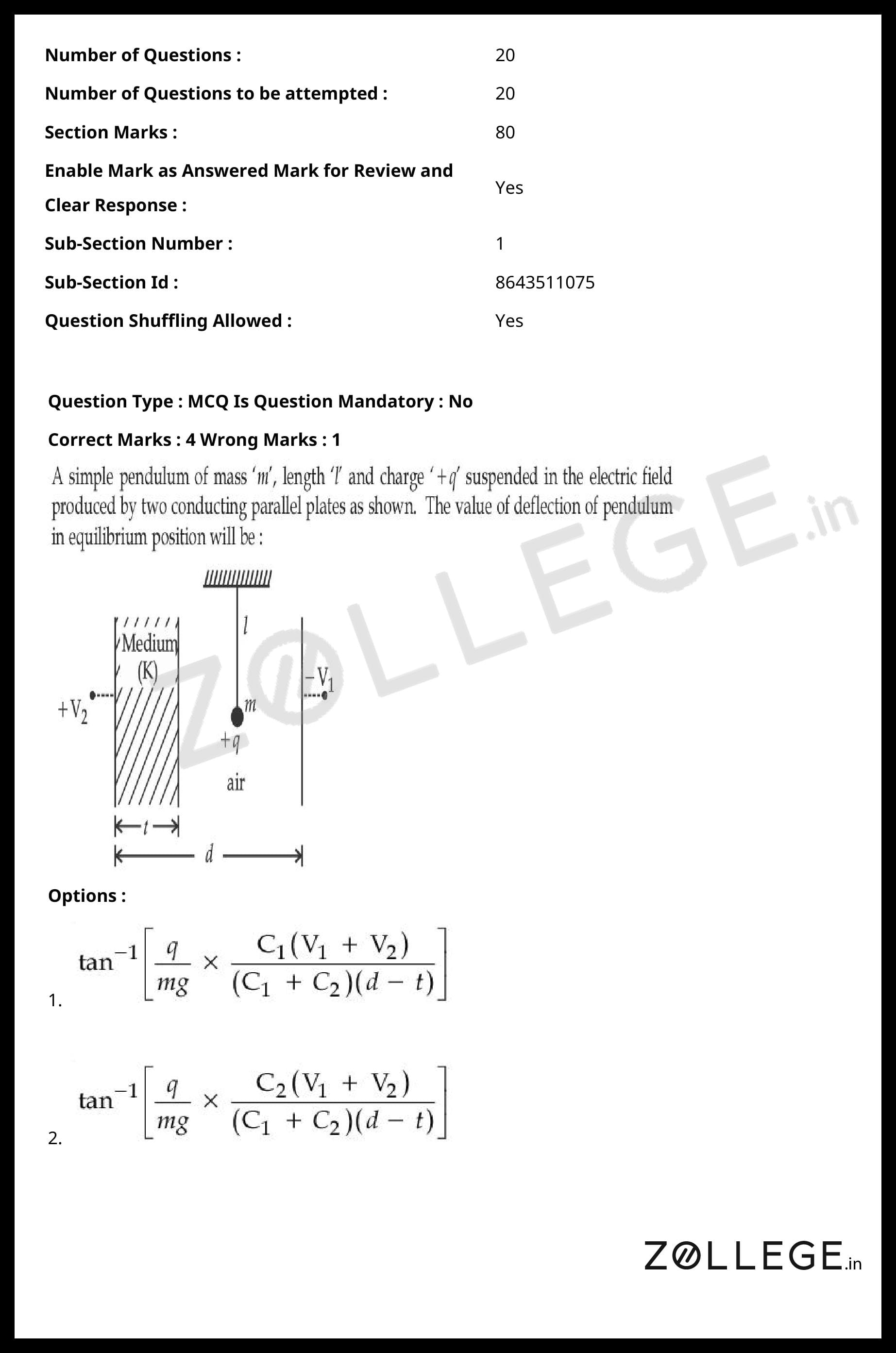
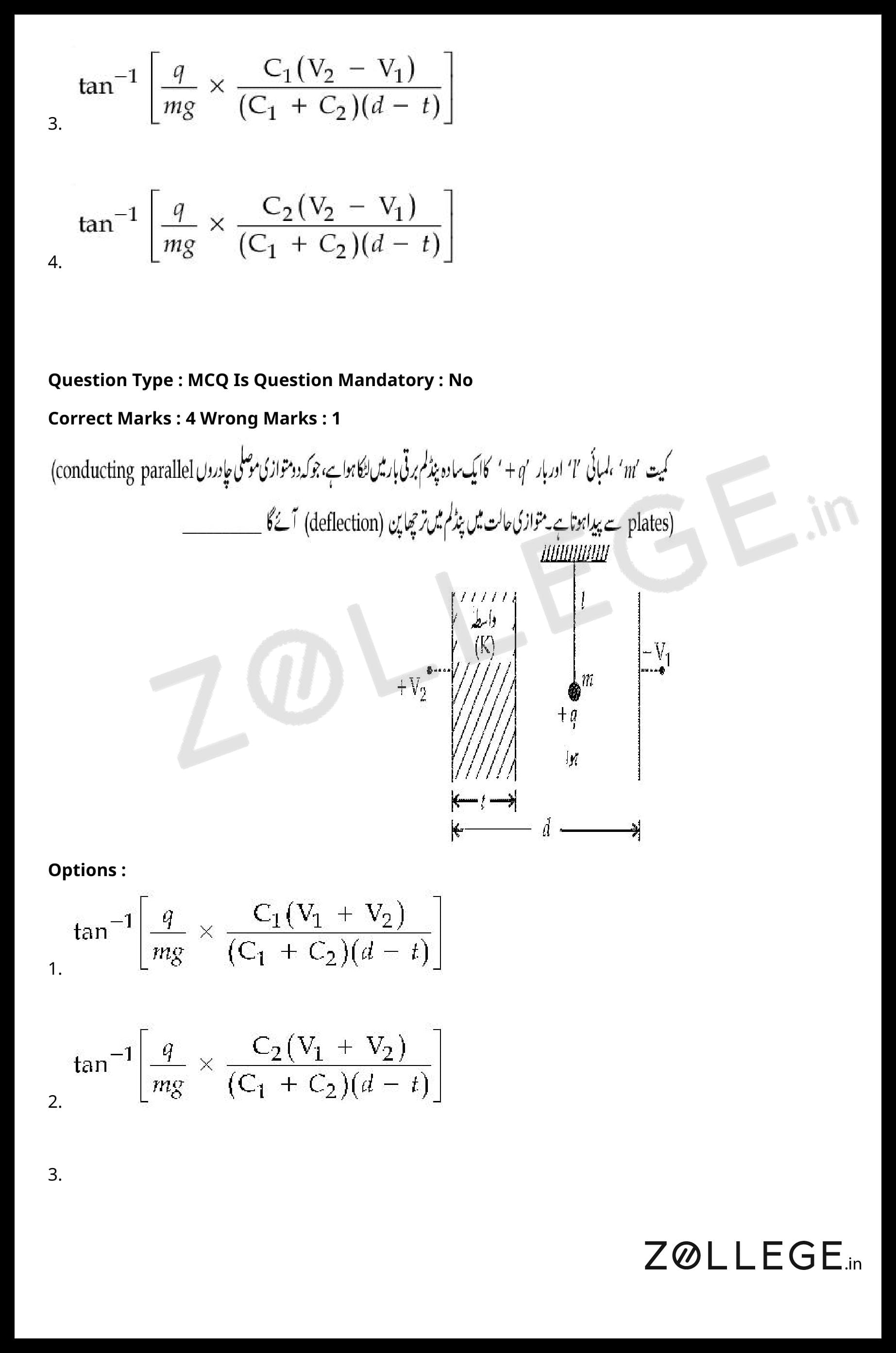
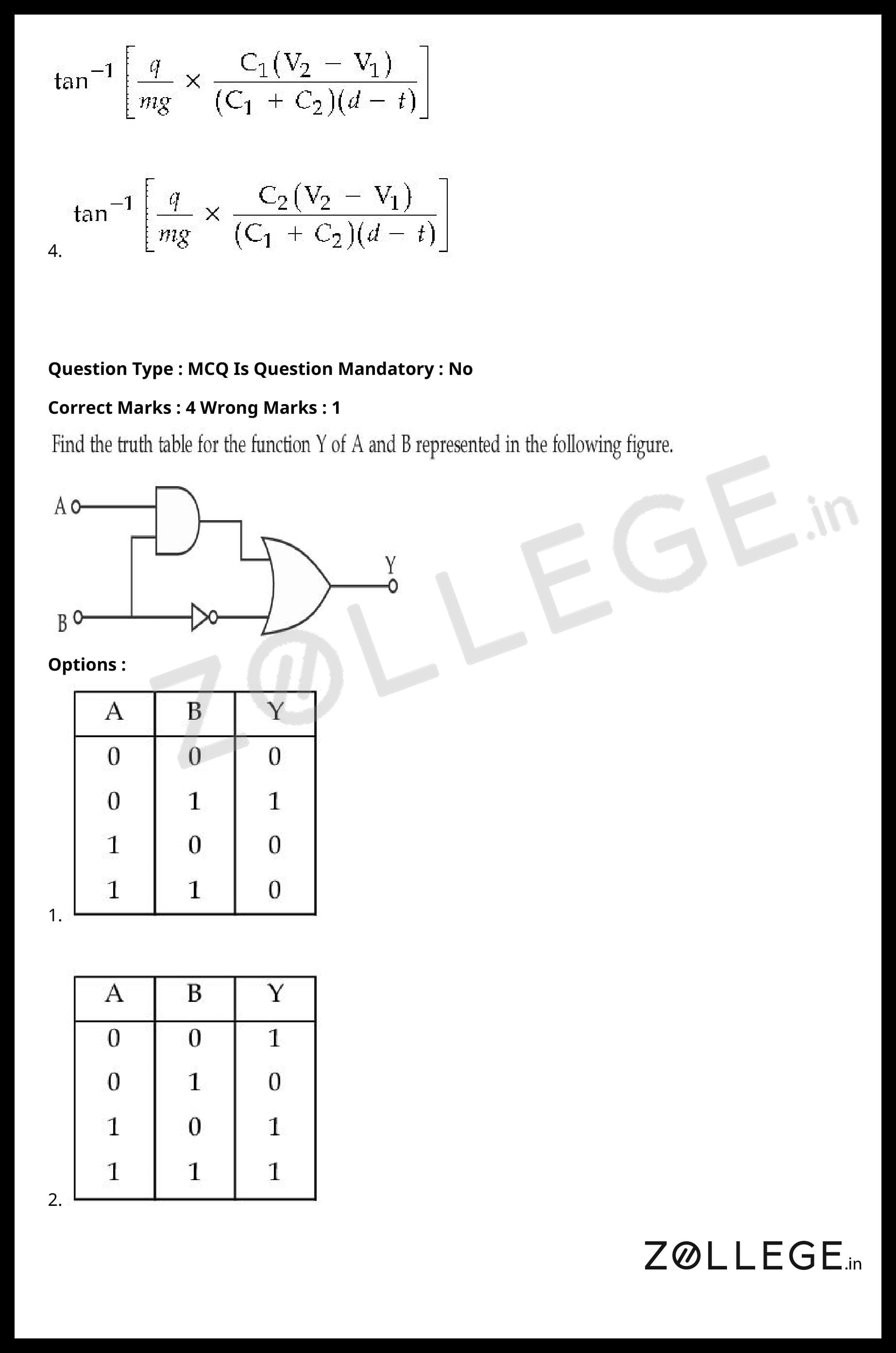
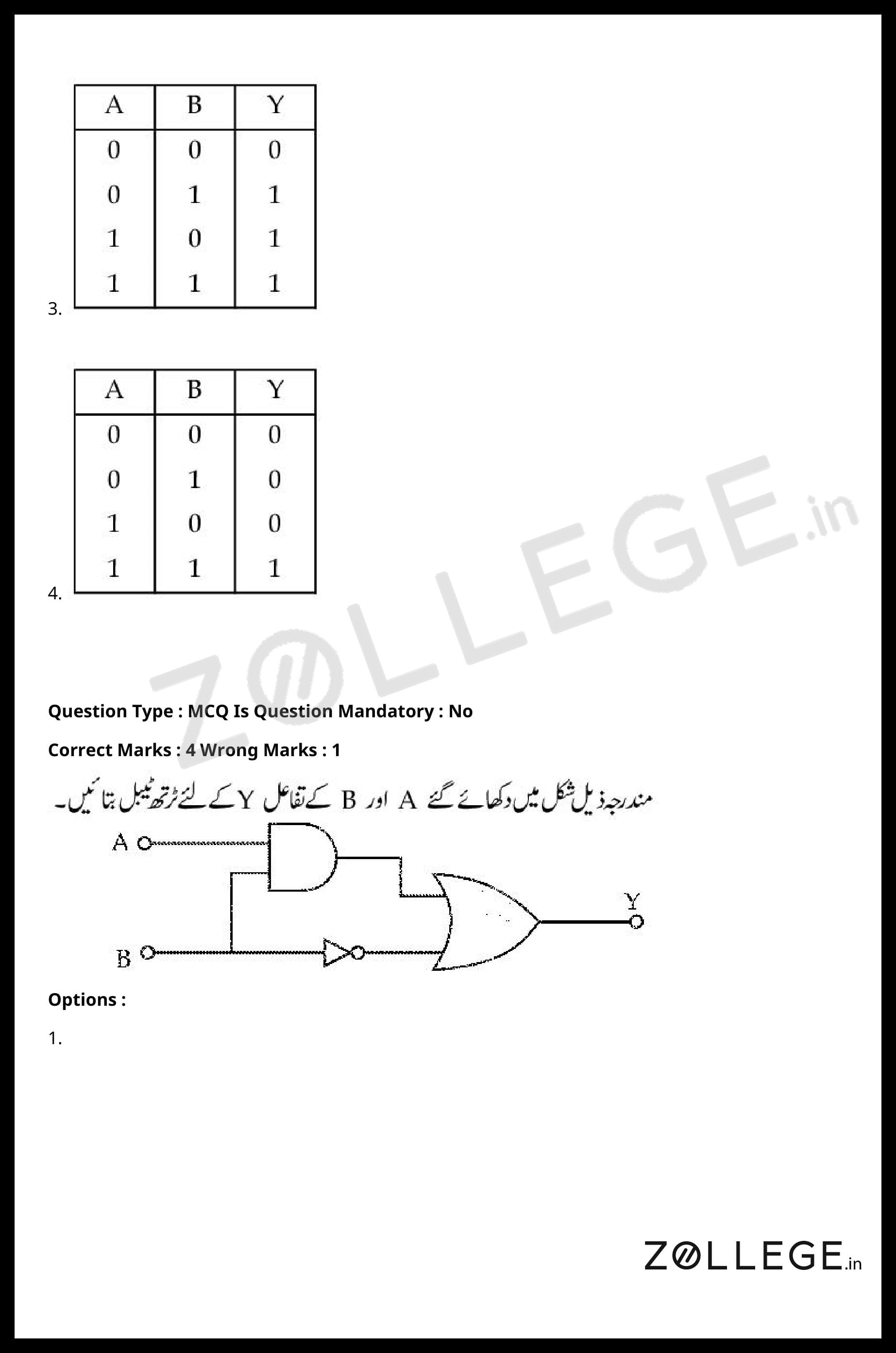
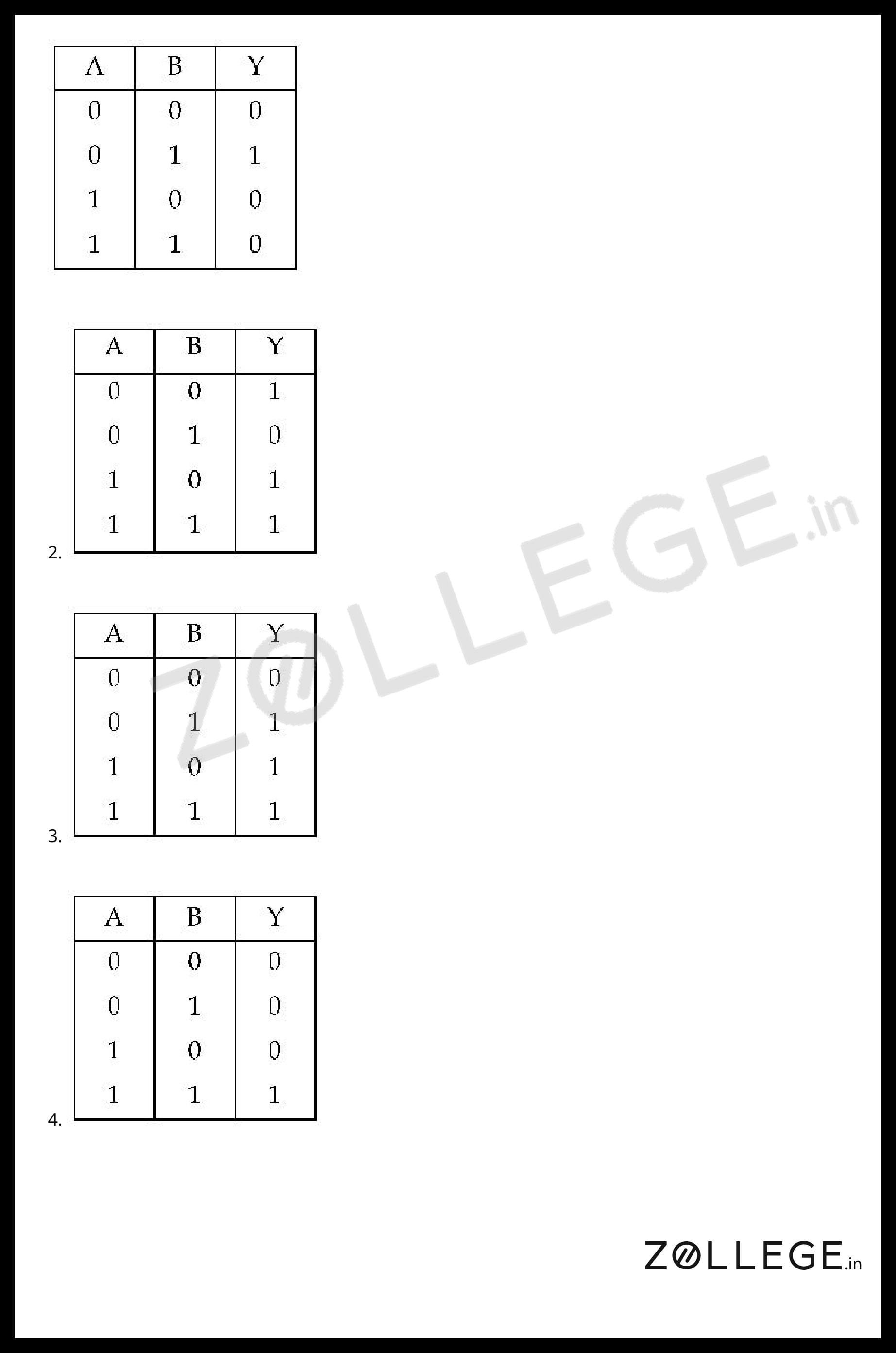
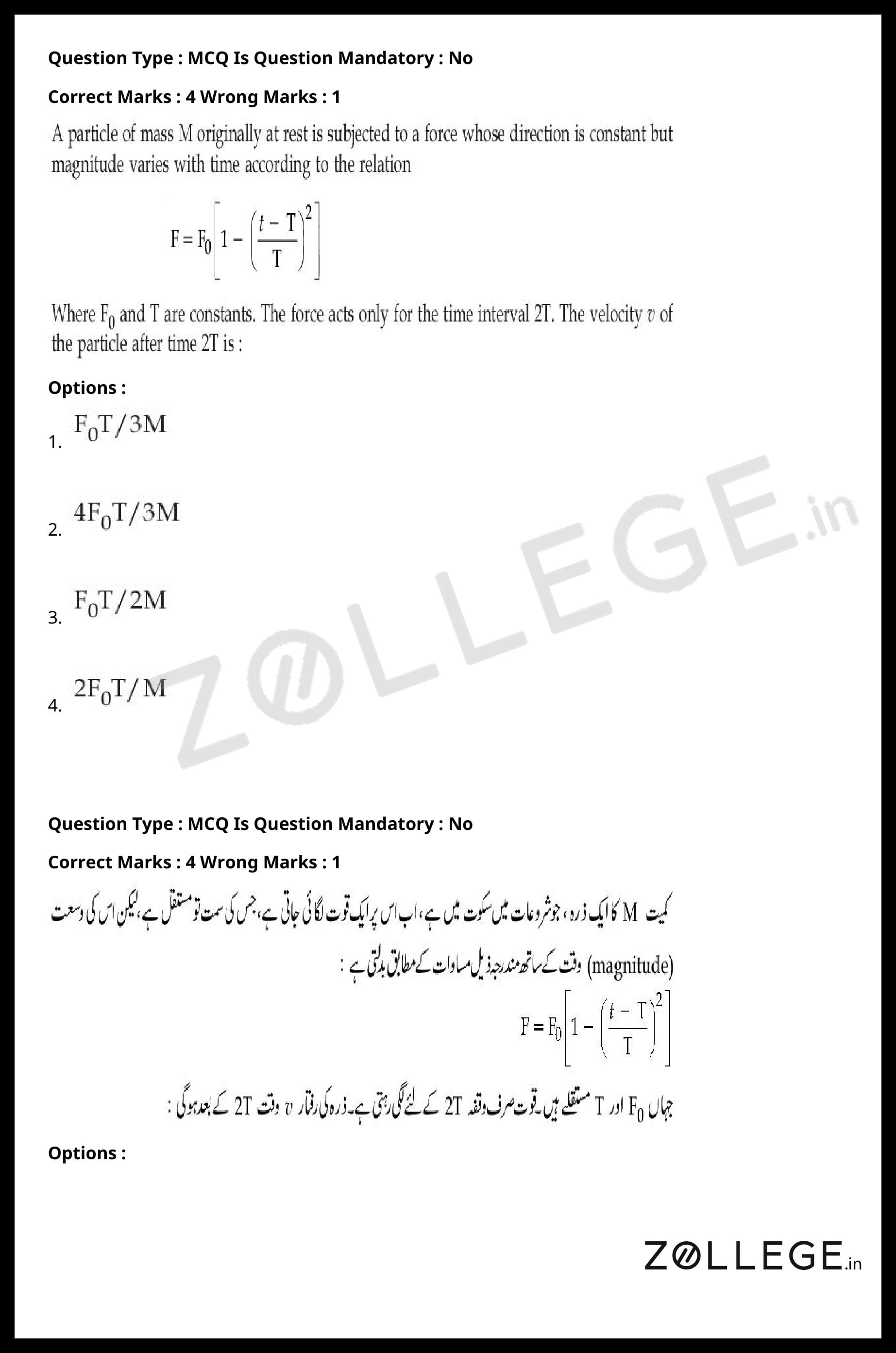
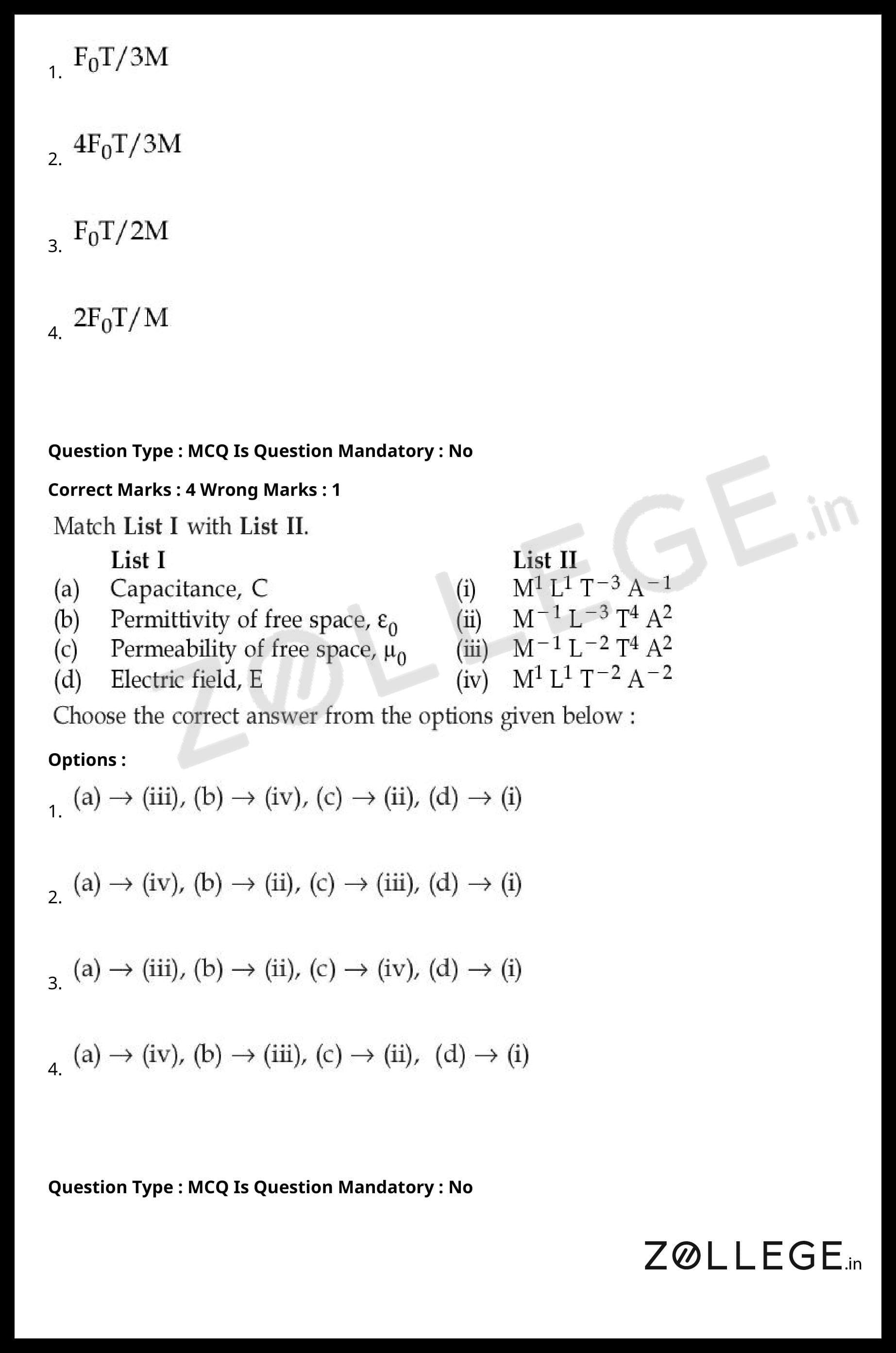
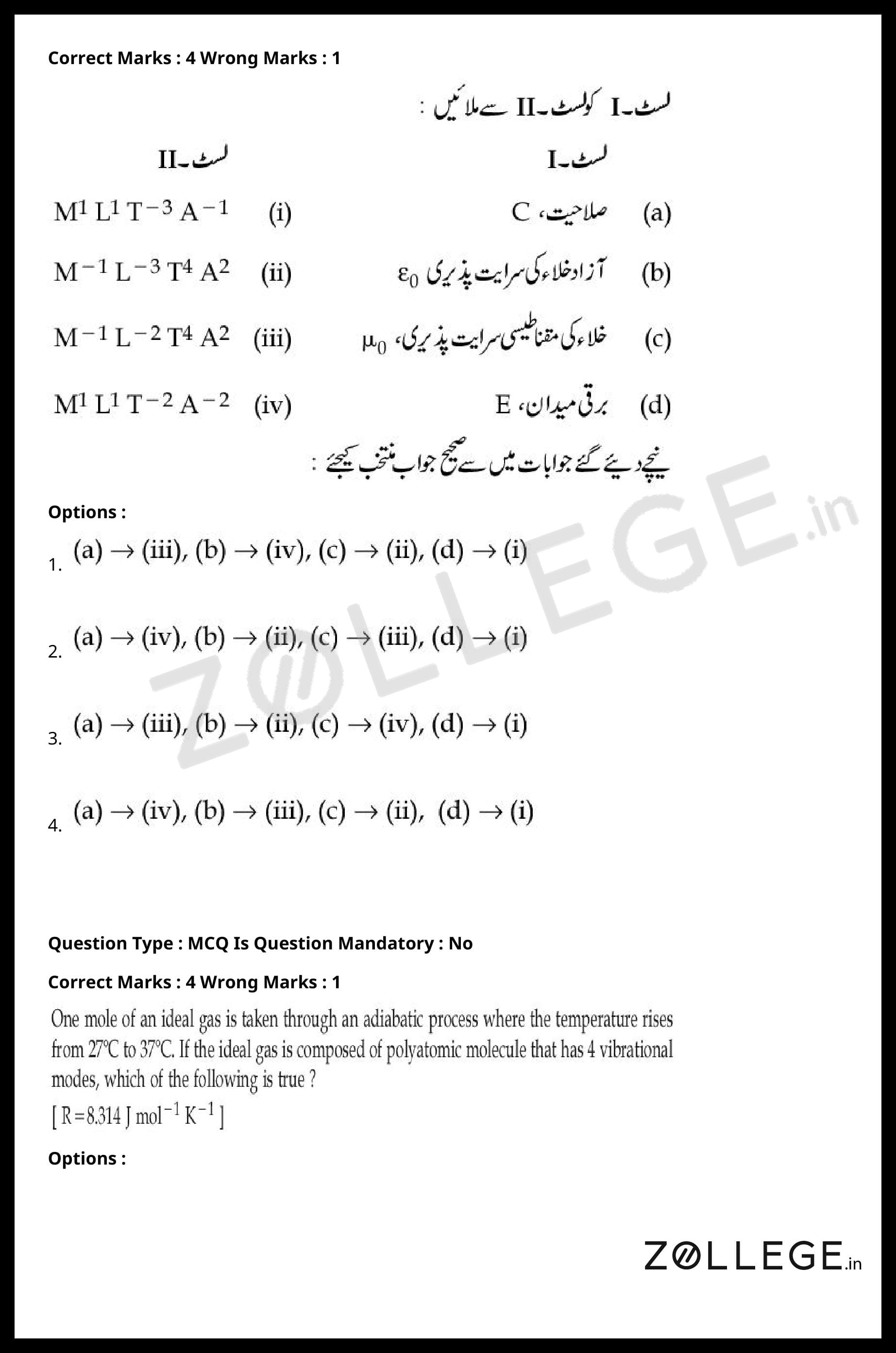
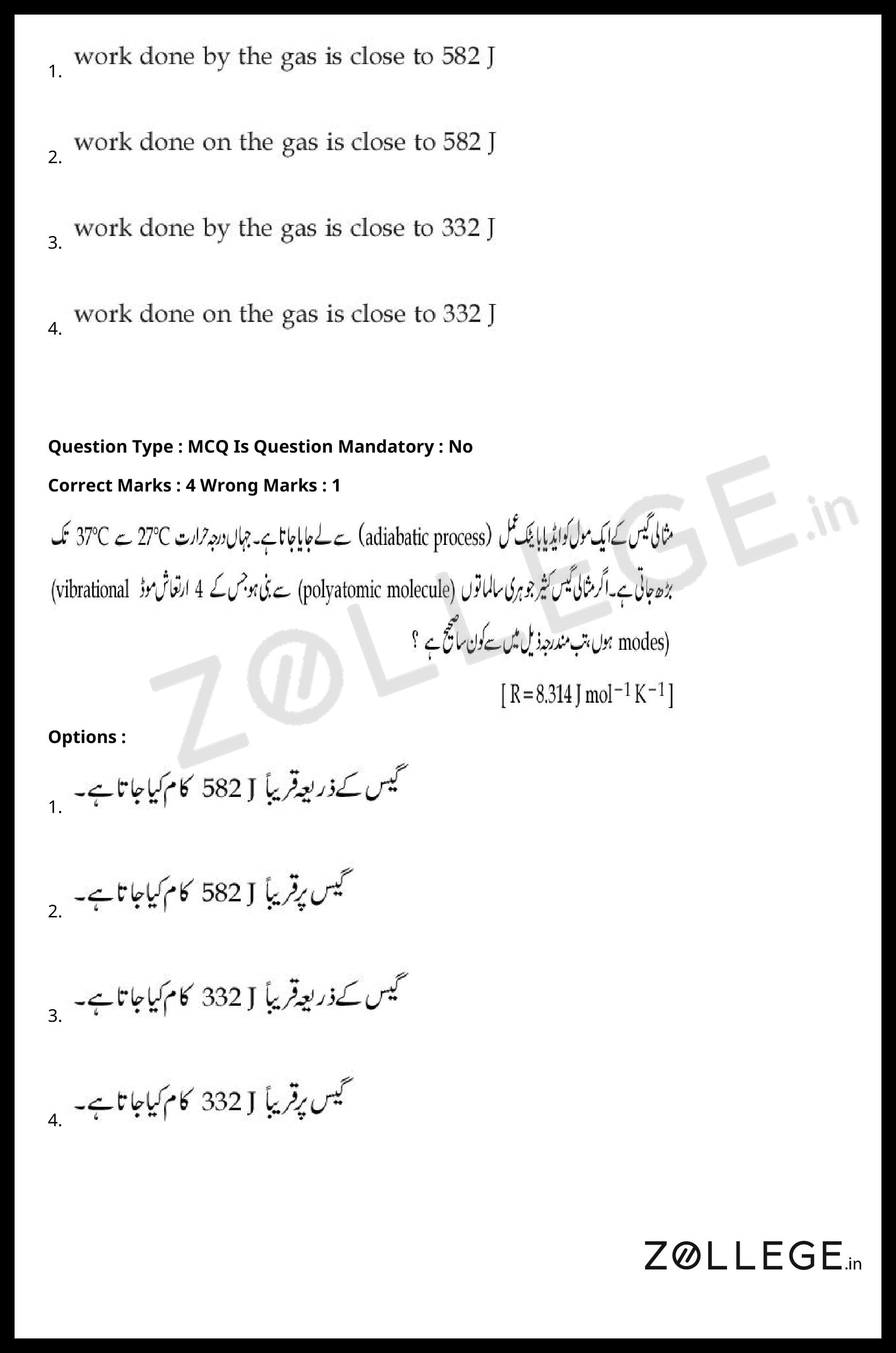
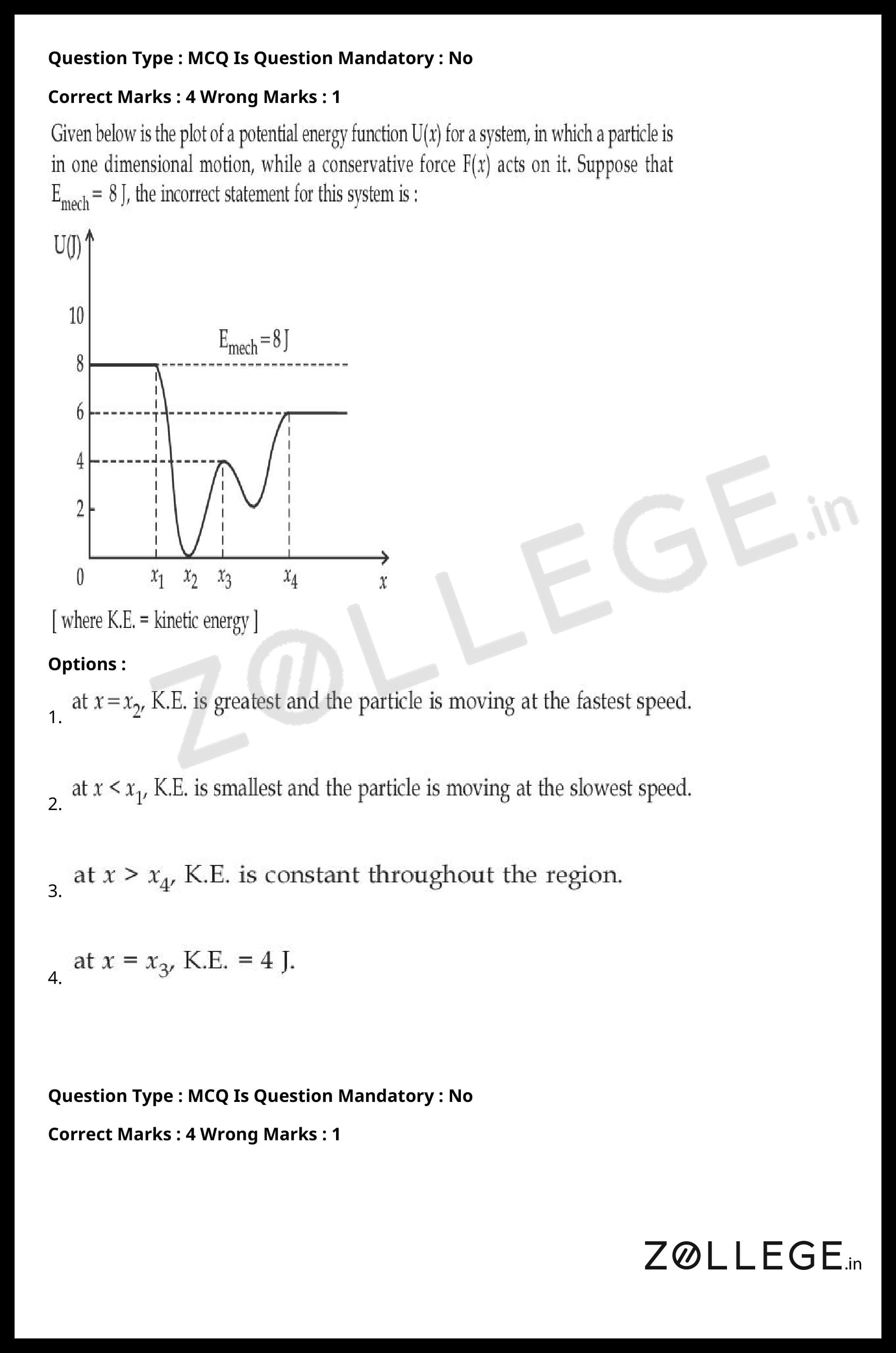
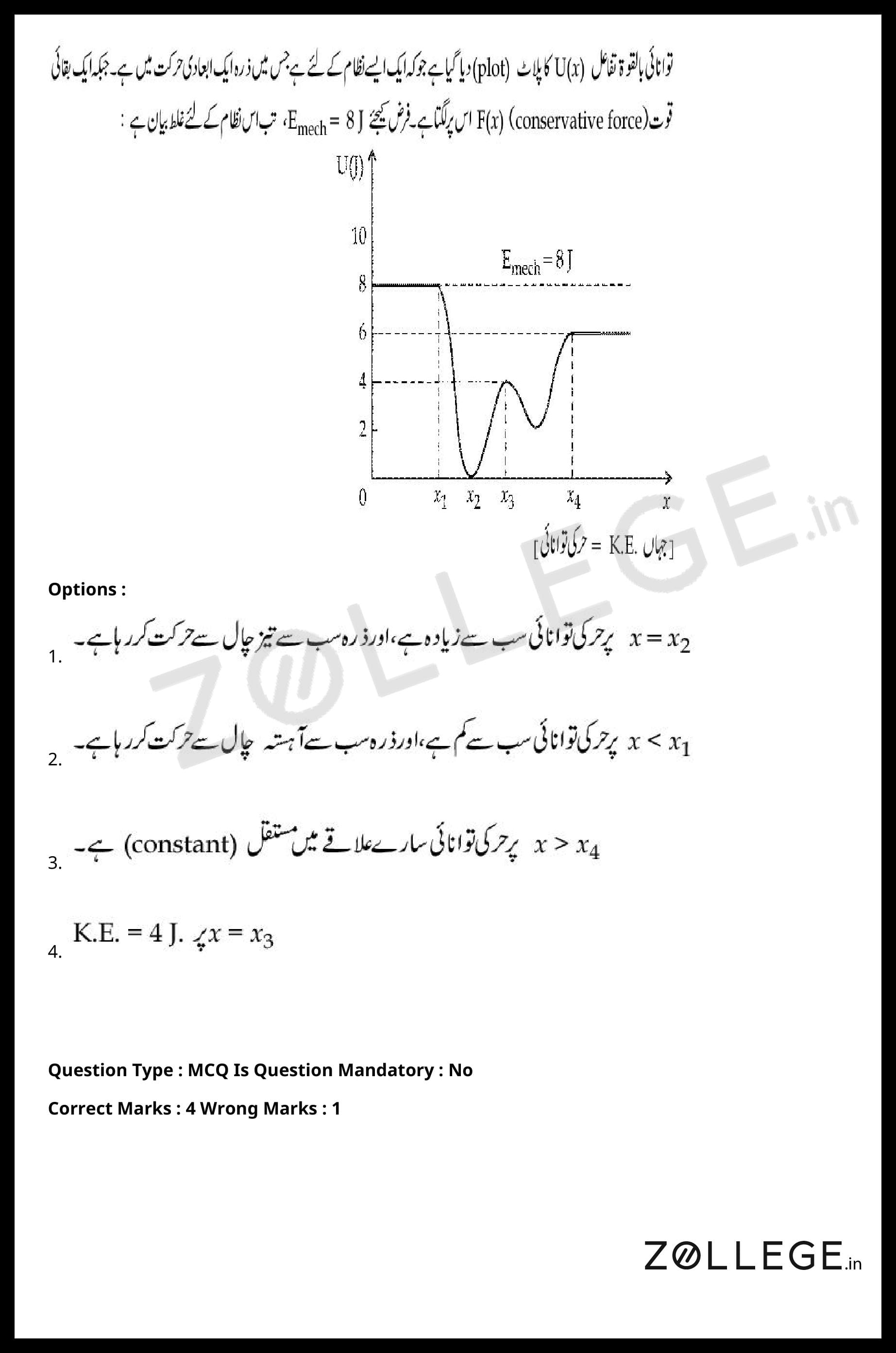
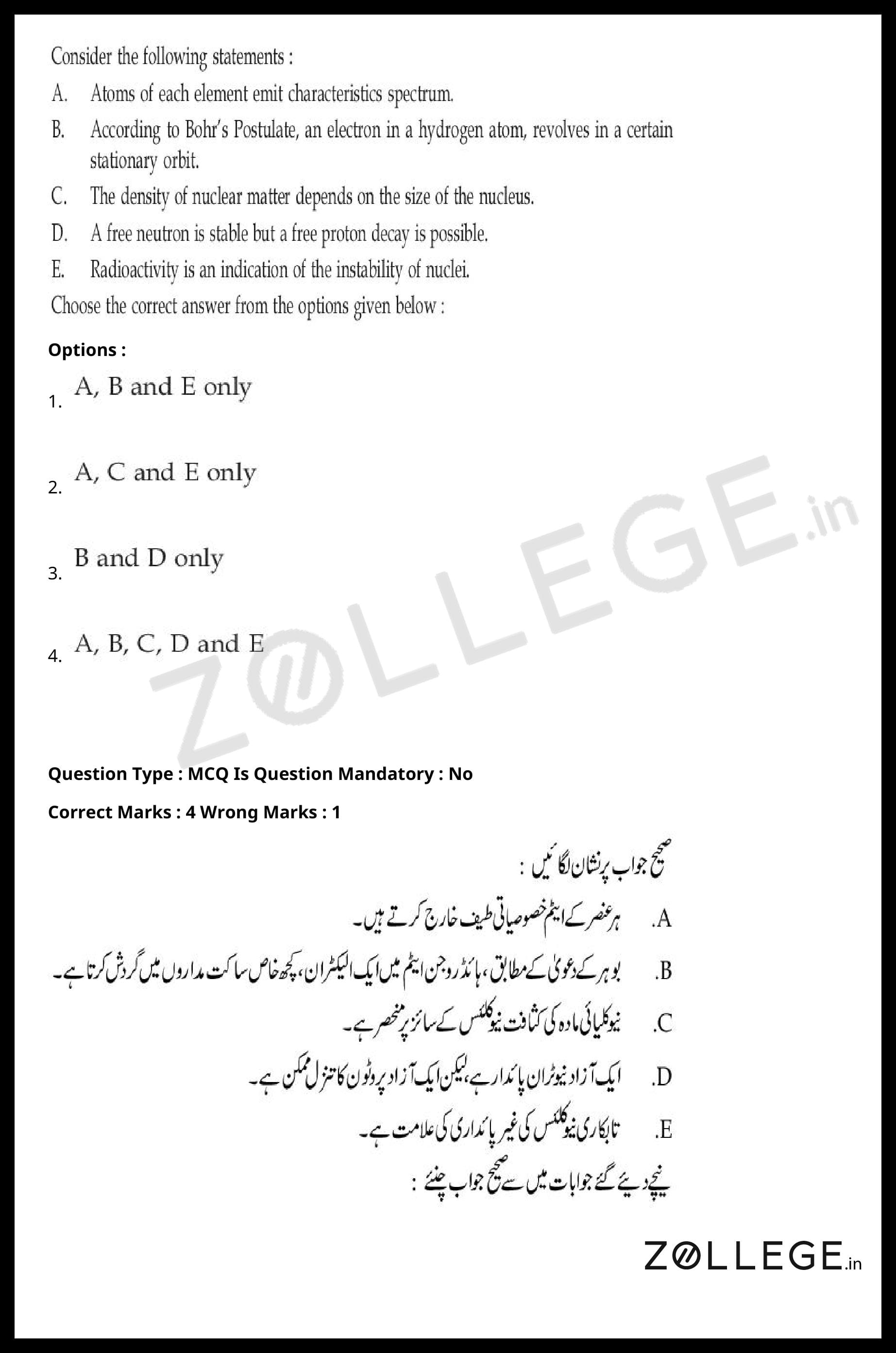
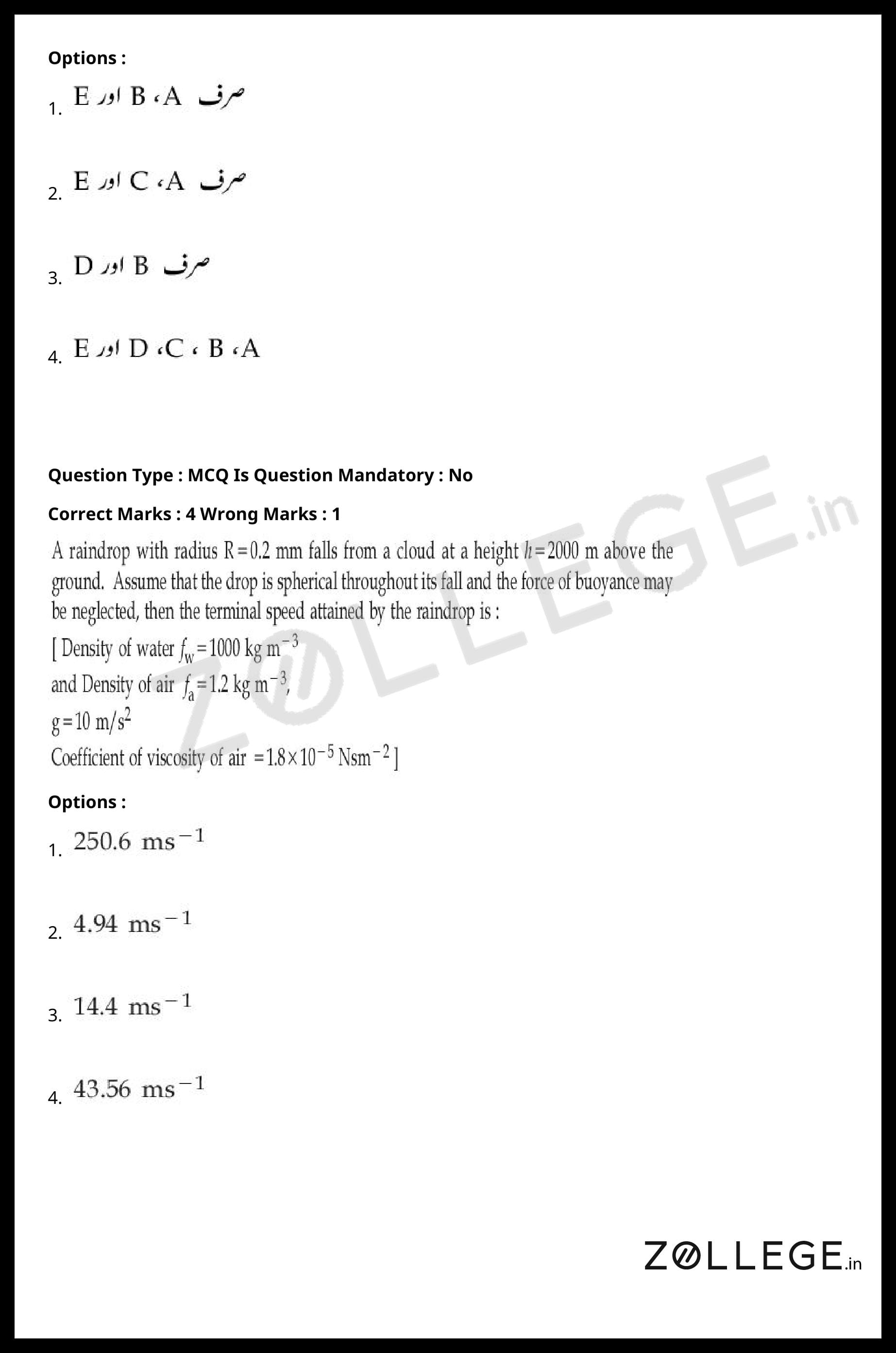
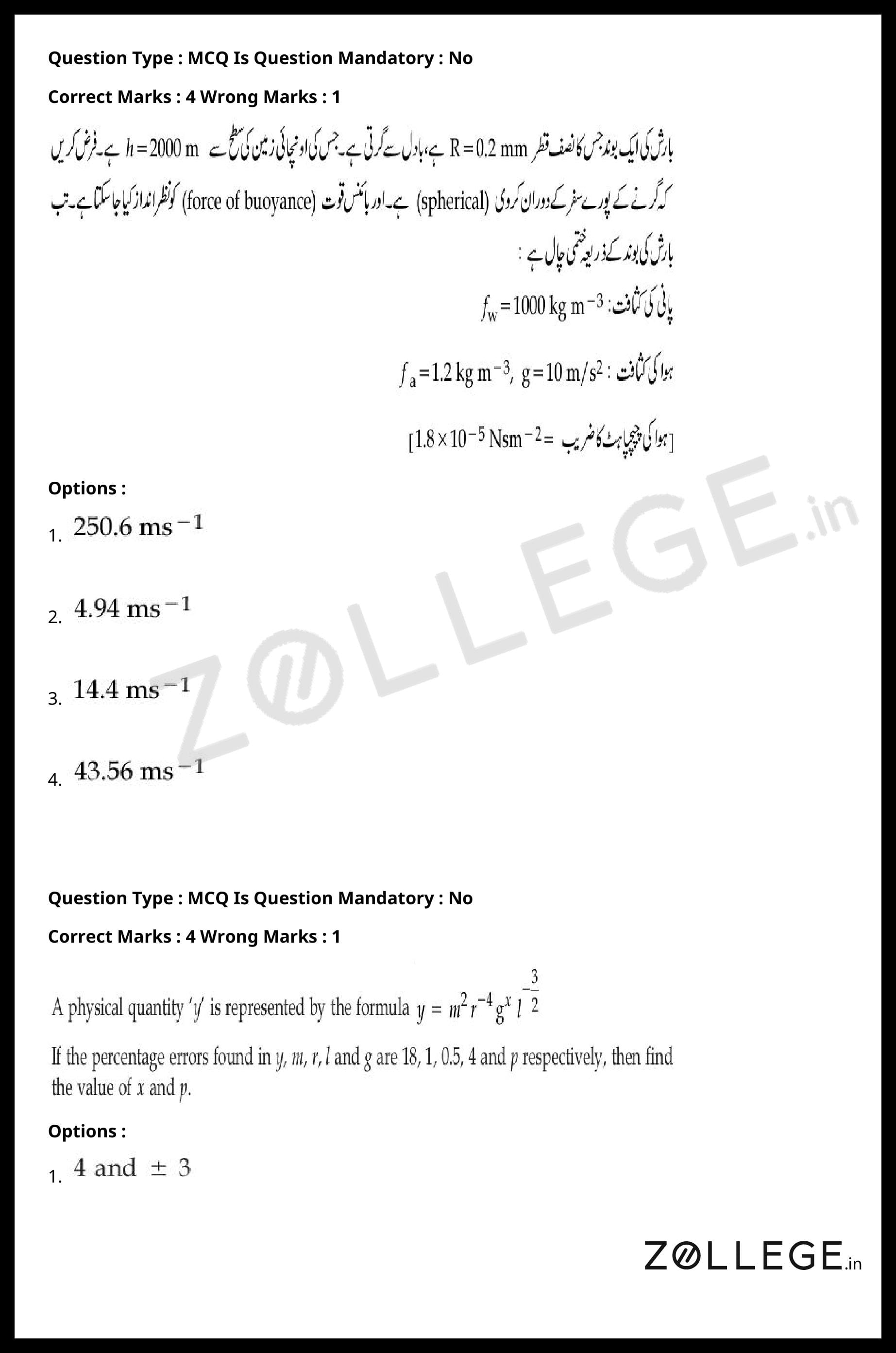
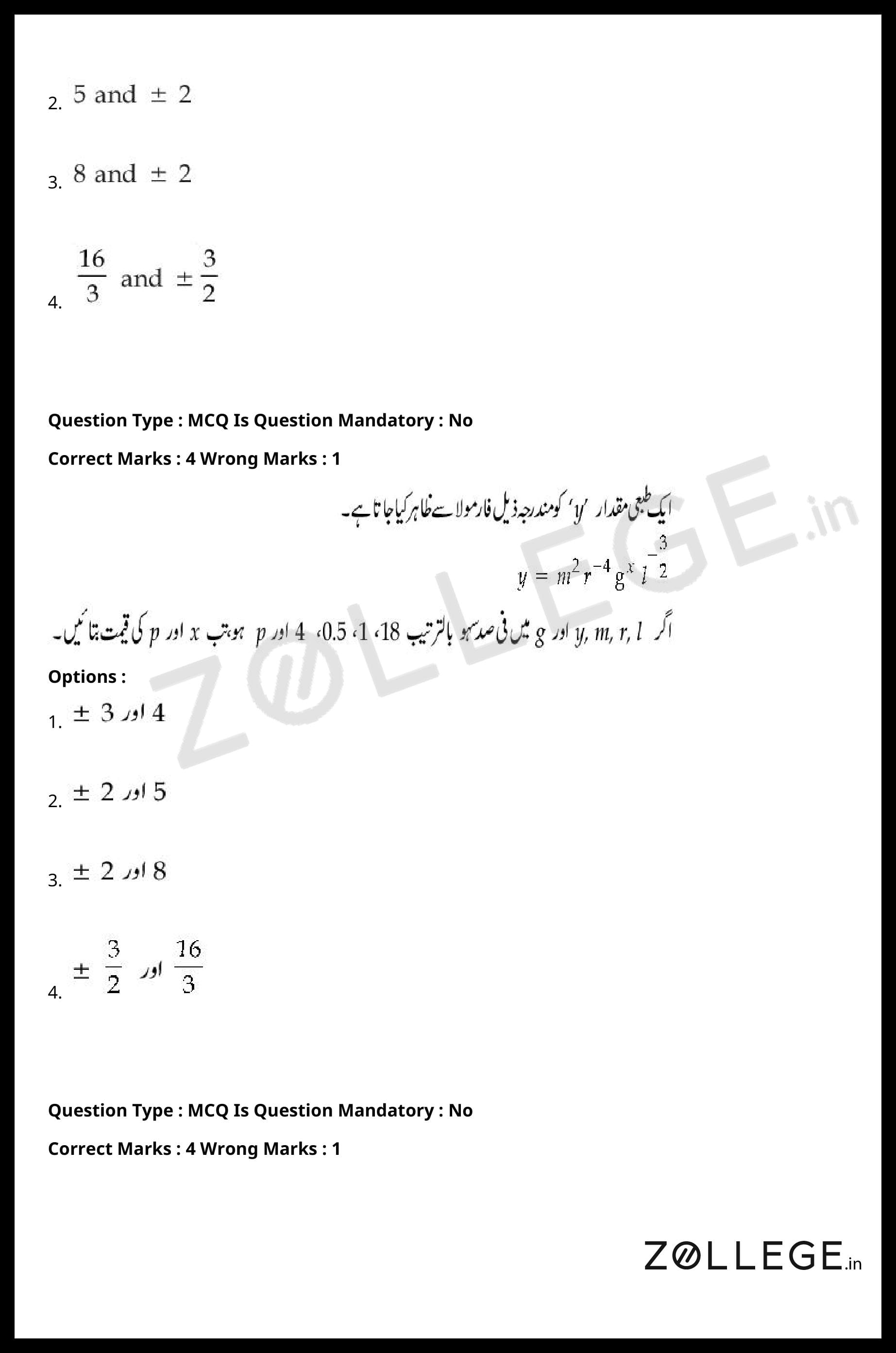
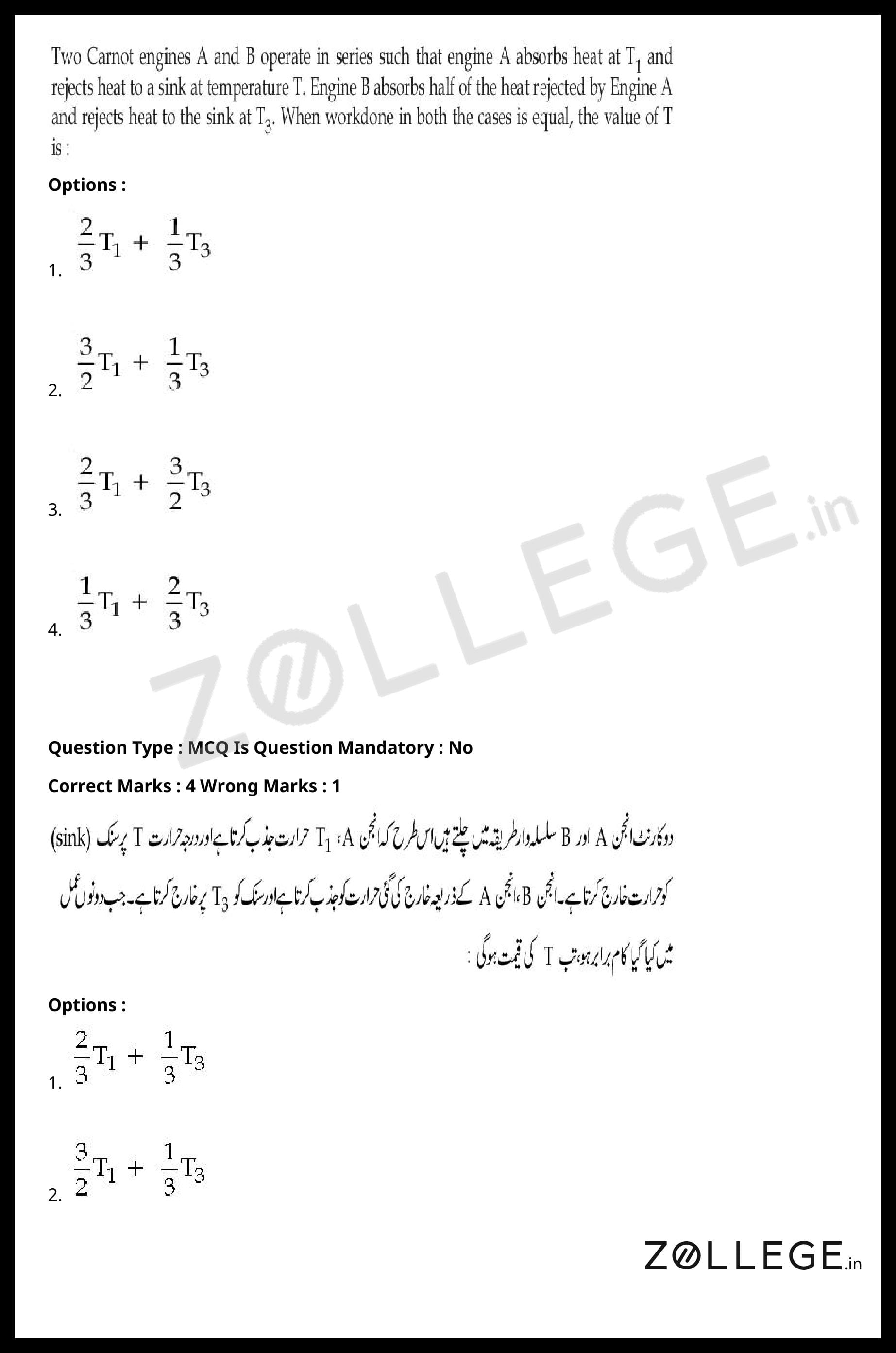
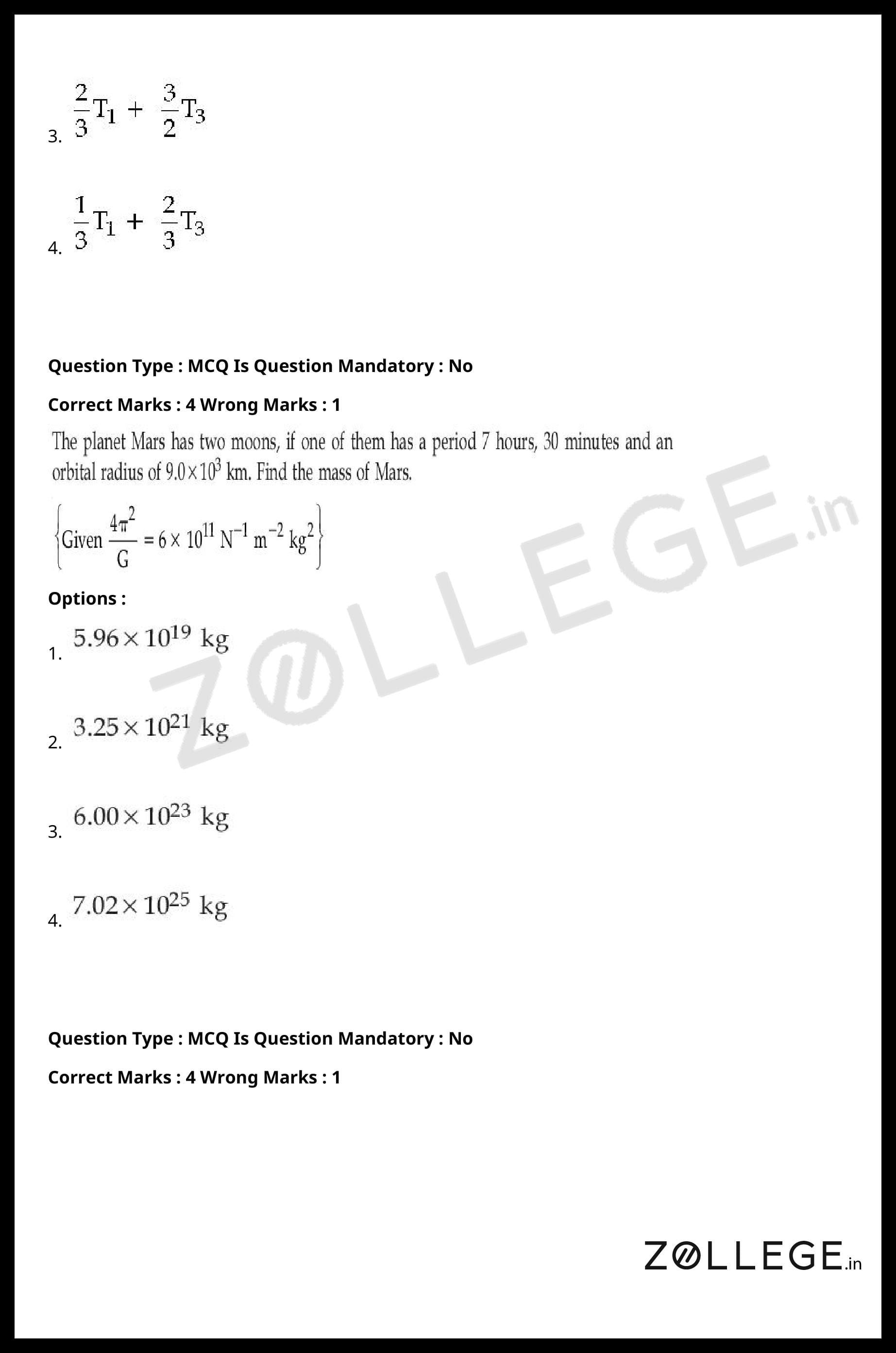
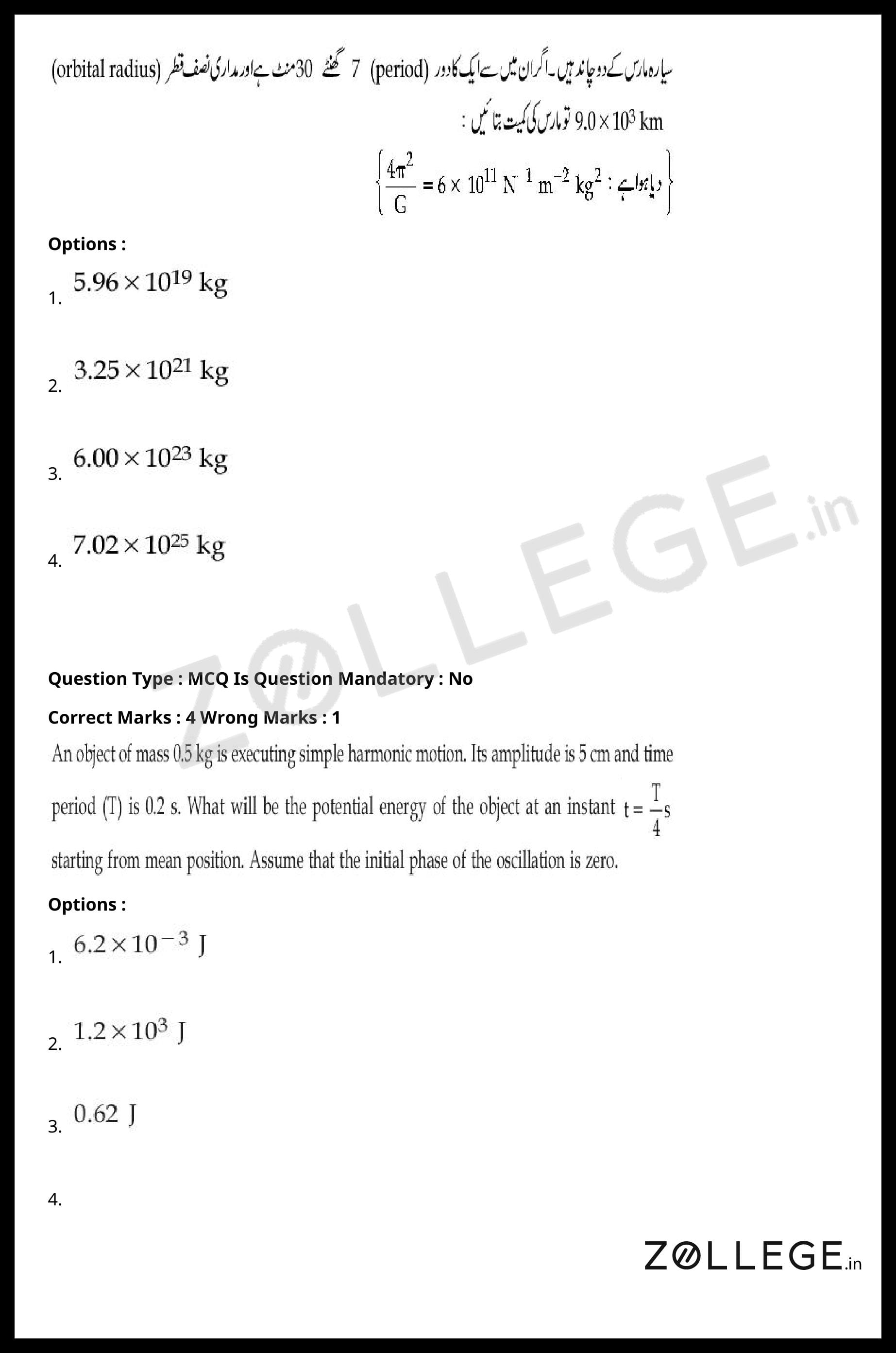
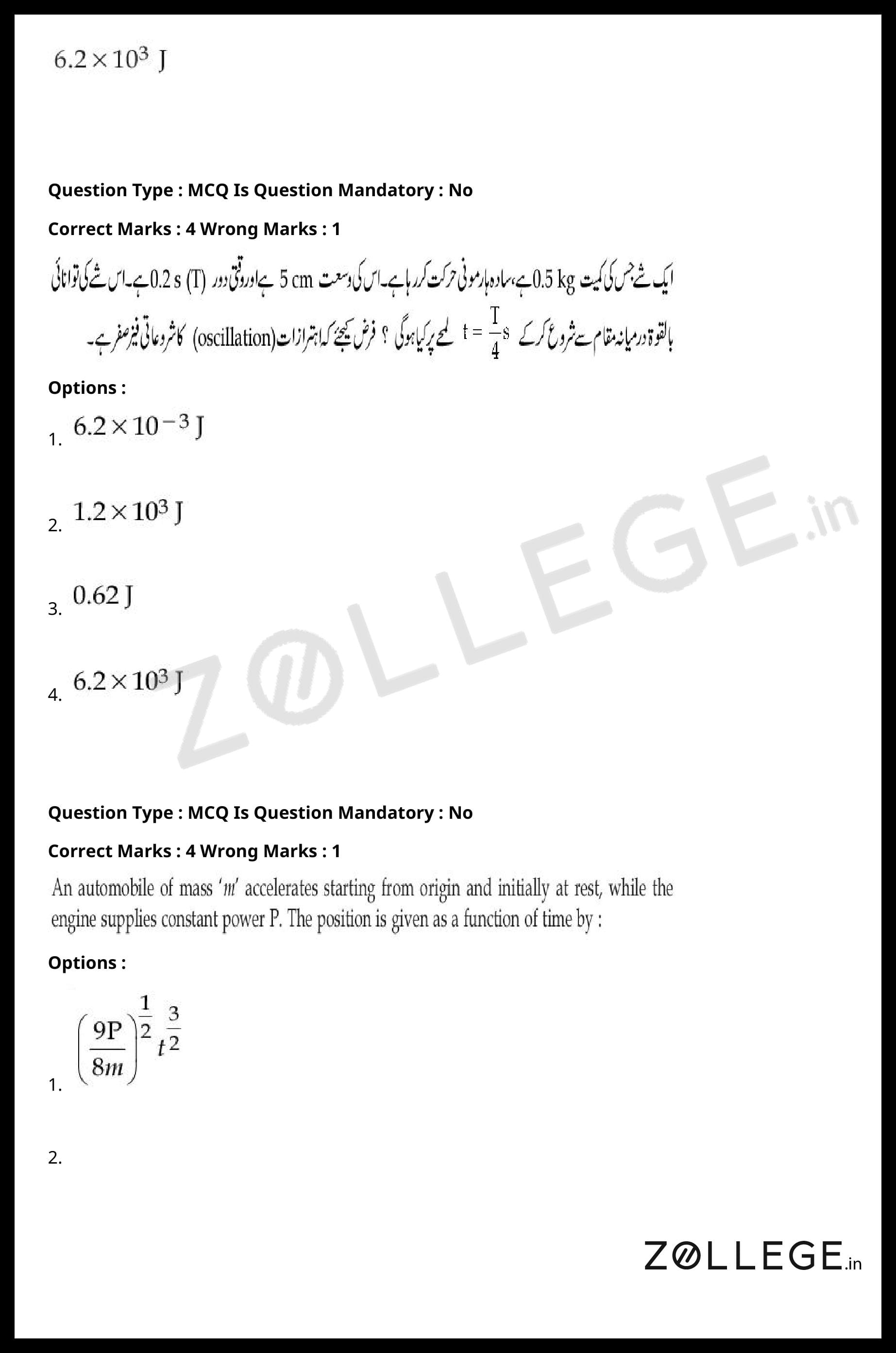
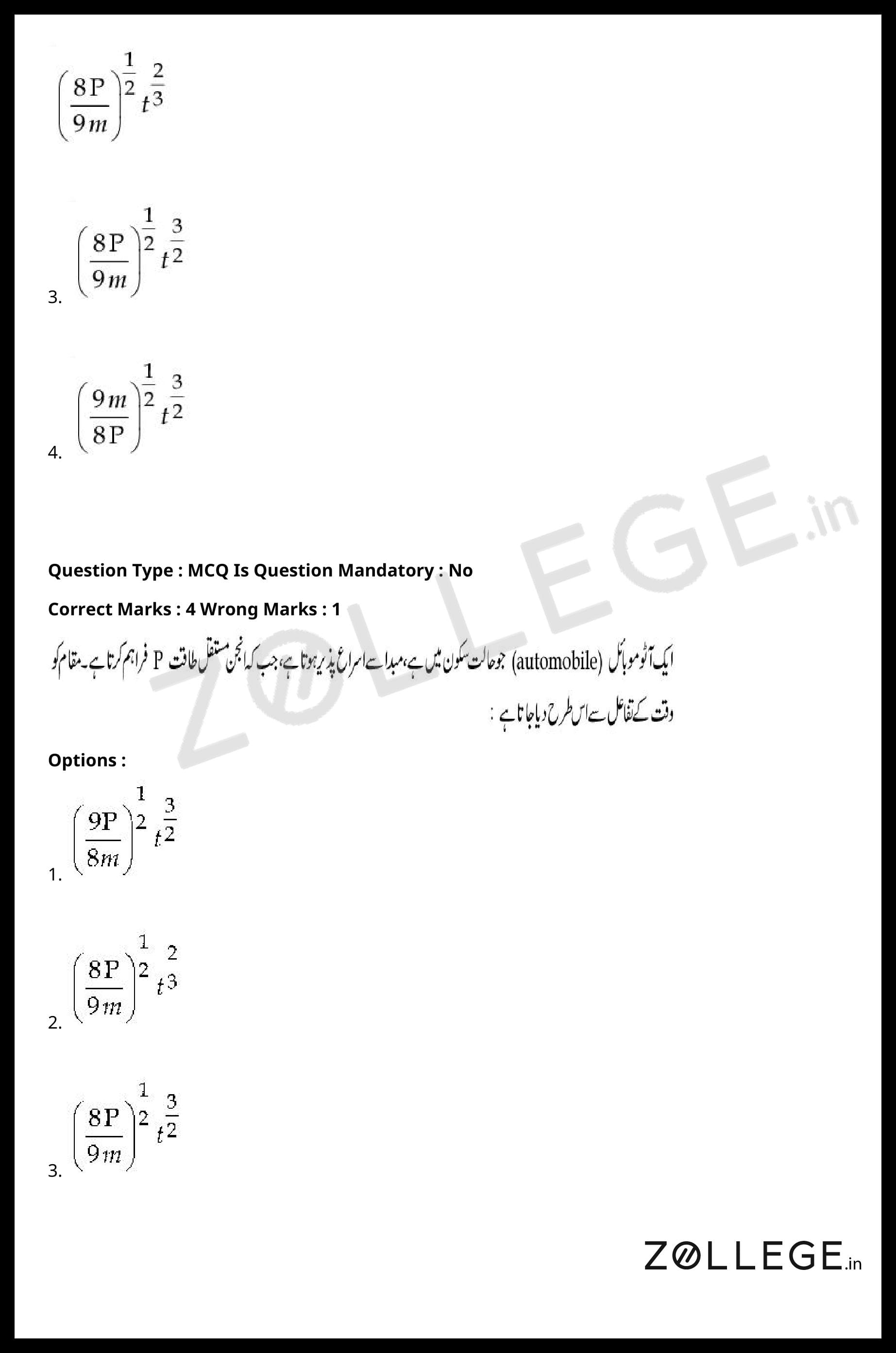
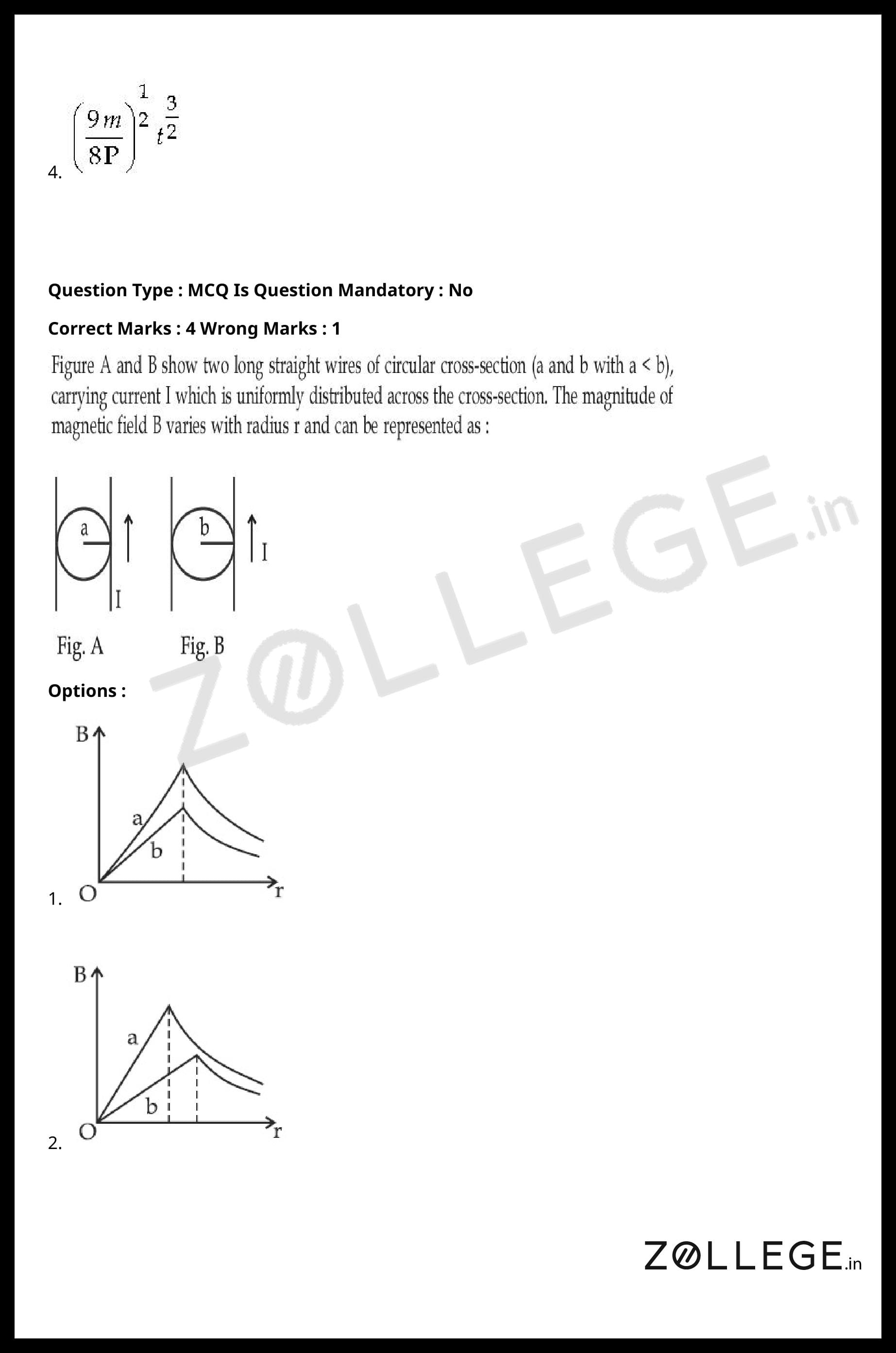
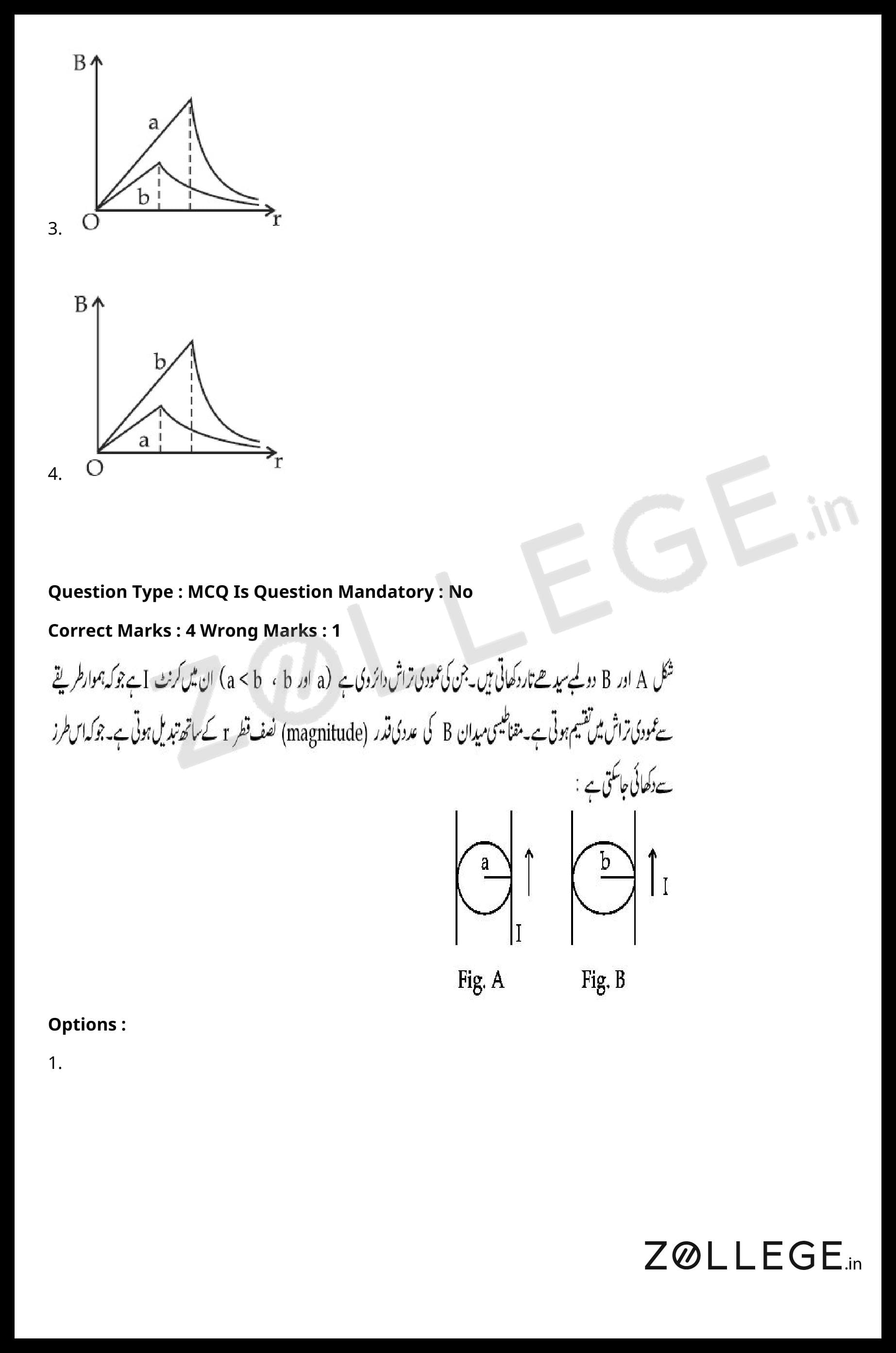
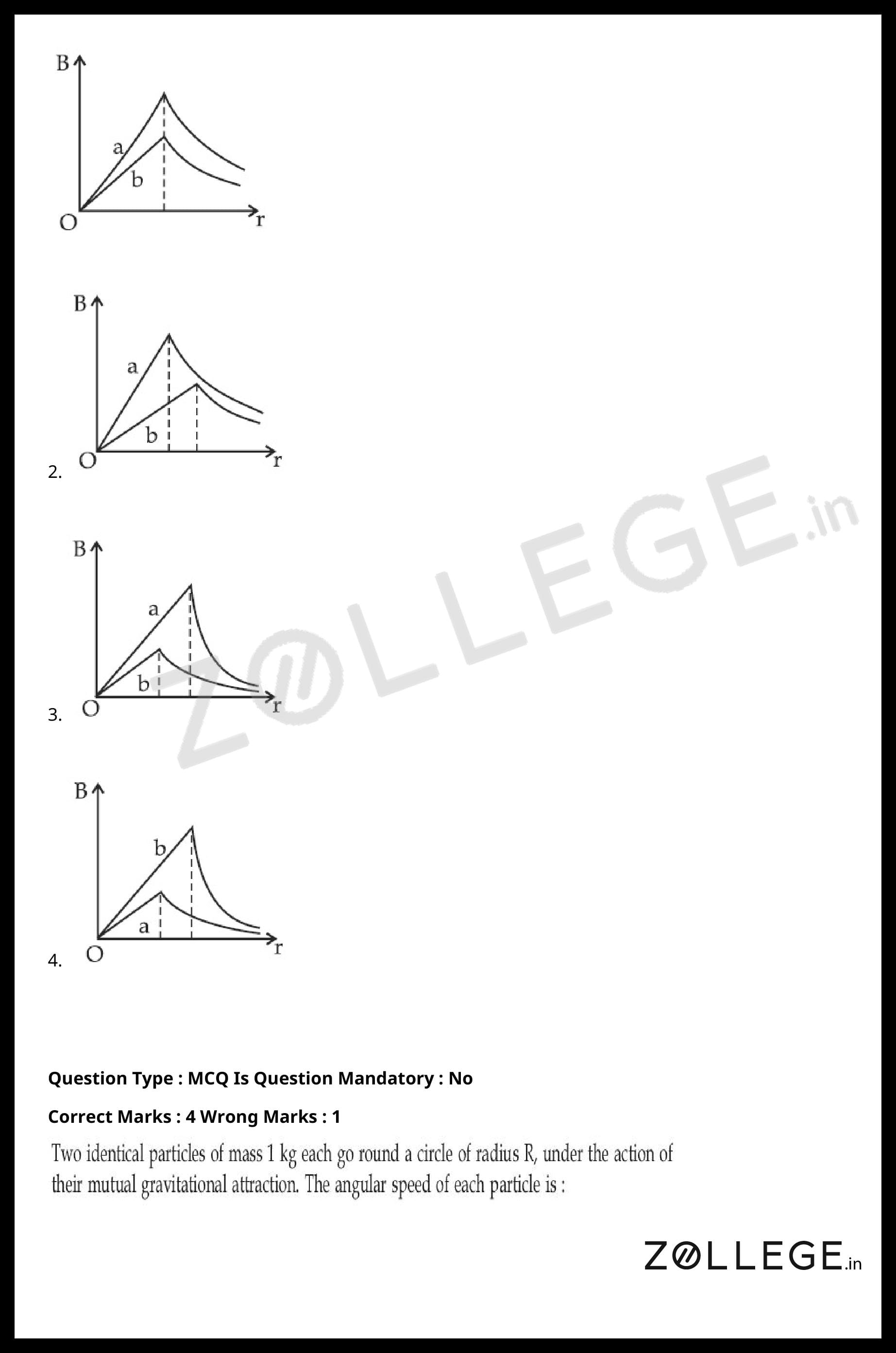
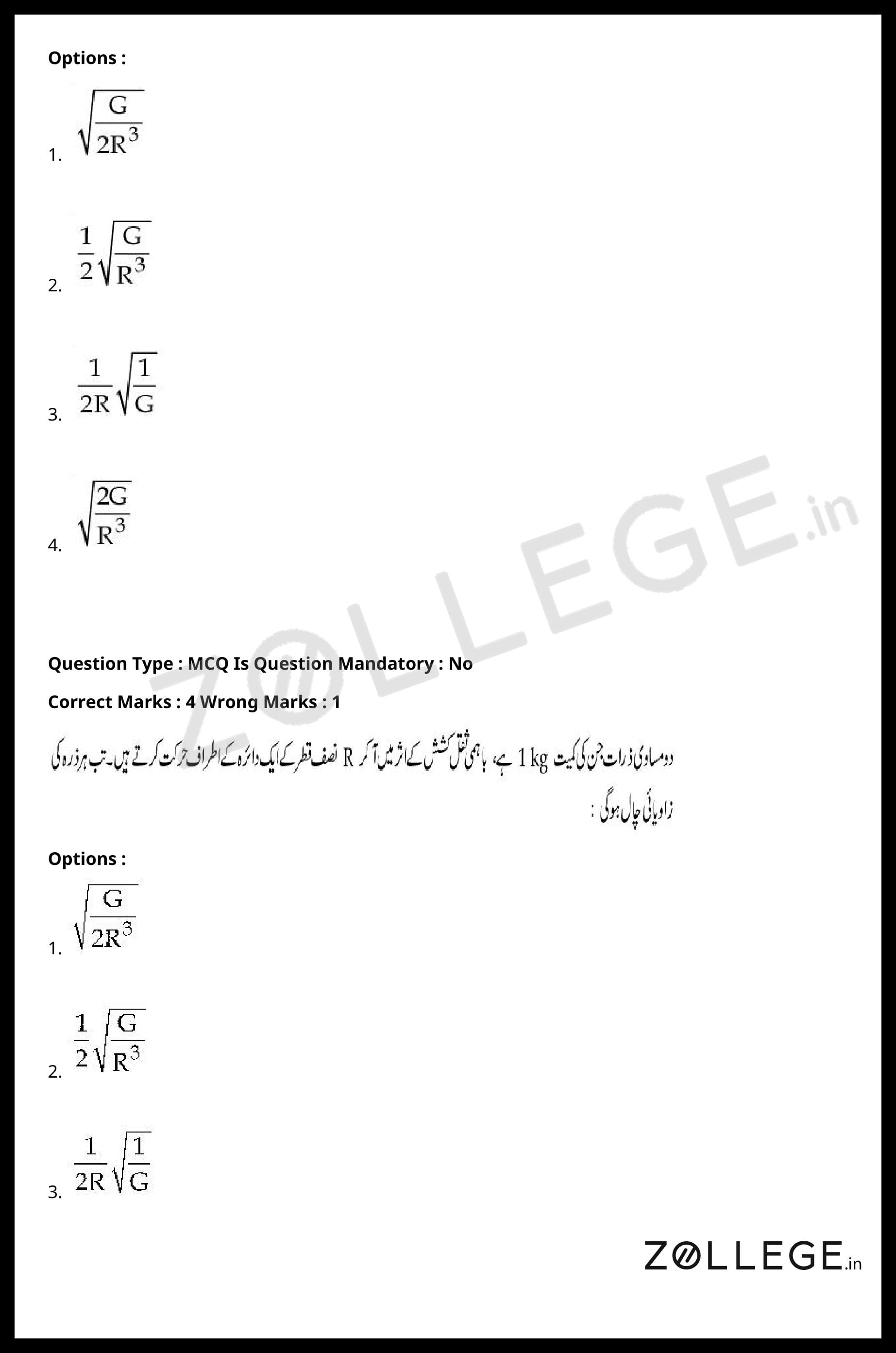
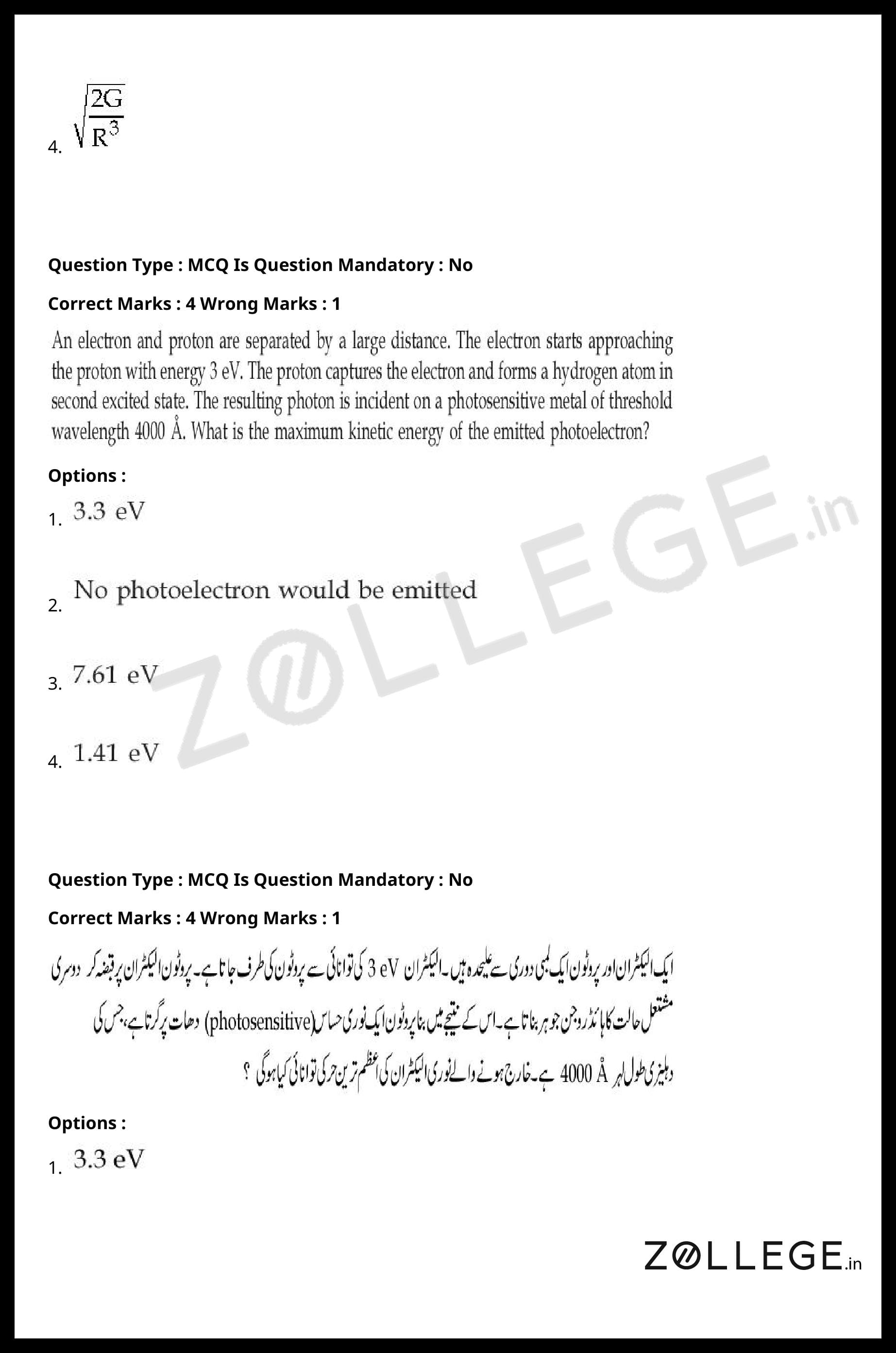
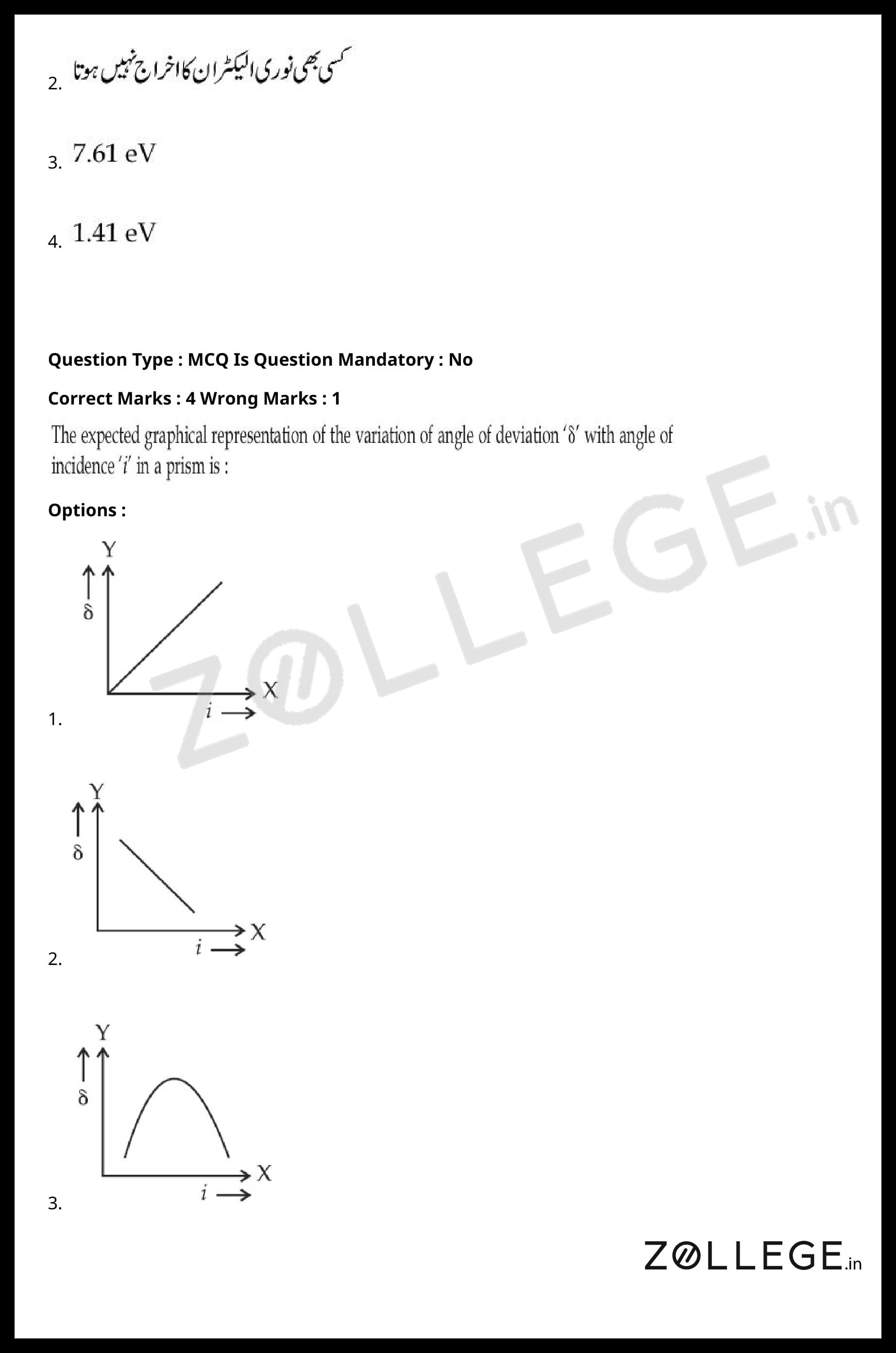
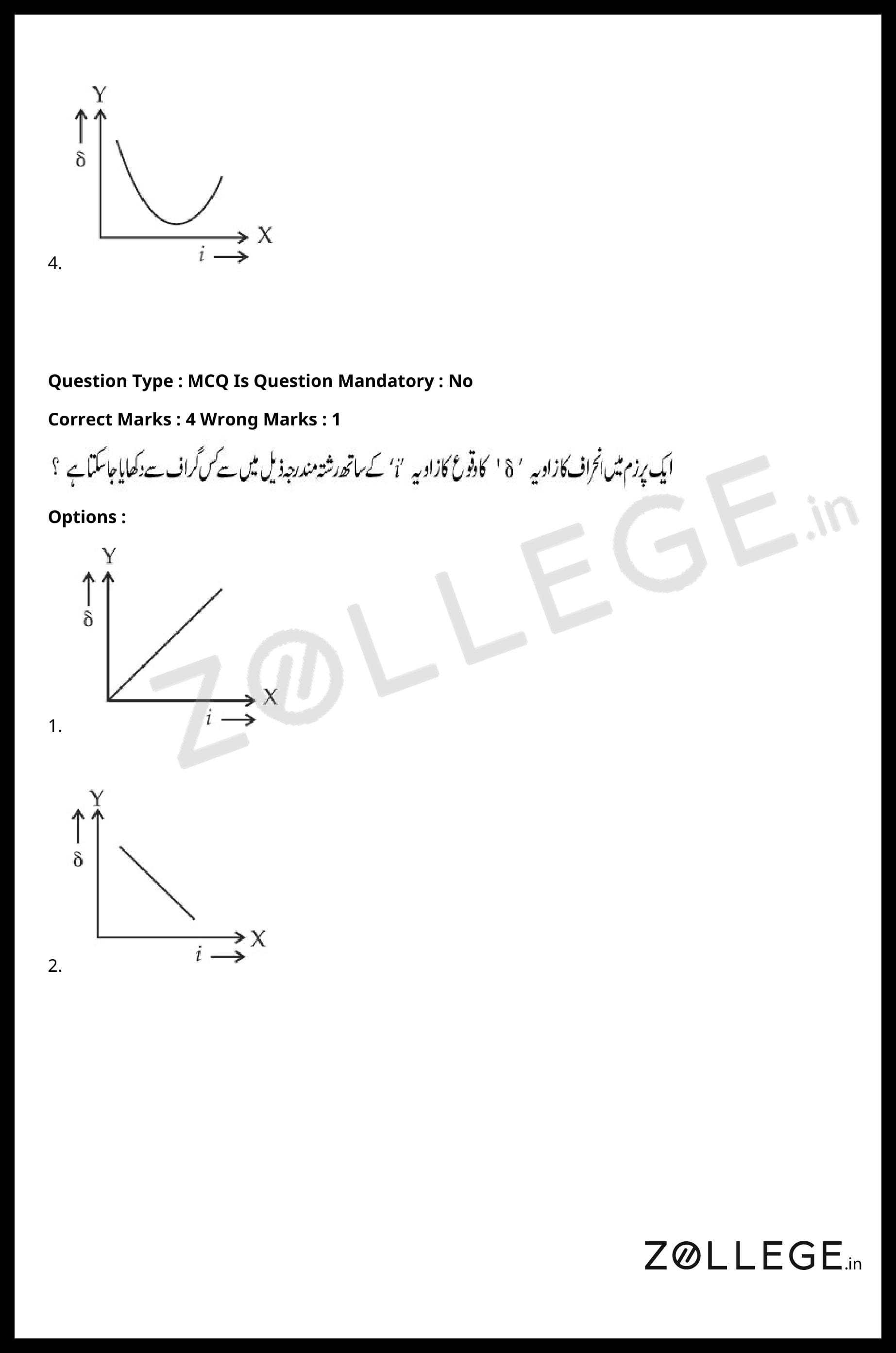
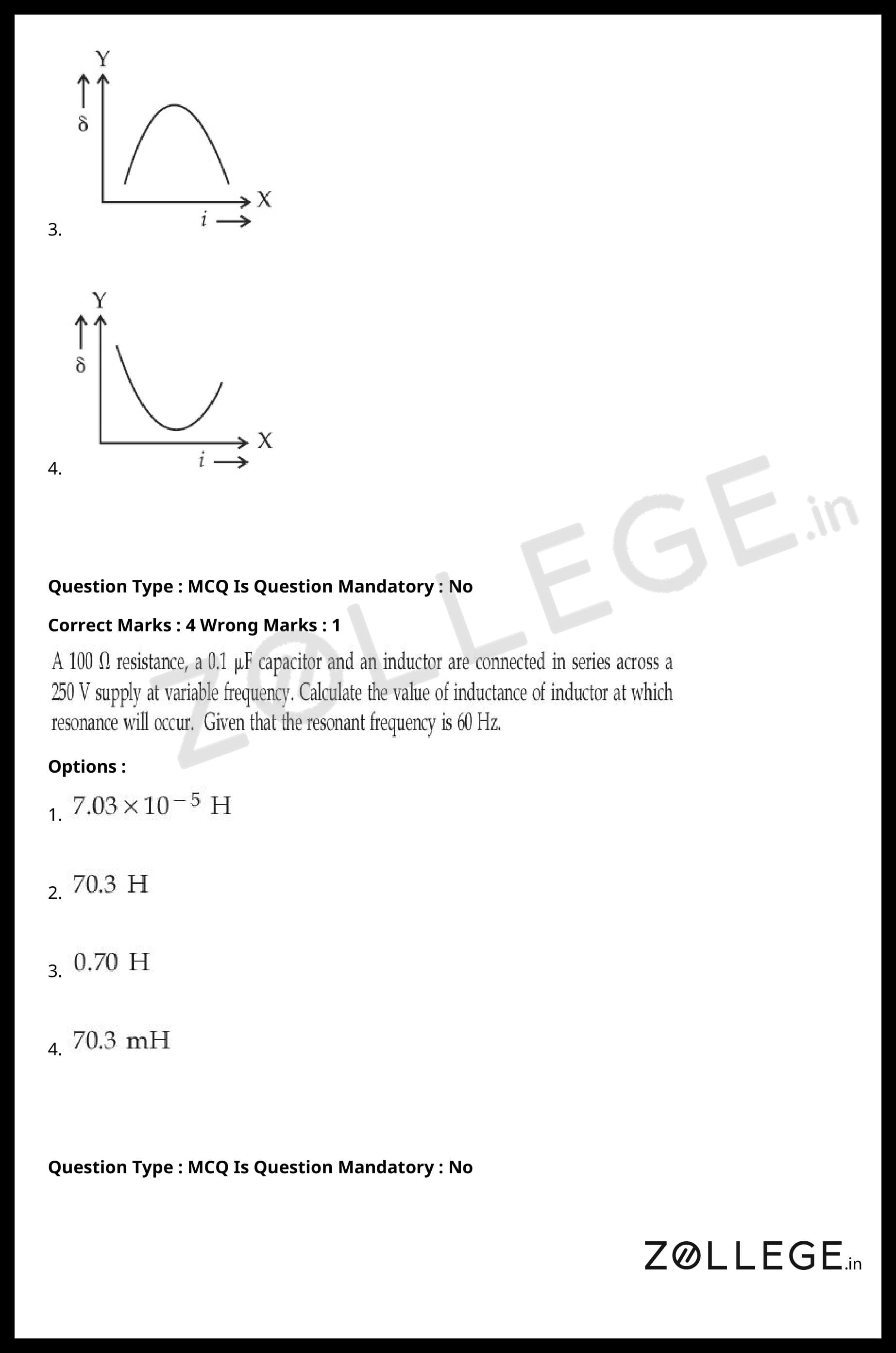
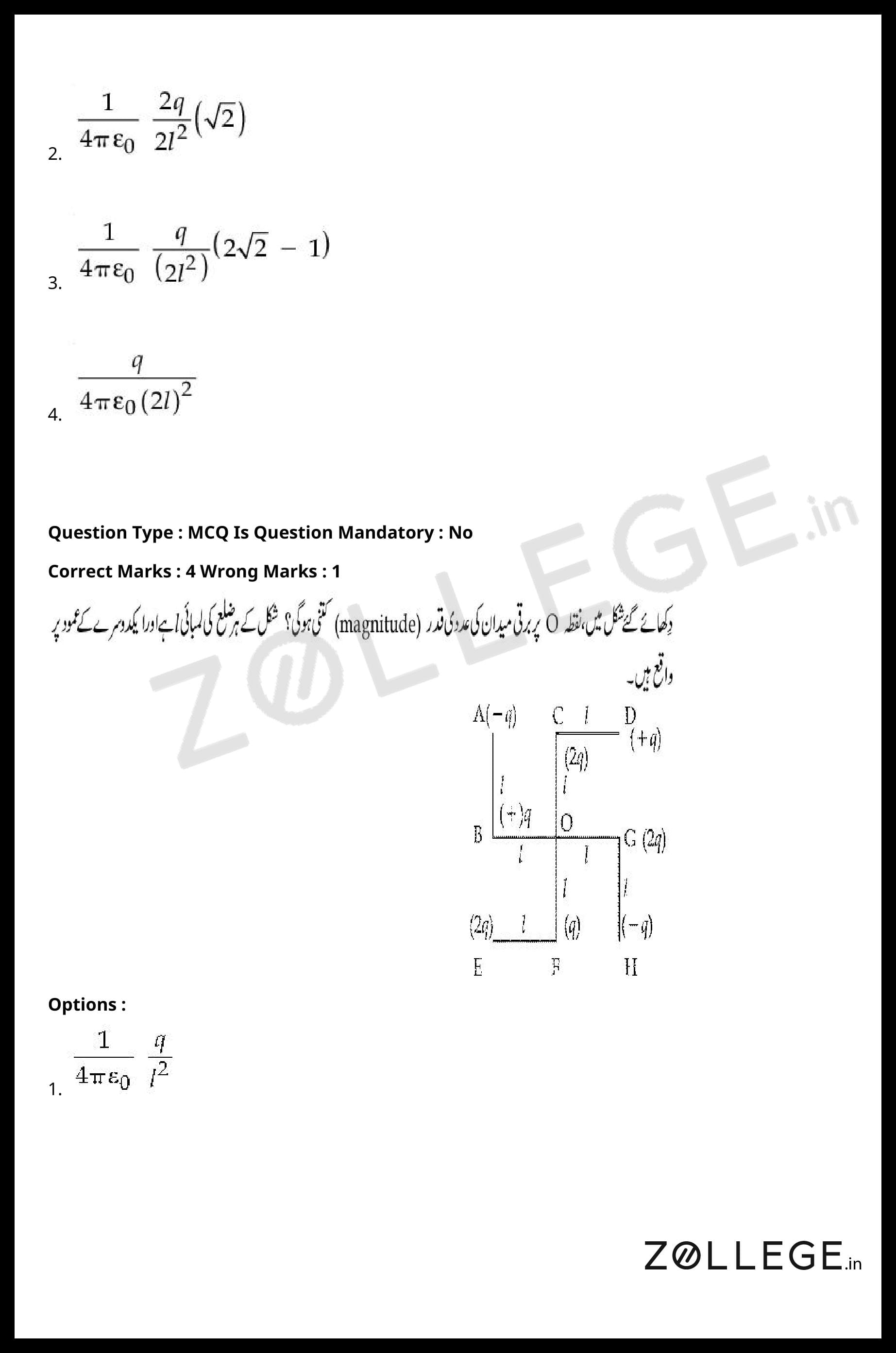
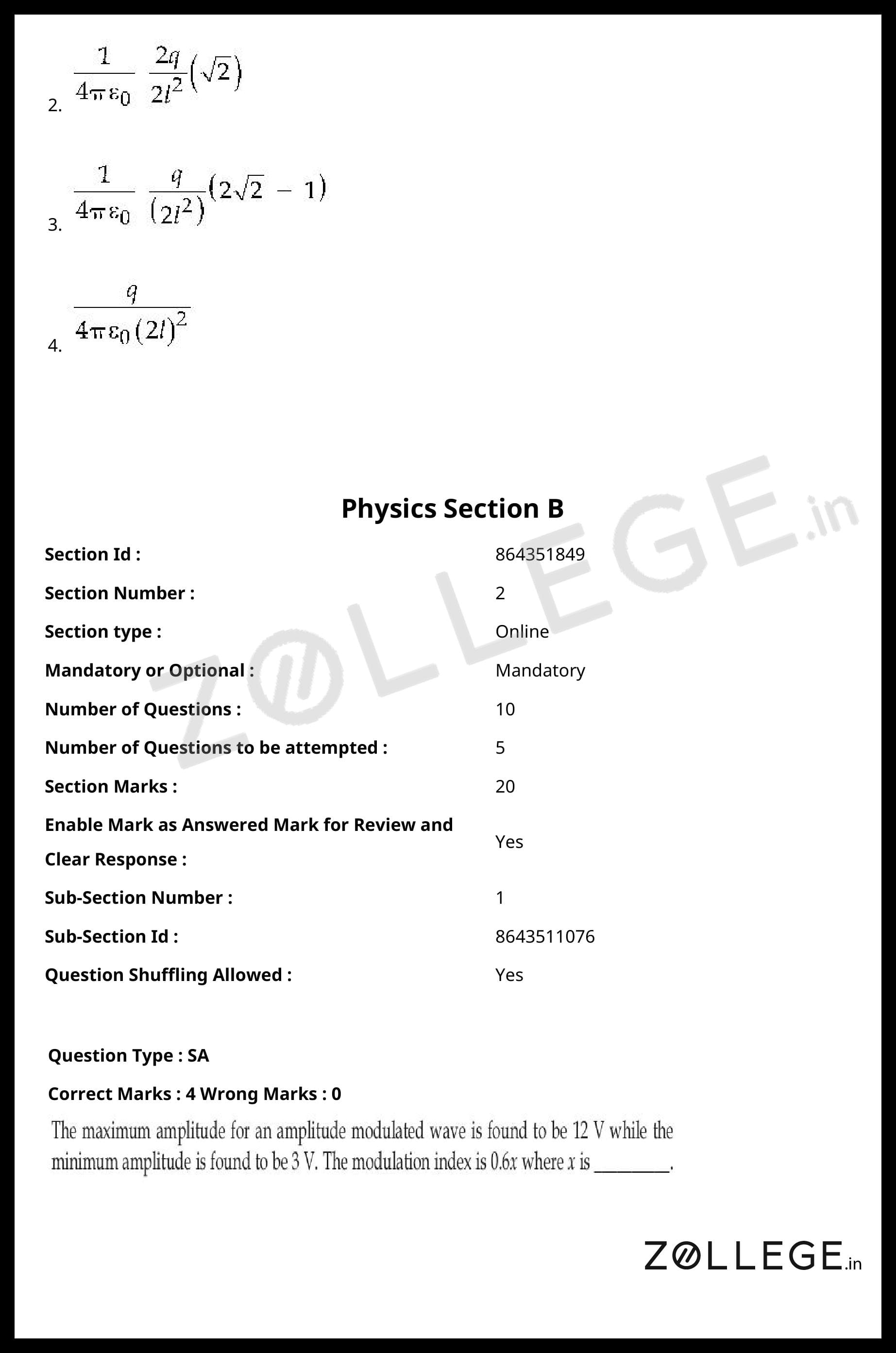
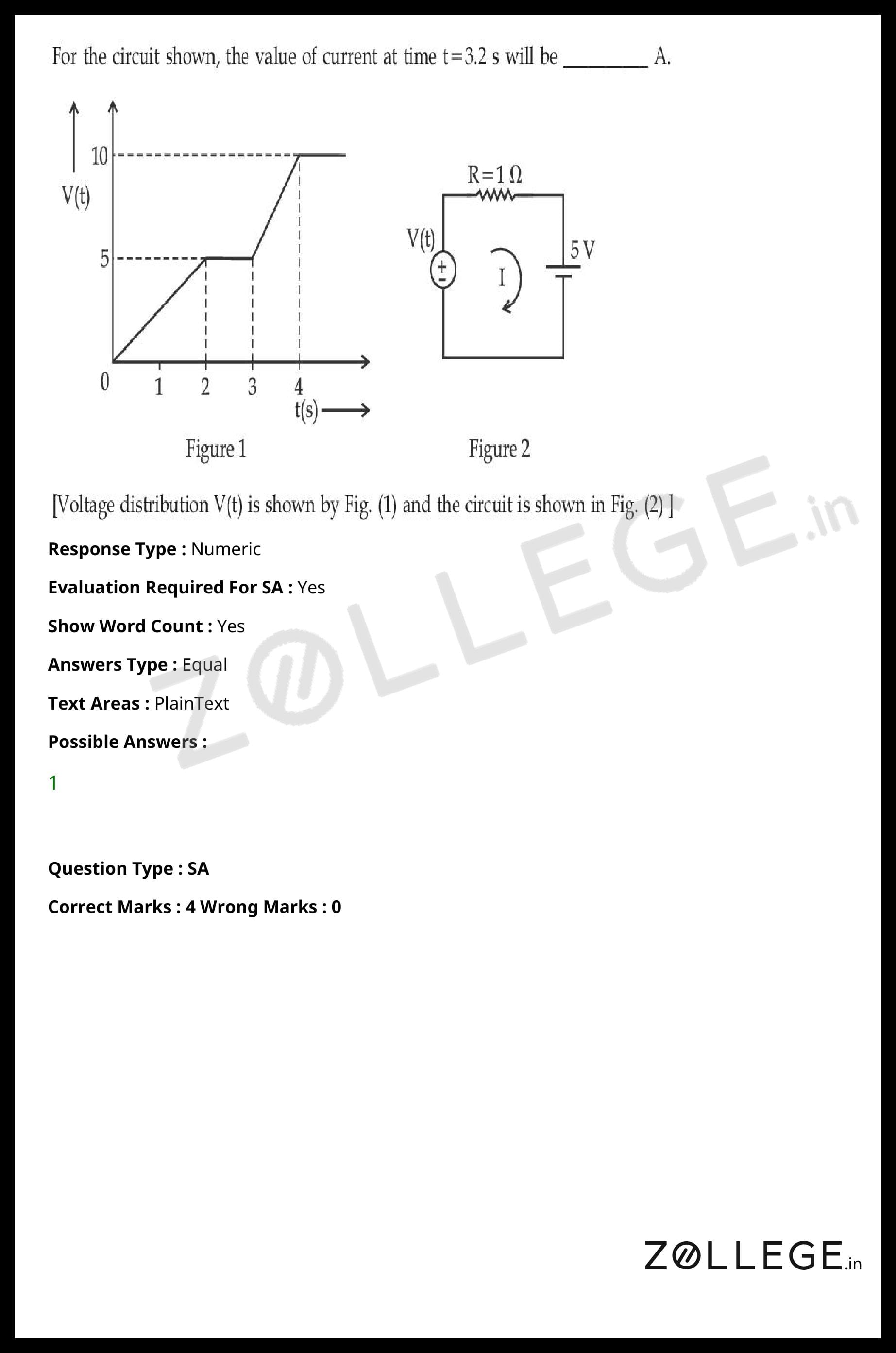
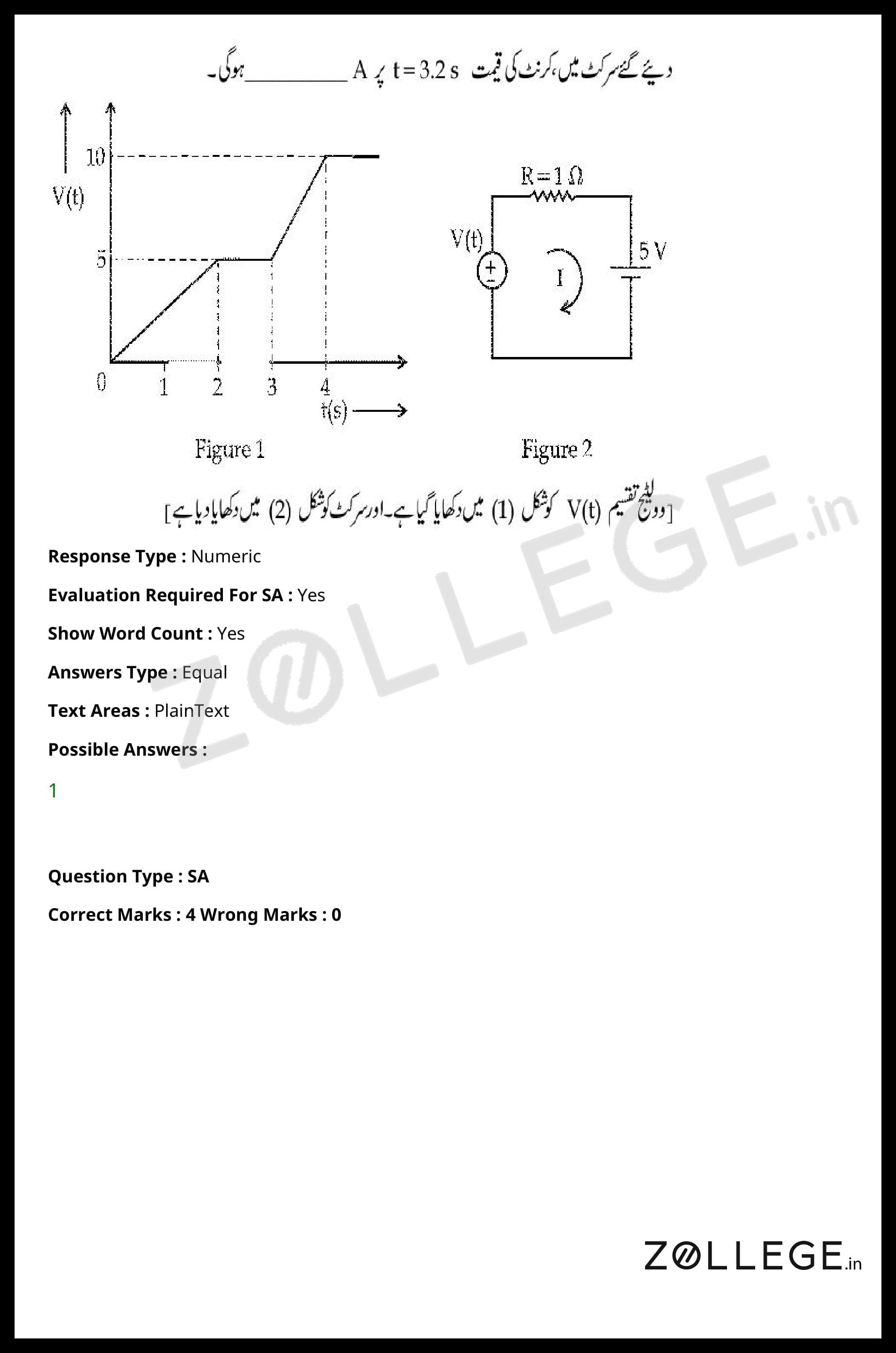
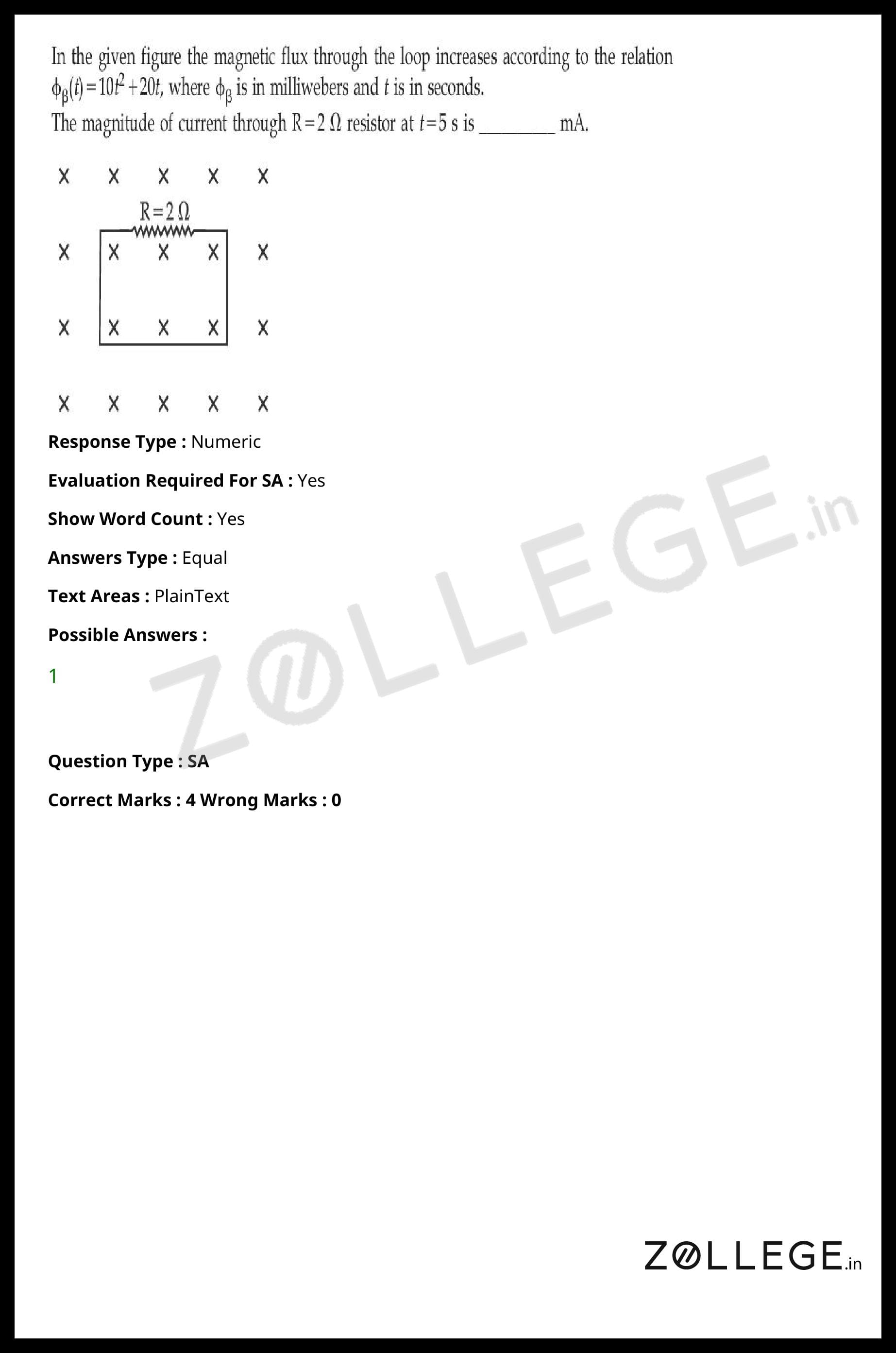
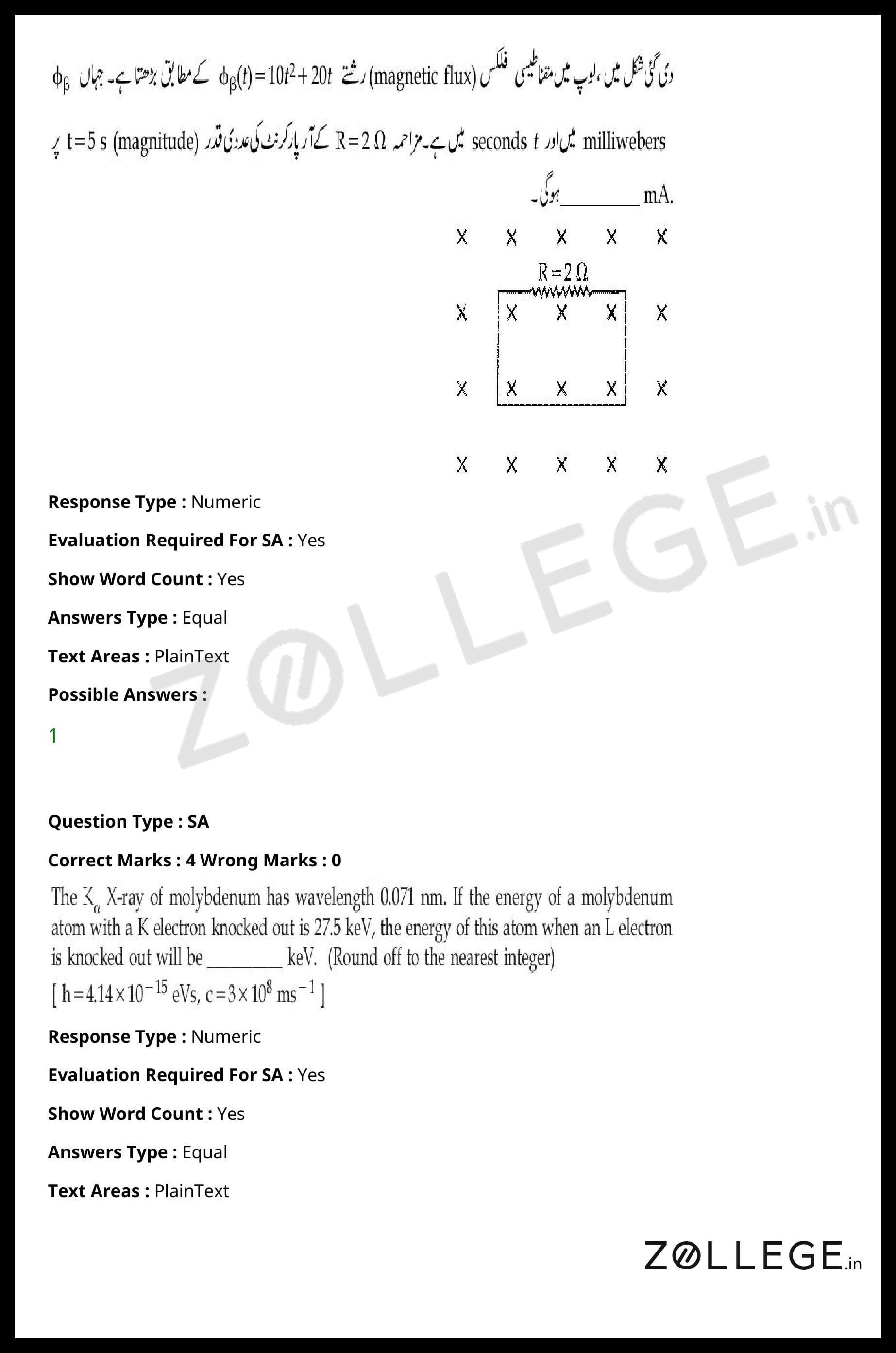
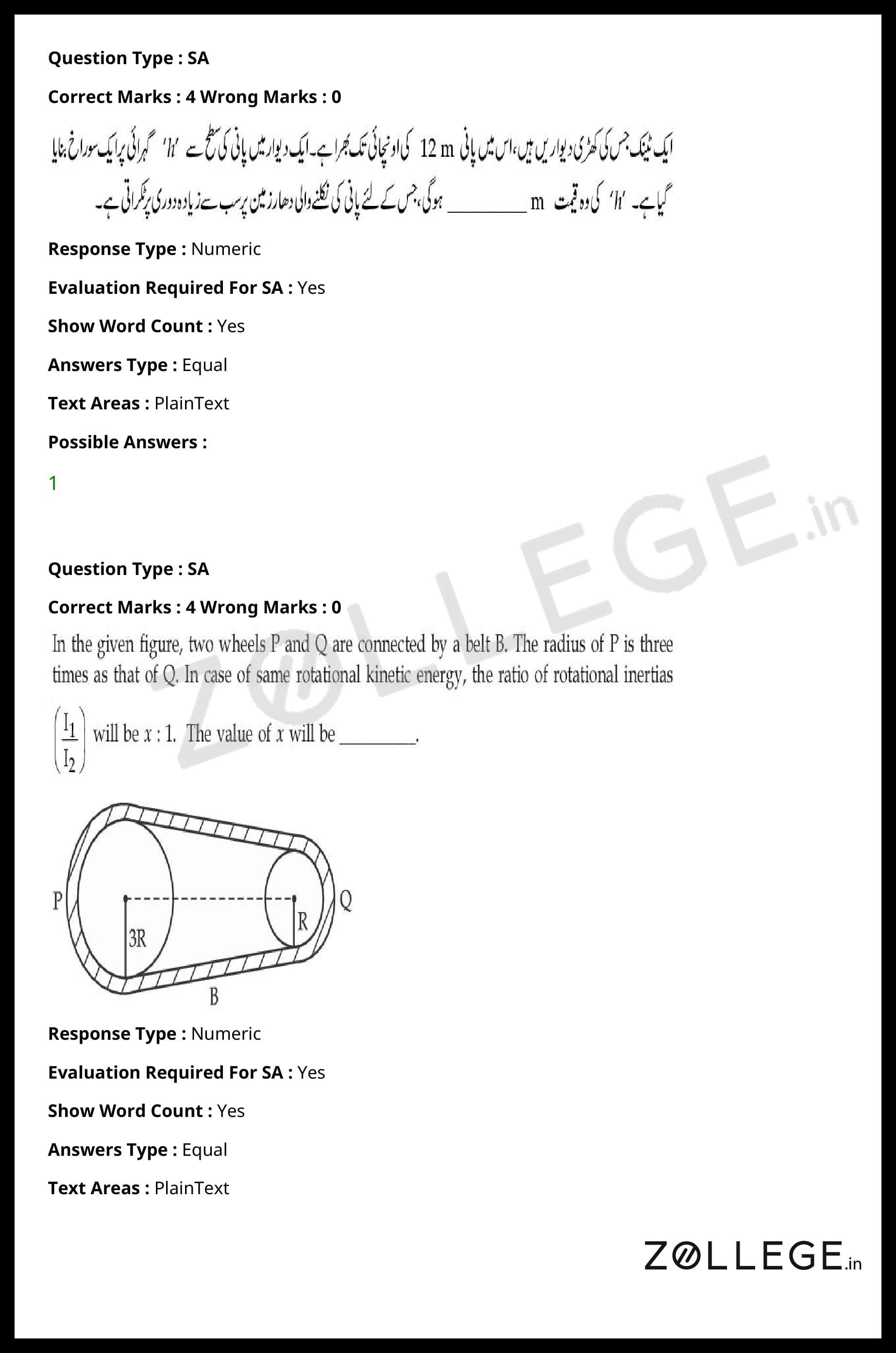
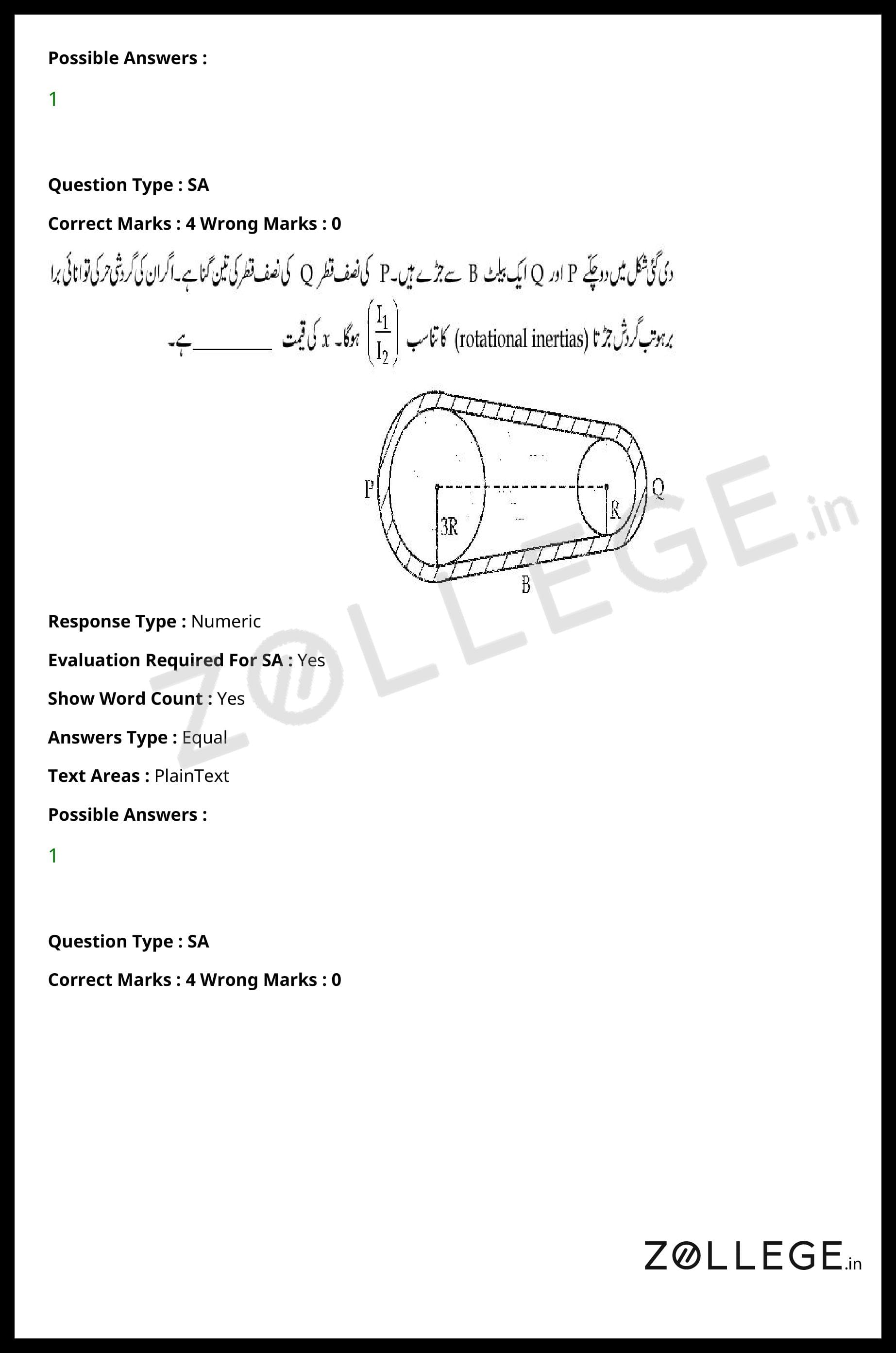
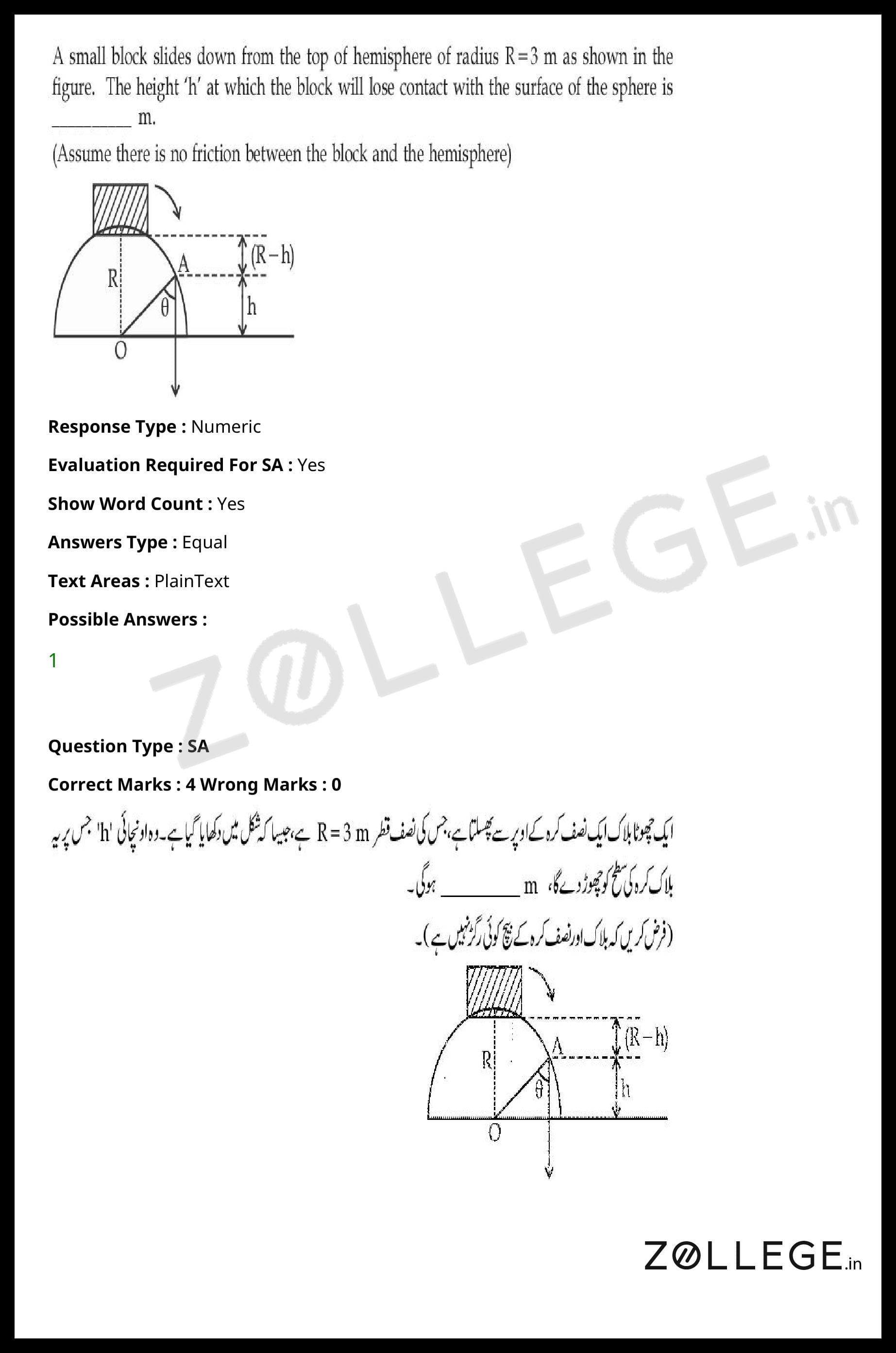
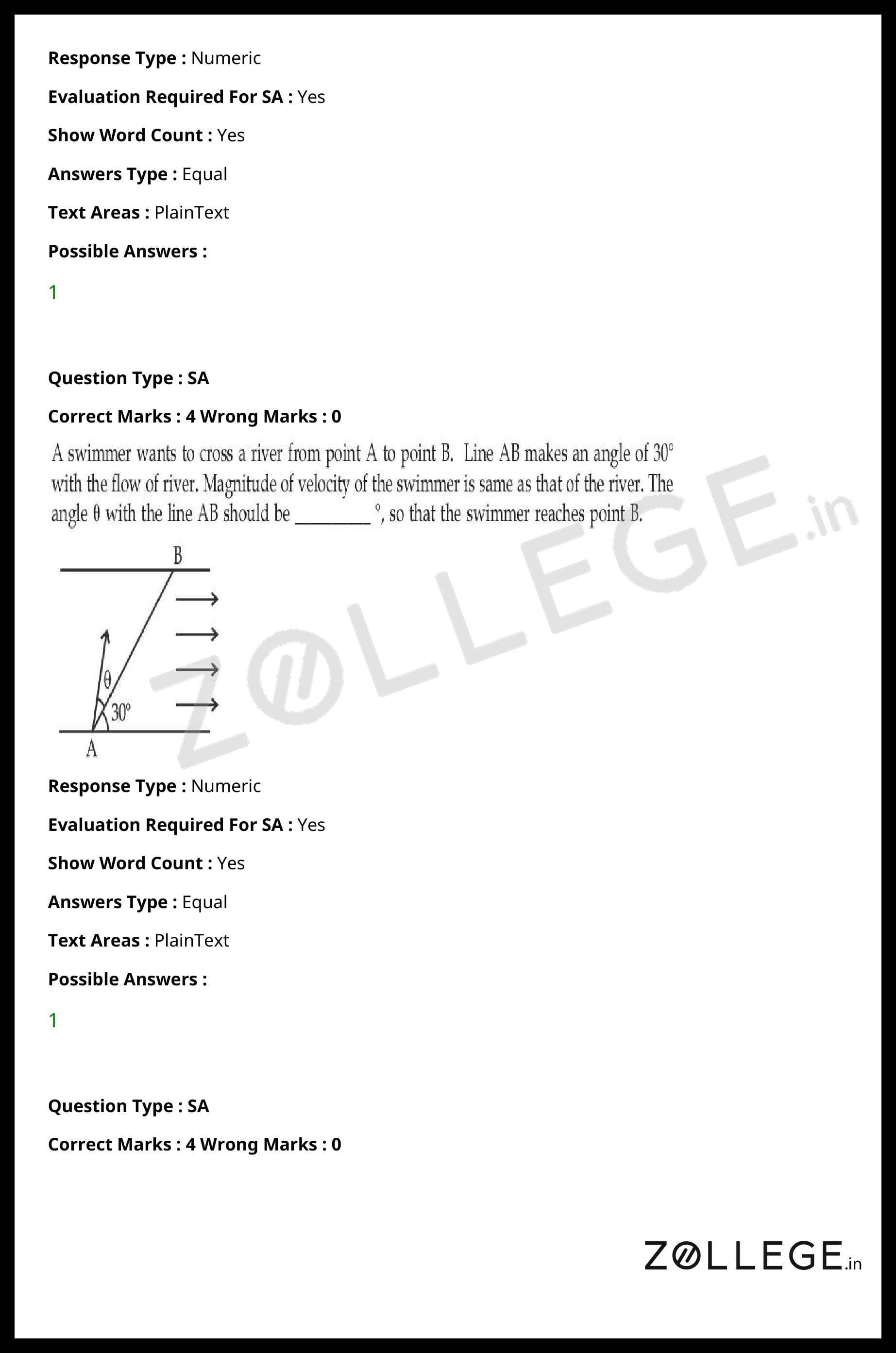
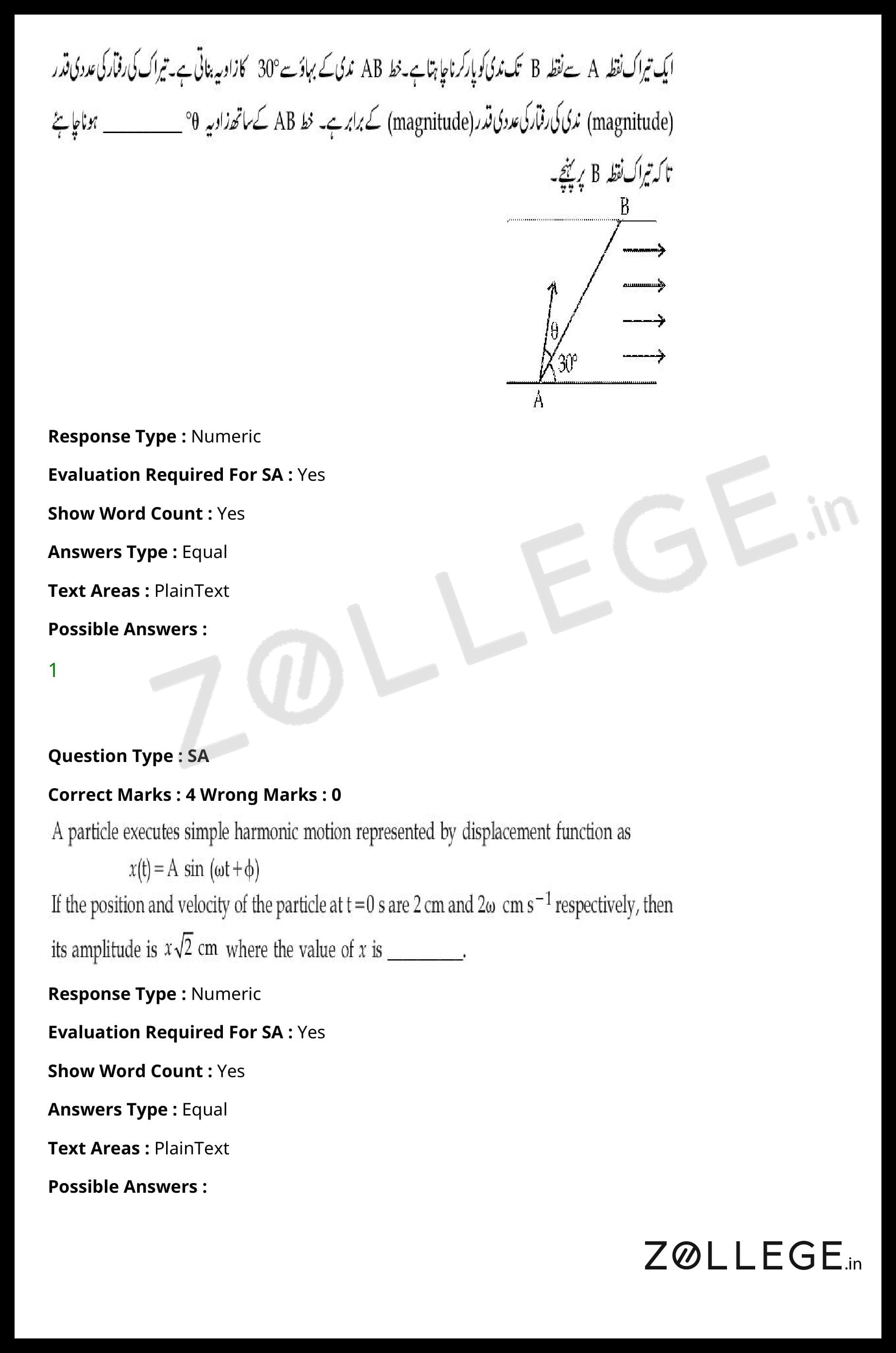
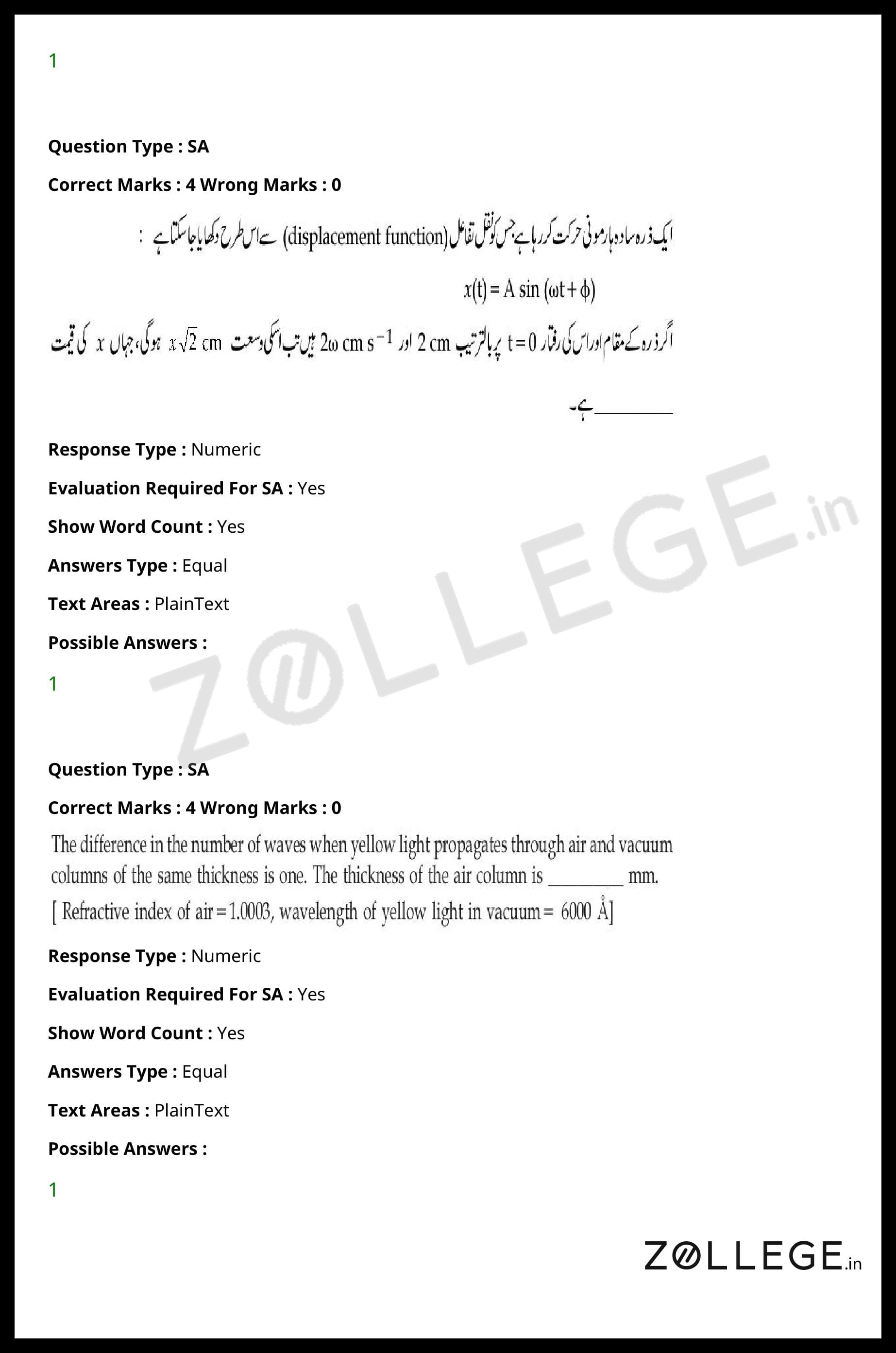
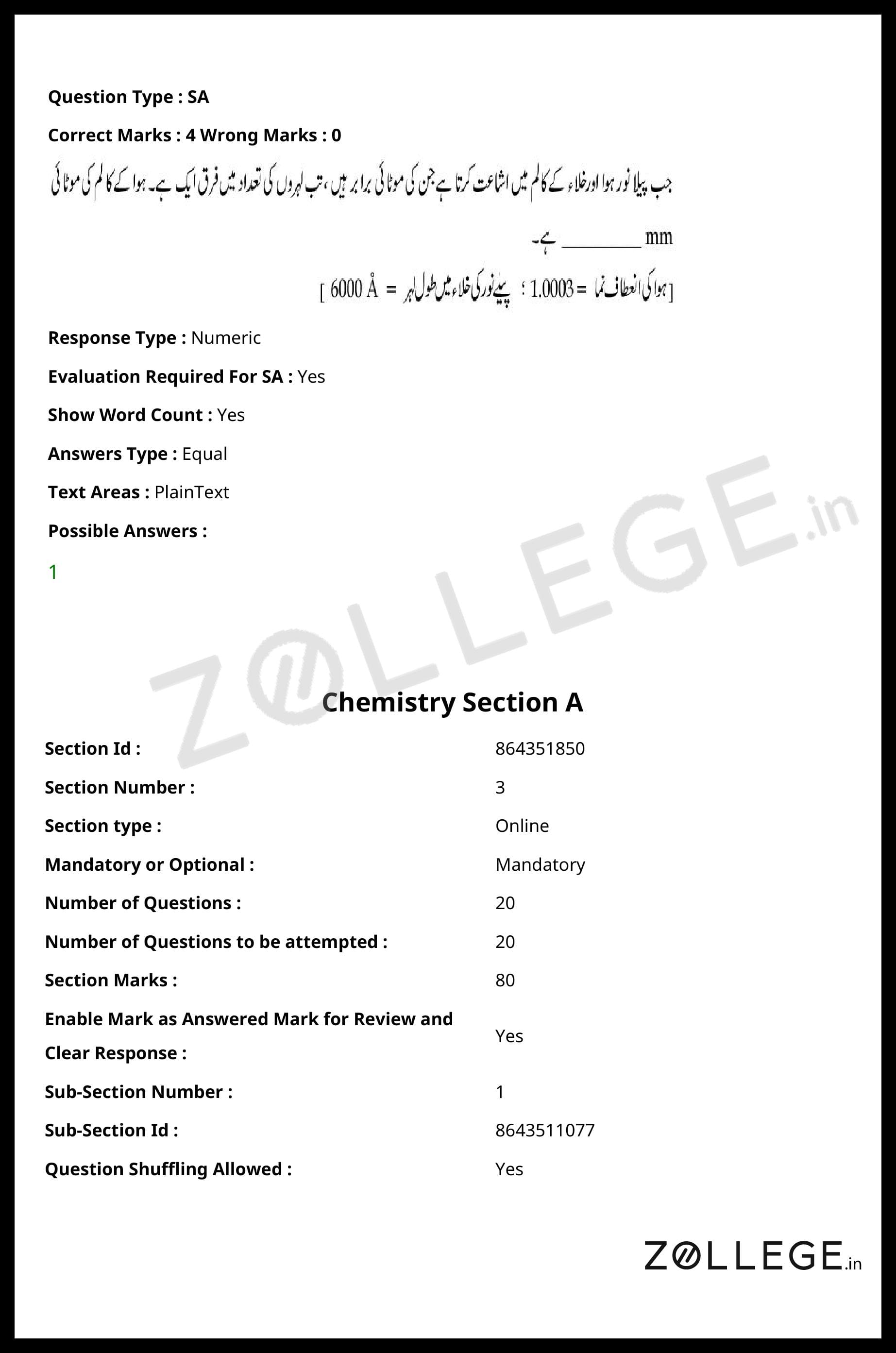
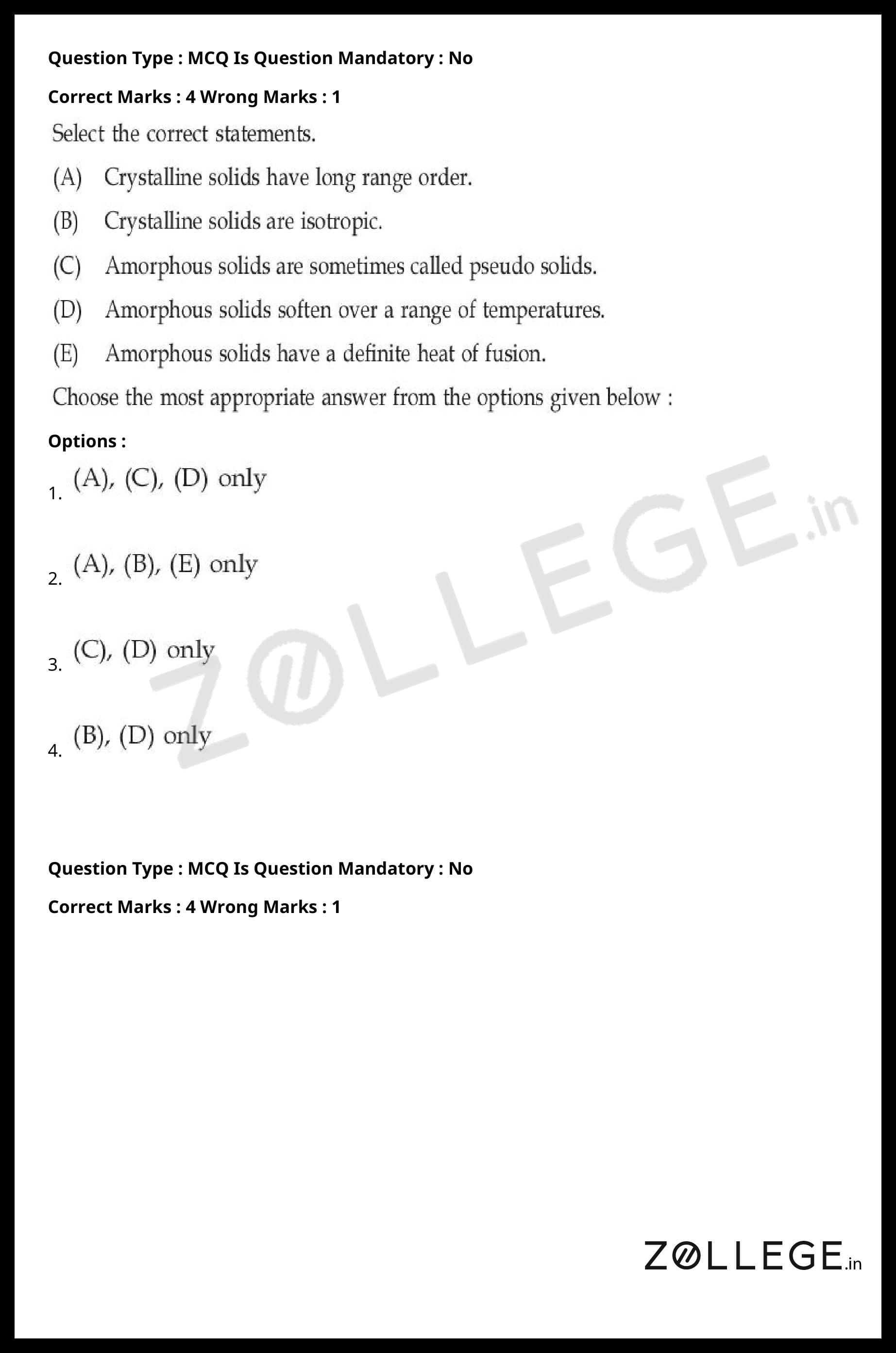
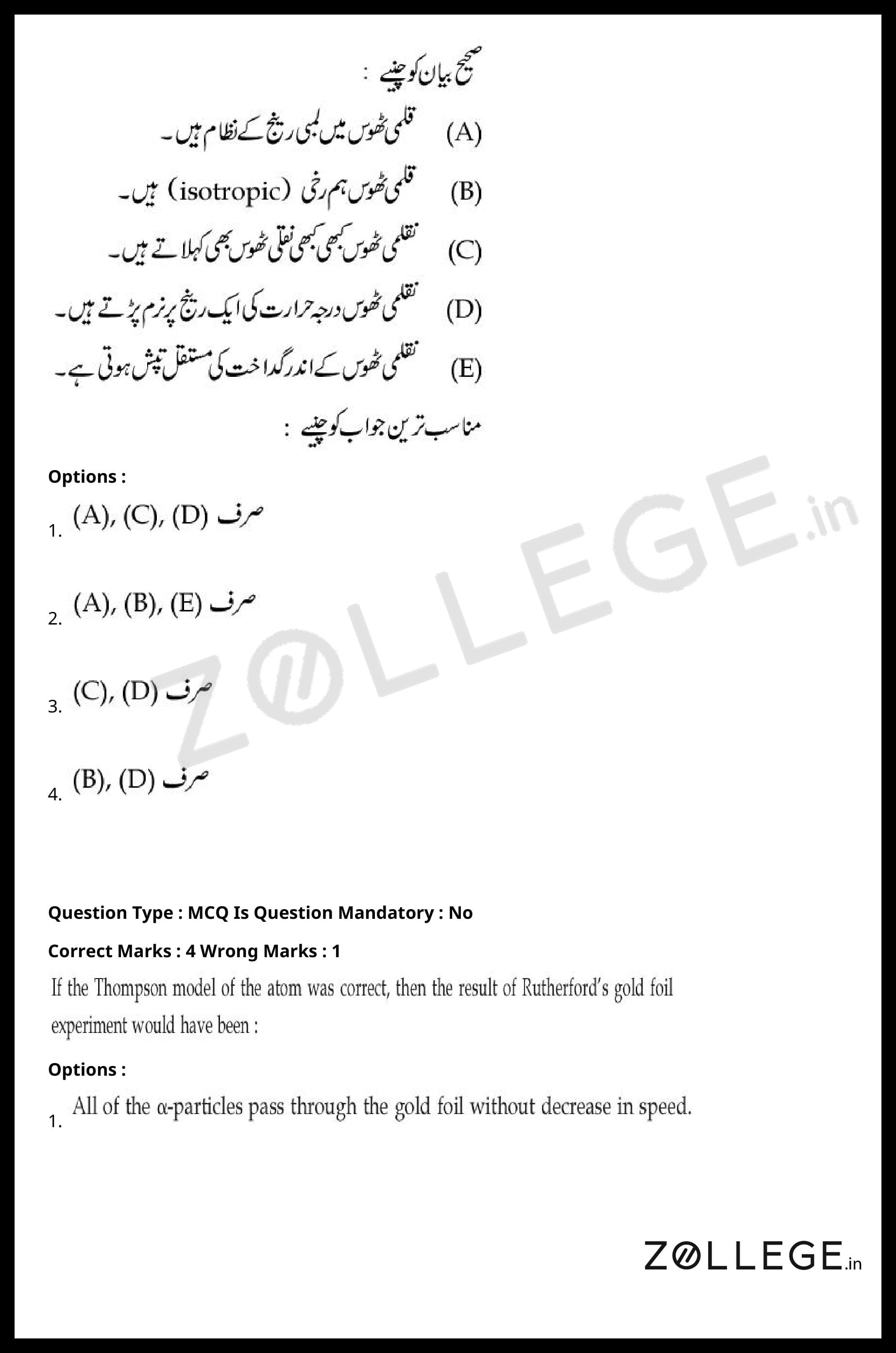
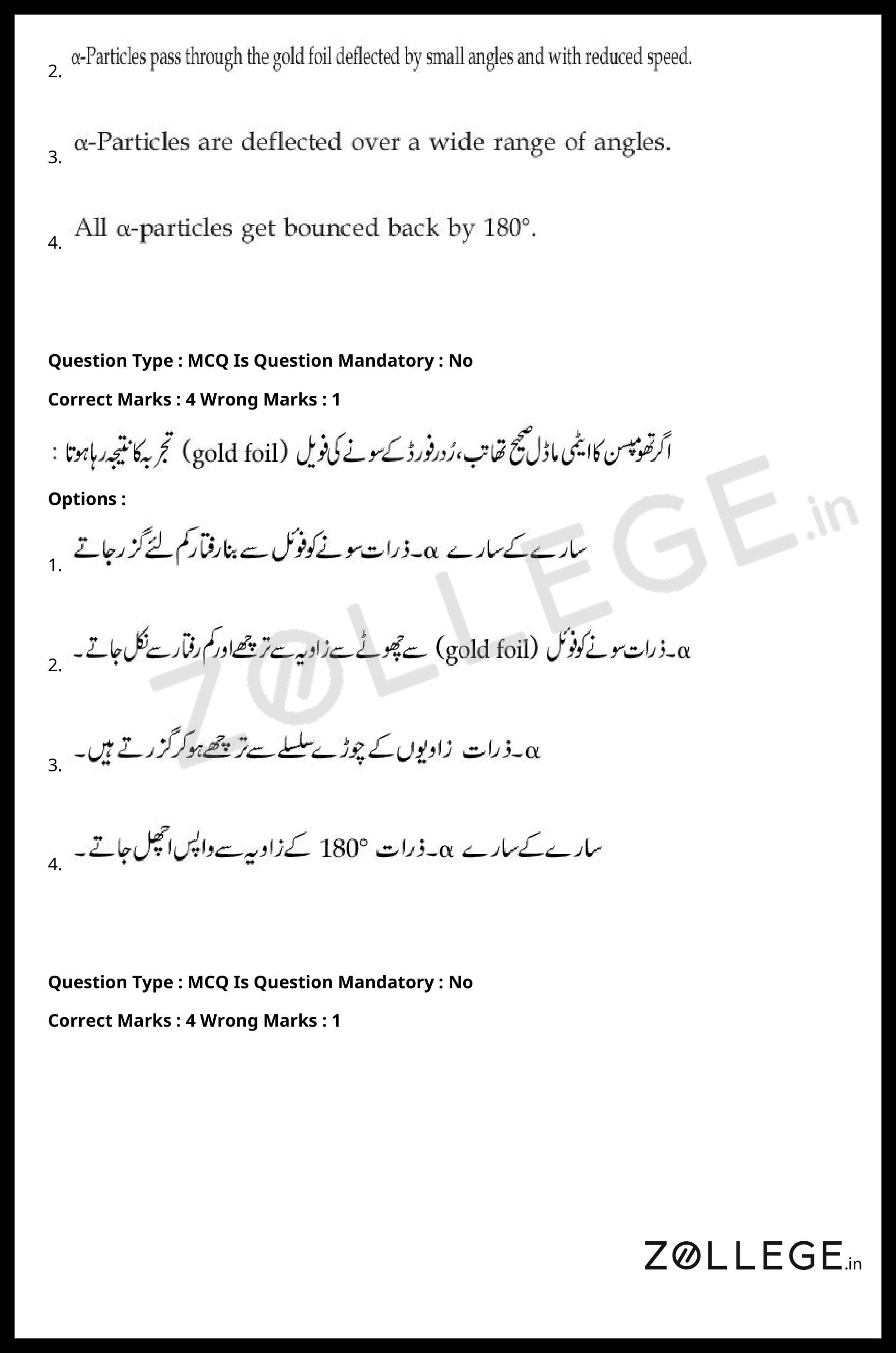
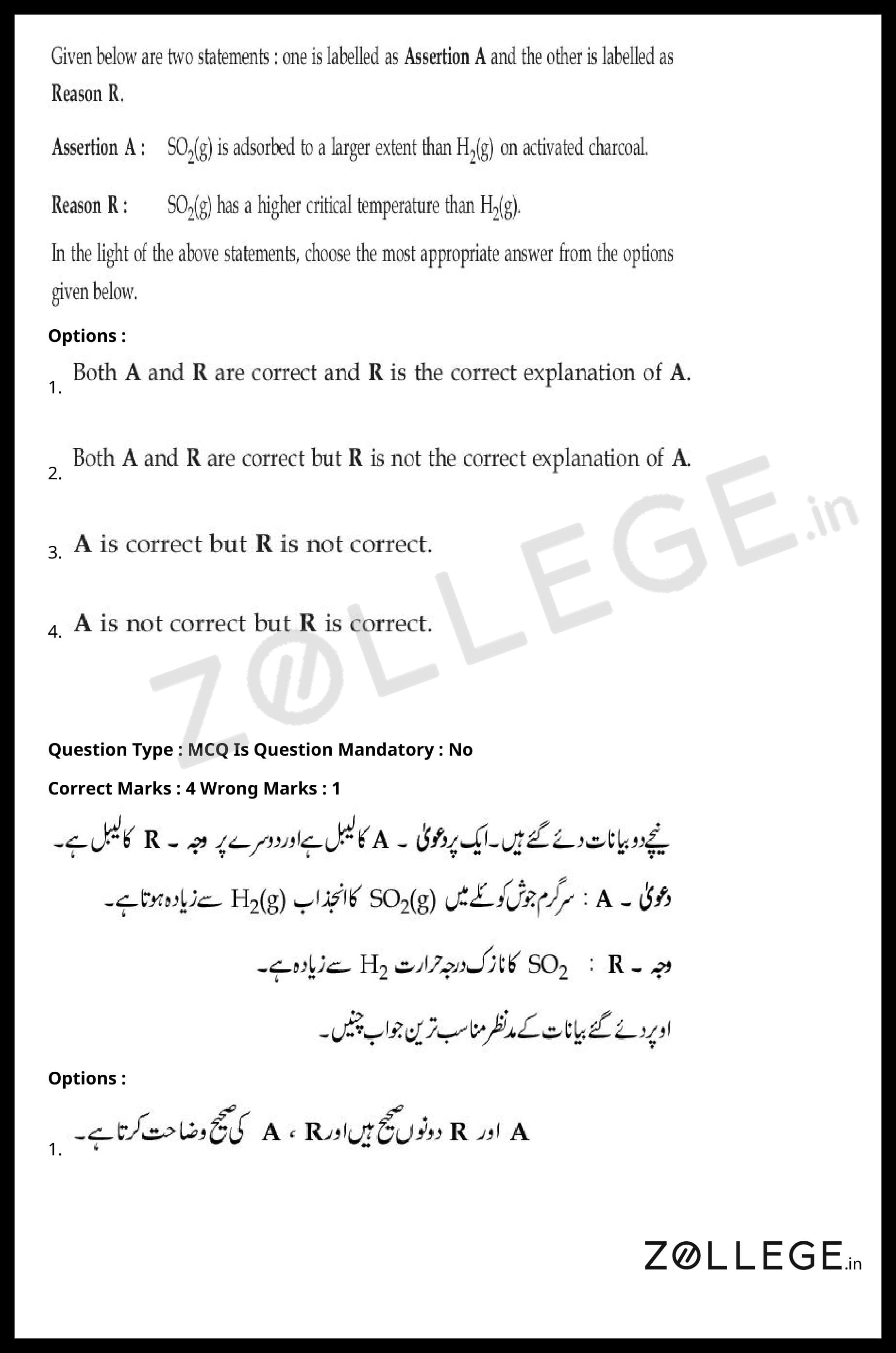
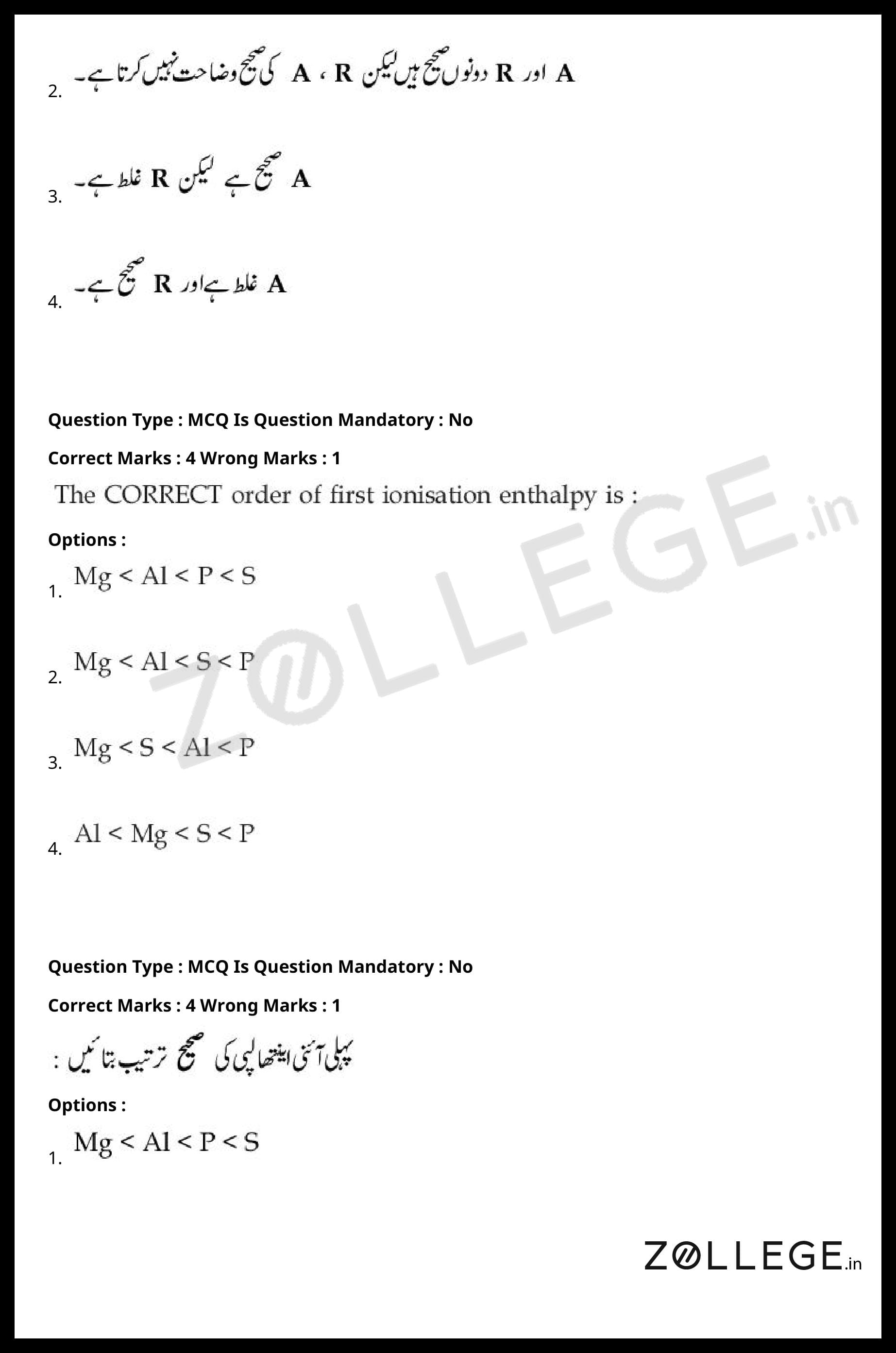
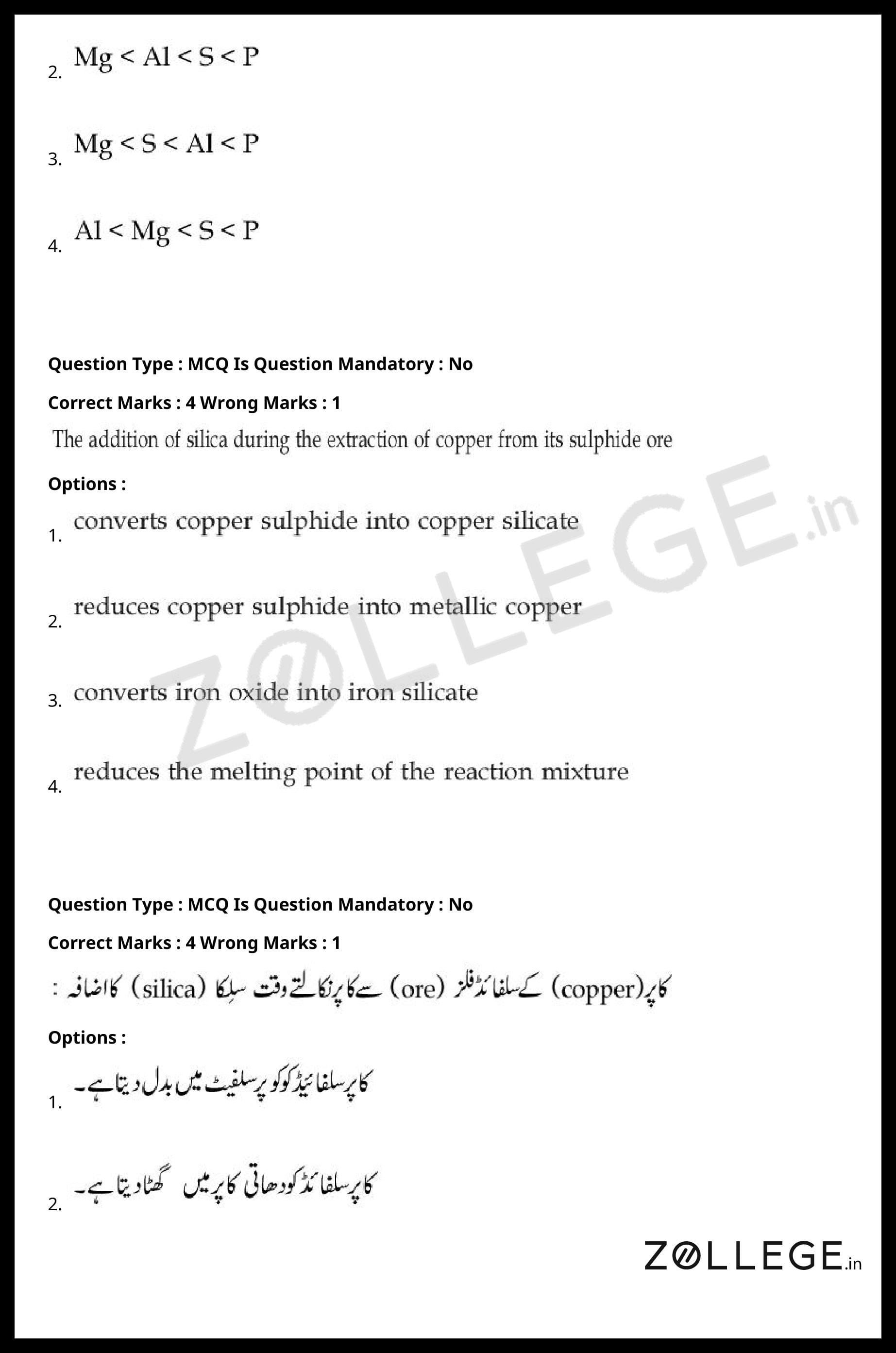
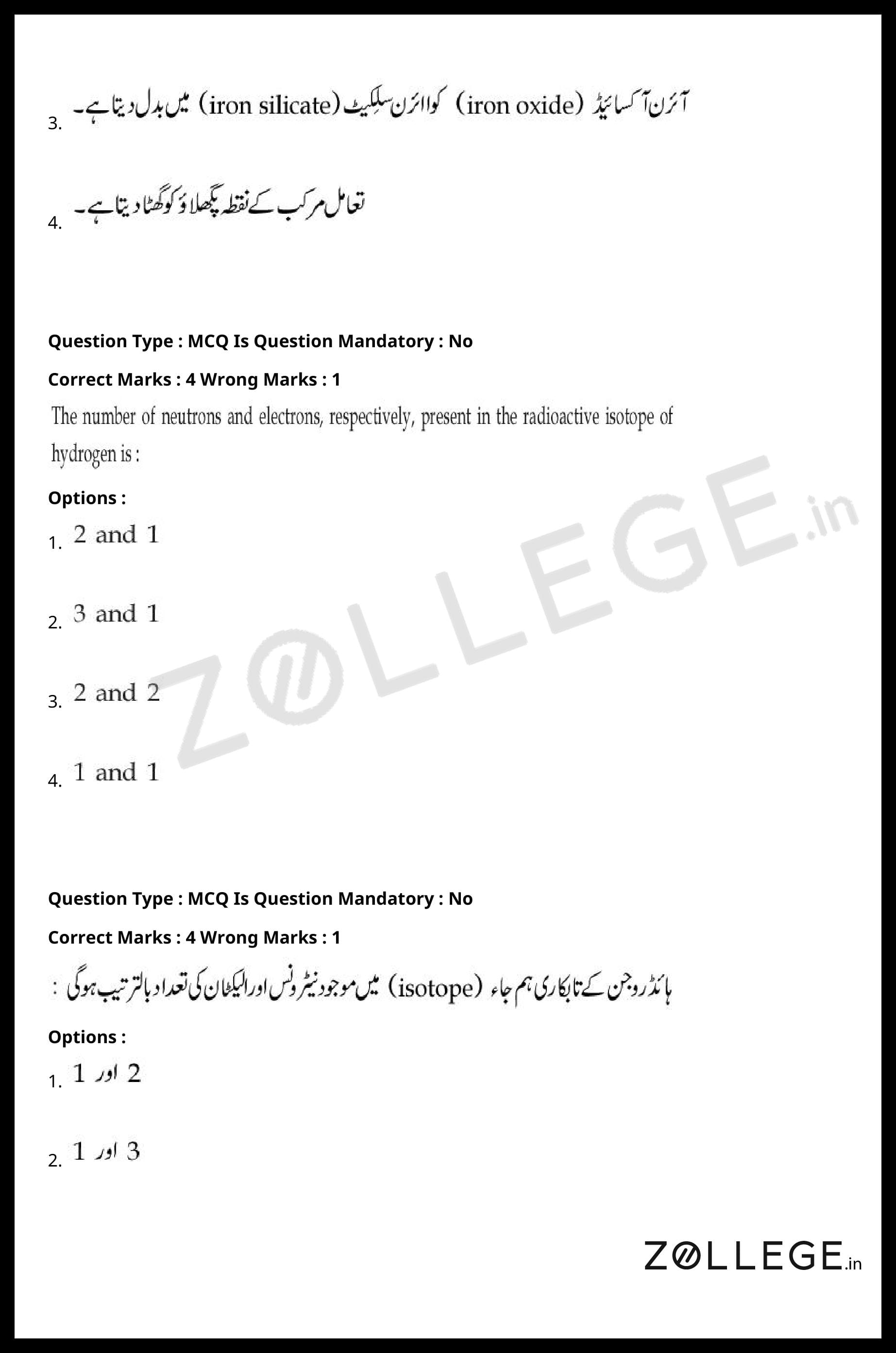
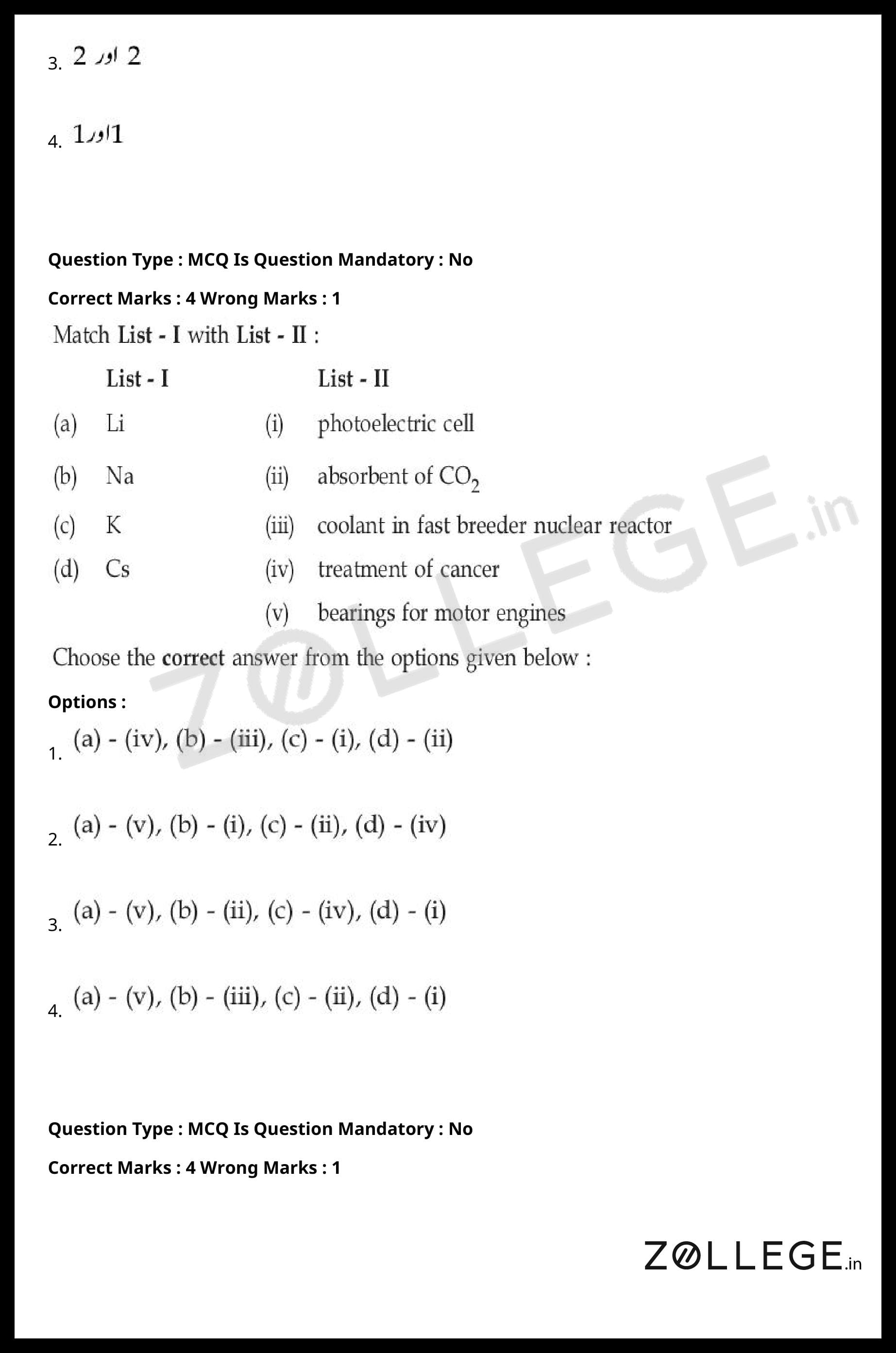
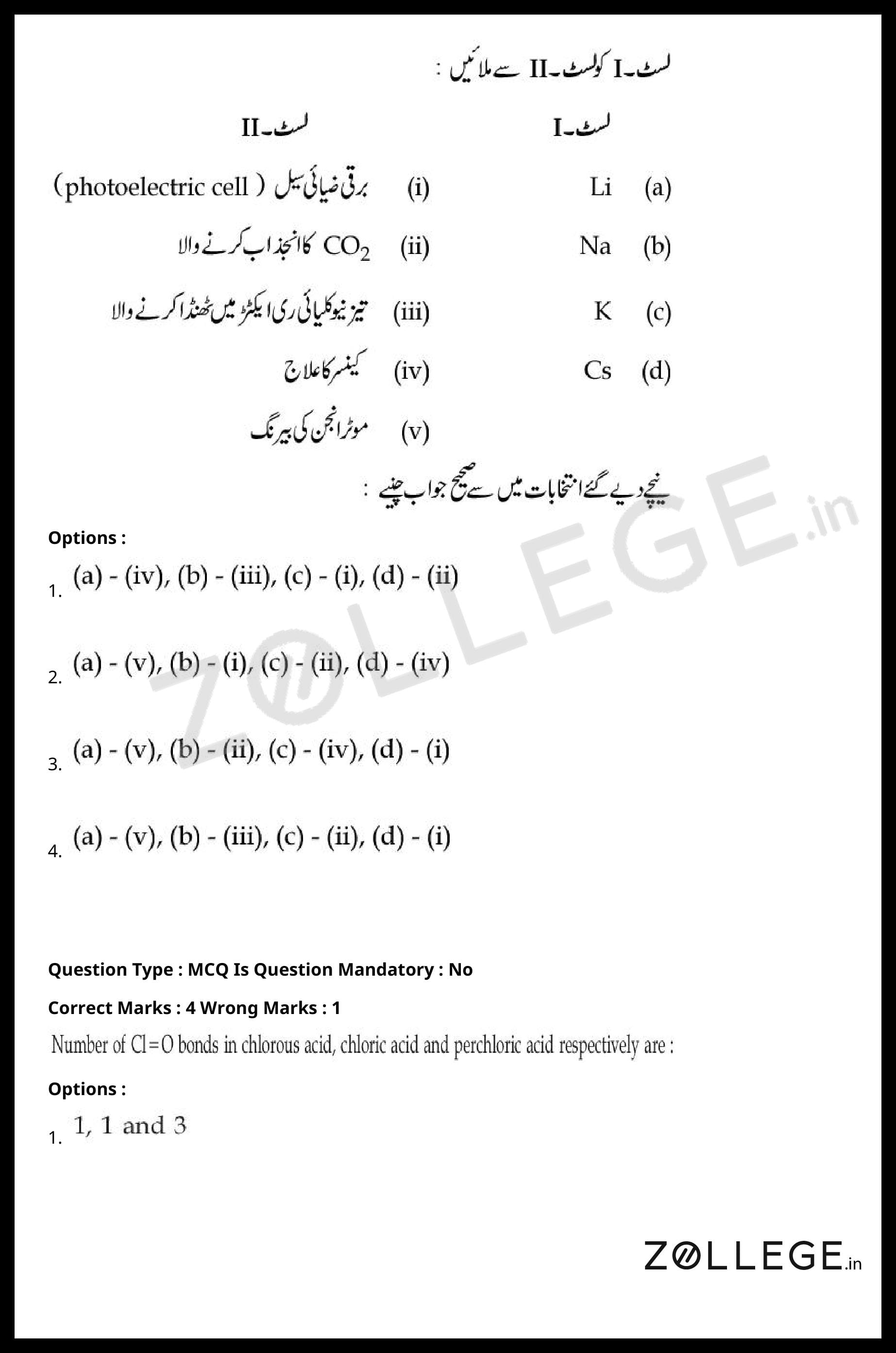
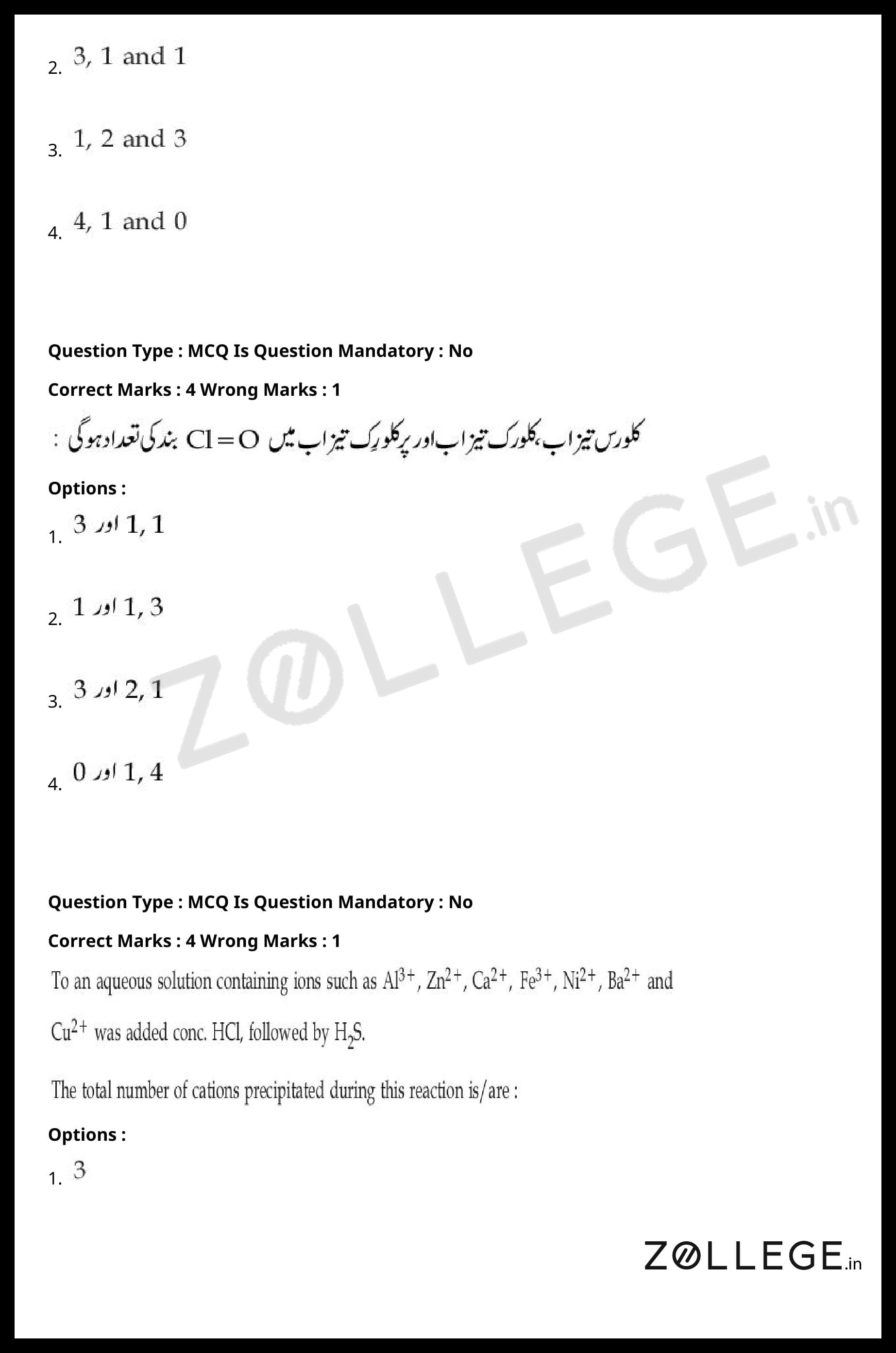
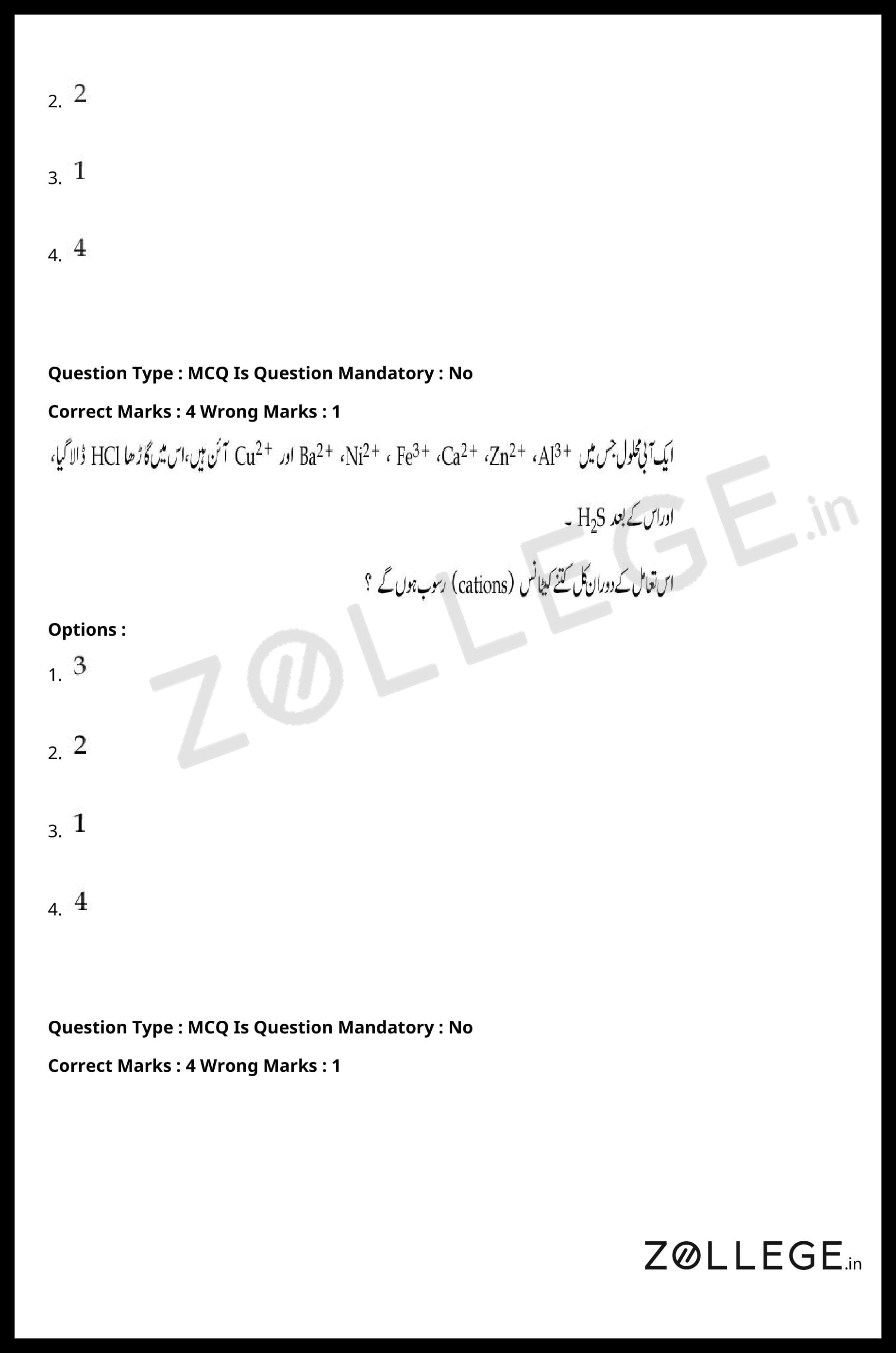
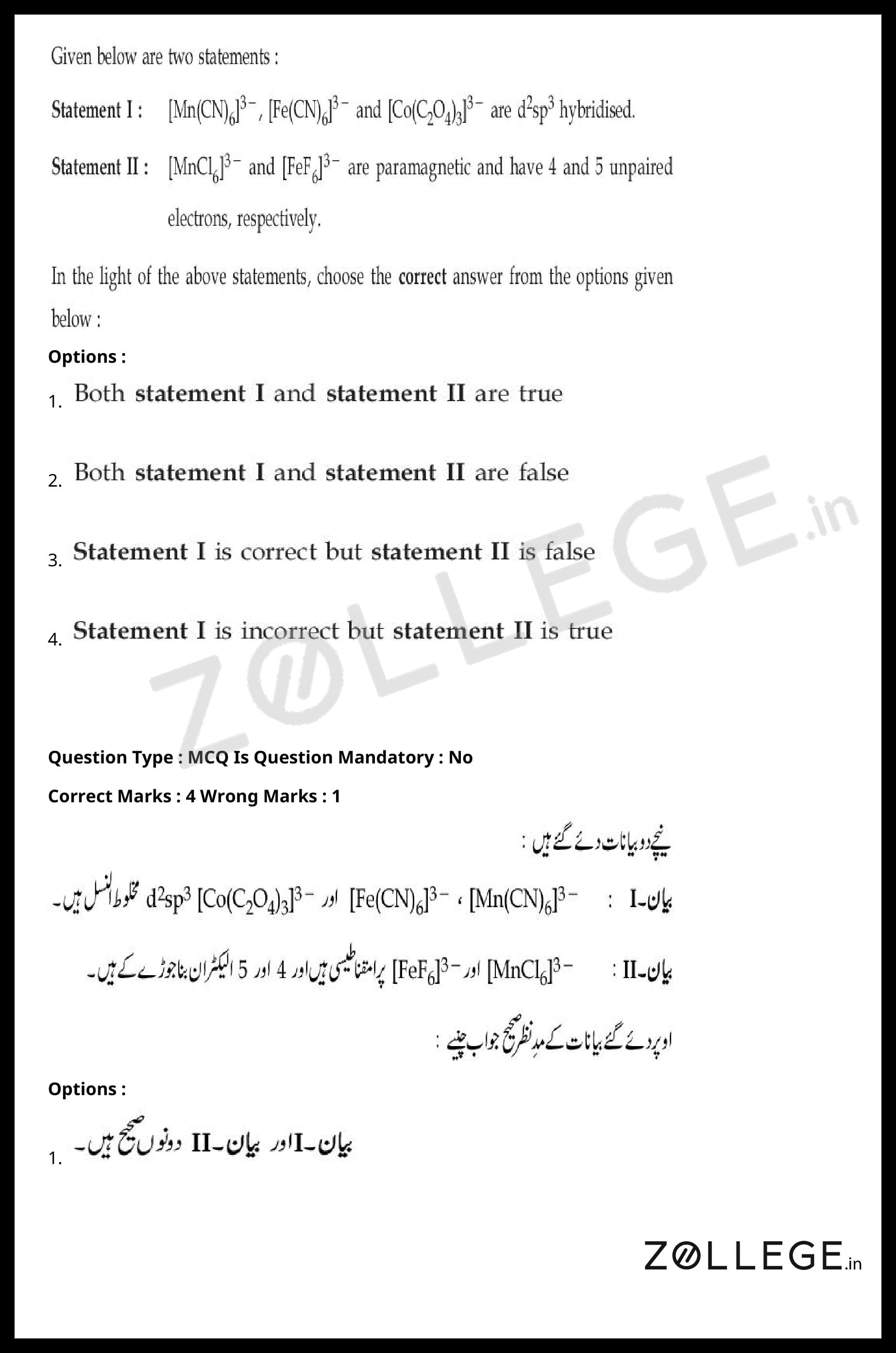
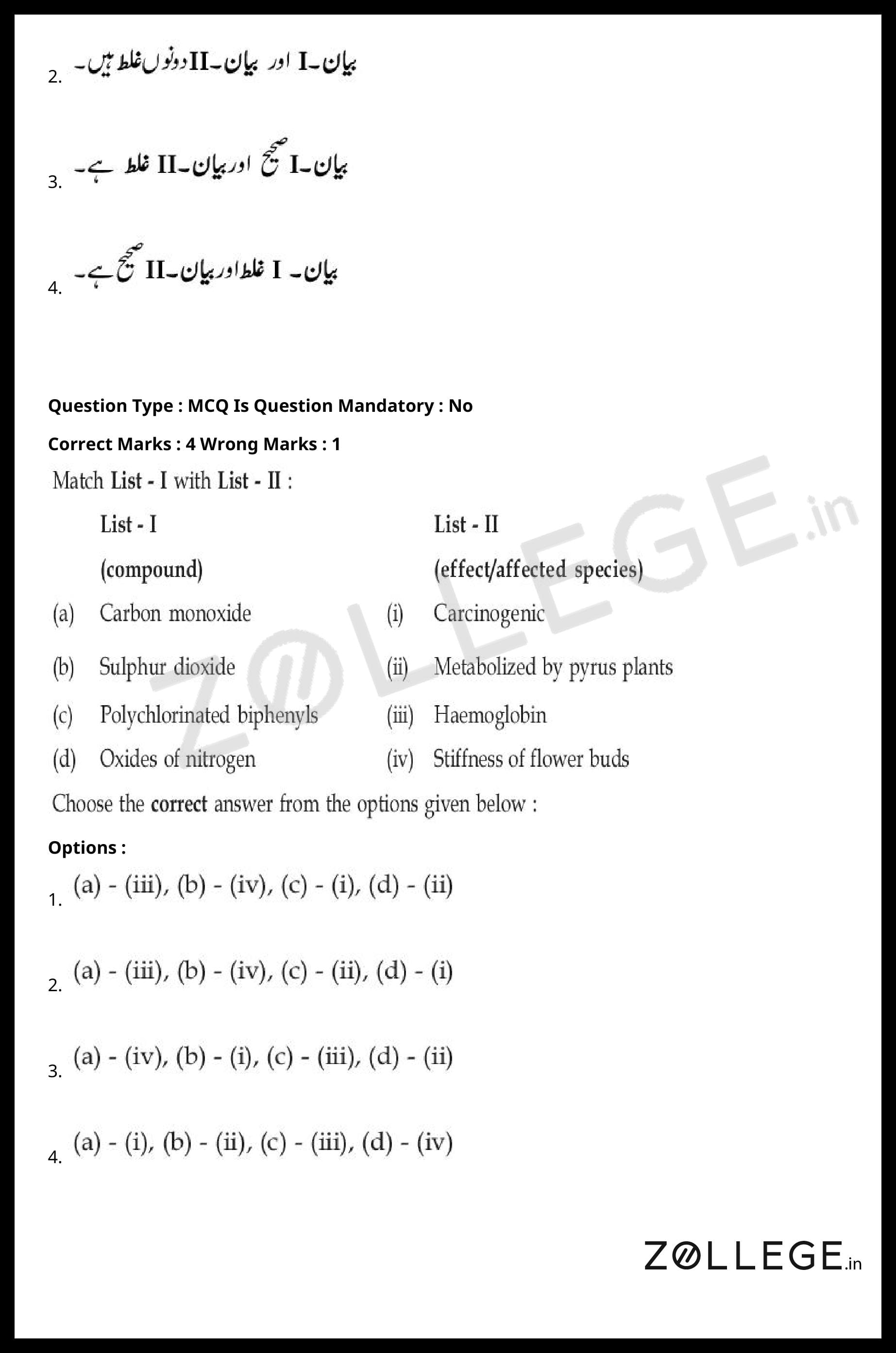
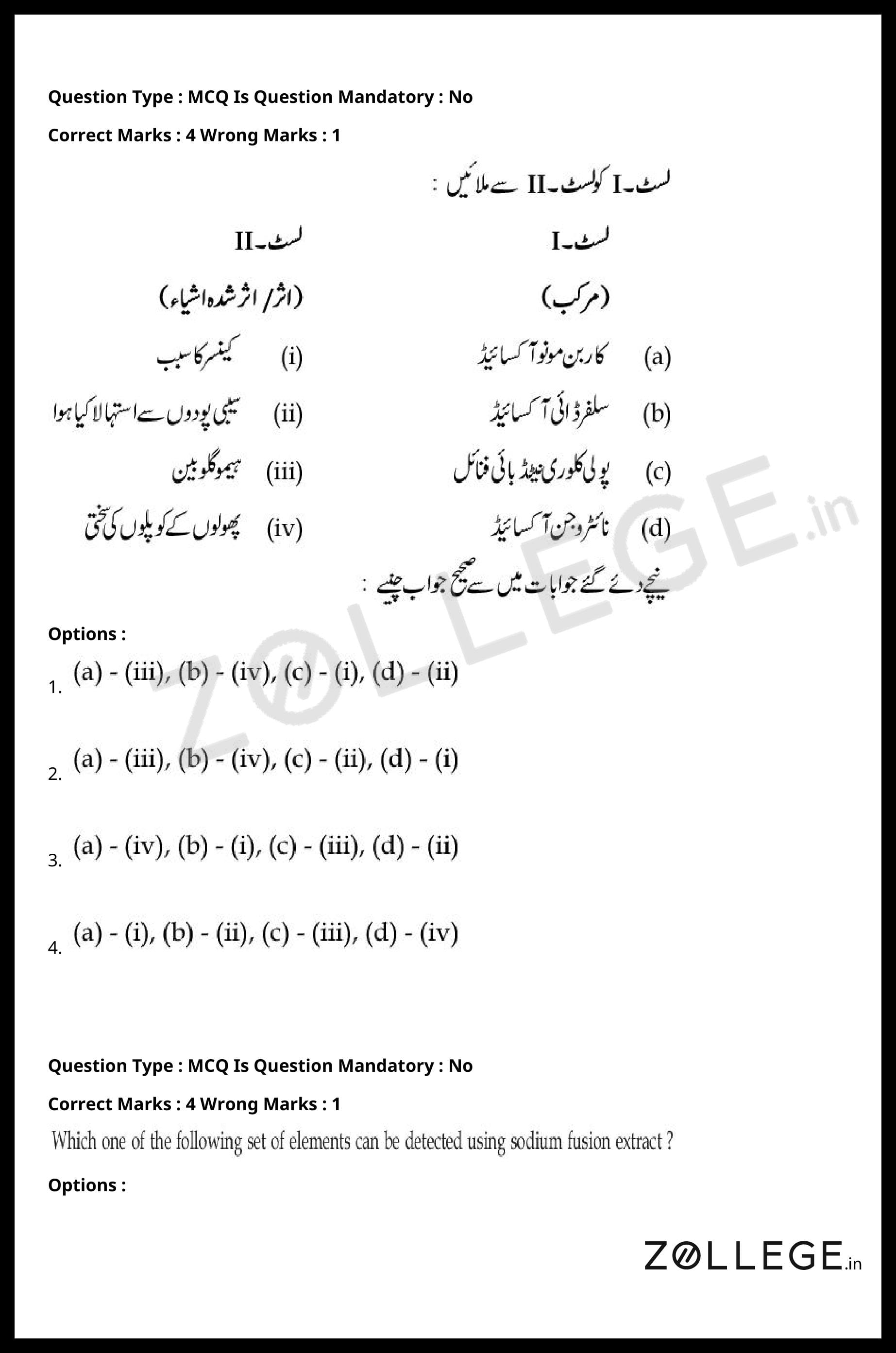
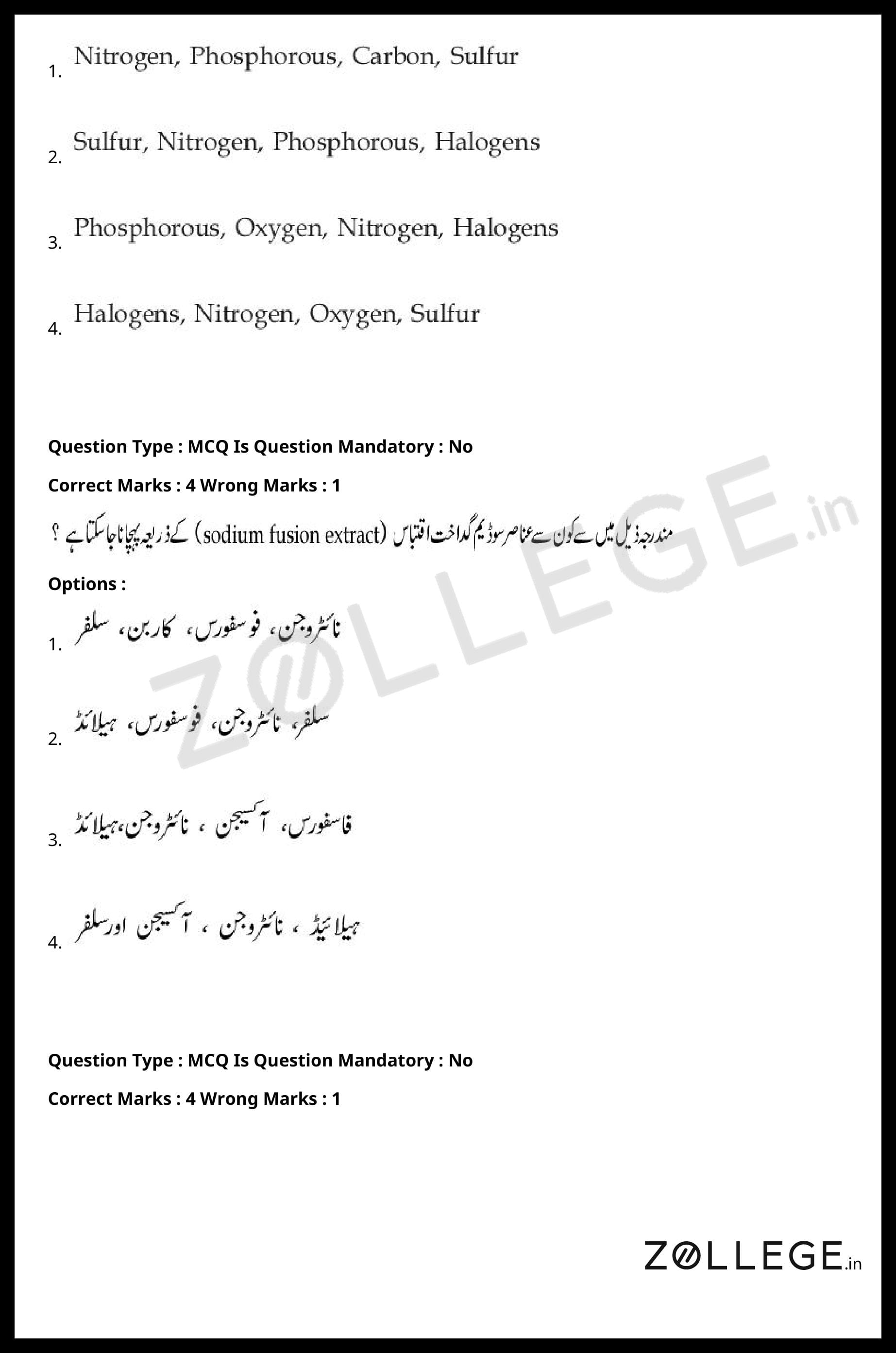
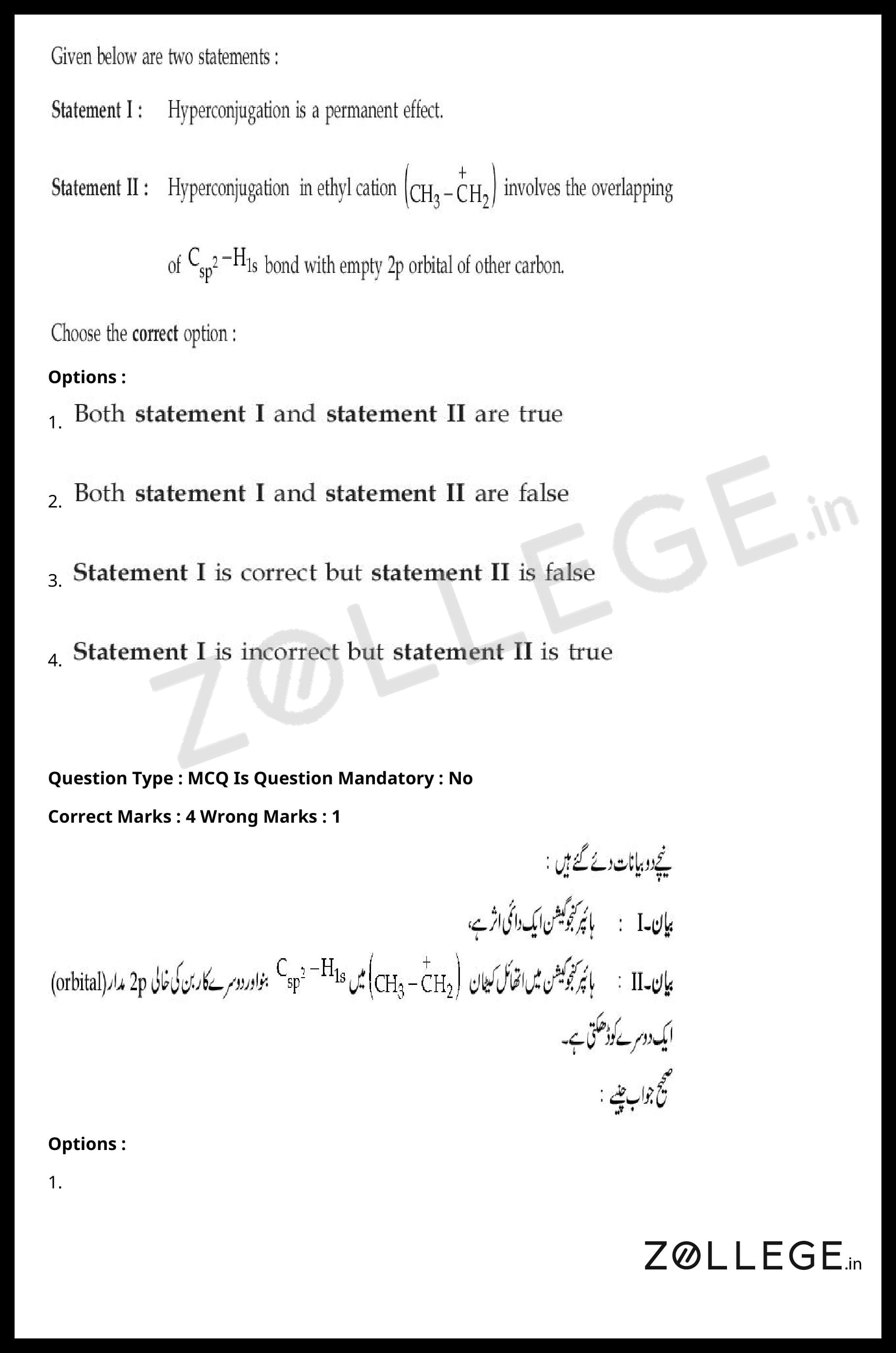
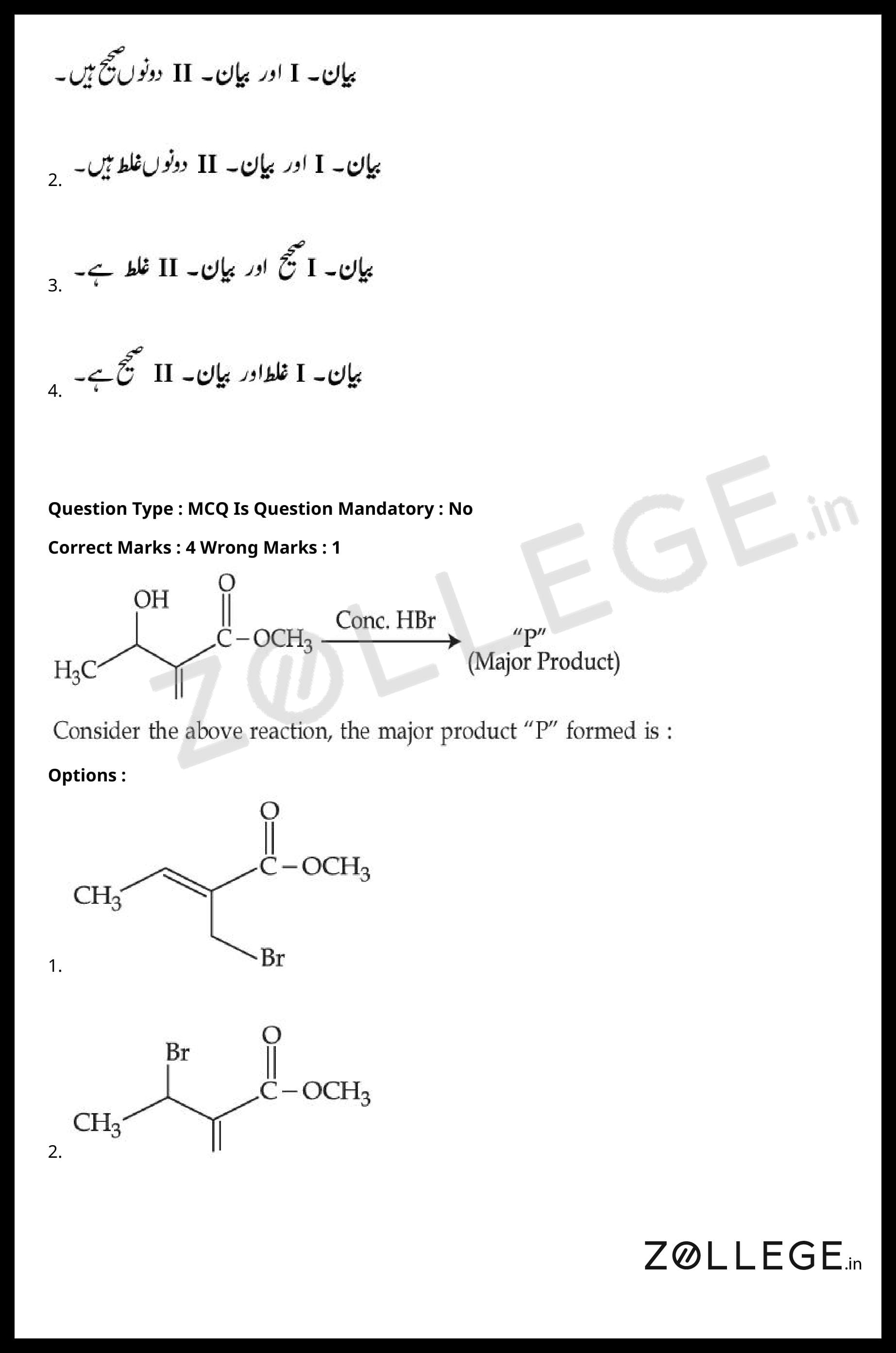
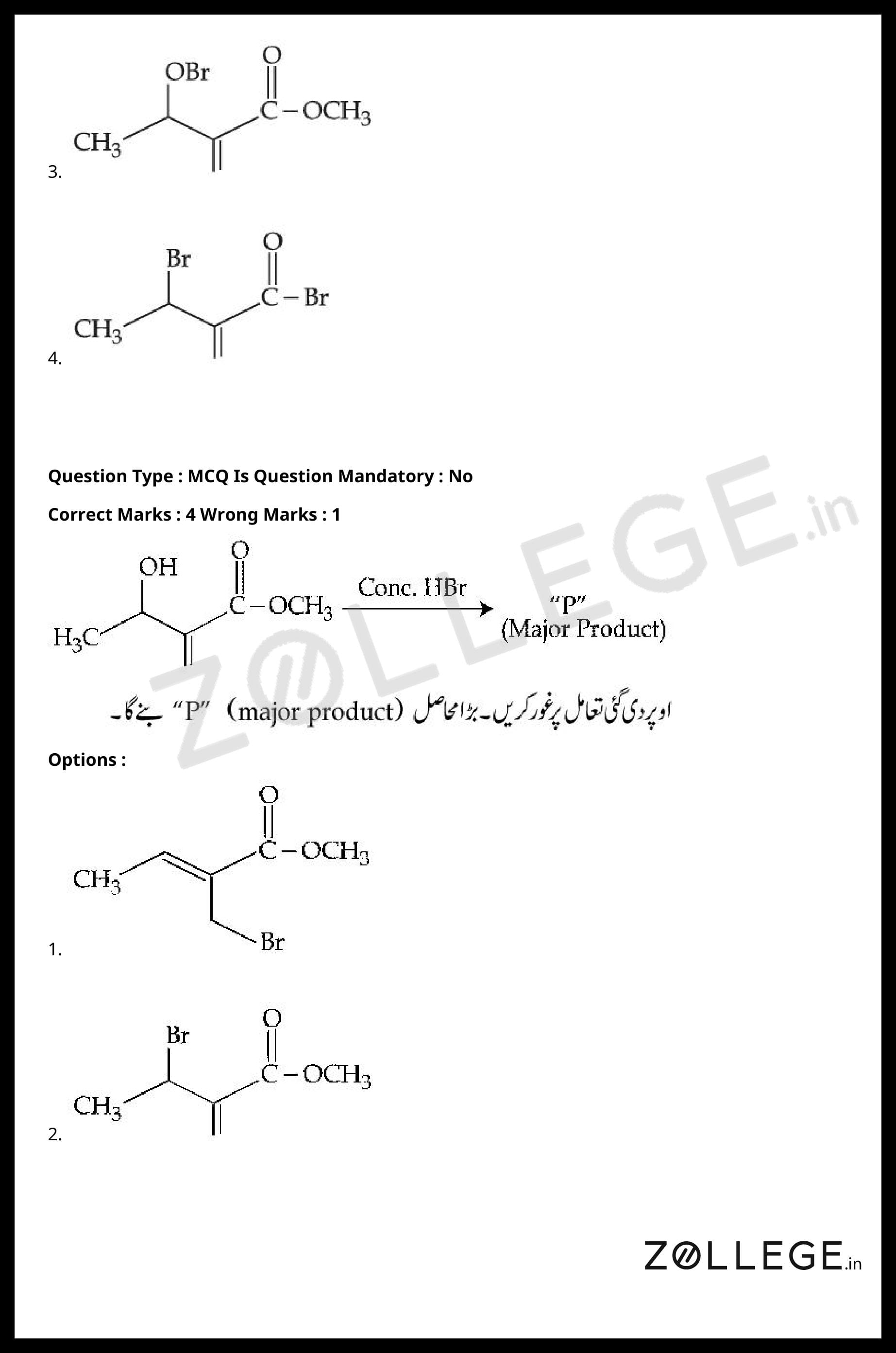
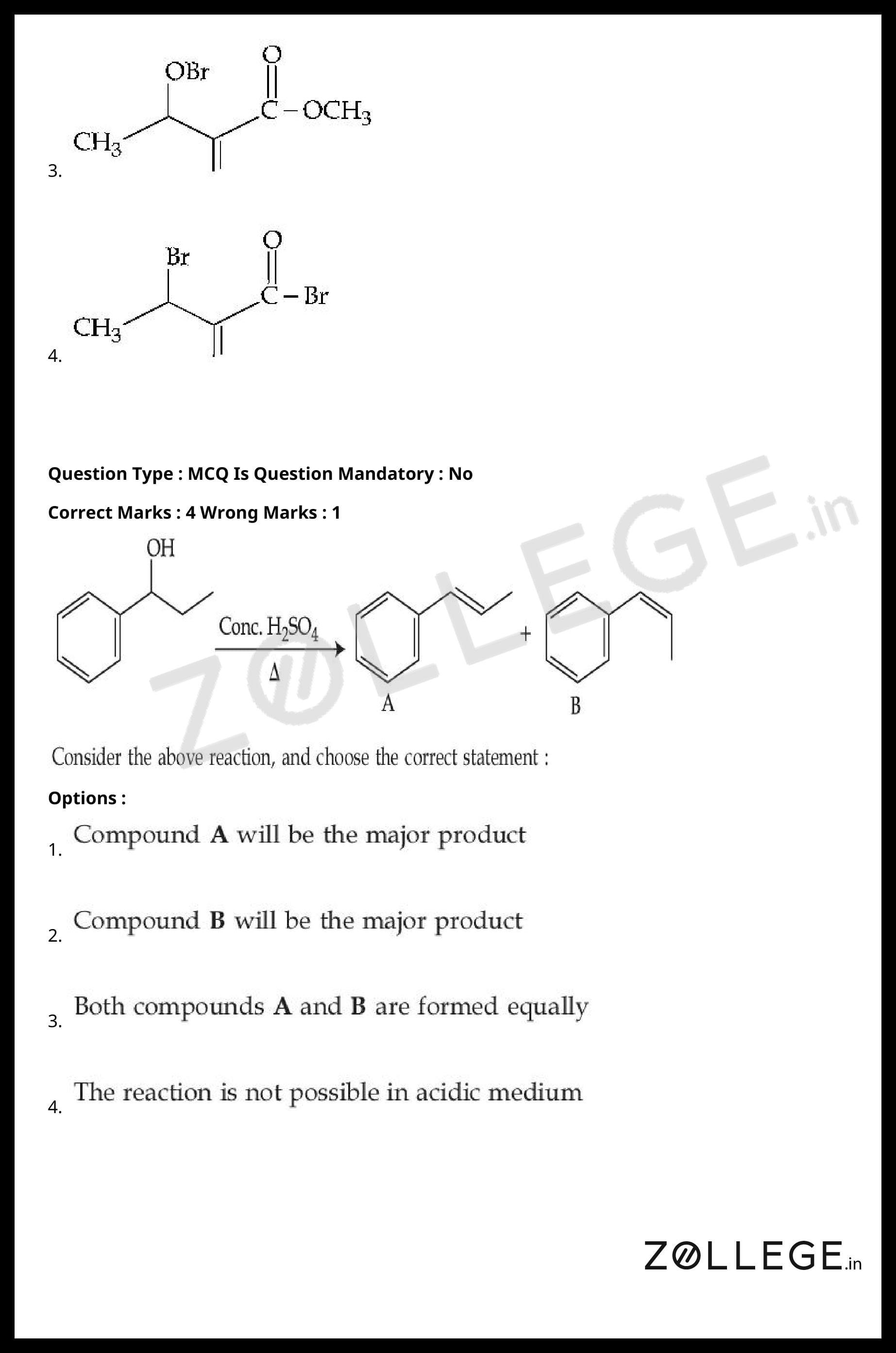
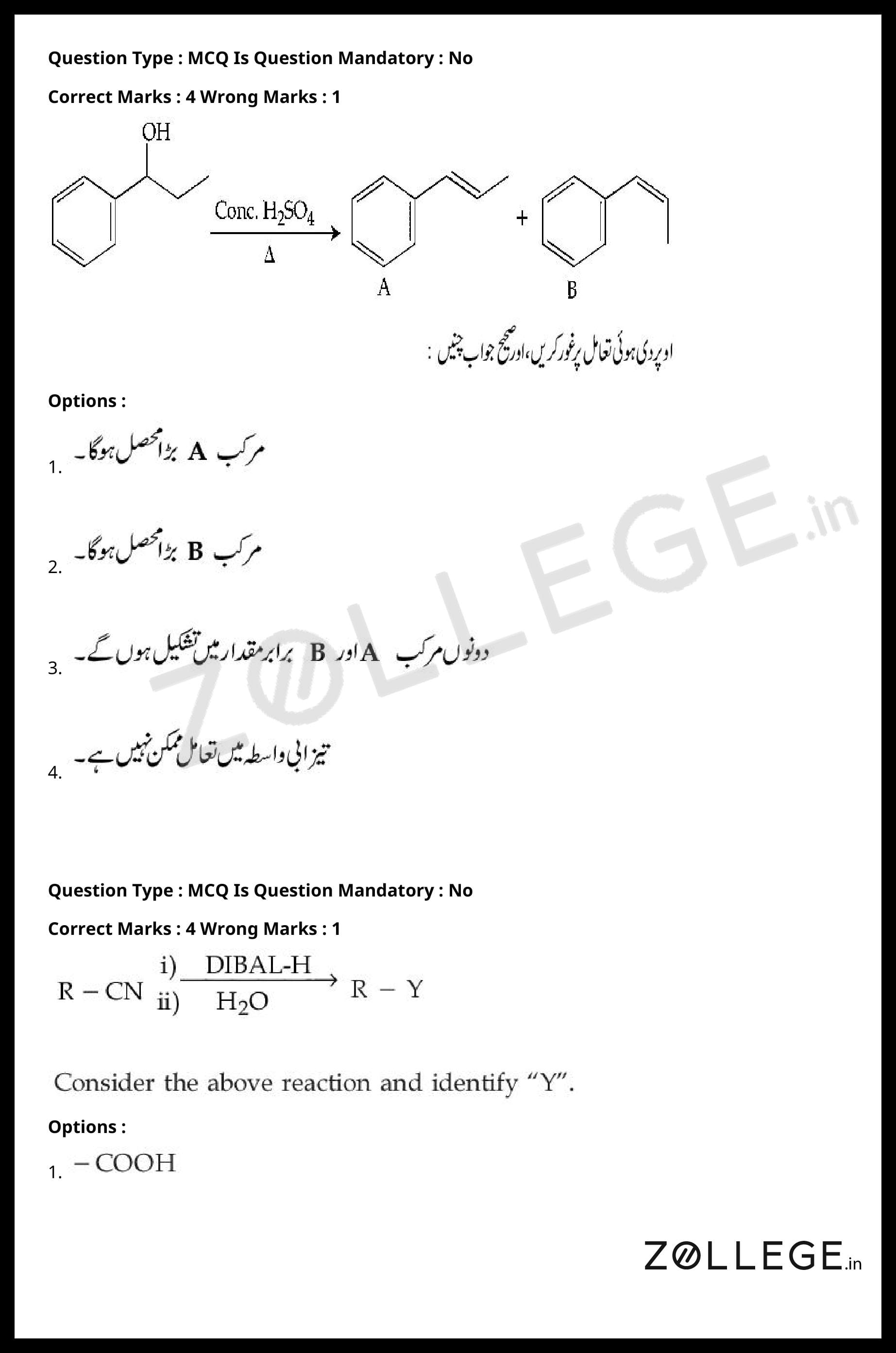
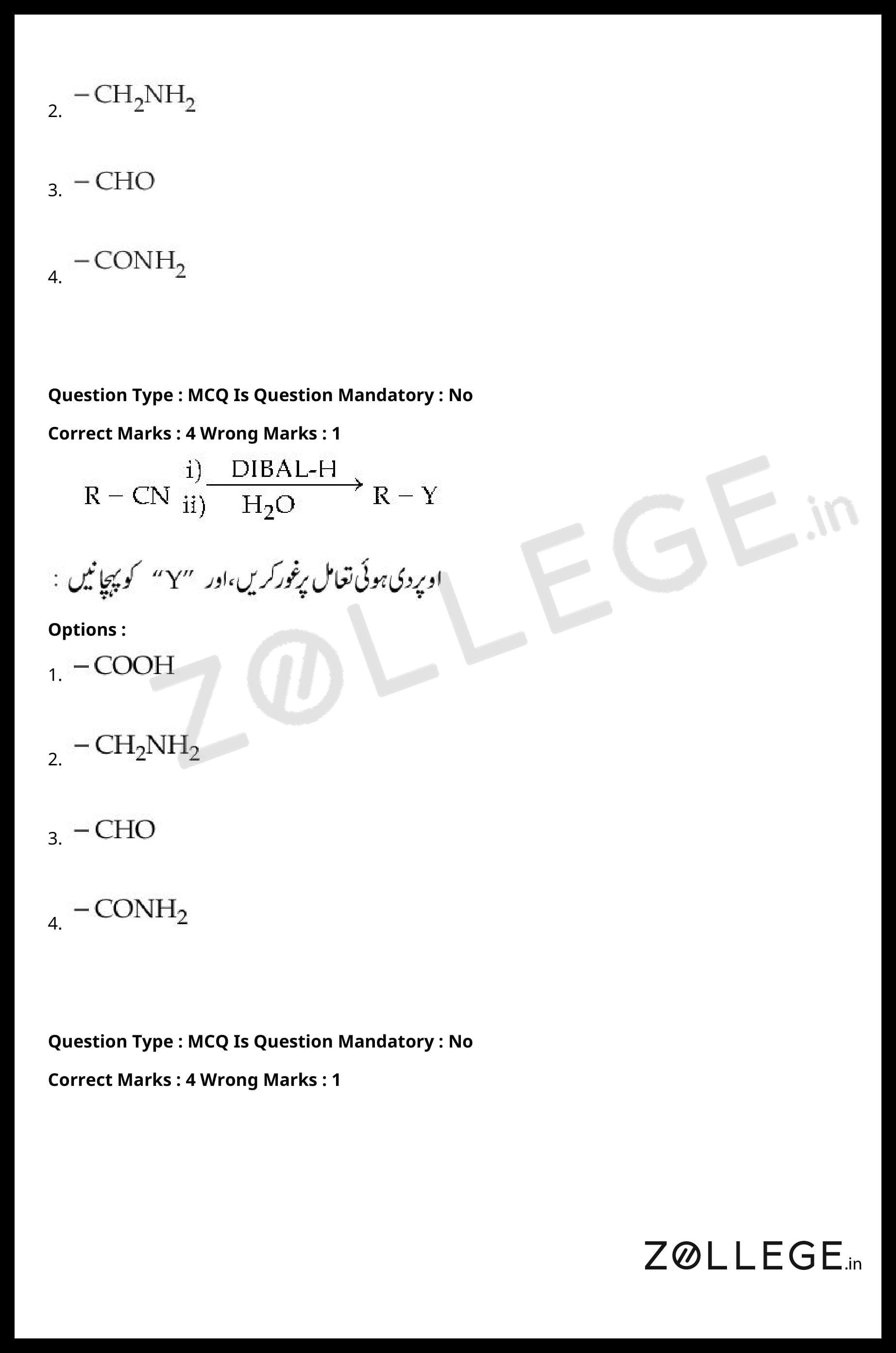
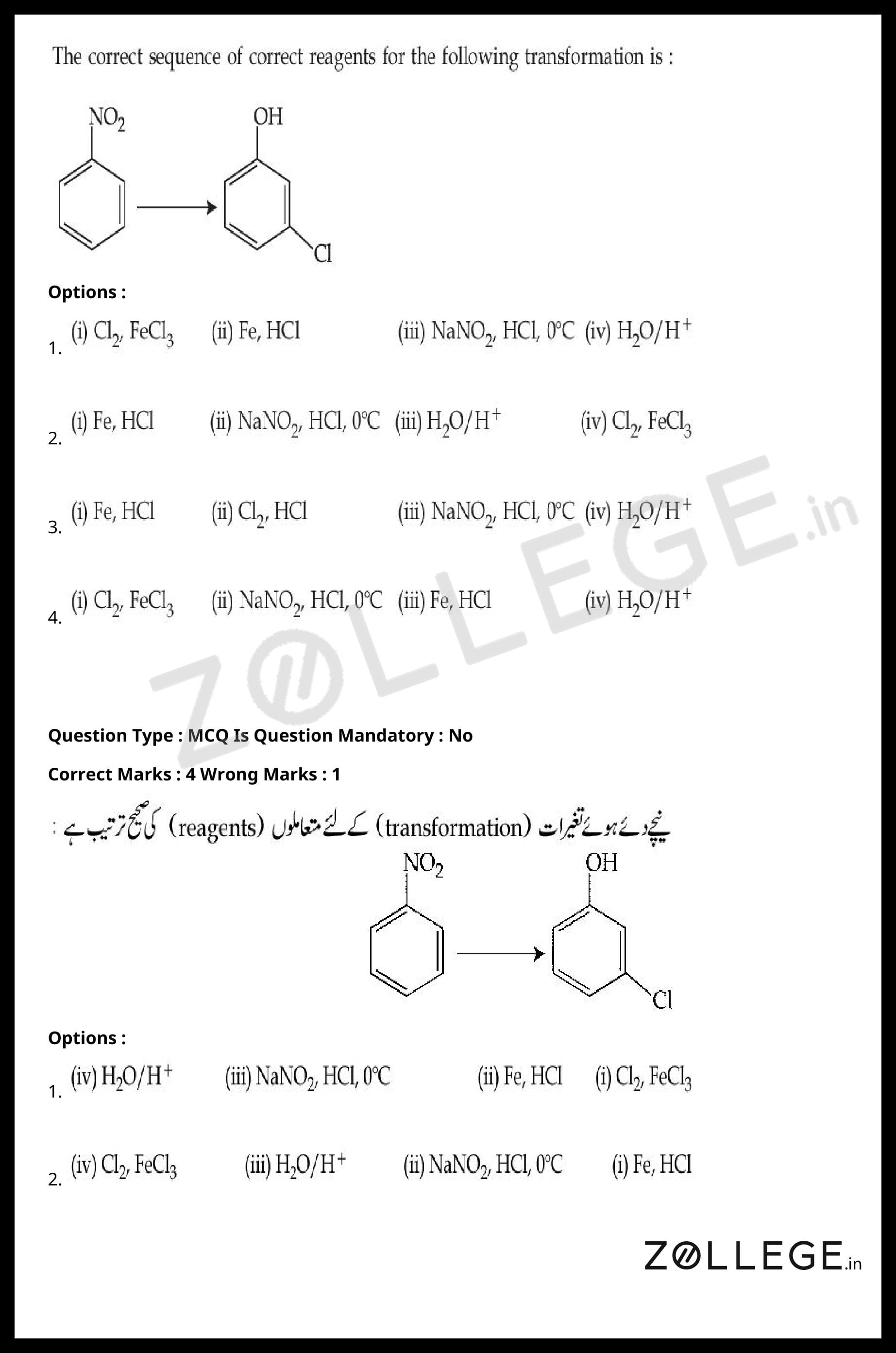
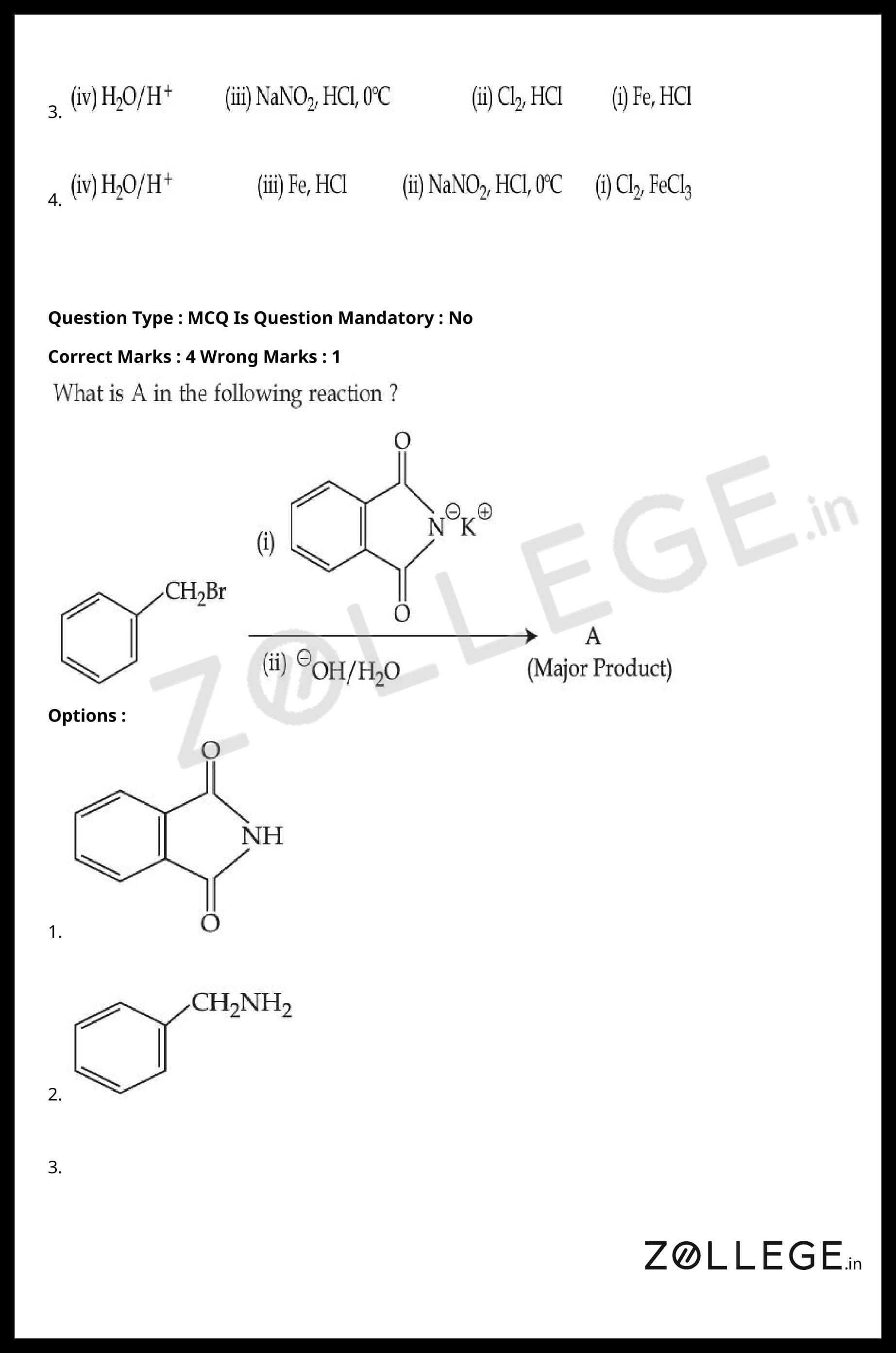
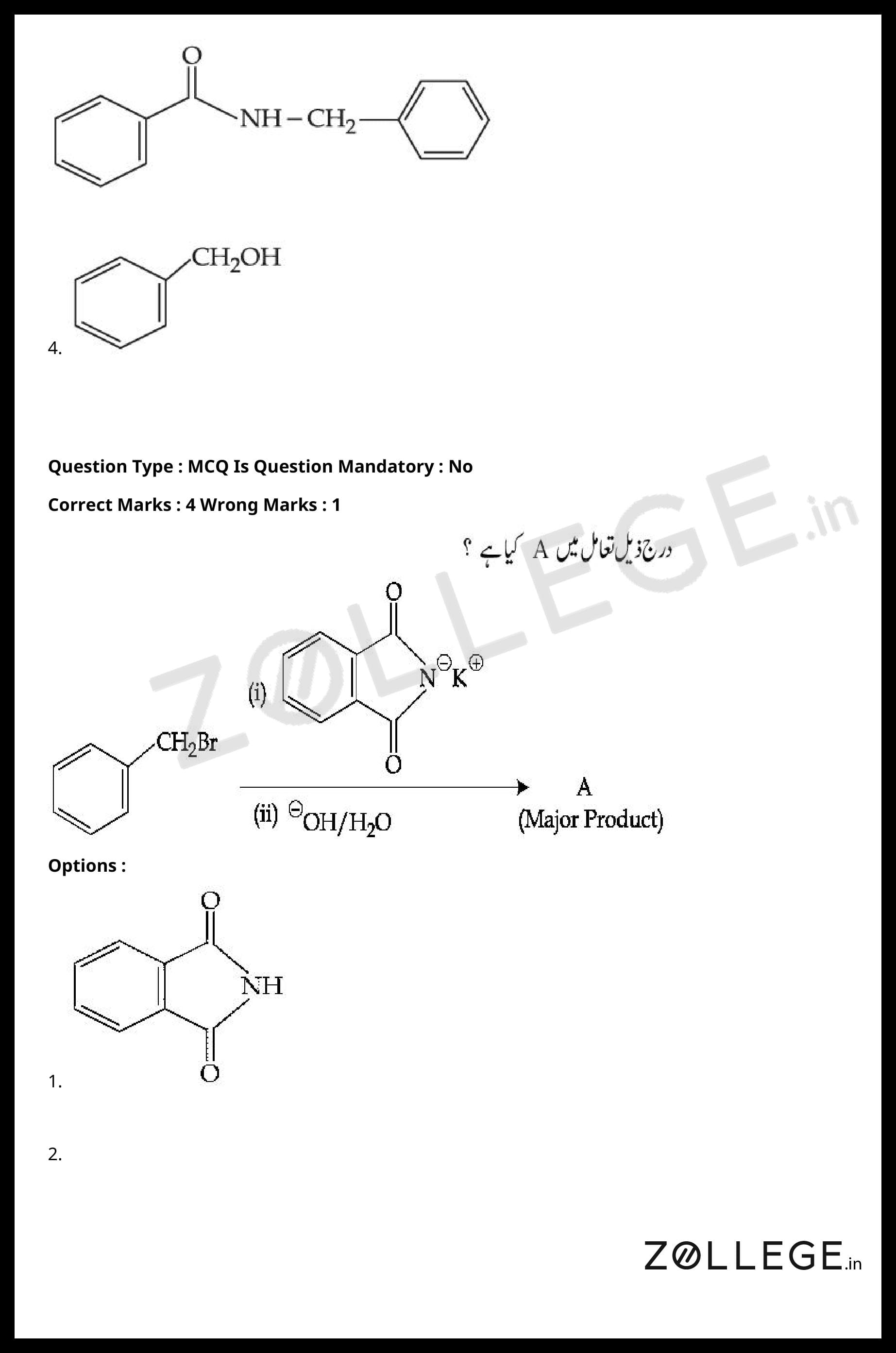
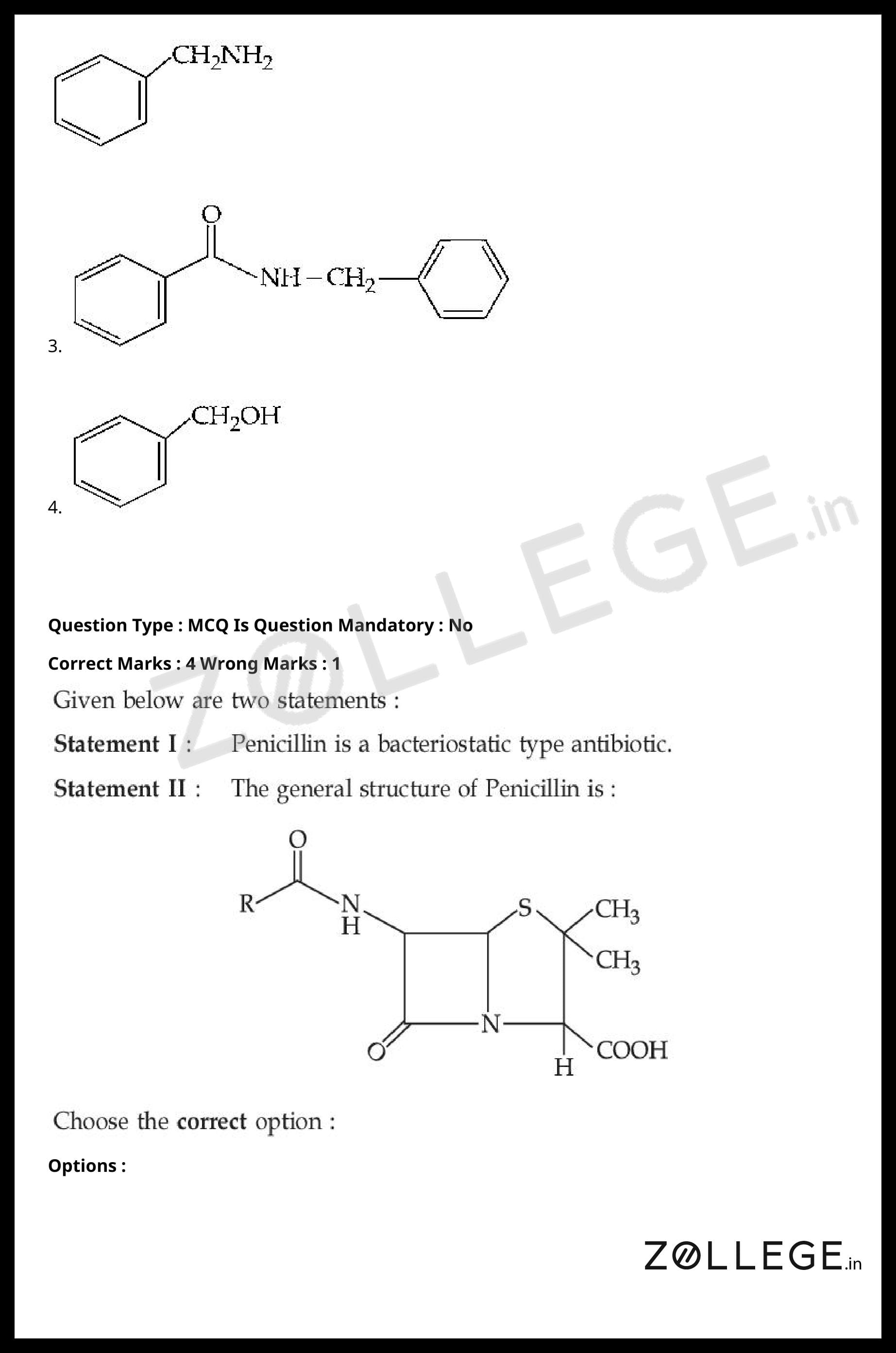
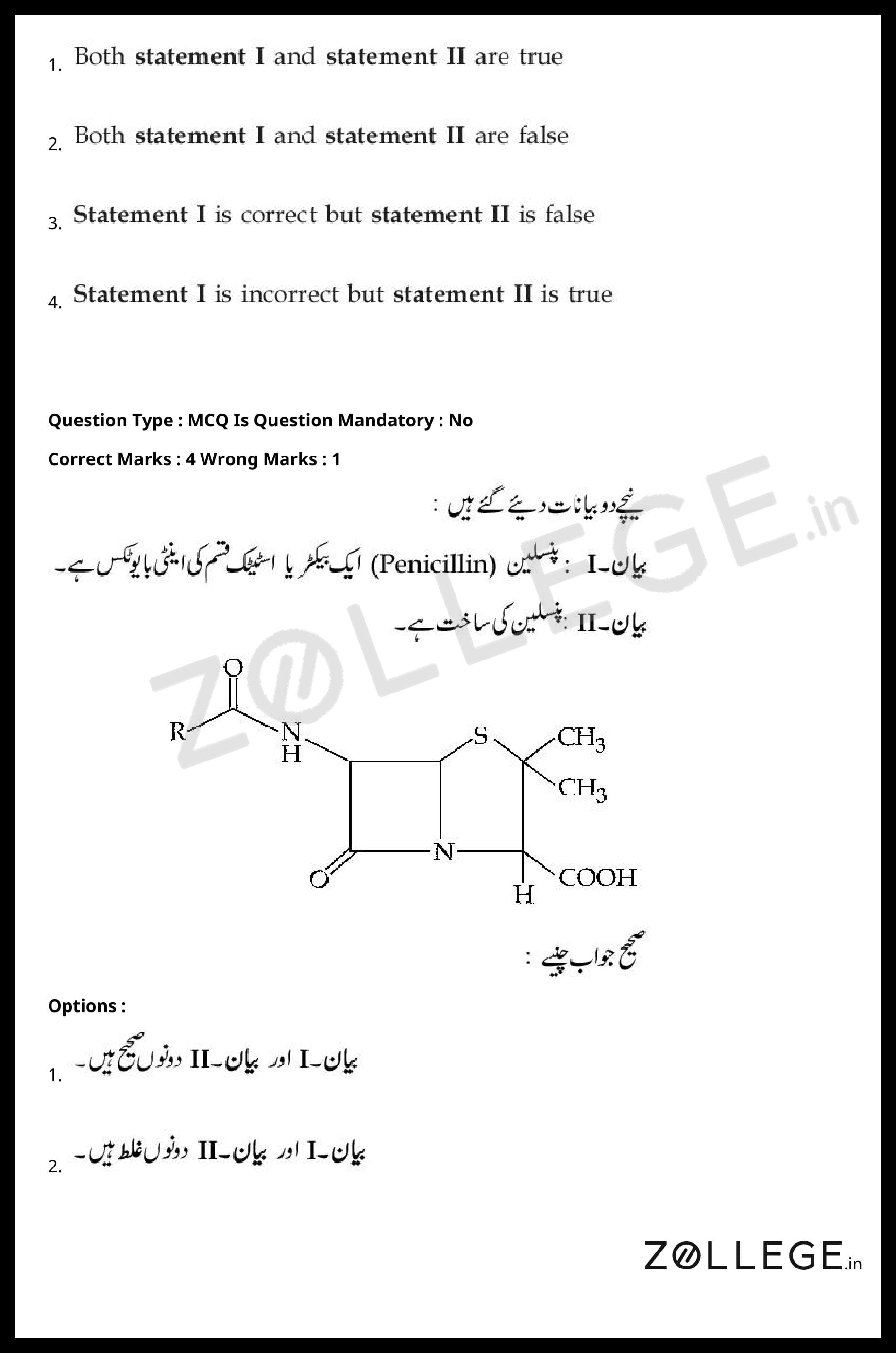
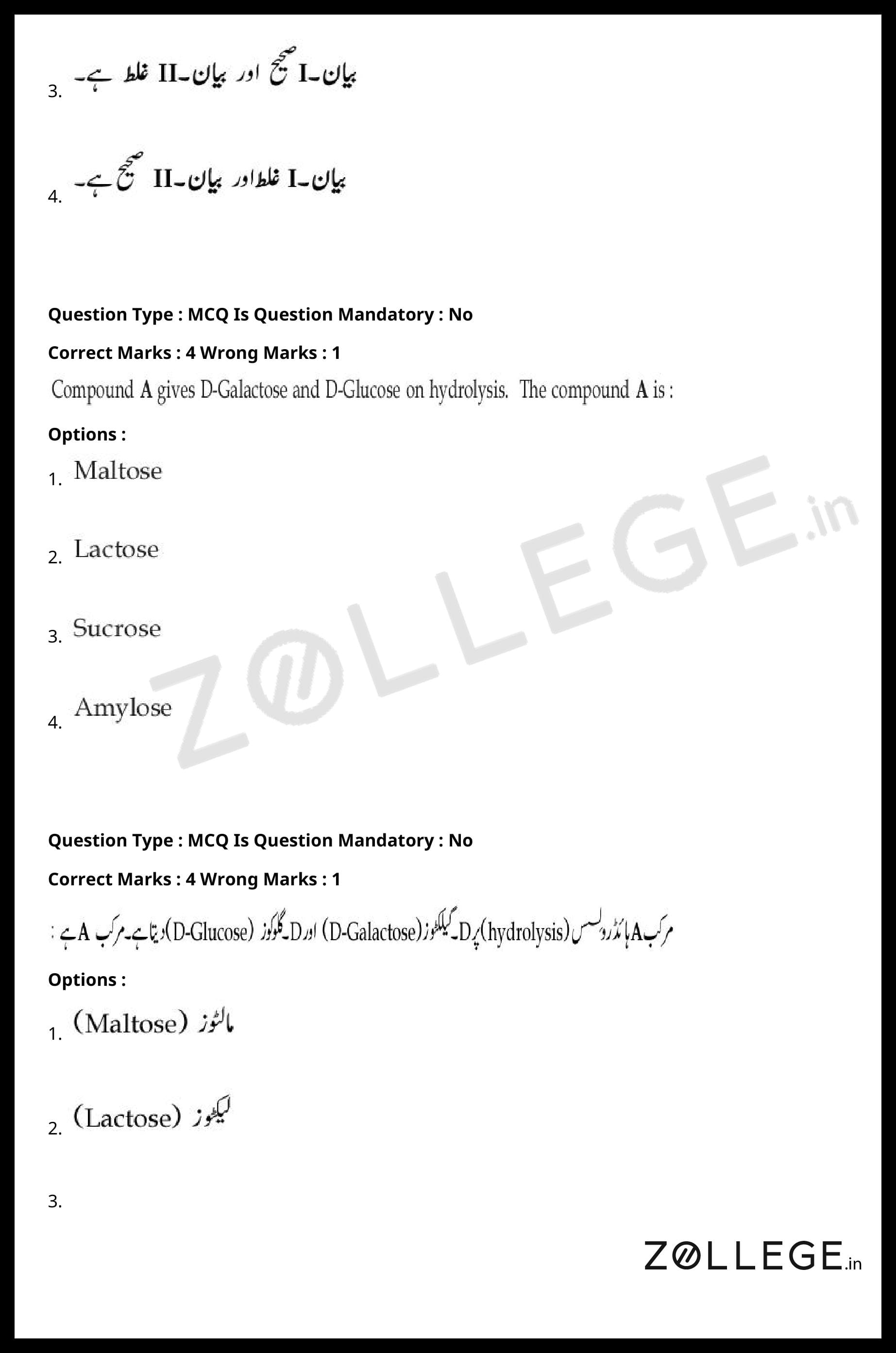
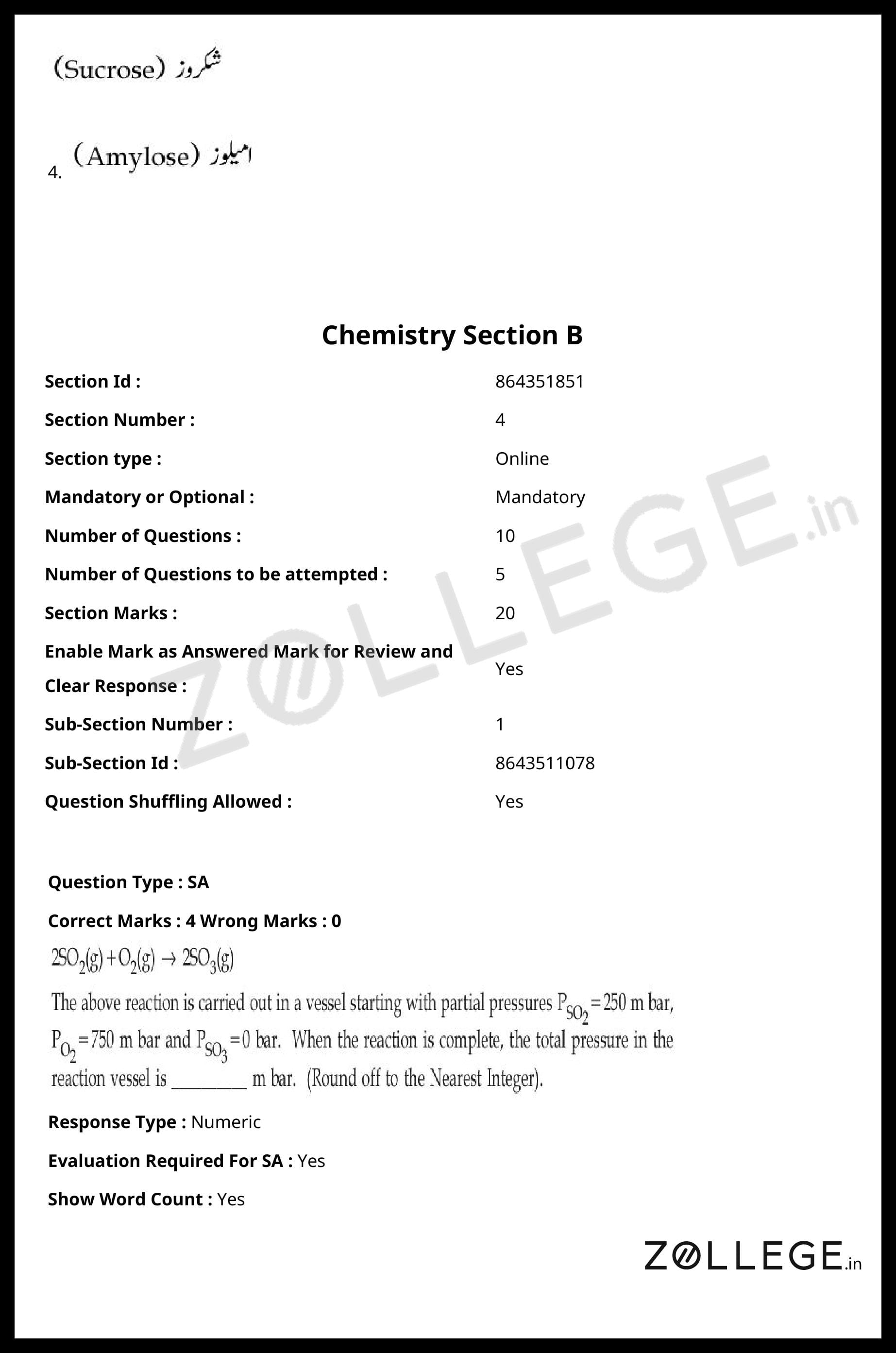
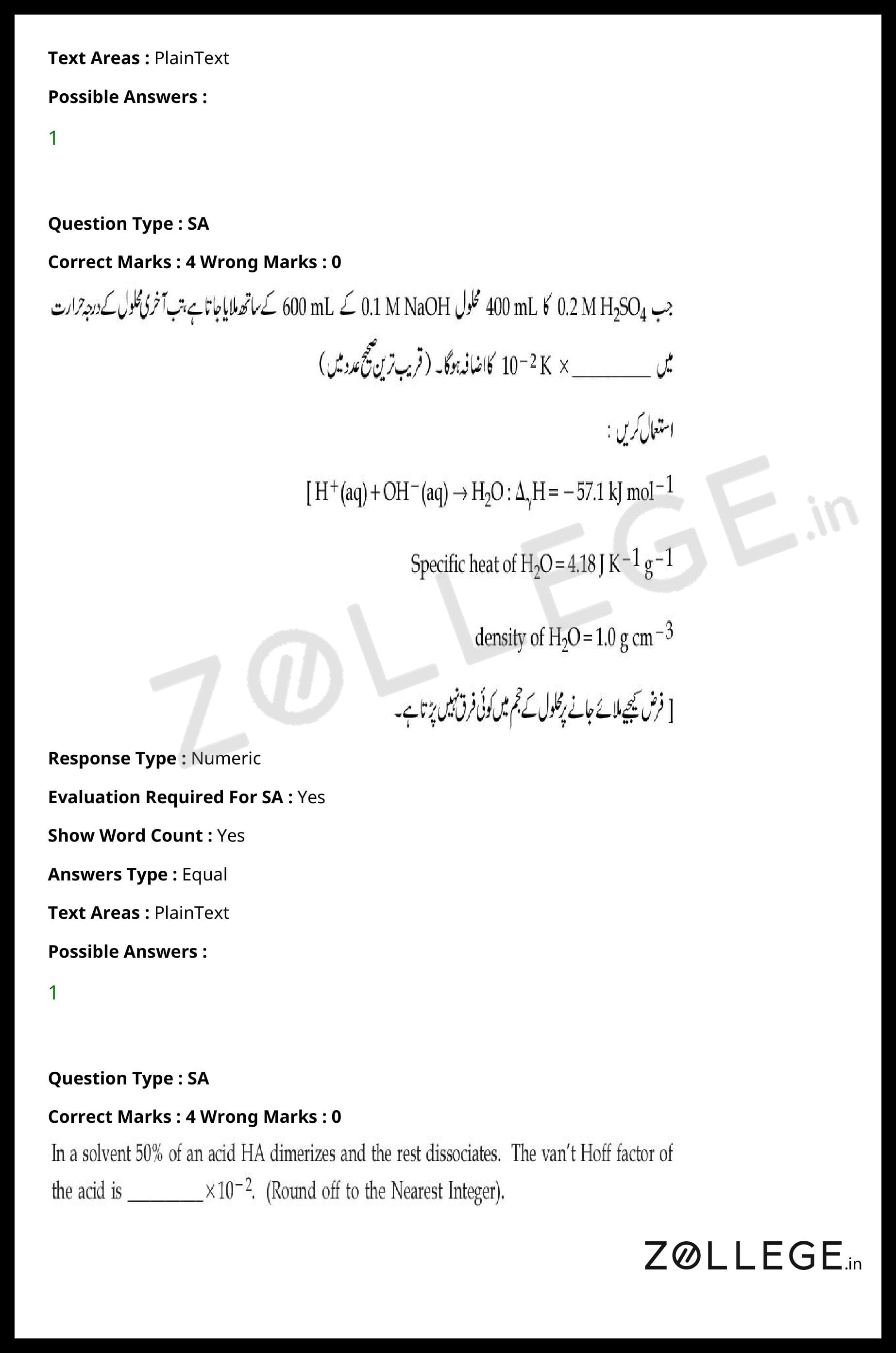
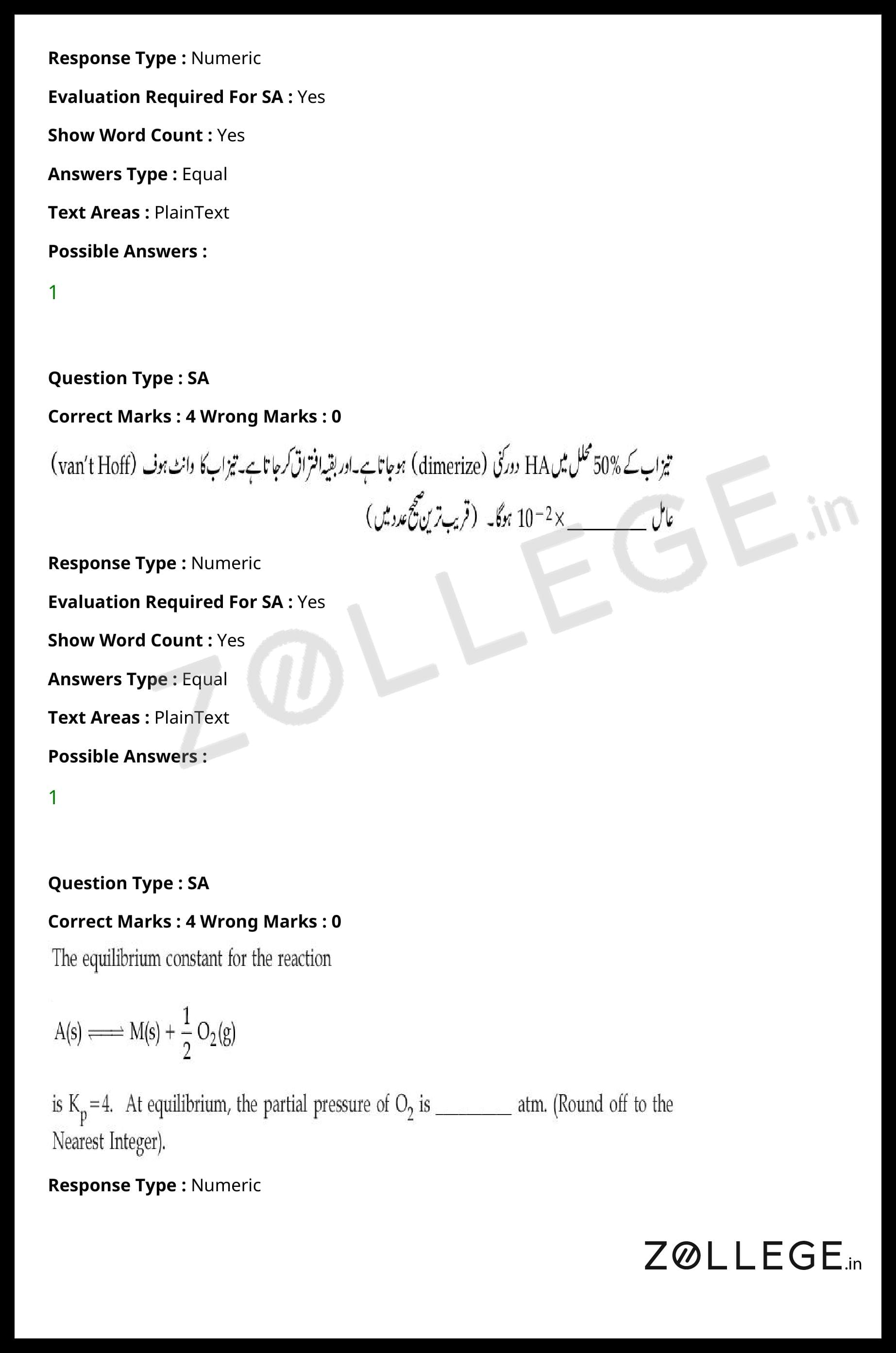
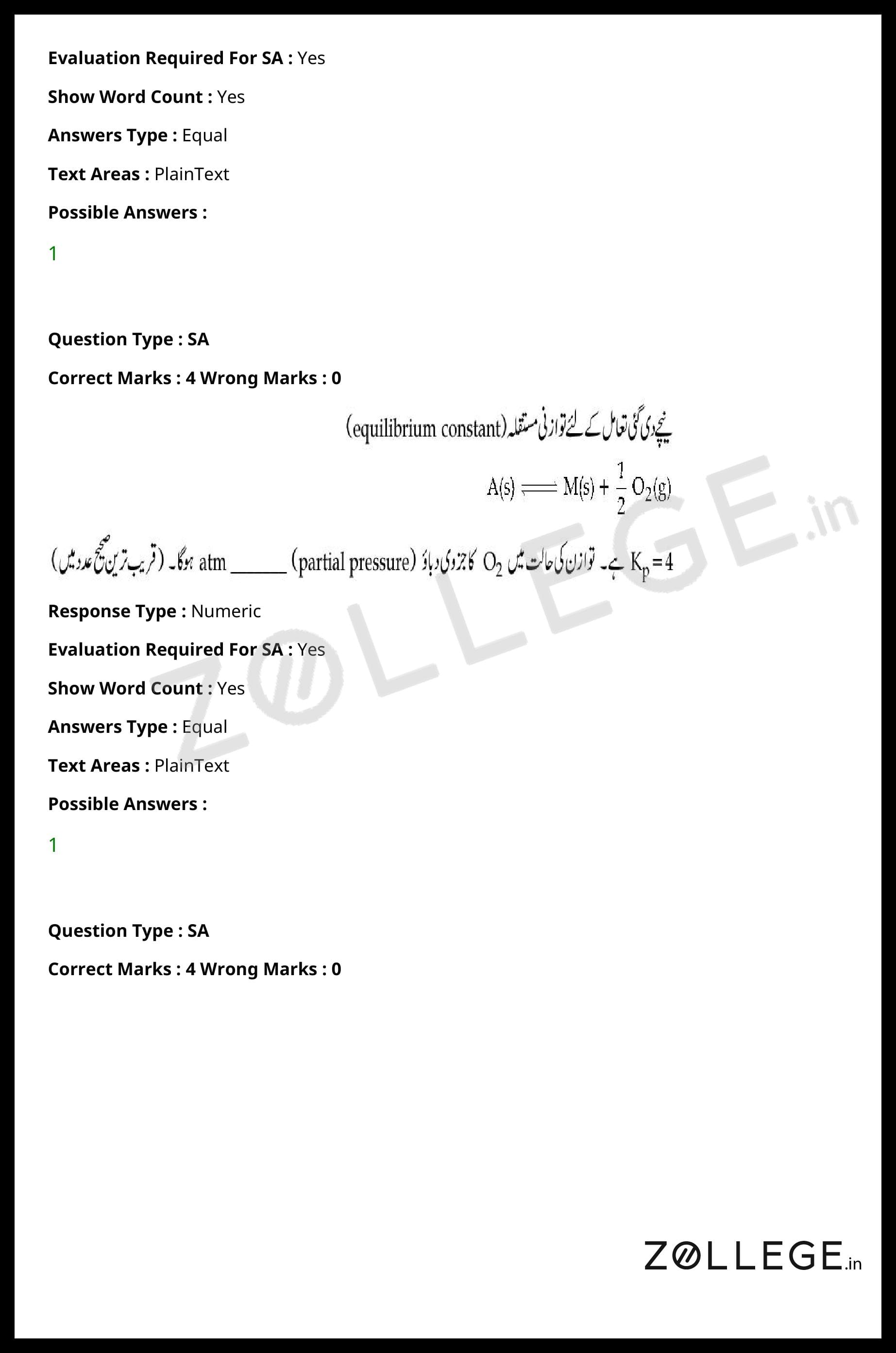
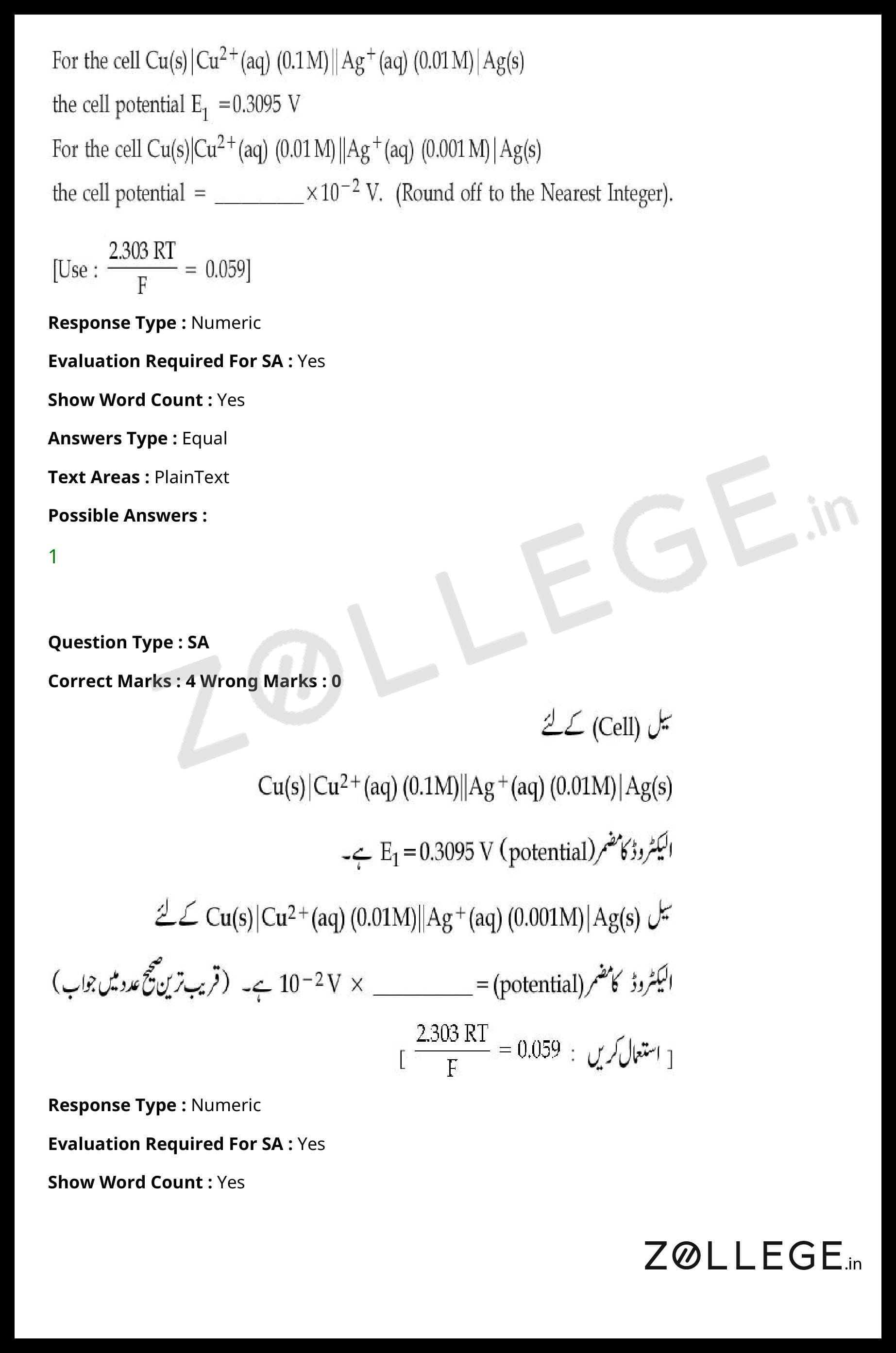
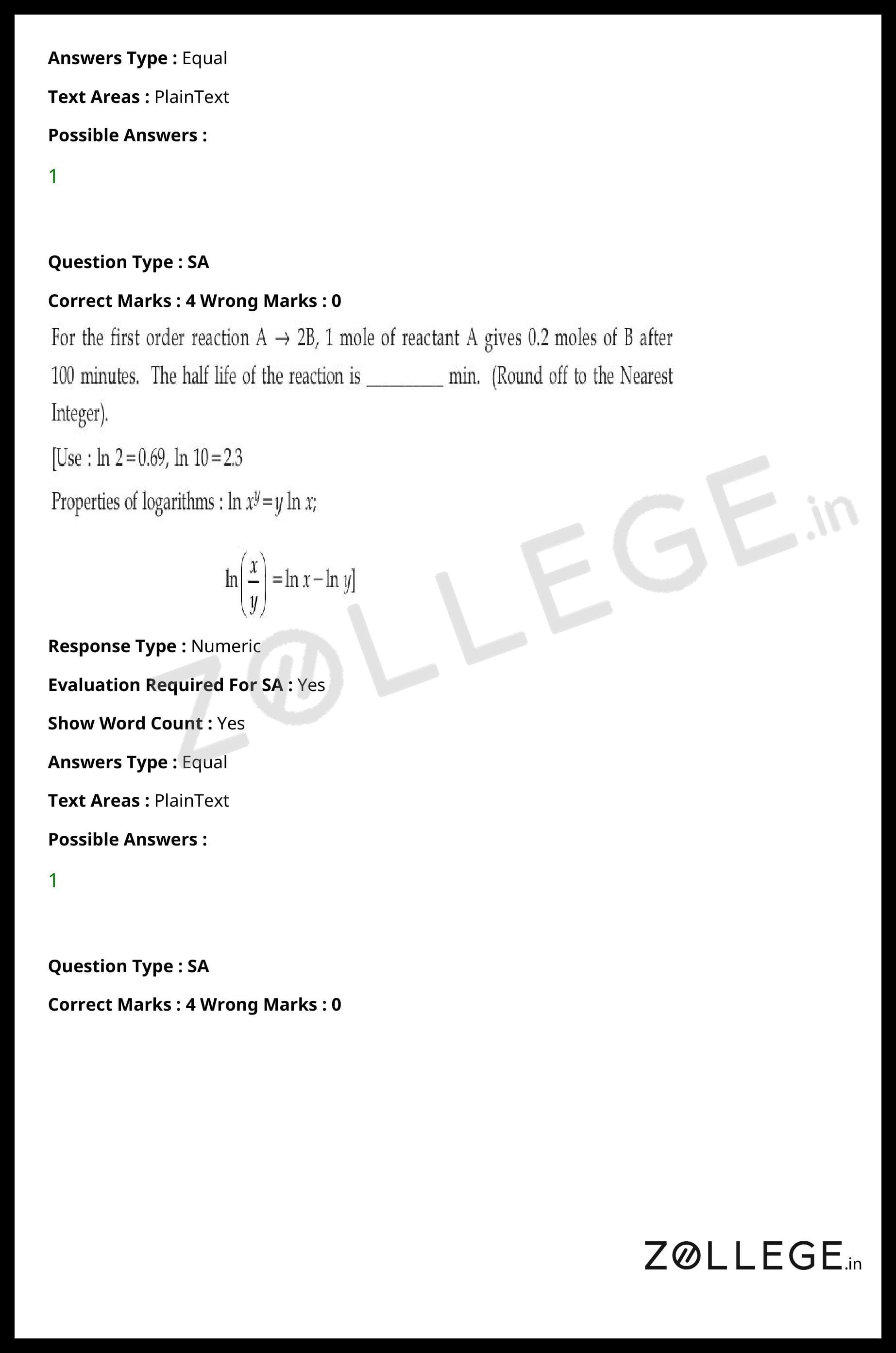
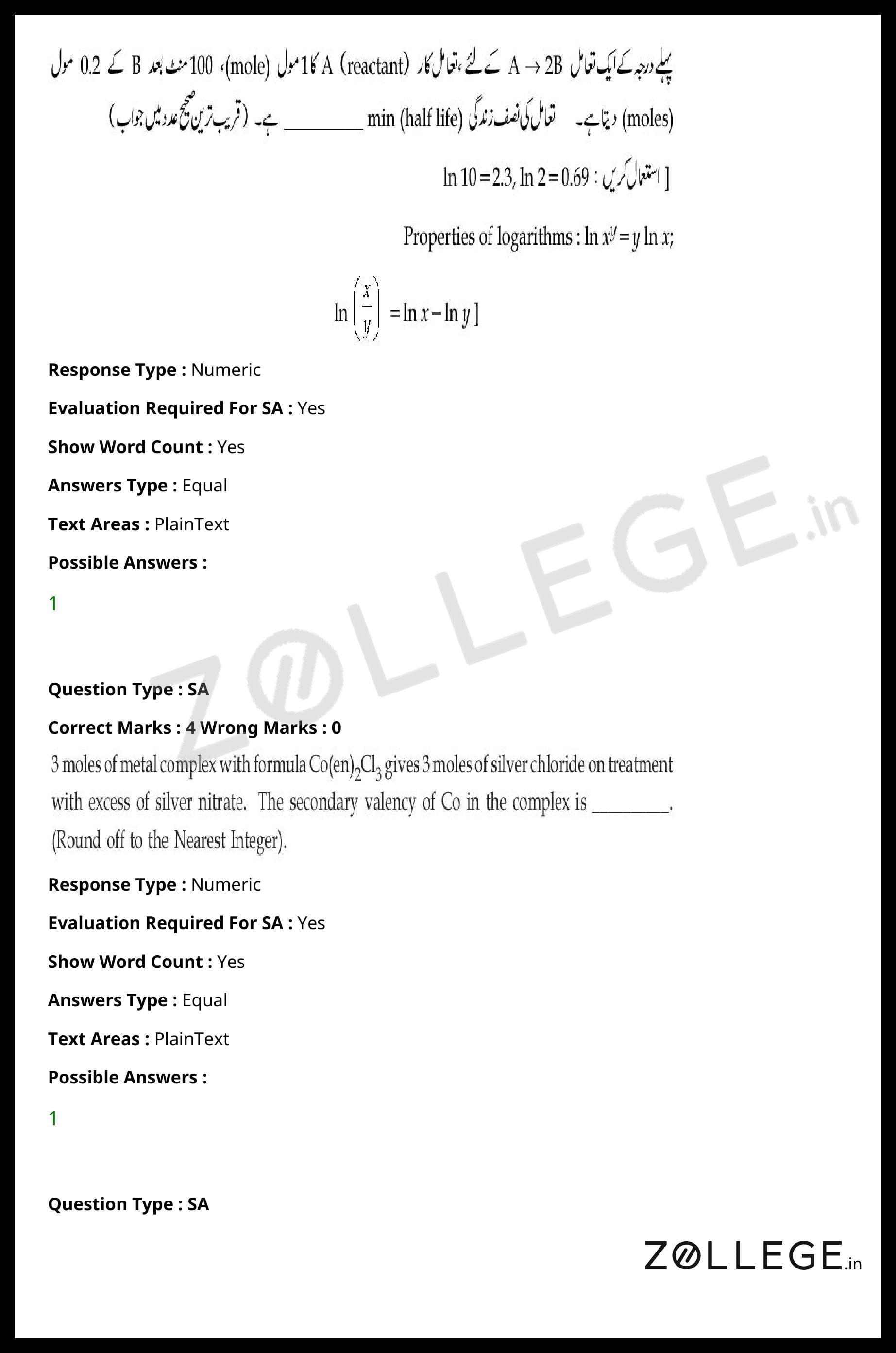
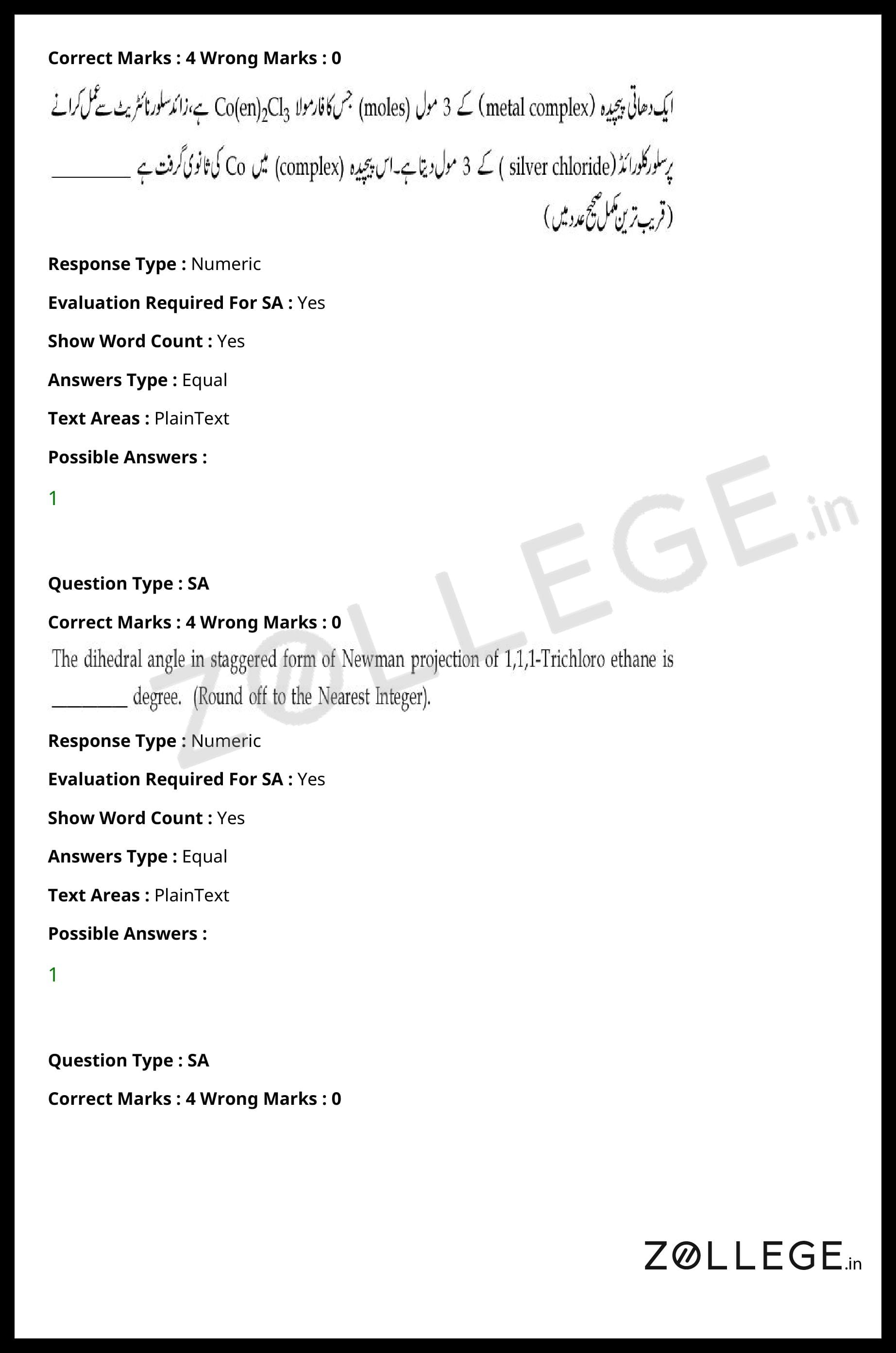
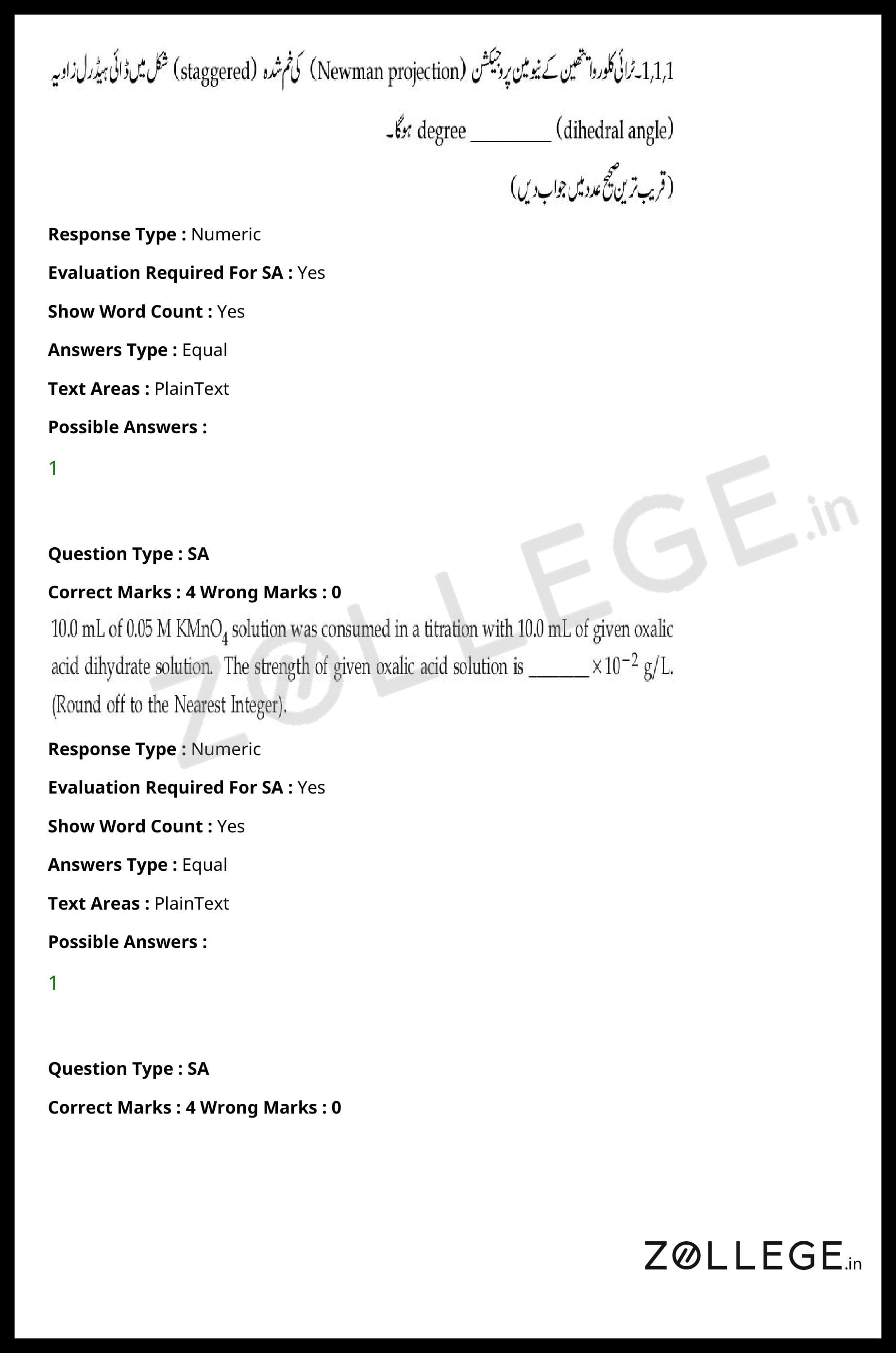
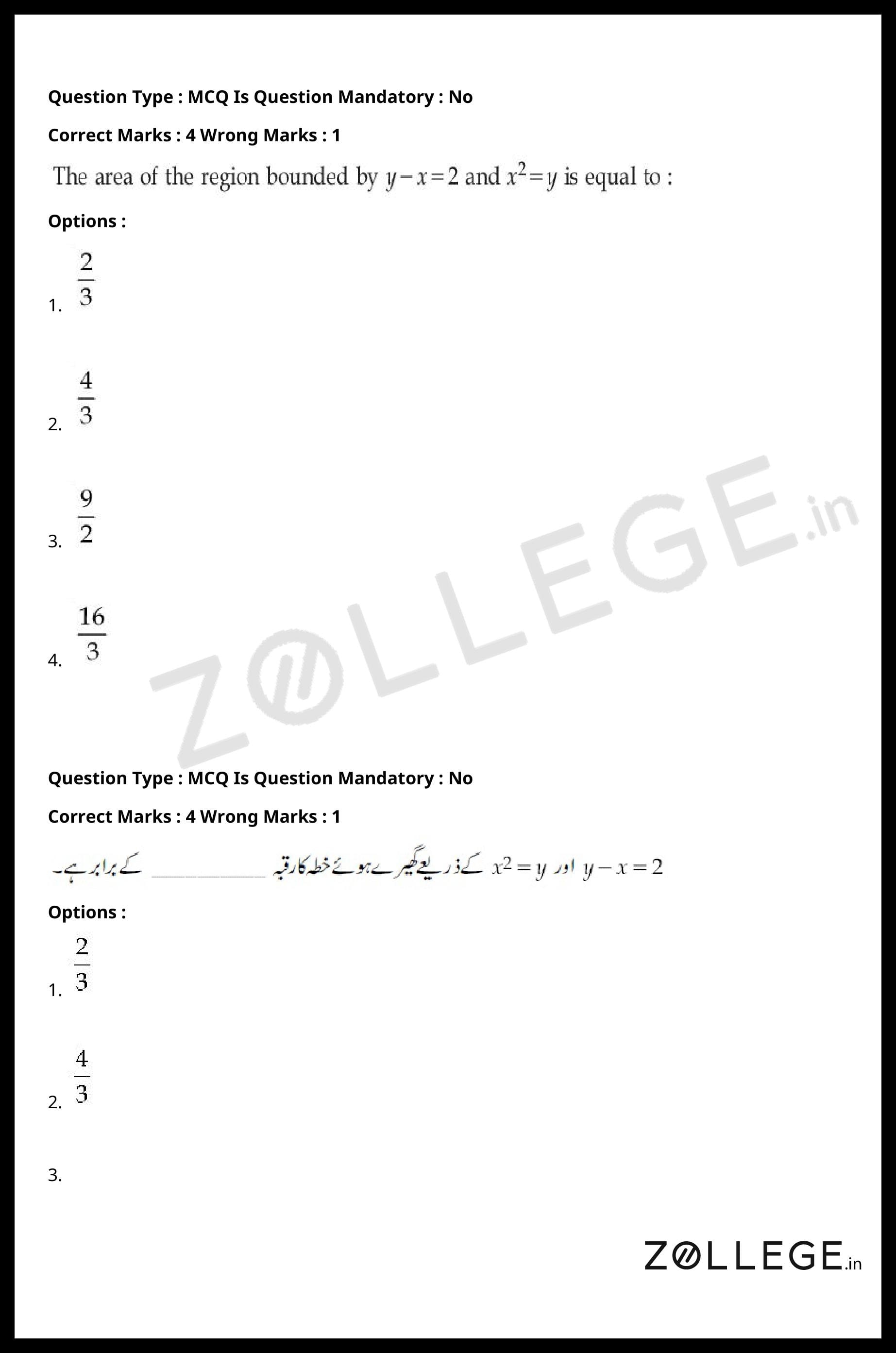
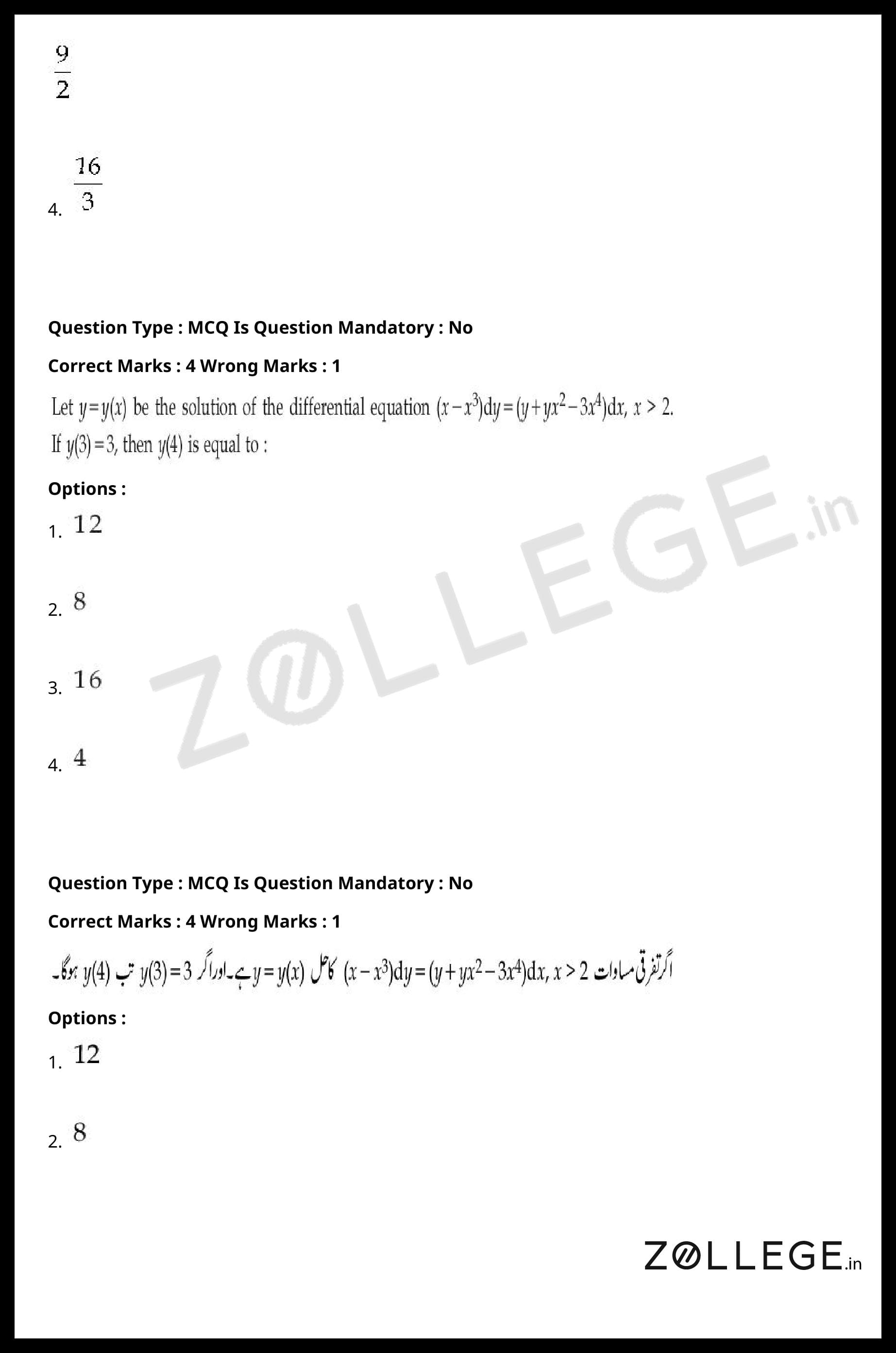
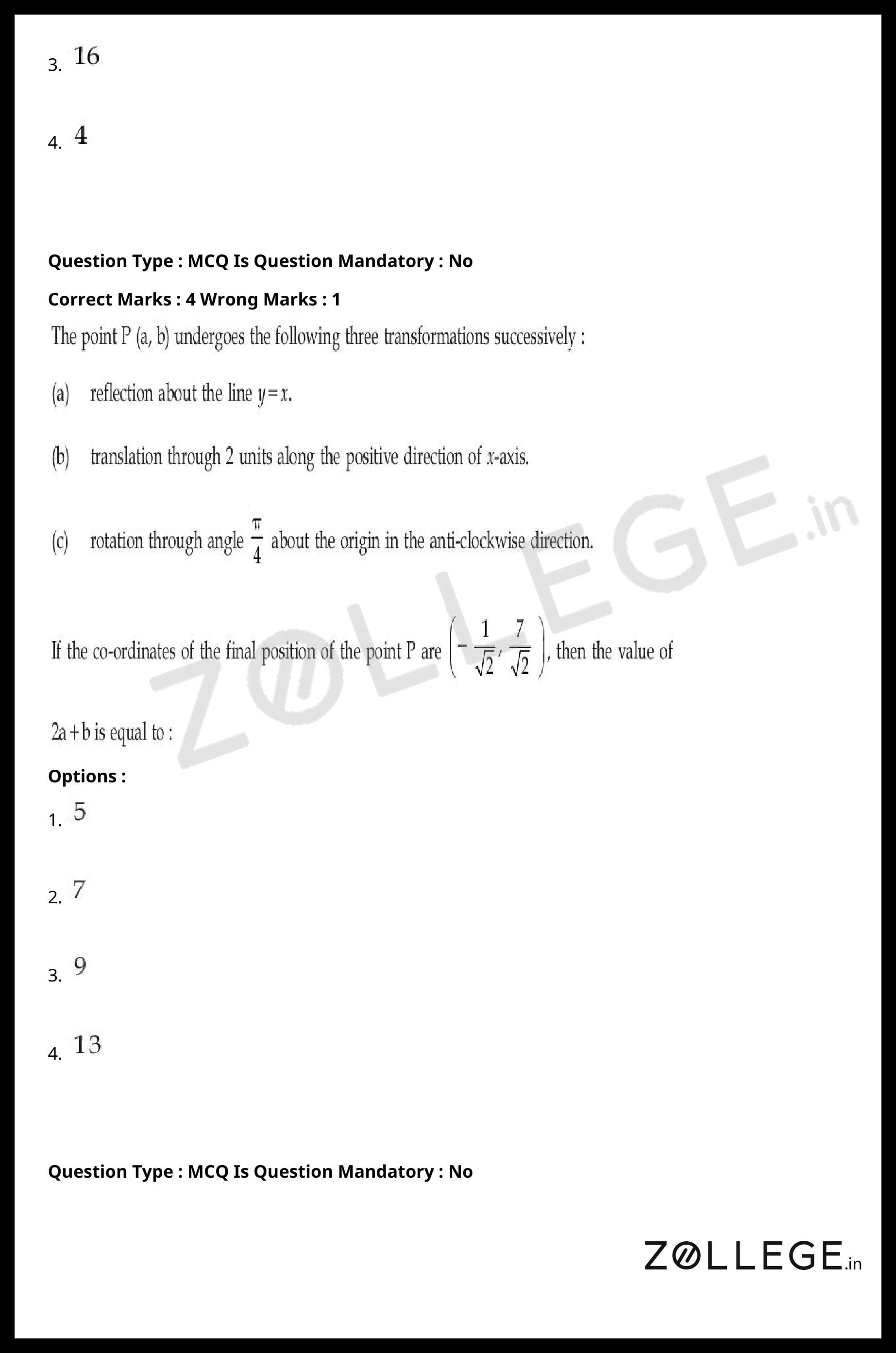
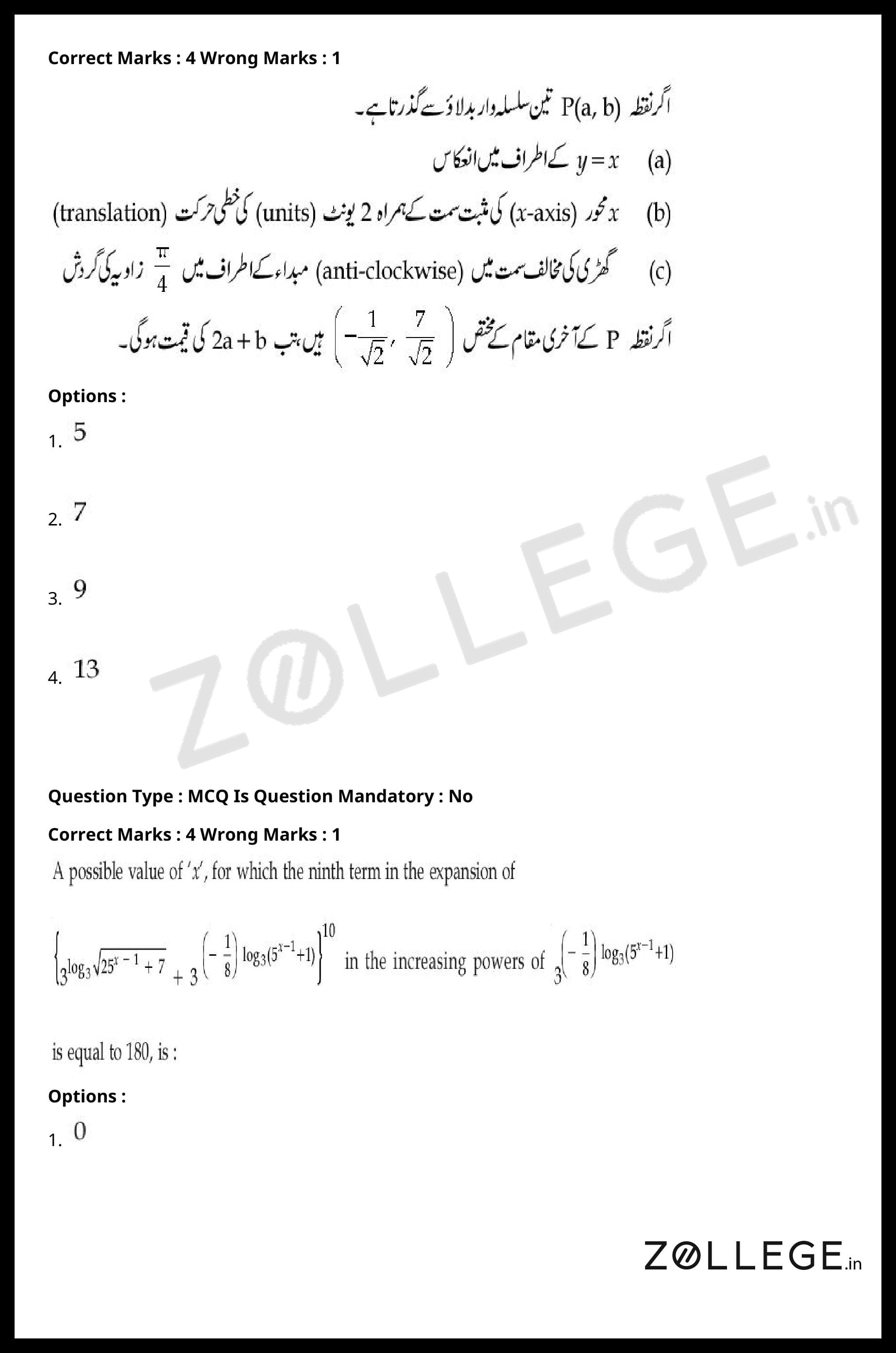
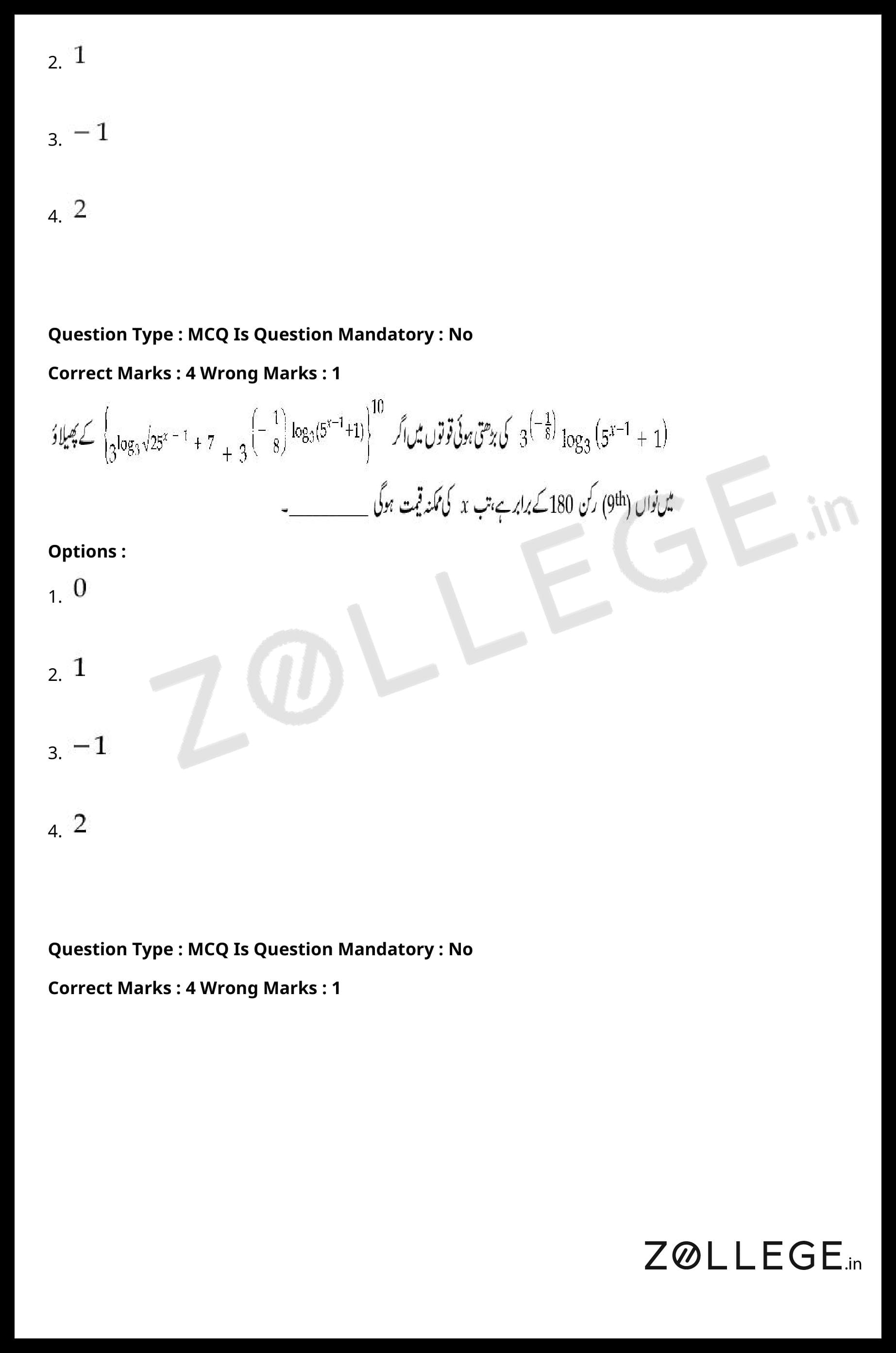
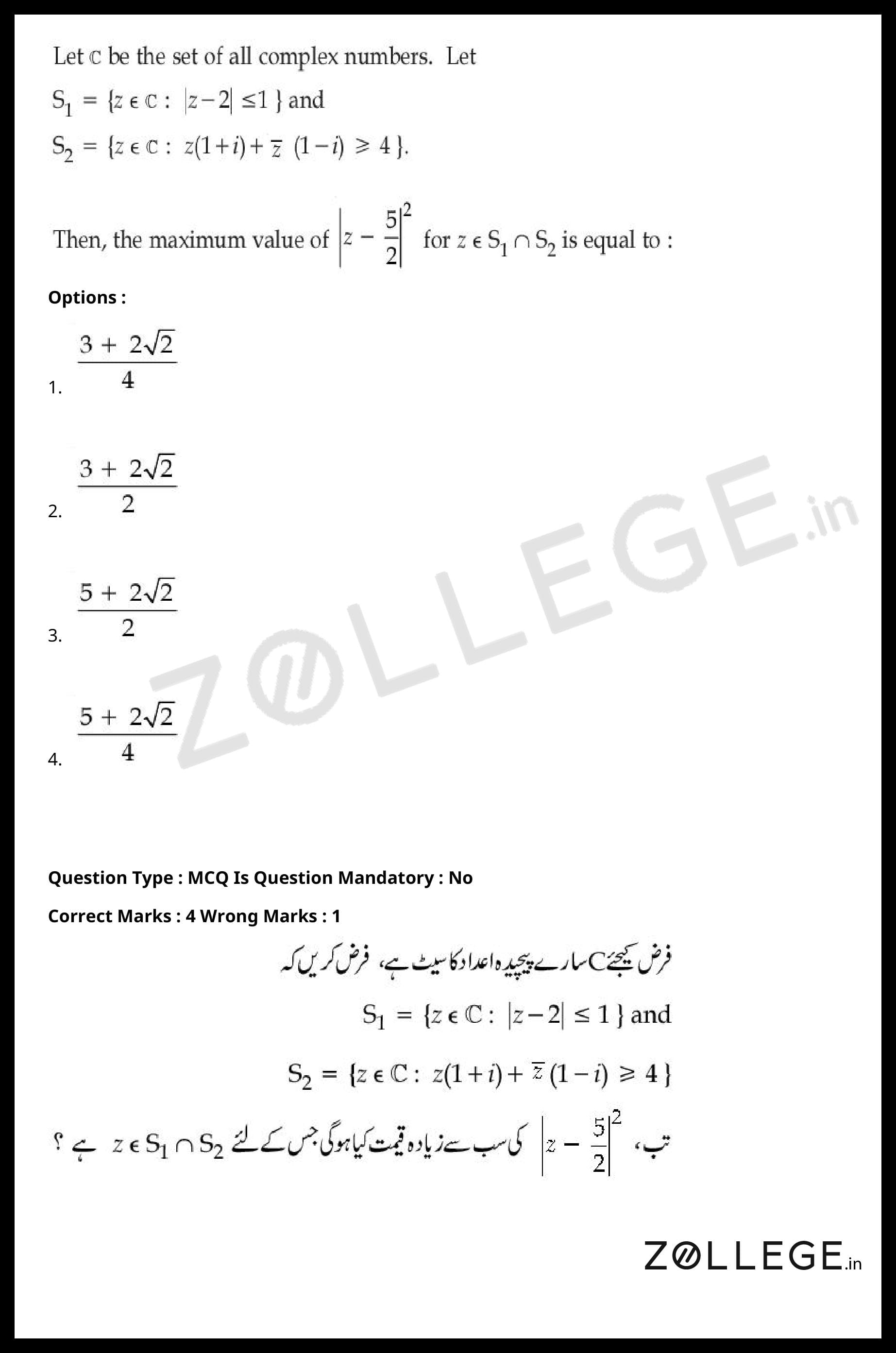
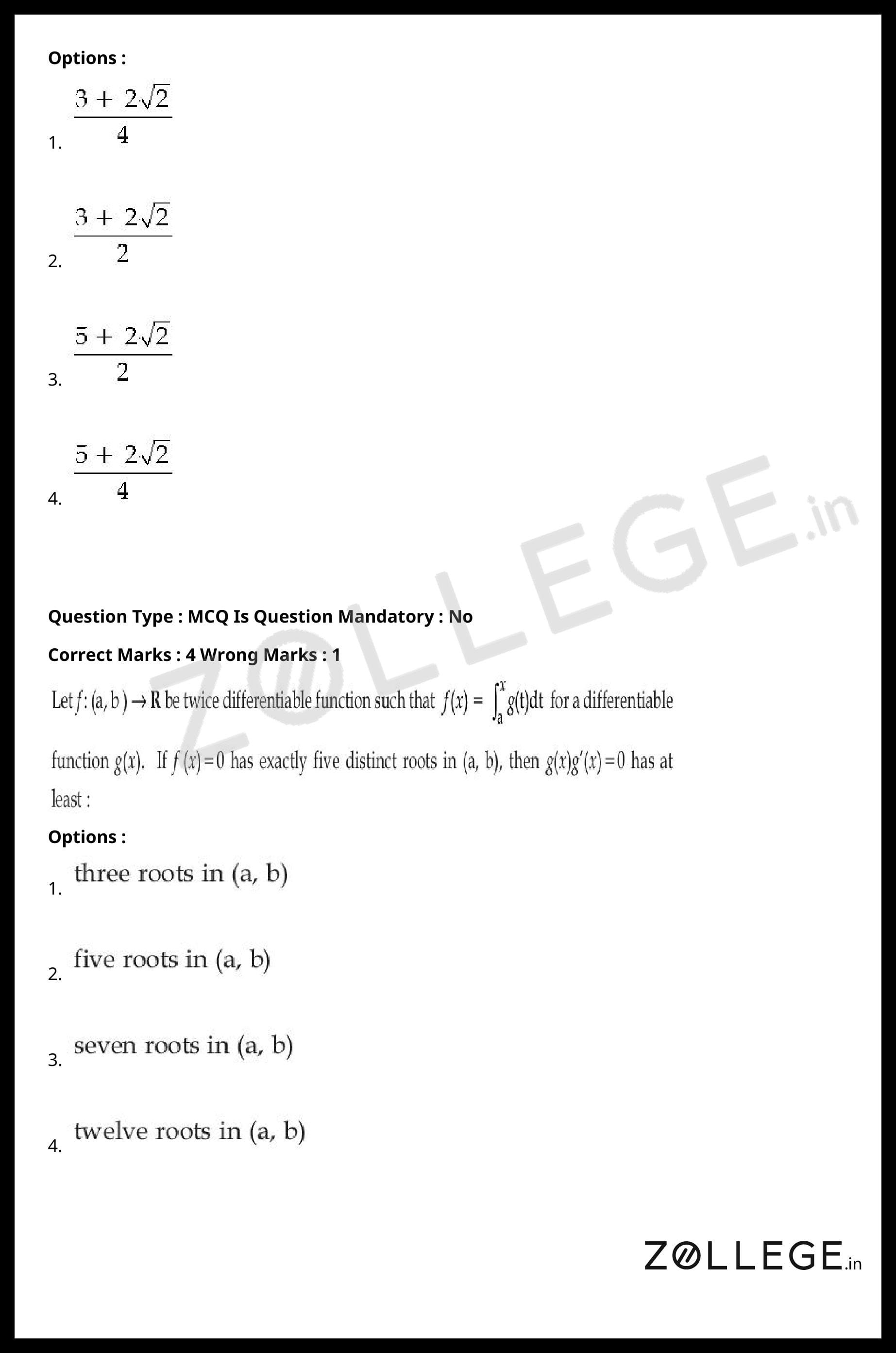
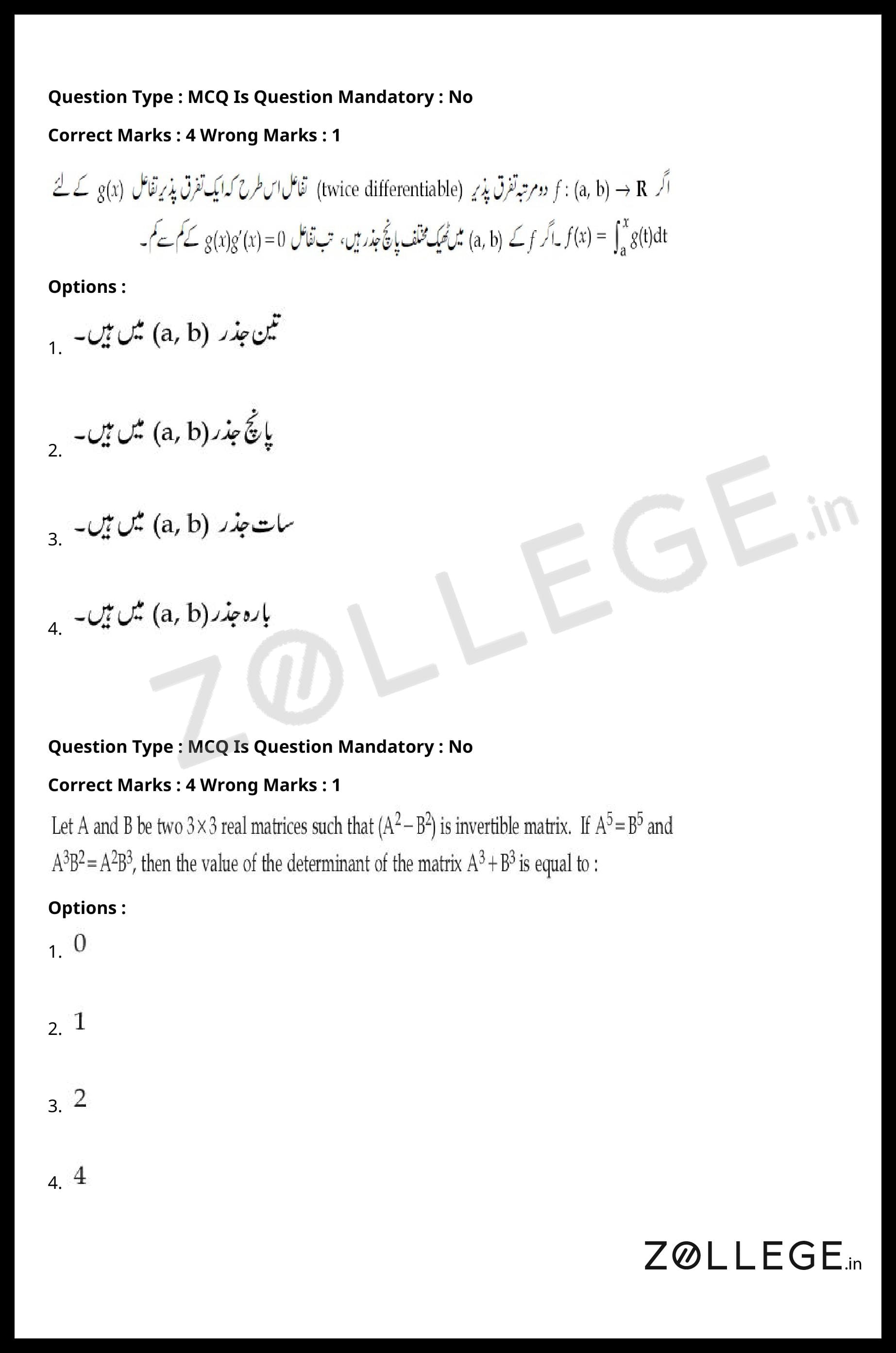
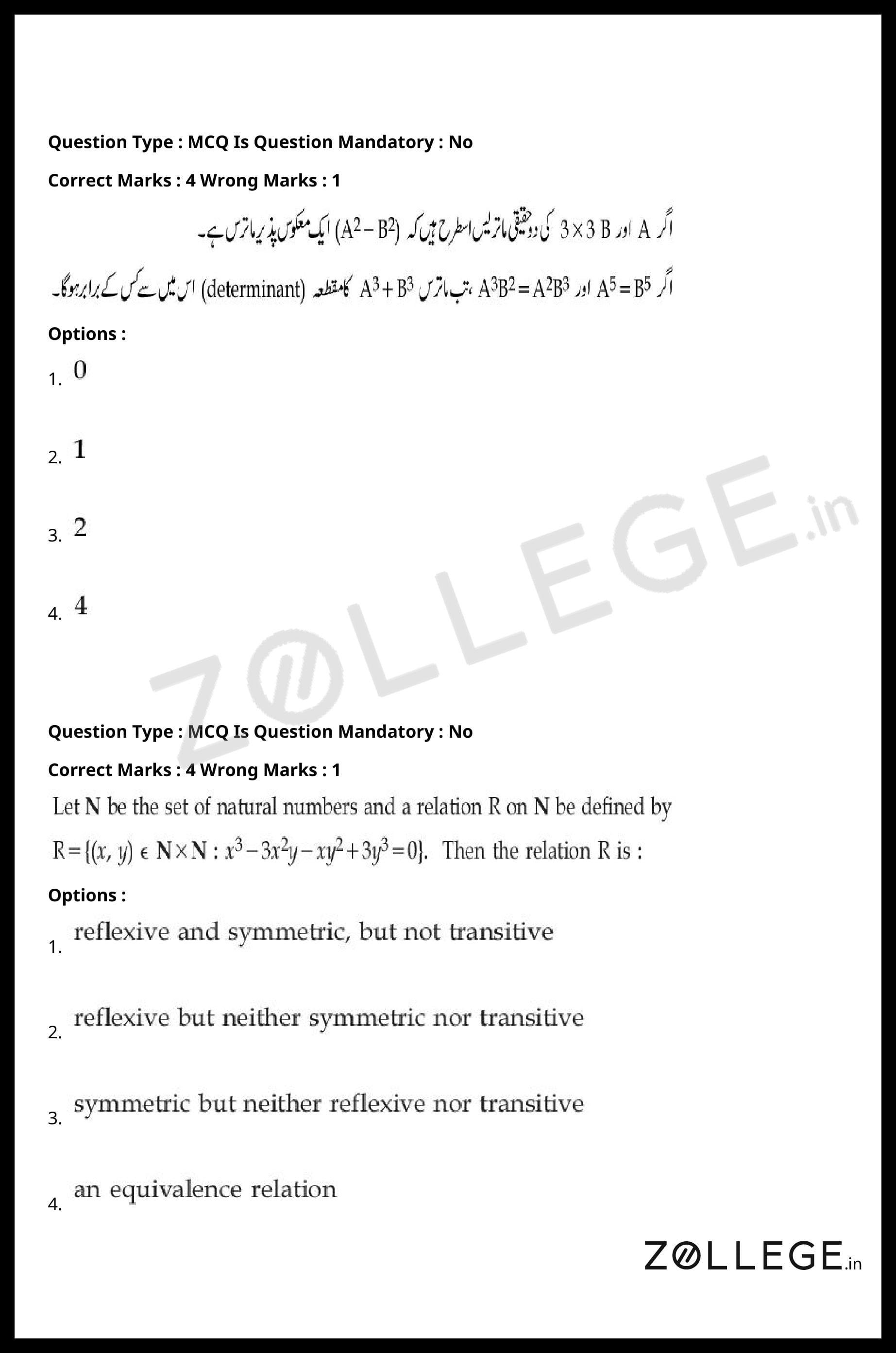
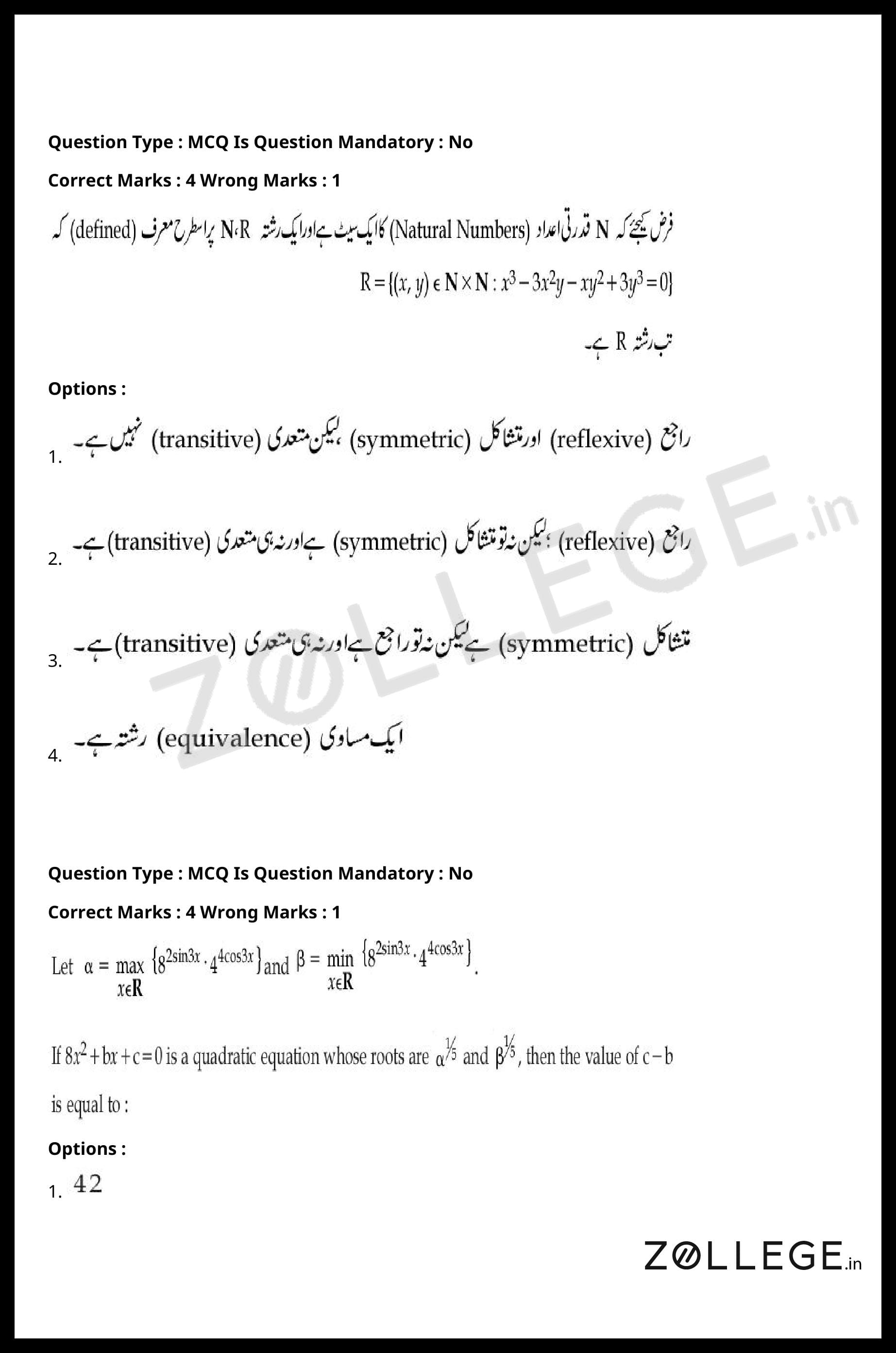
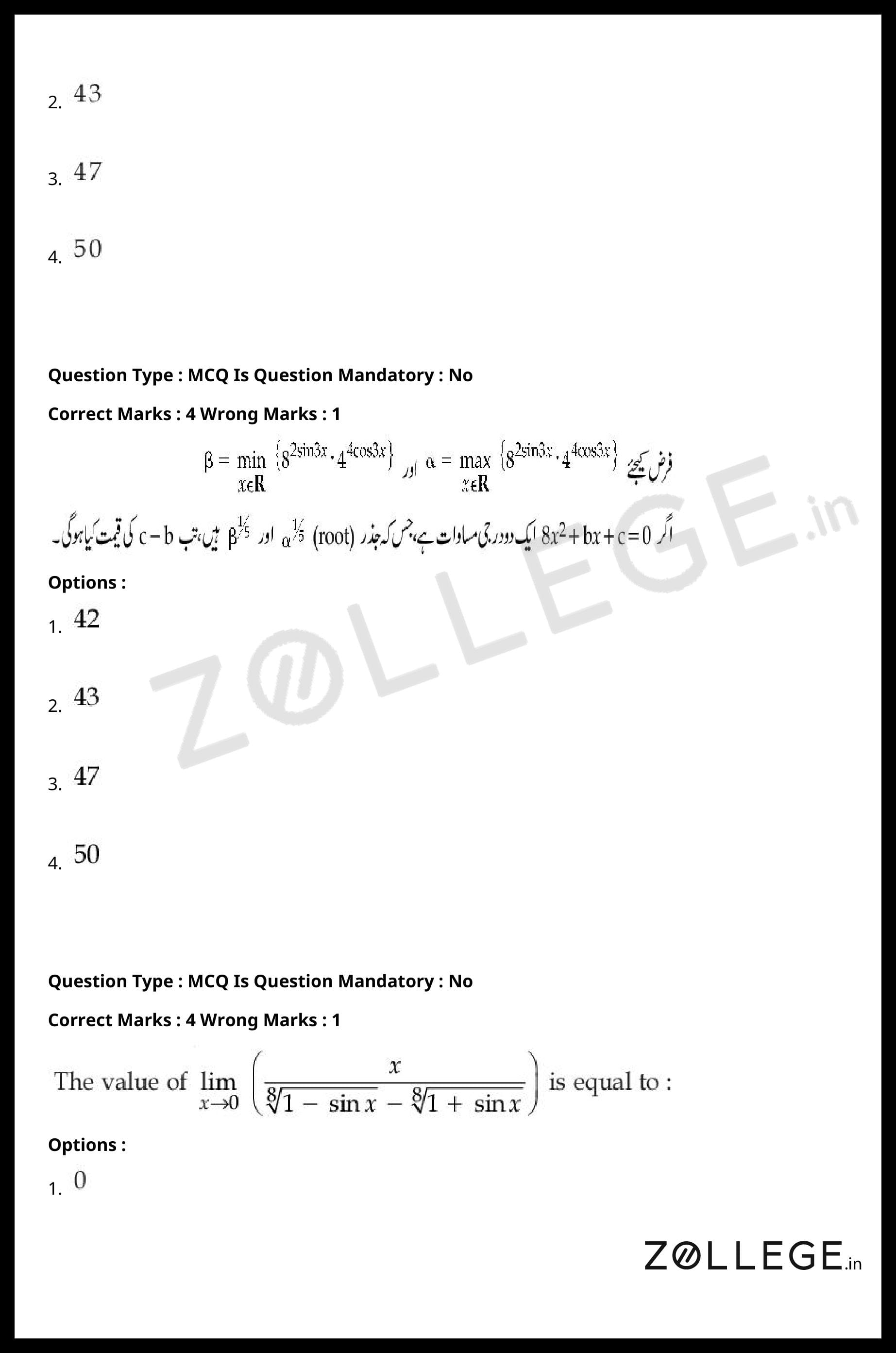
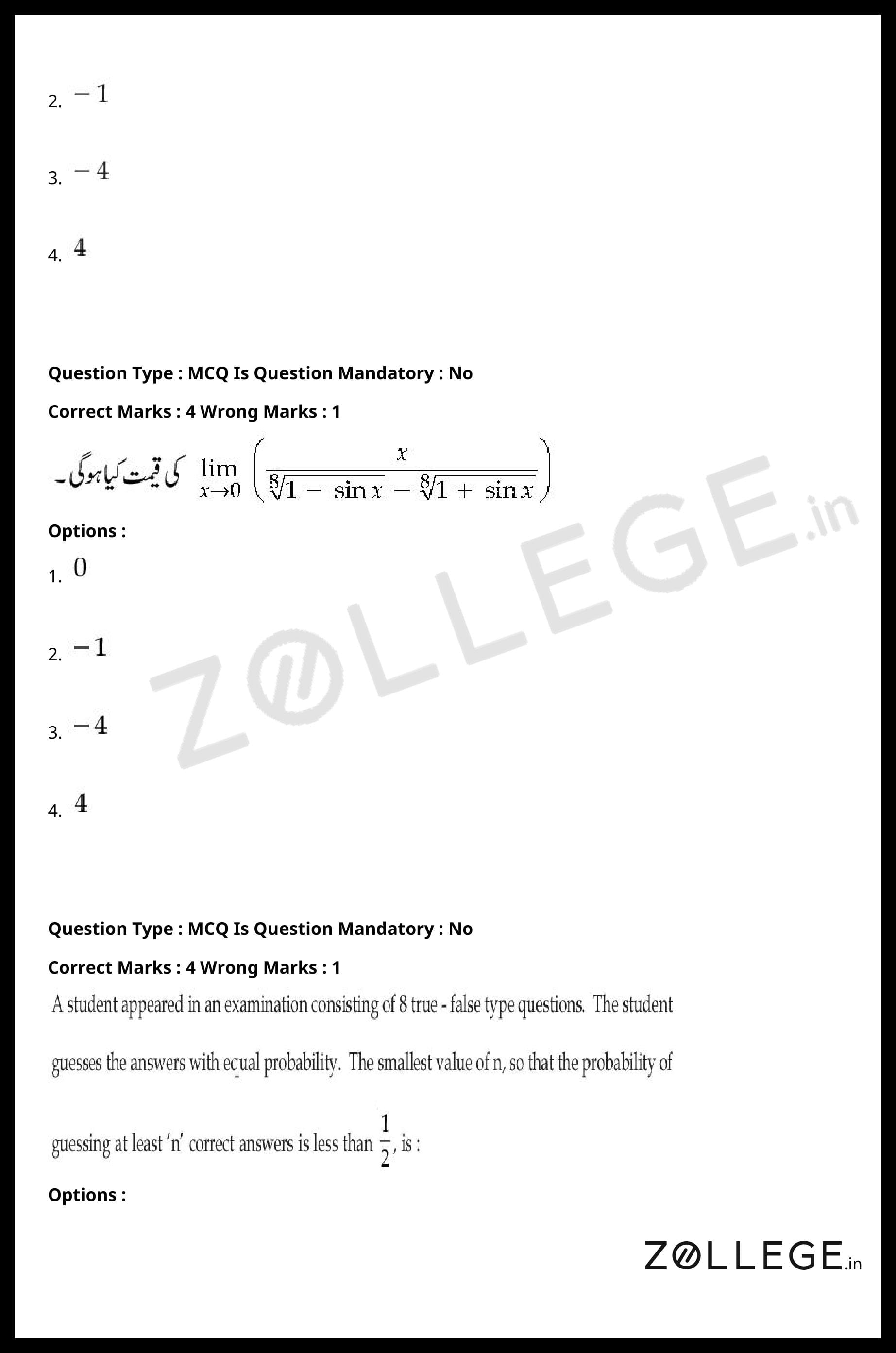
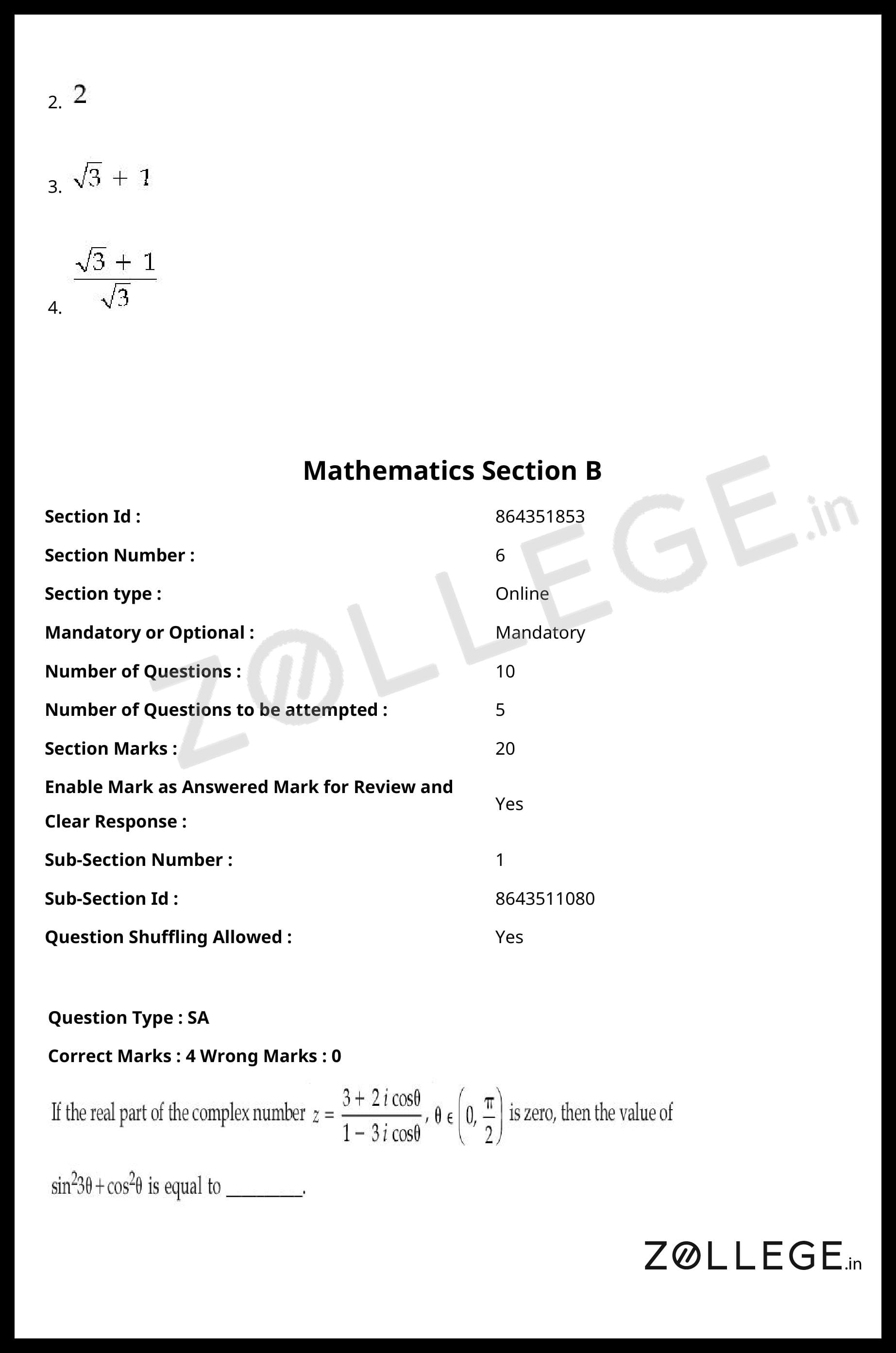
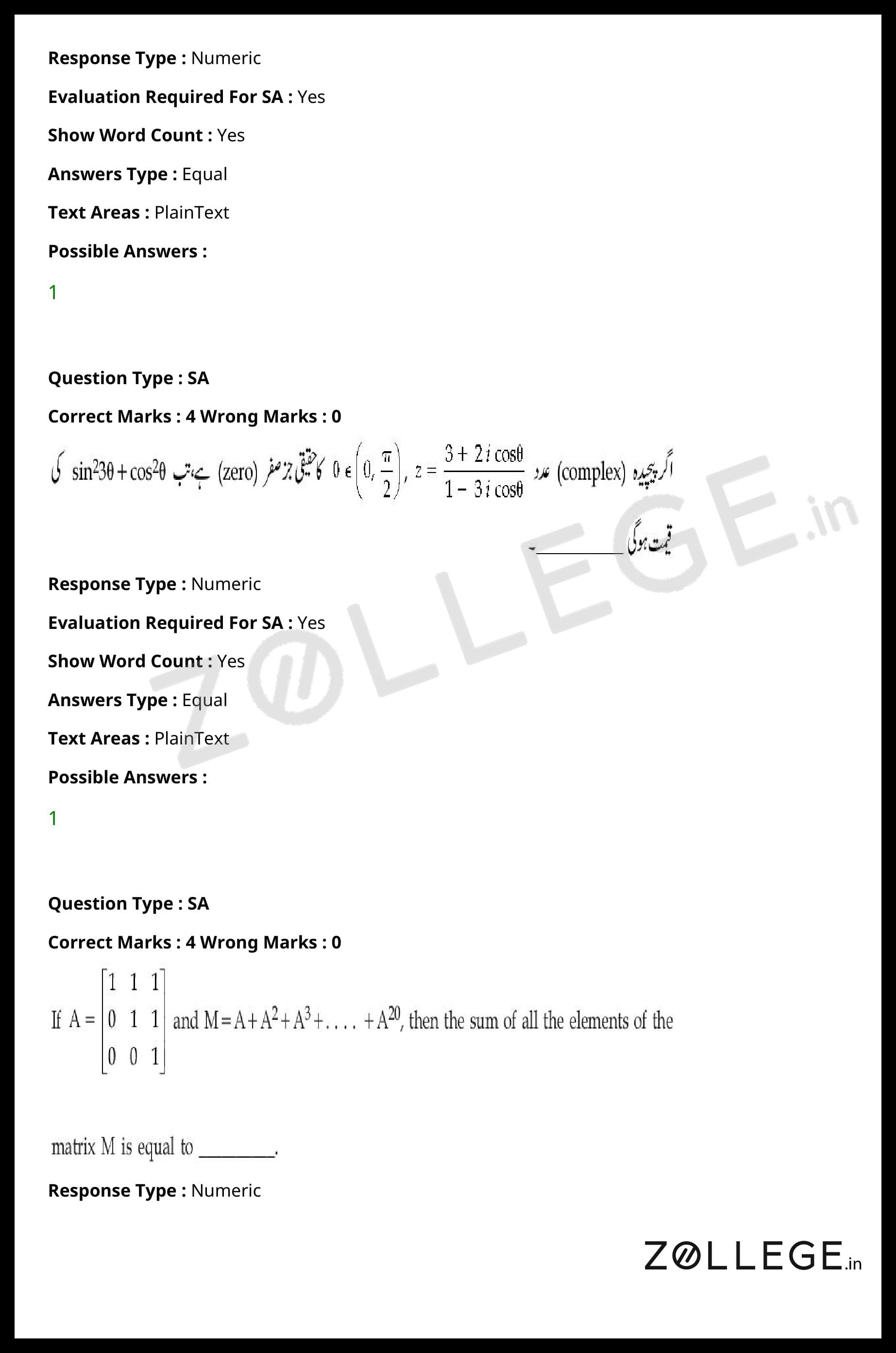
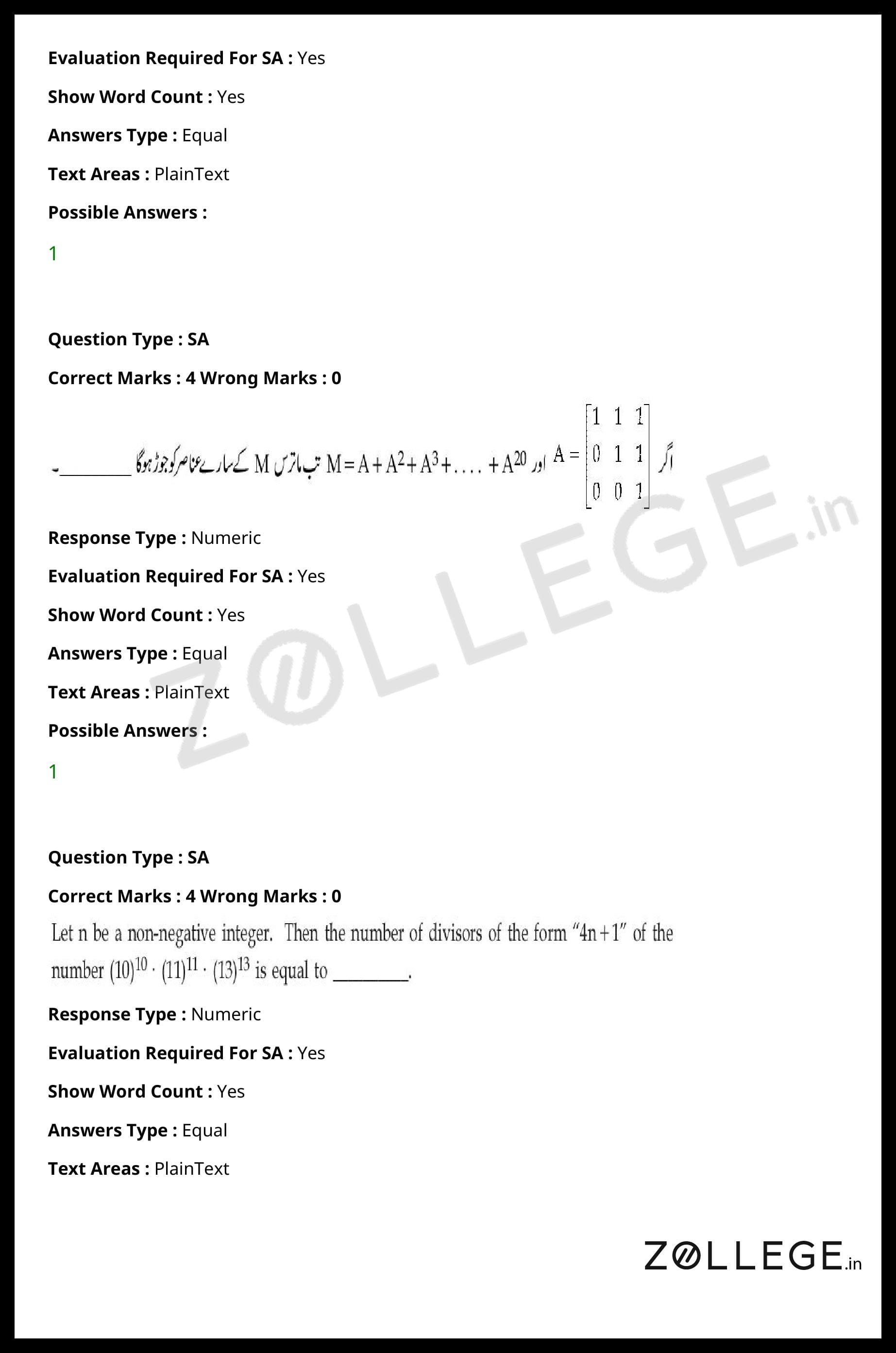
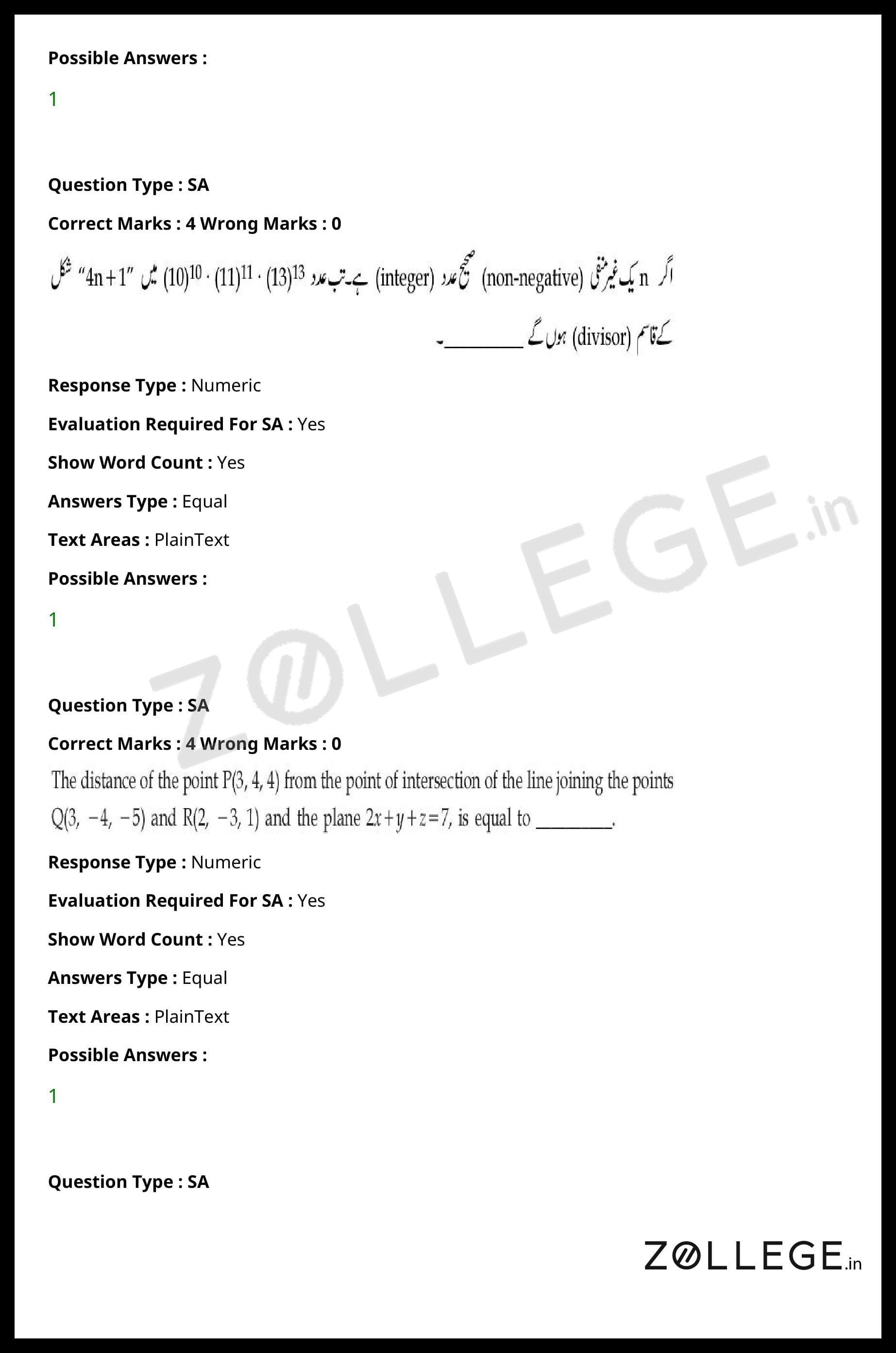
Previous Year JEE Main Question Papers
*The article might have information for the previous academic years, please refer the official website of the exam.