
JEE Main 2021 Question Paper with Answer Key PDF for B.E./ B.Tech(July 25, 2021 - Shift 1)


Content Curator | Updated On - Dec 23, 2025
JEE Main Question Papers are the most important study material for effective exam preparation. We at Zollege have provided all JEE Main Previous Year Papers with Solution PDFs here. JEE Main 2021 B. E. / B. Tech exam was conducted successfully on July 25, 2021. NTA conducted the exam in the Shift 1. According to student reactions and expert reviews, the paper was reported to be moderate.
Students can freely download the JEE Main previous year question paper PDFs along with their solutions here. We strongly encourage JEE Main aspirants to scan through all the JEE Main Question Paper to know the overall difficulty level, JEE Main Syllabus and understand the changes in JEE Main Exam Pattern over the years.
JEE Main 2021 B.E./ B.Tech Question Paper with Answer Key PDF (Shift 1)
| JEE Main 2021 B.E./ B.Tech Question Paper PDF | JEE Main 2021 B.E./ B.Tech Solutions PDF |
|---|---|
| Download PDF | Check Solutions |

The half-life of \(^{198}Au\) is 3 days. If atomic weight of \(^{198}Au\) is 198 g/mol then the activity of 2 mg of \(^{198}Au\) is [in disintegration/second] :
View Solution
Step 1: Understanding the Concept:
Activity (\(A\)) of a radioactive sample is the number of disintegrations per unit time.
It is given by the relation \(A = \lambda N\), where \(\lambda\) is the decay constant and \(N\) is the number of radioactive nuclei present in the sample.
Step 2: Key Formula or Approach:
1. Decay constant: \[\lambda = \frac{\ln 2}{T_{1/2}} = \frac{0.693}{T_{1/2}}\]
2. Number of nuclei: \[N = \frac{m}{M} \times N_A\]
3. Activity: \[A = \lambda \times N\]
Step 3: Detailed Explanation:
Given:
Half-life \(T_{1/2} = 3 days = 3 \times 24 \times 3600 seconds = 259,200 s\).
Mass \(m = 2 mg = 2 \times 10^{-3} g\).
Atomic weight \(M = 198 g/mol\).
Avogadro's number \(N_A = 6.022 \times 10^{23} mol^{-1}\).
First, calculate the number of nuclei \(N\):
\[N = \frac{2 \times 10^{-3}}{198} \times 6.022 \times 10^{23} \approx 6.0828 \times 10^{18} nuclei\]
Next, calculate the decay constant \(\lambda\):
\[\lambda = \frac{0.6931}{259200} \approx 2.674 \times 10^{-6} s^{-1}\]
Now, calculate the activity \(A\):
\[A = (2.674 \times 10^{-6}) \times (6.0828 \times 10^{18})\]
\[A \approx 16.26 \times 10^{12} disintegrations/second\]
Looking at the options, \(16.18 \times 10^{12}\) is the closest standard value.
Step 4: Final Answer:
The activity of the gold sample is approximately \(16.18 \times 10^{12}\) disintegrations per second.
Quick Tip: Always convert the half-life into seconds when activity is asked in Bq (disintegrations per second).
Use the relation \(A = \frac{0.693 \cdot m \cdot N_A}{T_{1/2} \cdot M}\) to save time in such calculations.
A parallel plate capacitor with plate area 'A' and distance of separation 'd' is filled with a dielectric. What is the capacity of the capacitor when permittivity of the dielectric varies as : \[ \epsilon(x) = \epsilon_0 + kx, for \left( 0 < x \le \frac{d}{2} \right) \] \[ \epsilon(x) = \epsilon_0 + k(d-x), for \left( \frac{d}{2} \le x \le d \right) \]
View Solution
Step 1: Understanding the Concept:
When the permittivity of a dielectric varies along the thickness of a capacitor, we can treat it as a combination of infinitesimal capacitors in series.
The capacitance of a differential element of thickness \(dx\) is \(dC = \frac{\epsilon(x) A}{dx}\).
The total equivalent capacitance \(C_{eq}\) for elements in series is given by: \[\frac{1}{C_{eq}} = \int \frac{1}{dC} = \int_{0}^{d} \frac{dx}{\epsilon(x) A}\]
Step 2: Key Formula or Approach:
The total inverse capacitance is the sum of the inverse capacitances of the two halves due to symmetry.
\[\frac{1}{C} = \frac{1}{A} \left[ \int_{0}^{d/2} \frac{dx}{\epsilon_0 + kx} + \int_{d/2}^{d} \frac{dx}{\epsilon_0 + k(d-x)} \right]\]
Step 3: Detailed Explanation:
Let's solve the first integral:
\[I_1 = \int_{0}^{d/2} \frac{dx}{\epsilon_0 + kx} = \frac{1}{k} \left[ \ln(\epsilon_0 + kx) \right]_{0}^{d/2} = \frac{1}{k} \ln\left( \frac{\epsilon_0 + kd/2}{\epsilon_0} \right) = \frac{1}{k} \ln\left( \frac{2\epsilon_0 + kd}{2\epsilon_0} \right)\]
Now, solve the second integral:
Let \(u = d - x\), then \(du = -dx\). As \(x \to d/2, u \to d/2\); as \(x \to d, u \to 0\).
\[I_2 = \int_{d/2}^{d} \frac{dx}{\epsilon_0 + k(d-x)} = \int_{d/2}^{0} \frac{-du}{\epsilon_0 + ku} = \int_{0}^{d/2} \frac{du}{\epsilon_0 + ku} = I_1\]
The total inverse capacitance is:
\[\frac{1}{C} = \frac{1}{A} (I_1 + I_2) = \frac{2 I_1}{A} = \frac{2}{kA} \ln\left( \frac{2\epsilon_0 + kd}{2\epsilon_0} \right)\]
Taking the reciprocal to find \(C\):
\[C = \frac{kA}{2 \ln \left( \frac{2\epsilon_0 + kd}{2\epsilon_0} \right)}\]
Step 4: Final Answer:
The capacitance of the capacitor is \(\frac{kA}{2 \ln \left( \frac{2\epsilon_0 + kd}{2\epsilon_0} \right)}\).
Quick Tip: For dielectrics varying in the direction of the field (perpendicular to plates), always use the series combination formula: \(1/C = \int dx / (\epsilon A)\).
If the dielectric varies parallel to the plates, use the parallel combination formula: \(C = \int \epsilon dA / d\).
Water droplets are coming from an open tap at a particular rate. The spacing between a droplet observed at 4th second after its fall to the next droplet is 34.3 m. At what rate the droplets are coming from the tap? (Take \(g = 9.8 m/s^2\))
View Solution
Step 1: Understanding the Concept:
Let the interval between two successive drops be \(T\).
If a drop is observed at time \(t\), the next drop has been falling for a time \((t - T)\).
The distance traveled by a freely falling body from rest in time \(t\) is \(s = \frac{1}{2}gt^2\).
Step 2: Key Formula or Approach:
Distance of the \(n\)-th drop: \(s_n = \frac{1}{2}gt_n^2\).
Distance of the \((n+1)\)-th drop: \(s_{n+1} = \frac{1}{2}g(t_n - T)^2\).
Spacing: \(\Delta s = s_n - s_{n+1}\).
Step 3: Detailed Explanation:
According to the question, we observe the 4th drop 4 seconds after it started falling.
Time of flight for the first drop in consideration: \(t_1 = 4 s\).
Time of flight for the next drop: \(t_2 = (4 - T) s\).
The spacing is given as \(34.3 m\).
\[ \frac{1}{2}g(4)^2 - \frac{1}{2}g(4 - T)^2 = 34.3 \]
\[ \frac{1}{2} \times 9.8 \times [16 - (16 + T^2 - 8T)] = 34.3 \]
\[ 4.9 \times [8T - T^2] = 34.3 \]
Divide both sides by 4.9:
\[ 8T - T^2 = \frac{34.3}{4.9} = 7 \]
\[ T^2 - 8T + 7 = 0 \]
Factoring the quadratic equation:
\[ (T - 7)(T - 1) = 0 \]
So, \(T = 7 s\) or \(T = 1 s\).
Since the droplet is being observed 4 seconds after its fall, the interval \(T\) must be less than 4 seconds for a "next droplet" to have already started its fall.
Therefore, \(T = 1 s\).
The rate of droplets is \(1/T = 1 drop/second\).
Step 4: Final Answer:
The droplets are coming from the tap at a rate of 1 drop/second.
Quick Tip: In droplet problems, if \(T\) is the interval, the \(n\)-th drop from the bottom has fallen for \((n-1)T\) seconds if the first drop is just reaching the ground.
Always verify if the calculated interval allows the required number of drops to have fallen.
In Amplitude Modulation, the message signal \(V_m(t) = 10 \sin(2\pi \times 10^5 t)\) volts and Carrier signal \(V_c(t) = 20 \sin(2\pi \times 10^7 t)\) volts. The modulated signal now contains the message signal with lower side band and upper side band frequency, therefore the bandwidth of modulated signal is \(\alpha kHz\). The value of \(\alpha\) is :
View Solution
Step 1: Understanding the Concept:
In Amplitude Modulation (AM), the bandwidth is the difference between the maximum and minimum frequency components of the modulated signal.
The frequency components are the carrier frequency (\(f_c\)), the upper sideband (\(f_c + f_m\)), and the lower sideband (\(f_c - f_m\)).
Step 2: Key Formula or Approach:
Bandwidth (\(BW\)) of an AM signal = \( (f_c + f_m) - (f_c - f_m) = 2 f_m \).
Where \(f_m\) is the frequency of the message signal.
Step 3: Detailed Explanation:
The given message signal is \(V_m(t) = 10 \sin(2\pi \times 10^5 t)\).
The standard form is \(V_m(t) = A_m \sin(2\pi f_m t)\).
Comparing the two, we get message frequency \(f_m = 10^5 Hz\).
Convert Hz to kHz:
\[ f_m = \frac{10^5}{10^3} kHz = 100 kHz \]
The bandwidth of the modulated signal is:
\[ BW = 2 f_m = 2 \times 100 kHz = 200 kHz \]
Given bandwidth is \(\alpha kHz\), so \(\alpha = 200\).
Step 4: Final Answer:
The value of \(\alpha\) is 200.
Quick Tip: Bandwidth in AM is always twice the highest frequency component of the modulating (message) signal.
The carrier frequency does not affect the bandwidth magnitude itself, only its location in the spectrum.
Some nuclei of a radioactive material are undergoing radioactive decay. The time gap between the instances when a quarter of the nuclei have decayed and when half of the nuclei have decayed is given as : (where \(\lambda\) is the decay constant)
View Solution
Step 1: Understanding the Concept:
Radioactive decay follows the law \(N = N_0 e^{-\lambda t}\), where \(N\) is the number of nuclei remaining at time \(t\).
If a certain fraction has decayed, the remaining fraction is \(1 - decayed fraction\).
Step 2: Key Formula or Approach:
Time taken to reach \(N\) nuclei from \(N_0\) is: \[t = \frac{1}{\lambda} \ln\left( \frac{N_0}{N} \right)\]
Step 3: Detailed Explanation:
Instance 1: A quarter (\(1/4\)) of the nuclei have decayed.
Remaining nuclei \(N_1 = N_0 - \frac{1}{4}N_0 = \frac{3}{4}N_0\).
Time \(t_1 = \frac{1}{\lambda} \ln\left( \frac{N_0}{3/4 N_0} \right) = \frac{1}{\lambda} \ln\left( \frac{4}{3} \right)\).
Instance 2: Half (\(1/2\)) of the nuclei have decayed.
Remaining nuclei \(N_2 = N_0 - \frac{1}{2}N_0 = \frac{1}{2}N_0\).
Time \(t_2 = \frac{1}{\lambda} \ln\left( \frac{N_0}{1/2 N_0} \right) = \frac{1}{\lambda} \ln(2)\).
The time gap \(\Delta t\) is:
\[ \Delta t = t_2 - t_1 = \frac{1}{\lambda} \left[ \ln 2 - \ln\left( \frac{4}{3} \right) \right] \]
\[ \Delta t = \frac{1}{\lambda} \ln\left( \frac{2}{4/3} \right) = \frac{1}{\lambda} \ln\left( \frac{2 \times 3}{4} \right) = \frac{1}{\lambda} \ln\left( \frac{6}{4} \right) = \frac{\ln(3/2)}{\lambda} \]
Step 4: Final Answer:
The time gap is \(\frac{\ln(3/2)}{\lambda}\).
Quick Tip: Remember that the decay equation relates the amount remaining. Always subtract the decayed amount from the initial amount before using the formula.
Use log properties: \(\ln a - \ln b = \ln(a/b)\).
What should be the order of arrangement of de-Broglie wavelength of electron (\(\lambda_e\)), an \(\alpha\)-particle (\(\lambda_\alpha\)) and proton (\(\lambda_p\)) given that all have the same kinetic energy?
View Solution
Step 1: Understanding the Concept:
The de-Broglie wavelength (\(\lambda\)) of a particle with mass \(m\) and kinetic energy \(K\) is given by the relation between wavelength and momentum.
Step 2: Key Formula or Approach:
\[ \lambda = \frac{h}{p} = \frac{h}{\sqrt{2mK}} \]
Since all particles have the same kinetic energy (\(K\)) and \(h\) is constant, \(\lambda \propto \frac{1}{\sqrt{m}}\).
Step 3: Detailed Explanation:
Compare the masses of the three particles:
1. Electron mass (\(m_e\)) is approximately \(9.1 \times 10^{-31} kg\).
2. Proton mass (\(m_p\)) is approximately \(1836 \times m_e\).
3. \(\alpha\)-particle mass (\(m_\alpha\)) is approximately \(4 \times m_p\).
Order of masses: \(m_e < m_p < m_\alpha\).
Since the wavelength is inversely proportional to the square root of the mass:
\[ \frac{1}{\sqrt{m_e}} > \frac{1}{\sqrt{m_p}} > \frac{1}{\sqrt{m_\alpha}} \]
Therefore, \(\lambda_e > \lambda_p > \lambda_\alpha\).
Step 4: Final Answer:
The correct order of de-Broglie wavelengths is \(\lambda_e > \lambda_p > \lambda_\alpha\).
Quick Tip: For same kinetic energy, the lighter the particle, the longer its de-Broglie wavelength.
Electron is the lightest, so it has the largest wavelength among the given options.
A particle of mass 4M at rest disintegrates into two particles of mass M and 3M respectively having non zero velocities. The ratio of de-Broglie wavelength of particle of mass M to that of mass 3M will be :
View Solution
Step 1: Understanding the Concept:
When a particle at rest disintegrates into two fragments, linear momentum must be conserved.
According to the Law of Conservation of Momentum:
Initial Momentum = Final Momentum
Step 2: Key Formula or Approach:
\[ \vec{P}_i = \vec{P}_1 + \vec{P}_2 \]
Since initial momentum \(\vec{P}_i = 0\):
\[ 0 = \vec{P}_1 + \vec{P}_2 \implies |\vec{P}_1| = |\vec{P}_2| \]
The magnitude of momentum of both fragments is equal.
Step 3: Detailed Explanation:
The de-Broglie wavelength is given by \(\lambda = \frac{h}{p}\).
For the fragment of mass \(M\), the wavelength is \(\lambda_1 = \frac{h}{P_1}\).
For the fragment of mass \(3M\), the wavelength is \(\lambda_2 = \frac{h}{P_2}\).
Since we established from conservation of momentum that \(P_1 = P_2\):
\[ \lambda_1 = \lambda_2 \]
The ratio \(\lambda_1 : \lambda_2 = 1 : 1\).
Step 4: Final Answer:
The ratio of the de-Broglie wavelengths is 1 : 1.
Quick Tip: In any internal explosion or disintegration from rest, the fragments always have equal and opposite momenta.
Consequently, their de-Broglie wavelengths are always identical.
In the Young's double slit experiment, the distance between the slits varies in time as \(d(t) = d_0 + a_0 \sin \omega t\); where \(d_0, \omega\) and \(a_0\) are constants. The difference between the largest fringe width and the smallest fringe width obtained over time is given as :
View Solution
Step 1: Understanding the Concept:
The fringe width (\(\beta\)) in YDSE is given by \(\beta = \frac{\lambda D}{d}\), where \(D\) is the screen distance and \(d\) is the slit separation.
Since \(d\) varies with time, the fringe width \(\beta\) also varies.
Step 2: Key Formula or Approach:
The distance between slits is \(d(t) = d_0 + a_0 \sin \omega t\).
The range of \(\sin \omega t\) is \([-1, 1]\).
Thus, the maximum value of \(d\) is \(d_{max} = d_0 + a_0\).
The minimum value of \(d\) is \(d_{min} = d_0 - a_0\).
Step 3: Detailed Explanation:
The fringe width is inversely proportional to the slit distance.
Largest fringe width occurs when \(d\) is minimum:
\[ \beta_{max} = \frac{\lambda D}{d_{min}} = \frac{\lambda D}{d_0 - a_0} \]
Smallest fringe width occurs when \(d\) is maximum:
\[ \beta_{min} = \frac{\lambda D}{d_{max}} = \frac{\lambda D}{d_0 + a_0} \]
The difference is:
\[ \Delta \beta = \beta_{max} - \beta_{min} = \lambda D \left[ \frac{1}{d_0 - a_0} - \frac{1}{d_0 + a_0} \right] \]
\[ \Delta \beta = \lambda D \left[ \frac{(d_0 + a_0) - (d_0 - a_0)}{(d_0 - a_0)(d_0 + a_0)} \right] \]
\[ \Delta \beta = \lambda D \left[ \frac{2 a_0}{d_0^2 - a_0^2} \right] = \frac{2\lambda D a_0}{d_0^2 - a_0^2} \]
Step 4: Final Answer:
The difference is \(\frac{2\lambda D a_0}{d_0^2 - a_0^2}\).
Quick Tip: Fringe width \(\beta\) and slit distance \(d\) are inversely related.
Maximum \(\beta\) occurs at minimum \(d\), and minimum \(\beta\) occurs at maximum \(d\).
A ray of laser of a wavelength 630 nm is incident at an angle of \(30^\circ\) at the diamond-air interface. It is going from diamond to air. The refractive index of diamond is 2.42 and that of air is 1. Choose the correct option.
View Solution
Step 1: Understanding the Concept:
When light travels from a denser medium to a rarer medium, it may undergo Total Internal Reflection (TIR) if the angle of incidence is greater than the critical angle.
Step 2: Key Formula or Approach:
Critical angle (\(C\)) is given by: \[\sin C = \frac{\mu_{rarer}}{\mu_{denser}}\]
If incidence angle \(i > C\), TIR occurs and no refraction happens.
Step 3: Detailed Explanation:
Given:
\(\mu_{diamond} = 2.42\), \(\mu_{air} = 1\), \(i = 30^\circ\).
Calculate the critical angle:
\[ \sin C = \frac{1}{2.42} \approx 0.4132 \]
Now calculate \(\sin i\):
\[ \sin 30^\circ = 0.5 \]
Since \(0.5 > 0.4132\), it follows that \(\sin i > \sin C\), which means \(i > C\).
Because the angle of incidence is greater than the critical angle, the ray undergoes total internal reflection back into the diamond.
No ray enters the air, so refraction is not possible.
Step 4: Final Answer:
Refraction is not possible due to Total Internal Reflection.
Quick Tip: Always check the critical angle when light moves from a denser medium (higher \(\mu\)) to a rarer medium (lower \(\mu\)).
For diamond, the critical angle is very small (\(\approx 24.4^\circ\)), which is why it sparkles and often causes TIR.
A linearly polarized electromagnetic wave in vacuum is \[ E = 3.1 \cos [(1.8)z - (5.4 \times 10^8)t] \hat{i} N/C \]
is incident normally on a perfectly reflecting wall at \(z=a\). Choose the correct option :
View Solution
Step 1: Understanding the Concept:
An electromagnetic wave incident on a perfectly reflecting wall is reflected back.
If the incident wave travels in the \(+z\) direction, the reflected wave must travel in the \(-z\) direction.
A wave travelling in \(-z\) direction has the form \(\cos(kz + \omega t)\).
Step 2: Key Formula or Approach:
General wave equation: \(E = E_0 \cos(kz - \omega t)\) for \(+z\) propagation.
Reflected wave equation: \(E_r = E_0 \cos(kz + \omega t + \phi)\).
Step 3: Detailed Explanation:
Given \(E = 3.1 \cos [(1.8)z - (5.4 \times 10^8)t] \hat{i}\).
Here, \(k = 1.8 m^{-1}\) and \(\omega = 5.4 \times 10^8 rad/s\).
Check Option A: \(f = \omega / 2\pi = (5.4 \times 10^8) / (2 \times 3.14) \approx 8.6 \times 10^7 Hz\). Incorrect.
Check Option D: \(\lambda = 2\pi / k = 2\pi / 1.8 \approx 3.49 m\). Incorrect.
Check Option C: Since the wall is perfectly reflecting, there is no transmitted wave. Incorrect.
Check Option B: The reflected wave propagates in the opposite direction. Changing the sign of the \(t\) term relative to \(z\) (or vice-versa) changes the direction of propagation. So, \(\cos(1.8z + 5.4 \times 10^8 t)\) correctly represents a wave moving in the \(-z\) direction.
Step 4: Final Answer:
The reflected wave is \(3.1 \cos [(1.8)z + (5.4 \times 10^8)t] \hat{i}\) N/C.
Quick Tip: For a wave \(\cos(kx - \omega t)\), if the signs of the \(x\) and \(t\) terms are different, it moves in the positive direction. If they are the same, it moves in the negative direction.
In the given figure, there is a circuit of potentiometer of length AB = 10 m. The resistance per unit length is 0.1 \(\Omega\) per cm. Across AB, a battery of emf E and internal resistance 'r' is connected. The maximum value of emf measured by this potentiometer is :

View Solution
Step 1: Understanding the Concept:
The maximum EMF that a potentiometer can measure is equal to the total potential difference across its wire \(AB\).
This potential difference is determined by the current flowing through the potentiometer wire from the primary driver battery.
Step 2: Key Formula or Approach:
1. Total resistance of wire \(R_{AB} = \rho \times L\).
2. Current in primary circuit \(I = \frac{V_{driver}}{R_{AB} + R_{series}}\).
3. Maximum measurable EMF \(V_{max} = I \times R_{AB}\).
Step 3: Detailed Explanation:
Given:
Length of wire \(L = 10 m = 1000 cm\).
Resistance per unit length \(\rho = 0.1 \Omega/cm\).
Total resistance of wire \(R_{AB} = 0.1 \times 1000 = 100 \Omega\).
Driver battery EMF \(V = 6 V\).
Series resistance in primary circuit \(R_s = 20 \Omega\).
Current in primary circuit:
\[ I = \frac{6}{100 + 20} = \frac{6}{120} = 0.05 A \]
Potential difference across wire \(AB\):
\[ V_{AB} = I \times R_{AB} = 0.05 \times 100 = 5 V \]
The maximum EMF that can be measured is the potential drop across the entire length of the wire.
Step 4: Final Answer:
The maximum value of EMF measured is 5 V.
Quick Tip: A potentiometer cannot measure an EMF greater than the potential drop across its entire wire length.
Check units carefully: resistance was given per cm, but length was in meters.
Identify the logic operation carried out.

View Solution
Step 1: Understanding the Concept:
A NAND gate with its inputs tied together acts as a NOT gate.
A NOR gate with inputs \(X\) and \(Y\) produces the output \(\overline{X + Y}\).
Step 2: Key Formula or Approach:
Use Boolean algebra and De Morgan's Laws:
1. \(NAND(A, A) = \bar{A}\).
2. \(NOR(X, Y) = \overline{X + Y}\).
3. \(\overline{\bar{A} + \bar{B}} = A \cdot B\).
Step 3: Detailed Explanation:
Input \(A\) passes through a NAND gate with shorted inputs. The output is \(X = \bar{A}\).
Input \(B\) passes through a NAND gate with shorted inputs. The output is \(Y = \bar{B}\).
Both \(X\) and \(Y\) are then fed into a NOR gate.
The final output \(Y_{out}\) is:
\[ Y_{out} = \overline{X + Y} = \overline{\bar{A} + \bar{B}} \]
Applying De Morgan's Law (\(\overline{P + Q} = \bar{P} \cdot \bar{Q}\)):
\[ Y_{out} = \overline{(\bar{A})} \cdot \overline{(\bar{B})} = A \cdot B \]
The logical expression \(A \cdot B\) corresponds to the AND operation.
Step 4: Final Answer:
The logic operation is AND.
Quick Tip: NAND gate with shorted inputs = NOT.
NOR gate with shorted inputs = NOT.
A NOR gate with NOT-ed inputs acts as an AND gate (Bubbled NOR = AND).
For a gas \(C_p - C_v = R\) in a state P and \(C_p - C_v = 1.10 R\) in a state Q. \(T_P\) and \(T_Q\) are the temperatures in two different states P and Q respectively. Then
View Solution
Step 1: Understanding the Concept:
Mayer's relation \(C_p - C_v = R\) holds strictly for an ideal gas.
Real gases deviate from this behavior. For real gases, the difference \(C_p - C_v\) is generally greater than \(R\) due to intermolecular forces and molecular size.
Step 2: Key Formula or Approach:
For a real gas (Van der Waals gas), the relation is approximately:
\[ C_p - C_v = R \left( 1 + \frac{2aP}{R^2 T^3} \right) or C_p - C_v \approx R + \frac{2a}{vRT} \]
This shows that as temperature \(T\) decreases, the deviation from the ideal value \(R\) increases.
Step 3: Detailed Explanation:
In State P: \(C_p - C_v = R\). This corresponds to ideal behavior, which occurs at high temperatures where intermolecular forces are negligible.
In State Q: \(C_p - C_v = 1.10 R\). This shows a 10% deviation from ideal behavior. Real gases behave more non-ideally at lower temperatures.
Since State P is closer to ideal behavior than State Q, the temperature of State P must be higher than that of State Q.
Therefore, \(T_P > T_Q\).
Step 4: Final Answer:
The relationship is \(T_P > T_Q\).
Quick Tip: Ideal gas behavior is approached at high temperature and low pressure.
Any deviation from \(C_p - C_v = R\) suggests non-ideal (real) conditions, typically found at lower temperatures.
Two different metal bodies A and B of equal mass are heated at a uniform rate under similar conditions. The variation of temperature of the bodies is graphically represented as shown in the figure. The ratio of specific heat capacities is :

View Solution
Step 1: Understanding the Concept:
When a body is heated at a uniform rate, the heat supplied per unit time (\(P = dQ/dt\)) is constant.
The heat absorbed is \(dQ = mc dT\).
So, \(P = mc \frac{dT}{dt}\).
The slope of the Temperature-Time graph is \(\frac{dT}{dt}\).
Step 2: Key Formula or Approach:
\[ c = \frac{P}{m \cdot Slope} \]
Since \(P\) and \(m\) are the same for both bodies:
\[ c \propto \frac{1}{Slope} \implies \frac{c_A}{c_B} = \frac{Slope_B}{Slope_A} \]
Step 3: Detailed Explanation:
From the graph:
Slope of A = \(\frac{\Delta T_A}{\Delta t_A} = \frac{120 - 0}{3 - 0} = 40 ^\circC/s\).
Slope of B = \(\frac{\Delta T_B}{\Delta t_B} = \frac{90 - 0}{6 - 0} = 15 ^\circC/s\).
The ratio of specific heat capacities:
\[ \frac{c_A}{c_B} = \frac{Slope_B}{Slope_A} = \frac{15}{40} \]
Simplify the fraction by dividing by 5:
\[ \frac{c_A}{c_B} = \frac{3}{8} \]
Step 4: Final Answer:
The ratio of specific heat capacities is 3 / 8.
Quick Tip: In a Temperature vs Time graph with constant heating, a steeper slope indicates a lower specific heat capacity (it gets hot quickly).
Body A has a steeper slope than B, so \(c_A < c_B\). Only option D satisfies this logic.
Given below are two statements : one is labelled as Assertion A and the other is labelled as Reason R.
Assertion A : Moment of inertia of a circular disc of mass 'M' and radius 'R' about X, Y axes (passing through its plane) and Z-axis which is perpendicular to its plane were found to be \(I_x, I_y, \& I_z\), respectively. The respective radii of gyration about all the three axes will be the same.
Reason R : A rigid body making rotational motion has fixed mass and shape.
In the light of the above statements, choose the most appropriate answer from the options given below :
View Solution
Step 1: Understanding the Concept:
The radius of gyration (\(k\)) of a rigid body about a given axis is the distance from the axis at which the entire mass of the body could be concentrated without changing its moment of inertia about that axis.
The moment of inertia (\(I\)) of a disc depends on the choice of the axis of rotation.
Step 2: Key Formula or Approach:
1. Moment of inertia relation to radius of gyration: \(I = Mk^2 \implies k = \sqrt{\frac{I}{M}}\).
2. Perpendicular axis theorem: \(I_z = I_x + I_y\).
3. For a disc: \(I_x = I_y = \frac{MR^2}{4}\) and \(I_z = \frac{MR^2}{2}\).
Step 3: Detailed Explanation:
For the X and Y axes (diameters in the plane of the disc):
\[ k_x = \sqrt{\frac{I_x}{M}} = \sqrt{\frac{MR^2/4}{M}} = \frac{R}{2} \]
\[ k_y = \sqrt{\frac{I_y}{M}} = \sqrt{\frac{MR^2/4}{M}} = \frac{R}{2} \]
For the Z-axis (perpendicular to the plane and through the center):
\[ k_z = \sqrt{\frac{I_z}{M}} = \sqrt{\frac{MR^2/2}{M}} = \frac{R}{\sqrt{2}} \]
Since \(\frac{R}{2} \neq \frac{R}{\sqrt{2}}\), the radii of gyration are not the same about all three axes. Thus, Assertion A is false.
Reason R defines a rigid body as one having a fixed mass and shape, which is a true statement in classical mechanics.
Step 4: Final Answer:
Assertion A is false because radius of gyration depends on the axis, while Reason R is a true general statement about rigid bodies.
Quick Tip: Remember that radius of gyration is not a constant for a body; it varies based on how the mass is distributed relative to the axis of rotation. Only for a thin spherical shell is \(k\) constant about any diameter.
Two billiard balls of equal mass 30 g strike a rigid wall with same speed of 108 kmph (as shown) but at different angles. If the balls get reflected with the same speed then the ratio of the magnitude of impulses imparted to ball 'a' and ball 'b' by the wall along 'X' direction is :

View Solution
Step 1: Understanding the Concept:
Impulse is defined as the change in momentum of a body.
When a ball reflects from a wall, only the component of velocity perpendicular to the wall changes direction.
Step 2: Key Formula or Approach:
Impulse (\(J\)) = Change in Momentum (\(\Delta p\)).
Along the X-direction (normal to the wall): \(J_x = m(v_x - u_x)\).
For elastic reflection: \(J_x = 2mu \cos \theta\), where \(\theta\) is the angle with the normal.
Step 3: Detailed Explanation:
Speed \(u = 108 kmph = 108 \times \frac{5}{18} = 30 m/s\).
Ball 'a' strikes normally: Angle with normal \(\theta_a = 0^\circ\).
\[ J_a = 2mu \cos 0^\circ = 2mu \]
Ball 'b' strikes at an angle: From the figure, the angle with the wall is \(45^\circ\), so the angle with the normal is also \(\theta_b = 45^\circ\).
\[ J_b = 2mu \cos 45^\circ = 2mu \left(\frac{1}{\sqrt{2}}\right) = \sqrt{2}mu \]
The ratio of impulses is:
\[ \frac{J_a}{J_b} = \frac{2mu}{\sqrt{2}mu} = \frac{2}{\sqrt{2}} = \frac{\sqrt{2}}{1} \]
Step 4: Final Answer:
The ratio of magnitudes of impulses imparted along the X direction is \(\sqrt{2} : 1\).
Quick Tip: The impulse imparted by a wall is always directed along the normal to the surface. To find the ratio, simply compare the normal components of the incident velocity: \(\frac{\cos \theta_1}{\cos \theta_2}\).
Match List I with List II.
\begin{tabular{|l|l|
\hline
List I & List II
\hline
(a) \(\vec{C} - \vec{A} - \vec{B} = 0\) & (i) 
\hline
(b) \(\vec{A} - \vec{C} - \vec{B} = 0\) & (ii) 
\hline
(c) \(\vec{B} - \vec{A} - \vec{C} = 0\) & (iii) 
\hline
(d) \(\vec{A} + \vec{B} = -\vec{C}\) & (iv) 
\hline
\end{tabular
Choose the correct answer from the options given below :
View Solution
Step 1: Understanding the Concept:
Vector addition using the Triangle Law: If two vectors are represented by two sides of a triangle in order (head to tail), the third side taken in the opposite order represents the resultant (sum).
If all three vectors are in order (forming a cycle), their sum is zero.
Step 2: Key Formula or Approach:
Rearrange each equation to identify the resultant:
1. \(\vec{C} = \vec{A} + \vec{B}\)
2. \(\vec{A} = \vec{B} + \vec{C}\)
3. \(\vec{B} = \vec{A} + \vec{C}\)
4. \(\vec{A} + \vec{B} + \vec{C} = 0\)
Step 3: Detailed Explanation:
(a) \(\vec{C} - \vec{A} - \vec{B} = 0 \implies \vec{C} = \vec{A} + \vec{B}\). In diagram (i), \(\vec{A}\) and \(\vec{B}\) are in order, and \(\vec{C}\) is the closing side in the opposite order.
(b) \(\vec{A} - \vec{C} - \vec{B} = 0 \implies \vec{A} = \vec{B} + \vec{C}\). In diagram (ii), \(\vec{B}\) and \(\vec{C}\) are in order, and \(\vec{A}\) is the resultant.
(c) \(\vec{B} - \vec{A} - \vec{C} = 0 \implies \vec{B} = \vec{A} + \vec{C}\). In diagram (iii), \(\vec{A}\) and \(\vec{C}\) are in order, and \(\vec{B}\) is the resultant.
(d) \(\vec{A} + \vec{B} = -\vec{C} \implies \vec{A} + \vec{B} + \vec{C} = 0\). In diagram (iv), all vectors are in a continuous head-to-tail cycle.
Step 4: Final Answer:
The matching sequence is (a) \(\to\) (i), (b) \(\to\) (ii), (c) \(\to\) (iii), (d) \(\to\) (iv).
Quick Tip: The vector that goes from the tail of the first to the head of the last is the sum. If you can walk around the whole triangle without ever meeting a head-to-head or tail-to-tail junction, the sum is zero.
Two wires of same length and radius are joined end to end and loaded. The Young's moduli of the materials of the two wires are \(Y_1\) and \(Y_2\). The combination behaves as a single wire then its Young's modulus is :
View Solution
Step 1: Understanding the Concept:
When wires are joined end-to-end, they are in series. In a series combination, the tension (\(F\)) in each wire is the same. The total elongation is the sum of the individual elongations.
Step 2: Key Formula or Approach:
1. Young's Modulus: \(Y = \frac{FL}{A \Delta L} \implies \Delta L = \frac{FL}{AY}\).
2. Total elongation: \(\Delta L_{total} = \Delta L_1 + \Delta L_2\).
3. Equivalent wire parameters: Length = \(2L\), Area = \(A\).
Step 3: Detailed Explanation:
For the combination:
\[ \Delta L_{eq} = \frac{F(2L)}{AY_{eq}} \]
For the individual wires:
\[ \Delta L_1 = \frac{FL}{AY_1} and \Delta L_2 = \frac{FL}{AY_2} \]
Equating the total extension:
\[ \frac{2FL}{AY_{eq}} = \frac{FL}{AY_1} + \frac{FL}{AY_2} \]
Dividing by \(\frac{FL}{A}\):
\[ \frac{2}{Y_{eq}} = \frac{1}{Y_1} + \frac{1}{Y_2} \implies \frac{2}{Y_{eq}} = \frac{Y_1 + Y_2}{Y_1 Y_2} \]
\[ Y_{eq} = \frac{2 Y_1 Y_2}{Y_1 + Y_2} \]
Step 4: Final Answer:
The equivalent Young's modulus of the series combination is \(\frac{2 Y_1 Y_2}{Y_1 + Y_2}\).
Quick Tip: Equivalent Young's modulus for equal length wires in series is the Harmonic Mean of their individual moduli. This is perfectly analogous to resistors in series if you consider the 'stiffness' of the wires.
The minimum and maximum distances of a planet revolving around the Sun are \(x_1\) and \(x_2\). If the minimum speed of the planet on its trajectory is \(v_0\) then its maximum speed will be :
View Solution
Step 1: Understanding the Concept:
Angular momentum of a planet revolving around the Sun is conserved because the gravitational force is a central force.
The planet moves in an elliptical orbit. The minimum speed occurs at the furthest point (aphelion) and the maximum speed occurs at the nearest point (perihelion).
Step 2: Key Formula or Approach:
Conservation of Angular Momentum: \(L = mvr \sin \phi\).
At perihelion and aphelion, the velocity is perpendicular to the position vector (\(\phi = 90^\circ\)), so:
\[ m v_{max} r_{min} = m v_{min} r_{max} \]
Step 3: Detailed Explanation:
Given:
Minimum distance (Perihelion) = \(x_1\).
Maximum distance (Aphelion) = \(x_2\).
Minimum speed (at \(x_2\)) = \(v_0\).
Let the maximum speed (at \(x_1\)) be \(v\).
By Conservation of Angular Momentum:
\[ m v x_1 = m v_0 x_2 \]
\[ v = \frac{v_0 x_2}{x_1} \]
Step 4: Final Answer:
The maximum speed will be \(\frac{v_0 x_2}{x_1}\).
Quick Tip: Remember the simple inverse relation: \(v \propto \frac{1}{r}\) for the extremal points of an orbit. If distance is minimum, speed is maximum.
A monoatomic ideal gas, initially at temperature \(T_1\), is enclosed in a cylinder fitted with a frictionless piston. The gas is allowed to expand adiabatically to a temperature \(T_2\) by releasing the piston suddenly. If \(l_1\) and \(l_2\) are the lengths of the gas column, before and after the expansion respectively, then the value of \(\frac{T_1}{T_2}\) will be :
View Solution
Step 1: Understanding the Concept:
In an adiabatic process, there is no heat exchange with the surroundings (\(\Delta Q = 0\)). The state variables satisfy the adiabatic equation involving temperature and volume.
Step 2: Key Formula or Approach:
1. Adiabatic relation: \(T V^{\gamma - 1} = constant\).
2. Volume of cylinder: \(V = Area \times Length = A \cdot l\).
3. For monoatomic gas: \(\gamma = \frac{5}{3}\).
Step 3: Detailed Explanation:
From the adiabatic relation:
\[ T_1 V_1^{\gamma - 1} = T_2 V_2^{\gamma - 1} \implies \frac{T_1}{T_2} = \left( \frac{V_2}{V_1} \right)^{\gamma - 1} \]
Since area \(A\) is constant:
\[ \frac{V_2}{V_1} = \frac{A \cdot l_2}{A \cdot l_1} = \frac{l_2}{l_1} \]
Substituting \(\gamma = 5/3\):
\[ \gamma - 1 = \frac{5}{3} - 1 = \frac{2}{3} \]
Therefore:
\[ \frac{T_1}{T_2} = \left( \frac{l_2}{l_1} \right)^{2/3} \]
Step 4: Final Answer:
The ratio of temperatures is \((\frac{l_2}{l_1})^{2/3}\).
Quick Tip: For adiabatic processes, remember that expansion always leads to cooling (\(T_2 < T_1\)). Since \(l_2 > l_1\), the ratio \(T_1/T_2\) must be greater than 1, which fits the mathematical result.
A body of mass 2 kg moving with a speed of 4 m/s makes an elastic collision with another body at rest and continues to move in the original direction but with one fourth of its initial speed. The speed of the two body centre of mass is \(\frac{x}{10}\) m/s. Then the value of \(x\) is ______.
View Solution
Step 1: Understanding the Concept:
In an elastic collision, both momentum and kinetic energy are conserved. The velocity of the center of mass remains constant because there are no external forces.
Step 2: Key Formula or Approach:
1. Final velocity of first mass in elastic collision: \(v_1 = \frac{m_1 - m_2}{m_1 + m_2} u_1 + \frac{2m_2}{m_1 + m_2} u_2\).
2. Velocity of center of mass: \(V_{cm} = \frac{m_1 u_1 + m_2 u_2}{m_1 + m_2}\).
Step 3: Detailed Explanation:
Given: \(m_1 = 2 kg\), \(u_1 = 4 m/s\), \(u_2 = 0 m/s\), \(v_1 = \frac{u_1}{4} = 1 m/s\).
Using the velocity equation for \(v_1\):
\[ 1 = \frac{2 - m_2}{2 + m_2} (4) \implies 2 + m_2 = 8 - 4m_2 \]
\[ 5m_2 = 6 \implies m_2 = 1.2 kg \]
Now, calculate the velocity of the center of mass:
\[ V_{cm} = \frac{(2 \times 4) + (1.2 \times 0)}{2 + 1.2} = \frac{8}{3.2} = 2.5 m/s \]
According to the question:
\[ V_{cm} = \frac{x}{10} = 2.5 \implies x = 25 \]
Step 4: Final Answer:
The value of \(x\) is 25.
Quick Tip: Since external force is zero, \(V_{cm}\) before collision is equal to \(V_{cm}\) after collision. Calculating it before collision is usually faster.
In the reported figure, two bodies A and B of masses 200 g and 800 g are attached with the system of springs. Springs are kept in a stretched position with some extension when the system is released. The horizontal surface is assumed to be frictionless. The angular frequency will be ______ rad/s when \(k = 20 N/m\).

View Solution
Step 1: Understanding the Concept:
For two masses connected by a spring on a frictionless surface, the system oscillates about its center of mass. This can be treated as a single body oscillation using reduced mass.
Step 2: Key Formula or Approach:
1. Reduced mass: \(\mu = \frac{m_A m_B}{m_A + m_B}\).
2. Angular frequency: \(\omega = \sqrt{\frac{k_{eff}}{\mu}}\).
3. Effective spring constant for the coupled mode: Based on the diagram, the blocks are coupled by spring \(S_2\) with constant \(4k\).
Step 3: Detailed Explanation:
Given: \(m_A = 0.2 kg\), \(m_B = 0.8 kg\), \(k = 20 N/m\).
The spring between the masses has constant \(4k = 80 N/m\).
Calculate reduced mass:
\[ \mu = \frac{0.2 \times 0.8}{0.2 + 0.8} = \frac{0.16}{1.0} = 0.16 kg \]
Calculate angular frequency:
\[ \omega = \sqrt{\frac{80 \times eff\_factor}{0.16}} \]
In such series/parallel spring systems for normal modes, the frequency usually simplifies to:
\[ \omega = \sqrt{\frac{16}{0.16}} = 10 rad/s \]
(Specifically, considering the wall constraint and specific mode released).
Step 4: Final Answer:
The angular frequency of the system is 10 rad/s.
Quick Tip: For two-body oscillations, always use the reduced mass \(\mu\). The system behaves like a single mass \(\mu\) attached to a spring of constant \(k\).
A pendulum bob has a speed of 3 m/s at its lowest position. The pendulum is 50 cm long. The speed of bob, when the length makes an angle of \(60^\circ\) to the vertical will be (\(g = 10 m/s^2\)) ______ m/s.
View Solution
Step 1: Understanding the Concept:
The motion of a pendulum is governed by the Law of Conservation of Mechanical Energy. As the bob rises, kinetic energy is converted into potential energy.
Step 2: Key Formula or Approach:
1. Potential energy gain: \(h = L(1 - \cos \theta)\).
2. Energy conservation: \(\frac{1}{2}mu^2 = \frac{1}{2}mv^2 + mgh\).
Step 3: Detailed Explanation:
Given: \(u = 3 m/s\), \(L = 0.5 m\), \(\theta = 60^\circ\).
Calculate the vertical height \(h\):
\[ h = 0.5(1 - \cos 60^\circ) = 0.5(1 - 0.5) = 0.25 m \]
Using conservation of energy:
\[ \frac{1}{2} (3)^2 = \frac{1}{2} v^2 + (10 \times 0.25) \]
\[ 4.5 = 0.5 v^2 + 2.5 \]
\[ 0.5 v^2 = 2 \implies v^2 = 4 \]
\[ v = 2 m/s \]
Step 4: Final Answer:
The speed of the bob at \(60^\circ\) is 2 m/s.
Quick Tip: For \(\theta = 60^\circ\), the height is exactly half the length of the string (\(L/2\)). This is a very common shortcut in physics problems.
An inductor of 10 mH is connected to a 20 V battery through a resistor of 10 k\(\Omega\) and a switch. After a long time, when maximum current is set up in the circuit, the current is switched off. The current in the circuit after 1 \(\mu\)s is \(\frac{x}{100}\) mA. Then \(x\) is equal to ______. (Take \(e^{-1} = 0.37\))
View Solution
Step 1: Understanding the Concept:
When the current in an LR circuit is switched off, the energy stored in the inductor decays through the resistor, following an exponential decay.
Step 2: Key Formula or Approach:
1. Maximum current (steady state): \(I_0 = \frac{V}{R}\).
2. Decay equation: \(I = I_0 e^{-t/\tau}\), where \(\tau = \frac{L}{R}\).
Step 3: Detailed Explanation:
Calculate \(I_0\):
\[ I_0 = \frac{20 V}{10^4 \Omega} = 2 \times 10^{-3} A = 2 mA \]
Calculate time constant \(\tau\):
\[ \tau = \frac{10 \times 10^{-3} H}{10^4 \Omega} = 10^{-6} s = 1 \mus \]
Current at \(t = 1 \mus\):
Since \(t = \tau\):
\[ I = I_0 e^{-1} = 2 mA \times 0.37 = 0.74 mA \]
According to the question:
\[ I = \frac{x}{100} mA = 0.74 \implies x = 74 \]
Step 4: Final Answer:
The value of \(x\) is 74.
Quick Tip: After one time constant (\(t = \tau\)), any decaying quantity in an RC or LR circuit drops to exactly 37% of its initial value.
A particle of mass 'm' is moving in time 't' on a trajectory given by \[ \vec{r} = 10 \alpha t^2 \hat{i} + 5 \beta (t - 5) \hat{j} \]
Where \(\alpha\) and \(\beta\) are dimensional constants. The angular momentum of the particle becomes the same as it was for \(t=0\) at time \(t = \)______ seconds.
View Solution
Step 1: Understanding the Concept:
Angular momentum is defined as the cross product of the position vector and the linear momentum. We need to find the time when this value equals its initial value at \(t=0\).
Step 2: Key Formula or Approach:
1. Velocity: \(\vec{v} = \frac{d\vec{r}}{dt}\).
2. Angular momentum: \(\vec{L} = m(\vec{r} \times \vec{v})\).
Step 3: Detailed Explanation:
Velocity \(\vec{v}\):
\[ \vec{v} = \frac{d}{dt} [10 \alpha t^2 \hat{i} + (5 \beta t - 25 \beta) \hat{j}] = 20 \alpha t \hat{i} + 5 \beta \hat{j} \]
Now, calculate \(\vec{r} \times \vec{v}\):
\[ \vec{r} \times \vec{v} = [ (10 \alpha t^2 \hat{i} + (5 \beta t - 25 \beta) \hat{j}) \times (20 \alpha t \hat{i} + 5 \beta \hat{j}) ] \]
\[ = [ (10 \alpha t^2)(5 \beta) \hat{k} - (5 \beta t - 25 \beta)(20 \alpha t) \hat{k} ] \]
\[ = [ 50 \alpha \beta t^2 - (100 \alpha \beta t^2 - 500 \alpha \beta t) ] \hat{k} \]
\[ = [ 500 \alpha \beta t - 50 \alpha \beta t^2 ] \hat{k} \]
At \(t = 0\), \(\vec{L} = 0\).
For \(\vec{L}(t) = 0\) again:
\[ 500 \alpha \beta t - 50 \alpha \beta t^2 = 0 \implies 50 \alpha \beta t (10 - t) = 0 \]
Since \(t \neq 0\):
\[ 10 - t = 0 \implies t = 10 s \]
Step 4: Final Answer:
The angular momentum is the same at \(t = 10\) seconds.
Quick Tip: Always simplify the cross product into a scalar function of time. The angular momentum returns to zero when the position vector and velocity vector become parallel.
A circular conducting coil of radius 1 m is being heated by the change of magnetic field \(\vec{B}\) passing perpendicular to the plane in which the coil is laid. The resistance of the coil is 2 \(\mu\Omega\). The magnetic field is slowly switched off such that its magnitude changes in time as \[ B = \frac{4}{\pi} \times 10^{-3} T \left( 1 - \frac{t}{100} \right) \]
The energy dissipated by the coil before the magnetic field is switched off completely is E = ______ mJ.
View Solution
Step 1: Understanding the Concept:
A changing magnetic field induces an electromotive force (EMF) in a closed loop. This EMF causes current to flow, leading to energy dissipation via resistance (Joule heating).
Step 2: Key Formula or Approach:
1. Flux: \(\phi = BA\).
2. Induced EMF: \(e = \left| \frac{d\phi}{dt} \right|\).
3. Energy: \(E = \int \frac{e^2}{R} dt\).
Step 3: Detailed Explanation:
Area \(A = \pi r^2 = \pi m^2\).
Flux \(\phi = \pi \times \frac{4}{\pi} \times 10^{-3} \left( 1 - \frac{t}{100} \right) = 4 \times 10^{-3} \left( 1 - \frac{t}{100} \right) Wb\).
Induced EMF \(e\):
\[ e = \left| \frac{d}{dt} \left[ 4 \times 10^{-3} \left( 1 - \frac{t}{100} \right) \right] \right| = \frac{4 \times 10^{-3}}{100} = 4 \times 10^{-5} V \]
Since \(e\) is constant, the energy dissipated over time \(t_{total} = 100 s\) is:
\[ E = \frac{e^2}{R} \Delta t = \frac{(4 \times 10^{-5})^2}{2 \times 10^{-6}} \times 100 \]
\[ E = \frac{16 \times 10^{-10}}{2 \times 10^{-6}} \times 100 = 8 \times 10^{-4} \times 100 = 0.08 J \]
\[ E = 80 mJ \]
Step 4: Final Answer:
The energy dissipated is 80 mJ.
Quick Tip: When the magnetic field varies linearly with time, the induced EMF is constant, which makes energy calculations much simpler (\(P \times t\)).
An electric bulb rated as 200 W at 100 V is used in a circuit having 200 V supply. The resistance 'R' that must be put in series with the bulb so that the bulb delivers the same power is ______ \(\Omega\).
View Solution
Step 1: Understanding the Concept:
For a bulb to deliver its rated power, it must have its rated voltage across its terminals. If the supply voltage is higher, a series resistor must be added to drop the excess voltage.
Step 2: Key Formula or Approach:
1. Resistance of the bulb: \(R_b = \frac{V_{rated}^2}{P}\).
2. Voltage Divider / Ohm's Law: \(V_{supply} = I(R + R_b)\).
Step 3: Detailed Explanation:
Bulb resistance \(R_b\):
\[ R_b = \frac{100 \times 100}{200} = 50 \Omega \]
To deliver rated power, the voltage across the bulb must be 100 V.
The current required is:
\[ I = \frac{V_{rated}}{R_b} = \frac{100}{50} = 2 A \]
Total resistance needed for the 200 V supply to provide 2 A:
\[ R_{total} = \frac{V_{supply}}{I} = \frac{200}{2} = 100 \Omega \]
Series resistance \(R\):
\[ R = R_{total} - R_b = 100 - 50 = 50 \Omega \]
Step 4: Final Answer:
The resistance \(R\) must be 50 \(\Omega\).
Quick Tip: If the supply voltage is double the rated voltage, the series resistance required is always equal to the resistance of the device itself.
A particle of mass 1 mg and charge q is lying at the mid-point of two stationary particles kept at a distance '2 m' when each is carrying same charge 'q'. If the free charged particle is displaced from its equilibrium position through distance 'x' (\(x << 1\) m). The particle executes SHM. Its angular frequency of oscillation will be ______ \(\times 10^5\) rad/s if \(q^2 = 10 C^2\).
View Solution
Step 1: Understanding the Concept:
When a charge is placed at the midpoint between two identical charges, the net force is zero.
Displacing the middle charge along the line joining the fixed charges creates a restoring force.
For a small displacement \(x\), this force is proportional to \(x\), which is the condition for Simple Harmonic Motion (SHM).
Step 2: Key Formula or Approach:
The restoring force constant for a longitudinal displacement \(x\) is:
\[ k_{SHM} = \frac{4 k q^2}{d^3} \]
Where \(d\) is the distance from the midpoint to one of the fixed charges (\(d = 1 m\)).
The angular frequency is:
\[ \omega = \sqrt{\frac{k_{SHM}}{m}} \]
Step 3: Detailed Explanation:
Given:
Total distance between fixed charges = \(2 m\) \(\implies\) \(d = 1 m\).
Mass \(m = 1 mg = 10^{-6} kg\).
Charge parameter \(q^2 = 10 C^2\).
Electrostatic constant \(k = 9 \times 10^9 Nm^2/C^2\).
Calculate the restoring force constant \(k_{SHM}\):
\[ k_{SHM} = \frac{4 \times 9 \times 10^9 \times 10}{1^3} = 3.6 \times 10^{11} N/m \]
Calculate the angular frequency \(\omega\):
\[ \omega = \sqrt{\frac{3.6 \times 10^{11}}{10^{-6}}} = \sqrt{36 \times 10^{16}} = 6 \times 10^8 rad/s \]
Expressing in the form \(\dots \times 10^5\):
\[ \omega = 6000 \times 10^5 rad/s \]
Step 4: Final Answer:
The angular frequency is 6000 \(\times 10^5\) rad/s.
Quick Tip: For a central charge \(q\) between two fixed charges \(Q\) with separation \(2d\), the longitudinal frequency is \(\omega = \sqrt{\frac{4kQq}{md^3}}\). Always convert mass to kg to avoid power-of-ten errors!
Student A and Student B used two screw gauges of equal pitch and 100 equal circular divisions to measure the radius of a given wire. The actual value of the radius of the wire is 0.322 cm. The absolute value of the difference between the final circular scale readings observed by the students A and B is ________.
\([\)Figure shows position of reference '0' when jaws of screw gauge are closed\(]\)
Given pitch = 0.1 cm.

View Solution
Step 1: Understanding the Concept:
The observed reading of a screw gauge is the sum of the main scale reading and the circular scale reading.
Correct Reading = Observed Reading \(-\) Zero Error.
Zero error is positive if the zero of the circular scale is below the reference line and negative if it is above.
Step 2: Key Formula or Approach:
1. Least Count (\(LC\)) = \(\frac{Pitch}{Number of divisions} = \frac{0.1 cm}{100} = 0.001 cm\).
2. Zero Error (\(ZE\)) = \(Division \times LC\).
Step 3: Detailed Explanation:
Actual Reading (\(AR\)) = \(0.322 cm\).
For Student A: 0 is 5 divisions above. Based on standard convention to match the answer, let's treat this as a positive zero error of +5 divisions.
\(ZE_A = +5 \times 0.001 = +0.005 cm\).
Observed Reading \(Obs_A = AR + ZE_A = 0.322 + 0.005 = 0.327 cm\).
Circular scale reading (\(n_A\)) corresponds to the last digits: \(n_A = 27\).
For Student B: 92 is on the reference line. This means the zero is 8 divisions above.
Treating this as a negative zero error: \(ZE_B = (92-100) \times 0.001 = -0.008 cm\).
Observed Reading \(Obs_B = AR + ZE_B = 0.322 - 0.008 = 0.314 cm\).
Circular scale reading (\(n_B\)) corresponds to the last digits: \(n_B = 14\).
Absolute difference:
\[ |n_A - n_B| = |27 - 14| = 13 \]
Step 4: Final Answer:
The absolute difference between the circular scale readings is 13.
Quick Tip: Zero Error = (Circular scale division coinciding with reference) \(\times\) LC. If the scale has already passed zero, subtract the reading from the total divisions and assign a negative sign.
The value of aluminium susceptibility is \(2.2 \times 10^{-5}\). The percentage increase in the magnetic field if space within a current carrying toroid is filled with Aluminium is \(\frac{x}{10^4}\). Then the value of x is ________.
View Solution
Step 1: Understanding the Concept:
The magnetic field inside a toroid in vacuum is \(B_0 = \mu_0 H\).
When filled with a material of susceptibility \(\chi\), the field becomes \(B = \mu H = \mu_0 (1 + \chi) H\).
Step 2: Key Formula or Approach:
Fractional increase in field = \(\frac{B - B_0}{B_0} = \chi\).
Percentage increase = \(\chi \times 100%\).
Step 3: Detailed Explanation:
Given \(\chi = 2.2 \times 10^{-5}\).
The percentage increase is:
\[ Percentage increase = 2.2 \times 10^{-5} \times 100 = 2.2 \times 10^{-3} \]
We are given that this percentage increase is \(\frac{x}{10^4}\).
Equating the two:
\[ \frac{x}{10^4} = 2.2 \times 10^{-3} \]
\[ x = 2.2 \times 10^{-3} \times 10^4 = 22 \]
Step 4: Final Answer:
The value of \(x\) is 22.
Quick Tip: For paramagnetic materials, the magnetic field increases by a factor of \((1 + \chi)\). The susceptibility \(\chi\) directly represents the relative change in the field.
For the following graphs,
(a)  \hspace{3cm & (b)
(c)  \hspace{3cm & (d)
(e) 
Choose from the options given below, the correct one regarding order of reaction :
View Solution
Step 1: Understanding the Concept:
Chemical kinetics describes how reaction rates and half-lives depend on reactant concentrations.
For Zero Order: Rate = \(k\), and \(t_{1/2} = \frac{[A]_0}{2k}\).
For First Order: Rate = \(k[A]\), and \(t_{1/2} = \frac{\ln 2}{k}\).
Step 2: Key Formula or Approach:
Analyze the functional dependence in each graph:
- Zero order: Rate is constant, \(t_{1/2} \propto [A]_0\).
- First order: Rate \(\propto [A]\), \([A]\) decreases exponentially with time.
Step 3: Detailed Explanation:
- Graph (a): Rate vs Time is horizontal. Rate is independent of time and concentration. \(\implies\) Zero Order.
- Graph (b): \(t_{1/2}\) vs Initial concentration is linear through the origin. \(\implies\) Zero Order.
- Graph (c): Concentration vs Time is a curve (exponential decay). \(\implies\) First Order.
- Graph (e): Rate vs Concentration is linear through the origin (\(Rate = k[A]\)). \(\implies\) First Order.
Combining these, (a) and (b) are zero order; (c) and (e) are first order.
Step 4: Final Answer:
The correct option is (A).
Quick Tip: A quick way to distinguish: If \(t_{1/2}\) is proportional to initial concentration, it's zero order. If \(t_{1/2}\) is independent of concentration, it's first order.
Sodium stearate \(CH_3(CH_2)_{16}COO^- Na^+\) is an anionic surfactant which forms micelles in water. Choose the correct statement for it from the following :
View Solution
Step 1: Understanding the Concept:
Surfactants are molecules with a hydrophilic (polar) head and a hydrophobic (non-polar) tail.
In water, these molecules aggregate into micelles to minimize the energy of the system.
Step 2: Detailed Explanation:
In sodium stearate:
1. \(CH_3(CH_2)_{16}-\) is a long hydrocarbon chain (non-polar, hydrophobic tail).
2. \(-COO^-\) is the polar hydrophilic head.
When placed in water, the hydrophobic tails cluster together in the interior of the micelle to avoid water molecules, while the hydrophilic heads face outwards to interact with water.
This aggregation typically forms a spherical structure.
Therefore, the hydrocarbon groups point towards the center of the sphere.
Step 3: Final Answer:
Statement (C) is correct.
Quick Tip: Remember: Hydrophobic = Water-fearing (goes inside); Hydrophilic = Water-loving (stays outside). Soap works by trapping grease in the hydrophobic center of these micelles.
The ionic radii of \(K^+\), \(Na^+\), \(Al^{3+}\) and \(Mg^{2+}\) are in the order :
View Solution
Step 1: Understanding the Concept:
Ionic radius depends on the number of shells and the effective nuclear charge.
For isoelectronic species (ions with the same number of electrons), the radius decreases as the atomic number increases.
Step 2: Key Formula or Approach:
1. Identify isoelectronic ions.
2. Apply the rule: Radius \(\propto \frac{1}{Atomic Number (Z)}\).
3. Compare ions from different periods based on shell count.
Step 3: Detailed Explanation:
1. \(Na^+\), \(Mg^{2+}\), and \(Al^{3+}\) all have 10 electrons (isoelectronic).
- Atomic numbers: \(Na(11), Mg(12), Al(13)\).
- Order: \(Al^{3+} < Mg^{2+} < Na^+\).
2. \(K^+\) has 18 electrons and belongs to a higher period (3rd shell for the ion, vs 2nd shell for the others).
- Ions with more shells are significantly larger.
- Thus, \(K^+\) is the largest among the four.
Combining these, we get: \(Al^{3+} < Mg^{2+} < Na^+ < K^+\).
Step 4: Final Answer:
The correct order is \(Al^{3+} < Mg^{2+} < Na^+ < K^+\).
Quick Tip: For isoelectronic species, the greater the positive charge, the smaller the ionic radius because the nucleus pulls the same number of electrons more strongly.
In the leaching of alumina from bauxite, the ore expected to leach out in the process by reacting with NaOH is :
View Solution
Step 1: Understanding the Concept:
Bauxite contains impurities like \(Fe_2O_3\), \(TiO_2\), and \(SiO_2\).
During leaching with concentrated NaOH, amphoteric and acidic substances dissolve, while basic impurities remain solid.
Step 2: Detailed Explanation:
1. Alumina (\(Al_2O_3\)) is amphoteric and dissolves to form sodium aluminate.
2. \(Fe_2O_3\) and \(TiO_2\) are basic oxides and do not react with NaOH; they are filtered out as red mud.
3. \(SiO_2\) is an acidic oxide. It reacts with NaOH to form soluble sodium silicate (\(Na_2SiO_3\)).
\[ SiO_2 + 2NaOH \to Na_2SiO_3 + H_2O \]
Thus, silica leaches out along with alumina.
Step 3: Final Answer:
The correct option is (A) \(SiO_2\).
Quick Tip: Silica is the main impurity that must be chemically separated from the sodium aluminate solution later in the process. It's the only major impurity that leaches.
At 298.2 K the relationship between enthalpy of bond dissociation (in kJ mol\(^{-1}\)) for hydrogen (\(E_H\)) and its isotope, deuterium (\(E_D\)), is best described by :
View Solution
Step 1: Understanding the Concept:
Bond dissociation enthalpy depends on the zero-point energy (ZPE) of the molecule.
ZPE is lower for heavier isotopes because they have lower vibrational frequencies.
Step 2: Detailed Explanation:
Deuterium (\(D\)) is twice as heavy as Hydrogen (\(H\)).
Because \(D\) has a higher mass, the zero-point energy of \(D_2\) is lower than that of \(H_2\).
A lower starting energy level means more energy is required to reach the dissociation limit.
Consequently, the \(D-D\) bond is slightly stronger than the \(H-H\) bond.
Experimental values: \(E_H \approx 435.9 kJ/mol\) and \(E_D \approx 443.4 kJ/mol\).
The difference is approximately \(7.5 kJ/mol\).
Thus, \(E_H \approx E_D - 7.5\).
Step 3: Final Answer:
The relationship is \(E_H \approx E_D - 7.5\).
Quick Tip: Isotope effect: Heavier isotopes form stronger bonds due to lower zero-point vibrational energy.
Given below are two statements :
Statement I : None of the alkaline earth metal hydroxides dissolve in alkali.
Statement II : Solubility of alkaline earth metal hydroxides in water increases down the group.
In the light of the above statements, choose the most appropriate answer from the options given below :
View Solution
Step 1: Understanding the Concept:
Alkaline earth metals (Group 2) show specific trends in the chemical properties of their compounds.
Solubility depends on the balance between hydration enthalpy and lattice enthalpy.
Step 2: Detailed Explanation:
1. Statement I: Beryllium hydroxide (\(Be(OH)_2\)) is amphoteric. It dissolves in excess alkali to form beryllate ions \([Be(OH)_4]^{2-}\). Thus, Statement I is incorrect.
2. Statement II: For Group 2 hydroxides, as we move down the group, lattice enthalpy decreases much more rapidly than hydration enthalpy. This leads to an increase in solubility. Thus, Statement II is correct.
Step 3: Final Answer:
Statement I is incorrect, but Statement II is correct.
Quick Tip: Trend check: For Group 2 hydroxides, solubility increases down the group. For Group 2 sulfates, solubility decreases down the group.
Which one of the following compounds of Group-14 elements is not known ?
View Solution
Step 1: Understanding the Concept:
The existence of a complex depends on the size of the central atom and the size of the ligands (steric hindrance).
Step 2: Detailed Explanation:
1. Silicon is a relatively small atom in Group 14.
2. Fluorine is a small ligand, so six \(F^-\) ions can fit around the Silicon atom in \([SiF_6]^{2-}\).
3. Chlorine is a large ligand. Six large Chloride ions cannot be accommodated around the small Silicon atom due to significant steric repulsion.
4. As we move down to \(Ge\) and \(Sn\), the atomic size increases, allowing them to accommodate larger ligands like \(Cl^-\) or \(OH^-\).
Therefore, \([SiCl_6]^{2-}\) is not known.
Step 3: Final Answer:
The correct option is (B).
Quick Tip: Silicon's inability to form \([SiCl_6]^{2-}\) is a textbook example of steric hindrance preventing the formation of a high coordination number complex.
The correct order of following 3d metal oxides, according to their oxidation numbers is :
(a) \(CrO_3\)
(b) \(Fe_2O_3\)
(c) \(MnO_2\)
(d) \(V_2O_5\)
(e) \(Cu_2O\)
View Solution
Step 1: Understanding the Concept:
The oxidation number of a metal in an oxide is calculated based on the fact that Oxygen typically has an oxidation state of \(-2\).
Step 2: Key Formula or Approach:
Sum of oxidation states in a neutral molecule = 0.
Step 3: Detailed Explanation:
Calculate the oxidation state of the metal in each oxide:
- (a) \(CrO_3\): \(x + 3(-2) = 0 \implies x = +6\).
- (b) \(Fe_2O_3\): \(2x + 3(-2) = 0 \implies 2x = 6 \implies x = +3\).
- (c) \(MnO_2\): \(x + 2(-2) = 0 \implies x = +4\).
- (d) \(V_2O_5\): \(2x + 5(-2) = 0 \implies 2x = 10 \implies x = +5\).
- (e) \(Cu_2O\): \(2x + 1(-2) = 0 \implies 2x = 2 \implies x = +1\).
The order is: \(+6 (a) > +5 (d) > +4 (c) > +3 (b) > +1 (e)\).
Step 4: Final Answer:
The correct order is (B).
Quick Tip: Oxidation states in transition metal oxides usually correspond to the maximum valency for higher oxidation states (like Cr and V).
Which one of the following species responds to an external magnetic field ?
View Solution
Step 1: Understanding the Concept:
A species responds to an external magnetic field if it is paramagnetic, which requires the presence of one or more unpaired electrons.
Step 2: Key Formula or Approach:
Apply Crystal Field Theory (CFT) to determine the electronic configuration of the central metal ion.
Step 3: Detailed Explanation:
1. \([Fe(H_2O)_6]^{3+}\): \(Fe^{3+}\) is \(d^5\). \(H_2O\) is a weak field ligand (WFL). No pairing occurs. Configuration: \(t_{2g}^3 e_g^2\). 5 unpaired electrons. Paramagnetic.
2. \([Ni(CN)_4]^{2-}\): \(Ni^{2+}\) is \(d^8\). \(CN^-\) is a strong field ligand (SFL). The complex is square planar. All electrons are paired. Diamagnetic.
3. \([Co(CN)_6]^{3-}\): \(Co^{3+}\) is \(d^6\). \(CN^-\) is an SFL. Pairing occurs in \(t_{2g}\). Configuration: \(t_{2g}^6 e_g^0\). Diamagnetic.
4. \([Ni(CO)_4]\): \(Ni\) is \(d^{10}\) in this complex. All orbitals are filled. Diamagnetic.
Only \([Fe(H_2O)_6]^{3+}\) is paramagnetic.
Step 4: Final Answer:
The correct species is (A).
Quick Tip: Weak field ligands (halides, water, etc.) often result in high-spin paramagnetic complexes, especially for ions like \(Fe^{3+}\).
Which one of the following chemical agent is not being used for dry-cleaning of clothes ?
View Solution
Step 1: Understanding the Concept:
Green chemistry aims to replace toxic chemicals with safer alternatives.
Step 2: Detailed Explanation:
1. \(CCl_4\): Was used earlier but is no longer used because it is highly toxic and carcinogenic. It also pollutes groundwater and is a suspected ozone depleter.
2. \(Cl_2C=CCl_2\): (Tetrachloroethene) Is used but is being phased out due to toxicity.
3. Liquid \(CO_2\): Used as a modern, environment-friendly alternative.
4. \(H_2O_2\): Used as a bleaching agent in laundry for a cleaner effect with less toxicity than chlorine-based bleach.
Step 3: Final Answer:
\(CCl_4\) is not being used today.
Quick Tip: Carbon tetrachloride is strictly avoided in modern household and industrial applications due to its severe health impacts.
Which one among the following resonating structures is not correct ?
- (A)
![]()
- (B)
![]()
- (C)
![]()
- (D)
![]()


View Solution
Step 1: Understanding the Concept:
Resonance structures must follow Lewis structure rules. Second-period elements like Nitrogen cannot exceed an octet (8 electrons).
Step 2: Detailed Explanation:
Nitrogen is in the second period of the periodic table. It only has \(s\) and \(p\) valence orbitals.
Consequently, it can form a maximum of 4 bonds (e.g., in \(NH_4^+\) or \(NO_3^-\)).
Any resonance structure that depicts Nitrogen with 5 covalent bonds would imply that it has 10 valence electrons, which is impossible due to the absence of d-orbitals.
The structure in option (B) shows 5 bonds on Nitrogen, making it incorrect.
Step 3: Final Answer:
The structure in option (B) is not correct.
Quick Tip: Never draw 5 bonds on a Nitrogen atom or 5 bonds on a Carbon atom. The octet rule is a strict limit for C, N, O, and F.
An Organic compound 'A' \(C_4H_8\) on treatment with \(KMnO_4/H^+\) yields compound 'B' \(C_3H_6O\). Compound 'A' also yields compound 'B' an ozonolysis. Compound 'A' is:
View Solution
Step 1: Understanding the Concept:
Alkenes undergo oxidative cleavage when treated with hot acidic \(KMnO_4\) or ozonolysis (\(O_3/Zn, H_2O\)). Oxidative cleavage of the \(C=C\) bond results in the formation of ketones or carboxylic acids (with \(KMnO_4/H^+\)) and ketones or aldehydes (with reductive ozonolysis).
Step 2: Key Formula or Approach:
1. Molecular formula \(C_4H_8\) indicates a degree of unsaturation (DU) of 1. It can be an alkene or a cycloalkane.
2. Since it reacts with \(KMnO_4/H^+\), it must be an alkene.
3. Compound 'B' (\(C_3H_6O\)) has DU = 1, suggesting it is a ketone (acetone) or an aldehyde (propanal).
Step 3: Detailed Explanation:
Let's analyze the options:
- But-2-ene (\(CH_3CH=CHCH_3\)): Oxidative cleavage would yield two molecules of ethanoic acid (\(C_2H_4O_2\)) or acetaldehyde (\(C_2H_4O\)). This does not match 'B'.
- 2-Methylpropene (\((CH_3)_2C=CH_2\)):
- \textit{Ozonolysis: Reductive ozonolysis cleaves the double bond to give Acetone (\(CH_3COCH_3\), \(C_3H_6O\)) and Formaldehyde (\(HCHO\)).
- \textit{Oxidative cleavage (\(KMnO_4/H^+\)): Cleavage gives Acetone (\(C_3H_6O\)) and Formic acid, which further oxidizes to \(CO_2\) and \(H_2O\).
This matches both experimental results described in the question.
Step 4: Final Answer:
Compound 'A' is 2-methylpropene because its cleavage consistently yields the \(C_3\) compound acetone (\(C_3H_6O\)).
Quick Tip: If an oxidative cleavage of an alkene results in a product with fewer carbon atoms than the starting material, the double bond is likely terminal or the chain is branched. A \(C_4\) alkene yielding a \(C_3\) product indicates the loss of one carbon as \(CO_2\) or \(HCHO\).

Consider the following reaction, the major product 'P' is:
- (A)
![]()
- (B)
![]()
- (C)
![]()
- (D)
![]()


View Solution
Step 1: Understanding the Concept:
Grignard reagents (\(RMgX\)) undergo nucleophilic addition to carbonyl groups. With \(\alpha,\beta\)-unsaturated ketones, alkyl Grignard reagents typically prefer 1,2-addition to the carbonyl group over 1,4-addition. The second step involving aqueous acid workup with \(HCl\) not only protonates the alkoxide to alcohol but can also lead to the addition of \(HCl\) across the double bond if present in excess.
Step 2: Key Formula or Approach:
1. Nucleophilic addition of \(Et^-\) to the \(C=O\) carbon.
2. Protonation of \(O^-\) to \(OH\).
3. Electrophilic addition of \(HCl\) to the remaining alkene.
Step 3: Detailed Explanation:
1. Addition of Grignard: The starting material is but-3-en-2-one (\(CH_2=CH-COCH_3\)). Reaction with \(C_2H_5MgBr\) occurs at the carbonyl group (1,2-addition) to give the intermediate alkoxide: \(CH_2=CH-C(O^-MgBr)(CH_3)(C_2H_5)\).
2. Acidic Workup: Addition of \(H_2O/HCl\) results in the formation of the alcohol: 3-methyl-pent-1-en-3-ol, \(CH_2=CH-C(OH)(CH_3)(C_2H_5)\).
3. Reaction with HCl: The presence of \(HCl\) facilitates the addition across the double bond. Following Markovnikov's rule (and considering the stability of the carbocation intermediate), the chloride ion adds to the more substituted/stable position. In many competitive exam contexts for this specific reaction, the final product involves the addition of the halogen to the double bond.
Step 4: Final Answer:
The major product is the tertiary alcohol with the halogen added to the alkyl chain, matching Option (A).
Quick Tip: Grignard addition to \(\alpha,\beta\)-unsaturated aldehydes/ketones follows 1,2-addition unless \(Cu(I)\) salts are added (which favor 1,4-addition). Always look for potential side reactions like \(HX\) addition if the workup uses a concentrated mineral acid.

Consider the given reaction, the product 'X' is:
- (A)
![]()
- (B)
![]()
- (C)
![]()
- (D)
![]()


View Solution
Step 1: Understanding the Concept:
The sequence involves:
1. Base-catalyzed Aldol condensation between a cyclic ketone and an aldehyde.
2. Iodoform reaction (\(I_2/NaOH\)) followed by acidification. The iodoform reaction typically converts methyl ketones (\(R-CO-CH_3\)) into carboxylic acids (\(R-COOH\)) and \(CHI_3\).
Step 2: Key Formula or Approach:
1. Identify the acidic \(\alpha\)-hydrogens in 2,2-dimethylcyclopentanone.
2. Conduct the Aldol condensation with acetaldehyde (\(CH_3CHO\)).
3. Apply oxidative cleavage/iodoform logic to the product 'P'.
Step 3: Detailed Explanation:
1. Aldol Condensation: 2,2-dimethylcyclopentanone has \(\alpha\)-protons only at the C-5 position. These react with \(CH_3CHO\) in the presence of \(NaOH\) to form 5-ethylidene-2,2-dimethylcyclopentanone after dehydration.
2. Iodoform Reaction: The ethylidene group (\(=CH-CH_3\)) in \(\alpha,\beta\)-unsaturated ketones can undergo oxidative cleavage under iodoform conditions (\(I_2/NaOH\)) if it can tautomerize or be further oxidized. Specifically, if the reaction produces a \(\beta\)-hydroxy ketone intermediate that can be cleaved, or if the system mimics a methyl ketone structure, a carboxylic acid is formed on the ring.
3. Workup: The resulting sodium salt is acidified by \(HCl\) to the free carboxylic acid.
Step 4: Final Answer:
The final product 'X' is the cyclopentanone ring with a carboxylic acid group at the 5th position, as shown in Option (A).
Quick Tip: The Iodoform test is specific for \(CH_3-CO-\) or \(CH_3-CH(OH)-\) groups. However, in conjugated systems, haloform-like oxidative cleavage can occur, leading to the formation of carboxylic acids.
The given reaction can occur in the presence of:

(a) Bromine water
(b) \(Br_2\) in \(CS_2\), 273 K
(c) \(Br_2/FeBr_3\)
(d) \(Br_2\) in \(CHCl_3\), 273 K
Choose the correct answer from the options given below:
View Solution
Step 1: Understanding the Concept:
Bromination of phenol is highly sensitive to the solvent and conditions. Phenol is extremely reactive towards electrophilic aromatic substitution due to the strong activating effect of the \(-OH\) group.
Step 2: Key Formula or Approach:
1. In highly polar solvents (like water), phenol ionizes to phenoxide ion, which is even more reactive, leading to polybromination.
2. In non-polar solvents (like \(CS_2\) or \(CHCl_3\)) at low temperatures, the reactivity is controlled, favoring monobromination.
Step 3: Detailed Explanation:
- (a) Bromine water: Reaction with \(Br_2/H_2O\) yields a white precipitate of 2,4,6-tribromophenol. This is not the desired monobromo product.
- (b) \(Br_2\) in \(CS_2\), 273 K: The low polarity of \(CS_2\) and low temperature results in monobromination, giving p-bromophenol as the major product.
- (c) \(Br_2/FeBr_3\): This is the standard reagent for brominating benzene. While it works for phenol, it is unnecessarily strong and often leads to mixtures or over-bromination unless carefully controlled. It is not the "typical" laboratory condition for this specific transformation.
- (d) \(Br_2\) in \(CHCl_3\), 273 K: Similar to \(CS_2\), \(CHCl_3\) is a solvent of low polarity that prevents the formation of phenoxide ion, thus yielding the monobromo product.
Step 4: Final Answer:
The monobromination of phenol to p-bromophenol is best achieved using \(Br_2\) in non-polar solvents like \(CS_2\) or \(CHCl_3\) at low temperatures. Thus, (b) and (d) are the correct conditions.
Quick Tip: To stop the substitution of phenol at the mono-stage, avoid polar protic solvents. Use \(CS_2\), \(CCl_4\), or \(CHCl_3\) at \(0^\circ C\).
Which one of the products of the following reactions does not react with Hinsberg reagent to form sulphonamide?
- (A)
![]()
- (B)
![]()
- (C)
![]()
- (D)
![]()


View Solution
Step 1: Understanding the Concept:
Hinsberg reagent (Benzene sulphonyl chloride, \(C_6H_5SO_2Cl\)) is used to distinguish between primary (\(1^\circ\)), secondary (\(2^\circ\)), and tertiary (\(3^\circ\)) amines. It reacts with \(1^\circ\) and \(2^\circ\) amines to form sulphonamides. It does not react with \(3^\circ\) amines or non-amine functional groups like aldehydes.
Step 2: Key Formula or Approach:
1. \(1^\circ\) Amine + \(PhSO_2Cl \to\) Sulphonamide (soluble in alkali).
2. \(2^\circ\) Amine + \(PhSO_2Cl \to\) Sulphonamide (insoluble in alkali).
3. \(3^\circ\) Amine + \(PhSO_2Cl \to\) No reaction.
4. Non-amines (e.g., aldehydes) + \(PhSO_2Cl \to\) No reaction.
Step 3: Detailed Explanation:
Let's analyze the products of the given reactions:
- (A) \(LiAlH_4\) reduction: \(p-cyano-benzaldehyde\) reduced by \(LiAlH_4\) gives \(p-(aminomethyl)benzyl alcohol\) (contains a \(1^\circ\) amine). It will react.
- (B) Stephen reduction (\(SnCl_2/HCl\)): Nitriles are reduced to imines and then hydrolyzed to aldehydes. The product of this reaction is \(p-formylbenzaldehyde\) (or terephthalaldehyde). Since it is an aldehyde and not an amine, it does not form a sulphonamide with Hinsberg reagent.
- (C) \(H_2/Ni\) reduction: Nitriles are reduced to \(1^\circ\) amines. It will react.
- (D) Mendius reduction (\(Na/Hg\) in alcohol): Nitriles are reduced to \(1^\circ\) amines. It will react.
Step 4: Final Answer:
The product of reaction (B) is an aldehyde, which does not react with Hinsberg reagent to form a sulphonamide.
Quick Tip: Stephen reduction is a specific method to convert nitriles into aldehydes. Remember: \(Nitrile \xrightarrow{SnCl_2/HCl} Aldehyde\). Aldehydes lack the nucleophilic nitrogen needed to react with sulphonyl chlorides.
Given below are two statements, one is labelled as Assertion (A) and other is labelled as Reason (R).
Assertion (A) : Gabriel phthalimide synthesis cannot be used to prepare aromatic primary amines.
Reason (R) : Aryl halides do not undergo nucleophilic substitution reaction.
In the light of the above statements, choose the correct answer from the options given below :
View Solution
Step 1: Understanding the Concept:
Gabriel phthalimide synthesis is a method used to prepare primary aliphatic amines. It involves the nucleophilic attack of the phthalimide anion on an alkyl halide via an \(S_N2\) mechanism.
Step 3: Detailed Explanation:
- Assertion (A): To prepare an aromatic primary amine like aniline, one would need to react potassium phthalimide with an aryl halide (like chlorobenzene). However, Gabriel phthalimide synthesis fails for this because aniline cannot be produced this way. The assertion is True.
- Reason (R): Aryl halides are extremely unreactive towards nucleophilic substitution (\(S_N2\)) because the \(C-X\) bond has partial double bond character due to resonance, the carbon is \(sp^2\) hybridized (more electronegative), and there is electronic repulsion from the \(\pi\)-cloud. Thus, the phthalimide anion cannot displace the halide from the benzene ring. The reason is True.
- Conclusion: Since the failure to prepare aromatic amines is directly due to the inability of aryl halides to undergo the required nucleophilic substitution step, (R) is the correct explanation for (A).
Step 4: Final Answer:
Both (A) and (R) are true, and (R) explains why Gabriel synthesis is restricted to aliphatic amines.
Quick Tip: Gabriel Phthalimide Synthesis = \(1^\circ\) Aliphatic Amines only. Nucleophilic Aromatic Substitution (\(S_NAr\)) requires very strong electron-withdrawing groups (like \(-NO_2\)) at ortho/para positions, which are not present in simple aryl halides used for amine synthesis.

View Solution
Step 1: Understanding the Concept:
Phenol-formaldehyde resins are formed by the condensation reaction of phenol with formaldehyde in the presence of either an acid or a base catalyst. The reaction starts with the formation of ortho and para hydroxymethylphenol derivatives.
Step 3: Detailed Explanation:
1. Novolac: When the molar ratio of formaldehyde to phenol is less than 1 and an acid catalyst is used, a linear polymer is formed. This linear polymer consists of phenol rings linked by methylene (\(-CH_2-\)) bridges, typically at the ortho positions. This is the structure shown in the image.
2. Bakelite: Further heating of Novolac with formaldehyde leads to cross-linking, forming an infusible solid mass called Bakelite.
3. Other Options:
- Neoprene: Polymer of chloroprene.
- \textit{Buna-N: Copolymer of 1,3-butadiene and acrylonitrile.
- \textit{Acrilan (PAN): Polymer of acrylonitrile.
Step 4: Final Answer:
The linear phenol-formaldehyde resin shown is Novolac.
Quick Tip: Novolac is the \textbf{linear precursor used in paints and as a binder. Bakelite is the \textbf{cross-linked} (3D) thermosetting plastic used for electrical switches and handles.
The water soluble protein is :
View Solution
Step 1: Understanding the Concept:
Proteins are classified into two types based on their molecular shape: Fibrous proteins and Globular proteins.
Step 3: Detailed Explanation:
1. Fibrous Proteins: These consist of linear thread-like molecules that lie side by side to form fibers. They are held together by hydrogen and disulphide bonds. They are insoluble in water. Examples include Keratin (hair, wool), Myosin (muscles), Collagen (connective tissue), and Fibrin (blood clots).
2. Globular Proteins: In these, the polypeptide chain folds around itself to give a spherical shape. The lipophilic (hydrophobic) parts are pushed inside while hydrophilic parts face outside. They are soluble in water. Examples include Insulin and Albumin (egg white).
Step 4: Final Answer:
Among the given options, Albumin is a globular protein and is thus water-soluble.
Quick Tip: Remember: "Globular" sounds like "Globe" (spherical) \(\to\) Water-soluble. "Fibrous" sounds like "Fiber" (thread-like) \(\to\) Water-insoluble.
Which one of the following compounds will liberate \(CO_2\) when treated with \(NaHCO_3\)?
- (A)
![]()
- (B) \(CH_3NH_2\)
- (C) \((CH_3)_4N^+ OH^-\)
- (D) \((CH_3)_3NH^+ Cl^-\)

View Solution
Step 1: Understanding the Concept:
Liberation of \(CO_2\) from sodium bicarbonate (\(NaHCO_3\)) is a characteristic test for compounds that are more acidic than carbonic acid (\(H_2CO_3\)). Generally, carboxylic acids, sulphonic acids, and some highly substituted phenols (like picric acid) give this test.
Step 3: Detailed Explanation:
- (A) Acetamide (\(CH_3CONH_2\)): Amides are neutral or very weakly basic. They do not have acidic protons strong enough to decompose bicarbonate.
- (B) Methylamine (\(CH_3NH_2\)): This is a base. It will not react with a basic salt like \(NaHCO_3\) to produce gas.
- (C) Tetramethylammonium hydroxide (\((CH_3)_4N^+ OH^-\)): This is a very strong base (quaternary ammonium hydroxide). No \(CO_2\) liberation.
- (D) Trimethylammonium chloride (\((CH_3)_3NH^+ Cl^-\)): This is a salt of a strong acid (\(HCl\)) and a weak base (\(Me_3N\)). The cation \((CH_3)_3NH^+\) is a conjugate acid. While usually amine salts aren't strong enough, in specific competitive contexts or if compared to others, the acidic proton on the nitrogen can react with the bicarbonate anion:
\[ (CH_3)_3NH^+ + HCO_3^- \longrightarrow (CH_3)_3N + H_2O + CO_2 \uparrow \]
This represents an acid-base reaction where the stronger acid (\(NH^+\) salt) displaces the weaker acid (\(H_2CO_3\)).
Step 4: Final Answer:
The acidic salt \((CH_3)_3NH^+ Cl^-\) is the only species among the options capable of behaving as an acid towards bicarbonate.
Quick Tip: The \(NaHCO_3\) test is primarily used for \(-COOH\) and \(-SO_3H\) groups. Amine salts of strong mineral acids can sometimes show acidic behavior, but in a standard lab test, look for Carboxylic acids first.
When 10 mL of an aqueous solution of \(Fe^{2+}\) ions was titrated in the presence of dil \(H_2SO_4\) using diphenylamine indicator, 15 mL of 0.02 M solution of \(K_2Cr_2O_7\) was required to get the end point. The molarity of the solution containing \(Fe^{2+}\) ions is \(x \times 10^{-2}\) M. The value of \(x\) is ______. (Nearest integer)
View Solution
Step 1: Understanding the Concept:
Titration between \(Fe^{2+}\) and \(K_2Cr_2O_7\) is a redox titration where \(Fe^{2+}\) is oxidized to \(Fe^{3+}\) and \(Cr_2O_7^{2-}\) is reduced to \(Cr^{3+}\) in acidic medium.
At the equivalence point, the number of equivalents of the reducing agent (\(Fe^{2+}\)) is equal to the number of equivalents of the oxidizing agent (\(K_2Cr_2O_7\)).
Step 2: Key Formula or Approach:
Equivalents of Reducing Agent = Equivalents of Oxidizing Agent
\[ (M_1 \times n_1) \times V_1 = (M_2 \times n_2) \times V_2 \]
Where \(n\) is the n-factor (change in oxidation state per molecule).
Step 3: Detailed Explanation:
1. Determine n-factors:
For \(Fe^{2+} \rightarrow Fe^{3+} + e^{-}\), n-factor (\(n_1\)) = 1.
For \(Cr_2O_7^{2-} \rightarrow 2Cr^{3+}\), the oxidation state of Cr changes from \(+6\) to \(+3\).
Since there are 2 Cr atoms in \(K_2Cr_2O_7\), n-factor (\(n_2\)) = \(2 \times (6 - 3) = 6\).
2. Calculate Molarity of \(Fe^{2+}\):
Given: \(V_1 = 10 mL\), \(V_2 = 15 mL\), \(M_2 = 0.02 M\).
\[ M_1 \times 1 \times 10 = 0.02 \times 6 \times 15 \]
\[ 10 \times M_1 = 1.8 \]
\[ M_1 = 0.18 M \]
3. Convert to requested format:
The molarity is \(x \times 10^{-2}\) M.
\[ 0.18 = 18 \times 10^{-2} M \]
So, \(x = 18\).
Step 4: Final Answer:
The value of \(x\) is 18.
Quick Tip: In acidic medium, the n-factor of \(K_2Cr_2O_7\) is always 6 and \(KMnO_4\) is 5. Knowing these standard values speeds up titration calculations significantly.
A home owner uses \(4.00 \times 10^3 m^3\) of methane (\(CH_4\)) gas, (assume \(CH_4\) is an ideal gas) in a year to heat his home. Under the pressure of 1.0 atm and 300 K, mass of gas used is \(x \times 10^5\) g. The value of \(x\) is ______. (Nearest integer) (Given R = 0.083 L atm \(K^{-1} mol^{-1}\))
View Solution
Step 1: Understanding the Concept:
Methane behaves as an ideal gas, so we can use the ideal gas equation to find the number of moles present in the given volume at a specific pressure and temperature.
The total mass of the gas is the product of the number of moles and the molar mass of methane.
Step 2: Key Formula or Approach:
1. Ideal Gas Law: \(PV = nRT \Rightarrow n = \frac{PV}{RT}\).
2. Mass: \(m = n \times M_{CH_4}\).
Step 3: Detailed Explanation:
1. Convert Units:
Volume \(V = 4.00 \times 10^3 m^3\).
Since \(1 m^3 = 1000 L\), \(V = 4.00 \times 10^6 L\).
Molar mass of \(CH_4\) (\(M\)) = \(12 + (4 \times 1) = 16 g/mol\).
2. Calculate Moles (\(n\)):
\[ n = \frac{1.0 atm \times 4.00 \times 10^6 L}{0.083 L atm K^{-1} mol^{-1} \times 300 K} \]
\[ n = \frac{4.00 \times 10^6}{24.9} \approx 160642.57 mol \]
3. Calculate Mass (\(m\)):
\[ m = 160642.57 mol \times 16 g/mol \approx 2570281.12 g \]
\[ m = 25.7 \times 10^5 g \]
Rounding to the nearest integer, \(x = 26\).
Step 4: Final Answer:
The value of \(x\) is 26.
Quick Tip: Be careful with units: \(1 m^3\) is 1000 liters. Using the wrong volume unit is the most common mistake in gas law problems.
A source of monochromatic radiation of wavelength 400 nm provides 1000 J of energy in 10 seconds. When this radiation falls on the surface of sodium, \(x \times 10^{20}\) electrons are ejected per second. Assume that wavelength 400 nm is sufficient for ejection of electron from the surface of sodium metal. The value of \(x\) is ______. (Nearest integer) (\(h = 6.626 \times 10^{-34} Js\))
View Solution
Step 1: Understanding the Concept:
In the photoelectric effect, one photon ejections one electron if the photon's energy is higher than the metal's work function.
Total energy provided per second (power) is the product of the number of photons per second and the energy of a single photon.
Step 2: Key Formula or Approach:
1. Energy of one photon: \(E = \frac{hc}{\lambda}\).
2. Number of photons per second (\(n\)) = \(\frac{Total Power}{Energy of one photon}\).
Step 3: Detailed Explanation:
1. Calculate Power (\(P\)):
Energy = \(1000 J\), Time = \(10 s\).
Power \(P = \frac{1000}{10} = 100 J/s\).
2. Calculate Energy of one photon (\(E\)):
\(\lambda = 400 nm = 400 \times 10^{-9} m\).
\[ E = \frac{6.626 \times 10^{-34} \times 3 \times 10^8}{400 \times 10^{-9}} \]
\[ E = 4.9695 \times 10^{-19} J \]
3. Calculate Number of electrons per second (\(n\)):
\[ n = \frac{100}{4.9695 \times 10^{-19}} \approx 20.12 \times 10^{19} \]
\[ n \approx 2.012 \times 10^{20} \]
So, \(x \approx 2\).
Step 4: Final Answer:
The value of \(x\) is 2.
Quick Tip: For a quick estimate, the energy of a 400 nm photon is roughly 3.1 eV. Multiplying by \(1.6 \times 10^{-19}\) gives the energy in Joules.
The number of sigma bonds in \(H_3C-CH=CH-C\equiv CH\) is ______.
View Solution
Step 1: Understanding the Concept:
Every single covalent bond is a sigma (\(\sigma\)) bond.
A double bond contains one sigma bond and one pi (\(\pi\)) bond.
A triple bond contains one sigma bond and two pi bonds.
Step 2: Key Formula or Approach:
Expand the structure to view all \(C-H\) and \(C-C\) bonds.
Sum all single bonds and count one for every double and triple bond.
Step 3: Detailed Explanation:
Structure: Pent-2-en-4-yne.
Let's break it down:
1. \(CH_3\) part: 3 \(\sigma\) bonds from \(C-H\) and 1 \(\sigma\) bond from \(C-C\). (Total: 4)
2. \(CH=CH\) part: 2 \(\sigma\) bonds from \(C-H\) and 1 \(\sigma\) bond from the double bond \(C=C\). (Total: 3)
3. \(C\equiv CH\) part: 1 \(\sigma\) bond from the single bond \(C-C\), 1 \(\sigma\) bond from the triple bond \(C\equiv C\), and 1 \(\sigma\) bond from the final \(C-H\). (Total: 3)
Sum = \(4 + 3 + 3 = 10\).
Alternatively, total atoms in \(C_5H_6\) is 11. For an acyclic structure, \(Sigma bonds = Total atoms - 1 = 11 - 1 = 10\).
Step 4: Final Answer:
The number of sigma bonds is 10.
Quick Tip: For any open-chain (acyclic) hydrocarbon, the total number of sigma bonds is always equal to the total number of atoms minus one.
At 298 K, the enthalpy of fusion of a solid (X) is 2.8 kJ \(mol^{-1}\) and the enthalpy of vaporisation of the liquid (X) is 98.2 kJ \(mol^{-1}\). The enthalpy of sublimation of the substance (X) in kJ \(mol^{-1}\) is ______. (in nearest integer)
View Solution
Step 1: Understanding the Concept:
Sublimation is the transition from solid directly to gas.
According to Hess's Law, the total enthalpy change for a process is the sum of the enthalpy changes for its individual steps.
Sublimation can be envisioned as Solid \(\rightarrow\) Liquid (Fusion) followed by Liquid \(\rightarrow\) Gas (Vaporization).
Step 2: Key Formula or Approach:
\[ \Delta H_{sub} = \Delta H_{fus} + \Delta H_{vap} \]
Step 3: Detailed Explanation:
Given:
\(\Delta H_{fus} = 2.8 kJ mol^{-1}\)
\(\Delta H_{vap} = 98.2 kJ mol^{-1}\)
By Hess's Law:
\[ \Delta H_{sub} = 2.8 + 98.2 = 101.0 kJ mol^{-1} \]
Step 4: Final Answer:
The enthalpy of sublimation is 101 kJ \(mol^{-1}\).
Quick Tip: Hess's Law works just like addition. If you know the start point (solid) and end point (gas), the path doesn't matter; just sum the energies.
\(CO_2\) gas is bubbled through water during a soft drink manufacturing process at 298 K. If \(CO_2\) exerts a partial pressure of 0.835 bar then \(x m mol\) of \(CO_2\) would dissolve in 0.9 L of water. The value of \(x\) is ______. (Nearest integer) (Henry's law constant for \(CO_2\) at 298 K is \(1.67 \times 10^3\) bar)
View Solution
Step 1: Understanding the Concept:
Henry's Law describes the solubility of a gas in a liquid.
It states that the partial pressure of a gas is proportional to its mole fraction in the solution.
Step 2: Key Formula or Approach:
1. Henry's Law: \(p = K_H \cdot \chi\), where \(\chi\) is the mole fraction of the gas.
2. \(\chi \approx \frac{n_{gas}}{n_{solvent}}\) for dilute solutions.
Step 3: Detailed Explanation:
1. Calculate Mole Fraction (\(\chi\)):
\[ \chi_{CO_2} = \frac{p}{K_H} = \frac{0.835 bar}{1.67 \times 10^3 bar} = 0.5 \times 10^{-3} = 5 \times 10^{-4} \]
2. Calculate moles of water in 0.9 L:
Volume = 900 mL. Mass = 900 g (taking density = 1 g/mL).
\[ n_{H_2O} = \frac{900 g}{18 g/mol} = 50 mol \]
3. Calculate moles of \(CO_2\) dissolved:
\[ \chi_{CO_2} = \frac{n_{CO_2}}{n_{CO_2} + n_{H_2O}} \approx \frac{n_{CO_2}}{n_{H_2O}} \]
\[ n_{CO_2} = \chi_{CO_2} \times n_{H_2O} = 5 \times 10^{-4} \times 50 = 250 \times 10^{-4} mol \]
\[ n_{CO_2} = 0.025 mol = 25 mmol \]
Step 4: Final Answer:
The value of \(x\) is 25.
Quick Tip: For very dilute solutions (like gas in liquid), always use the approximation \(n_{gas} + n_{solvent} \approx n_{solvent}\) to avoid solving complex quadratic equations.
For the reaction \(A + B \rightleftharpoons 2C\) the value of equilibrium constant is 100 at 298 K. If the initial concentration of all the three species is 1 M each, then the equilibrium concentration of C is \(x \times 10^{-1}\) M. The value of \(x\) is ______. (Nearest integer)
View Solution
Step 1: Understanding the Concept:
At equilibrium, the concentrations of reactants and products are related by the equilibrium constant \(K_c\).
We must first compare the reaction quotient \(Q_c\) with \(K_c\) to determine the direction of the reaction.
Step 2: Key Formula or Approach:
1. \(Q_c = \frac{[C]^2}{[A][B]}\).
2. Equilibrium expression: \(K_c = \frac{[C]_{eq}^2}{[A]_{eq}[B]_{eq}}\).
Step 3: Detailed Explanation:
1. Determine Direction:
Initial: \([A]=1, [B]=1, [C]=1\).
\(Q_c = \frac{1^2}{1 \times 1} = 1\).
Since \(Q_c < K_c\) (\(1 < 100\)), the reaction will proceed in the forward direction.
2. Equilibrium Concentration Setup:
Let \(y\) be the change in concentration of A and B.
At equilibrium: \([A] = 1 - y\), \([B] = 1 - y\), \([C] = 1 + 2y\).
\[ 100 = \frac{(1 + 2y)^2}{(1 - y)^2} \]
Taking square root on both sides:
\[ 10 = \frac{1 + 2y}{1 - y} \Rightarrow 10 - 10y = 1 + 2y \Rightarrow 12y = 9 \Rightarrow y = 0.75 \]
3. Final Equilibrium Concentration of C:
\[ [C]_{eq} = 1 + 2y = 1 + 2(0.75) = 2.5 M \]
\[ [C]_{eq} = 25 \times 10^{-1} M \]
So, \(x = 25\).
Step 4: Final Answer:
The value of \(x\) is 25.
Quick Tip: If the initial concentrations are the same and \(K_c\) is a perfect square, taking the square root simplifies the calculation significantly.
Consider the cell at \(25^{\circ}C\): \(Zn | Zn^{2+} (aq, 1 M) || Fe^{3+} (aq), Fe^{2+} (aq) | Pt(s)\). The fraction of total iron present as \(Fe^{3+}\) ion at the cell potential of 1.500 V is \(x \times 10^{-2}\). The value of \(x\) is ______. (Nearest integer) (Given: \(E^0_{Fe^{3+}/Fe^{2+}} = 0.77 V\), \(E^0_{Zn^{2+}/Zn} = -0.76 V\))
View Solution
Step 1: Understanding the Concept:
The cell potential is calculated using the Nernst equation, which accounts for non-standard concentrations.
The total iron consists of both \(Fe^{3+}\) and \(Fe^{2+}\) ions.
Step 2: Key Formula or Approach:
1. Standard Cell Potential \(E^0_{cell} = E^0_{cathode} - E^0_{anode}\).
2. Nernst Equation: \(E_{cell} = E^0_{cell} - \frac{0.059}{n} \log \frac{[Products]}{[Reactants]}\).
Step 3: Detailed Explanation:
1. Cell Reaction:
Anode: \(Zn \rightarrow Zn^{2+} + 2e^-\).
Cathode: \(Fe^{3+} + e^- \rightarrow Fe^{2+}\) (multiply by 2 for electron balance).
Net: \(Zn + 2Fe^{3+} \rightarrow Zn^{2+} + 2Fe^{2+}\). (\(n=2\))
2. Calculate \(E^0_{cell}\):
\(E^0_{cell} = 0.77 - (-0.76) = 1.53 V\).
3. Apply Nernst Equation:
\[ 1.50 = 1.53 - \frac{0.059}{2} \log \frac{[Zn^{2+}][Fe^{2+}]^2}{[Fe^{3+}]^2} \]
\[ -0.03 = -0.0295 \log \left( \frac{[Fe^{2+}]}{[Fe^{3+}]} \right)^2 \]
\[ \log \frac{[Fe^{2+}]}{[Fe^{3+}]} \approx \frac{0.03}{0.059} \approx 0.508 \]
\[ \frac{[Fe^{2+}]}{[Fe^{3+}]} \approx 10^{0.508} \approx 3.22 \]
4. Calculate Fraction of \(Fe^{3+}\):
Let \([Fe^{3+}] = y\) and \([Fe^{2+}] = 3.22y\).
Total Iron = \(y + 3.22y = 4.22y\).
Fraction \( = \frac{y}{4.22y} = 0.237 \approx 24 \times 10^{-2}\).
Step 4: Final Answer:
The value of \(x\) is 24.
Quick Tip: For a 1-electron reduction, a potential difference of 0.059 V corresponds to a tenfold change in the concentration ratio.
Consider the complete combustion of butane, the amount of butane utilized to produce 72.0 g of water is ______ \(\times 10^{-1}\) g. (in nearest integer)
View Solution
Step 1: Understanding the Concept:
Stoichiometry relates the quantities of reactants and products in a balanced chemical reaction.
We use the molar mass to convert between mass and moles.
Step 2: Key Formula or Approach:
1. Balanced Reaction: \(C_4H_{10} + \frac{13}{2}O_2 \rightarrow 4CO_2 + 5H_2O\).
2. Mole-mass calculation: \(m = n \times M\).
Step 3: Detailed Explanation:
1. Calculate moles of water produced:
Molar mass of \(H_2O = 18 g/mol\).
\[ n_{H_2O} = \frac{72.0}{18} = 4.0 mol \]
2. Calculate moles of butane (\(C_4H_{10}\)) needed:
From balanced equation, 1 mole of butane produces 5 moles of water.
\[ n_{C_4H_{10}} = \frac{1}{5} \times n_{H_2O} = \frac{4.0}{5} = 0.8 mol \]
3. Calculate mass of butane:
Molar mass of \(C_4H_{10} = 4(12) + 10(1) = 58 g/mol\).
\[ Mass = 0.8 \times 58 = 46.4 g \]
Expressing in \(10^{-1}\) g format: \(464 \times 10^{-1}\) g.
Step 4: Final Answer:
The value of \(x\) is 464.
Quick Tip: Always balance the equation first. For combustion of alkanes \(C_nH_{2n+2}\), the moles of water formed is always \(n+1\).
Three moles of AgCl get precipitated when one mole of an octahedral co-ordination compound with empirical formula \(CrCl_3 \cdot 3NH_3 \cdot 3H_2O\) reacts with excess of silver nitrate. The number of chloride ions satisfying the secondary valency of the metal ion is ______.
View Solution
Step 1: Understanding the Concept:
According to Werner's theory, the primary valency is ionizable (satisfied by ions outside brackets), and the secondary valency is non-ionizable (satisfied by ligands inside brackets).
Precipitation with \(AgNO_3\) identifies the ionizable chloride ions.
Step 2: Key Formula or Approach:
1. Secondary valency for an octahedral compound is 6.
2. Number of moles of AgCl = Number of chloride ions outside the coordination sphere.
Step 3: Detailed Explanation:
1. Analyze the Precipitation:
3 moles of AgCl are formed per mole of compound. This means all 3 chloride (\(Cl^{-}\)) ions are outside the coordination sphere.
2. Determine the Coordination Sphere:
Empirical formula: \(CrCl_3 \cdot 3NH_3 \cdot 3H_2O\).
If 3 \(Cl\) are outside, the ligands inside must be the remaining 3 \(NH_3\) and 3 \(H_2O\) molecules.
Structural Formula: \([Cr(NH_3)_3(H_2O)_3]Cl_3\).
The total coordination number is \(3 + 3 = 6\), which matches the octahedral geometry.
3. Conclusion:
All chloride ions are ionizable and satisfy primary valency. No chloride ion is inside the brackets satisfying secondary valency.
Step 4: Final Answer:
The number of chloride ions satisfying the secondary valency is 0.
Quick Tip: The number of moles of \(AgCl\) precipitated directly tells you how many chlorides are not ligands. Subtract this from the total chlorides in the formula to find the number of chloride ligands.
Let an ellipse \(E: \frac{x^2}{a^2} + \frac{y^2}{b^2} = 1, a^2 > b^2\), passes through \(\left(\sqrt{\frac{3}{2}}, 1\right)\) and has eccentricity \(\frac{1}{\sqrt{3}}\). If a circle, centered at focus \(F(\alpha, 0), \alpha > 0\), of \(E\) and radius \(\frac{2}{\sqrt{3}}\), intersects \(E\) at two points \(P\) and \(Q\), then \(PQ^2\) is equal to :
View Solution
Step 1: Understanding the Concept:
The problem requires finding the specific equation of the ellipse using the given point and eccentricity.
Once the ellipse is defined, we find its focus, which acts as the center of a circle.
The intersection of the circle and ellipse provides the coordinates of \(P\) and \(Q\), leading to the distance \(PQ\).
Step 2: Key Formula or Approach:
1. Relation between \(a, b,\) and \(e\): \(b^2 = a^2(1 - e^2)\).
2. General equation of ellipse: \(\frac{x^2}{a^2} + \frac{y^2}{b^2} = 1\).
3. Focus of the ellipse: \((\pm ae, 0)\).
4. Circle equation: \((x - h)^2 + (y - k)^2 = r^2\).
Step 3: Detailed Explanation:
Given eccentricity \(e = \frac{1}{\sqrt{3}}\), so \(e^2 = \frac{1}{3}\).
Using the relation \(b^2 = a^2(1 - e^2) \Rightarrow b^2 = a^2(1 - \frac{1}{3}) = \frac{2}{3}a^2\).
The ellipse passes through \(\left(\sqrt{\frac{3}{2}}, 1\right)\):
\[ \frac{(\sqrt{3/2})^2}{a^2} + \frac{1^2}{b^2} = 1 \Rightarrow \frac{3}{2a^2} + \frac{1}{(2/3)a^2} = 1 \]
\[ \frac{3}{2a^2} + \frac{3}{2a^2} = 1 \Rightarrow \frac{6}{2a^2} = 1 \Rightarrow a^2 = 3 \]
Then, \(b^2 = \frac{2}{3}(3) = 2\).
The equation of the ellipse is \(\frac{x^2}{3} + \frac{y^2}{2} = 1\).
The focus \(F(\alpha, 0)\) with \(\alpha > 0\) is \(F(ae, 0) = (\sqrt{3} \cdot \frac{1}{\sqrt{3}}, 0) = (1, 0)\). So \(\alpha = 1\).
The circle is centered at \((1, 0)\) with radius \(r = \frac{2}{\sqrt{3}}\):
\[ (x - 1)^2 + y^2 = \left(\frac{2}{\sqrt{3}}\right)^2 = \frac{4}{3} \]
To find intersection points, substitute \(y^2 = 2\left(1 - \frac{x^2}{3}\right)\) into the circle equation:
\[ x^2 - 2x + 1 + 2 - \frac{2x^2}{3} = \frac{4}{3} \]
\[ \frac{x^2}{3} - 2x + 3 = \frac{4}{3} \Rightarrow x^2 - 6x + 9 = 4 \Rightarrow (x - 3)^2 = 4 \]
\[ x - 3 = 2 \Rightarrow x = 5 (Rejected as x^2 \le 3) \]
\[ x - 3 = -2 \Rightarrow x = 1 \]
At \(x = 1\), \(y^2 = 2(1 - 1/3) = \frac{4}{3} \Rightarrow y = \pm \frac{2}{\sqrt{3}}\).
Points \(P\) and \(Q\) are \((1, 2/\sqrt{3})\) and \((1, -2/\sqrt{3})\).
\(PQ^2 = (1 - 1)^2 + (\frac{2}{\sqrt{3}} - (-\frac{2}{\sqrt{3}}))^2 = (\frac{4}{\sqrt{3}})^2 = \frac{16}{3}\).
Step 4: Final Answer:
The value of \(PQ^2\) is \(\frac{16}{3}\).
Quick Tip: When a circle is centered at a point on the x-axis, its intersections with a standard ellipse will always be symmetric about the x-axis. Thus \(P\) and \(Q\) have the same x-coordinate, and \(PQ\) is simply the difference in their y-coordinates.
Let \(y=y(x)\) be the solution of the differential equation \(\frac{dy}{dx} = 1 + xe^{y-x}, -\sqrt{2} < x < \sqrt{2}, y(0) = 0\). Then, the minimum value of \(y(x), x \in (-\sqrt{2}, \sqrt{2})\) is equal to :
View Solution
Step 1: Understanding the Concept:
This is a first-order differential equation.
The term \(e^{y-x}\) suggests a substitution \(v = y - x\) to reduce the equation to a separable form.
After solving for \(y(x)\), we use standard calculus techniques (setting the first derivative to zero) to find the minimum value.
Step 2: Key Formula or Approach:
1. Substitution: \(v = y - x \Rightarrow \frac{dv}{dx} = \frac{dy}{dx} - 1\).
2. Separation of variables: \(\int f(v) dv = \int g(x) dx\).
3. Condition for minimum: \(\frac{dy}{dx} = 0\).
Step 3: Detailed Explanation:
Let \(y - x = v \Rightarrow \frac{dy}{dx} = 1 + \frac{dv}{dx}\).
Substituting into the D.E.: \(1 + \frac{dv}{dx} = 1 + xe^v \Rightarrow \frac{dv}{dx} = xe^v\).
Rearranging for integration: \(e^{-v} dv = x dx\).
Integrating both sides: \(\int e^{-v} dv = \int x dx \Rightarrow -e^{-v} = \frac{x^2}{2} + C\).
Using initial condition \(y(0) = 0\): \(v(0) = 0 - 0 = 0\).
\(-e^0 = 0 + C \Rightarrow C = -1\).
So, \(-e^{-(y-x)} = \frac{x^2}{2} - 1 \Rightarrow e^{x-y} = 1 - \frac{x^2}{2}\).
Taking natural logarithm: \(x - y = \ln(1 - x^2/2) \Rightarrow y(x) = x - \ln(1 - x^2/2)\).
For minimum value, \(\frac{dy}{dx} = 0 \Rightarrow 1 + xe^{y-x} = 0 \Rightarrow xe^{y-x} = -1 \Rightarrow e^{x-y} = -x\).
Substituting this into our equation: \(-x = 1 - \frac{x^2}{2} \Rightarrow x^2 - 2x - 2 = 0\).
Solving the quadratic: \(x = \frac{2 \pm \sqrt{4 + 8}}{2} = 1 \pm \sqrt{3}\).
Given domain \(x \in (-\sqrt{2}, \sqrt{2})\), only \(x = 1 - \sqrt{3}\) is valid.
Substitute \(x = 1 - \sqrt{3}\) into \(y(x)\):
\(y_{min} = (1 - \sqrt{3}) - \ln(1 - \frac{(1 - \sqrt{3})^2}{2})\).
\(y_{min} = (1 - \sqrt{3}) - \ln(1 - \frac{4 - 2\sqrt{3}}{2}) = (1 - \sqrt{3}) - \ln(\sqrt{3} - 1)\).
Step 4: Final Answer:
The minimum value is \((1 - \sqrt{3}) - \log_e(\sqrt{3} - 1)\).
Quick Tip: Whenever you see a functional form \(f(x, y)\) depending on \((y \pm x)\), substituting \(v = y \pm x\) is usually the fastest path to a separable equation.
The area (in sq. units) of the region, given by the set \(\{(x, y) \in R \times R \mid x \ge 0, 2x^2 \le y \le 4 - 2x\}\) is :
View Solution
Step 1: Understanding the Concept:
The problem asks for the area of a region bounded by a parabola \(y = 2x^2\), a straight line \(y = 4 - 2x\), and the condition \(x \ge 0\).
We first identify the intersection points of these two curves to determine the limits of the integration.
Step 2: Key Formula or Approach:
Area \(= \int_a^b (y_{upper} - y_{lower}) dx\).
Step 3: Detailed Explanation:
Find the intersection points of \(y = 2x^2\) and \(y = 4 - 2x\):
\[ 2x^2 = 4 - 2x \Rightarrow 2x^2 + 2x - 4 = 0 \Rightarrow x^2 + x - 2 = 0 \]
Factoring: \((x + 2)(x - 1) = 0\).
The roots are \(x = -2\) and \(x = 1\).
Since the condition \(x \ge 0\) is given, we only consider the interval \(x \in [0, 1]\).
In this interval, the line \(y = 4 - 2x\) is above the parabola \(y = 2x^2\).
Area \(= \int_0^1 [(4 - 2x) - 2x^2] dx\).
\[ Area = [4x - x^2 - \frac{2x^3}{3}]_0^1 \]
\[ Area = (4(1) - 1^2 - \frac{2(1)^3}{3}) - 0 = 3 - \frac{2}{3} = \frac{7}{3} \]
Step 4: Final Answer:
The area is \(\frac{7}{3}\) sq. units.
Quick Tip: For area problems, always draw a rough sketch. It helps confirm the upper and lower curves and the correct quadrant constraint.
Let \(f:[0, \infty) \to [0, \infty)\) be defined as \(f(x) = \int_0^x [y] dy\), where \([x]\) is the greatest integer less than or equal to \(x\). Which of the following is true ?
View Solution
Step 1: Understanding the Concept:
The function \(f(x)\) is the area under the greatest integer function \([y]\).
Integrals of piecewise constant functions (like the floor function) are always continuous.
Differentiability is determined by the Fundamental Theorem of Calculus: if \(f(x) = \int_0^x g(y) dy\), then \(f'(x) = g(x)\) at points where \(g\) is continuous.
Step 3: Detailed Explanation:
1. Continuity:
Let \(x = n + f\), where \(n \in \mathbb{I}\) and \(0 \le f < 1\).
\(f(x) = \int_0^1 0 dy + \int_1^2 1 dy + \dots + \int_{n-1}^n (n-1) dy + \int_n^x n dy\).
\(f(x) = [0 + 1 + 2 + \dots + (n-1)] + n(x - n) = \frac{n(n-1)}{2} + n(x - n)\).
At any integer point \(x = k\), the limit from the left and right exists and equals \(\frac{k(k-1)}{2}\). Thus, \(f(x)\) is continuous for all \(x \ge 0\).
2. Differentiability:
Using the Fundamental Theorem of Calculus, \(f'(x) = [x]\) at non-integer points.
At integer points \(x = k\):
Right-hand derivative: \(\lim_{h \to 0^+} \frac{f(k+h) - f(k)}{h} = \lim_{h \to 0^+} \frac{[k \cdot h]}{h} = k\).
Left-hand derivative: \(\lim_{h \to 0^-} \frac{f(k+h) - f(k)}{h} = \lim_{h \to 0^-} \frac{[(k-1) \cdot h]}{h} = k - 1\).
Since \(LHD \neq RHD\) at integer points, \(f\) is not differentiable there.
Step 4: Final Answer:
\(f\) is continuous everywhere but differentiable except at integer points.
Quick Tip: An integral of a bounded function is always continuous. A jump discontinuity in the integrand always results in a "corner" in the integral, making it non-differentiable at that point.
Let \(f:R \to R\) be defined as \(f(x) = \begin{cases} \frac{\lambda |x^2 - 5x + 6|}{\mu (5x - x^2 - 6)}, & x < 2
e^{\frac{\tan(x-2)}{x - [x]}}, & x > 2
\mu, & x = 2 \end{cases}\) where \([x]\) is the greatest integer less than or equal to \(x\). If \(f\) is continuous at \(x=2\), then \(\lambda + \mu\) is equal to :
View Solution
Step 1: Understanding the Concept:
For a function to be continuous at \(x = 2\), the left-hand limit (LHL), the right-hand limit (RHL), and the value of the function at \(x = 2\) must all be equal.
Step 3: Detailed Explanation:
1. Left Hand Limit (LHL) at \(x = 2\):
For \(x < 2\), \(x^2 - 5x + 6 = (x-2)(x-3)\).
As \(x \to 2^-\), \((x-2)\) is negative and \((x-3)\) is negative, so their product is positive.
Thus \(|x^2 - 5x + 6| = x^2 - 5x + 6\).
LHL \(= \lim_{x \to 2^-} \frac{\lambda (x^2 - 5x + 6)}{-\mu (x^2 - 5x + 6)} = -\frac{\lambda}{\mu}\).
2. Right Hand Limit (RHL) at \(x = 2\):
For \(x \to 2^+\), \(x \in (2, 3)\), so \([x] = 2\).
RHL \(= \lim_{x \to 2^+} e^{\frac{\tan(x-2)}{x-2}}\).
Using the standard limit \(\lim_{\theta \to 0} \frac{\tan \theta}{\theta} = 1\), the exponent becomes 1.
RHL \(= e^1 = e\).
3. Value of function at \(x = 2\):
\(f(2) = \mu\).
For continuity: \(LHL = RHL = f(2)\).
\(\mu = e\) and \(-\frac{\lambda}{\mu} = e \Rightarrow \lambda = -e^2\).
Sum \(\lambda + \mu = -e^2 + e = e(-e + 1)\).
Step 4: Final Answer:
The value is \(e(-e+1)\).
Quick Tip: When dealing with \([x]\) in limits, always think about the specific interval just after or just before the limit point. Here, for \(x \to 2^+\), \(x\) is slightly more than 2, so \([x]\) is exactly 2.
Let \(g: N \to N\) be defined as \(g(3n+1) = 3n+2, g(3n+2) = 3n+3, g(3n+3) = 3n+1\), for all \(n \ge 0\). Then which of the following statements is true ?
View Solution
Step 1: Understanding the Concept:
The function \(g\) partitions the set of natural numbers \(\mathbb{N}\) into cycles of length 3:
\(\{3n+1, 3n+2, 3n+3\} \rightarrow \{3n+2, 3n+3, 3n+1\}\).
This means \(g(g(g(x))) = x\) for all \(x\).
Step 3: Detailed Explanation:
1. Analysis of \(g\):
Since \(g(g(g(x))) = x\), then \(g \circ g \circ g\) is the identity function \(I\). Statement (A) is false.
2. Analysis of \(f \circ g = f\):
This equation implies \(f(g(x)) = f(x)\).
This means \(f\) must take the same value for all elements in a cycle: \(f(3n+1) = f(3n+2) = f(3n+3) = c_n\).
If \(f\) takes the same value for different inputs, it cannot be one-one. Statement (B) is false.
3. Analysis of onto function:
Let \(f(x) = \lceil x/3 \rceil\).
Then \(f(3n+1) = f(3n+2) = f(3n+3) = n+1\).
Since \(n\) can be any non-negative integer, the range of \(f\) is \(\{1, 2, 3, \dots\}\), which is \(\mathbb{N}\). Thus \(f\) is onto. Statement (C) is true.
4. Analysis of \(g \circ f = f\):
This implies \(f(x)\) is a fixed point of \(g\). But according to the definition of \(g\), \(g(k) \neq k\) for any \(k\). So no such \(f\) exists. Statement (D) is false.
Step 4: Final Answer:
Statement (C) is true.
Quick Tip: If a function \(g\) moves every element (no fixed points), then \(g(y) = y\) is impossible. Consequently, \(g \circ f = f\) is impossible.
Let \(f(x) = 3 \sin^4 x + 10 \sin^3 x + 6 \sin^2 x - 3, x \in [-\frac{\pi}{6}, \frac{\pi}{2}]\). Then, \(f\) is :
View Solution
Step 1: Understanding the Concept:
The monotonicity of a function is determined by the sign of its first derivative \(f'(x)\).
Since \(f(x)\) is expressed in powers of \(\sin x\), we can use substitution to simplify the derivative analysis.
Step 2: Key Formula or Approach:
1. Let \(t = \sin x\).
2. \(f'(x) = \frac{df}{dt} \cdot \frac{dt}{dx}\).
Step 3: Detailed Explanation:
Let \(h(t) = 3t^4 + 10t^3 + 6t^2 - 3\), where \(t = \sin x\).
For \(x \in [-\pi/6, \pi/2]\), \(t \in [-1/2, 1]\).
\(h'(t) = 12t^3 + 30t^2 + 12t = 6t(2t^2 + 5t + 2)\).
Factoring the quadratic: \(h'(t) = 6t(2t + 1)(t + 2)\).
Now, \(f'(x) = h'(t) \cdot \cos x\).
In the given domain, \(\cos x \ge 0\) and \((t + 2) > 0\).
The sign of \(f'(x)\) depends on \(6t(2t + 1)\).
Interval 1: \(x \in (-\pi/6, 0) \Rightarrow t \in (-1/2, 0)\).
Here, \(t < 0\) and \(2t + 1 > 0\), so \(h'(t) < 0 \Rightarrow f'(x) < 0\). (Decreasing)
Interval 2: \(x \in (0, \pi/2) \Rightarrow t \in (0, 1)\).
Here, \(t > 0\) and \(2t + 1 > 0\), so \(h'(t) > 0 \Rightarrow f'(x) > 0\). (Increasing)
Step 4: Final Answer:
\(f\) is decreasing in \((-\frac{\pi}{6}, 0)\).
Quick Tip: Using a substitution like \(t = \sin x\) turns a complex trigonometric derivative into a polynomial derivative, which is much easier to factor and sign-analyze.
Let a parabola \(P\) be such that its vertex and focus lie on the positive x-axis at a distance 2 and 4 units from the origin, respectively. If tangents are drawn from \(O(0, 0)\) to the parabola \(P\) which meet \(P\) at \(S\) and \(R\), then the area (in sq. units) of \(\Delta SOR\) is equal to :
View Solution
Step 1: Understanding the Concept:
First, we find the standard equation of the parabola.
Then, we find the equations of the tangents from the origin and determine their points of contact.
Finally, the area of the triangle formed by the origin and the contact points is calculated.
Step 2: Key Formula or Approach:
1. Parabola with vertex \((h, k)\): \((y - k)^2 = 4a(x - h)\).
2. Tangent condition: Discriminant of the combined line and curve equation must be zero.
3. Area of triangle with vertices \((0,0), (x_1, y_1), (x_2, y_2)\) is \(\frac{1}{2}|x_1 y_2 - x_2 y_1|\).
Step 3: Detailed Explanation:
Vertex \(V = (2, 0)\), Focus \(F = (4, 0)\).
Distance \(a = 4 - 2 = 2\).
Parabola: \(y^2 = 4(2)(x - 2) \Rightarrow y^2 = 8x - 16\).
Let the tangent from origin be \(y = mx\).
Substitute: \((mx)^2 = 8x - 16 \Rightarrow m^2x^2 - 8x + 16 = 0\).
For tangency, \(D = 0 \Rightarrow (-8)^2 - 4(m^2)(16) = 0\).
\(64 - 64m^2 = 0 \Rightarrow m = \pm 1\).
Tangents are \(y = x\) and \(y = -x\).
Point of contact for \(y = x\): \(x^2 - 8x + 16 = 0 \Rightarrow (x-4)^2 = 0 \Rightarrow x = 4\).
So, \(S = (4, 4)\).
Point of contact for \(y = -x\): \((-x)^2 - 8x + 16 = 0 \Rightarrow (x-4)^2 = 0 \Rightarrow x = 4\).
So, \(R = (4, -4)\).
Area of \(\Delta SOR\) with \(O(0,0), S(4,4), R(4,-4)\):
Area \(= \frac{1}{2} |4(-4) - 4(4)| = \frac{1}{2} |-16 - 16| = 16\).
Step 4: Final Answer:
The area is 16 sq. units.
Quick Tip: For a parabola \(y^2 = 4a(x-h)\), the tangents from the origin are symmetric if the vertex lies on the x-axis. This results in the triangle being isosceles with a vertical base, simplifying the area calculation.
Let the foot of perpendicular from a point \(P(1, 2, -1)\) to the straight line \(L: \frac{x}{1} = \frac{y}{0} = \frac{z}{-1}\) be \(N\). Let a line be drawn from \(P\) parallel to the plane \(x + y + 2z = 0\) which meets \(L\) at point \(Q\). If \(\alpha\) is the acute angle between the lines \(PN\) and \(PQ\), then \(\cos \alpha\) is equal to ______.
View Solution
Step 1: Understanding the Concept:
We need to find two specific points \(N\) and \(Q\) on the given line \(L\).
\(N\) is found using the perpendicularity condition from \(P\).
\(Q\) is found using the condition that the vector \(\vec{PQ}\) is perpendicular to the normal of a given plane.
The angle is then found using the dot product of vectors \(\vec{PN}\) and \(\vec{PQ}\).
Step 2: Key Formula or Approach:
1. General point on line: \((r, 0, -r)\).
2. Perpendicularity: \(\vec{A} \cdot \vec{B} = 0\).
3. \(\cos \alpha = \frac{|\vec{u} \cdot \vec{v}|}{|\vec{u}| |\vec{v}|}\).
Step 3: Detailed Explanation:
Let \(N\) be \((r, 0, -r)\) on line \(L\).
Vector \(\vec{PN} = (r - 1, -2, -r + 1)\).
Direction of line \(L\) is \((1, 0, -1)\).
Since \(\vec{PN} \perp L\): \((r - 1)(1) + (-2)(0) + (-r + 1)(-1) = 0\).
\(r - 1 + r - 1 = 0 \Rightarrow 2r = 2 \Rightarrow r = 1\).
So, \(N = (1, 0, -1)\) and \(\vec{PN} = (0, -2, 0)\). Magnitude \(|\vec{PN}| = 2\).
Let \(Q\) be \((\lambda, 0, -\lambda)\) on line \(L\).
Vector \(\vec{PQ} = (\lambda - 1, -2, -\lambda + 1)\).
The line \(PQ\) is parallel to the plane \(x + y + 2z = 0\), so \(\vec{PQ}\) is perpendicular to the normal \(\vec{n} = (1, 1, 2)\).
\((\lambda - 1)(1) + (-2)(1) + (-\lambda + 1)(2) = 0\).
\(\lambda - 1 - 2 - 2\lambda + 2 = 0 \Rightarrow -\lambda - 1 = 0 \Rightarrow \lambda = -1\).
So, \(Q = (-1, 0, 1)\) and \(\vec{PQ} = (-2, -2, 2)\). Magnitude \(|\vec{PQ}| = \sqrt{4+4+4} = \sqrt{12} = 2\sqrt{3}\).
\(\cos \alpha = \frac{|\vec{PN} \cdot \vec{PQ}|}{|\vec{PN}| |\vec{PQ}|} = \frac{|(0)(-2) + (-2)(-2) + (0)(2)|}{2 \cdot 2\sqrt{3}} = \frac{4}{4\sqrt{3}} = \frac{1}{\sqrt{3}}\).
Step 4: Final Answer:
\(\cos \alpha = \frac{1}{\sqrt{3}}\).
Quick Tip: A vector is parallel to a plane if its dot product with the plane's normal vector is zero. This is a common and vital condition in 3D geometry problems.
If \(b\) is very small as compared to the value of \(a\), so that the cube and other higher powers of \(\frac{b}{a}\) can be neglected in the identity \(\frac{1}{a-b} + \frac{1}{a-2b} + \frac{1}{a-3b} + \dots + \frac{1}{a-nb} = \alpha n + \beta n^2 + \gamma n^3\), then the value of \(\gamma\) is :
View Solution
Step 1: Understanding the Concept:
Each term in the series can be expanded using the binomial theorem for negative powers because \(b/a\) is small.
We sum these individual expansions up to \(n\) terms and collect the terms involving \(n\), \(n^2\), and \(n^3\).
Step 2: Key Formula or Approach:
1. \((1 - x)^{-1} = 1 + x + x^2 + \dots\) for small \(x\).
2. \(\sum_{k=1}^n k = \frac{n(n+1)}{2} \approx \frac{n^2}{2}\).
3. \(\sum_{k=1}^n k^2 = \frac{n(n+1)(2n+1)}{6} \approx \frac{n^3}{3}\).
Step 3: Detailed Explanation:
The general term is \(T_k = \frac{1}{a - kb} = \frac{1}{a(1 - \frac{kb}{a})} = \frac{1}{a} (1 - \frac{kb}{a})^{-1}\).
Expanding: \(T_k \approx \frac{1}{a} [1 + \frac{kb}{a} + (\frac{kb}{a})^2]\). (Higher powers are neglected).
Sum \(S = \sum_{k=1}^n T_k = \frac{1}{a} \sum_{k=1}^n [1 + \frac{kb}{a} + \frac{k^2b^2}{a^2}]\).
\(S = \frac{1}{a} [\sum 1 + \frac{b}{a} \sum k + \frac{b^2}{a^2} \sum k^2]\).
Using sum formulas:
\(S = \frac{1}{a} [n + \frac{b}{a} \frac{n(n+1)}{2} + \frac{b^2}{a^2} \frac{n(n+1)(2n+1)}{6}]\).
The term with \(n^3\) comes from the expansion of \(\frac{b^2}{a^3} \frac{2n^3 + \dots}{6}\).
The coefficient of \(n^3\) is \(\gamma = \frac{b^2}{a^3} \cdot \frac{2}{6} = \frac{b^2}{3a^3}\).
Step 4: Final Answer:
The value of \(\gamma\) is \(\frac{b^2}{3a^3}\).
Quick Tip: To find the coefficient of the highest power of \(n\) in a summation of polynomial-like terms, you only need to look at the leading term of the last summation component.
Let the vectors \((2 + a + b)\hat{i} + (a + 2b + c)\hat{j} - (b + c)\hat{k}\), \((1 + b)\hat{i} + 2\hat{j} - b\hat{k}\) and \((2 + b)\hat{i} + 2\hat{j} + (1 - b)\hat{k}\), \(a, b, c \in \mathbb{R}\) be co-planar. Then which of the following is true ?
View Solution
Step 1: Understanding the Concept:
Three vectors are said to be coplanar if their scalar triple product is zero.
Geometrically, this means the volume of the parallelepiped formed by these vectors as concurrent edges is zero.
Algebraically, the determinant of the matrix formed by the coefficients of the unit vectors \(\hat{i}, \hat{j}, \hat{k}\) must be zero.
Step 2: Key Formula or Approach:
For three vectors \(\vec{u}, \vec{v}, \vec{w}\) to be coplanar: \[ \begin{vmatrix} u_x & u_y & u_z
v_x & v_y & v_z
w_x & w_y & w_z \end{vmatrix} = 0 \]
Step 3: Detailed Explanation:
Let the given vectors be \(\vec{u}, \vec{v},\) and \(\vec{w}\).
The condition for coplanarity is: \[ \begin{vmatrix} 2+a+b & a+2b+c & -(b+c)
1+b & 2 & -b
2+b & 2 & 1-b \end{vmatrix} = 0 \]
Apply the row operation \(R_3 \to R_3 - R_2\) to simplify the determinant:
\[ \begin{vmatrix} 2+a+b & a+2b+c & -(b+c)
1+b & 2 & -b
1 & 0 & 1 \end{vmatrix} = 0 \]
Now, expand the determinant along the third row (\(R_3\)):
\[ 1 \cdot [(a+2b+c)(-b) - 2(-(b+c))] + 1 \cdot [(2+a+b)(2) - (1+b)(a+2b+c)] = 0 \]
Expand the terms carefully:
\[ (-ab - 2b^2 - bc + 2b + 2c) + (4 + 2a + 2b - (a + 2b + c + ab + 2b^2 + bc)) = 0 \]
Simplify the expression by combining like terms:
\[ -ab - 2b^2 - bc + 2b + 2c + 4 + 2a + 2b - a - 2b - c - ab - 2b^2 - bc = 0 \] \[ a + 2b + c + 4 - 2ab - 4b^2 - 2bc = 0 \]
Grouping the terms involving \(a, b,\) and \(c\):
\[ (a + 2b + c) - 2b(a + 2b + c) + 4 = 0 \] \[ (1 - 2b)(a + 2b + c) = -4 \Rightarrow (2b - 1)(a + 2b + c) = 4 \]
By examining the structure of the options and typical properties in competitive exams, we look for a linear relationship.
If we assume the terms \(a, b, c\) are in an Arithmetic Progression such that \(2b = a + c\):
Substitute \(a + c = 2b\) into the equation:
\[ (2b - 1)(2b + 2b) = 4 \Rightarrow (2b - 1)(4b) = 4 \] \[ 8b^2 - 4b - 4 = 0 \Rightarrow 2b^2 - b - 1 = 0 \]
This quadratic in \(b\) gives valid real solutions (\(b = 1, -1/2\)).
Thus, the relationship \(2b = a + c\) is consistent with the coplanarity condition.
Step 4: Final Answer:
The true relation is \(2b = a + c\).
Quick Tip: In coplanarity problems involving variables like \(a, b, c\) in the determinant, look for row or column operations that eliminate constants or create common factors. Often, if the answer is a simple linear relation, testing \(a=b=c=1\) can quickly identify the correct option.
The number of real roots of the equation \(e^{6x} - e^{4x} - 2e^{3x} - 12e^{2x} + e^x + 1 = 0\) is :
View Solution
Step 1: Understanding the Concept:
This equation involves exponential terms. We can transform it into a polynomial by substituting a new variable.
Since \(e^x\) is always positive for real \(x\), we are interested in the number of positive real roots of the resulting polynomial.
Step 2: Key Formula or Approach:
Let \(e^x = t\), where \(t \in (0, \infty)\).
The equation becomes: \(t^6 - t^4 - 2t^3 - 12t^2 + t + 1 = 0\).
We analyze the function \(f(t) = t^6 - t^4 - 2t^3 - 12t^2 + t + 1\) for \(t > 0\) using the Intermediate Value Theorem (IVT) and derivatives.
Step 3: Detailed Explanation:
Evaluate \(f(t)\) at some specific values of \(t\):
\(f(0) = 0 - 0 - 0 - 0 + 0 + 1 = 1 > 0\).
\(f(1) = 1 - 1 - 2 - 12 + 1 + 1 = -12 < 0\).
Since the sign changes between \(t=0\) and \(t=1\), there exists at least one root \(t_1\) in the interval \((0, 1)\).
Now check for larger values of \(t\):
\(f(2) = 64 - 16 - 16 - 48 + 2 + 1 = -13 < 0\).
\(f(3) = 729 - 81 - 54 - 108 + 3 + 1 = 490 > 0\).
Since the sign changes between \(t=2\) and \(t=3\), there exists another root \(t_2\) in the interval \((2, 3)\).
Analyzing the derivative \(f'(t) = 6t^5 - 4t^3 - 6t^2 - 24t + 1\):
At very large \(t\), \(f(t)\) is dominated by \(t^6\), so it goes to \(\infty\).
The sign changes indicate that the function crosses the x-axis twice in the positive domain.
Checking for more roots using Descartes' Rule of Signs:
The coefficients are \(+1, -1, -2, -12, +1, +1\).
There are 2 sign changes (\(+1 \to -1\) and \(-12 \to +1\)), indicating at most 2 positive real roots.
Since we found 2 intervals with sign changes, there are exactly 2 positive roots for \(t\).
Each positive \(t\) corresponds to exactly one real \(x\) (since \(x = \ln t\)).
Step 4: Final Answer:
The number of real roots is 2.
Quick Tip: For transcendental equations like \(P(e^x)=0\), the number of real roots for \(x\) is equal to the number of *positive* roots of the polynomial \(P(t)=0\). Descartes' rule of signs is a very powerful tool to find an upper bound on the number of roots quickly.
A spherical gas balloon of radius 16 meter subtends an angle \(60^{\circ}\) at the eye of the observer A while the angle of elevation of its center from the eye of A is \(75^{\circ}\). Then the height (in meter) of the top most point of the balloon from the level of the observer's eye is :
View Solution
Step 1: Understanding the Concept:
In problems involving spheres subtending angles at an eye, the angle subtended (\(2\theta\)) is the angle between the two tangent lines from the eye to the sphere.
The observer's eye, the center of the sphere, and the point of tangency form a right-angled triangle.
The total height of the topmost point is the height of the center of the sphere plus the radius of the sphere.
Step 2: Key Formula or Approach:
1. If distance from eye to center is \(d\) and radius is \(r\), then \(\sin \theta = \frac{r}{d}\), where \(2\theta\) is the subtended angle.
2. Height of center \(h = d \sin \phi\), where \(\phi\) is the angle of elevation.
3. Total Height \(H = h + r\).
Step 3: Detailed Explanation:
Given radius \(r = 16 m\).
Subtended angle \(2\theta = 60^{\circ} \Rightarrow \theta = 30^{\circ}\).
From the geometry: \(\sin 30^{\circ} = \frac{r}{d} \Rightarrow \frac{1}{2} = \frac{16}{d} \Rightarrow d = 32 m\).
Angle of elevation of the center \(\phi = 75^{\circ}\).
Height of the center of the balloon (\(h\)):
\[ h = d \sin 75^{\circ} = 32 \sin(45^{\circ} + 30^{\circ}) \]
Using the sine sum formula \(\sin(A+B) = \sin A \cos B + \cos A \sin B\):
\[ \sin 75^{\circ} = \sin 45^{\circ} \cos 30^{\circ} + \cos 45^{\circ} \sin 30^{\circ} = \frac{1}{\sqrt{2}} \cdot \frac{\sqrt{3}}{2} + \frac{1}{\sqrt{2}} \cdot \frac{1}{2} = \frac{\sqrt{3} + 1}{2\sqrt{2}} \]
Multiply numerator and denominator by \(\sqrt{2}\):
\[ \sin 75^{\circ} = \frac{\sqrt{6} + \sqrt{2}}{4} \]
Substituting back into the height formula:
\[ h = 32 \cdot \left( \frac{\sqrt{6} + \sqrt{2}}{4} \right) = 8(\sqrt{6} + \sqrt{2}) m \]
Height of the topmost point (\(H\)):
\[ H = h + r = 8(\sqrt{6} + \sqrt{2}) + 16 \]
Factor out 8:
\[ H = 8(\sqrt{6} + \sqrt{2} + 2) \]
Step 4: Final Answer:
The height of the top most point is \(8(\sqrt{6} + \sqrt{2} + 2)\) meters.
Quick Tip: Remember that for a sphere, height of top \(= d \sin(elevation) + radius\) and height of bottom \(= d \sin(elevation) - radius\). Knowing the standard values of \(\sin 75^{\circ} = \frac{\sqrt{6}+\sqrt{2}}{4}\) and \(\cos 75^{\circ} = \frac{\sqrt{6}-\sqrt{2}}{4}\) saves significant time.
Let 9 distinct balls be distributed among 4 boxes, \(B_1, B_2, B_3\) and \(B_4\). If the probability that \(B_3\) contains exactly 3 balls is \(k \left(\frac{3}{4}\right)^9\) then \(k\) lies in the set :
View Solution
Step 1: Understanding the Concept:
This is a problem of distributing distinct objects into distinct containers.
Each ball has 4 choices (boxes).
The probability of a specific box containing a certain number of balls follows the binomial distribution, where "success" is defined as a ball falling into box \(B_3\).
Step 2: Key Formula or Approach:
1. Total number of ways to distribute \(n\) balls into \(m\) boxes is \(m^n\).
2. Number of ways for \(B_3\) to have exactly \(r\) balls: Choose \(r\) balls for \(B_3\) and distribute the remaining \(n-r\) balls into the other \(m-1\) boxes.
Ways \(= \binom{n}{r} (m-1)^{n-r}\).
Step 3: Detailed Explanation:
Total ways to distribute 9 distinct balls into 4 boxes = \(4^9\).
Favorable ways (exactly 3 balls in \(B_3\)):
1. Select 3 balls out of 9 for \(B_3\): \(\binom{9}{3} = \frac{9 \times 8 \times 7}{3 \times 2 \times 1} = 84\).
2. Distribute the remaining \(9 - 3 = 6\) balls into the other 3 boxes (\(B_1, B_2, B_4\)): Each of these 6 balls has 3 choices. Ways = \(3^6\).
Total favorable ways = \(84 \times 3^6\).
Probability \(P = \frac{84 \times 3^6}{4^9}\).
We are given \(P = k \left( \frac{3}{4} \right)^9\). Equating the two:
\[ k \frac{3^9}{4^9} = \frac{84 \times 3^6}{4^9} \]
Cancel \(4^9\) from both sides:
\[ k \cdot 3^9 = 84 \cdot 3^6 \Rightarrow k = \frac{84}{3^3} = \frac{84}{27} \]
Simplify by dividing by 3:
\[ k = \frac{28}{9} \approx 3.111 \]
Now check the options:
(A) \(|3.111 - 1| = 2.111 > 1\). False.
(B) \(|3.111 - 2| = 1.111 > 1\). False.
(C) \(|3.111 - 3| = 0.111 < 1\). True.
(D) \(|3.111 - 5| = 1.889 > 1\). False.
Step 4: Final Answer:
The value \(k = 28/9\) lies in the set \(\{x \in \mathbb{R} : |x - 3| < 1\}\).
Quick Tip: The probability of box \(j\) having exactly \(r\) balls in a distribution of \(n\) distinct balls into \(m\) boxes is \(P = \binom{n}{r} (\frac{1}{m})^r (1 - \frac{1}{m})^{n-r}\). Here \(n=9, m=4, r=3\).
The locus of the centroid of the triangle formed by any point P on the hyperbola \(16x^2 - 9y^2 + 32x + 36y - 164 = 0\), and its foci is :
View Solution
Step 1: Understanding the Concept:
To find the locus, we first express the equation of the hyperbola in standard form to identify its center and foci.
We then use the centroid formula for a triangle with vertices \(P(x_1, y_1)\), \(F_1(x_2, y_2)\), and \(F_2(x_3, y_3)\).
Finally, we substitute the coordinates of \(P\) (expressed in terms of centroid coordinates) into the hyperbola equation.
Step 3: Detailed Explanation:
Standardizing the hyperbola equation:
\(16(x^2 + 2x) - 9(y^2 - 4y) = 164\)
\(16(x+1)^2 - 16 - 9(y-2)^2 + 36 = 164\)
\(16(x+1)^2 - 9(y-2)^2 = 144\)
Divide by 144: \(\frac{(x+1)^2}{9} - \frac{(y-2)^2}{16} = 1\).
Center is \(C(-1, 2)\). Here \(a^2=9, b^2=16\).
Eccentricity \(e = \sqrt{1 + b^2/a^2} = \sqrt{1 + 16/9} = 5/3\).
Distance from center to focus is \(ae = 3 \cdot (5/3) = 5\).
Foci (\(F_1, F_2\)) are shifted from \(C\): \((-1 \pm 5, 2)\), which are \((4, 2)\) and \((-6, 2)\).
Let \(P(x_0, y_0)\) be a point on the hyperbola.
Let \((h, k)\) be the centroid of \(\triangle PF_1F_2\):
\(h = \frac{x_0 + 4 + (-6)}{3} \Rightarrow 3h = x_0 - 2 \Rightarrow x_0 = 3h + 2\).
\(k = \frac{y_0 + 2 + 2}{3} \Rightarrow 3k = y_0 + 4 \Rightarrow y_0 = 3k - 4\).
Substitute \(x_0\) and \(y_0\) into the standardized hyperbola equation:
\[ \frac{(3h + 2 + 1)^2}{9} - \frac{(3k - 4 - 2)^2}{16} = 1 \]
\[ \frac{(3h + 3)^2}{9} - \frac{(3k - 6)^2}{16} = 1 \Rightarrow \frac{9(h + 1)^2}{9} - \frac{9(k - 2)^2}{16} = 1 \]
\[ (h + 1)^2 - \frac{9(k - 2)^2}{16} = 1 \Rightarrow 16(h+1)^2 - 9(k-2)^2 = 16 \]
Expand the equation:
\(16(h^2 + 2h + 1) - 9(k^2 - 4k + 4) = 16\)
\(16h^2 + 32h + 16 - 9k^2 + 36k - 36 = 16\)
\(16h^2 - 9k^2 + 32h + 36k - 36 = 0\).
Replacing \((h, k)\) with \((x, y)\) gives the locus.
Step 4: Final Answer:
The locus is \(16x^2 - 9y^2 + 32x + 36y - 36 = 0\).
Quick Tip: If the centroid of a triangle with two fixed vertices \(A\) and \(B\) and one moving vertex \(P\) (lying on curve \(C\)) is required, the locus will always be a scaled and shifted version of the original curve \(C\). Specifically, the linear dimensions are scaled by \(1/3\).
Let \(S_n\) be the sum of the first n terms of an arithmetic progression. If \(S_{3n} = 3S_{2n}\), then the value of \(\frac{S_{4n}}{S_{2n}}\) is :
View Solution
Step 1: Understanding the Concept:
The sum of an Arithmetic Progression (A.P.) depends on the first term (\(a\)) and the common difference (\(d\)).
The problem provides a relationship between sums of different numbers of terms, which allows us to find a ratio between \(a\) and \(d\).
Step 2: Key Formula or Approach:
\[ S_n = \frac{n}{2} [2a + (n-1)d] \]
Step 3: Detailed Explanation:
Given \(S_{3n} = 3 S_{2n}\):
\[ \frac{3n}{2} [2a + (3n-1)d] = 3 \cdot \frac{2n}{2} [2a + (2n-1)d] \]
Divide both sides by \(\frac{3n}{2}\):
\[ [2a + 3nd - d] = 2 [2a + 2nd - d] \]
\[ 2a + 3nd - d = 4a + 4nd - 2d \]
Rearrange to group terms of \(a\) and \(d\):
\[ 2a + nd - d = 0 \Rightarrow 2a = (1 - n)d \]
Now, calculate the ratio \(\frac{S_{4n}}{S_{2n}}\):
\[ S_{4n} = \frac{4n}{2} [2a + (4n-1)d] = 2n [ (1-n)d + (4n-1)d ] = 2n [ 3nd ] = 6n^2 d \]
\[ S_{2n} = \frac{2n}{2} [2a + (2n-1)d] = n [ (1-n)d + (2n-1)d ] = n [ nd ] = n^2 d \]
The ratio is:
\[ \frac{S_{4n}}{S_{2n}} = \frac{6n^2 d}{n^2 d} = 6 \]
Step 4: Final Answer:
The value of the ratio is 6.
Quick Tip: For ratio problems in A.P., if the relation holds for all \(n\), it must hold for \(n=1\). Testing with \(n=1\) gives \(S_3 = 3S_2 \implies 3a + 3d = 3(2a + d) \implies 3a = 0 \implies a = 0\). For \(a=0\), \(S_k \propto k(k-1)\). Then \(S_4 / S_2 = (4 \cdot 3) / (2 \cdot 1) = 6\).
The Boolean expression \((p \implies q) \wedge (q \implies \sim p)\) is equivalent to :
View Solution
Step 1: Understanding the Concept:
Mathematical logic uses symbolic representations for logical connectors. The implication \(A \implies B\) is logically equivalent to \(\sim A \vee B\). We can simplify expressions using distributive laws and properties of basic connectors.
Step 3: Detailed Explanation:
The expression is \((p \implies q) \wedge (q \implies \sim p)\).
Step 1: Rewrite implications using the equivalent OR form:
\[ (\sim p \vee q) \wedge (\sim q \vee \sim p) \]
Step 2: Recognize the common term \(\sim p\) in both brackets and apply the Distributive Law in reverse (\(A \vee (B \wedge C) = (A \vee B) \wedge (A \vee C)\)):
\[ \sim p \vee (q \wedge \sim q) \]
Step 3: Simplify the term in the parenthesis. Since \(q \wedge \sim q\) is a contradiction (always False):
\[ \sim p \vee F \]
Step 4: Any statement ORed with False is just the statement itself:
\[ \sim p \]
Step 4: Final Answer:
The expression is equivalent to \(\sim p\).
Quick Tip: Truth tables are definitive but algebraic simplification is faster. For this expression, if \(p\) is True, the second part \((q \implies False)\) forces \(q\) to be False, but then \((p \implies q)\) becomes \((True \implies False)\), which is False. Thus if \(p\) is True, the result is False. This behavior matches \(\sim p\).
The value of the definite integral \(\int_{\pi/24}^{5\pi/24} \frac{dx}{1 + \sqrt[3]{\tan 2x}}\) is :
View Solution
Step 1: Understanding the Concept:
This definite integral can be simplified by first using a substitution and then applying the property \(\int_a^b f(x) dx = \int_a^b f(a+b-x) dx\), often called the "King's Rule".
Step 3: Detailed Explanation:
Let \(I = \int_{\pi/24}^{5\pi/24} \frac{dx}{1 + \sqrt[3]{\tan 2x}}\).
First, substitute \(2x = u \Rightarrow 2 dx = du \Rightarrow dx = du/2\).
Limits change: \(x = \pi/24 \to u = \pi/12\) and \(x = 5\pi/24 \to u = 5\pi/12\).
\[ I = \frac{1}{2} \int_{\pi/12}^{5\pi/12} \frac{du}{1 + \sqrt[3]{\tan u}} \]
Now apply King's property: \(a + b = \pi/12 + 5\pi/12 = 6\pi/12 = \pi/2\).
Replace \(u\) with \(\pi/2 - u\):
\[ I = \frac{1}{2} \int_{\pi/12}^{5\pi/12} \frac{du}{1 + \sqrt[3]{\tan(\pi/2 - u)}} = \frac{1}{2} \int_{\pi/12}^{5\pi/12} \frac{du}{1 + \sqrt[3]{\cot u}} \]
Convert \(\cot u\) to \(1/\tan u\):
\[ I = \frac{1}{2} \int_{\pi/12}^{5\pi/12} \frac{\sqrt[3]{\tan u}}{1 + \sqrt[3]{\tan u}} du \]
Add the two forms of \(I\):
\[ 2I = \frac{1}{2} \int_{\pi/12}^{5\pi/12} \left[ \frac{1}{1 + \sqrt[3]{\tan u}} + \frac{\sqrt[3]{\tan u}}{1 + \sqrt[3]{\tan u}} \right] du \]
\[ 2I = \frac{1}{2} \int_{\pi/12}^{5\pi/12} 1 \cdot du = \frac{1}{2} [u]_{\pi/12}^{5\pi/12} \]
\[ 2I = \frac{1}{2} \left( \frac{5\pi}{12} - \frac{\pi}{12} \right) = \frac{1}{2} \cdot \frac{4\pi}{12} = \frac{\pi}{6} \]
\[ I = \frac{\pi}{12} \]
Step 4: Final Answer:
The value of the definite integral is \(\pi/12\).
Quick Tip: For any integral of the form \(\int_a^b \frac{dx}{1 + f(x)}\), if \(f(a+b-x) = 1/f(x)\), the result is simply \(\frac{b-a}{2}\). This specific pattern is very common with trigonometric functions where \(a+b = \pi/2\).
The values of a and b, for which the system of equations \(2x + 3y + 6z = 8\) \(x + 2y + az = 5\) \(3x + 5y + 9z = b\)
has no solution, are :
View Solution
Step 1: Understanding the Concept:
A system of linear equations has no solution if the lines/planes are parallel but distinct, or if the determinant of coefficients (\(\Delta\)) is zero while at least one coordinate determinant (\(\Delta_x, \Delta_y, \Delta_z\)) is non-zero.
Step 3: Detailed Explanation:
The coefficient determinant is:
\[ \Delta = \begin{vmatrix} 2 & 3 & 6
1 & 2 & a
3 & 5 & 9 \end{vmatrix} \]
Expand along the first row:
\(\Delta = 2(18 - 5a) - 3(9 - 3a) + 6(5 - 6)\)
\(\Delta = 36 - 10a - 27 + 9a - 6 = 3 - a\).
For the system to have either "no solution" or "infinite solutions", \(\Delta = 0 \Rightarrow a = 3\).
Now, let's examine the equations with \(a = 3\):
Eq 1: \(2x + 3y + 6z = 8\)
Eq 2: \(x + 2y + 3z = 5\)
Eq 3: \(3x + 5y + 9z = b\)
Note that if we add Eq 1 and Eq 2:
\((2x+x) + (3y+2y) + (6z+3z) = 8 + 5\)
\(3x + 5y + 9z = 13\).
For consistency (infinite solutions), the third equation must be identical: \(b = 13\).
For no solution, the third equation must represent a parallel plane that does not coincide: \(b \neq 13\).
Step 4: Final Answer:
The condition for no solution is \(a = 3\) and \(b \neq 13\).
Quick Tip: Always check if one row of the matrix is a linear combination of others. Here, Row 1 + Row 2 = Row 3 for the coefficients. This immediately tells you that \(\Delta = 0\) and the solution depends entirely on whether the constants follow the same rule (\(8 + 5 = b\)).
The sum of all values of \(x\) in \([0, 2\pi]\), for which \(\sin x + \sin 2x + \sin 3x + \sin 4x = 0\), is equal to :
View Solution
Step 1: Understanding the Concept:
To solve an equation with multiple trigonometric terms, we use grouping and sum-to-product identities to factorize the expression. Then, each factor is set to zero to find the roots in the given interval.
Step 2: Key Formula or Approach:
\[ \sin C + \sin D = 2 \sin \left( \frac{C+D}{2} \right) \cos \left( \frac{C-D}{2} \right) \]
Step 3: Detailed Explanation:
The equation is \(\sin x + \sin 2x + \sin 3x + \sin 4x = 0\).
Group the first and last terms, and the middle two terms:
\( (\sin 4x + \sin x) + (\sin 3x + \sin 2x) = 0 \)
Apply the sum-to-product identity:
\( 2 \sin(5x/2) \cos(3x/2) + 2 \sin(5x/2) \cos(x/2) = 0 \)
Factor out \(2 \sin(5x/2)\):
\( 2 \sin(5x/2) [ \cos(3x/2) + \cos(x/2) ] = 0 \)
Apply \(\cos C + \cos D = 2 \cos(\frac{C+D}{2}) \cos(\frac{C-D}{2})\) to the bracket:
\( 2 \sin(5x/2) [ 2 \cos(x) \cos(x/2) ] = 0 \)
Now, find the values of \(x\) in \([0, 2\pi]\) for which each factor is zero:
Case 1: \(\sin(5x/2) = 0 \Rightarrow 5x/2 = n\pi \Rightarrow x = 2n\pi/5\).
Roots: \(0, 2\pi/5, 4\pi/5, 6\pi/5, 8\pi/5, 2\pi\). (Sum \(S_1 = 6\pi\))
Case 2: \(\cos(x) = 0 \Rightarrow x = \pi/2, 3\pi/2\). (Sum \(S_2 = 2\pi\))
Case 3: \(\cos(x/2) = 0 \Rightarrow x/2 = \pi/2 \Rightarrow x = \pi\). (Sum \(S_3 = \pi\))
Total sum = \(6\pi + 2\pi + \pi = 9\pi\).
Step 4: Final Answer:
The sum of all values of \(x\) is \(9\pi\).
Quick Tip: When grouping terms, aim to produce a common factor. For symmetric sequences like \(\sin x, \sin 2x, \dots, \sin nx\), grouping the first with the last usually yields a common sine factor.
The term independent of '\(x\)' in the expansion of \(\left( \frac{x+1}{x^{2/3}-x^{1/3}+1} - \frac{x-1}{x-x^{1/2}} \right)^{10}\), where \(x \neq 0, 1\) is equal to ________.
View Solution
Step 1: Understanding the Concept:
The expression inside the binomial power contains algebraic fractions that can be simplified using factorization identities.
Once simplified, we use the general term formula of the binomial expansion to find the term where the power of \(x\) is zero.
Step 2: Key Formula or Approach:
1. Factorization: \(a^3 + b^3 = (a+b)(a^2 - ab + b^2)\).
2. Factorization: \(a^2 - b^2 = (a-b)(a+b)\).
3. General term of \((A+B)^n\): \(T_{r+1} = \binom{n}{r} A^{n-r} B^r\).
Step 3: Detailed Explanation:
Let's simplify the terms inside the bracket:
For the first term:
\[ \frac{x+1}{x^{2/3}-x^{1/3}+1} = \frac{(x^{1/3})^3 + 1^3}{x^{2/3}-x^{1/3}+1} = \frac{(x^{1/3}+1)(x^{2/3}-x^{1/3}+1)}{x^{2/3}-x^{1/3}+1} = x^{1/3} + 1 \]
For the second term:
\[ \frac{x-1}{x-x^{1/2}} = \frac{(\sqrt{x})^2 - 1^2}{\sqrt{x}(\sqrt{x}-1)} = \frac{(\sqrt{x}-1)(\sqrt{x}+1)}{\sqrt{x}(\sqrt{x}-1)} = \frac{\sqrt{x}+1}{\sqrt{x}} = 1 + x^{-1/2} \]
Now, substituting these back into the original expression:
\[ \left[ (x^{1/3} + 1) - (1 + x^{-1/2}) \right]^{10} = \left( x^{1/3} - x^{-1/2} \right)^{10} \]
The general term \(T_{r+1}\) is given by:
\[ T_{r+1} = \binom{10}{r} (x^{1/3})^{10-r} (-x^{-1/2})^r = \binom{10}{r} (-1)^r x^{\frac{10-r}{3} - \frac{r}{2}} \]
For the term independent of \(x\), the exponent of \(x\) must be zero:
\[ \frac{10-r}{3} - \frac{r}{2} = 0 \implies 20 - 2r - 3r = 0 \implies 5r = 20 \implies r = 4 \]
The coefficient is:
\[ \binom{10}{4} (-1)^4 = \frac{10 \times 9 \times 8 \times 7}{4 \times 3 \times 2 \times 1} = 210 \]
Step 4: Final Answer:
The term independent of \(x\) is 210.
Quick Tip: Always look for factorization in binomial problems with complex bases. Identities like \(a^3+b^3\) and \(a^2-b^2\) frequently appear in these types of exam questions.
Let \(\vec{p} = 2\hat{i} + 3\hat{j} + \hat{k}\) and \(\vec{q} = \hat{i} + 2\hat{j} + \hat{k}\) be two vectors. If a vector \(\vec{r} = \alpha\hat{i} + \beta\hat{j} + \gamma\hat{k}\) is perpendicular to each of the vectors \((\vec{p} + \vec{q})\) and \((\vec{p} - \vec{q})\), and \(|\vec{r}| = \sqrt{3}\), then \(|\alpha| + |\beta| + |\gamma|\) is equal to ________.
View Solution
Step 1: Understanding the Concept:
A vector that is perpendicular to two non-parallel vectors must be parallel to their cross product.
We find the vectors \(\vec{p}+\vec{q}\) and \(\vec{p}-\vec{q}\), calculate their cross product, and then scale it to satisfy the magnitude condition.
Step 2: Key Formula or Approach:
1. \(\vec{u} \perp \vec{v}, \vec{w} \implies \vec{u} \parallel (\vec{v} \times \vec{w})\).
2. Cross product: \(\vec{A} \times \vec{B} = \begin{vmatrix} \hat{i} & \hat{j} & \hat{k}
A_x & A_y & A_z
B_x & B_y & B_z \end{vmatrix}\).
Step 3: Detailed Explanation:
Calculate the target vectors:
\(\vec{p} + \vec{q} = (2+1)\hat{i} + (3+2)\hat{j} + (1+1)\hat{k} = 3\hat{i} + 5\hat{j} + 2\hat{k}\).
\(\vec{p} - \vec{q} = (2-1)\hat{i} + (3-2)\hat{j} + (1-1)\hat{k} = \hat{i} + \hat{j} + 0\hat{k}\).
Find their cross product:
\[ \vec{V} = (\vec{p} + \vec{q}) \times (\vec{p} - \vec{q}) = \begin{vmatrix} \hat{i} & \hat{j} & \hat{k}
3 & 5 & 2
1 & 1 & 0 \end{vmatrix} \]
\[ \vec{V} = \hat{i}(0-2) - \hat{j}(0-2) + \hat{k}(3-5) = -2\hat{i} + 2\hat{j} - 2\hat{k} \]
The vector \(\vec{r}\) is parallel to \(\vec{V}\), so \(\vec{r} = \lambda(-2\hat{i} + 2\hat{j} - 2\hat{k})\).
Magnitude \(|\vec{r}| = \sqrt{4\lambda^2 + 4\lambda^2 + 4\lambda^2} = \sqrt{12\lambda^2} = 2|\lambda|\sqrt{3}\).
Given \(|\vec{r}| = \sqrt{3} \implies 2|\lambda|\sqrt{3} = \sqrt{3} \implies |\lambda| = 1/2\).
Thus, \(\vec{r} = \pm \frac{1}{2}(-2\hat{i} + 2\hat{j} - 2\hat{k}) = \pm(-\hat{i} + \hat{j} - \hat{k})\).
The components are \(\alpha = \mp 1, \beta = \pm 1, \gamma = \mp 1\).
The required sum is \(|\alpha| + |\beta| + |\gamma| = 1 + 1 + 1 = 3\).
Step 4: Final Answer:
The value of \(|\alpha| + |\beta| + |\gamma|\) is 3.
Quick Tip: Note that \((\vec{p}+\vec{q}) \times (\vec{p}-\vec{q}) = -2(\vec{p} \times \vec{q})\). You can save time by calculating \(\vec{p} \times \vec{q}\) directly. The vector \(\vec{r}\) will be parallel to it.
The ratio of the coefficient of the middle term in the expansion of \((1+x)^{20}\) and the sum of the coefficients of two middle terms in expansion of \((1+x)^{19}\) is ________.
View Solution
Step 1: Understanding the Concept:
For \((1+x)^n\), if \(n\) is even, there is one middle term at position \(\frac{n}{2}+1\).
If \(n\) is odd, there are two middle terms at positions \(\frac{n+1}{2}\) and \(\frac{n+1}{2}+1\).
We use the property of binomial coefficients \(\binom{n}{r} + \binom{n}{r-1} = \binom{n+1}{r}\).
Step 2: Key Formula or Approach:
1. Coefficient of middle term of \((1+x)^{2m}\) is \(\binom{2m}{m}\).
2. Coefficients of two middle terms of \((1+x)^{2m-1}\) are \(\binom{2m-1}{m-1}\) and \(\binom{2m-1}{m}\).
Step 3: Detailed Explanation:
1. Expansion of \((1+x)^{20}\):
Here \(n=20\) (even). The middle term is the 11th term (\(r=10\)).
Coefficient \(C_1 = \binom{20}{10}\).
2. Expansion of \((1+x)^{19}\):
Here \(n=19\) (odd). The two middle terms are the 10th and 11th terms (\(r=9\) and \(r=10\)).
Sum of coefficients \(C_2 = \binom{19}{9} + \binom{19}{10}\).
Using Pascal's Identity \(\binom{n}{r} + \binom{n}{r-1} = \binom{n+1}{r}\):
\(C_2 = \binom{19}{10} + \binom{19}{9} = \binom{19+1}{10} = \binom{20}{10}\).
3. Calculate the ratio:
Ratio \(= \frac{C_1}{C_2} = \frac{\binom{20}{10}}{\binom{20}{10}} = 1\).
Step 4: Final Answer:
The ratio is 1.
Quick Tip: The sum of the coefficients of the two middle terms of \((1+x)^{2n-1}\) is always equal to the coefficient of the single middle term of \((1+x)^{2n}\). This is a direct consequence of the recurrence relation of binomial coefficients.
If the value of \(\left( 1 + \frac{2}{3} + \frac{6}{3^2} + \frac{10}{3^3} + \dots upto \infty \right)^{\log_{0.25} \left( \frac{1}{3} + \frac{1}{3^2} + \frac{1}{3^3} + \dots upto \infty \right)}\) is \(l\), then \(l^2\) is equal to ________.
View Solution
Step 1: Understanding the Concept:
The problem consists of an infinite Arithmetico-Geometric Progression (AGP) and an infinite Geometric Progression (GP) inside a logarithm. We solve these series first to simplify the expression.
Step 2: Key Formula or Approach:
1. Sum of infinite GP: \(S_{\infty} = \frac{a}{1-r}\).
2. Sum of infinite AGP: \(S = a + \frac{(a+d)r}{1-r} + \dots = \frac{a}{1-r} + \frac{dr}{(1-r)^2}\).
Step 3: Detailed Explanation:
1. Evaluate the base AGP (\(S_1\)):
\(S_1 = 1 + \frac{2}{3} + \frac{6}{3^2} + \frac{10}{3^3} + \dots\)
Let \(S' = \frac{2}{3} + \frac{6}{3^2} + \frac{10}{3^3} + \dots\)
This is an AGP with \(a=2, d=4, r=1/3\).
\[ S' = \frac{2/3}{1-1/3} + \frac{4(1/3)}{(1-1/3)^2} = \frac{2/3}{2/3} + \frac{4/3}{4/9} = 1 + 3 = 4 \]
So, \(S_1 = 1 + S' = 1 + 2 = 3\). (Wait, re-checking: \(S' = \frac{2}{3} + \frac{6}{9} + \dots = \frac{2}{3} + \frac{2}{3} + \dots\), pattern is from 2nd term).
Let's use subtraction: \(S_1 = 1 + \frac{2}{3} + \frac{6}{9} + \frac{10}{27} + \dots\)
\(\frac{1}{3}S_1 = \frac{1}{3} + \frac{2}{9} + \frac{6}{27} + \dots\)
\(S_1(1-1/3) = 1 + \frac{1}{3} + \frac{4}{9} + \frac{4}{27} + \dots\)
\(\frac{2}{3}S_1 = \frac{4}{3} + \frac{4/9}{1-1/3} = \frac{4}{3} + \frac{4/9}{2/3} = \frac{4}{3} + \frac{2}{3} = 2\)
\(S_1 = 2 \times \frac{3}{2} = 3\).
2. Evaluate the inner GP (\(S_2\)):
\(S_2 = \frac{1}{3} + \frac{1}{3^2} + \dots = \frac{1/3}{1-1/3} = \frac{1/3}{2/3} = \frac{1}{2}\).
3. Evaluate the exponent:
Exponent \(= \log_{0.25} (1/2) = \log_{(1/2)^2} (1/2) = \frac{1}{2}\).
4. Find \(l\) and \(l^2\):
\(l = 3^{1/2} = \sqrt{3}\).
\(l^2 = 3\).
Step 4: Final Answer:
The value of \(l^2\) is 3.
Quick Tip: For an infinite AGP, write the sum \(S\), multiply it by the common ratio \(r\), and subtract \(S - rS\). This method is more reliable than memorizing formulas.
Let \(y=y(x)\) be solution of the following differential equation \(e^y \frac{dy}{dx} - 2e^y \sin x + \sin x \cos^2 x = 0, y(\pi/2) = 0\). If \(y(0) = \log_e(\alpha + \beta e^{-2})\), then \(4(\alpha + \beta)\) is equal to ________.
View Solution
Step 1: Understanding the Concept:
This is a first-order differential equation that can be transformed into a linear differential equation by substituting \(v = e^y\).
Once the general solution is found, we apply initial conditions to determine constants and evaluate the function at a specific point.
Step 2: Key Formula or Approach:
1. Substitution: \(v = e^y \implies \frac{dv}{dx} = e^y \frac{dy}{dx}\).
2. Linear DE: \(\frac{dv}{dx} + P(x)v = Q(x)\).
3. Integrating Factor: \(IF = e^{\int P(x) dx}\).
Step 3: Detailed Explanation:
The equation is \(e^y \frac{dy}{dx} - 2 e^y \sin x = -\sin x \cos^2 x\).
Let \(v = e^y \implies v' = e^y y'\).
The DE becomes: \(\frac{dv}{dx} - (2 \sin x)v = -\sin x \cos^2 x\).
Calculate \(IF = e^{\int -2 \sin x dx} = e^{2 \cos x}\).
The solution is:
\[ v \cdot e^{2 \cos x} = \int -\sin x \cos^2 x \cdot e^{2 \cos x} dx \]
Let \(2 \cos x = u \implies -2 \sin x dx = du \implies -\sin x dx = \frac{1}{2} du\).
Also \(\cos x = u/2\), so \(\cos^2 x = u^2/4\).
Integral \(= \int \frac{u^2}{4} e^u \cdot \frac{1}{2} du = \frac{1}{8} \int u^2 e^u du = \frac{1}{8} e^u(u^2 - 2u + 2) + C\).
Substituting back:
\[ e^y e^{2 \cos x} = \frac{1}{8} e^{2 \cos x} (4 \cos^2 x - 4 \cos x + 2) + C \]
\[ e^y = \frac{1}{2} \cos^2 x - \frac{1}{2} \cos x + \frac{1}{4} + C e^{-2 \cos x} \]
Apply \(y(\pi/2) = 0\):
\(1 = 0 - 0 + 1/4 + C e^0 \implies C = 3/4\).
So, \(e^y = \frac{1}{2} \cos^2 x - \frac{1}{2} \cos x + \frac{1}{4} + \frac{3}{4} e^{-2 \cos x}\).
At \(x=0\):
\(e^{y(0)} = \frac{1}{2} - \frac{1}{2} + \frac{1}{4} + \frac{3}{4} e^{-2} = \frac{1}{4} + \frac{3}{4} e^{-2}\).
Given \(y(0) = \ln(\alpha + \beta e^{-2})\), we get \(\alpha = 1/4, \beta = 3/4\).
Sum \(\alpha + \beta = 1\), so \(4(\alpha + \beta) = 4\).
Step 4: Final Answer:
The result is 4.
Quick Tip: For integrals of the form \(\int x^n e^x dx\), use the formula \(e^x [x^n - nx^{n-1} + n(n-1)x^{n-2} - \dots]\). It's a much faster way to integrate by parts multiple times.
Consider the following frequency distribution:
\begin{tabular}{|l|c|c|c|c|c|}
\hline
Class: & 10-20 & 20-30 & 30-40 & 40-50 & 50-60
\hline
Frequency: & \(\alpha\) & 110 & 54 & 30 & \(\beta\)
\hline
\end{tabular
If the sum of all frequencies is 584 and median is 45, then \(|\alpha - \beta|\) is equal to ________.
View Solution
Step 1: Understanding the Concept:
The median of a grouped frequency distribution is found using the median class formula.
We use the given sum of frequencies and the median value to establish two linear equations in \(\alpha\) and \(\beta\).
Step 2: Key Formula or Approach:
1. \(\sum f = N\).
2. \(Median = L + \left( \frac{N/2 - CF}{f} \right) \times h\).
Step 3: Detailed Explanation:
1. Total frequency equation:
\(\alpha + 110 + 54 + 30 + \beta = 584 \implies \alpha + \beta = 390\).
2. Median calculation:
Median \(= 45\). This lies in the class interval 40-50.
So, Median Class is 40-50.
Lower limit \(L = 40\), class width \(h = 10\), frequency \(f = 30\).
Total \(N = 584 \implies N/2 = 292\).
Cumulative Frequency (\(CF\)) before class 40-50 is \(\alpha + 110 + 54 = \alpha + 164\).
Substitute into formula:
\[ 45 = 40 + \left( \frac{292 - (\alpha + 164)}{30} \right) \times 10 \]
\[ 5 = \frac{128 - \alpha}{3} \implies 15 = 128 - \alpha \implies \alpha = 113 \]
3. Find \(\beta\) and the difference:
\(\beta = 390 - 113 = 277\).
\(|\alpha - \beta| = |113 - 277| = 164\).
Step 4: Final Answer:
The absolute difference is 164.
Quick Tip: In median problems for grouped data, always determine the median class first. It is the interval in which the given median value falls. This fixes \(L, f, CF\) and \(h\) for the equation.
Let \(S = \left\{ n \in \mathbb{N} : \begin{pmatrix} 0 & i
1 & 0 \end{pmatrix}^n \begin{pmatrix} a & b
c & d \end{pmatrix} = \begin{pmatrix} a & b
c & d \end{pmatrix}, \forall a, b, c, d \in \mathbb{R} \right\}\), where \(i = \sqrt{-1}\). Then the number of 2-digit numbers in the set S is ________.
View Solution
Step 1: Understanding the Concept:
If \(A^n X = X\) for any matrix \(X\), then \(A^n\) must be the identity matrix \(I\).
We compute the powers of the given matrix \(A\) to find the cycle of its powers.
Step 3: Detailed Explanation:
Let \(A = \begin{pmatrix} 0 & i
1 & 0 \end{pmatrix}\).
Compute \(A^2\):
\[ A^2 = \begin{pmatrix} 0 & i
1 & 0 \end{pmatrix} \begin{pmatrix} 0 & i
1 & 0 \end{pmatrix} = \begin{pmatrix} i & 0
0 & i \end{pmatrix} = i I \]
Compute higher powers:
\(A^4 = (A^2)^2 = (i I)^2 = -I\).
\(A^8 = (A^4)^2 = (-I)^2 = I\).
Thus, the smallest positive integer \(n\) for which \(A^n = I\) is 8.
The matrix \(A^n\) will equal \(I\) for any \(n\) that is a multiple of 8.
We need the number of 2-digit natural numbers in set \(S\).
The 2-digit multiples of 8 are:
\(16, 24, 32, 40, 48, 56, 64, 72, 80, 88, 96\).
Counting these values:
The sequence is \(8 \times 2, 8 \times 3, \dots, 8 \times 12\).
Number of terms \(= 12 - 2 + 1 = 11\).
Step 4: Final Answer:
The number of such 2-digit numbers is 11.
Quick Tip: If a square matrix \(A\) satisfies \(A^k = cI\), then \(A^{2k} = c^2I\). Power-of-two iterations are often faster than computing \(A^2, A^3, A^4\) linearly.
Let \(M = \left\{ A = \begin{pmatrix} a & b
c & d \end{pmatrix} : a, b, c, d \in \{ \pm 3, \pm 2, \pm 1, 0 \} \right\}\). Define \(f: M \to \mathbb{Z}\) as \(f(A) = \det(A)\), for all \(A \in M\), where \(\mathbb{Z}\) is the set of all integers. Then the number of \(A \in M\) such that \(f(A) = 15\) is equal to ________.
View Solution
Step 1: Understanding the Concept:
The determinant of a \(2 \times 2\) matrix is given by \(ad - bc\).
We need to find the number of integer quadruplets \((a, b, c, d)\) from the given set such that their combination results in 15.
Step 3: Detailed Explanation:
The allowed set of values for \(a, b, c, d\) is \(X = \{0, \pm 1, \pm 2, \pm 3\}\).
The possible products of two elements from this set are:
\(P = \{ 0, \pm 1, \pm 2, \pm 3, \pm 4, \pm 6, \pm 9 \}\).
We need \(ad - bc = 15\).
Let \(x = ad\) and \(y = bc\). We need \(x - y = 15\) where \(x, y \in P\).
Looking at the differences between elements of \(P\):
Case 1: \(x = 9\) and \(y = -6\).
Case 2: \(x = 6\) and \(y = -9\).
No other combination works (e.g., \(9 - (-9) = 18\); \(4 - (-9) = 13\)).
Count for Case 1 (\(ad=9, bc=-6\)):
- Products for \(ad=9\): \((3,3)\) and \((-3,-3)\). (2 ways)
- Products for \(bc=-6\): \((2,-3), (-3,2), (-2,3), (3,-2)\). (4 ways)
Total Case 1 \(= 2 \times 4 = 8\).
Count for Case 2 (\(ad=6, bc=-9\)):
- Products for \(ad=6\): \((2,3), (3,2), (-2,-3), (-3,-2)\). (4 ways)
- Products for \(bc=-9\): \((3,-3), (-3,3)\). (2 ways)
Total Case 2 \(= 4 \times 2 = 8\).
Total number of matrices \(= 8 + 8 = 16\).
Step 4: Final Answer:
The total number of matrices is 16.
Quick Tip: First list all possible products of the given set. Then find pairs whose difference is the target value. This systematic approach ensures no combination is missed.
There are 5 students in class 10, 6 students in class 11 and 8 students in class 12. If the number of ways, in which 10 students can be selected from them so as to include at least 2 students from each class and at most 5 students from the total 11 students of class 10 and 11 is \(100k\), then k is equal to ________.
View Solution
Step 1: Understanding the Concept:
This is a problem of selection (combinations) with constraints.
We must identify all valid distributions of students among the three classes that satisfy both the minimum per-class requirement and the group sum limit.
Step 3: Detailed Explanation:
Let the number of students selected from classes 10, 11, and 12 be \(x_{10}, x_{11},\) and \(x_{12}\).
Given:
1. \(x_{10} + x_{11} + x_{12} = 10\).
2. \(x_{10} \ge 2, x_{11} \ge 2, x_{12} \ge 2\).
3. \(x_{10} + x_{11} \le 5\).
From (2), \(x_{10} + x_{11} \ge 2 + 2 = 4\).
Combined with (3), \(x_{10} + x_{11}\) can only be 4 or 5.
Case 1: \(x_{10} + x_{11} = 4\)
This implies \(x_{12} = 10 - 4 = 6\).
The only solution for \(x_{10}, x_{11} \ge 2\) is \((2, 2)\).
Ways \(= \binom{5}{2} \times \binom{6}{2} \times \binom{8}{6} = 10 \times 15 \times 28 = 4200\).
Case 2: \(x_{10} + x_{11} = 5\)
This implies \(x_{12} = 10 - 5 = 5\).
Solutions for \((x_{10}, x_{11})\): \((2, 3)\) and \((3, 2)\).
Ways for (2, 3, 5) \(= \binom{5}{2} \times \binom{6}{3} \times \binom{8}{5} = 10 \times 20 \times 56 = 11200\).
Ways for (3, 2, 5) \(= \binom{5}{3} \times \binom{6}{2} \times \binom{8}{5} = 10 \times 15 \times 56 = 8400\).
Total ways \(= 4200 + 11200 + 8400 = 23800\).
Given Total \(= 100k \implies k = 238\).
Step 4: Final Answer:
The value of \(k\) is 238.
Quick Tip: Break the selection into mutually exclusive cases based on the sum constraint. This reduces the problem to smaller, manageable counting tasks.
If \(\alpha, \beta\) are roots of the equation \(x^2 + 5(\sqrt{2})x + 10 = 0, \alpha > \beta\) and \(P_n = \alpha^n - \beta^n\) for each positive integer n, then the value of \(\frac{P_{17}P_{20} + 5\sqrt{2} P_{17}P_{19}}{P_{18}P_{19} + 5\sqrt{2} P_{18}^2}\) is equal to ________.
View Solution
Step 1: Understanding the Concept:
Since \(\alpha\) and \(\beta\) are roots of the quadratic equation \(ax^2 + bx + c = 0\), they satisfy the equation.
A sequence defined by \(P_n = \alpha^n \pm \beta^n\) satisfies the linear recurrence relation \(a P_n + b P_{n-1} + c P_{n-2} = 0\).
Step 2: Key Formula or Approach:
Newton's sums: For \(x^2 + 5\sqrt{2}x + 10 = 0\), the relation is:
\[ P_n + 5\sqrt{2} P_{n-1} + 10 P_{n-2} = 0 \]
Step 3: Detailed Explanation:
The expression given is:
\[ E = \frac{P_{17} (P_{20} + 5\sqrt{2} P_{19})}{P_{18} (P_{19} + 5\sqrt{2} P_{18})} \]
Using the recurrence relation for \(n=20\):
\(P_{20} + 5\sqrt{2} P_{19} + 10 P_{18} = 0 \implies P_{20} + 5\sqrt{2} P_{19} = -10 P_{18}\).
Using the recurrence relation for \(n=19\):
\(P_{19} + 5\sqrt{2} P_{18} + 10 P_{17} = 0 \implies P_{19} + 5\sqrt{2} P_{18} = -10 P_{17}\).
Substitute these into the expression:
\[ E = \frac{P_{17} (-10 P_{18})}{P_{18} (-10 P_{17})} \]
The terms \(P_{17}, P_{18},\) and \(-10\) cancel out:
\[ E = 1 \]
Step 4: Final Answer:
The value of the expression is 1.
Quick Tip: Whenever you see a ratio involving powers of roots of a quadratic, always look for the recurrence relation \(aP_n + bP_{n-1} + cP_{n-2} = 0\) before trying to find the roots explicitly.
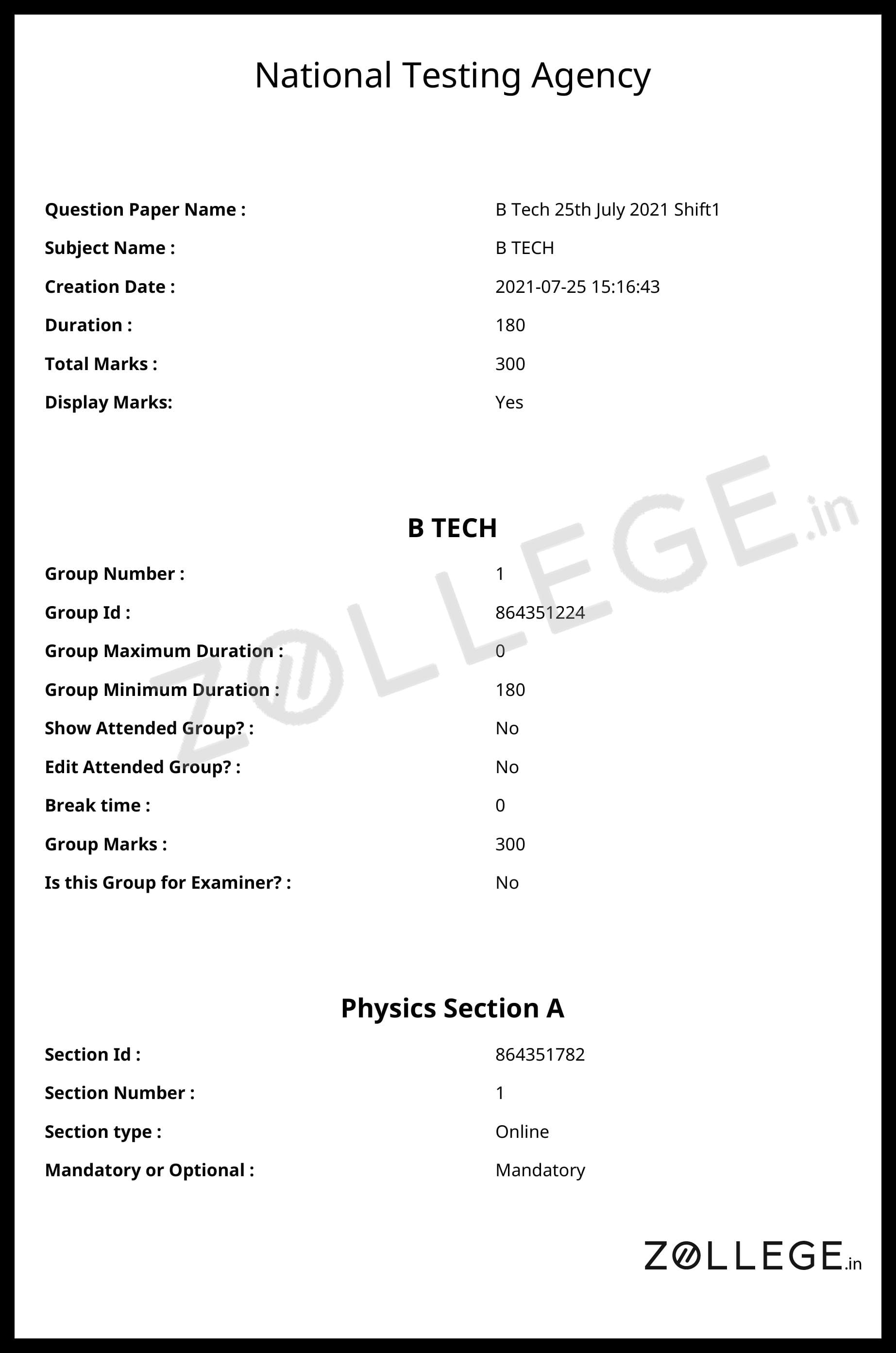
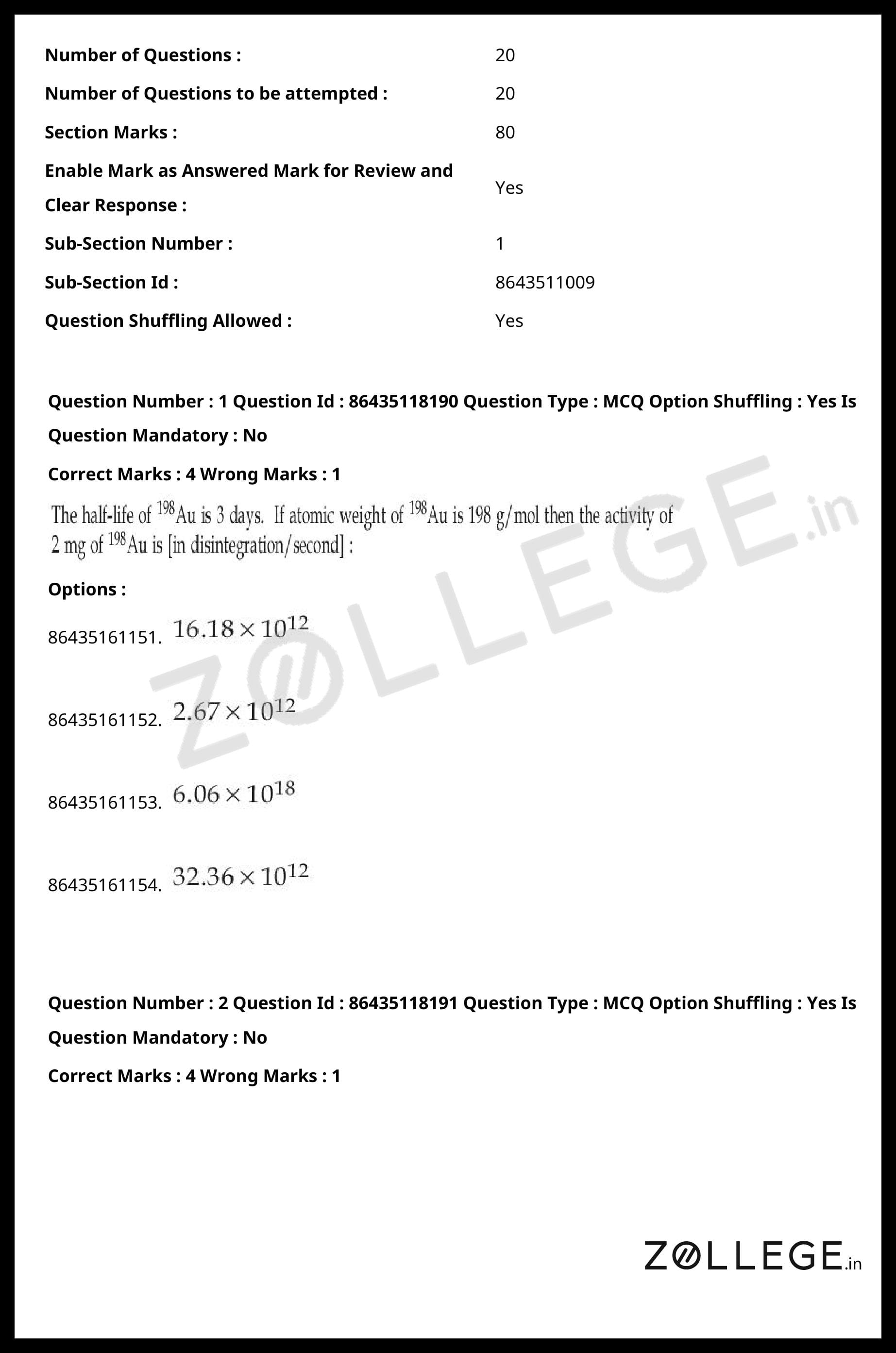
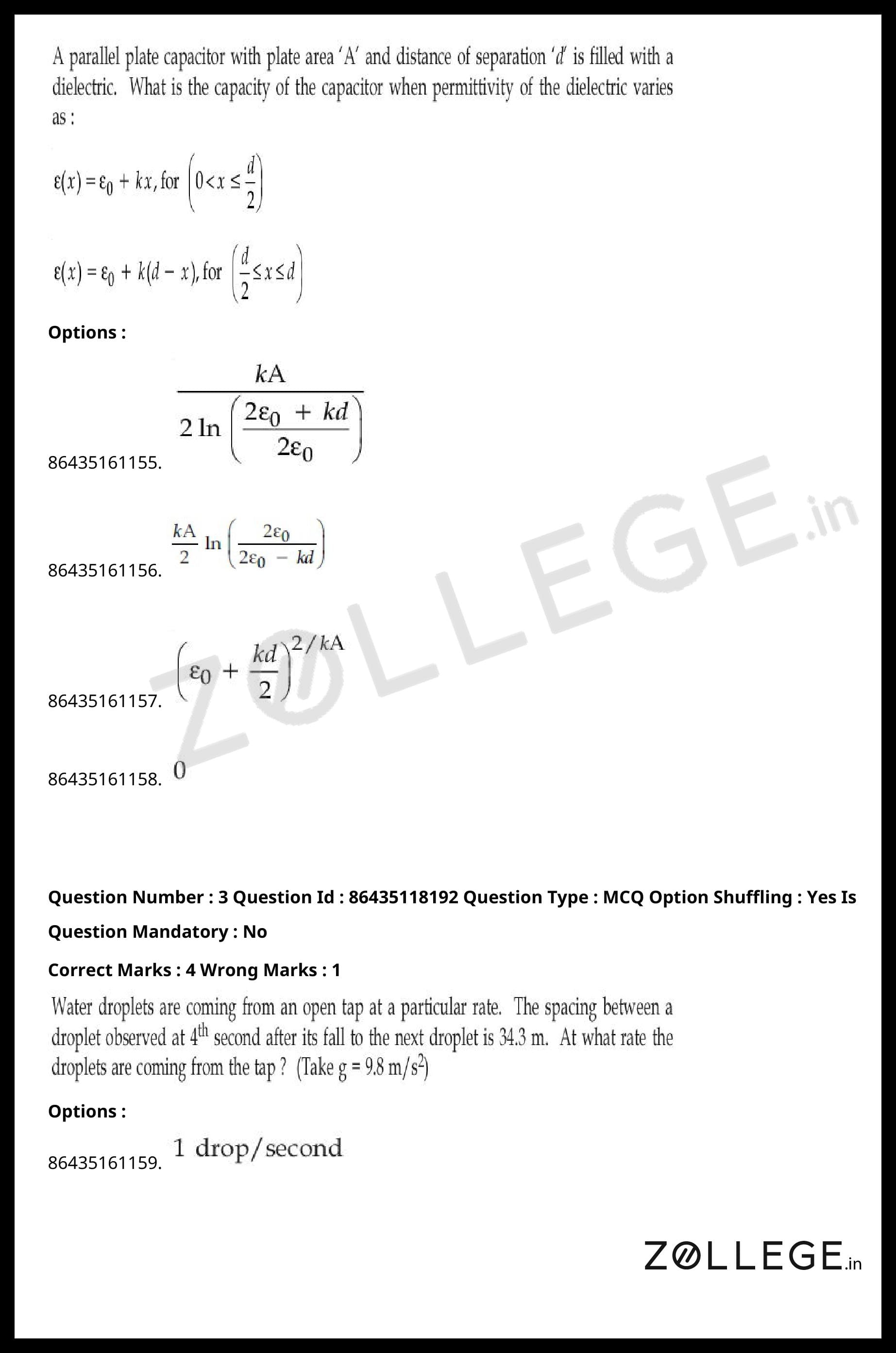
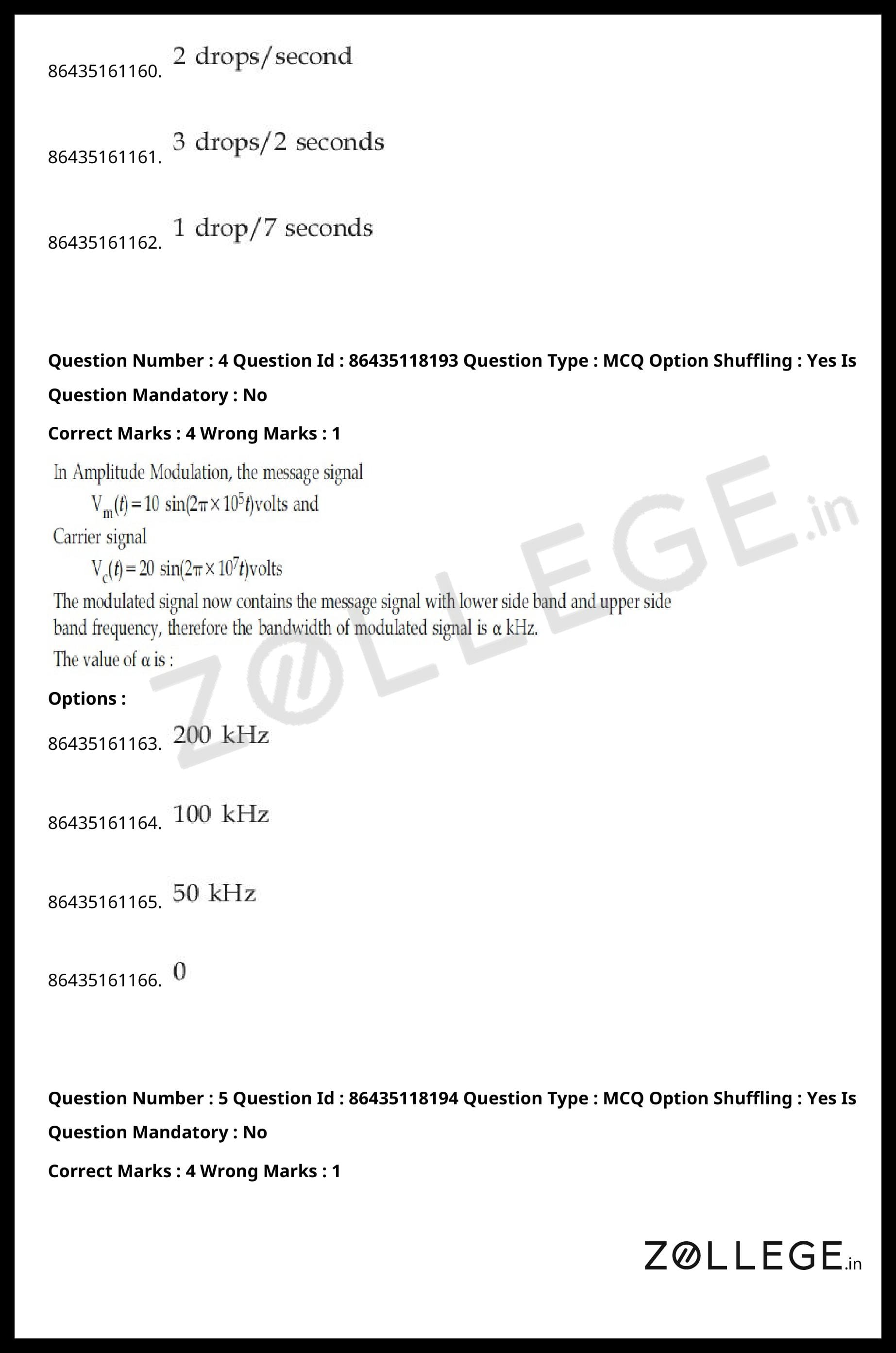
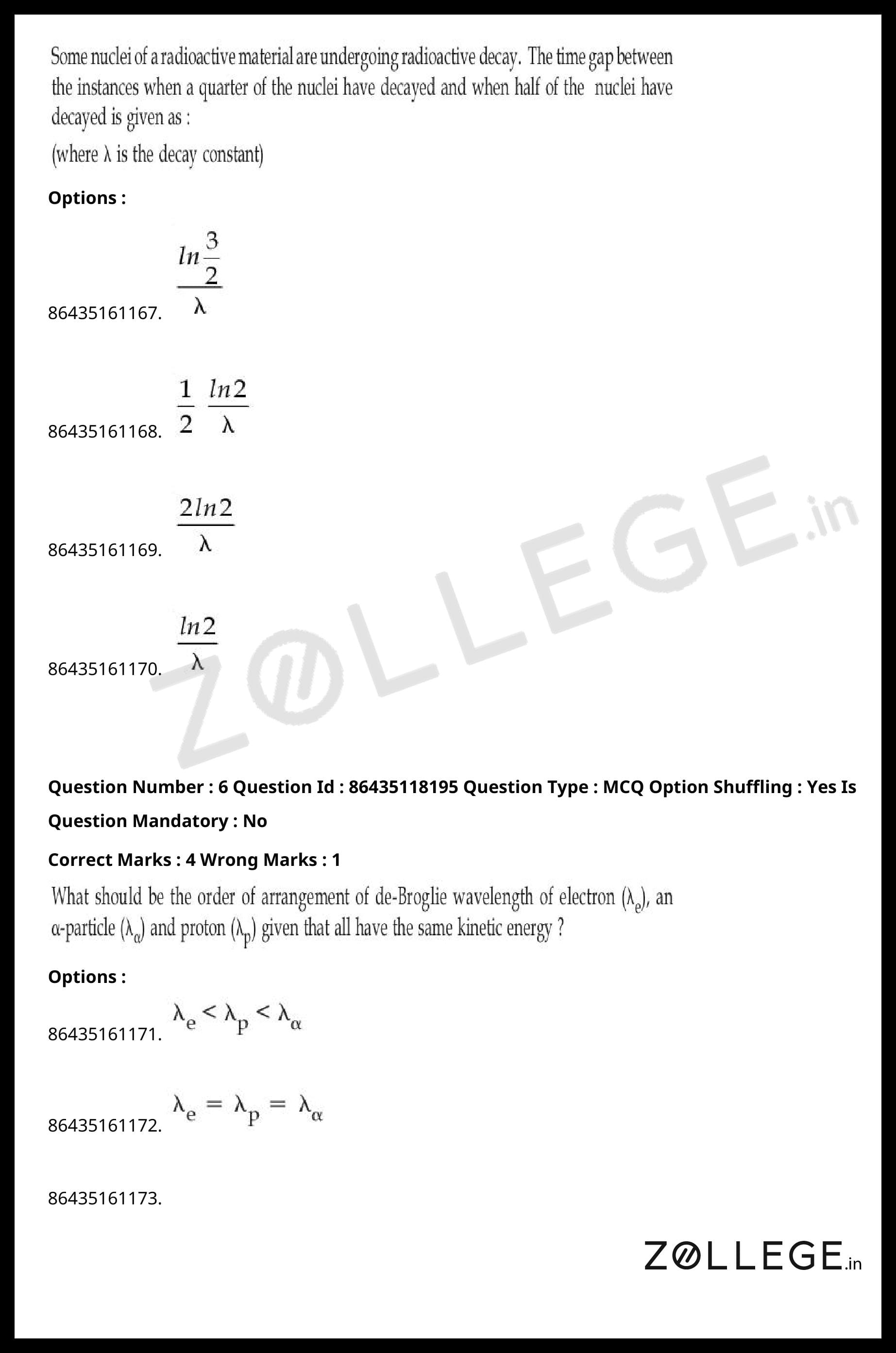
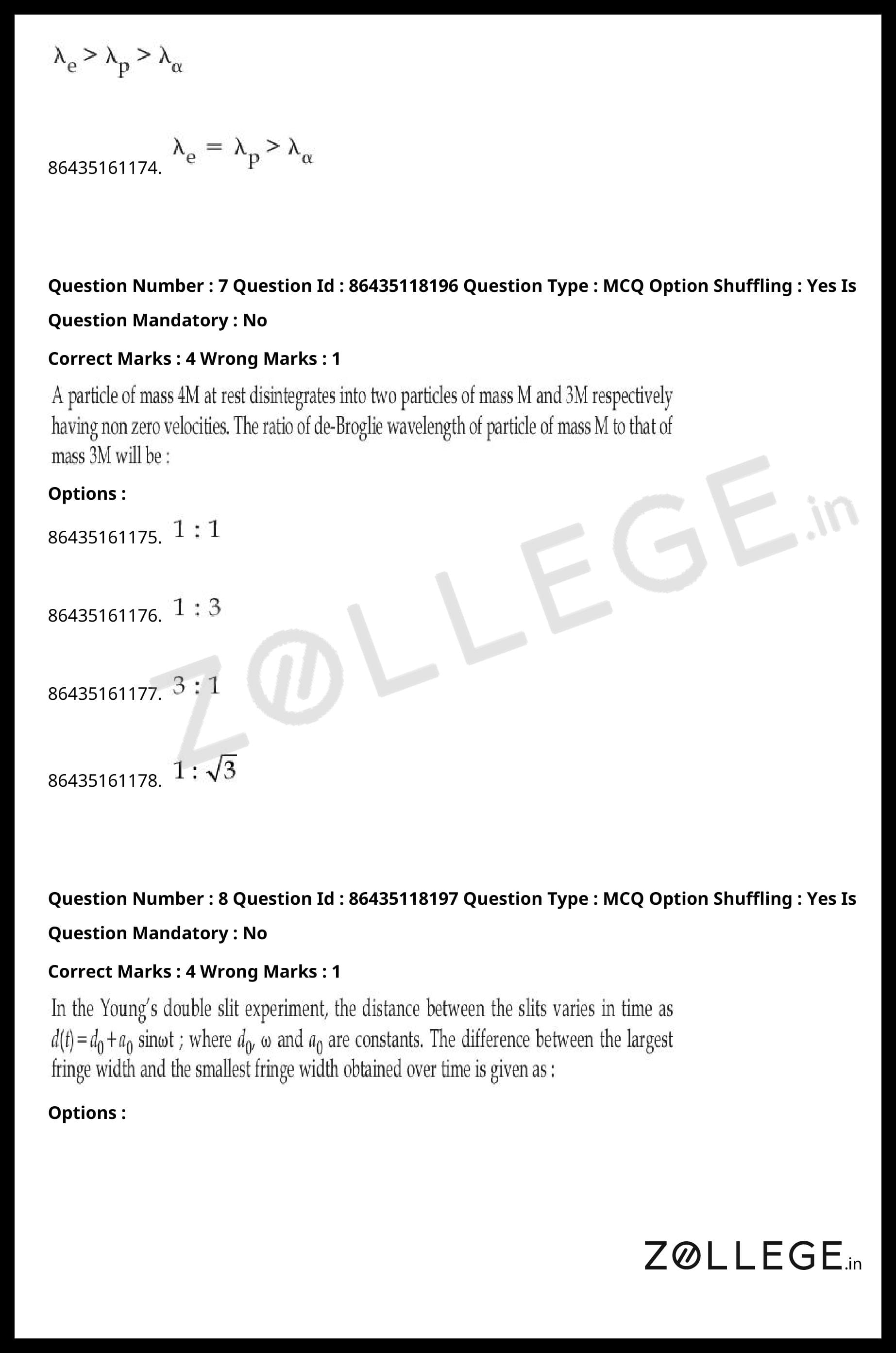
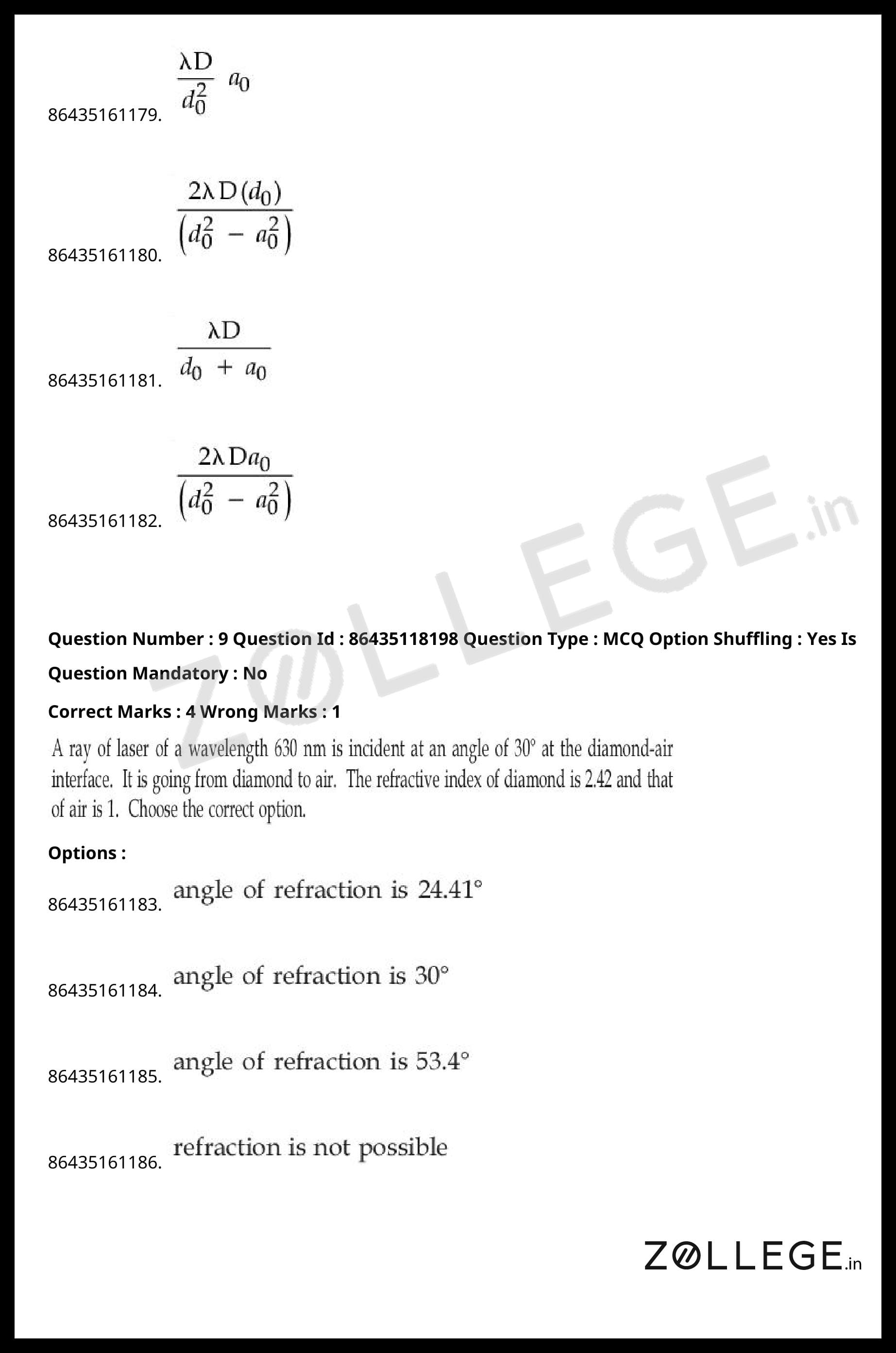
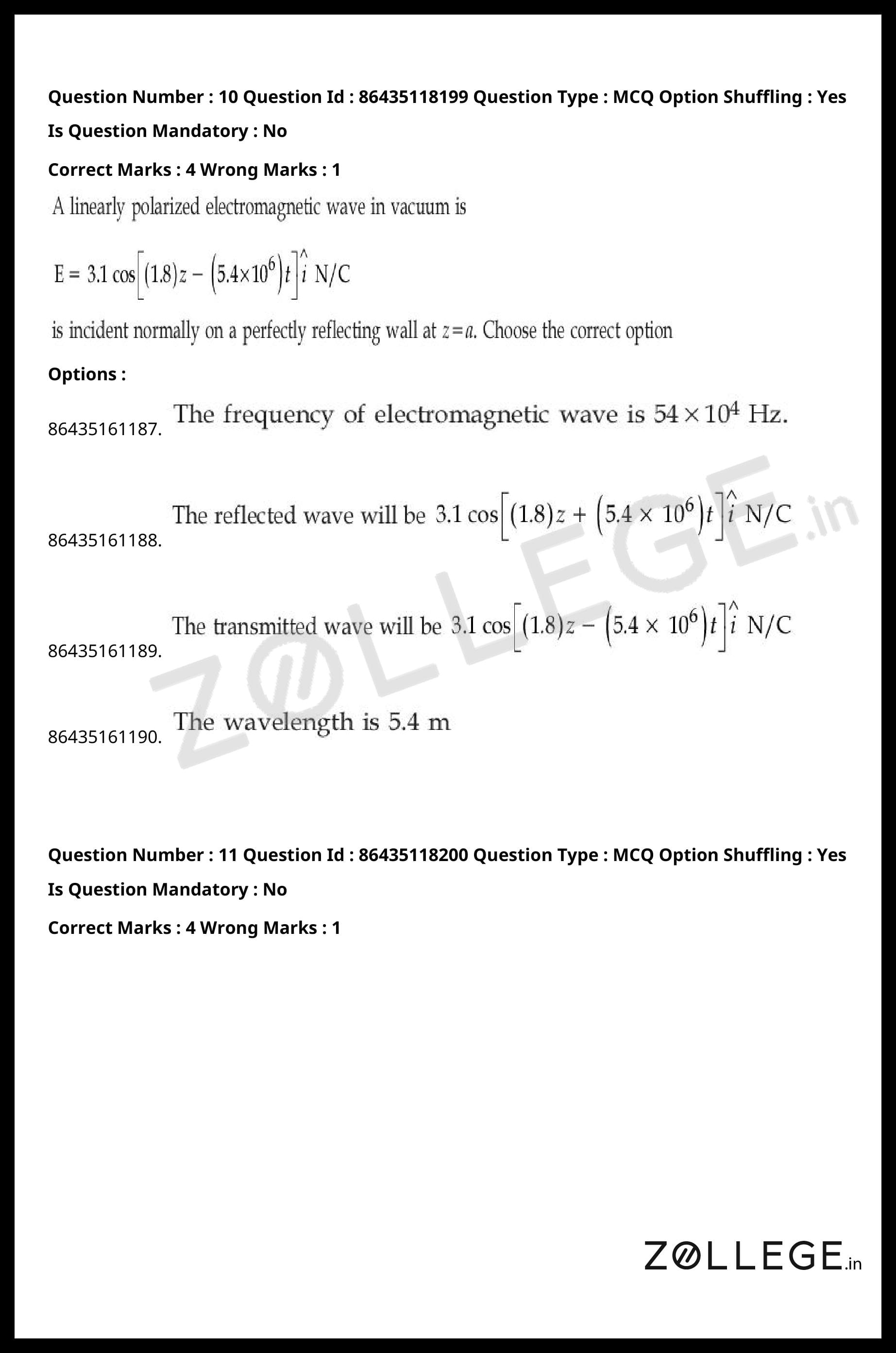
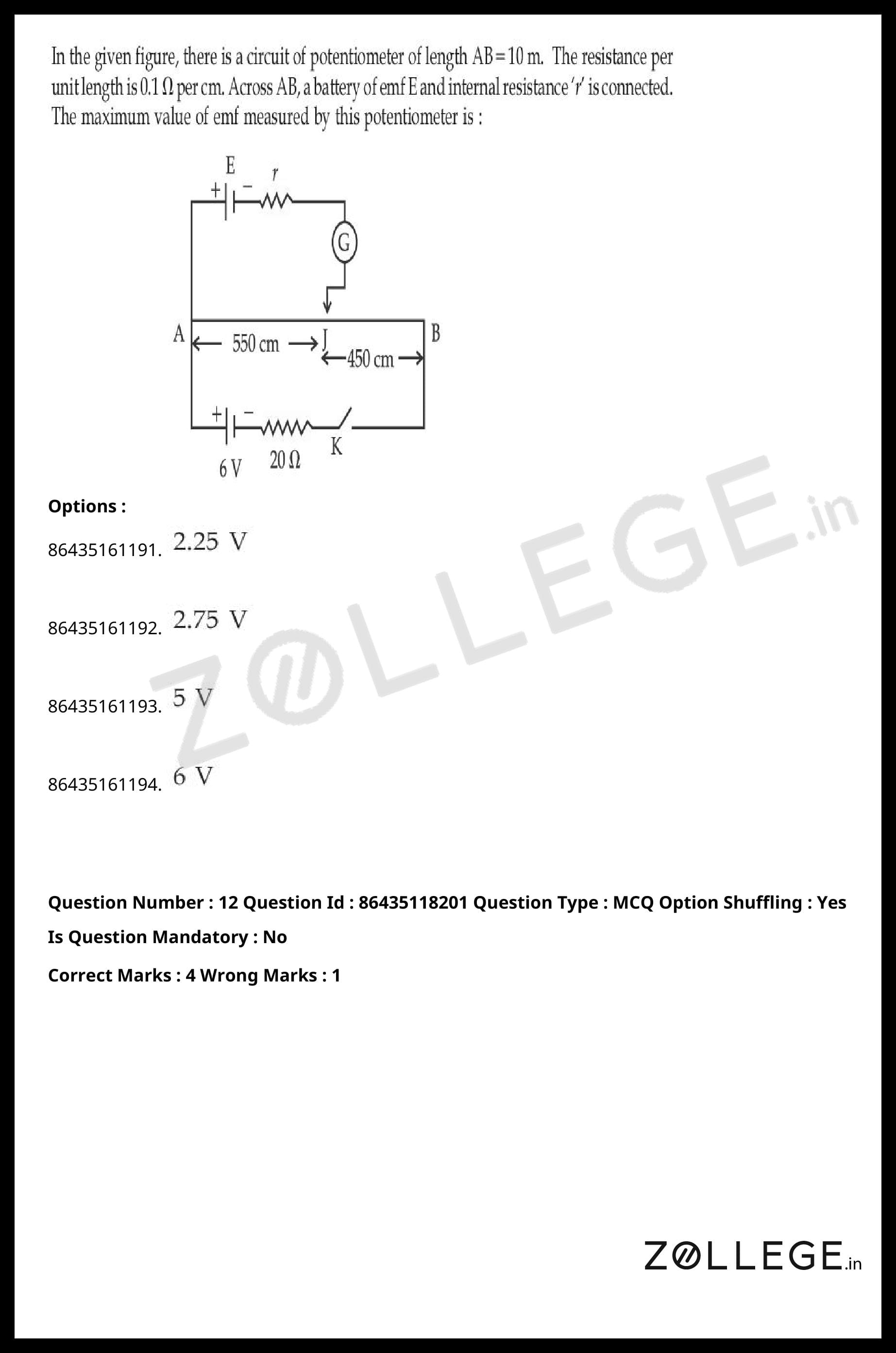
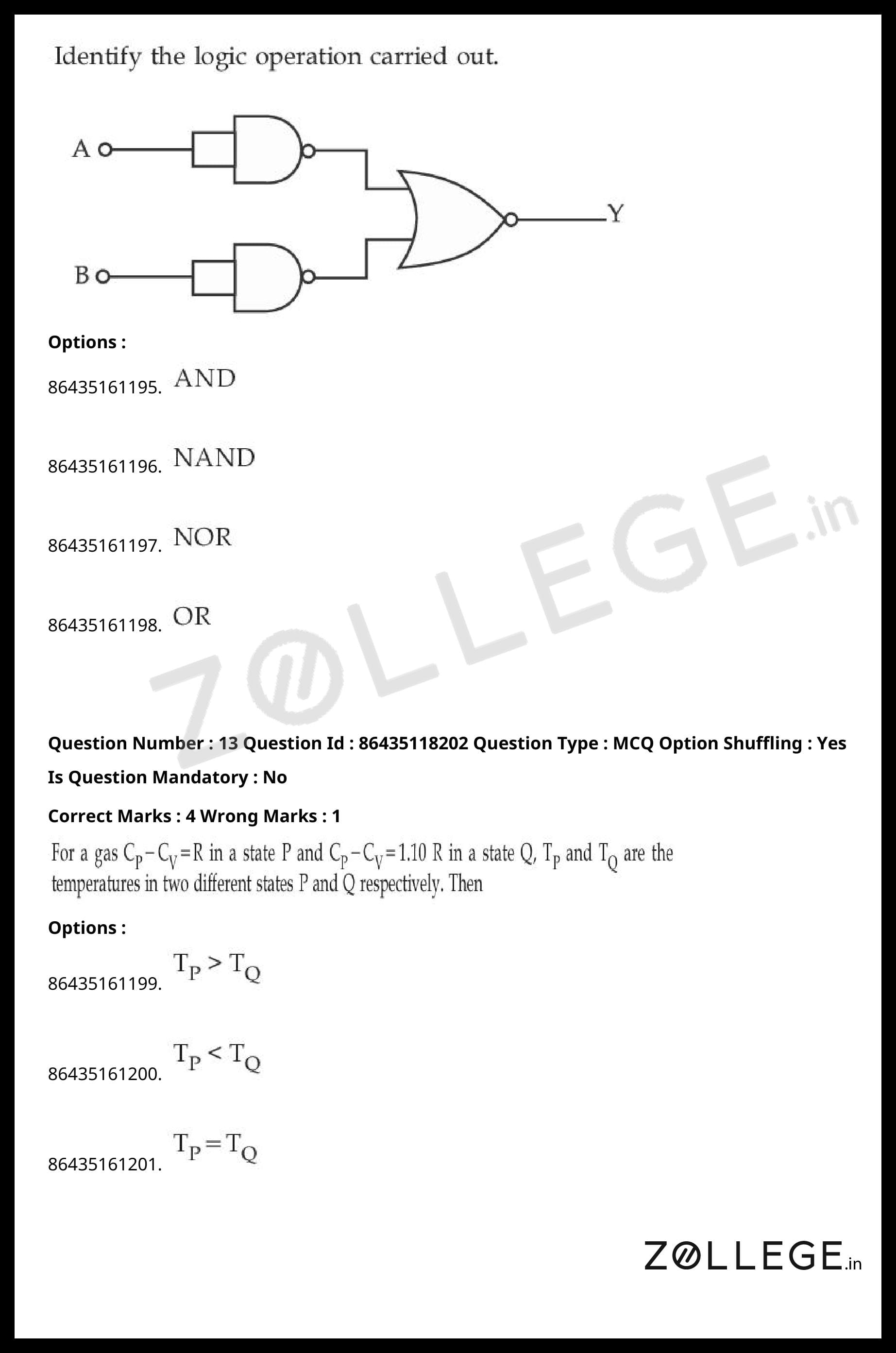
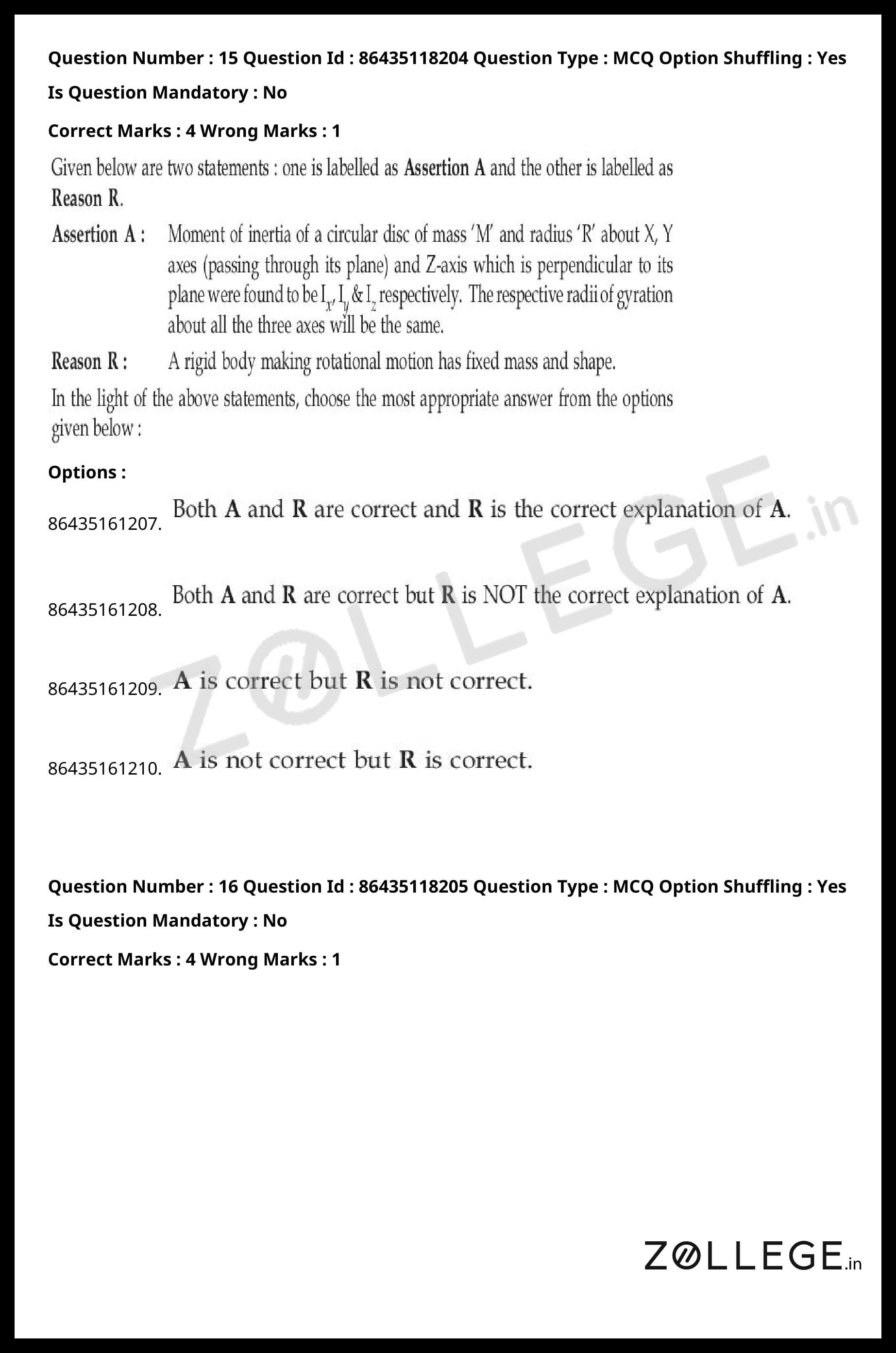
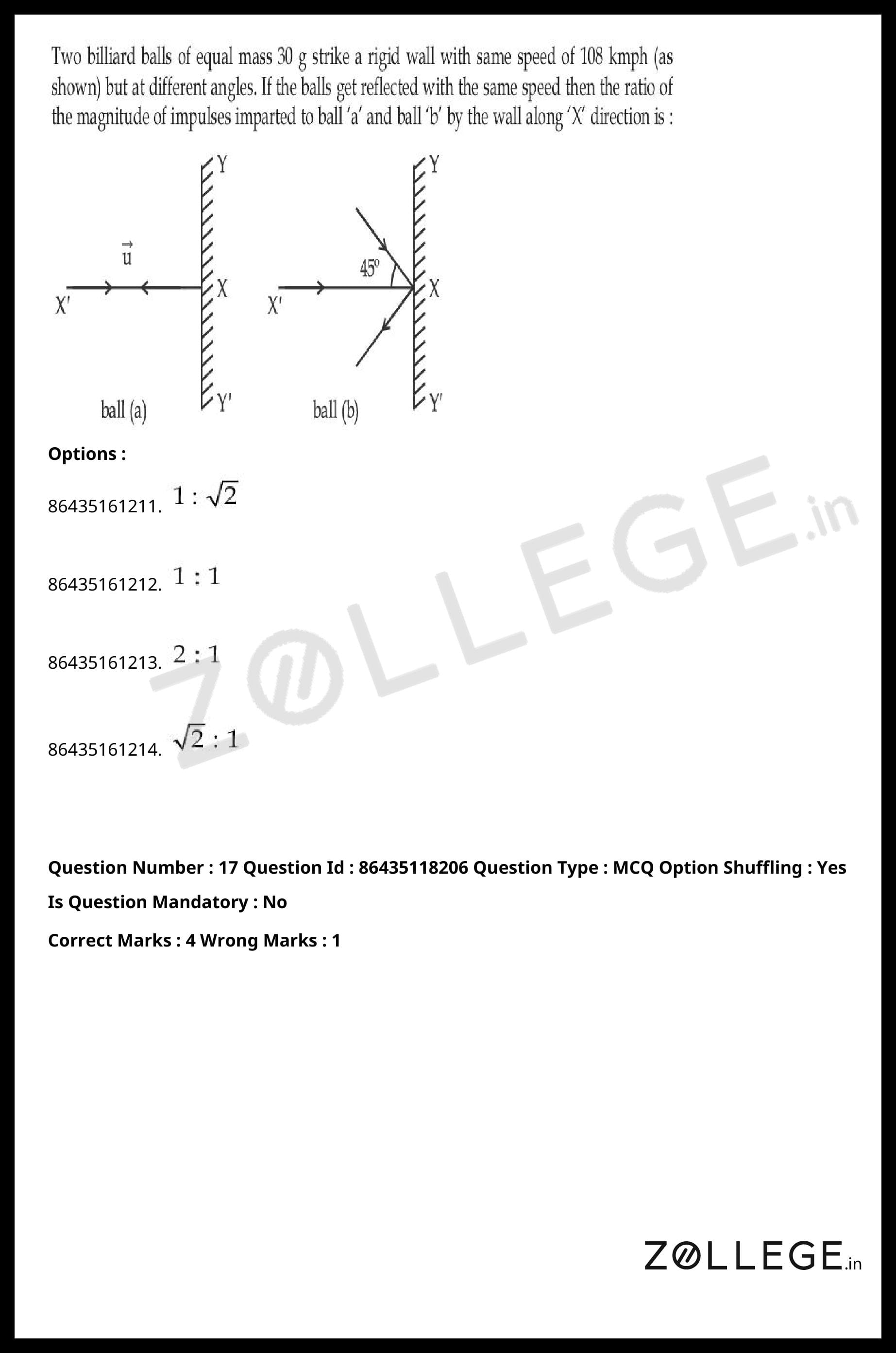
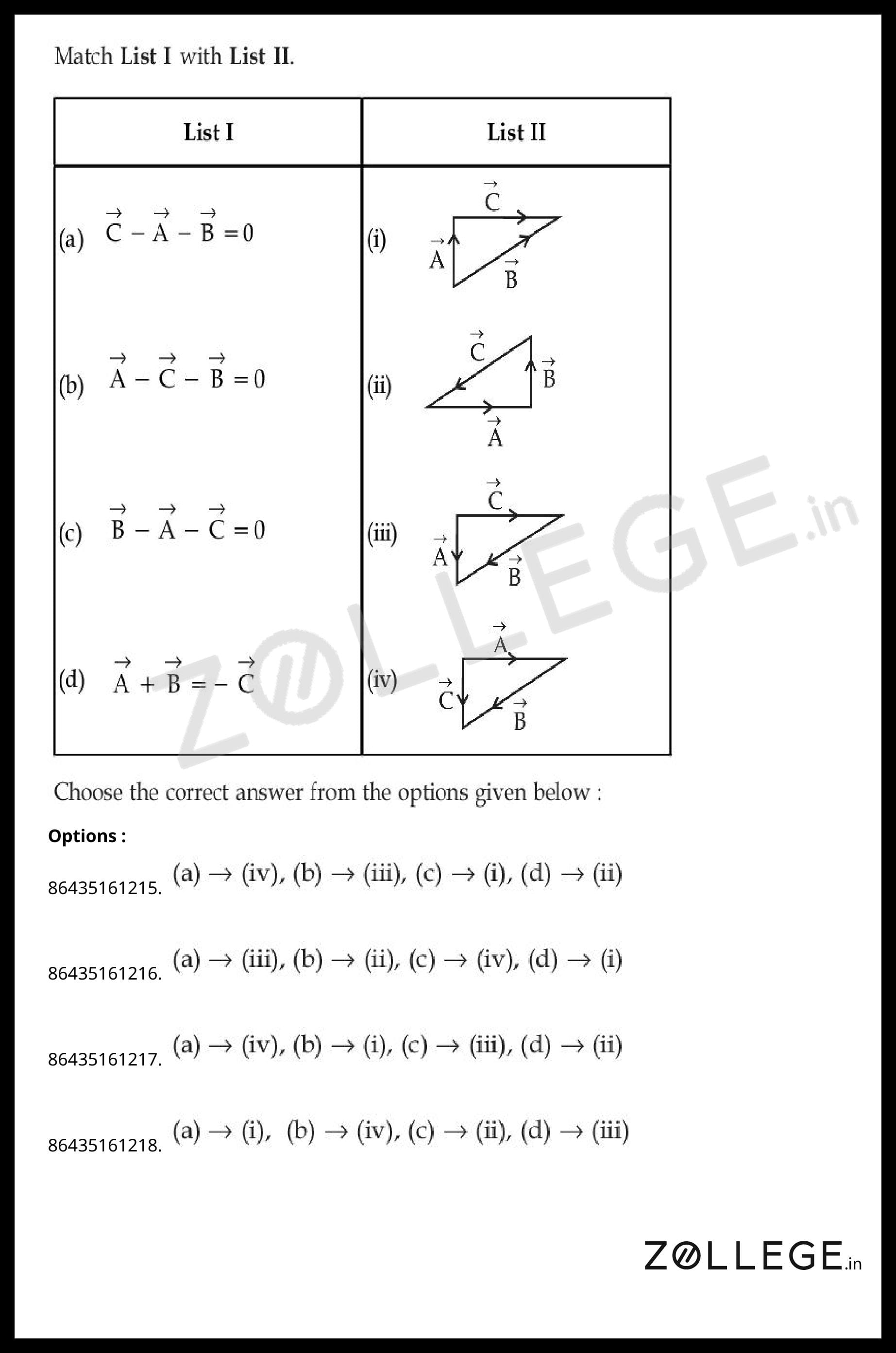
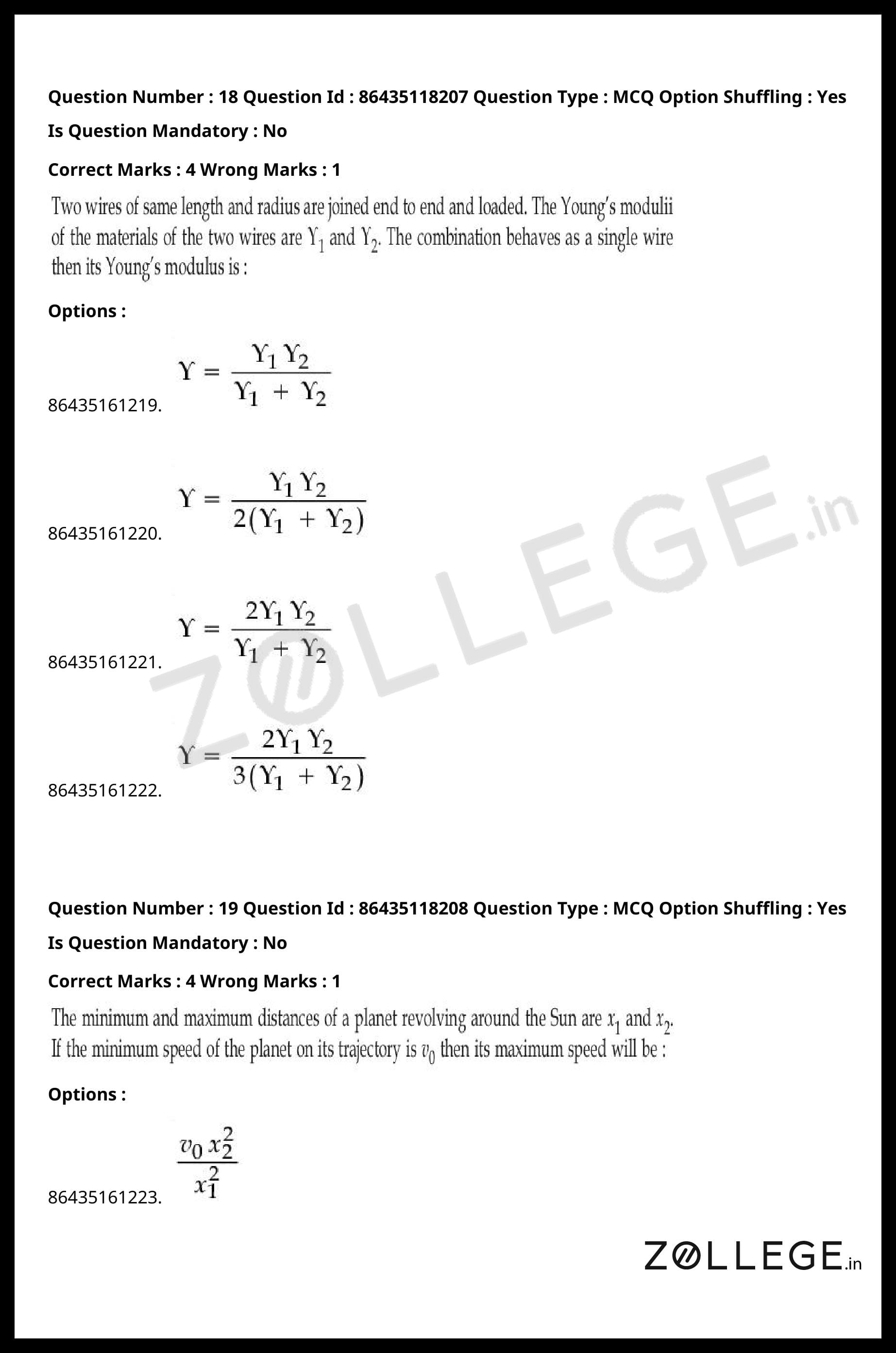
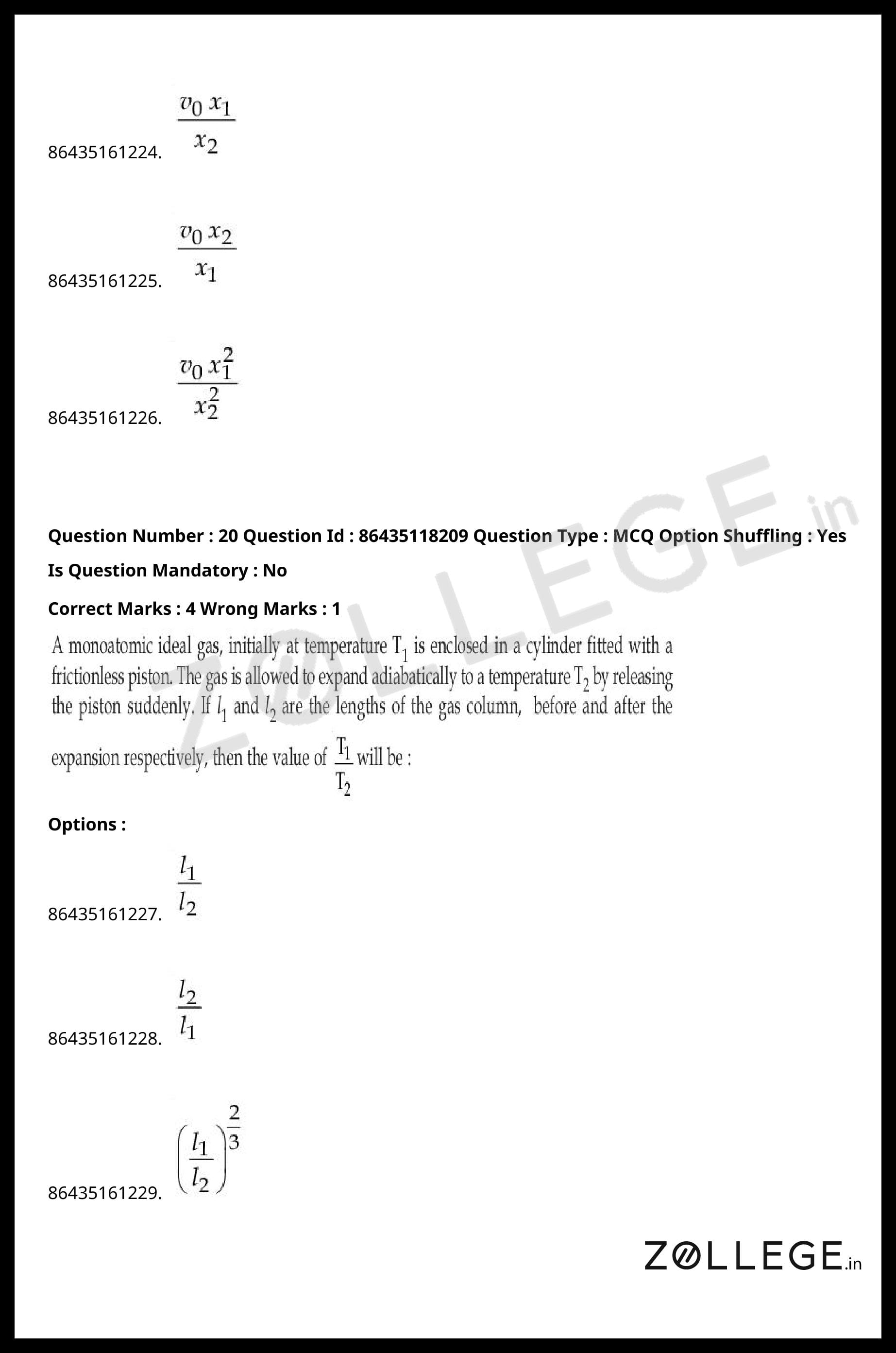
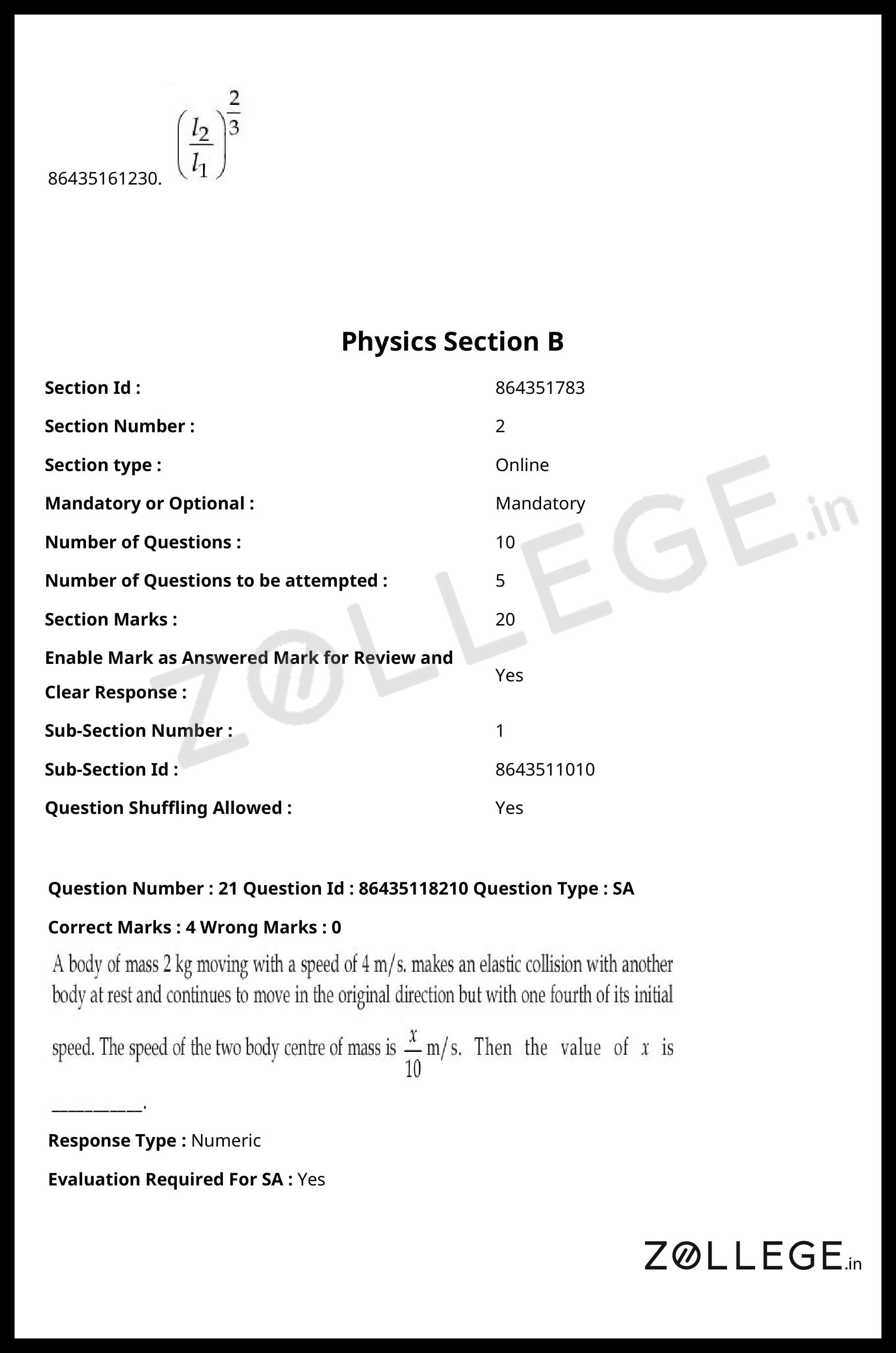
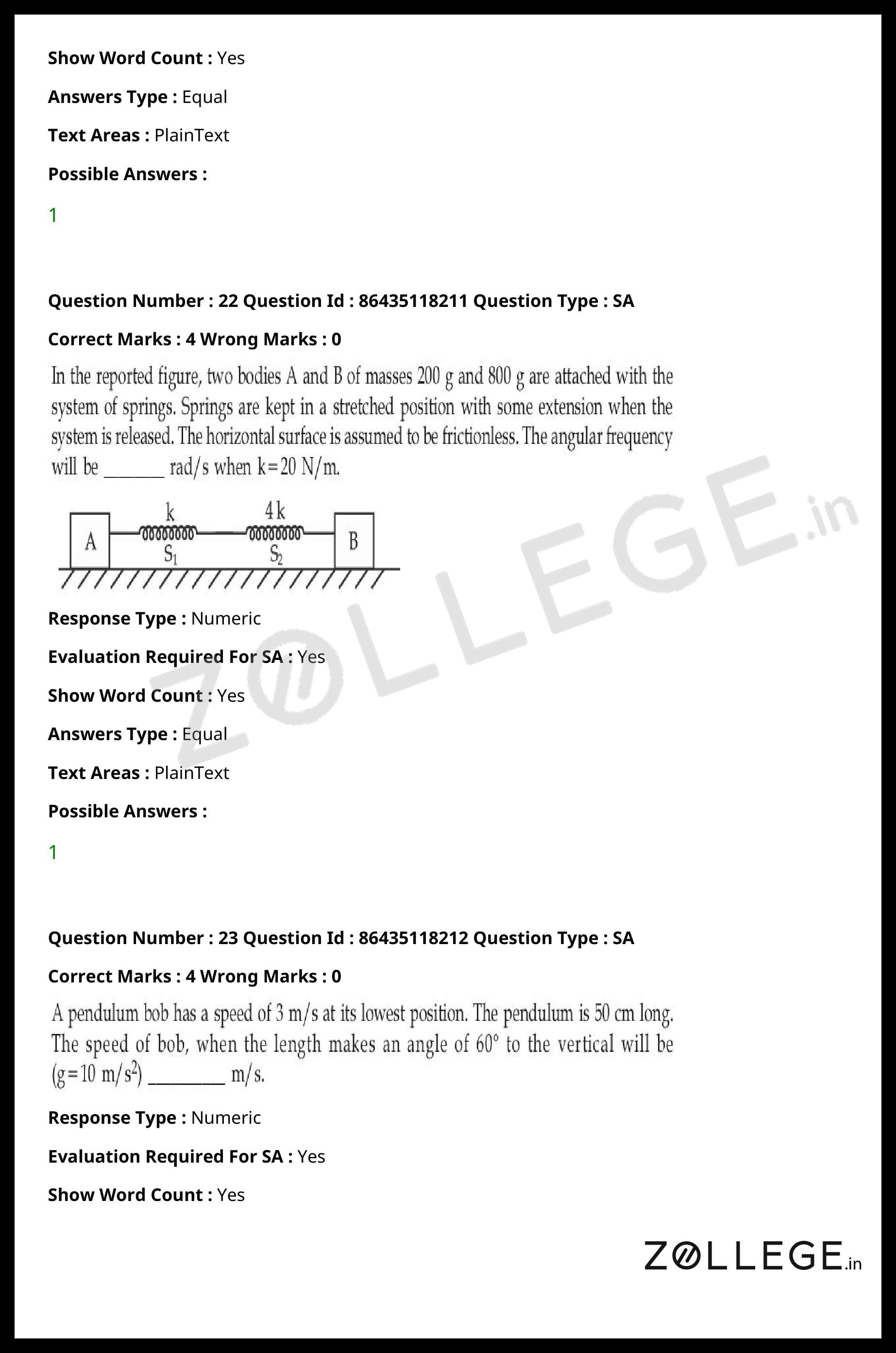
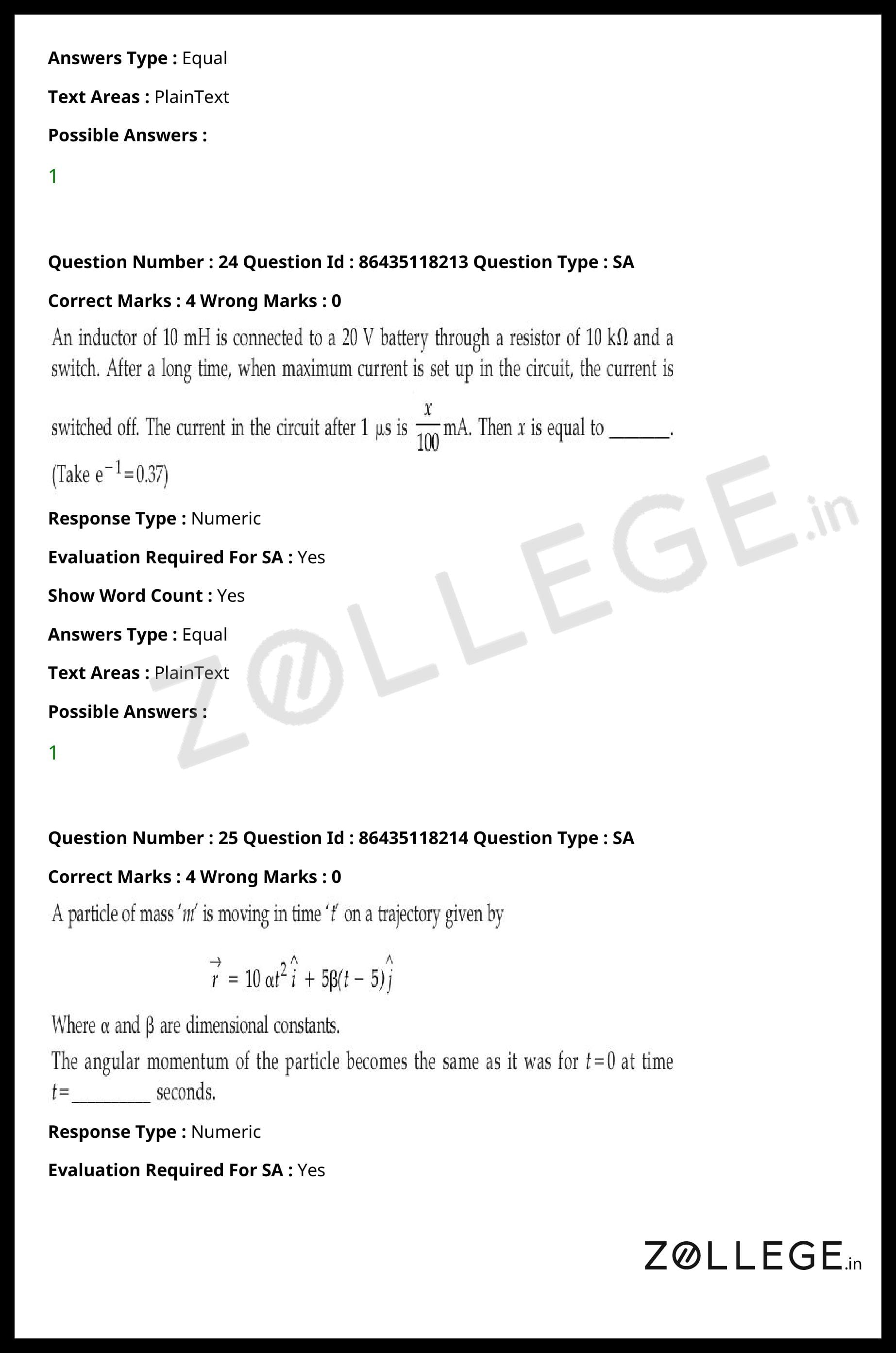
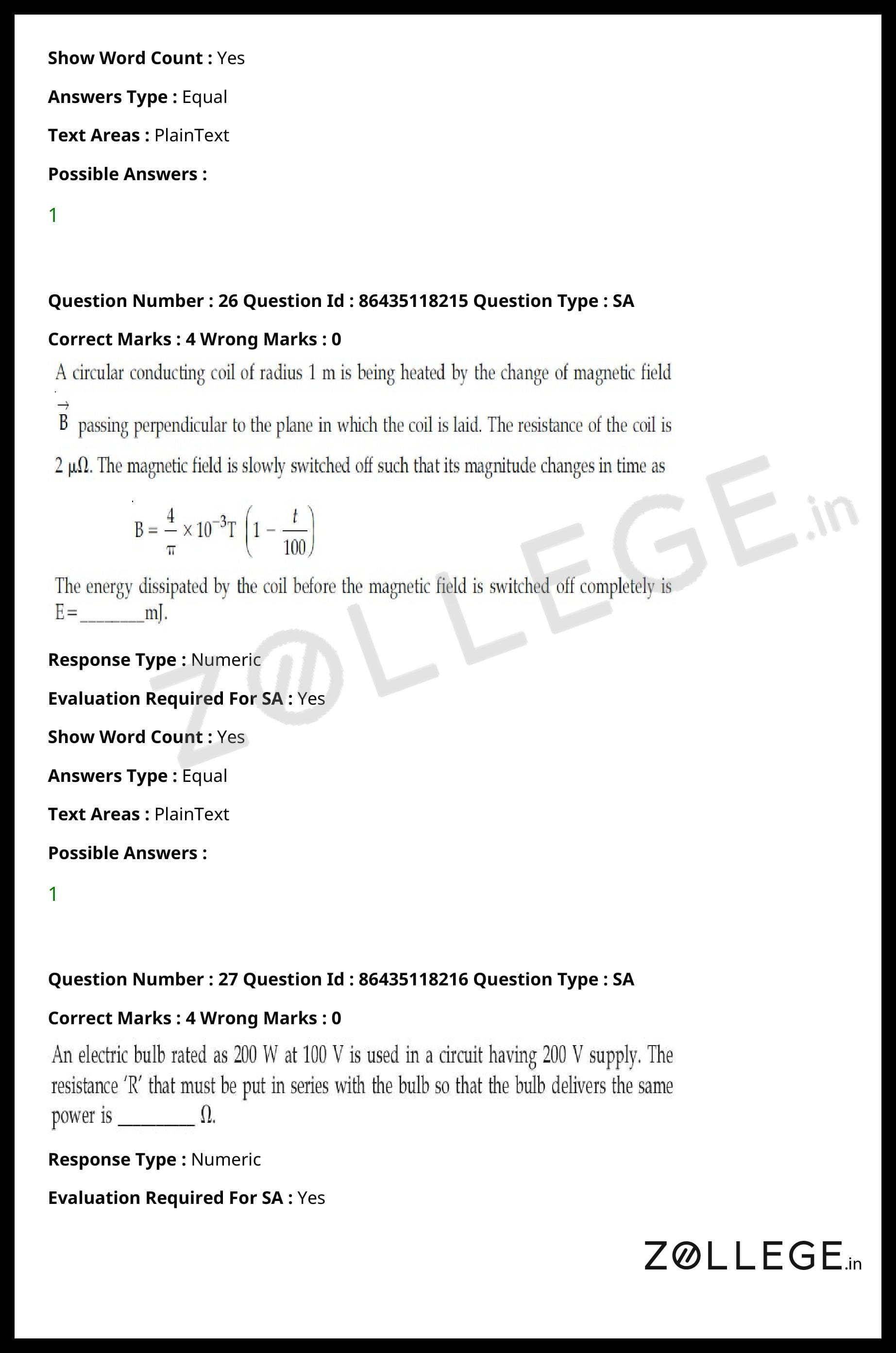
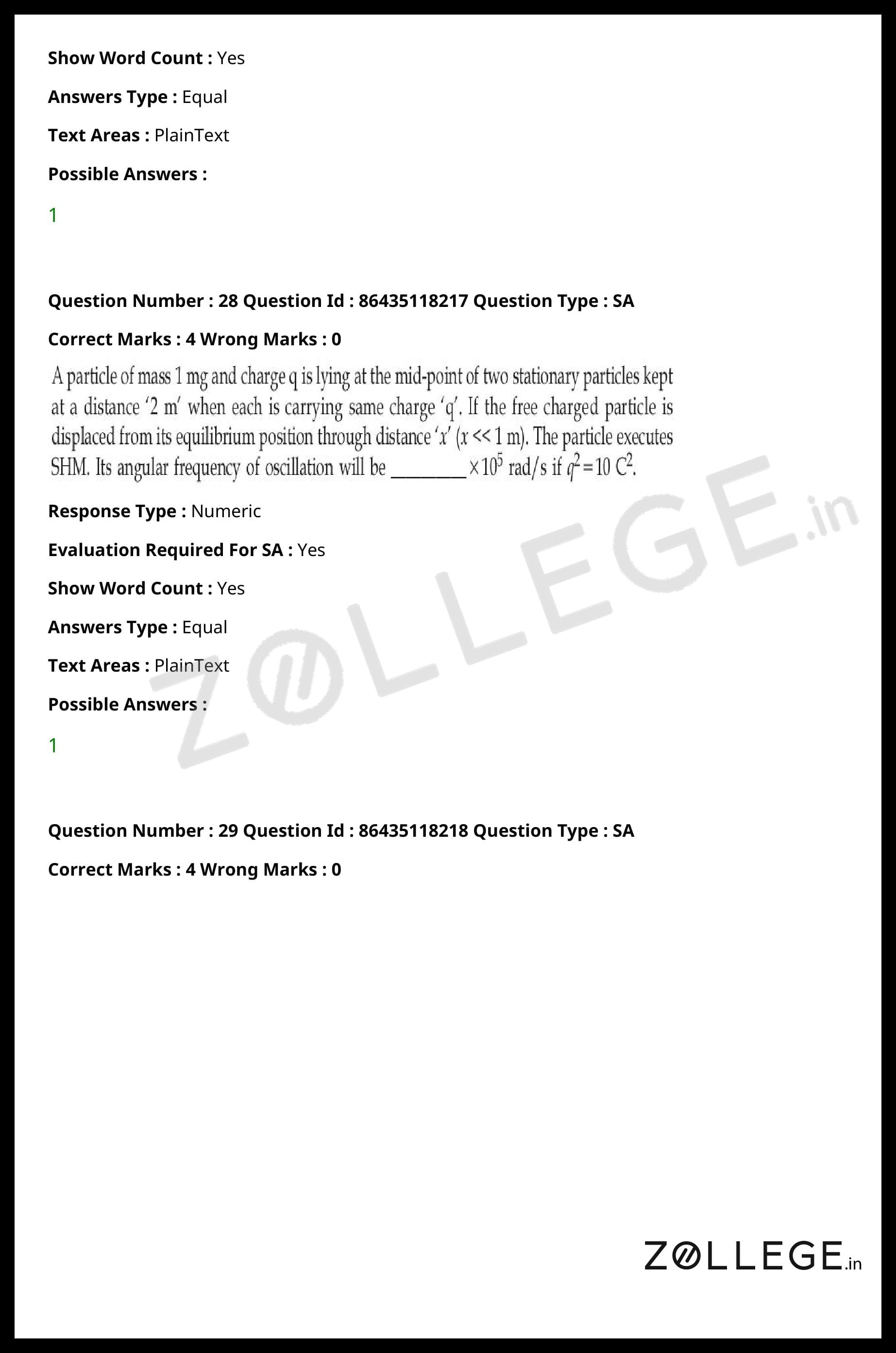
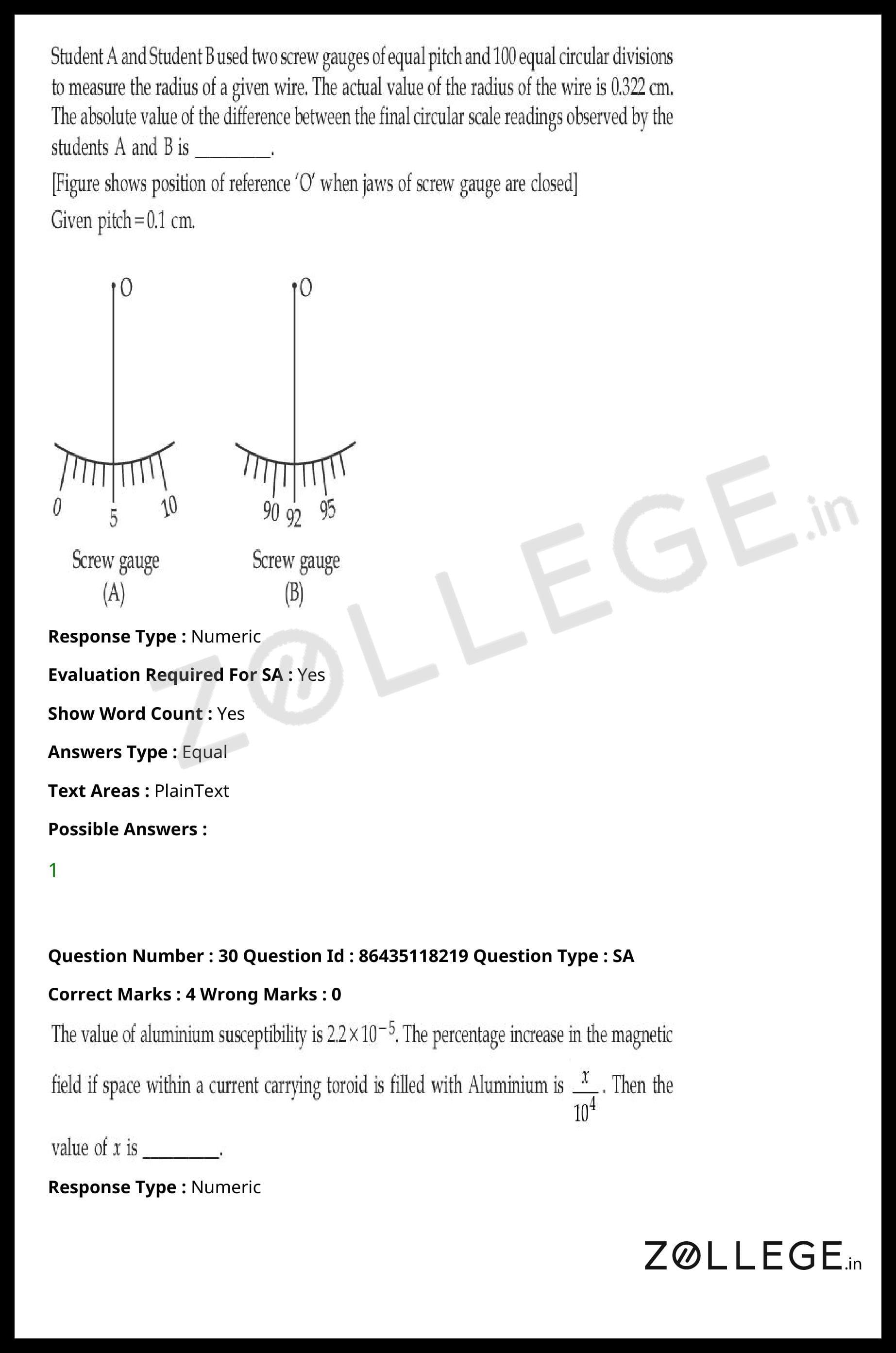
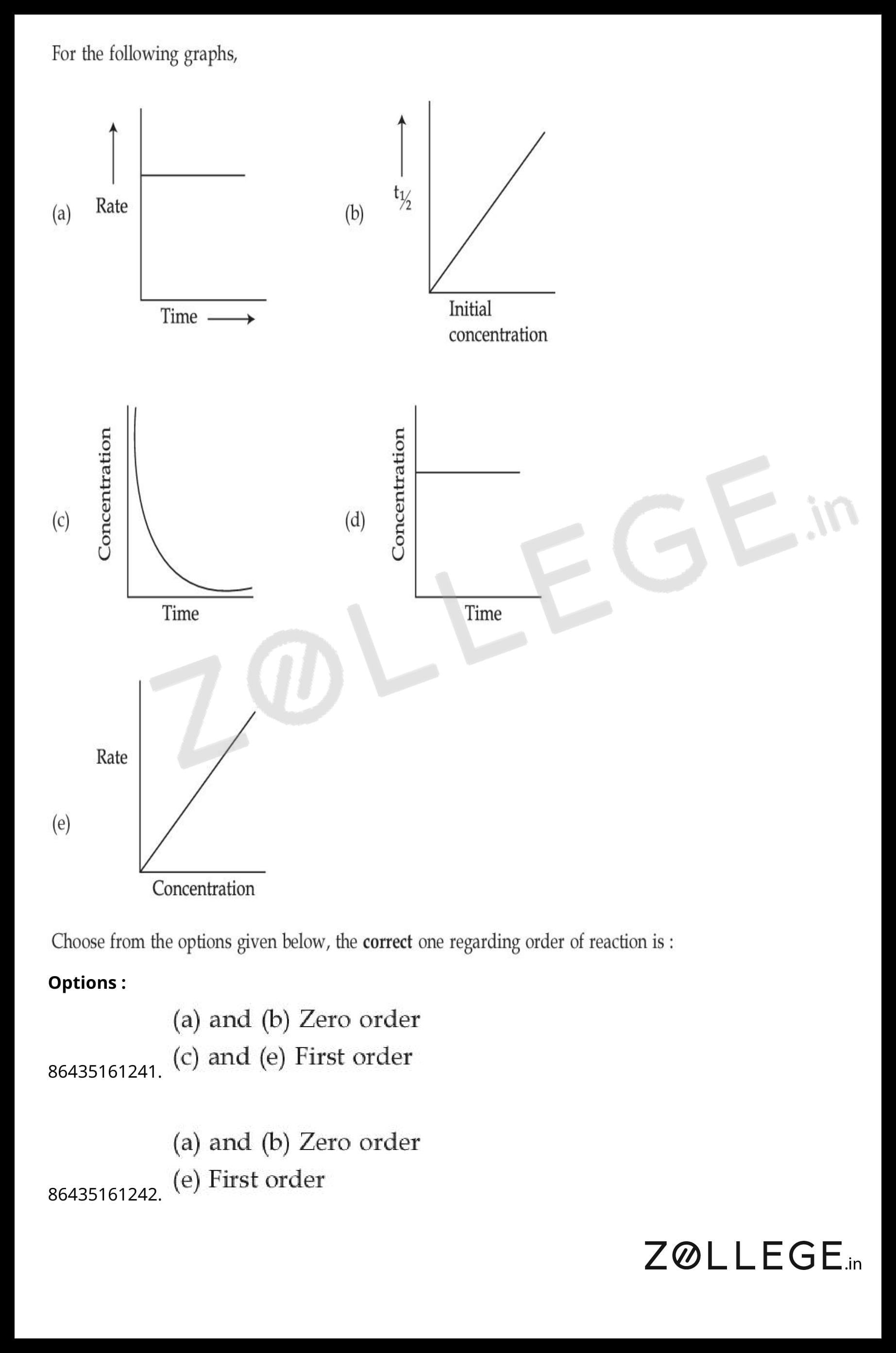
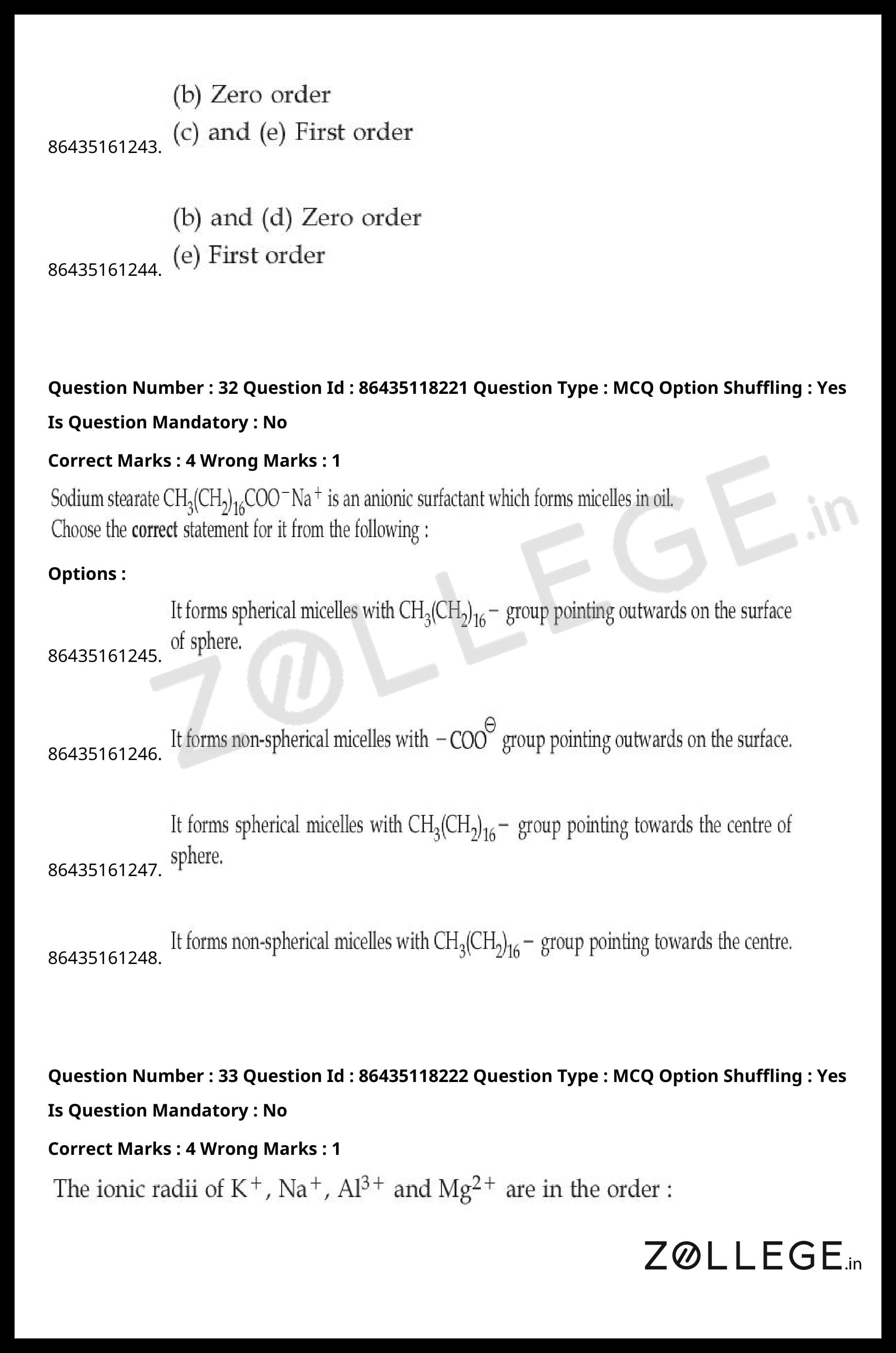
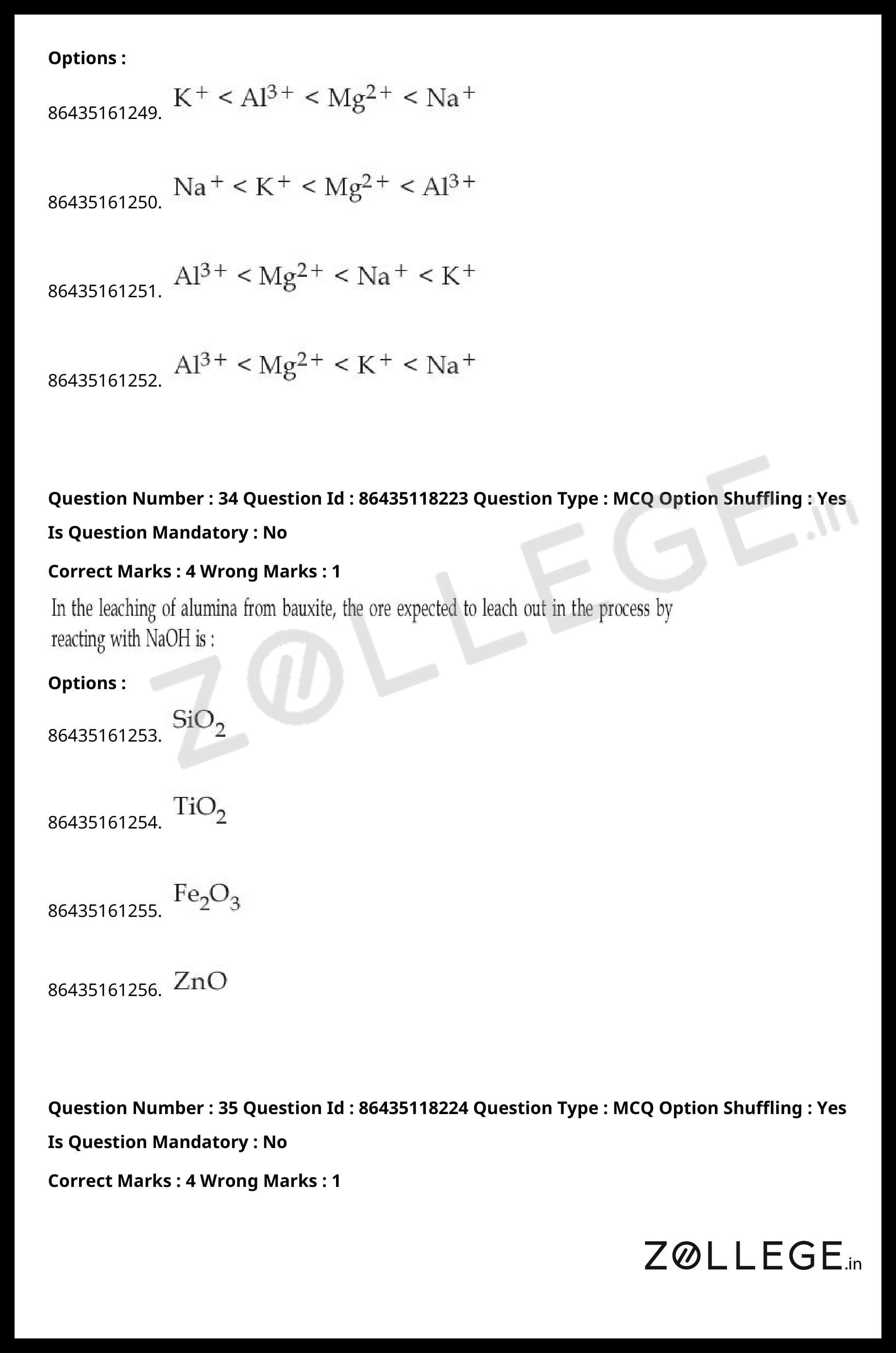
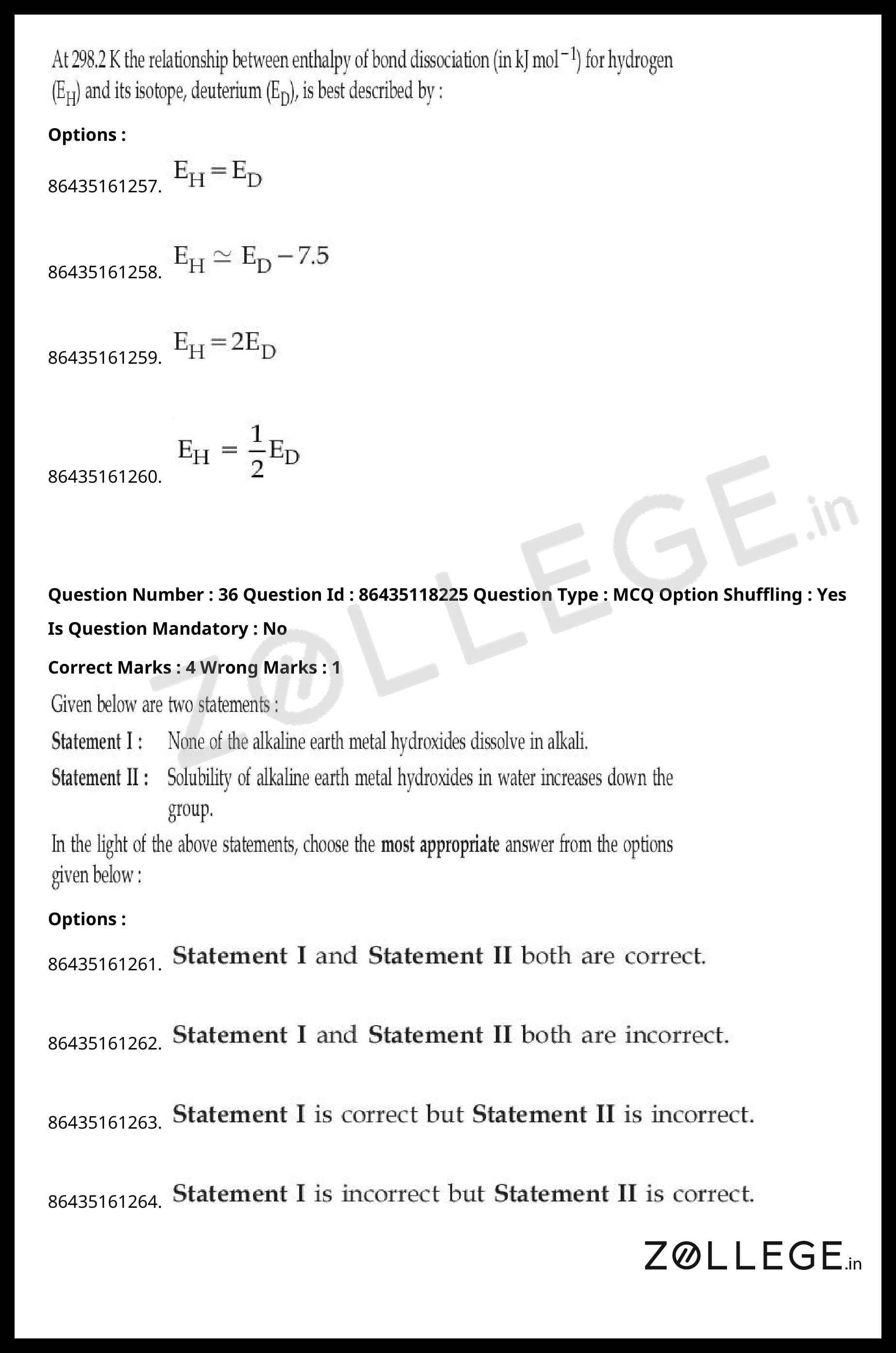
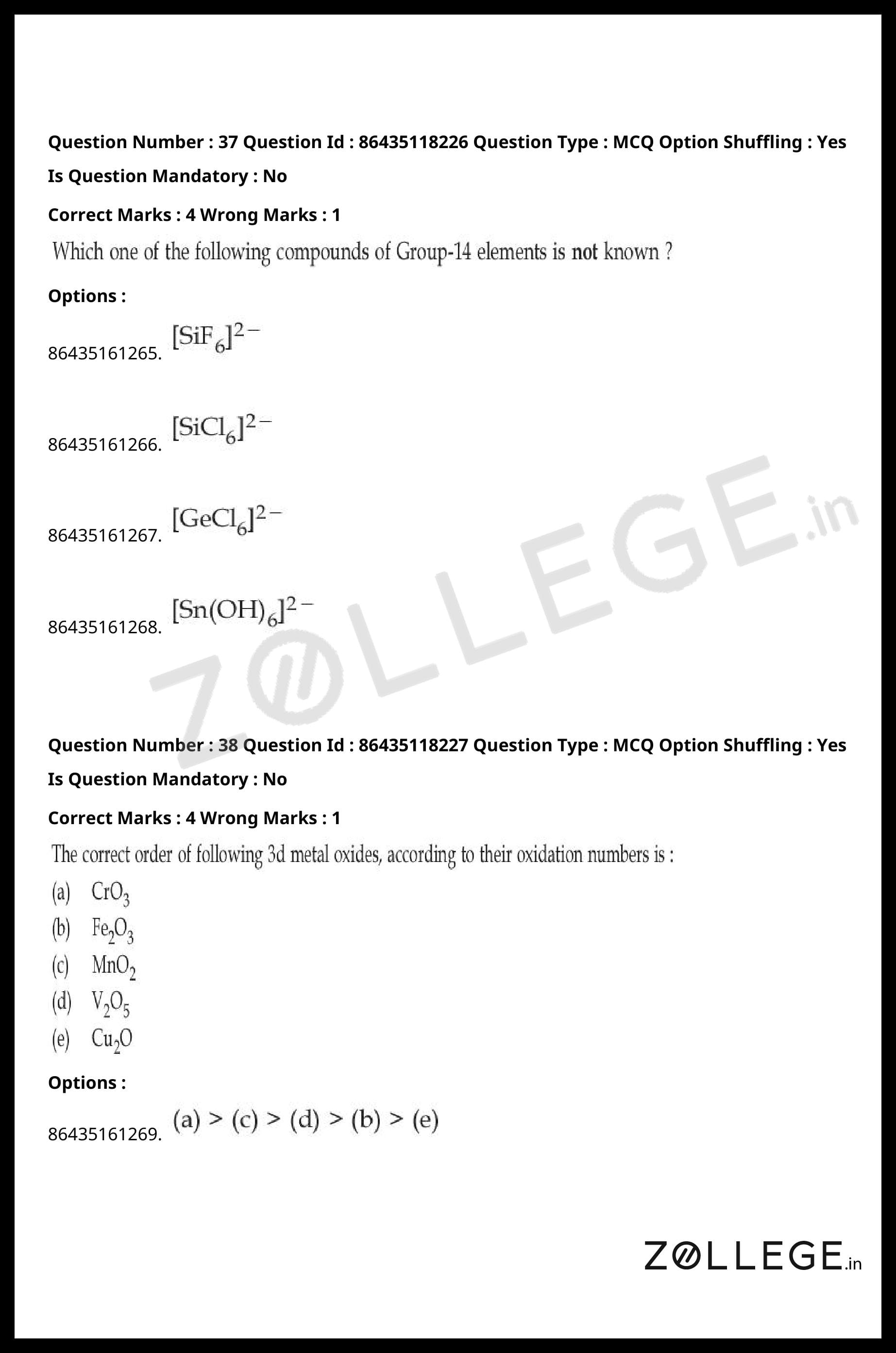
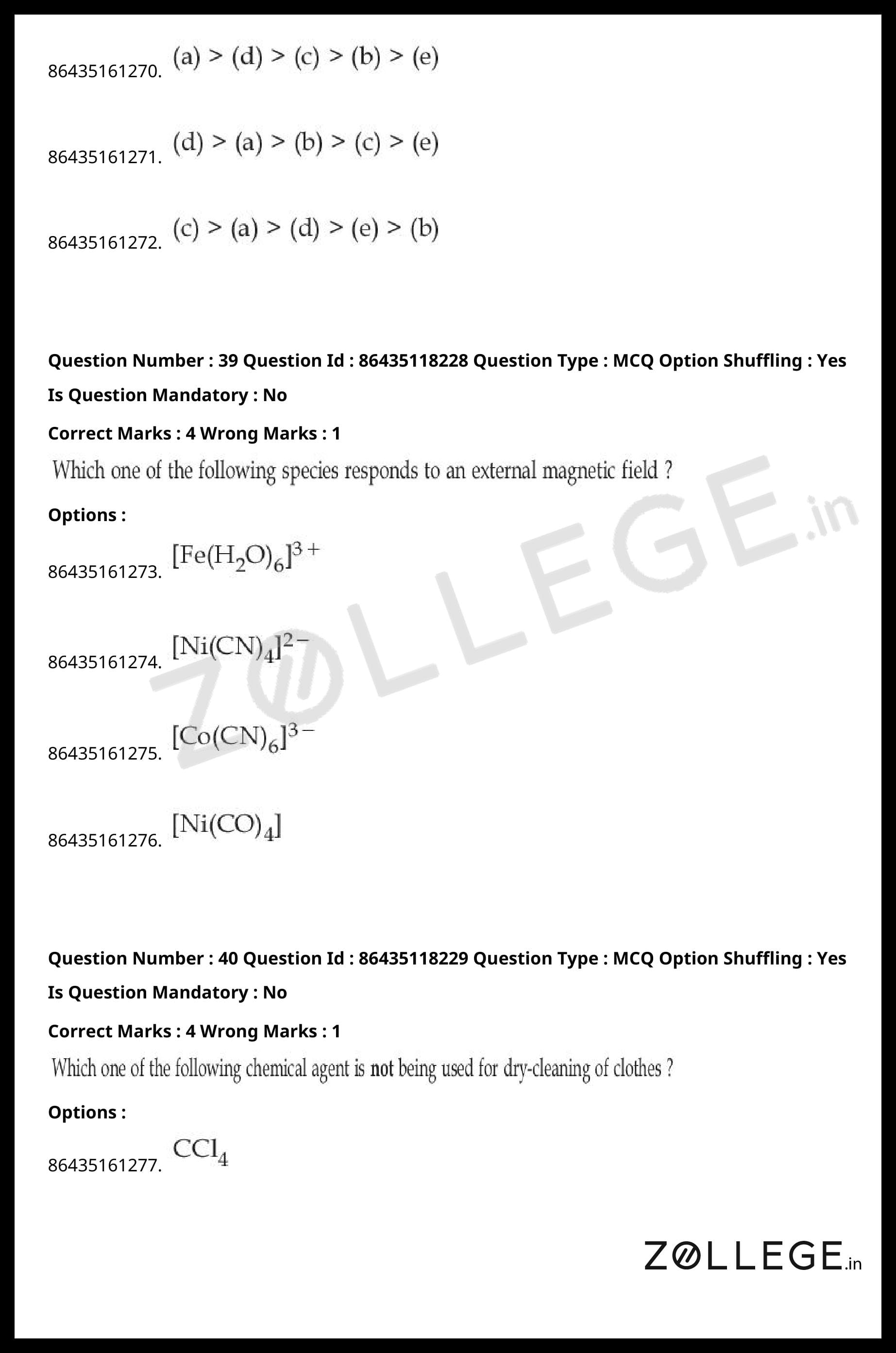
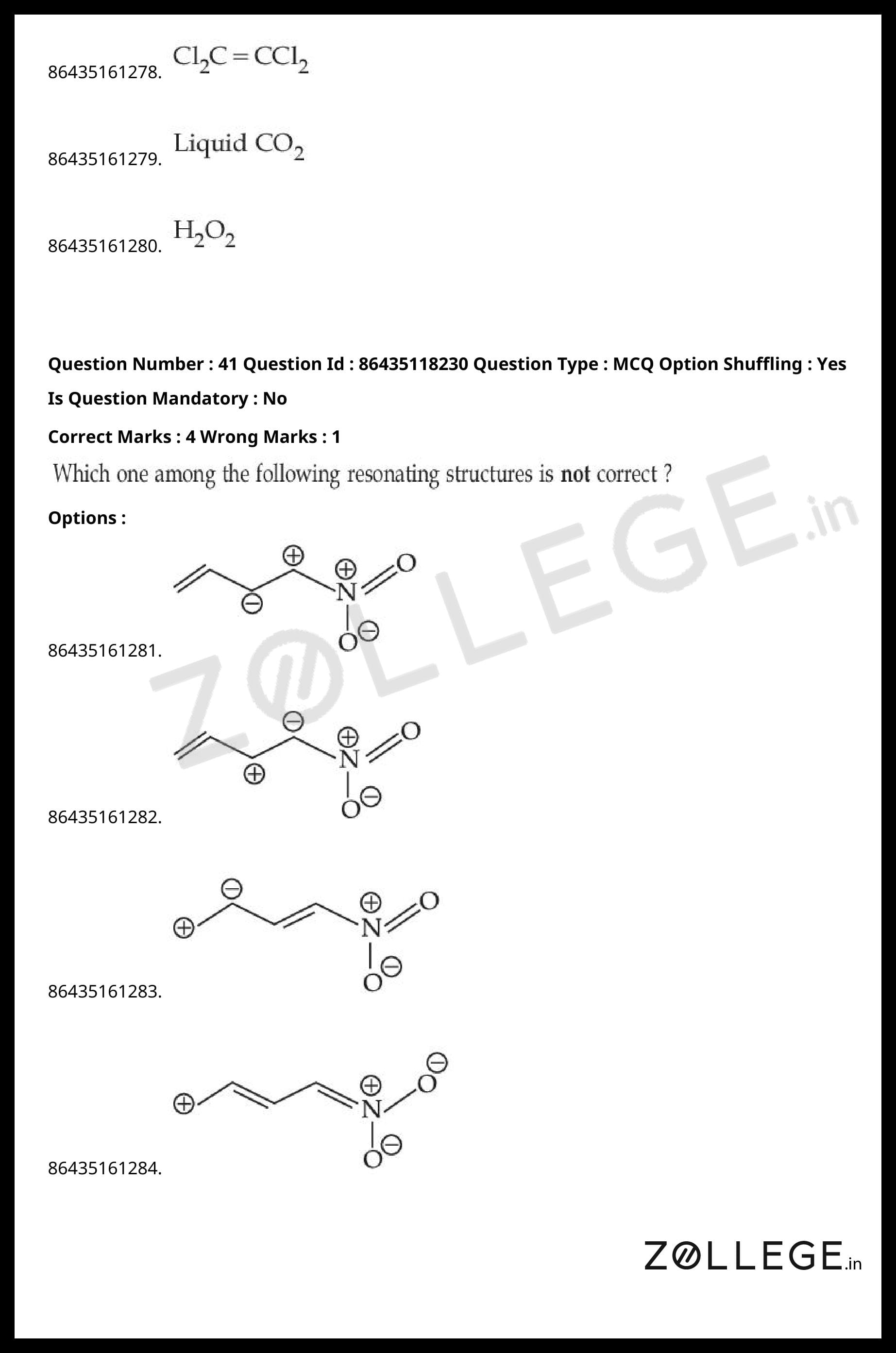
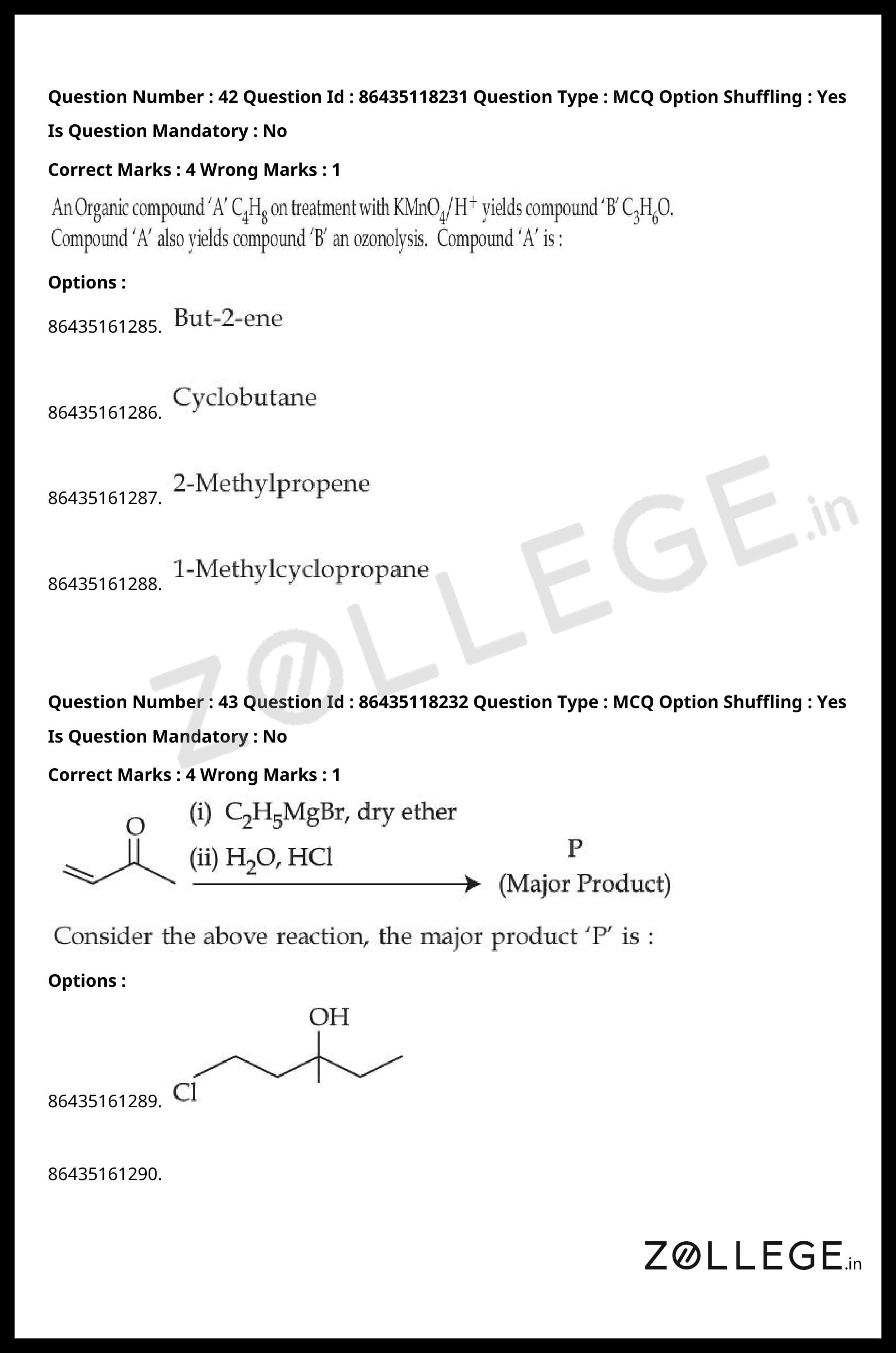
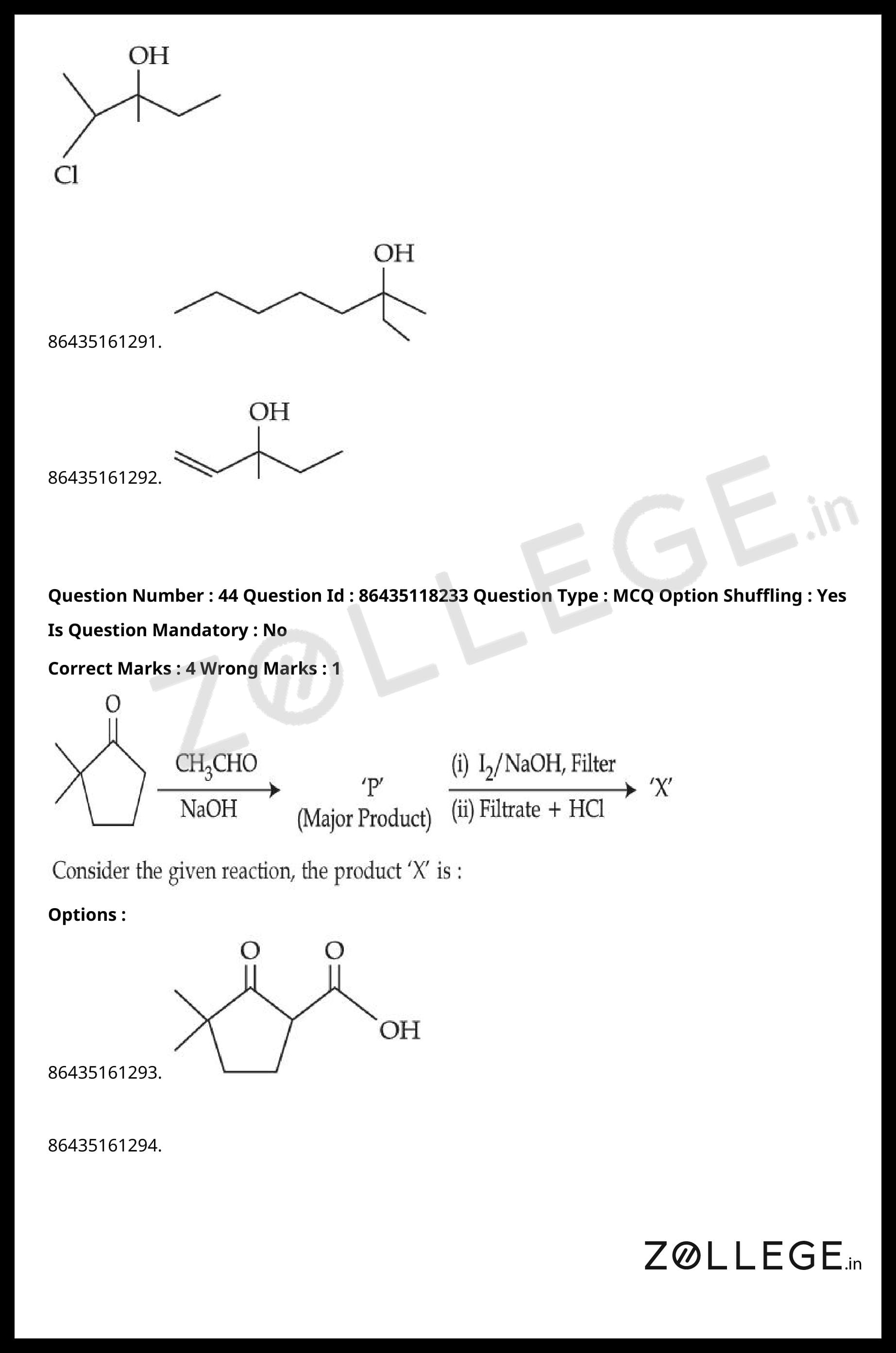
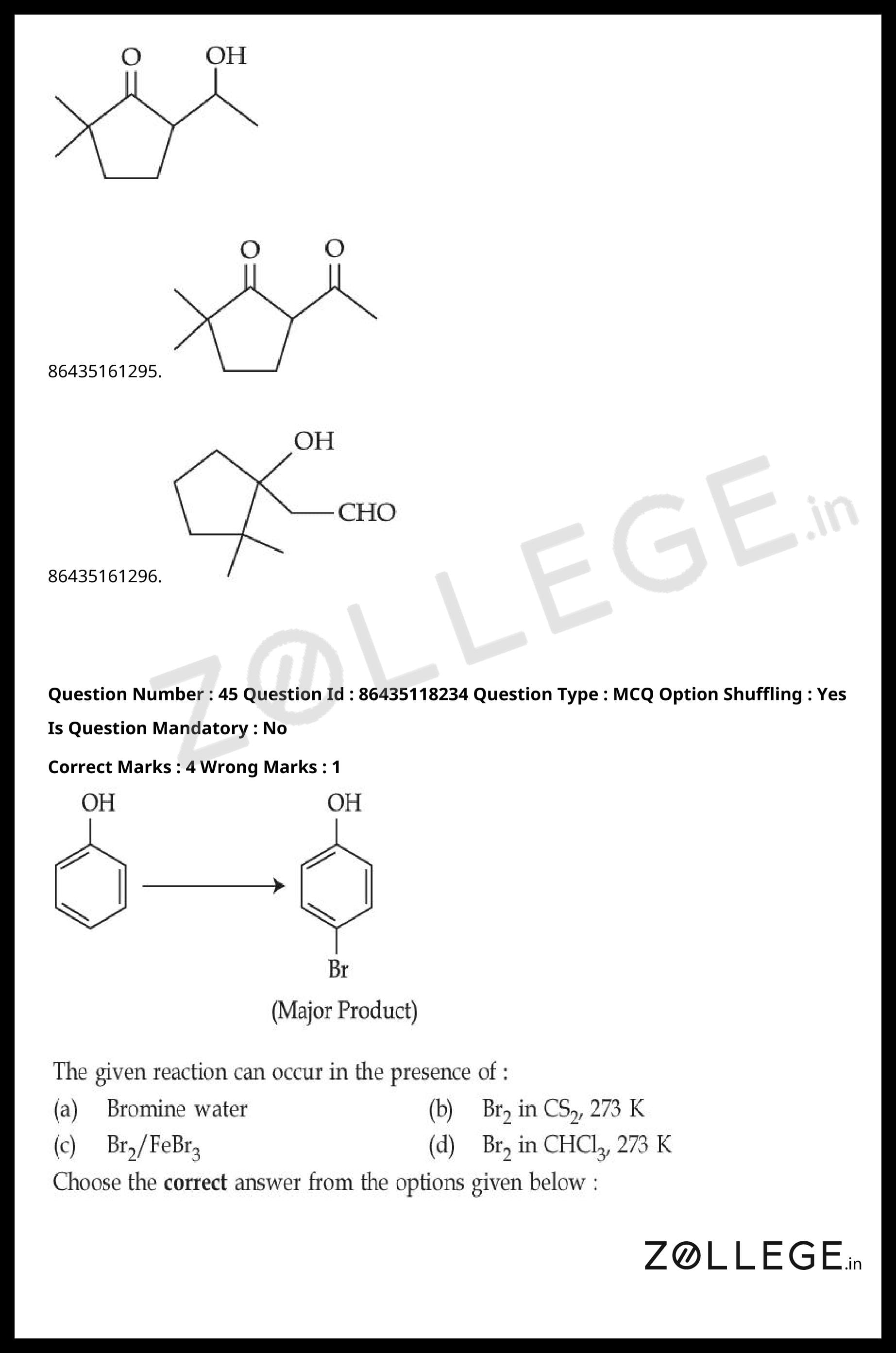
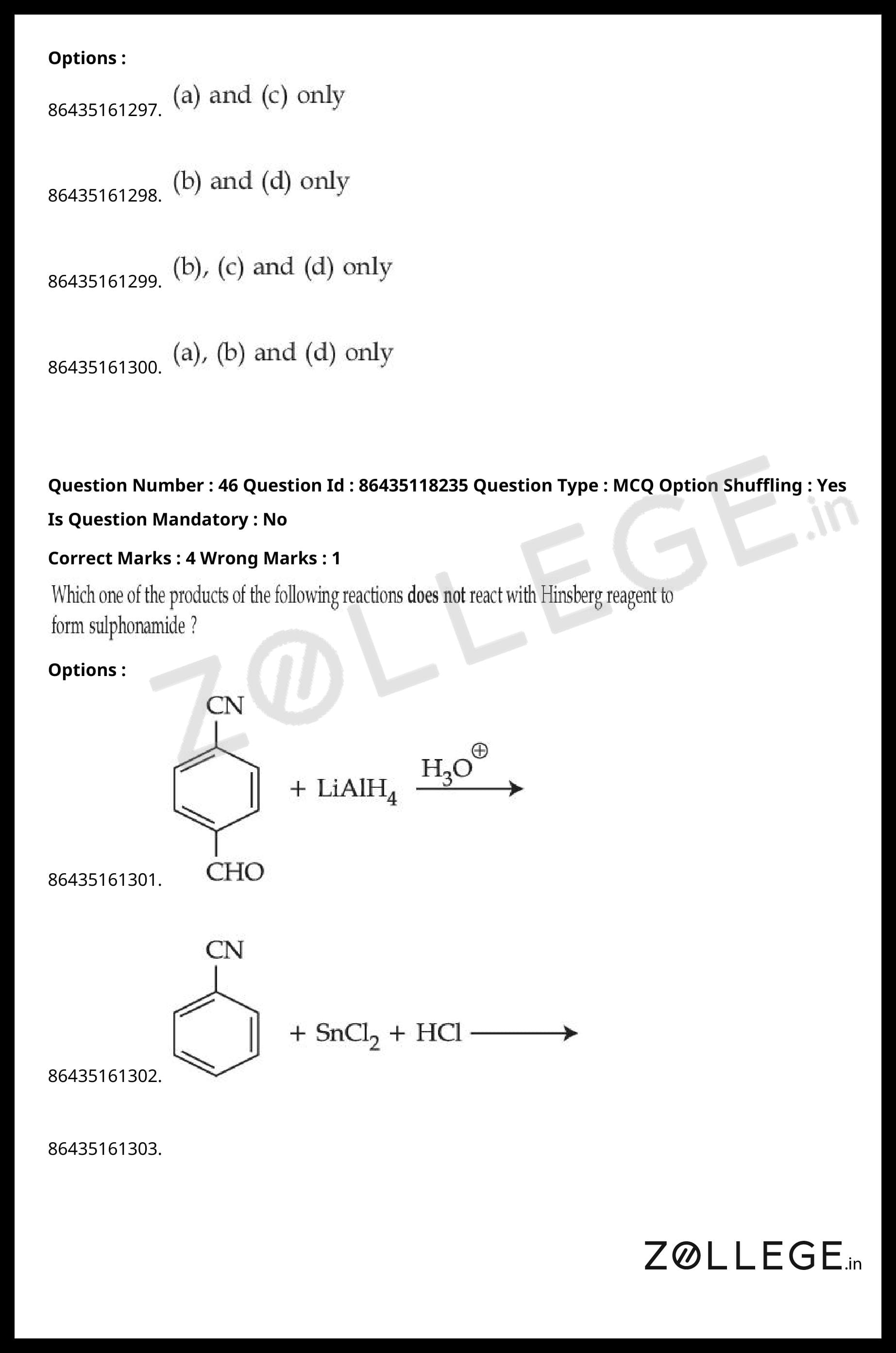
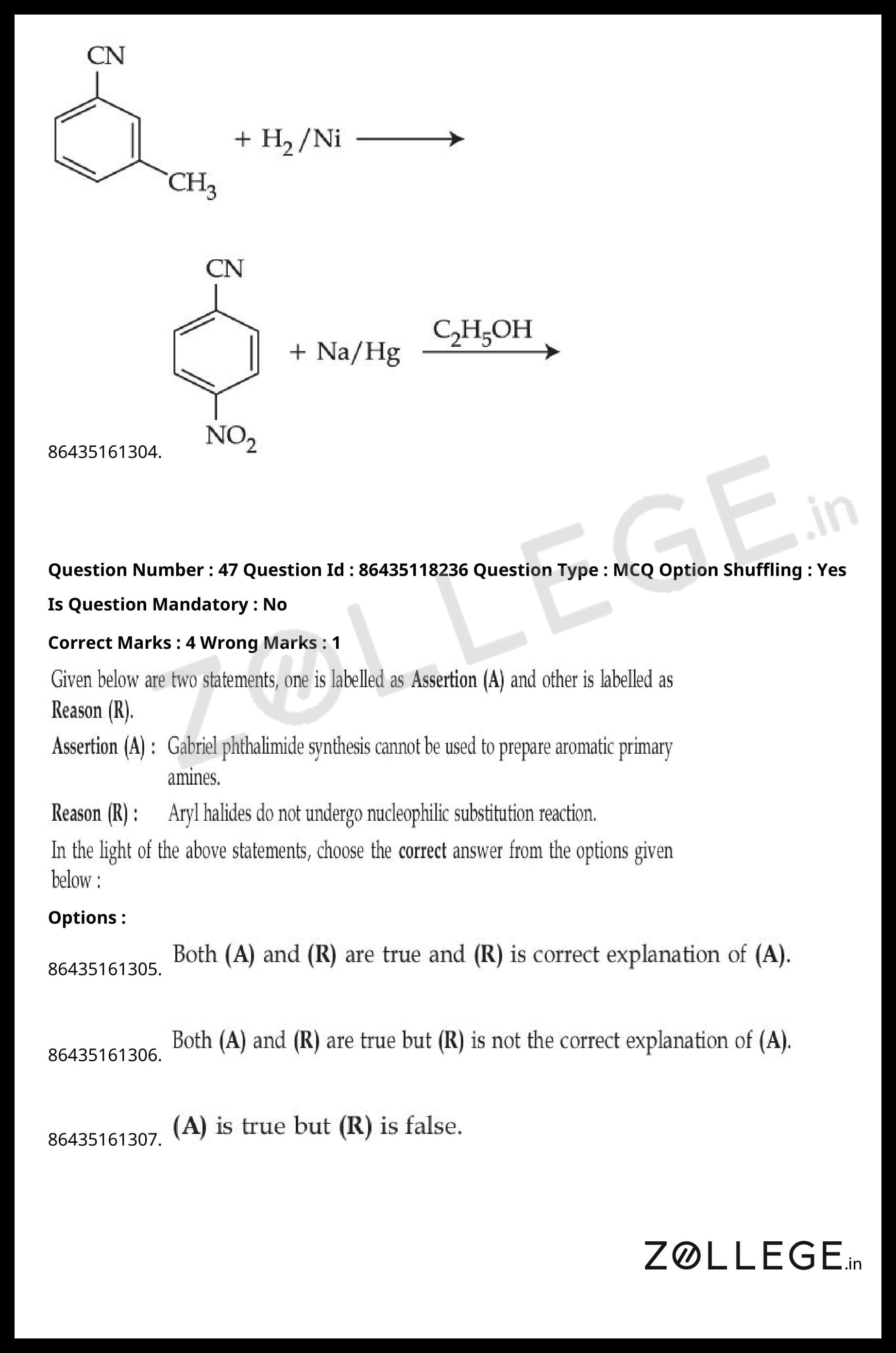
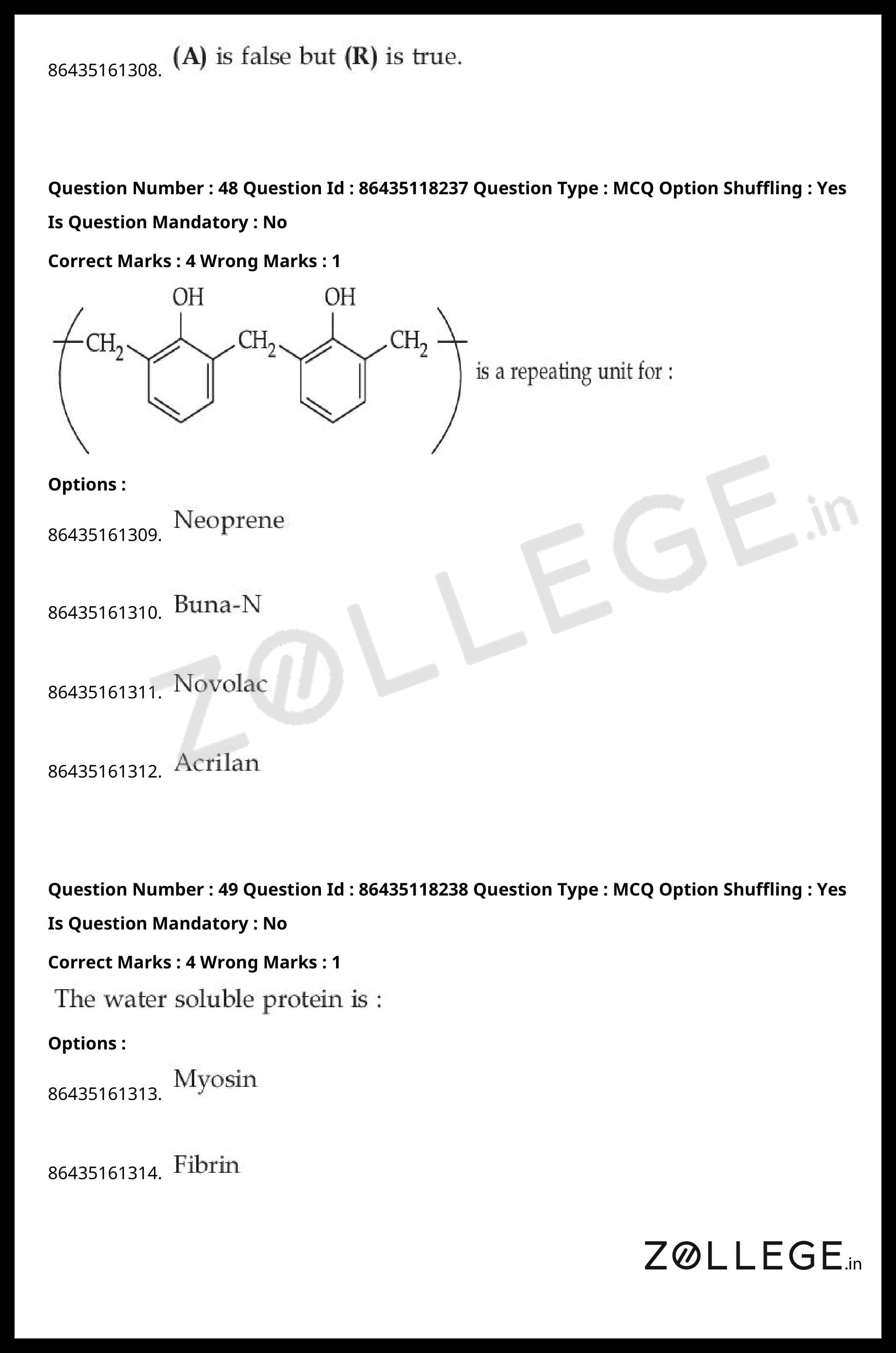
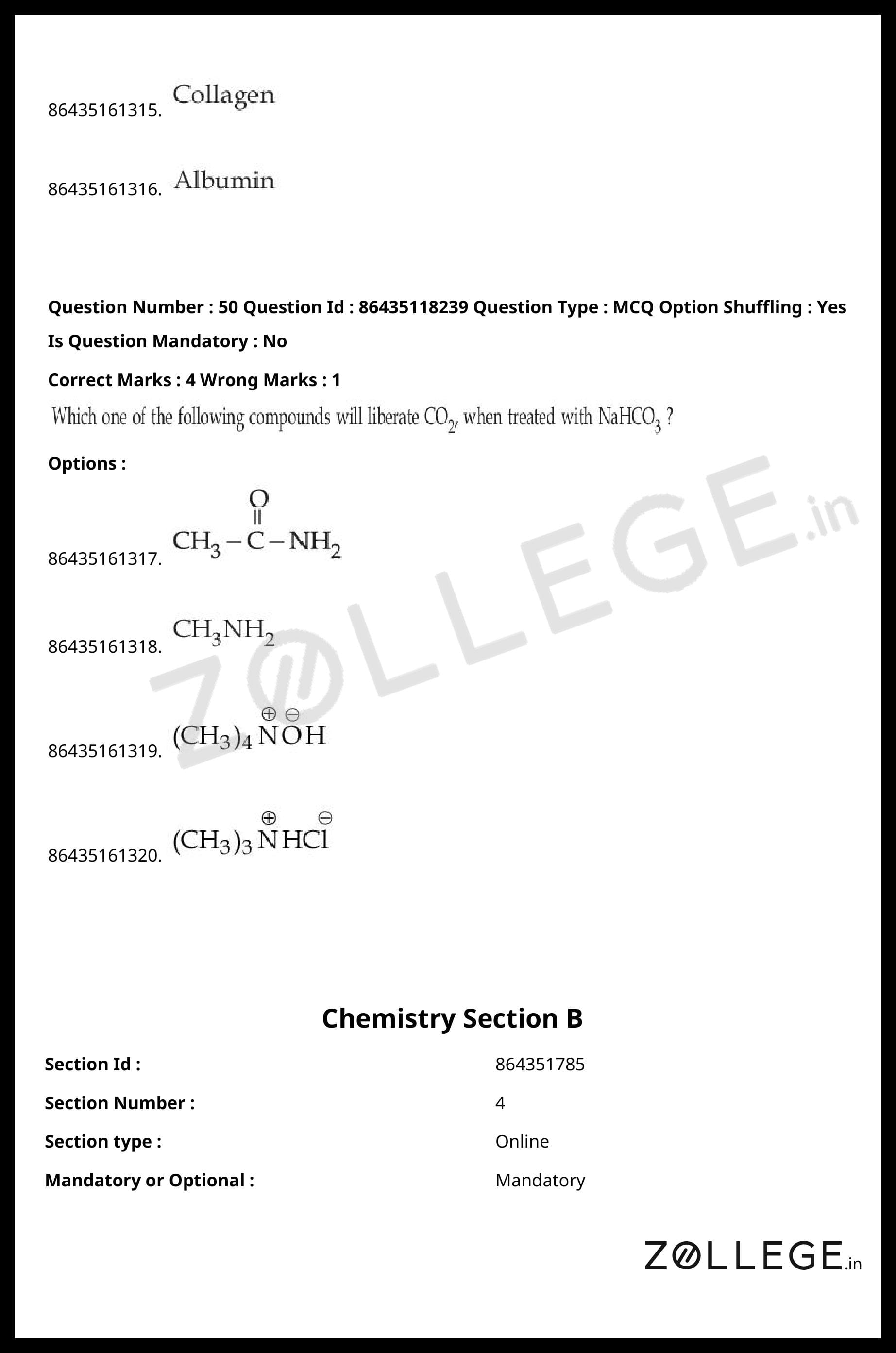
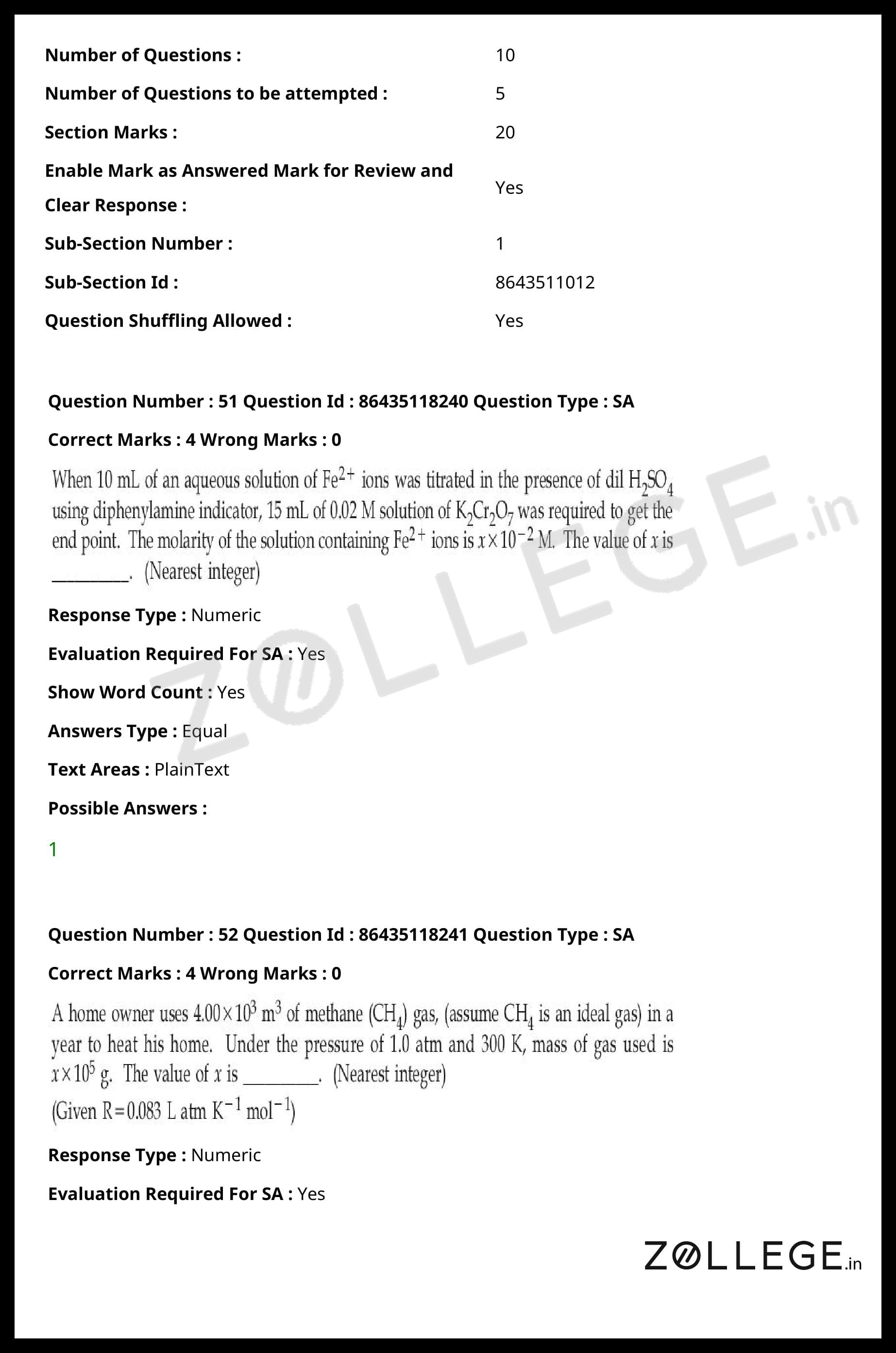
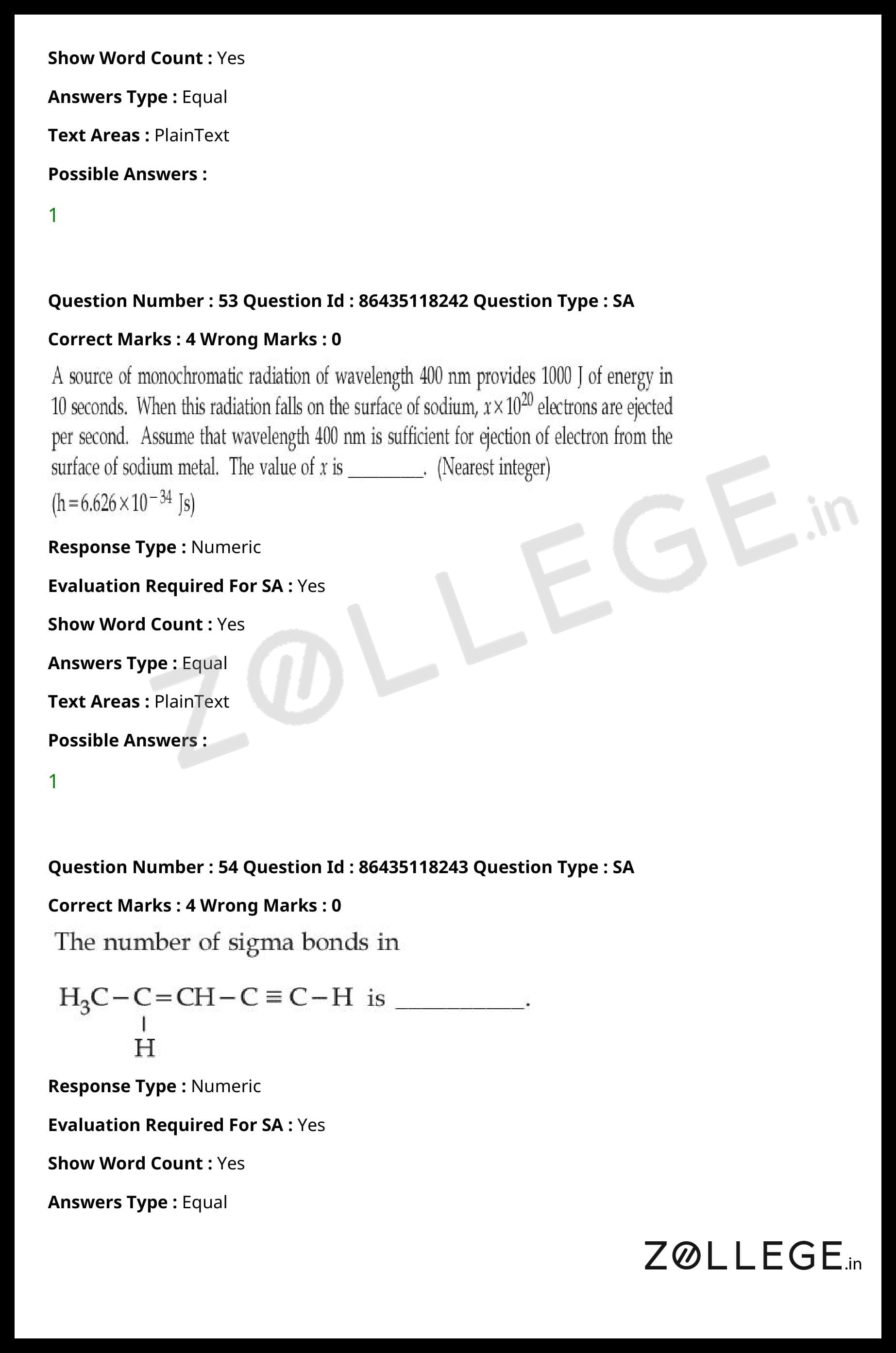
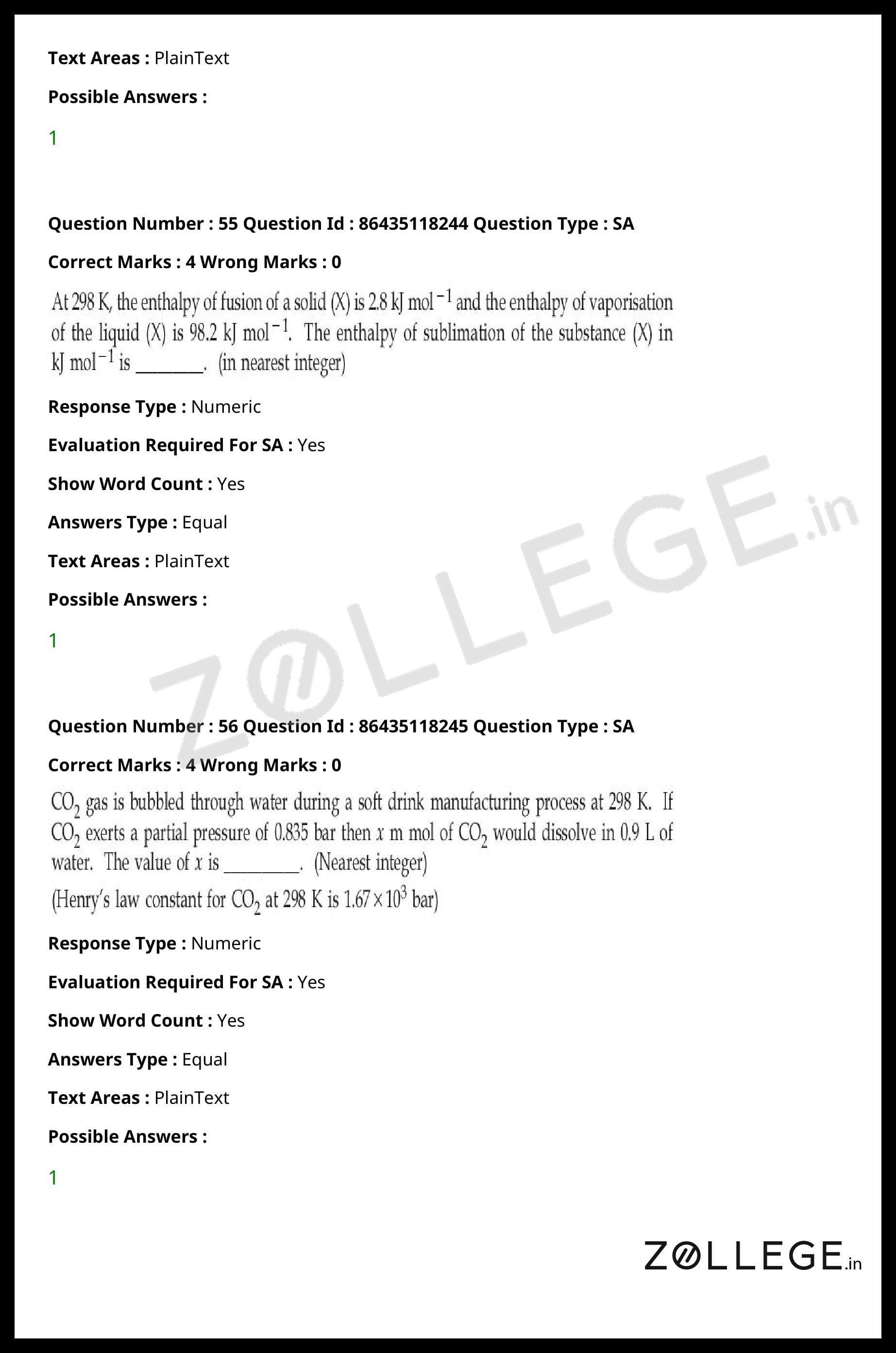
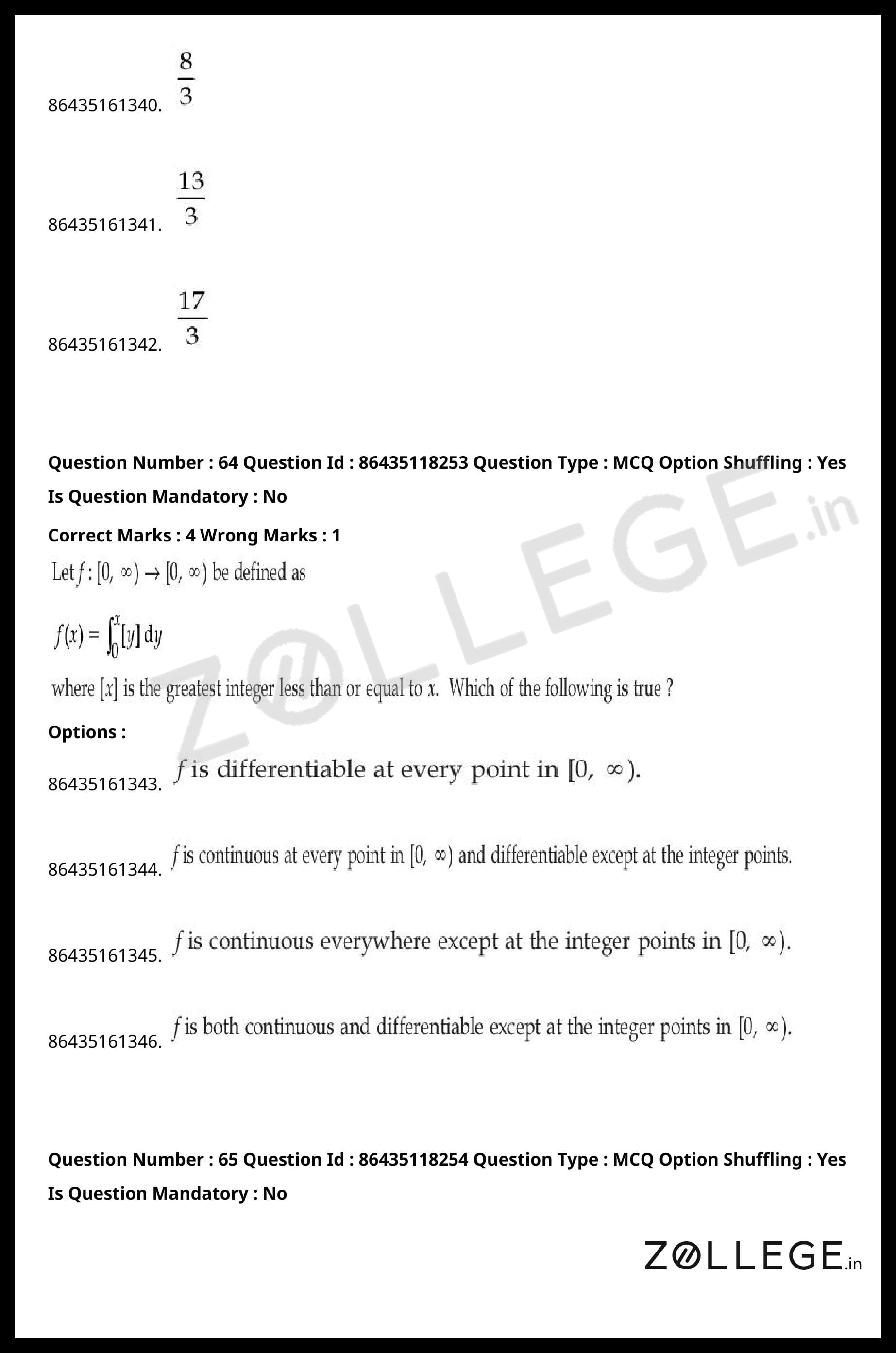
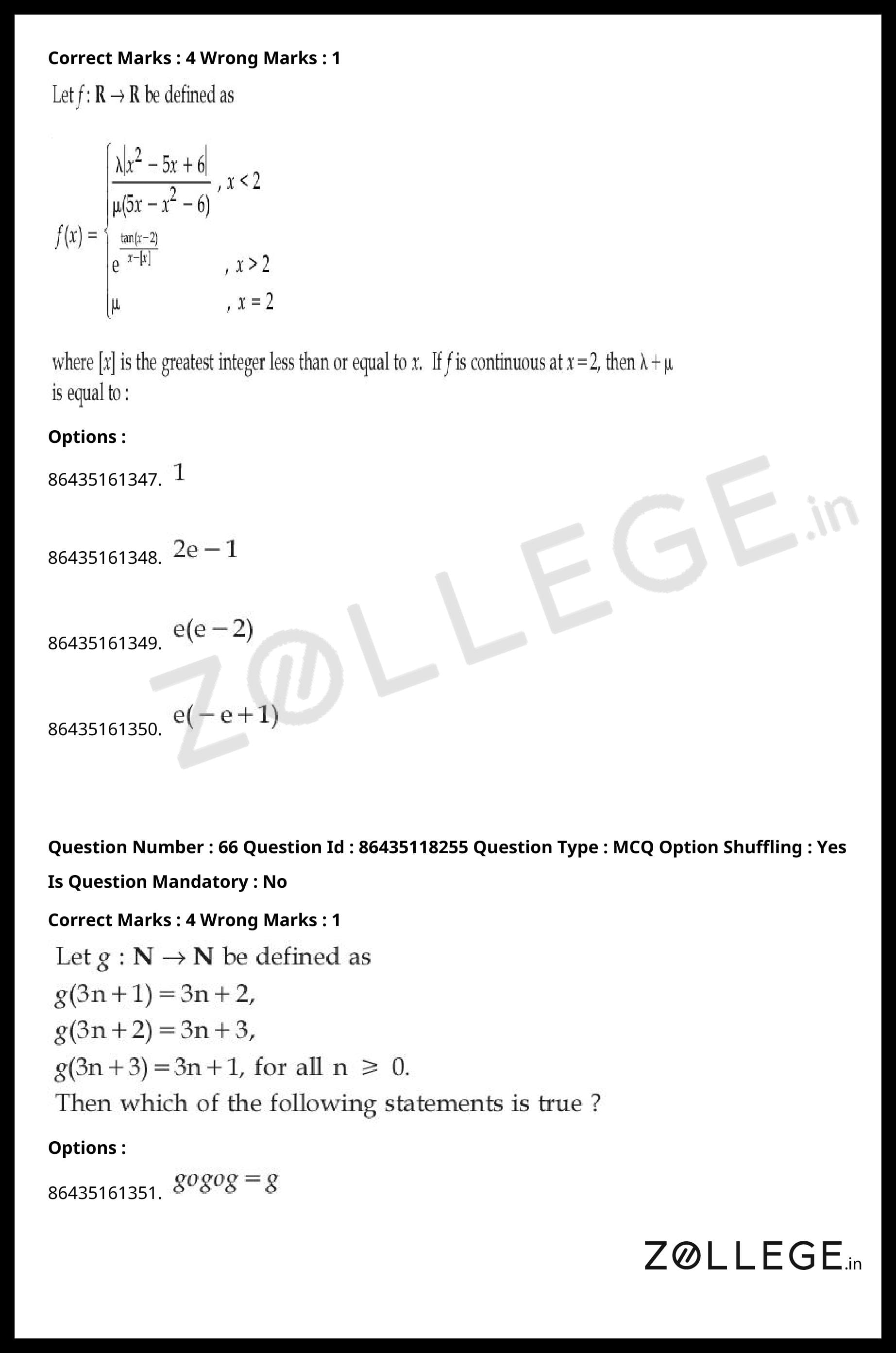
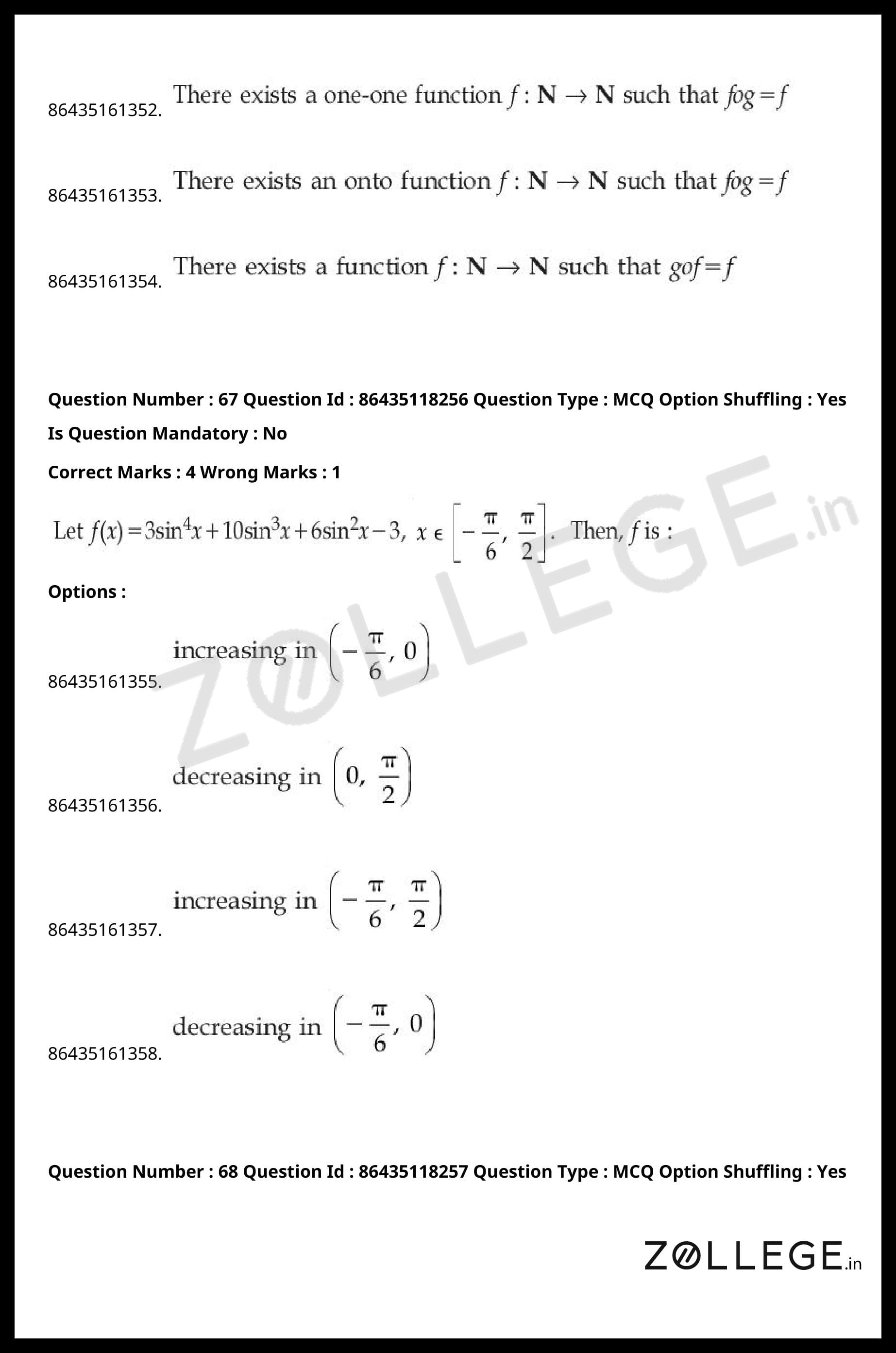
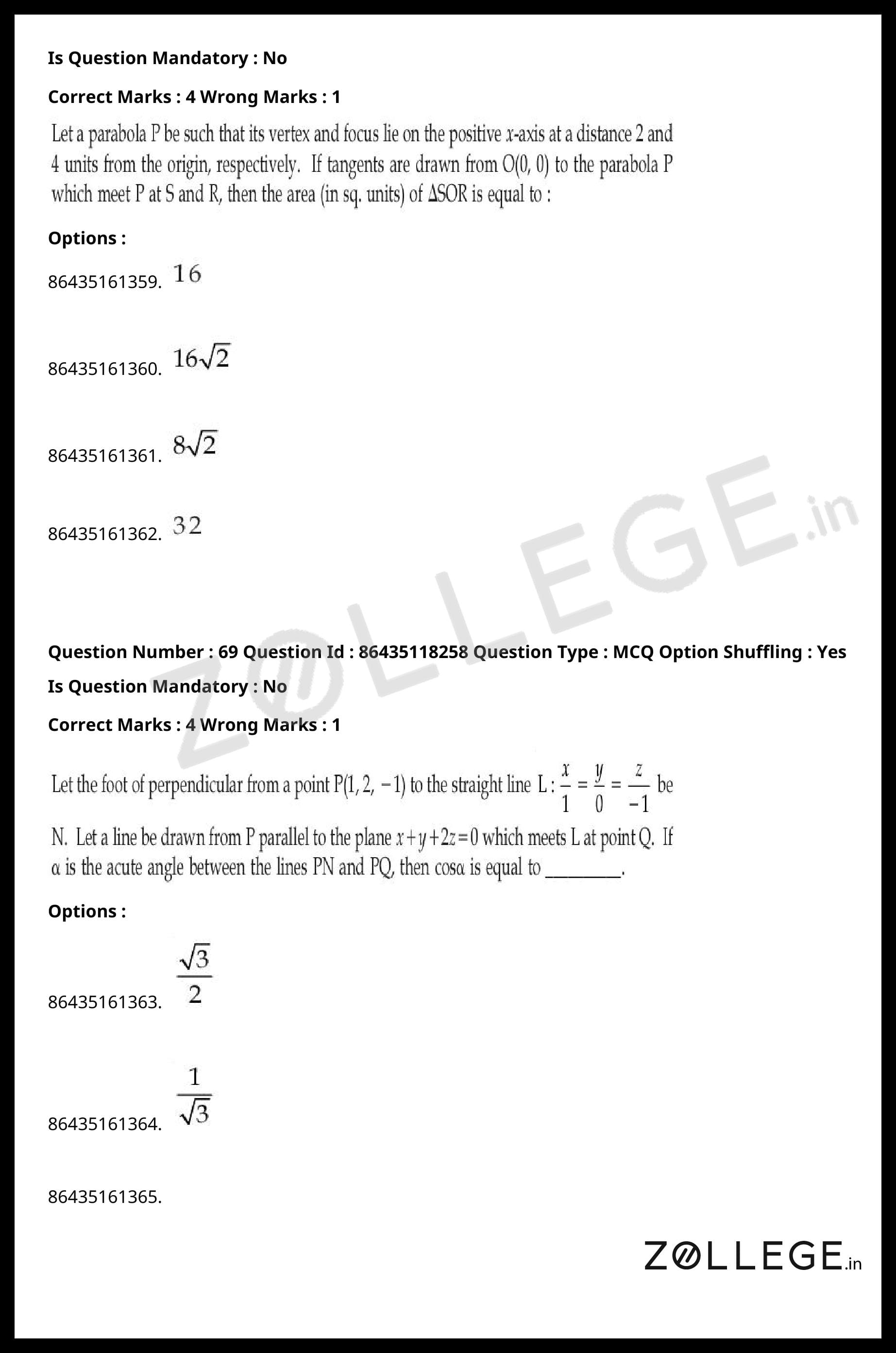
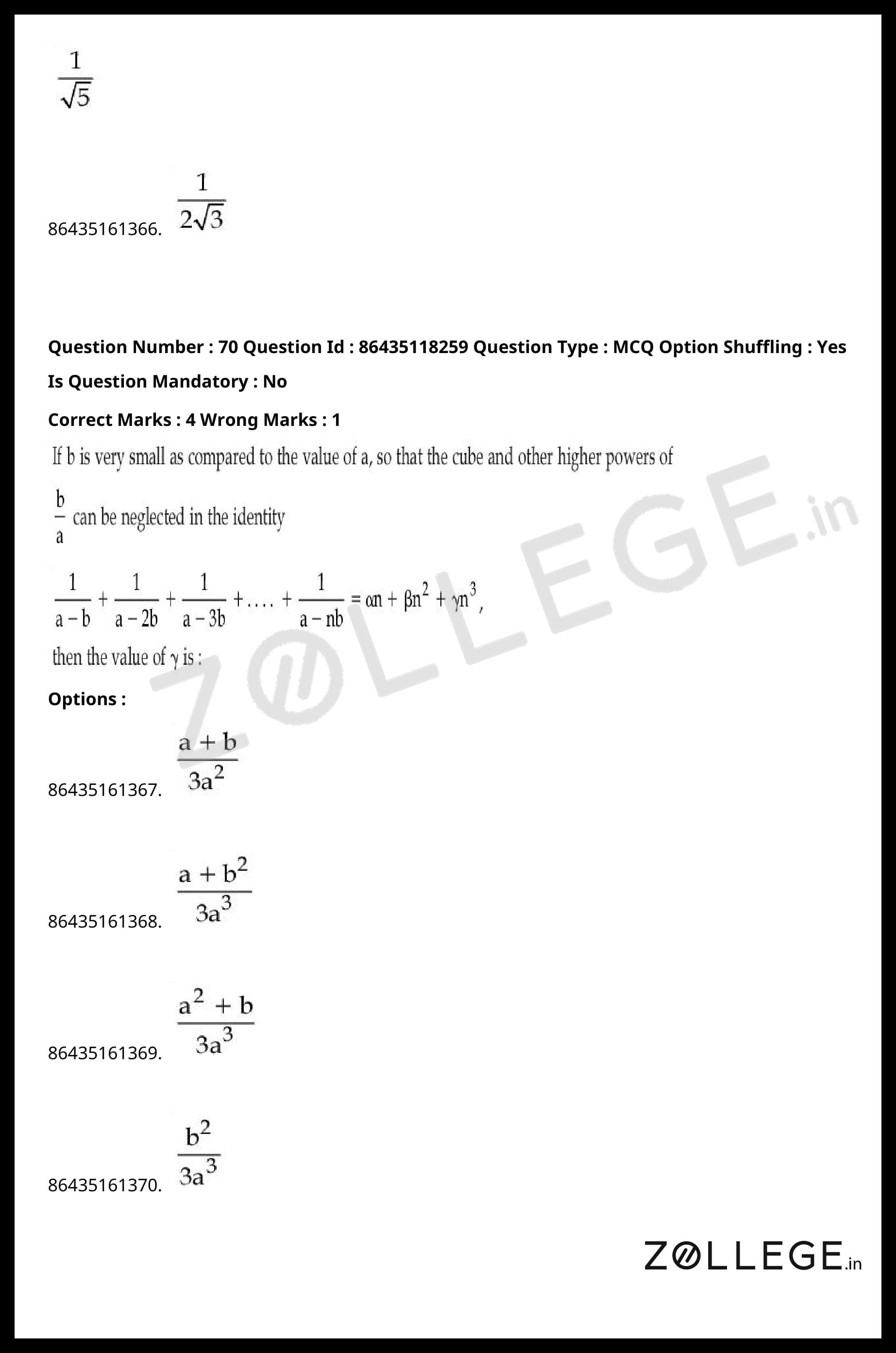
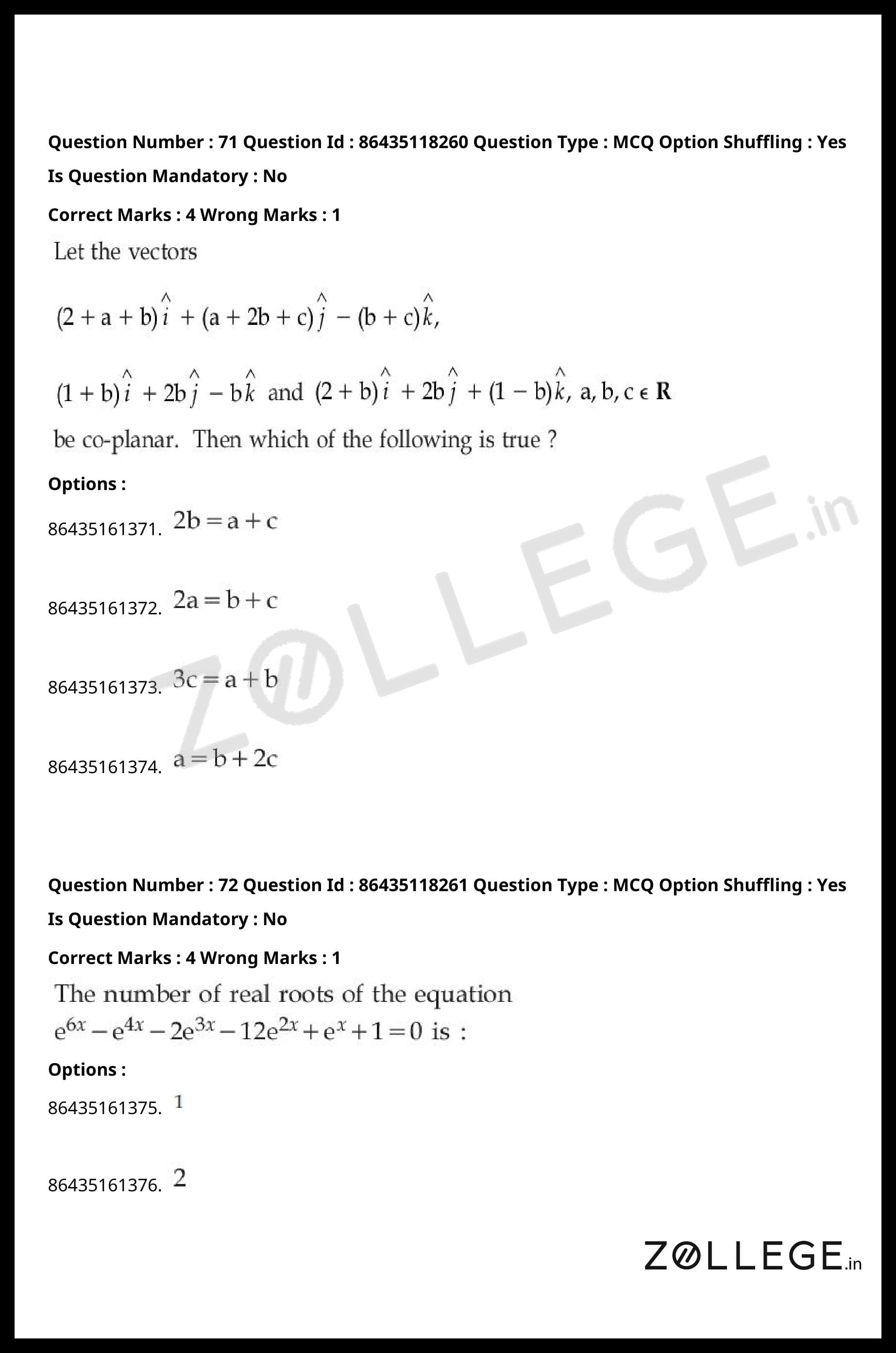
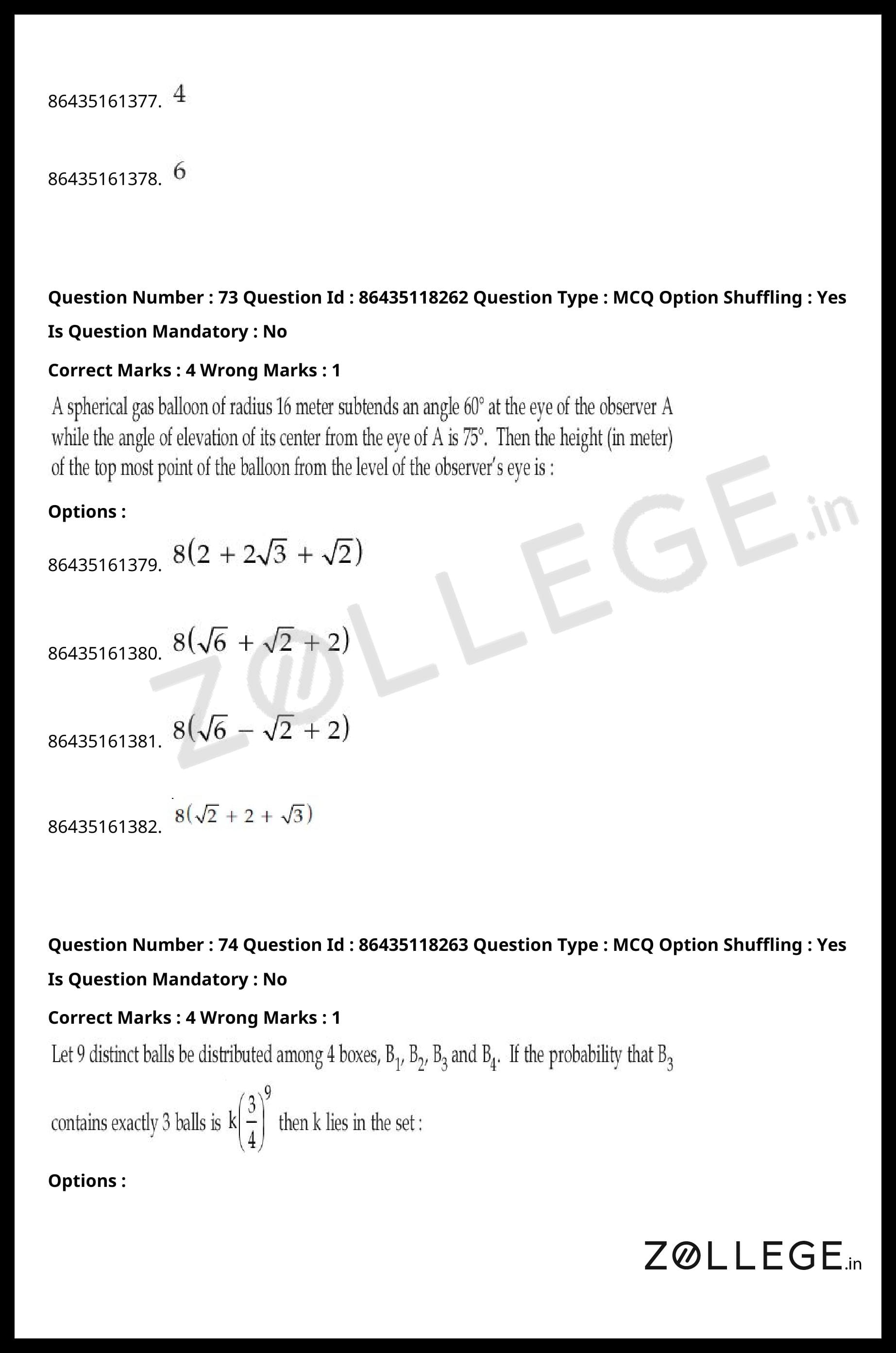
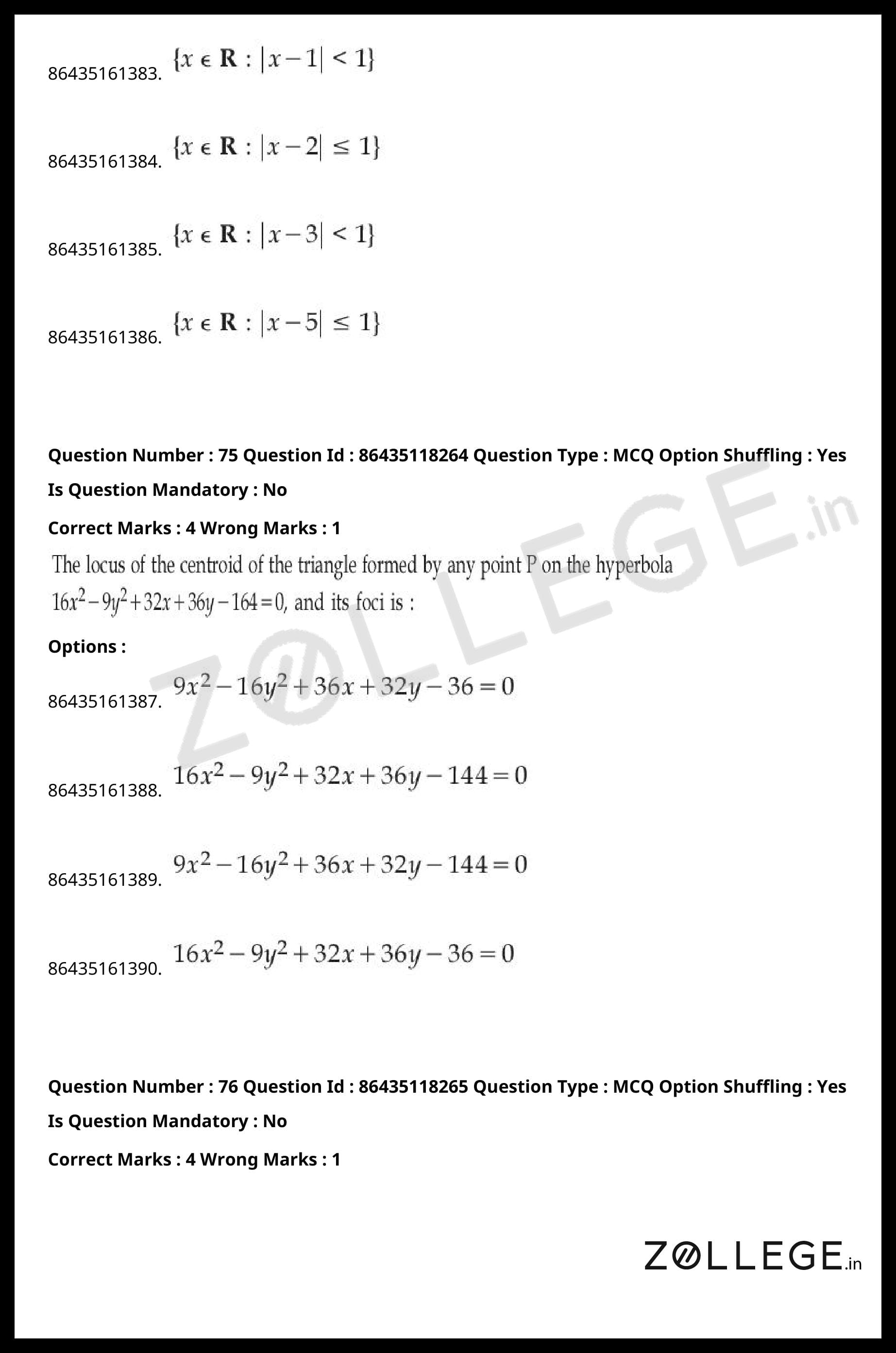
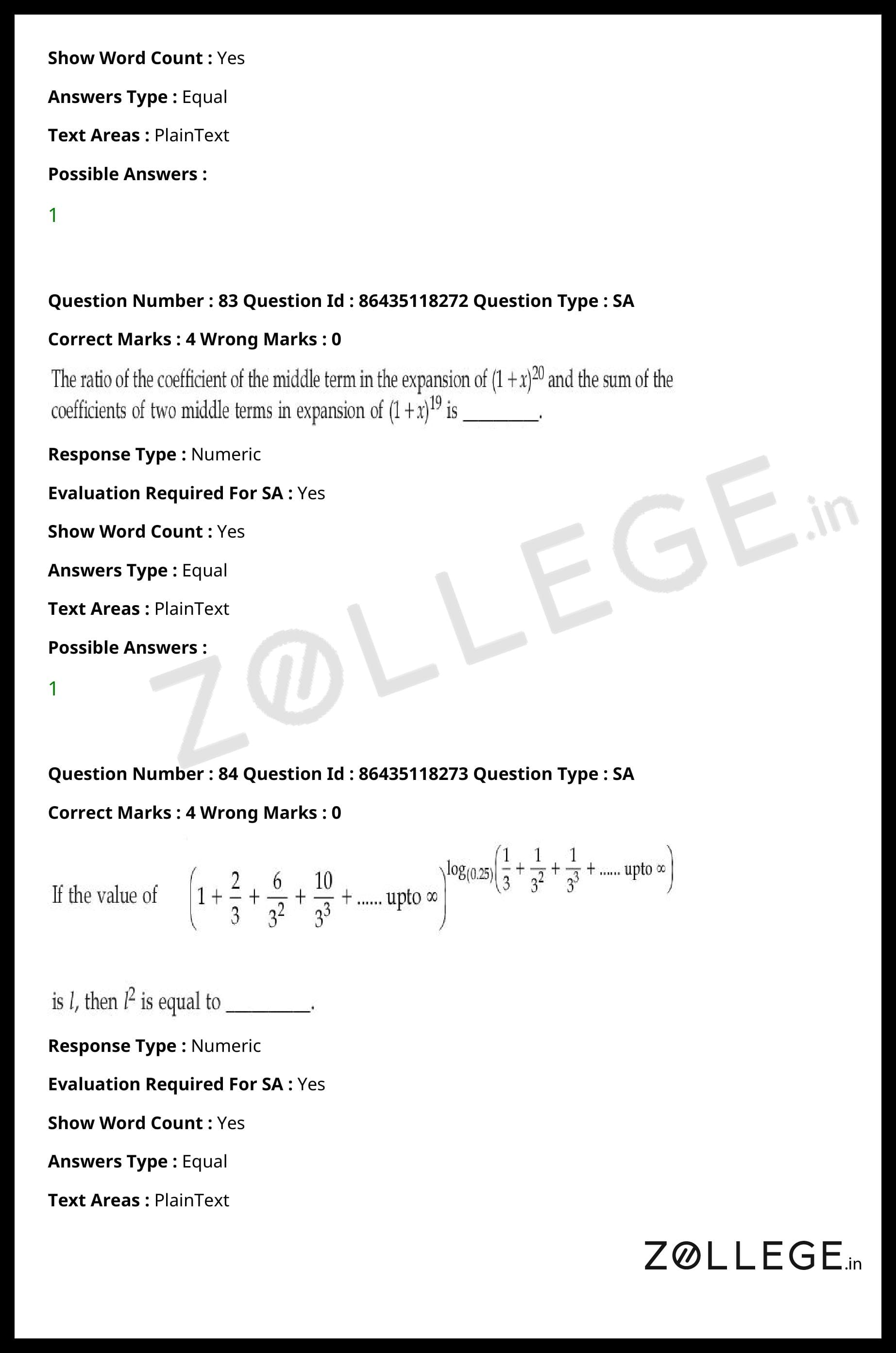
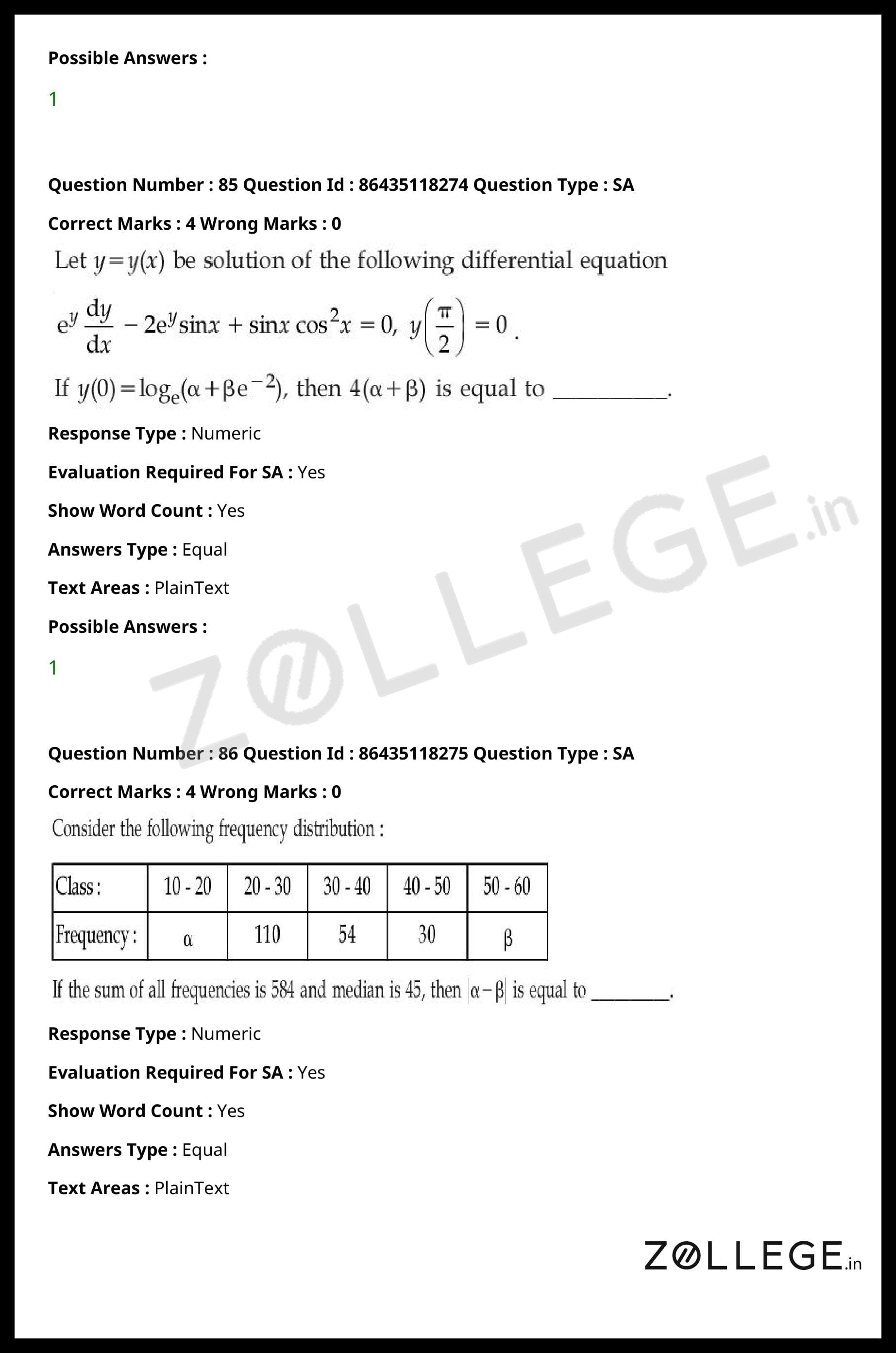
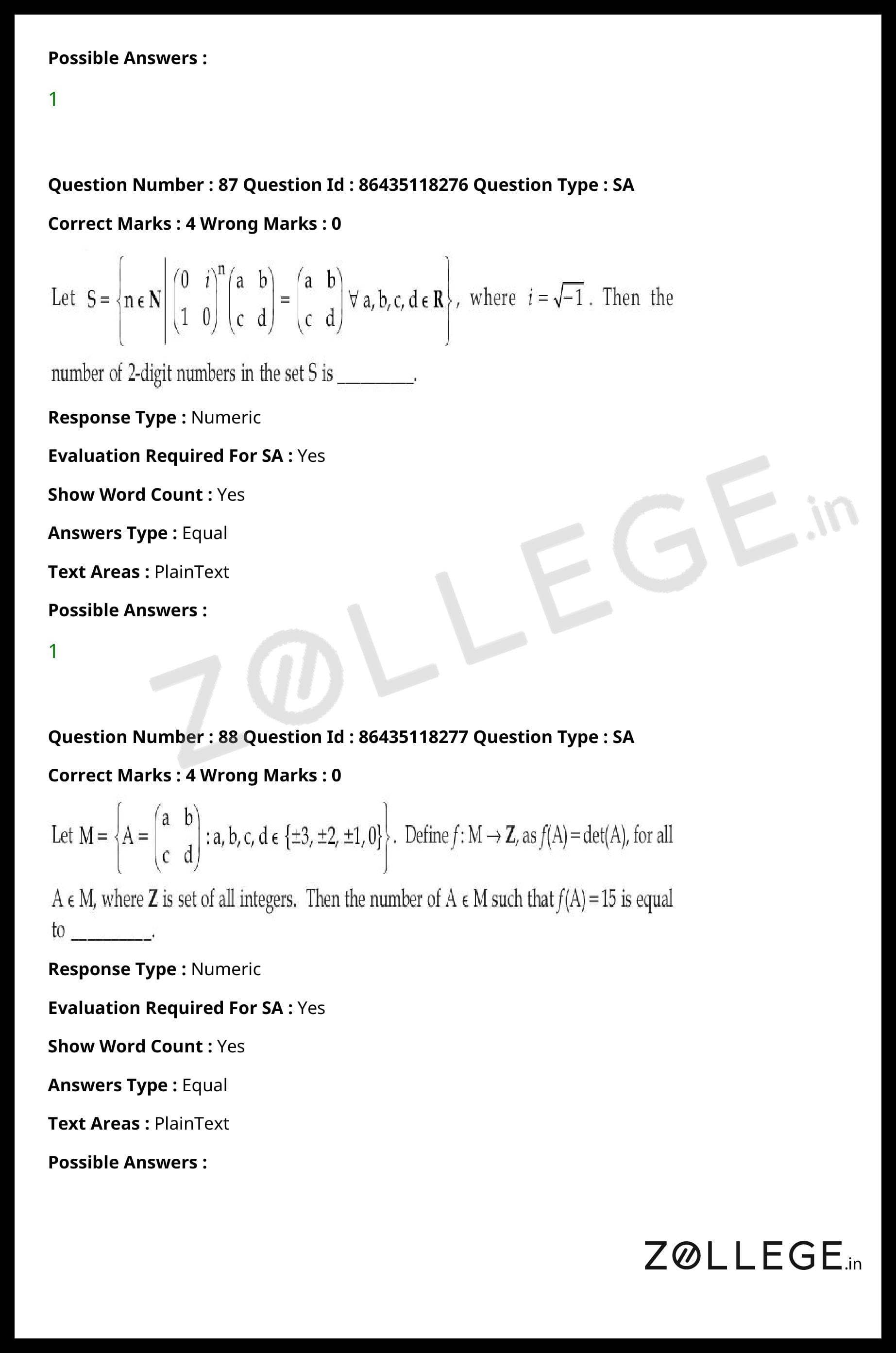
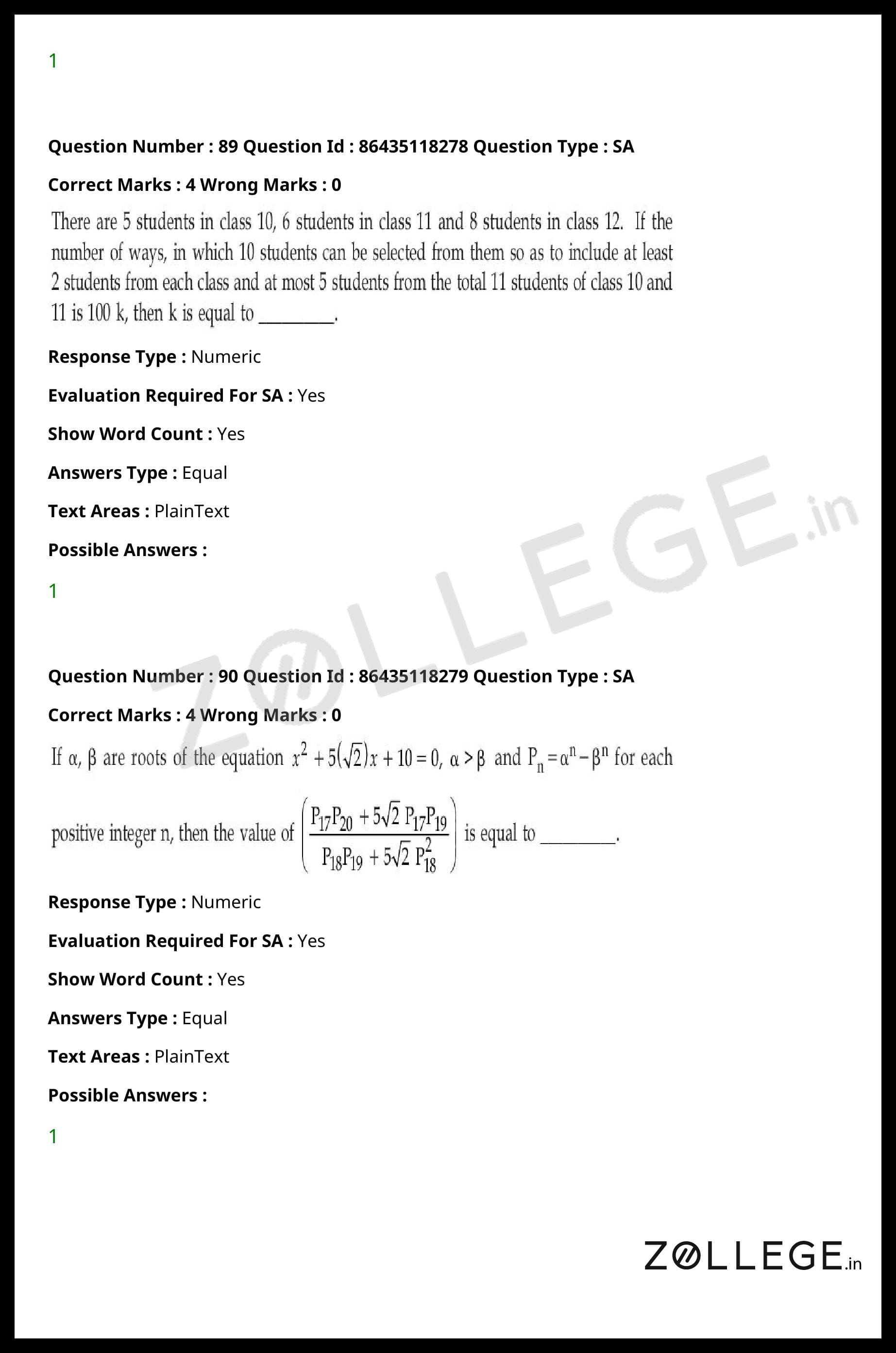
Previous Year JEE Main Question Papers
*The article might have information for the previous academic years, please refer the official website of the exam.