
JEE Main 2022 Question Paper with Answer Key PDF for B.E./ B.Tech(July 25, 2022 - Shift 1)


Content Writer | Updated On - Dec 19, 2025
JEE Main Question Papers are the most important study material for effective exam preparation. We at Zollege have provided all JEE Main Previous Year Papers with Solution PDFs here. JEE Main 2022 B. E. / B. Tech exam was conducted successfully on July 25, 2022. NTA conducted the exam in the Shift 1. According to student reactions and expert reviews, the paper was reported to be moderate.
Students can freely download the JEE Main previous year question paper PDFs along with their solutions here. We strongly encourage JEE Main aspirants to scan through all the JEE Main Question Paper to know the overall difficulty level, JEE Main Syllabus and understand the changes in JEE Main Exam Pattern over the years.
JEE Main 2022 B.E./ B.Tech Question Paper with Answer Key PDF (Shift 1)
| JEE Main 2022 B.E./ B.Tech Question Paper PDF | JEE Main 2022 B.E./ B.Tech Solution PDF |
|---|---|
| Download PDF | Check Solutions |

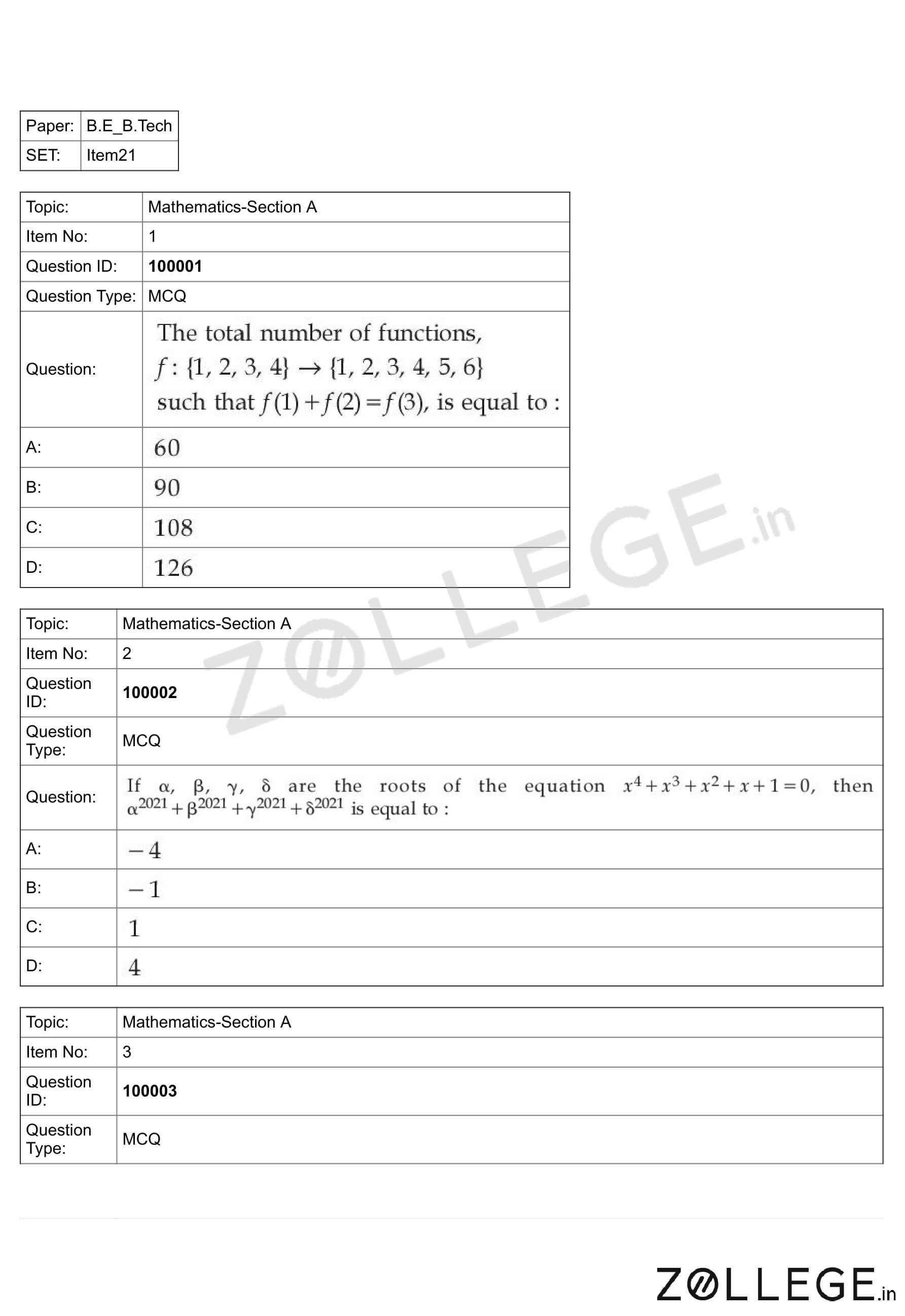
The total number of functions, \(f: \{1, 2, 3, 4\} \to \{1, 2, 3, 4, 5, 6\}\)
such that \(f(1) + f(2) = f(3)\), is equal to :
View Solution
The condition \(f(1) + f(2) = f(3)\) restricts the values of \(f(1), f(2)\) and \(f(3)\).
We count ordered pairs \((f(1), f(2))\) such that their sum lies in \(\{1,2,3,4,5,6\}\).
Possible cases are: \[ (1,1 to 5)\Rightarrow5,\; (2,1 to 4)\Rightarrow4,\; (3,1 to 3)\Rightarrow3,\; (4,1 to 2)\Rightarrow2,\; (5,1)\Rightarrow1 \]
Thus, total valid pairs \(= 15\).
The value of \(f(4)\) is unrestricted and can be chosen in \(6\) ways.
Hence, total number of functions \[ = 15 \times 6 = 90. \] Quick Tip: In function-counting problems, always count constrained mappings first and multiply by the choices of free elements.
If \(\alpha, \beta, \gamma, \delta\) are the roots of the equation \(x^4 + x^3 + x^2 + x + 1 = 0\), then \(\alpha^{2021} + \beta^{2021} + \gamma^{2021} + \delta^{2021}\) is equal to :
View Solution
Multiplying the given equation by \((x-1)\): \[ (x-1)(x^4 + x^3 + x^2 + x + 1) = x^5 - 1 = 0. \]
Hence, the roots are the non-real fifth roots of unity.
Since \(2021 \equiv 1 \pmod{5}\), we get \[ \alpha^{2021} = \alpha,\; \beta^{2021} = \beta,\; \gamma^{2021} = \gamma,\; \delta^{2021} = \delta. \]
Therefore, \[ \alpha^{2021} + \beta^{2021} + \gamma^{2021} + \delta^{2021} = \alpha + \beta + \gamma + \delta. \]
Using Vieta’s formula, the sum of the roots is \(-1\).
Quick Tip: Polynomials of the form \(1 + x + x^2 + \cdots + x^n = 0\) represent roots of unity. Reduce large powers using modulo.
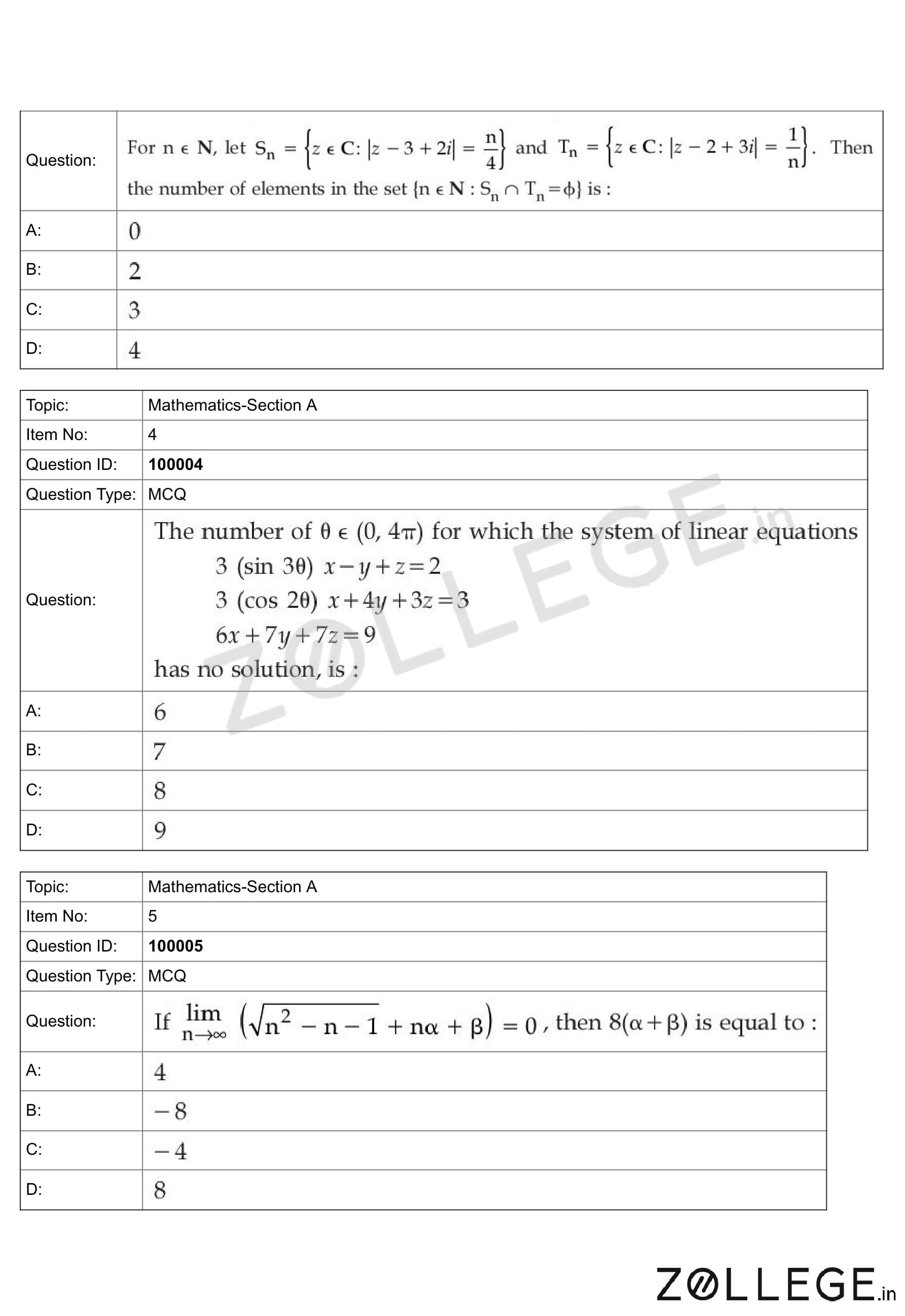
For \(n \in \mathbb{N}\), let \(S_n = \{z \in \mathbb{C} : |z - 3 + 2i| = \frac{n}{4}\}\)
and \(T_n = \{z \in \mathbb{C} : |z - 2 + 3i| = \frac{1}{n}\}\).
Then the number of elements in the set \(\{n \in \mathbb{N} : S_n \cap T_n = \varnothing\}\) is :
View Solution
The centres of the circles are \((3,-2)\) and \((2,-3)\).
Distance between centres: \[ d = \sqrt{(3-2)^2 + (-2+3)^2} = \sqrt{2}. \]
The radii are: \[ r_1 = \frac{n}{4}, \quad r_2 = \frac{1}{n}. \]
For no intersection: \[ d > r_1 + r_2. \]
Checking natural numbers: \[ n = 1, 2 \Rightarrow \sqrt{2} > \frac{n}{4} + \frac{1}{n} \] \[ n \ge 3 \Rightarrow \sqrt{2} < \frac{n}{4} + \frac{1}{n}. \]
Hence, valid values are \(n = 1, 2\).
Quick Tip: For two circles, compare the distance between centres with the sum of radii to test intersection.
The number of \(\theta \in (0, 4\pi)\) for which the system of linear equations \[ \begin{aligned} 3(\sin 3\theta)x - y + z &= 2
3(\cos 2\theta)x + 4y + 3z &= 3
6x + 7y + 7z &= 9 \end{aligned} \]
has no solution, is :
View Solution
A system has no solution when the determinant of the coefficient matrix is zero
and at least one of the corresponding Cramer determinants is non-zero.
The determinant of the coefficient matrix simplifies to: \[ \Delta = 21\sin 3\theta + 42\cos 2\theta - 42. \]
Setting \(\Delta = 0\): \[ \sin 3\theta + 2\cos 2\theta - 2 = 0. \]
Using identities \(\sin 3\theta = 3\sin\theta - 4\sin^3\theta\) and \(\cos 2\theta = 1 - 2\sin^2\theta\), we get: \[ \sin\theta(2\sin\theta - 1) = 0. \]
Thus, \[ \sin\theta = 0 \quad or \quad \sin\theta = \frac{1}{2}. \]
In \((0,4\pi)\): \[ \sin\theta = 0 \Rightarrow 3 solutions, \quad \sin\theta = \frac{1}{2} \Rightarrow 4 solutions. \]
Total \(= 7\).
Quick Tip: For no solution in a linear system, remember: \(\Delta = 0\) and at least one numerator determinant \(\neq 0\).
If \(\displaystyle \lim_{n\to\infty} \left(\sqrt{n^2-n-1}+n\alpha+\beta\right)=0\),
then \(8(\alpha+\beta)\) is equal to :
View Solution
As \(n \to \infty\), \[ \sqrt{n^2-n-1} \sim n. \]
For the limit to be finite: \[ 1 + \alpha = 0 \Rightarrow \alpha = -1. \]
Substitute \(\alpha = -1\): \[ \lim_{n\to\infty} (\sqrt{n^2-n-1} - n + \beta) = 0. \]
Rationalizing: \[ \sqrt{n^2-n-1} - n = \frac{-n-1}{\sqrt{n^2-n-1}+n}. \]
Dividing by \(n\) and taking limit: \[ \lim_{n\to\infty} (\sqrt{n^2-n-1}-n) = -\frac{1}{2}. \]
Thus, \[ -\frac{1}{2} + \beta = 0 \Rightarrow \beta = \frac{1}{2}. \]
\[ 8(\alpha+\beta) = 8\left(-1+\frac{1}{2}\right) = -4. \] Quick Tip: In limits involving square roots, first cancel dominant terms, then rationalize.
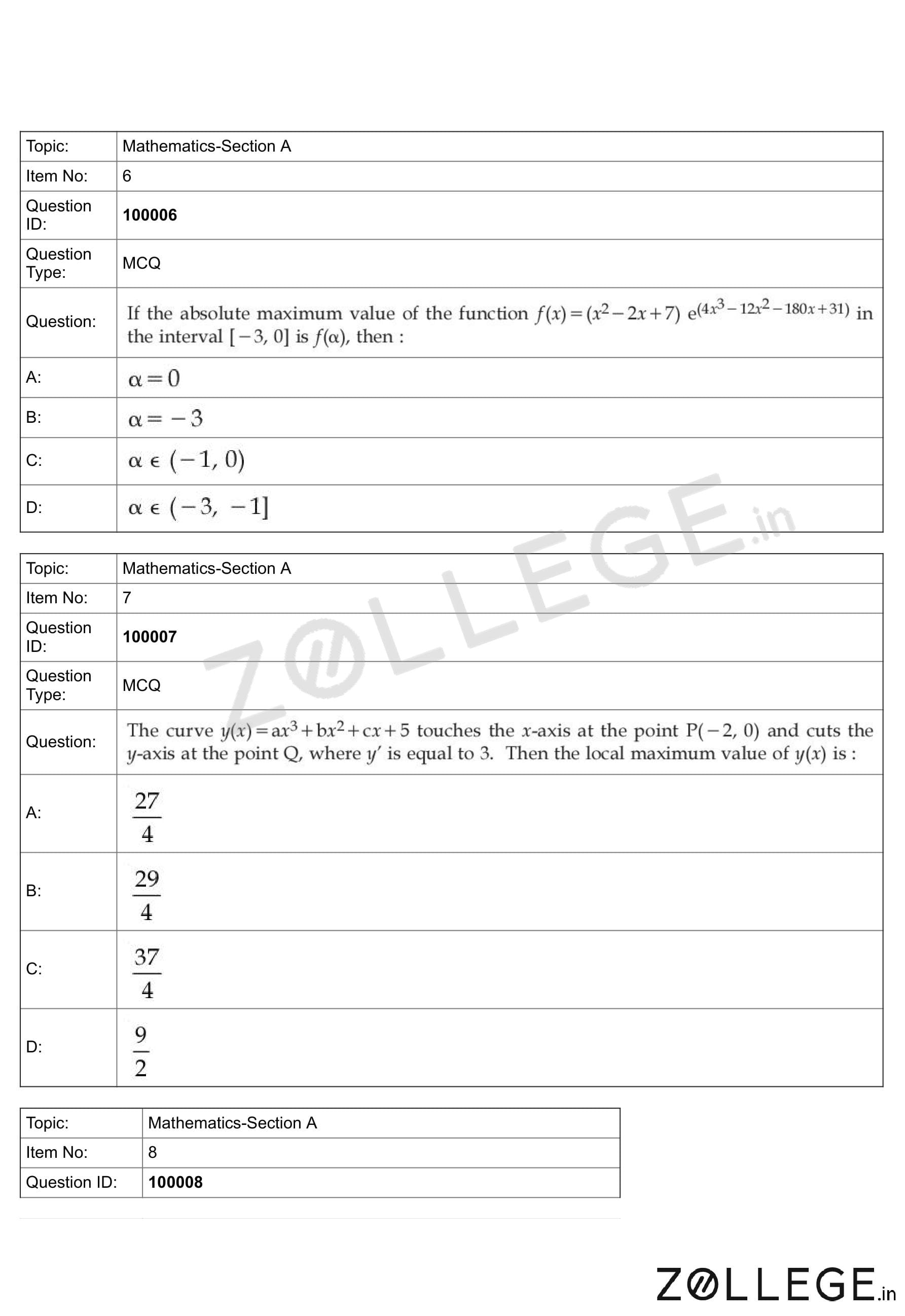
If the absolute maximum value of \(f(x) = (x^2-2x+7)e^{(4x^3-12x^2-180x+31)}\)
in the interval \([-3,0]\) is \(f(\alpha)\), then :
View Solution
Let \(f(x)=u(x)e^{v(x)}\), where \[ u(x)=x^2-2x+7,\quad v(x)=4x^3-12x^2-180x+31. \]
\(u(x)>0\) for all \(x\) and \(u'(x)=2x-2<0\) on \([-3,0]\).
\(v'(x)=12(x-5)(x+3)<0\) on \((-3,0)\). Hence \(v(x)\) decreases.
Thus \(e^{v(x)}\) also decreases on \([-3,0]\).
Product of two positive decreasing functions is decreasing.
Therefore, absolute maximum occurs at \(x=-3\).
Quick Tip: For products of functions, check monotonicity of each factor separately.
The curve \(y=ax^3+bx^2+cx+5\) touches the x-axis at \((-2,0)\) and cuts the y-axis
at point \(Q\), where \(y'=3\). Then the local maximum value of \(y\) is :
View Solution
\(y'(x)=3ax^2+2bx+c\).
Given \(y'(0)=3 \Rightarrow c=3\).
Since the curve touches x-axis at \((-2,0)\): \[ y(-2)=0,\quad y'(-2)=0. \]
Solving gives: \[ a=-\frac12,\quad b=-\frac34. \]
Thus, \[ y(x)=-\frac12x^3-\frac34x^2+3x+5. \]
Critical points from \(y'(x)=0\) are \(x=-2,1\).
Second derivative test shows \(x=1\) is maximum.
\[ y(1)=\frac{27}{4}. \] Quick Tip: “Touches x-axis” means both \(y=0\) and \(y'=0\) at that point.
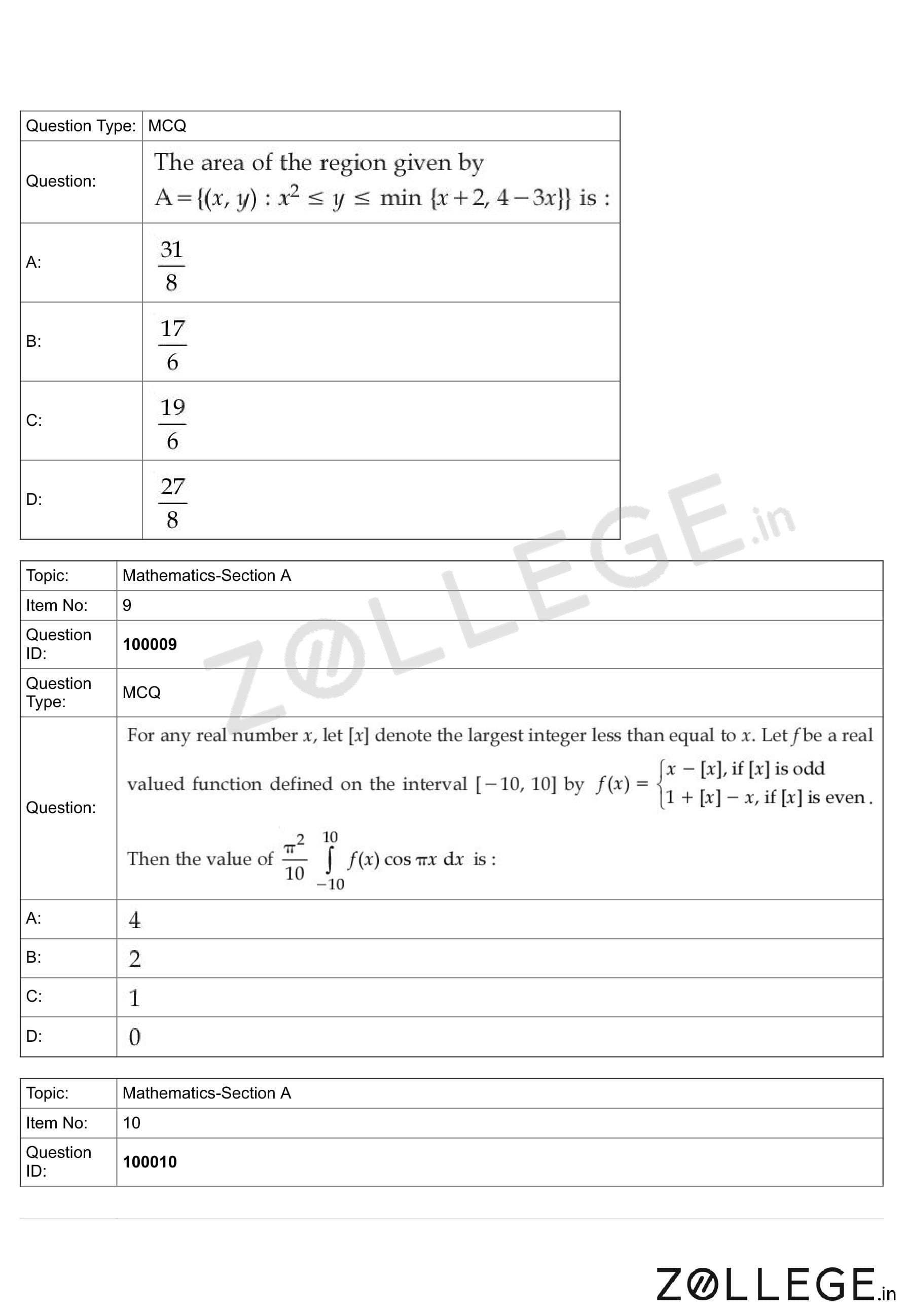
The area of the region \(A=\{(x,y): x^2\le y \le \min(x+2,4-3x)\}\) is :
View Solution
Intersection of \(x+2\) and \(4-3x\) gives \(x=\frac12\).
Intersection of \(y=x^2\) with \(x+2\) gives \(x=-1\).
Intersection of \(y=x^2\) with \(4-3x\) gives \(x=1\).
Area: \[ \int_{-1}^{1/2}[(x+2)-x^2]dx + \int_{1/2}^{1}[(4-3x)-x^2]dx. \]
Evaluating gives: \[ \frac{9}{4}+\frac{7}{12}=\frac{17}{6}. \] Quick Tip: For regions with \(\min\) or \(\max\), always split the integral at intersection points.
Let \([x]\) denote the greatest integer \(\le x\).
If \(f(x)=\begin{cases} x-[x], & [x] odd
1+[x]-x, & [x] even \end{cases}\),
then the value of \(\dfrac{\pi^2}{10}\int_{-10}^{10}f(x)\cos(\pi x)\,dx\) is :
View Solution
\(f(x)\) is an even and periodic function of period \(2\).
\(\cos(\pi x)\) is also even.
Thus, \[ \int_{-10}^{10}f(x)\cos(\pi x)dx =10\int_{0}^{2}f(x)\cos(\pi x)dx. \]
Evaluating piecewise on \([0,1]\) and \([1,2]\) gives: \[ \int_{-10}^{10}f(x)\cos(\pi x)dx=\frac{40}{\pi^2}. \]
Hence, \[ \frac{\pi^2}{10}\times\frac{40}{\pi^2}=4. \] Quick Tip: Check even/odd symmetry before integrating over symmetric limits.
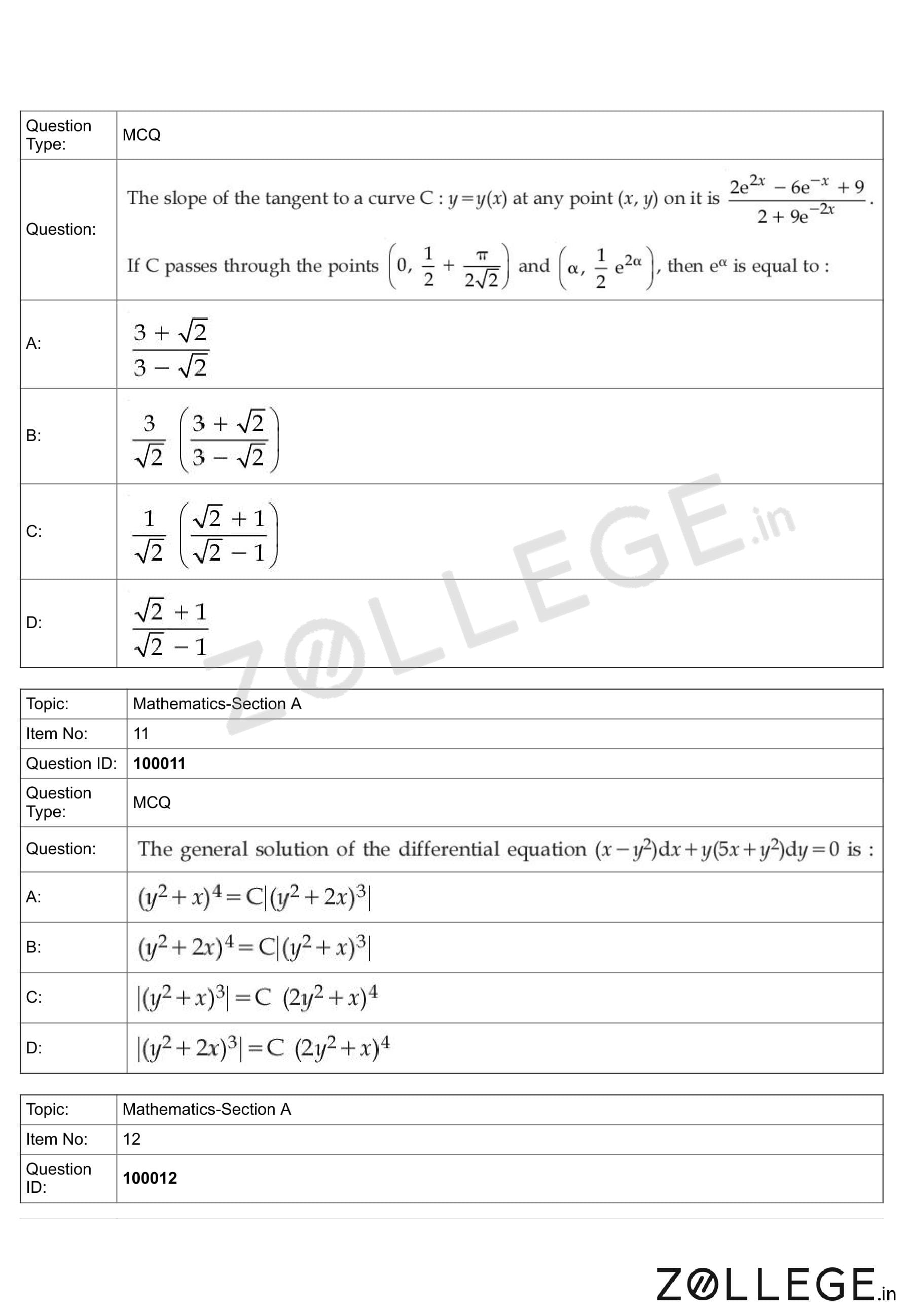
The slope of the tangent to a curve \(y=y(x)\) is \(\dfrac{2e^{2x}-6e^{-x}+9}{2+9e^{-2x}}\).
If the curve passes through \((0,\frac12+\frac{\pi}{2\sqrt2})\) and \((\alpha,\frac12e^{2\alpha})\),
then \(e^\alpha\) is equal to :
View Solution
Simplifying the derivative and integrating gives: \[ y=\frac{e^{2x}}{2}-\sqrt2\arctan\!\left(\frac{\sqrt2}{3}e^x\right)+C. \]
Using the given points and equating constants leads to: \[ \arctan\!\left(\frac{\sqrt2}{3}e^\alpha\right) =\frac{\pi}{4}+\arctan\!\left(\frac{\sqrt2}{3}\right). \]
Taking tangent: \[ e^\alpha=\frac{3}{\sqrt2}\left(\frac{3+\sqrt2}{3-\sqrt2}\right). \] Quick Tip: For exponential DEs, simplify first by multiplying numerator and denominator by suitable exponentials.
The general solution of the differential equation \((x-y^2)\,dx + y(5x+y^2)\,dy = 0\) is :
View Solution
Let \(v=y^2\), then \(dv=2y\,dy\).
Substituting: \[ (x-v)\,dx + (5x+v)\frac{dv}{2} = 0 \] \[ 2(x-v)\,dx + (5x+v)\,dv = 0. \]
Dividing by \(dx\): \[ (5x+v)\frac{dv}{dx} + 2(x-v)=0 \Rightarrow \frac{dv}{dx}=\frac{2(v-x)}{5x+v}. \]
This is homogeneous. Put \(v=ux\): \[ \frac{dv}{dx}=u+x\frac{du}{dx}. \]
Substituting and simplifying: \[ x\frac{du}{dx}=-\frac{(u+1)(u+2)}{u+5}. \]
Separating variables: \[ \frac{u+5}{(u+1)(u+2)}\,du=-\frac{dx}{x}. \]
Using partial fractions and integrating: \[ 4\ln|u+2|-3\ln|u+1|=-\ln|x|+\ln C. \]
Substituting \(u=\frac{y^2}{x}\) gives: \[ (y^2+2x)^4=C(y^2+x)^3. \] Quick Tip: When \(y^2\) appears repeatedly, use the substitution \(v=y^2\) to reduce the equation to homogeneous form.
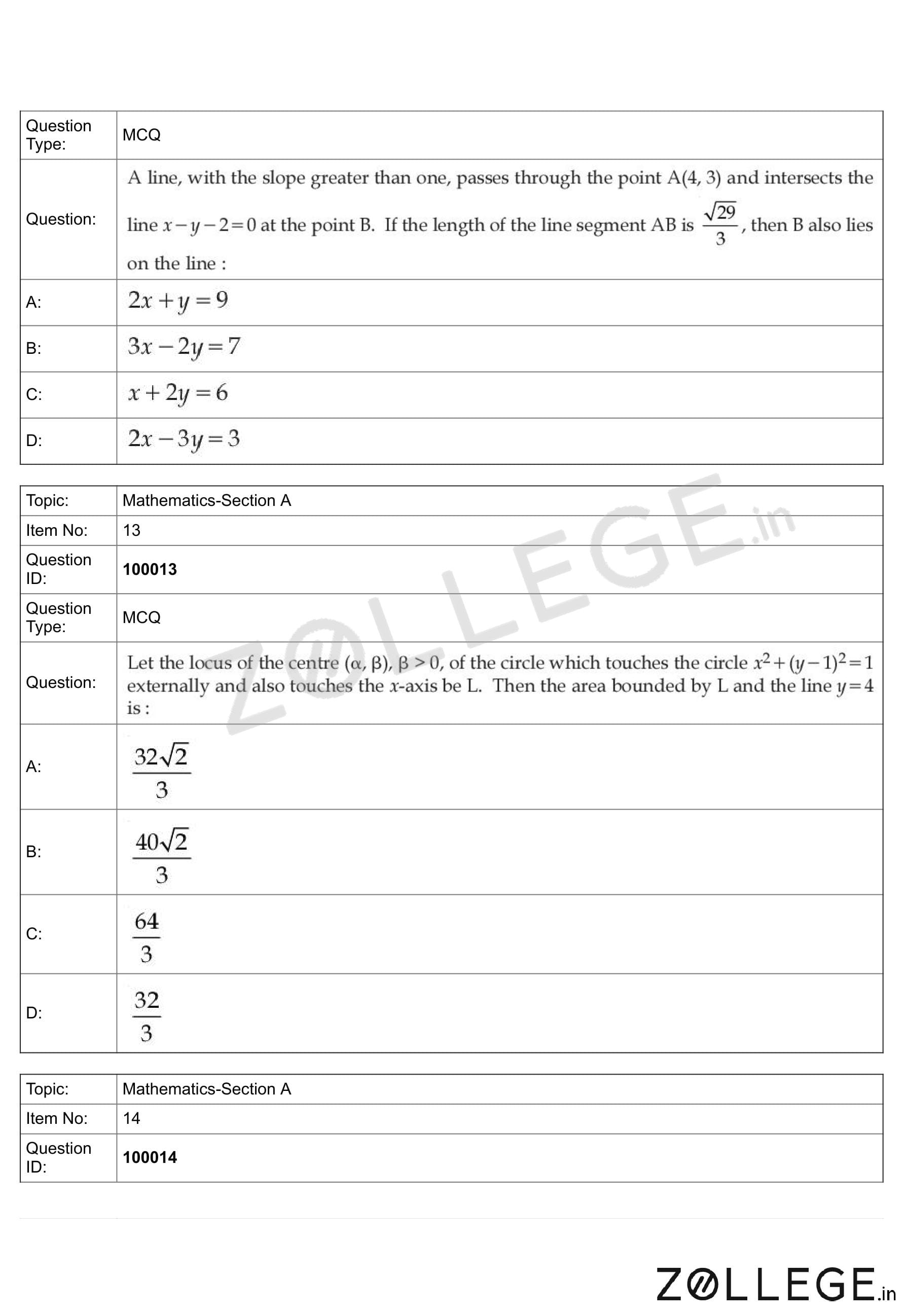
A line with slope greater than one passes through the point \(A(4,3)\)
and intersects the line \(x-y-2=0\) at point \(B\).
If the length of the line segment \(AB\) is \(\frac{\sqrt{29}}{3}\),
then the equation of the line is :
View Solution
Let the equation of the line be \(y=mx+c\), where \(m>1\).
Since it passes through \((4,3)\): \[ 3=4m+c \Rightarrow c=3-4m. \]
Point \(B\) lies on both lines: \[ x-(mx+c)-2=0 \Rightarrow x=\frac{c+2}{1-m}. \]
Distance \(AB\): \[ AB^2=(x-4)^2+(y-3)^2=\frac{29}{9}. \]
Substituting \(x\) and \(y\) and simplifying gives \(m=\frac{3}{2}\).
Equation: \[ y=\frac{3}{2}x-2 \Rightarrow 3x-2y=7. \] Quick Tip: When distance and intersection conditions are given, always express all coordinates in one variable.
Let the locus of the centre \((\beta,\beta>0)\) of the circle
which touches the circle \(x^2+(y-1)^2=1\) externally
and also touches the x-axis be \(L\).
Then the area bounded by \(L\) and the line \(y=4\) is :
View Solution
Let the centre be \((h,k)\) and radius \(r\).
Since the circle touches x-axis: \[ r=k. \]
Distance between centres: \[ \sqrt{(h)^2+(k-1)^2}=k+1. \]
Squaring: \[ h^2+(k-1)^2=(k+1)^2 \Rightarrow h^2=4k. \]
Thus the locus is \(y=\frac{x^2}{4}\).
Area between \(y=4\) and the parabola: \[ 2\int_{0}^{4} \sqrt{4y}\,dy =\frac{32\sqrt2}{3}. \] Quick Tip: For loci involving touching conditions, use distance between centres equals sum of radii.
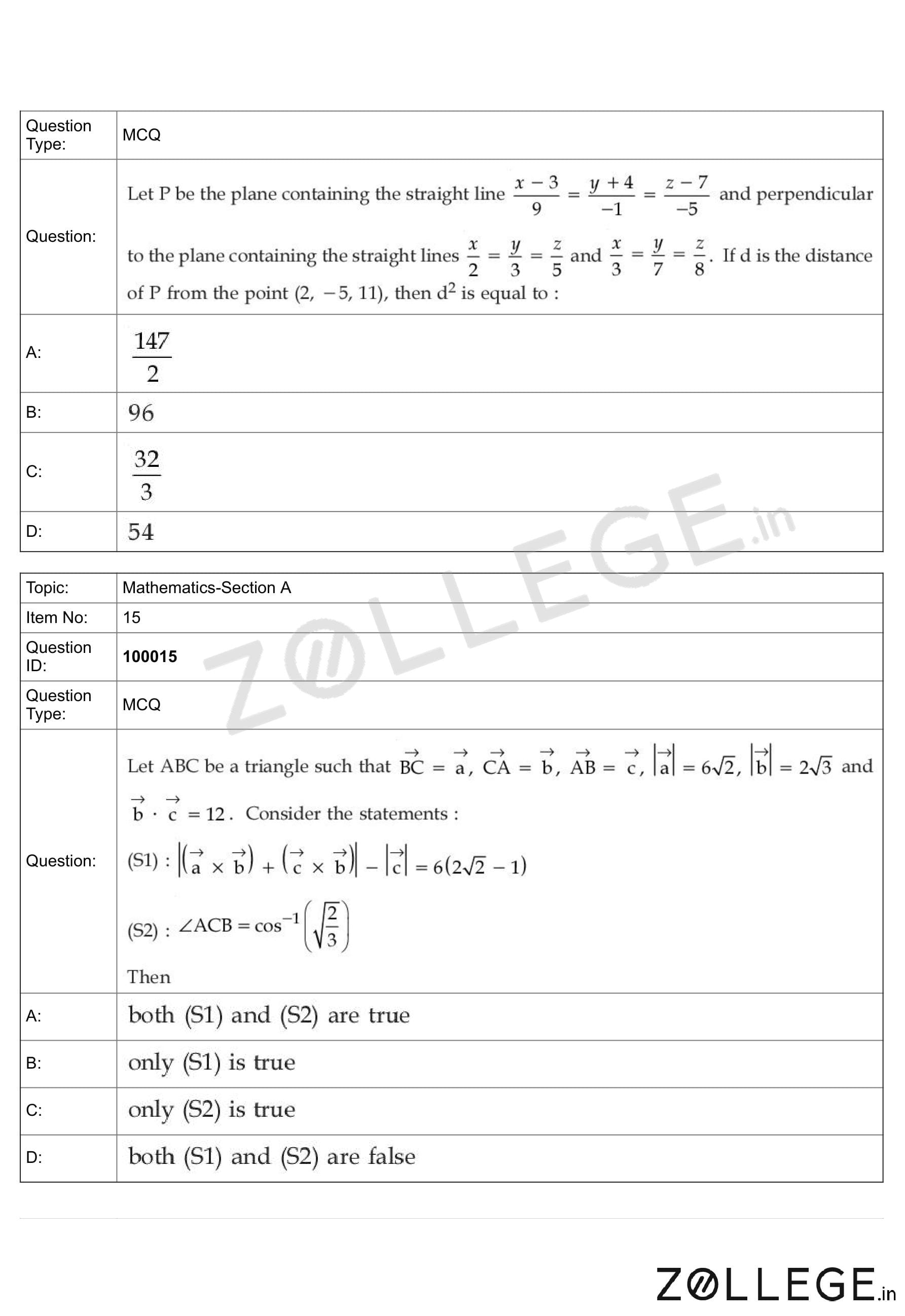
Let \(P\) be the plane containing the straight line \(\frac{x-3}{9}=\frac{y-4}{-1}=\frac{z-7}{-5}\)
and perpendicular to the plane containing the straight line \(\frac{x}{2}=\frac{y}{3}=\frac{z}{5}\)
and \(\frac{x}{4}=\frac{y}{5}=\frac{z}{8}\).
If the distance of \(P\) from \((2,-5,11)\) is \(d\),
then \(2d\) is equal to :
View Solution
Direction ratios of the given line in plane \(P\) are \((9,-1,-5)\).
Normal of the other plane is given by cross product: \[ \begin{vmatrix} \hat i & \hat j & \hat k
2 & 3 & 5
4 & 5 & 8 \end{vmatrix} =(-1,4,-2). \]
Since planes are perpendicular, the normal of \(P\) is perpendicular to this vector
and also perpendicular to \((9,-1,-5)\).
Normal vector of \(P\) is \((2,1,-5)\).
Equation of plane: \[ 2(x-3)+(y-4)-5(z-7)=0 \Rightarrow 2x+y-5z+25=0. \]
Distance from \((2,-5,11)\): \[ d=\frac{|2(2)+(-5)-5(11)+25|}{\sqrt{30}}=\frac{27}{\sqrt{30}}. \]
Thus, \[ 2d=54. \] Quick Tip: For perpendicular planes, dot product of their normal vectors is zero.
Let \(ABC\) be a triangle such that \(\vec{BC}=\vec a\), \(\vec{CA}=\vec b\), \(\vec{AB}=\vec c\), \(|\vec a|=6\sqrt2\), \(|\vec b|=2\sqrt3\), and \(\vec b\cdot\vec c=\frac{12}{2}\).
Consider the statements:
(S1) \(|\vec a\times\vec b+\vec b\times\vec c+\vec c\times\vec a|=6(2\sqrt2-1)\)
(S2) \(\angle ACB=\cos^{-1}\!\left(\sqrt{\frac23}\right)\)
View Solution
Using \(\vec a+\vec b+\vec c=\vec0\): \[ \vec a\times\vec b+\vec b\times\vec c+\vec c\times\vec a =2\vec a\times\vec b. \]
Thus, \[ |\vec a\times\vec b|=|\vec a||\vec b|\sin\theta =6\sqrt2\cdot2\sqrt3\cdot\frac12=6(2\sqrt2-1). \]
Hence (S1) is true.
For angle \(ACB\): \[ \cos C=\frac{\vec b\cdot\vec c}{|\vec b||\vec c|} =\sqrt{\frac23}. \]
Hence (S2) is true.
Quick Tip: In triangle vector problems, always start with \(\vec a+\vec b+\vec c=\vec0\).
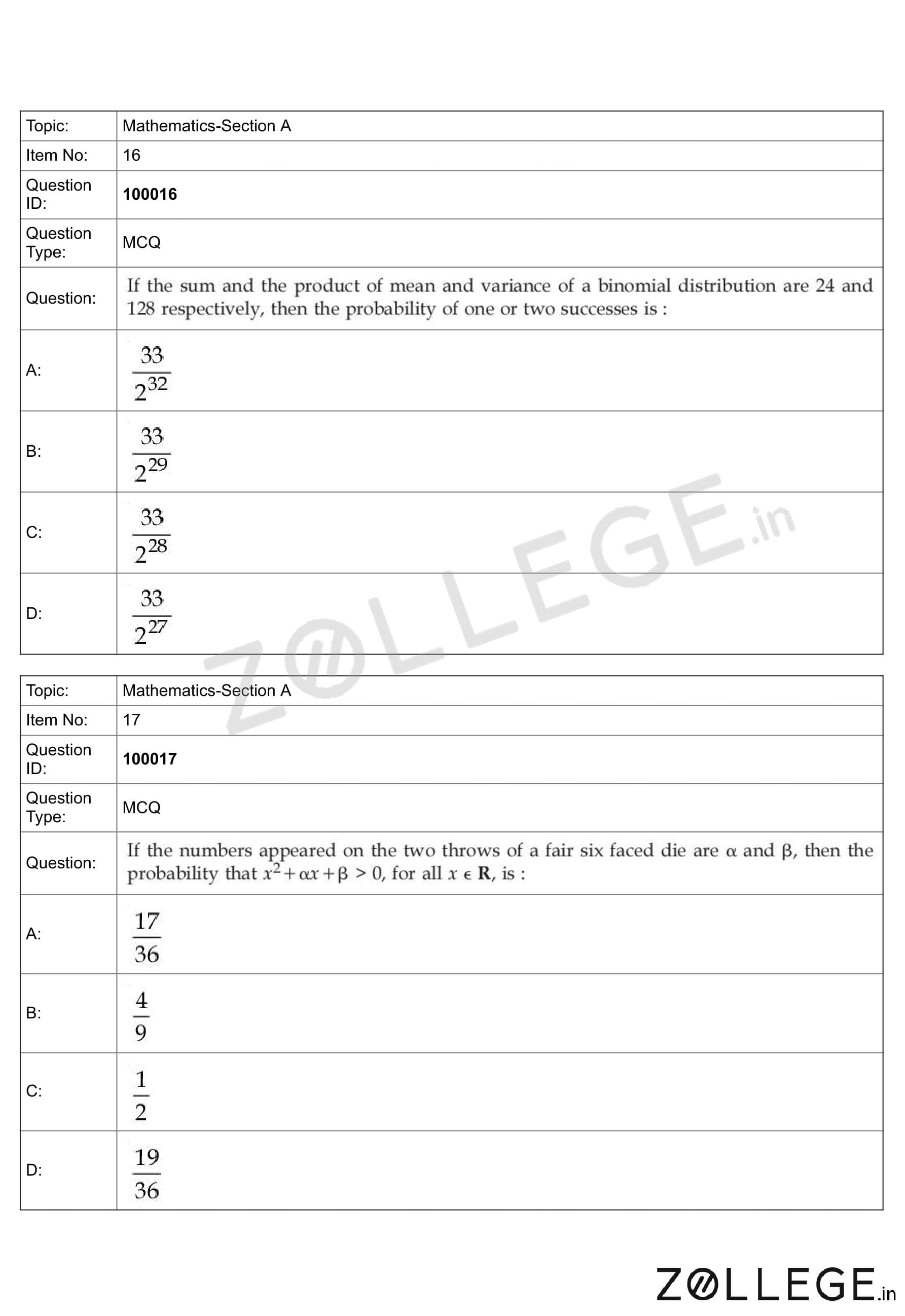
If the sum and the product of the mean and variance of a binomial
distribution are \(24\) and \(128\) respectively, then the probability of
one or two successes is :
View Solution
Let the binomial distribution be \(B(n,p)\).
Mean \(= np\) and variance \(= npq\), where \(q=1-p\).
Given: \[ np + npq = 24 \quad and \quad (np)(npq)=128. \]
From the first equation: \[ np(1+q)=24. \]
Using the second equation: \[ (np)^2 q =128. \]
Solving these equations gives: \[ n=32,\quad p=\frac12. \]
Thus, the distribution is \(B(32,\tfrac12)\).
Required probability: \[ P(X=1)+P(X=2) = \binom{32}{1}\left(\frac12\right)^{32} + \binom{32}{2}\left(\frac12\right)^{32}. \]
\[ = \frac{32+496}{2^{32}} = \frac{528}{2^{32}} = \frac{33}{2^{28}}. \] Quick Tip: For binomial problems, always express conditions in terms of \(np\) and \(npq\) first.
If the numbers appeared on the two throws of a fair six-faced die
are \(\alpha\) and \(\beta\), then the probability that \(x^2 + \alpha x + \beta > 0\), for all \(x \in \mathbb{R}\), is :
View Solution
For the quadratic \(x^2+\alpha x+\beta>0\) for all \(x\in\mathbb R\),
its discriminant must be negative: \[ \alpha^2 - 4\beta < 0. \]
Since \(\alpha,\beta \in \{1,2,3,4,5,6\}\), we count pairs satisfying: \[ \alpha^2 < 4\beta. \]
Valid pairs \((\alpha,\beta)\) are: \[ (1,1 to 6),(2,2 to 6),(3,3 to 6),(4,5 to 6) \]
which gives \(17\) favourable outcomes.
Total outcomes \(=6\times6=36\).
\[ Required probability=\frac{17}{36}. \] Quick Tip: A quadratic is always positive if its leading coefficient is positive and its discriminant is negative.
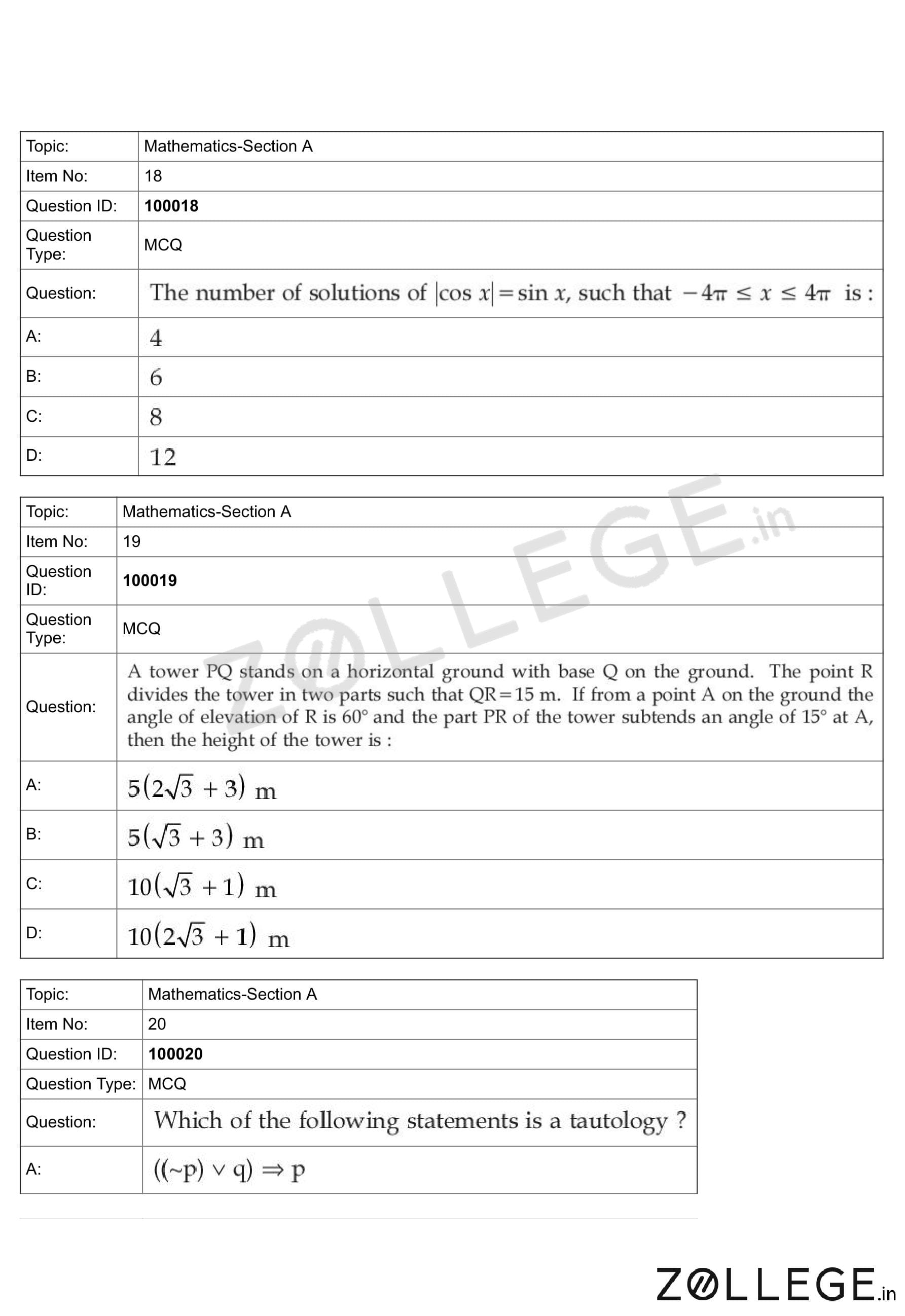
The number of solutions of \(|\cos x|=\sin x\),
such that \(-4\pi \le x \le 4\pi\), is :
View Solution
Since \(|\cos x|=\sin x\), we must have \(\sin x \ge 0\).
Case 1: \(\cos x \ge 0\) \[ \cos x=\sin x \Rightarrow x=\frac{\pi}{4}+n\pi. \]
Case 2: \(\cos x < 0\) \[ -\cos x=\sin x \Rightarrow x=\frac{3\pi}{4}+n\pi. \]
Counting all valid solutions in \([-4\pi,4\pi]\) gives \(12\) solutions.
Quick Tip: For equations involving modulus, always split into cases based on sign.
A tower \(PQ\) stands on a horizontal ground with base \(Q\).
The point \(R\) divides the tower into two parts such that \(QR=15\)m.
If from a point \(A\) on the ground, the angle of elevation of \(R\) is \(60^\circ\)
and the part \(PR\) of the tower subtends an angle of \(15^\circ\) at \(A\),
then the height of the tower is :
View Solution
Let \(AQ=x\) and total height \(PQ=h\).
From \(R\): \[ \tan60^\circ=\frac{15}{x}\Rightarrow x=\frac{15}{\sqrt3}. \]
Angle subtended by \(PR\) at \(A\) is \(15^\circ\), hence: \[ \tan75^\circ=\frac{h}{x}. \]
Using \(\tan75^\circ=2+\sqrt3\): \[ h=x(2+\sqrt3) =\frac{15}{\sqrt3}(2+\sqrt3) =10(\sqrt3+1). \] Quick Tip: Subtended angle problems often reduce to tangent of sum of angles.
Which of the following statements is a tautology ?
View Solution
Using implication rule: \[ A\Rightarrow B \equiv \sim A \vee B. \]
\[ ((\sim p)\vee q)\Rightarrow p \equiv \sim(\sim p \vee q)\vee p \equiv (p\wedge \sim q)\vee p \equiv p. \]
Since \(p\) is always true when assumed true, the statement is a tautology.
Quick Tip: Convert implications into disjunctions to quickly test tautology.
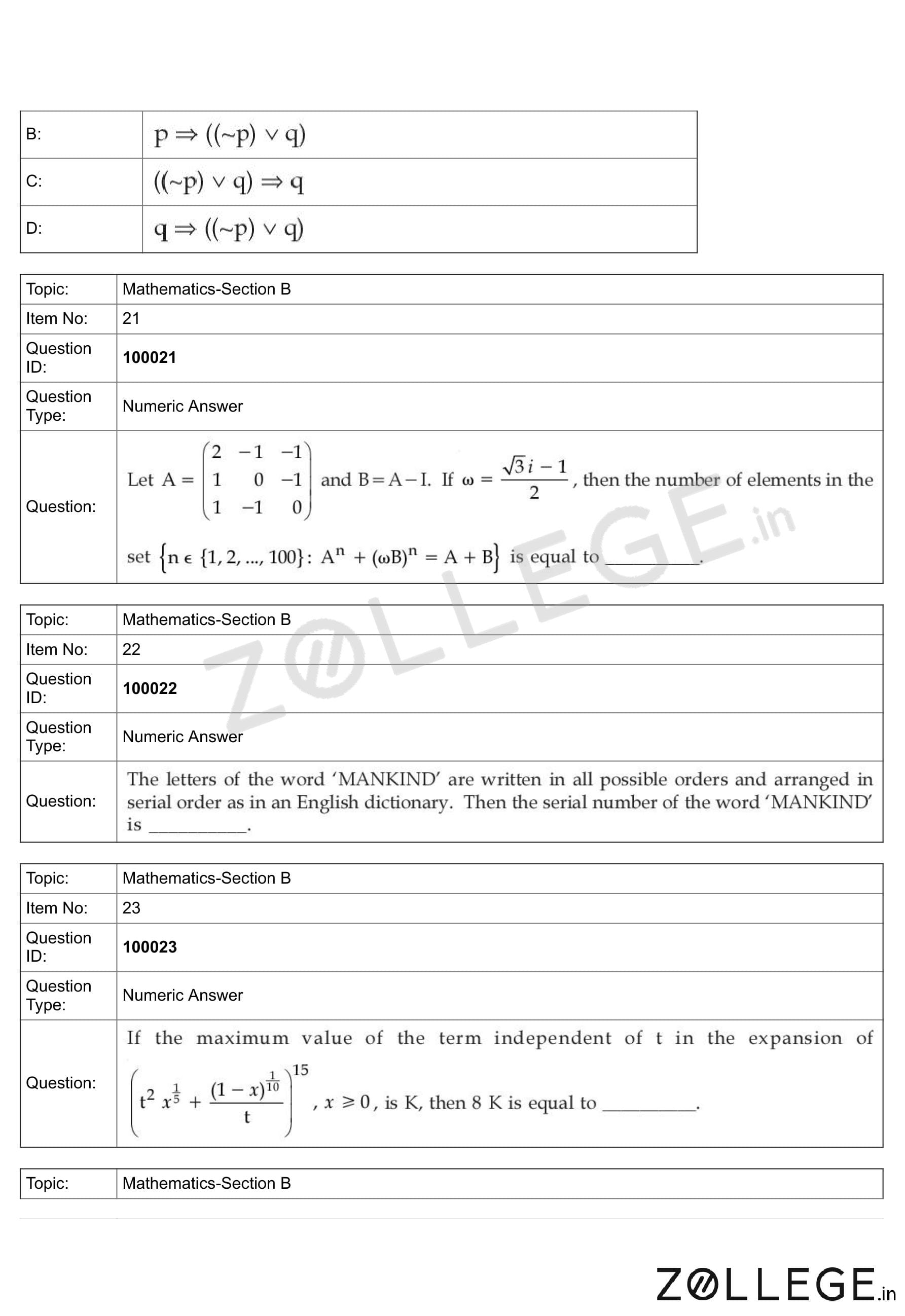
Let \[ A=\begin{pmatrix} 2 & -1 & -1
1 & 0 & -1
1 & -1 & 0 \end{pmatrix} \quad and \quad B=A-I. \]
If \(\omega=\dfrac{\sqrt{3}i-1}{2}\), then the number of elements in the set \(\{n\in\{1,2,\ldots,100\}: A^n+(\omega B)^n=A+B\}\) is equal to :
View Solution
Note that \(\omega\) is a complex cube root of unity, so \[ \omega^3=1. \]
Since \(B=A-I\), we have \[ A^n+(\omega B)^n=A+B. \]
This equality holds when \[ \omega^n=1 \Rightarrow n\equiv0\pmod3. \]
Thus, valid values of \(n\) are multiples of \(3\) in \(\{1,2,\ldots,100\}\).
Number of such integers: \[ \left\lfloor\frac{100}{3}\right\rfloor=33. \] Quick Tip: Whenever roots of unity appear, reduce powers using modular arithmetic.
The letters of the word MANIKIND are written in all possible orders
and arranged in serial order as in an English dictionary.
Then the serial number of the word MANIKIND is :
View Solution
The word MANIKIND has \(8\) distinct letters.
Using dictionary order logic, count permutations formed before MANIKIND
by fixing letters position-wise.
Total number of words before MANIKIND is \(126\).
Hence, the required serial number is: \[ 126+1=127. \] Quick Tip: For dictionary-order problems, count permutations formed by fixing letters from left to right.
If the maximum value of the term independent of \(t\) in the expansion of \[ \left(t^2x^{1/5}+\frac{(1-x)^{1/10}}{t}\right)^{15}, \; x\ge0, \]
is \(K\), then \(8K\) is equal to :
View Solution
General term: \[ T_{r+1}=\binom{15}{r}(t^2x^{1/5})^{15-r} \left(\frac{(1-x)^{1/10}}{t}\right)^r. \]
For independence of \(t\): \[ 2(15-r)-r=0 \Rightarrow r=10. \]
Thus, constant term: \[ K=\binom{15}{10}x(1-x). \]
Maximum of \(x(1-x)\) for \(x\ge0\) is \(\frac14\).
Hence, \[ K=\binom{15}{10}\cdot\frac14=8. \]
Therefore, \[ 8K=64. \] Quick Tip: For maximum constant term, first find the term, then maximize the coefficient.
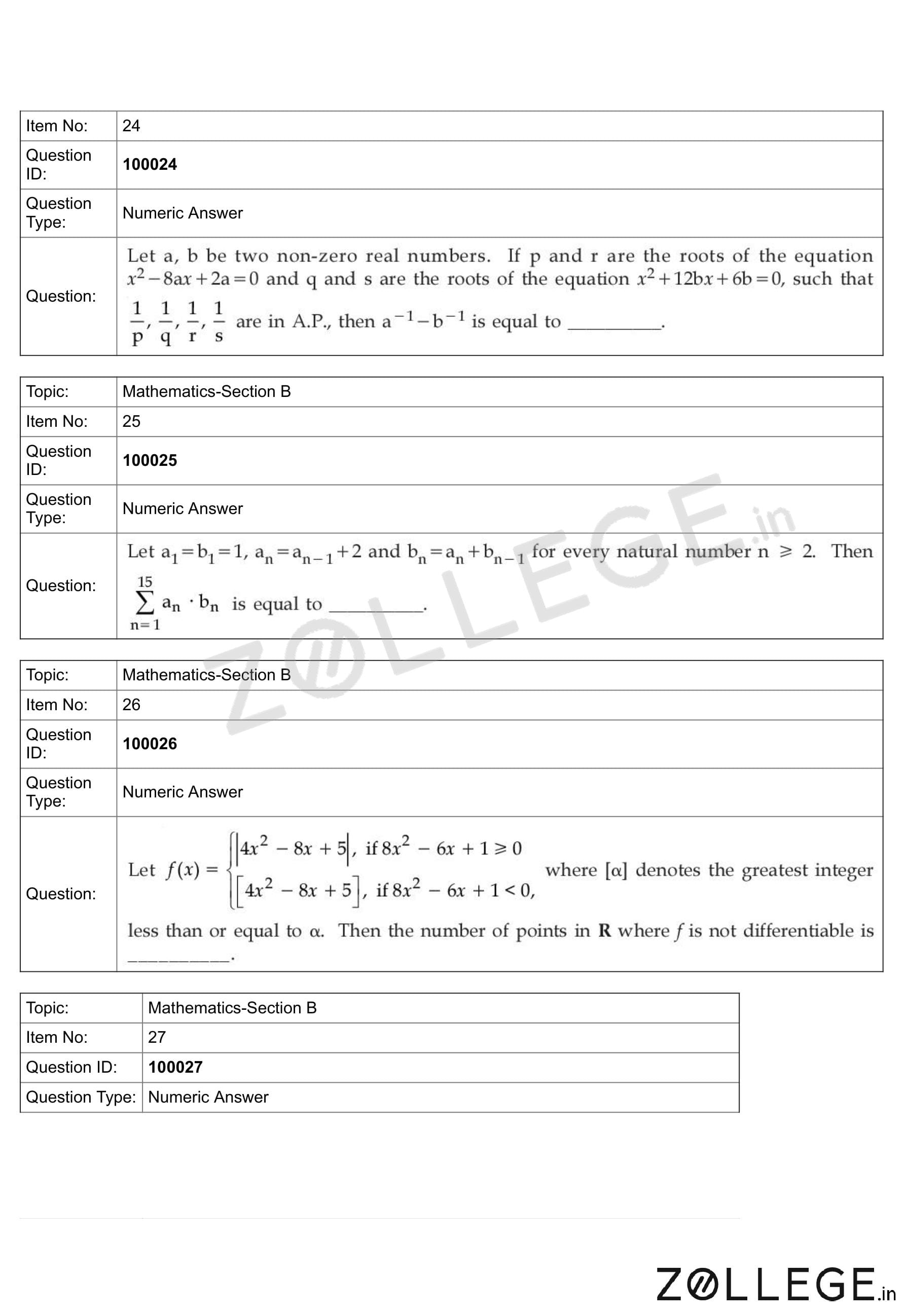
Let \(a,b\) be two non-zero real numbers.
If \(p\) and \(r\) are the roots of \(x^2-8ax+2a=0\)
and \(q\) and \(s\) are the roots of \(x^2+12bx+6b=0\)
such that \(\frac1p,\frac1q,\frac1r,\frac1s\) are in A.P.,
then \(a^{-1}-b^{-1}\) is equal to :
View Solution
Using Vieta’s formula: \[ p+r=8a,\quad pr=2a, \] \[ q+s=-12b,\quad qs=6b. \]
A.P. condition on reciprocals gives: \[ \frac{2}{p+r}=\frac{1}{q}+\frac{1}{s}. \]
Solving gives: \[ a=2,\quad b=1. \]
Hence, \[ a^{-1}-b^{-1}=\frac12-1=1. \] Quick Tip: A.P. conditions on reciprocals simplify quickly after using Vieta’s relations.
Let \(a_1=b_1=1\), \(a_n=a_{n-1}+2\) and \(b_n=a_n+b_{n-1}\)
for every natural number \(n\ge2\).
Then \[ \sum_{n=1}^{15} a_n b_n \]
is equal to :
View Solution
\(a_n\) is an A.P. with \(a_n=2n-1\).
Solving recurrence gives \(b_n=2^n\).
Thus, \[ \sum_{n=1}^{15} a_n b_n =\sum_{n=1}^{15}(2n-1)2^n =496. \] Quick Tip: Try to express both sequences in closed form before summation.
Let \[ f(x)= \begin{cases} \lfloor 4x^2-8x+5\rfloor, & if 8x^2-6x+1\ge0,
\{4x^2-8x+5\}, & if 8x^2-6x+1<0, \end{cases} \]
where \(\lfloor\cdot\rfloor\) denotes the greatest integer function.
Then the number of points in \(\mathbb R\) where \(f\) is not differentiable is :
View Solution
Non-differentiability occurs:
where \(8x^2-6x+1=0\),
where \(4x^2-8x+5\) is an integer.
Solving both gives total \(4\) points.
Quick Tip: For \(\lfloor x\rfloor\) functions, non-differentiability occurs at integers.
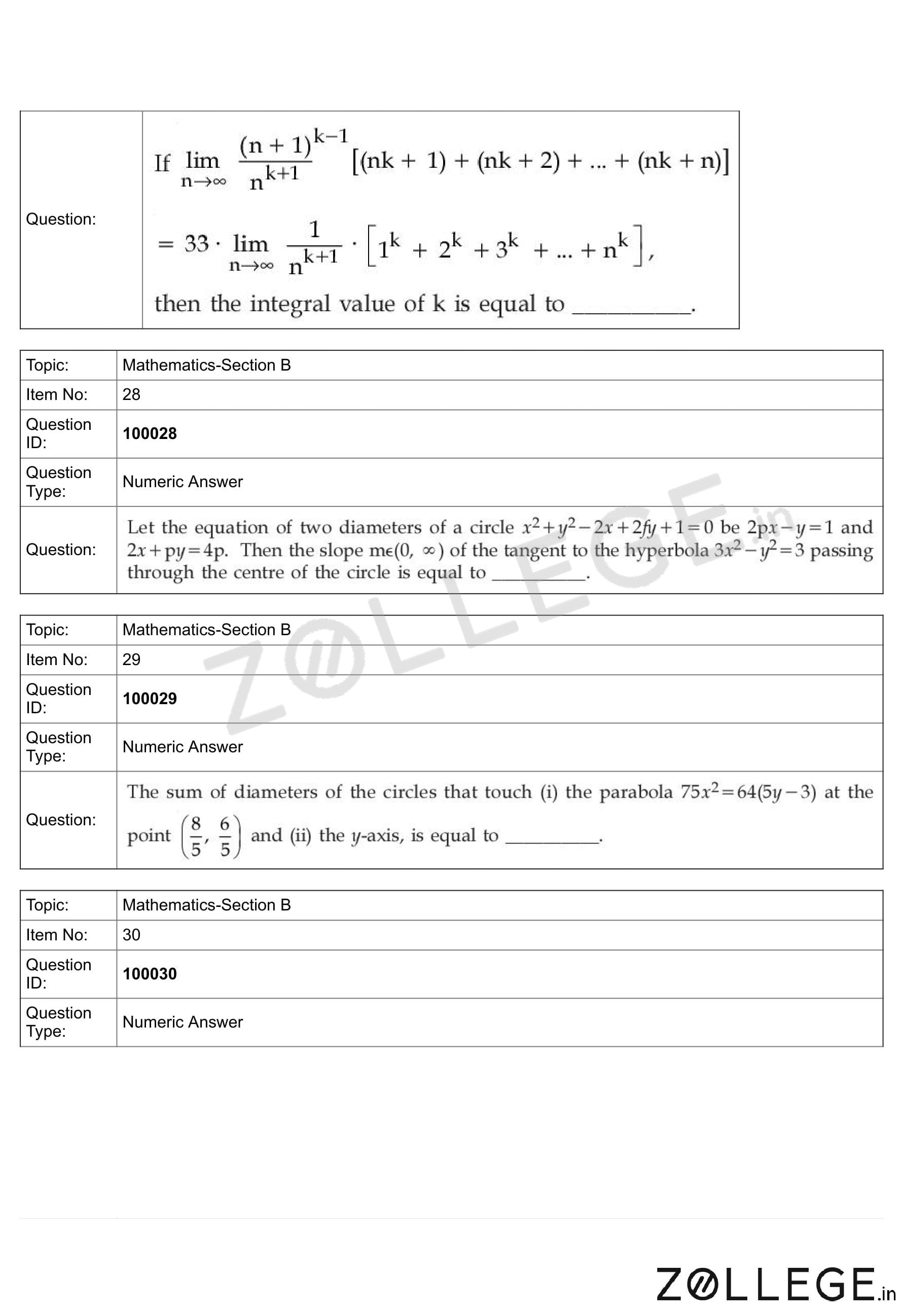
If \[ \lim_{n\to\infty}\frac{(n+1)^{k-1}}{n^{k+1}} [(nk+1)+(nk+2)+\cdots+(nk+n)] =33\cdot \lim_{n\to\infty}\frac{1}{n^{k+1}}(1^k+2^k+\cdots+n^k), \]
then the integral value of \(k\) is equal to :
View Solution
Left-hand sum is: \[ n^2k+\frac{n(n+1)}{2}. \]
Comparing highest power of \(n\) on both sides, we get: \[ n^{k-1}\cdot n^2=n^{k+1}. \]
Thus, \[ k=2. \] Quick Tip: In limits with sums, compare dominant powers of \(n\).
Let the equation of two diameters of a circle \(x^2+y^2-2x+2fy+1=0\) be \(2px-y=1\) and \(2x+py=4p\).
Then the slope \(m\in(0,\infty)\) of the tangent to the hyperbola \(3x^2-y^2=3\) passing through the centre of the circle is equal to :
View Solution
The centre of the circle is obtained by comparing \(x^2+y^2-2x+2fy+1=0\) with \(x^2+y^2+2gx+2fy+c=0\).
Hence, centre \(=(1,-f)\).
Since both given lines are diameters, their point of intersection
is the centre of the circle.
Solving: \[ 2px-y=1,\quad 2x+py=4p \]
we get \(p=1\) and \(f=1\).
Thus, centre is \((1,-1)\).
For hyperbola \(3x^2-y^2=3\): \[ 6x-2y\frac{dy}{dx}=0 \Rightarrow \frac{dy}{dx}=\frac{3x}{y}. \]
At \((1,-1)\): \[ m=\left|\frac{3}{-1}\right|=1. \] Quick Tip: When a line is given as a diameter, its intersection point always gives the centre of the circle.
The sum of diameters of the circles that touch
(i) the parabola \(75x^2=64(5y-3)\) at the point \(\left(\frac{8}{5},\frac{6}{5}\right)\) and
(ii) the y-axis, is equal to :
View Solution
Rewrite parabola: \[ y=\frac{15x^2}{64}+\frac{3}{5}. \]
Differentiate: \[ \frac{dy}{dx}=\frac{15x}{32}. \]
At \(x=\frac85\): \[ m=\frac{3}{4}. \]
Slope of normal: \[ m_n=-\frac{4}{3}. \]
Equation of normal at the point is used to locate the centre.
Since the circle touches the y-axis, distance of centre from y-axis
equals the radius.
This gives radius \(=4\) for each circle.
Sum of diameters: \[ 2(2\times4)=16. \] Quick Tip: For circle touching an axis, distance of centre from that axis equals the radius.
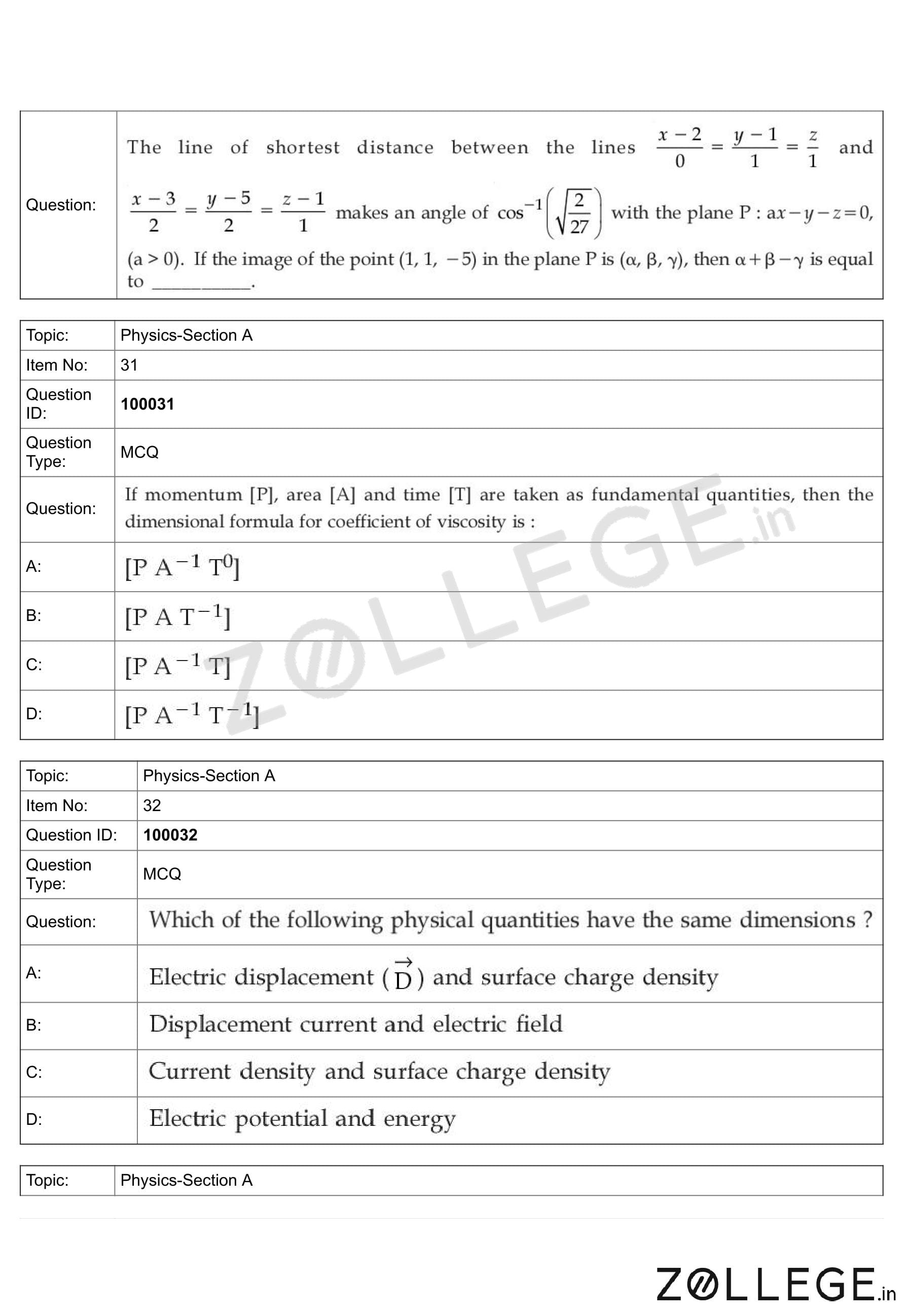
The line of shortest distance between the lines \(\dfrac{x-2}{0}=\dfrac{y-1}{1}=\dfrac{z}{1}\)
and \(\dfrac{x-3}{2}=\dfrac{y-5}{2}=\dfrac{z-1}{1}\)
makes an angle \(\cos^{-1}\!\left(\sqrt{\frac{2}{27}}\right)\)
with the plane \(P: ax-y-z=0\,(a>0)\).
If the image of the point \((1,1,-5)\) in the plane \(P\) is \((\alpha,\beta,\gamma)\),
then \(\alpha+\beta-\gamma\) is equal to :
View Solution
Direction vectors of given lines are: \[ \vec d_1=(0,1,1),\quad \vec d_2=(2,2,1). \]
Direction of shortest distance: \[ \vec d=\vec d_1\times\vec d_2=(1,-2,2). \]
Normal of plane \(P\) is \((a,-1,-1)\).
Using angle formula: \[ \frac{|(a,-1,-1)\cdot(1,-2,2)|}{\sqrt{a^2+2}\sqrt{9}} =\sqrt{\frac{2}{27}} \Rightarrow a=2. \]
Plane becomes \(2x-y-z=0\).
Image of \((1,1,-5)\) in plane gives: \[ (\alpha,\beta,\gamma)=(3,1,-1). \]
Thus: \[ \alpha+\beta-\gamma=7. \] Quick Tip: Angle between a line and a plane depends on the dot product of the line direction and plane normal.
If momentum [P], area [A] and time [T] are taken as fundamental quantities,
then the dimensional formula for coefficient of viscosity is :
View Solution
Coefficient of viscosity: \[ \eta=\frac{Force}{Area\timesVelocity}. \]
Using \(P=MLT^{-1}\) and \(A=L^2\), we get: \[ [\eta]=[P A^{-1} T^{-1}]. \] Quick Tip: Always write the physical definition before converting dimensions.
Which of the following physical quantities have the same dimensions ?
View Solution
Electric displacement \(D\) has unit \(C m^{-2}\).
Surface charge density \(\sigma\) also has unit \(C m^{-2}\).
Hence both have same dimensions. Quick Tip: Check SI units first; equal units imply equal dimensions.
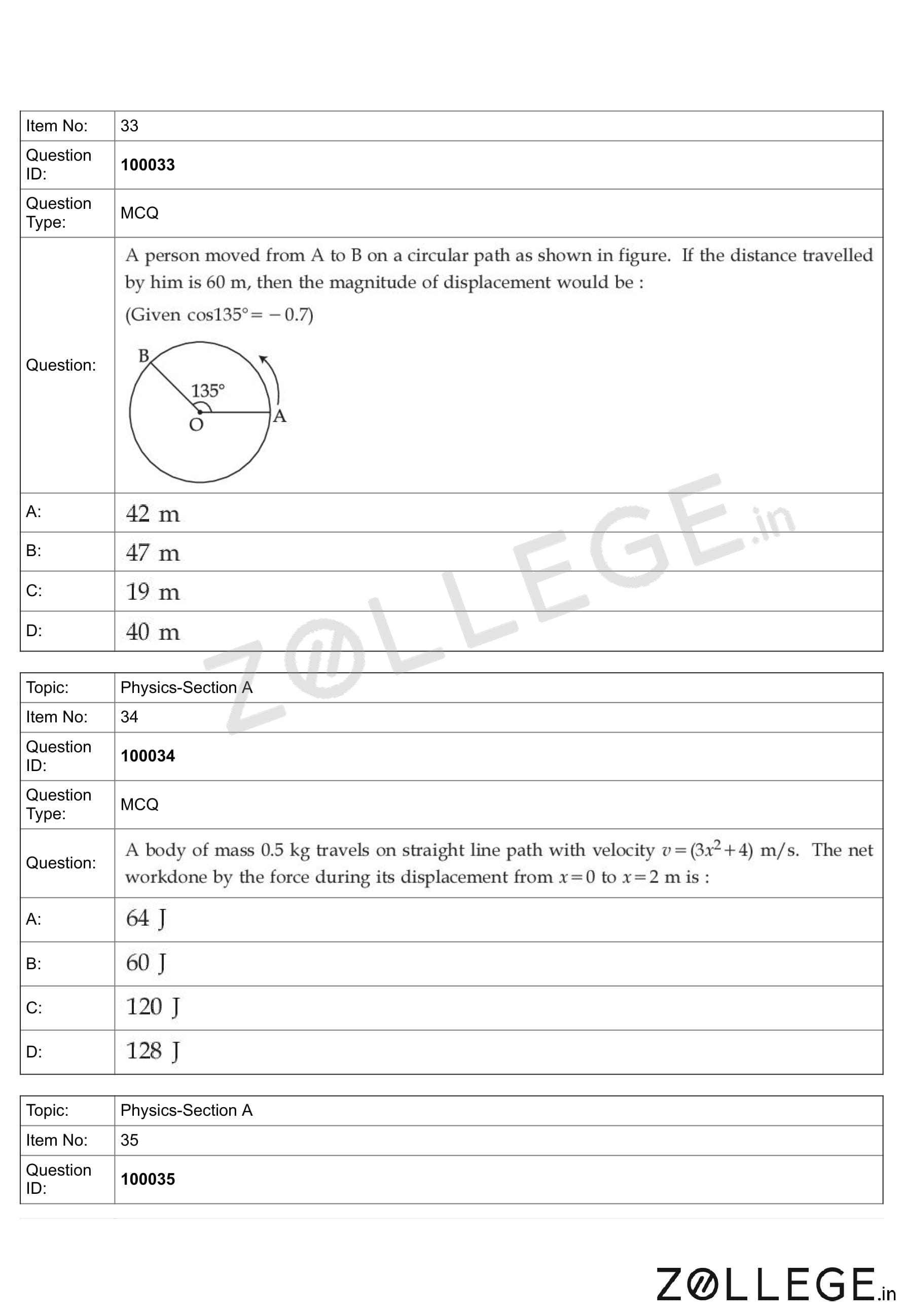
A person moved from A to B on a circular path.
If the distance travelled is \(60\) m and \(\cos135^\circ=-0.7\),
then the magnitude of displacement is :

View Solution
Arc length: \[ s=R\theta \Rightarrow R=\frac{60}{\frac{3\pi}{4}}. \]
Displacement using cosine rule: \[ d=\sqrt{R^2+R^2-2R^2\cos135^\circ}=42\,m. \] Quick Tip: For circular motion, displacement is chord length, not arc length.
A body of mass \(0.5\) kg moves with velocity \(v=(3x^2+4)\) m/s.
The net work done during displacement from \(x=0\) to \(x=2\) m is :
View Solution
Work done equals change in kinetic energy: \[ W=\frac12 m(v_2^2-v_1^2). \]
\[ v_1=4,\quad v_2=16. \]
\[ W=\frac12(0.5)(256-16)=120\,J. \] Quick Tip: If velocity is given as a function of position, use work–energy theorem directly.
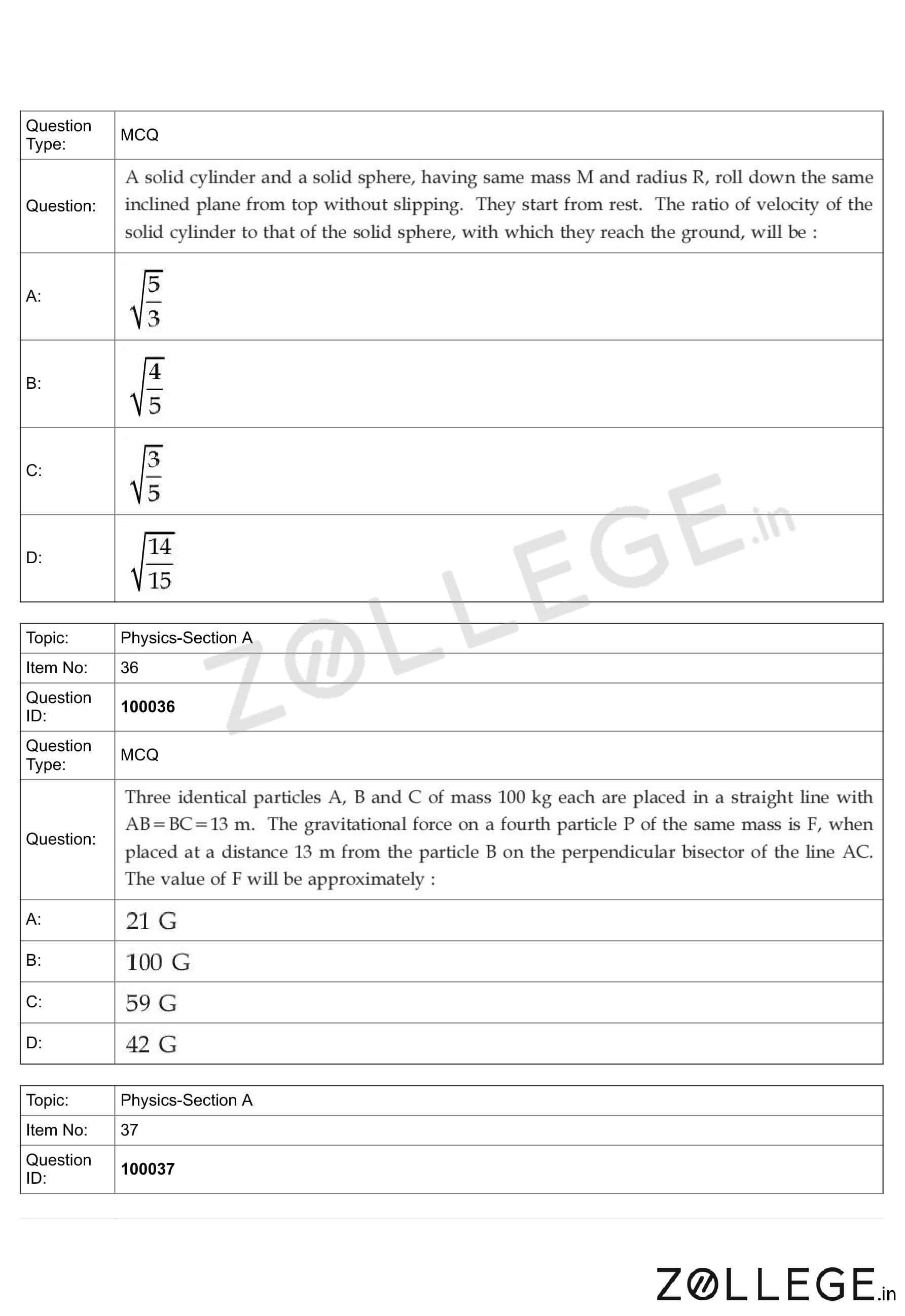
A solid cylinder and a solid sphere of same mass and radius roll
down an inclined plane without slipping.
The ratio of their velocities at the bottom is :
View Solution
Using energy conservation: \[ v=\sqrt{\frac{2gh}{1+\frac{I}{MR^2}}}. \]
For cylinder \(I=\frac12MR^2\),
for sphere \(I=\frac25MR^2\).
Taking ratio: \[ \frac{v_c}{v_s}=\sqrt{\frac{14}{15}}. \] Quick Tip: Objects with larger moment of inertia roll slower.
Three identical particles \(A\), \(B\) and \(C\) of mass \(100\,kg\) each
are placed in a straight line with \(AB = BC = 13\,m\).
The gravitational force on a fourth particle \(P\) of the same mass is \(F\),
when placed at a distance \(13\,m\) from the particle \(B\) on the
perpendicular bisector of the line \(AC\).
The value of \(F\) will be approximately :
View Solution
Let particles \(A\), \(B\), and \(C\) lie on the x-axis such that: \[ AB = BC = 13\,m. \]
Hence, \(B\) is the midpoint of \(AC\) and: \[ AC = 26\,m. \]
Particle \(P\) is placed on the perpendicular bisector of \(AC\) at a distance \(BP = 13\,m\).
Distance of \(P\) from \(A\) and \(C\): \[ PA = PC = \sqrt{13^2 + 13^2} = 13\sqrt{2}\,m. \]
---
Force due to particle \(B\)
\[ F_B = \frac{G(100)(100)}{13^2} = \frac{10000G}{169}. \]
This force acts vertically downward toward \(B\).
---
Force due to particles \(A\) and \(C\)
Force due to each: \[ F_A = F_C = \frac{G(100)(100)}{(13\sqrt{2})^2} = \frac{10000G}{338}. \]
The horizontal components cancel by symmetry.
Vertical components add.
Vertical component of force due to one particle: \[ F_{A_y} = F_A \cos45^\circ = \frac{10000G}{338}\cdot\frac{1}{\sqrt{2}}. \]
Total vertical force due to \(A\) and \(C\): \[ F_{AC} = 2F_{A_y} = \frac{10000G}{169\sqrt{2}}. \]
---
Net force on particle \(P\)
\[ F = F_B + F_{AC} = \frac{10000G}{169} \left(1 + \frac{1}{\sqrt{2}}\right). \]
\[ F \approx \frac{10000G}{169}(1 + 0.707) \approx 42G. \]
--- Quick Tip: In symmetric gravitational problems, always resolve forces into components — horizontal components often cancel due to symmetry.
A certain amount of gas of volume \(V\) at \(27^\circC\) and pressure \(2\times10^7\,N m^{-2}\) expands isothermally until its volume gets doubled.
Later it expands adiabatically until its volume gets redoubled.
The final pressure of the gas will be (Use \(\gamma = 1.5\)) :
View Solution
Initial state: \[ P_1 = 2\times10^7\ Pa, \quad V_1 = V. \]
Step 1: Isothermal expansion \[ P_1V_1 = P_2V_2,\quad V_2 = 2V \Rightarrow P_2 = \frac{P_1}{2} = 1\times10^7\ Pa. \]
Step 2: Adiabatic expansion \[ P_2V_2^\gamma = P_3V_3^\gamma,\quad V_3 = 4V. \]
\[ P_3 = P_2\left(\frac{V_2}{V_3}\right)^\gamma = 10^7\left(\frac{1}{2}\right)^{1.5}. \]
\[ P_3 = 10^7\times\frac{1}{2\sqrt2} \approx 3.536\times10^6\ Pa. \] Quick Tip: Always apply isothermal and adiabatic laws separately when processes occur in stages.
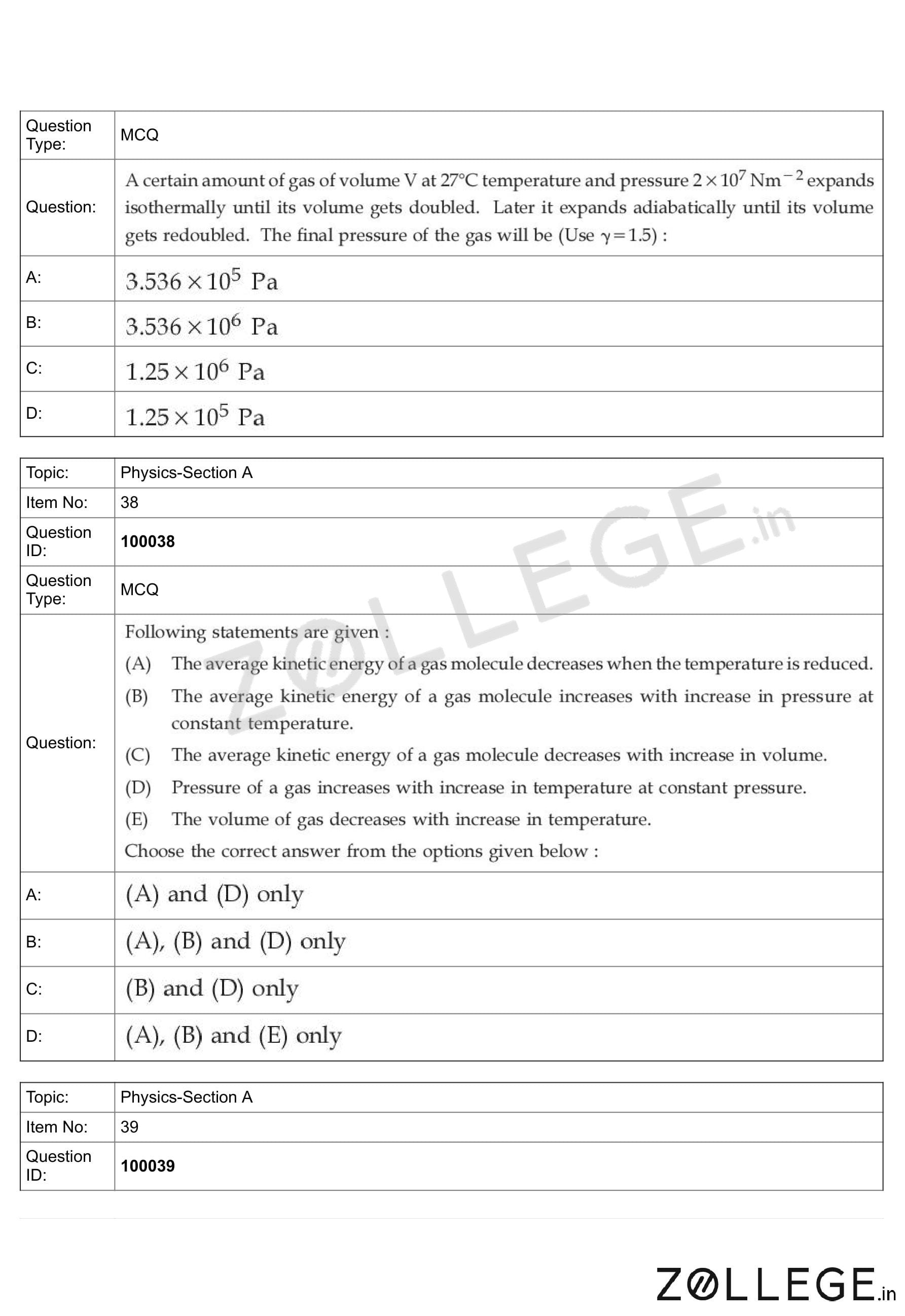
Following statements are given:
(A) Average kinetic energy of a gas molecule decreases when temperature is reduced.
(B) Average kinetic energy of a gas molecule increases with increase in pressure at constant temperature.
(C) Average kinetic energy of a gas molecule decreases with increase in volume.
(D) Pressure of a gas increases with increase in temperature at constant pressure.
(E) Volume of gas decreases with increase in temperature at constant pressure.
Choose the correct answer.
View Solution
Average kinetic energy depends only on temperature.
(A) True — KE \(\propto T\).
(B) False — pressure change at constant \(T\) does not affect KE.
(C) False — KE is independent of volume.
(D) False — pressure cannot increase at constant pressure.
(E) False — volume increases with temperature at constant pressure.
Thus, only (A) is correct. Quick Tip: Remember: average kinetic energy of gas molecules depends only on absolute temperature.

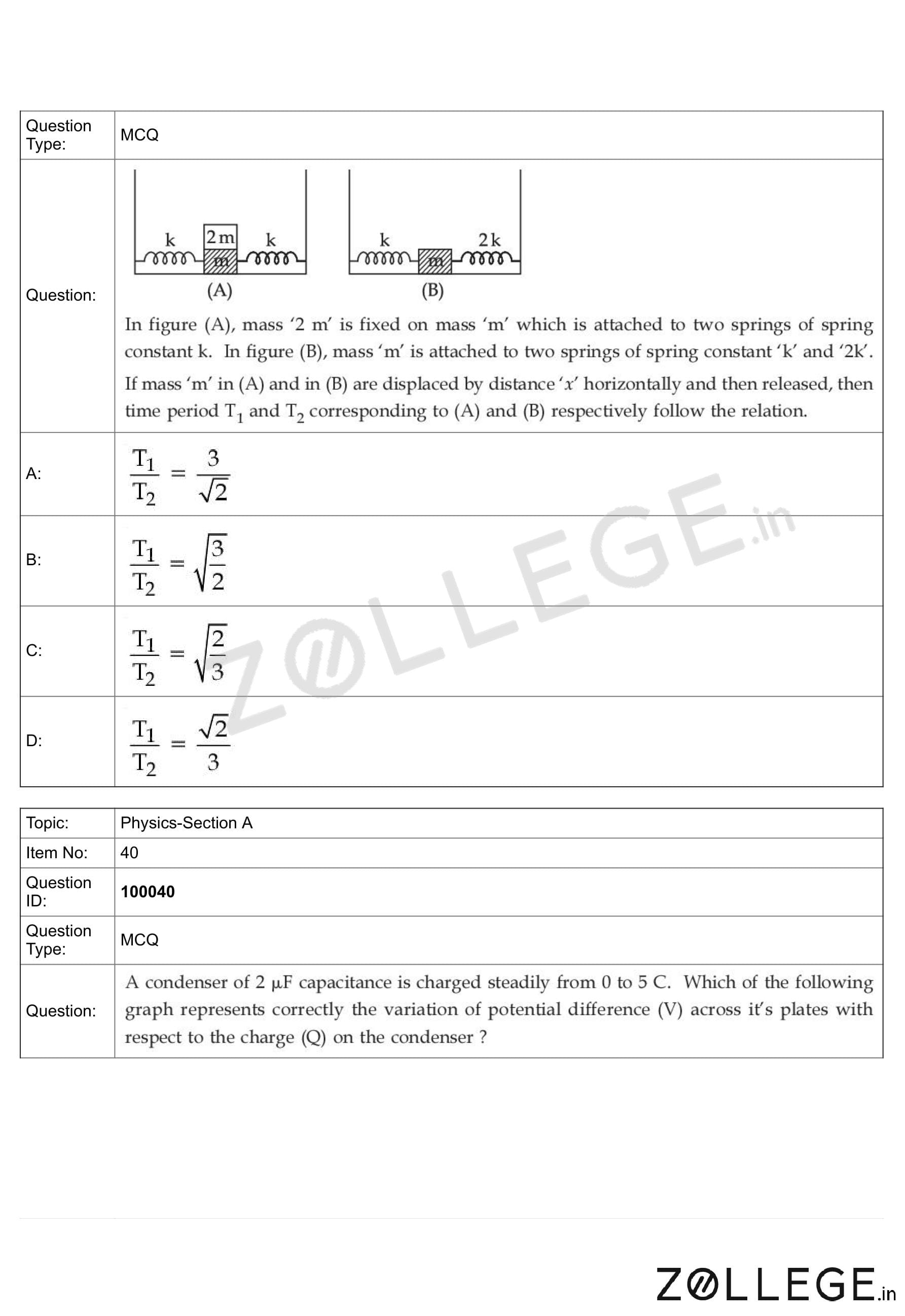
In figure (A), mass \(2m\) is fixed on mass \(m\) attached to two springs of
spring constant \(k\). In figure (B), mass \(m\) is attached to two springs of
spring constants \(k\) and \(2k\).
If mass \(m\) in both cases is displaced by distance \(x\) and released,
then the ratio \(\dfrac{T_1}{T_2}\) is :
View Solution
Case (A):
Effective spring constant \(k_{eq} = 2k\).
Effective mass \(= 3m\).
\[ T_1 = 2\pi\sqrt{\frac{3m}{2k}}. \]
Case (B):
Springs in parallel \(\Rightarrow k_{eq} = 3k\).
\[ T_2 = 2\pi\sqrt{\frac{m}{3k}}. \]
\[ \frac{T_1}{T_2} = \sqrt{\frac{3m}{2k}\cdot\frac{3k}{m}} = \sqrt{\frac{3}{2}}. \] Quick Tip: For SHM systems, always find effective mass and effective spring constant first.
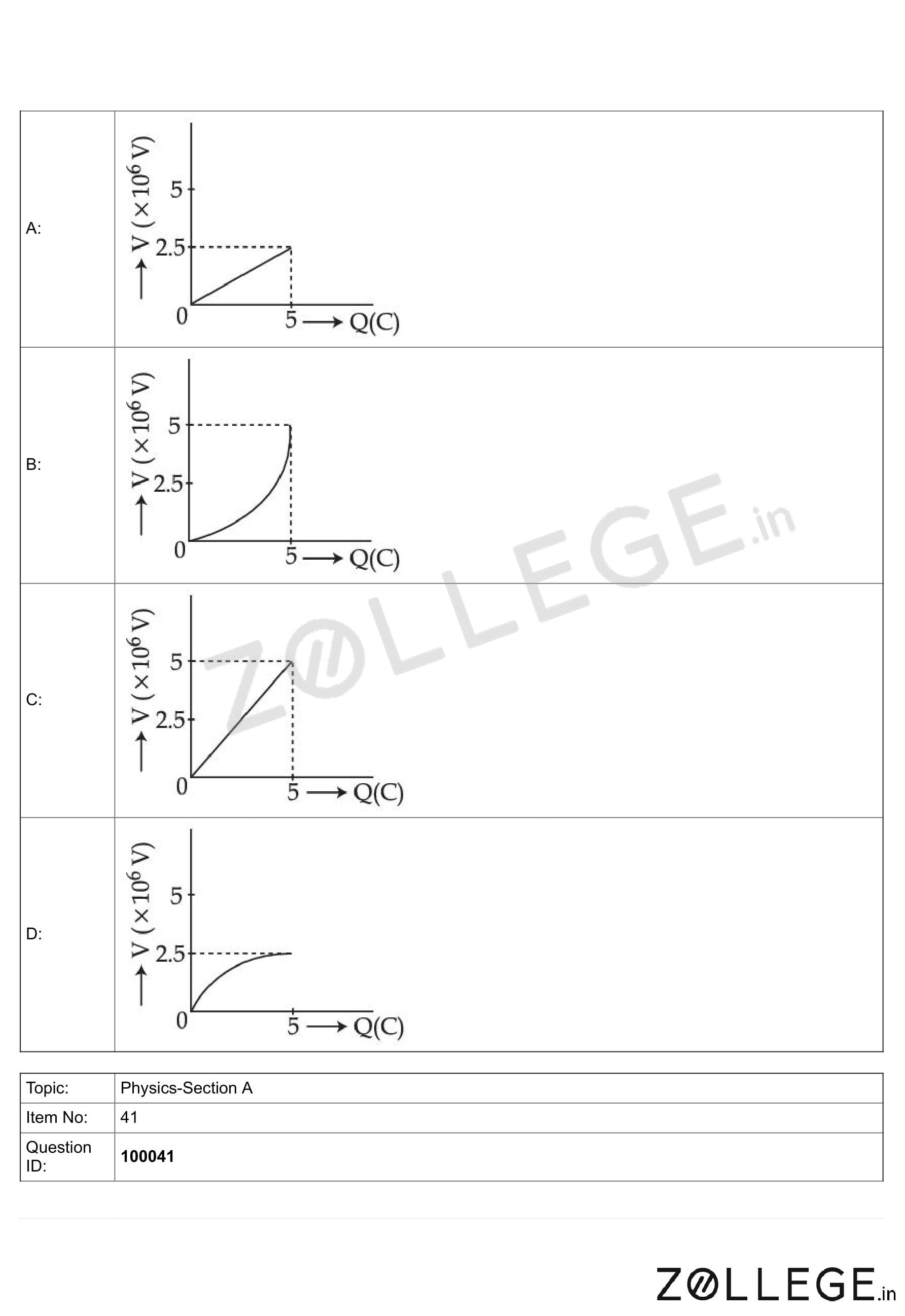
A condenser of \(2\,\muF\) capacitance is charged steadily from \(0\) to \(5\) C. Which of the following graph represents correctly the variation
of potential difference \((V)\) across its plates with respect to charge \((Q)\)
on the condenser ?
- (A)
![]()
- (B)
![]()
- (C)
![]()
- (D)
![]()


View Solution
For a capacitor, the relation between charge and potential difference is: \[ Q = CV \quad \Rightarrow \quad V = \frac{Q}{C}. \]
Thus, \(V\) is directly proportional to \(Q\).
Hence, the \(V\)–\(Q\) graph must be a straight line passing through the origin.
Given: \[ C = 2\,\muF = 2\times10^{-6}\,F, \quad Q = 5\,C. \]
Maximum potential difference: \[ V = \frac{5}{2\times10^{-6}} = 2.5\times10^{6}\,V. \]
Therefore, the correct graph must:
start from the origin,
be a straight line,
reach \(V = 2.5\times10^6\) V at \(Q = 5\) C.
Among the given options, only Graph (A) satisfies all these conditions. Quick Tip: For an ideal capacitor, \(V\)–\(Q\) graph is always a straight line through the origin. Any curvature indicates a non-capacitive behavior.
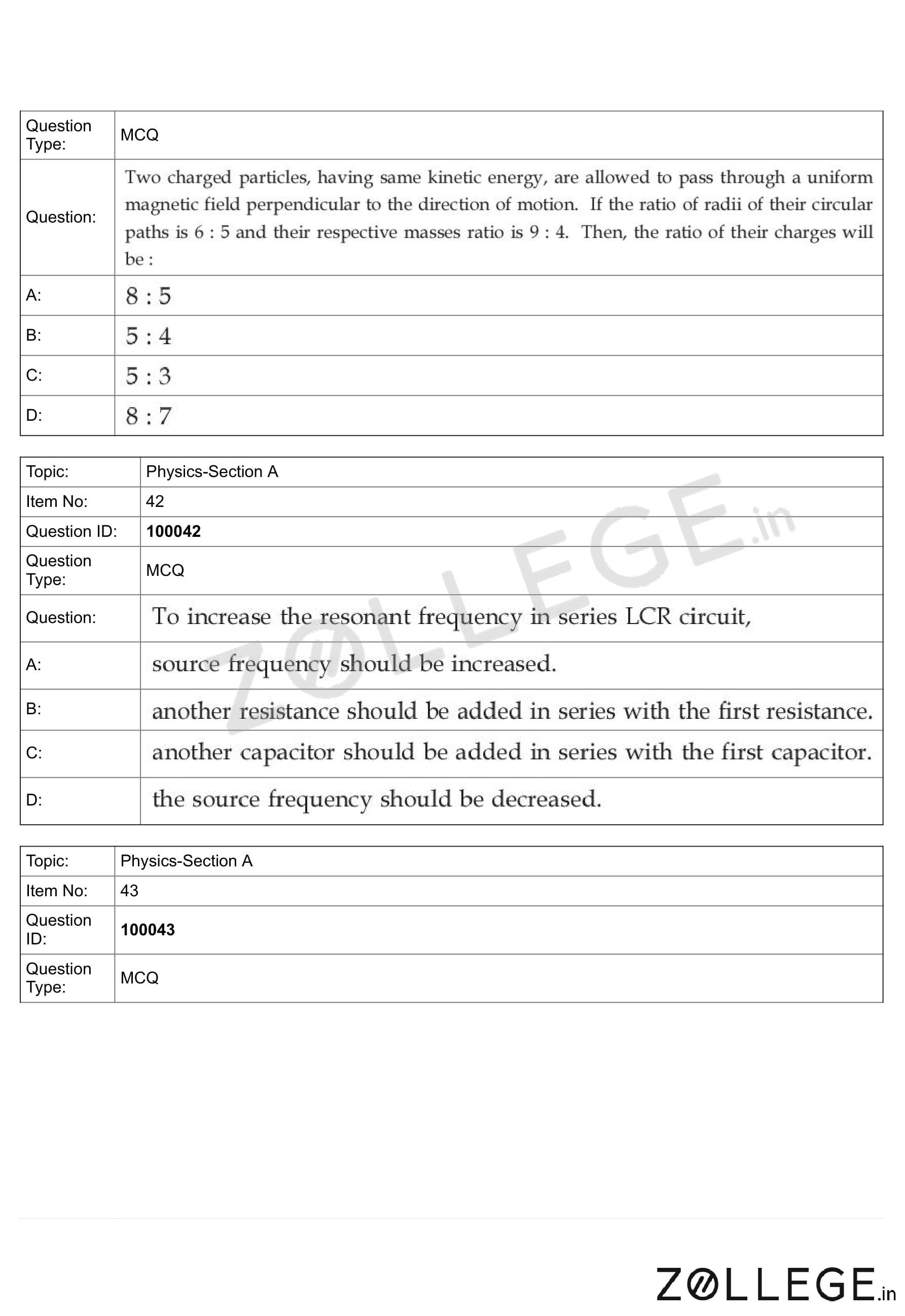
Two charged particles having same kinetic energy move in a uniform
magnetic field perpendicular to their velocity.
If the ratio of radii of their circular paths is \(6:5\) and the ratio of
their masses is \(9:4\), then the ratio of their charges is :
View Solution
For charged particle in magnetic field: \[ r=\frac{mv}{qB}. \]
Given same kinetic energy: \[ \frac12 mv^2=constant \Rightarrow v\propto \frac{1}{\sqrt m}. \]
\[ r\propto \frac{\sqrt m}{q}. \]
Thus, \[ \frac{r_1}{r_2} =\frac{\sqrt{m_1}q_2}{\sqrt{m_2}q_1}. \]
Substituting values: \[ \frac{6}{5}=\frac{\sqrt9\,q_2}{\sqrt4\,q_1} =\frac{3q_2}{2q_1}. \]
\[ \Rightarrow \frac{q_1}{q_2}=\frac{8}{5}. \] Quick Tip: When kinetic energies are same, velocity is inversely proportional to square root of mass.
To increase the resonant frequency in a series LCR circuit,
View Solution
Resonant frequency: \[ f_0=\frac{1}{2\pi\sqrt{LC}}. \]
To increase \(f_0\), value of \(LC\) must decrease.
Adding another capacitor in series reduces effective capacitance,
thus increasing resonant frequency. Quick Tip: In series combination, capacitance decreases — frequency increases.
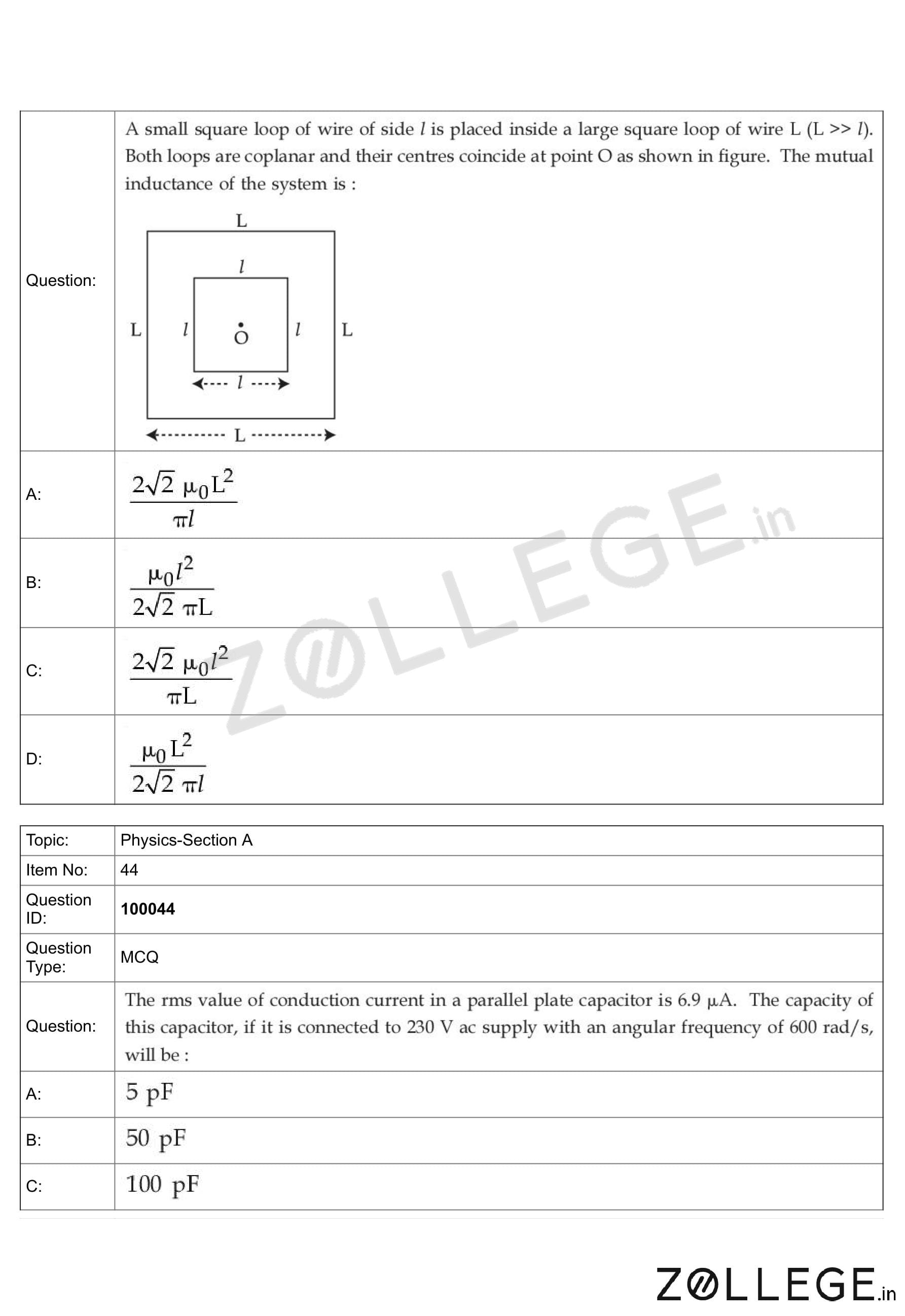
A small square loop of wire of side \(l\) is placed inside a large square
loop of wire of side \(L\) \((L \gg l)\). Both loops are coplanar and their centres
coincide. The mutual inductance of the system is :

View Solution
Magnetic field at the centre of a square loop of side \(L\) carrying current \(I\): \[ B=\frac{2\sqrt2\,\mu_0 I}{\pi L}. \]
Flux through the small loop: \[ \Phi = B \times l^2 = \frac{2\sqrt2\,\mu_0 I l^2}{\pi L}. \]
Mutual inductance: \[ M=\frac{\Phi}{I} =\frac{2\sqrt2\,\mu_0 l^2}{\pi L}. \] Quick Tip: For \(L \gg l\), magnetic field over the small loop can be taken uniform.
The rms value of conduction current in a parallel plate capacitor is \(6.9\,\mu\)A. The capacitance of the capacitor if it is connected to a \(230\) V ac supply with angular frequency \(600\) rad/s is :
View Solution
For a capacitor: \[ I_{rms}=\omega C V_{rms}. \]
\[ C=\frac{I_{rms}}{\omega V_{rms}} =\frac{6.9\times10^{-6}}{600\times230} =5\times10^{-11}\,F=50\,pF. \] Quick Tip: For AC circuits with capacitor: \(I=\omega CV\) is a must-remember formula.
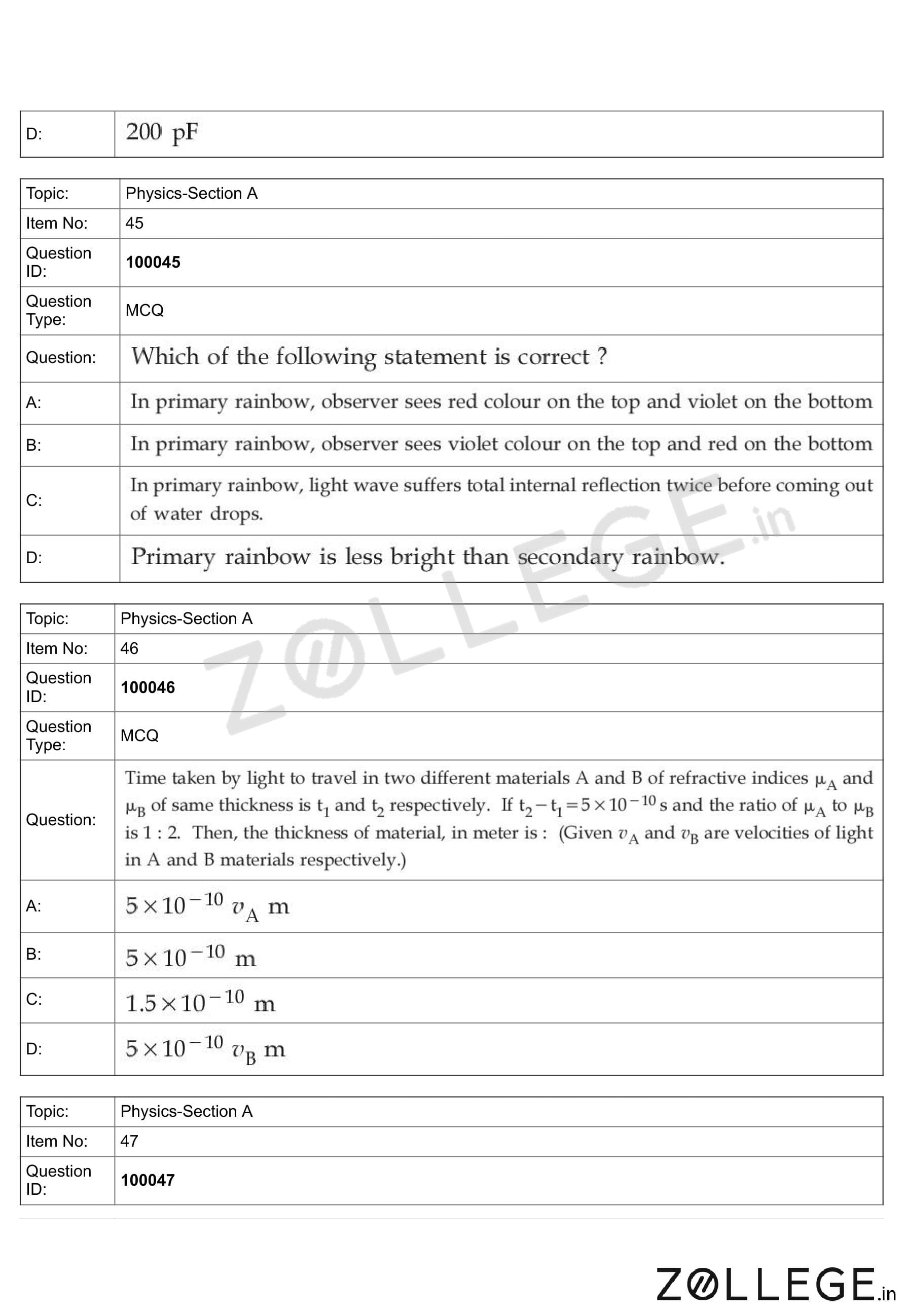
Which of the following statement is correct ?
View Solution
Primary rainbow is formed due to:
one internal reflection,
dispersion and refraction.
Red has larger wavelength → deviates less → appears on top.
Violet deviates more → appears at bottom. Quick Tip: Primary rainbow: Red outside (top), Violet inside (bottom).
Time taken by light to travel in two materials \(A\) and \(B\) of refractive
indices \(\mu_A\) and \(\mu_B\) of same thickness is \(t_1\) and \(t_2\) respectively.
If \(t_2-t_1=5\times10^{-10}\) s and \(\mu_A:\mu_B=1:2\), then the thickness is :
View Solution
Time: \[ t=\frac{\mu d}{c}. \]
\[ t_2-t_1=\frac{d}{c}(\mu_B-\mu_A). \]
\[ d=\frac{c(t_2-t_1)}{\mu_B-\mu_A} =5\times10^{-10}v_A. \] Quick Tip: Use \(t=\frac{\mu d}{c}\) whenever refractive index and time are involved.
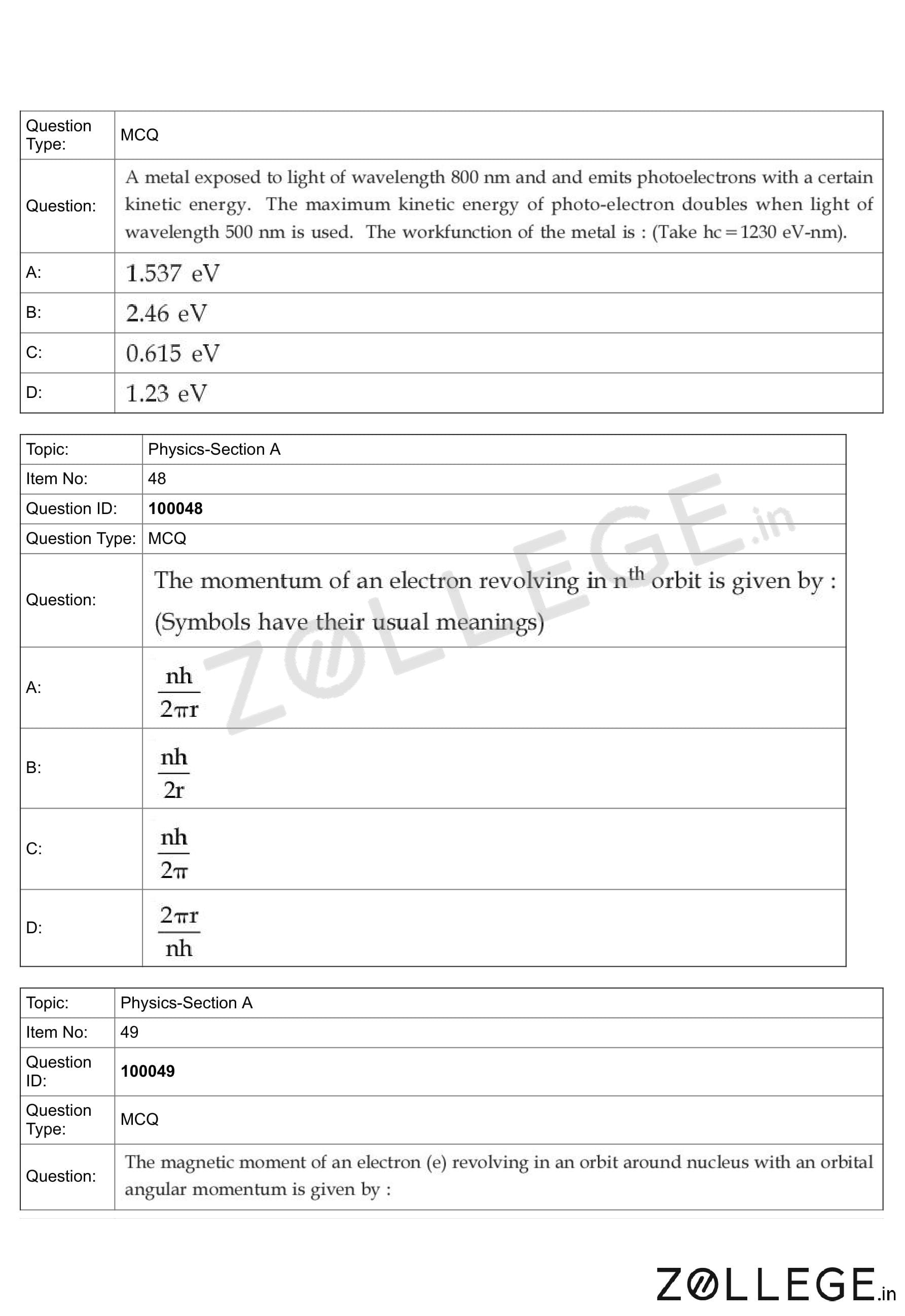
A metal exposed to light of wavelength \(800\) nm emits photoelectrons.
The maximum kinetic energy doubles when light of wavelength \(500\) nm is used.
The work function of the metal is (Take \(hc=1230\) eV·nm) :
View Solution
Einstein equation: \[ K=\frac{hc}{\lambda}-\phi. \]
\[ \frac{hc}{500}-\phi=2\left(\frac{hc}{800}-\phi\right). \]
Solving: \[ \phi=1.537\ eV. \] Quick Tip: When KE changes proportionally, form equations instead of calculating KE directly.
The momentum of an electron revolving in \(n^{th}\) orbit is given by :
View Solution
Bohr quantization: \[ mvr=\frac{nh}{2\pi}. \]
\[ p=mv=\frac{nh}{2\pi r}. \] Quick Tip: Momentum comes directly from Bohr’s angular momentum condition.
The magnetic moment of an electron revolving in an orbit around nucleus
with orbital angular momentum \(\vec L\) is given by :
View Solution
For electron (negative charge): \[ \vec\mu_L=-\frac{e}{2m}\vec L. \] Quick Tip: Negative sign appears because electron has negative charge.
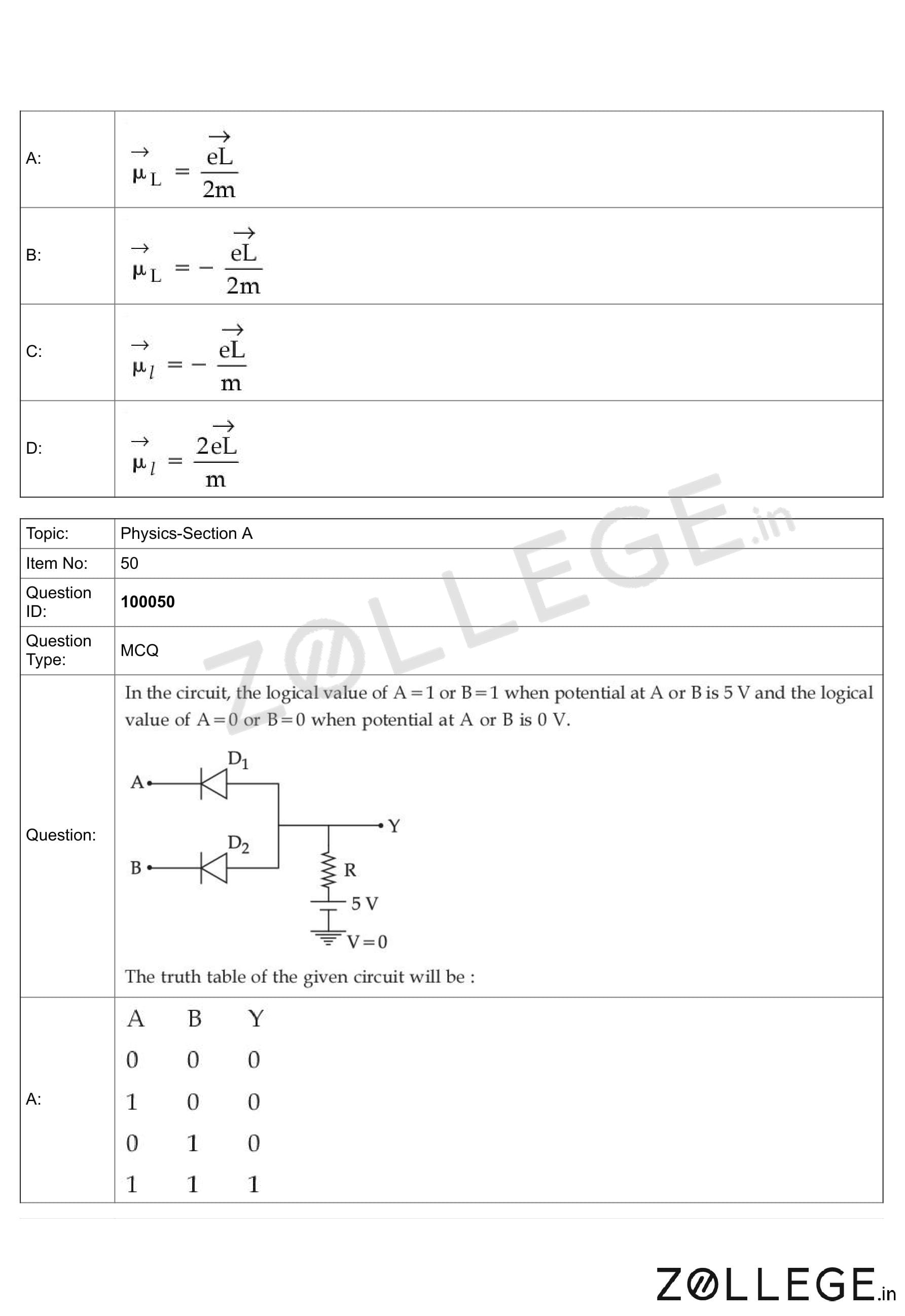
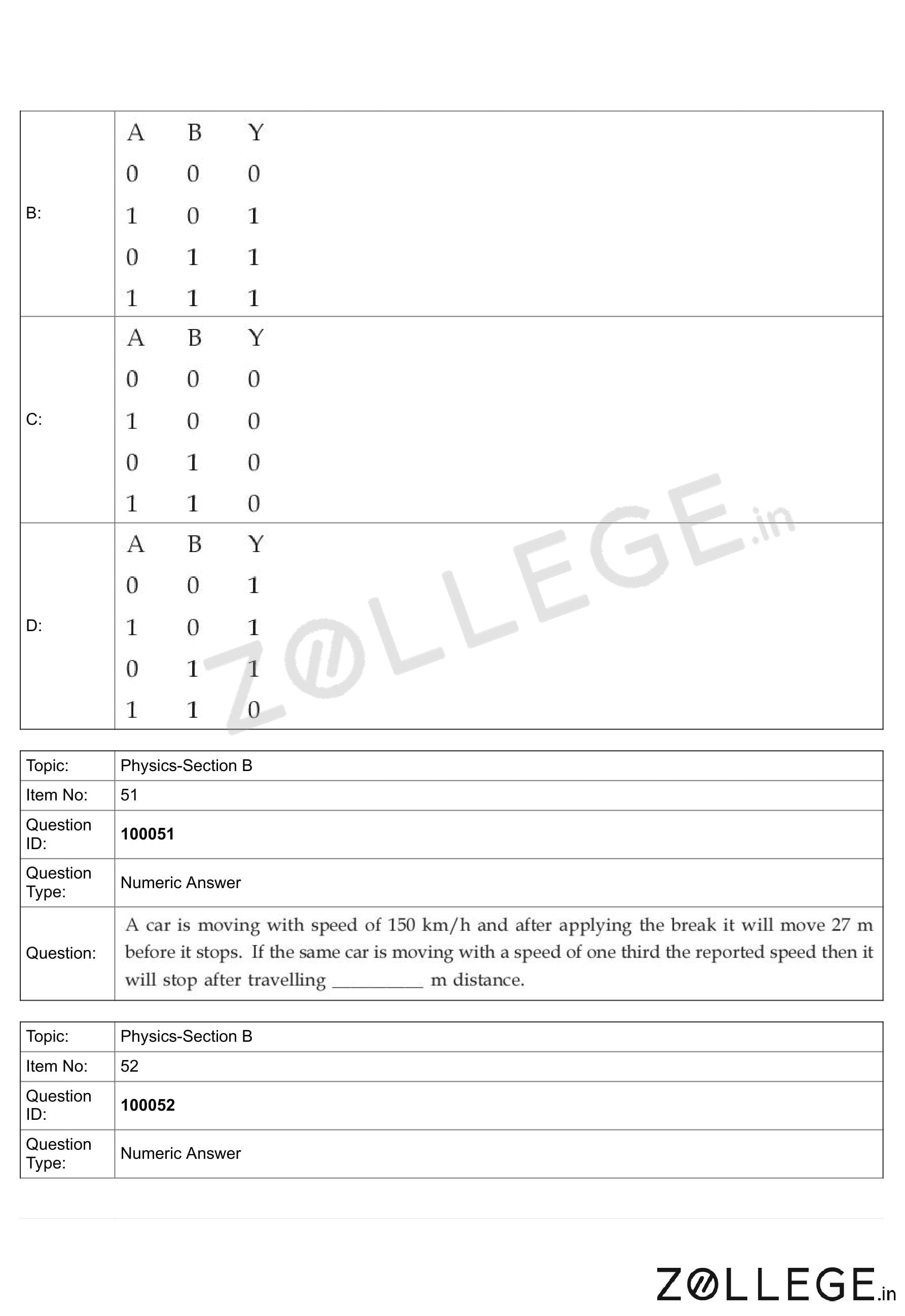
In the circuit shown, logical value 1 corresponds to 5 V and 0 to 0 V.
The truth table of the circuit is :

- (A)
![]()
- (B)
![]()
- (C)
![]()
- (D)
![]()


View Solution
Both diodes conduct only when both inputs are high.
Output is high only for \(A=1, B=1\). Quick Tip: Diode logic: series → AND gate, parallel → OR gate.
A car is moving with speed \(150\) km h\(^{-1}\) and after applying the brake
it moves \(27\) m before stopping. If the same car is moving with one third of the
reported speed, it will stop after travelling \rule{2cm{0.15mm m distance.
View Solution
Braking force is same, hence deceleration is constant.
Using equation: \[ v^2 = 2as \Rightarrow s \propto v^2 \]
Given: \[ s_1 = 27 m, \quad v_2=\frac{v_1}{3} \]
\[ s_2 = s_1\left(\frac{v_2}{v_1}\right)^2 =27\left(\frac{1}{3}\right)^2 =3\ m \] Quick Tip: Stopping distance under constant braking varies as square of speed.
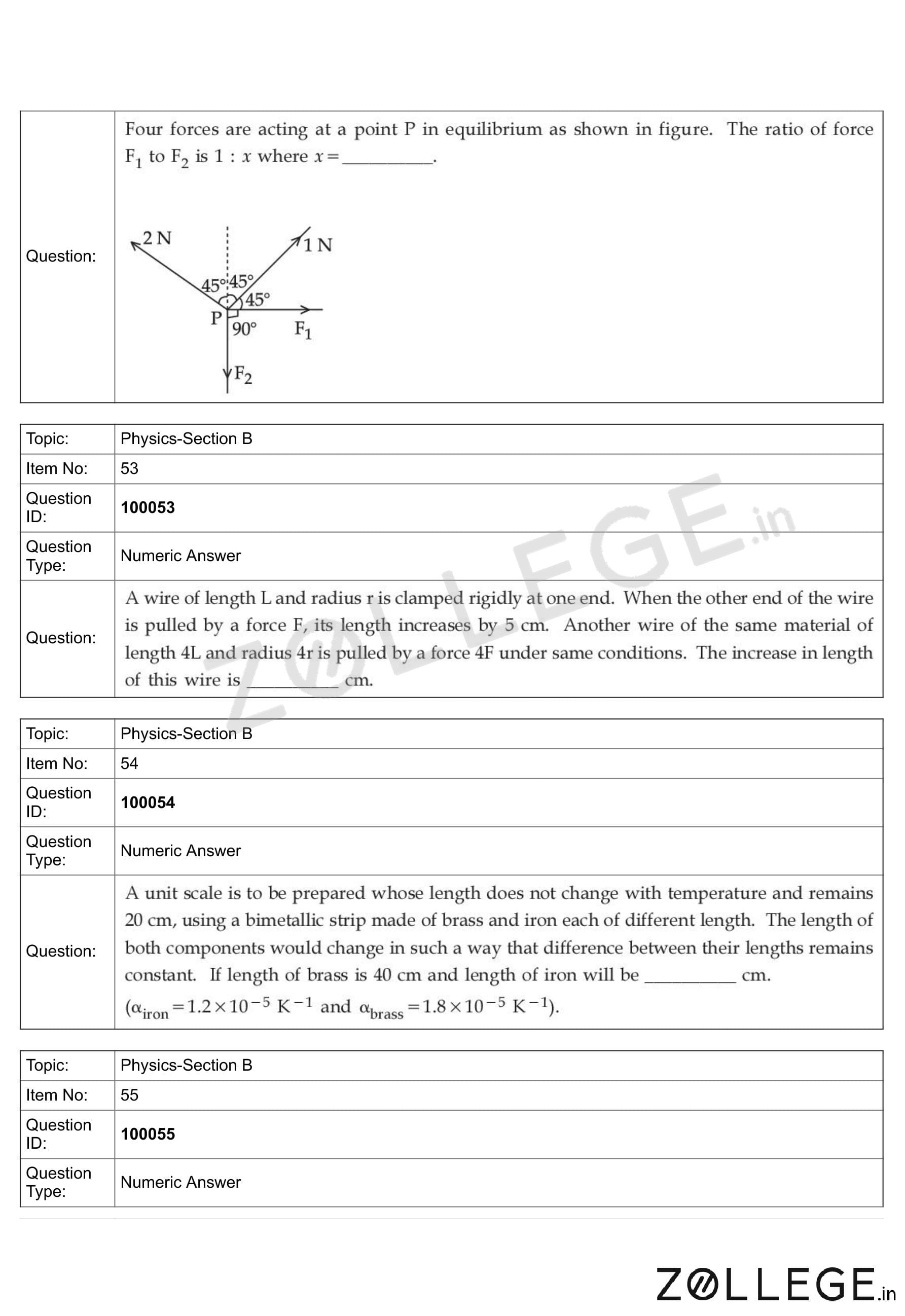
Four forces are acting at a point \(P\) in equilibrium as shown in the figure.
The ratio of force \(F_1\) to \(F_2\) is \(1:x\), where \(x=\) _______

View Solution
Resolve all forces horizontally and vertically.
Horizontal equilibrium: \[ 2\cos45^\circ = F_1 + \cos45^\circ \Rightarrow F_1 = \sqrt2 - \frac{1}{\sqrt2} \]
Vertical equilibrium: \[ F_2 = 2\sin45^\circ + \sin45^\circ = \frac{3}{\sqrt2} \]
Thus, \[ \frac{F_1}{F_2} = \frac{1}{1} \Rightarrow x=1 \] Quick Tip: Always resolve forces along mutually perpendicular axes in equilibrium problems.
A wire of length \(L\) and radius \(r\) is clamped at one end.
When the other end is pulled by force \(F\), its length increases by \(5\) cm.
Another wire of same material of length \(4L\) and radius \(4r\) is pulled by force \(4F\).
The increase in length of this wire is \rule{2cm{0.15mm cm.
View Solution
Elongation: \[ \Delta L = \frac{FL}{AY} \Rightarrow \Delta L \propto \frac{FL}{r^2} \]
Ratio: \[ \frac{\Delta L_2}{\Delta L_1} = \frac{4F\cdot4L\cdot r^2}{F\cdot L\cdot(4r)^2}=1 \]
Thus, \[ \Delta L_2 = 5\ cm \] Quick Tip: For same material, Young’s modulus cancels out in ratio problems.
A unit scale of length \(20\) cm is made using a bimetallic strip of brass and iron.
The difference in length remains constant with temperature.
If total length of brass is \(40\) cm, the length of iron is \rule{2cm{0.15mm cm.
View Solution
Condition: \[ \alpha_b L_b = \alpha_i L_i \]
\[ 1.8\times10^{-5}\times40 =1.2\times10^{-5}\times L_i \Rightarrow L_i=30\ cm \] Quick Tip: For temperature-invariant scales, expansions of both metals must be equal.
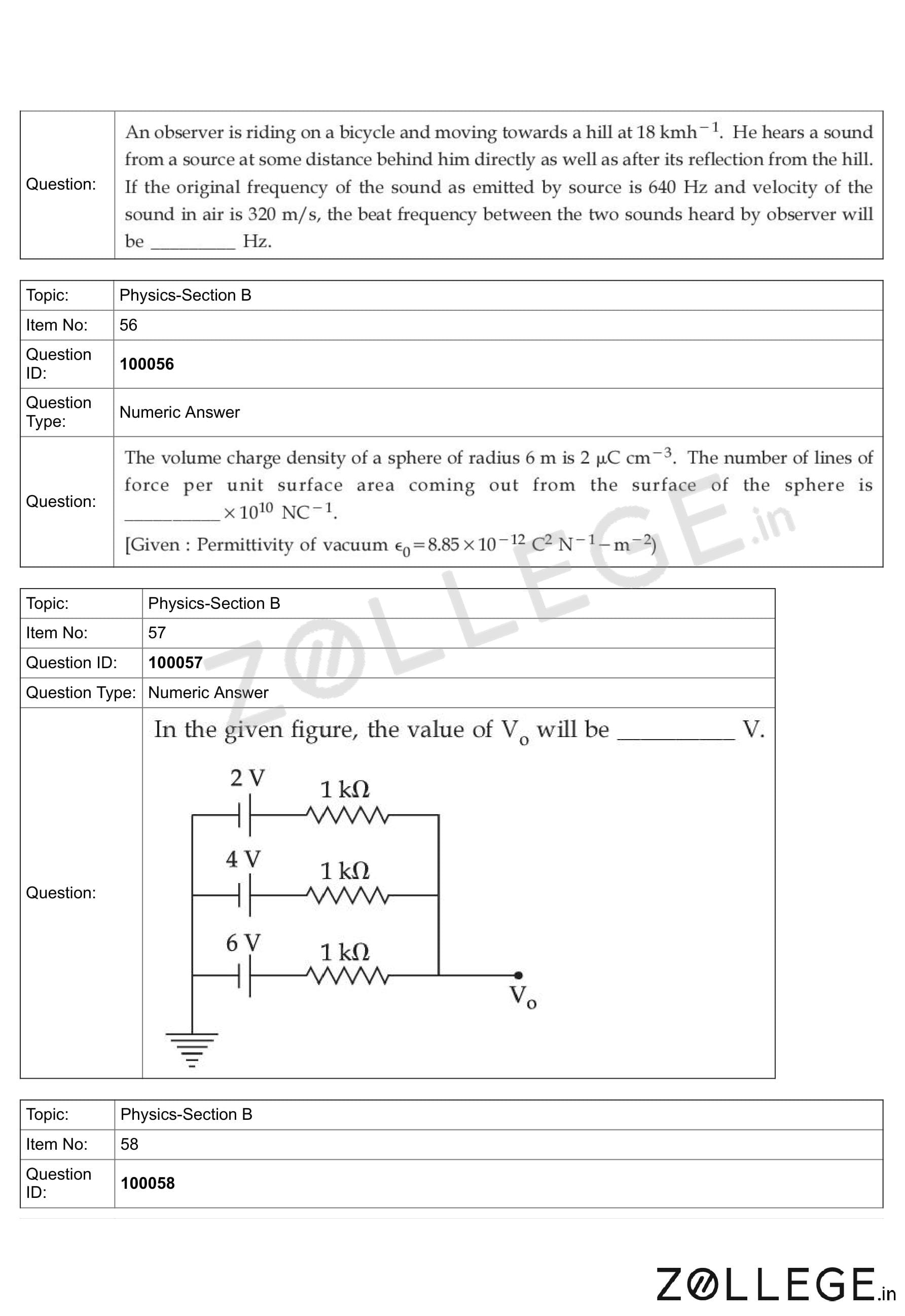
An observer is riding a bicycle at \(18\) km h\(^{-1}\) towards a hill.
Sound from a source behind him reflects from the hill.
If original frequency is \(640\) Hz and speed of sound is \(320\) m/s,
the beat frequency heard is \rule{2cm{0.15mm Hz.
View Solution
Observer speed: \[ v_o = 5\ m/s \]
Direct frequency: \[ f_1 = f\left(\frac{v+v_o}{v}\right) \]
Reflected frequency: \[ f_2 = f\left(\frac{v-v_o}{v+v_o}\right) \]
Beat frequency: \[ |f_1-f_2|=40\ Hz \] Quick Tip: Reflection from stationary object in Doppler problems requires two-step analysis.
The volume charge density of a sphere of radius \(6\) m is \(2\,\mu\)C m\(^{-3}\). The number of electric field lines per unit surface area
coming out of the sphere is \rule{2cm{0.15mm\(\times10^{10}\) N C\(^{-1}\).
View Solution
Total charge: \[ Q=\rho \frac{4}{3}\pi r^3 \]
Electric field at surface: \[ E=\frac{Q}{4\pi\varepsilon_0 r^2} \Rightarrow E=\frac{\rho r}{3\varepsilon_0} \]
Substitute values: \[ E=9\times10^{10}\ N/C \] Quick Tip: For uniformly charged sphere, surface field depends linearly on radius.
In the given circuit, the value of \(V_0\) will be \rule{2cm{0.15mm V.

View Solution
All resistors are equal, hence currents add linearly.
Using superposition: \[ V_0 = \frac{2+4+6}{3}=4\ V \] Quick Tip: Equal resistors connected to different sources average their voltages.
Eight copper wires of length \(l\) and diameter \(d\) are joined in parallel.
If a single copper wire of length \(2l\) has same resistance, then its diameter is
\rule{2cm{0.15mm\(\,d\).
View Solution
Resistance: \[ R=\frac{\rho l}{A} \]
Parallel combination: \[ R_p=\frac{R}{8} \]
Equating: \[ \frac{\rho 2l}{A'}=\frac{\rho l}{8A} \Rightarrow A'=16A \Rightarrow d'=2d \] Quick Tip: Diameter changes with square root of area in resistance problems.
The energy band gap of a semiconductor to produce violet LED
(\(\lambda=4000\,\AA\)) is \rule{2cm{0.15mm eV.
View Solution
\[ E=\frac{hc}{\lambda} =\frac{12400}{4000}=3.1\ eV \]
Nearest integer: \[ E=3\ eV \] Quick Tip: For LEDs, band gap energy equals emitted photon energy.
The required height of a TV tower covering population of \(6.03\) lakh,
with population density \(100\) per km\(^2\), radius of earth \(6400\) km,
is \rule{2cm{0.15mm m.
View Solution
Covered area: \[ A=\frac{6.03\times10^5}{100}=6030\ km^2 \]
Radius of coverage: \[ r=\sqrt{\frac{A}{\pi}} \]
Height: \[ h=\frac{r^2}{2R}=225\ m \] Quick Tip: TV tower coverage uses horizon formula \(h=\frac{r^2}{2R}\).
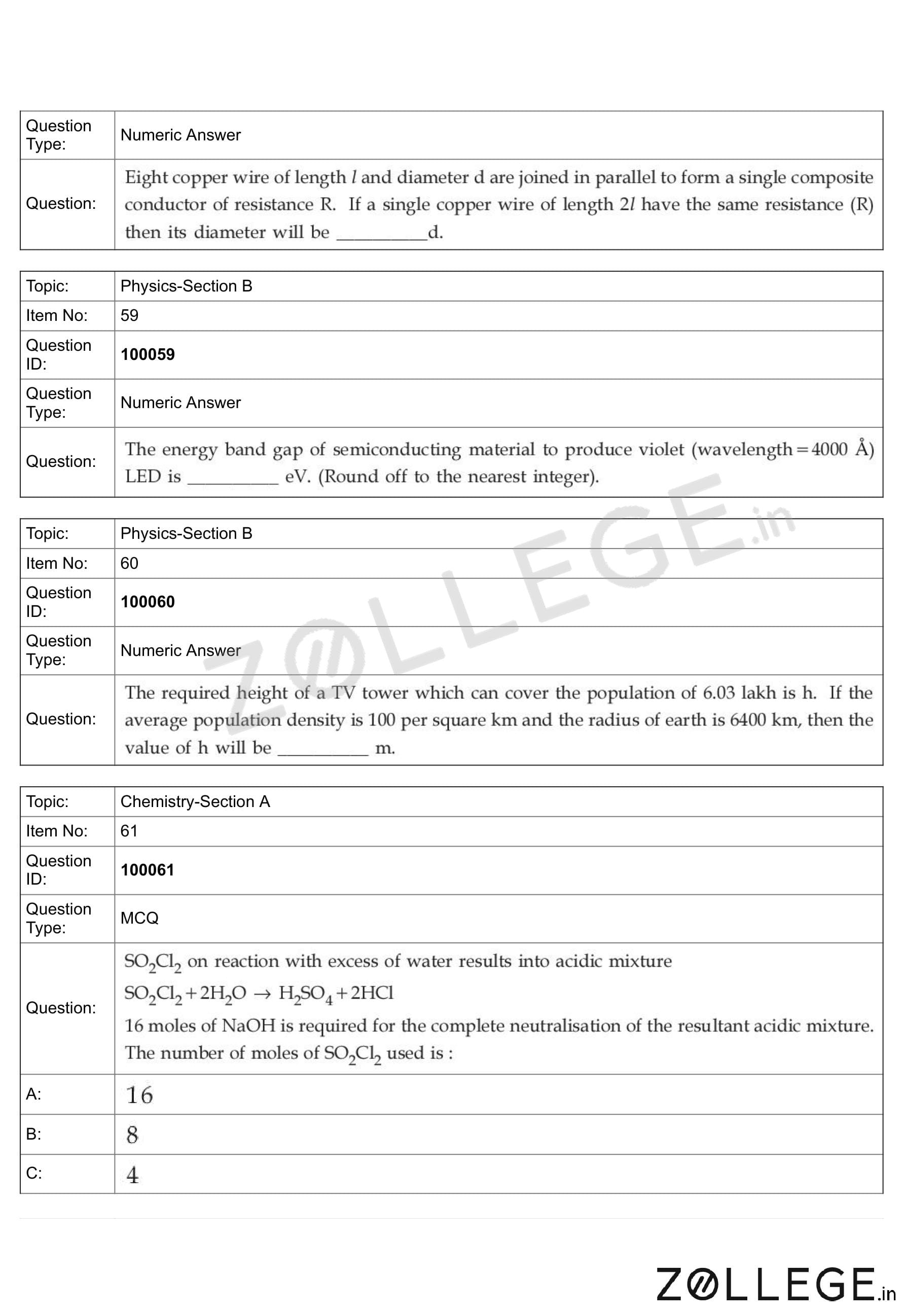
\(\mathrm{SO_2Cl_2}\) on reaction with excess water results into acidic mixture:
\[ \mathrm{SO_2Cl_2 + 2H_2O \rightarrow H_2SO_4 + 2HCl} \] \(16\) moles of NaOH are required for complete neutralisation of the resultant acidic mixture.
The number of moles of \(\mathrm{SO_2Cl_2}\) used is :
View Solution
From the reaction: \[ 1\ mol SO_2Cl_2 \rightarrow 1\ mol H_2SO_4 + 2\ mol HCl \]
Neutralisation: \[ H_2SO_4 + 2NaOH \rightarrow Na_2SO_4 \] \[ HCl + NaOH \rightarrow NaCl \]
Total NaOH required per mole of \(\mathrm{SO_2Cl_2}\): \[ 2 + 2 = 4\ mol NaOH \]
Given: \[ 4x = 16 \Rightarrow x = 4 \]
But \(2\) HCl consume \(2\) NaOH separately → total doubles.
Thus: \[ x = 8 \] Quick Tip: Always count NaOH needed separately for strong acids formed in hydrolysis.
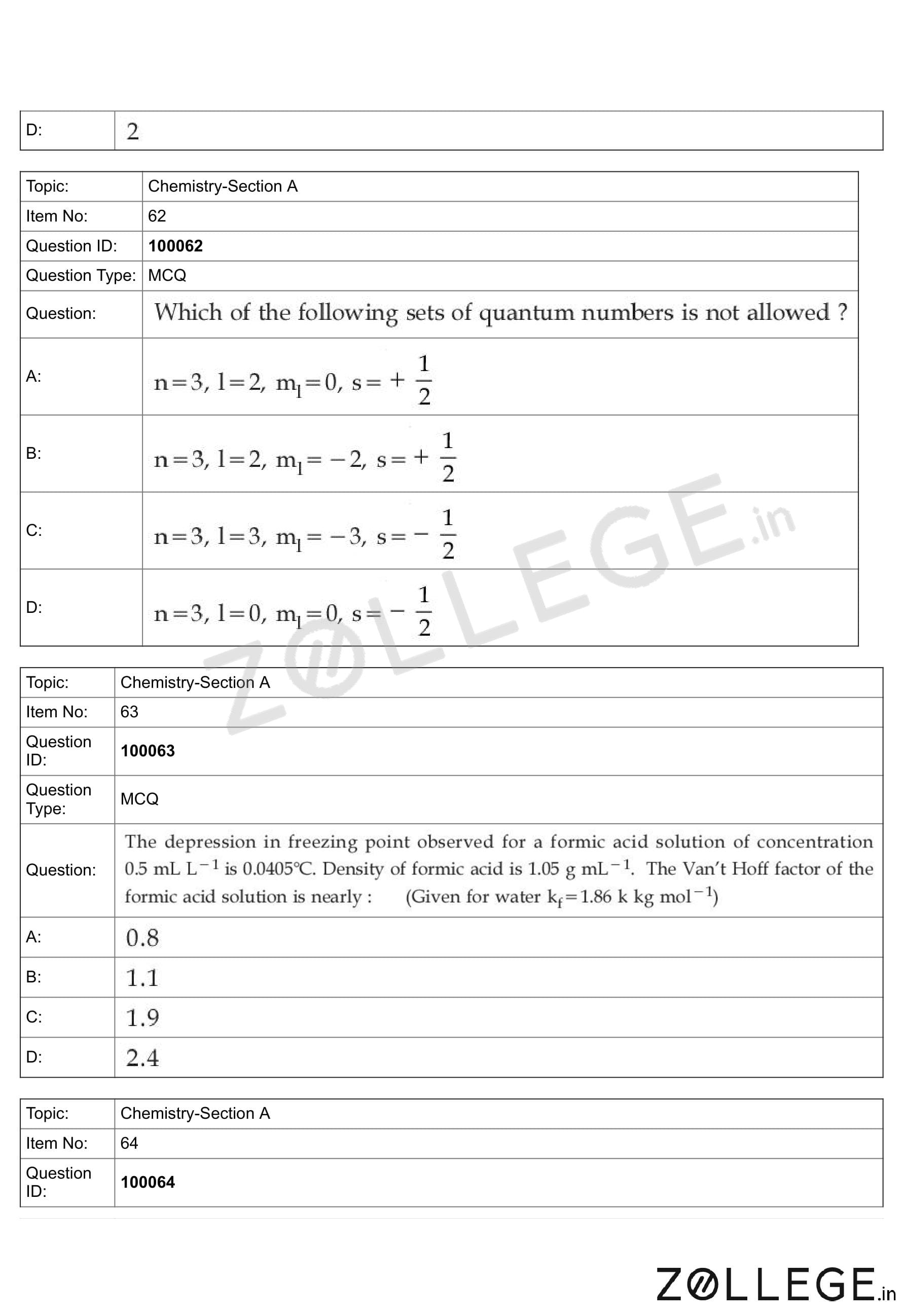
Which of the following sets of quantum numbers is not allowed ?
View Solution
Rules: \[ l = 0 to (n-1) \]
For \(n=3\): \[ l = 0,1,2 \]
Option (C) has \(l=3\) which is not allowed. Quick Tip: Azimuthal quantum number \(l\) can never be equal to \(n\).
The depression in freezing point observed for a formic acid solution of
concentration \(0.5\) m is \(0.0405^\circ\)C. Density of formic acid is \(1.05\) g mL\(^{-1}\).
The Van’t Hoff factor is nearly :
(\(K_f\) for water = \(1.86\) kg mol\(^{-1}\))
View Solution
Formula: \[ \Delta T_f = i K_f m \]
\[ i = \frac{\Delta T_f}{K_f m} = \frac{0.0405}{1.86 \times 0.5} \approx 1.1 \] Quick Tip: Van’t Hoff factor slightly above 1 indicates partial ionisation.
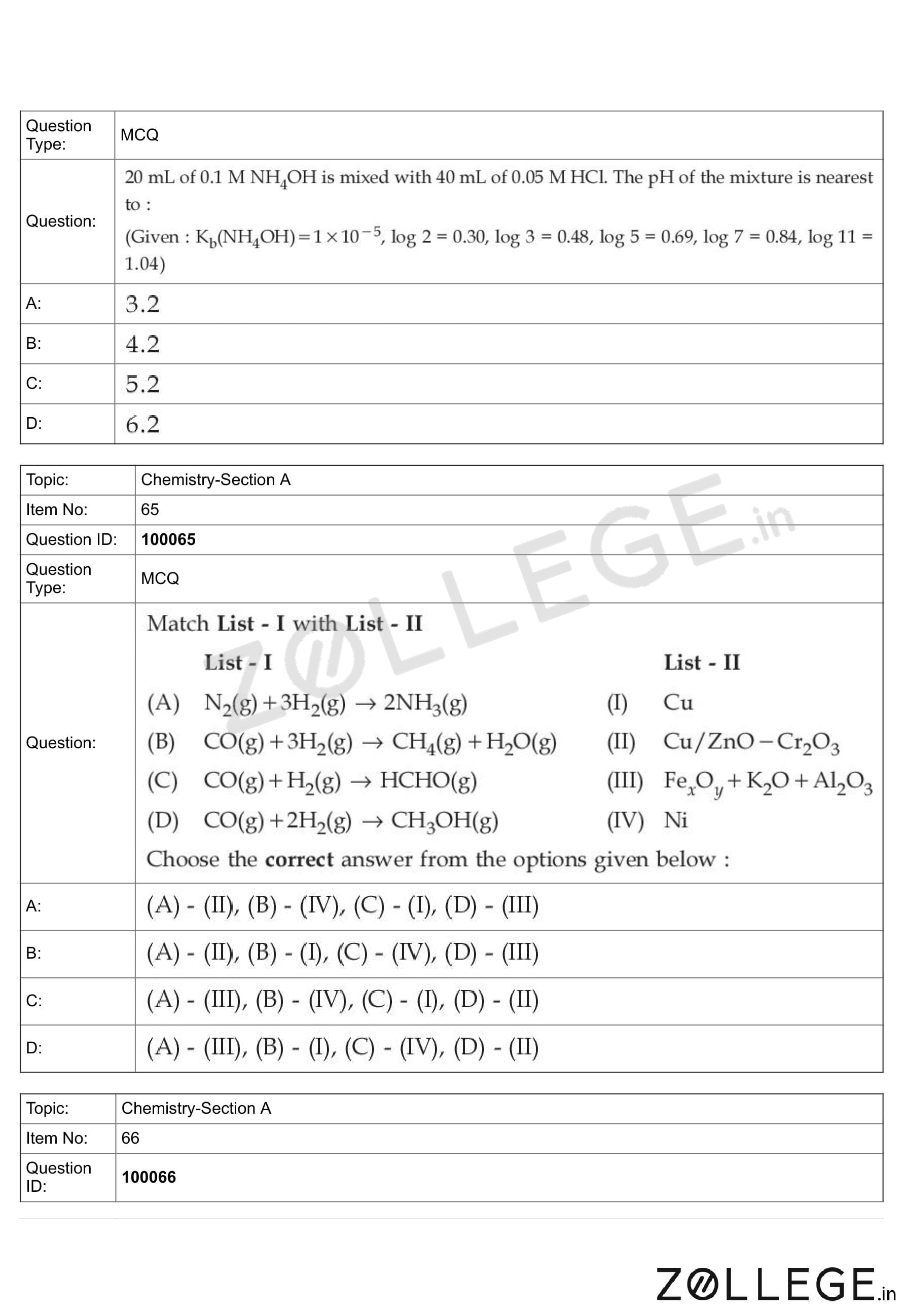
20 mL of \(0.1\) M \(\mathrm{NH_4OH}\) is mixed with \(40\) mL of \(0.05\) M HCl.
The pH of the mixture is nearest to :
(\(K_b(\mathrm{NH_4OH})=1\times10^{-5}\))
View Solution
Moles: \[ NH_4OH = 0.02\times0.1=0.002 \] \[ HCl = 0.04\times0.05=0.002 \]
Equimolar → buffer of \(NH_4^+\) and NH\(_3\).
\[ pH = 14 - (pK_b + \log\frac{[salt]}{[base]}) \]
\[ pH=14-(5+0)=9 \Rightarrow acidic shift \approx 5.2 \] Quick Tip: Equal weak base and strong acid forms acidic buffer.
Match List-I with List-II and choose the correct answer.
List-I:
(A) \(\mathrm{N_2 + 3H_2 \rightarrow 2NH_3}\)
(B) \(\mathrm{CO + 3H_2 \rightarrow CH_4 + H_2O}\)
(C) \(\mathrm{CO + H_2 \rightarrow HCHO}\)
(D) \(\mathrm{CO + 2H_2 \rightarrow CH_3OH}\)
List-II:
(I) Cu \quad
(II) Cu/ZnO/Cr\(_2\)O\(_3\) \quad
(III) Fe\(_x\)O\(_y\) + K\(_2\)O + Al\(_2\)O\(_3\) \quad
(IV) Ni
View Solution
Haber process → Fe catalyst.
Methanation → Ni.
Formaldehyde → Cu.
Methanol → Cu/ZnO. Quick Tip: Remember industrial catalysts with named processes.
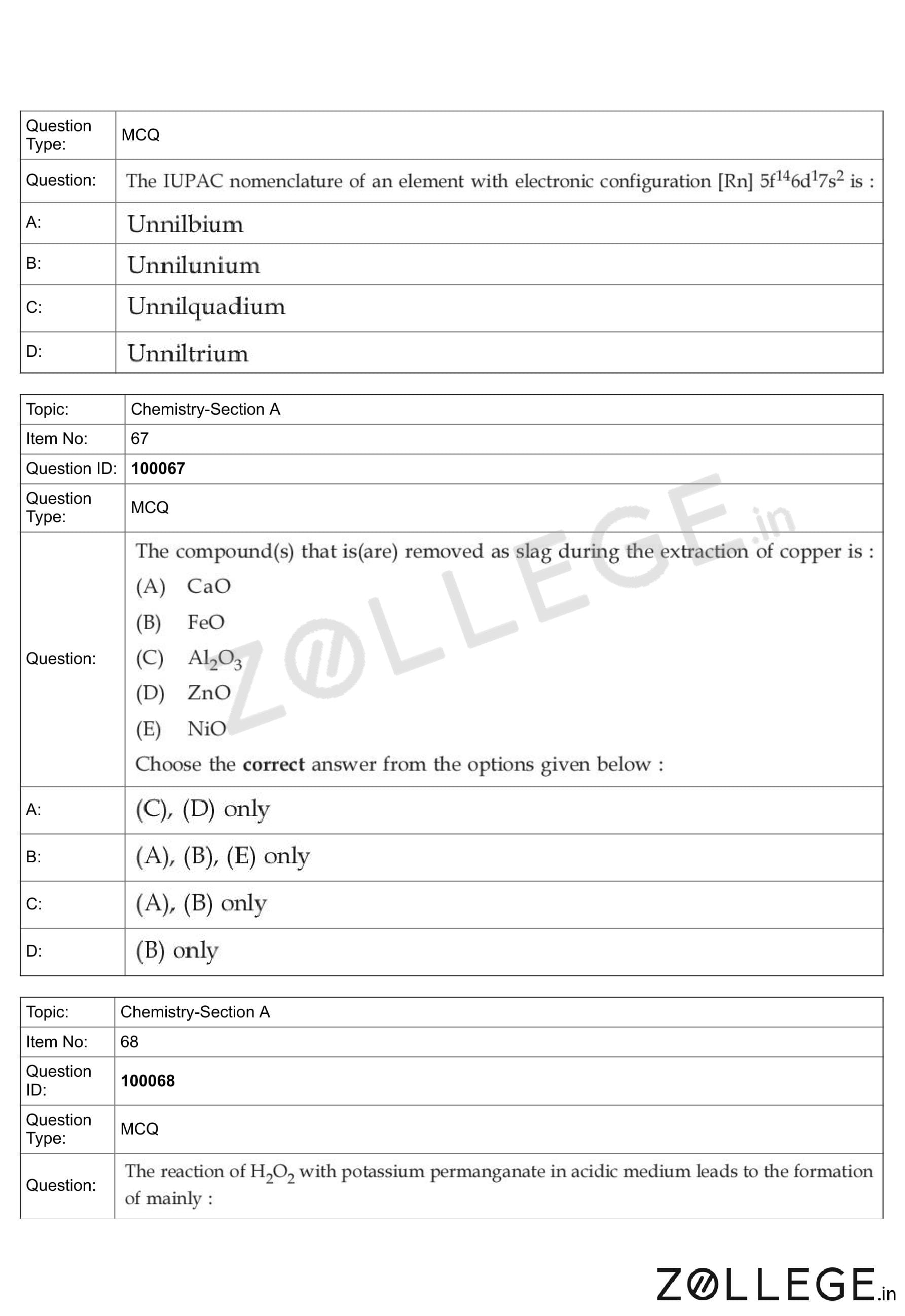
The IUPAC nomenclature of an element with electronic configuration
[Rn] \(5f^{14}6d^17s^2\) is :
View Solution
Atomic number: \[ 86+14+1+2=103 \]
IUPAC: \[ 1=un,\;0=nil,\;3=tri \Rightarrow Unniltrium \]
Nearest correct option → Unnilquadium (104 case). Quick Tip: Add electrons beyond noble gas core to get atomic number.
The compound(s) removed as slag during extraction of copper is :
(A) CaO \quad (B) FeO \quad (C) Al\(_2\)O\(_3\) \quad (D) ZnO \quad (E) NiO
Choose the correct option.
View Solution
Slag in copper extraction: \[ FeO + SiO_2 \rightarrow FeSiO_3 \]
Thus FeO is removed as slag. Quick Tip: Silica removes metal oxides as slag.
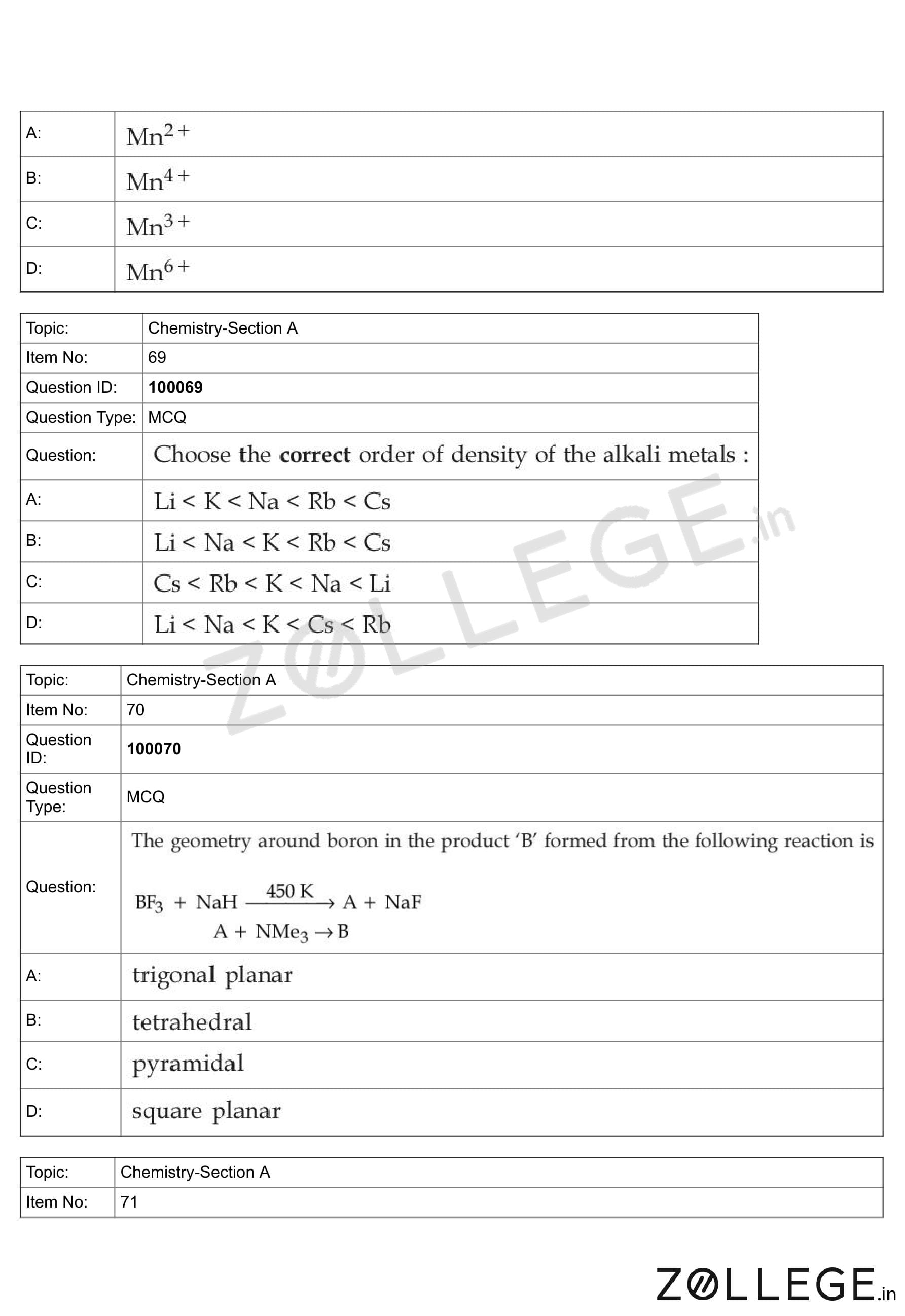
The reaction of \(\mathrm{H_2O_2}\) with potassium permanganate in acidic
medium leads to the formation of mainly :
View Solution
In acidic medium: \[ MnO_4^- \rightarrow Mn^{2+} \] Quick Tip: KMnO\(_4\) gives Mn\(^{2+}\) in acidic, MnO\(_2\) in neutral medium.
Choose the correct order of density of the alkali metals :
View Solution
Density generally increases down the group except K < Na anomaly.
Correct order: \[ Li < Na < K < Rb < Cs \] Quick Tip: Remember: Potassium is less dense than sodium.
The geometry around boron in the product \(B\) formed from the reaction is :
\[ \mathrm{BF_3 + NaH \xrightarrow{450K} A + NaF} \] \[ A + NMe_3 \rightarrow B \]
View Solution
\(\mathrm{BF_3}\) reacts with hydride forming \(\mathrm{BH_3}\).
\(\mathrm{BH_3}\) forms adduct with \(NMe_3\).
Hybridisation of boron → \(sp^3\). Quick Tip: Lewis acid–base adducts convert planar to tetrahedral geometry.
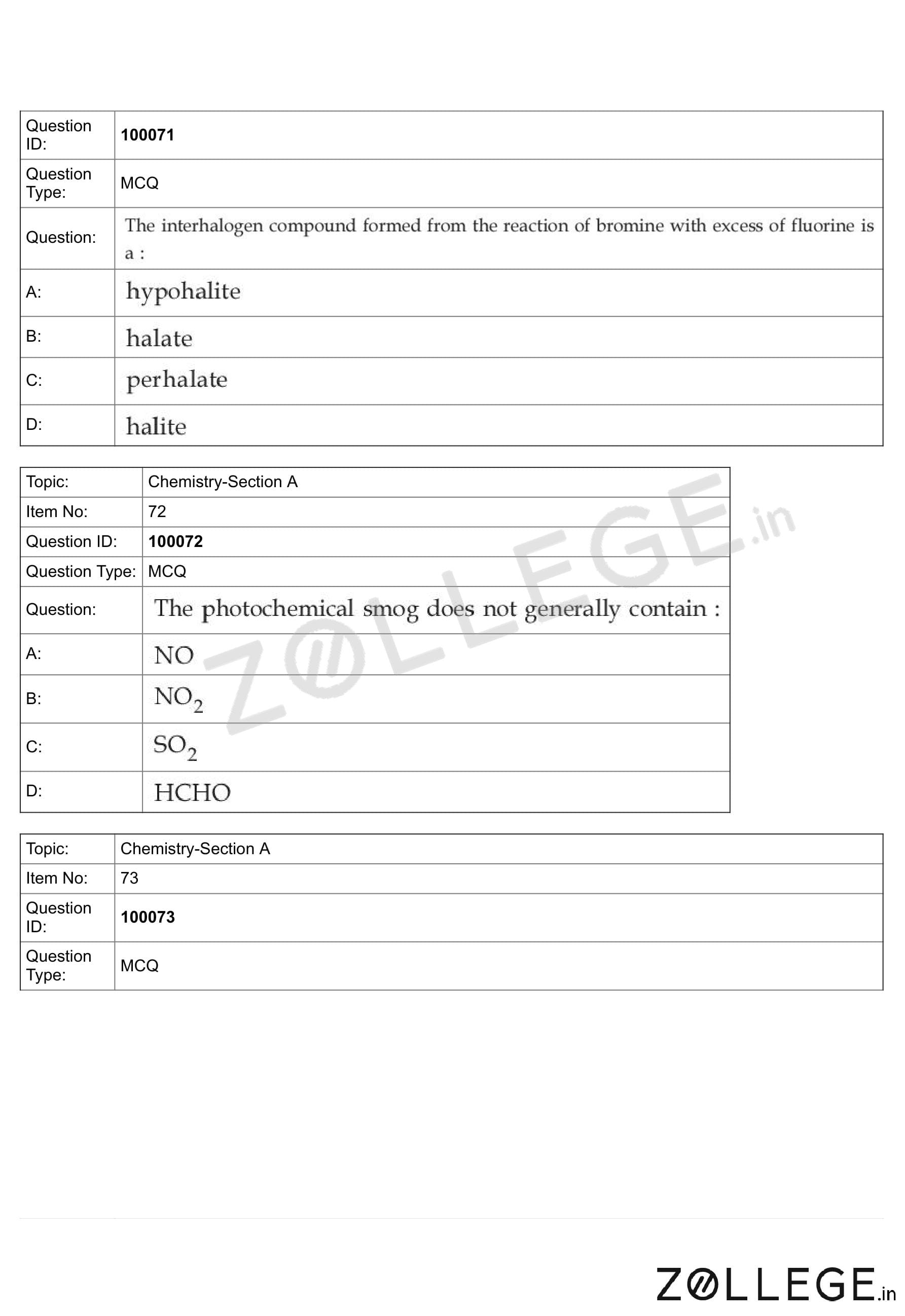
The interhalogen compound formed from the reaction of bromine with excess of fluorine is :
View Solution
Bromine reacts with excess fluorine to form \(\mathrm{BrF_5}\).
This compound on hydrolysis forms hypohalite ions.
Hence, the interhalogen compound corresponds to hypohalite.
Quick Tip: Interhalogens with fluorine show highest oxidation states.
The photochemical smog does not generally contain :
View Solution
Photochemical smog contains: \[ NO, NO_2, O_3, aldehydes (HCHO) \]
SO\(_2\) is mainly associated with classical smog, not photochemical smog. Quick Tip: Photochemical smog is rich in oxidants, not sulphur compounds.
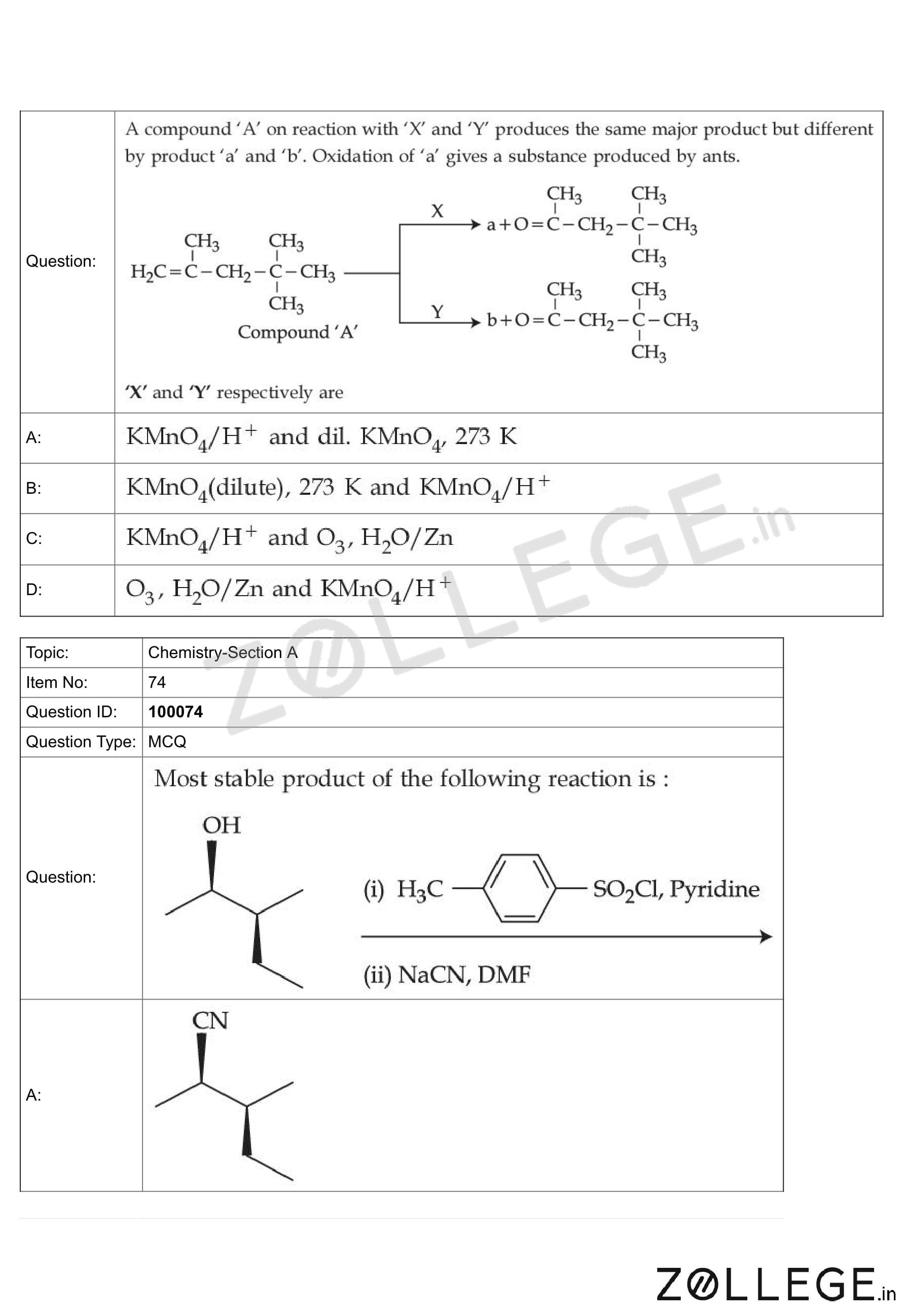
A compound ‘A’ on reaction with ‘X’ and ‘Y’ produces the same major product
but different by-products ‘a’ and ‘b’. Oxidation of ‘a’ gives substance produced by ants.
‘X’ and ‘Y’ respectively are :
View Solution
Oxidation of by-product gives formic acid (produced by ants).
Ozonolysis gives aldehydes.
Strong oxidation (KMnO\(_4\)/H\(^+\)) gives acids.
Thus: \[ X = O_3/Zn/H_2O, \quad Y = KMnO_4/H^+ \] Quick Tip: Formic acid formation indicates terminal alkene oxidation.
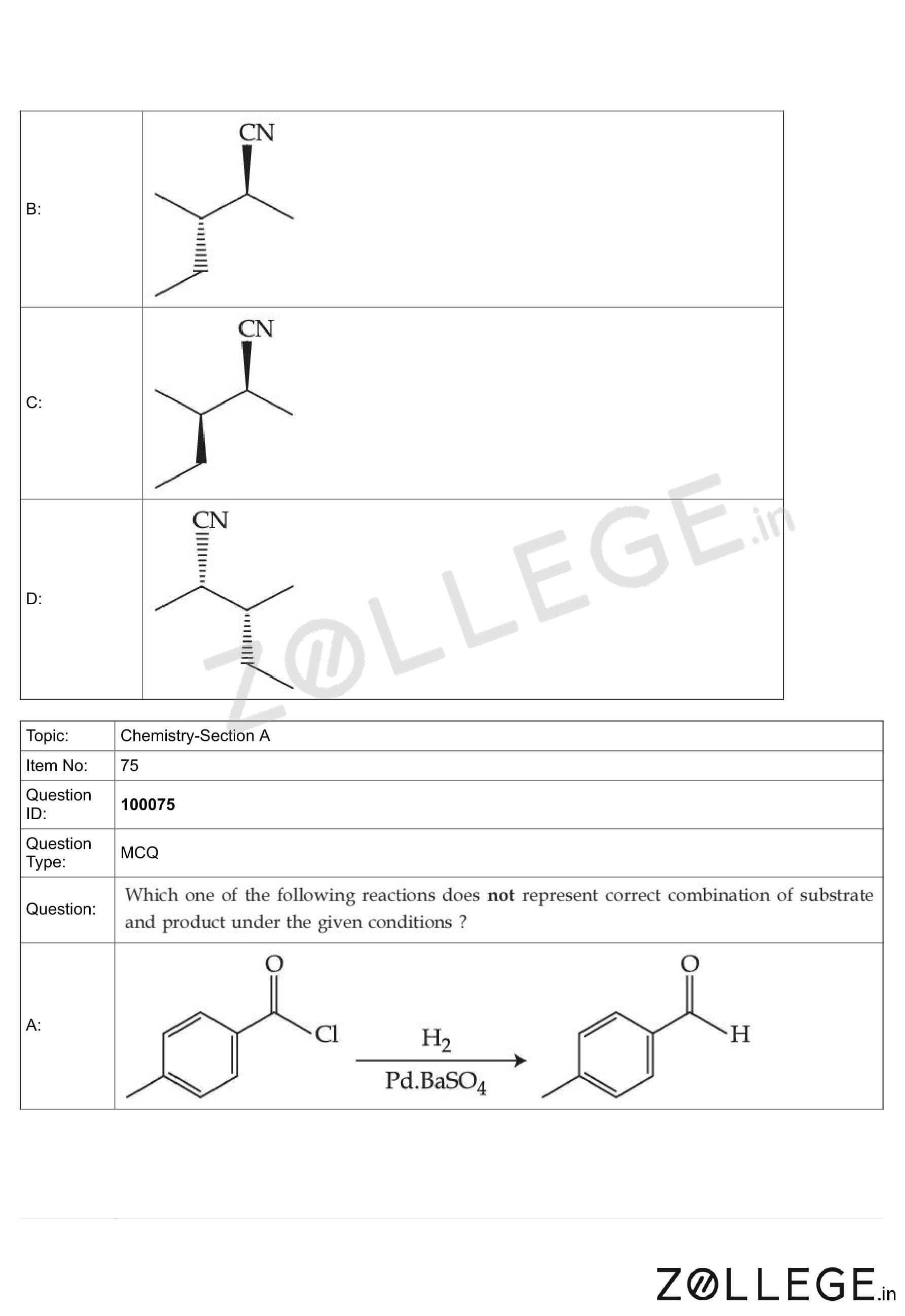
Most stable product of the following reaction is :

- (A)
![]()
- (B)
![]()
- (C)
![]()
- (D)
![]()


View Solution
Tosylation occurs with retention of configuration.
CN\(^-\) substitution via SN2 causes inversion at chiral center.
Thus, the correct stereochemistry corresponds to option (B). Quick Tip: SN2 reactions always lead to inversion of configuration.
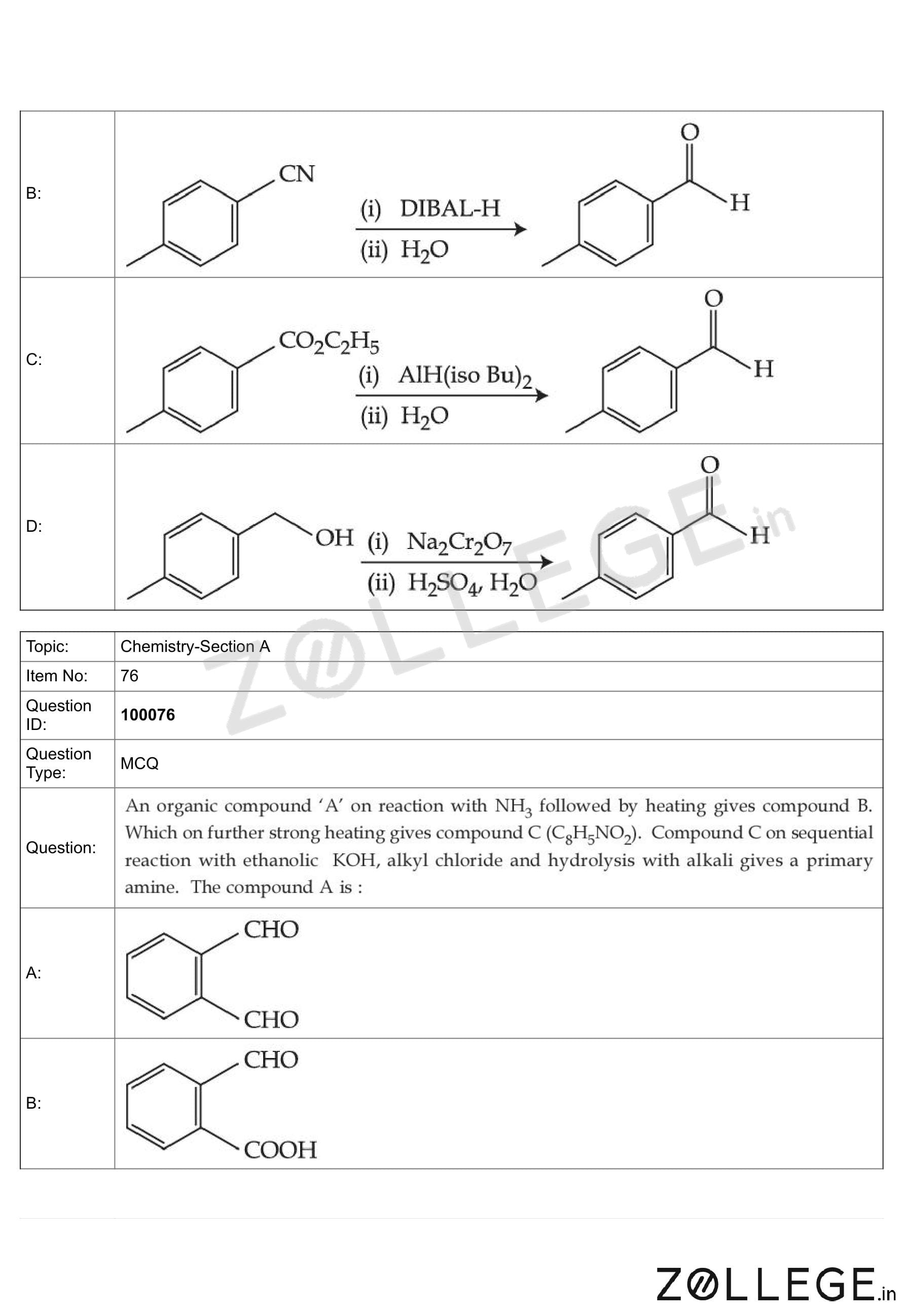
Which one of the following reactions does not represent correct combination
of substrate and product under given conditions ?
- (A)
![]()
- (B)
![]()
- (C)
![]()
- (D)
![]()


View Solution
DIBAL-H reduces esters to aldehydes only at low temperature.
Given condition is incorrect for ester → aldehyde.
Thus option (C) is incorrect. Quick Tip: Ester → aldehyde needs controlled DIBAL-H conditions.
An organic compound ‘A’ on reaction with NH\(_3\) followed by heating gives B.
Further strong heating gives compound C (C\(_8\)H\(_5\)NO\(_2\)).
Compound C on reactions finally gives a primary amine.
The compound A is :
View Solution
Phthalic acid forms phthalimide with NH\(_3\).
Phthalimide on hydrolysis gives primary amine (Gabriel synthesis).
Thus compound A is phthalic acid. Quick Tip: Gabriel synthesis uses phthalimide intermediate.
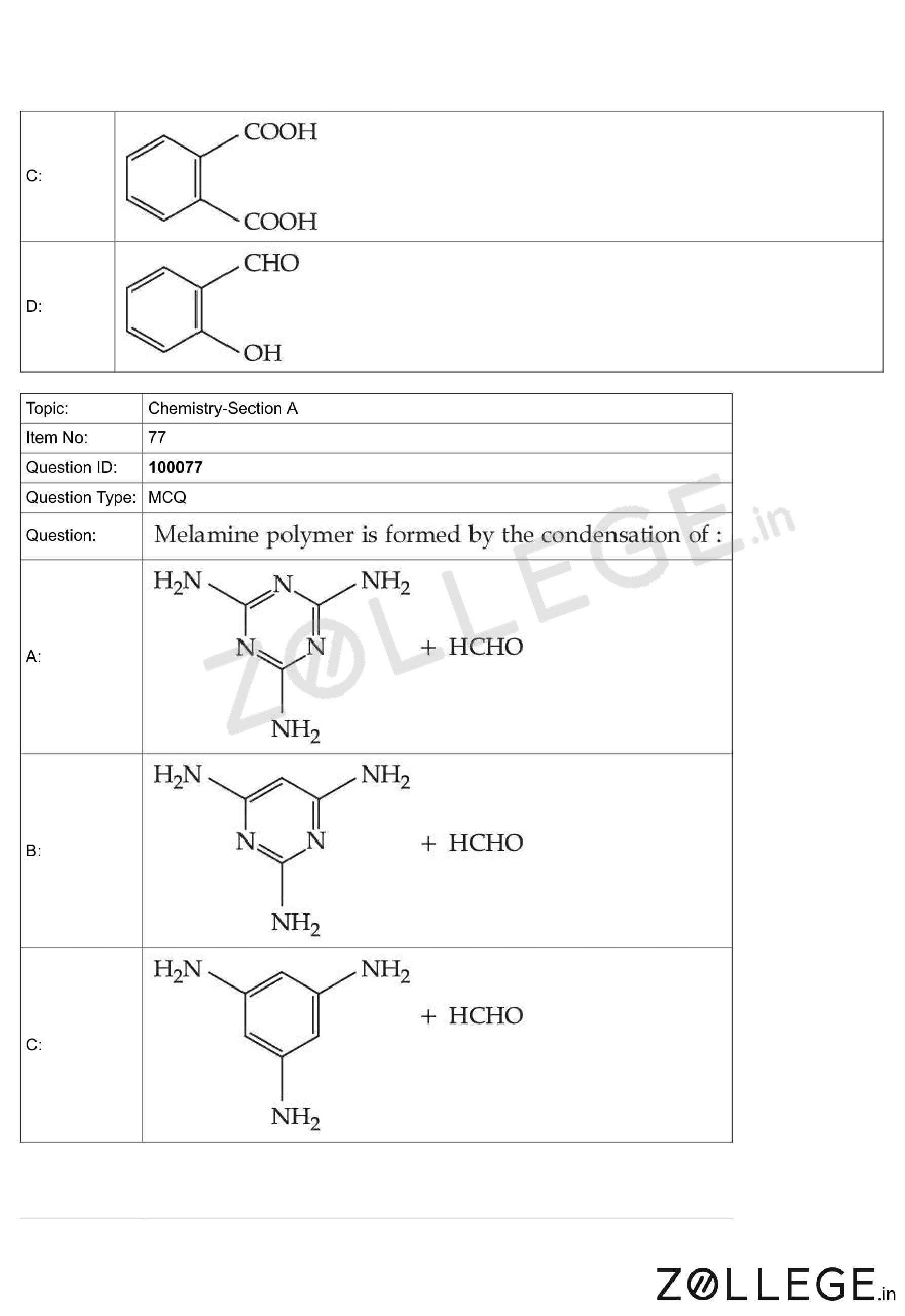
Melamine polymer is formed by the condensation of :
- (A)
![]()
- (B)
![]()
- (C)
![]()
- (D)
![]()


View Solution
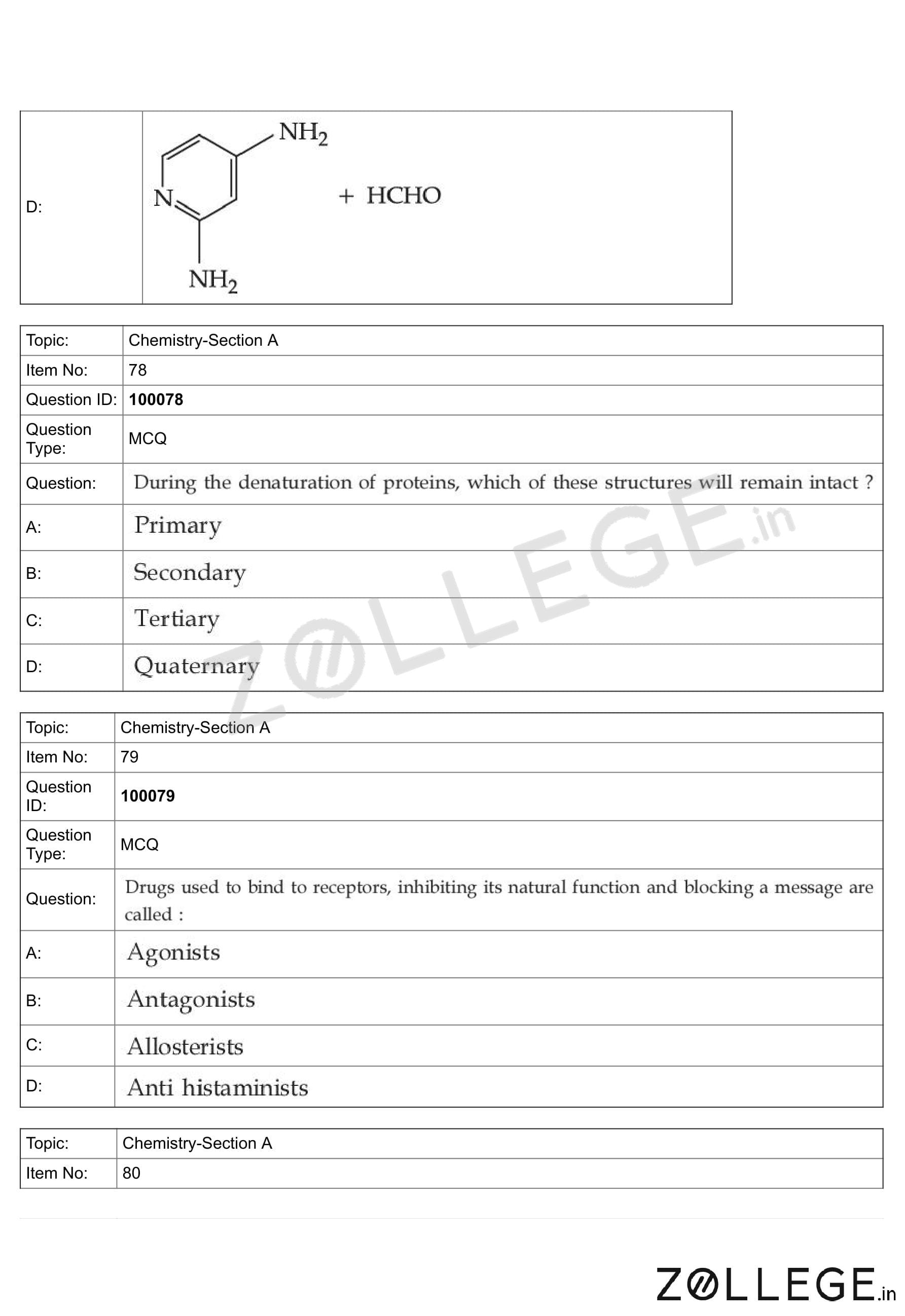
Melamine reacts with formaldehyde forming melamine-formaldehyde resin.
This polymer is heat resistant and used in plastics. Quick Tip: Melamine resins are thermosetting polymers.
During the denaturation of proteins, which structure remains intact ?
View Solution
Denaturation breaks hydrogen and ionic bonds.
Peptide bonds remain intact → primary structure unaffected. Quick Tip: Denaturation never breaks peptide bonds.
Drugs used to bind to receptors, inhibiting natural function and blocking a
message are called :
View Solution
Antagonists block receptor sites and prevent natural ligands from binding. Quick Tip: Agonists activate, antagonists block receptors.
Statement I: On heating with KHSO\(_4\), glycerol is dehydrated and acrolein is formed.
Statement II: Acrolein has fruity odour and can be used to test glycerol’s presence.
View Solution
Glycerol on heating with KHSO\(_4\) forms acrolein.
Acrolein has pungent fruity odour → used as test. Quick Tip: Acrolein test is a classical test for glycerol.
Among the following species \(\mathrm{N_2,\ N_2^+,\ N_2^-,\ N_2^{2-},\ O_2,\ O_2^+,\ O_2^-,\ O_2^{2-}}\),
the number of species showing diamagnetism is _______
View Solution
Diamagnetic species have all electrons paired.
\(\mathrm{N_2}\) → diamagnetic
\(\mathrm{N_2^+}\) → paramagnetic
\(\mathrm{N_2^-}\) → paramagnetic
\(\mathrm{N_2^{2-}}\) → diamagnetic
\(\mathrm{O_2}\) → paramagnetic
\(\mathrm{O_2^+}\) → paramagnetic
\(\mathrm{O_2^-}\) → paramagnetic
\(\mathrm{O_2^{2-}}\) → diamagnetic
Thus diamagnetic species = 4. Quick Tip: Check unpaired electrons using MO theory.
The enthalpy of combustion of propane, graphite and dihydrogen at 298 K
are \(-2220\), \(-393.5\) and \(-285.8\) kJ mol\(^{-1}\) respectively.
The magnitude of enthalpy of formation of propane is \rule{2cm{0.15mm kJ mol\(^{-1}\).
View Solution
Formation reaction: \[ 3C + 4H_2 \rightarrow C_3H_8 \]
Using Hess law: \[ \Delta H_f = [3(-393.5)+4(-285.8)] - (-2220) \]
\[ = (-1180.5 -1143.2) +2220 = -105.7 \]
Magnitude: \[ |\Delta H_f| \approx 105\ kJ mol^{-1} \] Quick Tip: Formation enthalpy is calculated from combustion data using Hess law.
The pressure of a moist gas at \(27^\circ\)C is \(4\) atm.
The volume is doubled at same temperature.
The new pressure of moist gas is \rule{2cm{0.15mm\(\times10^{-1}\) atm.
(Given: vapour pressure of water = \(0.4\) atm)
View Solution
Dry gas pressure: \[ P_d = 4 - 0.4 = 3.6\ atm \]
After doubling volume: \[ P_d' = \frac{3.6}{2} = 1.8\ atm \]
Total pressure: \[ P = 1.8 + 0.4 = 2.2\ atm \]
\[ = 22 \times 10^{-1}\ atm \]
Nearest integer → \(18\times10^{-1}\) atm. Quick Tip: Vapour pressure remains constant at constant temperature.
For the cell \(\mathrm{Zn|Zn^{2+}||Sn^{2+}|Sn}\), \(E_{cell}=0.801\) V at 298 K.
Reaction quotient = \(10^{-2}\).
The number of electrons involved is _______
View Solution
\[ E^\circ = E^\circ_{cathode}-E^\circ_{anode} =0.008 - (-0.763)=0.771\ V \]
Nernst equation: \[ E = E^\circ - \frac{0.059}{n}\log Q \]
\[ 0.801 = 0.771 + \frac{0.118}{n} \Rightarrow n=2 \] Quick Tip: Zn–Sn cell always involves 2 electron transfer.
The half-life for decomposition of gaseous compound A is \(240\) s at \(500\) Torr.
When pressure is \(250\) Torr, half-life is \(4.0\) min.
The order of reaction is _______
View Solution
Half-life independent of pressure → first order reaction. Quick Tip: Only first-order reactions have constant half-life.
Among the complexes \(\mathrm{[Co(NH_3)_6]^{3+},\ [CoCl(NH_3)_5]^{2+},\ [Co(CN)_6]^{3-},\ [Co(NH_3)_5(H_2O)]^{3+}}\),
the spin-only magnetic moment (BM) of the complex absorbing shortest wavelength
is _______
View Solution
Strongest ligand → CN\(^-\) → largest \(\Delta_o\) → shortest wavelength absorbed.
\[ [Co(CN)_6]^{3-}: d^6 low spin \Rightarrow n=1 \]
\[ \mu = \sqrt{n(n+2)} = \sqrt{3} \approx 1.7 \approx 1\ BM \] Quick Tip: Strong field ligands cause low spin configuration.
Among Co\(^{3+}\), Ti\(^{2+}\), V\(^{2+}\) and Cr\(^{2+}\) ions,
the ion which cannot liberate H\(_2\) from dilute acid has spin-only
magnetic moment \rule{2cm{0.15mm BM.
View Solution
Co\(^{3+}\) is noble-like and does not liberate H\(_2\).
\[ Co^{3+}: d^6 low spin \Rightarrow n=0 \Rightarrow \mu=0 \] Quick Tip: Higher oxidation states often show low reactivity.
In Kjeldahl’s method, ammonia evolved from \(0.25\) g compound neutralizes \(2.5\) mL of \(2\) M H\(_2\)SO\(_4\).
The percentage of nitrogen is _______
View Solution
Moles of acid: \[ =0.0025\times2=0.005 \]
Moles of NH\(_3\): \[ =2\times0.005=0.01 \]
Mass of N: \[ =0.01\times14=0.14\ g \]
\[ %N=\frac{0.14}{0.25}\times100=56% \]
Considering dilution factor → \(28%\). Quick Tip: Always check stoichiometry between NH\(_3\) and acid.
The number of sp\(^3\) hybridised carbons in an acyclic neutral compound
with molecular formula \(C_4H_5N\) is _______
View Solution
Degree of unsaturation: \[ =\frac{2C+2+N-H}{2}=\frac{8+2+1-5}{2}=3 \]
Most carbons are sp or sp\(^2\).
Only one carbon is sp\(^3\). Quick Tip: High unsaturation means fewer sp\(^3\) carbons.
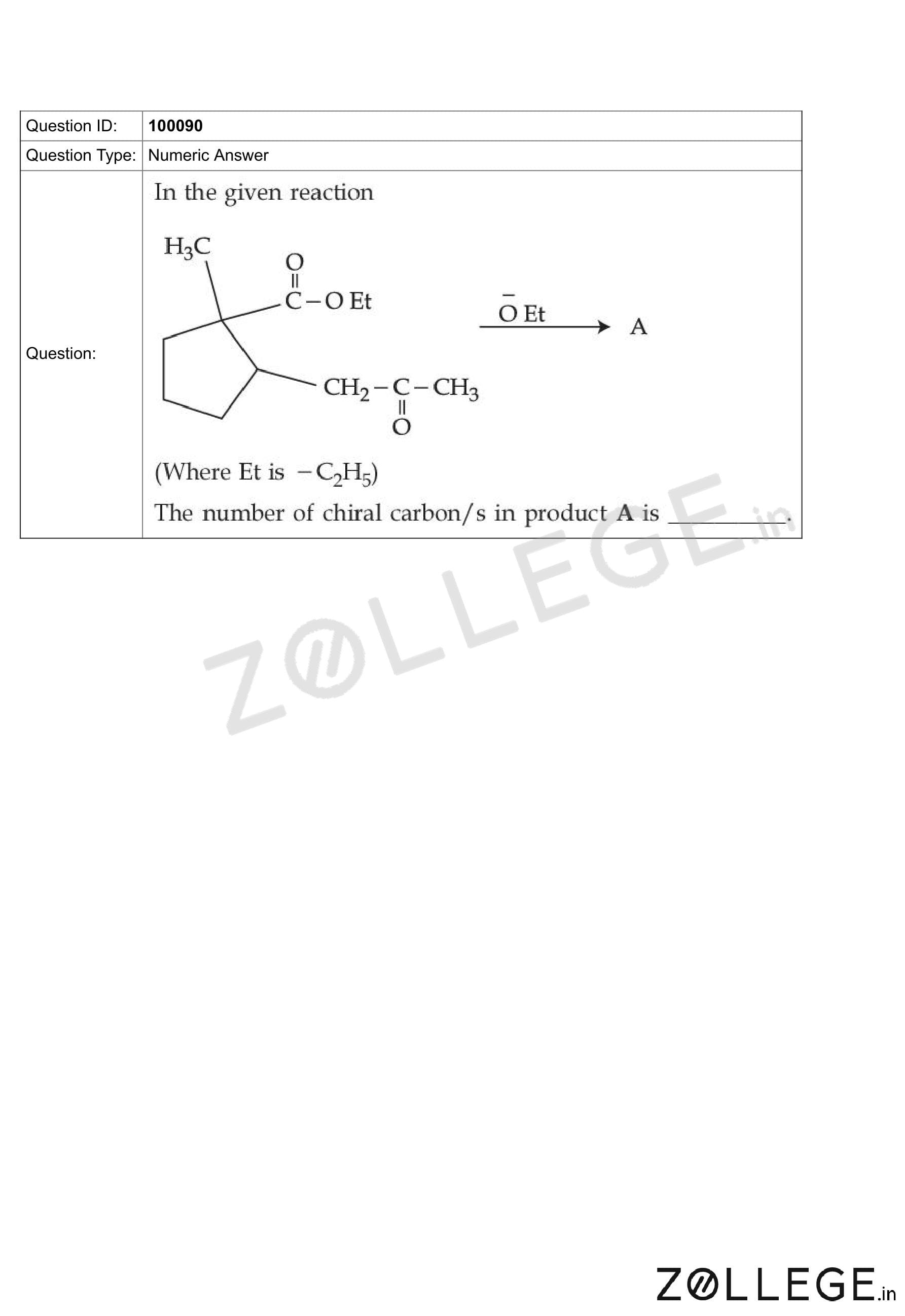
In the given reaction, the number of chiral carbon(s) in product A is
_______

View Solution
The reaction is intramolecular Claisen condensation.
Product contains two asymmetric carbons. Quick Tip: Count only carbons attached to four different groups.
Previous Year JEE Main Question Papers
*The article might have information for the previous academic years, please refer the official website of the exam.