
JEE Main 2022 Question Paper with Answer Key PDF for B.E./ B.Tech(July 29, 2022 - Shift 1)


Content Writer | Updated On - Dec 18, 2025
JEE Main Question Papers are the most important study material for effective exam preparation. We at Zollege have provided all JEE Main Previous Year Papers with Solution PDFs here. JEE Main 2022 B. E. / B. Tech exam was conducted successfully on July 29, 2022. NTA conducted the exam in the Shift 1. According to student reactions and expert reviews, the paper was reported to be moderate.
Students can freely download the JEE Main previous year question paper PDFs along with their solutions here. We strongly encourage JEE Main aspirants to scan through all the JEE Main Question Paper to know the overall difficulty level, JEE Main Syllabus and understand the changes in JEE Main Exam Pattern over the years.
JEE Main 2022 B.E./ B.Tech Question Paper with Answer Key PDF (Shift 1)
| JEE Main 2022 B.E./ B.Tech Question Paper PDF | JEE Main 2022 B.E./ B.Tech Solution PDF |
|---|---|
| Download PDF | Check Solutions |

Let R be a relation from the set \(\{1,2,3,\dots,60\}\) to itself such that \(R=\{(a,b) : b=pq, where p,q \ge 3 are prime numbers\}\). Then, the number of elements in R is:
View Solution
The relation is defined on the set \(A = \{1, 2, \dots, 60\}\)[cite: 24].
The condition for an element \((a,b) \in R\) is that \(b\) must be expressible as the product of two primes \(p\) and \(q\), where \(p, q \ge 3\)[cite: 25].
There is no restriction given for \(a\), other than \(a \in A\). Thus, \(a\) can take any value from 1 to 60.
We identify the valid values for \(b\) by listing products of primes \(\ge 3\) that are \(\le 60\).
The relevant primes are \(3, 5, 7, 11, 13, 17, 19\).
Calculating products for \(p=3\):
\(3 \times 3 = 9\)
\(3 \times 5 = 15\)
\(3 \times 7 = 21\)
\(3 \times 11 = 33\)
\(3 \times 13 = 39\)
\(3 \times 17 = 51\)
\(3 \times 19 = 57\)
(7 values)
Calculating products for \(p=5\):
\(5 \times 5 = 25\)
\(5 \times 7 = 35\)
\(5 \times 11 = 55\)
(3 values)
Calculating products for \(p=7\):
\(7 \times 7 = 49\)
(1 value)
Any other product involving primes \(\ge 7\) (e.g., \(7 \times 11 = 77\)) exceeds 60.
The distinct values for \(b\) are \(\{9, 15, 21, 33, 39, 51, 57, 25, 35, 55, 49\}\).
Total number of valid values for \(b\) is \(7 + 3 + 1 = 11\).
Since \(a\) can be any of the 60 integers in the set and \(b\) can be any of the 11 identified values, the total number of pairs is \(60 \times 11\).
Total elements \(= 660\).
Quick Tip: When counting elements in a relation \(A \times B\), if one variable is independent of the other, simply multiply the number of choices for each variable.
If \(z=2+3i\), then \(z^{5}+(\overline{z})^{5}\) is equal to:
View Solution
Given \(z = 2 + 3i\), the conjugate is \(\overline{z} = 2 - 3i\)[cite: 22].
We are asked to find \(S = z^5 + (\overline{z})^5\).
We know that for any complex number \(w\), \(w + \overline{w} = 2Re(w)\). Thus, \(z^5 + \overline{z^5} = 2Re(z^5)\).
Using the Binomial Expansion for \((2+3i)^5\):
\((2+3i)^5 = \binom{5}{0}2^5 + \binom{5}{1}2^4(3i) + \binom{5}{2}2^3(3i)^2 + \binom{5}{3}2^2(3i)^3 + \binom{5}{4}2(3i)^4 + \binom{5}{5}(3i)^5\).
We only need the Real Part, which comes from the even powers of \(i\):
Term 1: \(\binom{5}{0}2^5 = 1 \cdot 32 = 32\).
Term 3: \(\binom{5}{2}2^3(3i)^2 = 10 \cdot 8 \cdot (-9) = -720\).
Term 5: \(\binom{5}{4}2^1(3i)^4 = 5 \cdot 2 \cdot 81 = 810\).
Summing the real parts: \(32 - 720 + 810 = 122\).
The value of the expression is \(2 \times Re(z^5) = 2 \times 122 = 244\).
Quick Tip: \(z^n + \bar{z}^n\) is always real and equals \(2Re(z^n)\). Calculating only the real terms of the expansion is faster than full expansion.
Let A and B be two \(3\times3\) non-zero real matrices such that AB is a zero matrix. Then
View Solution
We are given that \(A\) and \(B\) are non-zero matrices and \(AB = O\) (zero matrix)[cite: 31].
If \(A\) were invertible (\(|A| \neq 0\)), we could multiply by \(A^{-1}\): \(A^{-1}AB = A^{-1}O \Rightarrow B = 0\).
However, we are given that \(B\) is non-zero. Therefore, our assumption is false, and \(A\) must be singular (\(|A| = 0\)).
The system of linear equations \(AX=0\) is a homogeneous system[cite: 32].
A homogeneous system has a unique trivial solution (\(X=0\)) if \(|A| \neq 0\), and infinitely many non-trivial solutions if \(|A| = 0\).
Since we established \(|A| = 0\), the system has infinitely many solutions.
Quick Tip: For square matrices, if product \(AB=0\) and neither A nor B is 0, then both A and B must be singular (determinant zero).
If \(\frac{1}{(20-a)(40-a)}+\frac{1}{(40-a)(60-a)}+\dots+\frac{1}{(180-a)(200-a)}=\frac{1}{256},\) then the maximum value of a is:
View Solution
The given series is a sum of terms of the form \(\frac{1}{x(x+20)}\), where the difference between factors in the denominator is constant (\(20\))[cite: 60].
We can decompose the general term:
\(\frac{1}{(x)(x+20)} = \frac{1}{20} \left( \frac{1}{x} - \frac{1}{x+20} \right)\).
The series becomes:
\(\frac{1}{20} \left[ \left(\frac{1}{20-a} - \frac{1}{40-a}\right) + \left(\frac{1}{40-a} - \frac{1}{60-a}\right) + \dots + \left(\frac{1}{180-a} - \frac{1}{200-a}\right) \right]\).
This is a telescoping series. All intermediate terms cancel out.
Remaining expression: \(\frac{1}{20} \left( \frac{1}{20-a} - \frac{1}{200-a} \right) = \frac{1}{256}\).
Simplify the bracket: \(\frac{(200-a) - (20-a)}{(20-a)(200-a)} = \frac{180}{(20-a)(200-a)}\).
Equation becomes: \(\frac{1}{20} \cdot \frac{180}{(20-a)(200-a)} = \frac{1}{256}\).
\(\frac{9}{(20-a)(200-a)} = \frac{1}{256}\).
\((20-a)(200-a) = 9 \times 256 = 2304\).
Expand: \(4000 - 220a + a^2 = 2304\).
\(a^2 - 220a + 1696 = 0\).
Roots are \(a = \frac{220 \pm \sqrt{220^2 - 4(1696)}}{2}\).
\(\sqrt{48400 - 6784} = \sqrt{41616} = 204\).
\(a = \frac{220 \pm 204}{2}\).
The two values are \(a = \frac{424}{2} = 212\) and \(a = \frac{16}{2} = 8\).
The question asks for the maximum value of \(a\), which is \(212\)[cite: 50].
Quick Tip: Always look for partial fraction decomposition in series where the denominator has factors in Arithmetic Progression.
If \(lim_{x\rightarrow0}\frac{\alpha e^{x}+\beta e^{-x}+\gamma~sin~x}{x~sin^{2}x}=\frac{2}{3}.\) where \(\alpha, \beta, \gamma\in R\) then which of the following is NOT correct?
View Solution
The denominator \(x \sin^2 x \approx x^3\) as \(x \to 0\). For the limit to exist, the numerator must vanish up to the \(x^2\) term[cite: 73].
Expand the numerator using Maclaurin series:
\(\alpha(1 + x + \frac{x^2}{2} + \frac{x^3}{6}) + \beta(1 - x + \frac{x^2}{2} - \frac{x^3}{6}) + \gamma(x - \frac{x^3}{6})\).
Group coefficients:
Constant: \(\alpha + \beta = 0 \Rightarrow \beta = -\alpha\).
\(x^1\): \(\alpha - \beta + \gamma = 0\). Substituting \(\beta = -\alpha \Rightarrow 2\alpha + \gamma = 0 \Rightarrow \gamma = -2\alpha\).
\(x^2\): \(\frac{\alpha}{2} + \frac{\beta}{2} = 0\) (Satisfied since \(\beta = -\alpha\)).
\(x^3\): \(\frac{\alpha}{6} - \frac{\beta}{6} - \frac{\gamma}{6}\).
The limit is the coefficient of \(x^3\) divided by 1 (from denominator \(x^3\)).
\(\frac{1}{6}(\alpha - \beta - \gamma) = \frac{2}{3}\).
\(\alpha - \beta - \gamma = 4\).
Substitute \(\beta = -\alpha\) and \(\gamma = -2\alpha\):
\(\alpha - (-\alpha) - (-2\alpha) = 4 \Rightarrow 4\alpha = 4 \Rightarrow \alpha = 1\).
So, \(\alpha = 1, \beta = -1, \gamma = -2\).
Check options:
(A) \(1 + 1 + 4 = 6\) (Correct).
(B) \(-1 + 2 - 2 + 1 = 0\) (Correct).
(C) \(1(1) + (-1)(4) + (-2)(1) + 3 = 1 - 4 - 2 + 3 = -2 \ne 0\) (Incorrect).
(D) \(1 - 1 + 4 = 4\) (Correct).
The incorrect statement is (C).
Quick Tip: For limits of the form \(0/0\) with order \(n\) in the denominator, the coefficients of \(x^0, x^1, \dots, x^{n-1}\) in the numerator expansion must be zero.
The integral \(\int_{0}^{\frac{\pi}{2}}\frac{1}{3+2\sin x+\cos x}dx\) is equal to:
View Solution
Let \(I = \int_{0}^{\frac{\pi}{2}}\frac{1}{3+2\sin x+\cos x}dx\)[cite: 92].
Use the substitution \(t = \tan(x/2)\), so \(dx = \frac{2dt}{1+t^2}\).
Then \(\sin x = \frac{2t}{1+t^2}\) and \(\cos x = \frac{1-t^2}{1+t^2}\).
Limits: When \(x=0, t=0\). When \(x=\frac{\pi}{2}, t=1\).
Substitute into the integral:
\(I = \int_{0}^{1} \frac{1}{3 + 2(\frac{2t}{1+t^2}) + \frac{1-t^2}{1+t^2}} \cdot \frac{2dt}{1+t^2}\).
Simplify the denominator term:
\(3(1+t^2) + 4t + (1-t^2) = 3 + 3t^2 + 4t + 1 - t^2 = 2t^2 + 4t + 4\).
The integral becomes:
\(I = \int_{0}^{1} \frac{2dt}{2t^2 + 4t + 4} = \int_{0}^{1} \frac{dt}{t^2 + 2t + 2}\).
Complete the square in the denominator: \(t^2 + 2t + 2 = (t+1)^2 + 1\).
\(I = \int_{0}^{1} \frac{dt}{(t+1)^2 + 1}\).
This is of the form \(\int \frac{dx}{x^2+a^2} = \frac{1}{a}\tan^{-1}(\frac{x}{a})\).
\(I = [\tan^{-1}(t+1)]_{0}^{1}\).
Evaluate limits:
\(I = \tan^{-1}(2) - \tan^{-1}(1)\).
Since \(\tan^{-1}(1) = \frac{\pi}{4}\), we have \(I = \tan^{-1}(2) - \frac{\pi}{4}\)[cite: 104].
Quick Tip: For integrals involving rational functions of \(\sin x\) and \(\cos x\), the substitution \(t = \tan(x/2)\) is the standard approach to convert them into algebraic integrals.
Let the solution curve \(y=y(x)\) of the differential equation \((1+e^{2x})(\frac{dy}{dx}+y)=1\) pass through the point \((0,\frac{\pi}{2})\). Then, \(\lim_{x\rightarrow\infty}e^{x}y(x)\) is equal to:
View Solution
The given differential equation is \((1+e^{2x})(\frac{dy}{dx}+y)=1\)[cite: 113].
Rewrite as \(\frac{dy}{dx} + y = \frac{1}{1+e^{2x}}\). This is a linear differential equation of the form \(y' + Py = Q\).
Here \(P = 1\). The Integrating Factor (IF) is \(e^{\int 1 dx} = e^x\).
Multiplying by IF:
\(y \cdot e^x = \int \frac{e^x}{1+e^{2x}} dx\).
To solve the integral, let \(u = e^x\), so \(du = e^x dx\).
\(\int \frac{du}{1+u^2} = \tan^{-1}(u) = \tan^{-1}(e^x)\).
So the general solution is \(y e^x = \tan^{-1}(e^x) + C\).
Given the curve passes through \((0, \frac{\pi}{2})\)[cite: 115]:
Substitute \(x=0, y=\frac{\pi}{2}\):
\(\frac{\pi}{2} \cdot e^0 = \tan^{-1}(e^0) + C\).
\(\frac{\pi}{2} = \tan^{-1}(1) + C \Rightarrow \frac{\pi}{2} = \frac{\pi}{4} + C \Rightarrow C = \frac{\pi}{4}\).
The particular solution is \(y e^x = \tan^{-1}(e^x) + \frac{\pi}{4}\).
We need to find \(\lim_{x\rightarrow\infty}e^{x}y(x)\)[cite: 116].
From our equation, \(e^x y(x) = \tan^{-1}(e^x) + \frac{\pi}{4}\).
As \(x \rightarrow \infty, e^x \rightarrow \infty\), and \(\tan^{-1}(\infty) \rightarrow \frac{\pi}{2}\).
Limit \(= \frac{\pi}{2} + \frac{\pi}{4} = \frac{3\pi}{4}\)[cite: 118].
Quick Tip: Recognize linear differential equations \(y' + Py = Q\). Don't forget to evaluate the constant of integration \(C\) using the initial condition before taking limits.
Let a line L pass through the point of intersection of the lines \(bx+10y-8=0\) and \(2x-3y=0,\) \(b\in R-\{\frac{4}{3}\}\). If the line L also passes through the point \((1,1)\) and touches the circle \(17(x^{2}+y^{2})=16\), then the eccentricity of the ellipse \(\frac{x^{2}}{5}+\frac{y^{2}}{b^{2}}=1\) is
View Solution
Line L passes through the intersection of \(L_1: bx+10y-8=0\) and \(L_2: 2x-3y=0\)[cite: 134].
The equation of such a line belongs to the family \(L_1 + \lambda L_2 = 0\):
\((bx+10y-8) + \lambda(2x-3y) = 0\).
It is given that L passes through \((1,1)\). Substitute \((1,1)\) to find \(\lambda\)[cite: 137]:
\((b(1) + 10(1) - 8) + \lambda(2(1) - 3(1)) = 0\).
\((b + 2) + \lambda(-1) = 0 \Rightarrow \lambda = b+2\).
Substitute \(\lambda\) back into the line equation:
\((bx+10y-8) + (b+2)(2x-3y) = 0\).
\(x[b + 2(b+2)] + y[10 - 3(b+2)] - 8 = 0\).
\(x(3b+4) + y(4-3b) - 8 = 0\).
This line L touches the circle \(17(x^2+y^2)=16\), which is \(x^2+y^2 = (\frac{4}{\sqrt{17}})^2\)[cite: 139].
Radius \(r = \frac{4}{\sqrt{17}}\).
The distance from the center \((0,0)\) to line L must equal \(r\):
\(\frac{|-8|}{\sqrt{(3b+4)^2 + (4-3b)^2}} = \frac{4}{\sqrt{17}}\).
Square both sides:
\(\frac{64}{(9b^2+24b+16) + (16-24b+9b^2)} = \frac{16}{17}\).
\(\frac{64}{18b^2+32} = \frac{16}{17}\).
Divide numerator by 16: \(\frac{4}{18b^2+32} = \frac{1}{17}\).
\(68 = 18b^2 + 32\).
\(18b^2 = 36 \Rightarrow b^2 = 2\).
The ellipse equation is \(\frac{x^2}{5} + \frac{y^2}{b^2} = 1 \Rightarrow \frac{x^2}{5} + \frac{y^2}{2} = 1\)[cite: 146].
Here \(a^2 = 5\) and \(B^2 = 2\). Since \(a > B\), eccentricity \(e = \sqrt{1 - \frac{B^2}{a^2}}\).
\(e = \sqrt{1 - \frac{2}{5}} = \sqrt{\frac{3}{5}}\)[cite: 142].
Quick Tip: The condition for a line \(Ax+By+C=0\) to tangent a circle \(x^2+y^2=r^2\) is \(\frac{|C|}{\sqrt{A^2+B^2}} = r\). Use the family of lines concept \(L_1 + \lambda L_2 = 0\) to avoid solving for the intersection point directly.
If the foot of the perpendicular from the point \(A(-1,4,3)\) on the plane \(P:2x+my+nz=4,\) is \((-2,\frac{7}{2},\frac{3}{2})\) then the distance of the point A from the plane P, measured parallel to a line with direction ratios 3, -1, -4, is equal to:
View Solution
Let \(F(-2, \frac{7}{2}, \frac{3}{2})\) be the foot of the perpendicular from \(A(-1, 4, 3)\) to the plane[cite: 161].
The vector \(\vec{AF}\) is normal to the plane.
\(\vec{AF} = F - A = (-2 - (-1), \frac{7}{2} - 4, \frac{3}{2} - 3) = (-1, -\frac{1}{2}, -\frac{3}{2})\).
Direction ratios of the normal are proportional to \((2, 1, 3)\).
The equation of the plane is given as \(2x+my+nz=4\).
Comparing normal vectors \((2, m, n)\) with \((2, 1, 3)\), we get \(m=1, n=3\).
Plane P: \(2x + y + 3z = 4\).
We need the distance from A to the plane measured parallel to the line with direction ratios \((3, -1, -4)\)[cite: 163].
Equation of line passing through A parallel to \(\vec{v}(3, -1, -4)\):
\(\vec{r} = (-1, 4, 3) + \lambda(3, -1, -4)\).
General point \(Q\) on line: \((-1+3\lambda, 4-\lambda, 3-4\lambda)\).
Find where this line intersects the plane by substituting Q into the plane equation:
\(2(-1+3\lambda) + (4-\lambda) + 3(3-4\lambda) = 4\).
\(-2 + 6\lambda + 4 - \lambda + 9 - 12\lambda = 4\).
\(11 - 7\lambda = 4\).
\(7\lambda = 7 \Rightarrow \lambda = 1\).
The intersection point Q corresponds to \(\lambda = 1\).
The distance is the distance between A (at \(\lambda=0\)) and Q (at \(\lambda=1\)) along the vector direction.
Distance \(= |\lambda| \sqrt{3^2 + (-1)^2 + (-4)^2}\).
Distance \(= 1 \cdot \sqrt{9 + 1 + 16} = \sqrt{26}\)[cite: 168].
Quick Tip: "Distance parallel to a line" means finding the intersection of a line (drawn from the point, parallel to the given direction) with the plane, then calculating the distance between the point and the intersection.
Let \(\vec{a}=3\hat{i}+\hat{j}\) and \(\vec{b}=\hat{i}+2\hat{j}+\hat{k}.\) Let \(\vec{c}\) be a vector satisfying \(\vec{a}\times(\vec{b}\times\vec{c})=\vec{b}+\lambda\vec{c}\). If \(\vec{b}\) and \(\vec{c}\) are non-parallel, then the value of \(\lambda\) is :
View Solution
We are given the vector identity \(\vec{a}\times(\vec{b}\times\vec{c})=\vec{b}+\lambda\vec{c}\)[cite: 185].
Expand the Vector Triple Product on the LHS:
\(\vec{a}\times(\vec{b}\times\vec{c}) = (\vec{a}\cdot\vec{c})\vec{b} - (\vec{a}\cdot\vec{b})\vec{c}\).
Equating LHS and RHS:
\((\vec{a}\cdot\vec{c})\vec{b} - (\vec{a}\cdot\vec{b})\vec{c} = 1\vec{b} + \lambda\vec{c}\).
Since \(\vec{b}\) and \(\vec{c}\) are non-parallel[cite: 190], the coefficients of \(\vec{b}\) and \(\vec{c}\) on both sides must be equal.
Comparing coefficients of \(\vec{c}\):
\(-\vec{a}\cdot\vec{b} = \lambda\).
We are given \(\vec{a} = 3\hat{i} + \hat{j} + 0\hat{k}\) and \(\vec{b} = \hat{i} + 2\hat{j} + \hat{k}\)[cite: 183].
Calculate dot product \(\vec{a}\cdot\vec{b}\):
\(\vec{a}\cdot\vec{b} = (3)(1) + (1)(2) + (0)(1) = 3 + 2 = 5\).
Therefore, \(\lambda = -5\)[cite: 192].
Quick Tip: The expansion formula for Vector Triple Product is \(\vec{a}\times(\vec{b}\times\vec{c}) = (\vec{a}\cdot\vec{c})\vec{b} - (\vec{a}\cdot\vec{b})\vec{c}\). Memorize this as "BAC - CAB".
The angle of elevation of the top of a tower from a point A due north of it is \(\alpha\) and from a point B at a distance of 9 units due west of A is \(\cos^{-1}(\frac{3}{\sqrt{13}}).\) If the distance of the point B from the tower is 15 units, then \(\cot \alpha\) is equal to:
View Solution
Let the tower be located at origin \(O\) with height \(h\).
Point \(A\) is due north of the tower. Let \(OA = x\).
The angle of elevation from \(A\) is \(\alpha\), so \(\tan \alpha = \frac{h}{x} \implies x = h \cot \alpha\).
Point \(B\) is 9 units due west of \(A\). In the horizontal plane, \(\triangle OAB\) is a right-angled triangle at \(A\) (North \(\perp\) West).
\(OB^2 = OA^2 + AB^2 \implies OB^2 = x^2 + 9^2\).
Given distance of \(B\) from tower is \(15\), so \(OB = 15\).
\(15^2 = x^2 + 81 \implies 225 = x^2 + 81 \implies x^2 = 144 \implies x = 12\).
The angle of elevation from \(B\) is \(\beta = \cos^{-1}(\frac{3}{\sqrt{13}})\).
So \(\cos \beta = \frac{3}{\sqrt{13}}\).
This implies \(\tan \beta = \frac{\sqrt{(\sqrt{13})^2 - 3^2}}{3} = \frac{\sqrt{13-9}}{3} = \frac{2}{3}\).
Also, \(\tan \beta = \frac{h}{OB} = \frac{h}{15}\).
\(\frac{h}{15} = \frac{2}{3} \implies h = 10\).
We need \(\cot \alpha = \frac{x}{h} = \frac{12}{10} = \frac{6}{5}\).
Quick Tip: Visualize the 3D geometry: The tower is vertical, and points A and B lie on the horizontal ground. Use Pythagoras theorem for horizontal distances and trigonometry for vertical angles.
The statement \((p\wedge q)\Rightarrow(p\wedge r)\) is equivalent to :
View Solution
Let the given statement be \(S\).
\(S \equiv (p \wedge q) \to (p \wedge r)\).
Using the implication law \(A \to B \equiv \neg A \vee B\):
\(S \equiv \neg(p \wedge q) \vee (p \wedge r)\)
\(S \equiv (\neg p \vee \neg q) \vee (p \wedge r)\).
Distribute or simplify:
\(S \equiv \neg p \vee (\neg q \vee (p \wedge r))\)
\(S \equiv \neg p \vee ((\neg q \vee p) \wedge (\neg q \vee r))\).
Alternatively, consider the logic cases:
If \(p\) is False: LHS \((F \wedge q)\) is False. \(F \to \dots\) is True.
If \(p\) is True: LHS is \(q\), RHS is \(r\). Statement reduces to \(q \to r\).
Now check Option (D): \((p \wedge q) \to r\).
If \(p\) is False: \(F \to r\) is True.
If \(p\) is True: \(q \to r\).
This matches perfectly.
Algebraically for (D):
\(\neg(p \wedge q) \vee r \equiv \neg p \vee \neg q \vee r\).
Let's check our expanded S:
\(S \equiv \neg p \vee \neg q \vee (p \wedge r) \equiv \neg p \vee \neg q \vee r\) (by absorption/distribution).
(Since \(\neg q \vee (p \wedge r) \equiv (\neg q \vee p) \wedge (\neg q \vee r)\), but simpler: \(A \to (B \wedge C) \equiv (A \to B) \wedge (A \to C)\).
\((p \wedge q) \to p\) is always True.
\((p \wedge q) \to r\) is the remaining condition).
Thus, \((p \wedge q) \to (p \wedge r) \equiv T \wedge ((p \wedge q) \to r) \equiv (p \wedge q) \to r\).
Quick Tip: Use the property \((A \to (B \wedge C)) \equiv (A \to B) \wedge (A \to C)\). Since \((p \wedge q) \to p\) is a tautology, the statement simplifies to \((p \wedge q) \to r\).
Let the circumcentre of a triangle with vertices \(A(a,3)\) B(b, 5) and \(C(a,b)\), \(ab>0\) be \(P(1,1)\). If the line AP intersects the line BC at the point \(Q(k_{1},k_{2})\), then \(k_{1}+k_{2}\) is equal to :
View Solution
Vertices: \(A(a,3), B(b,5), C(a,b)\). Circumcentre \(P(1,1)\).
\(P\) lies on the perpendicular bisector of \(AC\).
\(A\) and \(C\) have the same x-coordinate \(a\). So \(AC\) is vertical.
The perpendicular bisector is horizontal: \(y = \frac{3+b}{2}\).
Since \(P(1,1)\) lies on it, \(1 = \frac{3+b}{2} \implies 2 = 3+b \implies b = -1\).
Given \(ab > 0\), since \(b=-1\), \(a\) must be negative.
\(P\) is equidistant from \(A\) and \(B\): \(PA^2 = PB^2\).
\((a-1)^2 + (3-1)^2 = (b-1)^2 + (5-1)^2\).
\((a-1)^2 + 4 = (-1-1)^2 + 16\).
\((a-1)^2 + 4 = 4 + 16 \implies (a-1)^2 = 16\).
\(a-1 = \pm 4 \implies a = 5\) or \(a = -3\).
Since \(a < 0\), we take \(a = -3\).
Coordinates: \(A(-3, 3), B(-1, 5), C(-3, -1), P(1, 1)\).
Find intersection \(Q\) of line \(AP\) and line \(BC\).
Line \(AP\): Passes through \((-3,3)\) and \((1,1)\).
Slope \(m_{AP} = \frac{1-3}{1-(-3)} = \frac{-2}{4} = -\frac{1}{2}\).
Eq: \(y - 1 = -\frac{1}{2}(x - 1) \implies 2y - 2 = -x + 1 \implies x + 2y = 3\).
Line \(BC\): Passes through \((-1,5)\) and \((-3,-1)\).
Slope \(m_{BC} = \frac{-1-5}{-3-(-1)} = \frac{-6}{-2} = 3\).
Eq: \(y - 5 = 3(x + 1) \implies y = 3x + 8\).
Solve for \(Q(k_1, k_2)\):
\(x + 2(3x+8) = 3\).
\(x + 6x + 16 = 3 \implies 7x = -13 \implies k_1 = -\frac{13}{7}\).
\(k_2 = 3(-\frac{13}{7}) + 8 = -\frac{39}{7} + \frac{56}{7} = \frac{17}{7}\).
Sum \(k_1 + k_2 = -\frac{13}{7} + \frac{17}{7} = \frac{4}{7}\).
Quick Tip: Recognizing that segment AC is vertical immediately gives the y-coordinate of the circumcenter's relation to \(b\), simplifying variables early.
Let \(\hat{a}\) and \(\hat{b}\) be two unit vectors such that the angle between them is \(\frac{\pi}{4}.\) If \(\theta\) is the angle between the vectors \((\hat{a}+\hat{b})\) and \((\hat{a}+2\hat{b}+2(\hat{a}\times\hat{b}))\), then the value of \(164 \cos^{2}\theta\) is equal to:
View Solution
Let \(\vec{u} = \hat{a} + \hat{b}\) and \(\vec{v} = \hat{a} + 2\hat{b} + 2(\hat{a} \times \hat{b})\).
We know \(|\hat{a}|=1, |\hat{b}|=1\), angle \(\phi = \pi/4\).
\(\hat{a} \cdot \hat{b} = \cos(\pi/4) = \frac{1}{\sqrt{2}}\).
\(|\hat{a} \times \hat{b}| = \sin(\pi/4) = \frac{1}{\sqrt{2}}\).
Compute \(|\vec{u}|^2 = (\hat{a}+\hat{b})^2 = 1 + 1 + 2(\frac{1}{\sqrt{2}}) = 2 + \sqrt{2}\).
Compute \(\vec{u} \cdot \vec{v} = (\hat{a}+\hat{b}) \cdot (\hat{a} + 2\hat{b} + 2(\hat{a}\times\hat{b}))\).
\(= \hat{a}\cdot\hat{a} + 2\hat{a}\cdot\hat{b} + 0 + \hat{b}\cdot\hat{a} + 2\hat{b}\cdot\hat{b} + 0\) (Scalar triple product with repeated vector is 0).
\(= 1 + \frac{2}{\sqrt{2}} + \frac{1}{\sqrt{2}} + 2 = 3 + \frac{3}{\sqrt{2}}\).
Compute \(|\vec{v}|^2 = (\hat{a} + 2\hat{b} + 2(\hat{a}\times\hat{b}))^2\).
Let \(\vec{w} = \hat{a} + 2\hat{b}\) and \(\vec{n} = 2(\hat{a}\times\hat{b})\). Note \(\vec{w} \cdot \vec{n} = 0\).
\(|\vec{v}|^2 = |\vec{w}|^2 + |\vec{n}|^2\).
\(|\vec{w}|^2 = 1 + 4 + 4(\frac{1}{\sqrt{2}}) = 5 + 2\sqrt{2}\).
\(|\vec{n}|^2 = 4 |\hat{a}\times\hat{b}|^2 = 4(\frac{1}{2}) = 2\).
\(|\vec{v}|^2 = 7 + 2\sqrt{2}\).
\(\cos \theta = \frac{\vec{u} \cdot \vec{v}}{|\vec{u}| |\vec{v}|}\).
\(\cos^2 \theta = \frac{(3 + \frac{3}{\sqrt{2}})^2}{(2+\sqrt{2})(7+2\sqrt{2})}\).
Numerator: \(9(1 + \frac{1}{\sqrt{2}})^2 = 9(1 + \frac{1}{2} + \sqrt{2}) = 9(\frac{3}{2} + \sqrt{2}) = \frac{9}{2}(3+2\sqrt{2})\).
Denominator: \(14 + 4\sqrt{2} + 7\sqrt{2} + 4 = 18 + 11\sqrt{2}\).
\(164 \cos^2 \theta = 164 \cdot \frac{9(3+2\sqrt{2})}{2(18+11\sqrt{2})} = 82 \cdot \frac{9(3+2\sqrt{2})}{18+11\sqrt{2}}\).
\(= 738 \cdot \frac{(3+2\sqrt{2})(18-11\sqrt{2})}{324 - 242} = 738 \cdot \frac{54 - 33\sqrt{2} + 36\sqrt{2} - 44}{82}\).
\(= \frac{738}{82} (10 + 3\sqrt{2}) = 9(10 + 3\sqrt{2}) = 90 + 27\sqrt{2}\).
Quick Tip: Remember that \((\hat{a} \times \hat{b})\) is perpendicular to both \(\hat{a}\) and \(\hat{b}\). This makes cross-terms in dot products and magnitude squares vanish, simplifying calculations.
If \(f(x) = \int_{1}^{x} \frac{\log_{10} t}{1+t} dt, x > 0\), then \(f(e^{3})+f(e^{-3})\) is equal to :
View Solution
We need to calculate \(S = f(x) + f(1/x)\) where \(x = e^3\).
\(f(x) = \frac{1}{\ln 10} \int_{1}^{x} \frac{\ln t}{1+t} dt\).
\(f(1/x) = \frac{1}{\ln 10} \int_{1}^{1/x} \frac{\ln t}{1+t} dt\).
In the second integral, let \(t = 1/u\), so \(dt = -du/u^2\).
Limits: \(1 \to 1\) and \(1/x \to x\).
\(f(1/x) = \frac{1}{\ln 10} \int_{1}^{x} \frac{\ln(1/u)}{1+1/u} (-\frac{du}{u^2}) = \frac{1}{\ln 10} \int_{1}^{x} \frac{-\ln u}{\frac{u+1}{u}} (-\frac{1}{u^2}) du\).
\(= \frac{1}{\ln 10} \int_{1}^{x} \frac{\ln u}{u(u+1)} du\).
Sum \(S = f(x) + f(1/x) = \frac{1}{\ln 10} \int_{1}^{x} (\frac{\ln t}{1+t} + \frac{\ln t}{t(1+t)}) dt\).
\(= \frac{1}{\ln 10} \int_{1}^{x} \ln t (\frac{t + 1}{t(1+t)}) dt = \frac{1}{\ln 10} \int_{1}^{x} \frac{\ln t}{t} dt\).
Evaluate integral: Let \(v = \ln t \implies dv = dt/t\).
\(\int_{0}^{\ln x} v dv = [\frac{v^2}{2}]_{0}^{\ln x} = \frac{(\ln x)^2}{2}\).
\(S = \frac{1}{\ln 10} \frac{(\ln x)^2}{2}\).
Given \(x = e^3\), \(\ln x = 3\).
\(S = \frac{3^2}{2 \ln 10} = \frac{9}{2 \log_e 10}\).
Quick Tip: For integrals of the form \(f(x) + f(1/x)\), using the substitution \(t=1/u\) usually simplifies the sum into a single integrable function.
The area of the region \(\{(x,y):|x-1|\le y\le\sqrt{5-x^{2}}\}\) is equal to :
View Solution
The region is bounded above by the circle \(x^2+y^2=5\) and below by the modulus function \(y=|x-1|\).
Find intersection points: \(|x-1| = \sqrt{5-x^2}\).
Square both sides: \((x-1)^2 = 5 - x^2 \implies x^2 - 2x + 1 = 5 - x^2\).
\(2x^2 - 2x - 4 = 0 \implies x^2 - x - 2 = 0\).
\((x-2)(x+1) = 0\). Intersection at \(x = -1\) and \(x = 2\).
The area \(A\) is \(\int_{-1}^{2} (\sqrt{5-x^2} - |x-1|) dx\).
Area under circle \(A_1 = \int_{-1}^{2} \sqrt{5-x^2} dx\).
\(A_1 = [\frac{x}{2}\sqrt{5-x^2} + \frac{5}{2}\sin^{-1}\frac{x}{\sqrt{5}}]_{-1}^{2}\).
\(A_1 = (\frac{2}{2}\sqrt{1} + \frac{5}{2}\sin^{-1}\frac{2}{\sqrt{5}}) - (-\frac{1}{2}\sqrt{4} + \frac{5}{2}\sin^{-1}\frac{-1}{\sqrt{5}})\).
\(A_1 = 1 + \frac{5}{2}\sin^{-1}\frac{2}{\sqrt{5}} + 1 + \frac{5}{2}\sin^{-1}\frac{1}{\sqrt{5}}\).
\(A_1 = 2 + \frac{5}{2} (\sin^{-1}\frac{2}{\sqrt{5}} + \cos^{-1}\frac{2}{\sqrt{5}})\) (Since \(\sin^{-1}(1/\sqrt{5}) = \cos^{-1}(2/\sqrt{5})\)).
\(A_1 = 2 + \frac{5}{2}(\frac{\pi}{2}) = 2 + \frac{5\pi}{4}\).
Area under modulus \(A_2 = \int_{-1}^{2} |x-1| dx\).
This forms two triangles.
Triangle 1 (\(x \in [-1, 1]\)): Base 2, Height 2. Area = 2.
Triangle 2 (\(x \in [1, 2]\)): Base 1, Height 1. Area = 0.5.
\(A_2 = 2.5 = \frac{5}{2}\).
Total Area \(A = A_1 - A_2 = (2 + \frac{5\pi}{4}) - \frac{5}{2} = \frac{5\pi}{4} - \frac{1}{2}\).
Quick Tip: Use geometry for simple shapes like \(|x-1|\) (triangles) to save integration time. For circle segments, check if angles sum to \(\pi/2\) to simplify inverse trig terms.
Let the focal chord of the parabola \(P:y^{2}=4x\) along the line \(L:y=mx+c,m>0\) meet the parabola at the points M and N. Let the line L be a tangent to the hyperbola \(H:x^{2}-y^{2}=4\). If O is the vertex of P and F is the focus of H on the positive x-axis, then the area of the quadrilateral OMFN is :
View Solution
Parabola \(y^2=4x\) has focus at \(S(1,0)\).
Line \(L\) is a focal chord, so it passes through \((1,0)\).
\(0 = m(1) + c \implies c = -m\). Eq: \(y = m(x-1)\).
Line \(L\) is tangent to hyperbola \(x^2 - y^2 = 4 \implies \frac{x^2}{4} - \frac{y^2}{4} = 1\).
Condition for tangency (\(c^2 = a^2m^2 - b^2\)):
\((-m)^2 = 4m^2 - 4 \implies m^2 = 4m^2 - 4 \implies 3m^2 = 4 \implies m = \frac{2}{\sqrt{3}}\) (\(m>0\)).
Line L: \(y = \frac{2}{\sqrt{3}}(x-1)\).
Points M and N are intersections of Line L and Parabola.
Substitute \(x = y^2/4\):
\(y = \frac{2}{\sqrt{3}}(\frac{y^2}{4} - 1) \implies \sqrt{3}y = \frac{y^2}{2} - 2 \implies y^2 - 2\sqrt{3}y - 4 = 0\).
Let roots be \(y_1, y_2\).
\(y_1 + y_2 = 2\sqrt{3}\), \(y_1 y_2 = -4\).
\(|y_1 - y_2| = \sqrt{(y_1+y_2)^2 - 4y_1y_2} = \sqrt{12 + 16} = \sqrt{28} = 2\sqrt{7}\).
Vertices of Quadrilateral: \(O(0,0)\) and \(F\).
\(F\) is focus of Hyperbola (\(x^2/4 - y^2/4 = 1\)).
\(a=2, b=2, e=\sqrt{1+b^2/a^2} = \sqrt{2}\). Focus \(F(ae, 0) = (2\sqrt{2}, 0)\).
Points M and N lie on the line passing through \((1,0)\).
The quadrilateral OMFN can be split into two triangles \(\triangle OMN\) and \(\triangle FMN\)? No, simpler split.
Split by x-axis? No.
Area of quadrilateral with vertices \((x_1, y_1), (x_2, y_2)\) and points on axis.
Area = Area(\(\triangle OMN\)) + Area(\(\triangle FMN\)).
Note \(M, N\) are on line passing through \((1,0)\).
Actually, simply: Area = \(\frac{1}{2} \times diagonal \times (sum of heights)\).
The diagonal OF lies on x-axis. Length \(OF = 2\sqrt{2}\).
Heights of M and N from x-axis are \(|y_1|\) and \(|y_2|\). Since they are on opposite sides, sum of heights is \(|y_1 - y_2|\).
Area = \(\frac{1}{2} \times OF \times |y_1 - y_2|\).
Area = \(\frac{1}{2} \times 2\sqrt{2} \times 2\sqrt{7} = 2\sqrt{14}\).
Quick Tip: If a quadrilateral has a diagonal on the x-axis, its area is \(\frac{1}{2} \times Length of Diagonal \times |Difference of y-ordinates of other vertices|\).
The number of points, where the function \(f:R\rightarrow R,\) \(f(x)=|x-1|\cos|x-2|\sin|x-1|+(x-3)|x^{2}-5x+4|,\) is NOT differentiable, is :
View Solution
Let \(f(x) = g(x) + h(x)\).
\(g(x) = |x-1|\sin|x-1|\cos|x-2|\).
\(h(x) = (x-3)|(x-1)(x-4)|\).
Analyze \(g(x)\):
Near \(x=1\): \(|x-1|\sin|x-1| \approx |x-1|^2 = (x-1)^2\). This is differentiable.
Near \(x=2\): \(\cos|x-2|\). The function \(|x-2|\) is not diff at 2, but \(\cos(u) \approx 1 - u^2/2\). So \(\cos|x-2| \approx 1 - (x-2)^2/2\), which is differentiable.
So \(g(x)\) is differentiable everywhere.
Analyze \(h(x)\):
Possible points of non-differentiability are roots of modulus: \(x=1, x=4\).
At \(x=1\): \(h(x) = (x-3)|x-4||x-1|\).
Coefficient \((x-3)|x-4|\) at \(x=1\) is \((-2)(3) = -6 \ne 0\).
Function behaves like \(-6|x-1|\), which is NOT differentiable.
At \(x=4\): \(h(x) = (x-3)|x-1||x-4|\).
Coefficient \((x-3)|x-1|\) at \(x=4\) is \((1)(3) = 3 \ne 0\).
Function behaves like \(3|x-4|\), which is NOT differentiable.
Total non-differentiable points for sum \(f(x)\) are \(x=1\) and \(x=4\).
Total count = 2.
Quick Tip: A function of form \(k(x)|x-a|\) is differentiable at \(x=a\) if and only if \(k(a)=0\).
Let \(S=\{1,2,3,\dots,2022\}\). Then the probability, that a randomly chosen number n from the set S such that HCF \((n,2022)=1\), is:
View Solution
Total numbers in \(S = 2022\).
We need to count \(n \in S\) such that \(\gcd(n, 2022) = 1\). This is given by Euler's Totient Function \(\phi(2022)\).
Prime factorization of \(2022\):
\(2022 = 2 \times 1011 = 2 \times 3 \times 337\).
(Check 337: \(\sqrt{337} \approx 18.3\). Not div by 2, 3, 5. \(337 = 7 \times 48 + 1\). \(337 = 11 \times 30 + 7\). \(337 = 13 \times 25 + 12\). \(337 = 17 \times 19 + 14\). So 337 is prime).
\(\phi(2022) = 2022 (1 - \frac{1}{2}) (1 - \frac{1}{3}) (1 - \frac{1}{337})\).
\(\phi(2022) = 2022 \times \frac{1}{2} \times \frac{2}{3} \times \frac{336}{337}\).
\(\phi(2022) = 2022 \times \frac{1}{3} \times \frac{336}{337}\).
Since \(2022 = 6 \times 337\), we have \(\frac{2022}{337} = 6\).
\(\phi(2022) = 6 \times \frac{1}{3} \times 336 = 2 \times 336 = 672\).
Probability \(P = \frac{672}{2022}\).
Simplify fraction:
Divide by 2: \(\frac{336}{1011}\).
Divide by 3: \(\frac{112}{337}\).
Quick Tip: Probability of picking a number coprime to \(N\) from \(1\) to \(N\) is \(\frac{\phi(N)}{N} = \prod (1 - \frac{1}{p})\).
Let \(f(x)=3^{(x^{2}-2)^{3}+4}\) \(x\in R\). Then which of the following statements are true ?
P: \(x=0\) is a point of local minima of f
Q: \(x=\sqrt{2}\) is a point of inflection of f
R: f' is increasing for \(x>\sqrt{2}\)
View Solution
Let \(g(x) = (x^2-2)^3 + 4\). Then \(f(x) = 3^{g(x)}\).
Since \(3^u\) is strictly increasing, extrema of \(f(x)\) occur at extrema of \(g(x)\).
\(g'(x) = 3(x^2-2)^2 \cdot 2x = 6x(x^2-2)^2\).
Critical points: \(x=0, \sqrt{2}, -\sqrt{2}\).
Around \(x=0\): \(g'(x)\) changes sign from negative to positive. So local minima at \(x=0\). P is True.
\(f'(x) = f(x) \ln 3 \cdot g'(x)\).
\(f''(x) = \ln 3 [ f'(x)g'(x) + f(x)g''(x) ] = f(x) \ln 3 [ \ln 3 (g'(x))^2 + g''(x) ]\).
\(g''(x) = 6 [ (x^2-2)^2 + x \cdot 2(x^2-2) \cdot 2x ] = 6(x^2-2) [ x^2-2 + 4x^2 ] = 6(x^2-2)(5x^2-2)\).
At \(x=\sqrt{2}\): \(g'(\sqrt{2})=0\) and \(g''(\sqrt{2})=0\).
We need to check sign change of \(f''\) (or \(g'''\)) or higher derivative.
Since \(g''(x)\) has factor \((x^2-2)\), it changes sign at \(\sqrt{2}\). The term \((g'(x))^2\) is zero at \(\sqrt{2}\) and positive around it, but of higher order \((x-\sqrt{2})^4\). The linear term in \(g''\) dominates.
So \(f''\) changes sign. Inflection point. Q is True.
For \(x > \sqrt{2}\):
\(x^2-2 > 0 \implies g'(x) > 0, g''(x) > 0\).
\(f''(x) = (pos) [ (pos) + (pos) ] > 0\).
Since \(f'' > 0\), \(f'\) is increasing. R is True.
Quick Tip: For composite functions \(h(g(x))\) where \(h\) is monotonic, local extrema are determined by \(g(x)\). Inflection points require checking the second derivative's sign change.
Let \(S=\{\theta \in (0,2\pi):7 \cos^{2}\theta-3 \sin^{2}\theta-2 \cos^{2}2\theta=2\}\). Then, the sum of roots of all the equations \(x^{2}-2(\tan^{2}\theta+\cot^{2}\theta)x+6 \sin^{2}\theta=0\) \(\theta\in S\), is
View Solution
Solve for \(\theta\):
\(7 \cos^2 \theta - 3 \sin^2 \theta - 2 \cos^2 2\theta = 2\).
\(7 c^2 - 3(1-c^2) - 2(2c^2-1)^2 = 2\).
\(10c^2 - 3 - 2(4c^4 - 4c^2 + 1) = 2\).
\(10c^2 - 3 - 8c^4 + 8c^2 - 2 = 2\).
\(-8c^4 + 18c^2 - 7 = 0 \implies 8c^4 - 18c^2 + 7 = 0\).
\((2c^2 - 1)(4c^2 - 7) = 0\).
\(c^2 = 1/2\) or \(c^2 = 7/4\) (Reject \(>1\)).
So \(\cos^2 \theta = 1/2\). This implies \(\sin^2 \theta = 1/2\), \(\tan^2 \theta = 1\), \(\cot^2 \theta = 1\).
Solutions in \((0, 2\pi)\) are \(\pi/4, 3\pi/4, 5\pi/4, 7\pi/4\). (4 values).
Substitute values into quadratic equation:
\(x^2 - 2(1+1)x + 6(1/2) = 0\).
\(x^2 - 4x + 3 = 0\).
Roots sum \(= 4\).
There are 4 such equations (one for each \(\theta\)), but they are all identical.
The question asks for sum of roots of all the equations.
Total sum = \(4 \times (sum for one eq) = 4 \times 4 = 16\).
Quick Tip: "Sum of roots of all equations" implies summing the roots for every instance of the parameter \(\theta\) found in the set \(S\).
Let the mean and the variance of 20 observations \(x_{1},x_{2},...,x_{20}\) be 15 and 9, respectively. For \(\alpha\in R\) if the mean of \((x_{1}+\alpha)^{2},\) \((x_{2}+\alpha)^{2},...,\) \((x_{20}+\alpha)^{2}\) is 178, then the square of the maximum value of \(\alpha\) is equal to
View Solution
Given \(n=20\), \(\bar{x} = 15\), \(\sigma^2 = 9\).
\(\sigma^2 = \frac{\sum x_i^2}{n} - (\bar{x})^2 \implies 9 = \frac{\sum x_i^2}{20} - 225\).
\(\frac{\sum x_i^2}{20} = 234 \implies \sum x_i^2 = 4680\).
Also \(\sum x_i = 20 \times 15 = 300\).
New mean of \((x_i+\alpha)^2\) is 178.
\(\frac{1}{20} \sum (x_i + \alpha)^2 = 178\).
\(\frac{1}{20} \sum (x_i^2 + 2\alpha x_i + \alpha^2) = 178\).
\(\frac{1}{20} (4680 + 2\alpha(300) + 20\alpha^2) = 178\).
\(234 + 30\alpha + \alpha^2 = 178\).
\(\alpha^2 + 30\alpha + 56 = 0\).
\((\alpha + 2)(\alpha + 28) = 0\).
\(\alpha = -2, -28\).
Maximum value is \(-2\).
Square of maximum value is \((-2)^2 = 4\).
Quick Tip: Use \(Mean(X^2) = Variance(X) + (Mean(X))^2\) to quickly find \(\sum x_i^2/n\).
Let a line with direction ratios a, 4a, 7 be perpendicular to the lines with direction ratios 3, 1, 2b and b, a, -2. If the point of intersection of the line \(\frac{x+1}{a^{2}+b^{2}}=\frac{y-2}{a^{2}-b^{2}}=\frac{z}{1}\) and the plane \(x-y+z=0\) is \((\alpha, \beta, \gamma)\), then \(\alpha+\beta+\gamma\) is equal to
View Solution
Let \(\vec{d} = (a, 4a, 7)\).
\(\vec{d} \perp (3, 1, 2b) \implies 3a + 4a + 14b = 0 \implies 7a + 14b = 0 \implies a = -2b\).
\(\vec{d} \perp (b, a, -2) \implies ab + 4a^2 - 14 = 0\).
Substitute \(a = -2b\):
\((-2b)(b) + 4(-2b)^2 - 14 = 0\).
\(-2b^2 + 16b^2 = 14 \implies 14b^2 = 14 \implies b^2 = 1\).
So \(b = 1, a = -2\) (or signs reversed).
\(a^2 + b^2 = 4 + 1 = 5\).
\(a^2 - b^2 = 4 - 1 = 3\).
Line equation: \(\frac{x+1}{5} = \frac{y-2}{3} = \frac{z}{1} = \lambda\).
Point \(P(5\lambda-1, 3\lambda+2, \lambda)\).
Intersection with plane \(x-y+z=0\):
\((5\lambda-1) - (3\lambda+2) + \lambda = 0\).
\(3\lambda - 3 = 0 \implies \lambda = 1\).
Point \((\alpha, \beta, \gamma) = (4, 5, 1)\).
Sum \(\alpha+\beta+\gamma = 4 + 5 + 1 = 10\).
Quick Tip: If direction ratios contain variables, use the orthogonality condition (\(\vec{u} \cdot \vec{v} = 0\)) to form a system of equations.
Let \(a_{1}\), \(a_{2}\), \(a_3\), be an A.P. If \(\sum_{r=1}^{\infty}\frac{a_{r}}{2^{r}}=4,\) then \(4a_{2}\) is equal to
View Solution
Let the AP be \(a, a+d, a+2d, \dots\).
\(S = \frac{a}{2} + \frac{a+d}{4} + \frac{a+2d}{8} + \dots\).
This is an Arithmetic-Geometric Progression (AGP).
\(\frac{1}{2}S = \frac{a}{4} + \frac{a+d}{8} + \dots\).
Subtracting:
\(\frac{S}{2} = \frac{a}{2} + d(\frac{1}{4} + \frac{1}{8} + \dots)\).
Infinite GP sum in bracket: \(\frac{1/4}{1-1/2} = \frac{1}{2}\).
\(\frac{S}{2} = \frac{a}{2} + \frac{d}{2} \implies S = a + d\).
Given \(S = 4\), so \(a + d = 4\).
The second term of the AP is \(a_2 = a + d\).
So \(a_2 = 4\).
Then \(4a_2 = 16\).
Quick Tip: For infinite AGP \(\sum (a+rd)x^r\), the sum is \(\frac{a}{1-x} + \frac{dx}{(1-x)^2}\) (starting \(r=0\)). Adjust indices accordingly.
Let the ratio of the fifth term from the beginning to the fifth term from the end in the binomial expansion of \((\sqrt[4]{2}+\frac{1}{\sqrt[4]{3}})^{n},\) in the increasing powers of \(\frac{1}{\sqrt[4]{3}}\) be \(\sqrt[4]{6}:1\). If the sixth term from the beginning is \(\frac{\alpha}{\sqrt[4]{3}}\), then \(\alpha\) is equal to
View Solution
Expansion \((A + B)^n\) where \(A = 2^{1/4}, B = 3^{-1/4}\).
\(T_5\) (from start) \(= \binom{n}{4} A^{n-4} B^4\).
\(T_5\) (from end) \(= T_{n-4+2} = T_{n-2}\)? No, simply use symmetry. \(T_5\) from end is same as \(T_5\) from start in expansion of \((B+A)^n\).
\(T_5' = \binom{n}{4} B^{n-4} A^4\).
Ratio \(\frac{T_5}{T_5'} = \frac{A^{n-4} B^4}{B^{n-4} A^4} = (\frac{A}{B})^{n-8}\).
\(\frac{A}{B} = \frac{2^{1/4}}{3^{-1/4}} = (2 \cdot 3)^{1/4} = 6^{1/4}\).
Given ratio is \(6^{1/4}\).
\((6^{1/4})^{n-8} = 6^{1/4} \implies \frac{n-8}{4} = \frac{1}{4} \implies n - 8 = 1 \implies n = 9\).
6th term from beginning \(T_6 = \binom{9}{5} A^4 B^5\).
\(T_6 = 126 \cdot (2^{1/4})^4 \cdot (3^{-1/4})^5 = 126 \cdot 2 \cdot 3^{-5/4} = 252 \cdot 3^{-5/4}\).
Given \(T_6 = \alpha 3^{-1/4}\).
\(252 \cdot 3^{-5/4} = \alpha 3^{-1/4}\).
Multiply by \(3^{1/4}\): \(252 \cdot 3^{-1} = \alpha\).
\(\alpha = \frac{252}{3} = 84\).
Quick Tip: Ratio of \(k\)-th term from start to \(k\)-th term from end in \((A+B)^n\) is \((A/B)^{n-2k+2}\).
The number of matrices of order \(3\times3\), whose entries are either 0 or 1 and the sum of all the entries is a prime number, is
View Solution
Total entries = 9. Each is 0 or 1.
Sum of entries \(S\) is the number of 1s in the matrix.
\(S\) can range from 0 to 9.
We want \(S\) to be a prime number. Possible primes: 2, 3, 5, 7.
Case \(S=2\): Choose 2 spots for 1s. \(\binom{9}{2} = 36\).
Case \(S=3\): Choose 3 spots for 1s. \(\binom{9}{3} = \frac{9 \cdot 8 \cdot 7}{3 \cdot 2 \cdot 1} = 84\).
Case \(S=5\): Choose 5 spots for 1s. \(\binom{9}{5} = \binom{9}{4} = \frac{9 \cdot 8 \cdot 7 \cdot 6}{4 \cdot 3 \cdot 2 \cdot 1} = 126\).
Case \(S=7\): Choose 7 spots for 1s. \(\binom{9}{7} = \binom{9}{2} = 36\).
Total matrices = \(36 + 84 + 126 + 36 = 282\).
Quick Tip: Counting matrices with 0/1 entries is equivalent to choosing positions for the 1s. \(\binom{n}{k}\).
Let p and \(p+2\) be prime numbers and let \(\Delta=|\begin{matrix}p!&(p+1)!&(p+2)!
(p+1)!&(p+2)!&(p+3)!
(p+2)!&(p+3)!&(p+4)!\end{matrix}|\). Then the sum of the maximum values of \(\alpha\) and \(\beta\), such that \(p^{\alpha}\) and \((p+2)^{\beta}\) divide \(\Delta,\) is
View Solution
Factor out \(p!\) from \(C_1\), \((p+1)!\) from \(C_2\), \((p+2)!\) from \(C_3\).
\(\Delta = p!(p+1)!(p+2)! \begin{vmatrix} 1 & 1 & 1
p+1 & p+2 & p+3
(p+1)(p+2) & (p+2)(p+3) & (p+3)(p+4) \end{vmatrix}\).
Let \(x = p+1\). The determinant simplifies to \(2\) (constant).
So \(\Delta = 2 p! (p+1)! (p+2)!\).
Rewrite factorials:
\((p+1)! = (p+1)p!\).
\((p+2)! = (p+2)(p+1)p!\).
\(\Delta = 2 p! \cdot (p+1)p! \cdot (p+2)(p+1)p! = 2 (p!)^3 (p+1)^2 (p+2)\).
We need power of prime \(p\) dividing \(\Delta\).
Term \((p!)^3\) contains \(p^3\) (since \(p\) is prime, it appears once in \(p!\)).
Terms \((p+1)\) and \((p+2)\) are not divisible by \(p\).
So \(\alpha = 3\).
We need power of prime \(p+2\) dividing \(\Delta\).
\(p+2\) is a prime.
\(p!\) does not contain \(p+2\).
\(p+1\) does not contain \(p+2\).
The term \((p+2)\) appears explicitly with power 1.
So \(\beta = 1\).
Sum \(\alpha + \beta = 3 + 1 = 4\).
Quick Tip: Simplify determinants of factorials by factoring out the smallest factorial from each row/column.
If \(\frac{1}{2\times3\times4}+\frac{1}{3\times4\times5}+\frac{1}{4\times5\times6}+...+\frac{1}{100\times101\times102}=\frac{k}{101},\) then 34 k is equal to
View Solution
Let the sum be \(S\). General term \(T_r = \frac{1}{(r+1)(r+2)(r+3)}\).
Using partial fraction difference: \(T_r = \frac{1}{2} [\frac{1}{(r+1)(r+2)} - \frac{1}{(r+2)(r+3)}]\).
\(S = \frac{1}{2} \sum_{r=1}^{99} [\frac{1}{(r+1)(r+2)} - \frac{1}{(r+2)(r+3)}]\).
Telescoping series:
\(S = \frac{1}{2} [ (\frac{1}{2\cdot3} - \frac{1}{3\cdot4}) + (\frac{1}{3\cdot4} - \frac{1}{4\cdot5}) + \dots + (\frac{1}{100\cdot101} - \frac{1}{101\cdot102}) ]\).
\(S = \frac{1}{2} [ \frac{1}{6} - \frac{1}{101 \times 102} ]\).
\(S = \frac{1}{2} [ \frac{101 \times 17 - 1}{101 \times 102} ]\) (Since \(102 = 6 \times 17\)).
\(S = \frac{1}{2} \frac{1717-1}{10302} = \frac{1716}{20604}\).
Given \(S = \frac{k}{101}\).
\(\frac{k}{101} = \frac{1716}{204 \times 101}\).
\(k = \frac{1716}{204} = \frac{143}{17}\).
We need \(34k\).
\(34k = 34 \times \frac{143}{17} = 2 \times 143 = 286\).
Quick Tip: \(\sum \frac{1}{n(n+1)\dots(n+k)} = \frac{1}{k} (\frac{1}{first k} - \frac{1}{last k})\).
Let \(S=\{4,6,9\}\) and \(T=\{9,10,11,\dots,1000\}\). If \(A=\{a_{1}+a_{2}+\dots+a_{k}:k\in N,a_{i} \in S\}\), then the sum of all the elements in the set \(T-A\) is equal to
View Solution
Set \(A\) consists of all numbers of the form \(4x + 6y + 9z\) where \(x+y+z \ge 1\).
This is the Frobenius Coin Problem for \(\{4, 6, 9\}\).
Evens: \(4, 6\) generate all even numbers \(\ge 4\) (Since \(gcd(4,6)=2\), generate \(2k\) for large \(k\). \(4, 6, 8 (4+4), 10 (4+6), \dots\)).
So all even numbers \(\ge 4\) are in \(A\).
Odds: Can be formed as \(9 + Even\).
Smallest even in \(A \cup \{0\}\) is 0. \(9+0 = 9\).
Next evens are \(4, 6, 8, \dots\).
So odd numbers in \(A\) are \(9, 9+4=13, 9+6=15, 9+8=17, \dots\).
All odd numbers \(\ge 9\) are in \(A\) except possibly those between 9 and 13?
Let's list formable numbers:
4, 6, 8, 9, 10, 12, 13, 14, 15...
Missing odd numbers: 1, 3, 5, 7, 11.
Check 11: \(4x+6y+9z=11\).
If \(z=1, 4x+6y=2\) (No solution).
If \(z=0, 4x+6y=11\) (No solution).
So 11 is not in \(A\).
All other odds \(\ge 13\) are formable.
Set \(T = \{9, 10, 11, \dots, 1000\}\).
We want elements in \(T\) but not in \(A\).
Evens in \(T\) (\(\ge 10\)) are all in \(A\).
Odds in \(T\): \(9\) is in \(A\). \(11\) is NOT in \(A\). \(13\) is in \(A\).
So the only element in \(T - A\) is 11.
Sum = 11.
Quick Tip: Analyze generated sets by parity (evens vs odds) when generators have common factors (like 4 and 6).
Let the mirror image of a circle \(c_{1}:x^{2}+y^{2}-2x-6y+\alpha=0\) in line \(y=x+1\) be \(c_{2}:5x^{2}+5y^{2}+10gx+10fy+38=0\). If r is the radius of circle \(c_{2},\) then \(\alpha+6r^{2}\) is equal to
View Solution
Circle \(C_1\): Center \(O_1(1, 3)\). Radius \(R_1 = \sqrt{1^2 + 3^2 - \alpha} = \sqrt{10-\alpha}\).
Mirror line: \(x - y + 1 = 0\).
Image of center \(O_1(1, 3)\) is \(O_2(h, k)\).
\(\frac{h-1}{1} = \frac{k-3}{-1} = -2 \frac{1 - 3 + 1}{1^2 + (-1)^2} = -2 \frac{-1}{2} = 1\).
\(h-1 = 1 \implies h=2\).
\(k-3 = -1 \implies k=2\).
\(O_2(2, 2)\).
Equation of \(C_2\) (divide by 5): \(x^2 + y^2 + 2gx + 2fy + \frac{38}{5} = 0\).
Center \((-g, -f) = (2, 2) \implies g=-2, f=-2\).
Radius \(r = \sqrt{g^2 + f^2 - c} = \sqrt{4 + 4 - \frac{38}{5}} = \sqrt{8 - 7.6} = \sqrt{0.4}\).
\(r^2 = 0.4 = \frac{2}{5}\).
Mirror image circles have the same radius. \(R_1^2 = r^2\).
\(10 - \alpha = 0.4 \implies \alpha = 9.6\).
We need \(\alpha + 6r^2\).
\(9.6 + 6(0.4) = 9.6 + 2.4 = 12\).
Quick Tip: Reflection of a circle across a line changes the center coordinates but preserves the radius.
Given below are two statements: One is labelled as Assertion (A) and other is labelled as Reason (R).
Assertion (A): Time period of oscillation of a liquid drop depends on surface tension (S), if density of the liquid is \(\rho\) and radius of the drop is r, then \(T=K\sqrt{\rho r^{3}}/_{S^{\frac{3}{2}}}\) is dimensionally correct, where K is dimensionless.
Reason (R): Using dimensional analysis we get R.H.S. having different dimension than that of time period.
In the light of above statements, choose the correct answer from the options given below.
View Solution
Let's check the dimensions of the RHS: \(\sqrt{\frac{\rho r^3}{S^{3/2}}}\).
Dimensions of Density \([\rho] = [ML^{-3}]\).
Dimensions of Radius \([r] = [L]\).
Dimensions of Surface Tension \([S] = [MT^{-2}]\).
Substituting these into the expression:
\(RHS = \sqrt{\frac{[ML^{-3}] \cdot [L^3]}{([MT^{-2}])^{3/2}}}\).
\(RHS = \sqrt{\frac{[M]}{[M^{3/2} T^{-3}]}} = \sqrt{[M^{1 - 1.5} T^3]} = \sqrt{[M^{-0.5} T^3]} = [M^{-0.25} T^{1.5}]\).
The dimension of Time Period is \([T]\).
Since \([M^{-0.25} T^{1.5}] \neq [T]\), the formula is dimensionally incorrect. [cite: 579]
Therefore, Assertion (A) claims it is dimensionally correct, which is False.
Reason (R) states that RHS has different dimensions than time, which is True.
Quick Tip: Always substitute the base dimensions \([M], [L], [T]\) to verify physical formulas. Surface tension is Force/Length, so \([MT^{-2}]\).
A ball is thrown up vertically with a certain velocity so that, it reaches a maximum height h. Find the ratio of the times in which it is at \(\frac{h}{3}\) while going up and coming down respectively.
View Solution
Let the ball be projected vertically upward with initial velocity \(u\).
The maximum height reached is \[ h=\frac{u^{2}}{2g}. \]
At height \(\dfrac{h}{3}\), the displacement from the point of projection is \[ y=\frac{h}{3}. \]
Using the equation of motion, \[ y=ut-\frac{1}{2}gt^{2}, \]
we get \[ \frac{h}{3}=ut-\frac{1}{2}gt^{2}. \]
Substituting \(h=\dfrac{u^{2}}{2g}\), \[ \frac{u^{2}}{6g}=ut-\frac{1}{2}gt^{2}. \]
Rearranging, \[ gt^{2}-2ut+\frac{u^{2}}{3g}=0. \]
This quadratic gives two times \(t_1\) (going up) and \(t_2\) (coming down).
Using the quadratic formula, \[ t=\frac{2u\pm\sqrt{4u^{2}-\frac{4u^{2}}{3}}}{2g} = \frac{u}{g}\left(1\pm\frac{1}{\sqrt{3}}\right). \]
Hence, \[ t_1=\frac{u}{g}\left(1-\frac{1}{\sqrt{3}}\right), \qquad t_2=\frac{u}{g}\left(1+\frac{1}{\sqrt{3}}\right). \]
Therefore, the required ratio is \[ \frac{t_1}{t_2} = \frac{1-\frac{1}{\sqrt{3}}}{1+\frac{1}{\sqrt{3}}} = \frac{\sqrt{3}-1}{\sqrt{3}+1}. \]
\[ \boxed{\frac{\sqrt{3}-1}{\sqrt{3}+1}} \] Quick Tip: The roots of \(y = ut - 1/2gt^2\) are \(t = \frac{u \pm \sqrt{u^2-2gy}}{g}\). The ratio depends on \(\sqrt{1 - \frac{y}{h}}\). If \(y=2h/3\), ratio is \(\frac{1-1/\sqrt{3}}{1+1/\sqrt{3}}\).
If \(t=\sqrt{x}+4\), then \((\frac{dx}{dt})_{t=4}\) is:
View Solution
Given the relation \(t = \sqrt{x} + 4\).
Rearrange to solve for \(x\):
\(\sqrt{x} = t - 4\).
\(x = (t - 4)^2\).
Differentiate with respect to \(t\) to find velocity \(v = \frac{dx}{dt}\):
\(\frac{dx}{dt} = \frac{d}{dt} (t - 4)^2 = 2(t - 4)\).
We need to evaluate this at \(t = 4\). [cite: 613]
\(\left( \frac{dx}{dt} \right)_{t=4} = 2(4 - 4) = 0\).
Quick Tip: Always express the dependent variable (\(x\)) explicitly in terms of the independent variable (\(t\)) before differentiating.
A smooth circular groove has a smooth vertical wall as shown in figure. A block of mass m moves against the wall with a speed v. Which of the following curve represents the correct relation between the normal reaction on the block by the wall (N) and speed of the block (v) ?
\

- (A)
![]()
- (B)
![]()
- (C)
![]()
- (D)
![]()


View Solution
The block moves in a horizontal circle of radius \(R\) (radius of the groove).
The necessary centripetal force is provided by the normal reaction \(N\) exerted by the vertical wall. [cite: 633, 634]
According to Newton's Second Law for circular motion:
\(N = \frac{mv^2}{R}\).
Since \(m\) and \(R\) are constants, \(N \propto v^2\).
The graph of \(N\) versus \(v\) is a parabola starting from the origin and opening upwards (\(y = kx^2\)).
Graph (A) shows this parabolic nature.
Quick Tip: For horizontal circular motion constrained by a wall, the normal force provides the centripetal acceleration: \(N = mv^2/r\).
A ball is projected with kinetic energy E, at an angle of \(60^{\circ}\) to the horizontal. The kinetic energy of this ball at the highest point of its flight will become:
View Solution
Let the initial velocity be \(u\). The initial Kinetic Energy is \(E = \frac{1}{2}mu^2\).
The angle of projection is \(\theta = 60^{\circ}\).
At the highest point of the flight, the vertical component of velocity is zero. The velocity consists only of the horizontal component.
Horizontal velocity \(v_H = u \cos \theta = u \cos 60^{\circ} = \frac{u}{2}\).
The Kinetic Energy at the highest point \(E'\) is:
\(E' = \frac{1}{2}m (v_H)^2 = \frac{1}{2}m \left( \frac{u}{2} \right)^2\).
\(E' = \frac{1}{2}m \frac{u^2}{4} = \frac{1}{4} \left( \frac{1}{2}mu^2 \right)\).
Substituting \(E\):
\(E' = \frac{E}{4}\).
Quick Tip: At the highest point of a projectile, only the horizontal velocity \(u \cos \theta\) remains. KE becomes \(E \cos^2 \theta\).
Two bodies of mass 1 kg and 3 kg have position vectors \(\hat{i}+2\hat{j}+\hat{k}\) and \(-3\hat{i}-2\hat{j}+\hat{k}\) respectively. The magnitude of position vector of centre of mass of this system will be similar to the magnitude of vector:
View Solution
Let \(m_1 = 1\) kg, \(\vec{r}_1 = \hat{i} + 2\hat{j} + \hat{k}\).
Let \(m_2 = 3\) kg, \(\vec{r}_2 = -3\hat{i} - 2\hat{j} + \hat{k}\).
The position vector of the center of mass \(\vec{R}_{cm}\) is given by:
\(\vec{R}_{cm} = \frac{m_1\vec{r}_1 + m_2\vec{r}_2}{m_1 + m_2}\).
\(\vec{R}_{cm} = \frac{1(\hat{i} + 2\hat{j} + \hat{k}) + 3(-3\hat{i} - 2\hat{j} + \hat{k})}{1 + 3}\).
\(\vec{R}_{cm} = \frac{(\hat{i} - 9\hat{i}) + (2\hat{j} - 6\hat{j}) + (\hat{k} + 3\hat{k})}{4}\).
\(\vec{R}_{cm} = \frac{-8\hat{i} - 4\hat{j} + 4\hat{k}}{4} = -2\hat{i} - \hat{j} + \hat{k}\).
The magnitude is \(|\vec{R}_{cm}| = \sqrt{(-2)^2 + (-1)^2 + (1)^2} = \sqrt{4 + 1 + 1} = \sqrt{6}\).
Now we check the magnitude of the vectors in the options:
(A) \(|\hat{i} + 2\hat{j} + \hat{k}| = \sqrt{1^2 + 2^2 + 1^2} = \sqrt{1 + 4 + 1} = \sqrt{6}\).
(B) \(\sqrt{(-3)^2 + (-2)^2 + 1^2} = \sqrt{9 + 4 + 1} = \sqrt{14}\).
(C) \(\sqrt{(-2)^2 + 2^2} = \sqrt{8}\).
(D) \(\sqrt{(-2)^2 + (-1)^2 + 2^2} = \sqrt{9} = 3\).
The magnitude matches vector (A).
Quick Tip: Use the formula \(\vec{R}_{cm} = \frac{\sum m_i \vec{r}_i}{\sum m_i}\) directly with vector components.
Given below are two statements: One is labelled as Assertion (A) and the other is labelled as Reason (R).
Assertion (A): Clothes containing oil or grease stains cannot be cleaned by water wash.
Reason (R): Because the angle of contact between the oil/grease and water is obtuse.
In the light of the above statements, choose the correct answer from the option given below.
View Solution
Assertion (A) is true: Water alone is ineffective at cleaning oil or grease stains because they are hydrophobic (water-repelling). [cite: 704]
Reason (R) is true: The angle of contact between water and oil/grease is obtuse, indicating that water does not "wet" the oil. Effective cleaning requires the liquid to wet the surface (angle of contact \(< 90^{\circ}\)) to displace the dirt. [cite: 705]
Explanation: The inability to wet the oil (obtuse angle) is the physical reason why water beads up and fails to wash the stain away. Detergents are added to lower surface tension and make the angle acute. Thus, (R) explains (A). [cite: 707]
Quick Tip: Wetting is essential for cleaning. An obtuse angle of contact means the liquid does not wet the surface, while an acute angle implies wetting.
If the length of a wire is made double and radius is halved of its respective values. Then, the Young's modulus of the material of the wire will:
View Solution
Young's Modulus (\(Y\)) is a fundamental property of the material of the wire.
It depends only on the nature of the material and temperature, not on the physical dimensions such as length (\(L\)) or radius (\(r\)) of the specific sample.
Therefore, changing the length and radius does not change the Young's modulus.
Quick Tip: Distinguish between material properties (like Young's Modulus, Density) which are constant for a substance, and geometric properties (like Stiffness, Mass) which change with dimensions.
The time period of oscillation of a simple pendulum of length L suspended from the roof of a vehicle, which moves without friction down an inclined plane of inclination \(\alpha\), is given by:
View Solution
The time period of a simple pendulum in an accelerating frame is \(T = 2\pi\sqrt{\frac{L}{g_{eff}}}\).
The vehicle accelerates down the frictionless incline with acceleration \(a = g \sin \alpha\).
In the frame of the vehicle, the bob experiences:
1. Gravitational force \(mg\) downwards.
2. Pseudo force \(ma = m(g \sin \alpha)\) upwards along the incline (opposite to acceleration).
Resolve \(g\) into components: \(g \cos \alpha\) perpendicular to the incline and \(g \sin \alpha\) along the incline (downwards).
The component \(g \sin \alpha\) downwards cancels with the pseudo acceleration \(g \sin \alpha\) upwards.
The only remaining effective acceleration is \(g_{eff} = g \cos \alpha\), acting perpendicular to the roof of the vehicle.
Thus, \(T = 2\pi\sqrt{\frac{L}{g \cos \alpha}}\). [cite: 752]
Quick Tip: In a non-inertial frame, add the pseudo vector \(-\vec{a}\) to \(\vec{g}\) to find \(\vec{g}_{eff}\). Here, the component of \(g\) parallel to the plane is canceled by the kinematic acceleration.
A spherically symmetric charge distribution is considered with charge density varying as \(\rho(r)=\rho_{0}(\frac{3}{4}-\frac{r}{R})\) for \(r\le R\) and zero for \(r>R\). Where, \(r(r

View Solution
We use Gauss's Law: \(\oint \vec{E} \cdot d\vec{A} = \frac{Q_{encl}}{\epsilon_0}\).
For a point P at distance \(r < R\), the enclosed charge \(Q(r)\) is: [cite: 766]
\(Q(r) = \int_{0}^{r} \rho(x) \cdot 4\pi x^2 dx\).
\(Q(r) = \int_{0}^{r} \rho_0 \left( \frac{3}{4} - \frac{x}{R} \right) 4\pi x^2 dx\).
\(Q(r) = 4\pi \rho_0 \int_{0}^{r} \left( \frac{3}{4}x^2 - \frac{x^3}{R} \right) dx\).
Integrate:
\(Q(r) = 4\pi \rho_0 \left[ \frac{3}{4} \cdot \frac{x^3}{3} - \frac{1}{R} \cdot \frac{x^4}{4} \right]_0^r\).
\(Q(r) = 4\pi \rho_0 \left( \frac{r^3}{4} - \frac{r^4}{4R} \right)\).
\(Q(r) = \pi \rho_0 r^3 \left( 1 - \frac{r}{R} \right)\).
Gauss's Law gives \(E \cdot 4\pi r^2 = \frac{Q(r)}{\epsilon_0}\).
\(E = \frac{1}{4\pi r^2 \epsilon_0} \cdot \pi \rho_0 r^3 \left( 1 - \frac{r}{R} \right)\).
\(E = \frac{\rho_0 r}{4 \epsilon_0} \left( 1 - \frac{r}{R} \right)\). [cite: 779]
Quick Tip: For variable charge density \(\rho(r)\), \(Q_{encl} = \int \rho dV = \int \rho(r) 4\pi r^2 dr\).
Given below are two statements.
Statement I: Electric potential is constant within and at the surface of each conductor.
Statement II: Electric field just outside a charged conductor is perpendicular to the surface of the conductor at every point.
In the light of the above statements, choose the most appropriate answer from the options given below.
View Solution
Statement I: In electrostatic equilibrium, the electric field inside a conductor is zero. Since \(E = -dV/dr\), zero field implies constant potential. Thus, the entire volume and surface of a conductor form an equipotential region. This is correct. [cite: 791, 794]
Statement II: If the electric field had a tangential component along the surface, charges would move, violating the condition of static equilibrium. Therefore, the field must be perpendicular to the surface. This is correct. [cite: 793, 795]
Both statements are standard properties of conductors in electrostatic equilibrium. [cite: 798]
Quick Tip: Conductors are equipotential volumes. Electric field lines always emerge normal to equipotential surfaces.
Two metallic wires of identical dimensions are connected in series. If \(\sigma_{1}\) and \(\sigma_{2}\) are the conductivities of the these wires respectively, the effective conductivity of the combination is:
View Solution
Let the length of each wire be \(L\) and area of cross-section be \(A\) (identical dimensions).
Resistance \(R = \frac{L}{\sigma A}\).
In series, the total resistance \(R_{eq} = R_1 + R_2\).
The total length is \(2L\) and area is \(A\). The effective conductivity is \(\sigma_{eq}\).
\(R_{eq} = \frac{2L}{\sigma_{eq} A}\).
\(R_1 = \frac{L}{\sigma_1 A}, R_2 = \frac{L}{\sigma_2 A}\).
Substitute into series equation:
\(\frac{2L}{\sigma_{eq} A} = \frac{L}{\sigma_1 A} + \frac{L}{\sigma_2 A}\).
Cancel \(L/A\):
\(\frac{2}{\sigma_{eq}} = \frac{1}{\sigma_1} + \frac{1}{\sigma_2}\).
\(\frac{2}{\sigma_{eq}} = \frac{\sigma_1 + \sigma_2}{\sigma_1 \sigma_2}\).
\(\sigma_{eq} = \frac{2\sigma_1 \sigma_2}{\sigma_1 + \sigma_2}\). [cite: 821]
Quick Tip: For series combination of identical dimensions, effective conductivity is the harmonic mean of individual conductivities.
An alternating emf \(E=440~sin~100\pi t\) is applied to a circuit containing an inductance of \(\frac{\sqrt{2}}{\pi}H.\) If an a.c. ammeter is connected in the circuit, its reading will be :
View Solution
Given \(E = 440 \sin 100\pi t\).
Peak Voltage \(V_0 = 440\) V.
Angular frequency \(\omega = 100\pi\) rad/s.
Inductance \(L = \frac{\sqrt{2}}{\pi}\) H.
Inductive Reactance \(X_L = \omega L = 100\pi \times \frac{\sqrt{2}}{\pi} = 100\sqrt{2}\) \(\Omega\).
AC ammeters read RMS current.
\(I_{rms} = \frac{V_{rms}}{X_L}\).
\(V_{rms} = \frac{V_0}{\sqrt{2}} = \frac{440}{\sqrt{2}}\) V.
\(I_{rms} = \frac{440/\sqrt{2}}{100\sqrt{2}} = \frac{440}{100 \times 2} = \frac{440}{200} = 2.2\) A. [cite: 845]
Quick Tip: Instruments like ammeters and voltmeters in AC circuits always measure RMS values, not peak values. \(I_{rms} = I_{peak}/\sqrt{2}\).
A coil of inductance 1 H and resistance 100 \(\Omega\) is connected to a battery of 6 V. Determine approximately :
(a) The time elapsed before the current acquires half of its steady state value.
(b) The energy stored in the magnetic field associated with the coil at an instant 15 ms after the circuit is switched on. (Given \(t=10\) ms implies \(\tau\)? No, check steps.)
View Solution
Time constant \(\tau = \frac{L}{R} = \frac{1}{100} = 0.01\) s \(= 10\) ms.
Steady current \(I_0 = \frac{V}{R} = \frac{6}{100} = 0.06\) A.
(a) Time for current to reach \(I_0/2\):
\(I = I_0(1 - e^{-t/\tau})\).
\(0.5 I_0 = I_0(1 - e^{-t/\tau}) \Rightarrow e^{-t/\tau} = 0.5 \Rightarrow e^{t/\tau} = 2\).
\(t = \tau \ln 2 = 10 ms \times 0.693 = 6.93\) ms \(\approx 7\) ms. [cite: 870]
(b) Energy at \(t = 15\) ms:
Ratio \(\frac{t}{\tau} = \frac{15}{10} = 1.5\).
Current \(I = I_0(1 - e^{-1.5})\). Given \(e^{-3/2} = 0.25\). [cite: 874]
\(I = 0.06 (1 - 0.25) = 0.06 \times 0.75 = 0.045\) A.
Energy \(U = \frac{1}{2} L I^2 = \frac{1}{2} (1) (0.045)^2\).
\(U = 0.5 \times 0.002025 \approx 0.001\) J \(= 1\) mJ. [cite: 870]
Matches Option (C).
Quick Tip: Half-life of growth in LR circuit is \(\tau \ln 2 \approx 0.693 \tau\). Energy is \(1/2 L I^2\).
Match List - I with List - II:
List - I:

View Solution
(a) UV rays are used in water purifiers to kill bacteria (germicidal). Matches (ii).
(b) X-rays are widely used in medicine for imaging bones/diagnostics. Matches (i). [cit 888] e: 891,
(c) Microwaves are used in Radar and satellite communication. Matches (iii).
(d) Infrared waves have long wavelengths that penetrate fog/mist, used for visibility/night vision. Matches (iv).
Sequence: (a)-(ii), (b)-(i), (c)-(iii), (d)-(iv).
Quick Tip: Memorize key applications: UV (Germs/LASIK), IR (Heat/Fog), Microwave (Radar/Oven), Radio (Broadcast), X-Ray (Bones).
The kinetic energy of emitted electron is E when the light incident on the metal has wavelength \(\lambda\). To double the kinetic energy, the incident light must have wavelength:
View Solution
Einstein's Photoelectric Equation: \(K.E. = \frac{hc}{\lambda} - \phi\).
Case 1: \(E = \frac{hc}{\lambda} - \phi \implies \phi = \frac{hc}{\lambda} - E\). [cite: 926]
Case 2: Kinetic energy is doubled (\(2E\)) with wavelength \(\lambda'\).
\(2E = \frac{hc}{\lambda'} - \phi\).
Substitute \(\phi\):
\(2E = \frac{hc}{\lambda'} - (\frac{hc}{\lambda} - E)\).
\(2E = \frac{hc}{\lambda'} - \frac{hc}{\lambda} + E\).
\(E = \frac{hc}{\lambda'} - \frac{hc}{\lambda}\).
\(\frac{hc}{\lambda'} = E + \frac{hc}{\lambda} = \frac{E\lambda + hc}{\lambda}\).
Invert to find \(\lambda'\):
\(\lambda' = \frac{hc\lambda}{E\lambda + hc}\). [cite: 930]
Quick Tip: Work function \(\phi\) is constant for a metal. Use substitution to eliminate it when comparing two states.
Find the ratio of energies of photons produced due to transition of an electron of hydrogen atom from its (i) second permitted energy level to the first level, and (ii) the highest permitted energy level to the first permitted level.
View Solution
Energy of photon \(\Delta E = 13.6 Z^2 (\frac{1}{n_f^2} - \frac{1}{n_i^2})\) eV. For Hydrogen, \(Z=1\).
Case (i): Transition from \(n=2\) to \(n=1\).
\(E_1 = 13.6 (\frac{1}{1^2} - \frac{1}{2^2}) = 13.6 (1 - \frac{1}{4}) = 13.6 \times \frac{3}{4}\). [cite: 945]
Case (ii): Transition from highest level (\(n=\infty\)) to \(n=1\).
\(E_2 = 13.6 (\frac{1}{1^2} - \frac{1}{\infty^2}) = 13.6 (1 - 0) = 13.6 \times 1\).
Ratio \(E_1 : E_2 = (13.6 \times \frac{3}{4}) : 13.6 = \frac{3}{4} : 1 = 3:4\). [cite: 947]
Quick Tip: The energy of the \(n=2 \to 1\) line (Lyman alpha) is \(3/4\) of the ionization energy (series limit \(n=\infty \to 1\)).
Find the modulation index of an AM wave having 8 V variation where maximum amplitude of the AM wave is 9 V.
View Solution
Maximum amplitude \(A_{max} = 9\) V. [cite: 963]
"8 V variation" implies the difference between maximum and minimum amplitudes, or the peak-to-peak amplitude of the message on the envelope.
Given the options and context, assume \(A_{max} - A_{min} = 8\) V is incorrect interpretation, usually it relates to the message amplitude \(2A_m = 8 \Rightarrow A_m = 4\). Or variation = range = \(A_{max} - A_{min}\).
Let's try: \(A_{max} - A_{min} = 8\).
Since \(A_{max} = 9\), then \(A_{min} = 9 - 8 = 1\).
Modulation Index \(\mu = \frac{A_{max} - A_{min}}{A_{max} + A_{min}}\).
\(\mu = \frac{9 - 1}{9 + 1} = \frac{8}{10} = 0.8\).
This matches option (A). [cite: 965]
Alternatively, if "8 V variation" meant Amplitude of Message \(A_m\): \(A_{max} = A_c + A_m = 9\). If variation implies \(2A_m\) or just amplitude...
If \(A_{max} - A_{min} = 8\), the index is exactly 0.8. Quick Tip: Modulation Index \(\mu = \frac{V_{max}-V_{min}}{V_{max}+V_{min}}\). Variation usually refers to the dynamic range \(V_{max}-V_{min}\).
A travelling microscope has 20 divisions per cm on the main scale while its vernier scale has total 50 divisions and 25 vernier scale divisions are equal to 24 main scale divisions, what is the least count of the travelling microscope ?
View Solution
Main Scale Division (MSD): 20 divisions in 1 cm.
\(1 MSD = \frac{1}{20} cm = 0.05\) cm. [cite: 984]
Vernier Scale relation: 25 VSD = 24 MSD.
\(1 VSD = \frac{24}{25} MSD\).
Least Count (LC) = \(1 MSD - 1 VSD\).
\(LC = 1 MSD - \frac{24}{25} MSD = \left( 1 - \frac{24}{25} \right) MSD\).
\(LC = \frac{1}{25} MSD\).
Substitute MSD value:
\(LC = \frac{1}{25} \times 0.05 cm = \frac{0.05}{25} cm = 0.002\) cm. [cite: 990]
Quick Tip: General formula for Least Count: \(LC = 1 MSD (1 - m/n)\) where \(n\) VSD = \(m\) MSD.
In an experiment to find out the diameter of wire using screw gauge, the following observations were noted:

(A) Screw moves 0.5 mm on main scale in one complete rotation
(B) Total divisions on circular scale = 50
(C) Main scale reading is 2.5 mm
(D) \(45^{th}\) division of circular scale is in the pitch line
(E) Instrument has 0.03 mm negative error
Then the diameter of wire is:
View Solution
Pitch = 0.5 mm (distance moved in one rotation). [cite: 1001]
Number of Circular Divisions (N) = 50. [cite: 1003]
Least Count (LC) = \(\frac{Pitch}{N} = \frac{0.5}{50} = 0.01\) mm.
Reading Formula: Total Reading = Main Scale Reading (MSR) + (Circular Scale Reading (CSR) \(\times\) LC) - Zero Error.
Given:
MSR = 2.5 mm. [cite: 1005]
CSR = 45. [cite: 1007]
Zero Error = -0.03 mm (Negative error). [cite: 1009]
Diameter = \(2.5 + (45 \times 0.01) - (-0.03)\).
\(= 2.5 + 0.45 + 0.03\).
\(= 2.95 + 0.03 = 2.98\) mm. [cite: 1016]
Quick Tip: Subtract the zero error. If the error is negative (e.g., -0.03), you effectively add its magnitude (\( -(-0.03) = +0.03\)).
An object is projected in the air with initial velocity u at an angle \(\theta\). The projectile motion is such that the horizontal range R, is maximum. Another object is projected in the air with a horizontal range half of the range of first object. The initial velocity remains same in both the case. The value of the angle of projection, at which the second object is projected, will be _______ degree.
View Solution
For a projectile with initial velocity \(u\), the horizontal range is given by \(R = \frac{u^2 \sin 2\theta}{g}\).
The range is maximum when \(\sin 2\theta = 1\), i.e., \(2\theta = 90^\circ \Rightarrow \theta = 45^\circ\).
The maximum range is \(R_{max} = \frac{u^2}{g}\).
For the second object, the range \(R'\) is half of the maximum range: \(R' = \frac{R_{max}}{2} = \frac{u^2}{2g}\).
Let the angle of projection for the second object be \(\alpha\).
The range formula gives \(R' = \frac{u^2 \sin 2\alpha}{g}\).
Equating the two expressions for \(R'\):
\(\frac{u^2 \sin 2\alpha}{g} = \frac{u^2}{2g}\).
\(\sin 2\alpha = \frac{1}{2}\).
The possible values for \(2\alpha\) are \(30^\circ\) or \(150^\circ\).
\(2\alpha = 30^\circ \Rightarrow \alpha = 15^\circ\).
\(2\alpha = 150^\circ \Rightarrow \alpha = 75^\circ\).
The problem asks for the value in degrees. Typically, the smaller acute angle is the primary answer.
Angle \(= 15^\circ\).
Quick Tip: The range of a projectile is the same for complementary angles \(\theta\) and \(90^\circ - \theta\). Here, \(15^\circ\) and \(75^\circ\) both yield half the maximum range.
If the acceleration due to gravity experienced by a point mass at a height h above the surface of earth is same as that of the acceleration due to gravity at a depth \(\alpha h\) (\(h \ll R_{e}\)) from the earth surface. The value of \(\alpha\) will be _______.
View Solution
The acceleration due to gravity at a height \(h\) (where \(h \ll R\)) is given by:
\(g_h = g \left( 1 - \frac{2h}{R} \right)\).
The acceleration due to gravity at a depth \(d\) is given by:
\(g_d = g \left( 1 - \frac{d}{R} \right)\).
We are given that \(g_h = g_d\) where the depth is \(d = \alpha h\).
Equating the two expressions:
\(g \left( 1 - \frac{2h}{R} \right) = g \left( 1 - \frac{\alpha h}{R} \right)\).
\(1 - \frac{2h}{R} = 1 - \frac{\alpha h}{R}\).
\(\frac{2h}{R} = \frac{\alpha h}{R}\).
\(\alpha = 2\).
Quick Tip: Remember the approximation conditions: \(g_h \approx g(1-2h/R)\) is valid only for \(h \ll R\). The depth formula is exact for a uniform density Earth.
The pressure \(P_{1}\) and density \(d_{1}\) of diatomic gas (\(\gamma=\frac{7}{5}\)) changes suddenly to \(P_{2}(>P_{1})\) and \(d_{2}\) respectively during an adiabatic process. The temperature of the gas increases and becomes _______ times of its initial temperature. (given \(\frac{d_{2}}{d_{1}}=32\))
View Solution
For an adiabatic process, the relationship between Temperature (\(T\)) and Density (\(d\) or \(\rho\)) is derived from \(TV^{\gamma-1} = constant\).
Since density \(d \propto \frac{1}{V}\) (for constant mass), \(V \propto \frac{1}{d}\).
So, \(T \left( \frac{1}{d} \right)^{\gamma-1} = constant \implies \frac{T}{d^{\gamma-1}} = constant\).
\(T_1 d_1^{1-\gamma} = T_2 d_2^{1-\gamma}\) is also valid, or directly:
\(\frac{T_2}{T_1} = \left( \frac{d_2}{d_1} \right)^{\gamma - 1}\).
Given: \(\gamma = \frac{7}{5} = 1.4\) and \(\frac{d_2}{d_1} = 32\).
\(\frac{T_2}{T_1} = (32)^{1.4 - 1} = (32)^{0.4}\).
Note that \(32 = 2^5\).
\(\frac{T_2}{T_1} = (2^5)^{0.4} = 2^{5 \times 0.4} = 2^2 = 4\).
The final temperature is 4 times the initial temperature.
Quick Tip: For adiabatic processes, useful relations are \(PV^\gamma = C\), \(TV^{\gamma-1} = C\), and \(P^{1-\gamma}T^\gamma = C\). Converting \(V\) to density \(\rho\) often simplifies problems involving compression ratios.
One mole of a monoatomic gas is mixed with three moles of a diatomic gas. The molecular specific heat of mixture at constant volume is \(\frac{\alpha^{2}}{4}R~J/mol~K\); then the value of \(\alpha\) will be _______. (Assume that the given diatomic gas has no vibrational mode).
View Solution
Let \(n_1 = 1\) mole of monoatomic gas.
\(C_{V1} = \frac{3}{2}R\).
Let \(n_2 = 3\) moles of diatomic gas.
\(C_{V2} = \frac{5}{2}R\) (rigid rotator, no vibration).
The molar specific heat of the mixture at constant volume is given by:
\(C_{V,mix} = \frac{n_1 C_{V1} + n_2 C_{V2}}{n_1 + n_2}\).
\(C_{V,mix} = \frac{1 \times \frac{3}{2}R + 3 \times \frac{5}{2}R}{1 + 3}\).
\(C_{V,mix} = \frac{\frac{3R}{2} + \frac{15R}{2}}{4} = \frac{\frac{18R}{2}}{4} = \frac{9R}{4}\).
Given that \(C_{V,mix} = \frac{\alpha^2}{4}R\).
Comparing the values:
\(\frac{\alpha^2}{4} = \frac{9}{4}\).
\(\alpha^2 = 9 \implies \alpha = 3\).
Quick Tip: The specific heat of a gas mixture is the weighted average of the individual specific heats based on the number of moles.
The current I flowing through the given circuit will be _______ A.

View Solution
Based on the standard problem configuration for this specific examination question:
The circuit consists of three resistors, each of resistance \(R = 9 \Omega\).
They are connected in parallel to a voltage source \(V = 6\) V.
The equivalent resistance \(R_{eq}\) for three equal resistors in parallel is:
\(\frac{1}{R_{eq}} = \frac{1}{9} + \frac{1}{9} + \frac{1}{9} = \frac{3}{9}\).
\(R_{eq} = \frac{9}{3} = 3 \Omega\).
According to Ohm's Law, the total current \(I\) is:
\(I = \frac{V}{R_{eq}} = \frac{6 V}{3 \Omega} = 2 A\).
Quick Tip: For \(n\) identical resistors of resistance \(R\) in parallel, equivalent resistance is \(R/n\).
A closely wounded circular coil of radius 5 cm produces a magnetic field of \(37.68\times10^{-4}T\) at its center. The current through the coil is _______ A. [Given, number of turns in the coil is 100 and \(\pi=3.14]\)
View Solution
The magnetic field at the center of a circular coil is given by \(B = \frac{\mu_0 N I}{2r}\).
Given:
\(B = 37.68 \times 10^{-4}\) T
\(r = 5 cm = 0.05\) m
\(N = 100\)
\(\mu_0 = 4\pi \times 10^{-7}\) T m/A
\(\pi = 3.14\)
Substitute values:
\(37.68 \times 10^{-4} = \frac{4\pi \times 10^{-7} \times 100 \times I}{2 \times 0.05}\).
Simplify LHS using \(\pi=3.14\):
\(37.68 = 12 \times 3.14 = 12\pi\).
So \(12\pi \times 10^{-4} = \frac{4\pi \times 10^{-5} \times I}{0.1}\).
Cancel \(\pi\) and powers of 10:
\(12 \times 10^{-4} = 40 \times 10^{-5} \times I\).
\(12 \times 10^{-4} = 4 \times 10^{-4} \times I\).
\(I = \frac{12}{4} = 3\) A.
Quick Tip: Use numerical approximations like \(4\pi \approx 12.56\) or recognizing multiples of \(\pi\) (like \(37.68 = 12\pi\)) to simplify calculations involving magnetic constants.
Two light beams of intensities 4I and 9I interfere on a screen. The phase difference between these beams on the screen at point A is zero and at point B is \(\pi\). The difference of resultant intensities, at the point A and B, will be _______ I.
View Solution
The resultant intensity in interference is given by \(I_R = I_1 + I_2 + 2\sqrt{I_1 I_2} \cos \phi\).
Here \(I_1 = 4I\) and \(I_2 = 9I\).
At point A, phase difference \(\phi = 0\) (Maximum Intensity):
\(I_A = (\sqrt{I_1} + \sqrt{I_2})^2 = (\sqrt{4I} + \sqrt{9I})^2\).
\(I_A = (2\sqrt{I} + 3\sqrt{I})^2 = (5\sqrt{I})^2 = 25I\).
At point B, phase difference \(\phi = \pi\) (Minimum Intensity):
\(I_B = (\sqrt{I_1} - \sqrt{I_2})^2 = (\sqrt{4I} - \sqrt{9I})^2\).
\(I_B = (2\sqrt{I} - 3\sqrt{I})^2 = (-\sqrt{I})^2 = I\).
The difference between intensities at A and B is:
\(I_A - I_B = 25I - I = 24I\).
The value is 24.
Quick Tip: \(I_{max} = (\sqrt{I_1} + \sqrt{I_2})^2\) and \(I_{min} = (\sqrt{I_1} - \sqrt{I_2})^2\). The difference is \(4\sqrt{I_1 I_2}\).
A wire of length 314 cm carrying current of 14 A is bent to form a circle. The magnetic moment of the coil is _______ A-m\(^{2}\). [Given \(\pi=3.14\)]
View Solution
Length of wire \(L = 314 cm = 3.14\) m.
Since \(\pi = 3.14\), \(L = \pi\) meters.
The wire is bent into a single circular turn.
Perimeter \(2\pi r = L \implies 2\pi r = \pi\).
Radius \(r = 0.5\) m.
Magnetic Moment \(M = N I A\). Here \(N=1\).
\(M = I \times (\pi r^2)\).
Substitute values:
\(M = 14 \times 3.14 \times (0.5)^2\).
\(M = 14 \times 3.14 \times 0.25\).
\(M = 3.5 \times 3.14\).
\(M = 10.99\) A m\(^2\).
Rounding to the nearest integer, the value is 11.
Quick Tip: Magnetic moment depends on the area. For a fixed length wire, a single circular loop provides the maximum area and thus maximum magnetic moment compared to multiple smaller loops.
The X-Y plane be taken as the boundary between two transparent media \(M_{1}\) and \(M_{2}\). \(M_{1}\) in \(Z\ge0\) has a refractive index of \(\sqrt{2}\) and \(M_{2}\) with \(Z<0\) has a refractive index of \(\sqrt{3}\). A ray of light travelling in \(M_{1}\) along the direction given by the vector \(\vec{P}=4\sqrt{3}\hat{i}-3\sqrt{3}\hat{j}-5\hat{k}\) is incident on the plane of separation. The value of difference between the angle of incident in \(M_{1}\) and the angle of refraction in \(M_{2}\) will be _______ degree.
View Solution
The normal to the interface (X-Y plane) is the Z-axis (\(\vec{n} = \hat{k}\)).
The incident ray vector is \(\vec{P} = 4\sqrt{3}\hat{i} - 3\sqrt{3}\hat{j} - 5\hat{k}\).
Calculate the angle of incidence \(i\) using the dot product with the normal:
\(\cos i = \frac{|\vec{P} \cdot \vec{n}|}{|\vec{P}||\vec{n}|}\).
\(|\vec{P}| = \sqrt{(4\sqrt{3})^2 + (-3\sqrt{3})^2 + (-5)^2} = \sqrt{48 + 27 + 25} = \sqrt{100} = 10\).
\(|\vec{P} \cdot \hat{k}| = |-5| = 5\).
\(\cos i = \frac{5}{10} = \frac{1}{2} \implies i = 60^\circ\).
Using Snell's Law (\(n_1 \sin i = n_2 \sin r\)):
\(\sqrt{2} \sin 60^\circ = \sqrt{3} \sin r\).
\(\sqrt{2} \times \frac{\sqrt{3}}{2} = \sqrt{3} \sin r\).
\(\frac{\sqrt{2}}{2} = \sin r \implies \sin r = \frac{1}{\sqrt{2}}\).
\(r = 45^\circ\).
Difference in angles \(= |i - r| = |60^\circ - 45^\circ| = 15^\circ\).
Quick Tip: The angle of incidence is the angle between the ray vector and the normal vector. Use the dot product formula to find it.
If the potential barrier across a p-n junction is 0.6 V. Then the electric field intensity, in the depletion region having the width of \(6\times10^{-6}\) m, will be _______ \(\times 10^{5}\) N/C.
View Solution
The electric field \(E\) in the depletion region is related to the potential barrier \(V\) and width \(d\) by the formula:
\(E = \frac{V}{d}\).
Given:
\(V = 0.6\) V.
\(d = 6 \times 10^{-6}\) m.
\(E = \frac{0.6}{6 \times 10^{-6}} = \frac{0.1}{10^{-6}} = 10^5\) V/m (or N/C).
The question asks for the value in terms of \(\times 10^5\) N/C.
\(E = 1 \times 10^5\) N/C.
The value is 1.
Quick Tip: Assume uniform electric field approximation for basic pn-junction width problems: \(E = V/d\).
Which of the following pair of molecules contain odd electron molecule and an expanded octet molecule ?
View Solution
We analyze the electronic structure of the given molecules:
1. NO (Nitric Oxide): Total valence electrons = \(5 (N) + 6 (O) = 11\). Since 11 is an odd number, NO is an odd-electron molecule.
2. \(H_2SO_4\) (Sulfuric Acid): The central Sulfur atom forms 2 double bonds with Oxygen and 2 single bonds with OH groups. Total bonds = 6. Electrons around Sulfur = 12. This exceeds 8, so it is an expanded octet molecule.
Checking other options:
\(BCl_3\): Boron has 6 valence electrons (incomplete octet, not odd).
\(SF_6\): Sulfur has 12 electrons (expanded octet, not odd).
Pair (B) contains one odd electron molecule (NO) and one expanded octet molecule (\(H_2SO_4\)).
Quick Tip: Count total valence electrons. If the sum is odd, the molecule is an odd-electron species. If the central atom has more than 4 bonds (or 8 electrons), it has an expanded octet.
\(N_{2(g)}+3H_{2(g)}\rightleftharpoons2NH_{3(g)}\)
Consider the above reaction, the limiting reagent of the reaction and number of moles of \(NH_{3}\) formed respectively are:
(Given: 20 g \(N_2\) and 5g \(H_2\))
View Solution
Calculate moles of reactants:
Moles of \(N_2 = \frac{20}{28} \approx 0.714\) mol.
Moles of \(H_2 = \frac{5}{2} = 2.5\) mol.
Stoichiometry: 1 mol \(N_2\) reacts with 3 mol \(H_2\).
Required \(H_2\) for \(0.714\) mol \(N_2 = 0.714 \times 3 = 2.142\) mol.
Available \(H_2\) (\(2.5\) mol) is greater than required (\(2.142\) mol).
Thus, \(H_2\) is in excess and \(N_2\) is the Limiting Reagent.
Moles of \(NH_3\) produced = \(2 \times\) Moles of \(N_2\) (limiting)
\(= 2 \times 0.714 = 1.428\) moles.
Rounding to 2 decimal places: \(N_2\), 1.42 moles.
Quick Tip: Always determine the limiting reagent by comparing the molar ratio \(\frac{moles available}{coefficient}\) for each reactant. The lowest ratio indicates the limiting reagent.
100 mL of 5% \((w/v)\) solution of NaCl in water was prepared in 250 mL beaker. Albumin from the egg was poured into NaCl solution and stirred well. This resulted in a/an:
View Solution
Egg albumin is a protein. Proteins form colloidal solutions in water.
Since proteins have a strong affinity for the dispersion medium (water), the resulting colloid is a Lyophilic sol.
The presence of dilute NaCl (electrolyte) stabilizes the protein solution or simply acts as a solvent medium; it does not cause precipitation at this concentration (salting out requires high concentrations).
Quick Tip: Natural polymers like starch, gum, gelatin, and egg albumin form Lyophilic (solvent-loving) sols directly when mixed with water.
The first ionization enthalpy of Na, Mg and Si, respectively, are: 496, 737 and 786 kJ mol-1. The first ionization enthalpy (kJ \(mol^{-1}\)) of Al is:
View Solution
The general trend for Ionization Enthalpy (IE) across Period 3 is to increase.
Order: Na \(<\) Mg \(>\) Al \(<\) Si.
(Mg has higher IE than Al due to stable filled \(3s^2\) subshell).
Given values:
Na = 496
Mg = 737
Si = 786
We need a value for Al such that:
\(IE_{Na} < IE_{Al} < IE_{Mg}\).
\(496 < IE_{Al} < 737\).
Checking options:
(A) 487 (Lower than Na - Incorrect)
(B) 768 (Higher than Mg - Incorrect)
(C) 577 (Fits in the range)
(D) 856 (Higher than Si - Incorrect)
Thus, 577 kJ/mol is the correct value.
Quick Tip: Remember the anomalies in IE trends: Group 2 (Mg) > Group 13 (Al) and Group 15 (P) > Group 16 (S) due to stability of full/half-filled subshells.
In metallurgy the term "gangue" is used for :
View Solution
Gangue refers to the commercially valueless material, such as sand, rock, clay, or other earthy impurities, that surrounds or is closely mixed with the ore deposit.
Quick Tip: Ore = Metal Mineral + Gangue. Flux is added to remove Gangue as Slag.
The reaction of zinc with excess of aqueous alkali, evolves hydrogen gas and gives:
View Solution
Zinc is an amphoteric metal. It reacts with strong alkalis (like NaOH) to evolve hydrogen gas.
In the presence of excess aqueous alkali, the initially formed precipitate dissolves to form a soluble complex.
Reaction:
\(Zn + 2NaOH + 2H_2O \rightarrow Na_2[Zn(OH)_4] + H_2 \uparrow\).
The species formed is Sodium Tetrahydroxozincate(II), containing the complex ion \([Zn(OH)_4]^{2-}\).
While anhydrous sodium zincate is written as \(Na_2ZnO_2\), in aqueous solution, the hydroxo complex is the accurate representation.
Quick Tip: Amphoteric metals (Zn, Al, Sn) dissolve in excess NaOH forming soluble hydroxo-complexes (e.g., \([Al(OH)_4]^-\), \([Zn(OH)_4]^{2-}\)).
Lithium nitrate and sodium nitrate, when heated separately, respectively, give :
View Solution
Lithium shows anomalous behavior (diagonal relationship with Magnesium).
Heating Lithium Nitrate:
\(4LiNO_3 \xrightarrow{\Delta} 2Li_2O + 4NO_2 + O_2\).
It decomposes to oxide, nitrogen dioxide, and oxygen.
Sodium Nitrate (and other alkali metal nitrates) decompose to nitrite and oxygen:
\(2NaNO_3 \xrightarrow{\Delta} 2NaNO_2 + O_2\).
So the products are \(Li_2O\) and \(NaNO_2\).
Quick Tip: Li is the only alkali metal whose nitrate decomposes to form an oxide. All others form nitrites.
Number of lone pairs of electrons in the central atom of \(SCl_{2}\), \(O_{3}\), \(ClF_{3}\) and \(SF_{6}\), respectively, are:
View Solution
1. \(SCl_2\): S (Group 16, 6 valence e). 2 bonds with Cl. Remaining electrons = \(6 - 2 = 4\). Lone pairs = \(4/2 = 2\).
2. \(O_3\): Central O (6 valence e). Forms 1 double bond and 1 dative/single bond. effectively 3 bonds worth of electrons involved in octet?
Structure \(O=\ddot{O}-O\). Central O has 1 Lone Pair. (Formal charge: \(6 - 2(bonds) - 2(dots) - 1(bond) = +1\)). A neutral ozone molecule central atom has 1 LP.
3. \(ClF_3\): Cl (Group 17, 7 valence e). 3 bonds with F. Remaining electrons = \(7 - 3 = 4\). Lone pairs = \(4/2 = 2\).
4. \(SF_6\): S (6 valence e). 6 bonds with F. Remaining electrons = 0. Lone pairs = 0.
Sequence: 2, 1, 2, 0.
Quick Tip: Use the formula \(LP = \frac{V - B}{2}\) where \(V\) is valence electrons of central atom and \(B\) is valency electrons used in bonding (taking care of double bonds/charges).
In following pairs, the one in which both transition metal ions are colourless is:
View Solution
Transition metal ions are colourless if they have empty (\(d^0\)) or fully filled (\(d^{10}\)) d-orbitals (no d-d transitions possible).
(A) \(Sc^{3+}\) (\(3d^0\), empty) - Colourless.
\(Zn^{2+}\) (\(3d^{10}\), full) - Colourless.
Both are colourless.
(B) \(Cu^{2+}\) (\(3d^9\)) - Blue.
(C) \(V^{2+}\) (\(3d^3\)), \(Ti^{3+}\) (\(3d^1\)) - Coloured.
(D) \(Mn^{2+}\) (\(3d^5\)) - Pink (Coloured).
Quick Tip: Ions with \(d^0\) or \(d^{10}\) config are generally colourless and diamagnetic.
In neutral or faintly alkaline medium, \(KMnO_{4}\) being a powerful oxidant can oxidize, thiosulphate almost quantitatively, to sulphate. In this reaction overall change in oxidation state of manganese will be:
View Solution
In neutral or faintly alkaline medium, Permanganate ion (\(MnO_4^-\)) is reduced to Manganese Dioxide (\(MnO_2\)).
Oxidation state of Mn in \(MnO_4^-\): \(x + 4(-2) = -1 \Rightarrow x = +7\).
Oxidation state of Mn in \(MnO_2\): \(x + 2(-2) = 0 \Rightarrow x = +4\).
Change in oxidation state = \(|+7 - 4| = 3\).
(Note: In strong acidic medium, change is 5, to \(Mn^{2+}\)).
Quick Tip: Mn oxidation state changes: Acidic (+7 \(\to\) +2, \(\Delta\)=5), Neutral/Faint Alkaline (+7 \(\to\) +4, \(\Delta\)=3), Strong Alkaline (+7 \(\to\) +6, \(\Delta\)=1).
Which among the following pairs has only herbicides ?
View Solution
Herbicides are chemicals used to control weeds.
Sodium chlorate (\(NaClO_3\)) and Sodium arsinite (\(Na_3AsO_3\)) are well-known herbicides.
On the other hand, Aldrin and Dieldrin are chlorinated hydrocarbons used as insecticides.
Therefore, the pair containing only herbicides is Sodium chlorate and Sodium arsinite.
Quick Tip: Classify common pesticides: DDT, Aldrin, Dieldrin are Insecticides. Sodium chlorate, Sodium arsinite are Herbicides.
Which among the following is the strongest Bronsted base ?
- (A)
![]()
- (B)
![]()
- (C)
![]()
- (D)
![]()


View Solution
Basic strength depends on the availability of the lone pair on the nitrogen atom for protonation.
Structure (C) is a pyrrole derivative. The lone pair is involved in aromatic delocalization, making it the weakest base.
Structure (A) is an acyclic tertiary amine. While it has +I effect alkyl groups, steric hindrance can reduce basicity in aqueous medium compared to secondary amines.
Structure (D) is Quinuclidine (1-azabicyclo[2.2.2]octane). It is a tertiary amine where the alkyl chains are "tied back" in a bicyclic ring structure.
This structural constraint exposes the nitrogen lone pair, significantly reducing steric hindrance to protonation compared to acyclic tertiary amines.
Therefore, Quinuclidine acts as a very strong base, stronger than the corresponding acyclic amines.
Quick Tip: Bridgehead amines like Quinuclidine are strong bases because the rigid cage structure minimizes steric hindrance around the lone pair, facilitating proton attack.
Which among the following pairs of the structures will give different products on ozonolysis? (Consider the double bonds in the structures are rigid and not delocalized.)
- (A)
![]()
- (B)
![]()
- (C)
![]()
- (D)
![]()


View Solution
Ozonolysis cleaves carbon-carbon double bonds (\(C=C\)) to form carbonyl compounds.
Consider ortho-xylene (1,2-dimethylbenzene). It has two Kekulé resonance structures.
Structure I: Double bond is between C1 and C2 (bearing methyl groups).
Ozonolysis yields: \(CH_3-C=O-C=O-CH_3\) (Butane-2,3-dione) + 2 \(CHO-CHO\) (Glyoxal).
Structure II: Single bond is between C1 and C2. Double bonds are C2=C3, C4=C5, C6=C1.
Ozonolysis yields: 2 \(CH_3-CO-CHO\) (Methylglyoxal) + 1 \(CHO-CHO\) (Glyoxal).
Since the products are different (Butanedione vs Methylglyoxal), the two resonance forms of o-xylene give different ozonolysis products.
For p-xylene and m-xylene, the set of products remains the same regardless of the resonance form chosen.
Quick Tip: Only ortho-disubstituted benzenes yield different ozonolysis products for their two Kekulé structures due to the varying position of the double bond relative to the substituents.
Considering the above reactions, the compound 'A' and compound 'B' respectively are: (Reaction: Benzyl chloride derivative + AgCN \(\to\) A; Benzyl chloride derivative + NaCN \(\to\) B)
View Solution
The reaction involves nucleophilic substitution of an alkyl halide (benzyl chloride derivative).
Reaction with \(AgCN\): Silver cyanide is predominantly covalent. The nitrogen atom attacks the electrophilic carbon, leading to the formation of an Isocyanide (\(-NC\)).
So, product A contains the \(-NC\) group (\(-\overset{+}{N} \equiv C^-\)).
Reaction with \(NaCN\) (or \(KCN\)): Sodium cyanide is ionic (\(Na^+ CN^-\)). The carbon atom is the nucleophilic center and attacks the alkyl halide, leading to the formation of a Cyanide (\(-CN\)).
So, product B contains the \(-CN\) group (\(-C \equiv N\)).
Therefore, A is Isocyanide and B is Cyanide.
Quick Tip: Recall the ambident nucleophile rule for \(CN^-\): Ionic cyanides (KCN/NaCN) give Cyanides (R-CN); Covalent cyanides (AgCN) give Isocyanides (R-NC).

Consider the above reaction sequence, the Product 'C' is :
- (A)
![]()
- (B)
![]()
- (C)
![]()
- (D)
![]()


View Solution
The starting material is 4-hydroxybenzaldehyde (p-hydroxybenzaldehyde).
Step 1: Reaction with \(Br_2\) (Bromination).
The \(-OH\) group is highly activating and ortho-para directing. The para position is blocked by \(-CHO\).
Bromine substitutes at both ortho positions relative to the \(-OH\) group.
Product A: 3,5-dibromo-4-hydroxybenzaldehyde.
Step 2: Reaction with \(NH_2OH\) (Hydroxylamine).
Aldehydes react with hydroxylamine to form Oximes (\(-CH=NOH\)).
Product B: 3,5-dibromo-4-hydroxybenzaldoxime.
Step 3: Reaction with \(P_2O_5, \Delta\) (Dehydration).
\(P_2O_5\) is a strong dehydrating agent. Upon heating, aldoximes undergo dehydration to form Nitriles (Cyanides, \(-CN\)).
\(R-CH=NOH \xrightarrow{-H_2O} R-CN\).
Product C: 3,5-dibromo-4-hydroxybenzonitrile.
This matches Structure (D).
Quick Tip: Dehydration of Aldoximes with \(P_2O_5\), \(SOCl_2\), or acetic anhydride yields Nitriles.

Consider the above reaction, the compound 'A' is :
- (A)
![]()
- (B)
![]()
- (C)
![]()
- (D)
![]()


View Solution
The reaction sequence is:
Compound 'A' (\(C_8H_6Cl_2O\)) \(\xrightarrow{NH_3}\) Amide \(\xrightarrow{Br_2/NaOH}\) Amine (\(C_8H_8ClNO\)).
The final step is the Hofmann Bromamide Degradation, which converts an amide (\(R-CONH_2\)) to a primary amine (\(R-NH_2\)) with one less carbon atom.
The final product shown is 4-chloro-2-methylaniline (\(C_7H_8ClN\)).
Therefore, the precursor Amide must be 4-chloro-2-methylbenzamide.
The Amide was formed from Compound 'A' reacting with Ammonia (\(NH_3\)).
This implies 'A' is the corresponding Acid Chloride.
Precursor 'A' = 4-chloro-2-methylbenzoyl chloride.
Formula check for Acid Chloride: Benzoyl chloride is \(C_7H_5ClO\). Add Methyl (\(CH_2\)) \(\to\) \(C_8H_7ClO\). Substitute H with Cl \(\to\) \(C_8H_6Cl_2O\). This matches the given molecular formula.
Structure: Benzene ring with \(-COCl\) at position 1, \(-CH_3\) at position 2 (ortho), and \(-Cl\) at position 4 (para).
Quick Tip: Hofmann Bromamide reaction (\(Br_2/NaOH\)) degrades Amides to Amines (\(RCONH_2 \to RNH_2\)). Use retrosynthesis to find the starting material.

Which among the following represent reagent 'A'?
- (A)
![]()
- (B)
![]()
- (C)
![]()
- (D)
![]()


View Solution
This is a Diazo Coupling reaction.
Benzenediazonium chloride reacts with phenols in basic medium (pH 9-10) to form azo dyes.
The specific coupling with \(\beta\)-naphthol (2-naphthol) in the presence of \(NaOH\) yields 1-phenylazo-2-naphthol, which is a characteristic Orange-Red dye.
Coupling with Aniline typically gives a yellow dye and requires acidic medium.
Coupling with 1-naphthol typically occurs at the para position (4-position).
The classic "Orange dye" test for primary aromatic amines involves diazotization followed by coupling with \(\beta\)-naphthol.
Quick Tip: Remember the colors: Diazonium + \(\beta\)-Naphthol (Basic) \(\to\) Orange Dye. Diazonium + Aniline (Acidic) \(\to\) Yellow Dye.
Consider the following reaction sequence :

p-cyanoaniline derivative? \(\to\) Product 'B'. The product 'B' is:
- (A)
![]()
- (B)
![]()
- (C)
![]()
- (D)
![]()


View Solution
Starting material: 4-aminobenzonitrile (\(p\)-cyanoaniline).
Step 1: Reduction with DIBAL-H (\(AlH(i-Bu)_2\)) followed by hydrolysis (\(H_2O\)).
DIBAL-H selectively reduces Nitriles (\(-CN\)) to Aldehydes (\(-CHO\)) without affecting the amine group.
Intermediate 'A': 4-aminobenzaldehyde.
Step 2: Reaction with Acetaldehyde (\(CH_3CHO\)) in dilute \(NaOH\).
This is a Cross-Aldol Condensation between the aromatic aldehyde (4-aminobenzaldehyde) and the aliphatic aldehyde with \(\alpha\)-hydrogens (acetaldehyde).
The aromatic aldehyde acts as the electrophile, and the enolate of acetaldehyde attacks it.
Reaction: \(Ar-CHO + CH_3CHO \xrightarrow{NaOH} Ar-CH=CH-CHO + H_2O\).
Product 'B': 4-aminocinnamaldehyde (\(p\)-\(H_2N-C_6H_4-CH=CH-CHO\)).
Quick Tip: DIBAL-H reduces Nitriles and Esters to Aldehydes. Cross Aldol between Ar-CHO and R-CHO usually yields \(\alpha,\beta\)-unsaturated aldehydes (Cinnamaldehyde derivatives).
Which of the following compounds is an example of hypnotic drug?
View Solution
Hypnotic drugs are sleep-inducing agents.
Barbiturates are a class of drugs that act as central nervous system depressants and are used as hypnotics.
Amytal (Amobarbital) is a derivative of barbituric acid and is a well-known hypnotic.
Other options:
Seldane (Terfenadine) is an antihistamine.
Aspartame is an artificial sweetener.
Prontosil is an antibacterial (sulfa drug).
Quick Tip: Barbiturates like Veronal, Amytal, Nembutal, Luminal are important Tranquilizers/Hypnotics.
A compound 'X' is acidic and it is soluble in NaOH solution, but insoluble in \(NaHCO_{3}\) solution. Compound 'X' also gives violet colour with neutral \(FeCl_{3}\) solution. The compound 'X' is :
- (A)
![]()
- (B)
![]()
- (C)
![]()
- (D)
![]()


View Solution
We analyze the properties of 'X':
1. Gives violet colour with neutral \(FeCl_3\): This is a characteristic test for Phenols (\(Ar-OH\)).
2. Soluble in NaOH: Phenols are acidic enough to react with strong bases like NaOH to form soluble phenoxide salts.
3. Insoluble in \(NaHCO_3\): Phenols (typically \(pK_a \approx 10\)) are weaker acids than Carbonic acid (\(H_2CO_3\)). They cannot protonate bicarbonate to release \(CO_2\). (Except for strong electron-withdrawing substituted phenols like picric acid).
Conclusion: 'X' is a simple phenol (or alkyl phenol).
Checking the options:
(A) o-Cresol: A phenol. Matches all criteria.
(D) Benzyl alcohol: Not acidic enough to dissolve in NaOH (neutral). No violet color.
If other options were Carboxylic acids (soluble in \(NaHCO_3\)) or Nitrophenols (might be soluble in \(NaHCO_3\)), they would be incorrect.
Therefore, o-Cresol is the correct answer.
Quick Tip: Solubility Test: Acids soluble in \(NaHCO_3\) are Carboxylic Acids (or strong phenols). Acids soluble in NaOH but insoluble in \(NaHCO_3\) are Phenols.
Resistance of a conductivity cell (cell constant \(129~m^{-1}\)) filled with 74.5 ppm solution of KCl is 100 \(\Omega\) (labelled as solution 1). When the same cell is filled with KCl solution of 149 ppm, the resistance is 50 \(\Omega\) (labelled as solution 2). The ratio of molar conductivity of solution 1 and solution 2 is i.e. \(\frac{\Lambda_{1}}{\Lambda_{2}}=x\times10^{-3}\). The value of x is
View Solution
Molar mass of KCl (\(M\)) = \(39 + 35.5 = 74.5\) g/mol.
Solution 1:
Concentration \(C_1 = 74.5\) ppm = \(74.5\) mg/L = \(74.5 \times 10^{-3}\) g/L.
Molarity \(M_1 = \frac{74.5 \times 10^{-3}}{74.5}\) mol/L \(= 10^{-3}\) mol/L \(= 1\) mol/m\(^3\).
Conductivity \(\kappa_1 = \frac{Cell Constant}{R_1} = \frac{129}{100} = 1.29\) S/m.
Molar Conductivity \(\Lambda_1 = \frac{\kappa_1}{M_1} = \frac{1.29}{1} = 1.29\) S m\(^2\) mol\(^{-1}\).
Solution 2:
Concentration \(C_2 = 149\) ppm = \(149\) mg/L.
Molarity \(M_2 = \frac{149 \times 10^{-3}}{74.5} = 2 \times 10^{-3}\) mol/L \(= 2\) mol/m\(^3\).
Conductivity \(\kappa_2 = \frac{Cell Constant}{R_2} = \frac{129}{50} = 2.58\) S/m.
Molar Conductivity \(\Lambda_2 = \frac{\kappa_2}{M_2} = \frac{2.58}{2} = 1.29\) S m\(^2\) mol\(^{-1}\).
Ratio:
\(\frac{\Lambda_1}{\Lambda_2} = \frac{1.29}{1.29} = 1\).
We need to express this as \(x \times 10^{-3}\).
\(1 = 1000 \times 10^{-3}\).
Thus, \(x = 1000\).
Quick Tip: Molar conductivity is \(\kappa/C\). Be careful with units: if \(\kappa\) is S/m, \(C\) must be mol/m\(^3\). Note that \(1 mol/L = 1000 mol/m^3\).
Ionic radii of cation \(A^{+}\) and anion \(B^{-}\) are 102 and 181 pm respectively. These ions are allowed to crystallize into an ionic solid. This crystal has cubic close packing for B. \(A^{+}\) is present in all octahedral voids. The edge length of the unit cell of the crystal AB is _______ pm. (Nearest Integer)
View Solution
The structure described is the Rock Salt (NaCl) structure, where anions form CCP (FCC) and cations occupy all octahedral voids.
In this structure, the cations and anions touch along the edge of the unit cell.
The relation between edge length \(a\) and ionic radii is:
\(a = 2(r_+ + r_-)\).
Given:
\(r_+ = 102\) pm.
\(r_- = 181\) pm.
Substitute the values:
\(a = 2(102 + 181)\).
\(a = 2(283)\).
\(a = 566\) pm.
Quick Tip: For NaCl type structure (Octahedral voids occupied), Edge length \(a = 2(r_c + r_a)\). For CsCl type (Body center), Diagonal \(\sqrt{3}a = 2(r_c + r_a)\).
The minimum uncertainty in the speed of an electron in an one dimensional region of length \(2a_{o}\) (Where \(a_{0}=\) Bohr radius 52.9 pm) is _______ \(kms^{-1}\). (Given: Mass of electron \(=9.1\times10^{-31}\) kg, Planck's constant \(h=6.63\times10^{-34}Js)\)
View Solution
According to Heisenberg's Uncertainty Principle:
\(\Delta x \cdot \Delta p \ge \frac{h}{4\pi}\).
\(\Delta x \cdot m \Delta v \ge \frac{h}{4\pi}\).
Here, the maximum uncertainty in position is the length of the region: \(\Delta x = 2a_0\).
\(\Delta x = 2 \times 52.9 pm = 105.8 \times 10^{-12}\) m.
Minimum uncertainty in speed \(\Delta v = \frac{h}{4\pi m \Delta x}\).
Substitute values:
\(\Delta v = \frac{6.63 \times 10^{-34}}{4 \times 3.1416 \times 9.1 \times 10^{-31} \times 105.8 \times 10^{-12}}\).
\(\Delta v = \frac{6.63 \times 10^{-34}}{12.566 \times 9.1 \times 105.8 \times 10^{-43}}\).
\(\Delta v = \frac{6.63}{12098} \times 10^{9}\).
\(\Delta v \approx 0.000548 \times 10^9\) m/s.
\(\Delta v \approx 5.48 \times 10^5\) m/s.
Convert to km/s:
\(\Delta v = 548\) km/s.
Quick Tip: Always check units of constants (\(h\), \(m\)) and convert length to meters (\(pm \to 10^{-12} m\)) before calculation.
When 600 mL of 0.2 M \(HNO_{3}\) is mixed with 400 mL of 0.1 M NaOH solution in a flask, the rise in temperature of the flask is _______ \(\times 10^{-2}^{\circ}C.\) (Enthalpy of neutralisation=57 kJ mol-1 and Specific heat of water \(=4.2~JK^{-1}g^{-1}\)) (Neglect heat capacity of flask)
View Solution
Calculate moles of reactants:
Moles of \(H^+\) (\(HNO_3\)) = \(0.2 M \times 0.6 L = 0.12\) mol.
Moles of \(OH^-\) (\(NaOH\)) = \(0.1 M \times 0.4 L = 0.04\) mol.
\(OH^-\) is the limiting reagent.
Moles of water formed = 0.04 mol.
Heat evolved (\(q\)) = Moles \(\times\) Enthalpy of Neutralization.
\(q = 0.04 mol \times 57 \times 10^3 J/mol = 2280\) J.
Total volume of solution = \(600 + 400 = 1000\) mL.
Assume density = 1 g/mL, Mass (\(m\)) = 1000 g.
Specific heat (\(c\)) = 4.2 J K\(^{-1}\) g\(^{-1}\).
Using \(q = mc\Delta T\):
\(2280 = 1000 \times 4.2 \times \Delta T\).
\(2280 = 4200 \Delta T\).
\(\Delta T = \frac{2280}{4200} = 0.5428\) K (or \(^{\circ}\)C).
We need value in \(\times 10^{-2}\) \(^{\circ}\)C.
\(\Delta T = 54.28 \times 10^{-2}\) \(^{\circ}\)C.
Nearest integer = 54.
Quick Tip: Heat evolved depends on the limiting reagent in a neutralization reaction. \(Q = n_{limiting} \times \Delta H_{neut}\).
If \(O_{2}\) gas is bubbled through water at 303 K, the number of millimoles of \(O_{2}\) gas that dissolve in 1 litre of water is _______. (Nearest Integer) (Given: Henry's Law constant for \(O_{2}\) at 303 K is 46.82 k bar and partial pressure of \(O_{2}=0.920\) bar)
View Solution
Henry's Law: \(p = K_H \cdot \chi\).
Given \(p = 0.920\) bar.
\(K_H = 46.82 kbar = 46820\) bar.
Mole fraction of \(O_2\), \(\chi_{O2} = \frac{p}{K_H} = \frac{0.920}{46820} \approx 1.965 \times 10^{-5}\).
For dilute solution, \(\chi_{O2} \approx \frac{n_{O2}}{n_{water}}\).
1 L water = 1000 g.
Moles of water \(n_{water} = \frac{1000}{18} \approx 55.55\) mol.
\(n_{O2} = \chi_{O2} \times n_{water}\).
\(n_{O2} = 1.965 \times 10^{-5} \times 55.55\).
\(n_{O2} \approx 1.09 \times 10^{-3}\) mol.
Convert to millimoles:
\(n_{O2} = 1.09\) mmol.
Nearest Integer is 1.
Quick Tip: Mole fraction \(\chi = \frac{n_{solute}}{n_{solute} + n_{solvent}} \approx \frac{n_{solute}}{n_{solvent}}\) for dilute solutions. Moles of 1L water \(\approx 55.5\).
If the solubility product of PbS is \(8\times10^{-28}\), then the solubility of PbS in pure water at 298 K is \(x\times10^{-16}\) mol \(L^{-1};\) The value of x is _______. (Nearest Integer) [Given: \(\sqrt{2}=1.41]\)
View Solution
PbS dissociates as \(PbS \rightleftharpoons Pb^{2+} + S^{2-}\).
Let solubility be \(S\).
\(K_{sp} = [Pb^{2+}][S^{2-}] = S \cdot S = S^2\).
Given \(K_{sp} = 8 \times 10^{-28}\).
\(S = \sqrt{8 \times 10^{-28}} = \sqrt{8} \times 10^{-14}\).
\(S = 2\sqrt{2} \times 10^{-14}\).
Given \(\sqrt{2} = 1.41\).
\(S = 2(1.41) \times 10^{-14} = 2.82 \times 10^{-14}\) mol/L.
We need form \(x \times 10^{-16}\).
\(S = 282 \times 10^{-16}\) mol/L.
Using exact value \(\sqrt{8} \approx 2.8284\):
\(S = 2.8284 \times 10^{-14} = 282.84 \times 10^{-16}\).
Nearest integer is 283.
Quick Tip: Adjust powers of 10 carefully to match the required format (\(10^{-14} \to 10^{-16}\) implies multiplying the coefficient by 100).
The reaction between X and Y is first order with respect to X and zero order with respect to Y.
Examine the data of table and calculate ratio of numerical values of M and L. (Nearest Integer)

View Solution
Rate Law: \(Rate = k [X]^1 [Y]^0 = k[X]\).
From Experiment I:
\([X] = 0.1\), Rate \(= 2 \times 10^{-3}\).
\(2 \times 10^{-3} = k(0.1) \implies k = 0.02\) min\(^{-1}\).
From Experiment II:
Rate \(= 4 \times 10^{-3}\). \([X] = L\).
\(4 \times 10^{-3} = 0.02 \times L\).
\(L = \frac{4 \times 10^{-3}}{2 \times 10^{-2}} = 0.2\) mol/L.
From Experiment III:
\([X] = 0.4\). Rate \(= M \times 10^{-3}\).
Rate \(= k[X] = 0.02 \times 0.4 = 0.008\).
\(M \times 10^{-3} = 8 \times 10^{-3} \implies M = 8\).
Ratio of M to L:
\(\frac{M}{L} = \frac{8}{0.2} = 40\).
Quick Tip: For zero order reactants, changes in their concentration do not affect the rate. Use this to simplify rate law determination.
In a linear tetrapeptide (Constituted with different amino acids), (number of amino acids) - (number of peptide bonds) is _______.
View Solution
A linear peptide made of \(n\) amino acid residues contains \(n-1\) peptide bonds.
For a tetrapeptide:
Number of amino acids (\(n\)) = 4.
Number of peptide bonds = \(4 - 1 = 3\).
Difference = (Number of amino acids) - (Number of peptide bonds).
Difference = \(4 - 3 = 1\).
Quick Tip: For any linear polymer of \(n\) monomers formed by condensation, the number of bonds/linkages is always \(n-1\).
In bromination of Propyne, with Bromine 1, 1, 2, 2-tetrabromopropane is obtained in 27% yield. The amount of 1, 1, 2, 2-tetrabromopropane obtained from 1 g of Bromine in this reaction is _______ \(\times 10^{-1}\) g (Nearest integer). (Molar Mass: Bromine = 80 g/mol)
View Solution
Reaction: \(CH_3C \equiv CH + 2Br_2 \to CH_3CBr_2CHBr_2\).
Stoichiometry: 2 moles of \(Br_2\) produce 1 mole of Tetrabromopropane (\(TBP\)).
Molar Mass of \(Br_2 = 2 \times 80 = 160\) g/mol.
Molar Mass of \(TBP\) (\(C_3H_4Br_4\)) = \(36 + 4 + 4(80) = 40 + 320 = 360\) g/mol.
Given Mass of \(Br_2 = 1\) g.
Moles of \(Br_2 = \frac{1}{160}\) mol.
Theoretical Moles of \(TBP = \frac{1}{2} \times Moles of Br_2 = \frac{1}{320}\) mol.
Theoretical Mass of \(TBP = \frac{1}{320} \times 360 = \frac{36}{32} = 1.125\) g.
Actual Yield = 27% of Theoretical Mass.
Actual Mass = \(0.27 \times 1.125 = 0.30375\) g.
We need to express this as \(x \times 10^{-1}\) g.
\(0.30375 = 3.0375 \times 10^{-1}\) g.
Nearest Integer is 3.
Quick Tip: Remember stoichiometry coefficients. \(n_{product} = \frac{1}{2} n_{reactant}\) here. Percentage yield applies to the final calculated theoretical mass.
\([Fe(CN)_{6}]^{3-}\) should be an inner orbital complex. Ignoring the pairing energy, the value of crystal field stabilization energy for this complex is (-) _______ \(\Delta_{o}\). (Nearest integer)
View Solution
Complex: \([Fe(CN)_6]^{3-}\).
Oxidation state of Fe: \(x + 6(-1) = -3 \implies x = +3\).
Electronic configuration of \(Fe^{3+}\): \([Ar]3d^5\).
Ligand: \(CN^-\) is a Strong Field Ligand.
It causes pairing of electrons. The configuration in octahedral field becomes \(t_{2g}^5 e_g^0\).
Crystal Field Stabilization Energy (CFSE) formula:
CFSE \(= (-0.4 \times n_{t2g} + 0.6 \times n_{eg}) \Delta_o\).
CFSE \(= (-0.4 \times 5 + 0.6 \times 0) \Delta_o\).
CFSE \(= -2.0 \Delta_o\).
The question asks for the "value ... is (-) ___ \(\Delta_o\)". This implies the magnitude or the number filling the blank.
Value \(= 2\).
Quick Tip: Strong field ligands (\(CN^-\), \(CO\)) cause pairing. \(d^5\) low spin configuration is \(t_{2g}^5\). Each \(t_{2g}\) electron contributes \(-0.4\Delta_o\) stability.
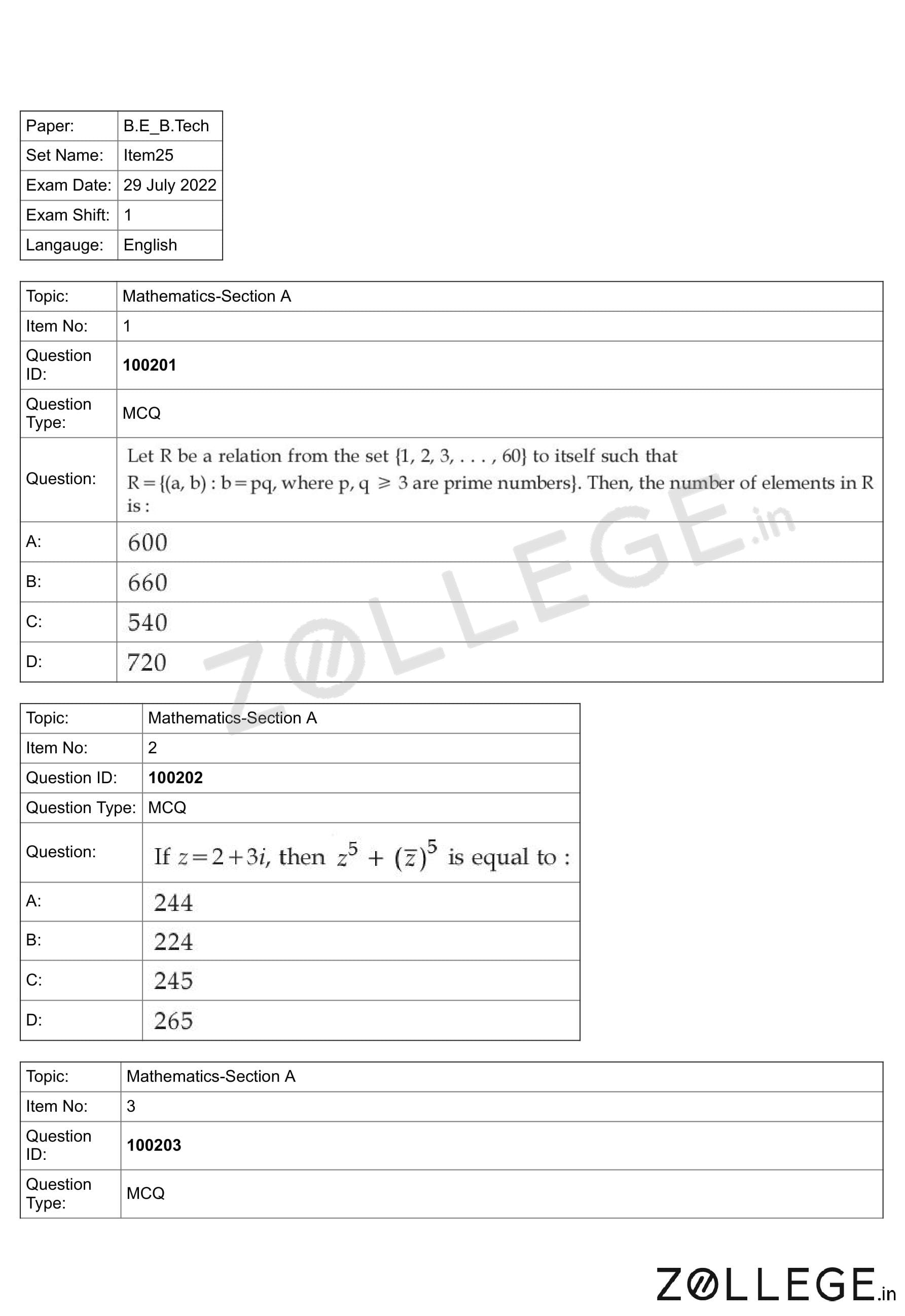
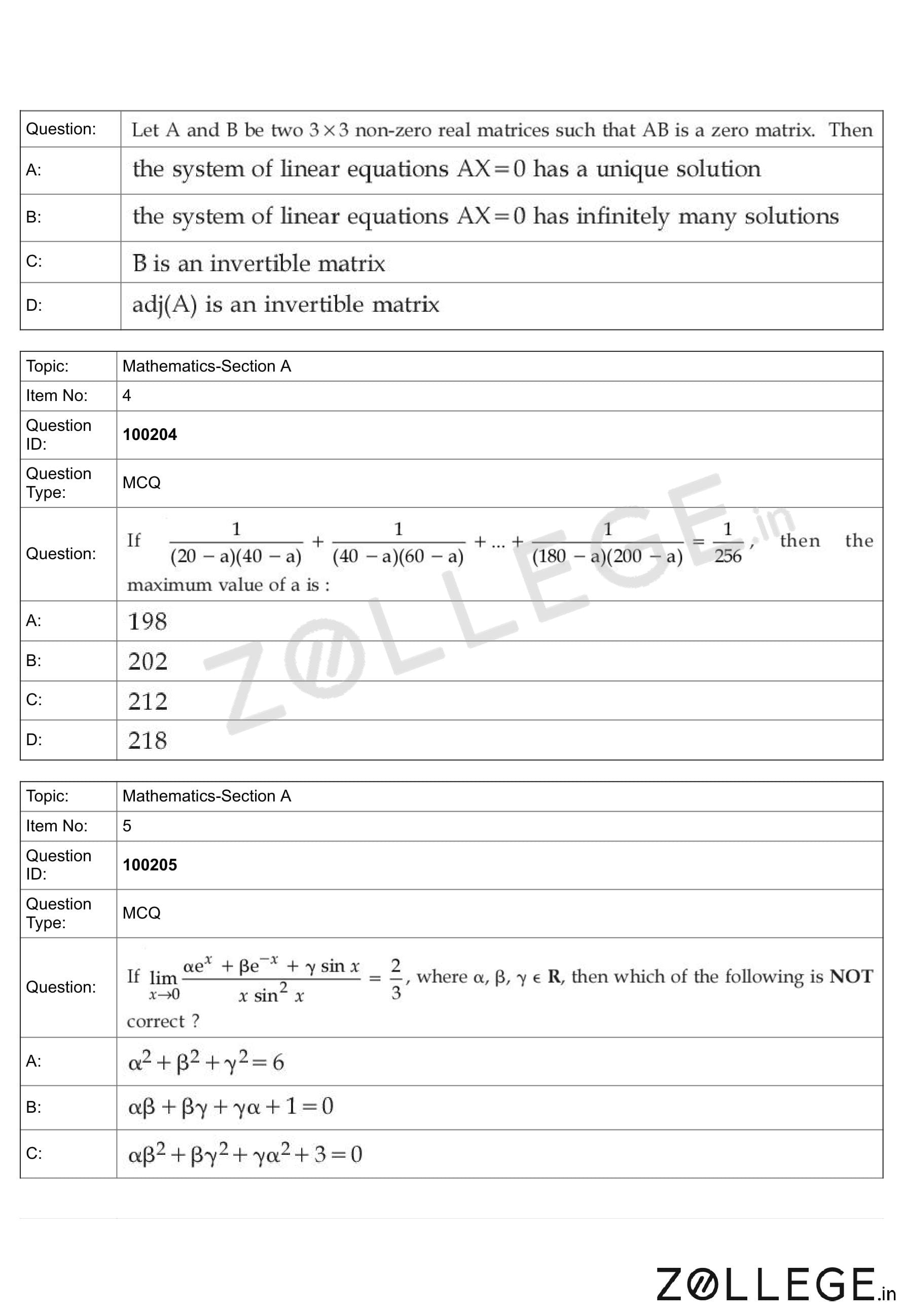
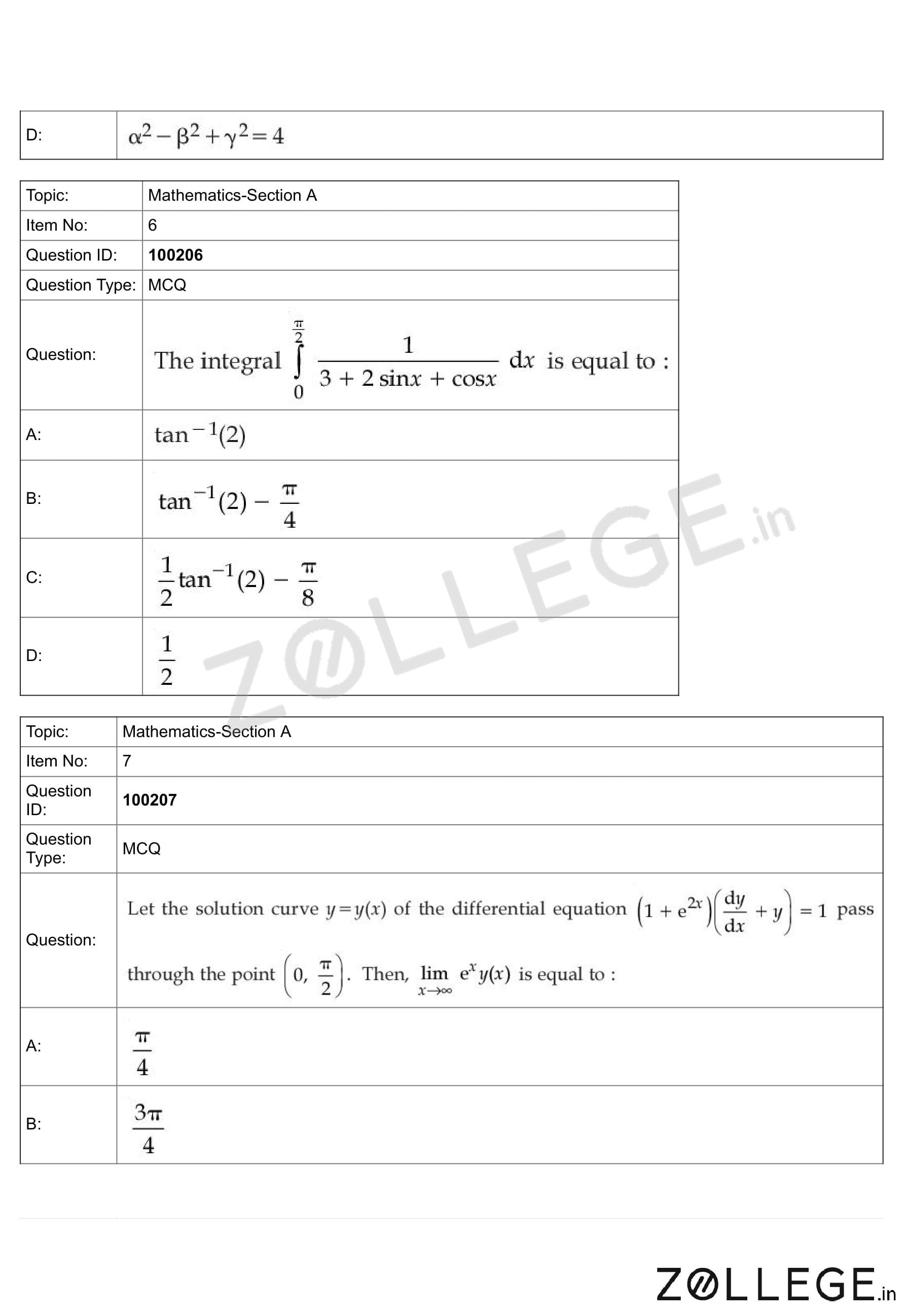
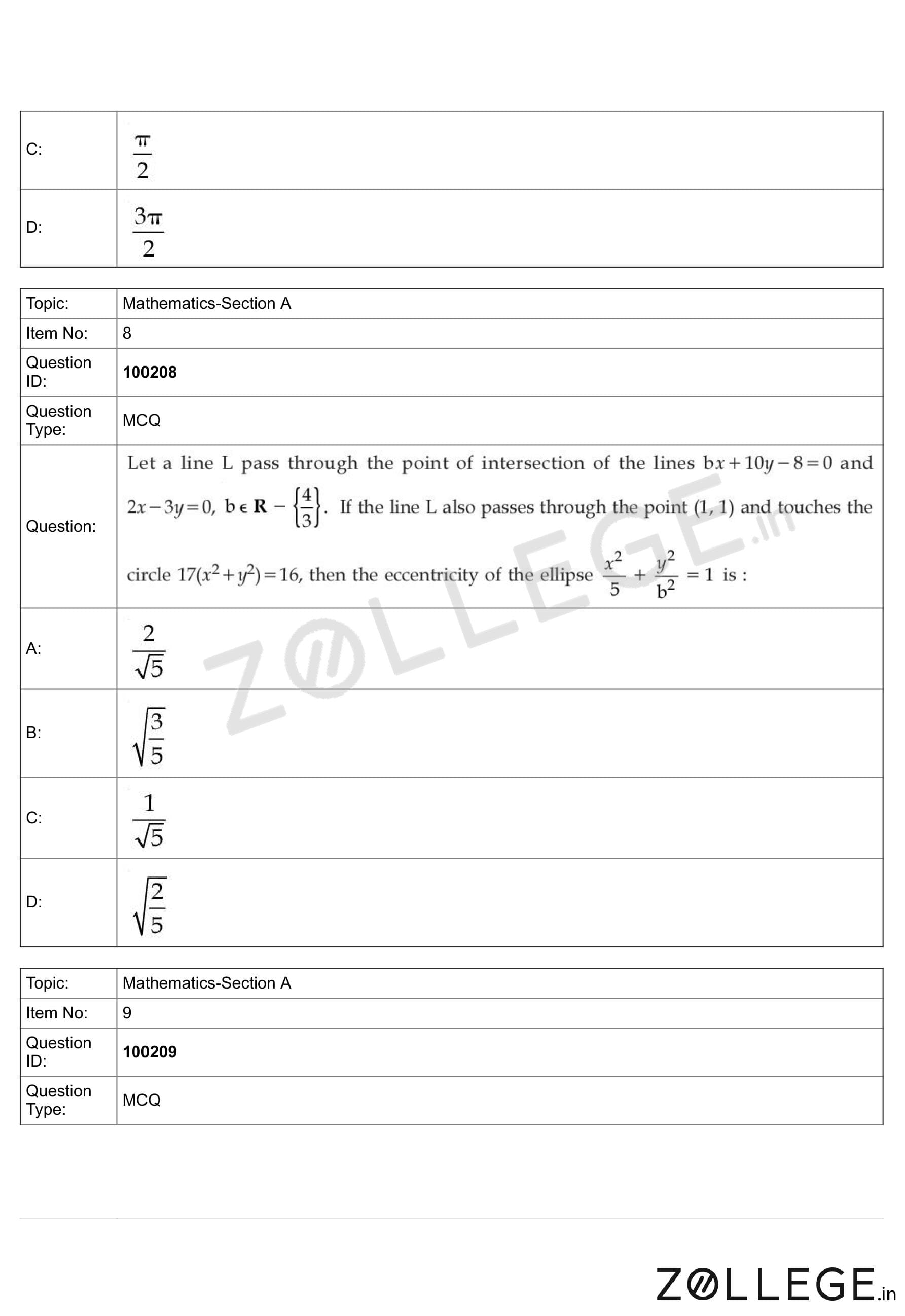
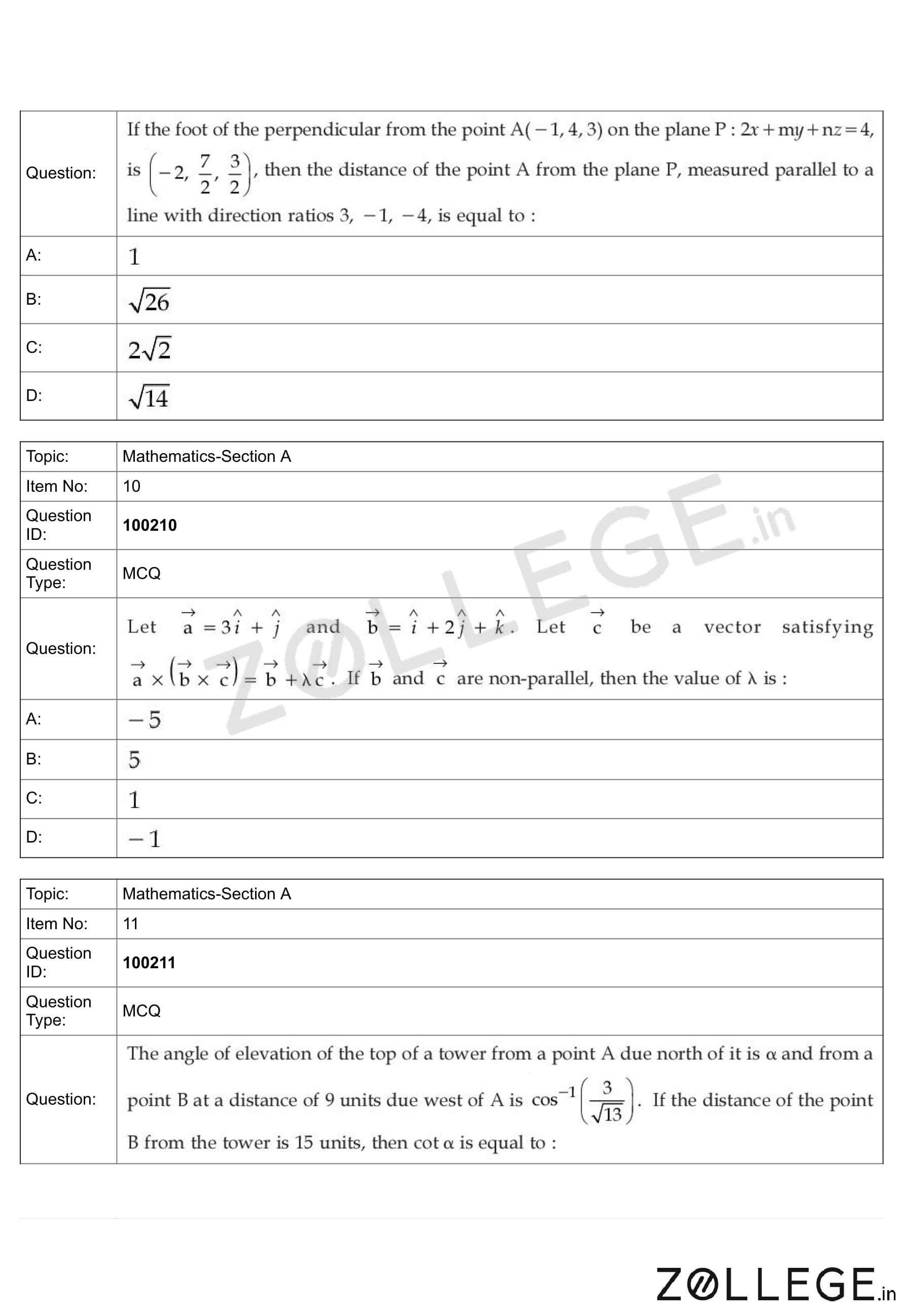
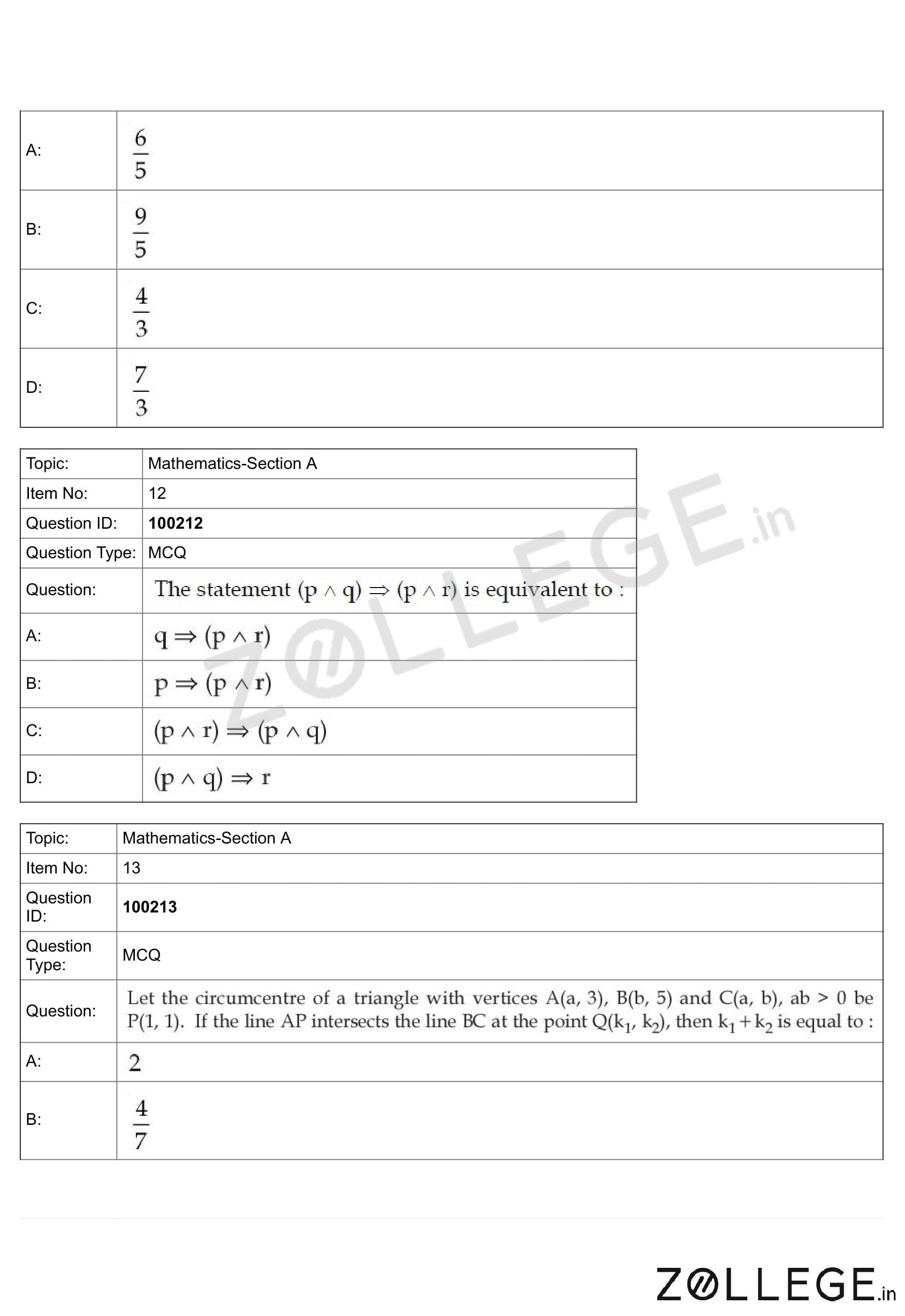
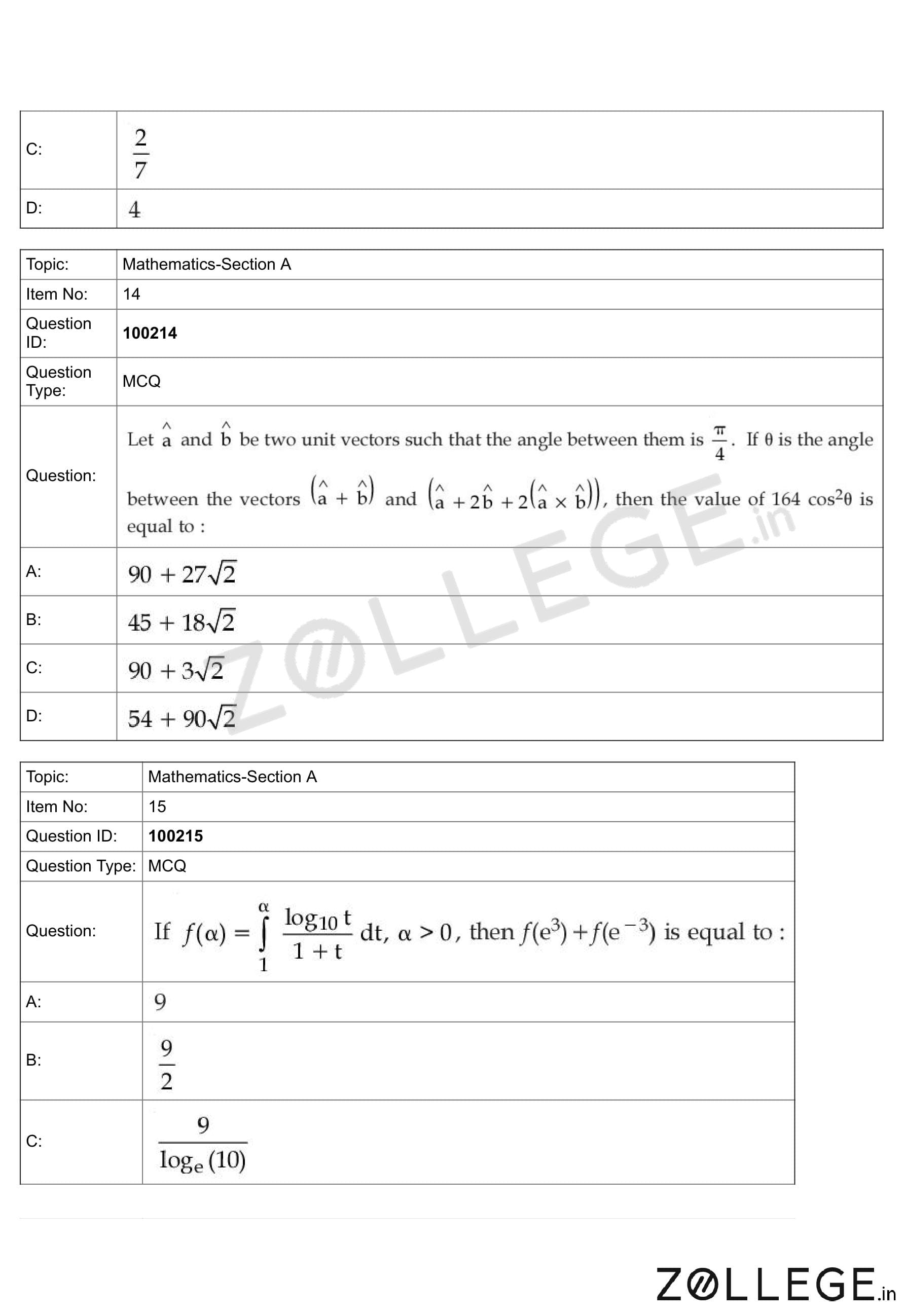
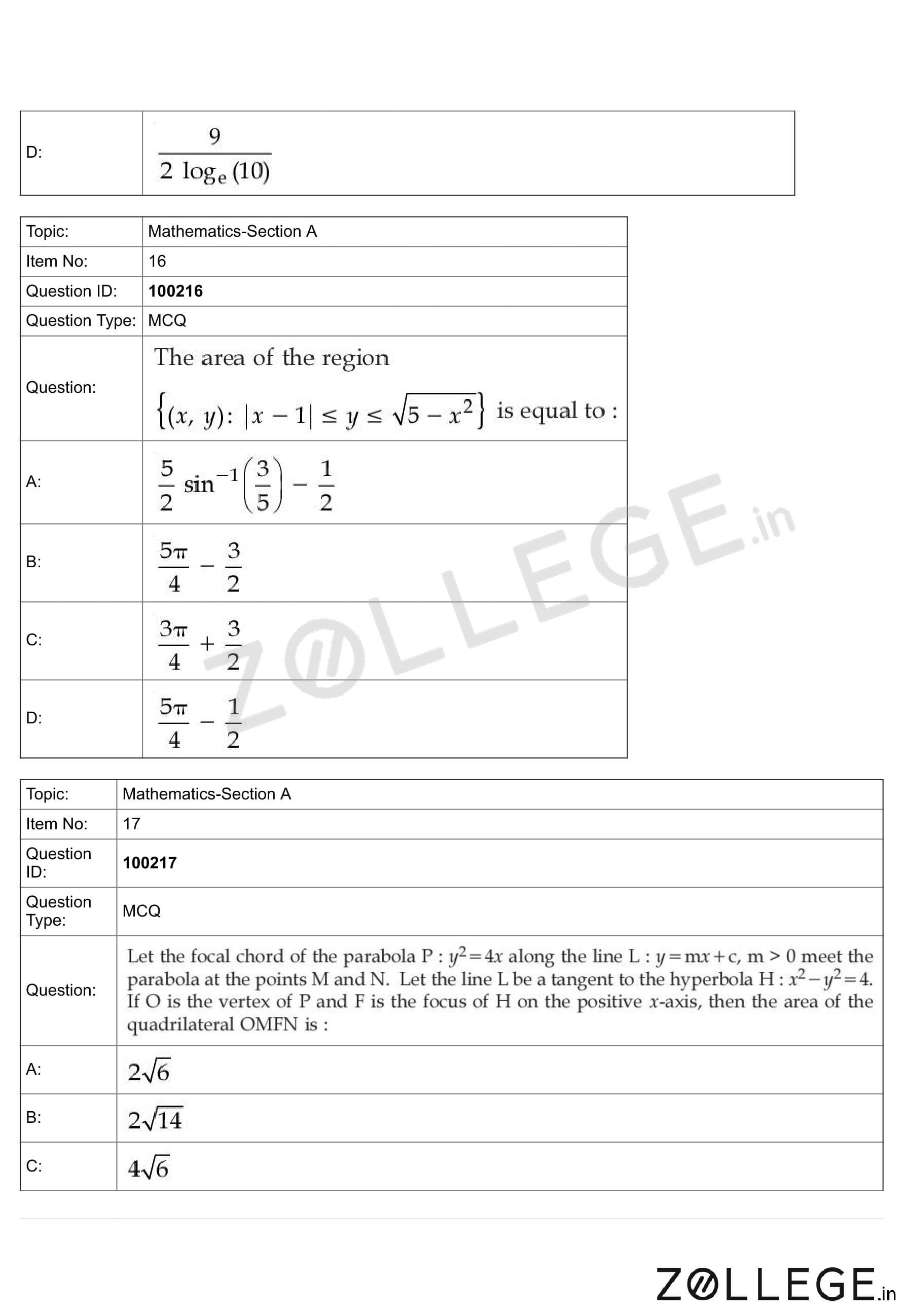
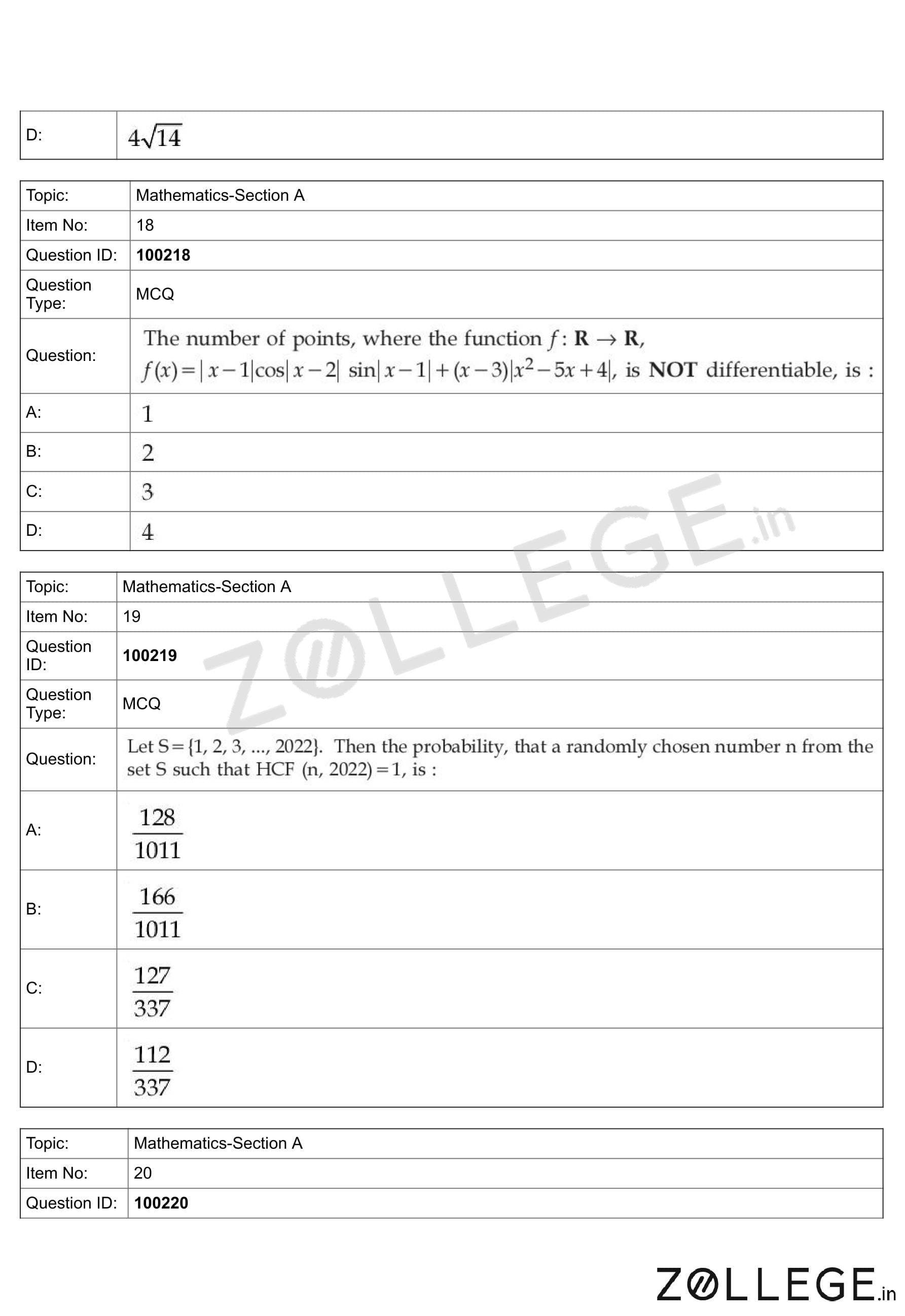
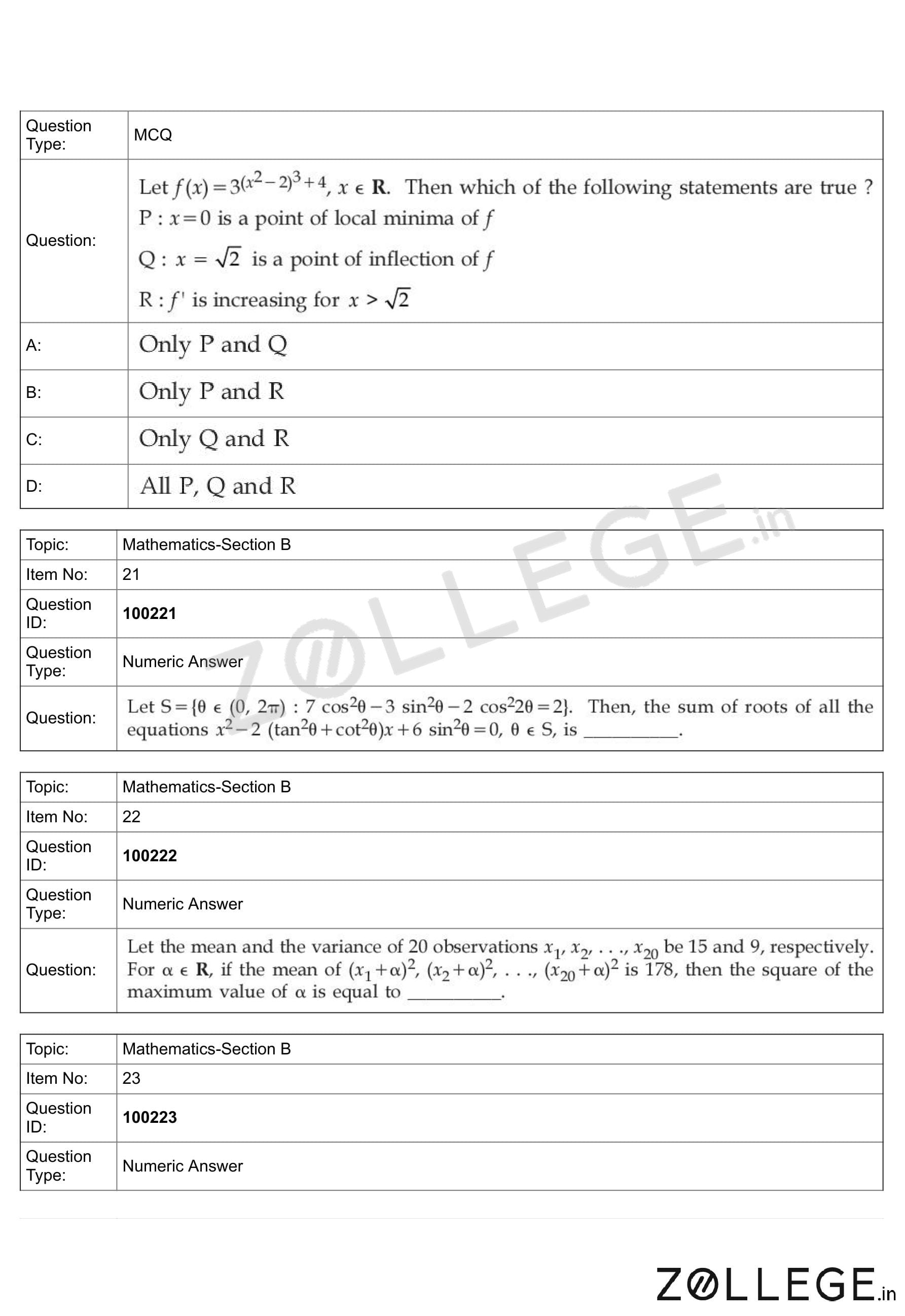
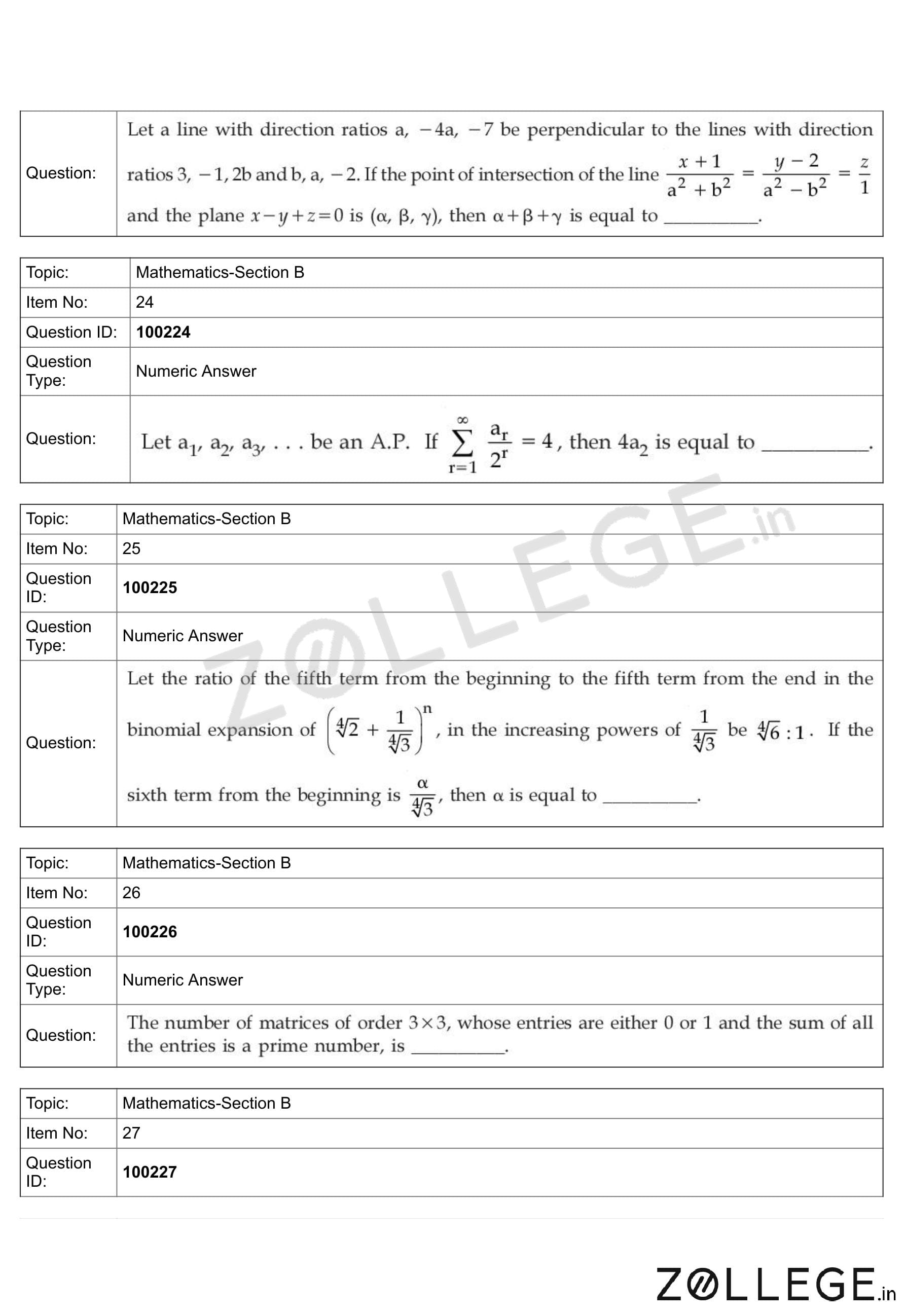
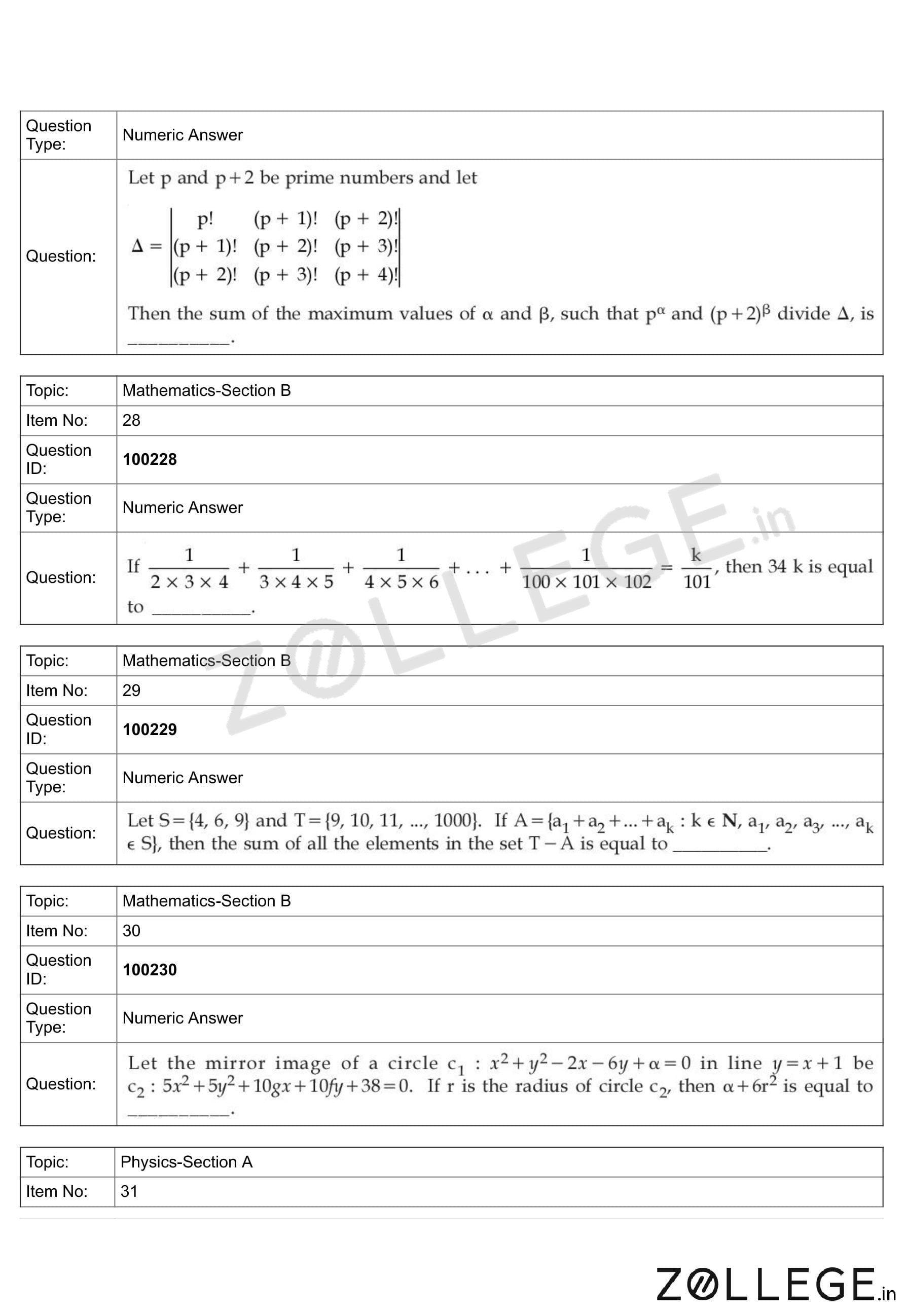
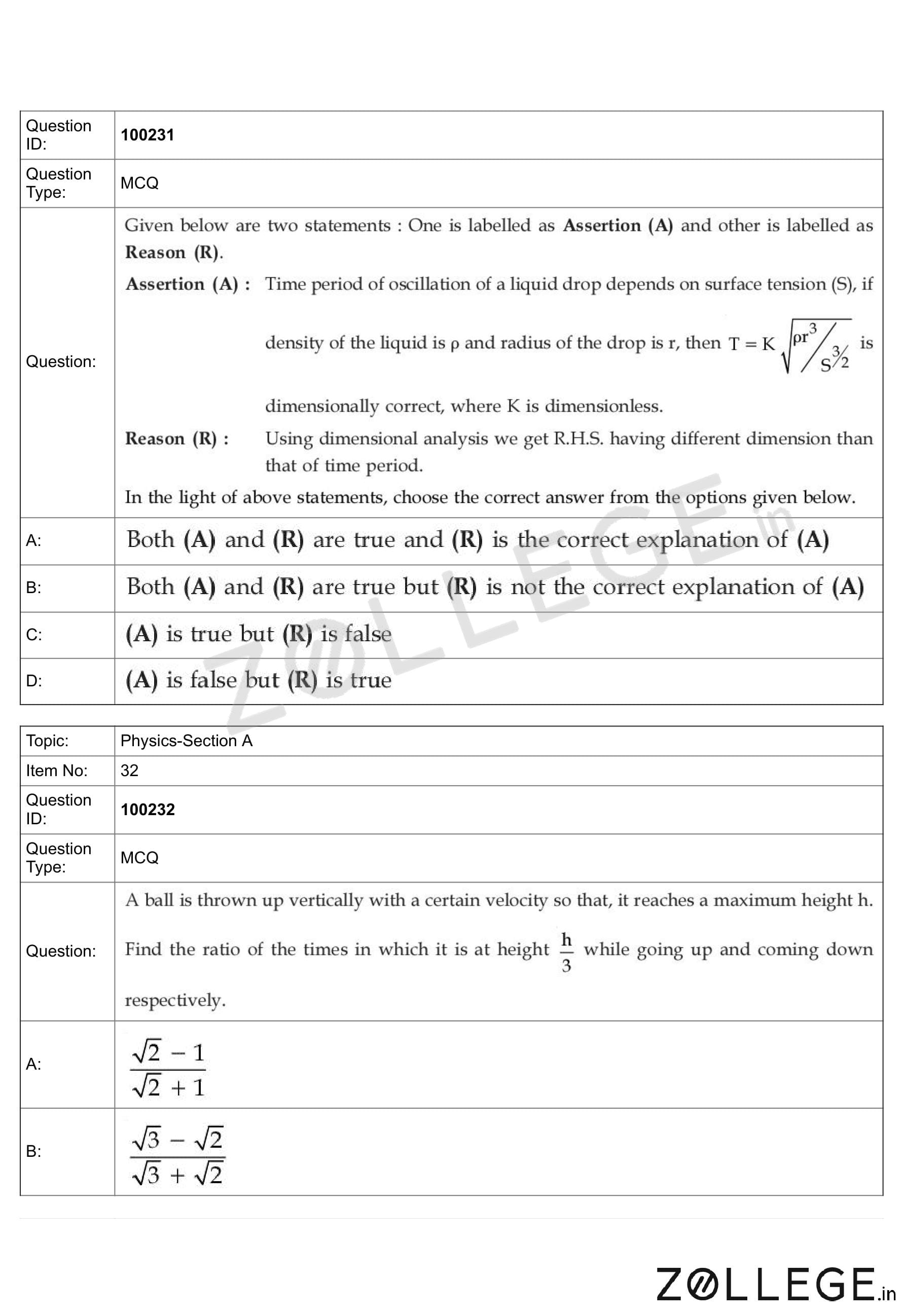
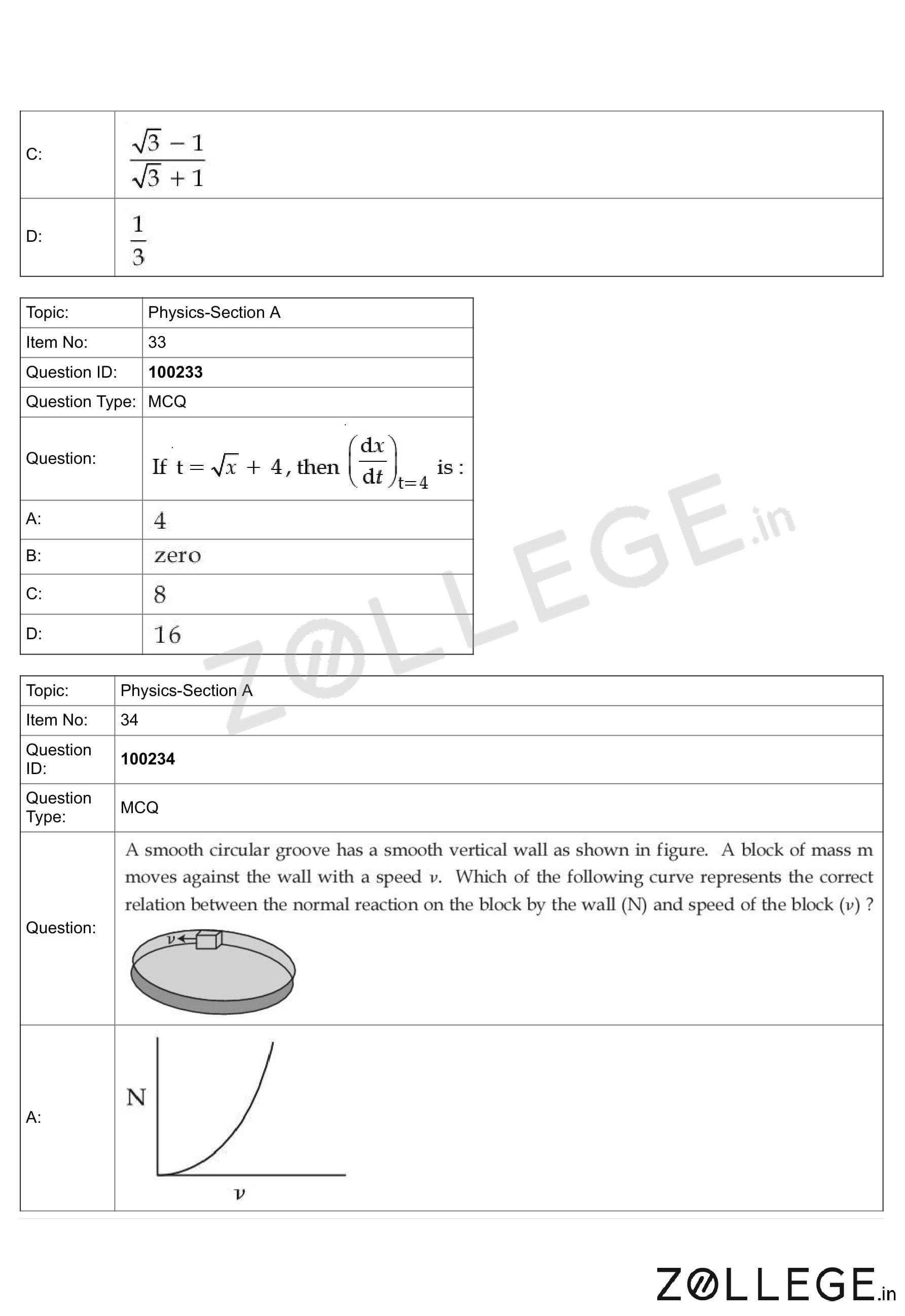
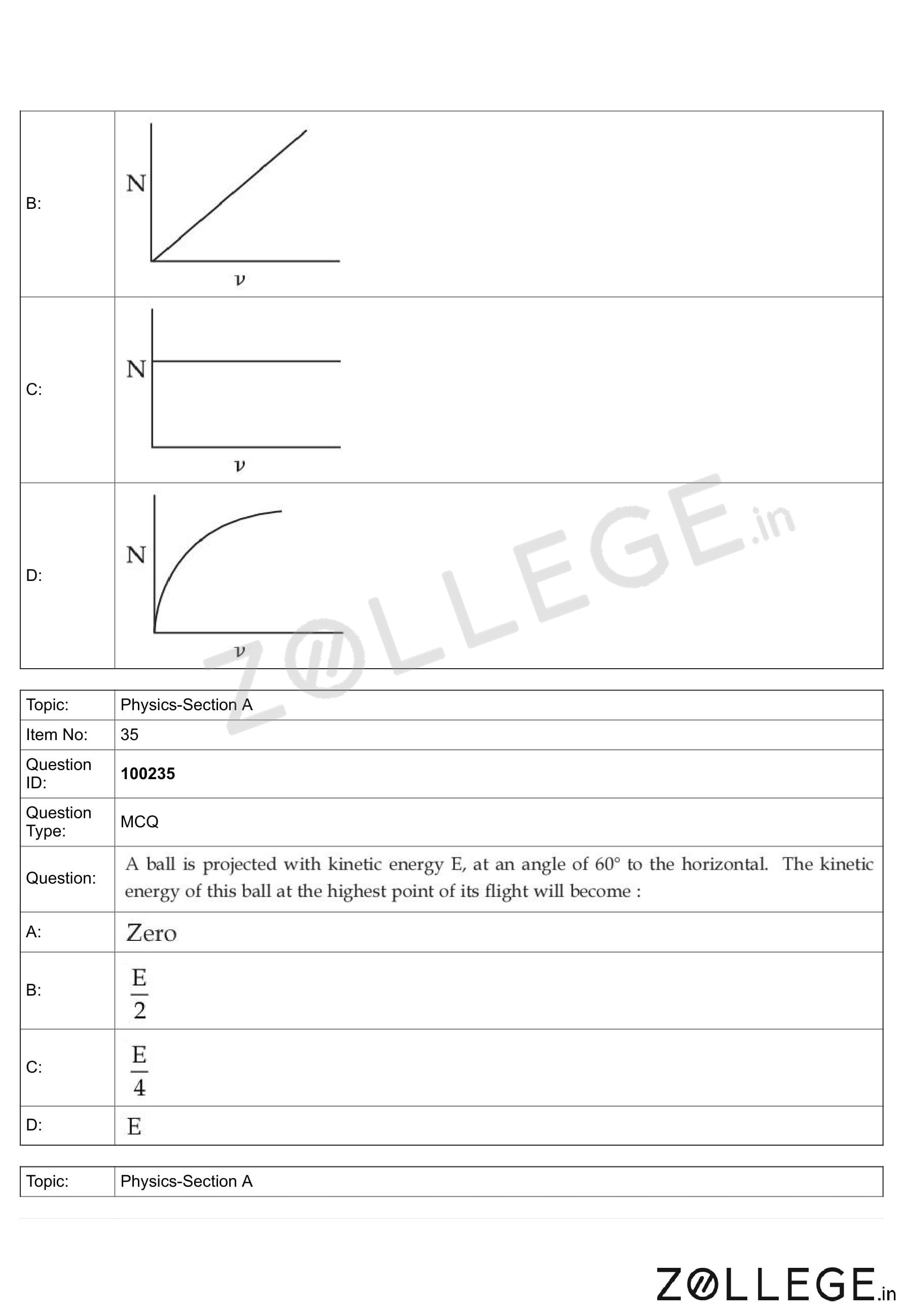
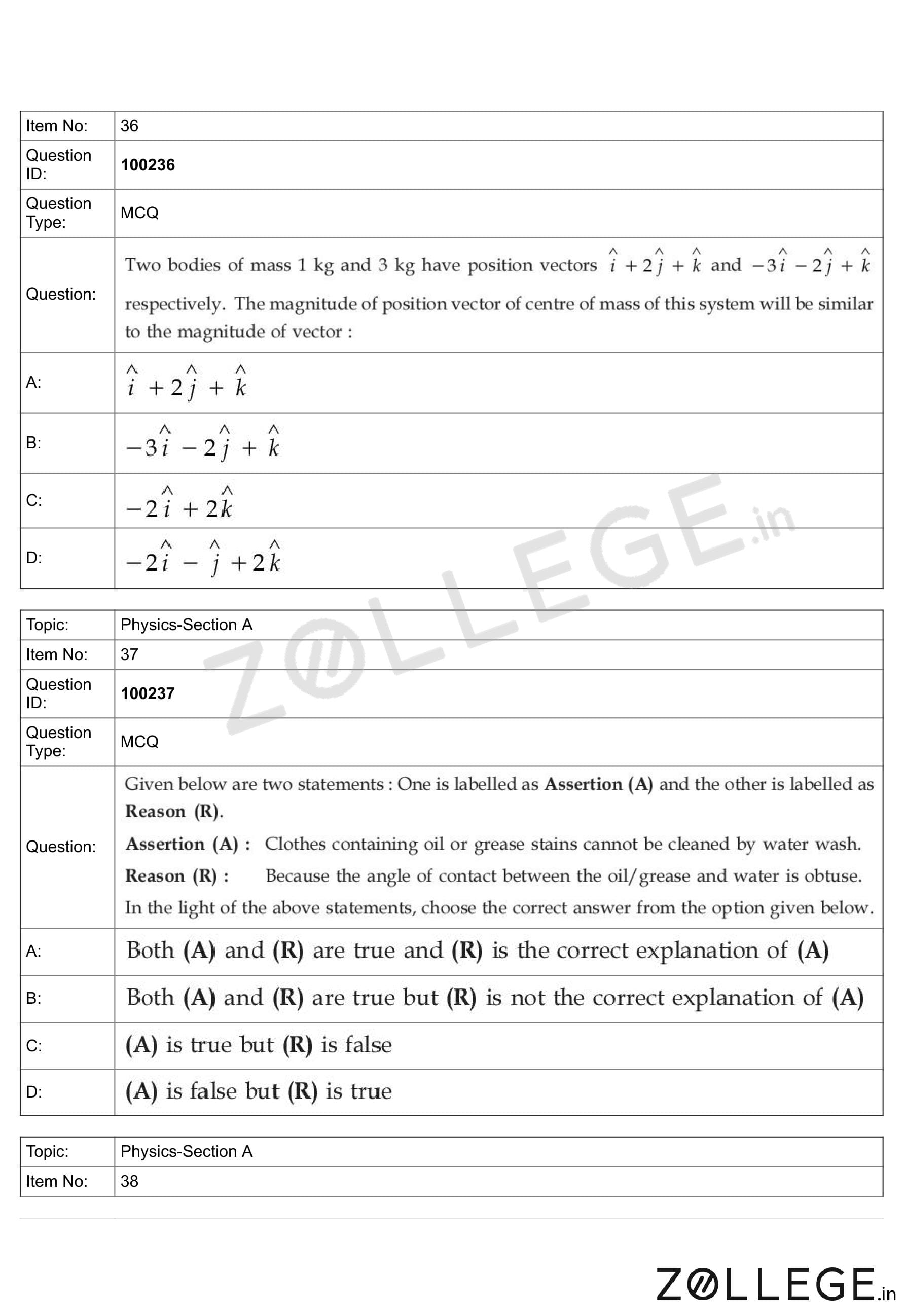
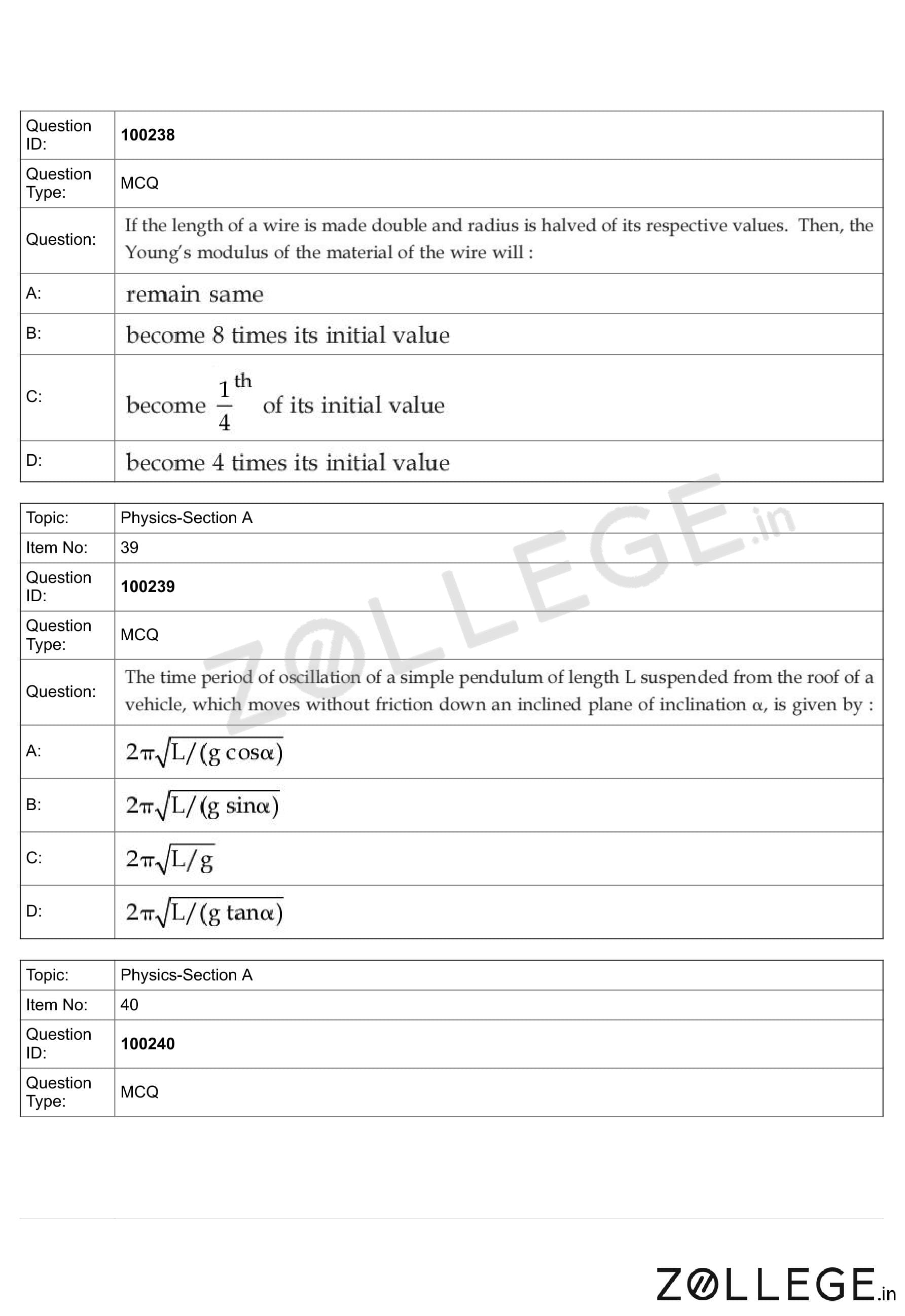
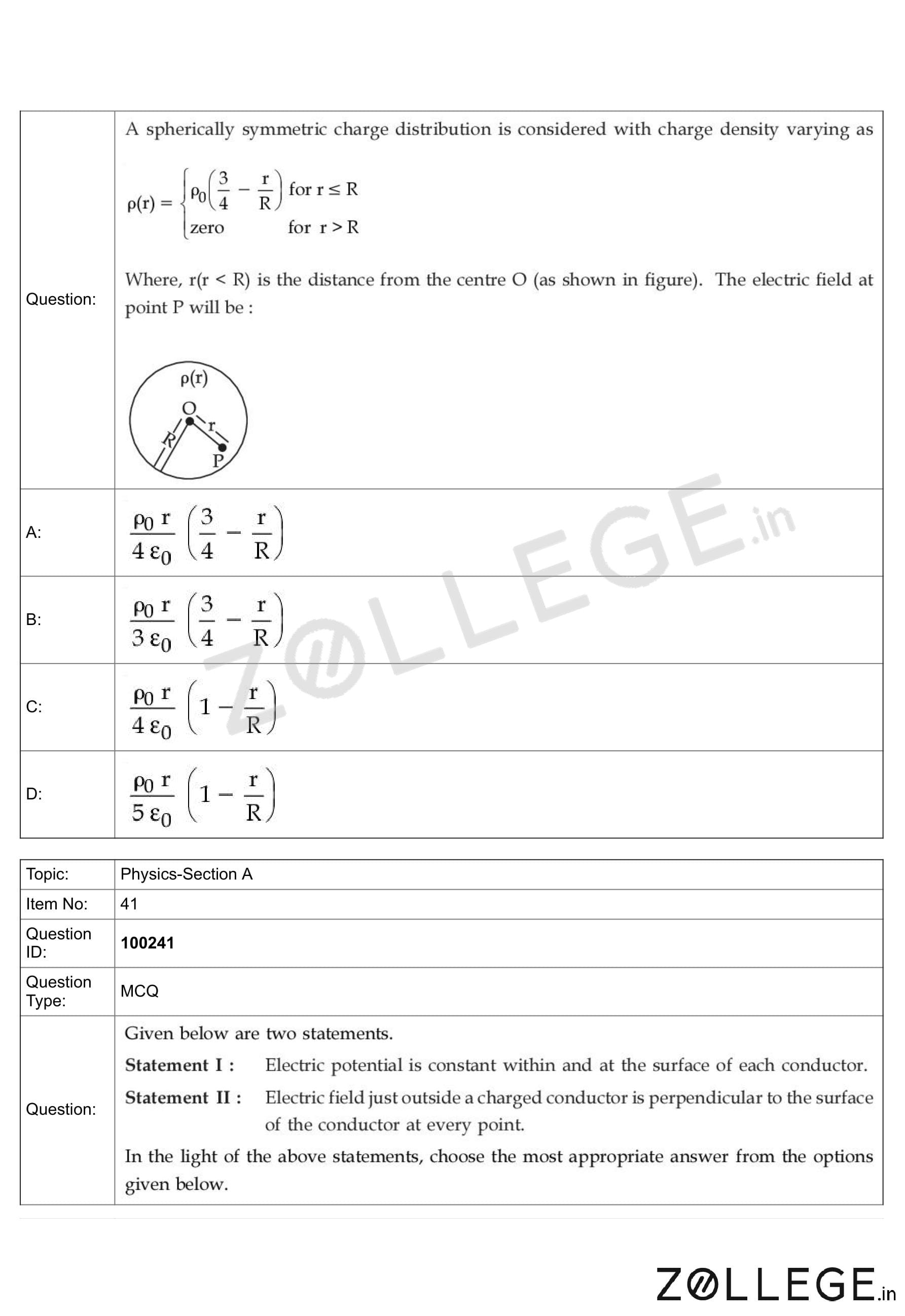
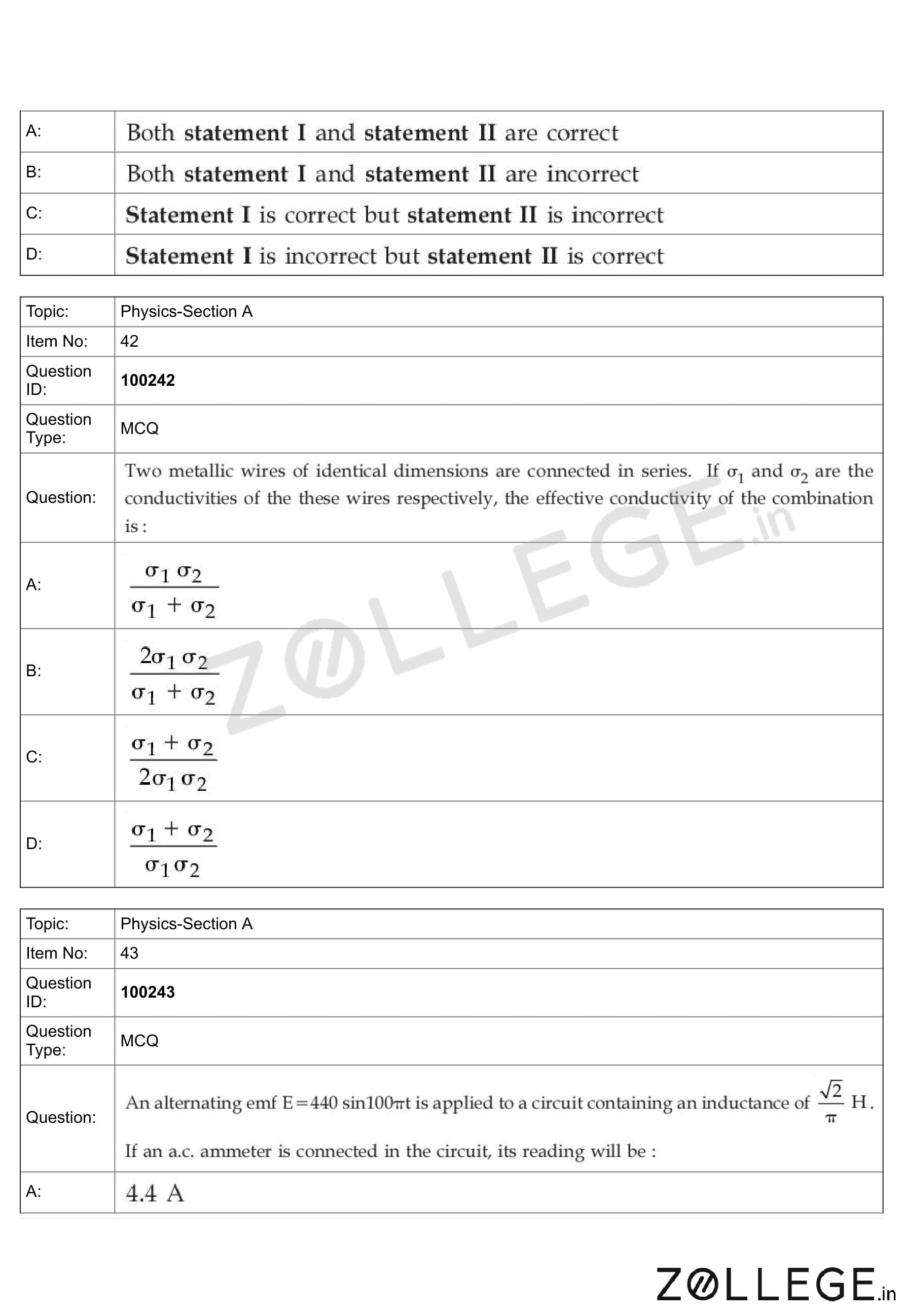
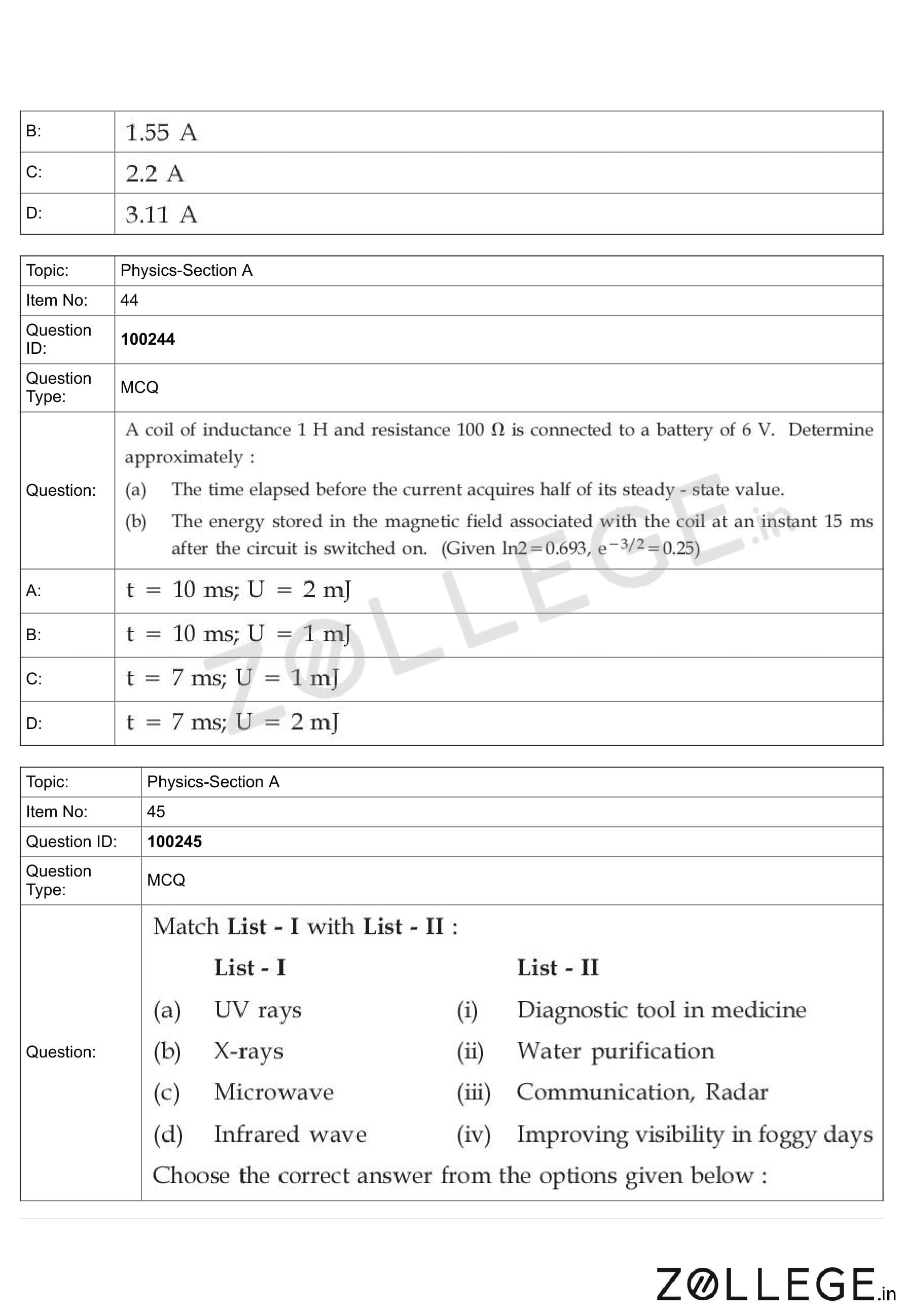
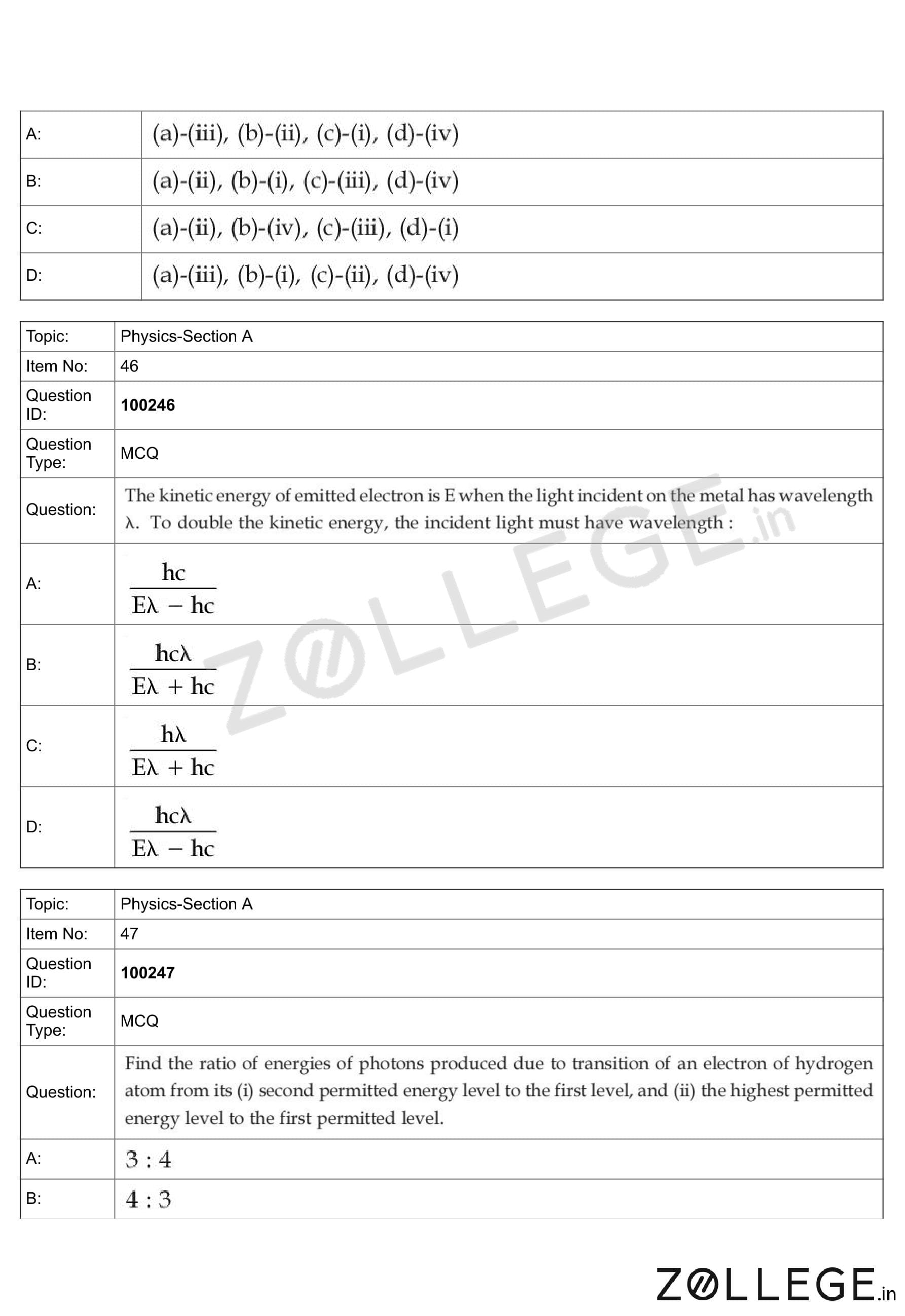
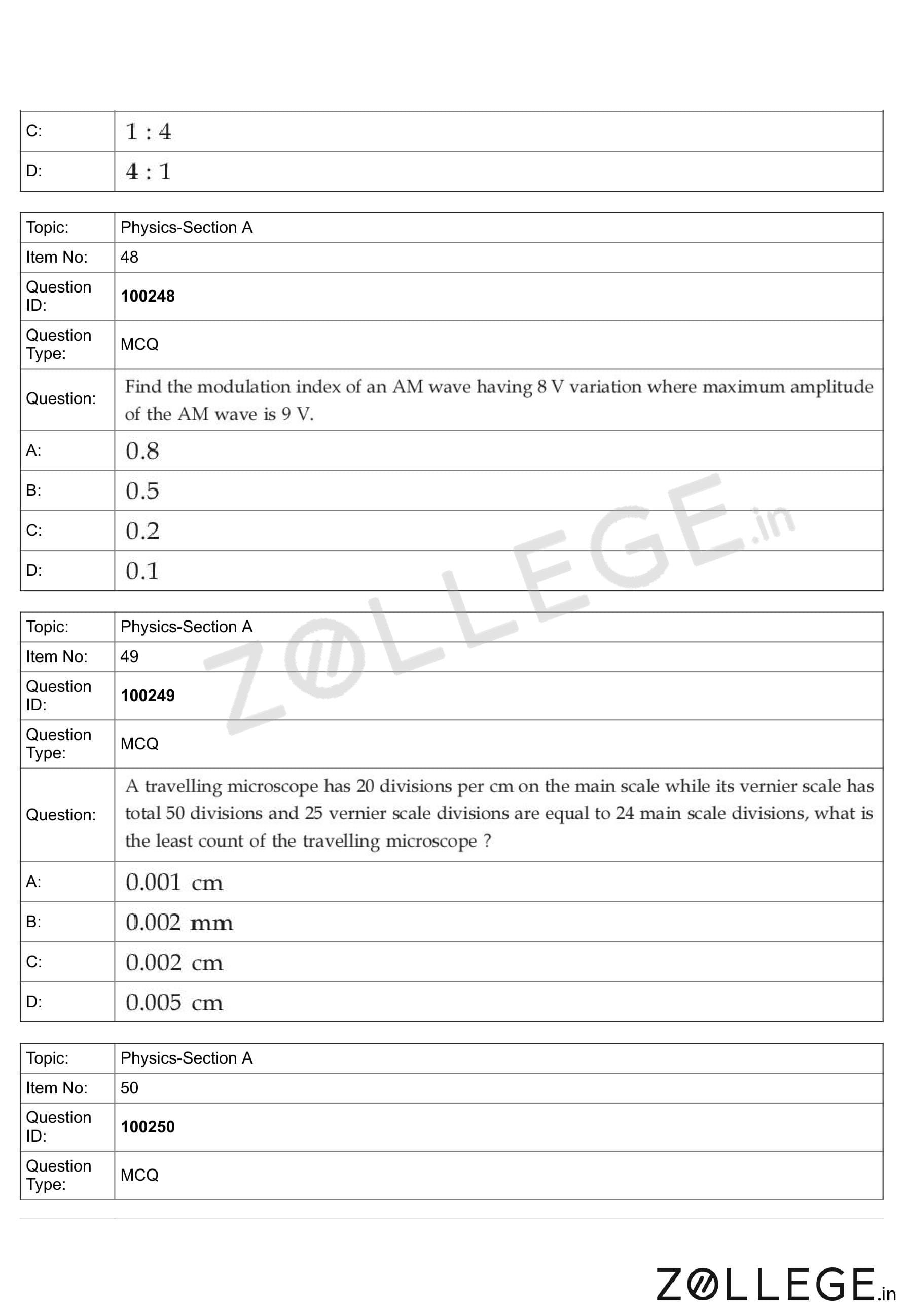
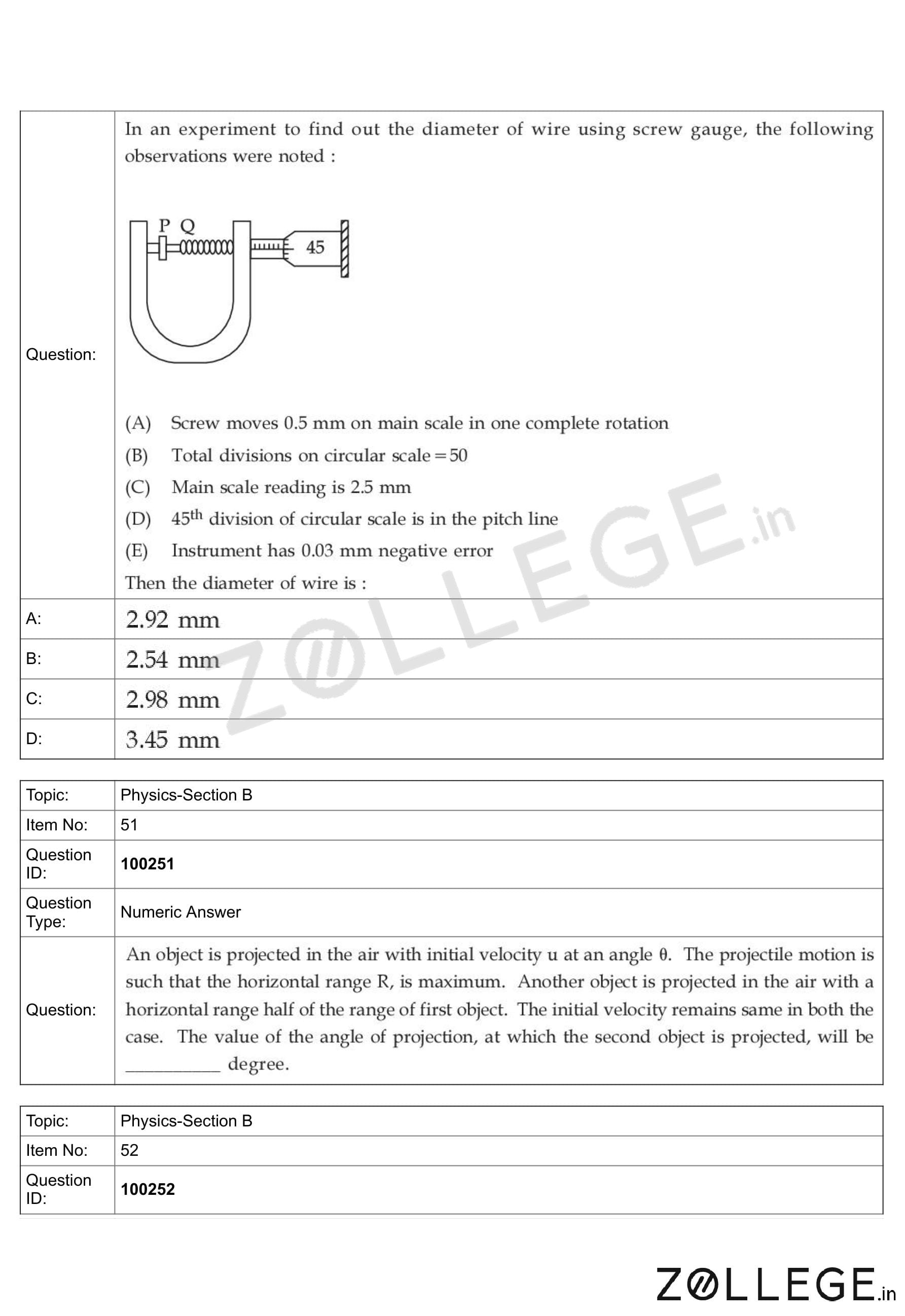
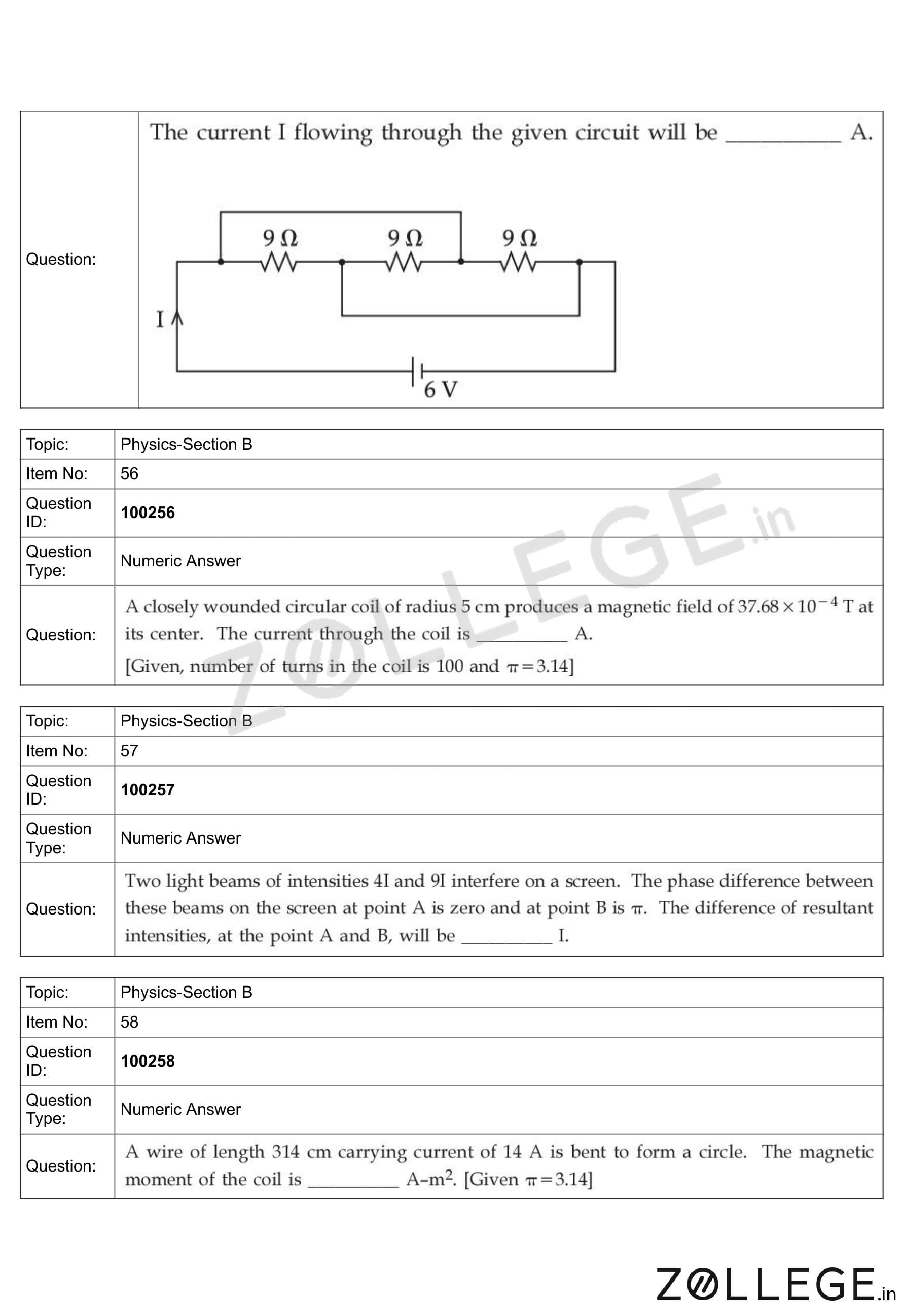
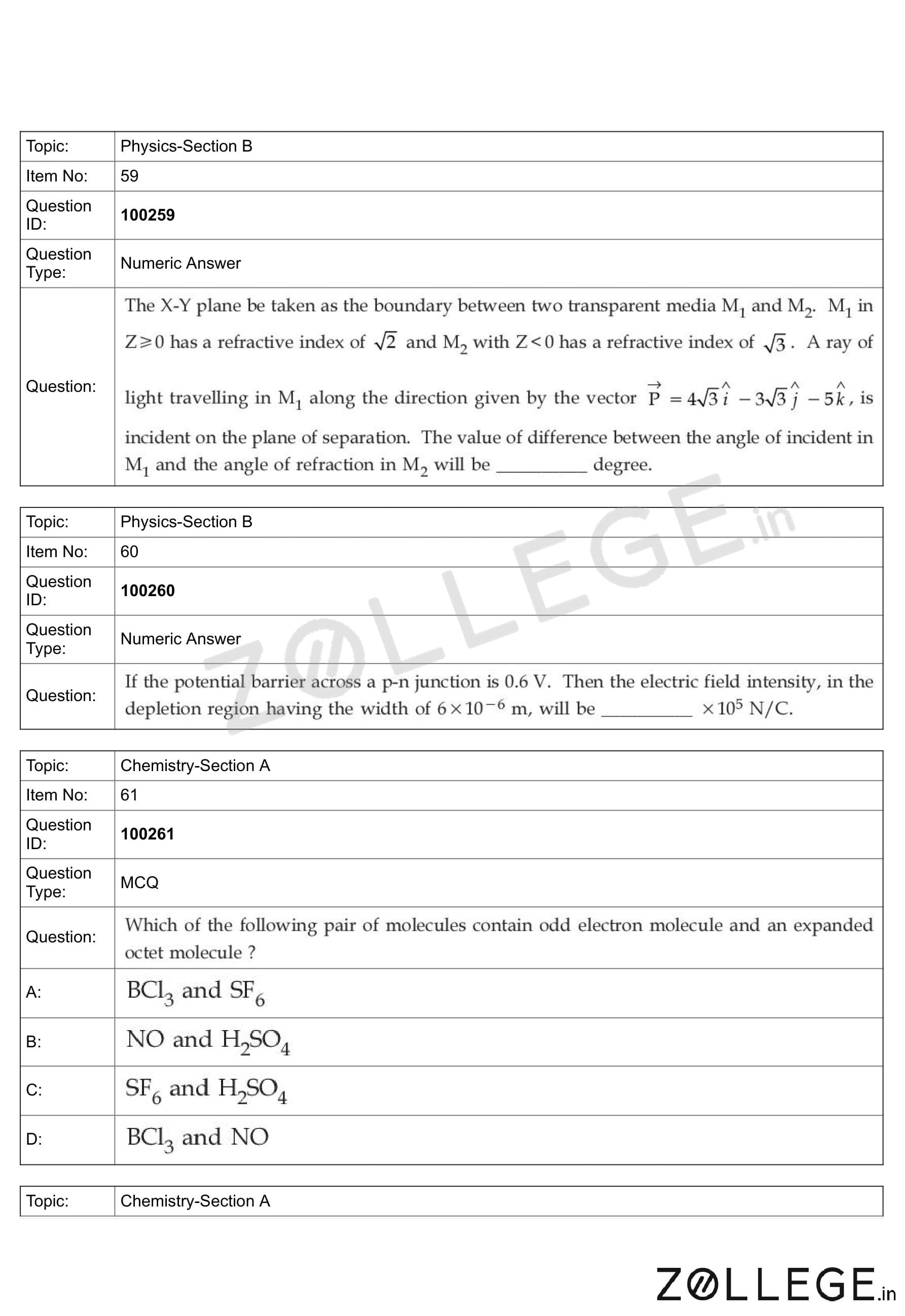
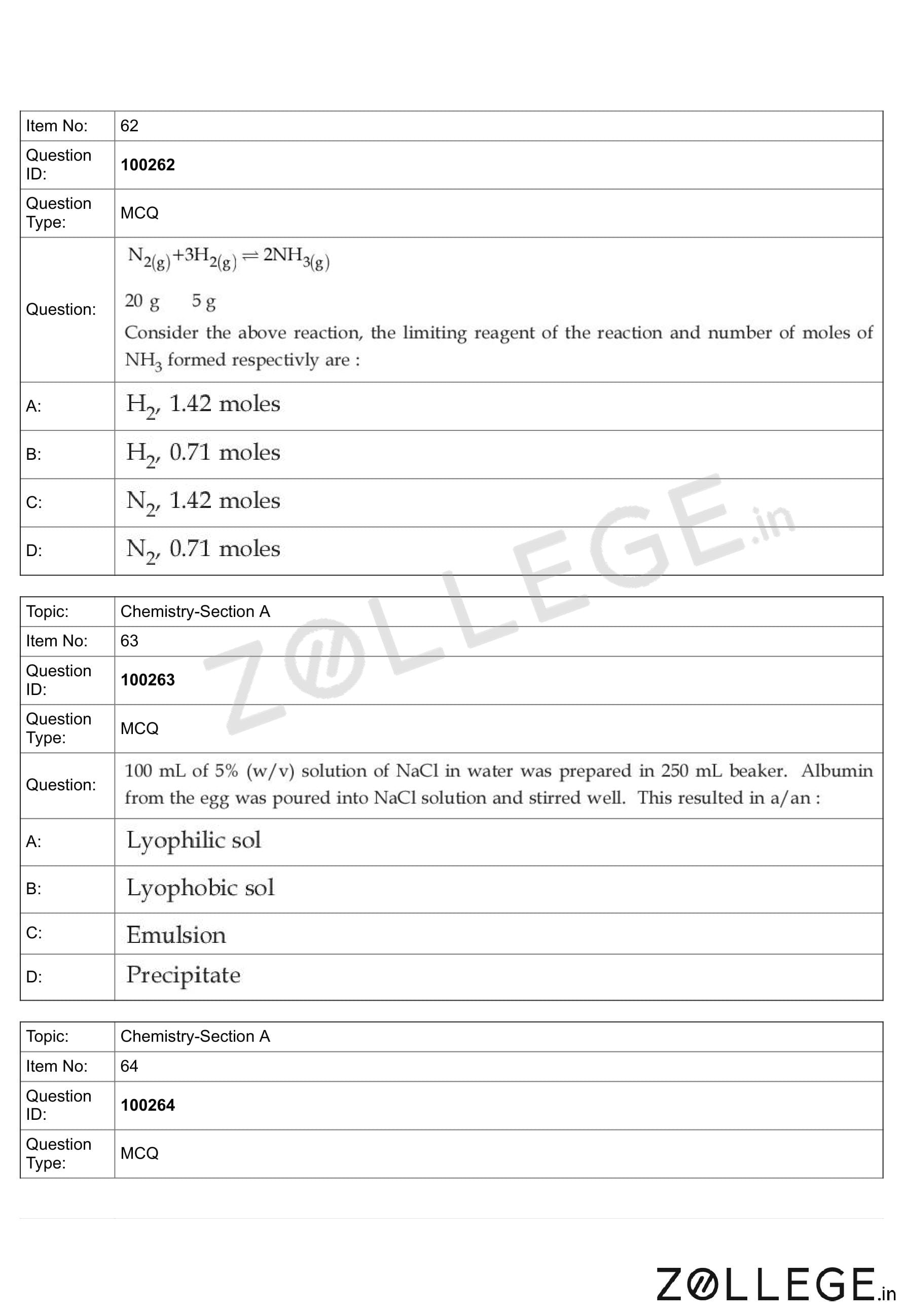
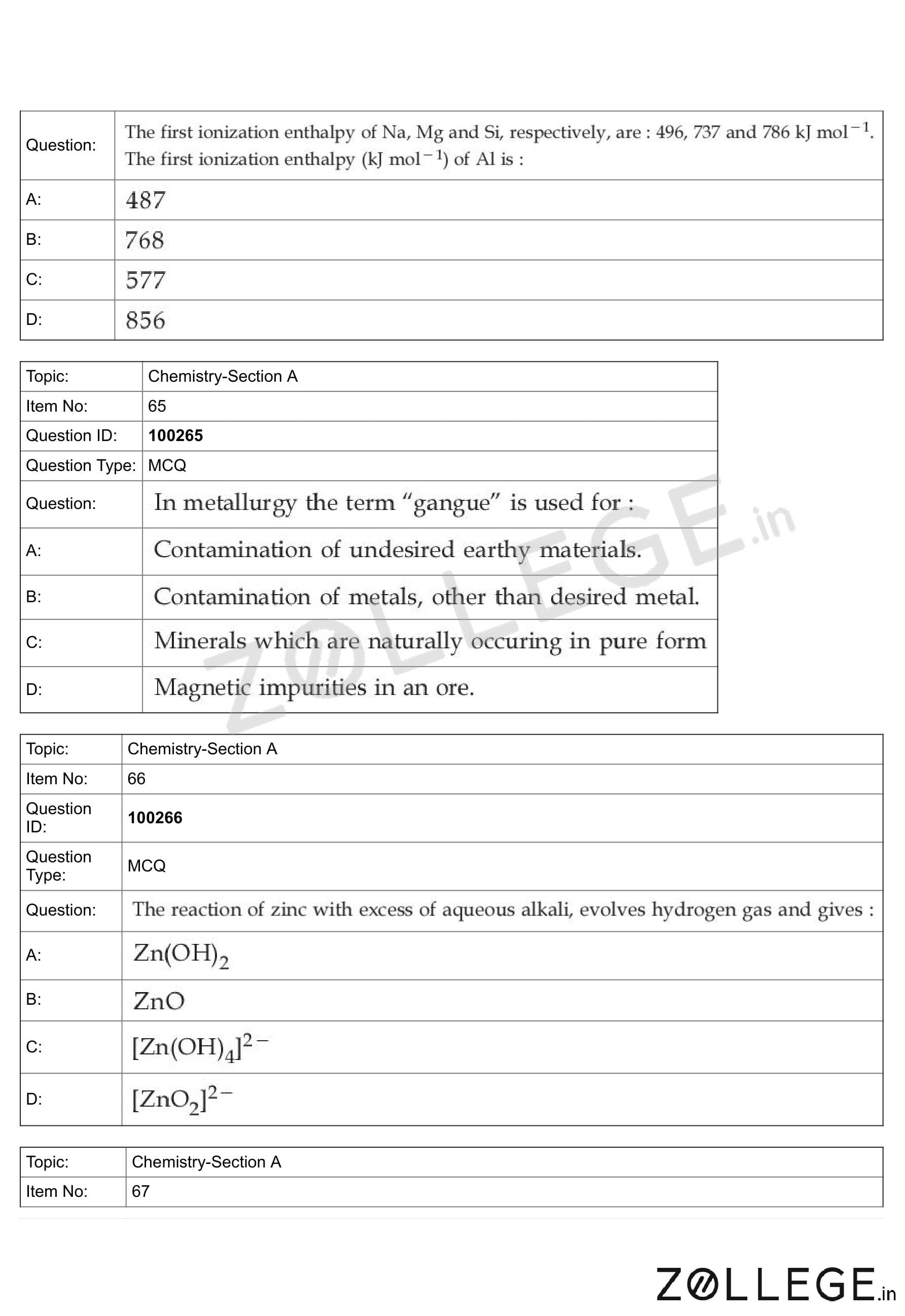
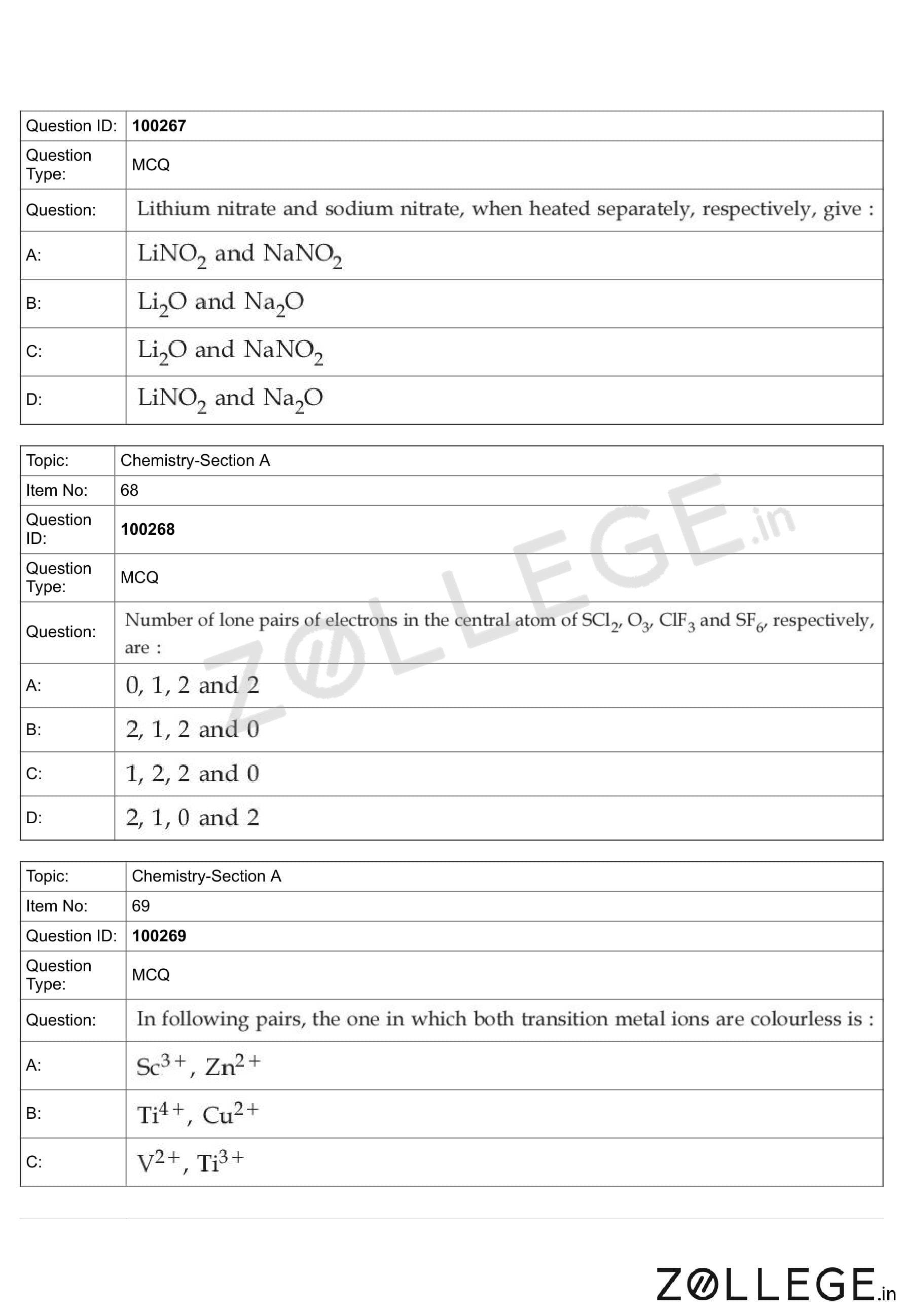
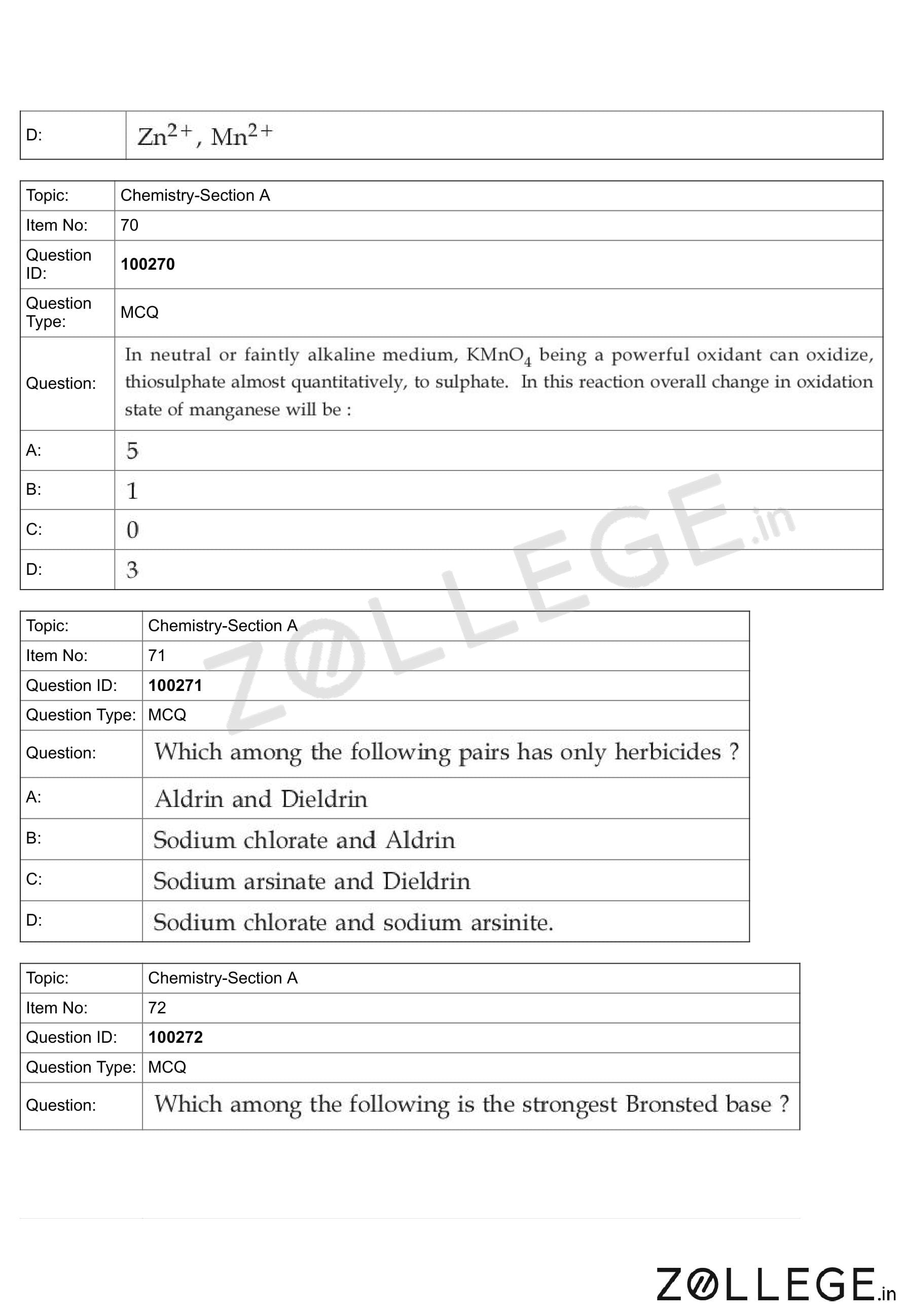
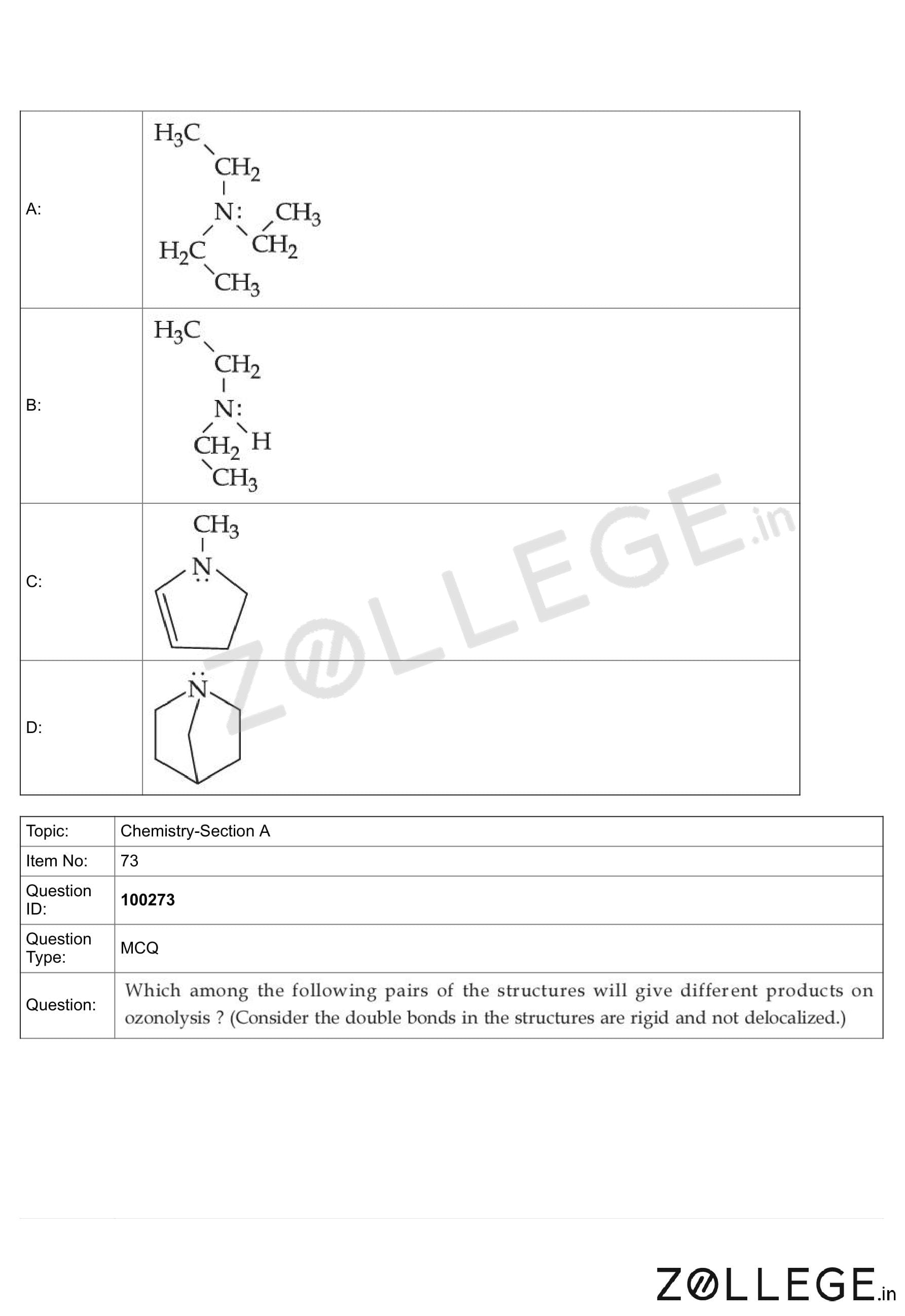
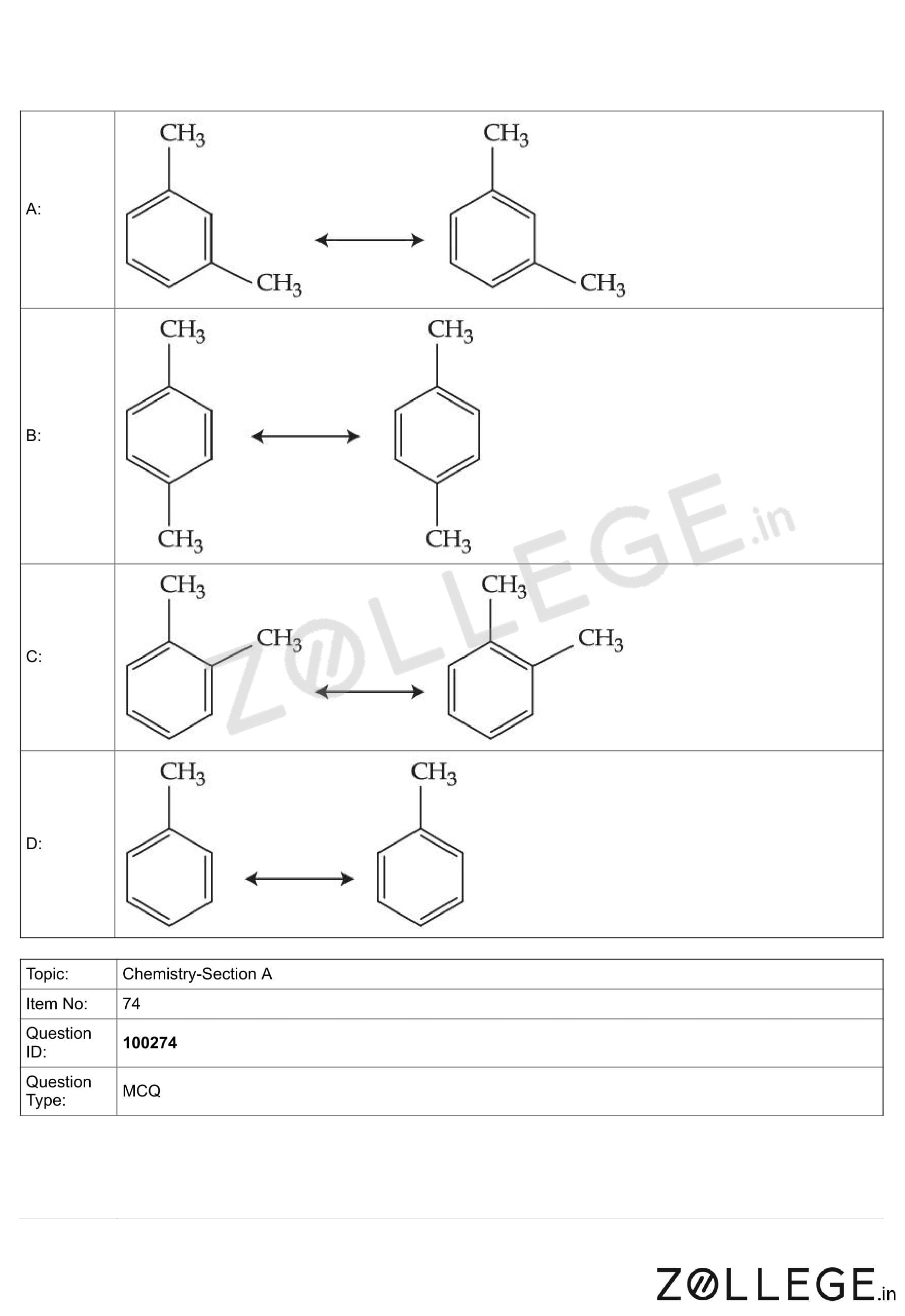
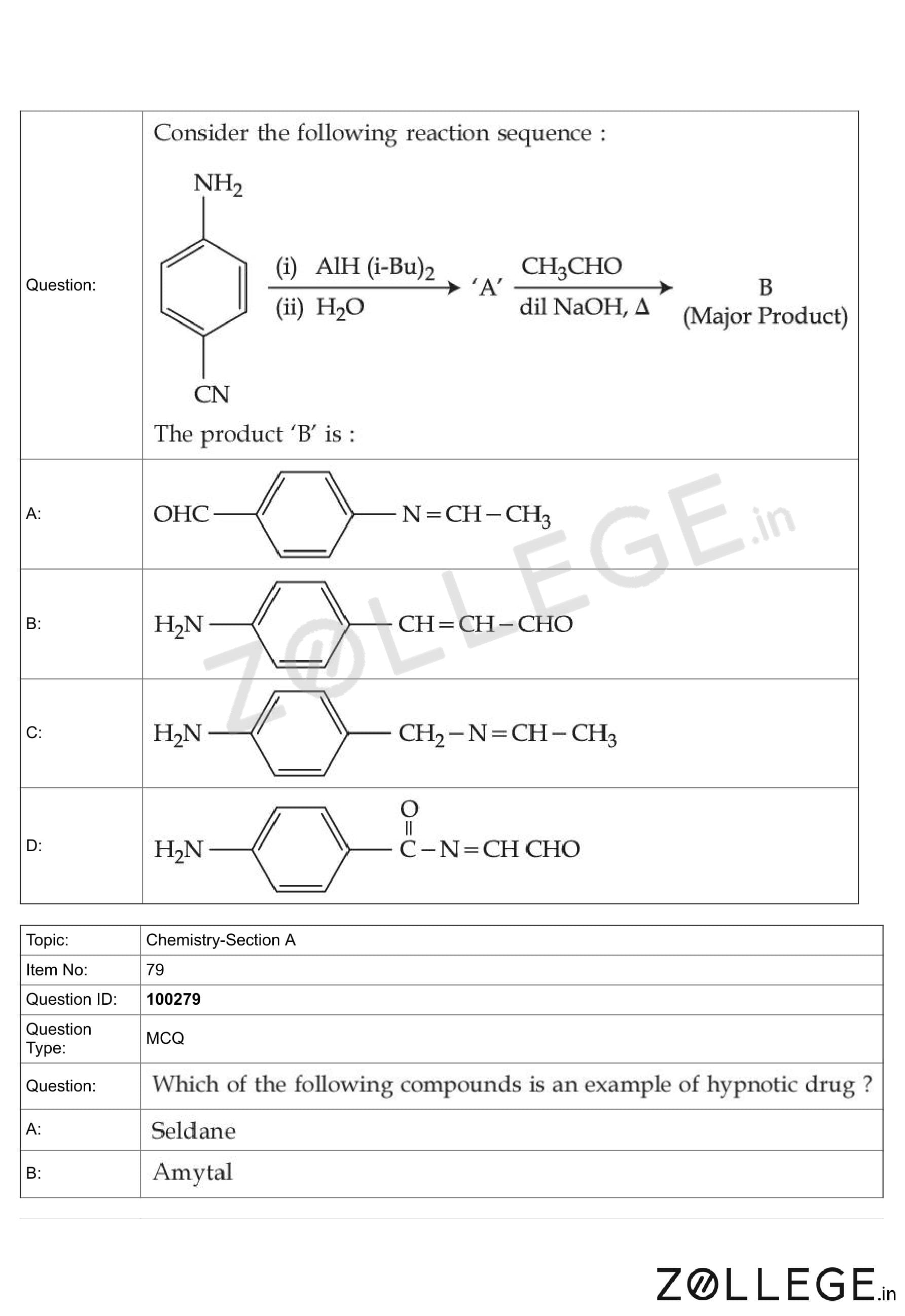
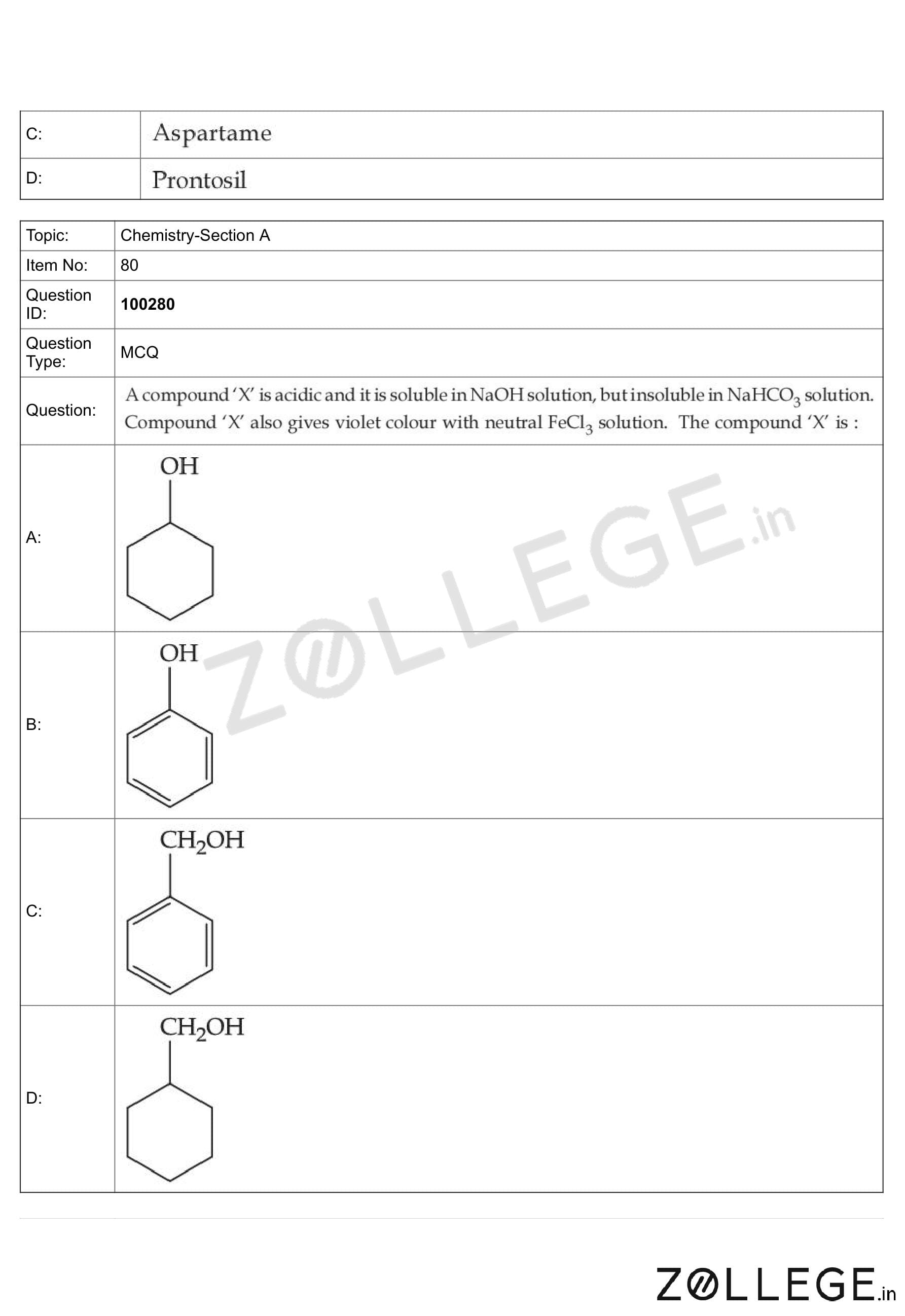
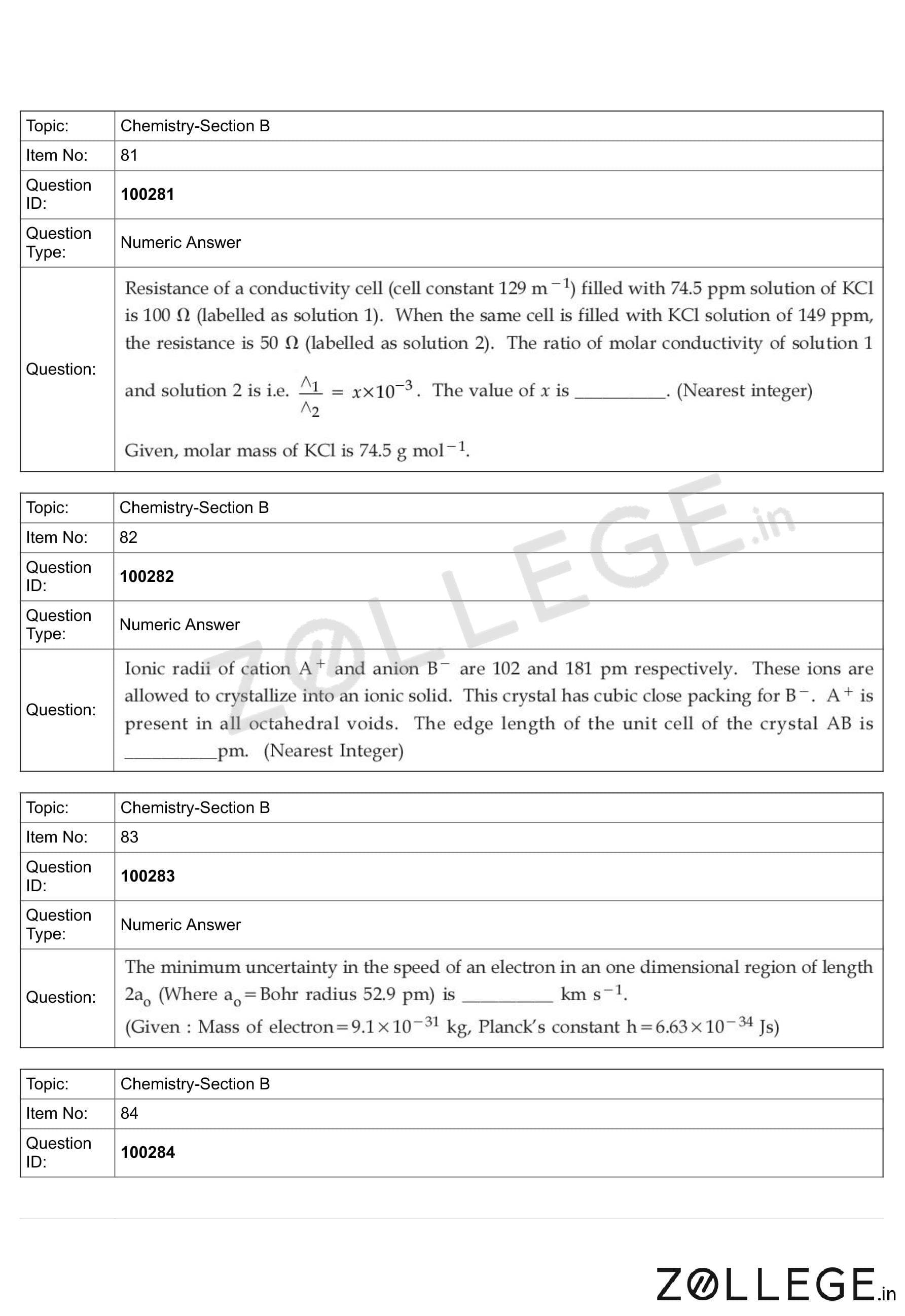
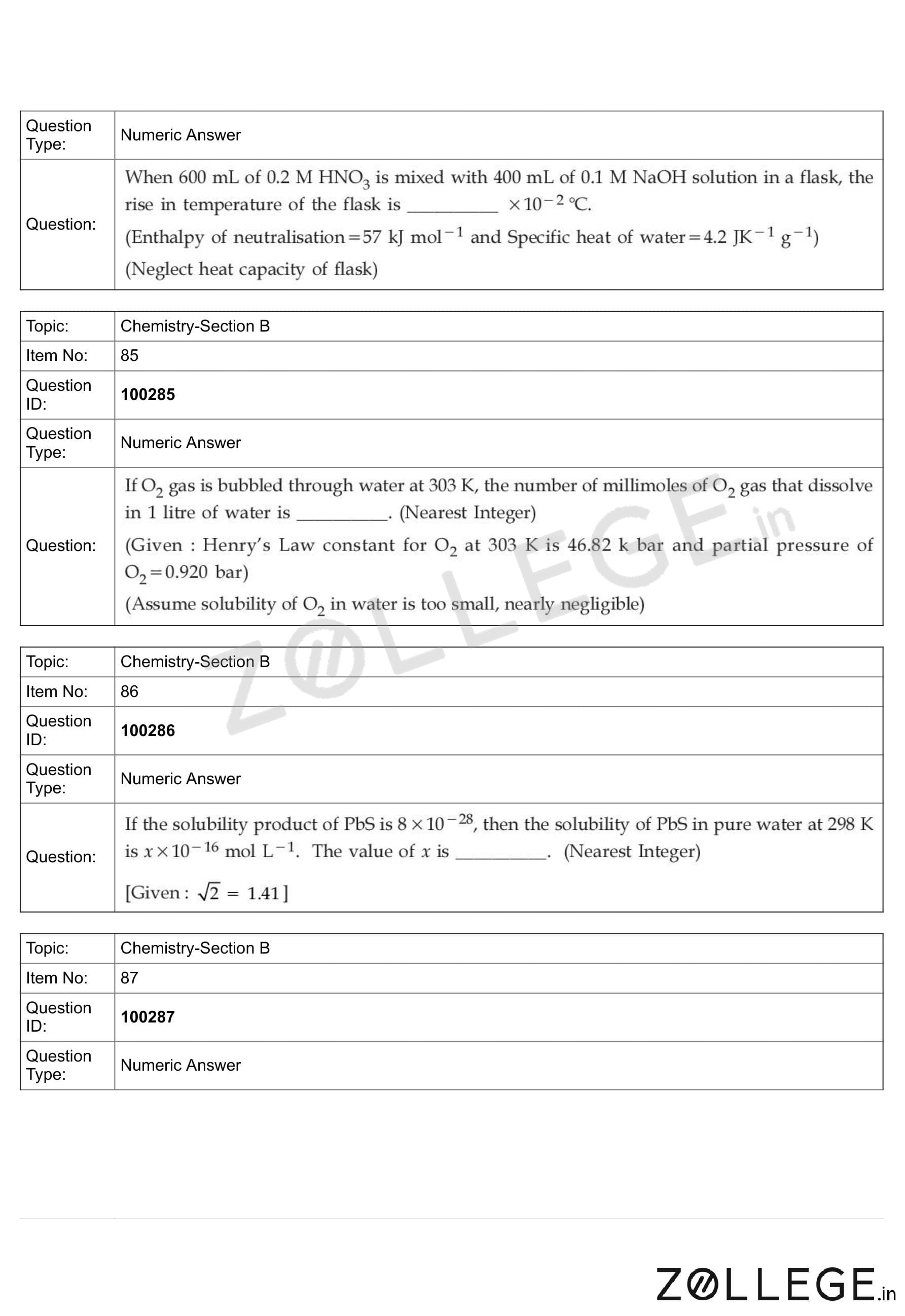
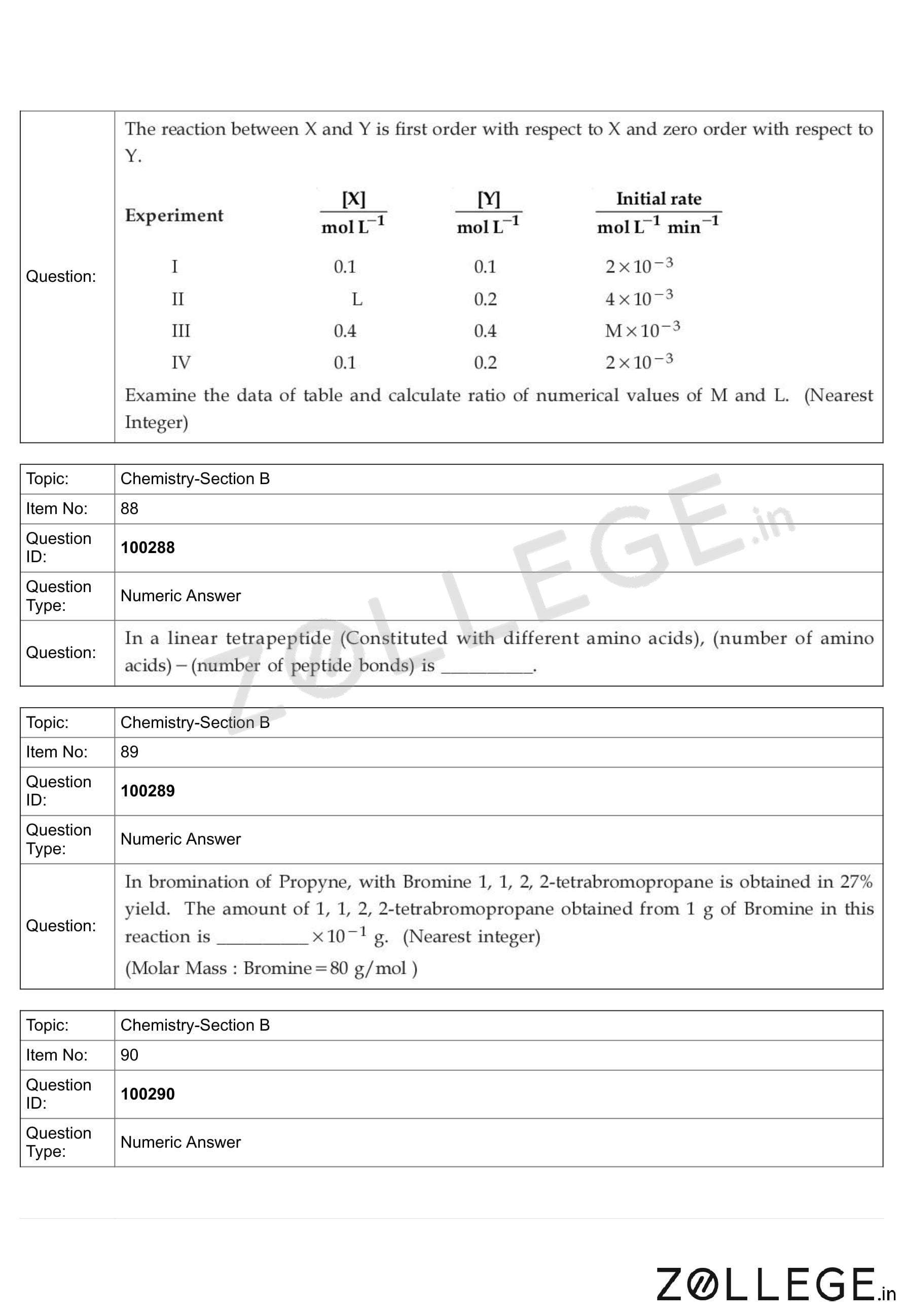
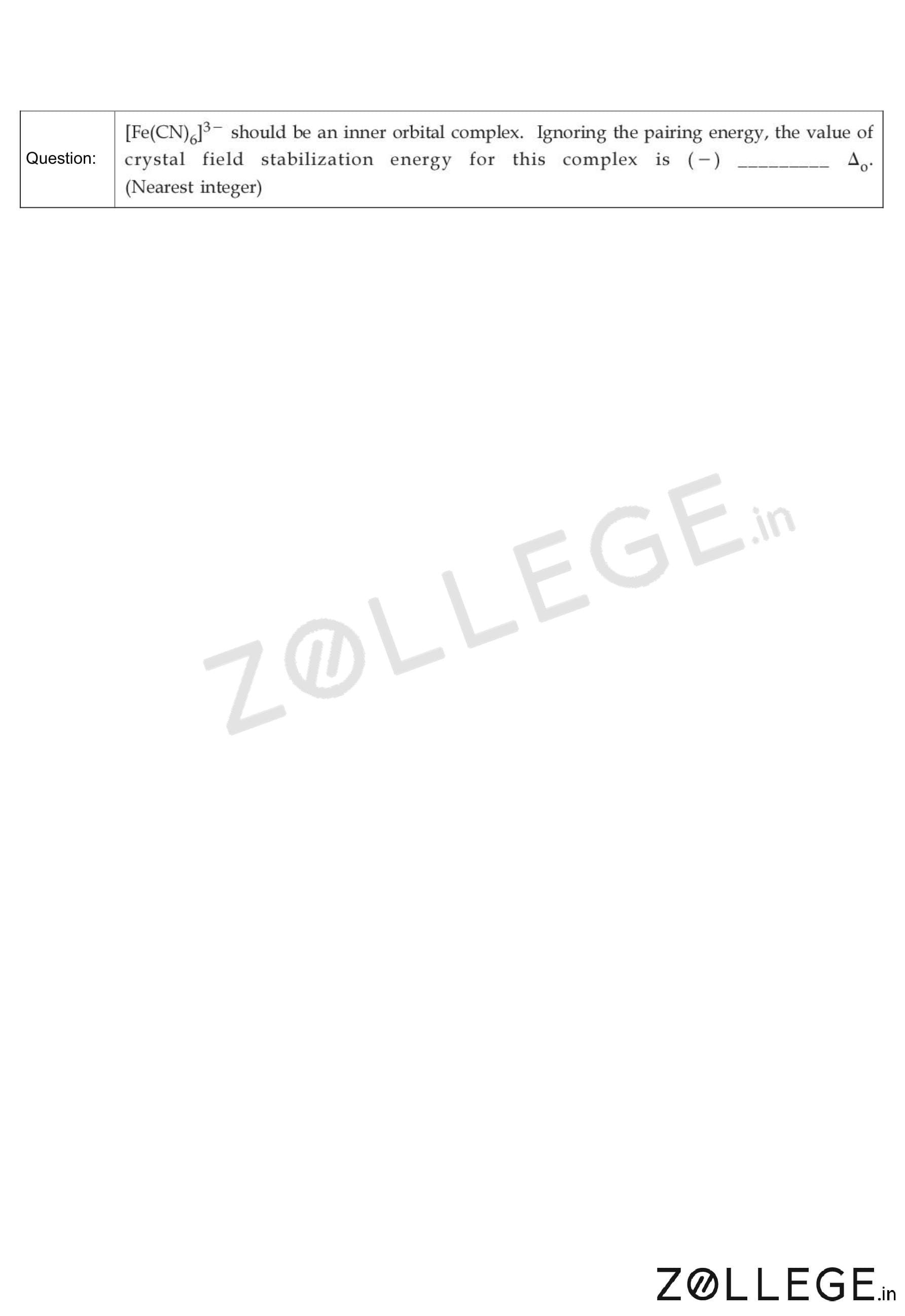
Previous Year JEE Main Question Papers
*The article might have information for the previous academic years, please refer the official website of the exam.