
JEE Main 2022 Question Paper with Answer Key PDF for B.E./ B.Tech(June 25, 2022 - Shift 1)


Content Curator | Updated On - Dec 23, 2025
JEE Main Question Papers are the most important study material for effective exam preparation. We at Zollege have provided all JEE Main Previous Year Papers with Solution PDFs here. JEE Main 2022 B. E. / B. Tech exam was conducted successfully on June 25, 2022. NTA conducted the exam in the Shift 1. According to student reactions and expert reviews, the paper was reported to be moderate to difficult.
Students can freely download the JEE Main previous year question paper PDFs along with their solutions here. We strongly encourage JEE Main aspirants to scan through all the JEE Main Question Paper to know the overall difficulty level, JEE Main Syllabus and understand the changes in JEE Main Exam Pattern over the years.
JEE Main 2022 B.E./ B.Tech Question Paper with Answer Key PDF (Shift 1)
| JEE Main 2022 B.E./ B.Tech Question Paper PDF | JEE Main 2022 B.E./ B.Tech Solutions PDF |
|---|---|
| Download PDF | Check Solutions |

Let a circle C touch the lines \( L_1 : 4x - 3y + K_1 = 0 \) and \( L_2 : 4x - 3y + K_2 = 0, K_1, K_2 \in \mathbb{R} \). If a line passing through the centre of the circle C intersects \( L_1 \) at \( (-1, 2) \) and \( L_2 \) at \( (3, -6) \), then the equation of the circle C is :
View Solution
Step 1: Understanding the Concept:
The circle touches two parallel lines \( L_1 \) and \( L_2 \) because they have the same slope \( m = 4/3 \).
The center of the circle must lie on a line exactly halfway between these two parallel lines.
Furthermore, the problem states that a line passing through the center intersects \( L_1 \) at \( P_1(-1, 2) \) and \( L_2 \) at \( P_2(3, -6) \).
Since the circle is equidistant from the two parallel tangent lines, its center \( C \) must be the midpoint of the segment \( P_1P_2 \).
Step 2: Key Formula or Approach:
1. Find the center using the midpoint formula: \( C = \left( \frac{x_1 + x_2}{2}, \frac{y_1 + y_2}{2} \right) \).
2. Determine the constants \( K_1 \) and \( K_2 \) by substituting the intersection points into the line equations.
3. Calculate the radius \( r \), which is half the distance between the parallel lines.
Step 3: Detailed Explanation:
First, find the center of the circle:
\[ C = \left( \frac{-1 + 3}{2}, \frac{2 - 6}{2} \right) = (1, -2) \]
Now, find \( K_1 \) and \( K_2 \). Since \( (-1, 2) \) lies on \( L_1 \):
\[ 4(-1) - 3(2) + K_1 = 0 \implies -4 - 6 + K_1 = 0 \implies K_1 = 10 \]
Since \( (3, -6) \) lies on \( L_2 \):
\[ 4(3) - 3(-6) + K_2 = 0 \implies 12 + 18 + K_2 = 0 \implies K_2 = -30 \]
The diameter of the circle is the perpendicular distance between the lines \( 4x - 3y + 10 = 0 \) and \( 4x - 3y - 30 = 0 \):
\[ d = \frac{|K_1 - K_2|}{\sqrt{a^2 + b^2}} = \frac{|10 - (-30)|}{\sqrt{4^2 + (-3)^2}} = \frac{40}{5} = 8 \]
Radius \( r = \frac{d}{2} = \frac{8}{2} = 4 \).
The equation of the circle is:
\[ (x - 1)^2 + (y - (-2))^2 = 4^2 \implies (x - 1)^2 + (y + 2)^2 = 16 \]
Step 4: Final Answer:
The equation of the circle is \( (x - 1)^2 + (y + 2)^2 = 16 \).
Quick Tip: For a circle touching two parallel lines, the center always lies on the median line, and the diameter is the perpendicular distance between the lines. Using the midpoint of contact points is valid here because the center lies on the line segment connecting them.
The value of \( \int_{0}^{\pi} \frac{e^{\cos x} \sin x}{(1 + \cos^2 x)(e^{\cos x} + e^{-\cos x})} dx \) is equal to :
View Solution
Step 1: Understanding the Concept:
We use the definite integral property \( \int_{a}^{b} f(x) dx = \int_{a}^{b} f(a+b-x) dx \).
In this case, we replace \( x \) with \( \pi - x \).
Step 2: Key Formula or Approach:
Property: \( \int_{0}^{a} f(x) dx = \int_{0}^{a} f(a-x) dx \).
Trigonometric identities: \( \sin(\pi - x) = \sin x \) and \( \cos(\pi - x) = -\cos x \).
Step 3: Detailed Explanation:
Let \( I = \int_{0}^{\pi} \frac{e^{\cos x} \sin x}{(1 + \cos^2 x)(e^{\cos x} + e^{-\cos x})} dx \).
Applying the property:
\[ I = \int_{0}^{\pi} \frac{e^{\cos(\pi-x)} \sin(\pi-x)}{(1 + \cos^2(\pi-x))(e^{\cos(\pi-x)} + e^{-\cos(\pi-x)})} dx \]
\[ I = \int_{0}^{\pi} \frac{e^{-\cos x} \sin x}{(1 + \cos^2 x)(e^{-\cos x} + e^{\cos x})} dx \]
Adding the two expressions for \( I \):
\[ 2I = \int_{0}^{\pi} \frac{(e^{\cos x} + e^{-\cos x}) \sin x}{(1 + \cos^2 x)(e^{\cos x} + e^{-\cos x})} dx \]
\[ 2I = \int_{0}^{\pi} \frac{\sin x}{1 + \cos^2 x} dx \]
Let \( \cos x = t \), then \( -\sin x dx = dt \).
When \( x = 0, t = 1 \); when \( x = \pi, t = -1 \).
\[ 2I = \int_{1}^{-1} \frac{-dt}{1 + t^2} = \int_{-1}^{1} \frac{dt}{1 + t^2} \]
\[ 2I = [\tan^{-1} t]_{-1}^{1} = \tan^{-1}(1) - \tan^{-1}(-1) = \frac{\pi}{4} - \left( -\frac{\pi}{4} \right) = \frac{\pi}{2} \]
\[ I = \frac{\pi}{4} \]
Step 4: Final Answer:
The value of the integral is \( \frac{\pi}{4} \).
Quick Tip: When you see exponential terms involving \( \cos x \) in the denominator like \( e^{\cos x} + e^{-\cos x} \), the \( a-x \) property often cancels the exponential complexity, leaving a standard trigonometric integral.
Let a, b and c be the length of sides of a triangle ABC such that \( \frac{a+b}{7} = \frac{b+c}{8} = \frac{c+a}{9} \). If r and R are the radius of incircle and radius of circumcircle of the triangle ABC, respectively, then the value of \( \frac{R}{r} \) is equal to :
View Solution
Step 1: Understanding the Concept:
The side lengths are given in a proportional format. We can find the actual values of \( a, b, c \) in terms of a constant and then use the geometric formulas for \( r \) and \( R \).
Step 2: Key Formula or Approach:
Inradius \( r = \frac{\Delta}{s} \) and Circumradius \( R = \frac{abc}{4\Delta} \).
Semi-perimeter \( s = \frac{a+b+c}{2} \).
Area \( \Delta = \sqrt{s(s-a)(s-b)(s-c)} \).
Step 3: Detailed Explanation:
Let \( \frac{a+b}{7} = \frac{b+c}{8} = \frac{c+a}{9} = k \).
Then \( a+b = 7k, b+c = 8k, c+a = 9k \).
Adding these: \( 2(a+b+c) = 24k \implies a+b+c = 12k \).
This gives:
\( c = (a+b+c) - (a+b) = 12k - 7k = 5k \).
\( a = (a+b+c) - (b+c) = 12k - 8k = 4k \).
\( b = (a+b+c) - (c+a) = 12k - 9k = 3k \).
The sides are \( 3k, 4k, 5k \), which satisfy \( (3k)^2 + (4k)^2 = (5k)^2 \). This is a right-angled triangle.
Area \( \Delta = \frac{1}{2} \times 3k \times 4k = 6k^2 \).
Semi-perimeter \( s = \frac{12k}{2} = 6k \).
Inradius \( r = \frac{\Delta}{s} = \frac{6k^2}{6k} = k \).
Circumradius \( R = \frac{abc}{4\Delta} = \frac{(3k)(4k)(5k)}{4(6k^2)} = \frac{60k^3}{24k^2} = \frac{5}{2}k \).
Calculating the ratio:
\[ \frac{R}{r} = \frac{5/2 k}{k} = \frac{5}{2} \]
Step 4: Final Answer:
The value of \( \frac{R}{r} \) is \( \frac{5}{2} \).
Quick Tip: For a right-angled triangle with hypotenuse \( h \), the circumradius \( R \) is simply \( h/2 \) and the inradius \( r \) is \( (a+b-h)/2 \). Here \( R = 5k/2 \) and \( r = (3k+4k-5k)/2 = k \).
Let \( f: \mathbb{N} \to \mathbb{R} \) be a function such that \( f(x+y) = 2f(x)f(y) \) for natural numbers x and y. If \( f(1) = 2 \), then the value of \( \alpha \) for which \( \sum_{k=1}^{10} f(\alpha + k) = \frac{512}{3} (2^{20} - 1) \) holds, is :
View Solution
Step 1: Understanding the Concept:
The given functional equation \( f(x+y) = 2f(x)f(y) \) suggests an exponential function. We will find the general form of \( f(n) \) using the given value \( f(1) = 2 \).
Step 2: Key Formula or Approach:
Geometric Series Sum: \( S_n = \frac{a(r^n - 1)}{r - 1} \).
Step 3: Detailed Explanation:
Given \( f(1) = 2 \).
\( f(2) = f(1+1) = 2f(1)f(1) = 2(2)(2) = 2^3 = 8 \).
\( f(3) = f(2+1) = 2f(2)f(1) = 2(2^3)(2) = 2^5 = 32 \).
By induction, \( f(n) = 2^{2n-1} \).
Now, calculate the sum:
\[ \sum_{k=1}^{10} f(\alpha + k) = \sum_{k=1}^{10} 2^{2(\alpha + k) - 1} = 2^{2\alpha - 1} \sum_{k=1}^{10} 2^{2k} = 2^{2\alpha - 1} \sum_{k=1}^{10} 4^k \]
The sum \( \sum_{k=1}^{10} 4^k \) is a G.P. with \( a=4, r=4 \):
\[ Sum = \frac{4(4^{10} - 1)}{4 - 1} = \frac{4(2^{20} - 1)}{3} \]
Substituting back into the equation:
\[ 2^{2\alpha - 1} \cdot \frac{4(2^{20} - 1)}{3} = \frac{512}{3} (2^{20} - 1) \]
\[ 2^{2\alpha - 1} \cdot 4 = 512 \implies 2^{2\alpha - 1} \cdot 2^2 = 2^9 \]
\[ 2^{2\alpha + 1} = 2^9 \]
\[ 2\alpha + 1 = 9 \implies 2\alpha = 8 \implies \alpha = 4 \]
Step 4: Final Answer:
The value of \( \alpha \) is \( 4 \).
Quick Tip: For functional equations of the form \( f(x+y) = k f(x) f(y) \), try identifying a power pattern. If \( f(1) = a \), then \( f(n) = \frac{1}{k}(ka)^n \). Here \( k=2, a=2 \), so \( f(n) = \frac{1}{2}(4)^n = 2 \cdot 4^{n-1} = 2^{2n-1} \).
Let A be a \( 3 \times 3 \) real matrix such that \( A \begin{pmatrix} 1
1
0 \end{pmatrix} = \begin{pmatrix} 1
1
0 \end{pmatrix}; A \begin{pmatrix} 1
0
1 \end{pmatrix} = \begin{pmatrix} -1
0
1 \end{pmatrix} \) and \( A \begin{pmatrix} 0
1
1 \end{pmatrix} = \begin{pmatrix} 1
1
2 \end{pmatrix} \). If \( X = (x_1, x_2, x_3)^T \) and I is an identity matrix of order 3, then the system \( (A - 2I)X = \begin{pmatrix} 4
1
1 \end{pmatrix} \) has :
View Solution
Step 1: Understanding the Concept:
The system \( (A - 2I)X = B \) has a unique solution if the determinant \( |A - 2I| \neq 0 \). We can represent the given information in matrix form.
Step 2: Key Formula or Approach:
Let \( U = \begin{pmatrix} 1 & 1 & 0
1 & 0 & 1
0 & 1 & 1 \end{pmatrix} \) and \( V = \begin{pmatrix} 1 & -1 & 1
1 & 0 & 1
0 & 1 & 2 \end{pmatrix} \).
The given relations can be written as \( AU = V \implies A = VU^{-1} \).
Step 3: Detailed Explanation:
We need to check if \( |A - 2I| = 0 \).
\[ A - 2I = (VU^{-1}) - 2(UU^{-1}) = (V - 2U)U^{-1} \]
Calculating \( |A - 2I| \):
\[ |A - 2I| = |V - 2U| \cdot |U^{-1}| = \frac{|V - 2U|}{|U|} \]
First, find \( V - 2U \):
\[ V - 2U = \begin{pmatrix} 1 & -1 & 1
1 & 0 & 1
0 & 1 & 2 \end{pmatrix} - \begin{pmatrix} 2 & 2 & 0
2 & 0 & 2
0 & 2 & 2 \end{pmatrix} = \begin{pmatrix} -1 & -3 & 1
-1 & 0 & -1
0 & -1 & 0 \end{pmatrix} \]
Determinant \( |V - 2U| \):
\[ |V - 2U| = -1(0 - 1) - (-3)(0 - 0) + 1(1 - 0) = 1 + 0 + 1 = 2 \]
Now find \( |U| \):
\[ |U| = 1(0 - 1) - 1(1 - 0) + 0 = -1 - 1 = -2 \]
Then, \( |A - 2I| = \frac{2}{-2} = -1 \).
Since \( |A - 2I| \neq 0 \), the matrix \( (A - 2I) \) is non-singular.
Therefore, the system has a unique solution.
Step 4: Final Answer:
The system has a unique solution.
Quick Tip: A linear system \( MX = B \) has a unique solution if \( |M| \neq 0 \). Instead of finding matrix \( A \) explicitly, use the property \( |A-2I| = |(V-2U)U^{-1}| \) to save time.
Let \( f: \mathbb{R} \to \mathbb{R} \) be defined as \( f(x) = x^3 + x - 5 \). If \( g(x) \) is a function such that \( f(g(x)) = x, \forall x \in \mathbb{R} \), then \( g'(63) \) is equal to :
View Solution
Step 1: Understanding the Concept:
The condition \( f(g(x)) = x \) means that \( g(x) \) is the inverse function of \( f(x) \), i.e., \( g(x) = f^{-1}(x) \). We use the formula for the derivative of an inverse function.
Step 2: Key Formula or Approach:
Derivative of inverse: \( g'(x) = \frac{1}{f'(g(x))} \).
Step 3: Detailed Explanation:
First, find \( g(63) \). Let \( g(63) = a \).
Then \( f(a) = 63 \).
\[ a^3 + a - 5 = 63 \implies a^3 + a - 68 = 0 \]
By inspection, try small integers. For \( a = 4 \):
\[ 4^3 + 4 - 68 = 64 + 4 - 68 = 0 \]
So, \( g(63) = 4 \).
Now find \( f'(x) \):
\[ f'(x) = \frac{d}{dx}(x^3 + x - 5) = 3x^2 + 1 \]
Now calculate \( g'(63) \):
\[ g'(63) = \frac{1}{f'(g(63))} = \frac{1}{f'(4)} \]
\[ f'(4) = 3(4^2) + 1 = 3(16) + 1 = 48 + 1 = 49 \]
\[ g'(63) = \frac{1}{49} \]
Step 4: Final Answer:
The value of \( g'(63) \) is \( \frac{1}{49} \).
Quick Tip: Whenever \( f(g(x)) = x \), remember \( g'(y) = 1/f'(x) \) where \( f(x) = y \). Find \( x \) by inspection or solving the polynomial equation for the specific value of \( y \).
Consider the following two propositions :
P1 : \( \sim(p \to \sim q) \)
P2 : \( (p \wedge \sim q) \wedge ((\sim p) \vee q) \)
If the proposition \( p \to ((\sim p) \vee q) \) is evaluated as FALSE, then :
View Solution
Step 1: Understanding the Concept:
An implication \( A \to B \) is FALSE if and only if \( A \) is TRUE and \( B \) is FALSE. We will determine the truth values of \( p \) and \( q \) from the given condition and then evaluate P1 and P2.
Step 2: Detailed Explanation:
Given: \( p \to ((\sim p) \vee q) \) is FALSE.
This implies:
1. \( p \) must be TRUE (T).
2. \( (\sim p) \vee q \) must be FALSE (F).
If \( p = T \), then \( \sim p = F \).
For \( F \vee q \) to be FALSE, \( q \) must be FALSE (F).
So, \( p = T \) and \( q = F \).
Evaluation of P1: \( \sim(p \to \sim q) \)
Since \( q = F \), \( \sim q = T \).
\( p \to \sim q \) becomes \( T \to T \), which is T.
Therefore, \( \sim(T) \) is FALSE.
Evaluation of P2: \( (p \wedge \sim q) \wedge ((\sim p) \vee q) \)
\( p \wedge \sim q = T \wedge T = T \).
\( (\sim p) \vee q = F \vee F = F \).
So, \( T \wedge F \) is FALSE.
Thus, both P1 and P2 are FALSE.
Step 3: Final Answer:
Both P1 and P2 are FALSE.
Quick Tip: Remember the Truth Table for Implication (\( \to \)): It is only false when the antecedent is true and the consequent is false. This single property often provides the values for all variables in logic questions.
If \( \frac{1}{2 \cdot 3^{10}} + \frac{1}{2^2 \cdot 3^9} + \dots + \frac{1}{2^{10} \cdot 3} = \frac{K}{2^{10} \cdot 3^{10}} \), then the remainder when K is divided by 6 is :
View Solution
Step 1: Understanding the Concept:
The left side is a sum of a Geometric Progression. We simplify the expression to find \( K \) and then use modular arithmetic to find the remainder.
Step 2: Key Formula or Approach:
G.P. Sum: \( S_n = \frac{a(r^n - 1)}{r - 1} \).
Step 3: Detailed Explanation:
The given sum is \( S = \sum_{r=1}^{10} \frac{1}{2^r \cdot 3^{11-r}} \).
Multiplying both sides by \( 2^{10} \cdot 3^{10} \):
\[ K = \sum_{r=1}^{10} \frac{2^{10} \cdot 3^{10}}{2^r \cdot 3^{11-r}} = \sum_{r=1}^{10} 2^{10-r} \cdot 3^{r-1} \]
Expanding the sum:
\[ K = (2^9 \cdot 3^0) + (2^8 \cdot 3^1) + (2^7 \cdot 3^2) + \dots + (2^0 \cdot 3^9) \]
This is a G.P. with first term \( a = 2^9 \), common ratio \( r = 3/2 \), and number of terms \( n = 10 \).
\[ K = a \frac{r^n - 1}{r - 1} = 2^9 \frac{(3/2)^{10} - 1}{3/2 - 1} = 2^9 \frac{\frac{3^{10}-2^{10}}{2^{10}}}{1/2} = 2^9 \cdot \frac{3^{10}-2^{10}}{2^{10}} \cdot 2 \]
\[ K = \frac{2^{10}(3^{10} - 2^{10})}{2^{10}} = 3^{10} - 2^{10} \]
Now, find \( K \pmod 6 \).
\( 3^{10} \equiv 3 \pmod 6 \) (since any power of 3, \( 3^n \), results in a multiple of 6 plus 3 for \( n \ge 1 \)).
\( 2^{10} \pmod 6 \): Powers of 2 follow a cycle \( 2, 4, 2, 4, \dots \). Even powers are \( 4 \pmod 6 \).
So, \( 2^{10} \equiv 4 \pmod 6 \).
\( K \equiv 3 - 4 = -1 \equiv 5 \pmod 6 \).
Step 4: Final Answer:
The remainder when K is divided by 6 is \( 5 \).
Quick Tip: For modular arithmetic with divisor 6, observe cycles: \( 3^n \pmod 6 = 3 \) for all \( n \ge 1 \), and \( 2^n \pmod 6 = 4 \) for even \( n \ge 2 \). This simplifies calculations immensely.
Let \( f(x) \) be a polynomial function such that \( f(x) + f'(x) + f''(x) = x^5 + 64 \). Then, the value of \( \lim_{x \to 1} \frac{f(x)}{x - 1} \) is equal to :
View Solution
Step 1: Understanding the Concept:
Since the sum of the polynomial and its derivatives is a 5th-degree polynomial, \( f(x) \) must itself be a 5th-degree polynomial. We determine the coefficients and then find the limit using L'Hopital's rule.
Step 2: Key Formula or Approach:
L'Hopital's Rule: \( \lim_{x \to 1} \frac{f(x)}{x-1} = f'(1) \), provided \( f(1) = 0 \).
Step 3: Detailed Explanation:
Let \( f(x) = ax^5 + bx^4 + cx^3 + dx^2 + ex + f \).
Then \( f'(x) = 5ax^4 + 4bx^3 + 3cx^2 + 2dx + e \).
And \( f''(x) = 20ax^3 + 12bx^2 + 6cx + 2d \).
Summing them and comparing coefficients with \( x^5 + 64 \):
\( x^5 coeff: a = 1 \).
\( x^4 coeff: b + 5a = 0 \implies b = -5 \).
\( x^3 coeff: c + 4b + 20a = 0 \implies c + 4(-5) + 20(1) = 0 \implies c = 0 \).
\( x^2 coeff: d + 3c + 12b = 0 \implies d + 0 + 12(-5) = 0 \implies d = 60 \).
\( x^1 coeff: e + 2d + 6c = 0 \implies e + 120 + 0 = 0 \implies e = -120 \).
Check \( f(1) \):
The constant term \( f + e + 2d = 64 \implies f - 120 + 120 = 64 \implies f = 64 \).
\( f(1) = a + b + c + d + e + f = 1 - 5 + 0 + 60 - 120 + 64 = 0 \).
The limit is \( f'(1) \):
\( f'(1) = 5a + 4b + 3c + 2d + e = 5(1) + 4(-5) + 3(0) + 2(60) - 120 \)
\( f'(1) = 5 - 20 + 0 + 120 - 120 = -15 \).
Step 4: Final Answer:
The value of the limit is \( -15 \).
Quick Tip: In equations like \( f(x) + f'(x) + \dots = P(x) \), start comparing coefficients from the highest power. The limit \( \lim_{x \to 1} \frac{f(x)}{x-1} \) is simply the value of the derivative \( f'(1) \).
Let \( E_1 \) and \( E_2 \) be two events such that the conditional probabilities \( P(E_1|E_2) = \frac{1}{2}, P(E_2|E_1) = \frac{3}{4} \) and \( P(E_1 \cap E_2) = \frac{1}{8} \). Then :
View Solution
Step 1: Understanding the Concept:
Use the definition of conditional probability to find the individual probabilities \( P(E_1) \) and \( P(E_2) \). Then verify the options by calculating the intersection probabilities.
Step 2: Key Formula or Approach:
\( P(A|B) = \frac{P(A \cap B)}{P(B)} \).
\( P(A \cap B') = P(A) - P(A \cap B) \).
Step 3: Detailed Explanation:
From \( P(E_1|E_2) = \frac{1}{2} \):
\( \frac{1/8}{P(E_2)} = \frac{1}{2} \implies P(E_2) = \frac{1}{4} \).
From \( P(E_2|E_1) = \frac{3}{4} \):
\( \frac{1/8}{P(E_1)} = \frac{3}{4} \implies P(E_1) = \frac{4}{3 \times 8} = \frac{1}{6} \).
Calculate product \( P(E_1) \cdot P(E_2) = \frac{1}{6} \times \frac{1}{4} = \frac{1}{24} \).
Now check Option (C): \( P(E_1 \cap E_2') \).
\( P(E_1 \cap E_2') = P(E_1) - P(E_1 \cap E_2) = \frac{1}{6} - \frac{1}{8} = \frac{4-3}{24} = \frac{1}{24} \).
Since \( P(E_1 \cap E_2') = P(E_1) \cdot P(E_2) = \frac{1}{24} \), Option (C) is correct.
Verification of others:
(A) \( P(E_1 \cap E_2) = 1/8 \neq 1/24 \).
(D) \( P(E_1' \cap E_2) = P(E_2) - P(E_1 \cap E_2) = 1/4 - 1/8 = 1/8 \neq 1/24 \).
Step 4: Final Answer:
The correct statement is \( P(E_1 \cap E_2') = P(E_1) \cdot P(E_2) \).
Quick Tip: Calculate individual probabilities first using \( P(A) = P(A \cap B) / P(B|A) \). Once \( P(E_1) \) and \( P(E_2) \) are known, checking intersection properties becomes a simple arithmetic subtraction.
Let \( A = \begin{pmatrix} 0 & -2
2 & 0 \end{pmatrix} \). If M and N are two matrices given by \( M = \sum_{k=1}^{10} A^{2k} \) and \( N = \sum_{k=1}^{10} A^{2k-1} \), then \( MN^2 \) is :
View Solution
Step 1: Understanding the Concept:
We first find the powers of matrix \( A \). Notice that \( A \) is related to the identity matrix through its square. This will simplify the summations \( M \) and \( N \).
Step 2: Key Formula or Approach:
1. A matrix \( S \) is symmetric if \( S^T = S \).
2. Scalar matrices \( kI \) are always symmetric.
Step 3: Detailed Explanation:
Find \( A^2 \):
\[ A^2 = \begin{pmatrix} 0 & -2
2 & 0 \end{pmatrix} \begin{pmatrix} 0 & -2
2 & 0 \end{pmatrix} = \begin{pmatrix} -4 & 0
0 & -4 \end{pmatrix} = -4I \]
Now evaluate \( M \):
\[ M = \sum_{k=1}^{10} (A^2)^k = \sum_{k=1}^{10} (-4I)^k = \left( \sum_{k=1}^{10} (-4)^k \right) I \]
Let \( c_1 = \sum_{k=1}^{10} (-4)^k \). Then \( M = c_1 I \).
Evaluate \( N \):
\[ N = \sum_{k=1}^{10} A^{2k-2} \cdot A = \left( \sum_{k=1}^{10} (-4)^{k-1} \right) A \]
Let \( c_2 = \sum_{k=1}^{10} (-4)^{k-1} \). Then \( N = c_2 A \).
Now calculate \( MN^2 \):
\[ MN^2 = (c_1 I)(c_2 A)^2 = c_1 c_2^2 A^2 = c_1 c_2^2 (-4I) = (-4 c_1 c_2^2) I \]
Since \( MN^2 \) is a scalar multiple of the identity matrix \( I \), it is a symmetric matrix.
The coefficient \( -4 c_1 c_2^2 \) is not equal to 1 (as seen by the large powers of 4), so it is not an identity matrix.
Step 4: Final Answer:
\( MN^2 \) is a non-identity symmetric matrix.
Quick Tip: If \( A^2 = kI \), then any summation of even powers of \( A \) is a scalar matrix \( cI \), and any summation of odd powers is a scalar multiple of \( A \). A scalar matrix is always symmetric but only identity if the scalar is 1.
Let \( g : (0, \infty) \to \mathbb{R} \) be a differentiable function such that \( \int \left( \frac{x(\cos x - \sin x)}{e^x + 1} + \frac{g(x)(e^x + 1 - xe^x)}{(e^x + 1)^2} \right) dx = \frac{x g(x)}{e^x + 1} + c \), for all \( x > 0 \), where c is an arbitrary constant. Then :
View Solution
Step 1: Understanding the Concept:
The problem provides an integral relation. By differentiating both sides with respect to \( x \), we can equate the integrand to the derivative of the right-hand side to find the expression for \( g'(x) \) and determine its properties.
Step 2: Key Formula or Approach:
Use the Quotient Rule for differentiation: \( \frac{d}{dx} \left[ \frac{u(x)}{v(x)} \right] = \frac{v(x)u'(x) - u(x)v'(x)}{(v(x))^2} \).
Step 3: Detailed Explanation:
Differentiating the right side of the given equation:
\[ \frac{d}{dx} \left[ \frac{x g(x)}{e^x + 1} + c \right] = \frac{(e^x + 1) \frac{d}{dx}(x g(x)) - (x g(x)) e^x}{(e^x + 1)^2} \]
\[ = \frac{(e^x + 1)(g(x) + x g'(x)) - x g(x) e^x}{(e^x + 1)^2} \]
\[ = \frac{x g'(x)(e^x + 1) + g(x)(e^x + 1) - x g(x) e^x}{(e^x + 1)^2} \]
\[ = \frac{x g'(x)}{e^x + 1} + \frac{g(x)(e^x + 1 - x e^x)}{(e^x + 1)^2} \]
Comparing this with the given integrand:
\[ \frac{x(\cos x - \sin x)}{e^x + 1} + \frac{g(x)(e^x + 1 - x e^x)}{(e^x + 1)^2} = \frac{x g'(x)}{e^x + 1} + \frac{g(x)(e^x + 1 - x e^x)}{(e^x + 1)^2} \]
This implies \( g'(x) = \cos x - \sin x \).
Now, evaluate the properties:
1. In \( (0, \pi/4) \), \( \cos x > \sin x \), so \( g'(x) > 0 \). Hence \( g \) is increasing. Option (A) is false.
2. \( g''(x) = -\sin x - \cos x \). In \( (0, \pi/4) \), \( g''(x) < 0 \). Hence \( g' \) is decreasing. Option (B) is false.
3. Let \( h_1(x) = g(x) + g'(x) \). Then \( h_1'(x) = g'(x) + g''(x) = (\cos x - \sin x) + (-\sin x - \cos x) = -2 \sin x \). In \( (0, \pi/2) \), \( h_1'(x) < 0 \). Option (C) is false.
4. Let \( h_2(x) = g(x) - g'(x) \). Then \( h_2'(x) = g'(x) - g''(x) = (\cos x - \sin x) - (-\sin x - \cos x) = 2 \cos x \). In \( (0, \pi/2) \), \( h_2'(x) > 0 \). Option (D) is true.
Step 4: Final Answer:
The function \( g - g' \) is increasing in the interval \( (0, \pi/2) \).
Quick Tip: Differentiating an integral equation is the standard method to "extract" the function or its derivatives. For monotonicity, always check the sign of the first derivative of the target expression.
Let \( f : \mathbb{R} \to \mathbb{R} \) and \( g : \mathbb{R} \to \mathbb{R} \) be two functions defined by \( f(x) = \log_e(x^2 + 1) - e^{-x} + 1 \) and \( g(x) = \frac{1 - 2e^{2x}}{e^x} \). Then, for which of the following range of \( \alpha \), the inequality \( f \left( g \left( \frac{(\alpha - 1)^2}{3} \right) \right) > f \left( g \left( \alpha - \frac{5}{3} \right) \right) \) holds ?
View Solution
Step 1: Understanding the Concept:
We need to analyze the monotonicity of \( f(x) \) and \( g(x) \) to simplify the functional inequality. If a function is strictly increasing or decreasing, we can remove the function and relate the arguments directly.
Step 2: Key Formula or Approach:
If \( h(x) \) is strictly increasing, \( h(x_1) > h(x_2) \iff x_1 > x_2 \).
If \( h(x) \) is strictly decreasing, \( h(x_1) > h(x_2) \iff x_1 < x_2 \).
Step 3: Detailed Explanation:
First, check \( f(x) \):
\[ f'(x) = \frac{d}{dx} (\ln(x^2 + 1) - e^{-x} + 1) = \frac{2x}{x^2 + 1} + e^{-x} \]
We know that for any real \( x \), \( |\frac{2x}{x^2 + 1}| \le 1 \).
Also, \( e^{-x} > 0 \) for all \( x \).
Wait, let's look closer: if \( x \ge 0 \), both terms are \( \ge 0 \). If \( x < 0 \), \( e^{-x} > 1 \) and \( \frac{2x}{x^2+1} \ge -1 \).
In both cases, \( f'(x) > 0 \) for all \( x \in \mathbb{R} \). Thus, \( f(x) \) is strictly increasing.
Next, check \( g(x) \):
\[ g(x) = e^{-x} - 2e^x \]
\[ g'(x) = -e^{-x} - 2e^x \]
Since \( e^x > 0 \) and \( e^{-x} > 0 \), \( g'(x) < 0 \) for all \( x \in \mathbb{R} \). Thus, \( g(x) \) is strictly decreasing.
The composite function \( f(g(x)) \) is strictly decreasing because it is a composition of an increasing function and a decreasing function.
So, \( f(g(x_1)) > f(g(x_2)) \iff x_1 < x_2 \).
Applying this to the given inequality:
\[ \frac{(\alpha - 1)^2}{3} < \alpha - \frac{5}{3} \]
\[ (\alpha - 1)^2 < 3\alpha - 5 \]
\[ \alpha^2 - 2\alpha + 1 < 3\alpha - 5 \]
\[ \alpha^2 - 5\alpha + 6 < 0 \]
\[ (\alpha - 2)(\alpha - 3) < 0 \]
This inequality holds when \( \alpha \in (2, 3) \).
Step 4: Final Answer:
The range of \( \alpha \) is \( (2, 3) \).
Quick Tip: For composite inequalities, determine the overall monotonicity of the "outer-inner" functions. Increasing \( \circ \) Decreasing \( \to \) Decreasing. This allows you to flip the inequality sign once and solve a simple quadratic.
Let \( \vec{a} = a_1 \hat{i} + a_2 \hat{j} + a_3 \hat{k}, a_i > 0, i=1, 2, 3 \) be a vector which makes equal angles with the coordinate axes OX, OY and OZ. Also, let the projection of \( \vec{a} \) on the vector \( 3\hat{i} + 4\hat{j} \) be 7. Let \( \vec{b} \) be a vector obtained by rotating \( \vec{a} \) with \( 90^\circ \). If \( \vec{a}, \vec{b} \) and x-axis are coplanar, then projection of a vector \( \vec{b} \) on \( 3\hat{i} + 4\hat{j} \) is equal to :
View Solution
Step 1: Understanding the Concept:
A vector making equal angles with axes has direction cosines \( \pm \frac{1}{\sqrt{3}} \). Since \( a_i > 0 \), they are all \( 1/\sqrt{3} \). Rotation by \( 90^\circ \) preserves magnitude and results in a perpendicular vector. Coplanarity implies the scalar triple product with the x-axis is zero.
Step 2: Key Formula or Approach:
1. Vector form: \( \vec{a} = \lambda (\hat{i} + \hat{j} + \hat{k}) \).
2. Projection formula: \( Proj_{\vec{v}} \vec{u} = \frac{\vec{u} \cdot \vec{v}}{|\vec{v}|} \).
Step 3: Detailed Explanation:
Given \( \vec{a} \) makes equal angles with axes and \( a_i > 0 \):
\( \vec{a} = k(\hat{i} + \hat{j} + \hat{k}) \) for some \( k > 0 \).
Projection of \( \vec{a} \) on \( 3\hat{i} + 4\hat{j} \) is 7:
\[ \frac{k(1\cdot3 + 1\cdot4 + 1\cdot0)}{\sqrt{3^2 + 4^2 + 0^2}} = 7 \implies \frac{7k}{5} = 7 \implies k = 5 \]
So, \( \vec{a} = 5\hat{i} + 5\hat{j} + 5\hat{k} \). Magnitude \( |\vec{a}| = \sqrt{25+25+25} = 5\sqrt{3} \).
Since \( \vec{b} \) is obtained by rotating \( \vec{a} \) by \( 90^\circ \), \( |\vec{b}| = 5\sqrt{3} \) and \( \vec{b} \perp \vec{a} \).
Also \( \vec{a}, \vec{b} \) and x-axis (\( \hat{i} \)) are coplanar. This means \( \vec{b} \) lies in the plane of \( \vec{a} \) and \( \hat{i} \).
A vector in this plane is \( \vec{b} = x \vec{a} + y \hat{i} = (5x+y)\hat{i} + 5x\hat{j} + 5x\hat{k} \).
Using \( \vec{a} \cdot \vec{b} = 0 \):
\[ 5(5x+y) + 5(5x) + 5(5x) = 0 \implies 25x + 5y + 25x + 25x = 0 \implies 75x + 5y = 0 \implies y = -15x \]
So, \( \vec{b} = (-10x)\hat{i} + 5x\hat{j} + 5x\hat{k} \).
Calculate \( x \) using \( |\vec{b}|^2 = (5\sqrt{3})^2 = 75 \):
\[ 100x^2 + 25x^2 + 25x^2 = 75 \implies 150x^2 = 75 \implies x^2 = 1/2 \implies x = \pm 1/\sqrt{2} \]
The projection of \( \vec{b} \) on \( 3\hat{i} + 4\hat{j} \):
\[ Proj = \frac{\vec{b} \cdot (3\hat{i} + 4\hat{j})}{5} = \frac{-30x + 20x + 0}{5} = \frac{-10x}{5} = -2x \]
Magnitude of projection is \( | -2 \cdot (\pm 1/\sqrt{2}) | = 2/\sqrt{2} = \sqrt{2} \).
Step 4: Final Answer:
The projection is \( \sqrt{2} \).
Quick Tip: Rotation in 3D is easiest handled by coplanarity and orthogonality. If \( \vec{b} \) is in the plane of \( \vec{a} \) and \( \hat{v} \), then \( \vec{b} = \alpha \vec{a} + \beta \hat{v} \). Use the dot product with \( \vec{a} \) to find the ratio \( \alpha/\beta \).
Let \( y = y(x) \) be the solution of the differential equation \( (x+1)y' - y = e^{3x}(x+1)^2 \), with \( y(0) = \frac{1}{3} \). Then, the point \( x = -\frac{4}{3} \) for the curve \( y = y(x) \) is :
View Solution
Step 1: Understanding the Concept:
This is a first-order linear differential equation. We solve it to find the function \( y(x) \), then use the first and second derivative tests to characterize the point \( x = -4/3 \).
Step 2: Key Formula or Approach:
Linear D.E. form: \( y' + P(x)y = Q(x) \).
Integrating Factor \( I.F. = e^{\int P(x) dx} \).
Step 3: Detailed Explanation:
Rearrange the D.E.:
\[ y' - \frac{1}{x+1}y = e^{3x}(x+1) \]
Integrating factor:
\[ I.F. = e^{\int -\frac{1}{x+1} dx} = e^{-\ln(x+1)} = \frac{1}{x+1} \]
General solution:
\[ y \cdot \frac{1}{x+1} = \int \frac{1}{x+1} \cdot e^{3x}(x+1) dx = \int e^{3x} dx = \frac{1}{3} e^{3x} + C \]
At \( x=0, y=1/3 \):
\[ \frac{1/3}{1} = \frac{1}{3} e^0 + C \implies \frac{1}{3} = \frac{1}{3} + C \implies C = 0 \]
So, \( y = \frac{1}{3}(x+1)e^{3x} \).
Find the first derivative:
\[ y' = \frac{1}{3} [1 \cdot e^{3x} + (x+1) \cdot 3e^{3x}] = e^{3x} [ \frac{1}{3} + x + 1 ] = e^{3x} [ x + \frac{4}{3} ] \]
At \( x = -4/3 \), \( y' = 0 \). So it is a critical point.
Find the second derivative:
\[ y'' = e^{3x}(1) + (x + 4/3) \cdot 3e^{3x} = e^{3x} [ 1 + 3x + 4 ] = e^{3x} (3x + 5) \]
Evaluate at \( x = -4/3 \):
\[ y''(-4/3) = e^{3(-4/3)} (3(-4/3) + 5) = e^{-4} (-4 + 5) = e^{-4} > 0 \]
Since \( y' = 0 \) and \( y'' > 0 \), the point is a local minima.
Step 4: Final Answer:
The point \( x = -4/3 \) is a point of local minima.
Quick Tip: For a critical point \( x = c \), check the sign of \( f''(c) \). If it is positive, the point is a local minimum. This "Second Derivative Test" is much faster than checking the sign change of \( f' \) in competitive exams.
If \( y = m_1x + c_1 \) and \( y = m_2x + c_2, m_1 \neq m_2 \) are two common tangents of circle \( x^2 + y^2 = 2 \) and parabola \( y^2 = x \), then the value of \( 8|m_1m_2| \) is equal to :
View Solution
Step 1: Understanding the Concept:
We use the condition of tangency for both curves. A line \( y = mx + c \) is tangent to \( y^2 = 4ax \) if \( c = a/m \), and tangent to \( x^2 + y^2 = r^2 \) if \( c^2 = r^2(1+m^2) \).
Step 2: Key Formula or Approach:
1. Parabola \( y^2 = x \implies a = 1/4 \). Tangent: \( y = mx + 1/(4m) \).
2. Circle \( x^2 + y^2 = 2 \implies r^2 = 2 \). Tangency condition: \( c^2 = 2(1 + m^2) \).
Step 3: Detailed Explanation:
Substitute \( c = 1/(4m) \) into the circle's tangency condition:
\[ \left( \frac{1}{4m} \right)^2 = 2(1 + m^2) \]
\[ \frac{1}{16m^2} = 2 + 2m^2 \]
\[ 1 = 32m^2 + 32m^4 \]
\[ 32m^4 + 32m^2 - 1 = 0 \]
This is a quadratic in \( m^2 \). Let \( m^2 = k \):
\[ 32k^2 + 32k - 1 = 0 \]
Using the quadratic formula:
\[ k = \frac{-32 \pm \sqrt{32^2 - 4(32)(-1)}}{2 \times 32} = \frac{-32 \pm \sqrt{1024 + 128}}{64} = \frac{-32 \pm \sqrt{1152}}{64} \]
\[ \sqrt{1152} = \sqrt{576 \times 2} = 24\sqrt{2} \]
\[ k = \frac{-32 \pm 24\sqrt{2}}{64} = \frac{-4 \pm 3\sqrt{2}}{8} \]
Since \( m^2 = k \ge 0 \), we must take the positive root:
\[ m^2 = \frac{3\sqrt{2} - 4}{8} \]
The two common tangents have slopes \( m_1, m_2 \) such that \( m_1^2 = m_2^2 = k \). Since \( m_1 \neq m_2 \), it must be \( m_1 = \sqrt{k} \) and \( m_2 = -\sqrt{k} \).
Then \( |m_1m_2| = |-\sqrt{k} \cdot \sqrt{k}| = k \).
\[ 8|m_1m_2| = 8 \left( \frac{3\sqrt{2} - 4}{8} \right) = 3\sqrt{2} - 4 \]
Step 4: Final Answer:
The value is \( -4 + 3\sqrt{2} \).
Quick Tip: When finding common tangents, apply the tangency condition \( c = a/m \) first. It reduces the number of variables to one (\( m \)). For symmetric curves like these, roots often come in pairs \( \pm m \), making \( |m_1m_2| = m^2 \).
Let Q be the mirror image of the point P(1, 0, 1) with respect to the plane S : x + y + z = 5. If a line L passing through (1, \( -1 \), \( -1 \)), parallel to the line PQ meets the plane S at R, then \( QR^2 \) is equal to :
View Solution
Step 1: Understanding the Concept:
We first find point Q using the mirror image formula. Then, we find the direction of the line PQ. Using this direction, we write the equation of line L and find its intersection R with the plane. Finally, we calculate the distance \( QR^2 \).
Step 2: Key Formula or Approach:
Mirror image formula for point \( (x_1, y_1, z_1) \) in plane \( ax+by+cz+d=0 \):
\[ \frac{x-x_1}{a} = \frac{y-y_1}{b} = \frac{z-z_1}{c} = -2 \frac{ax_1+by_1+cz_1+d}{a^2+b^2+c^2} \]
Step 3: Detailed Explanation:
Mirror image of P(1, 0, 1) in \( x+y+z-5=0 \):
\[ \frac{x-1}{1} = \frac{y-0}{1} = \frac{z-1}{1} = -2 \frac{1+0+1-5}{1^2+1^2+1^2} = -2 \frac{-3}{3} = 2 \]
So, \( x-1=2 \implies x=3 \); \( y=2 \); \( z-1=2 \implies z=3 \). Thus, \( Q = (3, 2, 3) \).
The vector \( \vec{PQ} = (3-1, 2-0, 3-1) = (2, 2, 2) \), which is parallel to \( (1, 1, 1) \).
Line L passes through \( (1, -1, -1) \) and is parallel to \( (1, 1, 1) \):
\[ L: \frac{x-1}{1} = \frac{y+1}{1} = \frac{z+1}{1} = \lambda \]
Any point R on L is \( (\lambda+1, \lambda-1, \lambda-1) \).
R lies on the plane \( x+y+z=5 \):
\[ (\lambda+1) + (\lambda-1) + (\lambda-1) = 5 \implies 3\lambda - 1 = 5 \implies 3\lambda = 6 \implies \lambda = 2 \]
So, \( R = (2+1, 2-1, 2-1) = (3, 1, 1) \).
Now calculate \( QR^2 \):
\[ QR^2 = (3-3)^2 + (2-1)^2 + (3-1)^2 = 0^2 + 1^2 + 2^2 = 1 + 4 = 5 \]
Step 4: Final Answer:
The value of \( QR^2 \) is 5.
Quick Tip: The vector \( \vec{PQ} \) is always parallel to the normal of the mirror plane. So line L is just the normal to the plane through the given point. Finding the intersection with the plane is then a matter of substituting the parametric line into the plane equation.
If the solution curve \( y = y(x) \) of the differential equation \( y^2 dx + (x^2 - xy + y^2) dy = 0 \), which passes through the point (1, 1) and intersects the line \( y = \sqrt{3}x \) at the point (\( \alpha, \sqrt{3}\alpha \)), then value of \( \log_e (\sqrt{3}\alpha) \) is equal to :
View Solution
Step 1: Understanding the Concept:
This is a homogeneous differential equation because every term has degree 2. We use the substitution \( x = vy \) or \( y = vx \) to transform it into a variable separable form.
Step 2: Key Formula or Approach:
For \( \frac{dx}{dy} = f(x/y) \), substitute \( x = vy \implies \frac{dx}{dy} = v + y \frac{dv}{dy} \).
Step 3: Detailed Explanation:
Given D.E.: \( y^2 dx = -(x^2 - xy + y^2) dy \)
\[ \frac{dx}{dy} = \frac{xy - x^2 - y^2}{y^2} = \frac{x}{y} - \left(\frac{x}{y}\right)^2 - 1 \]
Substitute \( x/y = v \implies x = vy \):
\[ v + y \frac{dv}{dy} = v - v^2 - 1 \]
\[ y \frac{dv}{dy} = -(v^2 + 1) \]
\[ \frac{dv}{v^2 + 1} = -\frac{dy}{y} \]
Integrating both sides:
\[ \tan^{-1}(v) = -\ln|y| + C \implies \tan^{-1}(x/y) + \ln|y| = C \]
Passing through (1, 1):
\[ \tan^{-1}(1/1) + \ln(1) = C \implies \pi/4 + 0 = C \implies C = \pi/4 \]
The curve is \( \tan^{-1}(x/y) + \ln|y| = \pi/4 \).
Intersects \( y = \sqrt{3}x \) at \( (\alpha, \sqrt{3}\alpha) \):
Here \( x/y = \alpha/(\sqrt{3}\alpha) = 1/\sqrt{3} \) and \( y = \sqrt{3}\alpha \).
\[ \tan^{-1}(1/\sqrt{3}) + \ln(\sqrt{3}\alpha) = \pi/4 \]
\[ \pi/6 + \ln(\sqrt{3}\alpha) = \pi/4 \]
\[ \ln(\sqrt{3}\alpha) = \pi/4 - \pi/6 = \pi/12 \]
Step 4: Final Answer:
The value of \( \log_e (\sqrt{3}\alpha) \) is \( \pi/12 \).
Quick Tip: In homogeneous D.E.s, look at the ratio given in the question (like \( y = \sqrt{3}x \)). This often gives a specific value for \( v \) (here \( v=1/\sqrt{3} \)), which simplifies the final evaluation after solving the integral.
Let \( x = 2t, y = \frac{t^2}{3} \) be a conic. Let S be the focus and B be the point on the axis of the conic such that \( SA \perp BA \), where A is any point on the conic. If k is the ordinate of the centroid of the \( \Delta SAB \), then \( \lim_{t \to 1} k \) is equal to :
View Solution
Step 1: Understanding the Concept:
First, we identify the conic by eliminating the parameter \( t \). Then we find its focus and axis. Using the perpendicularity condition \( SA \perp BA \), we locate point B and subsequently calculate the centroid's ordinate.
Step 2: Key Formula or Approach:
1. Parabola \( x^2 = 4ay \): Focus \( (0, a) \), Axis \( x=0 \).
2. Perpendicularity: Slope \( m_1 \cdot m_2 = -1 \).
3. Centroid ordinate: \( k = (y_S + y_A + y_B)/3 \).
Step 3: Detailed Explanation:
Given \( x = 2t, y = t^2/3 \). Eliminating \( t \): \( t = x/2 \implies y = (x/2)^2/3 = x^2/12 \).
The conic is \( x^2 = 12y \). This is a parabola with \( 4a = 12 \implies a = 3 \).
Focus \( S = (0, 3) \). Axis is the y-axis (\( x = 0 \)).
Point B is on the axis, so \( B = (0, y_B) \).
Point A is any point on the conic \( (2t, t^2/3) \).
Condition \( SA \perp BA \):
Slope \( SA = \frac{t^2/3 - 3}{2t - 0} = \frac{t^2 - 9}{6t} \).
Slope \( BA = \frac{t^2/3 - y_B}{2t - 0} = \frac{t^2 - 3y_B}{6t} \).
Since \( SA \perp BA \):
\[ \frac{t^2 - 9}{6t} \cdot \frac{t^2 - 3y_B}{6t} = -1 \implies (t^2 - 9)(t^2 - 3y_B) = -36t^2 \]
\[ 3y_B(9 - t^2) = t^2(t^2 - 9) + 36t^2 \implies y_B = \frac{-t^2(9 - t^2) + 36t^2}{3(9 - t^2)} = \frac{-t^2}{3} + \frac{12t^2}{9 - t^2} \]
As \( t \to 1 \):
\[ y_B \to -1/3 + 12/8 = -1/3 + 3/2 = 7/6 \]
Centroid ordinate \( k = \frac{y_S + y_A + y_B}{3} \).
As \( t \to 1 \), \( y_A \to 1/3 \).
\[ \lim_{t \to 1} k = \frac{3 + 1/3 + 7/6}{3} = \frac{18 + 2 + 7}{18} = \frac{27}{18} = 3/2 ? Let's re-calculate. \]
Wait, re-evaluating \( y_B \) calculation from \( SA \cdot BA = -1 \):
\[ (t^2 - 9)(t^2 - 3y_B) = -36t^2 \implies t^4 - 3y_B t^2 - 9t^2 + 27y_B = -36t^2 \]
\[ y_B(27 - 3t^2) = -27t^2 - t^4 \implies y_B = \frac{-27t^2 - t^4}{3(9 - t^2)} \]
At \( t=1 \): \( y_B = \frac{-28}{3(8)} = -28/24 = -7/6 \).
Then \( \lim_{t \to 1} k = \frac{3 + 1/3 - 7/6}{3} = \frac{18 + 2 - 7}{18} = \frac{13}{18} \).
Step 4: Final Answer:
The limit \( \lim_{t \to 1} k \) is \( 13/18 \).
Quick Tip: Identify the parabola form first to quickly find the focus and axis. For limits involving geometry, calculate the general coordinates as a function of \( t \) and then plug in the limit value at the very end to avoid complex algebra.
Let a circle C in complex plane pass through the points \( z_1 = 3 + 4i, z_2 = 4 + 3i \) and \( z_3 = 5i \). If \( z (\neq z_1) \) is a point on C such that the line through z and \( z_1 \) is perpendicular to the line through \( z_2 \) and \( z_3 \), then \( \arg(z) \) is equal to :
View Solution
Step 1: Understanding the Concept:
Notice that all given points \( z_1, z_2, z_3 \) have the same magnitude \( |z| = 5 \). This means the circle C is centered at the origin with radius 5. We then use the perpendicularity condition to find the coordinates of \( z \).
Step 2: Key Formula or Approach:
1. Circle equation: \( x^2 + y^2 = 25 \).
2. Perpendicularity: Slope \( m_1 = -1/m_2 \).
3. \( \arg(z) = \tan^{-1}(y/x) - \pi \) for points in the 3rd quadrant.
Step 3: Detailed Explanation:
\( |z_1| = \sqrt{3^2 + 4^2} = 5 \), \( |z_2| = \sqrt{4^2 + 3^2} = 5 \), \( |z_3| = \sqrt{0^2 + 5^2} = 5 \).
The points lie on \( x^2 + y^2 = 25 \).
Coordinates: \( z_1(3, 4), z_2(4, 3), z_3(0, 5) \).
Slope of line through \( z_2 \) and \( z_3 \): \( m_{23} = \frac{5 - 3}{0 - 4} = \frac{2}{-4} = -1/2 \).
The line through \( z(x, y) \) and \( z_1(3, 4) \) is perpendicular to this, so its slope is \( m_{z1} = 2 \).
Equation of line: \( y - 4 = 2(x - 3) \implies y = 2x - 2 \).
Substitute this into the circle equation:
\[ x^2 + (2x - 2)^2 = 25 \implies x^2 + 4x^2 - 8x + 4 = 25 \]
\[ 5x^2 - 8x - 21 = 0 \implies (x - 3)(5x + 7) = 0 \]
Since \( z \neq z_1 \), \( x \neq 3 \), so \( x = -7/5 \).
Calculate \( y \): \( y = 2(-7/5) - 2 = -14/5 - 10/5 = -24/5 \).
Point \( z = (-7/5, -24/5) \). It lies in the 3rd quadrant.
\[ \arg(z) = \tan^{-1} \left( \frac{-24/5}{-7/5} \right) - \pi = \tan^{-1} \left( \frac{24}{7} \right) - \pi \]
Step 4: Final Answer:
\( \arg(z) = \tan^{-1} \left( \frac{24}{7} \right) - \pi \).
Quick Tip: Always check if points lie on a circle centered at the origin (\( |z| = const \)) first. It simplifies complex geometry problems into standard coordinate geometry which is often faster to solve.
Let \( C_r \) denote the binomial coefficient of \( x^r \) in the expansion of \( (1+x)^{10} \). If for \( \alpha, \beta \in \mathbb{R} \), \( C_1 + 3 \cdot 2 C_2 + 5 \cdot 3 C_3 + \dots upto 10 terms = \frac{\alpha \times 2^{11}}{2^\beta - 1} \left( C_0 + \frac{C_1}{2} + \frac{C_2}{3} + \dots upto 10 terms \right) \), then the value of \( \alpha + \beta \) is equal to \underline{\hspace{1cm.
View Solution
Step 1: Understanding the Concept:
We need to find the sum of two binomial series. One involves the term \( (2r-1)r C_r \) and the other is the standard integration series \( \frac{C_r}{r+1} \).
Step 2: Key Formula or Approach:
1. \( \sum_{r=1}^n r C_r = n 2^{n-1} \).
2. \( \sum_{r=2}^n r(r-1) C_r = n(n-1) 2^{n-2} \).
3. \( \sum_{r=0}^n \frac{C_r}{r+1} = \frac{2^{n+1}-1}{n+1} \).
Step 3: Detailed Explanation:
Let \( S_1 = \sum_{r=1}^{10} (2r-1)r C_r = \sum_{r=1}^{10} (2r^2 - r) C_r \).
We can write \( 2r^2 - r = 2r(r-1) + r \).
\[ S_1 = 2 \sum r(r-1) C_r + \sum r C_r = 2 [10 \cdot 9 \cdot 2^8] + [10 \cdot 2^9] \]
\[ S_1 = 180 \cdot 2^8 + 10 \cdot 2^9 = 90 \cdot 2^9 + 10 \cdot 2^9 = 100 \cdot 2^9 = 25 \cdot 2^{11} \]
Now evaluate the right series \( S_2 = \sum_{r=0}^9 \frac{C_r}{r+1} \). Note: "upto 10 terms" means \( r \) goes from 0 to 9.
Wait, the series given is \( C_0 + C_1/2 + \dots + C_{10}/11 \)? No, the standard integral series for \( n=10 \) is:
\[ S_2 = \sum_{r=0}^{10} \frac{C_r}{r+1} = \frac{2^{11}-1}{11} \]
The equation is:
\[ 25 \cdot 2^{11} = \frac{\alpha \times 2^{11}}{2^\beta - 1} \left( \frac{2^{11}-1}{11} \right) \]
For this to hold:
\( 2^\beta - 1 = 2^{11} - 1 \implies \beta = 11 \).
Then, \( 25 = \frac{\alpha}{11} \implies \alpha = 275 \).
Value of \( \alpha + \beta = 275 + 11 = 286 \).
Step 4: Final Answer:
The value is 286.
Quick Tip: Express general terms of binomial series as linear combinations of \( r(r-1)\dots \) to use standard results. The "summation by integration" result \( \sum \frac{C_r}{r+1} = \frac{2^{n+1}-1}{n+1} \) is a very common JEE pattern.
The number of 3-digit odd numbers, whose sum of digits is a multiple of 7, is \hspace{1cm}.
View Solution
Step 1: Understanding the Concept:
We need to count numbers \( 100a + 10b + c \) where \( a \in \{1, \dots, 9\} \), \( b \in \{0, \dots, 9\} \), and \( c \in \{1, 3, 5, 7, 9\} \), such that \( a+b+c \) is \( 7, 14, \) or \( 21 \).
Step 2: Detailed Explanation:
Let sum of digits \( S = a+b+c \). Max sum is \( 9+9+9=27 \). Possible multiples of 7 are \( 7, 14, 21 \).
Case 1: \( c = 1 \). Then \( a+b \in \{6, 13, 20\} \).
- \( a+b=6: (1,5) \dots (6,0) \to 6 \) pairs.
- \( a+b=13: (4,9) \dots (9,4) \to 6 \) pairs. Total = 12.
Case 2: \( c = 3 \). Then \( a+b \in \{4, 11, 18, 25\} \).
- \( a+b=4: (1,3) \dots (4,0) \to 4 \) pairs.
- \( a+b=11: (2,9) \dots (9,2) \to 8 \) pairs.
- \( a+b=18: (9,9) \to 1 \) pair. Total = 13.
Case 3: \( c = 5 \). Then \( a+b \in \{2, 9, 16, 23\} \).
- \( a+b=2: (1,1), (2,0) \to 2 \) pairs.
- \( a+b=9: (1,8) \dots (9,0) \to 9 \) pairs.
- \( a+b=16: (7,9) \dots (9,7) \to 3 \) pairs. Total = 14.
Case 4: \( c = 7 \). Then \( a+b \in \{0, 7, 14, 21\} \).
- \( a+b=7: (1,6) \dots (7,0) \to 7 \) pairs.
- \( a+b=14: (5,9) \dots (9,5) \to 5 \) pairs. Total = 12.
Case 5: \( c = 9 \). Then \( a+b \in \{5, 12, 19\} \).
- \( a+b=5: (1,4) \dots (5,0) \to 5 \) pairs.
- \( a+b=12: (3,9) \dots (9,3) \to 7 \) pairs. Total = 12.
Summing all cases: \( 12 + 13 + 14 + 12 + 12 = 63 \).
Step 3: Final Answer:
The number of such 3-digit odd numbers is 63.
Quick Tip: Systematically fix one digit (the most constrained one, here \( c \)) and solve for the other two. For \( a+b=k \), the number of solutions where \( 1 \le a \le 9 \) and \( 0 \le b \le 9 \) is easy to count by inspection.
Let \( \theta \) be the angle between the vectors \( \vec{a} \) and \( \vec{b} \), where \( |\vec{a}| = 4, |\vec{b}| = 3 \) and \( \theta \in (\frac{\pi}{4}, \frac{\pi}{3}) \). Then \( |(\vec{a} - \vec{b}) \times (\vec{a} + \vec{b})|^2 + 4(\vec{a} \cdot \vec{b})^2 \) is equal to \underline{\hspace{1cm.
View Solution
Step 1: Understanding the Concept:
We expand the cross product using its distributive property and use Lagrange's identity-like simplification for the combined expression.
Step 2: Key Formula or Approach:
1. \( (\vec{u} + \vec{v}) \times (\vec{u} - \vec{v}) = 2(\vec{v} \times \vec{u}) \).
2. \( |\vec{u} \times \vec{v}|^2 + (\vec{u} \cdot \vec{v})^2 = |\vec{u}|^2 |\vec{v}|^2 \).
Step 3: Detailed Explanation:
Expand the cross product:
\[ (\vec{a} - \vec{b}) \times (\vec{a} + \vec{b}) = \vec{a} \times \vec{a} + \vec{a} \times \vec{b} - \vec{b} \times \vec{a} - \vec{b} \times \vec{b} \]
Since \( \vec{v} \times \vec{v} = 0 \) and \( \vec{a} \times \vec{b} = -\vec{b} \times \vec{a} \):
\[ = 0 + \vec{a} \times \vec{b} + \vec{a} \times \vec{b} - 0 = 2(\vec{a} \times \vec{b}) \]
The first part of the expression is:
\[ |2(\vec{a} \times \vec{b})|^2 = 4 |\vec{a} \times \vec{b}|^2 \]
The total expression is:
\[ 4 |\vec{a} \times \vec{b}|^2 + 4 (\vec{a} \cdot \vec{b})^2 = 4 [ |\vec{a} \times \vec{b}|^2 + (\vec{a} \cdot \vec{b})^2 ] \]
Using the identity \( |\vec{a} \times \vec{b}|^2 + (\vec{a} \cdot \vec{b})^2 = |\vec{a}|^2 |\vec{b}|^2 \):
\[ = 4 [ |\vec{a}|^2 |\vec{b}|^2 ] = 4 [ 4^2 \cdot 3^2 ] \]
\[ = 4 [ 16 \cdot 9 ] = 4 \times 144 = 576 \]
Step 4: Final Answer:
The value is 576.
Quick Tip: Notice that the angle \( \theta \) is provided but is actually irrelevant to the final numerical result. In many vector identity problems, trigonometric terms cancel out to leave only the magnitudes of the vectors.
Let the abscissae of the two points P and Q be the roots of \( 2x^2 - rx + p = 0 \) and the ordinates of P and Q be the roots of \( x^2 - sx - q = 0 \). If the equation of the circle described on PQ as diameter is \( 2(x^2 + y^2) - 11x - 14y - 22 = 0 \), then \( 2r + s - 2q + p \) is equal to \underline{\hspace{1cm.
View Solution
Step 1: Understanding the Concept:
A circle with the segment joining \( P(x_1, y_1) \) and \( Q(x_2, y_2) \) as a diameter is given by the equation \( (x - x_1)(x - x_2) + (y - y_1)(y - y_2) = 0 \).
This expands to \( x^2 - (x_1 + x_2)x + x_1 x_2 + y^2 - (y_1 + y_2)y + y_1 y_2 = 0 \).
We can relate the coefficients of this equation to the roots of the given quadratic equations using Vieta's formulas.
Step 2: Key Formula or Approach:
1. For \( ax^2 + bx + c = 0 \), sum of roots \( = -b/a \) and product of roots \( = c/a \).
2. Diametric form of circle: \( x^2 - (sum of abscissae)x + (product of abscissae) + y^2 - (sum of ordinates)y + (product of ordinates) = 0 \).
Step 3: Detailed Explanation:
The abscissae \( x_1, x_2 \) are roots of \( 2x^2 - rx + p = 0 \).
Sum of roots: \( x_1 + x_2 = \frac{r}{2} \).
Product of roots: \( x_1 x_2 = \frac{p}{2} \).
The ordinates \( y_1, y_2 \) are roots of \( x^2 - sx - q = 0 \).
Sum of roots: \( y_1 + y_2 = s \).
Product of roots: \( y_1 y_2 = -q \).
The equation of the circle with \( PQ \) as diameter is:
\[ x^2 - (x_1 + x_2)x + x_1 x_2 + y^2 - (y_1 + y_2)y + y_1 y_2 = 0 \]
Substituting the values:
\[ x^2 - \frac{r}{2}x + \frac{p}{2} + y^2 - sy - q = 0 \]
Multiply the entire equation by 2 to match the form given in the question:
\[ 2x^2 - rx + p + 2y^2 - 2sy - 2q = 0 \]
\[ 2(x^2 + y^2) - rx - 2sy + (p - 2q) = 0 \]
Comparing this with the given equation \( 2(x^2 + y^2) - 11x - 14y - 22 = 0 \):
- Comparing the coefficient of \( x \): \( r = 11 \).
- Comparing the coefficient of \( y \): \( 2s = 14 \implies s = 7 \).
- Comparing the constant term: \( p - 2q = -22 \).
We need to find the value of \( 2r + s - 2q + p \).
Rearrange the expression: \( 2r + s + (p - 2q) \).
Substitute the known values:
\[ 2(11) + 7 + (-22) = 22 + 7 - 22 = 7 \]
Step 4: Final Answer:
The value of the expression \( 2r + s - 2q + p \) is 7.
Quick Tip: Always multiply or divide the circle equation to make the coefficients of \( x^2 \) and \( y^2 \) match the target equation before comparing coefficients. This prevents calculation errors in the linear and constant terms.
The number of values of \( x \) in the interval \( \left( \frac{\pi}{4}, \frac{7\pi}{4} \right) \) for which \( 14 cosec^2 x - 2 \sin^2 x = 21 - 4 \cos^2 x \) holds, is \underline{\hspace{1cm.
View Solution
Step 1: Understanding the Concept:
We need to solve a trigonometric equation by converting all terms into a single trigonometric ratio, preferably \( \sin^2 x \). This will lead to a quadratic equation in \( \sin^2 x \).
Step 2: Key Formula or Approach:
1. \( cosec^2 x = \frac{1}{\sin^2 x} \).
2. \( \cos^2 x = 1 - \sin^2 x \).
Step 3: Detailed Explanation:
Given equation: \( 14 cosec^2 x - 2 \sin^2 x = 21 - 4 \cos^2 x \).
Substitute the identities:
\[ \frac{14}{\sin^2 x} - 2 \sin^2 x = 21 - 4(1 - \sin^2 x) \]
\[ \frac{14}{\sin^2 x} - 2 \sin^2 x = 21 - 4 + 4 \sin^2 x \]
\[ \frac{14}{\sin^2 x} - 2 \sin^2 x = 17 + 4 \sin^2 x \]
Bring all terms to one side:
\[ 6 \sin^2 x + 17 - \frac{14}{\sin^2 x} = 0 \]
Let \( \sin^2 x = t \). Since \( x \in (\pi/4, 7\pi/4) \), \( t \) must be in the range \( [0, 1] \).
\[ 6t + 17 - \frac{14}{t} = 0 \]
\[ 6t^2 + 17t - 14 = 0 \]
Factoring the quadratic:
\[ 6t^2 + 21t - 4t - 14 = 0 \]
\[ 3t(2t + 7) - 2(2t + 7) = 0 \]
\[ (3t - 2)(2t + 7) = 0 \]
So, \( t = \frac{2}{3} \) or \( t = -\frac{7}{2} \).
Since \( t = \sin^2 x \), it cannot be negative. Thus, \( \sin^2 x = \frac{2}{3} \).
This implies \( \sin x = \pm \sqrt{\frac{2}{3}} \).
The approximate value of \( \sqrt{2/3} \approx 0.816 \).
In the interval \( (\pi/4, 7\pi/4) \):
- At \( x = \pi/4 \), \( \sin x = 1/\sqrt{2} \approx 0.707 \).
- At \( x = 7\pi/4 \), \( \sin x = -1/\sqrt{2} \approx -0.707 \).
We need solutions for \( \sin x = 0.816 \) and \( \sin x = -0.816 \).
1. In Q1 (\( \pi/4, \pi/2 \)): \( \sin x \) goes from \( 0.707 \) to \( 1 \). \( 0.816 \) is in this range. (1 solution).
2. In Q2 (\( \pi/2, \pi \)): \( \sin x \) goes from \( 1 \) to \( 0 \). \( 0.816 \) is in this range. (1 solution).
3. In Q3 (\( \pi, 3\pi/2 \)): \( \sin x \) goes from \( 0 \) to \( -1 \). \( -0.816 \) is in this range. (1 solution).
4. In Q4 (\( 3\pi/2, 7\pi/4 \)): \( \sin x \) goes from \( -1 \) to \( -0.707 \). \( -0.816 \) is in this range. (1 solution).
Total number of values is \( 1 + 1 + 1 + 1 = 4 \).
Step 4: Final Answer:
The number of values of \( x \) is 4.
Quick Tip: Check the boundary values of the interval. For \( \sin^2 x = k \), if \( k > \sin^2(boundary) \), there are solutions in the segments adjacent to the peaks (\( \pi/2, 3\pi/2 \)).
For a natural number n, let \( a_n = 19^n - 12^n \). Then, the value of \( \frac{31 a_9 - a_{10}}{57 a_8} \) is \underline{\hspace{1cm.
View Solution
Step 1: Understanding the Concept:
The sequence \( a_n = \lambda^n - \mu^n \) satisfies a linear recurrence relation derived from the quadratic equation with roots \( \lambda \) and \( \mu \).
Step 2: Key Formula or Approach:
If \( \lambda, \mu \) are roots of \( x^2 - Sx + P = 0 \), then the sequence \( a_n = \lambda^n \pm \mu^n \) satisfies \( a_n - S a_{n-1} + P a_{n-2} = 0 \).
Step 3: Detailed Explanation:
Here \( \lambda = 19 \) and \( \mu = 12 \). These are the roots of the quadratic equation:
\[ (x - 19)(x - 12) = 0 \] \[ x^2 - (19 + 12)x + (19 \times 12) = 0 \] \[ x^2 - 31x + 228 = 0 \]
According to the recurrence relation property:
\[ a_n - 31 a_{n-1} + 228 a_{n-2} = 0 \]
Put \( n = 10 \):
\[ a_{10} - 31 a_9 + 228 a_8 = 0 \]
Rearranging the terms to match the numerator of the question:
\[ 31 a_9 - a_{10} = 228 a_8 \]
Now substitute this into the given expression:
\[ \frac{31 a_9 - a_{10}}{57 a_8} = \frac{228 a_8}{57 a_8} \] \[ = \frac{228}{57} \]
Dividing 228 by 57:
\[ 57 \times 4 = 228 \]
So, the value is 4.
Step 4: Final Answer:
The value of the expression is 4.
Quick Tip: For any expression \( x^n - y^n \), the numerator of these types of problems is usually a multiple of the denominator based on the product of roots. Recognize \( 31 = 19+12 \) immediately as the sum of roots.
Let \( f: \mathbb{R} \to \mathbb{R} \) be a function defined by \( f(x) = \left( 2 \left( 1 - \frac{x^{25}}{2} \right) (2 + x^{25}) \right)^{1/50} \). If the function \( g(x) = f(f(f(x))) + f(f(x)) \), then the greatest integer less than or equal to \( g(1) \) is \underline{\hspace{1cm.
View Solution
Step 1: Understanding the Concept:
We simplify the expression for \( f(x) \) first to identify if it is a self-inverse function or has a simple composition cycle.
Step 2: Key Formula or Approach:
Simplify \( f(x) \) by expanding the terms inside the parenthesis.
Step 3: Detailed Explanation:
Expand the expression inside the \( ( \cdot )^{1/50} \):
\[ f(x) = \left( (2 - x^{25})(2 + x^{25}) \right)^{1/50} \]
Using \( (a - b)(a + b) = a^2 - b^2 \):
\[ f(x) = (4 - x^{50})^{1/50} \]
Now find the compositions:
\[ f(f(x)) = (4 - (f(x))^{50})^{1/50} \] \[ = (4 - (4 - x^{50}))^{1/50} = (x^{50})^{1/50} = |x| \]
Next, find \( f(f(f(x))) \):
\[ f(f(f(x))) = f(|x|) = (4 - (|x|)^{50})^{1/50} = (4 - x^{50})^{1/50} \]
So the function \( g(x) \) is:
\[ g(x) = (4 - x^{50})^{1/50} + |x| \]
We need to find \( g(1) \):
\[ g(1) = (4 - 1^{50})^{1/50} + |1| = 3^{1/50} + 1 \]
We need the greatest integer less than or equal to \( g(1) \), which is \( \lfloor 3^{1/50} + 1 \rfloor \).
Since \( 3^0 = 1 \) and \( 3^1 = 3 \), then \( 3^{1/50} \) is a value between 1 and 3.
Specifically, \( 1 < 3^{1/50} < 3^{1/1} \).
As \( 50 \) is quite large, \( 3^{1/50} \) is very close to 1 but slightly greater than 1.
Let \( 3^{1/50} = 1 + \epsilon \), where \( \epsilon \) is a small positive value.
Then \( g(1) = 1 + \epsilon + 1 = 2 + \epsilon \).
The greatest integer \( \lfloor 2 + \epsilon \rfloor = 2 \).
Step 4: Final Answer:
The greatest integer less than or equal to \( g(1) \) is 2.
Quick Tip: Functions of the form \( (k - x^n)^{1/n} \) are self-inverses. Therefore \( f(f(x)) = x \) (or \( |x| \) for even \( n \)), which greatly simplifies composite function problems.
Let the lines \( L_1 : \vec{r} = \lambda (\hat{i} + 2\hat{j} + 3\hat{k}), \lambda \in \mathbb{R} \) and \( L_2 : \vec{r} = (\hat{i} + 3\hat{j} + \hat{k}) + \mu (\hat{i} + \hat{j} + 5\hat{k}), \mu \in \mathbb{R} \) intersect at the point S. If a plane \( ax + by - z + d = 0 \) passes through S and is parallel to both the lines \( L_1 \) and \( L_2 \), then the value of \( a + b + d \) is equal to \underline{\hspace{1cm.
View Solution
Step 1: Understanding the Concept:
First, we find the intersection point S. Then, since the plane is parallel to two lines, its normal vector must be perpendicular to the direction vectors of both lines. We use the cross product to find the normal vector.
Step 2: Key Formula or Approach:
1. Intersection: Equate components of \( L_1 \) and \( L_2 \).
2. Normal vector \( \vec{n} = \vec{d}_1 \times \vec{d}_2 \).
3. Plane equation: \( A(x - x_0) + B(y - y_0) + C(z - z_0) = 0 \).
Step 3: Detailed Explanation:
Equate components of \( L_1 \) and \( L_2 \) for intersection:
\[ \lambda = 1 + \mu \dots (1) \] \[ 2\lambda = 3 + \mu \dots (2) \] \[ 3\lambda = 1 + 5\mu \dots (3) \]
Subtract (1) from (2):
\[ \lambda = 2 \]
Substitute \( \lambda = 2 \) into (1):
\[ 2 = 1 + \mu \implies \mu = 1 \]
Check in (3): \( 3(2) = 1 + 5(1) \implies 6 = 6 \) (True).
Intersection point S: \( \vec{r}_S = 2(\hat{i} + 2\hat{j} + 3\hat{k}) = 2\hat{i} + 4\hat{j} + 6\hat{k} \). So, \( S = (2, 4, 6) \).
Now, find the normal vector \( \vec{n} \) to the plane:
The directions are \( \vec{d}_1 = (1, 2, 3) \) and \( \vec{d}_2 = (1, 1, 5) \).
\[ \vec{n} = \vec{d}_1 \times \vec{d}_2 = \begin{vmatrix} \hat{i} & \hat{j} & \hat{k}
1 & 2 & 3
1 & 1 & 5 \end{vmatrix} \] \[ = \hat{i}(10 - 3) - \hat{j}(5 - 3) + \hat{k}(1 - 2) = 7\hat{i} - 2\hat{j} - \hat{k} \]
The plane equation is \( 7(x - 2) - 2(y - 4) - 1(z - 6) = 0 \).
\[ 7x - 14 - 2y + 8 - z + 6 = 0 \] \[ 7x - 2y - z + 0 = 0 \]
Comparing this with \( ax + by - z + d = 0 \):
\( a = 7, b = -2, d = 0 \).
Calculate \( a + b + d \):
\[ 7 + (-2) + 0 = 5 \]
Step 4: Final Answer:
The value of \( a + b + d \) is 5.
Quick Tip: If a plane is parallel to two given lines, it is effectively the plane containing the cross product of their direction vectors. The constants \( a, b, c \) are the components of this cross product.
Let A be a \( 3 \times 3 \) matrix having entries from the set \( \{ -1, 0, 1 \} \). The number of all such matrices A having sum of all the entries equal to 5, is \underline{\hspace{1cm.
View Solution
Step 1: Understanding the Concept:
Let the number of entries equal to \( 1, -1, \) and \( 0 \) be \( n_1, n_{-1}, \) and \( n_0 \) respectively. Since it's a \( 3 \times 3 \) matrix, there are 9 total entries. We need to solve a system of integer equations.
Step 2: Key Formula or Approach:
1. \( n_1 + n_{-1} + n_0 = 9 \).
2. Sum of entries: \( n_1(1) + n_{-1}(-1) + n_0(0) = 5 \implies n_1 - n_{-1} = 5 \).
3. Permutations with repetition: \( \frac{N!}{n_1! n_{-1}! n_0!} \).
Step 3: Detailed Explanation:
From the sum equation: \( n_1 = n_{-1} + 5 \).
Substitute this into the total entries equation:
\[ (n_{-1} + 5) + n_{-1} + n_0 = 9 \] \[ 2n_{-1} + n_0 = 4 \]
Since \( n_{-1} \) and \( n_0 \) are non-negative integers:
Case 1: \( n_{-1} = 0 \)
Then \( n_0 = 4 \) and \( n_1 = 0 + 5 = 5 \).
Number of matrices \( = \frac{9!}{5! 0! 4!} = \frac{9 \times 8 \times 7 \times 6}{4 \times 3 \times 2 \times 1} = 126 \).
Case 2: \( n_{-1} = 1 \)
Then \( n_0 = 2 \) and \( n_1 = 1 + 5 = 6 \).
Number of matrices \( = \frac{9!}{6! 1! 2!} = \frac{9 \times 8 \times 7}{2 \times 1} = 252 \).
Case 3: \( n_{-1} = 2 \)
Then \( n_0 = 0 \) and \( n_1 = 2 + 5 = 7 \).
Number of matrices \( = \frac{9!}{7! 2! 0!} = \frac{9 \times 8}{2 \times 1} = 36 \).
Summing the cases:
Total matrices \( = 126 + 252 + 36 = 414 \).
Step 4: Final Answer:
The total number of such matrices is 414.
Quick Tip: Fix the variable with the smallest range first (here \( n_{-1} \) can only be 0, 1, or 2) to simplify the counting process into exhaustive cases.
The greatest integer less than or equal to the sum of first 100 terms of the sequence \( \frac{1}{3}, \frac{5}{9}, \frac{19}{27}, \frac{65}{81}, \dots \) is equal to \underline{\hspace{1cm.
View Solution
Step 1: Understanding the Concept:
We need to find the general term \( T_n \) of the sequence. Observing the terms, we see the denominators are powers of 3 and the numerators are related to powers of 3 and 2.
Step 2: Key Formula or Approach:
1. Identify \( T_n \).
2. Sum \( S_{100} = \sum_{n=1}^{100} T_n \).
3. G.P. Sum: \( a\frac{1-r^n}{1-r} \).
Step 3: Detailed Explanation:
Analyze the terms:
\( T_1 = \frac{1}{3} = 1 - \frac{2}{3} \)
\( T_2 = \frac{5}{9} = \frac{9 - 4}{9} = 1 - \frac{4}{9} = 1 - \left( \frac{2}{3} \right)^2 \)
\( T_3 = \frac{19}{27} = \frac{27 - 8}{27} = 1 - \frac{8}{27} = 1 - \left( \frac{2}{3} \right)^3 \)
General term: \( T_n = 1 - \left( \frac{2}{3} \right)^n \).
Sum of first 100 terms:
\[ S_{100} = \sum_{n=1}^{100} \left( 1 - \left( \frac{2}{3} \right)^n \right) \] \[ S_{100} = \sum_{n=1}^{100} 1 - \sum_{n=1}^{100} \left( \frac{2}{3} \right)^n \]
The first part is \( 1 \times 100 = 100 \).
The second part is a Geometric Progression with \( a = 2/3, r = 2/3, n = 100 \):
\[ Sum_{GP} = \frac{(2/3)(1 - (2/3)^{100})}{1 - 2/3} = \frac{(2/3)(1 - (2/3)^{100})}{1/3} = 2(1 - (2/3)^{100}) \]
So, \( S_{100} = 100 - 2(1 - (2/3)^{100}) = 100 - 2 + 2(2/3)^{100} = 98 + 2(2/3)^{100} \).
Since \( (2/3)^{100} \) is a very small positive number, \( 98 + 2(2/3)^{100} \) is slightly greater than 98.
The greatest integer \( \lfloor 98 + 2(2/3)^{100} \rfloor = 98 \).
Step 4: Final Answer:
The greatest integer is 98.
Quick Tip: When numerators are close to denominators, write the terms as \( 1 - (something small) \). This makes the summation and the final floor/ceiling estimation trivial.
If \( Z = \frac{A^2 B^3}{C^4} \), then the relative error in Z will be :
View Solution
Step 1: Understanding the Concept:
In experimental physics, when combining physical quantities, errors are always added to find the maximum possible relative error. Even for terms in the denominator, the absolute relative error contributions are summed.
Step 2: Key Formula or Approach:
For a function \( Y = X^n \), the relative error is \( \frac{\Delta Y}{Y} = n \frac{\Delta X}{X} \).
For \( Y = \frac{a \cdot b}{c} \), the total relative error is \( \frac{\Delta Y}{Y} = \frac{\Delta a}{a} + \frac{\Delta b}{b} + \frac{\Delta c}{c} \).
Step 3: Detailed Explanation:
Given: \( Z = \frac{A^2 B^3}{C^4} \).
Taking natural log on both sides:
\[ \ln Z = \ln \left( \frac{A^2 B^3}{C^4} \right) \]
Using log properties \( \ln(uv) = \ln u + \ln v \) and \( \ln(u/v) = \ln u - \ln v \):
\[ \ln Z = \ln A^2 + \ln B^3 - \ln C^4 \] \[ \ln Z = 2 \ln A + 3 \ln B - 4 \ln C \]
Differentiating both sides:
\[ \frac{dZ}{Z} = 2 \frac{dA}{A} + 3 \frac{dB}{B} - 4 \frac{dC}{C} \]
To find the maximum relative error \( \frac{\Delta Z}{Z} \), we take the absolute sum of all individual error components:
\[ \frac{\Delta Z}{Z} = \left| 2 \frac{\Delta A}{A} \right| + \left| 3 \frac{\Delta B}{B} \right| + \left| -4 \frac{\Delta C}{C} \right| \] \[ \frac{\Delta Z}{Z} = 2 \frac{\Delta A}{A} + 3 \frac{\Delta B}{B} + 4 \frac{\Delta C}{C} \]
Step 4: Final Answer:
The maximum relative error in Z is \( \frac{2 \Delta A}{A} + \frac{3 \Delta B}{B} + \frac{4 \Delta C}{C} \).
Quick Tip: Errors never cancel each other out in measurement; they always compound. Therefore, signs in the differentiated formula are always replaced by \( + \) when calculating maximum uncertainty.
\( \vec{A} \) is a vector quantity such that \( |\vec{A}| = \) non - zero constant. Which of the following expression is true for \( \vec{A} \) ?
View Solution
Step 1: Understanding the Concept:
The question asks about the fundamental properties of vector operations (dot product and cross product) when a vector interacts with itself.
Step 2: Key Formula or Approach:
The cross product of two vectors \( \vec{P} \) and \( \vec{Q} \) is defined as:
\[ \vec{P} \times \vec{Q} = |\vec{P}| |\vec{Q}| \sin \theta \hat{n} \]
where \( \theta \) is the angle between the two vectors.
Step 3: Detailed Explanation:
When a vector \( \vec{A} \) is crossed with itself, the angle \( \theta \) between \( \vec{A} \) and \( \vec{A} \) is \( 0^\circ \).
Using the formula:
\[ \vec{A} \times \vec{A} = |\vec{A}| |\vec{A}| \sin(0^\circ) \hat{n} \]
Since \( \sin(0^\circ) = 0 \), the expression becomes:
\[ \vec{A} \times \vec{A} = |\vec{A}|^2 \times 0 \times \hat{n} = \vec{0} \]
In magnitude form, this is written as 0.
Note: For the dot product, \( \vec{A} \cdot \vec{A} = |\vec{A}|^2 \cos(0^\circ) = |\vec{A}|^2 \), which is a non-zero constant as given in the question.
Step 4: Final Answer:
The cross product of any vector with itself is always zero.
Therefore, the expression \( \vec{A} \times \vec{A} = 0 \) is true.
Quick Tip: Remember: Self-dot product gives square of magnitude (\( A^2 \)), while self-cross product always results in a null vector (\( \vec{0} \)) because parallel vectors have no area between them.
Which of the following relations is true for two unit vector \( \hat{A} \) and \( \hat{B} \) making an angle \( \theta \) to each other ?
View Solution
Step 1: Understanding the Concept:
This question involves finding the magnitudes of the sum and difference of two unit vectors and establishing a trigonometric relationship between them.
Step 2: Key Formula or Approach:
For unit vectors, \( |\hat{A}| = |\hat{B}| = 1 \).
Magnitude of sum: \( |\hat{A} + \hat{B}| = \sqrt{A^2 + B^2 + 2AB \cos \theta} \)
Magnitude of difference: \( |\hat{A} - \hat{B}| = \sqrt{A^2 + B^2 - 2AB \cos \theta} \)
Step 3: Detailed Explanation:
Substitute \( A = 1 \) and \( B = 1 \) into the sum formula:
\[ |\hat{A} + \hat{B}| = \sqrt{1^2 + 1^2 + 2(1)(1) \cos \theta} = \sqrt{2 + 2 \cos \theta} = \sqrt{2(1 + \cos \theta)} \]
Using the identity \( 1 + \cos \theta = 2 \cos^2 \frac{\theta}{2} \):
\[ |\hat{A} + \hat{B}| = \sqrt{2 \cdot 2 \cos^2 \frac{\theta}{2}} = 2 \cos \frac{\theta}{2} \dots (i) \]
Now, substitute \( A = 1 \) and \( B = 1 \) into the difference formula:
\[ |\hat{A} - \hat{B}| = \sqrt{1^2 + 1^2 - 2(1)(1) \cos \theta} = \sqrt{2 - 2 \cos \theta} = \sqrt{2(1 - \cos \theta)} \]
Using the identity \( 1 - \cos \theta = 2 \sin^2 \frac{\theta}{2} \):
\[ |\hat{A} - \hat{B}| = \sqrt{2 \cdot 2 \sin^2 \frac{\theta}{2}} = 2 \sin \frac{\theta}{2} \dots (ii) \]
Divide equation (ii) by equation (i):
\[ \frac{|\hat{A} - \hat{B}|}{|\hat{A} + \hat{B}|} = \frac{2 \sin \frac{\theta}{2}}{2 \cos \frac{\theta}{2}} = \tan \frac{\theta}{2} \]
Rearranging gives:
\[ |\hat{A} - \hat{B}| = |\hat{A} + \hat{B}| \tan \frac{\theta}{2} \]
Step 4: Final Answer:
The correct trigonometric relation is \( |\hat{A} - \hat{B}| = |\hat{A} + \hat{B}| \tan \frac{\theta}{2} \).
Quick Tip: For any two equal magnitude vectors (like unit vectors), the resultant is always \( 2A\cos(\theta/2) \) and the difference is always \( 2A\sin(\theta/2) \). Memorizing these saves time in exams!
If force \( \vec{F} = 3\hat{i} + 4\hat{j} - 2\hat{k} \) acts on a particle having position vector \( 2\hat{i} + \hat{j} + 2\hat{k} \) then, the torque about the origin will be :
View Solution
Step 1: Understanding the Concept:
Torque (\( \vec{\tau} \)) is defined as the moment of force. It is the cross product of the position vector (\( \vec{r} \)) and the force vector (\( \vec{F} \)).
Step 2: Key Formula or Approach:
The formula for torque about the origin is:
\[ \vec{\tau} = \vec{r} \times \vec{F} \]
This can be solved using the determinant method for cross products.
Step 3: Detailed Explanation:
Given:
Position vector \( \vec{r} = 2\hat{i} + \hat{j} + 2\hat{k} \)
Force vector \( \vec{F} = 3\hat{i} + 4\hat{j} - 2\hat{k} \)
Now, calculate the cross product:
\[ \vec{\tau} = \begin{vmatrix} \hat{i} & \hat{j} & \hat{k}
2 & 1 & 2
3 & 4 & -2 \end{vmatrix} \]
Expanding the determinant along the first row:
\[ \vec{\tau} = \hat{i} [ (1 \times -2) - (2 \times 4) ] - \hat{j} [ (2 \times -2) - (2 \times 3) ] + \hat{k} [ (2 \times 4) - (1 \times 3) ] \]
\[ \vec{\tau} = \hat{i} [ -2 - 8 ] - \hat{j} [ -4 - 6 ] + \hat{k} [ 8 - 3 ] \]
\[ \vec{\tau} = \hat{i} [ -10 ] - \hat{j} [ -10 ] + \hat{k} [ 5 ] \]
\[ \vec{\tau} = -10\hat{i} + 10\hat{j} + 5\hat{k} \]
Step 4: Final Answer:
The resulting torque vector is \( -10\hat{i} + 10\hat{j} + 5\hat{k} \).
Quick Tip: Be careful with the order! \( \vec{r} \times \vec{F} \) is NOT the same as \( \vec{F} \times \vec{r} \). The latter would give the wrong sign for all components. Always write \( \vec{r} \) in the second row and \( \vec{F} \) in the third row of the determinant.
The height of any point P above the surface of earth is equal to diameter of earth. The value of acceleration due to gravity at point P will be : (Given g = acceleration due to gravity at the surface of earth).
View Solution
Step 1: Understanding the Concept:
The acceleration due to gravity varies with height above the Earth's surface.
As we move further from the Earth's center, the gravitational force weakens according to the inverse-square law.
Step 2: Key Formula or Approach:
The formula for acceleration due to gravity at a height \( h \) is given by:
\[ g' = g \left( \frac{R}{R+h} \right)^2 \]
where \( R \) is the radius of the Earth.
Step 3: Detailed Explanation:
Given that the height \( h \) is equal to the diameter of the Earth.
Diameter \( D = 2R \), so \( h = 2R \).
Substituting the value of \( h \) in the formula:
\[ g' = g \left( \frac{R}{R + 2R} \right)^2 \]
\[ g' = g \left( \frac{R}{3R} \right)^2 \]
\[ g' = g \left( \frac{1}{3} \right)^2 \]
\[ g' = \frac{g}{9} \]
Step 4: Final Answer:
The acceleration due to gravity at point P is \( g/9 \).
Quick Tip: For heights comparable to the radius of Earth, always use the exact formula \( g' = g[R/(R+h)]^2 \) rather than the approximation \( g' = g(1 - 2h/R) \), which is only valid for \( h \ll R \).
The terminal velocity (\( v_t \)) of the spherical rain drop depends on the radius (\( r \)) of the spherical rain drop as :
View Solution
Step 1: Understanding the Concept:
Terminal velocity is the constant velocity reached by an object falling through a fluid when the drag force plus buoyancy equals the gravitational force.
Step 2: Key Formula or Approach:
The expression for terminal velocity of a sphere in a viscous fluid is:
\[ v_t = \frac{2r^2(\rho - \sigma)g}{9\eta} \]
where \( r \) is the radius, \( \rho \) is the density of the object, \( \sigma \) is the density of the fluid, and \( \eta \) is the coefficient of viscosity.
Step 3: Detailed Explanation:
From the formula for terminal velocity:
\[ v_t \propto r^2 \]
This shows that terminal velocity is directly proportional to the square of the radius of the spherical drop.
As the rain drop becomes larger, its weight increases with \( r^3 \) while the surface area (related to drag) increases with \( r^2 \), leading to this specific dependency.
Step 4: Final Answer:
The terminal velocity \( v_t \) depends on the radius \( r \) as \( r^2 \).
Quick Tip: Remember that terminal velocity depends on the square of the radius, while the viscous drag force itself (Stoke's Law, \( F = 6\pi\eta rv \)) is directly proportional to the radius.
The relation between root mean square speed (\( v_{rms} \)) and most probable speed (\( v_p \)) for the molar mass M of oxygen gas molecule at the temperature of 300 K will be :
View Solution
Step 1: Understanding the Concept:
The speeds of gas molecules follow the Maxwell-Boltzmann distribution, which defines various average speeds.
Step 2: Key Formula or Approach:
Root mean square speed: \( v_{rms} = \sqrt{\frac{3RT}{M}} \)
Most probable speed: \( v_p = \sqrt{\frac{2RT}{M}} \)
Step 3: Detailed Explanation:
Let's find the ratio of \( v_{rms} \) to \( v_p \):
\[ \frac{v_{rms}}{v_p} = \frac{\sqrt{\frac{3RT}{M}}}{\sqrt{\frac{2RT}{M}}} \]
\[ \frac{v_{rms}}{v_p} = \sqrt{\frac{3}{2}} \]
\[ v_{rms} = \sqrt{\frac{3}{2}} v_p \]
This relationship is independent of the temperature \( T \) and molar mass \( M \), as long as they are the same for both speeds.
Step 4: Final Answer:
The relation is \( v_{rms} = \sqrt{\frac{3}{2}} v_p \).
Quick Tip: A useful mnemonic to remember the order of speeds is "RAM": Rms \( > \) Average \( > \) Most probable. Rms has the coefficient 3, Average has \( 8/\pi \), and Most probable has 2.
In the figure, a very large plane sheet of positive charge is shown. \( P_1 \) and \( P_2 \) are two points at distance \( l \) and \( 2l \) from the charge distribution. If \( \sigma \) is the surface charge density, then the magnitude of electric fields \( E_1 \) and \( E_2 \) at \( P_1 \) and \( P_2 \) respectively are :

View Solution
Step 1: Understanding the Concept:
For an infinite plane sheet of charge, the electric field is uniform in the region close to the sheet.
Step 2: Key Formula or Approach:
The magnitude of the electric field produced by an infinitely large non-conducting plane sheet with surface charge density \( \sigma \) is:
\[ E = \frac{\sigma}{2\epsilon_0} \]
Step 3: Detailed Explanation:
The formula shows that the electric field \( E \) does not depend on the distance from the sheet.
Since the sheet is "very large," we treat it as an infinite sheet for points \( P_1 \) and \( P_2 \) that are reasonably close.
Therefore, the field at distance \( l \) is \( E_1 = \frac{\sigma}{2\epsilon_0} \).
The field at distance \( 2l \) is \( E_2 = \frac{\sigma}{2\epsilon_0} \).
Thus, \( E_1 = E_2 = \frac{\sigma}{2\epsilon_0} \).
Step 4: Final Answer:
The magnitudes of electric fields are \( E_1 = E_2 = \sigma / 2\epsilon_0 \).
Quick Tip: The field of an infinite plane sheet is independent of distance. In contrast, the field of a point charge follows \( 1/r^2 \) and the field of an infinite line charge follows \( 1/r \).
Match List - I with List - II.
List - I
(A) AC generator
(B) Galvanometer
(C) Transformer
(D) Metal detector
List - II
(I) Detects the presence of current in the circuit
(II) Converts mechanical energy into electrical energy
(III) Works on the principle of resonance in AC circuit
(IV) Changes an alternating voltage for smaller or greater value
View Solution
Step 1: Understanding the Concept:
This question tests the knowledge of working principles and applications of standard electrical devices.
Step 2: Detailed Explanation:
(A) AC generator: It works on the principle of electromagnetic induction to convert mechanical energy (rotation of a coil) into electrical energy. So, (A) matches with (II).
(B) Galvanometer: It is a sensitive device used to detect the presence and direction of electric current in a circuit. So, (B) matches with (I).
(C) Transformer: It is used to step-up or step-down alternating voltages by electromagnetic induction between two coils. So, (C) matches with (IV).
(D) Metal detector: These devices often use the principle of LC resonance. When a metal object is near, it changes the inductance of a coil, shifting the resonance frequency. So, (D) matches with (III).
Step 3: Final Answer:
The correct matching sequence is A-II, B-I, C-IV, D-III.
Quick Tip: Matching questions can often be solved by identifying just one or two certain pairs. For example, knowing that an AC generator is a mechanical-to-electrical converter immediately narrows down the options significantly.
A long straight wire with a circular cross-section having radius R, is carrying a steady current I. The current I is uniformly distributed across this cross-section. Then the variation of magnetic field due to current I with distance r (r \( < \) R) from its centre will be :
View Solution
Step 1: Understanding the Concept:
Ampere's Circuital Law is used to find the magnetic field inside and outside a current-carrying conductor.
Step 2: Key Formula or Approach:
Ampere's law states: \( \oint \vec{B} \cdot d\vec{l} = \mu_0 I_{encl} \).
Step 3: Detailed Explanation:
Consider an Amperian loop of radius \( r \) inside the wire (\( r < R \)).
The current density is uniform: \( J = \frac{I}{\pi R^2} \).
The current enclosed by the loop is:
\[ I_{encl} = J \times (Area of loop) = \frac{I}{\pi R^2} \times \pi r^2 = I \frac{r^2}{R^2} \]
Applying Ampere's Law:
\[ B \cdot 2\pi r = \mu_0 \left( I \frac{r^2}{R^2} \right) \]
\[ B = \frac{\mu_0 I r}{2\pi R^2} \]
This shows that for \( r < R \), the magnetic field \( B \) is directly proportional to the distance \( r \).
Step 4: Final Answer:
The variation of magnetic field is \( B \propto r \).
Quick Tip: Inside a solid conductor with uniform current density, the magnetic field increases linearly from zero at the center to a maximum at the surface. Outside, it decreases as \( 1/r \).
If wattless current flows in the AC circuit, then the circuit is :
View Solution
Step 1: Understanding the Concept:
Wattless current refers to an alternating current that does not consume any power in the circuit.
Step 2: Key Formula or Approach:
Average power in an AC circuit is given by: \( P = V_{rms} I_{rms} \cos \phi \).
For wattless current, \( P = 0 \), which implies \( \cos \phi = 0 \), or \( \phi = \pi/2 \).
Step 3: Detailed Explanation:
A phase difference of \( 90^\circ \) (\( \pi/2 \)) between voltage and current occurs only in purely reactive circuits.
In a purely resistive circuit, \( \phi = 0^\circ \), so power consumption is maximum.
In a purely inductive circuit, current lags voltage by \( 90^\circ \).
In a purely capacitive circuit, current leads voltage by \( 90^\circ \).
Among the given options, the "Purely Inductive circuit" fulfills the condition for wattless current.
Step 4: Final Answer:
The circuit is a Purely Inductive circuit.
Quick Tip: Wattless current occurs when the power factor (\( \cos \phi \)) is zero. This only happens when the circuit has no resistive component to dissipate energy as heat.
The electric field in an electromagnetic wave is given by \( E = 56.5 \sin \omega(t - x/c) NC^{-1} \). Find the intensity of the wave if it is propagating along x-axis in the free space. (Given \( \epsilon_0 = 8.85 \times 10^{-12} C^2N^{-1}m^{-2} \))
View Solution
Step 1: Understanding the Concept:
Intensity of an electromagnetic wave represents the average energy flowing per unit area per unit time.
Step 2: Key Formula or Approach:
The average intensity \( I \) is given by:
\[ I = \frac{1}{2} \epsilon_0 c E_0^2 \]
where \( E_0 \) is the amplitude of the electric field and \( c \) is the speed of light (\( 3 \times 10^8 m/s \)).
Step 3: Detailed Explanation:
From the given equation, \( E_0 = 56.5 N/C \).
Substituting the values:
\[ I = \frac{1}{2} \times (8.85 \times 10^{-12}) \times (3 \times 10^8) \times (56.5)^2 \]
\[ I \approx 0.5 \times 8.85 \times 10^{-12} \times 3 \times 10^8 \times 3192.25 \]
\[ I \approx 13.275 \times 10^{-4} \times 3192.25 \]
\[ I \approx 4.2377 Wm^{-2} \]
Rounding to two decimal places, we get \( I \approx 4.24 Wm^{-2} \).
Step 4: Final Answer:
The intensity of the wave is \( 4.24 Wm^{-2} \).
Quick Tip: The intensity can also be calculated using the rms value of the electric field: \( I = \epsilon_0 c E_{rms}^2 \). Since \( E_{rms} = E_0/\sqrt{2} \), this is equivalent to the amplitude formula.
The two light beams having intensities I and 9I interfere to produce a fringe pattern on a screen. The phase difference between the beams is \( \pi/2 \) at point P and \( \pi \) at point Q. Then the difference between the resultant intensities at P and Q will be :
View Solution
Step 1: Understanding the Concept:
When two light waves interfere, the resultant intensity depends on the individual intensities and the phase difference between them.
Step 2: Key Formula or Approach:
The resultant intensity \( I_{res} \) is given by:
\[ I_{res} = I_1 + I_2 + 2\sqrt{I_1 I_2} \cos \phi \]
Step 3: Detailed Explanation:
Given \( I_1 = I \) and \( I_2 = 9I \).
At point P, \( \phi = \pi/2 \):
\[ I_P = I + 9I + 2\sqrt{I \cdot 9I} \cos(\pi/2) = 10I + 2(3I) \cdot 0 = 10I \]
At point Q, \( \phi = \pi \):
\[ I_Q = I + 9I + 2\sqrt{I \cdot 9I} \cos(\pi) = 10I + 6I \cdot (-1) = 4I \]
The difference between intensities at P and Q is:
\[ |I_P - I_Q| = |10I - 4I| = 6I \]
Step 4: Final Answer:
The difference between the resultant intensities at P and Q is \( 6I \).
Quick Tip: Points where phase difference is \( \pi \) correspond to destructive interference (minimum intensity), while points where it is \( \pi/2 \) have intensity equal to the simple sum of individual intensities.
A light wave travelling linearly in a medium of dielectric constant 4, incidents on the horizontal interface separating medium with air. The angle of incidence for which the total intensity of incident wave will be reflected back into the same medium will be : (Given : relative permeability of medium \( \mu_r = 1 \))
View Solution
Step 1: Understanding the Concept:
The phenomenon where light is completely reflected back into the denser medium is called Total Internal Reflection (TIR). It occurs when light travels from a denser to a rarer medium and the angle of incidence exceeds the critical angle.
Step 2: Key Formula or Approach:
Refractive index \( n = \sqrt{\epsilon_r \mu_r} \).
Critical angle \( i_c = \sin^{-1}(1/n) \).
Step 3: Detailed Explanation:
Given dielectric constant \( \epsilon_r = 4 \) and \( \mu_r = 1 \).
Refractive index of the medium \( n = \sqrt{4 \times 1} = 2 \).
The critical angle for the medium-air interface:
\[ \sin i_c = \frac{1}{n} = \frac{1}{2} \]
\[ i_c = 30^\circ \]
For total internal reflection to occur, the angle of incidence \( i \) must be greater than the critical angle \( i_c \).
\[ i > 30^\circ \]
Among the given options, only \( 60^\circ \) is greater than \( 30^\circ \).
Step 4: Final Answer:
The angle of incidence is \( 60^\circ \).
Quick Tip: Remember that \( n = \sqrt{\epsilon_r} \) is a shortcut for non-magnetic media (\( \mu_r \approx 1 \)). Once you find the critical angle, look for the option that satisfies the inequality \( i > i_c \).
Given below are two statements :
Statement I : Davisson-Germer experiment establishes the wave nature of electrons.
Statement II : If electrons have wave nature, they can interfere and show diffraction.
In the light of the above statements choose the correct answer from the option given below :
View Solution
Step 1: Understanding the Concept:
This question relates to the dual nature of matter proposed by de-Broglie and its experimental verification.
Step 3: Detailed Explanation:
Statement I is true. The Davisson-Germer experiment was specifically designed to test the de-Broglie hypothesis. By scattering electrons off a nickel crystal, they observed a diffraction pattern, which is a characteristic of waves.
Statement II is true. Interference and diffraction are exclusively wave phenomena. If a particle like an electron exhibits these behaviors, it must possess wave-like properties under those conditions.
Since Statement II explains the fundamental logic used in the experiment mentioned in Statement I, both are scientifically accurate and true.
Step 4: Final Answer:
Both Statement I and Statement II are true.
Quick Tip: Diffraction and Interference are the "gold standards" for proving wave nature. The Davisson-Germer experiment is often called the electron version of X-ray diffraction.
The ratio for the speed of the electron in the \( 3^{rd} \) orbit of \( He^+ \) to the speed of the electron in the \( 3^{rd} \) orbit of hydrogen atom will be :
View Solution
Step 1: Understanding the Concept:
According to Bohr's model of the atom, the orbital speed of an electron depends on the atomic number and the principal quantum number.
Step 2: Key Formula or Approach:
Speed of an electron in the \( n^{th} \) orbit: \( v_n \propto \frac{Z}{n} \).
Step 3: Detailed Explanation:
For \( He^+ \): Atomic number \( Z_1 = 2 \), Orbit \( n_1 = 3 \).
\[ v_{He^+} \propto \frac{2}{3} \]
For Hydrogen (H): Atomic number \( Z_2 = 1 \), Orbit \( n_2 = 3 \).
\[ v_{H} \propto \frac{1}{3} \]
Taking the ratio:
\[ \frac{v_{He^+}}{v_{H}} = \frac{2/3}{1/3} = \frac{2}{1} \]
The ratio is \( 2 : 1 \).
Step 4: Final Answer:
The ratio of the speeds is \( 2 : 1 \).
Quick Tip: In Bohr's model, if the orbit number \( n \) is the same for different hydrogen-like species, the speed of the electron is simply proportional to the atomic number \( Z \).
The photodiode is used to detect the optical signals. These diodes are preferably operated in reverse biased mode because :
View Solution
Step 1: Understanding the Concept:
A photodiode converts light into electric current. Its operation relies on the generation of electron-hole pairs by incident photons.
Step 3: Detailed Explanation:
In a photodiode, the reverse current is primarily due to minority carriers.
When light falls on the junction, it creates new electron-hole pairs.
In forward bias, the current is due to majority carriers (which are numerous). A small number of light-generated carriers produce an insignificant fractional change in the large forward current.
In reverse bias, the current is very small (saturation current) as it is due to minority carriers. The light-generated carriers (which are minority carriers in the respective regions) significantly increase the number of available carriers.
Therefore, the fractional change in the minority carrier population is very high, leading to a measurable increase in reverse bias current that is proportional to light intensity.
Step 4: Final Answer:
Photodiodes are operated in reverse bias because the fractional change in minority carriers produces a much higher relative change in reverse bias current.
Quick Tip: Remember: Detection is easier when you look for a small change against a small background (reverse bias) rather than a small change against a huge background (forward bias).
A signal of 100 THz frequency can be transmitted with maximum efficiency by :
View Solution
Step 1: Understanding the Concept:
Different transmission media have different bandwidth capacities and frequency ranges for efficient propagation.
Step 3: Detailed Explanation:
The frequency \( 100 THz \) (\( 10^{14} Hz \)) falls in the infrared/visible spectrum.
Copper-based systems like twisted pairs or coaxial cables suffer from extremely high attenuation and parasitic effects at such high frequencies.
Optical fibers are specifically designed for low-loss transmission in the terahertz range (optical frequencies). They use Total Internal Reflection to guide electromagnetic waves with very little energy dissipation.
Thus, for a 100 THz signal, optical fibre is the most efficient choice.
Step 4: Final Answer:
The signal can be transmitted with maximum efficiency by an Optical fibre.
Quick Tip: THZ (Terahertz) signals are synonymous with light-based communication. Whenever you see frequencies above \( 10^{12} Hz \), Optical Fibre is almost always the intended answer.
The difference of speed of light in the two media A and B (\( v_A - v_B \)) is \( 2.6 \times 10^7 m/s \). If the refractive index of medium B is 1.47, then the ratio of refractive index of medium B to medium A is : (Given : speed of light in vacuum \( c = 3 \times 10^8 ms^{-1} \))
View Solution
Step 1: Understanding the Concept:
The refractive index \( n \) of a medium is defined as the ratio of the speed of light in vacuum \( c \) to the speed of light in the medium \( v \).
Step 2: Key Formula or Approach:
\( v = c/n \).
Ratio required: \( n_B / n_A = (c/v_B) / (c/v_A) = v_A / v_B \).
Step 3: Detailed Explanation:
First, find the speed of light in medium B (\( v_B \)):
\[ v_B = \frac{c}{n_B} = \frac{3 \times 10^8}{1.47} \approx 2.0408 \times 10^8 m/s \]
Given \( v_A - v_B = 2.6 \times 10^7 m/s = 0.26 \times 10^8 m/s \).
So, \( v_A = v_B + 0.26 \times 10^8 = 2.0408 \times 10^8 + 0.26 \times 10^8 = 2.3008 \times 10^8 m/s \).
The ratio of refractive index of B to A:
\[ \frac{n_B}{n_A} = \frac{v_A}{v_B} \]
\[ \frac{n_B}{n_A} = \frac{2.3008 \times 10^8}{2.0408 \times 10^8} \approx 1.127 \]
Rounding to two decimal places, we get \( 1.13 \).
Step 4: Final Answer:
The ratio \( n_B / n_A \) is approximately \( 1.13 \).
Quick Tip: Notice that the ratio of refractive indices is inversely proportional to the ratio of speeds: \( n_B/n_A = v_A/v_B \). This simplifies calculations by avoiding calculating the value of \( n_A \) separately.
A teacher in his physics laboratory allotted an experiment to determine the resistance (G) of a galvanometer. Students took the observations for \( 1/3 \) deflection in the galvanometer. Which of the below is true for measuring value of G ?
View Solution
Step 1: Understanding the Concept:
The deflection in a moving coil galvanometer is directly proportional to the current flowing through it (\( \theta \propto I \)). Shunting is used to divide current between the galvanometer and a parallel resistance.
Step 3: Detailed Explanation:
Initially, let the current in the circuit be \( I \), producing a deflection \( \theta \).
When a shunt \( S \) is connected in parallel with the galvanometer \( G \), the current is divided.
The current through the galvanometer becomes \( I_G = I \left( \frac{S}{G + S} \right) \).
Since deflection is proportional to current, the new deflection \( \theta' \) is related to the initial deflection \( \theta \) by:
\[ \frac{\theta'}{\theta} = \frac{I_G}{I} = \frac{S}{G + S} \]
Given that the deflection becomes \( 1/3 \) of the initial value:
\[ \frac{1}{3} = \frac{S}{G + S} \]
\[ G + S = 3S \]
\[ G = 2S \]
This confirms that the method is valid and the galvanometer resistance \( G \) is twice the shunt value \( S \).
Step 4: Final Answer:
The \( 1/3 \) deflection method can be used and \( G = 2S \).
Quick Tip: This is a variation of the standard "half-deflection method". In general, if deflection becomes \( 1/n \), then \( G = (n-1)S \). Here \( n=3 \), so \( G = (3-1)S = 2S \).
A uniform chain of \( 6 m \) length is placed on a table such that a part of its length is hanging over the edge of the table. The system is at rest. The co-efficient of static friction between the chain and the surface of the table is \( 0.5 \), the maximum length of the chain hanging from the table is \underline{\hspace{1cm m.
View Solution
Step 1: Understanding the Concept:
For a chain partially hanging from a table to remain at rest, the downward force due to the weight of the hanging part must be balanced by the maximum static friction force acting on the part of the chain lying on the table.
Step 2: Key Formula or Approach:
Let \( L \) be the total length of the chain and \( l \) be the hanging length.
The weight of the hanging part is \( W_h = \left( \frac{m}{L} \right) l g \).
The normal force on the table is \( N = \left( \frac{m}{L} \right) (L - l) g \).
The maximum friction force is \( f_{max} = \mu N \).
At equilibrium: \( W_h = f_{max} \).
Step 3: Detailed Explanation:
Equating the forces:
\[ \left( \frac{m}{L} \right) l g = \mu \left( \frac{m}{L} \right) (L - l) g \]
Cancelling common terms \( \left( \frac{m}{L} \right) g \):
\[ l = \mu (L - l) \]
\[ l = \mu L - \mu l \implies l(1 + \mu) = \mu L \]
\[ l = \frac{\mu L}{1 + \mu} \]
Given \( L = 6 m \) and \( \mu = 0.5 \):
\[ l = \frac{0.5 \times 6}{1 + 0.5} = \frac{3}{1.5} = 2 m \]
Step 4: Final Answer:
The maximum length of the chain hanging from the table is \( 2 m \).
Quick Tip: For these chain problems, the ratio of hanging length to total length is simply \( \frac{l}{L} = \frac{\mu}{1 + \mu} \). Memorizing this saves time in friction-related equilibrium problems!
A \( 0.5 kg \) block moving at a speed of \( 12 ms^{-1} \) compresses a spring through a distance \( 30 cm \) when its speed is halved. The spring constant of the spring will be \hspace{1cm \( Nm^{-1 \).
View Solution
Step 1: Understanding the Concept:
As the block compresses the spring, its kinetic energy is partially converted into the elastic potential energy of the spring. We apply the Work-Energy Theorem or the law of conservation of energy.
Step 2: Key Formula or Approach:
Initial Kinetic Energy \( (K_i) = Final Kinetic Energy (K_f) + Spring Potential Energy (U_s) \).
\[ \frac{1}{2} m u^2 = \frac{1}{2} m v^2 + \frac{1}{2} k x^2 \]
Step 3: Detailed Explanation:
Given:
\( m = 0.5 kg \)
\( u = 12 ms^{-1} \)
\( v = \frac{u}{2} = 6 ms^{-1} \)
\( x = 30 cm = 0.3 m \)
Applying the energy equation:
\[ m(u^2 - v^2) = k x^2 \]
\[ 0.5(12^2 - 6^2) = k(0.3)^2 \]
\[ 0.5(144 - 36) = k(0.09) \]
\[ 0.5(108) = 0.09 k \]
\[ 54 = 0.09 k \implies k = \frac{54}{0.09} = 600 Nm^{-1} \]
Step 4: Final Answer:
The spring constant is \( 600 Nm^{-1} \).
Quick Tip: Always ensure units are consistent. Convert \( 30 cm \) to meters before performing calculations to avoid being off by factors of 100 or 10,000.
The velocity of upper layer of water in a river is \( 36 kmh^{-1} \). Shearing stress between horizontal layers of water is \( 10^{-3} Nm^{-2} \). Depth of the river is \hspace{1cm m. (Co-efficient of viscosity of water is \( 10^{-2 Pa.s \))
View Solution
Step 1: Understanding the Concept:
Viscous force is the internal friction within a fluid. According to Newton's law of viscosity, the shearing stress is proportional to the velocity gradient.
Step 2: Key Formula or Approach:
Shearing Stress \( (\tau) = \eta \frac{dv}{dy} \).
Assuming the bottom layer velocity is zero, the gradient is \( \frac{v}{h} \), where \( h \) is the depth.
Step 3: Detailed Explanation:
Given:
\( v = 36 kmh^{-1} = 36 \times \frac{5}{18} = 10 ms^{-1} \)
\( \tau = 10^{-3} Nm^{-2} \)
\( \eta = 10^{-2} Pa.s \)
Substituting into the formula:
\[ 10^{-3} = 10^{-2} \times \frac{10}{h} \]
\[ 10^{-3} = \frac{10^{-1}}{h} \]
\[ h = \frac{10^{-1}}{10^{-3}} = 10^2 = 100 m \]
Step 4: Final Answer:
The depth of the river is \( 100 m \).
Quick Tip: Standard conversion for speed: \( 1 km/h = \frac{5}{18} m/s \). In fluid dynamics, assume the velocity at the boundary (riverbed) is zero (no-slip condition).
A steam engine intakes \( 50 g \) of steam at \( 100^{\circ}C \) per minute and cools it down to \( 20^{\circ}C \). If latent heat of vaporization of steam is \( 540 cal g^{-1} \), then the heat rejected by the steam engine per minute is \hspace{1cm \( \times 10^3 cal \). (Given : specific heat capacity of water : \( 1 cal g^{-1\ ^{\circ}C^{-1} \))
View Solution
Step 1: Understanding the Concept:
The total heat rejected consists of two parts: the heat released during the phase change (condensation of steam to water) and the heat released as the water cools down to the final temperature.
Step 2: Key Formula or Approach:
Total Heat \( Q = Q_{condensation} + Q_{cooling} \)
\[ Q = m L_v + m s \Delta T \]
Step 3: Detailed Explanation:
Given:
\( m = 50 g \)
\( L_v = 540 cal g^{-1} \)
\( s = 1 cal g^{-1}\ ^{\circ}C^{-1} \)
\( \Delta T = 100^{\circ}C - 20^{\circ}C = 80^{\circ}C \)
Calculating each part:
\[ Q_{condensation} = 50 \times 540 = 27,000 cal \]
\[ Q_{cooling} = 50 \times 1 \times 80 = 4,000 cal \]
Total rejected heat:
\[ Q = 27,000 + 4,000 = 31,000 cal = 31 \times 10^3 cal \]
Step 4: Final Answer:
The heat rejected is \( 31 \times 10^3 cal \).
Quick Tip: Don't forget the sensible heat part (\( mc\Delta T \)). Students often only calculate the latent heat, but cooling the condensed water also rejects significant energy.
The first overtone frequency of an open organ pipe is equal to the fundamental frequency of a closed organ pipe. If the length of the closed organ pipe is \( 20 cm \). The length of the open organ pipe is \underline{\hspace{1cm cm.
View Solution
Step 1: Understanding the Concept:
Harmonics in organ pipes depend on the boundary conditions (open or closed ends). The fundamental frequency and overtones have specific relations to the length of the pipe.
Step 2: Key Formula or Approach:
Frequency of \( n\)-th harmonic in open pipe: \( f_{n, open} = \frac{n v}{2 L_{open}} \).
(1st overtone is the 2nd harmonic, so \( n=2 \)).
Frequency of \( m\)-th harmonic in closed pipe: \( f_{m, closed} = \frac{(2m-1) v}{4 L_{closed}} \).
(Fundamental is \( m=1 \)).
Step 3: Detailed Explanation:
For open pipe, first overtone frequency (\( n=2 \)):
\[ f_{1, ov, open} = \frac{2v}{2L_{open}} = \frac{v}{L_{open}} \]
For closed pipe, fundamental frequency (\( m=1 \)):
\[ f_{fund, closed} = \frac{v}{4L_{closed}} \]
Given \( L_{closed} = 20 cm \) and the frequencies are equal:
\[ \frac{v}{L_{open}} = \frac{v}{4 \times 20} \]
\[ \frac{1}{L_{open}} = \frac{1}{80} \implies L_{open} = 80 cm \]
Step 4: Final Answer:
The length of the open organ pipe is \( 80 cm \).
Quick Tip: Remember: Open pipe frequencies are \( f_0, 2f_0, 3f_0 \dots \) (all harmonics), whereas closed pipe frequencies are \( f_c, 3f_c, 5f_c \dots \) (only odd harmonics). First overtone is the *next* possible frequency after the fundamental.
The equivalent capacitance between points A and B in below shown figure will be \hspace{1cm} \( \muF \).

View Solution
Step 1: Understanding the Concept:
Points A and B are connected by two parallel branches. Each branch contains capacitors connected in series. We find the equivalent of each branch first, then add them.
Step 2: Key Formula or Approach:
Series combination: \( \frac{1}{C_s} = \frac{1}{C_1} + \frac{1}{C_2} + \dots \)
Parallel combination: \( C_p = C_a + C_b + \dots \)
Step 3: Detailed Explanation:
Branch 1 (Top): Two \( 8\ \muF \) capacitors in series.
\[ C_1 = \frac{8 \times 8}{8 + 8} = \frac{64}{16} = 4\ \muF \]
Branch 2 (Bottom): Four \( 8\ \muF \) capacitors in series.
\[ \frac{1}{C_2} = \frac{1}{8} + \frac{1}{8} + \frac{1}{8} + \frac{1}{8} = \frac{4}{8} \implies C_2 = \frac{8}{4} = 2\ \muF \]
Equivalent capacitance between A and B:
Since Branch 1 and Branch 2 are in parallel:
\[ C_{AB} = C_1 + C_2 = 4 + 2 = 6\ \muF \]
Step 4: Final Answer:
The equivalent capacitance is \( 6\ \muF \).
Quick Tip: For \( n \) identical capacitors of capacitance \( C \) in series, the equivalent is simply \( C/n \). This makes branch calculations very fast!
A resistor develops \( 300 J \) of thermal energy in \( 15 s \), when a current of \( 2 A \) is passed through it. If the current increases to \( 3 A \), the energy developed in \( 10 s \) is \underline{\hspace{1cm J.
View Solution
Step 1: Understanding the Concept:
The thermal energy produced in a resistor (Joule heating) depends on the square of the current, the resistance, and the time for which current flows.
Step 2: Key Formula or Approach:
Heat Energy \( H = I^2 R t \).
Step 3: Detailed Explanation:
Case 1:
\( H_1 = 300 J, I_1 = 2 A, t_1 = 15 s \)
\[ 300 = (2)^2 \times R \times 15 \]
\[ 300 = 4 \times 15 \times R \implies 300 = 60 R \]
\[ R = 5\ \Omega \]
Case 2:
\( I_2 = 3 A, t_2 = 10 s, R = 5\ \Omega \)
\[ H_2 = (3)^2 \times 5 \times 10 \]
\[ H_2 = 9 \times 50 = 450 J \]
Step 4: Final Answer:
The energy developed is \( 450 J \).
Quick Tip: Ratio method is often faster: \( \frac{H_2}{H_1} = \frac{I_2^2 t_2}{I_1^2 t_1} \).
\( H_2 = 300 \times \left( \frac{3^2 \times 10}{2^2 \times 15} \right) = 300 \times \frac{90}{60} = 450 J \).
The total current supplied to the circuit as shown in figure by the \( 5 V \) battery is \underline{\hspace{1cm A.

View Solution
Step 1: Understanding the Concept:
We need to determine the configuration of the resistors. By analyzing the nodes, we can identify which resistors are in series or parallel and find the total equivalent resistance.
Step 2: Key Formula or Approach:
\( I = \frac{V}{R_{eq}} \)
For parallel resistors: \( \frac{1}{R_{eq}} = \sum \frac{1}{R_i} \).
Step 3: Detailed Explanation:
Looking at the diagram, the positive terminal of the \( 5 V \) battery connects to one side of all four resistors (\( 2.5\ \Omega \), and three \( 5\ \Omega \) resistors). The other sides of all four resistors are connected to a common outer wire, which leads back to the negative terminal.
Thus, all four resistors are in parallel.
Calculating equivalent resistance \( R_{eq} \):
\[ \frac{1}{R_{eq}} = \frac{1}{2.5} + \frac{1}{5} + \frac{1}{5} + \frac{1}{5} \]
\[ \frac{1}{R_{eq}} = \frac{2}{5} + \frac{3}{5} = \frac{5}{5} = 1\ \Omega \]
\[ R_{eq} = 1\ \Omega \]
Now, calculate the total current supplied:
\[ I = \frac{V}{R_{eq}} = \frac{5 V}{1\ \Omega} = 5 A \]
Step 4: Final Answer:
The total current supplied is \( 5 A \).
Quick Tip: In circuit diagrams with an outer circular wire, every point on that circle is at the same potential. Use this "node analysis" to simplify seemingly complex diagrams into simple parallel/series combinations.
The current in a coil of self inductance \( 2.0 H \) is increasing according to \( I = 2 \sin(t^2) A \). The amount of energy spent during the period when current changes from \( 0 \) to \( 2 A \) is \underline{\hspace{1cm J.
View Solution
Step 1: Understanding the Concept:
Magnetic potential energy is stored in an inductor when current flows through it. The energy spent by the source to establish a current is equal to the change in stored magnetic energy.
Step 2: Key Formula or Approach:
Energy stored in an inductor \( U = \frac{1}{2} L I^2 \).
Step 3: Detailed Explanation:
Given:
\( L = 2.0 H \)
Initial current \( I_1 = 0 A \)
Final current \( I_2 = 2 A \)
The energy spent is the change in energy stored:
\[ \Delta U = U_{final} - U_{initial} \]
\[ \Delta U = \frac{1}{2} L (I_2^2 - I_1^2) \]
\[ \Delta U = \frac{1}{2} \times 2.0 \times (2^2 - 0^2) \]
\[ \Delta U = 1.0 \times 4 = 4 J \]
The time dependency of current \( I = 2 \sin(t^2) \) determines *when* the current reaches \( 2 A \), but the total energy spent depends only on the magnitude of the final current itself.
Step 4: Final Answer:
The amount of energy spent is \( 4 J \).
Quick Tip: Stored energy in an inductor is a "state function" regarding current. Regardless of the function \( I(t) \), the energy required to reach a specific current \( I \) from zero is always \( \frac{1}{2}LI^2 \).
A force on an object of mass \( 100 g \) is \( (10 \hat{i} + 5 \hat{j}) N \). The position of that object at \( t = 2 s \) is \( (a \hat{i} + b \hat{j}) m \) after starting from rest. The value of \( \frac{a}{b} \) will be \underline{\hspace{1cm.
View Solution
Step 1: Understanding the Concept:
Force causes acceleration. Using Newton's second law in vector form, we find acceleration and then use kinematic equations to find displacement from rest.
Step 2: Key Formula or Approach:
Acceleration \( \vec{a} = \frac{\vec{F}}{m} \).
Position \( \vec{r} = \frac{1}{2} \vec{a} t^2 \) (for \( \vec{u} = 0 \)).
Step 3: Detailed Explanation:
Given:
\( \vec{F} = 10 \hat{i} + 5 \hat{j} N \)
\( m = 100 g = 0.1 kg \)
Calculating acceleration:
\[ \vec{a} = \frac{10 \hat{i} + 5 \hat{j}}{0.1} = 100 \hat{i} + 50 \hat{j} ms^{-2} \]
Calculating position at \( t = 2 s \):
\[ \vec{r} = \frac{1}{2} (100 \hat{i} + 50 \hat{j}) (2)^2 \]
\[ \vec{r} = \frac{1}{2} (100 \hat{i} + 50 \hat{j}) (4) \]
\[ \vec{r} = 200 \hat{i} + 100 \hat{j} m \]
Comparing with \( a \hat{i} + b \hat{j} \):
\( a = 200, b = 100 \).
Finding the ratio:
\[ \frac{a}{b} = \frac{200}{100} = 2 \]
Step 4: Final Answer:
The value of \( \frac{a}{b} \) is 2.
Quick Tip: The ratio of coordinates \( a/b \) for an object starting from rest under constant force is simply the ratio of the force components \( F_x/F_y \). Here \( 10/5 = 2 \). This shortcut works because mass and time cancel out in the ratio!
Bonding in which of the following diatomic molecule(s) become(s) stronger, on the basis of MO Theory, by removal of an electron ?
(A) NO
(B) \( N_2 \)
(C) \( O_2 \)
(D) \( C_2 \)
(E) \( B_2 \)
Choose the most appropriate answer from the options given below :
View Solution
Step 1: Understanding the Concept:
According to Molecular Orbital (MO) Theory, bond strength is directly proportional to the Bond Order (B.O.). Bond order increases if an electron is removed from an anti-bonding molecular orbital (ABMO).
Step 2: Key Formula or Approach:
Bond Order \( = \frac{1}{2} (N_b - N_a) \).
Where \( N_b \) is the number of electrons in bonding orbitals and \( N_a \) is the number of electrons in anti-bonding orbitals.
Step 3: Detailed Explanation:
(A) NO: Total \( 15e^- \). Valence configuration ends in \( \pi^{*1}_{2p} \). Removal of an electron from ABMO increases B.O. from \( 2.5 \) to \( 3.0 \). (Becomes stronger).
(B) \( N_2 \): Total \( 14e^- \). Valence configuration ends in \( \sigma^2_{2p} \). Removal of an electron from a bonding orbital decreases B.O. from \( 3.0 \) to \( 2.5 \). (Becomes weaker).
(C) \( O_2 \): Total \( 16e^- \). Valence configuration ends in \( \pi^{*2}_{2p} \). Removal of an electron from ABMO increases B.O. from \( 2.0 \) to \( 2.5 \). (Becomes stronger).
(D) \( C_2 \): Total \( 12e^- \). Valence configuration ends in \( \pi^4_{2p} \). Removal of an electron from a bonding orbital decreases B.O. from \( 2.0 \) to \( 1.5 \). (Becomes weaker).
(E) \( B_2 \): Total \( 10e^- \). Valence configuration ends in \( \pi^2_{2p} \). Removal of an electron from a bonding orbital decreases B.O. from \( 1.0 \) to \( 0.5 \). (Becomes weaker).
Therefore, only (A) and (C) result in a stronger bond.
Step 4: Final Answer:
The correct options are (A) and (C) only.
Quick Tip: Quick check: Look for molecules with electrons in \( \pi^* \) or \( \sigma^* \) orbitals. If you take an electron away from the "enemy" (anti-bonding), the bond gets stronger!
Incorrect statement for Tyndall effect is :
View Solution
Step 1: Understanding the Concept:
The Tyndall effect is the scattering of light by colloidal particles.
For the Tyndall effect to be observed, two main conditions must be satisfied.
1. The diameter of the dispersed particles is not much smaller than the wavelength of the light used.
2. The refractive indices of the dispersed phase and the dispersion medium must differ greatly in magnitude.
Step 3: Detailed Explanation:
Statement (A) is correct as it is one of the essential conditions for the Tyndall effect.
Statement (B) is incorrect because if the diameter of the particles is much smaller than the wavelength of light, scattering will not be effective.
The particles must have dimensions comparable to the wavelength of light used.
Statement (C) is a common real-life example where light from the projector is scattered by dust and smoke particles in the cinema hall.
Statement (D) is correct because true solutions do not show Tyndall effect (particles are too small), while colloidal solutions do.
Step 4: Final Answer:
The incorrect statement is (B).
Quick Tip: Remember that for scattering to occur (Tyndall effect), particle size must be significant enough relative to the light's wavelength. True solutions (\(<\) 1 nm) fail this, while colloids (1--1000 nm) succeed.
The pair, in which ions are isoelectronic with \( Al^{3+} \) is :
View Solution
Step 1: Understanding the Concept:
Isoelectronic species are atoms, ions, or molecules that have the same total number of electrons.
Step 2: Key Formula or Approach:
Number of electrons in an ion = Atomic Number (Z) \(-\) Charge.
Step 3: Detailed Explanation:
First, find the number of electrons in \( Al^{3+} \).
Atomic number of Aluminum (Al) = 13.
Electrons in \( Al^{3+} = 13 - 3 = 10 \).
Now, check the options:
(A) \( Br^- (35+1=36) \) and \( Be^{2+} (4-2=2) \). Not isoelectronic with 10 electrons.
(B) \( Cl^- (17+1=18) \) and \( Li^+ (3-1=2) \). Not isoelectronic with 10 electrons.
(C) \( S^{2-} (16+2=18) \) and \( K^+ (19-1=18) \). These are isoelectronic with each other but not with \( Al^{3+} \).
(D) \( O^{2-} (8+2=10) \) and \( Mg^{2+} (12-2=10) \). Both have 10 electrons.
Step 4: Final Answer:
The pair \( O^{2-} \) and \( Mg^{2+} \) is isoelectronic with \( Al^{3+} \).
Quick Tip: Isoelectronic species usually involve ions that reach the electron configuration of the nearest noble gas. \( O^{2-}, F^-, Na^+, Mg^{2+}, \) and \( Al^{3+} \) all have the 10-electron configuration of Neon (Ne).
Leaching of gold with dilute aqueous solution of NaCN in presence of oxygen gives complex [A], which on reaction with zinc forms the elemental gold and another complex [B]. [A] and [B], respectively are :
View Solution
Step 1: Understanding the Concept:
Gold and silver are extracted by the MacArthur-Forrest cyanide process.
This involve leaching with a cyanide solution followed by a displacement reaction with a more reactive metal like zinc.
Step 3: Detailed Explanation:
Leaching reaction:
Gold is dissolved in a dilute solution of sodium cyanide (NaCN) in the presence of atmospheric oxygen.
\[ 4Au(s) + 8CN^-(aq) + 2H_2O(l) + O_2(g) \rightarrow 4[Au(CN)_2]^-(aq) + 4OH^-(aq) \]
The complex [A] is the dicyanoaurate(I) ion, \( [Au(CN)_2]^- \).
Recovery of gold:
The solution is treated with Zinc dust. Zinc, being more electropositive, displaces gold from the complex.
\[ 2[Au(CN)_2]^-(aq) + Zn(s) \rightarrow [Zn(CN)_4]^{2-}(aq) + 2Au(s) \]
The complex [B] is the tetracyanozincate(II) ion, \( [Zn(CN)_4]^{2-} \).
Step 4: Final Answer:
Complex [A] is \( [Au(CN)_2]^- \) and complex [B] is \( [Zn(CN)_4]^{2-} \).
Quick Tip: In metallurgical cyanide processes, Gold and Silver always form complexes with a coordination number of 2 (\( [M(CN)_2]^- \)), while Zinc forms a tetrahedral complex with a coordination number of 4 (\( [Zn(CN)_4]^{2-} \)).
Number of electron deficient molecules among the following \( PH_3, B_2H_6, CCl_4, NH_3, LiH \) and \( BCl_3 \) is :
View Solution
Step 1: Understanding the Concept:
An electron-deficient molecule is a molecule in which the central atom has fewer than 8 electrons in its valence shell (it does not complete its octet).
Step 3: Detailed Explanation:
Let's analyze each molecule:
1. \( PH_3 \): Phosphorus has 5 valence electrons. It forms 3 bonds and has 1 lone pair. Total electrons = \( 3(2) + 2 = 8 \). Not deficient.
2. \( B_2H_6 \): Diborane is a classic electron-deficient molecule. Boron atoms have 3 valence electrons each. It uses 3-center-2-electron bonds (banana bonds) because there are not enough electrons to form regular covalent bonds.
3. \( CCl_4 \): Carbon has 4 valence electrons and forms 4 bonds. Total electrons = 8. Not deficient.
4. \( NH_3 \): Nitrogen has 5 valence electrons. It forms 3 bonds and has 1 lone pair. Total electrons = 8. Not deficient.
5. \( LiH \): This is typically considered an ionic hydride. In the context of covalent "molecules," it's not strictly classed as electron-deficient in the same way boron compounds are.
6. \( BCl_3 \): Boron has 3 valence electrons and forms 3 bonds with Cl. Total valence electrons around B = 6. This is less than an octet. It is electron-deficient.
The electron-deficient molecules are \( B_2H_6 \) and \( BCl_3 \).
Step 4: Final Answer:
The number of electron-deficient molecules is 2.
Quick Tip: Group 13 elements (B, Al, Ga, etc.) are the most common central atoms for electron-deficient compounds because they only have 3 valence electrons to share.
Which one of the following alkaline earth metal ions has the highest ionic mobility in its aqueous solution ?
View Solution
Step 1: Understanding the Concept:
Ionic mobility depends on the size of the hydrated ion in aqueous solution.
Smaller gaseous ions have a higher charge density and attract more water molecules, leading to a larger hydrated radius.
Step 3: Detailed Explanation:
The size of alkaline earth metal ions in the gaseous state follows the order:
\( Be^{2+} < Mg^{2+} < Ca^{2+} < Sr^{2+} < Ba^{2+} \).
Since \( Be^{2+} \) is the smallest, it has the highest charge density and undergoes the maximum degree of hydration.
The size of hydrated ions follows the opposite order:
\( [Be(aq)]^{2+} > [Mg(aq)]^{2+} > [Ca(aq)]^{2+} > [Sr(aq)]^{2+} \).
Ionic mobility is inversely proportional to the size of the hydrated ion.
Because \( Sr^{2+} \) has the smallest hydrated size among the given options, it moves most easily through the solution.
Step 4: Final Answer:
\( Sr^{2+} \) has the highest ionic mobility.
Quick Tip: For ions of the same group, "Smallest ion in gas \(\rightarrow\) Largest ion in water \(\rightarrow\) Lowest mobility." and "Largest ion in gas \(\rightarrow\) Smallest ion in water \(\rightarrow\) Highest mobility."
White precipitate of \( AgCl \) dissolves in aqueous ammonia solution due to formation of :
View Solution
Step 1: Understanding the Concept:
Silver chloride (\( AgCl \)) is a white precipitate that is insoluble in water but dissolves in aqueous ammonia because it forms a stable, soluble coordination complex.
Step 3: Detailed Explanation:
When aqueous ammonia is added to \( AgCl \), ammonia acts as a ligand and displaces the chloride ions from the lattice by coordinating with the \( Ag^+ \) ion.
The reaction is:
\[ AgCl(s) + 2NH_3(aq) \rightarrow [Ag(NH_3)_2]Cl(aq) \]
The complex formed is Diamminesilver(I) chloride.
This complex is soluble in water, causing the white precipitate to disappear.
Step 4: Final Answer:
The product is \( [Ag(NH_3)_2]Cl \).
Quick Tip: Silver (Ag) in its +1 oxidation state typically has a coordination number of 2 when reacting with ligands like \( NH_3 \) or \( CN^- \).
Cerium (IV) has a noble gas configuration. Which of the following is correct statement about it ?
View Solution
Step 1: Understanding the Concept:
Cerium (Ce) is a lanthanide with atomic number 58. Its electronic configuration is \( [Xe] 4f^1 5d^1 6s^2 \).
In the +4 state (\( Ce^{4+} \)), it attains the electronic configuration of Xenon (\( [Xe] \)).
Step 3: Detailed Explanation:
Although \( Ce^{4+} \) has a stable noble gas configuration, the most stable and common oxidation state for lanthanides is +3.
The electrode potential for \( Ce^{4+} / Ce^{3+} \) is \( +1.74 V \), which is a high positive value.
This indicates that \( Ce^{4+} \) has a strong tendency to gain an electron to reach the more stable +3 state.
Since it gains electrons (gets reduced), it acts as a powerful oxidizing agent. It is widely used as a volumetric reagent in analytical chemistry (cerimetry).
Step 4: Final Answer:
Cerium (IV) prefers to gain an electron and acts as an oxidizing agent.
Quick Tip: Even though an ion might reach a noble gas configuration (like \( Ce^{4+} \)), it may still be reactive if the "standard" or "group" oxidation state (like +3 for lanthanides) is thermodynamically more favorable.
Among the following, which is the strongest oxidizing agent ?
View Solution
Step 1: Understanding the Concept:
An oxidizing agent is a species that gains electrons. The strength of an oxidizing agent depends on how readily the ion can be reduced to a more stable state.
Step 3: Detailed Explanation:
Let's look at the electronic configurations and stability of the corresponding +2 ions:
1. \( Mn^{3+} \) is \( [Ar] 3d^4 \). When it gains one electron, it becomes \( Mn^{2+} \) (\( [Ar] 3d^5 \)). The \( d^5 \) configuration is half-filled and exceptionally stable. Thus, \( Mn^{3+} \) is a very strong oxidizing agent.
2. \( Fe^{3+} \) is already \( [Ar] 3d^5 \). It is quite stable and does not prefer to be reduced to \( Fe^{2+} \) (\( 3d^6 \)).
3. \( Ti^{3+} \) is \( [Ar] 3d^1 \). It prefers to lose an electron to become \( Ti^{4+} \) (noble gas config), making it a reducing agent.
4. \( Cr^{3+} \) is \( [Ar] 3d^3 \). The \( t_{2g}^3 \) configuration is quite stable in octahedral fields. It is not a strong oxidizing agent.
Comparing these, \( Mn^{3+} \) has the greatest drive to get reduced to reach the stable \( d^5 \) state.
Step 4: Final Answer:
\( Mn^{3+} \) is the strongest oxidizing agent.
Quick Tip: Stability associated with half-filled (\( d^5 \)) and fully-filled (\( d^{10} \)) subshells often determines the redox behavior of transition metal ions.
The eutrophication of water body results in :
View Solution
Step 1: Understanding the Concept:
Eutrophication is the excessive enrichment of a water body with nutrients (like phosphates and nitrates), often leading to structural changes in the ecosystem.
Step 3: Detailed Explanation:
1. High nutrient levels cause "algal bloom" (explosive growth of algae).
2. As these algae die and decay, they consume a vast amount of dissolved oxygen (DO) in the water.
3. This significantly increases the Biological Oxygen Demand (BOD).
4. The depletion of oxygen leads to the death of other aquatic life, such as fish.
5. Eventually, the ecosystem collapses, resulting in a severe loss of biodiversity.
Step 4: Final Answer:
Eutrophication results in the loss of Biodiversity.
Quick Tip: Eutrophication = High Nutrients \(\rightarrow\) High Algae \(\rightarrow\) Low Oxygen \(\rightarrow\) High BOD \(\rightarrow\) Dead Ecosystem.
Phenol on reaction with dilute nitric acid, gives two products. Which method will be most efficient for large scale separation ?
View Solution
Step 1: Understanding the Concept:
Nitration of phenol with dilute \( HNO_3 \) produces a mixture of ortho-nitrophenol and para-nitrophenol. These isomers have significantly different physical properties due to hydrogen bonding.
Step 3: Detailed Explanation:
o-Nitrophenol has intramolecular hydrogen bonding (within the same molecule). This makes it more volatile.
p-Nitrophenol has intermolecular hydrogen bonding (between different molecules). This results in a higher boiling point and lower volatility.
Because o-nitrophenol is steam-volatile while p-nitrophenol is not, steam distillation is the most effective method to separate them on a large scale. The ortho isomer distills over with steam, leaving the para isomer behind.
Step 4: Final Answer:
The most efficient method is Steam distillation.
Quick Tip: Intramolecular H-bonding \(\rightarrow\) Volatile (Steam volatile).
Intermolecular H-bonding \(\rightarrow\) Non-volatile (Not steam volatile).
This is a standard example used to test the concept of hydrogen bonding effects on physical properties.
In the following structures, which one is having staggered conformation with maximum dihedral angle ?
- (A)
![]()
- (B)
![]()
- (C)
![]()
- (D)
![]()


View Solution
Step 1: Understanding the Concept:
In Newman projections, the dihedral angle is the angle between groups on adjacent carbon atoms.
Conformations are classified as eclipsed (\( 0^\circ \)) or staggered (usually \( 60^\circ \), \( 120^\circ \), or \( 180^\circ \)).
Step 3: Detailed Explanation:
1. Structure (B) is an eclipsed conformation (angle \( \approx 0^\circ \)).
2. Structures (A) and (D) are staggered conformations, specifically "gauche" or "skew," where the bulky \( CH_3 \) groups are at a \( 60^\circ \) angle to each other.
3. Structure (C) is the "anti" staggered conformation. Here, the two largest groups (\( CH_3 \)) are as far apart as possible. The dihedral angle between the two methyl groups is \( 180^\circ \).
The "maximum" dihedral angle for a staggered conformation in this context refers to the anti-position.
Step 4: Final Answer:
The staggered conformation with maximum dihedral angle is (C).
Quick Tip: Staggered Anti (\( 180^\circ \)) is generally the most stable conformation due to minimum steric hindrance and minimum electronic repulsion between groups.
The product formed in the following reaction :

- (A)
![]()
- (B)
![]()
- (C)
![]()
- (D)
![]()


View Solution
Step 1: Understanding the Concept:
Alkenes react with acids (\( H^+ \)) to form carbocations. These carbocations can then react with another molecule of the alkene to undergo dimerization or polymerization.
Step 3: Detailed Explanation:
1. Isobutylene (\( CH_3-C(CH_3)=CH_2 \)) reacts with a proton (\( H^+ \)) to form a stable tertiary carbocation: \( (CH_3)_3C^+ \).
2. This carbocation acts as an electrophile and attacks another molecule of isobutylene.
3. This creates a larger \( C_8 \) carbocation.
4. The loss of a proton from this dimerized intermediate leads to the formation of a mixture of 2,4,4-trimethylpent-1-ene and 2,4,4-trimethylpent-2-ene.
Structure (C) in the options represents one of these major dimerization products.
Step 4: Final Answer:
The correct product structure is the dimer represented in option (C).
Quick Tip: Dimerization of alkenes in the presence of acid is a common industrial method (cold acid process) to produce high-octane fuel components like isooctane.
The IUPAC name of ethylidene chloride is :
View Solution
Step 1: Understanding the Concept:
Ethylidene chloride is a common name for a geminal dihalide (gem-dihalide) of ethane.
Step 3: Detailed Explanation:
1. The prefix "alkylidene" refers to a group where two valencies are available on the same carbon atom.
2. Therefore, in ethylidene chloride, both chlorine atoms are attached to the same carbon atom of the ethane chain.
3. Structure: \( CH_3-CHCl_2 \).
4. IUPAC rules require numbering the chain to give the substituents the lowest possible positions.
5. Thus, the IUPAC name is 1,1-Dichloroethane.
Note: 1,2-Dichloroethane is known as ethylene chloride (a vicinal dihalide).
Step 4: Final Answer:
The IUPAC name is 1,1-Dichloroethane.
Quick Tip: Ethylidene = gem-dichloride (same C) \(\rightarrow\) 1,1-Dichloroethane.
Ethylene = vic-dichloride (adjacent C) \(\rightarrow\) 1,2-Dichloroethane.
The major product in the reaction :

View Solution
Step 1: Understanding the Concept:
The reaction involves a tertiary alkyl halide (\( t \)-butyl chloride) and a bulky strong base (potassium \( t \)-butoxide).
In such cases, the bulky base cannot easily approach the sterically hindered tertiary carbon for an \( S_N2 \) substitution reaction.
Instead, the base abstract a proton from one of the \(\beta\)-carbons, leading to an \( E2 \) elimination reaction.
Step 3: Detailed Explanation:
The reactant is \( (CH_3)_3C-Cl \).
The base is \( (CH_3)_3C-O^- \).
Due to the high steric hindrance of both the tertiary alkyl halide and the bulky alkoxide base, elimination becomes the dominant pathway over substitution.
The elimination of \( HCl \) from \( t \)-butyl chloride produces 2-methylprop-1-ene (also known as isobutylene).
The reaction can be represented as:
\[ (CH_3)_3C-Cl + (CH_3)_3C-O^- K^+ \rightarrow CH_2=C(CH_3)_2 + (CH_3)_3C-OH + KCl \]
Step 4: Final Answer:
The major product is 2-methyl prop-1-ene.
Quick Tip: For tertiary alkyl halides, strong bases always favor elimination (\( E2 \)) over substitution (\( S_N2 \)). If the base is bulky like \( t \)-butoxide, the elimination product is almost exclusive.
The intermediate X, in the reaction :

- (A)
![]()
- (B)
![]()
- (C)
![]()
- (D)
![]()


View Solution
Step 1: Understanding the Concept:
This is the Reimer-Tiemann reaction used for the formylation of phenol.
The reaction proceeds through the generation of dichlorocarbene (\( :CCl_2 \)) as an electrophile.
Step 3: Detailed Explanation:
1. Chloroform reacts with \( NaOH \) to produce the dichlorocarbene electrophile:
\[ CHCl_3 + OH^- \rightarrow :CCl_2 + H_2O + Cl^- \]
2. Phenol reacts with \( NaOH \) to form the phenoxide ion, which is more reactive towards electrophilic substitution.
3. The dichlorocarbene attacks the ortho position of the phenoxide ion.
4. This leads to the formation of an intermediate where the ortho position is substituted with a \( -CHCl_2 \) group and the oxygen is present as \( O^-Na^+ \).
5. Subsequent hydrolysis with \( NaOH \) and acidification yields salicylaldehyde.
Thus, the intermediate \( X \) is sodium 2-(dichloromethyl)phenoxide.
Step 4: Final Answer:
The intermediate is the structure shown in option (C).
Quick Tip: In the Reimer-Tiemann reaction, the medium is basic. Therefore, the phenolic oxygen will always exist as the phenoxide salt (\( -ONa \)) during the intermediate stages before final acidification.
In the following reaction :

- (A)
![]()
- (B)
![]()
- (C)
![]()
- (D)
![]()


View Solution
Step 1: Understanding the Concept:
This describes the industrial preparation of phenol from cumene (isopropylbenzene).
Step 3: Detailed Explanation:
1. Cumene is oxidized by air in the presence of oxygen to form cumene hydroperoxide.
2. In the second step, cumene hydroperoxide is treated with dilute acid (\( H^+ / H_2O \)).
3. A rearrangement occurs where the phenyl group migrates to the oxygen atom, followed by hydrolysis.
4. The final products of this cleavage are phenol and acetone (\( CH_3COCH_3 \)).
This method is highly economical because both products (phenol and acetone) are valuable industrial chemicals.
Step 4: Final Answer:
The compounds A and B are phenol and acetone.
Quick Tip: Acetone is the major byproduct in the cumene process. Remember that the "isopropyl" group of cumene eventually breaks away to form the 3-carbon ketone, acetone.
The reaction of \( R-CO-NH_2 \) with bromine and \( KOH \) gives \( RNH_2 \) as the end product. Which one of the following is the intermediate product formed in this reaction ?
- (A)
![]()
- (B) \( R-NH-Br \)
- (C) \( R-N=C=O \)
- (D)
![]()


View Solution
Step 1: Understanding the Concept:
The reaction is the Hoffmann Bromamide Degradation reaction, which converts a primary amide to a primary amine with one fewer carbon atom.
Step 3: Detailed Explanation:
The mechanism of the Hoffmann Bromamide reaction involves several steps:
1. Formation of N-bromoamide (\( R-CONHBr \)) by the reaction of amide with \( Br_2 \) and base.
2. Base abstracts the acidic proton from nitrogen to form an anion.
3. Rearrangement of the alkyl group \( R \) from the carbonyl carbon to nitrogen, accompanied by the loss of the bromide ion.
4. This rearrangement step produces an alkyl isocyanate intermediate, \( R-N=C=O \).
5. Hydrolysis of the alkyl isocyanate by aqueous base yields the primary amine and carbonate.
Thus, the key intermediate mentioned in standard mechanisms for the rearrangement step is the isocyanate.
Step 4: Final Answer:
The intermediate product is alkyl isocyanate, \( R-N=C=O \).
Quick Tip: The most important feature of the Hoffmann Bromamide mechanism is the Curtius-like rearrangement that produces an Isocyanate. This is the stage where the carbon chain is shortened.
Using very little soap while washing clothes, does not serve the purpose of cleaning of clothes, because :
View Solution
Step 1: Understanding the Concept:
Soap acts as a cleaning agent by forming spherical aggregates called micelles. These micelles trap grease and dirt in their hydrophobic interior.
Step 3: Detailed Explanation:
Micelle formation occurs only when the concentration of the surfactant (soap) in the solution exceeds a specific threshold known as the Critical Micelle Concentration (CMC).
If only a very small amount of soap is used, the concentration of soap molecules in the water remains below the CMC.
At concentrations below the CMC, soap molecules exist as individual ions or monomers on the surface or in the bulk of the liquid.
Since micelles are required to encapsulate and remove oily dirt or grease, cleaning is ineffective if the concentration is too low for micellization to occur.
Step 4: Final Answer:
Cleaning is ineffective because micelles are not formed below the CMC value.
Quick Tip: Remember: CMC (Critical Micelle Concentration) and Kraft Temperature are the two necessary conditions for micelle formation. Below CMC, soap behaves like a normal electrolyte.
Which one of the following is an example of artificial sweetener ?
View Solution
Step 1: Understanding the Concept:
Artificial sweeteners are chemicals used as sugar substitutes that provide sweetness without adding significant calories.
Step 3: Detailed Explanation:
1. Bithional: It is an antiseptic added to soaps to reduce odors produced by bacterial decomposition.
2. Alitame: It is a high-potency artificial sweetener (about 2000 times as sweet as sucrose). It is more stable than aspartame, but controlling the sweetness of food while using it is difficult.
3. Salvarsan: It is an organoarsenic compound, also known as arsphenamine, used as the first effective treatment for syphilis (an antimicrobial).
4. Lactose: It is a natural disaccharide sugar found in milk.
Thus, Alitame is the artificial sweetener.
Step 4: Final Answer:
The artificial sweetener is Alitame.
Quick Tip: Common artificial sweeteners to remember for exams: Saccharin, Aspartame, Alitame, and Sucralose. Alitame is specifically known for its exceptionally high sweetness index.
The number of N atoms in \( 681 g \) of \( C_7H_5N_3O_6 \) is \( x \times 10^{21} \). The value of \( x \) is \hspace{1cm. (\( N_A = 6.02 \times 10^{23 mol^{-1} \)) (Nearest Integer)
View Solution
Step 1: Understanding the Concept:
To find the number of atoms, we first calculate the moles of the compound, then the number of molecules, and finally multiply by the number of nitrogen atoms per molecule.
Step 2: Key Formula or Approach:
1. Molar mass (\( M \)) calculation.
2. Moles (\( n \)) = \( \frac{given mass}{molar mass} \).
3. Number of N atoms = \( n \times N_A \times (N atoms per molecule) \).
Step 3: Detailed Explanation:
First, calculate the molar mass of \( C_7H_5N_3O_6 \) (TNT):
\( M = 7(12.0) + 5(1.0) + 3(14.0) + 6(16.0) \)
\( M = 84 + 5 + 42 + 96 = 227 g/mol \)
Now, find the number of moles of TNT in \( 681 g \):
\( n = \frac{681}{227} = 3 moles \)
Number of molecules = \( 3 \times N_A \).
Each molecule of \( C_7H_5N_3O_6 \) contains 3 nitrogen atoms.
Total number of N atoms = \( 3 \times 3 \times N_A = 9 \times 6.02 \times 10^{23} \)
Total N atoms = \( 54.18 \times 10^{23} = 5418 \times 10^{21} \)
Comparing with \( x \times 10^{21} \), we get \( x = 5418 \).
Step 4: Final Answer:
The value of \( x \) is 5418.
Quick Tip: Always check the atomicity of the specific element requested. Here, one mole of the substance provides three moles of Nitrogen atoms.
The distance between \( Na^+ \) and \( Cl^- \) ions in solid \( NaCl \) of density \( 43.1 g cm^{-3} \) is \hspace{1cm \( \times 10^{-10 m \). (Nearest Integer)
(Given : \( N_A = 6.02 \times 10^{23} mol^{-1} \))
View Solution
Step 1: Understanding the Concept:
The density of a crystal is related to its unit cell parameters. \( NaCl \) has an \( FCC \) (rock salt) structure where \( Z = 4 \). The edge length \( a \) is related to the distance between nearest neighbors (\( r_{Na^+} + r_{Cl^-} = d \)) by \( a = 2d \).
Step 2: Key Formula or Approach:
Density \( \rho = \frac{Z \times M}{N_A \times a^3} \)
Distance \( d = \frac{a}{2} \)
Step 3: Detailed Explanation:
Given:
\( \rho = 43.1 g cm^{-3} \)
\( M = 23 + 35.5 = 58.5 g mol^{-1} \)
\( Z = 4 \) (for \( NaCl \) structure)
\( N_A = 6.02 \times 10^{23} mol^{-1} \)
Using the density formula:
\[ a^3 = \frac{Z \times M}{\rho \times N_A} = \frac{4 \times 58.5}{43.1 \times 6.02 \times 10^{23}} \]
\[ a^3 = \frac{234}{259.462 \times 10^{23}} \approx 0.90186 \times 10^{-23} cm^3 = 9.0186 \times 10^{-24} cm^3 \]
Taking the cube root:
\[ a \approx (9.02)^{1/3} \times 10^{-8} cm \approx 2.08 \times 10^{-8} cm \]
In meters: \( a \approx 2.08 \times 10^{-10} m \).
Distance between \( Na^+ \) and \( Cl^- \) is \( d = a/2 \):
\[ d \approx \frac{2.08 \times 10^{-10}}{2} = 1.04 \times 10^{-10} m \]
The nearest integer is 1.
Step 4: Final Answer:
The distance is \( 1 \times 10^{-10} m \).
Quick Tip: In the \( NaCl \) crystal lattice, the distance between adjacent cations and anions is half the edge length (\( a/2 \)). Ensure all units are converted to SI (meters) for the final result.
The longest wavelength of light that can be used for the ionisation of lithium atom (Li) in its ground state is \( x \times 10^{-8} \) m. The value of x is \hspace{1cm. (Nearest Integer)
(Given : Energy of the electron in the first shell of the hydrogen atom is \( -2.2 \times 10^{-18 \) J ; \( h = 6.63 \times 10^{-34} \) Js and \( c = 3 \times 10^8 \) \( ms^{-1} \))
View Solution
Step 1: Understanding the Concept:
The ionization energy (IE) is the minimum energy required to remove an electron from the outermost shell of an atom in its ground state.
The longest wavelength (\( \lambda_{max} \)) corresponds to this minimum energy threshold.
For a Lithium atom (\( Z=3 \)), the ground state configuration is \( 1s^2 2s^1 \), meaning the electron is removed from the \( n=2 \) shell.
Step 2: Key Formula or Approach:
1. Energy of an electron in a hydrogen-like species: \( E_n = -2.2 \times 10^{-18} \times \frac{Z^2}{n^2} \) J.
2. Ionization Energy \( IE = E_{\infty} - E_{ground} \).
3. Relationship between energy and wavelength: \( E = \frac{hc}{\lambda} \).
Step 3: Detailed Explanation:
The ionization energy for Lithium (approximated for the outer electron) is given as \( \sim 8.63 \times 10^{-19} \) J.
Using the energy-wavelength relation:
\[ \lambda = \frac{hc}{IE} \]
\[ \lambda = \frac{6.63 \times 10^{-34} \times 3 \times 10^8}{8.63 \times 10^{-19}} \]
\[ \lambda = \frac{19.89 \times 10^{-26}}{8.63 \times 10^{-19}} \]
\[ \lambda \approx 2.304 \times 10^{-7} m \]
To express this in the form \( x \times 10^{-8} \) m:
\[ \lambda = 23.04 \times 10^{-8} m \]
The value of \( x \) is approximately 23.
Step 4: Final Answer:
The value of \( x \), rounded to the nearest integer, is 23.
Quick Tip: Remember the inverse relationship: Longest wavelength means minimum energy. For ionization, this minimum energy is exactly the Ionization Potential.
The standard entropy change for the reaction \( 4Fe(s) + 3O_2(g) \to 2Fe_2O_3(s) \) is \( -550 J K^{-1} \) at 298 K. [Given : The standard enthalpy change for the reaction is \( -165 kJ \)]. The temperature in K at which the reaction attains equilibrium is \underline{\hspace{1cm. (Nearest Integer)
View Solution
Step 1: Understanding the Concept:
At equilibrium, the change in Gibbs free energy (\( \Delta G \)) for a system is zero.
This allows us to relate the enthalpy and entropy changes at the specific temperature where the forward and backward rates are balanced.
Step 2: Key Formula or Approach:
Gibbs-Helmholtz equation: \( \Delta G = \Delta H - T\Delta S \).
At equilibrium, set \( \Delta G = 0 \), which gives \( T = \frac{\Delta H}{\Delta S} \).
Step 3: Detailed Explanation:
Given data:
\( \Delta H = -165 kJ = -165,000 J \).
\( \Delta S = -550 J K^{-1} \).
Substitute these values into the equilibrium temperature formula:
\[ T = \frac{-165,000 J}{-550 J K^{-1}} \]
\[ T = \frac{16500}{55} \]
\[ T = 300 K \]
Step 4: Final Answer:
The temperature at which the reaction attains equilibrium is 300 K.
Quick Tip: Units are crucial! Enthalpy is usually given in kJ and Entropy in J/K. Always convert \( \Delta H \) to Joules before dividing by \( \Delta S \) to get the temperature in Kelvin.
1 L aqueous solution of \( H_2SO_4 \) contains 0.02 mol \( H_2SO_4 \). 50% of this solution is diluted with deionized water to give 1 L solution (A). In solution (A), 0.01 mol of \( H_2SO_4 \) are added. Total m mols of \( H_2SO_4 \) in the final solution is \( x \times 10^3 m mols \).
View Solution
Step 1: Understanding the Concept:
The problem involves basic stoichiometry and the principle that the number of moles of a solute changes only when more solute is added, not when the solvent volume is adjusted (dilution).
Step 2: Key Formula or Approach:
Total Moles = Moles from initial sample + Moles added.
Step 3: Detailed Explanation:
1. Initial state: 1 L solution contains \( 0.02 moles \).
2. Process 1 (Sampling): 50% of the solution is taken.
Number of moles in this 50% sample = \( 0.5 \times 0.02 = 0.01 moles \).
3. Process 2 (Dilution): This sample is diluted to 1 L to form Solution (A). The number of moles remains \( 0.01 moles \).
4. Process 3 (Addition): \( 0.01 mol \) of \( H_2SO_4 \) is added to Solution (A).
Total moles = \( 0.01 (existing) + 0.01 (added) = 0.02 moles \).
5. Conversion to millimoles (m mols):
Total m mols = \( 0.02 \times 1000 = 20 m mols \).
Step 4: Final Answer:
The total number of millimoles of \( H_2SO_4 \) in the final solution is 20.
Quick Tip: When you take a fraction of a solution (e.g., 50%), you take the same fraction of the moles. Adding pure water (dilution) never changes the mole count, only the concentration.
The standard free energy change (\( \Delta G^\circ \)) for 50% dissociation of \( N_2O_4 \) into \( NO_2 \) at \( 27^\circ C \) and 1 atm pressure is \( -x J mol^{-1} \). The value of x is \hspace{1cm. (Nearest Integer)
[Given : \( R = 8.31 J K^{-1 mol^{-1} \), \( \log 1.33 = 0.1239 \), \( \ln 10 = 2.3 \)]
View Solution
Step 1: Understanding the Concept:
The standard Gibbs free energy change is calculated from the equilibrium constant (\( K_p \)). For a gas-phase dissociation, \( K_p \) is determined by the degree of dissociation (\( \alpha \)) and total pressure (\( P \)).
Step 2: Key Formula or Approach:
1. Reaction: \( N_2O_4(g) \rightleftharpoons 2NO_2(g) \).
2. \( K_p = \frac{4\alpha^2 P}{1 - \alpha^2} \).
3. \( \Delta G^\circ = -RT \ln K_p \).
Step 3: Detailed Explanation:
Given \( \alpha = 0.5 \) and \( P = 1 atm \).
Calculate \( K_p \):
\[ K_p = \frac{4(0.5)^2 \times 1}{1 - (0.5)^2} = \frac{4 \times 0.25}{1 - 0.25} = \frac{1}{0.75} = \frac{4}{3} \approx 1.33 \]
Calculate \( \Delta G^\circ \):
\( T = 27 + 273 = 300 K \).
Using the given logs: \( \ln(1.33) = 2.3 \times \log(1.33) = 2.3 \times 0.1239 = 0.28497 \).
\[ \Delta G^\circ = -8.31 \times 300 \times 0.28497 \]
\[ \Delta G^\circ = -2493 \times 0.28497 \approx -710.43 J mol^{-1} \]
The value of \( x \) is the magnitude of this change.
Step 4: Final Answer:
The value of \( x \), rounded to the nearest integer, is 710.
Quick Tip: For the dissociation \( A \to 2B \), \( K_p \) simplifies significantly when \( \alpha=0.5 \). It becomes exactly \( \frac{4}{3}P \). Always check if such simplifications are possible during the exam.
In a cell, the following reactions take place
\( Fe^{2+} \to Fe^{3+} + e^- \quad E^\circ_{Fe^{3+}/Fe^{2+}} = 0.77 V \)
\( 2I^- \to I_2 + 2e^- \quad E^\circ_{I_2/I^-} = 0.54 V \)
The standard electrode potential for the spontaneous reaction in the cell is \( x \times 10^{-2} V \) at 298 K. The value of x is \underline{\hspace{1cm. (Nearest Integer)
View Solution
Step 1: Understanding the Concept:
A spontaneous reaction in a galvanic cell requires a positive standard cell potential (\( E^\circ_{cell} > 0 \)).
The half-reaction with the higher reduction potential acts as the cathode (reduction), and the one with the lower reduction potential acts as the anode (oxidation).
Step 2: Key Formula or Approach:
\[ E^\circ_{cell} = E^\circ_{reduction} - E^\circ_{oxidation} \]
Step 3: Detailed Explanation:
The provided potentials are reduction potentials:
1. \( E^\circ(Fe^{3+}/Fe^{2+}) = 0.77 V \).
2. \( E^\circ(I_2/I^-) = 0.54 V \).
Since \( 0.77 V > 0.54 V \), the Iron half-cell will undergo reduction (Cathode) and the Iodine half-cell will undergo oxidation (Anode).
The spontaneous reaction is: \( 2Fe^{3+} + 2I^- \to 2Fe^{2+} + I_2 \).
Calculating \( E^\circ_{cell} \):
\[ E^\circ_{cell} = 0.77 V - 0.54 V = 0.23 V \]
Expressing in the form \( x \times 10^{-2} V \):
\[ 0.23 V = 23 \times 10^{-2} V \]
Thus, \( x = 23 \).
Step 4: Final Answer:
The value of \( x \) is 23.
Quick Tip: Standard cell potential does not depend on the stoichiometry of the reaction (it is an intensive property). Even if you multiply the Iron half-reaction by 2 to balance electrons, \( E^\circ \) remains \( 0.77 V \).
For a given chemical reaction \( \gamma_1A + \gamma_2B \to \gamma_3C + \gamma_4D \). Concentration of C changes from 10 mmol \( dm^{-3} \) to 20 mmol \( dm^{-3} \) in 10 seconds. Rate of appearance of D is 1.5 times the rate of disappearance of B which is twice the rate of disappearance A. The rate of appearance of D has been experimentally determined to be 9 mmol \( dm^{-3} s^{-1} \). Therefore the rate of reaction is \hspace{1cm mmol \( dm^{-3 s^{-1} \). (Nearest Integer)
View Solution
Step 1: Understanding the Concept:
The rate of a reaction is universal for all participants and is calculated by dividing the rate of change of concentration of any species by its respective stoichiometric coefficient.
Step 2: Key Formula or Approach:
Rate of reaction (\( R_{net} \)) = \( \frac{1}{\gamma_i} \left| \frac{d[Species_i]}{dt} \right| \).
Step 3: Detailed Explanation:
1. Rate of appearance of C (\( R_C \)):
\( R_C = \frac{\Delta [C]}{\Delta t} = \frac{20 - 10}{10} = 1 mmol dm^{-3} s^{-1} \).
2. Rate of appearance of D (\( R_D \)):
Given directly as \( 9 mmol dm^{-3} s^{-1} \).
3. Rates of B and A:
\( R_D = 1.5 R_B \implies 9 = 1.5 R_B \implies R_B = 6 \).
\( R_B = 2 R_A \implies 6 = 2 R_A \implies R_A = 3 \).
4. Stoichiometry and Net Rate:
The ratios of rates \( R_A : R_B : R_C : R_D = 3 : 6 : 1 : 9 \).
This implies the stoichiometric coefficients are \( \gamma_1=3, \gamma_2=6, \gamma_3=1, \gamma_4=9 \).
The rate of reaction is \( \frac{R_C}{\gamma_3} = \frac{1}{1} = 1 \).
Step 4: Final Answer:
The rate of reaction is 1 mmol \( dm^{-3} s^{-1} \).
Quick Tip: If you find one species that has the smallest rate of change, it often corresponds to the coefficient 1 in the balanced equation. Use that species to define the overall reaction rate directly.
If \( [Cu(H_2O)_6]^{2+} \) absorbs a light of wavelength 600 nm for d-d transition, then the value of octahedral crystal field splitting energy for \( [Cu(H_2O)_6]^{2+} \) will be \hspace{1cm \( \times 10^{-21 J \). (Nearest integer)
[Given : \( h = 6.63 \times 10^{-34} Js \) and \( c = 3.08 \times 10^8 ms^{-1} \)]
View Solution
Step 1: Understanding the Concept:
In Coordination chemistry, the energy of absorbed light provides the energy required to excite an electron between split d-orbitals. For octahedral complexes, this energy is defined as \( \Delta_o \).
Step 2: Key Formula or Approach:
Planck's equation: \( E = \Delta_o = \frac{hc}{\lambda} \).
Step 3: Detailed Explanation:
Given:
\( \lambda = 600 nm = 600 \times 10^{-9} m \).
\( h = 6.63 \times 10^{-34} Js \).
\( c = 3.08 \times 10^8 ms^{-1} \).
Calculate Energy:
\[ \Delta_o = \frac{6.63 \times 10^{-34} \times 3.08 \times 10^8}{600 \times 10^{-9}} \]
\[ \Delta_o = \frac{20.4204 \times 10^{-26}}{6 \times 10^{-7}} \]
\[ \Delta_o = 3.4034 \times 10^{-19} J \]
To express in the form \( \dots \times 10^{-21} J \):
\[ \Delta_o = 340.34 \times 10^{-21} J \]
Step 4: Final Answer:
The value of the splitting energy is 340 \( \times 10^{-21} \) J.
Quick Tip: Be careful with the value of \( c \) provided in the question (\( 3.08 \times 10^8 \)). It is slightly different from the standard \( 3.00 \times 10^8 \), and using the given value is necessary for the correct integer answer.
Number of grams of bromine that will completely react with 5.0 g of pent-1-ene is \hspace{1cm} \( \times 10^{-2} g \). (Atomic mass of Br = 80 g/mol) [Nearest integer]
View Solution
Step 1: Understanding the Concept:
Alkenes react with bromine (\( Br_2 \)) through an electrophilic addition reaction. One double bond reacts with one molecule of \( Br_2 \).
Step 2: Key Formula or Approach:
Stoichiometry: \( C_5H_{10} + Br_2 \to C_5H_{10}Br_2 \).
Moles = \( Mass / Molar Mass \).
Step 3: Detailed Explanation:
1. Molar mass of pent-1-ene (\( C_5H_{10} \)):
\( (5 \times 12) + (10 \times 1) = 70 g/mol \).
2. Moles of pent-1-ene:
\( n = \frac{5.0}{70} \approx 0.07143 moles \).
3. Moles of \( Br_2 \) required:
Since the ratio is 1:1, moles of \( Br_2 = 0.07143 moles \).
4. Mass of \( Br_2 \):
Molar mass of \( Br_2 = 2 \times 80 = 160 g/mol \).
\( Mass = 0.07143 \times 160 = 11.428 g \).
5. Conversion to \( 10^{-2} g \):
\( 11.428 g = 1142.8 \times 10^{-2} g \).
Step 4: Final Answer:
The number of grams of bromine is 1143 \( \times 10^{-2} \) g.
Quick Tip: For any alkene "X-ene", the bromine required is always equal in moles. Remember that bromine exists as \( Br_2 \), so you must use 160 g/mol, not the atomic weight 80 g/mol.
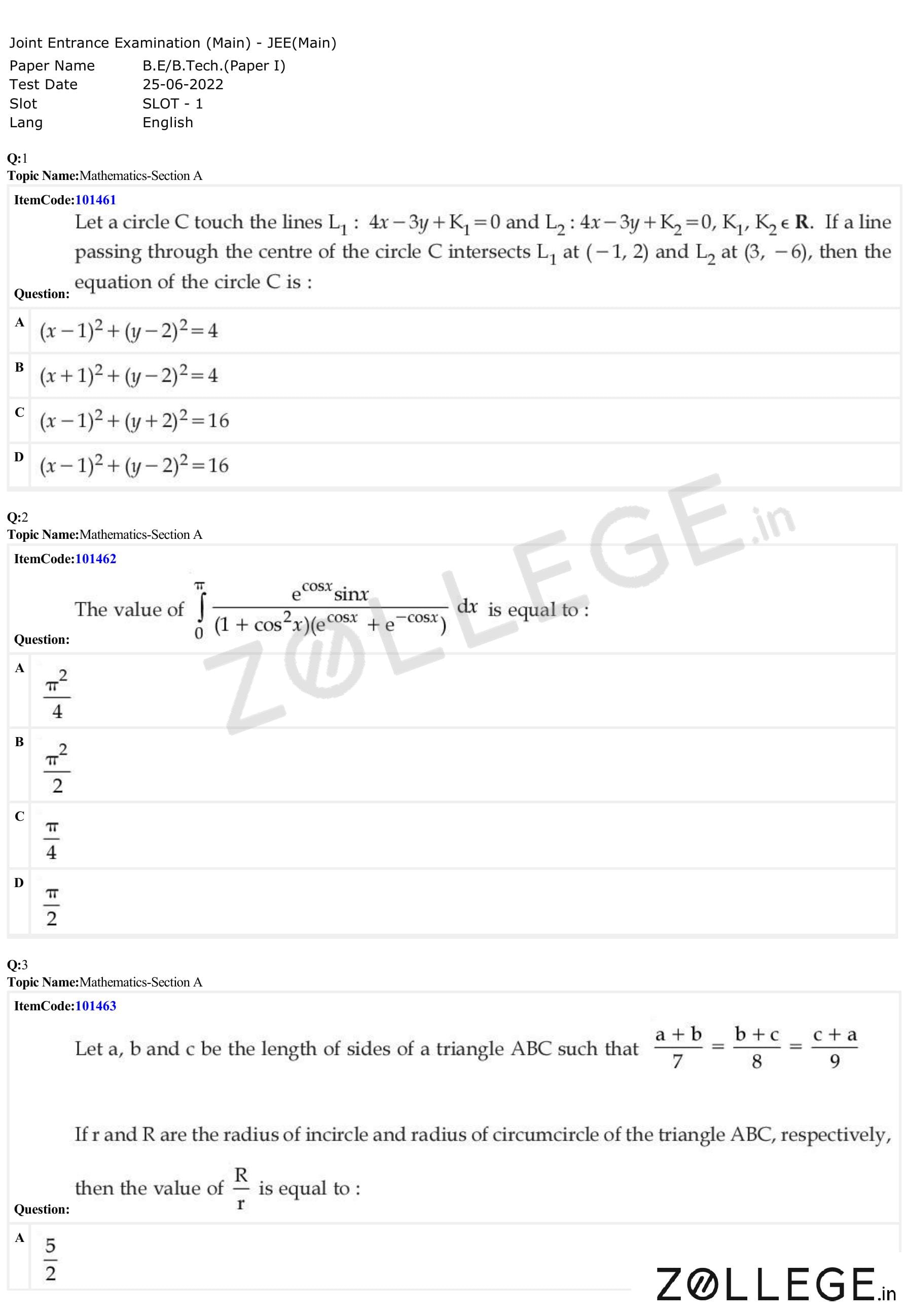
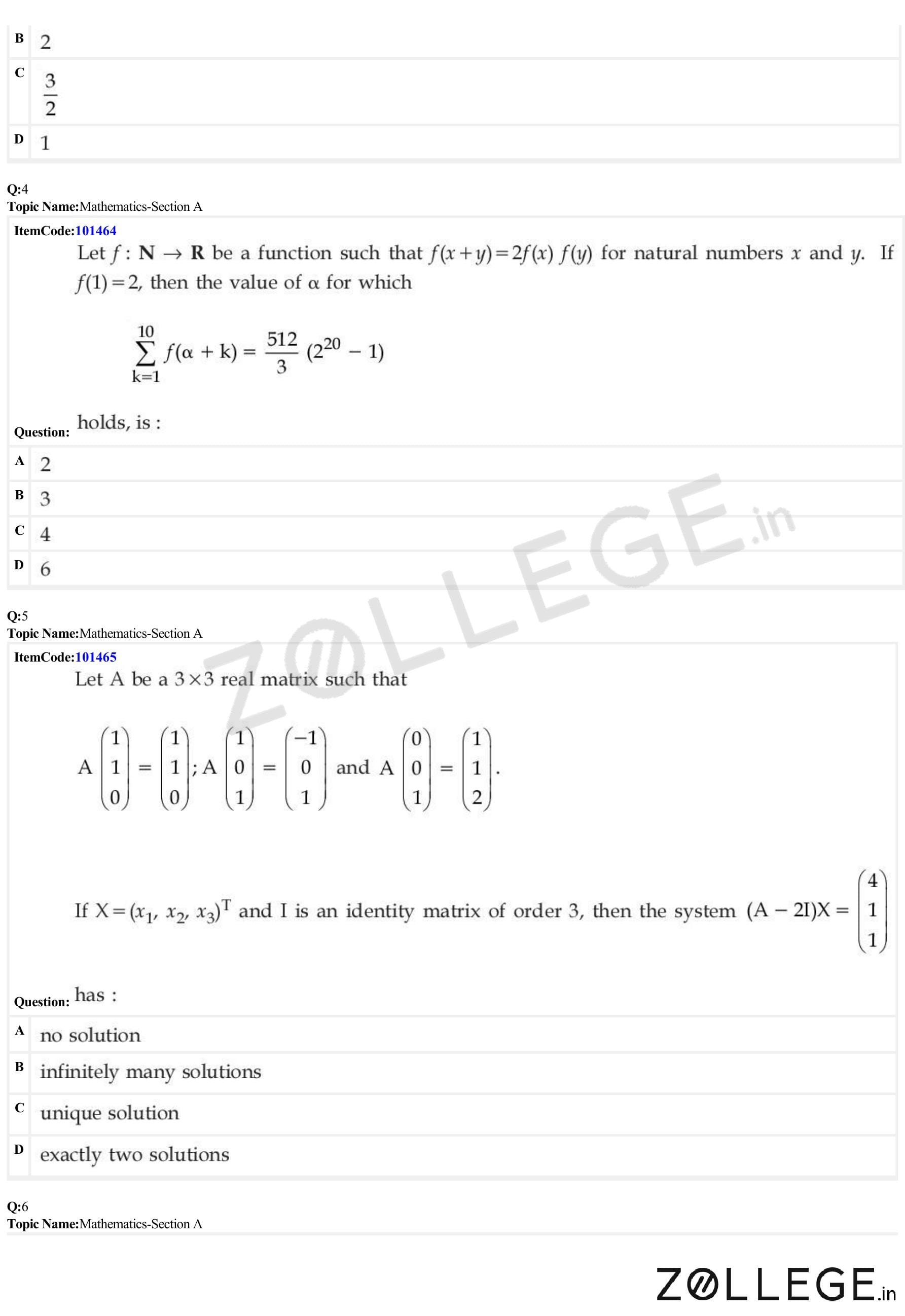
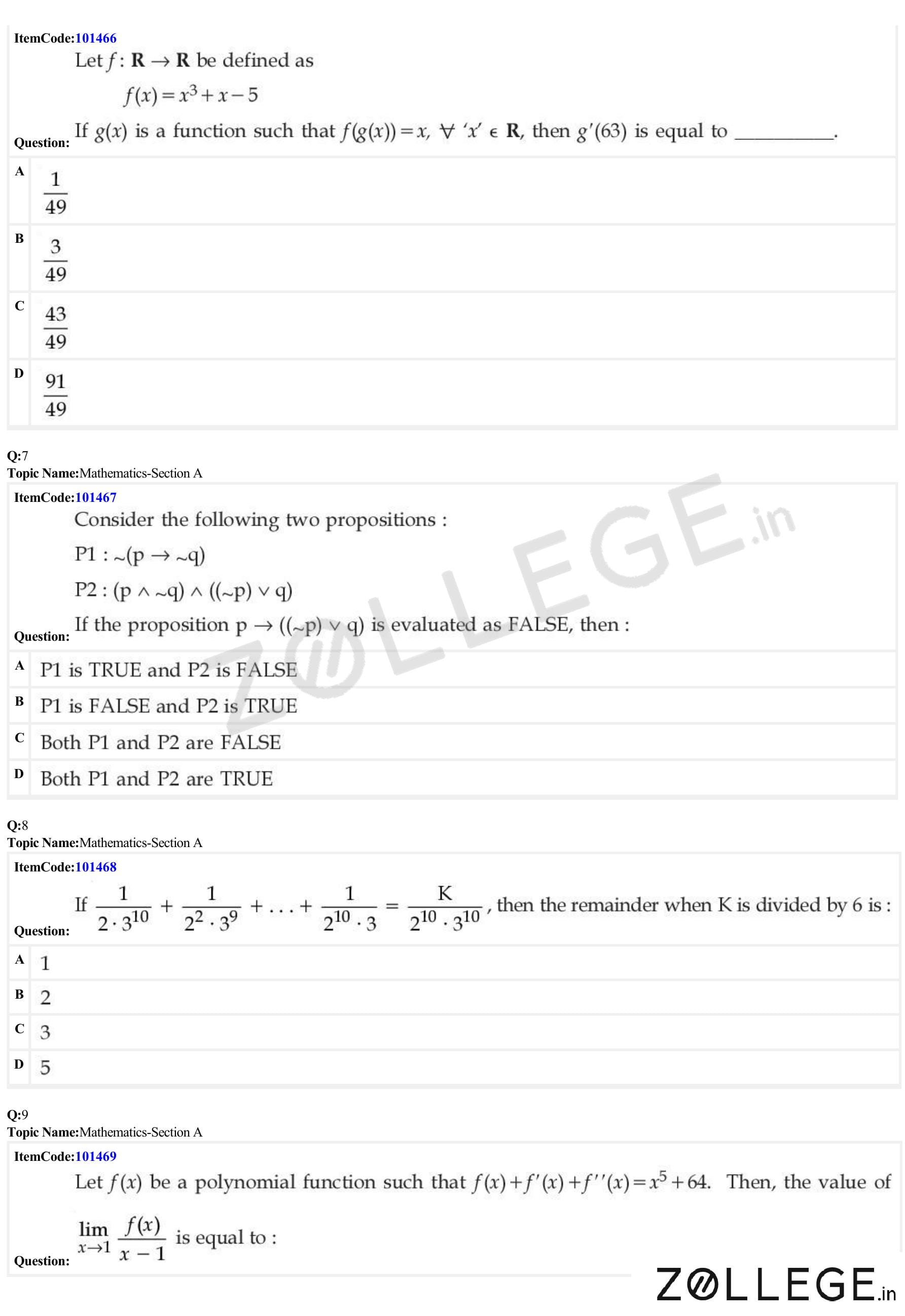
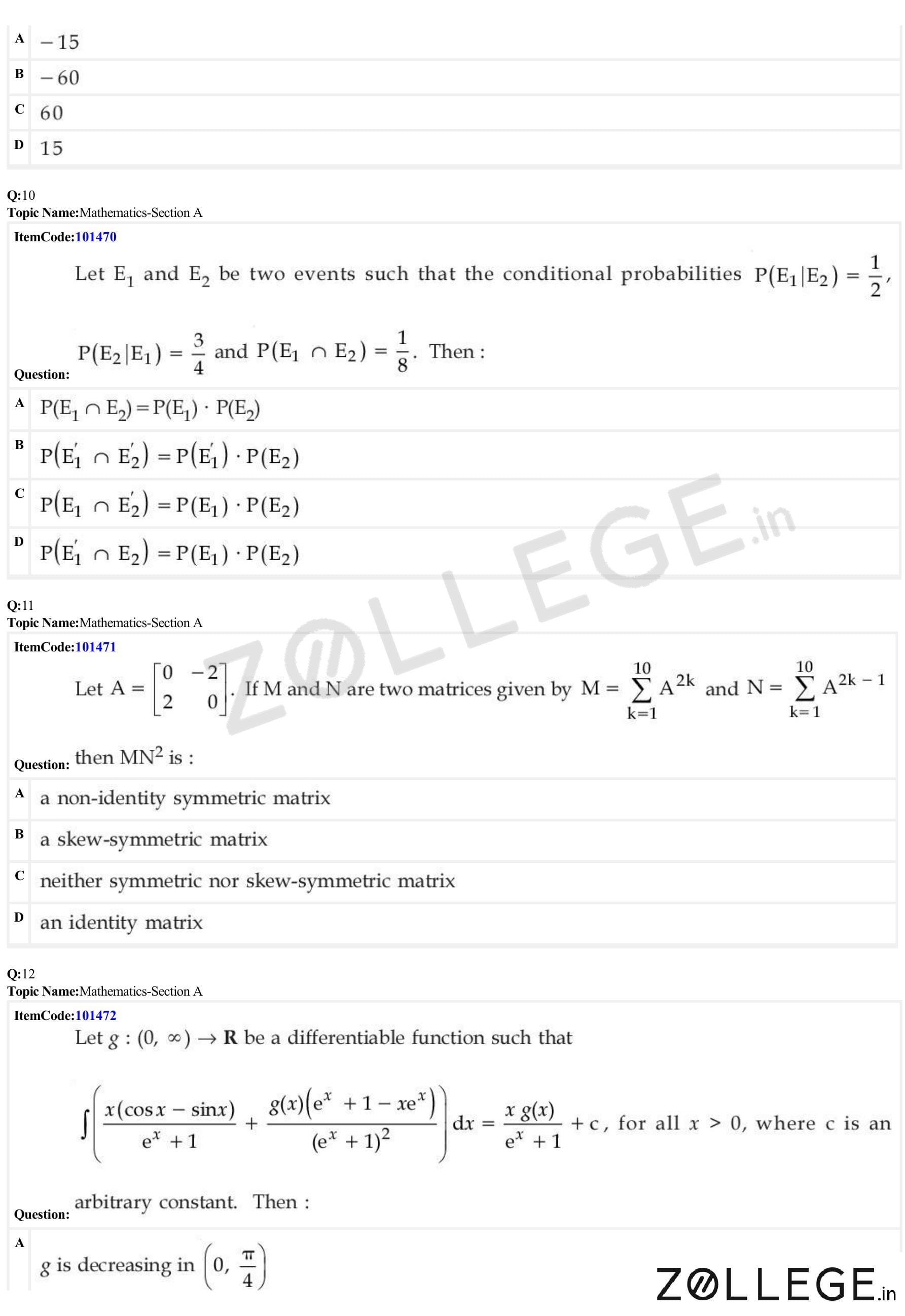
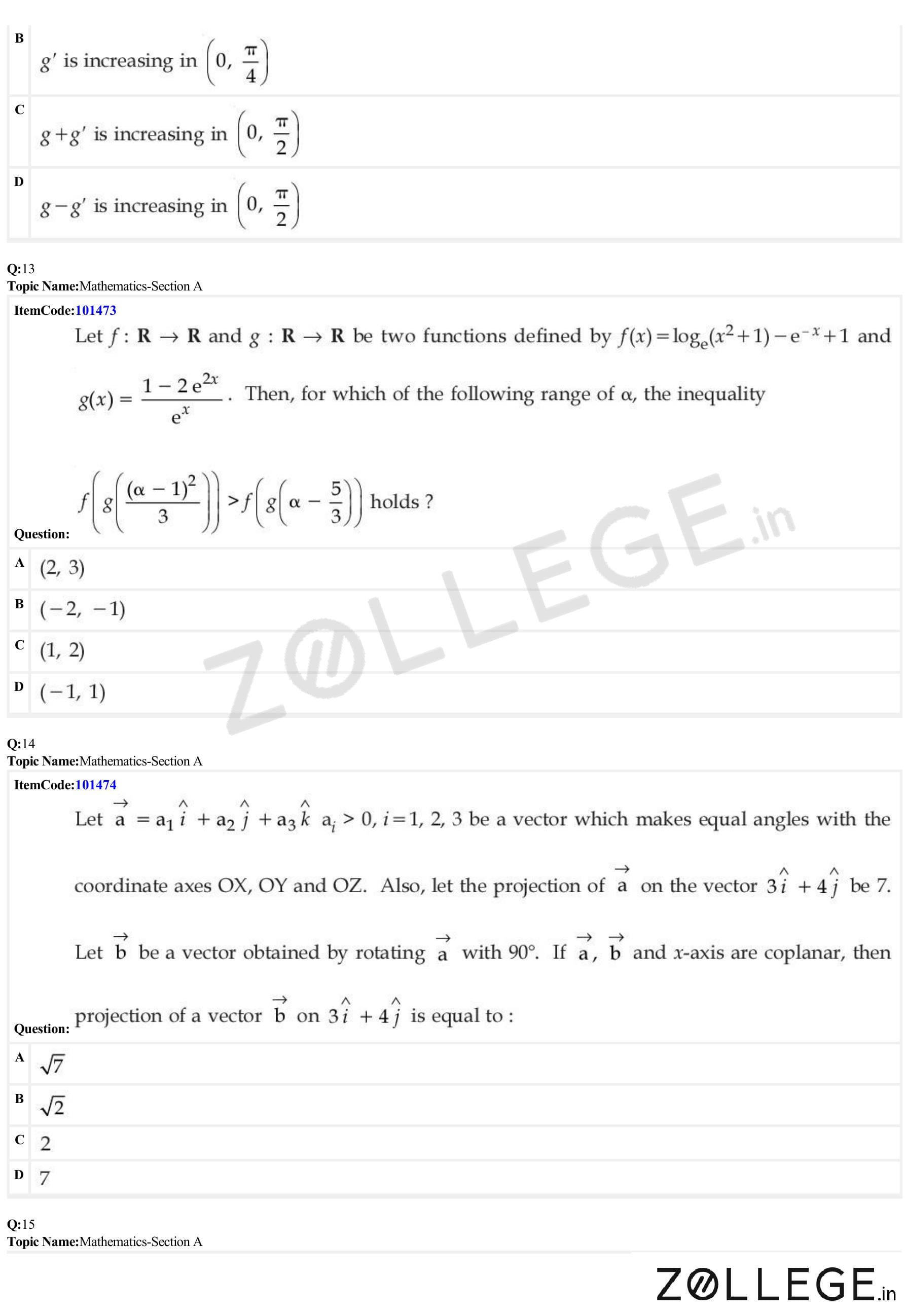
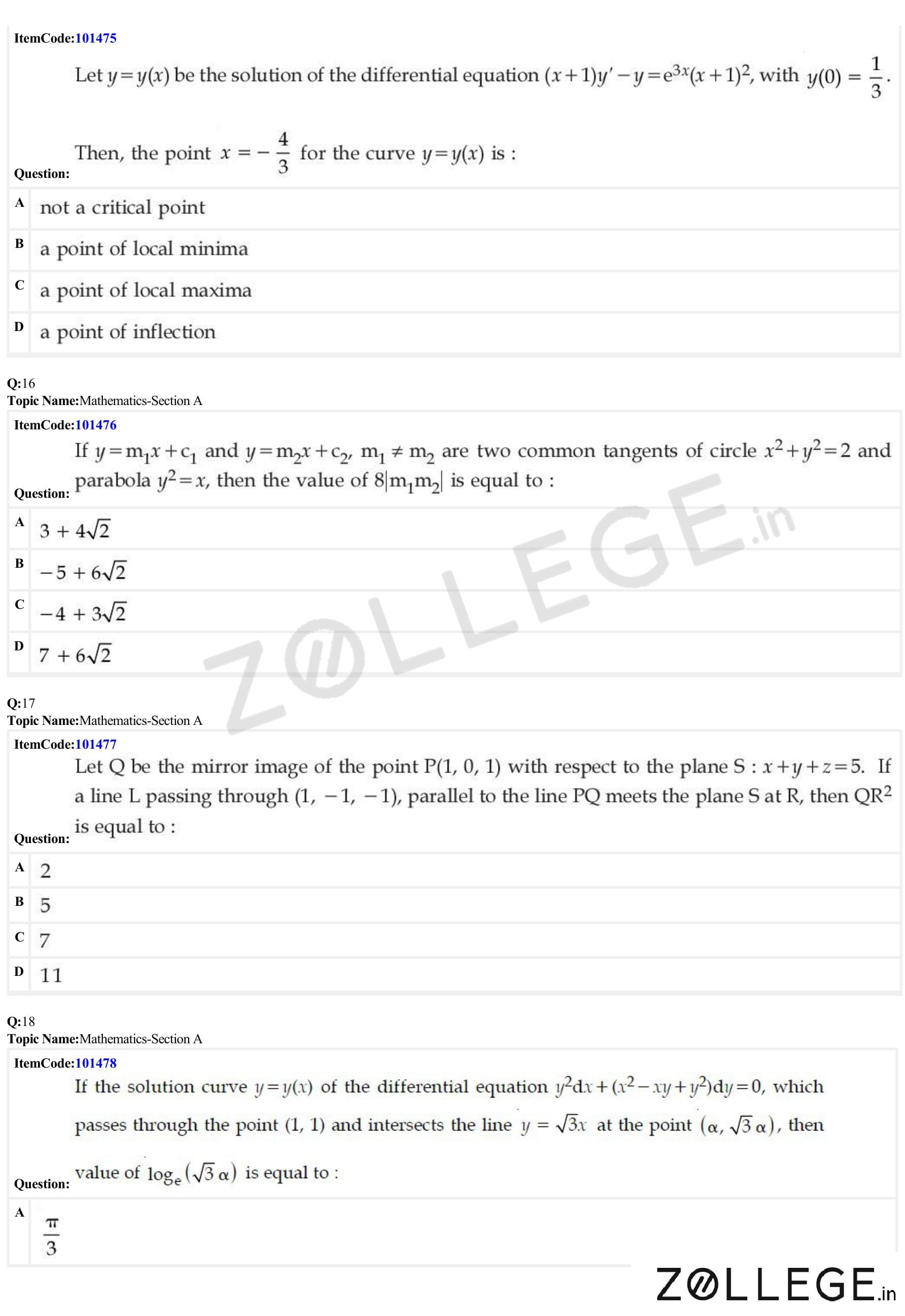
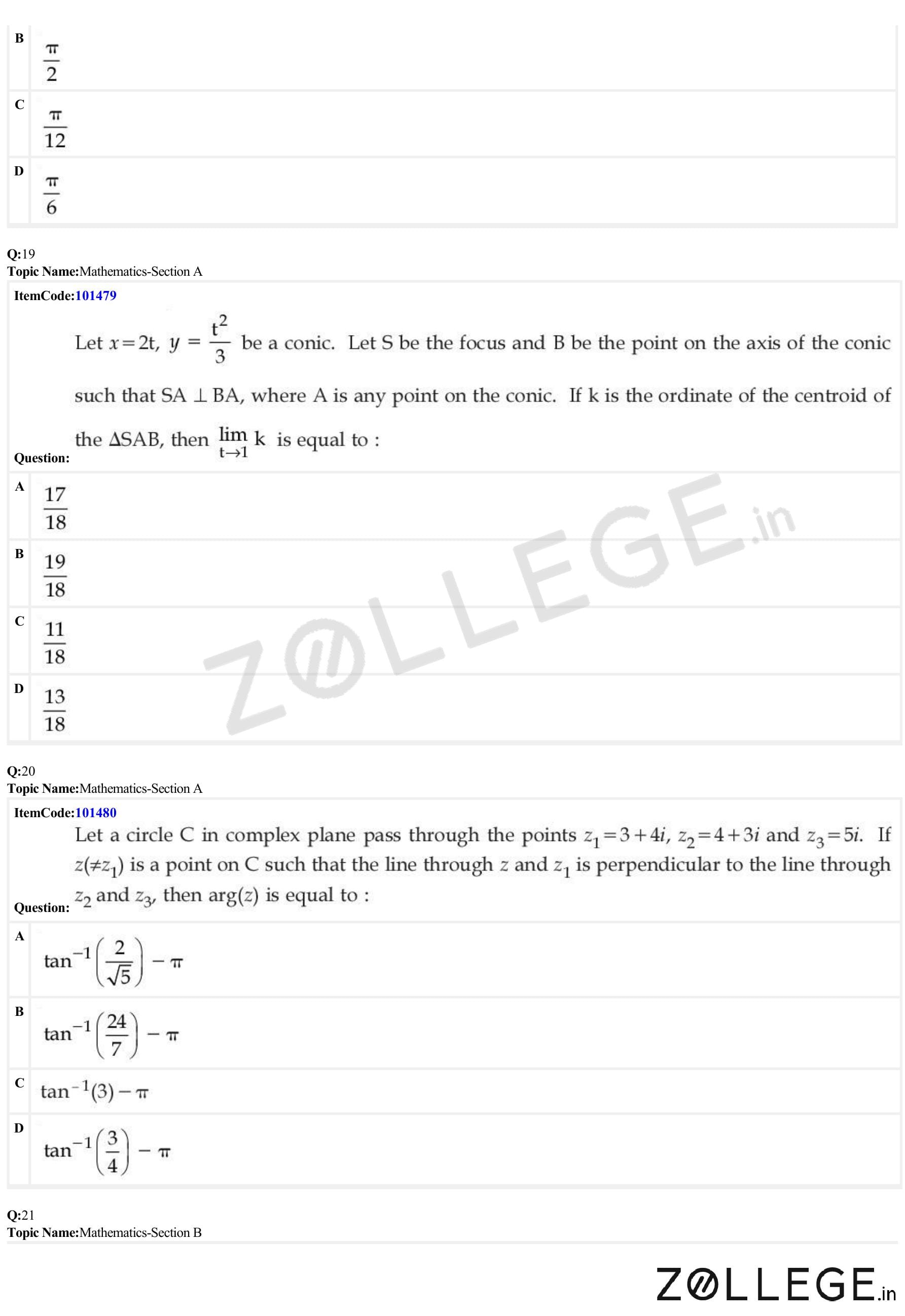
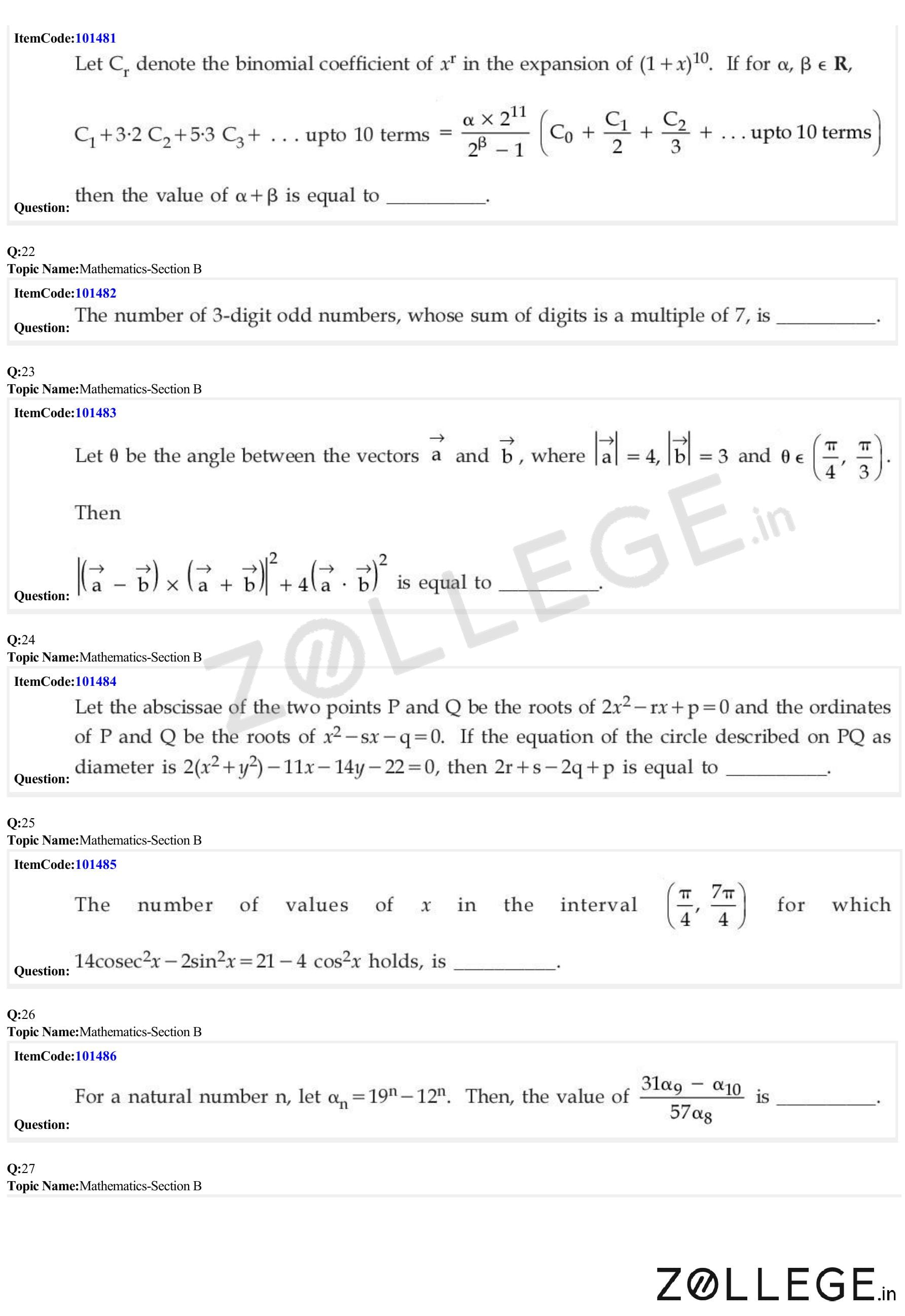
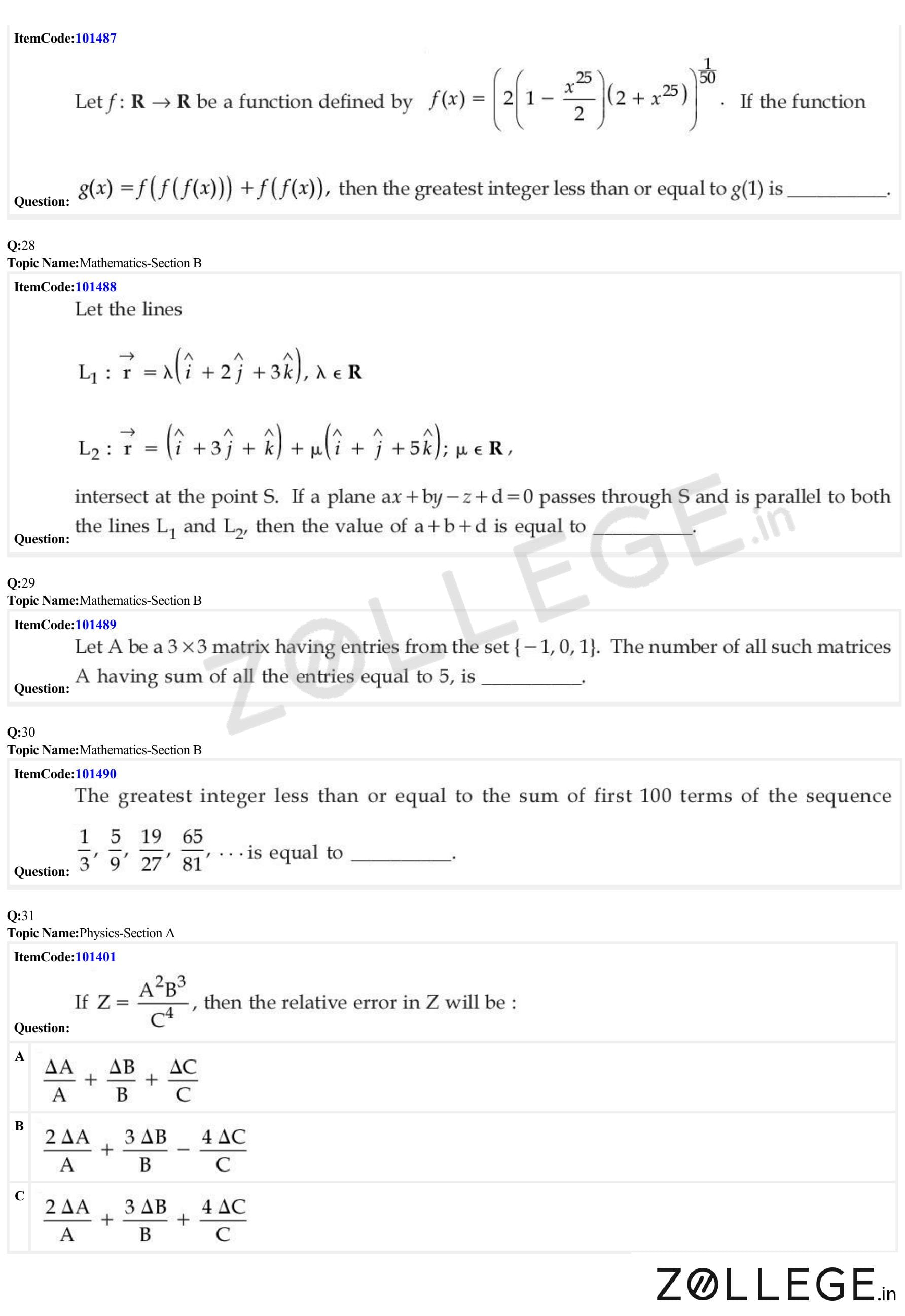
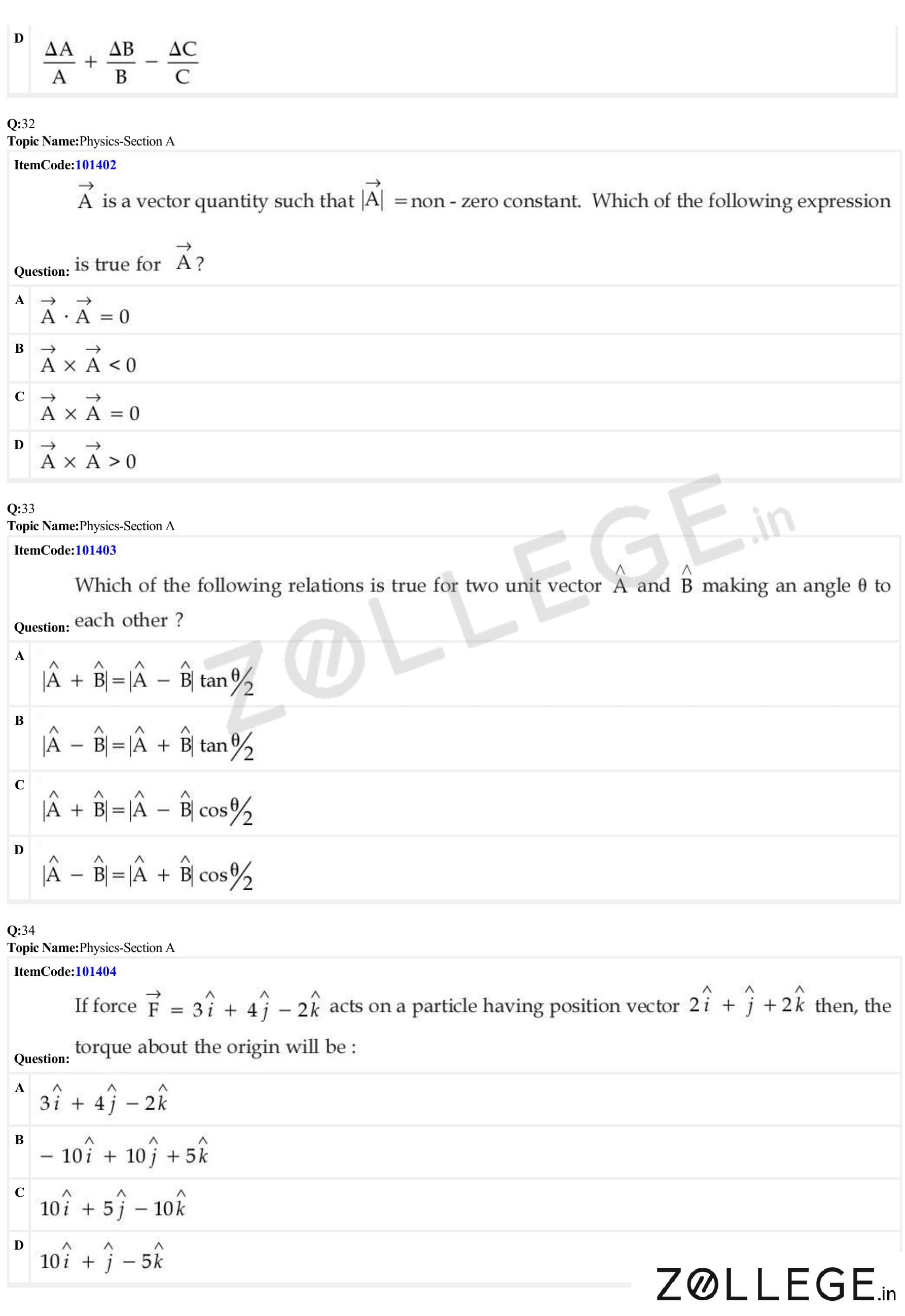
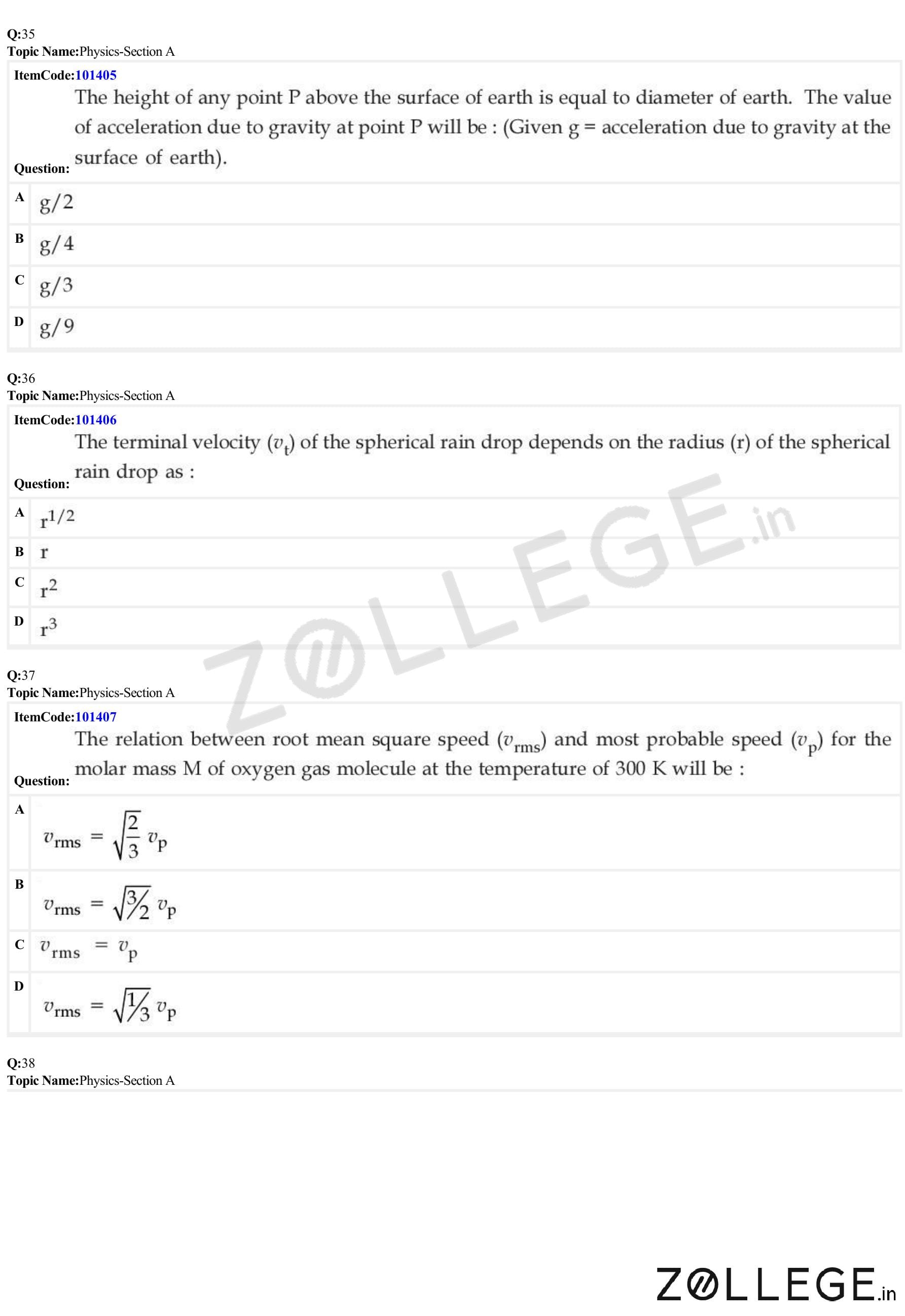
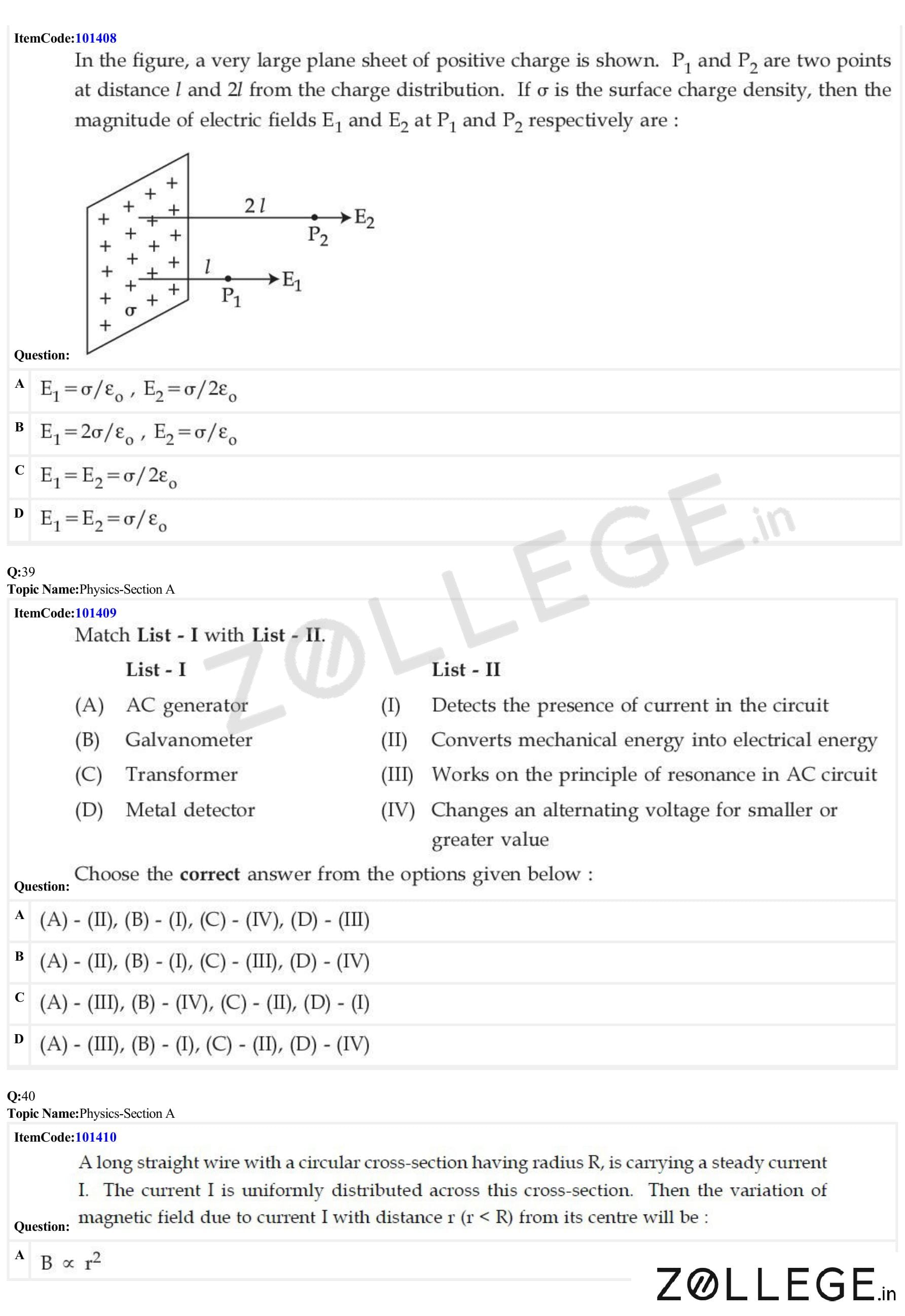
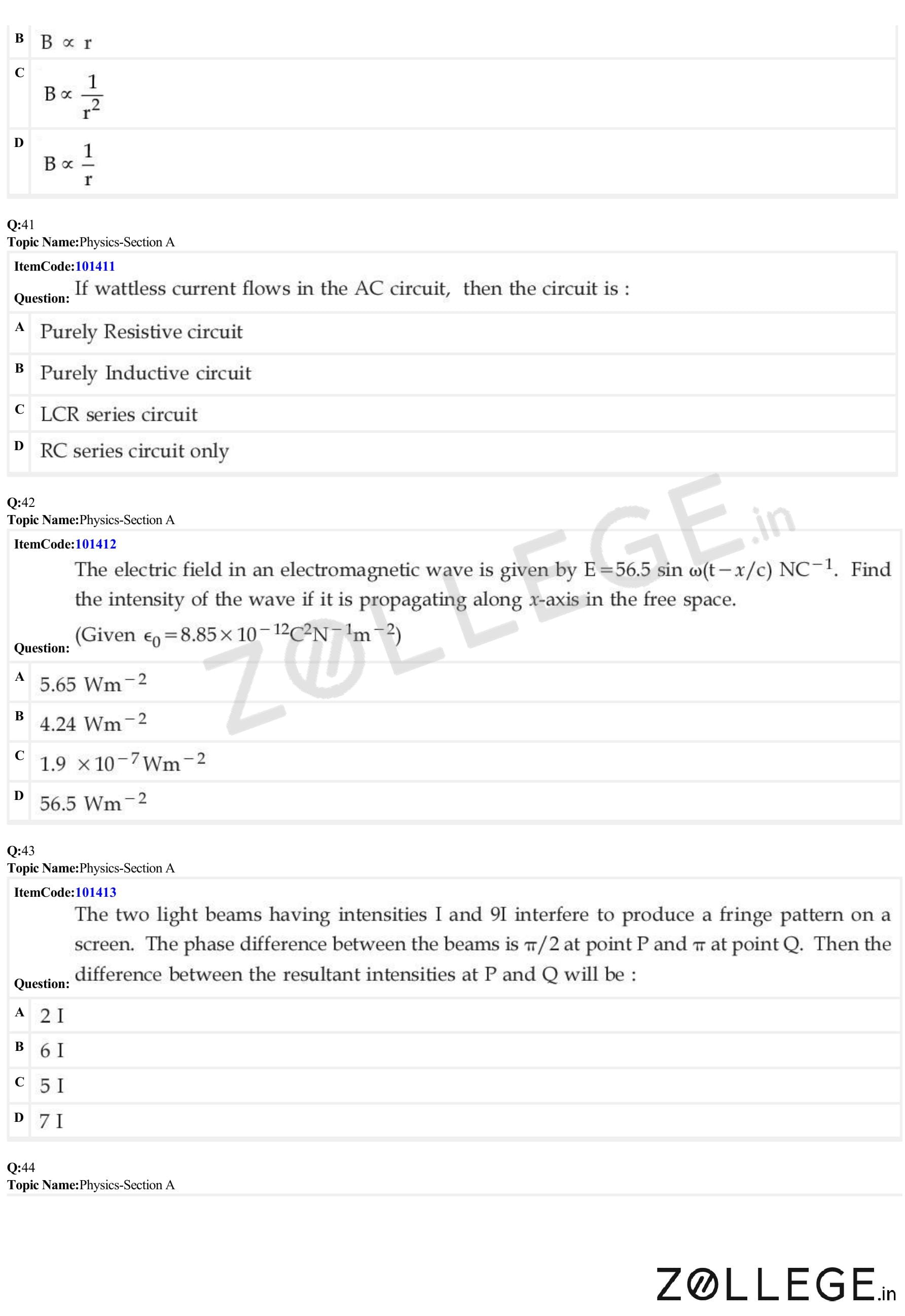
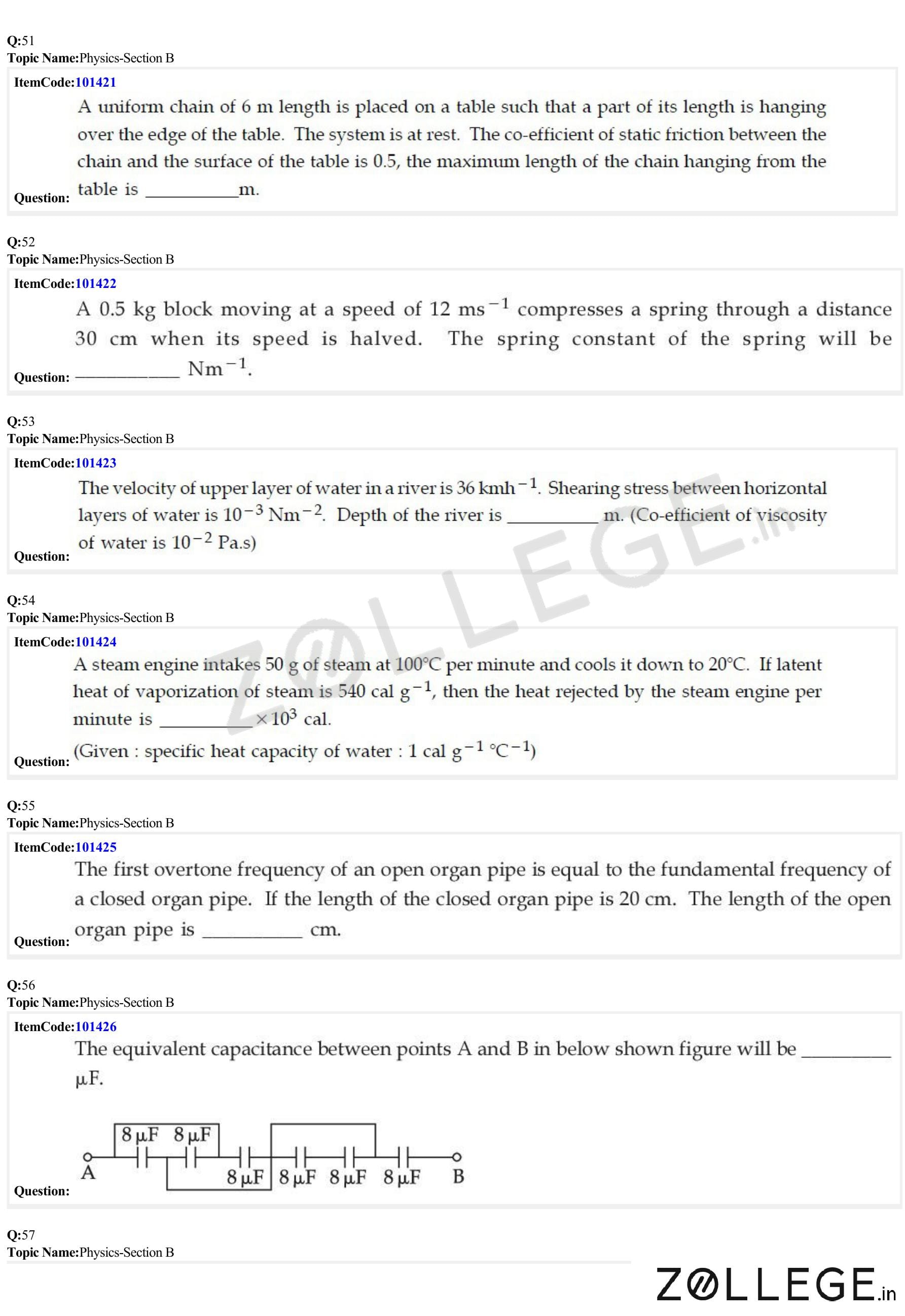
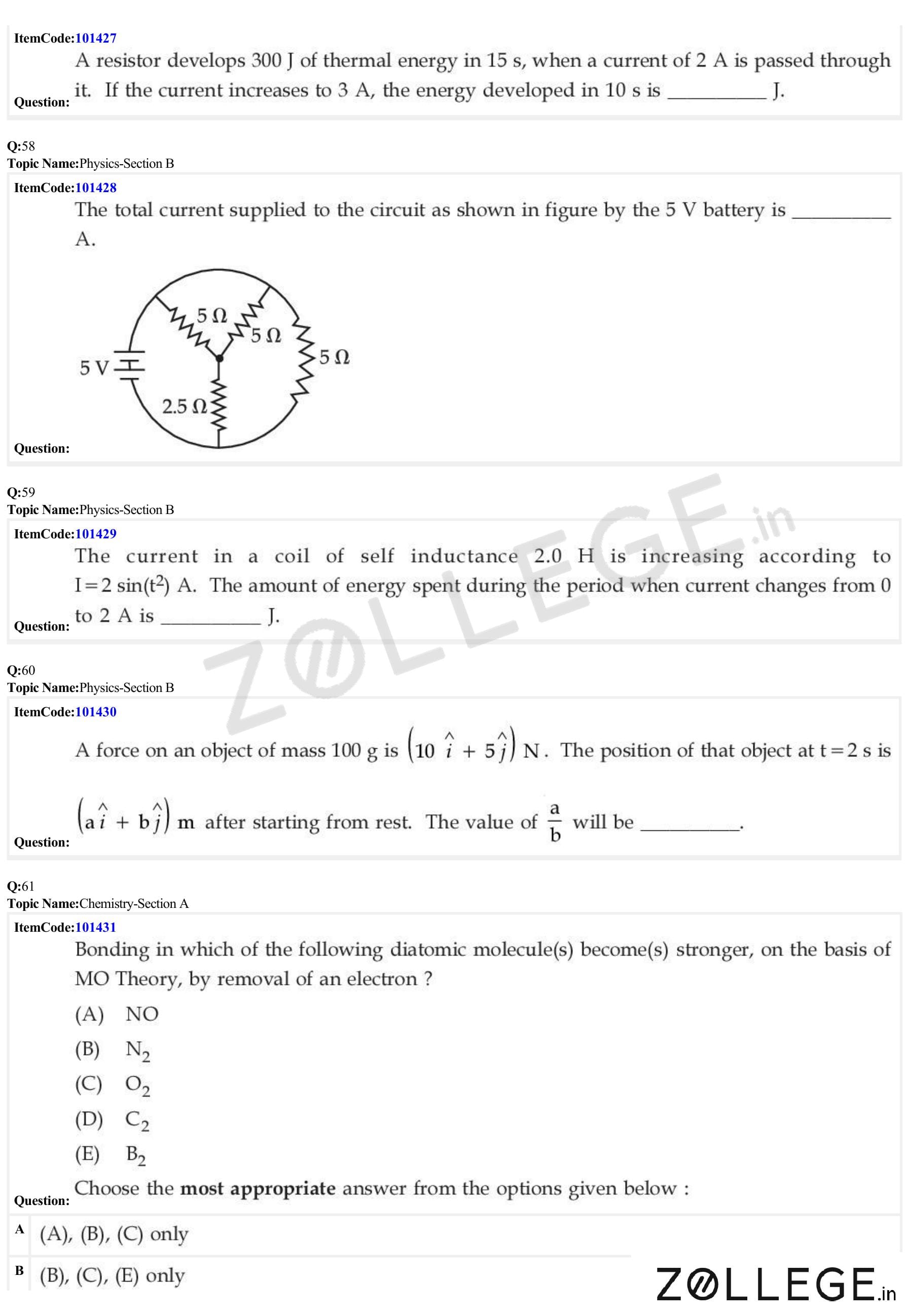
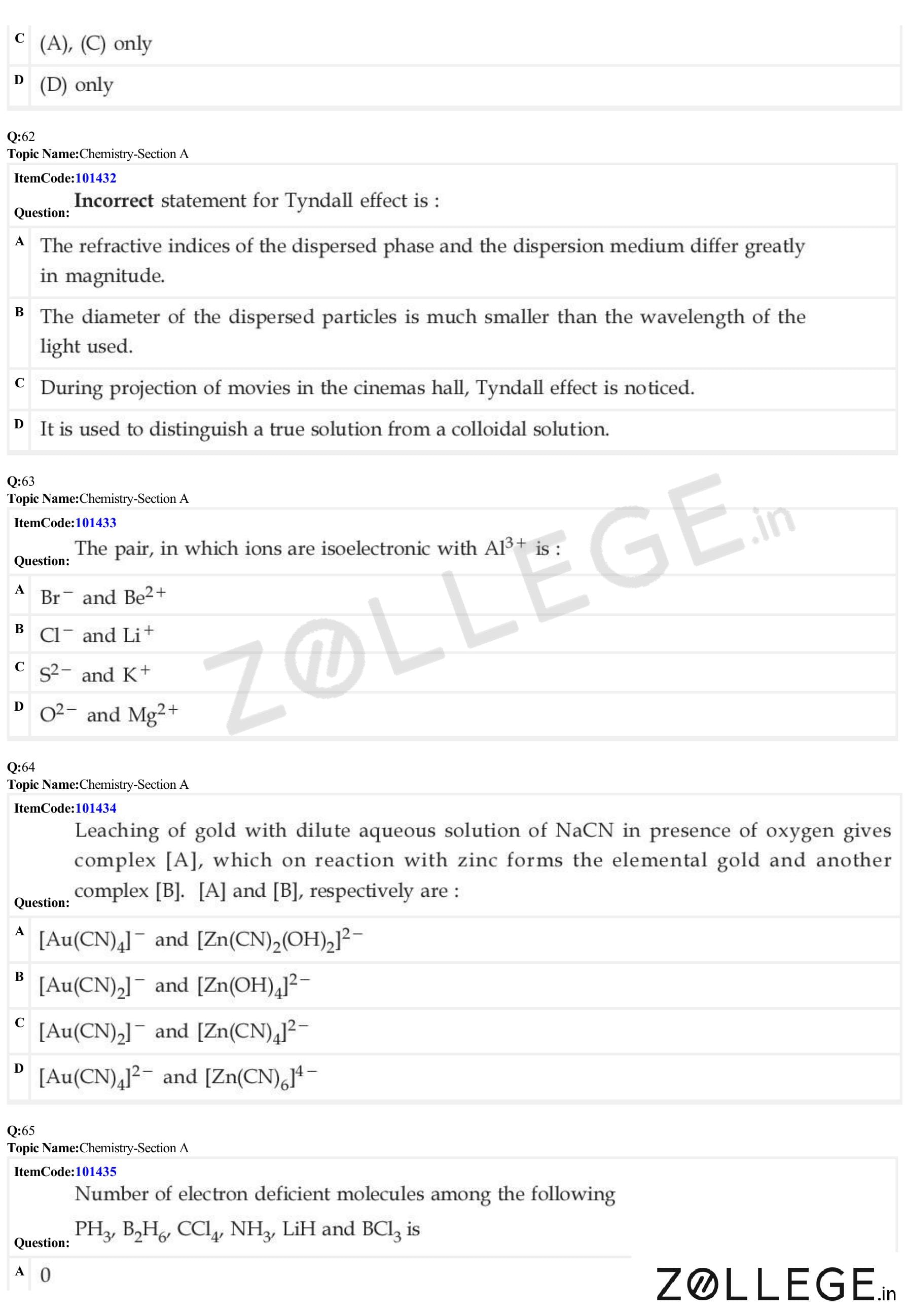
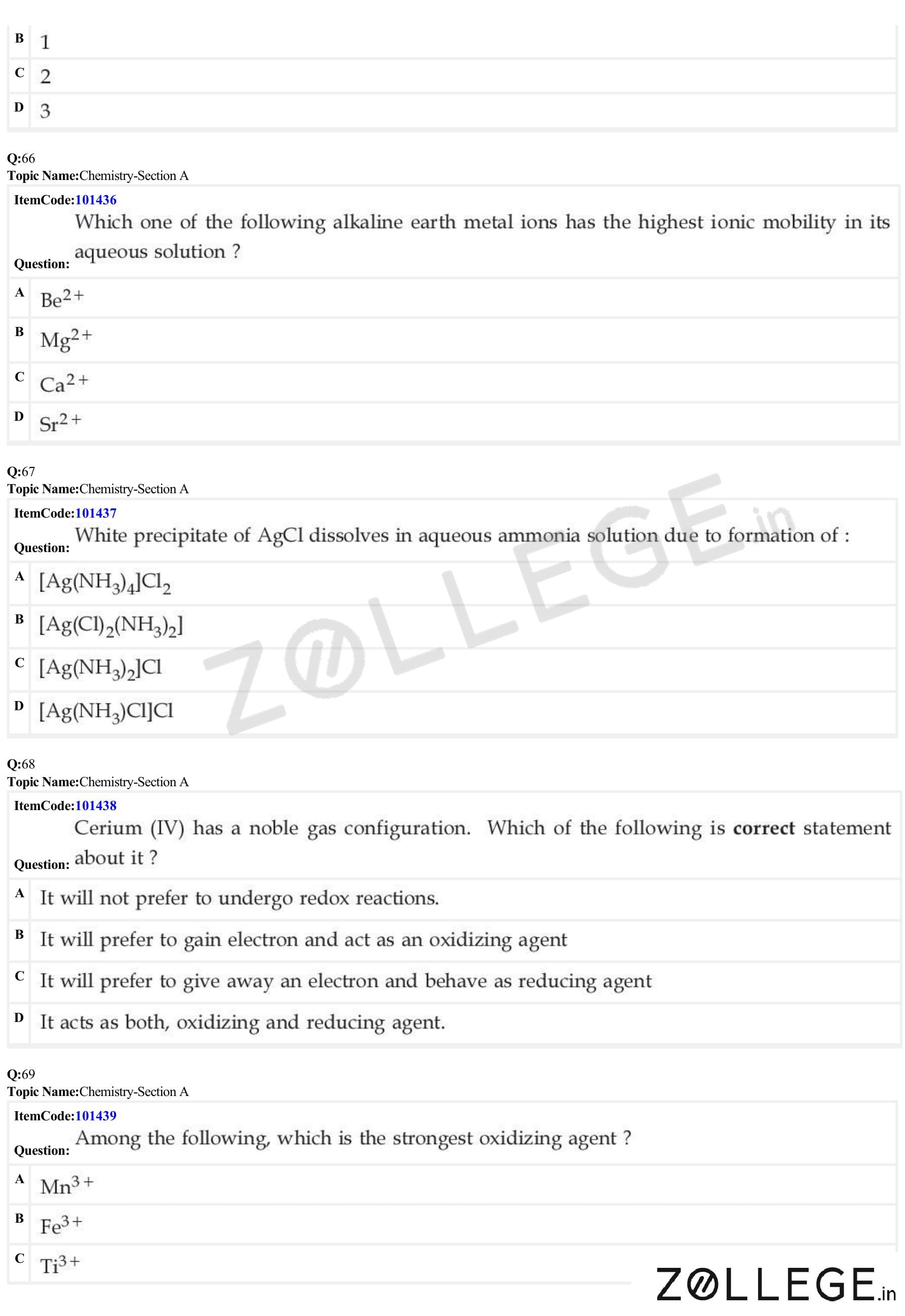
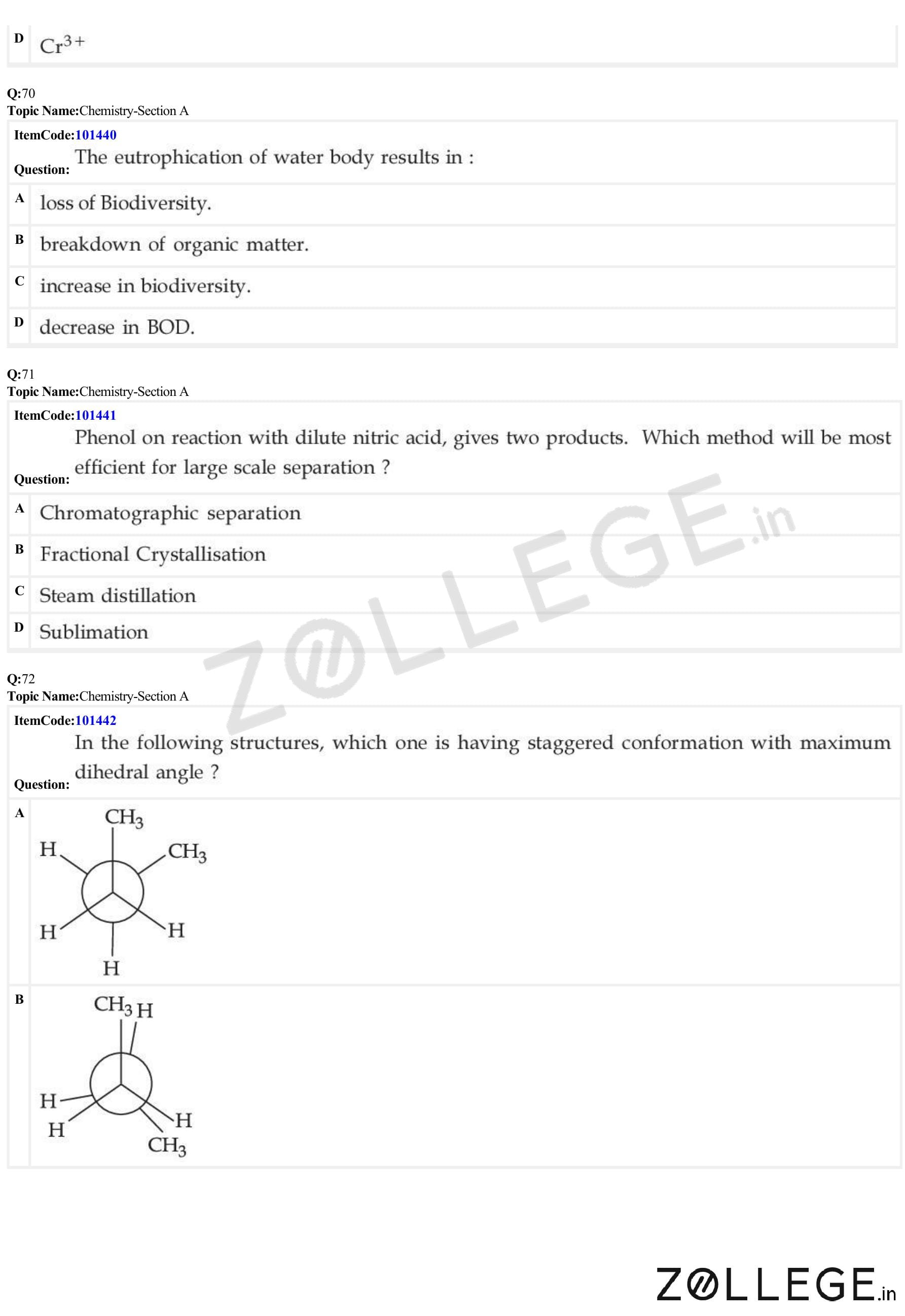
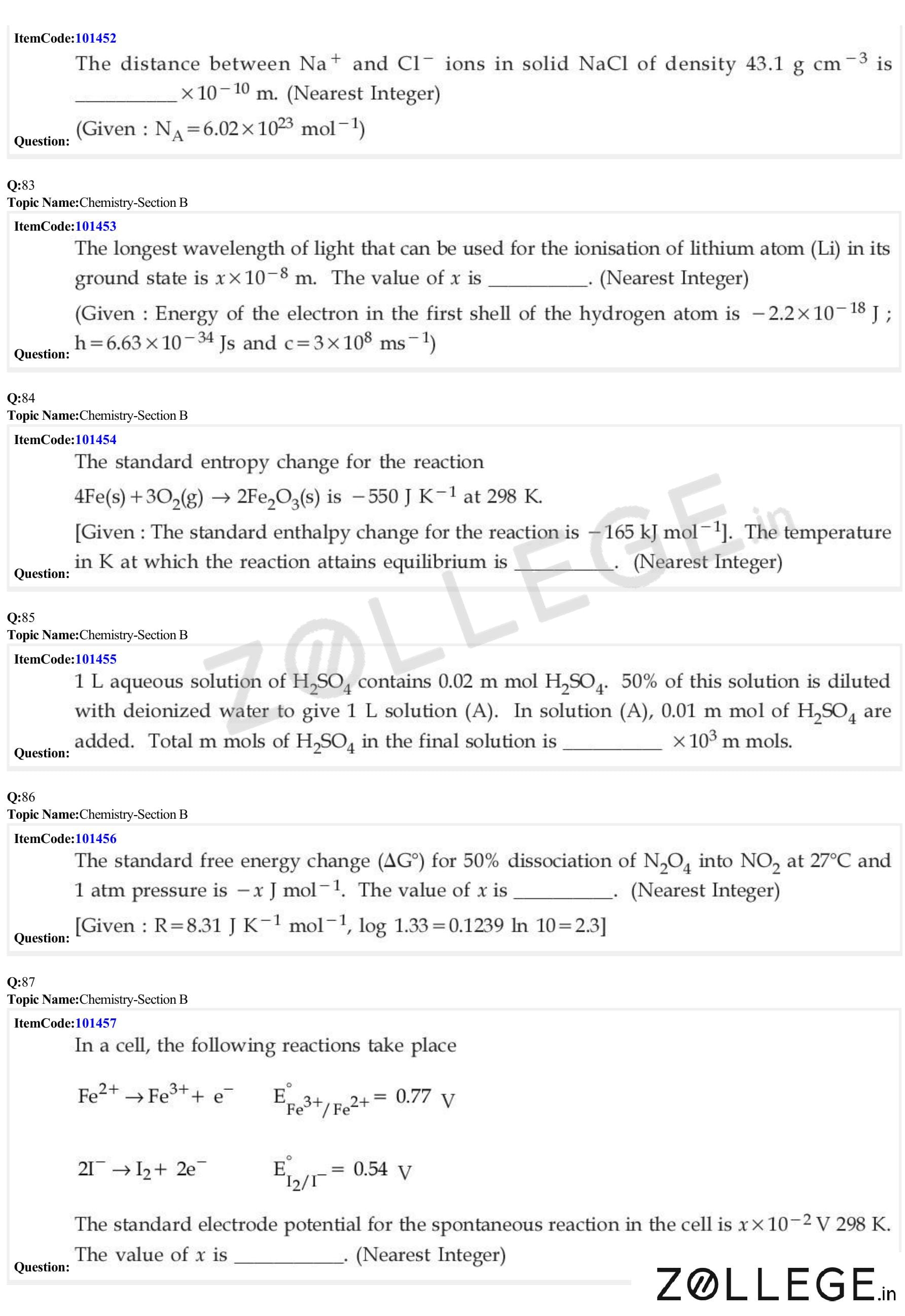
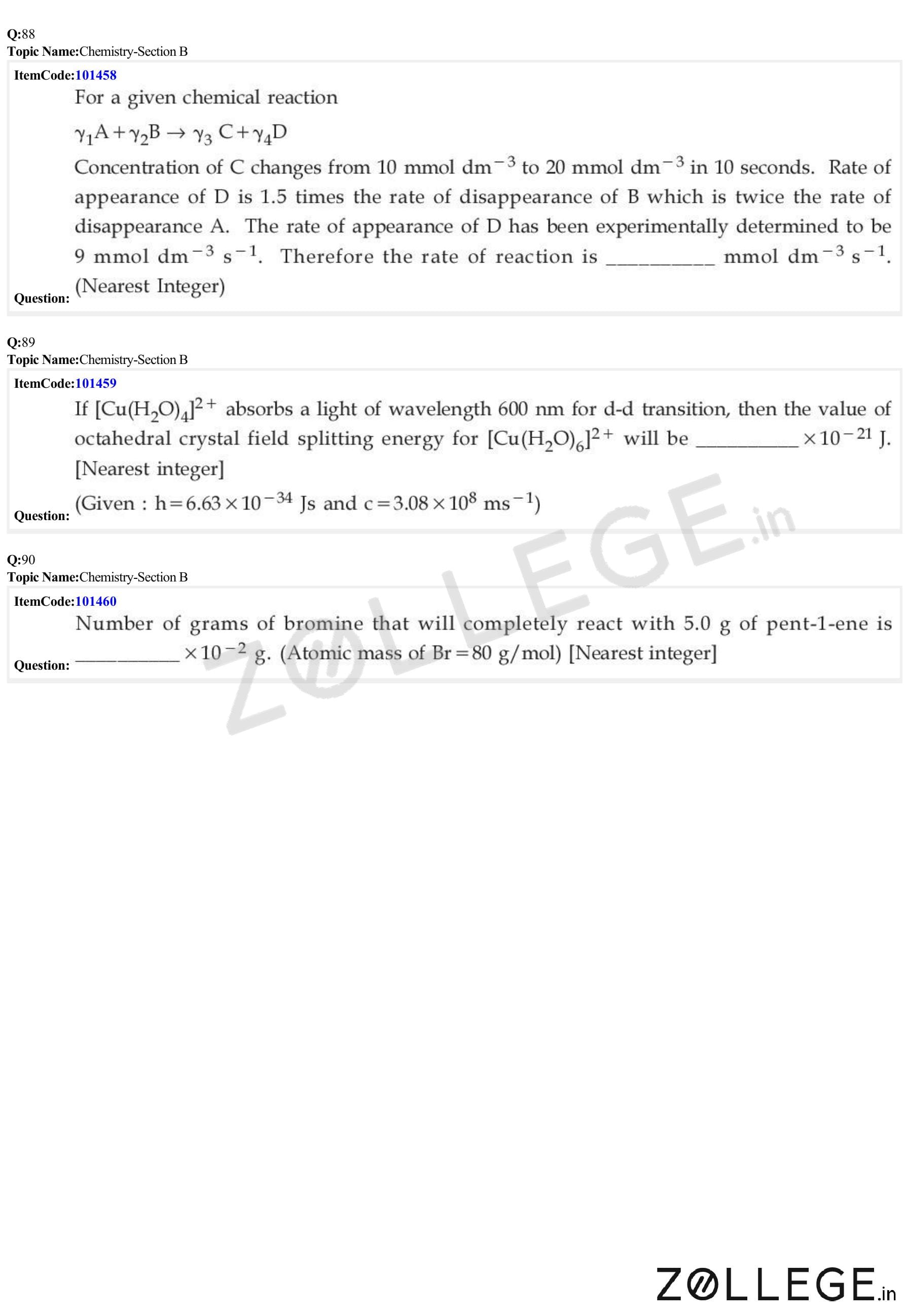
Previous Year JEE Main Question Papers
*The article might have information for the previous academic years, please refer the official website of the exam.