
JEE Main 2023 Question Paper with Solution Pdf (April 10 - Shift 1)

.jpg?tr=h-55,w-55,c-force)
Content Strategist|Tech-innovator|National Hackathon Winner | Updated On - Apr 1, 2026
The JEE Main 2023 Question Paper with Solution PDF is available here for download. The exam was successfully conducted by NTA on April 10, 2023, in the first shift.
Students can download JEE Main previous year question papers PDFs with detailed solutions to practice and improve their performance. Solving these papers helps aspirants understand the JEE Main exam pattern, analyze the difficulty level, and prepare according to the latest JEE Main syllabus.
Related Links:
Download JEE Main 2026 Session 1 Question Paper with Solution PDF
Download JEE Main 2025 Question Paper with Solution PDF
JEE Main 2023 Question Paper April 10 Shift 1 with Solution Pdf
| JEE Main 2023 Question Paper |  Download Download |
Check Solution |

Question 1:
An arc PQ of a circle subtends a right angle at its centre O. The midpoint of the arc PQ is R. If →O P = →u, O→R = →v and →OQ = →αu+ →βv, then α, β2 are the roots of the equation:
View Solution
Step 1: Identify the vectors
Given →OP = →u and →OQ = ĵ, and O⃗R bisects the angle POQ. Thus, →OR = (1⁄√2) î + (1⁄√2) ĵ.
Step 2: Express O⃗Q in terms of u⃗ and v⃗
Using O⃗Q = αu⃗ + βv⃗, substitute O⃗R and solve for α and β.
Comparing coefficients, we get:
- α + (β⁄√2) = 0
- (β⁄√2) = 1 => β = √2
Step 3: Derive the quadratic equation
α = −1, and β2 = 2.
The sum of roots = α + β2 = −1 + 2 = 1.
The product of roots = α × β2 = (−1)(2) = −2.
Thus, the quadratic equation is x2 − x − 2 = 0.
Question 2:
A square piece of tin of side 30 cm is to be made into a box without top by cutting a square from each corner and folding up the flaps to form a box. If the volume of the box is maximum, then its surface area (in cm2) is equal to:
View Solution
Step 1: Define variables and volume
Let x be the side length of the square cut from each corner. The dimensions of the box are:
Length = 30 − 2x, Breadth = 30 − 2x, Height = x.
The volume V(x) = (30 − 2x)2 × x.
Step 2: Maximize the volume
Differentiate V(x):
V′(x) = 12x2 − 240x + 900. Solve V′(x) = 0 for critical points:
x = 5 or x = 15. Since x = 15 is not valid, x = 5.
Step 3: Calculate surface area
Surface Area S(x) = (30 − 2x)2 + 4x(30 − 2x).
Substitute x = 5: S(5) = 800 cm2.
Question 3:
Let O be the origin and the position vector of the point P be −̂i−2ĵ+3k̂. If the position vectors of A, B, and C are −2̂i+ ĵ−3k̂, 2̂i+4ĵ−2k̂, and −4̂i+2ĵ−k̂ respectively, then the projection of vector O⃗P on a vector perpendicular to vectors A⃗B and A⃗C is:
View Solution
Step 1: Find A⃗B and A⃗C
A⃗B = ⟨4, 3, 1⟩, A⃗C = ⟨−2, 1, 2⟩.
Step 2: Compute A⃗B × A⃗C
A⃗B × A⃗C = 5̂i − 10ĵ + 10k̂. Magnitude = 15.
Step 3: Compute projection
Projection = |(O⃗P ⋅ (A⃗B × A⃗C))|⁄|A⃗B × A⃗C| = 3.
Question 4:
If A is a 3×3 matrix and |A| = 2, then |3adj(|3A|A2)| is equal to:
View Solution
Step 1: Calculate |3A|
|3A| = 33 × |A| = 27 × 2.
Step 2: Adj of |3A|A2
Adj(|3A|A2) = (2 × 33)2 × |adj(A)|2.
Step 3: Final calculation
|3Adj(|3A|A2)| = 311 × 610.
Question 5:
Let two vertices of a triangle ABC be (2, 4, 6) and (0,−2,−5), and its centroid be (2, 1,−1). If the image of the third vertex in the plane x + 2y + 4z = 11 is (α, β, γ), then αβ + βγ + γα is equal to:
View Solution
Step 1: Find the third vertex
Let the third vertex be (x, y, z). Solve centroid equations to find C = (4, 1, −4).
Step 2: Find image coordinates
Use the plane equation x + 2y + 4z = 11 to compute the image of (4, 1, −4) as (6, 5, 4).
Step 3: Compute αβ + βγ + γα
αβ + βγ + γα = (6 × 5) + (5 × 4) + (4 × 6) = 74.
Question 6:
The negation of the statement (p ∨ q) ∧ (q ∨ (∼ r)) is:
View Solution
Step 1: Take the Negation
The given statement is (p ∨ q) ∧ (q ∨ (∼ r)). Taking its negation: ∼ [(p ∨ q) ∧ (q ∨ (∼ r))].
Step 2: Apply De Morgan's Laws
Using De Morgan's Laws: ∼ (p ∨ q) ∨ ∼ (q ∨ (∼ r)).
Step 3: Simplify Each Term
∼ (p ∨ q) = (∼ p ∧ ∼ q) and ∼ (q ∨ (∼ r)) = (∼ q ∧ r).
Rewriting: (∼ p ∧ ∼ q) ∨ (∼ q ∧ r).
Step 4: Use the Distributive Property
Distribute the terms: = (∼ p ∨ r) ∧ (∼ q).
Question 7:
The shortest distance between the lines x + 2 / 1 = y / −2 = z − 5 / 2 and x − 4 / 1 = y − 1 / 2 = z + 3 / 0 is:
View Solution
Step 1: Identify Given Lines
The direction vectors of the lines are l1 = ⟨1, −2, 2⟩ and l2 = ⟨1, 2, 0⟩. Position vectors are A = ⟨−2, 0, 5⟩ and B = ⟨4, 1, −3⟩.
Step 2: Use the Shortest Distance Formula
The formula is:
d = |(b − a) • (l1 × l2)| / |l1 × l2|.
Step 3: Compute Cross Product
l1 × l2 = ⟨−4, −2, 4⟩.
Step 4: Compute Distance
d = |6| = 9.
Question 8:
If the coefficient of x7 in (ax − 1 / bx2)13 and the coefficient of x−5 in (ax + 1 / bx2)13 are equal, then a4b4 is equal to:
View Solution
Step 1: Expand the General Term
Tr+1 = C13r * (ax)13-r (−1 / bx2)r.
Step 2: Equate Coefficients
For x7: r = 6. For x−5: r = 11.
Solve the equation to find a4b4 = 22.
Question 9:
A line segment AB of length λ moves such that the points A and B remain on the periphery of a circle of radius γ. Then the locus of the point, that divides the line segment AB in the ratio 2 : 3, is a circle of radius:
View Solution
Step 1: Use Geometry and Ratios
Determine that P divides AB in a given ratio, leading to locus equations.
Step 2: Apply Geometry Formulas
Radius = √19λ / 5.
Question 10:
For the system of linear equations 2x − y + 3z = 5, 3x + 2y − z = 7, 4x + 5y + αz = β, which of the following is NOT correct?
View Solution
Step 1: Analyze Determinant
Find Δ = 7(α + 5).
Step 2: Apply Conditions for Solutions
For α = −5, β = 8: Inconsistent.
For α = −6, β = 9: Incorrect.
Correct answers are evaluated based on determinant properties.
Question 11:
Let the first term a and the common ratio r of a geometric progression be positive integers. If the sum of squares of its first three terms is 33033, then the sum of these terms is equal to:
View Solution
Step 1: Represent the terms of the GP
Let the terms be a, ar, and ar². The sum of squares is:
a² + (ar)² + (ar²)² = 33033
Step 2: Simplify the equation
a²(1 + r² + r⁴) = 33033. Factorize 33033: 33033 = 11² × 3 × 7 × 13.
This gives a² = 11² = 121, so a = 11.
Step 3: Solve for r
1 + r² + r⁴ = 273. Factorize: r²(r² + 1) = 272. Let r² = 16, so r = 4.
Step 4: Calculate the sum
Sum = a(1 + r + r²) = 11(1 + 4 + 16) = 231.
Question 12:
Let P be the point of intersection of the line x+3/3 = y+2/1 = 1−z/2 and the plane x + y + z = 2. If the distance of the point P from the plane 3x − 4y + 12z = 32 is q, then q and 2q are the roots of the equation:
View Solution
Step 1: Find the coordinates of P
Using the line equations, express P as:
x = 3λ − 3, y = λ − 2, z = 1 − 2λ. Substituting into the plane equation x + y + z = 2, solve for λ = 3.
Thus, P = (6, 1, −5).
Step 2: Distance from P to the plane
Use the distance formula: q = |3(6) − 4(1) + 12(−5) − 32| / √(3² + (−4)² + 12²), giving q = 6.
Step 3: Derive the quadratic equation
The roots are q and 2q. Sum of roots = 18, product = 72.
Equation: x² − 18x + 72 = 0.
Question 13:
Let f be a differentiable function such that x²f(x) − x = 4∫₀ˣ tf(t) dt, f(1) = 2/3. Then 18f(3) is equal to:
View Solution
Step 1: Differentiate the equation
x²f'(x) + 2xf(x) − 1 = 4xf(x). Rearrange to get:
x²f'(x) − 2xf(x) − 1 = 0.
Step 2: Solve the differential equation
Rewriting: f'(x) − (2/x)f(x) = 1/x². The integrating factor is 1/x². Solve to find:
f(x) = −1/(3x) + Cx².
Step 3: Apply initial condition
Substitute f(1) = 2/3 to find C = 1. Thus, f(x) = −1/(3x) + x².
Step 4: Find 18f(3)
f(3) = −1/9 + 9 = 80/9. Multiply: 18f(3) = 160.
Question 14:
Let N denote the sum of the numbers obtained when two dice are rolled. If the probability that 2N < N! is m/n, where m and n are coprime, then 4m − 3n is equal to:
View Solution
Step 1: Identify valid values of N
2N < N! is true for N ≥ 4.
Step 2: Calculate probabilities
P(N ≥ 4) = 1 − P(N < 4). Compute P(N < 4) using possible outcomes:
P(N < 4) = 3/36. Thus, P(N ≥ 4) = 33/36 = 11/12.
Step 3: Calculate 4m − 3n
m = 11, n = 12. Compute: 4m − 3n = 44 − 36 = 8.
Question 15:
If I(x) = ∫esin²xcosx(sin2x − sinx)dx and I(0) = 1, then I(π/3) is equal to:
View Solution
Step 1: Simplify the integral
Use substitution sin²x = t. Solve the integral to find:
I = esin²xcosx + C.
Step 2: Apply initial condition
I(0) = e0 + C = 1. Solve for C = 0. Thus, I = esin²xcosx.
Step 3: Evaluate I(π/3)
I(π/3) = e3/4 × 1/2 = 1/2e³⁄₄.
Question 16:
96 cos(π/33) cos(2π/33) cos(4π/33) cos(8π/33) cos(16π/33) is equal to:
View Solution
Step 1: Use the General Formula
The formula for cosA cos 2A ... cos 2n−1A is given by:
sin(2nA) / [2nsinA].
Step 2: Simplify the Expression
For A = π/33 and n = 5:
96 cos(π/33) cos(2π/33) ... cos(16π/33) = 96 sin(32π/33) / [32 sin(π/33)].
Using sin(π − x) = sin(x):
sin(32π/33) = sin(π/33).
Step 3: Final Calculation
= 96 sin(π/33) / [32 sin(π/33)] = 96 / 32 = 3.
Question 17:
Let the complex number z = x + iy be such that (2z − 3i) / (2z + i) is purely imaginary. If x + y2 = 0, then y4 + y2 − y is equal to:
View Solution
Step 1: Set the Real Part to Zero
The condition for purely imaginary numbers implies the real part of (2z − 3i) / (2z + i) must be zero.
Step 2: Substitute z = x + iy
Simplify (2z − 3i) / (2z + i) = [2x + 2yi − 3i] / [2x + i(2y + 1)]. Rationalize the denominator.
Step 3: Solve the Equation
Expand and simplify to find: x = −y2. Substitute into the given condition x + y2 = 0 and solve for y.
y satisfies y4 + y2 − y = 3/4.
Question 18:
If f(x) = [(tan 1°)x + loge(123)] / [x loge(1234) − (tan 1°)], x > 0, then the least value of f(f(x)) + f(f(4/x)) is:
View Solution
Step 1: Compute f(f(x))
Substitute f(x) into itself and simplify.
Step 2: Evaluate f(f(4/x))
Using the same method, find f(f(4/x)).
Step 3: Use AM-GM Inequality
f(f(x)) + f(f(4/x)) ≥ 4 by the AM-GM inequality.
Question 19:
The slope of the tangent at any point (x, y) on a curve y = y(x) is (x2 + y2) / (2xy), x > 0. If y(2) = 0, then a value of y(8) is:
View Solution
Step 1: Rewrite the Differential Equation
Substitute y = vx into dy/dx and separate variables.
Step 2: Solve the Equation
Integrate both sides to find y as a function of x. Apply the initial condition y(2) = 0 to find the constant of integration.
Step 3: Calculate y(8)
Substitute x = 8 into the solution and simplify to find y = 4√3.
Question 20:
Let the ellipse E: x2 + 9y2 = 9 intersect the positive x- and y-axes at the points A and B respectively. Let the major axis of E be a diameter of the circle C. Let the line passing through A and B meet the circle C at the point P. If the area of the triangle with vertices A, P, and the origin O is m/n, where m and n are coprime, then m − n is equal to:
View Solution
Step 1: Find the Line AB
The line AB is x/3 + y/1 = 1, or x + 3y = 3.
Step 2: Intersection of Line and Circle
Solve the system of equations for the line and circle x2 + y2 = 9 to find P.
Step 3: Area of the Triangle
Calculate the area of △AOP using the formula (1/2) × Base × Height. Simplify to find m − n = 17.
Question 21:
Some couples participated in a mixed doubles badminton tournament. If the number of matches played, so that no couple is in a match, is 840, then the total number of persons who participated in the tournament is:
View Solution
Step 1: Represent the number of couples as n
The total number of ways matches can be formed is given by:
(n choose 2) × (n−2 choose 2) × 2 = 840.
Step 2: Simplify the equation
n(n − 1)(n − 2)(n − 3) = 3360. Solve for n by factorizing:
n = 8.
Step 3: Calculate the total number of persons
The total number of persons is 2n = 16.
Question 22:
The number of elements in the set {n ∈ Z : |n² − 10n + 19| < 6} is:
View Solution
Step 1: Rewrite the inequality
−6 < n² − 10n + 19 < 6.
Step 2: Solve the quadratic inequalities
Split the inequality into:
n² − 10n + 25 > 0 and n² − 10n + 13 < 0. Solve to find n.
Step 3: Determine the integer solutions
Combine the results to find the valid integers: {2, 3, 4, 5, 6, 8}.
Step 4: Count the elements
The total number of elements is 6.
Question 23:
The number of permutations of the digits 1, 2, 3, ..., 7 without repetition, which neither contain the string 153 nor the string 2467, is:
View Solution
Step 1: Total permutations
Total permutations = 7! = 5040.
Step 2: Apply inclusion-exclusion principle
Calculate permutations containing 153 and 2467, then subtract overlapping cases.
n(153 ∪ 2467) = 120 + 24 − 2 = 142.
Step 3: Calculate the required number
Required permutations = 5040 − 142 = 4898.
Question 24:
Let f(x) be defined as:
f(x) = x⌊x⌋, −2 < x < 0, and f(x) = (x − 1)⌊x⌋, 0 ≤ x < 2. If m and n are the number of points in (−2, 2) where y = |f(x)| is not continuous and not differentiable, then m + n is equal to:
View Solution
Step 1: Identify points of discontinuity
f(x) is discontinuous at x = −1.
Step 2: Identify points of non-differentiability
f(x) is non-differentiable at x = −1, 0, 1.
Step 3: Calculate m and n
m = 1 (discontinuities), n = 3 (non-differentiabilities).
m + n = 4.
Question 25:
Let a common tangent to the curves y² = 4x and (x − 4)² + y² = 16 touch the curves at the points P and Q. Then (PQ)² is equal to:
View Solution
Step 1: Find the equation of the tangent
The tangent to y² = 4x is y = mx + 1/m.
Step 2: Tangency condition for the circle
The perpendicular distance from the center (4, 0) to the tangent must equal the radius.
Step 3: Solve for m
Using the condition, find m² = 1/8.
Step 4: Calculate (PQ)²
Find the points P and Q and compute:
(PQ)² = 32.
Question 26:
If the mean of the frequency distribution is 28, then its variance is:
View Solution
Step 1: Calculate the Mean
The formula for the mean is:
x̄ = (Σfixi) / N
Substituting the given data:
28 = (10 + 45 + 25x + 175 + 180) / (14 + x).
Solve for x: x = 6.
Step 2: Calculate Variance
Variance = (Σfix2i) / N - (x̄)2.
Substitute the values to find Variance = 151.
Question 27:
The coefficient of x7 in (1 − x + 2x3)10 is:
View Solution
Step 1: Use the General Term
The general term in the expansion is:
Tn = (10! / a!b!c!) * (−x)b * (2x3)c, where a + b + c = 10 and b + 3c = 7.
Step 2: Solve for Coefficients
Find combinations of a, b, and c satisfying the equations. Compute coefficients for each combination.
Step 3: Final Calculation
Combine terms to find the coefficient of x7: 960.
Question 28:
If y = p(x) is the parabola passing through points (−1, 0), (0, 1), and (1, 0), and the area of the region {(x, y) : (x + 1)2 + (y − 1)2 ≤ 1, y ≤ p(x)} is A, then 12(π − 4A) is equal to:
View Solution
Step 1: Find the Equation of the Parabola
The parabola is x2 = −(y − 1).
Step 2: Calculate the Area
Find the area under the parabola using integration and subtract it from the sector area to find A.
Step 3: Final Calculation
Compute 12(π − 4A) = 16.
Question 29:
Let a, b, c be three distinct positive real numbers such that (2a)logea = (bc)logeb and b log2(ea) = a loge(c). Then 6a + 5bc is equal to:
View Solution
Step 1: Simplify the Equations
Using logarithmic properties, rewrite the given equations in terms of a, b, and c.
Step 2: Analyze Cases
Solve for relationships between a, b, and c, and determine conditions leading to multiple solutions.
Step 3: Conclude
Infinite solutions are possible; the question is a bonus.
Question 30:
The sum of all terms of the arithmetic progression 3, 8, 13, ..., 373, which are not divisible by 3, is:
View Solution
Step 1: Find Total Terms
The number of terms is n = 75.
Step 2: Calculate the Total Sum
Sum = n/2 * [a + l] = 14100.
Step 3: Subtract Terms Divisible by 3
Find and subtract the sum of terms divisible by 3 to get the result: 9525.
Question 31:
The equivalent capacitance of the combination shown is:

View Solution
Step 1: Analyze the Circuit
Capacitors C3 and C4 are short-circuited. This leaves C1 and C2 in parallel and other capacitors in the circuit.
Step 2: Parallel Combination
The capacitance for C1 and C2 in parallel is: Ceq = C + C = 2C.
Final Answer: The equivalent capacitance of the circuit is 2C.
Question 32:
Match List I with List II:
List I:
(A) 3 Translational degrees of freedom
(B) 3 Translational, 2 rotational degrees of freedom
(C) 3 Translational, 2 rotational, and 1 vibrational degrees of freedom
(D) 3 Translational, 3 rotational, and more than one vibrational degrees of freedom
List II:
(I) Monoatomic gases
(II) Polyatomic gases
(III) Rigid diatomic gases
(IV) Nonrigid diatomic gases
View Solution
Explanation:
Degrees of freedom depend on the type of gas molecule. Monoatomic gases only have translational degrees, rigid diatomic gases have translational and rotational, while polyatomic gases include vibrational modes. Each matches as follows:
(A)-(I), (B)-(III), (C)-(IV), (D)-(II).
Question 33:
Given below are two statements:
Statement I: If the number of turns in the coil of a moving coil galvanometer is doubled, then the current sensitivity becomes double.
Statement II: Increasing current sensitivity of a moving coil galvanometer by only increasing the number of turns in the coil will also increase its voltage sensitivity in the same ratio.
View Solution
Explanation:
Statement I is true because current sensitivity increases proportionally with the number of turns.
Statement II is false because increasing the number of turns increases the coil's resistance, affecting voltage sensitivity differently.
Question 34:
Given below are two statements:
Statement I: Maximum power is dissipated in a circuit containing an inductor, capacitor, and resistor in series with an AC source, during resonance.
Statement II: Maximum power is dissipated in a circuit containing a pure resistor due to zero phase difference between current and voltage.
View Solution
Explanation:
Statement I: At resonance in an RLC circuit, impedance is minimum, current is maximum, and power dissipation is maximum.
Statement II: In a pure resistor, voltage and current are in phase, leading to maximum power dissipation.
Question 35:
The range of a projectile projected at an angle of 15° with the horizontal is 50 m. If the projectile is projected with the same velocity at an angle of 45° with the horizontal, then its range will be:
View Solution
Step 1: Use the Range Formula
Range R = u²sin(2θ)⁄g. Given that the range for θ = 15° is 50 m, calculate the value of u²/g:
u²sin(30°)⁄g = 50 => u²/g = 100.
Step 2: Calculate the Range for θ = 45°
Range = u²sin(90°)⁄g = u²/g = 100 m.
Question 36:
A particle of mass m moving with velocity v collides with a stationary particle of mass 2m. After collision, they stick together and continue to move together with velocity:
View Solution
Step 1: Apply Conservation of Momentum
The initial momentum of the system is pi = mv + 2m(0) = mv.
After collision, the two particles stick together and move with velocity v'. The final momentum is pf = (m + 2m)v' = 3mv'.
Step 2: Equate Initial and Final Momentum
By conservation of momentum, pi = pf:
mv = 3mv' => v' = v/3.
Question 37:
Two satellites of masses m and 3m revolve around the earth in circular orbits of radii r and 3r respectively. The ratio of orbital speeds of the satellites is:
View Solution
Step 1: Use the Formula for Orbital Speed
The orbital speed of a satellite is given by v = √(GM/r), where G is the gravitational constant, M is the mass of Earth, and r is the orbital radius.
Step 2: Determine the Ratio of Speeds
For the two satellites, v1/v2 = √(r2/r1) = √(3r/r) = √3.
Thus, the ratio of orbital speeds is √3:1.
Question 38:
Assuming the earth to be a sphere of uniform mass density, the weight of a body at a depth d = R/2 from the surface of Earth, if its weight on the surface is 200 N, will be:
View Solution
Step 1: Use the Weight Formula at a Depth
The weight of a body at depth d inside Earth is Wd = Ws(1 - d/R), where Ws is the weight at the surface and R is the Earth's radius.
Step 2: Substitute Given Values
Wd = 200(1 - (R/2)/R) = 200(1 - 1/2) = 200/2 = 100 N.
Question 39:
The de Broglie wavelength of a molecule in a gas at room temperature (300 K) is λ1. If the temperature of the gas is increased to 600 K, the de Broglie wavelength becomes:
View Solution
Step 1: Recall the de Broglie Wavelength Formula
The de Broglie wavelength is inversely proportional to the square root of temperature: λ ∝ 1/√T.
Step 2: Determine the New Wavelength
If T2/T1 = 600/300 = 2, then λ2/λ1 = √(T1/T2) = √(300/600) = 1/√2.
Thus, λ2 = λ1/√2.
Question 40:
A physical quantity P is given as P = (a²b³)/(c√d). The percentage error in the measurement of a, b, c, and d are 1%, 2%, 3%, and 4% respectively. The percentage error in the measurement of P is:
View Solution
Step 1: Use the Error Propagation Formula
For P = (a²b³)/(c√d), the percentage error in P is:
ΔP/P × 100% = 2(Δa/a) + 3(Δb/b) + (Δc/c) + (1/2)(Δd/d).
Step 2: Substitute Given Errors
ΔP/P × 100% = 2(1) + 3(2) + 3 + (1/2)(4) = 2 + 6 + 3 + 2 = 13%.
Question 41:
Consider two containers A and B containing monoatomic gases at the same Pressure (P), Volume (V), and Temperature (T). The gas in A is compressed isothermally to 1⁄8 of its original volume, while the gas in B is compressed adiabatically to 1⁄8 of its original volume. The ratio of final pressure of gas in B to that of gas in A is:
View Solution
Step 1: Analyze the isothermal process
For container A, the pressure and volume relationship is given by PV = constant. Substituting the values:
P2A = 8P.
Step 2: Analyze the adiabatic process
For container B, the relationship is PVγ = constant, where γ = 5/3 for monoatomic gases. Substituting the values:
P2B = (8)5/3P.
Step 3: Calculate the pressure ratio
The ratio P2B/P2A = (8)5/3/8 = (8)2/3 = 4.
Question 42:
Given below are two statements:
Statement I: Pressure in a reservoir of water is the same at all points at the same level of water.
Statement II: The pressure applied to enclosed water is transmitted in all directions equally.
Choose the correct answer from the options given below:
View Solution
Step 1: Understand Statement I
In a static fluid, the pressure at a given depth is constant in all directions. This is explained by the hydrostatic pressure formula.
Step 2: Understand Statement II
Pascal's Law states that pressure applied to an enclosed fluid is transmitted equally in all directions. Both statements are true.
Question 43:
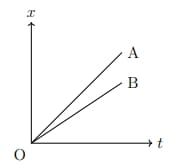
The position-time graphs for two students A and B returning from school to their homes are shown. Which of the following statements are correct?
View Solution
Step 1: Analyze the graph slopes
The slope of a position-time graph represents speed. Since the slope of B is steeper, B travels faster than A.
Step 2: Compare distances
The intercepts on the position axis show the distances of their homes from the school. A lives closer to the school.
Question 44:
The energy of an electromagnetic wave contained in a small volume oscillates with:
View Solution
Step 1: Use the wave energy density formula
The energy density is proportional to the square of the electric field: Energy density = (1/2)ε0E2.
Step 2: Analyze the time dependence
Squaring the sinusoidal electric field introduces a cos(2ωt) term, doubling the frequency.
Question 45:
The equivalent resistance of the circuit shown below between points a and b is:

View Solution
Step 1: Simplify the circuit
The circuit is a balanced Wheatstone Bridge. The equivalent resistance is calculated as:
1⁄Rab = 1⁄16 + 1⁄8 + 1⁄8.
Step 2: Solve for Rab
Combine the terms and find the reciprocal to get Rab = 3.2Ω.
Question 46:
A carrier wave of amplitude 15 V is modulated by a sinusoidal baseband signal of amplitude 3 V. The ratio of maximum amplitude to minimum amplitude in an amplitude-modulated wave is:
View Solution
Step 1: Calculate maximum and minimum amplitude
In amplitude modulation, Amax = Ac + Am, and Amin = Ac - Am. Here, Ac = 15 V and Am = 3 V.
Amax = 15 + 3 = 18 V
Amin = 15 - 3 = 12 V.
Step 2: Calculate the ratio
The ratio is Amax/Amin = 18/12 = 3⁄2.
Question 47:
A particle executes S.H.M. of amplitude A along the x-axis. At t = 0, the position of the particle is x = -A1⁄2, and it moves along the positive x-axis. The displacement of the particle in time t is given as x = A sin(ωt + δ). The value of δ will be:
View Solution
Step 1: Solve for the phase constant
Using the equation x = A sin(ωt + δ), substitute x = -A1⁄2 at t = 0:
-A1⁄2 = A sin(δ) => sin(δ) = -1⁄2.
Step 2: Determine δ
δ = π⁄6, as it satisfies the direction of motion and position conditions.
Question 48:
The angular momentum of an electron in Bohr's orbit is L. If the electron is assumed to revolve in the second orbit of a hydrogen atom, the change in angular momentum will be:
View Solution
Step 1: Use Bohr's angular momentum formula
Angular momentum Ln = n(h/2π), where n is the orbit number.
For n = 1: L1 = h/2π = L.
For n = 2: L2 = 2h/2π = 2L.
Step 2: Calculate the change
ΔL = L2 - L1 = 2L - L = L.
Question 49:
An object is placed at a distance of 12 cm in front of a plane mirror. A virtual and erect image is formed. Now the mirror is moved by 4 cm towards the stationary object. The distance by which the position of the image would be shifted will be:
View Solution
Step 1: Analyze initial setup
The image is initially formed at 12 cm behind the mirror. The distance between the object and the image is 24 cm.
Step 2: Mirror movement
When the mirror is shifted by 4 cm, the image also shifts by twice this amount (8 cm) towards the mirror.
Question 50:
A Zener diode of power rating 1.6 W is used as a voltage regulator. If the Zener diode has a breakdown voltage of 8 V and it has to regulate a voltage fluctuating between 3 V and 10 V, what is the value of resistance Rs for safe operation of the diode?

View Solution
Step 1: Determine maximum current
The maximum current is I = Pmax/Vz, where Pmax = 1.6 W and Vz = 8 V.
I = 1.6 / 8 = 0.2 A.
Step 2: Calculate Rs
Rs = (Vmax - Vz)/I = (10 - 8)/0.2 = 10Ω.
Question 51:
Unpolarised light of intensity 32 Wm-2 passes through the combination of three polaroids such that the pass axis of the last polaroid is perpendicular to that of the pass axis of the first polaroid. If the intensity of the emerging light is 3 Wm-2, then the angle between the pass axis of the first two polaroids is:
View Solution
Step 1: Write the expression for the net intensity
The net intensity is given by: Inet = (I0/2) * (cos2θ) * (sin2θ) = (I0/8) * (sin 2θ)2
Step 2: Use the given value for Inet
Substitute Inet = 3 and I0 = 32:
3 = (32/8) * (sin 2θ)2
(sin 2θ)2 = 3/4
Step 3: Solve for 2θ
sin 2θ = √(3/4) = √3/2
2θ = 60° or 120°
Step 4: Solve for θ
θ = 30° or 60°
Question 52:
If the Earth suddenly shrinks to 1/64th of its original volume with its mass remaining the same, the period of rotation of the Earth becomes 24/x hours. The value of x is:
View Solution
Step 1: Apply Angular Momentum Conservation
Using conservation of angular momentum: I1ω1 = I2ω2
Substitute I = (2/5)MR2:
(2/5)MR2ω1 = (2/5)M(R/4)2ω2
Cancel constants and simplify:
ω2/ω1 = 16
Step 2: Relate Angular Velocity and Time Period
ω2/ω1 = T1/T2, so:
16 = 24/x
Step 3: Solve for x
x = 24/16 = 16
Question 53:
Three concentric spherical metallic shells X, Y, and Z of radii a, b, and c respectively (a < b < c) have surface charge densities σ, -σ, and σ respectively. The shells X and Z are at the same potential. If the radii of X and Y are 2 cm and 3 cm respectively, the radius of shell Z is:
View Solution
Step 1: Write the potential at Y
The potential at Y is due to all charges: VY = qX/(4πε0a) - qY/(4πε0b) + qZ/(4πε0c)
Simplify using the given charges:
VY = (σa/ε0) - (σb/ε0) + (σc/ε0)
Step 2: Relate c to a and b
For X and Z to have the same potential: c(a - b + c) = a2 - b2 + c2
Simplify: c = a + b
Substitute a = 2 cm, b = 3 cm:
c = 2 + 3 = 5 cm
Question 54:
A transverse harmonic wave on a string is given by y(x, t) = 5 sin(6t + 0.003x), where x and y are in cm and t in seconds. The wave velocity is:
View Solution
Step 1: Identify wave parameters
The general wave equation is y(x, t) = A sin(kx ± ωt), where ω = 6 rad/s, k = 0.003 rad/cm = 0.3 rad/m.
Step 2: Use the wave velocity formula
Wave velocity v = ω/k.
Substitute the values: v = 6/0.3 = 20 m/s
Question 55:
10 resistors each of resistance 10 Ω can be connected to get maximum and minimum equivalent resistance. The ratio of maximum to minimum equivalent resistance is:
View Solution
Step 1: Calculate maximum resistance
When resistors are connected in series: Rmax = 10 × 10 = 100 Ω.
Step 2: Calculate minimum resistance
When resistors are connected in parallel: Rmin = R/n = 10/10 = 1 Ω.
Step 3: Find the ratio
Rmax/Rmin = 100/1 = 100
Question 56:
The decay constant for a radioactive nuclide is 1.5 × 10⁻⁵s-1. Atomic weight of the substance is 60 g mole-1 (NA = 6 × 10²³). The activity of 1.0 µg of the substance is:
View Solution
Step 1: Calculate the number of moles
Number of moles = (mass of sample) / (molar mass) = (1 × 10⁻⁶) / 60 = (10-7) / 6.
Step 2: Calculate the number of atoms
Number of atoms = (number of moles) × NA = ((10-7) / 6) × (6 × 1023) = 1016.
Step 3: Calculate the activity
Activity A0 = N0λ = (1016) × (1.5 × 10-5) = 15 × 1010 Bq.
Question 57:
Two wires each of radius 0.2 cm and negligible mass, one made of steel and the other made of brass, are loaded as shown in the figure. The elongation of the steel wire is:

View Solution
Step 1: Analyze the system
The total force on the steel wire is T2 = 20 N + 11.4 N = 31.4 N.
Step 2: Use the elongation formula
Elongation (∆L) = (T2L) / (A × Y), where A = π(r2), Y = 2 × 10¹¹ Pa, and L = 1.6 m.
∆L = (31.4 × 1.6) / (π × (0.2 × 10⁻²)2 × 2 × 1011) = 20 × 10-6 m.
Question 58:
A closed circular tube of average radius 15 cm, whose inner walls are rough, is kept in a vertical plane. A block of mass 1 kg is introduced at the top of the tube with a speed of 22 m/s. After completing five oscillations, the block stops at the bottom of the tube. The work done by the tube on the block is:

View Solution
Step 1: Work-energy theorem
The work-energy theorem states Wf + Wgravity = ∆K.
Step 2: Substitute known values
Wf + 10 × 0.3 = 0 - 0.5 × 1 × (22)2.
Wf + 3 = -242 => Wf = -245 J.
Question 59:
A 1 m long metal rod completes the circuit as shown in the figure. The plane of the circuit is perpendicular to a magnetic field of flux density 0.15 T. If the resistance of the circuit is 5 Ω, the force needed to move the rod at a constant speed of 4 m/s is:
View Solution
Step 1: Use the force formula
F = (B2ℓ2v) / R.
Step 2: Substitute values
F = (0.15)2 × (1)2 × 4 / 5 = 18 × 10-3 N.
Question 60:
The current required to be passed through a solenoid of 15 cm length and 60 turns to demagnetize a bar magnet of magnetic intensity 2.4 × 10³ A/m is:
View Solution
Step 1: Use the magnetic intensity formula
H = NI / ℓ. Rearrange to solve for I: I = (Hℓ) / N.
Step 2: Substitute values
I = (2.4 × 103 × 0.15) / 60 = 6 A.
Question 61:
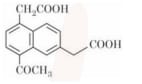
The major product 'P' formed in the given reaction is:




View Solution
Step 1: Oxidation of the side chains
Alkaline KMnO4 oxidizes alkyl groups attached to aromatic rings to carboxylic acid groups.
Step 2: Formation of the product
The given reaction produces naphthalene-1,2,4-tricarboxylic acid.
Question 62:
Prolonged heating is avoided during the preparation of ferrous ammonium sulphate to:
View Solution
Step 1: Avoid oxidation of Fe2+
Prolonged heating can oxidize Fe2+ to Fe3+, introducing impurities.
Step 2: Reaction equation
4Fe2+ + O2 + 4H+ → 4Fe3+ + 2H2O.
Question 63:
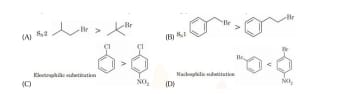
Identify the correct order of reactivity for the following pairs towards the respective mechanism:
View Solution
Step 1: Evaluate each reaction
(A) SN2: Less substituted carbons are more reactive.
(B) SN1: Stability of the carbocation determines reactivity.
(C) Electrophilic substitution: Electron-donating groups enhance reactivity.
(D) Nucleophilic substitution: Electron-withdrawing groups enhance reactivity.
Question 64:
The ∆H° for the reaction C(graphite) + 1/2 O2(g) → CO(g) is:
View Solution
Step 1: Use Hess's law
Reverse and divide equation (1) by 2, add to equation (2), and solve for ∆H°.
Step 2: Solve for ∆H°
∆H° = (x/2) - y = (x − 2y)/2.
Question 65:
Using column chromatography, a mixture of two compounds 'A' and 'B' was separated. 'A' eluted first. This indicates 'B' has:
View Solution
Step 1: Retention factor
B's lower Rf indicates stronger adsorption to the stationary phase.
Question 66:
Lime reacts exothermally with water to give 'A' which has low solubility in water. Aqueous solution of 'A' is often used for the test of CO2, where insoluble 'B' is formed. If 'B' is further reacted with CO2, a soluble compound is formed. 'A' is:
View Solution
Step 1: Reaction of lime with water
CaO(s) + H2O(l) → Ca(OH)2(aq). 'A' is calcium hydroxide, commonly known as slaked lime.
Step 2: Reaction with CO2
Ca(OH)2(aq) + CO2(g) → CaCO3(s) + H2O(l). 'B' is calcium carbonate (CaCO3).
Step 3: Further reaction with CO2
CaCO3(s) + H2O(l) + CO2(g) → Ca(HCO3)2(aq), which is soluble.
Question 67:
Match List I with List II:
List I: Industry
List II: Waste Generated
View Solution
Step 1: Analyze waste products
(A) Steel plants produce slag, a byproduct of iron and steel making.
(B) Thermal power plants generate fly ash from burning coal.
(C) Fertilizer industries produce gypsum as a byproduct of phosphoric acid production.
(D) Paper mills produce bio-degradable wastes from organic materials.
Question 68:
Suitable reaction condition for preparation of Methyl phenyl ether is:
View Solution
Step 1: Use Williamson ether synthesis
This reaction involves the reaction of an alkoxide ion (PhO-) with a primary alkyl halide (MeBr).
Step 2: Reaction mechanism
PhO-Na+ + MeBr → Ph-O-Me + NaBr.
The phenoxide ion acts as a nucleophile, attacking methyl bromide via an SN2 mechanism to form methyl phenyl ether (anisole).
Question 69:
The one that does not stabilize 2° and 3° structures of proteins is:
View Solution
Step 1: Stabilizing forces in protein structures
The secondary and tertiary structures of proteins are stabilized by hydrogen bonding, disulfide bridges (–S–S–), van der Waals forces, and electrostatic attractions. Peroxide linkages (–O–O–) do not play a role in protein stabilization.
Question 70:
The compound which does not exist is:
View Solution
Step 1: Analyze compound stability
Sodium superoxide (NaO2) is highly reactive and tends to disproportionate, making it unstable. Other listed compounds are known and stable.
Question 71:
Given below are two reactions, involved in the commercial production of dihydrogen (H2). The two reactions are carried out at temperature T1 and T2, respectively:
C(s) + H2O(g) → CO(g) + H2 (T1)
CO(g) + H2O(g) → CO2(g) + H2 (T2)
The temperatures T1 and T2 are correctly related as:
View Solution
Step 1: Analyze the two reactions
The first reaction, the water-gas reaction, requires a higher temperature (around 1270 K).
The second reaction, the water-gas shift reaction, occurs at lower temperatures (around 673 K) with a catalyst.
Question 72:
The enthalpy change for the adsorption process and micelle formation respectively are:
View Solution
Step 1: Analyze the processes
Adsorption is exothermic (∆Hads < 0) as energy is released when molecules adhere to a surface.
Micelle formation is endothermic (∆Hmic > 0) due to energy required to overcome hydrophobic repulsion between surfactant molecules.
Question 73:
The pair from the following pairs having both compounds with net non-zero dipole moment is:
View Solution
Step 1: Evaluate each pair
Both CH2Cl2 and CHCl3 have non-zero dipole moments due to differences in electronegativity and asymmetric molecular structures.
Other pairs have at least one compound with zero dipole moment due to symmetry.
Question 74:
Which of the following is used as a stabilizer during the concentration of sulphide ores?
View Solution
Step 1: Role of stabilizers
Cresols are used in froth flotation to stabilize the froth during the concentration of sulphide ores.
Question 75:
Which of the following statements are correct?
(A) The M3+/M2+ reduction potential for iron is greater than manganese.
(B) The higher oxidation states of first-row d-block elements get stabilized by oxide ion.
(C) Aqueous solution of Cr2+ can liberate hydrogen from dilute acid.
(D) Magnetic moment of V2+ is observed between 4.4-5.2 BM.
View Solution
Step 1: Evaluate the statements
(A) Incorrect: Reduction potential for Mn is greater than Fe.
(B) Correct: Higher oxidation states are stabilized by oxide ions.
(C) Correct: Cr2+ reduces H+ to H2.
(D) Incorrect: Magnetic moment of V2+ is approximately 3.87 BM, not 4.4-5.2 BM.
Question 76:
Given below are two statements:
Statement I: Aqueous solution of K2Cr2O7 is preferred as a primary standard in volumetric analysis over Na2Cr2O7 aqueous solution.
Statement II: K2Cr2O7 has a higher solubility in water than Na2Cr2O7.
In the light of the above statements, choose the correct answer:
View Solution
Step 1: Analyze the properties
K2Cr2O7 is more stable in aqueous solution compared to Na2Cr2O7, making it a preferred primary standard.
K2Cr2O7 is less soluble in water than Na2Cr2O7.
Question 77:
The octahedral diamagnetic low spin complex among the following is:
View Solution
Step 1: Analyze the coordination complex
[Co(NH3)6]3+ has Co3+ with an electronic configuration of 3d6. NH3 is a strong field ligand, causing electron pairing in the lower energy t2g orbitals.
The configuration becomes t62g, e0g, making it diamagnetic and low spin.
Question 78:
Isomeric amines with molecular formula C8H11N give the following tests:
(P) Can be prepared by Gabriel phthalimide synthesis.
(Q) Reacts with Hinsberg’s reagent to give a solid insoluble in NaOH.
(R) Reacts with HONO followed by β-naphthol in NaOH to give a red dye.
Isomer (P), (Q), and (R), respectively, are:



View Solution
Step 1: Analyze the reactions
(P): Gabriel synthesis produces primary amines.
(Q): Hinsberg’s reagent forms a solid with secondary amines.
(R): The formation of a red dye indicates an aromatic primary amine.
Question 79:
The number of molecules and moles in 2.8375 litres of O2 at STP are respectively:
View Solution
Step 1: Calculate moles
At STP, 1 mole of gas occupies 22.7 L. Moles = Volume/22.7 = 2.8375/22.7 = 0.125 moles.
Step 2: Calculate molecules
Molecules = Moles × Avogadro’s number = 0.125 × 6.022 × 1023 = 7.527 × 10²².
Question 80:
Match List I with List II:
List I: Polymer
List II: Classification
(A) Nylon-2-Nylon-6 - Biodegradable polymer
(B) Buna-N - Synthetic rubber
(C) Urea-formaldehyde resin - Thermosetting polymer
(D) Dacron - Polyester
View Solution
Step 1: Match polymers with classifications
(A): Nylon-2-Nylon-6 is biodegradable.
(B): Buna-N is synthetic rubber.
(C): Urea-formaldehyde resin is thermosetting.
(D): Dacron is a polyester.
Question 81:
If the degree of dissociation of an aqueous solution of weak monobasic acid is determined to be 0.3, then the observed freezing point will be % higher than the expected/theoretical freezing point. (Nearest integer)
View Solution
Step 1: Determine the Van’t Hoff Factor
For a weak monobasic acid, the van’t Hoff factor (i) is calculated using the formula:
i = 1 + (n - 1) * α, where n = 2 (for complete dissociation) and α = 0.3.
i = 1 + (2 - 1) * 0.3 = 1.3.
Step 2: Calculate the Percentage Increase
The percentage increase in freezing point depression is given by:
% increase = (i - 1⁄1) * 100 = (1.3 - 1⁄1) * 100 = 30%.
Question 82:
In the following reactions, the total number of oxygen atoms in X and Y is:
Na2O + H2O → 2X
Cl2O7 + H2O → 2Y
View Solution
Step 1: Determine Products of the Reactions
Reaction 1: Na2O + H2O → 2NaOH. Here, X is NaOH, which contains 1 oxygen atom per molecule.
Reaction 2: Cl2O7 + H2O → 2HClO4. Here, Y is HClO4, which contains 4 oxygen atoms per molecule.
Step 2: Add the Oxygen Atoms
Each molecule of NaOH contributes 1 oxygen atom, and HClO4 contributes 4 oxygen atoms.
Total oxygen atoms = 1 (from X) + 4 (from Y) = 5.
Question 83:
The sum of lone pairs present on the central atom of the interhalogens IF5 and IF7 is:
View Solution
Step 1: Calculate Lone Pairs for IF5
Iodine (I) in IF5 has 7 valence electrons. Five are used for bonding, leaving 2 electrons (1 lone pair).
Step 2: Calculate Lone Pairs for IF7
Iodine (I) in IF7 uses all 7 valence electrons for bonding, leaving no lone pairs.
Step 3: Add the Lone Pairs
Lone pairs on IF5: 1. Lone pairs on IF7: 0.
Total = 1 + 0 = 1.
Question 84:
The number of bent-shaped molecule(s) from the following is:
N3−, NO2−, I3−, O3, SO2
View Solution
Step 1: Analyze the Molecular Shapes
- N3−: Linear.
- NO2−: Bent (lone pairs on nitrogen).
- I3−: Linear.
- O3: Bent (lone pairs on central oxygen).
- SO2: Bent (lone pairs on sulfur).
Step 2: Count the Bent Molecules
Bent molecules: NO2−, O3, and SO2.
Total = 3.
Question 85:
The number of correct statement(s) involving equilibria in physical form from the following is:
(1) Equilibrium is possible only in a closed system at a given temperature.
(2) Both the opposing processes occur at the same rate.
(3) When equilibrium is attained at a given temperature, the value of all its parameters becomes constant.
(4) For dissolution of solids in liquids, the solubility is constant at a given temperature.
View Solution
Step 1: Evaluate Each Statement
- (1): Correct. Equilibrium requires a closed system to prevent loss of matter.
- (2): Correct. At equilibrium, the forward and reverse processes occur at the same rate.
- (3): Incorrect. The equilibrium values of parameters remain constant but may not be equal.
- (4): Correct. Solubility depends on temperature.
Step 2: Count the Correct Statements
Correct statements: (1), (2), and (4).
Total = 3.
Question 86:
At constant temperature, a gas is at a pressure of 940.3 mm Hg. The pressure at which its volume decreases by 40% is:
View Solution
Step 1: Write the Given Data
Initial pressure, Pinitial = 940.3 mm Hg.
Initial volume, Vinitial = 100 units (assume).
Final volume, Vfinal = 100 - 40% = 60 units.
Final pressure, Pfinal = ?
Step 2: Apply Boyle’s Law
Boyle’s Law states: PinitialVinitial = PfinalVfinal
Substitute the values:
940.3 × 100 = Pfinal × 60.
Step 3: Solve for Pfinal
Pfinal = (940.3 × 100) / 60 = 1567 mm Hg.
Round to the nearest integer:
Pfinal = 1567 mm Hg.
Question 87:
FeO42− + 2.2V → Fe3+, Fe3+ + 0.7V → Fe2+, Fe2+ -0.45V → Fe°. E°FeO42−/Fe2+ is x × 10−3V. The value of x is:
View Solution
Step 1: Combine the Half-Cell Reactions
The reduction steps are:
FeO42− + 3e− → Fe3+, ΔG1
Fe3+ + e− → Fe2+, ΔG2
FeO42− + 4e− → Fe2+, ΔG3
Step 2: Use Gibbs Free Energy Relationships
ΔG3 = ΔG1 + ΔG2.
Substituting ΔG = −nFE°:
−4FE°3 = −3F(2.2) + (−1F)(0.7).
Step 3: Simplify
4E°3 = 6.6 + 0.7 = 7.3.
E°3 = 7.3 / 4 = 1.825 V.
E°3 = 1.825 × 10⁻³ V.
Question 88:
A molecule undergoes two independent first-order reactions whose respective half-lives are 12 min and 3 min. If both reactions are occurring, the time taken for 50% consumption of the reactant is:
View Solution
Step 1: Relationship Between Rate Constants and Effective Half-Life
For independent first-order reactions:
keff = k1 + k2.
The effective half-life is given by:
ln 2 / teff = ln 2 / t1 + ln 2 / t2.
Simplify:
1 / teff = 1 / t1 + 1 / t2.
Step 2: Substitute the Given Half-Lives
t1 = 12 min, t2 = 3 min.
1 / teff = 1 / 12 + 1 / 3 = 5 / 12.
Step 3: Calculate teff
teff = 12 / 5 = 2.4 min.
Round to the nearest integer:
teff = 2 min.
Question 89:
The number of incorrect statement(s) about the black body from the following is:
(1) Emits or absorbs energy in the form of electromagnetic radiation.
(2) Frequency distribution of the emitted radiation depends on temperature.
(3) At a given temperature, intensity vs frequency curve passes through a maximum value.
(4) The maximum of the intensity vs frequency curve is at a higher frequency at higher temperature compared to that at lower temperature.
View Solution
Step 1: Analyze the Given Statements
(1) Correct: Black bodies emit/absorb electromagnetic radiation.
(2) Correct: Frequency distribution depends on temperature (Planck’s law).
(3) Correct: Intensity vs frequency curve has a maximum value.
(4) Correct: The peak shifts to higher frequency with temperature (Wien’s law).
Step 2: Count the Incorrect Statements
All the statements are correct.
Number of incorrect statements = 0.
Question 90:
In potassium ferrocyanide, there are pairs of electrons in the t2g set of orbitals:
View Solution
Step 1: Analyze the Electronic Configuration of Fe2+
Potassium ferrocyanide is K4[Fe(CN)6].
In this complex, Fe is in the +2 oxidation state: Fe2+.
Electronic configuration: Fe2+ = [Ar] 3d6.
Step 2: Effect of Strong Field Ligand (CN−)
CN− is a strong field ligand, causing pairing of electrons in the d-orbitals.
The t2g set of orbitals (lower energy) gets fully filled with 6 electrons, forming 3 pairs.
Step 3: Diagrammatic Representation
t2g6 eg0: The t2g set contains 6 electrons, forming 3 pairs.
*The article might have information for the previous academic years, please refer the official website of the exam.