
JEE Main 2023 Chemistry April 13 Shift 2 Question Paper with Solution PDF- Download Here

.jpg?tr=h-55,w-55,c-force)
Content Strategist|Tech-innovator|National Hackathon Winner | Updated On - Mar 20, 2025
JEE Main 2023 Chemistry April 13 Shift 2 Question Paper is available here for download. Candidates can download official JEE Main 2023 Chemistry Question Paper PDF with Solution and Answer Key for April 13 Shift 2 using the link below. JEE Main Chemistry Question Paper is divided into two sections, Section A with 20 MCQs and Section B with 10 numerical type questions. Candidates are required to answer all questions from Section A and any 5 questions from section B.
JEE Main 2023 Chemistry Question Paper April 13 Shift 2 PDF
| JEE Main 2023 April 10 Shift 2 Question Paper with Solution PDF |  Download Download |
Check Solution |

SECTION-A
Question 1:
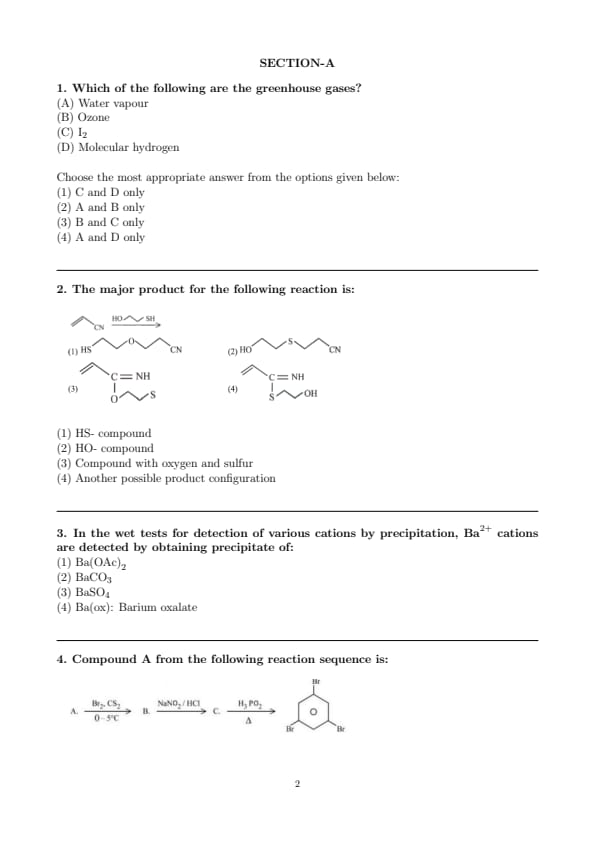
Which of the following are the greenhouse gases?
View Solution
Greenhouse gases are those gases that absorb and emit infrared radiation, contributing to the greenhouse effect, which warms the Earth's atmosphere.
The primary greenhouse gases are:
Water vapour (H\(_2\)O): It is a significant greenhouse gas and traps heat in the atmosphere.
Ozone (O\(_3\)): It acts as a greenhouse gas, particularly in the troposphere, by trapping infrared radiation.
On the other hand:
Iodine (\( I_2 \)): It is not a greenhouse gas because it does not absorb or emit infrared radiation.
Molecular hydrogen (H\(_2\)): It is also not a greenhouse gas, as it does not interact with infrared radiation significantly.
Thus, the greenhouse gases from the given options are: \[ (A) Water vapour and (B) Ozone. \]
% Explanation
Greenhouse gases include CO\(_2\), CH\(_4\) (methane), water vapour, nitrous oxide (N\(_2\)O), CFCs, and ozone. These gases trap heat in the atmosphere, leading to the greenhouse effect. Quick Tip: Greenhouse gases absorb and emit infrared radiation, contributing to global warming. Common examples include water vapour, carbon dioxide, methane, nitrous oxide, and ozone.
The major product for the following reaction is:

View Solution
The reaction involves the interaction of a nucleophile (\( HS- \)) with an electrophilic site on the given substrate.
\( SH \) is a better nucleophile than \( OH \) due to the softness of sulfur compared to oxygen.
Soft nucleophiles prefer to attack soft electrophilic centers, following the principle of hard-soft acid-base (HSAB) theory.
The mechanism proceeds as follows:
1. The sulfur atom in \( SH \) attacks the electrophilic carbon of the \( C=N \) group.
2. This leads to the formation of a new bond between sulfur and carbon.
3. The \( OH \) group remains intact as sulfur is the more reactive nucleophile in this scenario.
The major product of the reaction is: \[ HO-CH(SH)-CN. \]
Thus, the correct product matches option (2). Quick Tip: Soft nucleophiles like \( SH \) preferentially attack soft electrophiles, such as carbon in \( C=N \) bonds, over harder nucleophiles like \( OH \). Always consider HSAB theory for such reactions.
In the wet tests for detection of various cations by precipitation, \( Ba^{2+} \) cations are detected by obtaining precipitate of:
View Solution
In wet testing, \( (NH_4)_2CO_3 \) is used as the group reagent for the detection of 5th group cations, which include \( Ba^{2+} \), \( Ca^{2+} \), and \( Sr^{2+} \).
The chemical reaction for the detection of \( Ba^{2+} \) is as follows: \[ Ba^{2+} + (NH_4)_2CO_3 \rightarrow BaCO_3 \downarrow + 2NH_4^+, \]
where \( BaCO_3 \) forms as a white precipitate.
Thus, \( Ba^{2+} \) is detected by the formation of \( BaCO_3 \) as a precipitate. Quick Tip: In wet tests, 5th group cations (\( Ba^{2+}, Ca^{2+}, Sr^{2+} \)) form carbonates when treated with \( (NH_4)_2CO_3 \), producing characteristic white precipitates.
Compound A from the following reaction sequence is:

View Solution
The given reaction sequence involves the following steps:
1. Step 1 (Bromination):
In the presence of bromine (\( Br_2 \)) and carbon disulfide (\( CS_2 \)) at low temperature (\( 0-5^\circ C \)), aniline (\( C_6H_5NH_2 \)) undergoes electrophilic substitution at the para and ortho positions. The product \( A \) is:
\[ A = 2,4,6-tribromoaniline. \]
2. Step 2 (Diazotization):
The tribromoaniline reacts with sodium nitrite (\( NaNO_2 \)) and hydrochloric acid (\( HCl \)) to form a diazonium salt \( B \) (\( C_6H_2Br_3N_2^+Cl^- \)).
3. Step 3 (Reduction):
The diazonium salt \( B \) undergoes reduction with hypophosphorous acid (\( H_3PO_2 \)) and heat (\( \Delta \)) to produce the final compound \( C \), which is:
\[ C = 2,4,6-tribromobenzene. \]
Since the starting compound is aniline and it undergoes transformation into 2,4,6-tribromobenzene, the answer is: \[ \boxed{Aniline (Option 3)}. \] Quick Tip: In reactions involving diazonium salts, reduction with \( H_3PO_2 \) results in the replacement of the diazonium group with hydrogen.
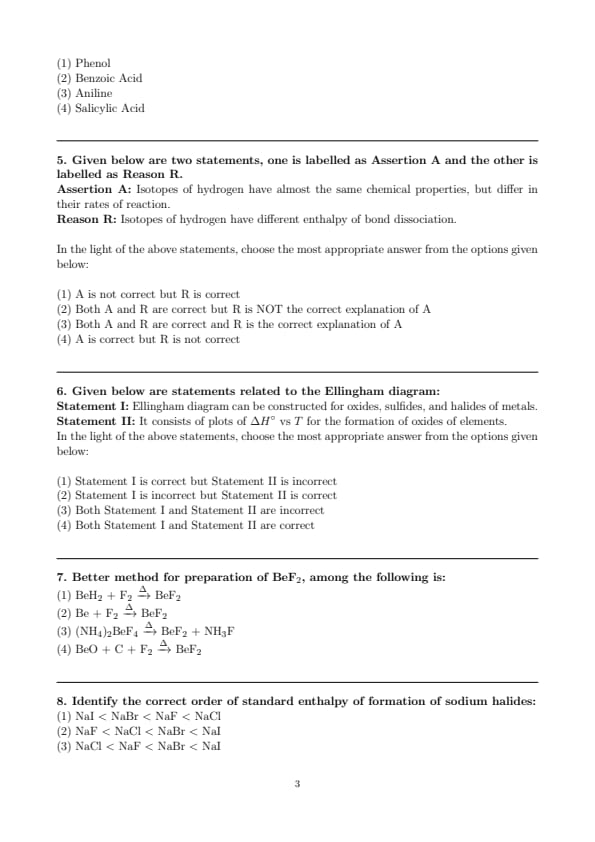
Given below are two statements, one is labelled as Assertion A and the other is labelled as Reason R.
Assertion A: Isotopes of hydrogen have almost the same chemical properties, but differ in their rates of reaction.
Reason R: Isotopes of hydrogen have different enthalpy of bond dissociation.
In the light of the above statements, choose the most appropriate answer from the options given below:
View Solution
Isotopes of hydrogen, such as protium, deuterium, and tritium, have the same electronic configuration, so they exhibit almost identical chemical properties. However, due to their differences in mass, the rates of reactions differ significantly, primarily because of differences in the enthalpy of bond dissociation.
The enthalpy of bond dissociation is higher for heavier isotopes (such as deuterium and tritium) compared to protium, leading to slower reaction rates for the heavier isotopes.
Hence, both the assertion (A) and reason (R) are correct, and the reason (R) correctly explains the assertion (A). Quick Tip: Isotopes of an element have the same electronic configuration and similar chemical properties. However, differences in mass result in variations in reaction rates, primarily due to differences in bond dissociation enthalpy.
Given below are statements related to the Ellingham diagram:
Statement I: Ellingham diagram can be constructed for oxides, sulfides, and halides of metals.
Statement II: It consists of plots of \( \Delta H^\circ \) vs \( T \) for the formation of oxides of elements.
In the light of the above statements, choose the most appropriate answer from the options given below:
View Solution
Statement I: The Ellingham diagram can indeed be constructed for the formation of oxides, sulfides, and halides of metals. This statement is correct.
Statement II: The Ellingham diagram does not consist of plots of \( \Delta H^\circ \) vs \( T \). Instead, it represents plots of \( \Delta G^\circ \) (Gibbs free energy change) vs \( T \) (temperature) for the formation of oxides of elements. This statement is incorrect.
The Ellingham diagram is primarily used to determine the feasibility of reduction reactions of metal oxides and to compare the relative stability of oxides at different temperatures.
Thus, the correct answer is \( \boxed{(1)} \). Quick Tip: Ellingham diagrams are graphical representations of \( \Delta G^\circ \) vs \( T \) for the formation of metal oxides. They are useful for determining the feasibility of reduction reactions.
Better method for preparation of BeF\(_2\), among the following is:
View Solution
The better method for preparing BeF\(_2\) involves the decomposition of ammonium beryllium fluoride, \((NH_4)_2BeF_4\), by heating it to produce BeF\(_2\) and ammonia fluoride (\(NH_3F\)) as by-product.
This method is efficient and widely used for preparing beryllium fluoride in laboratory conditions.
The reaction is as follows: \[ (NH_4)_2BeF_4 \xrightarrow{\Delta} BeF_2 + 2NH_3F. \]
Thus, the correct answer is \( \boxed{(3)} \).
Quick Tip: The decomposition of \((NH_4)_2BeF_4\) is a practical and preferred method for preparing beryllium fluoride (\(BeF_2\)).
Identify the correct order of standard enthalpy of formation of sodium halides:
View Solution
For a given metal, the standard enthalpy of formation (\( \Delta H^\circ \)) of its halides becomes less negative (less exothermic) as we move from fluoride to iodide in the halide group. This trend arises because of the decreasing lattice energy of the sodium halides as the size of the halide ion increases from \( F^- \) to \( I^- \).
The correct order of standard enthalpy of formation is: \[ NaI < NaBr < NaCl < NaF. \]
Thus, the correct answer is \( \boxed{(4)} \). Quick Tip: The lattice energy decreases with increasing size of the halide ion (\( F^- \) to \( I^- \)), which affects the enthalpy of formation of sodium halides.
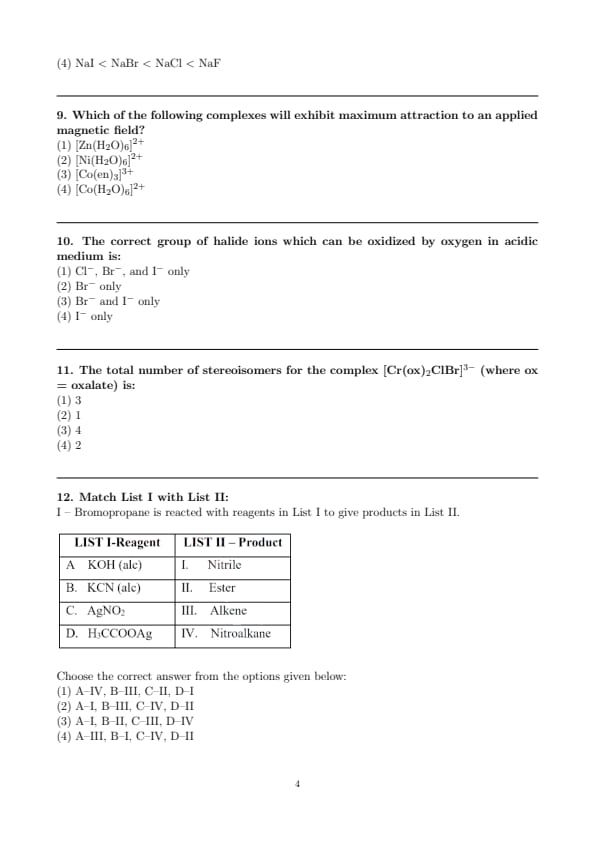
Which of the following complexes will exhibit maximum attraction to an applied magnetic field?
View Solution
The attraction of a complex to a magnetic field depends on the number of unpaired electrons in the complex. Let us analyze each given complex:
1. [Zn(H\(_2\)O)\(_6\)]\(^{2+}\):
The electronic configuration of Zn\(^{2+}\) is \( 3d^{10} \). It has no unpaired electrons, so it is diamagnetic.
2. [Ni(H\(_2\)O)\(_6\)]\(^{2+}\):
The electronic configuration of Ni\(^{2+}\) is \( 3d^8 \). In an octahedral field, this gives a \( t_{2g}^6 e_g^2 \) configuration, with 2 unpaired electrons.
3. [Co(en)\(_3\)]\(^{3+}\):
The electronic configuration of Co\(^{3+}\) is \( 3d^6 \). Due to strong-field ligands (en), it undergoes pairing, resulting in a \( t_{2g}^6 e_g^0 \) configuration with no unpaired electrons. It is diamagnetic.
4. [Co(H\(_2\)O)\(_6\)]\(^{2+}\):
The electronic configuration of Co\(^{2+}\) is \( 3d^7 \). In an octahedral field with weak-field ligands like water, it gives a \( t_{2g}^5 e_g^2 \) configuration with 3 unpaired electrons.
Hence, [Co(H\(_2\)O)\(_6\)]\(^{2+}\) has the maximum number of unpaired electrons and will exhibit the maximum attraction to an applied magnetic field.
Thus, the correct answer is \( \boxed{(4)} \). Quick Tip: The magnetic behavior of a complex is determined by the number of unpaired electrons. Weak-field ligands usually result in high-spin configurations with more unpaired electrons.
The correct group of halide ions which can be oxidized by oxygen in acidic medium is:
View Solution
To determine which halide ions can be oxidized by oxygen in acidic medium, we need to look at the standard electrode potentials for the oxidation reactions of halide ions.
The oxidation reactions of halide ions to halogen molecules can be written as:
\[ X^- \rightarrow X_2 + e^- \quad (where X = Cl, Br, or I) \]
The standard electrode potentials (\( E^\circ \)) for these reactions are:
\( E^\circ_{Cl^- / Cl_2} = +1.36 \, V \)
\( E^\circ_{Br^- / Br_2} = +1.07 \, V \)
\( E^\circ_{I^- / I_2} = +0.535 \, V \)
Oxygen (\( O_2 \)) in acidic medium has a standard electrode potential of:
\[ E^\circ_{O_2 / H_2O} = +1.23 \, V \]
For oxidation to occur, the halide ion must have a lower oxidation potential than the oxygen half-reaction, meaning the halide ion can be oxidized by oxygen if its oxidation potential is lower than that of oxygen.
For chloride (\( Cl^- \)), the oxidation potential (+1.36 V) is higher than oxygen’s (+1.23 V), so \( Cl^- \) cannot be oxidized by oxygen.
For bromide (\( Br^- \)), the oxidation potential (+1.07 V) is higher than oxygen’s (+1.23 V), so \( Br^- \) cannot be oxidized by oxygen.
For iodide (\( I^- \)), the oxidation potential (+0.535 V) is lower than oxygen’s (+1.23 V), so \( I^- \) can be oxidized by oxygen.
Thus, only \( I^- \) can be oxidized by oxygen in acidic medium. Quick Tip: Only iodide ions (I\(^-\)) can be oxidized by oxygen in acidic medium due to the favorable reduction potential of iodine (\( I_2 \)).
The total number of stereoisomers for the complex [Cr(ox)\(_2\)ClBr]\(^{3-}\) (where ox = oxalate) is:
View Solution
The given complex is [Cr(ox)\(_2\)ClBr]\(^{3-}\), where:
\( ox \) (oxalate) is a bidentate ligand, forming chelate rings with the central metal atom.
\( Cl \) and \( Br \) are monodentate ligands.
Types of Isomerism:
1. Geometrical Isomerism:
The \( Cl \) and \( Br \) ligands can be arranged either cis (adjacent) or trans (opposite) to each other.
This results in two geometrical isomers: cis and trans.
2. Optical Isomerism:
Among the geometrical isomers, only the cis-isomer can exhibit optical isomerism.
The cis-isomer does not have a plane of symmetry, so it can exist as two enantiomers: \( d \)-form and \( l \)-form.
Thus, the total number of stereoisomers for this complex is: \[ 1 trans-isomer (no optical isomerism) + 2 cis-enantiomers (d and l forms) = 3 isomers. \]
Explanation with Diagrams:
1. Trans-isomer:
This structure has a plane of symmetry, so no optical isomerism is observed.
\[ Cl and Br are opposite to each other. \]
2. Cis-isomer:
This structure does not contain a plane of symmetry, so it exhibits optical isomerism.
\[ Cl and Br are adjacent to each other. Two forms (d and l) are possible. \]
Conclusion:
The total number of stereoisomers is \( \boxed{3} \). Quick Tip: For octahedral complexes, check for both geometrical and optical isomerism by analyzing the symmetry of the ligand arrangement.
Match List I with List II:
I – Bromopropane is reacted with reagents in List I to give products in List II.

Choose the correct answer from the options given below:
View Solution
The reactions of bromopropane with the given reagents are as follows:
1. A. Reaction with KOH (alc):
Bromopropane reacts with alcoholic KOH to undergo dehydrohalogenation, forming an alkene.
\[ CH_3-CH_2-CH_2Br + KOH(alc) \rightarrow CH_3-CH=CH_2 \, (Alkene). \]
2. B. Reaction with KCN (alc):
Bromopropane reacts with alcoholic KCN to undergo a nucleophilic substitution reaction, forming a nitrile.
\[ CH_3-CH_2-CH_2Br + KCN \rightarrow CH_3-CH_2-CH_2CN \, (Nitrile). \]
3. C. Reaction with AgNO\(_2\):
Bromopropane reacts with silver nitrite (AgNO\(_2\)) to form a nitroalkane via substitution.
\[ CH_3-CH_2-CH_2Br + AgNO_2 \rightarrow CH_3-CH_2-CH_2NO_2 + AgBr \, (Nitroalkane). \]
4. D. Reaction with H\(_3\)CCOOAg:
Bromopropane reacts with silver acetate (H\(_3\)CCOOAg) to form an ester via substitution.
\[ CH_3-CH_2-CH_2Br + CH_3COOAg \rightarrow CH_3-CH_2-CH_2COOCH_3 + AgBr \, (Ester). \]
Thus, the correct matching is: \[ A–III, B–I, C–IV, D–II. \] Quick Tip: Different reagents react with alkyl halides to form specific products. Use substitution and elimination reaction principles to determine the products.
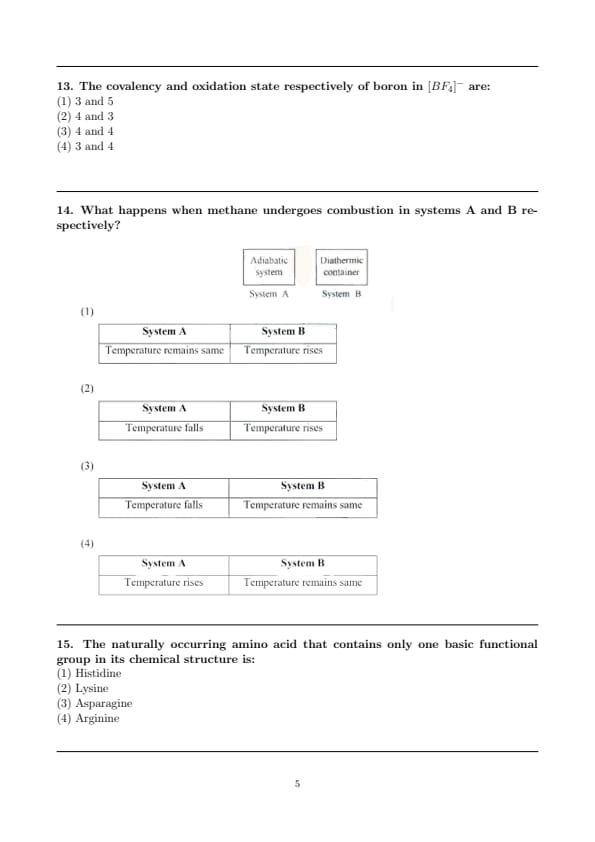
The covalency and oxidation state respectively of boron in \( [BF_4]^- \) are:
View Solution
In the complex ion \( [BF_4]^- \), boron is surrounded by four fluoride ions (\( F^- \)). Let’s analyze both the covalency and oxidation state of boron:
1. Covalency of boron:
The covalency of an atom refers to the number of bonds it forms with other atoms. In \( [BF_4]^- \), boron forms covalent bonds with four fluoride ions. Hence, the covalency of boron is 4.
2. Oxidation state of boron:
To calculate the oxidation state of boron, we must consider the charges of the ions involved:
The charge on each fluoride ion (\( F^- \)) is \(-1\).
The total charge on the complex ion \( [BF_4]^- \) is \(-1\).
Let the oxidation state of boron be \( x \). The total charge on the complex ion is the sum of the oxidation state of boron and the charges of the fluoride ions. Thus, we have:
\[ x + 4(-1) = -1 \]
\[ x - 4 = -1 \]
\[ x = +3 \]
Therefore, the oxidation state of boron is \( +3 \).
Thus, the covalency of boron is 4, and its oxidation state is \( +3 \). Quick Tip: The covalency of an atom in a molecule or complex is the number of bonds it forms, while the oxidation state is determined based on the charges of the atoms and ions in the complex.
What happens when methane undergoes combustion in systems A and B respectively?

View Solution
1. System A (Adiabatic System):
In an adiabatic system, there is no heat exchange with the surroundings. During the combustion of methane, the heat generated cannot escape. This results in an increase in temperature within the system.
2. System B (Diathermic Container):
In a diathermic container, heat can flow in and out of the system. During the combustion of methane, the heat generated escapes to maintain constant temperature.
Thus, in System A, the temperature rises, while in System B, the temperature remains the same. Quick Tip: In an adiabatic system, no heat exchange occurs, causing temperature changes. In a diathermic system, heat exchange with the surroundings maintains constant temperature.
The naturally occurring amino acid that contains only one basic functional group in its chemical structure is:
View Solution
Let us analyze the functional groups present in each of the given amino acids:
1. Histidine:
Histidine contains an imidazole group, which is basic. It also contains the amino group (\(-NH_2\)), making it contain two basic functional groups.
2. Lysine:
Lysine contains an \(-NH_2\) group and a terminal amino group in its side chain. Therefore, it contains two basic functional groups.
3. Asparagine:
Asparagine contains an amide group (\(-CONH_2\)) in its side chain, which is neutral, and only one amino group (\(-NH_2\)). Therefore, it contains only one basic functional group.
4. Arginine:
Arginine contains a guanidinium group, which is strongly basic, along with the \(-NH_2\) group. Therefore, it contains more than one basic functional group.
Conclusion:
The only amino acid that contains one basic functional group is Asparagine. Quick Tip: To identify basic functional groups in amino acids, look for amines (\(-NH_2\)) and other groups like imidazole or guanidinium that can accept protons.
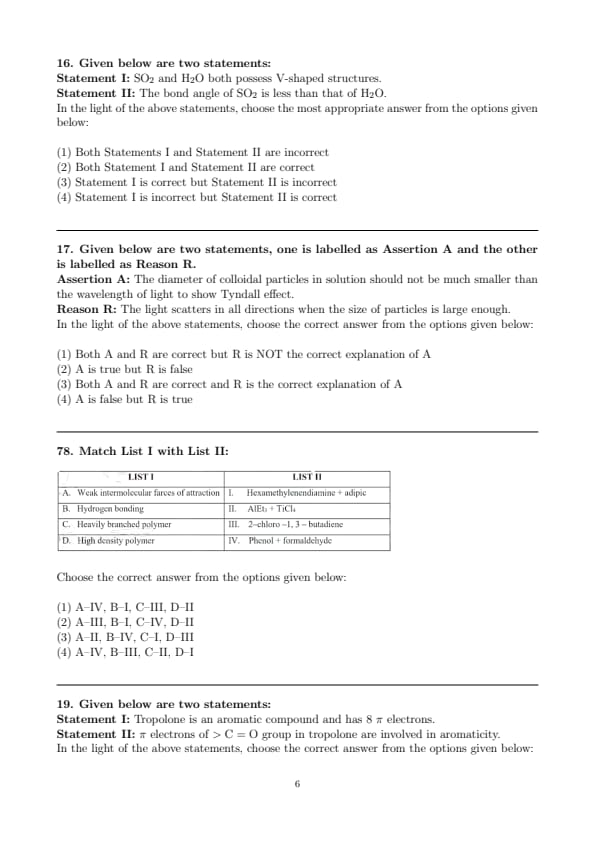
Given below are two statements:
Statement I: SO\(_2\) and H\(_2\)O both possess V-shaped structures.
Statement II: The bond angle of SO\(_2\) is less than that of H\(_2\)O.
In the light of the above statements, choose the most appropriate answer from the options given below:
View Solution
1. Statement I:
Both SO\(_2\) and H\(_2\)O possess V-shaped (bent) structures due to the presence of lone pairs on the central atom.
SO\(_2\): The central sulfur atom forms two double bonds with oxygen and has one lone pair of electrons.
H\(_2\)O: The central oxygen atom forms two single bonds with hydrogen and has two lone pairs of electrons.
Thus, this statement is correct.
2. Statement II:
The bond angle of SO\(_2\) is approximately 119.5° (sp\(^2\) hybridization), while the bond angle of H\(_2\)O is 104.5° (sp\(^3\) hybridization).
- The larger bond angle in SO\(_2\) is due to the greater repulsion caused by the double bonds in SO\(_2\), compared to the single bonds in H\(_2\)O.
Thus, this statement is incorrect.
Conclusion:
Statement I is correct, but Statement II is incorrect. Quick Tip: The bond angle in a molecule depends on the type of bonding (single or double bonds) and the number of lone pairs present on the central atom. Double bonds create greater repulsion than single bonds, resulting in larger bond angles.
Given below are two statements, one is labelled as Assertion A and the other is labelled as Reason R.
Assertion A: The diameter of colloidal particles in solution should not be much smaller than the wavelength of light to show Tyndall effect.
Reason R: The light scatters in all directions when the size of particles is large enough.
In the light of the above statements, choose the correct answer from the options given below:
View Solution
The Tyndall effect is observed only when the following two conditions are satisfied:
1. The diameter of the dispersed particles is not much smaller than the wavelength of the light used.
If the particles are much smaller than the wavelength of light, scattering is negligible, and the Tyndall effect is not observed.
2. The refractive indices of the dispersed phase and the dispersion medium differ greatly in magnitude.
Explanation of Statements:
Assertion A: This is correct because the particle size needs to be comparable to the wavelength of light to scatter light effectively and show the Tyndall effect.
Reason R: This is correct because light scatters in all directions when the particle size is large enough to cause significant scattering.
Furthermore, the reason directly explains why the assertion is true.
Conclusion:
Both Assertion A and Reason R are correct, and Reason R is the correct explanation of Assertion A. Quick Tip: The Tyndall effect is observed when the colloidal particle size is comparable to the wavelength of light and there is a significant difference in refractive indices between the dispersed phase and dispersion medium.
Match List I with List II:

Choose the correct answer from the options given below:
View Solution
1. A. Weak intermolecular forces of attraction:
2–chloro–1,3–butadiene (chloroprene) is the monomer of neoprene, which has weak intermolecular forces of attraction, being an elastomer.
Correct match: III. 2–chloro–1,3–butadiene.
2. B. Hydrogen bonding:
Hexamethylenediamine reacts with adipic acid to form Nylon-6,6. The presence of the amide group allows hydrogen bonding between polymer chains.
Correct match: I. Hexamethylenediamine + adipic acid.
3. C. Heavily branched polymer:
Phenol reacts with formaldehyde to form Bakelite, which is a heavily branched (cross-linked) polymer.
Correct match: IV. Phenol + formaldehyde.
4. D. High density polymer:
High-density polyethylene is prepared using the Ziegler-Natta catalyst (\( AlEt_3 + TiCl_4 \)).
Correct match: II. \( AlEt_3 + TiCl_4 \).
Final Matching: \[ A–III, B–I, C–IV, D–II. \] Quick Tip: To solve matching questions, recall the specific properties of polymers and their synthesis methods, such as hydrogen bonding in Nylon-6,6 and the Ziegler-Natta catalyst for HDPE.
Given below are two statements:
Statement I: Tropolone is an aromatic compound and has 8 \(\pi\) electrons.
Statement II: \(\pi\) electrons of \(>C=O\) group in tropolone are involved in aromaticity.
In the light of the above statements, choose the correct answer from the options given below:
View Solution
1. Statement I:
Tropolone is an aromatic compound with a conjugated ring system containing 8 \(\pi\) electrons:
6 \(\pi\) electrons are endocyclic (within the ring).
2 \(\pi\) electrons from the \(>C=O\) group are exocyclic (outside the ring).
Hence, tropolone satisfies the conditions of aromaticity.
Therefore, Statement I is correct.
2. Statement II:
The \(\pi\) electrons of the \(>C=O\) group are not involved in the aromaticity of the compound, as they are exocyclic and do not contribute to the conjugated system of the ring.
Therefore, Statement II is incorrect.
Conclusion:
Statement I is true, but Statement II is false. Quick Tip: For a compound to be aromatic, it must follow Huckel's rule (\(4n+2\) \(\pi\) electrons) and have a planar conjugated ring. Exocyclic \(\pi\) electrons do not contribute to aromaticity.
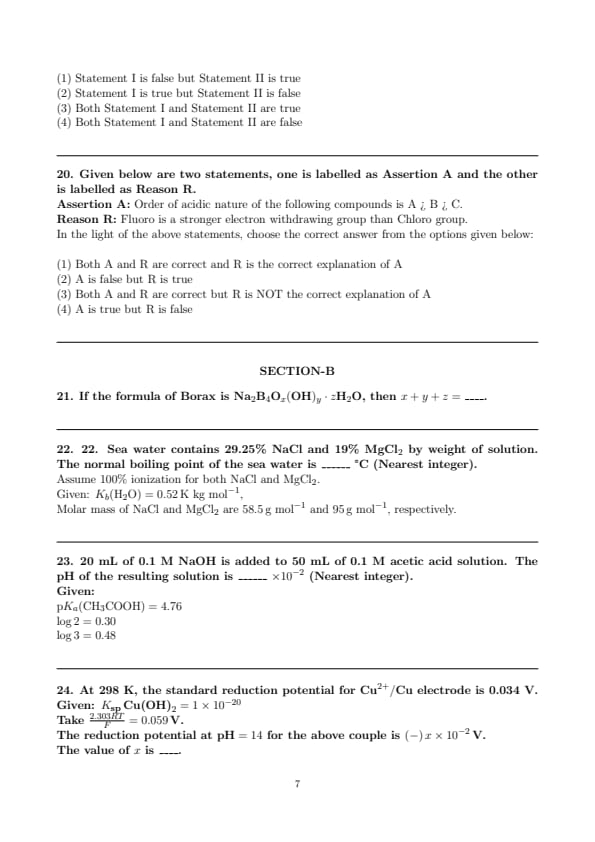
Given below are two statements, one is labelled as Assertion A and the other is labelled as Reason R.
Assertion A: Order of acidic nature of the following compounds is A > B > C.
Reason R: Fluoro is a stronger electron withdrawing group than Chloro group.
In the light of the above statements, choose the correct answer from the options given below:
View Solution
To determine the order of acidic nature, we consider the inductive effect (\(-I\)) and the distance dependency of the substituents attached to the benzene ring:
Analysis:
1. Compound A:
Contains a \(-OH\) group and a \(-F\) substituent. Fluorine exerts a strong \(-I\) effect (electron withdrawing). Due to its proximity to the \(-OH\) group, it enhances the acidic strength of the compound.
2. Compound B:
Contains a \(-OH\) group and a \(-Cl\) substituent.
Chlorine also exerts a \(-I\) effect but is weaker than fluorine.
Therefore, the acidic strength of B is less than that of A.
3. Compound C:
Contains a \(-OH\) group and a \(-CH_3\) substituent. The methyl group exhibits a \(+I\) effect (electron donating), which reduces the acidic strength. Thus, C is the least acidic.
Order of Acidic Strength: \[ A > B > C. \]
Explanation of Reason:
Fluorine (\(-F\)) is indeed a stronger electron withdrawing group than chlorine (\(-Cl\)), which is correct.
However, the inductive effect is distance dependent. Even though \(-F\) is stronger, the proximity of the substituent plays a more significant role in determining acidic strength.
Thus, while both Assertion A and Reason R are true, R does not correctly explain A.
Conclusion:
The correct answer is \( \boxed{(3)} \). Quick Tip: The acidic strength of a compound depends on the electron withdrawing or donating nature of substituents and their distance from the functional group. Inductive effects weaken with increasing distance.
If the formula of Borax is \( Na_2B_4O_x (OH)_y \cdot zH_2O \), then \( x + y + z = \_\_\_\_ \).
View Solution
The formula of borax is given as \( Na_2B_4O_x (OH)_y \cdot zH_2O \). We need to find the values of \( x \), \( y \), and \( z \).
1. Step 1: Identifying the formula of borax:
The chemical formula of borax is \( Na_2B_4O_5 (OH)_4 \cdot 8H_2O \). By comparing this with the given formula \( Na_2B_4O_x (OH)_y \cdot zH_2O \), we can deduce the following:
\( x = 5 \) (since borax contains 5 oxygen atoms in its structure),
\( y = 4 \) (there are 4 hydroxyl ions in borax),
\( z = 8 \) (borax contains 8 molecules of water).
2. Step 2: Calculating \( x + y + z \):
Now, adding these values gives:
\[ x + y + z = 5 + 4 + 8 = 17. \]
Thus, \( x + y + z = 17 \). Quick Tip: To determine the values of \( x \), \( y \), and \( z \), refer to the known molecular formula of borax and compare it with the given general formula.
22. Sea water contains 29.25% NaCl and 19% MgCl\(_2\) by weight of solution. The normal boiling point of the sea water is ______\
°C (Nearest integer).
Assume 100% ionization for both NaCl and MgCl\(_2\).
Given: \( K_b (H_2O) = 0.52 \, K kg mol^{-1} \),
Molar mass of NaCl and MgCl\(_2\) are \(58.5 \, g mol^{-1}\) and \(95 \, g mol^{-1}\), respectively.
View Solution
1. Mass of solvent:
The amount of solvent can be calculated as:
\[ Mass of solvent = 100 - (29.25 + 19) = 51.75 \, g. \]
2. Elevation in boiling point (\(\Delta T_b\)):
The formula for boiling point elevation is:
\[ \Delta T_b = K_b \cdot \frac{i \cdot mass of solute \cdot 1000}{molar mass of solute \cdot mass of solvent}, \]
where \(i\) is the van't Hoff factor.
For NaCl:
\[ \Delta T_b (NaCl) = \frac{2 \cdot 29.25 \cdot 1000}{58.5 \cdot 51.75} \cdot 0.52 = 9.77. \]
For MgCl\(_2\):
\[ \Delta T_b (MgCl_2) = \frac{3 \cdot 19 \cdot 1000}{95 \cdot 51.75} \cdot 0.52 = 6.30. \]
3. Total elevation in boiling point (\(\Delta T_b\)):
\[ \Delta T_b = 9.77 + 6.30 = 16.07. \]
4. Boiling point of the solution (\(T_b\)):
The normal boiling point of water is \(100^\circ C\). Adding the elevation:
\[ T_b = 100 + 16.07 = 116.07^\circ C. \]
5. Final Answer:
Nearest integer value of \(T_b\):
\[ \boxed{116^\circ C}. \] Quick Tip: For boiling point elevation calculations, ensure correct use of the van’t Hoff factor \(i\), the molar masses, and the proportions of solutes and solvents in the solution.
20 mL of 0.1 M NaOH is added to 50 mL of 0.1 M acetic acid solution. The pH of the resulting solution is ______ \(\times 10^{-2}\) (Nearest integer).
Given:
\(pK_a (CH_3COOH) = 4.76\)
\(\log 2 = 0.30\)
\(\log 3 = 0.48\)
View Solution
1. Reaction between CH\(_3\)COOH and NaOH:
\[ CH_3COOH + NaOH \rightarrow CH_3COONa + H_2O. \]
Initially:
\[ Moles of CH_3COOH = 50 \, mL \times 0.1 \, M = 5 \, mmol. \]
\[ Moles of NaOH = 20 \, mL \times 0.1 \, M = 2 \, mmol. \]
After reaction:
CH\(_3\)COOH remaining = \(5 - 2 = 3 \, mmol\).
CH\(_3\)COONa formed = \(2 \, mmol\).
The resulting solution is a buffer solution containing CH\(_3\)COOH (acid) and CH\(_3\)COONa (salt).
2. Henderson-Hasselbalch equation:
\[ pH = pK_a + \log_{10} \left( \frac{[Salt]}{[Acid]} \right). \]
Substitute the values:
\[ pH = 4.76 + \log_{10} \left( \frac{2}{3} \right). \]
3. Simplify using logarithm values:
\[ \log_{10} \left( \frac{2}{3} \right) = \log_{10}(2) - \log_{10}(3). \]
Given \(\log 2 = 0.30\) and \(\log 3 = 0.48\):
\[ \log_{10} \left( \frac{2}{3} \right) = 0.30 - 0.48 = -0.18. \]
Substituting back:
\[ pH = 4.76 - 0.18 = 4.58. \]
4. Convert to scientific notation:
\[ pH = 4.58 \times 10^{-2}. \]
5. Final Answer:
\[ \boxed{458 \times 10^{-2}} \] Quick Tip: For buffer solutions, use the Henderson-Hasselbalch equation and logarithmic simplifications for efficient calculations.
At 298 K, the standard reduction potential for \( Cu^{2+}/Cu \) electrode is 0.034 V.
Given: \( K_{sp} \, Cu(OH)_2 = 1 \times 10^{-20} \)
Take \( \frac{2.303RT}{F} = 0.059 \, V \).
The reduction potential at \( pH = 14 \) for the above couple is \( (-) \, x \times 10^{-2} \, V \).
The value of \( x \) is ____.
View Solution
The given equilibrium is:
\[ Cu(OH)_2(s) \rightleftharpoons Cu^{2+}(aq) + 2 OH^-(aq) \]
The expression for the solubility product is:
\[ K_{sp} = [Cu^{2+}] [OH^-]^2 \]
Given:
\[ K_{sp} = 1 \times 10^{-20}, \, pH = 14, \, pOH = 0, \, [OH^-] = 1 \, M \]
From the solubility product:
\[ [Cu^{2+}] = \frac{K_{sp}}{[OH^-]^2} = \frac{10^{-20}}{(1)^2} = 10^{-20} \, M \]
For the reduction half-reaction:
\[ Cu^{2+}(aq) + 2e^- \rightarrow Cu(s) \]
The Nernst equation is:
\[ E = E^0 - \frac{0.059}{2} \log_{10} \left( \frac{1}{[Cu^{2+}]} \right) \]
Substitute the given values:
\[ E = 0.34 - \frac{0.059}{2} \log_{10} \left( \frac{1}{10^{-20}} \right) \]
Simplify the logarithmic expression:
\[ E = 0.34 - \frac{0.059}{2} \times 20 \]
\[ E = 0.34 - 0.59 \]
\[ E = -0.25 \, V = -25 \times 10^{-2} \, V \]
Thus, the value of \( x \) is 25. Quick Tip: Remember that the Nernst equation relates the reduction potential to ion concentrations. The value of \( \frac{2.303RT}{F} \) is essential when applying this equation in electrochemical calculations.
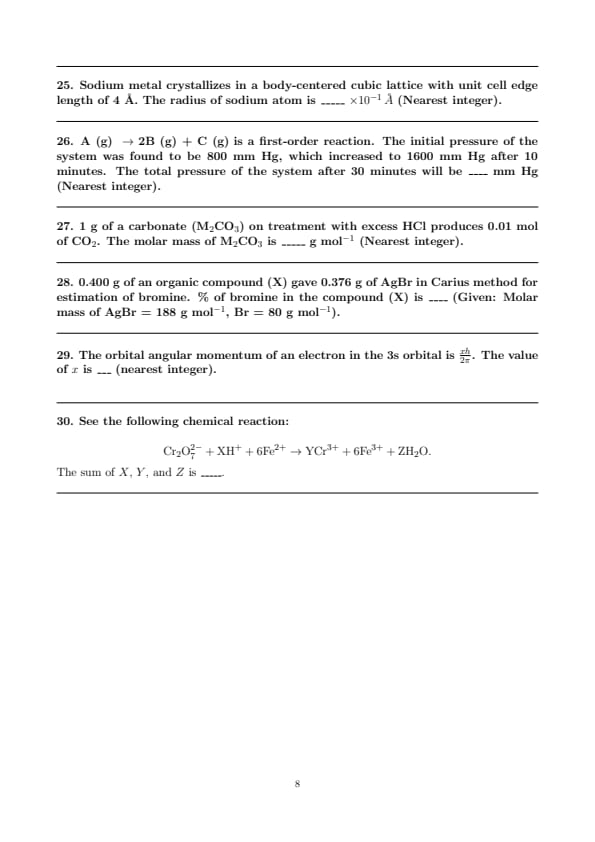
Sodium metal crystallizes in a body-centered cubic lattice with unit cell edge length of 4 \AA. The radius of sodium atom is _____ \(\times 10^{-1} \, \AA\) (Nearest integer).
View Solution
In a body-centered cubic (BCC) lattice, the relationship between the edge length (\(a\)) and the radius of the atom (\(r\)) is given by: \[ \sqrt{3}a = 4r. \]
Substituting the given value of \(a = 4 \, \AA\): \[ \sqrt{3} \cdot 4 = 4r. \]
Simplify: \[ r = \frac{\sqrt{3} \cdot 4}{4} = \sqrt{3}. \]
Numerically: \[ r = \sqrt{3} \cdot 1 \, \AA = 1.732 \, \AA. \]
Converting to scientific notation: \[ r = 17.32 \times 10^{-1} \, \AA. \]
% Final Answer
Final Answer: \( \boxed{17} \) Quick Tip: For BCC lattices, use the relationship \(\sqrt{3}a = 4r\) to calculate the atomic radius from the edge length.
A (g) \(\rightarrow\) 2B (g) + C (g) is a first-order reaction. The initial pressure of the system was found to be 800 mm Hg, which increased to 1600 mm Hg after 10 minutes. The total pressure of the system after 30 minutes will be ____ mm Hg (Nearest integer).
View Solution
1. Initial Condition:
At \(t = 0\):
\[ P_A = 800 \, mm Hg, \quad P_B = 0, \quad P_C = 0. \]
2. First-order Kinetics Relation:
For a first-order reaction:
\[ (P_A)_t = (P_A)_0 \left(\frac{1}{2}\right)^{t/t_{1/2}}. \]
Here:
\((P_A)_0 = 800 \, mm Hg\),
At \(t = 10 \, min\), \((P_A)_t = 1600 \, mm Hg\).
Half-life (\(t_{1/2}\)) of the reaction is \(10 \, min\).
3. Pressure after 30 minutes:
At \(t = 30 \, min\):
\[ t = 3 \cdot t_{1/2}. \]
The pressure of \(P_A\) will be:
\[ (P_A)_t = 800 \cdot \left(\frac{1}{2}\right)^3 = 800 \cdot \frac{1}{8} = 100 \, mm Hg. \]
4. Total Pressure Contribution:
The pressure due to products \(2B + C\):
For \(2B\): \(P_B = 2 \cdot (800 - 100) = 1400 \, mm Hg\),
For \(C\): \(P_C = 800 - 100 = 700 \, mm Hg\).
Total pressure:
\[ P_{total} = (P_A) + (P_B) + (P_C). \]
Substituting values:
\[ P_{total} = 100 + 1400 + 700 = 2200 \, mm Hg. \]
% Final Answer
Final Answer: \( \boxed{2200} \, mm Hg \) Quick Tip: For first-order reactions, use the relationship \((P_A)_t = (P_A)_0 \left(\frac{1}{2}\right)^{t/t_{1/2}}\) and calculate the contributions of products to the total pressure.
1 g of a carbonate (M\(_2\)CO\(_3\)) on treatment with excess HCl produces 0.01 mol of CO\(_2\). The molar mass of M\(_2\)CO\(_3\) is _____ g mol\(^{-1}\) (Nearest integer).
View Solution
The reaction between M\(_2\)CO\(_3\) and HCl is: \[ M_2CO_3 + 2HCl \rightarrow 2MCl + H_2O + CO_2. \]
From the principle of atomic conservation, 1 mole of M\(_2\)CO\(_3\) produces 1 mole of CO\(_2\).
Given: \[ Moles of CO_2 = 0.01 \, mol. \] \[ Moles of M_2CO_3 = 0.01 \, mol. \]
The mass of M\(_2\)CO\(_3\) is 1 g, so: \[ Molar mass of M_2CO_3 = \frac{Mass}{Moles} = \frac{1}{0.01} = 100 \, g mol^{-1}. \]
% Final Answer
Final Answer: \( \boxed{100} \, g mol^{-1} \). Quick Tip: For stoichiometric calculations, relate the given compound to the products using mole ratios and basic principles of conservation of mass.
0.400 g of an organic compound (X) gave 0.376 g of AgBr in Carius method for estimation of bromine. % of bromine in the compound (X) is ____ (Given: Molar mass of AgBr = 188 g mol\(^{-1}\), Br = 80 g mol\(^{-1}\)).
View Solution
1. Moles of AgBr formed: \[ Moles of AgBr = \frac{Mass of AgBr}{Molar mass of AgBr} = \frac{0.376}{188} = 0.002 \, mol. \]
2. Moles of Br: \[ Moles of Br = Moles of AgBr = 0.002 \, mol. \]
3. Mass of Br: \[ Mass of Br = Moles of Br \times Molar mass of Br = 0.002 \times 80 = 0.16 \, g. \]
4. Percentage of Br in compound X: \[ % of Br = \frac{Mass of Br}{Mass of compound} \times 100 = \frac{0.16}{0.400} \times 100 = 40%. \]
% Final Answer
Final Answer: \( \boxed{40%} \). Quick Tip: In elemental estimation methods like the Carius method, relate the mass of the product (e.g., AgBr) to the element being analyzed (e.g., Br) using mole ratios.
The orbital angular momentum of an electron in the 3s orbital is \( \frac{x h}{2 \pi} \). The value of \( x \) is ___ (nearest integer).
View Solution
The orbital angular momentum \( L \) of an electron in any orbital is given by the formula:
\[ L = \sqrt{l(l+1)} \cdot \frac{h}{2 \pi} \]
Where:
- \( l \) is the azimuthal quantum number (also known as the angular momentum quantum number).
- \( h \) is Planck's constant.
- \( \frac{h}{2 \pi} \) is the reduced Planck's constant \( \hbar \).
For an electron in the \( 3s \) orbital, the quantum number \( l \) is 0 because the \( s \)-orbital corresponds to \( l = 0 \).
Substituting \( l = 0 \) into the formula:
\[ L = \sqrt{0(0+1)} \cdot \frac{h}{2 \pi} = \sqrt{0} \cdot \frac{h}{2 \pi} = 0 \]
Thus, the orbital angular momentum \( L \) is 0.
Since the question states that the orbital angular momentum is \( \frac{x h}{2 \pi} \), and we know that the value of \( L \) is 0, it follows that \( x = 0 \).
Therefore, the value of \( x \) is 0. Quick Tip: In quantum mechanics, for an electron in an \( s \)-orbital (where \( l = 0 \)), the orbital angular momentum is always zero. This is a key concept to remember when working with angular momentum in atomic physics.
See the following chemical reaction:
\[ Cr_2O_7^{2-} + XH^+ + 6Fe^{2+} \rightarrow YCr^{3+} + 6Fe^{3+} + ZH_2O. \]
The sum of \(X\), \(Y\), and \(Z\) is _____.
View Solution
1. Balancing the Reaction:
To balance the given reaction in an acidic medium:
\[ Cr_2O_7^{2-} + 14H^+ + 6Fe^{2+} \rightarrow 2Cr^{3+} + 6Fe^{3+} + 7H_2O. \]
2. Identify \(X\), \(Y\), and \(Z\):
\(X = 14\) (moles of H\(^+\)),
\(Y = 2\) (moles of Cr\(^3+\)),
\(Z = 7\) (moles of H\(_2\)O).
3. Sum of \(X + Y + Z\):
\[ X + Y + Z = 14 + 2 + 7 = 23. \]
% Final Answer
Final Answer: \( \boxed{23} \). Quick Tip: For balancing redox reactions, use the ion-electron method or oxidation state method and ensure both charge and mass balance are achieved.
*The article might have information for the previous academic years, please refer the official website of the exam.