
JEE Main 2023 Physics April 13 Shift 2 Question Paper with Solution PDF- Download Here

.jpg?tr=h-55,w-55,c-force)
Content Strategist|Tech-innovator|National Hackathon Winner | Updated On - Mar 19, 2025

PHYSICS
SECTION-A
Question 1:
Given below are two statements:
Statements I: An AC circuit undergoes electrical resonance if it contains either a capacitor or an inductor.
Statement II: An AC circuit containing a pure capacitor or a pure inductor consumes high power due to its non-zero power factor.
In the light of above statements, choose the correct answer from the options given below:
View Solution
Statement I: An AC circuit undergoes electrical resonance only when both a capacitor and an inductor are present in the circuit, as their reactances cancel each other out. Therefore, the statement that resonance can occur with just a capacitor or an inductor is false.
Statement II: A pure capacitor or a pure inductor in an AC circuit does not consume real power because they do not have a power factor that is non-zero. In the case of a pure capacitor or inductor, the power factor is zero, and the average power consumed is also zero. Thus, the statement about high power consumption due to a non-zero power factor is false.
For resonance, both capacitor and inductor are required to ensure the circuit reaches resonance, where the phase difference \( \phi = 0 \) and the reactances cancel out. Quick Tip: In an AC circuit, resonance occurs only when both a capacitor and an inductor are present, as their reactances cancel each other out. A pure capacitor or inductor does not consume real power due to a zero power factor.
A passenger sitting in a train A moving at 90 km/h observes another train B moving in the opposite direction for 8 s. If the velocity of train B is 54 km/h, then the length of train B is:
View Solution
The velocity of train A (\( V_A \)) is given as \( 90 \, km/h \), which can be converted to SI units: \[ V_A = 90 \, km/h = 25 \, m/s. \]
The velocity of train B (\( V_B \)) is given as \( 54 \, km/h \): \[ V_B = 54 \, km/h = 15 \, m/s. \]
Since the trains are moving in opposite directions, the relative velocity (\( V_{BA} \)) is the sum of their velocities: \[ V_{BA} = V_A + V_B = 25 \, m/s + 15 \, m/s = 40 \, m/s. \]
The time of crossing (\( t \)) is given as \( 8 \, s \). The length of train B (\( \ell \)) is related to the time of crossing and relative velocity as: \[ t = \frac{\ell}{V_{BA}}. \]
Substituting the values: \[ 8 = \frac{\ell}{40}. \]
Solving for \( \ell \): \[ \ell = 8 \times 40 = 320 \, m. \]
Thus, the length of train B is \( \boxed{320 \, m} \). Quick Tip: To calculate the length of a moving object observed over a certain time, use the relation \( \ell = t \times relative velocity \). Ensure all units are consistent (e.g., m/s and seconds).
The output from a NAND gate having inputs \( A \) and \( B \) given below will be:

View Solution
Step 1: Truth Table of NAND Gate
The NAND gate is a universal logic gate. It gives an output of 0 only when both of its inputs are 1, otherwise, it gives an output of 1. The output \( Y \) of a NAND gate is given by the formula: \[ Y = \overline{A \cdot B} \]
where \( A \) and \( B \) are the inputs, and \( \cdot \) represents the AND operation, and \( \overline{\cdot} \) represents the NOT operation.
The truth table for a NAND gate is as follows:
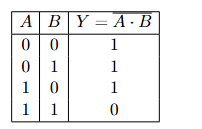
This table shows that the NAND gate outputs a 1 for all combinations of inputs except when both inputs are 1.
Step 2: Analyzing the Input Waveforms
The problem gives us the input waveforms for \( A \) and \( B \). We are tasked with determining the corresponding output from the NAND gate.
The input waveforms are:
For input \( A \), the sequence alternates between 1 and 0.
For input \( B \), the sequence also alternates between 1 and 0.
We can apply the truth table for each combination of \( A \) and \( B \) values over time to determine the output \( Y \) for each combination. Here's how we apply the NAND operation:
\[ If A = 0 and B = 0 \quad \Rightarrow \quad Y = \overline{0 \cdot 0} = 1 \] \[ If A = 0 and B = 1 \quad \Rightarrow \quad Y = \overline{0 \cdot 1} = 1 \] \[ If A = 1 and B = 0 \quad \Rightarrow \quad Y = \overline{1 \cdot 0} = 1 \] \[ If A = 1 and B = 1 \quad \Rightarrow \quad Y = \overline{1 \cdot 1} = 0 \]
This pattern is repeated for the entire waveform sequence.
Step 3: Output Waveform
Based on the analysis from the truth table and input waveforms, we can now generate the output waveform. The output waveform follows the behavior of the NAND gate, switching between 1 and 0 based on the input combinations.
The correct output waveform will match option (1), which is the expected result.
Step 4: Verifying the Solution
We have analyzed the inputs and applied the truth table to generate the output. By following the logic of the NAND gate, we confirmed that the output waveform matches the behavior defined by the NAND operation.
Thus, the correct output is: \[ \boxed{Output 1 (Option 1)} \] Quick Tip: The output of a NAND gate is always high except when all inputs are high. Use the truth table to verify the output step by step.
The distance travelled by an object in time \( t \) is given by \( s = (2.5)t^2 \). The instantaneous speed of the object at \( t = 5 \) will be:
View Solution
Step 1: Given the equation for distance:
The distance travelled by the object in time \( t \) is given by: \[ s = 2.5 t^2 \]
where \( s \) is the distance and \( t \) is the time.
Step 2: Finding the instantaneous speed:
The instantaneous speed of the object is given by the derivative of the distance \( s \) with respect to time \( t \): \[ v = \frac{ds}{dt} \]
Differentiating \( s = 2.5 t^2 \), we get: \[ v = 5t \]
Step 3: Substituting \( t = 5 \, sec \):
Substituting the value \( t = 5 \) seconds into the equation for speed: \[ v = 5 \times 5 = 25 \, ms^{-1} \]
Thus, the instantaneous speed of the object at \( t = 5 \, sec \) is \( 25 \, ms^{-1} \). Quick Tip: To find the instantaneous speed, take the derivative of the distance function with respect to time. This gives you the rate of change of distance, which is the speed.
In a Young's double slits experiment, the ratio of amplitude of light coming from slits is \( 2:1 \). The ratio of the maximum to minimum intensity in the interference pattern is:
View Solution
The given ratio of amplitudes is: \[ \frac{A_1}{A_2} = \frac{2}{1}. \]
The ratio of maximum to minimum intensity is given by the formula: \[ \frac{I_{max}}{I_{min}} = \left( \frac{A_1 + A_2}{A_1 - A_2} \right)^2. \]
Substituting the values of \( A_1 \) and \( A_2 \): \[ \frac{I_{max}}{I_{min}} = \left( \frac{2 + 1}{2 - 1} \right)^2 = \left( \frac{3}{1} \right)^2 = 9:1. \]
Thus, the ratio of maximum to minimum intensity in the interference pattern is \( \boxed{9:1} \). Quick Tip: To calculate the ratio of acceleration due to gravity between two planets, use the relation \( g \propto R \rho \), where \( R \) is the radius and \( \rho \) is the density. Account for changes in both radius and density to determine the correct ratio. Ensure all units are consistent.
Given below are two statements: one is labelled as Assertion (A) and the other is labelled as Reason (R):
Assertion (A): The binding energy per nucleon is practically independent of the atomic number for nuclei of mass number in the range 30 to 170.
Reason (R): Nuclear force is short-ranged.
In the light of the above statements, choose the correct answer from the options given below:
View Solution
Assertion (A): The binding energy per nucleon is practically independent of the atomic number for nuclei of mass number in the range 30 to 170. This is true because for medium and heavy nuclei, the binding energy per nucleon remains approximately constant and stable in this mass range.
Reason (R): Nuclear force is short-ranged. This is true because nuclear forces act only within a very short range (of the order of a few femtometers) and are responsible for binding nucleons together.
Since the stability of the binding energy per nucleon is a consequence of the short-ranged nature of nuclear forces, the reason (R) correctly explains the assertion (A).
Thus, the correct answer is \( \boxed{(2)} \). Quick Tip: To compare the acceleration due to gravity on different planets, use the formula \( g \propto R \rho \), where \( R \) is the radius and \( \rho \) is the density. The ratio can be calculated by considering both the relative radii and densities of the planets.
Two planets A and B of radii \( R \) and \( 1.5R \) have densities \( \rho \) and \( \rho/2 \) respectively. The ratio of acceleration due to gravity at the surface of B to A is:
View Solution
Step 1: Formula for acceleration due to gravity
The acceleration due to gravity \( g \) at the surface of a planet is given by the formula: \[ g = \frac{GM}{R^2} \]
where \( G \) is the gravitational constant, \( M \) is the mass of the planet, and \( R \) is the radius of the planet.
Step 2: Relationship between mass and density
The mass of the planet can be written in terms of its density \( \rho \) and volume \( V \). The volume of a sphere is given by: \[ V = \frac{4}{3} \pi R^3 \]
Thus, the mass \( M \) of the planet is: \[ M = \rho \times Volume = \rho \times \frac{4}{3} \pi R^3 \]
Substituting this expression for \( M \) into the formula for gravity, we get: \[ g = \frac{G \times \frac{4}{3} \pi R^3 \times \rho}{R^2} = \frac{4}{3} G \pi R \rho \]
Step 3: Applying the formula to both planets
For planet A, with radius \( R \) and density \( \rho \), the acceleration due to gravity is: \[ g_1 = \frac{4}{3} G \pi R \rho \]
For planet B, with radius \( 1.5R \) and density \( \frac{\rho}{2} \), the acceleration due to gravity is: \[ g_2 = \frac{4}{3} G \pi (1.5R) \times \frac{\rho}{2} = \frac{4}{3} G \pi \times 1.5R \times \frac{\rho}{2} = \frac{4}{3} G \pi R \times \frac{3}{4} \rho \]
Simplifying this, we get: \[ g_2 = \frac{3}{4} \times g_1 \]
Step 4: Ratio of accelerations
The ratio of the accelerations due to gravity at the surfaces of planets B and A is: \[ \frac{g_2}{g_1} = \frac{3}{4} \]
Thus, the ratio of the acceleration due to gravity at the surface of B to A is \( 3 : 4 \). Quick Tip: To calculate the ratio of acceleration due to gravity between two planets, use the relation \( g \propto R \rho \), where \( R \) is the radius and \( \rho \) is the density. Account for changes in both radius and density to determine the correct ratio. Ensure all units are consistent.
The mean free path of molecules of a certain gas at STP is \( 1500d \), where \( d \) is the diameter of the gas molecules. While maintaining the standard pressure, the mean free path of the molecules at \( 373 \, K \) is approximately:
View Solution
The mean free path \( \lambda \) of molecules is given by the formula: \[ \lambda = \frac{RT}{\sqrt{2} \pi d^2 N_A P}, \]
where \( R \) is the gas constant, \( T \) is the temperature, \( d \) is the diameter of gas molecules, \( N_A \) is Avogadro's number, and \( P \) is the pressure.
At constant pressure, the mean free path is directly proportional to temperature \( T \): \[ \lambda \propto T. \]
Given: \[ \lambda_STP = 1500d \quad at \quad T = 273 \, K. \]
For \( T = 373 \, K \), the new mean free path \( \lambda \) is: \[ \frac{\lambda}{\lambda_STP} = \frac{T}{T_STP}. \]
Substituting the values: \[ \frac{\lambda}{1500d} = \frac{373}{273}. \]
Simplify: \[ \lambda = 1500d \cdot \frac{373}{273} \approx 2049d. \]
Thus, the mean free path of the molecules at \( 373 \, K \) is approximately \( \boxed{2049d} \). Quick Tip: The mean free path of gas molecules is directly proportional to temperature (\( \lambda \propto T \)) at constant pressure. Use the ratio of temperatures to calculate changes in mean free path.
To radiate EM signal of wavelength \( \lambda \) with high efficiency, the antennas should have a minimum size equal to:
View Solution
Step 1: Minimum size of the antenna for efficient radiation
For an efficient radiation of electromagnetic (EM) signals, the size of the antenna should be comparable to the wavelength of the EM signal. The minimum size of an antenna is typically related to the wavelength \( \lambda \) by the following relation: \[ Minimum size of antenna = \frac{\lambda}{4} \]
This is for the case of a half-wave dipole antenna, which is commonly used for high-efficiency radiation.
Step 2: Explanation
The length of the antenna determines the resonance frequency at which it can efficiently radiate the electromagnetic waves. For the antenna to resonate at the frequency corresponding to the wavelength \( \lambda \), the minimum size of the antenna should be \( \frac{\lambda}{4} \). This ensures the antenna radiates efficiently with a minimum size for high performance.
Thus, the correct answer is \( \frac{\lambda}{4} \), which corresponds to option (4). Quick Tip: The minimum size of an antenna for efficient radiation of EM waves is \( \frac{\lambda}{4} \), where \( \lambda \) is the wavelength of the signal. This ensures maximum efficiency in signal transmission.
A particle executes SHM of amplitude \( A \). The distance from the mean position when its kinetic energy becomes equal to its potential energy is:
View Solution
For a particle in simple harmonic motion (SHM), the total energy \( E \) is the sum of kinetic energy (K.E.) and potential energy (P.E.), and is given by: \[ E = \frac{1}{2}M \omega^2 A^2, \]
where \( M \) is the mass, \( \omega \) is the angular frequency, and \( A \) is the amplitude.
When the kinetic energy equals the potential energy: \[ K.E. = P.E.. \]
At any point in SHM, the kinetic energy is: \[ K.E. = \frac{1}{2}M \omega^2 (A^2 - x^2), \]
and the potential energy is: \[ P.E. = \frac{1}{2}M \omega^2 x^2. \]
Setting \( K.E. = P.E. \): \[ \frac{1}{2}M \omega^2 (A^2 - x^2) = \frac{1}{2}M \omega^2 x^2. \]
Simplify: \[ A^2 - x^2 = x^2. \]
Rearrange: \[ 2x^2 = A^2. \]
Solve for \( x \): \[ x^2 = \frac{A^2}{2}. \]
\[ x = \pm \frac{A}{\sqrt{2}}. \]
Thus, the distance from the mean position when the kinetic energy equals the potential energy is \( \boxed{\frac{1}{\sqrt{2}}A} \). Quick Tip: In SHM, when the kinetic energy equals the potential energy, the distance from the mean position is given by \( x = \frac{A}{\sqrt{2}} \), where \( A \) is the amplitude.
In an electromagnetic wave, at an instant and at a particular position, the electric field is along the negative z-axis and the magnetic field is along the positive x-axis. Then the direction of propagation of the electromagnetic wave is:
View Solution
The direction of propagation of an electromagnetic (EM) wave is given by the cross product of the electric field vector (\( \vec{E} \)) and the magnetic field vector (\( \vec{B} \)): \[ Direction of propagation \propto \vec{E} \times \vec{B}. \]
Given: \[ \vec{E} \, (electric field) \, is along the negative z-axis \quad (\vec{E} = -\hat{k}), \] \[ \vec{B} \, (magnetic field) \, is along the positive x-axis \quad (\vec{B} = \hat{i}). \]
The cross product \( \vec{E} \times \vec{B} \) is: \[ \vec{E} \times \vec{B} = (-\hat{k}) \times (\hat{i}). \]
Using the right-hand rule and the vector cross product rules: \[ \hat{k} \times \hat{i} = \hat{j}. \]
Thus: \[ (-\hat{k}) \times (\hat{i}) = -\hat{j}. \]
This indicates that the direction of propagation of the EM wave is along the negative y-axis.
Hence, the direction of propagation of the electromagnetic wave is \( \boxed{negative y-axis} \). Quick Tip: The direction of propagation of an electromagnetic wave is always perpendicular to both the electric field (\( \vec{E} \)) and magnetic field (\( \vec{B} \)), determined by the cross product \( \vec{E} \times \vec{B} \). Use the right-hand rule to determine the direction.
Given below are two statements:
Statement I: Out of microwaves, infrared rays, and ultraviolet rays, ultraviolet rays are the most effective for the emission of electrons from a metallic surface.
Statement II: Above the threshold frequency, the maximum kinetic energy of photoelectrons is inversely proportional to the frequency of the incident light.
In the light of the above statements, choose the correct answer from the options given below:
View Solution
Statement I: Ultraviolet (UV) rays have the highest frequency among the given options (microwaves, infrared rays, and ultraviolet rays). Since the energy of a photon is directly proportional to its frequency (\( E = h f \)), UV rays are the most effective for the emission of electrons from a metallic surface. Hence, Statement I is true.
Statement II: The maximum kinetic energy of photoelectrons is given by the photoelectric equation: \[ K.E_{max} = h f - h f_0, \]
where \( h \) is Planck's constant, \( f \) is the frequency of the incident light, and \( f_0 \) is the threshold frequency.
From the equation, it is clear that \( K.E_{max} \) is directly proportional to \( f \), not inversely proportional. Hence, Statement II is false.
Thus, the correct answer is \( \boxed{(3)} \). Quick Tip: The photoelectric equation \( K.E_{max} = h f - h f_0 \) shows that the maximum kinetic energy of photoelectrons is directly proportional to the frequency of the incident light above the threshold frequency. Higher frequencies result in higher energies for ejected electrons.
Given below are two statements:
Statement I: For a planet, if the ratio of mass of the planet to its radius increases, the escape velocity from the planet also increases.
Statement II: Escape velocity is independent of the radius of the planet.
In the light of the above statements, choose the most appropriate answer from the options given below:
View Solution
The formula for escape velocity is: \[ v_e = \sqrt{\frac{2GM}{R}}, \]
where \( G \) is the gravitational constant, \( M \) is the mass of the planet, and \( R \) is the radius of the planet.
From the formula, it is clear that \( v_e \propto \sqrt{\frac{M}{R}} \).
- As the ratio \( \frac{M}{R} \) increases, the escape velocity \( v_e \) increases. Hence, Statement I is correct.
- However, \( v_e \) depends on \( R \) as seen from the formula, so escape velocity is not independent of the radius of the planet. Hence, Statement II is incorrect.
Thus, the correct answer is \( \boxed{(2)} \). Quick Tip: Escape velocity is directly proportional to the square root of the mass-radius ratio of the planet, i.e., \( v_e \propto \sqrt{\frac{M}{R}} \). Increasing \( M/R \) increases \( v_e \).
A vehicle of mass \( 200 \, kg \) is moving along a levelled curved road of radius \( 70 \, m \) with angular velocity of \( 0.2 \, rad/s \). The centripetal force acting on the vehicle is:
View Solution
The centripetal force is given by the formula: \[ F_c = m \omega^2 r, \]
where \( m = 200 \, kg \) is the mass of the vehicle, \( \omega = 0.2 \, rad/s \) is the angular velocity, and \( r = 70 \, m \) is the radius of the curved road.
Substitute the values: \[ F_c = 200 \times (0.2)^2 \times 70. \]
Simplify: \[ F_c = 200 \times 0.04 \times 70 = 560 \, N. \]
Thus, the centripetal force acting on the vehicle is \( \boxed{560 \, N} \). Quick Tip: The centripetal force is calculated using \( F_c = m \omega^2 r \), where \( \omega \) is the angular velocity and \( r \) is the radius of the path. Ensure all units are consistent when applying the formula.
A \( 10 \, \mu C \) charge is divided into two parts and placed at \( 1 \, cm \) distance so that the repulsive force between them is maximum. The charges of the two parts are:
View Solution
Let the total charge \( q = 10 \, \mu C \) be divided into two parts, \( x \) and \( (q - x) \).
The force between the two charges is given by Coulomb's law: \[ F = \frac{k \, x \, (q - x)}{r^2}, \]
where \( k \) is Coulomb's constant and \( r = 1 \, cm \) is the distance between the charges.
To maximize \( F \), differentiate \( F \) with respect to \( x \) and set the derivative equal to zero: \[ \frac{dF}{dx} = 0. \]
Simplify: \[ \frac{d}{dx} \left( \frac{k \, x \, (q - x)}{r^2} \right) = \frac{k}{r^2} \left( q - 2x \right) = 0. \]
This gives: \[ q - 2x = 0. \]
Solve for \( x \): \[ x = \frac{q}{2} = \frac{10 \, \mu C}{2} = 5 \, \mu C. \]
The other part of the charge is: \[ q - x = 10 \, \mu C - 5 \, \mu C = 5 \, \mu C. \]
Thus, the charges of the two parts are \( \boxed{5 \, \mu C} \) and \( \boxed{5 \, \mu C} \). Quick Tip: To maximize the Coulomb force between two charges when dividing a total charge \( q \), divide it into two equal parts, i.e., \( x = \frac{q}{2} \).
In the equation \( \left[ x + \frac{a}{y^2} \right] [Y - b] = RT \), \( X \) is pressure, \( Y \) is volume, \( R \) is universal gas constant and \( T \) is temperature. The physical quantity equivalent to the ratio \( \frac{a}{b} \) is:
View Solution
Step 1: Analyzing the dimensions
From the given equation: \[ \left[ x + \frac{a}{y^2} \right] [Y - b] = RT \]
We are asked to determine the physical quantity equivalent to the ratio \( \frac{a}{b} \).
Step 2: Dimensions of \( x \) and \( \frac{a}{y^2} \)
The term \( x \) and \( \frac{a}{y^2} \) have the same dimensions, so the dimension of \( x \) is equal to the dimension of \( \frac{a}{y^2} \).
Let the dimensions of \( a \) and \( b \) be: \[ [a] = [M L^5 T^{-2}] \] \[ [b] = [L^3] \]
Step 3: Finding the dimensions of \( \frac{a}{b} \)
Now, we calculate the dimensions of \( \frac{a}{b} \): \[ \frac{[a]}{[b]} = \frac{M L^5 T^{-2}}{L^3} = M L^2 T^{-2} \]
The dimensions of \( \frac{a}{b} \) are \( M L^2 T^{-2} \), which are the dimensions of energy.
Step 4: Conclusion
Therefore, the physical quantity equivalent to the ratio \( \frac{a}{b} \) is energy, which corresponds to option (2). Quick Tip: When dealing with dimensional analysis, always compare the dimensions of quantities in the equation and relate them to known physical quantities. The dimensions \( M L^2 T^{-2} \) correspond to energy.
An electron is moving along the positive x-axis. If the uniform magnetic field is applied parallel to the negative z-axis, then
A. The electron will experience magnetic force along positive y-axis
B. The electron will experience magnetic force along negative y-axis
C. The electron will not experience any force in magnetic field
D. The electron will continue to move along the positive x-axis
E. The electron will move along circular path in magnetic field
Choose the correct answer from the options given below:
View Solution
Step 1: Force on a charged particle in a magnetic field
The force on a charged particle moving with velocity \( \vec{v} \) in a magnetic field \( \vec{B} \) is given by: \[ \vec{F} = q (\vec{v} \times \vec{B}) \]
For an electron, the charge \( q = -e \), so the force becomes: \[ \vec{F} = -e (\vec{v} \times \vec{B}) \]
Step 2: Applying the right-hand rule
The electron is moving along the positive x-axis, so its velocity vector \( \vec{v} \) is along the \( +x \)-direction: \( \vec{v} = v_x \hat{i} \).
The magnetic field \( \vec{B} \) is applied along the negative z-axis: \( \vec{B} = -B \hat{k} \).
Using the right-hand rule for the cross product, the force on the electron is along the negative y-axis. This is because: \[ \vec{F} = -e (\hat{i} \times -\hat{k}) = -e \hat{j} \]
Thus, the force on the electron is in the negative y-direction.
Step 3: Path of the electron
Since the force is perpendicular to the velocity, the electron will experience centripetal force and move along a circular path in the magnetic field. Therefore, the electron will move along a circular path.
Step 4: Conclusion
The correct statements are:
B. The electron will experience magnetic force along the negative y-axis.
E. The electron will move along a circular path in the magnetic field.
Thus, the correct answer is (1) B and E only. Quick Tip: For a charged particle moving in a magnetic field, the force is always perpendicular to both the velocity and the magnetic field. This results in circular motion for the particle.
Given below are two statements: one is labelled as Assertion A and the other is labelled as Reason R:
Assertion A: A spherical body of radius \( (5 \pm 0.1) \, mm \) having a particular density is falling through a liquid of constant density. The percentage error in the calculation of its terminal velocity is \( 4% \).
Reason R: The terminal velocity of the spherical body falling through the liquid is inversely proportional to its radius.
In the light of the above statements, choose the correct answer from the options given below:
View Solution
The terminal velocity (\( V_t \)) of a spherical body falling through a liquid is directly proportional to the square of its radius (\( r^2 \)): \[ V_t \propto r^2. \]
The percentage error in terminal velocity can be calculated using the formula: \[ \frac{\Delta V_t}{V_t} = 2 \cdot \frac{\Delta r}{r}. \]
Given: \[ r = 5 \, mm, \quad \Delta r = 0.1 \, mm. \]
Substitute the values: \[ \frac{\Delta V_t}{V_t} \times 100 = 2 \cdot \frac{\Delta r}{r} \times 100 = 2 \cdot \frac{0.1}{5} \cdot 100 = 4%. \]
Hence, Assertion A is true.
However, the Reason R states that the terminal velocity is inversely proportional to the radius, which is incorrect because \( V_t \propto r^2 \). Therefore, Reason R is false.
Thus, the correct answer is \( \boxed{(4)} \). Quick Tip: The terminal velocity of a spherical body falling through a liquid is directly proportional to the square of its radius (\( V_t \propto r^2 \)). When calculating percentage error, account for the squared relationship with radius.
The initial pressure and volume of an ideal gas are \( P_0 \) and \( V_0 \). The final pressure of the gas when the gas is suddenly compressed to volume \( \frac{V_0}{4} \) will be:
(Given \( \gamma \) = ratio of specific heats at constant pressure and at constant volume)
View Solution
As the gas is suddenly compressed, the process is adiabatic.
The equation for the gas in an adiabatic process is: \[ P V^\gamma = constant. \]
For the initial state: \[ P_0 V_0^\gamma = P_2 \left(\frac{V_0}{4}\right)^\gamma. \]
Rearranging to solve for \( P_2 \): \[ P_2 = P_0 \cdot \frac{V_0^\gamma}{\left(\frac{V_0}{4}\right)^\gamma}. \]
Simplify the denominator: \[ P_2 = P_0 \cdot \frac{V_0^\gamma}{\frac{V_0^\gamma}{4^\gamma}} = P_0 \cdot 4^\gamma. \]
Thus, the final pressure is: \[ P_2 = P_0 (4)^\gamma. \]
Hence, the correct answer is \( \boxed{P_0 (4)^\gamma} \). Quick Tip: For an adiabatic process, the relation \( P V^\gamma = constant \) is used. If the volume changes by a factor, the pressure changes inversely by the same factor raised to the power of \( \gamma \).
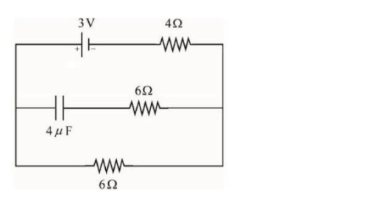
In the network shown below, the charge accumulated in the capacitor in steady state will be:
View Solution
In steady state, no current passes through the capacitor. Hence, the capacitor acts as an open circuit.
The circuit can be analyzed as follows:
1. Current \( i_2 = 0 \) through the capacitor.
2. The current \( i_1 \) in the resistors is determined by the total resistance of the branch excluding the capacitor.
The total resistance of the \( 6 \, \Omega \) and \( 4 \, \Omega \) resistors in series is: \[ R_{total} = 6 + 4 = 10 \, \Omega. \]
The current in the circuit is: \[ i_1 = \frac{3}{R_{total}} = \frac{3}{10} = 0.3 \, A. \]
The potential difference across the \( 6 \, \Omega \) resistor is: \[ V = i_1 \cdot R = 0.3 \cdot 6 = 1.8 \, V. \]
Since the capacitor is in parallel with the \( 6 \, \Omega \) resistor, the potential difference across the capacitor is also \( 1.8 \, V \).
The charge accumulated in the capacitor is: \[ Q = C \cdot V, \]
where \( C = 4 \, \muF \) and \( V = 1.8 \, V \).
Substitute the values: \[ Q = 4 \cdot 1.8 = 7.2 \, \muC. \]
Thus, the charge accumulated in the capacitor is \( \boxed{7.2 \, \muC} \). Quick Tip: In steady state, a capacitor behaves as an open circuit. The potential difference across the capacitor is the same as that across the parallel resistor.
SECTION-B
Question 21:
In an experiment with sonometer, when a mass of \( 180 \, g \) is attached to the string, it vibrates with a fundamental frequency of \( 30 \, Hz \). When a mass \( m \) is attached, the string vibrates with a fundamental frequency of \( 50 \, Hz \). The value of \( m \) is ________ g.
View Solution
The fundamental frequency of a vibrating string is given by: \[ f = \frac{1}{2L} \sqrt{\frac{T}{\mu}}, \]
where \( f \) is the frequency, \( L \) is the length of the string, \( T \) is the tension in the string, and \( \mu \) is the linear mass density.
The ratio of frequencies for the two cases is: \[ \frac{f_2}{f_1} = \sqrt{\frac{T_2}{T_1}}, \]
where \( T_1 = 180g \, and \, T_2 = mg \).
Substitute \( f_2 = 50 \, Hz, f_1 = 30 \, Hz \): \[ \frac{50}{30} = \sqrt{\frac{mg}{180g}}. \]
Simplify: \[ \left(\frac{50}{30}\right)^2 = \frac{m}{180}. \]
\[ \frac{25}{9} = \frac{m}{180}. \]
Solve for \( m \): \[ m = \frac{25}{9} \cdot 180 = 500 \, g. \]
Thus, the value of \( m \) is \( \boxed{500 \, g} \). Quick Tip: The fundamental frequency of a vibrating string is proportional to the square root of the tension in the string. Use frequency ratios to relate the tensions and solve for unknown masses.
Two plates A and B have thermal conductivities \( 84 \, Wm^{-1}K^{-1} \) and \( 126 \, Wm^{-1}K^{-1} \) respectively. They have the same surface area and same thickness. They are placed in contact along their surfaces. If the temperatures of the outer surfaces of A and B are kept at \( 100^\circC \) and \( 0^\circC \) respectively, then the temperature of the surface of contact in steady state is __ \( ^\circC \).
View Solution
Let the temperature of the contact surface be \( T \).
The heat current through plate A is equal to the heat current through plate B in the steady state: \[ K_A A \frac{(T_A - T)}{L} = K_B A \frac{(T - T_B)}{L}, \]
where \( K_A \) and \( K_B \) are the thermal conductivities, \( T_A = 100^\circ C \), \( T_B = 0^\circ C \), and \( L \) is the thickness.
Substitute the given values: \[ 84 \cdot (100 - T) = 126 \cdot (T - 0). \]
Simplify: \[ 8400 - 84T = 126T. \]
Rearrange: \[ 8400 = 210T. \]
Solve for \( T \): \[ T = \frac{8400}{210} = 40^\circ C. \]
Thus, the temperature of the contact surface is \( \boxed{40^\circ C} \). Quick Tip: In steady-state thermal conduction, the heat current through two materials in contact is equal. Use the thermal conductivity relation to determine the temperature of the contact surface.
In the circuit shown, the energy stored in the capacitor is \( n \, \mu J \). The value of \( n \) is:

View Solution
To find the energy stored in the capacitor, we first analyze the circuit to determine the potential difference across the capacitor.
The total current in the circuit can be calculated as: \[ I_s = \frac{12}{3 + 9} = \frac{12}{12} = 1 \, A. \]
The current through the upper branch (\( AB \)) is: \[ I_1 = \frac{12}{4 + 2} = \frac{12}{6} = 2 \, A. \]
The voltage drop across the \( 3 \, \Omega \) resistor is: \[ V_A - V_C = 3I_1 = 3 \cdot 1 = 3 \, V. \]
The voltage at point \( A \) with respect to point \( D \) is: \[ V_A - V_D = 3 \cdot 1 + 2 \cdot 2 = 3 + 4 = 8 \, V. \]
The voltage across the capacitor is: \[ V_A - V_B = 5 \, V. \]
The energy stored in the capacitor is given by the formula: \[ U = \frac{1}{2} C V^2, \]
where \( C = 6 \, \mu F \) and \( V = 5 \, V \).
Substitute the values: \[ U = \frac{1}{2} \cdot 6 \cdot 5^2 = \frac{1}{2} \cdot 6 \cdot 25 = 75 \, \mu J. \]
Thus, the energy stored in the capacitor is \( \boxed{75 \, \mu J} \). Quick Tip: The energy stored in a capacitor is proportional to the square of the voltage across it. Use the formula \( U = \frac{1}{2} C V^2 \) and calculate the voltage from circuit analysis.
A light rope is wound around a hollow cylinder of mass 5 kg and radius 70 cm. The rope is pulled with a force of 52.5 N. The angular acceleration of the cylinder will be _____ rad s\(^{-2}\):
View Solution
Step 1: Equation for angular acceleration
We use the equation for rotational motion: \[ \tau = I \alpha \]
where \( \tau \) is the torque, \( I \) is the moment of inertia, and \( \alpha \) is the angular acceleration.
Step 2: Expression for torque
The torque \( \tau \) is given by the force \( F \) applied at a radius \( R \), so: \[ \tau = F \cdot R \]
Step 3: Moment of inertia of a hollow cylinder
The moment of inertia \( I \) for a hollow cylinder is: \[ I = m R^2 \]
where \( m \) is the mass and \( R \) is the radius.
Step 4: Solving for angular acceleration
From the equation \( \tau = I \alpha \), we can solve for \( \alpha \): \[ F \cdot R = m R^2 \alpha \] \[ \alpha = \frac{F}{m R} \]
Substituting the given values: \[ \alpha = \frac{52.5}{5 \times 0.7} \] \[ \alpha = 15 \, rad s^{-2} \]
Thus, the angular acceleration of the cylinder is \( 15 \, rad s^{-2} \). Quick Tip: For rotational motion, the angular acceleration can be found by using the relationship \( \alpha = \frac{F}{mR} \), where \( F \) is the force applied, \( m \) is the mass, and \( R \) is the radius.
A straight wire AB of mass 40 g and length 50 cm is suspended by a pair of flexible leads in uniform magnetic field of magnitude 0.40 T as shown in the figure. The magnitude of the current required in the wire to remove the tension in the supporting leads is ______ A. (Take \( g = 10 \, ms^{-2} \))

View Solution
Step 1: Understanding the problem
In this problem, a straight wire is placed in a uniform magnetic field. The wire experiences a magnetic force due to the current passing through it, which counteracts the force due to gravity. The objective is to find the current required to remove the tension in the supporting leads.
Step 2: Force due to gravity
The force due to gravity acting on the wire is given by: \[ F_{gravity} = mg \]
where \( m = 40 \, g = 40 \times 10^{-3} \, kg \) is the mass of the wire and \( g = 10 \, ms^{-2} \) is the acceleration due to gravity.
Thus, the gravitational force is: \[ F_{gravity} = 40 \times 10^{-3} \times 10 = 0.4 \, N \]
Step 3: Magnetic force on the wire
The magnetic force on a current-carrying wire in a magnetic field is given by: \[ F_{magnetic} = I L B \]
where \( I \) is the current, \( L = 0.50 \, m \) is the length of the wire, and \( B = 0.40 \, T \) is the magnetic field strength.
Step 4: Equilibrium condition
For equilibrium, the magnetic force must balance the gravitational force, so: \[ F_{gravity} = F_{magnetic} \]
Substituting the known values: \[ 0.4 = I \times 0.50 \times 0.40 \]
Step 5: Solving for the current
Solving for \( I \), we get: \[ I = \frac{0.4}{0.50 \times 0.40} = \frac{0.4}{0.20} = 2 \, A \]
Thus, the magnitude of the current required in the wire to remove the tension in the supporting leads is \( 2 \, A \).
Quick Tip: In problems involving a current in a magnetic field, remember that the magnetic force is given by \( F = I L B \), and equilibrium conditions can help relate forces to find the current.
An insulated copper wire of 100 turns is wrapped around a wooden cylindrical core of the cross-sectional area \( 24 \, cm^2 \). The two ends of the wire are connected to a resistor. The total resistance in the circuit is \( 12 \, \Omega \). If an externally applied uniform magnetic field in the core along its axis changes from \( 1.5 \, T \) in one direction to \( 1.5 \, T \) in the opposite direction, the charge flowing through a point in the circuit during the change of magnetic field will be ______\ mC.
View Solution
The induced emf (\( \mathcal{E} \)) in the circuit is given by Faraday's law: \[ \mathcal{E} = -N \frac{\Delta \Phi_B}{\Delta t}, \]
where \( N = 100 \) is the number of turns, and \( \Delta \Phi_B \) is the change in magnetic flux.
The total change in magnetic flux (\( \Delta \Phi_B \)) is: \[ \Delta \Phi_B = A \Delta B, \]
where \( A = 24 \, cm^2 = 24 \times 10^{-4} \, m^2 \) is the cross-sectional area, and \( \Delta B = 2 \times 1.5 = 3 \, T \) is the change in magnetic field (from \( 1.5 \, T \) in one direction to \( 1.5 \, T \) in the opposite direction).
Substitute values: \[ \Delta \Phi_B = 24 \times 10^{-4} \times 3 = 7.2 \times 10^{-3} \, Wb. \]
The total emf induced is: \[ \mathcal{E} = \frac{N \Delta \Phi_B}{R}, \]
where \( R = 12 \, \Omega \).
Substitute \( N = 100 \): \[ \mathcal{E} = \frac{100 \cdot 7.2 \times 10^{-3}}{12} = 6 \times 10^{-3} \, C. \]
Thus, the charge flowing through the circuit is \( \boxed{60 \, mC} \). Quick Tip: To calculate the charge in a circuit due to a changing magnetic field, use \( Q = \frac{N \Delta \Phi_B}{R} \), where \( \Delta \Phi_B = A \Delta B \) and \( \Delta B \) is the total change in magnetic field.
A bi-convex lens of focal length \( 10 \, cm \) is cut in two identical parts along a plane perpendicular to the principal axis. The power of each lens after cut is ______\ D.
View Solution
The power (\( P \)) of a lens is given by: \[ P = \frac{100}{f}, \]
where \( f \) is the focal length in cm.
For the original lens, the focal length is \( f = 10 \, cm \): \[ P = \frac{100}{10} = 10 \, D. \]
When the lens is cut into two identical parts along a plane perpendicular to the principal axis, the focal length of each part remains the same because the curvature of the lens does not change. Therefore, the focal length of each part is still \( f = 10 \, cm \), and the power remains: \[ P = \frac{100}{10} = 10 \, D. \]
Hence, the power of each lens after the cut is \( \boxed{10 \, D} \). Quick Tip: When a lens is cut along a plane perpendicular to its principal axis, the focal length and power of each part remain the same as the original lens.
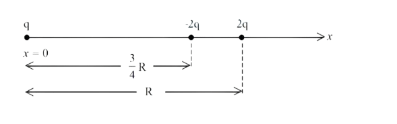
Three point charges \( q, -2q \), and \( 2q \) are placed on the x-axis at distances \( x = 0, x = \frac{3}{4}R \), and \( x = R \) respectively, from the origin as shown. If \( q = 2 \times 10^{-6} \, C \) and \( R = 2 \, cm \), the magnitude of the net force experienced by the charge \( -2q \) is ___ N.
View Solution
Let A, B, and C be the positions of the charges \( q \), \( -2q \), and \( 2q \) respectively.
The distance between A and B is \( \frac{3}{4}R \), and the distance between B and C is \( R - \frac{3}{4}R = \frac{1}{4}R \).
The force exerted by charge \( q \) at A on charge \( -2q \) at B is given by Coulomb's Law: \[ F_{BA} = k \frac{|q(-2q)|}{\left(\frac{3}{4}R\right)^2} = k \frac{2q^2}{\frac{9}{16}R^2} = k \frac{32q^2}{9R^2} \]
The force exerted by charge \( 2q \) at C on charge \( -2q \) at B is given by Coulomb's Law: \[ F_{BC} = k \frac{|(-2q)(2q)|}{\left(\frac{1}{4}R\right)^2} = k \frac{4q^2}{\frac{1}{16}R^2} = k \frac{64q^2}{R^2} \]
The net force on charge \( -2q \) at B is the difference between \( F_{BC} \) and \( F_{BA} \) (since they are in opposite directions): \[ F_B = F_{BC} - F_{BA} = k \frac{64q^2}{R^2} - k \frac{32q^2}{9R^2} = k \frac{q^2}{R^2} \left( 64 - \frac{32}{9} \right) = k \frac{q^2}{R^2} \left( \frac{576 - 32}{9} \right) = k \frac{544q^2}{9R^2} \]
Given:
\( q = 2 \times 10^{-6} \) C
\( R = 2 \times 10^{-2} \) m
\( k = 9 \times 10^9 \) N m\(^2\)/C\(^2\) (approximation)
Plugging in the values: \[ F_B = (9 \times 10^9) \frac{544 \times (2 \times 10^{-6})^2}{9 \times (2 \times 10^{-2})^2} = 10^9 \times \frac{544 \times 4 \times 10^{-12}}{4 \times 10^{-4}} = 10^9 \times 544 \times 10^{-8} = 5440 N \]
Therefore, the magnitude of the net force experienced by the charge \( -2q \) is 5440 N. Quick Tip: The net force on a charge due to multiple charges is the vector sum of the forces due to individual charges. Use Coulomb's law and carefully calculate distances for each pair of charges.
An atom absorbs a photon of wavelength 500 nm and emits another photon of wavelength 600 nm. The net energy absorbed by the atom in this process is \( n \times 10^{-4} \) eV. The value of \( n \) is ______.
[Assume the atom to be stationary during the absorption and emission process]
View Solution
The net energy absorbed by the atom is given by: \[ E = E_i - E_e = h c \left(\frac{1}{\lambda_1} - \frac{1}{\lambda_2}\right), \]
where: \( h = 6.6 \times 10^{-34} \, Js \), \( c = 3 \times 10^8 \, m/s \), \( \lambda_1 = 500 \, nm = 5 \times 10^{-7} \, m \), \( \lambda_2 = 600 \, nm = 6 \times 10^{-7} \, m \).
Substitute the values: \[ E = \left(6.6 \times 10^{-34}\right) \cdot \left(3 \times 10^8\right) \cdot \left(\frac{1}{5 \times 10^{-7}} - \frac{1}{6 \times 10^{-7}}\right). \]
Simplify: \[ E = \left(6.6 \times 10^{-34} \cdot 3 \times 10^8\right) \cdot \left(\frac{6 - 5}{30 \times 10^{-7}}\right). \]
\[ E = \left(1.98 \times 10^{-25}\right) \cdot \left(\frac{1}{5 \times 10^{-7}}\right). \]
Convert to eV (\( 1 \, eV = 1.6 \times 10^{-19} \, J \)): \[ E = \frac{1.98 \times 10^{-25}}{1.6 \times 10^{-19}} = 4.125 \times 10^{-4} \, eV. \]
Thus, the net energy absorbed is \( \boxed{4.125 \times 10^{-4} \, eV} \) and the value of \( n \) is \( \boxed{4125} \). Quick Tip: To calculate the net energy absorbed by an atom in terms of wavelength, use the formula \( E = h c \left(\frac{1}{\lambda_1} - \frac{1}{\lambda_2}\right) \), where \( \lambda_1 \) and \( \lambda_2 \) are the wavelengths of the absorbed and emitted photons.
A car accelerates from rest to \( u \, m/s \). The energy spent in this process is \( E \, J \). The energy required to accelerate the car from \( u \, m/s \) to \( 2u \, m/s \) is \( nE \, J \). The value of \( n \) is.
View Solution
The kinetic energy of an object is given by: \[ E_k = \frac{1}{2} m v^2, \]
where \( m \) is the mass and \( v \) is the velocity.
Energy spent to accelerate from rest to \( u \): \[ E_1 = \frac{1}{2} m u^2. \]
Energy spent to accelerate from \( u \) to \( 2u \):
The kinetic energy at \( 2u \) is: \[ E_2 = \frac{1}{2} m (2u)^2 = \frac{1}{2} m (4u^2) = 2m u^2. \]
The kinetic energy at \( u \) is: \[ E_1 = \frac{1}{2} m u^2. \]
The energy required to go from \( u \) to \( 2u \) is: \[ \Delta E = E_2 - E_1 = 2m u^2 - \frac{1}{2} m u^2. \]
Simplify: \[ \Delta E = \frac{4}{2} m u^2 - \frac{1}{2} m u^2 = \frac{3}{2} m u^2. \]
We know that \( E_1 = \frac{1}{2} m u^2 \), so: \[ \Delta E = 3E_1. \]
Thus, \( n = 3 \), and the energy required to accelerate the car from \( u \, m/s \) to \( 2u \, m/s \) is \( \boxed{3E} \). Quick Tip: The energy required to increase the velocity of an object is proportional to the square of the change in velocity. For a given mass, calculate the difference in kinetic energy to find the energy spent.
*The article might have information for the previous academic years, please refer the official website of the exam.