
JEE Main 2023 Question Paper with Solution Pdf (April 6 - Shift 1)


Content Curator | Updated On - Mar 31, 2026
The JEE Main 2023 Question Paper with Solution PDF is available here for download. The exam was successfully conducted by NTA on April 6, 2023, in the first shift.
Students can download JEE Main previous year question papers PDFs with detailed solutions to practice and improve their performance. Solving these papers helps aspirants understand the JEE Main exam pattern, analyze the difficulty level, and prepare according to the latest JEE Main syllabus.
Related Links:
Download JEE Main 2026 Session 1 Question Paper with Solution PDF
Download JEE Main 2025 Question Paper with Solution PDF
JEE Main 2023 Question Paper Apr 6 Shift 1 with Solution Pdf
| JEE Main 2023 Shift 1 Question Paper PDF | JEE Main 2023 Shift 1 Solution PDF |
|---|---|
| Download PDF | Check Solutions |

Question 1:
The straight lines l1 and l2 pass through the origin and trisect the line segment of the line L : 9x + 5y = 45 between the axes. If m1 and m2 are the slopes of the lines l1 and l2, then the point of intersection of the line y = (m1 + m2)x with L lies on:
View Solution
The line L intersects the axes at A(5,0) and B(0,9). The lines l1 and l2 trisect AB. The points trisecting AB are P(10/3, 3) and Q(5/3, 6). m1 = 9/10 and m2 = 18/10 = 9/5. m1 + m2 = 9/2 The equation of the line passing through the origin with slope 9/2 is y = (9/2)x or 9x - 2y = 0. Solving the system of equations 9x + 5y = 45 and 9x - 2y = 0, we get y=45/7 and x=10/7. This point satisfies y - x = 5.
Question 2:
Let the position vectors of the points A, B, C and D be 5i + 5j + 2λk, i + 2j + 3k, −2i + xj + 4k and -i + 5j + 6k. Let the set S = {λ ∈ R: the points A, B, C and D are coplanar}. Then Σλ∈S(λ + 2)2 is equal to:
View Solution
For A, B, C, and D to be coplanar, the scalar triple product of vectors AB, AC, and AD must be zero. AB = -4i - 3j + (3-2λ)k, AC = -7i + (x-5)j + (4-2λ)k, and AD = -6i + (6-2λ)k. The scalar triple product gives the equation -4λ2 + 20λ - 24 = 0, which simplifies to λ2 - 5λ + 6 = 0. Solving for λ gives λ=2 or λ=3. Therefore S={2,3}. Σλ∈S(λ+2)2 = (2+2)2 + (3+2)2 = 16 + 25 = 41.
Question 3:
Let I(x) = ∫ (x2(xsec2x + tanx))⁄(xtanx + 1)2 dx. If I(0) = 0, then I(π/4) is equal to:
View Solution
Integrate by parts with u = x2 and dv = (xsec2x + tanx)⁄(xtanx + 1)2. Then v = -1/(xtanx + 1). I(x) = -x2⁄(xtanx+1) + ∫ 2x⁄(xtanx + 1) dx = -x2⁄(xtanx+1) + 2ln|xsinx+cosx|. Since I(0) = 0, the constant of integration is 0. Substitute x = π/4 and evaluate.
Question 4:
The sum of the first 20 terms of the series 5 + 11 + 19 + 29 + 41 + ... is:
View Solution
The differences between consecutive terms form an arithmetic progression: 6, 8, 10, 12, ... The nth term of this progression is 2n+4. The nth term of the original series is given by Tn = n2 + 3n + 1. The sum of the first 20 terms is Σ20n=1(n2+3n+1) = Σn2 + 3Σn + Σ1 = 2870 + 630 + 20 = 3520.
Question 5:
A pair of dice is thrown 5 times. For each throw, a total of 5 is considered a success. If probability of at least 4 successes is k⁄311, then k is equal to:
View Solution
The probability of getting a sum of 5 is 4/36 = 1/9. Let p = 1/9 and q = 8/9. The probability of at least 4 successes in 5 trials is given by P(X=4) + P(X=5) = 5C4p4q1 + 5C5p5 = 5(1/9)4(8/9) + (1/9)5 = 41⁄95 = 123⁄311. Thus, k=123.
Question 6:
Let A = [aij]2x2, where aij ≠ 0 for all i, j, and A2 = I. Let a be the sum of all diagonal elements of A and b = |A|. Then 3a2 + 4b2 is equal to:
View Solution
Let A = [[α, β], [γ, δ]]. Since A2 = I, |A2|=|I| => |A|2 = 1 => |A| = b = ±1. Also, A2 = [[α2 + βγ, αβ + βδ],[αγ + γδ, βγ + δ2]] = I. This leads to α + δ = 0, or a = 0. Therefore, 3a2 + 4b2 = 3(0)2 + 4(±1)2 = 4.
Question 7:
Let a1, a2, a3, ..., an be n positive consecutive terms of an arithmetic progression. If d > 0 is its common difference, then: limn→∞ (1⁄√n)(1⁄√a1+√a2 + 1⁄√a2+√a3+ ... + 1⁄√an-1+√an) is:
View Solution
Rationalize each term in the summation: Σn-1k=1 (√ak+1 - √ak)⁄d = (√an - √a1)⁄d. Substituting an = a1 + (n-1)d and simplifying the limit yields 1.
Question 8:
If 2nC3 : nC3 = 10:1, then the ratio (n2 + 3n) : (n2 - 3n + 4) is:
View Solution
Using the combination formula, we get 4(2n-1)⁄(n-2) = 10. Solving gives n=8. Substitute n=8 into the ratio (n2 + 3n) : (n2 - 3n + 4) to get 88:44, which simplifies to 2:1.
Question 9:
Let A = {x ∈ R : |x+3| + |x+4| ≤ 3}, B = {x ∈ R: 3 · Σ3x-3r=110-r < 3-[x]} where [x] denotes the greatest integer function. Then,
View Solution
For set A, consider the cases x ≥ -3, -4 ≤ x < -3, and x < -4. Solving the inequality in each case gives -5 ≤ x ≤ -2, so A = [-5, -2]. For set B, the summation is a geometric series. Simplifying the inequality gives x+[x] < 3. Let x=n+ε, where n is an integer and 0 < ε < 1. This gives -5 ≤ x ≤ -2, so B=[-5, -2]. Therefore A=B.
Question 10:
One vertex of a rectangular parallelepiped is at the origin O and the lengths of its edges along x, y and z axes are 3, 4 and 5 units respectively. Let P be the vertex (3, 4, 5). Then the shortest distance between the diagonal OP and an edge parallel to the z axis, not passing through O or P is:
View Solution
Let the edge parallel to the z-axis be through (3,0,0). The direction vector of OP is <3,4,5>. The direction vector of the edge is <0,0,1>. The shortest distance is given by the formula |(a2-a1)·(b1 x b2)|/|b1 x b2|. Here, a1=(0,0,0), b1=<3,4,5>, a2=(3,0,0) and b2=<0,0,1>. b1 x b2 = <4,-3,0>. |b1 x b2| = 5. (a2-a1)·(b1 x b2) = 12. So, the shortest distance is 12/5. If we consider the edge parallel to z-axis through (0,4,0), a2 becomes (0,4,0), and the shortest distance becomes 12/√5.
Question 11:
If the equation of the plane passing through the line of intersection of the planes 2x - y + z = 3 and 4x – 3y + 5z + 9 = 0 and parallel to the line (x+1)⁄-2 = (y+3)⁄4 = z⁄5 is ax + by + cz + 6 = 0, then a + b + c is equal to :
View Solution
The equation of the plane passing through the intersection of the two given planes is (2x - y + z - 3) + λ(4x - 3y + 5z + 9) = 0. This plane is parallel to the line with direction vector <-2, 4, 5>. The normal vector of the plane is <2+4λ, -1-3λ, 1+5λ>. Since the plane is parallel to the line, the normal vector is perpendicular to the direction vector of the line. Therefore, -2(2+4λ) + 4(-1-3λ) + 5(1+5λ) = 0, which gives λ=3/5. Substituting this value of λ into the equation of the plane and comparing it to ax + by + cz + 6 = 0 gives a=11, b=-7, and c=10. Thus, a+b+c = 14.
Question 12:
If the ratio of the fifth term from the beginning to the fifth term from the end in the expansion of (√2 + 1⁄√3)n is √6 : 1, then the third term from the beginning is :
View Solution
The fifth term from the beginning is nC4(√2)n-4(1/√3)4. The fifth term from the end is nCn-4(√2)4(1/√3)n-4. The ratio of these terms is given as √6. Simplifying and solving for n, we get n=10. The third term from the beginning is 10C2(√2)8(1/√3)2 = 60√3.
Question 13:
The sum of all the roots of the equation |x2 - 8x + 15| - 2x + 7 = 0 is:
View Solution
We consider two cases: x2 - 8x + 15 ≥ 0 and x2 - 8x + 15 < 0. In the first case, x2 - 10x + 22 = 0, which gives x = 5±√3. Only 5+√3 satisfies the condition. In the second case, -x2 + 6x - 8 = 0, which gives x=2 or x=4. Only x=4 satisfies the condition. The sum of the roots is 4 + (5+√3) = 9 + √3.
Question 14:
From the top A of a vertical wall AB of height 30 m, the angles of depression of the top P and bottom Q of a vertical tower PQ are 15° and 60° respectively. B and Q are on the same horizontal level. If C is a point on AB such that CB = 15 m, then the area (in m²) of the quadrilateral BCPQ is equal to:
View Solution
Let BQ = y. tan60° = AB/BQ => y = 10√3. Let AP = x. tan15° = x/y => x = 15(2-√3). PQ = 30-x = 10(3√3-3). The area of the trapezium BCPQ is (1/2)(BC+PQ) * BQ = (1/2)(15 + 10(3√3-3)) * 10√3 = 600(√3-1).
Question 15:
Let a = 2i + 3j + 4k, b = i – 2j – 2k and c = −i + 4j + 3k. If d is a vector perpendicular to both b and c, and a · d = 18, then |a x d|2 is equal to :
View Solution
Since d is perpendicular to both b and c, d is parallel to b x c. b x c = 2i - j + 2k. Let d = λ(2i - j + 2k). Since a·d = 18, we have 2(2λ) + 3(-λ) + 4(2λ) = 18 => λ=2. So, d = 4i - 2j + 4k. |a|2 = 29, |d|2 = 36. |a x d|2 = |a|2|d|2 - (a·d)2 = 29*36 - 182 = 720.
Question 16:
If 2xy + 3yx = 20, then dy⁄dx at (2,2) is equal to:
View Solution
Differentiate both sides with respect to x using logarithmic differentiation: 2xy(ylnx + x(1/y)dy⁄dx) + 3yx(lny*yx+yx*xlny(1/y)dy⁄dx) = 0. Substituting x=2 and y=2 and simplifying gives dy⁄dx = -(8 + 12ln2)⁄(12 + 8ln2) = -(2+3ln2)⁄(3+2ln2) = -(2+ln8)⁄(3+ln4).
Question 17:
If the system of equations x+y+az = b, 2x + 5y + 2z = 6, x+2y+3z = 3 has infinitely many solutions, then 2a+3b is equal to:
View Solution
For infinitely many solutions, the determinant of the coefficient matrix and the determinants of the matrices obtained by replacing each column with the constants must be zero. The coefficient matrix determinant is 7-a. Setting this to zero gives a=7. The determinant Δx (replacing the x column with the constants) is 11b-33. Setting this to zero gives b=3. Therefore, 2a+3b = 2(7)+3(3) = 23.
Question 18:
Statement (P⇒Q)∧(R⇒Q) is logically equivalent to:
View Solution
(P⇒Q)∧(R⇒Q) is equivalent to (¬P∨Q)∧(¬R∨Q), which can be written as (¬P∧¬R)∨Q. Using De Morgan's Law, this becomes ¬(P∨R)∨Q, which is equivalent to (P∨R)⇒Q.
Question 19:
Let 5f(x) + 4f(1⁄x) = 1⁄x + 3, x>0. Then 18∫21f(x)dx is equal to:
View Solution
Substitute 1/x for x to get another equation: 5f(1⁄x) + 4f(x) = x + 3. Solve this system of equations to get f(x) = (5 - 4x)⁄(9x) + 1⁄3. Integrate 18f(x) from 1 to 2 to get 10loge2 - 6.
Question 20:
The mean and variance of a set of 15 numbers are 12 and 14 respectively. The mean and variance of another set of 15 numbers are 14 and σ2 respectively. If the variance of all the 30 numbers in the two sets is 13, then σ2 is equal to:
View Solution
The combined variance is given by σ2c = (n1σ21 + n2σ22)⁄(n1+n2) + (n1n2(m1-m2)2)⁄(n1+n2)2. Substituting n1=n2=15, m1=12, m2=14, σ21=14, and σ2c = 13, and solving for σ22 = σ2, we get σ2=10.
Question 21:
Let the tangents to the curve x2 + 2x – 4y + 9 = 0 at the point P(1, 3) on it meet the y-axis at A. Let the line passing through P and parallel to the line x - 3y = 6 meet the parabola y2 = 4x at B. If B lies on the line 2x – 3y = 8, then (AB)2 is equal to:
View Solution
The given curve can be rewritten as (x+1)2 = 4(y-2). The equation of the tangent at P(1,3) is x - y + 2 = 0, so A is (0,2). The line through P parallel to x - 3y = 6 is x - 3y = -8. Substituting x = (3y-8) into y2=4x, we get y2 - 12y + 32 = 0, so y=4 or y=8. Thus the intersection points are (4,4) and (16,8). Since B lies on 2x-3y=8, B must be (16,8). Then (AB)2 = (16-0)2 + (8-2)2 = 292.
Question 22:
Let the point (p, p + 1) lie inside the region E = {(x,y): 3 - x ≤ y ≤ √(9 - x2), 0 < x < 3}. If the set of all values of p is the interval (a, b), then b2 + b − a2 is equal to:
View Solution
For the point (p,p+1) to lie inside E, we must have 3-p ≤ p+1 ≤ √(9-p2). The first inequality gives p ≥ 1. The second inequality gives p2 + p - 4 ≤ 0, which means (-1-√17)⁄2 ≤ p ≤ (-1+√17)⁄2. Combining these gives 1 ≤ p < (-1+√17)⁄2. Therefore, a=1 and b= (-1+√17)⁄2. b2 + b - a2 = (1-17+2√17+4)⁄4 + (-1+√17)⁄2 - 1 = 3.
Question 23:
Let y = y(x) be a solution of the differential equation (xcosx)dy + (xysinx + ycosx - 1)dx = 0, 0 < x < π/2. If y(π/3) = √3, then |y"(π/6) + 2y'(π/6)| is equal to:
View Solution
Rewrite the differential equation as dy⁄dx + ((xsinx + cosx)⁄(xcosx))y = 1⁄(xcosx). The integrating factor is xsecx. Multiplying the equation by the integrating factor gives d(xysecx)/dx = sec2x, so xysecx = tanx + C. Using y(π/3) = √3, we get C = √3. Thus y = (sinx + √3cosx)⁄x. Differentiating twice and substituting x=π/6 gives |y"(π/6) + 2y'(π/6)| = 2.
Question 24:
Let a ∈ Z and [t] be the greatest integer ≤ t. Then the number of points, where the function f(x) = [a + 13sinx], x ∈ (0,π) is not differentiable, is:
View Solution
Since 0 < x < π, we have 0 < sinx ≤ 1, and thus 0 < 13sinx ≤ 13. The greatest integer function is discontinuous (and hence not differentiable) at integer values. Thus, f(x) is not differentiable when 13sinx is an integer from 1 to 13. The equation 13sinx = k has two solutions for k=1,2,...,12 and one solution for k=13 in (0,π). Thus there are 2*12 + 1 = 25 points.
Question 25:
If the area of the region S = {(x,y): 2y - y2 ≤ x ≤ 2y, x ≥ y} is equal to (1 - 1⁄n)π⁄4, then the natural number n is equal to:
View Solution
The region S is defined by the inequalities 2y-y2 ≤ x ≤ 2y and x ≥ y. This region lies between the parabola x = 2y-y2 and the lines x=2y and x=y. The area of the required region can be calculated by integrating from y=0 to y=1 (between the parabola and x=2y) and subtracting the area from y=0 to y=1 between x=y and x=2y. This gives ∫10 (2y - (2y-y2))dy = 1⁄3. The area of the triangle formed by x=y, x=2y, and y=1 is 1/2. Therefore the required area is 1/2 - 1/3 = 1/6. Equating this to (1-1⁄n)π⁄4 gives n=5.
Question 26:
The number of ways of giving 20 distinct oranges to 3 children such that each child gets at least one orange is:
View Solution
The total number of ways to distribute 20 oranges among 3 children is 320. The number of ways where at least one child gets no oranges is 3C1 * 220 - 3C2 * 120. The number of ways where each child gets at least one orange is 320 - (3*220 - 3) = 3483638676.
Question 27:
Let the image of the point P(1, 2, 3) in the plane 2x - y + z = 9 be Q. If the coordinates of the point R are (6, 10, 7), then the square of the area of the triangle PQR is:
View Solution
Let Q be (α, β, γ). The midpoint of PQ, M((α+1)⁄2, (β+2)⁄2, (γ+3)⁄2), lies on the plane. The direction ratios of PQ are proportional to the normal of the plane, so (α-1)⁄2 = (β-2)⁄-1 = (γ-3)⁄1 = k. This gives α=2k+1, β=-k+2, γ=k+3. Substituting in the equation of the plane gives k=2, so Q is (5,0,5). Now, PQ = <4,-2,2> and PR = <5,8,4>. The area of triangle PQR is (1/2)|PQ x PR|. PQ x PR = <-24, -6, 42>. The magnitude of this cross product is 2√594. Thus, the square of the area is 594.
Question 28:
A circle passing through the point P(α,β) in the first quadrant touches the two coordinate axes at the points A and B. The point P is above the line AB. The point Q on the line segment AB is the foot of the perpendicular from P on AB. If PQ is equal to 11 units, then the value of αβ is:
View Solution
The equation of a circle touching both axes is (x-a)2 + (y-a)2 = a2. Since P(α,β) lies on the circle, (α-a)2 + (β-a)2 = a2, which simplifies to α2 + β2 - 2a(α+β) + a2 = 0. The equation of line AB is x+y=a. The distance PQ = |α + β - a|/√2 = 11. Thus, (α + β - a)2 = 242. Substituting this into the simplified circle equation gives 2αβ=242, so αβ=121.
Question 29:
The coefficient of x18 in the expansion of (1+x2+2x)15 is:
View Solution
The general term in the expansion of (1+x2+2x)15 is given by 15Cr1,r2,r3 (1)r1(x2)r2(2x)r3, where r1 + r2 + r3 = 15. To find the coefficient of x18, we need 2r2 + r3 = 18. Since r1, r2, r3 are non-negative integers, we can have r2=9, r3=0, r1=6; r2=8, r3=2, r1=5; ... ; r2=0, r3=18, r1=-3 (not possible). Since r1+r2+r3 = 15, when r3=18, r2 must be negative or zero since r1 is nonnegative. If r2=0, r1 = -3 which is not allowed. Therefore, the maximum value of r3 is 2r2+r3=18 along with r1+r2+r3 = 15, from which r1 = 15-18 = -3, so not allowed. Only one possible solution is r1 = 6, r2=6, and r3=3. If r3=0, then 2r2=18 => r2=9 and r1=6. Term = 15C6*9C0 = 5005. This is the only case.
Question 30:
Let A = {1,2,3,4,...,10} and B = {0,1,2,3,4}. The number of elements in the relation R = {(a,b) ∈ A x A : 2(a-b)2 + 3(a-b) ∈ B} is:
View Solution
Let k = a-b. Then we need to find the number of pairs (a,b) such that 2k2+3k ∈ B. Since a,b ∈ A, -9 ≤ k ≤ 9. If k=0, 2k2+3k = 0 ∈ B. This gives a=b. Since there are 10 possible values for a (and hence b), there are 10 pairs. If k=-2, 2k2+3k = 2 ∈ B. This gives a=b-2. Since 1 ≤ a ≤ 10 and 1 ≤ b ≤ 10, we have 3 ≤ b ≤ 10, which gives 8 possible values for b, and hence 8 pairs. No other values of k give a result in B. Therefore, the total number of elements in R is 10 + 8 = 18.
Question 31:
The kinetic energy of an electron, an α-particle, and a proton are given as 4K, 2K, and K respectively. The de-Broglie wavelength associated with electron (λe), α-particle (λα), and the proton (λp) are as follows:
View Solution
Step 1: De Broglie Wavelength Formula
The de Broglie wavelength is given by: λ = h/p, where λ is the wavelength, h is Planck’s constant, and p is the momentum.
Step 2: Relate Momentum and Kinetic Energy
The momentum is related to kinetic energy (KE) by: p = √(2mKE), where m is the mass.
Step 3: Calculate Wavelengths for Electron, Proton, and Alpha Particle
For the electron: λe = h/√(2me * 4K)
For the proton: λp = h/√(2mp * K)
For the alpha particle: λα = h/√(2 * 4mp * 2K)
Comparing the expressions, we get λα < λp < λe.
Question 32:
Given below are two statements: one is labelled as Assertion A and the other is labelled as Reason R.
Assertion A: Earth has atmosphere whereas moon doesn’t have any atmosphere.
Reason R: The escape velocity on the moon is very small as compared to that on Earth.
Choose the correct answer from the options given below:
View Solution
Step 1: Escape Velocity Formula
Escape velocity (Vesc) is the minimum speed required to escape a planet’s gravitational pull: Vesc = √(2GM/r).
Step 2: Explanation
Earth has a higher escape velocity than the moon, allowing it to retain its atmosphere. The moon’s lower escape velocity means lighter gases can escape more easily.
Question 33:
A source supplies heat to a system at the rate of 1000 W. If the system performs work at a rate of 200 W, the rate at which internal energy of the system increases is:
View Solution
Step 1: First Law of Thermodynamics
The change in internal energy (ΔU) is given by: ΔU = Q - W.
Step 2: Calculate Rate of Internal Energy Increase
Given heat rate Q = 1000 W and work rate W = 200 W:
ΔU = 1000 W - 200 W = 800 W.
Question 34:
A small ball of mass M and density ρ is dropped in a viscous liquid of density ρo. After some time, the ball falls with a constant velocity. What is the viscous force on the ball?
View Solution
Step 1: Forces Acting on the Ball
The forces are: Weight (Mg), Buoyant force (B), and Viscous force (f).
Step 2: Solve for Viscous Force
At terminal velocity: Mg = f + B, solving gives: F = Mg(1 − ρo/ρ).
Question 35:
A small block of mass 100 g is tied to a spring of spring constant 7.5 N/m and length 20 cm. The other end of the spring is fixed at a point A. If the block moves in a circular path on a smooth horizontal surface with constant angular velocity 5 rad/s about point A, the tension in the spring is:
View Solution
Step 1: Centripetal Force
The tension in the spring provides the necessary centripetal force for circular motion.
Step 2: Calculate Tension
Using the given values: T = 0.75 N.
Question 36:
A particle is moving with constant speed in a circular path. When the particle turns by an angle of 90°, the ratio of instantaneous velocity to its average velocity is π:x√2. The value of x will be:
View Solution
Step 1: Instantaneous Velocity
The instantaneous velocity is tangential to the circular path with a constant magnitude.
Step 2: Average Velocity
The average velocity is the displacement divided by the time taken.
Step 3: Ratio Calculation
The ratio of instantaneous velocity to average velocity is π:√2, giving x = 2.
Question 37:
Two resistances are given as R1 = (10 ± 0.5)Ω and R2 = (15 ± 0.5)Ω. The percentage error in the measurement of equivalent resistance when they are connected in parallel is:
View Solution
Step 1: Equivalent Resistance Formula
For parallel resistances: 1/Req = 1/R1 + 1/R2.
Step 2: Error Propagation
The percentage error is calculated using error propagation rules. The final error is 4.33%.
Question 38:
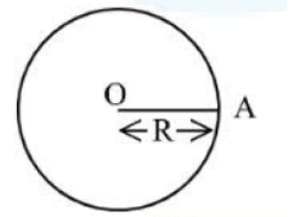
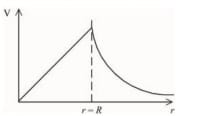
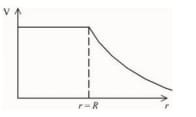
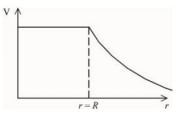
For a uniformly charged thin spherical shell, the electric potential (V) radially away from the center of the shell can be graphically represented as:


View Solution
Step 1: Electric Potential Inside and Outside the Shell
Inside the shell, the potential is constant. Outside the shell, it decreases as 1/r.
Step 2: Graphical Representation
The graph shows a constant potential inside and a decreasing potential outside.
Question 39:
A long straight wire of circular cross-section (radius a) is carrying steady current I. The current I is uniformly distributed across the cross-section. The magnetic field is:
View Solution
Step 1: Ampere’s Law
Using Ampere’s law, the magnetic field inside and outside the wire is calculated.
Step 2: Final Expression
Inside the wire, B ∝ r. Outside the wire, B ∝ 1/r.
Question 40:
By what percentage will the transmission range of a TV tower be affected when the height of the tower is increased by 21%?
View Solution
Step 1: Transmission Range Formula
The range is proportional to the square root of the tower’s height.
Step 2: Percentage Increase
A 21% increase in height results in a 10% increase in range.
Question 41:
The number of air molecules per cm³ increased from 3×10¹⁹ to 12×10¹⁹. The ratio of collision frequency of air molecules before and after the increase is:
View Solution
Step 1: Collision Frequency Formula
Collision frequency is directly proportional to the number density of molecules.
Step 2: Ratio Calculation
The ratio is 0.25 based on the change in number density.
Question 42:
The energy levels of a hydrogen atom are shown. The transition corresponding to emission of the shortest wavelength is:
View Solution
Step 1: Energy and Wavelength Relationship
The transition with the largest energy difference produces the shortest wavelength.
Question 43:
For the plane electromagnetic wave given by E = E₀ sin(ωt - kx) and B = B₀ sin(ωt - kx), the ratio of average electric energy density to average magnetic energy density is:
View Solution
Step 1: Energy Density Formula
The electric and magnetic energy densities are equal in an electromagnetic wave.
Question 44:
A planet has double the mass of the Earth. Its average density is equal to that of the Earth. An object weighing W on Earth will weigh on that planet:
View Solution
Step 1: Gravitational Force Calculation
Weight depends on the mass and radius of the planet. The radius increases as 21/3.
Question 45:
The resistivity (ρ) of a semiconductor varies with temperature. Which of the following curves represents the correct behavior?


View Solution
Step 1: Resistivity vs. Temperature
For semiconductors, resistivity decreases with increasing temperature.
Question 46:
A monochromatic light wave with wavelength λ1 and frequency ν1 in air enters another medium. If the angle of incidence and angle of refraction at the interface are 45° and 30° respectively, then the wavelength λ2 and frequency ν2 of the refracted wave are:
View Solution
Step 1: Use Snell's Law
Snell's law is given by: n1 sin θ1 = n2 sin θ2. Given that θ1 = 45° and θ2 = 30°, we solve for the refractive index ratio.
Step 2: Calculate Wavelength and Frequency
The frequency remains constant during refraction, and the wavelength changes according to the refractive index. The calculated values show that λ2 = (1/√2) λ1 and ν2 = ν1.
Question 47:
A mass m is attached to two springs of spring constants K1 and K2, respectively, as shown. The time period of oscillation of the mass m on a frictionless surface is:

View Solution
Step 1: Equivalent Spring Constant
Since the springs are in parallel, the equivalent spring constant is K = K1 + K2.
Step 2: Time Period Formula
The time period for oscillation is given by T = 2π √(m/K). Substituting the equivalent spring constant gives the final answer.
Question 48:
Identify the logic gate that is equivalent to the given circuit diagram.

View Solution
Step 1: Analyze the Circuit
The circuit shows a configuration that behaves as a NOR gate, with both inputs needing to be 0 to give an output of 1.
Step 2: Truth Table
Constructing the truth table for the circuit confirms that it is a NOR gate.
Question 49:
Which of the following scenarios will result in an induced emf in a coil?
View Solution
Step 1: Faraday's Law
An induced emf is produced when there is a change in magnetic flux through a coil. Rotating the coil or changing its area will change the flux.
Step 2: Analyze the Options
Only options C (rotating the coil) and D (changing the area of the coil) cause a change in flux.
Question 50:
Given below are two statements: Assertion (A) and Reason (R).
Assertion A: When a body is projected at an angle of 45°, its range is maximum.
Reason R: For maximum range, the value of sin 2θ should be equal to 1.
View Solution
Step 1: Horizontal Range Formula
The horizontal range is given by R = (u² sin 2θ) / g. The maximum range occurs when sin 2θ = 1, which is at θ = 45°.
Step 2: Explanation
Both the assertion and the reason are correct, and the reason accurately explains the assertion.
Question 51:
Two identical circular wires of radius 20 cm and carrying current √2 A are placed in perpendicular planes as shown in the figure. The net magnetic field at the center of the circular wires is × 10-8 T.

View Solution
Step 1: Magnetic Field due to a Circular Loop
The magnetic field at the center of a circular loop of radius r carrying current i is given by:
B = μ0i/2r, where μ0 = 4π × 10-7 T·m/A.
Step 2: Magnetic Field due to Each Loop
Given: r = 0.2 m, i = √2 A. Substituting these values:
B = (4π × 10-7)(√2)/(2 × 0.2).
Step 3: Net Magnetic Field
The magnetic fields are perpendicular, so the net field is calculated using Pythagoras' theorem:
Bnet = √2 × (μ0i/2r).
Simplifying: Bnet = 628 × 10-8 T.
Question 52:
A steel rod has a radius of 20 mm and a length of 2.0 m. A force of 62.8 kN stretches it along its length. Young’s modulus of steel is 2.0 × 10¹¹ N/m2. The longitudinal strain produced in the wire is × 10-5.
View Solution
Step 1: Young's Modulus and Strain
Young’s modulus is defined as stress/strain.
Step 2: Calculate Strain
Stress = Force/Area. Using A = πr2, strain = stress/Young’s modulus.
Substitute: strain = (62.8 × 10³)/(π × (20 × 10-3)2 × 2 × 1011) = 25 × 10-5.
Question 53:
The length of a metallic wire is increased by 20% and its area of cross-section is reduced by 4%. The percentage change in resistance of the metallic wire is:
View Solution
Step 1: Resistance Formula
Resistance R = ρl/A.
Step 2: New Resistance
New length: l' = 1.2l. New area: A' = 0.96A. Calculate R': R'/R = (l'/l) / (A'/A) = 1.2/0.96 = 1.25.
Step 3: Percentage Change
Change = (1.25 - 1) × 100 = 25%.
Question 54:
The radius of the fifth orbit of Li++ is × 10-12 m. Take the radius of hydrogen atom = 0.51 Å.
View Solution
Step 1: Bohr's Model Formula
rn = (0.51 × n2)/Z Å. Substituting: n = 5, Z = 3.
Step 2: Calculate Radius
r5 = (0.51 × 25)/3 = 425 × 10-12 m.
Question 55:
A particle of mass 10 g moves in a straight line with retardation 2x, where x is the displacement in SI units. Its loss of kinetic energy for the above displacement is (10/x)-n J. The value of n will be:
View Solution
Step 1: Work-Energy Theorem
Use acceleration a = -2x and integrate: v dv = -2x dx.
Step 2: Solve for Energy Loss
Energy loss = m x2, giving (10/x)-2.
Question 56:
An ideal transformer with a purely resistive load operates at 12 kV on the primary side. It supplies electrical energy to a number of nearby houses at 120 V. The average rate of energy consumption in the houses served by the transformer is 60 kW. The value of resistive load (Rs) required in the secondary circuit will be in mΩ:
View Solution
Step 1: Transformer Voltage Ratio
Voltage ratio: Vs/Vp = Ns/Np. Given Vp = 12,000 V, Vs = 120 V, Ns/Np = 1/100.
Step 2: Power Conservation
Input power = output power. Given output power P = 60 kW.
Step 3: Secondary Current
Is = P/Vs = 60,000/120 = 500 A.
Step 4: Resistive Load
Rs = Vs/Is = 120/500 = 0.24 Ω = 240 mΩ.
Question 57:
A parallel plate capacitor with plate area A and plate separation d is filled with a dielectric material of dielectric constant K = 4. The thickness of the dielectric material is x, where x < d. Let C1 and C2 be the capacitance of the system for x = 1/3d and x = 2/3d, respectively. If C1 = 2 µF, the value of C2 is in µF:
View Solution
Step 1: Capacitance with Dielectric
For a partially filled capacitor: C = ϵ0A/[d - x + x/K].
Step 2: Capacitance C1
For x = d/3: C1 = ϵ0A/[2d/3 + d/12] = 2 µF.
Step 3: Capacitance C2
For x = 2d/3: C2 = ϵ0A/[d/3 + d/6]. C2 = 3 µF.
Question 58:
Two identical solid spheres each of mass 2 kg and radii 10 cm are fixed at the ends of a light rod. The separation between the centers of the spheres is 40 cm. The moment of inertia of the system about an axis perpendicular to the rod passing through its middle point is × 10-3 kg·m2:
View Solution
Step 1: Moment of Inertia of a Solid Sphere
For a solid sphere about its diameter: Isphere = (2/5)mR2.
Step 2: Parallel Axis Theorem
I = Icm + md2. Using d = 20 cm = 0.2 m, R = 0.1 m, and m = 2 kg.
Step 3: Total Moment of Inertia
Itotal = 2 × [(2/5)(2)(0.1)2 + (2)(0.2)2] = 176 × 10-3 kg·m2.
Question 59:
A person driving a car at a constant speed of 15 m/s is approaching a vertical wall. The person notices a change of 40 Hz in the frequency of his car's horn upon reflection from the wall. The frequency of the horn is in Hz:
View Solution
Step 1: Doppler Effect for Reflection
The observed frequency: f′ = [(v + vs)/(v - vs)]f0.
Step 2: Frequency Change
Given vs = 15 m/s, v = 330 m/s, and Δf = 40 Hz.
Solving: f0 = 420 Hz.
Question 60:
A pole is vertically submerged in a swimming pool, such that it gives a length of shadow 2.15 m within water when sunlight is incident at an angle of 30° with the surface of water. If the swimming pool is filled to a height of 1.5 m, then the height of the pole above the water surface in centimeters is (nw = 4/3):
View Solution
Step 1: Snell’s Law
Using n1sini = n2sinr to calculate the angle of refraction.
Step 2: Calculate Tan r
tanr = (sinr/cosr) = 0.85.
Step 3: Height of the Pole
tan30° = h/0.875. Solving: h = 50 cm.
Question 61:
Match List I with List II
List I (Natural Amino acid) and List II (One Letter Code):
(A) Arginine (I) D
(B) Aspartic acid (II) N
(C) Asparagine (III) A
(D) Alanine (IV) R
Choose the correct answer from the options given below:
View Solution
The one-letter codes for the given amino acids are:
- Arginine: R
- Aspartic acid: D
- Asparagine: N
- Alanine: A
Matching these with the options:
(A) Arginine - (IV) R
(B) Aspartic acid - (I) D
(C) Asparagine - (II) N
(D) Alanine - (III) A
Question 62:
Formation of which complex, among the following, is not a confirmatory test of Pb2+ ions:
View Solution
Lead nitrate, Pb(NO3)2, is a soluble colorless compound. Confirmatory tests for ions usually involve the formation of a precipitate or a distinctly colored complex. Lead sulphate (white precipitate), lead chromate (yellow precipitate), and lead iodide (yellow precipitate) are all used as confirmatory tests for lead(II) ions. Since lead nitrate is colorless and soluble, it’s not used as a confirmatory test.
Question 63:
The volume of 0.02 M aqueous HBr required to neutralize 10.0 mL of 0.01 M aqueous Ba(OH)2 is (Assume complete neutralization):
View Solution
For neutralization, the milliequivalents of acid must equal the milliequivalents of base.
Milliequivalents = Molarity × n-factor × Volume
For HBr, n-factor = 1. For Ba(OH)2, n-factor = 2.
Let V be the volume of HBr required.
0.02 × 1 × V = 0.01 × 2 × 10
0.02V = 0.2
V = 0.2 ÷ 0.02 = 10 mL.
Question 64:
Group-13 elements react with O2 in amorphous form to form oxides of type M2O3 (M = element). Which among the following is the most basic oxide?
View Solution
As we move down Group 13, the metallic character increases, and hence the electropositive character increases. As electropositivity increases, the basicity of the oxides increases.
The order of basicity for Group 13 oxides is:
B2O3 < Al2O3 < Ga2O3 < In2O3 < Tl2O3.
Therefore, Tl2O3 is the most basic oxide.
Question 65:
The IUPAC name of K3[Co(C2O4)3] is:
View Solution
The oxalate anion (C2O42−) is a bidentate ligand, and the prefix “tris” indicates there are three oxalate ligands.
The complex anion is [Co(C2O4)3]3−, and since the potassium ion has a +1 charge, there must be three potassium ions to balance the charge. The oxidation state of cobalt is +3, indicated by the Roman numeral (III).
Question 66:
If the radius of the first orbit of hydrogen atom is a0, then de Broglie’s wavelength of electron in the 3rd orbit is:
View Solution
Step 1: Recall the de Broglie principle
The circumference of an electron's orbit in an atom is an integer multiple of the electron's wavelength:
2πr = nλ, where r is the radius of the orbit, n is the principal quantum number, and λ is the de Broglie wavelength.
Step 2: Use the formula for the radius of the nth orbit
rn = n2a0/Z, where Z is the atomic number. For hydrogen (Z = 1) and n = 3, r3 = 9a0.
Step 3: Substitute into the de Broglie equation
2π(9a0) = 3λ
λ = 18πa0/3 = 6πa0.
Question 67:
The group of chemicals used as pesticide is:
View Solution
DDT (Dichlorodiphenyltrichloroethane) and Aldrin are well-known pesticides.
PAN (Peroxyacetyl nitrate) is a component of photochemical smog and not a pesticide.
Sodium chlorate is a herbicide, while Sodium arsinite has been used as an insecticide and rodenticide. Tetrachloroethene is used in dry cleaning.
Thus, the correct pair is DDT and Aldrin.
Question 68:
From the figure of column chromatography given below, identify the incorrect statements:
A. Compound 'c' is more polar than 'a' and 'b'.
B. Compound 'a' is the least polar.
C. Compound 'b' comes out of the column before 'c' and after 'a'.
D. Compound 'a' spends more time in the column.
View Solution
Key Observations:
- In column chromatography, the polarity of the compound determines the retention time.
- More polar compounds elute later, spending more time in the column.
Order of polarity: a > b > c.
Order of elution: c > b > a.
Incorrect statements: A, B, and C.
Question 69:
Ion having the highest hydration enthalpy among the given alkaline earth metal ions is:
View Solution
Step 1: Understand hydration enthalpy
Hydration enthalpy depends on the charge density (charge/size) of the ion. Smaller ions with higher charge have greater hydration enthalpy.
Step 2: Analyze the given ions
Be2+ is the smallest ion among the given alkaline earth metals, so it has the highest charge density and hence the highest hydration enthalpy.
Question 70:
The strongest acid from the following is:
View Solution
Step 1: Stability of the conjugate base
The strength of an acid is determined by the stability of its conjugate base. Electron-withdrawing groups stabilize the conjugate base, increasing acidity.
Step 2: Analyze substituents
- NO2 is a strong electron-withdrawing group (-I and -M effects), stabilizing the conjugate base the most.
- CH3 is electron-donating, reducing acidity.
Thus, nitrophenol is the strongest acid.
Question 71:
In the following reaction, 'B' is:
View Solution
Step 1: Protonation of the alcohol
The hydroxyl group is protonated by H3O+, making it a better leaving group.
Step 2: Carbocation formation
Water leaves, generating a secondary carbocation.
Step 3: Cyclization
The double bond attacks the carbocation, forming a six-membered ring. This results in a tertiary carbocation adjacent to the oxygen in the newly formed ring.
Step 4: Deprotonation
A proton is lost to give the final cyclic ether product.
Thus, the correct product is Option 4.
Question 72:
Structures of BeCl2 in solid state, vapor phase, and at very high temperature respectively are:
View Solution
Solid state: BeCl2 exists as a polymeric structure with each beryllium atom bonded to four chlorine atoms, forming a chain-like structure.
Vapor phase: Below 1200 K, BeCl2 exists as a dimer (Be2Cl4) with chloro-bridging.
High temperature: Above 1200 K, BeCl2 breaks into monomeric units with a linear structure.
Question 73:
Consider the following reaction that goes from A to B in three steps as shown below:
Choose the correct option:
Number of Intermediates | Number of Activated complexes | Rate determining step
View Solution
Step 1: Analyze intermediates and activated complexes
Intermediates are represented by valleys in the energy diagram (2 valleys). Activated complexes correspond to peaks (3 peaks).
Step 2: Identify the rate-determining step
The slowest step corresponds to the highest energy barrier, which is Step II.
Question 74:
The product, which is not obtained during the electrolysis of brine solution, is:
View Solution
Electrolysis reactions:
At cathode: 2H2O + 2e− → H2 + 2OH−
At anode: 2Cl− → Cl2 + 2e−
Products formed: H2, Cl2, and NaOH. HCl is not formed during electrolysis.
Question 75:
Which one of the following elements will remain as liquid inside pure boiling water?
View Solution
Step 1: Analyze melting and boiling points
Boiling water temperature = 100°C.
- Li and Cs react with water.
- Br2: Boiling point is 58.8°C (gas at 100°C).
- Ga: Melting point = 29.8°C, Boiling point = 2400°C (liquid at 100°C).
Question 76:
Given below are two statements: one is labeled as “Assertion A” and the other is labeled as “Reason R”.
Assertion A: In the complex Ni(CO)4 and Fe(CO)5, the metals have zero oxidation state.
Reason R: Low oxidation states are found when a complex has ligands capable of π-donor character in addition to the σ-bonding.
In the light of the above statements, choose the most appropriate answer from the options given below:
View Solution
Step 1: Analyze Assertion A
In Ni(CO)4 and Fe(CO)5, the carbonyl ligand (CO) is neutral. Thus, the oxidation state of Ni and Fe is zero. Assertion A is correct.
Step 2: Analyze Reason R
Low oxidation states are stabilized by synergistic bonding, involving σ-donation from the ligand and π-backdonation from the metal. CO is a π-acceptor ligand, not a π-donor. Therefore, Reason R is incorrect.
Question 77:
Given below are two statements:
Statement I: Morphine is a narcotic analgesic. It helps in relieving pain without producing sleep.
Statement II: Morphine and its derivatives are obtained from the opium poppy.
Choose the correct answer from the options given below:
View Solution
Step 1: Analyze Statement I
Morphine is a narcotic analgesic that relieves pain but induces sleep and drowsiness. Hence, Statement I is false.
Step 2: Analyze Statement II
Morphine and its derivatives are indeed obtained from the opium poppy, making Statement II true.
Question 78:
Find out the major product from the following reaction:
View Solution
Step 1: Perform 1,4-addition
The organocuprate reagent (MeMgBr/CuI) adds to the α, β-unsaturated ketone in a 1,4-conjugate addition manner.
Step 2: Alkylate the product
The resulting ketone reacts with n-propyl iodide (nPrI) via an alkylation reaction at the α-carbon.
The final product is Option 3.
Question 79:
During the reaction of permanganate with thiosulphate, the change in oxidation of manganese occurs by a value of 3. Identify which of the below medium will favor the reaction:
View Solution
Step 1: Reaction in a neutral medium
In a neutral medium, permanganate is reduced to manganese(IV) oxide (MnO2), with a change in oxidation state of 3.
Step 2: Reaction in an acidic medium
In an acidic medium, permanganate is reduced to Mn2+, with a change in oxidation state of 5. The condition specified in the question aligns with a neutral medium.
Question 80:
Element not present in Nessler’s reagent is:
View Solution
Step 1: Composition of Nessler’s reagent
Nessler’s reagent is an alkaline solution of potassium tetraiodomercurate(II), K2[HgI4].
Step 2: Identify absent element
The reagent contains potassium (K), mercury (Hg), and iodine (I) but not nitrogen (N).
Question 81:
The standard reduction potentials at 298 K for the following half cells are given below:
NO-3 + 4H+ + 3e- → NO(g) + 2H2O, E0 = 0.97 V
V2+(aq) + 2e- → V, E0 = -1.19 V
Fe3+(aq) + 3e- → Fe, E0 = -0.04 V
Ag+(aq) + e- → Ag(s), E0 = 0.80 V
Au3+(aq) + 3e- → Au(s), E0 = 1.40 V
The number of metal(s) which will be oxidized by NO-3 in aqueous solution is:
View Solution
Step 1: Understand oxidation and reduction potentials
For a metal to be oxidized, the reduction potential of NO-3 (0.97 V) must be greater than the metal's oxidation potential.
Step 2: Reverse reduction potentials for oxidation potentials
- V: E0 (oxidation) = 1.19 V
- Fe: E0 (oxidation) = 0.04 V
- Ag: E0 (oxidation) = -0.80 V
- Au: E0 (oxidation) = -1.40 V
Step 3: Compare with NO-3
Metals oxidized: Fe, Ag, Au (E0 < 0.97 V).
Question 82:
Number of crystal systems from the following where body-centered unit cells can be found:
Cubic, tetragonal, orthorhombic, hexagonal, rhombohedral, monoclinic, triclinic
View Solution
Step 1: Define body-centered cubic (BCC)
A BCC structure has atoms at each corner of a cube and one atom at the center.
Step 2: Identify systems
BCC unit cells are found in cubic, tetragonal, and orthorhombic systems.
Step 3: Exclude others
Hexagonal, rhombohedral, monoclinic, and triclinic do not have BCC arrangements.
Question 83:
Among the following, the number of compounds which will give a positive iodoform reaction is:
- 1-Phenylbutan-2-one
- 2-Methylbutan-2-ol
- 3-Methylbutan-2-ol
- 1-Phenylethanol
- 3,3-dimethylbutan-2-one
- 1-Phenylpropan-2-ol
View Solution
Step 1: Understand the iodoform test
The test is positive for methyl ketones (R-CO-CH3) and secondary alcohols with CH3CH(OH)- groups.
Step 2: Analyze compounds
Positive test: 1, 3, 4, 6 (methyl ketones or secondary alcohols with required groups).
Question 84:
Number of isomeric aromatic amines with molecular formula C8H11N, which can be synthesized by Gabriel phthalimide synthesis is:
View Solution
Step 1: Analyze the molecular formula
C8H11N implies a benzene ring (degree of unsaturation = 4) with an amine group.
Step 2: Consider positions of substituents
Possible isomers: Aniline, ortho-, meta-, para-toluidine, and their derivatives.
Question 85:
Consider the following pairs of solutions which will be isotonic at the same temperature. The number of isotonic pairs is:
- 1 M NaCl and 2 M urea
- 1 M CaCl2 and 1.5 M KCl
- 1.5 M AlCl3 and 2 M Na2SO4
- 2.5 M KCl and 1 M Al2(SO4)3
View Solution
Step 1: Define isotonic solutions
Solutions with the same osmotic pressure have the same number of solute particles.
Step 2: Analyze dissociation
Each pair has equal particle concentrations after dissociation.
Question 86:
The number of colloidal systems from the following, which will have 'liquid' as the dispersion medium, is:
Gemstones, paints, smoke, cheese, milk, hair cream, insecticide sprays, froth, soap lather
View Solution
Step 1: Identify colloidal systems
A colloid consists of a dispersed phase and a dispersion medium. For this question, focus on systems where the dispersion medium is liquid.
Step 2: Analyze each system
- Paints: Liquid medium
- Milk: Liquid medium
- Hair cream: Liquid medium
- Froth: Liquid medium
- Soap lather: Liquid medium
Others (gemstones, smoke, cheese, insecticide sprays) do not have a liquid dispersion medium.
Step 3: Count the systems
There are 5 systems with liquid as the dispersion medium: paints, milk, hair cream, froth, and soap lather.
Question 87:
In an ice crystal, each water molecule is hydrogen bonded to:
View Solution
Step 1: Understand hydrogen bonding in ice
Each water molecule in ice has two hydrogen atoms and two lone pairs of electrons. These allow it to form hydrogen bonds with four neighboring water molecules.
Step 2: Analyze the structure
- Each hydrogen atom forms one hydrogen bond as a donor.
- Each lone pair forms one hydrogen bond as an acceptor.
Thus, each water molecule is hydrogen bonded to four others, forming a tetrahedral arrangement.
Question 88:
Consider the following data:
Heat of combustion of H2(g) = -241.8 kJ mol-1
Heat of combustion of C(s) = -393.5 kJ mol-1
Heat of combustion of C2H5OH(l) = -1234.7 kJ mol-1
The heat of formation of C2H5OH(l) is (-) kJ mol-1 (nearest integer).
View Solution
Step 1: Write the target equation
The target reaction is: 2C(s) + 3H2(g) + 0.5O2(g) → C2H5OH(l).
Step 2: Use Hess's Law
Combine the given reactions:
- Combustion of carbon: 2C(s) + 2O2(g) → 2CO2(g), ΔH = -787 kJ
- Combustion of hydrogen: 3H2(g) + 1.5O2(g) → 3H2O(l), ΔH = -725.4 kJ
- Combustion of ethanol: C2H5OH(l) + 3O2(g) → 2CO2(g) + 3H2O(l), ΔH = -1234.7 kJ
Reverse the ethanol combustion reaction to form ethanol.
Step 3: Calculate heat of formation
ΔHformation = (-787) + (-725.4) + (+1234.7) ≈ -278 kJ mol-1.
Question 89:
The equilibrium composition for the reaction PCl3 + Cl2 ⇌ PCl5 at 298 K is given below:
[PCl3]eq = 0.2 mol L-1, [Cl2]eq = 0.1 mol L-1, [PCl5]eq = 0.40 mol L-1
If 0.2 mol of Cl2 is added, the equilibrium concentration of PCl5 is × 10-2 mol L-1.
View Solution
Step 1: Write the equilibrium expression
Kc = [PCl5]/([PCl3][Cl2]) = 20.
Step 2: Update concentrations
After adding 0.2 mol of Cl2:
[PCl3] = 0.2 - x, [Cl2] = 0.3 - x, [PCl5] = 0.4 + x.
Step 3: Solve for x
20 = (0.4 + x)/[(0.2 - x)(0.3 - x)]. Solve for x to find x ≈ 0.086 mol.
Step 4: Calculate [PCl5]
[PCl5] = 0.4 + 0.086 ≈ 0.486 mol L-1 = 49 × 10-2 mol L-1.
Question 90:
The number of species having a square planar shape from the following is:
XeF4, SF4, SiF4, BrF-4, [Cu(NH3)4]2+, [FeCl4]2-, [PtCl4]2-
View Solution
Step 1: Identify species with square planar geometry
- XeF4: Square planar due to lone pairs in axial positions.
- BrF-4: Square planar for similar reasons.
- [Cu(NH3)4]2+: Square planar due to Jahn-Teller distortion.
- [PtCl4]2-: Square planar due to dsp2 hybridization.
Others (SF4, SiF4, [FeCl4]2-) do not have square planar geometry.
Step 2: Count the species
There are 4 species with square planar geometry.
*The article might have information for the previous academic years, please refer the official website of the exam.