
JEE Main 2023 Question Paper with Solution Pdf for Chemistry (April 6 - Shift 2)

.jpg?tr=h-55,w-55,c-force)
Content Strategist|Tech-innovator|National Hackathon Winner | Updated On - Apr 1, 2026
The JEE Main 2023 Chemistry Question Paper with Solution PDF is available here for download. The exam was successfully conducted by NTA on April 6, 2023, in the second shift.
Students can download JEE Main previous year question papers PDFs with detailed solutions to practice and improve their performance. Solving these papers helps aspirants understand the JEE Main exam pattern, analyze the difficulty level, and prepare according to the latest JEE Main syllabus.
Related Links:
Download JEE Main 2026 Session 1 Question Paper with Solution PDF
Download JEE Main 2025 Question Paper with Solution PDF
JEE Main 2023 Chemistry Question Paper Apr 6 Shift 2 with Solution Pdf
| JEE Main 2023 Chemistry Question Paper |  Download Download |
Check Solution |

Question 1:
Match List I with List II:
| List I (Natural Amino Acid) | List II (One Letter Code) |
|---|---|
| (A) Arginine | (I) D |
| (B) Aspartic acid | (II) N |
| (C) Asparagine | (III) A |
| (D) Alanine | (IV) R |
Options:
View Solution
Step 1: Recall the one-letter codes for amino acids.
- Arginine: R.
- Aspartic acid: D.
- Asparagine: N.
- Alanine: A.
Step 2: Match the pairs.
(A) – IV, (B) – I, (C) – II, (D) – III.
Final Answer: The correct matching is (A) – IV, (B) – I, (C) – II, (D) – III.
Question 2:
Formation of which complex, among the following, is not a confirmatory test of Pb2+ ions?
Options:
View Solution
Step 1: Understand confirmatory tests for Pb2+.
- Lead sulfate, lead chromate, and lead iodide form insoluble precipitates and are confirmatory tests for Pb2+ ions.
- Lead nitrate is a soluble, colorless compound and cannot be used as a confirmatory test.
Final Answer: Lead nitrate does not confirm the presence of Pb2+ ions.
Question 3:
The volume of 0.02 M aqueous HBr required to neutralize 10.0 mL of 0.01 M aqueous Ba(OH)2 is ___. (Assume complete neutralization.)
Options:
View Solution
Step 1: Write the neutralization reaction.
Ba(OH)2 + 2HBr → BaBr2 + 2H2O.
Step 2: Use the equivalent concept.
m.e.q. of HBr = m.e.q. of Ba(OH)2.
M1 × n1 × V1 = M2 × n2 × V2.
Substitute the values:
0.02 × 1 × V1 = 0.01 × 2 × 10.
V1 = (0.01 × 2 × 10) / 0.02 = 10.0 mL.
Final Answer: 10.0 mL of 0.02 M HBr is required.
Question 4:
Group-13 elements react with O2 in amorphous form to form oxides of type M2O3 (M = element). Which among the following is the most basic oxide?
Options:
View Solution
Step 1: Understand the basicity of oxides.
- As the metallic character increases, the basicity of the oxide increases.
- In Group-13, the order of metallic character is: B2O3 < Al2O3 < Ga2O3 < In2O3 < Tl2O3.
- Hence, Tl2O3 is the most basic.
Final Answer: Tl2O3 is the most basic oxide.
Question 5:
The IUPAC name of K3[Co(C2O4)3] is ___.
Options:
View Solution
Step 1: Identify the ligand and oxidation state.
- The ligand is oxalate (C2O42-), a bidentate ligand.
- The oxidation state of cobalt is +3.
Step 2: Write the IUPAC name.
- Prefix "trioxalato" indicates three oxalate ligands.
- Suffix "cobaltate" indicates a coordination compound with cobalt in an anionic complex.
- The oxidation state of cobalt is indicated as (III).
Final Answer: Potassium trioxalatocobaltate(III).
Question 6:
If the radius of the first orbit of the hydrogen atom is a0, then de Broglie’s wavelength of the electron in the 3rd orbit is:
Options:
View Solution
Step 1: Use the de Broglie principle.
2πr = nλ, where r is the radius of the orbit, n is the principal quantum number, and λ is the wavelength.
Step 2: Substitute r for the 3rd orbit.
The radius of the nth orbit is r = n²a0.
For n = 3, r = 9a0.
Step 3: Solve for λ.
2π(9a0) = 3λ → λ = 6πa0.
Final Answer: λ = 6πa0.
Question 7:
The group of chemicals used as pesticides is:
Options:
View Solution
Step 1: Identify the pesticides in the options.
- DDT (Dichlorodiphenyltrichloroethane) and Aldrin are commonly used pesticides.
- The other compounds are not typically classified as pesticides.
Final Answer: DDT and Aldrin are pesticides.
Question 8:
From the figure of column chromatography given below, identify the incorrect statements:
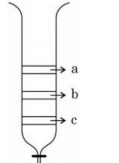
Statements:
- A. Compound ‘c’ is more polar than ‘a’ and ‘b’
- B. Compound ‘a’ is least polar
- C. Compound ‘b’ comes out of the column before ‘c’ and after ‘a’
- D. Compound ‘a’ spends more time in the column
Options:
View Solution
Step 1: Analyze the chromatography column.
The compounds elute in the order of polarity: a > b > c.
Elution order: c > b > a.
Step 2: Identify the incorrect statements.
- (A) Compound ‘c’ is more polar than ‘a’ and ‘b’ – Incorrect (least polar).
- (B) Compound ‘a’ is least polar – Incorrect (most polar).
- (C) Compound ‘b’ comes out of the column before ‘c’ and after ‘a’ – Incorrect.
- (D) Compound ‘a’ spends more time in the column – Correct.
Final Answer: Incorrect statements are (A), (B), and (C).
Question 9:
Ion having the highest hydration enthalpy among the given alkaline earth metal ions is:
Options:
View Solution
Step 1: Recall the trend for hydration enthalpy.
Hydration enthalpy is inversely proportional to ionic size:
Hydration enthalpy ∝ 1 / size.
Step 2: Order of ionic size.
Size order: Be2+ < Mg2+ < Ca2+ < Sr2+ < Ba2+.
Step 3: Determine the order of hydration enthalpy.
Hydration enthalpy: Be2+ > Mg2+ > Ca2+ > Sr2+ > Ba2+.
Final Answer: Be2+ has the highest hydration enthalpy.
Question 10:
The strongest acid from the following is:

Options:
View Solution
Step 1: Analyze the substituents.
- –NO2 is an electron-withdrawing group (strong –I effect).
- –Cl is an electron-withdrawing group (weaker –I effect).
- –CH3 is an electron-donating group (+I effect).
Step 2: Determine the effect on acidity.
Electron-withdrawing groups stabilize the conjugate base, increasing acidity. The order of acidity is:
p-Nitrophenol > p-Chlorophenol > Phenol > p-Methylphenol.
Final Answer: p-Nitrophenol is the strongest acid.
Question 11:
In the following reaction, 'B' is:
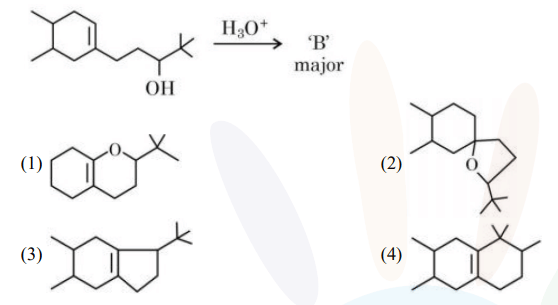
Options:
View Solution
Step 1: Analyze the reaction mechanism.
- The reaction involves an alcohol in acidic conditions, typically leading to dehydration.
- Formation of a more stable carbocation intermediate, followed by a rearrangement or reaction, directs the product formation.
Final Answer: The product formation is guided by the stability of the intermediates formed during the reaction.
Question 12:
Structures of BeCl2 in solid state, vapor phase and at very high temperature respectively are:
Options:
View Solution
Step 1: Understand the molecular structure of BeCl2 in different phases.
- In the solid state, BeCl2 forms a polymer due to its electron-deficient nature.
- In the vapor phase at moderate temperatures, it exists as a dimer.
- At very high temperatures, it dissociates into monomers.
Final Answer: BeCl2 exhibits polymeric, dimeric, and monomeric structures in the solid state, vapor phase, and at high temperatures, respectively.
Question 13:
Consider the following reaction that goes from A to B in three steps as shown below:
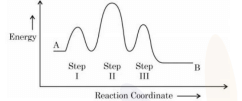
Options:
View Solution
Step 1: Analyze the energy profile diagram.
- The diagram shows three peaks, representing three transition states (activated complexes).
- Two valleys between these peaks represent the intermediates.
- The highest peak corresponds to the rate-determining step.
Final Answer: The reaction has two intermediates and three activated complexes, with the second step being the rate-determining step.
Question 14:
The product, which is not obtained during the electrolysis of brine solution is:
Options:
View Solution
Step 1: Understand the electrolysis of brine.
- At the cathode, hydrogen ions are reduced to form hydrogen gas (H2).
- At the anode, chloride ions are oxidized to chlorine gas (Cl2).
- Sodium ions react with hydroxide ions formed at the cathode to produce NaOH.
- HCl is not a direct product of brine electrolysis.
Final Answer: HCl is not produced during the electrolysis of brine.
Question 15:
Which one of the following elements will remain as liquid inside pure boiling water?
Options:
View Solution
Step 1: Determine the physical properties of the elements at 100°C.
- Ga (Gallium) melts at 29.76°C and remains liquid at the boiling point of water.
- Li and Cs react with water, while Br evaporates below 100°C.
Final Answer: Gallium remains liquid at the boiling point of water.
Question 16:
Given below are two statements: one is labelled as "Assertion A" and the other is labelled as "Reason R":
Assertion A: In the complex Ni(CO)4 and Fe(CO)5, the metals have zero oxidation state.
Reason R: Low oxidation states are found when a complex has ligands capable of π-donor character in addition to the σ-bonding.
Options:
View Solution
Analysis:
- In Ni(CO)4 and Fe(CO)5, Ni and Fe indeed have zero oxidation states as the CO ligand is a neutral molecule.
- Reason R incorrectly suggests a π-donor characteristic of CO, which is primarily a σ-donor and a π-acceptor.
Final Answer: While the assertion about the oxidation state is correct, the reason given is not accurate regarding the character of the ligands.
Question 17:
Which one of the following elements will remain as liquid inside pure boiling water?
Options:
View Solution
Step 1: Determine the physical properties of the elements at 100°C.
- Ga (Gallium) melts at 29.76°C and remains liquid at the boiling point of water.
- Li and Cs react with water, while Br evaporates below 100°C.
Final Answer: Gallium remains liquid at the boiling point of water.
Question 18:
Find out the major product from the following reaction:
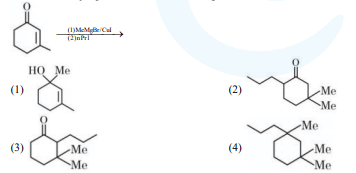
Options:
View Solution
Reaction Analysis:
- The reaction involves the Grignard reagent reacting with a ketone, followed by protonation.
- The major product results from the addition of the organomagnesium compound to the carbonyl group, forming an alcohol after protonation.
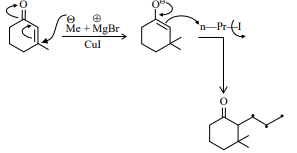
Final Answer: The product formed is primarily due to the addition-elimination mechanism typical of Grignard reactions with ketones.
Question 19:
During the reaction of permanganate with thiosulphate, the change in oxidation of manganese occurs by a value of 3. Identify which of the below medium will favour the reaction:
Options:
View Solution
Reaction Conditions:
- Permanganate is reduced more effectively in neutral or slightly alkaline solutions when reacting with thiosulphate.
- In acidic conditions, permanganate tends to form manganese dioxide, which is not favored in this specific reaction pathway.
Final Answer: A neutral medium best supports the desired oxidation state change in manganese during this reaction.
Question 20:
Element not present in Nessler's reagent is:
Options:
View Solution
Composition Analysis:
- Nessler's reagent is formulated as K2[HgI4], containing potassium (K), mercury (Hg), and iodine (I).
- Nitrogen (N) is not part of this chemical composition.
Final Answer: Nitrogen is not a component of Nessler's reagent.
Question 21:
The standard reduction potentials at 298 K for the following half cells are given below:
- NO3- + 4H+ + 3e- → NO(g) + 2H2O, E° = 0.97 V
- V2+(aq) + 2e- → V, E° = -1.19 V
- Fe3+(aq) + 3e- → Fe, E° = -0.04 V
- Ag+(aq) + e- → Ag(s), E° = 0.80 V
- Au3+(aq) + 3e- → Au(s), E° = 1.40 V
The number of metal(s) which will be oxidized by NO3- in aqueous solution is:
View Solution
Solution:
The reaction for oxidation is:
Metal + NO3- → Metal Nitrate
We need to determine which metals have a lower reduction potential than the reduction potential of NO3-, which is 0.97 V. Metals with reduction potentials lower than 0.97 V will be oxidized.
The reduction potentials are:
- V2+(aq) + 2e- → V, E° = -1.19 V
- Fe3+(aq) + 3e- → Fe, E° = -0.04 V
- Ag+(aq) + e- → Ag(s), E° = 0.80 V
Since the reduction potentials of V, Fe, and Ag are all less than 0.97 V, they will be oxidized by NO3-.
Thus, the metals that will be oxidized are V, Fe, and Ag.
Final Answer: 3 metals.
Question 22:
Number of crystal systems from the following where body-centred unit cell can be found is:
- Cubic
- Tetragonal
- Orthorhombic
- Hexagonal
- Rhombohedral
- Monoclinic
- Triclinic
View Solution
Solution:
A body-centred unit cell (BCC) is a type of crystal structure where one atom is located at each corner of the unit cell and one atom is at the center of the cell.
BCC can be found in the following crystal systems:
- Cubic
- Tetragonal
- Orthorhombic
Thus, the number of crystal systems where BCC is present is 3.
Question 23:
Among the following, the number of compounds which will give a positive iodoform reaction is:
- (a) 1–Phenylbutan–2–one
- (b) 2–Methylbutan–2–ol
- (c) 3–Methylbutan–2–ol
- (d) 1–Phenylethanol
- (e) 3,3–dimethylbutan–2–one
- (f) 1–Phenylpropan–2–ol
View Solution
Solution:
The iodoform reaction occurs with compounds that contain a structure where a methyl ketone (–COCH₃) group is present, or compounds with a hydroxyl group adjacent to a methyl group (–CHOH–CH₃).
Let’s analyze the compounds one by one:
- (a) 1–Phenylbutan–2–one has a methyl ketone group – positive.
- (b) 2–Methylbutan–2–ol has a tertiary alcohol adjacent to a methyl group – negative.
- (c) 3–Methylbutan–2–ol has a secondary alcohol adjacent to a methyl group – positive.
- (d) 1–Phenylethanol does not have a methyl ketone or the appropriate adjacent structure – negative.
- (e) 3,3–dimethylbutan–2–one has a methyl ketone group – positive.
- (f) 1–Phenylpropan–2–ol has a secondary alcohol adjacent to a methyl group – positive.
Thus, the compounds that will give a positive iodoform reaction are 1–Phenylbutan–2–one, 3–Methylbutan–2–ol, 3,3–dimethylbutan–2–one, and 1–Phenylpropan–2–ol.
Therefore, the number of compounds is 4.
Question 24:
Number of isomeric aromatic amines with molecular formula C8H11N, which can be synthesized by Gabriel Phthalimide synthesis is ___.
View Solution
Solution:
Using the formula for degrees of unsaturation (Du):
Du = C + 1 - (H - N)/2
Substituting the values:
Du = 8 + 1 - (11 - 1)/2 = 9 - 5 = 4
This indicates that the compound contains a benzene ring, which leads to 5 possible isomers.
Final Answer: 5
Question 25:
Consider the following pairs of solutions which will be isotonic at the same temperature. The number of pairs of solutions is/are:
- (A) 1 M aq. NaCl and 2 M aq. Urea
- (B) 1 M aq. CaCl2 and 1.5 M aq. KCl
- (C) 1.5 M aq. AlCl3 and 2 M aq. Na2SO4
- (D) 2.5 M aq. KCl and 1 M aq. Al2(SO4)3
View Solution
Solution:
The number of ions produced in each solution can be used to determine isotonicity. Isotonic solutions have the same effective concentration of particles.
- (A) 1 M aq. NaCl → 2 M ions (Na+ and Cl-), isotonic with 2 M aq. Urea (1 particle per molecule).
- (B) 1 M aq. CaCl2 → 3 M ions (Ca2+ and 2 Cl-), isotonic with 1.5 M aq. KCl (2 particles per molecule).
- (C) 1.5 M aq. AlCl3 → 6 M ions (Al3+ and 3 Cl-), isotonic with 2 M aq. Na2SO4 (3 particles per molecule).
- (D) 2.5 M aq. KCl → 5 M ions (K+ and Cl-), isotonic with 1 M aq. Al2(SO4)3 (5 particles per molecule).
Thus, the number of isotonic pairs is 4.
Question 26:
The number of colloidal systems from the following, which will have ‘liquid’ as the dispersion medium, is:
- Gem stones
- Paints
- Smoke
- Cheese
- Milk
- Hair cream
- Insecticide sprays
- Froth
- Soap lather
View Solution
Solution:
A liquid dispersion medium is found in:
- Paints
- Milk
- Hair cream
- Froth
- Soap lather
These systems involve a liquid phase as the dispersion medium, whereas other systems like gem stones, cheese, and smoke do not.
Final Answer: 5
Question 27:
In an ice crystal, each water molecule is hydrogen bonded to ___ neighboring molecules.
View Solution
Solution:
In an ice crystal, each water molecule forms hydrogen bonds with four neighboring molecules in a tetrahedral arrangement. However, for each individual water molecule, two hydrogen bonds are formed in the basic crystalline structure.
Final Answer: 2
Question 28:
Consider the following data:
- Heat of combustion of H2(g) = -241.8 kJ mol-1
- Heat of combustion of C(s) = -393.5 kJ mol-1
- Heat of combustion of C2H5OH(l) = -1234.7 kJ mol-1
The heat of formation of C2H5OH(l) is (-) ______ kJ mol-1 (Nearest integer).
View Solution
Solution:
Using Hess's Law, we combine the reactions to find the heat of formation of C2H5OH(l). The reactions are:
- (1) 2C(s) + O2 → 2CO2 (-393.5 × 2) = -787 kJ
- (2) 3H2 + 1.5O2 → 3H2O (-241.8 × 3) = -725.4 kJ
- (3) C2H5OH + 3O2 → 2CO2 + 3H2O (-1234.7 kJ)
- (4) 3H2O + 2CO2 → C2H5OH + 3O2 (+1234.7 kJ)
Now combine equations (1), (2), and (4):
eq (5) = eq (1) + eq (2) + eq (4)
= (-787) + (-725.4) + (+1234.7) = -277.7 ≈ -278 kJ/mol
Thus, the heat of formation of C2H5OH(l) is -278 kJ/mol.
Final Answer: -278 kJ/mol.
Question 29:
The equilibrium composition for the reaction PCl3 + Cl2 → PCl5 at 298 K is given below:
- [PCl3]eq = 0.2 mol L-1
- [Cl2]eq = 0.1 mol L-1
- [PCl5]eq = 0.40 mol L-1
If 0.2 mol of Cl2 is added at the same temperature, the equilibrium concentration of PCl5 is ______ x 10-2 mol L-1.
View Solution
Solution:
The equilibrium constant K is calculated as:
K = [PCl5] / ([PCl3][Cl2]) = 0.4 / (0.2 × 0.1) = 20
When 0.2 mol of Cl2 is added, the system shifts to re-establish equilibrium. Let the change in concentration of PCl5 be x.
Initial concentrations:
- [PCl3] = 0.2 mol L-1
- [Cl2] = 0.1 mol L-1
- [PCl5] = 0.40 mol L-1
After addition of Cl2:
- [Cl2] = 0.1 + 0.2 - x = 0.3 - x
- [PCl3] = 0.2 - x
- [PCl5] = 0.40 + x
Substitute into the equilibrium expression:
20 = (0.40 + x) / [(0.2 - x)(0.3 - x)]
Solve the quadratic equation to find x ≈ 0.084 mol L-1
The new concentration of PCl5 is:
[PCl5] = 0.40 + 0.084 = 0.484 mol L-1 = 48.4 × 10⁻² mol L-1
Final Answer: 48 × 10-2 mol L-1.
Question 30:
The number of species having a square planar shape from the following is:
XeF4, SF4, SiF4, BF4-, BrF4-, [Cu(NH3)4]2+, [FeCl4]-, [PtCl4]2-
View Solution
Solution:
The species with a square planar geometry are:
- XeF4
- BrF4-
- [Cu(NH3)4]2+
- [PtCl4]2-
These species exhibit a square planar geometry due to the specific coordination and electronic arrangement.
Final Answer: 4
*The article might have information for the previous academic years, please refer the official website of the exam.