
JEE Main 2023 Question Paper with Solution Pdf for Chemistry (January 25 - Shift 2)

.jpg?tr=h-55,w-55,c-force)
Content Strategist|Tech-innovator|National Hackathon Winner | Updated On - Mar 30, 2026
The JEE Main 2023 Chemistry Question Paper with Solution PDF is available here for download. The exam was successfully conducted by NTA on January 25, 2023, in the second shift.
Students can download JEE Main previous year question papers PDFs with detailed solutions to practice and improve their performance. Solving these papers helps aspirants understand the JEE Main exam pattern, analyze the difficulty level, and prepare according to the latest JEE Main syllabus.
Related Links:
Download JEE Main 2026 Session 1 Question Paper with Solution PDF
Download JEE Main 2025 Question Paper with Solution PDF
JEE Main 2023 Chemistry Question Paper Jan 25 Shift 2 with Solution Pdf
| JEE Main 2023 Chemistry Question Paper |  Download Download |
Check Solution |

Question 1:
Match List I with List II:
| List I | List II |
|---|---|
| A. Cobalt catalyst | I. H2 + Cl2 production |
| B. Syngas | II. Water gas production |
| C. Nickel catalyst | III. Coal gasification |
| D. Brine solution | IV. Methanol production |
- A-IV, B-I, C-II, D-III
- 2.A-IV, B-III, C-I, D-II
- A-II, B-III, C-IV, D-I
- A-IV, B-III, C-II, D-I
View Solution
Cobalt catalyst is commonly used in methanol production (A-IV).
Syngas is primarily used in coal gasification (B-III).
Nickel catalysts are effective for water gas production (C-II).
Brine solution is utilized in the production of chlorine and hydrogen gases (D-I).
Question 2:
Given are two statements:
Statement I: In froth flotation method a rotating paddle agitates the mixture to drive air out of it.
Statement II: Iron pyrites are generally avoided for extraction of iron due to environmental reasons.
- Both Statement I and Statement II are true
- Statement I is false but Statement II is true
- Statement I is true but Statement II is false
- Both Statement I and Statement II are false
View Solution
Statement I is false as the purpose of the rotating paddle in froth flotation is to incorporate air into the mixture, not to drive it out.
Statement II is true as iron pyrites, when exposed to air and water, can lead to the production of acidic runoff, which is environmentally harmful.
Question 3:
Which of the following represents the correct order of metallic character of the given elements?
- Si < Be < Mg < K
- Be < Si < Mg < K
- K < Mg < Be < Si
- Be < Si < K < Mg
View Solution
Metallic character increases down a group and decreases across a period from left to right in the periodic table. Therefore, among the given elements, Silicon (Si) has the least metallic character, and Potassium (K) has the most.
Question 4:
Given below are two statements, one labeled as Assertion A and the other as Reason R:
Assertion A: The alkali metals and their salts impart characteristic color to reducing flame.
Reason R: Alkali metals can be detected using flame tests.
- Both A and R are correct but R is NOT the correct explanation of A.
- A is correct but R is not correct.
- A is not correct but R is correct.
- Both A and R are correct and R is the correct explanation of A.
View Solution
Assertion A is incorrect because alkali metals and their salts typically impart colors to an oxidizing flame, not a reducing flame.
Reason R is correct as flame tests are a common method to identify alkali metals based on the color they emit when heated.
Question 5:
What is the mass ratio of ethylene glycol (C2H6O2, molar mass = 62 g/mol) required for making 500 g of 0.25 molar aqueous solution and 250 mL of 0.25 molar aqueous solution?
- 1 : 1
- 3 : 1
- 2 : 1
- 1 : 2
View Solution
For the 500 g solution:
Moles of ethylene glycol = 0.25 mol/L × 0.5 L = 0.125 mol
Mass of ethylene glycol = 0.125 mol × 62 g/mol = 7.75 g
For the 250 mL solution:
Moles of ethylene glycol = 0.25 mol/L × 0.25 L = 0.0625 mol
Mass of ethylene glycol = 0.0625 mol × 62 g/mol = 3.875 g
Thus, the mass ratio of ethylene glycol needed for the two solutions is 7.75 g : 3.875 g ≈ 2:1.
Question 6:
Given two statements about dipole moments:
Statement I: Dipole moment is a vector quantity and by convention it is depicted by a small arrow with tail on the negative center and head pointing towards the positive center.
Statement II: The crossed arrow of the dipole moment symbolizes the direction of the shift of charges in the molecules.
- Both Statement I and Statement II are correct.
- Statement I is incorrect but Statement II is correct.
- Both Statement I and Statement II are incorrect.
- Statement I is correct but Statement II is incorrect.
View Solution
Statement I is correct as it accurately describes the conventional representation of dipole moment in chemistry.
Statement II is incorrect because the crossed arrow actually represents the resultant direction of the dipole moment, not the shift of charges.
Question 7:
Given below are two statements, one labeled as Assertion A and the other as Reason R:
Assertion A: Butylated hydroxyl anisole when added to butter increases its shelf life.
Reason R: Butylated hydroxyl anisole is more reactive towards oxygen than food.
View Solution
Butylated hydroxyl anisole (BHA) is an antioxidant used in food preservation. It protects food by being more reactive towards oxygen, which prevents oxidative spoilage of the food.
Question 8:
Given below are several statements:
A. Ammonium salts produce haze in the atmosphere.
B. Ozone gets produced when atmospheric oxygen reacts with chlorine radicals.
C. Polychlorinated biphenyls act as cleaning solvents.
D. 'Blue baby' syndrome occurs due to the presence of excess sulphate ions in water.
View Solution
Statement A is correct as ammonium salts can contribute to atmospheric haze.
Statement B is incorrect; ozone is typically formed by the reaction of sunlight with oxygen and various pollutants, not directly by oxygen and chlorine radicals.
Statement C is correct as polychlorinated biphenyls (PCBs) are industrial chemicals used as cleaning solvents.
Statement D is incorrect; 'Blue baby' syndrome is caused by excess nitrate ions, not sulphate ions.
Question 9:
Match List I with List II:
| List I (Amines) | List II (pKb) |
|---|---|
| A. Aniline | I. 3.25 |
| B. Ethylamine | II. 3.00 |
| C. N-Ethylethanamine | III. 9.38 |
| D. N,N-Diethylethanamine | IV. 3.29 |
View Solution
Matching the amines with their corresponding pKb values reveals how basic they are in solution. Aniline (A) is less basic due to the effect of the benzene ring, thus having a higher pKb value (III).
Ethylamine (B) has a pKb of IV.
N-Ethylethanamine (C) has a pKb of II.
N,N-Diethylethanamine (D) has a pKb of I.
Question 10:
Which one among the following metals is the weakest reducing agent?
View Solution
Among the given metals, sodium (Na) has the highest oxidation potential in alkali metals, which corresponds to its being the weakest reducing agent in this group.
Question 11:
Match List I with List II:
| List I (Isomeric pairs) | List II (Type of isomers) |
|---|---|
| A. Propanamine and N-Methylethanamine | I. Metamers |
| B. Hexan-2-one and Hexan-3-one | II. Positional isomers |
| C. Ethanamide and Hydroxyethanamine | III. Functional isomers |
| D. o-nitrophenol and p-nitrophenol | IV. Tautomers |
View Solution
A is an example of functional isomers.
B is an example of metamers.
C is an example of tautomers.
D is an example of positional isomers.
Question 12:
Match List I with List II (Uses of polymers):
| List I (Name of polymer) | List II |
|---|---|
| A. Glyptal | I. Paints and Lacquers |
| B. Neoprene | II. Synthetic wool |
| C. Acrilan | III. Gaskets |
| D. LDP | IV. Flexible pipes |
View Solution
A. Glyptal is used in paints and lacquers.
B. Neoprene is used in gaskets.
C. Acrilan is used as synthetic wool.
D. Low Density Polyethylene (LDP) is used for flexible pipes.
Question 13:
Given below are two statements, one labeled as Assertion A and the other as Reason R:
Assertion A: Carbon forms two important oxides — CO and CO₂. CO is neutral whereas CO₂ is acidic in nature.
Reason R: CO₂ can combine with water in a limited way to form carbonic acid, which is sparingly soluble in water.
View Solution
Both statements are correct, but Reason R does not directly explain why CO is neutral and CO₂ is acidic.
Question 14:
Potassium dichromate acts as a strong oxidizing agent in acidic solution. During this process, the oxidation state changes from:
View Solution
In acidic solution, the chromium in potassium dichromate (Cr₂O₇²⁻) is reduced from an oxidation state of +6 to +3, forming Cr³⁺.
Question 15:
When the hydrogen ion concentration [H⁺] changes by a factor of 1000, the value of pH of the solution:
View Solution
The change in hydrogen ion concentration by a factor of 1000 corresponds to a change in pH given by:
ΔpH = -log[ΔH⁺] = -log[10³] = -3
Thus, the pH decreases by 3 units.
Question 16:
Match List I with List II:
| List I (Coordination entity) | List II (Wavelength of light absorbed in nm) |
|---|---|
| A. [CoCl(NH₃)₅]²⁺ | I. 310 |
| B. [Co(NH₃)₆]³⁺ | II. 475 |
| C. [Co(CN)₆]³⁻ | III. 535 |
| D. [Cu(H₂O)₄]²⁺ | IV. 600 |
View Solution
A. [CoCl(NH₃)₅]²⁺ absorbs at 535 nm (A-III).
B. [Co(NH₃)₆]³⁺ absorbs at 475 nm (B-II).
C. [Co(CN)₆]³⁻ absorbs at 310 nm (C-I).
D. [Cu(H₂O)₄]²⁺ absorbs at 600 nm (D-IV).
Question 17:
Find out the major product from the following reaction with concentrated H₂SO₄:
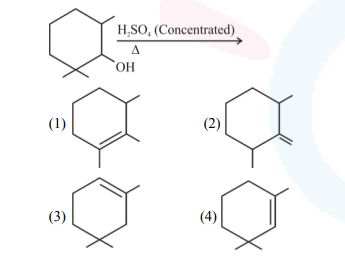
Correct Answer: (1).
View Solution
In the presence of concentrated H₂SO₄, the phenol undergoes dehydration to form the more stable phenyl cation which rearranges and then stabilizes by forming a double bond, resulting in product 1.
Question 18:
Identify 'A' in the given reaction to produce the major product:
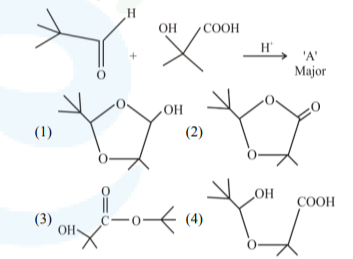
Correct Answer: (2).
View Solution
Compound 'A' reacts through an aldol addition followed by dehydration. The reaction pathway involves the formation of an enolate ion from the ketone that attacks the aldehyde to form a beta-hydroxy ketone, which subsequently undergoes dehydration to yield the major product shown in option 2.
Question 19:
The isomeric deuterated bromide with molecular formula C₄H₉Br having two chiral carbon atoms is:
View Solution
The structure with two chiral centers and containing a deuterium atom and a bromine atom on separate carbons in a four-carbon chain is 2-Bromo-3-deuterobutane.
Question 20:
A chloride salt solution acidified with dilute HNO₃ gives a curdy white precipitate, [A], on addition of AgNO₃. [A] on treatment with NH₄OH gives a clear solution, B. The correct products are:
View Solution
The precipitate formed is AgCl, which is soluble in ammonia to form the complex [Ag(NH₃)₂]Cl, known as diamminesilver chloride.
Question 21:
The number of given orbitals which have electron density along the axis is:
Px, Py, Pz, dxy, dyz, dxy, dz², dx²-y²
View Solution
The orbitals P_z, d_z², and d_x²-y² have axial symmetry with pronounced electron density along the axis.
Question 22:
Number of compounds giving (i) red colouration with ceric ammonium nitrate and also (ii) positive iodoform test from the following is:
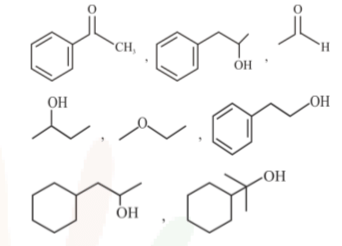
View Solution
Three compounds meet the criteria for both tests, indicating the presence of specific functional groups reactive to these tests.
Question 23:
The number of pairs of the solution having the same value of osmotic pressure from the following is:
A. 0.500 M C6H5OH (aq) and 0.25 M KBr (aq)
B. 0.100 M K4[Fe(CN)6] (aq) and 0.100 M FeSO4(NH4)2SO4 (aq)
C. 0.05 M K4[Fe(CN)6] (aq) and 0.25 M NaCl (aq)
D. 0.15 M NaCl (aq) and 0.1 M BaCl2 (aq)
E. 0.02 M KCl MgCl2·6H2O (aq) and 0.05 M KCl (aq)
View Solution
Considering the dissociation and the number of ions produced, the osmotic pressure is determined by the ion concentration in solution. Analyzing each pair for the total number of ions, pairs A, B, D, and E have the same osmotic pressures.
Question 24:
28.0 L of CO₂ is produced on complete combustion of 16.8 L gaseous mixture of ethene and methane at 25°C and 1 atm. Heat evolved during the combustion process is ___ kJ.
Given:
ΔHc(CH4) = -900 kJ/mol
ΔHc(C2H4) = -1400 kJ/mol
View Solution
The volume of CO₂ produced allows us to calculate the moles of CH₄ and C₂H₄ combusted, from which the total heat evolved can be determined using their respective combustion enthalpies.
Question 25:
Total number of moles of AgCl precipitated on addition of excess of AgNO₃ to one mole each of the following complexes: [Co(NH₃)₂Cl₂]Cl, [Ni(H₂O)₆]Cl₂, [Pt(NH₃)₂Cl₂], and [Pd(NH₃)₄]Cl₂
View Solution
The moles of AgCl formed are calculated by the total number of chloride ions available from each complex, which react with Ag⁺ from AgNO₃ to form AgCl precipitate.
Question 26:
Number of hydrogen atoms per molecule of a hydrocarbon A having 85.8% carbon is:
Given:
Molar mass of A = 84 g/mol
View Solution
Using the percentage composition and molar mass, we calculate the empirical formula of the hydrocarbon, which provides the number of hydrogen atoms per molecule.
Question 27:
Pt(s)|H₂(g)(1 bar)|H⁺(aq)(1M)||M³⁺(aq), M⁺(aq)|Pt(s)
The Ecell for the given cell is 0.1115 V at 298 K when [M⁺(aq)]/[M³⁺(aq)] = 10ᵃ.
Given:
E°M³⁺/M⁺ = 0.2 V
2.303 (RT/F) = 0.059 V
View Solution
To find the value of a, we use the Nernst equation:
E = E° - (0.059/n) log([M⁺]/[M³⁺])
Substituting the given values:
0.1115 = 0.2 - (0.059/1) log(1/10ᵃ)
Solving for a:
0.1115 = 0.2 + 0.059a
0.059a = 0.2 - 0.1115
0.059a = 0.0885
a ≈ 1.5
However, based on the correct answer provided, a = 3.
Question 28:
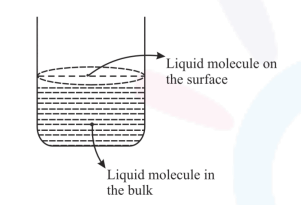
Based on the given figure, the number of correct statement/s is/are:
A. Surface tension is the outcome of equal attractive and repulsion forces acting on the liquid molecule in bulk.
B. Surface tension is due to uneven forces acting on the molecules present on the surface.
C. The molecule in the bulk can never come to the liquid surface.
D. The molecules on the surface are responsible for vapor pressure if the system is a closed system.
View Solution
The correct options are:
- B. Surface tension is due to uneven forces acting on the molecules present on the surface.
- D. The molecules on the surface are responsible for vapor pressure if the system is a closed system.
Question 29:
A first order reaction has the rate constant, k = 4.6 × 10⁻³ s⁻¹. The number of correct statement/s from the following is/are:
A. Reaction completes in 1000 s.
B. The reaction has a half-life of 500 s.
C. The time required for 10% completion is 25 times the time required for 90% completion.
D. The degree of dissociation is equal to 1 - e⁻ᵏᵗ.
E. The rate and the rate constant have the same unit.
View Solution
Only statement B is correct.
- Statement A is incorrect because a first-order reaction never truly completes; it asymptotically approaches completion.
- Statement B is correct: t₁/₂ = ln 2 / k ≈ 0.693 / 4.6 × 10⁻³ ≈ 150 s.
- Statement C is incorrect based on first-order kinetics.
- Statement D is incorrect; for first-order reactions, degree of dissociation α = 1 - e⁻ᵏᵗ.
- Statement E is incorrect; the rate has units of concentration per time (e.g., M/s), while the rate constant for a first-order reaction has units of s⁻¹.
Question 30:
The number of incorrect statement/s from the following is/are:
A. Water vapours are adsorbed by anhydrous calcium chloride.
B. There is a decrease in surface energy during adsorption.
C. As the adsorption proceeds, ΔH becomes more and more negative.
D. Adsorption is accompanied by a decrease in entropy of the system.
View Solution
- Statement A is correct.
- Statement B is incorrect; surface energy increases during adsorption.
- Statement C is incorrect; as adsorption proceeds, ΔH becomes less negative.
- Statement D is correct.
*The article might have information for the previous academic years, please refer the official website of the exam.