
JEE Main 2023 Question Paper with Solution Pdf for Chemistry (January 30 - Shift 1)

.jpg?tr=h-55,w-55,c-force)
Content Strategist|Tech-innovator|National Hackathon Winner | Updated On - Mar 30, 2026
The JEE Main 2023 Chemistry Question Paper with Solution PDF is available here for download. The exam was successfully conducted by NTA on January 30, 2023, in the first shift.
Students can download JEE Main previous year question papers PDFs with detailed solutions to practice and improve their performance. Solving these papers helps aspirants understand the JEE Main exam pattern, analyze the difficulty level, and prepare according to the latest JEE Main syllabus.
Related Links:
Download JEE Main 2026 Session 1 Question Paper with Solution PDF
Download JEE Main 2025 Question Paper with Solution PDF
JEE Main 2023 Chemistry Question Paper Jan 30 Shift 1 with Solution Pdf
| JEE Main 2023 Chemistry Question Paper |  Download Download |
Check Solution |

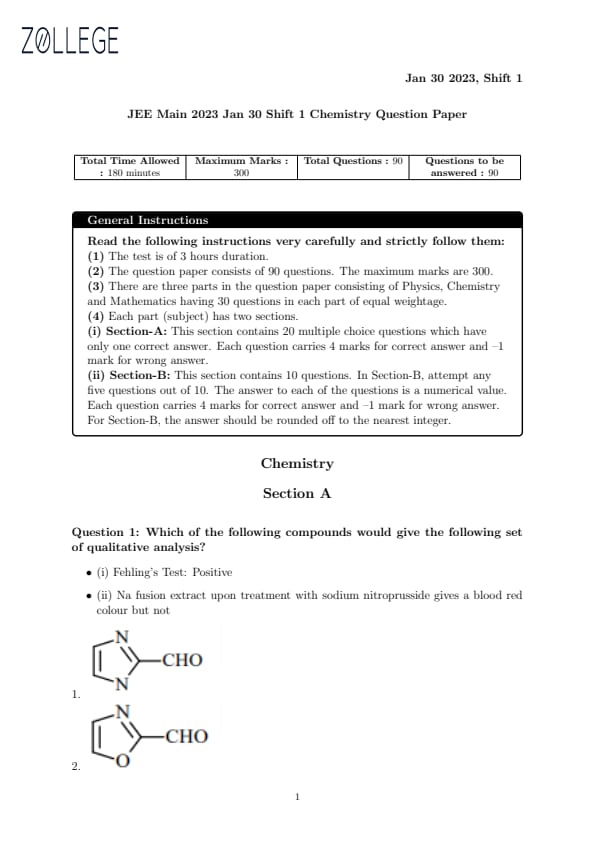
Question 1:
Which of the following compounds would give the following set of qualitative analysis?
- (i) Fehling's Test: Positive
- (ii) Na fusion extract upon treatment with sodium nitroprusside gives a blood red colour


View Solution
Aromatic aldehydes do not give Fehling's test. Both nitrogen and sulfur must be present to obtain the blood red colour. Sodium nitroprusside gives blood red colour with nitrogen and sulfur. Therefore, the compound in option (4) is the correct answer.
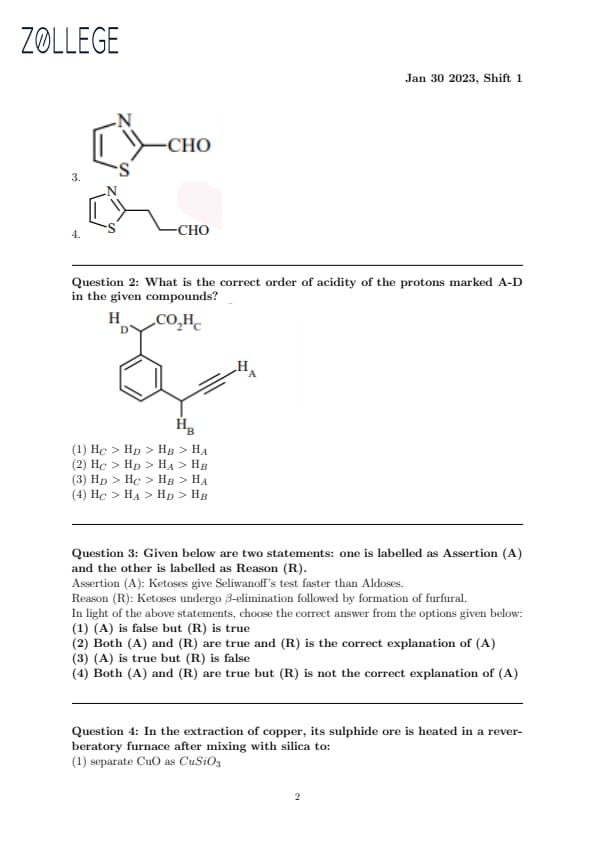
Question 2:
What is the correct order of acidity of the protons marked A-D in the given compounds?

View Solution
The acidity of a proton depends on the stability of the conjugate base formed after its removal. The more stable the conjugate base, the more acidic the proton. HC is the most acidic proton. Removal of HC results in a carboxylate anion, which is highly stabilized by resonance. HD is the second most acidic proton. Its removal forms a carbanion that is stabilized by resonance with the benzene ring. HA is more acidic than HB.
Question 3:
Given below are two statements: one is labelled as Assertion (A) and the other is labelled as Reason (R).
Assertion (A): Ketoses give Seliwanoff's test faster than Aldoses.
Reason (R): Ketoses undergo α-elimination followed by formation of furfural.
In light of the above statements, choose the correct answer from the options given below:
View Solution
Seliwanoff's test is a differentiating test for Ketose and Aldose. This test relies on the principle that the keto hexose are more rapidly dehydrated to form 5-hydroxy methyl furfural when heated in acidic medium which on condensation with resorcinol gives a red or brown coloured complex, forming rapidly indicating a positive test.
Question 4:
In the extraction of copper, its sulphide ore is heated in a reverberatory furnace after mixing with silica to:
View Solution
The copper ore contains iron, it is mixed with silica before heating in reverberatory furnace. FeO slags off as FeSiO3: FeO + SiO2 → FeSiO3
Question 5:
Amongst the following compounds, which one is an antacid?
View Solution
Ranitidine is an antacid. The other options are: Meprobamate: Tranquilizer, Terfenadine: Antihistamine, Brompheniramine: Antihistamine.
Question 6:
The major products 'A' and 'B', respectively, are:


View Solution
In the given reaction, electrophilic substitution of the phenyl group with a sulfate group is induced. The major products are:

Question 7:
Benzyl isocyanide can be obtained by:

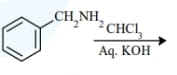


Choose the correct answer from the options given below:
View Solution
Benzyl isocyanide is obtained via the reaction of a benzyl halide with an appropriate nucleophile. In (A), the reaction of CH2Br with AgCN leads to the formation of benzyl isocyanide. In (B), the reaction of CH2NH2CHCl2 with aqueous KOH gives the corresponding isocyanide.
Question 8:
Given below are two statements: one is labelled as Assertion (A) and the other is labelled as Reason (R).
Assertion (A): In expensive scientific instruments, silica gel is kept in watch-glasses or in semipermeable membrane bags.
Reason (R): Silica gel adsorbs moisture from air via adsorption, thus protects the instrument from water corrosion (rusting) and/or prevents malfunctioning.
In light of the above statements, choose the correct answer from the options given below:
View Solution
Silica gel is used to prevent moisture damage in scientific instruments. It adsorbs moisture, preventing corrosion and malfunction.
Question 9:
Match List I with List II:

View Solution

Question 10:
Caprolactam when heated at high temperature in presence of water gives:
View Solution
Caprolactam polymerizes to form Nylon 6.
Question 11:
The alkaline earth metal sulphate(s) which are readily soluble in water is/are:
View Solution
The solubility of alkaline earth metal sulphates decreases down the group due to the decrease in hydration energy. Be2+ and Mg2+ ions have high hydration energy, making BeSO4 and MgSO4 readily soluble.
Question 12:
Which of the following is the correct order of ligand field strength?
View Solution
The spectrochemical series arranges ligands based on their field strength. The order is S2- < C2O42- < NH3 < en < CO. Sulfide is a weak field ligand, oxalate has moderate strength, ammonia and ethylenediamine are stronger, and carbon monoxide is the strongest.
Question 13:
Formation of photochemical smog involves the following reaction in which A, B, and C are respectively:
(i) NO2 + A → B
(ii) B + O2 → C
(iii) A + C → NO2 + O2
View Solution
NO2 undergoes photodissociation to form NO (A) and O (B). The oxygen radical (B) reacts with O2 to form ozone (C). NO (A) then reacts with ozone (C) to regenerate NO2 and O2.
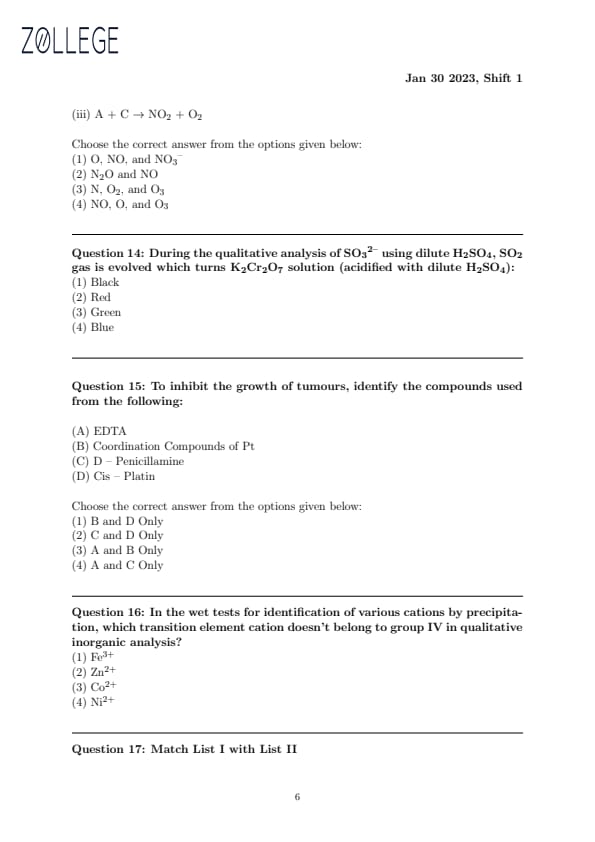
Question 14:
During the qualitative analysis of SO32- using dilute H2SO4, SO2 gas is evolved which turns K2Cr2O7 solution (acidified with dilute H2SO4):
View Solution
SO2 reduces the orange dichromate ion (Cr2O72-) to green Cr3+ ions.
Question 15:
To inhibit the growth of tumours, identify the compounds used from the following:
View Solution
Platinum-based coordination compounds, such as Cisplatin (cis-[Pt(NH3)2Cl2]), are used in chemotherapy to inhibit tumour growth by binding to DNA and interfering with replication. EDTA is a chelating agent, and D-penicillamine is used for heavy metal poisoning.
Question 16:
In the wet tests for identification of various cations by precipitation, which transition element cation doesn't belong to group IV in qualitative inorganic analysis?
View Solution
In qualitative inorganic analysis, cations are classified into groups based on their precipitation behavior. Group III cations (Fe3+, Al3+, Cr3+) precipitate as hydroxides, while Group IV cations (Zn2+, Co2+, Ni2+) precipitate as sulfides.
Question 17:
Match List I with List II:
| List-I (molecules/ions) | List-II (No. of lone pairs of e- on central atom) |
|---|---|
| (A) IF7 | I. Three |
| (B) ICl4- | II. One |
| (C) XeF6 | III. Two |
| (D) XeF2 | IV. Zero |
View Solution
To determine lone pairs, count total valence electrons, subtract bonding electrons, and divide the remainder by 2. IF7 has 0, ICl4- has 2, XeF6 has 1, and XeF2 has 3 lone pairs.
Question 18:
For OF2 molecule consider the following:
(A) Number of lone pairs on oxygen is 2.
(B) F-O-F angle is less than 104.5°.
(C) Oxidation state of O is -2.
(D) Molecule is bent 'V' shaped.
(E) Molecular geometry is linear.
Correct options are:
View Solution
OF2 has 2 lone pairs on oxygen (A), a bent shape (D), and a bond angle less than 104.5° (B) due to lone pair repulsion. Oxygen's oxidation state is +2.
Question 19:
Lithium aluminium hydride can be prepared from the reaction of:
View Solution
LiAlH4 is prepared by reacting lithium hydride (LiH) with aluminum chloride (Al2Cl6): 8LiH + Al2Cl6 → 2LiAlH4 + 6LiCl
Question 20:
Match List – I with List – II
| List-I (Atomic number) | List-II (Block of periodic table) |
|---|---|
| (A) 37 (K) | I. p-block |
| (B) 78 (Pt) | II. d-block |
| (C) 52 (Te) | III. f-block |
| (D) 65 (Tb) | IV. s-block |
View Solution
K (37) is in the s-block, Pt (78) is in the d-block, Te (52) is in the p-block, and Tb (65) is in the f-block.
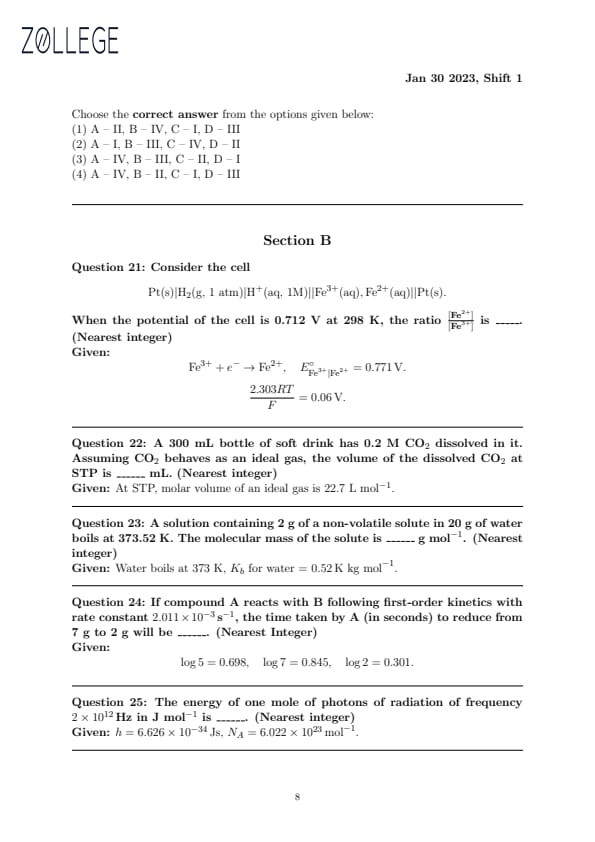
Question 21:
Consider the cell Pt(s)|H2(g, 1 atm)|H+(aq, 1M)||Fe3+(aq), Fe2+(aq)|Pt(s). When the potential of the cell is 0.712 V at 298 K, the ratio [Fe2+]/[Fe3+] is ______. (Nearest integer)
Given: Fe3+ + e- → Fe2+, E°Fe3+/Fe2+ = 0.771 V.
2.303RT/F = 0.06 V.
View Solution
At the anode: H2 → 2H+ + 2e-
At the cathode: Fe3+ + e- → Fe2+
E°cell = E°H2/H+ + E°Fe3+/Fe2+ = 0 + 0.771 = 0.771 V
Using the Nernst equation: E = E° - (0.06/n)log([Fe2+]/[Fe3+])
0.712 = 0.771 - 0.06log([Fe2+]/[Fe3+])
log([Fe2+]/[Fe3+]) = 1
[Fe2+]/[Fe3+] = 10
Question 22:
A 300 mL bottle of soft drink has 0.2 M CO2 dissolved in it. Assuming CO2 behaves as an ideal gas, the volume of the dissolved CO2 at STP is ______ mL. (Nearest integer)
Given: At STP, molar volume of an ideal gas is 22.7 L mol-1.
View Solution
Moles of CO2 = Molarity × Volume (in L) = 0.2 M × 0.3 L = 0.06 mol
Volume at STP = Moles × Molar Volume at STP = 0.06 mol × 22.7 L/mol = 1.362 L = 1362 mL
Question 23:
A solution containing 2 g of a non-volatile solute in 20 g of water boils at 373.52 K. The molecular mass of the solute is ______ g mol-1. (Nearest integer)
Given: Water boils at 373 K, Kb for water = 0.52 K kg mol-1.
View Solution
ΔTb = Tb - T°b = 373.52 K - 373 K = 0.52 K
ΔTb = Kb × molality
0.52 K = 0.52 K kg mol-1 × (2 g / Molar Mass × 0.02 kg)
Molar Mass = 100 g mol-1
Question 24:
If compound A reacts with B following first-order kinetics with rate constant 2.011 × 10⁻³ s-1, the time taken by A (in seconds) to reduce from 7 g to 2 g will be ______. (Nearest Integer)
Given: log 5 = 0.698, log 7 = 0.845, log 2 = 0.301.
View Solution
t = (2.303 / k) × log([A]0 / [A]t)
t = (2.303 / 2.011 × 10⁻³ s-1) × log(7/2)
t = (2.303 / 2.011 × 10⁻³ s-1) × (log 7 - log 2)
t = (2.303 / 2.011 × 10⁻³ s-1) × (0.845 - 0.301)
t ≈ 623 seconds
Question 25:
The energy of one mole of photons of radiation of frequency 2 × 10¹² Hz in J mol-1 is ______. (Nearest integer)
Given: h = 6.626 × 10⁻³⁴ Js, NA = 6.022 × 10²³ mol-1.
View Solution
Energy of one photon (E) = hν = (6.626 × 10⁻³⁴ Js)(2 × 10¹² Hz) = 1.3252 × 10⁻²¹ J
Energy of one mole of photons = E × NA = (1.3252 × 10⁻²¹ J)(6.022 × 10²³ mol-1) ≈ 798 J mol-1
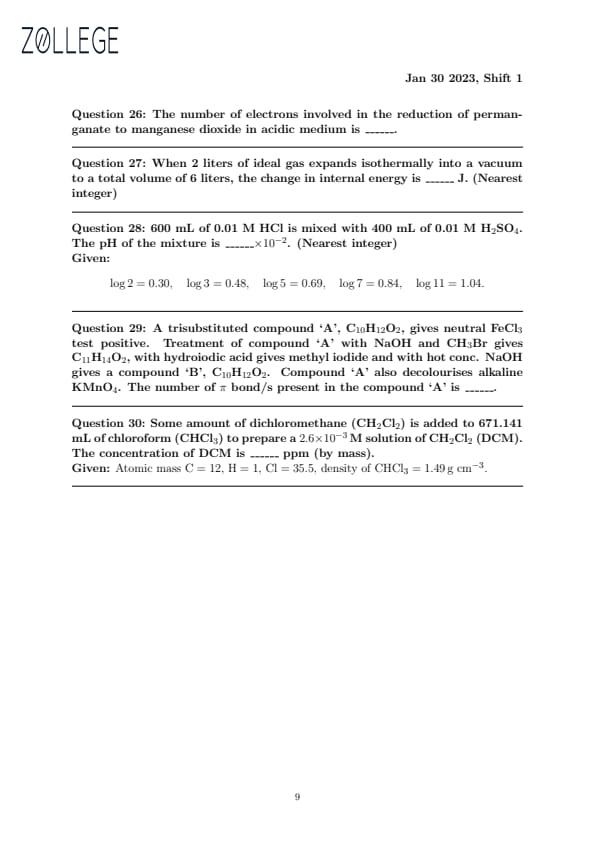
Question 26:
The number of electrons involved in the reduction of permanganate to manganese dioxide in acidic medium is ______.
View Solution
The balanced half-reaction in acidic medium is: MnO4- + 4H+ + 3e- → MnO2 + 2H2O. Therefore, 3 electrons are involved.
Question 27:
When 2 liters of ideal gas expands isothermally into a vacuum to a total volume of 6 liters, the change in internal energy is ______ J. (Nearest integer)
View Solution
For an isothermal process (constant temperature) of an ideal gas, the change in internal energy (ΔU) is zero. ΔU depends only on temperature change, which is zero in this case.
Question 28:
600 mL of 0.01 M HCl is mixed with 400 mL of 0.01 M H2SO4. The pH of the mixture is ______ × 10-2. (Nearest integer)
Given: log 2 = 0.30, log 3 = 0.48, log 5 = 0.69, log 7 = 0.84, log 11 = 1.04.
View Solution
Millimoles of H+ from HCl = 600 mL × 0.01 M = 6 mmol
Millimoles of H+ from H2SO4 = 400 mL × 0.01 M × 2 = 8 mmol
Total millimoles of H+ = 6 + 8 = 14 mmol
Total volume = 600 mL + 400 mL = 1000 mL = 1 L
[H+] = 14 mmol / 1 L = 0.014 M
pH = -log[H+] = -log(14 × 10-3) = 3 - log 14 = 3 - 1.14 = 1.86
pH = 186 × 10-2
Question 29:
A trisubstituted compound ‘A’, C10H12O2, gives neutral FeCl3 test positive. Treatment of compound ‘A’ with NaOH and CH3Br gives C11H14O2, with hydroiodic acid gives methyl iodide and with hot conc. NaOH gives a compound ‘B’, C10H12O2. Compound ‘A’ also decolourises alkaline KMnO4. The number of π bond/s present in the compound ‘A’ is ______.
View Solution
The positive FeCl3 test indicates a phenol. Reaction with NaOH and CH3Br suggests another -OH group. Reaction with HI to give CH3I indicates an -OCH3 group. Decolorization of KMnO4 suggests a double bond. The benzene ring contributes 3 π bonds and the aliphatic double bond contributes 1 π bond, totaling 4 π bonds.
Question 30:
Some amount of dichloromethane (CH2Cl2) is added to 671.141 mL of chloroform (CHCl3) to prepare a 2.6 × 10⁻³ M solution of CH2Cl2 (DCM). The concentration of DCM is ______ ppm (by mass).
Given: Atomic mass C = 12, H = 1, Cl = 35.5, density of CHCl3 = 1.49 g cm-3.
View Solution
Mass of CH2Cl2 = Molarity × Volume × Molar mass = (2.6 × 10⁻³ mol/L)(0.671141 L)(85 g/mol) ≈ 0.148 g
Mass of CHCl3 = Volume × Density = 671.141 mL × 1.49 g/mL ≈ 1000 g
Total mass of solution ≈ 1000 g + 0.148 g ≈ 1000 g (since 0.148g is negligible compared to 1000g)
Concentration in ppm = (Mass of solute / Mass of solution) × 106 = (0.148 g / 1000 g) × 106 = 148 ppm



Previous Year JEE Main Question Papers
*The article might have information for the previous academic years, please refer the official website of the exam.