
JEE Main 2023 Question Paper with Solution Pdf for Chemistry (January 30 - Shift 2)


Content Curator | Updated On - Mar 30, 2026
The JEE Main 2023 Chemistry Question Paper with Solution PDF is available here for download. The exam was successfully conducted by NTA on January 30, 2023, in the second shift.
Students can download JEE Main previous year question papers PDFs with detailed solutions to practice and improve their performance. Solving these papers helps aspirants understand the JEE Main exam pattern, analyze the difficulty level, and prepare according to the latest JEE Main syllabus.
Related Links:
Download JEE Main 2026 Session 1 Question Paper with Solution PDF
Download JEE Main 2025 Question Paper with Solution PDF
JEE Main 2023 Chemistry Question Paper Jan 30 Shift 2 with Solution Pdf
| JEE Main 2023 Chemistry Question Paper |  Download Download |
Check Solution |

Question 1:
Which of the following reaction is correct?
View Solution
The correct reaction for the decomposition of lithium nitrate is:
4LiNO₃ → 2Li₂O + 4NO₂ + O₂
This reflects the breakdown of nitrate to oxide, nitrogen dioxide, and oxygen.
Question 2:
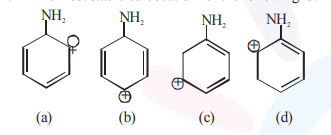
The most stable carbocation for the following is:
View Solution
The -M effect of NH₂ is stabilizing the carbocation.
Question 3:
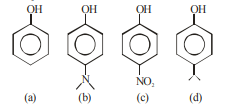
The correct order of pKa values for the following compounds is:
View Solution
The correct order based on the acidity of the compounds is b > d > a > c.
Question 4:
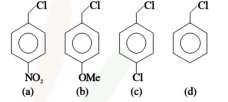
Decreasing order towards SN1 reaction for the following compounds is:
View Solution
The rate of SN1 reaction depends upon the stability of the carbocation which follows the order (b) > (d) > (c) > (a).
Question 5:
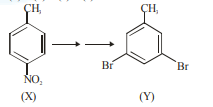
In the above conversion of compound (X) to product (Y), the sequence of reagents to be used will be:
View Solution
The correct sequence of reagents is Fe, H; Br₂(aq); HNO₂; H₃PO₂ to achieve the desired transformation.
Question 6:
Maximum number of electrons that can be accommodated in shell with n = 4 are:
View Solution
The maximum number of electrons in the n = 4 shell is calculated by summing the maximum electrons each subshell can hold:
4s = 2, 4p = 6, 4d = 10, 4f = 14
Total = 2 + 6 + 10 + 14 = 32
Question 7:
Match List I (Complexes) with List II (Hybridisation):
| List I (Complexes) | List II (Hybridisation) |
|---|---|
| A: [Ni(CO)₄] | I. sp³ |
| B: [Cu(NH₃)₄]²⁺ | II. dsp² |
| C: [Fe(NH₃)₆]²⁺ | III. d²sp³ |
| D: [Fe(H₂O)₆]²⁺ | IV. sp³d² |
View Solution
The correct matches based on the hybridization of the central metal in each complex are:
- A - [Ni(CO)₄] uses sp³ hybridization.
- B - [Cu(NH₃)₄]²⁺ uses dsp² hybridization.
- C - [Fe(NH₃)₆]²⁺ uses d²sp³ hybridization.
- D - [Fe(H₂O)₆]²⁺ uses sp³d² hybridization.
Therefore, the correct matching is: A-I, B-II, C-IV, D-III
Question 8:
The Cl - Co - Cl bond angle values in a fac-[Co(NH₃)₃Cl₃] complex is/are:
View Solution
In the facial isomer of the octahedral complex [Co(NH₃)₃Cl₃], the Cl - Co - Cl bond angles are 90° due to the arrangement of the ligands around the cobalt center.
Question 9:
Given below are two statements: One is labelled as Assertion (A) and the other as Reason (R).
Assertion (A):  can be easily reduced using Zn-Hg/HCl to OH.
Reason (R): Zn-Hg/HCl is used to reduce carbonyl group to -CH₂- group.
View Solution
Assertion (A): The statement is false because OH groups are not typically reduced by Zn-Hg/HCl.
Reason (R): The statement is true as Zn-Hg/HCl is commonly used to reduce carbonyl groups to -CH₂- groups.
Therefore, Assertion A is false, but Reason R is true.
Question 10:
Chlorides of which metal are soluble in organic solvents:
View Solution
BeCl₂ has a covalent nature, making it soluble in organic solvents, unlike the other options which form ionic chlorides.
Question 11:
Given below are two statements:
Assertion (A): Antihistamines do not affect the secretion of acid in the stomach.
Reason (R): Antiallergic and antacid drugs work on different receptors.
Choose the correct answer from the options below:
View Solution
Step 1: Understand the mechanism of action.
Antiallergic drugs target histamine receptors, while antacid drugs act on gastric acid secretion, implying they function on different receptors.
Final Answer: Both A and R are true, and R correctly explains A.
Question 12:
The wave function (Ψ) of 2s is given by:
Ψ₂ₛ = (1)/(2√2π) (1/a₀)^½ (2 - r/a₀) e^(-r/(2a₀))
At r = r₀, radial node is formed. Thus, r₀ in terms of a₀ is:
View Solution
Step 1: Identify the condition for a node.
At a radial node, Ψ = 0. Therefore:
2 - r₀/a₀ = 0 ⇒ r₀ = 2a₀.
Final Answer: The radial node is formed at r₀ = 2a₀.
Question 13:
KMnO₄ oxidises I⁻ in acidic and neutral/faintly alkaline solutions, respectively, to:
View Solution
Step 1: Oxidation in acidic medium.
In acidic solution:
2KMnO₄ + 10KI + 8H₂SO₄ → 2K₂SO₄ + 2MnSO₄ + 5I₂ + 8H₂O
Step 2: Oxidation in neutral/faintly alkaline medium.
In neutral or slightly alkaline solution:
2KMnO₄ + 10KI + 8H₂O → 2KOH + 2MnO₂ + 5I₂ + 8H₂O
However, more accurately, in neutral conditions, iodide can be oxidized to iodate (IO₃⁻):
2KMnO₄ + 10KI + 8H₂O → 2MnO₂ + 5I₂ + 4KOH + 8H₂O
Final Answer: I₂ in acidic solution and IO₃⁻ in neutral/faintly alkaline solution.
Question 14:
Bond dissociation energy of E–H bond of the "H₂E" hydrides of group 16 elements follows order:
Where E = O, S, Se, Te.
View Solution
Step 1: Understand bond strength in group 16 hydrides.
The bond dissociation energy typically decreases as we move down the group due to increasing atomic size and decreasing bond strength.
Thus, H₂O > H₂S > H₂Se > H₂Te.
Final Answer: Bond dissociation energy decreases in the order A (O) > B (S) > C (Se) > D (Te).
Question 15:
BOD of a pond is 4. The pond has:
View Solution
Step 1: Understand the range of BOD values.
Biochemical Oxygen Demand (BOD) is an indicator of water quality. A BOD value < 5 mg/L indicates very clean water, while higher values signify increasing levels of pollution.
Final Answer: The pond water is very clean.
Question 16:
Match List I with List II:
| List I (Mixture) | List II (Separation Technique) |
|---|---|
| A: CHCl₃ + C₆H₅NH₂ | I: Steam distillation |
| B: C₆H₁₄ + C₅H₁₂ | II: Differential extraction |
| C: C₆H₅NH₂ + H₂O | III: Distillation |
| D: Organic compound in H₂O | IV: Fractional distillation |
View Solution
Step 1: Analyze the separation techniques and mixtures.
- A: CHCl₃ + C₆H₅NH₂ – These can be separated by simple distillation due to different boiling points. Hence, A-III.
- B: C₆H₁₄ + C₅H₁₂ – These hydrocarbons have similar boiling points and require fractional distillation for separation. Hence, B-IV.
- C: C₆H₅NH₂ + H₂O – Aromatic amines can be separated using steam distillation. Hence, C-I.
- D: Organic compound in H₂O – Organic compounds dissolved in water can be separated using differential extraction. Hence, D-II.
Therefore, the correct matching is: A-III, B-IV, C-I, D-II.
Question 17:
A current carrying rectangular loop PQRS is made of uniform wire. The length PR = QS = 5 cm and PQ = RS = 100 cm. If ammeter current reading changes from I to 2I, the ratio of magnetic forces per unit length on the wire PQ due to wire RS in the two cases respectively is:
View Solution
Step 1: Understand the relationship between current and force.
The magnetic force between two parallel current-carrying wires is given by:
F ∝ I₁I₂
Initially, both wires carry current I, so F₁ ∝ I².
After increasing the current to 2I in both wires, F₂ ∝ (2I)² = 4I².
Therefore, the ratio of forces F₁:F₂ = I² : 4I² = 1:4.
Final Answer: The ratio of magnetic forces per unit length is 1:4.
Question 18:
A force is applied to a steel wire 'A', rigidly clamped at one end. As a result, elongation in the wire is 0.2 mm. If the same force is applied to another steel wire 'B' of double the length and a diameter 2.4 times that of the wire 'A', the elongation in the wire 'B' will be:
View Solution
Step 1: Use the formula for elastic deformation.
Δl ∝ (F × l) / (A × E)
Where Δl is the elongation, F is the force, l is the length, A is the cross-sectional area, and E is Young's modulus (constant for both wires).
Step 2: Determine the changes for wire B.
- Length of wire B, l₂ = 2 × l₁
- Diameter of wire B, d₂ = 2.4 × d₁
- Cross-sectional area A₂ = π (d₂/2)2 = π (1.2d₁)2 = 1.44A₁
Step 3: Calculate the new elongation Δl₂.
Δl₂ = (F × 2l₁) / (1.44A₁ × E) = (2 / 1.44) × (F × l₁) / (A₁ × E) = (2 / 1.44) × Δl₁ ≈ 1.3889 × 0.2 mm ≈ 0.2778 mm ≈ 6.9 × 10⁻² mm
Final Answer: The elongation in wire B is 6.9 × 10⁻² mm.
Question 19:
An object is allowed to fall from a height R above the earth, where R is the radius of earth. Its velocity when it strikes the earth's surface, ignoring air resistance, will be:
View Solution
Step 1: Use conservation of energy.
Potential energy at height R: U₁ = -G(Mm)/(2R)
Potential energy at Earth's surface: U₂ = -G(Mm)/R
Kinetic energy at Earth's surface: K = G(Mm)/(2R)
Thus, velocity v can be found using K = ½ mv²:
½ mv² = G(Mm)/(2R)
v² = 2G M / R = gR
v = √(gR)
Final Answer: The velocity is √(gR).
Question 20:
A point source of 100 W emits light with 5% efficiency. At a distance of 5 m from the source, the intensity produced by the electric field component is:
View Solution
Step 1: Calculate the effective power.
P_eff = 100 W × 0.05 = 5 W
Step 2: Calculate the total intensity at 5 m.
I_total = P_eff / (4π r²) = 5 W / (4π × 25 m²) = 5 W / (100π m²) = 1 W/(20π m²)
Step 3: Determine the intensity of the electric field component.
In electromagnetic waves, the electric and magnetic field components carry equal energy, so the intensity due to the electric field is half of the total intensity.
I_E = I_total / 2 = (1 W/(20π m²)) / 2 = 1 W/(40π m²)
Final Answer: The intensity produced by the electric field component is 1 W/(40π m²).
Question 21:
1 mole of ideal gas is allowed to expand reversibly and adiabatically from a temperature of 27°C. The work done is 3 kJ mol-1. The final temperature of the gas is ___ K (Nearest integer). Given Cv = 20 J mol-1K-1.
View Solution
Step 1: Identify the given data.
- q = 0 (adiabatic process).
- ΔU = w = -3000 J (work done on the system is negative).
- Cv = 20 J mol-1K-1.
- Initial temperature T1 = 300 K.
Step 2: Use the formula for internal energy change.
ΔU = Cv × (T2 - T1)
Substitute the values:
-3000 = 20 × (T2 - 300)
Simplify:
T2 - 300 = -150 ⇒ T2 = 150 K.
Final Answer: The final temperature is T2 = 150 K.
Question 22:
Iron oxide FeO crystallises in a cubic lattice with a unit cell edge length of 5.0Å. If the density of FeO in the crystal is 4.0 g cm-3, then the number of FeO units present per unit cell is ___ (Nearest integer).
Given: Molar masses of Fe and O are 56 and 16 g mol-1, respectively. NA = 6.0 × 10²³ mol-1.
View Solution
Step 1: Use the density formula for a unit cell.
d = (Z × M) / (NA × a3)
where:
- d = 4.0 g cm-3 (density),
- M = 72 g mol-1 (molar mass of FeO),
- a = 5.0 Å = 5.0 × 10⁻⁸ cm (edge length),
- NA = 6.0 × 10²³ mol-1 (Avogadro's number),
- Z = number of units per unit cell.
Step 2: Substitute the values.
4 = (Z × 72) / (6.0 × 1023 × (5.0 × 10-8)3)
Simplify:
4 = (Z × 72) / (6.0 × 1023 × 125 × 10-24)
4 = (Z × 72) / (7.5 × 10⁻¹) ⇒ Z × 72 = 4 × 7.5 × 10-1 ⇒ Z = (4 × 7.5 × 10-1) / 72 = 0.04167 ≈ 4.1667
Rounding to the nearest integer, Z = 4.
Final Answer: Z = 4 FeO units per unit cell.
Question 23:
An organic compound undergoes first-order decomposition. If the time taken for 60% decomposition is 540 s, then the time required for 90% decomposition will be ___ s (Nearest integer).
Given: ln 10 = 2.3, log 2 = 0.3.
View Solution
Step 1: Use the formula for first-order reactions.
The time for decomposition is given by:
t = (1/k) ln(a / (a - x))
where k is the rate constant.
For 60% decomposition:
t₁ = (1/k) ln(a / 0.4a) = (1/k) ln(2.5)
For 90% decomposition:
t₂ = (1/k) ln(a / 0.1a) = (1/k) ln(10)
Find the ratio of t₂ to t₁:
t₂ / t₁ = ln(10) / ln(2.5)
Given ln(10) = 2.3 and ln(2.5) ≈ 0.9163,
t₂ / t₁ ≈ 2.3 / 0.9163 ≈ 2.51
Calculate t₂:
t₂ ≈ 2.51 × 540 ≈ 1355.4 s
Rounding to the nearest integer, t₂ ≈ 1350 s.
Final Answer: 1350 s
Question 24:
Lead storage battery contains 38% by weight solution of H2SO4. The van't Hoff factor is 2.67 at this concentration. The temperature in Kelvin at which the solution in the battery will freeze is ___ (Nearest integer).
Given: Kf = 1.8 kg mol-1.
View Solution
Step 1: Use the freezing point depression formula.
ΔTf = i × Kf × m
where:
- i = 2.67 (van't Hoff factor)
- Kf = 1.8 kg mol-1
- m = molality
Step 2: Calculate molality.
Given 38% by weight H2SO4 in 1 kg of solution:
Mass of H2SO4 = 0.38 kg = 380 g
Molar mass of H2SO4 = 98 g mol-1
Number of moles of H2SO4 = 380 g / 98 g mol-1 ≈ 3.8776 mol
Mass of solvent (water) = 1 kg - 0.38 kg = 0.62 kg
Molality, m = 3.8776 mol / 0.62 kg ≈ 6.25 mol kg-1
Step 3: Calculate freezing point depression.
ΔTf = 2.67 × 1.8 × 6.25 ≈ 30.06 K
Step 4: Determine the freezing temperature.
Assuming pure water freezes at 273 K:
Tf = 273 K - 30.06 K ≈ 242.94 K
Rounding to the nearest integer, Tf ≈ 243 K.
Final Answer: 243 K
Question 25:
Consider the following equation:
2SO2(g) + O2(g) ⇋ 2SO3(g), ΔH = -190 kJ.
The number of factors which will increase the yield of SO3 at equilibrium from the following is ___.
Factors:
- A. Increasing temperature
- B. Increasing pressure
- C. Adding more SO2
- D. Adding more O2
- E. Addition of catalyst
View Solution
Step 1: Analyze each factor.
- A. Increasing temperature: The reaction is exothermic (ΔH = -190 kJ). Increasing temperature shifts the equilibrium towards the reactants, decreasing SO3 yield.
- B. Increasing pressure: The reaction reduces the number of gas molecules (3 moles on reactant side to 2 moles on product side). Increasing pressure shifts the equilibrium towards the products, increasing SO3 yield.
- C. Adding more SO2: Increases the concentration of reactants, shifting the equilibrium towards the products, increasing SO3 yield.
- D. Adding more O2: Similarly increases the concentration of reactants, shifting equilibrium towards the products, increasing SO3 yield.
- E. Addition of catalyst: Catalysts speed up the rate of reaching equilibrium but do not affect the position of equilibrium or the yield.
Step 2: Count the factors that increase SO₃ yield.
Factors B, C, and D increase the yield of SO₃.
Final Answer: 3 factors increase the yield of SO₃.
Question 26:
The graph of log (x/m) vs log p for an adsorption process is a straight line inclined at an angle of 45° with intercept equal to 0.6020. The mass of gas adsorbed per unit mass of adsorbent at the pressure of 0.4 atm is ___ × 10-1 (Nearest integer).
Given: log 2 = 0.3010.
View Solution
Step 1: Write the Freundlich adsorption isotherm.
log (x/m) = log K + (1/n) log p
The slope of the line is (1/n) and the intercept is log K.
Step 2: Determine the values of K and n.
The line is inclined at 45°, which means the slope (1/n) = 1 ⇒ n = 1.
The intercept is log K = 0.6020 ⇒ K = 100.6020 ≈ 4.
Step 3: Use the Freundlich equation to find x/m.
x/m = K × p1/n = 4 × p
Given p = 0.4 atm,
x/m = 4 × 0.4 = 1.6
Expressed as 1.6 × 10-1 × 101 = 16 × 10-1
Final Answer: 16 × 10-1
Question 27:
Number of compounds from the following which will not dissolve in cold NaHCO3 and NaOH solutions but will dissolve in hot NaOH solution is ___.
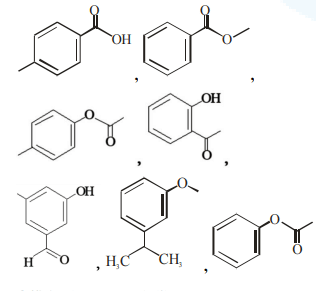
View Solution
Step 1: Identify the compounds.
Compounds with phenolic –OH groups or carboxylic acid groups dissolve in NaOH and NaHCO₃ solutions, while those with ester or amide groups require hot NaOH for hydrolysis.
Step 2: Analyze the structures.
- Compound 1: Ester group, dissolves in hot NaOH.
- Compound 2: Phenolic group, dissolves in cold NaOH.
- Compound 3: Ester group, dissolves in hot NaOH.
- Compound 4: Phenolic group, dissolves in cold NaOH.
- Compound 5: Amide group, dissolves in hot NaOH.
Step 3: Count the compounds dissolving only in hot NaOH.
The compounds are 1, 3, and 5.
Final Answer: 3 compounds dissolve in hot NaOH only.
Question 28:
A short peptide on complete hydrolysis produces 3 moles of glycine (G), 2 moles of leucine (L), and 2 moles of valine (V) per mole of peptide. The number of peptide linkages in it are ___.
View Solution
Step 1: Understand the structure of peptides.
A peptide linkage is formed between two amino acids. The number of linkages is one less than the total number of amino acids.
Step 2: Calculate the total number of amino acids.
Total amino acids = 3 (G) + 2 (L) + 2 (V) = 7.
Step 3: Calculate the number of peptide linkages.
Peptide linkages = Total amino acids - 1 = 7 - 1 = 6.
Final Answer: The peptide has 6 linkages.
Question 29:
The strength of 50 volume solution of hydrogen peroxide is ___ g/L (Nearest integer). Given: Molar mass of H2O2 = 34 g mol-1, Molar volume of gas at STP = 22.7 L.
View Solution
Step 1: Define the volume strength.
A 50-volume solution releases 50 L of O2 at STP per litre of H2O2.
Step 2: Calculate the molarity.
Molarity = Volume strength / 11.35 = 50 / 11.35 ≈ 4.405 M.
Step 3: Calculate the strength in g/L.
Strength = Molarity × Molar mass = 4.405 × 34 ≈ 149.77 g/L ≈ 150 g/L.
Final Answer: The strength of the solution is 150 g/L.
Question 30:
The electrode potential of the following half-cell at 298 K: [X | X2+ (0.001 M) || Y2+ (0.01 M) | Y is ___ × 10-2 V (Nearest integer).
View Solution
Step 1: Write the Nernst equation.
The cell potential is:
Ecell = E°cell - (0.06/n) log(Q)
where Q is the reaction quotient.
Step 2: Determine E°cell.
E°cell = E°Y2+/Y - E°X2+/X = 0.36 V - (-2.36 V) = 2.72 V.
Step 3: Substitute the values into the Nernst equation.
Ecell = 2.72 V - (0.06/2) log(0.001/0.01)
log(0.001/0.01) = log(0.1) = -1.
Ecell = 2.72 V - (0.03)(-1) = 2.72 V + 0.03 V = 2.75 V.
Expressed as 275 × 10-2 V.
Final Answer: 275 × 10-2 V.
*The article might have information for the previous academic years, please refer the official website of the exam.