
JEE Main 2023 Chemistry Question Paper with Solution Pdf (January 31 - Shift 2)


| Updated On - Mar 31, 2026
The JEE Main 2023 Chemistry Question Paper with Solution PDF is available here for download. The exam was successfully conducted by NTA on January 31, 2023, in the second shift.
Students can download JEE Main previous year question papers PDFs with detailed solutions to practice and improve their performance. Solving these papers helps aspirants understand the JEE Main exam pattern, analyze the difficulty level, and prepare according to the latest JEE Main syllabus.
Related Links:
Download JEE Main 2026 Session 1 Question Paper with Solution PDF
Download JEE Main 2025 Question Paper with Solution PDF
JEE Main 2023 Chemistry Question Paper Jan 31 Shift 2 with Solution Pdf
| JEE Main 2023 Chemistry Question Paper |  Download Download |
Check Solution |

SECTION A
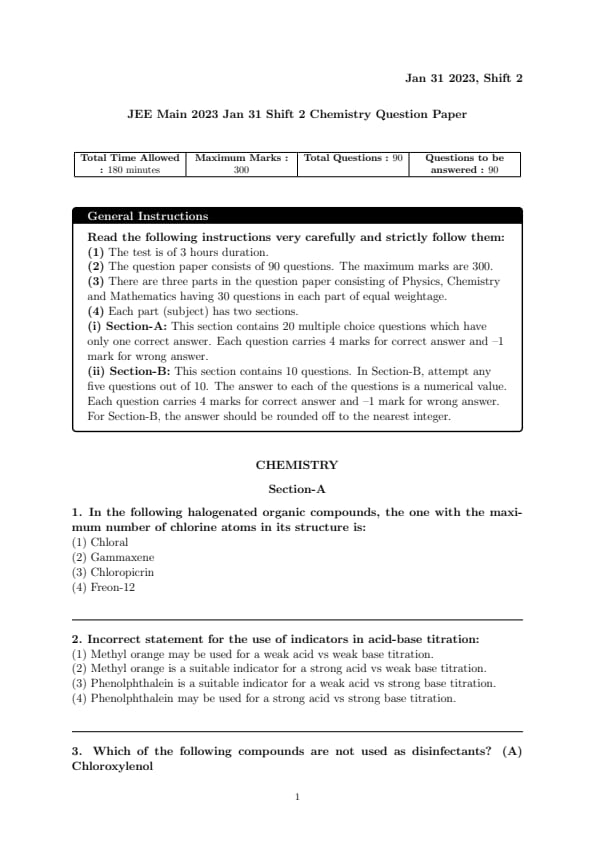
Question 1:
In the following halogenated organic compounds, the one with the maximum number of chlorine atoms in its structure is:
View Solution
Let’s examine the structures of the compounds:
1. Chloral has 3 chlorine atoms.
2. Gammaxene has 6 chlorine atoms.
3. Chloropicrin has 3 chlorine atoms.
4. Freon-12 has 2 chlorine atoms.
Thus, Gammaxene has the maximum number of chlorine atoms in its structure. Quick Tip: When comparing halogenated organic compounds, the number of chlorine atoms is one of the key factors to look at in the structure.
Incorrect statement for the use of indicators in acid-base titration:
View Solution
The suitable indicators for different types of acid-base titrations are:
- Methyl orange is generally used for titrations involving strong acid vs weak base because it changes color in the acidic pH range (red at pH < 3.4 and yellow at pH > 4.4).
- Phenolphthalein is suitable for titrations involving weak acids vs strong bases as it changes color in the basic pH range (colorless below pH 4.8 and pink above pH 6.4).
- The statement that methyl orange may be used for weak acid vs weak base titration is incorrect because it is not suitable for that combination. For weak acid vs weak base titrations, neutral red or bromothymol blue would be more appropriate.
Thus, the incorrect statement is option (1). Quick Tip: Always choose the indicator based on the pH range at the equivalence point of the titration.
Which of the following compounds are not used as disinfectants?
(A) Chloroxylenol
(B) Bithional
(C) Veronal
(D) Prontosil
(E) Terpineol
Choose the correct answer from the options given below:
View Solution
- Veronal is a neurological medicine, and Prontosil is an antibiotic. Both are not used as disinfectants.
- Chloroxylenol, Bithional, and Terpineol are commonly used as disinfectants.
Thus, the correct answer is option (1). Quick Tip: When selecting compounds used as disinfectants, ensure to focus on their role in microbial control rather than their medical or therapeutic uses.
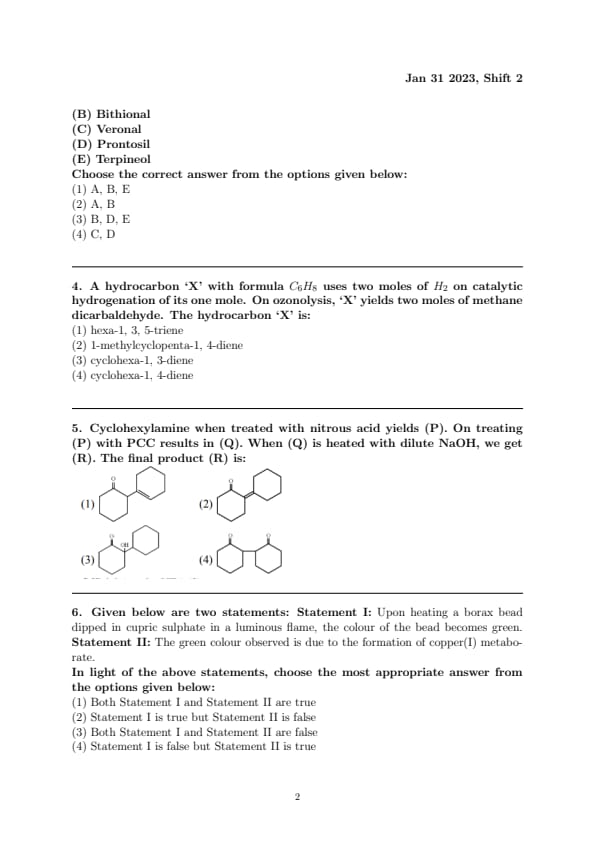
A hydrocarbon ‘X’ with formula \( C_6H_8 \) uses two moles of \( H_2 \) on catalytic hydrogenation of its one mole. On ozonolysis, ‘X’ yields two moles of methane dicarbaldehyde. The hydrocarbon ‘X’ is:
View Solution
When the given hydrocarbon ‘X’ undergoes catalytic hydrogenation, two moles of \( H_2 \) are added, suggesting the presence of two double bonds.
Upon ozonolysis, two moles of methane dicarbaldehyde are produced, indicating that the molecule is a conjugated diene.
Thus, the structure of the hydrocarbon is cyclohexa-1, 4-diene. Quick Tip: Ozonolysis of conjugated dienes typically produces aldehydes or ketones depending on the position of the double bonds.
Cyclohexylamine when treated with nitrous acid yields (P). On treating (P) with PCC results in (Q). When (Q) is heated with dilute NaOH, we get (R). The final product (R) is:

View Solution
Cyclohexylamine (C6H11NH2) reacts with nitrous acid (HNO2) to form a diazonium salt (P).
On treating this with PCC (Pyridinium chlorochromate), oxidation occurs to form a ketone (Q).
When (Q) is heated with dilute NaOH, it undergoes a condensation reaction forming a cyclohexene derivative (R).
Thus, the final product (R) is the structure shown in option (2). Quick Tip: The reaction with PCC typically involves oxidation to a ketone, and heating with NaOH often leads to a condensation reaction.
Given below are two statements:
Statement I: Upon heating a borax bead dipped in cupric sulphate in a luminous flame, the colour of the bead becomes green.
Statement II: The green colour observed is due to the formation of copper(I) metaborate.
In light of the above statements, choose the most appropriate answer from the options given below:
View Solution
In the Borax Bead Test, heating a borax bead dipped in cupric sulphate in a non-luminous flame results in the formation of cupric metaborate, which gives a blue-green colour. The formation of copper(I) metaborate is not the correct explanation for the green colour observed; instead, copper(II) metaborate forms.
Thus, Statement I is true, but Statement II is false.
The correct answer is option (3). Quick Tip: In the Borax Bead Test, the formation of cupric metaborate gives the bead its blue-green colour in the reducing flame, not copper(I) metaborate.
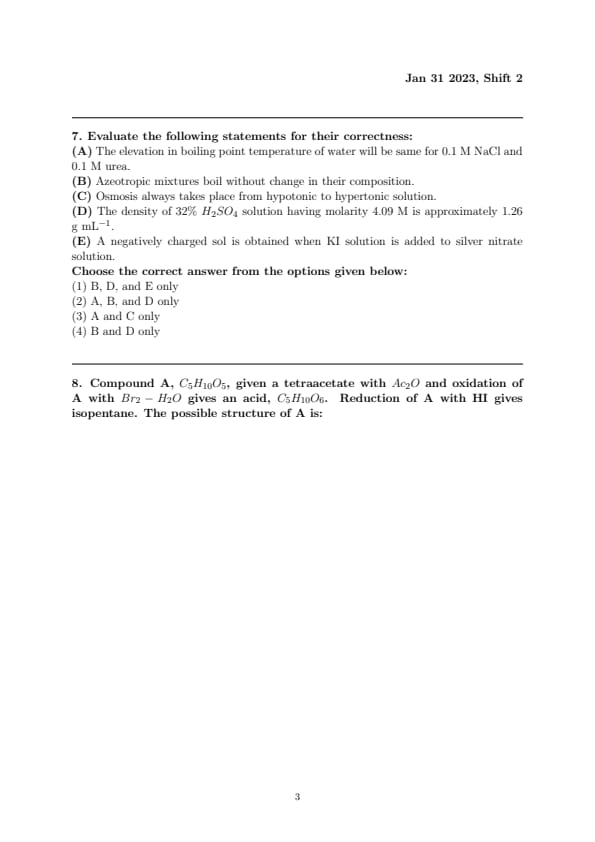
Evaluate the following statements for their correctness:
(A) The elevation in boiling point temperature of water will be same for 0.1 M NaCl and 0.1 M urea.
(B) Azeotropic mixtures boil without change in their composition.
(C) Osmosis always takes place from hypotonic to hypertonic solution.
(D) The density of 32% \( H_2SO_4 \) solution having molarity 4.09 M is approximately 1.26 g mL\(^{-1}\).
(E) A negatively charged sol is obtained when KI solution is added to silver nitrate solution.
Choose the correct answer from the options given below:
View Solution
- (A) The elevation in boiling point is dependent on the number of particles in the solution. \( NaCl \) dissociates into 2 ions, while urea doesn’t dissociate. Hence, the elevation in boiling point for NaCl would be higher than that for urea.
- (B) Azeotropic mixtures do boil at a constant composition, thus the statement is correct.
- (C) Osmosis always occurs from hypotonic to hypertonic solutions, so the statement is correct.
- (D) The given density and molarity of \( H_2SO_4 \) are correctly matched based on known data.
- (E) Adding KI to silver nitrate solution results in the formation of a positively charged sol (due to the formation of AgI), so this statement is incorrect.
Thus, the correct answer is option (4). Quick Tip: In colligative properties, the presence of ions and solutes plays a significant role in determining changes in properties like boiling point elevation and freezing point depression.
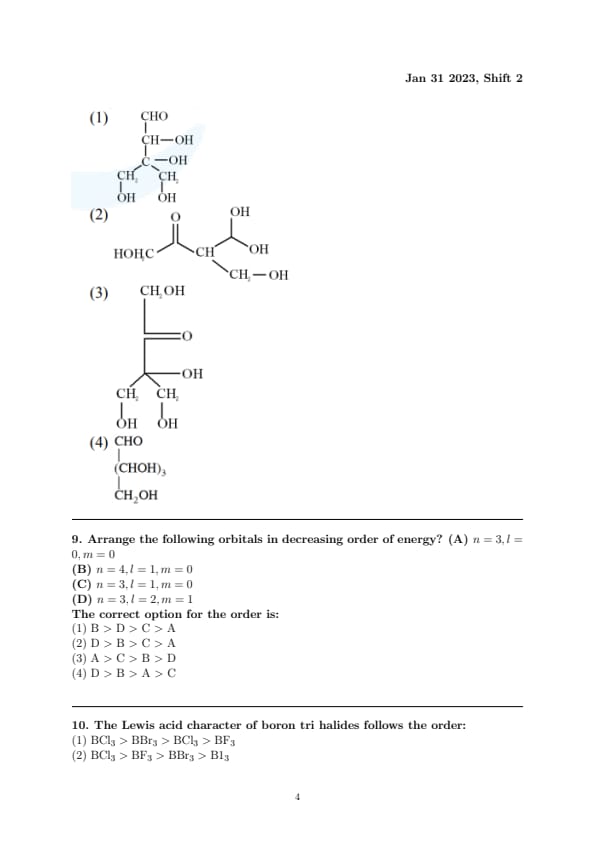
Compound A, \( C_5H_{10}O_5 \), given a tetraacetate with \( Ac_2O \) and oxidation of A with \( Br_2 - H_2O \) gives an acid, \( C_5H_{10}O_6 \). Reduction of A with HI gives isopentane. The possible structure of A is:

View Solution
The compound \( A \) is a sugar derivative, and based on the given reactions:
- The reaction with \( Ac_2O \) suggests the presence of hydroxyl groups.
- Oxidation with \( Br_2 - H_2O \) gives an acid, indicating that a terminal hydroxyl group is present.
- Reduction with HI gives isopentane, suggesting a pentose structure.
The correct structure for \( A \) is option (1). Quick Tip: The oxidation and reduction of sugars can help identify functional groups and their positions in the molecule.
Arrange the following orbitals in decreasing order of energy?
(A) \( n = 3, l = 0, m = 0 \)
(B) \( n = 4, l = 1, m = 0 \)
(C) \( n = 3, l = 1, m = 0 \)
(D) \( n = 3, l = 2, m = 1 \)
The correct option for the order is:
View Solution
As per Hund’s rule, the energy of an orbital is given by the \( n + l \) value. If the value of \( n + l \) remains the same, energy is given by \( n \) only.
- \( (A) n = 3, l = 0, m = 0 \): \( n + l = 3 \)
- \( (B) n = 4, l = 1, m = 0 \): \( n + l = 5 \)
- \( (C) n = 3, l = 1, m = 0 \): \( n + l = 4 \)
- \( (D) n = 3, l = 2, m = 1 \): \( n + l = 5 \)
Thus, the order is \( D > B > C > A \). Quick Tip: When comparing orbitals, use Hund’s rule and the \( n + l \) value to determine energy levels.
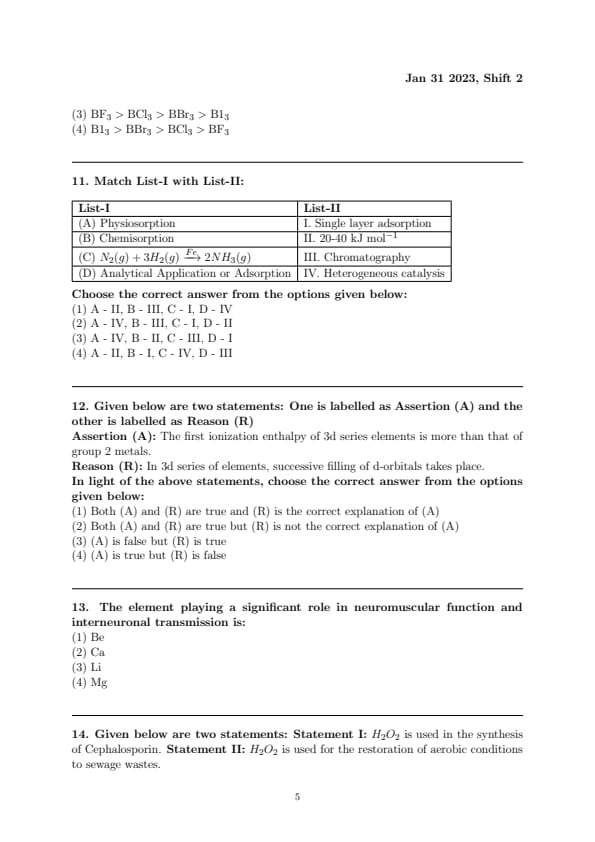
The Lewis acid character of boron tri halides follows the order:
View Solution
Extent of back bonding reduces down the group leading to more Lewis acidic strength.
For example, \( BF_3 \) has the most extent of back bonding due to the \( 2p - 2p \) interaction, whereas \( BCl_3 \) and \( BBr_3 \) show less back bonding. Therefore, the Lewis acid strength increases from \( BF_3 \) to \( BCl_3 \), \( BBr_3 \), and finally \( B1_3 \).
Thus, the correct order is \( B1_3 > BBr_3 > BCl_3 > BF_3 \). Quick Tip: The strength of Lewis acids can be compared based on the extent of back bonding and the electronegativity of halides.
Match List-I with List-II:
\begin{tabular{|l|l|
\hline
List-I & List-II
\hline
(A) Physiosorption & I. Single layer adsorption
\hline
(B) Chemisorption & II. 20-40 kJ mol\(^{-1}\)
\hline
(C) \( N_2(g) + 3H_2(g) \xrightarrow{Fe} 2NH_3(g) \) & III. Chromatography
\hline
(D) Analytical Application or Adsorption & IV. Heterogeneous catalysis
\hline
\end{tabular
Choose the correct answer from the options given below:
View Solution
- Physiosorption involves weak van der Waals forces, and is typically associated with single layer adsorption.
- Chemisorption is associated with stronger bonds and involves an energy range of 20-40 kJ mol\(^{-1}\).
- The reaction \( N_2 + 3H_2 \xrightarrow{Fe} 2NH_3 \) is an example of heterogeneous catalysis in which adsorption plays a key role.
- Chromatography is an analytical technique based on adsorption.
Thus, the correct matching is: A - II, B - I, C - IV, D - III. Quick Tip: In adsorption processes, physisorption involves weak forces while chemisorption involves stronger covalent bonds.
Given below are two statements: One is labelled as Assertion (A) and the other is labelled as Reason (R)
Assertion (A): The first ionization enthalpy of 3d series elements is more than that of group 2 metals.
Reason (R): In 3d series of elements, successive filling of d-orbitals takes place.
In light of the above statements, choose the correct answer from the options given below:
View Solution
- Assertion (A) is incorrect. The first ionization enthalpy of 3d series elements is actually less than that of group 2 elements due to the effective shielding of the nucleus by the d-electrons.
- Reason (R) is true. In the 3d series, the successive filling of d-orbitals leads to increased shielding, affecting ionization energies.
Thus, (A) is false but (R) is true. Quick Tip: In transition metals, the ionization energies are influenced by the filling of d-orbitals, leading to variations from what is observed in s-block elements.
The element playing a significant role in neuromuscular function and interneuronal transmission is:
View Solution
Calcium (\( Ca \)) plays a vital role in neuromuscular function, interneuronal transmission, and other biological processes like cell signaling and muscle contraction. It is involved in the release of neurotransmitters and the contraction of muscle fibers. Quick Tip: Calcium is crucial for nerve function and muscle contraction due to its ability to influence various signaling pathways.
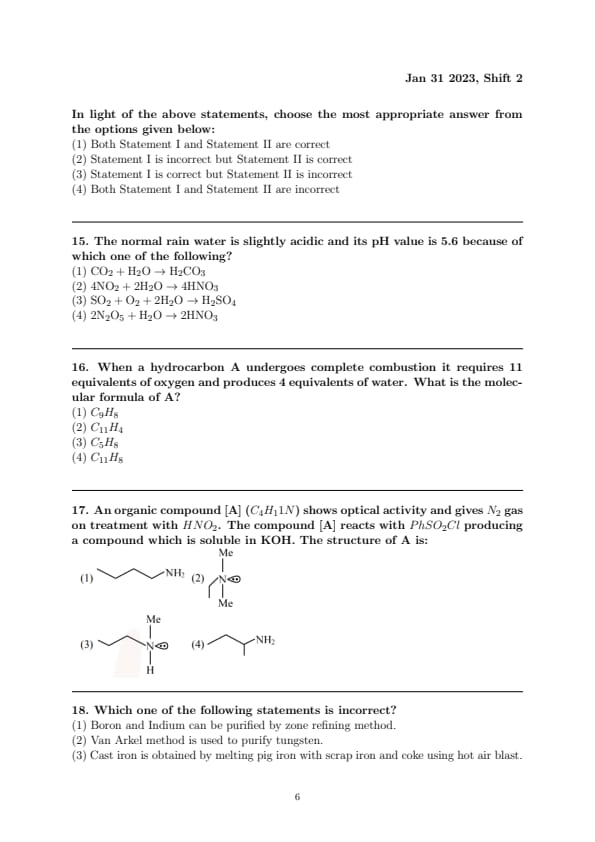
Given below are two statements:
Statement I: \( H_2O_2 \) is used in the synthesis of Cephalosporin.
Statement II: \( H_2O_2 \) is used for the restoration of aerobic conditions to sewage wastes.
In light of the above statements, choose the most appropriate answer from the options given below:
View Solution
- Statement I is correct: \( H_2O_2 \) is used in the synthesis of cephalosporin, a class of antibiotics.
- Statement II is also correct: \( H_2O_2 \) is used to restore aerobic conditions to sewage wastes by supplying oxygen and aiding in the breakdown of organic material.
Thus, both statements are true. Quick Tip: Hydrogen peroxide is widely used in organic synthesis and environmental applications, including sewage treatment.
The normal rain water is slightly acidic and its pH value is 5.6 because of which one of the following?
View Solution
Rainwater is naturally slightly acidic due to the dissolution of carbon dioxide (\( CO_2 \)) in water, forming carbonic acid (\( H_2CO_3 \)):
\[ CO_2 + H_2O \rightarrow H_2CO_3 \]
This weak acid dissociates to give a small concentration of \( H^+ \) ions, lowering the pH of the rainwater to about 5.6.
The other options are related to pollutants like NO\(_2\), SO\(_2\), and N\(_2\)O\(_5\), which are not the primary cause of the natural acidity of rainwater. Quick Tip: The acidity of rainwater is primarily due to carbon dioxide, not industrial pollutants.
When a hydrocarbon A undergoes complete combustion it requires 11 equivalents of oxygen and produces 4 equivalents of water. What is the molecular formula of A?
View Solution
Let the molecular formula of the hydrocarbon be \( C_xH_y \). The balanced combustion reaction is: \[ C_xH_y + \left( \frac{x + \frac{y}{4}}{2} \right) O_2 \rightarrow x CO_2 + \frac{y}{2} H_2O \]
We are given that 11 equivalents of oxygen are required, and 4 equivalents of water are produced. Using stoichiometry: \[ \frac{y}{2} = 4 \quad \Rightarrow \quad y = 8 \]
Substituting in the oxygen requirement: \[ \frac{x + \frac{8}{4}}{2} = 11 \quad \Rightarrow \quad x + 2 = 22 \quad \Rightarrow \quad x = 20 \]
Thus, the molecular formula is \( C_9H_8 \). Quick Tip: When solving combustion problems, remember that the number of moles of oxygen is related to the number of moles of carbon and hydrogen in the molecule.
An organic compound [A] (\( C_4H_11N \)) shows optical activity and gives \( N_2 \) gas on treatment with \( HNO_2 \). The compound [A] reacts with \( PhSO_2Cl \) producing a compound which is soluble in KOH. The structure of A is:

View Solution
The compound \( C_4H_{11}N \) reacts with \( HNO_2 \) to release \( N_2 \), which indicates that it is a primary amine. After reacting with Hinsberg reagent (benzenesulfonyl chloride, \( PhSO_2Cl \)), it forms a compound soluble in KOH, which suggests the amine is primary. The structure that fits all these reactions is option (4), ethylamine. Quick Tip: When identifying amines, consider their reaction with reagents like \( HNO_2 \) and Hinsberg reagent, which help differentiate primary, secondary, and tertiary amines.
Which one of the following statements is incorrect?
View Solution
- Option (1): The zone refining method is used to purify metals like boron and indium, which have low melting points.
- Option (2): Van Arkel method is used to purify titanium, not tungsten. Tungsten is purified by other methods like hydrogen reduction.
- Option (3): Cast iron is indeed obtained by melting pig iron with scrap iron and coke in a blast furnace.
- Option (4): Malleable iron is prepared from cast iron by heating it in a reverberatory furnace with the proper oxidation of impurities.
Thus, the incorrect statement is option (2). Quick Tip: Zone refining is widely used for the purification of semiconductors and metals like indium, boron, and germanium.
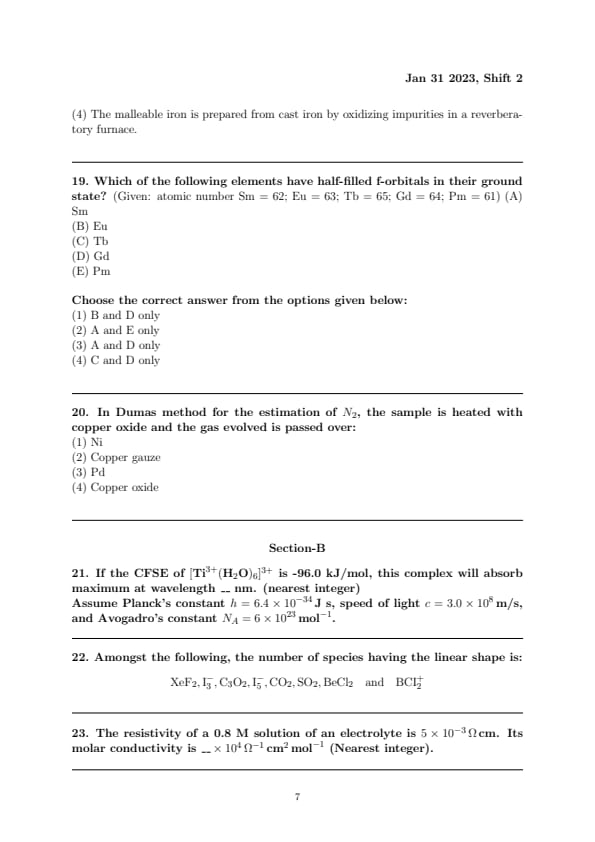
Which of the following elements have half-filled f-orbitals in their ground state?
(Given: atomic number
Sm = 62; Eu = 63; Tb = 65; Gd = 64; Pm = 61)
(A) Sm
(B) Eu
(C) Tb
(D) Gd
(E) Pm
Choose the correct answer from the options given below:
View Solution
The electron configurations of the elements are as follows:
1. \( ^{62}Sm: 4f^6 6s^2 \)
2. \( ^{63}Eu: 4f^7 5d^1 6s^2 \)
3. \( ^{65}Tb: 4f^9 6s^2 \)
4. \( ^{64}Gd: 4f^7 5d^1 6s^2 \)
5. \( ^{61}Pm: 4f^5 6s^2 \)
Thus, the elements with half-filled \( f \)-orbitals in their ground state are Eu (Europium) and Gd (Gadolinium), corresponding to option (1). Quick Tip: Half-filled orbitals, such as in \( 4f^7 \), lead to more stable electronic configurations due to the symmetry and exchange energy.
In Dumas method for the estimation of \( N_2 \), the sample is heated with copper oxide and the gas evolved is passed over:
View Solution
In Dumas' method, the nitrogen-containing organic compound is heated with copper oxide in an atmosphere of CO\(_2\). The resulting reaction produces nitrogen gas in addition to CO\(_2\) and H\(_2\)O:
\[ C_xH_yN_z + \left( 2x + \frac{y}{2} \right) CuO \rightarrow x CO_2 + \frac{y}{2} H_2O + \frac{z}{2} N_2 + \left( 2x + \frac{y}{2} \right) Cu \]
Afterward, any nitrogen oxides formed are reduced to nitrogen gas by passing the gaseous mixture over heated copper gauze. Quick Tip: Dumas' method is commonly used for the estimation of nitrogen in organic compounds by releasing nitrogen gas through heating with copper oxide.
SECTION B
Question 21:
If the CFSE of \( [ Ti^{3+} (H_2O)_6 ]^{3+} \) is -96.0 kJ/mol, this complex will absorb maximum at wavelength __ nm. (nearest integer)
Assume Planck's constant \( h = 6.4 \times 10^{-34} \, J s \), speed of light \( c = 3.0 \times 10^8 \, m/s \), and Avogadro's constant \( N_A = 6 \times 10^{23} \, mol^{-1} \).
View Solution
For the complex \( [ Ti^{3+} (H_2O)_6 ]^{3+} \), the electronic configuration is \( Ti^{3+}: 3d^1 \). The CFSE (Crystal Field Stabilization Energy) is given as -96.0 kJ/mol.
The formula for the CFSE is:
\[ CFSE = -0.4 \Delta_0 \]
Where \( \Delta_0 \) is the crystal field splitting energy. Using the given data:
\[ CFSE = -96 \times 10^3 \, J/mol \]
Now, solving for \( \Delta_0 \):
\[ \Delta_0 = \frac{96 \times 10^3}{6 \times 10^{23}} \quad \Rightarrow \quad \Delta_0 = 1.6 \times 10^{-19} \, J \]
Now, using the formula for the wavelength of absorption:
\[ \frac{hc}{\lambda} = \Delta_0 \]
Substitute the known values:
\[ \frac{6.4 \times 10^{-34} \times 3.0 \times 10^8}{\lambda} = 1.6 \times 10^{-19} \]
Solving for \( \lambda \):
\[ \lambda = \frac{6.4 \times 10^{-34} \times 3.0 \times 10^8}{1.6 \times 10^{-19}} = 480 \times 10^{-9} \, m \]
Thus, the wavelength is \( 480 \, nm \). Quick Tip: The relationship between the energy of absorbed light and the wavelength is given by \( \frac{hc}{\lambda} = \Delta_0 \), where \( \Delta_0 \) is the crystal field splitting energy.
Amongst the following, the number of species having the linear shape is: \[ XeF_2, I_3^-, C_3O_2, I_5^-, CO_2, SO_2, BeCl_2 \quad and \quad BCI_2^+ \]
View Solution
Let's examine the shape of each species:

\(BCI_2^-\) : Linear shape (sp hybridization)
\(BeCl_2\) : Linear shape (sp hybridization)
\(I_3^-\) : Linear shape (sp hybridization)
\(XeF_2\) : Linear shape (sp hybridization)
\(I_5^-\) : V-shape (not linear)
\(CO_2\) : Linear shape (sp hybridization)
\(SO_2\) : V-shape (not linear)
\(C_3O_2\) (O=C=C=C=O) : Linear shape (sp hybridization)
The species with a linear shape are:
\[ BCI_2^-, BeCl_2, I_3^-, XeF_2, CO_2, C_3O_2 \]
Thus, the number of species with linear shape is 5. Quick Tip: In determining the shape of a molecule, consider the number of bonding pairs and lone pairs on the central atom, and use VSEPR theory.
The resistivity of a 0.8 M solution of an electrolyte is \( 5 \times 10^{-3} \, \Omega \, cm \). Its molar conductivity is \( \_\_ \times 10^4 \, \Omega^{-1} \, cm^2 \, mol^{-1} \) (Nearest integer).
View Solution
The molar conductivity \( \Lambda_m \) is given by the formula: \[ \Lambda_m = \frac{k \times 1000}{M} \]
where \( k \) is the resistivity and \( M \) is the molarity of the solution.
Also, we have the formula: \[ \Lambda_m = \frac{1000}{\rho} \quad where \quad \rho = resistivity \]
Now, using the given values: \[ \Lambda_m = \frac{1}{\rho} \times 1000 = \frac{1}{5 \times 10^{-3}} \times 1000 \]
Substitute the value of molarity \( M = 0.8 \): \[ \Lambda_m = \frac{1000}{5 \times 10^{-3}} \times 0.8 = 25 \times 10^4 \, \Omega^{-1} \, cm^2 \, mol^{-1} \]
Thus, the molar conductivity is \( 25 \times 10^4 \, \Omega^{-1} \, cm^2 \, mol^{-1} \). Quick Tip: The molar conductivity is calculated using the relationship between resistivity and molarity. Keep in mind the dimensions of the quantities involved.
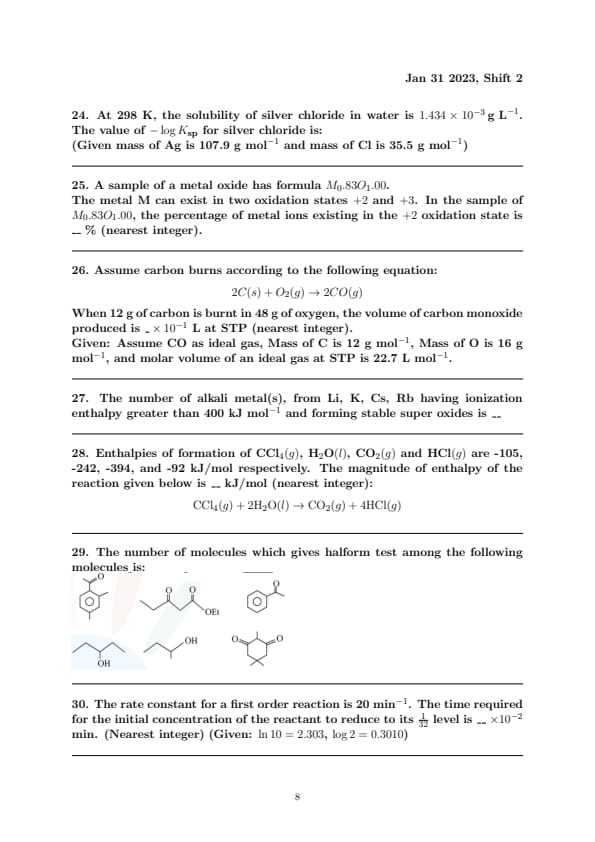
At 298 K, the solubility of silver chloride in water is \( 1.434 \times 10^{-3} \, g L^{-1} \). The value of \( -\log K_{sp} \) for silver chloride is:
(Given mass of Ag is 107.9 g mol\(^{-1}\) and mass of Cl is 35.5 g mol\(^{-1}\))
View Solution
The dissociation of silver chloride in water is: \[ AgCl(s) \rightleftharpoons Ag^+(aq) + Cl^-(aq) \]
The solubility \( S \) of AgCl is given by: \[ S = 1.434 \times 10^{-3} \, g L^{-1} \]
The molar solubility of AgCl, \( S \), can be calculated as: \[ S = \frac{1.434 \times 10^{-3}}{143.4 \times 10^{-3}} \, mol L^{-1} = 1 \times 10^{-5} \, mol L^{-1} \]
The solubility product \( K_{sp} \) is: \[ K_{sp} = S^2 = (1 \times 10^{-5})^2 = 10^{-10} \]
Thus, \( -\log K_{sp} = 10 \). Quick Tip: The solubility product constant \( K_{sp} \) can be calculated from the square of the molar solubility for simple salts like AgCl.
A sample of a metal oxide has formula \( M_0.83O_1.00 \).
The metal M can exist in two oxidation states \( +2 \) and \( +3 \). In the sample of \( M_0.83O_1.00 \), the percentage of metal ions existing in the \( +2 \) oxidation state is __ % (nearest integer).
View Solution
Let the amount of metal in the \( +2 \) oxidation state be \( x \), and the amount in the \( +3 \) oxidation state be \( 0.83 - x \).
From the charge balance equation: \[ 2x + 3(0.83 - x) = 0.83 \]
Simplifying the equation: \[ 2x + 2.49 - 3x = 0.83 \quad \Rightarrow \quad -x + 2.49 = 0.83 \quad \Rightarrow \quad -x = 0.83 - 2.49 = -1.66 \] \[ x = 0.49 \]
Thus, the percentage of metal ions in the \( +2 \) oxidation state is: \[ \frac{0.49}{0.83} \times 100 = 59% \] Quick Tip: In stoichiometry problems, carefully balance the charges and mole ratios to determine the proportions of each oxidation state.
Assume carbon burns according to the following equation: \[ 2C(s) + O_2(g) \rightarrow 2CO(g) \]
When 12 g of carbon is burnt in 48 g of oxygen, the volume of carbon monoxide produced is \( \_ \times 10^{-1} \) L at STP (nearest integer).
Given: Assume CO as ideal gas, Mass of C is 12 g mol\(^{-1}\), Mass of O is 16 g mol\(^{-1}\), and molar volume of an ideal gas at STP is 22.7 L mol\(^{-1}\).
View Solution
From the equation: \[ 2C(s) + O_2(g) \rightarrow 2CO(g) \]
Limiting reagent is carbon, as 12 g of carbon is burnt. 1 mole of carbon produces one mole of CO. Hence, at STP, 1 mole of CO occupies 22.7 L.
We have: \[ Moles of carbon = \frac{12}{12} = 1 \, mol \]
Thus, the volume of CO produced at STP is: \[ Volume of CO = 1 \times 22.7 = 22.7 \, L \]
Therefore, the volume of carbon monoxide produced is \( 2.27 \times 10^1 \) L at STP. Quick Tip: At STP, one mole of an ideal gas occupies 22.7 L. Use this fact for calculations involving gases at STP.
The number of alkali metal(s), from Li, K, Cs, Rb having ionization enthalpy greater than 400 kJ mol\(^{-1}\) and forming stable super oxides is __
View Solution
K and Rb form stable super oxides but Cs has ionization enthalpy less than 400 kJ/mol.
Thus, the correct answer is 2, as K and Rb are the metals that meet the criteria. Quick Tip: Ionization enthalpy and the formation of super oxides are important in determining the chemical behavior of alkali metals.
Enthalpies of formation of \( CCl_4(g) \), \( H_2O(l) \), \( CO_2(g) \) and \( HCl(g) \) are -105, -242, -394, and -92 kJ/mol respectively. The magnitude of enthalpy of the reaction given below is __ kJ/mol (nearest integer): \[ CCl_4(g) + 2H_2O(l) \rightarrow CO_2(g) + 4HCl(g) \]
View Solution
The enthalpy change \( \Delta H \) for the reaction is calculated using the following formula: \[ \Delta H = \sum H_p - \sum H_R \]
Where \( \sum H_p \) is the sum of enthalpies of the products and \( \sum H_R \) is the sum of enthalpies of the reactants.
From the question: \[ \sum H_R = Enthalpy of reactants = (-394 + 4 \times -92) = -1056 \, kJ/mol \] \[ \sum H_p = Enthalpy of products = (-105 + (2 \times -242)) = -589 \, kJ/mol \]
Therefore: \[ \Delta H = (-589) - (-1056) = -173 \, kJ/mol \]
Thus, the magnitude of enthalpy of the reaction is \( 173 \, kJ/mol \). Quick Tip: To calculate enthalpy change for a reaction, use the formula \( \Delta H = \sum H_p - \sum H_R \), where \( H_p \) and \( H_R \) are the enthalpies of products and reactants, respectively.
The number of molecules which gives halform test among the following molecules is:

View Solution
The halform test is positive for compounds that contain a methyl group directly attached to a carbonyl group (i.e., the CH3-CO- functional group) or other reactive groups like CH3-CO-H.
Looking at the structures:
- The molecules \( C = O - CH_3 \) and \( OH - C - CH_3 \) give positive halform test because they both have the required functional groups for the reaction.
- The other molecules do not meet the criteria.
Thus, the number of molecules giving positive halform test is 3. Quick Tip: The halform test is used to identify compounds containing a methyl ketone group (\( -COCH_3 \)) or a similar structure.
The rate constant for a first order reaction is 20 min\(^{-1}\). The time required for the initial concentration of the reactant to reduce to its \( \frac{1}{32} \) level is __ \( \times 10^{-2} \) min. (Nearest integer)
(Given: \( \ln 10 = 2.303 \), \( \log 2 = 0.3010 \))
View Solution
The integrated rate equation for a first order reaction is: \[ \ln \left( \frac{C_0}{C} \right) = kt \]
Where \( C_0 \) is the initial concentration, \( C \) is the concentration at time \( t \), \( k \) is the rate constant, and \( t \) is the time.
For the reaction to reduce to \( \frac{1}{32} \) of its original concentration, we have: \[ \frac{C}{C_0} = \frac{1}{32} \]
Taking the natural logarithm: \[ \ln \left( \frac{C_0}{C} \right) = \ln 32 = 5 \ln 2 = 5 \times 0.693 = 3.465 \]
Thus, the time \( t \) is: \[ t = \frac{3.465}{k} = \frac{3.465}{20} = 0.17325 \, min \]
Therefore, the time required for the concentration to reduce to \( \frac{1}{32} \) is \( 17.325 \times 10^{-2} \) min. Quick Tip: For a first-order reaction, the time required to reach a certain concentration can be calculated using the formula \( t = \frac{\ln \left( \frac{C_0}{C} \right)}{k} \).
Previous Year JEE Main Question Papers
*The article might have information for the previous academic years, please refer the official website of the exam.