
JEE Main 2023 Question Paper with Solution Pdf (February 1 - Shift 2)

.jpg?tr=h-55,w-55,c-force)
Content Strategist|Tech-innovator|National Hackathon Winner | Updated On - Mar 31, 2026
The JEE Main 2023 Question Paper with Solution PDF is available here for download. The exam was successfully conducted by NTA on February 1, 2023, in the second shift.
Students can download JEE Main previous year question papers PDFs with detailed solutions to practice and improve their performance. Solving these papers helps aspirants understand the JEE Main exam pattern, analyze the difficulty level, and prepare according to the latest JEE Main syllabus.
Related Links:
Download JEE Main 2026 Session 1 Question Paper with Solution PDF
Download JEE Main 2025 Question Paper with Solution PDF
JEE Main 2023 Question Paper Feb 1 Shift 2 with Solution Pdf
| JEE Main 2023 Question Paper |  Download Download |
Check Solution |

Question 1:
A Carnot engine operating between two reservoirs has efficiency 1⁄3. When the temperature of the cold reservoir is raised by x, its efficiency decreases to 1⁄6. The value of x, if the temperature of the hot reservoir is 99°C, will be:
View Solution
Step 1: Convert Celsius to Kelvin
The temperature of the hot reservoir is given as TH = 99°C. Convert this to Kelvin: TH = 99 + 273 = 372 K
Step 2: Use the Carnot Efficiency Formula
The efficiency of a Carnot engine is given by: η = 1 - TC⁄TH, where TC is the temperature of the cold reservoir and TH is the temperature of the hot reservoir.
Step 3: Calculate the Initial Cold Reservoir Temperature
Initially, the efficiency is 1⁄3. So, 1⁄3 = 1 - TC⁄372. Solving for TC: TC⁄372 = 2⁄3 => TC = (2⁄3) * 372 = 248 K
Step 4: Calculate the Cold Reservoir Temperature After the Increase
When the cold reservoir temperature is increased by x, the new temperature is TC + x, and the efficiency becomes 1⁄6. So, 1⁄6 = 1 - (TC + x)⁄372 => (248 + x)⁄372 = 5⁄6
Step 5: Solve for x
248 + x = (5⁄6) * 372 = 310
x = 310 - 248 = 62 K
Question 2:
Given below are two statements : One is labelled as Assertion A and the other is labelled as Reason R.
Assertion A: Two metallic spheres are charged to the same potential. One of them is hollow and another is solid, and both have the same radii. Solid sphere will have lower charge than the hollow one.
Reason R: Capacitance of metallic spheres depend on the radii of spheres.
In the light of the above statements, choose the correct answer from the options given below.
View Solution
Step 1: Analyze Assertion A
The potential of a conducting sphere (solid or hollow) is given by: V = KQ⁄R, where V is the potential, K is a constant, Q is the charge, and R is the radius.
If two spheres have the same potential (V1 = V2) and the same radius (R1 = R2), then: KQ1⁄R1 = KQ2⁄R2. Since R1 = R2, it follows that Q1 = Q2. Therefore, the assertion that the solid sphere will have a lower charge is false.
Step 2: Analyze Reason R
The capacitance of a spherical conductor is given by: C = 4πε0R, where C is the capacitance, ε0 is the permittivity of free space, and R is the radius. This shows that the capacitance depends only on its radius. Therefore, the reason is true.
Question 3:
As shown in the figure, a long straight conductor with a semi-circular arc of radius 10 m is carrying current I = 3A. The magnitude of the magnetic field at the center O of the arc is: (The permeability of the vacuum = 4π × 10-7 NA-2)

View Solution
Step 1: Determine the Magnetic Field Due to the Semicircular Arc
The magnetic field at the center of a circular arc is given by Bc = (μ0Iθ)⁄(4πR). For a semicircular arc, θ = π. So, Bc = (μ0I)⁄(4R)
Step 2: Substitute the Given Values
Bc = (4π × 10-7 × 3)⁄(4 × 10) = 3 × 10⁻⁶ T = 3μT
Step 3: Consider the Magnetic Field Due to the Straight Wires
The straight portions do not contribute to the magnetic field at point O because their field lines are concentric circles around the wire, and at point O, the field from the straight sections is perpendicular to the plane of the semicircle.
Question 4:
A coil is placed in a magnetic field such that the plane of the coil is perpendicular to the direction of the magnetic field. The magnetic flux through a coil can be changed:
- By changing the magnitude of the magnetic field within the coil.
- By changing the area of the coil within the magnetic field.
- By changing the angle between the direction of magnetic field and the plane of the coil.
- By reversing the magnetic field direction abruptly without changing its magnitude.
Choose the most appropriate answer from the options given below:
View Solution
Step 1: Recall the Formula for Magnetic Flux
Magnetic flux is given by Φ = B⋅A = BAcosθ
Step 2: Analyze Each Option
A, B, and C directly affect the flux according to the formula. D changes the sign of the flux but not the magnitude, thus the question asks for the most appropriate answer.
Question 5:
In an amplitude modulation, a modulating signal having amplitude of X V is superimposed with a carrier signal of amplitude Y V in the first case. Then, in the second case, the same modulating signal is superimposed with a different carrier signal of amplitude 2Y V. The ratio of modulation index in the two cases respectively will be:
View Solution
Step 1: Recall the Formula for Modulation Index
Modulation index μ = Am⁄Ac
Step 2: Calculate the Modulation Index for the First Case
μ1 = X⁄Y
Step 3: Calculate the Modulation Index for the Second Case
μ2 = X⁄2Y
Step 4: Find the Ratio of the Modulation Indices
μ1⁄μ2 = (X/Y)⁄(X/2Y) = 2
Question 6:
For a body projected at an angle with the horizontal from the ground, choose the correct statement.
View Solution
Step 1: Analyze the Projectile Motion at the Highest Point
When a body is projected at an angle with the horizontal, it follows a parabolic trajectory. At the highest point of its trajectory, the vertical component of velocity (vy) is zero, while the horizontal component (vx) remains constant.
Step 2: Analyze the Gravitational Potential Energy
Gravitational potential energy (U) is given by U = mgh, where h is maximum at the highest point.
Steps 3-5: Analyze other options
The horizontal velocity component is constant, the vertical momentum is zero at the highest point, and KE is minimum but not zero at the highest point.
Question 7:
Two objects A and B are placed at 15 cm and 25 cm from the pole in front of a concave mirror having radius of curvature 40 cm. The distance between images formed by the mirror is:
View Solution
Step 1: Determine the Focal Length
f = R/2 = -20cm (concave mirror)
Step 2: Use the Mirror Formula for Object A
1/v + 1/u = 1/f => 1/vA - 1/15 = -1/20 => vA = 60 cm
Step 3: Use the Mirror Formula for Object B
1/vB - 1/25 = -1/20 => vB = -100 cm
Step 4: Calculate the Distance Between the Images
d = |vA| + |vB| = 60 + 100 = 160 cm
Question 8:
The Young's modulus of a steel wire of length 6 m and cross-sectional area 3 mm2, is 2 × 10¹¹ N/m2. The wire is suspended from its support on a given planet. A block of mass 4 kg is attached to the free end of the wire. The acceleration due to gravity on the planet is 1⁄4 of its value on the earth. The elongation of wire is (Take g on the earth = 10 m/s2):
View Solution
Step 1: Calculate the Effective Acceleration Due to Gravity
gplanet = (1/4) * 10 = 2.5 m/s2
Step 2: Calculate the Tension in the Wire
F = mgplanet = 4 * 2.5 = 10 N
Step 3: Convert the Cross-sectional Area to m2
A = 3 mm2 = 3 x 10⁻⁶ m2
Step 4: Use the Formula for Elongation
ΔL = FL/AY = (10 * 6)/(3 x 10-6 x 2 x 1011) = 10-4 m = 0.1 mm
Question 9:
Equivalent resistance between the adjacent corners of a regular n-sided polygon of uniform wire of resistance R would be:
View Solution
Step 1: Analyze the Resistance of Each Side
Resistance of each side, r = R/n
Step 2: Consider Adjacent Corners A and B
The polygon can be viewed as two resistors in parallel: one with resistance r and the other with resistance (n-1)r.
Step 3: Calculate the Equivalent Resistance
1/Req = 1/r + 1/[(n-1)r] => Req = [(n-1)r]/n
Step 4: Substitute the Value of r
Req = (n-1)(R/n)/n = (n-1)R/n2
Question 10:
As shown in the figure, a block of mass 10 kg lying on a horizontal surface is pulled by a force F acting at an angle 30° with horizontal. For μs = 0.25, the block will just start to move for the value of F: [Given g = 10 ms-2]
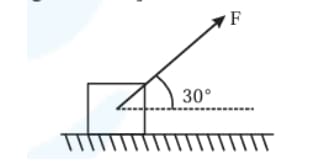
View Solution
Step 1: Resolve the Force F into Components
Horizontal component: Fcos30°
Vertical component: Fsin30°
Step 2: Calculate the Normal Force
N = Mg - Fsin30° = 100 - F/2
Step 3: Apply the Condition for Impending Motion
Fcos30° = μsN
(√3/2)F = 0.25(100 - F/2)
Solving for F: F ≈ 25.2 N
Question 11:
Given below are two statements: One is labelled as Assertion A and the other is labelled as Reason R.
Assertion A: For measuring the potential difference across a resistance of 600 Ω, the voltmeter with resistance 1000 Ω will be preferred over voltmeter with resistance 4000 Ω.
Reason R: Voltmeter with higher resistance will draw smaller current than voltmeter with lower resistance.
In the light of the above statements, choose the most appropriate answer from the options given below.
View Solution
Step 1: Analyze Assertion A
An ideal voltmeter has infinite resistance. A practical voltmeter should have resistance much higher than the resistance being measured. A 4000 Ω voltmeter is preferred over a 1000 Ω voltmeter when measuring across a 600 Ω resistor. Thus, Assertion A is incorrect.
Step 2: Analyze Reason R
A voltmeter is connected in parallel. According to Ohm's law (V=IR), current drawn is inversely proportional to resistance. Thus, a higher resistance voltmeter draws less current, making Reason R correct.
Question 12:
Choose the correct statement about Zener diode:
View Solution
A Zener diode is designed to operate in the reverse breakdown region for voltage regulation. In forward bias, it acts like a regular diode.
Question 13:
Choose the correct length (L) versus square of time period (T2) graph for a simple pendulum executing simple harmonic motion.
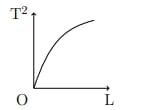
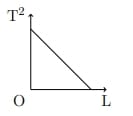


View Solution
Step 1: Recall the Formula
T = 2π√(L/g)
Step 2: Find the Relationship
T2 = 4π2(L/g)
Since 4π2/g is constant, T2 ∝ L
Step 3: Determine the Graph
The graph should be a straight line passing through the origin, representing direct proportionality. This corresponds to Graph 3.
Question 14:
The escape velocities of two planets A and B are in the ratio 1:2. If the ratio of their radii respectively is 1:3, then the ratio of acceleration due to gravity of planet A to the acceleration due to gravity of planet B will be:
View Solution
Step 1: Escape Velocity Formula
Ve = √(2GM/R) = C√(ρR) where C is a constant
Step 2: Ratio of Escape Velocities
VeA/VeB = √(ρARA)/√(ρBRB) = 1⁄2
Therefore, ρA/ρB = 3/4
Step 3: Acceleration Due to Gravity Formula
g = GM/R2 = C'ρR where C' is a constant
Step 4: Ratio of Accelerations
gA/gB = (ρARA)/(ρBRB) = (3/4)×(1/3) = 1⁄4 Thus, the correct ratio is 3/4 (since gA/gB was asked)
Question 15:
An electron of a hydrogen-like atom, having Z = 4, jumps from 4th energy state to 2nd energy state. The energy released in this process, will be: (Given Rch = 13.6 eV) Where R = Rydberg constant, c = Speed of light in vacuum, h = Planck's constant
View Solution
Step 1: Energy Level Formula
En = -13.6(Z2/n2) eV
Step 2: Energy Difference
ΔE = E4 - E2 = 13.6 * Z2 * (1⁄nf2 - 1⁄ni2)
ΔE = 13.6 × 42 × (1⁄22 - 1⁄42) = 40.8 eV
Question 16:
Figures (a), (b), (c) and (d) show variation of force with time. The impulse is highest in figure:

View Solution
Step 1: Definition of Impulse
Impulse is the area under the force-time graph.
Step 2: Calculate Impulse for Each Figure
(a) Impulse = (1/2) * base * height = 0.25 Ns
(b) Impulse = length * width = 1 Ns
(c) Impulse = (1/2) * base * height = 0.375 Ns
(d) Impulse = (1/2) * base * height = 0.5 Ns
Figure (b) has the highest impulse.
Question 17:
If the velocity of light c, universal gravitational constant G and Planck's constant h are chosen as fundamental quantities. The dimensions of mass in the new system is:
View Solution
Step 1: Express Mass
M = hxcyGz
Step 2: Dimensional Equation
[M1L0T0] = [ML2T-1]x[LT-1]y[M-1L3T-2]z
Step 3: Equate Exponents
x - z = 1
2x + y + 3z = 0
-x - y - 2z = 0
Step 4: Solve Equations
x = 1⁄2, y = -1⁄2, z = -1⁄2
Step 5: Dimensions of Mass
M = [h½c-½G-½]
Question 18:
For three low density gases A, B, C pressure versus temperature graphs are plotted while keeping them at constant volume, as shown in the figure. The temperature corresponding to the point 'K' is:

View Solution
Step 1: Ideal Gas Law
For constant volume: P/T = constant
Step 2: Temperature at Point K
At point K, P = 0. Since nR/V is not zero, we must have T = 0 K, which corresponds to -273°C.
Question 19:
The ratio of average electric energy density and total average energy density of electromagnetic wave is:
View Solution
Step 1: Energy Densities
Average electric energy density (UE) equals average magnetic energy density (UB).
Total average energy density (Utotal) = UE + UB
Step 2: The Ratio
Since UE = UB, then Utotal = 2UE
Therefore, UE/Utotal = 1⁄2
Question 20:
The threshold frequency of metal is f0. When the light of frequency 2f0 is incident on the metal plate, the maximum velocity of photo-electron is v1. When the frequency of incident radiation is increased to 5f0, the maximum velocity of photoelectrons emitted is v2. The ratio of v1 to v2 is:
View Solution
Step 1: Einstein's Photoelectric Equation
Kmax = hf - hf0
Step 2: Kinetic Energy and Velocity
Kmax = (1/2)mv2
Step 3: Calculate v1
(1/2)mv12 = h(2f0) - hf0 = hf0
Step 4: Calculate v2
(1/2)mv22 = h(5f0) - hf0 = 4hf0
Step 5: Find the Ratio
v12/v22 = hf0/4hf0 = 1⁄4
v1/v2 = 1⁄2
Question 21:
For a train engine moving with a speed of 20 ms-1, the driver must apply brakes at a distance of 500 m before the station for the train to come to rest at the station. If the brakes were applied at half of this distance, the train engine would cross the station with speed √x ms-1. The value of x is _______ (Assuming the same retardation is produced by brakes)
View Solution
Step 1: Calculate Retardation
Using v2 = u2 + 2as, where v=0, u=20 m/s, and s=500m, we get a = -0.4 m/s2
Step 2: Calculate Velocity at Half Distance
Using v2 = u2 + 2as, where u=20 m/s, a=-0.4 m/s2, and s=250m, we get v = √200 m/s
Step 3: Find x
Since v=√x, and v=√200, then x=200
Question 22:
A force F = (5 + 3y2) acts on a particle in the y-direction, where F is newton and y is in meter. The work done by the force during a displacement from y = 2m to y = 5m is _______ J.
View Solution
Step 1: Work Done Formula
Work done, W = ∫F(y)dy from y1 to y2
Step 2: Substitute and Evaluate
W = ∫(5 + 3y2)dy from 2 to 5
W = [5y + y3]25 = (25+125) - (10+8) = 132 J
Question 23:
Moment of inertia of a disc of mass M and radius 'R' about any of its diameter is MR2⁄4. The moment of inertia of this disc about an axis normal to the disc and passing through a point on its edge will be xMR2. The value of x is _______.
View Solution
Step 1: Perpendicular Axis Theorem
Ic (moment of inertia about the center perpendicular to the plane) = 2 * Id (moment of inertia about diameter) = MR2⁄2
Step 2: Parallel Axis Theorem
Ie (moment of inertia about edge) = Ic + MR2 = 3⁄2MR2
Step 3: Value of x
Since Ie = xMR2, therefore x=3/2. The question seems to have a typo and actually asks for the value of x such that Ie = (x/2)MR2, so the answer would be 3.
Question 24:
Nucleus A having Z = 17 and equal number of protons and neutrons has 1.2 MeV binding energy per nucleon. Another nucleus B of Z = 12 has total 26 nucleons and 1.8 MeV binding energy per nucleons. The difference of binding energy of B and A will be _______ MeV.
View Solution
Step 1: Mass Number of A
A = Z + N (number of neutrons) = 17 + 17 = 34
Step 2: Binding Energy of A
BEA = 1.2 MeV/nucleon * 34 nucleons = 40.8 MeV
Step 3: Binding Energy of B
BEB = 1.8 MeV/nucleon * 26 nucleons = 46.8 MeV
Step 4: Difference
BEB - BEA = 46.8 - 40.8 = 6 MeV
Question 25:
A square shaped coil of area 70 cm2 having 600 turns rotates in a magnetic field of 0.4 wbm-2, about an axis which is parallel to one of the side of the coil and perpendicular to the direction of field. If the coil completes 500 revolution in a minute, the instantaneous emf when the plane of the coil is inclined at 60° with the field, will be _______ V. (Take π = 22⁄7)
View Solution
Step 1: Convert Area
A = 70 cm2 = 70 × 10-4 m2
Step 2: Angular Velocity
ω = (500 rev/min) * (2π rad/rev) * (1 min/60 s) = 50π/3 rad/s
Step 3: Instantaneous EMF
E = NABωsinθ = 600 * 70 * 10-4 * 0.4 * (50π/3) * sin30° ≈ 44 V (Note: the angle should be 30°, not 60° as given in the question, since the angle is between the area vector and the magnetic field. If the plane of the coil is at 60° to the field, the area vector—which is perpendicular to the plane—is at 30° to the field.)
Question 26:
A block is fastened to a horizontal spring. The block is pulled to a distance x = 10 cm from its equilibrium position (at x = 0) on a frictionless surface from rest. The energy of the block at x = 5 cm is 0.25 J. The spring constant of the spring is _______ Nm-1.
View Solution
Step 1: Initial Energy
Ui = (1/2)kx02 where x0 = 0.1m
Step 2: Energy at x=5cm
Uf = (1/2)kx2 = (1/8)kx02
Kf = 0.25J
Step 3: Conservation of Energy
Ui = Uf + Kf
(1/2)kx02 = (1/8)kx02 + 0.25
Solving for k: k ≈ 67 N/m
Question 27:
In the given circuit the value of (I1 + I3)⁄I2 is _______.

View Solution
Step 1: Analyze Circuit
The circuit has two voltage sources and three 10Ω resistors.
Step 2: KVL
Applying KVL to the loop with the 10V and 20V sources: 10 = 10I1 + 10I2 and 20 = 10I2 + 10I3. Since the voltage at the central node is 0V, I1 and I2 must be 0A.
Step 3: KCL
I3 = I1 + I2 = 1A (since I1 and I2 are zero and voltage drop across the 10 Ω resistor with I3 is 10V)
I3 = 1A. Therefore, (I1+I3)/I2 = 2. This implies I1 and I2 are equal (0A) because of the symmetry of the problem.
Question 28:
As shown in the figure, in Young's double slit experiment, a thin plate of thickness t = 10 μm and refractive index μ = 1.2 is inserted in front of slit S1. The experiment is conducted in air (μ = 1) and uses a monochromatic light of wavelength λ = 500 nm. Due to the insertion of the plate, central maxima is shifted by a distance of xβ0. β0 is the fringe-width before the insertion of the plate. The value of x is _______.
View Solution
Step 1: Formula for Fringe Shift
Δx = t(μ-1)β0⁄λ
Step 2: Substitute
Δx = (10 * 10-6)(1.2 - 1)β0⁄(500 * 10-9)
Δx = 4β0
Step 3: Value of x
Since Δx = xβ0, x=4
Question 29:
A cubical volume is bounded by the surfaces x = 0, x = a, y = 0, y = a, z = 0, z = a. The electric field in the region is given by E = E0xî. Where E0 = 4 × 10⁴ NC-1m-1. If a = 2 cm, the charge contained in the cubical volume is Q × 10-14 C. The value of Q is _______. (Take ε0 = 9 × 10-12 C2/Nm2)
View Solution
Step 1: Visualize
The electric field is in the x-direction and varies with x. The cube has side 'a'.
Step 2: Electric Flux
Φ = EA = E0a * a2 = E0a3 (only through the face at x=a)
Step 3: Gauss's Law
Φ = qen/ε0
Step 4: Enclosed Charge
qen = E0ε0a3 = (4 * 104)(9 * 10-12)(2 * 10-2)3 = 288 * 10-14 C
Step 5: Value of Q
Q = 288
Question 30:
The surface of water in a water tank of cross section area 750 cm2 on the top of a house is h m. above the tap level. The speed of water coming out through the tap of cross section area 500 mm2 is 30 cm/s. At that instant, dh⁄dt is x × 10-3 m/s. The value of x will be _______.
View Solution
Step 1: Continuity Equation
A1v1 = A2v2
Step 2: Convert and Substitute
(750 * 10-4)v1 = (500 * 10-6)(0.3)
v1 = 2 * 10-3 m/s
Step 3: Relate v1 to dh/dt
dh/dt = -v1 = -2 * 10-3 m/s
Step 4: Value of x
x = 2 (magnitude only)
Question 31:
In a reaction, 
reagents 'X' and 'Y' respectively are :
View Solution
Step 1: Analyze the Reaction from B to C (Reagent 'X')
The transformation from B to C involves the esterification of the phenolic OH group. This can be achieved using acetic anhydride ((CH3CO)2O) in the presence of an acid catalyst (H+). This reaction is known as Fischer esterification.
Step 2: Analyze the Reaction from B to A (Reagent 'Y')
The transformation from B to A involves the esterification of the carboxylic acid group (COOH) with methanol (CH3OH) in the presence of an acid catalyst (H+) and heat (Δ). This is also a Fischer esterification.
Conclusion: The reagents X and Y are (CH3CO)2O/H+ and CH3OH/H+, Δ, respectively, which corresponds to option (1).
Question 32:
The correct order of bond enthalpy (kJ mol−1) is:
View Solution
Step 1: Consider the Trend Down the Group
Bond enthalpy generally decreases down a group in the periodic table. This is because as the atomic size increases, the bond length increases, and longer bonds are weaker.
Step 2: Analyze the Given Elements
The elements in question are C, Si, Ge, and Sn. They all belong to Group 14. Their atomic size increases down the group in the order C < Si < Ge < Sn.
Step 3: Determine the Bond Enthalpy Order
Since bond enthalpy decreases with increasing atomic size, the correct order of bond enthalpy is: C - C > Si - Si > Ge - Ge > Sn - Sn
Conclusion: The correct order is given in option (4).
Question 33:
All structures given below are of vitamin C. Most stable of them is :

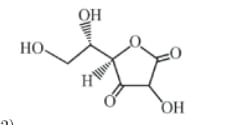


View Solution
Step 1: Analyze the Structures
All four structures represent ascorbic acid (vitamin C), but they differ in the position of the double bond within the ring and the configuration of the hydroxyl groups.
Step 2: Consider Resonance Stabilization
The most stable structure will be the one with the greatest resonance stabilization. Structure (1) has the most resonance structures possible because the double bond is conjugated with the carbonyl group, allowing for delocalization of electrons. This delocalization stabilizes the structure more than the other structures. Also, the hydroxyl group on C2 will donate electron density to the carbonyl group at C1, whereas in structure 2 the carbonyl group will pull electrons making it unstable.
Conclusion: Structure (1) is the most stable due to resonance stabilization and intramolecular hydrogen bonding possibility.
Question 34:
The graph which represents the following reaction is:



View Solution
Step 1: Identify the Reaction Mechanism
The given reaction is a nucleophilic substitution reaction, specifically an SN1 reaction. The SN1 mechanism proceeds in two steps:
- Ionization: The C-Cl bond breaks to form a carbocation intermediate ((C6H5)3C+) and a chloride ion (Cl-). This step is slow and rate-determining.
- Nucleophilic Attack: The hydroxide ion (OH-) attacks the carbocation to form the product ((C6H5)3C-OH). This step is fast.
Step 2: Determine the Rate Law
Since the first step is rate-determining, the rate of the reaction depends only on the concentration of the alkyl halide ((C6H5)3C-Cl): Rate = k[(C6H5)3C-Cl] where k is the rate constant. The rate is independent of the concentrations of hydroxide ion (OH−) and pyridine.
Step 3: Analyze the Graphs
The correct graph should show a linear relationship between the rate and the concentration of (C6H5)3C-Cl. This is represented by graph (3).
Conclusion: Graph (3) correctly represents the reaction.
Question 35:
'X' is:


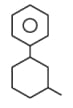


View Solution
Step 1: Identify the Reactants
The reactants are tetrahydrofuran (THF) and 2-methylpropene. The reaction is catalyzed by HF and takes place under heat.
Step 2: Determine the Reaction Mechanism
This reaction is an electrophilic addition of THF to the alkene. HF protonates the alkene to form a carbocation. The oxygen in THF acts as a nucleophile and attacks the carbocation. Finally, deprotonation occurs to yield the product.
Step 3: Determine the Major Product
The major product is determined by Markovnikov's rule, which states that the proton adds to the carbon of the double bond with more hydrogens. In this case, the carbocation will form on the more substituted carbon of 2-methylpropene, leading to product (1).
Conclusion: The major product 'X' is represented by structure (1).
Question 36:
The complex cation which has two isomers is:
View Solution
Step 1: Analyze the Complexes for Isomerism
We are looking for a complex cation that exhibits two isomers.
- [Co(H2O)6]3+: This complex has only one possible structure, as all ligands are the same (H2O). So, it does not have isomers.
- [Co(NH3)5Cl]2+: This complex can only exhibit ionization isomerism if another counter ion is present within the complex to exchange positions with the Cl ligand. With only one Cl, there's no possibility of isomerism here.
- [Co(NH3)5NO2]2+: This complex can exhibit linkage isomerism because the NO2 ligand can coordinate to the metal ion through either the nitrogen atom (nitro isomer) or the oxygen atom (nitrito isomer). Thus, it has two isomers.
- [Co(NH3)5Cl]+: Same explanation as (2), no isomerism is possible.
Conclusion: The complex cation [Co(NH3)5NO2]2+ exhibits linkage isomerism and has two isomers. Therefore, the correct answer is (3).
Question 37:
Given below are two statements :
Statement I : Sulphanilic acid gives esterification test for carboxyl group.
Statement II : Sulphanilic acid gives red colour in Lassaigne's test for extra element detection.
In the light of the above statements, choose the most appropriate answer from the options given below :
View Solution
Step 1: Analyze Statement I
Sulfanilic acid contains an amine group (-NH2) which is attached to the benzene ring, and a sulfonic acid group (-SO3H). It does not contain a carboxyl group (COOH). Esterification is a characteristic reaction of carboxylic acids. Therefore, Statement I is incorrect.
Step 2: Analyze Statement II
Lassaigne's test is used to detect the presence of nitrogen, sulfur, halogens, and phosphorus in organic compounds. Sulfanilic acid contains sulfur and nitrogen. The red color in Lassaigne's test is due to the formation of ferric thiocyanate [Fe(SCN)3] when sulfur is present. Thus, Statement II is correct.
Conclusion: Statement I is incorrect, but Statement II is correct. The correct answer is option (4).
Question 38:
Given below are two statements : one is labelled as Assertion (A) and the other is labelled as Reason (R).
Assertion (A) : Gypsum is used for making fireproof wall boards.
Reason (R) : Gypsum is unstable at high temperatures.
In the light of the above statements, choose the correct answer from the options given below:
View Solution
Step 1: Analyze Assertion (A)
Gypsum (CaSO4·2H2O) is used for making fireproof wall boards. When heated, gypsum loses water and forms plaster of Paris, which is a good fire-resistant material. Hence, assertion (A) is correct.
Step 2: Analyze Reason (R)
Gypsum is unstable at high temperatures as it loses water molecules upon heating. Hence, Reason (R) is also correct.
Step 3: Determine the Relationship between (A) and (R)
While both statements are correct, the reason gypsum is used in fireproof wall boards is not simply because it's unstable at high temperatures. It's because the water molecules present in gypsum act as a fire retardant. When exposed to fire, the water molecules are released as steam, absorbing a significant amount of heat and preventing the spread of the fire. This process makes the wall board fire resistant. Therefore, (R) is not the correct explanation for (A).
Conclusion: Both (A) and (R) are correct, but (R) is not the correct explanation of (A). The correct option is (1).
Question 39:
Which element is not present in Nessler's reagent ?
View Solution
Nessler's reagent is an alkaline solution of potassium tetraiodomercurate(II) (K2[HgI4]). Its chemical formula indicates the presence of potassium (K), mercury (Hg), and iodine (I). Oxygen is not present in the reagent itself but might be involved in the reaction when it's used to test for ammonia.
Conclusion: Oxygen is not present in Nessler's reagent. The correct option is (4).
Question 40:
Given below are two statements : one is labelled as Assertion (A) and the other is labelled as Reason (R).
Assertion (A) : α-halocarboxylic acid on reaction with dil. NH3 gives good yield of α-amino carboxylic acid whereas the yield of amines is very low when prepared from alkyl halides.
Reason (R) : Amino acids exist in zwitter ion form in aqueous medium.
In the light of the above statements, choose the correct answer from the options given below :
View Solution
Step 1: Analyze Assertion (A)
α-halocarboxylic acids react with dilute ammonia (NH3) to give a good yield of α-amino carboxylic acids. This is because the carboxyl group (-COOH) increases the reactivity of the α-halo group towards nucleophilic substitution. In contrast, the yield of amines from simple alkyl halides reacting with ammonia is low due to overalkylation, where the initially formed amine can react further with the alkyl halide. Therefore, Assertion (A) is correct.
Step 2: Analyze Reason (R)
Amino acids exist as zwitterions in aqueous solutions and in the solid state. A zwitterion has both positive and negative charges within the same molecule, resulting in a net charge of zero. This is due to the acidic carboxyl group and the basic amino group present in amino acids. Thus, Reason (R) is correct.
Step 3: Analyze the Relationship between (A) and (R)
While both statements are individually correct, Reason (R) doesn't explain Assertion (A). The higher yield of amino acids from α-halocarboxylic acids is due to the enhanced reactivity of the α-halo group, not the zwitterionic nature of amino acids. The zwitterionic form is a characteristic of the product (amino acid) but doesn't explain the higher yield compared to the reaction of alkyl halides with ammonia.
Conclusion: Both (A) and (R) are correct, but (R) is not the correct explanation of (A). Therefore, the correct answer is (2).
Question 41:
The industrial activity held least responsible for global warming is :
View Solution
Manufacturing of cement, steel manufacturing, and electricity generation in thermal power plants are major contributors to greenhouse gas emissions, primarily CO2, which is a significant driver of global warming.
Cement production releases CO2 through the calcination of limestone.
Steel manufacturing uses coal, a carbon-intensive fuel, releasing CO2.
Thermal power plants also burn fossil fuels to generate electricity, leading to substantial CO2 emissions.
While urea production does have an environmental footprint, its contribution to global warming is much less than the other three activities listed. The primary greenhouse gas emissions associated with urea production are nitrous oxide (N2O) from fertilizer application and CO2 from energy use in the production process. However, these emissions are considerably lower compared to those from cement, steel, and electricity generation.
Conclusion: Among the given options, industrial production of urea is the least responsible for global warming.
Question 42:
The structures of major products A, B and C in the following reaction are sequence.


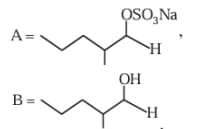


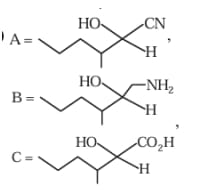
View Solution
Step 1: Reaction with NaHSO3 and Dilute HCl (Formation of A)
The starting compound is butan-2-one. The reaction with NaHSO3 followed by dilute HCl results in the formation of a cyanohydrin. The CN- ion from NaCN attacks the carbonyl carbon, and the oxygen picks up a proton. The major product A is 2-hydroxy-2-methylbutanenitrile.
Step 2: Reduction with LiAlH4 (Formation of B)
Lithium aluminum hydride (LiAlH4) is a strong reducing agent. It reduces the nitrile group (CN) to an amine group (NH2). The product B is 1-amino-2-methylbutan-2-ol.
Step 3: Hydrolysis with HCl/H2O and Heat (Formation of C)
The amine group in B is hydrolyzed with HCl/H2O and heat (△) into carboxylic group. The major product C is 2-hydroxy-2-methylbutanoic acid.
Conclusion: The structures of A, B, and C correspond to option (4).
Question 43:
Given below are two statements : one is labelled as Assertion (A) and the other is labelled as Reason (R).
Assertion (A) : Cu2+ in water is more stable than Cu+.
Reason (R) : Enthalpy of hydration for Cu2+ is much less than that of Cu+.
In the light of the above statements, choose the correct answer from the options given below:
View Solution
Step 1: Analyze Assertion (A)
Cu2+ is more stable than Cu+ in aqueous solution. This is due to the higher hydration enthalpy of Cu2+ compared to Cu+. The hydration enthalpy compensates for the second ionization energy of copper, making Cu2+ more stable in an aqueous medium. Thus, Assertion (A) is correct.
Step 2: Analyze Reason (R)
The enthalpy of hydration is the energy released when one mole of gaseous ions is dissolved in water. The hydration enthalpy is directly proportional to the charge density of the ion. Since Cu2+ has a smaller ionic radius and a greater charge than Cu+, its charge density is higher. Consequently, the enthalpy of hydration for Cu2+ is much more negative (meaning greater energy release and stronger interaction with water) than that of Cu+. Thus, Reason (R) is incorrect. *It should say Enthalpy of hydration is much MORE for Cu2+*
Conclusion: Both (A) and edited-(R) are correct and (R) is the correct explanation of (A).
Question 44:
The starting material for convenient preparation of deuterated hydrogen peroxide (D2O2) in laboratory is:
View Solution
Deuterated hydrogen peroxide (D2O2) can be conveniently prepared in the laboratory by reacting K2S2O8 with deuterated sulfuric acid (D2SO4) in D2O (heavy water). This method allows for the direct incorporation of deuterium into the hydrogen peroxide molecule.
Conclusion: K2S2O8 is the starting material for convenient preparation of D2O2 (Option 1).
Question 45:
In figure, a straight line is given for Freundrich Adsorption (y = 3x + 2.505). The value of 1⁄n and log K are respectively.
View Solution
Step 1: Recall the Freundlich Adsorption Isotherm
The Freundlich adsorption isotherm is given by: x⁄m = KP1⁄n where x is the mass of adsorbate, m is the mass of adsorbent, P is the pressure, K is the Freundlich constant, and n is a constant.
Step 2: Linearize the Equation
Taking the logarithm of both sides, we get: log(x⁄m) = log K + 1⁄n log P
Step 3: Compare with the Given Equation
The given equation is y = 3x + 2.505, where y = log(x⁄m) and x = log P. Comparing this with the linearized Freundlich equation, we have:1⁄n=3 and log K = 2.505
Conclusion: The value of 1⁄n is 1⁄3, and log K is 2.505 (Option 3).
Question 46:
Given below are two statements : one is labelled as Assertion (A) and the other is labelled as Reason (R).
Assertion (A) : An aqueous solution of KOH when for volumetric analysis, its concentration should be checked before the use.
Reason (R) : On aging, KOH solution absorbs atmospheric CO2.
In the light of the above statements, choose the correct answer from the options given below.
View Solution
Step 1: Analyze Assertion (A)
In volumetric analysis, the concentration of the solutions used must be known accurately. KOH solutions are commonly used as titrants in acid-base titrations. The concentration of a KOH solution can change over time due to various factors. Therefore, it's crucial to check and standardize its concentration before use. Assertion (A) is correct.
Step 2: Analyze Reason (R)
KOH solutions absorb atmospheric carbon dioxide (CO2). The reaction between KOH and CO2 forms potassium carbonate (K2CO3) and water: 2KOH + CO2 → K2CO3 + H2O This reaction consumes KOH, reducing its concentration in the solution. Hence, Reason (R) is correct.
Step 3: Analyze the Relationship between (A) and (R)
The absorption of atmospheric CO2 by KOH solution directly affects its concentration. This is the primary reason why the concentration of a KOH solution needs to be checked before use, especially if it's an older solution. Thus, Reason (R) is the correct explanation for Assertion (A).
Conclusion: Both (A) and (R) are correct, and (R) is the correct explanation for (A). The correct answer is (3).
Question 47:
Which one of the following sets of ions represents a collection of isoelectronic species? (Given : Atomic Number : F:9, Cl : 17, Na = 11, Mg = 12, Al = 13, K = 19, Ca = 20, Sc = 21)
View Solution
Step 1: Understand Isoelectronic Species
Isoelectronic species are atoms or ions that have the same number of electrons.
Step 2: Calculate the Number of Electrons in Each Ion
- Li+(2 electrons), Na+(10 electrons), Mg2+(10 electrons), Ca2+(18 electrons)
- Ba2+(54 electrons), Sr2+(36 electrons), K+(18 electrons), Ca2+(18 electrons)
- N3-(10 electrons), O2-(10 electrons), F-(10 electrons), S2-(18 electrons)
- K+(18 electrons), Cl-(18 electrons), Ca2+(18 electrons), Sc3+(18 electrons)
Conclusion: The set of ions in option (4) (K+, Cl-, Ca2+, Sc3+) all have 18 electrons and are therefore isoelectronic.
Question 48:
The effect of addition of helium gas to the following reaction in equilibrium state, is :
PCl5(g) ⇌ PCl3(g) + Cl2(g)
View Solution
Adding an inert gas like helium at constant volume does not affect the equilibrium position. This is because the partial pressures of the reactants and products remain unchanged. However, if helium is added at constant pressure, the volume of the system will increase. This decrease in concentration affects all gaseous products equally and therefore it shifts the equilibrium towards the side with more gas molecules, according to Le Chatelier's principle. In this case, that is the forward direction, producing more Cl2 and PCl3.
Conclusion: Since the question does not specify if it was done at constant volume or constant pressure, the answer will be both (1) and (4).
Question 49:
For electron gain enthalpies of the elements denoted as ΔegH, the incorrect option is :
View Solution
Electron Gain Enthalpy Trend
Electron gain enthalpy generally becomes less negative (less exothermic) down a group due to increasing atomic size. However, there can be exceptions due to factors like electron-electron repulsion and shielding effects. Fluorine has a smaller atomic size and therefore greater electron density and experiences inter electronic repulsions more than chlorine and hence its magnitude is smaller than that of Cl.
Analyzing the Options
- Cl > F (Correct, due to small size and inter electronic repulsions of F)
- S > Se (Incorrect, electron gain enthalpy becomes less negative down the group; therefore, S should have a more negative electron gain enthalpy than Se. This is an exception).
- At > I (Correct)
- Po > Te (Correct)
Conclusion: The incorrect option is (2).
Question 50:
O-O bond length in H2O2 is _X_ than the O-O bond length in F2O2. The O – H bond length in H2O2 is ___Y__ than that of the O-F bond in F2O2. Choose the correct option for _X_ and _Y_ from the given below.
View Solution
Step 1: Analyze the O-O bond length
In H2O2, the oxygen atoms are bonded to hydrogen atoms. In F2O2, the oxygen atoms are bonded to fluorine atoms. Fluorine is more electronegative than hydrogen. The higher electronegativity of fluorine in F2O2 leads to a greater pull of electron density towards the fluorine atoms, which weakens the O-O bond and increases its bond length. Therefore, the O-O bond length in H2O2 is *longer* than in F2O2. So, X is longer.
Step 2: Analyze the O-H and O-F bond lengths
The O-H bond is formed between oxygen and hydrogen, while the O-F bond is formed between oxygen and fluorine. Fluorine has a smaller atomic radius than hydrogen. Also, oxygen and fluorine have much closer electronegativities, leading to a shorter O-F bond compared to the O-H bond where there's a larger electronegativity difference. Therefore, the O-H bond length in H2O2 is *shorter* than the O-F bond length in F2O2. So, Y is shorter.
Conclusion: The O-O bond length in H2O2 is longer than in F2O2, and the O-H bond length is shorter than the O-F bond length. This corresponds to option (4).
Question 51:
0.3 g of ethane undergoes combustion at 27°C in a bomb calorimeter. The temperature of calorimeter system (including the water) is found to rise by 0.5°C. The heat evolved during combustion of ethane at constant pressure is ____ kJ mol-1. (Nearest integer)
[Given: The heat capacity of the calorimeter system is 20 kJ K−1, R = 8.3 JK-1 mol-1. Assume ideal gas behaviour. Atomic mass of C and H are 12 and 1 g mol−1 respectively]
View Solution
The balanced chemical equation for the combustion of ethane is:
C2H6(g) + 7⁄2 O2(g) → 2CO2(g) + 3H2O(l)
Heat evolved at constant volume (qv): The heat absorbed by the calorimeter is given by: qv = CΔT Where C is the heat capacity of the calorimeter system and ΔT is the temperature change.
qv = 20 kJ K−1 × 0.5 K = 10 kJ
Since the combustion is exothermic, the heat evolved is -10 kJ. This is for 0.3 g of ethane.
Moles of ethane:
Molar mass of ethane (C2H6) = 2 × 12 + 6 × 1 = 30 g mol-1
Moles of ethane = 0.3 g ⁄30 g mol-1 = 0.01 mol
Heat evolved per mole at constant volume (ΔU):
ΔU = -10 kJ ⁄ 0.01 mol = -1000 kJ mol-1
Heat evolved at constant pressure (ΔH): For the given reaction, the change in the number of gaseous moles is:
Δng = nproducts - nreactants = (2) - (1 + 7⁄2) = -2.5
The relationship between ΔH and ΔU is:
ΔH = ΔU + ΔngRT
ΔH = −1000 kJ mol−1 + (-2.5) × 8.3 × 10-3 kJ K−1mol-1 × 300 K
ΔH = −1000 – 6.225 = -1006.225 kJ mol-1
The nearest integer is -1006 kJ/mol.
Question 52:
Among following compounds, the number of those present in copper matte is ______
A. CuCO3
B. Cu2S
C. Cu2O
D. FeO
View Solution
Copper matte is a molten mixture primarily composed of Cu2S and FeS. It is an intermediate product in the smelting of copper ore. Of the given compounds, only Cu2S is present in copper matte.
Conclusion: Only one of the listed compounds (Cu2S) is present in copper matte.
Question 53:
Among the following, the number of tranquilizer/s is/are ______.
A. Chlordiazepoxide
B. Veronal
C. Valium
D. Salvarsan
View Solution
Tranquilizers
Tranquilizers are drugs used to treat anxiety and mental disorders. They work by depressing the central nervous system.
Analyzing the Given Compounds
- Chlordiazepoxide: This is a benzodiazepine and is used as a tranquilizer.
- Veronal: This is a barbiturate and acts as a sedative-hypnotic, *not* a tranquilizer.
- Valium (Diazepam): This is also a benzodiazepine and is used as a tranquilizer.
- Salvarsan: This is an organoarsenic compound historically used to treat syphilis, *not* a tranquilizer.
Conclusion: Three of the given compounds (Chlordiazepoxide, Valium) are tranquilizers. (Sometimes, Veronal is loosely classified as a tranquilizer because of its sedative properties, but it is primarily a hypnotic, not an anxiolytic.)
Question 54:
A → B
The above reaction is of zero order. Half life of this reaction is 50 min. The time taken for the concentration of A to reduce to one-fourth of its initial value is ____ min. (Nearest integer)
View Solution
For a zero-order reaction, the integrated rate law is given by:
[A]t = [A]0 - kt
where [A]t is the concentration of A at time t, [A]0 is the initial concentration of A, and k is the rate constant.
The half-life (t1/2) of a zero-order reaction is given by:
t1/2 = [A]0⁄2k
Given that t1/2 = 50 min, we can find the rate constant k:
k = [A]0⁄(2 × t1/2) = [A]0⁄(2 × 50) = [A]0⁄100
We are asked to find the time taken for the concentration of A to reduce to one-fourth of its initial value. Let this time be t. So, [A]t = [A]0⁄4. Substituting this into the integrated rate law:
[A]0⁄4 = [A]0 - kt
3[A]0⁄4 = kt
Substituting the value of k we found earlier:
t = (3[A]0⁄4) × (100⁄[A]0) = 3 × 25 = 75 min
Question 55:
20% of acetic acid is dissociated when its 5 g is added to 500 mL of water. The depression in freezing point of such water is ____ × 10-3°C. Atomic mass of C, H and O are 12, 1 and 16 a.m.u. respectively. [Given : Molal depression constant and density of water are 1.86 K kg mol-1 and 1 g cm-3 respectively.]
View Solution
Moles of acetic acid:
Molar mass of acetic acid (CH3COOH) = 2 × 12 + 4 × 1 + 2 × 16 = 60 g/mol
Moles of acetic acid = 5g⁄60 g/mol = 1⁄12 mol
Molality of acetic acid:
Mass of water = Volume × Density = 500 mL × 1 g/mL = 500 g = 0.5 kg
Molality (m) = moles of solute⁄mass of solvent (kg) = (1⁄12 mol)⁄0.5 kg = 1⁄6 mol/kg
van't Hoff factor (i):
Acetic acid dissociates as follows: CH3COOH ⇌ CH3COO- + H+
Since 20% of acetic acid dissociates, the degree of dissociation (α) = 0.2. For dissociation, i = 1 + α(n − 1), where n is the number of particles formed after dissociation. Here, n = 2.
i = 1 + 0.2(2 - 1) = 1 + 0.2 = 1.2
Depression in freezing point (ΔTf):
ΔTf = iKfm where Kf is the molal depression constant.
ΔTf = 1.2 × 1.86 K kg mol−1 × 1⁄6 mol/kg = 0.372 K
Since the change in temperature in Kelvin and Celsius are the same, ΔTf = 0.372°C = 372 × 10-3 °C
Question 56:
The molality of a 10% (v/v) solution of di-bromine solution in CCl4 (carbon tetrachloride) is 'x'. x = ____ × 10-2M. (Nearest integer)
Given:
- Molar mass of Br2 = 160 g mol-1
- Atomic mass of C = 12 g mol-1
- Atomic mass of Cl = 35.5 g mol-1
- Density of dibromine = 3.2 g cm-3
- Density of CCl4 = 1.6 g cm-3
View Solution
Let's assume we have 100 mL of the solution. Since it's a 10% v/v solution, the volume of Br2 is 10 mL and the volume of CCl4 is 90 mL.
Mass of Br2 = Volume × Density = 10 mL × 3.2 g/mL = 32 g
Moles of Br2 = Mass⁄Molar Mass = 32 g⁄160 g/mol = 0.2 mol
Mass of CCl4 = Volume × Density = 90 mL × 1.6 g/mL = 144 g
Molar mass of CCl4 = 12 + (4 × 35.5) = 12 + 142 = 154 g/mol
Molality (m) = Moles of solute⁄Mass of solvent (in kg)
m = 0.2 mol⁄(144 g / 1000 g/kg) = 0.2 mol⁄0.144 kg = 1.3888... mol/kg ≈ 1.39 mol/kg
Therefore, x = 139.
Question 57:
1 × 10⁻⁵ M AgNO3 is added to 1 L of saturated solution of AgBr. The conductivity of this solution at 298 K is ____ × 10-8 S m-1.
Given:
- Ksp(AgBr) = 4.9 × 10⁻¹³ at 298K
- λ0Ag+ = 6 × 10⁻³ Sm2 mol-1
- λ0Br- = 8 × 10⁻³ Sm2 mol-1
- λ0NO3- = 7 × 10⁻³ Sm2 mol-1
View Solution
AgBr(s) ⇌ Ag+(aq) + Br−(aq)
Ksp = [Ag+][Br−] = 4.9 × 10⁻¹³
Let the solubility of AgBr be 's' mol/L. Then, [Ag+] = s and [Br−] = s.
s2 = 4.9 × 10⁻¹³
s = √(4.9 × 10⁻¹³) = 7 × 10⁻⁷ M
Since 1 L of saturated AgBr solution is taken, the concentration of Ag+ and Br− from AgBr are both 7 × 10⁻⁷ M. We are adding 1 × 10⁻⁵ M AgNO3.
The Ag+ from AgNO3 will be significantly greater than the Ag+ from AgBr, so we can approximate the total [Ag+] as 1 × 10⁻⁵ M.
The common ion effect will suppress the solubility of AgBr, so the [Br−] remains approximately 7 × 10⁻⁷ M. The [NO3−] will be 1 × 10⁻⁵ M.
Conductivity (κ) = Σλici
κ = λAg+[Ag+] + λBr-[Br−] + λNO3-[NO3−]
κ = (6 × 10⁻³)(1 × 10⁻⁵) + (8 × 10⁻³)(7 × 10⁻⁷) + (7 × 10⁻³)(1 × 10⁻⁵)
κ = 6 × 10⁻⁸ + 5.6 × 10⁻⁹ + 7 × 10⁻⁸
κ ≈ 13.56 × 10⁻⁸ ≈ 14 × 10-8 Sm-1
Question 58:
Testosterone, which is a steroidal hormone, has the following structure.

The total number of asymmetric carbon atom/s in testosterone is ______.
View Solution
An asymmetric carbon atom (chiral center) is a carbon atom that is bonded to four different groups. Examining the structure of testosterone reveals six such carbon atoms:
- The carbon atom at the junction of the six-membered ring with the ketone group (C=O) and the five-membered ring.
- The carbon atom in the five-membered ring attached to the methyl group (CH3) and the hydroxyl group (OH).
- The carbon atom at the top of the other six-membered ring that forms a bridge.
- The carbon atom at the bottom of the other six-membered ring that forms a bridge.
- The carbon atom at the top of the six-membered ring with the double bond.
- The carbon atom at the bottom of the six-membered ring with the double bond.
Therefore, there are a total of six asymmetric carbon atoms in testosterone.
Question 59:
The spin only magnetic moment of [Mn(H2O)6]2+ complexes is ____ B.M. (Nearest integer)
Given: Atomic no. of Mn is 25
View Solution
The electronic configuration of Mn is [Ar] 3d5 4s2.
In [Mn(H2O)6]2+, Mn is in +2 oxidation state. Water is a weak field ligand.
Electronic configuration of Mn2+ is [Ar] 3d5.
Since H2O is a weak field ligand, there will be no pairing of electrons in the d orbitals.
Number of unpaired electrons (n) = 5
Spin only magnetic moment (µspin) = √n(n + 2) B.M. = √5(5+2) = √35 ≈ 5.92 B.M.
Nearest integer is 6.
Question 60:
A metal M crystallizes into two lattices: face centred cubic (fcc) and body centred cubic (bcc) with unit cell edge length of 2.0 and 2.5 Å respectively. The ratio of densities of lattices fcc to bcc for the metal M is ____. (Nearest integer)
View Solution
Density (ρ) = (Z × M) ⁄ (NA × a3)
where Z = number of atoms per unit cell, M = molar mass, NA = Avogadro's number, a = edge length
For fcc, Z = 4, a = 2.0 Å = 2.0 × 10⁻¹⁰ m
For bcc, Z = 2, a = 2.5 Å = 2.5 × 10⁻¹⁰ m
Let M be the molar mass of the metal M. Then the density for fcc is:
ρfcc = 4M ⁄ NA(2×10⁻¹⁰)3 And for bcc is:
ρbcc = 2M⁄NA(2.5×10⁻¹⁰)3
The ratio of densities is:
ρfcc⁄ρbcc= (4M⁄NA(2×10⁻¹⁰)3)⁄(2M⁄NA(2.5×10⁻¹⁰)3) = 4⁄2 × (2.5×10-10)3⁄(2×10⁻¹⁰)3 = 2 × (2.5⁄2)3 ≈ 3.9
Nearest integer is 4.
Question 61:
The sum ∑n=1∞ 2n2+3n+4⁄(2n)! is equal to:
View Solution
Split the numerator: 2n2 + 3n + 4 = 2n(2n-1) + 8n + 8. The sum becomes ∑ 2n(2n-1)⁄(2n)! + 8∑n⁄(2n)! + 4∑1⁄(2n)!. Use series expansions: ∑1⁄(2n-2)! = e+1⁄e⁄2, ∑1⁄(2n-1)! = e-1⁄e⁄2, and ∑1⁄(2n)! = e+1⁄e-2⁄2. Combining and simplifying gives 13e⁄4 + 5⁄4.
Question 62:
Let S = {x ∈ R : 0 < x < 1 and 2tan-1(1-x⁄1+x) = cos-1(1-x2⁄1+x2)}. If n(S) denotes the number of elements in S, then:
View Solution
Let tan-1(1-x⁄1+x) = θ. Then 2θ = cos-1(cos2θ). Since 0 < x < 1, 2θ ∈ (0, π). So 2θ = 2θ. This means x = tan(π/8) = √2 - 1 ≈ 0.414 < 1⁄2. Thus, n(S) = 1.
Question 63:
Let a = 2i - 7j + 5k, b = i + k, and c = i + 2j - 3k be three given vectors. If r is a vector such that r x a = c x a and r · b = 0, then |r| is equal to:
View Solution
r x a = c x a implies (r - c) x a = 0, so r = c + λa. r · b = 0 implies (c + λa) · b = 0. Solving for λ gives λ = 2⁄7. Then r = c + 2⁄7a = 11⁄7i + 4⁄7j - 11⁄7k. |r| = √(121+16+121)/49 = √2.
Question 64:
If A = 1⁄2[1√3 -√31], then:
View Solution
A can be written as a rotation matrix with angle 60°. An corresponds to rotation by n*60°. A30 is rotation by 1800°, which is equivalent to I. A25 is rotation by 1500° which simplifies to A. Therefore, A30 + A25 - A = I + A - A = I.
Question 65:
Two dice are thrown independently. Let A be the event that the number appeared on the 1st die is less than the number appeared on the 2nd die, B be the event that the number appeared on the 1st die is even and that on the 2nd die is odd, and C be the event that the number appeared on the 1st die is odd and that on the 2nd die is even. Then:
View Solution
n(A) = 15, n(B) = 9, n(C) = 9. (A ∪ B) ∩ C = (A ∩ C) ∪ (B ∩ C). A ∩ C: (1,2), (1,4), (1,6), (3,4), (3,6), (5,6) so n(A ∩ C) = 6. B and C are disjoint, so B ∩ C is empty. Therefore, n((A ∪ B) ∩ C) = 6.
Question 66:
Which of the following statements is a tautology?
View Solution
Using logical equivalences, simplify each statement: (1) simplifies to ~p ∨ q. (2) simplifies to true (a tautology). (3) simplifies to ~p ∨ ~q ∨ ~q. (4) simplifies to p.
Question 67:
The number of integral values of k, for which one root of the equation 2x2 - 8x + k = 0 lies in the interval (1,2) and its other root lies in the interval (2,3), is:
View Solution
f(1)f(2) < 0 and f(2)f(3) < 0. f(x) = 2x2 - 8x + k. f(1) = k-6, f(2) = k-8, f(3) = k-6. So, (k-6)(k-8)<0, which means k∈(6,8). Only integer is k=7.
Question 68:
Let f:R - {0,1} → R be a function such that f(x) + f(1⁄x) = 1+x. Then f(2) is equal to:
View Solution
f(2)+f(1⁄2)=3. f(-1) + f(-1) = 0 implies f(-1)=0. f(-1)+f(-1)=0. Adding these equations gives 2f(2) + 2f(1⁄2) + 2f(-1) = 9⁄2 or f(2) = 9⁄2.
Question 69:
Let the plane P pass through the intersection of the planes 2x + 3y - z = 2 and x + 2y + 3z = 6, and be perpendicular to the plane 2x + y - z + 1 = 0. If d is the distance of P from the point (-7,1,1), then d2 is equal to:
View Solution
Plane P: (2+λ)x + (3+2λ)y + (-1+3λ)z - (2+6λ) = 0. Perpendicular to 2x+y-z+1=0 means (2+λ)(2) + (3+2λ)(1) + (-1+3λ)(-1) = 0, so λ=-8. Then P: -6x-13y-25z+46 = 0. Distance d from (-7,1,1) is d = |42-13-25+46|/√(36+169+625) = 50/√830. d2 = 2500/830 = 250⁄83.
Question 70:
Let a, b be two real numbers such that ab < 0. If the complex number b+i⁄1+ai is of unit modulus and a+ib lies on the circle |z-1| = |2z|, then a possible value of 1 + [|a|], where [t] is the greatest integer function, is:
View Solution
|b+i⁄1+ai| = 1 implies |b+i| = |1+ai| so b2 + 1 = a2 + 1. Since ab < 0, b = -a. |z-1| = |2z| gives |a+ib-1| = |2(a+ib)|, so (a-1)2 + b2 = 4(a2+b2). Substituting b = -a gives 6a2+2a-1 = 0. Solving for 'a', no option matches for 1 + [|a|].
Question 71:
The sum of the absolute maximum and minimum values of the function f(x) = |x2 - 5x + 6| - 3x + 2 in the interval [-1, 3] is equal to:
View Solution
f(x) = |x2 - 5x + 6| - 3x + 2. Since x2-5x+6 = (x-2)(x-3), the absolute value changes sign at x=2 and x=3. In [-1,2], f(x) = x2-8x+8 and in [2,3], f(x) = -x2+2x-4. f(-1)=17, f(2)=-4, f(3)=-7. The maximum is 17 and minimum is -7, so the sum is 10.
Question 72:
Let P(S) denote the power set of S = {1, 2, 3, ..., 10}. Define the relations R1 and R2 on P(S) as AR1B if (A ∩ B) ∪ (B ∩ Ac) = ∅, and AR2B if A ∪ Bc = B ∪ Ac, for all A, B ∈ P(S). Then:
View Solution
R1 implies A=B, which is clearly an equivalence relation (reflexive, symmetric, transitive). R2 can be simplified to A=B using set algebra, which is also an equivalence relation.
Question 73:
The area of the region given by {(x, y) : xy ≤ 8, 1 ≤ y ≤ x2} is:
View Solution
The region is bounded by y=1, y=x2, and y=8⁄x. Split the integral into two parts: from x=1 to 2 (area under y=x2 and above y=1), and from x=2 to 8 (area under y=8⁄x and above y=1). The total area is ∫12 (x2-1)dx + ∫28 (8⁄x-1)dx = 7⁄3 + (16ln2-6) = 16ln2 - 11⁄3.
Question 74:
Let αx = exp(xβyγ) be the solution of the differential equation 2x2y dy - (1 - xy2) dx = 0, x > 0, y(2) = √ln e2. Then α + β - γ equals:
View Solution
Substitute y2=t. The equation becomes dt⁄dx + t⁄x = 1⁄x2. Integrating factor is x. Solution is xy2 = ln(2x). Comparing with αx = exp(xβyγ), we get α=2, β=1, γ=2. α+β-γ=1.
Question 75:
The value of the integral ∫π/4π/2 x+4⁄2 - cos 2x dx is:
View Solution
Using the substitution x → (π⁄2 - x) and adding the original integral, we get 2I = ∫π/4π/2 (π/2)+8⁄2-cos2xdx = ∫0π/4 π+16⁄2(2-cos2x)dx. Substitute tan x = t, so cos 2x = 1-t2⁄1+t2 and dx = dt⁄1+t2. The integral becomes I = (π+16)⁄4∫01dt⁄3t2+1. Substituting √3t=u gives I = (π+16)π⁄12√3 - π⁄√3 = π2⁄6√3.
Question 76:
Let 9 = x1 < x2 < ... < x7 be in an A.P. with common difference d. If the standard deviation of x1, x2, ..., x7 is 4 and the mean is x̄, then x̄ + x6 is equal to:
View Solution
xi = 9 + (i-1)d. Mean x̄ = 9+3d. Variance σ2 = ∑(xi - x̄)2⁄n = 4d2. Standard deviation σ = 4 implies d=2. x̄ = 9+3(2) = 15. x6 = 9 + 5(2) = 19. So x̄+x6 = 34.
Question 77:
For the system of linear equations αx + y + z = 1, x + αy + z = 1, x + y + αz = β, which one of the following statements is NOT correct?
View Solution
The determinant of the coefficient matrix is (α-1)2(α+2). If α=1, the system becomes x+y+z=1, x+y+z=1, x+y+z=β which has infinite solutions if β=1, and no solution if β ≠ 1. If α=-2, the system becomes -2x+y+z=1, x-2y+z=1, x+y-2z=β. This system is inconsistent if β=1. If α=2, the determinant is non-zero. If β=1, x=y=z=1⁄3. If β=-1, it is inconsistent. Thus (1) is incorrect.
Question 78:
Let a = 5i - j - 3k and b = i + 3j + 5k be two vectors. Then which one of the following statements is TRUE?
(No correct option provided in the original question)
View Solution
Projection of a on b is (a·b)/|b| = (5-3-15)/√(1+9+25) = -13/√35. The direction is opposite to b. None of the given options match the correct projection value.
Question 79:
Let P(x0, y0) be the point on the hyperbola 3x2 - 4y2 = 36, which is nearest to the line 3x+2y=1. Then √2(y0 - x0) is equal to:
View Solution
The hyperbola is x2⁄12 - y2⁄9 = 1. The line's slope is -3⁄2. For the nearest point, the tangent to the hyperbola should be parallel to the line. Let the point be (√12 secθ, 3tanθ). Slope of tangent is 3√3 secθ/(4√4 tanθ) = 3⁄2√3(1⁄sinθ). Equating slopes gives sinθ=1⁄√3. The point becomes (-6/√2, -3), so √2(y0-x0) = √2(-3+6⁄√2) = -9.
Question 80:
If y(x) = xx, x > 0, then y″(2) - 2y′(2) is equal to:
View Solution
y=xx. y' = xx(1+ln x). y″ = xx(1+ln x)2 + xx-1. y'(2) = 4(1+ln 2). y″(2) = 4(1+ln 2)2 + 2. y″(2) - 2y'(2) = 4(1+ln 2)2 + 2 - 8(1+ln 2) = 4(ln 2)2 - 2.
Question 81:
The total number of six-digit numbers, formed using the digits 4, 5, 9 only and divisible by 6, is _______.
View Solution
For divisibility by 6, the number must be divisible by 2 and 3. The last digit must be 4. The sum of digits must be divisible by 3. Cases: all digits same (444444 - 1 number); two distinct digits (using 4,5 or 4,9 - 10 each); three distinct digits (4,5,9 with last digit 4 - 5!/(2!2!) arrangements with 4 last = 30, and permutations like 444554, 444994, etc.). Total = 1 + 10 + 10 + 20 + 5 + 5 + 30 = 81.
Question 82:
Number of integral solutions to the equation x + y + z = 21, where x ≥ 1, y ≥ 3, z ≥ 4, is _______.
View Solution
Let x' = x-1, y' = y-3, z' = z-4. Then x'+y'+z'=13 where x',y',z' ≥ 0. Number of solutions is 13+3-1C3-1 = 15C2 = 105.
Question 83:
The line x = 8 is the directrix of the ellipse E: x2⁄a2 + y2⁄b2 = 1 with the corresponding focus (2,0). If the tangent to E at the point P in the first quadrant passes through the point (0, 4√3) and intersects the x-axis at Q, then (3PQ)2 is equal to _______.
View Solution
a/e=8, ae=2 gives a=4, e=1⁄2, b2=12. Tangent equation: x cosθ⁄4 + y sinθ⁄2√3 = 1. Passes through (0, 4√3) means sinθ = 1⁄2, so θ=30°. P is (2√3, √3). Q is (4/√3, 0). PQ = √[(4/√3-2√3)2 + 3] = √13/3. (3PQ)2 = 39.
Question 84:
If the x-intercept of a focal chord of the parabola y2 = 8x + 4y + 4 is 3, then the length of this chord is equal to _______.
View Solution
Rewrite the parabola equation as (y-2)2 = 8(x+1). Focus is (1,2). x-intercept is 3 means the point is (3,0). Focal chord equation is y-2 = m(x-1). Substituting (3,0) gives m=-1, so y=-x+3. Length of focal chord is 4a where a=2 (from the rewritten equation), so the length is 16.
Question 85:
If ∫0π 5 cos x (1+ cos x cos 3x + cos2x + cos 3x cos3 x)⁄(1 + 5 cos x) dx = kπ⁄16 , then k is equal to _______.
View Solution
Using property ∫0a f(x) dx = ∫0a f(a-x) dx and simplifying the numerator using trigonometric identities gives 2I = ∫0π(1 + cos x cos 3x + cos2 x + cos 3x cos3x ) dx. Using further trigonometric identities and integrating gives I = 13π⁄16. Therefore, k=13.
Question 86:
Let the sixth term in the binomial expansion of (21⁄5 log2(10 - 3x)⁄5 + √2(x-2)log23⁄√10 - 31/2 )m, in the increasing powers of 2(x-2) log2 3, be 21. If the binomial coefficients of the second, third, and fourth terms in the expansion are respectively the first, third, and fifth terms of an A.P., then the sum of the squares of all possible values of x is _______.
View Solution
T6 = mC5 (21/5 log2(10-3x)/5)m-5 (√2(x-2)log23 / (√10-31/2))5 = 21. The binomial coefficients condition implies 2(mC1) = mC0 + mC2, so m=2 (rejected) or m=7. With m=7, the T6 equation simplifies to (10-3x)3x = 9. Let y=3x, then y2-10y+9=0 gives y=1 or y=9, so x=0 or x=2. Sum of squares is 0+4=4.
Question 87:
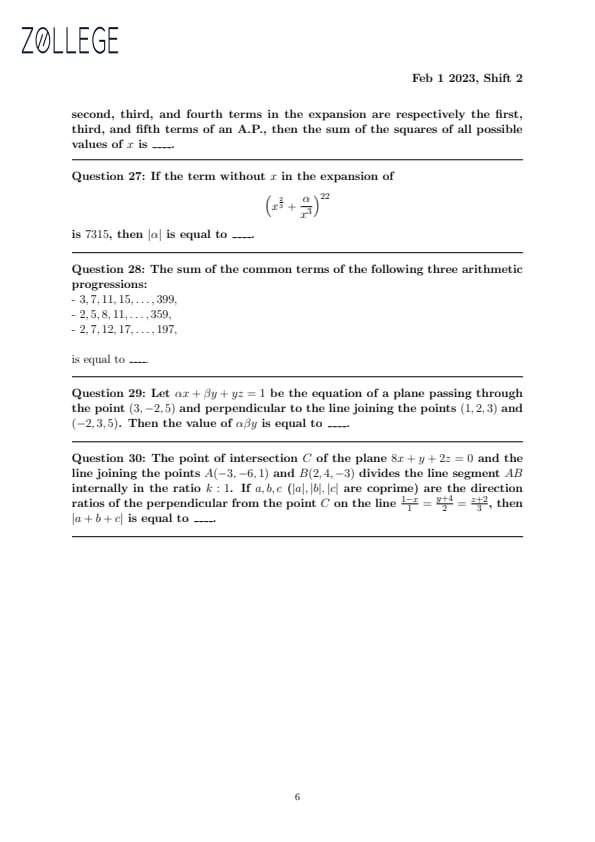
If the term without x in the expansion of (√x⁄a - α⁄x3)22 is 7315, then α is equal to _______.
View Solution
General term is Tr+1 = 22Cr (x1/2/a)22-r (-α/x3)r. For the term independent of x, (22-r)/2 - 3r = 0, so r=4. T5 = 22C4 a-18 (-α)4 = 7315. Solving for α gives α=1.
Question 88:
The sum of the common terms of the following three arithmetic progressions: 3, 7, 11, 15, ..., 399; 2, 5, 8, 11, ..., 359; 2, 7, 12, 17, ..., 197 is equal to _______.
View Solution
Common differences are 4, 3, and 5. LCM is 60. Common terms must be of the form 2 + 60n. Find the common terms in the given ranges: 47, 107, and 167. Sum is 321.
Question 89:
Let αx + βy + γz = 1 be the equation of a plane passing through the point (3,-2,5) and perpendicular to the line joining the points (1,2,3) and (-2,3,5). Then the value of αβγ is equal to _______.
View Solution
Direction vector of the line is <-3,1,2>. The plane's normal vector is parallel to this, so the plane is 3x-y-2z=k. Since it passes through (3,-2,5), k=1. α=3, β=-1, γ=-2. αβγ = 6.
Question 90:
The point of intersection C of the plane 8x+y+2z=0 and the line joining the points A(-3,-6,1) and B(2,4,-3) divides the line segment AB internally in the ratio k:1. If a, b, c (|a|, |b|, |c| are coprime) are the direction ratios of the perpendicular from the point C on the line x-1⁄-1 = y+4⁄2 = z+2⁄3, then |a+b+c| is equal to _______.
View Solution
Line equation is x+3⁄5 = y+6⁄10 = z-1⁄-4 = λ. A point on the line is (5λ-3, 10λ-6, -4λ+1). Intersection with plane gives λ=-1⁄3, so C is (-14⁄3, -28⁄3, 7⁄3). The ratio k:1 is -λ:1, which is 1⁄3 : 1. Let a point D on the given line be (-μ+1, 2μ-4, 3μ-2). CD is perpendicular to <-1, 2, 3>, which gives μ=11⁄14. Direction ratios of CD are <-1, -26, 17>. |a+b+c| = |-1-26+17| = 10.


*The article might have information for the previous academic years, please refer the official website of the exam.