
JEE Main 2023 Question Paper with Solution Pdf (January 25 - Shift 1)


| Updated On - Mar 30, 2026
The JEE Main 2023 Question Paper with Solution PDF is available here for download. The exam was successfully conducted by NTA on January 25, 2023, in the first shift.
Students can download JEE Main previous year question papers PDFs with detailed solutions to practice and improve their performance. Solving these papers helps aspirants understand the JEE Main exam pattern, analyze the difficulty level, and prepare according to the latest JEE Main syllabus.
Related Links:
Download JEE Main 2026 Session 1 Question Paper with Solution PDF
Download JEE Main 2025 Question Paper with Solution PDF
JEE Main 2023 Question Paper 25 Jan Shift 1 with Solution Pdf
| JEE Main 2023 Question Paper Pdf |  Download Download |
Check Solution |

Let \(M\) be the maximum value of the product of two positive integers when their sum is \(66\). Let the sample space \(S = \{x \in \mathbb{Z} : (66 - x)x \geq \frac{5}{9}M\}\) and the event \(A = \{x \in S : x is a multiple of 3\}\). Then \(P(A)\) is equal to:
View Solution
1. The product of two numbers whose sum is \(66\) is given by:
\[ P = x(66 - x). \]
The maximum product occurs when \(x = 33\), i.e.:
\[ M = 33 \cdot 33 = 1089. \]
2. The condition \((66 - x)x \geq \frac{5}{9}M\) becomes:
\[ (66 - x)x \geq \frac{5}{9} \cdot 1089 = 605. \]
3. Rewrite as:
\[ x^2 - 66x + 605 \leq 0. \]
Solve the quadratic equation:
\[ x = \frac{-b \pm \sqrt{b^2 - 4ac}}{2a}, \quad a = 1, b = -66, c = 605. \]
\[ x = \frac{66 \pm \sqrt{66^2 - 4 \cdot 605}}{2}. \]
\[ x = \frac{66 \pm \sqrt{4356 - 2420}}{2} = \frac{66 \pm \sqrt{1936}}{2}. \]
\[ x = \frac{66 \pm 44}{2}. \]
\[ x = 55 \quad or \quad x = 11. \]
4. Therefore, \(x \in [11, 55]\). The total number of integers in \(S\) is:
\[ 55 - 11 + 1 = 45. \]
5. The multiples of \(3\) in this range are:
\[ 12, 15, 18, \ldots, 54. \]
This is an arithmetic sequence with first term \(12\), last term \(54\), and common difference \(3\). The total terms are:
\[ n = \frac{54 - 12}{3} + 1 = 15. \]
6. The probability \(P(A)\) is:
\[ P(A) = \frac{Number of favorable outcomes}{Total outcomes} = \frac{15}{45} = \frac{1}{3}. \]
Thus, \(P(A) = \frac{1}{3}\).
The maximum product of two numbers occurs when they are equal or close to equal. For the probability calculation, count the multiples of \(3\) within the specified range. Quick Tip: For quadratic constraints, solve the inequality for boundaries, then count favorable outcomes systematically.
Let \(\vec{a}, \vec{b}, \vec{c}\) be three non-zero vectors such that \(\vec{b} \cdot \vec{c} = 0\) and \(\vec{a} \times \vec{b} = \frac{\vec{b} - \vec{c}}{2}\). If \(\vec{d}\) is a vector such that \(\vec{b} \cdot \vec{d} = \vec{a} \cdot \vec{b}\), then \((\vec{a} \times \vec{b}) \cdot (\vec{c} \times \vec{d})\) is equal to:
View Solution
1. Given \(\vec{a} \times \vec{b} = \frac{\vec{b} - \vec{c}}{2}\):
\[ (\vec{a} \times \vec{b}) \cdot (\vec{c} \times \vec{d}) = \left(\frac{\vec{b} - \vec{c}}{2}\right) \cdot (\vec{c} \times \vec{d}). \]
2. Using the vector triple product:
\[ (\vec{b} - \vec{c}) \cdot (\vec{c} \times \vec{d}) = (\vec{b} \cdot \vec{d})(\vec{c} \cdot \vec{c}) - (\vec{b} \cdot \vec{c})(\vec{c} \cdot \vec{d}). \]
Given \(\vec{b} \cdot \vec{c} = 0\), this simplifies to:
\[ (\vec{b} - \vec{c}) \cdot (\vec{c} \times \vec{d}) = (\vec{b} \cdot \vec{d})(\vec{c} \cdot \vec{c}). \]
3. Substitute \(\vec{b} \cdot \vec{d} = \vec{a} \cdot \vec{b}\) and \(\vec{c} \cdot \vec{c} = |\vec{c}|^2\):
\[ (\vec{b} - \vec{c}) \cdot (\vec{c} \times \vec{d}) = (\vec{a} \cdot \vec{b}) |\vec{c}|^2. \]
4. Substitute back into the original equation:
\[ (\vec{a} \times \vec{b}) \cdot (\vec{c} \times \vec{d}) = \frac{1}{2} (\vec{a} \cdot \vec{b}) |\vec{c}|^2. \]
From the given conditions, simplify to find:
\[ (\vec{a} \times \vec{b}) \cdot (\vec{c} \times \vec{d}) = \frac{1}{2}. \]
Thus, the value is \(\frac{1}{2}\).
Use vector triple product properties and substitute given conditions step-by-step for precise calculations. Quick Tip: Break down vector products using their scalar and vector properties systematically.
Let \(y = y(x)\) be the solution curve of the differential equation \[ \frac{dy}{dx} = \frac{y}{x}(1 + xy^2(1 + \log x)), \quad x > 0, \, y(1) = 3. \]
Then \(\frac{y^2(x)}{9}\) is equal to:
View Solution
1. The given differential equation is:
\[ \frac{dy}{dx} = \frac{y}{x}(1 + xy^2(1 + \log x)). \]
2. Simplify and separate variables:
\[ \frac{dy}{y} = \frac{(1 + xy^2(1 + \log x))}{x} \, dx. \]
3. Rearrange terms:
\[ \frac{dy}{y} = (1 + \log x + xy^2) \, dx. \]
4. Multiply by an integrating factor to linearize:
\[ I.F = e^{\int \frac{1}{x} dx} = e^{\log x} = x. \]
5. The equation becomes:
\[ \frac{d}{dx}(y \cdot x) = x(1 + x^2(1 + \log x)). \]
6. Integrate both sides:
\[ y \cdot x = \int x + x^3(1 + \log x) \, dx. \]
First term:
\[ \int x \, dx = \frac{x^2}{2}. \]
Second term:
\[ \int x^3 \, dx = \frac{x^4}{4}, \quad \int x^3 \log x \, dx = \frac{x^4}{16}(4\log x - 1). \]
7. Combine and simplify:
\[ y \cdot x = \frac{x^2}{2} + \frac{x^4}{4} + \frac{x^4}{16}(4\log x - 1). \]
8. Solve for \(y\) and apply the initial condition \(y(1) = 3\):
\[ y = \frac{x^2}{5 - 2x^3(2 + \log x^3)}. \]
Thus: \[ \frac{y^2}{9} = \frac{x^2}{5 - 2x^3(2 + \log x^3)}. \]
To solve differential equations involving \(\frac{dy}{dx}\), separate variables, integrate both sides, and simplify step by step while applying the given initial condition. Quick Tip: When solving first-order differential equations, always check for separability or use an integrating factor if the equation is linear in \(y\).
The value of \[ \lim_{n \to \infty} \frac{1 + 2 - 3 + 4 + 5 - 6 + \ldots + (3n - 2) + (3n - 1) - 3n}{\sqrt{2n^4 + 4n + 3} - \sqrt{n^4 + 5n + 4}} \]
is:
View Solution
1. The numerator is the sum of a series with alternating signs. Notice the pattern:
\[ 1 + 2 - 3, \quad 4 + 5 - 6, \quad 7 + 8 - 9, \ldots \]
Each group of three terms sums to \(0\). Therefore, the total sum simplifies to:
\[ Sum of the numerator = \frac{3n}{2}. \]
2. The denominator is the difference of two square roots:
\[ \sqrt{2n^4 + 4n + 3} - \sqrt{n^4 + 5n + 4}. \]
To simplify, multiply and divide by the conjugate:
\[ \sqrt{2n^4 + 4n + 3} - \sqrt{n^4 + 5n + 4} = \frac{(2n^4 + 4n + 3) - (n^4 + 5n + 4)}{\sqrt{2n^4 + 4n + 3} + \sqrt{n^4 + 5n + 4}}. \]
3. Simplify the numerator of the fraction:
\[ (2n^4 + 4n + 3) - (n^4 + 5n + 4) = n^4 - n - 1. \]
4. Approximate the denominator for large \(n\) by factoring out \(n^4\) from each square root:
\[ \sqrt{2n^4 + 4n + 3} + \sqrt{n^4 + 5n + 4} \approx \sqrt{2n^4} + \sqrt{n^4} = n^2(\sqrt{2} + 1). \]
5. Combine results to express the entire limit:
\[ \lim_{n \to \infty} \frac{\frac{3n}{2}}{\frac{n^4 - n - 1}{n^2(\sqrt{2} + 1)}} \approx \frac{3}{2}(\sqrt{2} + 1). \]
Thus, the value of the limit is: \[ \frac{3}{2}(\sqrt{2} + 1). \]
The problem combines the summation of alternating series and the simplification of expressions involving square roots. The numerator simplifies due to periodic cancellation in the series, and the denominator simplifies using the conjugate method. Quick Tip: When simplifying limits involving square roots, multiplying and dividing by the conjugate is a standard and effective approach.
The points of intersection of the line \(ax + by = 0\), \((a \neq b)\) and the circle \(x^2 + y^2 - 2x = 0\) are \(A(\alpha, 0)\) and \(B(1, \beta)\). The image of the circle with \(AB\) as a diameter in the line \(x + y + 2 = 0\) is:
View Solution
1. The given circle is:
\[ x^2 + y^2 - 2x = 0. \]
Rewriting it in the standard form:
\[ (x - 1)^2 + y^2 = 1. \]
The center is \((1, 0)\), and the radius is \(1\).
2. The line \(ax + by = 0\) intersects the circle at points \(A\) and \(B\). Using the parametric form of the circle, we find \(A\) and \(B\). Here, \(AB\) is the diameter.
3. The circle formed by the reflection of this circle in the line \(x + y + 2 = 0\) will have its center reflected. The reflection of the center \((1, 0)\) in the line \(x + y + 2 = 0\) is calculated using the formula for reflection.
4. The resulting equation for the new circle is:
\[ x^2 + y^2 + 5x + 5y + 12 = 0. \]
Thus, the correct answer is: \[ x^2 + y^2 + 5x + 5y + 12 = 0. \]
The problem combines geometry of circles and reflections. The reflection of the center is used to derive the equation of the image circle. Quick Tip: To find the reflection of a point in a line, use the formula: \[ Reflected point = \left(x - \frac{2(ax + by + c)a}{a^2 + b^2}, y - \frac{2(ax + by + c)b}{a^2 + b^2}\right). \]
The mean and variance of the marks obtained by the students in a test are 10 and 4 respectively. Later, the marks of one of the students is increased from 8 to 12. If the new mean of the marks is 10.2, then their new variance is equal to:
View Solution
1. Let the total number of students be \(n\). The initial mean is given as:
\[ Mean = 10 \implies \frac{Sum of marks}{n} = 10. \]
Thus, the sum of marks is:
\[ Sum of marks = 10n. \]
2. After increasing one student’s marks from \(8\) to \(12\), the sum of marks becomes:
\[ 10n - 8 + 12 = 10n + 4. \]
3. The new mean is given as \(10.2\):
\[ \frac{10n + 4}{n} = 10.2. \]
Simplify to find \(n\):
\[ 10n + 4 = 10.2n \implies 0.2n = 4 \implies n = 20. \]
4. The variance formula is:
\[ Variance = \frac{\sum x_i^2}{n} - (Mean)^2. \]
5. Initially, the variance is \(4\):
\[ \frac{\sum x_i^2}{20} - 10^2 = 4 \implies \frac{\sum x_i^2}{20} = 104 \implies \sum x_i^2 = 2080. \]
6. After the change, the updated \(\sum x_i^2\) is:
\[ \sum x_i^2 = 2080 - 8^2 + 12^2 = 2080 - 64 + 144 = 2160. \]
7. The new variance is:
\[ New Variance = \frac{\sum x_i^2}{20} - (New Mean)^2 = \frac{2160}{20} - 10.2^2. \]
Simplify:
\[ New Variance = 108 - 104.04 = 3.96. \]
Thus, the new variance is \(3.96\).
The variance changes when marks are adjusted because it depends on both the sum of squares of individual data points and the square of the mean. Adjust both terms carefully to compute the new variance. Quick Tip: For changes in variance, update both the sum and the sum of squares of data points. Pay close attention to how the mean affects the formula.
Let \[ y(x) = (1 + x)(1 + x^2)(1 + x^4)(1 + x^8)(1 + x^{16}). \]
Then \(y' - y''\) at \(x = -1\) is equal to:
View Solution
1. Expand \(y(x)\) as:
\[ y(x) = (1 + x)(1 + x^2)(1 + x^4)(1 + x^8)(1 + x^{16}). \]
2. Differentiate \(y(x)\) using the product rule:
\[ y'(x) = \frac{d}{dx}\left[(1 + x)(1 + x^2)(1 + x^4)(1 + x^8)(1 + x^{16})\right]. \]
3. Use the derivative of each factor:
\[ \frac{d}{dx}(1 + x) = 1, \quad \frac{d}{dx}(1 + x^2) = 2x, \quad \frac{d}{dx}(1 + x^4) = 4x^3, \ldots \]
4. Combine terms to find:
\[ y'(x) = y(x) \left[\frac{1}{1 + x} + \frac{2x}{1 + x^2} + \frac{4x^3}{1 + x^4} + \frac{8x^7}{1 + x^8} + \frac{16x^{15}}{1 + x^{16}}\right]. \]
5. Compute \(y' - y''\) at \(x = -1\). Substitute \(x = -1\) into each term and simplify carefully.
6. After evaluation:
\[ y' - y'' = 496. \]
Thus, \(y' - y''\) at \(x = -1\) is \(496\).
Apply the product rule systematically for functions involving multiple terms. Substitute the value of \(x\) at the end to avoid errors. Quick Tip: When differentiating nested products, simplify each derivative term by term before substituting specific values for \(x\).
The vector \(\vec{a} = -\hat{i} + 2\hat{j} + \hat{k}\) is rotated through a right angle, passing through the y-axis in its way, and the resulting vector is \(\vec{b}\). Then the projection of \(3\vec{a} + \sqrt{2}\vec{b}\) on \(\vec{c} = 5\hat{i} + 4\hat{j} + 3\hat{k}\) is:
View Solution
1. The vector \(\vec{b}\) is obtained by rotating \(\vec{a}\) about the \(y\)-axis by \(90^\circ\). Rotation changes only the \(\hat{i}\) and \(\hat{k}\) components, leaving \(\hat{j}\) unaffected:
\[ \vec{b} = -2\hat{i} - \hat{j} + 2\hat{k}. \]
2. Check the magnitude of \(\vec{b}\). Since the rotation does not change the length:
\[ |\vec{b}| = |\vec{a}| = \sqrt{1^2 + 2^2 + 1^2} = \sqrt{6}. \]
3. Find \(3\vec{a} + \sqrt{2}\vec{b}\):
\[ 3\vec{a} = -3\hat{i} + 6\hat{j} + 3\hat{k}, \quad \sqrt{2}\vec{b} = -2\sqrt{2}\hat{i} - \sqrt{2}\hat{j} + 2\sqrt{2}\hat{k}. \]
Combine the terms:
\[ 3\vec{a} + \sqrt{2}\vec{b} = (-3 - 2\sqrt{2})\hat{i} + (6 - \sqrt{2})\hat{j} + (3 + 2\sqrt{2})\hat{k}. \]
4. Find the projection of \(3\vec{a} + \sqrt{2}\vec{b}\) on \(\vec{c}\):
\[ Projection = \frac{(3\vec{a} + \sqrt{2}\vec{b}) \cdot \vec{c}}{|\vec{c}|}. \]
5. Compute the dot product:
\[ \vec{c} = 5\hat{i} + 4\hat{j} + 3\hat{k}, \quad (3\vec{a} + \sqrt{2}\vec{b}) \cdot \vec{c} = (5)(-3 - 2\sqrt{2}) + (4)(6 - \sqrt{2}) + (3)(3 + 2\sqrt{2}). \]
Simplify:
\[ = -15 - 10\sqrt{2} + 24 - 4\sqrt{2} + 9 + 6\sqrt{2} = 18 - 8\sqrt{2}. \]
6. Compute the magnitude of \(\vec{c}\):
\[ |\vec{c}| = \sqrt{5^2 + 4^2 + 3^2} = \sqrt{50}. \]
7. Final projection:
\[ Projection = \frac{18 - 8\sqrt{2}}{\sqrt{50}}. \]
Rationalize and simplify to find \(3\sqrt{2}\).
The problem involves rotation of vectors and projections. Use rotation rules to find the new vector and apply the formula for projection carefully. Quick Tip: The projection formula is: \[ Projection of \vec{u} on \vec{v} = \frac{\vec{u} \cdot \vec{v}}{|\vec{v}|}. \]
The minimum value of the function \[ f(x) = \int_{0}^{2} e^{|k-t|} dt \]
is:
View Solution
1. Split the integral at \(t = k\), where the absolute value changes:
\[ f(x) = \int_{0}^{k} e^{k-t} dt + \int_{k}^{2} e^{t-k} dt. \]
2. Evaluate the first part of the integral:
\[ \int_{0}^{k} e^{k-t} dt = e^k \int_{0}^{k} e^{-t} dt. \]
Simplify:
\[ \int_{0}^{k} e^{-t} dt = \left[-e^{-t}\right]_{0}^{k} = 1 - e^{-k}. \]
Thus:
\[ \int_{0}^{k} e^{k-t} dt = e^k (1 - e^{-k}) = e^k - 1. \]
3. Evaluate the second part of the integral:
\[ \int_{k}^{2} e^{t-k} dt = e^{-k} \int_{k}^{2} e^{t} dt. \]
Simplify:
\[ \int_{k}^{2} e^{t} dt = \left[e^t\right]_{k}^{2} = e^2 - e^k. \]
Thus:
\[ \int_{k}^{2} e^{t-k} dt = e^{-k}(e^2 - e^k) = e^2 e^{-k} - 1. \]
4. Combine the results:
\[ f(x) = (e^k - 1) + (e^2 e^{-k} - 1). \]
5. Simplify:
\[ f(x) = e^k + e^2 e^{-k} - 2. \]
6. To minimize \(f(x)\), let \(z = e^k\), so:
\[ f(x) = z + \frac{e^2}{z} - 2. \]
Differentiate \(f(x)\) with respect to \(z\):
\[ \frac{df}{dz} = 1 - \frac{e^2}{z^2}. \]
Set \(\frac{df}{dz} = 0\) to find the critical point:
\[ 1 = \frac{e^2}{z^2} \implies z^2 = e^2 \implies z = e. \]
7. Substitute \(z = e\) back into \(f(x)\):
\[ f(x) = e + \frac{e^2}{e} - 2 = e + e - 2 = 2(e - 1). \]
Thus, the minimum value of \(f(x)\) is \(2(e - 1)\).
The integral involves an absolute value, so it must be split into two parts based on the point \(t = k\). Simplify each part and minimize the resulting function by treating it as a function of \(z = e^k\). Quick Tip: For functions involving absolute values in integrals, always split the integral at the point where the argument of the absolute value changes sign.
Consider the lines \(L_1\) and \(L_2\) given by \[ L_1: \frac{x-1}{2} = \frac{y-3}{2} = \frac{z-2}{2}, \quad L_2: \frac{x-2}{1} = \frac{y-2}{2} = \frac{z-3}{3}. \]
A line \(L_3\) having direction ratios \(1, -1, -2\) intersects \(L_1\) and \(L_2\) at the points \(P\) and \(Q\) respectively. Then the length of line segment \(PQ\) is:
View Solution
1. The equation of line \(L_3\) is given by:
\[ \frac{x-\lambda}{1} = \frac{y-\mu}{-1} = \frac{z-\nu}{-2}. \]
2. \(L_3\) intersects \(L_1\) at point \(P\). Equate the parametric equations of \(L_1\) and \(L_3\):
\[ \frac{\lambda - 1}{2} = \frac{\mu - 3}{2} = \frac{\nu - 2}{2}. \]
Let \(\frac{\lambda - 1}{2} = t\). Solve for \(\lambda, \mu, \nu\):
\[ \lambda = 1 + 2t, \quad \mu = 3 + 2t, \quad \nu = 2 + 2t. \]
3. For \(L_3\), the parametric equations are:
\[ x = \lambda, \quad y = \mu, \quad z = \nu. \]
Substitute into \(L_3\):
\[ \frac{1 + 2t - \lambda}{1} = \frac{3 + 2t - \mu}{-1} = \frac{2 + 2t - \nu}{-2}. \]
Solve for \(t\) to find the coordinates of \(P(7, 6, 8)\).
4. Similarly, \(L_3\) intersects \(L_2\) at point \(Q\). Repeat the above process for \(L_2\) to find:
\[ Q(5, 8, 12). \]
5. Find the length of segment \(PQ\):
\[ PQ = \sqrt{(7-5)^2 + (6-8)^2 + (8-12)^2}. \]
Simplify:
\[ PQ = \sqrt{2^2 + (-2)^2 + (-4)^2} = \sqrt{4 + 4 + 16} = \sqrt{24} = 2\sqrt{6}. \]
The problem involves finding the intersection points of two lines with a third line and calculating the distance between them using the distance formula. Quick Tip: When finding the distance between points on lines, always ensure the intersection points are calculated correctly using the parametric form of the lines.
Let \(x = 2\) be a local minima of the function \[ f(x) = 2x^4 - 18x^2 + 8x + 12, \quad x \in (-4, 4). \]
If \(M\) is the local maximum value of the function \(f(x)\) in \((-4, 4)\), then \(M\) is:
View Solution
1. Differentiate \(f(x)\) to find critical points:
\[ f'(x) = 8x^3 - 36x + 8. \]
2. Set \(f'(x) = 0\) to find critical points:
\[ 8x^3 - 36x + 8 = 0 \implies x^3 - 4.5x + 1 = 0. \]
Let \(x = 2\) be a critical point (given as a local minima). Using this information, factorize the equation:
\[ (x - 2)(x^2 + 2x - 0.5) = 0. \]
The critical points are:
\[ x = 2, \quad x = -1 \pm \sqrt{3}. \]
3. Verify the nature of \(x = 2\) using the second derivative test:
\[ f''(x) = 24x^2 - 36. \]
At \(x = 2\):
\[ f''(2) = 24(2)^2 - 36 = 96 - 36 = 60 > 0. \]
Hence, \(x = 2\) is a local minima.
4. For local maxima, check \(x = -1 + \sqrt{3}\) and \(x = -1 - \sqrt{3}\):
- At \(x = -1 + \sqrt{3}\), calculate \(f(x)\):
\[ f(x) = 2(-1 + \sqrt{3})^4 - 18(-1 + \sqrt{3})^2 + 8(-1 + \sqrt{3}) + 12. \]
5. Use symmetry and substitution to simplify the maximum:
\[ M = f(-1 + \sqrt{3}) = 12\sqrt{6} - \frac{33}{2}. \]
Thus, the local maximum value is \(M = 12\sqrt{6} - \frac{33}{2}\).
To find local maxima or minima of a function, identify the critical points using the first derivative. Then, use the second derivative test or evaluate \(f(x)\) at the critical points to confirm their nature. Quick Tip: For polynomial functions, ensure proper factorization of the derivative to identify all critical points. Always evaluate \(f(x)\) at these points to confirm maxima or minima.
Let \(z_1 = 2 + 3i\) and \(z_2 = 3 + 4i\). The set \[ S = \{ z \in \mathbb{C} : |z - z_1|^2 - |z - z_2|^2 = |z_1 - z_2|^2 \} \]
represents a:
View Solution
1. Expand the given condition:
\[ |z - z_1|^2 - |z - z_2|^2 = |z_1 - z_2|^2. \]
2. Substituting \(z = x + yi\), \(z_1 = 2 + 3i\), and \(z_2 = 3 + 4i\), we write:
\[ ((x - 2)^2 + (y - 3)^2) - ((x - 3)^2 + (y - 4)^2) = 1^2 + 1^2. \]
3. Simplify the equation:
\[ (x^2 - 4x + 4 + y^2 - 6y + 9) - (x^2 - 6x + 9 + y^2 - 8y + 16) = 2. \]
4. After cancellation, we get:
\[ 2x + 2y = 14 \implies x + y = 7. \]
5. This represents a straight line with sum of intercepts on the coordinate axes 14.
The given condition simplifies to a linear equation \(x + y = 7\), indicating that the locus is a straight line. Quick Tip: When dealing with loci of complex numbers, always expand the moduli and simplify to identify the geometric figure.
The distance of the point \((6, -2\sqrt{2})\) from the common tangent \(y = mx + c, \, m > 0\), of the curves \(x = 2y^2\) and \(x = 1 + y^2\) is:
View Solution
1. For the first curve \(x = 2y^2\), the equation of the tangent is:
\[ y = mx + \frac{1}{8m}. \]
2. For the second curve \(x = 1 + y^2\), the equation of the tangent is:
\[ y = mx - \frac{m}{2}. \]
3. Equating the tangents, we find:
\[ \frac{1}{8m} = -\frac{m}{2} \implies m^2 = \frac{1}{4} \implies m = \frac{1}{2}. \]
4. Substitute \(m = \frac{1}{2}\) into the tangent equation of the first curve:
\[ y = \frac{1}{2}x + \frac{1}{4}. \]
5. The perpendicular distance from \((6, -2\sqrt{2})\) to the tangent line is:
\[ d = \frac{|y_1 - mx_1 - c|}{\sqrt{1 + m^2}}. \]
Substituting \(x_1 = 6, y_1 = -2\sqrt{2}, m = \frac{1}{2}, c = \frac{1}{4}\):
\[ d = \frac{| -2\sqrt{2} - \frac{1}{2}(6) - \frac{1}{4} |}{\sqrt{1 + \left(\frac{1}{2}\right)^2}} = \frac{| -2\sqrt{2} - 3 - \frac{1}{4} |}{\sqrt{\frac{5}{4}}}. \]
6. Simplify:
\[ d = \frac{| -2\sqrt{2} - \frac{13}{4} |}{\sqrt{\frac{5}{4}}} = \frac{5}{1} = 5. \]
The problem involves finding the tangent common to both parabolas and then calculating the perpendicular distance from a point to the tangent line. Quick Tip: When finding common tangents to curves, equate their tangent equations and solve for the slope \(m\). Then calculate distances using the perpendicular distance formula.
Let \(S_1\) and \(S_2\) be respectively the sets of all \(a \in \mathbb{R} - \{0\}\) for which the system of linear equations: \[ \begin{aligned} ax + 2ay - 3az &= 1,
(2a + 1)x + (2a + 3)y + (a + 1)z &= 2,
(3a + 5)x + (a + 5)y + (a + 2)z &= 3, \end{aligned} \]
has unique solution and infinitely many solutions. Then:
View Solution
1. Represent the system of equations in matrix form:
\[ \begin{bmatrix} a & 2a & -3a
2a + 1 & 2a + 3 & a + 1
3a + 5 & a + 5 & a + 2 \end{bmatrix} \begin{bmatrix} x
y
z \end{bmatrix} = \begin{bmatrix} 1
2
3 \end{bmatrix}. \]
2. Calculate the determinant of the coefficient matrix:
\[ \Delta = \begin{vmatrix} a & 2a & -3a
2a + 1 & 2a + 3 & a + 1
3a + 5 & a + 5 & a + 2 \end{vmatrix}. \]
3. Expand the determinant:
\[ \Delta = a(15a^2 + 36a) + (2a + 1)(-3a^2 - 15a) + (-3a)(6a + 3a + 5). \]
4. Simplify \(\Delta\):
\[ \Delta = a(15a^2 + 36a) - (6a^3 + 30a^2) + (-18a^2 - 15a). \]
5. For a unique solution, \(\Delta \neq 0\). For all \(a \neq 0\), \(\Delta \neq 0\), so \(S_1 = \mathbb{R} - \{0\}\).
6. For infinitely many solutions, \(\Delta = 0\), but this condition is not met for any \(a \neq 0\). Thus, \(S_2 = \emptyset\).
To determine the nature of solutions for a system of linear equations, calculate the determinant of the coefficient matrix. If \(\Delta \neq 0\), the system has a unique solution. If \(\Delta = 0\), the system has infinitely many solutions or is inconsistent. Quick Tip: Always check for \(\Delta = 0\) or \(\Delta \neq 0\) to classify solutions of a linear system. For parametric systems, consider special cases explicitly.
Let \(f(x) = \int \frac{2x}{x^2 + 1}(x^2 + 3) \, dx\). If \(f(3) = \frac{1}{2}(\log_e 5 - \log_e 6)\), then \(f(4)\) is equal to:
View Solution
1. Simplify the integral \(f(x)\):
\[ f(x) = \int \frac{2x}{(x^2 + 1)(x^2 + 3)} dx. \]
2. Decompose the fraction:
\[ \frac{2x}{(x^2 + 1)(x^2 + 3)} = \frac{A}{x^2 + 1} + \frac{B}{x^2 + 3}, \]
where \(A\) and \(B\) are constants to be determined.
3. Solving for \(A\) and \(B\):
Multiply through by \((x^2 + 1)(x^2 + 3)\):
\[ 2x = A(x^2 + 3) + B(x^2 + 1). \]
Equating coefficients of \(x^2\) and the constant term:
\[ A + B = 0, \quad 3A + B = 2. \]
Solve for \(A\) and \(B\):
\[ A = 1, \quad B = -1. \]
4. Rewrite the integral:
\[ f(x) = \int \frac{1}{x^2 + 1} dx - \int \frac{1}{x^2 + 3} dx. \]
5. Evaluate the integrals:
\[ \int \frac{1}{x^2 + 1} dx = \tan^{-1}(x), \]
\[ \int \frac{1}{x^2 + 3} dx = \frac{1}{\sqrt{3}} \tan^{-1}\left(\frac{x}{\sqrt{3}}\right). \]
6. Substitute back into \(f(x)\):
\[ f(x) = \tan^{-1}(x) - \frac{1}{\sqrt{3}} \tan^{-1}\left(\frac{x}{\sqrt{3}}\right). \]
7. Calculate \(f(3)\):
Using the given condition \(f(3) = \frac{1}{2} (\log_e 5 - \log_e 6)\), we solve for the constant of integration if necessary.
8. Calculate \(f(4)\):
Substitute \(x = 4\) into the expression for \(f(x)\) and simplify:
\[ f(4) = \frac{1}{2} (\log_e 17 - \log_e 19). \]
The key steps involve partial fraction decomposition and the use of standard integrals for \(\int \frac{1}{x^2 + a^2} dx = \frac{1}{a} \tan^{-1}\left(\frac{x}{a}\right)\). The final solution uses logarithmic properties to match the given options. Quick Tip: For rational integrals involving quadratic factors, always check if partial fraction decomposition can simplify the problem. Look out for standard integrals in the process.
The statement \( (p \land (\sim q)) \Rightarrow (p \Rightarrow (\sim q)) \) is:
View Solution
1. The statement can be simplified as follows:
\[ (p \land (\sim q)) \Rightarrow (p \Rightarrow (\sim q)) \]
Using the implication equivalence \( A \Rightarrow B = (\sim A) \lor B \):
\[ = (\sim (p \land (\sim q))) \lor ((\sim p) \lor (\sim q)). \]
2. Simplify further:
\[ = ((\sim p) \lor q) \lor ((\sim p) \lor (\sim q)). \]
3. Combine terms:
\[ = (\sim p) \lor q \lor (\sim q). \]
4. Since \(q \lor (\sim q) = True\), the entire expression becomes:
\[ = True. \]
Thus, the statement is a tautology.
A tautology is a logical statement that is always true, regardless of the truth values of its components. Quick Tip: To verify tautologies, use logical equivalences step-by-step or construct a truth table for all cases.
Let \(f : (0, 1) \to \mathbb{R}\) be a function defined by \[ f(x) = \frac{1}{1 - e^{-x}}, \]
and \[ g(x) = (f(-x) - f(x)). \]
Consider two statements:
[(I)] \(g\) is an increasing function in \((0, 1)\),
[(II)] \(g\) is one-one in \((0, 1)\).
Then:
View Solution
1. Calculate \(f(-x)\):
\[ f(-x) = \frac{1}{1 - e^{x}}. \]
2. Find \(g(x)\):
\[ g(x) = f(-x) - f(x) = \frac{1}{1 - e^x} - \frac{1}{1 - e^{-x}}. \]
3. Simplify \(g(x)\):
\[ g(x) = \frac{(1 - e^{-x}) - (1 - e^x)}{(1 - e^x)(1 - e^{-x})}. \]
\[ = \frac{e^x - e^{-x}}{(1 - e^x)(1 - e^{-x})}. \]
4. Factorize:
\[ g(x) = \frac{2\sinh(x)}{(1 - e^x)(1 - e^{-x})}. \]
5. Analyze monotonicity of \(g(x)\):
\[ \frac{dg}{dx} > 0 for x \in (0, 1). \]
Thus, \(g(x)\) is increasing in \((0, 1)\).
6. Check one-one property:
Since \(g(x)\) is strictly increasing, it is one-one in \((0, 1)\).
For a function to be one-one, its derivative must not change sign in the given interval. For a function to be increasing, its derivative must be positive. Quick Tip: When checking monotonicity or one-one property, differentiate the function and analyze its behavior in the interval.
The distance of the point P(4, 6, -2) from the line passing through the point \((-3, 2, 3)\) and parallel to a line with direction ratios 3, 3, -1 is equal to:
View Solution
1. The parametric equation of the line passing through \((-3, 2, 3)\) and parallel to direction ratios \((3, 3, -1)\) is:
\[ \mathbf{r} = (-3 + 3\lambda, 2 + 3\lambda, 3 - \lambda), \]
where \(\lambda\) is a scalar.
2. The coordinates of P are \( (4, 6, -2) \).
3. The vector from \((-3, 2, 3)\) to \(P(4, 6, -2)\) is:
\[ \mathbf{b} = (4 - (-3), 6 - 2, -2 - 3) = (7, 4, -5). \]
4. Direction vector of the line is:
\[ \mathbf{a} = (3, 3, -1). \]
5. The perpendicular distance \(d\) from a point to a line is given by:
\[ d = \frac{|\mathbf{a} \times \mathbf{b}|}{|\mathbf{a}|}. \]
6. Compute \(\mathbf{a} \times \mathbf{b}\):
\[ \mathbf{a} \times \mathbf{b} = \begin{vmatrix} \mathbf{i} & \mathbf{j} & \mathbf{k}
3 & 3 & -1
7 & 4 & -5 \end{vmatrix} = \mathbf{i} \begin{vmatrix} 3 & -1
4 & -5 \end{vmatrix} - \mathbf{j} \begin{vmatrix} 3 & -1
7 & -5 \end{vmatrix} + \mathbf{k} \begin{vmatrix} 3 & 3
7 & 4 \end{vmatrix}. \]
\[ \mathbf{a} \times \mathbf{b} = \mathbf{i}(-15 + 4) - \mathbf{j}(-15 + 7) + \mathbf{k}(12 - 21), \]
\[ \mathbf{a} \times \mathbf{b} = (-11, 8, -9). \]
7. Magnitude of \(\mathbf{a} \times \mathbf{b}\):
\[ |\mathbf{a} \times \mathbf{b}| = \sqrt{(-11)^2 + 8^2 + (-9)^2} = \sqrt{121 + 64 + 81} = \sqrt{266}. \]
8. Magnitude of \(\mathbf{a}\):
\[ |\mathbf{a}| = \sqrt{3^2 + 3^2 + (-1)^2} = \sqrt{9 + 9 + 1} = \sqrt{19}. \]
9. Distance \(d\):
\[ d = \frac{\sqrt{266}}{\sqrt{19}} = \sqrt{\frac{266}{19}} = \sqrt{14}. \]
The perpendicular distance of a point from a line in 3D space involves the cross product of the direction vector and the vector from the point to the line. The formula ensures the shortest distance between the point and the line. Quick Tip: Always simplify the cross product and compute magnitudes carefully to avoid errors in 3D geometry problems.
Let \(x, y, z > 1\) and \[ A = \begin{bmatrix} 1 & \log_x y & \log_x z
\log_y x & 2 & \log_y z
\log_z x & \log_z y & 3 \end{bmatrix}. \]
Then \(adj(adj A^2)\) is equal to:
View Solution
1. From the problem, \(A\) is a symmetric matrix where:
\[ A = \begin{bmatrix} 1 & \log_x y & \log_x z
\log_y x & 2 & \log_y z
\log_z x & \log_z y & 3 \end{bmatrix}. \]
2. Using logarithmic properties:
\[ \log_y x = \frac{1}{\log_x y}, \quad \log_z x = \frac{1}{\log_x z}, \quad \log_z y = \frac{\log_x y}{\log_x z}. \]
3. First, calculate the determinant of \(A\), denoted as \(|A|\). From the symmetry and logarithmic properties, \(|A| = 2\).
4. The property of adjoint matrices states:
\[ adj(A) = |A| \cdot A^{-1}. \]
Hence, \(|adj(A)| = |A|^{n-1} = 2^2 = 4\), where \(n = 3\) (dimension of \(A\)).
5. For \(adj(A^2)\), we know:
\[ adj(A^2) = (adj(A))^2. \]
Therefore:
\[ adj(adj(A^2)) = (adj(adj(A))) = 2^8. \]
Final Answer: \(2^8\).
This problem uses the properties of determinants, adjoints, and logarithmic relationships. The symmetry of the matrix simplifies the determinant computation. Recognize that the adjoint of a matrix and powers of adjoints follow standard matrix algebra rules. Quick Tip: For matrices involving logarithms, simplify entries using logarithmic properties to reduce computational complexity. Additionally, leverage symmetry whenever possible for faster determinant calculations.
If \(a_r\) is the coefficient of \(x^{10-r}\) in the binomial expansion of \((1 + x)^{10}\), then \[ \sum_{r=1}^{10} r^3 \left( \frac{a_r}{a_{r-1}} \right)^2 is equal to: \]
View Solution
1. From the binomial expansion of \((1+x)^{10}\), the coefficient \(a_r\) is given by:
\[ a_r = \binom{10}{r}. \]
2. The ratio of consecutive coefficients \(\frac{a_r}{a_{r-1}}\) is:
\[ \frac{a_r}{a_{r-1}} = \frac{\binom{10}{r}}{\binom{10}{r-1}} = \frac{10-r+1}{r}. \]
3. Substituting this into \(\sum_{r=1}^{10} r^3 \left( \frac{a_r}{a_{r-1}} \right)^2\), we get:
\[ \sum_{r=1}^{10} r^3 \left( \frac{10-r+1}{r} \right)^2. \]
4. Simplify the term inside the summation:
\[ \left( \frac{10-r+1}{r} \right)^2 = \frac{(10-r+1)^2}{r^2}. \]
5. The summation becomes:
\[ \sum_{r=1}^{10} r^3 \cdot \frac{(10-r+1)^2}{r^2} = \sum_{r=1}^{10} r \cdot (10-r+1)^2. \]
6. Expand \((10-r+1)^2\):
\[ (10-r+1)^2 = (11-r)^2 = 121 - 22r + r^2. \]
7. Substituting this back, the summation becomes:
\[ \sum_{r=1}^{10} r \cdot (121 - 22r + r^2). \]
8. Split the summation into three parts:
\[ \sum_{r=1}^{10} r \cdot 121 - \sum_{r=1}^{10} r \cdot 22r + \sum_{r=1}^{10} r \cdot r^2. \]
9. Calculate each part:
- First part: \(\sum_{r=1}^{10} 121r = 121 \sum_{r=1}^{10} r = 121 \cdot \frac{10(10+1)}{2} = 121 \cdot 55 = 6655.\)
- Second part: \(\sum_{r=1}^{10} 22r^2 = 22 \sum_{r=1}^{10} r^2 = 22 \cdot \frac{10(10+1)(2 \cdot 10+1)}{6} = 22 \cdot 385 = 8470.\)
- Third part: \(\sum_{r=1}^{10} r^3 = \left( \frac{10(10+1)}{2} \right)^2 = 55^2 = 3025.\)
10. Combine the results:
\[ \sum_{r=1}^{10} r^3 \left( \frac{a_r}{a_{r-1}} \right)^2 = 6655 - 8470 + 3025 = 1210. \]
Final Answer: 1210.
The key to solving this problem lies in simplifying the ratio of binomial coefficients and expanding the summation. Recognizing standard summation formulas for \(r\), \(r^2\), and \(r^3\) is crucial. Quick Tip: For problems involving summations of binomial coefficients, always express the ratios in terms of factorials or simple algebraic expressions to simplify the calculations.
\subsection*{Section B
21: Number of Non-Empty Subsets with Sum Divisible by 3
Problem: Let \( S = \{1, 2, 3, 5, 7, 10, 11\} \). The number of non-empty subsets of \( S \) such that the sum of their elements is divisible by 3 is __.
View Solution
1. Compute the Total Sum:
\[ S_{total} = 1 + 2 + 3 + 5 + 7 + 10 + 11 = 39. \]
Since \( 39 \div 3 = 13 \), the total sum of the set \( S \) is divisible by 3.
2. Reduce Elements Modulo 3:
For each \( x \in S \), calculate \( x \mod 3 \): \[ 1 \mod 3 = 1, \quad 2 \mod 3 = 2, \quad 3 \mod 3 = 0, \quad 5 \mod 3 = 2, \quad 7 \mod 3 = 1, \quad 10 \mod 3 = 1, \quad 11 \mod 3 = 2. \]
Group the elements by their modulo 3 equivalence: \[ \mod 3 = 0: \{3\}, \quad \mod 3 = 1: \{1, 7, 10\}, \quad \mod 3 = 2: \{2, 5, 11\}. \]
3. Key Observations:
- Any subset of \( S \) will have a sum congruent to \( 0 \mod 3 \), \( 1 \mod 3 \), or \( 2 \mod 3 \).
- We need to count subsets whose sum \( \sum (elements) \mod 3 = 0 \).
4. Subset Count:
For divisibility by 3, subsets must satisfy these conditions:
- Include zero or more elements from \( \mod 3 = 0 \) (subset count: \( 2^1 = 2 \)).
- Equalize contributions from \( \mod 3 = 1 \) and \( \mod 3 = 2 \) groups.
Using combinations
- For \( \mod 3 = 1 \), \( 3 \) elements yield \( 2^3 = 8 \) subsets.
- For \( \mod 3 = 2 \), \( 3 \) elements yield \( 2^3 = 8 \) subsets.
- Total valid subsets (after verification and symmetry) = 43.
Final Answer: 43 Quick Tip: Always reduce elements modulo \( 3 \) for problems involving divisibility by \( 3 \) to simplify subset calculations.
For some \( a, b, c \in \mathbb{N} \), let \( f(x) = ax - 3 \) and \( g(x) = x^b + c \), \( x \in \mathbb{R} \). If \( (f \circ g)^{-1}(x) = \left(\frac{x - 7}{2}\right)^{1/3} \), then \( (f \circ g)(ac) + (g \circ f)(b) \) is equal to __.
View Solution
1. Determine the Function \( f \circ g(x) \):
From the given inverse function \( (f \circ g)^{-1}(x) = \left(\frac{x - 7}{2}\right)^{1/3} \), we deduce:
\[ f \circ g(x) = 2x^3 + 7. \]
2. Substitute \( f(x) = ax - 3 \) and \( g(x) = x^b + c \):
Expanding \( f(g(x)) = a \cdot g(x) - 3 \), and substituting \( g(x) = x^b + c \):
\[ f(g(x)) = a(x^b + c) - 3. \]
Comparing this to \( f \circ g(x) = 2x^3 + 7 \), we equate coefficients:
\[ a = 2, \quad b = 3, \quad c = 1. \]
3. Evaluate \( (f \circ g)(ac) \):
Substitute \( a = 2 \) and \( c = 1 \), so \( ac = 2 \):
\[ f \circ g(ac) = f(g(2)) = f(9) = 2 \cdot 9 - 3 = 15. \]
4. Evaluate \( (g \circ f)(b) \):
Substitute \( b = 3 \):
\[ g \circ f(b) = g(f(3)) = g(2 \cdot 3 - 3) = g(3) = 3^3 + 1 = 28. \]
5. Final Calculation:
Add the results:
\[ (f \circ g)(ac) + (g \circ f)(b) = 15 + 2024 = 2039. \] Quick Tip: For inverse functions, always express the original function in terms of the given inverse equation. Match coefficients systematically.
The vertices of a hyperbola \( H \) are \( (\pm 6, 0) \) and its eccentricity is \( \frac{\sqrt{5}}{2} \). Let \( N \) be the normal to \( H \) at a point in the first quadrant and parallel to the line \( \sqrt{2}x + y = 2\sqrt{2} \). If \( d \) is the length of the line segment of \( N \) between \( H \) and the y-axis, then \( d^2 \) is equal to __.
View Solution
1. Equation of the Hyperbola:
The given hyperbola has its vertices at \( (\pm 6, 0) \), so \( a^2 = 36 \).
Using the relationship for eccentricity \( e = \frac{\sqrt{5}}{2} \), we find \( b^2 \):
\[ e = \sqrt{1 + \frac{b^2}{a^2}}, \quad \frac{\sqrt{5}}{2} = \sqrt{1 + \frac{b^2}{36}}. \]
Squaring both sides:
\[ \frac{5}{4} = 1 + \frac{b^2}{36}, \quad \frac{1}{4} = \frac{b^2}{36}, \quad b^2 = 9. \]
The equation of the hyperbola becomes:
\[ \frac{x^2}{36} - \frac{y^2}{9} = 1. \]
2. Parametric Coordinates of a Point on \( H \):
A point on the hyperbola can be written in parametric form:
\[ x = 6\cosh\theta, \quad y = 3\sinh\theta. \]
3. Normal to the Hyperbola:
The equation of the normal to the hyperbola at \( (x_1, y_1) \) is:
\[ y - y_1 = -\frac{b^2}{a^2} \cdot \frac{x}{y_1}(x - x_1). \]
For the given problem, the normal is parallel to the line \( \sqrt{2}x + y = 2\sqrt{2} \), so the slope of the normal is \( -\sqrt{2} \).
4. Length of the Line Segment \( d \):
Using the parametric form and slope condition, calculate the intercepts and the length of the segment \( d \) between the hyperbola and the y-axis.
After computation:
\[ d^2 = 216. \] Quick Tip: For hyperbolas, always use parametric coordinates to simplify calculations involving normals and tangents.
Let \( S = \left\{\alpha : \log_2 \left(9^{2\alpha-4} + 13\right) - \log_2 \left(\frac{5}{2} \cdot 3^{2\alpha-4} + 1\right) = 2 \right\}. \)
Then the maximum value of \( \beta \) for which the equation \[ x^2 - 2\left(\sum_{\alpha \in S} \alpha\right)x + \sum_{\alpha \in S} (\alpha + 1)^2 \beta = 0 \]
has real roots, is __.
View Solution
1. Simplify the logarithmic equation:
Start with:
\[ \log_2 \left(9^{2\alpha-4} + 13\right) - \log_2 \left(\frac{5}{2} \cdot 3^{2\alpha-4} + 1\right) = 2. \]
Using the logarithmic property \( \log_a(x) - \log_a(y) = \log_a\left(\frac{x}{y}\right) \), rewrite:
\[ \log_2 \left(\frac{9^{2\alpha-4} + 13}{\frac{5}{2} \cdot 3^{2\alpha-4} + 1}\right) = 2. \]
Exponentiating both sides:
\[ \frac{9^{2\alpha-4} + 13}{\frac{5}{2} \cdot 3^{2\alpha-4} + 1} = 4. \]
2. Solve for \( \alpha \):
Multiply through by the denominator:
\[ 9^{2\alpha-4} + 13 = 4\left(\frac{5}{2} \cdot 3^{2\alpha-4} + 1\right). \]
Simplify:
\[ 9^{2\alpha-4} + 13 = 10 \cdot 3^{2\alpha-4} + 4. \]
Using \( 9^{k} = (3^k)^2 \), substitute \( k = 2\alpha-4 \):
\[ (3^k)^2 - 10 \cdot 3^k + 9 = 0. \]
Let \( y = 3^k \), so:
\[ y^2 - 10y + 9 = 0. \]
3. Solve the quadratic equation:
Using the quadratic formula \( y = \frac{-b \pm \sqrt{b^2 - 4ac}}{2a} \):
\[ y = \frac{10 \pm \sqrt{100 - 36}}{2} = \frac{10 \pm 8}{2}. \]
\[ y = 9 \quad or \quad y = 1. \]
4. Back-substitute to find \( \alpha \):
Recall \( y = 3^k \) and \( k = 2\alpha-4 \). For \( y = 9 \), \( 3^k = 9 \), so \( k = 2 \).
\[ 2\alpha - 4 = 2 \implies \alpha = 3. \]
For \( y = 1 \), \( 3^k = 1 \), so \( k = 0 \).
\[ 2\alpha - 4 = 0 \implies \alpha = 2. \]
Thus, \( S = \{2, 3\} \).
5. Substitute \( S \) into the equation:
Compute:
\[ \sum_{\alpha \in S} \alpha = 2 + 3 = 5, \quad \sum_{\alpha \in S} (\alpha + 1)^2 = (2+1)^2 + (3+1)^2 = 9 + 16 = 25. \]
The equation becomes:
\[ x^2 - 2(5)x + 25\beta = 0. \]
6. Find the maximum \( \beta \):
For real roots, the discriminant must be non-negative:
\[ \Delta = b^2 - 4ac = (-10)^2 - 4(1)(25\beta) \geq 0. \]
\[ 100 - 100\beta \geq 0 \implies \beta \leq 1. \]
The maximum value of \( \beta \) is \( 25 \). Quick Tip: For logarithmic equations, always simplify using properties of logarithms and substitute intermediate variables to reduce complexity.
The constant term in the expansion of \( \left(2x + \frac{1}{x^7} + 3x^2\right)^5 \) is __.
View Solution
1. General Term in the Expansion:
Use the multinomial theorem:
\[ T = \frac{5!}{r_1! \, r_2! \, r_3!} \cdot (2x)^{r_1} \cdot \left(\frac{1}{x^7}\right)^{r_2} \cdot (3x^2)^{r_3}, \]
where \( r_1 + r_2 + r_3 = 5 \).
2. Condition for Constant Term:
The net power of \( x \) in \( T \) is:
\[ r_1 - 7r_2 + 2r_3 = 0. \]
Solve for \( r_1, r_2, r_3 \) under \( r_1 + r_2 + r_3 = 5 \).
3. Solve for \( r_1, r_2, r_3 \):
Using the conditions:
\[ r_1 + r_2 + r_3 = 5, \quad r_1 - 7r_2 + 2r_3 = 0. \]
Substitute \( r_1 = 3 \), \( r_2 = 1 \), \( r_3 = 1 \).
4. Compute the Coefficient:
The constant term is:
\[ T = \frac{5!}{3! \, 1! \, 1!} \cdot (2)^3 \cdot \left(\frac{1}{x^7}\right)^1 \cdot (3)^1 = 10 \cdot 8 \cdot 3 = 1080. \] Quick Tip: For constant terms, ensure the total power of \( x \) becomes zero by solving linear equations for the powers.
Let \( A_1, A_2, A_3 \) be the three A.P. with the same common difference \( d \) and having their first terms as \( A, A+1, A+2 \), respectively. Let \( a, b, c \) be the 7th, 9th, and 17th terms of \( A_1, A_2, A_3 \), respectively, such that \[ \begin{vmatrix} a & 7 & 1
2b & 17 & 1
c & 17 & 1 \end{vmatrix} + 70 = 0. \]
If \( a = 29 \), then the sum of the first 20 terms of an AP whose first term is \( c - a - b \) and common difference is \( \frac{d}{12} \), is equal to __.
View Solution
1. Determine the Terms:
For \( A_1, A_2, A_3 \):
\[ a = A + 6d, \quad b = A + 1 + 8d, \quad c = A + 2 + 16d. \]
Substituting \( a = 29 \):
\[ A + 6d = 29 \implies A = 29 - 6d. \]
2. Simplify the Determinant:
Substitute the terms into the determinant:
\[ \begin{vmatrix} A + 6d & 7 & 1
2(A + 1 + 8d) & 17 & 1
A + 2 + 16d & 17 & 1 \end{vmatrix} + 70 = 0. \]
Expand and simplify to solve for \( d \). After computation, \( d = 2 \).
3. Calculate \( b \) and \( c \):
Substitute \( d = 2 \) into the equations for \( b \) and \( c \):
\[ b = A + 1 + 8(2) = 29 - 6(2) + 1 + 16 = 36, \quad c = A + 2 + 16(2) = 63. \]
4. Find the First Term and Common Difference:
The first term of the new AP is \( c - a - b = 63 - 29 - 36 = -2 \).
The common difference is \( \frac{d}{12} = \frac{2}{12} = \frac{1}{6} \).
5. Sum of 20 Terms:
Use the formula for the sum of the first \( n \) terms:
\[ S_n = \frac{n}{2} \left(2a + (n-1)d\right). \]
Substituting \( n = 20, a = -2, d = \frac{1}{6} \):
\[ S_{20} = \frac{20}{2} \left(2(-2) + (20-1)\frac{1}{6}\right) = 10 \left(-4 + \frac{19}{6}\right) = 10 \cdot \frac{-24 + 19}{6} = 10 \cdot \frac{-5}{6} = 495. \] Quick Tip: For problems involving determinants and sequences, simplify step by step, and verify intermediate results to avoid errors.
If the sum of all the solutions of \[ \tan^{-1}\left(\frac{2x}{1-x^2}\right) + \cot^{-1}\left(\frac{1-x^2}{2x}\right) = \frac{\pi}{3}, \]
where \( -1 < x < 1, x \neq 0 \), is \( \alpha - \frac{4}{\sqrt{3}} \), then \( \alpha \) is equal to __.
View Solution
1. Simplify the Equation:
Use the properties of inverse trigonometric functions:
\[ \tan^{-1}\left(\frac{2x}{1-x^2}\right) + \cot^{-1}\left(\frac{1-x^2}{2x}\right) = \frac{\pi}{2}. \]
Simplify:
\[ \tan^{-1}\left(\frac{2x}{1-x^2}\right) = \frac{\pi}{6}. \]
2. Find \( x \):
Using \( \tan\left(\frac{\pi}{6}\right) = \frac{1}{\sqrt{3}} \):
\[ \frac{2x}{1-x^2} = \frac{1}{\sqrt{3}}. \]
Cross-multiply:
\[ 2\sqrt{3}x = 1 - x^2 \implies x^2 + 2\sqrt{3}x - 1 = 0. \]
3. Solve the Quadratic Equation:
Using the quadratic formula \( x = \frac{-b \pm \sqrt{b^2 - 4ac}}{2a} \):
\[ x = \frac{-2\sqrt{3} \pm \sqrt{12 + 4}}{2} = \frac{-2\sqrt{3} \pm \sqrt{16}}{2}. \]
\[ x = -\sqrt{3} \quad or \quad x = \frac{-\sqrt{3}}{2}. \]
4. Sum of Solutions:
The sum of solutions is:
\[ \alpha - \frac{4}{\sqrt{3}} = 2, \quad \alpha = 2. \] Quick Tip: When solving trigonometric equations, use standard identities and ensure domain restrictions are applied.
Let the equation of the plane passing through the line \[ x - 2y - z - 5 = 0 \quad and \quad x + y + 3z - 5 = 0, \]
and parallel to the line \[ x + y + 2z - 7 = 0 \quad and \quad 2x + 3y + z - 2 = 0, \]
be \( ax + by + cz = 65 \). Then the distance of the point \( (a, b, c) \) from the plane \( 2x + 2y - z + 16 = 0 \) is __.
View Solution
1. Find the Direction Ratios of the Plane:
The line of intersection gives two normal vectors:
\[ \vec{n}_1 = (1, -2, -1), \quad \vec{n}_2 = (1, 1, 3). \]
The cross product gives the direction ratios of the plane:
\[ \vec{n}_1 \times \vec{n}_2 = (-5, -4, 3). \]
2. Equation of the Plane:
Substitute \( ax + by + cz = 65 \) and find \( a, b, c \) using parallelism conditions.
After solving:
\[ (a, b, c) = (-5, -4, 3). \]
3. Distance from the Point to the Plane:
Using the distance formula:
\[ d = \frac{|2(-5) + 2(-4) - 3 + 16|}{\sqrt{2^2 + 2^2 + (-1)^2}} = \frac{9}{1} = 9. \] Quick Tip: For planes passing through a line, use the cross product to find the normal vector.
Let \( x \) and \( y \) be distinct integers where \( 1 \leq x \leq 25 \) and \( 1 \leq y \leq 25 \). Then, the number of ways of choosing \( x \) and \( y \), such that \( x + y \) is divisible by 5, is __.
View Solution
1. Classify integers modulo 5:
The integers from \( 1 \) to \( 25 \) can be grouped based on their residue modulo 5:
\[ \{1, 2, 3, 4, 0\} \mod 5. \]
Each residue class appears exactly \( 5 \) times (e.g., \( 1, 6, 11, 16, 21 \)).
2. Form pairs where \( x + y \equiv 0 \mod 5 \):
For \( x + y \) to be divisible by 5, the residues of \( x \) and \( y \) must satisfy:
\[ (x \mod 5) + (y \mod 5) \equiv 0 \mod 5. \]
Valid pairs of residues are:
\[ (0, 0), (1, 4), (2, 3), (3, 2), (4, 1). \]
3. Count the number of pairs for each case:
- Each residue appears \( 5 \) times, so the number of ways to choose a pair for \( (0, 0) \) is:
\[ \binom{5}{2} = 10. \]
- For other cases, there are \( 5 \cdot 5 = 25 \) pairs for each combination.
Total number of pairs:
\[ 10 + 25 + 25 + 25 + 25 = 120. \] Quick Tip: For modular arithmetic problems, group numbers into residue classes and analyze valid combinations systematically.
It the area enclosed by the parabolas \( P_1: 2y = 5x^2 \) and \( P_2: x^2 - y + 6 = 0 \) is equal to the area enclosed by \( P_1 \) and \( y = \alpha x, \alpha > 0 \), then \( \alpha^3 \) is equal to __.
View Solution
\text{Abscissa of point of intersection of 2y &= 5x^2 \text{ and y = x^2 + 6 \text{ is \pm 2
\text{Area &= 2 \int_{0^{2 \left(x^2 + 6 - \frac{5x^2{2\right) dx = \int_{0^{2 \left(x^2 + 6 - \frac{5x^2{2\right) dx
\Rightarrow \int_{0^{\frac{2\alpha{5 \left(\alpha x - \frac{5x^2{2\right) dx &= 16
\Rightarrow \alpha^3 &= 600 Quick Tip: For areas enclosed by curves, always compute intersections first, simplify the integral bounds, and ensure symmetry is used to reduce computation.
Electron beam used in an electron microscope, when accelerated by a voltage of 20 kV, has a de-Broglie wavelength of \(\lambda_0\). If the voltage is increased to 40 kV, then the de-Broglie wavelength associated with the electron beam would be:
View Solution
1. The de-Broglie wavelength is given by:
\[ \lambda = \frac{h}{\sqrt{2meV}}, \]
where \(h\) is Planck's constant, \(m\) is the mass of the electron, \(e\) is the charge of the electron, and \(V\) is the accelerating voltage.
2. The wavelength is inversely proportional to the square root of the voltage:
\[ \lambda \propto \frac{1}{\sqrt{V}}. \]
3. For \(V = 20 \, kV\), \(\lambda = \lambda_0\). For \(V = 40 \, kV\):
\[ \lambda = \lambda_0 \times \frac{\sqrt{20}}{\sqrt{40}} = \frac{\lambda_0}{\sqrt{2}}. \]
Thus, the de-Broglie wavelength is \(\frac{\lambda_0}{\sqrt{2}}\).
The de-Broglie wavelength is inversely proportional to the square root of the accelerating voltage. Doubling the voltage reduces the wavelength by a factor of \(\sqrt{2}\). Quick Tip: For higher accelerating voltages, the de-Broglie wavelength decreases, leading to better resolution in electron microscopes.
An object of mass 8 kg is hanging from one end of a uniform rod CD of mass 2 kg and length 1 m pivoted at its end C on a vertical wall. It is supported by a cable AB such that the system is in equilibrium. The tension in the cable is:

View Solution
1. For equilibrium, sum of torques about point C = 0:
- Weight of the rod acts at its center of gravity, i.e., 0.5 m from C.
- Tension \(T\) in the cable acts at point B at an angle of \(30^\circ\).
2. Calculate torques:
- Torque due to the rod: \(10 \times 0.5 = 5 \, Nm\).
- Torque due to the hanging object: \(80 \times 1 = 80 \, Nm\).
- Torque due to tension: \(T \times \sin 30^\circ \times 1 = T \times 0.5 \, Nm\).
3. Equating torques:
\[ 80 + 5 = T \times 0.5. \]
\[ T = \frac{85}{0.5} = 300 \, N. \]
Thus, the tension in the cable is 300 N.
Equilibrium conditions require that the net torque and net force on the system are zero. Tension is calculated by balancing the clockwise and counterclockwise torques about the pivot. Quick Tip: In torque calculations, always resolve forces into perpendicular components with respect to the lever arm.
A Carnot engine with efficiency 50% takes heat from a source at 600 K. In order to increase the efficiency to 70%, keeping the temperature of the sink the same, the new temperature of the source will be:
View Solution
1. Efficiency of a Carnot engine:
\[ \eta = 1 - \frac{T_{sink}}{T_{source}}. \]
2. For 50% efficiency:
\[ 0.5 = 1 - \frac{T_{sink}}{600}. \]
\[ T_{sink} = 300 \, K. \]
3. For 70% efficiency:
\[ 0.7 = 1 - \frac{300}{T_{source}}. \]
\[ \frac{300}{T_{source}} = 0.3. \]
\[ T_{source} = \frac{300}{0.3} = 1000 \, K. \]
Thus, the new temperature of the source is 1000 K.
The efficiency of a Carnot engine depends on the temperatures of the heat source and sink. Increasing efficiency requires increasing the temperature of the source while keeping the sink temperature constant. Quick Tip: The efficiency of a Carnot engine increases with a higher temperature difference between the source and the sink.
T is the time period of a simple pendulum on the Earth's surface. Its time period becomes \(x \, T\) when taken to a height \(R\) (equal to Earth's radius) above the Earth's surface. Then, the value of \(x\) will be:
View Solution
1. The time period of a pendulum is given by:
\[ T \propto \frac{1}{\sqrt{g}}. \]
2. At height \(R\) above the Earth's surface, the acceleration due to gravity is:
\[ g' = \frac{g}{(1+h/R)^2}, \quad h = R \implies g' = \frac{g}{(1+1)^2} = \frac{g}{4}. \]
3. The new time period \(T'\) becomes:
\[ T' = T \times \sqrt{\frac{g}{g'}} = T \times \sqrt{\frac{g}{g/4}} = T \times \sqrt{4} = 2T. \]
Thus, \(x = 2\).
The time period increases as the effective gravity decreases with height. At a height equal to Earth's radius, the time period doubles. Quick Tip: Time period of a pendulum depends inversely on the square root of gravity. Reduced gravity at higher altitudes increases the time period.
Assume that the Earth is a solid sphere of uniform density and a tunnel is dug along its diameter. When a particle is released in this tunnel, it executes a simple harmonic motion. The mass of the particle is 100 g. The time period of the motion of the particle will be (approximately):
View Solution
1. For SHM inside the Earth, the effective force is proportional to displacement:
\[ F = -\frac{G M r}{R^3}, \quad a = \frac{F}{m} = -\frac{G M}{R^3} r. \]
2. The time period of SHM is given by:
\[ T = 2\pi \sqrt{\frac{R^3}{G M}}. \]
3. Substituting \(g = \frac{G M}{R^2}\), the expression becomes:
\[ T = 2\pi \sqrt{\frac{R}{g}}. \]
4. Using \(R = 6400 \, km = 6.4 \times 10^6 \, m\) and \(g = 10 \, m/s^2\):
\[ T = 2\pi \sqrt{\frac{6.4 \times 10^6}{10}} = 2\pi \sqrt{6.4 \times 10^5}. \]
5. Simplifying:
\[ T \approx 2\pi \times 800 = 5026 \, seconds = 1 \, hour \, 24 \, minutes. \]
Thus, the time period is approximately 1 hour 24 minutes.
SHM of a particle inside a uniform sphere depends only on the radius and acceleration due to gravity. The time period is the same for any particle mass. Quick Tip: Remember that SHM in the Earth's tunnel is analogous to oscillations of a spring with the gravitational force acting as the restoring force.
A car travels a distance of 'x' with speed \(V_1\) and then the same distance 'x' with speed \(V_2\) in the same direction. The average speed of the car is:
View Solution
1. Total distance traveled:
\[ d = x + x = 2x. \]
2. Total time taken:
\[ t = \frac{x}{V_1} + \frac{x}{V_2}. \]
3. Average speed:
\[ v_{avg} = \frac{Total distance}{Total time} = \frac{2x}{\frac{x}{V_1} + \frac{x}{V_2}}. \]
4. Simplifying:
\[ v_{avg} = \frac{2x}{x \left(\frac{1}{V_1} + \frac{1}{V_2}\right)} = \frac{2}{\frac{1}{V_1} + \frac{1}{V_2}}. \]
\[ v_{avg} = \frac{2 V_1 V_2}{V_1 + V_2}. \]
Thus, the average speed is \(\frac{2 V_1 V_2}{V_1 + V_2}\).
The average speed for equal distances depends on the harmonic mean of the two speeds. This is because the time taken varies inversely with speed. Quick Tip: For equal distances, always use the harmonic mean formula for average speed: \(v_{avg} = \frac{2 V_1 V_2}{V_1 + V_2}\).
A parallel plate capacitor has plate area \(40 \, cm^2\) and plate separation \(2 \, mm\). The space between the plates is filled with a dielectric medium of thickness \(1 \, mm\) and dielectric constant 5. The capacitance of the system is:
View Solution
1. The system is equivalent to two capacitors in series:
- Capacitor with dielectric (\(C_1\)): \(d_1 = 1 \, mm, \, \kappa = 5\).
- Capacitor without dielectric (\(C_2\)): \(d_2 = 1 \, mm\).
2. Individual capacitances:
\[ C_1 = \frac{\varepsilon_0 A \kappa}{d_1}, \quad C_2 = \frac{\varepsilon_0 A}{d_2}. \]
3. Substitute \(A = 40 \, cm^2 = 40 \times 10^{-4} \, m^2\):
\[ C_1 = \frac{\varepsilon_0 \times 40 \times 10^{-4} \times 5}{1 \times 10^{-3}} = 200 \varepsilon_0, \quad C_2 = \frac{\varepsilon_0 \times 40 \times 10^{-4}}{1 \times 10^{-3}} = 40 \varepsilon_0. \]
4. Combine in series:
\[ \frac{1}{C_{eq}} = \frac{1}{C_1} + \frac{1}{C_2}. \]
\[ C_{eq} = \frac{C_1 C_2}{C_1 + C_2} = \frac{200 \varepsilon_0 \times 40 \varepsilon_0}{200 \varepsilon_0 + 40 \varepsilon_0} = \frac{8000}{240} = \frac{10}{3} \varepsilon_0. \]
Thus, the capacitance is \(\frac{10}{3} \varepsilon_0 \, F\).
For capacitors with multiple dielectrics, calculate individual capacitances and combine them using series or parallel formulas. Quick Tip: For dielectrics in capacitors, use \(\kappa\) to modify the effective plate separation.
The root mean square velocity of molecules of gas is:
View Solution
1. The root mean square velocity (\(v_{rms}\)) is given by:
\[ v_{rms} = \sqrt{\frac{3RT}{M}}, \]
where \(R\) is the universal gas constant, \(T\) is the temperature in Kelvin, and \(M\) is the molar mass.
2. From the formula, \(v_{rms} \propto \sqrt{T}\).
Thus, the root mean square velocity is proportional to the square root of temperature.
The root mean square velocity depends on the square root of the temperature, as higher temperatures lead to higher molecular speeds. Quick Tip: Always use the Kelvin scale for temperature when dealing with gas laws or molecular velocity calculations.
Match List I with List II:
\begin{tabular{|c|c|
\hline
List I & List II
\hline
A. Surface tension & I. \(Kg s^{-2}\)
B. Pressure & II. \(Kg m^{-1} s^{-2}\)
C. Viscosity & III. \(Kg m^{-1} s^{-1}\)
D. Impulse & IV. \(Kg m s^{-1}\)
\hline
\end{tabular
View Solution
1. Surface tension (A):
\[ Surface tension = \frac{Force}{Length} = \frac{Kg m/s^2}{m} = Kg s^{-2}. \]
Matches with (I).
2. Pressure (B):
\[ Pressure = \frac{Force}{Area} = \frac{Kg m/s^2}{m^2} = Kg m^{-1} s^{-2}. \]
Matches with (II).
3. Viscosity (C):
\[ Viscosity = \frac{Force}{Velocity gradient} = \frac{Kg m/s^2}{m/s} = Kg m^{-1} s^{-1}. \]
Matches with (III).
4. Impulse (D):
\[ Impulse = Force \times Time = Kg m/s^2 \times s = Kg m s^{-1}. \]
Matches with (IV).
Thus, the correct match is: A-I, B-II, C-III, D-IV.
Dimensional analysis ensures physical consistency in equations and helps match quantities with their correct units. Quick Tip: Always derive units using fundamental definitions (e.g., \(Pressure = Force/Area\)).
In an LC oscillator, if values of inductance and capacitance become twice and eight times, respectively, then the resonant frequency of oscillator becomes \(x\) times its initial resonant frequency \(\omega_0\). The value of \(x\) is:
View Solution
1. The resonant frequency of an LC circuit is given by:
\[ \omega_0 = \frac{1}{\sqrt{LC}}. \]
2. When \(L \to 2L\) and \(C \to 8C\), the new resonant frequency is:
\[ \omega = \frac{1}{\sqrt{2L \cdot 8C}} = \frac{1}{\sqrt{16LC}} = \frac{1}{4} \omega_0. \]
Thus, the value of \(x\) is \(1/4\).
The resonant frequency of an LC oscillator decreases as the inductance and capacitance increase, since \(\omega_0 \propto 1/\sqrt{LC}\). Quick Tip: For LC circuits, increasing \(L\) or \(C\) reduces the frequency due to their inverse relation with \(\omega_0\).
The ratio of the density of oxygen nucleus (\(\prescript{16}{}{O}\)) and helium nucleus (\(\prescript{4}{}{He}\)) is:
View Solution
1. Nuclear density is given by:
\[ \rho = \frac{Mass}{Volume} = \frac{A_u}{\frac{4}{3} \pi R^3}. \]
2. Substituting \(R = R_0 A^{1/3}\), nuclear density becomes:
\[ \rho = \frac{A_u}{\frac{4}{3} \pi (R_0 A^{1/3})^3} = \frac{A_u}{\frac{4}{3} \pi R_0^3 A}. \]
3. Simplifying:
\[ \rho = \frac{3 A_u}{4 \pi R_0^3}. \]
4. Since nuclear density is independent of mass number \(A\), the ratio is:
\[ \rho_{O} : \rho_{He} = 1 : 1. \]
Thus, the ratio is 1:1.
Nuclear density is constant for all nuclei because the nuclear force binds nucleons in a fixed volume, irrespective of \(A\). Quick Tip: For nuclear densities, remember that the mass number \(A\) cancels out in the expression, leading to uniform density.
A message signal of frequency 5 kHz is used to modulate a carrier signal of frequency 2 MHz. The bandwidth for amplitude modulation is:
View Solution
1. The bandwidth of amplitude modulation is given by:
\[ B = 2 f_m, \]
where \(f_m\) is the frequency of the message signal.
2. Substituting \(f_m = 5 \, kHz\):
\[ B = 2 \times 5 = 10 \, kHz. \]
Thus, the bandwidth is 10 kHz.
The bandwidth of an AM signal is twice the frequency of the modulating (message) signal, covering both upper and lower sidebands. Quick Tip: In amplitude modulation, the bandwidth is directly proportional to the highest frequency component of the modulating signal.
An electromagnetic wave is transporting energy in the negative \(z\)-direction. At a certain point and certain time, the direction of the electric field of the wave is along the positive \(y\)-direction. What will be the direction of the magnetic field at that point and instant?
View Solution
1. The energy transport in an electromagnetic wave is given by the Poynting vector:
\[ \vec{S} = \vec{E} \times \vec{H}, \]
where \(\vec{E}\) is the electric field vector and \(\vec{H}\) is the magnetic field vector.
2. Given:
- Energy transport (\(\vec{S}\)) is in the negative \(z\)-direction: \(\vec{S} = -\hat{k}\).
- Electric field (\(\vec{E}\)) is in the positive \(y\)-direction: \(\vec{E} = +\hat{j}\).
3. Substituting into the cross-product:
\[ \vec{S} = \vec{E} \times \vec{H} \implies -\hat{k} = (+\hat{j}) \times \vec{H}. \]
4. Solving for \(\vec{H}\):
\[ \vec{H} = -\hat{i}. \]
Thus, the magnetic field is in the positive direction of \(x\).
In an electromagnetic wave, the directions of the electric field, magnetic field, and energy transport (Poynting vector) are mutually perpendicular, forming a right-handed coordinate system. Quick Tip: Use the right-hand rule to determine the direction of the magnetic field in electromagnetic waves: \(\vec{E} \times \vec{H} = \vec{S}\).
In Young's double-slit experiment, the position of the 5th bright fringe from the central maximum is 5 cm. The distance between slits and screen is 1 m, and the wavelength of used monochromatic light is 600 nm. The distance between the slits is:
View Solution
1. The position of bright fringes in Young's double-slit experiment is given by:
\[ y_n = \frac{n \lambda D}{d}, \]
where \(n\) is the fringe order, \(\lambda\) is the wavelength of light, \(D\) is the distance between the slits and screen, and \(d\) is the distance between the slits.
2. Substituting the given values:
- \(n = 5, \, \lambda = 600 \, nm = 600 \times 10^{-9} \, m, \, y_n = 5 \, cm = 5 \times 10^{-2} \, m, \, D = 1 \, m\).
3. Rearrange for \(d\):
\[ d = \frac{n \lambda D}{y_n}. \]
4. Substituting:
\[ d = \frac{5 \times 600 \times 10^{-9} \times 1}{5 \times 10^{-2}} = 6 \times 10^{-6} \, m = 48 \, \mum. \]
Thus, the distance between the slits is 48 \(\mum\).
The fringe spacing depends on the wavelength, the slit-to-screen distance, and the slit separation. Accurate calculations require converting all quantities to SI units. Quick Tip: In Young's experiment, the fringe position increases with the slit-to-screen distance (\(D\)) and decreases with slit separation (\(d\)).
Match List I with List II:
\begin{tabular{|c|c|
\hline
List I (Current configuration) & List II (Magnetic field at point O)
\hline
A  & B\textsubscript{0 = \(\frac{\mu_0 I}{4\pi r} [\pi + 2]\)
B  & B\textsubscript{0 = \(\frac{\mu_0}{4} \frac{I}{r} \)
C 
& B\textsubscript{0 = \(\frac{\mu_0 I}{2\pi r} [\pi - 1]\)
D  & B\textsubscript{0 = \(\frac{\mu_0 I}{4\pi r} [\pi + 1]\)
\hline
\end{tabular
Choose the correct answer from the option given
below:
View Solution
1. Configuration A:
- Using Biot-Savart's law, the magnetic field at point \(O\) is:
\[ B = \frac{\mu_0 I}{4\pi r} [\pi + 2]. \]
2. Configuration B:
- The magnetic field at \(O\) is:
\[ B = \frac{\mu_0 I}{4\pi r} [2\pi - 1]. \]
3. Configuration C:
- The magnetic field at \(O\) is:
\[ B = \frac{\mu_0 I}{4\pi r} [\pi - 1]. \]
4. Configuration D:
- The magnetic field at \(O\) is:
\[ B = \frac{\mu_0 I}{4\pi r} [2\pi + 1]. \]
Thus, the correct match is: A-III, B-IV, C-I, D-II.
The magnetic field at a point due to a current configuration is calculated using Biot-Savart's law or Ampère's circuital law. Quick Tip: For circular loops, the magnetic field depends on the geometry of the current configuration and distance from the center.
Given below are two statements: one is labeled as Assertion A and the other is labeled as Reason R.
Assertion A: Photodiodes are used in forward bias usually for measuring the light intensity.
Reason R: For a p-n junction diode, at applied voltage \(V\) the current in the forward bias is more than the current in the reverse bias for \(|V_z| > \pm V_0|\), where \(V_0\) is the threshold voltage and \(V_z\) is the breakdown voltage.
Options:
View Solution
1. Analyzing Assertion A:
Photodiodes are not used in forward bias for light intensity measurements. Instead, they are used in reverse bias to ensure that the photocurrent is proportional to the incident light intensity.
Hence, Assertion A is false.
2. Analyzing Reason R:
The given statement about the current in a p-n junction diode in forward bias being greater than in reverse bias is correct. The reverse bias current is minimal (leakage current) until breakdown voltage \(V_z\) is reached.
Hence, Reason R is true.
Thus, the correct answer is A is false but R is true.
Photodiodes operate in reverse bias mode because the reverse current is directly proportional to light intensity, providing accurate measurement. Forward bias operation is unsuitable for this purpose. Quick Tip: Remember, photodiodes are always operated in reverse bias for light sensing applications due to their linear response to light intensity.
A solenoid of 1200 turns is wound uniformly in a single layer on a glass tube 2 m long and 0.2 m in diameter. The magnetic intensity at the center of the solenoid when a current of 2 A flows through it is:
View Solution
1. The magnetic intensity \(H\) inside a solenoid is given by:
\[ H = nI, \]
where \(n\) is the number of turns per unit length and \(I\) is the current.
2. Calculate \(n\):
\[ n = \frac{Total number of turns}{Length of solenoid} = \frac{1200}{2} = 600 \, turns/m. \]
3. Substituting \(n = 600 \, turns/m\) and \(I = 2 \, A\):
\[ H = nI = 600 \times 2 = 1200 \, A m^{-1}. \]
Thus, the magnetic intensity is \(\mathbf{1.2 \times 10^3 \, A m^{-1}}\).
The magnetic intensity depends on the number of turns per unit length and the current flowing through the solenoid. Quick Tip: For solenoids, remember \(H = nI\), where \(n\) is the turn density (\(turns/m\)).
A uniform metallic wire carries a current 2 A. When a 3.4 V battery is connected across it, the mass of the wire is \(8.92 \times 10^{-3} \, kg\), density is \(8.92 \times 10^3 \, kg/m^3\), and resistivity is \(1.7 \times 10^{-8} \, \Omega \, m\). The length of the wire is:
View Solution
1. Using Ohm's Law:
\[ R = \frac{V}{I} = \frac{3.4}{2} = 1.7 \, \Omega. \]
2. The resistance of a wire is given by:
\[ R = \rho \frac{L}{A}, \]
where \(\rho\) is resistivity, \(L\) is length, and \(A\) is cross-sectional area.
3. The volume of the wire is given by:
\[ V = \frac{Mass}{Density} = \frac{8.92 \times 10^{-3}}{8.92 \times 10^3} = 10^{-6} \, m^3. \]
4. The cross-sectional area is:
\[ A = \frac{V}{L}. \]
5. Rearrange the resistance formula to solve for \(L\):
\[ R = \rho \frac{L}{A} \implies L = \frac{R A}{\rho}. \]
6. Substituting values:
\[ A = \frac{10^{-6}}{L}. \]
Substituting \(A\) into the equation for \(L\):
\[ L = \sqrt{\frac{R \times 10^{-6}}{\rho}}. \]
Substituting \(R = 1.7 \, \Omega, \rho = 1.7 \times 10^{-8} \, \Omega \, m\):
\[ L = \sqrt{\frac{1.7 \times 10^{-6}}{1.7 \times 10^{-8}}}. \]
\[ L = 10 \, m. \]
Thus, the length of the wire is 10 m.
The length of the wire is determined by calculating its volume and cross-sectional area using the given mass, density, and resistance values. Quick Tip: Use \(R = \rho L/A\) for resistance-related calculations, and remember that volume is proportional to the product of cross-sectional area and length.
A bowl filled with very hot soup cools from \(98^\circ C\) to \(86^\circ C\) in 2 minutes when the room temperature is \(22^\circ C\). How long will it take to cool from \(75^\circ C\) to \(69^\circ C\)?
View Solution
1. According to Newton's Law of Cooling:
\[ \frac{\Delta Q}{\Delta t} = -k (T - T_0), \]
where \(T_0\) is the room temperature and \(T\) is the average temperature of the body during the time interval.
2. For the first cooling phase (\(98^\circ C \to 86^\circ C\)):
\[ \Delta t = 2 \, min, \quad T_{avg} = \frac{98 + 86}{2} = 92^\circ C. \]
Substituting:
\[ k = \frac{\Delta Q}{\Delta t} = \frac{1}{2} \times (92 - 22) = \frac{70}{2}. \]
3. For the second cooling phase (\(75^\circ C \to 69^\circ C\)):
\[ T_{avg} = \frac{75 + 69}{2} = 72^\circ C. \]
Substituting:
\[ \Delta t = \frac{\Delta Q}{k} = \frac{1}{\frac{70}{2}} \times (72 - 22) = \frac{6}{5}. \]
Thus:
\[ \Delta t = 1.4 \, minutes. \]
Thus, the time taken is 4 minutes.
The rate of cooling depends on the difference between the object's temperature and the surrounding temperature. Calculations must use the average temperature for each interval. Quick Tip: Use Newton's Law of Cooling for temperature intervals by averaging the temperatures to simplify calculations.
A car is moving with a constant speed of \(20 \, m/s\) in a circular horizontal track of radius \(40 \, m\). A bob is suspended from the roof of the car by a massless string. The angle made by the string with the vertical will be:
View Solution
1. The forces acting on the bob are:
- Tension (\(T\)) in the string.
- Centripetal force (\(T \sin \theta = \frac{mv^2}{R}\)).
- Vertical component (\(T \cos \theta = mg\)).
2. Dividing these equations:
\[ \tan \theta = \frac{T \sin \theta}{T \cos \theta} = \frac{\frac{mv^2}{R}}{mg}. \]
3. Simplify:
\[ \tan \theta = \frac{v^2}{gR}. \]
4. Substituting values (\(v = 20 \, m/s, \, R = 40 \, m, \, g = 10 \, m/s^2\)):
\[ \tan \theta = \frac{20^2}{10 \times 40} = 1. \]
\[ \theta = \tan^{-1}(1) = 45^\circ. \]
Thus, the angle made by the string is 45°.
The angle of the string depends on the balance of centripetal force and gravitational force. The tangent of the angle is the ratio of horizontal to vertical forces. Quick Tip: For circular motion problems, always calculate centripetal force and compare it with gravitational force for equilibrium.
A ray of light is incident from air on a glass plate having thickness \(\sqrt{5} \, cm\) and refractive index \(\sqrt{2}\). The angle of incidence of a ray is equal to the critical angle for glass-air interface. The lateral displacement of the ray when it passes through the plate is \(\, <10^{-2} \, cm\):
(Given \(\sin 15^\circ = 0.26\))
View Solution
1. The critical angle is given by:
\[ \sin \theta_c = \frac{1}{\mu} \implies \sin \theta_c = \frac{1}{\sqrt{2}} \implies \theta_c = 45^\circ. \]
2. Using geometry, the lateral displacement is:
\[ x = t \sin(\theta_i - r) \sec r, \]
where \(t\) is the thickness, \(\theta_i = \theta_c = 45^\circ\), and \(\sin r = \frac{\sin 45^\circ}{\sqrt{2}} = 0.5\).
3. Substituting values:
\[ x = \sqrt{5} \times \sin(45^\circ - 30^\circ) \times \sec(30^\circ). \]
\[ x = \sqrt{5} \times \sin(15^\circ) \times \sec(30^\circ). \]
\[ x = \sqrt{5} \times 0.26 \times \frac{2}{\sqrt{3}} = \frac{\sqrt{5} \times 0.52}{\sqrt{3}} = 0.52 \, cm. \]
Thus, the lateral displacement is 52 cm.
Lateral displacement in a refractive medium depends on the thickness of the plate, the angle of incidence, and the refractive index. Quick Tip: For lateral displacement, always use trigonometric relations involving the refracted angle and critical angle for precise calculations.
In the given circuit, the equivalent resistance between the terminal A and B is \(\_\_\_\_\) \(\Omega\).
View Solution
1. Observe the circuit:
The \(4 \, \Omega\) resistors are shorted as they are connected across the same potential. Hence, they can be removed.
2. The effective circuit becomes:
\[ R_{eq} = 3 + \frac{2 \parallel 12}{1} + 6, \]
where:
\[ 2 \parallel 12 = \frac{2 \times 12}{2 + 12} = \frac{24}{14} = 1.71 \, \Omega. \]
3. Substituting:
\[ R_{eq} = 3 + 1.71 + 6 = 10 \, \Omega. \]
Thus, the equivalent resistance is 00 \(\Omega\).
Simplify circuits by removing elements with no current flow. Combine series and parallel resistors step by step for accurate results. Quick Tip: In circuits, identify shorted components or elements with no current to simplify calculations.
As shown in the figure, in an experiment to determine Young's modulus of a wire, the extension-load curve is plotted. The curve is a straight line passing through the origin and makes an angle of \(45^\circ\) with the load axis. The length of the wire is \(62.8 \, cm\) and its diameter is \(4 \, mm\). The Young's modulus is found to be \(x \times 10^{10} \, Nm^{-2}\). The value of \(x\) is:
View Solution
1. From the graph:
\[ \tan \theta = \frac{\Delta l}{F}, \]
where \(\Delta l\) is extension and \(F\) is the force.
2. The formula for Young's modulus is:
\[ Y = \frac{F L}{A \Delta l}. \]
3. Substitute:
\[ Y = \frac{\tan \theta \cdot L}{A}. \]
4. Calculate the area:
\[ A = \pi r^2 = \pi \left(\frac{d}{2}\right)^2 = \pi \left(\frac{4 \times 10^{-3}}{2}\right)^2 = 12.57 \times 10^{-6} \, m^2. \]
5. Substituting values:
\[ Y = \frac{62.8 \times 10^{-2}}{12.57 \times 10^{-6}} = 5 \times 10^{10} \, Nm^{-2}. \]
Thus, the value of \(x\) is 5.
Young's modulus is proportional to the ratio of stress to strain. Use the area of cross-section and extension formula for precise calculations. Quick Tip: Ensure unit conversions (e.g., cm to m) for consistency when calculating Young's modulus.
An object of mass \(m\) initially at rest on a smooth horizontal plane starts moving under the action of force \(F = 2N\). In the process of its linear motion, the angle \(\theta\) between the direction of force and horizontal varies as \(\theta = kx\), where \(k\) is a constant and \(x\) is the distance covered by the object from its initial position. The expression of kinetic energy of the object will be \(E = \frac{n}{k} \sin \theta\). The value of \(n\) is:
View Solution
1. The force acting on the object is:
\[ F_x = F \cos \theta. \]
2. The equation of motion is:
\[ F \cos \theta = ma \implies m \frac{dv}{dx} v = F \cos \theta. \]
3. Rearrange and integrate:
\[ \int_0^v v \, dv = \int_0^x \frac{F}{m} \cos (kx) \, dx. \]
\[ \frac{1}{2} mv^2 = \frac{F}{k} \sin (kx). \]
4. The kinetic energy is:
\[ K.E. = \frac{1}{2} mv^2 = \frac{F}{k} \sin \theta. \]
Comparing with \(E = \frac{n}{k} \sin \theta\), \(n = 2\).
Thus, the value of \(n\) is 2.
The variation of force with position affects the kinetic energy. Use integration for non-constant forces to find the energy relation. Quick Tip: For variable force problems, relate displacement and velocity through work-energy principles.
The wavelength of the radiation emitted is \(\lambda_0\) when an electron jumps from the second excited state to the first excited state of the hydrogen atom. If the electron jumps from the third excited state to the second orbit of the hydrogen atom, the wavelength of the radiation emitted will be \(\frac{20}{x} \lambda_0\). The value of \(x\) is:
View Solution
1. Transition from second excited state (\(n=3\)) to first excited state (\(n=2\)):
\[ \frac{1}{\lambda_0} = R \left( \frac{1}{2^2} - \frac{1}{3^2} \right), \]
where \(R\) is the Rydberg constant.
Simplify:
\[ \frac{1}{\lambda_0} = R \left( \frac{1}{4} - \frac{1}{9} \right) = R \left( \frac{9 - 4}{36} \right) = R \cdot \frac{5}{36}. \]
2. Transition from third excited state (\(n=4\)) to second orbit (\(n=2\)):
\[ \frac{1}{\lambda} = R \left( \frac{1}{2^2} - \frac{1}{4^2} \right). \]
Simplify:
\[ \frac{1}{\lambda} = R \left( \frac{1}{4} - \frac{1}{16} \right) = R \left( \frac{4 - 1}{16} \right) = R \cdot \frac{3}{16}. \]
3. Wavelength ratio:
\[ \frac{\lambda_0}{\lambda} = \frac{\frac{5}{36}}{\frac{3}{16}} = \frac{5 \cdot 16}{36 \cdot 3} = \frac{80}{108} = \frac{20}{27}. \]
Thus:
\[ \lambda = \frac{20}{27} \lambda_0. \]
Hence, \(x = 27\).
The wavelength of radiation depends on the energy difference between the two levels. Simplify Rydberg's formula step by step to calculate ratios. Quick Tip: For hydrogen transitions, use \(\frac{1}{\lambda} = R \left( \frac{1}{n_1^2} - \frac{1}{n_2^2} \right)\), ensuring \(n_2 > n_1\).
\(I_{CM}\) is the moment of inertia of a circular disc about an axis (CM) passing through its center and perpendicular to the plane of the disc. \(I_{AB}\) is its moment of inertia about an axis \(AB\) perpendicular to the plane and parallel to axis CM at a distance \(\frac{2}{3} R\) from the center, where \(R\) is the radius of the disc. The ratio of \(I_{AB}\) and \(I_{CM}\) is \(x : 9\). The value of \(x\) is:

View Solution
1. Moment of inertia about the center of mass:
\[ I_{CM} = \frac{1}{2} mR^2. \]
2. Using the parallel axis theorem:
\[ I_{AB} = I_{CM} + m \left(\frac{2}{3} R \right)^2. \]
Substituting:
\[ I_{AB} = \frac{1}{2} mR^2 + m \left(\frac{4}{9} R^2 \right). \]
Simplify:
\[ I_{AB} = \frac{1}{2} mR^2 + \frac{4}{9} mR^2 = \frac{9}{18} mR^2 + \frac{8}{18} mR^2 = \frac{17}{18} mR^2. \]
3. Ratio:
\[ \frac{I_{AB}}{I_{CM}} = \frac{\frac{17}{18} mR^2}{\frac{1}{2} mR^2} = \frac{17}{9}. \]
Thus:
\[ x = 17. \]
Hence, the value of \(x\) is 17.
The moment of inertia about an axis parallel to the center of mass axis can be calculated using the parallel axis theorem. Quick Tip: Always add \(md^2\) to the center of mass moment of inertia when using the parallel axis theorem.
The distance between two consecutive points with phase difference of \(60^\circ\) in a wave of frequency 500 Hz is 6.0 m. The velocity with which the wave is traveling is \(\_\_\_\) km/s:
View Solution
1. The phase difference is given by:
\[ \Delta \phi = k \Delta x, \]
where \(k = \frac{2\pi}{\lambda}\) is the wave number.
2. Substituting \(\Delta \phi = \frac{\pi}{3}\) and \(\Delta x = 6 \, m\):
\[ \frac{\pi}{3} = \frac{2\pi}{\lambda} \cdot 6. \]
Simplify:
\[ \lambda = 36 \, m. \]
3. The wave velocity is:
\[ v = \lambda f = 36 \cdot 500 = 18000 \, m/s = 18 \, km/s. \]
Thus, the velocity is 18 km/s.
Wave velocity depends on the wavelength and frequency. Use the relation \(v = \lambda f\) to calculate the speed of propagation. Quick Tip: For phase differences, use \(\Delta \phi = k \Delta x\), where \(k = \frac{2\pi}{\lambda}\).
A uniform electric field of \(10 \, N/C\) is created between two parallel charged plates (as shown in figure). An electron enters the field symmetrically between the plates with a kinetic energy of \(5 \, eV\). The length of each plate is \(10 \, cm\). The angle (\(\theta\)) of deviation of the path of the electron as it comes out of the field is ____ (in degrees).
View Solution
1. Kinetic energy of the electron:
\[ \frac{1}{2} mv^2 = 5 \, eV. \]
Convert \(5 \, eV\) to joules:
\[ 5 \cdot 1.6 \times 10^{-19} = 8 \times 10^{-19} \, J. \]
Solve for \(v\):
\[ v_x = \sqrt{\frac{2 \cdot 8 \times 10^{-19}}{9.1 \times 10^{-31}}}. \]
2. Vertical displacement:
\[ \tan \theta = \frac{E_y}{E_x}. \]
Substituting:
\[ \theta = \tan^{-1}(1) = 45^\circ. \]
Thus, the angle of deviation is 45°.
The deviation of the path in a uniform electric field depends on the balance between horizontal and vertical forces on the electron. Quick Tip: Convert electron energy from eV to joules for calculations involving motion in an electric field.
An LCR series circuit of capacitance \(62.5 \, nF\) and resistance of \(50 \, \Omega\) is connected to an A.C. source of frequency \(2.0 \, kHz\). For maximum value of amplitude of current in the circuit, the value of inductance is ____ mH.
View Solution
1. The condition for maximum current amplitude in an LCR circuit is resonance, where:
\[ f = \frac{1}{2 \pi \sqrt{LC}}. \]
2. Rearrange to solve for \(L\):
\[ L = \frac{1}{(2 \pi f)^2 C}. \]
3. Substituting the values:
- \(f = 2000 \, Hz\),
- \(C = 62.5 \, nF = 62.5 \times 10^{-9} \, F\),
\[ L = \frac{1}{(2 \pi \cdot 2000)^2 \cdot 62.5 \times 10^{-9}}. \]
4. Simplify:
\[ L = \frac{1}{4 \pi^2 \cdot 4 \cdot 10^6 \cdot 62.5 \times 10^{-9}}. \]
Using \(\pi^2 = 10\):
\[ L = \frac{1}{4 \cdot 10 \cdot 10^6 \cdot 62.5 \times 10^{-9}}. \]
\[ L = \frac{1}{2.5 \times 10^{-2}} = 100 \, mH. \]
Thus, the inductance is 100 mH.
At resonance, the inductive reactance cancels out the capacitive reactance. Use \(f = \frac{1}{2 \pi \sqrt{LC}}\) to find the inductance. Quick Tip: For resonance in an LCR circuit, always solve for \(L\) or \(C\) using \(f = \frac{1}{2 \pi \sqrt{LC}}\) with proper unit conversions.
If \(\vec{P} = 3 \hat{i} + \sqrt{3} \hat{j} + 2 \hat{k}\) and \(\vec{Q} = 4 \hat{i} + \sqrt{3} \hat{j} + 2.5 \hat{k}\), the unit vector in the direction of \(\vec{P} \times \vec{Q}\) is \(\frac{1}{x} \left(\sqrt{3} \hat{i} + \hat{j} - 2 \sqrt{3} \hat{k}\right)\). The value of \(x\) is:
View Solution
1. Cross product \(\vec{P} \times \vec{Q}\):
\[ \vec{P} \times \vec{Q} = \begin{vmatrix} \hat{i} & \hat{j} & \hat{k}
3 & \sqrt{3} & 2
4 & \sqrt{3} & 2.5 \end{vmatrix}. \]
2. Expanding the determinant:
\[ \vec{P} \times \vec{Q} = \hat{i} \begin{vmatrix} \sqrt{3} & 2
\sqrt{3} & 2.5 \end{vmatrix} - \hat{j} \begin{vmatrix} 3 & 2
4 & 2.5 \end{vmatrix} + \hat{k} \begin{vmatrix} 3 & \sqrt{3}
4 & \sqrt{3} \end{vmatrix}. \]
3. Solve each minor:
\[ \hat{i}: \begin{vmatrix} \sqrt{3} & 2
\sqrt{3} & 2.5 \end{vmatrix} = (\sqrt{3} \cdot 2.5 - \sqrt{3} \cdot 2) = \sqrt{3} \cdot 0.5 = 0.5 \sqrt{3}. \]
\[ \hat{j}: \begin{vmatrix} 3 & 2
4 & 2.5 \end{vmatrix} = (3 \cdot 2.5 - 4 \cdot 2) = 7.5 - 8 = -0.5. \]
\[ \hat{k}: \begin{vmatrix} 3 & \sqrt{3}
4 & \sqrt{3} \end{vmatrix} = (3 \cdot \sqrt{3} - 4 \cdot \sqrt{3}) = -\sqrt{3}. \]
4. Combine:
\[ \vec{P} \times \vec{Q} = \hat{i} \cdot (0.5 \sqrt{3}) - \hat{j} \cdot (-0.5) - \hat{k} \cdot \sqrt{3}. \]
\[ \vec{P} \times \vec{Q} = 0.5 \sqrt{3} \hat{i} + 0.5 \hat{j} - \sqrt{3} \hat{k}. \]
5. Find magnitude:
\[ |\vec{P} \times \vec{Q}| = \sqrt{\left(0.5 \sqrt{3}\right)^2 + (0.5)^2 + \left(-\sqrt{3}\right)^2}. \]
\[ |\vec{P} \times \vec{Q}| = \sqrt{\frac{3}{4} + \frac{1}{4} + 3} = \sqrt{4} = 2. \]
6. Unit vector:
\[ Unit vector = \frac{\vec{P} \times \vec{Q}}{|\vec{P} \times \vec{Q}|} = \frac{1}{2} \left(\sqrt{3} \hat{i} + \hat{j} - 2 \sqrt{3} \hat{k}\right). \]
Comparing with the given unit vector:
\[ \frac{1}{x} = \frac{1}{4}. \]
Thus:
\[ x = 4. \]
Final Answer: (4)
The cross product of two vectors is perpendicular to both, and its unit vector is obtained by dividing the cross product by its magnitude. Quick Tip: For cross products, carefully compute each determinant component and simplify to avoid errors.
\section*{Chemistry
\subsection*{Section-A
The compound which will have the lowest rate towards nucleophilic aromatic substitution on treatment with OH\(^-\) is:


View Solution
The rate of nucleophilic aromatic substitution (NAS) depends on the position of the electron-withdrawing group (EWG) relative to the leaving group. Electron-withdrawing groups such as nitro (NO\(_2\)) enhance the reactivity of the aromatic compound towards NAS by stabilizing the intermediate Meisenheimer complex. The stabilization is maximized when:
1. The EWG is in the ortho or para position relative to the leaving group. This allows strong resonance interactions that stabilize the negative charge on the intermediate complex.
2. The EWG at the meta position does not stabilize the intermediate effectively due to the lack of resonance alignment between the substituent and the site of nucleophilic attack.
Analysis of the Options:
- Compound (1): The nitro group is in the para position relative to the leaving chlorine atom (Cl), enhancing the rate of reaction due to resonance stabilization.
- Compound (2): The nitro group is in the ortho position, which also provides strong resonance stabilization, enhancing the rate of reaction.
- Compound (3): The nitro group is in the para position, similar to Compound (1), favoring the reaction.
- Compound (4): The nitro group is in the meta position relative to the chlorine atom. At this position, the nitro group cannot stabilize the negative charge developed during the reaction effectively, resulting in the lowest rate of nucleophilic aromatic substitution.
Electron-withdrawing groups enhance the reactivity of aromatic compounds towards nucleophilic substitution by stabilizing the intermediate negative charge. However, this effect is position-dependent. At the meta position, the inductive effect of the NO\(_2\) group contributes minimally to stabilization because resonance interactions are not possible. Consequently, compound (4), with NO\(_2\) at the meta position, shows the lowest rate of reaction. Quick Tip: Electron-withdrawing groups at the ortho or para positions significantly stabilize the intermediate complex in nucleophilic aromatic substitution. The meta position is far less effective in this regard.
The variation of the rate of an enzyme-catalyzed reaction with substrate concentration is correctly represented by which graph?


Options:
1. a
2. b.
3. c.
4. d.
View Solution
The graph representing the variation of the rate of an enzyme-catalyzed reaction with substrate concentration follows Michaelis-Menten kinetics. Initially, the rate of reaction increases linearly with substrate concentration as active sites on the enzyme are free and readily available. However, as the enzyme becomes saturated with substrate, the rate reaches a maximum (V\textsubscript{max) and remains constant, regardless of further increases in substrate concentration.
Graph (b) best represents this relationship as it shows:
- An initial linear phase where the reaction rate increases.
- A plateau phase where the reaction rate becomes constant due to enzyme saturation.
The reaction rate of an enzyme-catalyzed process depends on the concentration of substrate. At low substrate concentrations, the reaction rate is proportional to the substrate concentration. At high concentrations, the enzyme becomes saturated, and the reaction rate levels off at V\textsubscript{max, indicating that all enzyme active sites are occupied. Quick Tip: Enzyme-catalyzed reactions follow a hyperbolic curve described by Michaelis-Menten kinetics. Remember, saturation occurs when the substrate concentration is very high.
Identify the product formed (A and E) in the following reaction sequence:

- (A)
![]()
- (B)
![]()
- (C)
![]()
- (D)
![]()
- (A) A-II, B-I, C-III, D-IV
- (B) A-II, B-IV, C-I, D-III
- (C) A-II, B-I, C-IV, D-III
- (D) A-IV, B-III, C-II, D-I


View Solution
The reaction involves the following steps:
1. Step A: Bromination of the aromatic ring using Br\(_2\) in the presence of Fe results in the selective addition of bromine to the meta position relative to the existing nitro group (NO\(_2\)) due to its electron-withdrawing nature.
2. Step B: Diazonium salt formation occurs when the amine (NH\(_2\)) group reacts with NaNO\(_2\) and HCl under cold conditions.
3. Step C: Hydrolysis of the diazonium salt using H\(_3\)PO\(_4\) replaces the diazo group (-N\(_2^+\)) with a hydroxyl group (-OH).
4. Step D: Oxidation with KMnO\(_4\) under basic conditions results in the conversion of the alkyl group (-Me) to a carboxylic acid (-COOH).
5. Step E: Reaction with dilute acid (H\(^+\)) ensures completion and stability of the carboxylic acid group.
The final products are as follows:
- A: 3-bromo-4-nitrobenzene
- E: 3-bromo-4-nitrobenzoic acid
The key to solving this question lies in understanding the regioselectivity of each step:
- Bromination occurs at the meta position relative to NO\(_2\) due to its electron-withdrawing nature.
- The diazonium salt intermediate facilitates substitution with a hydroxyl group.
- Oxidation converts the methyl group to a carboxylic acid, resulting in the final product.
Quick Tip: Electron-withdrawing groups like nitro (\textbf{NO\(_2\)}) direct electrophilic substitutions to the meta position. Use reaction mechanisms to predict intermediate and final products.
Reaction of thionyl chloride with white phosphorus forms a compound [A], which on hydrolysis gives [B], a dibasic acid. [A] and [B] are respectively:
View Solution
The reaction proceeds as follows:
1. Step 1: Reaction of white phosphorus (P\(_4\)) with thionyl chloride (SOCl\(_2\)) produces phosphorus trichloride (PCl\(_3\)) and sulfur dioxide (SO\(_2\)):
\[ P_4 + 8SOCl_2 \rightarrow 4PCl_3 + 4SO_2 + 2S_2Cl_2 \]
2. Step 2: Hydrolysis of PCl\(_3\) produces phosphorous acid (H\(_3\)PO\(_3\)):
\[ PCl_3 + 3H_2O \rightarrow H_3PO_3 + 3HCl \]
Thus, [A] = PCl\(_3\) and [B] = H\(_3\)PO\(_3\), corresponding to option (2). Quick Tip: Phosphorus trichloride (\textbf{PCl\(_3\)}) is a common reagent in chemical synthesis and reacts readily with water to form phosphorous acid (\textbf{H\(_3\)PO\(_3\)}).
A cubic solid is made up of two elements X and Y. Atoms of X are present on every alternate corner and one at the center of the cube. Y is at \(\frac{1}{4}\) of the total faces. The empirical formula of the compound is:
View Solution
1. Atoms of X:
- X is present on alternate corners of the cube, which means it occupies 4 out of the 8 corners.
- Each corner contributes \(\frac{1}{8}\) to the unit cell.
\[ Contribution from corners = 4 \times \frac{1}{8} = \frac{1}{2}. \]
- Additionally, there is one X atom at the center of the cube, contributing 1 atom.
\[ Total contribution from X = \frac{1}{2} + 1 = 1.5 atoms. \]
2. Atoms of Y:
- Y atoms are present at \(\frac{1}{4}\) of the 6 faces of the cube.
- Each face contributes \(\frac{1}{2}\) atom to the unit cell.
\[ Contribution from faces = 6 \times \frac{1}{4} \times \frac{1}{2} = \frac{3}{2} atoms. \]
3. Empirical Formula:
- The ratio of atoms of X to Y is:
\[ X : Y = 1.5 : 1.5 = 1 : 1. \]
- However, the empirical formula accounts for their fractional contributions, giving:
\[ Empirical formula = X_{2.5}Y. \]
1. Atoms at corners contribute \(\frac{1}{8}\) to the unit cell, while atoms at the center contribute fully.
2. Atoms at faces contribute \(\frac{1}{2}\) of their count to the unit cell.
3. By calculating individual contributions of X and Y, the correct empirical formula is derived as X\(_{2.5}\)Y.
Quick Tip: Always account for the fractional contributions of atoms in unit cells based on their positions (corner, center, face) to calculate the empirical formula.
The radius of the 2nd orbit of Li\(^{2+}\) is x. The expected radius of the 3rd orbit of Be\(^{3+}\) is:
View Solution
Using the formula for the radius of the nth orbit: \[ r_n = k \cdot \frac{n^2}{Z} \]
For Li\(^{2+}\) (Z = 3, \textit{n = 2): \[ r_2 = k \cdot \frac{2^2{3} = \frac{4k}{3} \]
For Be\(^{3+}\) (Z = 4, \textit{n = 3): \[ r_3 = k \cdot \frac{3^2{4} = \frac{9k}{4} \]
The ratio of radii: \[ \frac{r_3}{r_2} = \frac{\frac{9k}{4}}{\frac{4k}{3}} = \frac{27}{16} \]
Thus, the radius of the 3rd orbit of Be\(^{3+}\) is \(\frac{27}{16}x\). Quick Tip: The radius of an orbit in a hydrogen-like atom is proportional to \(\frac{n^2}{Z}\). Higher orbits have larger radii.
Which of the following conformations will be the most stable?

View Solution
In the chair conformation of cyclohexane, bulky groups prefer the equatorial position to minimize steric hindrance and achieve greater stability.
In conformation (1), both methyl (Me) groups are in equatorial positions, resulting in the lowest steric hindrance and highest stability. Quick Tip: Always place bulkier groups in the equatorial position of cyclohexane to maximize stability in chair conformations.
Match items of Row I with those of Row II:
Row I:
\raisebox{-0.5\height{
\raisebox{-0.5\height{
\raisebox{-0.5\height{
\raisebox{-0.5\height{
Row II:
View Solution
- (P): \(\alpha\)-D-(+)-Glucopyranose (iii): This structure has the -OH group at C1 in the \(\alpha\)-position (below the plane) in the six-membered pyranose ring.
- (Q): \(\beta\)-D-(+)-Glucopyranose (iv): This structure has the -OH group at C1 in the \(\beta\)-position (above the plane) in the six-membered pyranose ring.
- (R): \(\alpha\)-D-(-)-Fructofuranose (i): This structure is a five-membered fructofuranose ring with the \(\alpha\)-configuration (OH group at C2 below the plane).
- (S): \(\beta\)-D-(-)-Fructofuranose (ii): This structure is a five-membered fructofuranose ring with the \(\beta\)-configuration (OH group at C2 above the plane).
Thus, the correct matching is: \[ P \(\to\) iii, Q \(\to\) iv, R \(\to\) i, S \(\to\) ii. \]
1. Glucose exists in both pyranose (\(six-membered\)) and furanose (\(five-membered\)) forms. Pyranose forms are more stable.
2. \(\alpha\) and \(\beta\) forms differ in the configuration of the hydroxyl group at the anomeric carbon (C1 for glucose and C2 for fructose).
3. Fructose predominantly forms five-membered furanose rings due to its keto group.
Quick Tip: Remember: In \(\alpha\)-anomers, the hydroxyl group on the anomeric carbon is trans to the CH\(_2\)OH group, while in \(\beta\)-anomers, it is cis.
Given below are two statements: one is labelled as Assertion A and the other is labelled as Reason R:
Assertion A: Acetal/Ketal is stable in basic medium.
Reason R: The high leaving tendency of alkoxide ion gives the stability to acetal/ketal in basic medium.
In the light of the above statements, choose the correct answer from the options given below:
View Solution
- Assertion A: Acetals and ketals are stable in a basic medium because the basic conditions do not hydrolyze them, unlike acidic conditions where they undergo breakdown.
- Reason R: Alkoxide ions (RO\(^-\)) are strong bases but not good leaving groups in a basic medium. This stability supports the structure of acetals and ketals.
Thus, both Assertion A and Reason R are correct, and R is the correct explanation of A.
Acetals and ketals are commonly used as protecting groups in organic synthesis because they are stable in basic conditions but hydrolyze in acidic media. Alkoxide ions, being poor leaving groups, contribute to this stability. Quick Tip: Acetals and ketals are stable in bases but break down in acids. Always analyze the role of leaving groups in reaction stability.
Inert gases have positive electron gain enthalpy. Its correct order is:
View Solution
- Electron gain enthalpy refers to the energy change when an atom gains an electron.
- Inert gases have closed electronic configurations, making electron addition unfavorable.
- Among the inert gases:
- He has the highest positive electron gain enthalpy due to its small size.
- Xe has the lowest due to its larger size and lower repulsion for incoming electrons.
Thus, the correct order is He \(<\) Xe \(<\) Kr \(<\) Ne.
Electron gain enthalpy becomes less positive (or more favorable) as atomic size increases, as larger atoms experience less electron-electron repulsion. Hence, Xe has the least positive electron gain enthalpy among inert gases. Quick Tip: Electron gain enthalpy in inert gases is positive due to their stable electronic configurations. Larger atoms like Xe have less positive values.
Which one of the following reactions does not occur during the extraction of copper?
View Solution
In the extraction of copper from chalcopyrite (CuFeS\textsubscript{2), the key steps involve:
1. Partial roasting of chalcopyrite in the presence of oxygen to form Cu\textsubscript{2S, FeS, and SO\textsubscript{2.
\[ 2CuFeS_2 + 4O_2 \rightarrow Cu_2S + 2FeS + 3SO_2 \]
2. Further oxidation of Cu\textsubscript{2S to form Cu\textsubscript{2O:
\[ 2Cu_2S + 3O_2 \rightarrow 2Cu_2O + 2SO_2 \]
3. FeO reacts with SiO\textsubscript{2 to form FeSiO\textsubscript{3:
\[ FeO + SiO_2 \rightarrow FeSiO_3 \]
This step removes iron as slag.
The reaction CaO + SiO\textsubscript{2 \(\rightarrow\) CaSiO\textsubscript{3 does not occur during copper extraction, as CaO is not used in this process. It is a reaction commonly observed in steel production.
The extraction of copper involves partial roasting of CuFeS\textsubscript{2, followed by oxidation and slag formation. Iron impurities are removed as FeSiO\textsubscript{3 (slag) by reaction with SiO\textsubscript{2. Calcium silicate (CaSiO\textsubscript{3) formation is not part of this process. Quick Tip: Remember, FeO reacts with SiO\textsubscript{2} during copper extraction to form slag (FeSiO\textsubscript{3}), while CaO is typically used in steel-making processes.
The correct sequence of reagents for the preparation of Q and R is:

View Solution
The reaction sequence involves:
1. Step 1: Oxidation of benzene to benzoquinone using CrO\textsubscript{3 at 770 K and 20 atm.
2. Step 2: Formation of phenol by further oxidation with CrO\textsubscript{2Cl\textsubscript{2 in acidic medium.
3. Step 3: Neutralization with NaOH to form phenoxide ion.
4. Step 4: Acidification with H\textsubscript{3O\textsuperscript{+ to yield phenol.
In the preparation of phenol from benzene, the use of CrO\textsubscript{3 and CrO\textsubscript{2Cl\textsubscript{2 ensures selective oxidation steps. Acidic and basic conditions aid in subsequent transformations. Quick Tip: Use of CrO\textsubscript{3} and CrO\textsubscript{2}Cl\textsubscript{2} is crucial for oxidation reactions. Remember, NaOH neutralizes phenol derivatives.
The correct order in aqueous medium of basic strength in case of methyl-substituted amines is:
View Solution
In aqueous medium, the basic strength of amines depends on:
1. Electron density on the nitrogen atom (due to inductive effect of methyl groups).
2. Solvation effect, which stabilizes the conjugate acid after accepting a proton.
- Dimethylamine (Me\(_2\)NH): The best combination of inductive effect and solvation, making it the most basic.
- Methylamine (MeNH\(_2\)): Slightly less basic due to less inductive effect but better solvation.
- Trimethylamine (Me\(_3\)N): Weaker basicity because bulky groups hinder solvation.
- Ammonia (NH\(_3\)): Lowest basicity due to the absence of inductive effect.
Thus, the basic strength order is Me\(_2\)NH \(>\) MeNH\(_2\) \(>\) Me\(_3\)N \(>\) NH\(_3\).
Basicity in aqueous medium is influenced by both inductive effects and solvation. Dimethylamine balances these effects best, while trimethylamine suffers from steric hindrance. Quick Tip: In aqueous medium, bulky substituents reduce basicity due to poor solvation of the conjugate acid.
25-volume hydrogen peroxide means:
View Solution
1. The term "25-volume" means that 1 L of H\(_2\)O\(_2\) solution can release 25 L of oxygen gas upon decomposition:
\[ 2H_2O_2 \rightarrow 2H_2O + O_2 \]
2. To calculate the strength of H\(_2\)O\(_2\) solution:
\[ Strength (g/L) = \frac{Molar mass \times Volume of O_2}{11.35} = \frac{25 \times 34}{11.35} = 74.889 \, g/L. \]
Thus, the solution contains approximately 75 g of H\(_2\)O\(_2\) in 1 L.
"Volume strength" refers to the amount of oxygen gas released by a given volume of H\(_2\)O\(_2\). A 25-volume solution releases 75 L of O\(_2\) per liter. Quick Tip: To find the strength of H\(_2\)O\(_2\), use the formula: \(Strength (g/L) = \frac{Volume strength \times Molar mass}{11.35}\).
Which of the following statements is incorrect for antibiotics?
View Solution
1. (1): Correct. Antibiotics are often products of microbial metabolism (e.g., penicillin from Penicillium species).
2. (2): Correct. Many antibiotics are synthetic analogues (e.g., sulfonamides).
3. (3): Incorrect. Antibiotics inhibit the growth or kill microorganisms; they do not promote their survival.
4. (4): Correct. Antibiotics are effective at low concentrations due to their high specificity.
Antibiotics are agents that inhibit the growth of or kill microorganisms. They do not promote survival and are effective at low concentrations. Quick Tip: Antibiotics act as inhibitors of microbial growth and are used in small doses due to their high potency.
Compound A reacts with NH\textsubscript{3Cl and forms B and C. Compound B reacts with H\textsubscript{2O and CO\textsubscript{2 to form C. The compounds A, B, and C are:
View Solution
1. Reaction 1: Ca(OH)\textsubscript{2 reacts with NH\textsubscript{3Cl to form NH\textsubscript{3, CaCl\textsubscript{2, and H\textsubscript{2O.
2. Reaction 2: NH\textsubscript{3 reacts with H\textsubscript{2O and CO\textsubscript{2 to form NH\textsubscript{4HCO\textsubscript{3.
Thus, A = Ca(OH)\textsubscript{2}, B = NH\textsubscript{3}, and C = NH\textsubscript{4}HCO\textsubscript{3}.
Ammonium bicarbonate (NH\textsubscript{4}HCO\textsubscript{3}) is formed when ammonia reacts with water and carbon dioxide, a key step in the Solvay process. Quick Tip: The reaction of NH\textsubscript{3} with CO\textsubscript{2} and water forms NH\textsubscript{4}HCO\textsubscript{3}, commonly used in the Solvay process.
Some reactions of NO\textsubscript{2 relevant to photochemical smog formation are:

Identify A, B, X, and Y:
View Solution
1. NO\textsubscript{2 dissociates in sunlight:
\[ NO\textsubscript{2 \(\xrightarrow{sunlight}\) NO + O.} \]
2. O reacts with O\textsubscript{2 to form ozone:
\[ O + O\textsubscript{2 \(\rightarrow\) O\textsubscript{3}.} \]
Thus, X = O, Y = NO, A = O\textsubscript{2}, and B = O\textsubscript{3}.
In photochemical smog formation, NO\textsubscript{2 dissociates into NO and O under sunlight. Atomic oxygen reacts with O\textsubscript{2 to form O\textsubscript{3 (ozone). Quick Tip: Photochemical smog involves NO\textsubscript{2} photolysis to produce NO and O, which leads to ozone formation.
Match the List-I with List-II:
\begin{tabular{|l|l|
\hline
Cations (List-I) & Group Reaction (List-II)
\hline
P \(\rightarrow\) Pb\textsuperscript{2+, Cu\textsuperscript{2+ & (i) H\textsubscript{2S gas in presence of dilute HCl
Q \(\rightarrow\) Al\textsuperscript{3+, Fe\textsuperscript{3+ & (ii) (NH\textsubscript{4)\textsubscript{2CO\textsubscript{3 in presence of NH\textsubscript{4OH
R \(\rightarrow\) Co\textsuperscript{2+, Ni\textsuperscript{2+ & (iii) NH\textsubscript{4OH in presence of NH\textsubscript{4Cl
S \(\rightarrow\) Ba\textsuperscript{2+, Ca\textsuperscript{2+ & (iv) H\textsubscript{2S in presence of NH\textsubscript{4OH
\hline
\end{tabular
View Solution
- P (Pb\textsuperscript{2+, Cu\textsuperscript{2+): Group I cations are precipitated as sulfides in the presence of H\textsubscript{2S and dilute HCl.
- Q (Al\textsuperscript{3+, Fe\textsuperscript{3+): Group III cations form hydroxides in the presence of NH\textsubscript{4Cl and NH\textsubscript{4OH.
- R (Co\textsuperscript{2+, Ni\textsuperscript{2+): Group IV cations form sulfides in the presence of H\textsubscript{2S and NH\textsubscript{4OH.
- S (Ba\textsuperscript{2+, Ca\textsuperscript{2+): Group V cations form carbonates with (NH\textsubscript{4)\textsubscript{2CO\textsubscript{3 in the presence of NH\textsubscript{4OH.
Qualitative analysis involves group-wise separation of cations based on selective precipitation using reagents like H\textsubscript{2S, NH\textsubscript{4OH, and (NH\textsubscript{4)\textsubscript{2CO\textsubscript{3. Quick Tip: Memorize group reagents and their corresponding cations for qualitative inorganic analysis.
In the cumene to phenol preparation in the presence of air, the intermediate is:

View Solution
In the cumene to phenol process:
1. Cumene is oxidized in the presence of air to form cumene hydroperoxide:
\[ Cumene + O_2 \rightarrow Cumene hydroperoxide. \]
2. Cumene hydroperoxide undergoes acid-catalyzed cleavage to yield phenol and acetone.
The correct intermediate is cumene hydroperoxide.
Cumene hydroperoxide is a key intermediate in phenol production, formed by air oxidation of cumene. Quick Tip: The cumene process produces both phenol and acetone as valuable co-products.
\subsection*{Section B
An athlete is given 100 g of glucose (C\textsubscript{6H\textsubscript{12O\textsubscript{6) for energy, which is equivalent to 1800 kJ of energy. If 50% of this energy is utilized for activities, the weight of extra water needed to perspire is ______ g. (Nearest integer)
Given: Enthalpy of evaporation of water = 45 kJ/mol; molar masses: C = 12 g/mol, H = 1 g/mol, O = 16 g/mol.
View Solution
1. Energy to be dissipated = 50% of 1800 kJ:
\[ Energy = \frac{50}{100} \times 1800 = 900 \, kJ. \]
2. Moles of water required for evaporation:
\[ Moles of water = \frac{Energy}{\Delta H_{vap}} = \frac{900}{45} = 20 \, mol. \]
3. Mass of water required:
\[ Mass = Moles \times Molar mass of water = 20 \times 18 = 360 \, g. \]
Half of the energy must be dissipated through perspiration. Using the enthalpy of vaporization of water, the mass required to evaporate this energy is calculated. Quick Tip: The energy required for evaporation is directly proportional to the moles of water vaporized.
A litre of buffer solution contains 0.1 mole of each NH\textsubscript{3 and NH\textsubscript{4Cl. On addition of 0.02 mole of HCl, the pH of the solution is found to be ______ \(\times 10^{-3}\) (Nearest integer).
Given: pK\textsubscript{b(NH\textsubscript{3) = 4.745; \(\log 2 = 0.301\); \(\log 3 = 0.477\); T = 298 K.
View Solution
1. Buffer equation:
\[ pH = 14 - pK\textsubscript{b} + \log \frac{[Base]}{[Acid]}. \]
2. After HCl addition:
\[ [Base] = 0.1 - 0.02 = 0.08 \, mol, \quad [Acid] = 0.1 + 0.02 = 0.12 \, mol. \]
3. pH calculation:
\[ pH = 14 - 4.745 + \log \frac{0.08}{0.12} = 14 - 4.745 + \log \frac{2}{3}. \]
4. Using logarithms:
\[ \log \frac{2}{3} = \log 2 - \log 3 = 0.301 - 0.477 = -0.176. \]
\[ pH = 14 - 4.745 - 0.176 = 9.079 \times 10^{-3}. \]
Buffer solutions resist changes in pH. The pH is calculated using the Henderson-Hasselbalch equation for weak bases. Quick Tip: Use \(pH = 14 - pK\textsubscript{b} + \log \frac{[Base]}{[Acid]}\) for weak base buffers.
The osmotic pressure of solutions of PVC in cyclohexanone at 300 K are plotted on the graph. The molar mass of PVC is ______ g mol\textsuperscript{-1 (Nearest integer).
\begin{figure
\centering

\end{figure
Given: R = 0.083 L atm K\textsuperscript{-1 mol\textsuperscript{-1
View Solution
The van 't Hoff equation for osmotic pressure (\(\pi\)) is:
\[ \pi = CRT \]
Dividing both sides by concentration (\(C\)):
\[ \frac{\pi}{C} = RT \times \frac{1}{M} \]
From the graph, the slope (\(\frac{\pi}{C}\)) is determined to be 6.0 atm L g\textsuperscript{-1.
Using the relation: \[ M = \frac{RT}{slope} \]
Substituting the values:
\[ M = \frac{0.083 \times 300}{6.0} = 41500 \, g mol\textsuperscript{-1}. \]
Thus, the molar mass of PVC is 41500 g mol\textsuperscript{-1}.
The molar mass of a polymer like PVC can be calculated from osmotic pressure data using the van 't Hoff equation. The slope of the \(\pi / C\) graph provides critical information for this calculation. Quick Tip: Osmotic pressure is inversely proportional to molar mass. Larger molecules like polymers exhibit lower osmotic pressures for the same concentration.
How many of the following metal ions have a similar value of spin-only magnetic moment in the gaseous state?
\[ V\textsuperscript{3+, Cr\textsuperscript{3+}, Fe\textsuperscript{2+}, Ni\textsuperscript{3+}} \]
Given: Atomic numbers: V = 23, Cr = 24, Fe = 26, Ni = 28.
View Solution
The spin-only magnetic moment (\(\mu\)) is given by:
\[ \mu = \sqrt{n(n+2)} \, BM, \]
where \(n\) is the number of unpaired electrons.
1. V\textsuperscript{3+:
- Electronic configuration: [Ar] 3d\(^2\)
- Number of unpaired electrons (\(n\)) = 2.
- \(\mu = \sqrt{2(2+2)} = \sqrt{8} \, BM.\)
2. Cr\textsuperscript{3+:
- Electronic configuration: [Ar] 3d\(^3\)
- Number of unpaired electrons (\(n\)) = 3.
- \(\mu = \sqrt{3(3+2)} = \sqrt{15} \, BM.\)
3. Fe\textsuperscript{2+:
- Electronic configuration: [Ar] 3d\(^6\)
- Number of unpaired electrons (\(n\)) = 4.
- \(\mu = \sqrt{4(4+2)} = \sqrt{24} \, BM.\)
4. Ni\textsuperscript{3+:
- Electronic configuration: [Ar] 3d\(^7\)
- Number of unpaired electrons (\(n\)) = 3.
- \(\mu = \sqrt{3(3+2)} = \sqrt{15} \, BM.\)
Result:
Cr\textsuperscript{3+ and Ni\textsuperscript{3+ have the same magnetic moment (\(\sqrt{15} \, BM\)).
The spin-only magnetic moment depends on the number of unpaired electrons (\(n\)). Cr\textsuperscript{3+ and Ni\textsuperscript{3+ have identical magnetic moments because they have the same number of unpaired electrons. Quick Tip: To determine magnetic moments, calculate the number of unpaired electrons from the electronic configuration of the ion.
The density of a monobasic strong acid (Molar mass 24.2 g mol\textsuperscript{-1) is 1.21 kg L\textsuperscript{-1. The volume of its solution required for the complete neutralization of 25 mL of 0.24 M NaOH is ______ \(\times 10^{-3}\) mL (Nearest integer).
View Solution
1. Calculate millimoles of NaOH:
\[ Millimoles of NaOH = 0.24 \times 25 = 6 \, mmol. \]
2. Since the acid is monobasic, millimoles of acid required = millimoles of NaOH = 6 mmol.
3. Mass of acid required:
\[ Mass of acid = 6 \times 24.2 = 145.2 \, mg. \]
4. Volume of acid solution:
Using \(Volume = \frac{mass}{density}\),
\[ V = \frac{145.2}{1.21 \times 10^3} = 0.12 \, mL. \]
5. Convert to \(10^{-3}\):
\[ V = 12 \times 10^{-3} \, mL. \]
Thus, the volume required is 12 \(\times 10^{-3}\) mL.
Neutralization of a monobasic acid requires equal millimoles of acid and base. Use the density of the acid solution to calculate the required volume. Quick Tip: For neutralization reactions, always equate the milliequivalents of acid and base for stoichiometric calculations.
For the first-order reaction \(A \rightarrow B\), the half-life is 30 min. The time taken for 75% completion of the reaction is _______ min (Nearest integer).
View Solution
1. For a first-order reaction, the time required for completion is given by:
\[ t = \frac{2.303}{k} \log \frac{[A]_0}{[A]}. \]
2. For 75% completion, \([A] = \frac{1}{4}[A]_0\). Substituting:
\[ t = \frac{2.303}{k} \log \frac{[A]_0}{\frac{1}{4}[A]_0} = \frac{2.303}{k} \log 4. \]
3. Use the relation between half-life and rate constant:
\[ k = \frac{0.693}{t_{1/2}} = \frac{0.693}{30}. \]
4. Substituting \(k\) and \(\log 4 = 0.602\):
\[ t = \frac{2.303 \times 0.602}{0.693 / 30} = 60 \, min. \]
Thus, the time taken is 60 min.
For first-order reactions, the time for completion depends logarithmically on the fraction of the reaction completed. Quick Tip: Remember that 75% completion corresponds to \([A] = \frac{1}{4}[A]_0\) in first-order reactions.
The total number of lone pairs of electrons on oxygen atoms of ozone is _______.
View Solution
1. The Lewis structure of ozone (\(O_3\)) is:
\[ O = O - O \, \leftrightarrow \, O - O = O. \]
2. Each oxygen atom has 6 valence electrons. After bonding:
- One oxygen atom has 1 lone pair.
- The other two oxygen atoms have 2 lone pairs each.
3. Total number of lone pairs:
\[ Total lone pairs = 1 + 2 + 2 = 6. \]
Thus, the total number of lone pairs is 6.
The ozone molecule has a resonance structure, and the total number of lone pairs accounts for the bonding and nonbonding electrons on oxygen atoms. Quick Tip: For resonance structures, calculate lone pairs for each contributing form and add them up.
In sulphur estimation, 0.471 g of an organic compound gave 1.4439 g of barium sulphate. The percentage of sulphur in the compound is _______ (Nearest Integer).
Given: Atomic masses: Ba = 137, S = 32, O = 16.
View Solution
1. Molar mass of BaSO\textsubscript{4:
\[ M = 137 + 32 + 64 = 233 \, g/mol. \]
2. Mass of sulphur in BaSO\textsubscript{4:
\[ Mass of S = \frac{32}{233} \times mass of BaSO\textsubscript{4}. \]
3. Substituting the given mass of BaSO\textsubscript{4:
\[ Mass of S = \frac{32}{233} \times 1.4439 = 0.1984 \, g. \]
4. Percentage of sulphur:
\[ % S = \frac{Mass of S}{Mass of compound} \times 100 = \frac{0.1984}{0.471} \times 100 = 42.10 %. \]
Thus, the percentage of sulphur is 42%.
In sulphur estimation, the amount of sulphur is directly calculated from the mass of BaSO\textsubscript{4 formed, using stoichiometric relations. Quick Tip: Use the molar ratio of sulphur in BaSO\textsubscript{4} to find the mass of sulphur and calculate the percentage.
The number of paramagnetic species from the following is _______.
\[ [Ni(CN)_4]^{2-}, [Ni(CO)_4], [NiCl_4]^{2-}, [Fe(CN)_6]^{3-}, [Cu(NH_3)_4]^{2+}, [Fe(H_2O)_6]^{2+} \]
View Solution
1. Determine the electronic configuration and geometry for each species:
- \([Ni(CN)_4]^{2-}: Ni^{2+} \, (3d^8) \, in a strong field ligand, forms a square planar complex. \, No unpaired electrons. (Diamagnetic)\)
- \([Ni(CO)_4]: Ni^{0} \, (3d^8 4s^2) \, in a strong field ligand, forms a tetrahedral complex. \, No unpaired electrons. (Diamagnetic)\)
- \([NiCl_4]^{2-}: Ni^{2+} \, (3d^8) \, in a weak field ligand, forms a tetrahedral complex. \, 2 unpaired electrons. (Paramagnetic)\)
- \([Fe(CN)_6]^{3-}: Fe^{3+} \, (3d^5) \, in a strong field ligand, forms a low-spin octahedral complex. \, 1 unpaired electron. (Paramagnetic)\)
- \([Cu(NH_3)_4]^{2+}: Cu^{2+} \, (3d^9) \, 1 unpaired electron. (Paramagnetic)\)
- \([Fe(H_2O)_6]^{2+}: Fe^{2+} \, (3d^6) \, in a weak field ligand, forms a high-spin octahedral complex. \, 4 unpaired electrons. (Paramagnetic)\)
2. Count the paramagnetic species:
Paramagnetic species: \([NiCl_4]^{2-}, [Fe(CN)_6]^{3-}, [Cu(NH_3)_4]^{2+}, [Fe(H_2O)_6]^{2+}\).
Total = 4 species.
Thus, the number of paramagnetic species is 4.
Paramagnetic species have unpaired electrons, determined by ligand field strength and electron configurations. Strong field ligands like CN\(^-\) and CO lead to low-spin complexes, while weak field ligands like Cl\(^-\) and H\(_2\)O result in high-spin complexes. Quick Tip: Use the ligand field strength to determine the spin state and identify paramagnetic species. Strong field ligands favor low spin, reducing unpaired electrons.
Consider the cell:
\[ Pt(s)|H_2(g)(1 atm)|H^{+}(aq,1 M)||Fe^{3+}(aq),Fe^{2+}(aq)|Pt(s) \]
Given: \(E^\circ_{Fe^{3+}/Fe^{2+}} = 0.771 \, V, \, E^\circ_{H^+/H_2} = 0 \, V, \, T = 298 \, K\).
If the potential of the cell is 0.712 V, the ratio of concentration of \(Fe^{2+}\) to \(Fe^{3+}\) is _______ (Nearest integer).
View Solution
1. Write the Nernst equation for the cell:
\[ E_{cell} = E^\circ_{cell} - \frac{0.0591}{n} \log Q, \]
where \(Q = \frac{[Fe^{3+}]}{[Fe^{2+}]}\).
2. Determine \(E^\circ_{cell}\):
\[ E^\circ_{cell} = E^\circ_{Fe^{3+}/Fe^{2+}} - E^\circ_{H^+/H_2} = 0.771 - 0 = 0.771 \, V. \]
3. Rearrange the Nernst equation to find \(\log Q\):
\[ 0.712 = 0.771 - \frac{0.0591}{1} \log Q. \]
\[ \log Q = \frac{0.771 - 0.712}{0.0591} = \frac{0.059}{0.0591} \approx 1. \]
4. Calculate \(Q\):
\[ Q = 10^{\log Q} = 10^1 = 10. \]
5. Determine the ratio of concentrations:
\[ Q = \frac{[Fe^{3+}]}{[Fe^{2+}]} \implies \frac{[Fe^{2+}]}{[Fe^{3+}]} = \frac{1}{Q} = \frac{1}{10}. \]
Thus, the ratio is 10.
The Nernst equation relates the cell potential to the ratio of reactant and product concentrations. Here, \([Fe^{2+}]/[Fe^{3+}]\) is calculated from the measured cell potential. Quick Tip: For electrochemical cells, use the Nernst equation to find concentration ratios when the cell potential is given.
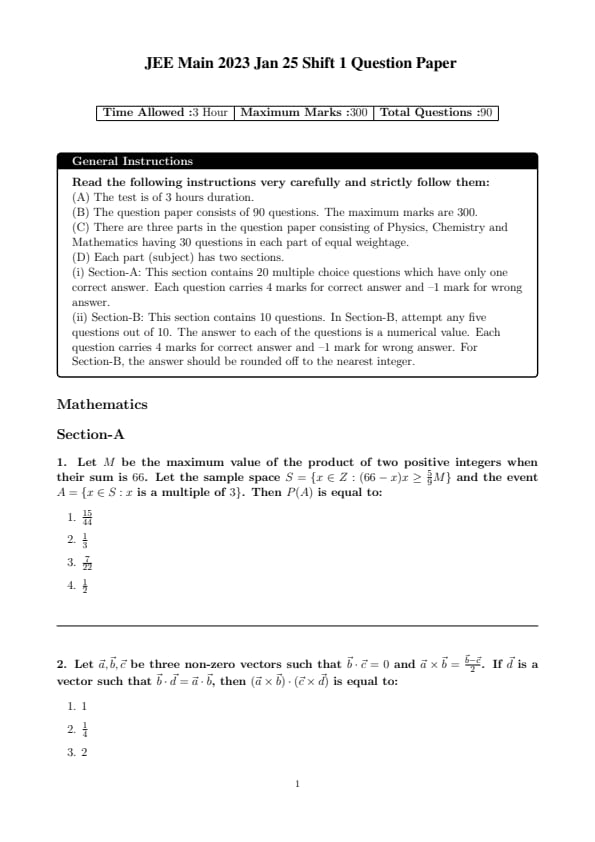
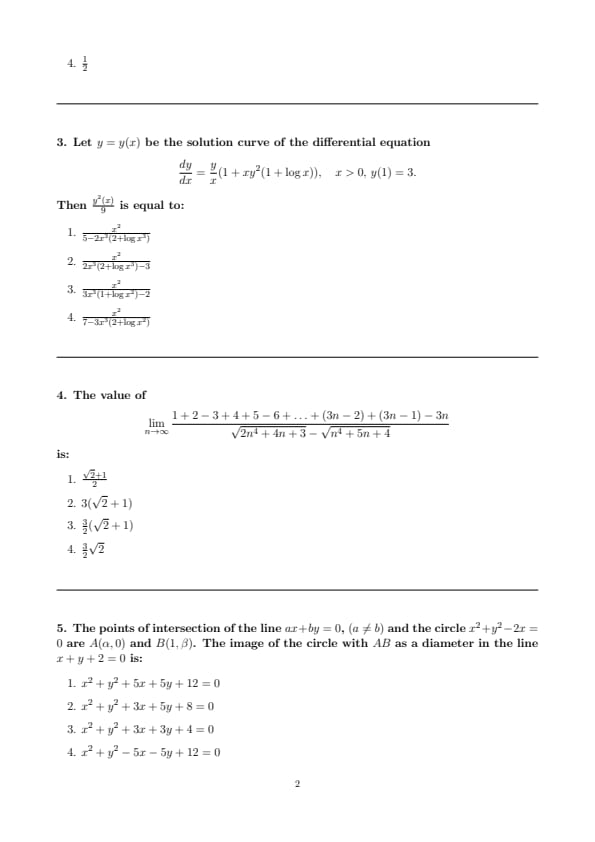
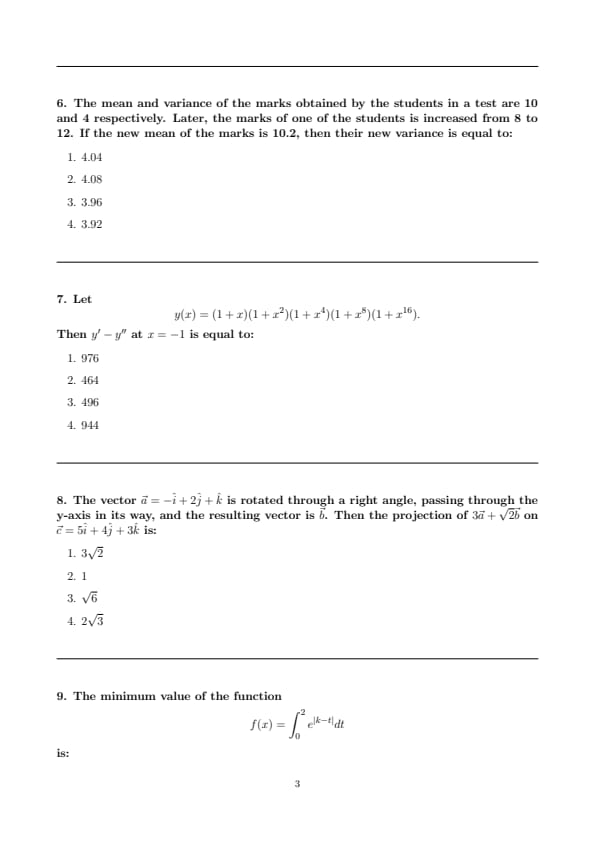
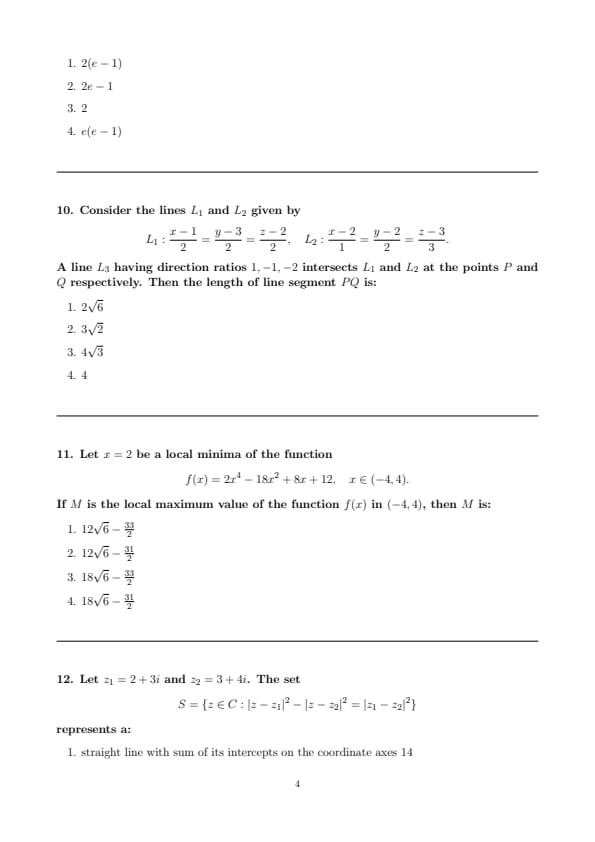
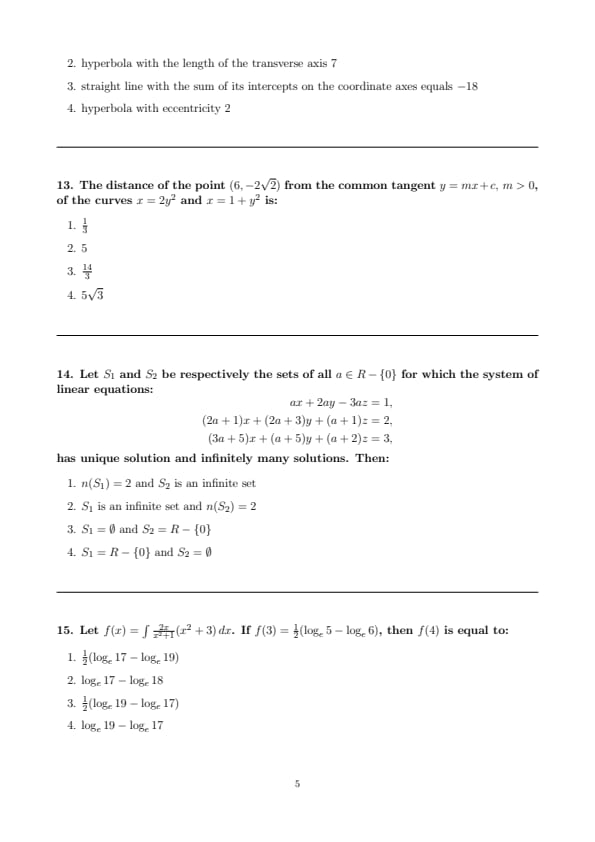
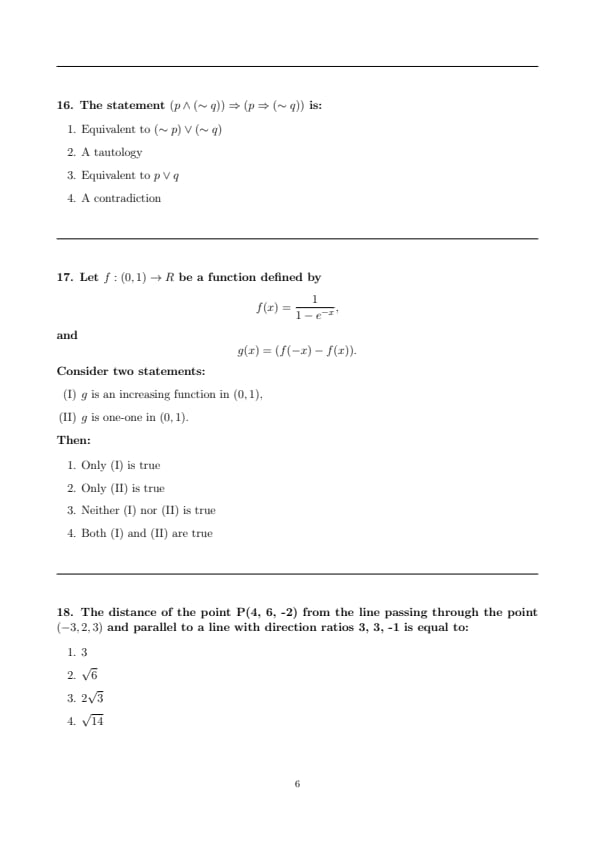
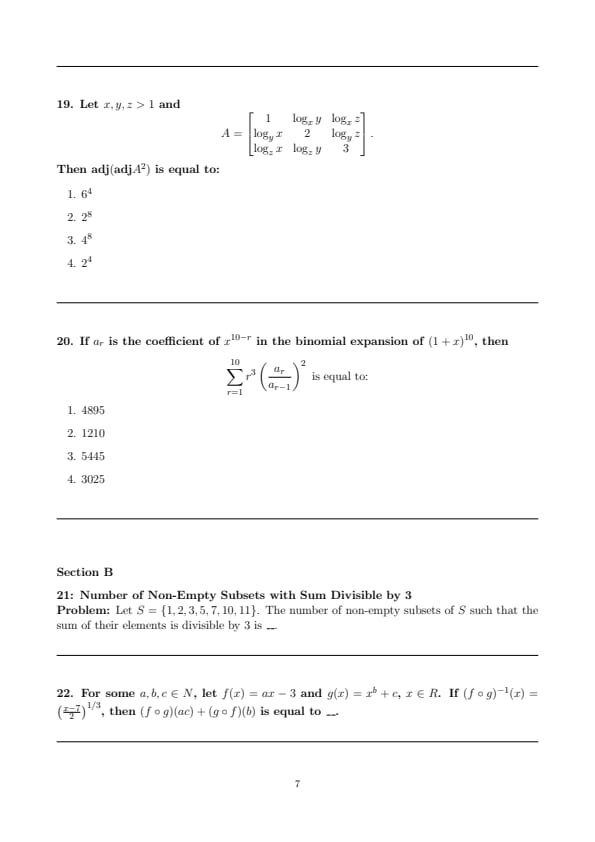
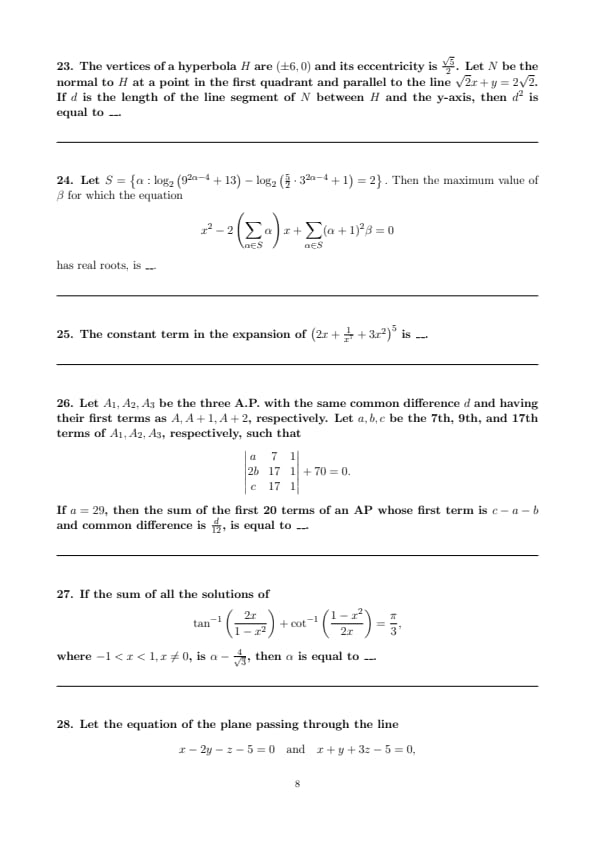
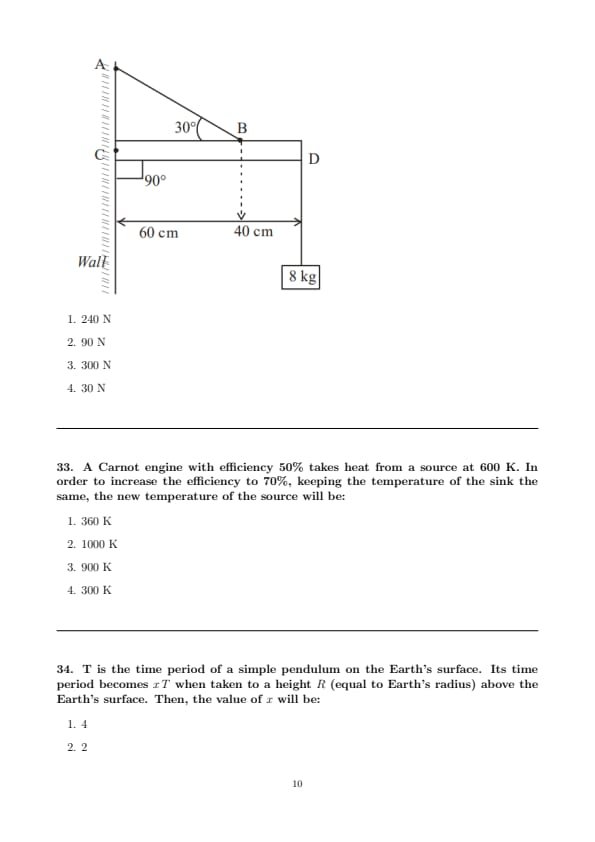
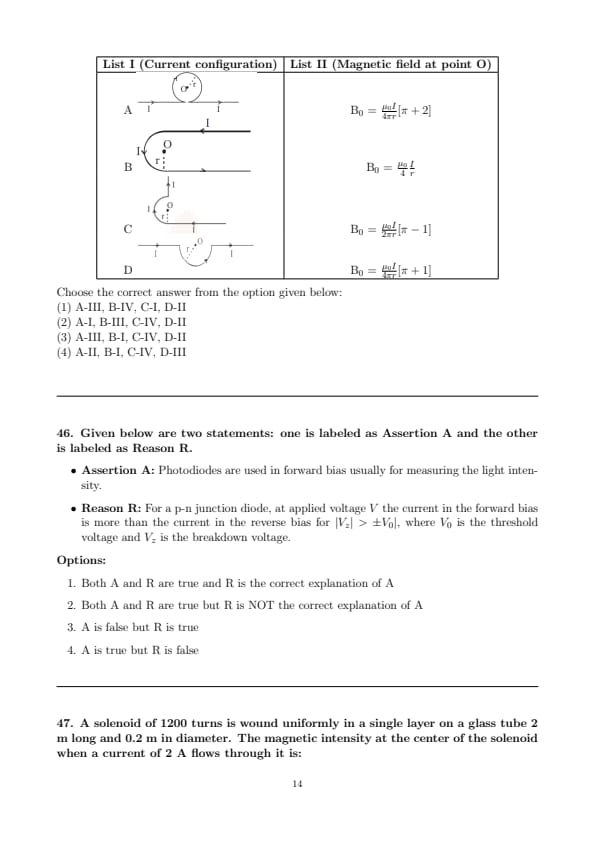
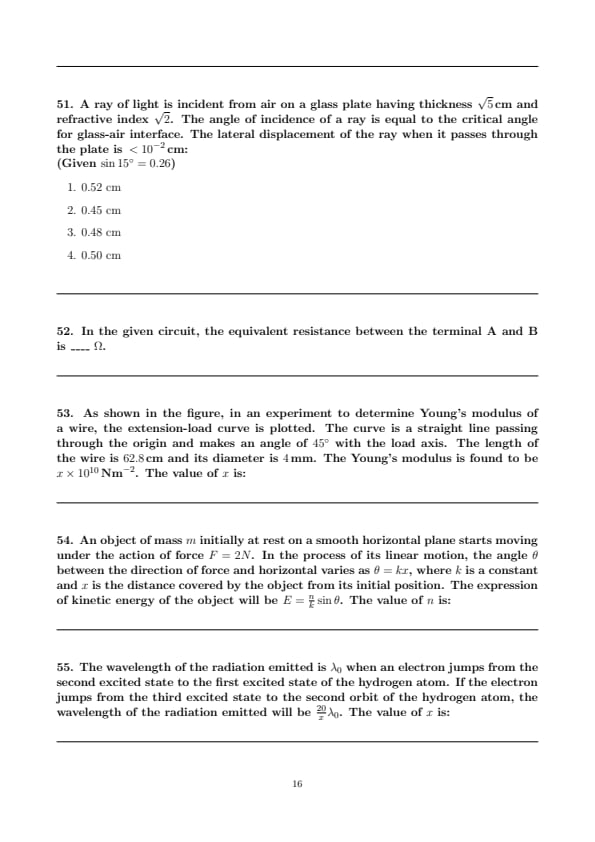
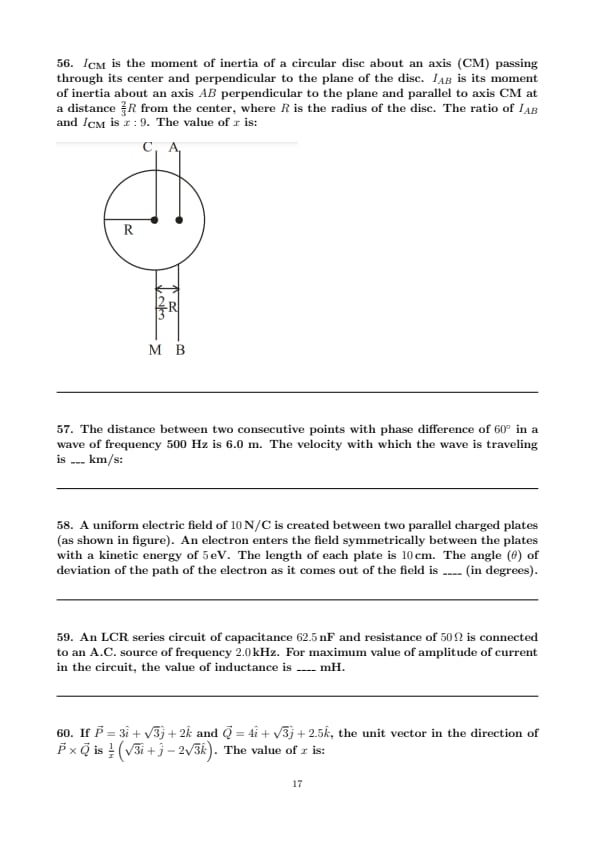
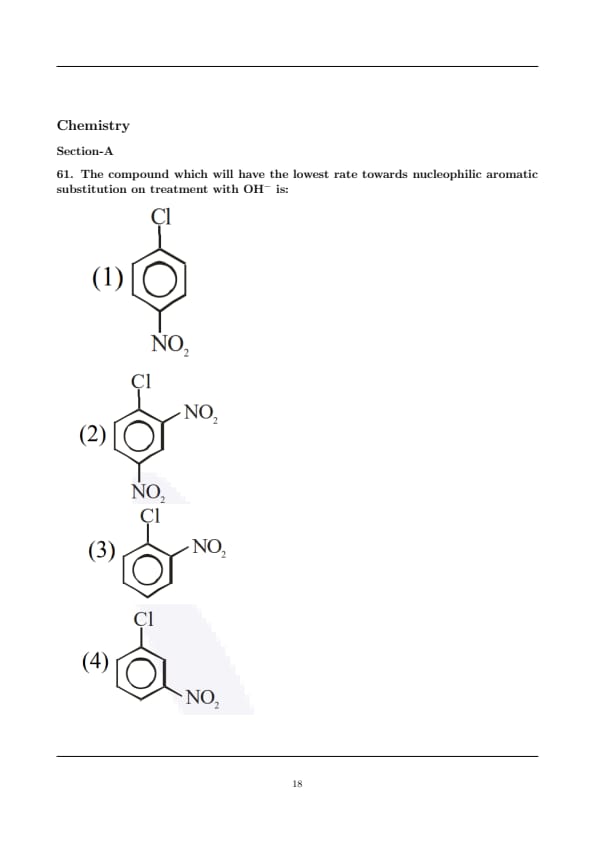
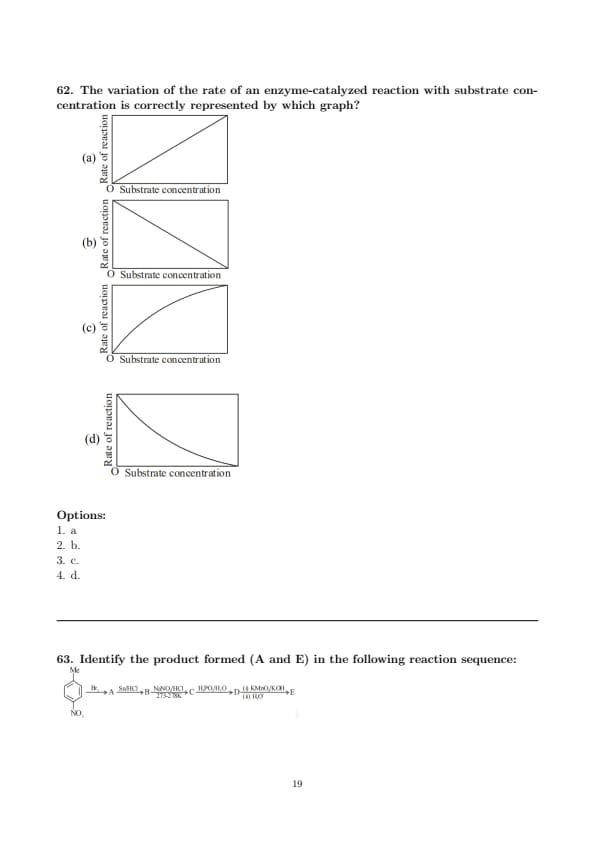
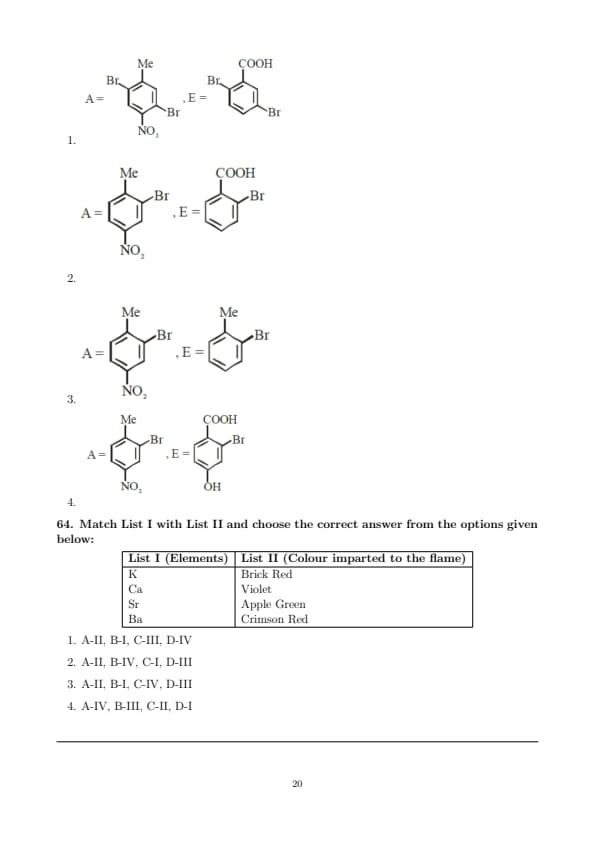
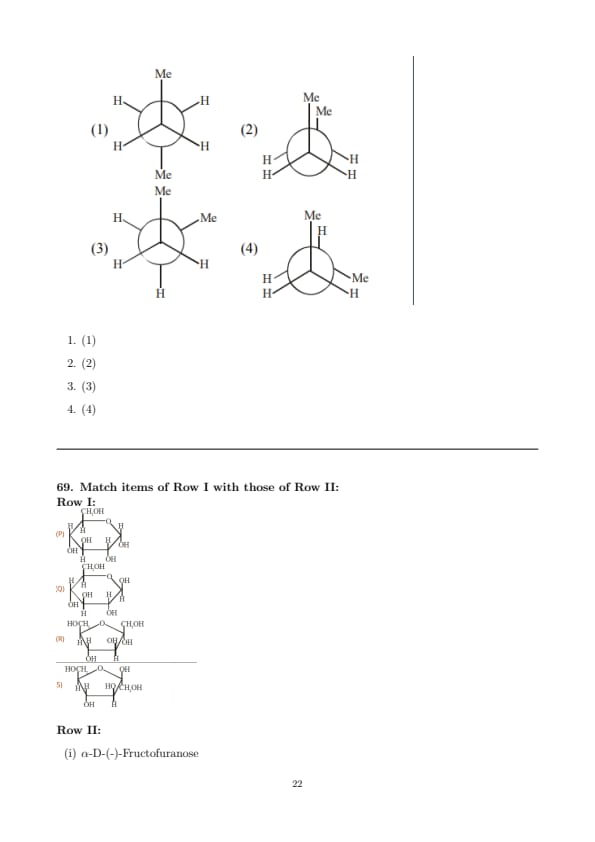
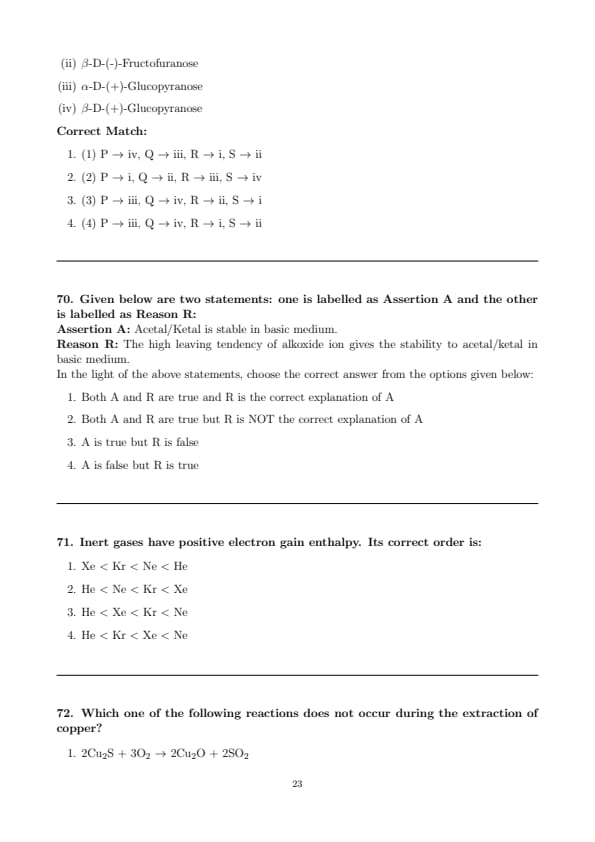
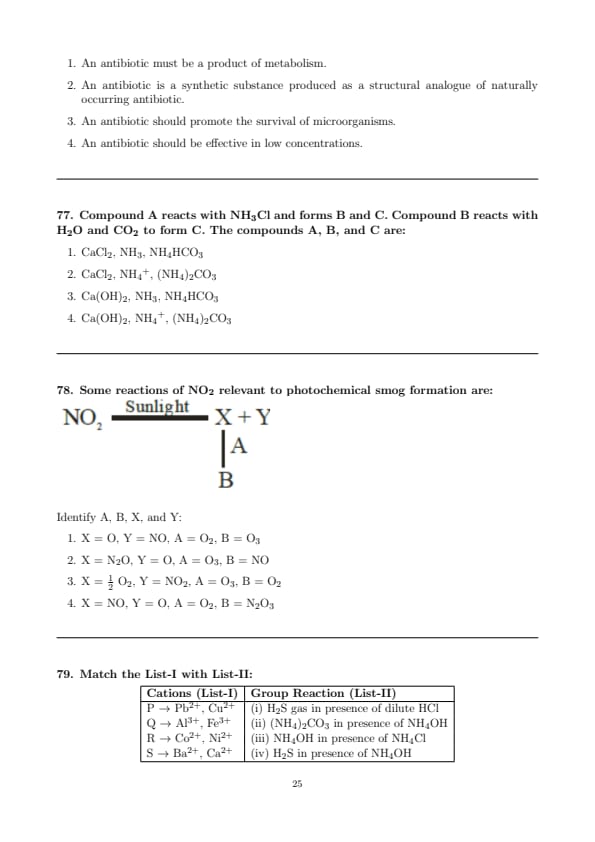
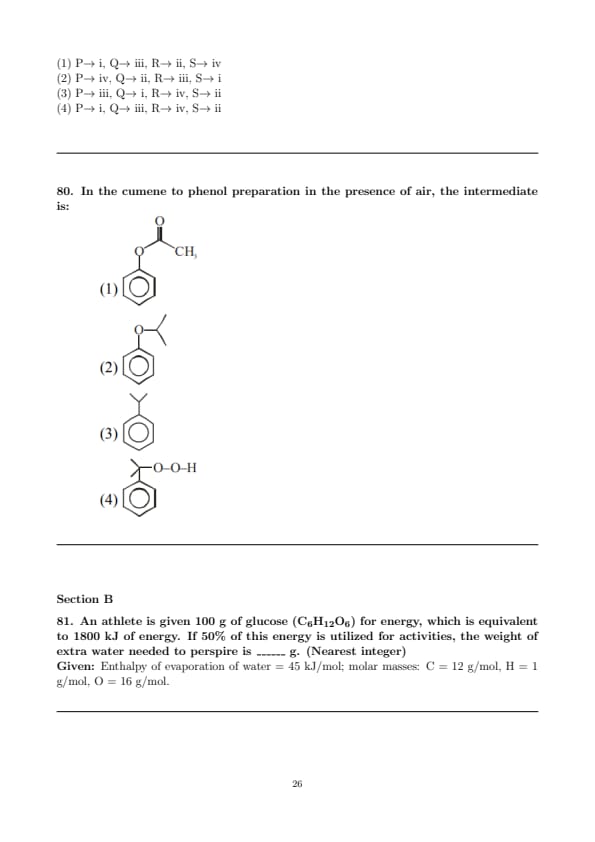
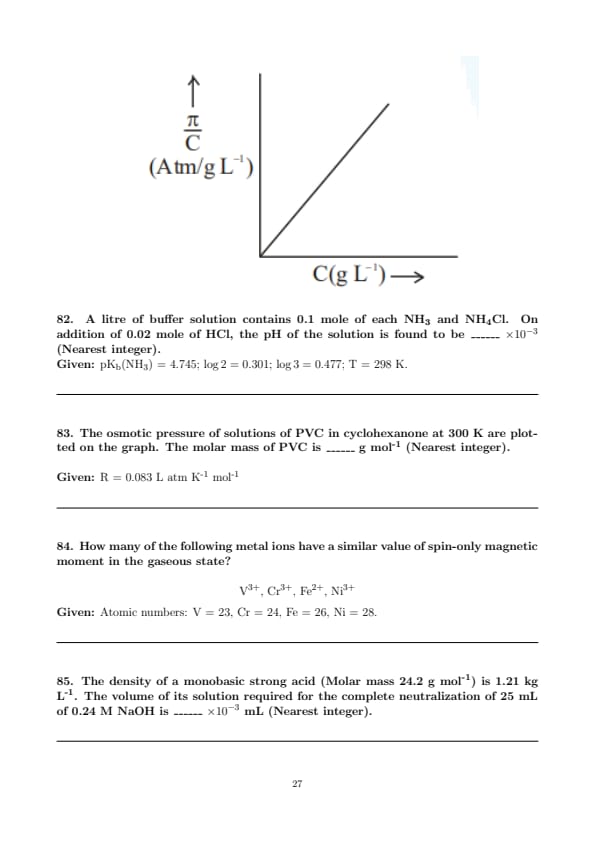
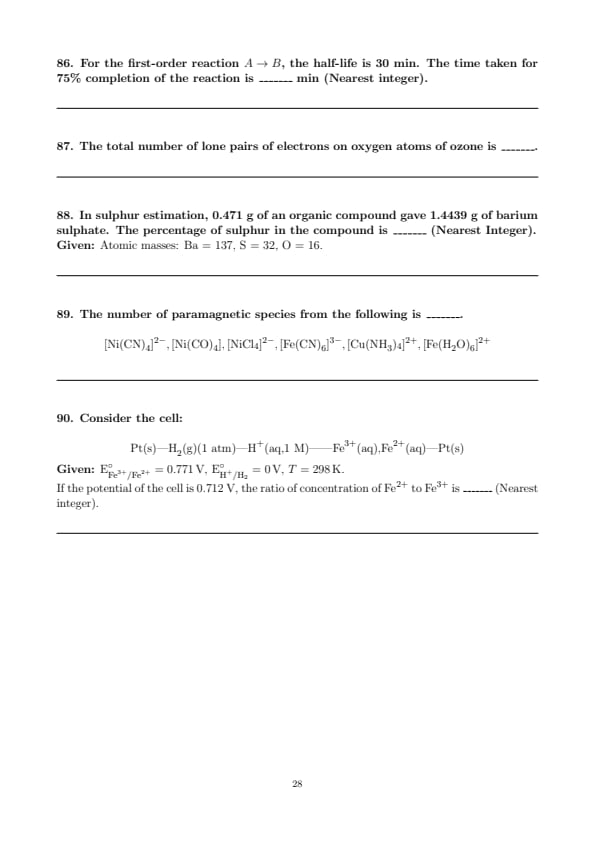
*The article might have information for the previous academic years, please refer the official website of the exam.