
JEE Main 2023 Question Paper with Solution Pdf for Mathematics (February 1 - Shift 2)

.jpg?tr=h-55,w-55,c-force)
Content Strategist|Tech-innovator|National Hackathon Winner | Updated On - Mar 31, 2026
The JEE Main 2023 Mathematics Question Paper with Solution PDF is available here for download. The exam was successfully conducted by NTA on February 1, 2023, in the second shift.
Students can download JEE Main previous year question papers PDFs with detailed solutions to practice and improve their performance. Solving these papers helps aspirants understand the JEE Main exam pattern, analyze the difficulty level, and prepare according to the latest JEE Main syllabus.
Related Links:
Download JEE Main 2026 Session 1 Question Paper with Solution PDF
Download JEE Main 2025 Question Paper with Solution PDF
JEE Main 2023 Mathematics Question Paper Feb 1 Shift 2 with Solution Pdf
| JEE Main 2023 Mathematics Question Paper |  Download Download |
Check Solution |

Question 1:
The sum ∑n=1∞ 2n2+3n+4⁄(2n)! is equal to:
View Solution
Split the numerator: 2n2 + 3n + 4 = 2n(2n-1) + 8n + 8. The sum becomes ∑ 2n(2n-1)⁄(2n)! + 8∑n⁄(2n)! + 4∑1⁄(2n)!. Use series expansions: ∑1⁄(2n-2)! = e+1⁄e⁄2, ∑1⁄(2n-1)! = e-1⁄e⁄2, and ∑1⁄(2n)! = e+1⁄e-2⁄2. Combining and simplifying gives 13e⁄4 + 5⁄4.
Question 2:
Let S = {x ∈ R : 0 < x < 1 and 2tan-1(1-x⁄1+x) = cos-1(1-x2⁄1+x2)}. If n(S) denotes the number of elements in S, then:
View Solution
Let tan-1(1-x⁄1+x) = θ. Then 2θ = cos-1(cos2θ). Since 0 < x < 1, 2θ ∈ (0, π). So 2θ = 2θ. This means x = tan(π/8) = √2 - 1 ≈ 0.414 < 1⁄2. Thus, n(S) = 1.
Question 3:
Let a = 2i - 7j + 5k, b = i + k, and c = i + 2j - 3k be three given vectors. If r is a vector such that r x a = c x a and r · b = 0, then |r| is equal to:
View Solution
r x a = c x a implies (r - c) x a = 0, so r = c + λa. r · b = 0 implies (c + λa) · b = 0. Solving for λ gives λ = 2⁄7. Then r = c + 2⁄7a = 11⁄7i + 4⁄7j - 11⁄7k. |r| = √(121+16+121)/49 = √2.
Question 4:
If A = 1⁄2[1√3 -√31], then:
View Solution
A can be written as a rotation matrix with angle 60°. An corresponds to rotation by n*60°. A30 is rotation by 1800°, which is equivalent to I. A25 is rotation by 1500° which simplifies to A. Therefore, A30 + A25 - A = I + A - A = I.
Question 5:
Two dice are thrown independently. Let A be the event that the number appeared on the 1st die is less than the number appeared on the 2nd die, B be the event that the number appeared on the 1st die is even and that on the 2nd die is odd, and C be the event that the number appeared on the 1st die is odd and that on the 2nd die is even. Then:
View Solution
n(A) = 15, n(B) = 9, n(C) = 9. (A ∪ B) ∩ C = (A ∩ C) ∪ (B ∩ C). A ∩ C: (1,2), (1,4), (1,6), (3,4), (3,6), (5,6) so n(A ∩ C) = 6. B and C are disjoint, so B ∩ C is empty. Therefore, n((A ∪ B) ∩ C) = 6.
Question 6:
Which of the following statements is a tautology?
View Solution
Using logical equivalences, simplify each statement: (1) simplifies to ~p ∨ q. (2) simplifies to true (a tautology). (3) simplifies to ~p ∨ ~q ∨ ~q. (4) simplifies to p.
Question 7:
The number of integral values of k, for which one root of the equation 2x2 - 8x + k = 0 lies in the interval (1,2) and its other root lies in the interval (2,3), is:
View Solution
f(1)f(2) < 0 and f(2)f(3) < 0. f(x) = 2x2 - 8x + k. f(1) = k-6, f(2) = k-8, f(3) = k-6. So, (k-6)(k-8)<0, which means k∈(6,8). Only integer is k=7.
Question 8:
Let f:R - {0,1} → R be a function such that f(x) + f(1⁄x) = 1+x. Then f(2) is equal to:
View Solution
f(2)+f(1⁄2)=3. f(-1) + f(-1) = 0 implies f(-1)=0. f(-1)+f(-1)=0. Adding these equations gives 2f(2) + 2f(1⁄2) + 2f(-1) = 9⁄2 or f(2) = 9⁄2.
Question 9:
Let the plane P pass through the intersection of the planes 2x + 3y - z = 2 and x + 2y + 3z = 6, and be perpendicular to the plane 2x + y - z + 1 = 0. If d is the distance of P from the point (-7,1,1), then d2 is equal to:
View Solution
Plane P: (2+λ)x + (3+2λ)y + (-1+3λ)z - (2+6λ) = 0. Perpendicular to 2x+y-z+1=0 means (2+λ)(2) + (3+2λ)(1) + (-1+3λ)(-1) = 0, so λ=-8. Then P: -6x-13y-25z+46 = 0. Distance d from (-7,1,1) is d = |42-13-25+46|/√(36+169+625) = 50/√830. d2 = 2500/830 = 250⁄83.
Question 10:
Let a, b be two real numbers such that ab < 0. If the complex number b+i⁄1+ai is of unit modulus and a+ib lies on the circle |z-1| = |2z|, then a possible value of 1 + [|a|], where [t] is the greatest integer function, is:
View Solution
|b+i⁄1+ai| = 1 implies |b+i| = |1+ai| so b2 + 1 = a2 + 1. Since ab < 0, b = -a. |z-1| = |2z| gives |a+ib-1| = |2(a+ib)|, so (a-1)2 + b2 = 4(a2+b2). Substituting b = -a gives 6a2+2a-1 = 0. Solving for 'a', no option matches for 1 + [|a|].
Question 11:
The sum of the absolute maximum and minimum values of the function f(x) = |x2 - 5x + 6| - 3x + 2 in the interval [-1, 3] is equal to:
View Solution
f(x) = |x2 - 5x + 6| - 3x + 2. Since x2-5x+6 = (x-2)(x-3), the absolute value changes sign at x=2 and x=3. In [-1,2], f(x) = x2-8x+8 and in [2,3], f(x) = -x2+2x-4. f(-1)=17, f(2)=-4, f(3)=-7. The maximum is 17 and minimum is -7, so the sum is 10.
Question 12:
Let P(S) denote the power set of S = {1, 2, 3, ..., 10}. Define the relations R1 and R2 on P(S) as AR1B if (A ∩ B) ∪ (B ∩ Ac) = ∅, and AR2B if A ∪ Bc = B ∪ Ac, for all A, B ∈ P(S). Then:
View Solution
R1 implies A=B, which is clearly an equivalence relation (reflexive, symmetric, transitive). R2 can be simplified to A=B using set algebra, which is also an equivalence relation.
Question 13:
The area of the region given by {(x, y) : xy ≤ 8, 1 ≤ y ≤ x2} is:
View Solution
The region is bounded by y=1, y=x2, and y=8⁄x. Split the integral into two parts: from x=1 to 2 (area under y=x2 and above y=1), and from x=2 to 8 (area under y=8⁄x and above y=1). The total area is ∫12 (x2-1)dx + ∫28 (8⁄x-1)dx = 7⁄3 + (16ln2-6) = 16ln2 - 11⁄3.
Question 14:
Let αx = exp(xβyγ) be the solution of the differential equation 2x2y dy - (1 - xy2) dx = 0, x > 0, y(2) = √ln e2. Then α + β - γ equals:
View Solution
Substitute y2=t. The equation becomes dt⁄dx + t⁄x = 1⁄x2. Integrating factor is x. Solution is xy2 = ln(2x). Comparing with αx = exp(xβyγ), we get α=2, β=1, γ=2. α+β-γ=1.
Question 15:
The value of the integral ∫π/4π/2 x+4⁄2 - cos 2x dx is:
View Solution
Using the substitution x → (π⁄2 - x) and adding the original integral, we get 2I = ∫π/4π/2 (π/2)+8⁄2-cos2xdx = ∫0π/4 π+16⁄2(2-cos2x)dx. Substitute tan x = t, so cos 2x = 1-t2⁄1+t2 and dx = dt⁄1+t2. The integral becomes I = (π+16)⁄4∫01dt⁄3t2+1. Substituting √3t=u gives I = (π+16)π⁄12√3 - π⁄√3 = π2⁄6√3.
Question 16:
Let 9 = x1 < x2 < ... < x7 be in an A.P. with common difference d. If the standard deviation of x1, x2, ..., x7 is 4 and the mean is x̄, then x̄ + x6 is equal to:
View Solution
xi = 9 + (i-1)d. Mean x̄ = 9+3d. Variance σ2 = ∑(xi - x̄)2⁄n = 4d2. Standard deviation σ = 4 implies d=2. x̄ = 9+3(2) = 15. x6 = 9 + 5(2) = 19. So x̄+x6 = 34.
Question 17:
For the system of linear equations αx + y + z = 1, x + αy + z = 1, x + y + αz = β, which one of the following statements is NOT correct?
View Solution
The determinant of the coefficient matrix is (α-1)2(α+2). If α=1, the system becomes x+y+z=1, x+y+z=1, x+y+z=β which has infinite solutions if β=1, and no solution if β ≠ 1. If α=-2, the system becomes -2x+y+z=1, x-2y+z=1, x+y-2z=β. This system is inconsistent if β=1. If α=2, the determinant is non-zero. If β=1, x=y=z=1⁄3. If β=-1, it is inconsistent. Thus (1) is incorrect.
Question 18:
Let a = 5i - j - 3k and b = i + 3j + 5k be two vectors. Then which one of the following statements is TRUE?
(No correct option provided in the original question)
View Solution
Projection of a on b is (a·b)/|b| = (5-3-15)/√(1+9+25) = -13/√35. The direction is opposite to b. None of the given options match the correct projection value.
Question 19:
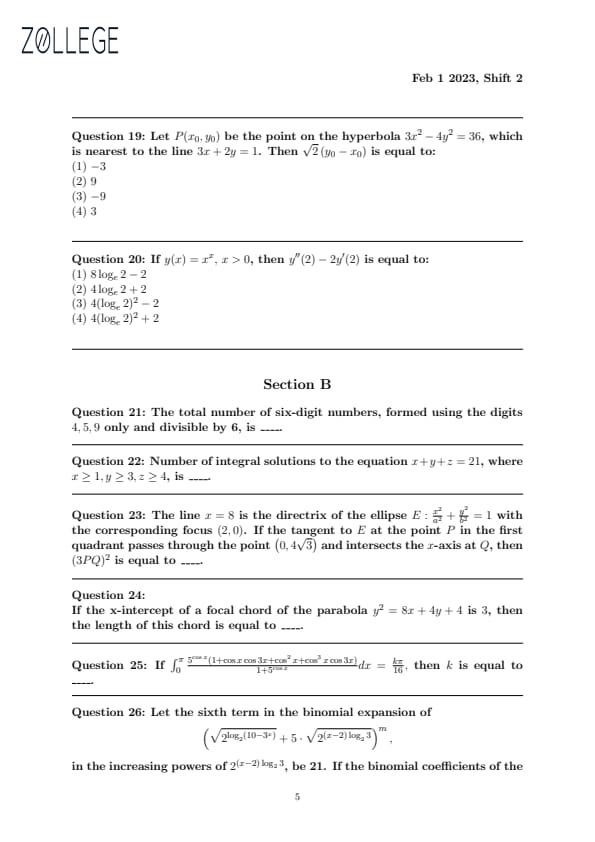
Let P(x0, y0) be the point on the hyperbola 3x2 - 4y2 = 36, which is nearest to the line 3x+2y=1. Then √2(y0 - x0) is equal to:
View Solution
The hyperbola is x2⁄12 - y2⁄9 = 1. The line's slope is -3⁄2. For the nearest point, the tangent to the hyperbola should be parallel to the line. Let the point be (√12 secθ, 3tanθ). Slope of tangent is 3√3 secθ/(4√4 tanθ) = 3⁄2√3(1⁄sinθ). Equating slopes gives sinθ=1⁄√3. The point becomes (-6/√2, -3), so √2(y0-x0) = √2(-3+6⁄√2) = -9.
Question 20:
If y(x) = xx, x > 0, then y″(2) - 2y′(2) is equal to:
View Solution
y=xx. y' = xx(1+ln x). y″ = xx(1+ln x)2 + xx-1. y'(2) = 4(1+ln 2). y″(2) = 4(1+ln 2)2 + 2. y″(2) - 2y'(2) = 4(1+ln 2)2 + 2 - 8(1+ln 2) = 4(ln 2)2 - 2.
Question 21:
The total number of six-digit numbers, formed using the digits 4, 5, 9 only and divisible by 6, is _______.
View Solution
For divisibility by 6, the number must be divisible by 2 and 3. The last digit must be 4. The sum of digits must be divisible by 3. Cases: all digits same (444444 - 1 number); two distinct digits (using 4,5 or 4,9 - 10 each); three distinct digits (4,5,9 with last digit 4 - 5!/(2!2!) arrangements with 4 last = 30, and permutations like 444554, 444994, etc.). Total = 1 + 10 + 10 + 20 + 5 + 5 + 30 = 81.
Question 22:
Number of integral solutions to the equation x + y + z = 21, where x ≥ 1, y ≥ 3, z ≥ 4, is _______.
View Solution
Let x' = x-1, y' = y-3, z' = z-4. Then x'+y'+z'=13 where x',y',z' ≥ 0. Number of solutions is 13+3-1C3-1 = 15C2 = 105.
Question 23:
The line x = 8 is the directrix of the ellipse E: x2⁄a2 + y2⁄b2 = 1 with the corresponding focus (2,0). If the tangent to E at the point P in the first quadrant passes through the point (0, 4√3) and intersects the x-axis at Q, then (3PQ)2 is equal to _______.
View Solution
a/e=8, ae=2 gives a=4, e=1⁄2, b2=12. Tangent equation: x cosθ⁄4 + y sinθ⁄2√3 = 1. Passes through (0, 4√3) means sinθ = 1⁄2, so θ=30°. P is (2√3, √3). Q is (4/√3, 0). PQ = √[(4/√3-2√3)2 + 3] = √13/3. (3PQ)2 = 39.
Question 24:
If the x-intercept of a focal chord of the parabola y2 = 8x + 4y + 4 is 3, then the length of this chord is equal to _______.
View Solution
Rewrite the parabola equation as (y-2)2 = 8(x+1). Focus is (1,2). x-intercept is 3 means the point is (3,0). Focal chord equation is y-2 = m(x-1). Substituting (3,0) gives m=-1, so y=-x+3. Length of focal chord is 4a where a=2 (from the rewritten equation), so the length is 16.
Question 25:
If ∫0π 5 cos x (1+ cos x cos 3x + cos2x + cos 3x cos3 x)⁄(1 + 5 cos x) dx = kπ⁄16 , then k is equal to _______.
View Solution
Using property ∫0a f(x) dx = ∫0a f(a-x) dx and simplifying the numerator using trigonometric identities gives 2I = ∫0π(1 + cos x cos 3x + cos2 x + cos 3x cos3x ) dx. Using further trigonometric identities and integrating gives I = 13π⁄16. Therefore, k=13.
Question 26:
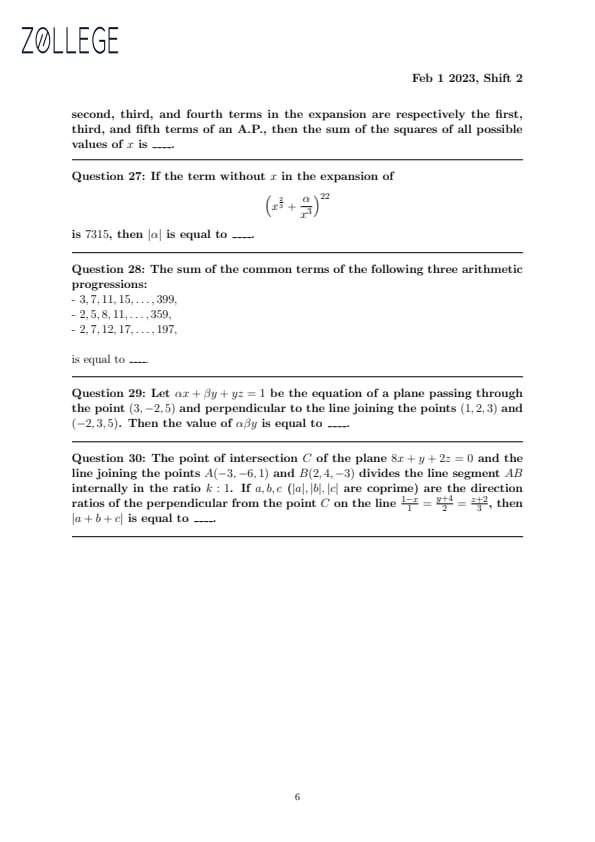
Let the sixth term in the binomial expansion of (21⁄5 log2(10 - 3x)⁄5 + √2(x-2)log23⁄√10 - 31/2 )m, in the increasing powers of 2(x-2) log2 3, be 21. If the binomial coefficients of the second, third, and fourth terms in the expansion are respectively the first, third, and fifth terms of an A.P., then the sum of the squares of all possible values of x is _______.
View Solution
T6 = mC5 (21/5 log2(10-3x)/5)m-5 (√2(x-2)log23 / (√10-31/2))5 = 21. The binomial coefficients condition implies 2(mC1) = mC0 + mC2, so m=2 (rejected) or m=7. With m=7, the T6 equation simplifies to (10-3x)3x = 9. Let y=3x, then y2-10y+9=0 gives y=1 or y=9, so x=0 or x=2. Sum of squares is 0+4=4.
Question 27:
If the term without x in the expansion of (√x⁄a - α⁄x3)22 is 7315, then α is equal to _______.
View Solution
General term is Tr+1 = 22Cr (x1/2/a)22-r (-α/x3)r. For the term independent of x, (22-r)/2 - 3r = 0, so r=4. T5 = 22C4 a-18 (-α)4 = 7315. Solving for α gives α=1.
Question 28:
The sum of the common terms of the following three arithmetic progressions: 3, 7, 11, 15, ..., 399; 2, 5, 8, 11, ..., 359; 2, 7, 12, 17, ..., 197 is equal to _______.
View Solution
Common differences are 4, 3, and 5. LCM is 60. Common terms must be of the form 2 + 60n. Find the common terms in the given ranges: 47, 107, and 167. Sum is 321.
Question 29:
Let αx + βy + γz = 1 be the equation of a plane passing through the point (3,-2,5) and perpendicular to the line joining the points (1,2,3) and (-2,3,5). Then the value of αβγ is equal to _______.
View Solution
Direction vector of the line is <-3,1,2>. The plane's normal vector is parallel to this, so the plane is 3x-y-2z=k. Since it passes through (3,-2,5), k=1. α=3, β=-1, γ=-2. αβγ = 6.
Question 30:
The point of intersection C of the plane 8x+y+2z=0 and the line joining the points A(-3,-6,1) and B(2,4,-3) divides the line segment AB internally in the ratio k:1. If a, b, c (|a|, |b|, |c| are coprime) are the direction ratios of the perpendicular from the point C on the line x-1⁄-1 = y+4⁄2 = z+2⁄3, then |a+b+c| is equal to _______.
View Solution
Line equation is x+3⁄5 = y+6⁄10 = z-1⁄-4 = λ. A point on the line is (5λ-3, 10λ-6, -4λ+1). Intersection with plane gives λ=-1⁄3, so C is (-14⁄3, -28⁄3, 7⁄3). The ratio k:1 is -λ:1, which is 1⁄3 : 1. Let a point D on the given line be (-μ+1, 2μ-4, 3μ-2). CD is perpendicular to <-1, 2, 3>, which gives μ=11⁄14. Direction ratios of CD are <-1, -26, 17>. |a+b+c| = |-1-26+17| = 10.


Previous Year JEE Main Question Papers
*The article might have information for the previous academic years, please refer the official website of the exam.