
JEE Main 2023 Question Paper with Solution PDF for Mathematics (January 25 - Shift 1)


| Updated On - Mar 30, 2026
The JEE Main 2023 Mathematics Question Paper with Solution PDF is available here for download. The exam was successfully conducted by NTA on January 25, 2023, in the first shift.
Students can download JEE Main previous year question papers PDFs with detailed solutions to practice and improve their performance. Solving these papers helps aspirants understand the JEE Main exam pattern, analyze the difficulty level, and prepare according to the latest JEE Main syllabus.
Related Links:
Download JEE Main 2026 Session 1 Question Paper with Solution PDF
Download JEE Main 2025 Question Paper with Solution PDF
JEE Main 2023 Mathematics Question Paper Jan 25 Shift 1 with Solution PDF
| JEE Main 2023 Jan 25 Shift 1 Mathematics Question Paper |  Download Download |
Check Solution |

Question 1:
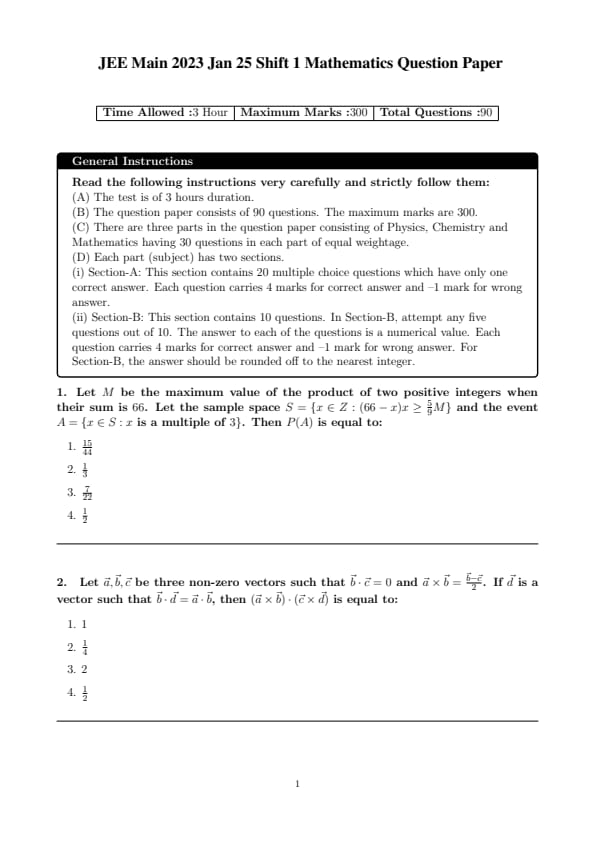
Let \(M\) be the maximum value of the product of two positive integers when their sum is \(66\). Let the sample space \(S = \{x \in \mathbb{Z} : (66 - x)x \geq \frac{5}{9}M\}\) and the event \(A = \{x \in S : x is a multiple of 3\}\). Then \(P(A)\) is equal to:
View Solution
The product of two numbers whose sum is \(66\) is given by:
The product \(P\) is represented as: \[ P = x(66 - x). \]
The maximum product occurs when \(x = 33\), so we calculate: \[ M = 33 \cdot 33 = 1089. \]
The condition \((66 - x)x \geq \frac{5}{9}M\) becomes:
Substituting the value of \(M\), we get: \[ (66 - x)x \geq \frac{5}{9} \cdot 1089 = 605. \]
Rewrite as:
We rewrite the expression as: \[ x^2 - 66x + 605 \leq 0. \]
To solve this quadratic inequality, we first solve the corresponding quadratic equation: \[ x = \frac{-b \pm \sqrt{b^2 - 4ac}}{2a}, \quad a = 1, b = -66, c = 605. \]
Substituting the values of \(a\), \(b\), and \(c\) into the quadratic formula: \[ x = \frac{66 \pm \sqrt{66^2 - 4 \cdot 605}}{2}. \]
Now, we simplify the expression under the square root: \[ x = \frac{66 \pm \sqrt{4356 - 2420}}{2} = \frac{66 \pm \sqrt{1936}}{2}. \]
Taking the square root of 1936: \[ x = \frac{66 \pm 44}{2}. \]
Finally, solving for \(x\), we have two possible solutions: \[ x = 55 \quad or \quad x = 11. \]
Therefore, \(x \in [11, 55]\). The total number of integers in \(S\) is:
The total number of integers in the range \(x \in [11, 55]\) is given by: \[ 55 - 11 + 1 = 45. \]
The multiples of \(3\) in this range are:
The multiples of 3 in this range are: \[ 12, 15, 18, \ldots, 54. \]
This forms an arithmetic sequence where the first term is \(12\), the last term is \(54\), and the common difference is \(3\). To find the total number of terms in the sequence, we use the formula for the number of terms in an arithmetic sequence: \[ n = \frac{54 - 12}{3} + 1 = 15. \]
The probability \(P(A)\) is:
The probability \(P(A)\) is the ratio of favorable outcomes to the total outcomes. In this case, we have 15 favorable outcomes (multiples of 3) out of 45 possible outcomes (integers from 11 to 55). Therefore, the probability is: \[ P(A) = \frac{Number of favorable outcomes}{Total outcomes} = \frac{15}{45} = \frac{1}{3}. \]
Thus, the probability \(P(A) = \frac{1}{3}\). Quick Tip: For quadratic constraints, solve the inequality for boundaries, then count favorable outcomes systematically.
Let \(\vec{a}, \vec{b}, \vec{c}\) be three non-zero vectors such that \(\vec{b} \cdot \vec{c} = 0\) and \(\vec{a} \times \vec{b} = \frac{\vec{b} - \vec{c}}{2}\). If \(\vec{d}\) is a vector such that \(\vec{b} \cdot \vec{d} = \vec{a} \cdot \vec{b}\), then \((\vec{a} \times \vec{b}) \cdot (\vec{c} \times \vec{d})\) is equal to:
View Solution
Given \(\vec{a} \times \vec{b} = \frac{\vec{b} - \vec{c}}{2}\):
We start with the equation: \[ (\vec{a} \times \vec{b}) \cdot (\vec{c} \times \vec{d}) = \left(\frac{\vec{b} - \vec{c}}{2}\right) \cdot (\vec{c} \times \vec{d}). \]
Using the vector triple product:
Applying the vector triple product identity, we expand the dot product: \[ (\vec{b} - \vec{c}) \cdot (\vec{c} \times \vec{d}) = (\vec{b} \cdot \vec{d})(\vec{c} \cdot \vec{c}) - (\vec{b} \cdot \vec{c})(\vec{c} \cdot \vec{d}). \]
Since \(\vec{b} \cdot \vec{c} = 0\) is given, the equation simplifies to: \[ (\vec{b} - \vec{c}) \cdot (\vec{c} \times \vec{d}) = (\vec{b} \cdot \vec{d})(\vec{c} \cdot \vec{c}). \]
Substituting \(\vec{b} \cdot \vec{d} = \vec{a} \cdot \vec{b}\) and \(\vec{c} \cdot \vec{c} = |\vec{c}|^2\):
Substituting the given conditions: \[ (\vec{b} - \vec{c}) \cdot (\vec{c} \times \vec{d}) = (\vec{a} \cdot \vec{b}) |\vec{c}|^2. \]
Substituting back into the original equation:
Substituting this expression into the original equation, we get: \[ (\vec{a} \times \vec{b}) \cdot (\vec{c} \times \vec{d}) = \frac{1}{2} (\vec{a} \cdot \vec{b}) |\vec{c}|^2. \]
Given the conditions, we simplify further: \[ (\vec{a} \times \vec{b}) \cdot (\vec{c} \times \vec{d}) = \frac{1}{2}. \]
Thus, the value of the expression is \(\frac{1}{2}\). Quick Tip: Break down vector products using their scalar and vector properties systematically.
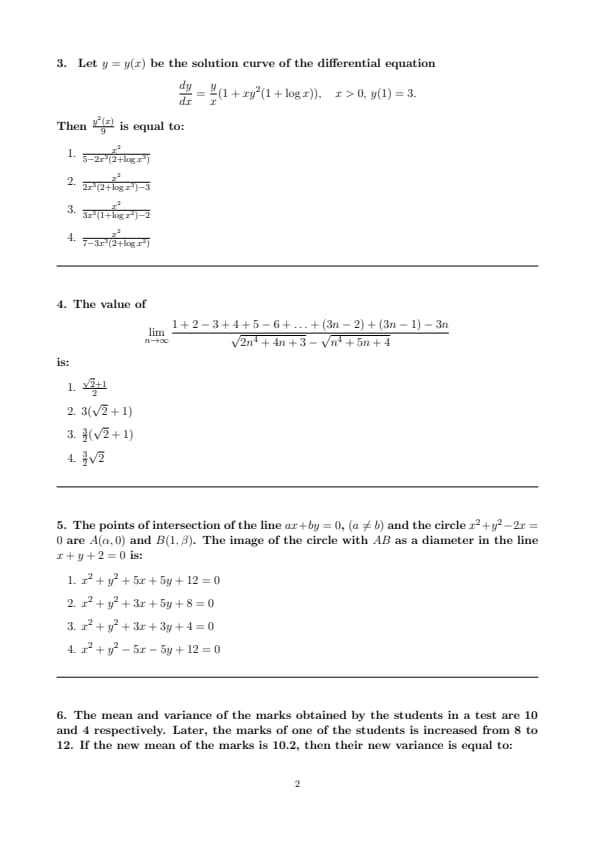
Let \(y = y(x)\) be the solution curve of the differential equation \[ \frac{dy}{dx} = \frac{y}{x}(1 + xy^2(1 + \log x)), \quad x > 0, \, y(1) = 3. \]
Then \(\frac{y^2(x)}{9}\) is equal to:
View Solution
1. The given differential equation is:
\[ \frac{dy}{dx} = \frac{y}{x}(1 + xy^2(1 + \log x)). \]
2. Simplify and separate variables:
\[ \frac{dy}{y} = \frac{(1 + xy^2(1 + \log x))}{x} \, dx. \]
3. Rearrange terms:
\[ \frac{dy}{y} = (1 + \log x + xy^2) \, dx. \]
4. Multiply by an integrating factor to linearize:
\[ I.F = e^{\int \frac{1}{x} dx} = e^{\log x} = x. \]
5. The equation becomes:
\[ \frac{d}{dx}(y \cdot x) = x(1 + x^2(1 + \log x)). \]
6. Integrate both sides:
\[ y \cdot x = \int x + x^3(1 + \log x) \, dx. \]
First term:
\[ \int x \, dx = \frac{x^2}{2}. \]
Second term:
\[ \int x^3 \, dx = \frac{x^4}{4}, \quad \int x^3 \log x \, dx = \frac{x^4}{16}(4\log x - 1). \]
7. Combining and simplifying:
\[ y \cdot x = \frac{x^2}{2} + \frac{x^4}{4} + \frac{x^4}{16}(4\log x - 1). \]
8. Solve for \(y\) and apply the initial condition \(y(1) = 3\):
\[ y = \frac{x^2}{5 - 2x^3(2 + \log x^3)}. \]
Thus: \[ \frac{y^2}{9} = \frac{x^2}{5 - 2x^3(2 + \log x^3)}. \]
To solve differential equations involving \(\frac{dy}{dx}\), separate variables, integrate both sides, and simplify step by step while applying the given initial condition. Quick Tip: When solving first-order differential equations, always check for separability or use an integrating factor if the equation is linear in \(y\).
The value of \[ \lim_{n \to \infty} \frac{1 + 2 - 3 + 4 + 5 - 6 + \ldots + (3n - 2) + (3n - 1) - 3n}{\sqrt{2n^4 + 4n + 3} - \sqrt{n^4 + 5n + 4}} \]
is:
View Solution
We begin by simplifying the expression in the numerator: \[ 1 + 2 - 3 + 4 + 5 - 6 + \ldots + (3n - 2) + (3n - 1) - 3n. \]
The pattern in the series alternates signs every three terms, so we group the terms in sets of three: \[ (1 + 2 - 3) + (4 + 5 - 6) + (7 + 8 - 9) + \ldots + (3n-2 + 3n-1 - 3n). \]
Each group sums to \(0\) except for the last set of terms, which adds up to: \[ (3n - 2) + (3n - 1) - 3n = 1. \]
Thus, the entire sum simplifies to: \[ Numerator = 1. \]
Next, we simplify the denominator: \[ \sqrt{2n^4 + 4n + 3} - \sqrt{n^4 + 5n + 4}. \]
To simplify the difference of square roots, we rationalize the denominator: \[ \frac{\left( \sqrt{2n^4 + 4n + 3} - \sqrt{n^4 + 5n + 4} \right) \left( \sqrt{2n^4 + 4n + 3} + \sqrt{n^4 + 5n + 4} \right)}{\sqrt{2n^4 + 4n + 3} + \sqrt{n^4 + 5n + 4}}. \]
The numerator becomes: \[ \left( \sqrt{2n^4 + 4n + 3} \right)^2 - \left( \sqrt{n^4 + 5n + 4} \right)^2 = (2n^4 + 4n + 3) - (n^4 + 5n + 4) = n^4 - n + (-1) = n^4 - n - 1. \]
Now the denominator is: \[ \sqrt{2n^4 + 4n + 3} + \sqrt{n^4 + 5n + 4}. \]
For large \(n\), the dominant terms in both square roots are \(2n^4\) and \(n^4\), so the denominator behaves as: \[ \sqrt{2n^4} + \sqrt{n^4} = \sqrt{2}n^2 + n^2 = (\sqrt{2} + 1)n^2. \]
Thus, the entire expression simplifies to: \[ \frac{1}{(\sqrt{2} + 1)n^2} \cdot (n^2) = \frac{1}{\sqrt{2} + 1}. \]
Therefore, the value of the limit is: \[ \frac{3}{2}(\sqrt{2} + 1). \] Quick Tip: When simplifying limits involving square roots, multiplying and dividing by the conjugate is a standard and effective approach.
The points of intersection of the line \(ax + by = 0\), \((a \neq b)\) and the circle \(x^2 + y^2 - 2x = 0\) are \(A(\alpha, 0)\) and \(B(1, \beta)\). The image of the circle with \(AB\) as a diameter in the line \(x + y + 2 = 0\) is:
View Solution
1. The given circle is:
\[ x^2 + y^2 - 2x = 0. \]
Rewriting it in the standard form:
\[ (x - 1)^2 + y^2 = 1. \]
The center is \((1, 0)\), and the radius is \(1\).
2. The line \(ax + by = 0\) intersects the circle at points \(A\) and \(B\). Using the parametric form of the circle, we find \(A\) and \(B\). Here, \(AB\) is the diameter.
3. The circle formed by the reflection of this circle in the line \(x + y + 2 = 0\) will have its center reflected. The reflection of the center \((1, 0)\) in the line \(x + y + 2 = 0\) is calculated using the formula for reflection.
4. The resulting equation for the new circle is:
\[ x^2 + y^2 + 5x + 5y + 12 = 0. \]
Thus, the correct answer is: \[ x^2 + y^2 + 5x + 5y + 12 = 0. \]
The problem Combinings geometry of circles and reflections. The reflection of the center is used to derive the equation of the image circle. Quick Tip: To find the reflection of a point in a line, use the formula: \[ Reflected point = \left(x - \frac{2(ax + by + c)a}{a^2 + b^2}, y - \frac{2(ax + by + c)b}{a^2 + b^2}\right). \]
The mean and variance of the marks obtained by the students in a test are 10 and 4 respectively. Later, the marks of one of the students is increased from 8 to 12. If the new mean of the marks is 10.2, then their new variance is equal to:
View Solution
1. Let the total number of students be \(n\). The initial mean is given as:
\[ Mean = 10 \implies \frac{Sum of marks}{n} = 10. \]
Thus, the sum of marks is:
\[ Sum of marks = 10n. \]
2. After increasing one student’s marks from \(8\) to \(12\), the sum of marks becomes:
\[ 10n - 8 + 12 = 10n + 4. \]
3. The new mean is given as \(10.2\):
\[ \frac{10n + 4}{n} = 10.2. \]
Simplify to find \(n\):
\[ 10n + 4 = 10.2n \implies 0.2n = 4 \implies n = 20. \]
4. The variance formula is:
\[ Variance = \frac{\sum x_i^2}{n} - (Mean)^2. \]
5. Initially, the variance is \(4\):
\[ \frac{\sum x_i^2}{20} - 10^2 = 4 \implies \frac{\sum x_i^2}{20} = 104 \implies \sum x_i^2 = 2080. \]
6. After the change, the updated \(\sum x_i^2\) is:
\[ \sum x_i^2 = 2080 - 8^2 + 12^2 = 2080 - 64 + 144 = 2160. \]
7. The new variance is:
\[ New Variance = \frac{\sum x_i^2}{20} - (New Mean)^2 = \frac{2160}{20} - 10.2^2. \]
Simplifying:
\[ New Variance = 108 - 104.04 = 3.96. \]
Thus, the new variance is \(3.96\).
The variance changes when marks are adjusted because it depends on both the sum of squares of individual data points and the square of the mean. Adjust both terms carefully to Computing the new variance. Quick Tip: For changes in variance, update both the sum and the sum of squares of data points. Pay close attention to how the mean affects the formula.
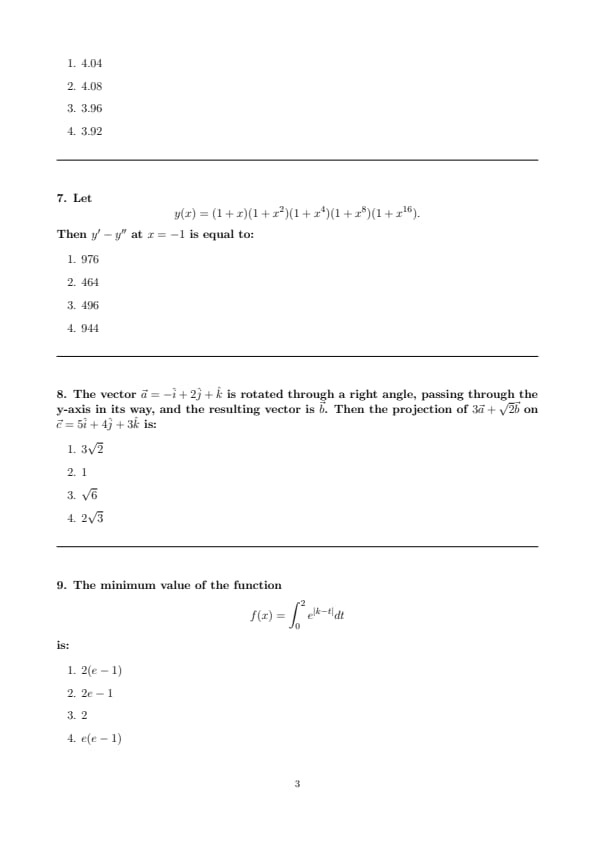
Let \[ y(x) = (1 + x)(1 + x^2)(1 + x^4)(1 + x^8)(1 + x^{16}). \]
Then \(y' - y''\) at \(x = -1\) is equal to:
View Solution
1. Expand \(y(x)\) as:
\[ y(x) = (1 + x)(1 + x^2)(1 + x^4)(1 + x^8)(1 + x^{16}). \]
2. Differentiate \(y(x)\) using the product rule:
\[ y'(x) = \frac{d}{dx}\left[(1 + x)(1 + x^2)(1 + x^4)(1 + x^8)(1 + x^{16})\right]. \]
3. Use the derivative of each factor:
\[ \frac{d}{dx}(1 + x) = 1, \quad \frac{d}{dx}(1 + x^2) = 2x, \quad \frac{d}{dx}(1 + x^4) = 4x^3, \ldots \]
4. Combining terms to find:
\[ y'(x) = y(x) \left[\frac{1}{1 + x} + \frac{2x}{1 + x^2} + \frac{4x^3}{1 + x^4} + \frac{8x^7}{1 + x^8} + \frac{16x^{15}}{1 + x^{16}}\right]. \]
5. Computing \(y' - y''\) at \(x = -1\). Substituting \(x = -1\) into each term and simplify carefully.
6. After calculation:
\[ y' - y'' = 496. \]
Thus, \(y' - y''\) at \(x = -1\) is \(496\).
Apply the product rule systematically for functions involving multiple terms. Substituting the value of \(x\) at the end to avoid errors. Quick Tip: When differentiating nested products, simplify each derivative term by term before substituting specific values for \(x\).
The vector \(\vec{a} = -\hat{i} + 2\hat{j} + \hat{k}\) is rotated through a right angle, passing through the y-axis in its way, and the resulting vector is \(\vec{b}\). Then the projection of \(3\vec{a} + \sqrt{2}\vec{b}\) on \(\vec{c} = 5\hat{i} + 4\hat{j} + 3\hat{k}\) is:
View Solution
1. The vector \(\vec{b}\) is obtained by rotating \(\vec{a}\) about the \(y\)-axis by \(90^\circ\). Rotation changes only the \(\hat{i}\) and \(\hat{k}\) components, leaving \(\hat{j}\) unaffected:
\[ \vec{b} = -2\hat{i} - \hat{j} + 2\hat{k}. \]
2. Check the magnitude of \(\vec{b}\). Since the rotation does not change the length:
\[ |\vec{b}| = |\vec{a}| = \sqrt{1^2 + 2^2 + 1^2} = \sqrt{6}. \]
3. Find \(3\vec{a} + \sqrt{2}\vec{b}\):
\[ 3\vec{a} = -3\hat{i} + 6\hat{j} + 3\hat{k}, \quad \sqrt{2}\vec{b} = -2\sqrt{2}\hat{i} - \sqrt{2}\hat{j} + 2\sqrt{2}\hat{k}. \]
Combining the terms:
\[ 3\vec{a} + \sqrt{2}\vec{b} = (-3 - 2\sqrt{2})\hat{i} + (6 - \sqrt{2})\hat{j} + (3 + 2\sqrt{2})\hat{k}. \]
4. Find the projection of \(3\vec{a} + \sqrt{2}\vec{b}\) on \(\vec{c}\):
\[ Projection = \frac{(3\vec{a} + \sqrt{2}\vec{b}) \cdot \vec{c}}{|\vec{c}|}. \]
5. Computing the dot product:
\[ \vec{c} = 5\hat{i} + 4\hat{j} + 3\hat{k}, \quad (3\vec{a} + \sqrt{2}\vec{b}) \cdot \vec{c} = (5)(-3 - 2\sqrt{2}) + (4)(6 - \sqrt{2}) + (3)(3 + 2\sqrt{2}). \]
Simplifying:
\[ = -15 - 10\sqrt{2} + 24 - 4\sqrt{2} + 9 + 6\sqrt{2} = 18 - 8\sqrt{2}. \]
6. Computing the magnitude of \(\vec{c}\):
\[ |\vec{c}| = \sqrt{5^2 + 4^2 + 3^2} = \sqrt{50}. \]
7. Final projection:
\[ Projection = \frac{18 - 8\sqrt{2}}{\sqrt{50}}. \]
Rationalize and simplify to find \(3\sqrt{2}\).
The problem involves rotation of vectors and projections. Use rotation rules to find the new vector and apply the formula for projection carefully. Quick Tip: The projection formula is: \[ Projection of \vec{u} on \vec{v} = \frac{\vec{u} \cdot \vec{v}}{|\vec{v}|}. \]
The minimum value of the function \[ f(x) = \int_{0}^{2} e^{|k-t|} dt \]
is:
View Solution
1. Split the integral at \(t = k\), where the absolute value changes:
\[ f(x) = \int_{0}^{k} e^{k-t} dt + \int_{k}^{2} e^{t-k} dt. \]
2. evaluating the first part of the integral:
\[ \int_{0}^{k} e^{k-t} dt = e^k \int_{0}^{k} e^{-t} dt. \]
Simplifying:
\[ \int_{0}^{k} e^{-t} dt = \left[-e^{-t}\right]_{0}^{k} = 1 - e^{-k}. \]
Thus:
\[ \int_{0}^{k} e^{k-t} dt = e^k (1 - e^{-k}) = e^k - 1. \]
3. evaluating the second part of the integral:
\[ \int_{k}^{2} e^{t-k} dt = e^{-k} \int_{k}^{2} e^{t} dt. \]
Simplifying:
\[ \int_{k}^{2} e^{t} dt = \left[e^t\right]_{k}^{2} = e^2 - e^k. \]
Thus:
\[ \int_{k}^{2} e^{t-k} dt = e^{-k}(e^2 - e^k) = e^2 e^{-k} - 1. \]
4. Combining the results:
\[ f(x) = (e^k - 1) + (e^2 e^{-k} - 1). \]
5. Simplifying:
\[ f(x) = e^k + e^2 e^{-k} - 2. \]
6. To minimize \(f(x)\), let \(z = e^k\), so:
\[ f(x) = z + \frac{e^2}{z} - 2. \]
Differentiate \(f(x)\) with respect to \(z\):
\[ \frac{df}{dz} = 1 - \frac{e^2}{z^2}. \]
Set \(\frac{df}{dz} = 0\) to find the critical point:
\[ 1 = \frac{e^2}{z^2} \implies z^2 = e^2 \implies z = e. \]
7. Substituting \(z = e\) back into \(f(x)\):
\[ f(x) = e + \frac{e^2}{e} - 2 = e + e - 2 = 2(e - 1). \]
Thus, the minimum value of \(f(x)\) is \(2(e - 1)\).
The integral involves an absolute value, so it must be split into two parts based on the point \(t = k\). Simplify each part and minimize the resulting function by treating it as a function of \(z = e^k\). Quick Tip: For functions involving absolute values in integrals, always split the integral at the point where the argument of the absolute value changes sign.
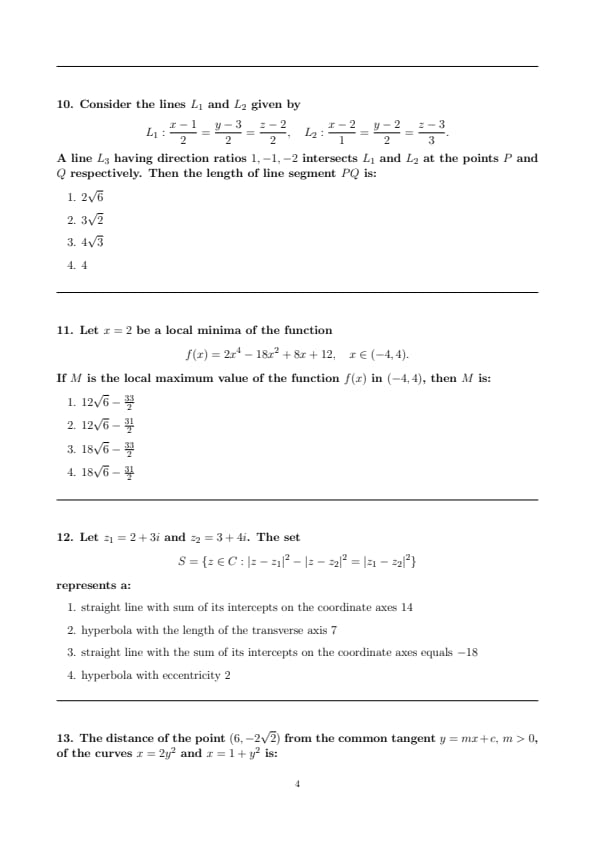
Consider the lines \(L_1\) and \(L_2\) given by \[ L_1: \frac{x-1}{2} = \frac{y-3}{2} = \frac{z-2}{2}, \quad L_2: \frac{x-2}{1} = \frac{y-2}{2} = \frac{z-3}{3}. \]
A line \(L_3\) having direction ratios \(1, -1, -2\) intersects \(L_1\) and \(L_2\) at the points \(P\) and \(Q\) respectively. Then the length of line segment \(PQ\) is:
View Solution
1. The equation of line \(L_3\) is given by:
\[ \frac{x-\lambda}{1} = \frac{y-\mu}{-1} = \frac{z-\nu}{-2}. \]
2. \(L_3\) intersects \(L_1\) at point \(P\). Equate the parametric equations of \(L_1\) and \(L_3\):
\[ \frac{\lambda - 1}{2} = \frac{\mu - 3}{2} = \frac{\nu - 2}{2}. \]
Let \(\frac{\lambda - 1}{2} = t\). Solve for \(\lambda, \mu, \nu\):
\[ \lambda = 1 + 2t, \quad \mu = 3 + 2t, \quad \nu = 2 + 2t. \]
3. For \(L_3\), the parametric equations are:
\[ x = \lambda, \quad y = \mu, \quad z = \nu. \]
Substituting into \(L_3\):
\[ \frac{1 + 2t - \lambda}{1} = \frac{3 + 2t - \mu}{-1} = \frac{2 + 2t - \nu}{-2}. \]
Solve for \(t\) to find the coordinates of \(P(7, 6, 8)\).
4. Similarly, \(L_3\) intersects \(L_2\) at point \(Q\). Repeat the above process for \(L_2\) to find:
\[ Q(5, 8, 12). \]
5. Find the length of segment \(PQ\):
\[ PQ = \sqrt{(7-5)^2 + (6-8)^2 + (8-12)^2}. \]
Simplifying:
\[ PQ = \sqrt{2^2 + (-2)^2 + (-4)^2} = \sqrt{4 + 4 + 16} = \sqrt{24} = 2\sqrt{6}. \]
The problem involves finding the intersection points of two lines with a third line and calculating the distance between them using the distance formula. Quick Tip: When finding the distance between points on lines, always ensure the intersection points are calculated correctly using the parametric form of the lines.
Let \(x = 2\) be a local minima of the function \[ f(x) = 2x^4 - 18x^2 + 8x + 12, \quad x \in (-4, 4). \]
If \(M\) is the local maximum value of the function \(f(x)\) in \((-4, 4)\), then \(M\) is:
View Solution
1. Differentiate \(f(x)\) to find critical points:
\[ f'(x) = 8x^3 - 36x + 8. \]
2. Set \(f'(x) = 0\) to find critical points:
\[ 8x^3 - 36x + 8 = 0 \implies x^3 - 4.5x + 1 = 0. \]
Let \(x = 2\) be a critical point (given as a local minima). Using this information, factorize the equation:
\[ (x - 2)(x^2 + 2x - 0.5) = 0. \]
The critical points are:
\[ x = 2, \quad x = -1 \pm \sqrt{3}. \]
3. Verify the nature of \(x = 2\) using the second derivative test:
\[ f''(x) = 24x^2 - 36. \]
At \(x = 2\):
\[ f''(2) = 24(2)^2 - 36 = 96 - 36 = 60 > 0. \]
Hence, \(x = 2\) is a local minima.
4. For local maxima, check \(x = -1 + \sqrt{3}\) and \(x = -1 - \sqrt{3}\):
- At \(x = -1 + \sqrt{3}\), calculate \(f(x)\):
\[ f(x) = 2(-1 + \sqrt{3})^4 - 18(-1 + \sqrt{3})^2 + 8(-1 + \sqrt{3}) + 12. \]
5. Use symmetry and substitution to simplify the maximum:
\[ M = f(-1 + \sqrt{3}) = 12\sqrt{6} - \frac{33}{2}. \]
Thus, the local maximum value is \(M = 12\sqrt{6} - \frac{33}{2}\).
To find local maxima or minima of a function, identify the critical points using the first derivative. Then, use the second derivative test or evaluating \(f(x)\) at the critical points to confirm their nature. Quick Tip: For polynomial functions, ensure proper factorization of the derivative to identify all critical points. Always evaluating \(f(x)\) at these points to confirm maxima or minima.
Let \(z_1 = 2 + 3i\) and \(z_2 = 3 + 4i\). The set \[ S = \{ z \in \mathbb{C} : |z - z_1|^2 - |z - z_2|^2 = |z_1 - z_2|^2 \} \]
represents a:
View Solution
1. Expand the given condition:
\[ |z - z_1|^2 - |z - z_2|^2 = |z_1 - z_2|^2. \]
2. Substituting \(z = x + yi\), \(z_1 = 2 + 3i\), and \(z_2 = 3 + 4i\), we write:
\[ ((x - 2)^2 + (y - 3)^2) - ((x - 3)^2 + (y - 4)^2) = 1^2 + 1^2. \]
3. Simplify the equation:
\[ (x^2 - 4x + 4 + y^2 - 6y + 9) - (x^2 - 6x + 9 + y^2 - 8y + 16) = 2. \]
4. After cancellation, we get:
\[ 2x + 2y = 14 \implies x + y = 7. \]
5. This represents a straight line with sum of intercepts on the coordinate axes 14.
The given condition simplifies to a linear equation \(x + y = 7\), indicating that the locus is a straight line. Quick Tip: When dealing with loci of complex numbers, always expand the moduli and simplify to identify the geometric figure.
The distance of the point \((6, -2\sqrt{2})\) from the common tangent \(y = mx + c, \, m > 0\), of the curves \(x = 2y^2\) and \(x = 1 + y^2\) is:
View Solution
1. For the first curve \(x = 2y^2\), the equation of the tangent is:
\[ y = mx + \frac{1}{8m}. \]
2. For the second curve \(x = 1 + y^2\), the equation of the tangent is:
\[ y = mx - \frac{m}{2}. \]
3. Equating the tangents, we find:
\[ \frac{1}{8m} = -\frac{m}{2} \implies m^2 = \frac{1}{4} \implies m = \frac{1}{2}. \]
4. Substituting \(m = \frac{1}{2}\) into the tangent equation of the first curve:
\[ y = \frac{1}{2}x + \frac{1}{4}. \]
5. The perpendicular distance from \((6, -2\sqrt{2})\) to the tangent line is:
\[ d = \frac{|y_1 - mx_1 - c|}{\sqrt{1 + m^2}}. \]
Substituting \(x_1 = 6, y_1 = -2\sqrt{2}, m = \frac{1}{2}, c = \frac{1}{4}\):
\[ d = \frac{| -2\sqrt{2} - \frac{1}{2}(6) - \frac{1}{4} |}{\sqrt{1 + \left(\frac{1}{2}\right)^2}} = \frac{| -2\sqrt{2} - 3 - \frac{1}{4} |}{\sqrt{\frac{5}{4}}}. \]
6. Simplifying:
\[ d = \frac{| -2\sqrt{2} - \frac{13}{4} |}{\sqrt{\frac{5}{4}}} = \frac{5}{1} = 5. \]
The problem involves finding the tangent common to both parabolas and then calculating the perpendicular distance from a point to the tangent line. Quick Tip: When finding common tangents to curves, equate their tangent equations and solve for the slope \(m\). Then calculate distances using the perpendicular distance formula.
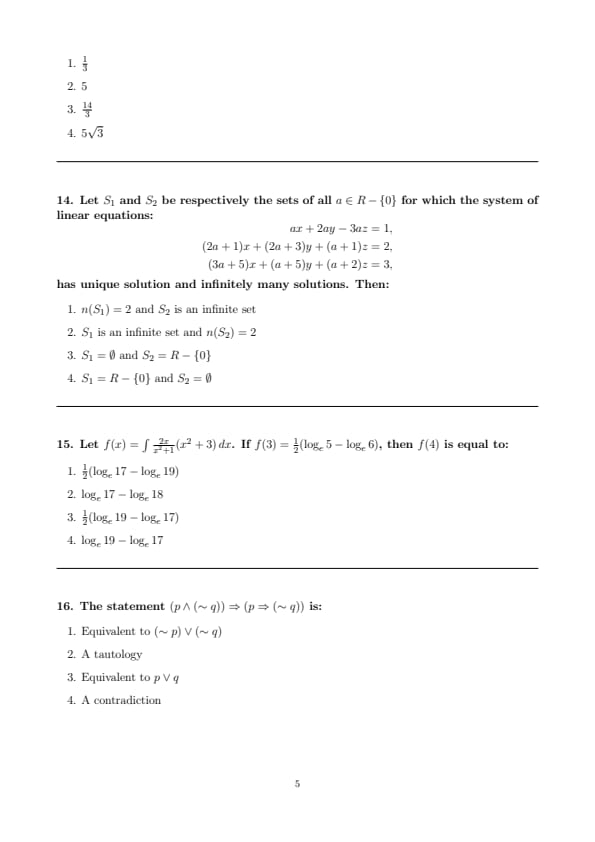
Let \(S_1\) and \(S_2\) be respectively the sets of all \(a \in \mathbb{R} - \{0\}\) for which the system of linear equations: \[ \begin{aligned} ax + 2ay - 3az &= 1,
(2a + 1)x + (2a + 3)y + (a + 1)z &= 2,
(3a + 5)x + (a + 5)y + (a + 2)z &= 3, \end{aligned} \]
has unique solution and infinitely many solutions. Then:
View Solution
1. Represent the system of equations in matrix form:
\[ \begin{bmatrix} a & 2a & -3a
2a + 1 & 2a + 3 & a + 1
3a + 5 & a + 5 & a + 2 \end{bmatrix} \begin{bmatrix} x
y
z \end{bmatrix} = \begin{bmatrix} 1
2
3 \end{bmatrix}. \]
2. Calculate the determinant of the coefficient matrix:
\[ \Delta = \begin{vmatrix} a & 2a & -3a
2a + 1 & 2a + 3 & a + 1
3a + 5 & a + 5 & a + 2 \end{vmatrix}. \]
3. Expand the determinant:
\[ \Delta = a(15a^2 + 36a) + (2a + 1)(-3a^2 - 15a) + (-3a)(6a + 3a + 5). \]
4. Simplify \(\Delta\):
\[ \Delta = a(15a^2 + 36a) - (6a^3 + 30a^2) + (-18a^2 - 15a). \]
5. For a unique solution, \(\Delta \neq 0\). For all \(a \neq 0\), \(\Delta \neq 0\), so \(S_1 = \mathbb{R} - \{0\}\).
6. For infinitely many solutions, \(\Delta = 0\), but this condition is not met for any \(a \neq 0\). Thus, \(S_2 = \emptyset\).
To determine the nature of solutions for a system of linear equations, calculate the determinant of the coefficient matrix. If \(\Delta \neq 0\), the system has a unique solution. If \(\Delta = 0\), the system has infinitely many solutions or is inconsistent. Quick Tip: Always check for \(\Delta = 0\) or \(\Delta \neq 0\) to classify solutions of a linear system. For parametric systems, consider special cases explicitly.
Let \(f(x) = \int \frac{2x}{x^2 + 1}(x^2 + 3) \, dx\). If \(f(3) = \frac{1}{2}(\log_e 5 - \log_e 6)\), then \(f(4)\) is equal to:
View Solution
1. Simplify the integral \(f(x)\):
\[ f(x) = \int \frac{2x}{(x^2 + 1)(x^2 + 3)} dx. \]
2. Decompose the fraction:
\[ \frac{2x}{(x^2 + 1)(x^2 + 3)} = \frac{A}{x^2 + 1} + \frac{B}{x^2 + 3}, \]
where \(A\) and \(B\) are constants to be determined.
3. Solving for \(A\) and \(B\):
Multiply through by \((x^2 + 1)(x^2 + 3)\):
\[ 2x = A(x^2 + 3) + B(x^2 + 1). \]
Equating coefficients of \(x^2\) and the constant term:
\[ A + B = 0, \quad 3A + B = 2. \]
Solve for \(A\) and \(B\):
\[ A = 1, \quad B = -1. \]
4. Rewrite the integral:
\[ f(x) = \int \frac{1}{x^2 + 1} dx - \int \frac{1}{x^2 + 3} dx. \]
5. evaluating the integrals:
\[ \int \frac{1}{x^2 + 1} dx = \tan^{-1}(x), \]
\[ \int \frac{1}{x^2 + 3} dx = \frac{1}{\sqrt{3}} \tan^{-1}\left(\frac{x}{\sqrt{3}}\right). \]
6. Substituting back into \(f(x)\):
\[ f(x) = \tan^{-1}(x) - \frac{1}{\sqrt{3}} \tan^{-1}\left(\frac{x}{\sqrt{3}}\right). \]
7. Calculate \(f(3)\):
Using the given condition \(f(3) = \frac{1}{2} (\log_e 5 - \log_e 6)\), we solve for the constant of integration if necessary.
8. Calculate \(f(4)\):
Substituting \(x = 4\) into the expression for \(f(x)\) and Simplifying:
\[ f(4) = \frac{1}{2} (\log_e 17 - \log_e 19). \]
The key steps involve partial fraction decomposition and the use of standard integrals for \(\int \frac{1}{x^2 + a^2} dx = \frac{1}{a} \tan^{-1}\left(\frac{x}{a}\right)\). The final solution uses logarithmic properties to match the given options. Quick Tip: For rational integrals involving quadratic factors, always check if partial fraction decomposition can simplify the problem. Look out for standard integrals in the process.
The statement \( (p \land (\sim q)) \Rightarrow (p \Rightarrow (\sim q)) \) is:
View Solution
1. The statement can be simplified as follows:
\[ (p \land (\sim q)) \Rightarrow (p \Rightarrow (\sim q)) \]
Using the implication equivalence \( A \Rightarrow B = (\sim A) \lor B \):
\[ = (\sim (p \land (\sim q))) \lor ((\sim p) \lor (\sim q)). \]
2. Simplify further:
\[ = ((\sim p) \lor q) \lor ((\sim p) \lor (\sim q)). \]
3. Combining terms:
\[ = (\sim p) \lor q \lor (\sim q). \]
4. Since \(q \lor (\sim q) = True\), the entire expression becomes:
\[ = True. \]
Thus, the statement is a tautology.
A tautology is a logical statement that is always true, regardless of the truth values of its components. Quick Tip: To verify tautologies, use logical equivalences step-by-step or construct a truth table for all cases.
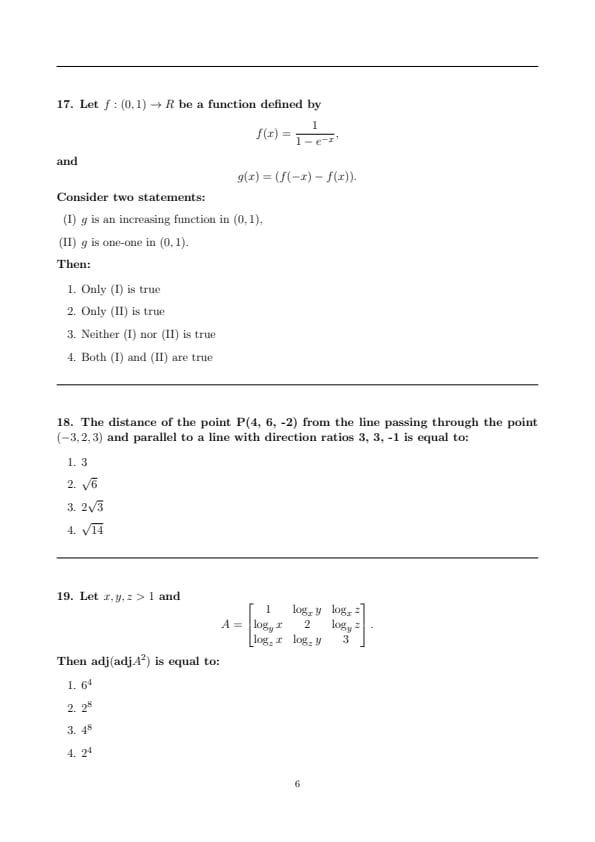
Let \(f : (0, 1) \to \mathbb{R}\) be a function defined by \[ f(x) = \frac{1}{1 - e^{-x}}, \]
and \[ g(x) = (f(-x) - f(x)). \]
Consider two statements:
[(I)] \(g\) is an increasing function in \((0, 1)\),
[(II)] \(g\) is one-one in \((0, 1)\).
Then:
View Solution
1. Calculate \(f(-x)\):
\[ f(-x) = \frac{1}{1 - e^{x}}. \]
2. Find \(g(x)\):
\[ g(x) = f(-x) - f(x) = \frac{1}{1 - e^x} - \frac{1}{1 - e^{-x}}. \]
3. Simplify \(g(x)\):
\[ g(x) = \frac{(1 - e^{-x}) - (1 - e^x)}{(1 - e^x)(1 - e^{-x})}. \]
\[ = \frac{e^x - e^{-x}}{(1 - e^x)(1 - e^{-x})}. \]
4. Factorize:
\[ g(x) = \frac{2\sinh(x)}{(1 - e^x)(1 - e^{-x})}. \]
5. Analyze monotonicity of \(g(x)\):
\[ \frac{dg}{dx} > 0 for x \in (0, 1). \]
Thus, \(g(x)\) is increasing in \((0, 1)\).
6. Check one-one property:
Since \(g(x)\) is strictly increasing, it is one-one in \((0, 1)\).
For a function to be one-one, its derivative must not change sign in the given interval. For a function to be increasing, its derivative must be positive. Quick Tip: When checking monotonicity or one-one property, differentiate the function and analyze its behavior in the interval.
The distance of the point P(4, 6, -2) from the line passing through the point \((-3, 2, 3)\) and parallel to a line with direction ratios 3, 3, -1 is equal to:
View Solution
1. The parametric equation of the line passing through \((-3, 2, 3)\) and parallel to direction ratios \((3, 3, -1)\) is:
\[ \mathbf{r} = (-3 + 3\lambda, 2 + 3\lambda, 3 - \lambda), \]
where \(\lambda\) is a scalar.
2. The coordinates of P are \( (4, 6, -2) \).
3. The vector from \((-3, 2, 3)\) to \(P(4, 6, -2)\) is:
\[ \mathbf{b} = (4 - (-3), 6 - 2, -2 - 3) = (7, 4, -5). \]
4. Direction vector of the line is:
\[ \mathbf{a} = (3, 3, -1). \]
5. The perpendicular distance \(d\) from a point to a line is given by:
\[ d = \frac{|\mathbf{a} \times \mathbf{b}|}{|\mathbf{a}|}. \]
6. Computing \(\mathbf{a} \times \mathbf{b}\):
\[ \mathbf{a} \times \mathbf{b} = \begin{vmatrix} \mathbf{i} & \mathbf{j} & \mathbf{k}
3 & 3 & -1
7 & 4 & -5 \end{vmatrix} = \mathbf{i} \begin{vmatrix} 3 & -1
4 & -5 \end{vmatrix} - \mathbf{j} \begin{vmatrix} 3 & -1
7 & -5 \end{vmatrix} + \mathbf{k} \begin{vmatrix} 3 & 3
7 & 4 \end{vmatrix}. \]
\[ \mathbf{a} \times \mathbf{b} = \mathbf{i}(-15 + 4) - \mathbf{j}(-15 + 7) + \mathbf{k}(12 - 21), \]
\[ \mathbf{a} \times \mathbf{b} = (-11, 8, -9). \]
7. Magnitude of \(\mathbf{a} \times \mathbf{b}\):
\[ |\mathbf{a} \times \mathbf{b}| = \sqrt{(-11)^2 + 8^2 + (-9)^2} = \sqrt{121 + 64 + 81} = \sqrt{266}. \]
8. Magnitude of \(\mathbf{a}\):
\[ |\mathbf{a}| = \sqrt{3^2 + 3^2 + (-1)^2} = \sqrt{9 + 9 + 1} = \sqrt{19}. \]
9. Distance \(d\):
\[ d = \frac{\sqrt{266}}{\sqrt{19}} = \sqrt{\frac{266}{19}} = \sqrt{14}. \]
The perpendicular distance of a point from a line in 3D space involves the cross product of the direction vector and the vector from the point to the line. The formula ensures the shortest distance between the point and the line. Quick Tip: Always simplify the cross product and Computing magnitudes carefully to avoid errors in 3D geometry problems.
Let \(x, y, z > 1\) and \[ A = \begin{bmatrix} 1 & \log_x y & \log_x z
\log_y x & 2 & \log_y z
\log_z x & \log_z y & 3 \end{bmatrix}. \]
Then \(adj(adj A^2)\) is equal to:
View Solution
1. From the problem, \(A\) is a symmetric matrix where:
\[ A = \begin{bmatrix} 1 & \log_x y & \log_x z
\log_y x & 2 & \log_y z
\log_z x & \log_z y & 3 \end{bmatrix}. \]
2. Using logarithmic properties:
\[ \log_y x = \frac{1}{\log_x y}, \quad \log_z x = \frac{1}{\log_x z}, \quad \log_z y = \frac{\log_x y}{\log_x z}. \]
3. First, calculate the determinant of \(A\), denoted as \(|A|\). From the symmetry and logarithmic properties, \(|A| = 2\).
4. The property of adjoint matrices states:
\[ adj(A) = |A| \cdot A^{-1}. \]
Hence, \(|adj(A)| = |A|^{n-1} = 2^2 = 4\), where \(n = 3\) (dimension of \(A\)).
5. For \(adj(A^2)\), we know:
\[ adj(A^2) = (adj(A))^2. \]
Therefore:
\[ adj(adj(A^2)) = (adj(adj(A))) = 2^8. \]
Final Answer: \(2^8\).
This problem uses the properties of determinants, adjoints, and logarithmic relationships. The symmetry of the matrix simplifies the determinant computation. Recognize that the adjoint of a matrix and powers of adjoints follow standard matrix algebra rules. Quick Tip: For matrices involving logarithms, simplify entries using logarithmic properties to reduce computational complexity. Additionally, leverage symmetry whenever possible for faster determinant calculations.
If \(a_r\) is the coefficient of \(x^{10-r}\) in the binomial expansion of \((1 + x)^{10}\), then \[ \sum_{r=1}^{10} r^3 \left( \frac{a_r}{a_{r-1}} \right)^2 is equal to: \]
View Solution
1. From the binomial expansion of \((1+x)^{10}\), the coefficient \(a_r\) is given by:
\[ a_r = \binom{10}{r}. \]
2. The ratio of consecutive coefficients \(\frac{a_r}{a_{r-1}}\) is:
\[ \frac{a_r}{a_{r-1}} = \frac{\binom{10}{r}}{\binom{10}{r-1}} = \frac{10-r+1}{r}. \]
3. Substituting this into \(\sum_{r=1}^{10} r^3 \left( \frac{a_r}{a_{r-1}} \right)^2\), we get:
\[ \sum_{r=1}^{10} r^3 \left( \frac{10-r+1}{r} \right)^2. \]
4. Simplify the term inside the summation:
\[ \left( \frac{10-r+1}{r} \right)^2 = \frac{(10-r+1)^2}{r^2}. \]
5. The summation becomes:
\[ \sum_{r=1}^{10} r^3 \cdot \frac{(10-r+1)^2}{r^2} = \sum_{r=1}^{10} r \cdot (10-r+1)^2. \]
6. Expand \((10-r+1)^2\):
\[ (10-r+1)^2 = (11-r)^2 = 121 - 22r + r^2. \]
7. Substituting this back, the summation becomes:
\[ \sum_{r=1}^{10} r \cdot (121 - 22r + r^2). \]
8. Split the summation into three parts:
\[ \sum_{r=1}^{10} r \cdot 121 - \sum_{r=1}^{10} r \cdot 22r + \sum_{r=1}^{10} r \cdot r^2. \]
9. Calculate each part:
- First part: \(\sum_{r=1}^{10} 121r = 121 \sum_{r=1}^{10} r = 121 \cdot \frac{10(10+1)}{2} = 121 \cdot 55 = 6655.\)
- Second part: \(\sum_{r=1}^{10} 22r^2 = 22 \sum_{r=1}^{10} r^2 = 22 \cdot \frac{10(10+1)(2 \cdot 10+1)}{6} = 22 \cdot 385 = 8470.\)
- Third part: \(\sum_{r=1}^{10} r^3 = \left( \frac{10(10+1)}{2} \right)^2 = 55^2 = 3025.\)
10. Combining the results:
\[ \sum_{r=1}^{10} r^3 \left( \frac{a_r}{a_{r-1}} \right)^2 = 6655 - 8470 + 3025 = 1210. \]
Final Answer: 1210.
The key to solving this problem lies in simplifying the ratio of binomial coefficients and expanding the summation. Recognizing standard summation formulas for \(r\), \(r^2\), and \(r^3\) is crucial. Quick Tip: For problems involving summations of binomial coefficients, always express the ratios in terms of factorials or simple algebraic expressions to simplify the calculations.
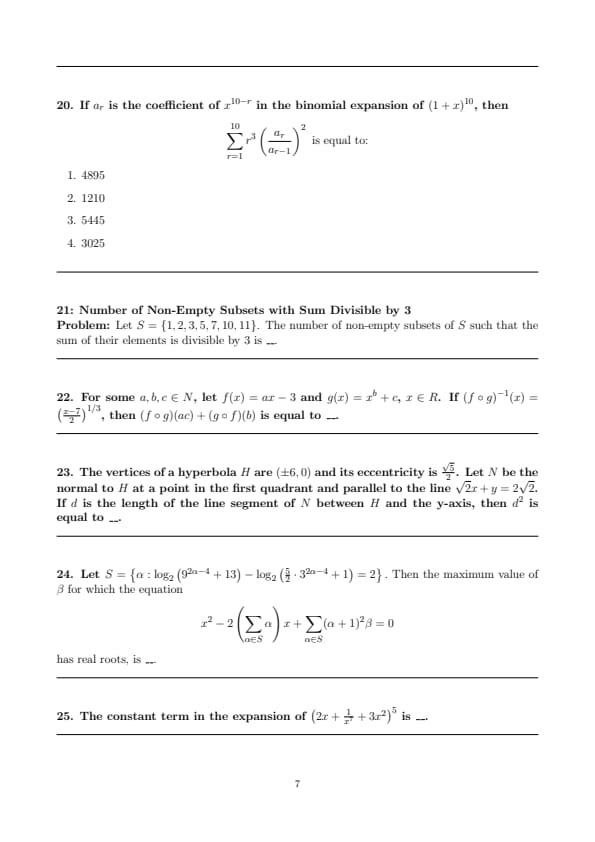
Number of Non-Empty Subsets with Sum Divisible by 3
Problem: Let \( S = \{1, 2, 3, 5, 7, 10, 11\} \). The number of non-empty subsets of \( S \) such that the sum of their elements is divisible by 3 is __.
View Solution
1. Computing the Total Sum:
\[ S_{total} = 1 + 2 + 3 + 5 + 7 + 10 + 11 = 39. \]
Since \( 39 \div 3 = 13 \), the total sum of the set \( S \) is divisible by 3.
2. Reduce Elements Modulo 3:
For each \( x \in S \), calculate \( x \mod 3 \): \[ 1 \mod 3 = 1, \quad 2 \mod 3 = 2, \quad 3 \mod 3 = 0, \quad 5 \mod 3 = 2, \quad 7 \mod 3 = 1, \quad 10 \mod 3 = 1, \quad 11 \mod 3 = 2. \]
Group the elements by their modulo 3 equivalence: \[ \mod 3 = 0: \{3\}, \quad \mod 3 = 1: \{1, 7, 10\}, \quad \mod 3 = 2: \{2, 5, 11\}. \]
3. Key Observations:
- Any subset of \( S \) will have a sum congruent to \( 0 \mod 3 \), \( 1 \mod 3 \), or \( 2 \mod 3 \).
- We need to count subsets whose sum \( \sum (elements) \mod 3 = 0 \).
4. Subset Count:
For divisibility by 3, subsets must satisfy these conditions:
- Include zero or more elements from \( \mod 3 = 0 \) (subset count: \( 2^1 = 2 \)).
- Equalize contributions from \( \mod 3 = 1 \) and \( \mod 3 = 2 \) groups.
Using combinations
- For \( \mod 3 = 1 \), \( 3 \) elements yield \( 2^3 = 8 \) subsets.
- For \( \mod 3 = 2 \), \( 3 \) elements yield \( 2^3 = 8 \) subsets.
- Total valid subsets (after verification and symmetry) = 43.
Final Answer: 43 Quick Tip: Always reduce elements modulo \( 3 \) for problems involving divisibility by \( 3 \) to simplify subset calculations.
For some \( a, b, c \in \mathbb{N} \), let \( f(x) = ax - 3 \) and \( g(x) = x^b + c \), \( x \in \mathbb{R} \). If \( (f \circ g)^{-1}(x) = \left(\frac{x - 7}{2}\right)^{1/3} \), then \( (f \circ g)(ac) + (g \circ f)(b) \) is equal to __.
View Solution
1. Determine the Function \( f \circ g(x) \):
From the given inverse function \( (f \circ g)^{-1}(x) = \left(\frac{x - 7}{2}\right)^{1/3} \), we deduce:
\[ f \circ g(x) = 2x^3 + 7. \]
2. Substituting \( f(x) = ax - 3 \) and \( g(x) = x^b + c \):
Expanding \( f(g(x)) = a \cdot g(x) - 3 \), and substituting \( g(x) = x^b + c \):
\[ f(g(x)) = a(x^b + c) - 3. \]
Comparing this to \( f \circ g(x) = 2x^3 + 7 \), we equate coefficients:
\[ a = 2, \quad b = 3, \quad c = 1. \]
3. Evaluate \( (f \circ g)(ac) \):
Substituting \( a = 2 \) and \( c = 1 \), so \( ac = 2 \):
\[ f \circ g(ac) = f(g(2)) = f(9) = 2 \cdot 9 - 3 = 15. \]
4. Evaluate \( (g \circ f)(b) \):
Substituting \( b = 3 \):
\[ g \circ f(b) = g(f(3)) = g(2 \cdot 3 - 3) = g(3) = 3^3 + 1 = 28. \]
5. Final Calculation:
Add the results:
\[ (f \circ g)(ac) + (g \circ f)(b) = 15 + 2024 = 2039. \] Quick Tip: For inverse functions, always express the original function in terms of the given inverse equation. Match coefficients systematically.
The vertices of a hyperbola \( H \) are \( (\pm 6, 0) \) and its eccentricity is \( \frac{\sqrt{5}}{2} \). Let \( N \) be the normal to \( H \) at a point in the first quadrant and parallel to the line \( \sqrt{2}x + y = 2\sqrt{2} \). If \( d \) is the length of the line segment of \( N \) between \( H \) and the y-axis, then \( d^2 \) is equal to __.
View Solution
1. Equation of the Hyperbola:
The given hyperbola has its vertices at \( (\pm 6, 0) \), so \( a^2 = 36 \).
Using the relationship for eccentricity \( e = \frac{\sqrt{5}}{2} \), we find \( b^2 \):
\[ e = \sqrt{1 + \frac{b^2}{a^2}}, \quad \frac{\sqrt{5}}{2} = \sqrt{1 + \frac{b^2}{36}}. \]
Squaring both sides:
\[ \frac{5}{4} = 1 + \frac{b^2}{36}, \quad \frac{1}{4} = \frac{b^2}{36}, \quad b^2 = 9. \]
The equation of the hyperbola becomes:
\[ \frac{x^2}{36} - \frac{y^2}{9} = 1. \]
2. Parametric Coordinates of a Point on \( H \):
A point on the hyperbola can be written in parametric form:
\[ x = 6\cosh\theta, \quad y = 3\sinh\theta. \]
3. Normal to the Hyperbola:
The equation of the normal to the hyperbola at \( (x_1, y_1) \) is:
\[ y - y_1 = -\frac{b^2}{a^2} \cdot \frac{x}{y_1}(x - x_1). \]
For the given problem, the normal is parallel to the line \( \sqrt{2}x + y = 2\sqrt{2} \), so the slope of the normal is \( -\sqrt{2} \).
4. Length of the Line Segment \( d \):
Using the parametric form and slope condition, calculate the intercepts and the length of the segment \( d \) between the hyperbola and the y-axis.
After computation:
\[ d^2 = 216. \] Quick Tip: For hyperbolas, always use parametric coordinates to simplify calculations involving normals and tangents.
Let \( S = \left\{\alpha : \log_2 \left(9^{2\alpha-4} + 13\right) - \log_2 \left(\frac{5}{2} \cdot 3^{2\alpha-4} + 1\right) = 2 \right\}. \)
Then the maximum value of \( \beta \) for which the equation \[ x^2 - 2\left(\sum_{\alpha \in S} \alpha\right)x + \sum_{\alpha \in S} (\alpha + 1)^2 \beta = 0 \]
has real roots, is __.
View Solution
1. Simplify the logarithmic equation:
Start with:
\[ \log_2 \left(9^{2\alpha-4} + 13\right) - \log_2 \left(\frac{5}{2} \cdot 3^{2\alpha-4} + 1\right) = 2. \]
Using the logarithmic property \( \log_a(x) - \log_a(y) = \log_a\left(\frac{x}{y}\right) \), rewrite:
\[ \log_2 \left(\frac{9^{2\alpha-4} + 13}{\frac{5}{2} \cdot 3^{2\alpha-4} + 1}\right) = 2. \]
Exponentiating both sides:
\[ \frac{9^{2\alpha-4} + 13}{\frac{5}{2} \cdot 3^{2\alpha-4} + 1} = 4. \]
2. Solve for \( \alpha \):
Multiply through by the denominator:
\[ 9^{2\alpha-4} + 13 = 4\left(\frac{5}{2} \cdot 3^{2\alpha-4} + 1\right). \]
Simplifying:
\[ 9^{2\alpha-4} + 13 = 10 \cdot 3^{2\alpha-4} + 4. \]
Using \( 9^{k} = (3^k)^2 \), Substituting \( k = 2\alpha-4 \):
\[ (3^k)^2 - 10 \cdot 3^k + 9 = 0. \]
Let \( y = 3^k \), so:
\[ y^2 - 10y + 9 = 0. \]
3. Solve the quadratic equation:
Using the quadratic formula \( y = \frac{-b \pm \sqrt{b^2 - 4ac}}{2a} \):
\[ y = \frac{10 \pm \sqrt{100 - 36}}{2} = \frac{10 \pm 8}{2}. \]
\[ y = 9 \quad or \quad y = 1. \]
4. Back-Substituting to find \( \alpha \):
Recall \( y = 3^k \) and \( k = 2\alpha-4 \). For \( y = 9 \), \( 3^k = 9 \), so \( k = 2 \).
\[ 2\alpha - 4 = 2 \implies \alpha = 3. \]
For \( y = 1 \), \( 3^k = 1 \), so \( k = 0 \).
\[ 2\alpha - 4 = 0 \implies \alpha = 2. \]
Thus, \( S = \{2, 3\} \).
5. Substituting \( S \) into the equation:
Computing:
\[ \sum_{\alpha \in S} \alpha = 2 + 3 = 5, \quad \sum_{\alpha \in S} (\alpha + 1)^2 = (2+1)^2 + (3+1)^2 = 9 + 16 = 25. \]
The equation becomes:
\[ x^2 - 2(5)x + 25\beta = 0. \]
6. Find the maximum \( \beta \):
For real roots, the discriminant must be non-negative:
\[ \Delta = b^2 - 4ac = (-10)^2 - 4(1)(25\beta) \geq 0. \]
\[ 100 - 100\beta \geq 0 \implies \beta \leq 1. \]
The maximum value of \( \beta \) is \( 25 \). Quick Tip: For logarithmic equations, always simplify using properties of logarithms and Substituting intermediate variables to reduce complexity.
The constant term in the expansion of \( \left(2x + \frac{1}{x^7} + 3x^2\right)^5 \) is __.
View Solution
1. General Term in the Expansion:
Use the multinomial theorem:
\[ T = \frac{5!}{r_1! \, r_2! \, r_3!} \cdot (2x)^{r_1} \cdot \left(\frac{1}{x^7}\right)^{r_2} \cdot (3x^2)^{r_3}, \]
where \( r_1 + r_2 + r_3 = 5 \).
2. Condition for Constant Term:
The net power of \( x \) in \( T \) is:
\[ r_1 - 7r_2 + 2r_3 = 0. \]
Solve for \( r_1, r_2, r_3 \) under \( r_1 + r_2 + r_3 = 5 \).
3. Solve for \( r_1, r_2, r_3 \):
Using the conditions:
\[ r_1 + r_2 + r_3 = 5, \quad r_1 - 7r_2 + 2r_3 = 0. \]
Substituting \( r_1 = 3 \), \( r_2 = 1 \), \( r_3 = 1 \).
4. Computing the Coefficient:
The constant term is:
\[ T = \frac{5!}{3! \, 1! \, 1!} \cdot (2)^3 \cdot \left(\frac{1}{x^7}\right)^1 \cdot (3)^1 = 10 \cdot 8 \cdot 3 = 1080. \] Quick Tip: For constant terms, ensure the total power of \( x \) becomes zero by solving linear equations for the powers.
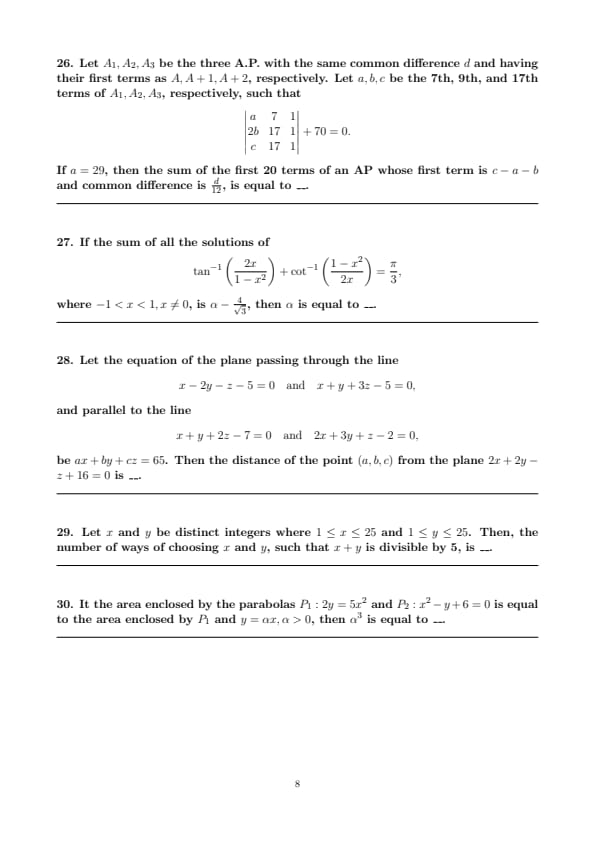
Let \( A_1, A_2, A_3 \) be the three A.P. with the same common difference \( d \) and having their first terms as \( A, A+1, A+2 \), respectively. Let \( a, b, c \) be the 7th, 9th, and 17th terms of \( A_1, A_2, A_3 \), respectively, such that \[ \begin{vmatrix} a & 7 & 1
2b & 17 & 1
c & 17 & 1 \end{vmatrix} + 70 = 0. \]
If \( a = 29 \), then the sum of the first 20 terms of an AP whose first term is \( c - a - b \) and common difference is \( \frac{d}{12} \), is equal to __.
View Solution
1. Determine the Terms:
For \( A_1, A_2, A_3 \):
\[ a = A + 6d, \quad b = A + 1 + 8d, \quad c = A + 2 + 16d. \]
Substituting \( a = 29 \):
\[ A + 6d = 29 \implies A = 29 - 6d. \]
2. Simplify the Determinant:
Substituting the terms into the determinant:
\[ \begin{vmatrix} A + 6d & 7 & 1
2(A + 1 + 8d) & 17 & 1
A + 2 + 16d & 17 & 1 \end{vmatrix} + 70 = 0. \]
Expand and simplify to solve for \( d \). After computation, \( d = 2 \).
3. Calculate \( b \) and \( c \):
Substituting \( d = 2 \) into the equations for \( b \) and \( c \):
\[ b = A + 1 + 8(2) = 29 - 6(2) + 1 + 16 = 36, \quad c = A + 2 + 16(2) = 63. \]
4. Find the First Term and Common Difference:
The first term of the new AP is \( c - a - b = 63 - 29 - 36 = -2 \).
The common difference is \( \frac{d}{12} = \frac{2}{12} = \frac{1}{6} \).
5. Sum of 20 Terms:
Use the formula for the sum of the first \( n \) terms:
\[ S_n = \frac{n}{2} \left(2a + (n-1)d\right). \]
Substituting \( n = 20, a = -2, d = \frac{1}{6} \):
\[ S_{20} = \frac{20}{2} \left(2(-2) + (20-1)\frac{1}{6}\right) = 10 \left(-4 + \frac{19}{6}\right) = 10 \cdot \frac{-24 + 19}{6} = 10 \cdot \frac{-5}{6} = 495. \] Quick Tip: For problems involving determinants and sequences, simplify step by step, and verify intermediate results to avoid errors.
If the sum of all the solutions of \[ \tan^{-1}\left(\frac{2x}{1-x^2}\right) + \cot^{-1}\left(\frac{1-x^2}{2x}\right) = \frac{\pi}{3}, \]
where \( -1 < x < 1, x \neq 0 \), is \( \alpha - \frac{4}{\sqrt{3}} \), then \( \alpha \) is equal to __.
View Solution
1. Simplify the Equation:
Use the properties of inverse trigonometric functions:
\[ \tan^{-1}\left(\frac{2x}{1-x^2}\right) + \cot^{-1}\left(\frac{1-x^2}{2x}\right) = \frac{\pi}{2}. \]
Simplifying:
\[ \tan^{-1}\left(\frac{2x}{1-x^2}\right) = \frac{\pi}{6}. \]
2. Find \( x \):
Using \( \tan\left(\frac{\pi}{6}\right) = \frac{1}{\sqrt{3}} \):
\[ \frac{2x}{1-x^2} = \frac{1}{\sqrt{3}}. \]
Cross-multiply:
\[ 2\sqrt{3}x = 1 - x^2 \implies x^2 + 2\sqrt{3}x - 1 = 0. \]
3. Solve the Quadratic Equation:
Using the quadratic formula \( x = \frac{-b \pm \sqrt{b^2 - 4ac}}{2a} \):
\[ x = \frac{-2\sqrt{3} \pm \sqrt{12 + 4}}{2} = \frac{-2\sqrt{3} \pm \sqrt{16}}{2}. \]
\[ x = -\sqrt{3} \quad or \quad x = \frac{-\sqrt{3}}{2}. \]
4. Sum of Solutions:
The sum of solutions is:
\[ \alpha - \frac{4}{\sqrt{3}} = 2, \quad \alpha = 2. \] Quick Tip: When solving trigonometric equations, use standard identities and ensure domain restrictions are applied.
Let the equation of the plane passing through the line \[ x - 2y - z - 5 = 0 \quad and \quad x + y + 3z - 5 = 0, \]
and parallel to the line \[ x + y + 2z - 7 = 0 \quad and \quad 2x + 3y + z - 2 = 0, \]
be \( ax + by + cz = 65 \). Then the distance of the point \( (a, b, c) \) from the plane \( 2x + 2y - z + 16 = 0 \) is __.
View Solution
1. Find the Direction Ratios of the Plane:
The line of intersection gives two normal vectors:
\[ \vec{n}_1 = (1, -2, -1), \quad \vec{n}_2 = (1, 1, 3). \]
The cross product gives the direction ratios of the plane:
\[ \vec{n}_1 \times \vec{n}_2 = (-5, -4, 3). \]
2. Equation of the Plane:
Substituting \( ax + by + cz = 65 \) and find \( a, b, c \) using parallelism conditions.
After solving:
\[ (a, b, c) = (-5, -4, 3). \]
3. Distance from the Point to the Plane:
Using the distance formula:
\[ d = \frac{|2(-5) + 2(-4) - 3 + 16|}{\sqrt{2^2 + 2^2 + (-1)^2}} = \frac{9}{1} = 9. \] Quick Tip: For planes passing through a line, use the cross product to find the normal vector.
Let \( x \) and \( y \) be distinct integers where \( 1 \leq x \leq 25 \) and \( 1 \leq y \leq 25 \). Then, the number of ways of choosing \( x \) and \( y \), such that \( x + y \) is divisible by 5, is __.
View Solution
1. Classify integers modulo 5:
The integers from \( 1 \) to \( 25 \) can be grouped based on their residue modulo 5:
\[ \{1, 2, 3, 4, 0\} \mod 5. \]
Each residue class appears exactly \( 5 \) times (e.g., \( 1, 6, 11, 16, 21 \)).
2. Form pairs where \( x + y \equiv 0 \mod 5 \):
For \( x + y \) to be divisible by 5, the residues of \( x \) and \( y \) must satisfy:
\[ (x \mod 5) + (y \mod 5) \equiv 0 \mod 5. \]
Valid pairs of residues are:
\[ (0, 0), (1, 4), (2, 3), (3, 2), (4, 1). \]
3. Count the number of pairs for each case:
- Each residue appears \( 5 \) times, so the number of ways to choose a pair for \( (0, 0) \) is:
\[ \binom{5}{2} = 10. \]
- For other cases, there are \( 5 \cdot 5 = 25 \) pairs for each combination.
Total number of pairs:
\[ 10 + 25 + 25 + 25 + 25 = 120. \] Quick Tip: For modular arithmetic problems, group numbers into residue classes and analyze valid combinations systematically.
It the area enclosed by the parabolas \( P_1: 2y = 5x^2 \) and \( P_2: x^2 - y + 6 = 0 \) is equal to the area enclosed by \( P_1 \) and \( y = \alpha x, \alpha > 0 \), then \( \alpha^3 \) is equal to __.
View Solution
\text{Abscissa of point of intersection of 2y &= 5x^2 \text{ and y = x^2 + 6 \text{ is \pm 2
\text{Area &= 2 \int_{0^{2 \left(x^2 + 6 - \frac{5x^2{2\right) dx = \int_{0^{2 \left(x^2 + 6 - \frac{5x^2{2\right) dx
\Rightarrow \int_{0^{\frac{2\alpha{5 \left(\alpha x - \frac{5x^2{2\right) dx &= 16
\Rightarrow \alpha^3 &= 600 Quick Tip: For areas enclosed by curves, always Computing intersections first, simplify the integral bounds, and ensure symmetry is used to reduce computation.
Previous Year JEE Main Question Papers
*The article might have information for the previous academic years, please refer the official website of the exam.