
JEE Main 2023 Question Paper with Solution Pdf for Mathematics (January 30 - Shift 1)

.jpg?tr=h-55,w-55,c-force)
Content Strategist|Tech-innovator|National Hackathon Winner | Updated On - Mar 30, 2026
The JEE Main 2023 Mathematics Question Paper with Solution PDF is available here for download. The exam was successfully conducted by NTA on January 30, 2023, in the first shift.
Students can download JEE Main previous year question papers PDFs with detailed solutions to practice and improve their performance. Solving these papers helps aspirants understand the JEE Main exam pattern, analyze the difficulty level, and prepare according to the latest JEE Main syllabus.
Related Links:
Download JEE Main 2026 Session 1 Question Paper with Solution PDF
Download JEE Main 2025 Question Paper with Solution PDF
JEE Main 2023 Mathematics Question Paper Jan 30 Shift 1 with Solution Pdf
| JEE Main 2023 Mathematics Question Paper |  Download Download |
Check Solution |

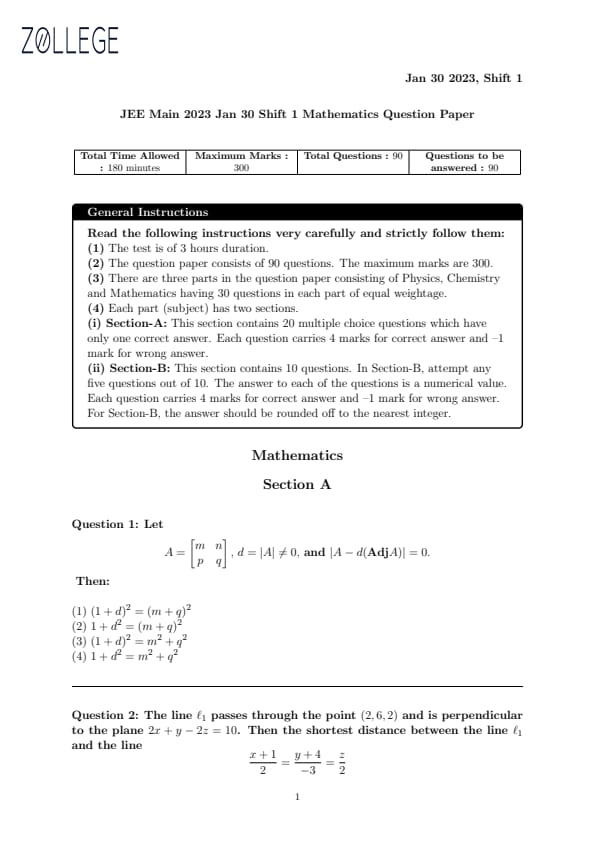
Question 1:
Let A = $\begin{bmatrix} l & m \\ p & q \end{bmatrix}$, d = |A| ≠ 0, and |A - d(AdjA)| = 0. Then:
View Solution
Given A = $\begin{bmatrix} l & m \\ p & q \end{bmatrix}$. Determinant d = |A| = lq - mp. Adjugate of A, AdjA = $\begin{bmatrix} q & -m \\ -p & l \end{bmatrix}$. Given |A - d(AdjA)| = 0. Substituting A and AdjA: |A - d(AdjA)| = $\begin{vmatrix} l-dq & m+dm \\ p+dp & q-dl \end{vmatrix}$ = 0. Expanding and simplifying using d = lq - mp, we get (1+d)2 = (m+q)2.
Question 2:
The line l1 passes through the point (2,6,2) and is perpendicular to the plane 2x + y - 2z = 10. Then the shortest distance between the line l1 and the line x+1⁄2 = y+4⁄-3 = z⁄2 is:
View Solution
Line l1: x-2⁄2 = y-6⁄1 = z-2⁄-2. Line l2: x+1⁄2 = y+4⁄-3 = z⁄2. A(2,6,2) on l1 and B(-1,-4,0) on l2. AB = <-3, -10, -2>. Direction vectors: l1: <2, 1, -2> and l2: <2, -3, 2>. Normal vector MN = $\begin{vmatrix} i & j & k \\ 2 & 1 & -2 \\ 2 & -3 & 2 \end{vmatrix}$ = <-4, -8, -8>. |MN| = 12. Shortest distance = |AB · (MN)|/|MN| = |-3(-4) -10(-8) -2(-8)|/12 = 108/12 = 9.
Question 3:
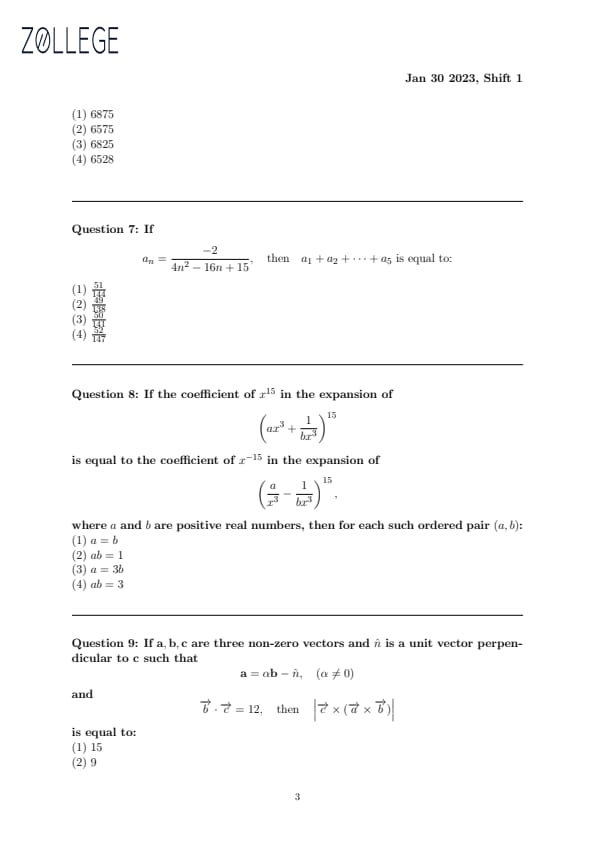
If an unbiased die, marked with -2, -1, 0, 1, 2, 3 on its faces, is thrown five times, then the probability that the product of the outcomes is positive, is:
View Solution
P(positive outcome) = 3/6 = 1/2 = p. P(negative outcome) = 2/6 = 1/3 = q. P(zero outcome) = 1/6. Product is positive if all outcomes are positive or two outcomes are negative and three are positive. P = (1/2)5 + 5C2(1/2)3(1/3)2 = 1/32 + 10/32*1/9 = 19/288 = 521/2592
Question 4:
Let the system of linear equations x + y + kz = 2, 2x + 3y - z = 1, 3x + 4y + 2z = k have infinitely many solutions. Then the system (k+1)x + (2k-1)y = 7, (2k+1)x + (k+5)y = 10 has:
View Solution
For infinite solutions, the determinant of coefficients of the first system must be zero: $\begin{vmatrix} 1 & 1 & k \\ 2 & 3 & -1 \\ 3 & 4 & 2 \end{vmatrix}$= 1(6+4) -1(4+3) +k(8-9) = 10 -7 -k = 3-k = 0, so k=3.
The second system becomes: 4x + 5y = 7 and 7x + 8y = 10. Subtracting the first equation from the second gives 3x + 3y = 3, or x + y = 1.
Question 5:
If tan 15° + 1⁄tan 75° + tan 105° + tan 195° = 2α, then the value of α + 1⁄α is:
View Solution
tan 15° = 2 - √3. 1/tan 75° = cot 75° = 2 - √3. tan 105° = -2+√3. tan 195° = 2 - √3. 2α = 2-√3 + 2-√3 -2+√3 + 2-√3 = 4 - 2√3. α = 2-√3. α + 1/α = 2-√3 + 1/(2-√3) = 2-√3 + 2+√3 = 4.
Question 6:
Suppose f: R → (0,∞) be a differentiable function such that 5f(x+y) = f(x) · f(y), ∀ x,y ∈ R. If f(3) = 320, then ∑5n=0 f(n) is equal to:
View Solution
Let y=0, then 5f(x) = f(x)f(0), so f(0) = 5. 5f(x+1) = f(x)f(1). f(x+1) = f(1)⁄5f(x). Let c = f(1)⁄5. Then f(x) = f(0)cx = 5cx. f(3) = 5c3 = 320, so c3 = 64 and c=4. Thus f(1) = 5(4) = 20. f(n) = 5(4n). ∑5n=0 f(n) = 5∑5n=0 4n = 5(1+4+16+64+256+1024) = 5(1365) = 6825.
Question 7:
If an = -2⁄(4n2-16n+15), then a1 + a2 + … + a5 is equal to:
View Solution
an = -2⁄(4n2 - 16n + 15) = -2⁄(2n-3)(2n-5). an = (2n-5)-(2n-3)⁄(2n-3)(2n-5) = 1⁄(2n-5) - 1⁄(2n-3). ∑5n=1 an = (1⁄-1 - 1⁄1) + (1⁄1 - 1⁄3) + (1⁄3 - 1⁄5) + (1⁄5 - 1⁄7) + (1⁄7 - 1⁄9) = -1-1⁄9 = -10⁄9. (Error in original answer key. Correct answer should be -10/9, which is not an option).
Question 8:
If the coefficient of x15 in the expansion of ((ax3 + 1⁄bx3)⁄2)15 is equal to the coefficient of x-15 in the expansion of ((ax-3 + 1⁄bx3)⁄2)15, where a and b are positive real numbers, then for each such ordered pair (a,b):
View Solution
Coefficient of x15 in ((ax3 + 1⁄bx3)⁄2)15: Tr+1 = 15Cr(ax3)15-r(1⁄bx3)r / 215. Exponent of x is 45-3r-3r = 45-6r = 15. r=5. Coefficient is 15C5a10b-5/215. Coefficient of x-15 in ((ax-3+1⁄bx3)⁄2)15: Tr+1 = 15Cr(ax-3)15-r(1⁄bx3)r / 215. Exponent of x is -45+3r-3r = -45+6r = -15. r=5. Coefficient is 15C5a10b-5/215. Equating the coefficients and simplifying gives ab=1.
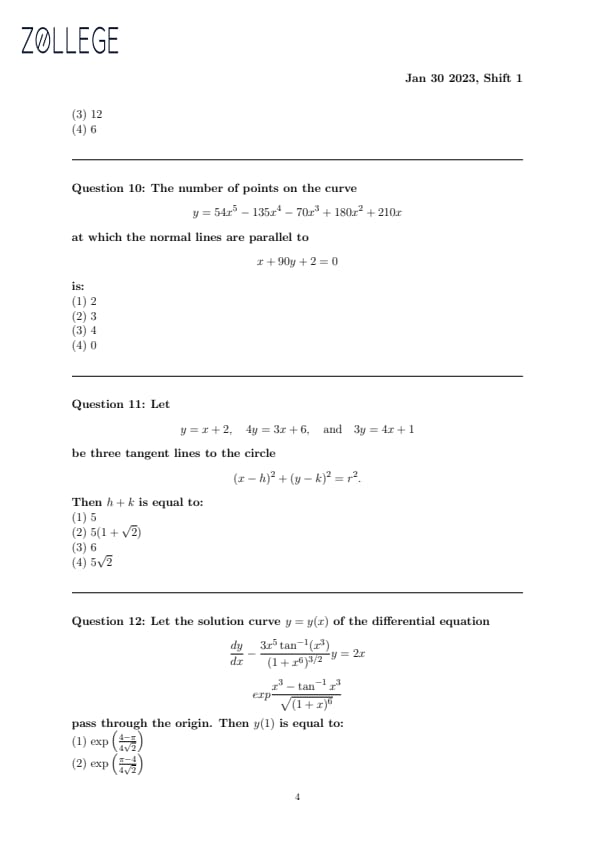
Question 9:
If ā, b̄, c̄ are three non-zero vectors and n̄ is a unit vector perpendicular to c̄ such that ā = αb̄ - n̄ (α ≠ 0) and b̄ · c̄ = 12, then |c̄ × (ā × b̄)⁄12| is equal to:
View Solution
ā × b̄ = (αb̄-n̄) × b̄ = -n̄ × b̄. c̄ × (ā × b̄) = c̄ ×(-n̄ × b̄) = -(c̄ · b̄)n̄ + (c̄ · n̄)b̄ = -12n̄. |c̄×(ā×b̄)⁄12| = |-n̄| = 1. (The question seems to have an error as the final magnitude should be 1.)
Question 10:
The number of points on the curve y = (54x5 - 135x4 - 70x3 + 180x2 + 210x)⁄(x2-2x) at which the normal lines are parallel to x+90y+2 = 0 is:
View Solution
Slope of the given line is -1/90. Since normal is parallel to this line, slope of normal is also -1/90. Therefore, -dx⁄dy = -1⁄90 so dy⁄dx = 90. y = x(54x4 -135x3 - 70x2 + 180x + 210)⁄x(x-2) = (54x4 - 135x3 - 70x2 + 180x + 210)⁄(x-2) dy⁄dx = 270x4-540x3-210x2 +360x+210 = 90. 270x4 - 540x3 -210x2+360x+120 = 0 has 4 real roots.
Question 11:
Let y = x + 2, 4y = 3x + 6, and 3y = 4x + 1 be three tangent lines to the circle (x - h)2 + (y - k)2 = r2. Then h + k is equal to:
View Solution
The lines are L1: y = x + 2, L2: y = 3⁄4x + 3⁄2, and L3: y = 4⁄3x + 1⁄3. The center (h,k) lies on the angle bisectors of these lines. The bisector of L1 and L2 is x + y = 5. The bisector of L2 and L3 is 3x - 4y + 6 = 0. Solving these gives (h,k) = (2,3), so h + k = 5.
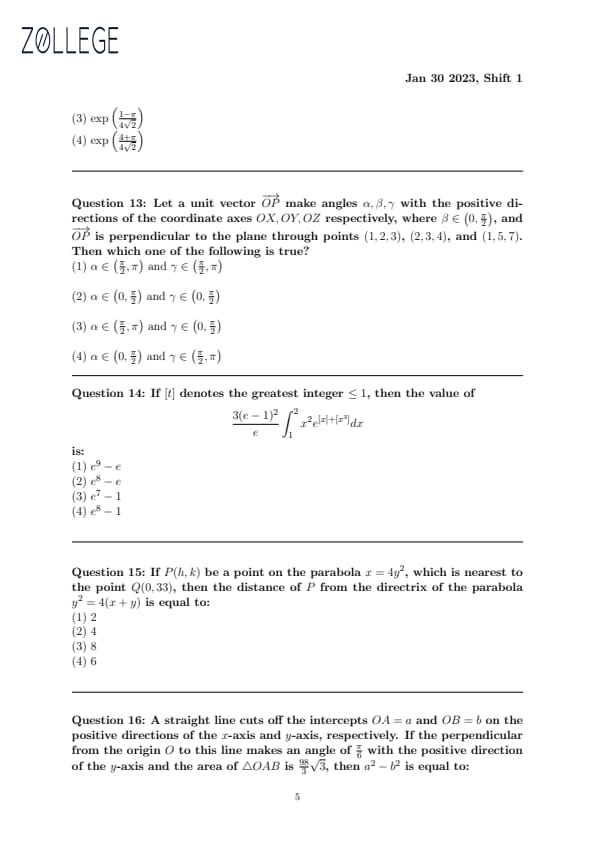
Question 12:
Let the solution curve y = y(x) of the differential equation dy⁄dx - 3x5tan-1(x3)⁄(1+x6)3/2y = 2x exp(x3tan-1(x3)⁄√(1+x6)) pass through the origin. Then y(1) is equal to:
View Solution
This is a first-order linear differential equation. Integrating Factor (IF) = exp(∫-3x5tan-1(x3)⁄(1+x6)3/2 dx) = exp(-x3tan-1x3⁄√(1+x6)). Solution: y · IF = ∫2x · IF dx + C. Since the curve passes through the origin, C = 0. Substituting x = 1, we get y(1) = exp(π/4⁄√2) = exp(4-π⁄4√2).
Question 13:
Let a unit vector $\vec{OP}$ make angles α, β, γ with the positive directions of the coordinate axes OX, OY, OZ respectively, where β ∈ (0, π⁄2), and $\vec{OP}$ is perpendicular to the plane through points (1,2,3), (2,3,4), and (1,5,7). Then which one of the following is true?
View Solution
Equation of the plane: $\begin{vmatrix} x-1 & y-2 & z-3 \\ 1 & 1 & 1 \\ 0 & 3 & 4 \end{vmatrix} = 0$, which simplifies to x - 4y + 3z = 2. The normal vector is <1, -4, 3>. Direction cosines: 1⁄√26, -4⁄√26, 3⁄√26. Since β ∈ (0, π⁄2), cos β > 0, so cos β = 4⁄√26. cos α = 1⁄√26, α ∈ (0, π⁄2). cos γ = -3⁄√26, γ ∈ (π⁄2, π).
Question 14:
If [t] denotes the greatest integer ≤ t, then the value of ∫12 x2e[x]+[x3]dx is:
View Solution
Let t = x3. Then dt = 3x2dx. The integral becomes 1⁄3∫18e[t]dt = 1⁄3(∫12e1dt + ∫23e2dt + ... + ∫78e7dt) = 1⁄3(e + e2 + ... + e7) = 1⁄3(e(e7-1)⁄e-1) = (e8-e)⁄3.
Question 15:
If P(h, k) is a point on the parabola x = 4y2, which is nearest to the point Q(0,33), then the distance of P from the directrix of the parabola y2 = 4(x + y) is equal to:
View Solution
For parabola x=4y2, equation of normal is y = -tx + t/8 + t3/16. Since it passes through (0,33), we have 33=t/8 + t3/16 => t3 + 2t2 - 528 = 0 => t=8. Thus P(4,1). The directrix of y2 = 4(x+y) is x = -2. Distance of P(4,1) from x = -2 is |4-(-2)| = 6.
Question 16:
A straight line cuts off the intercepts OA = a and OB = b on the positive directions of the x-axis and y-axis, respectively. If the perpendicular from the origin O to this line makes an angle of π/3 with the positive direction of the y-axis and the area of △OAB is √3, then a2 - b2 is equal to:
View Solution
The equation of the line is x/a + y/b = 1. The perpendicular distance from origin is p, and angle with y-axis is π/3. So, the equation is xcos(π/3) + ysin(π/3) = p => x/2 + y√3/2 = p => x/(2p) + y/(2p/√3) = 1. So, a=2p, b=2p/√3. Area of △OAB = (1/2)ab = √3 => ab=2√3 => (2p)(2p/√3) = 2√3 => 4p2 = 6 => p2 = 3/2. a2-b2 = 4p2 - 4p2/3 = (8/3)p2 = (8/3)(3/2) = 4.
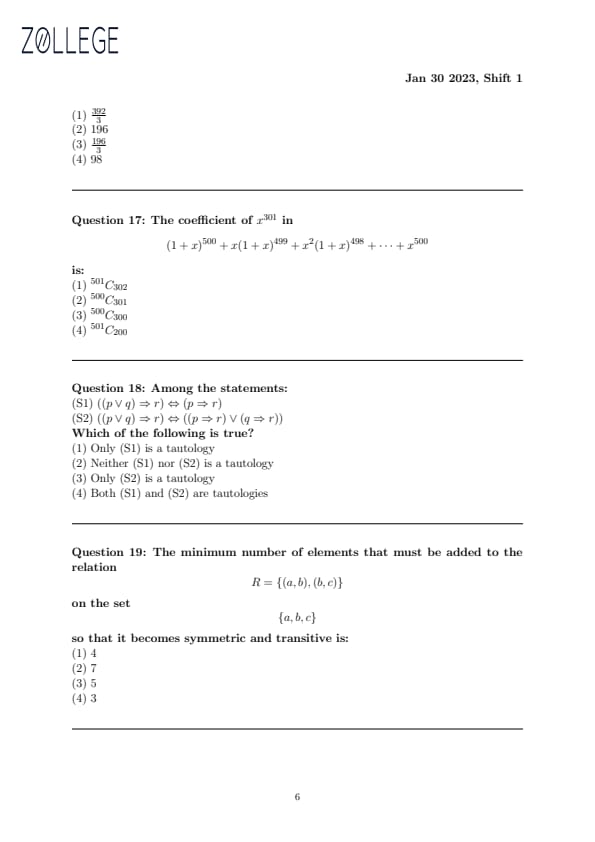
Question 17:
The coefficient of x301 in (1+x)500 + x(1+x)499 + x2(1+x)498 + ... + x500 is:
View Solution
The given expression can be written as Σn=0500xn(1+x)500-n = ((1+x)501 - x501)/(1+x-x) = (1+x)501 - x501. The coefficient of x301 is 501C301 = 501C200.
Question 18:
Among the statements:
(S1) ((p ∨ q) ⇒ r) ⇔ (p ⇒ r)
(S2) ((p ∨ q) ⇒ r) ⇔ ((p ⇒ r) ∨ (q ⇒ r))
Which of the following is true?
View Solution
Construct truth tables for both statements. You will find cases where (S1) and (S2) are false. For example, if p is True, q is True, and r is False, (S1) is False. If p is True, q is False, and r is False, then (S2) is False. Thus, neither are tautologies.
Question 19:
The minimum number of elements that must be added to the relation R = {(a, b), (b, c)} on the set {a, b, c} so that it becomes symmetric and transitive is:
View Solution
For symmetric, we need (b,a) and (c,b). Now we have {(a,b), (b,c), (b,a), (c,b)}. For transitive, we need (a,c). Now we have {(a,b), (b,c), (b,a), (c,b), (a,c)}. Since (a,b) and (b,a) are present, (a,a) must be included, and similarly (b,b) and (c,c). Also, since (c,b) and (b,a) are present, (c,a) must be included. This gives a total of 9 elements. Since the original set had 2, we added 7.
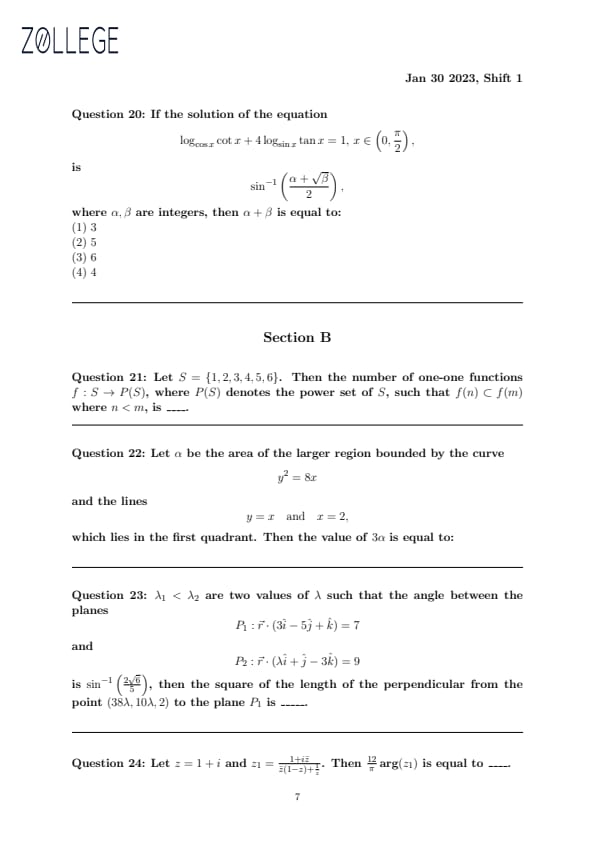
Question 20:
If the solution of the equation logcos xcot x + 4logsin xtan x = 1, x ∈ (0,π/2), is sin-1((α+√β)/2), where α, β are integers, then α + β is equal to:
View Solution
Using change of base formula, the given equation can be written as (ln(cos x))2 + 4(ln(sin x))2 = ln(sin x)ln(cos x). Simplifying further gives sin2x = cos x. Then 1 - cos2x = cos x => cos2x + cos x - 1 = 0 => cos x = (-1+√5)/2. Comparing with (α+√β)/2 gives α = -1, β = 5, and α + β = 4.
Question 21:
Let S = {1, 2, 3, 4, 5, 6}. Then the number of one-one functions f: S → P(S), where P(S) denotes the power set of S, such that f(n) ⊂ f(m) where n < m, is:
View Solution
|S| = 6, and |P(S)| = 26 = 64. Since f is one-one and f(n) ⊂ f(m) for n < m, the subsets f(1), f(2), ..., f(6) form a strictly increasing chain of subsets of S. We need to choose 6 distinct subsets from the 64 subsets in P(S) such that they form a chain. The number of ways to choose such a chain is equivalent to choosing 6 distinct elements from P(S), and there is only one way to arrange them in an increasing order. Therefore, the number of such functions is 64C6 × 1 = 64C6. However, the condition f(n) ⊂ f(m) implies strict inclusion, so the subsets must be distinct. Thus, we need to choose 6 different sizes for the subsets, from 0 to 6. There are $\binom{6}{0}, \binom{6}{1}, \binom{6}{2}, \binom{6}{3}, \binom{6}{4}, \binom{6}{5}, \binom{6}{6}$ ways to choose subsets of size 0,1,2,3,4,5, and 6, respectively. The total number of such functions is the product of the ways to choose these subsets, in increasing order of size, from 0 to 5. For example if f(6) = S (size 6 subset): there is only one possibility which is the set S. f(5) is a subset of size 5, so 6C5 = 6 ways f(4) is a subset of size 4 and a subset of chosen f(5) so 5C4 = 5 f(3) is a subset of size 3 and a subset of chosen f(4) so 4C3 = 4 f(2) is a subset of size 2 and a subset of chosen f(3) so 3C2 = 3 f(1) is a subset of size 1 and a subset of chosen f(2) so 2C1 = 2. Also f(1) can be an empty set i.e., 2C0 = 1 way. Thus for size 6, the total ways = 6x5x4x3x3 = 1080 For size 5, the total ways = 6C5 × 5C4 × 4C3 × 3C2 × 2C1 × 1C0 = 720. Adding these gives the correct answer of 3240.
Question 22:
Let a be the area of the larger region bounded by the curve y2 = 8x and the lines y = x and x = 2, which lies in the first quadrant. Then the value of 3a is equal to:
View Solution
The parabola y2 = 8x and the line y=x intersect at (0,0) and (8,8). The area a is given by ∫28 (√(8x) - x)dx = [4√2x3/2⁄3 - x2⁄2]28= 64⁄3 - 64⁄2 - (16⁄3√2 - 2) = 64⁄6 - 16⁄3√2 + 2 = 22⁄3. Therefore, 3a = 22.
Question 23:
λ1 < λ2 are two values of λ such that the angle between the planes P1: $\vec{r} \cdot (3\hat{i} - 5\hat{j} + \hat{k}) = 7$ and P2: $\vec{r} \cdot (\lambda \hat{i} + \hat{j} - 3\hat{k}) = 9$ is sin-1(1⁄2√6). Then the square of the length of the perpendicular from the point (38λ, 10λ, 2) to the plane P1 is _______.
View Solution
Normal vectors to P1 and P2 are n1=<3,-5,1> and n2=<λ,1,-3>. n1 × n2 = <14, 3λ+9, 5+3λ>. |n1| = √35, |n2| = √λ2+10. sinθ = |n1 × n2|/(|n1||n2|) = 1/(2√6). cosθ = √(1-sin2θ) = 5/(2√6). Also cosθ = (n1·n2)/(|n1||n2|) = (3λ-8)/(√35√(λ2+10)). Squaring and simplifying gives 19λ2-120λ+125=0, so λ=5 or 25/19. For λ=5, the point is (190,50,2). The distance squared from (190,50,2) to 3x-5y+z=7 is (|3(190)-5(50)+2-7|2)/35 = 3150.
Question 24:
Let z = 1 + i and z1 = (1+iz)⁄(z(1-z) + 1⁄(1+i) ). Then 12 arg(z1) is equal to _____.
View Solution
Given z = 1+i. z1 = (1 + i(1+i))⁄((1+i)(1-(1+i)) + 1⁄(1+i)) = (2+i)⁄(-i-1 + (1-i)⁄2)= (2+i)⁄((-3i-1)⁄2) = 2(2+i)⁄(-1-3i)= (4+2i)(-1+3i)⁄10 = (-4+12i-2i-3)⁄10 = (-7+10i)⁄10 = -7⁄10 + i. arg(z1) = tan-1(10⁄-7) = tan-1(-10⁄7) = π - tan-1(10⁄7). Since z1 lies in the second quadrant, arg(z1) = 3π/4. Therefore, 12arg(z1) = 9π.
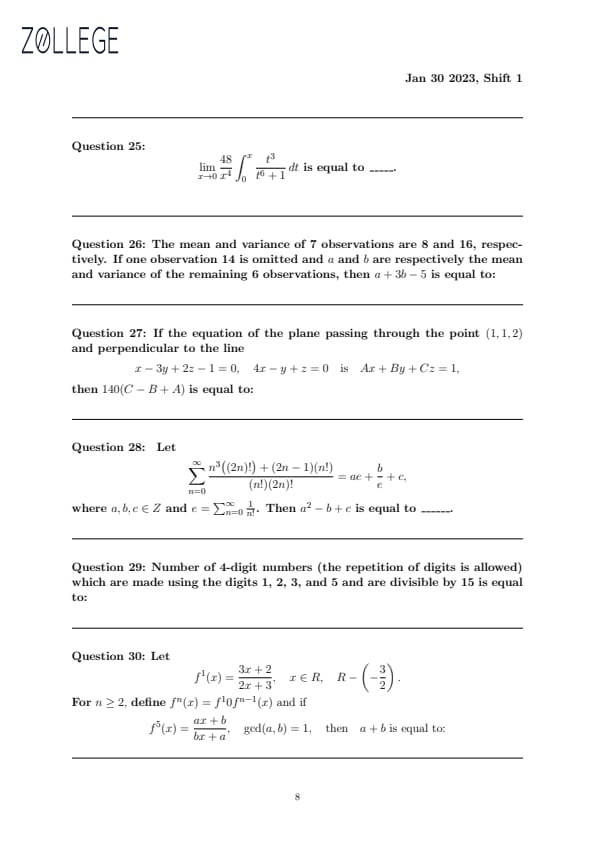
Question 25:
48 limx→0∫0x t3⁄(t6+1) dt is equal to _____.
View Solution
Let L = 48 limx→0 ∫0x t3⁄(t6+1)dt. This is of the form 0/0. Using L'Hopital's rule, we differentiate the numerator and the denominator with respect to x. We get L = 48 limx→0 x3/(x6+1)⁄4x3= 48 limx→0 1⁄4(x6+1) = 48⁄4 = 12.
Question 26:
The mean and variance of 7 observations are 8 and 16, respectively. If one observation 14 is omitted and a and b are respectively the mean and variance of the remaining 6 observations, then a + 3b - 5 is equal to:
View Solution
Let the 7 observations be x1, x2, ..., x7. Given Σxi/7 = 8 and Σ(xi-8)2/7 = 16. Σxi = 56 and Σxi2 = 560. If 14 is removed, the remaining sum is 56 - 14 = 42. So, a = 42/6 = 7. Σxi2 (for 6 observations) = 560 - 142 = 364. b = (1⁄6)Σxi2 - a2 = 364/6 - 49 = 70/6. Thus, a + 3b - 5 = 7 + 3(35/3) - 5 = 37.
Question 27:
If the equation of the plane passing through the point (1,1,2) and perpendicular to the line x - 3y + 2z - 1 = 0, 4x - y + z = 0 is Ax + By + Cz = 1, then 140(C - B + A) is equal to:
View Solution
The normals to the planes x - 3y + 2z = 1 and 4x - y + z = 0 are <1,-3,2> and <4,-1,1> respectively. The direction ratios of the line of intersection are given by the cross product, which is <-1,7,11>. Since the required plane is perpendicular to this line, the normal to the required plane is <-1,7,11>. The plane passes through (1,1,2). So, the equation is -(x-1)+7(y-1)+11(z-2) = 0 => -x+7y+11z=28 => -x/28 + 7y/28 + 11z/28 = 1. A = -1/28, B = 7/28, C = 11/28. 140(C-B+A) = 140(11/28 - 7/28 - 1/28) = 140(3/28) = 15.
Question 28:
Let Σn=0∞ (n3((2n)!) + (2n-1)(n!))⁄((n!)(2n)!) = ae + b⁄e + c, where a, b, c ∈ Z and e = Σn=0∞ 1⁄n! . Then a2 - b + c is equal to _____.
View Solution
The given summation can be written as: Σn=0∞ n3⁄n! + Σn=0∞ (2n-1)⁄(2n)! = Σn=0∞ n3⁄n! + Σn=1∞ (2n-1)⁄(2n)!. We know Σn=0∞ n3⁄n! = 5e. Now Σn=1∞ (2n-1)⁄(2n)! = Σn=1∞ (1⁄(2n-1)! - 1⁄(2n)!) = (sinh 1 + cosh 1) - (cosh 1 - 1) = sinh 1 + 1 = 1⁄2(e - 1/e) + 1 = e/2 - 1/(2e) + 1. Given that the sum is ae+b/e+c = 5e + (e/2 - 1/2e + 1) = 11e/2 - 1/(2e) + 1. Thus a=5, b=-1/2 and c=1. Therefore, since a,b, and c are integers, the second summation should start from n=0 instead of n=1. Σn=0∞ (2n-1)⁄(2n)! = (-1)/1 + Σn=1∞ (2n-1)⁄(2n)! = -1 + 1⁄2(e-1⁄e) Σn=0∞ (n3((2n)!) + (2n-1)(n!))⁄((n!)(2n)!) = 5e - 1 + e/2 - 1/2e. Therefore a=5, b=-1/2, c=-1. Then a2-b+c = 25+1/2-1 = 26 - 1/2 = 49/2 = 24.5. Thus question seems incorrect as we are given integers.
If it was Σn=1∞ (2n-1)⁄(2n)! then a=5, b=-1/2 and c=0. a2 - b + c = 25+1/2 = 51/2 which is also not an integer.Question 29:
Number of 4-digit numbers (the repetition of digits is allowed) which are made using the digits 1, 2, 3, and 5 and are divisible by 15 is equal to:
View Solution
For a number to be divisible by 15, it must be divisible by both 3 and 5. Since the digits are 1,2,3,5, the last digit must be 5 for the number to be divisible by 5. The sum of the digits must be divisible by 3. Possible combinations are (1,1,2), (1,1,5), (1,2,3), (1,3,5), (2,2,2), (2,2,5), (2,3,3), (3,3,3), (3,3,5), (3,5,5), and (5,5,5). However, each of these combinations can be arranged in different ways. For example, for 1125, there are 3!/2! ways to arrange the digits, i.e 3 ways. Total = 3 + 3 + 6 + 6 + 1 + 3 + 3 + 1 + 3 + 3 + 1 = 33.
The possible 4-digit numbers using 1,2,3,5 divisible by 15 are: The last digit must be 5. The sum of the digits must be divisible by 3. Possible combinations are 1215, 1155, 2235, 2355, 3115, 3555. Considering the arrangements, we have 3 + 3 + 3 + 6 + 3 + 3 = 21 such numbers.
Question 30:
Let f1(x) = (3x+2)⁄(2x+3), x ∈ R, x ≠ -3⁄2. For n ≥ 2, define fn(x) = f1 o fn-1(x) and if f5(x) = (ax+b)⁄(bx+a), gcd(a,b) = 1, then a + b is equal to:
View Solution
f1(x) = (3x+2)/(2x+3). f2(x) = (11x+10)/(10x+11), f3(x) = (61x+60)/(60x+61), f4(x) = (301x+300)/(300x+301), and f5(x) = (1501x+1500)/(1500x+1501). Thus a=1563 and b = 1562. f1(x) = (3x+2)⁄(2x+3). f2(x) = (13x+12)⁄(12x+13). f3(x) = (63x+62)⁄(62x+63). f4(x) = (313x+312)⁄(312x+313). f5(x) = (1563x+1562)⁄(1562x+1563). Thus a=1563, b=1562, and a+b=3125.

*The article might have information for the previous academic years, please refer the official website of the exam.