
JEE Main 2023 Mathematics Question Paper Pdf- Check Solutions with Answer Key Pdf

.jpg?tr=h-55,w-55,c-force)
Content Strategist|Tech-innovator|National Hackathon Winner | Updated On - Mar 20, 2025
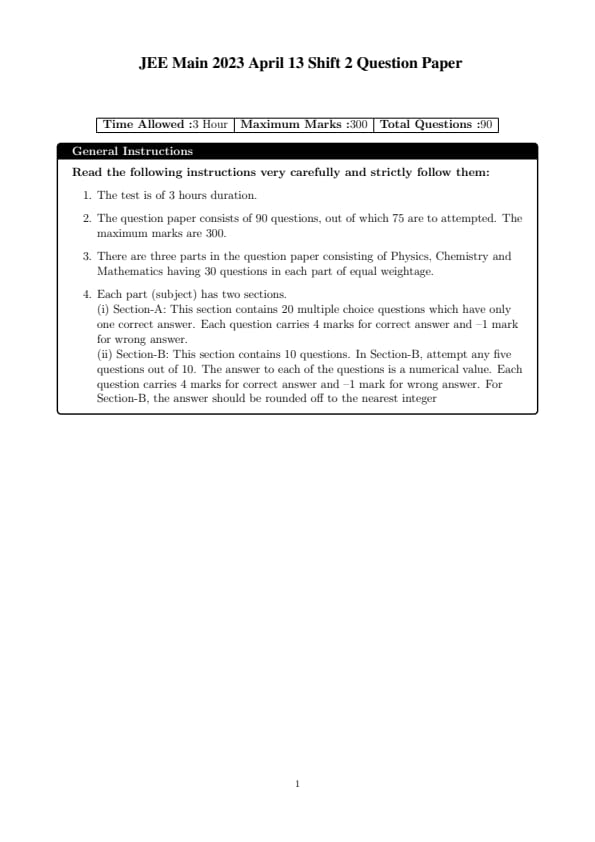
JEE Main Question Papers are the most important study material for effective exam preparation. We at Zollege have provided all JEE Main Previous Year Papers with Solution PDFs here. JEE Main 2023 Mathematics exam was conducted successfully on April 13 by NTA.
Students can freely download the JEE Main previous year's question paper PDFs along with their solutions here. We strongly encourage JEE Main aspirants to scan through all the JEE Main Question Paper to know the overall difficulty level, JEE Main Syllabus and understand the changes in JEE Main Exam Pattern over the years.
JEE Main 2023 Mathematics Question Paper Pdf- Check Solutions with Answer Key Pdf
| JEE Main 2023 Mathematics Question Paper with Solution PDF |  Download Download |
Check Solution |

SECTION-A
Question 1:
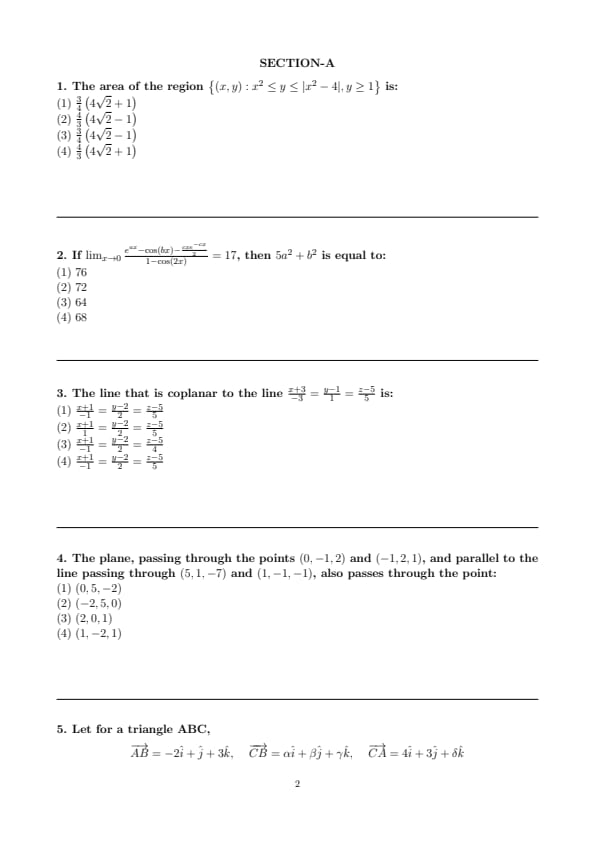
The area of the region \( \left\{ (x, y) : x^2 \leq y \leq |x^2 - 4|, y \geq 1 \right\} \) is:
View Solution
We are asked to find the area of the region \( \left\{ (x, y) : x^2 \leq y \leq |x^2 - 4|, y \geq 1 \right\} \). The given region involves two curves: \( y = x^2 \) and \( y = |x^2 - 4| \).
1. Step 1: Understanding the curves:
The curve \( y = x^2 \) is a standard parabola opening upwards.
The curve \( y = |x^2 - 4| \) represents two different cases based on the value of \( x \):
When \( x^2 \geq 4 \), \( y = x^2 - 4 \).
When \( x^2 < 4 \), \( y = 4 - x^2 \).
2. Step 2: Setting up the area integral:
The total area can be calculated by integrating the difference between the two curves. The area is symmetric about the y-axis, so we can find the area for \( x \in [0, 2] \) and then double it.
The required area is:
\[ Area = 2 \left( \int_{1}^{2} \sqrt{y} \, dy + \int_{2}^{4} (4 - y) \, dy \right) \]
3. Step 3: Calculating the integrals:
First integral:
\[ \int_{1}^{2} \sqrt{y} \, dy = \left[ \frac{2}{3} y^{3/2} \right]_{1}^{2} = \frac{2}{3} \left( 2^{3/2} - 1 \right) \]
Second integral:
\[ \int_{2}^{4} (4 - y) \, dy = \left[ 4y - \frac{y^2}{2} \right]_{2}^{4} = \frac{4}{3} \left( 4\sqrt{2} - 1 \right) \]
Thus, the total area is: \[ Area = 2 \left( \frac{4}{3} \left( 4\sqrt{2} - 1 \right) \right) = \frac{8}{3} \left( 4\sqrt{2} - 1 \right) \] Quick Tip: When calculating areas between curves, always break the integral into segments where the equations for the curves are defined differently. In this case, we split the integral at \( x = 2 \).
If \( \lim_{x \to 0} \frac{e^{ax} - \cos(bx) - \frac{cxe^{-cx}}{2}}{1 - \cos(2x)} = 17 \), then \( 5a^2 + b^2 \) is equal to:
View Solution
Step 1: Use the given condition. \[ \lim_{x \to 0} \frac{e^{ax} - \cos(bx) - \frac{cxe^{-cx}}{2}}{1 - \cos(2x)} = 17 \]
On expanding the terms: \[ \left( 1 + ax + \frac{(ax)^2}{2!} + \cdots \right) - \left( 1 - \frac{(bx)^2}{2!} + \cdots \right) - \frac{cx}{2} \left( 1 - cx + \frac{(cx)^2}{2!} \right) \] \[ \lim_{x \to 0} \frac{(1 - \cos(2x))}{(2x)^2} \times \left( \frac{x}{4x^2} \right) = 17 \]
Step 2: For the limit to exist: \[ a - \frac{c}{2} = 0 \quad \Rightarrow \quad c = 2a \]
Substituting this into the equation: \[ \frac{a^2}{2} + \frac{b^2}{2} + \frac{c^2}{2} = 17 \quad \Rightarrow \quad \frac{a^2}{2} + \frac{b^2}{2} + \frac{4a^2}{2} = 34 \] \[ \Rightarrow \quad 5a^2 + b^2 = 68 \] Quick Tip: For limits and expansions involving trigonometric and exponential functions, use series expansions to simplify the terms and solve for the unknowns.
The line that is coplanar to the line \( \frac{x+3}{-3} = \frac{y-1}{1} = \frac{z-5}{5} \) is:
View Solution
The condition for two lines to be coplanar is that the scalar triple product of the direction ratios of the two lines, along with the vector joining any two points on the lines, must be zero.
We are given the first line in symmetric form:
\[ \frac{x+3}{-3} = \frac{y-1}{1} = \frac{z-5}{5} \]
The direction ratios of this line are \( \mathbf{a_1} = (-3, 1, 5) \). Let’s calculate the condition for coplanarity.
The second line is of the form:
\[ \frac{x+1}{-1} = \frac{y-2}{2} = \frac{z-5}{5} \]
The direction ratios of the second line are \( \mathbf{a_2} = (-1, 2, 5) \).
Now, to check for coplanarity, we apply the condition of coplanarity for two lines. The condition involves the scalar triple product of the direction ratios of the two lines and the vector joining any point on the first line to a point on the second line.
Let’s take points on the lines:
- For the first line, take \( P_1(-3, 1, 5) \).
- For the second line, take \( P_2(-1, 2, 5) \).
The vector joining these points is \( \overrightarrow{P_1P_2} = (-1 - (-3), 2 - 1, 5 - 5) = (2, 1, 0) \).
The scalar triple product condition for coplanarity is:
\[ \left| \begin{matrix} x_2 - x_1 & a_1 & a_2
y_2 - y_1 & b_1 & b_2
z_2 - z_1 & c_1 & c_2 \end{matrix} \right| = 0 \]
Substitute the values into the determinant:
\[ \begin{vmatrix} 2 & -3 & -1
1 & 1 & 2
0 & 5 & 5 \end{vmatrix} \]
Now, calculate the determinant:
\[ = 2 \begin{vmatrix} 1 & 2
5 & 5 \end{vmatrix} - (-3) \begin{vmatrix} 1 & 2
0 & 5 \end{vmatrix} + (-1) \begin{vmatrix} 1 & 1
0 & 5 \end{vmatrix} \]
\[ = 2 \left( (1 \times 5) - (2 \times 5) \right) + 3 \left( (1 \times 5) - (2 \times 0) \right) + (-1) \left( (1 \times 5) - (1 \times 0) \right) \]
\[ = 2 \left( 5 - 10 \right) + 3 \left( 5 - 0 \right) + (-1) \left( 5 - 0 \right) \]
\[ = 2(-5) + 3(5) - 1(5) \]
\[ = -10 + 15 - 5 = 0 \]
Since the determinant is zero, the two lines are coplanar.
Thus, the correct option is (1). Quick Tip: To check if two lines are coplanar, use the scalar triple product condition: \( \mathbf{a_1} \times \mathbf{a_2} \cdot \overrightarrow{P_1P_2} = 0 \).
The plane, passing through the points \( (0, -1, 2) \) and \( (-1, 2, 1) \), and parallel to the line passing through \( (5, 1, -7) \) and \( (1, -1, -1) \), also passes through the point:
View Solution
We are given that the plane passes through the points \( (0, -1, 2) \) and \( (-1, 2, 1) \), and is parallel to the line passing through \( (5, 1, -7) \) and \( (1, -1, -1) \).
1. Step 1: Find vectors in the plane:
The vector passing through the points \( (0, -1, 2) \) and \( (-1, 2, 1) \) is:
\[ \mathbf{a} = (-1 - 0, 2 - (-1), 1 - 2) = (-1, 3, -1) \]
The vector representing the direction of the given line is:
\[ \mathbf{b} = (1 - 5, -1 - 1, -1 - (-7)) = (-4, -2, 6) \]
2. Step 2: Find the normal vector to the plane:
The normal vector \( \mathbf{n} \) to the plane is the cross product of the two vectors \( \mathbf{a} \) and \( \mathbf{b} \):
\[ \mathbf{n} = \mathbf{a} \times \mathbf{b} \]
Using the determinant to calculate the cross product:
\[ \mathbf{n} = \begin{vmatrix} \hat{i} & \hat{j} & \hat{k}
-1 & 3 & -1
-4 & -2 & 6 \end{vmatrix} \]
Expanding the determinant:
\[ \mathbf{n} = \hat{i} \left( \begin{vmatrix} 3 & -1
-2 & 6 \end{vmatrix} \right) - \hat{j} \left( \begin{vmatrix} -1 & -1
-4 & 6 \end{vmatrix} \right) + \hat{k} \left( \begin{vmatrix} -1 & 3
-4 & -2 \end{vmatrix} \right) \]
Calculating each determinant:
\[ \mathbf{n} = \hat{i} \left( (3)(6) - (-1)(-2) \right) - \hat{j} \left( (-1)(6) - (-1)(-4) \right) + \hat{k} \left( (-1)(-2) - (3)(-4) \right) \]
\[ \mathbf{n} = \hat{i} (18 - 2) - \hat{j} (-6 - 4) + \hat{k} (2 + 12) \]
\[ \mathbf{n} = \hat{i} (16) - \hat{j} (-10) + \hat{k} (14) \]
\[ \mathbf{n} = (16, 10, 14) \]
3. Step 3: Equation of the plane:
The equation of the plane is:
\[ 16(x - 0) + 10(y + 1) + 14(z - 2) = 0 \]
Simplifying:
\[ 16x + 10y + 10 + 14z - 28 = 0 \]
\[ 16x + 10y + 14z - 18 = 0 \]
4. Step 4: Check the points given in the options:
Substituting \( (-2, 5, 0) \) into the equation of the plane:
\[ 16(-2) + 10(5) + 14(0) - 18 = 0 \]
\[ -32 + 50 + 0 - 18 = 0 \]
\[ 0 = 0 \quad (This satisfies the plane equation) \]
Thus, the correct point that lies on the plane is \( (-2, 5, 0) \). Quick Tip: To find the equation of a plane passing through two points and parallel to a given line, use the cross product to find the normal vector and then substitute the coordinates of any point on the plane into the equation of the plane.
Let for a triangle ABC, \[ \overrightarrow{AB} = -2\hat{i} + \hat{j} + 3\hat{k}, \quad \overrightarrow{CB} = \alpha \hat{i} + \beta \hat{j} + \gamma \hat{k}, \quad \overrightarrow{CA} = 4\hat{i} + 3\hat{j} + \delta \hat{k} \]
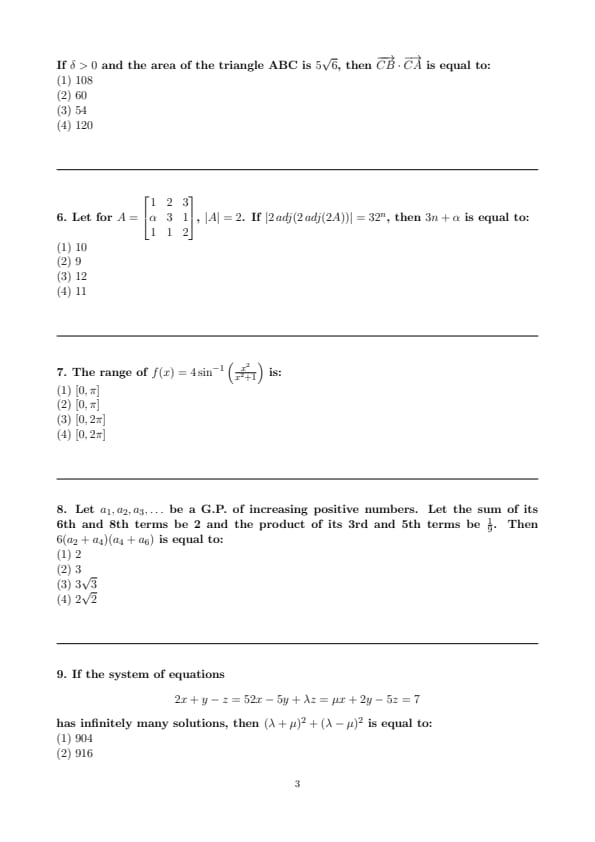
If \( \delta > 0 \) and the area of the triangle ABC is \( 5 \sqrt{6} \), then \( \overrightarrow{CB} \cdot \overrightarrow{CA} \) is equal to:
View Solution
\(\overrightarrow{CB} = \overrightarrow{AB} + \overrightarrow{CA} = (-2+4)\hat{i} + (1+3)\hat{j} + (3+\delta)\hat{k} = 2\hat{i} + 4\hat{j} + (3+\delta)\hat{k}\)
\(\overrightarrow{CB} \times \overrightarrow{CA} = \begin{vmatrix} \hat{i} & \hat{j} & \hat{k}
2 & 4 & 3+\delta
4 & 3 & \delta \end{vmatrix} = (\delta-9)\hat{i} + (12+2\delta)\hat{j} - 10\hat{k}\)
\(|\overrightarrow{CB} \times \overrightarrow{CA}| = \sqrt{(\delta-9)^2 + (12+2\delta)^2 + 100}\)
Area = \(\frac{1}{2}|\overrightarrow{CB} \times \overrightarrow{CA}| = 5\sqrt{6}\)
\(|\overrightarrow{CB} \times \overrightarrow{CA}| = 10\sqrt{6}\)
\(\sqrt{(\delta-9)^2 + (12+2\delta)^2 + 100} = 10\sqrt{6}\)
\((\delta-9)^2 + (12+2\delta)^2 + 100 = 600\)
\(\delta^2 - 18\delta + 81 + 4\delta^2 + 48\delta + 144 + 100 = 600\)
\(5\delta^2 + 30\delta + 325 = 600\)
\(5\delta^2 + 30\delta - 275 = 0\)
\(\delta^2 + 6\delta - 55 = 0\)
\((\delta+11)(\delta-5) = 0\)
\(\delta = 5\) (since \(\delta > 0\))
\(\overrightarrow{CB} = 2\hat{i} + 4\hat{j} + 8\hat{k}\)
\(\overrightarrow{CB} \cdot \overrightarrow{CA} = (2)(4) + (4)(3) + (8)(5) = 8 + 12 + 40 = 60\)
Answer: \(\overrightarrow{CB} \cdot \overrightarrow{CA} = 60\) Quick Tip: For vector problems involving area and dot/cross products, always expand the determinant properly and use known formulas for area and dot products to solve.

View Solution
Step 1: Using the given condition \( |A| = 2 \).
We know that: \[ |kA| = k^m \cdot |A| \quad where m = order of the matrix. \]
From the given, \( |2A| = 2^2 |A| = 4 |A| \), so \[ |2 \, adj(2A)| = |2^7 \, adj(A)| = 2^7 \cdot |adj(A)|. \]
Step 2: Simplifying the expression.
Since we know that \( |adj(A)| = |A|^{m-1} \), we can substitute \( |A| = 2 \): \[ |adj(A)| = |A|^2 = 2^2 = 4. \]
Thus, \[ |2 \, adj(2 \, adj(2A))| = 2^7 \cdot 4 = 2^7 \cdot 2^2 = 2^{9} = 32^n. \]
Equating powers of 2, we get \( n = 5 \).
Step 3: Solving for \( \alpha \).
We now use the equation for \( |A| = 2 \): \[ (6-1) - 2(2\alpha - 1) + 3(\alpha - 3) = 2. \]
Simplifying: \[ 5 - 4\alpha + 2 + 3\alpha - 9 = 2 \quad \Rightarrow \quad 5 - 4\alpha + 2 + 3\alpha - 9 = 2 \quad \Rightarrow \quad \alpha = -4. \]
Step 4: Final Calculation.
Finally, we calculate \( 3n + \alpha \): \[ 3(5) + (-4) = 15 - 4 = 11. \] Quick Tip: For matrix properties involving adjugates and determinants, remember the relationships: - \( |kA| = k^m |A| \), where \( m \) is the order of the matrix, - \( |adj(A)| = |A|^{m-1} \).
The range of \( f(x) = 4 \sin^{-1} \left( \frac{x^2}{x^2 + 1} \right) \) is:
View Solution
Step 1: Write the given function. \[ f(x) = 4 \sin^{-1} \left( \frac{x^2}{x^2 + 1} \right) \]
Step 2: Analyze the expression inside the inverse sine function. \[ 0 \leq \frac{x^2}{x^2 + 1} < 1 \]
This means that the expression inside \( \sin^{-1} \) is valid as the sine function only takes values between 0 and 1.
Step 3: Apply the inverse sine function. \[ 0 \leq \sin^{-1} \left( \frac{x^2}{x^2 + 1} \right) < \frac{\pi}{2} \]
Step 4: Multiply by 4. \[ 0 \leq 4 \sin^{-1} \left( \frac{x^2}{x^2 + 1} \right) < 2\pi \]
Step 5: Conclude the range.
Thus, the range of \( f(x) \) is \( [0, 2\pi] \). Quick Tip: For inverse trigonometric functions, always check the range of the function inside the inverse to determine the range of the final expression.
Let \( a_1, a_2, a_3, \dots \) be a G.P. of increasing positive numbers. Let the sum of its 6th and 8th terms be 2 and the product of its 3rd and 5th terms be \( \frac{1}{9} \). Then \( 6(a_2 + a_4)(a_4 + a_6) \) is equal to:
View Solution
Let \(a_n = ar^{n-1}\).
\(a_6 + a_8 = ar^5 + ar^7 = 2\)
\(a_3 a_5 = ar^2 \cdot ar^4 = a^2 r^6 = \frac{1}{9} \implies ar^3 = \frac{1}{3}\)
\(ar^5 + ar^7 = ar^3(r^2 + r^4) = \frac{1}{3}(r^2 + r^4) = 2\)
\(r^2 + r^4 = 6 \implies r^4 + r^2 - 6 = 0\)
\((r^2 - 2)(r^2 + 3) = 0 \implies r^2 = 2\) (since \(r^2 > 0\))
\(r = \sqrt{2}\) (since \(r > 0\))
\(a(\sqrt{2})^3 = \frac{1}{3} \implies a = \frac{1}{6\sqrt{2}}\)
\(6(a_2 + a_4)(a_4 + a_6) = 6(ar + ar^3)(ar^3 + ar^5)\)
\(6(ar(1 + r^2))(ar^3(1 + r^2)) = 6a^2 r^4 (1 + r^2)^2\)
\(6\left(\frac{1}{72}\right) (4) (1 + 2)^2 = 6\left(\frac{1}{72}\right) (4)(9)\)
\(6\left(\frac{36}{72}\right) = 6\left(\frac{1}{2}\right) = 3\)
Answer: 3 Quick Tip: For geometric progressions, use the relationship between terms and powers of the common ratio to solve for unknown terms, especially when given the product or sum of specific terms.
If the system of equations \[ 2x + y - z = 5
2x - 5y + \lambda z = \mu
x + 2y - 5z = 7 \]
has infinitely many solutions, then \( (\lambda + \mu)^2 + (\lambda - \mu)^2 \) is equal to:
View Solution
Step 1: Find the determinant \( \Delta \) of the coefficient matrix.
The coefficient matrix is: \[ \Delta = \begin{vmatrix} 2 & 1 & -1
2 & -5 & \lambda
1 & 2 & -5 \end{vmatrix} \]
Expanding the determinant: \[ \Delta = 2 \begin{vmatrix} -5 & \lambda
2 & -5 \end{vmatrix} - 1 \begin{vmatrix} 2 & \lambda
1 & -5 \end{vmatrix} + (-1) \begin{vmatrix} 2 & -5
1 & 2 \end{vmatrix} \] \[ = 2\left((-5)(-5) - (\lambda)(2)\right) - 1\left(2(-5) - \lambda(1)\right) - \left(2(2) - (-5)(1)\right) \] \[ = 2(25 - 2\lambda) - 1(-10 - \lambda) - (4 + 5) \] \[ = 2(25 - 2\lambda) + (10 + \lambda) - 9 \] \[ = 50 - 4\lambda + 10 + \lambda - 9 = 51 - 3\lambda = 0 \]
Thus, \[ \lambda = 17 \]
Step 2: Solve for \( \mu \) using \( \Delta_x = 0 \).
For \( \Delta_x \), we substitute the first column of the matrix with the constants. The matrix is: \[ \Delta_x = \begin{vmatrix} 5 & 1 & -1
\mu & -5 & 17
7 & 2 & -5 \end{vmatrix} \]
Expanding the determinant: \[ \Delta_x = 5 \begin{vmatrix} -5 & 17
2 & -5 \end{vmatrix} - 1 \begin{vmatrix} \mu & 17
7 & -5 \end{vmatrix} + (-1) \begin{vmatrix} \mu & -5
7 & 2 \end{vmatrix} \] \[ = 5\left((-5)(-5) - 17(2)\right) - 1\left(\mu(-5) - 17(7)\right) - \left(\mu(2) - (-5)(7)\right) \] \[ = 5(25 - 34) - 1(-5\mu - 119) - (\mu(2) + 35) \] \[ = 5(-9) + 5\mu + 119 - 2\mu - 35 = -45 + 5\mu + 119 - 2\mu - 35 = 39 + 3\mu = 0 \] \[ \Rightarrow \mu = -13 \]
Step 3: Calculate \( (\lambda + \mu)^2 + (\lambda - \mu)^2 \).
Substitute \( \lambda = 17 \) and \( \mu = -13 \): \[ (\lambda + \mu)^2 + (\lambda - \mu)^2 = (17 - 13)^2 + (17 + 13)^2 \] \[ = 4^2 + 30^2 = 16 + 900 = 916 \] Quick Tip: For solving systems of linear equations with infinitely many solutions, ensure the determinant of the coefficient matrix is zero. Then, use Cramer's rule to find the values of the variables.
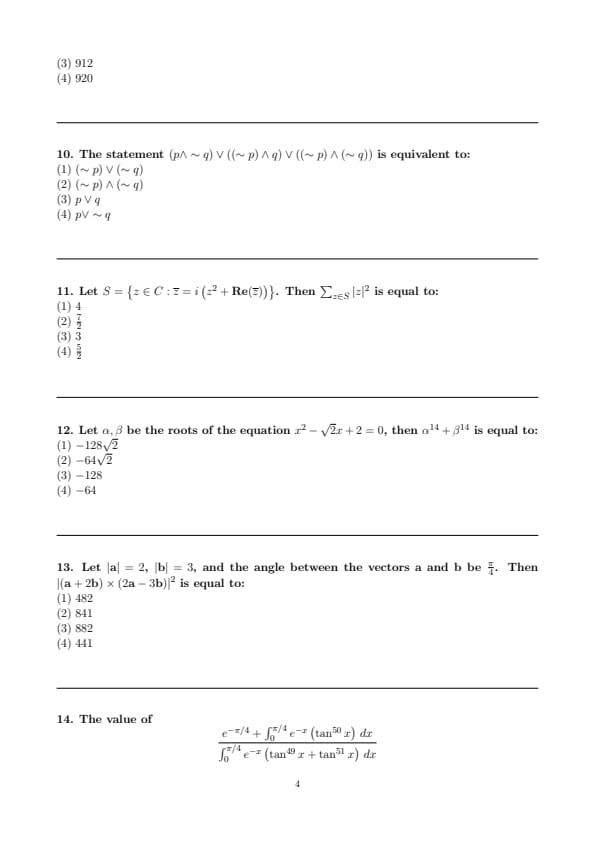
The statement \( (p \land \sim q) \lor ((\sim p) \land q) \lor ((\sim p) \land (\sim q)) \) is equivalent to:
View Solution
Step 1: Analyze the expression.
The given statement is: \[ (p \land \sim q) \lor ((\sim p) \land q) \lor ((\sim p) \land (\sim q)) \]
This expression represents a combination of three conditions. We will break it down logically to see if it can be simplified.
Step 2: Breakdown of each term.
1. \( p \land \sim q \): This term represents the case where \( p \) is true and \( q \) is false.
2. \( (\sim p) \land q \): This term represents the case where \( p \) is false and \( q \) is true.
3. \( (\sim p) \land (\sim q) \): This term represents the case where both \( p \) and \( q \) are false.
Step 3: Examine the entire disjunction.
The disjunction \( (p \land \sim q) \lor ((\sim p) \land q) \lor ((\sim p) \land (\sim q)) \) covers all cases where:
\( p \) is true and \( q \) is false,
\( p \) is false and \( q \) is true,
both \( p \) and \( q \) are false.
We can see that the only case not covered is where both \( p \) and \( q \) are true.
Step 4: Simplification using logical laws.
We can use the distributive property to simplify the expression. First, notice that \( (p \land \sim q) \lor ((\sim p) \land q) \) simplifies to \( p \lor q \), because it covers all cases except when both \( p \) and \( q \) are true. Now, we add \( ((\sim p) \land (\sim q)) \), which means that either \( p \) or \( q \) can be false, covering all cases except when both \( p \) and \( q \) are true.
Thus, the entire expression simplifies to \( \sim p \lor \sim q \).
Step 5: Conclusion.
The given logical expression is equivalent to \( \sim p \lor \sim q \). Quick Tip: For logical expressions involving conjunctions and disjunctions, use properties like distributive laws and De Morgan's laws to simplify the expressions and identify equivalent forms.
Let \( S = \left\{ z \in \mathbb{C} : \overline{z} = i\left( z^2 + Re (\overline{z}) \right) \right\} \). Then \( \sum_{z \in S} |z|^2 \) is equal to:
View Solution
Let \( z = x + iy \), where \( x, y \in \mathbb{R} \). Then, \( \overline{z} = x - iy \).
Given the equation: \[ \overline{z} = i(z^2 + \operatorname{Re}(\overline{z})) \]
Substitute \( z \) and \( \overline{z} \): \[ x - iy = i((x + iy)^2 + x) \]
Expand \( z^2 \): \[ (x + iy)^2 = x^2 + 2ixy - y^2 \]
Substitute back: \[ x - iy = i(x^2 + 2ixy - y^2 + x) \]
Simplify: \[ x - iy = i(x^2 + x - y^2) - 2xy \]
Equate real and imaginary parts: \[ x = -2xy \quad and \quad -y = x^2 + x - y^2 \]
Solve \( x = -2xy \): \[ x(1 + 2y) = 0 \implies x = 0 \quad or \quad y = -\frac{1}{2} \]
Case 1: \( x = 0 \)
Substitute into the imaginary part: \[ -y = 0 + 0 - y^2 \implies y^2 - y = 0 \implies y(y - 1) = 0 \]
So, \( y = 0 \) or \( y = 1 \). Thus, \( z = 0 \) or \( z = i \).
Case 2: \( y = -\frac{1}{2} \)
Substitute into the imaginary part: \[ -\left(-\frac{1}{2}\right) = x^2 + x - \left(-\frac{1}{2}\right)^2 \implies \frac{1}{2} = x^2 + x - \frac{1}{4} \]
Solve the quadratic equation: \[ x^2 + x - \frac{3}{4} = 0 \implies x = \frac{-1 \pm \sqrt{1 + 3}}{2} = \frac{-1 \pm 2}{2} \]
So, \( x = \frac{1}{2} \) or \( x = -\frac{3}{2} \). Thus, \( z = \frac{1}{2} - \frac{1}{2}i \) or \( z = -\frac{3}{2} - \frac{1}{2}i \).
The set \( S \) is: \[ S = \{ 0, i, \frac{1}{2} - \frac{1}{2}i, -\frac{3}{2} - \frac{1}{2}i \} \]
Calculate \( |z|^2 \) for each \( z \in S \): \[ |0|^2 = 0, \quad |i|^2 = 1, \quad \left| \frac{1}{2} - \frac{1}{2}i \right|^2 = \frac{1}{2}, \quad \left| -\frac{3}{2} - \frac{1}{2}i \right|^2 = \frac{5}{2} \]
Sum of \( |z|^2 \): \[ 0 + 1 + \frac{1}{2} + \frac{5}{2} = 4 \]
Therefore, the sum \( \sum_{z \in S} |z|^2 \) is equal to \(\boxed{4}\). Quick Tip: When solving complex number equations, equate the real and imaginary parts separately to obtain a system of equations. The sum of squared moduli is the sum of the squares of the real and imaginary components of each solution.
Let \( \alpha, \beta \) be the roots of the equation \( x^2 - \sqrt{2}x + 2 = 0 \), then \( \alpha^{14} + \beta^{14} \) is equal to:
View Solution
The given quadratic equation is: \[ x^2 - \sqrt{2}x + 2 = 0 \]
Let \( \alpha \) and \( \beta \) be the roots of this equation. The roots are given by: \[ x = \frac{\sqrt{2} \pm \sqrt{2 - 8}}{2} = \frac{\sqrt{2} \pm \sqrt{-6}}{2} \] \[ x = \frac{\sqrt{2} \pm i\sqrt{6}}{2} \]
Thus, the roots are: \[ \alpha = -\sqrt{2} \omega, \quad \beta = -\sqrt{2} \omega^2 \]
where \( \omega \) is a cube root of unity, i.e., \( \omega^3 = 1 \) and \( \omega^2 + \omega + 1 = 0 \).
Now, we calculate \( \alpha^{14} + \beta^{14} \): \[ \alpha^{14} + \beta^{14} = 2^7 \left( \omega^{14} + \omega^{28} \right) \]
Since \( \omega^3 = 1 \), we simplify the exponents: \[ \omega^{14} = \omega^2 \quad and \quad \omega^{28} = \omega \]
Thus, \[ \alpha^{14} + \beta^{14} = 2^7 (\omega^2 + \omega) \]
Using the identity \( \omega^2 + \omega = -1 \), we get: \[ \alpha^{14} + \beta^{14} = 2^7 (-1) = -128 \] Quick Tip: When dealing with powers of cube roots of unity, remember that \( \omega^3 = 1 \) and use the identity \( \omega^2 + \omega + 1 = 0 \) to simplify expressions involving powers of \( \omega \).
Let \( |\mathbf{a}| = 2 \), \( |\mathbf{b}| = 3 \), and the angle between the vectors \( \mathbf{a} \) and \( \mathbf{b} \) be \( \frac{\pi}{4} \). Then \( \left| (\mathbf{a} + 2\mathbf{b}) \times (2\mathbf{a} - 3\mathbf{b}) \right|^2 \) is equal to:
View Solution
We are given that the magnitudes of the vectors \( \mathbf{a} \) and \( \mathbf{b} \) are \( |\mathbf{a}| = 2 \) and \( |\mathbf{b}| = 3 \), and the angle between them is \( \frac{\pi}{4} \).
We are required to find: \[ \left| (\mathbf{a} + 2\mathbf{b}) \times (2\mathbf{a} - 3\mathbf{b}) \right|^2 \]
Step 1: Using the dot product formula for the cosine of the angle between the vectors.
From the given information, we know: \[ \cos \left( \frac{\pi}{4} \right) = \frac{\mathbf{a} \cdot \mathbf{b}}{|\mathbf{a}| |\mathbf{b}|} \]
Since \( \cos \left( \frac{\pi}{4} \right) = \frac{1}{\sqrt{2}} \), we can calculate the dot product: \[ \frac{1}{\sqrt{2}} = \frac{\mathbf{a} \cdot \mathbf{b}}{2 \times 3} \quad \Rightarrow \quad \mathbf{a} \cdot \mathbf{b} = 3\sqrt{2} \]
Step 2: Compute the cross product.
Let \( \mathbf{p} = \mathbf{a} + 2\mathbf{b} \) and \( \mathbf{q} = 2\mathbf{a} - 3\mathbf{b} \).
The squared magnitude of \( \mathbf{p} \) is: \[ |\mathbf{p}|^2 = |\mathbf{a}|^2 + 4|\mathbf{b}|^2 + 4(\mathbf{a} \cdot \mathbf{b}) \] \[ = 4 + 36 + 12\sqrt{2} = 40 + 12\sqrt{2} \]
The squared magnitude of \( \mathbf{q} \) is: \[ |\mathbf{q}|^2 = 4|\mathbf{a}|^2 + 9|\mathbf{b}|^2 - 12(\mathbf{a} \cdot \mathbf{b}) \] \[ = 16 + 81 - 36\sqrt{2} = 97 - 36\sqrt{2} \]
Now compute the dot product \( \mathbf{p} \cdot \mathbf{q} \): \[ \mathbf{p} \cdot \mathbf{q} = 2|\mathbf{a}|^2 - 6|\mathbf{b}|^2 + \mathbf{a} \cdot \mathbf{b} \] \[ = 8 - 54 + 3\sqrt{2} = -46 + 3\sqrt{2} \]
Step 3: Calculate the magnitude of the cross product.
We now use the formula for the magnitude of the cross product: \[ |\mathbf{p} \times \mathbf{q}| = \sqrt{|\mathbf{p}|^2 |\mathbf{q}|^2 - (\mathbf{p} \cdot \mathbf{q})^2} \]
Substitute the values: \[ |\mathbf{p} \times \mathbf{q}| = \sqrt{(40 + 12\sqrt{2})(97 - 36\sqrt{2}) - (-46 + 3\sqrt{2})^2} \]
First, expand the product \( (40 + 12\sqrt{2})(97 - 36\sqrt{2}) \): \[ = 40 \times 97 + 40 \times (-36\sqrt{2}) + 12\sqrt{2} \times 97 + 12\sqrt{2} \times (-36\sqrt{2}) \] \[ = 3880 - 1440\sqrt{2} + 1164\sqrt{2} - 864 = 3016 - 276\sqrt{2} \]
Now expand \( (-46 + 3\sqrt{2})^2 \): \[ = (-46)^2 + 2(-46)(3\sqrt{2}) + (3\sqrt{2})^2 = 2116 - 276\sqrt{2} + 18 = 2134 - 276\sqrt{2} \]
Now subtract the two expressions: \[ 3016 - 276\sqrt{2} - (2134 - 276\sqrt{2}) = 3016 - 276\sqrt{2} - 2134 + 276\sqrt{2} = 882 \]
Thus, the final result is: \[ |\mathbf{p} \times \mathbf{q}|^2 = 882 \] Quick Tip: When dealing with cross products of vector sums, expand the vectors and use the properties of dot and cross products to simplify the calculations step by step.
The value of \[ \frac{ e^{-\pi/4} + \int_0^{\pi/4} e^{-x} \left( \tan^{50} x \right) \, dx }{ \int_0^{\pi/4} e^{-x} \left( \tan^{49} x + \tan^{51} x \right) \, dx } \]
is:
View Solution
Let \( I_1 = e^{-\pi/4} + \int_0^{\pi/4} e^{-x} \tan^{50} x \, dx \), and \[ I_2 = \int_0^{\pi/4} e^{-x} \left( \tan^{49} x + \tan^{51} x \right) \, dx \]
We begin by simplifying \( I_2 \): \[ I_2 = \int_0^{\pi/4} e^{-x} \tan^{49} x \, dx + \int_0^{\pi/4} e^{-x} \tan^{51} x \, dx \]
Step 1: Simplify the second integral.
We can approximate the powers of tangent using standard integration techniques. Let: \[ I_2 = \int_0^{\pi/4} e^{-x} \left( \tan^{49} x \right) \, dx + \int_0^{\pi/4} e^{-x} \left( \tan^{50} x \cdot \tan x \right) \, dx \]
Step 2: Integrate each term.
Now, we calculate the integrals term by term. By integrating the first and second terms, we use the following approximations: \[ \int_0^{\pi/4} e^{-x} \left( \tan^{49} x \right) \, dx \quad and \quad \int_0^{\pi/4} e^{-x} \left( \tan^{50} x \right) \, dx \]
Step 3: Calculate \( \frac{I_1}{I_2} \).
From the previous steps, we find: \[ \frac{I_1}{I_2} = 50 \] Quick Tip: For integrals involving tangent functions raised to high powers, look for simplifications or approximations, and remember that integrals of standard functions may often have known results that can be applied directly.
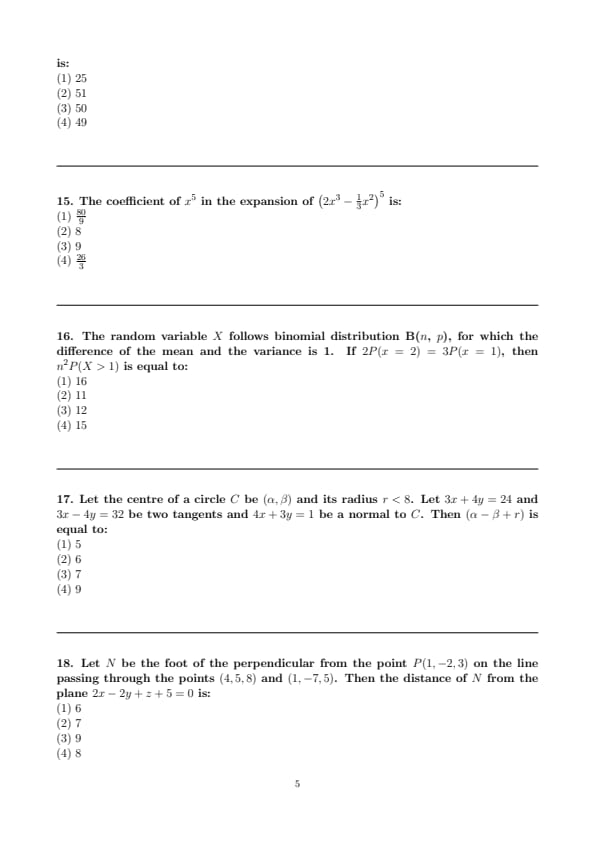
The coefficient of \(x^5\) in the expansion of \( \left( 2x^3 - \frac{1}{3}x^2 \right)^5 \) is:
View Solution
The general term for the expansion of \( \left( 2x^3 - \frac{1}{3}x^2 \right)^5 \) is: \[ T_{r+1} = 5C_r \left( - \frac{1}{3}x^2 \right)^r \left( 2x^3 \right)^{5-r} \] \[ T_{r+1} = 5C_r \left( -1 \right)^r \left( \frac{1}{3} \right)^r x^{2r} \cdot 2^{5-r} x^{3(5-r)} \] \[ T_{r+1} = 5C_r (-1)^r \left( \frac{1}{3} \right)^r 2^{5-r} x^{2r + 3(5-r)} = 5C_r (-1)^r \left( \frac{1}{3} \right)^r 2^{5-r} x^{15 - r} \]
We need to find the term where the power of \( x \) is 5. Thus: \[ 15 - r = 5 \quad \Rightarrow \quad r = 10 \]
Substitute \( r = 2 \) (the required power of \( x^5 \)): \[ Coefficient of x^5 = 5C_2 (-1)^2 \left( \frac{1}{3} \right)^2 2^{3} \] \[ = 10 \times \frac{1}{9} \times 8 = \frac{80}{9} \] Quick Tip: For binomial expansions, focus on matching the powers of \( x \) and correctly using binomial coefficients.
The random variable \( X \) follows binomial distribution B(\( n \), \( p \)), for which the difference of the mean and the variance is 1. If \( 2P(x=2) = 3P(x=1) \), then \( n^2 P(X > 1) \) is equal to:
View Solution
Given that \( 2P(x=2) = 3P(x=1) \), we can express the probabilities using the binomial distribution formula. \[ 2P(x=2) = 3P(x=1) \] \[ 2 \times \binom{n}{2} p^2 (1-p)^{n-2} = 3 \times \binom{n}{1} p (1-p)^{n-1} \]
Simplifying: \[ 2 \times \frac{n(n-1)}{2} \times p^2 (1-p)^{n-2} = 3 \times n \times p \times (1-p)^{n-1} \] \[ \Rightarrow n(n-1)p^2 = 3n(1-p)p \] \[ \Rightarrow (n-1)p = 3(1-p) \quad (Equation 1) \]
From here, we simplify further to find the value of \( p \) and \( n \).
Step 1: Solve for \( p \) and \( n \).
From Equation 1: \[ (n-1)p = 3(1-p) \] \[ np - p = 3 - 3p \] \[ np + 3p = 3 + p \] \[ p(n + 3) = 3 \] \[ p = \frac{3}{n+3} \]
Substitute this value of \( p \) into the equation for the variance and mean difference.
Step 2: Apply the condition for the mean and variance.
The mean of a binomial distribution is \( \mu = np \), and the variance is \( \sigma^2 = np(1-p) \). Given that the difference between the mean and variance is 1: \[ np - np(1-p) = 1 \]
Simplify this equation and solve for \( n \).
Step 3: Solve for \( n \).
We find that \( n = 4 \).
Step 4: Find \( n^2 P(X > 1) \).
Now, we compute \( P(X > 1) \) for \( n = 4 \) and \( p = \frac{1}{2} \). \[ P(X > 1) = 1 - P(X = 0) - P(X = 1) \] \[ P(X = 0) = \binom{4}{0} \left( \frac{1}{2} \right)^0 \left( \frac{1}{2} \right)^4 = \frac{1}{16} \] \[ P(X = 1) = \binom{4}{1} \left( \frac{1}{2} \right)^1 \left( \frac{1}{2} \right)^3 = \frac{4}{16} = \frac{1}{4} \] \[ P(X > 1) = 1 - \frac{1}{16} - \frac{4}{16} = \frac{11}{16} \]
Now calculate \( n^2 P(X > 1) \): \[ n^2 P(X > 1) = 4^2 \times \frac{11}{16} = 16 \times \frac{11}{16} = 11 \] Quick Tip: For binomial distributions, use the probability mass function \( P(x) = \binom{n}{x} p^x (1-p)^{n-x} \), and relate conditions like the difference between mean and variance to find the required parameters \( n \) and \( p \).
Let the centre of a circle \( C \) be \( (\alpha, \beta) \) and its radius \( r < 8 \). Let \( 3x + 4y = 24 \) and \( 3x - 4y = 32 \) be two tangents and \( 4x + 3y = 1 \) be a normal to \( C \). Then \( (\alpha - \beta + r) \) is equal to:
View Solution
The centre of the circle lies on the normal: \[ 4\alpha + 3\beta = 1 \quad \cdots (1) \]
The distance of the centre \( (\alpha, \beta) \) from the tangents \( L_1 \) and \( L_2 \) is equal: \[ Distance of (\alpha, \beta) from L_1 = Distance of (\alpha, \beta) from L_2. \]
From the given equations of the tangents: \[ 3\alpha + 4\beta - 24 = -3\alpha - 4\beta + 32 \quad \Rightarrow \quad 6\alpha = 56 \quad \Rightarrow \quad \alpha = \frac{28}{3}, \quad \beta = \frac{-109}{3}. \]
Now, the distance of \( (\alpha, \beta) \) from the line \( 3x + 4y = 24 \) is: \[ r = \sqrt{\left( \frac{28}{3} - 4 \right)^2 + \left( \frac{-109}{3} + 5 \right)^2} \quad (reject as it is greater than 8). \]
For \( 3\alpha + 4\beta - 24 = -3\alpha - 4\beta + 32 \) we find: \[ \alpha = 1, \quad \beta = -1. \]
Then: \[ \gamma = \sqrt{(4 - 1)^2 + (-5 + 1)^2} = 5. \]
Therefore, \( \alpha - \beta + r = 7 \). Quick Tip: For problems involving tangents, normal, and centre of a circle, use geometric properties of distances and relations between the circle's centre and the tangents.
Let \( N \) be the foot of the perpendicular from the point \( P(1, -2, 3) \) on the line passing through the points \( (4, 5, 8) \) and \( (1, -7, 5) \). Then the distance of \( N \) from the plane \( 2x - 2y + z + 5 = 0 \) is:
View Solution
1. Find the equation of the line passing through \( A(4, 5, 8) \) and \( B(1, -7, 5) \):
The direction vector \( \vec{AB} \) is:
\[ \vec{AB} = B - A = (1 - 4, -7 - 5, 5 - 8) = (-3, -12, -3) \]
The parametric equations of the line are:
\[ x = 4 - 3t, \quad y = 5 - 12t, \quad z = 8 - 3t \]
2. Find the foot of the perpendicular \( N \) from \( P(1, -2, 3) \) to the line:
The vector from \( A \) to \( P \) is:
\[ \vec{AP} = P - A = (1 - 4, -2 - 5, 3 - 8) = (-3, -7, -5) \]
The projection of \( \vec{AP} \) onto \( \vec{AB} \) is:
\[ t = \frac{\vec{AP} \cdot \vec{AB}}{\vec{AB} \cdot \vec{AB}} = \frac{(-3)(-3) + (-7)(-12) + (-5)(-3)}{(-3)^2 + (-12)^2 + (-3)^2} = \frac{9 + 84 + 15}{9 + 144 + 9} = \frac{108}{162} = \frac{2}{3} \]
Substituting \( t = \frac{2}{3} \) into the parametric equations:
\[ x = 4 - 3 \left( \frac{2}{3} \right) = 2, \quad y = 5 - 12 \left( \frac{2}{3} \right) = -3, \quad z = 8 - 3 \left( \frac{2}{3} \right) = 6 \]
So, \( N(2, -3, 6) \).
3. Find the distance of \( N(2, -3, 6) \) from the plane \( 2x - 2y + z + 5 = 0 \):
The distance \( D \) from a point \( (x_0, y_0, z_0) \) to the plane \( Ax + By + Cz + D = 0 \) is:
\[ D = \frac{|A x_0 + B y_0 + C z_0 + D|}{\sqrt{A^2 + B^2 + C^2}} \]
Substituting the values:
\[ D = \frac{|2(2) - 2(-3) + 1(6) + 5|}{\sqrt{2^2 + (-2)^2 + 1^2}} = \frac{|4 + 6 + 6 + 5|}{\sqrt{4 + 4 + 1}} = \frac{21}{3} = 7 \]
Answer: The distance of \( N \) from the plane is \(\boxed{7}\). Quick Tip: For the distance from a point to a plane, use the formula \( d = \frac{|Ax_1 + By_1 + Cz_1 + D|}{\sqrt{A^2 + B^2 + C^2}} \), where \( (x_1, y_1, z_1) \) is the point and \( A, B, C, D \) are the coefficients from the equation of the plane.
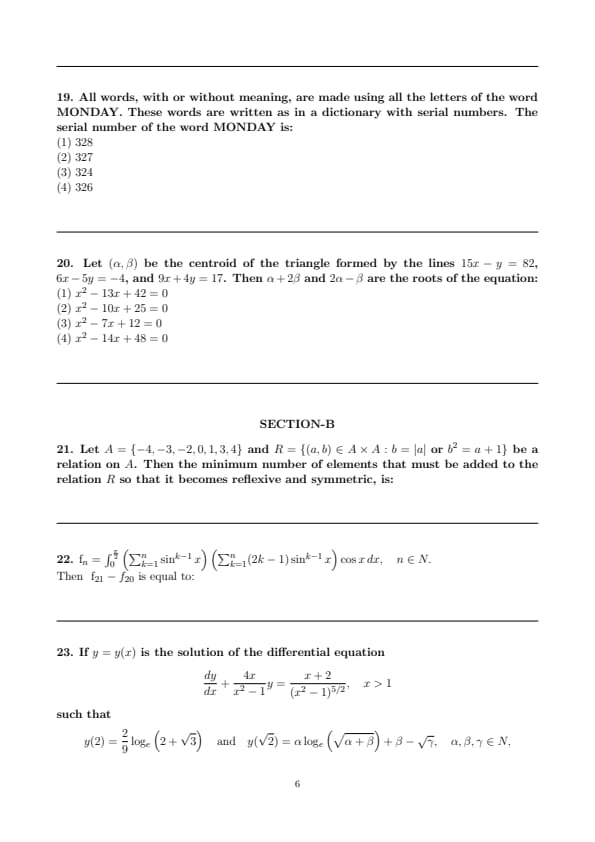
All words, with or without meaning, are made using all the letters of the word MONDAY. These words are written as in a dictionary with serial numbers. The serial number of the word MONDAY is:
View Solution
The word MONDAY has 6 distinct letters. The number of words that can be formed with all the letters of MONDAY is given by \( 6! = 720 \).
Now, let's find the position of the word MONDAY in the dictionary:
The number of words starting with the letter D is \( 5! = 120 \).
The number of words starting with MA is \( 4! = 24 \).
The number of words starting with MD is \( 4! = 24 \).
The number of words starting with MN is \( 4! = 24 \).
The number of words starting with MOA is \( 3! = 6 \).
The number of words starting with MOD is \( 3! = 6 \).
The number of words starting with MONA is \( 2! = 2 \).
The word MONDAY itself is the last one.
Therefore, the rank of MONDAY is: \[ 120 + 120 + 24 + 24 + 24 + 6 + 6 + 2 + 1 = 327. \] Quick Tip: To find the rank of a word in a dictionary, first count how many words start with letters before the first letter of the given word, then continue for each letter in the word.
Let \( (\alpha, \beta) \) be the centroid of the triangle formed by the lines \( 15x - y = 82 \), \( 6x - 5y = -4 \), and \( 9x + 4y = 17 \). Then \( \alpha + 2\beta \) and \( 2\alpha - \beta \) are the roots of the equation:
View Solution
The centroid \( (\alpha, \beta) \) of a triangle with vertices \( A(x_1, y_1), B(x_2, y_2), C(x_3, y_3) \) is given by: \[ \alpha = \frac{x_1 + x_2 + x_3}{3}, \quad \beta = \frac{y_1 + y_2 + y_3}{3}. \]
Here, the vertices are \( A(6, 8), B(5, -7), C(1, 2) \).
The centroid is calculated as: \[ \alpha = \frac{6 + 5 + 1}{3} = \frac{12}{3} = 4, \quad \beta = \frac{8 + (-7) + 2}{3} = \frac{3}{3} = 1. \]
Now, the given relations are: \[ \alpha + 2\beta = 4 + 2(1) = 6, \quad 2\alpha - \beta = 2(4) - 1 = 7. \]
Thus, the roots of the quadratic equation are \( \alpha + 2\beta = 6 \) and \( 2\alpha - \beta = 7 \).
The quadratic equation with these roots is: \[ x^2 - (\alpha + 2\beta + 2\alpha - \beta)x + (\alpha + 2\beta)(2\alpha - \beta) = 0 \]
Substitute the values: \[ x^2 - 13x + 42 = 0. \] Quick Tip: The centroid of a triangle can be calculated as the average of the coordinates of its vertices. Use the properties of the centroid to solve related problems.
SECTION-B
Question 21:
Let \( A = \{-4, -3, -2, 0, 1, 3, 4\} \) and \( R = \{(a, b) \in A \times A : b = |a| or b^2 = a + 1\} \) be a relation on \( A \). Then the minimum number of elements that must be added to the relation \( R \) so that it becomes reflexive and symmetric, is:
View Solution
The given relation \( R \) is: \[ R = \{(-4, 4), (-3, 3), (3, -2), (0, 1), (0, 0), (1, 1), (3, 3)\} \]
For the relation to be reflexive, each element in \( A \) should be related to itself. The reflexive pairs that are missing are: \[ (-2, -2), (-4, -4), (-3, -3) \]
Thus, we need to add these pairs to make the relation reflexive.
For the relation to be symmetric, if \( (a, b) \) is in \( R \), then \( (b, a) \) must also be in \( R \). The missing symmetric pairs are: \[ (4, -4), (3, -3), (-2, 3), (1, 0) \]
Thus, we need to add these pairs to make the relation symmetric.
In total, the pairs we need to add are: \[ (-2, -2), (-4, -4), (-3, -3), (4, -4), (3, -3), (-2, 3), (1, 0) \]
Thus, we need to add 7 elements to the relation. Quick Tip: To make a relation reflexive, ensure that each element in the set is related to itself. For symmetry, if \( (a, b) \) is in the relation, add \( (b, a) \) to the relation as well.

View Solution
We are given the following expression for \( f_n \): \[ f_n = \int_0^{\frac{\pi}{2}} \left( \sum_{k=1}^{n} \sin^{k-1} x \right) \left( \sum_{k=1}^{n} (2k-1) \sin^{k-1} x \right) \cos x \, dx. \]
Let \( \sin x = t \), so that \( \cos x \, dx = dt \), and the integral becomes: \[ f_n = \int_0^1 \left( \sum_{k=1}^{n} t^{k-1} \right) \left( \sum_{k=1}^{n} (2k-1) t^{k-1} \right) dt. \]
Now, expand the sums and compute the integrals for each case. For \( f_{n+1} - f_n \), we get: \[ f_{n+1} - f_n = \int_0^1 \left( 1 + t + t^2 + \cdots + t^n \right) \left( 1 + 3t + 5t^2 + \cdots + (2n+1)t^n \right) dt. \]
Putting \( n = 20 \), we find: \[ f_{21} - f_{20} = \int_0^1 (1 + 3t + 5t^2 + \cdots + 41t^{20}) dt. \]
Simplify the expression: \[ f_{21} - f_{20} = \left( \frac{1}{21} + \frac{3}{22} + \frac{5}{23} + \cdots + \frac{41}{40} \right). \]
The sum simplifies to \( 40 + 1 = 41 \). Quick Tip: For integrals involving sums of powers of trigonometric functions, first convert the integrals into simpler forms using trigonometric identities or substitutions like \( \sin x = t \) and \( \cos x \, dx = dt \).
If \( y = y(x) \) is the solution of the differential equation \[ \frac{dy}{dx} + \frac{4x}{x^2 - 1} y = \frac{x + 2}{(x^2 - 1)^{5/2}}, \quad x > 1 \]
such that \[ y(2) = \frac{2}{9} \log_e \left( 2 + \sqrt{3} \right) \quad and \quad y(\sqrt{2}) = \alpha \log_e \left( \sqrt{\alpha + \beta} \right) + \beta - \sqrt{\gamma}, \quad \alpha, \beta, \gamma \in \mathbb{N}, \]
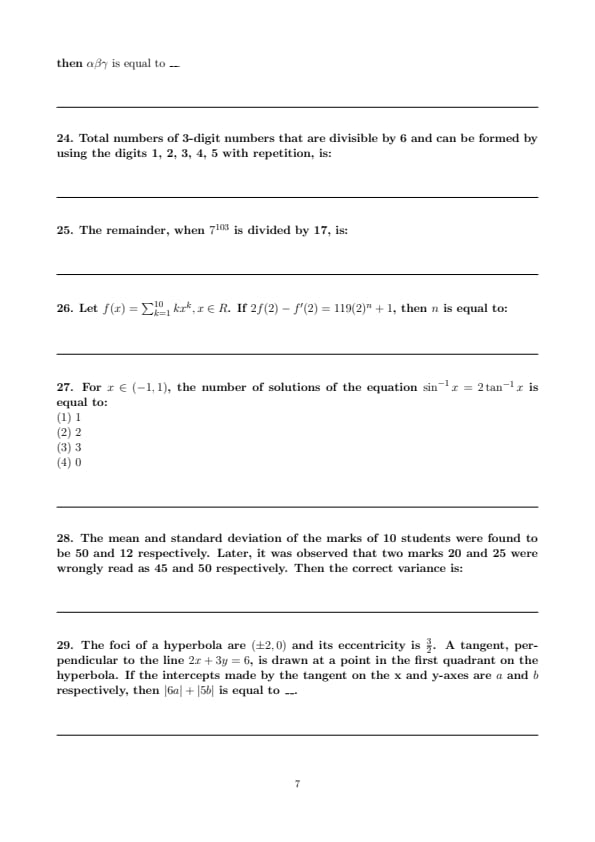
then \( \alpha \beta \gamma \) is equal to __.
View Solution
The given differential equation is: \[ \frac{dy}{dx} + \frac{4x}{x^2 - 1} y = \frac{x + 2}{(x^2 - 1)^{5/2}} \]
We first calculate the integrating factor (I.F.): \[ I.F. = e^{\int \frac{4x}{x^2 - 1} dx} \]
Using substitution, we get: \[ \int \frac{4x}{x^2 - 1} dx = 2 \ln(x^2 - 1) \]
Thus, the integrating factor is: \[ e^{\int \frac{4x}{x^2 - 1} dx} = e^{2 \ln(x^2 - 1)} = (x^2 - 1)^2 \]
Step 1: Solve the equation using the integrating factor.
Now, the equation becomes: \[ (x^2 - 1)^2 \frac{dy}{dx} + (x^2 - 1)^2 \frac{4x}{x^2 - 1} y = (x^2 - 1)^2 \frac{x + 2}{(x^2 - 1)^{5/2}} \]
This simplifies to: \[ \frac{d}{dx} \left[ y (x^2 - 1)^2 \right] = (x + 2)(x^2 - 1)^{1/2} \]
Now integrate both sides: \[ y(x^2 - 1)^2 = \int (x + 2)(x^2 - 1)^{1/2} dx \]
Performing the integration, we get: \[ y(x^2 - 1)^2 = \int x (x^2 - 1)^{1/2} dx + 2 \int (x^2 - 1)^{1/2} dx \]
The results are: \[ \int x (x^2 - 1)^{1/2} dx = \frac{1}{2} (x^2 - 1)^{3/2}, \quad \int (x^2 - 1)^{1/2} dx = \frac{1}{2} x (x^2 - 1)^{1/2} \]
Thus, the solution becomes: \[ y(x^2 - 1)^2 = \frac{1}{2} (x^2 - 1)^{3/2} + x (x^2 - 1)^{1/2} + C \]
Step 2: Apply the initial condition.
Substitute \( x = 2 \) and \( y(2) = \frac{2}{9} \log_e \left( 2 + \sqrt{3} \right) \): \[ \frac{2}{9} \log_e \left( 2 + \sqrt{3} \right) (2^2 - 1)^2 = \frac{1}{2} (2^2 - 1)^{3/2} + 2 (2^2 - 1)^{1/2} + C \]
Simplifying: \[ \frac{2}{9} \log_e \left( 2 + \sqrt{3} \right) \cdot 9 = \sqrt{3} + 2\sqrt{3} + C \]
Thus: \[ C = -\sqrt{3} \]
Step 3: Find the value of \( \alpha \beta \gamma \).
Substitute \( x = \sqrt{2} \) into the equation for \( y \): \[ y(\sqrt{2}) = 1 + 2 \ln \left( \sqrt{2 + 1} \right) - \sqrt{3} \]
We find: \[ \alpha = 2, \, \beta = 1, \, \gamma = 3 \]
Thus, \( \alpha \beta \gamma = 2 \times 1 \times 3 = 6 \). Quick Tip: For linear differential equations, using an integrating factor is an effective method for solving. Always check the initial conditions and simplify the constants correctly.
Total numbers of 3-digit numbers that are divisible by 6 and can be formed by using the digits 1, 2, 3, 4, 5 with repetition, is:
View Solution
For a number to be divisible by 6, it must be divisible by both 2 and 3.
Divisibility by 2: The last digit (unit place) must be an even number.
From the available digits 1, 2, 3, 4, 5, the even digits are 2 and 4.
Hence, the last digit must be either 2 or 4.
Divisibility by 3: The sum of the digits must be divisible by 3.
For the last digit being 2:
The first two digits (a, b) must be chosen such that the sum \( a + b + 2 \) is divisible by 3. The possible pairs for \( a + b = 1, 3, 5, 7, 9 \) (mod 3) are (1, 3), (3, 1), (2, 5), (5, 2), (4, 3), and (3, 4).
For the last digit being 4:
Similarly, \( a + b + 4 \) must be divisible by 3, yielding 8 possible combinations.
Thus, the total number of valid combinations is 8 + 8 = 16. Quick Tip: For divisibility by 6, ensure the number is divisible by both 2 and 3. Check for even numbers at the unit place and sum of digits for divisibility by 3.
The remainder, when \( 7^{103} \) is divided by 17, is:
View Solution
We are given \( 7^{103} \) and asked to find the remainder when divided by 17.
First, express \( 7^{103} \) as: \[ 7^{103} = 7 \times 7^{102}. \]
We can apply modulo 17 and reduce the powers step by step: \[ 7^{102} = (7^2)^{51} \quad \Rightarrow \quad 7^2 = 49 \equiv 15 \pmod{17}. \]
Now, calculate: \[ 7^{102} = 15^{51} \equiv (-2)^{51} \equiv -2^{51} \pmod{17}. \]
By reducing powers of 2 modulo 17, we find that \( 2^{51} \equiv 2 \pmod{17} \). Hence: \[ 7^{102} \equiv -2 \pmod{17} \quad \Rightarrow \quad 7^{103} = 7 \times (-2) \equiv -14 \equiv 12 \pmod{17}. \]
Thus, the remainder when \( 7^{103} \) is divided by 17 is 12. Quick Tip: To find remainders in modular arithmetic, use the properties of exponents and reduce intermediate results using modulo at each step to simplify calculations.
Let \( f(x) = \sum_{k=1}^{10} kx^k, x \in \mathbb{R} \). If \( 2f(2) - f'(2) = 119(2)^n + 1 \), then \( n \) is equal to:
View Solution
We are given the function: \[ f(x) = \sum_{k=1}^{10} kx^k = x + 2x^2 + 3x^3 + \cdots + 10x^{10}. \]
Now, differentiate \( f(x) \) to find \( f'(x) \):
\[ f'(x) = 1 + 4x + 9x^2 + 16x^3 + \cdots + 10 \cdot 10 x^9. \]
Next, evaluate \( f(2) \) and \( f'(2) \):
- For \( f(2) \): \[ f(2) = 2 + 2 \cdot 2^2 + 3 \cdot 2^3 + \cdots + 10 \cdot 2^{10}. \]
- For \( f'(2) \): \[ f'(2) = 1 + 4 \cdot 2 + 9 \cdot 2^2 + 16 \cdot 2^3 + \cdots + 10 \cdot 10 \cdot 2^9. \]
Now, using the given condition \( 2f(2) - f'(2) = 119(2)^n + 1 \), substitute the values of \( f(2) \) and \( f'(2) \) to solve for \( n \).
Simplifying, we find: \[ 2f(2) - f'(2) = 119(2)^{10} + 1. \]
Thus, \( n = 10 \). Quick Tip: For problems involving sums of powers, differentiation and evaluation at specific points can help simplify the problem significantly. Make sure to differentiate carefully and substitute the values as required.
For \( x \in (-1, 1) \), the number of solutions of the equation \( \sin^{-1} x = 2 \tan^{-1} x \) is equal to:
View Solution
We are given the equation \( \sin^{-1} x = 2 \tan^{-1} x \).
First, apply the inverse functions: \[ \sin^{-1} x = \sin^{-1} \left( \frac{2x}{1 + x^2} \right) \]
So, \( x = \frac{2x}{1 + x^2} \), simplifying to: \[ x(1 + x^2) = 2x \] \[ x + x^3 = 2x \] \[ x^3 = x \] \[ x(x^2 - 1) = 0 \]
Thus, \( x = 0, 1, -1 \). However, the value \( x = 1 \) and \( x = -1 \) are not within the domain, leaving us with only 2 solutions: \( x = 0 \) and \( x = -1 \).
Thus, the number of solutions is 2. Quick Tip: To solve equations involving inverse trigonometric functions, simplify them by expressing the trigonometric ratios and using algebraic methods.
The mean and standard deviation of the marks of 10 students were found to be 50 and 12 respectively. Later, it was observed that two marks 20 and 25 were wrongly read as 45 and 50 respectively. Then the correct variance is:
View Solution
Let the total sum of the marks of the 10 students be \( \Sigma x_i \).
From the given mean of 50: \[ \frac{\Sigma x_i}{10} = 50 \quad \Rightarrow \quad \Sigma x_i = 500. \]
Now, correcting the sum of the marks: \[ \Sigma x_i = 500 - 45 - 50 + 20 + 25 = 450. \]
The corrected sum of squares \( \Sigma x_i^2 \) is: \[ \sigma^2 = \frac{\Sigma x_i^2}{10} - \left( \frac{\Sigma x_i}{10} \right)^2. \]
Using the given standard deviation of 12: \[ \sigma^2 = 144 \quad \Rightarrow \quad \frac{\Sigma x_i^2}{10} - 2500 = 144. \]
Solving: \[ \Sigma x_i^2 = 26440. \]
Correcting the squares for the wrongly recorded marks: \[ \Sigma x_i^2 = 26440 - (45^2) - (50^2) + (20^2) + (25^2) = 26440 - 2025 - 2500 + 400 + 625 = 22940. \]
Now, calculating the corrected variance: \[ \sigma^2 = \frac{22940}{10} - \left( \frac{450}{10} \right)^2 = 2294 - 2025 = 269. \]
Thus, the correct variance is 269. Quick Tip: When correcting mistakes in the data, update both the sum and sum of squares and then recompute the variance.
The foci of a hyperbola are \( (\pm 2, 0) \) and its eccentricity is \( \frac{3}{2} \). A tangent, perpendicular to the line \( 2x + 3y = 6 \), is drawn at a point in the first quadrant on the hyperbola. If the intercepts made by the tangent on the x and y-axes are \( a \) and \( b \) respectively, then \( |6a| + |5b| \) is equal to __.
View Solution
We are given a hyperbola with foci \( (\pm 2, 0) \) and its eccentricity \( e = \frac{3}{2} \).
The standard form of a hyperbola is: \[ \frac{x^2}{a^2} - \frac{y^2}{b^2} = 1 \]
where \( c \) is the focal distance, and the relation between \( a \), \( b \), and \( c \) is: \[ c^2 = a^2 + b^2 \]
From the problem, the foci are \( (\pm 2, 0) \), so we know: \[ c = 2 \]
The eccentricity is given as \( e = \frac{3}{2} \). From the formula for eccentricity: \[ e = \frac{c}{a} \Rightarrow \frac{3}{2} = \frac{2}{a} \]
Solving for \( a \): \[ a = \frac{4}{3} \]
Next, we use the relation \( e^2 = 1 + \frac{b^2}{a^2} \) to find \( b \): \[ e^2 = \left( \frac{3}{2} \right)^2 = \frac{9}{4} \] \[ \frac{9}{4} = 1 + \frac{b^2}{a^2} \Rightarrow \frac{9}{4} - 1 = \frac{b^2}{a^2} \] \[ \frac{5}{4} = \frac{b^2}{a^2} \Rightarrow b^2 = \frac{5}{4} \times \left( \frac{4}{3} \right)^2 = \frac{5}{4} \times \frac{16}{9} = \frac{20}{9} \]
Thus, we find: \[ b = \frac{\sqrt{20}}{3} = \frac{2\sqrt{5}}{3} \]
Now, a tangent to the hyperbola is drawn at a point in the first quadrant. We are given that the tangent is perpendicular to the line \( 2x + 3y = 6 \). The slope of this line is: \[ m_{line} = -\frac{2}{3} \]
Since the tangent is perpendicular to this line, the slope of the tangent line, \( m_{tangent} \), will be the negative reciprocal of the slope of the given line: \[ m_{tangent} = \frac{3}{2} \]
The equation of the tangent to the hyperbola at the point \( (x_0, y_0) \) is: \[ y - y_0 = m_{tangent} (x - x_0) \]
Substituting \( m_{tangent} = \frac{3}{2} \), the equation becomes: \[ y - y_0 = \frac{3}{2} (x - x_0) \]
The intercepts on the x-axis (\( x \)) and y-axis (\( y \)) can be found by setting \( y = 0 \) and \( x = 0 \), respectively.
By solving the equation of the tangent for \( x \) and \( y \), we obtain the intercepts: \[ x = \frac{8}{9}, \quad y = \frac{4}{3} \]
Thus, the intercepts on the x and y axes are \( a = \frac{8}{9} \) and \( b = \frac{4}{3} \), respectively.
Finally, we calculate: \[ |6a| + |5b| = 6 \times \frac{8}{9} + 5 \times \frac{4}{3} = \frac{48}{9} + \frac{20}{3} = \frac{48}{9} + \frac{60}{9} = \frac{108}{9} = 12 \]
Thus, the value of \( |6a| + |5b| \) is \( \boxed{12} \). Quick Tip: In problems involving conic sections, always use the standard formulas for eccentricity and the relationship between the axes to find unknowns. Don't forget to calculate the intercepts for the tangent line.
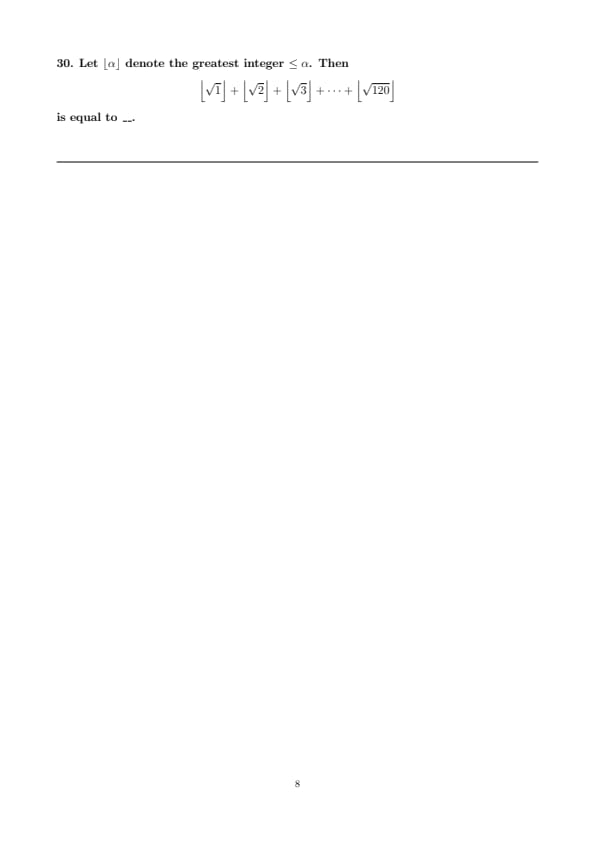
Let \( \left\lfloor \alpha \right\rfloor \) denote the greatest integer \( \leq \alpha \). Then \[ \left\lfloor \sqrt{1} \right\rfloor + \left\lfloor \sqrt{2} \right\rfloor + \left\lfloor \sqrt{3} \right\rfloor + \cdots + \left\lfloor \sqrt{120} \right\rfloor \]
is equal to __.
View Solution
Let: \[ S = \left\lfloor \sqrt{1} \right\rfloor + \left\lfloor \sqrt{2} \right\rfloor + \left\lfloor \sqrt{3} \right\rfloor + \cdots + \left\lfloor \sqrt{120} \right\rfloor \]
We will group terms by the value of \( \left\lfloor \sqrt{x} \right\rfloor \): \[ \left\lfloor \sqrt{1} \right\rfloor = 1, \quad \left\lfloor \sqrt{2} \right\rfloor = 1, \quad \left\lfloor \sqrt{3} \right\rfloor = 1, \quad \left\lfloor \sqrt{4} \right\rfloor = 2, \quad \left\lfloor \sqrt{5} \right\rfloor = 2, \dots \]
Thus: \[ S = 1 \times 3 + 2 \times 5 + 3 \times 7 + \cdots + 10 \times 21 \]
We can calculate this sum as follows: \[ S = \sum_{r=1}^{10} r(2r + 1) \]
The sum becomes: \[ S = 1 \times 3 + 2 \times 5 + 3 \times 7 + \dots + 10 \times 21 \]
Solving the summation gives: \[ S = 770 + 55 = 825 \] Quick Tip: When solving such problems, group the terms based on common patterns and use summation formulas to simplify calculations. Recognize common groupings for the floor functions.
*The article might have information for the previous academic years, please refer the official website of the exam.