
JEE Main 2023 Question Paper with Solution Pdf for Physics (April 10 - Shift 1)

.jpg?tr=h-55,w-55,c-force)
Content Strategist|Tech-innovator|National Hackathon Winner | Updated On - Apr 1, 2026
The JEE Main 2023 Physics Question Paper with Solution PDF is available here for download. The exam was successfully conducted by NTA on April 6, 2023, in the first shift.
Students can download JEE Main previous year question papers PDFs with detailed solutions to practice and improve their performance. Solving these papers helps aspirants understand the JEE Main exam pattern, analyze the difficulty level, and prepare according to the latest JEE Main syllabus.
Related Links:
Download JEE Main 2026 Session 1 Question Paper with Solution PDF
Download JEE Main 2025 Question Paper with Solution PDF
JEE Main 2023 Physics Question Paper Apr 10 Shift 1 with Solution Pdf
| JEE Main 2023 Physics Question Paper |  Download Download |
Check Solution |

Question 1:
The equivalent capacitance of the combination shown is:

View Solution
Step 1: Analyze the Circuit
Capacitors C3 and C4 are short-circuited. This leaves C1 and C2 in parallel and other capacitors in the circuit.
Step 2: Parallel Combination
The capacitance for C1 and C2 in parallel is: Ceq = C + C = 2C.
Final Answer: The equivalent capacitance of the circuit is 2C.
Question 2:
Match List I with List II:
List I:
(A) 3 Translational degrees of freedom
(B) 3 Translational, 2 rotational degrees of freedom
(C) 3 Translational, 2 rotational, and 1 vibrational degrees of freedom
(D) 3 Translational, 3 rotational, and more than one vibrational degrees of freedom
List II:
(I) Monoatomic gases
(II) Polyatomic gases
(III) Rigid diatomic gases
(IV) Nonrigid diatomic gases
View Solution
Explanation:
Degrees of freedom depend on the type of gas molecule. Monoatomic gases only have translational degrees, rigid diatomic gases have translational and rotational, while polyatomic gases include vibrational modes. Each matches as follows:
(A)-(I), (B)-(III), (C)-(IV), (D)-(II).
Question 3:
Given below are two statements:
Statement I: If the number of turns in the coil of a moving coil galvanometer is doubled, then the current sensitivity becomes double.
Statement II: Increasing current sensitivity of a moving coil galvanometer by only increasing the number of turns in the coil will also increase its voltage sensitivity in the same ratio.
View Solution
Explanation:
Statement I is true because current sensitivity increases proportionally with the number of turns.
Statement II is false because increasing the number of turns increases the coil's resistance, affecting voltage sensitivity differently.
Question 4:
Given below are two statements:
Statement I: Maximum power is dissipated in a circuit containing an inductor, capacitor, and resistor in series with an AC source, during resonance.
Statement II: Maximum power is dissipated in a circuit containing a pure resistor due to zero phase difference between current and voltage.
View Solution
Explanation:
Statement I: At resonance in an RLC circuit, impedance is minimum, current is maximum, and power dissipation is maximum.
Statement II: In a pure resistor, voltage and current are in phase, leading to maximum power dissipation.
Question 5:
The range of a projectile projected at an angle of 15° with the horizontal is 50 m. If the projectile is projected with the same velocity at an angle of 45° with the horizontal, then its range will be:
View Solution
Step 1: Use the Range Formula
Range R = u²sin(2θ)⁄g. Given that the range for θ = 15° is 50 m, calculate the value of u²/g:
u²sin(30°)⁄g = 50 => u²/g = 100.
Step 2: Calculate the Range for θ = 45°
Range = u²sin(90°)⁄g = u²/g = 100 m.
Question 6:
A particle of mass m moving with velocity v collides with a stationary particle of mass 2m. After collision, they stick together and continue to move together with velocity:
View Solution
Step 1: Apply Conservation of Momentum
The initial momentum of the system is pi = mv + 2m(0) = mv.
After collision, the two particles stick together and move with velocity v'. The final momentum is pf = (m + 2m)v' = 3mv'.
Step 2: Equate Initial and Final Momentum
By conservation of momentum, pi = pf:
mv = 3mv' => v' = v/3.
Question 7:
Two satellites of masses m and 3m revolve around the earth in circular orbits of radii r and 3r respectively. The ratio of orbital speeds of the satellites is:
View Solution
Step 1: Use the Formula for Orbital Speed
The orbital speed of a satellite is given by v = √(GM/r), where G is the gravitational constant, M is the mass of Earth, and r is the orbital radius.
Step 2: Determine the Ratio of Speeds
For the two satellites, v1/v2 = √(r2/r1) = √(3r/r) = √3.
Thus, the ratio of orbital speeds is √3:1.
Question 8:
Assuming the earth to be a sphere of uniform mass density, the weight of a body at a depth d = R/2 from the surface of Earth, if its weight on the surface is 200 N, will be:
View Solution
Step 1: Use the Weight Formula at a Depth
The weight of a body at depth d inside Earth is Wd = Ws(1 - d/R), where Ws is the weight at the surface and R is the Earth's radius.
Step 2: Substitute Given Values
Wd = 200(1 - (R/2)/R) = 200(1 - 1/2) = 200/2 = 100 N.
Question 9:
The de Broglie wavelength of a molecule in a gas at room temperature (300 K) is λ1. If the temperature of the gas is increased to 600 K, the de Broglie wavelength becomes:
View Solution
Step 1: Recall the de Broglie Wavelength Formula
The de Broglie wavelength is inversely proportional to the square root of temperature: λ ∝ 1/√T.
Step 2: Determine the New Wavelength
If T2/T1 = 600/300 = 2, then λ2/λ1 = √(T1/T2) = √(300/600) = 1/√2.
Thus, λ2 = λ1/√2.
Question 10:
A physical quantity P is given as P = (a²b³)/(c√d). The percentage error in the measurement of a, b, c, and d are 1%, 2%, 3%, and 4% respectively. The percentage error in the measurement of P is:
View Solution
Step 1: Use the Error Propagation Formula
For P = (a²b³)/(c√d), the percentage error in P is:
ΔP/P × 100% = 2(Δa/a) + 3(Δb/b) + (Δc/c) + (1/2)(Δd/d).
Step 2: Substitute Given Errors
ΔP/P × 100% = 2(1) + 3(2) + 3 + (1/2)(4) = 2 + 6 + 3 + 2 = 13%.
Question 11:
Consider two containers A and B containing monoatomic gases at the same Pressure (P), Volume (V), and Temperature (T). The gas in A is compressed isothermally to 1⁄8 of its original volume, while the gas in B is compressed adiabatically to 1⁄8 of its original volume. The ratio of final pressure of gas in B to that of gas in A is:
View Solution
Step 1: Analyze the isothermal process
For container A, the pressure and volume relationship is given by PV = constant. Substituting the values:
P2A = 8P.
Step 2: Analyze the adiabatic process
For container B, the relationship is PVγ = constant, where γ = 5/3 for monoatomic gases. Substituting the values:
P2B = (8)5/3P.
Step 3: Calculate the pressure ratio
The ratio P2B/P2A = (8)5/3/8 = (8)2/3 = 4.
Question 12:
Given below are two statements:
Statement I: Pressure in a reservoir of water is the same at all points at the same level of water.
Statement II: The pressure applied to enclosed water is transmitted in all directions equally.
Choose the correct answer from the options given below:
View Solution
Step 1: Understand Statement I
In a static fluid, the pressure at a given depth is constant in all directions. This is explained by the hydrostatic pressure formula.
Step 2: Understand Statement II
Pascal's Law states that pressure applied to an enclosed fluid is transmitted equally in all directions. Both statements are true.
Question 13:
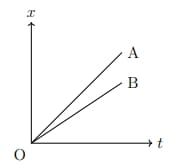
The position-time graphs for two students A and B returning from school to their homes are shown. Which of the following statements are correct?
View Solution
Step 1: Analyze the graph slopes
The slope of a position-time graph represents speed. Since the slope of B is steeper, B travels faster than A.
Step 2: Compare distances
The intercepts on the position axis show the distances of their homes from the school. A lives closer to the school.
Question 14:
The energy of an electromagnetic wave contained in a small volume oscillates with:
View Solution
Step 1: Use the wave energy density formula
The energy density is proportional to the square of the electric field: Energy density = (1/2)ε0E2.
Step 2: Analyze the time dependence
Squaring the sinusoidal electric field introduces a cos(2ωt) term, doubling the frequency.
Question 15:
The equivalent resistance of the circuit shown below between points a and b is:

View Solution
Step 1: Simplify the circuit
The circuit is a balanced Wheatstone Bridge. The equivalent resistance is calculated as:
1⁄Rab = 1⁄16 + 1⁄8 + 1⁄8.
Step 2: Solve for Rab
Combine the terms and find the reciprocal to get Rab = 3.2Ω.
Question 16:
A carrier wave of amplitude 15 V is modulated by a sinusoidal baseband signal of amplitude 3 V. The ratio of maximum amplitude to minimum amplitude in an amplitude-modulated wave is:
View Solution
Step 1: Calculate maximum and minimum amplitude
In amplitude modulation, Amax = Ac + Am, and Amin = Ac - Am. Here, Ac = 15 V and Am = 3 V.
Amax = 15 + 3 = 18 V
Amin = 15 - 3 = 12 V.
Step 2: Calculate the ratio
The ratio is Amax/Amin = 18/12 = 3⁄2.
Question 17:
A particle executes S.H.M. of amplitude A along the x-axis. At t = 0, the position of the particle is x = -A1⁄2, and it moves along the positive x-axis. The displacement of the particle in time t is given as x = A sin(ωt + δ). The value of δ will be:
View Solution
Step 1: Solve for the phase constant
Using the equation x = A sin(ωt + δ), substitute x = -A1⁄2 at t = 0:
-A1⁄2 = A sin(δ) => sin(δ) = -1⁄2.
Step 2: Determine δ
δ = π⁄6, as it satisfies the direction of motion and position conditions.
Question 18:
The angular momentum of an electron in Bohr's orbit is L. If the electron is assumed to revolve in the second orbit of a hydrogen atom, the change in angular momentum will be:
View Solution
Step 1: Use Bohr's angular momentum formula
Angular momentum Ln = n(h/2π), where n is the orbit number.
For n = 1: L1 = h/2π = L.
For n = 2: L2 = 2h/2π = 2L.
Step 2: Calculate the change
ΔL = L2 - L1 = 2L - L = L.
Question 19:
An object is placed at a distance of 12 cm in front of a plane mirror. A virtual and erect image is formed. Now the mirror is moved by 4 cm towards the stationary object. The distance by which the position of the image would be shifted will be:
View Solution
Step 1: Analyze initial setup
The image is initially formed at 12 cm behind the mirror. The distance between the object and the image is 24 cm.
Step 2: Mirror movement
When the mirror is shifted by 4 cm, the image also shifts by twice this amount (8 cm) towards the mirror.
Question 20:
A Zener diode of power rating 1.6 W is used as a voltage regulator. If the Zener diode has a breakdown voltage of 8 V and it has to regulate a voltage fluctuating between 3 V and 10 V, what is the value of resistance Rs for safe operation of the diode?

View Solution
Step 1: Determine maximum current
The maximum current is I = Pmax/Vz, where Pmax = 1.6 W and Vz = 8 V.
I = 1.6 / 8 = 0.2 A.
Step 2: Calculate Rs
Rs = (Vmax - Vz)/I = (10 - 8)/0.2 = 10Ω.
Question 21:
Unpolarised light of intensity 32 Wm-2 passes through the combination of three polaroids such that the pass axis of the last polaroid is perpendicular to that of the pass axis of the first polaroid. If the intensity of the emerging light is 3 Wm-2, then the angle between the pass axis of the first two polaroids is:
View Solution
Step 1: Write the expression for the net intensity
The net intensity is given by: Inet = (I0/2) * (cos2θ) * (sin2θ) = (I0/8) * (sin 2θ)2
Step 2: Use the given value for Inet
Substitute Inet = 3 and I0 = 32:
3 = (32/8) * (sin 2θ)2
(sin 2θ)2 = 3/4
Step 3: Solve for 2θ
sin 2θ = √(3/4) = √3/2
2θ = 60° or 120°
Step 4: Solve for θ
θ = 30° or 60°
Question 22:
If the Earth suddenly shrinks to 1/64th of its original volume with its mass remaining the same, the period of rotation of the Earth becomes 24/x hours. The value of x is:
View Solution
Step 1: Apply Angular Momentum Conservation
Using conservation of angular momentum: I1ω1 = I2ω2
Substitute I = (2/5)MR2:
(2/5)MR2ω1 = (2/5)M(R/4)2ω2
Cancel constants and simplify:
ω2/ω1 = 16
Step 2: Relate Angular Velocity and Time Period
ω2/ω1 = T1/T2, so:
16 = 24/x
Step 3: Solve for x
x = 24/16 = 16
Question 23:
Three concentric spherical metallic shells X, Y, and Z of radii a, b, and c respectively (a < b < c) have surface charge densities σ, -σ, and σ respectively. The shells X and Z are at the same potential. If the radii of X and Y are 2 cm and 3 cm respectively, the radius of shell Z is:
View Solution
Step 1: Write the potential at Y
The potential at Y is due to all charges: VY = qX/(4πε0a) - qY/(4πε0b) + qZ/(4πε0c)
Simplify using the given charges:
VY = (σa/ε0) - (σb/ε0) + (σc/ε0)
Step 2: Relate c to a and b
For X and Z to have the same potential: c(a - b + c) = a2 - b2 + c2
Simplify: c = a + b
Substitute a = 2 cm, b = 3 cm:
c = 2 + 3 = 5 cm
Question 24:
A transverse harmonic wave on a string is given by y(x, t) = 5 sin(6t + 0.003x), where x and y are in cm and t in seconds. The wave velocity is:
View Solution
Step 1: Identify wave parameters
The general wave equation is y(x, t) = A sin(kx ± ωt), where ω = 6 rad/s, k = 0.003 rad/cm = 0.3 rad/m.
Step 2: Use the wave velocity formula
Wave velocity v = ω/k.
Substitute the values: v = 6/0.3 = 20 m/s
Question 25:
10 resistors each of resistance 10 Ω can be connected to get maximum and minimum equivalent resistance. The ratio of maximum to minimum equivalent resistance is:
View Solution
Step 1: Calculate maximum resistance
When resistors are connected in series: Rmax = 10 × 10 = 100 Ω.
Step 2: Calculate minimum resistance
When resistors are connected in parallel: Rmin = R/n = 10/10 = 1 Ω.
Step 3: Find the ratio
Rmax/Rmin = 100/1 = 100
Question 26:
The decay constant for a radioactive nuclide is 1.5 × 10⁻⁵s-1. Atomic weight of the substance is 60 g mole-1 (NA = 6 × 10²³). The activity of 1.0 µg of the substance is:
View Solution
Step 1: Calculate the number of moles
Number of moles = (mass of sample) / (molar mass) = (1 × 10⁻⁶) / 60 = (10-7) / 6.
Step 2: Calculate the number of atoms
Number of atoms = (number of moles) × NA = ((10-7) / 6) × (6 × 1023) = 1016.
Step 3: Calculate the activity
Activity A0 = N0λ = (1016) × (1.5 × 10-5) = 15 × 1010 Bq.
Question 27:
Two wires each of radius 0.2 cm and negligible mass, one made of steel and the other made of brass, are loaded as shown in the figure. The elongation of the steel wire is:

View Solution
Step 1: Analyze the system
The total force on the steel wire is T2 = 20 N + 11.4 N = 31.4 N.
Step 2: Use the elongation formula
Elongation (∆L) = (T2L) / (A × Y), where A = π(r2), Y = 2 × 10¹¹ Pa, and L = 1.6 m.
∆L = (31.4 × 1.6) / (π × (0.2 × 10⁻²)2 × 2 × 1011) = 20 × 10-6 m.
Question 28:
A closed circular tube of average radius 15 cm, whose inner walls are rough, is kept in a vertical plane. A block of mass 1 kg is introduced at the top of the tube with a speed of 22 m/s. After completing five oscillations, the block stops at the bottom of the tube. The work done by the tube on the block is:

View Solution
Step 1: Work-energy theorem
The work-energy theorem states Wf + Wgravity = ∆K.
Step 2: Substitute known values
Wf + 10 × 0.3 = 0 - 0.5 × 1 × (22)2.
Wf + 3 = -242 => Wf = -245 J.
Question 29:
A 1 m long metal rod completes the circuit as shown in the figure. The plane of the circuit is perpendicular to a magnetic field of flux density 0.15 T. If the resistance of the circuit is 5 Ω, the force needed to move the rod at a constant speed of 4 m/s is:
View Solution
Step 1: Use the force formula
F = (B2ℓ2v) / R.
Step 2: Substitute values
F = (0.15)2 × (1)2 × 4 / 5 = 18 × 10-3 N.
Question 30:
The current required to be passed through a solenoid of 15 cm length and 60 turns to demagnetize a bar magnet of magnetic intensity 2.4 × 10³ A/m is:
View Solution
Step 1: Use the magnetic intensity formula
H = NI / ℓ. Rearrange to solve for I: I = (Hℓ) / N.
Step 2: Substitute values
I = (2.4 × 103 × 0.15) / 60 = 6 A.
*The article might have information for the previous academic years, please refer the official website of the exam.