
JEE Main 2023 Question Paper with Solution Pdf for Physics (April 6 - Shift 1)

.jpg?tr=h-55,w-55,c-force)
Content Strategist|Tech-innovator|National Hackathon Winner | Updated On - Mar 31, 2026
The JEE Main 2023 Physics Question Paper with Solution PDF is available here for download. The exam was successfully conducted by NTA on April 6, 2023, in the first shift.
Students can download JEE Main previous year question papers PDFs with detailed solutions to practice and improve their performance. Solving these papers helps aspirants understand the JEE Main exam pattern, analyze the difficulty level, and prepare according to the latest JEE Main syllabus.
Related Links:
Download JEE Main 2026 Session 1 Question Paper with Solution PDF
Download JEE Main 2025 Question Paper with Solution PDF
JEE Main 2023 Physics Question Paper Apr 6 Shift 1 with Solution Pdf
| JEE Main 2023 Physics Question Paper |  Download Download |
Check Solution |

Question 1:
The kinetic energy of an electron, an α-particle, and a proton are given as 4K, 2K, and K respectively. The de-Broglie wavelength associated with electron (λe), α-particle (λα), and the proton (λp) are as follows:
View Solution
Step 1: De Broglie Wavelength Formula
The de Broglie wavelength is given by: λ = h/p, where λ is the wavelength, h is Planck’s constant, and p is the momentum.
Step 2: Relate Momentum and Kinetic Energy
The momentum is related to kinetic energy (KE) by: p = √(2mKE), where m is the mass.
Step 3: Calculate Wavelengths for Electron, Proton, and Alpha Particle
For the electron: λe = h/√(2me * 4K)
For the proton: λp = h/√(2mp * K)
For the alpha particle: λα = h/√(2 * 4mp * 2K)
Comparing the expressions, we get λα < λp < λe.
Question 2:
Given below are two statements: one is labelled as Assertion A and the other is labelled as Reason R.
Assertion A: Earth has atmosphere whereas moon doesn’t have any atmosphere.
Reason R: The escape velocity on the moon is very small as compared to that on Earth.
Choose the correct answer from the options given below:
View Solution
Step 1: Escape Velocity Formula
Escape velocity (Vesc) is the minimum speed required to escape a planet’s gravitational pull: Vesc = √(2GM/r).
Step 2: Explanation
Earth has a higher escape velocity than the moon, allowing it to retain its atmosphere. The moon’s lower escape velocity means lighter gases can escape more easily.
Question 3:
A source supplies heat to a system at the rate of 1000 W. If the system performs work at a rate of 200 W, the rate at which internal energy of the system increases is:
View Solution
Step 1: First Law of Thermodynamics
The change in internal energy (ΔU) is given by: ΔU = Q - W.
Step 2: Calculate Rate of Internal Energy Increase
Given heat rate Q = 1000 W and work rate W = 200 W:
ΔU = 1000 W - 200 W = 800 W.
Question 4:
A small ball of mass M and density ρ is dropped in a viscous liquid of density ρo. After some time, the ball falls with a constant velocity. What is the viscous force on the ball?
View Solution
Step 1: Forces Acting on the Ball
The forces are: Weight (Mg), Buoyant force (B), and Viscous force (f).
Step 2: Solve for Viscous Force
At terminal velocity: Mg = f + B, solving gives: F = Mg(1 − ρo/ρ).
Question 5:
A small block of mass 100 g is tied to a spring of spring constant 7.5 N/m and length 20 cm. The other end of the spring is fixed at a point A. If the block moves in a circular path on a smooth horizontal surface with constant angular velocity 5 rad/s about point A, the tension in the spring is:
View Solution
Step 1: Centripetal Force
The tension in the spring provides the necessary centripetal force for circular motion.
Step 2: Calculate Tension
Using the given values: T = 0.75 N.
Question 6:
A particle is moving with constant speed in a circular path. When the particle turns by an angle of 90°, the ratio of instantaneous velocity to its average velocity is π:x√2. The value of x will be:
View Solution
Step 1: Instantaneous Velocity
The instantaneous velocity is tangential to the circular path with a constant magnitude.
Step 2: Average Velocity
The average velocity is the displacement divided by the time taken.
Step 3: Ratio Calculation
The ratio of instantaneous velocity to average velocity is π:√2, giving x = 2.
Question 7:
Two resistances are given as R1 = (10 ± 0.5)Ω and R2 = (15 ± 0.5)Ω. The percentage error in the measurement of equivalent resistance when they are connected in parallel is:
View Solution
Step 1: Equivalent Resistance Formula
For parallel resistances: 1/Req = 1/R1 + 1/R2.
Step 2: Error Propagation
The percentage error is calculated using error propagation rules. The final error is 4.33%.
Question 8:
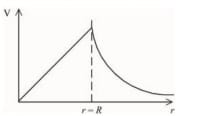
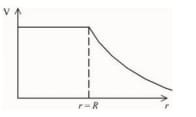
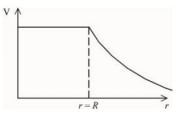
For a uniformly charged thin spherical shell, the electric potential (V) radially away from the center of the shell can be graphically represented as:


View Solution
Step 1: Electric Potential Inside and Outside the Shell
Inside the shell, the potential is constant. Outside the shell, it decreases as 1/r.
Step 2: Graphical Representation
The graph shows a constant potential inside and a decreasing potential outside.
Question 9:
A long straight wire of circular cross-section (radius a) is carrying steady current I. The current I is uniformly distributed across the cross-section. The magnetic field is:
View Solution
Step 1: Ampere’s Law
Using Ampere’s law, the magnetic field inside and outside the wire is calculated.
Step 2: Final Expression
Inside the wire, B ∝ r. Outside the wire, B ∝ 1/r.
Question 10:
By what percentage will the transmission range of a TV tower be affected when the height of the tower is increased by 21%?
View Solution
Step 1: Transmission Range Formula
The range is proportional to the square root of the tower’s height.
Step 2: Percentage Increase
A 21% increase in height results in a 10% increase in range.
Question 11:
The number of air molecules per cm³ increased from 3×10¹⁹ to 12×10¹⁹. The ratio of collision frequency of air molecules before and after the increase is:
View Solution
Step 1: Collision Frequency Formula
Collision frequency is directly proportional to the number density of molecules.
Step 2: Ratio Calculation
The ratio is 0.25 based on the change in number density.
Question 12:
The energy levels of a hydrogen atom are shown. The transition corresponding to emission of the shortest wavelength is:
View Solution
Step 1: Energy and Wavelength Relationship
The transition with the largest energy difference produces the shortest wavelength.
Question 13:
For the plane electromagnetic wave given by E = E₀ sin(ωt - kx) and B = B₀ sin(ωt - kx), the ratio of average electric energy density to average magnetic energy density is:
View Solution
Step 1: Energy Density Formula
The electric and magnetic energy densities are equal in an electromagnetic wave.
Question 14:
A planet has double the mass of the Earth. Its average density is equal to that of the Earth. An object weighing W on Earth will weigh on that planet:
View Solution
Step 1: Gravitational Force Calculation
Weight depends on the mass and radius of the planet. The radius increases as 21/3.
Question 15:
The resistivity (ρ) of a semiconductor varies with temperature. Which of the following curves represents the correct behavior?


View Solution
Step 1: Resistivity vs. Temperature
For semiconductors, resistivity decreases with increasing temperature.
Question 16:
A monochromatic light wave with wavelength λ1 and frequency ν1 in air enters another medium. If the angle of incidence and angle of refraction at the interface are 45° and 30° respectively, then the wavelength λ2 and frequency ν2 of the refracted wave are:
View Solution
Step 1: Use Snell's Law
Snell's law is given by: n1 sin θ1 = n2 sin θ2. Given that θ1 = 45° and θ2 = 30°, we solve for the refractive index ratio.
Step 2: Calculate Wavelength and Frequency
The frequency remains constant during refraction, and the wavelength changes according to the refractive index. The calculated values show that λ2 = (1/√2) λ1 and ν2 = ν1.
Question 17:
A mass m is attached to two springs of spring constants K1 and K2, respectively, as shown. The time period of oscillation of the mass m on a frictionless surface is:

View Solution
Step 1: Equivalent Spring Constant
Since the springs are in parallel, the equivalent spring constant is K = K1 + K2.
Step 2: Time Period Formula
The time period for oscillation is given by T = 2π √(m/K). Substituting the equivalent spring constant gives the final answer.
Question 18:
Identify the logic gate that is equivalent to the given circuit diagram.

View Solution
Step 1: Analyze the Circuit
The circuit shows a configuration that behaves as a NOR gate, with both inputs needing to be 0 to give an output of 1.
Step 2: Truth Table
Constructing the truth table for the circuit confirms that it is a NOR gate.
Question 19:
Which of the following scenarios will result in an induced emf in a coil?
View Solution
Step 1: Faraday's Law
An induced emf is produced when there is a change in magnetic flux through a coil. Rotating the coil or changing its area will change the flux.
Step 2: Analyze the Options
Only options C (rotating the coil) and D (changing the area of the coil) cause a change in flux.
Question 20:
Given below are two statements: Assertion (A) and Reason (R).
Assertion A: When a body is projected at an angle of 45°, its range is maximum.
Reason R: For maximum range, the value of sin 2θ should be equal to 1.
View Solution
Step 1: Horizontal Range Formula
The horizontal range is given by R = (u² sin 2θ) / g. The maximum range occurs when sin 2θ = 1, which is at θ = 45°.
Step 2: Explanation
Both the assertion and the reason are correct, and the reason accurately explains the assertion.
Question 21:
Two identical circular wires of radius 20 cm and carrying current √2 A are placed in perpendicular planes as shown in the figure. The net magnetic field at the center of the circular wires is × 10-8 T.

View Solution
Step 1: Magnetic Field due to a Circular Loop
The magnetic field at the center of a circular loop of radius r carrying current i is given by:
B = μ0i/2r, where μ0 = 4π × 10-7 T·m/A.
Step 2: Magnetic Field due to Each Loop
Given: r = 0.2 m, i = √2 A. Substituting these values:
B = (4π × 10-7)(√2)/(2 × 0.2).
Step 3: Net Magnetic Field
The magnetic fields are perpendicular, so the net field is calculated using Pythagoras' theorem:
Bnet = √2 × (μ0i/2r).
Simplifying: Bnet = 628 × 10-8 T.
Question 22:
A steel rod has a radius of 20 mm and a length of 2.0 m. A force of 62.8 kN stretches it along its length. Young’s modulus of steel is 2.0 × 10¹¹ N/m2. The longitudinal strain produced in the wire is × 10-5.
View Solution
Step 1: Young's Modulus and Strain
Young’s modulus is defined as stress/strain.
Step 2: Calculate Strain
Stress = Force/Area. Using A = πr2, strain = stress/Young’s modulus.
Substitute: strain = (62.8 × 10³)/(π × (20 × 10-3)2 × 2 × 1011) = 25 × 10-5.
Question 23:
The length of a metallic wire is increased by 20% and its area of cross-section is reduced by 4%. The percentage change in resistance of the metallic wire is:
View Solution
Step 1: Resistance Formula
Resistance R = ρl/A.
Step 2: New Resistance
New length: l' = 1.2l. New area: A' = 0.96A. Calculate R': R'/R = (l'/l) / (A'/A) = 1.2/0.96 = 1.25.
Step 3: Percentage Change
Change = (1.25 - 1) × 100 = 25%.
Question 24:
The radius of the fifth orbit of Li++ is × 10-12 m. Take the radius of hydrogen atom = 0.51 Å.
View Solution
Step 1: Bohr's Model Formula
rn = (0.51 × n2)/Z Å. Substituting: n = 5, Z = 3.
Step 2: Calculate Radius
r5 = (0.51 × 25)/3 = 425 × 10-12 m.
Question 25:
A particle of mass 10 g moves in a straight line with retardation 2x, where x is the displacement in SI units. Its loss of kinetic energy for the above displacement is (10/x)-n J. The value of n will be:
View Solution
Step 1: Work-Energy Theorem
Use acceleration a = -2x and integrate: v dv = -2x dx.
Step 2: Solve for Energy Loss
Energy loss = m x2, giving (10/x)-2.
Question 26:
An ideal transformer with a purely resistive load operates at 12 kV on the primary side. It supplies electrical energy to a number of nearby houses at 120 V. The average rate of energy consumption in the houses served by the transformer is 60 kW. The value of resistive load (Rs) required in the secondary circuit will be in mΩ:
View Solution
Step 1: Transformer Voltage Ratio
Voltage ratio: Vs/Vp = Ns/Np. Given Vp = 12,000 V, Vs = 120 V, Ns/Np = 1/100.
Step 2: Power Conservation
Input power = output power. Given output power P = 60 kW.
Step 3: Secondary Current
Is = P/Vs = 60,000/120 = 500 A.
Step 4: Resistive Load
Rs = Vs/Is = 120/500 = 0.24 Ω = 240 mΩ.
Question 27:
A parallel plate capacitor with plate area A and plate separation d is filled with a dielectric material of dielectric constant K = 4. The thickness of the dielectric material is x, where x < d. Let C1 and C2 be the capacitance of the system for x = 1/3d and x = 2/3d, respectively. If C1 = 2 µF, the value of C2 is in µF:
View Solution
Step 1: Capacitance with Dielectric
For a partially filled capacitor: C = ϵ0A/[d - x + x/K].
Step 2: Capacitance C1
For x = d/3: C1 = ϵ0A/[2d/3 + d/12] = 2 µF.
Step 3: Capacitance C2
For x = 2d/3: C2 = ϵ0A/[d/3 + d/6]. C2 = 3 µF.
Question 28:
Two identical solid spheres each of mass 2 kg and radii 10 cm are fixed at the ends of a light rod. The separation between the centers of the spheres is 40 cm. The moment of inertia of the system about an axis perpendicular to the rod passing through its middle point is × 10-3 kg·m2:
View Solution
Step 1: Moment of Inertia of a Solid Sphere
For a solid sphere about its diameter: Isphere = (2/5)mR2.
Step 2: Parallel Axis Theorem
I = Icm + md2. Using d = 20 cm = 0.2 m, R = 0.1 m, and m = 2 kg.
Step 3: Total Moment of Inertia
Itotal = 2 × [(2/5)(2)(0.1)2 + (2)(0.2)2] = 176 × 10-3 kg·m2.
Question 29:
A person driving a car at a constant speed of 15 m/s is approaching a vertical wall. The person notices a change of 40 Hz in the frequency of his car's horn upon reflection from the wall. The frequency of the horn is in Hz:
View Solution
Step 1: Doppler Effect for Reflection
The observed frequency: f′ = [(v + vs)/(v - vs)]f0.
Step 2: Frequency Change
Given vs = 15 m/s, v = 330 m/s, and Δf = 40 Hz.
Solving: f0 = 420 Hz.
Question 30:
A pole is vertically submerged in a swimming pool, such that it gives a length of shadow 2.15 m within water when sunlight is incident at an angle of 30° with the surface of water. If the swimming pool is filled to a height of 1.5 m, then the height of the pole above the water surface in centimeters is (nw = 4/3):
View Solution
Step 1: Snell’s Law
Using n1sini = n2sinr to calculate the angle of refraction.
Step 2: Calculate Tan r
tanr = (sinr/cosr) = 0.85.
Step 3: Height of the Pole
tan30° = h/0.875. Solving: h = 50 cm.
*The article might have information for the previous academic years, please refer the official website of the exam.