
JEE Main 2023 Question Paper with Solution Pdf for Physics (February 1 - Shift 2)

.jpg?tr=h-55,w-55,c-force)
Content Strategist|Tech-innovator|National Hackathon Winner | Updated On - Mar 31, 2026
The JEE Main 2023 Physics Question Paper with Solution PDF is available here for download. The exam was successfully conducted by NTA on February 1, 2023, in the second shift.
Students can download JEE Main previous year question papers PDFs with detailed solutions to practice and improve their performance. Solving these papers helps aspirants understand the JEE Main exam pattern, analyze the difficulty level, and prepare according to the latest JEE Main syllabus.
Related Links:
Download JEE Main 2026 Session 1 Question Paper with Solution PDF
Download JEE Main 2025 Question Paper with Solution PDF
JEE Main 2023 Physics Question Paper Feb 1 Shift 2 with Solution Pdf
| JEE Main 2023 Physics Question Paper |  Download Download |
Check Solution |

Question 1:
A Carnot engine operating between two reservoirs has efficiency 1⁄3. When the temperature of the cold reservoir is raised by x, its efficiency decreases to 1⁄6. The value of x, if the temperature of the hot reservoir is 99°C, will be:
View Solution
Step 1: Convert Celsius to Kelvin
The temperature of the hot reservoir is given as TH = 99°C. Convert this to Kelvin: TH = 99 + 273 = 372 K
Step 2: Use the Carnot Efficiency Formula
The efficiency of a Carnot engine is given by: η = 1 - TC⁄TH, where TC is the temperature of the cold reservoir and TH is the temperature of the hot reservoir.
Step 3: Calculate the Initial Cold Reservoir Temperature
Initially, the efficiency is 1⁄3. So, 1⁄3 = 1 - TC⁄372. Solving for TC: TC⁄372 = 2⁄3 => TC = (2⁄3) * 372 = 248 K
Step 4: Calculate the Cold Reservoir Temperature After the Increase
When the cold reservoir temperature is increased by x, the new temperature is TC + x, and the efficiency becomes 1⁄6. So, 1⁄6 = 1 - (TC + x)⁄372 => (248 + x)⁄372 = 5⁄6
Step 5: Solve for x
248 + x = (5⁄6) * 372 = 310
x = 310 - 248 = 62 K
Question 2:
Given below are two statements : One is labelled as Assertion A and the other is labelled as Reason R.
Assertion A: Two metallic spheres are charged to the same potential. One of them is hollow and another is solid, and both have the same radii. Solid sphere will have lower charge than the hollow one.
Reason R: Capacitance of metallic spheres depend on the radii of spheres.
In the light of the above statements, choose the correct answer from the options given below.
View Solution
Step 1: Analyze Assertion A
The potential of a conducting sphere (solid or hollow) is given by: V = KQ⁄R, where V is the potential, K is a constant, Q is the charge, and R is the radius.
If two spheres have the same potential (V1 = V2) and the same radius (R1 = R2), then: KQ1⁄R1 = KQ2⁄R2. Since R1 = R2, it follows that Q1 = Q2. Therefore, the assertion that the solid sphere will have a lower charge is false.
Step 2: Analyze Reason R
The capacitance of a spherical conductor is given by: C = 4πε0R, where C is the capacitance, ε0 is the permittivity of free space, and R is the radius. This shows that the capacitance depends only on its radius. Therefore, the reason is true.
Question 3:
As shown in the figure, a long straight conductor with a semi-circular arc of radius 10 m is carrying current I = 3A. The magnitude of the magnetic field at the center O of the arc is: (The permeability of the vacuum = 4π × 10-7 NA-2)

View Solution
Step 1: Determine the Magnetic Field Due to the Semicircular Arc
The magnetic field at the center of a circular arc is given by Bc = (μ0Iθ)⁄(4πR). For a semicircular arc, θ = π. So, Bc = (μ0I)⁄(4R)
Step 2: Substitute the Given Values
Bc = (4π × 10-7 × 3)⁄(4 × 10) = 3 × 10⁻⁶ T = 3μT
Step 3: Consider the Magnetic Field Due to the Straight Wires
The straight portions do not contribute to the magnetic field at point O because their field lines are concentric circles around the wire, and at point O, the field from the straight sections is perpendicular to the plane of the semicircle.
Question 4:
A coil is placed in a magnetic field such that the plane of the coil is perpendicular to the direction of the magnetic field. The magnetic flux through a coil can be changed:
- By changing the magnitude of the magnetic field within the coil.
- By changing the area of the coil within the magnetic field.
- By changing the angle between the direction of magnetic field and the plane of the coil.
- By reversing the magnetic field direction abruptly without changing its magnitude.
Choose the most appropriate answer from the options given below:
View Solution
Step 1: Recall the Formula for Magnetic Flux
Magnetic flux is given by Φ = B⋅A = BAcosθ
Step 2: Analyze Each Option
A, B, and C directly affect the flux according to the formula. D changes the sign of the flux but not the magnitude, thus the question asks for the most appropriate answer.
Question 5:
In an amplitude modulation, a modulating signal having amplitude of X V is superimposed with a carrier signal of amplitude Y V in the first case. Then, in the second case, the same modulating signal is superimposed with a different carrier signal of amplitude 2Y V. The ratio of modulation index in the two cases respectively will be:
View Solution
Step 1: Recall the Formula for Modulation Index
Modulation index μ = Am⁄Ac
Step 2: Calculate the Modulation Index for the First Case
μ1 = X⁄Y
Step 3: Calculate the Modulation Index for the Second Case
μ2 = X⁄2Y
Step 4: Find the Ratio of the Modulation Indices
μ1⁄μ2 = (X/Y)⁄(X/2Y) = 2
Question 6:
For a body projected at an angle with the horizontal from the ground, choose the correct statement.
View Solution
Step 1: Analyze the Projectile Motion at the Highest Point
When a body is projected at an angle with the horizontal, it follows a parabolic trajectory. At the highest point of its trajectory, the vertical component of velocity (vy) is zero, while the horizontal component (vx) remains constant.
Step 2: Analyze the Gravitational Potential Energy
Gravitational potential energy (U) is given by U = mgh, where h is maximum at the highest point.
Steps 3-5: Analyze other options
The horizontal velocity component is constant, the vertical momentum is zero at the highest point, and KE is minimum but not zero at the highest point.
Question 7:
Two objects A and B are placed at 15 cm and 25 cm from the pole in front of a concave mirror having radius of curvature 40 cm. The distance between images formed by the mirror is:
View Solution
Step 1: Determine the Focal Length
f = R/2 = -20cm (concave mirror)
Step 2: Use the Mirror Formula for Object A
1/v + 1/u = 1/f => 1/vA - 1/15 = -1/20 => vA = 60 cm
Step 3: Use the Mirror Formula for Object B
1/vB - 1/25 = -1/20 => vB = -100 cm
Step 4: Calculate the Distance Between the Images
d = |vA| + |vB| = 60 + 100 = 160 cm
Question 8:
The Young's modulus of a steel wire of length 6 m and cross-sectional area 3 mm2, is 2 × 10¹¹ N/m2. The wire is suspended from its support on a given planet. A block of mass 4 kg is attached to the free end of the wire. The acceleration due to gravity on the planet is 1⁄4 of its value on the earth. The elongation of wire is (Take g on the earth = 10 m/s2):
View Solution
Step 1: Calculate the Effective Acceleration Due to Gravity
gplanet = (1/4) * 10 = 2.5 m/s2
Step 2: Calculate the Tension in the Wire
F = mgplanet = 4 * 2.5 = 10 N
Step 3: Convert the Cross-sectional Area to m2
A = 3 mm2 = 3 x 10⁻⁶ m2
Step 4: Use the Formula for Elongation
ΔL = FL/AY = (10 * 6)/(3 x 10-6 x 2 x 1011) = 10-4 m = 0.1 mm
Question 9:
Equivalent resistance between the adjacent corners of a regular n-sided polygon of uniform wire of resistance R would be:
View Solution
Step 1: Analyze the Resistance of Each Side
Resistance of each side, r = R/n
Step 2: Consider Adjacent Corners A and B
The polygon can be viewed as two resistors in parallel: one with resistance r and the other with resistance (n-1)r.
Step 3: Calculate the Equivalent Resistance
1/Req = 1/r + 1/[(n-1)r] => Req = [(n-1)r]/n
Step 4: Substitute the Value of r
Req = (n-1)(R/n)/n = (n-1)R/n2
Question 10:
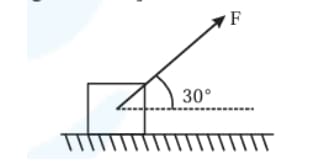
As shown in the figure, a block of mass 10 kg lying on a horizontal surface is pulled by a force F acting at an angle 30° with horizontal. For μs = 0.25, the block will just start to move for the value of F: [Given g = 10 ms-2]
View Solution
Step 1: Resolve the Force F into Components
Horizontal component: Fcos30°
Vertical component: Fsin30°
Step 2: Calculate the Normal Force
N = Mg - Fsin30° = 100 - F/2
Step 3: Apply the Condition for Impending Motion
Fcos30° = μsN
(√3/2)F = 0.25(100 - F/2)
Solving for F: F ≈ 25.2 N
Question 11:
Given below are two statements: One is labelled as Assertion A and the other is labelled as Reason R.
Assertion A: For measuring the potential difference across a resistance of 600 Ω, the voltmeter with resistance 1000 Ω will be preferred over voltmeter with resistance 4000 Ω.
Reason R: Voltmeter with higher resistance will draw smaller current than voltmeter with lower resistance.
In the light of the above statements, choose the most appropriate answer from the options given below.
View Solution
Step 1: Analyze Assertion A
An ideal voltmeter has infinite resistance. A practical voltmeter should have resistance much higher than the resistance being measured. A 4000 Ω voltmeter is preferred over a 1000 Ω voltmeter when measuring across a 600 Ω resistor. Thus, Assertion A is incorrect.
Step 2: Analyze Reason R
A voltmeter is connected in parallel. According to Ohm's law (V=IR), current drawn is inversely proportional to resistance. Thus, a higher resistance voltmeter draws less current, making Reason R correct.
Question 12:
Choose the correct statement about Zener diode:
View Solution
A Zener diode is designed to operate in the reverse breakdown region for voltage regulation. In forward bias, it acts like a regular diode.
Question 13:
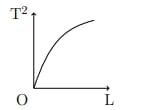
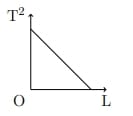
Choose the correct length (L) versus square of time period (T2) graph for a simple pendulum executing simple harmonic motion.


View Solution
Step 1: Recall the Formula
T = 2π√(L/g)
Step 2: Find the Relationship
T2 = 4π2(L/g)
Since 4π2/g is constant, T2 ∝ L
Step 3: Determine the Graph
The graph should be a straight line passing through the origin, representing direct proportionality. This corresponds to Graph 3.
Question 14:
The escape velocities of two planets A and B are in the ratio 1:2. If the ratio of their radii respectively is 1:3, then the ratio of acceleration due to gravity of planet A to the acceleration due to gravity of planet B will be:
View Solution
Step 1: Escape Velocity Formula
Ve = √(2GM/R) = C√(ρR) where C is a constant
Step 2: Ratio of Escape Velocities
VeA/VeB = √(ρARA)/√(ρBRB) = 1⁄2
Therefore, ρA/ρB = 3/4
Step 3: Acceleration Due to Gravity Formula
g = GM/R2 = C'ρR where C' is a constant
Step 4: Ratio of Accelerations
gA/gB = (ρARA)/(ρBRB) = (3/4)×(1/3) = 1⁄4 Thus, the correct ratio is 3/4 (since gA/gB was asked)
Question 15:
An electron of a hydrogen-like atom, having Z = 4, jumps from 4th energy state to 2nd energy state. The energy released in this process, will be: (Given Rch = 13.6 eV) Where R = Rydberg constant, c = Speed of light in vacuum, h = Planck's constant
View Solution
Step 1: Energy Level Formula
En = -13.6(Z2/n2) eV
Step 2: Energy Difference
ΔE = E4 - E2 = 13.6 * Z2 * (1⁄nf2 - 1⁄ni2)
ΔE = 13.6 × 42 × (1⁄22 - 1⁄42) = 40.8 eV
Question 16:
Figures (a), (b), (c) and (d) show variation of force with time. The impulse is highest in figure:

View Solution
Step 1: Definition of Impulse
Impulse is the area under the force-time graph.
Step 2: Calculate Impulse for Each Figure
(a) Impulse = (1/2) * base * height = 0.25 Ns
(b) Impulse = length * width = 1 Ns
(c) Impulse = (1/2) * base * height = 0.375 Ns
(d) Impulse = (1/2) * base * height = 0.5 Ns
Figure (b) has the highest impulse.
Question 17:
If the velocity of light c, universal gravitational constant G and Planck's constant h are chosen as fundamental quantities. The dimensions of mass in the new system is:
View Solution
Step 1: Express Mass
M = hxcyGz
Step 2: Dimensional Equation
[M1L0T0] = [ML2T-1]x[LT-1]y[M-1L3T-2]z
Step 3: Equate Exponents
x - z = 1
2x + y + 3z = 0
-x - y - 2z = 0
Step 4: Solve Equations
x = 1⁄2, y = -1⁄2, z = -1⁄2
Step 5: Dimensions of Mass
M = [h½c-½G-½]
Question 18:
For three low density gases A, B, C pressure versus temperature graphs are plotted while keeping them at constant volume, as shown in the figure. The temperature corresponding to the point 'K' is:

View Solution
Step 1: Ideal Gas Law
For constant volume: P/T = constant
Step 2: Temperature at Point K
At point K, P = 0. Since nR/V is not zero, we must have T = 0 K, which corresponds to -273°C.
Question 19:
The ratio of average electric energy density and total average energy density of electromagnetic wave is:
View Solution
Step 1: Energy Densities
Average electric energy density (UE) equals average magnetic energy density (UB).
Total average energy density (Utotal) = UE + UB
Step 2: The Ratio
Since UE = UB, then Utotal = 2UE
Therefore, UE/Utotal = 1⁄2
Question 20:
The threshold frequency of metal is f0. When the light of frequency 2f0 is incident on the metal plate, the maximum velocity of photo-electron is v1. When the frequency of incident radiation is increased to 5f0, the maximum velocity of photoelectrons emitted is v2. The ratio of v1 to v2 is:
View Solution
Step 1: Einstein's Photoelectric Equation
Kmax = hf - hf0
Step 2: Kinetic Energy and Velocity
Kmax = (1/2)mv2
Step 3: Calculate v1
(1/2)mv12 = h(2f0) - hf0 = hf0
Step 4: Calculate v2
(1/2)mv22 = h(5f0) - hf0 = 4hf0
Step 5: Find the Ratio
v12/v22 = hf0/4hf0 = 1⁄4
v1/v2 = 1⁄2
Question 21:
For a train engine moving with a speed of 20 ms-1, the driver must apply brakes at a distance of 500 m before the station for the train to come to rest at the station. If the brakes were applied at half of this distance, the train engine would cross the station with speed √x ms-1. The value of x is _______ (Assuming the same retardation is produced by brakes)
View Solution
Step 1: Calculate Retardation
Using v2 = u2 + 2as, where v=0, u=20 m/s, and s=500m, we get a = -0.4 m/s2
Step 2: Calculate Velocity at Half Distance
Using v2 = u2 + 2as, where u=20 m/s, a=-0.4 m/s2, and s=250m, we get v = √200 m/s
Step 3: Find x
Since v=√x, and v=√200, then x=200
Question 22:
A force F = (5 + 3y2) acts on a particle in the y-direction, where F is newton and y is in meter. The work done by the force during a displacement from y = 2m to y = 5m is _______ J.
View Solution
Step 1: Work Done Formula
Work done, W = ∫F(y)dy from y1 to y2
Step 2: Substitute and Evaluate
W = ∫(5 + 3y2)dy from 2 to 5
W = [5y + y3]25 = (25+125) - (10+8) = 132 J
Question 23:
Moment of inertia of a disc of mass M and radius 'R' about any of its diameter is MR2⁄4. The moment of inertia of this disc about an axis normal to the disc and passing through a point on its edge will be xMR2. The value of x is _______.
View Solution
Step 1: Perpendicular Axis Theorem
Ic (moment of inertia about the center perpendicular to the plane) = 2 * Id (moment of inertia about diameter) = MR2⁄2
Step 2: Parallel Axis Theorem
Ie (moment of inertia about edge) = Ic + MR2 = 3⁄2MR2
Step 3: Value of x
Since Ie = xMR2, therefore x=3/2. The question seems to have a typo and actually asks for the value of x such that Ie = (x/2)MR2, so the answer would be 3.
Question 24:
Nucleus A having Z = 17 and equal number of protons and neutrons has 1.2 MeV binding energy per nucleon. Another nucleus B of Z = 12 has total 26 nucleons and 1.8 MeV binding energy per nucleons. The difference of binding energy of B and A will be _______ MeV.
View Solution
Step 1: Mass Number of A
A = Z + N (number of neutrons) = 17 + 17 = 34
Step 2: Binding Energy of A
BEA = 1.2 MeV/nucleon * 34 nucleons = 40.8 MeV
Step 3: Binding Energy of B
BEB = 1.8 MeV/nucleon * 26 nucleons = 46.8 MeV
Step 4: Difference
BEB - BEA = 46.8 - 40.8 = 6 MeV
Question 25:
A square shaped coil of area 70 cm2 having 600 turns rotates in a magnetic field of 0.4 wbm-2, about an axis which is parallel to one of the side of the coil and perpendicular to the direction of field. If the coil completes 500 revolution in a minute, the instantaneous emf when the plane of the coil is inclined at 60° with the field, will be _______ V. (Take π = 22⁄7)
View Solution
Step 1: Convert Area
A = 70 cm2 = 70 × 10-4 m2
Step 2: Angular Velocity
ω = (500 rev/min) * (2π rad/rev) * (1 min/60 s) = 50π/3 rad/s
Step 3: Instantaneous EMF
E = NABωsinθ = 600 * 70 * 10-4 * 0.4 * (50π/3) * sin30° ≈ 44 V (Note: the angle should be 30°, not 60° as given in the question, since the angle is between the area vector and the magnetic field. If the plane of the coil is at 60° to the field, the area vector—which is perpendicular to the plane—is at 30° to the field.)
Question 26:
A block is fastened to a horizontal spring. The block is pulled to a distance x = 10 cm from its equilibrium position (at x = 0) on a frictionless surface from rest. The energy of the block at x = 5 cm is 0.25 J. The spring constant of the spring is _______ Nm-1.
View Solution
Step 1: Initial Energy
Ui = (1/2)kx02 where x0 = 0.1m
Step 2: Energy at x=5cm
Uf = (1/2)kx2 = (1/8)kx02
Kf = 0.25J
Step 3: Conservation of Energy
Ui = Uf + Kf
(1/2)kx02 = (1/8)kx02 + 0.25
Solving for k: k ≈ 67 N/m
Question 27:
In the given circuit the value of (I1 + I3)⁄I2 is _______.

View Solution
Step 1: Analyze Circuit
The circuit has two voltage sources and three 10Ω resistors.
Step 2: KVL
Applying KVL to the loop with the 10V and 20V sources: 10 = 10I1 + 10I2 and 20 = 10I2 + 10I3. Since the voltage at the central node is 0V, I1 and I2 must be 0A.
Step 3: KCL
I3 = I1 + I2 = 1A (since I1 and I2 are zero and voltage drop across the 10 Ω resistor with I3 is 10V)
I3 = 1A. Therefore, (I1+I3)/I2 = 2. This implies I1 and I2 are equal (0A) because of the symmetry of the problem.
Question 28:
As shown in the figure, in Young's double slit experiment, a thin plate of thickness t = 10 μm and refractive index μ = 1.2 is inserted in front of slit S1. The experiment is conducted in air (μ = 1) and uses a monochromatic light of wavelength λ = 500 nm. Due to the insertion of the plate, central maxima is shifted by a distance of xβ0. β0 is the fringe-width before the insertion of the plate. The value of x is _______.
View Solution
Step 1: Formula for Fringe Shift
Δx = t(μ-1)β0⁄λ
Step 2: Substitute
Δx = (10 * 10-6)(1.2 - 1)β0⁄(500 * 10-9)
Δx = 4β0
Step 3: Value of x
Since Δx = xβ0, x=4
Question 29:
A cubical volume is bounded by the surfaces x = 0, x = a, y = 0, y = a, z = 0, z = a. The electric field in the region is given by E = E0xî. Where E0 = 4 × 10⁴ NC-1m-1. If a = 2 cm, the charge contained in the cubical volume is Q × 10-14 C. The value of Q is _______. (Take ε0 = 9 × 10-12 C2/Nm2)
View Solution
Step 1: Visualize
The electric field is in the x-direction and varies with x. The cube has side 'a'.
Step 2: Electric Flux
Φ = EA = E0a * a2 = E0a3 (only through the face at x=a)
Step 3: Gauss's Law
Φ = qen/ε0
Step 4: Enclosed Charge
qen = E0ε0a3 = (4 * 104)(9 * 10-12)(2 * 10-2)3 = 288 * 10-14 C
Step 5: Value of Q
Q = 288
Question 30:
The surface of water in a water tank of cross section area 750 cm2 on the top of a house is h m. above the tap level. The speed of water coming out through the tap of cross section area 500 mm2 is 30 cm/s. At that instant, dh⁄dt is x × 10-3 m/s. The value of x will be _______.
View Solution
Step 1: Continuity Equation
A1v1 = A2v2
Step 2: Convert and Substitute
(750 * 10-4)v1 = (500 * 10-6)(0.3)
v1 = 2 * 10-3 m/s
Step 3: Relate v1 to dh/dt
dh/dt = -v1 = -2 * 10-3 m/s
Step 4: Value of x
x = 2 (magnitude only)
Previous Year JEE Main Question Papers
*The article might have information for the previous academic years, please refer the official website of the exam.