
JEE Main 2024 Question Paper with Solution PDF for B.Arch/B.Planning (April 12 - Shift 1)


Content Writer | Updated On - Jan 14, 2026
JEE Main Question Papers are the most important study material for effective exam preparation. We at Zollege have provided all JEE Main Previous Year Papers with Solution PDFs here. JEE Main 2022 B. Arch/B.Planning exam was conducted successfully on April 12, 2024. NTA conducted the exam in the Shift 1.
Students can freely download the JEE Main previous year question paper PDFs along with their solutions here. We strongly encourage JEE Main aspirants to scan through all the JEE Main Question Paper to know the overall difficulty level, JEE Main Syllabus and understand the changes in JEE Main Exam Pattern over the years.
JEE Main 2024 April 12 Shift 1 B.Arch/B.Planning Question Paper with Solution PDF
| JEE Main 2024 B.Arch/ B.Planning Question Paper PDF | JEE Main 2024 B.Arch/ B.Planning Solution PDF |
|---|---|
| Download PDF | Check Solutions |

Match List I with List II:

View Solution
Step 1: Understanding the Concept:
A function is injective (one-to-one) if every element of the domain maps to a unique element in the codomain.
A function is surjective (onto) if every element of the codomain is the image of at least one element from the domain.
A function is bijective if it is both injective and surjective.
Step 2: Key Formula or Approach:
Identify the properties of each mapping diagram:
- Diagram A: 3 points in domain \(\to\) 3 distinct points in codomain. All codomain points are covered. This is Injective and Surjective (IV).
- Diagram B: 3 points in domain \(\to\) 2 points in codomain. Multiple domain points map to the same codomain point (not injective). All codomain points are covered. This is Surjective but not injective (II).
- Diagram C: 2 points in domain \(\to\) 2 distinct points in a 3-point codomain. Each domain point has a unique image (injective). One codomain point is left out (not surjective). This is Injective but not surjective (III).
- Diagram D: 3 points in domain \(\to\) 2 points in a 3-point codomain. Two domain points map to one (not injective). One codomain point is left out (not surjective). This is Neither surjective nor injective (I).
Step 4: Final Answer:
Matching the pairs: A-IV, B-II, C-III, D-I.
This corresponds to Option (A). Quick Tip: To quickly identify surjective functions, check if the Range = Codomain. For injective functions, ensure no two arrows point to the same dot in the codomain.
A college awarded 38 medals for cricket, 15 for tennis and 20 for football. If these medals were bagged by a total of 58 students and only 3 students got medals for all the three games, then how many students received medals for exactly two of the three games?
View Solution
Step 1: Understanding the Concept:
This problem uses the principle of inclusion-exclusion for three sets (Cricket, Tennis, Football). We need to find the number of students who belong to exactly two sets.
Step 2: Key Formula or Approach:
Let \(C, T, F\) be the sets of students receiving medals in Cricket, Tennis, and Football respectively.
\(n(C \cup T \cup F) = n(C) + n(T) + n(F) - [n(C \cap T) + n(T \cap F) + n(F \cap C)] + n(C \cap T \cap F)\).
Let \(S_2 = n(C \cap T) + n(T \cap F) + n(F \cap C)\).
Let \(n(C \cap T \cap F) = x_3 = 3\).
Total unique students \(n(C \cup T \cup F) = 58\).
Step 3: Detailed Explanation:
Substitute the given values into the formula:
\[ 58 = 38 + 15 + 20 - S_2 + 3 \]
\[ 58 = 73 - S_2 + 3 \]
\[ 58 = 76 - S_2 \]
\[ S_2 = 18 \]
The sum \(S_2\) represents students in regions of intersection. Specifically:
\(S_2 = (exactly 2 games) + 3 \times (exactly 3 games)\).
Let \(x_2\) be the number of students who received medals for exactly two games.
\[ S_2 = x_2 + 3(x_3) \]
\[ 18 = x_2 + 3(3) \]
\[ 18 = x_2 + 9 \]
\[ x_2 = 9 \]
Step 4: Final Answer:
The number of students who received medals for exactly two games is 9.
Quick Tip: In a 3-set Venn diagram, the sum of intersections taken two at a time (\(\sum n(A \cap B)\)) counts the "exactly 2" region once and the "exactly 3" region three times. Always subtract \(3 \times n(A \cap B \cap C)\) from the sum of intersections to get the "exactly 2" count.
If \(\alpha\) and \(\beta\) are the roots of \(ax^2 + bx + c = 0\), then the value of \(\frac{1}{(a\alpha + b)^2} + \frac{1}{(a\beta + b)^2}\) is
View Solution
Step 1: Understanding the Concept:
We use the fact that roots satisfy the quadratic equation and the standard relations for the sum and product of roots.
Step 2: Key Formula or Approach:
For \(ax^2 + bx + c = 0\):
1. \(\alpha + \beta = -b/a\)
2. \(\alpha\beta = c/a\)
3. Since \(\alpha\) is a root: \(a\alpha^2 + b\alpha + c = 0 \implies \alpha(a\alpha + b) = -c \implies a\alpha + b = -c/\alpha\).
Similarly, \(a\beta + b = -c/\beta\).
Step 3: Detailed Explanation:
Substitute these relations into the given expression:
\[ E = \frac{1}{(a\alpha + b)^2} + \frac{1}{(a\beta + b)^2} \]
Substituting \(a\alpha + b = -c/\alpha\) and \(a\beta + b = -c/\beta\):
\[ E = \frac{1}{(-c/\alpha)^2} + \frac{1}{(-c/\beta)^2} \]
\[ E = \frac{\alpha^2}{c^2} + \frac{\beta^2}{c^2} = \frac{\alpha^2 + \beta^2}{c^2} \]
We know \(\alpha^2 + \beta^2 = (\alpha + \beta)^2 - 2\alpha\beta\):
\[ \alpha^2 + \beta^2 = \left(-\frac{b}{a}\right)^2 - 2\left(\frac{c}{a}\right) = \frac{b^2}{a^2} - \frac{2c}{a} = \frac{b^2 - 2ac}{a^2} \]
Now, substitute this back into the expression for \(E\):
\[ E = \frac{b^2 - 2ac}{a^2} \cdot \frac{1}{c^2} = \frac{b^2 - 2ac}{a^2 c^2} = \frac{b^2 - 2ac}{(ac)^2} \]
Step 4: Final Answer:
The value of the expression is \(\frac{b^2 - 2ac}{(ac)^2}\).
Quick Tip: Whenever you see terms like \((a\alpha + b)\) or \((a\beta + b)\) in problems involving roots of \(ax^2 + bx + c = 0\), try rearranging the quadratic equation itself to simplify the term to \(-c/\alpha\) or \(-c/\beta\). It saves significant algebraic effort.
Let \(A = \begin{bmatrix} 1 & 2 & 3 & 4
5 & 6 & 7 & 8
9 & 9 & 9 & 9
8 & 8 & 8 & 8 \end{bmatrix}\), then determinant of \(A =\)
View Solution
Step 1: Understanding the Concept:
The determinant of a matrix is zero if any two rows (or columns) are proportional or linearly dependent.
Step 2: Key Formula or Approach:
Observe the rows of the matrix \(A\).
\(R_3 = [9, 9, 9, 9] = 9 \times [1, 1, 1, 1]\)
\(R_4 = [8, 8, 8, 8] = 8 \times [1, 1, 1, 1]\)
Step 3: Detailed Explanation:
From the observation above, we can write \(R_3\) in terms of \(R_4\):
\[ R_3 = \frac{9}{8} R_4 \]
Since \(R_3\) is a scalar multiple of \(R_4\), the rows are linearly dependent.
By the properties of determinants, if one row is a scalar multiple of another, the determinant is 0.
\[ \det(A) = \begin{vmatrix} 1 & 2 & 3 & 4
5 & 6 & 7 & 8
9 & 9 & 9 & 9
8 & 8 & 8 & 8 \end{vmatrix} = 9 \cdot 8 \cdot \begin{vmatrix} 1 & 2 & 3 & 4
5 & 6 & 7 & 8
1 & 1 & 1 & 1
1 & 1 & 1 & 1 \end{vmatrix} \]
Since the last two rows of the second determinant are identical, the determinant is zero.
\[ \det(A) = 72 \times 0 = 0 \]
Step 4: Final Answer:
The determinant of matrix \(A\) is 0.
Quick Tip: Always scan for rows or columns that are constant or proportional. If you see a row of all identical non-zero numbers and another row of all identical non-zero numbers, the determinant is immediately 0.
In how many ways can we select four cards from an ordinary pack of playing cards so that two of them are of the same denomination and the remaining two are of some other same denomination?
View Solution
Step 1: Understanding the Concept:
We are looking for the number of ways to pick two pairs of cards (e.g., two Aces and two Kings). This is a combinatorics problem involving selection from a standard deck of 52 cards (13 denominations, 4 suits per denomination).
Step 2: Key Formula or Approach:
1. Select the first denomination out of 13.
2. Select 2 cards out of 4 for that denomination.
3. Select the second denomination out of the remaining 12.
4. Select 2 cards out of 4 for that denomination.
Step 3: Detailed Explanation:
The problem asks for two cards of one denomination and two cards of "some other" same denomination.
Number of ways to choose the first denomination: \(\binom{13}{1} = 13\) ways.
Number of ways to choose 2 suits for this denomination: \(\binom{4}{2} = 6\) ways.
Number of ways to choose the second distinct denomination: \(\binom{12}{1} = 12\) ways.
Number of ways to choose 2 suits for this second denomination: \(\binom{4}{2} = 6\) ways.
Total ways = \(13 \times 6 \times 12 \times 6 = 5616\).
(Note: If the selection of pairs is unordered, we divide by \(2!\), giving 2808. However, looking at the provided options, 5616 is the match, implying the question treats the order of selecting denominations as relevant or distinct).
Step 4: Final Answer:
The number of ways is 5616.
Quick Tip: In card problems, "denomination" refers to the rank (A, 2, ..., K). There are 13 ranks. Each rank has 4 suits. "Selecting two of same denomination" means choosing \(\binom{4}{2}\) suits.
If the coefficient of \(x^7\) and \(x^8\) in the expansion of \(\left(2 + \frac{x}{3}\right)^n\) are equal, then \(n\) is
View Solution
Step 1: Understanding the Concept:
We use the general term of the binomial expansion \((a + b)^n\), which is \(T_{r+1} = \binom{n}{r} a^{n-r} b^r\).
Step 2: Key Formula or Approach:
For the expansion of \(\left(2 + \frac{x}{3}\right)^n\):
General term \(T_{r+1} = \binom{n}{r} 2^{n-r} \left(\frac{x}{3}\right)^r = \binom{n}{r} 2^{n-r} \frac{1}{3^r} x^r\).
Coefficient of \(x^r = \binom{n}{r} \frac{2^{n-r}}{3^r}\).
Step 3: Detailed Explanation:
Given: Coefficient of \(x^7 = \) Coefficient of \(x^8\).
\[ \binom{n}{7} \frac{2^{n-7}}{3^7} = \binom{n}{8} \frac{2^{n-8}}{3^8} \]
Cancel \(n!\) from both sides:
\[ \frac{1}{7!(n-7)!} \cdot \frac{2^{n-7}}{3^7} = \frac{1}{8!(n-8)!} \cdot \frac{2^{n-8}}{3^8} \]
Rearrange to group common terms:
\[ \frac{8!}{7!} \cdot \frac{(n-8)!}{(n-7)!} = \frac{2^{n-8}}{2^{n-7}} \cdot \frac{3^7}{3^8} \]
Simplify the factorials and powers:
\[ 8 \cdot \frac{1}{n-7} = 2^{-1} \cdot 3^{-1} \]
\[ \frac{8}{n-7} = \frac{1}{2 \cdot 3} = \frac{1}{6} \]
Cross multiply:
\[ 8 \times 6 = n - 7 \]
\[ 48 = n - 7 \]
\[ n = 55 \]
Step 4: Final Answer:
The value of \(n\) is 55.
Quick Tip: For two consecutive coefficients in \((a+bx)^n\) to be equal, use the ratio \(\frac{C_{r+1}}{C_r} = 1\). This simplifies to \(\frac{n-r+1}{r} \cdot \frac{b}{a} = 1\). Here \(r=8, a=2, b=1/3\).
The sum of all those terms of the arithmetic progression 2, 6, 10, 14, ....... , 598 which are not divisible by 3, is equal to
View Solution
Step 1: Understanding the Concept:
To find the sum of terms not divisible by 3, we calculate the sum of the entire AP and subtract the sum of those terms within the AP that are divisible by 3.
Step 2: Key Formula or Approach:
AP: \(a=2, d=4, l=598\).
Number of terms \(n\): \(598 = 2 + (n-1)4 \implies 596 = 4(n-1) \implies n-1 = 149 \implies n=150\).
Total Sum \(S_{total} = \frac{n}{2}(a+l) = \frac{150}{2}(2 + 598) = 75 \times 600 = 45000\).
Step 3: Detailed Explanation:
Terms divisible by 3: The general term is \(T_k = 2 + (k-1)4 = 4k - 2\).
We need \(4k-2\) to be divisible by 3.
\(4k-2 \equiv 0 \pmod 3 \implies k-2 \equiv 0 \pmod 3 \implies k \equiv 2 \pmod 3\).
Thus, \(k = 2, 5, 8, \dots\).
Terms are: \(T_2 = 6, T_5 = 18, T_8 = 30, \dots\).
This is a new AP with first term \(a'=6\) and common difference \(d'=12\).
Find the last term \(\le 598\): \(6 + (m-1)12 \le 598 \implies 12(m-1) \le 592 \implies m-1 \le 49.33 \implies m=50\).
Last term \(l' = 6 + 49(12) = 6 + 588 = 594\).
Sum of divisible terms \(S_{div} = \frac{50}{2}(6 + 594) = 25 \times 600 = 15000\).
Sum of terms not divisible by 3 \(= S_{total} - S_{div} = 45000 - 15000 = 30000\).
Step 4: Final Answer:
The sum is 30000.
Quick Tip: Always use the formula \(S_{not} = S_{total} - S_{yes}\) for problems involving "not divisible by". It is much easier than identifying the pattern of non-divisible terms directly.
The first two terms of a G.P. are \(x^{-3}\) and \(x^n\), respectively. If \(x^{42}\) is the sixth term of the same progression, then \(n^2\) is equal to
View Solution
Step 1: Understanding the Concept:
In a Geometric Progression (G.P.), terms are defined as \(a, ar, ar^2, \dots, ar^{k-1}\).
Step 2: Key Formula or Approach:
First term \(a = x^{-3}\).
Second term \(ar = x^n\).
Common ratio \(r = \frac{x^n}{x^{-3}} = x^{n+3}\).
Sixth term \(T_6 = ar^5\).
Step 3: Detailed Explanation:
Given \(T_6 = x^{42}\), substitute the expressions for \(a\) and \(r\):
\[ x^{42} = (x^{-3}) \cdot (x^{n+3})^5 \]
\[ x^{42} = x^{-3} \cdot x^{5(n+3)} \]
\[ x^{42} = x^{-3 + 5n + 15} \]
\[ x^{42} = x^{5n + 12} \]
Equating the exponents since the bases are equal:
\[ 42 = 5n + 12 \]
\[ 30 = 5n \]
\[ n = 6 \]
We need to find \(n^2\):
\[ n^2 = 6^2 = 36 \]
Step 4: Final Answer:
The value of \(n^2\) is 36.
Quick Tip: When dealing with variables in exponents in a G.P., the common ratio \(r\) will be a power of that variable. Use laws of exponents \(x^a \cdot x^b = x^{a+b}\) carefully.
Suppose L is the line joining the points (0, 0) and (1, 2). If a line parallel to L meets the curve \(y = 2x^2 + 3x + 1\) only at a single point P, then the point P is
View Solution
Step 1: Understanding the Concept:
A line that meets a curve at only a single point is a tangent to that curve. Lines parallel to each other have the same slope.
Step 2: Key Formula or Approach:
1. Find slope of line L joining \((0,0)\) and \((1,2)\).
2. Find the derivative of the curve \(y = f(x)\) to get the slope of the tangent.
3. Set the derivative equal to the slope of L to find the x-coordinate of P.
Step 3: Detailed Explanation:
Slope of L (\(m\)):
\[ m = \frac{2 - 0}{1 - 0} = 2 \]
The curve is \(y = 2x^2 + 3x + 1\).
Differentiate with respect to \(x\):
\[ \frac{dy}{dx} = 4x + 3 \]
Since the line is parallel to L and tangent to the curve at P, its slope must be 2:
\[ 4x + 3 = 2 \implies 4x = -1 \implies x = -\frac{1}{4} \]
Find the y-coordinate of P by substituting \(x\) into the curve equation:
\[ y = 2\left(-\frac{1}{4}\right)^2 + 3\left(-\frac{1}{4}\right) + 1 \]
\[ y = 2\left(\frac{1}{16}\right) - \frac{3}{4} + 1 \]
\[ y = \frac{1}{8} - \frac{6}{8} + \frac{8}{8} = \frac{3}{8} \]
So, \(P = \left(-\frac{1}{4}, \frac{3}{8}\right)\).
Step 4: Final Answer:
The point P is \(\left(-\frac{1}{4}, \frac{3}{8}\right)\).
Quick Tip: "Meets a quadratic curve at only a single point" is a key phrase for a tangent. Equate the first derivative to the given slope to find the point of tangency instantly.
A manufacturer can sell \(x\) items at a price of ₹ \(\left(5 - \frac{x}{100}\right)\) each. The cost price of \(x\) items is ₹ \(\left(\frac{x}{5} + 500\right)\). The number of items he should sell to reach maximum profit is
View Solution
Step 1: Understanding the Concept:
Profit is the difference between total revenue and total cost. To maximize profit, we find the critical point where the first derivative of the profit function is zero.
Step 2: Key Formula or Approach:
Revenue \(R(x) = Price \times Quantity = x \left(5 - \frac{x}{100}\right)\).
Cost \(C(x) = \frac{x}{5} + 500\).
Profit \(\Pi(x) = R(x) - C(x)\).
Step 3: Detailed Explanation:
Calculate the profit function:
\[ \Pi(x) = \left(5x - \frac{x^2}{100}\right) - \left(\frac{x}{5} + 500\right) \]
\[ \Pi(x) = 5x - \frac{x}{5} - \frac{x^2}{100} - 500 \]
\[ \Pi(x) = \frac{24x}{5} - \frac{x^2}{100} - 500 = 4.8x - 0.01x^2 - 500 \]
To find the maximum, set \(\Pi'(x) = 0\):
\[ \Pi'(x) = 4.8 - 0.02x = 0 \]
\[ 0.02x = 4.8 \]
\[ x = \frac{4.8}{0.02} = \frac{480}{2} = 240 \]
Second derivative check: \(\Pi''(x) = -0.02 < 0\), which confirms that \(x=240\) is a maximum.
Step 4: Final Answer:
The manufacturer should sell 240 items.
Quick Tip: Profit maximization occurs where Marginal Revenue (MR) = Marginal Cost (MC). Here, \(MR = 5 - \frac{x}{50}\) and \(MC = \frac{1}{5}\). Solving \(5 - \frac{x}{50} = \frac{1}{5}\) gives the same result.
The value of \(\int_{0}^{1} \log_e \left( \frac{1}{x} - 1 \right) dx\) is
View Solution
Step 1: Understanding the Concept:
The given integral can be solved using the property of definite integrals: \(\int_{0}^{a} f(x) \, dx = \int_{0}^{a} f(a - x) \, dx\).
Step 2: Key Formula or Approach:
Let the given integral be \(I\).
\[ I = \int_{0}^{1} \log_e \left( \frac{1 - x}{x} \right) dx \]
Applying the property \(\int_{0}^{1} f(x) \, dx = \int_{0}^{1} f(1 - x) \, dx\):
\[ I = \int_{0}^{1} \log_e \left( \frac{1 - (1 - x)}{1 - x} \right) dx = \int_{0}^{1} \log_e \left( \frac{x}{1 - x} \right) dx \]
Step 3: Detailed Explanation:
Now, add the two expressions for \(I\):
\[ 2I = \int_{0}^{1} \left[ \log_e \left( \frac{1 - x}{x} \right) + \log_e \left( \frac{x}{1 - x} \right) \right] dx \]
Using the logarithmic property \(\log A + \log B = \log(AB)\):
\[ 2I = \int_{0}^{1} \log_e \left( \frac{1 - x}{x} \cdot \frac{x}{1 - x} \right) dx \]
\[ 2I = \int_{0}^{1} \log_e(1) \, dx \]
Since \(\log_e(1) = 0\):
\[ 2I = \int_{0}^{1} 0 \, dx = 0 \]
Thus, \(I = 0\).
Step 4: Final Answer:
The value of the integral is 0.
Quick Tip: For definite integrals of the form \(\int_{0}^{a} \log(f(x)) dx\), if substituting \(x \to a-x\) results in \(\log(1/f(x))\), the integral is usually zero because the sum of the two logs will be \(\log(1) = 0\).
If \((1 + \cos x) \frac{dy}{dx} - (y - 3)\sin x = 0\) and \(y(0) = 0\), then the value of \(y\left(\frac{\pi}{2}\right)\) is
View Solution
Step 1: Understanding the Concept:
This is a first-order ordinary differential equation which can be solved using the variable separable method.
Step 2: Key Formula or Approach:
Rearrange the equation to separate \(x\) and \(y\):
\[ (1 + \cos x) \frac{dy}{dx} = (y - 3)\sin x \]
\[ \frac{dy}{y - 3} = \frac{\sin x}{1 + \cos x} dx \]
Step 3: Detailed Explanation:
Integrate both sides:
\[ \int \frac{dy}{y - 3} = \int \frac{\sin x}{1 + \cos x} dx \]
Let \(u = 1 + \cos x\), then \(du = -\sin x dx\). The right side becomes:
\[ \ln|y - 3| = -\ln|1 + \cos x| + C \]
\[ \ln|y - 3| + \ln|1 + \cos x| = C \]
\[ \ln |(y - 3)(1 + \cos x)| = C \]
\[ (y - 3)(1 + \cos x) = K \quad (where K = e^C) \]
Using the initial condition \(y(0) = 0\):
\[ (0 - 3)(1 + \cos 0) = K \implies (-3)(1 + 1) = K \implies K = -6 \]
The solution is \((y - 3)(1 + \cos x) = -6\).
Now, find \(y\) at \(x = \frac{\pi}{2}\):
\[ \left(y\left(\frac{\pi}{2}\right) - 3\right) \left(1 + \cos \frac{\pi}{2}\right) = -6 \]
\[ (y - 3)(1 + 0) = -6 \]
\[ y - 3 = -6 \implies y = -3 \]
Step 4: Final Answer:
The value of \(y\left(\frac{\pi}{2}\right)\) is -3.
Quick Tip: When you see a differential equation involving products of functions of \(x\) and \(y\), always try to separate the variables first. It is often the fastest method.
If a straight line passing through point P(3, -5) is such that its intercepted portion between the co-ordinate axes is bisected at P, then the equation of the line is
View Solution
Step 1: Understanding the Concept:
Let the line intercept the x-axis at \(A(a, 0)\) and the y-axis at \(B(0, b)\). The portion of the line between the axes is the segment \(AB\). If \(P(3, -5)\) is the midpoint of \(AB\), we can find \(a\) and \(b\) using the midpoint formula.
Step 2: Key Formula or Approach:
Midpoint formula: \(\left( \frac{x_1 + x_2}{2}, \frac{y_1 + y_2}{2} \right)\).
Intercept form of a line: \(\frac{x}{a} + \frac{y}{b} = 1\).
Step 3: Detailed Explanation:
For points \(A(a, 0)\) and \(B(0, b)\), the midpoint is \(\left( \frac{a}{2}, \frac{b}{2} \right)\).
Comparing with \(P(3, -5)\):
\[ \frac{a}{2} = 3 \implies a = 6 \]
\[ \frac{b}{2} = -5 \implies b = -10 \]
Now, substitute the values of \(a\) and \(b\) into the intercept form equation:
\[ \frac{x}{6} + \frac{y}{-10} = 1 \]
Multiply the entire equation by the LCM of 6 and 10, which is 30, to clear denominators:
\[ 5x - 3y = 30 \]
\[ 5x - 3y - 30 = 0 \]
Step 4: Final Answer:
The equation of the line is \(5x - 3y - 30 = 0\).
Quick Tip: If a point \((h, k)\) bisects the intercepted portion of a line between axes, the x-intercept is \(2h\) and the y-intercept is \(2k\). The equation is then \(\frac{x}{2h} + \frac{y}{2k} = 1\).
The intercept on the line \(x = y\) by the circle \(x^2 + y^2 - 2y = 0\) is AB. The equation of the circle with AB as a diameter is
View Solution
Step 1: Understanding the Concept:
To find the segment \(AB\), we first find the intersection points of the line \(y = x\) and the circle \(x^2 + y^2 - 2y = 0\). Then, we use the diameter form of a circle's equation with these points.
Step 2: Key Formula or Approach:
Diameter form: \((x - x_1)(x - x_2) + (y - y_1)(y - y_2) = 0\).
Step 3: Detailed Explanation:
Substitute \(y = x\) into the circle equation:
\[ x^2 + x^2 - 2x = 0 \]
\[ 2x^2 - 2x = 0 \]
\[ 2x(x - 1) = 0 \implies x = 0 or x = 1 \]
Since \(y = x\), the corresponding y-values are:
For \(x = 0, y = 0 \implies A(0, 0)\).
For \(x = 1, y = 1 \implies B(1, 1)\).
Using \(A(0, 0)\) and \(B(1, 1)\) as endpoints of the diameter:
\[ (x - 0)(x - 1) + (y - 0)(y - 1) = 0 \]
\[ x^2 - x + y^2 - y = 0 \]
\[ x^2 + y^2 - x - y = 0 \]
Step 4: Final Answer:
The equation of the circle is \(x^2 + y^2 - x - y = 0\).
Quick Tip: To find the intersection of any line and curve, substitute the line's equation into the curve's equation. If the points are \((x_1, y_1)\) and \((x_2, y_2)\), the diameter form \((x-x_1)(x-x_2) + (y-y_1)(y-y_2) = 0\) is the most direct way to get the final circle.
If the foot of the perpendicular from the point (0, 0, 0) on the line \(\frac{x+2}{5} = \frac{y+2}{2} = \frac{z+8}{3}\) is \((a, b, c)\), then \(a^2 + b^2 + c^2\) is
View Solution
Step 1: Understanding the Concept:
The foot of the perpendicular \((a, b, c)\) lies on the given line. The vector from the origin \((0, 0, 0)\) to this point must be perpendicular to the direction vector of the line.
Step 2: Key Formula or Approach:
General point on the line: \((5\lambda - 2, 2\lambda - 2, 3\lambda - 8)\).
Direction vector of the line: \(\vec{v} = 5\hat{i} + 2\hat{j} + 3\hat{k}\).
Perpendicularity condition: \(\vec{OP} \cdot \vec{v} = 0\).
Step 3: Detailed Explanation:
Let \(P = (a, b, c) = (5\lambda - 2, 2\lambda - 2, 3\lambda - 8)\).
Vector \(\vec{OP} = (5\lambda - 2)\hat{i} + (2\lambda - 2)\hat{j} + (3\lambda - 8)\hat{k}\).
Since \(OP \perp \vec{v}\):
\[ 5(5\lambda - 2) + 2(2\lambda - 2) + 3(3\lambda - 8) = 0 \]
\[ 25\lambda - 10 + 4\lambda - 4 + 9\lambda - 24 = 0 \]
\[ 38\lambda - 38 = 0 \implies \lambda = 1 \]
Substitute \(\lambda = 1\) back to find \((a, b, c)\):
\(a = 5(1) - 2 = 3\)
\(b = 2(1) - 2 = 0\)
\(c = 3(1) - 8 = -5\)
Calculate \(a^2 + b^2 + c^2\):
\[ a^2 + b^2 + c^2 = 3^2 + 0^2 + (-5)^2 = 9 + 0 + 25 = 34 \]
Step 4: Final Answer:
The value of \(a^2 + b^2 + c^2\) is 34.
Quick Tip: To find the foot of a perpendicular from a point to a line, represent a general point on the line in terms of a parameter \(\lambda\), then use the dot product of the displacement vector and the line's direction vector being equal to zero.
If the vectors \(\vec{AB} = 3\hat{i} + 8\hat{k}\) and \(\vec{AC} = 5\hat{i} - 2\hat{j} + 6\hat{k}\) are the sides of a triangle ABC, then the length of the median through A is
View Solution
Step 1: Understanding the Concept:
In triangle \(ABC\), if \(D\) is the midpoint of \(BC\), then \(\vec{AD}\) is the median through \(A\). Vector geometry tells us that \(\vec{AD} = \frac{\vec{AB} + \vec{AC}}{2}\).
Step 2: Key Formula or Approach:
Median vector: \(\vec{m} = \frac{\vec{v_1} + \vec{v_2}}{2}\).
Length of vector: \(|\vec{u}| = \sqrt{x^2 + y^2 + z^2}\).
Step 3: Detailed Explanation:
Given \(\vec{AB} = 3\hat{i} + 0\hat{j} + 8\hat{k}\) and \(\vec{AC} = 5\hat{i} - 2\hat{j} + 6\hat{k}\).
The median vector \(\vec{AD}\) is:
\[ \vec{AD} = \frac{(3\hat{i} + 0\hat{j} + 8\hat{k}) + (5\hat{i} - 2\hat{j} + 6\hat{k})}{2} \]
\[ \vec{AD} = \frac{8\hat{i} - 2\hat{j} + 14\hat{k}}{2} = 4\hat{i} - \hat{j} + 7\hat{k} \]
The length of the median is the magnitude of \(\vec{AD}\):
\[ |\vec{AD}| = \sqrt{4^2 + (-1)^2 + 7^2} \]
\[ |\vec{AD}| = \sqrt{16 + 1 + 49} = \sqrt{66} \]
Step 4: Final Answer:
The length of the median through A is \(\sqrt{66}\).
Quick Tip: The vector representing a median from a vertex is always the average of the two vectors representing the sides emanating from that vertex.
If \(\vec{a} = 6\hat{i} + 2\hat{j} - \lambda_1 \hat{k}\), \(\vec{b} = 3\hat{i} + (3 - \lambda_2)\hat{j} + 2\hat{k}\) and \(\vec{c} = 2\hat{i} + (1 + \lambda_3)\hat{j} - 3\hat{k}\) are three vectors such that \(\vec{a} = 3\vec{c}\) and \(\vec{b}\) is perpendicular to \(\vec{c}\) then \((\lambda_1, \lambda_2, \lambda_3)\) is
View Solution
Step 1: Understanding the Concept:
Two vectors are equal if their corresponding components are equal. Two vectors are perpendicular if their dot product is zero.
Step 2: Key Formula or Approach:
For equality \(\vec{u} = k\vec{v}\), compare \(u_x = kv_x, u_y = kv_y, u_z = kv_z\).
For perpendicularity \(\vec{u} \cdot \vec{v} = 0\), compute \(u_x v_x + u_y v_y + u_z v_z = 0\).
Step 3: Detailed Explanation:
From \(\vec{a} = 3\vec{c}\):
\[ 6\hat{i} + 2\hat{j} - \lambda_1 \hat{k} = 3(2\hat{i} + (1 + \lambda_3)\hat{j} - 3\hat{k}) \]
\[ 6\hat{i} + 2\hat{j} - \lambda_1 \hat{k} = 6\hat{i} + 3(1 + \lambda_3)\hat{j} - 9\hat{k} \]
Comparing coefficients:
\(-\lambda_1 = -9 \implies \lambda_1 = 9\)
\(2 = 3(1 + \lambda_3) \implies 1 + \lambda_3 = \frac{2}{3} \implies \lambda_3 = -\frac{1}{3}\)
Now use \(\vec{b} \perp \vec{c} \implies \vec{b} \cdot \vec{c} = 0\):
\[ (3)(2) + (3 - \lambda_2)(1 + \lambda_3) + (2)(-3) = 0 \]
\[ 6 + (3 - \lambda_2)\left( \frac{2}{3} \right) - 6 = 0 \]
\[ (3 - \lambda_2)\left( \frac{2}{3} \right) = 0 \implies 3 - \lambda_2 = 0 \implies \lambda_2 = 3 \]
Thus, \((\lambda_1, \lambda_2, \lambda_3) = \left(9, 3, -\frac{1}{3}\right)\).
Step 4: Final Answer:
The required triple is \(\left(9, 3, -\frac{1}{3}\right)\).
Quick Tip: Always start with vector equality to find unknowns directly, then plug those into the dot product equation for the remaining variables.
Let \(x_1, x_2, x_3, x_4, x_5\) be observations with mean \(m\) and standard deviation \(s\). Then, which of the following statements are correct:
A. Mean of the observations \(x_1 + k, x_2 + k, x_3 + k, x_4 + k, x_5 + k\) is \(m + 5k\).
B. Mean of the observations \(kx_1, kx_2, kx_3, kx_4, kx_5\) is \(km\).
C. The standard deviation of the observations \(x_1 + k, x_2 + k, x_3 + k, x_4 + k, x_5 + k\) is \(s\).
D. The standard deviation of the observations \(kx_1, kx_2, kx_3, kx_4, kx_5\) is \(k^2 s\).
View Solution
Step 1: Understanding the Concept:
This question tests the effects of linear transformations (change of origin and scale) on the mean and standard deviation of a dataset.
Step 2: Key Formula or Approach:
If \(y_i = ax_i + b\), then:
- New mean \(\bar{y} = a\bar{x} + b\).
- New standard deviation \(s_y = |a|s_x\).
Step 3: Detailed Explanation:
Let's evaluate each statement:
Statement A: If \(y_i = x_i + k\), the new mean is \(m + k\). The statement says \(m + 5k\), so it is Incorrect.
Statement B: If \(y_i = kx_i\), the new mean is \(km\). This is Correct.
Statement C: Standard deviation is independent of the change of origin. If \(y_i = x_i + k\), then \(s_y = s_x = s\). This is Correct.
Statement D: Standard deviation is affected by change of scale. If \(y_i = kx_i\), then \(s_y = |k|s\). The statement says \(k^2 s\), so it is Incorrect.
The correct statements are B and C.
Step 4: Final Answer:
The correct option is (D) B, C only.
Quick Tip: Remember: Mean changes with both addition and multiplication. Standard deviation changes ONLY with multiplication (scale) and is unaffected by addition (origin).
Let the area of the region enclosed between the two circles \(x^2 + y^2 = a^2\) and \((x-a)^2 + y^2 = a^2\) be \(\frac{m}{3}(4\pi - 3\sqrt{3})\) sq. units for some \(a \ge 2\). If \(a\) is a root of \(x^3 - 3x^2 - 6x + 8 = 0\), then
View Solution
Step 1: Understanding the Concept:
First, find the root of the given cubic equation to determine the radius \(a\). Then, calculate the common area between the two circles. Finally, equate this area to the given form to find \(m\) and check the relation between \(m\) and \(a\).
Step 2: Key Formula or Approach:
Cubic equation: \(x^3 - 3x^2 - 6x + 8 = 0\).
Common area of two circles \((x^2+y^2=a^2, (x-a)^2+y^2=a^2)\) is:
Area \(= 2 \times \int_{a/2}^{a} 2\sqrt{a^2 - x^2} \, dx\).
Step 3: Detailed Explanation:
1. Solve for \(a\):
By inspection, \(x = 1\) is a root (\(1 - 3 - 6 + 8 = 0\)).
\((x - 1)(x^2 - 2x - 8) = 0 \implies (x - 1)(x - 4)(x + 2) = 0\).
The roots are \(1, 4, -2\). Since \(a \ge 2\), \(a = 4\).
2. Calculate Area:
Area \(= 4 \int_{a/2}^{a} \sqrt{a^2 - x^2} \, dx\)
\(= 4 \left[ \frac{x}{2}\sqrt{a^2 - x^2} + \frac{a^2}{2} \sin^{-1} \left(\frac{x}{a}\right) \right]_{a/2}^{a}\)
\(= 4 \left[ \left(0 + \frac{a^2}{2} \cdot \frac{\pi}{2}\right) - \left(\frac{a}{4}\sqrt{a^2 - \frac{a^2}{4}} + \frac{a^2}{2} \cdot \frac{\pi}{6}\right) \right]\)
\(= 4 \left[ \frac{\pi a^2}{4} - \frac{a}{4}\left(\frac{\sqrt{3}a}{2}\right) - \frac{\pi a^2}{12} \right] = \pi a^2 - \frac{\sqrt{3}a^2}{2} - \frac{\pi a^2}{3}\)
\(= \frac{2\pi a^2}{3} - \frac{\sqrt{3}a^2}{2} = \frac{a^2}{6} (4\pi - 3\sqrt{3})\)
3. Find \(m\):
Given Area \(= \frac{m}{3} (4\pi - 3\sqrt{3}) = \frac{a^2}{6} (4\pi - 3\sqrt{3})\)
\(\frac{m}{3} = \frac{a^2}{6} \implies m = \frac{a^2}{2}\).
Substituting \(a = 4\): \(m = \frac{16}{2} = 8\).
4. Check Relation:
\(m^2 = 8^2 = 64\).
\(a^3 = 4^3 = 64\).
So, \(m^2 = a^3\).
Step 4: Final Answer:
The correct relation is \(m^2 = a^3\).
Quick Tip: For common area of two equal circles of radius \(a\) whose centers are distance \(d\) apart, the formula simplifies to \(a^2(2\theta - \sin 2\theta)\) where \(\cos\theta = d/2a\). Here \(d=a\), so \(\cos\theta = 1/2\), \(\theta = \pi/3\).
Suppose \(\begin{vmatrix} f'(x) & f(x)
f''(x) & f'(x) \end{vmatrix} = 0\), where \(f(x)\) is continuously differentiable function with \(f'(x) \neq 0\) \(\forall x \in \mathbb{R}\) and satisfies \(f(0)=1\) and \(f'(0)=4\). If \(f(x) = e^{\lambda x} + \mu\), where \(\lambda, \mu \in \mathbb{R}\) then the value of \(\lambda^2+\mu^2\) is
View Solution
Step 1: Understanding the Concept:
The problem involves evaluating a functional relationship derived from a \(2 \times 2\) determinant equation.
This leads to a differential equation involving the function \(f(x)\) and its derivatives, which can be solved using given initial conditions and the specific form of the function provided.
Step 2: Key Formula or Approach:
The determinant of a \(2 \times 2\) matrix \(\begin{vmatrix} a & b
c & d \end{vmatrix}\) is \(ad - bc\).
Given the equation \(\begin{vmatrix} f'(x) & f(x)
f''(x) & f'(x) \end{vmatrix} = 0\), we expand it to get:
\[ (f'(x))^2 - f(x)f''(x) = 0 \]
We will substitute \(f(x) = e^{\lambda x} + \mu\) and its derivatives into this equation to find \(\lambda\) and \(\mu\).
Step 3: Detailed Explanation:
First, let's find the derivatives of the given form \(f(x) = e^{\lambda x} + \mu\):
\(f'(x) = \frac{d}{dx}(e^{\lambda x} + \mu) = \lambda e^{\lambda x}\)
\(f''(x) = \frac{d^2}{dx^2}(e^{\lambda x} + \mu) = \lambda^2 e^{\lambda x}\)
Now, substitute these into the determinant expansion:
\[ (\lambda e^{\lambda x})^2 - (e^{\lambda x} + \mu)(\lambda^2 e^{\lambda x}) = 0 \]
\[ \lambda^2 e^{2\lambda x} - (\lambda^2 e^{2\lambda x} + \mu \lambda^2 e^{\lambda x}) = 0 \]
\[ \lambda^2 e^{2\lambda x} - \lambda^2 e^{2\lambda x} - \mu \lambda^2 e^{\lambda x} = 0 \]
\[ -\mu \lambda^2 e^{\lambda x} = 0 \]
It is given that \(f'(x) \neq 0\) for all \(x \in \mathbb{R}\).
Since \(f'(x) = \lambda e^{\lambda x}\), this implies \(\lambda \neq 0\) because \(e^{\lambda x}\) is never zero.
Therefore, for the product \(-\mu \lambda^2 e^{\lambda x}\) to be zero, we must have \(\mu = 0\).
Next, we use the initial conditions provided:
1. \(f(0) = 1\):
\(f(0) = e^{\lambda(0)} + \mu = 1 + \mu\)
\(1 + \mu = 1 \implies \mu = 0\) (This confirms our previous finding).
2. \(f'(0) = 4\):
\(f'(0) = \lambda e^{\lambda(0)} = \lambda\)
\(\lambda = 4\)
Finally, we calculate the required value:
\[ \lambda^2 + \mu^2 = 4^2 + 0^2 \]
\[ \lambda^2 + \mu^2 = 16 + 0 = 16 \]
Step 4: Final Answer:
The value of \(\lambda^2 + \mu^2\) is 16.
Quick Tip: The condition \((f'(x))^2 - f(x)f''(x) = 0\) is characteristic of functions of the form \(f(x) = Ae^{kx}\).
Observe that \(\frac{d}{dx}\left(\frac{f'(x)}{f(x)}\right) = \frac{f(x)f''(x) - (f'(x))^2}{(f(x))^2}\).
If this derivative is 0, then \(\frac{f'(x)}{f(x)}\) is a constant, leading to a purely exponential function without a constant offset (i.e., \(\mu = 0\)).
The equations \(ax^2 + bx + a = 0, (a, b \in \mathbb{R})\) and \(x^3 - 2x^2 + 2x - 1 = 0\) have two common roots. Then the value of \(a + b\) is _______.
View Solution
Step 1: Understanding the Concept:
When two equations have common roots, those roots must satisfy both equations simultaneously. For a cubic and a quadratic to have two common roots, those two roots must be the roots of the quadratic factor of the cubic equation.
Step 2: Key Formula or Approach:
Factorize the cubic equation \(x^3 - 2x^2 + 2x - 1 = 0\).
The common roots of the quadratic \(ax^2 + bx + a = 0\) must match the roots of one of the factors of the cubic.
Step 3: Detailed Explanation:
Factorizing the cubic:
\[ x^3 - 1 - 2x^2 + 2x = 0 \]
\[ (x - 1)(x^2 + x + 1) - 2x(x - 1) = 0 \]
\[ (x - 1)(x^2 + x + 1 - 2x) = 0 \]
\[ (x - 1)(x^2 - x + 1) = 0 \]
The roots are \(x = 1\) and \(x = \frac{1 \pm i\sqrt{3}}{2}\) (non-real complex roots).
Since \(ax^2 + bx + a = 0\) has real coefficients, if it has one complex root, the other must be its conjugate.
If the two common roots are the non-real roots, then \(ax^2 + bx + a\) is proportional to \(x^2 - x + 1\).
Comparing coefficients:
\[ \frac{a}{1} = \frac{b}{-1} = \frac{a}{1} \]
This implies \(b = -a\), or \(a + b = 0\).
If the common roots included the real root \(x=1\), then for a quadratic to have two common roots with a cubic, the quadratic itself must have a real root. However, the non-real roots of the cubic come in a pair. Thus, the two common roots must be the complex ones.
Step 4: Final Answer:
The value of \(a + b\) is 0.
Quick Tip: For equations with real coefficients, complex roots always occur in conjugate pairs. If a quadratic and a cubic share two complex roots, the quadratic must be a multiple of the quadratic factor of the cubic.
Let \(A\) be a matrix satisfying \(A^3 = 3A + 2I\) where \(A \neq nI, n \in \mathbb{Z}\). If \(A^2 + \alpha A + \beta I = O\), then maximum value of \(|\alpha + \beta|\) is _______.
View Solution
Step 1: Understanding the Concept:
The matrix \(A\) satisfies a polynomial equation \(x^3 - 3x - 2 = 0\). The minimal polynomial of \(A\) must divide this cubic polynomial. Since \(A^2 + \alpha A + \beta I = O\), \(A\) also satisfies a quadratic equation, which means its minimal polynomial is of degree 2.
Step 2: Key Formula or Approach:
Factorize \(x^3 - 3x - 2 = 0\) to find possible minimal polynomials.
The quadratic equation \(x^2 + \alpha x + \beta = 0\) must be a factor of the cubic.
Step 3: Detailed Explanation:
Factorizing the cubic:
\[ x^3 - 3x - 2 = (x - 2)(x + 1)^2 = 0 \]
The possible quadratic factors are:
1. \((x - 2)(x + 1) = x^2 - x - 2\). Here \(\alpha = -1, \beta = -2\).
2. \((x + 1)^2 = x^2 + 2x + 1\). Here \(\alpha = 2, \beta = 1\).
In Case 1: \(|\alpha + \beta| = |-1 - 2| = |-3| = 3\).
In Case 2: \(|\alpha + \beta| = |2 + 1| = |3| = 3\).
In both cases, the value is 3.
Step 4: Final Answer:
The maximum value of \(|\alpha + \beta|\) is 3.
Quick Tip: If a matrix satisfies \(P(A) = 0\), its minimal polynomial divides \(P(x)\). For a non-identity matrix, the minimal polynomial must have a degree \(\ge 2\).
An equilateral triangle is inscribed in the ellipse \(\frac{x^2}{3} + y^2 = 1\) such that one of the vertex of the triangle is \((0, 1)\) and one of the altitude of the triangle is along the \(y\)-axis. If \(A\) is the area of the equilateral triangle, then \(625A^2\) is equal to _______.
View Solution
Step 1: Understanding the Concept:
An equilateral triangle with one vertex at \((0, 1)\) and altitude on the \(y\)-axis has its other two vertices symmetric about the \(y\)-axis. These vertices lie on the horizontal line \(y = k\) and on the ellipse.
Step 2: Key Formula or Approach:
Height of equilateral triangle \(h = \frac{\sqrt{3}}{2} s\), where \(s\) is the side length.
Area \(A = \frac{\sqrt{3}}{4} s^2\).
Step 3: Detailed Explanation:
Let the vertex be \(V(0, 1)\). Let the other two vertices be \(P(x, k)\) and \(Q(-x, k)\).
Since they lie on the ellipse \(\frac{x^2}{3} + y^2 = 1\):
\[ \frac{x^2}{3} + k^2 = 1 \implies x^2 = 3(1 - k^2) \implies x = \sqrt{3(1 - k^2)} \]
Side length \(s = PQ = 2x = 2\sqrt{3(1 - k^2)}\).
The altitude \(h\) is the distance from \(V(0, 1)\) to the line \(y=k\):
\[ h = |1 - k| = 1 - k \quad (since the triangle is inside the ellipse, k < 1) \]
For an equilateral triangle, \(h = \frac{\sqrt{3}}{2} s\):
\[ 1 - k = \frac{\sqrt{3}}{2} \cdot 2\sqrt{3(1 - k^2)} = 3\sqrt{1 - k^2} \]
Squaring both sides:
\[ (1 - k)^2 = 9(1 - k^2) = 9(1 - k)(1 + k) \]
Since \(k \neq 1\):
\[ 1 - k = 9 + 9k \implies 10k = -8 \implies k = -4/5 \]
Now find \(s^2\):
\[ s^2 = 4 \cdot 3 \cdot (1 - (-4/5)^2) = 12(1 - 16/25) = 12(9/25) = 108/25 \]
Area \(A = \frac{\sqrt{3}}{4} s^2 = \frac{\sqrt{3}}{4} \cdot \frac{108}{25} = \frac{27\sqrt{3}}{25}\).
Then \(A^2 = \frac{729 \cdot 3}{625} = \frac{2187}{625}\).
\(625A^2 = 2187\).
Step 4: Final Answer:
The value is 2187.
Quick Tip: Symmetry is your best friend in conic section problems. For an equilateral triangle with a vertical altitude, the vertices are \((\pm x, k)\) and \((0, y_{vertex})\).
The volume of the greatest cylinder that can be inscribed in a cone of height \(\frac{3}{\sqrt[3]{\pi}}\) and semi-vertical angle \(45^\circ\) is _______.
View Solution
Step 1: Understanding the Concept:
To find the maximum volume, express the volume of the cylinder in terms of one variable (radius or height) using similar triangles within the cone, and then differentiate to find the maximum.
Step 2: Key Formula or Approach:
Volume of cylinder \(V = \pi r^2 h\).
Relation from similar triangles: \(\frac{r}{R} = \frac{H - h}{H}\), where \(R\) and \(H\) are radius and height of the cone.
Step 3: Detailed Explanation:
Given height of cone \(H = \frac{3}{\pi^{1/3}}\) and semi-vertical angle \(\alpha = 45^\circ\).
Radius of cone base \(R = H \tan 45^\circ = H = \frac{3}{\pi^{1/3}}\).
From the relation \(h = H(1 - \frac{r}{R})\) and since \(R=H\), we get \(h = H - r\).
\[ V = \pi r^2 (H - r) = \pi(Hr^2 - r^3) \]
To maximize \(V\), find \(\frac{dV}{dr} = 0\):
\[ \frac{dV}{dr} = \pi(2Hr - 3r^2) = 0 \implies r = \frac{2H}{3} \]
Maximum volume \(V_{max}\):
\[ V_{max} = \pi \left(\frac{2H}{3}\right)^2 \left(H - \frac{2H}{3}\right) = \pi \cdot \frac{4H^2}{9} \cdot \frac{H}{3} = \frac{4\pi H^3}{27} \]
Substitute \(H = \frac{3}{\pi^{1/3}} \implies H^3 = \frac{27}{\pi}\):
\[ V_{max} = \frac{4\pi}{27} \cdot \frac{27}{\pi} = 4 \]
Step 4: Final Answer:
The volume is 4.
Quick Tip: The radius of the maximum volume cylinder inscribed in a cone is always \(\frac{2}{3}\) of the cone's radius, and its height is \(\frac{1}{3}\) of the cone's height.
If the function \(f(x)\) is defined as \(f(x) = \begin{vmatrix} \frac{1}{1+e^{\sin x}} & \sin x
\sqrt{1 - x^2} & 2 \end{vmatrix}\). Then the value of \(\frac{1}{\pi} \int_{-\pi/2}^{\pi/2} f(x) \, dx\) is equal to _______.
View Solution
Step 1: Understanding the Concept:
Expand the determinant to find the function \(f(x)\) and use the properties of definite integrals, specifically for odd and even functions.
Step 2: Key Formula or Approach:
Determinant expansion: \(f(x) = \frac{2}{1+e^{\sin x}} - \sin x \sqrt{1 - x^2}\).
Definite integral property: \(\int_{-a}^{a} f(x) \, dx = \int_{0}^{a} [f(x) + f(-x)] \, dx\).
Step 3: Detailed Explanation:
\[ f(x) = \frac{2}{1+e^{\sin x}} - \sin x \sqrt{1 - x^2} \]
Let \(I = \int_{-\pi/2}^{\pi/2} f(x) \, dx = \int_{-\pi/2}^{\pi/2} \left[ \frac{2}{1+e^{\sin x}} - \sin x \sqrt{1 - x^2} \right] \, dx\).
The term \(\sin x \sqrt{1 - x^2}\) is an odd function because \(\sin(-x) = -\sin x\) and \(\sqrt{1 - (-x)^2} = \sqrt{1 - x^2}\). Thus, its integral from \(-\pi/2\) to \(\pi/2\) is 0.
\[ I = \int_{-\pi/2}^{\pi/2} \frac{2}{1+e^{\sin x}} \, dx \]
Using \(\int_{a}^{b} g(x) \, dx = \int_{a}^{b} g(a + b - x) \, dx\):
\[ I = \int_{-\pi/2}^{\pi/2} \frac{2}{1+e^{\sin(-\pi/2 + \pi/2 - x)}} \, dx = \int_{-\pi/2}^{\pi/2} \frac{2}{1+e^{-\sin x}} \, dx \]
\[ I = \int_{-\pi/2}^{\pi/2} \frac{2e^{\sin x}}{1+e^{\sin x}} \, dx \]
Adding the two expressions for \(I\):
\[ 2I = \int_{-\pi/2}^{\pi/2} \left( \frac{2}{1+e^{\sin x}} + \frac{2e^{\sin x}}{1+e^{\sin x}} \right) \, dx = \int_{-\pi/2}^{\pi/2} 2 \, dx \]
\[ 2I = 2 [x]_{-\pi/2}^{\pi/2} = 2 (\pi/2 - (-\pi/2)) = 2\pi \implies I = \pi \]
The final value required is \(\frac{1}{\pi} I = \frac{1}{\pi} \cdot \pi = 1\).
Step 4: Final Answer:
The value is 1.
Quick Tip: For integrals of the form \(\int_{-a}^{a} \frac{k}{1+e^{h(x)}} dx\) where \(h(x)\) is an odd function, the integral evaluates to \(ka\).
A line touches the curve \(y = y(x)\) at a point \((x, y)\) having slope \(\frac{1 + y^2}{1 + x^2}\), where \(x > 0\). If \(y(2) = 1, y(3) = \frac{\alpha}{\beta}\) and \(\gcd\{\alpha, \beta\} = 1\), then the value of \(\alpha + \beta\) is _______.
View Solution
Step 1: Understanding the Concept:
The slope of the curve is given as \(\frac{dy}{dx}\). This is a first-order differential equation which can be solved using the variable separable method.
Step 2: Key Formula or Approach:
\(\frac{dy}{dx} = \frac{1 + y^2}{1 + x^2} \implies \frac{dy}{1 + y^2} = \frac{dx}{1 + x^2}\).
Integral \(\int \frac{dz}{1 + z^2} = \tan^{-1} z + C\).
Step 3: Detailed Explanation:
Integrating both sides:
\[ \tan^{-1} y = \tan^{-1} x + C \]
Using the condition \(y(2) = 1\):
\[ \tan^{-1} 1 = \tan^{-1} 2 + C \implies \frac{\pi}{4} - \tan^{-1} 2 = C \]
So the equation is:
\[ \tan^{-1} y = \tan^{-1} x + \tan^{-1} 1 - \tan^{-1} 2 \]
\[ \tan^{-1} y = \tan^{-1} x + \tan^{-1} \left( \frac{1 - 2}{1 + 1 \cdot 2} \right) \]
\[ \tan^{-1} y = \tan^{-1} x + \tan^{-1} \left( -\frac{1}{3} \right) = \tan^{-1} x - \tan^{-1} \left( \frac{1}{3} \right) \]
\[ \tan^{-1} y = \tan^{-1} \left( \frac{x - 1/3}{1 + x/3} \right) = \tan^{-1} \left( \frac{3x - 1}{x + 3} \right) \]
Thus, \(y = \frac{3x - 1}{x + 3}\).
Now, find \(y(3)\):
\[ y(3) = \frac{3(3) - 1}{3 + 3} = \frac{8}{6} = \frac{4}{3} \]
Here \(\alpha = 4, \beta = 3\). Since \(\gcd(4, 3) = 1\), we have:
\(\alpha + \beta = 4 + 3 = 7\).
Step 4: Final Answer:
The value is 7.
Quick Tip: Use the formula \(\tan^{-1} A - \tan^{-1} B = \tan^{-1} \left( \frac{A - B}{1 + AB} \right)\) to combine inverse trigonometric terms efficiently.
The equation of the base of an equilateral triangle is \(x + y = 1\) and the opposite vertex has coordinates \((-3, 2)\). The area of the triangle (in square units) is represented by \(A\), then the value of \(\sqrt{3}A\) is _______.
View Solution
Step 1: Understanding the Concept:
In an equilateral triangle, the altitude (perpendicular distance from the vertex to the base) is related to the side length and the area. We first find this distance.
Step 2: Key Formula or Approach:
Distance from point \((x_1, y_1)\) to line \(ax + by + c = 0\) is \(h = \frac{|ax_1 + by_1 + c|}{\sqrt{a^2 + b^2}}\).
Area of equilateral triangle in terms of altitude \(h\) is \(A = \frac{h^2}{\sqrt{3}}\).
Step 3: Detailed Explanation:
Base line: \(x + y - 1 = 0\). Vertex: \((-3, 2)\).
Altitude \(h\):
\[ h = \frac{|-3 + 2 - 1|}{\sqrt{1^2 + 1^2}} = \frac{|-2|}{\sqrt{2}} = \sqrt{2} \]
In an equilateral triangle of side \(s\), \(h = \frac{\sqrt{3}}{2} s \implies s = \frac{2h}{\sqrt{3}}\).
Area \(A = \frac{\sqrt{3}}{4} s^2 = \frac{\sqrt{3}}{4} \left( \frac{4h^2}{3} \right) = \frac{h^2}{\sqrt{3}}\).
\[ A = \frac{(\sqrt{2})^2}{\sqrt{3}} = \frac{2}{\sqrt{3}} \]
Then \(\sqrt{3}A = \sqrt{3} \cdot \frac{2}{\sqrt{3}} = 2\).
Step 4: Final Answer:
The value is 2.
Quick Tip: The area of an equilateral triangle with height \(h\) is always \(h^2/\sqrt{3}\). Memorizing this saves time on coordinate geometry problems.
Let \(R\) be the point \((13, -8, 10)\) and \(P(\alpha, \beta, \lambda)\) be the image of the point \(Q(5, 2, 1)\) in the line \(x - 2 = 3 - y = z + 1\). Then the square of the area of the triangle \(PQR\) is _______.
View Solution
Step 1: Understanding the Concept:
Find the image of point \(Q\) in the given line. This requires finding the foot of the perpendicular from \(Q\) to the line. Once the coordinates of \(P, Q, R\) are known, calculate the area using vector cross products.
Step 2: Key Formula or Approach:
Line: \(\frac{x - 2}{1} = \frac{y - 3}{-1} = \frac{z + 1}{1}\). Direction vector \(\vec{v} = (1, -1, 1)\).
Area of \(\triangle PQR = \frac{1}{2} |\vec{PQ} \times \vec{PR}|\).
Step 3: Detailed Explanation:
1. Find Foot of Perpendicular \(M\):
General point on line: \(M(2+t, 3-t, t-1)\). Vector \(\vec{QM} = (2+t-5, 3-t-2, t-1-1) = (t-3, 1-t, t-2)\).
Since \(\vec{QM} \perp \vec{v}\):
\[ (t-3)(1) + (1-t)(-1) + (t-2)(1) = 0 \implies t-3 - 1 + t + t-2 = 0 \implies 3t = 6 \implies t = 2 \]
So \(M = (4, 1, 1)\).
2. Find Image \(P\):
\(M\) is midpoint of \(PQ\), so \(P = 2M - Q = (8-5, 2-2, 2-1) = (3, 0, 1)\).
3. Calculate Area:
Vertices: \(P(3, 0, 1), Q(5, 2, 1), R(13, -8, 10)\).
\(\vec{PQ} = (2, 2, 0)\), \(\vec{PR} = (10, -8, 9)\).
\(\vec{PQ} \times \vec{PR} = \begin{vmatrix} \hat{i} & \hat{j} & \hat{k}
2 & 2 & 0
10 & -8 & 9 \end{vmatrix} = \hat{i}(18) - \hat{j}(18) + \hat{k}(-16 - 20) = (18, -18, -36)\).
Area \(= \frac{1}{2} \sqrt{18^2 + 18^2 + 36^2} = \frac{18}{2} \sqrt{1^2 + 1^2 + 2^2} = 9\sqrt{6}\).
Square of Area \(= (9\sqrt{6})^2 = 81 \cdot 6 = 486\).
Step 4: Final Answer:
The value is 486.
Quick Tip: For area of triangles in 3D, always use the cross product formula. If the vectors have a common factor (like 18 here), pull it out of the cross product to simplify calculations.
A hospital conducts a free eye check-up drive at 3 different locations A, B and C of a city. The number of people that came for test at A is thrice as much as that at B, and number of people that came at B is same as that at C. The results show that \(4%\) population at A, \(2%\) at B and \(3%\) at C have poor eye-sight. If a person from the city goes for an army job and is found to have poor eye-sight, and the probability that he is not from location C is \(\frac{p}{q}\), where \(\frac{p}{q}\) is in simplest form, then value of \((p + q)\) is _______.
View Solution
Step 1: Understanding the Concept:
This is a problem based on Bayes' Theorem. We need to find the probability that the person is from locations A or B, given they have poor eye-sight.
Step 2: Key Formula or Approach:
Let \(S\) be the event of having poor eye-sight. \(P(not C|S) = P(A|S) + P(B|S) = 1 - P(C|S)\).
\(P(C|S) = \frac{P(C)P(S|C)}{P(A)P(S|A) + P(B)P(S|B) + P(C)P(S|C)}\).
Step 3: Detailed Explanation:
Let the number of people at B be \(x\). Then \(C = x\) and \(A = 3x\).
Total people \(= 3x + x + x = 5x\).
Probabilities of selection: \(P(A) = 3/5, P(B) = 1/5, P(C) = 1/5\).
Probabilities of poor eye-sight: \(P(S|A) = 0.04, P(S|B) = 0.02, P(S|C) = 0.03\).
Total probability of poor eye-sight \(P(S)\):
\[ P(S) = \frac{3}{5}(0.04) + \frac{1}{5}(0.02) + \frac{1}{5}(0.03) = \frac{0.12 + 0.02 + 0.03}{5} = \frac{0.17}{5} = 0.034 \]
Probability the person is from location C:
\[ P(C|S) = \frac{P(C)P(S|C)}{P(S)} = \frac{(1/5)(0.03)}{0.17/5} = \frac{0.03}{0.17} = \frac{3}{17} \]
Probability not from C:
\[ P(not C|S) = 1 - \frac{3}{17} = \frac{14}{17} \]
Here \(p = 14\) and \(q = 17\). They are in simplest form (\(\gcd(14, 17) = 1\)).
\(p + q = 14 + 17 = 31\).
Step 4: Final Answer:
The value is 31.
Quick Tip: In Bayes' theorem problems, often calculating the complement (\(1 - P\)) is faster if you need to find "not from location X".
The number of pairs \((x, y)\) satisfying the equations \(\sin x + \sin y = \sin(x + y)\) and \(|x| + |y| = 1\) is _______.
View Solution
Step 1: Understanding the Concept:
First, simplify the trigonometric equation to find relationships between \(x\) and \(y\). Then, check which of these satisfy the geometric constraint \(|x| + |y| = 1\).
Step 2: Key Formula or Approach:
\(\sin A + \sin B = 2\sin \frac{A+B}{2} \cos \frac{A-B}{2}\)
\(\sin \theta = 2\sin \frac{\theta}{2} \cos \frac{\theta}{2}\)
Step 3: Detailed Explanation:
Trigonometric equation:
\[ 2\sin \frac{x+y}{2} \cos \frac{x-y}{2} = 2\sin \frac{x+y}{2} \cos \frac{x+y}{2} \]
This gives two cases:
1. \(\sin \frac{x+y}{2} = 0 \implies x + y = 2n\pi\).
2. \(\cos \frac{x-y}{2} = \cos \frac{x+y}{2} \implies \frac{x-y}{2} = 2k\pi \pm \frac{x+y}{2}\).
From Case 2:
- If plus: \(x - y = 4k\pi + x + y \implies 2y = -4k\pi \implies y = -2k\pi\).
- If minus: \(x - y = 4k\pi - x - y \implies 2x = 4k\pi \implies x = 2k\pi\).
Constraint \(|x| + |y| = 1\):
- If \(x + y = 0\) (\(n=0\)): \(|x| + |-x| = 1 \implies 2|x| = 1 \implies x = \pm 1/2\). Pairs: \((1/2, -1/2), (-1/2, 1/2)\).
- If \(y = 0\) (\(k=0\)): \(|x| + 0 = 1 \implies x = \pm 1\). Pairs: \((1, 0), (-1, 0)\).
- If \(x = 0\) (\(k=0\)): \(0 + |y| = 1 \implies y = \pm 1\). Pairs: \((0, 1), (0, -1)\).
For any non-zero \(n\) or \(k\), \(|2\pi| \approx 6.28\), which violates \(|x| + |y| = 1\) since individual absolute values would exceed 1.
Total pairs: \(2 + 2 + 2 = 6\).
Step 4: Final Answer:
The number of pairs is 6.
Quick Tip: The constraint \(|x| + |y| = 1\) represents a square diamond on the Cartesian plane. Any solution requiring \(x\) or \(y\) to be multiples of \(2\pi\) can only happen at 0 because \(2\pi > 1\).
In a certain word code, EXHAUST is written as CZFCSUR. How is NETWORK written in that code?
View Solution
Step 1: Understanding the Concept:
This is a coding-decoding problem where each letter of the original word is transformed into another letter based on a specific positional pattern in the alphabet.
Step 2: Key Formula or Approach:
Identify the numerical shift for each letter from "EXHAUST" to "CZFCSUR" and apply the same sequence to "NETWORK".
Step 3: Detailed Explanation:
Analyzing the word EXHAUST:
\( E \xrightarrow{-2} C \)
\( X \xrightarrow{+2} Z \)
\( H \xrightarrow{-2} F \)
\( A \xrightarrow{+2} C \)
\( U \xrightarrow{-2} S \)
\( S \xrightarrow{+2} U \)
\( T \xrightarrow{-2} R \)
The pattern is a alternating sequence of shifts: \(-2, +2, -2, +2, -2, +2, -2 \).
Applying this pattern to NETWORK:
\( N \xrightarrow{-2} L \)
\( E \xrightarrow{+2} G \)
\( T \xrightarrow{-2} R \)
\( W \xrightarrow{+2} Y \)
\( O \xrightarrow{-2} M \)
\( R \xrightarrow{+2} T \)
\( K \xrightarrow{-2} I \)
Thus, the code for NETWORK is LGRYMTI.
Step 4: Final Answer:
The coded word is LGRYMTI, which corresponds to option (C).
Quick Tip: Write the alphabet with its corresponding position numbers (A=1, B=2... Z=26) to quickly calculate shifts during the exam.
In a code language, if "BRICK" is written as "CQJBL", then "CEMENT" is ________.
View Solution
Step 1: Understanding the Concept:
This question follows a sequential letter-shifting pattern where each character is moved forward or backward in the alphabetical order.
Step 2: Key Formula or Approach:
Examine the transition from BRICK to CQJBL to establish the shift pattern (\(+1\) and \(-1\) alternatively).
Step 3: Detailed Explanation:
Analyzing BRICK:
\( B \xrightarrow{+1} C \)
\( R \xrightarrow{-1} Q \)
\( I \xrightarrow{+1} J \)
\( C \xrightarrow{-1} B \)
\( K \xrightarrow{+1} L \)
The pattern is \((+1, -1, +1, -1, +1) \).
Applying the same pattern to CEMENT:
\( C \xrightarrow{+1} D \)
\( E \xrightarrow{-1} D \)
\( M \xrightarrow{+1} N \)
\( E \xrightarrow{-1} D \)
\( N \xrightarrow{+1} O \)
\( T \xrightarrow{-1} S \)
So, CEMENT becomes DDNDOS.
Step 4: Final Answer:
The resulting code is DDNDOS, which matches option (C).
Quick Tip: Always check the first and last letters of the coded word first. Often, this eliminates two or three incorrect options instantly.

When the paper is folded in a given pattern and is cut at the end. Identify which pattern is formed when the paper is unfold?
- (A)
![]()
- (B)
![]()
- (C)
![]()
- (D)
![]()


View Solution
Step 1: Understanding the Concept:
When a folded paper is cut and then unfolded, the cuts are mirrored across each fold line. Every fold acts as a line of symmetry.
Step 2: Key Formula or Approach:
Follow the folding steps: The square is folded diagonally twice to form a triangle (one-fourth of the original area). Three cuts are made in this triangular section. Unfolding requires reflecting the cut pattern twice.
Step 3: Detailed Explanation:
1. The square paper is first folded diagonally.
2. It is folded again along the perpendicular diagonal, creating a triangle that is \( \frac{1}{4} \) of the square.
3. Three holes are punched in this triangle.
4. When unfolded once, the 3 holes are mirrored across the first fold line, resulting in 6 holes.
5. When unfolded completely, these 6 holes are mirrored across the main diagonal fold, resulting in 12 holes in total.
6. By analyzing the positions of the cuts relative to the fold lines, the unfolded pattern will have a symmetric cross-like arrangement with dots clustered along the diagonals.
Step 4: Final Answer:
The correct unfolded pattern is the one represented by option ID 68019157170.
Quick Tip: Mentally unfold the paper step-by-step in the reverse order of the folds. If a cut is on a fold line, it remains singular or doubles; if it's away from the fold, it mirrors.
Match List I with List II
\begin{tabular{|l|l|
\hline
LIST I (Components/Material) & LIST II (Functions)
\hline
A. Cement & I. Load Bearing
\hline
B. Window & II. Tensile strength
\hline
C. Foundation & III. Setting time
\hline
D. Steel & IV. Glazing
\hline
\end{tabular
Choose the correct answer from the options given below:
View Solution
Step 1: Understanding the Concept:
This question tests the knowledge of fundamental building materials and structural components used in architecture and civil engineering.
Step 2: Detailed Explanation:
A. Cement: One of the most important properties of cement is its "Setting time" (initial and final), which refers to the period during which it transitions from a plastic state to a rigid state. Thus, A matches with III.
B. Window: The glass panes in a window are referred to as "Glazing". Thus, B matches with IV.
C. Foundation: The primary function of a foundation is "Load Bearing", as it transfers the entire weight of the structure safely to the ground. Thus, C matches with I.
D. Steel: Steel is primarily used in construction (as reinforcement) to provide "Tensile strength" to concrete, which is strong in compression but weak in tension. Thus, D matches with II.
Step 3: Final Answer:
The correct matching sequence is A-III, B-IV, C-I, D-II, which corresponds to option (C).
Quick Tip: In match-the-following questions, start with the most certain pair. For instance, Steel is always associated with tension in structural exams, which immediately helps in eliminating other options.
Match List I with List II
\begin{tabular}{|l|l|}
\hline
\textbf{LIST I (structure)} & \textbf{LIST II (places)}
\hline
A. Humayun's Tomb & I. Gujarat
\hline
B. Bibi Ka Maqbara & II. New Delhi
\hline
C. Hussain Doshi Gufa & III. Maharashtra
\hline
D. Group of monuments, Mahabalipuram & IV. Tamilnadu
\hline
\end{tabular}
Choose the correct answer from the options given below:
View Solution
Step 1: Understanding the Concept:
This question relates famous Indian architectural structures to their geographical locations.
Step 2: Detailed Explanation:
A. Humayun's Tomb: This famous Mughal architecture landmark is located in New Delhi. (A-II)
B. Bibi Ka Maqbara: Often called the "Taj of the Deccan", it is located in Aurangabad, Maharashtra. (B-III)
C. Hussain Doshi Gufa: Also known as "Amdavad ni Gufa", this cave-like art gallery designed by B.V. Doshi is in Ahmedabad, Gujarat. (C-I)
D. Group of monuments, Mahabalipuram: These rock-cut temples and monuments are situated in Tamilnadu. (D-IV)
Step 3: Final Answer:
The matching sequence is A-II, B-III, C-I, D-IV, which matches option (C).
Quick Tip: Memorize UNESCO World Heritage Sites in India and their states; they are frequently asked in architecture and general knowledge exams.
Match List I with List II
\begin{tabular}{|l|l|}
\hline
\textbf{LIST I} & \textbf{LIST II}
\hline
A. Stairs & I. Key stone
\hline
B. Door & II. Toothing
\hline
C. Arch & III. Jamb
\hline
D. Brick work & IV. Tread
\hline
\end{tabular}
Choose the correct answer from the options given below:
View Solution
Step 1: Understanding the Concept:
This question focuses on the technical terminology associated with specific building elements.
Step 2: Detailed Explanation:
A. Stairs: The horizontal surface of a step on which the foot is placed while climbing is called the "Tread". (A-IV)
B. Door: The vertical side of a door frame (or window frame) is called the "Jamb". (B-III)
C. Arch: The wedge-shaped stone at the very top center of an arch that holds the structure together is called the "Key stone". (C-I)
D. Brick work: "Toothing" is the practice of leaving brick ends projecting from a wall to allow a future wall to be bonded into it. (D-II)
Step 3: Final Answer:
The sequence is A-IV, B-III, C-I, D-II, which is option (A).
Quick Tip: Familiarity with building construction terms is essential. Draw diagrams of an arch, a door frame, and a staircase to label these parts for better retention.
Give below are two statements :
Statement I : A partition wall is defined as an internal wall whose function is to divide the space within the building.
Statement II : Partition wall could be load bearing or non-load bearing.
In the light of the above statements, choose the most appropriate answer from the options given below:
View Solution
Step 1: Understanding the Concept:
The question tests the definition and structural characteristics of partition walls.
Step 2: Detailed Explanation:
Statement I: By definition, a partition wall is an internal wall designed primarily to divide the internal space of a building into separate rooms or areas. This statement is correct.
Statement II: Partition walls are generally designed as non-load bearing walls. They carry only their own weight and are not intended to support any structural loads from the building above (like floors or the roof). Load-bearing walls are typically main structural walls. In standard architectural and engineering terminology, if a wall is load-bearing, it is usually not categorized as a "partition" wall in the functional sense. Thus, this statement is considered incorrect in a general architectural context.
Step 3: Final Answer:
Statement I is correct and Statement II is incorrect, making option (C) the most appropriate choice.
Quick Tip: Partition walls are intended for flexibility. They are often thin and made of lightweight materials like gypsum, glass, or timber to minimize dead load on the floor.
Given below are two statements: one is labelled as Assertion A and the other is labelled as Reason R:
Assertion A : Social integration at work place is necessary.
Reason R : There are many backward classes in society.
In the light of the above statements, choose the correct answer from the options given below:
View Solution
Step 1: Understanding the Concept:
This is an Assertion-Reasoning question evaluating social concepts within a workspace.
Step 2: Detailed Explanation:
Assertion A: Social integration at the workplace is indeed necessary to ensure harmony, productivity, and an inclusive culture where every employee feels valued. This is a true statement.
Reason R: It is a factual reality that there are many backward classes in society. This is also a true statement.
Linkage: While the existence of diverse social groups (including backward classes) makes integration important, the necessity of social integration at the workplace is driven by overall organizational health, ethics, and legal requirements, not solely because of the existence of "backward classes". Social integration applies to all divisions (gender, religion, region, etc.), not just economic or social class. Therefore, R is a true fact but not the fundamental explanation for why A is necessary.
Step 3: Final Answer:
Both are true, but R is not the correct explanation for A. Option (B) is the correct choice.
Quick Tip: When solving Assertion-Reasoning, read the Assertion, add "because" after it, and then read the Reason. If it sounds logically complete, R is the correct explanation.
Primary colours are ________.
View Solution
Step 1: Understanding the Concept:
Primary colors are the set of source colors that can be mixed in different proportions to produce a wide range of other colors. No mixture of other colors can create a primary color.
Step 2: Detailed Explanation:
In the field of art, design, and architecture (Traditional Pigment Theory/Subtractive Color Model), the primary colors are Red, Yellow, and Blue (RYB). These are used when mixing physical pigments like paints.
In Physics/Digital screens (Additive Color Model), the primary colors are Red, Green, and Blue (RGB). However, in standard architectural entrance exams, the traditional RYB model is typically followed unless "light" or "digital" is specified.
Step 3: Final Answer:
Red, Blue, Yellow are the traditional primary colors. Option (A) is the answer.
Quick Tip: Secondary colors (Orange, Green, Violet) are formed by mixing two primary colors. Primary: Red + Yellow = Orange; Yellow + Blue = Green; Blue + Red = Violet.
The stairs kept in motion by a revolving drum is known as a ________.
View Solution
Step 1: Understanding the Concept:
This question pertains to vertical transportation systems in buildings.
Step 2: Detailed Explanation:
An escalator is a power-driven, continuous-loop staircase that transports people vertically between floors. It consists of a chain of individually linked steps that move up or down on tracks, kept in motion by a motor-driven revolving drum and chain mechanism.
- Lifts and elevators are enclosed cabins that move vertically.
- "Revolving stairs" is not a standard term for an automated system.
Step 3: Final Answer:
The device is an Escalator, which is option (A).
Quick Tip: An escalator is efficient for high-volume pedestrian traffic as it provides continuous movement with no waiting time, unlike elevators.
Which of the following structure does not have a dome?
View Solution
Step 1: Understanding the Concept:
A dome is a hemispherical or near-hemispherical structural element of architecture.
It is often used to roof large spaces and is a prominent feature in various historical and modern buildings.
Step 2: Detailed Explanation:
1. Gol Gumbaz: Located in Bijapur, Karnataka, it is the mausoleum of Mohammad Adil Shah and features one of the largest single-chamber domes in the world.
2. Avicii Arena: Formerly known as the Stockholm Globe Arena, it is the world's largest spherical building, essentially a massive dome structure.
3. St. Paul's Cathedral: This iconic London landmark features a world-famous triple-shell dome designed by Sir Christopher Wren.
4. The Shard: Also known as the Shard of Glass, it is a neo-futurist skyscraper in London. Its form is pyramidal and consists of multiple glass "shards" that lean inward but do not form a dome.
Step 3: Final Answer:
The Shard is the structure among the given options that does not have a dome.
Quick Tip: Contemporary skyscrapers often use geometric forms like pyramids, prisms, or tapering shards instead of traditional domes to maximize usable floor area and create a modern aesthetic.
Given below is the famous temple in India. Identify the style of temple architecture adopted in the temple.

View Solution
Step 1: Understanding the Concept:
Indian temple architecture is broadly classified into three styles: Nagara (North India), Dravidian (South India), and Vesara (a hybrid style).
Step 2: Detailed Explanation:
The image displays a prominent "Gopuram" (monumental entrance tower) which is a defining feature of the Dravidian style.
Key characteristics of Dravidian architecture include:
- Large, multi-tiered pyramidal towers called Gopurams.
- The main temple tower is called a Vimana (typically shorter than the Gopuram in later periods).
- Presence of large temple tanks and walled enclosures.
- Square-shaped sanctum (Garbhagriha).
In contrast, the Nagara style features "Shikharas" which are curvilinear and lack massive gopurams. Orissan architecture is a sub-style of Nagara.
Step 3: Final Answer:
The style shown in the picture is Dravidian.
Quick Tip: If you see a tall, highly decorated entrance tower with multiple horizontal tiers (Gopuram), it is almost always Dravidian architecture.
Match List I with List II:

Choose the correct answer from the options given below:
View Solution
Step 1: Understanding the Concept:
Architectural plans represent the footprint or a horizontal section of a building, showing the arrangement of spaces and structural elements.
Step 2: Detailed Explanation:
1. A-IV (Sanchi Stupa): The Great Stupa at Sanchi has a circular ground plan consisting of a hemispherical mound (anda) surrounded by a circular railing (vedika) with four gateways (toranas). Diagram A represents this circular layout.
2. B-III (Matri Mandir): The Matri Mandir in Auroville is a massive golden sphere. Its plan shows a circular structure with a distinctive ribbed framework as seen in Diagram B.
3. C-II (Qutub Minar): The base of the Qutub Minar has a fluted circular plan with alternating angular and rounded projections, which is perfectly captured in the star-like/fluted diagram C.
4. D-I (Taj Mahal): The main mausoleum of the Taj Mahal sits on a square plinth with four detached minarets at the corners. The plan of the main building is a square with chamfered corners (a Baghdadi octagon). Diagram D shows a square footprint with distinctive corner elements.
Step 3: Final Answer:
The correct matching is A-IV, B-III, C-II, D-I.
Quick Tip: Memorizing the geometric footprints of iconic structures like the Taj Mahal (Square with chamfers) and Sanchi Stupa (Perfect Circle) can help solve plan-matching questions quickly.
The botanical name of "MANGO" tree is
View Solution
Step 1: Understanding the Concept:
Botanical names use binomial nomenclature, consisting of a genus name followed by a specific epithet, usually derived from Latin or Greek.
Step 2: Detailed Explanation:
1. Azadirachta Indica: This is the botanical name for the Neem tree.
2. Mangifera Indica: This is the botanical name for the Mango tree. "Mangifera" refers to the genus of mango-bearing trees, and "indica" signifies its Indian origin.
3. Delonix Regia: This is the botanical name for the Gulmohar tree (Royal Poinciana).
Step 3: Final Answer:
The correct botanical name for the Mango tree is Mangifera Indica.
Quick Tip: Notice that botanical names often sound similar to the common names of the fruit or tree (e.g., Mango \(\rightarrow\) Mangifera). This can be a useful hint in multiple-choice questions.
Scientific study of human body measurements :
View Solution
Step 1: Understanding the Concept:
Anthropometry is the science that deals with the measurement of size, weight, and proportions of the human body.
Step 2: Detailed Explanation:
- Anthropometry (from Greek \textit{anthropos "human" and \textit{metron "measure") involves the systematic collection of physical measurements of the human body. In architecture and design, it is crucial for creating ergonomically correct furniture, spaces, and equipment.
- Depth Perception is the visual ability to perceive the world in three dimensions and the distance of an object.
- Axonometry is a type of orthographic projection used for creating a pictorial drawing of an object.
Step 3: Final Answer:
The scientific study of human body measurements is Anthropometry.
Quick Tip: Anthropometry is essential for universal design, ensuring that built environments are accessible and comfortable for people of all sizes and abilities.
FAR stands for
View Solution
Step 1: Understanding the Concept:
FAR is a zoning metric used in urban planning to regulate the density of development on a given parcel of land.
Step 2: Key Formula or Approach:
\[ FAR = \frac{Total Gross Floor Area of all floors of the building}{Total Area of the Plot} \]
Step 2: Detailed Explanation:
Floor Area Ratio (FAR) determines how much total floor area can be built on a specific plot. For example, if a plot is 1000 sq ft and the FAR is 2.0, the developer can build a total of 2000 sq ft across one or more floors (subject to height and setback regulations). It is also known as FSI (Floor Space Index) in some regions.
Step 3: Final Answer:
FAR stands for Floor Area Ratio.
Quick Tip: High FAR typically allows for high-density development (skyscrapers), while low FAR is used for residential or environmentally sensitive areas.
On an engineer scale, 1 cm = 10 m. Identify the representative fraction (R.F.)
View Solution
Step 1: Understanding the Concept:
The Representative Fraction (R.F.) is a ratio where both the numerator (drawing dimension) and denominator (actual dimension) are in the same units.
Step 2: Key Formula or Approach:
\[ R.F. = \frac{Distance on Drawing}{Actual Distance in same units} \]
Step 2: Detailed Explanation:
Given scale: \(1 cm = 10 m\).
Convert the actual distance (10 m) into centimeters to match the drawing unit:
\[ 1 m = 100 cm \]
\[ 10 m = 10 \times 100 cm = 1000 cm \]
Now, calculate the R.F.:
\[ R.F. = \frac{1 cm}{1000 cm} = \frac{1}{1000} \]
Step 3: Final Answer:
The representative fraction is 1/1000.
Quick Tip: Always ensure both sides of the scale are in the same units (typically the smaller unit like cm or mm) before writing the final ratio.
Identify the iconic Landmark :

View Solution
Step 1: Understanding the Concept:
This question tests visual recognition of world-famous architectural landmarks.
Step 2: Detailed Explanation:
The image depicts the Sydney Opera House, characterized by its unique "sails" or "shells" made of precast concrete. Designed by Danish architect Jørn Utzon, it is situated in Sydney Harbour, Australia. The bridge visible in the background is the Sydney Harbour Bridge.
Step 3: Final Answer:
The landmark is the Sydney Opera House.
Quick Tip: Landmarks with distinctive organic or shell-like forms are often associated with Expressionist architecture.
Identify the name of the Landmark :

View Solution
Step 1: Understanding the Concept:
The question requires identifying a modern addition to a historical building complex.
Step 2: Detailed Explanation:
The image shows the Louvre Pyramid, designed by I.M. Pei. It serves as the main entrance to the Louvre Museum in Paris. The contrast between the modern glass pyramid and the surrounding French Renaissance style palace is a world-renowned architectural feature.
Step 3: Final Answer:
The landmark is The Louvre, Paris.
Quick Tip: The Louvre Pyramid is a classic example of High-Tech architecture integrated into a historic context.
Identify the famous Monument in the given picture.

View Solution
Step 1: Understanding the Concept:
India has a unique tradition of water architecture, most notably stepwells, used for water harvesting and as social gathering spaces.
Step 2: Detailed Explanation:
The image shows Chand Baoli, located in Abhaneri, Rajasthan. It is one of the deepest and largest stepwells in India, built in the 9th century. It is famous for its intricate, geometric symmetry created by 3,500 narrow steps over 13 stories, reaching a depth of approximately 30 meters.
Step 3: Final Answer:
The monument is Chand Baoli.
Quick Tip: Stepwells (Baolis or Vavs) are masterpieces of traditional structural engineering, designed to keep water cool and accessible even during dry seasons.
A man is facing towards East and turns through \(45^\circ\) anti-clockwise, again \(180^\circ\) anticlockwise and then turns through \(270^\circ\) clockwise. In which direction is he facing now?
View Solution
N/A Quick Tip: To solve faster, group all clockwise turns and all anti-clockwise turns separately.
Subtract the smaller sum from the larger one and move in the direction of the larger sum from the initial position.
\(225^\circ (ACW) vs 270^\circ (CW) \rightarrow Net 45^\circ CW from East.\)
The 'lightness or darkness' of a colour is defined as :
View Solution
N/A Quick Tip: Remember the "H-V-C" of color: Hue (Color name), Value (Lightness/Darkness), Chroma (Purity/Intensity).
Tints are created by adding white (increasing Value), and Shades are created by adding black (decreasing Value).
Select a figure amongst the answer figures which will continue the same series or pattern as established by the problem figures.

- (A)
![]()
- (B)
![]()
- (C)
![]()
- (D)
![]()


View Solution
N/A Quick Tip: In analogy questions like \(A:B :: C:D\), identify the transformation from \(A\) to \(B\).
Here, the transformation is "superimposition of the shape with its rotated/inverted counterpart".
Identify the true mirror image of the figure amongst the answer figures with respect to X-X

- (A)
![]()
- (B)
![]()
- (C)
![]()
- (D)
![]()


View Solution
N/A Quick Tip: Draw a imaginary line through the center. Anything on the left side of the object must be on the right side of the image, and vice versa.
The "near stays near, far stays far" rule is the most reliable for mirror symmetry.
Identify the mirror image of given word :

- (A)
![]()
- (B)
![]()
- (C)
![]()
- (D)
![]()


View Solution
N/A Quick Tip: Check the last letter of the original word; it should be the first letter (mirrored) of the answer.
Eliminate options that have letters appearing upside down (water image) instead of mirrored.
Identify the correct mirror image of the given figure along x-y axis :

- (A)
![]()
- (B)
![]()
- (C)
![]()
- (D)
![]()


View Solution
N/A Quick Tip: Track the most prominent feature first (like the black dot). If it's on the left in the question, it MUST be on the right in the answer. This usually eliminates 2-3 options instantly.
The question figure shows the 3D view of an object. Identify the correct view of the object looking in the direction of arrow.

- (A)
![]()
- (B)
![]()
- (C)
![]()
- (D)
![]()


View Solution
N/A Quick Tip: Count the vertical planes you see. In this case, there are three distinct vertical surfaces visible from the front: the left pillar, the recessed middle part, and the right pillar.
Identify the true mirror image of the figure amongst the answer figures with respect to X-X :

- (A)
![]()
- (B)
![]()
- (C)
![]()
- (D)
![]()


View Solution
N/A Quick Tip: For grid-based mirror images, swap columns. Column 1 (left) becomes Column 2 (right), and Column 2 (right) becomes Column 1 (left). Rows remain in the same vertical order.
'Kuchipudi' is a unique dance from which state ?
View Solution
N/A Quick Tip: Mnemonic for classical dances:
- AP: Kuchipudi
- TN: Bharatanatyam
- Kerala: Kathakali / Mohiniyattam
- Odisha: Odissi
- UP: Kathak
- Assam: Sattriya
Which of the below given material is not a plaster type ?
View Solution
N/A Quick Tip: Plasters are always wet-applied mixtures that harden over time. MDF is a prefabricated solid sheet material used in furniture and interior cladding.
Who initiated the construction of Qutub-Minar, Delhi?
View Solution
N/A Quick Tip: Identify the specific keyword: "Initiated" vs "Completed".
- Initiated: Qutub-ud-din Aibak
- Completed (main structure): Iltutmish
When is the world Environment Day celebrated?
View Solution
N/A Quick Tip: Architecture and Design exams often ask about Environmental days (5 June) and Earth Day (22 April) because of their relevance to sustainable building practices.
Visual weight is associated with :
View Solution
Step 1: Understanding the Concept:
In visual arts and architecture, visual weight is the perceived weight or importance of an element within a composition. It is a fundamental concept used to achieve stability in a design.
Step 2: Detailed Explanation:
1. Visual Weight: This refers to how much a particular element "pulls" the viewer's eye. It is influenced by size, color, texture, and position.
2. Balance: Balance is the principle of design that involves the distribution of this visual weight. When visual weight is distributed evenly (symmetrically or asymmetrically), the composition feels stable and harmonious.
3. Relationship: Without the concept of visual weight, the principle of balance cannot be applied. Therefore, visual weight is inherently associated with achieving balance in a layout.
4. Other Options: Emphasis is about focal points; Texture is a surface quality; Pattern is the repetition of elements. While they can contribute to visual weight, the core association is with Balance.
Step 3: Final Answer:
Visual weight is a property used to determine and achieve Balance in a design.
Quick Tip: Think of a seesaw: Balance is the state of the seesaw, and visual weight is the "heaviness" of the objects placed on either side. Large, dark, or complex-textured objects usually have more visual weight.
Lines those branch off of a central point are referred to as :
View Solution
Step 1: Understanding the Concept:
This question pertains to the principles of rhythm and movement in design. Different patterns of movement are created by the arrangement of lines and shapes.
Step 2: Detailed Explanation:
1. Radiation: This is a type of rhythm where lines or elements extend outward from a central point or axis. Examples include the petals of a flower, the spokes of a wheel, or the sun's rays.
2. Rhythm: A general principle of movement, which includes radiation as one of its subtypes.
3. Repetition: The simple act of using the same element multiple times in a row.
4. Proportion: The relationship between the sizes of different parts of a whole.
5. Since the question specifically describes lines branching from a "central point," radiation is the most precise term.
Step 3: Final Answer:
Lines branching off from a central point are referred to as Radiation.
Quick Tip: Radial balance and radiation always imply a circular or outward-spreading movement starting from a single focal point or "origin."
V7 concept of Chandigarh city is associated with which architect?
View Solution
Step 1: Understanding the Concept:
The "Les Sept Voies" (The Seven Routes) or V7 concept is a hierarchical road system designed for the planned city of Chandigarh in India.
Step 2: Detailed Explanation:
1. Le Corbusier: The Swiss-French architect who took over the master planning of Chandigarh after the original planners (Albert Mayer and Maciej Nowicki) could not continue.
2. The V7 System: Corbusier introduced this system to separate different types of traffic to ensure safety and efficiency:
- \(V1\): Arterial roads (highways connecting to other cities).
- \(V2\): Major city boulevards.
- \(V3\): Fast vehicular sector-bounding roads.
- \(V4\): Shopping streets within sectors.
- \(V5\): Sector circulation roads.
- \(V6\): Access roads to houses.
- \(V7\): Pedestrian paths and cycle tracks.
3. Later, \(V8\) was added for exclusive bicycle tracks.
Step 3: Final Answer:
The V7 concept is synonymous with Le Corbusier's planning of Chandigarh.
Quick Tip: In architecture exams, always associate Chandigarh with Le Corbusier and the "Open Hand" monument. The V-system is the "circulatory system" of his "biological" city plan.
Who is known as "Father of contemporary architecture" ?
View Solution
Step 1: Understanding the Concept:
Titles like "Father of..." usually refer to pioneers who introduced revolutionary philosophies that changed the course of architectural history.
Step 2: Detailed Explanation:
1. Louis Sullivan: Often called the "Father of Modernism" or the "Father of Skyscrapers." His famous dictum "Form follows function" became the cornerstone of modern and contemporary architectural thought.
2. He was a mentor to Frank Lloyd Wright and a key figure of the Chicago School.
3. Le Corbusier: A giant of modern architecture, but usually referred to as a "pioneer of modernism."
4. Frank Gehry: A contemporary legend, often associated with Deconstructivism, but too recent to be the "Father" of the entire movement.
5. While "Contemporary" and "Modern" have distinct meanings in art history, in many general architecture entrance exams, Louis Sullivan is the intended answer for being the root of these functionalist movements.
Step 3: Final Answer:
Louis Sullivan is widely regarded as the "Father of contemporary/modern architecture" due to his influence on functional design.
Quick Tip: Remember: Louis Sullivan = "Form follows function". This phrase is the most important link between the industrial revolution and modern architecture.
Who designed 'India Gate'?
View Solution
Step 1: Understanding the Concept:
India Gate is a prominent war memorial in New Delhi, built to commemorate the soldiers of the British Indian Army who died in the First World War.
Step 2: Detailed Explanation:
1. Edwin Lutyens: He was the chief architect of New Delhi (often called Lutyens' Delhi). He designed major structures including the Rashtrapati Bhavan and India Gate.
2. India Gate was inspired by the Arc de Triomphe in Paris. It was completed in 1931.
3. Other Architects:
- George Wittet: Designed the Gateway of India in Mumbai.
- Raj Rewal: A famous modern Indian architect (Hall of Nations).
- Norman Foster: A famous British high-tech architect.
Step 3: Final Answer:
Sir Edwin Lutyens designed the India Gate.
Quick Tip: Don't confuse "India Gate" (Delhi - Edwin Lutyens) with "Gateway of India" (Mumbai - George Wittet). Both are iconic but have different designers and historical contexts.
Who among the following architects has not won the Pritzker prize till 2019?
View Solution
Step 1: Understanding the Concept:
The Pritzker Architecture Prize is the highest honor in the field of architecture, often referred to as the "Nobel Prize of Architecture."
Step 2: Detailed Explanation:
1. B.V. Doshi: Balkrishna Vithaldas Doshi became the first Indian architect to win the Pritzker Prize in 2018.
2. I.M. Pei: The Chinese-American architect (known for the Louvre Pyramid) won the prize in 1983.
3. Arata Isozaki: The Japanese architect won the prize in 2019.
4. Moshe Safdie: Although he is a world-renowned architect (famous for Habitat 67 and Marina Bay Sands), he had not won the Pritzker Prize as of 2019.
Step 3: Final Answer:
Moshe Safdie is the architect among the options who has not won the Pritzker prize.
Quick Tip: Always keep a list of the last 3-4 years of Pritzker winners before an exam, as it is a common current affairs topic in architecture.
Terra cotta is a type of earthen work which is processed by :
View Solution
Step 1: Understanding the Concept:
The word "Terra cotta" literally translates from Italian as "baked earth." It is a ceramic material used for sculpture, pottery, and architectural decoration.
Step 2: Detailed Explanation:
1. Processing: Terra cotta is made by taking refined clay and firing it in a kiln.
2. Temperature: The clay must be "burned" or fired at relatively high temperatures (typically around \(900^\circ C\) to \(1000^\circ C\)).
3. This process causes chemical and physical changes in the clay, making it hard, durable, and porous.
4. Sun-drying (Option D) produces "adobe" or "sun-dried bricks," which are much weaker than terracotta.
Step 3: Final Answer:
Terra cotta is processed by burning/firing clay at high temperatures.
Quick Tip: Terra = Earth; Cotta = Cooked/Baked. If you know the root of the word, the manufacturing process becomes obvious!
Which building material is primarily used as a building material for the Great wall of China?
View Solution
Step 1: Understanding the Concept:
The Great Wall of China was built over many centuries using various materials depending on the available local resources.
Step 2: Detailed Explanation:
1. Early Phases: Initially, the wall was built using rammed earth and stones.
2. Ming Dynasty (1368–1644): Most of the iconic, well-preserved sections of the wall we see today were built during this period. The Ming builders used bricks extensively for the wall's face and watchtowers, along with stone blocks.
3. Bricks allowed for faster construction and could be produced in large quantities in kilns near the construction sites.
4. Among the given modern-sounding options, Brick is the only historical material used in significant quantities for the structural facing of the wall.
Step 3: Final Answer:
Brick (specifically in the Ming dynasty sections) is the primary building material listed.
Quick Tip: While "stone" is a major material, "Brick" is the correct choice from this specific list as it defines the architecture of the most famous parts of the wall.
Identify the architectural symbol represented in the given figure.

View Solution
Step 1: Understanding the Concept:
Architectural symbols in plan views use specific conventions to represent different opening types.
Step 2: Detailed Explanation:
1. Swing Door: Represented by an arc showing the path of the door.
2. Sliding Door: Represented by parallel lines (representing the door leaves) placed next to each other within the wall opening. An arrow usually indicates the direction of travel (sideways).
3. The Figure: The image shows two rectangular panels that overlap slightly and an arrow pointing to the left/right along the wall axis. This is the standard international symbol for a sliding door.
4. Revolving Door: Represented by a circle with segments.
Step 3: Final Answer:
The symbol represents a Sliding door.
Quick Tip: Always look for the arrow. A straight arrow parallel to the wall indicates a "sliding" action, while a curved arc indicates a "swinging" action.
Percentage of lime content in ordinary Portland cement is
View Solution
Step 1: Understanding the Concept:
Ordinary Portland Cement (OPC) is made of several chemical ingredients, each providing specific properties like strength, setting time, and soundness.
Step 2: Key Formula or Approach:
The approximate chemical composition of OPC is:
- Lime (\(CaO\)): 60% to 67%
- Silica (\(SiO_2\)): 17% to 25%
- Alumina (\(Al_2O_3\)): 3% to 8%
- Iron Oxide (\(Fe_2O_3\)): 0.5% to 6%
- Magnesia (\(MgO\)): 0.1% to 4%
Step 3: Detailed Explanation:
1. Lime is the major constituent of cement.
2. If lime is in excess, it makes the cement unsound (causes it to expand and disintegrate).
3. If lime is in deficiency, the strength of cement is decreased and it sets quickly.
4. Based on the standard composition, the range \(60% - 70%\) is the correct bracket.
Step 4: Final Answer:
The lime content is approximately 60% - 70%.
Quick Tip: Use the "LSAG" mnemonic for major cement ingredients in descending order of percentage: Lime, Silica, Alumina, Gypsum/Others.
Sill Level is associated with
View Solution
Step 1: Understanding the Concept:
In building construction, specific terms are used to describe the heights of different horizontal components of an opening in a wall.
Step 2: Detailed Explanation:
1. Sill Level: This is the horizontal surface or height at the bottom of a window opening. It is the level from which the window frame starts.
2. Lintel Level: This is the horizontal level at the top of a window or door opening.
3. Plinth Level: The level of the floor just above the ground.
4. Therefore, "Sill" is exclusively associated with the base of a window.
Step 3: Final Answer:
Sill Level is associated with a Window.
Quick Tip: Sill = Bottom of Window.
Lintel = Top of Window/Door.
Threshold = Bottom of Door.
What is the terminology for the vertical portion between each tread of the stairs?
View Solution
Step 1: Understanding the Concept:
A staircase is composed of several technical parts designed for safe vertical circulation. Understanding the terminology of stair components is essential in building construction and architecture.
Step 2: Detailed Explanation:
1. Tread: This is the horizontal part of a step on which a person's foot is placed.
2. Riser: This is the vertical member or portion between each consecutive tread. It provides the height for each step.
3. Nosing: This is the front edge of a tread that usually projects beyond the face of the riser below it to provide more foot space.
4. Going: This is the horizontal distance between the faces of two consecutive risers.
5. Winder: These are tapered steps used for changing the direction of a stair without a landing.
Based on the definition, the vertical portion is termed the "Riser".
Step 3: Final Answer:
The vertical portion between each tread is called the Riser.
Quick Tip: Remember: \textbf{T}read is for the \textbf{T}op (horizontal), and \textbf{R}iser is for the \textbf{R}ise (vertical). For residential buildings, a common comfortable riser height is approximately 150mm to 180mm.
The question figure shows the 3D view of an object. Identify the correct view of the object looking in the direction of arrow :

- (A)
![]()
- (B)
![]()
- (C)
![]()
- (D)
![]()


View Solution
Step 1: Understanding the Concept:
This question involves orthographic projection, where a 3D object is represented as a 2D view from a specific direction. The arrow indicates the line of sight for the side view.
Step 2: Detailed Explanation:
1. Analysis of the 3D Object: Looking at the object from the arrow's direction (longitudinal side view):
- On the left side, there is a tall rectangular block.
- In the middle section, there is a sloped surface that descends from the height of the tall block.
- On the right side, there is a smaller, lower rectangular block.
2. Constructing the 2D Silhouette:
- The view will start with a tall vertical line on the far left.
- The top edge will run horizontally for a short distance (the top of the tall block).
- Then, a diagonal line will descend towards the right.
- It will terminate at a lower horizontal line representing the top of the front-most block.
3. Matching with Options: Comparing this profile with the given choices, Option 68019157339 correctly depicts the tall block on the left, the descending slope in the center, and the shorter block on the right.
Step 3: Final Answer:
The correct side view is represented by Option ID 68019157339.
Quick Tip: Break the object into basic geometric zones (High, Sloped, Low). Match the sequence of these zones from left to right as per the arrow's direction to eliminate incorrect options quickly.
Complete the number sequence : 18, 27, 38, 51, ........., 83
View Solution
Step 1: Understanding the Concept:
To solve a number sequence, we examine the differences between consecutive terms to find a mathematical pattern or a secondary sequence.
Step 2: Key Formula or Approach:
Calculate the difference between each term:
\[ d_n = T_{n+1} - T_n \]
Step 2: Detailed Explanation:
1. Difference between the first and second term: \( 27 - 18 = 9 \)
2. Difference between the second and third term: \( 38 - 27 = 11 \)
3. Difference between the third and fourth term: \( 51 - 38 = 13 \)
4. Identifying the Pattern: The differences are \( 9, 11, 13 \). This is a sequence of consecutive odd numbers starting from 9.
5. Predicting the Next Term: The next difference should be \( 13 + 2 = 15 \).
6. Adding the difference to the last known term: \( 51 + 15 = 66 \).
7. Verification: If 66 is the missing term, the next difference should be \( 15 + 2 = 17 \).
Check: \( 66 + 17 = 83 \). Since this matches the final term in the question, the missing number is indeed 66.
Step 3: Final Answer:
The missing number in the sequence is 66.
Quick Tip: For sequences that grow slowly and steadily, always check the "first order of differences" first. If those differences increase by a constant amount (like +2 here), it is an arithmetic progression of the second order.
In the question figure a-3-D object is given. Identify the correct top view of the object amongst the answer figures.

- (A)
![]()
- (B)
![]()
- (C)
![]()
- (D)
![]()


View Solution
Step 1: Understanding the Concept:
The top view (also known as a plan view) represents the object as seen from directly above. All vertical heights are flattened into a single plane, but the footprint and boundaries of all surfaces are visible.
Step 2: Detailed Explanation:
1. Surface Analysis from Top:
- There is a large main rectangular surface at the highest level.
- There is a sloped surface in front of it, which will appear as a rectangle in the top view.
- There is a lower horizontal block protruding at the front.
- There is an additional side protrusion (a "wing" or secondary block) on the right side of the main body.
2. Visualizing the Boundary: The top view should show an L-shaped or T-shaped footprint with internal lines representing the edges where levels change (the start and end of the slope).
3. Evaluating Options: Option 68019157345 correctly illustrates the main rectangular body, the side protrusion on the right, and the stepwise progression towards the bottom of the plan corresponding to the sloped and lower front sections.
Step 3: Final Answer:
The correct top view is Option ID 68019157345.
Quick Tip: In a top view, sloped surfaces always appear as rectangles. Look for the overall "footprint" (boundary) of the object first to eliminate options with incorrect outer shapes.
Identify the correct view of the object looking in the direction of the arrow, amongst the answer figures.

- (A)
![]()
- (B)
![]()
- (C)
![]()
- (D)
![]()


View Solution
Step 1: Understanding the Concept:
This view is from the front-right side of the object. We need to identify the vertical profile seen from this narrow end.
Step 2: Detailed Explanation:
1. Line of Sight Analysis: Looking from the arrow's direction:
- We see the front edge of the low rectangular block.
- Behind it, the sloped surface rises.
- At the far back, the tall rectangular block stands.
2. Segment Breakdown: The view can be divided into distinct vertical zones:
- The first zone is a low rectangle.
- The middle zones show the rise of the sloped face.
- The final zone is the side of the tallest block.
3. Profile Construction: The silhouette starts low on the left, stays flat, then ascends via a diagonal line to the maximum height, and finishes with a flat top for the back block.
4. Selection: Option 68019157352 accurately depicts the base divided into four segments with the corresponding slope rising correctly from the lower level to the upper level.
Step 3: Final Answer:
The correct view is Option ID 68019157352.
Quick Tip: Imagine the object is made of slices. From this direction, you are seeing the "stair-step" profile combined with a slope. Count the number of horizontal segments at the base to match the option.
In question figure a 3-D object is given. Identify the correct view of the object looking in the direction of arrow, amongst the answer figures.

- (A)
![]()
- (B)
![]()
- (C)
![]()
- (D)
![]()


View Solution
Step 1: Understanding the Concept:
The task is to identify the 2D elevation looking from the side indicated by the arrow.
Step 2: Detailed Explanation:
1. Component Identification: From the side view (arrow direction):
- On the left, we see a tall rectangular vertical block.
- Adjacent to it is a sloped part that drops down.
- On the right, there is a lower horizontal rectangular block.
2. Geometry Check: The silhouette will show a high vertical rectangle, a diagonal line descending from it, and then a lower horizontal rectangle extending to the right.
3. Evaluation: Option 68019157354 matches this description perfectly, showing the high-to-low transition through a slope.
Step 3: Final Answer:
The correct elevation is Option ID 68019157354.
Quick Tip: Look for transitions. In this object, the slope starts from the \textbf{top edge} of the tall block and ends at the \textbf{top edge} of the low block. Check if the options reflect these specific connection points.
In the question figure a 3-D object is given. Identify the correct top view of the object amongst the answer figures.

- (A)
![]()
- (B)
![]()
- (C)
![]()
- (D)
![]()


View Solution
Step 1: Understanding the Concept:
The top view represents the horizontal footprint of the object with internal lines indicating changes in elevation or geometry.
Step 2: Detailed Explanation:
1. Geometric Structure: The 3D object is L-shaped in its base footprint.
- One arm of the "L" is composed of a tall block and a sloped section in front of it.
- The other arm is a lower horizontal block extending to the side.
2. Internal Lines: In a top view:
- The edge between the top of the tall block and the slope will be visible as a horizontal line.
- The edge between the slope and the lower base will be visible as another line.
- The L-shape will be divided into three main zones: the top rectangle, the slope rectangle, and the side block rectangle.
3. Matching: Option 68019157357 correctly represents this L-shaped footprint and the appropriate internal divisions.
Step 3: Final Answer:
The correct top view is Option ID 68019157357.
Quick Tip: Orientation matters! The protrusion is on the right side when looking from the front. Ensure the top view correctly positions this protrusion relative to the main body.
Urban heat island is _________ its surrounding rural areas.
View Solution
Step 1: Understanding the Concept:
An Urban Heat Island (UHI) is a microclimatic phenomenon where an urban area is significantly warmer than its surrounding rural areas due to human activities and modifications to the land surface.
Step 2: Detailed Explanation:
The temperature difference occurs due to several factors:
1. Surface Materials: Urban areas have high concentrations of concrete and asphalt, which have low albedo and high thermal mass, absorbing more solar radiation than vegetation.
2. Lack of Vegetation: Rural areas have more trees and plants that provide shade and cool the air through evapotranspiration.
3. Anthropogenic Heat: Heat generated from vehicles, air conditioners, and industrial processes adds to the urban temperature.
4. Urban Geometry: Tall buildings create "urban canyons" that trap heat and reduce wind flow.
Step 3: Final Answer:
Since urban centers trap and generate more heat than the natural landscapes of rural areas, the urban heat island is warmer than its surroundings.
Quick Tip: Using "cool roofs" (high albedo paints) and "green roofs" (vegetation) are effective architectural strategies to mitigate the Urban Heat Island effect.
Match List I with List II
\begin{tabular{|l|l|
\hline
LIST I (Cities) & LIST II (Planner)
\hline
A. Jaipur & I. O. Konigsberger
\hline
B. Gandhi Nagar & II. Doxiadis
\hline
C. Islamabad & III. H.K. Mewada
\hline
D. Bhubaneswar & IV. Vidyadhar
\hline
\end{tabular
Choose the correct answer from the options given below:
View Solution
Step 1: Understanding the Concept:
This question tests knowledge of the planners associated with famous planned cities in South Asia.
Step 2: Detailed Explanation:
1. Jaipur (A): Designed by Vidyadhar Bhattacharya (IV) in 1727, based on the principles of Shilpa Shastra and Vastu Shastra.
2. Gandhi Nagar (B): The capital of Gujarat was planned by H.K. Mewada (III) and Prakash M. Apte, who had previously worked under Le Corbusier in Chandigarh.
3. Islamabad (C): The capital of Pakistan was planned by the Greek architect and town planner Constantinos Apostolou Doxiadis (II) in the 1960s.
4. Bhubaneswar (D): The modern capital of Odisha was planned by the German architect and planner Otto Konigsberger (I) in 1948.
Step 3: Final Answer:
Matching the pairs: A-IV, B-III, C-II, D-I. This corresponds to the second option.
Quick Tip: Jaipur is one of the earliest planned cities in India, while Bhubaneswar, Chandigarh, and Gandhinagar represent post-independence planning milestones.
Given below are two statement:
Statement I : On November 8, 2016, demonetization was declared in India.
Statement II : On that day, Prime Minister of India announced the demonetization of Rs. 500 \& Rs. 1000 notes.
In the light of the above statements, choose the correct answer from the options given below:
View Solution
Step 1: Understanding the Concept:
This question relates to a significant event in Indian economic history regarding currency regulation.
Step 2: Detailed Explanation:
1. Verification of Statement I: On the evening of November 8, 2016, the Government of India announced the demonetization of high-denomination notes. This statement is True.
2. Verification of Statement II: The Prime Minister, Narendra Modi, made a televised address announcing that the then-existing Rs. 500 and Rs. 1000 currency notes of the Mahatma Gandhi Series would cease to be legal tender from midnight. This statement is also True.
Step 3: Final Answer:
Since both specific facts regarding the date and the denominations affected are correct, both statements are true.
Quick Tip: Demonetization aimed to curb "black money," reduce corruption, and digitize the economy.
The given diagram shows the demand \& supply of food items amongst users. Identify which food item was least supply among all.

View Solution
Step 1: Understanding the Concept:
The question requires data interpretation from a provided bar chart. We need to compare the "Supply" values (represented by the plain white bars) for four different food items.
Step 2: Detailed Explanation:
1. According to the legend, the plain white bar represents the "SUPPLY" for each item.
2. Observe the height of the plain white bars for each category:
- Rice: Supply bar height is at approximately 250 units.
- Lentil: Supply bar height is at approximately 200 units.
- Atta: Supply bar height is at approximately 250 units.
- Vegetable: Supply bar height is at approximately 450 units.
3. Comparing these heights: \( 200 < 250 < 450 \).
4. The lowest value (minimum height) among the supply bars belongs to the Lentil category.
Step 3: Final Answer:
The food item with the least supply is Lentil.
Quick Tip: Always check the legend first to distinguish between different data series (e.g., Demand vs. Supply) before comparing bar heights.
In which five year plan period was the slogan 'Garibi hatao' given?
View Solution
Step 1: Understanding the Concept:
This question involves Indian political and economic history, specifically the objectives of the Five-Year Plans.
Step 2: Detailed Explanation:
1. The slogan 'Garibi Hatao' (Abolish Poverty) was part of Indira Gandhi's 1971 election campaign.
2. However, it was formally incorporated as a key objective into the Fifth Five-Year Plan (1974–1978).
3. The main objectives of the Fifth Plan were poverty alleviation (Garibi Hatao) and the attainment of self-reliance.
Step 3: Final Answer:
The slogan is officially associated with the Fifth Five-Year Plan.
Quick Tip: The Fifth Plan was the first to explicitly focus on social justice and poverty as a structural issue.
Which of the following is considered to be the first planned city of independent India?
View Solution
Step 1: Understanding the Concept:
A planned city is any community that was carefully planned from its inception and is typically constructed on previously undeveloped land.
Step 2: Detailed Explanation:
1. New Delhi: Planned by Lutyens and Baker, but it was established pre-independence (1911-1931).
2. Jamshedpur: An industrial city planned by Tata Group in the early 20th century, also pre-independence.
3. Chandigarh: After independence in 1947, the Punjab region was split, and a new capital was needed. It was planned by Le Corbusier (with Albert Mayer and Maciej Nowicki) in the 1950s. It is widely recognized as the first major planned city post-independence.
4. Gandhinagar: Planned later in the 1960s.
Step 3: Final Answer:
Chandigarh is considered the first planned city of independent India.
Quick Tip: Chandigarh's master plan is famous for its "human body" analogy: the Capitol Complex as the head, the commercial center as the heart, and the parks as the lungs.
The full form of "NITI" in NITI aayog is
View Solution
Step 1: Understanding the Concept:
NITI Aayog is the premier policy "Think Tank" of the Government of India, providing both directional and policy inputs.
Step 2: Detailed Explanation:
1. NITI Aayog replaced the Planning Commission on January 1, 2015.
2. The acronym NITI stands for the National Institution for Transforming India.
3. It focuses on fostering "Cooperative Federalism" by involving State Governments in the economic policy-making process.
Step 3: Final Answer:
The correct full form is National Institution for Transforming India.
Quick Tip: The Prime Minister of India serves as the ex-officio Chairperson of NITI Aayog.
Who was the President of Indian National Congress at the time of independence of India?
View Solution
Step 1: Understanding the Concept:
This question asks for the leadership of the Indian National Congress (INC) during the specific year 1947.
Step 2: Detailed Explanation:
1. Acharya J.B. Kripalani was elected as the President of the INC for the Meerut session in 1946.
2. He remained the President through the critical period of the transfer of power and Independence in August 1947.
3. He eventually resigned in November 1947, after which Rajendra Prasad took over.
Step 3: Final Answer:
The President of the Congress in August 1947 was J.B. Kripalani.
Quick Tip: While Nehru was the first PM and Maulana Azad was the first Education Minister, J.B. Kripalani held the party's presidency during the transition.
Match List I with List II
\begin{tabular{|l|l|
\hline
LIST I (Vehicle) & LIST II (Manufacture)
\hline
A. THAR & I. Volkswagen
\hline
B. Yaris & II. Mahindra \& Mahindra
\hline
C. I 20 & III. Toyota Motor
\hline
D. Vento & IV. Hyundai
\hline
\end{tabular
Choose the correct answer from the options given below:
View Solution
Step 1: Understanding the Concept:
This is a brand awareness question matching specific vehicle models to their parent automotive manufacturers.
Step 2: Detailed Explanation:
1. THAR (A): A popular 4x4 off-road vehicle manufactured by Mahindra \& Mahindra (II).
2. Yaris (B): A sedan model produced globally by the Japanese company Toyota Motor (III).
3. I 20 (C): A premium hatchback model manufactured by the South Korean company Hyundai (IV).
4. Vento (D): A sedan model produced by the German manufacturer Volkswagen (I).
Step 3: Final Answer:
The matching pairs are A-II, B-III, C-IV, D-I, which is the first option.
Quick Tip: Identify the most famous indigenous brand first (Thar-Mahindra) to eliminate half of the options immediately.
Given below are two statements: one is labelled as Assertion A and the other is labelled as Reason R
Assertion A : The full form of NCR is the National Capital Region.
Reason R : 'NCR' in India is the designation for the conurbation which includes New Delhi with surrounding urban areas of neighbouring states of Haryana, Uttar Pradesh and Rajasthan.
In the light of the above statements, choose the most appropriate answer from the options given below:
View Solution
Step 1: Understanding the Concept:
This question tests the definition and geographical scope of the National Capital Region (NCR) of India.
Step 2: Detailed Explanation:
1. Evaluation of Assertion (A): The official and full form of NCR is indeed the National Capital Region. This is correct.
2. Evaluation of Reason (R): The NCR is a unique planning region that encompasses the entire National Capital Territory of Delhi and parts of several adjoining districts in Haryana (e.g., Gurugram, Faridabad), Uttar Pradesh (e.g., Noida, Ghaziabad), and Rajasthan (e.g., Alwar, Bharatpur). This is correct.
3. Checking the Relationship: The reason (R) defines what the NCR is and why it is designated as a "Region," thus perfectly explaining the nomenclature mentioned in the assertion.
Step 3: Final Answer:
Both statements are accurate, and the reason provided explains the assertion.
Quick Tip: The NCR planning is managed by the NCR Planning Board (NCRPB) to ensure balanced development and reduce pressure on Delhi's infrastructure.
Most of the energy used on Earth today originally come from which of these sources?
View Solution
Step 1: Understanding the Concept:
This question identifies the ultimate source of nearly all energy forms present on the planet.
Step 2: Detailed Explanation:
1. Fossil Fuels: Coal, oil, and natural gas are derived from ancient biological matter that originally stored solar energy via photosynthesis.
2. Renewable Energy:
- Solar Energy: Directly captured from sunlight.
- Wind Energy: Created by atmospheric pressure differences caused by the Sun's uneven heating of the Earth.
- Hydroelectric Energy: Depends on the water cycle, which is driven by solar evaporation.
- Biomass: Energy stored in plants through photosynthesis.
3. Exceptions like nuclear and geothermal are secondary compared to the total global energy mix derived from solar-driven processes.
Step 3: Final Answer:
The Sun is the primary source of nearly all energy consumed on Earth.
Quick Tip: The Sun provides more energy to the Earth's surface in one hour than the entire world uses in one year.
The \(74^{th}\) amendment of the constitution is related to __________.
View Solution
Step 1: Understanding the Concept:
The Indian Constitution was amended in 1992 to strengthen local self-government at both rural and urban levels.
The \(73^{rd}\) and \(74^{th}\) Constitutional Amendment Acts were passed to grant constitutional status to local bodies.
Step 2: Detailed Explanation:
1. The \(73^{rd}\) Amendment Act (1992): This act provided constitutional status to the Panchayati Raj Institutions (PRIs) for rural areas.
2. The \(74^{th}\) Amendment Act (1992): This act provided constitutional status to the Urban Local Bodies (ULBs) or Municipalities. It added Part IXA and Schedule 12 to the Constitution.
3. Other Options:
- Political party change (Anti-defection) is related to the \(52^{nd}\) Amendment.
- Right to Education is related to the \(86^{th}\) Amendment.
Step 3: Final Answer:
The \(74^{th}\) Amendment is specifically related to Urban local institutions (Municipalities).
Quick Tip: A simple way to remember: \(73\) (Rural/Village comes first in a developing economy) and \(74\) (Urban/City follows). Both were enacted in 1992.
Dandaka form of settlement layout is basically a __________.
A. Radial pattern
B. Grid Iron pattern
C. Star pattern
D. Octagonal pattern
Choose the most appropriate answer from the options given below:
View Solution
Step 1: Understanding the Concept:
In ancient Indian town planning (as per the Manasara Shilpa Shastra), various settlement patterns were defined. The 'Dandaka' is one of the most prominent traditional rectangular/square layouts.
Step 2: Detailed Explanation:
1. Dandaka Layout: The word 'Dandaka' refers to a staff or stick.
2. It is a rectangular or square plan where streets intersect each other at right angles (\(90^\circ\)).
3. This creates a series of rectangular blocks, which is the definition of a Grid Iron pattern.
4. It typically has two main streets (one running East-West and another North-South) crossing at the center, with a wall surrounding the settlement.
Step 3: Final Answer:
Based on the geometric configuration of Dandaka, it follows a Grid Iron pattern (Option B).
Quick Tip: Dandaka is the simplest form of town planning in the Shilpa Shastras. Whenever you see rectangular blocks and perpendicular streets in ancient planning, think "Grid Iron".
Given below are two statements: one is labelled as Assertion A and the other is labelled as Reason R
Assertion A : Between 1921-1922, the production of tea and coffee grew up.
Reason R : As the non-cooperation moved into economic sphere and foreign goods were boycotted and burnt.
In the light of the above statements, choose the most appropriate answer from the options given below:
View Solution
Step 1: Understanding the Concept:
This question pertains to the economic impact of the Non-Cooperation Movement (1920-1922) in India.
Step 2: Detailed Explanation:
1. Analysis of Reason (R): During the Non-Cooperation Movement, the boycott of foreign goods was a major pillar. Foreign cloth was burnt in huge bonfires, and picketing of liquor shops took place. This is historically Correct.
2. Analysis of Assertion (A): As a result of the boycott of foreign cloth, the production of Indian textile mills and handlooms went up significantly. However, tea and coffee plantations in India were largely owned by British colonialists. The movement often encouraged the boycott of tea (seen as a colonial/foreign-linked habit). There is no historical evidence that tea and coffee production "grew up" because of the non-cooperation movement; in fact, the demand for Indian-made swadeshi garments is what actually surged.
3. Thus, Assertion A is Incorrect, but Reason R accurately describes the nature of the movement.
Step 3: Final Answer:
Assertion A is false, but Reason R is true.
Quick Tip: In the Non-Cooperation movement context, always look for "Indian Textiles" or "Handlooms" as the sectors that benefitted. Colonial plantation crops like tea and coffee were usually part of the boycott lists.
Who was the first Vice-chairman of NITI Aayog?
View Solution
Step 1: Understanding the Concept:
NITI Aayog (National Institution for Transforming India) replaced the Planning Commission in 2015. The Prime Minister serves as the Chairperson, and the Vice-chairman is the functional head.
Step 2: Detailed Explanation:
1. Arvind Panagariya: An Indian-American economist who served as the first Vice-chairman of NITI Aayog from January 2015 to August 2017.
2. Amitabh Kant: He served as the CEO of NITI Aayog, not the first Vice-chairman.
3. Rajiv Kumar: He succeeded Arvind Panagariya as the second Vice-chairman.
Step 3: Final Answer:
Arvind Panagariya was the first Vice-chairman of NITI Aayog.
Quick Tip: NITI Aayog Hierarchy:
- Chairperson: PM (Narendra Modi)
- \(1^{st}\) Vice-chairman: Arvind Panagariya
- \(1^{st}\) CEO: Sindhushree Khullar
Name the Entrepreneur of India who set factories during colonial period
A. Dwarakanath Tagore
B. Dinshoo Petit
C. Dhirubhai Ambani
D. Jamset Ji Nusserwanji Tata
E. Seth Hukumchand
Choose the correct answer from the options given below:
View Solution
Step 1: Understanding the Concept:
The "Colonial Period" in India refers to the time under British rule (roughly mid-18th century to 1947). We need to identify entrepreneurs who established their industrial empires during this timeframe.
Step 2: Detailed Explanation:
1. Dwarakanath Tagore (A): One of the first Indian industrialists to invest in shipping, tea, and coal in the 1830s.
2. Dinshaw Petit (B): A pioneer of the Indian textile industry in the mid-19th century (Bombay).
3. Jamsetji Tata (D): Established the Tata Group and the first steel plant (TISCO) in 1907.
4. Seth Hukumchand (E): A Marwari businessman who set up the first Indian jute mill in Calcutta in 1917.
5. Dhirubhai Ambani (C): He founded Reliance Industries in the late 1950s/early 1960s, which is Post-Independence (Non-Colonial).
Step 3: Final Answer:
Excluding Dhirubhai Ambani, the list includes A, B, D, and E.
Quick Tip: Dhirubhai Ambani is the "Modern Era" industrialist (post-1947). All others mentioned are classical pioneers of Indian industrialization during the British Raj.
What are the three R's those are used to save the environment which includes forest?
View Solution
Step 1: Understanding the Concept:
The "Three Rs" is a globally recognized hierarchy used in waste management and environmental conservation to minimize the impact of human activities on nature.
Step 2: Detailed Explanation:
1. Reduce: Consuming less and using fewer resources to minimize waste at the source.
2. Reuse: Using items multiple times or finding new purposes for them instead of throwing them away.
3. Recycle: Processing waste materials into new products to prevent the waste of potentially useful materials.
4. "Reserve" is not part of the standard waste hierarchy, although it is a term used in forest conservation (e.g., Reserve Forests).
Step 3: Final Answer:
The standard three Rs are Reduce, Reuse, and Recycle.
Quick Tip: The order is intentional: \textbf{Reduce} is most effective, followed by \textbf{Reuse}, and \textbf{Recycle} is the last resort before disposal.
The 'National Development Council' was constituted on :
View Solution
Step 1: Understanding the Concept:
The National Development Council (NDC) was the apex body for decision-making and deliberations on development matters in India, presided over by the Prime Minister.
Step 2: Detailed Explanation:
1. The NDC was established to strengthen and mobilize the effort and resources of the nation in support of the Five-Year Plans.
2. It was constituted on August 6, 1952.
3. It comprises the Prime Minister, the Union Cabinet Ministers, Chief Ministers of all States, and representatives of the Union Territories.
Step 3: Final Answer:
The NDC was constituted on \(6^{th}\) August 1952.
Quick Tip: Remember the sequence: Planning Commission (\(1950\)) \(\rightarrow\) NDC (\(1952\)). Both worked together for decades before the NITI Aayog transition in \(2015\).
Following pie chart gives a percentage distribution of time spent by a student on various activities in a day. How much time she spent in playing every day?

View Solution
Step 1: Understanding the Concept:
A pie chart represents parts of a whole as percentages. To find the actual value (time), we apply the percentage to the total value of the "whole".
Step 2: Key Formula or Approach:
1. Total time in a day = \(24\) hours.
2. Time spent on an activity = \(\frac{Percentage}{100} \times Total Time\)
Step 3: Detailed Explanation:
1. From the chart, the percentage spent on "Playing" is \(25%\).
2. Applying the percentage to the total hours in a day (\(24\) hours):
\[ Playing Time = 25% of 24 hours \] \[ Playing Time = \frac{25}{100} \times 24 \] \[ Playing Time = \frac{1}{4} \times 24 = 6 hours \]
Step 4: Final Answer:
The student spends 6 hours playing every day.
Quick Tip: \(25%\) is always exactly one-fourth (\(1/4\)). One-fourth of a \(24\)-hour day is \(6\) hours. Doing this mentally saves time!

The given diagram shows the sales of a company with respect to years. Which of the following is correct?
A. Company made minimum profit in 2010-2020.
B. Company made more than 500 crore profit in 2000-2010.
C. In 1990-2000, company has reached highest sale.
D. In 2010-2020, company made highest profit.
Choose the correct answer from the options given below:
View Solution
Step 1: Understanding the Concept:
This is a clustered bar chart where "Sale" (diagonal lines) and "Profit" (plain white bar) are compared across different decades.
Step 2: Detailed Explanation:
1. Evaluating Statement A: Looking at the profit bars (white), the profit in 2010-2020 is much higher than in 2000-2010 or 1990-2000. So, profit is not minimum here. (Incorrect)
2. Evaluating Statement B: In 2000-2010, the profit bar (white) is roughly at the 500 level, but the statement needs to be definitively correct compared to others. Let's check D.
3. Evaluating Statement C: The Sale bar (diagonal) for 1990-2000 is at 1300 Cr. However, the Sale bar for 1980-1990 is at 1600 Cr. So, 1990-2000 is not the highest sale period. (Incorrect)
4. Evaluating Statement D: The Profit bar (white) for the period 2010-2020 reaches approximately 1200-1300 Cr. This is significantly higher than all other profit bars in the chart. Therefore, the company made the highest profit in 2010-2020. (Correct)
Step 3: Final Answer:
Statement D is the only correct observation from the graph.
Quick Tip: Scan for the tallest bar of the specific type requested. The white bar (Profit) in the 2010-2020 section is clearly the tallest profit bar, making D the most obvious correct choice.
In which year the sales of company is minimum ?
View Solution
Step 1: Understanding the Concept:
The question asks to identify the period with the lowest sales from the given bar chart. In this chart, "Sale" is represented by the bars with diagonal line patterns.
Step 2: Detailed Explanation:
By observing the heights of the shaded "Sale" bars across the different decades:
1. 1980-1990: Sale \(\approx 1600\) Cr.
2. 1990-2000: Sale \(\approx 1300\) Cr.
3. 2000-2010: Sale \(\approx 1000\) Cr.
4. 2010-2020: Sale \(\approx 1300\) Cr.
Comparing these values: \(1000 < 1300 < 1600\).
The minimum value is 1000 Cr, which occurred in the decade 2000-2010 (Labelled as A in the question list).
Step 3: Final Answer:
The sales were minimum in the period 2000-2010. Therefore, the answer is "A only".
Quick Tip: Always check the legend first to distinguish between different data sets. The shaded bars represent Sales, while the plain bars represent Profit.
Given below are two statements:
Statement I : In 2010-2020 company made maximum profit and minimum sale.
Statement II : In 1980-1990 company made 50% profit of its total sale.
In the light of the above statements, choose the most appropriate answer from the options given below:
View Solution
Step 1: Understanding the Concept:
This question involves verifying two distinct factual claims by analyzing the data provided in the bar chart.
Step 2: Key Formula or Approach:
The formula for Profit Percentage relative to Sales is:
\[ Profit % = \left( \frac{Profit}{Sale} \right) \times 100 \]
Step 3: Detailed Explanation:
1. Evaluating Statement I:
- Profit in 2010-2020 is represented by the tallest plain white bar (\(\approx 1400\) Cr). This is indeed the maximum profit across all decades.
- Sale in 2010-2020 is \(\approx 1300\) Cr. However, the minimum sale occurred in 2000-2010 (\(\approx 1000\) Cr).
- Since the second part of the statement is false, Statement I is incorrect.
2. Evaluating Statement II:
- In the 1980-1990 decade, the Sale is 1600 Cr and the Profit (plain bar) is 800 Cr.
- Calculating the percentage:
\[ Profit % = \left( \frac{800}{1600} \right) \times 100 = 50% \]
- This statement is correct.
Step 4: Final Answer:
Statement I is incorrect while Statement II is correct.
Quick Tip: For statements with two conditions connected by "and", if either part is false, the entire statement becomes false.
In 1990-2000 company profit percentage is
View Solution
Step 1: Understanding the Concept:
Profit percentage for a specific period is calculated as the ratio of profit to the total sales for that same period, expressed as a percentage.
Step 2: Key Formula or Approach:
\[ Profit Percentage = \left( \frac{Profit}{Sale} \right) \times 100 \]
Step 3: Detailed Explanation:
From the bar chart for the decade 1990-2000:
1. Sale (shaded bar) = 1300 Cr.
2. Profit (white bar) = 600 Cr.
3. Calculation:
\[ Profit Percentage = \left( \frac{600}{1300} \right) \times 100 \] \[ Profit Percentage = \left( \frac{6}{13} \right) \times 100 \] \[ Profit Percentage \approx 0.461538 \times 100 = 46.1538% \]
Rounding to two decimal places, we get 46.15%.
Step 4: Final Answer:
The profit percentage for the year 1990-2000 is 46.15%.
Quick Tip: You can quickly estimate the value: \( 6/12 \) would be \( 50% \). Since the denominator \( 13 \) is slightly larger than \( 12 \), the result must be slightly less than \( 50% \). Only one option (A) fits this precision perfectly.
Given below are two statements:
Statement I : The last five year plan executed is \(12^{th}\) plan. It was launched in 2012.
Statement II : \(12^{th}\) five year plan was for faster, sustainable and more inclusive growth.
In the light of the above statements, choose the correct answer from the options given below :
View Solution
Step 1: Understanding the Concept:
This question tests historical knowledge of India's Five-Year Plans, which were replaced by NITI Aayog's policy frameworks.
Step 2: Detailed Explanation:
1. Verification of Statement I: The \(12^{th}\) Five-Year Plan spanned from 2012 to 2017. It was indeed the last formal Five-Year Plan of India. It was launched in 2012 under the UPA government. This statement is true.
2. Verification of Statement II: The official theme and target of the \(12^{th}\) Five-Year Plan was "Faster, More Inclusive and Sustainable Growth". This statement is true.
Step 3: Final Answer:
Both Statement I and Statement II are true.
Quick Tip: Five-Year Plans were conceptualized by the Planning Commission. Since 2015, NITI Aayog serves as the premier policy "Think Tank" for the Government of India.
From the given diagram find out that mandir is located at which direction to forest?

View Solution
Step 1: Understanding the Concept:
This is a map-reading question. We must identify the relative position of one feature (Mandir) compared to another feature (Forest) using the standard compass directions.
Step 2: Detailed Explanation:
1. Identify Symbols: According to the legend:
- Forest is indicated by the tree-like texture area (located in the top-right quadrant of the map).
- Mandir is indicated by the diagonal line hatching (located in the bottom-right quadrant of the map).
2. Determine Relative Direction: Imagine a compass placed at the "Forest" (the reference point).
3. To reach the "Mandir" from the "Forest":
- One must travel downwards (South).
- One must travel slightly to the right (East).
4. The combination of South and East is South East.
Step 3: Final Answer:
The Mandir is located in the South East direction relative to the Forest.
Quick Tip: When a question asks "A in which direction to B", always treat B as the origin (center) of your coordinate system or compass.
Draw the sketch of the image given below in detail: Use monochromatic colour rendering techniques, light and shadow to represent its depth and intensity.

View Solution
Step 1: Understanding the Concept:
This question tests the candidate's ability to observe a complex real-world scene and translate it into a 2D sketch using monochromatic rendering.
Monochromatic technique focuses on values (lightness and darkness) of a single hue (usually pencil grey, charcoal, or ink) rather than varied colors.
The objective is to convey the "depth and intensity" of the subject through tonal contrast.
Step 2: Key Formula or Approach:
The "Observation-to-Blocking" approach is used:
1. Proportions: Aligning the human figure relative to the bicycle.
2. Value Mapping: Identifying the light source (from the top-right in this reference) to determine highlights and core shadows.
3. Texture Rendering: Differentiating the metallic cans, the fabric of the turban/clothes, and the rubber of the tires.
Step 3: Detailed Explanation:
I. Preliminary Layout:
- Start with a light gesture drawing to fix the posture of the man and the vertical axis of the bicycle.
- Use geometric shapes: Ovals for the milk cans, circles for the wheels, and a stick-figure frame for the man.
II. Detailing the Subject:
- The Man: Focus on the wrinkles in the shirt and the folds of the turban. Use hatching for the fabric texture.
- The Bicycle: Ensure the spokes of the wheels are fine lines. The heavy cans must look "weighted" by drawing the ropes or hooks firmly.
III. Monochromatic Rendering:
- Shadows: Use cross-hatching or stippling in the areas under the cans and behind the man's back to create depth.
- Highlights: Leave the paper white or use an eraser to show sunlight hitting the top of the turban and the shoulders.
- Mid-tones: Use light pencil shading to define the curvature of the metallic cans.
Step 4: Final Answer:
The final sketch should be a high-contrast representation where the heavy load and the man's posture reflect the physical effort, unified by a consistent light source.
Quick Tip: In monochromatic sketches, avoid using a single pressure. Use a range of pencils (2B for outlines, 4B for mid-tones, and 6B for deep shadows) to create a "professional" depth in the drawing.
Draw G20 Logo with one Alphabet, two numeric, a triangle, a circle, and a rectangle. Use any 3 colours of your choice.
View Solution
Step 1: Understanding the Concept:
This is a Logo Design and Geometric Abstraction exercise. It requires the symbolic integration of text ('G20') and basic geometric shapes to create a cohesive brand identity.
Step 2: Key Formula or Approach:
The "Rule of Dominance" is applied:
- Choose one shape as the primary container.
- Integrate the alphabet and numbers within or around the shapes.
- Use a limited color palette (3 colors) to maintain visual clarity.
Step 3: Detailed Explanation:
I. Selection of Elements:
- Text: 'G' (Alphabet), '2' and '0' (Numeric).
- Shapes: Triangle, Circle, Rectangle.
II. Composition Strategy:
- Rectangle as Base: Draw a horizontal rectangle to act as the foundation or "Earth".
- Triangle as Apex: Place a triangle at the top, perhaps as the head of the 'G' or as a decorative mountain element symbolizing progress.
- Circle as the '0': Use the circle shape specifically to represent the '0' in '20', potentially stylized as a globe (referencing the G20 theme).
- Integrating 'G' and '2': Place 'G' and '2' inside the rectangle or overlapping with the triangle.
III. Color Application:
- Use Color 1 (e.g., Saffron) for the Triangle.
- Use Color 2 (e.g., White/Blue) for the Text and Circle.
- Use Color 3 (e.g., Green) for the Rectangle base.
Step 4: Final Answer:
The final logo must show all required elements clearly without looking cluttered. The 'G20' should be the focal point, framed by the geometry.
Quick Tip: When designing a logo from shapes, ensure the "negative space" (the empty areas) also forms a clean silhouette. Don't let shapes overlap so much that the 'G20' becomes unreadable.
OR
Draw sketch of a road in one point perspective. Imagine the road to be a vehicular road with both side footpath having vendors and hawkers around it. Use colours of your choice.
View Solution
Step 1: Understanding the Concept:
One-Point Perspective is a drawing method that shows how things appear to get smaller as they get further away, converging towards a single "vanishing point" on the horizon line.
Step 2: Key Formula or Approach:
1. Vanishing Point (VP): A single dot in the center of the horizon.
2. Orthogonal Lines: All diagonal lines (road edges, building tops, footpath lines) must point to the VP.
3. Transversal Lines: Lines that are horizontal and parallel to the viewer (footpath tiles, vendor stall widths).
Step 3: Detailed Explanation:
I. Setting the Framework:
- Draw a horizontal line (Horizon) at eye level.
- Place the Vanishing Point (VP) in the center.
- Draw two deep diagonals starting from the VP to the bottom corners to form the Vehicular Road.
II. Adding Infrastructure:
- Draw two parallel diagonal lines just outside the road to create Footpaths.
- Use vertical lines to show the depth of the curb.
III. Populating the Scene:
- Vendors/Hawkers: Draw rectangular stalls on the footpaths. The ones closer to the viewer must be significantly larger than those near the VP.
- Vehicles: Draw cars on the road. The rear of the cars should align with orthogonal lines to maintain perspective.
IV. Colouring:
- Use grey for the road, bright colors (yellows/reds) for vendor umbrellas to attract the eye, and natural tones for the sky.
Step 4: Final Answer:
The sketch should clearly demonstrate the "depth effect" of the road disappearing into the distance, with the hawkers adding a sense of urban scale and life.
Quick Tip: To make the footpaths look realistic, draw the paving lines. The distance between the lines should decrease as they approach the vanishing point—this is called "foreshortening".
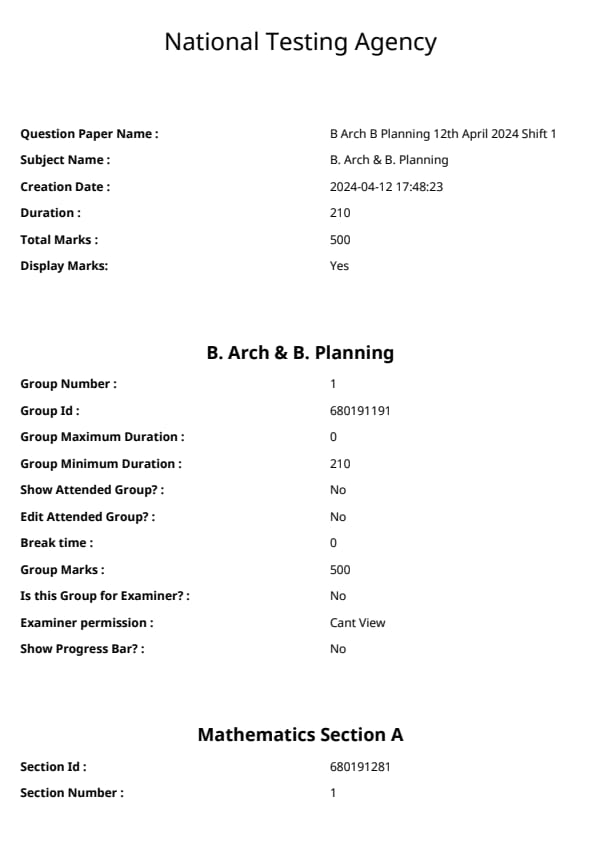
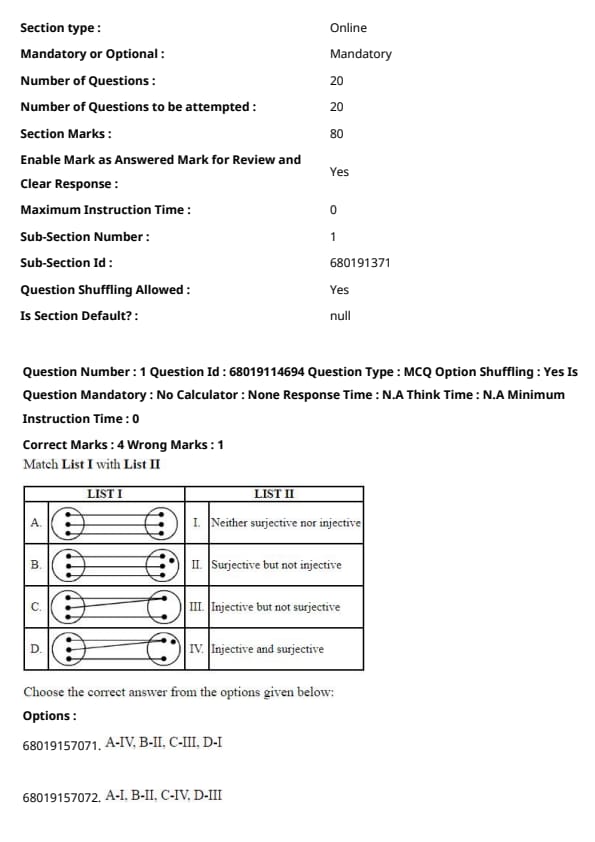


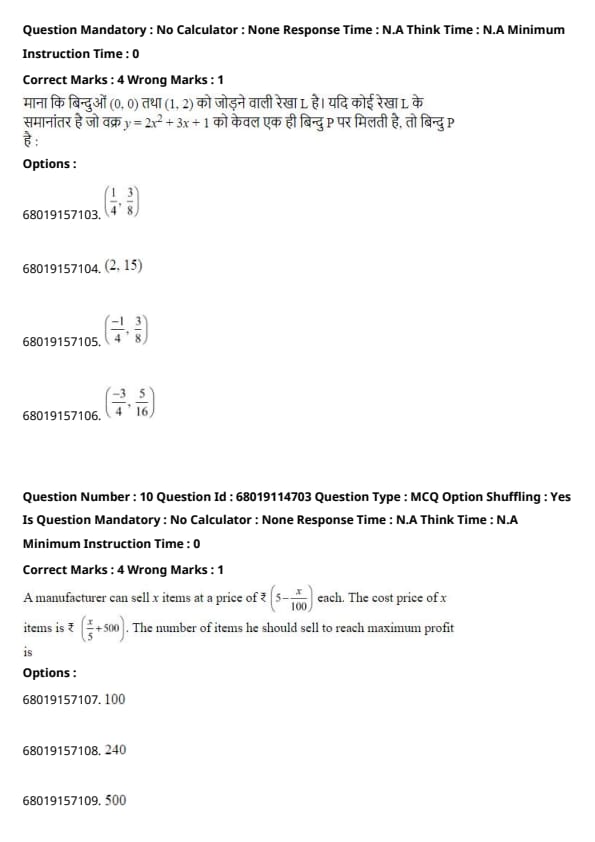
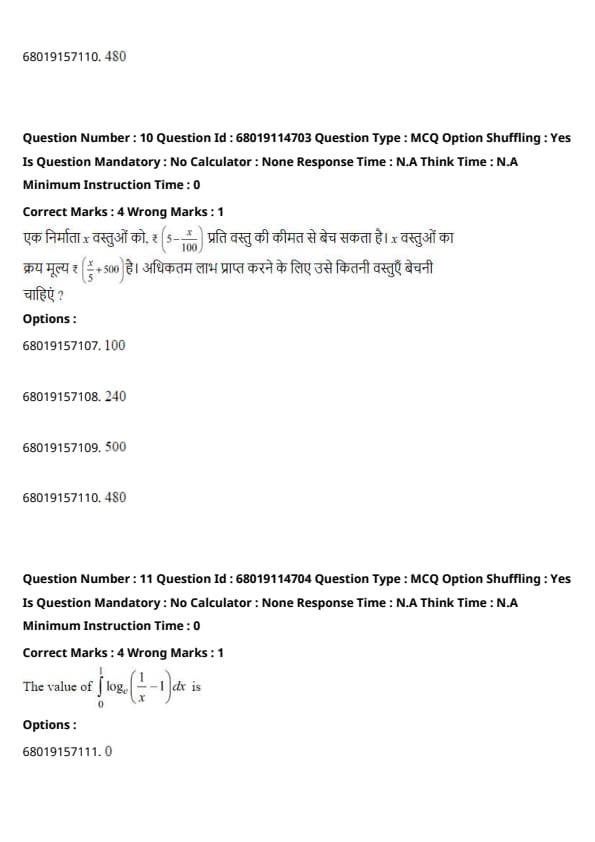
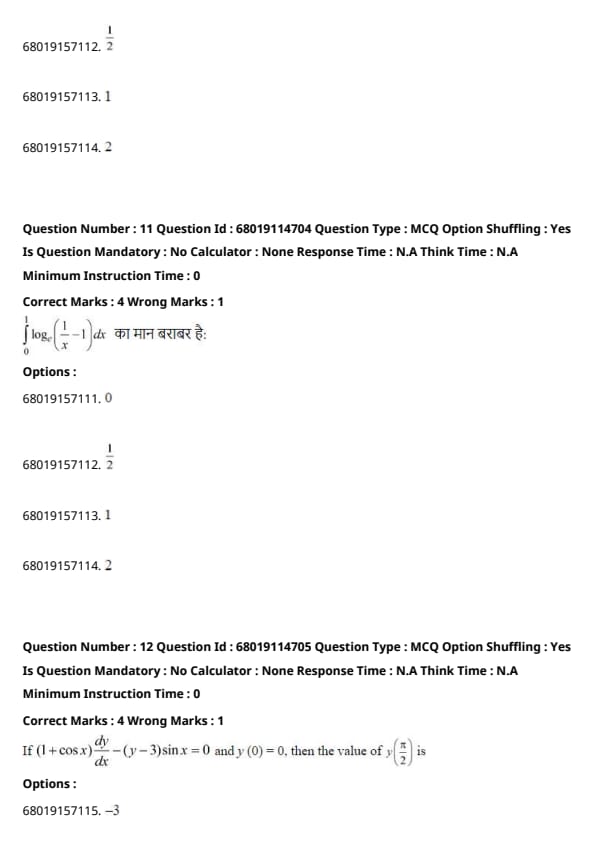
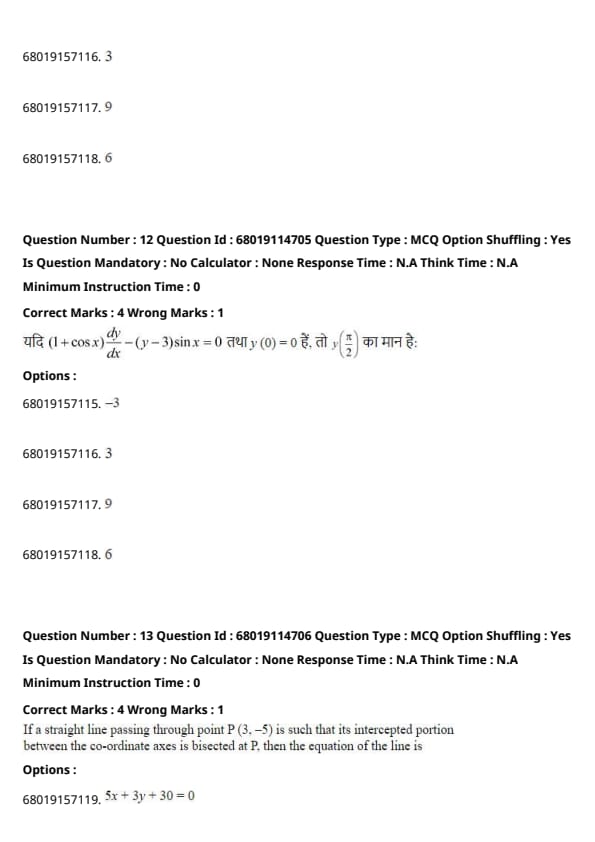

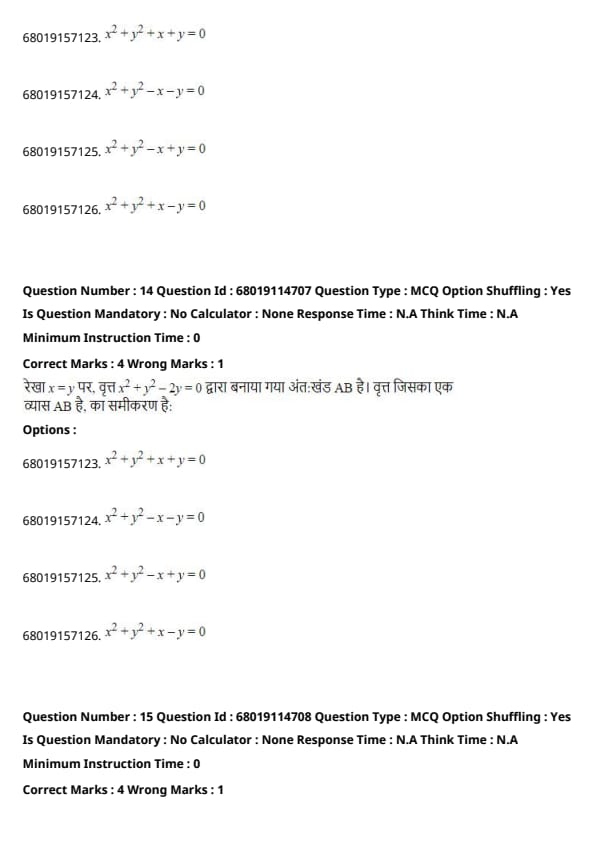

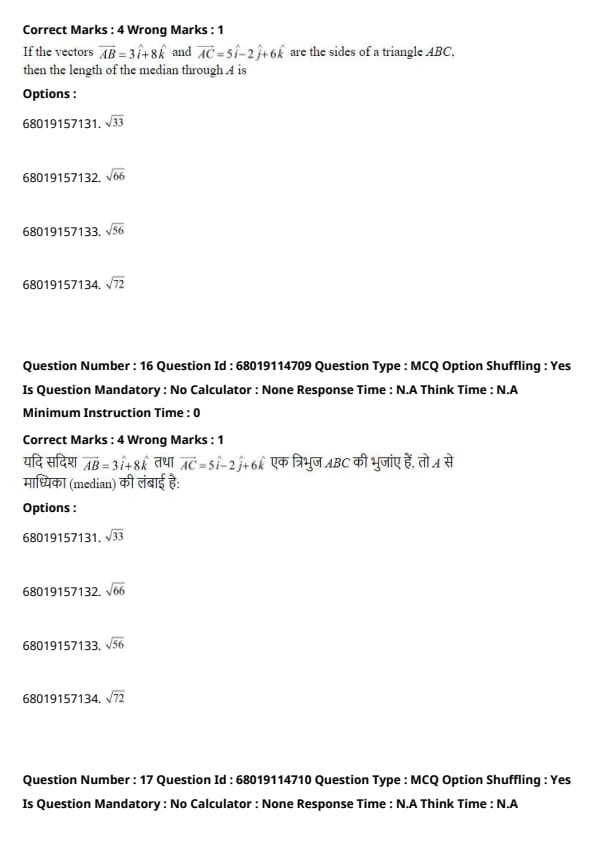

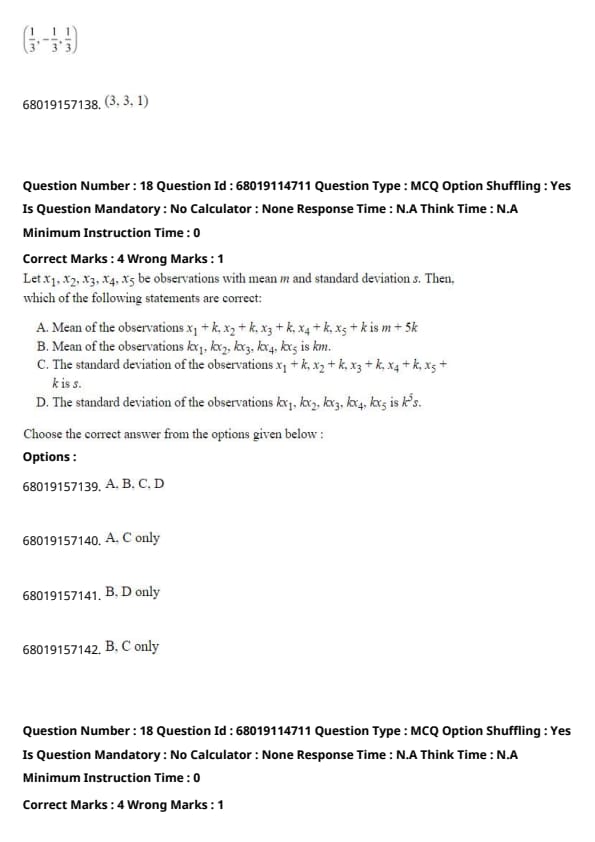


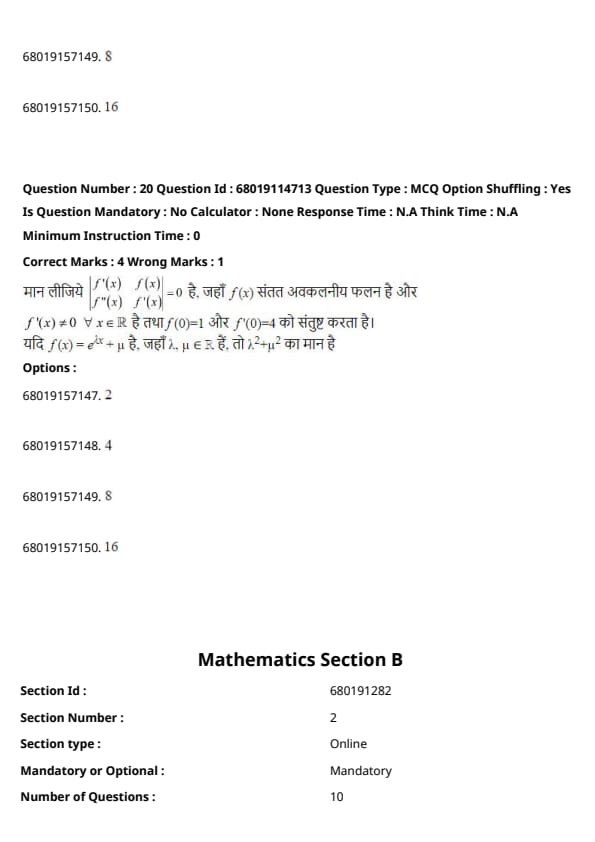
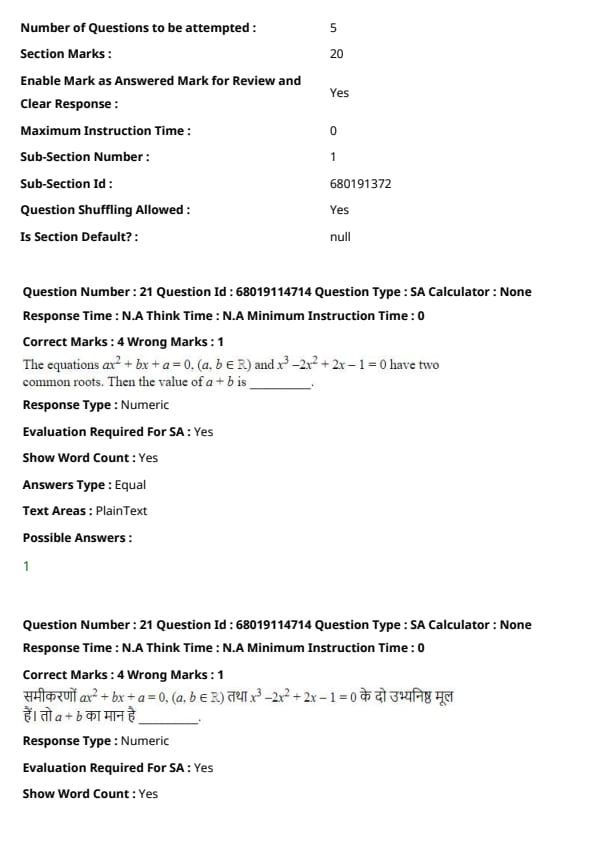

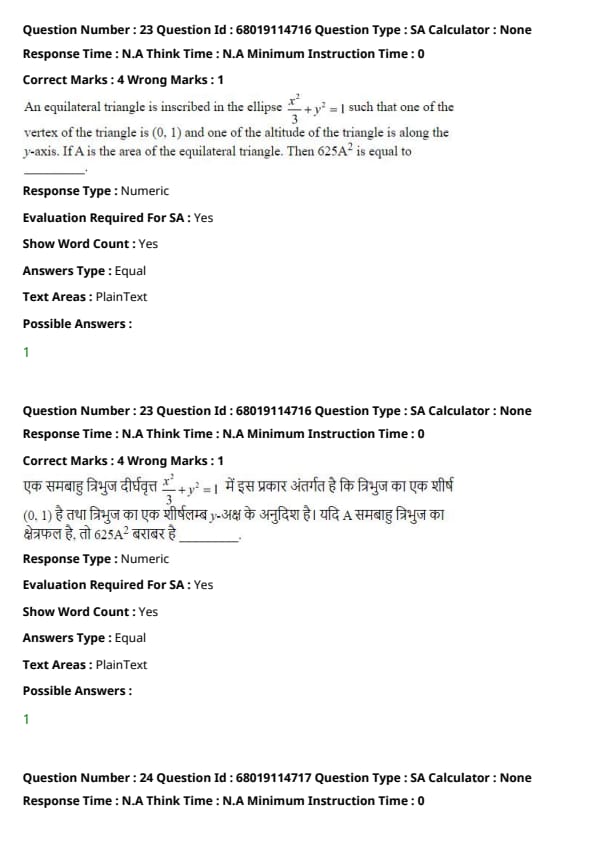


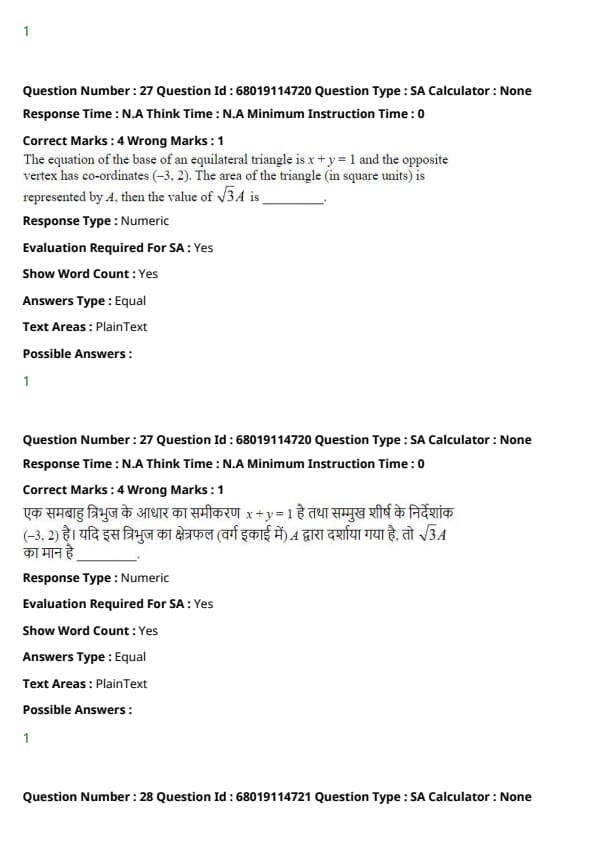


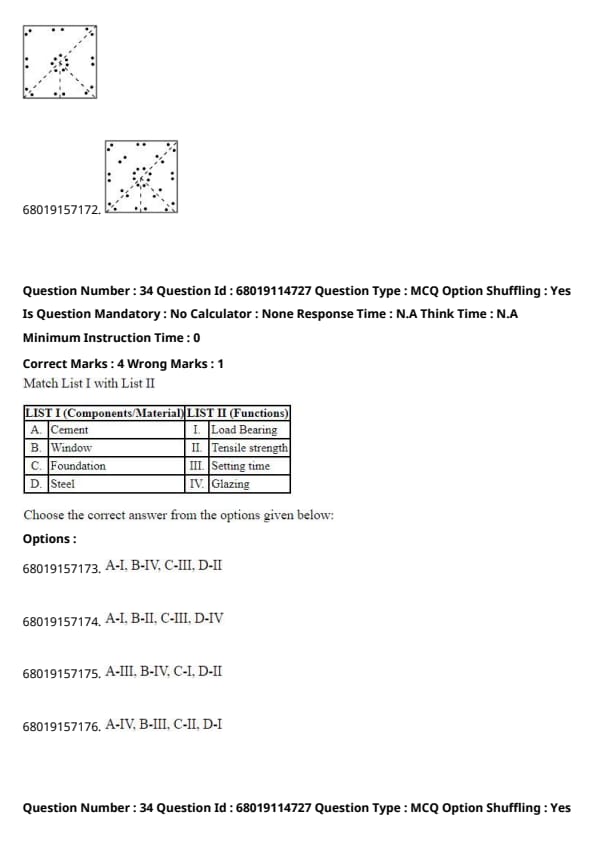


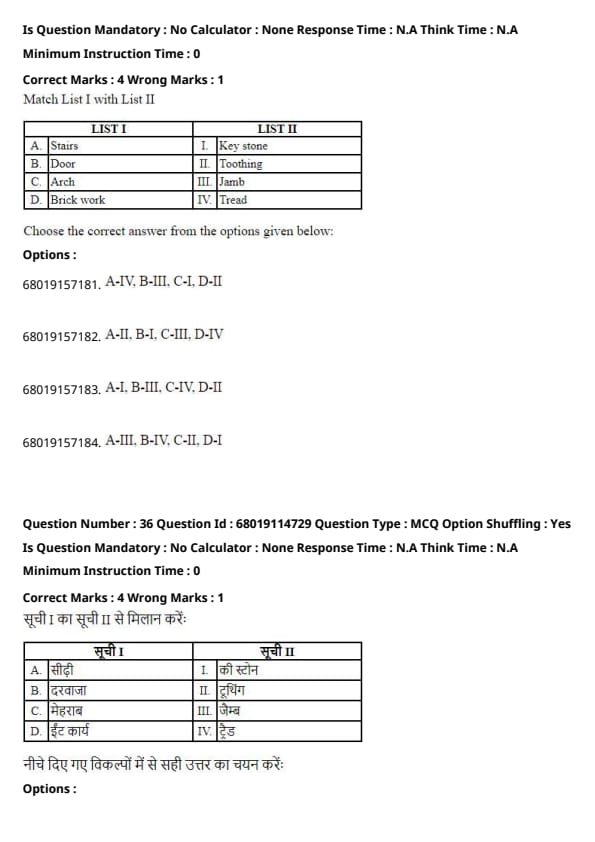


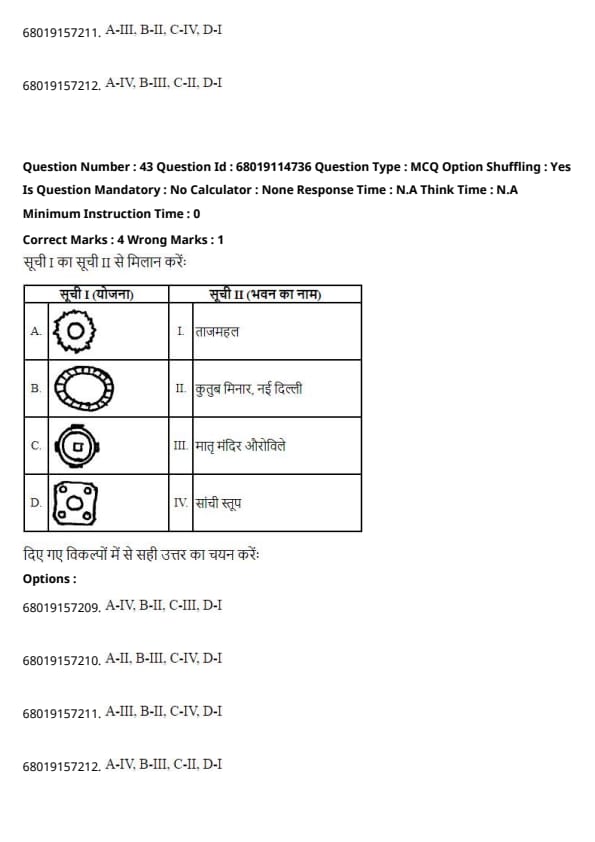


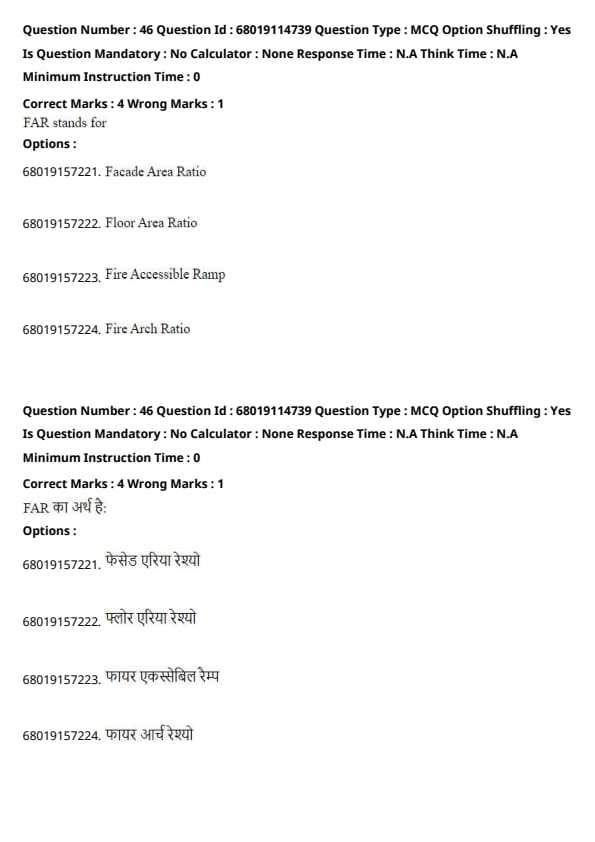


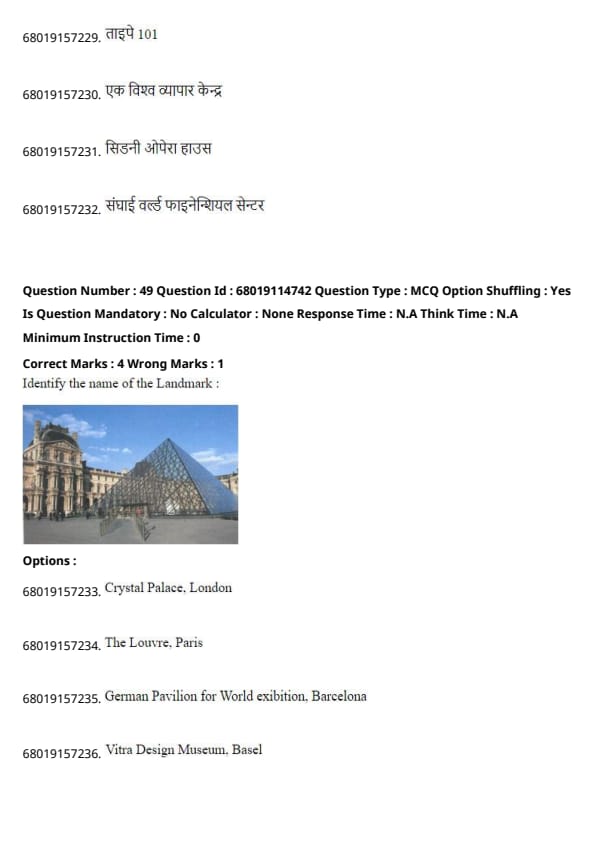


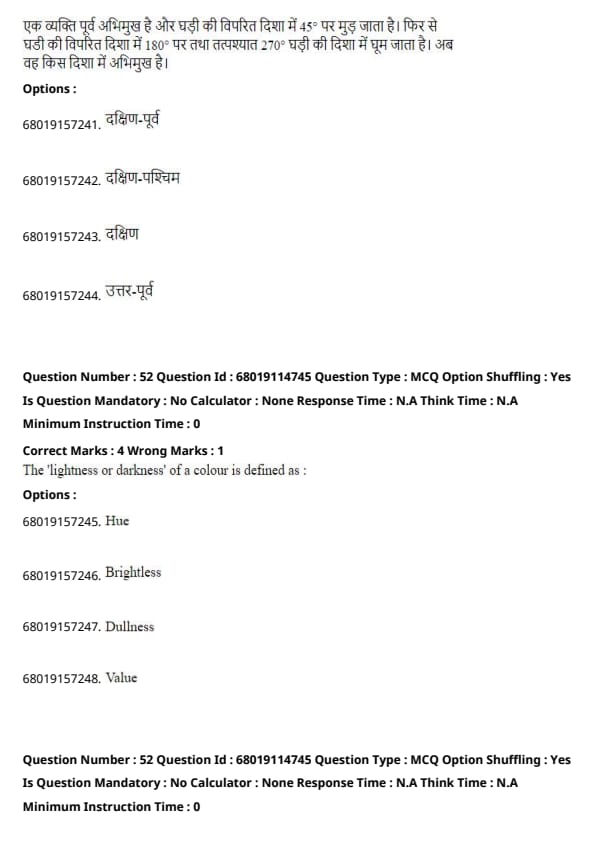


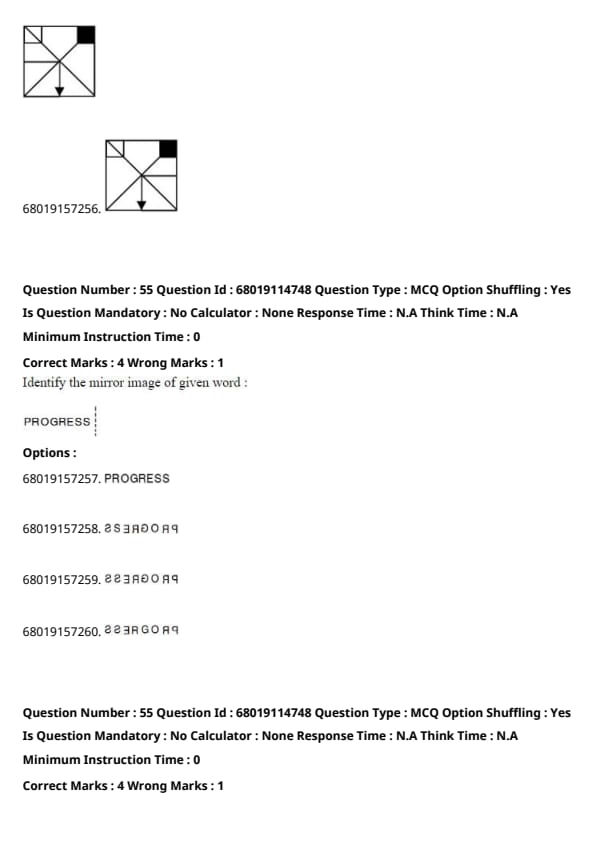








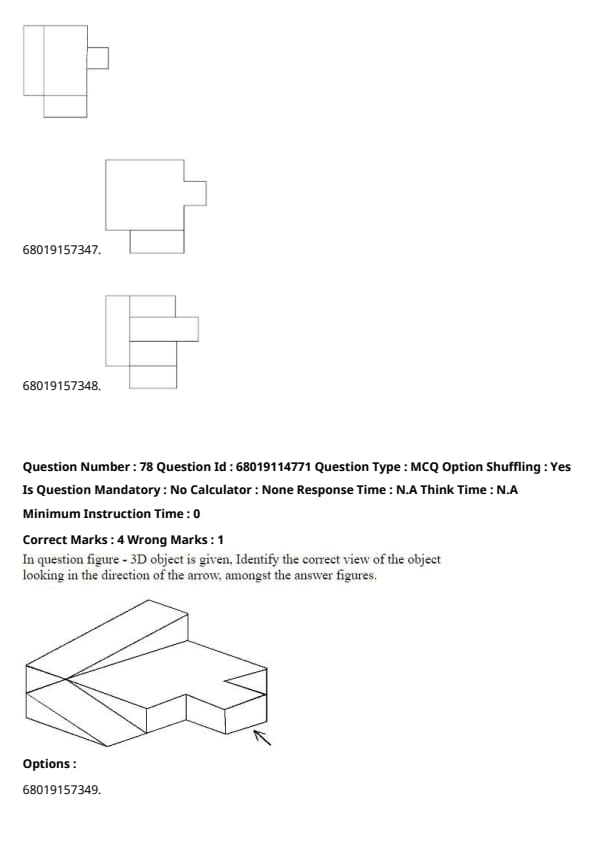



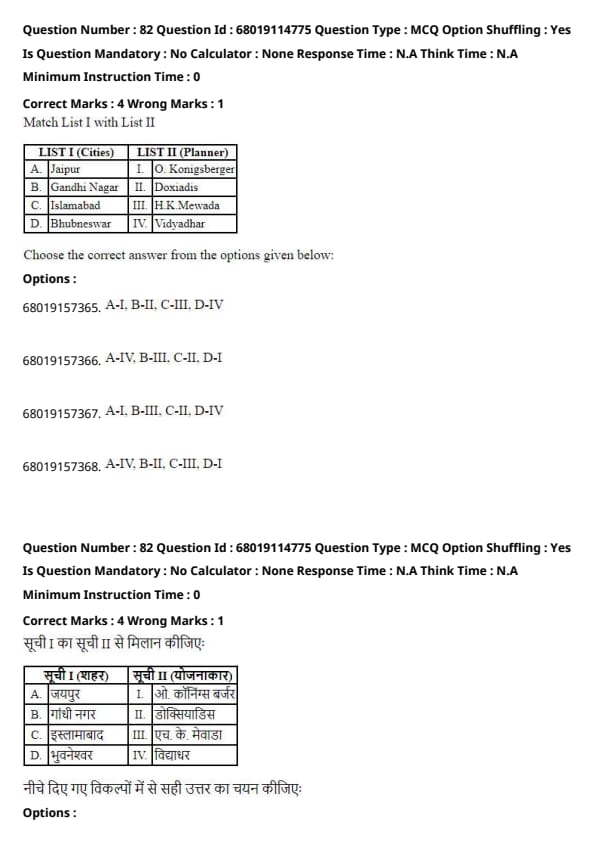

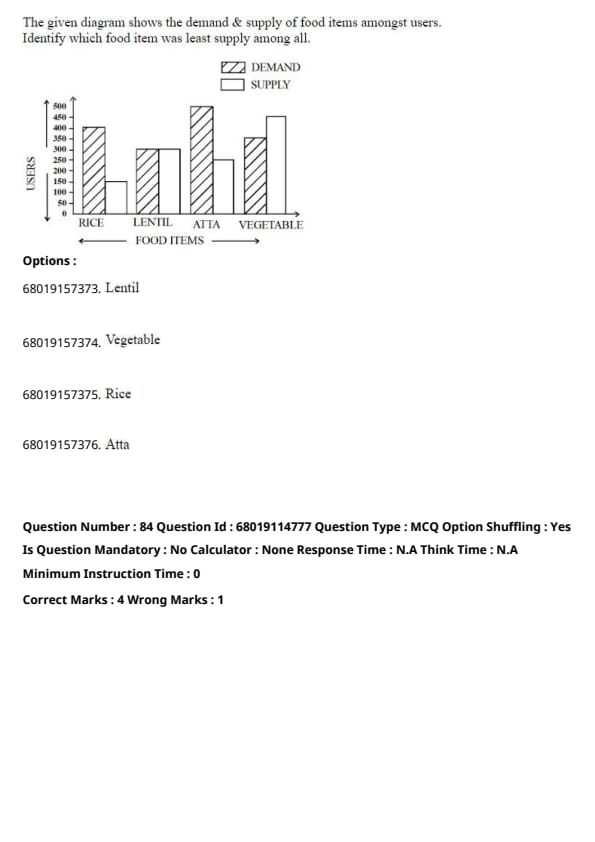









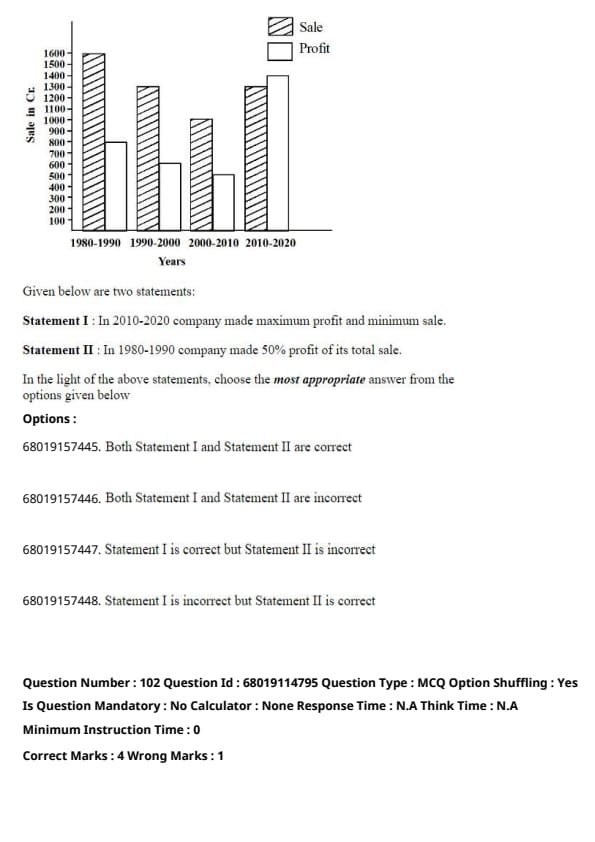
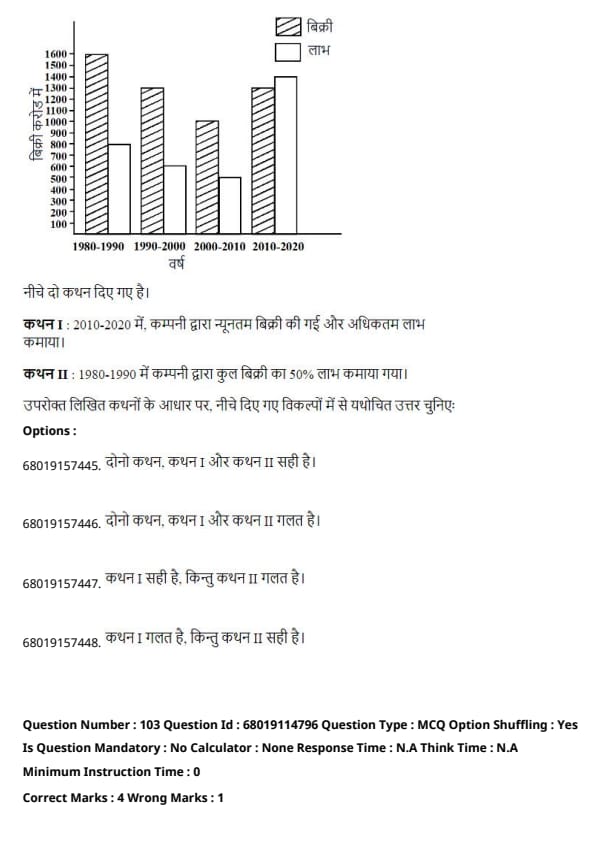
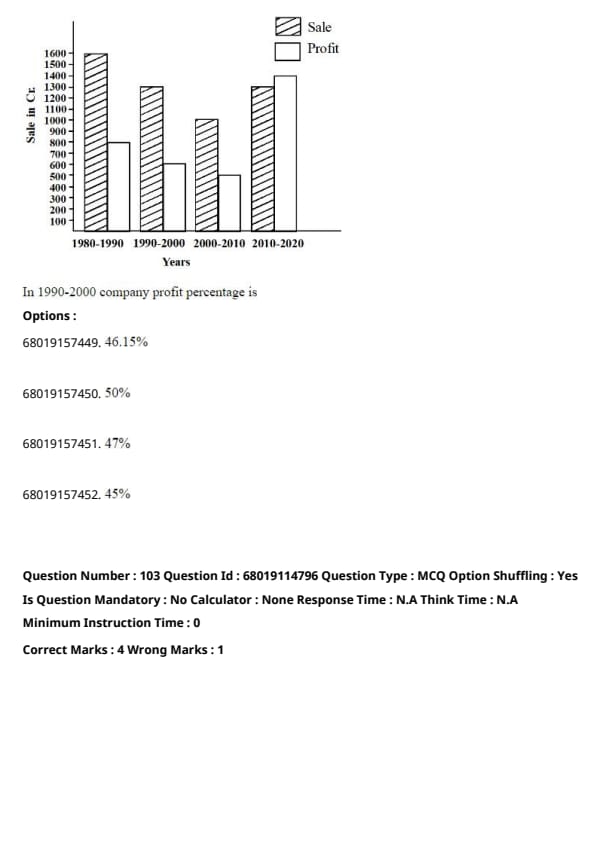
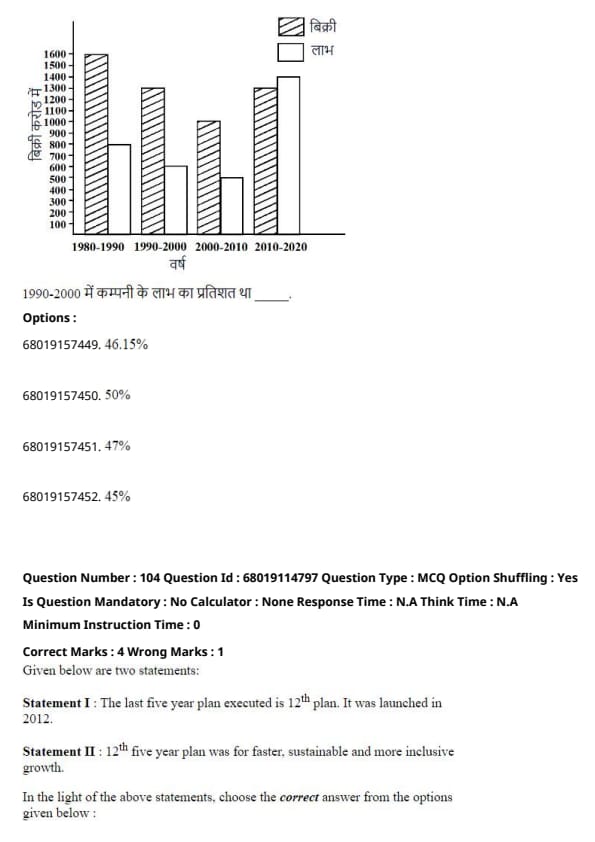


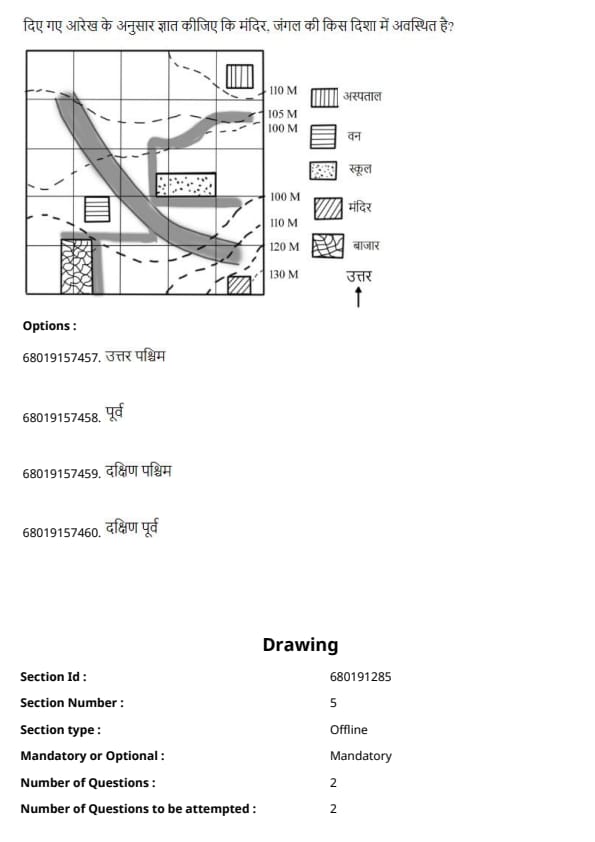
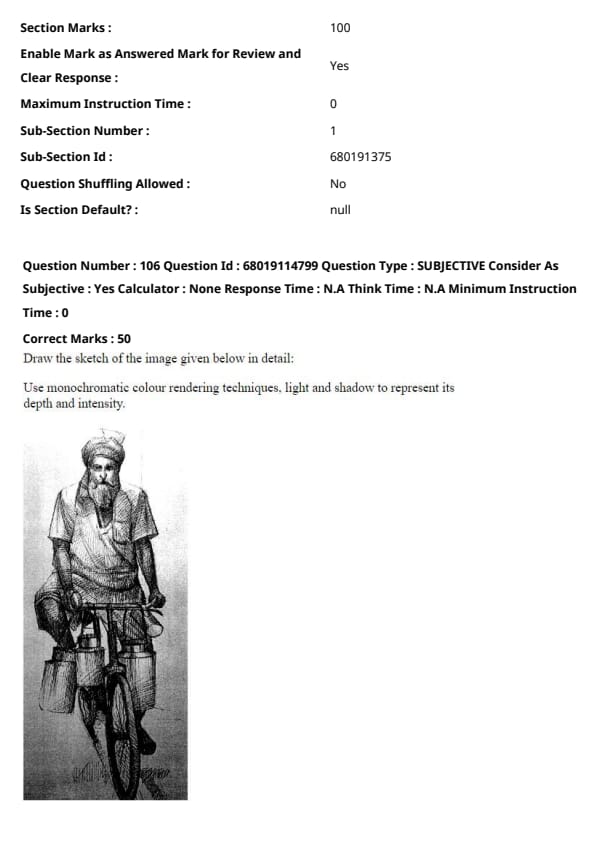

*The article might have information for the previous academic years, please refer the official website of the exam.