
JEE Main 2024 Question Paper with Solution PDF for B.Arch (January 24 - Shift 2)


Content Writer | Updated On - Jan 16, 2026
JEE Main Question Papers are the most important study material for effective exam preparation. We at Zollege have provided all JEE Main Previous Year Papers with Solution PDFs here. JEE Main 2024 B.Arch exam was conducted successfully on January 24 by NTA.
Students can freely download the JEE Main previous year's question paper PDFs along with their solutions here. We strongly encourage JEE Main aspirants to scan through all the JEE Main Question Paper to know the overall difficulty level, JEE Main Syllabus and understand the changes in JEE Main Exam Pattern over the years.
JEE Main 2024 Jan 24 Shift 2 B.Arch Question Paper with Solution Pdf
| JEE Main 2024 Question Paper PDF | JEE Main 2024 Solution PDF |
|---|---|
| Download PDF | Check Solutions |

The domain of the function \( f(x) = \sqrt{4-x^2} + \sqrt{2+x} \) is \([a, b]\), then \( a^2 + 3b^2 \) is equal to
View Solution
Step 1: Understanding the Concept:
The domain of a function involving square roots is the set of all real numbers for which the expression inside each square root is greater than or equal to zero.
For the sum of two functions, the domain is the intersection of the domains of the individual functions.
Step 2: Key Formula or Approach:
1. For \( \sqrt{g(x)} \) to be defined, \( g(x) \geq 0 \).
2. Intersection: \( Domain(f) = Domain(f_1) \cap Domain(f_2) \).
Step 3: Detailed Explanation:
Consider the first term: \( \sqrt{4 - x^2} \).
\[ 4 - x^2 \geq 0 \implies x^2 \leq 4 \] \[ \implies -2 \leq x \leq 2 \dots (i) \]
Consider the second term: \( \sqrt{2 + x} \).
\[ 2 + x \geq 0 \implies x \geq -2 \dots (ii) \]
Taking the intersection of (i) and (ii):
\[ x \in [-2, 2] \cap [-2, \infty) \] \[ x \in [-2, 2] \]
Comparing with the given domain \([a, b]\), we find:
\[ a = -2 and b = 2 \]
Now, calculate \( a^2 + 3b^2 \):
\[ a^2 + 3b^2 = (-2)^2 + 3(2)^2 \] \[ = 4 + 3(4) \] \[ = 4 + 12 = 16 \]
Step 4: Final Answer:
The value of \( a^2 + 3b^2 \) is 16.
Quick Tip: For functions involving \( \sqrt{A} + \sqrt{B} \), always check both conditions \( A \geq 0 \) and \( B \geq 0 \) simultaneously. Visualizing the values on a number line helps find the intersection quickly.
Let \( \mathbb{R} \) denote the set of real numbers, \( \mathbb{Z} \) the set of integers and \( \mathbb{W} \) the set of Non-negative integers, and define a map
(i) \( f_1: \mathbb{Z} \to \mathbb{Z} \) by \( f_1(x) = x^3 \). Then \( f_1 \) is one-one and not onto.
(ii) \( f_2: \mathbb{R} \to \mathbb{R} \) by \( f_2(x) = x^3 \). Then \( f_2 \) is one-one and onto.
(iii) \( f_3: \mathbb{Z} \to \mathbb{W} \) by \( f_3(x) = |x| \). Then \( f_3 \) is not one-one but is onto.
(iv) \( f_4: \mathbb{Z} \to \mathbb{Z} \) by \( f_4(x) = x^2 \). Then \( f_4 \) is neither one-one nor onto.
Then which of the following options is correct?
View Solution
Step 1: Understanding the Concept:
A function is one-one (injective) if \( f(x_1) = f(x_2) \implies x_1 = x_2 \).
A function is onto (surjective) if for every element in the codomain, there exists a corresponding element in the domain.
Step 2: Detailed Explanation:
(i) \( f_1(x) = x^3 \) on \( \mathbb{Z} \): If \( x_1^3 = x_2^3 \), then \( x_1 = x_2 \) (one-one). However, integers like 2 have no integer cube root, so it's not onto. Statement (i) is true.
(ii) \( f_2(x) = x^3 \) on \( \mathbb{R} \): It is one-one for the same reason. Since every real number has a real cube root, it is onto. Statement (ii) is true.
(iii) \( f_3(x) = |x| \) from \( \mathbb{Z} \to \mathbb{W} \): \( f_3(1) = 1 \) and \( f_3(-1) = 1 \), so not one-one. Since every \( w \in \mathbb{W} \) has a pre-image (e.g., \( x=w \)), it is onto. Statement (iii) is true.
(iv) \( f_4(x) = x^2 \) on \( \mathbb{Z} \): \( f_4(1) = f_4(-1) = 1 \), so not one-one. Negative integers have no pre-image, so not onto. Statement (iv) is true.
Step 3: Final Answer:
Since all four statements are correct, option (B) is the right choice.
Quick Tip: Always check the domain and codomain carefully. A function like \( x^2 \) can be onto if the codomain is restricted to non-negative numbers, but not if the codomain is all integers.
If \( \frac{\sqrt{5+12i} + \sqrt{5-12i}}{\sqrt{5+12i} - \sqrt{5-12i}} = a + bi \), then \( a - b \) is:
View Solution
Step 1: Understanding the Concept:
We need to evaluate the square roots of the complex numbers \( 5 \pm 12i \) and then simplify the fraction.
Step 2: Key Formula or Approach:
Square root of \( x+iy \) is \( \pm \left( \sqrt{\frac{|z|+x}{2}} + i \sqrt{\frac{|z|-x}{2}} \right) \).
Step 3: Detailed Explanation:
Let \( z = 5+12i \). Then \( |z| = \sqrt{5^2 + 12^2} = 13 \).
\[ \sqrt{5+12i} = \pm \left( \sqrt{\frac{13+5}{2}} + i \sqrt{\frac{13-5}{2}} \right) = \pm (3+2i) \]
Similarly, \( \sqrt{5-12i} = \pm (3-2i) \).
Using the positive roots in the expression:
\[ Numerator = (3+2i) + (3-2i) = 6 \] \[ Denominator = (3+2i) - (3-2i) = 4i \] \[ Expression = \frac{6}{4i} = \frac{3}{2i} = \frac{3(-i)}{2i(-i)} = -\frac{3}{2}i \]
So, \( a + bi = 0 - \frac{3}{2}i \). This gives \( a = 0 \) and \( b = -\frac{3}{2} \).
Then \( a - b = 0 - (-\frac{3}{2}) = \frac{3}{2} \).
Step 4: Final Answer:
The value of \( a - b \) is \( \frac{3}{2} \).
Quick Tip: Notice that \( 5^2 + 12^2 = 13^2 \). When numbers form a Pythagorean triplet, the square root of \( x+iy \) usually has integer real and imaginary parts.
Let \( A \) be a \( 3 \times 3 \) matrix such that \( adj(A) = \begin{bmatrix} 25 & 0 & 100
0 & 4 & 3
0 & 100 & 100 \end{bmatrix} \). Then determinant of \( A \) is
View Solution
Step 1: Understanding the Concept:
There is a direct relationship between the determinant of a matrix and the determinant of its adjoint matrix.
Step 2: Key Formula or Approach:
For a square matrix \( A \) of order \( n \), \( |adj(A)| = |A|^{n-1} \).
Step 3: Detailed Explanation:
Given \( n = 3 \), we have \( |adj(A)| = |A|^{3-1} = |A|^2 \).
Let's find the determinant of the given adjoint matrix:
\[ |adj(A)| = \begin{vmatrix} 25 & 0 & 100
0 & 4 & 3
0 & 100 & 100 \end{vmatrix} \]
Expanding along the first column:
\[ |adj(A)| = 25 \left( (4)(100) - (3)(100) \right) - 0 + 0 \] \[ = 25 (400 - 300) = 25 \times 100 = 2500 \]
Equating the two values:
\[ |A|^2 = 2500 \] \[ |A| = \pm \sqrt{2500} = \pm 50 \]
Looking at the options, the determinant is 50.
Step 4: Final Answer:
The determinant of matrix \( A \) is 50.
Quick Tip: Remember that if a matrix is singular (\( |A|=0 \)), its adjoint is also singular. This property can often eliminate options in complex matrix problems.
The total number of times the digit 3 will be written when listing integers from 1 to 1000 is
View Solution
Step 1: Understanding the Concept:
We consider numbers from 000 to 999 as three-digit strings. Since each digit appears an equal number of times by symmetry, we can calculate the total frequency.
Step 2: Detailed Explanation:
Consider all numbers from 000 to 999. There are 1000 such numbers.
Each number has 3 positions (Hundreds, Tens, Units).
Total number of positions = \( 1000 \times 3 = 3000 \).
There are 10 possible digits (0-9). Due to symmetry, each digit appears \( \frac{3000}{10} = 300 \) times.
Thus, the digit 3 appears 300 times in the numbers 0 to 999.
Since 1000 does not contain the digit 3, the total count from 1 to 1000 is 300.
Step 3: Final Answer:
The digit 3 is written 300 times.
Quick Tip: Formula method: For numbers from \( 0 \) to \( 10^n - 1 \), each digit appears \( n \times 10^{n-1} \) times. Here \( n=3 \), so frequency = \( 3 \times 10^2 = 300 \).
The coefficient of \( x^{24} \) in \( (1+x^2)^{12} (1+x^{12}) (1+x^{24}) \) is
View Solution
Step 1: Understanding the Concept:
We need to expand the product and identify all combinations of powers of \( x \) that result in a total power of 24.
Step 2: Detailed Explanation:
The expression is \( (1 + x^2)^{12} (1 + x^{12} + x^{24} + x^{36}) \).
The general term in \( (1 + x^2)^{12} \) is \( ^{12}C_r (x^2)^r = ^{12}C_r x^{2r} \).
To find the coefficient of \( x^{24} \), we combine terms:
1. Term \( 1 \) from the second part multiplies with \( x^{24} \) from the binomial: \( 2r = 24 \implies r = 12 \). Coefficient = \( ^{12}C_{12} = 1 \).
2. Term \( x^{12} \) from the second part multiplies with \( x^{12} \) from the binomial: \( 2r = 12 \implies r = 6 \). Coefficient = \( ^{12}C_6 \).
3. Term \( x^{24} \) from the second part multiplies with \( 1 \) from the binomial: \( 2r = 0 \implies r = 0 \). Coefficient = \( ^{12}C_0 = 1 \).
Total coefficient = \( 1 + ^{12}C_6 + 1 = ^{12}C_6 + 2 \).
Step 3: Final Answer:
The coefficient is \( ^{12}C_6 + 2 \).
Quick Tip: When a polynomial is multiplied by terms like \( (1 + x^k) \), the new coefficient is the sum of the original coefficients of \( x^n \) and \( x^{n-k} \).
Sum to \( n \) terms of the series \( \log_e a + \log_e \left(\frac{a^2}{b}\right) + \log_e \left(\frac{a^3}{b^2}\right) + \log_e \left(\frac{a^4}{b^3}\right) + \dots \) is
View Solution
Step 1: Understanding the Concept:
The series can be simplified using logarithmic properties to identify an Arithmetic Progression (AP).
Step 2: Detailed Explanation:
The terms are:
\( T_1 = \log a \)
\( T_2 = \log a^2 - \log b = 2 \log a - \log b \)
\( T_3 = \log a^3 - \log b^2 = 3 \log a - 2 \log b \)
This is an AP with first term \( a_{AP} = \log a \) and common difference \( d = (2 \log a - \log b) - \log a = \log a - \log b = \log(a/b) \).
Sum \( S_n = \frac{n}{2} [ 2 a_{AP} + (n-1)d ] \)
\( S_n = \frac{n}{2} [ 2 \log a + (n-1) \log(a/b) ] \)
\( S_n = \frac{n}{2} [ 2 \log a + n \log(a/b) - \log a + \log b ] \)
\( S_n = \frac{n}{2} [ n \log(a/b) + \log a + \log b ] \)
\( S_n = \frac{n}{2} [ n \log_e(a/b) + \log_e(ab) ] \)
Step 3: Final Answer:
The sum is \( \frac{n}{2} [ n \log_e(a/b) + \log_e(ab) ] \).
Quick Tip: For logarithmic series, always simplify the terms using \( \log(x/y) = \log x - \log y \) first. It almost always converts the series into a standard AP.
If the sum of first 10 terms and first 26 terms of an A.P. are 190 and 1326 respectively, then find the sum of its first 50 terms.
View Solution
Step 1: Understanding the Concept:
Use the standard sum formula for an AP to create a system of linear equations in terms of \( a \) (first term) and \( d \) (common difference).
Step 2: Key Formula or Approach:
\( S_n = \frac{n}{2} [ 2a + (n-1)d ] \).
Step 3: Detailed Explanation:
Given \( S_{10} = 190 \):
\( \frac{10}{2} [ 2a + 9d ] = 190 \implies 2a + 9d = 38 \dots (i) \)
Given \( S_{26} = 1326 \):
\( \frac{26}{2} [ 2a + 25d ] = 1326 \implies 13 [ 2a + 25d ] = 1326 \implies 2a + 25d = 102 \dots (ii) \)
Subtract (i) from (ii):
\( 16d = 64 \implies d = 4 \).
Substitute \( d = 4 \) into (i):
\( 2a + 36 = 38 \implies 2a = 2 \implies a = 1 \).
Now, find \( S_{50} \):
\( S_{50} = \frac{50}{2} [ 2(1) + 49(4) ] = 25 [ 2 + 196 ] = 25 \times 198 = 4950 \).
Step 4: Final Answer:
The sum of the first 50 terms is 4950.
Quick Tip: Calculations can be faster if you notice \( 2a + (n-1)d \) appears in all equations. Sometimes you can find \( S_{50} \) by combining \( S_{10} \) and \( S_{26} \) without finding \( a \) and \( d \) explicitly, though here finding them is straightforward.
If \( \lim_{x \to 1} \frac{x^5-1}{x-1} = \lim_{x \to k} \frac{x^3-k^3}{x^2-k^2} \), then \( k \) is equal to
View Solution
Step 1: Understanding the Concept:
Both sides represent limits of indeterminate forms \( 0/0 \). We can use the standard limit formula or L'Hopital's rule.
Step 2: Key Formula or Approach:
\( \lim_{x \to a} \frac{x^n - a^n}{x-a} = n a^{n-1} \).
Step 3: Detailed Explanation:
Evaluate the Left-Hand Side (LHS):
\[ \lim_{x \to 1} \frac{x^5-1}{x-1} = 5(1)^4 = 5 \]
Evaluate the Right-Hand Side (RHS):
\[ \lim_{x \to k} \frac{x^3-k^3}{x^2-k^2} = \lim_{x \to k} \frac{(x^3-k^3)/(x-k)}{(x^2-k^2)/(x-k)} = \frac{3k^2}{2k} = \frac{3k}{2} \]
Equating both sides:
\[ 5 = \frac{3k}{2} \implies 10 = 3k \implies k = \frac{10}{3} \]
Step 4: Final Answer:
The value of \( k \) is \( 10/3 \).
Quick Tip: General formula: \( \lim_{x \to a} \frac{x^m - a^m}{x^n - a^n} = \frac{m}{n} a^{m-n} \). This saves several steps in competitive exams.
Let \( f: [0, \pi] \to \mathbb{R} \) be a function defined by \( f(x) = \begin{cases} x + \sqrt{2}\sin x, & 0 \leq x < \frac{\pi}{4}
2\cot x + b, & \frac{\pi}{4} \leq x \leq \frac{\pi}{2}
a\cos 2x - b\sin x, & \frac{\pi}{2} < x \leq \pi \end{cases} \). If \( f \) is continuous, find \( a^2 + 4b^2 \).
View Solution
Step 1: Understanding the Concept:
For a function to be continuous at a point \( x = c \), the left-hand limit, right-hand limit, and functional value must be equal.
Step 2: Detailed Explanation:
1. Continuity at \( x = \pi/4 \):
\[ \lim_{x \to \pi/4^-} (x + \sqrt{2}\sin x) = \frac{\pi}{4} + \sqrt{2} \cdot \frac{1}{\sqrt{2}} = \frac{\pi}{4} + 1 \] \[ \lim_{x \to \pi/4^+} (2\cot x + b) = 2(1) + b = 2 + b \]
Equating: \( \pi/4 + 1 = 2 + b \implies b = \pi/4 - 1 \).
Note: Based on the options, the middle function might be \( \cot x + b \). Let's re-solve with \( \cot x + b \):
\( \pi/4 + 1 = 1 + b \implies b = \pi/4 \).
2. Continuity at \( x = \pi/2 \):
\[ \lim_{x \to \pi/2^- (\cot x + b) = 0 + b = b \] \[ \lim_{x \to \pi/2^+} (a\cos 2x - b\sin x) = a\cos(\pi) - b\sin(\pi/2) = -a - b \]
Equating: \( b = -a - b \implies a = -2b = -\pi/2 \).
3. Find \( a^2 + 4b^2 \):
\[ a^2 + 4b^2 = (-\pi/2)^2 + 4(\pi/4)^2 = \frac{\pi^2}{4} + \frac{4\pi^2}{16} = \frac{\pi^2}{4} + \frac{\pi^2}{4} = \frac{\pi^2}{2} \]
Step 3: Final Answer:
The result is \( \frac{\pi^2}{2} \).
Quick Tip: In piecewise continuity problems, always solve for variables sequentially starting from the transition point with the simplest expressions.
\( \int \frac{dx}{\sin^2 x \cos^2 x} \) is equal to
View Solution
Step 1: Understanding the Concept:
We can simplify the integrand using the trigonometric identity \( \sin^2 x + \cos^2 x = 1 \).
Step 2: Detailed Explanation:
Rewrite the integral by substituting \( 1 \) in the numerator:
\[ I = \int \frac{\sin^2 x + \cos^2 x}{\sin^2 x \cos^2 x} dx \]
Split the fraction:
\[ I = \int \left( \frac{\sin^2 x}{\sin^2 x \cos^2 x} + \frac{\cos^2 x}{\sin^2 x \cos^2 x} \right) dx \] \[ I = \int (\sec^2 x + \csc^2 x) dx \]
Integrate term by term:
\[ \int \sec^2 x \, dx = \tan x \] \[ \int \csc^2 x \, dx = -\cot x \]
Therefore, \( I = \tan x - \cot x + c \).
Step 3: Final Answer:
The integral is \( \tan x - \cot x + c \).
Quick Tip: Another way is to use \( \sin^2 x \cos^2 x = \frac{1}{4}\sin^2 2x \). Then the integral becomes \( \int 4\csc^2 2x \, dx = -2\cot 2x + c \). Note that \( -2\cot 2x = \tan x - \cot x \).
The solution of differential equation \( (x + 2y^3)\frac{dy}{dx} = y \) is
View Solution
Step 1: Understanding the Concept:
The given differential equation can be rearranged into the form of a first-order linear differential equation. Instead of the standard \( \frac{dy}{dx} + Py = Q \), it is easier to solve by considering \( x \) as the dependent variable and \( y \) as the independent variable, giving the form \( \frac{dx}{dy} + P(y)x = Q(y) \).
Step 2: Key Formula or Approach:
1. Rearrange to find \( \frac{dx}{dy} \).
2. Identify the Integrating Factor (IF): \( IF = e^{\int P(y) dy} \).
3. The general solution is \( x \cdot (IF) = \int Q(y) \cdot (IF) \, dy + c \).
Step 3: Detailed Explanation:
The given equation is: \[ (x + 2y^3) \frac{dy}{dx} = y \]
Rearranging for \( \frac{dx}{dy} \): \[ \frac{dx}{dy} = \frac{x + 2y^3}{y} \] \[ \frac{dx}{dy} = \frac{x}{y} + 2y^2 \] \[ \frac{dx}{dy} - \frac{1}{y}x = 2y^2 \]
This is a linear differential equation in \( x \) where \( P(y) = -\frac{1}{y} \) and \( Q(y) = 2y^2 \).
Now, calculate the Integrating Factor: \[ IF = e^{\int P(y) dy} = e^{\int -\frac{1}{y} dy} = e^{-\ln y} = e^{\ln y^{-1}} = \frac{1}{y} \]
The general solution is: \[ x \cdot \left(\frac{1}{y}\right) = \int 2y^2 \cdot \left(\frac{1}{y}\right) dy + c \] \[ \frac{x}{y} = \int 2y \, dy + c \] \[ \frac{x}{y} = y^2 + c \]
Multiplying by \( y \): \[ x = y(y^2 + c) \]
Step 4: Final Answer:
The solution is \( x = y(y^2 + c) \).
Quick Tip: When a differential equation is difficult to solve for \( \frac{dy}{dx} \), try flipping it to solve for \( \frac{dx}{dy} \). This often transforms a non-linear equation into a standard linear one.
The point diametrically opposite to the point \( (-1, 1) \) on the circle \( x^2 + y^2 - x - 4y + 1 = 0 \) is
View Solution
Step 1: Understanding the Concept:
The center of a circle is the midpoint of any diameter. If one end of the diameter is known and the center is known, the coordinates of the diametrically opposite point can be found using the midpoint formula.
Step 2: Key Formula or Approach:
1. For a circle \( x^2 + y^2 + 2gx + 2fy + c = 0 \), the center is \( (-g, -f) \).
2. Midpoint Formula: \( (\frac{x_1 + x_2}{2}, \frac{y_1 + y_2}{2}) = (h, k) \).
Step 3: Detailed Explanation:
The equation of the circle is \( x^2 + y^2 - x - 4y + 1 = 0 \).
Comparing with the general form: \[ 2g = -1 \implies g = -\frac{1}{2} \] \[ 2f = -4 \implies f = -2 \]
The center \( C(h, k) \) is \( (-g, -f) = (\frac{1}{2}, 2) \).
Let the given point be \( P(-1, 1) \) and the diametrically opposite point be \( Q(x_1, y_1) \).
Since \( C \) is the midpoint of \( PQ \): \[ \frac{-1 + x_1}{2} = \frac{1}{2} \implies -1 + x_1 = 1 \implies x_1 = 2 \] \[ \frac{1 + y_1}{2} = 2 \implies 1 + y_1 = 4 \implies y_1 = 3 \]
The coordinates of point \( Q \) are \( (2, 3) \).
Step 4: Final Answer:
The point is \( (2, 3) \).
Quick Tip: Always find the center first. For a diameter \( PQ \), remember the vector relation: \( \vec{Q} = 2\vec{C} - \vec{P} \). This is essentially the same as the midpoint calculation but faster to perform mentally.
The vertices of a triangle \( OAB \) are \( (0, 0) \), \( (a, 0) \), and \( (0, b) \) respectively. The distance between its orthocenter and circumcenter is
View Solution
Step 1: Understanding the Concept:
The triangle \( OAB \) is a right-angled triangle with the right angle at the origin \( O(0, 0) \) because the vertices \( (a, 0) \) and \( (0, b) \) lie on the x and y axes respectively.
Step 2: Detailed Explanation:
For a right-angled triangle:
1. The orthocenter is the vertex at which the right angle is located. Thus, the orthocenter \( H \) is \( (0, 0) \).
2. The circumcenter is the midpoint of the hypotenuse. The hypotenuse connects \( (a, 0) \) and \( (0, b) \).
The circumcenter \( C \) is: \[ C = \left( \frac{a + 0}{2}, \frac{0 + b}{2} \right) = \left( \frac{a}{2}, \frac{b}{2} \right) \]
We need the distance between \( H(0, 0) \) and \( C(\frac{a}{2}, \frac{b}{2}) \): \[ d = \sqrt{\left(\frac{a}{2} - 0\right)^2 + \left(\frac{b}{2} - 0\right)^2} \] \[ d = \sqrt{\frac{a^2}{4} + \frac{b^2}{4}} \] \[ d = \frac{1}{2}\sqrt{a^2 + b^2} \]
Step 3: Final Answer:
The distance is \( \frac{1}{2}\sqrt{a^2 + b^2} \).
Quick Tip: In any right triangle, the distance from the right-angle vertex to the circumcenter is exactly half the length of the hypotenuse (the circumradius).
The shortest distance between the lines \( \vec{r} = (\hat{i} + 2\hat{j} + 3\hat{k}) + \lambda(\hat{i} - 3\hat{j} + 2\hat{k}) \) and \( \vec{r} = (4\hat{i} + 5\hat{j} + 6\hat{k}) + \mu(2\hat{i} + 3\hat{j} + \hat{k}) \) is
View Solution
Step 1: Understanding the Concept:
The shortest distance between two skew lines \( \vec{r} = \vec{a}_1 + \lambda \vec{b}_1 \) and \( \vec{r} = \vec{a}_2 + \mu \vec{b}_2 \) is the projection of the vector joining two points on the lines onto the common perpendicular vector.
Step 2: Key Formula or Approach:
\[ SD = \left| \frac{(\vec{a}_2 - \vec{a}_1) \cdot (\vec{b}_1 \times \vec{b}_2)}{|\vec{b}_1 \times \vec{b}_2|} \right| \]
Step 3: Detailed Explanation:
From the given lines: \( \vec{a}_1 = \hat{i} + 2\hat{j} + 3\hat{k}, \quad \vec{b}_1 = \hat{i} - 3\hat{j} + 2\hat{k} \)
\( \vec{a}_2 = 4\hat{i} + 5\hat{j} + 6\hat{k}, \quad \vec{b}_2 = 2\hat{i} + 3\hat{j} + \hat{k} \)
Calculating \( \vec{a}_2 - \vec{a}_1 \): \[ \vec{a}_2 - \vec{a}_1 = (4-1)\hat{i} + (5-2)\hat{j} + (6-3)\hat{k} = 3\hat{i} + 3\hat{j} + 3\hat{k} \]
Calculating \( \vec{b}_1 \times \vec{b}_2 \): \[ \vec{b}_1 \times \vec{b}_2 = \begin{vmatrix} \hat{i} & \hat{j} & \hat{k}
1 & -3 & 2
2 & 3 & 1 \end{vmatrix} = \hat{i}(-3-6) - \hat{j}(1-4) + \hat{k}(3-(-6)) \] \[ \vec{b}_1 \times \vec{b}_2 = -9\hat{i} + 3\hat{j} + 9\hat{k} \]
Now calculate the magnitude \( |\vec{b}_1 \times \vec{b}_2| \): \[ |\vec{b}_1 \times \vec{b}_2| = \sqrt{(-9)^2 + 3^2 + 9^2} = \sqrt{81 + 9 + 81} = \sqrt{171} = \sqrt{9 \times 19} = 3\sqrt{19} \]
Calculate the dot product \( (\vec{a}_2 - \vec{a}_1) \cdot (\vec{b}_1 \times \vec{b}_2) \): \[ (3\hat{i} + 3\hat{j} + 3\hat{k}) \cdot (-9\hat{i} + 3\hat{j} + 9\hat{k}) = 3(-9) + 3(3) + 3(9) = -27 + 9 + 27 = 9 \]
Shortest Distance: \[ SD = \left| \frac{9}{3\sqrt{19}} \right| = \frac{3}{\sqrt{19}} \]
Step 4: Final Answer:
The shortest distance is \( \frac{3}{\sqrt{19}} \) units.
Quick Tip: To simplify calculations, factor out common constants from vectors. For example, \( \vec{b}_1 \times \vec{b}_2 = 3(-3\hat{i} + \hat{j} + 3\hat{k}) \). This makes calculating the magnitude and dot product much easier.
The projection vector of \( \vec{a} = \hat{i} - 3\hat{j} - 3\hat{k} \) on \( \vec{b} = 3\hat{i} - 4\hat{j} \) is
View Solution
Step 1: Understanding the Concept:
The projection vector of \( \vec{a} \) on \( \vec{b} \) is a vector that has the same direction as \( \vec{b} \) and a magnitude equal to the scalar component of \( \vec{a} \) in the direction of \( \vec{b} \).
Step 2: Key Formula or Approach:
The projection vector is given by: \[ proj_{\vec{b}} \vec{a} = \left( \frac{\vec{a} \cdot \vec{b}}{|\vec{b}|^2} \right) \vec{b} \]
Step 3: Detailed Explanation:
Given vectors: \( \vec{a} = \hat{i} - 3\hat{j} - 3\hat{k} \)
\( \vec{b} = 3\hat{i} - 4\hat{j} + 0\hat{k} \)
Calculate the dot product \( \vec{a} \cdot \vec{b} \): \[ \vec{a} \cdot \vec{b} = (1)(3) + (-3)(-4) + (-3)(0) = 3 + 12 + 0 = 15 \]
Calculate the square of the magnitude \( |\vec{b}|^2 \): \[ |\vec{b}|^2 = 3^2 + (-4)^2 + 0^2 = 9 + 16 = 25 \]
Now substitute into the formula: \[ proj_{\vec{b}} \vec{a} = \left( \frac{15}{25} \right) (3\hat{i} - 4\hat{j}) \] \[ = \frac{3}{5} (3\hat{i} - 4\hat{j}) \] \[ = \frac{9}{5}\hat{i} - \frac{12}{5}\hat{j} \]
Step 4: Final Answer:
The projection vector is \( \frac{9}{5}\hat{i} - \frac{12}{5}\hat{j} \).
Quick Tip: Note the difference between "scalar projection" (which is a number: \( \frac{\vec{a} \cdot \vec{b}}{|\vec{b}|} \)) and "projection vector" (which is a vector). For competitive exams, ensure you identify which one is being asked.
Given \( |\vec{a}| = |\vec{b}| = 1 \) and \( |\vec{a} + \vec{b}| = \sqrt{3} \). If \( \vec{c} \) is a vector such that \( \vec{c} - \vec{a} - 2\vec{b} = 3(\vec{a} \times \vec{b}) \), then \( \vec{c} \cdot \vec{b} \) is equal to
View Solution
Step 1: Understanding the Concept:
We use the properties of dot products and vector cross products to find the required scalar value. The scalar triple product \( (\vec{a} \times \vec{b}) \cdot \vec{b} \) is always zero because the cross product is perpendicular to both vectors being crossed.
Step 2: Detailed Explanation:
First, use \( |\vec{a} + \vec{b}| = \sqrt{3} \) to find \( \vec{a} \cdot \vec{b} \): \[ |\vec{a} + \vec{b}|^2 = 3 \] \[ |\vec{a}|^2 + |\vec{b}|^2 + 2\vec{a} \cdot \vec{b} = 3 \]
Given \( |\vec{a}| = 1 \) and \( |\vec{b}| = 1 \): \[ 1 + 1 + 2\vec{a} \cdot \vec{b} = 3 \] \[ 2\vec{a} \cdot \vec{b} = 1 \implies \vec{a} \cdot \vec{b} = \frac{1}{2} \]
The given vector equation is: \[ \vec{c} = \vec{a} + 2\vec{b} + 3(\vec{a} \times \vec{b}) \]
Take the dot product with \( \vec{b} \) on both sides: \[ \vec{c} \cdot \vec{b} = (\vec{a} + 2\vec{b} + 3(\vec{a} \times \vec{b})) \cdot \vec{b} \] \[ \vec{c} \cdot \vec{b} = \vec{a} \cdot \vec{b} + 2(\vec{b} \cdot \vec{b}) + 3(\vec{a} \times \vec{b}) \cdot \vec{b} \]
We know that \( (\vec{a} \times \vec{b}) \cdot \vec{b} = 0 \): \[ \vec{c} \cdot \vec{b} = \frac{1}{2} + 2|\vec{b}|^2 + 0 \] \[ \vec{c} \cdot \vec{b} = \frac{1}{2} + 2(1) = \frac{1}{2} + 2 = \frac{5}{2} \]
Step 3: Final Answer:
The value of \( \vec{c} \cdot \vec{b} \) is \( 5/2 \).
Quick Tip: Whenever you see an equation involving a cross product like \( \vec{X} = \dots + (\vec{A} \times \vec{B}) \) and you need a dot product, try dotting the whole equation with \( \vec{A} \) or \( \vec{B} \). The cross product term will vanish instantly!
If \( A \) and \( B \) are two events such that \( P(A \cup B) = \frac{5}{8} \) and \( P(A' \cup B') = \frac{3}{4} \), then \( P(A') + P(B') = \)
View Solution
Step 1: Understanding the Concept:
We use De Morgan's laws and the fundamental property of the union of two events. De Morgan's Law states that \( A' \cup B' = (A \cap B)' \).
Step 2: Key Formula or Approach:
1. \( P(A' \cup B') = 1 - P(A \cap B) \).
2. \( P(A \cup B) = P(A) + P(B) - P(A \cap B) \).
3. \( P(A') + P(B') = (1 - P(A)) + (1 - P(B)) = 2 - (P(A) + P(B)) \).
Step 3: Detailed Explanation:
From the given data: \[ P(A' \cup B') = \frac{3}{4} \implies 1 - P(A \cap B) = \frac{3}{4} \implies P(A \cap B) = \frac{1}{4} \]
Now use the union formula: \[ P(A \cup B) = P(A) + P(B) - P(A \cap B) \] \[ \frac{5}{8} = P(A) + P(B) - \frac{1}{4} \] \[ P(A) + P(B) = \frac{5}{8} + \frac{2}{8} = \frac{7}{8} \]
We need to find \( P(A') + P(B') \): \[ P(A') + P(B') = (1 - P(A)) + (1 - P(B)) \] \[ = 2 - (P(A) + P(B)) \] \[ = 2 - \frac{7}{8} = \frac{16 - 7}{8} = \frac{9}{8} \]
Step 4: Final Answer:
The sum \( P(A') + P(B') \) is \( 9/8 \).
Quick Tip: Notice that \( P(A') + P(B') = P(A' \cup B') + P(A' \cap B') \). Since you have \( P(A \cup B) \), you have \( P(A' \cap B') = 1 - P(A \cup B) \). So the answer is simply \( \frac{3}{4} + (1 - \frac{5}{8}) = \frac{6}{8} + \frac{3}{8} = \frac{9}{8} \).
The value of \( \sec 15^\circ - \sqrt{3} \csc 15^\circ \) is
View Solution
Step 1: Understanding the Concept:
Convert the expression into terms of sine and cosine and use compound angle identities to simplify.
Step 2: Detailed Explanation:
The expression is: \[ \sec 15^\circ - \sqrt{3} \csc 15^\circ = \frac{1}{\cos 15^\circ} - \frac{\sqrt{3}}{\sin 15^\circ} \]
Take the LCM: \[ = \frac{\sin 15^\circ - \sqrt{3} \cos 15^\circ}{\sin 15^\circ \cos 15^\circ} \]
Multiply numerator and denominator by 2: \[ = \frac{2 (\frac{1}{2} \sin 15^\circ - \frac{\sqrt{3}}{2} \cos 15^\circ)}{\sin 15^\circ \cos 15^\circ} \]
In the numerator, use \( \sin A \cos B - \cos A \sin B = \sin(A-B) \) with \( B = 60^\circ \): \[ = \frac{2 (\sin 15^\circ \cos 60^\circ - \cos 15^\circ \sin 60^\circ)}{\frac{1}{2} (2 \sin 15^\circ \cos 15^\circ)} \] \[ = \frac{2 \sin(15^\circ - 60^\circ)}{\frac{1}{2} \sin 30^\circ} \] \[ = \frac{2 \sin(-45^\circ)}{\frac{1}{2} \cdot \frac{1}{2}} = 8 \sin(-45^\circ) \] \[ = 8 \left( -\frac{1}{\sqrt{2}} \right) = -4\sqrt{2} \]
Step 3: Final Answer:
The value is \( -4\sqrt{2} \).
Quick Tip: For expressions of the form \( a \sin \theta \pm b \cos \theta \), always try to convert them into \( \sqrt{a^2+b^2} \sin(\theta \pm \alpha) \) to simplify the numerator quickly.
The value of \( \cot^{-1} 7 + \cot^{-1} 8 + \cot^{-1} 18 \) is
View Solution
Step 1: Understanding the Concept:
Use the relationship between inverse cotangent and inverse tangent: \( \cot^{-1} x = \tan^{-1}(\frac{1}{x}) \) for \( x > 0 \). Then apply the sum formula for \( \tan^{-1} \).
Step 2: Key Formula or Approach:
\[ \tan^{-1} A + \tan^{-1} B = \tan^{-1} \left( \frac{A+B}{1-AB} \right) \]
Step 3: Detailed Explanation:
Convert the expression to inverse tangent: \[ \tan^{-1} \left( \frac{1}{7} \right) + \tan^{-1} \left( \frac{1}{8} \right) + \tan^{-1} \left( \frac{1}{18} \right) \]
Combine the first two terms: \[ \tan^{-1} \left( \frac{1/7 + 1/8}{1 - (1/7 \cdot 1/8)} \right) = \tan^{-1} \left( \frac{15/56}{55/56} \right) = \tan^{-1} \left( \frac{15}{55} \right) = \tan^{-1} \left( \frac{3}{11} \right) \]
Now combine this result with the third term: \[ \tan^{-1} \left( \frac{3}{11} \right) + \tan^{-1} \left( \frac{1}{18} \right) = \tan^{-1} \left( \frac{3/11 + 1/18}{1 - (3/11 \cdot 1/18)} \right) \] \[ = \tan^{-1} \left( \frac{(54 + 11)/198}{(198 - 3)/198} \right) = \tan^{-1} \left( \frac{65}{195} \right) \] \[ = \tan^{-1} \left( \frac{1}{3} \right) \]
Converting back to cotangent form: \[ \tan^{-1} \left( \frac{1}{3} \right) = \cot^{-1} 3 \]
Step 4: Final Answer:
The sum is \( \cot^{-1} 3 \).
Quick Tip: If the terms follow a pattern like \( \cot^{-1}(n^2+n+1) \), use the formula \( \tan^{-1}(\frac{1}{n^2+n+1}) = \tan^{-1}(n+1) - \tan^{-1} n \) for telescoping series. While not a series here, this identity is very helpful for similar-looking problems.
Let \( \alpha \) and \( \beta \) be the roots of the equation \( x^2 - 6x - 2 = 0 \), with \( \alpha > \beta \). If \( a_n = \alpha^n - \beta^n \) for \( n \geq 1 \), then the value of \( \frac{a_{10}-2a_8}{3a_9} \) is equal to ______
View Solution
Step 1: Understanding the Concept:
This problem is based on Newton's Sums for the roots of a quadratic equation.
If \( \alpha \) and \( \beta \) are the roots of \( ax^2 + bx + c = 0 \), then the expression \( a_n = p\alpha^n + q\beta^n \) satisfies the relation \( a(a_n) + b(a_{n-1}) + c(a_{n-2}) = 0 \).
Step 2: Key Formula or Approach:
For the equation \( x^2 - 6x - 2 = 0 \), the recurrence relation for \( a_n \) is:
\[ a_n - 6a_{n-1} - 2a_{n-2} = 0 \]
Step 3: Detailed Explanation:
Using the recurrence relation for \( n = 10 \):
\[ a_{10} - 6a_9 - 2a_8 = 0 \]
Rearranging the terms to isolate the expression required in the numerator:
\[ a_{10} - 2a_8 = 6a_9 \]
Now, divide both sides by \( 3a_9 \):
\[ \frac{a_{10} - 2a_8}{3a_9} = \frac{6a_9}{3a_9} \] \[ \frac{a_{10} - 2a_8}{3a_9} = 2 \]
Step 4: Final Answer:
The value is 2.
Quick Tip: Newton's Sums method is significantly faster than finding the actual roots using the quadratic formula. Whenever you see a ratio involving \( a_n, a_{n-1}, a_{n-2} \), look for the coefficients of the quadratic equation.
If \( \alpha, \beta, \gamma \) are the angles of a triangle, then the value of the determinant \( \begin{vmatrix} \cot \alpha & \cot \beta & \cot \gamma
1 & 1 & 1
\sin^2 \alpha & \sin^2 \beta & \sin^2 \gamma \end{vmatrix} \) is equal to ______
View Solution
Step 1: Understanding the Concept:
The problem asks for a constant value for any triangle. We can determine this by testing specific triangle types, such as an equilateral triangle, or by expanding the determinant using trigonometric properties.
Step 2: Detailed Explanation:
Let's consider an equilateral triangle where \( \alpha = \beta = \gamma = 60^\circ \).
The determinant becomes:
\[ D = \begin{vmatrix} \cot 60^\circ & \cot 60^\circ & \cot 60^\circ
1 & 1 & 1
\sin^2 60^\circ & \sin^2 60^\circ & \sin^2 60^\circ \end{vmatrix} \]
Since all three columns are identical, the value of the determinant is 0.
For a general triangle, expansion would involve terms like \( (\sin^2 \gamma - \sin^2 \beta) \), which equals \( \sin(\gamma-\beta)\sin(\gamma+\beta) \). Since \( \alpha + \beta + \gamma = \pi \), \( \sin(\gamma+\beta) = \sin \alpha \).
After substitution and simplification, all terms cancel out.
Step 3: Final Answer:
The value of the determinant is 0.
Quick Tip: For any question asking for a general value involving angles of a triangle, substitute \( \alpha = \beta = \gamma = 60^\circ \). If the result is 0 and is independent of side lengths, it is almost always the answer for any triangle.
If \( r^{th} \) term in the expansion of \( \left(\sqrt[3]{\frac{a}{\sqrt{b}}} + \sqrt{\frac{b}{\sqrt[3]{a}}}\right)^{21} \) contains equal powers of \( a \) and \( b \), then the value of \( r \) is ______
View Solution
Step 1: Understanding the Concept:
We use the general term formula \( T_{k+1} = \binom{n}{k} x^{n-k} y^k \) for the expansion of \( (x+y)^n \). We need to find \( k \) such that the exponents of \( a \) and \( b \) are equal.
Step 2: Key Formula or Approach:
The expression is \( (a^{1/3}b^{-1/6} + b^{1/2}a^{-1/6})^{21} \).
General term \( T_{k+1} = \binom{21}{k} (a^{1/3}b^{-1/6})^{21-k} (b^{1/2}a^{-1/6})^k \).
Step 3: Detailed Explanation:
Separate the powers of \( a \) and \( b \):
Power of \( a \): \( \frac{21-k}{3} - \frac{k}{6} = \frac{42 - 2k - k}{6} = \frac{42 - 3k}{6} \).
Power of \( b \): \( -\frac{21-k}{6} + \frac{k}{2} = \frac{-21 + k + 3k}{6} = \frac{4k - 21}{6} \).
Set the powers equal:
\[ \frac{42 - 3k}{6} = \frac{4k - 21}{6} \] \[ 42 - 3k = 4k - 21 \] \[ 7k = 63 \implies k = 9 \]
The term number is \( r = k + 1 = 9 + 1 = 10 \).
Step 4: Final Answer:
The value of \( r \) is 10.
Quick Tip: Convert all radical signs to fractional exponents immediately to avoid errors in algebraic manipulation. Remember that \( r^{th} \) term corresponds to \( k = r-1 \) in the binomial formula.
If \( y = \tan^{-1}\left(\frac{3x}{1+54x^2}\right) + \tan^{-1}\left(\frac{3x}{1+18x^2}\right) \), then \( \frac{dy}{dx} \) at \( x=0 \) is ______
View Solution
Step 1: Understanding the Concept:
We use the inverse trigonometric identity \( \tan^{-1} A - \tan^{-1} B = \tan^{-1}\left(\frac{A-B}{1+AB}\right) \) to simplify the function before differentiating.
Step 2: Detailed Explanation:
For the first term: \( 54x^2 = 9x \cdot 6x \) and \( 9x - 6x = 3x \).
\[ \tan^{-1}\left(\frac{9x - 6x}{1 + 9x \cdot 6x}\right) = \tan^{-1}(9x) - \tan^{-1}(6x) \]
For the second term: \( 18x^2 = 6x \cdot 3x \) and \( 6x - 3x = 3x \).
\[ \tan^{-1}\left(\frac{6x - 3x}{1 + 6x \cdot 3x}\right) = \tan^{-1}(6x) - \tan^{-1}(3x) \]
Adding them together:
\[ y = [\tan^{-1}(9x) - \tan^{-1}(6x)] + [\tan^{-1}(6x) - \tan^{-1}(3x)] \] \[ y = \tan^{-1}(9x) - \tan^{-1}(3x) \]
Differentiating with respect to \( x \):
\[ \frac{dy}{dx} = \frac{9}{1 + (9x)^2} - \frac{3}{1 + (3x)^2} \]
At \( x = 0 \):
\[ \left.\frac{dy}{dx}\right|_{x=0} = \frac{9}{1 + 0} - \frac{3}{1 + 0} = 9 - 3 = 6 \]
Step 3: Final Answer:
The derivative at \( x=0 \) is 6.
Quick Tip: Look for "telescoping" patterns in inverse tangent sums. Often the denominator \( 1 + kx^2 \) can be factored into \( (px)(qx) \) such that their difference \( (p-q)x \) is the numerator.
The value of \( \int_1^5 f(x) \, dx \), where \( f(x) = |x-1| + |x-2| + |x-3| \) is ______
View Solution
Step 1: Understanding the Concept:
The integral of a sum of functions is the sum of their individual integrals. For absolute value functions, we split the interval based on the critical point where the argument is zero.
Step 2: Detailed Explanation:
\[ I = \int_1^5 |x-1| \, dx + \int_1^5 |x-2| \, dx + \int_1^5 |x-3| \, dx \]
1. For \( |x-1| \): Since \( x \geq 1 \), \( |x-1| = x-1 \).
\[ I_1 = \int_1^5 (x-1) \, dx = \left[ \frac{(x-1)^2}{2} \right]_1^5 = \frac{16}{2} - 0 = 8 \]
2. For \( |x-2| \):
\[ I_2 = \int_1^2 (2-x) \, dx + \int_2^5 (x-2) \, dx = \left[ 2x - \frac{x^2}{2} \right]_1^2 + \left[ \frac{x^2}{2} - 2x \right]_2^5 \] \[ I_2 = \left(4 - 2 - (2 - 0.5)\right) + \left((12.5 - 10) - (2 - 4)\right) = 0.5 + 4.5 = 5 \]
3. For \( |x-3| \):
\[ I_3 = \int_1^3 (3-x) \, dx + \int_3^5 (x-3) \, dx = \left[ 3x - \frac{x^2}{2} \right]_1^3 + \left[ \frac{x^2}{2} - 3x \right]_3^5 \] \[ I_3 = \left(9 - 4.5 - (3 - 0.5)\right) + \left((12.5 - 15) - (4.5 - 9)\right) = 2 + 2 = 4 \]
Total Integral \( I = 8 + 5 + 4 = 17 \).
Step 3: Final Answer:
The value of the integral is 17.
Quick Tip: The integral \( \int_a^b |x-c| \, dx \) represents the sum of areas of two right triangles. Area = \( \frac{1}{2}(c-a)^2 + \frac{1}{2}(b-c)^2 \). This geometric approach is much faster than integration.
Let \( y = y(x) \) be the solution of differential equation \( \sin x \frac{dy}{dx} + y \cos x = 4x \). If \( y\left(\frac{\pi}{2}\right) = 0 \) and \( y\left(-\frac{\pi}{6}\right) = \frac{\alpha}{\beta} \pi^2 \), where \( \alpha \) and \( \beta \) are co-prime numbers, then the value of \( (\alpha + \beta) \) is ______
View Solution
Step 1: Understanding the Concept:
The given differential equation is a first-order linear differential equation that can be recognized as the derivative of a product.
Step 2: Detailed Explanation:
The equation is:
\[ \frac{d}{dx}(y \sin x) = 4x \]
Integrating both sides with respect to \( x \):
\[ y \sin x = \int 4x \, dx = 2x^2 + C \]
Using the boundary condition \( y(\pi/2) = 0 \):
\[ 0 \cdot \sin(\pi/2) = 2(\pi/2)^2 + C \implies 0 = \frac{\pi^2}{2} + C \implies C = -\frac{\pi^2}{2} \]
The solution is:
\[ y \sin x = 2x^2 - \frac{\pi^2}{2} \]
Now substitute \( x = -\pi/6 \):
\[ y(-\pi/6) \cdot \sin(-\pi/6) = 2(-\pi/6)^2 - \frac{\pi^2}{2} \] \[ y(-\pi/6) \cdot \left(-\frac{1}{2}\right) = 2 \cdot \frac{\pi^2}{36} - \frac{\pi^2}{2} = \frac{\pi^2}{18} - \frac{9\pi^2}{18} = -\frac{8\pi^2}{18} = -\frac{4\pi^2}{9} \] \[ y(-\pi/6) = \left(-\frac{4\pi^2}{9}\right) \cdot (-2) = \frac{8}{9} \pi^2 \]
Comparing with \( \frac{\alpha}{\beta} \pi^2 \), we get \( \alpha = 8 \) and \( \beta = 9 \).
Since 8 and 9 are co-prime, \( \alpha + \beta = 8 + 9 = 17 \).
Step 3: Final Answer:
The value of \( \alpha + \beta \) is 17.
Quick Tip: Identify the exact differential form \( \frac{d}{dx}(y \cdot f(x)) = f(x) \frac{dy}{dx} + y f'(x) \) to solve linear equations without explicitly calculating the integrating factor.
Let \( L \) denote the line in the \( xy \)-plane with \( x \) and \( y \) intercepts as 2 and 1 respectively. If the image of the point \( (-1, -3) \) in this line is \( \left(\frac{\alpha}{5}, \frac{\beta}{5}\right) \), then \( \alpha + \beta \) is equal to ______
View Solution
Step 1: Understanding the Concept:
The equation of a line with intercepts \( a \) and \( b \) is \( \frac{x}{a} + \frac{y}{b} = 1 \). We use the reflection formula to find the image of a point.
Step 2: Key Formula or Approach:
The image \( (x_2, y_2) \) of \( (x_1, y_1) \) in line \( ax + by + c = 0 \) is given by:
\[ \frac{x_2 - x_1}{a} = \frac{y_2 - y_1}{b} = -2 \frac{ax_1 + by_1 + c}{a^2 + b^2} \]
Step 3: Detailed Explanation:
Line equation: \( \frac{x}{2} + \frac{y}{1} = 1 \implies x + 2y - 2 = 0 \).
Here \( a = 1, b = 2, c = -2 \) and point is \( (-1, -3) \).
\[ \frac{x_2 + 1}{1} = \frac{y_2 + 3}{2} = -2 \frac{1(-1) + 2(-3) - 2}{1^2 + 2^2} \] \[ \frac{x_2 + 1}{1} = \frac{y_2 + 3}{2} = -2 \frac{-1 - 6 - 2}{5} = -2 \frac{-9}{5} = \frac{18}{5} \]
So, \( x_2 = \frac{18}{5} - 1 = \frac{13}{5} \implies \alpha = 13 \).
And \( y_2 = \frac{36}{5} - 3 = \frac{21}{5} \implies \beta = 21 \).
Calculating \( \alpha + \beta = 13 + 21 = 34 \).
Step 4: Final Answer:
The value is 34.
Quick Tip: Double check the signs when using the reflection formula. Remember it's \( -2 \) for the image and \( -1 \) for the foot of the perpendicular.
The length of projection of the line segment joining the points \( (1, 0, -1) \) and \( (-1, 2, 2) \) on the plane \( x + 3y - 5z = 6 \) is \( d \), then find \( 70d^2 \)
View Solution
Step 1: Understanding the Concept:
The projection of a vector \( \vec{V} \) on a plane with normal \( \hat{n} \) is given by the component of the vector perpendicular to the normal.
Step 2: Key Formula or Approach:
\[ d = \sqrt{|\vec{V}|^2 - (\vec{V} \cdot \hat{n})^2} \]
where \( \vec{V} \) is the vector joining the points and \( \hat{n} \) is the unit normal to the plane.
Step 3: Detailed Explanation:
Vector \( \vec{V} = (-1-1, 2-0, 2-(-1)) = (-2, 2, 3) \).
Normal to plane \( \vec{n} = (1, 3, -5) \).
\[ |\vec{V}|^2 = (-2)^2 + 2^2 + 3^2 = 4 + 4 + 9 = 17 \] \[ |\vec{n}|^2 = 1^2 + 3^2 + (-5)^2 = 1 + 9 + 25 = 35 \]
Calculation of \( \vec{V} \cdot \vec{n} \):
\[ \vec{V} \cdot \vec{n} = (-2)(1) + (2)(3) + (3)(-5) = -2 + 6 - 15 = -11 \]
The square of the projection \( d \):
\[ d^2 = |\vec{V}|^2 - \frac{(\vec{V} \cdot \vec{n})^2}{|\vec{n}|^2} = 17 - \frac{(-11)^2}{35} = 17 - \frac{121}{35} \] \[ d^2 = \frac{17 \times 35 - 121}{35} = \frac{595 - 121}{35} = \frac{474}{35} \]
We need to find \( 70d^2 \):
\[ 70d^2 = 70 \times \frac{474}{35} = 2 \times 474 = 948 \]
Step 4: Final Answer:
The value is 948.
Quick Tip: The projection length \( d \) is also equal to \( |\vec{V}| \cos \theta \), where \( \theta \) is the angle between the vector and the plane. If \( \phi \) is the angle between the vector and the normal, \( \theta = 90^\circ - \phi \), so \( d = |\vec{V}| \sin \phi \).
There are two bags. The first bag contains 3 white and 4 red balls and the second bag contains 4 white and 3 red balls. Two balls are drawn at random from the first bag and are put into the second bag without noticing their colours. Then two balls are drawn from the second bag. If the probability that one ball is white and the other is red is \( \frac{x}{y} \), where \( \frac{x}{y} \) is in the simplest form, then value of \( (2x - y) \) is ______
View Solution
Step 1: Understanding the Concept:
This is a problem based on the Theorem of Total Probability. We must consider all possible transfers from Bag 1 to Bag 2.
Step 2: Detailed Explanation:
Transfer cases from Bag 1 (3W, 4R):
- \( P(2W) = \binom{3}{2}/\binom{7}{2} = 3/21 = 1/7 \). Bag 2 becomes (6W, 3R).
- \( P(2R) = \binom{4}{2}/\binom{7}{2} = 6/21 = 2/7 \). Bag 2 becomes (4W, 5R).
- \( P(1W, 1R) = (3 \times 4)/\binom{7}{2} = 12/21 = 4/7 \). Bag 2 becomes (5W, 4R).
Drawing WR from Bag 2 (Total 9 balls):
- From (6W, 3R): \( P(WR|2W) = (6 \times 3)/\binom{9}{2} = 18/36 = 1/2 \).
- From (4W, 5R): \( P(WR|2R) = (4 \times 5)/\binom{9}{2} = 20/36 = 5/9 \).
- From (5W, 4R): \( P(WR|1W, 1R) = (5 \times 4)/\binom{9}{2} = 20/36 = 5/9 \).
Total Probability \( P(WR) \):
\[ P = \left(\frac{1}{7} \times \frac{1}{2}\right) + \left(\frac{2}{7} \times \frac{5}{9}\right) + \left(\frac{4}{7} \times \frac{5}{9}\right) = \frac{1}{14} + \frac{10}{63} + \frac{20}{63} = \frac{1}{14} + \frac{30}{63} \] \[ P = \frac{1}{14} + \frac{10}{21} = \frac{3 + 20}{42} = \frac{23}{42} \]
Here \( x = 23, y = 42 \). They are co-prime.
Calculation: \( 2x - y = 2(23) - 42 = 46 - 42 = 4 \).
Step 3: Final Answer:
The value is 4.
Quick Tip: In probability problems involving ball transfers, organize the data into clear cases based on the transfer outcomes. Summing the conditional probabilities weighted by their prior probabilities avoids errors.
In a \( \triangle ABC, \angle A = \frac{\pi}{2} \). If \( \tan \frac{B}{2} \) and \( \tan \frac{C}{2} \) are the roots of \( 2x^2 - bx + c = 0 \), then what is the value of \( (b+c)^3 \)?
View Solution
Step 1: Understanding the Concept:
Since \( \angle A = 90^\circ \), we have \( B + C = 90^\circ \), which implies \( \frac{B}{2} + \frac{C}{2} = 45^\circ \). We use the tangent sum formula and Vieta's relations.
Step 2: Detailed Explanation:
For the equation \( 2x^2 - bx + c = 0 \):
Sum of roots \( S = \tan \frac{B}{2} + \tan \frac{C}{2} = \frac{b}{2} \).
Product of roots \( P = \tan \frac{B}{2} \tan \frac{C}{2} = \frac{c}{2} \).
We know:
\[ \tan\left(\frac{B}{2} + \frac{C}{2}\right) = \frac{\tan \frac{B}{2} + \tan \frac{C}{2}}{1 - \tan \frac{B}{2} \tan \frac{C}{2}} \] \[ \tan 45^\circ = \frac{b/2}{1 - c/2} \] \[ 1 = \frac{b}{2 - c} \] \[ 2 - c = b \implies b + c = 2 \]
The question asks for \( (b+c)^3 \):
\[ (b+c)^3 = (2)^3 = 8 \]
Step 3: Final Answer:
The value is 8.
Quick Tip: In a right-angled triangle, the sum of half-angles \( \frac{B}{2} + \frac{C}{2} \) is always \( 45^\circ \). This relationship is a common trigger for using the \( \tan(A+B) \) identity in competitive math.
Saturation level of colors represents
View Solution
Step 1: Understanding the Concept:
In color theory, saturation refers to the intensity, purity, or vividness of a color. It describes how "true" or "pure" a color appears compared to a neutral gray of the same lightness.
Step 2: Detailed Explanation:
1. Saturation: High saturation means a color is very vivid and brilliant, while low saturation means it is dull and closer to gray.
2. Brilliance: In the context of visual arts, brilliance is often used interchangeably with intensity or saturation to describe the "life" or "strength" of a hue.
3. Other options:
- Distribution refers to how color is spread across a surface.
- Darkness refers to the "Value" (how much black is mixed in).
- Warmth refers to the "Color Temperature" (Reds/Yellows).
Step 3: Final Answer:
Therefore, the saturation level represents the brilliance or intensity of a color.
Quick Tip: Remember the three dimensions of color: Hue (the color itself), Value (lightness/darkness), and Saturation (purity/intensity/brilliance).
Which of the following is a shell structure?
View Solution
Step 1: Understanding the Concept:
A shell structure is a thin, curved plate structure shaped to transmit applied forces by compressive, tensile, and shear stresses that act in the plane of the surface.
Step 2: Detailed Explanation:
1. Millenium Dome (The O2, London): While technically a large-scale cable-stayed tension structure, it is categorized under large-span spatial/shell-like structures in many architectural exams due to its thin surface behavior.
2. Stansted Airport: Known for its "tree-like" structural steel columns supporting a grid roof.
3. Bank of China Tower: A famous example of a space-frame mega-structure (High-tech architecture).
4. Louvre Museum: The famous pyramid is a space-frame structure made of glass and steel.
Step 3: Final Answer:
Among the given options, the Millenium dome is the closest representation of a large-span curved spatial/shell system.
Quick Tip: Classic examples of shell structures often include the Sydney Opera House or the TWA Terminal. For exams, identify structures that use curvature for strength rather than heavy beams.
Identify the building material represented in the given figure

View Solution
Step 1: Understanding the Concept:
Architectural drafting uses specific hatching patterns and symbols to represent different building materials in sections and elevations.
Step 2: Detailed Explanation:
1. The image displays irregular, wavy lines that mimic the natural organic grain found in timber.
2. This specific "grain" pattern is the standard symbolic representation for wood or timber products in architectural drawings.
3. Tile and Paving blocks are usually represented by grids, and Granite is represented by fine dots or specific stippling.
Step 3: Final Answer:
The material shown is a wooden plank.
Quick Tip: Learn standard hatching patterns: Cross-hatching for brick, dots for sand/concrete, and wavy organic lines for wood.
Before plastering, the surface has to be :
View Solution
Step 1: Understanding the Concept:
Plastering requires a "mechanical bond" to adhere to the base surface (like a brick wall). If a surface is too smooth, the wet plaster will slide off or peel away once dry.
Step 2: Detailed Explanation:
1. To ensure a strong grip, the joints of the brickwork are usually raked out to a depth of \( 10-15 \) mm, and the surface of the wall is kept rough.
2. On concrete surfaces, "hacking" (making small dents) is done to create a rough texture.
3. This roughness provides the "key" necessary for the mortar to lock into the surface.
Step 3: Final Answer:
The surface must be made rough to provide a proper bond for the plaster.
Quick Tip: Remember: Adhesion (chemical bond) and Keying (mechanical bond) are both needed in construction. Smoothness is the enemy of a good plastering bond!
Who designed the 'Sydney Opera House'?
View Solution
Step 1: Understanding the Concept:
The Sydney Opera House is one of the most iconic buildings of the 20th century, located in Sydney, Australia. It is famous for its "sails" or "shells" design.
Step 2: Detailed Explanation:
1. The building was designed by the Danish architect Jørn Utzon (misspelled as "Jom" in the options), who won an international design competition in 1957.
2. It is a masterpiece of expressionist modernism and a UNESCO World Heritage site.
3. Jan Gehl is known for urban design; Bjarke Ingels is a contemporary starchitect (BIG); Henning Larsen is a prominent Danish firm.
Step 3: Final Answer:
The designer of the Sydney Opera House is Jørn Utzon.
Quick Tip: Utzon famously used the "Spherical Geometry" solution to make the complex shell shapes of the Opera House constructible.
The design elements which are associated with the sense of touch
View Solution
Step 1: Understanding the Concept:
Design elements can be perceived through different senses. The tactile sense (touch) allows us to perceive the physical characteristics of an object.
Step 2: Detailed Explanation:
1. Texture: This is the primary element associated with touch. It describes how a surface feels (rough, smooth, hard, soft).
2. Shape and Form: While these are visual, they are also tactile because we can feel the edges (shape) and the volume/mass (form) of a three-dimensional object.
3. Pattern: This is predominantly a visual element created by repeating shapes or colors; it does not necessarily change how a surface feels to the touch.
Step 3: Final Answer:
Texture, Shape, and Form are the elements that can be physically felt and thus associated with the sense of touch.
Quick Tip: Texture can be "Visual" (perceived only by eye) or "Tactile" (felt by hand). In design, tactile texture adds a physical dimension to the user experience.
The First World Environment Day was held in which year?
View Solution
Step 1: Understanding the Concept:
World Environment Day (WED) is the United Nations' principal vehicle for encouraging awareness and action for the protection of our environment.
Step 2: Detailed Explanation:
1. World Environment Day was established by the UN General Assembly in 1972 at the Stockholm Conference on the Human Environment.
2. The first World Environment Day was observed on June 5, 1973.
3. Since then, it has been held annually with different themes and host countries.
Step 3: Final Answer:
The first World Environment Day was held in 1973.
Quick Tip: Every year on June 5th, World Environment Day is celebrated. The 1973 theme was "Only One Earth".
Elephanta Caves are dedicated to which God?
View Solution
Step 1: Understanding the Concept:
The Elephanta Caves are a UNESCO World Heritage site located on Elephanta Island (Gharapuri) in Mumbai Harbor. They consist mainly of rock-cut temples.
Step 2: Detailed Explanation:
1. The majority of the sculptures and temples at Elephanta are dedicated to the Hindu god Shiva.
2. The most famous sculpture is the "Trimurti" or "Maheshmurti", a 20-foot-high colossal image showing three faces of Lord Shiva (Creator, Preserver, and Destroyer).
3. While there are some Buddhist stupas on the island, the main cave complex is purely Shaivite.
Step 3: Final Answer:
Elephanta Caves are dedicated to Lord Shiva.
Quick Tip: Don't confuse Elephanta (mainly Shiva) with Ajanta (only Buddhist) or Ellora (Hindu, Buddhist, and Jain).
Which one of the following is not a city type?
View Solution
Step 1: Understanding the Concept:
Urban planning history includes several theoretical models proposed by visionaries to solve the problems of industrial cities.
Step 2: Detailed Explanation:
1. Garden City: Proposed by Ebenezer Howard in 1898, focusing on self-contained communities surrounded by "greenbelts".
2. Linear City: Proposed by Arturo Soria y Mata in 1882, where the city grows along a transportation spine.
3. Radiant City (Ville Radieuse): An unrealized urban design by Le Corbusier, featuring high-rise buildings and organized zoning.
4. Stack City: This is not a recognized historical urban planning model or "city type" in standard architectural history.
Step 3: Final Answer:
Stack City is not a valid city type in the context of architectural planning models.
Quick Tip: Learn the "Authors" of these cities: Howard (Garden), Soria y Mata (Linear), Le Corbusier (Radiant/Contemporary), and Frank Lloyd Wright (Broadacre).
A gigantic chariot with elaborately carved stone wheels, pillars and walls are the characteristics of :
View Solution
Step 1: Understanding the Concept:
Temple architecture in India often uses metaphors to design the sacred space. Some temples are designed to look like celestial vehicles.
Step 2: Detailed Explanation:
1. The Sun Temple at Konark, Odisha (built in the 13th century), is designed in the shape of a colossal chariot for the Sun God (Surya).
2. It features 24 elaborately carved stone wheels (representing the hours/fortnights) and is pulled by seven stone horses (representing the days of the week).
3. Meenakshi temple is famous for its tall Gopurams; Dilwara for its marble carving; Golden temple for its gold gilding.
Step 3: Final Answer:
The gigantic chariot characteristics belong to the Konark Sun Temple.
Quick Tip: The 24 wheels of the Konark Temple also function as sundials that can be used to tell time with great accuracy.
Who built the Moti Masjid in Red Fort at Delhi?
View Solution
Step 1: Understanding the Concept:
This question pertains to the architectural history of the Mughal Empire in India.
While Shah Jahan is famous for building the Red Fort (Lal Qila) itself, specific structures within the fort were added by subsequent rulers for their personal use.
Step 2: Detailed Explanation:
The Moti Masjid (Pearl Mosque) inside the Red Fort in Delhi was built by the Mughal emperor Aurangzeb between 1659 and 1660.
It was constructed for his personal use as a private place of worship.
The mosque is built entirely of white marble, which distinguishes it from the red sandstone of the rest of the fort.
Note that there is another Moti Masjid in the Agra Fort, which was built by Aurangzeb's father, Shah Jahan.
Step 3: Final Answer:
The Moti Masjid in the Red Fort at Delhi was built by Aurangzeb.
Quick Tip: To avoid confusion: Moti Masjid in Agra was built by Shah Jahan, while Moti Masjid in Delhi (Red Fort) was built by Aurangzeb.
Remember "A" for Aurangzeb and "A" for the Delhi addition.
Spray painting is used to :
View Solution
Step 1: Understanding the Concept:
Spray painting is a finishing technique where a device sprays a coating (paint, ink, varnish, etc.) through the air onto a surface.
Step 2: Detailed Explanation:
Unlike traditional methods like brushing or rolling, spray painting utilizes compressed air to atomize the paint into fine droplets.
The primary mechanical advantage is that the applicator (spray gun) never physically touches the substrate.
This is crucial for painting delicate surfaces, achieving a very smooth/uniform finish without brush marks, and painting complex three-dimensional objects.
While it can apply paint quickly, its defining characteristic in construction and design is the non-contact application.
Step 3: Final Answer:
Spray painting is used to apply paint without touching the surface.
Quick Tip: Spray painting is the preferred method for factory-finished looks and automobile painting because it eliminates brush strokes and provides a professional, uniform coat.
An escalator looks like which one of the following?
View Solution
Step 1: Understanding the Concept:
This question identifies the visual and functional characteristics of vertical transportation systems in buildings.
Step 2: Detailed Explanation:
An escalator is a power-driven, continuous moving stairway designed to transport people vertically between levels.
Structurally, it consists of a series of individual linked steps that move up or down on tracks, maintaining a horizontal step surface for the passengers.
Visually, when in operation, it closely resembles a traditional staircase, but with the added property of movement.
A ramp is a sloping surface, a lift (elevator) is an enclosed cabin, and a ladder consists of rungs for climbing.
Step 3: Final Answer:
An escalator looks like a stair case.
Quick Tip: An escalator is technically a "moving staircase." For horizontal movement in a similar fashion, the device is called a "Travelator" or "Moving Walkway."
Concrete is a mixture of
View Solution
Step 1: Understanding the Concept:
Concrete is a composite material used widely in construction. It relies on a binder to hold aggregates together once it cures.
Step 2: Detailed Explanation:
Standard concrete consists of four primary components:
1. Binding Material: Usually Portland Cement.
2. Fine Aggregate: Usually Sand (river sand or crushed stone sand).
3. Coarse Aggregate: Crushed stone, gravel, or pebbles.
4. Water: Initiates the chemical process of hydration with the cement.
Option (A) defines "Mortar," not concrete. Options (C) and (D) involve "Brick Bat," which is used specifically in Lime concrete or for sub-bases, but is not the standard definition of structural concrete.
Step 3: Final Answer:
Concrete is a mixture of Cement, Coarse Aggregate, Fine Aggregate, and Water.
Quick Tip: Standard Proportion Hint: For common M20 concrete, the ratio is 1 (Cement) : 1.5 (Fine Aggregate) : 3 (Coarse Aggregate). Always remember that Coarse Aggregate gives the bulk strength, while Fine Aggregate fills the voids.
What type of tile are suitable for air - conditioned rooms and gymnasium?
View Solution
Step 1: Understanding the Concept:
Different flooring materials are selected based on their thermal, acoustic, and physical properties suited for specific environments.
Step 2: Detailed Explanation:
Cork tiles possess unique properties that make them ideal for the mentioned spaces:
1. Thermal Insulation: Cork is a natural insulator, which helps maintain the temperature in air-conditioned rooms, reducing energy costs.
2. Resilience and Shock Absorption: It has a "cushioning" effect, making it excellent for gymnasiums where impact protection for joints and equipment is required.
3. Acoustics: It absorbs sound, which is beneficial in busy gym environments or quiet AC rooms.
Ceramic and concrete tiles are cold to the touch and hard, while wooden tiles can be expensive and prone to moisture damage from sweat in gyms.
Step 3: Final Answer:
Cork tiles are suitable for air-conditioned rooms and gymnasiums.
Quick Tip: Cork is "Sustainably Harvested" from the bark of the Oak tree without killing the tree, making it an eco-friendly choice in modern green architecture.
Famous Tassel House was designed by
View Solution
Step 1: Understanding the Concept:
The Hôtel Tassel (Tassel House) is a landmark building in Brussels, Belgium, and is considered the first true "Art Nouveau" building.
Step 2: Detailed Explanation:
Designed in 1893, the Tassel House was the work of the Belgian architect Victor Horta.
It broke away from traditional architectural styles by using an open floor plan and revolutionary use of iron and glass.
The interior is famous for its "whiplash" curves and organic, plant-like motifs that define the Art Nouveau movement.
Gerrit Rietveld is known for the Schröder House (De Stijl), Mies for the Barcelona Pavilion, and FLW for Fallingwater.
Step 3: Final Answer:
The famous Tassel House was designed by Victor Horta.
Quick Tip: Associate Victor Horta with "Art Nouveau" and the "Whiplash Curve." This style is characterized by organic lines inspired by nature.
Who is the Author of "Toward an Architecture"?
View Solution
Step 1: Understanding the Concept:
This question refers to one of the most influential architectural manifestos of the 20th century.
Step 2: Detailed Explanation:
"Toward an Architecture" (originally published in French as \textit{Vers une architecture in 1923) was written by the Swiss-French architect Le Corbusier.
In this book, he famously described a house as "a machine for living in" (\textit{une machine-à-habiter).
The book advocated for the use of modern industrial techniques and a new aesthetic based on pure forms and functionalism, which became the cornerstone of the International Style.
Frank Ching is known for graphic handbooks, Kevin Lynch for "The Image of the City," and Frank Lloyd Wright for "An Organic Architecture."
Step 3: Final Answer:
Le Corbusier is the author of "Toward an Architecture."
Quick Tip: Le Corbusier's "5 Points of New Architecture" were also a result of the theories established in this book. They include pilotis, roof gardens, free plan, free façade, and ribbon windows.
Hiroshima Peace Memorial Museum in Japan was designed by :
View Solution
Step 1: Understanding the Concept:
The Hiroshima Peace Memorial Museum is a major building in the Hiroshima Peace Memorial Park, established to commemorate the victims of the atomic bombing.
Step 2: Detailed Explanation:
The museum and the surrounding park were designed by the Pritzker Prize-winning Japanese architect Kenzo Tange.
Completed in 1955, the design is a prominent example of post-war Modernism in Japan.
Tange used exposed concrete and pilotis (inspired by Le Corbusier) to create a powerful, solemn atmosphere.
The museum is aligned with the A-Bomb Dome and the Memorial Cenotaph to create a symbolic axis of peace.
Step 3: Final Answer:
The Hiroshima Peace Memorial Museum was designed by Kenzo Tange.
Quick Tip: Kenzo Tange is often considered the most significant Japanese architect of the 20th century, bridging traditional Japanese aesthetics with Western Modernism.
Which of the following is not a principle of Design?
View Solution
Step 1: Understanding the Concept:
Design theory distinguishes between "Elements" (the building blocks) and "Principles" (how the blocks are organized).
Step 2: Detailed Explanation:
The standard Principles of Design include:
1. Emphasis: Drawing attention to a specific part of the design.
2. Rhythm: Creating a sense of movement through repetition.
3. Unity/Harmony: Ensuring all parts of the design work together.
4. Balance, Proportion, Contrast.
A Focal Point is a specific physical area created by applying the principle of Emphasis. While it is a design concept, in a list of primary abstract principles, "Emphasis" is the principle, and the "Focal Point" is the resulting technique or feature.
Step 3: Final Answer:
Focal Point is not considered a primary principle of Design (it is an application of Emphasis).
Quick Tip: Think of Principles as "Rules" and Focal Point as a "Destination." You follow the rule of Emphasis to arrive at a Focal Point.
Which of the following software is not used by architects
View Solution
Step 1: Understanding the Concept:
Architecture involves design, visualization, and documentation, while Engineering involves structural analysis and calculation. Different software suites cater to these specific needs.
Step 2: Detailed Explanation:
1. Revit: A BIM (Building Information Modeling) software used by architects for designing and documenting building systems.
2. 3D Max: Used for high-end 3D modeling and rendering of architectural visualizations.
3. SketchUp: A popular 3D modeling tool for conceptual architectural design.
4. Staad. Pro: This is a Structural Analysis and Design software. It is primarily used by Civil and Structural Engineers to calculate loads, stresses, and structural stability of frames and foundations. Architects typically do not use this for their design or drafting work.
Step 3: Final Answer:
Staad. Pro is the software not used by architects (it is for structural engineers).
Quick Tip: Common Architect Software: AutoCAD, Revit, ArchiCAD, Rhino, SketchUp, V-Ray, Photoshop.
Common Engineer Software: Staad.Pro, ETABS, SAP2000.
Who built the Shalimar Bagh, Srinagar?
View Solution
Step 1: Understanding the Concept:
Mughal gardens are famous for their "Charbagh" style and use of water channels. Shalimar Bagh is the largest Mughal garden in the Kashmir Valley.
Step 2: Detailed Explanation:
Shalimar Bagh in Srinagar was built by the Mughal Emperor Jahangir in 1619.
He built it for his beloved wife, Empress Nur Jahan.
The garden is known for its terraced layout, chinars (plane trees), and the use of the "Charbagh" layout adapted to the mountainous topography.
Shah Jahan later extended the garden (adding the 'Black Pavilion'), but the original builder was Jahangir.
Step 3: Final Answer:
Jahangir built the Shalimar Bagh in Srinagar.
Quick Tip: Shalimar Bagh (Srinagar) = Jahangir.
Shalimar Garden (Lahore) = Shah Jahan.
Nishat Bagh (Srinagar) = Asif Khan (Nur Jahan's brother).
Kanpur, Uttar Pradesh is also known as :
View Solution
Step 1: Understanding the Concept:
This question requires knowledge of popular nicknames or epithets of Indian cities based on their primary industries or historical significance.
Step 2: Detailed Explanation:
Kanpur, located in Uttar Pradesh, is widely recognized as the "Leather City of the World" because it houses some of the largest and finest tanneries in the world.
It is also known as the "Manchester of the East" due to its historical importance as a major industrial center.
To clarify the other options:
- Wine Capital of India: Nashik (Maharashtra)
- The Orange City: Nagpur (Maharashtra)
- City of Nawabs: Lucknow (Uttar Pradesh)
Step 3: Final Answer:
Kanpur is known as The Leather City.
Quick Tip: City nicknames are often derived from their major production items or historical ruling families. Associate Kanpur with its globally famous leather industry to remember this.
How the load is transferred from the super structure to sub structure?
A. Beam
B. Slab
C. Foundation
D. Earth
E. column
Choose the correct answer from the options given below:
View Solution
Step 1: Understanding the Concept:
This question pertains to structural engineering and the standard load path in a reinforced concrete framed building. The load travels from the highest elements down to the ground.
Step 2: Detailed Explanation:
In a typical building structure, the sequence of load transfer is as follows:
1. Slab (B): The slab is the primary element that directly receives the live load (occupants, furniture) and dead load.
2. Beam (A): The load from the slab is transferred to the surrounding beams.
3. Column (E): Beams transfer the load to the vertical columns.
4. Foundation (C): Columns transfer the total accumulated load to the foundation (which is part of the sub-structure).
5. Earth (D): Finally, the foundation distributes the load safely over the soil/earth.
Therefore, the correct sequence is B \(\to\) A \(\to\) E \(\to\) C \(\to\) D.
Step 3: Final Answer:
The correct order is B, A, E, C, D.
Quick Tip: Remember the "Gravity Path": Load always flows from top to bottom. Start with the floor (Slab) and end with the ground (Earth).
The Question figure shows the 3D view of an object. Identify the correct view, looking in the direction of Arrow; identify the correct view of the object.

- (A)
![]()
- (B)
![]()
- (C)
![]()
- (D)
![]()


View Solution
Step 1: Understanding the Concept:
This is a visualization task involving orthographic projections. You must identify the 2D profile (elevation) as seen from the direction of the arrow.
Step 2: Detailed Explanation:
By analyzing the 3D object from the direction of the arrow (pointing towards the side profile):
1. We can see a main vertical tall rectangular block on the right side.
2. Attached to its left is a lower horizontal base that has a "step" or a notch.
3. Looking from that side, the profile will appear as a tall vertical rectangle joined to a shorter rectangle.
4. The internal edge where the height changes will be represented by a horizontal line.
Option ID 405859966 correctly represents this profile, showing the tall rectangular part on the right and the lower stepped part on the left.
Step 3: Final Answer:
The correct view is Option (D).
Quick Tip: Trace the outer silhouette of the object from the arrow's perspective and then look for internal lines where surfaces meet at different depths or heights.
The question figure shows the 3D view of an object. Identify the correct top view amongst the answer figures.

- (A)
![]()
- (B)
![]()
- (C)
![]()
- (D)
![]()


View Solution
Step 1: Understanding the Concept:
A top view (plan) is a 2D representation of an object as seen from directly above. All vertical surfaces appear as lines, and horizontal surfaces appear as shapes.
Step 2: Detailed Explanation:
1. The 3D object consists of two tall vertical pillars/blocks on either end and a lower connecting bridge-like block in the center.
2. From the top, you will see three distinct rectangular or square shapes in a line.
3. The left and right shapes represent the tops of the tall pillars.
4. The middle shape represents the top surface of the connecting bridge.
5. Thus, the top view should be a large rectangle divided into three smaller, equal rectangular components.
Option ID 405859967 correctly depicts this arrangement.
Step 3: Final Answer:
The correct top view is Option (A).
Quick Tip: Imagine squashing the object flat onto the floor. The vertical heights become irrelevant, and only the horizontal footprints of the different sections remain.
Identify the mirror image of the given word with respect to X-X.

- (A)
![]()
- (B)
![]()
- (C)
![]()
- (D)
![]()


View Solution
Step 1: Understanding the Concept:
A mirror placed horizontally above a word creates a vertical reflection. Top parts of the letters appear at the bottom of the reflection, while left and right positions remain the same.
Step 2: Detailed Explanation:
Let's reflect each letter of "MOUSE" vertically:
- M: When reflected vertically, it becomes an inverted 'M', which looks like a 'W'.
- O: Remains a 'O' as it is vertically symmetric.
- U: Becomes an inverted 'U' (looks like a bridge shape).
- S: The top curve becomes the bottom curve, resulting in a vertically flipped 'S'.
- E: Remains as 'E' as its top and bottom halves are identical.
Comparing this sequence with the options, ID 405859972 shows the correct vertically inverted letters.
Step 3: Final Answer:
The correct mirror image is Option (B).
Quick Tip: A horizontal mirror above a word acts like a water reflection. Only the vertical orientation flips (Upside-down).

When the paper is folded in a given pattern and it is cut at the end. Identify which pattern is formed when the paper is unfold.
- (A)
![]()
- (B)
![]()
- (C)
![]()
- (D)
![]()


View Solution
Step 1: Understanding the Concept:
This problem requires mental unfolding of a paper cut. Each fold acts as a line of symmetry. A cut made on a folded corner will be repeated across the symmetries.
Step 2: Detailed Explanation:
1. The square paper is folded diagonally into a triangle.
2. It is then folded again into a smaller triangle.
3. A cut is made at the tip (center of the original paper) and along the edges.
4. The cut at the tip of the smallest folded triangle corresponds to the very center of the unfolded square. This will create a centralized diamond or star-like hole.
5. Cuts made on the edges will create a circular or geometric pattern of holes around the center.
Option ID 405859975 shows a star-like central cutout and a balanced distribution of dots/holes that matches the folding logic.
Step 3: Final Answer:
The unfolded pattern is Option (A).
Quick Tip: For diagonal folds, the cut at the inner corner (apex) always creates a single hole at the center of the sheet.
Identify the figure which is odd from rest of the figures.
- (A)
![]()
- (B)
![]()
- (C)
![]()
- (D)
![]()


View Solution
Step 1: Understanding the Concept:
"Odd one out" questions in spatial reasoning usually look for patterns in symmetry, rotation, or the count and arrangement of elements.
Step 2: Detailed Explanation:
Let's analyze the 3x3 grids:
1. Figure 1 (Top): Features a symmetric 'X' shape with 5 shaded boxes. It is symmetric horizontally, vertically, and diagonally.
2. Figure 2 (405859980): Has 2 shaded boxes. It is symmetric vertically.
3. Figure 3 (405859981): Has 2 shaded boxes. It is symmetric horizontally.
4. Figure 4 (405859982): Has 3 shaded boxes arranged in an L-shape at the bottom corner. This figure has no axis of symmetry.
Furthermore, Figures 1, 2, and 3 maintain a balanced look centered on the grid, whereas Figure 4 is clustered in a corner.
Step 3: Final Answer:
Figure 4 (Option D) is the odd one due to its lack of symmetry.
Quick Tip: In grid-based odd-one-out questions, always check for rotational or reflectional symmetry first. Usually, the simplest "asymmetric" one is the answer.
Given below are two statements :
Statement I : Stone masonry is classified into two parts - Random rubble and ashlar masonry.
Statement II : Random Rubble masonry, each stone is cut to uniform size and shape with all sides rectangular so that stones gives perfect joints.
In the light of the above statements, choose the correct answer from the options given below :
View Solution
Step 1: Understanding the Concept:
This question tests technical knowledge of stone masonry types. Stone masonry is primarily divided into Rubble Masonry (rough stones) and Ashlar Masonry (finely dressed stones).
Step 2: Detailed Explanation:
- Statement I: Broadly, stone masonry is categorized into Rubble and Ashlar. Rubble includes random, squared, etc., and Ashlar is the highly finished type. Thus, Statement I can be considered a standard classification.
- Statement II: This statement is false. In Random Rubble masonry, stones are used as they come from the quarry without dressing, resulting in irregular sizes and shapes. The description given in Statement II (stones cut to uniform size and rectangular shape with perfect joints) actually defines Ashlar Masonry.
Step 3: Final Answer:
Statement I is true, and Statement II is false.
Quick Tip: Remember: Rubble = Rough/Random. Ashlar = Accurate/Uniform. These two are opposites in terms of dressing and finish.
Identify the type of Garden by understanding the elements used in the given picture:

View Solution
Step 1: Understanding the Concept:
Landscape styles are defined by their specific cultural elements. Chinese and Japanese gardens are both naturalistic but have distinct architectural markers.
Step 2: Detailed Explanation:
The picture shows:
1. Pavilions and Covered Walkways (Lang): The long covered gallery with intricate rooflines and red/blue decorative colors is highly characteristic of Chinese classical architecture.
2. Water and Rocks: Large ponds integrated with winding walkways.
3. Roof Styles: The flared, upward-curving eaves of the pavilions are a signature element of traditional Chinese gardens (e.g., Suzhou gardens).
Japanese gardens tend to be more minimalist, often featuring stone lanterns, "Dry" zen gardens, or simpler wooden bridges.
Step 3: Final Answer:
The elements signify a Chinese Garden.
Quick Tip: Look for "Covered Corridors" and "Upward Flared Roofs" to distinguish Chinese gardens from Japanese ones, which are often more rustic and understated.
Match List I with List II

Choose the correct answer from the options given below:
View Solution
Step 1: Understanding the Concept:
This is a general knowledge question about famous UNESCO World Heritage sites and their host countries.
Step 2: Detailed Explanation:
- A. Rila Monastery: The largest and most famous Eastern Orthodox monastery in Bulgaria (II).
- B. Moha Bodhi Temple: One of the four holy sites related to the life of the Lord Buddha, located in Bodh Gaya, Bihar, India (IV).
- C. Wadi al Hitan: Also known as Whale Valley, a paleontological site in the Faiyum Governorate of Egypt (I).
- D. Valletta: The tiny capital city of the Mediterranean island nation of Malta (III).
The matching is: A-II, B-IV, C-I, D-III.
Step 3: Final Answer:
The correct match is B.
Quick Tip: Identify the most famous one first (e.g., Mahabodhi in India) to eliminate incorrect options quickly.
Identify the name of the monument :

View Solution
Step 1: Understanding the Concept:
Recognition of iconic classical architecture based on its architectural features like porticos, pediments, and domes.
Step 2: Detailed Explanation:
The image displays a monument with a grand Classical Portico consisting of eight massive granite Corinthian columns and a large pediment. Behind the portico is a massive Rotunda with a dome.
1. The Pantheon (Rome): This is the correct monument. It is a former Roman temple, now a church, famous for its giant circular dome with an oculus.
2. The Parthenon (Athens): It is a peripteral temple (columns all around) without a rotunda/dome.
3. The Cathedral of Pisa: Part of the Piazza dei Miracoli, a Romanesque building with distinct tiered arcades.
Step 3: Final Answer:
The monument is The Pantheon.
Quick Tip: Remember: The \textbf{Parthenon} is in Greece (Doric columns, rectangular). The \textbf{Pantheon} is in Rome (Portico + massive Dome).
The question figure shows the 3D view of an object. Identify the correct view, looking in the direction of Arrow:

- (A)
![]()
- (B)
![]()
- (C)
![]()
- (D)
![]()


View Solution
Step 1: Understanding the Concept:
The task is to identify the 2D orthographic elevation (front view) of a 3D object from a specific viewpoint indicated by the arrow. This requires visualizing the object's faces, heights, and spatial arrangement as seen from that one direction.
Step 2: Detailed Explanation:
By looking in the direction of the arrow, we observe the following:
1. Left side: There is a tall vertical block in the background and a shorter one in the foreground. In elevation, this appears as a tall rectangle with a horizontal line indicating the height of the shorter block.
2. Middle section: There is a square block with a distinct square opening or window in the center. This is represented by a large square containing a smaller concentric square.
3. Right side: There is a tall rectangular block that appears to have an inset or a distinct vertical segment.
Comparing these features with the options, Option ID 4058591002 correctly illustrates the heights and internal divisions (like the window in the middle and the vertical line on the right block) that correspond to the geometric features of the 3D model.
Step 3: Final Answer:
Based on the visual analysis of heights and surface details, Option (D) is the correct elevation.
Quick Tip: When solving 3D-to-2D projection problems, identify the "silhouette" first, then add the internal lines created by changes in surface depth or openings.
Identify the correct mirror image of the given figure along X-axis.

- (A)
![]()
- (B)
![]()
- (C)
![]()
- (D)
![]()


View Solution
Step 1: Understanding the Concept:
A mirror image along a vertical axis (like the X-X line shown) involves a lateral inversion. The parts of the object on the left will appear on the right in the reflection, while their vertical orientation (top and bottom) remains the same.
Step 2: Detailed Explanation:
The original figure is an "L" shaped object with the tall vertical bar on the left and a shaded triangular region at the bottom corner.
1. In the mirror image, the tall vertical bar which is on the far left of the original figure will move to the far right.
2. The horizontal base extending to the right in the original will extend to the left in the reflection.
3. The shaded triangular pattern is in the inner corner of the L. In the reflection, it remains in the corresponding inner corner.
Option ID 4058591004 shows the L-shape flipped horizontally with the shaded region correctly positioned at the new corner.
Step 3: Final Answer:
Option (B) represents the correct lateral inversion of the shape.
Quick Tip: For vertical mirror reflections, think "left becomes right and right becomes left," while the top and bottom parts stay exactly where they are.
Identify the Mirror image of given word ARCHITECTURE

- (A)
![]()
- (B)
![]()
- (C)
![]()
- (D)
![]()


View Solution
Step 1: Understanding the Concept:
When a word is placed before a vertical mirror, the sequence of the letters is reversed, and each individual letter is laterally inverted. The letter closest to the mirror appears first in the reflection.
Step 2: Detailed Explanation:
The word is "ARCHITECTURE". The mirror is on the right side.
1. The last letter 'E' will appear first in the mirror, but horizontally flipped.
2. The sequence will then continue backwards: R, U, T, C, E, T, I, H, C, R, A.
3. Each of these letters must also be flipped (though some letters like 'A', 'H', 'I', 'T', 'U' look the same when flipped due to vertical symmetry).
Option ID 4058591008 correctly reverses the order and flips the asymmetric letters (like E, R, C).
Step 3: Final Answer:
Option (B) is the correct mirrored representation of the text.
Quick Tip: In a right-side mirror, the word will always start with the last letter of the original word in a flipped format.
Identify the true mirror image of the figure amongst the answer figures with respect to X-X

- (A)
![]()
- (B)
![]()
- (C)
![]()
- (D)
![]()


View Solution
Step 1: Understanding the Concept:
This is a mirror image problem involving a patterned square and a vertical mirror axis X-X. The property of lateral inversion applies to both the position of components and the orientation of internal lines.
Step 2: Detailed Explanation:
Analyzing the original square:
1. Black Square: Located at the top-left corner. In the mirror, it must move to the top-right corner.
2. Diagonal Lines: The lines are slanted from the top-right towards the bottom-left. In the mirror, the slant will reverse, appearing to go from the top-left towards the bottom-right.
Option ID 4058591014 correctly places the solid black square in the top-right and reverses the direction of the hatching.
Step 3: Final Answer:
By checking the position of the solid fill and the slant of the lines, Option (D) is found to be the correct reflection.
Quick Tip: Focus on a single distinctive element (like the black square). If it is top-left in reality, it must be top-right in the reflection. This usually eliminates 2-3 options instantly.
Identify the correct figure to complete the sequence :

- (A)
![]()
- (B)
![]()
- (C)
![]()
- (D)
![]()


View Solution
Step 1: Understanding the Concept:
Visual sequences often follow a rule of arithmetic progression (adding segments) or geometric transformation. We look for a pattern in the complexity or number of units within the boxes.
Step 2: Detailed Explanation:
1. Box 1: Contains two triangle-like segments pointing to the right.
2. Box 2: Contains three triangle-like segments pointing to the right. The rule is incrementing the number of identical segments by 1.
3. Box 3: Shows a rectangle divided vertically into two parts (a \( 1 \times 2 \) grid).
4. Following the logic from the first pair, the next figure should be a similar grid but with three vertical divisions (a \( 1 \times 3 \) grid) or a corresponding increase in complexity.
Looking at the options, ID 4058591017 continues the grid-based pattern logically.
Step 3: Final Answer:
The sequence follows an incremental addition of parts. Therefore, Option (C) is the logical conclusion.
Quick Tip: Break down complex figures into simpler counting problems (lines, circles, or segments). Most sequences are based on simple addition or rotation.
Complete the number series 10, 30, 68, 130, ______, 350
View Solution
Step 1: Understanding the Concept:
The series involves identifying a mathematical relationship between the position of the term (\( n \)) and the value of the term. Common patterns include squares, cubes, or polynomials.
Step 2: Key Formula or Approach:
By observing the numbers, we can test if they relate to cubic numbers (\( 1^3, 2^3, 3^3, \dots \)).
The pattern observed is: \( n^3 + n \), starting from \( n = 2 \).
Step 3: Detailed Explanation:
Let's verify the pattern for each term:
1st term: \( 2^3 + 2 = 8 + 2 = 10 \)
2nd term: \( 3^3 + 3 = 27 + 3 = 30 \)
3rd term: \( 4^3 + 4 = 64 + 4 = 68 \)
4th term: \( 5^3 + 5 = 125 + 5 = 130 \)
5th term (Missing): \( 6^3 + 6 = 216 + 6 = 222 \)
6th term: \( 7^3 + 7 = 343 + 7 = 350 \)
The calculations match the series provided. The missing number is 222.
Step 4: Final Answer:
The missing term is 222, which corresponds to Option (A).
Quick Tip: Memorize the cubes of numbers up to 10 (\( 1, 8, 27, 64, 125, 216, 343, 512, 729, 1000 \)). If a series has numbers slightly higher or lower than these, it's likely an \( n^3 \pm x \) pattern.
In a clock, the time is 11:35 AM. The clock is so placed that its hour hand is facing North-West. In which direction will be minute hand facing?
View Solution
Step 1: Understanding the Concept:
This problem involves spatial orientation based on clock hand positions. We must determine the relative angle between the hour and minute hands and then map that onto the cardinal directions.
Step 2: Detailed Explanation:
1. Analyze hand positions at 11:35:
- At 11:35, the minute hand is exactly at the mark '7' (\( 210^{\circ} \) from '12').
- The hour hand is between '11' and '12', specifically \( 35/60 \) of the way past '11'.
2. Relative positions:
In a standard clock layout, if 12 is North, then '11' is North-North-West. The hour hand at 11:35 is very close to North.
3. Mapping to Question Directions:
The question states the hour hand is facing North-West. On a standard clock face, the hour hand at 11:35 is in the top-left quadrant.
The minute hand at '7' is in the bottom-left quadrant.
If the top-left direction is designated as North-West, then the direction directly opposite (top-right) would be South-East. The direction to the bottom-left (relative to the hour hand's top-left) would be South-West.
Visually, the angle between the hour hand (approx 11.5) and minute hand (7) is roughly \( 135^{\circ} \). If the hour hand is at NW (\( 315^{\circ} \)), rotating \( 135^{\circ} \) counter-clockwise gives \( 180^{\circ} \), which corresponds to the Southern/South-Western region. Given the standard options, South-West is the logical orientation.
Step 3: Final Answer:
The minute hand will be facing South-West.
Quick Tip: Draw a quick sketch of a clock. If the hand at '11' is NW, then '12' is North, '3' is East, '6' is South, and '9' is West. The minute hand at '7' falls between South and West.
Match List I with List II

Choose the correct answer from the options given below:
View Solution
Step 1: Understanding the Concept:
This question tests basic knowledge of building construction components and their specific technical terms or functions.
Step 2: Detailed Explanation:
1. Brick (A): A "Bevelled closer" (II) is a type of cut brick used in masonry to close a course. Thus, A matches with II.
2. Arch (B): The horizontal distance between the supports of an arch is called the "Span" (IV). Thus, B matches with IV.
3. Lintel (C): A lintel is a horizontal structural member that spans "Openings" (III) like doors or windows to support the load from above. Thus, C matches with III.
4. Cavity wall (D): A wall consisting of two leaves with a hollow space in between. Its primary purpose is "Dampness Prevention" (I) and thermal insulation. Thus, D matches with I.
The correct combination is A-II, B-IV, C-III, D-I.
Step 3: Final Answer:
The matching pairs correspond to Option (D).
Quick Tip: In matching questions, identify the most certain pair first (e.g., Cavity wall is always for Dampness/Insulation). This usually eliminates several options immediately.
Match List I with List II

Choose the correct answer from the options given below:
View Solution
Step 1: Understanding the Concept:
This question requires general knowledge of iconic 20th and 21st-century architectural projects and the architects who designed them.
Step 2: Detailed Explanation:
1. Habitat 67 (A): A landmark modular housing complex in Montreal designed by Moshe Safdie (II).
2. Falling Water (B): One of the most famous houses in the world, built over a waterfall, designed by Frank Lloyd Wright (I).
3. Gherkin Tower (C): A prominent skyscraper in London's financial district designed by Norman Foster (IV) (Foster + Partners).
4. Fisher House (D): A notable private residence characterized by two intersecting cubes, designed by Louis Kahn (III).
The correct matching is A-II, B-I, C-IV, D-III.
Step 3: Final Answer:
The correct mapping corresponds to Option (A).
Quick Tip: Associate keywords with architects: Wright -> Falling Water/Organic; Foster -> High-Tech/Gherkin; Safdie -> Modular/Habitat. This helps in quick recall.
Identify the famous building in the given picture :

View Solution
Step 1: Understanding the Concept:
This question tests visual recognition of iconic Indian architectural landmarks.
The image displays a grand building with distinct red-tiled domes and a mix of architectural styles, which is a characteristic feature of landmark hotels in India.
Step 2: Detailed Explanation:
The building shown in the image is the Taj Mahal Palace Hotel located in Mumbai, Maharashtra.
It was commissioned by Jamsetji Tata and opened its doors in 1903.
The architectural style is a blend of Indo-Saracenic, Victorian, and Islamic styles, famously featuring the central red dome that has become a symbol of the Mumbai harbor skyline.
The hotel is situated right next to the Gateway of India.
The other options represent different styles: Mysore Palace is known for its Indo-Saracenic grandeur in Mysore; Victoria Memorial is a white marble building in Kolkata; and Khalsa Heritage Complex is a modern museum in Punjab.
Step 3: Final Answer:
The building in the picture is the Hotel Taj Mahal Palace.
Quick Tip: Key identification markers for the Taj Mahal Palace Hotel are its red domes, arched balconies, and its proximity to the Gateway of India.
'LEED' stands for :
View Solution
Step 1: Understanding the Concept:
LEED is a world-renowned certification program for green buildings.
It provides a framework for healthy, efficient, carbon and cost-saving green buildings.
Step 2: Detailed Explanation:
The acronym LEED stands for Leadership in Energy and Environmental Design.
Developed by the U.S. Green Building Council (USGBC), it includes a set of rating systems for the design, construction, operation, and maintenance of green buildings, homes, and neighborhoods.
It aims to help building owners and operators be environmentally responsible and use resources efficiently.
Credits are earned for various sustainable practices, leading to certification levels like Certified, Silver, Gold, and Platinum.
Step 3: Final Answer:
LEED stands for Leadership in Energy and Environmental Design.
Quick Tip: Remember that 'Energy' comes before 'Environmental' in the standard full form of the LEED acronym.
From the given 3D view of an object, identify the most appropriate elevation looking in the direction of the given arrow :

- (A)
![]()
- (B)
![]()
- (C)
![]()
- (D)
![]()


View Solution
Step 1: Understanding the Concept:
This question involves orthographic projection, where a 3D object is viewed from a specific direction to create a 2D representation called an elevation.
Step 2: Detailed Explanation:
When looking in the direction of the arrow (from the bottom-left toward the object):
1. We see the vertical faces of the tiered structure.
2. The leftmost part is a lower rectangular block.
3. Next to it, there is a taller section representing the highest part of the tiers.
4. The right side of the object features a sloping surface that descends toward the right.
5. Thus, the elevation should show a low rectangle on the left, a higher vertical line indicating the step, and then a sloping line going down on the far right.
Option (B) correctly depicts these levels and the specific slope angle associated with the rightmost part of the 3D figure.
Step 3: Final Answer:
The most appropriate elevation is Option (B).
Quick Tip: Trace the outermost edges of the object from the arrow's perspective. Notice where the height changes (steps) and where the surface is angled (slopes).
From the given 3D view of an object, identify the most appropriate elevation looking in the direction of the given arrow.

- (A)
![]()
- (B)
![]()
- (C)
![]()
- (D)
![]()


View Solution
Step 1: Understanding the Concept:
Orthographic elevation involves identifying the 2D silhouette and visible edge lines of a 3D object from a specific direction.
Step 2: Detailed Explanation:
Looking at the object from the arrow direction (bottom-right side):
1. We see the side profile of the tiered steps and the sloping ramp.
2. From this side, we can see the three distinct levels (steps) rising on the left.
3. The foreground shows the side of the lowest platform and the beginning of the slope.
4. The profile will appear as a series of rectangles of increasing height stacked horizontally.
5. Specifically, we see a base rectangle, then a second tier, and then the highest tier.
Option (B) correctly represents the three vertical tiers visible from that side of the object.
Step 3: Final Answer:
The correct elevation from the specified direction is Option (B).
Quick Tip: Count the number of visible 'vertical faces' or 'steps' from the arrow's perspective. Here, there are three distinct height levels visible.
Choose the correct top view of the given 3D image from the options.

- (A)
![]()
- (B)
![]()
- (C)
![]()
- (D)
![]()


View Solution
Step 1: Understanding the Concept:
The top view (or plan) is a 2D representation of a 3D object as seen from directly above.
Step 2: Detailed Explanation:
Projecting the object vertices vertically onto a horizontal plane:
1. The overall shape is a rectangle with one corner cut or modified.
2. The tiered steps will appear as distinct rectangular divisions within the main shape.
3. The sloping ramp will appear as a single rectangular plane, as its horizontal footprint is rectangular.
4. We can see a larger L-shaped or combined area for the steps and a rectangular area for the slope.
5. Specifically, we should see lines indicating the boundaries between the steps and the transition to the slope.
Option (D) shows the correct internal divisions and the tapered outline of the object footprint as seen from above.
Step 3: Final Answer:
The correct top view is Option (D).
Quick Tip: In top views, vertical faces appear as lines, and horizontal or sloping faces appear as areas. Use the object's base footprint as your starting guide.
Identify the True mirror image of the figure amongst the answer figures with respect to X-X.

- (A)
![]()
- (B)
![]()
- (C)
![]()
- (D)
![]()


View Solution
Step 1: Understanding the Concept:
A mirror image is a lateral inversion of an object across a given axis.
In this case, the axis X-X is vertical, meaning the left side of the object becomes the right side in the reflection, and vice versa.
Step 2: Detailed Explanation:
1. The given figure is a right-angled triangle pointing toward the left with internal geometric divisions.
2. The mirror axis X-X is placed vertically on the right side of the figure.
3. In the reflection, the vertical edge of the triangle that is closest to the mirror will remain closest.
4. The vertex pointing left will now point right in the mirror image.
5. All internal lines will be flipped horizontally.
Option (C) correctly depicts the triangle mirrored across the vertical axis, with all internal features laterally inverted.
Step 3: Final Answer:
The true mirror image is Option (C).
Quick Tip: For a vertical mirror, imagine the image is being flipped like a page in a book. The top and bottom stay the same, but left and right are swapped.
Given below are two statements : One is labelled as Assertion A and the other is labelled as Reason R.
Assertion A : Green buildings have a lower life cycle cost than conventional buildings.
Reason R : Green buildings require less maintenance and have lower energy and water consumption.
In the light of the above statements, choose the most appropriate answer from the options given below :
View Solution
Step 1: Understanding the Concept:
Life cycle cost (LCC) includes the initial cost, operating cost (energy, water), maintenance cost, and disposal cost of a building over its entire lifespan.
Step 2: Detailed Explanation:
1. Assertion A: While green buildings might sometimes have slightly higher initial construction costs (due to specialized materials or technology), they significantly reduce operational costs over time. Thus, their total Life Cycle Cost is generally lower than that of conventional buildings. This assertion is correct.
2. Reason R: Green buildings are designed for efficiency. They use less energy for cooling/heating and lighting and utilize water-saving fixtures or recycling. High-quality sustainable materials often lead to reduced maintenance needs. This statement is also correct.
3. Relationship: Because green buildings consume fewer resources (lower energy/water bills) and may require less frequent repairs, the total money spent over 30-50 years is less. Therefore, Reason R directly explains why Assertion A is true.
Step 3: Final Answer:
Both A and R are correct and R is the correct explanation of A.
Quick Tip: Sustainability is not just about the environment; it's about economic efficiency over the long term. Reduced operational costs are the biggest driver of LCC in buildings.
Match List I with List II

View Solution
Step 1: Understanding the Concept:
This question requires matching world-famous architectural landmarks with their iconic silhouettes or symbolic representations.
Step 2: Detailed Explanation:
1. Tower Bridge (A): Located in London, it is recognizable by its two ornate towers and the suspension/bascule bridge mechanism. Silhouette IV matches this.
2. Torii (B): A traditional Japanese gate most commonly found at the entrance of Shinto shrines. Silhouette I matches the classic structure of a Torii.
3. Stonehenge (C): A prehistoric monument in England consisting of a ring of standing stones. Silhouette II clearly depicts these megaliths.
4. Petronas Towers (D): Iconic twin skyscrapers in Kuala Lumpur, Malaysia. Silhouette III represents the twin towers connected by a skybridge.
Mapping the pairs: A-IV, B-I, C-II, D-III.
Step 3: Final Answer:
The correct matching is A-IV, B-I, C-II, D-III, which is Option (D).
Quick Tip: Landmark silhouettes are common in architecture exams. Associate simple geometric outlines with famous buildings to recognize them instantly.
Identify the building material primarily used for cladding in Lotus Temple :

View Solution
Step 1: Understanding the Concept:
This question focuses on the materials used in the construction of iconic modern Indian buildings.
The Lotus Temple is a Baháʼí House of Worship known for its flower-like shape.
Step 2: Detailed Explanation:
The Lotus Temple in Delhi, designed by Fariborz Sahba, is famous for its "petals" which are made of concrete shells.
To achieve the pure white, pristine appearance, these petals are clad in white marble.
Specifically, Pentelikon marble was imported from Greece, which is the same type of marble used in many ancient Greek monuments like the Parthenon.
The use of marble cladding allows the building to reflect heat and maintain its brilliant white color over time.
Step 3: Final Answer:
The primary cladding material used in the Lotus Temple is Marble.
Quick Tip: White marble is the hallmark of the Lotus Temple's exterior. It was meticulously cut to fit the complex doubly-curved surfaces of the shells.
Draw a proportionate Sketch of the image given below in detail. Sketch this using Black and White Medium only.

View Solution
Step 1: Understanding the Concept:
This question tests the candidate's ability to observe a reference image and replicate it with accurate proportions and detailing.
The main elements involve a human figure (the rickshaw puller) and a mechanical object (the rickshaw).
The focus must be on anatomy, perspective, and the use of monochromatic shading techniques.
Step 2: Detailed Explanation:
To achieve a high-quality sketch, follow these logical phases:
1. Layout and Blocking: Begin by lightly marking the overall height and width of the composition.
Use basic geometric shapes: an oval for the head, a torso block, and cylinders for the limbs.
2. Human Anatomy: Ensure the man's posture reflects the physical strain of pulling the rickshaw.
The legs should be positioned to show movement, and the hands should be firmly gripping the handles.
3. Rickshaw Geometry: The wheels must be drawn as perfect ellipses due to the viewing angle.
Ensure the spokes of the wheels converge correctly at the hub.
The carriage should have a clear sense of depth, following the rules of linear perspective.
4. Rendering and Shading: Use the "Black and White Medium" (pencils or charcoal) to create depth.
Identify a consistent light source. Apply darker tones in the folds of the clothing, under the carriage, and on the shaded side of the man's muscles.
Use techniques like cross-hatching or stippling to represent different textures like the wooden frame, the rubber tires, and the fabric of the pulled-back hood.
Step 3: Final Answer:
A successful sketch will maintain the 1:1 scale proportion of the original image, showing clear structural integrity and realistic tonal transitions.
Quick Tip: Use the "Grid Method" or "Pencil Measurement" to compare the height of the man to the diameter of the rickshaw wheels to ensure accuracy in scale.
Combine Musical Instruments like Guitar, Microphone (mic), Drums, Tabla, Keyboard, etc. into a 3D Abstract Sculpture, using different colors to represent various Texture and Instruments. You can scale each object to any size of your choice. Apply the effect of light and shadow on your Sculpture.
View Solution
Step 1: Understanding the Concept:
This task evaluates creative thinking, 3D visualization, and the ability to compose disparate objects into a unified aesthetic form.
The objective is to move beyond a literal arrangement and create an "Abstract Sculpture" that emphasizes form, balance, and rhythm.
Step 2: Detailed Explanation:
1. Conceptualization: Think of the sculpture as a monumental art piece.
The drums or tabla can serve as a sturdy base or foundation.
The guitar can be used as a central vertical or diagonal spine to create dynamic movement.
The microphone and keyboard can be deconstructed or scaled up to act as rhythmic accents or cantilevered elements.
2. Color and Texture: Assign distinct colors to represent materials.
Use earthy browns and ochres for the wood of the guitar and tabla.
Use metallic grays or bright neons for the microphone and the electronics of the keyboard.
Ensure the textures (glossy, matte, rough) are visually differentiated through shading.
3. Light and Shadow: Define a single, strong light source (e.g., from the top-left).
Cast deep shadows where objects overlap to create a sense of three-dimensionality.
Highlight the curved surfaces of the drums to give them volume.
4. Compositional Principles: Maintain "Visual Balance." If one side is heavy with large drums, balance it with the elongated form of a guitar on the other.
Step 3: Final Answer:
The final drawing should depict a cohesive, imaginative 3D structure where musical elements are recognizable yet transformed into an artistic monument.
Quick Tip: Scale is your best tool here. Making a tiny object (like a mic) gigantic and a large object (like a drum kit) small can instantly make your composition look more "abstract" and professional.
Considering yourself as one of the spectators, draw a beautiful sketch of a Football stadium where a match is going on.
View Solution
Step 1: Understanding the Concept:
This is a perspective drawing task from a specific "first-person" viewpoint.
The goal is to depict spatial depth, the scale of a massive architectural structure (the stadium), and the atmosphere of a live event.
Step 2: Detailed Explanation:
1. Establishing the Viewpoint: Since you are a spectator, the horizon line should be at your eye level.
Most of the action on the field will be below the horizon line if you are in the stands.
2. Linear Perspective: Use one-point or two-point perspective to draw the rows of seating and the roof structure.
Lines of the stadium tiers should converge toward a vanishing point to create the illusion of receding space.
3. Foreground, Midground, and Background:
Foreground: Detailed backs of heads or shoulders of people sitting in front of you.
Midground: The green pitch, the tiny players in action, the goalposts, and the floodlights.
Background: The opposite stands, the sky, and perhaps the city skyline beyond the stadium walls.
4. Human Scale: Players on the field should be significantly smaller than the spectators in the foreground.
Use "foreshortening" for the pitch to show it stretching away from the viewer.
5. Details: Add the texture of the grass, the glow of the lights, and the movement of the crowd to enhance the "match day" feel.
Step 3: Final Answer:
The sketch should clearly demonstrate the vast scale of the stadium and the depth of field through accurate perspective lines and decreasing detail in the distance.
Quick Tip: Draw the stadium floodlights leaning slightly inward or converging toward the vanishing point to emphasize the height and enclosure of the arena.


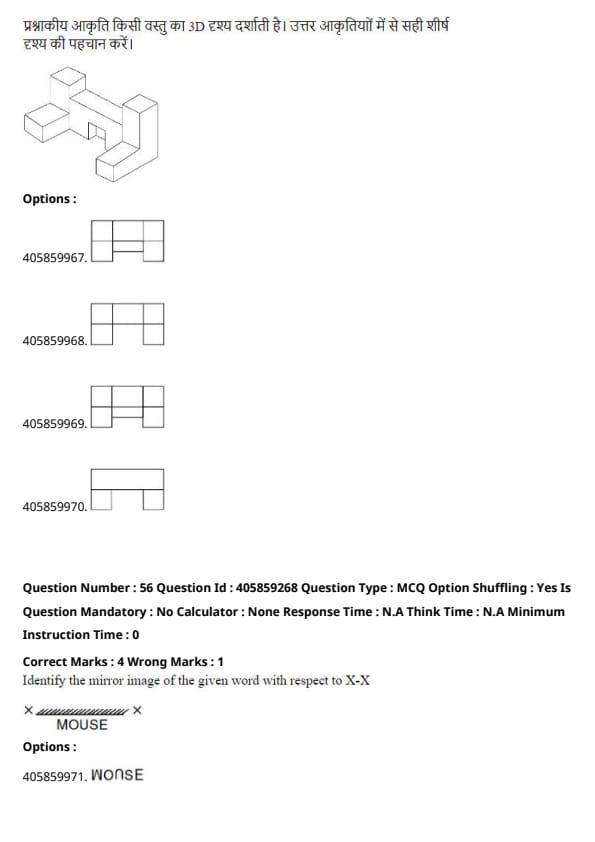


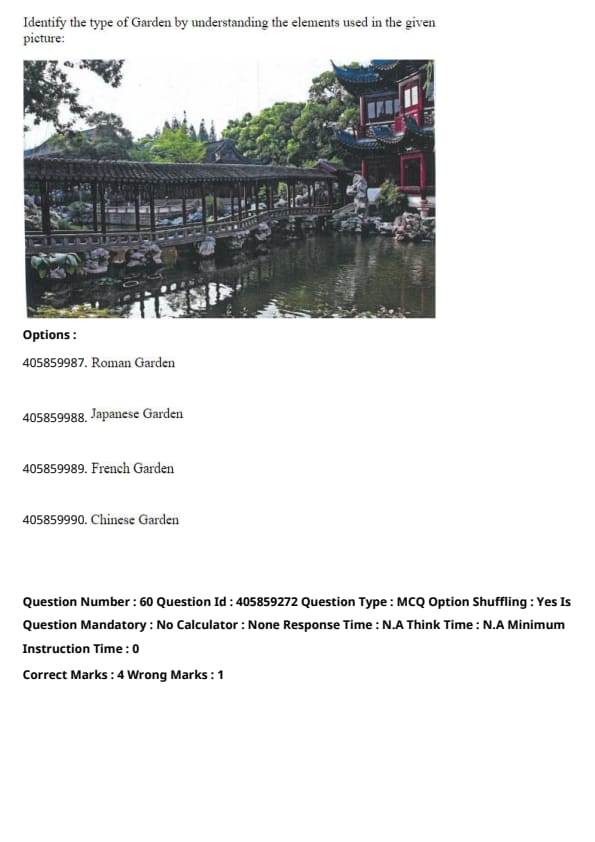


*The article might have information for the previous academic years, please refer the official website of the exam.