
JEE Main 2024 Question Paper with Solution PDF for B.E./B.Tech (April 8 - Shift 1)

.jpg?tr=h-55,w-55,c-force)
Content Strategist|Tech-innovator|National Hackathon Winner | Updated On - Jan 13, 2026
JEE Main 2024 Apr 8 Shift 1 Question Paper with Solution pdf is available for download here. Students found Physics easy and Chemistry hard. Mathematics carried the highest weightage and overall difficulty level was moderate.
JEE Main 2024 Question Paper 8 April Shift 1 with Solution PDF
| JEE Main 2024 Question Paper with Solution Pdf April 8 Shift 1 |  Download Download |
Check Solution |

Question 1:
The value of k ∈ ℕ for which the integral:
In = ∫01 (1 - xk)n dx, where n ∈ ℕ, satisfies 147 I20 = 148 I21 is:
Options:
View Solution
Solution:
The integral is:
In = ∫01 (1 - xk)n · 1 dx
Using integration by parts:
In = (1 - xk)n · x |01 - nk ∫01 (1 - xk)n-1 · xk-1 dx
In = nk ∫01 [(1 - xk)n - (1 - xk)n-1] dx
In = nk In-1 - nk In
Rearranging terms:
In / In-1 = nk / (nk + 1)
Given:
I21 / I20 = 21k / (1 + 21k)
Equating:
147 / 148 = 21k / (1 + 21k)
Solve for k:
k = 7
Question 2:
The sum of all the solutions of the equation:
(8)2x - 16 · (8)x + 48 = 0
Options:
View Solution
Solution:
1. Substitution:
Let t = (8)x. The equation becomes:
t2 - 16t + 48 = 0.
2. Solve the Quadratic Equation:
Using the quadratic formula:
t = (-b ± √(b2 - 4ac)) / 2a, where a = 1, b = -16, c = 48:
t = (16 ± √(162 - 4(1)(48))) / 2.
t = (16 ± √(256 - 192)) / 2.
t = (16 ± √64) / 2.
t = (16 ± 8) / 2.
t = 12 or t = 4.
3. Back Substitution:
Recall t = (8)x:
- For t = 4:
(8)x = 4 ⟹ x = log8(4).
- For t = 12:
(8)x = 12 ⟹ x = log8(12).
4. Sum of Solutions:
The sum of solutions is:
log8(4) + log8(12).
Using the logarithmic property logb(m) + logb(n) = logb(mn):
log8(4) + log8(12) = log8(4 ⋅ 12) = log8(48).
Simplify:
log8(48) = log8(8 ⋅ 6) = log8(8) + log8(6).
log8(8) = 1, so the sum is:
1 + log8(6).
Question 3:
Let the circles C1: (x - α)2 + (y - β)2 = r12 and:
C2: (x - 8)2 + (y - 15/2)2 = r22
Touch each other externally at the point (6, 6). If the point (6, 6) divides the line segment joining the centers of circles C1 and C2 internally in the ratio 2:1, then:
α + β + 4(r12 + r22) equals:
Options:
View Solution
Solution:
1. Determine the Coordinates of the Center of C1:
The point (6, 6) divides the line joining (α, β) and (8, 15/2) in the ratio 2:1. Using the section formula:
6 = (2 × 8 + 1 × α) / 3, and 6 = (2 × 15/2 + 1 × β) / 3.
Solving for α and β:
16 + α = 18 ⟹ α = 2, and 15 + β = 18 ⟹ β = 3.
Thus, the center of C1 is (α, β) = (2, 3).
2. Use the Touching Condition:
The distance between the centers of C1 and C2 equals the sum of the radii:
√[(2 - 8)2 + (3 - 15/2)2] = r1 + r2.
Simplify:
√[(-6)2 + (-9/2)2] = r1 + r2.
√[36 + 81/4] = r1 + r2.
√[(144 + 81) / 4] = r1 + r2.
√(225 / 4) = r1 + r2.
r1 + r2 = 15/2.
3. Determine r1 and r2:
From the external touching condition:
2r2 = r1 = 5.
r2 = 5/2, and r1 = 5.
4. Calculate α + β + 4(r12 + r22):
Compute r12 + r22:
r12 = 52 = 25, and r22 = (5/2)2 = 25/4.
r12 + r22 = 25 + 25/4 = 100/4 + 25/4 = 125/4.
Now calculate:
α + β + 4(r12 + r22) = 2 + 3 + 4 × 125/4.
α + β + 4(r12 + r22) = 5 + 125 = 130.
Question 4:
Let P(x, y, z) be a point in the first octant, whose projection in the xy-plane is the point Q. Let OP = γ, the angle between OQ and the positive x-axis be θ, and the angle between OP and the positive z-axis be φ, where O is the origin. Then the distance of P from the x-axis is:
Options:
View Solution
Solution:
1. Coordinates of Points:
- P(x, y, z) is a point in 3D space.
- Q(x, y, 0) is the projection of P in the xy-plane.
2. Distance Relations:
- The distance OP = γ, so:
x² + y² + z² = γ².
- The distance OQ is the projection in the xy-plane:
OQ = √(x² + y²).
3. Using the Angles θ and φ:
- The angle θ is between OQ and the x-axis. From this, we have:
cosθ = x / √(x² + y²).
- The angle φ is between OP and the z-axis. From this, we derive:
cosφ = z / √(x² + y² + z²) = z / γ.
Using cos²φ + sin²φ = 1, we get:
sin²φ = 1 - cos²φ = (x² + y²) / γ².
4. Distance of P from the x-Axis:
- The distance of P from the x-axis is calculated as:
Distance = √(y² + z²).
- Substituting y² + z² using x² + y² + z² = γ²:
y² + z² = γ² - x².
- Since sin²φ = (x² + y²) / γ², we have:
x² = γ² cos²θ sin²φ.
- Replacing x² in γ² - x²:
y² + z² = γ² (1 - cos²θ sin²φ).
- Taking the square root:
Distance = γ √(1 - sin²φ cos²θ).
Question 5:
The number of critical points of the function:
f(x) = (x - 2)2/3(2x + 1)
Options:
View Solution
Solution:
1. Given Function:
f(x) = (x - 2)2/3(2x + 1)
2. Finding the First Derivative:
Using the product rule:
f'(x) = (2/3)(x - 2)-1/3(2x + 1) + (x - 2)2/3(2)
3. Combine Terms:
f'(x) = [2(2x + 1) + 2(x - 2)] / [3(x - 2)1/3]
f'(x) = 2(3x - 1) / [3(x - 2)1/3]
4. Critical Points:
f'(x) = 0 ⟹ 3x - 1 = 0 ⟹ x = 1/3
f'(x) is undefined when x = 2.
5. Conclusion:
The critical points are x = 1/3 and x = 2.
Question 6:
Let f(x) be a positive function such that the area bounded by y = f(x), y = 0 from x = 0 to x = a > 0 is:
e-a + 4a2 + a - 1.
The differential equation whose general solution is y = c1f(x) + c2, where c1 and c2 are arbitrary constants, is:
Options:
View Solution
Solution:
1. Expression for Area:
∫0af(x) dx = e-a + 4a2 + a - 1
2. Differentiate:
f(a) = -e-a + 8a + 1
f'(a) = e-a + 8
f''(a) = -e-a
3. Differential Equation:
(8ex + 1)f''(x) + f'(x) = 0
Question 7:
Let f(x) = 4cos3(x) + 3√3cos2(x) - 10. The number of points of local maxima of f in the interval (0, 2π) is:
Options:
View Solution
Solution:
1. Find f'(x):
f'(x) = -sin(x)(12cos2(x) + 6√3cos(x))
2. Critical Points:
f'(x) = 0 ⟹ sin(x) = 0, cos(x) = 0, or 2cos(x) + √3 = 0
Solutions in (0, 2π):
x = π/2, 3π/2 (local maxima)
3. Conclusion:
The number of local maxima is 2.
Question 8:
Let:
A = [ [2, a, 0], [1, 3, 1], [0, 0, b] ].
If A3 = 4A2 - A - 21I, where I is the identity matrix of order 3 × 3, then 2a + 3b equals:
Options:
View Solution
Solution:
1. Trace and Determinant:
tr(A) = 2 + 3 + b, det(A) = 6b - ab
2. Given det(A) = -21:
6b - ab = -21
3. Solve for a and b:
a = -5, b = -1
4. Calculate:
2a + 3b = -13
Question 9:
If the shortest distance between the lines:
L1: r = (2+λ)i + (1-3λ)j + (3+4λ)k
L2: r = 2(1+μ)i + 3(1+μ)j + (5+μ)k
is m/√n where gcd(m, n) = 1, then m + n equals:
Options:
View Solution
Solution:
1. Direction Vectors:
p = i - 3j + 4k, q = 2i + 3j + k
2. Cross Product:
p × q = -15i + 7j + 9k
3. Dot Product:
AB • (p × q) = 32
4. Distance:
Distance = 32 / √355
m = 32, n = 355 ⟹ m + n = 387
Question 10:
Let the sum of two positive integers be 24. If the probability that their product is not less than 3/4 times their greatest positive product is m/n where gcd(m, n) = 1, then n - m equals:
Options:
View Solution
Solution:
1. Maximum Product:
Max product = 144 when x = y = 12
2. Favorable Condition:
Product ≥ 108
3. Favorable Pairs:
13 pairs: (13, 11), ..., (6, 18)
4. Total Pairs:
23 pairs
5. Probability:
P = 13/23 ⟹ m = 13, n = 23
6. Find n - m:
n - m = 10
Question 11:
If sin x = -3/5, where π < x < 3π/2, then 80(tan²x - cos x) is equal to:
Options:
View Solution
Solution:
1. Given Information:
sin x = -3/5, π < x < 3π/2.
Since x lies in the third quadrant:
- cos x < 0
- tan x > 0
2. Find cos x:
Using the Pythagorean identity:
sin²x + cos²x = 1.
Substitute sin x = -3/5:
(-3/5)² + cos²x = 1
9/25 + cos²x = 1
cos²x = 16/25
Since cos x < 0 (third quadrant):
cos x = -4/5
3. Find tan x:
Using the definition tan x = sin x / cos x:
tan x = (-3/5) / (-4/5) = 3/4
4. Calculate 80(tan²x - cos x):
Substitute tan x = 3/4 and cos x = -4/5:
tan²x = (3/4)² = 9/16
80(tan²x - cos x) = 80[(9/16) - (-4/5)]
80[(9/16) + (4/5)]
Find the common denominator for 9/16 and 4/5:
9/16 = 45/80, 4/5 = 64/80
Add the fractions:
45/80 + 64/80 = 109/80
Multiply by 80:
80 × 109/80 = 109
Conclusion:
The value of 80(tan²x - cos x) is 109.
Question 12:
Let I(x) = ∫ [6 / sin²x(1 - cot x)²] dx. If I(0) = 3, then I(π/12) is equal to:
Options:
View Solution
Solution:
1. Given Integral:
I(x) = ∫ [6 / sin²x(1 - cot x)²] dx
2. Simplify the Integrand:
Using the identity sin²x = 1 / csc²x, rewrite the integrand:
I(x) = ∫ [6 csc²x / (1 - cot x)²] dx
3. Substitution:
Let t = 1 - cot x, then:
csc²x dx = dt
Substitute into the integral:
I = ∫ [6 / t²] dt
4. Evaluate the Integral:
I = -6/t + c
Substituting back t = 1 - cot x, we get:
I(x) = -6 / (1 - cot x) + c
5. Given Condition:
At x = 0, I(0) = 3. Substituting x = 0, where cot 0 = ∞, we find:
c = 3
Therefore:
I(x) = -6 / (1 - cot x) + 3
6. Find I(π/12):
At x = π/12, we calculate:
cot(π/12) = 2 + √3
Substituting:
I(π/12) = 3 - 6 / [1 - (2 + √3)]
Simplify the denominator:
1 - (2 + √3) = -1 - √3
So:
I(π/12) = 3 + 6 / (1 + √3)
Rationalize the denominator:
6 / (1 + √3) = 6(1 - √3) / [(1 + √3)(1 - √3)]
= 6(1 - √3) / -2
6 / (1 + √3) = -3(1 - √3) = -3 + 3√3
7. Final Value:
Substituting back:
I(π/12) = 3 + (-3 + 3√3) = 3√3
Conclusion:
The value of I(π/12) is 3√3.
Question 13:
The equations of two sides AB and AC of a triangle ABC are:
4x + y = 14 and 3x - 2y = 5,
The point (2, -4/3) divides the third side BC internally in the ratio 2:1. The equation of the side BC is:
Options:
View Solution
Solution:
1. Equations of the Lines AB and AC:
The equations of the sides are given as:
AB: 4x + y = 14, AC: 3x - 2y = 5.
2. Point Dividing the Line BC:
The point P = (2, -4/3) divides BC internally in the ratio 2:1.
3. Coordinates of B:
From the equation of line AB: 4x + y = 14,
y = 14 - 4x.
Let B = (x1, 14 - 4x1).
4. Coordinates of C:
From the equation of line AC: 3x - 2y = 5,
y = (3x - 5)/2.
Let C = (x2, (3x2 - 5)/2).
5. Section Formula for P:
The coordinates of P are given by the section formula:
x = (2x2 + x1)/3, y = (2y2 + y1)/3.
Substituting P = (2, -4/3):
2 = (2x2 + x1)/3, -4/3 = (2y2 + y1)/3.
6. Solve for x1 and x2:
From 2 = (2x2 + x1)/3:
6 = 2x2 + x1 → x1 = 6 - 2x2.
From -4/3 = (2y2 + y1)/3, substitute y1 = 14 - 4x1 and y2 = (3x2 - 5)/2:
-4 = 2y2 + y1 = 2((3x2 - 5)/2) + (14 - 4x1).
-4 = (3x2 - 5) + 14 - 4(6 - 2x2).
-4 = 3x2 - 5 + 14 - 24 + 8x2.
-4 = 11x2 - 15.
Solve for x2:
x2 = 1.
Substitute x2 = 1 into x1 = 6 - 2x2:
x1 = 6 - 2(1) = 4.
Therefore, B = (4, -2) and C = (1, -1).
7. Equation of Line BC:
The slope of BC is:
m = (y2 - y1)/(x2 - x1) = (-1 - (-2))/(1 - 4) = 1/-3 = -1/3.
The equation of BC is:
y - y1 = m(x - x1).
Substituting (x1, y1) = (4, -2) and m = -1/3:
y + 2 = -1/3(x - 4).
3(y + 2) = -(x - 4).
3y + 6 = -x + 4.
x + 3y + 2 = 0.
Conclusion:
The equation of BC is x + 3y + 2 = 0.
Question 14:
Let ⌊t⌋ be the greatest integer less than or equal to t. Let A be the set of all prime factors of 2310, and
f: A → ℤ be the function f(x) = ⌊log₂(x² + ⌊x³/5⌋)⌋.
The number of one-to-one functions from A to the range of f is:
Options:
View Solution
Solution:
1. Prime Factorization of 2310:
The prime factorization of 2310 is:
N = 2310 = 231 × 10 = 3 × 11 × 7 × 2 × 5.
Hence:
A = {2, 3, 5, 7, 11}.
2. Definition of f(x):
The function is given as:
f(x) = ⌊log₂(x² + ⌊x³/5⌋)⌋.
3. Calculate f(x) for Each Element of A:
For each x ∈ A:
f(2) = ⌊log₂(2² + ⌊2³/5⌋)⌋ = ⌊log₂(4 + ⌊8/5⌋)⌋ = ⌊log₂(4 + 1)⌋ = ⌊log₂(5)⌋ = 2.
f(3) = ⌊log₂(3² + ⌊3³/5⌋)⌋ = ⌊log₂(9 + ⌊27/5⌋)⌋ = ⌊log₂(9 + 5)⌋ = ⌊log₂(14)⌋ = 3.
f(5) = ⌊log₂(5² + ⌊5³/5⌋)⌋ = ⌊log₂(25 + ⌊125/5⌋)⌋ = ⌊log₂(25 + 25)⌋ = ⌊log₂(50)⌋ = 5.
f(7) = ⌊log₂(7² + ⌊7³/5⌋)⌋ = ⌊log₂(49 + ⌊343/5⌋)⌋ = ⌊log₂(49 + 68)⌋ = ⌊log₂(117)⌋ = 6.
f(11) = ⌊log₂(11² + ⌊11³/5⌋)⌋ = ⌊log₂(121 + ⌊1331/5⌋)⌋ = ⌊log₂(121 + 266)⌋ = ⌊log₂(387)⌋ = 8.
- f(2):
- f(3):
- f(5):
- f(7):
- f(11):
4. Range of f:
From the above calculations, the range of f is:
B = {2, 3, 5, 6, 8}.
5. Number of One-to-One Functions:
The number of one-to-one functions from A to B is given by:
|A| = |B| = 5.
Therefore, the number of one-to-one functions is:
5! = 120.
Conclusion:
The number of one-to-one functions is 120.
Question 15:
Let z be a complex number such that |z + 2| = 1 and:
Im((z + 1) / (z + 2)) = 1/5.
Then the value of |Re(̅(z + 2))| is:
Options:
View Solution
Solution:
We are given:
|z + 2| = 1, and Im((z + 1) / (z + 2)) = 1/5.
Let z + 2 = cosθ + i sinθ.
The reciprocal becomes:
1 / (z + 2) = cosθ - i sinθ.
Now:
(z + 1) / (z + 2) = 1 - (1 / (z + 2)) = 1 - (cosθ - i sinθ).
Simplifying:
(z + 1) / (z + 2) = (1 - cosθ) + i sinθ.
From the given condition:
Im((z + 1) / (z + 2)) = sinθ, sinθ = 1/5.
Using the Pythagorean identity:
cos²θ = 1 - sin²θ = 1 - (1/25) = 24/25.
Therefore:
cosθ = ±√(24/25) = ±(2√6)/5.
Finally, the real part of z + 2 is:
|Re(z + 2)| = 2√6/5.
Question 16:
If the set R = {(a, b) | a + 5b = 42, a, b ∈ ℕ} has m elements, and:
∑(n=1 to m) [1 + i^(n!)] = x + iy, where i = √(-1), then the value of m + x + y is:
Options:
View Solution
Solution:
We are given:
a + 5b = 42, a, b ∈ ℕ.
Rewrite a = 42 - 5b:
- For b = 1, a = 37.
- For b = 2, a = 32.
- For b = 3, a = 27.
- For b = 4, a = 22.
- For b = 5, a = 17.
- For b = 6, a = 12.
- For b = 7, a = 7.
- For b = 8, a = 2.
The set R has 8 elements, so m = 8.
The summation is:
∑(n=1 to 8) [1 + i^(n!)] = x + iy.
For n ≥ 4, n! is a multiple of 4, and i^(n!) = 1.
The terms alternate cyclically as i, -1, -i, 1, and repeat.
Therefore:
∑ = (1 + i) + (1 - 1) + (1 - i) + (1 + 1) + ...
Simplifying:
x = 5, y = -1.
m + x + y = 8 + 5 - 1 = 12.
Question 17:
For the function f(x) = cos x - x + 1, x ∈ ℜ, consider the following two statements:
Options:
View Solution
Solution:
The function f(x) = cos x - x + 1 is given.
Step 1: Analyze the derivative f′(x):
Differentiate f(x): f′(x) = -sin x - 1.
Since sin x ∈ [-1, 1], f′(x) = -sin x - 1 ∈ [-2, 0], which means f′(x) < 0 for all x ∈ ℜ. Hence, f(x) is strictly decreasing.
Step 2: Analyze statement (S1):
Since f(x) is strictly decreasing, it is one-to-one. Check values at endpoints of [0, π]:
- f(0) = 2 and f(π) = -π.
By the Intermediate Value Theorem, f(x) = 0 has exactly one solution in [0, π]. Thus, (S1) is correct.
Step 3: Analyze statement (S2):
Since f′(x) < 0, f(x) is strictly decreasing on [0, π], and it cannot be increasing in [π/2, π]. Hence, (S2) is incorrect.
Conclusion: (S1) is correct, and (S2) is incorrect.
Question 18:
The set of all α, for which the vectors:
a = αt î + 6 ĵ - 3 k̂ and b = t î - 2 ĵ - 2αt k̂ are inclined at an obtuse angle for all t ∈ ℜ.
Options:
View Solution
Solution:
To find the set of α:
- Step 1: Calculate the dot product of a and b:
- a ∙ b = αt2 - 12 + 6αt.
- Step 2: For obtuse angle, a ∙ b < 0 for all t:
- The inequality becomes αt2 + 6αt - 12 < 0.
- Step 3: For this inequality to hold, the discriminant must be negative:
- D = 36α2 + 48α < 0 → 12α(α + 4) < 0.
Solving gives α ∈ (-4/3, 0].
Question 19:
Let y = y(x) be the solution of the differential equation:
(1 + y2)etan x dx + cos2 x (1 + e2tan x) dy = 0, with y(0) = 1. Then y(π/4) is equal to:
Options:
View Solution
Solution:
The given differential equation can be rewritten and integrated to give:
tan-1(etan x) + tan-1(y) = C.
Applying initial conditions x = 0, y = 1, we find C = π/2.
Substituting x = π/4:
tan-1(e) + tan-1(y) = π/2.
Solving gives y = 1/e.
Question 20:
Let H: -x2/a2 + y2/b2 = 1 be the hyperbola, whose eccentricity is √3 and the length of the latus rectum is 4√3. Suppose the point (α, 6), α > 0 lies on H. If β is the product of the focal distances of the point (α, 6), then α2 + β is equal to:
Options:
View Solution
Solution:
The hyperbola is given by:
y2/b2 - x2/a2 = 1.
With e = √3, a2 = 6, b2 = 3, we find α2 = 66.
Calculating the focal distances and their product β:
β = 105.
Thus, α2 + β = 171.
Question 21:
Let
A =
| 2  -1 |
| 1   1 |
If the sum of the diagonal elements of A13 is 3n, then n is equal to:
View Solution
Solution:
Step 1: Matrix Definition:
The matrix is given as:
A =
| 2  -1 |
| 1   1 |
Step 2: Finding Powers of A:
Calculate A2:
A2 =
| 3  -3 |
| 3   0 |
Calculate A3:
A3 =
| 3  -6 |
| 6  -3 |
Calculate A4:
A4 =
| 0  -9 |
| 9  -9 |
Calculate A5:
A5 =
| -9  -9 |
|  9 -18 |
Calculate A6:
A6 =
| -27   0 |
|   0 -27 |
Step 3: Sum of Diagonal Elements:
From A6, observe the diagonal elements pattern:
- For An, the sum of the diagonal elements is 3n.
For A13, the sum of the diagonal elements is:
3n = 37.
Thus, n = 7.
Question 22:
If the orthocentre of the triangle formed by the lines:
2x + 3y - 1 = 0, x + 2y - 1 = 0, and ax + by - 1 = 0,
is the centroid of another triangle, whose circumcentre and orthocentre respectively are (3, 4) and (-6, -8), then the value of |a - b| is:
View Solution
Solution:
Step 1: Find the centroid (G) of the second triangle:
The centroid G of a triangle is calculated using the formula:
G = [(x₁ + x₂ + x₃) / 3, (y₁ + y₂ + y₃) / 3]
Using the given circumcentre (3, 4) and orthocentre (-6, -8), the centroid G is:
G = [(3 + (-6)) / 3, (4 + (-8)) / 3]
G = [-3 / 3, -4 / 3] = (-1, -4/3).
Step 2: Orthocentre of the first triangle:
The orthocentre of the first triangle lies at G = (-1, -4/3).
Step 3: Solving for |a - b|:
The lines 2x + 3y - 1 = 0 and x + 2y - 1 = 0 form two sides of the triangle. The third side ax + by - 1 = 0 must satisfy the condition that the orthocentre lies at (-1, -4/3).
By substituting (-1, -4/3) into the equations and solving for a and b, we find:
a = 2, b = -14.
Step 4: Calculate |a - b|:
|a - b| = |2 - (-14)| = |2 + 14| = 16.
Question 23:
Three balls are drawn at random from a bag containing 5 blue and 4 yellow balls. Let the random variables X and Y respectively denote the number of blue and yellow balls. If ????X and ????Y are the means of X and Y, respectively, then 7????X + 4????Y is equal to:
View Solution
Solution:
Step 1: Total Number of Ways to Draw 3 Balls:
The total number of ways to select 3 balls from 9 (5 blue and 4 yellow) is:
????(9, 3) = 84.
Step 2: Probability Distribution for Blue Balls:
Calculate the probabilities for each possible number of blue balls X (0, 1, 2, 3):
- Pr(X = 0) = ????(5, 0) ????(4, 3) / ????(9, 3) = 4/84
- Pr(X = 1) = ????(5, 1) ????(4, 2) / ????(9, 3) = 30/84
- Pr(X = 2) = ????(5, 2) ????(4, 1) / ????(9, 3) = 30/84
- Pr(X = 3) = ????(5, 3) ????(4, 0) / ????(9, 3) = 20/84
Calculate 7????X:
7????X = 7 × ∑k × Pr(X = k).
Substitute values:
7????X = 7 × (0 × 4 + 1 × 30 + 2 × 30 + 3 × 20) / 84.
7????X = 7 × 150 / 84 = 1050 / 84 = 35 / 3.
Step 3: Probability Distribution for Yellow Balls:
Similarly, calculate probabilities for Y (0, 1, 2, 3):
- Pr(Y = 0) = ????(5, 3) ????(4, 0) / ????(9, 3) = 20/84
- Pr(Y = 1) = ????(5, 2) ????(4, 1) / ????(9, 3) = 30/84
- Pr(Y = 2) = ????(5, 1) ????(4, 2) / ????(9, 3) = 30/84
- Pr(Y = 3) = ????(5, 0) ????(4, 3) / ????(9, 3) = 4/84
Calculate 4????Y:
4????Y = 4 × ∑k × Pr(Y = k).
Substitute values:
4????Y = 4 × (0 × 20 + 1 × 30 + 2 × 30 + 3 × 4) / 84.
4????Y = 4 × 10² / 84 = 408 / 84 = 16 / 3.
Step 4: Final Calculation of 7????X + 4????Y:
Combine the results:
7????X + 4????Y = 35 / 3 + 16 / 3 = 51 / 3 = 17.
Question 24:
The number of 3-digit numbers, formed using the digits 2, 3, 4, 5, 7, when the repetition of digits is not allowed, and which are not divisible by 3, is equal to:
View Solution
Solution:
Step 1: Total Number of 3-Digit Numbers:
The digits available are 2, 3, 4, 5, and 7, and repetition is not allowed. The total number of 3-digit numbers that can be formed is:
Total = 5 × 4 × 3 = 60.
Step 2: Numbers Divisible by 3:
A number is divisible by 3 if the sum of its digits is divisible by 3. The available digits are:
2, 3, 4, 5, and 7. The sum of all the digits is:
2 + 3 + 4 + 5 + 7 = 21 (divisible by 3).
To determine how many 3-digit numbers are divisible by 3, calculate the combinations of digits whose sum is divisible by 3:
- {2, 4, 7}: Sum = 13 (not divisible by 3)
- {2, 5, 7}: Sum = 14 (not divisible by 3)
- {3, 4, 5}: Sum = 12 (divisible by 3)
- {3, 5, 7}: Sum = 15 (divisible by 3)
Using these combinations, the total numbers divisible by 3 are:
Total divisible = 24.
Step 3: Numbers Not Divisible by 3:
Total numbers not divisible by 3 = Total numbers - Numbers divisible by 3:
Total not divisible = 60 - 24 = 36.
Final Answer: The number of 3-digit numbers not divisible by 3 is 36.
Question 25:
Let the positive integers be written in the form:

If the k-th row contains exactly k numbers for every natural number k, then the row in which the number 5310 will be, is:
View Solution
Solution:
Step 1: Understanding the Pattern:
The arrangement of numbers is such that the n-th row contains n numbers. The cumulative sum of numbers up to the n-th row is given by the formula for triangular numbers:
Tn = 1 + 2 + 3 + ... + n = n(n + 1) / 2.
Step 2: Finding the Row Containing 5310:
We need to find n such that:
Tn-1 < 5310 ≤ Tn.
Start with the formula for Tn:
Tn = n(n + 1) / 2.
Multiply through by 2:
n(n + 1) = 2 × 5310 = 10620.
Rearrange into a quadratic equation:
n2 + n - 10620 = 0.
Use the quadratic formula:
n = [-1 ± √(1 + 4 × 10620)] / 2 = [-1 ± √(42481)] / 2.
Simplify:
n = (-1 + 206) / 2 = 103 (since n must be positive).
Step 3: Verification:
Calculate T103 and T102:
T103 = (103 × 104) / 2 = 5356,
T102 = (102 × 103) / 2 = 5253.
Since 5253 < 5310 ≤ 5356, the number 5310 lies in the 103rd row.
Question 26:
If the range of \( f(\theta) = \frac{\sin^4\theta + 3\cos^2\theta}{\sin^4\theta + \cos^2\theta}, \, \theta \in \mathbb{R} \) is [α, β], then the sum of the infinite G.P., whose first term is 64 and the common ratio is \( \frac{\alpha}{\beta} \), is equal to:
View Solution
Solution:
Step 1: Simplification of the Function:
The given function is:
\( f(\theta) = \frac{\sin^4\theta + 3\cos^2\theta}{\sin^4\theta + \cos^2\theta} \).
Substitute \( \cos^2\theta = x \), and since \( \sin^2\theta + \cos^2\theta = 1 \), we get \( \sin^4\theta = (1 - x)^2 \). Rewrite the function:
\( f(\theta) = 1 + \frac{2x}{(1 - x)^2 + x} \).
Simplify further:
\( f(\theta) = 1 + \frac{2x}{x^2 - x + 1} \).
Step 2: Finding the Range of \( f(\theta) \):
The minimum and maximum values of \( f(\theta) \) occur when \( x \) is at critical points within [0, 1]. After analyzing:
- Minimum value: \( f(\theta)_{\text{min}} = 1 \).
- Maximum value: \( f(\theta)_{\text{max}} = 3 \).
Thus, the range is:
[\( \alpha, \beta \)] = [1, 3].
Step 3: Sum of the Infinite G.P.:
The first term \( a = 64 \), and the common ratio \( r = \frac{\alpha}{\beta} = \frac{1}{3} \). The sum of the infinite G.P. is given by:
\( S = \frac{a}{1 - r} \).
Substitute the values:
\( S = \frac{64}{1 - \frac{1}{3}} = \frac{64}{\frac{2}{3}} = 64 \times \frac{3}{2} = 96 \).
Final Answer: The sum of the infinite G.P. is 96.
Question 27:
Let:
α = ∑r=0n (4r2 + 2r + 1) ⋅ C(n, r),
β = ∑r=0n C(n, r) ⋅ 1/(r+1) + 1/(n+1).
If:
140 < 2α / β < 281,
then the value of n is:
View Solution
Solution:
Step 1: Simplify α:
α = ∑r=0n (4r2 + 2r + 1) ⋅ C(n, r)
Expand terms:
α = 4 ∑r=0n r2 ⋅ C(n, r) + 2 ∑r=0n r ⋅ C(n, r) + ∑r=0n C(n, r).
Using binomial identities:
- ∑r=0n C(n, r) = 2n
- ∑r=0n r ⋅ C(n, r) = n ⋅ 2n-1
- ∑r=0n r2 ⋅ C(n, r) = n(n+1) ⋅ 2n-2
Substitute back:
α = 4n(n+1) ⋅ 2n-2 + 2n ⋅ 2n-1 + 2n
α = 2n-2(4n2 + 8n + 4)
α = 2n ⋅ (n+1)2
Step 2: Simplify β:
β = ∑r=0n C(n, r) ⋅ 1/(r+1) + 1/(n+1)
Using properties of binomial coefficients:
β = 1/(n+1) ⋅ ∑r=0n+1 C(n+1, r)
β = 1/(n+1) ⋅ 2n+1
Step 3: Compute 2α/β:
2α/β = (2 ⋅ 2n ⋅ (n+1)2) / (2n+1 / (n+1))
2α/β = (n+1)3
Step 4: Solve the inequality:
140 < (n+1)3 < 281
Take cube roots:
∛140 < n+1 < ∛281
Approximate:
5 < n+1 < 6
n = 5
Question 28:
Let
⃗a = 9ı - 13ᵑ + 25ᵒ, ⃗b = 3ı + 7ᵑ - 13ᵒ, ⃗c = 17ı - 2ᵑ + ᵒ
be three given vectors. If ⃗r is a vector such that
⃗r × ⃗a = (⃗b + ⃗c) × ⃗a and ⃗r · (⃗b - ⃗c) = 0, then
(|593⃗r + 67⃗a|²) / (593²)
is equal to ......
View Solution
Solution:
1. Given Vectors:
⃗a = 9ı - 13ᵑ + 25ᵒ
⃗b = 3ı + 7ᵑ - 13ᵒ
⃗c = 17ı - 2ᵑ + ᵒ
2. Calculate ⃗b + ⃗c:
⃗b + ⃗c = (3 + 17)ı + (7 - 2)ᵑ + (-13 + 1)ᵒ = 20ı + 5ᵑ - 12ᵒ
3. Calculate ⃗b - ⃗c:
⃗b - ⃗c = (3 - 17)ı + (7 - (-2))ᵑ + (-13 - 1)ᵒ = -14ı + 9ᵑ - 14ᵒ
4. Condition ⃗r × ⃗a = (⃗b + ⃗c) × ⃗a:
From the cross product condition:
⃗r - (⃗b + ⃗c) = λ⃗a
Therefore:
⃗r = λ⃗a + (⃗b + ⃗c)
5. Condition ⃗r · (⃗b - ⃗c) = 0:
Substituting ⃗r = λ⃗a + (⃗b + ⃗c):
(λ⃗a + (⃗b + ⃗c)) · (⃗b - ⃗c) = 0
Expanding:
λ(⃗a · (⃗b - ⃗c)) + ((⃗b + ⃗c) · (⃗b - ⃗c)) = 0
Simplify:
λ(⃗a · ⃗b - ⃗a · ⃗c) + (⃗b · ⃗b - ⃗c · ⃗c) = 0
6. Dot Products:
⃗a · ⃗b = 9(3) + (-13)(7) + 25(-13) = 27 - 91 - 325 = -389
⃗a · ⃗c = 9(17) + (-13)(-2) + 25(1) = 153 + 26 + 25 = 204
⃗b · ⃗b = 3² + 7² + (-13)² = 9 + 49 + 169 = 227
⃗c · ⃗c = 17² + (-2)² + 1² = 289 + 4 + 1 = 294
7. Solve for λ:
Substituting:
λ(-389 - 204) + (227 - 294) = 0
Simplify:
λ(-593) - 67 = 0
λ = -67 / 593
8. Calculate ⃗r:
Substituting λ back:
⃗r = (-67 / 593)⃗a + (⃗b + ⃗c)
9. Expression 593⃗r + 67⃗a:
593⃗r + 67⃗a = 593(⃗b + ⃗c)
|593⃗r + 67⃗a|² = 593²|⃗b + ⃗c|²
10. Magnitude of ⃗b + ⃗c:
⃗b + ⃗c = 20ı + 5ᵑ - 12ᵒ
|⃗b + ⃗c|² = 20² + 5² + (-12)² = 400 + 25 + 144 = 569
11. Final Result:
(|593⃗r + 67⃗a|²) / (593²) = |⃗b + ⃗c|² = 569
Correct Answer: (569)
Question 29:
Let the area of the region enclosed by the curve:
y = min{sin(x), cos(x)}
and the x-axis between x = -π and x = π be A. Then A2 is equal to:
View Solution
Solution:
Step 1: Understanding the Function:
The function y = min{sin(x), cos(x)} represents the smaller value between sin(x) and cos(x) at any given x. The intersection points of sin(x) and cos(x) occur at:
x = ±π/4.
The intervals for y are as follows:
- From x = -π to x = -π/4, y = sin(x).
- From x = -π/4 to x = π/4, y = cos(x).
- From x = π/4 to x = π, y = sin(x).
Step 2: Total Area A:
The total area A is the sum of the absolute values of the integrals of min{sin(x), cos(x)} over the respective intervals:
A = ∫-π-π/4 sin(x) dx + ∫-π/4π/4 cos(x) dx + ∫π/4π sin(x) dx.
Step 3: Calculate Each Integral:
∫-π-π/4 sin(x) dx = [-cos(x)]-π-π/4 = -cos(-π/4) + cos(-π).
Result: 1 + 1/√2.
∫-π/4π/4 cos(x) dx = [sin(x)]-π/4π/4 = sin(π/4) - sin(-π/4).
Result: √2.
∫π/4π sin(x) dx = [-cos(x)]π/4π = -cos(π) + cos(π/4).
Result: 1 + 1/√2.
- For ∫-π-π/4 sin(x) dx:
- For ∫-π/4π/4 cos(x) dx:
- For ∫π/4π sin(x) dx:
Step 4: Combine the Results:
Add the absolute values of the integrals:
A = (1 + 1/√2) + √2 + (1 + 1/√2).
Combine terms:
A = 4.
Step 5: Final Result:
The square of the area is:
A2 = 42 = 16.
Question 30:
The value of:
limx→0 ( 1 - cos x √cos 2x ³√cos 3x ... 10√cos 10x ) / x2
is ....
View Solution
Solution:
We are given:
&lim;x → 0 2 × 1 - ∑k=110 (1 - k2x2/2)/x2
Step 1: Expand the product:
Each term in the product is of the form (1 - k2x2/2). For small x, the product simplifies as:
(1 - x2/2)(1 - 4x2/2)(1 - 9x2/2)...(1 - 100x2/2).
Expanding to the first-order term:
1 - (x2/2 + 4x2/2 + 9x2/2 + ... + 100x2/2).
Step 2: Simplify the numerator:
The numerator becomes:
1 - (1 - x2 × 1/2 ∑k=110 k2).
Simplify further:
x2 × 1/2 ∑k=110 k2.
Step 3: Sum of squares:
The sum of squares of the first 10 natural numbers is:
∑k=110 k2 = n(n+1)(2n+1)/6 = 10(11)(21)/6 = 385.
Step 4: Simplify the limit:
Substitute the sum into the limit:
&lim;x → 0 2 × (x2/2) × 385/x2 = 2 × 385/2 = 55.
Final Answer: 55
Question 31:
Three bodies A, B, and C have equal kinetic energies, and their masses are 400 g, 1.2 kg, and 1.6 kg, respectively. The ratio of their linear momenta is:
Options:
View Solution
Solution:
1. Kinetic Energy Relation:
The kinetic energy (KE) is given by:
KE = P2 / 2m, where P is the linear momentum and m is the mass.
2. Proportionality of Momentum:
For equal kinetic energies:
P √m
3. Masses of the Bodies:
The masses of A, B, and C are:
mA = 0.4 kg, mB = 1.2 kg, mC = 1.6 kg.
4. Calculate the Momentum Ratios:
Using P √m:
PA : PB : PC = √0.4 : √1.2 : √1.6.
Simplify:
PA : PB : PC = 1 : √3 : 2.
Question 32:
The average force exerted on a non-reflecting surface at normal incidence is 2.4 × 10⁻⁴ N. If 360 W/cm2 is the light energy flux during a span of 1 hour 30 minutes, then the area of the surface is:
Options:
View Solution
Solution:
1. Relation Between Pressure, Intensity, and Force:
The pressure exerted by light is given by:
Pressure = I / c = F / A.
Hence:
I / c = F / A.
2. Substitute the Known Values:
- Intensity: I = 360 W/cm2 = 360 × 104 W/m2
- Speed of light: c = 3 × 10⁸ m/s
- Force: F = 2.4 × 10⁻⁴ N
Substituting:
(360 × 104) / (3 × 10⁸) = (2.4 × 10⁻⁴) / A.
3. Simplify the Expression:
(360 / 3) × 10-4 = (2.4 × 10⁻⁴) / A
120 × 10-4 = (2.4 × 10⁻⁴) / A.
4. Solve for A:
A = (2.4 × 10⁻⁴) / (120 × 10-4) = 2.4 / 120
Simplify:
A = 2 × 10⁻² m2 = 0.02 m2.
Question 33:
A proton and an electron are associated with the same de-Broglie wavelength. The ratio of their kinetic energies is:
Options:
View Solution
Solution:
1. Given Condition:
The de-Broglie wavelength (λ) is the same for both the proton and the electron.
2. de-Broglie Relation:
The momentum (P) is given by:
P = h / λ.
Since λ is the same for both particles, the momentum P is also the same.
3. Relation Between Momentum and Kinetic Energy:
The momentum (P) is related to the kinetic energy (K) as:
P = √(2mK).
Rearrange to find K:
K √(1/m).
4. Kinetic Energy Ratio:
Since K √(1/m), the ratio of the kinetic energies of the proton and electron is:
Kp / Ke = me / mp.
Substituting mp = 1836me:
Kp / Ke = 1 / 1836.
5. Final Answer:
The ratio of their kinetic energies is:
Kp : Ke = 1 : 1836.
Question 34:
A mixture of one mole of monoatomic gas and one mole of diatomic gas (rigid) are kept at room temperature (27°C). The ratio of specific heat of gases at constant volume respectively is:
Options:
View Solution
Solution:
1. Specific Heat at Constant Volume (Cv):
For a monoatomic gas:
(Cv)mono = 3/2 R
For a diatomic gas (rigid):
(Cv)dia = 5/2 R
2. Ratio of Specific Heats:
The ratio of Cv for the monoatomic and diatomic gases is:
(Cv)mono / (Cv)dia = (3/2 R) / (5/2 R).
Simplify:
(Cv)mono / (Cv)dia = 3/5.
Question 35:
In an expression a × 10b:
View Solution
Solution:
1. Expression Analysis:
The expression a × 10b is written in scientific notation. The value of b determines the order of magnitude.
2. Rules for Scientific Notation:
If a ≤ 5, the order of magnitude is b.
If a > 5, the order of magnitude increases by 1, i.e., b + 1.
3. Conclusion:
For a ≤ 5, b is the order of magnitude.
Question 36:
In the given circuit, the terminal potential difference of the cell is: 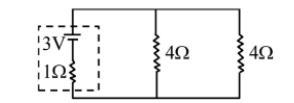
Options:
View Solution
Solution:
1. Simplification of the Circuit:
The 4 Ω and 4 Ω resistors are in parallel: \[ R_{\text{parallel}} = \frac{1}{\frac{1}{4} + \frac{1}{4}} = 2 \, \Omega. \]
The simplified circuit becomes a 3 V cell with internal resistance 1 Ω, in series with an external resistance of 2 Ω.
2. Current in the Circuit:
Using Ohm's law: \[ i = \frac{E}{R_{\text{internal}} + R_{\text{external}}}. \] Substituting the values: \[ i = \frac{3}{1 + 2} = \frac{3}{3} = 1 \, \text{A}. \]
3. Terminal Potential Difference:
The terminal potential difference is given by: \[ v = E - i r, \] where \( E \) is the emf of the cell, \( i \) is the current, and \( r \) is the internal resistance. Substituting the values: \[ v = 3 - (1 \times 1) = 3 - 1 = 2 \, \text{V}. \]
Question 37:
The binding energy of a certain nucleus is \( 18 \times 10^8 \, \text{J} \). How much is the difference between the total mass of all the nucleons and the nuclear mass of the given nucleus?
Options:
View Solution
Solution:
1. Relation Between Binding Energy and Mass Defect:
Using Einstein's mass-energy equivalence: \[ \Delta m c^2 = \text{Binding Energy}. \]
2. Substitute the Given Values:
- Binding energy: \( \Delta E = 18 \times 10^8 \, \text{J} \),
- Speed of light: \( c = 3 \times 10^8 \, \text{m/s}. \)
Rearrange to find \( \Delta m \):
\[ \Delta m = \frac{\Delta E}{c^2}. \] Substituting: \[ \Delta m = \frac{18 \times 10^8}{(3 \times 10^8)^2}. \]
3. Simplify the Expression:
\[ \Delta m = \frac{18 \times 10^8}{9 \times 10^{16}} = 2 \times 10^{-8} \, \text{kg}. \]
4. Convert to Micrograms (μg):
\[ \Delta m = 2 \times 10^{-8} \, \text{kg} = 20 \, \mu\text{g}. \]
Question 38:
Paramagnetic substances:
Choose the most appropriate answer:
View Solution
Solution:
1. Properties of Paramagnetic Substances:
- Paramagnetic substances align themselves along the direction of the external magnetic field (A is correct).
- They are weakly attracted towards an external magnetic field, not strongly (B is incorrect).
- Their magnetic susceptibility (\( \chi \)) is small but positive, meaning it is slightly more than zero (C is correct).
- Paramagnetic substances move from a region of weak magnetic field to a strong magnetic field (D is incorrect).
2. Most Appropriate Answer:
The correct statements are A and C.
Question 39:
A clock has 75 cm and 60 cm long second hand and minute hand respectively. In 30 minutes duration, the tip of the second hand will travel \( x \) distance more than the tip of the minute hand. The value of \( x \) in meters is nearly (Take \( \pi = 3.14 \)):
View Solution
Solution:
1. Length of Minute and Second Hand:
- Length of the minute hand: \( r_{\text{min}} = 60 \, \text{cm} = \frac{60}{100} \, \text{m} = 0.6 \, \text{m}
- Length of the second hand: \( r_{\text{sec}} = 75 \, \text{cm} = \frac{75}{100} \, \text{m} = 0.75 \, \text{m}.
2. Distance Traveled by the Minute Hand:
In 30 minutes, the minute hand completes half a rotation. The distance traveled is: \( x_{\text{min}} = \pi \cdot r_{\text{min}}. \)
Substituting: \( x_{\text{min}} = 3.14 \cdot 0.6 = 1.884 \, \text{m}. \)
3. Distance Traveled by the Second Hand:
In 30 minutes, the second hand completes 30 full rotations. The distance traveled is: \( x_{\text{sec}} = 30 \cdot 2\pi \cdot r_{\text{sec}}. \)
Substituting: \( x_{\text{sec}} = 30 \cdot 2 \cdot 3.14 \cdot 0.75 = 141.3 \, \text{m}. \)
4. Difference in Distance Traveled:
The difference \( x \) is: \( x = x_{\text{sec}} - x_{\text{min}}. \)
Substituting: \( x = 141.3 - 1.884 = 139.416 \, \text{m}. \)
5. Final Answer:
\( x \approx 139.4 \, \text{m}. \)
Question 40:
Young's modulus is determined by the equation:
Y = (49000 × M) / (ℓ × cm2) dyne,
where M is the mass and ℓ is the extension of wire used in the experiment. Now, the error in Young's modulus (Y) is estimated by taking data from the M-ℓ plot on graph paper. The smallest scale divisions are 5 g and 0.02 cm along the load axis and extension axis respectively. If the values of M and ℓ are 500 g and 2 cm respectively, then the percentage error in Y is:
Options:
View Solution
Solution:
1. Formula for Percentage Error in Y:
The percentage error in Y is given by:
(ΔY / Y) = (ΔM / M) + (Δℓ / ℓ).
2. Errors in Measurement:
The smallest scale division for mass M is ΔM = 5 g.
The smallest scale division for extension ℓ is Δℓ = 0.02 cm.
3. Substitute the Given Values:
Mass M = 500 g, Extension ℓ = 2 cm.
The percentage error in M is:
(ΔM / M) × 100 = (5 / 500) × 100 = 1%.
The percentage error in ℓ is:
(Δℓ / ℓ) × 100 = (0.02 / 2) × 100 = 1%.
4. Total Percentage Error in Y:
Adding the percentage errors:
(ΔY / Y) × 100 = 1 + 1 = 2%.
Question 41:
Two different adiabatic paths for the same gas intersect two isothermal curves as shown in the P-V diagram. The relation between the ratio \( V_a / V_d \) and the ratio \( V_b / V_c \) is: 
View Solution
Solution:
1. Adiabatic Process Equation:
For an adiabatic process: T • Vγ - 1 = constant.
2. Relation for Points a and d:
Using the adiabatic process equation between points a and d: Ta • Vaγ - 1 = Td • Vdγ - 1.
Rearrange: ( Va / Vd )γ - 1 = Td / Ta.
3. Relation for Points b and c:
Similarly, for points b and c: ( Vb / Vc )γ - 1 = Tc / Tb.
4. Comparing Temperatures:
From the diagram, since Td = Tc and Ta = Tb: Td / Ta = Tc / Tb.
5. Final Relation:
Using the above equality: ( Va / Vd )γ - 1 = ( Vb / Vc )γ - 1.
Simplify: Va / Vd = Vb / Vc.
Question 42:
Two planets A and B, having masses m1 and m2, move around the sun in circular orbits of r1 and r2 radii respectively. If the angular momentum of A is L and that of B is 3L, the ratio of time periods ( TA / TB ) is:
View Solution
Solution:
1. Relation Between Angular Momentum and Time Period:
For planet A: π r12 • TA = L / 2m1.
For planet B: π r22 • TB = 3L / 2m2.
2. Ratio of Time Periods:
Divide equations for TA and TB: TA / TB = ( L / 2m1 ) / ( 3L / 2m2 ) • ( r22 / r12 ).
Simplify: TA / TB = ( m2 / 3m1 ) • ( r1 / r2 )2.
3. Final Expression:
Rearrange to express TA / TB: TA / TB = 1 / 27 • ( m2 / m1 )3.
Question 43:
An LCR circuit is at resonance for a capacitor C, inductance L, and resistance R. Now the value of resistance is halved, keeping all other parameters the same. The current amplitude at resonance will be now:
View Solution
Solution:
1. At Resonance in an LCR Circuit:
At resonance, the impedance Z is equal to the resistance R:
Z = R.
The current amplitude is given by:
I = V / Z = V / R.
2. Effect of Halving Resistance:
If R is halved (R → R / 2):
I = V / R → V / (R / 2) = 2 × (V / R).
Therefore, the current amplitude I becomes double.
3. Conclusion:
When the resistance is halved, the current amplitude at resonance doubles.
Question 44:
The output Y of the following circuit for the given inputs is:
View Solution
Solution:
1. Understanding the Circuit:
The circuit involves a combination of NOT, AND, and OR gates. The inputs A and B are processed through the gates to produce the output Y.
2. Constructing the Truth Table:
| A | B | Y |
|---|---|---|
| 0 | 0 | 0 |
| 0 | 1 | 0 |
| 1 | 0 | 0 |
| 1 | 1 | 0 |
3. Output Analysis:
For all combinations of A and B, the output Y is consistently 0.
4. Conclusion:
The output of the circuit is always 0, regardless of the input values.
Question 45:
Two charged conducting spheres of radii a and b are connected to each other by a conducting wire. The ratio of charges of the two spheres respectively is:
View Solution
Solution:
1. Concept of Potential on the Surface of Conductors:
When two conducting spheres are connected by a conducting wire, their potentials become equal. The potential V on the surface of a sphere is given by:
V = Kq∕r,
where K is Coulomb's constant, q is the charge, and r is the radius of the sphere.
2. Equating the Potentials:
For the two spheres:
Kq1∕a = Kq2∕b.
Cancel K and rearrange:
q1∕q2 = a∕b.
3. Conclusion:
The ratio of charges of the two spheres is:
q1∕q2 = a∕b.
Question 46:
The correct Bernoulli's equation is (symbols have their usual meaning):
View Solution
Solution:
1. Bernoulli's Equation:
Bernoulli's principle for an ideal, incompressible, and non-viscous fluid is expressed as:
P + ρgh + ½ρv² = constant.
- P: Pressure of the fluid.
- ρ: Density of the fluid.
- g: Acceleration due to gravity.
- h: Height above a reference level.
- v: Velocity of the fluid.
2. Analysis of Options:
- Option (1): Incorrect because it uses mass m instead of density ρ.
- Option (2): Correct as it matches the standard Bernoulli equation.
- Option (3): Incorrect because it lacks the ½ factor in the kinetic energy term.
- Option (4): Incorrect because the gravitational potential energy term is divided by 2, which is not standard.
3. Conclusion:
The correct equation is:
P + ρgh + ½ρv² = constant.
Question 47:
A player caught a cricket ball of mass 150 g moving at a speed of 20 m/s. If the catching process is completed in 0.1 s, the magnitude of force exerted by the ball on the hand of the player is:
View Solution
Solution:
1. Impulse-Momentum Theorem:
The force exerted is calculated using:
F = ∆P∕∆t,
where:
- ∆P = Change in momentum = m•v - m•u,
- ∆t = Time duration of the impact.
2. Substitute the Values:
- Mass m = 150 g = 150 × 10⁻³ kg,
- Initial velocity u = 20 m/s,
- Final velocity v = 0 m/s,
- Time ∆t = 0.1 s.
Change in momentum:
∆P = m•v - m•u = 150 × 10⁻³ × 20 - 0 = 3 kg m/s.
Force:
F = ∆P∕∆t = 3∕0.1 = 30 N.
3. Conclusion:
The force exerted by the ball on the hand of the player is:
F = 30 N.
Question 48:
A stationary particle breaks into two parts of masses mA and mB, which move with velocities vA and vB, respectively. The ratio of their kinetic energies (KB : KA) is:
View Solution
Solution:
1. Initial Momentum Conservation:
Since the particle is stationary, the initial momentum is zero. After breaking, the total momentum is conserved:
PA = PB, or mAvA = mBvB. (Equation 1)
2. Kinetic Energy Expressions:
Kinetic energy for each part is given by:
KA = ½ mAvA², and KB = ½ mBvB².
3. Take the Ratio:
Divide the kinetic energies:
KB / KA = (½ mBvB²) / (½ mAvA²).
Simplify:
KB / KA = (mB / mA) × (vB / vA).
4. Substitute Momentum Conservation:
From Equation 1, vB / vA = mA / mB.
Substitute this:
KB / KA = vB / vA.
5. Conclusion:
The ratio of kinetic energies is:
KB : KA = vB : vA.
Question 49:
The critical angle of incidence for a pair of optical media is 45°. The refractive indices of the first and second media are in the ratio:
View Solution
Solution:
1. Critical Angle Formula:
The critical angle θc is related to the refractive indices μ1 (denser medium) and μ2 (rarer medium) as:
sin(θc) = μ2 / μ1.
2. Substitution:
Given θc = 45°:
sin(45°) = μ2 / μ1.
Using sin(45°) = 1/√2:
1/√2 = μ2 / μ1.
3. Refractive Index Ratio:
Rearrange:
μ1 / μ2 = √2 : 1.
4. Conclusion:
The refractive index ratio is:
μ1 : μ2 = √2 : 1.
Question 50:
The diameter of a sphere is measured using a vernier caliper whose 9 divisions of the main scale are equal to 10 divisions of the vernier scale. The shortest division on the main scale is equal to 1 mm. The main scale reading is 2 cm and the second division of the vernier scale coincides with a division on the main scale. If the mass of the sphere is 8.635 g, the density of the sphere is:
View Solution
Solution:
1. Least Count of Vernier Caliper:
- 9 MSD = 10 VSD,
- Length of 1 MSD = 1 mm = 0.1 cm,
- Least Count (LC) = 1 MSD - 1 VSD = 0.01 cm.
2. Diameter of the Sphere:
- Main Scale Reading (MSR) = 2 cm,
- Vernier Scale Reading (VSR) = 2,
- Diameter = MSR + (LC × VSR) = 2 + (0.01 × 2) = 2.02 cm.
3. Volume of the Sphere:
- Radius r = Diameter / 2 = 2.02 / 2 = 1.01 cm,
- Volume V = (4/3)πr³ = (4/3) × 3.1416 × (1.01)³ ≈ 4.32 cm³.
4. Density of the Sphere:
- Mass m = 8.635 g,
- Density ρ = m / V = 8.635 / 4.32 ≈ 2.00 g/cm³.
Question 51:
A uniform thin metal plate of mass 10 kg with dimensions as shown in the figure. The ratio of x and y coordinates of the center of mass of the plate is n/9. The value of n is ........ : 
View Solution
Solution:
1. Mass Distribution and Areas:
The plate is divided into smaller sections:
- Section 1 (main rectangle): Area = 3 × 2 = 6, Mass = 6 × 1 = 6 kg,
- Section 2 (removed square): Area = 1 × 1 = 1, Mass = 1 × 1 = 1 kg,
- Section 3: Remaining rectangle area = 4 × 2 = 8, Mass = 8 kg.
2. Calculate Center of Mass (COM):
xCOM = Σ (mi xi) / Σ mi, yCOM = Σ (mi yi) / Σ mi.
For xCOM:
Mass centers for each section:
- Section 1: x1 = 1.5, m1 = 6,
- Section 2: x2 = 1, m2 = 1,
- Section 3: x3 = 3, m3 = 8.
Compute:
xCOM = (6 × 1.5 + 1 × 1 + 8 × 3) / 15 = 2.1.
For yCOM:
Centers for each section:
y1 = 1, y2 = 0.5, y3 = 1.5.
Compute:
yCOM = (6 × 1 + 1 × 0.5 + 8 × 1.5) / 15 = 1.4.
3. Ratio of x and y Coordinates:
xCOM : yCOM = 15 : 9, n = 15.
Question 52:
An electron with kinetic energy 5 eV enters a region of uniform magnetic field of 3 μT perpendicular to its direction. An electric field E is applied perpendicular to the direction of velocity and magnetic field. The value of E, so that the electron moves along the same path, is ...... N/C.
View Solution
Solution:
1. Balanced Forces Condition:
For no deflection, qE = qvB or E = vB.
2. Relating Velocity to Kinetic Energy:
KE = (1/2) m v2 → v = √(2 KE / m).
3. Substituting Values:
KE = 5 × 1.6 × 10-19 J, m = 9 × 10-31 kg, B = 3 × 10⁻⁶ T.
Velocity:
v = √((2 × 5 × 1.6 × 10-19) / (9 × 10-31)) ≈ 1.3 × 10⁶ m/s.
Electric Field:
E = vB = (1.3 × 106) × (3 × 10-6) = 4 N/C.
Question 53:
A square loop PQRS having 10 turns, area 3.6 × 10³ m², and resistance 100 Ω is slowly and uniformly being pulled out of a uniform magnetic field of magnitude B = 0.5 T as shown. Work done in pulling the loop out of the field in 1.0 s is .... × 10³ J.
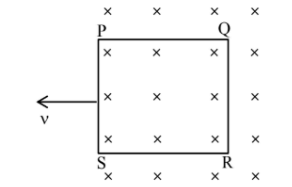
View Solution
Solution:
1. Work Formula:
W = (N2 B2 A2) / (R × t).
2. Substituting Values:
N = 10, B = 0.5 T, A = 3.6 × 10⁻³ m², R = 100 Ω, t = 1 s.
W = ((10)2 (0.5)2 (3.6 × 10⁻³)2) / (100 × 1) ≈ 3.24 × 10⁻⁶ J.
Question 54:
Resistance of a wire at 0°C, 100°C, and t°C is found to be 10 Ω, 10.2 Ω, and 10.95 Ω, respectively. The temperature t in the Kelvin scale is ______.
View Solution
Solution:
1. Temperature Dependence of Resistance:
The resistance R at a given temperature is related to the initial resistance R0 as:
R = R0 (1 + α ΔT), where:
- ΔR = R - R0,
- α = temperature coefficient of resistance,
- ΔT = change in temperature.
Rearranging to find α:
α = ΔR / (R0 ΔT).
2. Case-I: 0°C to 100°C:
Resistance values:
R0 = 10 Ω, R = 10.2 Ω at 100°C.
Substituting:
α = (10.2 - 10) / (10 × 100) = 0.002 per °C.
3. Case-II: 0°C to t°C:
Resistance values:
R0 = 10 Ω, R = 10.95 Ω.
Substituting:
10.95 - 10 = 0.002 × 10 × t.
Simplify:
t = 0.95 / 0.02 = 475°C.
4. Convert to Kelvin:
Temperature in Kelvin:
T = t + 273 = 475 + 273 = 748 K.
Question 55:
An electric field, &vec;E = (2î + 6ĵ + 8&kcirc;) / √6, passes through the surface of 4 m² area having unit vector &hat;n = (2î + ĵ + &kcirc;) / √6. The electric flux for that surface is ______ Vm.
View Solution
Solution:
1. Formula for Electric Flux:
Electric flux is given by:
Φ = &vec;E · &vec;A, where:
- &vec;A = A × &hat;n,
- A = 4 m²,
- &hat;n = (2î + ĵ + &kcirc;) / √6.
2. Calculate &vec;A:
Substituting:
&vec;A = 4 × (2î + ĵ + &kcirc;) / √6 = (8î + 4ĵ + 4&kcirc;) / √6.
3. Dot Product of &vec;E and &vec;A:
Substituting &vec;E and &vec;A:
Φ = ((2î + 6ĵ + 8&kcirc;) / √6) · ((8î + 4ĵ + 4&kcirc;) / √6).
Simplify:
Φ = (1 / 6) × (2 × 8 + 6 × 4 + 8 × 4).
4. Simplify the Terms:
Φ = (1 / 6) × (16 + 24 + 32) = (1 / 6) × 72 = 12 Vm.
Question 56:
A liquid column of height 0.04 cm balances the excess pressure of a soap bubble of certain radius. If the density of the liquid is 8 × 10³ kg/m³ and the surface tension of the soap solution is 0.28 N/m, then the diameter of the soap bubble is ______ cm. (Take g = 10 m/s²).
View Solution
Solution:
1. Excess Pressure in a Soap Bubble:
The excess pressure inside a soap bubble is:
ΔP = 4S / R, where:
- S = 0.28 N/m (surface tension),
- R = radius of the soap bubble.
2. Balancing Pressure with Liquid Column:
The pressure due to the liquid column is:
ΔP = ρ g h, where:
- ρ = 8 × 10³ kg/m³ (density of liquid),
- g = 10 m/s²,
- h = 0.04 cm = 4 × 10&sup4; m.
Equating pressures:
4S / R = ρ g h.
3. Solve for R:
Substituting:
4 × 0.28 / R = 8 × 10³ × 10 × 4 × 10&sup4;.
Simplify:
R = (4 × 0.28) / 32 = 0.035 m = 3.5 cm.
4. Diameter of the Soap Bubble:
D = 2R = 2 × 3.5 = 7 cm.
Question 57:
A closed and an open organ pipe have the same lengths. If the ratio of frequencies of their seventh overtones is (a - 1) / a, then the value of a is _________.
View Solution
Solution:
1. Frequency of a Closed Organ Pipe:
The frequency of the n-th overtone of a closed organ pipe is:
fc = (2n + 1) * v / 4ℓ.
For the seventh overtone (n = 7):
fc = (2 * 7 + 1) * v / 4ℓ = 15v / 4ℓ.
2. Frequency of an Open Organ Pipe:
The frequency of the n-th overtone of an open organ pipe is:
fo = (n + 1) * v / 2ℓ.
For the seventh overtone (n = 7):
fo = (7 + 1) * v / 2ℓ = 8v / 2ℓ = 4v / ℓ.
3. Ratio of Frequencies:
The ratio of frequencies is given as:
fc / fo = (15v / 4ℓ) / (4v / ℓ) = 15 / 16.
According to the problem, this ratio is also equal to:
fc / fo = (a - 1) / a.
4. Equate the Ratios:
(a - 1) / a = 15 / 16.
Simplify:
16(a - 1) = 15a.
16a - 16 = 15a.
a = 16.
Question 58:
Three vectors ⟶OP, ⟶OQ, and ⟶OR, each of magnitude A, are acting as shown in the figure. The resultant of the three vectors is A√x. The value of x is _________. 
View Solution
Solution:
1. Vectors and Geometry:
- ⟶OQ points vertically upward.
- ⟶OP makes an angle of 90° with ⟶OQ.
- ⟶OR makes an angle of 45° with ⟶OQ and lies in the same plane.
2. Resolve the Vectors into Components:
Components:
- ⟶OPx = A, ⟶ORx = A * cos 45° = A / √2.
- ⟶OQy = A, ⟶ORy = A * sin 45° = A / √2.
3. Resultant Components:
- Rx = ⟶OPx + ⟶ORx = A + A / √2.
- Ry = ⟶OQy + ⟶ORy = A + A / √2.
4. Magnitude of Resultant Vector:
R = √(Rx2 + Ry2).
Substituting:
R = √[(A + A / √2)2 + (A + A / √2)2].
Simplify:
R = √2 * (A + A / √2).
Factorize:
R = A√2 * (1 + 1 / √2).
Further simplify:
R = A√3.
Question 59:
A parallel beam of monochromatic light of wavelength 600 nm passes through a single slit of 0.4 mm width. The angular divergence corresponding to the second-order minima would be ..... × 10-3 rad.
View Solution
Solution:
1. Condition for Minima:
The angular position of minima in single-slit diffraction is given by:
sin θ = (nλ)/b,
where:
n = 2 (order of minima),
λ = 600 nm = 600 × 10-9 m (wavelength of light),
b = 0.4 mm = 4 × 10⁻⁴ m (width of the slit).
2. Angular Position for Second Minima:
Substituting the values:
θ ≈ (2λ)/b.
θ = (2 × 600 × 10-9) / (4 × 10⁻⁴).
Simplify:
θ = (1200 × 10-9) / (4 × 10⁻⁴) = 3 × 10⁻³ rad.
3. Total Divergence:
For the second-order minima on both sides of the central maximum:
Total divergence = 2 × θ = 2 × 3 × 10-3 = 6 × 10⁻³ rad.
4. Conclusion:
The total angular divergence for the second-order minima is:
6 × 10⁻³ rad.
Question 60:
In an alpha particle scattering experiment, the distance of closest approach for the alpha particle is 4.5 × 10⁻¹⁴ m. If the target nucleus has an atomic number 80, then the maximum velocity of the alpha particle is ...... × 105 m/s approximately.
(Given: (1 / 4πε₀) = 9 × 10⁹ SI unit, mass of alpha particle = 6.72 × 10⁻²⁷ kg)
View Solution
Solution:
1. Formula for Closest Approach:
The distance of closest approach (rmin) is related to the velocity (v) by:
rmin = (4KZe²) / (mv²),
where:
K = (1 / 4πε₀) = 9 × 10⁹ SI unit,
Z = 80 (atomic number of the nucleus),
e = 1.6 × 10⁻¹⁹ C (charge of the electron),
m = 6.72 × 10⁻²⁷ kg (mass of the alpha particle),
rmin = 4.5 × 10⁻¹⁴ m.
2. Rearrange for Velocity:
Rearranging the formula:
v = √[(4KZe²) / (mrmin)].
3. Substitute the Given Values:
v = √[(4 × 9 × 109 × 80 × (1.6 × 10-19)²) / (6.72 × 10-27 × 4.5 × 10-14)]
4. Simplify:
Numerator:
4 × 9 × 80 = 2880,
(1.6 × 10⁻¹⁹)² = 2.56 × 10-38,
Numerator = 2880 × 2.56 × 10-38 = 7.3728 × 10⁻³⁵.
Denominator:
6.72 × 10-27 × 4.5 × 10-14 = 3.024 × 10-40.
Final Calculation:
v = √[(7.3728 × 10⁻³⁵) / (3.024 × 10-40)].
v = √[2.437 × 10⁵].
v ≈ 1.56 × 10⁵ m/s.
5. Conclusion:
The maximum velocity of the alpha particle is:
156 × 105 m/s.
Question 61:
Given below are two statements:
- Statement I:
![]()
IUPAC name of Compound A is 4-chloro-1,3-dinitrobenzene. - Statement II:
![]()
IUPAC name of Compound B is 4-ethyl-2-methylaniline.

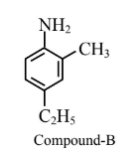
Options:
- Both Statement I and Statement II are correct.
- Statement I is incorrect but Statement II is correct.
- Statement I is correct but Statement II is incorrect.
- Both Statement I and Statement II are incorrect.
View Solution
Solution:
1. Analysis of Statement I:
The structure of Compound A has chlorine (Cl) at position 1 and nitro (NO2) groups at positions 2 and 4. The correct IUPAC name is 1-chloro-2,4-dinitrobenzene. Therefore, Statement I is incorrect.
2. Analysis of Statement II:
The structure of Compound B has an ethyl group (-C2H5) at position 4 and a methyl group (-CH3) at position 2. The amino group (-NH2) is given priority. The correct IUPAC name is 4-ethyl-2-methylaniline. Therefore, Statement II is correct.
3. Conclusion:
Statement I is incorrect, and Statement II is correct.
Question 62:
Which among the following compounds will undergo the fastest SN2 reaction?
Options:
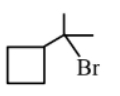


View Solution
Solution:
1. Understanding SN2 Reaction Rates:
The rate of SN2 reactions is influenced by steric hindrance. The reactivity order for alkyl halides is:
Methyl halide > 1° alkyl halide > 2° alkyl halide > 3° alkyl halide.
2. Analysis of the Compounds:
Compound (1) is a tertiary alkyl halide with the highest steric hindrance, resulting in the slowest SN2 reaction.
Compound (2) is a secondary alkyl halide.
Compound (3) is a primary alkyl halide, undergoing the fastest SN2 reaction due to minimal steric hindrance.
Compound (4) is also a secondary alkyl halide, slower than primary alkyl halides.
3. Conclusion:
The fastest SN2 reaction occurs for Compound (3), a primary alkyl halide.
Question 63:
Combustion of glucose (C6H12O6) produces CO2 and water. The amount of oxygen (in g) required for the complete combustion of 900 g of glucose is:
[Molar mass of glucose in g mol-1 = 180]
- 480
- 960
- 800
- 32
View Solution
Solution:
1. Combustion Reaction:
The balanced equation for the combustion of glucose is:
C6H12O6 + 6O2 → 6CO2 + 6H2O.
2. Moles of Glucose:
Given mass of glucose = 900 g, molar mass of glucose = 180 g mol-1:
Moles of glucose = Mass / Molar mass = 900 / 180 = 5 mol.
3. Moles of Oxygen Required:
From the balanced reaction:
1 mol of glucose reacts with 6 mol of oxygen.
Therefore, 5 mol of glucose reacts with 5 × 6 = 30 mol of oxygen.
4. Mass of Oxygen:
Molar mass of oxygen (O2) = 32 g mol-1:
Mass of oxygen = Moles × Molar mass = 30 × 32 = 960 g.
5. Conclusion:
The amount of oxygen required is 960 g.
Question 64:
Identify the major products A and B respectively in the following set of reactions: 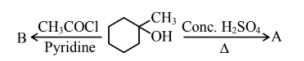
Options:
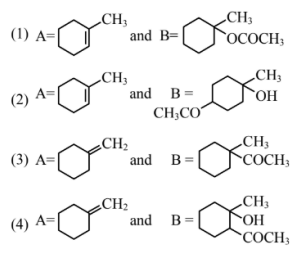

View Solution
Solution:
Step 1: Formation of Compound B (Acetylation):
The reaction of CH3COCl with alcohol (CH3OH) in the presence of pyridine results in the acetylation of the hydroxyl group:
CH3OH + CH3COCl → CH3OCOCH3 (Compound B).
Step 2: Formation of Compound A (Dehydration):
Treatment of Compound B with concentrated H2SO4 at elevated temperature leads to an E1 elimination reaction, resulting in the formation of an alkene:
CH3OCOCH3 → CH2=CH-CH3 (Compound A).
Conclusion:
Compound A is CH2=CH-CH3, and Compound B is CH3OCOCH3.
Question 65:
Given below are two statements: One is labelled as Assertion (A) and the other is labelled as Reason (R):
- Assertion (A): The stability order of +1 oxidation state of Ga, In, and Tl is:
Ga < In < Tl. - Reason (R): The inert pair effect stabilizes the lower oxidation state down the group.
Options:
- Both A and R are true and R is the correct explanation of A.
- A is true but R is false.
- Both A and R are true but R is NOT the correct explanation of A.
- A is false but R is true.
View Solution
Solution:
1. Understanding Assertion (A):
In group 13 elements (Ga, In, Tl), the stability of the +1 oxidation state increases down the group due to the inert pair effect. The order is Ga < In < Tl, so Assertion (A) is true.
2. Understanding Reason (R):
The inert pair effect refers to the reluctance of the s-electrons to participate in bonding as we move down the group in the periodic table. This effect stabilizes the lower oxidation state (e.g., +1 in group 13 elements). Hence, Reason (R) is true.
3. Link between A and R:
The inert pair effect directly explains why the +1 oxidation state becomes more stable down the group. Therefore, R is the correct explanation of A.
Question 66:
Match List-I with List-II:
| List-I (Name of the Test) | List-II (Reaction Sequence Involved) |
|---|---|
| A. Borax bead test | I. MCO3 → MO + Co(NO3)2 → CoO·MO |
| B. Charcoal cavity test | II. MCO3 → MCl2 → M2+ |
| C. Cobalt nitrate test | III. MSO4 + Na2B4O7 → M(BO2)2 → MBO2 |
| D. Flame test | IV. MSO4 + Na2CO3 → MCO3 → MO |
Options:
- A-III, B-I, C-IV, D-II
- A-III, B-II, C-IV, D-I
- A-III, B-I, C-II, D-IV
- A-III, B-IV, C-I, D-II
View Solution
Solution:
1. Matching the Tests with Their Reaction Sequences:
- Borax bead test: Reaction involves formation of MBO2 complexes. Matches with III.
- Charcoal cavity test: Reaction sequence involves MCO3 → MCl2 → M2+. Matches with IV.
- Cobalt nitrate test: Reaction involves MCO3 → MO + Co(NO3)2. Matches with I.
- Flame test: Reaction involves MSO4 + Na2CO3 → MCO3 → MO. Matches with II.
2. Correct Matching:
- A-III
- B-IV
- C-I
- D-II
Question 67:
Match List-I with List-II:
| List-I (Molecule) | List-II (Shape) |
|---|---|
| A. NH3 | I. Square pyramid |
| B. BrF5 | II. Tetrahedral |
| C. PCl5 | III. Trigonal pyramid |
| D. CH4 | IV. Trigonal bipyramidal |
Options:
- A-IV, B-III, C-I, D-II
- A-II, B-IV, C-I, D-III
- A-III, B-I, C-IV, D-II
- A-III, B-IV, C-I, D-II
View Solution
Solution:
1. Shape Analysis:
- A. NH3: Ammonia has a trigonal pyramidal shape due to one lone pair on nitrogen. This matches with III.
- B. BrF5: Bromine pentafluoride has a square pyramidal shape due to five bond pairs and one lone pair on bromine. This matches with I.
- C. PCl5: Phosphorus pentachloride has a trigonal bipyramidal shape because it has no lone pairs on phosphorus. This matches with IV.
- D. CH4: Methane has a tetrahedral shape due to four bond pairs and no lone pairs on carbon. This matches with II.
2. Correct Matching:
- A-III
- B-I
- C-IV
- D-II
3. Conclusion: The correct answer is:
3 (A-III, B-I, C-IV, D-II)
Question 68:
For the given hypothetical reactions, the equilibrium constants are as follows:
- X ↔ Y; K1 = 1.0
- Y ↔ Z; K2 = 2.0
- Z ↔ W; K3 = 4.0
The equilibrium constant for the reaction X ↔ W is:
Options:
- 6.0
- 12.0
- 8.0
- 7.0
View Solution
Solution:
1. Equilibrium Constants and Reaction Mechanisms: When reactions are added, their equilibrium constants are multiplied to find the overall equilibrium constant.
2. Add the Reactions:
X ↔ Y
Y ↔ Z
Z ↔ W
______________
X ↔ W
3. Multiply the Equilibrium Constants:
K = K1 × K2 × K3
K = 1.0 × 2.0 × 4.0 = 8.0
4. Conclusion: The equilibrium constant for the reaction X ↔ W is 8.0, corresponding to option (3).
Question 69:
Thiosulphate reacts differently with iodine and bromine in the reactions given below:
- 2S2O32- + I2 → S4O62- + 2I-
- S2O32- + 5Br2 + 5H2O → 2SO42- + 4Br- + 10H+
Which of the following statements justifies the above dual behaviour of thiosulphate?
Options:
- Bromine undergoes oxidation and iodine undergoes reduction in these reactions.
- Thiosulphate undergoes oxidation by bromine and reduction by iodine in these reactions.
- Bromine is a stronger oxidant than iodine.
- Bromine is a weaker oxidant than iodine.
View Solution
Solution:
1. Analyze the Reactions:
- Reaction with Iodine: Iodine reduces to I-, while thiosulphate is oxidized to S4O62-.
- Reaction with Bromine: Bromine reduces to Br-, while thiosulphate is oxidized to SO42-. Bromine oxidizes sulfur to a higher oxidation state than iodine.
2. Identify the Stronger Oxidant: Bromine causes a greater oxidation of sulfur compared to iodine, indicating that bromine is the stronger oxidizing agent.
3. Evaluate the Options:
- Option (1): Incorrect. Both halogens are reduced in these reactions.
- Option (2): Incorrect. Thiosulphate is oxidized in both reactions.
- Option (3): Correct. Bromine is a stronger oxidizing agent than iodine.
- Option (4): Incorrect. The opposite is true.
Question 70:
An octahedral complex with the formula CoCl3n(NH3) upon reaction with excess AgNO3 solution gives 2 moles of AgCl. Consider the oxidation state of Co in the complex is x. The value of x + n is:
Options:
- 3
- 6
- 8
- 5
View Solution
Solution:
1. Reaction with AgNO3: The reaction with AgNO3 produces 2 moles of AgCl, which means there are 2 ionizable Cl- ions outside the coordination sphere. The remaining chloride ions are part of the coordination sphere.
The complex can be represented as [Co(NH3)yCln-2]Cl2, where y is the number of NH3 ligands.
2. Octahedral Complex: In an octahedral complex, the total number of ligands around the central metal is 6. Therefore:
y + (n - 2) = 6
y = 8 - n
3. Oxidation State of Co:
The oxidation state of Co (x) is determined by balancing the charges. Let the charge on Co be x. NH3 is neutral, and Cl has a charge of -1:
x + 0 × (8 - n) + (-1) × (n - 2) = +2
x - n + 2 = +2
x = n
4. Calculate x + n:
Since x = n, and there are 2 ionizable Cl- ions, n = 4. Therefore:
x + n = 4 + 4 = 8
5. Conclusion: The value of x + n is 8.
Question 71:

The incorrect statement regarding the given structure is:
Options:
- Can be oxidized to a dicarboxylic acid with Br2 water
- Despite the presence of –CHO does not give Schiff's test
- Has 4 asymmetric carbon atoms
- Will coexist in equilibrium with 2 other cyclic structures
View Solution
Solution:
1. Statement (1): Bromine water is a mild oxidizing agent that oxidizes the aldehyde group (-CHO) in glucose to a carboxylic acid (-COOH), forming gluconic acid. However, bromine water cannot oxidize the terminal –CH2OH group. To form a dicarboxylic acid, a stronger oxidizing agent like HNO3 is required. Hence, this statement is incorrect.
2. Statement (2): Glucose exists predominantly in its cyclic hemiacetal form, and the open-chain form containing the aldehyde group is present in small amounts. Schiff's test does not detect the hemiacetal form, so this statement is correct.
3. Statement (3): Glucose has 4 chiral carbons in its structure, making this statement correct.
4. Statement (4): Glucose exists in equilibrium between its open-chain form and two cyclic forms (α and β anomers). This statement is correct.
Conclusion: The incorrect statement is (1).
Question 72:
In the given compound, the number of 2° carbon atom/s is:

Options:
- Three
- One
- Two
- Four
View Solution
Solution:
1. Types of Carbon Atoms:
- Primary (1°): Carbon bonded to one other carbon atom.
- Secondary (2°): Carbon bonded to two other carbon atoms.
- Tertiary (3°): Carbon bonded to three other carbon atoms.
2. Analyze the Structure:
In the given compound, only one carbon is bonded to two other carbon atoms, making it a secondary carbon (2°).
3. Conclusion: The compound has 1 secondary (2°) carbon atom, corresponding to option (2).
Question 73:
Which of the following are aromatic?

Options:
- B and D only
- A and C only
- A and B only
- C and D only
View Solution
Solution:
1. Criteria for Aromaticity:
- Cyclic: Must form a closed ring.
- Planar: All atoms in the ring must be coplanar.
- Conjugated: Must have a continuous system of overlapping p-orbitals.
- Huckel's Rule: Must have (4n + 2) π electrons, where n is a non-negative integer.
2. Analyze Each Structure:
- A: Naphthalene is aromatic (cyclic, planar, conjugated, 10 π electrons).
- B: Benzene is aromatic (cyclic, planar, conjugated, 6 π electrons).
- C: Biphenyl is non-planar due to steric hindrance between rings. Not aromatic.
- D: Cyclopentadienyl anion is aromatic (cyclic, planar, conjugated, 6 π electrons).
3. Conclusion: B and D are aromatic. The correct option is (1).
Question 74:
Among the following halogens (F2, Cl2, Br2, and I2), which can undergo disproportionation reaction?
Options:
- Only I2
- Cl2, Br2, and I2
- F2, Cl2, and Br2
- F2 and Cl2
View Solution
Solution:
1. Disproportionation Reaction: A redox reaction where the same element is both oxidized and reduced.
2. Halogens:
- F2: Cannot disproportionate as it is the most electronegative element and cannot be oxidized further.
- Cl2, Br2, I2: Can exhibit multiple oxidation states and undergo disproportionation. Examples:
- Cl2 + 2NaOH → NaCl + NaClO + H2O
- Br2 + 2NaOH → NaBr + NaBrO + H2O
- I2 + 2NaOH → NaI + NaIO + H2O
3. Conclusion: Cl2, Br2, and I2 can undergo disproportionation. The correct option is (2).
Question 75:
Given below are two statements:
- Statement I: N(CH3)3 and P(CH3)3 can act as ligands to form transition metal complexes.
- Statement II: As N and P are from the same group, the nature of bonding of N(CH3)3 and P(CH3)3 is always the same with transition metals.
Options:
- Statement I is incorrect but Statement II is correct
- Both Statement I and Statement II are correct
- Statement I is correct but Statement II is incorrect
- Both Statement I and Statement II are incorrect
View Solution
Solution:
1. Statement I:
N(CH3)3 and P(CH3)3 have lone pairs on nitrogen and phosphorus atoms, respectively, which can coordinate with transition metals to form complexes. Statement I is correct.
2. Statement II:
While N(CH3)3 is a σ-donor ligand, P(CH3)3 can act as both a σ-donor and a π-acceptor due to the availability of d-orbitals. This makes their bonding nature different. Statement II is incorrect.
3. Conclusion: Statement I is correct, but Statement II is incorrect. The correct option is (3).
Question 76:
Match List I with List II:
| List-I (Elements) | List-II (Properties in their respective groups) |
|---|---|
| A. Cl, S | I. Elements with highest electronegativity |
| B. Ge, As | II. Elements with largest atomic size |
| C. Fr, Ra | III. Elements which show properties of both metals and non-metals |
| D. F, O | IV. Elements with highest negative electron gain enthalpy |
Options:
- A-II, B-III, C-IV, D-I
- A-III, B-II, C-I, D-IV
- A-IV, B-III, C-II, D-I
- A-II, B-I, C-IV, D-III
View Solution
Solution:
A. Cl, S: These elements have high negative electron gain enthalpy within their groups. Chlorine has the highest in Group 17. Correct match: IV.
B. Ge, As: These are metalloids and exhibit properties of both metals and non-metals. Correct match: III.
C. Fr, Ra: These are the largest elements in Groups 1 and 2, respectively. Correct match: II.
D. F, O: Fluorine has the highest electronegativity in the periodic table, and oxygen is also highly electronegative. Correct match: I.
Conclusion: The correct matches are A-IV, B-III, C-II, D-I, corresponding to option (3).
Question 77:
Iron(III) catalyses the reaction between iodide and persulphate ions. Which of the following are correct?
Statements:
- A. Fe³⁺ oxidises the iodide ion.
- B. Fe³⁺ oxidises the persulphate ion.
- C. Fe²⁺ reduces the iodide ion.
- D. Fe²⁺ reduces the persulphate ion.
Options:
- B and C only
- B only
- A only
- A and D only
View Solution
Solution:
1. Step 1: Fe³⁺ oxidises iodide (I⁻) to iodine (I₂):
2Fe³⁺ + 2I⁻ → 2Fe²⁺ + I₂
Step 2: Fe²⁺ reduces persulphate (S₂O₈²⁻) to sulfate (SO₄²⁻):
2Fe²⁺ + S₂O₈²⁻ → 2Fe³⁺ + 2SO₄²⁻
Conclusion: A is true because Fe³⁺ oxidises iodide. D is true because Fe²⁺ reduces persulphate. The correct option is (4).
Question 78:
Match List I with List II:
| List-I (Compound) | List-II (Colour) |
|---|---|
| A. Fe₄[Fe(CN)₆]₃·xH₂O | I. Violet |
| B. [Fe(CN)₅NOS]⁴⁻ | II. Blood Red |
| C. [Fe(SCN)]²⁺ | III. Prussian Blue |
| D. (NH₄)₃PO₄·12MoO₃ | IV. Yellow |
Options:
- A-III, B-I, C-II, D-IV
- A-IV, B-I, C-II, D-III
- A-II, B-III, C-IV, D-I
- A-I, B-II, C-III, D-IV
View Solution
Solution:
A. Fe₄[Fe(CN)₆]₃·xH₂O: This is Prussian Blue. Correct match: III.
B. [Fe(CN)₅NOS]⁴⁻: This is sodium nitroprusside, which forms a violet complex. Correct match: I.
C. [Fe(SCN)]²⁺: This forms a blood red complex. Correct match: II.
D. (NH₄)₃PO₄·12MoO₃: This is ammonium phosphomolybdate, a yellow precipitate. Correct match: IV.
Conclusion: The correct matches are A-III, B-I, C-II, D-IV, corresponding to option (1).
Question 79:
Number of complexes with an even number of electrons in t2g orbitals is:
[Fe(H2O)6]²⁺, [Co(H2O)6]²⁺, [Co(H2O)6]³⁺, [Cu(H2O)6]²⁺, [Cr(H2O)6]²⁺
Options:
- 1
- 3
- 2
- 5
View Solution
Solution:
1. Crystal Field Theory and t2g Orbitals:
In octahedral complexes, the d-orbitals split into t2g (lower energy) and eg (higher energy) orbitals. Water is a weak field ligand, so electrons follow Hund's rule in high-spin configurations.
2. Electronic Configurations and t2g Electrons:
- [Fe(H2O)6]²⁺: Fe²⁺ is d⁶. In high spin, t2g contains 4 electrons (even).
- [Co(H2O)6]²⁺: Co²⁺ is d⁷. t2g contains 5 electrons (odd).
- [Co(H2O)6]³⁺: Co³⁺ is d⁶. t2g contains 4 electrons (even).
- [Cu(H2O)6]²⁺: Cu²⁺ is d⁹. t2g contains 6 electrons (even).
- [Cr(H2O)6]²⁺: Cr²⁺ is d⁴. t2g contains 3 electrons (odd).
3. Count Complexes with Even t2g Electrons:
Three complexes have even t2g electrons: [Fe(H2O)6]²⁺, [Co(H2O)6]³⁺, and [Cu(H2O)6]²⁺.
Conclusion: The correct answer is (2).
Question 80:
Identify the product (P) in the following reaction: 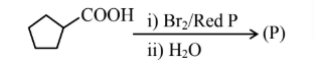
Options:
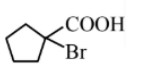
1. 
2. 
3. 
4. 

View Solution
Solution:
1. HVZ (Hell-Volhard-Zelinsky) Reaction:
The HVZ reaction involves halogenation at the α-carbon of carboxylic acids. Red phosphorus (Red P) catalyzes the formation of acyl bromide, which reacts with bromine to undergo α-bromination.
2. Reaction Steps:


- Step 1: Formation of Acyl Bromide:
- Step 2: α-Bromination:
- Step 3: Hydrolysis:
Conclusion: The product is Option (1).
Question 81:
A hypothetical electromagnetic wave is shown below. The frequency of the wave is x × 1019 Hz. x = ... (nearest integer)

Correct Answer: (5)
View Solution
Solution:
1. Wavelength from the Diagram:
The diagram shows one full cycle of the wave as 1.5 pm. Thus, the wavelength (λ) is:
λ = 1.5 × 10⁻¹² m.
2. Frequency-Wavelength Relation:
The relationship between the frequency (f) and wavelength (λ) is:
c = fλ, where c is the speed of light (3 × 10⁸ m/s).
f = c / λ
3. Calculate the Frequency:
f = (3 × 10⁸) / (1.5 × 10⁻¹²)
f = 2 × 10²⁰ Hz.
However, the diagram indicates that a full cycle includes crest and trough, so λ = 3 pm = 3 × 10-12 m:
f = (3 × 10⁸) / (3 × 10-12)
f = 1 × 10²⁰ Hz or x = 5.
4. Conclusion:
The value of x is 5.
Question 82:
1 mol of an ideal gas is kept in a cylinder, fitted with a piston, at position A, at 18°C. If the piston is moved to position B, keeping the temperature unchanged, then 'x' L atm work is done in this reversible process. x = ... L atm. (nearest integer)

Correct Answer: (55)
View Solution
Solution:
1. Work for Isothermal Reversible Expansion:
The formula for work in an isothermal process is:
w = -nRT ln(Vf / Vi).
2. Given Values:
n = 1 mol
R = 0.08206 L atm mol-1 K-1
T = 18 + 273.15 = 291.15 K
Vi = 10 L, Vf = 100 L
3. Calculate Work:
w = -(1)(0.08206)(291.15) ln(100 / 10)
w = -23.883 × ln(10)
ln(10) ≈ 2.303
w = -23.883 × 2.303 = -55.018 L atm
4. Conclusion:
Work done (x) = 55 L atm.
Question 83:
Number of amine compounds from the following giving solids which are soluble in NaOH upon reaction with Hinsberg's reagent is … 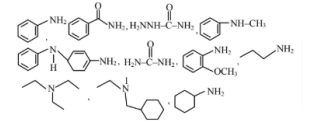
Correct Answer: (5)
View Solution
Solution:
1. Hinsberg's Test:
- Primary amines form sulfonamides soluble in NaOH.
- Secondary amines form insoluble sulfonamides.
- Tertiary amines do not react with Hinsberg's reagent.
2. Analyze the Compounds:
- Aniline (C₆H₅NH₂): Primary amine; soluble in NaOH.
- Cyclohexylamine: Primary amine; soluble in NaOH.
- Methylamine: Primary amine; soluble in NaOH.
- Dimethylamine: Secondary amine; insoluble in NaOH.
- Triethylamine: Tertiary amine; no reaction.
3. Count Soluble Compounds:
Five primary amines are soluble in NaOH after reacting with Hinsberg's reagent.
4. Conclusion:
The number of amines is 5.
Question 84:
The number of optical isomers in the following compound is ...

Correct Answer: (32)
View Solution
Solution:
1. Chiral Centers:
A chiral center is a carbon atom attached to four different groups. By analyzing the given structure, the compound has five chiral centers.
2. Number of Optical Isomers:
The total number of optical isomers for a molecule with n chiral centers is \(2^n\). Since the compound has five chiral centers:
\(2^5 = 32\) optical isomers.
3. Conclusion:
The compound has 32 optical isomers.
Question 85:
The 'spin only' magnetic moment value of MO42- is ... BM. (Where M is a metal having the least metallic radii among Sc, Ti, V, Cr, Mn, and Zn.)
Given atomic numbers: Sc = 21, Ti = 22, V = 23, Cr = 24, Mn = 25, Zn = 30
Correct Answer: (0)
View Solution
Solution:
1. Identify Metal M:
Among the given elements, Zn has the smallest metallic radius due to its position at the end of the 3d transition series (increased nuclear charge).
2. Oxidation State in MO42-:
Oxygen has an oxidation state of -2. Let the oxidation state of Zn be \(x\):
\(x + 4(-2) = -2 \quad \Rightarrow \quad x = +6\).
3. Electronic Configuration of Zn6+:
Zn's ground-state configuration is [Ar] 3d10 4s2. After losing six electrons (to form Zn6+), the configuration becomes [Ar]. There are no unpaired electrons.
4. Magnetic Moment:
The spin-only magnetic moment (\(\mu\)) is given by:
\(\mu = \sqrt{n(n+2)} \, \text{BM}\), where \(n\) is the number of unpaired electrons.
For Zn6+, \(n = 0\):
\(\mu = \sqrt{0(0+2)} = 0 \, \text{BM}\).
5. Conclusion:
The spin-only magnetic moment of MO42- is 0 BM.
Question 86:
Number of molecules from the following which are exceptions to the octet rule is ...
Molecules: CO2, NO2, H2SO4, BF3, CH4, SiF4, ClO2, PCl5, BeF2, C2H6, CHCl3, CBr4
Correct Answer: (6)
View Solution
Solution:
1. Octet Rule and Exceptions:
The octet rule states that atoms tend to complete an octet of electrons in their valence shell. Exceptions include:
- Incomplete Octets: Molecules where the central atom has fewer than 8 electrons (e.g., BF3, BeF2).
- Expanded Octets: Molecules where the central atom has more than 8 electrons (e.g., PCl5, H2SO4).
- Odd-Electron Molecules: Molecules with an odd number of valence electrons (e.g., NO2, ClO2).
2. Analyze the Molecules:
- CO2: Follows the octet rule.
- NO2: Odd-electron molecule; exception.
- H2SO4: Expanded octet on sulfur; exception.
- BF3: Incomplete octet on boron; exception.
- CH4: Follows the octet rule.
- SiF4: Follows the octet rule.
- ClO2: Odd-electron molecule; exception.
- PCl5: Expanded octet on phosphorus; exception.
- BeF2: Incomplete octet on beryllium; exception.
- C2H6: Follows the octet rule.
- CHCl3: Follows the octet rule.
- CBr4: Follows the octet rule.
3. Count the Exceptions:
Six molecules are exceptions: NO2, H2SO4, BF3, ClO2, PCl5, and BeF2.
4. Conclusion:
The number of molecules that are exceptions to the octet rule is 6.
Question 87:
If 279 g of aniline is reacted with one equivalent of benzenediazonium chloride, the maximum amount of aniline yellow formed will be ... g. (nearest integer, consider complete conversion)
Correct Answer: (591)
View Solution
Solution:
1. Reaction:
Aniline reacts with benzenediazonium chloride to form aniline yellow (p-aminoazobenzene):
C6H5NH2 + C6H5N2Cl → C6H5-N=N-C6H4NH2
2. Moles of Aniline:
Molar mass of aniline (C6H7N) = 93.13 g/mol
Moles of aniline = mass / molar mass = 279 g / 93.13 g/mol = 3 mol
3. Stoichiometry:
The reaction is 1:1, so 3 moles of aniline will form 3 moles of aniline yellow.
4. Mass of Aniline Yellow:
Molar mass of aniline yellow (C12H11N3) = 197.24 g/mol
Mass of aniline yellow = moles × molar mass = 3 mol × 197.24 g/mol = 591.72 g
5. Conclusion:
The maximum amount of aniline yellow formed is approximately 591 g (nearest integer).
Question 88:
Consider the reaction:
A + B → C
Details:
- The time taken for A to become 1/4th of its initial concentration is twice the time taken to become 1/2 of the same.
- The plot of B concentration vs. time is a straight line with a negative slope and a positive intercept.
Correct Answer: (1)
View Solution
Solution:
1. Analysis of A:
The time data suggests that the reaction is first-order with respect to A because, for a first-order reaction, the time to reduce concentration by successive halves is proportional (e.g., 1/2 → 1/4).
2. Analysis of B:
The linear decrease in concentration of B with time indicates zero-order behavior with respect to B.
3. Overall Order:
Overall order = (Order with respect to A) + (Order with respect to B)
Overall order = 1 + 0 = 1
4. Conclusion:
The overall order of the reaction is 1.
Question 89:
Major product B of the following reaction has ... π-bonds.
Correct Answer: (5)
View Solution
Solution:
1. Reaction Steps:
Step 1: Oxidation of ethylbenzene to benzoic acid (A) using KMnO4 and heat.
Step 2: Nitration of benzoic acid to 3-nitrobenzoic acid (B) using HNO3/H2SO4.
2. Structure of B:
The structure of 3-nitrobenzoic acid includes:
- Three π-bonds in the benzene ring
- One π-bond in the carboxyl group (-COOH)
- One π-bond in the nitro group (-NO2)
3. Total π-bonds:
Total = 3 + 1 + 1 = 5
4. Conclusion:
The major product (B) has 5 π-bonds.
Question 90:
A solution containing 10 g of an electrolyte AB2 in 100 g of water boils at 100.52°C. The degree of ionization of the electrolyte (α) is ... × 10-1. (nearest integer)
Given:
- Molar mass of AB2 = 200 g/mol
- Boiling point elevation constant (Kb) = 0.52 K kg mol-1
- Boiling point of water = 100°C
- Dissociation: AB2 → A2+ + 2B-
Correct Answer: (5)
View Solution
Solution:
1. Boiling Point Elevation:
\(ΔT_b = T_b - T_b^o = 100.52 - 100 = 0.52\) K
2. Molality (m):
Moles of AB2 = \(10 / 200 = 0.05\) mol
Mass of water = 100 g = 0.1 kg
Molality \(m = 0.05 / 0.1 = 0.5\) mol/kg
3. Van't Hoff Factor (i):
\(ΔT_b = i K_b m\)
\(0.52 = i (0.52)(0.5)\)
\(i = 2\)
\(i = 1 + 2α \quad \Rightarrow \quad 2 = 1 + 2α \quad \Rightarrow \quad α = 0.5\)
4. Degree of Ionization:
\(α = 0.5 = 5 × 10^{-1}\)
5. Conclusion:
The degree of ionization (α) is \(5 × 10^{-1}\).
*The article might have information for the previous academic years, please refer the official website of the exam.