
JEE Main 2024 Question Paper with Solution PDF for B.E./B.Tech (April 9 - Shift 1)

.jpg?tr=h-55,w-55,c-force)
Content Strategist|Tech-innovator|National Hackathon Winner | Updated On - Jan 13, 2026
JEE Main 2024 Apr 9 Shift 1 Question Paper with Solution pdf is available for download here. Students found Physics easy and Mathematics hard. Physics carried the highest weightage and overall difficulty level was moderate.
JEE Main 2024 Question Paper 9 April Shift 1 with Solution PDF
| JEE Main 2024 Question Paper with Solution Pdf 9 April Shift 1 |  Download Download |
Check Solution |

Question 1:
Let the line L intersect the lines:
x − 2 = −y = z − 1, 2(x + 1) = 2(y − 1) = z + 1, and be parallel to the line: (x − 2)/3 = (y − 1)/1 = (z − 2)/2. Then which of the following points lies on L?
View Solution
The intersection of the lines and the parallel condition leads to the point (-1/3, 1, -1) lying on the line L.
Question 2:
The parabola y² = 4x divides the area of the circle x² + y² = 5 in two parts. The area of the smaller part is:
View Solution
The smaller area is calculated using geometry formulas for the circle segment and the parabola sector, leading to the area 2/3 + 5 sin⁻¹(2√5).
Question 3:
The solution curve of the differential equation 2y (dy/dx) + 3 = 5 (dy/dx), passing through the point (0, 1), is a conic whose vertex lies on the line:
View Solution
Solving the differential equation and using the initial condition (0, 1), the vertex of the parabola is found to lie on the line 2x + 3y = 9.
Question 4:
A ray of light coming from P(1, 2) reflects from Q on the x-axis and passes through R(4, 3). If S(h, k) makes PQRS a parallelogram, then hk² equals:
View Solution
By using reflection laws and midpoint properties of parallelograms, the value of hk² is found to be 70.
Question 5:
For λ, μ ∈ R, if the system of equations 3x + 5y + λz = 3, 7x + 11y − 9z = 2, 97x + 155y − 189z = μ has infinitely many solutions, then μ + 2λ equals:
View Solution
Using the condition for infinite solutions in the system of linear equations, μ + 2λ is found to equal 25.
Question 6:
The coefficient of x⁷⁰ in x²(1 + x)⁹⁸ + x³(1 + x)⁹⁷ + ... + x⁵⁴(1 + x)⁴⁶ is (99Cp) − (46Cq). A possible value of p + q is:
View Solution
Summing the contributions of each term in the series expansion and simplifying, p + q is found to be 83.
Question 7:
If ∫ (2 − tanx)/(3 + tanx) dx = (1/2)(αx + loge|β sinx + γ cosx|) + C, then α + γ/β equals:
View Solution
Using the method of partial fractions and substitution, α + γ/β is found to be 4.
Question 8:
A variable line passes through (3, 5) and intersects the positive axes at A and B. The minimum area of triangle OAB is:
View Solution
By using calculus to minimize the area of triangle OAB, the minimum area is found to be 30.
Question 9:
If |cosθ cos(60° − θ) cos(60° + θ)| ≤ 1/8, θ ∈ [0, 2π], then the sum of all θ where cos3θ attains its maximum value is:
View Solution
By solving the trigonometric inequality and analyzing the periodicity, the sum of θ is found to be 6π.
Question 10:
Let OA = 2a, OB = 6a + 5b, and OC = 3b. If the area of the parallelogram with sides OA and OC is 15 sq. units, the area of quadrilateral OABC is:
View Solution
By calculating the areas of the parallelogram and using vector cross products for the diagonals, the area of quadrilateral OABC is 35.
Question 11:
If the domain of the function f(x) = sin⁻¹((x−1)/(2x+3)) is R−(α, β), then 12αβ is equal to:
View Solution
The domain of the function is determined by solving the inequality for the argument of sin⁻¹, and the value of 12αβ is found to be 36.
Question 12:
If the sum of the series 1/(1 · (1 + d)) + 1/((1 + d)(1 + 2d)) + ... + 1/((1 + 9d)(1 + 10d)) is equal to 5, then 50d is equal to:
View Solution
Using partial fraction decomposition and simplifying, we find that the value of 50d is 5.
Question 13:
Let f(x) = ax³ + bx² + cx + 41 be such that f(1) = 40, f'(1) = 2, and f''(1) = 4. Then a² + b² + c² is equal to:
View Solution
By solving the system of equations for the coefficients a, b, and c using the given conditions, we find that a² + b² + c² = 51.
Question 14:
Let a circle passing through (2, 0) have its center at the point (h, k). Let (xc, yc) be the point of intersection of the lines 3x + 5y = 1 and (2 + c)x + 5c²y = 1. If h = lim c→1 xc and k = lim c→1 yc, then the equation of the circle is:
View Solution
Using the center and radius of the circle determined from the intersection points, the equation of the circle is 25x² + 25y² − 20x + 2y − 60 = 0.
Question 15:
The shortest distance between the lines (x−3)/4 = (y+7)/−11 = (z−1)/5 and (x−5)/3 = (y−9)/−6 = (z+2)/1 is:
View Solution
The shortest distance between skew lines is calculated using the perpendicular vector, and the result is 187√563.
Question 16:
The frequency distribution of the age of students in a class of 40 students is given below:
| Age | No. of Students |
|---|---|
| 15 | 5 |
| 16 | 8 |
| 17 | 5 |
| 18 | 12 |
| 19 | x |
| 20 | y |
If the mean deviation about the median is 1.25, then 4x + 5y is equal to:
View Solution
By solving for x and y using the mean deviation equation, we find that 4x + 5y = 44.
Question 17:
The solution of the differential equation (x² + y²)dx − 5xy dy = 0, y(1) = 0, is:
View Solution
By solving the differential equation, the solution is found to be |x² − 4y²|⁵ = x².
Question 18:
Let three vectors a = αî + 4ĵ + 2k̂, b = 5î + 3ĵ + 4k̂, c = xî + yĵ + zk̂, form a triangle such that c = a − b and the area of the triangle is 5√6. If α is a positive real number, then |c|² is:
View Solution
By calculating the area of the triangle using the cross product and solving for α, the value of |c|² is 14.
Question 19:
Let α, β be the roots of the equation x² + 2√2x − 1 = 0. The quadratic equation whose roots are α⁴ + β⁴ and 1/10(α⁶ + β⁶) is:
View Solution
By using identities for powers of roots and calculating the sums, the quadratic equation is found to be x² − 195x + 9506 = 0.
Question 20:
Let f(x) = x² + 9, g(x) = x/(x − 9), and a = f(g(10)), b = g(f(3)). If e and ℓ denote the eccentricity and the length of the latus rectum of the ellipse x²/a² + y²/b² = 1, then 8e² + ℓ² is equal to:
View Solution
By calculating a and b and using the formulas for eccentricity and the latus rectum, 8e² + ℓ² is found to be 8.
Question 21:
Let a, b, c denote the outcomes of three independent rolls of a fair tetrahedral die, whose four faces are marked 1, 2, 3, 4. If the probability that ax² + bx + c = 0 has all real roots is m/n, where gcd(m, n) = 1, then m + n is equal to:
View Solution
By analyzing the discriminant condition for real roots and counting favorable outcomes, the probability is m/n = 3/16, and m + n = 19.
Question 22:
The sum of the square of the modulus of the elements in the set: {z = a + ib : a, b ∈ Z, z ∈ C, |z − 1| ≤ 1, |z − 5| ≤ |z − 5i|} is:
View Solution
By analyzing the geometric constraints of the complex number set and evaluating the square of the modulus, the sum is 9.
Question 23:
Let the set of all positive values of λ, for which the point of local minimum of the function:
f(x) = (1 + x(λ² − x²)) satisfies x² + x + 2 / x² + 5x + 6 < 0, be (α, β). Then α² + β² is equal to:
View Solution
Solving for λ and checking conditions for the local minimum, α² + β² is found to be 39.
Question 24:
Let the following limit be equal to π/k, where k is an integer. Then k² is equal to:
Given:
lim n→∞ [n√(n⁴ + 1) − 2n(n² + 1)√(n⁴ + 1) + n√(n⁴ + 16) + ...]
View Solution
The integral approximation and series expansions yield k² = 32.
Question 25:
The remainder when 4282024 is divided by 21 is:
View Solution
Simplifying the large power modulo calculations, the remainder is found to be 1.
Question 26:
Let f : (0, π) → R be a function given by:
f(x) =
8/7 * tan(8x) / tan(7x), 0 < x < π/2 a − 8, x = π/2 (1 + |cot(x)|) * (b/a) * tan(|x|), π/2 < x < π
where a, b ∈ Z. If f is continuous at x = π/2, find a² + b².
View Solution
To maintain continuity at x = π/2, solving for the values of a and b, a² + b² is found to be 81.
Question 27:
Let A be a non-singular matrix of order 3. If:
det(3adj(2adj((detA)A))) = 3⁻¹³ · 2⁻¹⁰, and:
det(3adj(2A)) = 2^m · 3^n, then |3m + 2n| is equal to:
View Solution
By analyzing the determinant properties and solving the equation, |3m + 2n| is found to be 14.
Question 28:
Let the center of a circle, passing through the points (0, 0), (1, 0), and touching the circle x² + y² = 9, be (h, k). Then for all possible values of the coordinates of the center (h, k), 4(h² + k²) is equal to:
View Solution
Using the geometric properties of the circle and applying the conditions of tangency, the value of 4(h² + k²) is found to be 9.
Question 29:
If a function f satisfies f(m + n) = f(m) + f(n) for all m, n ∈ N, and f(1) = 1, then the largest natural number λ such that:
Σk=12022 f(λ + k) ≤ (2022)², is equal to:
View Solution
By solving for λ based on the functional equation and summation condition, λ is found to be 1010.
Question 30:
Let A = {2, 3, 6, 7} and B = {4, 5, 6, 8}. Let R be a relation defined on A × B by:
(a₁, b₁) R (a₂, b₂) ⇔ a₁ + a₂ = b₁ + b₂. Then the number of elements in R is:
View Solution
By checking the pairs that satisfy the given condition for the relation, the total number of elements in R is 25.
Question 31:
A proton, an electron, and an alpha particle have the same energies. Their de-Broglie wavelengths will be compared as:
View Solution
Since de-Broglie wavelength is inversely proportional to the square root of mass, the order is λe > λp > λα, where λe, λp, and λα correspond to the electron, proton, and alpha particle respectively.
Question 32:
A particle moving in a straight line covers half the distance with speed 6 m/s. The other half is covered in two equal time intervals with speeds 9 m/s and 15 m/s, respectively. The average speed of the particle during the motion is:
View Solution
The average speed is calculated by the total distance divided by the total time, yielding 8 m/s after evaluating the times for each segment.
Question 33:
A plane EM wave is propagating along the x-direction. It has a wavelength of 4 mm. If the electric field is in the y-direction with the maximum magnitude of 60 V/m, the equation for the magnetic field is:
View Solution
By applying the relationship between the electric and magnetic fields for plane waves, the magnetic field equation is derived to be Bz = 2 × 10⁻⁷ sin[π/2 × 10³(x − 3 × 10⁸t)] k̂ T.
Question 34:
Given below are two statements:
Statement (I): When currents vary with time, Newton’s third law is valid only if momentum carried by the electromagnetic field is taken into account.
Statement (II): Ampere’s circuital law does not depend on Biot-Savart’s law.
Choose the correct answer:
View Solution
Statement I is true because the momentum carried by the electromagnetic field must be included when time-varying currents are involved. Statement II is false because Ampere’s circuital law is independent of Biot-Savart’s law.
Question 35:
A light-emitting diode (LED) is fabricated using GaAs semiconducting material whose band gap is 1.42 eV. The wavelength of light emitted from the LED is:
View Solution
Using the formula λ = 1240 / Eg (where Eg is the band gap in eV), the wavelength of the emitted light is found to be 875 nm.
Question 36:
A sphere of relative density σ and diameter D has a concentric cavity of diameter d. The ratio of D/d, if it just floats on water in a tank, is:
View Solution
The floating condition and buoyancy lead to the relationship D/d = (σ / (σ − 1))^(1/3).
Question 37:
A capacitor is made of a flat plate of area A and a second plate having a stair-like structure as shown in the figure. If the area of each stair is A/3 and the height is d, the capacitance of the arrangement is:
View Solution
The capacitance is found by considering the individual contributions of each segment of the capacitor, leading to a total capacitance of (11ϵ₀A) / (18d).
Question 38:
A light, unstretchable string passing over a smooth light pulley connects two blocks of masses m₁ and m₂. If the acceleration of the system is g/8, then the ratio of the masses m₂/m₁ is:
View Solution
By solving the equations of motion for the two masses and using the given acceleration, the ratio m₂/m₁ is found to be 9:7.
Question 39:
The dimensional formula of latent heat is:
View Solution
Latent heat is energy per unit mass, and using the dimensional formula for energy and mass, the formula for latent heat is [M₀L²T⁻²].
Question 40:
The volume of an ideal gas (γ = 1.5) is changed adiabatically from 5 litres to 4 litres. The ratio of initial pressure to final pressure is:
View Solution
By applying the adiabatic relation between pressure and volume, the ratio of initial pressure to final pressure is found to be 8/5√5.
Question 41:
The energy equivalent of 1 g of substance is:
View Solution
Using Einstein’s equation E = mc² and converting mass and energy units, the energy equivalent of 1 g is found to be 5.6 × 10⁶ MeV.
Question 42:
An astronaut takes a ball of mass m from Earth to space. He throws the ball into a circular orbit about Earth at an altitude of 318.5 km. From Earth’s surface to the orbit, the change in total mechanical energy of the ball is xGMem / 21Re. The value of x is:
View Solution
The change in total mechanical energy during the transition from the Earth's surface to orbit is calculated as 11GMem / 21Re.
Question 43:
Given below are two statements:
Statement (I): When currents vary with time, Newton’s third law is valid only if momentum carried by the electromagnetic field is taken into account.
Statement (II): Ampere’s circuital law does not depend on Biot-Savart’s law.
Choose the correct answer:
View Solution
Statement I is true because time-varying currents carry electromagnetic momentum. Statement II is false because Ampere's law does depend on Biot-Savart’s law.
Question 44:
A particle of mass m moves on a straight line with its velocity increasing with distance according to the equation v = α√x, where α is a constant. The total work done by all the forces applied on the particle during its displacement from x = 0 to x = d, will be:
View Solution
By using the work-energy theorem and integrating the velocity equation, the work done is found to be mα²d / 2.
Question 45:
A galvanometer has a coil of resistance 200Ω with a full-scale deflection at 20µA. The value of resistance to be added to use it as an ammeter of range 0−20mA is:
View Solution
Using the formula for the shunt resistance, the required resistance is found to be 0.20Ω to use the galvanometer as an ammeter.
Question 46:
A heavy iron bar, of weight W, is having its one end on the ground and the other on the shoulder of a person. The bar makes an angle θ with the horizontal. The weight experienced by the person is:
View Solution
Since the bar is uniform, the weight is distributed equally between the two points of support, and the person experiences half of the total weight, i.e., W/2.
Question 47:
One main scale division of a vernier caliper is equal to m units. If nth division of the main scale coincides with (n+1)th division of the vernier scale, the least count of the vernier caliper is:
View Solution
The least count of a vernier caliper is the difference between the main scale division and the vernier scale division, which gives m / (n+1).
Question 48:
A bulb and a capacitor are connected in series across an AC supply. A dielectric is then placed between the plates of the capacitor. The glow of the bulb:
View Solution
The introduction of the dielectric increases the capacitance, thus decreasing the impedance of the capacitor, which leads to an increase in the current and an increase in the bulb's glow.
Question 49:
The equivalent resistance between A and B is:
View Solution
After simplifying the resistor network step by step using series and parallel combinations, the total resistance is found to be 19Ω.
Question 50:
A sample of 1 mole gas at temperature T is adiabatically expanded to double its volume. If the adiabatic constant for the gas is γ = 3/2, then the work done by the gas in the process is:
View Solution
Using the adiabatic relation and solving for work done, the result is RT [2 − √2].
Question 51:
If vec a and vec b make an angle cos⁻¹(5/9) with each other, then |vec a + vec b| = √2|vec a − vec b| for |vec a| = n|vec b|. The integer value of n is:
View Solution
Using vector addition and applying the given conditions, the integer value of n is found to be 4.
Question 52:
At the center of a half-ring of radius R = 10 cm and linear charge density 4 nC/m, the potential is xπV. The value of x is:
View Solution
The potential at the center of the half-ring is derived from the formula for the potential due to a charged ring, giving x = 2.
Question 53:
A star has 100% helium composition. It starts to convert three 4He into 12C via the triple alpha process as: 4He + 4He + 4He → 12C + Q. The mass of the star is 2.0 × 10³² kg and it generates energy at the rate of 5.808 × 10³⁰ W. The rate of converting these 4He to 12C is n × 10⁴² s⁻¹, where n is:
View Solution
The rate of helium conversion is calculated as n = 15 × 10⁴² s⁻¹ based on the energy produced and mass defect per reaction.
Question 54:
In a Young’s double-slit experiment, the intensity at a point is 1/4 of the maximum intensity. The minimum distance of the point from the central maximum is x μm. (Given: λ = 600 nm, d = 1.0 mm, D = 1.0 m)
View Solution
The minimum distance is calculated using the phase difference formula, yielding a result of 200 μm.
Question 55:
A string is wrapped around the rim of a wheel of moment of inertia 0.40 kgm² and radius 10 cm. The wheel is free to rotate about its axis. Initially, the wheel is at rest. The string is now pulled by a force of 40N. The angular velocity of the wheel after 10 s is x rad/s, where x is:
View Solution
The angular velocity is determined using the torque and angular acceleration relation, yielding 100 rad/s.
Question 56:
A square loop of edge length 2m carrying a current of 2A is placed with its edges parallel to the x-y-axis. A magnetic field is passing through the x-y-plane and is expressed as: B = B₀(1 + 4x)k̂, where B₀ = 5T. The net magnetic force experienced by the loop is x N.
View Solution
The net magnetic force is calculated based on the varying magnetic field across the loop, yielding 160 N.
Question 57:
Two persons pull a wire towards themselves. Each person exerts a force of 200 N on the wire. The Young's modulus of the material of the wire is 1 × 10¹¹ N/m². The original length of the wire is 2 m, and the area of the cross-section is 2 cm². The wire will extend in length by ........ µm.
View Solution
Step 1: Relation between stress and strain
Young's modulus is given by: Y = Stress / Strain = (F / A) / (Δl / l).
Rearranging for Δl: Δl = (F × l) / (A × Y).
Step 2: Substitute given values
- Force, F = 200 N,
- Original length, l = 2 m,
- Area of cross-section, A = 2 cm² = 2 × 10⁻⁴ m²,
- Young's modulus, Y = 1 × 10¹¹ N/m².
Substitute into the formula:
Δl = (200 × 2) / (2 × 10⁻⁴ × 10¹¹).
Step 3: Simplify the expression
Δl = 400 / (2 × 10⁷) = 2 × 10⁻⁵ m.
Convert to micrometers (µm):
Δl = 20 µm.
Question 58:
When a coil is connected across a 20 V DC supply, it draws a current of 5 A. When it is connected across a 20 V, 50 Hz AC supply, it draws a current of 4 A. The self-inductance of the coil is ...... mH. (π = 3)
View Solution
Step 1: Analyze the DC circuit
In DC, the inductive reactance is 0, so R = V / I = 20 / 5 = 4 Ω.
Step 2: Analyze the AC circuit
Impedance Z = V / I = 20 / 4 = 5 Ω, and Z = √(R² + XL²).
Substitute R = 4 Ω:
5 = √(4² + XL²), so XL = 3 Ω.
Step 3: Calculate inductance
XL = 2πfL, so L = XL / (2πf).
Substitute XL = 3, f = 50 Hz, π = 3:
L = 3 / (2 × 3 × 50) = 3 / 300 = 0.01 H = 10 mH.
Question 59:
The position, velocity, and acceleration of a particle executing simple harmonic motion are found to have magnitudes of 4 m, 2 m/s, and 16 m/s² at a certain instant. The amplitude of the motion is √x m, where x is ........
View Solution
Step 1: Use acceleration and position relation in SHM
Acceleration a = -ω²x.
Substitute a = 16 m/s² and x = 4 m:
16 = ω² × 4, so ω² = 4 and ω = 2 rad/s.
Step 2: Use velocity and amplitude relation
Velocity v² = ω² (A² - x²).
Substitute v = 2 m/s, ω = 2 rad/s, x = 4 m:
2² = 2² (A² - 4²).
Simplify:
4 = 4 (A² - 16), so A² = 17.
Amplitude A = √17. Thus, x = 17.
Question 60:
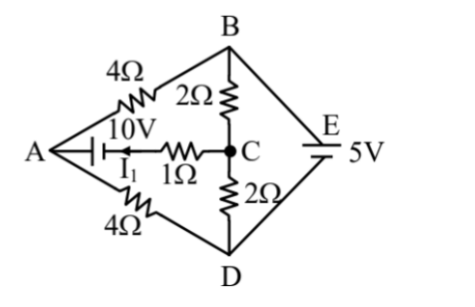
The current flowing through the 1 Ω resistor is n/10. The value of n is ........
Diagram:
View Solution
Let the potentials at points A, B, and C be x, y, and 0 respectively.
Applying Kirchhoff's Current Law (KCL) at node B:
(y - 5)/2 + y/2 + (y - x + 10)/1 = 0.
Simplify: 4y - 2x + 15 = 0 ........ (i).
Applying KCL at node A:
(x - 5)/4 + x/4 + (x - 10 - y)/1 = 0.
Simplify: 6x - 4y - 45 = 0 ........ (ii).
Solving equations (i) and (ii):
From (i): y = (2x - 15)/4.
Substitute in (ii): x = 7.5, y = 0.
Current through the 1 Ω resistor is:
i = (y - x + 10)/1 = (0 - 7.5 + 10) = 2.5 A.
Thus, i = n/10, so n = 25.
Question 61:
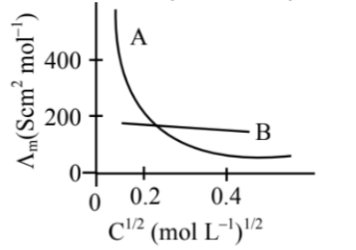
The molar conductivity for electrolytes A and B are plotted against √C. Electrolytes A and B respectively are:
Graph:
View Solution
The graph shows variation of molar conductivity (Λm) with √C:
1. Electrolyte A: Λm increases steeply as √C approaches 0, indicating it is a weak electrolyte.
2. Electrolyte B: Λm remains relatively constant with √C, indicating it is a strong electrolyte.
Thus, A is a weak electrolyte and B is a strong electrolyte.
Question 62:
Methods used for purification of organic compounds are based on:
View Solution
Purification methods depend on:
1. The nature of the compound (e.g., solubility, boiling/melting point).
2. The nature of the impurity (e.g., soluble or insoluble, volatile or non-volatile).
Examples: Crystallization for solubility differences, Distillation for boiling points, etc.
Question 63:
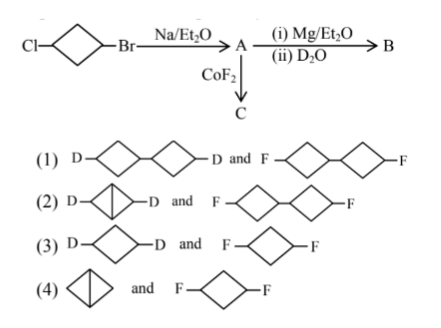
In the following sequence of reaction, the major products B and C respectively are:
Reaction:
View Solution
Wurtz Reaction: Sodium in dry ether couples alkyl halides to form symmetrical alkanes.
Grignard Reagent: Reacts with D2O to replace halide with deuterium.
Fluorination: CoF2 introduces fluorine atoms in place of hydrogen atoms.
Following these steps, the major products B and C are formed.
Question 64:
The correct order of basic strength of Pyrrole, Pyridine, and Piperidine is:
View Solution
Basicity depends on the availability of lone pairs on nitrogen:
1. Piperidine has an sp³-hybridized nitrogen with localized lone pairs, making it the strongest base.
2. Pyridine has sp²-hybridized nitrogen with localized lone pairs, making it moderately basic.
3. Pyrrole has sp²-hybridized nitrogen with delocalized lone pairs, making it the least basic.
Question 65:
In which one of the following pairs do the central atoms exhibit sp² hybridization?
View Solution
1. In BF₃, the central atom (boron) forms three sigma bonds with fluorine and has no lone pairs, resulting in sp² hybridization.
2. In NO₂⁻, the nitrogen atom has two sigma bonds and one lone pair, corresponding to sp² hybridization.
3. NH₂⁻ and H₂O have sp³-hybridized central atoms due to two lone pairs on nitrogen and oxygen, respectively.
Question 66:
The F⁻ ions make the enamel on teeth much harder by converting hydroxyapatite (the enamel on the surface of teeth) into much harder fluoroapatite having the formula:
View Solution
The F⁻ ions replace the OH⁻ ions in hydroxyapatite, forming fluoroapatite with a formula of [3(Ca₃(PO₄)₂ ⋅ CaF₂)].
Question 67:
The relative stability of the contributing structures is:
View Solution
The relative stability of contributing resonance structures is determined by factors such as charge distribution and octet rule satisfaction, with structure (I) being the most stable.
Question 68:
Given below are two statements:
• Statement (I): The oxidation state of an element in a particular compound is the charge acquired by its atom on the basis of electron gain enthalpy consideration from other atoms in the molecule.
• Statement (II): pπ–pπ bond formation is more prevalent in second-period elements over other periods.
In the light of the above statements, choose the most appropriate answer from the options given below:
View Solution
Statement I is incorrect as oxidation state is based on electron transfer or sharing, not on electron gain enthalpy. Statement II is correct as pπ–pπ bonding is more common in second-period elements due to their small size.
Question 69:
Given below are two statements: one is labelled as Assertion (A) and the other is labelled as Reason (R):
• Assertion (A): SN2 reaction of C₆H₅CH₂Br occurs more readily than the SN2 reaction of CH₃CH₂Br.
• Reason (R): The partially bonded unhybridized p-orbital that develops in the trigonal bipyramidal transition state is stabilized by conjugation with the phenyl ring.
In the light of the above statements, choose the most appropriate answer from the options given below:
View Solution
Both the assertion and reason are correct, and the conjugation with the phenyl ring in C₆H₅CH₂Br stabilizes the transition state, making the SN2 reaction more favorable.
Question 70:
For the given compounds, the correct order of increasing pKa value is:
View Solution
The pKa values are ordered based on the acidic strength of the compounds, with (B) having the lowest pKa and (E) the highest.
Question 71:
Assertion (A): Both rhombic and monoclinic sulphur exist as S8, while oxygen exists as O2.
Reason (R): Oxygen forms pπ–pπ multiple bonds with itself and other elements having small size and high electronegativity like C, N, which is not possible for sulphur.
In the light of the above statements, choose the most appropriate answer from the options given below:
View Solution
Sulphur cannot form pπ–pπ bonds like oxygen due to its larger size and lower electronegativity, but it still exists as S8.
Question 72:
Assertion (A): The total number of geometrical isomers shown by [Co(en)2Cl2]+ complex ion is three.
Reason (R): [Co(en)2Cl2]+ complex ion has an octahedral geometry.
In the light of the above statements, choose the most appropriate answer from the options given below:
View Solution
The total number of geometrical isomers is three, but the reason does not fully explain the number of isomers in the context of ligand arrangement.
Question 73:
The electronic configuration of Cu(II) is 3d9, whereas that of Cu(I) is 3d10. Which of the following is correct?
View Solution
Cu(II) is more stable due to its electronic configuration and the stabilizing effects of ligand field theory.
Question 74:
What is the structure of C?
View Solution
The structure of compound C is determined to be linear based on the bonding and hybridization of its atoms.
Question 75:
Compare the energies of the following sets of quantum numbers for a multielectron system:
(A) n = 4, l = 1
(B) n = 4, l = 2
(C) n = 3, l = 1
(D) n = 3, l = 2
(E) n = 4, l = 0
Choose the correct order of energies:
View Solution
The correct order is based on the energy levels of the orbitals, where lower values of n and l correspond to lower energy levels.
Question 76:
The correct order of basic strength of Pyrrole, Pyridine, and Piperidine is:
View Solution
Piperidine has the highest basicity due to the sp3 hybridized nitrogen. Pyridine has moderate basicity with sp2 hybridized nitrogen, and Pyrrole has the least basicity due to the delocalization of the lone pair in its aromatic structure.
Question 77:
The molar conductivity for electrolytes A and B are plotted against C1/2. Electrolytes A and B respectively are:
View Solution
Electrolyte A shows a significant variation in molar conductivity with concentration, indicating it is a weak electrolyte. Electrolyte B remains almost constant, indicating it is a strong electrolyte.
Question 78:
Methods used for purification of organic compounds are based on:
View Solution
Purification methods depend on the nature of the compound (e.g., solubility) and the nature of the impurity (e.g., volatile or non-volatile), such as crystallization, distillation, or chromatography.
Question 79:
In the following sequence of reactions, the major products B and C respectively are:
View Solution
The sequence involves a Wurtz reaction followed by the formation of a Grignard reagent, leading to products B and C.
Question 80:
The total number of species from the following in which one unpaired electron is present, is:
N2, O2, C−2, O−2, H+2, CN−, He+2
View Solution
Among the given species, O2, O−2, and He+2 each have one unpaired electron.
Question 81:
Number of ambidentate ligands among the following is:
NO−2, SCN−, C2O2−4, NH3, CN−, SO2−4, H2O
View Solution
Ambidentate ligands have more than one donor atom, such as SCN−, C2O2−4, and NO−2.
Question 82:
Total number of essential amino acids among the given list of amino acids is:
Arginine, Phenylalanine, Aspartic acid, Cysteine, Histidine, Valine, Proline
View Solution
Essential amino acids are those that cannot be synthesized by the body. In the given list, Arginine, Phenylalanine, Histidine, and Valine are essential.
Question 83:
Number of colourless lanthanoid ions among the following is:
Eu3+, Lu3+, Nd3+, La3+, Sm3+
View Solution
Colourless lanthanoid ions typically have a 3+ oxidation state, with Eu3+ and La3+ being colourless.
Question 84:
The correct order of increasing pKa value is:
View Solution
The pKa values are ordered based on the acidic strength of the compounds, with (B) having the lowest pKa and (E) the highest.
Question 85:
For the given compounds, the correct order of increasing stability of their resonance structures is:
View Solution
Resonance stability is determined by the distribution of charges, with structure (I) being the most stable due to complete octet satisfaction and charge delocalization.
Question 86:
The correct order of hybridization in the following molecules is:
NH3, H2O, BF3, and CO2
View Solution
The hybridization of NH3 and H2O is sp3, BF3 is sp2, and CO2 is sp. The order follows decreasing bond angles and hybridization.
Question 87:
The total number of species from the following in which one unpaired electron is present, is:
N2, O2, C-2, O-2, H+2, CN-, He+2
View Solution
Among the given species, O2, O-2, H+2, and He+2 each have one unpaired electron.
Question 88:
Number of ambidentate ligands among the following is:
NO-2, SCN-, C2O42-, NH3, CN-, SO42-, H2O
View Solution
Ambidentate ligands have more than one donor atom for bonding. Among the given ligands, NO-2, SCN-, and CN- are ambidentate.
Question 89:
Total number of essential amino acids among the given list of amino acids is:
Arginine, Phenylalanine, Aspartic acid, Cysteine, Histidine, Valine, Proline
View Solution
Essential amino acids are those that cannot be synthesized by the body. In the given list, Arginine, Phenylalanine, Histidine, and Valine are essential.
Question 90:
Number of colourless lanthanoid ions among the following is:
Eu3+, Lu3+, Nd3+, La3+, Sm3+
View Solution
Colourless lanthanoid ions typically have a 3+ oxidation state and no unpaired electrons. Eu3+ and La3+ are colourless.
Previous Year JEE Main Question Papers
*The article might have information for the previous academic years, please refer the official website of the exam.