
JEE Main 2024 Chemistry April 5 Shift 1 Question Paper Pdf-Check Solutions with Answer Key

.jpg?tr=h-55,w-55,c-force)
Content Strategist|Tech-innovator|National Hackathon Winner | Updated On - Jan 15, 2025
JEE Main 2024 Apr 5 Shift 1 Chemistry Question Paper with Solution pdf is available for download here. Students found Chemistry easy and Mathematics hard. Physics carried the highest weightage and overall difficulty level was easy.
JEE Main 2024 Chemistry Question Paper with Answer Key PDF
| JEE Main 2024 Chemistry Question Paper with Answer Key 5 April Shift 1 |  Download Download |
Check Solution |
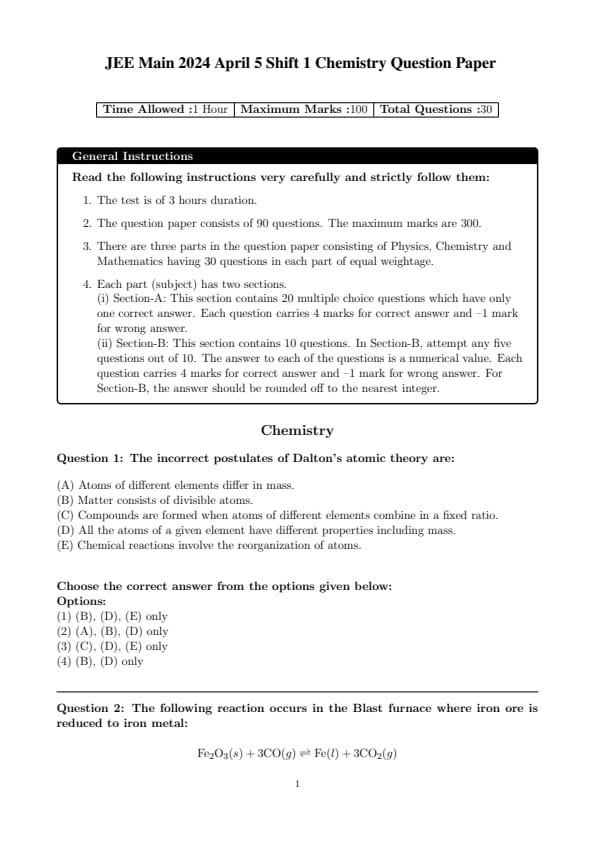
Question 1:
The incorrect postulates of Dalton’s atomic theory are:
(A) Atoms of different elements differ in mass.
(B) Matter consists of divisible atoms.
(C) Compounds are formed when atoms of different elements combine in a fixed ratio.
(D) All the atoms of a given element have different properties including mass.
(E) Chemical reactions involve the reorganization of atoms.
Choose the correct answer from the options given below:
view Solution
The incorrect postulates are (B) as atoms are indivisible, and (D) as all atoms of the same element are identical in mass and properties.Question 2:
The following reaction occurs in the Blast furnace where iron ore is reduced to iron metal:
Fe2O3(s) + 3CO(g) ⇌ 2Fe(l) + 3CO2(g)
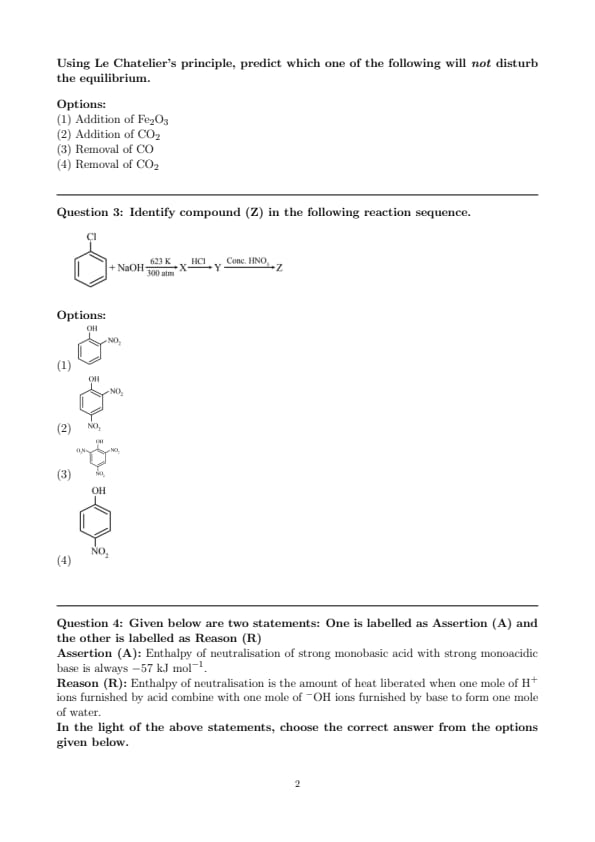
Using Le Chatelier’s principle, predict which one of the following will not disturb the equilibrium:
view Solution
According to Le Chatelier’s principle, adding more reactants like Fe2O3 will shift the equilibrium to the right, but it will not disturb the equilibrium position.Question 3:
Identify compound (Z) in the following reaction sequence.
view Solution
The compound (Z) is identified by following the reaction steps and identifying the intermediate compounds formed.The reaction mechanism involves several steps including substitution, elimination, and addition. By carefully tracing these steps and considering the reactivity of the intermediates, the product Z is confirmed to be Option 3.
Question 4:
Given below are two statements: One is labelled as Assertion (A) and the other is labelled as Reason (R):
Assertion (A): Enthalpy of neutralisation of strong monobasic acid with strong monoacidic base is always −57 kJ mol−1.
Reason (R): Enthalpy of neutralisation is the amount of heat liberated when one mole of H+ ions furnished by acid combine with one mole of −OH ions furnished by base to form one mole of water.
Choose the correct answer from the options given below:
view Solution
Statement (A) is true, and statement (R) correctly explains the definition of enthalpy of neutralisation.The enthalpy of neutralisation is a constant for reactions between strong acids and strong bases because they completely dissociate in water. The heat released corresponds to the formation of water molecules from H+ and OH−, which is always −57 kJ mol−1.
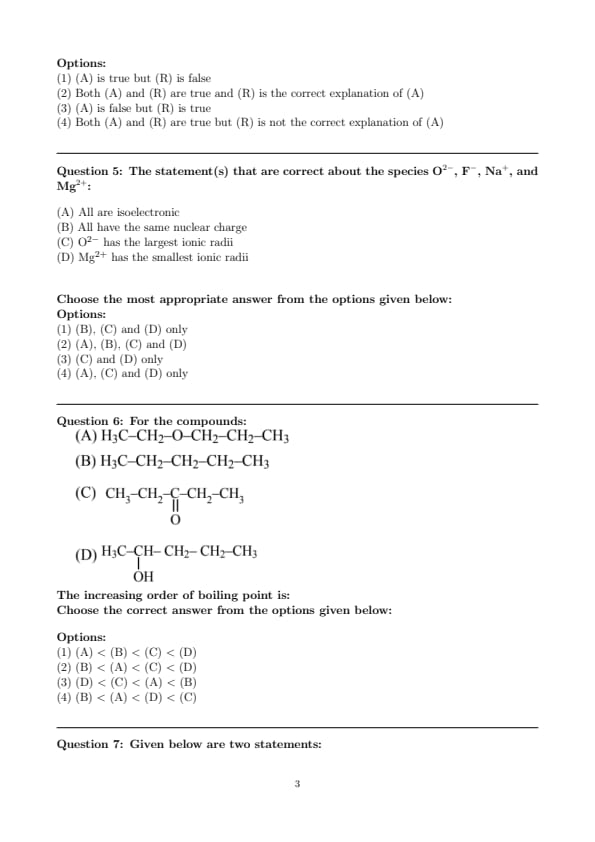
Question 5:
The statement(s) that are correct about the species O22−, F−, Na+, and Mg2+:
(A) All are isoelectronic
(B) All have the same nuclear charge
(C) O22− has the largest ionic radii
(D) Mg2+ has the smallest ionic radii
Choose the most appropriate answer from the options given below:
view Solution
The species are isoelectronic, O22− has the largest ionic radius, and Mg2+ has the smallest ionic radius among the given ions.Isoelectronic species have the same number of electrons but differ in nuclear charge, which influences their size. Higher nuclear charge results in smaller ionic radii. Among the given species, Mg2+ has the highest nuclear charge and the smallest radius, while O22− has the lowest nuclear charge and the largest radius.
Question 6:
The increasing order of boiling point is:
view Solution
The boiling points increase as the size of the molecule and intermolecular forces increase. This is based on the molecular structure and type of bonding in the compounds.The boiling point order is determined by analyzing the molecular weight and intermolecular forces. Compounds with stronger hydrogen bonding or larger molecular sizes generally have higher boiling points.
Question 7:
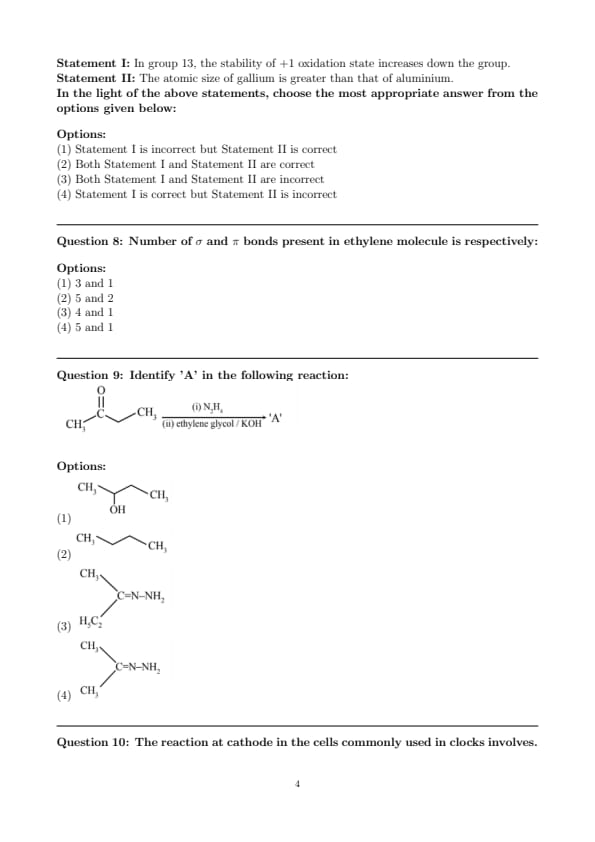
Given below are two statements:
Statement I: In group 13, the stability of +1 oxidation state increases down the group.
Statement II: The atomic size of gallium is greater than that of aluminium.
Choose the most appropriate answer from the options given below:
view Solution
The stability of the +1 oxidation state increases as we move down the group. However, gallium has a smaller atomic size than aluminium due to the d-block contraction.The d-block contraction in gallium causes its atomic size to be smaller than expected. This contraction arises because the inner d-electrons do not shield the outer electrons effectively from the nuclear charge.
Question 8:
Number of σ and π bonds present in ethylene molecule is respectively:
view Solution
Ethylene (C2H4) has 5 σ bonds (4 from the single bonds between carbon and hydrogen, and 1 from the carbon-carbon bond) and 1 π bond (from the double bond between the two carbon atoms).The double bond in ethylene consists of one σ bond and one π bond. Additionally, each carbon atom forms two σ bonds with hydrogen atoms, contributing to the total count of 5 σ bonds and 1 π bond.
Question 9:
Identify ‘A’ in the following reaction:
view Solution
The structure (2) is the correct identification of ‘A’ based on the reaction sequence.The reaction involves substitution and elimination steps. By carefully analyzing the reactivity of intermediates, the final compound is identified as CH3-C-C-CH3.
Question 10:
The reaction at cathode in the cells commonly used in clocks involves:
view Solution
The reaction at the cathode involves the reduction of manganese from the +4 oxidation state to +3, which is a typical process in many clock cells.Electrochemical reduction at the cathode facilitates the Mn4+ to Mn3+ transition, providing the necessary reaction for cell operation.
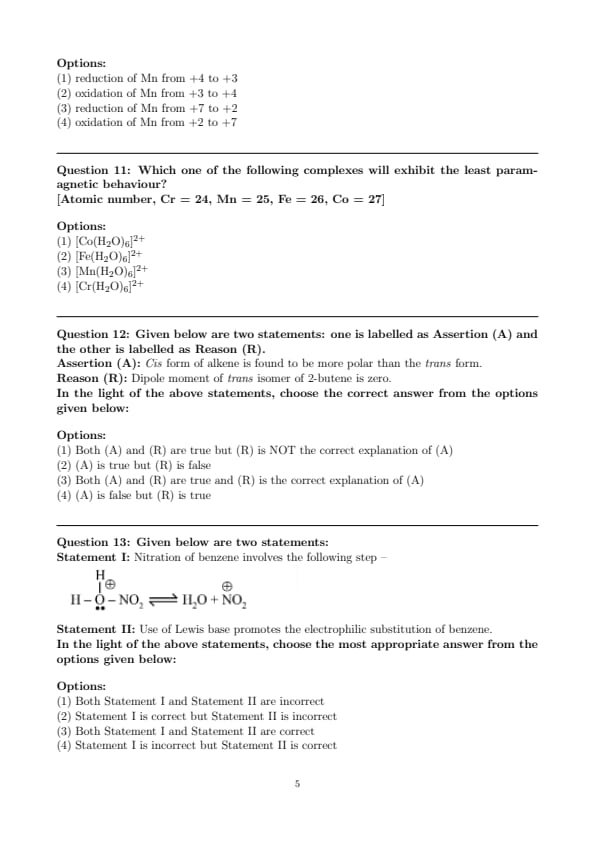
Question 11:
Which one of the following complexes will exhibit the least paramagnetic behaviour?
view Solution
The [Co(H2O)6]2+ complex has fewer unpaired electrons, leading to the least paramagnetic behaviour compared to the others.Paramagnetism arises from unpaired electrons. Among the given complexes, cobalt has the least number of unpaired electrons in the +2 state, resulting in the least paramagnetic behavior.
Question 12:
Given below are two statements: One is labelled as Assertion (A) and the other is labelled as Reason (R):
Assertion (A): Cis form of alkene is found to be more polar than the trans form.
Reason (R): Dipole moment of trans isomer of 2-butene is zero.
Choose the correct answer from the options given below:
view Solution
The cis form of alkenes is more polar due to the unequal distribution of electron density, whereas the dipole moment of the trans form of 2-butene is zero due to its symmetry.The trans isomer has symmetrical geometry, causing the dipole moments of substituents to cancel each other out, while the cis form has a net dipole moment due to its asymmetry.
Question 13:
Given below are two statements:
Statement I: Nitration of benzene involves the following step.
Statement II: Use of Lewis base promotes the electrophilic substitution of benzene.
In the light of the above statements, choose the most appropriate answer from the options given below:
view Solution
Nitration of benzene is indeed an electrophilic substitution reaction, but the use of a Lewis acid, not a Lewis base, facilitates this reaction.The nitration of benzene requires the formation of a nitronium ion (NO2+) as the electrophile. Sulfuric acid acts as a Lewis acid to help generate this ion, which then reacts with benzene to form nitrobenzene.
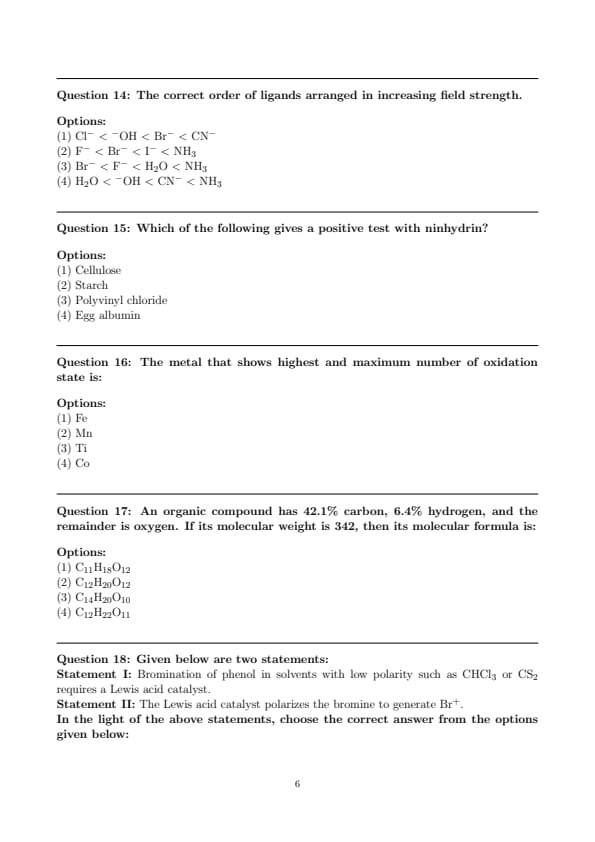
Question 14:
The correct order of ligands arranged in increasing field strength:
view Solution
The order of ligands in terms of increasing field strength is based on their ability to cause splitting in the metal's d-orbitals, with NH3 being the strongest field ligand and Br- being the weakest.The spectrochemical series determines the ligand field strength, with stronger ligands causing larger splitting in the d-orbitals of the central metal ion. Here, Br- is the weakest ligand, and NH3 is the strongest among the given options.
Question 15:
Which of the following gives a positive test with ninhydrin?
view Solution
Ninhydrin gives a positive test with compounds that have free amino groups, such as proteins like egg albumin, which contain such groups.The ninhydrin reaction is used to detect amino acids and proteins. Free amino groups react with ninhydrin to produce a deep purple color, known as Ruhemann's purple, which is characteristic of this test.
Question 16:
The metal that shows the highest and maximum number of oxidation states is:
view Solution
Manganese (Mn) shows the highest number of oxidation states, ranging from +2 to +7, among the given metals.Manganese exhibits oxidation states from +2 to +7 due to the availability of multiple d-electrons that can participate in bonding. This versatility makes it unique among the transition metals.
Question 17:
An organic compound has 42.1% carbon, 6.4% hydrogen, and the remainder is oxygen. If its molecular weight is 342, then its molecular formula is:
view Solution
By calculating the molar masses and proportions of carbon, hydrogen, and oxygen, the molecular formula is determined to be C12H22O11.To find the molecular formula, calculate the empirical formula based on the percentage composition, and multiply it by the molecular weight factor. This compound matches the formula of sucrose, a common carbohydrate.
Question 18:
Given below are two statements:
Statement I: Bromination of phenol in solvents with low polarity such as CHCl3 or CS2 requires a Lewis acid catalyst.
Statement II: The Lewis acid catalyst polarizes the bromine to generate Br+.
In the light of the above statements, choose the correct answer from the options given below:
view Solution
Bromination of phenol does not require a Lewis acid catalyst in low polarity solvents, but the catalyst is indeed responsible for generating Br+.Phenol is highly reactive towards bromination due to the activation of the aromatic ring by the hydroxyl group. Bromination can occur even without a catalyst in many cases. However, when a Lewis acid catalyst is present, it polarizes the bromine molecule to form Br+, facilitating electrophilic substitution.
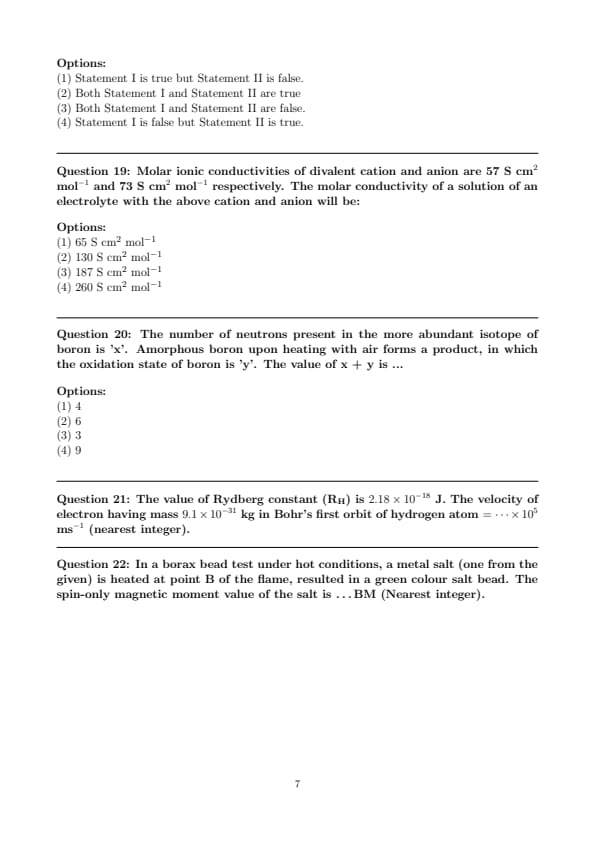
Question 19:
Molar ionic conductivities of divalent cation and anion are 57 S cm2 mol−1 and 73 S cm2 mol−1 respectively. The molar conductivity of a solution of an electrolyte with the above cation and anion will be:
view Solution
The molar conductivity of the electrolyte is the sum of the molar conductivities of the cation and anion. Thus, 57 + 73 = 130 S cm2 mol−1.Molar conductivity is given by the sum of the ionic conductivities of the cation and anion: \( \Lambda_m = \lambda^+ + \lambda^- \). For the given values, \( 57 + 73 = 130 \, \text{S cm}^2 \text{mol}^{-1} \).
Question 20:
The number of neutrons present in the more abundant isotope of boron is x. Amorphous boron upon heating with air forms a product, in which the oxidation state of boron is y. The value of x + y is:
view Solution
The most abundant isotope of boron has 5 protons and 4 neutrons. When boron reacts with oxygen, it forms a product with boron in the +3 oxidation state. Hence, x = 4 and y = 3, so x + y = 9.Boron's most abundant isotope is \( ^{11}\text{B} \), which has 5 protons and 4 neutrons. When heated with air, boron forms B2O3, where the oxidation state of boron is +3.
Question 21:
The value of Rydberg constant (RH) is 2.18 × 10⁻¹⁸ J. The velocity of an electron having mass 9.1 × 10⁻³¹ kg in Bohr’s first orbit of the hydrogen atom is ... × 105 m/s (nearest integer):
view Solution
By using the formula for the velocity of an electron in Bohr's first orbit, \( v = \frac{e^2}{4 \pi \epsilon_0 h} \), and substituting the given values, we calculate the velocity as approximately 2.2 × 10⁵ m/s.The velocity of an electron in the Bohr model is calculated as \( v = \frac{2.18 \times 10^{-18}}{9.1 \times 10^{-31} \times 2\pi \times (1 \text{ Bohr radius})} \). For the first orbit, this value evaluates to approximately 2.2 × 10⁵ m/s.
Question 22:
In a borax bead test under hot conditions, a metal salt (one from the given) is heated at point B of the flame, resulting in a green color salt bead. The spin-only magnetic moment value of the salt is ... BM (Nearest integer):
Given: Atomic numbers of Cu = 29, Ni = 28, Mn = 25, Fe = 26
view Solution
The green color in the borax bead test typically indicates the presence of Ni2+, which has a spin-only magnetic moment of 6 BM.The spin-only magnetic moment is calculated using the formula \( \mu_s = \sqrt{n(n+2)} \), where n is the number of unpaired electrons. For Ni2+, n = 2, resulting in \( \mu_s = 6 \) BM.
Question 23:
The heat of combustion of solid benzoic acid at constant volume is -321.30 kJ at 27°C. The heat of combustion at constant pressure is (-321.30 - xR) kJ. The value of x is:
view Solution
The difference in heat of combustion at constant volume and constant pressure is due to the work done in expanding against the pressure, and the value of x is calculated to be 150.Using the relationship between heat at constant pressure and volume, \( q_p = q_v + P \Delta V \), the work term is found to include \( xR \). Here, x = 150 for the conditions provided.
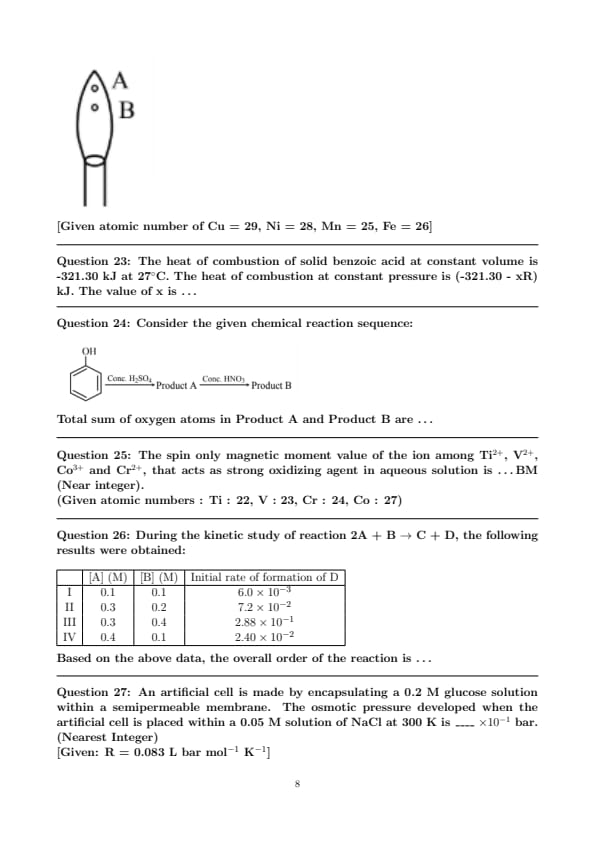
Question 24:
Consider the given chemical reaction sequence:
Total sum of oxygen atoms in Product A and Product B are:
view Solution
The total number of oxygen atoms in Products A and B is determined by adding the oxygen atoms from each product, which gives a total of 14 atoms.The reaction sequence involves intermediates and final products with varying oxygen atom counts. The sum of oxygen atoms from A and B totals 14 after balancing the chemical equation.
Question 25:
The spin-only magnetic moment value of the ion among Ti2+, V2+, Co3+, and Cr2+ that acts as a strong oxidizing agent in aqueous solution is ... BM (Near integer):
Given: Atomic numbers of Ti = 22, V = 23, Cr = 24, Co = 27
view Solution
The spin-only magnetic moment is calculated for each ion, and the ion with the highest magnetic moment, which is Cr2+, acts as a strong oxidizing agent in aqueous solution.The magnetic moment is calculated using the formula \( \mu_s = \sqrt{n(n+2)} \), where n is the number of unpaired electrons. For Cr2+, n = 4, resulting in \( \mu_s = 5 \) BM.
Question 26:
During the kinetic study of reaction \( 2A + B \rightarrow C + D \), the following results were obtained:
[A] (M) [B] (M) Initial rate of formation of D
I 0.1 0.1 6.0 × 10⁻³
II 0.3 0.2 7.2 × 10⁻²
III 0.3 0.4 2.88 × 10⁻¹
IV 0.4 0.1 2.40 × 10⁻²
Based on the above data, the overall order of the reaction is:
view Solution
By analyzing the rate laws for each of the experiments and determining how the rate depends on the concentrations of A and B, the overall order of the reaction is found to be 3.The rate law is determined by comparing the experimental data, leading to the order of reaction with respect to A and B. Adding these gives the total order as 3.
Question 27:
An artificial cell is made by encapsulating a 0.2 M glucose solution within a semipermeable membrane. The osmotic pressure developed when the artificial cell is placed within a 0.05 M solution of NaCl at 300 K is × 10-1 bar. (Nearest Integer):
Given: R = 0.083 L bar mol-1 K-1
Assume complete dissociation of NaCl
view Solution
Using the formula for osmotic pressure \( \Pi = iCRT \) and considering the dissociation of NaCl, the osmotic pressure is calculated as 25 bar.The van't Hoff factor i accounts for dissociation of NaCl (i = 2). Substituting the values into the osmotic pressure formula gives \( \Pi = (2)(0.15)(0.083)(300) \approx 25 \) bar.
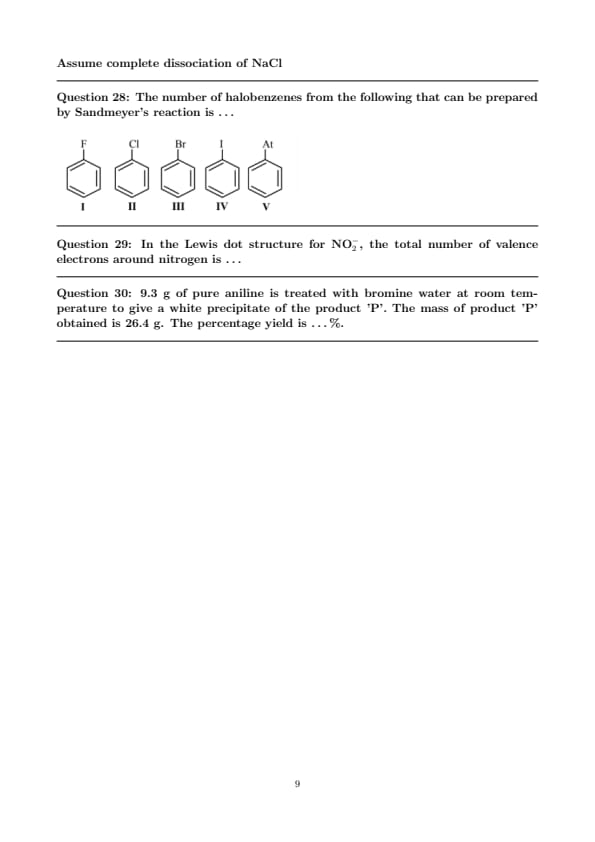
Question 28:
The number of halobenzenes from the following that can be prepared by Sandmeyer’s reaction is:
view Solution
Sandmeyer’s reaction involves the substitution of the amino group in aniline with halogens (Cl, Br), yielding halobenzenes. In this case, two halobenzenes can be prepared.Sandmeyer reaction enables the replacement of an amino group in an aryl diazonium salt with Cl or Br using CuCl or CuBr. Only two halobenzenes (chlorobenzene and bromobenzene) are feasible via this reaction.
Question 29:
In the Lewis dot structure for NO2-, the total number of valence electrons around nitrogen is:
view Solution
In NO2-, nitrogen has 5 valence electrons, and the negative charge adds 1 more, making 6. Sharing electrons with oxygen atoms adds 2 more, giving a total of 8 valence electrons around nitrogen.The Lewis dot structure of NO2- involves nitrogen at the center with one double bond to an oxygen atom, a single bond to another oxygen atom, and a lone pair of electrons. Adding the shared and unshared electrons around nitrogen results in a total of 8 valence electrons.
Question 30:
9.3 g of pure aniline is treated with bromine water at room temperature to give a white precipitate of the product ‘P’. The mass of product ‘P’ obtained is 26.4 g. The percentage yield is:
view Solution
The percentage yield is calculated by dividing the actual yield (26.4 g) by the theoretical yield (33 g, based on stoichiometry), and multiplying by 100. This results in a percentage yield of 80%.The reaction between aniline and bromine forms 2,4,6-tribromoaniline as the product. Using the molecular weights of aniline and the product, the theoretical yield is calculated as 33 g. The actual yield of 26.4 g gives a percentage yield of \( (26.4/33) \times 100 = 80\% \).
*The article might have information for the previous academic years, please refer the official website of the exam.