
JEE Main 2024 Question Paper with Answer Key PDF for Chemistry (April 6 - Shift 1)

.jpg?tr=h-55,w-55,c-force)
Content Strategist|Tech-innovator|National Hackathon Winner | Updated On - Jan 14, 2025
JEE Main 2024 Apr 6 Shift 1 Question Paper with Solution pdf is available for download here. Students found Chemistry easy and Mathematics hard. Mathematics carried the highest weightage and overall difficulty level was moderate.
JEE Main 2024 Chemistry Question Paper with Answer Key PDF
| JEE Main 2024 Chemistry Question Paper with Answer Key April 6 Shift 1 |  Download Download |
Check Solution |
JEE Main 2024 6 April Shift 1 Chemistry Questions with Solution
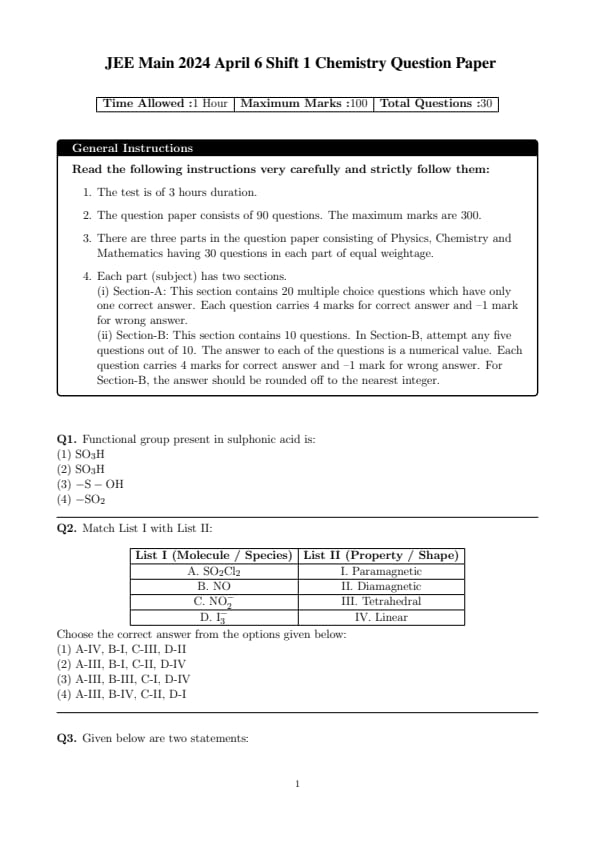
Question 1:
Functional group present in sulphonic acid is:
Solution: The sulphonic acid group is characterized by the functional group SO3H.
Read More
- The functional group in sulphonic acid consists of a sulfur atom double-bonded to two oxygen atoms and a hydroxyl group (-OH).
- This group is responsible for the acidic properties of sulphonic acids.
Question 2:
Match List I with List II:
| List I (Molecule / Species) | List II (Property / Shape) |
|---|---|
| A. SO2Cl2 | I. Paramagnetic |
| B. NO | II. Diamagnetic |
| C. NO2- | III. Tetrahedral |
| D. I3- | IV. Linear |
Choose the correct answer from the options given below:
Solution: Match the properties and shapes of the molecules and ions.
Read More
- A: SO2Cl2 is tetrahedral in shape (III).
- B: NO is paramagnetic due to an unpaired electron (I).
- C: NO2- is diamagnetic and has a bent shape (II).
- D: I3- is linear due to its molecular geometry (IV).
Question 3:
Given below are two statements:
- Statement I: Picric acid is 2,4,6-trinitrotoluene.
- Statement II: Phenol-2,4-disulphuric acid is treated with conc. HNO3 to get picric acid.
Choose the most appropriate answer from the options given below:
Solution: Picric acid is not trinitrotoluene; it is 2,4,6-trinitrophenol.
Read More
- Statement I is incorrect as picric acid is 2,4,6-trinitrophenol, not trinitrotoluene.
- Statement II is correct because phenol-2,4-disulphuric acid reacts with concentrated HNO3 to form picric acid.
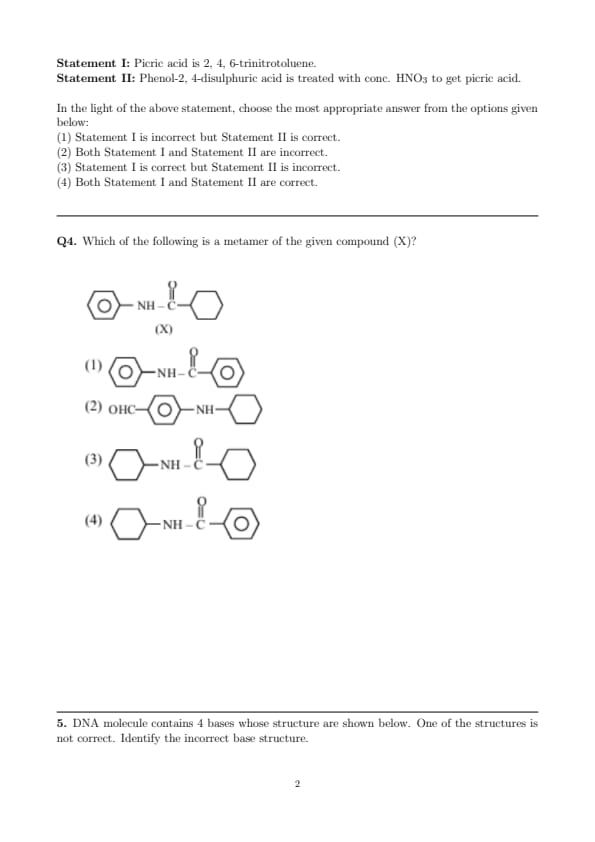
Question 4:
Which of the following is a metamer of the given compound (X)?
Solution: Metamers have the same molecular formula and functional group but differ in the alkyl groups on either side of the functional group.
Read More
- Analyze the alkyl groups around the functional group of the given compound.
- The correct metamer has a different arrangement of alkyl groups but retains the same molecular formula and functional group.
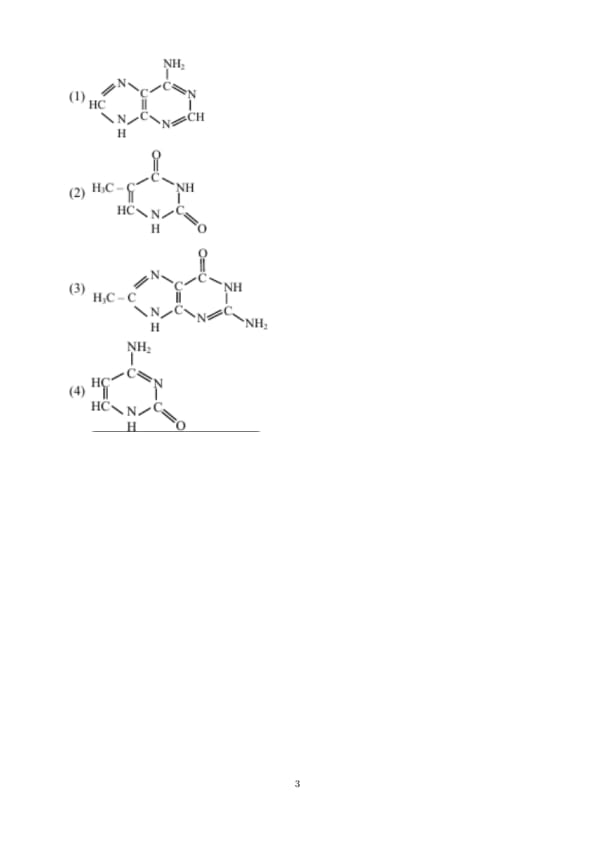
Question 5:
DNA molecule contains 4 bases whose structures are shown below. One of the structures is not correct. Identify the incorrect base structure.
Solution: DNA contains adenine, guanine, cytosine, and thymine. The incorrect structure does not match these bases.
Read More
- Examine the structure of the four bases.
- Adenine and guanine are purines, while cytosine and thymine are pyrimidines.
- The incorrect structure is one that does not correspond to any of these bases.
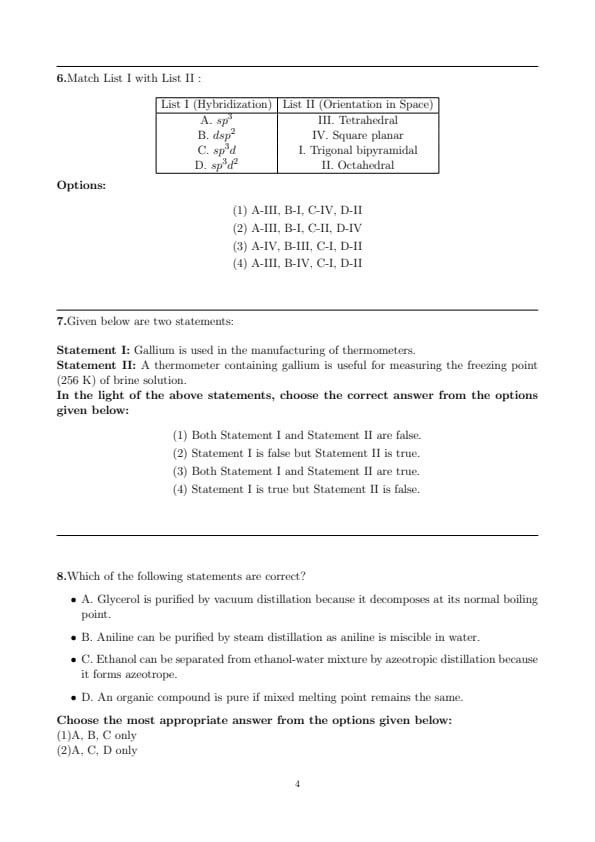
Question 6:
Match List I with List II:
| List I (Hybridization) | List II (Orientation in Space) |
|---|---|
| A. sp3 | III. Tetrahedral |
| B. dsp2 | IV. Square planar |
| C. sp3d | I. Trigonal bipyramidal |
| D. sp3d2 | II. Octahedral |
Choose the correct answer from the options below:
Solution: Match the hybridization with its spatial orientation.
Read More
- A (sp3): Tetrahedral structure with bond angles of approximately 109.5°.
- B (dsp2): Square planar geometry, seen in coordination complexes like [Ni(CN)4]2-.
- C (sp3d): Trigonal bipyramidal geometry with axial and equatorial positions.
- D (sp3d2): Octahedral geometry, typical for complexes like [SF6].
Question 7:
Given below are two statements:
- Statement I: Gallium is used in the manufacturing of thermometers.
- Statement II: A thermometer containing gallium is useful for measuring the freezing point (256 K) of brine solution.
Choose the correct answer from the options below:
Solution: Gallium thermometers are designed for high-temperature measurements and are unsuitable for freezing points like 256 K.
Read More
- Gallium's melting point is approximately 303 K, making it liquid at room temperature, ideal for high-temperature applications.
- However, it cannot be used to measure low temperatures like the freezing point of brine solution (256 K).
Question 8:
Which of the following statements are correct?
- A. Glycerol is purified by vacuum distillation because it decomposes at its normal boiling point.
- B. Aniline can be purified by steam distillation because it decomposes at its normal boiling point.
- C. Ethanol can be separated from ethanol-water mixture by azeotropic distillation because it forms azeotrope.
- D. An organic compound is pure if mixed melting point remains unchanged.
Choose the correct answer from the options below:
Solution: Statements A, C, and D are correct as per the properties of the compounds and methods of purification.
Read More
- A: Glycerol decomposes at its normal boiling point, hence vacuum distillation is used.
- C: Ethanol and water form an azeotrope, separated by azeotropic distillation.
- D: A pure organic compound retains its mixed melting point.
- B is incorrect as aniline is immiscible in water but does not decompose at its boiling point.
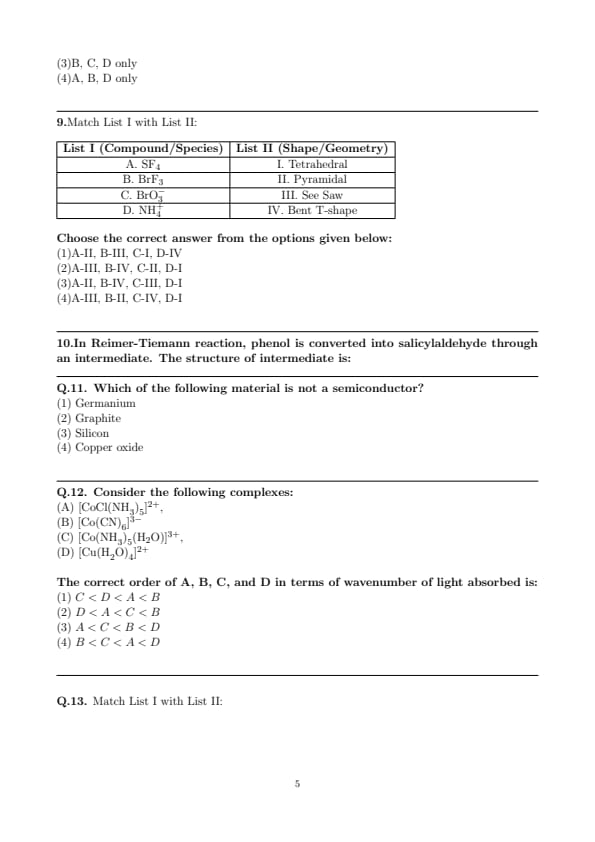
Question 9:
Match List I with List II:
| List I (Compound/Species) | List II (Shape/Geometry) |
|---|---|
| A. SF4 | III. See-saw |
| B. BrF3 | IV. Bent T-shape |
| C. BrO3- | II. Pyramidal |
| D. NH4+ | I. Tetrahedral |
Choose the correct answer from the options below:
Solution: Match the compounds with their shapes based on VSEPR theory.
Read More
- A: SF4: See-saw due to one lone pair.
- B: BrF3: T-shape (Bent) due to two lone pairs.
- C: BrO3-: Pyramidal due to one lone pair.
- D: NH4+: Tetrahedral as all valence electrons are bonded.
Question 10:
In Reimer-Tiemann reaction, phenol is converted into salicylaldehyde through an intermediate. The structure of the intermediate is:
Solution: The intermediate is the sodium salt of dichlorophenol, formed via the attack of dichlorocarbene (:CCl2) on phenol.
Read More
- The Reimer-Tiemann reaction introduces a -CHO group ortho to the phenolic group.
- The dichlorocarbene reacts with phenol to form the intermediate, which upon hydrolysis gives salicylaldehyde.
Question 11:
Which of the following material is not a semiconductor?
Solution: Graphite is a good conductor of electricity, not a semiconductor.
Read More
- Semiconductors like silicon and germanium have a specific band gap that allows them to conduct electricity under certain conditions.
- Graphite, on the other hand, conducts electricity due to its delocalized π-electrons and does not have a band gap like semiconductors.
Question 12:
Consider the following complexes:
- (A) [CoCl(NH3)5]2+
- (B) [Co(CN)6]3-
- (C) [Co(NH3)5(H2O)]3+
- (D) [Cu(H2O)4]2+
The correct order of A, B, C, and D in terms of wavenumber of light absorbed is:
Solution: The ligand field strength determines the wavenumber of absorption. Strong field ligands like CN- cause higher energy transitions.
Read More
- [CoCl(NH3)5]2+ has weaker field ligands compared to [Co(CN)6]3-, leading to a lower wavenumber absorption.
- [Cu(H2O)4]2+ has the weakest field ligands, hence the lowest wavenumber.
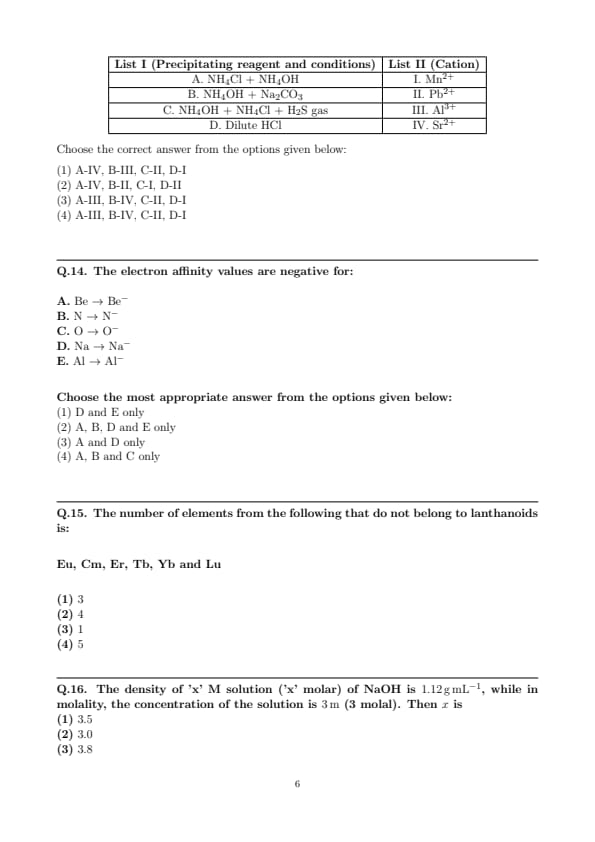
Question 13:
Match List I with List II:
| List I (Precipitating reagent and conditions) | List II (Cation) |
|---|---|
| A. NH4Cl + NH4OH | III. Al3+ |
| B. NH4OH + Na2CO3 | IV. Sr2+ |
| C. NH4OH + NH4Cl + H2S gas | II. Pb2+ |
| D. Dilute HCl | I. Mn2+ |
Choose the correct answer from the options below:
Solution: Match the reagents with the cations based on their precipitation reactions.
Read More
- A: NH4Cl + NH4OH precipitates Al(OH)3 (III).
- B: NH4OH + Na2CO3 precipitates SrCO3 (IV).
- C: NH4OH + NH4Cl + H2S precipitates PbS (II).
- D: Dilute HCl precipitates MnCl2 (I).
Question 14:
The electron affinity values are negative for:
- A. Be → Be-
- B. N → N-
- C. O → O-
- D. Na → Na-
- E. Al → Al-
Choose the most appropriate answer from the options below:
Solution: Electron affinity is negative for elements that do not readily accept an electron to form a stable anion.
Read More
- D: Sodium (Na) does not form a stable anion, leading to negative electron affinity.
- E: Aluminum (Al) has a similar property, resulting in a negative electron affinity.
Question 15:
The number of elements from the following that do not belong to lanthanoids is:
Eu, Cm, Er, Tb, Yb, and Lu
Solution: Cm (Curium) is an actinide, while the rest belong to the lanthanoid series.
Read More
- Lanthanoids include Eu, Er, Tb, Yb, and Lu.
- Cm (Curium) is an actinide and does not belong to the lanthanoid series.
Question 16:
The density of 'x' M solution ('x' molar) of NaOH is 1.12 g/mL, while in molality, the concentration of the solution is 3m (3 molal). Then x is:
Solution: The relationship between molarity and molality is used with the given density, resulting in x = 3.0 M.
Read More
Molarity (M) = (Molality × Density × 1000) / (1000 + (Molality × Molar Mass of Solute)). Substituting values, we find x = 3.0.
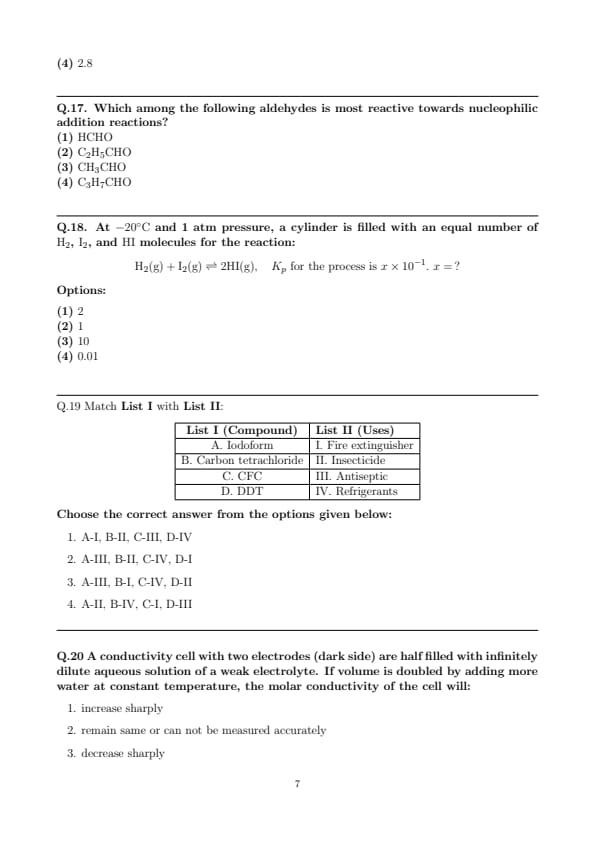
Question 17:
Which among the following aldehydes is most reactive towards nucleophilic addition reactions?
Solution: Formaldehyde (HCHO) is the most reactive due to the absence of alkyl groups, leading to reduced steric hindrance and a higher partial positive charge on the carbonyl carbon.
Read More
As alkyl groups increase, steric hindrance and electron donation to the carbonyl carbon reduce reactivity towards nucleophiles.
Question 18:
At −20°C and 1 atm pressure, a cylinder is filled with an equal number of H2, I2, and HI molecules for the reaction:
H2(g) + I2(g) ⇌ 2HI(g)
Kp for the process is x × 10−1. x =?
Solution: Using the equilibrium constant expression, Kp = (PHI)² / (PH2 × PI2), and substituting mole fractions, x = 10.
Read More
The partial pressures of the gases and the stoichiometry of the reaction allow for the calculation of Kp.
Question 19:
Match List I with List II:
| List I (Compound) | List II (Uses) |
|---|---|
| A. Iodoform | III. Antiseptic |
| B. Carbon tetrachloride | I. Fire extinguisher |
| C. CFC | IV. Refrigerants |
| D. DDT | II. Insecticide |
Choose the correct answer from the options below:
Solution: A-III: Iodoform is an antiseptic; B-I: Carbon tetrachloride is a fire extinguisher; C-IV: CFCs are refrigerants; D-II: DDT is an insecticide.
Read More
- Iodoform has antiseptic properties due to its iodine content.
- Carbon tetrachloride is a non-flammable liquid used in fire extinguishers.
- CFCs (chlorofluorocarbons) are widely used in refrigeration systems.
- DDT is an effective pesticide but is banned in many countries due to its environmental impact.
Question 20:
A conductivity cell with two electrodes (dark side) is half filled with an infinitely dilute aqueous solution of a weak electrolyte. If volume is doubled by adding more water at constant temperature, the molar conductivity of the cell will:
Solution: For infinitely dilute solutions, molar conductivity becomes constant, and further dilution does not change it.
Read More
At infinite dilution, ion interactions become negligible, and the limiting molar conductivity remains unaffected by additional water.
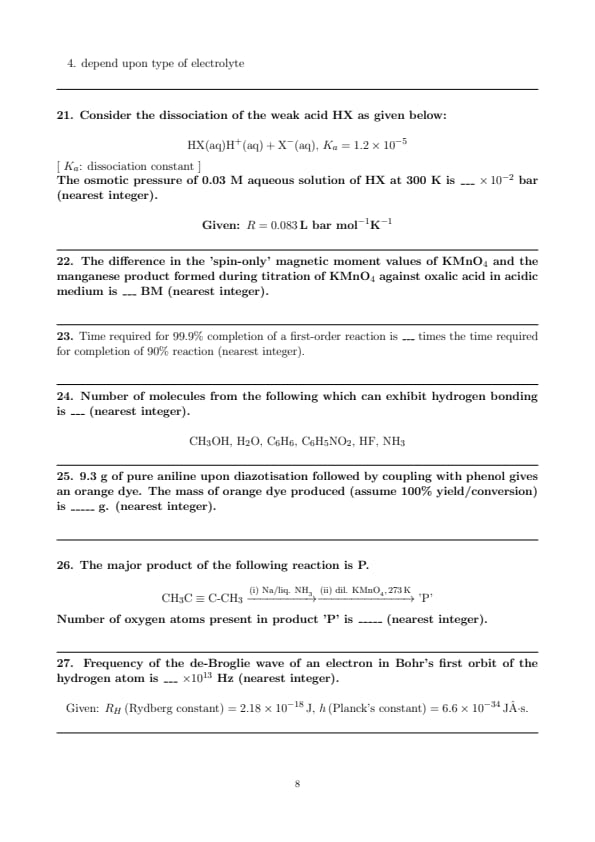
Question 21:
Consider the dissociation of the weak acid HX as given below:
HX(aq) ⇌ H+(aq) + X−(aq), Ka = 1.2×10⁻⁵
The osmotic pressure of 0.03 M aqueous solution of HX at 300 K is ___ ×10−2 bar (nearest integer).
Given: R = 0.083 L·bar·mol−1·K−1
Solution: The osmotic pressure is calculated using the formula:
Π = iCRT, where i is the van 't Hoff factor considering dissociation.
Read More
Considering the degree of dissociation and using the formula for i, the total concentration is adjusted to account for dissociation, leading to an osmotic pressure of approximately 76 × 10−2 bar.
Question 22:
The difference in the ‘spin-only’ magnetic moment values of KMnO4 and the manganese product formed during titration of KMnO4 against oxalic acid in acidic medium is ___ BM (nearest integer).
Solution: In KMnO4, Mn is in the +7 oxidation state (no unpaired electrons, μ = 0 BM). In the reduced product (Mn2+), there are 5 unpaired electrons, giving a spin-only magnetic moment of 6 BM.
Read More
The difference is due to the change in the oxidation state of Mn from +7 (KMnO4) to +2 (Mn2+), where the latter has unpaired electrons contributing to its magnetic moment.
Question 23:
Time required for 99.9% completion of a first-order reaction is ___ times the time required for completion of 90% reaction (nearest integer).
Solution: The time for a given percentage completion is proportional to ln(remaining concentration). For 99.9% completion:
t99.9% = (ln(1000) / ln(10)) × t90%, which simplifies to 3 times t90%.
Read More
The relationship is derived from the first-order reaction equation: t = (1/k) ln([A]0 / [A]).
Question 24:
Number of molecules from the following which can exhibit hydrogen bonding is ___ (nearest integer):
CH3OH, H2O, C6H6, C6H5NO2, HF, NH3
Solution: Hydrogen bonding is exhibited by CH3OH, H2O, HF, NH3, and C6H5NO2, due to the presence of N-H, O-H, or F-H bonds.
Read More
C6H6 (benzene) cannot form hydrogen bonds as it lacks the necessary functional groups for hydrogen bonding.
Question 25:
9.3 g of pure aniline upon diazotization followed by coupling with phenol gives an orange dye. The mass of orange dye produced (assume 100% yield/conversion) is _____ g (nearest integer).
Solution: The molecular weight of aniline is 93 g/mol. Given 9.3 g of aniline, this corresponds to 0.1 mol. Each mole of aniline produces 1 mole of dye, and the molecular weight of the dye is 200 g/mol, so:
Mass of dye = 0.1 × 200 = 20 g.
Read More
The reaction is a 1:1 stoichiometric conversion, ensuring all aniline converts to dye in 100% yield.
Question 26:
The major product of the following reaction is P:
CH3C≡C-CH3
(i) Na/liq. NH3 → (ii) dil. KMnO4, 273 K → P
The number of oxygen atoms present in product P is _____ (nearest integer).
Solution: The reaction produces a vicinal diol as the final product, with two hydroxyl groups attached to the adjacent carbon atoms, contributing two oxygen atoms.
Read More
Na in liquid NH3 reduces the alkyne to a trans-alkene, and KMnO4 hydroxylates the double bond, forming a vicinal diol.
Question 27:
The frequency of the de-Broglie wave of an electron in Bohr’s first orbit of the hydrogen atom is ___ ×1013 Hz (nearest integer).
Given: RH (Rydberg constant) = 2.18×10⁻¹⁸ J, h (Planck’s constant) = 6.6×10⁻³⁴ J·s.
Solution: The frequency is calculated using the relation ν = E/h, where E is the kinetic energy of the electron in the first orbit.
Read More
The energy of the first orbit is derived from E = RH, and substituting values gives ν ≈ 661 ×1013 Hz.
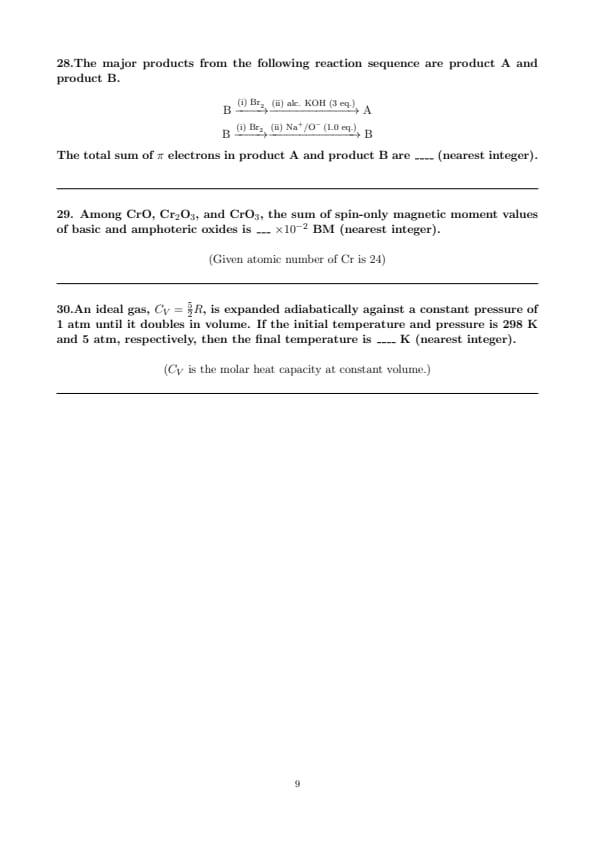
Question 28:
The major products from the following reaction sequence are product A and product B:
B (i) Br2 → (ii) alc. KOH (3 eq.) → A
B (i) Br2 → (ii) Na+/O− (1.0 eq.) → B
The total sum of π electrons in product A and product B are ____ (nearest integer).
Solution: Product A is benzene (6 π electrons), and product B is an alkene (2 π electrons). The total sum is 8 π electrons.
Read More
The reaction sequence involves dehydrohalogenation and elimination, leading to aromatic and alkenic structures as products.
Question 29:
Among CrO, Cr2O3, and CrO3, the sum of spin-only magnetic moment values of basic and amphoteric oxides is ___ ×10−2 BM (nearest integer).
Given: Atomic number of Cr is 24.
Solution: CrO (Cr2+) has 4 unpaired electrons, Cr2O3 (Cr3+) has 3 unpaired electrons, and CrO3 (Cr6+) has no unpaired electrons.
Read More
The spin-only magnetic moment is μ = √n(n + 2), where n is the number of unpaired electrons. Adding the moments for CrO and Cr2O3 gives 8.77 BM (or 877 ×10−2 BM).
Question 30:
An ideal gas, CV = 5/2 R, is expanded adiabatically against a constant pressure of 1 atm until it doubles in volume. If the initial temperature and pressure is 298 K and 5 atm, respectively, then the final temperature is ____ K (nearest integer).
Solution: Using the adiabatic relation PVγ = constant, where γ = CP/CV, the final temperature is calculated.
Read More
For γ = 1.4 (diatomic gas), the relationship T1V1γ−1 = T2V2γ−1 is applied, leading to T2 ≈ 274 K.
*The article might have information for the previous academic years, please refer the official website of the exam.