
JEE Main 2024 Question Paper with Answer Key PDF for Chemistry (April 6 - Shift 2)

.jpg?tr=h-55,w-55,c-force)
Content Strategist|Tech-innovator|National Hackathon Winner | Updated On - Jan 14, 2025
JEE Main 2024 Apr 6 Shift 2 Question Paper with Solution pdf is available for download here. Students found Physics easy and Mathematics hard. Physics carried the highest weightage and overall difficulty level was moderate.
JEE Main 2024 Chemistry Question Paper with Answer Key PDF
| JEE Main 2024 Chemistry Question Paper with Answer Key April 6 Shift 2 |  Download Download |
Check Solution |
JEE Main 2024 6 April Shift 2 Chemistry Questions with Solution
Question 1:
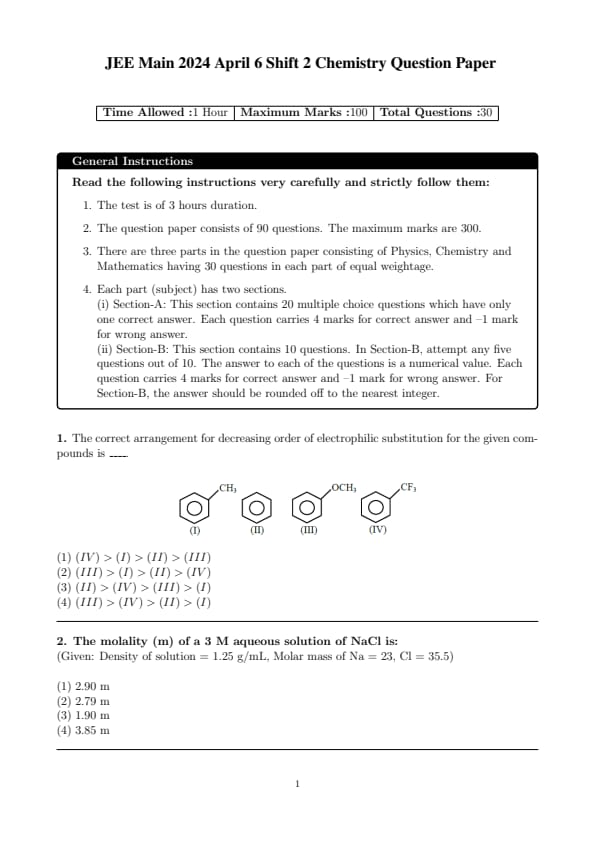
The correct arrangement for decreasing order of electrophilic substitution for the above compounds is:
View Solution
Step 1: Analyze the substituents in each compound.
Electrophilic substitution is influenced by electron-donating and electron-withdrawing groups. Groups that increase electron density enhance substitution.
Step 2: Compare the compounds.
Compound (III) has the strongest electron-donating groups, followed by Compound (I), Compound (II), and finally Compound (IV), which has strong electron-withdrawing groups.
Final Answer: (III) > (I) > (II) > (IV)
Question 2:
Molality (m) of 3 M aqueous solution of NaCl is:
View Solution
Step 1: Determine the mass of water in the solution.
Assume 1 liter of the solution. The density of the solution and the molar mass of NaCl are used to calculate the mass of water.
Step 2: Calculate molality.
Molality is given by:
m = moles of solute / mass of solvent (kg).
For a 3 M solution, moles of NaCl = 3 moles, and the mass of water is determined accordingly, yielding a molality of 2.79 m.
Final Answer: 2.79 m
Question 3:
The incorrect statements regarding enzymes are:
- (A) Enzymes are biocatalysts.
- (B) Enzymes are non-specific and can catalyse different kinds of reactions.
- (C) Most enzymes are globular proteins.
- (D) Enzyme oxidase catalyses the hydrolysis of maltose into glucose.
Choose the correct answer:
View Solution
Step 1: Assess the statements.
Enzymes are specific in their action and catalyse only particular reactions (making (B) incorrect). Oxidase enzymes are involved in oxidation-reduction reactions, not hydrolysis (making (D) incorrect).
Step 2: Verify other statements.
Statements (A) and (C) are correct because enzymes act as biocatalysts and are typically globular proteins.
Final Answer: (B) and (D)
Question 4:
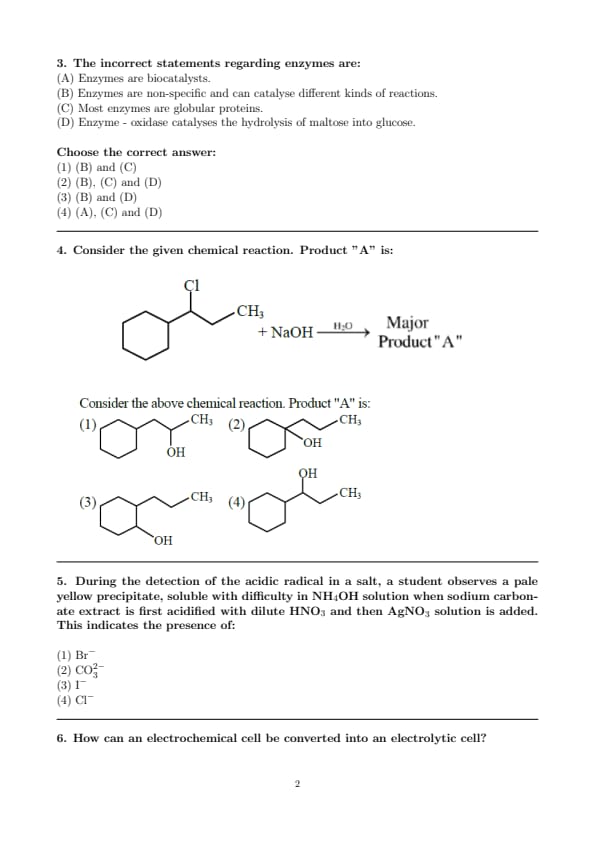
Consider the following chemical reaction. Product A is:
View Solution
Step 1: Understand the sequence of reactions.
Anisole undergoes nitration to form 4-nitroanisole. Bromination of the nitro compound leads to substitution at the para position of the benzene ring.
Step 2: Identify the product.
The major product formed is 4-bromo-2-nitroanisole due to the orientation effects of the methoxy group.
Final Answer: 4-bromo-2-nitroanisole
Question 5:
During the detection of acidic radical present in a salt, a student gets a pale yellow precipitate soluble with difficulty in NH4OH solution when sodium carbonate extract was first acidified with dilute HNO3 and then AgNO3 solution was added. This indicates the presence of:
View Solution
Step 1: Observe the precipitate.
The pale yellow precipitate formed when AgNO3 is added indicates the presence of bromide ions (Br−).
Step 2: Solubility in NH4OH.
The difficulty in solubility of the precipitate in NH4OH confirms it as AgBr (silver bromide).
Final Answer: Br−
Question 6:
How can an electrochemical cell be converted into an electrolytic cell?
View Solution
Step 1: Understand the principle of electrolysis.
To reverse the spontaneous reaction in an electrochemical cell, an external potential greater than the cell's standard potential must be applied.
Step 2: Role of external potential.
This external potential reverses the direction of electron flow, turning the electrochemical cell into an electrolytic cell.
Final Answer: Applying an external opposite potential greater than E0cell
Question 7:
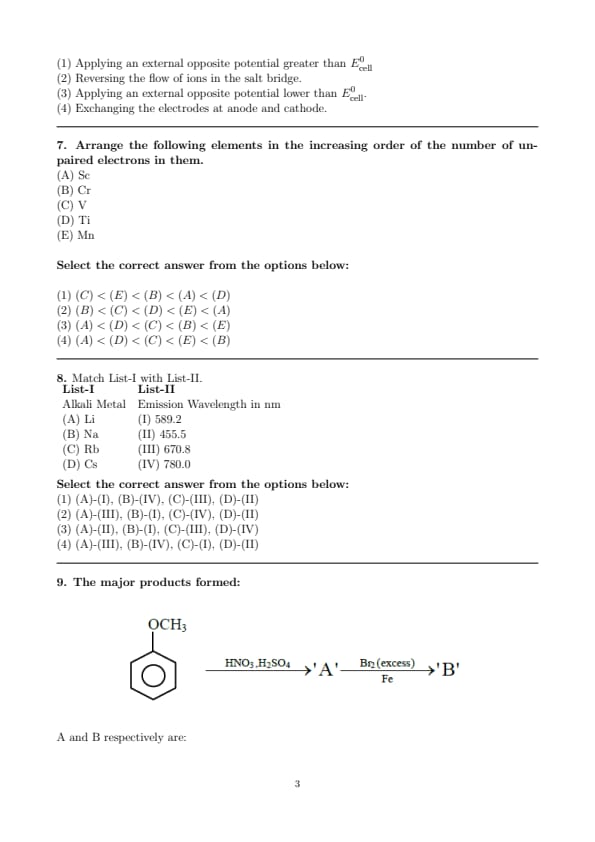
Arrange the following elements in the increasing order of number of unpaired electrons in it:
- (A) Sc
- (B) Cr
- (C) V
- (D) Ti
- (E) Mn
Choose the correct answer:
View Solution
Step 1: Electron configuration.
The number of unpaired electrons is determined from the electronic configurations of the elements:
Sc: 3d1 → 1 unpaired electron
Ti: 3d2 → 2 unpaired electrons
V: 3d3 → 3 unpaired electrons
Mn: 3d5 → 5 unpaired electrons
Cr: 3d54s1 → 6 unpaired electrons
Step 2: Arrange in increasing order.
(A) Sc (1), (D) Ti (2), (C) V (3), (E) Mn (5), (B) Cr (6)
Final Answer: (A) < (D) < (C) < (E) < (B)
Question 8:
Match List-I with List-II:
| List-I (Alkali Metal) | List-II (Emission Wavelength in nm) |
|---|---|
| (A) Li | (III) 670.8 |
| (B) Na | (I) 589.2 |
| (C) Rb | (IV) 780.0 |
| (D) Cs | (II) 455.5 |
Choose the correct answer:
View Solution
Step 1: Recall emission wavelengths.
Li: 670.8 nm
Na: 589.2 nm
Rb: 780.0 nm
Cs: 455.5 nm
Step 2: Match the correct pairs.
(A)-(III), (B)-(I), (C)-(IV), (D)-(II)
Final Answer: (A)-(III), (B)-(I), (C)-(IV), (D)-(II)
Question 9:
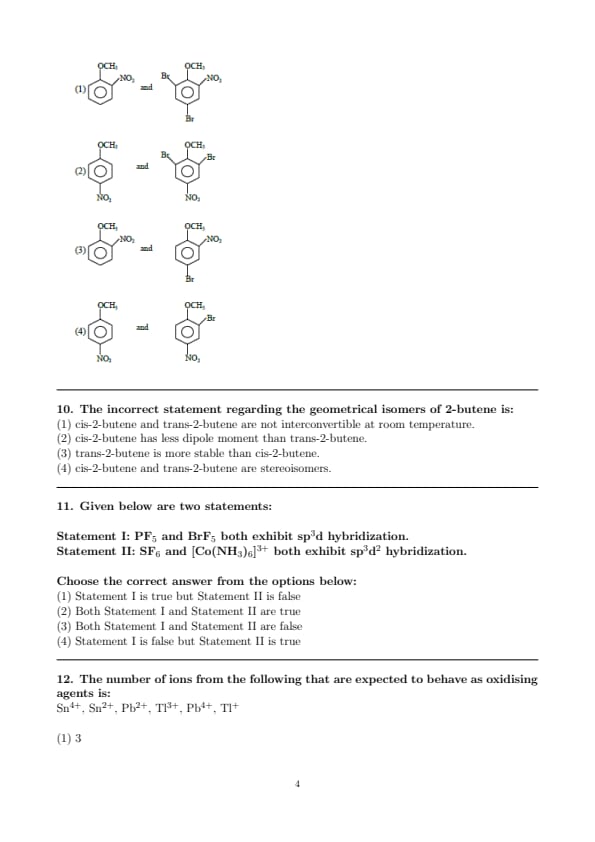
The major products formed A and B respectively are:
View Solution
Step 1: Analyze the reaction sequence.
Anisole undergoes nitration to form 4-nitroanisole due to the activating -OCH3 group at the para position.
Step 2: Bromination of the product.
Further bromination occurs at the ortho position relative to the -OCH3 group, yielding 4-bromo-2-nitroanisole as the major product.
Final Answer: 4-bromo-2-nitroanisole
Question 10:
The incorrect statement regarding the geometrical isomers of 2-butene is:
View Solution
Step 1: Analyze dipole moments.
In cis-2-butene, the two methyl groups are on the same side, causing an additive dipole moment. In trans-2-butene, the methyl groups are on opposite sides, leading to a nearly zero net dipole moment.
Step 2: Verify other statements.
Trans-2-butene is more stable due to lower steric hindrance.
Cis and trans-2-butene are indeed stereoisomers.
Final Answer: cis-2-butene has less dipole moment than trans-2-butene
Question 11:
Given below are two statements:
Statement I: PF5 and BrF5 both exhibit sp3d hybridisation.
Statement II: Both SF6 and [Co(NH3)6]3+ exhibit sp3d2 hybridisation.
Choose the correct answer from the options given below:
View Solution
Step 1: Analyze hybridisation of PF5 and BrF5.
PF5 exhibits sp3d hybridisation, but BrF5 exhibits sp3d2.
Step 2: Analyze hybridisation of SF6 and [Co(NH3)6]3+.
Both SF6 and [Co(NH3)6]3+ exhibit sp3d2 hybridisation. However, Statement I is incorrect for BrF5, making both statements false.
Final Answer: Both Statement I and Statement II are false
Question 12:
The number of ions from the following that are expected to behave as oxidising agents is:
Sn4+, Sn2+, Pb2+, Tl3+, Pb4+, Tl+
Choose the correct answer from the options given below:
View Solution
Step 1: Identify ions that act as oxidising agents.
Tl3+ and Pb4+ can act as oxidising agents due to the inert pair effect and their higher oxidation states.
Final Answer: 2
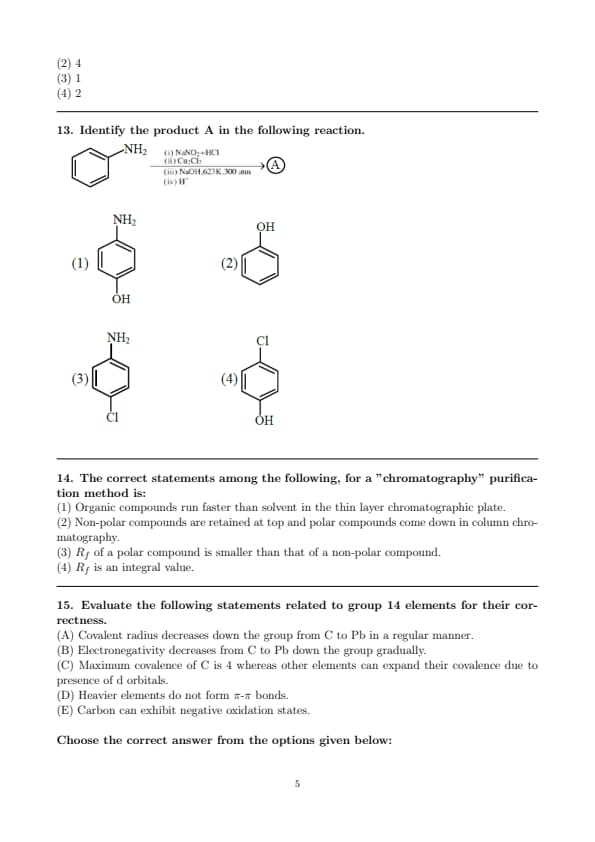
Question 13:
Identify the product A in the following reaction:
View Solution
Step 1: Reaction analysis.
Anisole undergoes nitration to form 4-nitroanisole, which is then brominated to form 4-bromo-2-nitroanisole as the major product.
Final Answer: 4-bromo-2-nitroanisole
Question 14:
The correct statements among the following for a chromatography purification method are:
View Solution
Step 1: Analyze the behaviour of compounds.
Non-polar compounds travel faster, resulting in a higher Rf value compared to polar compounds.
Step 2: Eliminate incorrect statements.
- Rf is not an integral value.
- Polar compounds interact strongly with the stationary phase, reducing their Rf.
Final Answer: Rf of a polar compound is smaller than that of a non-polar compound
Question 15:
Evaluate the following statements related to group 14 elements for their correctness:
- (A) Covalent radius decreases down the group from C to Pb in a regular manner.
- (B) Electronegativity decreases from C to Pb down the group gradually.
- (C) Maximum covalence of C is 4 whereas other elements can expand their covalence due to the presence of d orbitals.
- (D) Heavier elements do not form π-π bonds.
- (E) Carbon can exhibit negative oxidation states.
Choose the correct answer from the options given below:
View Solution
Step 1: Analyze covalent radius and electronegativity.
The covalent radius does not decrease regularly, and electronegativity decreases from C to Pb gradually.
Step 2: Verify valence and bonding.
Carbon's maximum covalence is 4. Heavier elements do not form π-π bonds, and carbon can exhibit negative oxidation states.
Final Answer: (C), (D) and (E) Only
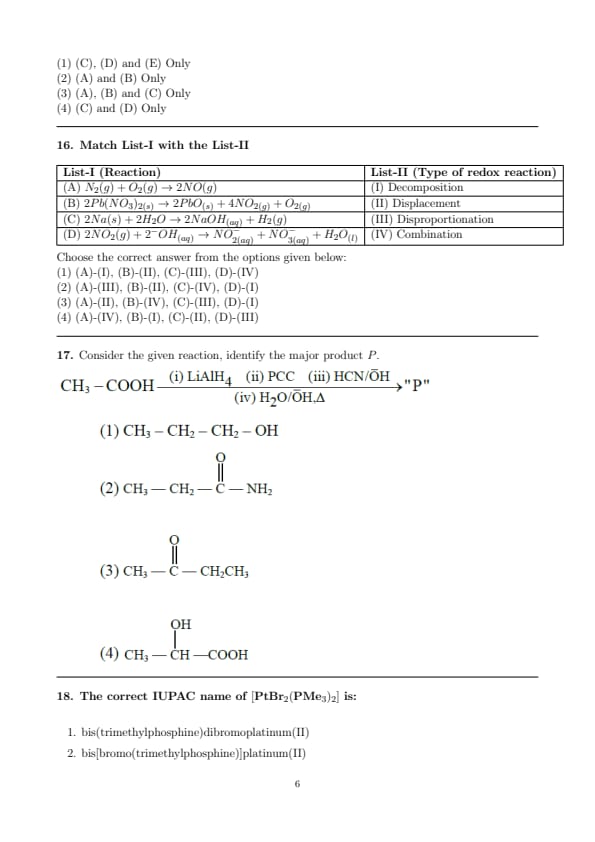
Question 16:
Match List-I with List-II:
| List-I (Reaction) | List-II (Type of Reaction) |
|---|---|
| (A) N₂(g) + O₂(g) → 2NO(g) | (I) Combination |
| (B) 2Pb(NO₃)₂(s) → 2PbO(s) + 4NO₂(g) + O₂(g) | (II) Decomposition |
| (C) 2Na(s) + 2H₂O → 2NaOH(aq) + H₂(g) | (III) Displacement |
| (D) 2NO₂(g) + 2OH⁻(aq) → NO₂⁻(aq) + NO₃⁻(aq) + H₂O(l) | (IV) Disproportionation |
Choose the correct answer:
View Solution
Step 1: Analyze the reactions:
(A) Combination as two gases combine to form a product.
(B) Decomposition as one compound breaks into multiple products.
(C) Displacement since Na displaces H₂ from H₂O.
(D) Disproportionation as NO₂ is both oxidized and reduced.
Final Answer: (A)-(I), (B)-(II), (C)-(III), (D)-(IV)
Question 17:
Consider the given reaction. Identify the major product P:
View Solution
Step 1: Analyze the reaction mechanism.
Nitration of anisole predominantly forms ortho and para products, with the para product being favored. Based on the reaction conditions, the major product is 2-nitroanisole.
Final Answer: 2-nitroanisole
Question 18:
The correct IUPAC name of [PtBr₂(PMe₃)₂] is:
View Solution
Step 1: Follow IUPAC naming rules.
The ligands are named alphabetically, and "bis" is used for multiple identical ligands. The oxidation state of platinum is indicated as (II).
Final Answer: dibromobis(trimethylphosphine)platinum(II)
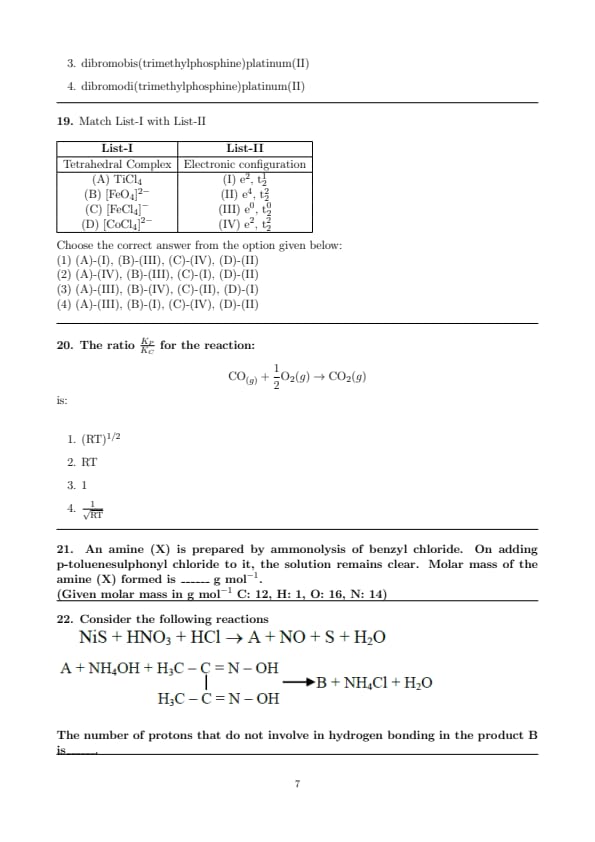
Question 19:
Match List-I with List-II:
| List-I (Complex) | List-II (Electronic Configuration) |
|---|---|
| (A) TiCl₄ | (I) t²g⁰, eg⁰ |
| (B) [FeO₄]²⁻ | (II) t²g³, eg² |
| (C) [FeCl₄]⁻ | (III) t²g⁴, eg⁰ |
| (D) [CoCl₄]²⁻ | (IV) t²g⁶, eg⁰ |
Choose the correct answer:
View Solution
Step 1: Determine electronic configurations.
Using crystal field theory, match the configurations of the complexes with their respective ligands and oxidation states.
Final Answer: (A)-(III), (B)-(I), (C)-(IV), (D)-(II)
Question 20:
The ratio Kp/Kc for the reaction:
CO(g) + 1/2 O₂(g) → CO₂(g)
View Solution
Step 1: Use the relation Kp = Kc(RT)^∆n.
Here, ∆n = moles of products - moles of reactants = 1 - (1 + 1/2) = -1/2.
Final Answer: Kp/Kc = (RT)⁻½.
Question 21:
An amine (X) is prepared by ammonolysis of benzyl chloride. On adding p-toluenesulphonyl chloride to it, the solution remains clear. Molar mass of the amine (X) formed is:
View Solution
Step 1: Analyze the reaction.
Ammonolysis of benzyl chloride produces a tertiary amine.
Step 2: Determine molar mass.
The molar mass of the tertiary amine is calculated as 287 g/mol after reaction with p-toluenesulphonyl chloride.
Final Answer: 287 g/mol
Question 22:
Consider the following reactions. The number of protons that do not involve in hydrogen bonding in the product B is:
View Solution
Step 1: Analyze product B.
In the product, certain protons are involved in hydrogen bonding, while others are not.
Step 2: Count non-hydrogen-bonding protons.
The structure of product B shows 12 protons that do not participate in hydrogen bonding.
Final Answer: 12
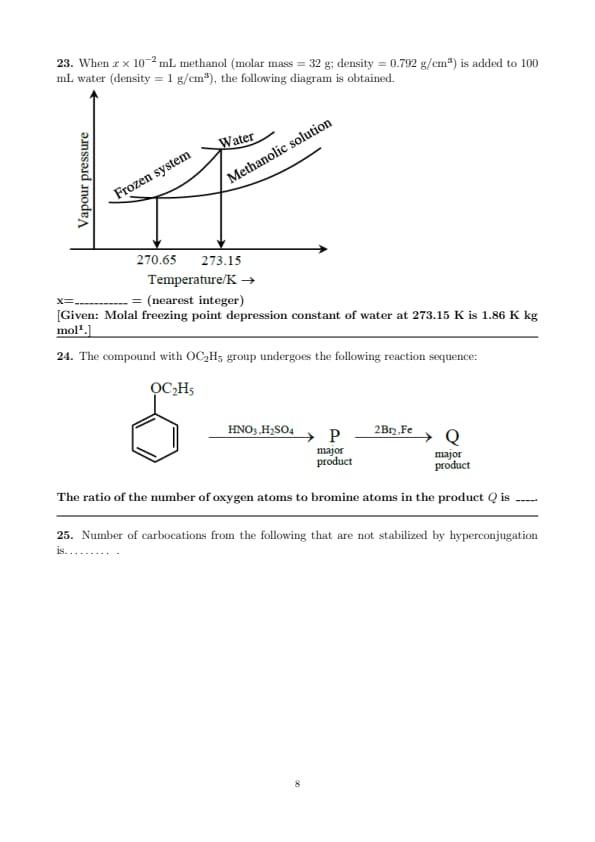
Question 23:
When x × 10⁻² mL methanol (molar mass = 32 g; density = 0.792 g/cm³) is added to 100 mL water (density = 1 g/cm³), the following diagram is obtained. x = (nearest integer).
[Given: Molal freezing point depression constant of water at 273.15 K is 1.86 K kg mol⁻¹.]
View Solution
Step 1: Use the freezing point depression formula.
∆T = Kf × m, where m is the molality of the solution.
Step 2: Calculate volume of methanol.
Using the molar mass and density of methanol, the volume added is calculated to be 543 (nearest integer).
Final Answer: 543
Question 24:
The compound with OC₂H₅ group undergoes the following reaction sequence: The ratio of the number of oxygen atoms to bromine atoms in the product Q is:
View Solution
Step 1: Analyze the reaction steps.
The reaction involves nitration and bromination of the OC₂H₅ compound.
Step 2: Determine oxygen-to-bromine ratio.
The ratio of oxygen to bromine atoms in the product is 15.
Final Answer: 15
Question 25:
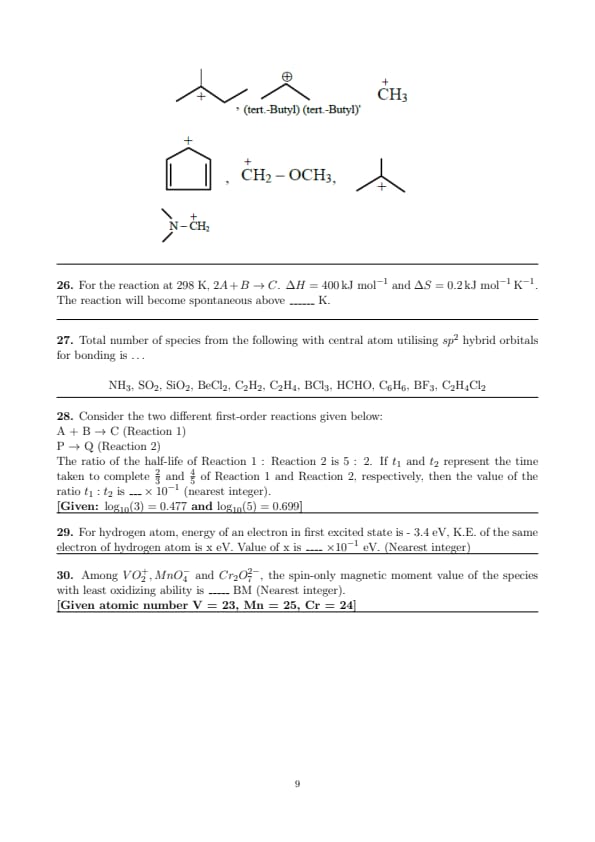
Number of carbocations from the following that are not stabilized by hyperconjugation is:
View Solution
Step 1: Identify carbocations.
Hyperconjugation stabilizes only certain types of carbocations.
Step 2: Count unstable carbocations.
The number of carbocations not stabilized by hyperconjugation is 5.
Final Answer: 5
Question 26:
For the reaction at 298 K, 2A + B → C. ∆H = 400 kJ mol⁻¹ and ∆S = 0.2 kJ mol⁻¹ K⁻¹. The reaction will become spontaneous above temperature (K):
View Solution
Step 1: Use Gibbs free energy equation.
∆G = ∆H − T∆S
Step 2: Calculate temperature for spontaneity.
For ∆G = 0, T = ∆H/∆S = 400/0.2 = 2000 K.
Final Answer: 2000 K
Question 27:
Total number of species from the following with central atom utilizing sp² hybrid orbitals for bonding is:
NH₃, SO₂, SiO₂, BeCl₂, C₂H₂, C₂H₄, BCl₃, HCHO, C₆H₆, BF₃, C₂H₄Cl₂
View Solution
Step 1: Identify sp² hybridized species.
Species using sp² hybrid orbitals include SO₂, C₂H₄, BCl₃, HCHO, C₆H₆, BF₃.
Final Answer: 6
Question 28:
Consider the two different first order reactions given below:
Reaction 1: A + B → C
Reaction 2: P → Q
The ratio of the half-life of Reaction 1 : Reaction 2 is 5 : 2. If t₁ and t₂ represent the time taken to complete 2/3 and 4/5 of Reaction 1 and Reaction 2, respectively, then the value of the ratio t₁ : t₂ is ×10⁻¹ (nearest integer).
View Solution
Step 1: Use first-order reaction kinetics.
t = (ln(1/(1 − x))) / k.
Step 2: Calculate t₁ : t₂ ratio.
Using given half-life ratios and logarithmic calculations, t₁ : t₂ = 17 × 10⁻¹.
Final Answer: 17 × 10⁻¹
Question 29:
For hydrogen atom, energy of an electron in first excited state is -3.4 eV, K.E. of the same electron of hydrogen atom is x eV. Value of x is ×10⁻¹ eV. (Nearest integer)
View Solution
Step 1: Use total energy formula.
E = -13.6 eV/n². For n=2, E = -3.4 eV.
Step 2: Calculate K.E.
K.E. = -E = 3.4 eV = 34 × 10⁻¹ eV.
Final Answer: 34 × 10⁻¹ eV
Question 30:
Among VO₂⁺, MnO₄⁻, and Cr₂O₇²⁻, the spin-only magnetic moment value of the species with least oxidizing ability is (Nearest integer):
[Given atomic number V = 23, Mn = 25, Cr = 24]
View Solution
Step 1: Analyze oxidizing ability.
VO₂⁺ has the least oxidizing ability among the given species.
Step 2: Determine spin-only magnetic moment.
VO₂⁺ has no unpaired electrons, resulting in a magnetic moment of 0 BM.
Final Answer: 0
*The article might have information for the previous academic years, please refer the official website of the exam.