
JEE Main 2024 Question Paper with Answer Key PDF for Chemistry (April 8 - Shift 1)

.jpg?tr=h-55,w-55,c-force)
Content Strategist|Tech-innovator|National Hackathon Winner | Updated On - Jan 6, 2025
JEE Main 2024 Apr 8 Shift 1 Question Paper with Solution pdf is available for download here. Students found Physics easy and Chemistry hard. Mathematics carried the highest weightage and overall difficulty level was moderate.
JEE Main 2024 8 April Shift 1 Chemistry Question Paper with Solution PDF
| JEE Main 2024 Chemistry Question Paper with Solution 8 April Shift 1 |  Download Download |
Check Solution |
JEE Main 2024 8 April Shift 1 Chemistry Questions with Solutions
Question 1:
Given below are two statements:
- Statement I:
![]()
IUPAC name of Compound A is 4-chloro-1,3-dinitrobenzene. - Statement II:
![]()
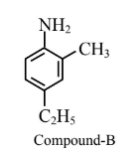
IUPAC name of Compound B is 4-ethyl-2-methylaniline.

Options:
- Both Statement I and Statement II are correct.
- Statement I is incorrect but Statement II is correct.
- Statement I is correct but Statement II is incorrect.
- Both Statement I and Statement II are incorrect.
View Solution
Solution:
1. Analysis of Statement I:
The structure of Compound A has chlorine (Cl) at position 1 and nitro (NO2) groups at positions 2 and 4. The correct IUPAC name is 1-chloro-2,4-dinitrobenzene. Therefore, Statement I is incorrect.
2. Analysis of Statement II:
The structure of Compound B has an ethyl group (-C2H5) at position 4 and a methyl group (-CH3) at position 2. The amino group (-NH2) is given priority. The correct IUPAC name is 4-ethyl-2-methylaniline. Therefore, Statement II is correct.
3. Conclusion:
Statement I is incorrect, and Statement II is correct.
Question 2:
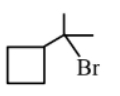
Which among the following compounds will undergo the fastest SN2 reaction?
Options:


View Solution
Solution:
1. Understanding SN2 Reaction Rates:
The rate of SN2 reactions is influenced by steric hindrance. The reactivity order for alkyl halides is:
Methyl halide > 1° alkyl halide > 2° alkyl halide > 3° alkyl halide.
2. Analysis of the Compounds:
Compound (1) is a tertiary alkyl halide with the highest steric hindrance, resulting in the slowest SN2 reaction.
Compound (2) is a secondary alkyl halide.
Compound (3) is a primary alkyl halide, undergoing the fastest SN2 reaction due to minimal steric hindrance.
Compound (4) is also a secondary alkyl halide, slower than primary alkyl halides.
3. Conclusion:
The fastest SN2 reaction occurs for Compound (3), a primary alkyl halide.
Question 3:
Combustion of glucose (C6H12O6) produces CO2 and water. The amount of oxygen (in g) required for the complete combustion of 900 g of glucose is:
[Molar mass of glucose in g mol-1 = 180]
- 480
- 960
- 800
- 32
View Solution
Solution:
1. Combustion Reaction:
The balanced equation for the combustion of glucose is:
C6H12O6 + 6O2 → 6CO2 + 6H2O.
2. Moles of Glucose:
Given mass of glucose = 900 g, molar mass of glucose = 180 g mol-1:
Moles of glucose = Mass / Molar mass = 900 / 180 = 5 mol.
3. Moles of Oxygen Required:
From the balanced reaction:
1 mol of glucose reacts with 6 mol of oxygen.
Therefore, 5 mol of glucose reacts with 5 × 6 = 30 mol of oxygen.
4. Mass of Oxygen:
Molar mass of oxygen (O2) = 32 g mol-1:
Mass of oxygen = Moles × Molar mass = 30 × 32 = 960 g.
5. Conclusion:
The amount of oxygen required is 960 g.
Question 4:
Identify the major products A and B respectively in the following set of reactions: 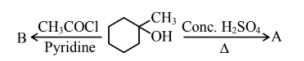
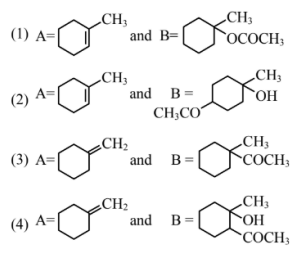
Options:

View Solution
Solution:
Step 1: Formation of Compound B (Acetylation):
The reaction of CH3COCl with alcohol (CH3OH) in the presence of pyridine results in the acetylation of the hydroxyl group:
CH3OH + CH3COCl → CH3OCOCH3 (Compound B).
Step 2: Formation of Compound A (Dehydration):
Treatment of Compound B with concentrated H2SO4 at elevated temperature leads to an E1 elimination reaction, resulting in the formation of an alkene:
CH3OCOCH3 → CH2=CH-CH3 (Compound A).
Conclusion:
Compound A is CH2=CH-CH3, and Compound B is CH3OCOCH3.
Question 5:
Given below are two statements: One is labelled as Assertion (A) and the other is labelled as Reason (R):
- Assertion (A): The stability order of +1 oxidation state of Ga, In, and Tl is:
Ga < In < Tl. - Reason (R): The inert pair effect stabilizes the lower oxidation state down the group.
Options:
- Both A and R are true and R is the correct explanation of A.
- A is true but R is false.
- Both A and R are true but R is NOT the correct explanation of A.
- A is false but R is true.
View Solution
Solution:
1. Understanding Assertion (A):
In group 13 elements (Ga, In, Tl), the stability of the +1 oxidation state increases down the group due to the inert pair effect. The order is Ga < In < Tl, so Assertion (A) is true.
2. Understanding Reason (R):
The inert pair effect refers to the reluctance of the s-electrons to participate in bonding as we move down the group in the periodic table. This effect stabilizes the lower oxidation state (e.g., +1 in group 13 elements). Hence, Reason (R) is true.
3. Link between A and R:
The inert pair effect directly explains why the +1 oxidation state becomes more stable down the group. Therefore, R is the correct explanation of A.
Question 6:
Match List-I with List-II:
| List-I (Name of the Test) | List-II (Reaction Sequence Involved) |
|---|---|
| A. Borax bead test | I. MCO3 → MO + Co(NO3)2 → CoO·MO |
| B. Charcoal cavity test | II. MCO3 → MCl2 → M2+ |
| C. Cobalt nitrate test | III. MSO4 + Na2B4O7 → M(BO2)2 → MBO2 |
| D. Flame test | IV. MSO4 + Na2CO3 → MCO3 → MO |
Options:
- A-III, B-I, C-IV, D-II
- A-III, B-II, C-IV, D-I
- A-III, B-I, C-II, D-IV
- A-III, B-IV, C-I, D-II
View Solution
Solution:
1. Matching the Tests with Their Reaction Sequences:
- Borax bead test: Reaction involves formation of MBO2 complexes. Matches with III.
- Charcoal cavity test: Reaction sequence involves MCO3 → MCl2 → M2+. Matches with IV.
- Cobalt nitrate test: Reaction involves MCO3 → MO + Co(NO3)2. Matches with I.
- Flame test: Reaction involves MSO4 + Na2CO3 → MCO3 → MO. Matches with II.
2. Correct Matching:
- A-III
- B-IV
- C-I
- D-II
Question 7:
Match List-I with List-II:
| List-I (Molecule) | List-II (Shape) |
|---|---|
| A. NH3 | I. Square pyramid |
| B. BrF5 | II. Tetrahedral |
| C. PCl5 | III. Trigonal pyramid |
| D. CH4 | IV. Trigonal bipyramidal |
Options:
- A-IV, B-III, C-I, D-II
- A-II, B-IV, C-I, D-III
- A-III, B-I, C-IV, D-II
- A-III, B-IV, C-I, D-II
View Solution
Solution:
1. Shape Analysis:
- A. NH3: Ammonia has a trigonal pyramidal shape due to one lone pair on nitrogen. This matches with III.
- B. BrF5: Bromine pentafluoride has a square pyramidal shape due to five bond pairs and one lone pair on bromine. This matches with I.
- C. PCl5: Phosphorus pentachloride has a trigonal bipyramidal shape because it has no lone pairs on phosphorus. This matches with IV.
- D. CH4: Methane has a tetrahedral shape due to four bond pairs and no lone pairs on carbon. This matches with II.
2. Correct Matching:
- A-III
- B-I
- C-IV
- D-II
3. Conclusion: The correct answer is:
3 (A-III, B-I, C-IV, D-II)
Question 8:
For the given hypothetical reactions, the equilibrium constants are as follows:
- X ↔ Y; K1 = 1.0
- Y ↔ Z; K2 = 2.0
- Z ↔ W; K3 = 4.0
The equilibrium constant for the reaction X ↔ W is:
Options:
- 6.0
- 12.0
- 8.0
- 7.0
View Solution
Solution:
1. Equilibrium Constants and Reaction Mechanisms: When reactions are added, their equilibrium constants are multiplied to find the overall equilibrium constant.
2. Add the Reactions:
X ↔ Y
Y ↔ Z
Z ↔ W
______________
X ↔ W
3. Multiply the Equilibrium Constants:
K = K1 × K2 × K3
K = 1.0 × 2.0 × 4.0 = 8.0
4. Conclusion: The equilibrium constant for the reaction X ↔ W is 8.0, corresponding to option (3).
Question 9:
Thiosulphate reacts differently with iodine and bromine in the reactions given below:
- 2S2O32- + I2 → S4O62- + 2I-
- S2O32- + 5Br2 + 5H2O → 2SO42- + 4Br- + 10H+
Which of the following statements justifies the above dual behaviour of thiosulphate?
Options:
- Bromine undergoes oxidation and iodine undergoes reduction in these reactions.
- Thiosulphate undergoes oxidation by bromine and reduction by iodine in these reactions.
- Bromine is a stronger oxidant than iodine.
- Bromine is a weaker oxidant than iodine.
View Solution
Solution:
1. Analyze the Reactions:
- Reaction with Iodine: Iodine reduces to I-, while thiosulphate is oxidized to S4O62-.
- Reaction with Bromine: Bromine reduces to Br-, while thiosulphate is oxidized to SO42-. Bromine oxidizes sulfur to a higher oxidation state than iodine.
2. Identify the Stronger Oxidant: Bromine causes a greater oxidation of sulfur compared to iodine, indicating that bromine is the stronger oxidizing agent.
3. Evaluate the Options:
- Option (1): Incorrect. Both halogens are reduced in these reactions.
- Option (2): Incorrect. Thiosulphate is oxidized in both reactions.
- Option (3): Correct. Bromine is a stronger oxidizing agent than iodine.
- Option (4): Incorrect. The opposite is true.
Question 10:
An octahedral complex with the formula CoCl3n(NH3) upon reaction with excess AgNO3 solution gives 2 moles of AgCl. Consider the oxidation state of Co in the complex is x. The value of x + n is:
Options:
- 3
- 6
- 8
- 5
View Solution
Solution:
1. Reaction with AgNO3: The reaction with AgNO3 produces 2 moles of AgCl, which means there are 2 ionizable Cl- ions outside the coordination sphere. The remaining chloride ions are part of the coordination sphere.
The complex can be represented as [Co(NH3)yCln-2]Cl2, where y is the number of NH3 ligands.
2. Octahedral Complex: In an octahedral complex, the total number of ligands around the central metal is 6. Therefore:
y + (n - 2) = 6
y = 8 - n
3. Oxidation State of Co:
The oxidation state of Co (x) is determined by balancing the charges. Let the charge on Co be x. NH3 is neutral, and Cl has a charge of -1:
x + 0 × (8 - n) + (-1) × (n - 2) = +2
x - n + 2 = +2
x = n
4. Calculate x + n:
Since x = n, and there are 2 ionizable Cl- ions, n = 4. Therefore:
x + n = 4 + 4 = 8
5. Conclusion: The value of x + n is 8.
Question 11:

The incorrect statement regarding the given structure is:
Options:
- Can be oxidized to a dicarboxylic acid with Br2 water
- Despite the presence of –CHO does not give Schiff's test
- Has 4 asymmetric carbon atoms
- Will coexist in equilibrium with 2 other cyclic structures
View Solution
Solution:
1. Statement (1): Bromine water is a mild oxidizing agent that oxidizes the aldehyde group (-CHO) in glucose to a carboxylic acid (-COOH), forming gluconic acid. However, bromine water cannot oxidize the terminal –CH2OH group. To form a dicarboxylic acid, a stronger oxidizing agent like HNO3 is required. Hence, this statement is incorrect.
2. Statement (2): Glucose exists predominantly in its cyclic hemiacetal form, and the open-chain form containing the aldehyde group is present in small amounts. Schiff's test does not detect the hemiacetal form, so this statement is correct.
3. Statement (3): Glucose has 4 chiral carbons in its structure, making this statement correct.
4. Statement (4): Glucose exists in equilibrium between its open-chain form and two cyclic forms (α and β anomers). This statement is correct.
Conclusion: The incorrect statement is (1).
Question 12:
In the given compound, the number of 2° carbon atom/s is:

Options:
- Three
- One
- Two
- Four
View Solution
Solution:
1. Types of Carbon Atoms:
- Primary (1°): Carbon bonded to one other carbon atom.
- Secondary (2°): Carbon bonded to two other carbon atoms.
- Tertiary (3°): Carbon bonded to three other carbon atoms.
2. Analyze the Structure:
In the given compound, only one carbon is bonded to two other carbon atoms, making it a secondary carbon (2°).
3. Conclusion: The compound has 1 secondary (2°) carbon atom, corresponding to option (2).
Question 13:
Which of the following are aromatic?

Options:
- B and D only
- A and C only
- A and B only
- C and D only
View Solution
Solution:
1. Criteria for Aromaticity:
- Cyclic: Must form a closed ring.
- Planar: All atoms in the ring must be coplanar.
- Conjugated: Must have a continuous system of overlapping p-orbitals.
- Huckel's Rule: Must have (4n + 2) π electrons, where n is a non-negative integer.
2. Analyze Each Structure:
- A: Naphthalene is aromatic (cyclic, planar, conjugated, 10 π electrons).
- B: Benzene is aromatic (cyclic, planar, conjugated, 6 π electrons).
- C: Biphenyl is non-planar due to steric hindrance between rings. Not aromatic.
- D: Cyclopentadienyl anion is aromatic (cyclic, planar, conjugated, 6 π electrons).
3. Conclusion: B and D are aromatic. The correct option is (1).
Question 14:
Among the following halogens (F2, Cl2, Br2, and I2), which can undergo disproportionation reaction?
Options:
- Only I2
- Cl2, Br2, and I2
- F2, Cl2, and Br2
- F2 and Cl2
View Solution
Solution:
1. Disproportionation Reaction: A redox reaction where the same element is both oxidized and reduced.
2. Halogens:
- F2: Cannot disproportionate as it is the most electronegative element and cannot be oxidized further.
- Cl2, Br2, I2: Can exhibit multiple oxidation states and undergo disproportionation. Examples:
- Cl2 + 2NaOH → NaCl + NaClO + H2O
- Br2 + 2NaOH → NaBr + NaBrO + H2O
- I2 + 2NaOH → NaI + NaIO + H2O
3. Conclusion: Cl2, Br2, and I2 can undergo disproportionation. The correct option is (2).
Question 15:
Given below are two statements:
- Statement I: N(CH3)3 and P(CH3)3 can act as ligands to form transition metal complexes.
- Statement II: As N and P are from the same group, the nature of bonding of N(CH3)3 and P(CH3)3 is always the same with transition metals.
Options:
- Statement I is incorrect but Statement II is correct
- Both Statement I and Statement II are correct
- Statement I is correct but Statement II is incorrect
- Both Statement I and Statement II are incorrect
View Solution
Solution:
1. Statement I:
N(CH3)3 and P(CH3)3 have lone pairs on nitrogen and phosphorus atoms, respectively, which can coordinate with transition metals to form complexes. Statement I is correct.
2. Statement II:
While N(CH3)3 is a σ-donor ligand, P(CH3)3 can act as both a σ-donor and a π-acceptor due to the availability of d-orbitals. This makes their bonding nature different. Statement II is incorrect.
3. Conclusion: Statement I is correct, but Statement II is incorrect. The correct option is (3).
Question 16:
Match List I with List II:
| List-I (Elements) | List-II (Properties in their respective groups) |
|---|---|
| A. Cl, S | I. Elements with highest electronegativity |
| B. Ge, As | II. Elements with largest atomic size |
| C. Fr, Ra | III. Elements which show properties of both metals and non-metals |
| D. F, O | IV. Elements with highest negative electron gain enthalpy |
Options:
- A-II, B-III, C-IV, D-I
- A-III, B-II, C-I, D-IV
- A-IV, B-III, C-II, D-I
- A-II, B-I, C-IV, D-III
View Solution
Solution:
A. Cl, S: These elements have high negative electron gain enthalpy within their groups. Chlorine has the highest in Group 17. Correct match: IV.
B. Ge, As: These are metalloids and exhibit properties of both metals and non-metals. Correct match: III.
C. Fr, Ra: These are the largest elements in Groups 1 and 2, respectively. Correct match: II.
D. F, O: Fluorine has the highest electronegativity in the periodic table, and oxygen is also highly electronegative. Correct match: I.
Conclusion: The correct matches are A-IV, B-III, C-II, D-I, corresponding to option (3).
Question 17:
Iron(III) catalyses the reaction between iodide and persulphate ions. Which of the following are correct?
Statements:
- A. Fe³⁺ oxidises the iodide ion.
- B. Fe³⁺ oxidises the persulphate ion.
- C. Fe²⁺ reduces the iodide ion.
- D. Fe²⁺ reduces the persulphate ion.
Options:
- B and C only
- B only
- A only
- A and D only
View Solution
Solution:
1. Step 1: Fe³⁺ oxidises iodide (I⁻) to iodine (I₂):
2Fe³⁺ + 2I⁻ → 2Fe²⁺ + I₂
Step 2: Fe²⁺ reduces persulphate (S₂O₈²⁻) to sulfate (SO₄²⁻):
2Fe²⁺ + S₂O₈²⁻ → 2Fe³⁺ + 2SO₄²⁻
Conclusion: A is true because Fe³⁺ oxidises iodide. D is true because Fe²⁺ reduces persulphate. The correct option is (4).
Question 18:
Match List I with List II:
| List-I (Compound) | List-II (Colour) |
|---|---|
| A. Fe₄[Fe(CN)₆]₃·xH₂O | I. Violet |
| B. [Fe(CN)₅NOS]⁴⁻ | II. Blood Red |
| C. [Fe(SCN)]²⁺ | III. Prussian Blue |
| D. (NH₄)₃PO₄·12MoO₃ | IV. Yellow |
Options:
- A-III, B-I, C-II, D-IV
- A-IV, B-I, C-II, D-III
- A-II, B-III, C-IV, D-I
- A-I, B-II, C-III, D-IV
View Solution
Solution:
A. Fe₄[Fe(CN)₆]₃·xH₂O: This is Prussian Blue. Correct match: III.
B. [Fe(CN)₅NOS]⁴⁻: This is sodium nitroprusside, which forms a violet complex. Correct match: I.
C. [Fe(SCN)]²⁺: This forms a blood red complex. Correct match: II.
D. (NH₄)₃PO₄·12MoO₃: This is ammonium phosphomolybdate, a yellow precipitate. Correct match: IV.
Conclusion: The correct matches are A-III, B-I, C-II, D-IV, corresponding to option (1).
Question 19:
Number of complexes with an even number of electrons in t2g orbitals is:
[Fe(H2O)6]²⁺, [Co(H2O)6]²⁺, [Co(H2O)6]³⁺, [Cu(H2O)6]²⁺, [Cr(H2O)6]²⁺
Options:
- 1
- 3
- 2
- 5
View Solution
Solution:
1. Crystal Field Theory and t2g Orbitals:
In octahedral complexes, the d-orbitals split into t2g (lower energy) and eg (higher energy) orbitals. Water is a weak field ligand, so electrons follow Hund's rule in high-spin configurations.
2. Electronic Configurations and t2g Electrons:
- [Fe(H2O)6]²⁺: Fe²⁺ is d⁶. In high spin, t2g contains 4 electrons (even).
- [Co(H2O)6]²⁺: Co²⁺ is d⁷. t2g contains 5 electrons (odd).
- [Co(H2O)6]³⁺: Co³⁺ is d⁶. t2g contains 4 electrons (even).
- [Cu(H2O)6]²⁺: Cu²⁺ is d⁹. t2g contains 6 electrons (even).
- [Cr(H2O)6]²⁺: Cr²⁺ is d⁴. t2g contains 3 electrons (odd).
3. Count Complexes with Even t2g Electrons:
Three complexes have even t2g electrons: [Fe(H2O)6]²⁺, [Co(H2O)6]³⁺, and [Cu(H2O)6]²⁺.
Conclusion: The correct answer is (2).
Question 20:
Identify the product (P) in the following reaction: 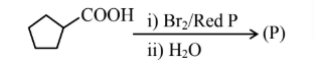
Options:
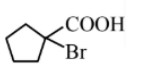
1. 
2. 
3. 
4. 

View Solution
Solution:
1. HVZ (Hell-Volhard-Zelinsky) Reaction:
The HVZ reaction involves halogenation at the α-carbon of carboxylic acids. Red phosphorus (Red P) catalyzes the formation of acyl bromide, which reacts with bromine to undergo α-bromination.
2. Reaction Steps:


- Step 1: Formation of Acyl Bromide:
- Step 2: α-Bromination:
- Step 3: Hydrolysis:
Conclusion: The product is Option (1).
Question 21:
A hypothetical electromagnetic wave is shown below. The frequency of the wave is x × 1019 Hz. x = ... (nearest integer)

Correct Answer: (5)
View Solution
Solution:
1. Wavelength from the Diagram:
The diagram shows one full cycle of the wave as 1.5 pm. Thus, the wavelength (λ) is:
λ = 1.5 × 10⁻¹² m.
2. Frequency-Wavelength Relation:
The relationship between the frequency (f) and wavelength (λ) is:
c = fλ, where c is the speed of light (3 × 10⁸ m/s).
f = c / λ
3. Calculate the Frequency:
f = (3 × 10⁸) / (1.5 × 10⁻¹²)
f = 2 × 10²⁰ Hz.
However, the diagram indicates that a full cycle includes crest and trough, so λ = 3 pm = 3 × 10-12 m:
f = (3 × 10⁸) / (3 × 10-12)
f = 1 × 10²⁰ Hz or x = 5.
4. Conclusion:
The value of x is 5.
Question 22:
1 mol of an ideal gas is kept in a cylinder, fitted with a piston, at position A, at 18°C. If the piston is moved to position B, keeping the temperature unchanged, then 'x' L atm work is done in this reversible process. x = ... L atm. (nearest integer)

Correct Answer: (55)
View Solution
Solution:
1. Work for Isothermal Reversible Expansion:
The formula for work in an isothermal process is:
w = -nRT ln(Vf / Vi).
2. Given Values:
n = 1 mol
R = 0.08206 L atm mol-1 K-1
T = 18 + 273.15 = 291.15 K
Vi = 10 L, Vf = 100 L
3. Calculate Work:
w = -(1)(0.08206)(291.15) ln(100 / 10)
w = -23.883 × ln(10)
ln(10) ≈ 2.303
w = -23.883 × 2.303 = -55.018 L atm
4. Conclusion:
Work done (x) = 55 L atm.
Question 23:
Number of amine compounds from the following giving solids which are soluble in NaOH upon reaction with Hinsberg's reagent is … 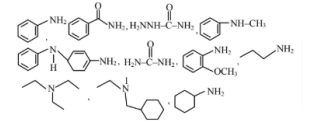
Correct Answer: (5)
View Solution
Solution:
1. Hinsberg's Test:
- Primary amines form sulfonamides soluble in NaOH.
- Secondary amines form insoluble sulfonamides.
- Tertiary amines do not react with Hinsberg's reagent.
2. Analyze the Compounds:
- Aniline (C₆H₅NH₂): Primary amine; soluble in NaOH.
- Cyclohexylamine: Primary amine; soluble in NaOH.
- Methylamine: Primary amine; soluble in NaOH.
- Dimethylamine: Secondary amine; insoluble in NaOH.
- Triethylamine: Tertiary amine; no reaction.
3. Count Soluble Compounds:
Five primary amines are soluble in NaOH after reacting with Hinsberg's reagent.
4. Conclusion:
The number of amines is 5.
Question 24:
The number of optical isomers in the following compound is ...

Correct Answer: (32)
View Solution
Solution:
1. Chiral Centers:
A chiral center is a carbon atom attached to four different groups. By analyzing the given structure, the compound has five chiral centers.
2. Number of Optical Isomers:
The total number of optical isomers for a molecule with n chiral centers is \(2^n\). Since the compound has five chiral centers:
\(2^5 = 32\) optical isomers.
3. Conclusion:
The compound has 32 optical isomers.
Question 25:
The 'spin only' magnetic moment value of MO42- is ... BM. (Where M is a metal having the least metallic radii among Sc, Ti, V, Cr, Mn, and Zn.)
Given atomic numbers: Sc = 21, Ti = 22, V = 23, Cr = 24, Mn = 25, Zn = 30
Correct Answer: (0)
View Solution
Solution:
1. Identify Metal M:
Among the given elements, Zn has the smallest metallic radius due to its position at the end of the 3d transition series (increased nuclear charge).
2. Oxidation State in MO42-:
Oxygen has an oxidation state of -2. Let the oxidation state of Zn be \(x\):
\(x + 4(-2) = -2 \quad \Rightarrow \quad x = +6\).
3. Electronic Configuration of Zn6+:
Zn's ground-state configuration is [Ar] 3d10 4s2. After losing six electrons (to form Zn6+), the configuration becomes [Ar]. There are no unpaired electrons.
4. Magnetic Moment:
The spin-only magnetic moment (\(\mu\)) is given by:
\(\mu = \sqrt{n(n+2)} \, \text{BM}\), where \(n\) is the number of unpaired electrons.
For Zn6+, \(n = 0\):
\(\mu = \sqrt{0(0+2)} = 0 \, \text{BM}\).
5. Conclusion:
The spin-only magnetic moment of MO42- is 0 BM.
Question 26:
Number of molecules from the following which are exceptions to the octet rule is ...
Molecules: CO2, NO2, H2SO4, BF3, CH4, SiF4, ClO2, PCl5, BeF2, C2H6, CHCl3, CBr4
Correct Answer: (6)
View Solution
Solution:
1. Octet Rule and Exceptions:
The octet rule states that atoms tend to complete an octet of electrons in their valence shell. Exceptions include:
- Incomplete Octets: Molecules where the central atom has fewer than 8 electrons (e.g., BF3, BeF2).
- Expanded Octets: Molecules where the central atom has more than 8 electrons (e.g., PCl5, H2SO4).
- Odd-Electron Molecules: Molecules with an odd number of valence electrons (e.g., NO2, ClO2).
2. Analyze the Molecules:
- CO2: Follows the octet rule.
- NO2: Odd-electron molecule; exception.
- H2SO4: Expanded octet on sulfur; exception.
- BF3: Incomplete octet on boron; exception.
- CH4: Follows the octet rule.
- SiF4: Follows the octet rule.
- ClO2: Odd-electron molecule; exception.
- PCl5: Expanded octet on phosphorus; exception.
- BeF2: Incomplete octet on beryllium; exception.
- C2H6: Follows the octet rule.
- CHCl3: Follows the octet rule.
- CBr4: Follows the octet rule.
3. Count the Exceptions:
Six molecules are exceptions: NO2, H2SO4, BF3, ClO2, PCl5, and BeF2.
4. Conclusion:
The number of molecules that are exceptions to the octet rule is 6.
Question 27:
If 279 g of aniline is reacted with one equivalent of benzenediazonium chloride, the maximum amount of aniline yellow formed will be ... g. (nearest integer, consider complete conversion)
Correct Answer: (591)
View Solution
Solution:
1. Reaction:
Aniline reacts with benzenediazonium chloride to form aniline yellow (p-aminoazobenzene):
C6H5NH2 + C6H5N2Cl → C6H5-N=N-C6H4NH2
2. Moles of Aniline:
Molar mass of aniline (C6H7N) = 93.13 g/mol
Moles of aniline = mass / molar mass = 279 g / 93.13 g/mol = 3 mol
3. Stoichiometry:
The reaction is 1:1, so 3 moles of aniline will form 3 moles of aniline yellow.
4. Mass of Aniline Yellow:
Molar mass of aniline yellow (C12H11N3) = 197.24 g/mol
Mass of aniline yellow = moles × molar mass = 3 mol × 197.24 g/mol = 591.72 g
5. Conclusion:
The maximum amount of aniline yellow formed is approximately 591 g (nearest integer).
Question 28:
Consider the reaction:
A + B → C
Details:
- The time taken for A to become 1/4th of its initial concentration is twice the time taken to become 1/2 of the same.
- The plot of B concentration vs. time is a straight line with a negative slope and a positive intercept.
Correct Answer: (1)
View Solution
Solution:
1. Analysis of A:
The time data suggests that the reaction is first-order with respect to A because, for a first-order reaction, the time to reduce concentration by successive halves is proportional (e.g., 1/2 → 1/4).
2. Analysis of B:
The linear decrease in concentration of B with time indicates zero-order behavior with respect to B.
3. Overall Order:
Overall order = (Order with respect to A) + (Order with respect to B)
Overall order = 1 + 0 = 1
4. Conclusion:
The overall order of the reaction is 1.
Question 29:
Major product B of the following reaction has ... π-bonds.
Correct Answer: (5)
View Solution
Solution:
1. Reaction Steps:
Step 1: Oxidation of ethylbenzene to benzoic acid (A) using KMnO4 and heat.
Step 2: Nitration of benzoic acid to 3-nitrobenzoic acid (B) using HNO3/H2SO4.
2. Structure of B:
The structure of 3-nitrobenzoic acid includes:
- Three π-bonds in the benzene ring
- One π-bond in the carboxyl group (-COOH)
- One π-bond in the nitro group (-NO2)
3. Total π-bonds:
Total = 3 + 1 + 1 = 5
4. Conclusion:
The major product (B) has 5 π-bonds.
Question 30:
A solution containing 10 g of an electrolyte AB2 in 100 g of water boils at 100.52°C. The degree of ionization of the electrolyte (α) is ... × 10-1. (nearest integer)
Given:
- Molar mass of AB2 = 200 g/mol
- Boiling point elevation constant (Kb) = 0.52 K kg mol-1
- Boiling point of water = 100°C
- Dissociation: AB2 → A2+ + 2B-
Correct Answer: (5)
View Solution
Solution:
1. Boiling Point Elevation:
\(ΔT_b = T_b - T_b^o = 100.52 - 100 = 0.52\) K
2. Molality (m):
Moles of AB2 = \(10 / 200 = 0.05\) mol
Mass of water = 100 g = 0.1 kg
Molality \(m = 0.05 / 0.1 = 0.5\) mol/kg
3. Van't Hoff Factor (i):
\(ΔT_b = i K_b m\)
\(0.52 = i (0.52)(0.5)\)
\(i = 2\)
\(i = 1 + 2α \quad \Rightarrow \quad 2 = 1 + 2α \quad \Rightarrow \quad α = 0.5\)
4. Degree of Ionization:
\(α = 0.5 = 5 × 10^{-1}\)
5. Conclusion:
The degree of ionization (α) is \(5 × 10^{-1}\).


Previous Year JEE Main Question Papers
*The article might have information for the previous academic years, please refer the official website of the exam.