
JEE Main 2024 Question Paper with Answer Key PDF for Chemistry (April 9 - Shift 1)

.jpg?tr=h-55,w-55,c-force)
Content Strategist|Tech-innovator|National Hackathon Winner | Updated On - Jan 6, 2025
JEE Main 2024 Apr 9 Shift 1 Question Paper with Solution pdf is available for download here. Students found Physics easy and Mathematics hard. Physics carried the highest weightage and overall difficulty level was moderate.
JEE Main 2024 Chemistry Question Paper with Answer Key PDF

JEE Main 2024 9 April Shift 1 Questions with Solutions
Question 1:
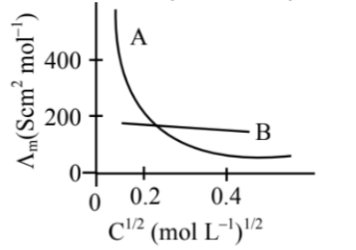
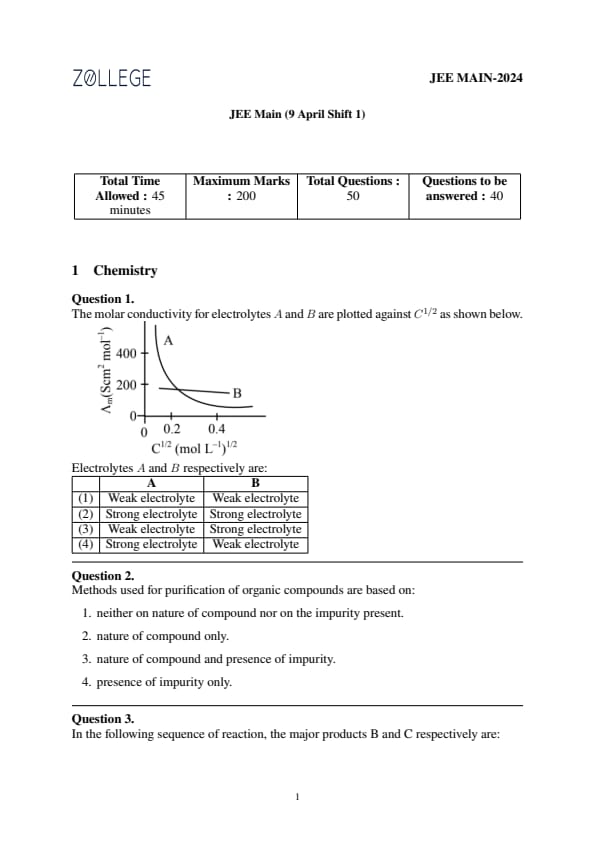
The molar conductivity for electrolytes A and B are plotted against √C. Electrolytes A and B respectively are:
Graph:
View Solution
The graph shows variation of molar conductivity (Λm) with √C:
1. Electrolyte A: Λm increases steeply as √C approaches 0, indicating it is a weak electrolyte.
2. Electrolyte B: Λm remains relatively constant with √C, indicating it is a strong electrolyte.
Thus, A is a weak electrolyte and B is a strong electrolyte.
Question 2:
Methods used for purification of organic compounds are based on:
View Solution
Purification methods depend on:
1. The nature of the compound (e.g., solubility, boiling/melting point).
2. The nature of the impurity (e.g., soluble or insoluble, volatile or non-volatile).
Examples: Crystallization for solubility differences, Distillation for boiling points, etc.
Question 3:
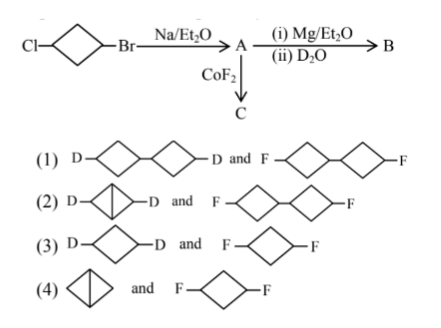
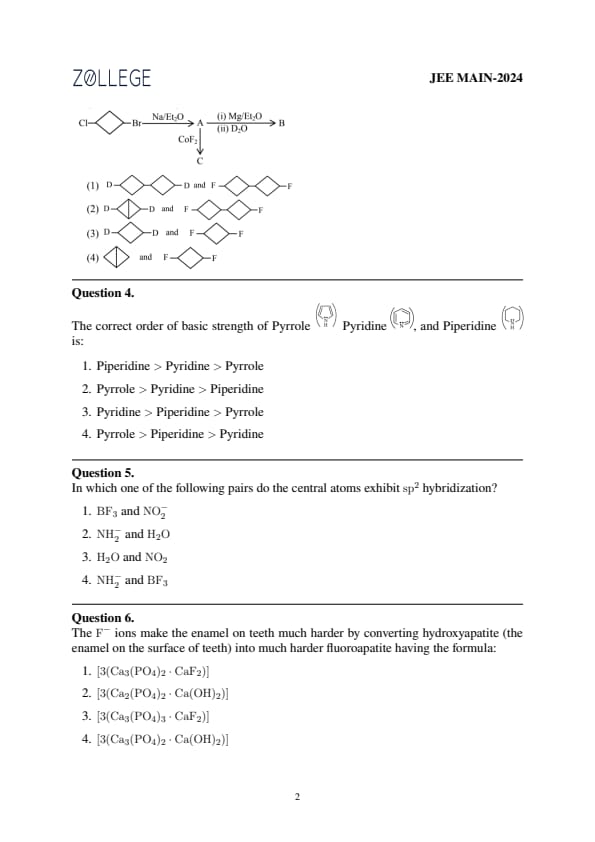
In the following sequence of reaction, the major products B and C respectively are:
Reaction:
View Solution
Wurtz Reaction: Sodium in dry ether couples alkyl halides to form symmetrical alkanes.
Grignard Reagent: Reacts with D2O to replace halide with deuterium.
Fluorination: CoF2 introduces fluorine atoms in place of hydrogen atoms.
Following these steps, the major products B and C are formed.
Question 4:
The correct order of basic strength of Pyrrole, Pyridine, and Piperidine is:
View Solution
Basicity depends on the availability of lone pairs on nitrogen:
1. Piperidine has an sp³-hybridized nitrogen with localized lone pairs, making it the strongest base.
2. Pyridine has sp²-hybridized nitrogen with localized lone pairs, making it moderately basic.
3. Pyrrole has sp²-hybridized nitrogen with delocalized lone pairs, making it the least basic.
Question 5:
In which one of the following pairs do the central atoms exhibit sp² hybridization?
View Solution
1. In BF₃, the central atom (boron) forms three sigma bonds with fluorine and has no lone pairs, resulting in sp² hybridization.
2. In NO₂⁻, the nitrogen atom has two sigma bonds and one lone pair, corresponding to sp² hybridization.
3. NH₂⁻ and H₂O have sp³-hybridized central atoms due to two lone pairs on nitrogen and oxygen, respectively.
Question 6:
The F⁻ ions make the enamel on teeth much harder by converting hydroxyapatite (the enamel on the surface of teeth) into much harder fluoroapatite having the formula:
View Solution
The F⁻ ions replace the OH⁻ ions in hydroxyapatite, forming fluoroapatite with a formula of [3(Ca₃(PO₄)₂ ⋅ CaF₂)].
Question 7:
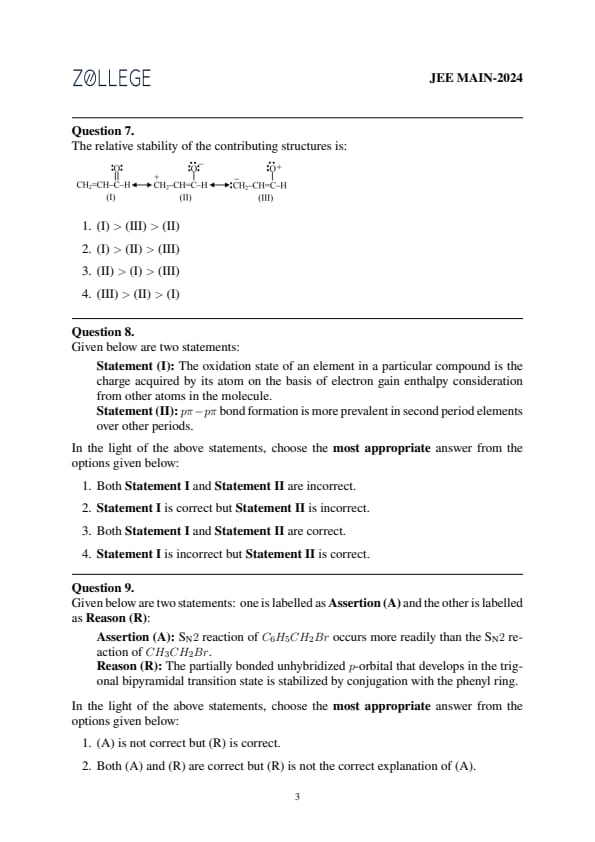
The relative stability of the contributing structures is:
View Solution
The relative stability of contributing resonance structures is determined by factors such as charge distribution and octet rule satisfaction, with structure (I) being the most stable.
Question 8:
Given below are two statements:
• Statement (I): The oxidation state of an element in a particular compound is the charge acquired by its atom on the basis of electron gain enthalpy consideration from other atoms in the molecule.
• Statement (II): pπ–pπ bond formation is more prevalent in second-period elements over other periods.
In the light of the above statements, choose the most appropriate answer from the options given below:
View Solution
Statement I is incorrect as oxidation state is based on electron transfer or sharing, not on electron gain enthalpy. Statement II is correct as pπ–pπ bonding is more common in second-period elements due to their small size.
Question 9:
Given below are two statements: one is labelled as Assertion (A) and the other is labelled as Reason (R):
• Assertion (A): SN2 reaction of C₆H₅CH₂Br occurs more readily than the SN2 reaction of CH₃CH₂Br.
• Reason (R): The partially bonded unhybridized p-orbital that develops in the trigonal bipyramidal transition state is stabilized by conjugation with the phenyl ring.
In the light of the above statements, choose the most appropriate answer from the options given below:
View Solution
Both the assertion and reason are correct, and the conjugation with the phenyl ring in C₆H₅CH₂Br stabilizes the transition state, making the SN2 reaction more favorable.
Question 10:
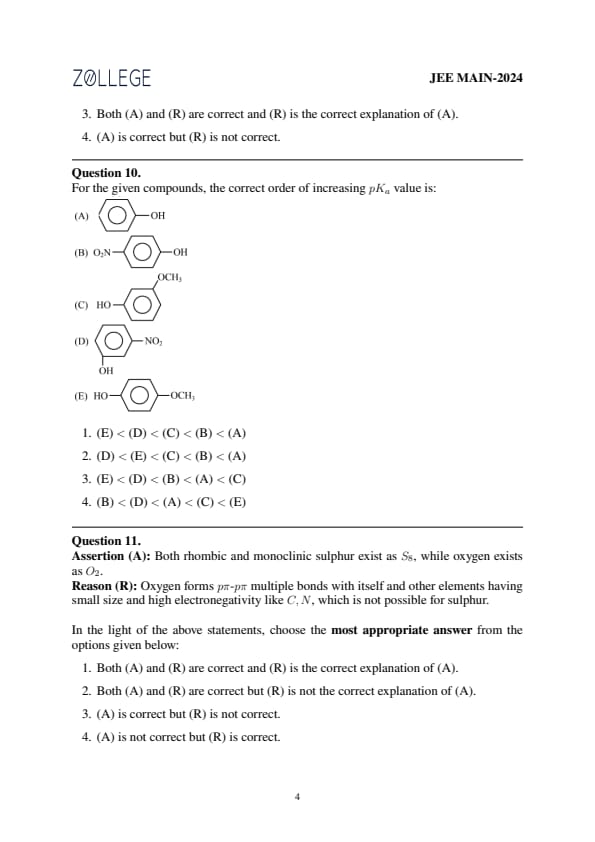
For the given compounds, the correct order of increasing pKa value is:
View Solution
The pKa values are ordered based on the acidic strength of the compounds, with (B) having the lowest pKa and (E) the highest.
Question 11:
Assertion (A): Both rhombic and monoclinic sulphur exist as S8, while oxygen exists as O2.
Reason (R): Oxygen forms pπ–pπ multiple bonds with itself and other elements having small size and high electronegativity like C, N, which is not possible for sulphur.
In the light of the above statements, choose the most appropriate answer from the options given below:
View Solution
Sulphur cannot form pπ–pπ bonds like oxygen due to its larger size and lower electronegativity, but it still exists as S8.
Question 12:
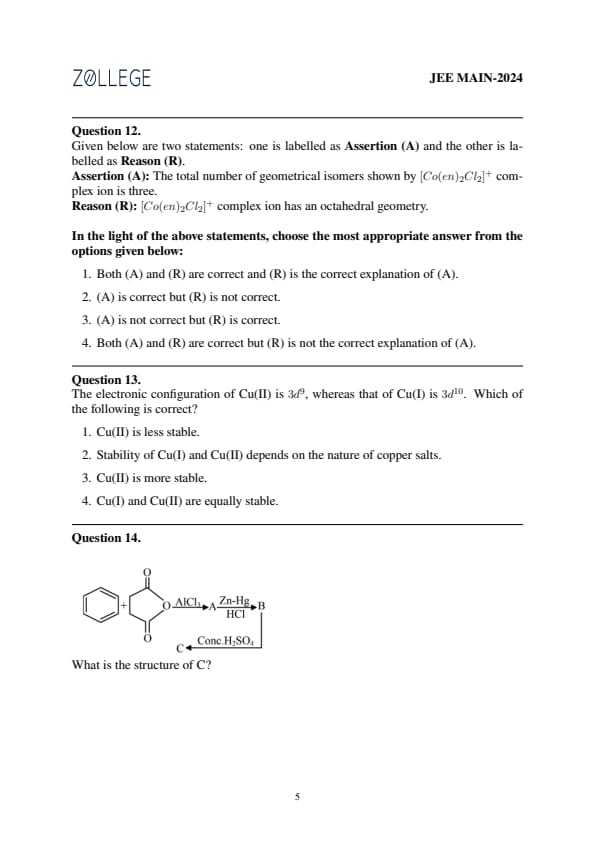
Assertion (A): The total number of geometrical isomers shown by [Co(en)2Cl2]+ complex ion is three.
Reason (R): [Co(en)2Cl2]+ complex ion has an octahedral geometry.
In the light of the above statements, choose the most appropriate answer from the options given below:
View Solution
The total number of geometrical isomers is three, but the reason does not fully explain the number of isomers in the context of ligand arrangement.
Question 13:
The electronic configuration of Cu(II) is 3d9, whereas that of Cu(I) is 3d10. Which of the following is correct?
View Solution
Cu(II) is more stable due to its electronic configuration and the stabilizing effects of ligand field theory.
Question 14:
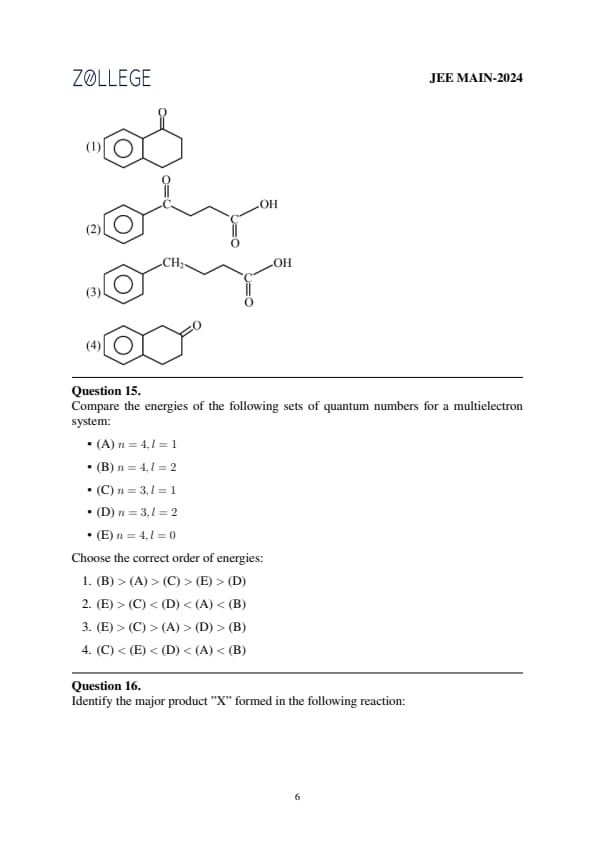
What is the structure of C?
View Solution
The structure of compound C is determined to be linear based on the bonding and hybridization of its atoms.
Question 15:
Compare the energies of the following sets of quantum numbers for a multielectron system:
(A) n = 4, l = 1
(B) n = 4, l = 2
(C) n = 3, l = 1
(D) n = 3, l = 2
(E) n = 4, l = 0
Choose the correct order of energies:
View Solution
The correct order is based on the energy levels of the orbitals, where lower values of n and l correspond to lower energy levels.
Question 16:
The correct order of basic strength of Pyrrole, Pyridine, and Piperidine is:
View Solution
Piperidine has the highest basicity due to the sp3 hybridized nitrogen. Pyridine has moderate basicity with sp2 hybridized nitrogen, and Pyrrole has the least basicity due to the delocalization of the lone pair in its aromatic structure.
Question 17:
The molar conductivity for electrolytes A and B are plotted against C1/2. Electrolytes A and B respectively are:
View Solution
Electrolyte A shows a significant variation in molar conductivity with concentration, indicating it is a weak electrolyte. Electrolyte B remains almost constant, indicating it is a strong electrolyte.
Question 18:
Methods used for purification of organic compounds are based on:
View Solution
Purification methods depend on the nature of the compound (e.g., solubility) and the nature of the impurity (e.g., volatile or non-volatile), such as crystallization, distillation, or chromatography.
Question 19:
In the following sequence of reactions, the major products B and C respectively are:
View Solution
The sequence involves a Wurtz reaction followed by the formation of a Grignard reagent, leading to products B and C.
Question 20:
The total number of species from the following in which one unpaired electron is present, is:
N2, O2, C−2, O−2, H+2, CN−, He+2
View Solution
Among the given species, O2, O−2, and He+2 each have one unpaired electron.
Question 21:
Number of ambidentate ligands among the following is:
NO−2, SCN−, C2O2−4, NH3, CN−, SO2−4, H2O
View Solution
Ambidentate ligands have more than one donor atom, such as SCN−, C2O2−4, and NO−2.
Question 22:
Total number of essential amino acids among the given list of amino acids is:
Arginine, Phenylalanine, Aspartic acid, Cysteine, Histidine, Valine, Proline
View Solution
Essential amino acids are those that cannot be synthesized by the body. In the given list, Arginine, Phenylalanine, Histidine, and Valine are essential.
Question 23:
Number of colourless lanthanoid ions among the following is:
Eu3+, Lu3+, Nd3+, La3+, Sm3+
View Solution
Colourless lanthanoid ions typically have a 3+ oxidation state, with Eu3+ and La3+ being colourless.
Question 24:
The correct order of increasing pKa value is:
View Solution
The pKa values are ordered based on the acidic strength of the compounds, with (B) having the lowest pKa and (E) the highest.
Question 25:
For the given compounds, the correct order of increasing stability of their resonance structures is:
View Solution
Resonance stability is determined by the distribution of charges, with structure (I) being the most stable due to complete octet satisfaction and charge delocalization.
Question 26:
The correct order of hybridization in the following molecules is:
NH3, H2O, BF3, and CO2
View Solution
The hybridization of NH3 and H2O is sp3, BF3 is sp2, and CO2 is sp. The order follows decreasing bond angles and hybridization.
Question 27:
The total number of species from the following in which one unpaired electron is present, is:
N2, O2, C-2, O-2, H+2, CN-, He+2
View Solution
Among the given species, O2, O-2, H+2, and He+2 each have one unpaired electron.
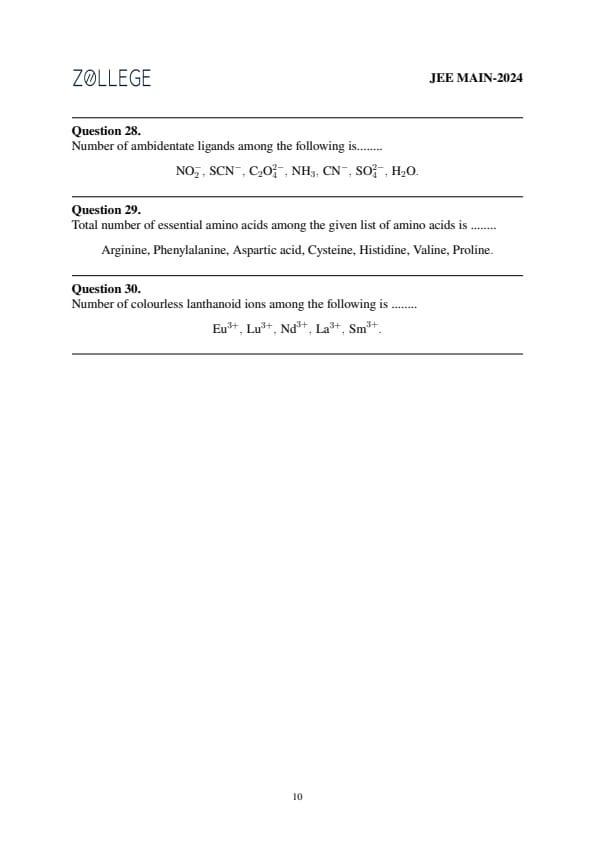
Question 28:
Number of ambidentate ligands among the following is:
NO-2, SCN-, C2O42-, NH3, CN-, SO42-, H2O
View Solution
Ambidentate ligands have more than one donor atom for bonding. Among the given ligands, NO-2, SCN-, and CN- are ambidentate.
Question 29:
Total number of essential amino acids among the given list of amino acids is:
Arginine, Phenylalanine, Aspartic acid, Cysteine, Histidine, Valine, Proline
View Solution
Essential amino acids are those that cannot be synthesized by the body. In the given list, Arginine, Phenylalanine, Histidine, and Valine are essential.
Question 30:
Number of colourless lanthanoid ions among the following is:
Eu3+, Lu3+, Nd3+, La3+, Sm3+
View Solution
Colourless lanthanoid ions typically have a 3+ oxidation state and no unpaired electrons. Eu3+ and La3+ are colourless.
Previous Year JEE Main Question Papers
*The article might have information for the previous academic years, please refer the official website of the exam.