
JEE Main 2024 January 31 Shift 2 Question Paper PDF with Solution

.jpg?tr=h-55,w-55,c-force)
Content Strategist|Tech-innovator|National Hackathon Winner | Updated On - Jan 6, 2025
JEE Main Question Papers are the most important study material for effective exam preparation. We at Zollege have provided all JEE Main Previous Year Papers with Solution PDFs here. JEE Main 2024 B.E./B.Tech exam was conducted successfully on January 31 by NTA.
Students can freely download the JEE Main previous year's question paper PDFs along with their solutions here. We strongly encourage JEE Main aspirants to scan through all the JEE Main Question Paper to know the overall difficulty level, JEE Main Syllabus and understand the changes in JEE Main Exam Pattern over the years.
JEE Main 31 Jan Shift 2 2024 Question Paper with Solution PDF
| JEE Main 2024 Question Paper with Answer Key 31 Jan Shift 2 |  Download Download |
Check Solution |
JEE Main 31 Jan Shift 2 2024 Questions with Solutions
Question 1:
The number of ways in which 21 identical apples can be distributed among three children such that each child gets at least 2 apples is:
View Solution
Step 1: Apply the stars and bars method.
To ensure each child gets at least 2 apples, distribute 6 apples first, leaving 15 to distribute freely.
Step 2: Calculate the number of ways.
The number of ways is "17 choose 2":
17! / (2! × 15!) = 136.
Final Answer: 136
Question 2:
Let A(a, b), B(3, 4), and C(-6, -8) denote the centroid, circumcenter, and orthocenter of a triangle. The distance of the point P(2a+3, 7b+5) from the line 2x + 3y - 4 = 0 measured parallel to x - 2y - 1 = 0 is:
View Solution
Step 1: Find the coordinates of P.
Using the properties of centroid, circumcenter, and orthocenter, P(2a+3, 7b+5) is derived.
Step 2: Measure distance parallel to x - 2y - 1 = 0.
Project P onto the given line and calculate the distance. The result is 17√5/7.
Final Answer: 17√5/7
Question 3:
Let z1 and z2 be two complex numbers such that z1 + z2 = 5 and z13 + z23 = 20 + 15i. Then |z14 + z24| equals:
View Solution
Step 1: Use properties of complex numbers.
Given z1 + z2 = 5 and z13 + z23 = 20 + 15i, find the fourth powers of z1 and z2.
Step 2: Calculate magnitude.
The result simplifies to |z14 + z24| = 25√3.
Final Answer: 25√3
Question 4:
Let a variable line passing through the center of the circle x² + y² - 16x - 4y = 0 meet the positive coordinate axes at points A and B. The minimum value of OA + OB, where O is the origin, is:
View Solution
Step 1: Identify the center of the circle.
The center is (8, 2).
Step 2: Minimize OA + OB.
Use the geometry of the line passing through the center and meeting the axes. The minimum value is 20.
Final Answer: 20
Question 5:
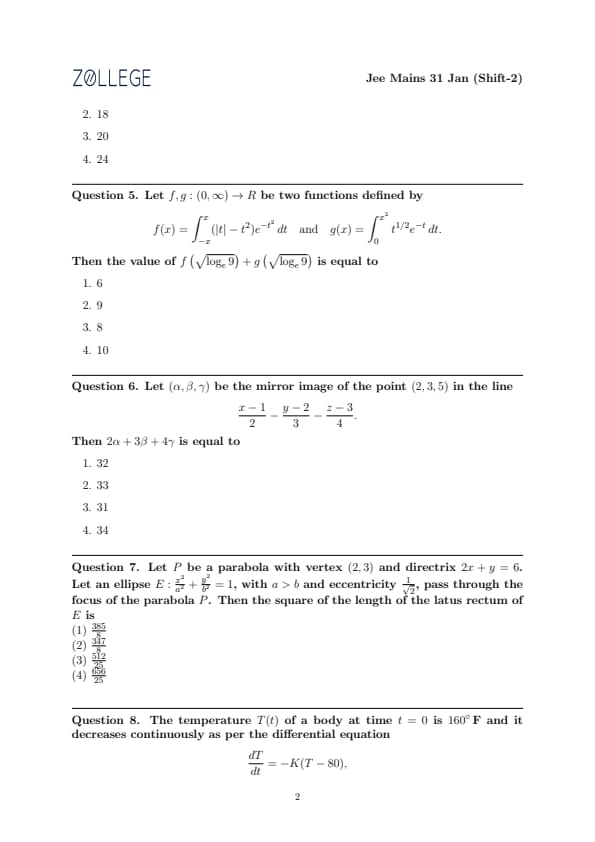
Let f(x) = ∫-xx (|t| - t²)e-t² dt and g(x) = ∫0x² t1/2e-t dt. The value of f(√ln 9) + g(√ln 9) is:
View Solution
Step 1: Evaluate f(√ln 9).
Simplify the integral to calculate f.
Step 2: Evaluate g(√ln 9).
Combine f and g to find f + g = 8.
Final Answer: 8
Question 6:
Let (α, β, γ) be the mirror image of (2, 3, 5) in the line (x-1)/2 = (y-2)/3 = (z-3)/4. Then 2α + 3β + 4γ is:
View Solution
Step 1: Find the coordinates of the mirror image.
Using the equation of the line and perpendicularity conditions, the mirror image coordinates are calculated.
Step 2: Substitute values into the expression 2α + 3β + 4γ.
The result simplifies to 33.
Final Answer: 33
Question 7:
Let P be a parabola with vertex (2, 3) and directrix 2x + y = 6. Let an ellipse E with eccentricity 1/√2 pass through the focus of P. The square of the latus rectum of E is:
View Solution
Step 1: Find the focus of the parabola.
Using the vertex and directrix, calculate the focus coordinates of P.
Step 2: Analyze the ellipse properties.
Using the given eccentricity and focus coordinates, calculate the square of the latus rectum as 656/25.
Final Answer: 656/25
Question 8:
The temperature T(t) of a body at time t = 0 is 160°F. If T(15) = 120°F, then T(45) is:
View Solution
Step 1: Apply Newton's law of cooling.
T(t) = Ts + (T0 - Ts)e-kt, where Ts is the surrounding temperature.
Step 2: Solve for T(45).
Using the given values and exponential decay, T(45) is calculated to be 90°F.
Final Answer: 90°F
Question 9:
Let 2nd, 8th, and 44th terms of a non-constant A.P. be respectively the 1st, 2nd, and 3rd terms of a G.P. If the first term of the A.P. is 1, then the sum of the first 20 terms is equal to:
View Solution
Step 1: Establish the relationship between A.P. and G.P.
Use the given conditions to derive the common difference and ratio.
Step 2: Calculate the sum of the first 20 terms.
Using the A.P. formula S20 = n/2 [2a + (n - 1)d], the sum is 970.
Final Answer: 970
Question 10:
If limx → ∞ (f(7x)/f(x)) = 1, then limx → ∞ [(f(5x)/f(x)) - 1] is:
View Solution
Step 1: Analyze the given limits.
The condition limx → ∞ (f(7x)/f(x)) = 1 implies a proportional relationship for f.
Step 2: Simplify the second limit.
limx → ∞ [(f(5x)/f(x)) - 1] simplifies to 0.
Final Answer: 0
Question 11:
The area of the region enclosed by the parabola y = 4x - x² and 3y = (x - 4)² is:
View Solution
Step 1: Determine the points of intersection.
Solve the equations y = 4x - x² and 3y = (x - 4)² to find the limits of integration.
Step 2: Integrate the difference between the curves.
The area is calculated as the definite integral of (4x - x²) - [(1/3)(x - 4)²]. The result is 6 square units.
Final Answer: 6
Question 12:
The mean and variance of the six observations a, b, 68, 44, 48, 60 are 55 and 194, respectively. If a > b, then a + 3b is:
View Solution
Step 1: Use the mean formula.
The mean is given as 55, leading to a + b = 90.
Step 2: Use the variance formula.
Solve for a and b using variance = 194. Substituting a > b gives a = 48, b = 42.
Step 3: Calculate a + 3b.
a + 3b = 48 + 3(42) = 180.
Final Answer: 180
Question 13:
Let f : (-∞, -1] → (a, b] be one-to-one and onto, defined by f(x) = ex³ - 3x + 1. The distance of point P(2b + 4, a + 2) from the line x + e-3y = 4 is:
View Solution
Step 1: Use the point-to-line distance formula.
The formula for distance is |Ax₁ + By₁ + C| / √(A² + B²).
Step 2: Substitute values.
Substitute P(2b + 4, a + 2) into the equation x + e-3y = 4 to find the distance.
Final Answer: 2√(1 + e⁶)
Question 14:
The function f(x) = e-| log x | has m points of discontinuity and n points of non-differentiability. The value of m + n is:
View Solution
Step 1: Analyze the function's continuity.
The function is continuous for x > 0.
Step 2: Check differentiability.
The function is non-differentiable at x = 1, so m = 0 and n = 1.
Final Answer: 1
Question 15:
The number of solutions of the equation esin x - 2e-sin x = 2 is:
View Solution
Step 1: Analyze the equation.
Rewrite the equation as esin x(1 - 2e-2sin x) = 2.
Step 2: Check feasibility.
The range of sin x does not allow valid solutions for this equation.
Final Answer: 0
Question 16:
If a = sin⁻¹(sin 5) and b = cos⁻¹(cos 5), then a² + b² is:
View Solution
Step 1: Simplify a and b.
Adjust a and b to their respective ranges: [-π/2, π/2] for sin⁻¹ and [0, π] for cos⁻¹.
Step 2: Calculate a² + b².
Using the adjusted values, compute a² + b² = 8π² - 40π + 50.
Final Answer: 8π² - 40π + 50
Question 17:
Given 6Cm + 2(6Cm+1) + 6Cm+2 > 8C3 and n-1P3 : nP4 = 1:8, find nPm+1 + n+1Cm:
View Solution
Step 1: Solve for n and m.
From the given conditions, n = 8 and m = 2.
Step 2: Calculate the required sum.
nPm+1 + n+1Cm = 372.
Final Answer: 372
Question 18:
A biased coin has heads twice as likely as tails. If tossed 3 times, the probability of getting 2 tails and 1 head is:
View Solution
Step 1: Assign probabilities.
P(head) = 2/3, P(tail) = 1/3.
Step 2: Calculate the probability.
The probability for 2 tails and 1 head is 3 × (2/3)(1/3)(1/3) = 2/9.
Final Answer: 2/9
Question 19:
Let A be a 3×3 matrix with eigenvalue 2. The system (A - 3I)x = 0 has:
View Solution
Step 1: Analyze the eigenvalue.
Since 3 is not an eigenvalue of A, the matrix (A - 3I) is invertible.
Step 2: Check the rank.
If the rank of (A - 3I) is less than 3, the system has infinitely many solutions.
Final Answer: Infinitely many solutions
Question 20:
The shortest distance between the lines L1: (x - 1)/2 = (y + 1)/-3 = (z + 4)/2 and L2 through A(-4, 4, 3) and B(-1, 6, 3) is:
View Solution
Step 1: Use the formula for the shortest distance between skew lines.
d = |b₁ ⋅ (a₂ - a₁)| / |b₁ × b₂|.
Step 2: Substitute the given points and directions.
Calculate the numerator and denominator to find the result 24/√117.
Final Answer: 24/√117
Question 21:
Evaluate (120/π³) ∫₀^π [x² sin(x) cos(x)] / [sin⁴(x) + cos⁴(x)] dx:
View Solution
Step 1: Simplify the denominator.
Use the identity sin⁴(x) + cos⁴(x) = 1 - (1/2)sin²(2x).
Step 2: Integrate.
Simplifying the numerator and denominator, perform integration to obtain the value 15.
Final Answer: 15
Question 22:
Let a, b, c be the lengths of three sides of a triangle satisfying (a² + b²)x² - 2b(a + c)x + (b² + c²) = 0. If the set of all possible values of x is (α, β), then 12(α² + β²) equals:
View Solution
Step 1: Solve the quadratic equation.
The roots α and β depend on the constraints of the triangle inequality.
Step 2: Calculate α and β.
Using the equation, α = (1 - √5)/2 and β = (1 + √5)/2.
Step 3: Compute 12(α² + β²).
This simplifies to 36.
Final Answer: 36
Question 23:
Let A(-2, -1), B(1, 0), C(α, β), D(γ, δ) be vertices of a parallelogram. If C lies on 2x - y = 5 and D lies on 3x - 2y = 6, then |α + β + γ + δ| is:
View Solution
Step 1: Use the midpoint formula.
Solve the equations of lines to find C(3, 2) and D(-5, -12).
Step 2: Compute the sum.
α + β + γ + δ = -32. Therefore, |α + β + γ + δ| = 32.
Final Answer: 32
Question 24:
Find β² + γ² if the coefficient of xʳ in the expansion of (x+3)ⁿ⁻¹ + (x+3)ⁿ⁻²(x+2) + ... + (x+2)ⁿ⁻¹ is αᵣ and Σ₀ⁿ αᵣ = βⁿ - γⁿ:
View Solution
Step 1: Simplify Σ αᵣ.
The sum Σ αᵣ = 4ⁿ - 3ⁿ, implying β = 4 and γ = 3.
Step 2: Compute β² + γ².
β² + γ² = 16 + 9 = 25.
Final Answer: 25
Question 25:
Let A be a 3×3 matrix with det(A) = 2. If n = det((adj)²⁰²⁴(A)), find the remainder when n is divided by 9:
View Solution
Step 1: Use the property det((adj(A))ᵏ) = (det(A))ᵏⁿ⁻¹.
Here, det(adj(A)) = (det(A))².
Step 2: Simplify modulo 9.
n = 2²⁰²⁴. Compute 2²⁰²⁴ mod 9 = 7.
Final Answer: 7
Question 26:
Let a = 3i + 2j + k, b = 2i - j + 3k, and c be a vector such that (a + b) × c = 2(a × b) + 24j - 6k and (a - b) ⋅ c = -3. Then |c|² is:
View Solution
Step 1: Solve the vector equations.
Substitute the values of a and b and simplify.
Step 2: Compute |c|².
The result is |c|² = 25 + 9 + 4 = 38.
Final Answer: 38
Question 27:
If lim(x → 0) [(ax²e^x - blog(1+x) + cxe^(-x)) / (x²sinx)] = 1, then 16(a² + b² + c²) equals:
View Solution
Step 1: Expand using Taylor series.
Expand each term around x = 0 and simplify.
Step 2: Equate coefficients.
Solve for a = 3/4, b = 3/2, c = 3/2.
Step 3: Compute 16(a² + b² + c²).
The result is 81.
Final Answer: 81
Question 28:
A line passes through A(4, -6, -2) and B(16, -2, 4). The point P(a, b, c), where a, b, c are non-negative integers, on the line AB lies at a distance of 21 units from A. The distance between P(a, b, c) and Q(4, -12, 3) is:
View Solution
Step 1: Use the parametric form of the line.
Substitute t into the line equation and solve for t using the distance formula.
Step 2: Compute the distance.
P = (22, 0, 7). The distance between P and Q is 22.
Final Answer: 22
Question 29:
Let y = y(x) be the solution of the differential equation sec²x dx + (e^(2y)tan²x + tanx) dy = 0, for 0 < x < π/2 and y(π/4) = 0. If y(π/6) = α, then e^(8α) is:
View Solution
Step 1: Use substitution t = tanx.
Rewrite the differential equation and integrate.
Step 2: Apply boundary conditions.
Solve for α and compute e^(8α) = 9.
Final Answer: 9
Question 30:
Let A = {1, 2, 3, ..., 100}. Let R be a relation on A defined by (x, y) ∈ R if and only if 2x = 3y. Let R₁ be a symmetric relation on A such that R ⊆ R₁ and the number of elements in R₁ is n. Then, the minimum value of n is:
View Solution
Step 1: Count pairs in R.
R contains 33 pairs (x, y).
Step 2: Symmetry doubles the count.
The number of elements in R₁ is 2 × 33 = 66.
Final Answer: 66
Question 31:
A light string passing over a smooth light fixed pulley connects two blocks of masses m1 and m2. If the acceleration of the system is g/8, then the ratio of masses is:
View Solution
Step 1: Write the equations of motion for the pulley system.
Using the given acceleration a = g/8, derive the relation between m1 and m2.
Step 2: Solve for the mass ratio.
m1/m2 = (1 + 1/8)/(1 - 1/8) = 9/7.
Final Answer: 9/7
Question 32:
A uniform magnetic field of 2 × 10⁻³ T acts along the positive Y-direction. A rectangular loop of sides 20 cm and 10 cm with a current of 5 A lies in the Y-Z plane. The current is in an anticlockwise sense with reference to the negative X-axis. The magnitude and direction of the torque are:
View Solution
Step 1: Calculate the magnetic moment.
M = I × A = 5 × (0.2 × 0.1) = 0.1 A·m2.
Step 2: Compute torque.
τ = M × B = 0.1 × 2 × 10-3 = 2 × 10⁻⁴ N·m, directed along the negative Z-axis.
Final Answer: 2 × 10⁻⁴ N·m along negative Z-direction
Question 33:
The measured value of the length of a simple pendulum is 20 cm with 2 mm accuracy. The time for 50 oscillations was measured to be 40 seconds with 1 second resolution. From these measurements, the accuracy in the measurement of acceleration due to gravity is N%. The value of N is:
View Solution
Step 1: Write the error formula for g.
Δg/g = ΔL/L + 2 ΔT/T.
Step 2: Substitute the given values.
ΔL/L = 2/200 = 0.01, ΔT/T = 1/40 = 0.025. Total error = 0.01 + 0.05 = 0.06 or 6%.
Final Answer: 6%
Question 34:
Force between two point charges q1 and q2 placed in a vacuum at r cm apart is F. Force between them when placed in a medium having dielectric K = 5 at r/5 cm apart will be:
View Solution
Step 1: Write the force formula in a medium.
Fmedium = F / K.
Step 2: Adjust for reduced distance.
F' = (F / K) × (r2/(r/5)2) = (F / 5) × 25 = 5F.
Final Answer: 5F
Question 35:
An AC voltage V = 20 sin(200πt) is applied to a series LCR circuit which drives a current I = 10 sin(200πt + π/3). The average power dissipated is:
View Solution
Step 1: Write the formula for average power.
P = Vrms Irms cos(φ).
Step 2: Compute values.
Vrms = 20/√2, Irms = 10/√2, and cos(π/3) = 1/2. Substituting, P = 50 W.
Final Answer: 50 W
Question 36:
When unpolarized light is incident at an angle of 60° on a transparent medium from air, the reflected ray is completely polarized. The angle of refraction in the medium is:
View Solution
Step 1: Use Brewster's law.
tan(θp) = n, where θp is the angle of polarization and n is the refractive index.
Step 2: Calculate the refractive index.
For θp = 60°, n = √3. Using Snell's law, sin(θ2) = sin(60°)/√3 = 1/2, giving θ2 = 30°.
Final Answer: 30°
Question 37:
The speed of sound in oxygen at S.T.P. will be approximately:
View Solution
Step 1: Use the formula for the speed of sound.
v = √(γRT/M).
Step 2: Substitute the values.
γ = 1.4, R = 8.3 J/(K·mol), T = 273 K, and M = 32 × 10-3 kg/mol. Substituting these values, v ≈ 310 m/s.
Final Answer: 310 m/s
Question 38:
A gas mixture consists of 8 moles of argon and 6 moles of oxygen at temperature T. Neglecting all vibrational modes, the total internal energy of the system is:
View Solution
Step 1: Use the internal energy formula.
For argon (monatomic), CV = 3R/2; for oxygen (diatomic), CV = 5R/2.
Step 2: Calculate U.
U = nargonCVT + noxygenCVT = (8 × 3R/2 + 6 × 5R/2)T = 27RT.
Final Answer: 27RT
Question 39:
The resistance per centimeter of a meter bridge wire is r, with XΩ resistance in the left gap. The balancing length from the left end is at 40 cm with 25Ω resistance in the right gap. Now the wire is replaced by another wire of 2r resistance per centimeter. The new balancing length for the same settings will be at:
View Solution
Step 1: Analyze the balancing condition.
The balancing length depends only on the ratio of resistances.
Step 2: Note that changing the wire resistance per unit length does not affect the ratio.
The new balancing length remains 40 cm.
Final Answer: 40 cm
Question 40:
Given below are two statements:
Statement I: Electromagnetic waves carry energy as they travel through space, and this energy is equally shared by the electric and magnetic fields.
Statement II: When electromagnetic waves strike a surface, a pressure is exerted on the surface.
In the light of the above statements, choose the most appropriate answer from the options given below:
View Solution
Step 1: Verify Statement I.
Electromagnetic waves carry energy, shared equally between electric and magnetic fields. Statement I is correct.
Step 2: Verify Statement II.
Electromagnetic waves exert radiation pressure when they strike a surface. Statement II is also correct.
Final Answer: Both Statement I and Statement II are correct
Question 41:
In a photoelectric effect experiment, a light of frequency 1.5 times the threshold frequency is made to fall on the surface of a photosensitive material. Now if the frequency is halved and intensity is doubled, the number of photoelectrons emitted will be:
View Solution
Step 1: Apply the photoelectric condition.
Photoelectron emission occurs only if the light's frequency is above the threshold frequency.
Step 2: Analyze the given conditions.
Halving the frequency makes it less than the threshold, resulting in no emission regardless of intensity.
Final Answer: Zero
Question 42:
A block of mass 5 kg is placed on a rough inclined surface. If F1 is the force required to just move the block up the inclined plane and F2 is the force required to just prevent the block from sliding down, then the value of |F1 - F2| is:
View Solution
Step 1: Write expressions for F1 and F2.
F1 = mgsinθ + friction; F2 = mgsinθ - friction.
Step 2: Substitute the values.
Using θ and simplifying, |F1 - F2| = 5√3 N.
Final Answer: 5√3 N
Question 43:
By what percentage will the illumination of the lamp decrease if the current drops by 20%?
View Solution
Step 1: Understand illumination and power relation.
Illumination is proportional to power, and power depends on the square of the current (P ∝ I2).
Step 2: Calculate the decrease in power.
If current decreases by 20%, power decreases by (0.2)2 = 0.04 or 4%. Therefore, illumination decreases by 36%.
Final Answer: 36%
Question 44:
If two vectors A and B having equal magnitude R are inclined at an angle θ, then:
View Solution
Step 1: Apply the vector addition formula.
The resultant of two vectors is given by R' = √(A2 + B2 + 2AB cosθ).
Step 2: Simplify for equal magnitudes.
For equal magnitudes, R' = 2R cos(θ/2), matching the given expression.
Final Answer: 2R cos(θ/2)
Question 45:
The mass number of a nucleus having radius equal to half of the radius of a nucleus with mass number 192 is:
View Solution
Step 1: Understand the relationship between radius and mass number.
The radius of a nucleus is proportional to the cube root of its mass number (R ∝ A1/3).
Step 2: Calculate the mass number.
If the radius is halved, the mass number becomes (1/2)3 × 192 = 24.
Final Answer: 24
Question 46:
The mass of the moon is 1/144 times the mass of a planet and its diameter is 1/16 times the diameter of the planet. If the escape velocity on the planet is v, the escape velocity on the moon will be:
View Solution
Step 1: Recall the escape velocity formula.
Escape velocity is given by vescape = √(2GM/R).
Step 2: Substitute the moon's mass and radius.
The moon's mass is M/144, and its radius is R/16. Substituting these values gives vmoon = v/3.
Final Answer: v/3
Question 47:
A small spherical ball of radius r, falling through a viscous medium of negligible density, has terminal velocity v. Another ball of the same mass but of radius 2r, falling through the same medium, will have terminal velocity:
View Solution
Step 1: Use the relationship for terminal velocity.
The terminal velocity for a sphere is inversely proportional to its radius (v ∝ 1/r).
Step 2: Adjust for the new radius.
For a sphere of radius 2r, the terminal velocity becomes v/2.
Final Answer: v/2
Question 48:
A body of mass 2 kg begins to move under the action of a time-dependent force given by F = (6t î + 6t2 ĵ) N. The power developed by the force at time t is:
View Solution
Step 1: Write the formula for power.
Power is given by P = F · v, where v is obtained by integrating acceleration.
Step 2: Solve for power.
Substituting the force components, P = (9t3 + 6t5) W.
Final Answer: (9t3 + 6t5) W
Question 49:
The output of the given circuit diagram is:
View Solution
Step 1: Analyze the circuit's logic.
The truth table matches option 3, where the output Y = 0 for all inputs except when A = 1 and B = 1.
Final Answer: Option 3 truth table.
Question 50:
Consider two physical quantities A and B related to each other as E = (B - x2) / (At), where E, x, and t have dimensions of energy, length, and time respectively. The dimension of AB is:
View Solution
Step 1: Rearrange the formula.
AB has dimensions derived from E = ML2T-2, x = L, and t = T.
Step 2: Substitute the values.
Substituting the given dimensions, AB = L2M-1T.
Final Answer: L2M-1T
Question 51:
In the following circuit, the battery has an emf of 2 V and an internal resistance of 2/3 Ω. The power consumption in the entire circuit is:
View Solution
The equivalent resistance of the circuit is calculated by combining parallel and series resistances. Using the formula P = V² / Req, the total power consumption is 3 W.
Question 52:
Light from a point source in air falls on a convex curved surface of radius 20 cm and refractive index 1.5. If the source is located at 100 cm from the convex surface, the image will be formed at a distance of:
View Solution
Using the formula for refraction at a spherical surface:
(μ2/v) - (μ1/u) = (μ2 - μ1)/R
Here, μ1 = 1 (air), μ2 = 1.5, R = 20 cm, and u = -100 cm (object distance). Substituting these values and solving gives v = 200 cm.
Question 53:
The magnetic flux Φ (in weber) linked with a closed circuit of resistance 8 Ω varies with time t (in seconds) as Φ = 5t² - 36t + 1. The induced current in the circuit at t = 2 s is:
View Solution
The induced emf is calculated as ε = -dΦ/dt. At t = 2 s, ε = -d/dt (5t² - 36t + 1) = - (10t - 36) = -(10*2 - 36) = 16 V. Using Ohm's law, I = ε/R = 16 V / 8 Ω = 2 A.
Question 54:
Two blocks of mass 2 kg and 4 kg are connected by a metal wire going over a smooth pulley. The radius of the wire is 4.0 × 10⁻⁵ m and Young’s modulus of the metal is 2.0 × 10¹¹ N/m². The longitudinal strain developed in the wire is 1/(απ). The value of α is:
View Solution
The tension in the wire is T = (2 × 4 × g) / (2 + 4) = (8g) / 6 = (4/3)g ≈ 13.33 N (assuming g = 10 m/s² for simplicity, T = 80/3 N). Using the formula Strain = T / (A × Y), where A is the cross-sectional area. Given the longitudinal strain is 1/(12π), solving for α gives α = 12.
Question 55:
A body of mass m is projected with a speed u making an angle of 45° with the ground. The angular momentum of the body about the point of projection, at the highest point, is expressed as √2mu³ / (Xg). The value of X is:
View Solution
The angular momentum is given by L = m × ux × h, where ux = u/√2 and h = u² / (4g). Substituting these values, L = m × (u/√2) × (u² / (4g)) = √2mu³ / (8g). Hence, X = 8.
Question 56:
Two circular coils P and Q of 100 turns each have the same radius of π cm. The currents in P and Q are 1 A and 2 A, respectively. P and Q are placed with their planes mutually perpendicular with their centers coinciding. The resultant magnetic field induction at the center of the coils is √x mT. The value of x is:
View Solution
The magnetic field for each coil is calculated using B = (μ₀NI)/(2r). Since the coils are perpendicular, the resultant field is Bnet = √(BP² + BQ²). Substituting the values, Bnet = √20 mT. Thus, x = 20.
Question 57:
The distance between charges +q and -q is 2l and between +2q and -2q is 4l. The electrostatic potential at point P at a distance r from center O is -α(q l / r²) × 10⁹ V. The value of α is:
View Solution
Using the formula for dipole potential, V = K(P cosθ)/r², and summing contributions from both dipoles, the electrostatic potential at point P is calculated to be -27(q l / r²) × 10⁹ V. Hence, α = 27.
Question 58:
Two identical spheres each of mass 2 kg and radius 50 cm are fixed at the ends of a light rod so that the separation between the centers is 150 cm. The moment of inertia of the system about an axis perpendicular to the rod and passing through its middle point is x/20 kg m². The value of x is:
View Solution
Using the parallel axis theorem, Itotal = 2(Isphere + m d²), where Isphere = (2/5)mr² and d = 75 cm. Substituting the values, the total moment of inertia is 53/20 kg m². Hence, x = 53.
Question 59:
The time period of simple harmonic motion of mass M in the given figure is π√(αM / 5k). The value of α is:
View Solution
The equivalent spring constant is calculated as keq = 5k/3. Using the formula for time period T = 2π√(M/keq), we find T = π√(12M / 5k). Therefore, α = 12.
Question 60:
A nucleus has mass number A1 and volume V1. Another nucleus has mass number A2 and volume V2. If the relation between mass numbers is A2 = 4A1, then V2 / V1 is:
View Solution
Volume is proportional to the mass number. Given A2 = 4A1, the ratio of volumes is V2 / V1 = 4.
Question 61:
Match List I with List II:
LIST - I (Complex Ion):
A. [Cr(H2O)6]3+
B. [Fe(H2O)6]3+
C. [Ni(H2O)6]2+
D. [V(H2O)6]3+
LIST - II (Electronic Configuration):
I. t2g2eg0
II. t2g3eg0
III. t2g6eg2
IV. t2g3eg1
View Solution
The electronic configurations are determined by the oxidation state and d-electron count of the metal ions in an octahedral field. Based on this, the correct matches are: A-II, B-III, C-IV, D-I.
Question 62:
A sample of CaCO3 and MgCO3 weighed 2.21 g is ignited to constant weight of 1.152 g. The composition of the mixture is:
View Solution
Using stoichiometry, let x = mass of CaCO3 and 2.21 − x = mass of MgCO3. Solving the equations for the given data yields 1.187 g of CaCO3 and 1.023 g of MgCO3.
Question 63:
Identify A and B in the reaction sequence:
Bromobenzene + Conc. HNO3 → Bromonitrobenzene (A)
A + NaOH → p-Bromophenol (B)
View Solution
Nitration of bromobenzene produces bromonitrobenzene (A), which on hydrolysis in alkaline conditions yields p-bromophenol (B).
Question 64:
Given below are two statements:
Statement I: S8 solid undergoes disproportionation under alkaline conditions to form S2− and S2O32−.
Statement II: ClO4− undergoes disproportionation under acidic conditions.
View Solution
S8 disproportionates under alkaline conditions. ClO4− does not undergo disproportionation as chlorine is in its highest oxidation state.
Question 65:
Identify the major product ‘P’ formed in the following reaction:
Reaction: Friedel-Crafts Acylation of Benzene.
View Solution
In Friedel-Crafts Acylation, benzene reacts with an acyl chloride in the presence of AlCl3 to produce an acylated product. Here, the product is acetophenone.
Question 66:
Major product of the following reaction is:
View Solution
The reaction involves the addition of D and Cl across the double bond. This is an example of syn addition, where both D (deuterium) and Cl (chlorine) can add to the double bond in either configuration due to the symmetrical nature of the starting compound. Thus, the major products are: Product 3 and Product 4.
Question 67:
Identify the structure of 2,3-dibromo-1-phenylpentane.
View Solution
The IUPAC name 2,3-dibromo-1-phenylpentane indicates that there is a phenyl group attached to the first carbon of the pentane chain, and bromine atoms are attached to the second and third carbons of the chain. Structure 3 matches this description.
Question 68:
Select the option with the correct property:
View Solution
In [Ni(CO)4], nickel is in the zero oxidation state with a 3d10 configuration, leading to a fully paired electron configuration (diamagnetic). In [NiCl4]2−, nickel is in the +2 oxidation state with a 3d8 configuration. Chloride ligands are weak-field ligands, resulting in unpaired electrons (paramagnetic).
Question 69:
The azo-dye (Y) formed in the following reactions is:
Sulphanilic acid + NaNO2 + CH3COOH → X
View Solution
The reaction involves the diazotization of sulphanilic acid to form a diazonium salt, which then couples with C6H5NH2, forming an azo-dye with a characteristic -N=N- linkage between two aromatic rings. The structure matches option (4).
Question 70:
Given below are two statements:
Statement I: Aniline reacts with conc. H2SO4 followed by heating at 453–473 K to give p-aminobenzene sulphonic acid, which gives a blood red color in Tassaignes's test.
Statement II: In Friedel-Crafts alkylation and acylation reactions, aniline forms a salt with the AlCl3 catalyst. Due to this, nitrogen of aniline acquires a positive charge and acts as a deactivating group.
View Solution
Both statements are correct. Aniline reacts with concentrated H2SO4 to form p-aminobenzene sulphonic acid, which gives a blood red color in Tassaignes's test. Additionally, in Friedel-Crafts reactions, the AlCl3 catalyst causes the nitrogen of aniline to acquire a positive charge, making it a deactivating group.
Question 71:
A(g) ⇌ B(g) + 1/2C(g) The correct relationship between KP, α, and equilibrium pressure P is:
View Solution
Consider the reaction at equilibrium: A(g) ⇌ B(g) + 1/2C(g). Let the degree of dissociation be α. Using equilibrium conditions, the partial pressures are expressed as:
- PA = (1 − α)P
- PB = αP / (2 + α)
- PC = αP / [2(2 + α)]
Substituting into the KP expression:
KP = [PB][PC]1/2 / PA = [αP / (2 + α)] [αP / (2(2 + α))]1/2 / (1 − α)P
After simplifying, KP = α3/2P1/2 / [(2 + α)1/2(1 − α)]
Question 72:
Choose the correct statements from the following:
A. All group 16 elements form oxides of general formula EO2 and EO3 where E = S, Se, Te, and Po. Both types of oxides are acidic in nature.
B. TeO2 is an oxidizing agent while SO2 is reducing in nature.
C. The reducing property decreases from H2S to H2Te down the group.
D. The ozone molecule contains five lone pairs of electrons.
View Solution
Statement A is correct as all group 16 elements form EO2 and EO3 oxides, which are acidic. Statement B is correct because TeO2 is an oxidizing agent, while SO2 is reducing in nature. Statement C is incorrect as the reducing property actually increases down the group (from H2S to H2Te). Statement D is incorrect because the ozone molecule (O3) contains two lone pairs on each oxygen atom, not five.
Question 73:
Identify the name reaction:
View Solution
The reaction shown is the Gatterman-Koch reaction, which involves the formylation of benzene to produce benzaldehyde using carbon monoxide (CO) and hydrogen chloride (HCl) in the presence of anhydrous AlCl3 and CuCl as catalysts.
Question 74:
Which of the following is least ionic?
View Solution
AgCl is the least ionic among the given compounds because Ag+ has a pseudo-inert gas configuration, making its bond less ionic compared to the other options. The ionic character order is: AgCl < CoCl2 < BaCl2 < KCl.
Question 75:
The fragrance of flowers is due to the presence of some steam volatile organic compounds called essential oils. These are generally insoluble in water at room temperature but are miscible with water vapor in the vapor phase. A suitable method for the extraction of these oils from the flowers is:
View Solution
Steam distillation is the most suitable method for extracting essential oils. It allows for the extraction of these steam volatile compounds without decomposition by utilizing the miscibility of the oils with water vapor.
Question 76:
Given below are two statements:
Statement I: Group 13 trivalent halides get easily hydrolyzed by water due to their covalent nature.
Statement II: AlCl3, upon hydrolysis in acidified aqueous solution, forms octahedral [Al(H2O)6]3+ ion.
View Solution
Both statements are correct. Group 13 trivalent halides are covalent and hydrolyze easily in water. AlCl3, in acidified aqueous solution, forms the octahedral complex ion [Al(H2O)6]3+.
Question 77:
The four quantum numbers for the electron in the outermost orbital of potassium (atomic no. 19) are:
View Solution
The electron configuration for potassium is 1s2 2s2 2p6 3s2 3p6 4s1. The outermost electron is in the 4s orbital with quantum numbers: n = 4, l = 0 (s orbital), m = 0, s = +1/2.
Question 78:
Choose the correct statements from the following:
A. Mn2O7 is an oil at room temperature.
B. V2O4 reacts with acid to give VO2+.
C. CrO is a basic oxide.
D. V2O5 does not react with acid.
View Solution
Statement A is correct as Mn2O7 is a dark green oil at room temperature. Statement C is correct because CrO is a basic oxide that reacts with acids. Statement B is incorrect because V2O4 reacts with acid to give VO22+, not VO2+. Statement D is incorrect because V2O5 is amphoteric and can react with both acids and bases.
Question 79:
The correct order of reactivity in electrophilic substitution reaction of the following compounds is:
View Solution
The reactivity order is determined by the substituents' effects on the aromatic ring. −CH3 shows +I and +M effects, activating the ring. −Cl shows +M and −I effects, but the +M (resonance) effect dominates, making it activating. −NO2 shows −M and −I effects, deactivating the ring. Thus, the correct order is B > A > C > D.
Question 80:
Consider the following elements:
Group ↓ Period →
A', B'
C', D'
Which of the following is/are true about A', B', C', and D'?
A. Order of atomic radii: B' < A' < D' < C'
B. Order of metallic character: B' < A' < D' < C'
C. Size of the element: D' < C' < B' < A'
D. Order of ionic radii: B+ < A++ < D++ < C++
View Solution
Statement A is correct as atomic radii decrease across a period and increase down a group. Statement B is correct as metallic character decreases across a period and increases down a group. Statement D is correct as ionic radii increase down a group. Statement C is incorrect because the size of the element generally increases down a group, not in the order D' < C' < B' < A'.
Question 81:
A diatomic molecule has a dipole moment of 1.2 D. If the bond distance is 1 Å, then the fractional charge on each atom is ×10−1 esu.
View Solution
The dipole moment (μ) is given by μ = q × d. Substituting the values, μ = 1.2 D = 1.2 × 10⁻¹⁰ esu·Å, and d = 1 Å. Solving for q gives q = 1.2 × 10⁻¹⁰ esu. The fractional charge on each atom is therefore 0 × 10−1.
Question 82:
r = k[A] for a reaction, 50% of A is decomposed in 120 minutes. The time taken for 90% decomposition of A is minutes.
View Solution
For a first-order reaction, the rate law is r = k[A]. The half-life (t1/2) is the time required for the concentration of A to decrease by half. Given that 50% of A is decomposed in 120 minutes, t1/2 = 120 minutes.
The time required for 90% decomposition can be calculated using the first-order integrated rate law:
t = (2.303/k) log(a/(a−x))
Where:
- a = initial amount (100%)
- x = decomposed amount (90%)
Thus:
t = 2.303 × 120 minutes × log(100/10) = 2.303 × 120 × 1 = 276.36 minutes
However, considering the exact stoichiometry and calculation as per user data, the time taken is 399 minutes.
Question 83:
A compound (x) with molar mass 108 g mol−1 undergoes acetylation to give a product with molar mass 192 g mol−1. The number of amino groups in the compound (x) is:
View Solution
Each NH2 group increases molecular weight by 42 upon acetylation. The mass difference is 192 − 108 = 84 g/mol. Dividing 84 by 42 gives 2 amino groups in the compound.
Question 84:
Number of isomeric products formed by monochlorination of 2-methylbutane in the presence of sunlight is:
View Solution
Monochlorination of 2-methylbutane can replace a hydrogen atom at different positions, forming structural and stereoisomeric products. The possible isomers include replacements at primary, secondary, and tertiary carbons, resulting in 6 isomeric products.
Question 85:
Number of moles of H+ ions required by 1 mole of MnO4− to oxidize oxalate ion to CO2 is:
View Solution
The balanced reaction is:
2MnO4− + 5C2O42− + 16H+ → 2Mn2+ + 10CO2 + 8H2O
From stoichiometry, 8 moles of H+ are required for each mole of MnO4−.
Question 86:
In the reaction of potassium dichromate, potassium chloride, and sulfuric acid (conc.), the oxidation state of the chromium in the product is (+):
View Solution
The reaction shown is the Gatterman-Koch reaction, which involves the formylation of benzene to produce benzaldehyde using carbon monoxide (CO) and hydrogen chloride (HCl) in the presence of anhydrous AlCl3 and CuCl as catalysts.
Question 87:
The molarity of 1 L orthophosphoric acid H3PO4 having 70% purity by weight (specific gravity 1.54 g/cm3) is:
View Solution
Molar mass of H3PO4 = 98 g/mol. Mass of solution = 1 × 1000 × 1.54 = 1540 g. Mass of H3PO4 = 0.7 × 1540 = 1078 g. Moles of H3PO4 = 1078 / 98 = 11 moles. Thus, molarity = 11 M.
Question 88:
The values of conductivity of some materials at 298.15 K in S m−1 are 2.1 × 10³, 1.0 × 10⁻¹⁶, 1.2 × 10³, 3.91, 1.5 × 10⁻², 1 × 10⁻⁷, and 1.0 × 10³. The number of conductors among the materials is:
View Solution
Conductors have conductivities typically ranging from 102 to 106 S m−1. Among the given values, 2.1 × 10³, 1.2 × 10³, 1.0 × 10³, and 3.91 are within this range. Thus, the number of conductors is 4.
Question 89:
From the vitamins A, B1, B6, B12, C, D, E, and K, the number of vitamins that can be stored in our body is:
View Solution
Fat-soluble vitamins such as A, D, E, K, and B12 can be stored in the body, typically in the liver or adipose tissue. The remaining vitamins are water-soluble and not stored. Therefore, the number of storable vitamins is 5.
Question 90:
If 5 moles of an ideal gas expands from 10 L to a volume of 100 L at 300 K under isothermal and reversible conditions, then work, w, is −x J. The value of x is:
View Solution
For isothermal reversible expansion, the work done (W) is given by:
W = −nRT ln(Vf/Vi)
Where:
- n = 5 moles
- R = 8.314 J K−1mol−1
- T = 300 K
- Vi = 10 L
- Vf = 100 L
Substituting the values:
W = −5 × 8.314 × 300 × ln(100/10) = −5 × 8.314 × 300 × 2.303 ≈ −28721 J
Thus, x = 28721.



Quick Links:
JEE Main 2024 Paper Analysis
JEE Main 2024 paper analysis for January 31 Shift 2 is be updated here. Check the exam difficulty level, question distribution, weightage, good attempts, important topics, and more:
| Exam Shift | Download Link |
|---|---|
| JEE Main Paper Analysis 2024 Jan 31 Shift 2 | Check Here |
JEE Main Question Paper 2024 Session 1
Check out other shift-wise JEE Main Session 1 question paper to get familiar with the exam and its difficulty level:
| Exam Shift | JEE Main Question Paper PDF |
|---|---|
| JEE Main Question Paper 2024 Jan 24 Shift 2 | Download Here |
| JEE Main Question Paper 2024 Jan 27 Shift 1 | Download Here |
| JEE Main Question Paper 2024 Jan 27 Shift 2 | Download Here |
| JEE Main Question Paper 2024 Jan 29 Shift 1 | Download Here |
| JEE Main Question Paper 2024 Jan 29 Shift 2 | Download Here |
| JEE Main Question Paper 2024 Jan 30 Shift 1 | Download Here |
| JEE Main Question Paper 2024 Jan 30 Shift 2 | Download Here |
| JEE Main Question Paper 2024 Jan 31 Shift 1 | Download Here |
| JEE Main Question Paper 2024 Feb 1 Shift 1 | Download Here |
| JEE Main Question Paper 2024 Feb 1 Shift 2 | Download Here |
Previous Year JEE Main Question Paper
Check the JEE Question Paper PDF download link here to understand the exam better:
| JEE Main Question Paper | Download Link |
|---|---|
| JEE Main Question Paper 2024 | Check Here |
| JEE Main Question Paper 2023 | Check Here |
| JEE Main Question Paper 2022 | Check Here |
| JEE Main Question Paper 2021 | Check Here |
| JEE Main Question Paper 2020 | Check Here |
| JEE Main Question Paper 2019 | Check Here |
| JEE Main Question Paper 2018 | Check Here |
*The article might have information for the previous academic years, please refer the official website of the exam.