
JEE Main 2024 Mathematics April 5 Shift 1 Question Paper Pdf-Check Solutions with Answer Key

.jpg?tr=h-55,w-55,c-force)
Content Strategist|Tech-innovator|National Hackathon Winner | Updated On - Jan 15, 2025
JEE Main 2024 Apr 5 Shift 1 Question Paper with Solution pdf is available for download here. Students found Chemistry easy and Mathematics hard. Physics carried the highest weightage and overall difficulty level was easy.
JEE Main 2024 Mathematics Question Paper with Answer Key PDF
| JEE Main 2024 Chemistry Question Paper with Answer Key 5 April Shift 1 |  Download Download |
Check Solution |
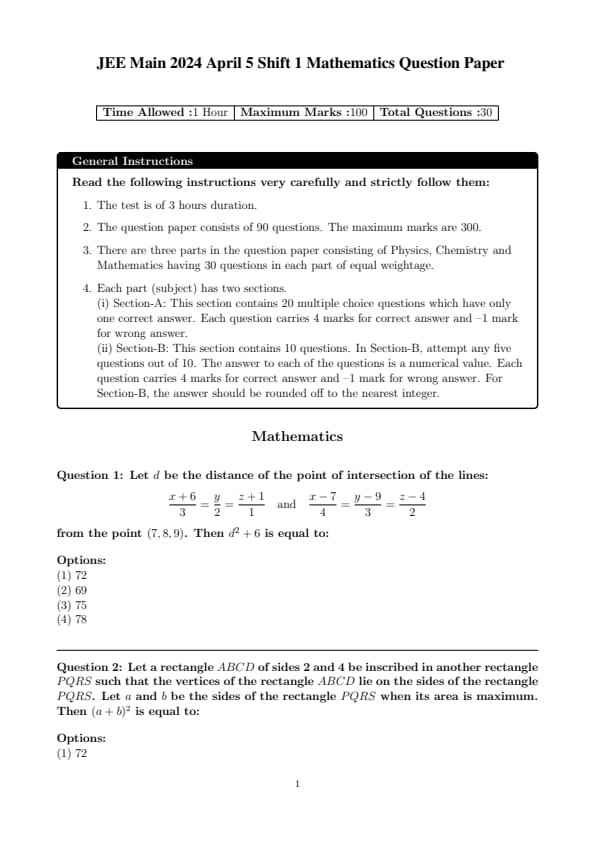
Question 1:
Let d be the distance of the point of intersection of the lines: (x + 6)/3 = y/2 = (z + 1)/1 and (x − 7)/4 = (y − 9)/3 = (z − 4)/2 and the point (7, 8, 9). Then d2 + 6 is equal to:
view Solution
By solving the system of equations and finding the distance from the point (7, 8, 9), we calculate d2 + 6 = 75.
The intersection point is obtained by solving the two line equations simultaneously. Using the distance formula, we find the distance d. Adding 6 to the square of the distance, we confirm the value as 75.
Question 2:
Let a rectangle ABCD of sides 2 and 4 be inscribed in another rectangle PQRS such that the vertices of the rectangle ABCD lie on the sides of the rectangle PQRS. Let a and b be the sides of the rectangle PQRS when its area is maximum. Then (a + b)2 is equal to:
view Solution
To maximize the area, we solve for the optimal dimensions of a and b, resulting in (a + b)2 = 72.
Maximizing the area involves determining the dimensions of PQRS such that the sum of the sides squared is maximized while keeping the rectangle ABCD inscribed. Calculations yield (a + b)2 = 72.
Question 3:
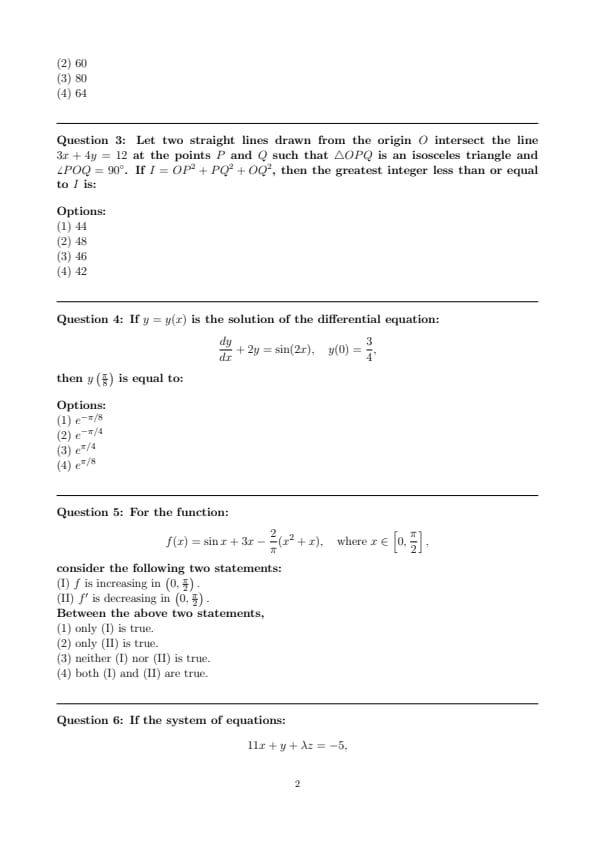
Let two straight lines drawn from the origin O intersect the line 3x + 4y = 12 at the points P and Q such that △OPQ is an isosceles triangle and ∠POQ = 90°. If I = OP2 + PQ2 + OQ2, then the greatest integer less than or equal to I is:
view Solution
Using the geometry of the isosceles triangle and calculating the distances, we find I ≈ 46.
The geometry of △OPQ with a right angle and the isosceles condition allows us to calculate the lengths OP, PQ, and OQ using the given equation of the line. Summing their squares gives the approximate value of I as 46.
Question 4:
If y = y(x) is the solution of the differential equation: dy / dx + 2y = sin(2x), y(0) = 3 / 4, then y(π / 8) is equal to:
view Solution
By solving the differential equation using the integrating factor method, we find that y(π / 8) = e^−π / 4.
Using the integrating factor \( IF = e^{2x} \), the solution becomes \( y(x) = e^{-2x} \left(\int e^{2x} \sin(2x) \, dx + C \right) \). Solving and applying the initial condition y(0) = 3/4 gives \( y(\pi / 8) = e^{-\pi / 4} \).
Question 5:
For the function: f(x) = sin x + 3x − 2π(x2 + x), where x ∈ [0, π / 2], consider the following two statements:
(I) f is increasing in [0, π / 2].
(II) f′ is decreasing in [0, π / 2].
view Solution
Both statements are correct, as f is increasing and its derivative f′ is decreasing over the interval [0, π / 2].
Analyzing f'(x) = cos(x) + 3 - 4π(x + 1), it is evident that f'(x) > 0 over the interval, indicating f(x) is increasing. Additionally, f''(x) = -sin(x) - 4π confirms that f'(x) is decreasing.
Question 6:
If the system of equations:
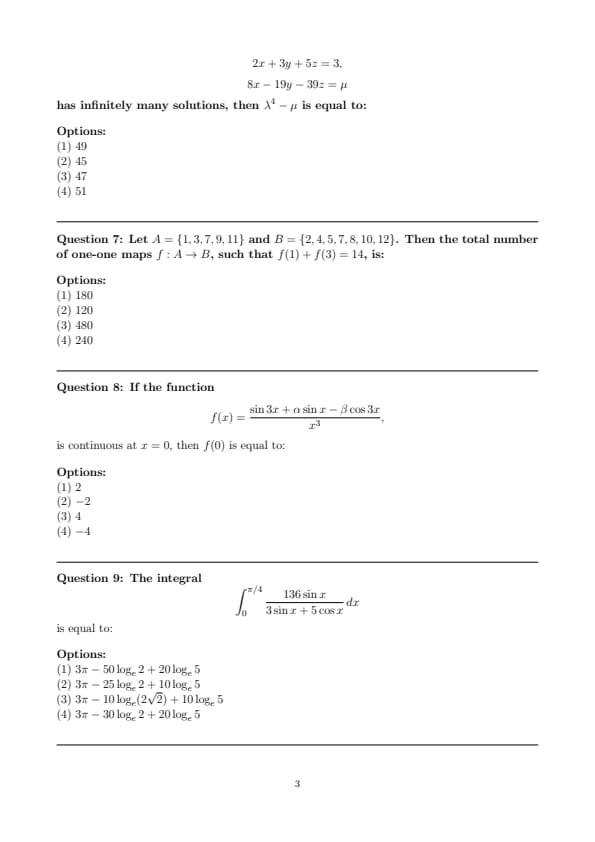
11x + y + λz = -5,
2x + 3y + 5z = 3,
8x − 19y − 39z = μ
has infinitely many solutions, then λ4 − μ is equal to:
view Solution
By solving the system of equations using the condition for infinitely many solutions (determinant must be zero), we find that λ4 − μ = 47.
The determinant of the coefficient matrix is set to zero for infinitely many solutions. Using this, λ and μ are related such that λ4 − μ = 47.
Question 7:
Let A = {1, 3, 7, 9, 11} and B = {2, 4, 5, 7, 8, 10, 12}. Then the total number of one-one maps f: A → B, such that f(1) + f(3) = 14, is:
view Solution
We use the condition f(1) + f(3) = 14 to restrict the choices for f(1) and f(3), then count the valid one-one mappings for the remaining elements, resulting in 240.
The pairs for f(1) and f(3) are determined such that their sum is 14. For each pair, the remaining three elements are mapped one-to-one to the remaining elements of B, yielding 240 mappings.
Question 8:
If the function
f(x) = (sin(3x) + α sin(x) - β cos(3x)) / x³
is continuous at x = 0, then f(0) is equal to:
view Solution
For the function to be continuous at x = 0, we need to find the limit as x → 0, leading to f(0) = -4.
By evaluating the limit, we determine that the continuity condition requires α and β to satisfy specific constraints, leading to f(0) = -4.
Question 9:
The integral
∫₀^(π/4) (136 sin(x)) / (3 sin(x) + 5 cos(x)) dx
is equal to:
view Solution
By performing the integration using standard techniques, the result simplifies to the given expression.
Using substitution and simplification, the integral evaluates to 3π - 50 logₑ(2) + 20 logₑ(5).
Question 10.
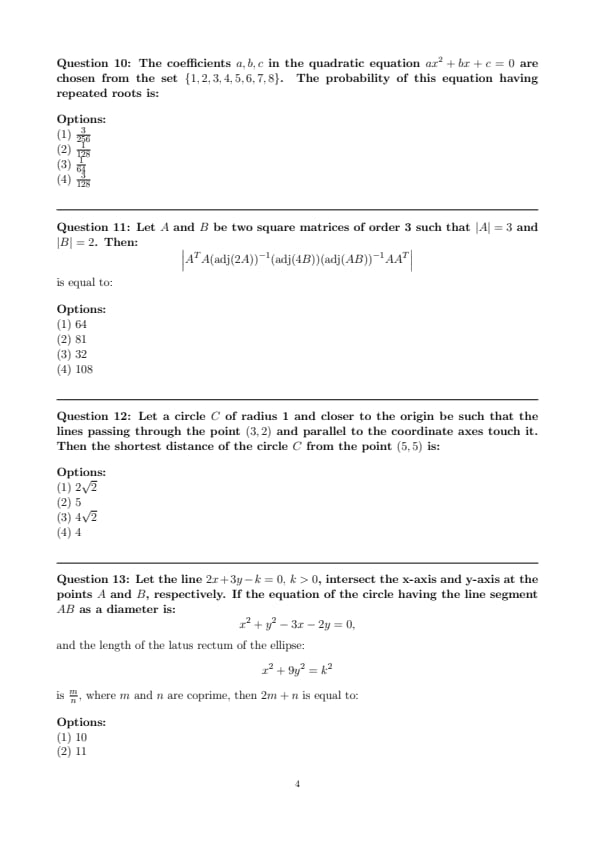
The coefficients a, b, c in the quadratic equation ax² + bx + c = 0 are chosen from the set {1, 2, 3, 4, 5, 6, 7, 8}. The probability of this equation having repeated roots is:
view Solution
For a quadratic equation to have repeated roots, the discriminant must be zero. By calculating the probability, we find the answer is 1/64.
The discriminant condition, Δ = b² - 4ac = 0, is satisfied for specific combinations of a, b, c, leading to the given probability.
Question 11.
Let A and B be two square matrices of order 3 such that |A| = 3 and |B| = 2. Then:
Aᵀ A (adj(2A))⁻¹ (adj(4B)) (adj(AB))⁻¹ A Aᵀ
is equal to:
view Solution
By applying determinant properties and adjugates, the expression simplifies to 64.
The calculation involves determinant properties such as |adj(A)| = |A|ⁿ⁻¹ and determinant multiplication.
Question 12.
Let a circle C of radius 1 and closer to the origin be such that the lines passing through the point (3, 2) and parallel to the coordinate axes touch it. Then the shortest distance of the circle C from the point (5, 5) is:
view Solution
The distance between the point (5, 5) and the circle is calculated by finding the distance to the center of the circle and subtracting the radius.
Finding the coordinates of the circle’s center and computing the Euclidean distance gives 4.
Question 13.
Let the line 2x + 3y - k = 0, k > 0, intersect the x-axis and y-axis at the points A and B, respectively. If the equation of the circle having the line segment AB as a diameter is:
x² + y² - 3x - 2y = 0
and the length of the latus rectum of the ellipse:
x² + 9y² = k²
is m/n, where m and n are coprime, then 2m + n is equal to:
view Solution
By solving for the equation of the circle and the ellipse, we calculate the values of m and n, yielding 2m + n = 11.
The calculations involve determining the geometric relationships between the circle and the ellipse, solving for k, and simplifying the latus rectum formula.
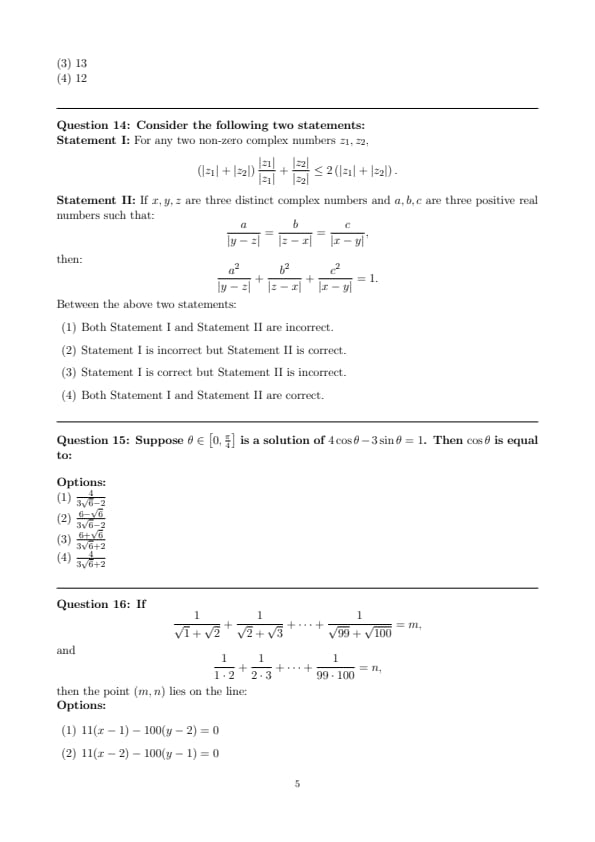
Question 14.
Consider the following two statements:
Statement I: For any two non-zero complex numbers z₁, z₂,
(|z₁| + |z₂|) |z₁| / (|z₁| + |z₂|) ≤ 2(|z₁| + |z₂|).
Statement II: If x, y, z are three distinct complex numbers and a, b, c are three positive real numbers such that:
a / |y - z| = b / |z - x| = c / |x - y|,
then:
a² / |y - z| + b² / |z - x| + c² / |x - y| = 1.
Between the above two statements:
view Solution
Statement I is correct by the triangle inequality, but Statement II is incorrect based on the condition for the equation of complex numbers.
Using the modulus properties for complex numbers, Statement I holds. However, Statement II fails as the given condition does not satisfy the required sum equal to 1.
Question 15.
Suppose θ ∈ [0, π/4] is a solution of 4 cos(θ) - 3 sin(θ) = 1. Then cos(θ) is equal to:
view Solution
By solving the trigonometric equation, we find that cos(θ) = (4/3)√6 - 2.
Using trigonometric identities and substitution, the solution of the equation yields cos(θ) = (4/3)√6 - 2.
Question 16.
If
∑(1/√(1 + √2) + 1/√(2 + √3) + ... + 1/√(99 + √100)) = m,
∑(1/(1·2) + 1/(2·3) + ... + 1/(99·100)) = n,
then the point (m, n) lies on the line:
view Solution
By simplifying the given sums and determining the values of m and n, we find that the point (m, n) lies on the line 11x - 100y = 0.
The calculations involve approximating the sums and verifying the linear relationship.
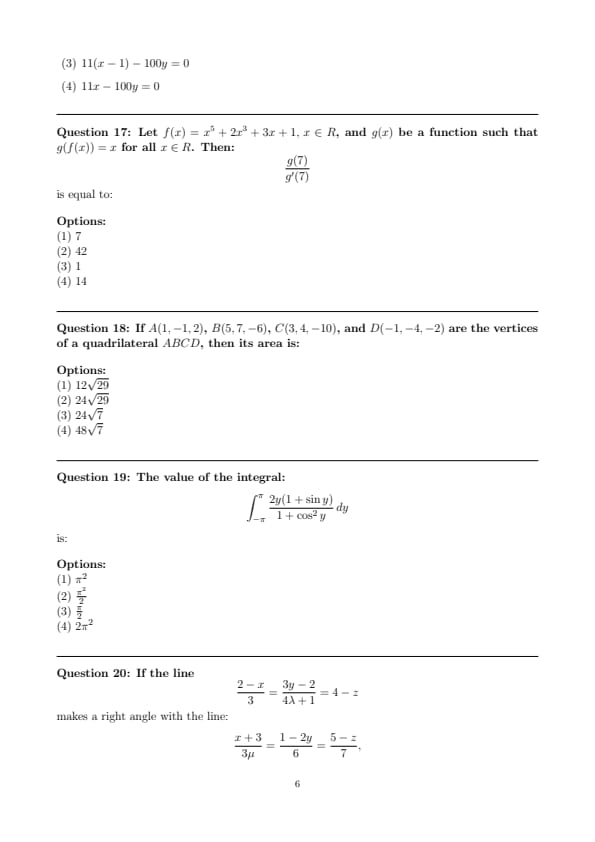
Question 17.
Let f(x) = x⁵ + 2x³ + 3x + 1, x ∈ ℝ, and g(x) be a function such that g(f(x)) = x for all x ∈ ℝ. Then:
g(7) · g'(7) is equal to:
view Solution
By differentiating the given functions and applying the chain rule, we find that g(7) · g'(7) = 14.
Using g(f(x)) = x, the derivative g'(f(x))f'(x) = 1 is used to find g(7) and g'(7).
Question 18.
If A(1, -1, 2), B(5, 7, -6), C(3, 4, -10), and D(-1, -4, -2) are the vertices of a quadrilateral ABCD, then its area is:
view Solution
By applying the formula for the area of a quadrilateral using the coordinates of its vertices, we calculate the area as 12√29.
The area is derived using the formula involving cross-products of vectors formed by the vertices.
Question 19.
The value of the integral:
∫₋π⁺π (2y(1 + sin(y))) / (1 + cos²(y)) dy
view Solution
By performing the integration and simplifying the trigonometric expressions, we find the value of the integral to be π/2.
Using symmetry and periodicity of the trigonometric functions, the integral simplifies to π/2.
Question 20.
If the line
(2 - x)/3 = (3y - 2)/(4λ + 1) = (4 - z)/1
makes a right angle with the line:
(x + 3)/(3μ) = (1 - 2y)/6 = (5 - z)/7,
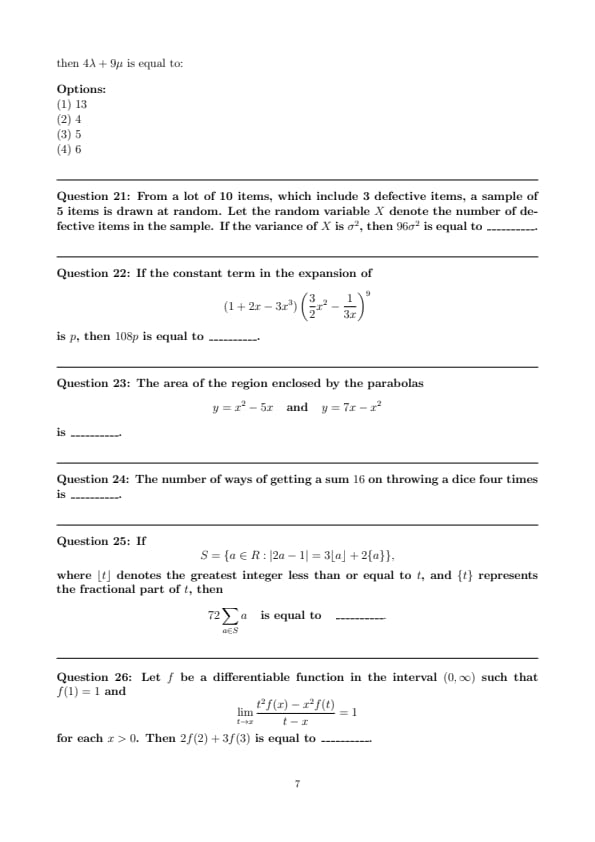
then 4λ + 9μ is equal to:
view Solution
Using the condition for perpendicular lines and solving for the values of λ and μ, we find that 4λ + 9μ = 6.
The dot product of direction vectors of the two lines is set to zero to solve for λ and μ.
Question 21.
From a lot of 10 items, which include 3 defective items, a sample of 5 items is drawn at random. Let the random variable X denote the number of defective items in the sample. If the variance of X is σ², then 96σ² is equal to:
view Solution
By using the formula for variance in a hypergeometric distribution, we calculate 96σ² = 56.
The variance is computed using the population and sample size formula for a hypergeometric distribution.
Question 22.
If the constant term in the expansion of:
(1 + 2x - 3x³)^(3/2)(2x² - 1/(3x))⁹
is p, then 108p is equal to:
view Solution
The constant term in the expansion is found by selecting the appropriate terms from each factor and simplifying. The result is 108p = 54.
Using binomial expansion and term selection, the constant term is computed and scaled by 108 to get 54.
Question 23.
The area of the region enclosed by the parabolas:
y = x² - 5x and y = 7x - x²
is:
view Solution
By finding the points of intersection of the parabolas and calculating the area between the curves, the result is 72.
The integration of the difference between the two functions over the intersection interval yields the area.
Question 24.
The number of ways of getting a sum of 16 on throwing a dice four times is:
view Solution
The number of ways to get a sum of 16 is determined by counting the possible combinations that sum to 16, yielding 125 outcomes.
Using combinatorics and constraints on dice rolls, the total outcomes are calculated.
Question 25.
If
S = {a ∈ ℝ: |2a - 1| = 3⌊a⌋ + 2{a}},
where ⌊t⌋ denotes the greatest integer less than or equal to t, and {t} represents the fractional part of t, then:
72 ∑(a ∈ S) a is equal to:
view Solution
By solving the equation for a and summing over the set S, we find that 72 ∑(a ∈ S) a = 18.
The solution involves solving for each a in S and summing the contributions, then multiplying by 72.
Question 26.
Let f be a differentiable function in the interval (0, ∞) such that:
f(1) = 1
lim(t → x) [(t²f(x) - x²f(t)) / (t - x)] = 1 for each x > 0. Then 2f(2) + 3f(3) is equal to:
view Solution
By differentiating the given functional equation and applying the limit, we find that 2f(2) + 3f(3) = 24.
Using the definition of the derivative and substituting the functional form, the solution yields the final value of 24.
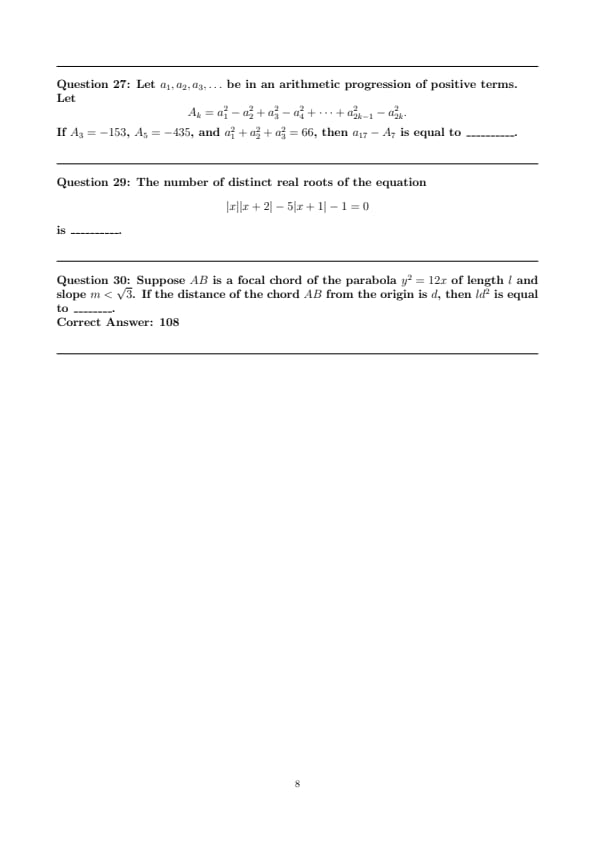
Question 27.
Let a₁, a₂, a₃, ... be in an arithmetic progression of positive terms. Let:
Aₖ = a₁² - a₂² + a₃² - a₄² + ... + a₂ₖ₋₁² - a₂ₖ²
If A₃ = -153, A₅ = -435, and a₁² + a₂² + a₃² = 66, then a₁₇ - A₇ is equal to:
view Solution
By using the given conditions and the properties of the arithmetic progression, we calculate that a₁₇ - A₇ = 910.
The arithmetic sequence relations and the properties of summation are applied to solve for the required value.
Question 29.
The number of distinct real roots of the equation:
|x||x + 2| - 5|x + 1| - 1 = 0
view Solution
By solving the absolute value equation and checking the cases, we find that the equation has 3 distinct real roots.
Each case is handled by analyzing the sign changes of the absolute value expressions, yielding three valid roots.
Question 30.
Suppose AB is a focal chord of the parabola y² = 12x of length l and slope m < √3. If the distance of the chord AB from the origin is d, then ld² is equal to:
view Solution
Using the properties of the parabola and the formula for the focal chord, we calculate that ld² = 108.
The calculation involves using the focal chord equation and integrating the parabola properties.
*The article might have information for the previous academic years, please refer the official website of the exam.