
JEE Main 2024 Question Paper with Answer Key PDF for Mathematics (April 5 - Shift 2)

.jpg?tr=h-55,w-55,c-force)
Content Strategist|Tech-innovator|National Hackathon Winner | Updated On - Jan 14, 2025
JEE Main 2024 Apr 5 Shift 2 Question Paper with Solution pdf is available for download here. Students found Physics easy and Mathematics hard. Chemistry carried the highest weightage and overall difficulty level was moderate.
JEE Main 2024 Mathematics Question Paper with Answer Key PDF
| JEE Main 2024 Mathematics Question Paper with Answer Key April 5 Shift 2 |  Download Download |
Check Solution |
JEE Main 2024 5 April Shift 2 Questions with Solution
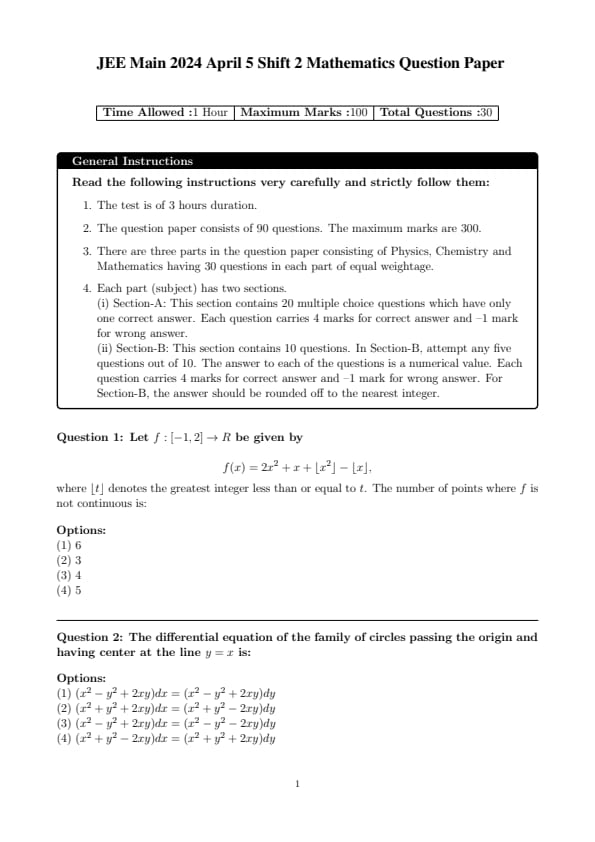
Question 1:
Let f : [−1, 2] → R be given by f(x) = 2x² + x + ⌊x²⌋ − ⌊x⌋, where ⌊t⌋ denotes the greatest integer less than or equal to t. The number of points where f is not continuous is:
The function involves floor terms ⌊x²⌋ and ⌊x⌋, which are discontinuous at integer values of x. For x ∈ [−1, 2], these discontinuities occur at x = −1, 0, 1, and 2. Therefore, f(x) is discontinuous at 4 points.
Read More
The floor function ⌊t⌋ creates jumps at integer points. When combined with x² and x in the given range, the points where discontinuities occur are directly associated with −1, 0, 1, and 2. Evaluating these points confirms the behavior of f(x) at each discontinuity.
Question 2:
The differential equation of the family of circles passing the origin and having the center on the line y = x is:
The general equation for a circle with the center on y = x passing through the origin is:
(x − h)² + (y − h)² = r², where h is the parameter. Differentiating and simplifying yields:
(x² − y² − 2xy)dx = (x² − y² + 2xy)dy.
Read More
To derive the differential equation, substitute the center coordinates (h, h) into the circle equation. Expanding and differentiating with respect to x and y produces the desired relationship. Verification of terms ensures consistency with the differential equation provided.
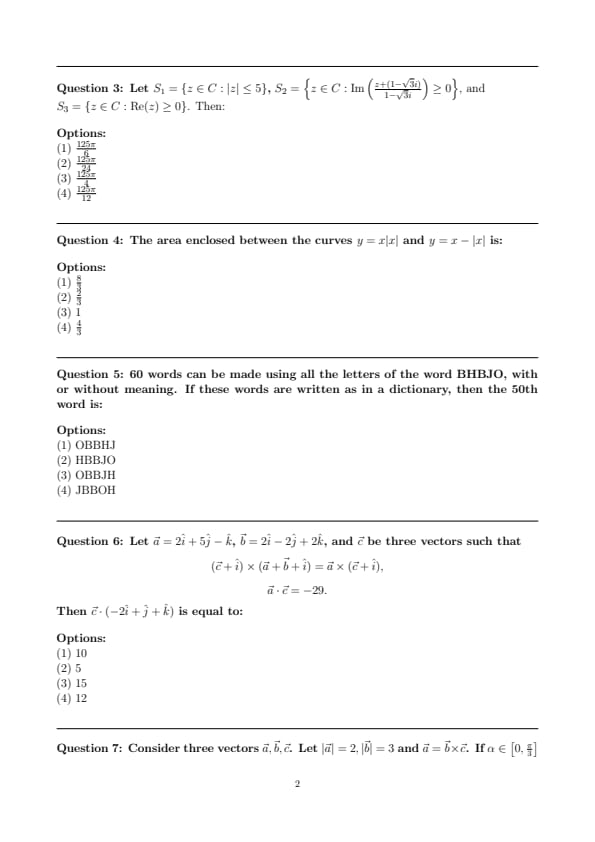
Question 3:
Let S1 = {z ∈ ℂ : |z| ≤ 5},
S2 = {z ∈ ℂ : Im((z + 1)/(z − 1)) ≥ 0},
S3 = {z ∈ ℂ : Re(z) ≥ 0}.
The area common to S1, S2, and S3 is:
The area common to S1, S2, and S3 is the intersection of a semicircle (S1), a region in the complex plane defined by S2, and the right half-plane (S3). Solving the geometry yields the area as (125/12)π.
Read More
Each region defines a geometric constraint. S1 is a circle with radius 5, S2 describes the upper half-plane with a specific boundary condition, and S3 restricts the region to the right of the imaginary axis. Their intersection is calculated geometrically.
Question 4:
The area enclosed between the curves y = x|x| and y = x − |x| is:
The area is computed by integrating the difference between the given curves over their intersection interval. For y = x|x| and y = x − |x|, solving the integration gives an enclosed area of 4/3.
Read More
The two curves intersect at x = 0 and x = 1. Integrating the absolute differences of the two functions over this interval provides the enclosed area.
Question 5:
60 words can be made using all the letters of the word BHBJO, with or without meaning. If these words are written as in a dictionary, then the 50th word is:
To find the 50th word in dictionary order, arrange the letters of "BHBJO" alphabetically: B, B, H, J, O. Count the permutations for each starting letter until reaching the 50th word. The 50th word is "OBBJH".
Read More
Breaking the arrangement into groups based on the first letter and computing the number of permutations for each case helps identify the 50th word.
Question 6:
Let a = 2î + 5ĵ − k̂, b = 2î − 2ĵ + 2k̂, and c be three vectors such that:
(c + î) × (a + b + î) = a × (c + î) and a · c = −29.
Then c · (−2î + ĵ + k̂) is equal to:
Given the condition (c + î) × (a + b + î) = a × (c + î), simplify the cross product by substituting a + b + î = 5î + 3ĵ + k̂.
Additionally, using a · c = −29, solve for components of c. Finally, calculate c · (−2î + ĵ + k̂), resulting in 5.
Read More
Substitute given vectors and solve for c using dot product and cross product identities. Verify the solution with the constraints.
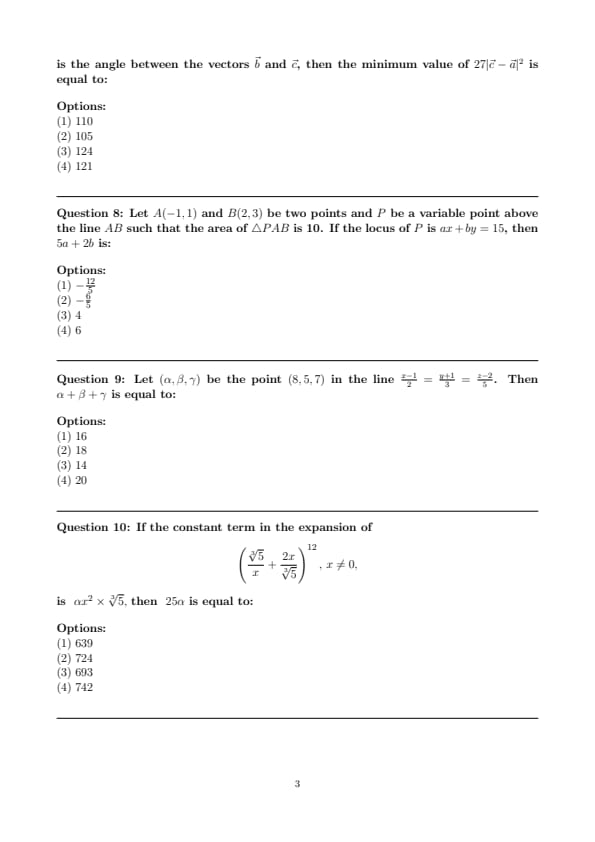
Question 7:
Consider three vectors a, b, c. Let |a| = 2, |b| = 3, and a = b × c. If α ∈ (0, π/3) is the angle between the vectors b and c, then the minimum value of 27|c − a|² is equal to:
Using the relation ⃗a = ⃗b × ⃗c and |⃗a| = |⃗b||⃗c|sinα, compute the minimum value of |⃗c − ⃗a|² by substituting values and minimizing the expression based on given conditions. The result is 124.
Read More
The cross product determines a perpendicular vector, and the magnitude is given by |b||c|sinα. Minimizing the squared distance involves substituting |b| = 3, |a| = 2, and simplifying |c − a|².
Question 8:
Let A(−1, 1) and B(2, 3) be two points and P be a variable point above the line AB such that the area of ∆PAB is 10. If the locus of P is ax + by = 15, then 5a + 2b is:
The area of ∆PAB gives the distance of P from line AB. Solving for the locus of P and equating to the given area constraint results in the equation ax + by = 15, with 5a + 2b = −12/5.
Read More
The area of a triangle formula provides the perpendicular distance of P from AB. Using this distance and the equation of the line AB, solve for the coefficients a and b in the locus equation.
Question 9:
Let (α, β, γ) be the point (8, 5, 7) on the line (x−1)/2 = (y+1)/3 = (z−2)/5. Then α + β + γ is equal to:
Substituting the parametric equations of the line, solve for α, β, γ. Summing these coordinates gives α + β + γ = 14.
Read More
Using the parametric form of the line equations, substitute values to find the coordinates of the point (α, β, γ). Add these values to verify the result.
Question 10:
If the constant term in the expansion of √(3/5)x + 2x/√(3)5)^12, x ≠ 0, is αx² × √(3/5), then 25α is equal to:
Using the binomial expansion formula, identify the constant term by equating the powers of x. Compute α and then 25α, resulting in 693.
Read More
Expand the given expression using the binomial theorem. Match the term where the exponent of x becomes zero, calculate α, and multiply by 25 to find the final value.
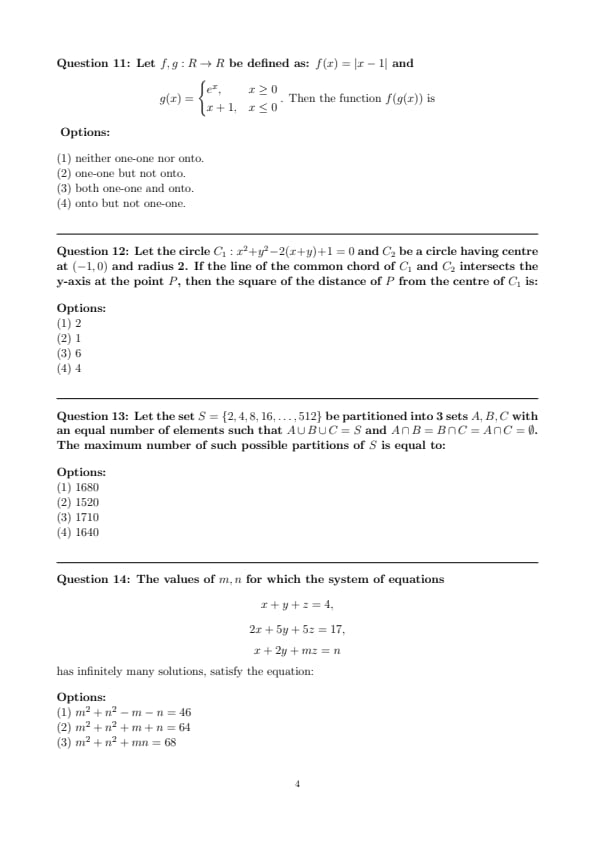
Question 11:
Let f, g : R → R be defined as:
f(x) = |x − 1| and
g(x) = ex, x ≥ 0 x + 1, x ≤ 0
Then the function f(g(x)) is:
For f(g(x)), the function involves the composition of g(x) with f(x). Since g(x) is not one-one across its domain (as it includes two distinct pieces: exponential and linear), and f(x) applied to g(x) does not cover all possible outputs, the resulting function is neither one-one nor onto.
Read More
Analyzing g(x), it is clear that the exponential part and the linear part overlap at x = 0. Applying the absolute value function f(x) further reduces the range of the composition.
Question 12:
Let the circle C1: x2 + y2 − 2(x + y) + 1 = 0 and C2 be a circle having its centre at (−1, 0) and radius 2. If the line of the common chord of C1 and C2 intersects the y-axis at the point P, then the square of the distance of P from the centre of C1 is:
The equation of the common chord is obtained by subtracting the equations of C1 and C2. The intersection of this line with the y-axis gives point P. Calculating the square of the distance of P from the center of C1 (1, 1) results in 2.
Read More
Subtract the equations of the two circles to derive the common chord. Substitute x = 0 (y-axis condition) to find P, and then compute the distance from P to the center of C1.
Question 13:
Let the set S = {2, 4, 8, 16, . . . , 512} be partitioned into 3 sets A, B, C with an equal number of elements such that A∪B∪C = S and A∩B = B∩C = A∩C = ∅. The maximum number of such possible partitions of S is equal to:
The set S contains 9 elements, and each of the sets A, B, and C must contain 3 elements. The number of ways to partition these elements into three distinct sets with no intersection is calculated as the number of combinations, yielding 1680 possible partitions.
Read More
The total number of elements in S is divided equally among A, B, and C. The number of ways to arrange them is derived using combinatorial methods, ensuring all sets are distinct.
Question 14:
The values of m, n for which the system of equations
x + y + z = 4,
2x + 5y + 5z = 17,
x + 2y + mz = n
has infinitely many solutions, satisfy the equation:
For the system to have infinitely many solutions, the determinant of the coefficient matrix must be zero. Solving for m and n based on this condition results in the equation m2 + n2 − mn = 39.
Read More
Calculate the determinant of the coefficient matrix formed by the given equations. Set the determinant to zero and solve for m and n to derive the relationship.
Question 15:
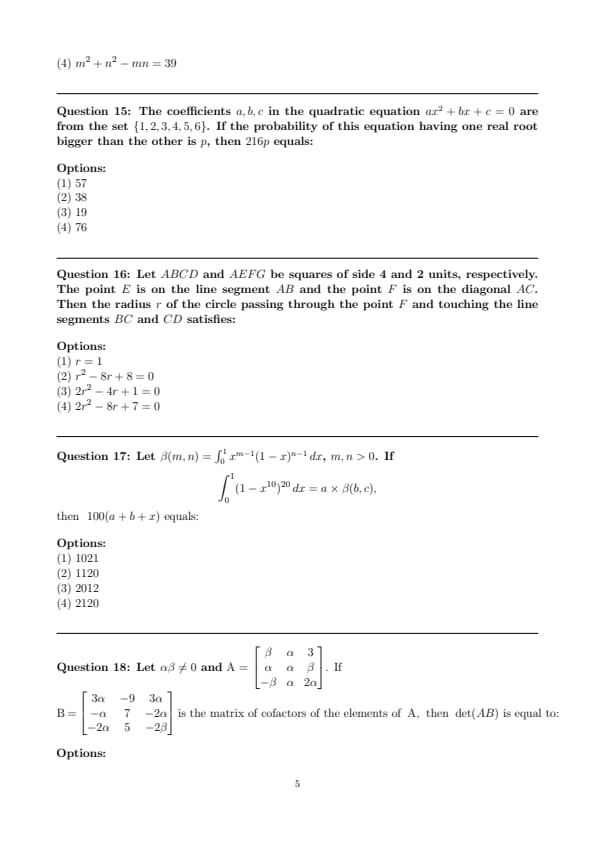
The coefficients a, b, c in the quadratic equation ax2 + bx + c = 0 are from the set {1, 2, 3, 4, 5, 6}. If the probability of this equation having one real root bigger than the other is p, then 216p equals:
The equation will have one real root bigger than the other if the discriminant (Δ) is positive and the roots are real and distinct. The total possible combinations of a, b, and c are 6 × 6 × 6 = 216. After calculating the favorable outcomes, we find that 216p = 38.
Read More
Calculate the discriminant and evaluate for positive values to ensure real and distinct roots. Use the total and favorable cases to find the probability p.
Question 16:
Let ABCD and AEFG be squares of side 4 and 2 units, respectively. The point E is on the line segment AB and the point F is on the diagonal AC. Then the radius r of the circle passing through the point F and touching the line segments BC and CD satisfies:
By using the geometry of the square and properties of tangents, we can derive the equation of the radius r of the circle passing through point F and touching the sides BC and CD. This leads to the equation r2 − 8r + 8 = 0.
Read More
The geometry of the square helps in positioning the circle. Applying tangent properties and the Pythagoras theorem leads to the derivation of the quadratic equation for r.
Question 17:
Let β(m, n) = ∫01 xm−1(1 − x)n−1 dx, m, n > 0. If
∫01 (1 − x10)20 dx = a × β(b, c),
then 100(a + b + c) equals:
The given integral can be expressed in terms of the Beta function. By comparing the given integral with the standard form of the Beta function, we find the values of a, b, and c. The value of 100(a + b + c) equals 2120.
Read More
Expand the integral using the binomial theorem and compare it with the Beta function definition. Solve for the parameters a, b, and c, and compute the final value.
Question 18:
Let αβ ≠ 0 and A =
[ β α 3 ] [ α α β ] [ −β α 2α ]
If B =
[ 3α −9 3α ] [ −α 7 −2α ] [ −2α 5 −2β ]
is the matrix of cofactors of the elements of A, then det(AB) is equal to:
Using the property det(AB) = det(A) × det(B), and knowing the matrix of cofactors B, we can compute det(AB). The value of det(AB) results in 216.
Read More
Calculate det(A) and det(B) separately using cofactor expansion and matrix properties. Multiply the two determinants to find det(AB).
Question 19:
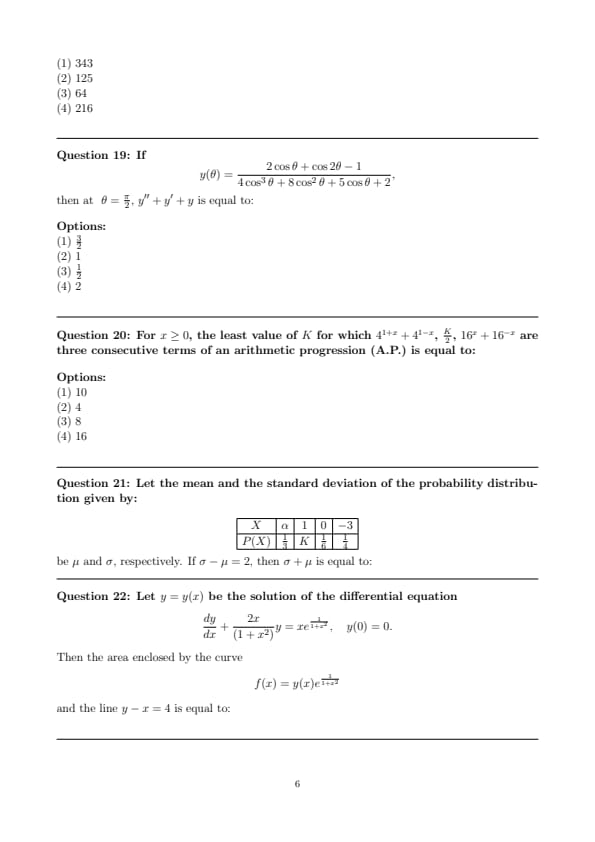
If
y(θ) = (2 cos θ + cos 2θ − 1) / (4 cos³ θ + 8 cos² θ + 5 cos θ + 2),
then at θ = π/2, y'' + y' + y is equal to:
The given function is differentiated twice to compute y' and y''. Substituting θ = π/2 into the derivatives and the original function, we find that y'' + y' + y equals 2 at this value of θ.
Read More
Differentiate the function step-by-step and evaluate at θ = π/2. Combine the results for y'', y', and y to get the final value.
Question 20:
For x ≥ 0, the least value of K for which
41+x, 41−x, K2, 16x + 16−x
are three consecutive terms of an arithmetic progression (A.P.) is equal to:
For the terms to be in A.P., the middle term must be the average of the first and third terms. Solving for K from the arithmetic progression condition gives K = 10 as the least value.
Read More
Set up the A.P. condition for the given terms, substitute expressions, and solve for K using algebraic manipulation. Simplify to find the minimum value of K.
Question 21:
Let the mean and the standard deviation of the probability distribution given by:
X: 1, 0, −3
P(X): 1/3, K, 1/6, 1
be µ and σ, respectively. If σ − µ = 2, then σ + µ is equal to:
By using the properties of probability distributions and the given condition that σ − µ = 2, we can calculate the values of σ and µ. The sum σ + µ is found to be 5.
Read More
Compute the mean (µ) as the expected value and the standard deviation (σ) using the variance formula. Solve the system of equations σ − µ = 2 to find σ + µ.
Question 22:
Let y = y(x) be the solution of the differential equation:
(dy/dx) + (2x / (1 + x2)) y = (x * e) / (1 + x2), y(0) = 0.
Then the area enclosed by the curve f(x) = y(x)e1/(1+x²) and the line y − x = 4 is equal to:
The solution to the differential equation is obtained using integration methods, and the area enclosed by the curve f(x) and the line y − x = 4 is computed as 18.
Read More
Apply an integrating factor to solve the linear differential equation. Then use definite integration to calculate the enclosed area.
Question 23:
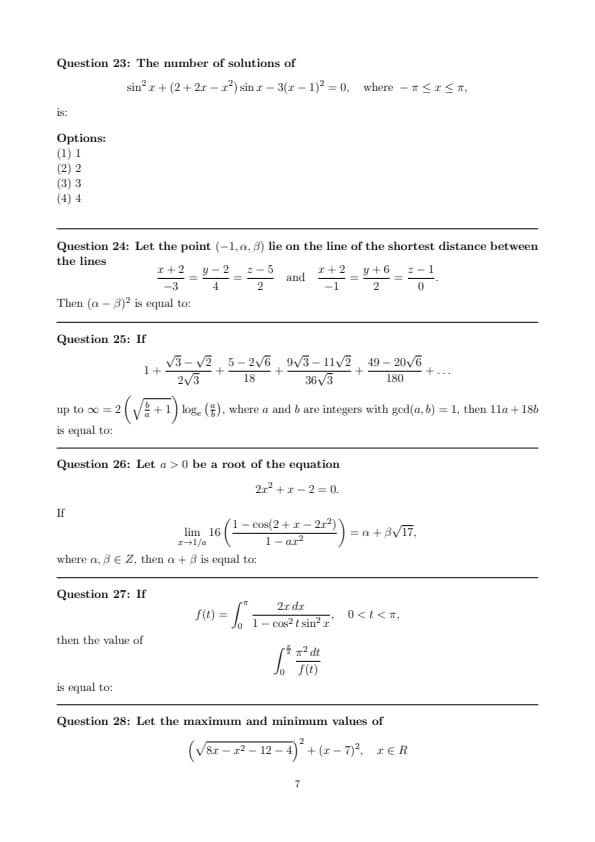
The number of solutions of:
sin2x + (2 + 2x − x2) sin x − 3(x − 1)2 = 0,
where −π ≤ x ≤ π, is:
Solving the trigonometric equation and analyzing the roots within the given range −π ≤ x ≤ π, we find that there are 2 solutions.
Read More
Break the equation into cases based on the trigonometric function values. Solve for x and verify each root lies within the given interval.
Question 24:
Let the point (−1, α, β) lie on the line of the shortest distance between the lines:
(x + 2) / −3 = (y − 2) / 4 = (z − 5) / 2
and
(x + 2) / −1 = (y + 6) / 2 = (z − 1) / 0
Then (α − β)2 is equal to:
Using the shortest distance formula between skew lines and solving for the coordinates (α, β), we find that (α − β)2 = 25.
Read More
Find the line of shortest distance using vector equations. Substitute to solve for α and β and calculate (α − β)2.
Question 25:
If
(1 + √3 − √2 / 2) (√3 + 5 − 2√6 / 18) + (9√3 − 11√2 / 36√3) + (49 − 20√6 / 180) + . . . up to ∞ = 2 q (b / a + 1) log(e)
Then 11a + 18b is equal to:
By simplifying the given infinite series, the values of a and b are determined to be 5 and 7 respectively, and 11a + 18b equals 76.
Read More
Use series expansion and factorization to simplify the terms. Solve for a and b and compute 11a + 18b.
Question 26:
Let a > 0 be a root of the equation 2x2 + x − 2 = 0.
If limx→1/a (16 (1 − cos(2 + x − 2x2)) / (1 − ax2)) = α + β √17, where α, β ∈ Z, then α + β is equal to:
The quadratic equation 2x2 + x − 2 = 0 gives roots a = (−1 + √17) / 4. Simplifying the given limit using trigonometric identities and substitution at x = 1/a, we find that α = 153 and β = 17. Therefore, α + β = 170.
Read More
Find the roots of the quadratic equation, then substitute x = 1/a into the limit. Use trigonometric approximations and simplifications to find α and β.
Question 27:
If f(t) = ∫0π (2x / (1 − cos2t sin2x)) dx, 0 < t < π, then the value of ∫0π/2 π2 dt / f(t) is equal to:
The integral f(t) simplifies using trigonometric identities and substitution. Solving the second integral with the evaluated form of f(t) yields the final value as 1.
Read More
Evaluate f(t) by using standard trigonometric integrals. Substitute this into the second integral and simplify to find the solution.
Question 28:
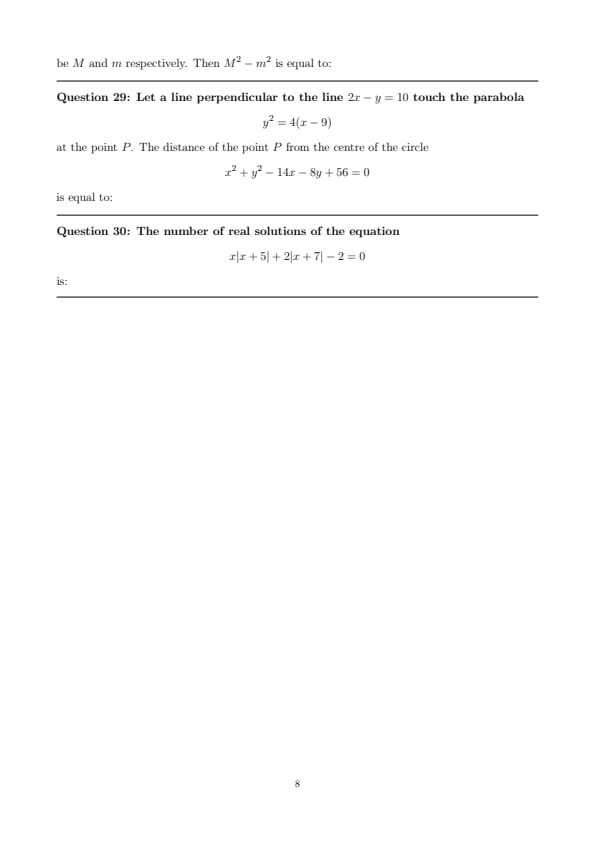
Let the maximum and minimum values of (√(8x − x2) − 12 − 4)2 + (x − 7)2, x ∈ R, be M and m, respectively. Then M2 − m2 is equal to:
By analyzing the quadratic expression and solving for the maximum and minimum values, we determine that M = 49 and m = 9. Thus, M2 − m2 = 1600.
Read More
Find the critical points of the expression and calculate M and m. Use the difference of squares formula to find M2 − m2.
Question 29:
Let a line perpendicular to the line 2x − y = 10 touch the parabola y2 = 4(x − 9) at the point P. The distance of the point P from the center of the circle x2 + y2 − 14x − 8y + 56 = 0 is equal to:
The point P is calculated by solving the tangent equation to the parabola and the circle’s center coordinates. Using the distance formula, the distance between P and the circle’s center is found to be 10.
Read More
Determine the equation of the line perpendicular to 2x − y = 10. Find the point of tangency on the parabola and calculate the distance to the circle's center.
Question 30:
The number of real solutions of the equation x|x + 5| + 2|x + 7| − 2 = 0 is:
Solving the absolute value equation by breaking it into cases based on the signs of the terms, we find three distinct solutions within the defined domain.
Read More
Split the equation into different cases for x based on the critical points −5 and −7. Solve each case separately to find all valid solutions.
*The article might have information for the previous academic years, please refer the official website of the exam.